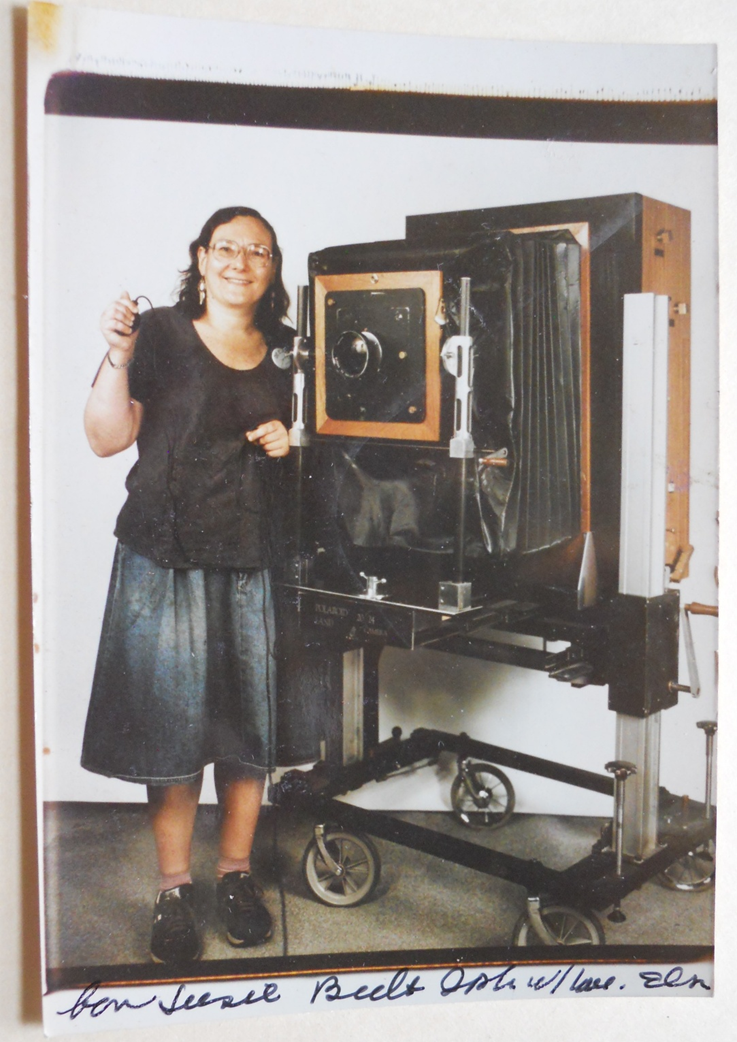
ELSA DORFMAN 1937 – 2020

      “Self Portrait with Camera,” copyright Elsa Dorfman. (Photographic post-card)

The first time I met Elsa Dorfman was in 1975, just before Christmas, in Harvard Square. Harvard Square is a slight misnomer. It is really more like a triangle where Mass. Ave. (a major thoroughfare) comes out of Boston across the river, then runs through Cambridge from east to west for a mile or so, then turns a corner at the oldest western part of the Harvard Yard and runs north to Porter Square in northern Cambridge, then turns northwest for several more miles through Somerville, Arlington and then on out of my awareness. Several smaller streets converge at that triangle point, which held a newspaper and magazine stand positioned on the closed subway entrance. Brattle St., and a street now called John F. Kennedy St. (It had a different name when I was there, I think it was called Mount Auburn Street.) met at the triangle point. The “Square” was actually a clutter of commercial businesses that clustered for a few blocks around the Mass. Ave turn. Several bus routes ended there. A bank with mysterious second floor offices held one corner. The Harvard Coop, where you bought books and Harvard memorabilia (scarfs and sweatshirts and chairs, if you wanted that kind of thing) dominated another corner, with plenty of other bookstores where you bought both new and used books back down Mass. Ave for several blocks, shops where you bought dishes and towels and stuff, hole-in-the-wall cafes where you bought some of the best sandwiches in the world, a larger, more formal German-American restaurant where you could get a full sit-down meal, other restaurants, an administration building for Harvard University (Bursar’s Office, Clinic, Harvard Press Office, etc.), even a movie theatre; all were clustered below Mass Ave. on the south to southwest; while the quieter, walled-off Harvard Yard held the north-north-east corner.

In those days Harvard Square was an active, bustling place.

Harvard Square, ca. 1975. Photos by William Johnson.

Students and teachers and tourists and commerce of all sorts during the day, and on the summer weekend nights – buskers, jugglers, with music from steel-drum bands or the hippy, guitar-playing, folk singers. And at Christmas time street vendors were allowed to sell hand-made crafts and food and other good things from temporary booths on the sidewalks in and around the Square.

One Christmas season I found a short, boxy, plainly dressed woman selling her photographs from a grocery-shopping cart on the sidewalk in front of the Harvard administration building. But this was not your typical craft-fair vendor, with the decorative photographs you would typically find in this sort of situation. As I looked more closely, I realized that these were serious black & white photographs, about 8” x 10”, carefully seen and photographed, carefully printed, and carefully mounted on board; and she was selling them for $2.00 or $5.00 each. She had to be taking a loss on the cost of the materials alone.
I loved it. In the academic circles I was embedded in at the time, where there was still a struggle to get photography recognized as legitimate by the “high-art” people, things could occasionally get pretentious around the notion of “Fine Art Photography” and I just loved it that this woman seriously liked to make
good photographs and she seriously wanted to make them easily available to anyone who liked them.

So I bought one.   

It came in a plastic bag with its own information card.

At that time, separated from my first wife, I was living very cheaply in a tattered one-room basement apartment just outside of Harvard Square. Elsa lived a few blocks away and occasionally we would run into each other on the street and chat. Once she invited me to lunch at her house to meet her husband, who I remember as a very quiet and somehow sweet little man who apparently was a very serious lawyer out in the real world. I learned that not only was Elsa a very good cook but that Robert Creely, the poet who had let her use his poem for her book, was a good friend and that Elsa was also friends with Jack Kerouac, Allen Ginsberg, Peter Orlovsky, and other artists of the “Beat” movement in New York in the ‘50s.

And, more interesting to me at the time, that she had worked for the avaunt-guard publisher Grove Press and had literally couriered Robert Frank’s photographs for the US version of The Americans back and forth between the publisher and the artist while it was being developed. In the early 1970s Robert Frank had not yet attained the exalted status he has today. He was still an apparently reclusive, slightly mysterious, figure who’s book had been roundly trashed by every established photographic critic when it first came out but which was stirring up increasing levels of interest and appreciation within the younger generation of photographers and critics. I was one that younger generation and I was beginning to fall under the spell of that book’s power.

Then in 1976 I moved to Rochester, New York to teach at Nathan Lyon’s Visual Studies Workshop and then on to the Center for Creative Photography at Tucson Arizona to work with W. Eugene Smith and, after his death, to organize his photographic collection. I also married again, to Susie Cohen. I had met Susie in Boston, but we dated in Rochester and married in Tucson. All this took several years and after various projects and events we wound up in Boston again in the mid ‘80s where we had come back to work on an experimental project and exhibition that I had somehow talked Eelco Wolf, a Vice-President at Polaroid to support. That project had run its course and Susie and I were engaged in several concurrent or overlapping projects to earn our daily bread. One of those projects was to take over the editorship of Views: The Journal of Photography in New England, published by the new Photographic Resource Center, then at Boston University. The journal was in editorial disarray at the time, and it took Susie and me a little while to build it back up to the point where it became what was described as “…one of the most important academic‑style journals in photography.” (The Photographer’s Source) which “…set the standard by which other photo center quarterlies should be judged.” (Afterimage).

One of the people who helped rebuild the journal was Elsa. She showed up one day and offered to write a “gossip column.” Which she did and did well – digging up and collating items of news and interest about the photographic community at large by calling people on the phone and chatting and finding out about their professional activities (Exhibitions, awards, etc.) and their personal lives (Marriages, births, etc.); which she presented with the same effortless grace and humor that she brought to her picture making. Some thought that sort of information was outside the scope of the journal. Susie and I thought it helped balance the academic rigor with some human feeling.

Elsa was also by this time making the 20 x 24 inch Polaroid portraits for which she was to become famous.
        “Dorfman had the only privately owned, 240-pound accordion-like box instant Polaroid Land camera.
   Polaroid made only about a half dozen of them. Dorfman couldn’t say why she would only work with this
   rare enormous camera with its fragile film and chemical pods that were hard to come by, especially after
   Polaroid went bankrupt twice in the 2000s and stopped selling instant film in 2009. She just knew that
   when she found the camera in 1980, she was smitten.
       There were five cameras built and then they were kind of underused, so [Elsa] really lobbied to get
   one her own,” Reuter said. “The irony is she leased the camera and she leased it for so long she could
   have bought three of them.”
ttps://www.wbur.org/news/2020/05/31/cambridge-photographer-elsa-dorfman-giant-polaroids-dies.

By the late 1980’s the Polaroid Corporation was in the process of closing down and it had divested itself from the various artist’s programs that it had supported a few years before. (Among them the “Creativity Project” that Susie and I had developed with the artists Robert Frank, Dave Heath, Robert Heinecken and John Wood, which, among other things, had used the 20 x 24 Polaroid camera at the studio located in the Art School at the Museum of Fine Arts in Boston. I think that most of the other cameras scattered around the world were no longer in use, or definitely no longer in continious use. But Elsa had somehow managed to talk some Polaroid executive or other into renting her the Boston 20 x 24 camera, which she then used commercially to make studio portraits – mostly of family groups. I don’t know for certain, but she may have been the only person in the world at that time regularly using a 20 x 24 inch camera and almost certainly the only one regularly usng the 20 x 24 format for commercial portraits.

We asked Elsa to make a 20 x 24 photo of Susie and our son Joshua in 1986. Elsa asked Susie to bring Joshua with some of his toys to the BMFA studio where the camera was still located – which, by accident, we were already familiar with. Elsie asked Susie and Josh to sit on the floor, quickly arranged the photograph and took the picture. The huge wooden camera with its bellows extension, its narrow range of possible operations, and its awkward but immediate processing of the image (You can search “Polaroid Project” or “Robert Frank” on this blog for more information about that 20 x 24 camera and its processes and proceedures.) gave to the session the flavor of a 19th century daguerrian portrait gallery. But Elsa’s charm and her fluid control over the system made the event an easy and pleasant experience.

       “Susie and Josh on the 20 x 24 on May 8, 1886.” 20” x 24” Polaroid print. Copyright Elsa Dorfman.

Then, when we left Boston in 1987 to return to Rochester for me to work at the George Eastman House, Elsa surprised us with a wonderful gift. By the 1980s Allen Ginsberg, once reviled, had become a celebrated iconic figure in American culture and his long, semi-secret involvement with photography had just begun to become publicly known. Susie and I met with him, possibly with the help of Elsie’s recommendation, to plan an article for Views, but then we moved to Rochester before we could complete that project.

As a parting gift Elsa gave us a 20 x 24 Polaroid portrait of Allen Ginsberg and Peter Orlovsky, signed by both poets. It was an exceptionally generous act, as well befitted her character and nature.

“Alan Ginsberg and Peter Orlovsky. March 28, 1985.” 20” by 24” Polaroid print. Copyright by Elsa Dorfman.

Elsa continued to send us postcards and little gifts over the years; although as I am a terrible correspondent, I was always tardy with any responses. But I always appreciated hearing from her.
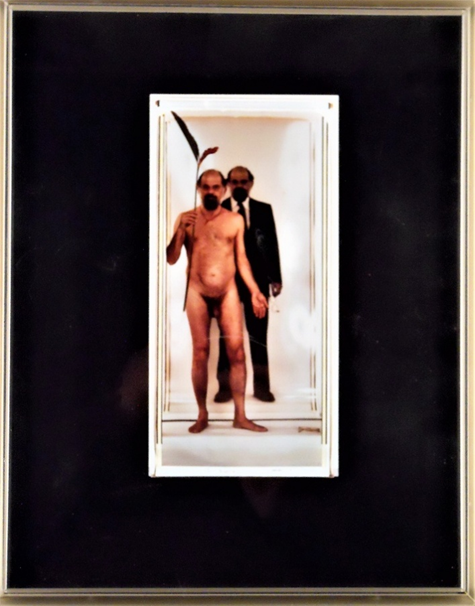
“Allen, November 6, 1986.” reduced copy of 40” x 80 Polaroid print, 1991. Copyright Elsa Dorfman.

I was saddened to learn that Elsa had died in 2020 – which I didn’t even know about until I started writing this note. Her intelligence and spirit will be missed. I also apologize for the quality of the reproductions presented here, the original photos are much better.


“Allen, November 6, 1986.” reduced copy of 40” x 80 Polaroid print, 1991. Copyright Elsa Dorfman.

I was saddened to learn that Elsa had died in 2020 – which I didn’t even know about until I started writing this note. Her intelligence and spirit will be missed. I also apologize for the quality of the reproductions presented here, the original photos are much better.


The Myth of Mathew Brady

AN ANNOTATED BIBLIOGRAPHY OF THE LITERATURE ABOUT MATHEW B. BRADY,
WITH SOME ADDITIONAL CITATIONS FOR ALEXANDER GARDNER
(AND A LITTLE BIT ABOUT THE CIVIL WAR)
compiled by
 WILLIAM S. JOHNSON.
  (June-August 2024)

NOTE 1.
Let’s get it out there right up front. One reviewer of my published 19th c bibliography book trashed it because he thought (1) that I gave too much information (yikes!!!) and (2) that I had misspelled Mathew Brady’s first name by spelling “Matthew” with two “T”s. Given the current state of the art; anyone doing a “search and replace” function late at night knows how a slip of the finger can instantly create hundreds of errors. However, as it turns out, I chose to spell his name “Matthew” deliberately. Very few of the thousands of citations during Brady’s lifetime actually give his first name, usually just using “M. B. Brady.” When his first name is cited, it is often cited either way, and I’ve seen instances where it was spelled with two T’s when I thought that he could have complained if it was wrong. I’ve heard that the Library of Congress folks spent a lot of time trying to decide about this before officially choosing the one T spelling. So, while I personally think that he spelled it with two T’s, I am going along with the currently accepted practice of one T. Except I have not “corrected” the citations when the two T’s are found in the original citation. Also while we are on this issue, very early on, the word “daguerreotype” was misspelled in an extraordinarily inventive number of ways. I avoided correcting all those as well.

NOTE 2:
Studying the actual history of photography is a lot like practicing archeology. That is, by finding buried fragments of some artifact, then trying to deduce the shape of the whole culture from those fragmented items. The medium of photography has experienced wide swings of interest from the academic community over the course of the medium’s development, leaving large areas of practice and events still underknown and even misunderstood. My belief is that if a body of information is put together in certain ways, it may lead to fruitful new understandings of the character and work of individual artists as well as the issues of the world they work within. We may also see the arc of their careers and even the shifting concerns of the individuals reporting on those events, and we may also see a trace of the nature of the larger public’s interest as well. In some cases the sheer number of references about some topic is in itself important information. In the literature under review here the articles which allow the most access into the practices of the period and provide the public manifestation of the critical ideas of the day are found in the reports of the various organizational meetings and in the exhibitions and exhibition reviews. So I may have gone a bit overboard on some of these, and there is some repetition of information in the bibliographic references, but I am trying to present the context and climate of the world that the artist inhabited and the issues to which he responded.

NOTE 3. What’s in and what’s not in this bibliography? The core is drawn from my extensive Database One covering more than 800 magazines published in England and the USA between 1839 and 1869. To which has been items added from my less complete Database Two covering from 1870 to 1879, plus a variety of other random databases I have accumulated (and managed not to lose to the fickle electronic Gods) over the past forty-or fifty-odd years. This is supplemented with an on-line literature search for Brady from 1840 up to about the first World War. I once read somewhere that in America more books have been published about the Civil War than on any other subject. I have not attempted to cite the many, many books and articles discussing or mentioning Brady which have been published since Brady’s lifetime, although I do cite a few later references which were important to the establishment of his myth.
In Brady’s case the amount of available information astonished me. I knew that there would be more references than are generally listed for Brady, but I did not expect to find so much material. It would take 750 pages of regular 8½ by 11 paper, single spaced in a very compact 8 point Arial typeface, to print out all of this bibliography.
The references published here are organized into several categories, which were determined by their mode of publication and the characteristics of that mode. I did this for my own convenience while putting the bibliography together. Ideally, I think the most instructive way to use the bibliography would be to arrange everything in a strict chronological order, then just read it. But that would have been a horror to put together while searching the literature, and it would also be conceptually difficult to hold everything in the mind at once, so this document is divided into the following sections:
Introductory Essay;
Bibliography:
Mathew Brady. (Magazines 1840-1900)
Alexander Gardner. (Books and Magazines 1860-1900)
Selected Magazines (Published after 1900)
Newspapers City Directories
Mathew Brady. (Books 1840 – 1912)
Government Documents
Exhibition Catalogues (1840-1880)
NOTE 4:
This effort was made to be placed on my webpage, to be viewed on the computer. Traditional footnotes and endnotes do not seem to work well in this sort of format. So I’ve put my “introductory comments” in 10 point type, followed by the “sources” of my information in 8 point type. I had thought my introduction would be two or three paragraphs, but unfortunately it stretched out to more than the equivalent of one hundred and forty pages of printed text. Yikes!!! Sorry. So you can read the introduction quickly by reading only the 10 point type and skipping over the citations, or, I suppose, just read the 8 point type to follow that narrative without my commentary; or, for a little more context, just read it all at once.
Good luck,                                                                                                        William Johnson.

[It seems that I cannot paste my Microsoft Word file directly into this webpage with the original formatting intact. The webpage program insists on converting my text into a 12 point typeface and messing up the formatting for the hard copy version. After spending several weeks attempting to overcome this issue, I am simply going to post the damn thing as it is (formatting issues and all) and get on to other works that I want to publish. There are double spaces between my texts and the cited references and single spaces between the different citations, – if that helps. My original copy also has several dozen illustrations which did not transfer, which explains some of the holes in unusual places. I don’t know what to do, maybe I’ll look into publishing on demand programs. I have thought about generating a series of bibliographies similar to this one for other major artists and for exhibitions and other special topics, but it would require figuring out how to make it work. Sorry. I apologize for my technical illiteracy, WSJ]

                                                     “THE MYTH OF MATHEW BRADY”


Carte de visite by Mathew Brady..(Oct.1860)

“…After remaining a short time in the gallery he was taken up to the operating rooms, where, singly and with different members of his suite, he gave the artist a number of sittings. First were taken three imperial groups of the whole party, with his Royal Highness as the central figure. Next was a full length imperial photograph of the Prince standing alone. His Royal Highness had then a number of miniature photographs of himself and the young noblemen of his suite taken singly and in groups, to serve as cartes-de-visites. All the impressions were admirably distinct, the day being peculiarly favorable for the operation, and the members of the royal party to whom the proofs were subsequently shown were loud in their commendations of the accuracy and perfection of the apparatus used in the establishment.
Returning to the gallery, the Prince again spent some time inspecting the collection. He seemed particularly pleased with the colored photographs, which are finished in the most elaborate style, and admitted to be chef d’oeuvres of art. The collected heads of the members of the Senate and House of Representatives appeared to greatly interest the party, but more especially the Duke of Newcastle, who devoted a great deal of time to the examination of the portraits of politicians….”
“The Prince’s Third Day. Visit to Brady’s National Photographic Gallery.New York Herald (New York, NY) no. 8802 (Sun. Oct. 14, 1860): 1.

++++++++++++++++++++++++++++++++++++++++++++++++++++++++++++++++++++++++++++++++


+++++++++++++++++++++++++++++++++++++++++++++++++++++++++++++++++++++++++++++++++++++++++++++++++++++++++++++++++++++++
++++++++++++++++++++++++++++++++++++++++++++++++++++++++++++++++++++++++++++++++++++++++++++++++++++++++++++++++++++++


                                                 MATHEW B. BRADY (1823-1896)

Ask anyone. Everyone knows that Mathew Brady was the most famous photographer of the American Civil War. Even now, people with very little interest in photography itself know the name Mathew Brady.
But Brady probably never actually took a photograph of that conflict. So how did it happen that Mr. Brady became known as the famous Civil War photographer? There are far too many books and articles published about Mathew (or perhaps Matthew – see Note 1) B. Brady for me to present his biography here. For me it was interesting to follow the development of the myth of Brady, as much as it was to follow the development of his life and career.

                                                                        ++++++

In the 1840s and 1850s it was possible to make good money as a photographer, if you were a little lucky and in the right place. And Broadway in New York City in the 1850s was the right place. New York was a brawling, bustling place – the largest urban center in the States, catering to the needs and interests of that rather new phenomenon in the US – an expanding middle class of people with disposable income who also had some patches of free time in which they could use to spend that money. You could buy anything on Broadway from soup to nuts, fine clothes to jewelry, but you could also go there to be entertained. Since 1841 P. T. Barnum’s Museum had been a focus there for tourism. In the 1850s Barnum’s Museum was reputed to draw in up to 15,000 visitors a day. And the sellers of luxury goods, the restaurants, saloons and theatres, the phrenological readers and fortune tellers, all clustered together around the nascent entertainment district on Broadway where all the other perks of the modern urban life-style could be found. One newspaper claimed that 1200 vehicles an hour crossed the corners of Broadway and Fulton street. Every day the newspapers would print a dozen notices in their want ads offering rewards for the return of items (lockets, watches, wallets, even overcoats) “lost” on Broadway. It doesn’t make sense until you see the engraving “View of Broadway, Opposite Fulton Street, New York,” published in Harper’s Weekly in 1860. It is February, a snowy midwinter day and the street is still so crowded from side to side that people are bumping together all the time. Pickpockets made a good living on Broadway. So did photographers. In 1850 the New York Tribune claimed that photography (Or, at this time, the Daguerrean business.) was generating two million dollars a year and supporting thousands of jobs in the US. In New York City alone there were 96 “operators.” (The “operator” was the fellow actually taking the picture.) And the biggest and best of these were the galleries on Broadway.

Early on there were two different types of Daguerreian galleries. The first type was usually small, owned by one person, who ran the gallery by themselves, or perhaps with a little help from a wife or other relative. They took the portraits, developed the metal plates, put them in mats and sold them to the customer. The second type of gallery was a business, owned by an individual whose name was on the gallery masthead, but who hired a staff to do the actual work; with one person taking pictures, another developing them, others fixing up the product and another dealing with the customers. In the larger cities these staffs could get to be fairly large. – in New York city several of the Broadway galleries could field enough players to have contentious baseball games on an occasional holiday. This type of gallery owner could have varied input into the actual making of the daguerreotypes or later the photographs. In some instances, the owner actually took the pictures themselves, in others they were not even there. For example, one very early Daguerrean business, the Plumbe National Galleries, was located in five or six separate cities, with each gallery having its own “operator” and other staff. None of them being Mr. Plumbe himself.

We do know that Brady owned a jewelry store on Broadway in the early 1840s and that he sold daguerreotype cases along with the other jewelry in his store. Then he began to sell daguerreotypes at that store. Brady claimed that he learned daguerreotypy from Samuel Morse, who had made the first daguerreotype in the United States. Later it was even written that Brady had learned the process from Daguerre himself – which was completely impossible. Brady may have listened to a lecture or demonstration given by Morse, or even had a conversation with Morse about the exciting new discovery which drew Brady’s attention to the process, but I am dubious that Morse taught him how to make daguerreotypes.

Mathew Brady was a canny businessman, adept at using advertising in the media of his day, and his gallery flourished and quickly became the second type of gallery. Brady simultaneously ran galleries at two and occasionally three separate locations in New York during the 1850s and later on had galleries in both New York and Washington, D. C. He may or may not have begun by taking his own daguerreotypes, (It’s been claimed that he had very poor vision -sorry, let me rephrase that, he had very bad eyesight; no one could claim that his visionary use of his medium was poor.); but by as early as 1847 he was employing others to actually take the portraits and process the daguerreotypes. So photographs actually made by any number of Brady’s employees would all be subsumed under the Brady trademark and become a “Brady” photograph. Inside the photographic community everyone would know who was actually taking all those award-winning photos, but to the world at large they were taken by Brady himself. This practice may have proved irritating to some, but it was already well-established and difficult to change. When the operator James Brown left Brady’s Gallery in 1851 to open his own gallery he somewhat waspishly pointed out that it was he who had taken all those award-winning daguerreotypes that Brady was crowing about so extensively.

“The Daguerrean Art its Origin and Present State.” Photographic Art Journal 1:3 (Mar. 1851): 136-138.
[“Extracts from the Sunday Courier and from the American Artisan. “That which, within ten short years, was regarded as the wonder of the age, is fast finding the place of all truly great and wonderful discoveries,—that of universal enjoyment….” (p. 136)
“[On the same subject we find the following article in the Sunday Courier. It is with pleasure that we view these evidences of the interest the art is exciting in all circles.—Ed.]
“Probably in no portion of this Western Hemisphere are there so many daguerreotype establishments, within the same space of street front, as along the Broadway limits of the Third ward. Some dozens of active operators, in as many establishments, promulgate their show-cases, all along the thoroughfare, and, probably, more pictures are taken within the locality than anywhere else in the world, in the same longitude of carriage-way….”“…Mr. James Brown, of 181 Broadway, is another very promising artist,—a young man, but with great experience in his profession. Mr. Brown was one of Brady’s principal operators, and, joined to a well-trained judgment, he has much merit as a painter and draftsman. Mr. Brown has furnished several spirited sketches for the Illustrated London News, and has likewise given us a number of those truthful heads of our Police Captains, which have made our Portrait Gallery a matter of so much interest. He is probably the only artist in the city who can successfully transfer his own photographs to the block, and we shall probably avail ourselves extensively of his services hereafter….” “…M. B. Brady, of 205 and 207 Broadway, corner of Fulton, has, however, after all, the largest and most fashionable establishment in the city. His enterprise is proverbial, and his gallery of the members of Congress, noted military, naval, and civil officers, perhaps cannot be equalled. Brady is not an operator himself, a failing eyesight precluding the possibility of his using the camera with any certainty, but he is an excellent artist, nevertheless—understands his business so perfectly, and gathers around him the first talent to be found. His daguerreotypes on ivory have attracted considerable attention, and they may, without flattery, be said to be the most magnificent productions of the art….” (p. 138)

“James Brown’s Daguerreotype Miniature Gallery.” Daguerreian Journal 1:8 (Mar. 1, 1851): 257. [“The undersigned, for four years the principal Operator of M. B. Brady, has the honor to announce to his friends, and the fashionable circle, that his Rooms are now open at the above No., for the transaction of business, where he will be pleased to see his friends and the public generally; and hopes to receive a portion of that patronage so liberally extended to him while principal at Brady’s. He will also take the liberty of mentioning, to those unacquainted with the fact, that the pictures which have received the different premiums for Mr. Brady, were taken, colored, and arranged, with the assistance of Mr. Hayes, who is still with him, entirely by himself.”]


It was also a common practice to buy daguerreotypes and later negatives from other photographers and reissue the photographic prints under the gallery trademark. At that time there was little concern for the notion of “authorship” attached to photographs and no copyright protection for images in the US. Early on, a less proficient daguerreotypist would acquire some daguerreotypes made by a more successful practitioner and display them outside his gallery to entice customers. This was considered an unsavory but not illegal practice. Brady assiduously purchased daguerreotypes and later negatives from other photographers in Europe or other parts of the US if he was not able to get the individual to sit in his New York gallery, and those prints would be reissued as “Brady” photos as well.

Unlike later photographic processes where a photographic negative is used to make many positive prints, the daguerreotype process produced a single unique image on a metal plate. A photographic gallery daguerreotyped a person, then immediately developed and sold them the plate and that was the single point of income for the photographer. (Essentially, it was an act of individual or private commerce between the seller and the buyer.) Later, almost every gallery retained the negatives of the portraits they made, in the hope that the patron would return later for some additional prints. Some galleries advertised that they guaranteed that they would hold the glass-plate negatives for six months or a year. Many just gradually built up a large collection of massively heavy glass plates which they had to store and then apply some simple form of organization in order be able to locate a patron’s request. (Thus are archives and archivists born.)

In Brady’s lifetime the evolution of technologies in photography and in publishing, and the expansion of an urban, literate audience in America all helped develop and propagate an era of “celebrities.” Like many others of the time, Brady believed Carlyle’s statement that “The history of the world is the biography of great men.” Brady realized that the portrait itself, if it was of the correct person and if it was handled properly, was a resource which had larger potential than that traditional single act of commerce between the seller and the buyer. Brady made a serious and sustained effort to gather as many portraits of the influential and famous of his era and then organize them into a resource base for future use. He was determined to assemble an archive of portraits of “Notable Men,” which he could use to promote his gallery in a variety of ways. Essentially, he shifted the product of a portrait session from the private to the public arena. Of course Brady was far from the only photographer taking advantage of this new market, but he responded to that demand more completely and cleverly than his competitors had and his gallery and his reputation flourished.

The competition among the five or six larger Broadway galleries was fierce, as each tried to draw customers from those restless crowds wandering up and down the street. When the Meade Brothers opened their new gallery in 1850 they advertised that they were displaying the only daguerreotype portrait in existence of the inventor Daguerre himself, which may have drawn in those curious about the medium. Brady had already hung a permanent exhibition of scores of portraits of notables in his studio, basically turning his premises into an exhibition gallery; and then he pointedly advertised that the exhibition was free to the public. He actually stated in his ads that they didn’t even have to have their pictures taken while they were there – thus establishing his studio as a site of public entertainment and education.
There was nothing new about this practice, from the very beginning Daguerreian galleries had put up examples of their work to attract customers; and the National Miniature Gallery of Anthony, Edwards & Co., No. 247 Broadway, had begun forming a collection of notables in 1843, but they closed as a gallery and became the major manufacturer and dealer E. & H. T. Anthony & Co. But, metaphorically speaking, Brady weaponized it, aggressively focusing the core of his gallery’s public identity around the exhibition of portraits of celebrated individuals.


“Monthly Literary Bulletin.” The United States Magazine and Democratic Review 16:81 (Mar. 1845): 310-311. [“We present our readers this month with a likeness of the Hon. Charles I. Ingersoll, engraved from the original daguerreotype likeness in the National Miniature Gallery of Messrs. Anthony, Edwards & Co., No. 247 Broadway, N. Y. The collection which these gentlemen are forming, must soon be universally acknowledged as, in our opinion it is now, one of the most valuable and interesting objects connected with art. This gallery, the first and as yet the only one, we believe, of its kind in this country (consisting entirely of likenesses of distinguished persons), was commenced about two years since, and no effort or expense has been (p. 310) spared to make it as complete as possible. A part of the firm pass each winter in Washington, where they are allowed the use of one of the beautiful committee rooms in the Capitol, and of course have great facilities for procuring their portraits of the many eminent men who reside at or visit the metropolis during the sessions of Congress. These are regularly transmitted to New York and arranged in the gallery, with the autographs of each person. There are very few Americans known to the country whose “counterfeit presentment” may not be found among them. For seeing them there is no charge, as the gallery is free to all.
Nor is this the only benefit rendered to the public by these enterprising artists. They are engaged on a work which will be of great value and interest to the country, when completed, and add new laurels to American genius and enterprise. It is a view of the Senate Chamber, at Washington, to be engraved on steel in the finest style of mezzotint, representing the Senate in session at the time of Henry Clay’s farewell address, giving accurate likenesses of the members of that body, besides introducing in the lobby and gallery numerous other likenesses of eminent characters, copied from their daguerreotypes. The size of the plate is 40 inches by 32, being the largest ever executed in this country. It has been under the engraver’s hands several months, and will probably require sixteen or eighteen months more for its completion. The subscription price is $5,00, which is lower than any work of equal magnitude and interest, ever before offered to the public. It will, undoubtedly, have an immense sale. Its conception and execution, at a very heavy cost, reflect high credit on the publishers, who have undertaken to give it to the country.
In the practice of this art, these gentlemen are without superiors. They have obviated the principal objections that existed against daguerreotypes, and if they have not yet attained perfection, it would be difficult to say in what respect they may be made more perfect.” (p. 311)]


Sheldon & Co.’s Business or Advertising Directory; Containing the Cards, Circulars, and Advertisements of the Principal Firms of the Cities of New-York, Boston, Philadelphia, Baltimore, &c., &c. Designed for Circulation, as a Book of Reference, Among the Merchants, on Board the Steamers, and in the Hotels Throughout the West and South. New-York: Printed by John F. Trow & Company, No. 33 Ann-Street. 1845. 176, 64, 39, 36, [6] p.; illus. 23 cm.
[“Daguerreotypes.” (p. 41-43.)
“Brady, M. B.”
“Daguerreian Miniature Gallery.”
[Woodcut depicting a cut-away view of the interior of the gallery, with figures looking at displays, sitting for a portrait, etc.]
First Premium New-York Daguerrian Miniature Gallery,
Corner of Broadway and Fulton-street,
Entrance third door from Broadway,
Where may be had Miniatures which for beauty of coloring, tone and effect, cannot be surpassed. by a new process, the dim and shadowy appearance of the pictures formerly so much complained of, is entirely obviated; and Mr. Brady respectfully invites the criticism of a just and intelligent public.
Likenesses in all cases warranted to give satisfaction, and colored in the most beautiful manner by a practical and competent artist.
Ladies, Gentlemen, and all strangers are invited to call at the Gallery, whether they intend sitting or not.
Miniatures taken in all kinds of weather, from 8 A. M. till 5 P. M.
The American Institute awarded a first premium to Mr. Brady at the late Fair.
Instructions carefully given in the art. M. B. Brady.”                                                                                                                (p. 41)]

Doggett’s New York City Directory for 1850-1851.
New York: J. Doggett, 1850. 560, 110 p.; illus,
[“Appendix – Advertisements.”
Brady’s Gallery of Daguerreotype,
Nos. 205 and 207 Broadway,
(Third Door South of St. Paul’s Church.)
Admission Free.

[Woodcut showing a busy street scene (Broadway) depicting people walking, riding in carriages,, unloading goods, etc. in front of Brady’s Studio building.].
“This collection embraces some of the most distinguished men of this country. The President and Cabinet, also the late President Polk and his Cabinet, Members of the United States Senate and House of Representatives, Judges of the Supreme Court at Washington, and many other prominent persons are included in this Gallery. The Proprietor being much of his time in Washington. has the advantage of adding to these portraits any others that may interest the public. This establishment is one of the most extensive in the world, its facilities for the production of portraits by the Daguerrean art being unrivalled. It now occupies two large buildings, 205 and 207 Broadway. The operating department is arranged in the most scientific manner, and directed by persons of acknowledged skill in the profession. In the department arranged for copying paintings, daguerreotypes, engravings, statuary, &c., the light and instruments have been expressly designed for this purpose. It is the aim of the proprietor to render in every part of his business that attention which the public are entitled to from the patronage he has received. At the annual exhibitions of the American Institute for five years, the pictures from this establishment have received the first prize, consisting of a silver medal. The last, year the first gold medal ever awarded to Daguerreotypes was bestowed on the pictures from this Gallery. The portraits taken for the “Gallery of Illustrious Americans,” a work so favorably received throughout the United States, are engraved from these Daguerreotypes. Strangers and citizens will be interested and pleased by devoting an hour to the inspection of Brady’s National Gallery, Nos. 205 and 207 Broadway, corner of Fulton-street, New York.                                                  (adv. section p. 108.)]


Improvements in engraving and printing technologies throughout the 1850s fostered the growth of more profusely illustrated magazines and newspapers. And in an era when a great deal of news was about celebrated individuals, (Carlyle again) there was always a demand for accurate portraits of those individuals who came to public notice. Brady was quick to establish good connections with the editors and writers in the magazines and newspapers, and he was quick to allow the magazine’s artists to copy from his portrait collection. Brady established his gallery as a picture archive which he made available to the many magazines publishing out of New York City long before that concept became a regular practice. The by-product of this practice was that it became an almost inexhaustible source of publicity for Brady. A very ardent and active reader between ca 1845 and ca 1900 could have seen Mathew Brady noticed, mentioned, discussed or even actively praised almost 1,700 times in more than 150 magazines ranging from the American Agriculturalist to the Zion’s Herald and Wesleyan Journal, covering topics ranging from farming to religion. He was cited at least 430 times in the popular Frank Leslie’s Illustrated Newspaper (Leslie’s claimed to have 123,000 readers in 1857.)andabout 420 times in Harper’s Weekly: A Journal of Civilization during this time. He was also cited more than 700 times in thirteen newspapers in the New York and Washington and known to have been mentioned overseas in England and Germany and he was also mentioned in at least 40 books published about every topic under the sun, 40 official government documents, and nearly 30 exhibition catalogs of major exhibitions. (Those are the rough numbers of the references I’ve managed to find, and I assure you there are more that I didn’t.) Even a casual reader must have seen his name in print dozens of times over the span of a year. No wonder he was famous.

“Daguerreotype Likenesses.” Anglo American, A Journal of Literature, News, Politics, The Drama, Fine Arts, Etc. 5:7 (June 7, 1845): 165. [“The process of taking likenesses in daguerreotype is considered an easy one, and on principle it must be a correct one; but there are many things to be taken into account before one shall be produced of a really appropriate nature. When the state of the atmosphere and of the light are continually varying, as in cloudy weather, the sitting may be much too short or too long to effect a due proportion of light and shade; again, much depends on the position of the head, the attitude of the person, the colours of the drapery, and the steady stillness of the sitter with respect to all the details, but more especially of the eyelids and of the facial muscles, which are the most difficult to be kept in restraint. During the last week we have had occasion to be present during the operations in the establishment of Mr. M. B. Brady in these respects, and have been greatly pleased with his judgment and care on all the points we have mentioned, as well as others. At this place the likenesses are taken again and again, readily and patiently, until an effect is produced satisfactory to both the sitter and the operator;…

“Note.” Sunday Dispatch (New York, NY) 1:17 (Sun., Mar. 29, 1846): 2. [“Brady’s Daguerreian Gallery, Broadway, corner of Fulton street, is, every pleasant day, crowded with lady visitors. The impression is general that Brady’s lady faces, for correctness and grace cannot be surpassed, and Brady is, in consequence, hourly called upon to transfer the speaking features of beauty to the faithful plate.”]

‘Daguerreotypes–the Art Perfected.” Spirit of The Times; A Chronicle of The Turf, Agriculture, Field Sports, Literature And The Stage 16:19 (July 4, 1846): 228. [“Having lately heard a great deal said about Brady’s improved daguerreotype likenesses, we resolved to absent ourselves an hour or so from business last week, for the purpose of examining some of the specimens of this wonderful art by this clever artist. We have always dislikes the art (and we doubt not that there are many more like us), in consequence of the shabby-looking things that are met with on every block in Broadway, with one side of the face as white as chalk, and the other, in many instances, so black as to be almost invisible. This abominable defect is not to be found in Brady’s likenesses; they are brilliantly clear and beautiful, with the proper distribution of light to make the likeness perfect and… Mr. B. informed me that he has given Mr. J. G. Wolf, the celebrated German optician…an order for a new and improved instrument, the glass to be an inch and a half larger in diameter than any yet made,… In his collection of specimens we noticed the likenesses of some of our most eminent citizens. The coloring on Mr. B’s pictures surpasses any thing we have seen on the daguerreotype… Brady has received a Diploma and Silver Medal from the American Institute two years in succession. A Friend to Merit.”]

“Brady’s Daugaerrian [sic.] Gallery.” Scientific American 3:21 (Feb. 12, 1848): 167. [“Those who desire a likeness taken which cannot be excelled by any other artist in this city, are recommended to the establishment of Mr. Brady, 205 Broadway. We have seen some of the best executed and most perfect likenesses of his taking we ever beheld. His manner of executing them is according to the most improved plan and we should not do him justice did we not pronounce his pictures the best we ever saw. His method of retaking pictures from other daguerreotype plates so that the duplicate will be as correct and perfect as the one from which he copies, is really surprising.”]

“Editor’s Table. Premium Daguerreotypes.” American Agriculturalist 7:11 (Nov. 1848): 356. [“—On a recent visit to Brady’s Gallery, 205 Broadway, we were favorably impressed at the inspection of several Daguerreotypes, in miniature, of a number of our friends, which excelled in truthfulness, beauty, and finish, anything of that we have yet seen. Mr. Brady, who has taken the first premium at the fairs of the American Institute, for three or four years in succession, has brought this comparatively new art to a perfection, no where else surpassed, if equalled, which justly entitles him to the encomium thus bestowed….” (Etc., etc.)]

“Gossip with Readers and Correspondents.” Knickerbocker; Or New York Monthly Magazine 34:3 (Sept. 1849): 264-282. [“Among the gossipry omitted from our last number was a notice of the manifold attractions of Brady’s Daguerrian Gallery, corner of Fulton-street and Broadway. There is scarcely a prominent man in the country, from the past and present Presidents, their cabinets, and families, and high political magnates, out of office, (all of whom are admirably taken,) down, or up, to the distinguished literary, scientific, and artistic men of our time, but are here represented, and precisely ‘to the life.’ Mr. Brady and Mr. Haas have accomplished much toward perpetuating the celebrities of this day and generation…” p. 267.]


Brady also worked hard to develop yet another income stream from his portrait collection. He had developed good relations with many individuals in publishing. He had some experience in managing the complexities of transferring a daguerreotype plate into an engraved image and then publishing it as a separate print or within a magazine or book. He had been publishing and selling individual lithographic printsdrawnfrom his daguerreotypes for several years and in 1846 he had provided daguerreotypes for nineteen engravings to illustrate Marmaduke Sampson’s book Rational of Crime andhe had been providing portraits to magazines since at least 1848.


Sampson, Marmaduke B. Rationale of Crime, and Its Appropriate Treatment; Being a Treatise on Criminal Jurisprudence Considered in Relation to Cerebral Organization. By M.B. Sampson. From the 2d London ed. With notes and illustrations by E.W. Farnham. New-York, D. Appleton & Company; Philadelphia, G.S. Appleton, 1846. 2 p.l., [ix]-xxiv, 177 p. illus. 19 cm.
[19 engravings drawn from Brady’s daguerreotypes.]


1 b & w (“Hon. George W. Crawford, Secretary of War.”) as frontispiece. American Review: A Whig Journal of Politics, Literature, Art And Science 10:19 (July 1849). [“Daguerreotype by Brady—Engraved by A. H. Ritchie.” “Portrait of Mr. Crawford. –We desire to call the attention of our Subscribers to the peculiar excellence of the elegant Portrait accompanying the present number. It is by Ritchie, from a daguerreotype by Mr. Brady, who has spent some time at Washington, since the advent of the Whig Administration, and has by great labor and skill obtained a series of portraits of our distinguished men, probably superior to anything of the kind in the world. We have made an arrangement with him for the exclusive use of such of them as we may require, and shall present them to our Subscribers in the unsurpassed style of the present one.”]

1 b & w (“Charles McDonald, of Georgia.”) as frontispiece. United States Magazine and Democratic Review 23:123 (Sept. 1848). [“Engraved by T. Doney.” “From a Daguerreotype by Brady.” Portrait in the viewed copy was with the July 1848 issue, but I think this was a binder’s error as the biographical essay was printed in September.]

‘The President and Cabinet.” Saturday Evening Post 29:1470 (Sept. 29, 1849): 2. [“We have received from the publisher, Mr. M. B. Brady, Daguerrian artist, a very handsome engraving of the President and his Cabinet—Messrs. Clayton, Meredith, Ewing, Collamer, Crawford, Johnson and Preston. The likenesses are taken from Daguerreotypes, and are said to be as accurate as they are finely executed. Gen. Taylor occupies the centre and foreground of the picture, and the members of the Cabinet are grouped around him. The price is only one dollar.”]

[Advertisement.] “Jenny Lind.” New York Daily Tribune (New York, NY) 10:2946 (Thurs. Sept. 25, 1850): 4. [“Just received, the only correct likeness of the Nightingale, executed by F. D’Avignon, from Brady’s Daguerreotype. Price 50 cents. Published from Brady’s Gallery, 205 Broadway by Brady & D’Avignon.”]


Brady decided to publish a large and elegantly illustrated portfolio of lithographic portraits drawn from the daguerreotype portraits of twenty-four notable men. The book was to be issued in parts throughout the next year while soliciting subscriptions to support the program, with the cumulated fascicules bound when completed. This type of serial publication of parts of an expensive book was more common in Europe, but it had not been practiced extensively in the US. The project would be one of the earliest books of biography which had the illustrations derived from photographic sources. Brady either hired or established a contract with an artist to copy his daguerreotype portraits onto lithographic plates and a writer to craft short biographical essays for each individual and then he began publishing the work. Brady elected to handle the advertising and distribution of the work himself out of his gallery. This was followed by the irregular release of a dozen fascicules for the book throughout 1850. He sent review copies of the work to dozens of magazines which catered to every type of interest all across the country. And as these fascicules were issued serially, the Gallery could be reviewed several times in each magazine during the year. Almost all of the reviews were favorable and a few were ecstatic – it was a groundbreaking work for America, with all the component parts done very well. And it probably didn’t hurt that the completed book was priced for $30.00, which was a pretty expensive book for the day; which the magazine’s editors could get for free by writing a few nice words about it every few months. But, in spite of all the favorable reviews, apparently the project did not garner enough subscribers or purchasers to continue the effort. I don’t know why the project stopped, but I suspect that the labour to accomplish the goal had been underestimated or that people weren’t getting paid. Finally, in December 1850 the twelve fascicules which had been issued separately were reissued and sold as a completed volume, even though only half of the announced number of portraits had been achieved.


[Advertisement.] “A Great National Work.” Weekly Herald (New York, Ny) 16:50 (Dec. 15, 1849): 400. [Book notice. The Gallery of Illustrious Americans – Daguerreotypes by Brady. Engraved by D’Avignon. Edited by C. Edwards Lester. Under this title will be published during the year 1850, twenty-four Portraits and Biographical Sketches of American citizens who have become illustrious in the service of the country. Every portion of the work will receive the most careful attention, and nothing will be spared to render it a worthy and enduring monument to the great men of the Republic. Mr. Brady has been many years engaged, at great expense, in collecting Portraits for a National Gallery, and these which are being engraved for this work are believed to be superior to any that have ever been taken. In the accomplishment of this great object he has experienced the utmost courtesy and encouragement from distinguished men. Mr. Brady’s reputation has been too long established to need any recommendation. At home and abroad it is acknowledged that he has brought the art to perfection. His daguerreotypes are in the highest sense the productions of an artist, glowing with the soul of the living countenance. The drawings and engravings of D’Avignon have been pronounced by Europeans of taste to be fully equal and, in some respects superior, to those of the best artists of London and Paris and every impression in this Gallery will be taken under his immediate supervision. The typography will be executed as carefully and in as superb style as the engravings themselves. The entire work will be on the finest imperial folio paper, 16 by 23 inches, made expressly for this purpose. This work has nothing sectional in its scope; it will, therefore, be comprehensive in its spirit. The names of those men only will be admitted whose talents and public services have won for them an honorable fame throughout the nation. Each of the great departments of life will have its representatives. Art and Literature are universal in their spirit, and the Gallery is intended to be a worthy and enduring monument to the great men of the republic, whose achievements and fame constitute the chief glory of the nation. We hope that every lover of art and friend of our glorious Union, will respond to our appeal for encouragement and aid in so commendable an undertaking, that its publication may make an era in the progress of American Art, and, by grouping the illustrious men of the Union together, consolidate it still more firmly. As no work of this kind has appeared in America, and the prices they sustain in Europe would place it beyond the reach of most of our citizens, the publishers have resolved to merit a large circulation, by charging a very low price. They have, therefore, established the following conditions of subscriptions and sale –
A years subscription for 24 numbers…                   $30.
2 copies for the year…                                            $18
5 copies…                                                              $16
10 copies…                                                            $15
20 copies…                                                            $14
50 copies…                                                            $12.50
All numbers sold separately. For a single number $1…
N. B. – All orders and business communications may be addressed (post paid) to M. B. Brady, 205 Broadway, New York. Subscription lists are opened in all the principal bookstores throughout the United States. C. Edward Lester, Editor.”]

‘Literary Notices.” Home Journal: For The Cultivation of The Memorable, The Progressive, And The Beautiful n. 204 (Jan. 5, 1850): 2. [Book review. Gallery of Illustrious Americans. Long, positive review of this work, including an excerpt from the text Mr. Lester’s “Salutation.” “…the first number contains four pages of superb letter-press, printed on drawing paper, in the French style, on one side only. The size is the largest Imperial folio—eighteen by twenty-four inches. The portrait in this number is of General Taylor, and it is, without doubt, not only the best, but the only likeness of the hero-president we have ever had….”]

‘New Publications.” New York Evangelist 21:5 (Jan. 31, 1850): 20. [Book review. The Gallery of Illustrious Americans. “A semi-monthly issue has been undertaken of a work in folio form, printed in large elegant type on thick paper, each number to contain a large size portrait of some eminent character, engraved in beautiful style from daguerreotypes by Mr. Brady. The first number presents a striking portrait of President Taylor,… We must say of Mr. Brady’s daguerreotypes that they are by all odds the clearest and most artistic we have ever seen. His gallery of distinguished political personages is well worth visiting. Nothing can exceed the beauty, clearness and precision of his portraits, even the smallest. There are to be seen the portraits of Webster, Clay, Cass, Calhoun, Gen. Taylor and others just taken, which are surprisingly rich, and gave us, when we saw them, a better idea of the perfection to which this art has been brought than we had ever conceived….”]

‘The Book Trade.” Merchants’ Magazine And Commercial Review 22:2 (Feb. 1850): 249-256. [Book review “The Gallery of Illustrious Americans; containing Portraits and Biographical Sketches of twenty-four of the most Eminent Citizens of the Republic since the Death of Washington. Daguerreotypes by Brady; engraved by D. Avignon. Edited by C. Edwards Lester. New York: G. P. Putnam. “The publication of this work has created an interest among all classes, and the successive numbers will be looked forward to with curiosity. It is the first time on attempt has been made in this country to produce a specimen of fine printing on imperial folio drawing paper, after the style of those superb galleries which are so often published in Europe. The type, which is of a very beautiful kind, has never before been used for printing, either at home or abroad. The paper, the presses, and everything connected with it. we understand, have been manufactured expressly for the purpose, and no pains could have been spared to produce so magnificent a work. It is to be completed during the year, in twenty-four numbers, containing the portrait and biographical sketch of our ” Illustrious Americans,” under the editorship of C. Edwards Lester, Esq, The portraits are engraved by D’Avignon, who is without a rival in his superb style, from a series of very large and exquisitely executed daguerreotypes, by Mr. Brady, whose reputation in his art is very generally and justly appreciated. Under the favorable auspices which attend the publication of the work, we doubt not it will be completed in the same splendid style in which it is begun. General Taylor’s portrait in this number, is regarded, by those who know him well, as being superior to any that have yet been taken. We venture to say, however, that it surpasses public expectation, in every respect; and when complete, will form such a gallery as has long been wanted, and which will transmit, to coming times, the most striking and beautiful portraits of our public men, embellished with the finest letter-press our country has produced.” p. 254.]

“The Fine Arts.” Literary World 6:158 (Feb. 9, 1850): 132. [“…The first number of a Gallery of Illustrious Americans has appeared in folio, with a fine lithograph of General Taylor, engraved by D’Avignon from a Daguerreotype by Brady, the letter-press by C. Edwards Lester. It is proposed to publish twenty-four numbers within the year, and the selection is to include ‘the most eminent citizens of the Republic since the death of Washington.’ The lithograph is finely executed, one of the best specimens of the art yet published in this country. Several of the difficulties of the daguerreotype are successfully overcome, but something of the severity and cadaver of that popular but frequently impracticable method of portraiture remains.”]


Brady’s book project was never fully completed, but the sequential issue of the parts had kept his name present and noticed among the literate population of the country throughout the year. (I’ve located at least 200 reviews for the Gallery in dozens of magazines and newspapers during 1850, and I’ve probably missed at least that many more.) So Brady’s name, attached to the portraits of important or interesting people, was distributed throughout the country and Brady’s name appeared in print almost on a weekly basis to be seen by thousands of people in every walk of life.
And all this on top of his already extensive and ongoing advertising campaign. New York City had held its annual American Institute Fair, which was sort of a County Fair on steroids, throughout the 19th century. During the Daguerreian era ,from about 1844 to about 1860, the fair was an important venue for the city’s photographers. (Remember, each daguerreotype is unique – no multiple copies.) The exhibition was seen by thousands of visitors each year and premiums or medals were awarded to the best products in each display category by presumably knowledgeable judges. Each year two or three of the major galleries of the five or six entered usually received some award, with first place medals rotated among them annually on an apparently informal and casual basis. (“Lets keep everyone happy, yes?”) Most of the other galleries were proud to get an award and acknowledged it in their advertising, but when Brady won he blanketed the city with his advertisements touting the award.
In 1851 Brady submitted some daguerreotypes to the “Great Exhibition of the Art and Industry of All Nations” in London’s fabulous new “Crystal Palace.” This was a big deal, opening after years of planning. That extraordinary structure was stuffed with hundreds of thousands of “objects of art and industry” from Great Britian and the rest of the world. Great Britian submitted scores of thousands of items for display. France submitted 1740 items. The U. S. agents gathered together 586 items ranging from buggy carriages to needlework samples and got most of them to London in time for the show – just a little late for the opening. The exhibition must have resembled a huge jumble sale. Apparently only the most rudimentary sort of grouping of like items was accomplished throughout the exhibition, at least for the photographs. They seem to have been stuck wherever they could be fit in, and, if grouped together at all, only because their makers shared the same place of origin. The Daguerreian entries were placed among the “Philosophical Instruments and Products” category, and among the flurry of awards given for superior false teeth and artificial legs, air pumps, opera glasses and timepieces, several awards were given to the American daguerreotypists – probably because they managed to finally get them there. Brady submitted a bound copy of his Gallery of Illustrious Americans along with about forty daguerreotype portraits – some of them of the individuals in the book. He was awarded a medal. It was not even the highest medal awarded in his category, which went to John Whipple of Boston for a daguerreotype of the moon, but that fact did not stop Brady. Brady exploited his award relentlessly on this side of the Atlantic ocean in a heavy advertising campaign over the next few years.


The Illustrated American Biography; Containing Correct Portraits and Brief Notices of the Principal Actors in American History; Embracing Distinguished Women, Naval and Military Heroes, Statesmen, Civilians, Jurists, Divines Authors and Artists; Together with Celebrated Indian Chiefs… Complete in Six Volumes, One Volume to be Issued Annually. by A. D. Jones… volume I. New York: J. Milton Emerson & Co., 1853. 412 p.; illus., ports.
[Advertisement.]                                                              “The Prize Medal
                                                    [Engraving Depicting The Recto And Verso Sides of The Medal]
                                                                               Was Awarded To M. B. Brady,
                                                                                                at the
                                                                                World’s Fair, in London,
                                                                                                1851,
                                                                             For the Best Daguerreotypes.
                                                                             In addition to his old stand at
                                                                         205 Broadway, cor. of Fulton Street,
                                                                      Mr. Brady has fitted up a New Gallery at
                                                                                        359 Broadway,
                                                    Over Thompson’s Saloon, between Leonard and Franklin Streets,
                                              For the better accommodation of his customers in the upper part of the city.
Having spent most of the past year in Europe, in examining the most celebrated Galleries and Works of Art, especially in France and Italy, Mr. Brady has introduced into his establishments all the improvements and discoveries of those countries, and is prepared to execute every description of work pertaining to his business, in the highest style of the art.
Portraits of Sick or Deceased persons taken at their residence by a skilful and experienced artist.
An extensive assortment of Gold Lockets, Pins, Rings, Seals, and rich and elegant Cases, selected in Paris under Mr. B.’s personal supervision, constantly on hand.”                (p. 47)
(This is a full-page ad, with illustrations.)                                                                                                                                           ]

[Advertisement.] “Brady’s National Gallery of Daguerreotypes,” New York Daily Tribune(New York, NY) 12:3468 (Sat., May 29, 1852): 4. [“…No. 205 Broadway, comprises Portraits of the most eminent men of our own country as well as fine likenesses of Louis Napoleon, Lamartine, Eugene Sue, and other celebrated Europeans. celebrities, Also, a Grand Panoramic View of the City and Bay of San Francisco, just received by the last steamer. His pictures, for which a prize medal was awarded at the World’s Fair, are alone worthy of a visit of every lover of the fine arts.”]

[Advertisement.] “Daguerreotypes by Brady,” New York Herald (New York, NY) no. 7212 (Sat., July 31, 1852): 4. [“The public is respectfully invited to examine the Prize Pictures exhibited at the World’s Fair, together with a large collection of portraits of most of the distinguished men of our country, at Brady’s Gallery, 205 Broadway, corner of Fulton street.”

[Advertisement.] “Brady received the Prize Medal at the World’s Fair in London,…,” New York Herald (New York, NY) no. 6413 (Thurs., Mar 16, 1854): 5. [“…and at the Crystal Palace in New York, for the best daguerreotypes. Brady’s Daguerrean Galleries, Nos. 359 and 205 Broadway.”]

Official Catalogue of the Great Exhibition of the Works of Industry of All Nations. Second Corrected and Improved Edition. London: Spicer Brothers, Wholesale Stationers; W. Clowes & Sons, Printers; Contractors to the Royal Commission. 320 pp. + 34 pp. advertising. [“Arrangement of the Catalogue. — The British productions are entered in the Catalogue in the order of the classes, and the Foreign in alphabetical order of the countries; the title and number of the class, and the name of each colony and foreign country, are printed conspicuously at the top of the page. Exhibitors’ Numbers. — Each class as well as each foreign collection has its own distinct set of numbers; and labels are appended to the various articles, showing where the descriptions are to be found in the Catalogue.”
(The British portion of the catalog was divided into 30 Classes, from “Class 1. Mining and Mineral Products.” to “Class 30. Fine Arts, Sculpture, Models, & Plastic Arts, &c.” (pp. 1 – 155) Materials relating to photography were most often placed in “Class 10. Philosophical, Musical, Horological, and Surgical Instruments.” or in “Class 30. Fine Arts, Sculpture, Models, & Plastic Arts, &c.” The remainder of the catalog is organized by country, first those of the British Colonial possessions (India, Australia, etc.) (pp. 156 – 183) then the Foreign States, from “America, United States of” to “Tuscany.” (pp. 184-320.) The system of arrangement by classes was not followed in the displays of the foreign countries, and all items seem to have simply bundled together in little order, if any. The USA had 586 items on display listed, France had 1740, etc.
Apparently only the most rudimentary sort of grouping of like items was accomplished throughout the exhibition, at least for the photographs. They seem to have been stuck in wherever they could be fit, and, if grouped together at all, only because their makers shared the same city of origin. I have included a random sample of the some other items listed, as an indication of what a jumble sale the exhibition must have resembled. Almost all of the photographs on display seem to have been there as examples of photographic practice, rather than in the exhibition for their content or subject matter. by 1869 the use of photographs to document and illustrate the works or activities of a distant country or even of a specific company or product had become commonplace practice in international fairs, but in the 1851 exhibition it seems to have been so used very sparingly.
The following is a listing of exhibitors, following the order of presentation in the catalog.)
                                                                 —————————————
America, United States of. [586 items displayed]
41 Lacey & Phillips, Philadelphia, Pennsylvania. — Harness.
42 Root, M. A. Philadelphia. — Daguerreotypes.
43 Wetheriel Brothers, Philadelphia, Pennsylvania. — Four bottles of chemicals and a sample of white lead.

108 Lease, Mrs. J. Albany, New York. — Needlework: — Satin patchwork cradle-quilt; satin nursery-basket; merino embroidered under-shirt; linen stitched and corded Blip; cambric shirt; infant’s articles; mourning articles of various kinds; polka dress-cap, with narrow white satin piping.
109 Mead & Brothers, New York. — Daguerreotypes.

125 Gavit, D. E. New York. — Daguerreotypes.
126 Atlantic Dock Mills, Brooklyn, New York. — Specimens of flour and farina from Indian corn.

132 D’Avignon, Francis. New York. – Designer. Specimens of lithography.
136 Frisbie, M. J. New York. — Specimens of India-rubber shoes.
137 Brady, M. B. New York. — Daguerreotypes; likenesses of illustrious Americans.
138 Arrowsmith, G. A. Prop. New York. — Jenning’s permutation locks.

141 Cochran, John W., New York-Inventor.
142 Brady, D’Avignon, & Lester, New York
One volume, entitled “Gallery of Illustrious Americans,” a specimen of lithography, letter-press, and binding.
143 Sherman & Smith, New York.
Map of the United States.
144 Griffin, Daniel, New York.
Model of a water-wheel, furnaces, &c.
145 Bullock, S. W. & J., New York.
Self-operating oil press.

149 Moore, D. D. T. Watervliet, New York. — Cornbrooms.
150 Jeffrey, A. Canandaguia, New York. — Oil-paintings of the wild flowers of Western New York.
151 Lawrence, M. M. New York. — Daguerreotypes.

223 Harrison, C. C. New York. — Camera obscura, and daguerreotypes.
224 Thompson, W. M. New York. — Pictorial bookbinders’ stamps.

226 Griffith, J. VV. New York. — -Model of an ocean steamer. Treatise on Marine and Naval Architecture.
227 Thornton, Frances, New York. — Articles in shirtmaking and laundry-work.
229 Tuckerman, E. G. Prop. New York. — Air exhausted coffin, intended to preserve the dead from putrefaction. Air-exhausted fruit-box, for preserving fish, fruit, game, &c.
230 Pease, R. H. Albany, New York. — Specimens of lithographed engravings.
231 Higginbotham, L. C. Vernon, New York. — Miniature steam-engine, made by the exhibitor.

264 Pratt, W. A. & Co. Richmond, Virginia. — Daguerreotypes.

285 Robinson, P. Richmond, Virginia. — Specimens of manufactured tobacco.

377 Whitehurst, J. H. Baltimore, Massachusetts. — Daguerreotypes: Falls of Niagara.
378 Goodyear, C. New Haven, Connecticut. — India-rubber goods.

451 .Whipple, J. A. Boston. — Daguerreotypes.
452 Cummings, J. A. Boston. — Tooth-wash and dentifrice.

490 Fuller, J. E. Boston, Massachusetts. — Mathematical telegraph and model calculator. Computing telegraph. Pocket computer.
491 Mayall, J. E. Philadelphia. — Daguerreotypes.
492 Kidder, C. F. BostonIndian cap.
493 Dalphin, .1. E. Springfield, Otsego County, New York. — Self-adjusting churn.
(Etc., etc.)
                                                                 —————————————
(Etc., etc.)
Brady (United States, No. 137, p. 1441) has exhibited forty-eight daguerreotypes, uncoloured. These are excellent for beauty of execution. The portraits stand forward in bold relief, upon a plain background. The artist having placed implicit reliance upon his knowledge of photographic science, has neglected to avail himself of the resources of art. The portraits of General Taylor, Calhoun, General Cass, and James Perry, are strikingly excellent; but all are so good that selection is almost impossible. The Jury awarded the Prize Medal to Mr. Brady.
Whipple (United States, No. 451, p. 1464) has exhibited several specimens of daguerreotypes, amongst which one of the moon may be mentioned with the highest commendation: this is, perhaps, one of the most satisfactory attempts that has yet been made to realise, by a photographic process, the telescopic appearance of a heavenly body, and must be regarded as indicating the commencement of a new era in astronomical representation. The same exhibitor has included in his collection three pictures, containing several full-length figures, well grouped, and artistically arranged. Each part is well in focus, and the definition is admirable. An agreeable tone pervades all these pictures. A Prize Medal was awarded to Mr. Whipple.
Mayall (United States, No. 491, p. 1465) has contributed largely to the American collection,—his works here being characterized by the same broad masses of light and shadow as those which he has exhibited in the British Department (No. 291). The subjects of the pictures in the present series consist chiefly of small groups and portraits; also two cases containing illustrations of the Lord’s Prayer. The majority of these (most of which are uncoloured) are effective, verging upon the theatrical in point of style, but they are not all equally well defined. We should be doing Mr. Mayall an injustice, were we not to mention, as a brilliant exception to the above criticism, a small figure of a female reclining: it is exquisite in delicacy of execution, harmonious distribution of light and shade, whilst an admirable tone pervades the whole picture; this, the finest of Mr. Mayall’s contributions, is free from colour, and is daguerreotyped from a classic work of art. The Jury awarded Honourable Mention to this exhibitor.
Evans, New York (United States, No. 105, p. 1440), has exhibited several portraits of great merit. Those of the Rev. — Ingersoll, Dr. Nott, Dr. Lord, and Dr. Shel ton, are characterized by peculiar excellence; also two portraits, each of a lady sitting near a table upon which a group of flowers is displayed, deserve to be noticed as fair specimens of the perfection to which this application of science, to the purposes of art, has been carried.
Meade Brothers (United States, No. 109, p. 1440) have exhibited a series of portraits of more than ordinary size. Conspicuous among this collection are the heads of Wallack and H. W. Meade. The modulation of light and shade upon these last is admirable, as well as the details of the features, and the total absence of all harshness: the artistic effect is excellent. Greater credit is due to this collection of portraits, than to the series of allegorical subjects exhibited by Mr. Meade.
Pratt, Richmond, and Co. (United States, No. 264, p. 1452), have exhibited several daguerreotypes, of various degrees of excellence. The profile of an old man, assisted by colour, is the best.
Whitehurst, Virginia (United States, No. 377, p. 1461), has exhibited twelve views of the Falls of Niagara. These are admirable, and possess a degree of reality not always attained in landscapes produced by the daguerreotype process.
Among the remaining exhibitors of daguerreotypes in
the United States Department are—
Gavit (United States, No. 125, p. 1441), Root (United States, No. 42, p. 1435), Whitehurst (United States, No. 525, p. 1467), and Hogg (United States), all of whom have exhibited daguerreotypes, but not distinguished by any striking degree of excellence. Langenheim(United States, No. 62, p. 1437) has exhibited two large Talbotypes, one of which is a panoramic view of Philadelphia, executed in compartments, but wanting unity of effect. This artist, also, exhibits a series of subjects on glass, designated by him under the name of hyalotypes, being delicate miniatures, excellently adapted for magic lanthorn subjects. The material would appear to be collodion, albumen, or some similar preparation, forming a film on the glass, capable of receiving the impression. A daguerreotype view of Cincinnati, by Fontyne and Porter (United States, No. 550, p. 1468), is more successful. This is also taken in separate compartments: it is clear and good in colour, and forms an effective picture. Harrison (United States, No. 223, p. 1450) has also some daguerreotypes of a very superior description.
In turning our attention to France, we find several daguerreotypes, which, in contradistinction to those of America, are characterized by large masses of light, in (p. 277) which is expressed the greater amount of detail and minutiae. They are not so entirely free from glare as those of America.
(Etc., etc.)                                                                                                                                                                                         ]

The Illustrated Exhibitor: A Tribute to the World’s Industrial Jubilee; Comprising Sketches, by Pen and Pencil, of the Principal Objects in the Great Exhibition of the Industry of All Nations. London: John Cassell, 1851. “A tribute to the world’s industrial jubilee.” i-viii, 556, ix-xliv, pages. ill. ; 26 cm
List of Awards of the Juries.
Class X. Philosophical Instruments and Their Dependent Processes.
The Council Medal.
144. Brooke, C., U.K., for the invention of a means of self-registering natural phenomena, by photography
301 Buckle, S., class XXX., U.K., for his photographs on paper.
296. Claudet, A. F., U.K., for his several inventions based upon experiments in the
practice of photography; and for his non-inverted pictures [see p. 489] (p. xix)
299 Ross and Thompson, Class XXX., U.K., for great improvements in photography
610. Martens, F., France, for his talbotypes on glass by the albuminous process
The Prize Medal.
414. Bayard, H., France, Talbotypes
137. Brady, M. B., U.S., daguerreotypes
220. Horne, Thornthwaite, and Wood, U.K., good work in photograph apparatus
836. Flacheron, F., France, Talbotypes
297. Henneman and Malone, U.K., Talbotypes
291. Kilburn, W. E., U. K., photographs
453. Knight and Sons, U.K., chemical apparatus
151. Lawrence, M. M., U.S., daguerreotype
688. Nasmyth, J., U.K., moon maps
160A. Negretti & Zambra, U.K., meteorological instruments on glass.
1679. Plagniol, A., France, camera obscura
— . Pretsch, P., Austria, photographs.
251A. Reade, Rev. J. B., U.K., solid eye-piece
999. Schiertz, J. G., France, photographic. apparatus.
257. Varley & Son, U.K., telescopes, Camera. lucida
131. Whipple, J. A., U.S., daguerreotype of the moon.
Honourable Mention.
7. Albert, J. W., Frank.-on-Maine, photo.
241. Gouin, A., France, coloured daguerreotypes
 — . Hill and Adamson, U.K., Talbotype goods
548. Jamin, France, prisms and lenses
620. Maucomble, France, coloured daguerrotypes.
491. Mayall, J. E., America, photographs.
1038. Thierry, J., France, daguerreotypes. (p. xx)                                                                                                                            ]

“Industrial Exhibition of 1851: American Awards.” New York Times (New York, NY) (Wed. Oct. 29, 1851): 2. [“The list of awards made by the Royal Commissioners to the American contributions at the World’s Fair, is published in the National Intelligencer of yesterday. We annex the list complete. It was forwarded to this country by Mr. Edward Riddle, per steamer Pacific…Awards for all categories listed, among them …Category II. Prize Medals: Class X: Daguerreotypes Brady, M. B: Daguerreotypes Lawrence, M. M: Daguerreotype of the Moon Whipple, J. A. Category III. Honorable Mention: Class X Photographs Mayall, J. E. “]
“Business Notices.” New York Times (New York, NY) (Tues. Feb. 17, 1852): 2. [“Those magnificent Daguerreotypes, for which a Prize Medal was awarded to Mr. Brady, at the World’s Fair, have been returned in perfect order, and are now on exhibition at his Gallery, No. 205 Broadway, corner of Fulton-st., together with the portraits of more than 500 of the most distinguished Statesmen, Scholars, and Artists of our country; and are open at all times to the free examination of the public.”]

[Advertisement.] New York Daily Times (New York, NY) (Wed. June 2, 1852): 2. [“Brady’s Prize Pictures at the World’s Fair, together with his extensive Gallery of Portraits of distinguished persons, universally admitted to be the best collection extant, are daily on exhibition at his National Gallery, No. 205 Broadway.”]

[Advertisement.] “Brady’s Daguerreotypes.” New York Daily Times (New York, NY) (Fri. June 11, 1852): 2. [“The first Gold Medal ever awarded any Daguerreotypists in this country was bestowed upon M. B. Brady, No. 205 Broadway, whose unrivaled collection of portraits of illustrious men, both American and European, has been admired as the best in the United States. His magnificent pictures, for which he received a prize medal at the World’s Fair, have been pronounced the best specimens of the Daguerrean Art ever exhibited, and will repay a careful examination.”]

[Advertisement.] “Business Notices. Brady, Having Received the Gold Medal…” New York Daily Times (New York, NY) (Sat. Nov 13, 1852): 4. [“from the American Institute, and also other prize medals for years in succession, as well as the prize medal awarded in London at the World’s Fair, deems it unnecessary to expatiate on the superiority of his pictures; but invites the attention of the public to his superb and unrivalled collection of Daguerreotypes now on exhibition at his Gallery, No. 205 Broadway, corner of Fulton–st.”]
“Business Notices: Brady’s Daguerreotypes.” New York Times (New York, NY) (Mon. Nov. 29, 1852): 5. [“…Received a Prize Medal at the World’s Fair in London, and at various Fairs of the American Institute in this City; nor have they ever failed of receiving the highest prize whenever offered for competition. His Rooms at 205 Broadway, corner of Fulton-st., are open at all times, and the public are invited to examine his superb collection of rich and elegant articles suitable for the coming Holidays.”]

[Advertisement.] “Brady’s Daguerreotypes.” New York Times (New York, NY) (Tues. Dec. 27, 1853): 1. [“His famous pictures are too well known to our citizens to require comment. the daguerreotypes from his establishment have invariably commanded the highest prizes whenever offered for competition….No. 359 Broadway and No. 205 Broadway.”]

                                                            +++++++++++++++++++

Official Catalogue of the New York Exhibition of the Industry of All Nations. New-York: George P. Putnam & Co., Publishers, 10 Park Place, Contractors to the Association, &, &, 1853. 247 pp. [(The United States, Great Britain and Ireland, Zollverein and Germany, Belgium, France, Switzerland, Holland, Austria, Italy, British Colonies: (British Guiana, Newfoundland, Prince Edward’s Island,) Sweden and Norway, Mexico, Turkey, and Hayti were listed as participating in the Industry of all Nations exhibition. The catalog was divided into 31 Classes, from “Class 1 Minerals, Mining and Metallurgy, and Geological Mining Plans and Sections.” to “Class 31. Fine Arts, Sculpture, Paintings, Engravings, &c.” Materials relating to photography were placed under each country in “Class 10. Philosophical Instruments, and Products Resulting from Their Use, Including Horological and Surgical Instruments and Appliances.” Not all countries entered materials under Class 10, and even fewer countries entered photographic materials. It seems that, other than a frame of photographs entered by Blanquart-Evrard from France, some photographs from Ireland, and some microphotographs of vaccine and some apparatus from England, that few countries submitted daguerreotypic or photographic items. The United States presented by far the largest number of entries in Class 10, with 179 listed items, ranging from a working display of Samuel Morse’s patent electric telegraph apparatus, with operators on duty and sending messages to Washington, D.C., to Specimens of artificial teeth, set and unset, to large marine chronometers. Items 43 to 86 were daguerreotypists.)
                                                                 —————————————
United States…Class 10. Philosophical Instruments, and Products Resulting From Their Use, Including Horological and Surgical Instruments and Appliances.”…
1 Morse’s patent electric telegraph apparatus in operation, and the wires in direct connection with the principal lines in the United States — Wm. M. Swan (President of Morse’s Magnetic Telegraph Company); Offices in New-York, Philadelphia, and other cities
43 Collection of large crayon daguerreotypes, and daguerreotypes by the ordinary process, — Samuel Root, Daguerrean Artist, 363 Broadway, New-York City.
44 Collection of specimens of the arts of daguerreotyping, talbotyping, and crystallotyping. — M. A. Root, Daguerrean Artist, 140 Chestnut street, Philadelphia.
45 Frame of daguerreotypes. — Phillip Haas, Daguerrean Artist, 371 Broadway, New-York City.
46 Collection of daguerreotype portraits Jeremiah Gurney, Daguerrean Artist, 349 Broadway, New-York City.
47 Solographs, plain and colored; nebular daguerreotypes. — E. C. Hawkins, Daguerrean Artist, Cincinnati, Ohio.
48 Specimens of the daguerreotype art on extra large plates. — A. Bisbee, Daguerrean Artist, Dayton, Ohio.
49 Portraits in daguerreotype. — S. P. Barnaby, Daguerrean Artist, Dayton, Ohio.
50 Specimens of daguerreotyping. — William E. North, Daguerrean Artist, Cleveland, Ohio.
51 Specimens of the daguerreotypic art — E. L. Webster, Daguerrean Artist, Louisville, Kentucky.
52 Daguerreotype pictures. — Ernest Van Herringen, Daguerrean Artist, Chestnut street, Philadelphia, Pennsylvania.
53 Specimen of daguerreotyping. — Sheldon К Nichols, Daguerrean Artist, 168 Main street, Hartford, Connecticut.
54 A variety of daguerreotype pictures. — Antony C. Zucky, Daguerrean Artist, 499 Broadway, New-Yoгk City.
55 Daguerreotype pictures — Capt. P. Von Schneidau, Daguerreotypist, 142 Lake street, Chicago, Illinois.
56 A collection of daguerreotypes. — Henry Pollock, Daguerreotypist, 165 Baltimore street, Baltimore, Maryland.
57 Daguerreotype miniatures. — Thomas Favis, Daguerrean Artist, Cincinnati, Ohio.
58 Collection of daguerreotype miniatures. — Masury & Sillsbee, Daguerrean Artists, 299 ½ Washington street, Boston, Massachusetts,
59 Collection of daguerreotypes. — J. H. Whitehurst, Daguerrean Artist, 206 Baltimore street, Baltimore, Maryland.
60 Collection of illuminated daguerreotypes. — Henry E. Insley, Daguerreotypist, 311 Broadway, New-York City.
61 Daguerreotypes of two monuments. — Louis V. J. Pfeiffer, Sculptors, 5 Second Avenue, New-York City.
62 A large collection of photographic portraits and pictures from members of the association. — New-York State Daguerrean Association, (George N. Barnard, Sec.), Oswego, New-York.
63 Improved coating box for the daguerreotype process. Card distributing apparatus. (Patents applied for). — William ,& William H. Lewis,  manu. 63 Elizabeth street, New-York City.
64 Collection of microscopic objects in physiology and natural history, prepared by the exhibitor. — Silas Durkee, M. D. Boston, Massachusetts.
65 Specimens of daguerreotype portraits on full size plates. — A . Washington, Daguerrean Artist, Hartford, Connecticut.
66 Daguerreotype pictures, embracing panoramic views of Galena city; Falls of St. Anthony; Min-ne-ha-ha Falls, and a collection of portraits. — Alex. Hesler, Daguerrean Artist, Galena, Illinois,
67 Daguerreotype specimens. — Charles C. Lincoln, Daguerrean Artist, 182 Fulton street, Brooklyn, New-York.
68 Daguerreotype instruments and cameras of various sizes. — Charles С Harrison, manu. 86 Duane street, New-York City.
69 Daguerreotype portraits. — David Clark, Daguerrean Artist, New Brunswick, New Jersey.
70 Daguerreotypes by the common method. Specimens of crystallotypes; or daguerreotypes taken by means of glass upon prepared paper. — John A . Whipple, pat. & manu. 96 Washington street, Boston, Massachusetts.
71 Specimens of daguerreotype portraits. — Edward Long, Daguerrean Artist, St. Louis, Missouri.
72 A collection of daguerreotypes. — Martin M. Lawrence, Daguerrean Artist, 203 & 381 Broadway, New-York City.
73 Specimens of daguerreotypes. — F. Moissinet, Daguerrean Artist, New Orleans, Louisiana.
74 Collection of daguerreotype pictures. — Donald McDonell, Daguerreotypist, Buffalo, New-York.
75 Collection of daguerreotypes in frames. — A. J. Beals, Daguerrean Artist, 166 Broadway, New-York City.
76 Various specimens of daguerreotypes. — C. C. Kessy, Daguerrean Artist, 96 Lake street, Chicago, Illinois.
77 Daguerreotype apparatus and materials of all descriptions. — Edward Anthony, manu. 308 Broadway, New-York City.
78 Descriptive daguerreotypes. — Harrison & Hills, Daguerrean Artists, 283 Fulton street, New-York City.
79 Tableau of elegantly mounted daguerreotypes. — J. H. Fitzgibbon, Daguerrean Artist, St. Louis Missouri.
80 Daguerreotypes, representing Shakspeare’s “Seven ages of men;” taken from life-subjects. Portrait of Daguerre, from life. Groups of various portraits of full and half sizes. — Meade Brothers, Daguerrean Artists, 233 Broadway, New York City.
81 Collection of daguerreotypes. — Matthew B. Brady, Daguerrean Artist, 205 & 369 Broadway, New-York City.
82 Specimens of daguerreotypes. — George M. Howe, Daguerrean Artist, Portland, Maine.
83 Collection of daguerreotypes. — James Brown, Daguerreotypist, 181 Broadway, New-York City.
84 Framed tableau of fine daguerreotypes. — Charles H. Williamson, Daguerrean Artist, 249 Fulton street, Brooklyn, New-York.
85 Daguerreotype apparatus. Cases and prepared plates of all sizes and qualities. — Scovill Manufacturing Co., manu. Waterbury, Connecticut. Office, 67 Maiden lane, New-York City.
86 Electrotypes, produced upon new principles. (Patent applied for). — Haas, Honneger, & Co., inv. & manu. 69 Fulton street, New-York City….” (pp. 51-53)]

Art and Industry as Represented in the Exhibition at the Crystal Palace New York—1853-4. Showing the Progress and State of the Various Useful and Esthetic Pursuits.
From The New York Tribune.
Revised and Edited by Horace Greeley.
Redfield, 110 & 112 Nassau-Street, New York. 1853.
XVII. Daguerreotypes.
If there be any one department in the whole building which is peculiarly American, and in which the country shines preeminent, if is in that of Daguerreotypes, which are exhibited below stairs; and the collection, which is an extensive one, is made up of contributions from almost every section of the Union where the art is practised….”
(Etc., etc.)
These remarks will serve to illustrate the subjoined notes upon the collections in the Exhibition.
Mr. Lawrence exhibits a case in which softness of tone and distinctness of image are united with artistic arrangement. The latter quality is specially noticeable in “The Three Ages,” The mechanical execution of these pictures is unexcelled. These pictures of Mr. L. were exhibited in London. Mr. Brady’s collection is not very large, but there are a few very good pictures exhibited by him. In Gurney’s collection the coloring of the back-ground has a fine effect; there are some very well executed portraits, among which is one of Mr. Forrest, worth notice as a work of art; taken as a whole, there is less softness and more distinctness in this collection than in that of Lawrence. (p. 173)
The picture of Ware and his sister is an instance of a picture well developed when the chemical action extends to the margin of the plate. The collection of Meade Brothers, taken as a whole, is fair, there being great variety in the display, and some pictures of merit. The portrait of Daguerre, in this collection, is the only one of the kind in this country, having been taken by one of the exhibitors when in France, in 1848. Shakespeare’s “Seven Ages” are illustrated on as many plates, taken from life. The earlier pictures of this series are better conceived than the later ones, especially those representing the Soldier and the Lover. The Meades have also a number of heads on the largest-sized plates; some Daguerreotypes colored to resemble miniatures on ivory; and what are termed by them Instantaneous Daguerreotypes. These do not possess any remarkable merit. We perceive in Brady’s collection some well-selected heads, among which are two of President Pierce and one of Lieut. Maury. M. A. Root has a large and respectable collection now on view, among which are many specimens of his Crayon Daguerreotypes.
D. Clark, New-Brunswick, N. J., has four pictures of merit; and Van Schneidan a small collection of well selected heads. J. Brown has a collection of portraits of Commodore Perry and the officers of the squadron of the Japan Expedition, in half-sized plates; the interest of this collection is much marred by the names of the officers not being attached underneath the plate; it is not too late to rectify this omission. Haas has a whole-plate allegorical figure of a family man reading the paper at home—an excellent idea and well executed. Besides this, he has a couple of other pictures, though on the whole his show is mediocre. In the cases of Harrison & Hill there is displayed excellent artistic arrangement with very indifferent mechanical execution. In the mammoth plates occupied by allegorical designs, the back-ground is wretchedly brought out—the plates were not properly cleaned, and are full of scratches; there are a few half and whole-sized pictures set in gaudy frames.
Webster, of Louisville, Ky., has twenty-three pictures, possessing clearness. They have, however, been exposed a little too much to the camera; they lack warmth, but are otherwise (p. 174) well developed, and exhibit good mechanical execution. Alexander Hesler has a collection of whole plates handsomely executed, possessing a nice arrangement of the drapery, which has the effect of throwing the head out in good relief. There is artistic arrangement in this collection, especially evinced in the picture ” Driving a Trade,” one of a series illustrating character and passion. The panoramic views of Galena, Ill., show that city to advantage; and the three views of the Falls of St. Anthony possess great merit. Mr. North, of Cleveland, O., has a case of pretty fair likenesses, perhaps exhibiting the lights too strongly. Bisbee, of Dayton, O., exhibits a panoramic view of Cincinnati from Newport, upon six large plates. This view is, without exception, the finest thing in the whole room; we might even go further, and say that it is the finest view by the Daguerrean process ever exhibited. The mechanical execution is excellent, the perspective good, and the development unsurpassed. The effect of the smoke over the southern part of the city is very finely given. The distinctness of the letter-signs, three-quarters of a mile distant and across the Ohio river, is well brought out. The rest of the collection is fair, possessing no peculiar merit. Williamson exhibits a poor collection. Dobyn, Richardson & Co. have several whole-size, well-executed specimens, in which the mechanical part, the artistic arrangement, and the chemical effect, are good. The “Cupid Reposing” is a very ungraceful posture of an ill-formed child, and the coloring is bad. That of the Bateman Children, in character, is a good picture. There are some exceedingly well-executed heads in this collection.
Long, of St. Louis, has four frames of one hundred and eighty heads of Wyman’s School, in that city, with the edifice and principal; they possess no merit. A likeness of Prof. Mitchell, Cincinnati, is well executed. Some of the pictures in this collection are invested with papier mache frames inlaid with mother-of-pearl and tinsel. As this style of frame appears in a few other collections, we may as well here express our dissent from the use of this material, as being too gaudy and wholly unsuitable for daguerreotype plates. These latter are difficult to be viewed except in one light, and from the brightness of (p. 175) their surface, are much set off by deadened color on the frames, while the glare and iridescence of the papier mache add to the difficulty of discerning the picture; the use of such implies bad taste in the artist. We felt this opinion growing upon us as we looked at them, and felt our view corroborated by a boarding-school miss who whisked alongside of us, and, caught by the colors, exclaimed, “Oh my! aint those frames beautiful? Fitzgibbon has the richest exposition in the Fair—the most expensive frames, with a large and passable collection. The mammoth plate of Judge Colt is very good—that of Jenny Lind the best in the Exhibition—those of McAllister, Julia Dean, Kate Hayes, and Kossuth, are good pictures. ‘His collection of Indian Warriors is a very fine one, which we understand is to be forwarded to the Ethnological Society of London, to have copies and busts made from them. Masury and Silsbee, Boston, exhibit twelve very pretty and tasteful plates, with good arrangement, and well finished. The collections of Kilsey, Beals, and Howe, do not require notice. Whitehurst has a few good pictures in a large and passable collection; he has ten pictures illustrating the Falls of Niagara, which are very well executed. Some of his large heads have their features out of all proportion. Whipple, of Boston, has a collection of photographic pictures, which he calls Crystallotypes, taken from hyalotypes; there are a. plate of the moon daguerreotyped, and one of the spots on the sun. McDonnell & Co., Buffalo, have a very poor collection—so poor as not to deserve a place in the Exhibition; the views of Niagara are fine. Hawkins exhibits photographs on paper. Drummond, eight plates of the Order of Freemasons in their lodge dress. Fitzgibbon (already noticed) exhibits a very interesting case, which is a frame of electrotype copies from daguerreotype plates, very beautifully executed. It should not be looked upon as a mere curiosity to place a daguerreotype plate in a copper solution and take a copper cast from its surface by means of electricity: the copper cast looks much warmer in tone than the original. It is to be regretted that Fitzgibbon did not complete this frame by the insertion of a third plate, by taking a second copy from the (p. 176) copper copy. This would be in relief, like the original silver-plate, and is susceptible of being treated like an engraved plate, yielding, when inked, prints resembling mezzotint. Beside the above collection of daguerreotypes, there is an assortment of  cameras, lenses, stereoscopes, and photographic paper, which are of interest to those practicing these beautiful arts.” (p. 177)        ]

“Advertisements.” New York Times (New York, NY) (Tues. Feb. 14, 1854): 8. [“Brady’s Daguerreotypes were awarded the Prize Medal at the World’s Fair in London and at the Crystal Palace in New York. These pictures are on exhibition at Brady’s new gallery, No. 359 Broadway, over Thompson’s saloon, with many others of acknowledged merit. This galley commands superior facilities for the business and is fitted up with great elegance. It contains valuable portraits of distinguished individuals not to be seen elsewhere. To say that pictures from this establishment have always defied competition would be superfluous, the fact being known to all persons who are competent to judge of the art.”]

[Advertisement.] New York Times (New York, NY) (Tues. Feb. 28, 1854): 1. [‘Brady was the first to establish the superiority of American daguerreotypes. At the World’s Fair in Hyde-park, London, 1851, he received the Prize Medal for the best pictures. Also at the Crystal Palace in New York, he was awarded the Prize Medal. Many improvements have been introduced, and his portraits taken at No. 359 Broadway, over Thompson’s Saloon, are unequalled in all the points which constitute a faultless picture.”]

[Advertisement.] New York Times (New York, NY) (Wed. Mar. 8, 1854): 8. [“A the most severe ordeal to which the Daguerreotype was ever subjected, Brady triumphed. We allude to the World’s Fair in London, in 1851. In addition to the foreign medal he then obtained, a Prize Medal was awarded him at the Crystal Palace in New York. His portraits have borne away the palm in the Old World and the New. Comment seems unnecessary. His galleries are Nos. 359 and 205 Broadway.”]


One small issue. Like his colleague P. T. Barnum, Mathew Brady was a firm believer in advertising, and like Mr. Barnum, Mr. Brady did not always strictly adhere to the actual facts.


“Personal and Art Intelligence.” Photographic and Fine Art Journal 7:1 (Jan. 1854): 32. [“…Brady has carried the first prize at the New York Crystal Palace Exposition.”]

“Personal & Art Intelligence.” Photographic and Fine Art Journal 7:2 (Feb. 1854): 63-64. [“The rumor that Mr. Brady had obtained the gold medal of the World’s Fair exhibition in New York, appears to be incorrect. The awards of the Jurors have been published and we find the result is as follows:
Silver Medal.
(The highest premium awarded.) J. A. Whipple of Boston, for crystalotypes.
Bronze Medals.
Alexander Butler, for several excellent daguerreotypes.
M. B. Brady, for uniformly excellent daguerreotypes.
C. C. Harrison, for cameras.
A. Hesler, for beautiful daguerreotypes, “The Three Pets,” “The Toilet” and others.
M. M. Lawrence, for excellent daguerreotypes, particularly, “Past, Present and Future.”
Henry Plant of France, for photographic apparatus.
Samuel Root, for fine daguerreotypes.
Honorable Mention.
J. H. Fitz Gibbon, for daguerreotypes.
Jeremiah Gurney, for fine daguerreotypes.
Harrison & Hill, for daguerreotypes.
E. Long, for an exquisite daguerreotype of a lady.
Meade Brothers, for daguerreotypes of “Seven Ages of Man.”
Moissenet, Dobyns & Richardson, for daguerreotypes.
W. C. North, for daguerreotypes.
O. S. Peters, for stereoscopes.
M. A. Root, for fine daguerreotypes.
J. H. Whitehurst, for fine daguerreotypes.
Fine Arts, Sculpture, Paintings, Etc.
Antigua A., France, for Oil Painting Inundation of the Loire.
Ball T., U. S., for Statuette of Webster, in Plaster.
Crawford Thomas, U. S., for Bust of a Lady, in Marble.
Frankin C. A., Belgium, for Child Sleeping in a Shell, in Plaster.
(Etc., etc.)                                                                                                                                                                                         ]


Basking in the celebrity created by the Gallery of Illustrious Americans and the prestige of the World’s Fair Medal, Brady opened up another gallery up the street to a better location just across from Barnum’s American Museum. One problem for any photographic gallery in a smaller venue had always been that once you photographed everyone who wanted a portrait in that town you had exhausted the resource base, so you had to move on to the next town to get new customers. Larger cities held a larger resource base, but a “destination spot” with a continuing resupply of customers was ideal. Brady knew this and always pitched his advertising to both ”citizens” and “strangers” in the local newspapers and he even advertised in publications from other cities – much of which he often focused on “strangers” to the city from the “South and West,” – territory not overly supplied with photographic galleries. He opened his new gallery with a lavish dinner attended by the Mayor of New York and a host of other notables and it soon became one of the “destination spots” for the city’s literati and for the tourists that visited the city and the Museum. Brady’s new gallery benefitted from the spill-over tourism generated by his wide-spread advertising. As his business grew he added specialized staff and began to restrict his own participation to a managerial role. By the mid-1850s he spent much of his time promoting his gallery by developing relationships with prominent or influential individuals in the community and through the heavy advertising. He might “direct the pose” of his more celebrated sitters, but most of his customers probably never saw him at all.
Brady might not be actually taking the portraits in his gallery, but he was always looking for innovative ways to improve his business. And when improvements occurred, he quickly took them up. The wet-collodion process was perfected in England in 1851. This type of photography consisted of creating a negative image on a coated glass plate, which could then be used in a variety of ways, the most important being to create any number of positive paper prints. Wet collodion was the next big innovation in photography and the system was quickly commercialized in a variety of ways to become the dominant practice for the next thirty years. Brady quickly adopted the ambrotype and was proud to claim that he was the first to offer the quicker and cheaper ambrotypes in New York City.
Now, no one was going to say it out loud, but while America had been focused on perfecting and commercializing the daguerreotype, Europe had concentrated on developing photographic systems that could generate multiple copies of an image and the Brits were just a little ahead of America when it came to dealing with the new photography of paper prints. So Brady also hired the experienced Scot, Alexander Gardner, to help transition into the new process and run his dramatic new Imperial Print Portrait program.

[Advertisement.] “Photographs or Daguerreotypes on Paper.” New York Times (New York, NY) (Thur. Nov. 23, 1854): 8. [“The subscriber having fitted up one department of his extensive establishment for the production of pictures by the above named process, invites public attention to the specimens on exhibition at his Gallery, No. 350 Broadway. Heretofore the French have been regarded as the only successful practitioners of this beautiful novelty in art. An inspection of the specimens will convince the public that the acknowledged superiority of American Daguerreotypes extends also to the kindred art of Photography. When in Europe, the subscriber visited England, France, Germany and Italy, devoting particular attention to this new method of daguerreotyping on paper. by the improved process adopted by this establishment, results are produced for which the subscriber challenges comparison with those of any other artist in Europe or America. Portraits can be taken of life-size on paper, either colored or uncolored. To those possessing portraits of deceased friends this process is invaluable, as copies of any desired size may be taken from small originals. M. B. Brady, No. 350 Broadway, (over Thompson’s Saloon.)”]

[Advertisement] “Brady’s Gallery….” New York Times (New York, NY) (Tues. Apr. 10, 1855): 1. [“No. 359 Broadway – the largest in the world. Photographs and daguerreotypes in every style. Gallery, dressing, and operating rooms on the same floor. the finest collection of portraits in America. Strangers in New York are respectfully invited to pay a visit.”]


He then advertised these innovations relentlessly. The average newspaper page was about 15 x 22 inches or bigger, which was divided into five or six columns of type. News items and paid advertisements were often indiscriminately mixed together, although there also were designated advertising sections. The average newspaper advertisement was one column wide and usually from a half-inch to an inch in length. During the second half of the 1850’s Brady bought half-page columns or even full page columns in four or five New York papers and filled them with eye-catching, graphically designed advertisements which were published every three or four days in any given week.

                                
[Advertisement.] “Ambrotypiana.” New York Times (New York, NY) (Wed. Aug. 13, 1856): 5.
[(This is an unusual advertisement which takes up an entire column of the paper—about eighteen to twenty column inches. The texts are organized into a group of typographic designs, with the texts arranged in hollow diamonds, hollow chevrons, solid diamond forms, reducing triangles, double pillars, and similar patterns down the length of the page. In a paper consisting solely of tight columns of a small, dense typeface, this is a striking graphic novelty. The texts are similar to other Brady advertisements in content, extolling their ambrotypes, vignette photographs, etc. This is followed by some shorter, less dramatic, but still typographically interesting ads in subsequent issues of the paper, such as on Aug. 15. Then another large advertisement was published on page 5 of the August 21 issue, where the words of the texts are set so as to spell out the word “Brady’s.” In the highly competitive struggle for attention in the advertising sections of the paper, this was definitely a coup for the Brady studio.)]

[Advertisement.] “Brady’s Gallery, No. 359 Broadway.” New York Daily Tribune (New York, NY) 15:4667 (Thurs. Apr. 3, 1856): 3 [“This new and valuable art.
                                                                                Ambrotypes
was first introduced in New York by Mr. Brady. The finest specimens in the United States are at his Gallery; more durable and less expensive than Daguerreotypes, and finer than any known style of picture. Taken instantaneously, and adapted to the production of groups.
                                                                                Photographs
in new and unique styles, superior to any made in this country or Paris. The vignettes and ornamental sketches in Water Color have acquired a high celebrity. Life, Cabinet and Miniature sizes executed promptly.
                                                                                Daguerreotypes
in every style as usual. Miniatures on Ivory executed in this rarest style. M. B. Brady.”]

“Fine Arts.” New York Daily Tribune (New York, NY) 16:4772 (Tues. Aug. 5, 1856): 1.
[Advertisement.] “M. B. Brady’s Galleries of Photographs and Ambrotypes are the largest and most complete in New-York City. Every style of Picture is produced in rare perfection and at reduced cost The Photograph has been recently Improved and cheapened. It in now within reach of every one.
                                                                                ——————
The Ambrotype will not change in years.
Sea Voyages,
so destructive to the daguerreotype,
do not affect
the Ambrotype in any degree.
Introduced by Brady,
and made in perfection only at his Galleries Nos. 359 and 205 Broadway.
                                                                                ——————
Strangers in the city will take notice that the Ambrotype is completed In Five Minutes; that Its durability and perfection are guaranteed, and that the place to obtain them is at Brady’s Galleries. Nos. 359 and 205 Broadway.
                                                                                ——————
Photographic Portraits are produced with a rapidity, cheapness, and perfection not generally understood.
Every Picture made at Brady’s Gallery is warranted perfect. You can obtain fine life-size Portraits in Oil or Pastil in a single day.
                                                                                ——————
Ltfe Size Photographs,
 In Oil. Pastil and Crayon
                Extra Cabinet Photographs,
                                In Water Colors and Mezzotint.
                                                Cabinet and Medallion Photographs.
                                                                ln every variety of finish.
                                                                                Miniature Photographs.
                                                                                                Finished in the style of
                                                                                                                Pictures on Ivory.
                                                                                                                                Superb Transparent Ambrotypes,
Made at Brady’s Gallery, Nos. 359 and 205 Broadway. Strangers passing through the city are requested to examine the  collection.
                                                                                ——————
Persons who wish Copies from Old Daguerreotypes can obtain them by means of the Photograph quickly, cheaply and perfectly They may be sent by express to M. B. Brady No 359 Broadway, New York, with instructions in regard to the complexion, eyes, hair, &c, with certainty of a successful result.
                                                                                ——————
The Presidential Trio. – Portraits, full life size, of Fremont, Buchanan and Fillmore are among the attractions at Brady’s Gallery, No. 359 Broadway.
                                                                                ——————
Any one purchasing an unsatisfactory Ambrotype at Brady’s Galleries can have it renewed without expense. Nos. 359 and 205 Broadway.”                                                                                                                                 ]

[Advertisement.] “Fine Arts.” New York Daily Tribune (New York, NY) 17:5160 (Tues. Nov. 3, 1857): 1. [“Until further notice, the superb Photographs of M. B. Brady will be sold at half their former price. The price is due partly to the enhanced value of money, but principally to the introduction of a                 process which materially diminishes the cost of their production.
                                                                                Full-Length—Life Sizes,
Photographs on Canvas and finished in Oil. They are similar in appearance, although more accurate resemblances, than ordinary oil paintings.
                                                                                Medallion—Life Sizes.
Finished in oil at $30 each. They have hitherto been sold at $60. Copies from Daguerreotypes in this style present the perfect effect of life, and the result is of course permanent. Those who possess fading portraits of deceased friends, may rely upon obtaining accurate portraits of life size, finished in a manner which assures durability.
                                                                                Life Sizes, in Crayon.
A new style of Portrait, just introduced. The blend the delicacy of the Crayon Sketch with the vigorous effect of the Photograph in a remarkable degree. They are sold at from $20 to $50.
                                                                                   Crayon Vignettes,
suited to the portrayal of ladies and children, are also a new feature in Photography. A sitting for either of the above styles occupies but three seconds.
                                                                                    Large Groups
of Families or Friends are taken almost instantaneously, and may be made of any desired size. Taken by the new process, groups are free from the crude severity which usually characterizes those made by the Camera. Twenty or thirty persons may be portrayed at once perfectly. The result may be finished in oil or water colors, and is susceptible to the most elaborate artistic finish. The ease and simplicity with which they are made render them comparatively inexpensive. Portraits of an entire family may be obtained by this method at little more than the cost of a single picture.
                                                                                The Imperial Photograph.
The most exquisite and elaborate product of the Camera, is made at Brady’s Gallery Only. Copies have heretofore been sold at $60, $50 and $40. They are now offered at $30, $25 and $20. No successful imitation of this celebrated Picture has yet been made. It is a unique feature in Photography—its most perfect and successful application thus far.
                                                                                Photographs in Water Colors.
Possess, in addition to their reality as likenesses, the brilliant artistic effect of water color sketches. Those exhibited by Mr. Brady are pronounced by recent visitors to European galleries superior to any similar works in Europe.
From twenty to thirty different styles of portraits are made at Brady’s Gallery, adapted to every taste and designed to accommodate every pecuniary condition. The elaborate groups, in water and oil colors, range from $20 to $250 each; single portraits from $3 to $75. Where a large number of duplicates are required the price is diminished largely. Photographs suitable for interchange among classes or clubs are made at from $3 to $20 per dozen. Portraits, which a year ago were sold at $40, may now be procured for $15.
The announcement of this reduction in price has had the effect of creating a demand which the resources of the establishment will be taxed to the utmost to supply. As the causes which necessitate this decline are in a measure transient, a partial resumption of the old prices will ultimately become necessary. Those, therefore, who design to take advantage of the opportunity which the present occasion offers, should do so at an early date.
                                                                                The Collection.
Of specimen pictures has recently been enriched by numerous valuable additions; among these are portraits of Frezzolini, Vestvali, Charlotte Cushman, Charles Mathews, Thallberg, Brignoli, Juliana May, Mlle. Rolla, Miss Hosmer, the female sculptor, Pierce, Kaulbach, Church, Van Buren, Marcy, Benton, Pierce, Dickinson, Buchanan, Guthrie, N. P. Banks, R. J. Walker, Bryant, Bancroft, Willis, Halleck, Lowell, Curtis, Cozzens, Edgar A. Poe, Tuckerman, Henry C. Cary, Lord Macaulay, and minor celebrities without number. There are few persons of note in the country who are not represented in the collection.
                                                                                Brady’s Lower Gallery,
No. 205 Broadway, will be found convenient for those occupied down town who desire portraits. It is in the vicinity of the Astor House, corner of Fulton-st.
The Upper Gallery is No. 359 Broadway, over Thompson’s Saloon.”                                                ]

[Advertisement.] “Brady’s Gallery.” New York Herald (New York, NY) no.7220 (Thurs., June 5, 1856): 5. [“                                                                                                           359 Broadway, over Thompson’s Saloon.
The great success which has attended the introduction of the Ambrotype at the above establishment, is without a parallel in that branch of art. Every
                Desired
                                Quality In a portrait,
                                                                Durability,
                                                                                Clearness,
                                                                                                Delicacy.
                                                                                                                Rapidity at production.
                                                                                                                                                       Cheapness of price,
Are combined in the Ambrotype. While possessing every merit of the daguerreotype. It surpasses that picture in the refinement and delicacy of its execution. For the production of
                Family groups,
                                Portraits of Infants,
                                                                        lnvalids,
                                                                                                Or aged people,
It presents every possible advantage. The universal approval, both of the artistic community and the public, is an ample endorsement of its excellence. Many persons to whom in consequence of nervousness, ill health, or impaired eight, the daguerreotype is unsuited, will find in the Ambrotype. at Brady’s, everything desired.
Those possessing daguerreotypes
                Ot deceased friends
                                Will find Ihe Ambrotype
                                                An effective means
                                                                Or arresting their corrosion
                                                                                And dimness,
                                                                                                As copies,
                                                                                                                Whether from life,
                                                                                                                                Or other pictures.
                                                                                                Are beyond the possibility
                                                                                Of change or destruction,
                                                                Except by violence.
                                                They resist equally
                The atmospheric changes
              of a sea voyage,
    And the dampness
Incident to our climate
Many persona are deterred from attempting to procure pictures of their children by the supposed uncertainty attending it. The Ambrotype renders success almost certain, even with the most restless of children. Mr. Brady devotes especial attention to this branch.
The method of encasing the Ambrotype is as novel as the quality of the picture is rare.
They are cemented
Between plates of glass.
And when he’d
Between the eye and sight
Offer no obstruction
to the sight.
They, however, develope
A positive or negative portrait
at will, thus affording
Two pictures
At less than the former price of one.
—————————————————————————————————————————————————————————
Transparent Glass Pictures – An Entirely new art, at Brady’s National Gallery, No. 359 Broadway, over Thompson’s Saloon.
—————————————————————————————————————————————————————————
The portraits which embellish Frank Leslie’s Illustrated Paper are made front Brady’s AMBROTYPES. Much of their grace and fidelity is due to the extraordinary  merit of these pictures.
—————————————————————————————————————————————————————————
There may be persons who are yet unacquainted with the advantages offered  by the Ambrotype as an agency of portrayal. We recommend such to Inspect the collection at BRADY’S gallery. 359 Broadway, where they cannot fall to be assured of Its superiority.
—————————————————————————————————————————————————————————
Nothing but encomium is heard of the extraordinary style of picture at Brady’s; it is universally pronounced the rarest art yet introduced in this country.
—————————————————————————————————————————————————————————
                Persons Who Wish
                                                portraits without
                                                                delay or uncertainty,
                                                                                should obtain the Ambrotype,
                                                                                                at Brady’s. They are taken
                                                                                                                and completed
                                                                                                                in ten minutes.
                                                                                                For subduing
                                                                                the several lines
                                                                of aged features.
                                                It is without an equal.
                For preserving fading portraits,
it is without an equal.
—————————————————————————————————————————————————————————
If The Day is Rainy or Cloudy, There Is no necessity for delaying your visit to BRADY’S gallery. The unsurpassed Ambrotype is taken equally well In all varieties of weather.
—————————————————————————————————————————————————————————
You Will Not Have to Wait Long for an Ambrotype at Brady’s. He has perfected such excellent arrangements for their production, that the long delay frequently experienced elsewhere is avoided.
—————————————————————————————————————————————————————————
Military companies desiring groups should inspect some of the specimens of Ambrotypes at
Brady’s, Groups of fifty taken instantaneously.
—————————————————————————————————————————————————————————
Those Who are Visiting the City Should Remember their friends at home, and obtain one of Brady’s new Transparent Ambrotypes. Bear In mind that his gallery was the first to introduce them, and is the best and cheapest place In the city to obtain them.
—————————————————————————————————————————————————————————
Brady’s Lower Gallery is Now Devoted to the production of the Ambrotype exclusively. Merchants, clerks, and persons at the down town hotels, will find it a convenient place to procure first class ambrotypes, at reduced prices, corner of Fulton street, near Astor House.
—————————————————————————————————————————————————————————
Persons Purchasing Ambrotypes
                at Brady’s gallery.,
                                have the privilege
                                                of exchanging them
                                                                if not satisfactory.
                                                                                The Ambrotype rooms
                                                                                                are accessible
                                                                                                                without the usual
                                                                                                                                amount of stairs.
                                                                                                                Invalids,
                                                                                                or Aged people,
                                                                                will find this
                                                 an Important convenience.
                                                The gallery is open
                                from 7 A. M. to 7 P. M.
                Rainy or cloudy weather
suitable lor the Ambrotype.
—————————————————————————————————————————————————————————
The Ambrotype, While Preserving the likeness in minute perfection, renders the features far more beautiful than any other quality of picture. Those who have been exaggerated by the daguerreotype please take notice.
—————————————————————————————————————————————————————————
The subscriber respectfully invites the public to visit his collection of portraits. He has devoted fifteen years to the accumulation, and the features of interest embraced in his gallery are unequalled in this country. The recent discovery of the kindred arts of Photography and Ambrotyping has opened a new field which be has first successfully occupied. He has endeavored not only to make his portrait gallery one of cosmopolitan interest bat also to present to the public, in advance of contemporaries. the perfected results or the various discoveries in the art. The encouragement he has met with attests the appreciation which has been bestowed upon his efforts. The future promises a more extended application of Daguerre’s discovery than has hitherto been made. He will endeavor as formerly, to keep In advance of competition, and justify the approbation he has enjoyed. M. B. Brady, 359 Broadway, over Thompson’s.
—————————————————————————————————————————————————————————]

[Advertisement.] New York Times (New York, NY) (Tues. Feb. 17, 1857): 8. [“Mr. Brady requests the attention of the public to an entirely new application of the Photograph, the results of which are exhibited in his Gallery; they surpass in artistic grace any work of the Camera hitherto produced, and are as unlike the ephemeral diversions of the Art which obtain a transient currency as possible. The artistic community unite in awarding them the highest place ever attained by a Camera Picture. Chemical discoveries which have been made within the past year have established the complete durability of the Photograph, while the cost of its production has been materially lessened. Every grade of Portraiture, from the exquisitely elaborated Miniature to the life-size picture, is readily produced. The corps of artists associated with Mr. Brady have no superiors in this country. The durability of each picture is guaranteed, and those who are likely to be diverted by the inartistic novelties which from time to time attract public attention will please bear this in mind. On or after the 20th instant Photographs will be produced at Brady’s Lower Gallery, No. 205 Broadway, corner of Fulton –st.”]
[Advertisement.] “Photographs.” New York Times (New York, NY) (Tues. Feb. 24, 1857): 8. [“M. B. Brady has recently produced an entirely new variety of the Photograph, to which he solicits the attention of the public. It embodies the best qualities of engraving, sketching and painting, and occupies a place hitherto deemed beyond the reach of the Camera. It is entirely new in effect, exempt from the possibility of decay or change, and has elicited the highest praise from distinguished American and European connoisseurs. The public are frequently diverted by temporary novelties, which from time to time are pressed upon its attention until their worthlessness becomes apparent. These are mostly fabricated from European processes, long since abandoned as illegitimate, and their currency tends to throw general discredit upon the art. Scientific experiment during the past few years has demonstrated the Photograph to be the extremest grasp of the Camera. It is due to the public, under whose patronage it has become so distinguished a feature of Metropolitan Art, that it should be made acquainted with the instability and inferiority of the processes which, under meaningless and outré names, solicit the attention as novelties. The production of the Photograph has been vastly simplified. Within the past year, artistic talent of the first order has been enlisted, and owing to these causes, Mr. Brady is enabled to produce Portraits of every description, of unsurpassed grace and excellence, at prices corresponding with the increased facility of their production. Every style of Picture is now fixed at a price which places it within universal reach. The readiness with which the Photograph is duplicated renders it valuable to those who desire inexpensive Portraits for friends or relatives. Family Portraits are also copied and duplicated with extreme perfection and facility. In every respect—of permanence, cheapness, rapidity of production and intrinsic excellence—the Photograph is, par excellence, fitted to universalize Portraiture. While in Europe for the past ten years it has been the subject of constant scientific experiment, the recipient of Government patronage, and the diversion of thousands of enthusiastic amateurs; while it has been extensively applied to mechanical and military purposes, and has received from first to last the warmest support and most appreciative cognizance of the press, it is pronounced by competent judges inferior in development to American art. The Photographic Pictures exhibited at Mr. Brady’s Gallery are said to surpass (as they certainly do any American productions) the rarest exhibitions in London, Paris and Vienna salons. Though convinced that the excellence of the Photograph is such as to entitle it to special commendation above all other pictures, the resources of Brady’s establishment enable him to produce any and every style of Picture possible to the Camera. This id for those to whom the charm of novelty outweighs the merit of established excellence.”]

[Advertisement.] “The Imperial Photograph.” New York Times (New York, NY) (Sat. Feb. 28, 1857): 8. [“An entirely new application of the art is exhibited at Brady’s Gallery, No. 359 Broadway. Nothing approaching the Imperial Photograph has ever been produced in this country, and Mr. Brady commends them to the public as the highest result of the art thus far attained.”]

“The Imperial Photograph.” New York Times (New York, NY) (Wed. Apr. 22, 1857): 4. [“The improvements that have been made in the art of making pictures by the action of light upon chemically prepared surfaces, since the introduction of the Daguerreotype, is surprising. It was then confidently predicted that nothing deserving of the name of a work of art could ever be produced by a process so purely mechanical: and so long as the picture was taken directly upon a metallic surface, leaving no room for further finish, the opinion was just. The Photograph, however, produced a very great change in this respect. by transferring the picture to paper, room was found for subsequent touches of the pencil, and by taking the impression upon glass and then using this as a stereotype-plate from which an indefinite number of copies may be printed upon paper, the process is carried to the highest degree of perfection. The Imperial Photograph, as it is styled, is the latest improvement in the art. Some of the finest specimens are fully equal to the best steel engravings. Persons walking in Broadway may see in several galleries, and especially in Brady’s, pictures of this class which are wonderful, not only as striking and accurate likenesses, but as finished works of art. The portraits at Brady’s of Lady Napier and her two children—of Martin Van Buren, W. C. Bryant, and others, are among the most beautiful pictures ever exhibited, and are scarcely distinguishable from the largest and most finished line engravings. The likeness is attained by the photographic process, performed with large and accurate instruments, and the exquisite finish is given by the pencil with India ink. This is a combination of the mechanical process with the labors of the artist, which secures the most perfect accuracy together with the highest artistic excellence; and the comparative cheapness of the pictures thus produced renders them universally accessible. Although it is generally conceded that the Photographs produced in this country are superior to those of Europe, yet the art itself receives much more general attention in England than here. Nothing is more common there than for naturalists, travelers, and amateurs of every sort, to learn to use photographic instruments, and employ them for their own private amusement in copying plants, animal structures, and other objects of natural history. That it is less used for this purpose here is probably due in part, at least, to the fact, that we have fewer amateurs in any department of study or of art than are found abroad. Their number, however, is certain to increase, and the use of the photograph as an auxiliary to their studies will become correspondingly common. The Imperial Photograph is the highest point which the art has yet reached; but it would scarcely be safe, remembering the past, to predict that no further improvements will hereafter be made in it.”]


The wet-collodion process in its various formats was still being assimilated into the American professional market during the second half of the 1850s, most importantly as photographic prints on paper. The shift from the single daguerreotype image to multiple print copies of an image led to more portrait studios, more photographers, more photographs, more customers and a deeper penetration into the cultural matrix. Photography itself  – if no longer a sensation – was still considered newsworthy. Notes and articles on interesting aspects of the medium and cartoons situated in photographer’s studios show that the medium of photography was still interesting to the general populace. Brady was friendly with several newspaper reporters and editors and in addition to the paid advertising, brief notes or even more extensive “news items” or “puff pieces” about Brady’s gallery would appear in the New York papers at regular intervals during this period.

“News of the Day.” New York Times (New York, NY) (Fri. May 29, 1857): 4. [“…Dr. R. Ogden Doremus last evening attracted an immense audience of fully three thousand persons to the Academy of Music. He lectured on “Light,” for the benefit of St. Ann’s Church for Deaf-Mutes. For three hours and a half the Doctor kept his audience spellbound. The most brilliant experiments were produced, on a gigantic scale, commensurate with the size of the building. The final experiment of the evening was the production of photographic pictures by electric light, a thing never before attempted with any considerable success. Mr. Brady officiated, with a large camera. The light produced was perfectly dazzling, and very sunlike. The experiment proved eminently successful.”]

[Advertisement.] New York Times (New York, NY) (Mon. June 1, 1857): 8. [“Photographs by Electric Light on exhibition at Brady’s Gallery, No. 359 Broadway.”]

“Welcome to General Walker. His Reception Preceded by a Riot and Concluded by a Storm. Proceeding from his Arrival in the City to his Retirement in the Lafarge. Diplomacy Greeting War.” New York Times (New York, NY) (Wed. June 17, 1857): 5. [“…Chevalier Wyckoff presented himself and introduced an agent of Brady, the celebrated daguerreotypist, who made application to Gen. Walker to sit to him this morning for a photograph. The General promptly acceded to the request, and fixed an hour for the engagement…”]

[Advertisement.] “General Walker.” New York Times (New York, NY) (Thur. June 18, 1857): 8. [“A Superior Imperial Photograph of General Walker was yesterday added to the collection at Brady’s Gallery, No. 359 Broadway.”]

“Movements of General Walker.” New York Times (New York, NY) (Fri. June 19, 1857): 4. [“Rumors of Walker’s activities during the day were mentioned by the reporter, then: “Having failed to get a sight of the great filibuster, during the day, our Reporter contented himself with stopping at Brady’s, in Broadway, and taking a look at his reputable photograph, redeeming, indeed, the terribly scaley counterfeit of him that the same artist’s ambrotype presented.”]


By the late 1850s Brady was himself a celebrity, travelling in select circles, with his activities often reported upon by the press. Brady was so well-known that he was mentioned in more than one poem, and in comic skits in the burlesque shows playing in the Broadway theatres. And even one Washington, DC newspaper, reporting on a fancy dress ball for congressmen and other power players, chose to describe his costume among a few others.

In 1858 Brady, with his close contacts in the visual arts community and his established celebrity, was among the dozen key participants initiating the first National Convention of Artists in Washington, D. C. This was a group which had come together to petition the government to assign commissions to American artists to decorate all the Capitol construction that was then taking place at the time. In the accompanying petition signed by more than more than one hundred artists from every major city in the US, Brady was the only photographer (with the exception of Albert Bierstadt, a painter who took some daguerreotypes years before on one of his western trips) that I recognize.

“Amusements.” New York Herald no. 8351 (Mon., July 18, 1859): 5. [“Wallack’s Theatre.
Sixth Week of Mr. and Mrs. W. J. Florence. New Burlesque will be produced with new scenery, music, dresses, and machinery, the whole forming at once the most Beautiful and Entertaining Piece de circossianse ever …”
New Acts:
“The Cavern of Despair…
The Shade of Shakspere………………………….Mr. Grosvener.
The Shade of Byron………………………………..Mr. Fiourante
Dead Heads – Brady’s photographs $40 colored $60 plain –
Shakspere and Byron – Good combination – Wont draw in warm weather…

Havilland, John von Sonntag de, A metrical description of a fancy ball given at Washington, 9th April, 1858. Dedicated to Mrs. Senator Gwin. Washington, F. Philp, 1858. 40 p. 31 cm.
[“Originally published in the Washington Evening Star, May 10, 1858.”]

National Convention of Artists. Proceedings of the National Convention of Artists held March 20, 22, and 23, 1858, at the Smithsonian Institute, Washington, D.C., together with the proceedings of the 2d and 3d conventions. Washington, William H. Moore, Printer, 1860. 21 p. 23 cm.
[(The Congressional report that resulted from this event is bound together with this document. See: Government Documents: 35th Congress 2nd Session. House of Representatives. Report No. 198.  WSJ)]


1 b & w (“M. B. Brady’s New Photographic Gallery, Corner of Broadway and Tenth Street, New York.”) in: “Brady’s New Photographic Gallery, Broadway and Tenth Street.” in: Frank Leslie’s Illustrated Newspaper 11:267 (Jan. 5, 1861): 106, 108. [Extensive, (Almost two full columns.) description of the new gallery, the collections, etc. The illustration is a view of the waiting room, with its many portraits.) “For many years past Brady’s Gallery has been one of the recognized institutions of the metropolis. No matter from which point of the compass the travellers come, whether from the South, West, East, or North, one of the sights to be seen—one noted down before they arrived to be first visited is Brady’s Photographic Gallery We have known Brady in his various localities, have watched his gradual upward flight from place to place, and each change has been for the better until improvement has cumulated in his present unrivaled location, and in his New Gallery, which is probably unequalled in the world. The whole history of the Daguerrean Art is within the knowledge of the present generation, from its first feeble efforts to its uttermost perfection, and the beautiful variations which have sprung from it and eventually eclipsed it, as in the case of Photography. Brady made a brilliant reputation in his early experiments in the art, not only as an exponent of its mere mechanics, but in the higher attributes of taste, judgment and refinement—qualities which transform the mere dead transcript into a living picture. It is this fact more than any other which raised Brady to, and has maintained him in, the foremost position among the celebrated photographers of the world. He has been actively engaged in experimenting and perfecting the art for over eighteen years, during which period he accumulated more than ten thousand portraits of noteworthy individuals from every section of the country and from every quarter of the globe. This does not include the tens of thousands of private sitters whose plates have not been preserved. Before speaking of his New York Gallery we must mention that he has had for several years a branch establishment—a very fine Gallery— in the National Capital, Washington. His first idea in establishing this branch in Washington was to secure greater facilities for adding to his New York Gallery, as all the distinguished men of America. European diplomatics, and the leading ladies of the country, were to be found in Washington during the sessions of Congress. His experiment, however, proved a great pecuniary success, and it must be Iooked upon now as a distinct and independent establishment. Within the last few days he has taken a superb picture of the House of Representatives, with portraits of all the members of the present Congress. At any time this would be an important historical record, but in the present aspect of affairs its value can hardly be calculated; and it would be well that it should be purchased by the Government and placed in some conspicuous place in the House of Representatives. Brady’s New Gallery is situated on the west corner of Broadway, extending down Tenth street some one hundred and fifty feet. Lorilard’s house is above it, on the north; Grace Church, the resort of the pious fashionables, is opposite it, to the east; and Stewart’s New Store will face it directly to the south. It is in the heart of the city, and as a location for that peculiar business is certainly unsurpassed, nay, unequalled in the city. The Gallery is fitted-up in admirable taste, and is richly and handsomely furnished. A costly carpet covers the entire and, while elegant and luxurious couches abound in liberal profusion. The elegant and artistic gas fixtures were specially designed and manufactured by Mr. Morgan L. Curtis, of No. 141 Elm street, with reference to the richness and harmony of the whole design of the Gallery. They are of the finest material, and the workmanship is of the first class in character, equal to the rarest specimens which Mr. Curtis has furnished to decorate the palatial residences and stores of many of our wealthiest citizens. Curtis brings much artistic taste and sound judgment to bear upon his business, and this combination has secured to him the first position among the manufacturers and designers of gas-fixtures in the city. The heating apparatus, consisting of a series of Littlefleld’s Heaters, was put in place by Tibbetts & Co., 590 Broadway, and is admirably designed to promote the health and comfort of visitors, a desideratum in such establishments seldom found. The ventilation, light and heat, being under complete control, give the finishing touch to this most artistic and altogether unique establishment. But the crowning attractions of this splendid Gallery are the countless exquisite pictures which fill every available inch of the walls. So vast a collection of masterly photographs, plain and colored, was never before brought into one Gallery. The subjects are not of the common-place John Smith and John Jones sort, but to use the words of a brilliant writer upon the subject:
“Here may be found a historic collection of our great and venerable dead – many of the men who have led the van of the Revolution, and whose memories are embalmed in the hearts of a grateful people. The ecclesiastics of America are well and ably represented in the compartment devoted to the remembrance of these great men. Here we find the portraits of some of the greatest American bishops and scholars of the United States, among whom the honored names of Hopkins, Dane, Delancy, McGoon, Anthon, Hawks, Cummings and Tyng are to be seen. The visitor can at a single glance observe all the principal merchants, bankers and millionaires of the city. He can see the Grinnells, Taylors, Aspenwalls, Whitneys, and a hundred others of the men who have earned large and princely fortunes in this country, and the pictures have the double value of being exact likenesses, true to life, and at the same time, the highest specimens of photographic art. And so with every department of public life in this country. Our leading lawyers, medical men, xxx, statesmen, and others are duly and faithfully represented and if a casual visitor to the city were to spend two or three hours in this gallery he would leave it with better information concerning our mercantile and public men than he could collect after two or three years’ residence in the country. The dead are brought back to life here so faithfully and so perfectly that those who knew them in the flesh can scarcely fail to recognize the impress of their shadows on the magic glass. The department allotted to the great and distinguished dead must particularly recommend itself to visitors. From the rude forefathers of the country, to the men who built up the superstructure of the republic on the foundations which they laid, and down to the men of the present day, when our power is spreading abroad with electric speed – every important face will be here represented. The learned historians of America, her naval heroes and her conquering warriors are reproduced by the silent yet eloquent camera.”
These superb works of art form a portrait-history of the times of incalculable value, as great in the variety of their subjects as in their artistic finish and marvelous perfection in detail. The operating-rooms are replete with all the modern conveniences arid improvements; among the latter we must mention the successful use of colored glass, which Mr. Brady has found to work with magical effect, and to enhance in an extraordinary degree the life-like beauty of his pictures. One other point requires mention. There is a private entrance in Tenth street, for ladies in full dress, which lends directly to the operating-rooms, thus obviating the unpleasant necessity of pausing, so attired, through the public gallery. If Brady lived in England his Gallery would be called the Royal Gallery, for it was specially honored by a lengthy visit, by appointment from the heir-apparent of England, the Prince of Wales and suite. The Prince visited no other Photographic Gallery, that special honor being reserved for that establishment. acknowledged on all hands to be the first and finest of its kind in America. In connection with our beautiful illustration of this famous Gallery, the visit of the Prince of Wales has peculiar und appropriate interest, and we consequently subjoin a brief account, from a contemporary, of that memorable occasion:
“At half-past twelve the carriages of the Prince and his suite were seen approaching from the direction of Fifth Avenue, and a rush was made for the private entrance where they were to alight. His Royal Highness acknowledged the cheers of the crowd and the salutations of the ladies, through a long file of whom he had to pass, by uncovering and bowing frequently. On entering the splendid new gallery, which has just been completed as so much expense, the Prince gave expression to the gratification which the spectacle of this magnificent collection afforded him. He inspected, with curious interest, the portrait of the statesmen and literary and other celebrities of this country, pointing out to the members of his suite such of them as he had been familiar with by reputation. After remaining a short time in the gallery he was taken up to the operating rooms, where, singly and with different members of his suite, he gave the artists a number of settings. First were taken three imperial groups of the whole party, with his Royal Highness as the central figure. Next was executed a full-length imperial photograph of the prince standing alone. His Royal Highness had then a number of miniature photographs of himself and the young noblemen of his suite taken singly and in groups, to serve as cartes de visites. All the impressions were admirably distinct, the day being peculiarly available for the operation, and the members of the royal party to whom the proofs were subsequently shown were loud in their commendations of the accuracy and perfection of the apparatus used in the establishment. Returning to the gallery, the Prince again spent some time inspecting the collection. He seemed particularly pleased with the colored photographs which are finished in the most elaborate style, and admitted to be the chef d’ouvres of art. The collected heads of the members of Senate and of the House of Representatives appeared greatly to interest the party, but more especially the Duke of Newcastle, who devoted a good deal of time to the examination of the portraits of politicians. Several large commissions were given by the Prince, the Duke, Mr. Englebart and other members of the suite, for immediate execution. Amongst those given by the Duke was one of the President and his Cabinet, and one of each of the Presidential candidates. Before leaving the royal party inscribed their names on the visitor’s book. The following is the page as it stands inscribed – a proud memorial for Mr. Brady:
October 19.
Albert Edward.
Lyons.
Newcastle.
St. Germans.
Robert Bruce.
C. Teasdale.
Hinebinbrooke.
Charles G. L. Eliot.
G. D. Englehart.
Hugh W. Ackland.
G. F. Jenner.
As the Prince stood at the head of the staircase, on the point of taking his departure, an interesting incident occurred. An old man, bowed down and battering with the weight of years, was presented to him by Mr. Purdy, who stated that he happened to be in the palace on the night the Royal Highness was born. The Prince addressed him in the most kindly terms, and seemed touched by the circumstance. On leaving his Royal Highness extended his hand cordially to Mr. Brady, and expressed the great gratification he had derived from the inspection of his collection. The visit of the royal party lasted over two hours, and on entering their carriages they were greeted with enthusiastic cheers by an immense crowd which had been waiting patiently all that time to get a glimpse of the Prince.”
It need hardly be said that the eclat of so distinguished an honor brought the fame of Mr. Brady freshly and prominently before the country, into every section of which accounts of the visit penetrated, or that Brady’s Gallery became the “lion” of fashion and its followers from all parts of the United States. Such were the results of the Prince’s kindness and condescension, and as a necessary consequence, not only his Gallery but his extensive and commodious operating-rooms have been, and continue to be, crowded by people eager to be “taken” by the Prince’s photographer – the man he visited, shook hands with and compliments so warmly. In conclusion, Brady’s Gallery is a “sight” that every one should see.”]

“…Now that I am away from the noise and bustle of New York, and can look back at what I saw there, sifting the good from the bad, and treasuring up the choice items of information for future use, I feel that the art as conducted in the large establishments of that city must be considered as the highest grade of photographic portraiture in this country. There are hundreds of establishments there where work of the poorest character is turned out, but the good class of work is falling into the hands of those best able to do it; hence such large establishments as Brady’s, Fredricks’, &c., are pressed almost beyond their ability, and that too almost exclusively with card pictures. Messrs. Anthony are printing 3600 of these pictures every day, and yet they are behindhand in supplying some orders….” Sellers, Coleman. “Letter from Coleman Sellers, Esq. “ Humphrey’s Journal of Photography, and the Allied Arts and Sciences 14:5 (July 1, 1862): 26-29.

It is at this time, at the high point of Brady’s public prestige and personal wealth, that the Civil War broke out. Brady’s rise to fame had been largely based on his deliberate and sustained efforts to collect and maintain and promote a body of photographic portraits of celebrated individuals which he felt would be valuable for current interests and invaluable in the future. This historical sensibility was not shared by a great many of his peers – or, at least, not many structured the core of their process around that premise. Brady was a gambler – taking big risks on his intuitions about the way things would work out. He was attracted to “big ideas” and “big events” and this war was going to be the biggest thing in his lifetime. And while his plans had not always matured perfectly the way he thought they would – the Gallery of Illustrious Americans didn’t exactly go as it was planned – nevertheless most of his business moves had worked out to his ultimate benefit. And Brady wanted to get the jump on his rivals and still be the leading innovator in the field – he wanted the photos that the other galleries failed to get and he quickly moved to dominate the market of “war views.” Few photographers had the resources to mass produce stereo cards or cartes-de-visite in the quantity needed, but Brady had the necessary entrepreneurial experience, the contacts, and the resources and he decided to invest some income to support a team or a few teams of photographers to go out into the field to “document” the war. Besides, everyone knew the war was going to be over very quickly, as soon as the Union forces beat the “Rebs” at the first real battle.

Only it didn’t work out that way.

The myth is that Brady initiated the photographic coverage of the Civil War at the first battle of Bull Run.
Brady described the event later. He and some prominent friends, whom he names, went out to where the battle was expected to happen to watch the fight. Everyone expected that the Union forces would win easily and the war would be over in a few days, so it was almost like going on a picnic. Brady also took along several employees, whom he does not name, with some photographic apparatus to photograph the event. But the Union forces were defeated and if any photos were actually taken they were destroyed in the panicked flight of the Union army and its spectators back to Washington.

“Brady, The Grand Old Man of American Photography.” The Photographic Times and American Photographer. 21:508 (June 19, 1891):301-303. [“…However, I went to the first battle of Bull Run with two wagons from Washington. My personal companions were Dick McCormick, then a newspaper writer, Ned House, and Al Wand, the sketch artist. We stayed all night at Centreville; we got as far as Blackburne’s Ford; we made pictures and expected to be in Richmond next day, but it was not so, and our apparatus was a good deal damaged on the way back to Washington; yet we reached the city. My wife and my most conservative friends had looked unfavorably upon this departure from commercial business to pictorial war correspondence, and I can only describe the destiny that overruled me by saying that, like Euphorion, I felt that I had to go. A spirit in my feet said “Go,” and I went. After that I had men in all parts of the army, like a rich newspaper. They are nearly all dead, I think. One only lives in Connecticut. I spent over $100,000 in my war enterprises…”]

“The Bull’s Run Battle.” New York Herald no.9086 (Sat. July 27, 1861): 1, 8. [“Washington, July 26, 1861. It is now stated that our total loss in killed at the battle of Bullrun will not exceed one hundred and fifty. Vast numbers of the missing, who were at first reported killed, have straggled back to their regiments,… As facts are developed, proving beyond doubt that the victory has been actually won by our forces at Bullrun when they were stampeded, speculation is busy to account for the panic. The facts as they occurred have already been stated, but why the panic among the teamsters and civilians in the rear should have communicated itself to the soldiers, who had for hours faced torrents of leaden ball, and repulsed charge after charge of the enemy, is not entirely clear…. There are unquestionably a good many Falstaffs in our army of the Potomac, men who tell astounding stories of their valorous feats at Bullrun…. Among the most active and energetic on the battle field on Sunday, in giving aid and comfort to the wounded men, was M. B. Brady, the enterprising photographic artist. He had accompanied the army, provided with a complete outfit for the purpose of taking views of the battle fields, but when the action commenced he abandoned his professional duties and devoted himself exclusively to the humane and, under the circumstances, hazardous occupation of attending to the wounded on the edge of the battle field. Brady took with him a splendid instrument, the first one carried into the field. He has two wagons and six assistants. He had an opportunity to take views at Fairfax Court House and about thirty views at Centreville. It is his intention to accompany the army on its march and preserve the record of its incidents and achievements. These pictures will have a rare historic value, not only to the thousands who are enlisted in defense of the Union and the constitution, but to the tens of thousands of their friends throughout the country. Major Bidwell, acting commander of the Michigan First, in his official report of the engagement on Sunday, says his loss, which was heavy, occurred mostly in front of the enemy batteries…. General Patterson, who has been so much abused for not moving forward in pursuit of General Johnston, could not do so with safety without wagons. He was not allowed to procure any that were not made in Pennsylvania, or produced by some agent in that State, appointed by Mr. Cameron. This system of jobbing for the benefit of particular speculators, prevented General Patterson from engaging General Johnston, hence the latter was permitted to reinforce General Beauregard, and enable him to make the fight he did at Bullrun on Sunday last, and which proved so disastrous to our army.”]

Whitney, E. T. “Reminiscences.” Photographic Times and American Photographer 14:159 (Mar. 1884): 122-124. [“…When the war broke out, Mr. Brady asked me to take my operator, Mr. Woodbury, and go into the field and make photographs for the Government of the scenes of the war. We went. Our first pictures were taken after the battle of Bull Run. We had a large covered wagon with two horses, and a heavy load of glass, apparatus, chemicals, and provisions Arriving at Manassas, we took possession of a deserted cottage making views of the fortifications, the battle-field, etc., until one morning a regiment came along. The colonel rode up with the pleasing intelligence that we were outside of our lines, and liable to capture. You may be sure we did not waste much time in harnessing the horses and joining the regiment as it moved to a safer place. We spent the winter taking views of the fortifications around Washington and places of interest for the Government. But time will not allow me to go into detail of views taken at Yorktown, Williamsburgh, White House, Gaines Hill, Chickahominy, Seven Pines. During the seven days’ retreat from before Richmond to Harrison’s Landing, photographs were taken of the James River from a balloon. At some other time, if desired, I may try to do justice to those times and scenes.” ]


Brady was still a celebrity, and he still had many friends working for the newspapers and the notion that photographers were trying to actually photograph the events of the war was considered unusual enough to be considered newsworthy; and so stories about Brady and his photographers reached print often throughout the first few years of the conflict.


“Photographs of the War.” New York Times (Sat. Aug. 17, 1861): 4. [“Mr. Brady, the Photographer, has just returned from Washington with the magnificent series of views of scenes, groups and incidents of the war which he has been making for the last two months. Mr. Brady, after visiting all the camps in the vicinity of Washington, and taking views of all the most striking scenes, accompanied the Army in its advance into Virginia. He had a full corps of artists and workmen, and embraced every opportunity to add to his collection of illustrative views. He went upon the field of battle at Bull Run, — accompanied Heintzelman’s column into the action, and was caught in the whirl and panic which accompanied the retreat of our Army. We saw him constantly, at every point, before and after the fight, neglecting no opportunity and sparing no labor in the pursuit of his professional object. As a result of his arduous and perilous toil, he has brought back a very large collection of pictures which will do more than the most elaborate description to perpetuate the scenes from that brief campaign. Mr. Brady was the only photographer on the field, and is entitled to the highest credit for the energy and enterprise which he displayed. This series of pictures has been added to the magnificent collection at his Photographic Gallery, corner of Tenth-street and Broadway.” ]

”Photographs of War Scenes.” Humphrey’s Journal of Photography ,and the Allied Arts and Sciences 13:9 (Sept. 1, 1861): 133. [“The public are indebted to Brady, of Broadway, for numerous excellent views of “grim-visaged war.” He has been in Virginia with his camera, and many and spirited are the pictures he has taken. His are the only reliable records of the fight at Bull’s Run. The correspondents of the rebel newspapers are sheer falsifiers, the correspondents of the Northern journals are not to be depended upon, and the correspondents of the English press are altogether worse than either; but Brady never misrepresents. He is to the campaigns of the republic what Vandermeulen was to the wars of Louis XIV. His pictures, though perhaps not as lasting as the battle pieces on the pyramids, will not the less immortalize those introduced in them.
Brady has shown more pluck than many of the officers and soldiers who were in the fight. He went-not exactly like the “Sixty-ninth,” stripped to the pants-but with his sleeves tucked up and his big camera directed upon every point of interest on the field. Some pretend, indeed, that it was this mysterious and formidable looking instrument that produced the panic! The runaways, it is said, mistook it for the great steam gun discharging 500 balls a minute, and incontinently took to their heels when they got within its focus! However this may be, it is certain that they did not get away from Brady as easily as they did from the enemy. He has fixed the cowards beyond the possibility of a doubt.
Foremost amongst them the observer will perhaps notice the well-known correspondent of the London Times; the man who was celebrated for writing graphic letters when there was nobody by to contradict him, but who has proved, by his correspondence from this country, that but little confidence can be placed in his accounts. See him as he flies for dear life, with his notes sticking out of his pockets, spurring his wretched looking steed, his hat gone, and himself the picture of abject despair.
But, joking aside, this collection is the most curious and interesting we have ever seen. The groupings of entire regiments and divisions, within a space of a couple of feet square, present some of the most curious effects as yet produced in photography. Considering the circumstances under which they were taken, amidst the excitement, the rapid movements, and the smoke of the battle-field, there is nothing to compare with them in their powerful contrasts of light and shade.]

“Photographs of War Scenes.” Humphrey’s Journal of Photography, and the Allied Arts and Sciences 13:10 (Sept.15, 1861): 158-159. [“Among the portraits in Brady’s collection, spoken of in our last number are those of many leading generals and colonels —McClellan, McDowell, Heintzelman, Burnside, Blenker, Wood, Corcoran, Slocum, and others. of the larger groups, the most effective are those of the army passing through Fairfax village, the battery of the 1st Rhode Island regiment at Camp Sprague, the 71st regiment, formed in hollow square at the Navy Yard, the Eighth regiment at Camp McDowell, the Engineer corps of the New York Twelfth at Camp Anderson, Zouaves on the look-out from the belfry of Fairfax Court House, etc., etc. Mr. Brady intends to take other Photographic scenes of the localities of our army and of battle scenes, and his collection will undoubtedly prove to be the most interesting ever yet exhibited. But why should he monopolize this department? We have plenty of other artists as good as he is What a field would there be for Anthony’s instantaneous views and for stereoscopic pictures. Let other artists exhibit a little of Mr. Brady’s enterprise, and furnish the public with more views. There are numerous photographers close by the stirring scenes which are being daily enacted, and now is the time for them to distinguish themselves.”]

“Special Dispatch from Washington, Saturday, Oct. 19….” New York Times (Sun. Oct. 20, 1861): 1. [“…Several photographers attached to Brady’s establishment are now in Virginia, taking views of the new points of interest within our lines….”]

“Art Matters at the National Capital.” New York Times (Wed. Jan. 8, 1862): 3. [“Brady is indefatigably busy in developing new capabilities for photography; and some of his late processes for depicting out-door camp life, &c., seem the ultimate possible for the art. The art folk generally will recognize an old acquaintance in a recent acquisition to the Brady corps—Mr. H. Amidon.” From the Washington Star, Jan. 3….”]

“Photographic Phases.” New York Times (Mon. July 21, 1862): 5. [“Photography came to us smilingly and trippingly, fragrant with meadows and beautiful with landscapes, seemingly the handmaid of Peace. …Consequently, one may be pardoned for starting with surprise when she suddenly flashes from the clouds, helmeted, plumed, and be-belted, at once the Minerva and the Clio of war. Generals have taken her into their councils. She is employed to map out roads and lines when others hands fail. Our army has a corps of photographical engineers as well as topographical ones…. Among the many sun-compellers Mr. Brady deserves honorable recognition as having been the first to make Photography the Clio of the war. On the disastrous day of Bull Run he stood upon the field with camera and chemicals, and would have photographed the retreat, had it not been conducted with too much rapidity. And since, his artists have accompanied the army in nearly all its marches, planting their sun batteries by the side of our General’s more deathful ones, and “taking” towns and cities, forts and redans, with much less noise, and vastly more expedition. The result is a series of pictures christened “Incidents of the War,” and nearly as interesting as the war itself; for they constitute the history of it, and appeal directly to the throbbing heart of the North…. The enterprise which begets these battle pictures is worthy of support as well as praise…” ]

“The Lounger: Photographs of the Seat of War.” Harper’s Weekly: A Journal of Civilization 6:294 (Aug. 16, 1862): 514. [“Mr. Brady’s series of card photographs of characteristic and famous scenes and spots at the seat of war in Virginia is profoundly interesting. With these in hand, or in box, the strategist who conducts the campaign at home may actually see the places of which he is talking; may look far over the bare, sad plain from the heights of Centreville, or stand among the ruins of Mrs. Henry’s house at Bull Run where the battle was fiercest; or muse over the soldiers’ graves; or lean upon the pier of the shattered stone bridge where the flight of our army was choked and terrible slaughter followed; or sit upon the low, awkward piazza of the old Virginia house in which Johnson had his headquarters just before the evacuation of Manassas; or gaze from Cub Run to the brow of the hill where the brave Haggerty was buried. Then descending to the Peninsula, the strategist at home may see the interior of battery No. 1, at York River, with its huge guns, or Fairhold’s house close by; or he may step closer to the works and almost lay his hand upon the one and two hundred pound rifled guns; or move on to the mortar batteries beyond with groups of officers at their posts; or look out upon the broad, calm York River from the earth-works through the orchards; or chat with the contrabands in front of the old cabin which was Lafayette’s head-quarters; or pass with amazement through the gateway at Yorktown; or count each pane of glass in the windows of the White House. Returning, you may pause before the slave-pen of Price, Birch, & Co., in Alexandria, and cross the Long Bridge to Washington. the collection has an almost painful interest. the vivid reality of the pictures recalls a thousand melancholy memories, and the interest is one which will only increase with time. For long after the fortifications and earth-works have become grass-grown mounds upon which cattle graze, and long after the brave men whose valor made them famous are gone, their children will stand pensively among them, and in these magic cards see them exactly as they were when the cannon were just planted, the timber just felled and placed, the earth just heaped up; and the bravest heart grew sober and the most buoyant mind grave as they contemplated the magnitude and character of the work to be done.”]

[Advertisement.] “Send for a Catalogue. Brady’s Photographic Views of the War.” New York Times (Tues. Sept. 16, 1862): 6. [“Consecutive Views of the leading Scenes and Incidents of the War are now offered the public, consisting of Photographic Pictures, unequaled in beauty and fidelity, taken by corps of trained artists, which have accompanied the great Union armies in their several campaigns. Perfect transcripts have thus been obtained of the Armies, Fleets, Marches, Fortifications, Hospitals, Encampments, and Battle-Fields, which have constituted the Scenic History of this thrilling era. Each picture is complete in itself; the whole forming a series of inestimable value. Brady’s Incidents of the War. First size, 16×13 inches, $1.50 each, Second size, 8×10 inches, $1 each, mounted on fine plate paper suitable for the folio of the connoisseur and the art lover, represent a great variety of the most interesting scenes and events of the war. The Plain of Manassas, The Fortifications of Washington, Scenes of the Peninsula, Groups of Officers, Entire Regiments and Brigades on the March or in Review, and many others of surpassing interest and value. In Brady’s Album Gallery. (Mounted on Cartes, for Albums, at 25 cents the picture,) are exhibited those earlier panoramas of the war, of which these views are already the most truthful record. Through their aid the friends of those who were first to defend their country can see the Vistas of Washington, Arlington Defences, Rebel Works at Centreville, Battles of Bull Run, Scenes at Hilton Head, Views of the Union Encampments, Groups of Federal and Rebel Commanders, and the countless minor Tableaux, Movements and Legendary Spots, which have picturesquely marked the progress of the conflict….”
[(This advertisement runs almost a full column length, with detailed listings of the available photographs, including the Union Army campaign of 1862, through the Seven Days’ Battles, and including several published reviews from the London Times, New York Times, and the New York World. WSJ)]
“Brady’s Photographs of the War.” New York Times (Thur. Sept. 26, 1862): 5. [“The Horace Vernet of our great civil war is yet to appear, and as he is no doubt waiting upon the arrival of its Napoleon, we confess a serious anxiety for his advent…. “…the task of the latter will be greatly simplified to his cunning hand by the efforts which our leading photographic artist has made, and is making, to catch our armies “living as they rise,” and, alas! To embalm our falling heroes ere they fall. From the onset Mr. Brady has been in the field. His cameras have followed the cannon from the Potomac to the York, from the Chesapeake to the Alleghanies. Scarce has the camp of the volunteer been pitched by the more or less muddy waters of the Chickahominy ere the patriotic Polyphemus plants himself within range, flings away his green curtain, and opens his one-eyed battery upon the scene. Like the sunlight which he presses into his service and ours, this silent Asmodeus penetrates into every secret, unveils every mystery. He captures the fugitive contraband as he urges his slow oxen through the splash of the Rappahannock fords, and sends him down through all coming time to reveal the insensibility of the negro race to the compromises of the Constitution, and to the beneficent influences of patriarchal order….There is nothing in the scene to suggest the throes of war—nothing to arrest the fancy or the eye. Turn to the title and what do you read: “Battle-field of Cedar Mountain. House in which Gen. Charles Winder was killed.” Over this common-place corner of the Old Dominion then, …the red light of battle has fallen. Never again shall the new glow depart from the scene… Let us, then, heartily acknowledge our obligations to such an “abstract and brief chronicle of the times” as this which Mr. Brady has been so earnestly and unobtrusively making up for us…. Here he fixes for us a deserted battery of the rebels with the ruins of its exploded gun… Here he preserves the grim tremendous outlines of one of McClellan’s consummate batteries… Harper’s Ferry… Once more let us repeat it –Mr. Brady is rendering us all a real service, in divers ways, by this work of his, undertaken so courageously, and carried forward so resolutely. It is no holiday business this taking the likeness of “grim-visaged war”—and it is no mere gratification of idle curiosity which its results may afford us. We wish the artist all possible success in his task and commend his efforts anew to the admiration and the appreciation of the American public.”]

“From Sharpsburgh. The Visit of the President.” Correspondence of the New York Times. “ New York Times (Sun. Oct. 12, 1862): 5. [“The prevailing monotony of the camp was agreeably relieved today by the presence upon the ground of President Lincoln, accompanied by… While there, the President, surrounded by officers of note, including Gen. McClellan, Gen. Marcy and others who accompanied him from Washington, also Gens. Porter and Morrell, with the senior officers of their staffs, were taken in photograph by an artist connected with the establishment of Brady.”]

“Literary Miscellanies. Brady’s National Photograph Gallery.” Eclectic Magazine of Foreign Literature, Science and Art 57:3 (Nov. 1862): 430. [“The immense collection of works of art in Brady’s saloons is unequaled. It is a grand gathering of human faces, human celebrities, renowned men and women whose names stand high on the role of fame. The visitor to Brady’s galleries can gaze on more human faces of remarkable men and women than, perhaps, in any other rooms in the world. Brady himself is a celebrity in the art-world. It has been the labor of years, the accumulation of untiring industry and enterprise. The fame of this gallery has led public men and statesmen, distinguished foreigners and princes, to visit it, and leave their photographs, to add to the interest of the vast collection. Here may be found portraits of prominent men in the State, in the army and navy, in the clerical and literary world, and other professions. Along the walls may be seen portraits of celebrated ladies, whose characters and accomplishments adorn the race. Brady’s Gallery is also an art-world. He has photographed army and navy scenes, battles and carnage, amid the deadly conflicts. All these, or any of them, portraits and battle-scenes, are copied to order and sent to any part of the land, to enrich private collections. Brady’s Gallery is worth a day’s time to any visitor of New York.”]

“Editor’s Easy Chair:” Harper’s New Monthly Magazine 25:150 (Nov. 1862): 853. [“What would you give for a perfect view of the battlefield of Dunbar, or of Waterloo? of the Huguenots flying from France, or the Covenanters praying in the Highlands? What would you give for an actual view—homely or handsome, as the fact might be—of any great event, or famous place, when the event took place or the fame was made? It would be a fairy gift beyond human science, you think. Yes, so it would have been when Dunbar was fought, or even Waterloo. But it is not a boon of fairy now, only of science. Brady’s album photographs of the war, and its persons and places, are the portraits of the living time. Here is a bridge over a sluggish stream. Every tree-trunk, leaf; and stem is exact. There is nothing here that is not in nature. There is no “composition”—no arrangement of any kind. The rough logs upon the rough log piers, over the gleaming, reflecting water. It looks compact and very strong—strong enough to bear an army. What is that still, narrow, sluggish river in a wilderness? Last year it had no association, its name no meaning except to the dwellers near it. Henceforth it has a melancholy interest. It is the ‘Chickahominy. The bridge is built by Colonel M’Leod Murphy’s men. Or here is a picture, quite perfect in itself; although seized instantaneously from nature, such as Leopold Robert, reversing Italy and apparent poetry, might have painted. It is a river ford. In the distance is a high bridge stalking across. Woods fringe the other shore and make the dark back-ground. In the centre of the picture and the ford is a heavy country wagon, with two yokes of oxen that have stopped in the coolness. A dusky figure sits upon the nigh ox behind, and there is a group of similar figures clustered high upon the wagon. In front of the oxen is a horse with loose blinders and bridle, and another dusky form bestriding him. Behind the wagon in the middle distance there are other horses mostly drinking in the stream, all carrying the same kind of rider. The whole scene is tranquil. They are travelers, evidently, reposing. And they are more than that. They are fugitive negroes fording the Rappahannock. But here again is the living time. This is Savage’s Station, with the wounded there after the battle of the 27th June. There is a tree in the middle; a shed and tents; and around the tree, lying thick and close, so that the ground looks like a dull, heavy sea of which bodies are the waves, lie the wounded soldiers. This scene brings the war to those who have not been to it. How patiently and still they lie, these brave men who bleed and are maimed for us! It is a picture which is more eloquent than the sternest speech. This calm, smoothly-outlined hill against the sky, soft distant, infinitely peaceful, with gently waving lines of field and placid trees between it and us, is Cedar Mountain, near which is this house and barn and fence and shed in the next picture; and the holes in the side of the house were made by the cannon-balls of the battle which was fought upon this field; and in that house General Winder was killed. The interest of these vivid pictures is very great. A set of them—there are more than five hundred— gives you a picture of the whole theatre of the war in Virginia. Suppose Lossing had had such material for his “Field-Book of the Revolution I” This series is a perfect Field-Book of the Rebellion. In these days of Photographic albums what is so stirring, so touching, as these views! Look, here is a glance behind the war, and beyond the revolution. This is St. Peter’s church, Yorktown, in which Washington was married. It is plain enough, with its arched carriage-way under the tower. But as it stands there distinct and firm in the clear daylight, how it annihilates time, and actually brings us nearer to men and days which are dim and strange when we read of them! The thought of Mr. Brady in making this series is so good, and the choice and execution so excellent, that it only needs to be generally known to be universally familiar.”]

“American Photographs.” Photographic Journal 8:128 (Dec. 15, 1862): 184-186.  “The pencil of the artist was never more fancifully employed than when it delineated those battle—scenes of the last century which delighted the Courts and decorated the palace walls of France and Germany. But it must be admitted nevertheless that the object of giving an idea of what “a battle is like,” which is a legitimate and universal bit of curiosity among men and women in all ages, was then more successfully accomplished than it is likely to be by means of photographic processes, so far as we know of them at present. When we gaze on the acres of canvas in Versailles, Munich, Berlin, or Petersburg, covered with the semblance of masses of men and serried squares and lines of infantry, clouds of cavalry and smoke, we know that the figures, with a few exceptions of prominent individuals, whose verisimilitude is in proportion to the painter’s skill, are purely imaginary, and that the wounded man in whom we take such an interest, or the dashing squadron leader heading his surge of horse against the rocky square, never existed at all in the world military, but, with the little drummer who is beating his pas de charge so manfully in the advance of his column, were picked up from the “models” of the day. The photographer who follows in the wake of modern armies must be content with conditions of repose, and with the still life which remains when the fighting is over; but whatever he represents from the field must be real, and private soldier has just as good a likeness as the general. Barring faults of manipulation and artistic power, the likenesses must be like, and they must be real if the mechanism is of moderate goodness. When the artist essays to represent motion, he bewilders the plate and makes chaos; and, so far as we have yet gone, a photographic “charge” is an impossibility. Mr. Fenton was, probably, the first photographer who ever pitched his camera-stand under fire; but Mr. Simpson was out before him in the Crimea, and it is no disparagement to the former to say that the scenes in the trenches were much more interesting than the likenesses or groups or other works of the photographer, though they were more ideal or less actual. It was considered something remarkable when Mr. Fenton succeeded in fixing on his plate the puff of smoke from a distant gun.
After him, and perhaps with greater opportunity, certainly with greater success, came Mr. Beato, who has since been with the British armies in India and in China, reaping a golden harvest, whose reproductions of Oriental architecture were wonderfully good, but gave far less pleasure than the sketches of Mr. Lundgren, who was engaged for Her Majesty. The photographer, however, could multiply his copies as fast as he pleased, and every one could send home his image in jackboots, beard, dust, and topee for a few shillings. The artist could barely colour his drawings by working incessantly. The French had recognized photographers in attendance on their army in Italy; and for purposes of natural history, for architecture, and still life, their work is not to be excelled. America swarms with the members of the mighty tribe of cameristas; and the civil war has developed their business in the same way that it has given an impetus to the manufacturers of metallic air-tight coffins and embalmers of the dead. The young volunteer rushes off at once to the studio when he puts on his uniform; and the soldier of a year’s campaign sends home his likeness, that the absent ones may see what changes have been produced in him by war’s alarms. In every glade and by the roadsides of the camp may be seen all kinds of covered carts and portable sheds for the worker in metal acid and sun-ray; Washington has burst out into signboards of ambrotypists and collodionists; and the “professors” of New York, Boston, and Philadelphia send their representatives to pick up whatever is left, and to follow the camps as well as they can.
We have before us a collection of photographs by one of the best-known of American photographers, Mr. Brady of New York, which includes, however, not merely the war-scenes to which we have alluded, but a number of interesting portraits of the most eminent Americans and of some strangers. First, there are two plates of the ‘Monitor,’ one showing her deck, which seems raised a vast distance above the water, whereas it is only a few inches, and the cupola or revolving tower, with the shot-marks upon it from the ‘Merrimac’s’ guns. It is not too much to say that an Armstrong or a good solid-shot gun would have destroyed such armour and such a fabric as the plate represents. There are but four marks on the armour, and those of the feeblest character. The other represents the crew on the deck in easy groups, which are creditable to the skill of the artist— a set of stout, brawny fellows, in no particular uniform, and rather unkempt, of whom a few have the air of the genuine “old salt.” For guns and the like the lens is well adapted in experienced hands; and here we have a striking “picture of the effect caused by the bursting of a 100-lb. shell on board the Confederate gunboat ‘Teazer,’ which was captured by the Federals, deck stove in, iron stanchions gone, a great crater in the hold, machinery torn into ribands; but at best the craft, with its engines exposed on deck, and frail scantling, was a perilous thing to put a gun into. Mr. Brady’s artist went down to Richmond, and has sent us some views which are of interest; but generally the sun of Virginia was too powerful, and the appearance of snow is produced on most of the photographs, and an excessive whiteness of colour diminishes the effect. Groups of wounded out in the open sun at Savage’s Station, on the railroad to Richmond; “the house where Washington wooed his Martha, burnt by the Federals when they abandoned the line of the Pamunkey; Virginian farmers wooden houses; the balloon and its modus operandi; the Confederate works at Yorktown; the ruins of Hampton destroyed by Magruder, with its venerable (for it was the oldest edifice of the sort in the States) church, batteries of artillery, horses and all, which would be a very curious subject of study to our Horse Guards, as they might get an idea of what the Federal cavalry are like by examining the appearance, seat, equipments, and horses of the field artillery, which are unquestionably the best part of the Federal army;—these, and the like, are all very worthy of attention. It can be seen from them that the work executed by the Confederates at Yorktown was very slovenly, but that nothing that was ever seen of the most slovenly European soldiery can equal the utter want of military smartness in the Federal Artillery. Men with unbuttoned coats, and open collars, and all sorts of head-gear are seated, with their overalls gathered halfway up the leg, in their saddles, with an attempt to dress in line, which renders their shortcomings more obvious. The most agreeable subject in the volume, perhaps, is one of a Confederate lieutenant, of the Washington family and name (for all the representatives of the Pater Patriae are and were Secessionists), who was taken prisoner, sitting beside his college friend and relation, Captain Custis, of the United States’ army; while a negro boy, barefooted, with hands clasped, is at the feet and between the knees of his master, with an expression of profound grief on his shining face. The Confederate, in his coarse grey uniform, sits up erect, with a fighting, bulldog face and head, the Federal, a fair haired, thoughtful-looking man, looks much more like a prisoner; the teterrima causa belli, who appears to think only of his master, is suggestive enough. We can see here that the houses in which the better sort of people live in this part of the Old Dominion would not content the humblest of our tenant-farmers or yeomen; that the Federal soldiery do not improve in appearance during the war, and that their attention to uniform is of the smallest; and we form some idea of the difficulties of fighting in such a country when we observe that every view is fringed by woods. Turning to the volume of portraits, the eye is first arrested by Mr. Lincoln, sitting, in company with an ink-bottle, at a table, which does not conceal that foot which he is so often said by the papers “to put down” on various questions-an odd, quaint face, sagacious not withstanding the receding brow, and kindly despite the coarse, heavy-lipped mouth, but with such capillary arrangements that, in combination with the long-limbed, narrow body and great extremities, there is a gorilla expression produced by the ensemble. Next is Hannibal Hamlin, Vice-President, who is chiefly interesting on account of what he might become. Turn over, and Mr. Stanton gives a sitting for his head alone, the lines of which do not stand comparison very well with the keen clear outline of Mr. Seward’s features, next to it. Why did not Mr. Brady give the full face of Mr. Seward, so that one could see his eye? In other respects the likeness, though it does not convey that air of “cunning and conceit” which Prince Napoleon’s attaché attributed in his feuilleton to the Secretary of State, is characteristic and true. Pass over Mr. Bates, and we come to Mr. Chase, who is standing with one hand outside his coat, over his breeches’ pocket, and the other on a plaster-of-Paris pedestal, looking as though he were waiting for someone to lend him a little money, and expecting it too. He has one of the best heads among the Cabinet, though one cannot help remarking he has a defect in his eyes; and, oddly enough, so has General Butler, and so has Mr. Jefferson Davis. It is not too much to say that any stranger would be struck by the immense superiority of the heads and expression of Mr. Davis, of General Polk, of Beauregard, of Stonewall Jackson, and Lee to most of the Federal chiefs, of whom few are at all striking in any way. M‘Clellan looks small, and anxious, and unhappy; Blenker stands like a soldier, and has the air of being one; and Burnside seems calm, and self-possessed, and capable; Halleck’s head is intellectual, but the face is dreamy, and the lower jaw feeble; Pope, a stout, florid, sanguine-looking man, is like a German bass-singer in fine condition; and there is no other to speak of, excepting perhaps Meagher and M‘Dowell, in the list of soldiers worth looking at a second time, after we have passed Banks, the unhappy recipient of Stonewall Jackson’s favours. The few naval men in the book contrast advantageously with many of the soldiers; but some of the best of the latter are not here. “Stonewall” Jackson’s likeness is something like that of Ney—a remarkable head, but without the beetle-brows, shaggy and overhanging the full eye, attributed to him. From the Confederate soldiers there is but the thickness of a cardboard to the Federal journalists, of whom the most remarkable thing is that they all seem to be above the age for liability to conscription. Literary men follow a group of the clergy, and the fine faces of Longfellow and Mottley are among the best in the collection. Jefferson Davis, who comes after a batch of Federal politicians, is back to back with Jerritt Smith, and Mr. Stephens, the Vice-President of the Southern Confederacy, supports Mr. Charles Sumner. The portrait of Chief Justice Taney attracts one not merely on account of the air of the venerable old man, but because it is the likeness of the judge who will, in all probability, prove the last that ever sat on the bench as head of the Supreme Court of the United States, and in whose person was signally demonstrated the complete worthlessness of that boasted palladium of the American Constitution when the storm arose and the sword was unsheathed by violent and unscrupulous men. Place aux dames! In the photograph of Mrs. Lincoln the loyalty and skill of Mr. Brady are as conspicuous as his gallantry in adapting the focus to the subject; but he has treated the wife of the President, who is, of course, the “first lady in the United States,” much better than he has Miss Lane, who did the honours of the White House for President Buchanan, and who won such praise for her discharge of them. The women’s portraits, which are almost at the end of the volume, are not many. Admitting many merits, and some very good specimens of the art in this collection, it does not appear from it that American photographers, among whom Mr. Brady occupies the highest place, have attained to that beauty of finish and fidelity which distinguish the better European artists, while they are immeasurably behind them in landscape. If one uses a magnifier to most of these subjects, it will be seen the paper is fluffy, and the photograph spoilt by a sort of dustlike covering, such as we were familiar with here some years ago. But the portraits are of lasting attractiveness, although we are too apt, when looking at them now, to forget that we are scanning the features of men who will be famous hereafter as actors in the greatest drama which the world has seen in these later ages—Times.” [The Photographic Journal was a British journal and the Times is the London Times. WSJ)]

[Advertisement.] “Anthony.” American Phrenological Journal and Life Illustrated: A Repository of Science, Literature and General Intelligence 37:1 (Jan. 1863): 23. [“Photograph Albums, Card Photographs of Celebrities, Photographic Copies of Fine Engravings, Statuary, Etc., for Albums. Our house first introduced these beautiful and desirable souvenirs into the American market, and our assortment is varied in extent and quality. The Trade supplied on most favorable terms. Edward and Henry T. Anthony, Manufacturers and Importers of Photographic Materials, 501 Broadway, New York, (Three doors down from the St. Nicholas Hotel). Our assortment of Card Photographs of celebrated men is tenfold that of any other house. Catalogue sent on receipt of stamp… (List of prices for individual items follows) …We have always on hand also an extensive assortment of Stereoscopic Views and Stereoscopes. Brady’s War Views. by special arrangement we publish this remarkable series, illustrating scenes and incidents of the War for the Union, in Album size and Stereoscopic form. Catalogue sent on receipt of stamp.”]


In an early book with a history of photographic practice in the United States, Marcus A. Root summarized how Brady was regarded in 1864. (Incidentally, as Marcus and his brother Samuel had been fairly contentious business rivals with Brady on Broadway for years, Marcus’s commentary seems pretty generous.

Root, Marcus A. The Camera and the Pencil; Or the Heliographic Art, Its Theory and Practice in All Its Various Branches; e. g.-Daguerreotypy, Photography, &c.; Together with Its History in the United States and in Europe; Being at once a Theoretical and a Practical Treatise, and Designed Alike, as a Text-Book and a Hand-Book. Illustrated with Fine Engravings on Steel and on Wood. by M. A. Root, Professional Heliographic Artist-Recipient of Eighteen First Prizes Awarded by Institutions in Philadelphia, New York, Boston, Washington, Harrisburg, Etc., For Superior Artistic Productions in the Art. Philadelphia: M. A. Root, 808 Chestnut St. J. B. Lippincott & Co., 715 & 717 Market St. D. Appleton & Co., 443 & 445 Broadway, N. Y.,1864. 446 p. [4] leaves of plates; illus.; 20 cm.
[“Chapter XXIX. History of the Heliographic Art in the United States.”
“…M. B. Brady commenced the daguerreotype practice in 1843. He received, in 1844, the first medal ever awarded by the American Institute for the best specimens exhibited, and, in subsequent years, received several others. The first medal was awarded to him at the London Crystal Palace, in 1851. He has always been energetic and untiring in his efforts to improve and elevate the art-employing, at high prices, the best artists to finish portraits in India ink, water, and oil colors for his patrons. He took the photographs of the members of the United States Senate and House of Representatives, and combined them in a single group, just before the rebellion broke out. He has also photographed war scenes,” or “incidents of the war,” having eighteen or twenty assistants employed on the work for months. The most remarkable productions of his establishment for artistic effect, and that expression, which imparts to a picture an air of intelligence and thought, were a series of photographic representations of Mr. Forrest in his various dramatic characters, finished in India ink. In these pictures the several characters were admirably (p. 375) expressed and told each its own individual story. For the series Mr. F. paid $1000. The work was, in all its departments, executed in the finest style of the art, and was, in the highest degree, creditable to Mr. Brady.”                                                                                            (p. 376)


The problem is that all the above stuff is only partially true and even the correct information is riddled with errors. Brady’s trip to Bull Run was far from the first instances of photographers leaving their galleries and going into the field. Several teams of photographers, hired by Brady himself, were already photographing sites of skirmishes or newsworthy events. Both Brady and Alexander Gardner, who had developed the Imperial photograph trade for Brady in New York and then worked as the director of the Brady Gallery in Washington, would later claim to have been responsible for the concept of creating teams of photographers to leave the studios and go out into the fields to take the historical photographs of the war. In fact, many photographers more or less spontaneously went out to where the action was, dragging the recalcitrant equipment along and subsequently forcing it to achieve more than anyone had previously thought could be possible. However, it is true that the most sustained and coherent early attempts to photograph and then disseminate large numbers of war views to a wider public on a mass-media basis through the vehicle of cartes-de-visite and stereo views seems to have come from the Brady organization, working with the E. & T. H. Anthony manufacturing company as the printer and distributor of the thousands of prints. And it seems that Gardner, functioning as an independent manager of the Washington gallery, worked out the techniques and business tactics necessary to accomplish this. It is also indispensably true that Brady had built up a huge publicity machine which he was able to turn to support his series of “war views.”

                                                +++++++++++++++++++++++++++

I accept Josephine Cobb’s extraordinary research as the most accurate information in this confused area of photographic scholarship. See: “Mathew B. Brady’s Photographic Gallery in Washington,” Record of the Columbia Historical Society of Washington D.C. v. 53 (1953):28-69. and “Alexander Gardner,” Image no. 62 (June 1958):124-136.

[n. b. I am writing this essay from the bibliography I have just put together and a bit from my memories of Miss Cobb’s excellent article. Somewhere in my various moves I have lost the “folder” where I kept Mathew Brady materials, with Cobb’s article and everything else I had gathered on Brady and Gardner over the years. A Google search tells me that the closest library where I can get another copy of her article is 226 miles away. This is an informal document, so I’m not taking the time to get another copy just now. So a few of my minor details may be a bit off, given the quality of my memory nowadays, but I think that everything is generally correct. WSJ]

For the information about the illustrated magazines’ usage of photography during the war and the rivalry between Brady and Gardner I have repurposed excerpts from an article I published years ago:
Johnson, William. “Back to the Future: Some Notes on Photojournalism before the 1870’s.” Views 9:2 (Winter 1988): 8‑12. 8 illus.

                                                +++++++++++++++++++++++++++

We can trace some of this photographic activity in Harper’s Weekly. Harper’s Weekly: A Journal of Civilization was started in 1857 by Fletcher Harper, the youngest brother of the Harper family publishing empire. The Weekly was designed to be both more topical than Harper’s monthly literary journal, and more political – although the political position of Harper, who was a Methodist and a liberal, was always restrained and middle-of-the-road. Fletcher Harper wanted to publish a family magazine, and the Weekly quickly achieved and maintained the position of the most solid, respectable American weekly magazine during those decades. The Weekly, with its larger size opted from the very beginning to use the strongest illustrations that it could find. The magazine soon found a place for photography in its editorial thinking. From the first it published portraits derived from photographic sources when it could – including twenty-five portraits by Brady in the first year of publication. By March 1859, the Weekly could claim to be a success, with a circulation of 120,000 copies. The magazine continued to expand its usage of photography throughout the rest of the decade.
As the threat of succession and impending conflict grew during 1860, Harper’s Weekly turned its focus to these events, shifting its editorial emphasis to hard news coverage. Frank Leslie’s Illustrated Weekly and the other illustrated journals also did this to some extent, but Harper’s Weekly chose the best artists and began to excel at it and quickly developed a superb corps of talented and diligent field correspondents and embedded them with the troops to cover events on all the various fronts of the conflict. Theodore R. Davis, Andrew McCallum, W. Warren, Alfred R. Waud, William Waud, Robert Weir, and others followed the troops to the field, on campaign, and into battle. 
Both the subject content and the style of the illustrations in Harper’s Weekly shifted during the course of the war. Initially the illustrators depicted the conflicts with a rhetoric of flag-waving patriotism, derived from the tropes of 18th century paintings. As the war dragged on and the illustrators began to see events more clearly, there were fewer dramatic charges and more events depicting the mundane activities of a modern war. The editors – and their audience – wanted a more truthful depiction of events and more accuracy and detail in the visual records. It was felt, within the limits of their capabilities, (Taking a picture was still awkward and intrusive due to the apparatus and process and the camera still could not capture any significant movement.) that photographs provided a more persuasively accurate representation of those subjects. Magazines publishing images derived from photographs taken in the field, once rare enough to be commented upon, began to be used more and more frequently as more photographers were successful in photographing the sites of troop maneuvers or skirmishes. And the actual style of the magazines illustrations began to shift as well. The magazine’s illustrations were wood-engravings cut from drawings and initially they imitated the looser, more linear impressionistic style of earlier steel engravings. As the technology improved the facture of the woodcut prints became tighter, more detailed and more precise, and the style of the images more naturalistic or “realistic,” – again reflecting the impact of photography on illustrated publishing.
The Weekly would soon come to be one of the most powerful agencies for presenting the war to the American citizenry. Portraits of military figures, taken in the portrait studios, formed the largest use of photographically-derived images during the war. Harper’s Weekly alone printed something like forty portraits of military leaders during the first two years of the conflict. The Brady gallery, which had already a firmly-established practice of supplying portraits to the illustrated press, provided the majority of these portraits.


1 b & w (“President Lincoln.”) “Photographed by Brady.” Harper’s Weekly: A Journal of Civilization 5:226 (Apr. 27, 1861): 268. [“We publish herewith, from a photograph just taken expressly for this paper, a Portrait of the President. It is the first accurate portrait that has been published of him since he began to grow his beard. Hon. Abraham Lincoln, of Illinois, was born on the 12th February, 1809, in Hardin County, Kentucky….”]

1 b & w (“Winfield Scott, Æt. 75, Commander-In-Chief of the United States Army.”) “Photographed by Brady.” Harper’s Weekly: A Journal of Civilization 5:237 (July 13, 1861): 440.

1 b & w (“Colonel Wilson, of Wilson’s Brigade.”) “Photographed by Brady.” Harper’s Weekly: A Journal of Civilization 5:228 (May 11, 1861): 289. [“Colonel William Wilson, of the “Wilson Zouaves,” whose portrait we give on this page, is a well-known character in New York. He has long been famous as a leader of the Mozart Democracy, having joined Fernando Wood in his famous bolt from Tammany Hall. A doughty chief of the “roughs,” Mr. Wilson has figured prominently in almost every mélée of our turbulent city Democracy, and is justly feared even by the strongest and boldest of the “b’hoys.” in his youth he was a prize-fighter, and made a name for himself in the ring. A few years since he became Alderman of the First Ward, and was an active member of the Board. Since his retirement from the City Council he has not filled any public station….”]

1 b & w (“The Late Colonel Ellsworth.”) “Photographed by Brady.” Harper’s Weekly: A Journal of Civilization 5:232 (June 8, 1861): 357. the following account of Colonel Ellsworth’s murder is from the pen of Mr. House, the Tribune correspondent, who actually had his hand on Colonel Ellsworth’s shoulder when Jackson shot him: “On entering the open door, the Colonel met a man in his shirt and trousers, of whom he demanded what sort of a flag it was that hung above the roof. the stranger, who seemed greatly alarmed, declared he knew nothing of it, and that he was only a boarder there. Without questioning him further the Colonel sprang up stairs, and we all followed to the topmost story, whence, by means of a ladder, he clambered to the roof, cut down the flag with Winser’s knife, and brought it from its staff. the re were two men in bed in the garret whom we had not observed at all when we entered, their position being somewhat concealed, but who now rose in great apparent amazement, although I observed that they were more than half dressed. We at once turned to descend, Private Brownell leading the way, and Colonel Ellsworth immediately following him with the flag. As Brownell reached the first landing-place, or entry, after a descent of some dozen steps, a man jumped from a dark passage, and hardly noticing the private, leveled a double-barreled gun square at the Colonel’s breast. Brownell made a quick pass to turn the weapon aside, but the fellow’s hand was firm, and he discharged one barrel straight to its aim, the slugs or buckshot with which it was loaded entering the Colonel’s heart, and killing him at the instant. …“]


As the war continues and more photographers become actively engaged, the percentages of photographically-derived images of field activities would expand rapidly. On April 12th, 1861 the army of the newly established Confederate States of America fired upon Union forces at Fort Sumter in Charleston Harbor in South Carolina.  President Lincoln called for volunteers on the 15th and troops of the 6th Massachusetts left Boston to defend Washington on the next day.  On the 19th an angry mob attacked these troops as they passed through Baltimore and several of the soldiers were killed – the first victims of the war. During the confusion of the next few weeks forces on both sides struggled to occupy strategic military points and General Butler’s Massachusetts volunteers occupied Baltimore to protect access to the national capitol. Responding to the excitement of these events, the Baltimore photographer W. H. Weaverleft his studio to photograph scenes in the city and the encampments of the occupying troops.  Eight of these views, published in May and June, are among the first photographs of scenes and events of the war that were published in Harper’s Weekly. 


1 b & w (“President Lincoln Hoisting the American Flag with Thirty-Four Stars Upon Independence Hall, Philadelphia, February 22, 1861.”)–From Photographs by F. D. Richards, Philadelphia.” Harper’s Weekly: A Journal of Civilization 5:219 (Mar. 9, 1861): 145-146. [“We publish on the preceding page a picture— from photographs, taken at the time—of Mr. Lincoln raising the stars and stripes opposite Independence Hall, Philadelphia, on the morning of Washington’s birthday. Just in front of the main entrance to the State House, and but a few feet from the sacred hall of liberty, a large platform had been erected for the President-elect to stand upon before the people while he raised the starry banner of the republic. the elevation, nearly six feet, enabled a vast multitude to observe every thing enacted thereon. the front and sides of the stage were wrapped around with an American flag, while lesser flags floated from the stanchions….”]

1 b & w (“Inauguration of President Jefferson Davis of the Southern Confederacy, at Montgomery, Alabama, February 18, 1861.”) Harper’s Weekly: A Journal of Civilization 5:219 (Mar. 9, 1861): 157.. [“From a photograph obligingly placed at our disposal…” (Actually a view of the state capitol building. Photo by Alexander McIntyre?)]


1 b & w (”Major Anderson’s Command at Fort Sumter From a Photograph taken in the Fort.”) Harper’s Weekly: A Journal of Civilization 5:221 (Mar. 23, 1861): 177, 190. [Group portrait. “We publish on page 177 a group of portraits of the officers of the garrison at Fort Sumter. Our picture was taken from a photograph recently made by a Charleston photographer. of the Commander, Major Anderson, and of the Chief-Engineer, Captain Foster, we published portraits and biographical sketches in Nos. 211 and 215, respectively, of Harper’s Weekly, and refer our readers to those numbers.” (See “Am. J. of Photo” (Mar. 1, 1861): 298-300 for source of my attribution.)]


These were followed on June 29th by five views of Fort Monroe, a military site vital to the Union defenses, from the photographs of George Stacy. Jesse H. Whitehurstfurnished views of the defenses of the Chain Bridge in Washington, D. C. for the August 24th issue.  Several other views of militia troops drilling or embarking were published during the year as well. The following selected list of articles published in Harper’s Weekly during the first eighteen months of the conflict show how the magazine adapted to the act of covering the war and how it began to incorporate images derived from photographs into its process


Advertisements: Exquisite Photograph of Major Anderson.” Harper’s Weekly: A Journal of Civilization 5:219 (Mar. 9, 1861): 159. [“Taken at Fort Sumter, Feb. 8th, 1861. Price 25 cents. A remittance in postage stamps will bring the portrait by return mail. E. Anthony, 501 Broadway, Importer and Manufacturer of Photographic Materials. Every American patriot will prize this picture.”]

Advertisements: the Photographic Visiting Card.” Harper’s Weekly: A Journal of Civilization 5:221 (Mar. 23, 1861): 191. [“Charles D. Fredricks & Co., 585 and 587 Broadway, were the first to introduce this very beautiful and popular picture in the United States, and from the success which has followed its introduction, various styles of frames, passe-partouts, and other articles adapted to the picture, have been manufactured by us in Europe and in this country. With a view to make our establishment the depot for all the articles referred to, both wholesale and retail, we respectfully call the attention of the public to the following:— Albums holding 200 Visiting Cards, Albums holding 100 Visiting Cards, Albums holding 50 Visiting Cards, Albums holding 30 Visiting Cards, Albums holding 20 Visiting Cards, Velvet Frames for Visiting Cards, Jet Enamelled Frames for Visiting Cards, Turkey Morocco Frames for Visiting Cards, Velvet Frames, for 2, 3, 4, 5, and 6 Visiting Cards, Composition Frames, richly ornamented, for Visiting Cards Black Walnut and Ebony Frames for Visiting Cards, Feather Fans, holding 6 Visiting Cards, and many other articles exclusively adapted to the Photographic Visiting Card. Ladies having fine miniatures and other pictures for which they desire rich and appropriate frames and cases, are invited to examine our varied assortment of Velvet, Turkey Morocco, and Enamelled Frames, adapted to almost any sized picture. Photographs colored in oil, pastel, or water-colors. Prices reduced to conform to the times. C. D. Fredricks & Co., Photographers and Dealers, 585 Broadway.]

“Advertisement.” Harper’s Weekly: A Journal of Civilization 5:225 (Apr. 20, 1861): 241-242. [“In view of the momentous events which are impending, and of the possible outbreak of civil war, the proprietors of Harper’s Weekly beg to draw public attention to the following list of engravings which have been published in this journal within the past few weeks, as evidence of the fidelity and thoroughness with which they are redeeming their pledge to “give a well-drawn, well-engraved, and well-printed illustration of every important event that occurs.” Almost all of the illustrations of the Southern Forts have been made from drawings by United States officers; and the proprietors of Harper’s Weekly take this opportunity of informing officers in the Army and Navy serving in the South that they will be glad to receive sketches of Forts and Scenes of Interest at the present crisis, and to pay liberally for such as they may use. Any officer in either service can obtain the Weekly gratuitously for six months by sending his address to this office.
Illustrations of the War.
Several Sketches of Major Anderson in Fort Moultrie. the Entry into Fort Sumter. the Occupation of Castle Pinckney. Maps of the Charleston Harbor. Profile View of the Same. the Marine School at Charleston. Fort Sumter, from Sullivan’s Island. the Custom-House and Powder Magazine at Charleston. Fort Moultrie—Charleston in the Distance. Portrait of Major Anderson, U. S. Army. Portrait of Captain Foster, U. S. Army. Portraits of Major Anderson’s Command. Water Battery. Harbour Police Boat. Fort McRae. Lagoon. Portrait of Governor Pickens. Portrait of Judge Magrath, Secretary of State. Portrait of Secretary of War Jamieson. Portrait of Rev. Dr. Bachman. Portraits of the South Carolina Delegation in Congress. the Washington Artillery of Charleston. the Charleston Zouaves. Fort Johnson, Charleston Harbor. the “Star of the West.” the Prayer at Sumter. Firing on the “Star of the West.” the Battery at Fort Moultrie bearing on Fort Sumter. Dismantled Guns at Fort Moultrie. Fort Sumter, seen from the Rear. the Main Battery at Fort Sumter. the Casemates at Fort Sumter. the Sally-port at Fort Sumter. the Gorge at Fort Sumter. the Interior at Fort Sumter. A ten-inch Columbiad at Fort Sumter. Interior of the Sally-port at Fort Sumter. officers’ Quarters at Fort Sumter. the Good-by of the Soldiers’ Wives to Fort Sumter. Major Anderson’s Quarters at Fort Sumter. An Embrasure—Outside and Inside—at Fort Sumter. Major Anderson’s Command at Fort Sumter. the City of Charleston. Fort Moultrie, as Seen from Fort Sumter. Morris Island, as seen from Fort Sumter. Fort Johnson, as seen from Fort Sumter. the Iron-clad Battery on Cumming’s Point As seen from Fort Sumter. Fort Pickens, Pensacola, looking Seaward. Portrait of Lieutenant Slemmer. Portrait of Lieutenant Gilman. Front View of Fort Pickens, showing the Sally-Port. the Flag-staff Bastion at Fort Pickens. the Salute on 22d February at Fort Pickens. the Boat-house and Landing at Fort Pickens. one of the Flank Casemate Batteries at Fort Pickens. the Confederate Batteries against Fort Pickens. Sea Battery at Fort Monroe, Virginia. Interior of Sea Battery at Fort Monroe. Testing the Big Columbiad at Fort Monroe. the Rip-Raps. Ships in the Norfolk Navy-Yard. Fort Jefferson, Tortugas Fort Taylor, Key West. Fort Smith, Arkansas. United States Arsenal at Little Rock, Arkansas. the Navy-Yard at Norfolk. the Navy-Yard at Washington. Fort Wichita, Texas. Fort Arbuckle, Texas. Fort Davis, Texas. Fort Brown, Texas. Fort Lancaster, Texas. Point Isabel, Texas. the Alama, San Antonio, Texas. Surrender of General Twiggs, at San Antonio, Texas. the Washington Arsenal. Fort on Craney Island. Fort Norfolk. Fort Washington. the Richmond Armory.
The proprietors of Harper’s Weekly beg to state that they have made the most extensive arrangements for the illustration of future movements at the South, and that the public may rely upon finding in Harper’s Weekly an accurate and reliable picture of every scene of interest to which occurrences may direct attention. the increasing circulation of Harper’s Weekly renders it a most desirable advertising medium.”]

5 b & w (“Commander Dahlgren, U.S.N., and the Dahlgren Gun.”) “From Photographs.” Harper’s Weekly: A Journal of Civilization 5:225 (Apr. 20, 1861): 244, 246. [Medallion portrait, surrounded by views of the Dahlgren Gun (a cannon) being loaded and fired by a military crew under Dahlgren’s supervision.]

1 b & w (“General Beauregard, C. S. A.”) “From a Photograph furnished by E. Anthony.” Harper’s Weekly: A Journal of Civilization 5:226 (Apr. 27): 269.

1 b & w (“Colonel Ellsworth, of the Fire Zouaves.”) Harper’s Weekly: A Journal of Civilization 5:228 (May 11, 1861): 289. [“We publish above, from a recent photograph, a portrait of Colonel Ellsworth, the commander of the Fire Zouaves of this city. Colonel Ellsworth’s face and gallant bearing are well known to most of our citizens, and they will be glad to meet him once more in our pages. the Colonel is quite a young man, being only about twenty-seven years of age. He is a native of New England, and studied for a time at West Point, acquiring the usual proficiency in the manual of military exercise and the use of arms….”]

Our War Illustrations.” Harper’s Weekly: A Journal of Civilization 5:228 (May 11, 1861): 291-294. [“We continue in this number the series of illustrations of the pending War which have formed so conspicuous a feature in Harper’s Weekly for some months back. Mr. Strother has sent us some sketches of the Harper’s Ferry affair. on page 292 we give a picture of the Gathering of the Virginians for the attack on the Arsenal; and on the following page the Approach, and the Burning of the Work-shops. the following account is the Narrative of An Eye-Witness.” Harper’s Ferry, which, eighteen months ago, was the centre of public interest, has again become the scene of historic events of more immediate political importance, but fortunately not of so tragic a character as those of October, 1859. on Thursday, the 18th instant, private orders were brought from the authorities at Richmond commanding the seizure of the arms and public works at Harper’s Ferry….”] “

1 b & w (“View of Fort McHenry, Baltimore.”), 1 b & w (“The Burning of the Bridge at Canton, Maryland, by the Mob.”)-Photographed by W. H. Weaver of Baltimore.” Harper’s Weekly: A Journal of Civilization 5:228 (May 11, 1861): 292. [Two views. “The small cut on the opposite page exhibits the burning of the bridge at Canton by the Baltimore mob. Both of these pictures are from photographs by W. H. Weaver, of Baltimore.”]

1 b & w (“Raising the Stars and Stripes over the Custom-House at Baltimore, on May 1.”) –Photographed by W. H. Weaver.” Harper’s Weekly: A Journal of Civilization 5:229 (May 18, 1861): 316.

1 b & w (“Winans Steam Gun, Captured by Colonel Jones on the Way To Harper’s Ferry.— Photographed by Weaver.” Harper’s Weekly: A Journal of Civilization 5:230 (May 25, 1861): 331.

1 b & w (“Camp of the United States Volunteers at the Relay House.”) “Photographed by Weaver.” Harper’s Weekly: A Journal of Civilization 5:230 (May 25, 1861): 332.

1 b & w (“The Cabinet of the Confederate States at Montgomery.”) “From Photographs by Whitehurst, of Washington, and Hinton, of Montgomery, Alabama.” Harper’s Weekly: A Journal of Civilization 5:231 (June 1, 1861): 340-341. [This is a composite group portrait of the Cabinet members, Attorney-General Benjamin Secretary Mallory. Secretary Memminger. Vice-President Stephens. Secretary Walker. President Davis. Postmaster Reagan. Secretary Toombs, sitting around a table, but drawn from individual portraits made at different times and locales by Whitehurst and Hinton.]

1 b & w (“Luther C. Ladd, A Massachusetts Volunteer, Killed at Baltimore, April 19, 1861.”) Harper’s Weekly: A Journal of Civilization 5:231 (June 1, 1861): 341. [“We publish herewith, from a photograph kindly sent us from Lowell, a Portrait of the late Mr. Ladd, who was murdered by the rowdies of Baltimore, on his passage through that city, on 19th April. Our correspondent writes us: Lowell, May 16, 1861. Luther Crawford Ladd was born in Alexandria, New Hampshire, and on the 22d of last December was seventeen years of age. When the order came to Lowell for troops to be in readiness to march, he enlisted with the City Guards, giving as a reason for choosing this company that he thought it the most likely to be called out; and when the orders came for marching his friends urged him not to go, but his reply was, “I shall go for my stars and stripes any way!” and with a brave heart he left his machinist’s tools and shouldered his musket. Although young, `tis said that he was a lover of historical reading, and was well posted in our national affairs. Hoping that the inclosed will be of some use to you, I remain, your humble servant, Charles A. Kimball.”]

1 b & w (The Military Occupation of Baltimore. Major General Butler’s Encampment on Federal Hill.”)-Photographed by Weaver.” Harper’s Weekly: A Journal of Civilization 5:231 (June 1, 1861): 344-345. [“We mentioned in our last number that Baltimore had been occupied by the United States forces under General Butler, of the Massachusetts Volunteers. We now publish on pages 344 and 345, from a photograph by Mr. Weaver, of Baltimore, a picture of the Encampment of General Butler’s Corps d’Armee on Federal Hill, which the troops occupied on 13th inst., having marched through part of the city of Baltimore to that point without molestation. Our artist writes us as follows concerning his picture: Baltimore, May 15, 1861. Inclosed find photograph of Encampment of United States troops under command of General Butler on Federal Hill, opposite Baltimore City, or just across the Basin. General Butler left the Relay House with 1500 men, and reached here on evening of 13th, and the picture gives them as on the 14th inst. This place of encampment is much higher than the city, and overlooks the same. There is also from the same point a fine view down the river on the city side. the hill is almost perpendicular, and some 75 to 200 feet in height. You will perceive the hill is a peninsula, which runs down to Fort M`Henry, which is about one mile below.”]

1 b & w (“General Cadwallader’s Camp of the United States Volunteers at Locust Point, Opposite Baltimore, Maryland.”)-Photographed by Weaver.” Harper’s Weekly: A Journal of Civilization 5:232 (June 8, 1861): 359.

1 b & w (“Colonel Morehead’s Camp, Near Patterson’s Park, Baltimore, Maryland.”)-Photographed by Weaver.” Harper’s Weekly: A Journal of Civilization 5:233 (June 15, 1861): 374.

“More Southern Pictures.” Harper’s Weekly: A Journal of Civilization 5:234 (June 22, 1861): 386. [“We continue in this number our illustrations of Scenes at the South, though there is no communication either by mail or express with that section of the country. on another page the reader will find an engraving of a Bivouac of Confederate Troops at Warrington, Pensacola, from a photograph taken a few days ago. We venture to promise our readers that the interruption of mail and other intercourse with the Southern States will not prevent our receiving a regular supply of illustrations from thence. Notwithstanding the abuse of Southern journals, we seem to have friends left at the South, who promise to keep us supplied with sketches by smuggling them across the lines. Our late subscribers in that section do not know what they miss in being deprived of Harper’s Weekly.”]

1 b & w (“Bivouac of Rebel Troops at General Bragg’s Camp at Warrington, Pensacola.”)-From a Photograph.” Harper’s Weekly: A Journal of Civilization 5:234 (June 22, 1861): 395.

1 b & w (“Gun-Yard Under the Walls of Fortress Monroe.”).— Photographed by Stacy., 1 b & w (“John Tyler’s Residence, Hampton, Virginia.”) “Photographed by Stacy., 1 b & w (“Chesapeake Female College –Headquarters of General Pierce.”)—Photo. by Stacy., 1 b & w (“Shot and Shell Piled under the Walls of Fortress Monroe.”)—Photo. by Stacy, 1 b & w (“The only Entrance to Fortress Monroe.”)—Photo. by Stacy, on p. 406; 1 b & w (“Moat and Seaward Face of Fortress Monroe.”) “Photographed by Stacy, on p. 410 in: “Our Army at Fortress Monroe.” Harper’s Weekly: A Journal of Civilization 5:235 (June 29, 1861): 406, 410, 413.

1 b & w (“Gun Bent Double by a Cannon-Ball.” Photographed by Weaver.” Harper’s Weekly: A Journal of Civilization 5:235 (June 29, 1861): 413.

“The Eleventh Indiana Regiment of Zouaves, Colonel L. Wallace.” Harper’s Weekly: A Journal of Civilization 5:238 (July 20, 1861): 452. 3 b & w., 2 illus.. [Views of troops in camp, practicing formations, parading, leisure activities. Two of these “Camp recreation…” are from drawings, the three others “Deployed as Skirmishers,” “Rallying by Fours,” ”Formed in Hollow Square,” are credited from photographs. “We devote page 452 to the Eleventh Indiana Zouaves Colonel Lewis Wallace, a regiment which is likely to make a name for itself in the present war. Some of our sketches are from photographs sent us from the West. Others from sketches by Mr. Gookins, to whom we have been frequently indebted for illustrations of the Eleventh Indiana boys. the camp of the Zouaves has been at Wills Gap, near Cumberland, a place somewhat noted, as it was on the mountain on which Wills Creek takes its rise that George Washington, then a provincial colonel, raised his flag while mustering his forces at Fort Cumberland to march under General Braddock to the memorable battle in which the latter was defeated. the “Camp Recreations” show that the Indiana boys, who are serious enough in fight, are as merry as ever when the grim work of war is over. the illustrations of the drill and manuuvres—from photographs—are quite striking.”]

1 b & w (“Military Occupation of Monument Square, Baltimore, Md., by United States Artillery, by Order of Major-General Banks.”)-Photographed by Weaver.” Harper’s Weekly: A Journal of Civilization 5:238 (July 20, 1861): 461.

1 b & w (“General M`Clellan and His Staff.”) “Photographed by Brady.” Harper’s Weekly: A Journal of Civilization 5:243 (Aug. 24, 1861): 532. [Group portrait, of Captain Clark. General M`Clellan. Captain Van Vliet, and Major Barry. While possibly taken at one time, I suspect this is probably a composite portrait, actually engraved from four separate photographs.]

1 b & w (“Interior of Upper Battery at the Chain Bridge, Washington, D. C.”) “Photographed by Whitehurst., 1 b & w (“Interior of Lower Battery at the Chain Bridge.”) “Photographed by Whitehurst. In: “Batteries at the Chain Bridge, Washington, D.C.” Harper’s Weekly: A Journal of Civilization 5:243 (Aug. 24, 1861): 538. [“We publish herewith pictures of two of the batteries erected at the north end of the Chain Bridge at Washington. the y are planted so as to sweep the bridge in case the rebels should attempt to cross it for the attack of Washington. We understand that every ford across the Potomac, from Washington to Harper’s Ferry, is similarly guarded, and that batteries of heavy cannon, well supported by infantry, protect the whole line of the river.”]

1 b & w (“Brigadier-General Burnside.”) “Photographed by Brady.” Harper’s Weekly: A Journal of Civilization 5:243 (Aug. 24, 1861): 541. [“We take pleasure in laying before our readers the portrait of Brigadier-General Burnside, United States Army, one of the most gallant officers in the army. General Burnside was born some thirty-seven years ago, in Indiana, and entered the Military Academy at West Point from that State….”]

1 b & w (“The Rebel General Lee.”—Photographed by Brady.” Harper’s Weekly: A Journal of Civilization 5:243 (Aug. 24, 1861): 541. [“We publish herewith, from a photograph by Brady, a portrait of the rebel General Lee, now one of the “Generals” of the Confederate forces in Virginia. Robert E. Lee was born in Virginia about the year 1808. He entered West Point, where he received the usual military education at the cost of the Government of the United States. He graduated honorably in 1829, and received an appointment as Second Lieutenant of Engineers. For eighteen years he served in the army, drawing the usual pay from the Government, and rising to the rank of Major and Lieutenant-Colonel of Cavalry. in the Mexican war he was further honored by a brevet of Colonel, and on the appointment of Albert S. Johnston to the command of the Utah expedition, Lee succeeded him in command of the 2d Cavalry. After filling this honorable and agreeable post in the military service of his country for several years, he crowned his career by deserting his flag at the moment of his country’s sorest need. When the Richmond politicians passed what they called an Ordinance of Secession, Robert E. Lee threw up his commission and accepted the rank of General in the rebel army.”]

1 b & w (“The United States War Steamer `Minnesota,’ Flag-Ship of the Blockading Squadron.” “Photographed by Whipple, of Boston.”) Harper’s Weekly: A Journal of Civilization 5:243 (Aug. 24, 1861): 541.

1 b & w (“Camp Dennison, Cincinnati, Ohio, East of the Railroad.”-“Photographed by C. A. Johnson, Cincinnati.”) Harper’s Weekly: A Journal of Civilization 5:244 (Aug. 31, 1861): 554.

1 b & w (“The Des Moines Cavalry Company Leaving Des Moines (Iowa) for the War.”-“Photographed by T. P. Sherman.”) Harper’s Weekly: A Journal of Civilization 5:247 (Sept. 21, 1861): 604. [“Our other picture, from a daguerreotype by Mr. T. P. Sherman, of Des Moines, represents the Des Moines Calvary Company leaving for the war….”]

“Captain Strong’s Adventure.” Harper’s Weekly: A Journal of Civilization 5:248 (Sept. 28, 1861): 609-610. 1 illus. [“To the Editor of Harper’s Weekly: I herewith forward you an excellent photograph of Captain William E. Strong, Company F. (Belle City Rifles), Second Regiment Wisconsin Volunteers, taken by Mr. John Golden, Whitehurst’s Gallery, this city. While on duty extending our line of pickets, three miles northwest of Chain Bridge, on Friday last, Captain Strong was taken prisoner. As he neared the river he left three men while, according to the orders of Major Larrubee, he reconnoitred, preparatory to assigning them positions…” (The letter then details Strong’s fire-fight with a rebel patrol, before being captured. the illustration, printed large on the front cover of the magazine, is an artist’s dramatic depiction of that fight, with Strong shooting Confederate soldiers with a pistol in each hand. the actual portrait by the Whitehurst Gallery was not printed in the issue. This early in the conflict the magazine still presented images and stories with a patriotically rhetorical florish. by 1864-1865 this entire story and its illustration would have been handled very differently-if published at all. WSJ)]

1 b & w (“Fairfax Court House, the Rebel Gen. Bonham’s Head-Quarters.” “Photographed by Brady.”) Harper’s Weekly: A Journal of Civilization 5:249 (Oct. 5, 1861): 638. [(This may be the first view credited to Brady published in this magazine. WSJ.)]

1 b & w (“Brig.-Gen. S. D. Sturgis.”) Harper’s Weekly: A Journal of Civilization 5:250 (Oct. 12, 1861): 641-642. [“On page 641 will be found a portrait (from a photograph sent us by our Western artist) of this distinguished officer, who has lately been promoted from the rank of Major in the First Cavalry to a Brigadier-Generalship, and is now actively engaged in suppressing rebellion in Northern Missouri. General Sturgis was born in Pennsylvania in 1822 ….”]

1 b & w (“The Rebel General Price.”) Harper’s Weekly: A Journal of Civilization 5:250 (Oct. 12, 1861): 641-642. [“We publish on p. 641 a portrait of the Rebel General Price, who has just taken Lexington, Missouri –from a photograph sent us by our artist in the West…”]

1 b & w (“Major-General Fremont, U. S. A., and Staff Inaugurating Camp Benton, at St. Louis, Missouri, Before Starting for Lexington.”—From a Photograph.” Harper’s Weekly: A Journal of Civilization 5:250 (Oct. 12, 1861): 644, 646.

“Photographic Saloon in Camp, Near Ball’s Cross Roads, Virginia.” Sketched by our Special Artist.” Harper’s Weekly: A Journal of Civilization 5:256 (Nov. 23, 1861): 742. 1 illus. [View of a temporary hut set up as a gallery to make tintypes at a campsite. There doesn’t seem to be any text piece accompanying the image.]
1 b & w (“Major-General Ulysses S. Grant, U.S.A., the Hero of Fort Donelson.” “From a Photograph.”) Harper’s Weekly: A Journal of Civilization 6:271 (Mar. 8, 1862): 145.

1 illus. (“General View of the City of Nashville, Tennessee.”), 1 illus. (“The Railroad Bridge over the Cumberland, at Nashville, Tennessee.”), 1 b & w (“The Capitol at Nashville.” “From a Photograph.”) Harper’s Weekly: A Journal of Civilization 6:271 (Mar. 8, 1862): 152-153. [“On page 152 we give a view of the City of Nashville, Tennessee, from a sketch kindly placed at our disposal by Mr. R. J. Meigs, a loyal citizen of Nashville, now resident in New York. It is, as every body knows, the capital of Tennessee, and is a fine city of about 20,000 inhabitants, situated on the Cumberland River….”]

1 b & w (“Brigadier-General Quincy A. Gilmore.” “From a Photograph by Lieutenant Haas.”) Harper’s Weekly: A Journal of Civilization 6:280 (May 10, 1862): 301. [“We publish on this page a portrait of General Gilmore, the hero of Pulaski, from a photograph by Lieutenant Haas. General Gilmore was born in Ohio, about thirty-six years ago. He entered the Military Academy at West Point in 1845, and graduated in 1849, at the head of a class of 43 members…”]

[Advertisement.] “Gems of Art!” Harper’s Weekly: A Journal of Civilization 6:284 (June 7, 1862): 367. [“Elegant Steel Plate Engravings of our Military Naval Heroes, and Eminent Men of the day. Printed on plate paper, size 9×11 inches, copied from Photographs by Gurney, Brady, and other celebrated Artists. Copies sent by mail, post-paid, for 25 cents. Agents wanted. A liberal discount to Agents and the Trade. Send for a circular. Address Francis Morrison & Co., 177 William Street, New York City.”]

1 b & w (“Robert Smalls, Captain of the Gun-Boat ‘Planter.’”), 1 b & w (“The Gun-Boat ‘Planter,’ run out of Charleston, S. C., by Robert Smalls, May, 1862.”) in: “The Steamer `Planter’ and Her Captor.” Harper’s Weekly: A Journal of Civilization 6:285 (June 14, 1862): 372. [“We publish herewith an engraving of the steamer ‘Planter,’ lately run out of Charleston by her negro crew, and a portrait of her captain, Robert Smalls—both from photographs sent us by our correspondent at Hilton Head. the following, from the Herald correspondence, will explain the transaction: One of the most daring and heroic adventures since the war commenced was undertaken and successfully accomplished by a party of negroes in Charleston on Monday night last. Nine colored men, comprising the pilot, engineers, and crew of the rebel gun-boat Planter, took the vessel under their exclusive control, passed the batteries and forts in Charleston harbor, hoisted a white flag, ran out to the blockading squadron, and thence to Port Royal, via St. Helena Sound and Broad River, reaching the flagship Wabash shortly after ten o’clock last evening….”]

“The Lounger: Photographs of the Seat of War.” Harper’s Weekly: A Journal of Civilization 6:294 (Aug. 16, 1862): 514. [“Mr. Brady’s series of card photographs of characteristic and famous scenes and spots at the seat of war in Virginia is profoundly interesting. With these in hand, or in box, the strategist who conducts the campaign at home may actually see the places of which he is talking; may look far over the bare, sad plain from the heights of Centreville, or stand among the ruins of Mrs. Henry’s house at Bull Run where the battle was fiercest; or muse over the soldiers’ graves; or lean upon the pier of the shattered stone bridge where the flight of our army was choked and terrible slaughter followed; or sit upon the low, awkward piazza of the old Virginia house in which Johnson had his headquarters just before the evacuation of Manassas; or gaze from Cub Run to the brow of the hill where the brave Haggerty was buried. Then descending to the Peninsula, the strategist at home may see the interior of battery No. 1, at York River, with its huge guns, or Fairhold’s house close by; or he may step closer to the works and almost lay his hand upon the one and two hundred pound rifled guns; or move on to the mortar batteries beyond with groups of officers at their posts; or look out upon the broad, calm York River from the earth-works through the orchards; or chat with the contrabands in front of the old cabin which was Lafayette’s head-quarters; or pass with amazement through the gateway at Yorktown; or count each pane of glass in the windows of the White House. Returning, you may pause before the slave-pen of Price, Birch, & Co., in Alexandria, and cross the Long Bridge to Washington. the collection has an almost painful interest. the vivid reality of the pictures recalls a thousand melancholy memories, and the interest is one which will only increase with time. For long after the fortifications and earth-works have become grass-grown mounds upon which cattle graze, and long after the brave men whose valor made them famous are gone, their children will stand pensively among them, and in these magic cards see them exactly as they were when the cannon were just planted, the timber just felled and placed, the earth just heaped up; and the bravest heart grew sober and the most buoyant mind grave as they contemplated the magnitude and character of the work to be done.”]


Initially, the magazine drew its images from any photographic source it could find – and it would do so throughout the conflict; but the superior organization of Brady’s teams soon began to predominate. Brady later claimed that he had talked to Secretary of War Stanton to obtain permission to hire photographers to follow the Union Army and that this made him and his employee Alexander Gardner working “under authority of the U. S. Government,” and thus were “U. S. Government Photographers.”
This was nonsense, or hyperbole at best. Any civilian – sutlers, laundresses, reporters, medical staff, etc. – wishing to enter any militarized zone under control of the Union Army had to get permission from the military authority in that region – and the itinerant photographers who followed the troops to set up portrait studios in the camps, as well as the photographers actually documenting the conflict, all had to obtain these permissions. There were “official” photographers in the war, usually hired to do the vitally important task of providing accurate copies of maps and military orders so that the different commanding officers would have the same information; but there were some who photographed actions and events as well – Capt. Andrew J. Russell and others documented the activities of General Meigs’ Corps of Engineers, Gardner actually left Brady initially to work briefly for the Army of the Potomac, George N. Barnard had some official connections to Sherman’s troops – and there were others with contracts of greater or lesser length. But Brady and his teams were not among those “official” photographers. But Brady’s teams of active photographers working among the troops, his contract with the Anthony Brothers to furnish and distribute sufficient prints in the popular and collectable carte-de-visite, stereographic and cabinet sized prints, his contacts within the publishing industry, and his well-developed publicity apparatus soon established him in the public mind as the dominant maker of photographs documenting the war..-
In 1862, eighteen months after the beginning of the conflict, a group of actual battlefield aftermath scenes, complete with views of dead soldiers, was brought before the public. Brady held an exhibition of these Antietam battle photographs at his New York gallery and released cartes-de-visite and stereos and prints showing the random destruction at the battle site and the bodies of dead soldiers scattered around like half-empty bags of dirt. No more heroic flag waving of dying men cheering on the victorious charge. Eight scenes of the battlefield and the dead soldiers were published on a double-page spread in the October 18, 1862 issue of Harper’s Weekly. These were the first Civil War battlefield aftermath photos published in print, to be viewed by a large audience. The photos created a storm of commentary.


8 b & w (“Scenes on the Battlefield of Antietam.”) “From Photographs by Mr. M. B. Brady. in “The Battle of Antietam.” Harper’s Weekly: A Journal Of Civilization 6:303 (Oct. 18, 1862): 663-665. [(Double-page spread with seven battlefield aftermath views of the bodies of dead men and horses being gathered for burial, surrounding a central view, “The Bridge,” depicting an important landmark of that battlefield. the photographs credited to Brady were actually taken by Alexander Gardner and John F. Gibson. These are, I think the first battlefield aftermath photographs published in this magazine.) “We reproduce on pages 664 and 665 a number of photographs of the Battle of Antietam, taken by the well-known and enterprising photographer, Mr. M. B. Brady, of this city. the following description of these wonderfully lifelike pictures is from one who knew the ground: the first of these pictures—the large view of Antietam creek and bridge, the crossing of which General Burnside effected at such a fearful sacrifice of life—exhibits little or no traces of the conflict. the spot is just as lovely and tranquil as when last we visited it. Artistically speaking, the picture is one of the most beautiful and perfect photograph landscapes that we have seen. the tone is clear and firm, but soft, and every object is brought out with remarkable distinctness. Next to it is a smaller photograph, some seven inches square, which tells a tale of desperate contention. Traversing it is seen a high rail fence, in the fore-ground of which are a number of dead bodies grouped in every imaginal position, the stiffened limbs preserving the same attitude as that maintained by the sufferers in their last agonies. Minute as are the features of the dead, and unrecognizable by the naked eye, you can, by bringing a magnifying glass to bear on them, identify not merely their general outline, but actual expression. This, in many instances, is perfectly horrible, and shows through what tortures the poor victims must have passed before they were relived from their sufferings. Another photograph exhibits a deep trench or gully, one side of which had been protected by a strong fence, the rails of which are seen scattered about. Lying transversely in its depths, where they have evidently fallen in attempting to cross, are piles of rebel dead, many of them shoeless and in rags. on the left bank are a number of persons examining the spot with curious interest, visitors probably from some of the Northern cities. A poetic and melancholy interest attaches to the next scene that we come to. There is such a dash of sentiment in it that it looks more like an artistic composition than the reproduction of an actuality. A new-made grave occupies the centre of the picture, a small head and foot board, the former with lettering, defining its limits. Doubled up near it, with the features almost distinguishable, is the body of a little drummer-boy who was probably shot down on the spot. How it happens that it should have been left uninterred, while the last honors were paid to one of his comrades, we are unable to explain. Gazing on the body, with a pitying interest, stands in civilian’s attire one of those seedy, shiftless-looking beings, the first glance at whom detects an ill-spent career and hopeless future. It is some time, perhaps, since that blunted nature has been moved by such deep emotion as it betrays at this mournful sight. We now pass on to a scene of suffering of another character, where, under tents, improvised by blankets stretched on fence-rails, we see the wounded receiving the attentions of the medical staff. Next to it is a bleak landscape, on which the shadows of evening are rapidly falling, revealing, in its dim light, a singular spectacle. It is that of a row of dead bodies, stretching into the distance, in the form of an obtuse angle, and so mathematically regular that it looks as if a whole regiment were swept down in the act of performing some military evolution. Here and there are beautiful stretches of pastoral scenery, disfigured by the evidences of strife, either in the form of broken caissons, dead horses, or piles of human corpses. In one place a farm-house offers visible marks of the hot fire of which it was the centre, the walls being battered in and the lintels of the windows and doors broken.”]

“Fine Arts. Brady’s Incidents of the War The Battles of South Mountain and Antietam, &c., &c “ New York Herald no.9518 (Sun. Oct. 5, 1862): 1. [“Mr. Brady, whose splendid collection of photographs illustrative of the war has rendered to the country an invaluable service, and obtained for his art a historical distinction that it had not previously enjoyed, has just added to is a series of some eight and thirty pictures, taken at South Mountain and Antietam two of the most desperately contested battle fields of modern times. The endurance and heroism exhibited by the Union troops throughout the fearful carnage and suffering of these long protracted engagements impart to these memorials an enduring interest. As records of the great and vital struggle in which we are engaged, they possess a value far beyond that of any written descriptions; for they offer to the eye the dreadful actualities of scenes which the pen of the most skillful writer could only reproduce with a remote degree of accuracy. The first of these pictures the large view of Antietam creek and bridge, the crossing of which General Burnside effected at such a fearful sacrifice of life exhibits little or no traces of the conflict. The spot is just as lovely and tranquil as when last we visited it. Artistically speaking, the picture is one of the most beautiful and perfect photograph landscapes that we have seen. The tone is clear and firm, but soft, and every object is brought out with remarkable distinctness. Next to it is a smaller photograph, some seven inches square, which tell of desperate contention. Traversing it is seen a high rail fence, in the foreground of which are a number of dead bodies grouped in every imaginable position, the stiffened limbs preserving the same attitude as that maintained by the sufferers in their last agonies. Minute as are the features of the dead, and unrecognizable by the naked eye, you can, by bringing a magnifying glass to bear on them, identify not merely their general outline, but actual expression. This, in many instances, is perfectly horrible, and shows through what tortures the poor victims must have passed before they were relieved from their sufferings. Another photograph exhibits a deep trench or gully, one side of which had been protected by a strong fence, the rails of which are seen scattered about. Lying transversely in its depths, where they have evidently fallen in attempting to cross, are piles of rebel dead, many of them shoeless and in rags. On the left bank are a number of persons examining the spot with curious interest, visitors probably from some of the Northern cities. A poetic and melancholy interest attaches to the next scene that we come to. There is such a dash of sentiment in it that it looks more like an artistic composition than the reproduction of an actuality. A new made grave occupies the centre of the picture, a small head and foot board, the former with lettering, defining its limits. Doubled up near it, with the features almost distinguishable, is the body of a little drummer boy who was probably shot down on the spot. How it happens that it should have been left uninterred, whilst the last honors were paid to one of his comrades, we are unable to explain. Gazing on the body with a pitying interest stands, in civilian attire, one of those seedy, shiftless looking beings the first glance of whom detects an ill-spent career and hopeless future. It is some time, perhaps, since that blunted nature has been moved by such deep emotion as it betrays at this mournful sight. We now pass on to a scene of suffering of another character, where, under tents, improvised by blankets stretched on fence rails, we see the wounded receiving the attention of the medical staff. Next to it is a bleak landscape, on which the shadows of evening are rapidly falling, revealing, in its dim light, a singular spectacle. It is that of a row of dead bodies, stretching into the distance, in the form of an obtuse angle, and so mathematically regular that it looks as if a whole regiment were swept down in the act of performing some military evolution. Here and there are beautiful stretches of pastoral scenery, disfigured by the evidence of strife, either in the form of broken caissons, dead horses, or piles of human corpses. In one place a farmhouse offers visible marks of the hot fire of which it was the centre, the walls being battered in and the lintels of the windows and doors broken. From the above brief description of a few of these pictures, our readers can judge of the interest which attaches to the whole collection. It can with truth be said that the photographic art has never contributed to the historical memories of our time anything that at all approaches it in value.”]

“Brady’s Photographs. Pictures of the Dead at Antietam.” New York Times (Mon. Oct. 20, 1862): 5. [“The living that throng Broadway care little perhaps for the Dead at Antietam, but we fancy they would jostle less carelessly down the great thoroughfare, saunter less at their ease, were a few dripping bodies, fresh from the field, laid along the pavement… As it is, the dead of the battle-field come up to us very rarely, even in dreams. We see the list in the morning paper at breakfast, but dismiss its recollection with the coffee. There is a confused mass of names, but they are all strangers; we forget the horrible significance that dwells amid the jumble of type…. Mr. Brady has done something to bring home to us the terrible reality and earnestness of war. If he has not brought bodies and laid them in our door-yards and along the streets, he has done something very like it. At the door of his gallery hangs a little placard, “The Dead of Antietam.” Crowds of people are constantly going up the stairs; follow them, and you find them bending over photographic views of that fearful battlefield, taken immediately after the action, of all objects of horror one would think the battle-field should stand preeminent, that it should bear away the palm of repulsiveness. But, on the contrary, there is a terrible fascination about that draws one near these pictures, and makes him loth to leave them. You will see hushed, reverend groups standing around these weird copies of carnage, bending down to look in the pale faces of the dead, chained by the strange spell that dwells in dead men’s eyes….”]


It is at this point where two conflicting narratives begin to emerge. Brady is credited as the photographer of these battlefield photos in all of the newspapers and general-interest magazines commenting on the photographs. But the photographs were actually taken by Alexander Gardner and James F. Gibson. Gardner was at that time the director of Brady’s Washington gallery, and, following the custom of the time, the credit for the images was given to the gallery owner. And while the New York city based “general interest” publications were praising Brady and even carelessly stating that he had taken these photographs by himself, the specialized literature of the photographic community relates a different story. An unusually detailed and extensive review of this group of photos is published in the Oct. 15th issue of Humphrey’s Journal of Photography, but the author does not name Brady or any other photographer. And finally, four months later in January 1863, Coleman Sellers, the American correspondent for the British Journal of Photography, identified the actual photographers. So, if you’ve read the New York Herald or the Times or Harper’s Weekly you think that the photographer who took those extraordinary photos that everyone was talking about is the famous Mr. Brady, if you happen to read the British Journal of Photography, which was not exactly a best-seller in the States, you think that the photographer is someone else you’ve never heard of named Gardner.


“Photographs of War Scenes.” Humphrey’s Journal of Photography, and the Allied Arts and Sciences 14:12 (Oct. 15, 1862): 143-144. “We have recently seen a series of very fine views of Battle Fields taken by some of our New York photographers. Some of these views were taken at South Mountain and Antietam—two of the most desperate fights in modern times. The endurance and heroism exhibited by the Union troops throughout the fearful carnage and suffering of these long protracted engagements impart to these memorials an enduring interest. As records of the great and vital struggle in which we are engaged, they possess a value far beyond that of any written descriptions; for they offer to the eye the dreadful actualities of scenes which the pen of the most skillful writer could only reproduce with a remote degree of accuracy.
The first of these pictures—the large view of Antietam creek and bridge, the crossing of which General Burnside effected at such a fearful sacrifice of life—exhibits little or no traces of the conflict. The spot is just as lovely and tranquil as when last we visited it. Artistically speaking, the picture is one of the most beautiful and perfect photograph landscapes that we have ever seen. The tone is clear and firm, but soft, and every object is brought out with remarkable distinctness. Next to it is a smaller photograph, some seven inches square, which tells a tale of desperate contention. Traversing it is seen a high rail fence, in the foreground of which are a number of dead bodies grouped in every imaginable position, the stiffened limbs preserving the same attitude as that maintained by the sufferers in their last agonies. Minute as are the features of the dead, and unrecognizable by the naked eye, you can, by bringing a magnifying glass to bear on them, identify not merely their general outline, but actual expression. This, in many instances, is perfectly horrible, and shows through what tortures the poor victims must have passed before they were relieved from their sufferings. –
Another photograph exhibits a deep trench or gully, one side of which had been protected by a strong fence, the rails of which are seen scattered about. Lying transversely in its depths, where they have evidently fallen in attempting to cross, are piles of rebel dead, many of them shoeless and in rags. On the left bank are a number of persons examining the spot with curious interest, visitors probably from some of the Northern cities.
A poetic and melancholy interest attaches to the next scene that we come to. There is such a dash of sentiment in it, that it looks more like an artistic composition than the reproduction of an actuality. A newly-made grave occupies the center of the picture, a small head and foot board, the former with lettering, defining its limits. Doubled up near it, with the features almost distinguishable, is the body of a little drummer boy who was probably shot down on the spot. How it happens that it should have been left undeterred, whilst the last honors were paid to one of his comrades, we are not able to explain. Gazing on the body with a pitying interest stands, in civilian’s attire, one of those seedy, shiftless-looking beings, the first glance at whom detects an ill-spent career and hopeless future. It is some time, perhaps, since that blunted nature has been moved by such deep emotion as it betrays at this mournful sight.
We now pass on to a scene of suffering of another character, where, under tents, Improvised by blankets stretched on fence rails, we see the wounded receiving the attentions of the medical staff. Next to it is a bleak landscape, on which the shadows of evening are rapidly falling, revealing, in its dim light a singular spectacle. It is that of a row of dead bodies, stretching into the distance, In the form of an obtuse angle, and so mathematically regular that it looks as if a whole regiment were swept down in the act of performing some military evolution.
Here and there are beautiful stretches of pastoral scenery, disfigured by the evidences of strife, either in the form of broken caissons, dead horses, or piles of human corpses. In one place a farm-house offers visible marks of the hot fire of which it was the center, the walls being battered in and the lintels of the windows and doors broken.
From the above brief description of a few of these pictures, our readers can judge of the interest which attaches to the whole collection. It can with truth be said that the photographic art has never contributed to the historical memorials of our time anything that at all approaches it in value.”]

Sellers, Coleman. “Foreign Correspondence.” British Journal of Photography 10:182 (Jan. 15, 1863): 41-42. [“Philadelphia, Dec. 22nd, 1862…” “…Some allusion has been made in former letters to the pictures published by Messrs. Brady & Co. of the Antietam battle-field. Mr. La Merle, of the Washington Brady’s Gallery, says that these pictures were made by Mr. Alexander Gardner, assisted by Mr. Timothy Sullivan. Six of them were made on the field the day after the principal battle, but while there was still a great deal of firing on both sides, and Mr. Gardner told him that one shell struck within fifteen yards of the camera. He says also that Mr. Gardner has been using Harrison’s globe lenses, and speaks in the highest terms of them. The Bull Run and Peninsula pictures, published by Mr. Brady, were taken by Mr. Barnard and Mr. Gibson. It was the former of these gentlemen who took the fine Niagara views published by Anthony. These Niagara pictures, which were noticed in a former letter, were taken with a pair of Harrison’s globe lenses. I was not aware of this fact until some time after the publication of my notice of them. They are the only pictures of that wonderful cataract which seem to bring back the impression of immensity experienced in witnessing the falls. But to return to the battle-field. Most of the cabinet-size pictures taken in and around Washington were the work of Messrs. Whitney and Woodbury. Mr. Whitney says he never witnessed a more distressing sight than the field of Antietam the day after the battle — the wounded filling the air with cries for water, and no one daring to go to their assistance on account of the continual skirmishing. He tells many anecdotes — some sad and some laughable — about what he saw, but not pertaining in any way to the photographic art, else I should be glad to put them in print….”]


The simmering discontent between Brady and Gardner over the credit of authorship, as Brady insisted that all photos taken by his employees should be published under his name, – even if the photos were taken on their own time and with their own equipment, (as in this case) – while Gardner felt that the actual photographer should receive a credit – apparently came to a head after Antietam .Gardner had become dissatisfied with working for Brady. Fortunately, he could afford to quit Brady and open his own gallery in Washington, where he went into an active competition with Brady.


[Advertisement.] “Alex. Gardner, Photographic Artist,” National Freemason 1:1 (June 1863): 16. [“…Corner Seventh and D streets, Washington, (Over Shephard & Riley’s Bookstore, and opposite the National Intelligencer Office.)
Premises expressly fitted up as a Photographic Gallery, stocked with the newest and most improved apparatus. The “Light” constructed so as to obviate all heavy and unnatural shadows under the eyebrows and chin. The sitting for a Carte de Visite rarely exceeds five seconds. Often not more than one or two! Fine Photographs of Children and Family Groups a comparatively easy task. Operating room open for sitters from 8 am. till 6 p. m.
                                                                                Imperial Photographs,
                                                                And every intermediate size to Miniature,
                                                                       Plain, Colored, and Re-touched,
                                                                           In the finest style of the art.
                                                                                Cartes De Visite.
                                                                                Elegantly finished.
                                                                Prices Moderate. Satisfaction Guarantied,
Daguerreotypes, Ambrotypes, and Photographs copied for Cartes de Visite, or enlarged and finished in Mezzotint, Oil, or Water Colors. Paintings, Statuary, Models, Maps, Drawings, Engravings, &c., copied with dispatch. Orders for Public Buildings, Family Residences, Family Groups, Pic Nics, Company, Regimental, and out-door work attended to.
                                                                      Photographic Incidents of the War.
The largest and finest collection of War Views ever made. Views of and scenes on the battle-fields of the first and second Bull Run, York town, Fair Oaks, Savage Station, Cedar Mountain, Hilton Head, Fort Pulaski, South Mountain, Harper’s Ferry, Antietam, and Fredericksburg; Warrenton, Culpeper. Fairfax, Beaufort, Aquia Creek, Falmouth, Sharpsburg, Berlin, Ruins of Hampton, and various localities. Groups of General Officers and Staffs. Groups illustrating Camp Life. Portraits of General Officers on Horseback. Distinguished personages, Military, Literary, and Scientific. A corps of artists constantly in the field, adding to the collection. Send for Catalogue, corrected till 1st June, 1863.” (This ad ran at least nine times from 1863-1865. WSJ)]

“Official.” National Freemason 1:4 (Sept. 1863): 57. [“At present there is no place in Washington of so much interest as the photographic rooms of Bro. Gardner, corner 7th and D streets, third story. We advise all our masonic friends to call and view his fine collection of War Views. Among them we notice of particular interest, (for which Bro. Gardner will accept our thanks and those of our family:) 1. Burnside Bridge across the Antietam, near Sharpsburg bridge, which he was ordered to carry and hold at all hazards; in the doing so five hundred fell in twenty minutes. 2. Mrs. Leister’s House, headquarters of General Meade at battle of Gettysburg. Seventeen horses belonging to the staff were killed here. You can see them where they were tied to the trees. Several shells went through the house. General Butterfield and Lieutenant Colonel Dickinson were wounded at the gable end. 3. Home of a Rebel Sharpshooter. 4. Gateway of Cemetery, Gettysburg. 5. Military Bridges over the Chickahominy, Nos. 1 and 2. No. 2 is called the Grapevine, where Sumner’s troops crossed, 6. Ruins of Stone Bridge, Bull Run, destroyed by General Johnston when he evacuated Centreville. Then there are — Confederate Sharpshooter at foot of Round Top, Gettysburg ; Confederate Soldiers, as they fell near the centre of the Battlefield, Gettysburg; Camp Life; Yorktown; Confederate Fortifications, Yorktown; Wounded at Savage Station after battle of 27th June, 1862; Fugitive Negroes crossing Rappahannock during Pope’s retreat; Dead Confederate Artillerymen as they lay around their battery after the battle of Antietam. Persons who can afford the whole of these views of the war (photographed) can make no better artistic expenditure. There are. but few who can do without some of these views, so full of interest. Bro. Gardner’s enterprise and faithfulness do not discredit his Masonry.”]

“New American Books and Recent Importations.” Trübner’s American and Oriental Literary Record. A Monthly Register No. 13 (Mar. 26, 1866): 232. [“Gardner. – Photographic Sketch-Book of the American War. by Alexander Gardner. Two vols., imperial oblong folio, extra morocco gilt, and gilt edges. Washington, 1866. £50.
“Two magnificent volumes, containing in all one hundred photographs of the most interesting scenes and events in the recent war. Mr. Gardner, at the commencement of the military operations, conceived the idea of forming a photographic history of the incidents connected therewith, and had his assistants attached to nearly every corps. Out of 3,000 photographs, he has selected one hundred, relating mainly to the operations of the Army of the Potomac, including scenes in Richmond, etc., and has accompanied each plate with a page of letter-press description.” [The London bookdealer’ catalogue, published in 1866, described A. Gardner’s Photographic Sketch-Book in words that are almost exactly how Brady’s collections will later be described by various individuals; just replace “Gardner” with “Brady.” WSJ)]


When General Lee invaded the North through Pennsylvania to threaten Baltimore or to swing around to approach Washington from the less fortified northwest, the Union army quickly maneuvered to block him near the little town of Gettysburg during the first days of July 1863. Alexander Gardner, who had many contacts with the Union Army by this time, learned about this impending fight and he rushed out to pick up his son who was a student at the Gettysburg Military Academy. Gardner brought his assistant Timothy O’Sullivan and some photographic equipment along and was at the battlefield the day after this most important and consequential battle. Gardner and O’Sullivan then made some of the most powerful and dramatic photographs of the war. These photographs were not published anywhere until they were published in Harper’s Weekly two years later — when a view of dead soldiers, titled “The Harvest of Death – Gettysburg July 4, 1863” was included in an article on the dedication ceremony of the Gettysburg monument. The Gettysburg “battlefield aftermath” photos which were published in Harper’s Weekly appeared in the August 22 issue. They consisted of eleven views taken in and around Gettysburg and Brady was credited as the photographer.


1 b & w (“John Burns, the Only Man in Gettysburg, Pa., Who Fought at the Battle.”), 1 b & w (“Residence of John Burns of Gettysburg”) on p. 529; 1 b & w (“General Meade’s Head-Quarters.”), 1 b & w (“General Lee’s Head-Quarters.”)  , 1 b & w (“Wheat Field in which General Reynolds was Shot.”), 1 b & w (“Entrance to the Cemetery.”), 1 b & w (“Barn in which Reynolds Died.”), 1 b & w (“Woods on the Right of the Battle Field.”), 1 b & w (“Collage, used as a Hospital for Rebel Prisoners.”), 1 b & w (“Breast-Works in the Woods.”) in: “Views of the Gettysburg Battle-Field.” on p. 532; 1 b & w (“General View of Gettysburg, From the West.”, ” From Photographs by Brady.”) “Reminiscences of Gettysburg.” Harper’s Weekly: A Journal of Civilization 7:347 (Aug. 22, 1863): 529, 532, 533, 534 ” “Mr. Brady, the photographer, to whose industry and energy we are indebted for many of the most reliable pictures of the war, has been to the Gettysburg battle-field, and executed a number of photographs of what he saw there. We reproduce some of these pictures on pages 529, 532, and 533. One of them shows us the old man John Burns, the only citizen of Gettysburg who shouldered his rifle and went out to do battle in the Union ranks against the enemies of his country. The old man made his appearance in a uniform which he had worn in the last war, but he fought as stoutly as any young man in the army. Honor to his name! Old Burns’s house is there too, a memorial in its way of the fight: from its condition it looks as though it would not be very likely to remain many years as an object of curiosity. Other pictures are the Head-Quarters of General Lee and General Meade near the battle-field; modest, unpretending farm-houses in themselves, but destined hereafter to be as famous and as great an object of curiosity to travelers as the barn and mill at Waterloo. Elsewhere we see the rough breast-works thrown up in the woods behind which the troops crouched to repel the enemy’s charges, with the trees above and around them scarred and furrowed every where by round shot, shell, and rifle-ball. The large View of Gettysburg from the West will give the beholder a general idea of the field of battle—a great valley well adapted for the movements of infantry and artillery. Mountains in the back-ground explain why the cavalry could not pursue very far. We have details as well. There is the Gate of the Cemetery, which was the scene of more than one fierce conflict, and where hundreds of Union men and rebels fell side by side; the College, which our troops used as a hospital after the battle; the Wheat-field in which General Reynolds was shot, and the Barn to which he was carried, and where he breathed his last moments, etc. Coupled with these interesting pictures we give, on page 533, an illustration of the Crossing of the Rappahannock by the Advance of the Twelfth Army Corps in Pursuit of Lee. Intelligence of this movement is contraband, and the author of our sketch warns us to be careful to disclose no facts which may be useful to the enemy. We therefore let the picture speak for itself.”]


The title for the accompanying text, “Reminiscences of Gettysburg,” for the August 22 article is precisely accurate; for a close reading of the images and text shows that the scenes were actually taken several weeks after the battle and are therefore simply views of the site of the earlier battle. Several of the photographs feature Brady posed prominently gazing over the sites of the battlefield. Brady’s photographer also had young students from the local military academy lie around the scenes as if they were corpses. All the real bodies had been cleared away and buried several weeks before Brady’s visit. Brady’s views of Gettysburg were not available until the first week in August, a month or more after the battle and the views were not published in Harper’s Weekly until the 22 of August, seven weeks after the conflict. Even given that the production time for magazines took longer back then, this seems like an unusually long delay.
Perhaps this reflects another, smaller conflict that was playing itself out during this same time. When Gardner left Brady he had taken many of the best field photographers with him. Then he and Timothy O’Sullivan had almost accidentally documented the bloody aftermath of the most significant battle of the war, but the photos had not been published. It’s possible that Brady feared that he would lose control of his monopoly on war views, so he assembled another team, – probably with James Gibson, who was an experienced field photographer who had taken over as director of Brady’s Washington gallery after Gardner had left – and went along with his photographers on this trip to obtain some photos of the site of a battle that was already being recognized as critical to the Union. There are not that many photographs in which photographers other than Brady deliberately introduce themselves into the scene. Brady will do this on several occasions. Perhaps Brady felt that his public reputation as the dominant “war photographer” was threatened by Gardner and he wanted visual evidence to reassert his claims
 – or perhaps he was just very vain. It may never be fully known why Gardner’s powerful photographs of the battlefield were not published in the magazine after the battle, while Brady’s far less interesting views of the site were printed after a long delay. It may be that the Weekly remained loyal to its long-standing formal or informal arrangements with Brady, — who, after all, had been providing portraits of notable figures to the magazine for years– and so published Brady’s images instead of Gardner’s. Or perhaps Gardner, fearful that a dispute over ownership of the rights to the images might arise — as this had been one of the points of argument between the two men — didn’t offer his photographs to the magazine. In any case, Brady quickly whipped up his publicity apparatus.

“Fine Arts. The Late Battle of Gettysburg Brady’s Photographs of the Scene of Conflict, Etc.” New York Herald no.9820 (Thur. Aug. 6, 1863): 5. [“The principal scenes of the last great battle of the Army of the Potomac, led by General Meade, with the Southern Army of Virginia, under Gen. Lee in short, a bird’s eye view of the ground on which the battle of Gettysburg was fought have just been produced by Mr. Brady with all the artistic excellence for which he is so deservedly known. A better memorial of that sanguinary conflict cannot well be imagined; and in after years, when this war shall be spoken of only in the history of the past, these faithful sketches of Brady will be invested with an importance and patriotic beauty which at this moment can scarcely be sufficiently appreciated. The sketches, which are executed in the best style of the photographic art, are fourteen in number, and may be thus enumerated “Cemetery Hill,” showing Dr. Holmes’ tent, where the process of embalming the dead was carried on. This view is very picturesque and suggestive. The headquarters of General Meade at Gettysburg are among the finest of the views. The farmhouse which he occupied during the struggle is a perfect copy of the original, and reminds one of former experiences in Virginia. The wheat field where Reynolds fell a spot rendered sacred and truly memorable cannot fail to be always attractive to the patriot in civil or in military life. There are two views of this position. The battle field of Gettysburg proper is seen from three distinct points of view from the front, the left and the right. The woods on the left are most admirably portrayed, the cupola in the distance being plainly visible. The entrance to the cemetery and the stone fences in the vicinity are well represented, many of the broken sashes in the former place being plainly indicated. The other most notable points of these views are the headquarters of General Lee, a regular stone wall building of the old times. This view is another of the finest of the collection. Sugar Loaf Mountain and Pennsylvania College are also fine views. So is the view of the house of John L. Buren, which is as natural as anything can be. On the whole, Mr. Brady has been highly successful in this enterprise, and there is scarcely a doubt that his efforts to perpetuate the memories of the battle field of Gettysburg will meet with prompt and generous public approval.”]

“Literary Miscellanies. Brady’s Photograph Gallery.” Eclectic Magazine of Foreign Literature, Science and Art 60:1 (Sept. 1863): 131. [“The gems of photographic art here find their home in great variety and beauty. They are the admiration of innumerable strangers and visitors, who here assemble and find themselves in the photographic presence of the distinguished and renowned among men and women. Mr. Brady, with his accomplished artistic assistants and associates, achieves wonders in the photographic world. He follows the army. He photographs the battle scenes. He photographs the history of this great rebellion in many of its aspects. He goes to the battle-grounds, almost before the thunder and smoke have passed away, and placing his photographic instruments in battle array, he invokes the sunlight of heaven to make an accurate sketch of the scene. Mr. Brady has taken the sunlight into partnership, to aid him in enriching his gallery collection with portraits, and battle-scenes, and all in his line of art which can gratify the eye of the visitor. His carte-de-vistes [sic] are marvels of beauty in their execution.”]

“Brady’s Gallery.” Harper’s Weekly: A Journal of Civilization 7:359 (Nov. 14, 1863): 722. [“There are very few establishments in the city better worth visiting than the Photographic Gallery of M. B. Brady, to whom this journal is indebted for nine-tenths of the portraits we publish. Nowhere else can so extensive and in one sense so valuable a collection of art treasures be witnessed. For the last twenty years there has hardly been a celebrity in this country who has not been photographed here; and when the history of American photography comes to be written Brady, more than any other man, will be entitled to rank as its Father. Many of us can still remember the old gallery at the corner of Fulton Street and Broadway, where Mr. Brady first began to photograph prominent characters for the sake of mere fame. People used to stroll in there in those days to see what new celebrity had been added to the little collection, and “the last new portrait at Brady’s” was a standing topic of conversation. Pretty soon the city began to migrate northward, and Brady moved to the well-known rooms in 359 Broadway, where he made his reputation. There, by great exertion and labor, he amassed a collection of portraits which is probably unrivaled in the world. The Presidents and Secretaries during five or six consecutive administrations; Senators and Congressmen complete for an equal period of time; soldiers, sailors, divines, editors, doctors, merchants; Garibaldi, Kossuth, Jenny Lind, Sontag; every body, male or female, American or foreign, who had any claim to distinction, was sooner or later inveigled by the indefatigable Brady into his parlor, and left his or her head there. The consequence was, as we said, an accumulation of portraits absolutely unequaled —constituting materials for history of the very highest value. What would we not give now for such a portrait gallery of the revolutionary days? When the war broke out Brady attempted higher aims. With a camera he accompanied the army to the battle-fields of Bull Run and Gettysburg, and seized, with mathematical accuracy and artistic skill, scenes that will be historical. Another camera went from his house to Charleston, and will presently show us the effect of Gilmore’s Greek fire on the cradle of treason. This deviation from the old track has not, however, diminished Brady’s eagerness for portraits. The Prince of Wales and suite, the Russian Admiral and staff, the French and British Admirals, and a host of other celebrities, native and foreign, have been added to his collection since he moved to the corner of Tenth Street. If any man deserves credit for accumulating materials for history, that man is M. B. Brady.”]

“Brady’s New Photographs.” New York Herald (New York, NY) no.10,119 (Tues. May 31, 1864): 4. [“It is worth while for those who are interested in the process of photography to step into Brady’s gallery. In the pictures now on exhibition there they will find the evidences of an extraordinary advancement in the art. There is just as much difference between the photographs at present executed in this establishment as there is between the chefs d of the modern and pre-Raphaelite schools of painting. The frequent blurs, the feeble or exaggerated tones, the stiff positions, and the imperfect knowledge of effects generally which marked the earlier productions of the camera, have all given place to the conditions demanded by the higher principles of art. Until the photograph could be rendered in composition, distinctness and evenness of tone equal to the works of the portrait and landscape painter, it must always have failed to satisfy persons of cultivated taste. We own that we had despaired of seeing this point of excellence reached by a process on which so much depends on mechanical results. It seemed to us impossible for the photographer to infuse into his productions the qualities that impart value to every other class of picture. That Mr. Brady has succeeded in conquering the difficulty is due entirely, we believe, to the fact that he is a man of artistic aspirations, who looks upon the mechanical features of his art as subsidiary to the higher aims which should guide those professing to strive for excellence in it. The most extraordinary picture that has as yet been produced by photography is that of the Executive Committee of the Sanitary Fair, now to be seen at this gallery. Each figure and there are upwards of fifty of them is a study in itself. In groups of this kind the great difficulty in photography has hitherto been to avoid stiffness and the repetition of lines. In the composition of an oil painting of this character there are essential requirements, and where so many figures are introduced there are but few artists who can strictly comply with them. In photographic pictures, where the position of the sitter requires to be fixed for the camera to do its work, it would seem next to impossible to attain them. And yet in this picture Mr. Brady has not only succeeded in divesting his grouping of all photographic stiffness, but of throwing his figures into the most varied and natural attitudes possible. There is not one of them that repeats itself. And in its other details the picture is equally admirable. We find in it no imperfections of outline, no blurring or indistinctness on the more minute features. Everything is clear, well defined and satisfactory to the eye. The harmonious tone of the picture is another of its great merits. Had it been executed by hand it would have been impossible to produce a softer or more pleasing effect. There is another group that of the Art Committee which is equally deserving of inspection. It possesses all the fine qualities of the work that we have just noticed, with some additional features of interest, arising from the eminence of the persons introduced in it. Another curious and equally difficult series of photographs are the representations of the works in the Art Gallery at the Fair. The details of each are as clear as they are in the originals a result but seldom obtained in pictures of this kind. To the general visitor, who may not be versed in art matters, the greatest attraction of the gallery will be the portraits of the heroes of the present campaign. Most of them were taken by Mr. Brady just previous to their departure for the field. Grant, Hancock, Warren, Thomas, Hooker, Baldy Smith, and the lamented Sedgwick, Wadsworth and Hayes, are all to be found there. We would advise those who have an hour or two to spare to visit Mr. Brady’s gallery. We know no other place where a little leisure can be as well spent.”                                            ]


In spite of all this verbiage, it’s at this point when things start to “Go South” for Brady.
The break between Brady and Gardner was not particularly pleasant and there may have been a certain competitiveness in the air. In any case, this rivalry between Brady and Gardner may have given both some additional motivation to excel in documenting the armies at war. After a short period during which Gardner was establishing his own gallery in Washington and re-establishing his contacts in the military and the media, Gardner took some teams into the field again, this time under his own name. Brady still excelled in his long-held position of providing portraits to the magazines but his dominance in field photography was challenged by the very people who had achieved that dominance while working for him.
Suddenly there is a rival team of photographers in the field who actually are more experienced than his own; and they have the economic support and institutional connections to compete against him. And while he still controlled the New York media, many of the news “notes” and praise for his war coverage outside of New York that had promoted his name begin to mention Gardner instead, In 1862 “Brady’s war scenes” become Gardner’s “Incidents of the War” in 1863. –


“Brady’s Album Gallery.” The Evening Star. (Washington City) 20:2946 (Sat., Aug. 2, 1862): 2. [“We have before us some war scenes, of surpassing spirit and excellence, belonging to the renowned collection known as the “Brady Album Gallery.” Brady’s name seems bound to come uppermost in any branch of the photographic art; and just now everybody is going to his Gallery to see these photographic views of all scenes and points of interest belonging to the campaigning in Virginia. The Brady corps of photographers have accompanied the army to Manassas, Fortress Monroe, Yorktown. the Pamunkey, the Chirkahominy, the James river; and the fruits of their labor, attained at no little peril and cost, may now be obtained at a trifling expense, by those wishing to recure this pictorial history of the war.”]

“Captured.” The Evening Star. (Washington City) 22:3231 (Thurs., July 9, 1863): 2. [“From a dispatch received today from the Headquarters of the Army of the Potomac, we learn that Mr. Alex. Gardner, the photographer, who left here last Saturday morning for the purpose of taking views on the battle field at Gettysburg, was taken prisoner on Sunday by the rebels at Emmiittsburg, but was paroled and arrived at headquarters on Monday.”]

“The Fine Arts.” The Evening Star. (Washington City) 22:3251 (Sat., Aug. 1, 1863): 2. [“From Gardner. Seventh street. (formerly of Brady’s,) the renowned photographer, we have  some remarkably effective photographic pictures of war scenes, taken in person by him on the battle field of Gettysburg, where, by the bye, he was taken prisoner at one time by the Confederates, while zealously engaged in the prosecution of his art. In the whole range of photographic achievement that has come under our notice, we have seen nothing superior to these vivid sunlight representations of war scenes by Gardner.”]

“Incidents of the War.” The Evening Star. (Washington City) 22:3302 (Mon., Sept. 28, 1863): 2. [“Gardiner, [sic] Seventh street, near the corner of D, Is constantly adding to his already very extensive and interesting collection of photographic “Incidents of the War.” His two last pictures if the series are the “Headquarters of General Meade, Culpepper – residence of W. D. Wallach, editor of the Washington Star,” and the village of Culpeper Court House; both admirable specimens of the photographer’s art, and true to the life, as the war has left them, as we cheerfully bear testimony.”]


Harper’s Weekly subsequently published images of troops in the field that it received from both Brady and Gardner and also from others. On July 9th, 1864 the magazine published a double-page spread of photographs of General Grant’s Union troops on campaign in Virginia. Twelve scenes of the sites of battles and views of dead soldiers were grouped around O’Sullivan’s now-famous view of the “Council of War at Massaponax Church.” Many of the photographs were taken by Timothy O’Sullivan, who had left Brady to work for Gardner, but, again true to the custom, these photographs were credited to Gardner.
In August the magazine announced that Brady had returned “…from the army in Virginia with a series of views of the campaign…” However, with the exception of a view of a military execution of a union soldier named William Johnson, (Not related!) all of the images from this trip which were published in the Weekly during the last half of 1864 were either single portraits or group portraits of general staff officers. The officers were taken at their campsites instead of in the studio, but otherwise the photos are little different in conception or execution from a traditional studio portrait. And Brady continued his practice of sneaking himself into the photos. When groups of officers were being photographed standing or sitting in a camp often Brady would stand just a little apart from the group but within the view of the lens, so that it seemed that he was part of the group. Since Brady was in the photographs the only way to interpret these scenes is that, at best, Brady was “directing” the actual photographer on which photos to take. It’s a little dangerous to make sweeping statements about such a large and diverse and still underknown body of work, but I will say that for me, at least from reading those photos that reached print, Gardner and his team were better at photographing the everyday events and activities of the war. Brady’s teams did well on their own, but when he went along with them to “manage” the views, those sessions were turned into publicity opportunities for Brady and “celebrity hunts” for the “leaders” of the “Battles and Leaders” part of the later collections. Of course the work of both is beyond value now, and should be treasured.


“Epitome of the Week. Art, Science and Literature.” Frank Leslie’s Illustrated Newspaper 17:420 (Oct. 17, 1863): 51. [Gardner, the well-known photographer of Washington, has published three remarkably fine photographic views, representing the New York Herald’s Camp Establishment in the Field. It gives a vivid idea of the enterprise of the American publishers.”]
1 b & w (“The Army of the Potomac.”) The Great Depot of Supplies on the Railroad.” ) on p. 789; 1 b & w (“The Army of the Potomac.” – The Bridge over Bull Run – Present Appearance. – (From a Photograph.”) on p 789 in: Harper’s Weekly: A Journal of Civilization 7: 363 (Dec. 12, 1863): 789.

1 b & w (“Work Shops Head-quarters Army of the Potomac.”) Harper’s Weekly: A Journal of Civilization 8: 385 (May 14, 1864): 317. [Fixing weapons, tents, in the field. “Our sketch is made from a photograph furnished us by our artist, A. R. Waud, at the Army head-quarters.” Waud was an illustrator; doubtful that he took the photograph himself. There are several other camp scenes throughout the 1864 volume that also seem to be derived from photos, but which are not credited.]

1 b & w (“President Lincoln and His Secretaries.”) in: “The Latest Portrait of the President.” Harper’s Weekly: A Journal of Civilization 8:389 (June 11, 1864): 370, 373. [This is a full-page image. Not credited, but from a photograph. See p. 421 for attribution. This is a portrait of Lincoln sitting in a chair, with his two secretaries Hay and Nicolay. Although presented as a group portrait, I suspect that this image was combined from three separate individual portraits. “Upon page 373 of this paper we present the latest portrait of the President of the United States. He is represented attended by his two secretaries, Mr. Nicolay seated by his side, and Mr. Hay standing by the table. in this earnest, care-worn face, saddened by a solemn sense of the great responsibility which in God’s Providence has devolved upon him, we see the man who said to his neighbors, as he left his home three years ago, that he was called to a graver task than any chief magistrate since Washington, and whose simple faith and devotion bade him ask them to pray for him. From that moment to this, through three years of tremendous war, beginning amidst clouds and darkness, and gradually emerging into a more cheerful light of hope and final success; through an infinite perplexity of events, which have sometimes elated the bitterest enemies of the national life, and sometimes disheartened its most sanguine friends, the faith of the President has never wavered, nor his hand faltered….”]

1 b & w (“The Late Rev. Gordon Winslow.”) “Photographed by Gardner, Washington, D. C.” Harper’s Weekly: A Journal Of Civilization 8:392 (July 2, 1864): 421. [“Rev. Gordon Winslow, D. D., whose portrait we give on page 421, and who fell overboard from a Sanitary Commission steamer on the Potomac, on the 7th of June, and was drowned, was born in Vermont in 1804, prepared for Yale College at Andover, Massachusetts, and graduated at that institution. Soon after his attention was drawn to the Episcopal Church, and he became rector of a church in Troy, New York, and subsequently in Annapolis…. the photograph from which our portrait is made was taken by Gardner, corner of Seventh and D streets, Washington, District of Columbia, to whom we were recently indebted for the fine picture of Mr. Lincoln and his Secretaries.” (This may be the first credited Gardner reference in this magazine.]

1 b & w (Execution of the Negro William Johnson, at Petersburg, Va.”) “Photographed by Brady.” Harper’s Weekly: A Journal of Civilization 8:393 (July 9, 1864): 445. [Hanging, witnesses by troops.]

1 b & w (“The War in Virginia – Lieutenant-General Grant in a Council of War at Massaponax Church – From a Photograph by Gardner.”) on p. 257 in: “General Grant in a Council of War at Massaponax Church.” Frank Leslie’s Illustrated Newspaper 18:459 (July 9, 1864): 257, 263. [“There have been few mere groupings in the illustrations of the present war. The public calls for action, and our battle scenes cannot be painted in the stereotyped fashion of European art, where a group of mounted officers, glass in hand, overlook, from a rising ground, the work of death below. Even Meissonier, free by his reputation to carve out a new path, durst not depart from the old idea in his Battle of Solferino. Our illustrated papers have opened a new path, and its influence is felt in Europe, It has been remarked, and justly, that the recent illustrations in the foreign papers of the Danish war resemble our American battles. The scenery is given truthfully, the moving masses of men, the steady progress of the shot and shell of the great guns, with the cloud of the volleys of small arms, the rising dust, all are now given. Formerly a few officers made a battle, now we see armies contending, and can recognise the spot. Yet, perhaps, we overdo this. The sketch which we give of Gen. Grant at Massaponax Church deserves to live in history. Spottsylvania had been left and the Mattapony crossed. At Massaponax Church Gen. Grant stopped with his staff and Gen. Meade did the same. Warren came up with his staff, and under the trees, on the church benches, a council of war was held. The fine spirited grouping of men, who 100 years hence will be the heroes of American enthusiasm, inspired the photographer, and his success in producing a fine picture cannot be denied. At the foot of the two trees sat Grant, and beside him the more towering form of Meade-Rawlins lies studying the map on the right, and Warren, who was the last comer, seems similarly engaged. On the bench to the left Burnside will easily be detected, and on the bench to the right we cannot guess far astray in placing Sheridan and Pleasanton. How many a deed of fame, how many a battlefield won with glory come up to the mind as we gaze on these men! Gettysburg, Vicksburg, Chattanooga, Newberne, South Mountain, Antietam, with the varied scenes of two months’ battle still going on, come to our lips and minds. In these careless hats, these scarce military dresses, devoid of all but the faintest show of rank, are the true heroes of a republic.”
[The FLIN, relying on their corps of artists, published far fewer field views taken from photographs than HW, but in this instance, they printed Grant’s council of war at Massaponax Church on the first page of this issue, i. e. , functioning as the front cover. The image was credited to Gardner, but actually taken by O’Sullivan. WSJ]

13 b & w (“General Grant’s Campaign in Virginia.”) “From Photographs by Gardner, Washington, District of Columbia.” Harper’s Weekly: A Journal of Civilization 8:393 (July 9, 1864): 440-441, 442. [Double-page spread. the central picture is of Grant’s council of war at Massaponax Church (by O’Sullivan), surrounded by twelve sketches of dead soldiers, equipment, sites, etc. These are captioned as follows: “Quarles Mill, N. Anna R.” “Rebel Redoubt on the North Anna.” “Constructing a Military Road.” “Burying the Dead.” “Jericho’s Mill and Pontoon Bridge, N. Anna R.” “Braddock’s Coach, Guinness Station, Va.” “Dead Rebel Soldier, Pine Forrest 19 May.” “Bethel Church.” “One of Ewell’s Soldiers.” “Beverly House.” “Confederate Soldier’s Laid out for Burial.” “Soldiers in Rifle Pits Near Chesterfield Bridge, N. A. River.” Includes statement about the photographs on p. 442. “Last week we presented before our readers a sketch of the pontoon bridge over which a portion of General Grant’s army effected a crossing just above Fort Powhatan. We add this week on page 436 another sketch illustrating the Passage of the Second Corps at Wilcox’s Landing, three miles below. the crossing at this point was effected by transports. the main interest of this sketch, however, centers in the group of general officers who are witnessing the operation from the shore. Among these General Grant’s presence is easily detected by the “inevitable cigar:” the General is complacently resting in his saddle, surrounded by his aids and members of his staff.…From these we turn to the series of pictures on pages 440 and 441, printed from photographs, and representing scenes of vivid interest connected with the progress of Grant’s army from Spottsylvania Court House to the North Anna. in our description of these we follow the order of time. the pictures of the Confederate Dead carry us back to May 19th, when Ewell made his desperate attack on our right, but was repulsed with the loss of nearly two thousand men. These dead soldiers were found after the battle near Mrs. Alsop’s, at Pine Forest, and were carefully buried by the First Massachusetts Heavy Artillery. Beverly House was the head-quarters of General Warren on May 19, and Bethel Church of General Burnside, May 21. If we turn now to the central picture of the series we find seated before us the officers of the army holding a Council of War at Massaponax Church, on the 21st of May, the army being now fairly on its way southeastwardly from its former position. General Grant is sitting on a bench at the right, with his back to the tree, smoking. Braddock’s Coach represents a relic of the past century found at Guines’s Station. the captured rifle-pits are those taken by Berry’s brigade in the fight near Chesterfield or Taylor’s Bridge, on the North Anna. This bridge and the Jericho are those over which our forces crossed the North Anna. Federal soldiers are sitting in the trenches. the Rebel Redoubt is a work captured by our forces in the same neighborhood. in addition to the above there are other pictures: one representing our engineers constructing a military road to Jericho Mills, on the North Anna; another giving a view of these mills as seen from the south side, with a canvas pontoon bridge thrown across the river; and a third giving a view of Quarles Mill. These pictures are all printed from photographs taken on the field by Gardner, of Washington, to whom our readers are already indebted to other similar favors. of course it is impossible for photography to lie, and we may therefore regard these portraitures as faithful to the minutest feature of the original scene. by the pictures here given of the Confederate dead we are brought face to face with scenes which are the daily incident of a soldier’s life. It is doubtless true of both armies that the continual recurrence of such scenes tends to harden the soldiers’ sensibilities; but this induration is in a great measure prevented by the ministration which is daily so tenderly given by these same soldiers to the dead and wounded of the enemy. We give on page 437 a View on the Pamunkey. This river was lately the base of supplies for Grant’s army, and was covered with a vast flotilla of transports.”]

1 b & w (“Lieutenant-General Grant at His Head-Quarters.”)-Photographed by Brady.” Harper’s Weekly: A Journal of Civilization 8:394 (July 16, 1864): 449. [“Portrait of Grant leaning against a tree, in front of army tents.] 

1 b & w (“General Meade and His Staff.”), 1 b & w (“General Burnside and His Staff.”) “From a Photograph by Brady. in “General Grant’s Campaign.” Harper’s Weekly: A Journal of Civilization 8:395 (July 23, 1864): 469. [Posed group portraits, taken in the field, in front of tents, etc. “Mr. Brady, of Washington, furnishes two photographs which enable us to present our readers with the illustrations on this page, representing Generals Meade and Burnside, with their Staffs. Several illustrations are given on pages 468, 472, and 473, which relate to Petersburg and its surroundings. the large double-page cut is a panoramic view of the country as well as of the military situation around Petersburg….”] 

“Brady’s Photographs from the Seat of War.” New York Times (Tues. July 26, 1864):4. [“The war which we are waging for our national existence is, in its attendant circumstances, as well as in its origin and its vastness, unlike any other known to history…. Not the least interesting of these contemporary memorials of our great struggle are the photographs “from the front,” which the eminent photographer, Mr. Brady, brings back from expeditions which carry him so far into the hurly-burly of the fight that they are only not military because he is not armed save with his camera. the fruits of his last visit to the seat of war in Virginia, made immediately after taking his remarkable views of the Metropolitan Fair which now adorn his gallery, are perhaps the most interesting of all that we owe to his enterprise, his taste and skill, and which he has now on exhibition and for sale. …”The Great Pontoon Bridge,” by which the Army of the Potomac passes the James River–…a view of “Belle Plain,”… “Burial Place at Fredericksburg”…”A Group of Wounded Men,”… “Port Royal and City Point,”… a glimpse of “Burnside’s Corps” in motion,; “Rebel Prisoners at White House”…”Battle-field at Fredericksburg,” “Cooper’s First Pennsylvania Battery,” and “General Potter and his Staff,” both of which were taken while under fire;… To those of the kind noticed above Mr. Brady has added groups of Gens. Grant, Meade, Hancock, and, in fact, all the principal corps and division commanders of note… thus enabling us who ‘live at home at ease’ to see just how the men live and look who are fighting the battles of the Republic.”]

[Advertisement.] “Agents Wanted…” Harper’s Weekly: A Journal of Civilization 8:396 (July 30, 1864): 495. [“….to Sell Accurate Imperial Steel Portraits of President Abraham Lincoln, Lieut.-General Ulysses S. Grant, Major-General Winfield S. Hancock. Engraved by Ritchie from Brady’s Photographs. Price $1 00 each. Derby & Miller, Publishers, 5 Spruce St., N. Y.”]

“Photographs of the Virginia Campaign.” Harper’s Weekly: A Journal of Civilization 8:397 (Aug. 6, 1864): 499. [“Mr. Brady, the photographer, has lately returned from the army in Virginia with a series of views of the campaign, which are now on exhibition at his galleries 785 Broadway. The series includes the most interesting scenes of operations at Cold Harbor, the Wilderness, Petersburg, etc., as well as portraits of all the most noted generals. the actuality of these views, the distinct detail, and the inflexible veracity, make them invaluable to every student of the campaign; while all who follow the army with their private hearts as well as their public hopes will see with curious satisfaction the roads, the fields, the woods, the fences, the bridges, the camps, and the streams, which are the familiar daily objects to the eyes of their loved soldier boys.”] 

1 b & w (“Army of the Potomac -General Hancock and Staff.”), 1 b & w (“Army of the Potomac -General Warren and Staff.”) –Photographed by Brady.” Harper’s Weekly: A Journal of Civilization 8:398 (Aug. 13, 1864): 517. [Group portraits, taken in the field.]

1 b & w (“Major-General Wright and Staff.”) “Photographed by Brady.” Harper’s Weekly: A Journal of Civilization 8:402 (Sept. 10, 1864): 589. [Group portrait, taken in the field.]

1 b & w (“Private Miles O’Reilly.”) “Photographed by Brady.” Harper’s Weekly: A Journal of Civilization 8:404 (Sept. 24, 1864): 621-622. [“The accompanying portrait is a very exact reproduction of a daguerreotype taken by Mr. Brady of this city, who assures us that its original was no other than Private Miles O’Reilly, formerly of the 47th Regiment New York Volunteer Infantry, but now serving as a re-enlisted veteran in some regiment belonging to the Irish brigade. Mr. Brady says that, in spite of every remonstrance he could offer, Private Miles insisted on `bein’ sot for his picture” in a coat borrowed for the occasion from some friendly field officer of his regiment —the reason he assigned for not appearing in his proper uniform being, that he wanted the picture for his sweet-heart, and therefore it must be “lookin’ the purtiest he knew how.”…]

1 b & w (“Major-General Philip H. Sheridan.”) –Photographed by Brady.” Harper’s Weekly: A Journal of Civilization 8:406 (Oct. 8, 1864): 641. [Portrait of Sheridan sitting in a camp chair, in his tent.]

1 b & w (“Major-General David B. Birney.”) “Photographed By Brady.” Harper’s Weekly: A Journal of Civilization 8:407 (Oct. 15, 1864):661. [“Generals Birney and Ord, whose portraits are above given, command respectively the Tenth and Eighteenth Corps of Butler’s army. These officers had charge of the late operations north of the James River, in which Major-General Ord was wounded. General David B. Birney was born in Alabama. He was the son of a rich planter, James B. Birney, who, although a Southerner by birth and a slaveholder, became a radical abolitionist. He carried his political creed into practice by coming to Ohio and emancipating his slaves….”]

1 b & w (“Major General William Tecumseh Sherman.”) “Photographed by Brady.” Harper’s Weekly: A Journal of Civilization 8:416 (Dec. 17, 1864): 808-809. [Double-page spread portrait of Sherman on horseback, in the open. Unlike most earlier representations of soldiers on horses, this is from an actual photograph. Designed to be read as a vertical, this is an exceptional woodcut image.] 

1 b & w (“Rear Admiral David D. Porter.”) “Photographed by A. Gardner, Washington, D. C.” Harper’s Weekly: A Journal of Civilization 9:421 (Jan. 21, 1865): 37. [Portrait of Porter on board his flagship, surrounded by his officers.]

1 b & w (“Ruins of the Norfolk Navy-Yard.” Photographed by A. Gardner, Washington, D. C.” Harper’s Weekly: A Journal of Civilization 9:432 (Apr. 8, 1865): 213-214. [“The war has left nowhere more permanent traces of its destructive work than at the Norfolk Navy-yard, which was one of the first objects against which the Confederate revolutionists lifted treasonable hands. We reproduce from a photograph an illustration truthfully showing the present aspect of the place. in 1861 the Norfolk Navy-yard was filled with the maritime and military wealth of the nation, and within its limits were the most extensive and complete array of shops, foundries, ship-yards, mills, and docks in the country….”]

“Local News. Richmond Taken by Brady.” The Evening Star (Washington, D. C.) 25:3780 (Wed., Apr. 12, 1865): 2. [“Brady, the enterprising photographer, is in Richmond with a full corps of artists, taking views of that city and all the objects of interest in and about it. Among a number of photographs received here to-day from Mr. Brady, and to be exhibited this evening are pictures of Lee and Jackson, taken from negatives found in Richmond, and copies of all the prominent rebel generals, together with a large panoramic picture of the whole city, showing the burned part, Belle Isle, the prisons and the pontoon bridges across the James.”]

Hamilton, J. R. “Condition of the Public Mind in Richmond–…Gen. R. E. Lee.” From Our Own Correspondent. New York Times (New York, NY) (Sun. Apr. 30, 1865): 2. [“Richmond, Va., Sunday, April 23, 1865. …Gen. R. E. Lee still remains in this city, and keeps himself so secluded that nobody would suppose, unless so informed, that he is still among us. Few, I believe, have ventured to intrude upon his privacy, beyond the circle of his own friends; but one Northern gentleman was necessarily bound to call upon him in the ordinary pursuit of his business. I yesterday met Mr. Brady, the celebrated photographer of New York, who had just been favored with an interview by the General, and had taken splendid cabinet portraits of him and all his staff. It will doubtless add an interesting item to his already splendid gallery of notabilities. Mr. Brady says the General received him with the utmost affability and cordiality of manner.”]

Crounse, L. L. “The Surrender. Full Details of the Great Event from an Eye-Witness. The Interview Between Grant and Lee….” From Our Own Correspondent. New York Times (Fri. Apr. 14, 1865): 1. [“On Board Steamer “City Point, James River, Va., Wednesday, April 12.” “Lieut.-Gen. Grant and staff arrived at City Point this morning at half past four o’clock, having left Appomattox Court house—the scene of the surrender of Gen. Lee and his army—on Tuesday morning at daylight… The congratulations at headquarters this morning was very hearty. As the various gentlemen of the staff appeared at their old homes, and as commemorative of their triumphant return, Brady, the eminent photographer of New York, preserved the group, Generals and all, for the admiration of all their friends in this and future generations.”]

Crafts, F. A. “Letter from City Point, Va.” Zion’s Herald and Wesleyan Journal 36:17 (Apr. 26, 1865): 66. [(Describes visit to Union army’s encampment, talking with General Grant, etc.) Mr. Editor:–This is a day never to be forgotten in the history of our land. While the whole nation blazes with bonfires and trembles with the shouts of victory, it has been my privilege to be at the very point of greatest interest, to stand on the ground shaken by the guns of the last decisive conflict, near the headquarters of the little hero whose hand, guided by Omnipotence) has laid the temple of Moloch in the dust…. “…Gens. Rollins, (chief of staff), Bernard, Ingalls, Parker, and others were present, and the whole group were photographed by the celebrated Brady, of Washington. Don’t look for your correspondent in the picture; I was not included…”]


There were other photographers active in the field as well, and several of their images appeared in the magazine. In December 1863 the Weekly published two illustrations of destroyed railroad bridges and military railroad facilities that were not credited to any individual, but which probably were the work of Captain Andrew J. Russell or a member of his crew, documenting the work of the Corps of Army Engineers under General Meigs. Several other uncredited scenes of the Army of the Potomac in camp were published throughout 1864. Burnite & Weldon’s views of the ruins of Chambersburg were published on August 20th, 1864 as well. In January, 1865 the Weekly published a striking view of Negro troops excavating the Dutch Gap Canal, supplied to the magazine and possibly taken by Captain S. L. Langdon of the 1st United States Artillery. This was followed with scenes from George N. Barnard’s views along the course of General Sherman’s march through Georgia to the sea. Views of ruined cities in the South, taken by Gardner and others, were also published throughout the final months of the war.
And Frank Leslie’s Illustrated Weekly, which also had raised a corps of trained artists to document the war but which had lagged significantly in incorporating images derived from photographs, began to publish Aleander Gardner’s photographs during this time.


1 b & w (“The Ruins of Chambersburg – Bank and Franklin Hotel – Photographed by Burnite & Weldon, Harrisburg, Pa.”) on p. 541; (The Ruins of Chambersburg – View of Main Street. – Photographed by Burnite & Weldon, Harrisburg, Pa.”)  on p. 541; 1 b & w (“The Ruins of Chambersburg –The Town Hall– Photographed by Burnite & Weldon, Harrisburg, Pa.”) on p. 541 in: “The Ruins of Chambersburg.” Harper’s Weekly: A Journal of Civilization 8:399 (Aug. 20, 1864): 541, 542.

1 illus. (“Exterior View of the Prison-Pen at Millen, Georgia.”), 1 illus. (“Interior View of the Prison-Pen at Millen, Georgia.” Harper’s Weekly: A Journal of Civilization 9:419 (Jan. 7, 1865): 9. [“…by George W. [sic N.] Barnard, to whom we are indebted for the graphic sketches of the Prison-Pen at Millen, published on p. 13. [sic p. 9.]” (From drawings by Barnard. I expect the army was moving too fast for Barnard to photograph these sites.)]

1 b & w (“Major-General Sherman and Staff Before Savannah.”) “Photographed by George W. [sic N.] Barnard.” Harper’s Weekly: A Journal of Civilization 9:419 (Jan. 7, 1865): 13. [“We give on the next page two illustrations of General Sherman’s Army in front of Savannah. One of these represents General Sherman and his Staff, and is reproduced from a photograph by Mr. George W. Barnard, to whom we are indebted for the graphic sketches of the Prison-pen at Millen, published on page 13 [sic p. 9]….”]

1 b & w (“View of General Butler’s Dutch Gap Canal before the Explosion of the Bulk-Head.”) Harper’s Weekly: A Journal of Civilization 9:421 (Jan. 21, 1865): 33, 38. [Negro troops digging. “We have previously, in No. 410, Volume VIII., given an illustration of General Butler’s Canal at Dutch Gap, while the work was still in operation. the more picturesque and interesting sketch, which we give on the first Page, we reproduce from a photographic view, for which we are indebted to Captain S. L. Langdon, First United States Artillery. This sketch gives a view of the work in its last stages, while preparations were being made to explode the bulk-head. Dutch Gap Canal was originally suggested by General Butler….”]

1 b & w (“Brevet Major-General Hazen.” Photographed by George N. Barnard.” Harper’s Weekly: A Journal of Civilization 9:424 (Feb. 11, 1865): 93.

1 b & w (“The Spot Where General James B. McPherson Fell, Near Decatur, Georgia, July 22, 1864.”) “Photographed by George N. Barnard.” Harper’s Weekly: A Journal of Civilization 9:425 (Feb. 18, 1865): 101. [“The adjoining cut, from an excellent photograph by George N. Barnard, shows the scene and surroundings of General M`Pherson’s death. a simple inscription upon a tree tells the story so far as he was concerned, while the details of the picture—the shot and shell, the broken artillery-wagon, with the skeletons of the horses lying where they fell, the soldier’s dilapidated hat and shoe—indicate the scene of carnage just as it was left after the battle had swayed from this to some other portion of the field….”]

1 b & w (“Colonel O. M. Poe.”) “Photographed by George N. Barnard.” Harper’s Weekly: A Journal of Civilization 9:432 (Apr. 8, 1865): 212.

1 b & w (“Brigadier-General H. A. Barnum.”) “Photographed by George N. Barnard.” Harper’s Weekly: A Journal of Civilization 9:432 (Apr. 8): 212.

1 b & w (“Ruins in the Heart of Charleston View of King Street.”) “Photographed by George N. Barnard.” Harper’s Weekly: A Journal of Civilization 9:445 (July 8, 1865): 428. [(Very graphic, powerful view of ruins, presented full page.) “Our readers doubtless remember the ruinous fire which devastated Charleston in the month of December, 1861. The fire broke out in a sash factory at the foot of Hazel Street, and, under the impulse given it by a stiff breeze, did not cease until a considerable portion of the city from East Bay to King Street was destroyed. Among the prominent buildings burned were the South Carolina Institute, the Circular Church, the Catholic Cathedral, St. Andrew’s Hall, and the Theatre. the illustration which we engrave on page 428, taken from a photograph by Barnard, places the reader upon King Street, and gives him a view of the desolating effect of the conflagration. Standing here, he sees opposite him the Circular Church on Meeting Street. It is surrounded by a scaffold. It was the design of the Charlestonians to repair the injury done to the church. the attempt was made, but subsequently Gillmore’s shells discouraged the citizens, and the work was given up….”]

1 b & w (“Lieutenant-General Grant and Staff.”) Harper’s Weekly: A Journal of Civilization 9:446 (July 15, 1865): 436. [Group portrait of the following officers: Leet. Breneman. Morgan. Porter. Ingalls. Babcock. Williams. Grant. Rawlins. Bowers. Webster. Comstock. Parker. Badeau. (This may be composited from individual portraits.)]


As the war progressed, photography came to be used as a powerful means of persuasion and the Weekly published several examples of this use of the medium. In 1863, a Negro slave named Gordon fled his master in Mississippi to join the Union army in Louisiana. The New Orleans photographers Macpherson & Oliver subsequently issued several cartes-de-visite depicting Gordon in rags, then clothed in the army uniform. They also issued a portrait displaying Gordon’s back, savagely scarred from repeated whippings. The Weekly reprinted these views in its July 4, 1863 issue. In January 1864 the magazine published another group portrait of “Emancipated Slaves, White and Colored,” in New Orleans, with information about purchasing copies from the National Freedman’s Relief Association. In July another before and after pair of a ragged slave converted into a soldier, taken by T. B. Bishop appeared in the magazine.
The persuasiveness of photography was also called into use when the medium was used as a witness. In June 1864 the magazine published portraits of Union soldiers at the Annapolis Hospital, starved and sickened in Confederate prison camps. In January 1865 George N. Barnard’s views of the prison-pen at Millen, Georgia were printed. These were followed by portraits of ex-prisoners from Andersonville, dying from exposure, malnutrition and illness, published in June 1865. “These illustrations are the exact facsimiles of photographs…”]

                                        
1 b & w (“The Escaped Slave.”), 1 b & w (“The Escaped Slave in the Union Army.”) “Photographed by T. B. Bishop.” Harper’s Weekly: A Journal of Civilization 8:392 (July 2, 1864): 422, 428. [Negro field hand, dressed in ragged clothing, then dressed in an army uniform. Propaganda. “Surely not the least interesting of the varied war-pictures we present to our readers this week are the two sketches on page 428—one, the picture of a negro slave, who fled from Montgomery, Alabama, to Chattanooga, for the express purpose of inlisting in the army of the Union…”]

2 b & w (“Rebel Cruelty Our Starved Soldiers.”) “From Photographs Taken at United States General Hospital, Annapolis, Maryland.” Harper’s Weekly: A Journal of Civilization 8:390 (June 18, 1864): 385-386. [“Evidences of the inhuman treatment of our prisoners by the Confederate authorities at Richmond continue to multiply. We give on the preceding page two illustrations which afford indubitable proof on this point. These illustrations are made from photographs taken in the United States General Hospital, Division No. 1, Annapolis, Maryland, under charge of Dr. Z. Vanderkieft. They represent two of the unfortunate prisoners as they appeared upon their return from the Richmond prisons. Dr. Ellerslie Wallace, in sending the photographs, writes as follows: These two pictures are what may be called good specimens of the bad cases which are brought to the hospital from the prisons and Belle Isle. They are from the worst of the cases, and these worst cases form a numerous body. Both are dead….”]


During the war the importance of the Harper’s Weekly as a vehicle for news and as a conveyer of opinion and national values to the body politic increased significantly, and the editorial usage of illustration –and photography– expanded dramatically to help meet that need. By the end of the war the magazine was as close to its role as an authoritative voice of the American people as it would hold during its entire fifty-nine year career.
Alexander Gardner (and the group of photographers working for him) had clearly come to the fore by the last two years of the war. His obvious talents had won him the confidence of government officials and a strong relationship of mutual trust with the editors of Harper’s Weekly. In 1865 Gardner furnished nine portraits of military and civil leaders to the Weekly, by far the largest number from any photographer other than Brady –who continued to dominate in that area with twenty-five. In April Gardner also published a view of the ruins of the Norfolk Navy Yard. But it was in the photographs of live events that Gardner excelled and where he outstripped everyone else. He illustrated the article on President Lincoln’s second inauguration, published in the March 18th issue. There are only two images in this brief article, but they demonstrate an important conceptual step that extended the range of expressive possibilities of reportage photography. The first image is a large general view of the crowd of onlookers witnessing the ceremonial swearing-in of the President in front of the Capitol building. Although technically difficult to achieve, this image isn’t, in itself, unusual. It is printed large across a double-page spread of the magazine, providing a sense of the scale and grandeur of this important ceremony — a ceremony which thousands of men during the past four years had given their lives to guarantee would take place. The other image is unusual. It is a portrait of a minister reading the oath of office to President Lincoln, who has his hand on the Bible. Several important issues are buried in this apparently straight-forward scene. In the first place, the participants in the scene are actually performing an act and not just facing the camera, as are the individuals in almost all previous ceremonial portraits. And the camera was so placed that it functions to separate these two men from their crowded surroundings while simultaneously incorporating the viewer into that same social space being shared by them. The viewer shares with Lincoln the intimacy of the special moment while surrounded by the crowded confusion of the event. The viewer feels the sanctity –and therefore the validity– of the oath and of the Office that the oath represents, as well as the human scale –and therefore the humanity– of the man taking the oath. The conjunction of the two images in this article, each bearing its freight of emotional overtones, is the first occasion in the 19th century periodical press that I am aware of where the connotative possibilities of several images were used together to create an expressive dimension larger than the message of its subject content alone. Even if this was done at an unconscious level, it is a definitive leap forward in the creative use of photography in the printed media. And subsequent articles published during the rest of the year bear out that this unusually creative conjunction of Gardner’s photographic skills and historical conceptualization, in combination with Harper’s editorial perception, was consciously used throughout the duration of a very critical episode in the history of the United States.


1 b & w (“Lincoln Taking the Oath at His Second Inauguration, March 4, 1865″) on p. 161; 1 b & w (“President Lincoln’s Reinauguration at the Capitol, March 4, 1865.” “Photographed by Gardner, Washington.”) on pp. 168-169 in: Harper’s Weekly: A Journal of Civilization 9:429 (Mar. 18, 1865): 161, 164, 168-169. [The first image is a portrait group, but seemingly taken at the event. the second image is a double-page spread of the crowd in front of the Capitol building during the ceremony.]

President Lincoln was assassinated in April 1865, almost four years to the day from when he had called for volunteers to defend the Union and four days after General Lee surrendered the Army of Northern Virginia to General Grant. This is quickly followed by a complex period of volatile events and highly-charged public emotions.


“The Day of Mourning. Appearance of New York City Yesterday. The Metropolis One Scene of Sorrow. Decorations, Mottoes, Sermons, Services, &c.” New York Times (New York, NY) (Fri. Apr. 21, 1865): 1. [“It is natural that public buildings, hotels, theatres, newspaper offices, saloons, banks and insurance offices should be garbed in mourning; it is eminently fitting that rich men, merchants, bankers, politicians and prominent citizen, should, with extravagant displays adorn their places of business… …We yesterday took a grand round through streets rarely visited by the cleaners…Tenement house, swarming with families,… with dirty entrances, rickety stairways, broken sashes… grim with the dust of years and rank with the smells combined of twenty kitchens and as many crowded bed-rooms… were tricked out with tiny flags about whose frail supports were twined crape or pieces of muslin… rough lithographs of Mr. Lincoln, nailed to the wall, were bound with black, in a thousand varieties… Passing along Broadway, we notice a universal compliance… Every one has his flag–every flag its appropriate drapery…. Large stores heavily draped and festooned with black and white, while the smaller displayed little flags, pictures of Lincoln, and mottoes expressive of respect and appreciation… Tenth street, beginning with Stewart’s magnificent house and Brady’s artistically managed display, is a fit leader for the other cross streets. All of our public buildings seem to have been attended to persons of rare good taste and discretion. The Custom House, for instance, is simply magnificent in its internal hangings and drapings…(follows a detailed description of the decorations) “…Immediately beneath this is a large size photograph of Collector Draper, encircled by the national colors covered by black… Upon a side wall is a large picture of our late President, with flags crossed above, the whole heavily draped…”The armory of the Seventh Regiment, over Tompkin’s market,…draperies of black have been hung in graceful curves, and the rolls and the names and pictures of deceased members of companies are draped heavily in crape with white satin bows… From this hasty summary it will be seen that the entire city is illustrious in its manifestation of sorrow at the great bereavement of our nation…”]

“The Decorations.” New York Times (New York, NY) (Wed. Apr. 26, 1865): 8. [“Along the route of the procession the decorations had generally been readjusted and improved… among these one of the most tasteful was that of Messrs. Brady’s photographic gallery, in the centre of the building was a large portrait of President Lincoln, the frame tastefully draped with black. Above the picture was a laurel wreath in silver and a large American shield, covered with crape. Lying diagonally across the shield were two large flags, furled, and entwined with black crape, and above these another laurel wreath. These decorations covered the whole façade, and attracted much attention. The Messrs. Brady, we are informed, have in preparation, imperial photographs of the funeral car and of the procession, taken from different points along the route.”]

[Advertisement.] “New Publications.” New York Times (New York, NY) (Wed. May 3, 1865): 5. [“Frank Leslie’s Illustrated Newspaper No. 502. Ready on Tuesday Morning for May 13, Contains Portrait of Sergeant Boston Corbett, the man who shot Booth. From a Photograph by Brady. The killing of Booth, the Assassin. The dying murderer drawn from the barn where he had taken refuge,… from a sketch by an eye-witness. The President’s Funeral Car, on a steam lighter, approaching New York from Jersey City… View of the Funeral Car…Scenes of the Famous Negotiation between Gens. Sherman and Johnston… Rocking Chair in which President Lincoln was sitting when assassinated… Frank Leslie, No. 537 Pearl-st., New York.”]

1 b & w (“President Lincoln at Home.”) “Photographed by Brady.” Harper’s Weekly: A Journal of Civilization 9:436 (May 6, 1865): 273. [Memorial tribute published a week after Lincoln’s death. Photo is of Lincoln and his son Todd looking at a family album. the photo was taken much earlier.] 

1 b & w (“President Lincoln’s Funeral Procession in New York City.”) “Photographed by Brady.” Harper’s Weekly: A Journal of Civilization 9:437 (May 13, 1865): 296-297. [Double-page spread of the funeral procession, considerably altered by the engraver.] 

[Advertisement.] “Hunter & Co.” Harper’s Weekly: A Journal of Civilization 9:437 (May 13, 1865): 302. [“The best Photograph of the late President Lincoln, also Mrs. Lincoln, J. Wilkes Booth, and 300 others, only 15 cts. each, postpaid, by Hunter & Co., Hinsdale, N. H.”]

[Advertisement.] “Just Published:” Harper’s Weekly: A Journal of Civilization 9:437 (May 13, 1865): 304. [“President Lincoln Reading the Bible to His Son Tad. President Lincoln at Home. Photographs of the admirable portrait of President Lincoln at Home (reproduced in Harper’s Weekly of May 6) will be furnished as follows: Carte de Visites, by mail, postage paid, for Twenty-five Cents. Imperial Photograph, by express, freight paid, Two Dollars and a Half. Also a fine Photograph, from life, of Boston Corbett, the Avenger of the President. Price 25 cts. Sent by mail. W. I. Pooley, 331 Pearl Street, Franklin Square, New York—Harper’s Building.”]


The June 10th issue was largely given over to portraying the Grand Review of the victorious Union armies at Washington, D. C. Both Brady and Gardner document this historic moment. These views of thousands of battle-hardened veterans marching through the city in disciplined rows stretching as far as the eye could see, both commemorated the end of the war and provided a salutary reminder to any restless souls that might be considering any new rebellions.


“The Grand Review. Great Rush of Visitors to See the Boys in Blue…” New York Times (Tues. May 23, 1865): 1. [“Washington, Monday, May 22. The military display which begins to-morrow is the great talk of the town to-night….” (Detailed descriptions of the forthcoming parade, etc.) “The column will begin to move promptly at nine o’clock, A. M.; and to crown all, Brady, the photographer of New York, has his arrangements all complete for copying the pageant and handing it down to posterity, in the highest style of art.”]

2 b & w (“Grand Review at Washington, May 24 President Johnson, Lieut-Gen. Grant and Others Inspecting Sherman’s Army from the Reviewing Stand on Pennsylvania Avenue from a Photograph by Brady.”) on p. 177; 1 b & w (“Home from the War—Grand Review of the Returned Armies of the United States. At Washington May 23.—View from the Treasure Building, Showing Troops Marching up Pennsylvania Avenue on Their Way to the Grand Reviewing Stand—From Photographs by Brady and Sketches by Our Specialist, W. T. Grant”) on pp. 184-185 in: Frank Leslie’s Illustrated Newspaper 20:506 (June 10, 1865): 177, 184-185. [(Troops on horseback parading before a reviewing stand. Second view is a long view of troops parading down Pennsylvania Ave. with the Capitol building in the back If these images were taken from a photo at all, then they are heavily overworked by the engraver.)]

1 b & w (“The Grand Review at Washington -General Meade and Staff Passing the Principal Stand, May 23, 1865.,”), 1 b & w (“”Public School Children Greeting the Soldiers From the Steps of the Capitol,”), 1 b & w (“Sheridan’s Cavalry Passing Capitol Hill Toward Pennsylvania Avenue, May 23, 1865,” “Sheridan’s Cavalry Passing Through Pennsylvania Avenue, May 23, 1865”), 1 b & w (“General Sherman’s Veteran’s Veterans Marching Through Pennsylvania Avenue, May 24, 1865.”), 1 b & w (“Sheridan’s Veterans Crossing the Long Bridge.”) “Photographed by Gardner, Washington, D. C.” Harper’s Weekly: A Journal of Civilization 9:441 (June 10, 1865): 353, 356, 357, 364, 365.

1 b & w (“Grand Review of the Army of the Potomac Before President Johnson at Washington.”) on p. 576 in: “Review of the Federal Armies at Washington.” Illustrated London News 46:1320 (Sat., June 17, 1865): 576, 596. […We are indebted to Messrs. Brady & Co, of Washington, for our Illustration of the first days martial display, in Pennsylvania Avenue near the White House, with the pavilion, or grand stand, where the President and his Cabinet Ministers, accompanied by some members of the Senate, the Judges, the chief Government officials, and other persons had taken their seats to behold the troops marching past. They had a very imposing appearance, all arms of the service being represented in full force. The occasional introduction of a body of Zouaves served to relieve the sameness. The dark and light blue uniforms gave fine effect to the spectacle, looking up the broad avenue. There was a continuous moving line, as far as the eye could reach, of national, State, division, brigade, regiment, and other flags. Some of them were new, their stars of gold leaf glittering in the sun, and contrasted strongly with the flags tattered in battle or worn to mere shreds. The troops were well clad, and their fine marching elicited praise from every spectator. As the different corps and divisions passed before the President and General Grant, their respective commanders left the column and took seats on the platform. The troops occupied six hours in review, from nine o’clock in the morning until three in the afternoon.”]


Brady’s publicity apparatus was still working and his photos are being discussed far more frequently in the New York newspapers than those of Gardner. Several of Brady’s photographs of these events were even published in the Illustrated London News. But it is Gardner who obtains sole access from the federal government to the individuals and events that take place during the next critical period. During the confusion which followed the assassination and the subsequent chase, capture, and trial of the conspirators amid the conclusion and uneasy aftermath of the war and the still uncertain peace, it was vitally necessary that a totally convincing and coherent view of the continued functioning and ability of the national government be presented to the populace of the shakily reunited country. The Harper’s Weekly editors published images that essentially presented the strength and power of the Union and its leadership, or the devastation and destruction the war had brought to the South, or, a bit later, the various memorials honoring the victors.
The June 17th issue contains Gardner’s portraits of Secretary Seward, General Sherman, and General Sheridan and his staff, as well as a panoramic view of Richmond, Virginia in ruins, a group portrait of the army officers responsible for capturing the Confederate President Jefferson Davis, and a view of the woman’s dress that Davis used for a disguise in his embarrassing attempt to escape capture by Federal troops.


On July 1st Harper’s Weekly published four views of the Bull Run monuments, followed on the 22nd by an article on the dedication of the Gettysburg Monument, which was illustrated with a view of the dedication ceremonies, a portrait of the speaker, Major-General Howard –who had lost an arm during that battle, and a scene of the Union dead on the battlefield, which had been taken two years earlier. This conjoining of present and past images is again a most unusual tactic for the time, and one that, by layering the constantly frozen “present” of a photograph of the recent past upon the real-time “present” of the ceremony, adds a powerful emotional context to the presentation of the ceremonial event.

                                      
1 b & w (“Monument Erected on the Field on the First Battle of Bull Run.” “Photographed by Gardner, and Published by Philip & Solomons, Washington, D. C.,); 1 illus. (“Consecration of the Bull Run Monuments—Reading the Service, June 11, 1865.”) on p. 401; 1 b & w (“The Monument Erected at Groveton, On the Field of the Second Battle of Bull Run.”).—Photographed by Gardner., 1 b & w (“The 16th New York Artillery Firing a Salute On the Spot Where Rickett’s Battery Was Captured by the Enemy, July 21, 1861.”)—Phot. by Gardner., on p. 404 in: “The Bull Run Monuments.” Harper’s Weekly: A Journal of Civilization 9:444 (July 1, 1865): 401, 402, 404. [“The battle of Bull Run was the first great battle of the war. It was proper that upon the field where it was fought should be erected the first monuments. The movement to erect such monuments on this field was quite impromptu. The idea was conceived by Lieutenant M`Callum, of the Sixteenth Massachusetts Light Battery, and under his superintendence the structures were erected in four days, being completed June 10. the next day, the 11th, was chosen for the observance of appropriate dedicatory ceremonies…. The illustrations which we give on our first page and on page 404 are from photographs taken on the spot by Gardner, of Washington, and form a part of his interesting series of photographs relating to the war. The monument illustrated on our first page is that erected on the field of the first battle of Bull Run, fought July 21, 1861. the location of the monument is on a commanding crest, about three hundred yards southeast of the Henry House, and on the identical spot where Heintzelman’s Division made their hardest fight, and from which they were finally driven back, by the arrival of Kirby Smith’s reinforcements, after having flanked and driven the enemy from Sudley Church, on Bull Run, where Heintzelman and Hunter crossed their divisions. On page 404 we give an illustration of the Sixteenth New York Artillery firing a salute on the spot where Rickett’s Battery was captured by the rebels in the first Bull Run battle. The monument erected at Groveton commemorates the Second Battle of Bull Run, fought August 28, 29, and 30, 1862. An illustration of this is given on page 404.”]


1 b & w (“The Harvest of Death—Gettysburg, July 4, 1863.” “Photographed by A. Gardner, Washington.”); 1 b & w (“Major-General Oliver O. Howard.” “Photographed by Gardner, Washington.); 1 b & w (“Laying the Corner-Stone of the Soldiers’ Monument at Gettysburg, July 4, 1865.” “Photographed by Gardner, and Published by Philp & Solomons, Washington); in: “The Gettysburg Monument.” Harper’s Weekly: A Journal of Civilization 9:447 (July 22, 1865): 452-454. [“In our last Number we gave an illustration of the Soldiers’ National Cemetery at Gettysburg, and printed Colonel Halpine’s eloquent poem. This week we give further illustrations of the Battle and of the late Celebration. the battle of Gettysburg, fought on the 1st, 2d, and 3d of July, 1863, was a critical battle, and was the first very decisive contest of the war. the victory gained by General Meade stood not alone, but was paralleled by a simultaneous success at Vicksburg—just as important and just as decisive….” (Includes a view of the dedication of the Gettysburg monument, a portrait of Major-General Oliver Howard, and a scene of dead soldiers taken two years earlier at the Gettysburg battlefield.)]


The editors of Harper’s Weekly rose to the challenge of providing a detailed and persuasive record of the continued functioning of the government during the crisis, and they called heavily on Gardner’s talents to provide many of the materials for this task. An extraordinarily high percentage of the illustrations of the events of the months following Lincoln’s death were drawn from photographs rather than from artist’s sketches –and further, most of these photographs were provided to the magazine by Gardner. This may be because Gardner’s skills were developed and available, or perhaps in response to the acknowledged veracity and authority –and therefore the persuasiveness– of the photographic image, or perhaps for other, still unknown, reasons. In any case, it’s known that Stanton, the Secretary of War, was aware of the emotive power of photography as he absolutely refused permission to photograph Lincoln’s corpse, and he attempted to confiscate and destroy all photographs of the death-room. It’s also obvious that Gardner must have received official assistance or at least official sanction in order to have access to the subjects that he photographed during this critical time. Brady’s photograph of Sergent Boston Corbett is published in the May 13th issue, but Gardner is the only photographer to gain access to the captured prisoners and his portrait of the assassin Lewis Paine appears in the May 27th issue. On May 13th Harper’s Weekly published Gardner’s portrait of the new President Andrew Johnson. Also a group portrait by Gardner of three military officers grouped around a map with the title “Planning the Capture of Booth and Harold.” Instead of the common practice of showing three studio portraits with captions, the officers are depicted intently at work. It is tiny, almost subliminal shift in the manner of depicting the events portrayed; but it conveys a crucial sense of purposeful activity and measured response to the challenges facing the authorities


Gardner also furnished seven portraits of the Lincoln assassination conspirators and a group portrait of the Military Commission conducting their trial for the issue of July 1st. Three additional portraits of the conspirators and three sequential views of their hanging were published on the 22nd. Another view of the ruins of Richmond was published on August 5th and a view of the Negro freedman’s village of Hampton, Virginia on September 30th. Gardner’s views of the hanging of Captain Henry Wirz, the commandant of the Andersonville Prison were published in November.


“News from Washington.” New York Times (New York, NY) (Thur. May 4, 1865): 4. [“The members of the Levy Court, of Washington County, also had a short interview with the President on his return from Brady’s photographic gallery, where some fifteen negatives of Mr. Johnson were taken.”] 

1 b & w (“Lieut.-Gen. Ulysses S. Grant.”) in: “General Grant.” Illustrated London News 46:1311 (Sat., Apr. 23, 1865): 365. [“From a Photograph by Mr. Brady, of the National Portrait Gallery, New York.”]

1 b & w (“Andrew Johnson.”) “Photographed by Gardner, and published by Philip & Solomons, Washington, D. C.” Harper’s Weekly: A Journal of Civilization 9:437 (May 13, 1865): 289.

1 b & w (“Lieutenant Baker. Colonel Baker. Colonel Conger. Planning the Capture of Booth and Harold. Photographed by Gardner, Washington, D.C.” Harper’s Weekly: A Journal of Civilization 9:437 (May 13, 1865): 292. [Group portrait of three officers gathered around a map.]

1 b & w (“Sergeant Boston Corbett.” “Photographed by Brady.”) on p. 292 in: Harper’s Weekly: A Journal of Civilization 9:437 (May 13, 1865): 292. [Portrait of the soldier who shot Booth.] 

Corbett, Boston. “Manner of Booth’s Death–Letter from Boston Corbett.” New York Times (New York, NY) (Mon. May 15, 1865): 2. [(Corbett’s letter to his brother Broughton Corbett, describing how and why he shot Booth in the burning barn. The final sentence is as follows.) “Inclosed [sic] please find one of the photographs made by Brady, of me, after we returned. Yours, &c.”]

“Weekly Summary. Miscellaneous. The Plot.” Zion’s Herald And Wesleyan Journal 36:20 (May 17, 1865): 79. [“It is stated that one of the projects of the conspirators to seize Mr. Lincoln during one of his weekly visits to the War Department, and carry him to an old house back of the department on the bank of the Potomac… Cellar divided by partitions… Careful plans of the building have been made for the use of the Commission, and Brady has photographed the interior of the house from different points…. Photographs of Davis, Thompson, Clay, Tucker, Sanders, and Cleary have been procured, and large numbers of copies are being sent to every place where these conspirators can credibly have absconded to.”]

1 b & w (“Lewis Payne the Assassin.”) “Photographed by A. Gardner, Washington, D.C.” Harper’s Weekly: A Journal of Civilization 9:439 (May 27, 1865): 321.

1 b & w (“Major-General William T. Sherman.”) “Photographed by Gardner, and Published by Philp & Solomons, Washington.” Harper’s Weekly: A Journal of Civilization 9:442 (June 17, 1865): 372.

1 b & w (“The Clothes in Which Davis Disguised Himself.”—“From a Photograph Taken at the War Department by Alexander Gardner.,” 1 b & w (“Officers Engaged in the Capture of Davis.”-Photographed by Gardner, and Published by Philp & Solomons, Washington”) on p. 373 in: “Capture of Davis.” Harper’s Weekly: A Journal of Civilization 9:442 (June 17, 1865): 373 [Group portrait of the following officers: Lieutenant Purinton. Lieutenant-Colonel Pritchard. Captain Hudson. Lieutenant Stauber.”]

1 b & w (“Hon. William H. Seward, Secretary of State.”.— “Photographed by A. Gardner, and Published by Philp & Solomons, Washington.”) on p. 369 in:  Harper’s Weekly: A Journal of Civilization 9:442 (June 17, 1865): 369.

1 b & w (“Panoramic View of Richmond from General Henningsen’s House.” “Photographed by Alex, Gardner, and Published by Philp & Solomons, Washington.”) on pp. 376-377 in: Harper’s Weekly: A Journal of Civilization 9:442 (June 17, 1865): 376-377. [Panoramic view of Richmond, presented as two vertical strips on one page, but reading left to right on to image, then continuing, left to right on bottom image.]

1 b & w (“Sheridan and His Generals.” “Photographed by Gardner, and Published by Philp & Solomons, Washington, D. C.”) on p. 389 in: Harper’s Weekly: A Journal of Civilization 9:443 (June 24, 1865): 389. [Group portrait of Merritt. Sheridan. Crook. Forsyth. Custer.]

1 b & w (“The Military Commission Engaged in the Trial of the Conspirators at Washington.”) “Photographed by Gardner.” Harper’s Weekly: A Journal of Civilization 9:444 (July 1, 1865): 408. [Group portrait: Colonel Clengenin. Brigadier-General Haris. Colonel Tompkins. Major-General Wallace. Major-General Hunter. Major-General Kautz Judge Bingham. Colonel Burnett. Judge Hott. Brigadier-General Howe. Brigadier-General Ekin. Brigadier-General Foster.]

1 b & w (“Lewis Payne.”), 1 b & w (“J. W. Atzerott.”), 1 b & w (“Samuel Arnold.”), 1 b & w (“David C. Harold.”), 1 b & w (“Edward Spangler.”), 1 b & w (“Michael O’Laughlin.”) in: “The Conspirators and the Conspiracy.” Harper’s Weekly: A Journal of Civilization 9:444 (July 1, 1865): 409. [Portraits of six of the Lincoln assassination conspirators. “We recur to the subject this week and give portraits – drawn from photographs by Gardner, of Washington, of six of the conspirators…”]


1 b & w (“Execution of the Conspirators at Washington, July 7, 1865.” “Photographed by Gardner, Washington, D. C.”) on p. 456, 1 b & w (“Execution of the Conspirators—Clergymen Officiating on the Scaffold” “Photographed by Gardner.”); 1 b & w (“Execution of the Conspirators—Adjusting the Rope.” “Photographed by Gardner.”), 1 b & w “Lewis Payne.”), 1 b & w (“David Harold.”). 1 b & w (“J. W. Atzerott.”), 1 illus. (“Execution of the Conspirators—Springing of the Trap.” “Drawn by A. M’Callum.,):1 illus. (“The Late Residence of Mrs. Surratt, 541 Eighth Street, Washington.” “Sketched by E. A. Perkins.”) on p. 457 in: “The End of the Conspirators.” Harper’s Weekly: A Journal of Civilization 9:447 (July 22, 1865): 454, 456-457. [Six engravings from Gardner photos, two engravings from sketches.]

1 b & w (“The Tredegar Iron Works at Richmond, Virginia Photographed by Gardner, Washington.” Harper’s Weekly: A Journal of Civilization 9:449 (Aug. 5, 1865): 490, 493.

1 b & w (“A Freedman’s Village, Hampton, Virginia.) “Photographed by Gardner, Washington, D. C.” Harper’s Weekly: A Journal of Civilization 9:457 (Sept. 30, 1865): 613, 614.

1 b & w (“The Late Brigadier-General Alexander Schimmelpfennig.”) “Photographed by A. Gardner, Washington, D. C.” Harper’s Weekly: A Journal of Civilization 9:458 (Oct. 7, 1865): 629. [“Brigadier-General Alexander Schimmelpfennig, whose portrait we give on this page, died on the 7th of September, 1865, at Wernersville, near Reading (Berks Country) Pennsylvania, after a long illness, contacted in part, it is believed, by severe service in the army…. Full name Alexander Schimmelpfennig von der Oye…aristocratic family in Prussia, but his liberal and democratic spirit…did not permit him to stay there…. in the1848-49 revolution he sided with the people… to USA in 1853…”]

1 b & w (“Execution of Captain Wirz-Adjusting the Rope.”), 1 b & w (“Execution of Captain Wirz-Lowering the Body.”) on p. 748; 1 b & w (“Execution of Wirz-The Old Capitol Prison, Washington, D. C.”), 1 b & w (“Members of the Press Awaiting the Execution of Wirz.”) on p. 749. Photographed by Gardner.” Harper’s Weekly: A Journal Of Civilization 9:465 (Nov. 25, 1865): 748, 749. [Two sequential views of the hanging, one distant view of the prison, group portrait of members of the press.]


The trial and executions of Lincoln’s assassins was followed closely in the press, as was that of the Confederate Capt. Wirz, commandant of Andersonville prison camp; and Gardner’s documenting of these events was reported on in the Washington press.


“The Military Commission.” The Evening Star (Washington, D. C.) 25:3828 (Fri., June 9. 1865): 3. [“This morning, the military commission engaged in the trial of the conspirators at the Arsenal, composed of Maior General Hunter, President; Major Generals Wallace and Kautz, Brigadier Generals Howe, Foster, Ekin and Harris, Colonels Tompkins and Clendenin, with Judge Advocate General Holt and Colonels Burnett and Bingham. Assistant Judge Advocates, sat for Gardner, the photographer, who took good negatives.”]

“The Execution.” The Evening Star (Washington, D. C.) 26:3851 (Fri. July 7. 1865): 2-3. [“The last act of the tragedy of the 19th century is ended, and the curtain dropped forever upon the lives of four of its actors. Payne. Herold, Atzerodt and Mrs. Surratt, have paid the penalty of their awful crime.
In the bright sunlight of this summer day, When the hills and grassy fields are fairest, and all the elements make earth pleasant, the “Wretched criminals have been hurried into eternity; and to-night, will be hidden in despised graves, loaded with the execrations of mankind.
Their deeds have been judged patiently and impartially. Seven weeks were devoted to their trial, witnesses have been summoned *rom remote sections, every point that in any manner suggested innocence was carefully weighed, and the sentence of death executed only because there was not one reasonable doubt of overwhelming guilt….” (Etc., etc.)
Further of the Prisoners.

Herold, when he was first placed on the Montauk, had nothing to say, except that he would like to send out to his mother to get him a pair of shoes. For the most part of the time he was on the monitor he was sullen. Colonel Wells was on the boat one day, and when Herold was brought before him, he told the Colonel to “take a good look, a good square look, so you will know me.”
During the time they were on the iron-clads they were kept, as will be seen above, entirely separated, and no one of them knew that any of the others had been arrested. During the whole time two marines, with loaded muskets, kept guard over each man at his cell; and at the same time it sentry was placed at the hatch ‘The prisoners during their confinement here, were brought upon deck, one at a time, where they were photographed by Gardner. Herold was brought up for this purpose on the same day he arrived, and it was some time before a satisfactory picture was got. On this occasion he appeared sullen, and he put on a pouty look as he took his seat in the chair and glanced with dissatisfaction in the direction of the wharf, where a number of spectators were watching every movement on the vessel, many of whom were his old acquaintances.
The Findings. (Etc., etc.)
The Reading of the Sentences. (Etc., etc.)                                                                                                                                    (p. 2]

“The Great Execution.” The Evening Star (Washington, D. C.) 26:3851 (Fri., July 7. 1865): 3. [“Full Details.
“…The Photographer About.
At 12 o’clock the click of a hammer was heard in the upper story of the old workshop of Penitentiary days, in the centre of the prison yard, and the eyes of all were turned in that direction. Presently a window was raised, and forthwith was seen protruding the familiar snout of the camera, showing that the inevitable photographer was on hand. Gardner’s good-humored face presently was seen over the camera, as he took “a sight” at the gallows, to see that it was focussed properly.
View of Atzerodt. (Etc., etc.)
The Bodies Buried. (Etc., etc.)                                                                                                                                                      (p. 3)]

“Execution of Wirz.” The Evening Star (Washington, D. C.) 26:3959 (Fri., Nov. 10. 1865): 1.
[“Wirz Executed.
“Henry Wirz is hung. Civilization affords no parallel to his crimes, and it is impossible to believe that earthly retribution could have been more terrible. Confronted by accusers in a crowded court from week to week, and daily listening to the recital of indescribable horrors, the last summer of his life must have been a rack of immeasurable agony….”
(Etc., etc.)
Wirz’s Dying Statement. (Etc., etc.)
Conduct of the Condemned. (Etc., etc.)
Wirz’s Last Night on Earth. (Etc., etc.)
The Gallows. (Etc., etc.)
The Executioner. (Etc., etc.)
The Photographer on Hand.
Gardner was early on hand with his camera taking views of the prison yard, scaffold, and
scene oi execution lor Harper’s Weekly.
The press-gang present, seated on some dilapidated steps were taken in characteristic outfit of shocking bad hats, pencils and notebooks, and the rush of the group to see the negative was immediately followed by a scatteration and rush in the direction of the scaffold, as the prisoner was brought out somewhat sooner than had been anticipated by the crowd..
Scenes in the Cell. (Etc., etc.)
Scenes on the Scaffold. (Etc., etc.)
The walls of the prison, the adjoining house-tops; and the trees in the street and the Capitol grounds were loaded with curious spectators, who indulged in a variety of outcries, not calculated to inspirit the criminal in his last moments. In one instance Wirz turned quickly and with a sort of defiant look in the direction from which some groans and calls of “Hang the Scoundrel.” reached his ears. Afterwards he gave a cool, comprehensive look to the whole surroundings of prison yard, spectators, fellow prisoners looking out at the windows, photographic apparatus, gallows, &c., resting his eye in conclusion on Major Russell, who was reading the findings and sentence of the Court. From the peculiar facial expression of Wirz. noticeable throughout his trial, he appears to wear a sort of grim smile in his most unmirthful moments, and this gave him on the scaffold the appearance of indulging a form of ghastly merriment in the very edge of the Great Shadow he was entering….”
The Death Sentence Read to Wirz. (Etc., etc.)                                                                                                                       (p. 1)]

“Execution of Captain Wirz at Washington, Friday, Nov. 10.” Frank Leslie’s Illustrated Newspaper 21:530 (Nov. 25, 1865): 152. 1 illus. [This sketch of the view of the hanging of Capt. Wirz shows two photographers in the crowd of observers, photographing the event, which would have been Alexander Gardner and his crew. Other sketches of the preparations for the execution on p. 145.]


Alexander Gardner’s first credited photograph to appear in Harper’s Weekly was a portrait or the late Rev. Gordon Winston published on July 2, 1864. This was followed a week later by the double-page spread of views of General Grant’s campaign in Virginia. The magazine did not publish any more photographs by Gardner until January 1865. Then it published thirty photographs by Gardner during the next six months. This brief, explosive period of publication of Gardner’s photographs equals in volume and quality almost everything else photographic that had been published during the course of the war. Eventually that fact drew forth a comment from the Harper’s Weekly’s editor.


“Gardner’s Photographs.” Harper’s Weekly: A Journal of Civilization 9:447 (July 22, 1865): 451. [The present perfection of the art of photography enables an illustrated paper like ours to depict persons and events with the utmost precision. During the war, now happily ended, we have been in the daily receipt of the greatest variety of views and portraits from all the armies and from every part of the country, so that we have been enabled from these and from the sketches of our artists to construct a truly exact and living history of the time. Among our photographic friends and allies none have been more constant and serviceable than Mr. Alaxander Gardner, of Washington. It is to his skill that we owe the interesting and accurate views we print to-day of the ceremonies at Gettysburg on the Fourth of July, when the corner-stone of the monument was laid in memory of the fallen brave. the orator of the occasion, General Howard, whose portrait, from a photograph by Mr. Gardner, is included in the illustrations, is one of the historic heroes of the war. Conspicuous at the battle of Gettysburg, where he lost an arm, he was subsequently distinguished as a corps commander in the great march of Sherman, and is now Chief of the Freedmen’s Bureau. General Howard is thus identified with two of the most decisive military events of the war, and with one of the most important and responsible services created by it. But Mr. Gardner’s photographic operations are not limited to the war, and its scenes and soldiers. He has sent a corps to South America; and in a series of two hundred views, called “Rays of Light from South America,” he presents a collection of most valuable and striking scenes. the various guano islands and the methods of procuring and shipping their rich deposits, the manners and customs of the people, the venerable and picturesque cathedrals and other public buildings, the romantic passages of famous scenery, are all vividly and accurately reproduced. These pictures, under the title named, will be issued in a volume about the first of August by Messrs. Philp & Solomons, of Washington, and with them the striking series of War Views under the title of “Memories of the Rebellion.” Their value is apparent. Mr. Gardner does not confine his work to such subjects as we have mentioned. His rooms in Washington are a portrait gallery of noted persons, executed in every style of the art, from the carte de visite to the imperial photograph; and it gives us pleasure to commend the skill, enterprise, and fidelity with which his business is conducted.”]


The intense level of interaction between a specific photographer and an illustrated journal, here demonstrated by Gardner and Harper’s, would not be reached again during the 19th century, until a cluster of technological changes in the 1880s changed the nature of photography and the nature of the magazines. Gardner himself, even though he would continue to contribute work to the Weekly, would never again reach this same peak of activity. However, the impetus generated by the war, the additional experience with outdoor photography among American photographers, and the increase in number of practitioners all contributed to a higher level of general use of news photographs in the Weekly throughout the final years of the 1860s.
After the war Harper’s Weekly was faced with the challenge of maintaining the wartime level of energy and quality while finding a new range of subjects to replace the war-related materials that had filled about eighty percent of its pages during the past four years. The editors went to more serialized fiction, a new emphasis on international news, more social reporting, and reporting the development or redevelopment of American territories which were not yet settled. To replace the many war scenes, the editors began to print many more copies of paintings and other artwork, and they offered more political cartoons and engravings of sentimental scenes or genre studies. The Weekly replaced its presses in 1865, and by early 1866 it was publishing illustrations engraved with a much finer line and more stippling, which led to a more refined, precise, detailed style that quickly became prominent in the magazine. This finer line responded favorably to the sort of image that contained a visual grammar dominated by the “veracity” universally held to be an implicit part of the camera’s rendering of a subject.
The corps of trained field artists that had served the Weekly so well during the war were sent on sketching tours – first throughout the new South, then, as interest shifted to the frontier being opened up by building the railroads, to the West. The American West became a topic of steady interest for the Weekly –as it was for all the magazines– throughout the rest of the century, filled, as it was, with both new opportunities and the frequent turbulent conflicts of the constantly fascinating and newsworthy Indians. Gardner would participate in this expansion, travelling out West to document these interesting and exciting events


Meanwhile Brady became increasingly embroiled in a host of financial troubles as he tried to save his business. Brady had slashed his New York gallery prices in the late 50’s to ride out the financial recession, but he was still losing ground to the growing number of “portrait factories,” flooding Broadway; each with a dozen operators lined up like a barber shop, – “Take a ticket, and take a seat…” – who produced a tintype or even an ambrotype for 25 cents. In 1864 Brady had left his Washington gallery under the management of James Gibson and returned to New York to attempt to revive his sagging business and for a while he seemed to be doing well. His portraits were still being published, as his publicity apparatus was working and he was getting good reviews in the local press. Brady positioned himself prominently in the high-profile event of that year – the Metropolitan Fair in Aid of the United States Sanitary Fund.. – (This oddly-named organization was the precursor to the Red Cross, it was a charitable organization which provided medical aid to the soldiers during the war.)


“Fine Arts.” New York Herald (New York, NY) no.9975 (Sat. Jan. 9, 1864): 1. [“We have received from Mr. Brady a fine photograph of the lying in state of the remains of the late Archbishop Hughes. The impression is sharp and clear, and the features of the corpse are as distinct as if the spectator were actually looking at the body. Considering the disadvantages under which the picture was taken, it is one of the most remarkable results of the photographic art that have fallen under our notice.”]

“General News. Arrival and Reception of General Grant.” New York Herald (New York, NY) no.10,050 (Thurs. Mar. 24, 1864): 5. [“Lieutenant General Grant arrived here at two o’clock this morning, from Philadelphia, on a special train, in the midst of the furious snow storm which prevailed during the whole of last night….”
(Etc., etc.)
“…Notwithstanding the late, or rather early, hour of his arrival, General Grant was early in attendance at the War Department, where he spent most of the day in consultation with the Secretary of War and the President in regard to military matters and the future programme of operations of the different armies for the pending campaign.
A most excellent and confident feeling has been inspired by the presence of the distinguished and popular hero and there is a general anticipation of an early and affective movement of the gallant but hitherto unfortunate Army of the Potomac, now that it is to be handled by this uniformly successful commander.
During the afternoon he found time, accompanied by the Secretary of War, to visit Brady’s photograph gallery, where a number of excellent likenesses of the General were taken. He has issued an order countermanding, on account of the storm yesterday, the review which was to have taken place on Thursday.
This evening the General is privately entertained by the President at the White House. He leaves early tomorrow morning on a special train for the front, where he  will probably remain for the present, engaged in the work of reorganizing the Army of the Potomac and putting it in an efficient state of preparation for the great work which it has to accomplish…”
(Etc., etc.)                                                                                                                                                                                         ]

“The Sanitary Fair. Proclamation by the Mayor.” New York Herald (New York, NY) no.10,060 (Sun. Apr. 3, 1864): 4. [“Monday Next to be a General Holiday. Inaugural Ceremonies. The Military Parade. The opening of the Sanitary Fair tomorrow will be a great event in the history of New York. All classes of our citizens are desirous of participating in or witnessing the inaugural ceremonies. Mayor Gunther, appreciating this almost universal desire, yesterday issued the following Proclamation… The Art Exhibition Last Night. There was a private view of the picture gallery last evening, forming the most beautiful and selection collection of paintings, engravings and photographs that has ever been exhibited at one time in the United States. It was opened for the private inspection of certain ladies and gentlemen especially invited. This, of course, has nothing to do with the grand public display of Monday night next, which, from present appearances, will excel anything of the kind ever achieved in the art world of New York. The gallery of paintings, embracing the works of the greatest masters who have illustrated that art; the collection of engravings, faithfully, and even minutely, copying the deeper inspirations of the earlier painters; and last, though not to be forgotten, the specimens of photographic excellence which were everywhere apparent, showed plainly that in the Empire City there is power and talent in no way inferior to the best that Europe can produce. of the immense collection of choice paintings it is impossible now to speak, except in a general manner. They were for the most part truly excellent specimens, sent on to the Fair for temporary exhibition by the wealthiest gentlemen in the city and country. The engravings, and even some of the paintings, were free gifts of the artists of the city to the Sanitary Fair. of the gifts so presented we noted over three hundred, the total value of which could scarcely have been under five thousand dollars. Our fellow citizen, Mr. Brady, the well known photographist, contributed a large number of his best works. Among these time will not permit us to enumerate any others than the portraits of General G. B. McClellan and Mrs. McClellan and of Miss Kellogg, the well known operatic singer. We may, however, mention that these were of the most eminent style of excellence. When the picture hall was lighted up, at half past seven o, the brilliancy of the scene was grand in the extreme. Ladies, dressed in the richest and most voluptuous styles, came flowing into the building in an incessant stream. Money changed hands with a degree of rapidity which speaks more than well for the tremendous outlays of the coming week; and, as we cannot follow the brilliant scene any further tonight, we reluctantly lay down our pen until a more fitting opportunity.”]

‘’Photographic Chef d’Ouvre Brady’s Sanitary Commission.’” New York Herald (New York, NY) no.10,075 (Mon. Apr. 18, 1864): 5. [“The most remarkable picture which has as yet been produced by the photographic process, is that which has just been sent in by Mr. Brady to the Fine Art Collection of the Fair. It contains between forty and fifty portraits of members of the Sanitary Commission, the largest number of figures, we believe, that have ever been introduced in a single picture of this kind, without the greater portion becoming blurred and indistinct. In Mr. Brady’s picture each portrait is as perfect as if it was taken individually, and the whole are grouped in a manner so artistic that it conveys the idea of a photographed group. In quality and tone it is as effective and pleasing as the imperial photographs of the same establishment, which are justly regarded as the ne plus ultra of the art. The following are the names of the gentlemen whose portraits are introduced in the picture: Gen. Dix, Messrs. Wilson G. Hunt, R. Grant White, Geo. Griswold Gray, Thos. C. Acton, Lloyd Aspinwall, W. T. Blodgett, C. Astor Bristed, Legrand B. Cannon, A. M. Cozzens, E. Delano, A. J. Delatour, C. E. Detmold, D. Devlin, W. B. Dinsmon. E. D. Gareschi, Gen. W. Hall, Jos. C. Heyward, P. H. Holt, W. P. Hosack, S. B. Jones, John F. Kensett, M. Lazarus, A. Leary, A. R. Macdonough, Peter Marie, E. Matthews, Levi P. Morton, A. Van Rensselaer, M. O. Roberts, Jas. A. Roosevelt, J. F. Ruggles, W. Scharfenberg, E. F. Shepard, F. A. Stout, John H. Swift, Chas. Tracy, W. H. Wickham, W. H. Webb and James Renwick. The work is attracting a great deal of attention, and at the suggestion of the friends of some of the members of the Sanitary Commission a subscription book has been opened for copies. We congratulate Mr. Brady on the success which he has achieved in this picture. It will stimulate him, we hope, to many similar undertakings, thus multiplying the materials for valuable historical collections.”]

“The Fair. Commencement of the Third Week Today. About $700,000 Already Realized.” New York Herald (New York, NY) no.10,075 (Mon. Apr. 18, 1864): 5. [“The third week of the Fair will open today, and arrangements have been made to give the children of the various public schools, who have done so much for the Fair and received so little credit, an opportunity to visit the exhibition gratis….. One Figure Too Much. The splendid photograph of the Executive Committee which has been added to the Art Gallery contains one figure too much. The superfluous figure is that of a young gentleman not belonging to the committee at all. The fact has caused a sensation, and there is talk of getting Brady to do the thing over again….”]
“The Fair.” New York Herald (New York, NY) no.10,079 (Fri.. Apr. 22, 1864): 1.
[“Continued Success and Popularity
                                                                ——————.
The Sword Contest Becoming Exciting.
                                                                ——————
Heavy Vote Yesterday.
                                                                ——————
McClellan Three Hundred and Eighty-five Ahead.
                                                                ——————
Valuable Contributions from Germany,
                &c,                           &c.                           &c.,
                                                                ——————
“The Fair was splendidly attended yesterday, and no diminution whatever in the public interest seems to have taken place….”
(Etc., etc.)
The Sword Play.
As the time for the closing of the polls approaches the excitement respecting the army sword seems to
increase in intensity….”
(Etc., etc.)
The Committee on Arms and Trophies.
The Committee on Arms and Trophies announce that…”
(Etc., etc.)
The Art Department Sales.
The sale was continued last evening of the paintings,, engravings, &c., in the Art Department at the Fair….”
(Etc., etc.)
The “Affghan.”
A splendid piece of crochet work is to be found at stand No. 4, …”
(Etc., etc.)
Sale of Cattle, Etc.
At the cattle show in Fifteenth street a number of animals was disposed of at public Auction yesterday afternoon…”
(Etc., etc.)
Fine Contributions to the International Department.
Among the articles at the tables of the Swiss Department and of the Nineteenth street Presbyterian church, are some two hundred phials of water,…”
(Etc., etc.)
The One Figure Too Much.”
which was alluded to the other day In connection with Brady’s photograph of the Executive Committee, has been pleasantly settled. It appears that the gentleman, not belonging to the committee, happened to be present at the time of the “taking,” and was “taken” by Brady in connection with the other members of the committee. The matter has been settled by electing the gentleman a member of the committee, so that there is no longer an intruder in the picture. There are more ways of getting over a ditch than jumping it.
The Receipts.
The total receipts up to three P. M. yesterday were as follows …
(Etc., etc.)”]

“Brooklyn News. The Sanitary Fair.” New York Times (New York, NY) (Sat. Mar. 5, 1864): 5. [“Among the curiosities in the New England Kitchen, the visitor’s eye will be speedily caught by the copy of the Emancipation Proclamation done in pen and ink, by Mr. Paine, and presented to the Kitchen. It is quite a remarkable specimen of penmanship-illustration. A stately tree rises along one border… The lettering of the Proclamation itself is beautifully illustrated; and in the centre is a portrait of the President, drawn from a photograph by Brady. The effect of this is more like that of a fine steel engraving than anything done with a pen that we recollect ever to have seen…. The subscribers, however, do not propose to draw lots for it, but to make a present of it to President Lincoln, at the risk of being charged with carrying coals to Newcastle.”]

“The Metropolitan Fair. The Grand Opening To-day. The Arrangement and Decoration of the Buildings.” New York Times (New York, NY) (Mon. Apr. 4, 1864): 1. [“Picture Gallery.—It is situated on the west boundaries of the Fair grounds, and is one hundred feet in length. There are upward of six hundred paintings on view, the gallery is lofty and well-lighted from the roof by day, and at night by four hundred and ninety gas jets. At the head of the room is Mr. Leutze’s well-known picture of “Washington Crossing the Delaware…” (Display included paintings by Church, Bierstadt, Huntington, Durand, Cole, Hicks, Newton, Kensett, Cropsey, Baker, Muller, Eastman Johnson, et al.) “The lower end of the room is devoted to pictures presented by private citizens and others; these will be sold in addition to a collection of photographs for albums. Mr. Brady exhibits a number of his finest specimens of photographic portraits. Above the large gallery is a small room for engravings…”]

“The Metropolitan Fair. The Art Auction. Auction Sale of Photographs, Etc.” New York Times (New York, NY) (Thur. Apr. 21, 1864): 4. [“A fine and interesting collection of photographs and engravings will be sold at auction… this evening, in the Art Gallery of the Metropolitan Fair. This collection embraces proofs of some of the finest engravings ever imported,… original sketches by architectural contributors, with photographs of their finished works, and a most valuable collection of photographs, embracing highly finished imperials of distinguished public men by Brady, Gurney, and others. A cabinet-size copy of the splendid photograph by Brady, of the Executive Committee of the Fair, will also be offered. This is an unusual opportunity whereby to make purchases of choice works…”]

“Mr. Brady’s Photographs of the Committees of the Sanitary Fair.” New York Times (New York, NY) (Sat. May 7, 1864): 4. [“That the kindly influences of the New-York Sanitary Fair, the pleasant and beneficial grasping of hands that took place there, should not die out, it is desirable that every souvenir of that great undertaking should be preserved, and its aim and triumph commemorated in all ways possible…Mr. Brady, the photographic artist, has taken two groups on an unusual scale, representing all the members of the Ladies’ Executive Committee, and all the members of the Gentlemen’s Executive Committee. a third group—but not of the same proportions—represents the Art Committee; and here we recognize the portrait of Mr. Brady, who very justly and worthily finds a place in it. Not long ago photography was reviled and scouted as a mechanical trick that could never claim or merit mention as an Art. Indeed it may be noticed as an agreeable coincidence that the brush painters and the sun painters came together for the first time on this occasion. Let us hope that the alliance may never be broken…. Mr. Brady has many fine views of the principal departments of the Sanitary Fair. His gallery at the present moment is unusually interesting. It is well worthy of a visit.”]

“Photography and the Fair.” New York Times (New York, NY) (Sun. May 15, 1864): 4. [“We have already made mention of the splendid photographic views of the various departments of the Metropolitan Fair, made by Mr. Brady, the well-known photographic artist. by he is by no means alone in this display of artistic enterprise and skill. Messrs. Gurney & Son are publishing stereoscopic views of the fair, comprising a series of 54 different views. The are also engaged upon a group of the Executive Committee, which will soon be on exhibition at their rooms in Broadway. Messrs. Gurney & Son made very valuable donations of portraits and other works of art to the fair—among which was a full length portrait of Mayor Gunther, valued at $575.”]

“Brady’s New Photographs.” New York Herald (New York, NY) no.10,119 (Tues. May 31, 1864): 4. [“It is worth while for those who are interested in the process of photography to step into Brady’s gallery. In the pictures now on exhibition there they will find the evidences of an extraordinary advancement in the art. There is just as much difference between the photographs at present executed in this establishment as there is between the chefs d of the modern and pre-Raphaelite schools of painting. The frequent blurs, the feeble or exaggerated tones, the stiff positions, and the imperfect knowledge of effects generally which marked the earlier productions of the camera, have all given place to the conditions demanded by the higher principles of art. Until the photograph could be rendered in composition, distinctness and evenness of tone equal to the works of the portrait and landscape painter, it must always have failed to satisfy persons of cultivated taste. We own that we had despaired of seeing this point of excellence reached by a process on which so much depends on mechanical results. It seemed to us impossible for the photographer to infuse into his productions the qualities that impart value to every other class of picture. That Mr. Brady has succeeded in conquering the difficulty is due entirely, we believe, to the fact that he is a man of artistic aspirations, who looks upon the mechanical features of his art as subsidiary to the higher aims which should guide those professing to strive for excellence in it. The most extraordinary picture that has as yet been produced by photography is that of the Executive Committee of the Sanitary Fair, now to be seen at this gallery. Each figure and there are upwards of fifty of them is a study in itself. In groups of this kind the great difficulty in photography has hitherto been to avoid stiffness and the repetition of lines. In the composition of an oil painting of this character there are essential requirements, and where so many figures are introduced there are but few artists who can strictly comply with them. In photographic pictures, where the position of the sitter requires to be fixed for the camera to do its work, it would seem next to impossible to attain them. And yet in this picture Mr. Brady has not only succeeded in divesting his grouping of all photographic stiffness, but of throwing his figures into the most varied and natural attitudes possible. There is not one of them that repeats itself. And in its other details the picture is equally admirable. We find in it no imperfections of outline, no blurring or indistinctness on the more minute features. Everything is clear, well defined and satisfactory to the eye. The harmonious tone of the picture is another of its great merits. Had it been executed by hand it would have been impossible to produce a softer or more pleasing effect. There is another group that of the Art Committee which is equally deserving of inspection. It possesses all the fine qualities of the work that we have just noticed, with some additional features of interest, arising from the eminence of the persons introduced in it. Another curious and equally difficult series of photographs are the representations of the works in the Art Gallery at the Fair. The details of each are as clear as they are in the originals a result but seldom obtained in pictures of this kind. To the general visitor, who may not be versed in art matters, the greatest attraction of the gallery will be the portraits of the heroes of the present campaign. Most of them were taken by Mr. Brady just previous to their departure for the field. Grant, Hancock, Warren, Thomas, Hooker, Baldy Smith, and the lamented Sedgwick, Wadsworth and Hayes, are all to be found there. We would advise those who have an hour or two to spare to visit Mr. Brady’s gallery. We know no other place where a little leisure can be as well spent.”                                            ]

“Brady’s Photographs from the Seat of War.” New York Times (New York, NY) (Tues. July 26, 1864):4. [“The war which we are waging for our national existence is, in its attendant circumstances, as well as in its origin and its vastness, unlike any other known to history…. Not the least interesting of these contemporary memorials of our great struggle are the photographs “from the front,” which the eminent photographer, Mr. Brady, brings back from expeditions which carry him so far into the hurly-burly of the fight that they are only not military because he is not armed save with his camera. the fruits of his last visit to the seat of war in Virginia, made immediately after taking his remarkable views of the Metropolitan Fair which now adorn his gallery, are perhaps the most interesting of all that we owe to his enterprise, his taste and skill, and which he has now on exhibition and for sale. …”The Great Pontoon Bridge,” by which the Army of the Potomac passes the James River–…a view of “Belle Plain,”… “Burial Place at Fredericksburg”…”A Group of Wounded Men,”… “Port Royal and City Point,”… a glimpse of “Burnside’s Corps” in motion,; “Rebel Prisoners at White House”…”Battle-field at Fredericksburg,” “Cooper’s First Pennsylvania Battery,” and “General Potter and his Staff,” both of which were taken while under fire;… To those of the kind noticed above Mr. Brady has added groups of Gens. Grant, Meade, Hancock, and, in fact, all the principal corps and division commanders of note… thus enabling us who ‘live at home at ease’ to see just how the men live and look who are fighting the battles of the Republic.”]

“Gen. Grant’s Departure: the Rain Prevents a Formal Parade-Visits of the General to the Post-Office, the Mercantile Library and Brady’s Photographic Gallery—Quiet Departure of the General and Suite for Washington.” New York Times (New York, NY) (Wed. Nov. 22, 1865): 2. [“The departure of Lieut.-Gen. Grant for Washington yesterday was a very quiet affair. As was announced in the Times, considerable preparations were made by the military to give him a fitting escort on his departure from the city, and the Seventh Regiment… On leaving the Library Gen. Grant drove down to Brady’s Photographic Gallery, and afforded Mr. Brady’s artist an opportunity to give some necessary touches to a set of photographs of the Lieutenant-General, lately ordered by Sir. Morton Peto and party. After taking a brief stroll around the gallery, and viewing some of the more recent additions to Mr. Brady’s collection, the General returned to the hotel for dinner.”]

“General Grant.” New York Times (New York, NY) (Thur. Nov. 23, 1865): 5. [“In the account of Gen. Grant’s visit to Brady’s gallery, we stated that the General gave a sitting to Mr. Brady’s artist, with reference to a set of photographs ordered by Sir Morton Peto. The sitting Gen. Grant gave was for the finishing touches of a life-size portrait in oil for Mr. James McHenry, of London, who has also ordered from Mr. Brady a companion picture of the late President Lincoln.”]

“General City News. Gen. Grant.” New York Times (New York, NY) (Wed. Nov. 23, 1864): 8. [“After leaving Col. Hillyer’s on Monday morning, Gen. Grant, accompanied by the Colonel and Mr. Brady, proceeded to the latter’s Photographic Gallery to inspect a portrait of his old friend, Gen. C. F. Smith, who fell at Fort Donelson. He examined the collection of portraits in the gallery with considerable interest, and favored Mr. Brady with sittings for several negatives.”]

“General Grant at Brady’s Photographic Gallery.” New York Herald (New York, NY) no.10,315 (Thur. Nov. 24, 1864): 1. [“It is well known that while Lieutenant General Grant remains in this city, during the recent unexpected visit, he endeavored to evade public observation as much as possible. In his hotel he confined himself to his rooms, and it was only through the earnest entreaties of the Governor elect, and the persuasions of many individual friends, that he consented to appear at the serenade, of which we have already spoken at length. He made but very few visits in the city. That to Lieutenant General Scott was the most worthy of note. The two most distinguished officers of the United States army met and had a pleasant and friendly conversation. On the morning before leaving the city General Grant breakfasted with Colonel Hillyer, at his residence, in Fifteenth street. There were very few guests. Among these were Mr. Brady, the celebrated New York photographic artist. After breakfast the General expressed a wish to pay a visit to Mr. Brady’s renowned gallery, at the corner of Tenth street and Broadway, as he had frequently heard that the best collection of paintings and photographs could be found there. Mr. Brady, with his usual urbanity, afforded the Lieutenant General every facility, who minutely inspected the spacious and elegant galleries, and expressed himself much pleased with everything that he saw. Brady’s collection of popular photographs is the greatest of the kind in America. Here General Grant saw all his friends of the military and naval service, and recognized them in a moment. He also saw portraits of many distinguished officers unknown to him personally, but well know to fame. He lingered several minutes over the portraits of Farragut and Porter, and looked at Hooker’s noble features with apparent interest. It would be impossible to mention all the movements of the General in the gallery. There was one portrait, however, to which he paid much attention. This was Brady’s splendid photograph of General C. F. Smith, who was wounded at the storming of Fort Donelson, and died shortly after. General Grant pronounced the likeness perfect, as he was the intimate friend of General Smith. Before leaving Brady’s gallery he was persuaded to sit for his portrait, when the accomplished artists of the establishment secured the most perfect picture of him that has yet been taken. Strange as it may appear, it is nevertheless true, that there are no correct portraits of Gen. Grant in circulation. We see shop windows crowded with lithographs, photographs and paintings, but none of them are real likenesses of the general of whom we speak. They are, for the most part copied from bad woodcuts and indifferent engravings in second hand illustrated papers. Now we know that Gen. Grant has given Mr. Brady the best opportunity in the world to secure a true and correct portrait. Mr. Brady has done so. The public may be assured therefore that the portraits of Gen. Grant from this establishment will be the only correct ones in existence. Gen. Grant not only sat for a life size portrait, to be painted in oil, but he consented to be taken in a variety of other forms. On leaving he expressed his pleasure at seeing so fine a gallery, where he had had the satisfaction of meeting his friends of the army and navy. Mr. Brady may well be proud of the visit, for he will thus add to his famous gallery the fine portrait of the greatest general of modern times.”]


In spite of this heavy dose of publicity, it’s possible that by the close of the war his New York gallery was looking a little old and falling out of fashion, or that having your portrait taken there was no longer considered absolutely necessary for the moneyed classes. Brady’s newspapers repeatedly notified everyone that General Grant patronized Brady to get his portrait added to “The Collection;” but while Grant might be “the savior of our country,“ culturally he was just a hick from Ohio who was not up on the latest fashions. By the close of 1864 Brady was facing some serious challenges. He had lost his best field photographers when Gardner left in 1862 and Brady’s field operations were almost completely shut down by November 1864 as Brady’s other experienced field photographers also left him. For example, E. T. Whitney returned to a regular studio in New York in November 1864. At some point Gibson also left him and moved out to the mid-west somewhere. And in spite of his publicity barrage, it didn’t help that a stereopticon slide performance of Gardner’s war views was being advertised in New York City in June 1864


[Advertisement.] “Whitney & Paradise.” New York Evangelist 35:44 (Nov. 3, 1864): 5. [“Practical Photographers, 585 Broadway, late of Brady’s New York and Washington Galleries. After 18 years experience in the First Galleries in New York, the above firm have established themselves in business on their own account. Citizens of New York, we offer our services to you as Practical and Artistic Photographers, trusting that our long experience and extensive acquaintance will assure us success in maintaining another first-class Gallery on Broadway, and we promise you the Best Pictures that art can produce, of every description. E. T. Whitney. A. W. Paradise. 585 Broadway, opposite Metropolitan Hotel.”]

[Advertisement.] “Irving Hall – Fallon’s Stereopticon.” New York Dispatch (New York, NY) 19:30 (Sun, June 26, 1864): 8. [“To the Public.”
“The management beg to announce that they have made arrangements with Mr. Alexander Gardner, Photographer to the Army of the Potomac, to exhibit by means of Fallon’s Stereopticon now on exhibition at the above Hall, a series of his photographic views of the war, selected from a collection of over 1,500 taken during the last three years, while with the army “in camp.,” “on the march,” and “in the field.” These views form a faithful illustrated history of the army of the Potomac and can be vouched fr by all our Generals. The prior exhibition will take place on Monday Evening, June 27 and will be continued during the week.                                                                                                                                                                                                        L. F. Harrison & Co.”]

“Amusements: War in Irving Hall.” New York Times (New York, NY) (Mon. June 27, 1864): 7. [“Illustrations of the Army of the Potomac, at Irving Hall, Every Night for this week only, by Fallon’s Stereopticon, from original photographs taken in the field during the last three years. By Mr. Alexander Gardner, photographer of the Army of the Potomac, and his corps of celebrated artists. The views illustrate the Army from the first Battle of Bull Run up to its present position, under the commands of Gen. McDowell, Gen. McClellan, Gen. Burnside, Gen. Hooker, Gen. Meade, and Lieut. Gen. Grant; are vouched for by all our Generals, and bring the battle-fields, their incidents and localities before us in the most faithful and vivid manner, each view being reproduced on a canvas covering a surface of over 600 square feet. Among others the following views will be shown: Rebel dead at Antietam. View in Fredericksburgh, Burnside Bridge at Antietam, View in Culpepper, Irish Brigade at Antietam, Wounded at Fredericksburgh, Pontoon Docks at Belle Plain, Gen. Patrick and Staff, Battle at Anteitam, Views of Aquia Creek and Bull Run, Marye House taken by the Irish Brigade. 1862, The first Contrabands flying to the Union lines. Grant’s Pontoons on the James River. &c. &c., &c. Tickets 25 cents. Doors open at 7 ½. Commence at 8 o’clock.”]

“Amusements: Irving Hall.” New York Times (New York, NY) (Tues. June 28, 1864): 7. [“Incidents of the War. Reproduced by Fallon’s Stereopticon. On a Canvas containing over 600 square feet. From actual Photographs taken by Mr. Alexander Gardner, Photographer to the Army of the Potomac during the last three years while with the Army. In Camp, on the March, and in the Field. Every Evening, at 8 o’clock. Tickets, 25 cents.”]

“Amusements: Irving Hall.” New York Times (New York, NY) (Mon. Sept. 12, 1864): 7.
[“Fallon’s Stereopticon. This wonderful and beautiful exhibition will open for two weeks only, on Monday Evening, Sept. 12, with a series of Instructive and elegant programmes, Illustrating the whole world. Together with the most Celebrated and exquisite Statuary. Portraits of Our Generals. Local Views and Battles of the War. Tickets 25 cents. Commencing at 8 o’clock.”]


Brady’s Washington gallery, which had been very profitable under Gardner, was losing money under Gibson. And Brady was suddenly embroiled in the midst of a host of legal troubles. It seems that while Brady had been chasing grand ideas and developing great schemes, he kept forgetting to pay his bills. After years of delays and obstruction, the courts were finally opened up to the lawsuits of more than 90 creditors who were suing Brady. (If there was any truth to his later claim to having spent $100,000 on photographing the war, it seems that he must have done a lot of it “on the cuff,” as they say.)
Then Brady lost control of large portions of his collections as creditors began to close in for payment of his many unpaid debts. In 1865 the E. & T. H. Anthony Company advertised stereo of war views for sale under their own name. These were photographs that Brady’s teams had photographed, but which Brady had lost to the Anthony company for non-payment of his bills. Brady’s income from the sale of the cartes-de-visite and stereos of the war had fallen off dramatically as well, and the market was being flooded with cheap knock-offs. Even worse, by the mid-60’s the fad for collecting cartes-de-visite and stereos had peaked. After the war there was a period when everyone seemed to want to forget about it, and thousands of cartes-de-visite and stereos were remaindered to secondary dealers and sold off in job lots of dozens of cards for a quarter or thereabouts.


[Advertisement.] “Stereoscopic Views of the War,” Harper’s Weekly: A Journal of Civilization 9:433 (Apr. 15, 1865): 240. [“Obtained at Great Expense, and forming a Complete Photographic History of the Great Union Contest. Bull Run, Yorktown, Gettysburg, Fair Oaks, Savage Station, Fredricksburg, Fairfax, &c., &c., Dutch Gap, Pontoon Trains, Hanover Junction, Lookout Mount’n, Chickahominy, City Point, Nashville, &c., &c., Strawberry Plain, Deep Bottom, Belle Plain, Monitors, Chattanooga, Fort Morgan, Atlanta, &c., &c., Every body is interested in these memorable scenes. Just published by E. & H. T. Anthony & Co. 501 Broadway, New York. Catalogue sent on receipt of stamp.”]

[Advertisement.] “100 Photographs of Union Generals” Harper’s Weekly: A Journal of Civilization 9:432 (Apr. 8, 1865): 222. [“…sent post-paid for 25 cents; 50 Photographs of Rebel Officers, 25 cents; 100 Actresses, 25 cents; 100 Actors, 25 cents. Address Box 48, Holland P.O., New York.”]

[Advertisement.] “The best Photograph.” Harper’s Weekly: A Journal of Civilization 9:438 (May 20, 1865): 319. [“…of the late President Lincoln, also Mrs. Lincoln, J. Wilkes Booth, and 300 others, only 15 cts. each, postpaid, by Hunter & Co. Hinsdale, N. H.”]

[Advertisement.] “Free.” Harper’s Weekly: A Journal of Civilization 9:438 (May 20, 1865): 319. [“A Photograph of Mrs. Gen. Tom Thumb and Baby sent to any address, free, upon application to Crawford & Willis No. 167 Broadway, New York.

[Advertisement.] “Free.” Harper’s Weekly: A Journal of Civilization 9:438 (May 20, 1865): 320. [“A Photograph of Gen. Grant will be sent to Any address, Free, upon application to Crawford & Willis No. 167 Broadway, New York.”]

[Advertisement.] “Card Photographs.” Harper’s Weekly: A Journal of Civilization 9:440 (June 3, 1865): 351. [“2000 Styles. Inclose 25 cents and 2 red stamps for sample card and catalogue. True copies of our late President Lincoln, 25 cents, or $15 per 1000. Address H. S. Greer, Artist, 46 John Street, New York.”]

[Advertisement.] “Photographs.” Harper’s Weekly: A Journal of Civilization 9:440 (June 3, 1865): 352. [“Lincoln and Lincoln at Home, card size, 15 cents each; “Medium” size, about 11×14 inches, 60 cts. each. Sent free by mail. Cartes de Visite of Grant, Sherman, Sheridan, Johnson, Seward, Stanton, &c. F. P. Whiting, 87 Fulton Street, New York.”]


Brady’s other investments didn’t pan out either, and gradually he lost his Staten Island home, his keystone Broadway gallery in New York, control over large parts of his photograph collections, and pretty much everything but a piece of his Washington gallery, which had been put in the hands of his wife and at this point, being run by her nephew L. C. Handy. Brady moved back to Washington after he lost his possessions in New York, but he is no longer the undisputed leader in the field. If, as I have claimed, Brady and Gardner had both been jockeying for supremacy throughout the conflict then by the end of the war Gardner had won. Gardner’s Washington studio was flourishing. His photos were being published frequently. He was receiving many positive notices in the press, his various projects were receiving high praise and he had garnered the bulk of the government patronage. Alexander Gardner was again in the field documenting the construction of the Kansas Pacific railroad, and the treaties with the Sioux and Cheyenne tribes and his gallery was flourishing while he was publishing expensive photographic albums, such as Henry de Witt Moulton’s photographs of Peru in the Rays of Sunlight from South America in 1865, his own two volume Photographic Sketch Book of the Civil War in 1866, or William A. Bell’s and his own photographs in Across the Continent on the Kansas Pacific Railroad (Route of the 35th Parallel) in 1869, or providing illustrations for books (Tam O’Shanter. By Robert Burns. With Illustrations by E. H. Miller. Photographed by Gardner.) In addition to publishing the bound volumes; after the war Gardner’s gallery partnered with Philip & Solomon to publish and distribute individual portraits of notable men or publish a series of mounted prints titled “Scenes in the Indian Country.” Or to provide commissioned sets of Indian portraits for the Blackmore Museum in Salisbury England. During the late 1860s and 1870s the U. S. Geological and Geographical Survey of the Territories of the Department of the Interior published cabinet cards of his portraits of individual Indians as well.
He also supplied the major lithographic firm L. Prang, of Boston, with photographs as source for the chromolithographs “Monuments in memory of the patriots who fell in the first and second battles of Bull Run.”
Gardner also issued at least 150 stereos of views taken along the Kansas Pacific Railroad – Later named the Union Pacific Railroad – and more than 90 stereos documenting the Fort Laramie Indian Peace Commission meetings with the Arapaho, Sioux, Cheyenne, and Crow tribes. Included are Indian camp scenes and portraits, and views of the fort, its surroundings, and the negotiations. He also contributed photographs to the magazines and submitted photographs to the huge Exposition Universelle in Paris in 1867. (600 photographers from around the world) These are all indications of a vital and active business.

Sala, George Augustus. “The Streets of the World. Washington, D. C. Pennsylvania Avenue.” Temple Bar, A London Magazine For Town And Country Readers 15 (Sept. 1865): 182-188. [“….I never met with either the most patriotic or the most prejudiced of Americans who had a word to say in favour of Washington as a dwelling-place. It is universally given up as a bad job. “Vedi Napoli,” cry the Neapolitans, “e poi mori.” Now you may see Washington, and then die of disgust and discomfort; but, in order to avoid premature dissolution, I should advise you not to see it at all. Visit it by proxy. Go there in the spirit, but in the flesh give it a wide berth. There are plenty of stereoscopic views of Washington. Send to Messrs. Philip and Solomon for the latest photographic productions of Mr. Gardner’s studio, but give the actual city the go-by. Or, better still, “read my book,” as the late Mr. Abernethy used to say. I don’t mean my humble works in particular, but those of any honest and intelligent tourist: say Russell, or Dicey, or Mackay; or that wonderful description of Washington in Mr. Charles Dickens’s American Notes—a description which has often been imitated, but never approached, much less surpassed….” p. 183. “…Moreover, as Americans are much given to taking their wives, daughters, cousins, and female relatives generally, with them wherever they go, there is a large floating body of ladies is Washington, quite strange to the place, quite devoid of any resident connections or acquaintances in it. They have absolutely nothing to do, and they do it with the most amiable persistency. They roam up and down the avenues, not shopping; for, with the exception of Philp and Solomon’s book-store, and Brady’s photographic gallery—a branch of his great establishment in Broadway, New York—there are positively no places in Washington where a lady can buy any thing worth purchasing, or see any thing worth seeing,—but idling and trapesing up and down in a shiftless and disconsolate manner. The pavement, as in most American cities, is in an execrable condition. You are smothered in mud during the winter months, and suffocated in dust during the summer; while as to spring or autumn, there is none….” p. 186.]

“Local News. Excursion to Glymont.” The Evening Star (Washington, D. C.) 25:3801 (Mon., May 8. 1865): 2. [“The fine steamer Thomas Collyer, Capt. Gedney, left her wharf Friday morning last, with a party of gentlemen, for the above-named place, to spend a day and enjoy the fine spring breezes and a plank-shad dinner, with its usual accompaniments.
Alexandria, Fort Washington, Mount Vernon, the White House, Craney Island, &c. &c., were soon passed, and the party safely landed at the well-known suburban retreat above named. The weather, which in the early morning had appeared so unpropitious, had long ere this cleared off finely.
Arriving here, the first thing in order was photographing, Mr. Gardner having detached a portion of his force for the purpose, and two good negatives of the boat with all on board were soon taken, and during the day several groups on shore were transferred to the artist’s plates for future copy.
Bathing, jumping, rambling, swinging, music, shooting, whist, etc., occupied the pleasant hours, while the caterer was warming into & well-flavored condition on the planks before a hot fire some capital specimens of the shad family
At 4 o’clock the dinner bell summoned the party to the charming repast. The tables were loaded With the delicacies which spring brings in all its sweetness; while dish after dish came sailing in with planked shad swimming in, not petroleum, but butter, much to the gratification of the guests, who had them properly cared for. The dishes removed, the corks began to fly, and wine, wit, repartee and song mingled in pleasant company until the sunset hour, when the shrill whistle of the steamer reminded of home.
All aboard, and two and a half hours were spent in song, speaking and recitations, until the wharf was reached. The Star Spangled Banner, Just before the Battle, Mother, The Sheepskin, Beautiful Dreamer, Vive L’Amour, Auld Lang Syne, Whither are the Loved Ones Gone, &c., &c., were well rendered by Messrs. Mattingly, Allen and others of the party.”]

“Personal.” The Evening Star (Washington, D. C.) 26:3970 (Thurs., Nov. 23. 1865): 2. [“Three of Washington’s ex-mayors, Col. Force, Gen. Weightman and Col. W. W. Seaton, sat lately at Gardner’s for a photograph, and the group (styled The Ancient Regime) is given with infinite spirit….”]

Catalogue of Photographic Incidents of the War, from the Gallery of Alexander Gardner, Photographer to the Army of the Potomac, Corner of 7th and D Streets, Washington, D.C., September, 1863, Washington: H. Polkinhorn, printer, 1863. 28 p.
[Lists number, title, and photographer for illustrations of Meade’s campaign, etc.; photographers include Timothy H. O’Sullivan, James F. Gibson, and Alexander Gardner, others by: George N. Barnard, William F. Browne, James Gardner, James F. Gibson, Timothy H. O’Sullivan. Most views distributed by E. & H.T. Anthony, listed as wholesale agents. Some views published by Philp & Solomons, Washington.]

Gardner, Alexander, Henry de Witt Moulton. Rays of Sunlight from South America. Washington: Philip & Solomans, 1865. 4 p. 70 unnumbered leaves of plates,: all illustrations (mounted photographs); 33 x 45 cm.

1 b & w (“The Chincha (Or Guano) Islands—Dumping the Guano into Shutes.”). 1 b & w (“Loading Lighters with Guano From Shutes.”), 1b & w (“Great Guano Heap of Two Million Tons, on the Chincha Islands.”) “Photographed by Gardner, Washington, D. C. in: “Spain and Chili.” Harper’s Weekly: A Journal of Civilization 9:467 (Dec. 9, 1865): 780-781. [Views of guano gathering in Chili.”…from ‘Rays of Sunlight’ a collection of interesting photographs by Mr. A. Gardner, recently published by Messrs. Philip & Solomons, Washington.” (Photos actually made by Moulton, then purchased by Gardner.)]

Gardner, Alexander.Gardner’s Photographic Sketchbook of the War, 1861-1865. Washington: Philp and Solomons, 1866. 2 vol. [5] p., 100 leaves of plates, [5] p. : chiefly ill.; 32 x 43 cm.

“Reviews: Gardner’s Photographic Sketch-Book of the War.” Art-Journal ns 5:4 (Apr. 1866): 127. [Book review. Gardner’s Photographic Sketch-Book of the War. 2 vols. Published by Philp and Solomon, Washington. This is an appalling work, yet one that cannot fail to be examined with the deepest interest, teaching a lesson that will, we trust, hare influence for all time in the country and to the people who, during four terrible years, endured miseries and witnessed horrors that made even those shudder who lived in peace thousands of miles away. The volumes consist of one hundred photographs of places that have become histories. We read of them day after day during “the war.” The Rappahannock, the Chickahominy, and other rivers of the South, became as familiar to our ears as the Tweed and the Thames; and Gettysburg, Antietam, Petersburg, and Richmond, the bloody battle-fields of brothers, are imperishable names,—whether they suggest ideas of glory or of grief,—whether they be uttered by the conqueror or the conquered. It is a terrible monument this over the graves of millions who died useless deaths; but it will have mighty value if it so exhibit the horrors of war as to be the advocate of peace. One sickens over some of the frightful details represented by a pencil that cannot err—by an artist to whom there was no possibility of exaggeration. Fancy has done nothing more; the frightful pictures are but a collection of awful truths. The publisher tells us the hundred are selected from three thousand photographs. Some of them show the dead as they fell, singly or in masses; others represent the scenes of the hardest fights; others the peaceful dales, and the dales after they had been ” watered with blood;” others the tranquil homes, and the homes after the cannon or fire had destroyed them; in short, nearly all the memorable places of which we heard so much and so often during the most calamitous contest that ever cursed humanity, will be found accurately pictured in these volumes of intense, absorbing, yet appalling interest. We can readily understand that in America hundreds of thousands will eagerly desire to possess the work; of both sides, indeed, for it is rarely that any place pictured is not associated with the heroism of both; and it is but just to say that the compiler has not manifested the prejudice of a partisan.”]

“Washington. Personal Matters.” Special Dispatches to the New-York Times.” New York Times (New York, NY) (Fri. Mar. 15, 1867): 5. [“All the Judges of the Supreme Court of the United States a few days ago called together upon Gardner, photographic artist, and their pictures were taken in a group. The picture is about twenty by thirty inches.”]

“Literariana.” Round Table. A Saturday Review of Politics, Finance, Literature, Society And Art 6:135 (Aug. 24, 1867): 124-125. [“…Photographic progress is certainly being made in our time, which is not that of Joshua, for neither the sun nor his works ever stand still. We have received from Mr. A. Gardner, of Washington, D. C., a collection of large photographic views of the public buildings at the capital which are really surprising for their elegance, accuracy of detail, and atmospheric fidelity. They certainly surpass any similar works that we have ever seen. We have also received from Messrs. J. S. Notman & Co., of Boston, a beautiful set of what they call ‘Cabinet Portraits,’ being full-lengths, about six inches by four in size, which deserve the highest commendation. In all our experience in Europe or America we have seen no specimens of the photographic art which surpass either of these artists’ work, which we have do doubt will meet ample appreciation….” p. 125.]

1 b & w (“The Chief Justice and Associate Justices of the Supreme Court of the United States.-Photographed by A. Gardner, Washington, D. C.”) on pp. 72-73 In: “The Justices of the United States Supreme Court.” Harper’s Weekly 12:579 (Feb. 1, 1868): 72-73, 74. [Associate Justice Davis. Associate Justice Swayne. Associate Justice Grier. The late Associate Justice Wayne. Chief Justice Chase. (Associate Justice Nelson. Associate Justice Clifford. Associate Justice Miller. Associate Justice Field.
“In view of this fact, and the additional importance given to the Chief Justice and his assistants, a great deal of interest has been manifested to know more of them; and we therefore give on other pages of this issue of the Weekly accurate portraits of Mr. Chase and the Assistant Justices. Our engraving is taken from an imperial photograph recently published at Washington by Mr. Alexander Gardner. It represents the members of the court attired in the official robes worn by them when upon the bench, but seated in their private room or consultation-chamber, not in the hall of the Supreme Court….” (p. 44)]

Burns, Robert. Tam O’Shanter. With Illustrations by E. H. Miller. Photographed by A. Gardner. New York: W. J. Widdleton, 1867. p. 20, [8] p. plates; photographs; 28 cm.

Palmer, William Jackson, Gardner, A. and Union Pacific Railroad Company. Report of Surveys Across the Continent in 1867- ‘68: On the Thirty-fifth and Thirty-Second Parallels. For a Route Extending the Kansas Pacific Railway to the Pacific Ocean at San Francisco and San Diego. December 1st, 1868. Philadelphia: W. B. Selheimer, Printer, 1869. 250 p., 20 leaves of plates; ill., fold. Plan, fold map; 23 cm.
[20 artotype plates by Alexander Gardner.]

By the end of the war Gardner, quite frankly, would best Brady in every category of photography –from the production of the historic scenes of the war to gaining the preferred status as unofficial “court photographer” for the Washington officials and politicians. At the same time Brady was embroiled in contentious legal wrangles with many of his former employees and suppliers, trying desperately to salvage fragments of his previous eminence and placing an increasingly desperate hope on patronage from the federal government. Brady became one of many photographers working in Washington and servicing the major industry there, which was the federal government. It was a period of intense activity in the country, with rebuilding the damage and making up for the delays caused by the political divides of the 1850s and 1860s by expanding into the Western territories and tying together the two coasts. Multiple Departments of the U. S. Government – State, Interior, Treasury, the Post Office and Congress itself – would purchase portraits or photographs from various photographers in the course of their activities and list them in their accounts. These purchases varied from $35.00 for a single portrait to thousands of dollars. Brady sold photographs to various agencies of the government throughout his lifetime, in lots ranging from a single portrait of a State Department official to decorate an office, or copies of prints to be used as gifts. But in spite of his many acquaintances in Congress Brady had lost the post-war competition for government patronage to Gardner. Traces of Brady’s loss of dominance in the Washington arena can be found in the labyrinth of U. S. Congressional documents published after the war. Trolling through these documents, one finds that while Brady or Brady & Co. receive various small jobs, the great majority of these commissions after the war went to Gardner. In 1869 the State Department paid Brady $122.00 for photographs, but it had spent similar amounts or more with other photographic galleries during the same period, and it had also paid Gardner $861.00 for “portraits” and “photographs,“ plus an additional $673.00 for copying maps for the Northwest Boundary Commission. And while there were a few commissions to Brady from various branches of the government through the 1870s a much larger amount of custom went to Gardner’s gallery during that time. In 1869 Gardner was paid $1977.47 from the Department of the Interior – which amount was probably associated with his trip west to Fort Laramie in the Dakota Territory in 1868, where he documented the treaties with the Northern Cheyenne and Arapahoe tribes.
As the barrage of economic and legal woes descended upon Brady he began to place more and more hope on selling his collection of war views in a block to a public institution.. After the war Brady had assiduously collected all the photographs of the conflict that he could find to create a permanent record of the war. Nobody else was doing this – certainly no one in any official or institutional capacity; so generations of historians since then have to be grateful for his efforts.
But there were a few slightly shifty issues. As I’ve said, in America the notion of authorship was not clearly attached to photographs during the first few decades of the medium. Early on, less adept Daguerreian “professors” would post other more successful artist’s efforts by their studio entrances to attract customers and while sometimes a good daguerreotypist would get irritated by this, no one understood it to be either illegal or even immoral. Although reputations for gallery employees who actually made the photographs were established within the community, they were seldom publicly acknowledged. And larger galleries would buy negatives made by someone else and sell the prints under their own name or brand. This was customary practice throughout much of the 19th century. But Brady copied other photographer’s prints to add to his collection, and he did it often without the knowledge or permission of the original maker of the photograph; which was stretching customary practice, especially as photographs had begun to fall under the partial protection of the United States copyright acts in 1865.


“Domestic Intelligence. Congress.” Harper’s Weekly: A Journal of Civilization 9:428 (Mar. 11, 1865): 147. [“February 22: in the Senate… a bill was passed to amend the Copyright Law so as to authorize the copyrighting of photographs; also to require that a copy of every book copyrighted in the United States shall be forwarded to the library of Congress, a failure to do which forfeiting the copyright.”]


In 1866 Brady, with his newspaper friends, mounted an elaborate campaign to sell the collection to the New York Historical Society, and when that failed, he tried to sell it to the U. S. government. Brady still had many friends in Congress and an attempt was made to get Congress to authorize payment to purchase the collection for the Library of Congress. (Which, incidentally at that time, was a closed reference collection for the Congress, and not open to the ordinary citizens of the United States, as it is today.) Brady had photographed almost all of the members of Congress over the years and the initial response was positive, but it is instructive to follow the tortuous path of the bill through the legislative bodies of the House and the Senate during the next few months and years.


“Local Intelligence: Brady’s Historic Exhibition.” New York Times (New York, NY) (Mon. Feb. 26, 1866): 2. [“A quarter of a century has passed away since the discovery of photography. the generation which visits the galleries now devoted to the treasures of that art is that which immediately follows the one which immediately follows the one which was mature enough to wonder at and appreciate the strange discovery of Daguerre… There is now on exhibition at Brady’s Gallery, No. 785 Broadway, a collection of pictures, specimens of the progressive skill and labors during five and twenty years of this patriarch of photography; portraits of remarkable men in all the ranks of life,… To this collection has been lately added a remarkable array of scenes and incidents of the late rebellion. It is proposed to place this complete collection in one of the galleries of the New York Historical Society.” (Statements by officials of the Historical Society follow, plus a letter from General Grant praising the collection and the idea of it being placed in a public institution, then a description of the collection.)]

“Amusements: Fine Arts.” New York Times (New York, NY) (Mon. Mar. 5, 1866): 5. [Brady’s superb collection of war photographs will be exhibited to the public during the present week. the Gallery is at N. 785 Broadway, corner of Tenth-street.”]

“Fine Arts.” New York Herald (New York, NY) no.10,789 (Thurs. Mar. 15, 1866): 6. [“Brady’s Collection of Memorials of the Rebellion.”
“We understand that some agents from Paris and London are now in the city endeavoring to buy up all such mementoes of the war as may be of historic value in Europe, there is perhaps more interest attached to these memorials in the Old World than here; but they should not be permitted to leave this country. Take, for example, Brady’s photographic collection of the prominent men and the interesting scenes of the war. This is a pictorial record so valuable that it ought to become the property of the public and be retained in some public institution, where, like a good book in a public library, the people at large could always have access to it. We have heard that the New York Historical Society were disposed to obtain it, and it would be an excellent idea; but the Society seems to be rather slow about it. Would it not be well for the Chamber of Commerce, which is an Institution identified with the leading interests of the country, to purchase this collection and place it in the new building which they contemplate erecting? This would be a very fit place for it. Or the Commissioners of the Park might make it a most valuable addition to the Museum at the old arsenal in the Park. At all events Mr. Brady’s valuable pictorial library should be retained in some public institution, and should, under no circumstances, be allowed to go to any foreign country.”]

“A National Historical Museum and Portrait Gallery in New-York.” New York Times (New York, NY) (Fri. Mar. 30, 1866): 5. [“If there is little present promise of the appearance of a Horace Vernet to glorify the walls of commemorative galleries with rich canvasses and historical compositions of the late war in the United States, it is at least gratifying that the memorable scenes and personages of that eventful .struggle are not destined to be left wholly without a witness. Thanks to Mr. Brady and to the photographic art, which has come to rank secondarily in importance to “the art preservative of all arts,” there has been made, and is now preserved for present use and future instruction and wonder, a rich and varied collection of all that is notable in the fields where the great battles of the Union were fought and won. ….It is, we understand, proposed by Mr. Brady to transfer this entire collection of war-views, together with portraits… numbering above three thousand pictures, to the Art Galleries of the New-York Historical Society,… We believe Mr. Brady is prompted less by any consideration of pecuniary benefit than by the honorable ambition of making his collection the nucleus of a grand national museum Yet the outlay incurred in producing the collection has been too great to permit its being made a free-will offering by the artist, and hence a Fund is being raised to be applied to its purchase….New York will have in this gallery the life-like portraits of her most distinguished sons, and an everlasting memorial of our great national struggle…. Already the earthly monuments of the war are disappearing as well under the irreverent hand of man as by Time’s effacing finger; the graves and battlefields are o’ergrown with grasses and flowers; and these figments will soon be all that will remain of a mighty and mysterious past.”]

“Historical Photography.” New York Times (New York, NY) (Fri. Mar. 29, 1867): 1. [“Mr. Brady has just made an interesting addition to his large and valuable collection of historical pictures. It is a group of eminent personages, of which the central figure is the venerable philanthropist, George Peabody. Around him are grouped the gentlemen whom he has selected as the trustees of the fund which he has given to advance the cause of education in the Southern States –Gen. Grant, Admiral Farragut, Hon. W. C. Rives, of Virginia; Hon. W. A. Graham, of North Carolina; Hon. William Aiken, of South Carolina; Hon. Robert C. Winthrop and Gov. Clifford, of Massachusetts; Hon. Hamilton Fish and Hon. W. M. Evarts, of New York; and Bishop McIlvain, of Ohio. The grouping of all these persons so as to make an artistic and satisfactory picture is a task of no small difficulty; but Mr. Brady has succeeded admirably, not only in this respect, but in producing very characteristic likenesses of all the persons in the group. If any might be singled out as particularly successful, it would be those of Mr. Peabody and Gen. Grant. But none are poor, while the general effect of the grouping and the care with which every portion of the picture is finished, leave nothing to be desired as a photographic composition. The collection to which this is the latest and not the least interesting addition, is one in which Mr. Brady may well be proud, and which the country should value as above all price. There is no other collection like it, probably, in the whole world, either as respects numbers, interest, or completeness. It forms a pictorial history of this country, embracing a period of nearly half a century. Here are included portraits of all statesmen, generals, and men of letters who have flourished within that period, and here are preserved the most authentic records of the great events through which the country has just passed. Mr. Brady went to Washington about twenty years ago, when the Daguerrean art was in its infancy, and there secured portraits of the prominent statesmen of the day… Coming down to the commencement of the late war, we find Mr. Brady among the earliest in the field. More successful than McDowell or McClellan, he took Bull Run, Manassus, and rebel batteries and trenches by the dozen, the record of his achievements in this line being open to the inspection of all who may choose to visit his gallery. From the first defeat of the army of the Potomac until its triumphal entry into Richmond and the surrender of Lee and of Johnston, Mr. Brady and his assistants were constantly in the field. They participated in every campaign, both in Virginia and the Southwest, and were indefatigable in the pursuit of their art. Not infrequently they adjusted their cameras and took their pictures under fire, while the ground all about them was plowed and harrowed by rebel shot and shell. Taken under these circumstances, Mr. Brady’s war pictures are literally pictures of the war. They tell the story of the great conflict with sad fidelity. There is nothing ideal in this sun picture of the Petersburg trenches, after the final assault—that rebel soldier was really lying there, among the ruins of the battered fortifications, his left temple pierced by the fragment of shell;–such was the appearance of the City of Richmond, on the day after its evacuation by the rebel troops, the tottering walls in the burnt portion still standing, and the streets all deserted and silent. Turning from picture to picture, we can trace the story of the various campaigns as told by that unerring historic artist, the Sun…. Bull Run… the Peninsula… Yorktown… Antietam… Vicksburg… Port Hudson… Chattanooga the panoramic view of this region, taken from the summit of Lookout Mountain, is an admirable specimen of landscape photography, giving the whole sweep of the river as it turns away from the mountain barrier, with all the nearer details clearly and sharply defined, while the distance fades away into aerial mistiness the campaign in the Wilderness is told in these pictures with more vividness than will ever be narrated by the historian… the repulse at Cold Harbor, the passage of the James River, and the long siege of Petersburg are all thus faithfully and vividly chronicled. So also are the incidents of Sherman’s grand march from Atlanta to the seaboard, and the final scenes of the war… Some of the most interesting pictures of the whole series are these portraits… Mr. Brady has taken photographs of every man of note connected with the Union army, and of many of the more distinguished of the rebel officers… Grant…Sheridan…Lee the day after the surrender of he rebel army of Northern Virginia…. a series of photographs from the prison-pens of Andersonville possess a painful interest. These pictures were taken by a union prisoner, formerly one of Mr. Brady’s assistants, to whom Mr. Brady sent through the lines a small camera with photographic materials the rebel officer in charge interposed no obstacles to the taking of pictures, and in this way was obtained a mass of testimony against them which cannot be contradicted. These pictures substantiate all the charges of neglect and cruelty that have been made against the rebel, and it is rather surprising that our men were permitted to carry them away. Besides these photographic records of the war, Mr. Brady has in his gallery a large collection of the portraits of well-known citizens of New-York…. But the most valuable portions of Mr. Brady’s collection, are the series of war pictures and the historical portraits. These, once lost, could never be reproduced… the photographic record of these men, these events and these scenes should be placed where they will be secure from destruction…. They ought to be deposited at once in some fire-proof building, where they could remain as a permanent record of the men and events of our time.”]

“Brady’s Historical Portraits.” Harper’s Weekly: A Journal of Civilization 11:537 (Apr. 13, 1867): 227. [“The engraving upon another page of the trustees of the Peabody Southern Fund is from the photograph made by Mr. Brady, which is the interest addition to his National Gallery of Historical Portraits. For twenty years, beginning at the time when Clay, Calhoun, Webster, John Quincy Adams and Andrew Jackson, were yet living, Mr. Brady has been diligently and incessantly collecting the portraits of all the men of mark of every kind in the country. The war was oppressively rich in materials, but nothing was lost by the indefatigable collector; and to the portraits of the Generals and soldiers of all degree he added the most extraordinary series of war-scenes in the world. The ruined cities still smoking; the terrible battle-fields still gory and palpitating; the trenches; the bridges; the camps; the scenery of military marches and all their incidents—all are contained in this unparalleled gallery. Many of the most illustrious of the originals of these portraits are gone, and every year obliterates the traces of the war-scenery which these pictures have perfectly preserved. Ought such a collection to be exposed to the chances of destruction and dispersal? Ought not our Historical Society, or some Historical Society, to secure for itself and for the country a gallery of such profound and unique interest, which, once scattered, is practically lost forever?”]

“Brady’s Views of the War.” New York Times (New York, NY) (Mon. Feb. 8, 1869): 4. [“Mr. M. B. Brady, the well-known photographer, offers to transfer to Congress, on favorable terms, his extensive and admirable collection of photographic views of the prominent incidents; and scenes of our recent war, together with the portraits of prominent Americans which he has taken during the last twenty or twenty-five years. This proposition deserves the careful and favorable consideration of Congress, to which it is made. No such faithful and lifelike record of any great war exists in the world as that which Mr. Brady has made of our great civil struggle. He made it the special object of his most assiduous efforts during the war to secure those memorials of its most striking incidents. Wherever anything of interest or importance was going on, in any section of the country and at every period of the contest, Mr. Brady was certain to be present, either in person or through his agents, and his apparatus became as familiar to every division of the army as the headquarters of its Commanding-General. In this way we have accurate and invaluable pictorial views of everything that happened—of everything memorable connected with it-such as make it easy to reproduce to the mind’s eye the whole series of its events, and give them a direct and impressive interest to be gained in no other way. Included in this collection are the portraits of over 2,000 persons—mainly prominent and distinguished Americans, Generals, members of Congress, men of mark of every class and position in public life, but including also foreign Ministers, distinguished visitors, &c, &c. These give completeness to the whole, and make it unique and invaluable. We hope some steps may be taken which will insure the preservation of this collection. Most of the material from which the views were made have ceased to exist. The battles are over,—the forts, bridges, &c, have been destroyed,—the camps have been broken up, most of the actors have disappeared, and the whole of the splendid but tragical pageant has vanished. These views are all that remain to represent them to the eye, and too much care cannot be taken to prevent the same decay and destruction from overtaking them which has swept away their originals. We hope Congress will take such action as may be required.”]

“Brady’s Gallery of the War.” New York Herald (New York, NY) no.11,862 (Wed. Feb. 10, 1869): 6. [“Mr. Brady, the well known photographer, is now in Washington, endeavoring to secure the passage of a bill to authorize the purchase of his Gallery of the War by the United States government. Surely this is a purchase which the government ought to make. This unrivalled collection of photographic views of battle fields, mountain passes, valleys, streams, prisons, cities, villages, camps and other memorable scenes of the war, taken at the time and on the spot, possesses an inestimable value. It offers a bird’s eye view of the whole eventful period. Such a pictorial chronicle of the war must prove infinitely useful to the historian and the historical painter. If any thing like it had illustrated the wars of the Greeks and Romans how much more familiar should we be with the customs, costumes and life of antiquity. Xenophon’s “Anabasis” and Caesar’s “Commentaries” would have been rendered far more intelligible and interesting. The collection of Mr. Brady comprises new and rich treasures as a contribution to the history of a war which forms an epoch not only in the annals of this nation, but in the affairs of mankind. The information supplied by it could be replaced from no other source. We are glad to learn that Senator Cameron, Mr. Lincoln’s first Secretary of War, Mr. Stanton, his successor, and General Schofleld, the present Secretary of War, unite in enthusiastic recommendations of the proposal to make Mr. Brady’s gallery the property of the nation. We are sure that General Grant and all the other officers of the army would heartily favor the purchase of this invaluable collection. Every citizen of the United States would take pride in seeing it permanently placed at the Capitol. The price at which it can be secured is but a trifle in comparison with its importance as a desirable national acquisition.”]

“The Fortieth Congress. Third Session. Senate.” New York Herald (New York, NY) no.11,866 (Sun. Feb. 14, 1869): 3. [“Washington, Feb. 13, 1869.”
(Etc., etc.)
“Bills Introduced.”
(Etc., etc.)
“Brady’s Pictures of the War.”
Mr. Wilson, (rep.) of Mass., offered a resolution instructing the Library Committee to inquire into the expediency of securing for the government the collection of Brady’s war photographic views now in his possession in Washington. Adopted.”
(Etc., etc.)                                                                                                                                                                                         ]

“Washington. Fortieth Congress. Third Session. Senate… Bills Introduced. Brady’s War Pictures…” New York Times (New York, NY) (Sun. Feb. 14, 1869): 1. [“Bills Introduced.
Mr. Cole introduced a bill granting lands to aid in the construction of a railroad from Stockton, Cal., to a point in connection with the Southern Pacific Railroad. Referred to the Committee of Railroads of California.
Mr. Spencer introduced a bill fixing the status of certain soldiers enlisted in the United States Army from Alabama. Referred to the Committee on Military Affairs. Also, a bill to provide for the improvement of the river, bay and harbor of Mobile. Referred to the Committee on Commerce.
Brady’s War Pictures.
Mr. Wilson offered a resolution instructing the Library Committee to inquire into the expediency of securing for the Government the collection of Brady’s war photographic views, now in his possession in Washington. Adopted.
New York Revenue Frauds.
Mr. Cragin offered a. resolution directing the Attorney-General to inform the Senate…”]

Croswell, Edwin. “Brady’s Gallery of National Personages–Suggestions as to its Preservation.” New York Times (New York, NY) (Mon. Mar. 1, 1869): 5. [“To the Editor of the New-York Times: Several of the leading City Journals have brought to the public consideration, with much force, within the past year or two, the value and importance of some effective made to place on a secure basis for use and preservation Mr. Brady’s invaluable collection of what may be not inaptly styled national photographic portraits. The extent and completeness of this collection is well known. It has probably no superior in the galleries of photographic art in the world; certainly none in the United States. It needs no minuteness of description from me. It is sufficient that, it embraces most of the prominent men and many striking scenes of a marked stretch of time in the history of the nation—historical names before the civil war, and participators in the war, on both sides of that dire conflict. All paintings, pictorial sketches, and we may now include photographic portraits, which float about in marked periods of a nation’s history, are necessarily of an ephemeral existence and are lost, unless collected and preserved by a nation’s care and fore-thought. In the lapse of time, these will be mainly effaced from the recollection or knowledge of coming generations, and can be traced only by “counterfeit presentments” through the aid of canvas or photography. The latter opens a source of transmission of the lineaments of statesmen, heroes, publicists, poets and writers, unknown to the ancients, but precious to us and to the age in which we live. If the products of this last mode of transmission be not treasured and preserved, one generation may look in vain to antecedent times for anything like a general knowledge of the features of historical personages. For the few portraits of the men of the Revolution to which there is anything like public access, we are indebted to the fortunate circumstance that Col. Trumbull was not less an artist than a patriot and a member of Gen. Washington’s staff, who persisted in perpetuating in canvas (then no other mode) the Signers of the Declaration of Independence, and the four accompanying interesting Revolutionary scenes—the “Battle Before Quebec,” (“Death of Montgomery,”) the “Surrender of Burgoyne,” “Washington Taking Leave of the Army,” and the “Surrender of Cornwallis,” These four paintings embrace nearly all the Revolutionary faces, (except occasionally family portraits in the seclusion of private life,) which have been preserved beyond the period in which they figured. In the instance of the Signers of the Declaration, they have undoubtedly the merit, of fidelity, since Col. Trumbull was in intimate association with them at the time, and most of them sat to him. This remark is less applicable to the surrender pieces, and to Gen. Washington’s leave-taking; for most of the participants, it will be seen, whether American or English, look alike—an objection which could not exist in the use of photography, for exact art being the limner, the portrait must be true to life. But Col. Trumbull’s efforts to multiply copies for general circulation by engravings, were attended with peculiar difficulties. The art of engraving not being sufficiently advanced in this country to produce the superior style of line engraving required by his artistic eye, he proceeded to London, and at large cost brought out the admirable series of line engravings, not, however, until long afterward known to his countrymen, beyond a few intimate friends. When brought home, finding he could not afford them at less than $50 each set, and not meeting with a ready appreciation and sale at that price, he indignantly nailed them up in boxes, and did not open them until the lapse of fifty years! Thus, perhaps, a thousand scattered engravings and the four fine paintings in the rotunda of the Capitol at Washington, are all that remain of the revolutionary portraits which can by possibility be open to the general public eye. But who would part at any price with these inestimable relics of revolutionary life! And yet what a combination of circumstances it required to gather and preserve (in the absence of photography) even these few to the present time! In their notices of this subject, and the importance of preserving this great collection for future use and observation, and from the hazard of fire and the certainty of being scattered and dispersed, the Press have suggested that it be purchased by or deposited with the New-York Historical Society. Certainly to the keeping of no institution, not national in its organization, could it be more appropriately confided than to a Society which occupies an exalted place in the annals of history and letters in this country. But this collection is national in its nature, and ought to belong to the nation and be deposited where it may be open to the inspection at will of citizens of all quarters of the Republic. Hence its true position is in the Capitol at Washington, in an appropriate room, open at certain hours every day. And certainly in no place in the Union could it be more securely deposited, more easy of access, and where more ample room for its occupancy could be so easily provided. The effect of this collection at the seat of Government upon the popular mind in all sections could not fail to be salutary. The gathering, as it were, of citizens of all quarters of the Republic, face to face, in a single gallery, would contribute to revive and perpetuate a spirit of good-will; and while it served to dissipate old prejudices, would enkindle a sacred love of country and promote a spirit of good-fellowship. Aside from these considerations, Mr. Brady’s zeal nearly from the origin of the photographic art to the present moment, the devotion of his great establishment for years to this object, his liberal views and large expenditure, the persistent and well-directed efforts with which he has pursued the original design during all the interesting years and striking events of his times, deserve recognition and are entitled to reward. Edwin Croswell. No. 348 Lexington –avenue, Washington’s Birthday, 1869.”]

The Congressional Globe and Appendix. Third Session Fortieth Congress; In Three Parts. Part II. Congressional Globe. Washington: Office of the Congressional Globe, 1869. 3 vol.
[“In Senate.”
“Saturday, February 13, 1869.”
“Petitions, Etc.”
“Brady’s War Views.”
“Mr. Wilson. I offer the following resolution, and as it is simply one of inquiry I ask for its present consideration:
Resolved, That the Committee on the Library be instructed to inquire into the expediency of securing for preservation by the Government a collection of war views and incidents photographed by Mr. M. B. Brady, and now in his possession in this city.
There being no objection, the Senate proceeded to consider the resolution.
Mr. Wilson. Mr. President, Mr. M. B. Brady, photographer, during the war followed the Army, and with an able corps of assistants took views of war scenes and events, embracing almost everything of interest to the historian or the professional soldier; every possible variation of camp life, the many contrivances and inventions of the soldiers to render themselves comfortable, sanitary measures, appliances for embarkation and debarkation of troops, destruction of railroads, speedy building of bridges, saw-mills, and road-making. In addition, he has numerous views of Union and rebel forts complete and dismantled, showing the effect of fire; views of ships of war, transports, rebel rams, and torpedo boats. He has purchased since the war a large number of similar works from others, and he has portraits of all the distinguished generals and statesmen; the whole comprising a very valuable collection, and one which if accidentally destroyed can never be replaced, and gives the best idea of the herculean task accomplished by our Army and Navy. These views are now in a building which is not fire-proof, and their preservation therefore becomes a matter of grave importance. Mr. Brady has received since the war many offers for the purchase of his collection by public institutions, but has refused them all, believing that it should belong to the national Government and be preserved from injury or destruction at the Capitol, where free access could be had by the historical student, the artist, Army and Navy, and the public generally. Mr. Brady has spent much time, money, and personal effort to complete this collection, and it is, in fact, the principal work of a busy life. He is naturally anxious that his labor should not be in vain, and that a work so interesting to every patriot should not be longer exposed to the risk of loss or destruction.
The resolution was adopted.”                                                                                                  (p. 1159)]
                                                                                                ———
“Evening Session.”
“Mr. Wilson. I present the memorial of Matthew B. Brady, relative to a national and historical collection of portraits. Mr. Brady sets forth that after the commencement of the war he employed a corps of artists who have taken views of battle-fields, military camps, bridges, and other matters of that sort, and he asks some action by Congress on the subject. I move the reference of the memorial to the Committee on the Library.
The motion was agreed to.”                                                                                                    (p. 1280)
                                                                                                ———
“In Senate. February 23, 1869.”
Reports of Committees.
“Mr. Morgan. I am directed by the joint Committee on the Library, to whom was referred the memorial of Matthew B. Brady, asking Congress to take the necessary steps to procure the collection of war views and incidents photographed by him during the rebellion, to report it back and to ask to be discharged from the further consideration of the memorial on the ground that there is not sufficient time to consider it at this session of Congress, and without expressing any opinion thereon.
The report was agreed to.”                                                                                                     (p. 1480)]
[41st Congress, 2nd Session]

Journal of the Senate of the United States of America, during the Third Session of the Fortieth Congress; Begun and Held at the City of Washington, December 7, 1868, in the Ninety-Second Year of Independence of the United States. Washington: Government Printing Office, 1869. 631 p.
[“Tuesday, February 23, 1869.”
“…Mr. Pomeroy presented a petition of Alexander Gardner, praying that Congress may purchase his collection of photographic memorials of the late war; which was referred to the Committee on the Library. (p. 320)
(Etc., etc.)
“Friday, February 26, 1869.
“On motion by Mr. Morgan.
Ordered. That the Committee on the Library be discharged from the further consideration of the following petitions and resolution:
The petition of Alexander Gardner.
The petition of the Pennsylvania Academy of Fine Arts.
(Etc., etc.) (p. 335)]

The proposal to purchase the Brady collection, laid over from the Second Session, was taken up again in the third session of the forty-first Congress.

Journal of the House of Representatives of the United States: Being the Second Session of the Forty-First Congress; Begun and Held at the City of Washington, December 6, 1869, in the Ninety-Fourth Year of the Independence of the United States. Washington: Government Printing Office. 1870.
[“House of Representatives.”
“Wednesday, April 20, 1870.”
“The following memorial, petitions, and other papers were laid upon the Clerk’s table, under the rule, and referred as follows:
By Mr. Benjamin: The petition of Edward Williams, heretofore referred January 5, 1864, praying for a pension, to the Committee on Invalid Pensions.
By Mr. Blaine: The memorial of M. B. Brady, proposing to dispose of his national photographic gallery of statesmen to the United States, to the Committee on the Library.
By Mr. Asper: The petition of citizens of Missouri, praying for a pension to the widow of Joseph R. Stille.
(Etc., etc.)                                                                                                                                               (p. 641)]

41st Congress, 3d Session Report No. 46. House of Representatives.
Reports of the Committees of the House of Representatives, 1870-‘71. Third Session of the Forty-First Congress. Washington: Government Printing Office. 1871.
[                                               “Brady’s Collection of Historical Portraits.”
March 3, 1871-Ordered to be printed and recommitted to the Joint Committee on the Library.
Mr. Peters, from the Joint Committee on the Library, made the following
                                                                        Report.
The Joint Committee on the Library, to whom was referred the memorial of M. B. Brady, of New York, photographer, proposing to the Congress of the United States the purchase of his National Collection of the portraits of eminent Americans, embracing those of our most illustrious statesmen, legislators, jurists, journalists, inventors, authors, artists, explorers, soldiers, sailors, and representative men of various classes, having duly considered the same, submit the following report:
The work of forming and completing the large and varied Collection of Portraits embraced in the catalogue of Mr. Brady’s gallery, has been the Occupation, in a prime measure, of thirty years of his business life, during which period, as is well known, his superiority as a photographic artist has earned for him national recognition and distinction. His collection presents, in the highest perfection to which the photographic art has attained, an historical gallery in which the most illustrious men in our history are embraced, and is therefore a property unique in its character and interest, and of a value not to be estimated solely by a pecuniary standard. It is, as it were, a Photographic Pantheon, in which the votive genius of American art has perpetuated, with the unerring fidelity with which the lens of the camera does its inimitable work, not only the likeness of form and feature, but the very countenances, with their living and natural expression, of those in whose achievements in all walks of life the American heart takes pride, and whose memory we endeavor to glorify by whatever means it is in our power to exert.
There are many considerations which are of controlling influence in the conclusion to which your committee have arrived, that such a collection as the one in question-one so comprehensive and national in its character, and so impressive with patriotic and personal associations, in the fact that all its portraits have been taken from actual life-should not be permitted to remain subject to the vicissitudes of mere personal ownership, but, for the sake of its preservation and permanent safety, should become the property of the Government.
As the mere illustrator and exponent of the photographic art, now so universal in its adaptation to the highest human tastes, and so conducive to human welfare and happiness, in the possession of our Government this Collection of Historical Portraits would become a monument to the inventive genius of our own country, through which photography has reached its present degree of perfection. As a memorial (p. 1) of the illustrious dead, whose names are connected with the great events of American history, there can be no more worthy act performed by the Congress of the United States than to secure for it a fixed place of deposit in the Library of Congress; while the collection, placed there in an accessible and suitable form for general inspection and study-an historical album both of the living and of the dead-would be a constant source of national gratification, and its locality the very shrine of patriotism. “A portrait,” according to an eminent authority, “is superior in real instruction to half a dozen written biographies;” nor can we doubt that the purchase by the Government of this Collection, and its exhibition in the Library, will fail to exert the most salutary influence, kindling the patriotism as well as the artistic taste of the people. Through its means the country will become possessed of a rare collection of the portraits of her most distinguished sons. A collection around which not alone the idle and the curious will linger, but to which the artist will resort for the faithful representations of men, many of whom the eye may no longer behold, and where the historian may enrich his page with glimpses of life-like reality.
The gallery, in the form in which it is proposed by Mr. Brady to convey it to the Government, contains an aggregate of two thousand portraits, or thereabouts, and the same are to be uniformly mounted, classified, and bound, under the direction of the Joint Committee on the Library, or otherwise, as Congress shall direct. With reference to the price to be paid to Mr. Brady, and for which provision is made in the bill to be submitted, your committee have to say that the sum named is one which has been determined upon between your committee and the memorialist; and while falling short of the expectation of the latter as to the sum which, in view of the value of the property, might reasonably be demanded, is one, nevertheless, which, having been proffered by your committee, he has finally concluded to accept.”                                                                                                                          (p. 2)]


The first effort in Congress to get the “Brady collection” into the Library of Congress just peters out without any clear reason published in the official documents. Some scholars have argued that Gardner’s protests during these sessions, based on the fact that he felt that Brady had stolen a lot of the photos from him, were the cause for the Library of Congress’s failure to acquire the collection at that time. I have not seen Gardner’s protests mentioned in the published documents, although Gardner did have a petition to have his photographs acquired by the Library of Congress filed on the same day that Brady’s petition was tabled until the next session, and then Gardner’s petition was dismissed three days later, apparently without published commentary. Perhaps this was a way to get Gardner’s protest onto the Congressional floor for debate. I can state that the normally non-political Gardner joined the nascent National Photographic Association in 1869, was elected a regional vice-president and then led a group of photographers to Washington to successfully petition for an extension of the Copyright law to better cover photographs by having copies deposited at the Library of Congress. After that Gardner didn’t really have much contact with the NPA.


See:
“The Exhibition and Meetings of the National Photographic Association.” Philadelphia Photographer 6:67 (July 1869): 205-237 and “The Photographic Copyright Law.” Philadelphia Photographer 7:80 (Aug. 1870): 299-300.


Brady had previously placed portions of his collection with the E & H. T. Anthony Company as security of a large debt for supplies and materials which he had amassed over the years and that collection had been placed into storage and when Brady finally defaulted on the debt, it was put up for auction just as the attempts in Congress to buy Brady’s collection had failed. The War Department, (Now known as the Department of Defense.) which had discretionary operating funds for which it did not have to acquire prior Congressional approval to use, bought the “Brady Collection” at the auction at a bargain price of about $2,500. So for a few thousand dollars a large part of this collection touted to be worth $100,000 to $150,000 dollars wound up in the War Department under the control of the Signal Corps. Later inventories show some conflicting numbers on these materials, but roughly speaking, about three quarters of the collection consisted of studio portraits of military and political figures, most of the views were of architecture around Washington, and of the thousands of prints about 700 depicted actual field operations of the armies.
Then Brady’s friends in Congress made another attempt to acquire the remainder of the “collection” for the Library of Congress. In 1875, amidst the political and personal quibbling as the 43rd Congress was drawing up and approving or disproving its budget items on the Sundry Civil Appropriations Bill one by one, – $25,000 for a statue in Washington, D. C. , $8,000 to improve a bit of land on Maryland Avenue or Missouri Ave (The senators are not sure which), $5,000 to knock down a fence they had just put up, $25,000 to survey and build public roads in the new Yellowstone Park, – Senator (former General) Butler of Massachusetts slipped in a request for $25,000 “To enable the Secretary of War to acquire a full and perfect title to the “Brady collection of photographs of the war,” and to secure by purchase the remainder now in the possession of the artist, $25,000.” Later in the session, when this item is challenged, Senator (former General) Garfield gives an impassioned speech defending it. – and this time the request stayed in the bill.


Congressional Record and Appendix. Proceedings and Debates of the Forty-Third Congress, Second Session. Part III. [From February 23, 1875, to March 3, 1875.] Washington: Government Printing Office, 1875. 815 p. (pp. 1665-2276, 204 p. index); 23 cm.
[“…Mr. Conger. But there is no appropriation to pay the claims allowed in the Departments under the existing law to soldiers who have incurred losses of this kind. From my knowledge of the subject, I think there has been more neglect and less care exercised in Congress in providing for this class of claims than any other. This appropriation will meet a few of those cases. I hope the House will not concur in the amendments of the Senate.
Strike out lines 1544 to 1547, as follows:
To enable the Secretary of War to acquire a full and perfect title to the “Brady collection of photographs of the war,” and to secure by purchase the remainder now in the possession of the artist, $25,000.
Mr. Garfield. We recommend non-concurrence in the amendment of the Senate striking out this paragraph.
Mr. Holman. hope we shall concur.
Mr. Butler, of Massachusetts. I hope not; and I know my friend from Indiana [Mr. Holman] would not so desire if he understood the case. The Secretary of War purchased from Mr. Brady, the photographer, a part of a gallery of photographs of all the scenes of the war and all the leading men in the war, a collection that must be very valuable hereafter in connection with the history of the war. The rest of this collection remained in Mr. Brady’s hand. The title under which the Secretary of War purchased the part already obtained was acquired from forfeiture for non-payment of the storage.
It is very doubtful whether the Secretary of War has a valid title. But that part of the collection has already been purchased; and now the object of this provision is to close up the whole thing and give the Government entire control of this collection, which would be worth at a commercial valuation more than $150,000.
Mr. Merriam. Then why does Mr. Brady sell it to the Government through this appropriation for $25,000?
Mr. Holman. I do not think this is a sort of expenditure that this Government ought to make. Does any gentleman suppose that if the Government does not become the owner of this collection it is therefore lost to the country? Are we to assume that nothing which has connected with it anything of patriotic recollection must be a matter of private enterprise or private ownership? The truth is that for a Government in our condition, embarrassed financially, obliged to resort to heavy taxation to meet current expenses-for a Government in this position to make expenditures for any purpose not absolutely necessary seems to me entirely unwarranted and is in violation of the pledge made by one hundred and forty-nine members of this House, that during the present session no money should be appropriated except where imperatively required for the public service. I insist that there is no necessity for this expenditure; that it is not even warranted by good taste. To preserve and perpetuate the memories connected with the recent great struggle it is not necessary for us to take a collection of photographs here and there. Every city and town and village and hamlet in this country preserves and perpetuates whatever was valuable and glorious in the late struggle. It is not necessary that Congress should in this way burden still further the people of this country by oppressive taxation to do that which the people are taking care of themselves, and for the doing of which they will not thank us, when it involves additional taxation. I hope that an appropriation like this, even though it be only $25,000, will not be sustained by the House.
Mr. Garfield. I wish to say but a word; I dislike to detain the House at all. Here is a man who has given twenty-five years of his life (and the life of any man, however humble his station may be, is worth something considerable) to one great purpose-to preserving national monuments so far as photographic art can do it, with a view of making such a collection as nowhere else exists in the world. I suppose that this is the only collection that contains original photographic plates and ambrotypes and even the earlier daguerreotype plates of our Presidents, beginning away back as early as Jackson and coming down to the present time, embracing all the great executive leaders of this country, all the military and naval heroes during that period, as well as all the scenes of great national importance. This man went so far as absolutely to send his organization into the field, and some of his men were wounded in going so near the battle-field to take pictures of the fight that was going on.
Now, when a man has followed up a purpose like this, and finally has fallen into misfortune and become broken down in his property, so that this vast collection which a few years ago it was said ought to be worth one hundred or one hundred and fifty thousand dollars had to be sold to pay for storage in a warehouse where it was kept, the Government of the United States becoming a buyer for $2,500 and getting three-fourths of the collection for that sum-under these circumstances, I submit, this great Government should not take advantage of a man’s distress. I do not mean to say that the Secretary of War did wrong in purchasing this collection in the manner he did; he did right; he ought to have purchased it wherever he could purchase it cheapest. But this Government, this Congress, ought not to stand by and say “we will take advantage of this citizen in his distress.” I think that this provision of the bill ought to be retained. It is just, it is a good purchase for the Government of the United States, and it is a great mercy to a suffering and worthy man..
The amendment of the Senate was non-concurred in.                                                                                                           (p. 2250)]


Here’s the problem. The government paid $25,000 for materials it already owned “To enable the Secretary of War to acquire a full and perfect title to the “Brady collection of photographs of the war,” and “to secure by purchase the remainder now in the possession of the artist.” Apparently a humane and liberal thing to do. And this bill did get through Congress, and Brady finally received those funds.
But the other end of the equation is not so great. Additional groups of “Brady’s Civil War photographs” would keep turning up during Brady’s lifetime and even after his death. Thousands of photographs, which presumably had been sold to the government, started to turn up hidden away in various attics or barns or sheds scattered about the countryside. It seems that Brady had made at least two copies of everything, or at least of a lot of the stuff, and he had put together collections in both New York City and in Washington; – a fact he may not have mentioned to the government. Parts of the collection had been hidden away from his creditors, parts just seem to have been lost or mislaid.
Those prints that were now owned by the government moved around within the various agencies over the years. At one time the State Department held prints, as did the War Department, which were eventually moved to the National Archives. Additional holdings were at the Library of Congress and gradually some or all these daguerreotypes and prints were shifted to the Library of Congress. But every record of the collections lists differing subjects and different amounts of the items in the collections. It actually becomes quite confusing to track the various parts of the “Brady” collection that show up at various times and the torturous way they finally, in the mid 20th century, get assembled into the Library of Congress archives; and it would take another essay to do so. Fortunately, someone has done that and done it well. See: Guide to the Special Collections of Prints & Photographs in the Library of Congress. Compiled by Paul Vanderbilt. Reference Department. The Library of Congress. Washington: 1955. 200 p. 26 cm.
Things go quiet for a while. Brady continued to work as a photographer, on a much reduced scale, working with his wife’s nephew until he lost the Washington Gallery in the 1880’s to another round of lawsuits for unpaid debts. Then in other galleries with other partners off and on, but he is no longer the major player he once was, his health was deteriorating, and he was drinking. Photography had become a more commonplace and familiar activity and the simple act of photographing something was not in itself necessarily newsworthy. The fad for collecting cartes-de-visite and stereos had peaked, then flattened out
And a period of time occurred when an interest in photography and specifically in its role in documenting the civil war had slipped out of the public consciousness for a while.
As I said previously, after the war the magazines turned their interest to current events and of course a number of history books were published immediately following the war; but the difficulties and expense inherent in publishing illustrations limited the number of illustrations in these books. For example W. A. Crafts’ two volume, 1300 page The Southern Rebellion: Being a History of the United States from the Commencement of President Buchanan’s Administration through the War for the Suppression of the Rebellion… proudly states that it is “Illustrated with Elegant Steel Engravings from Original Designs and Photographs, Executed Expressly for the Work.” Each volume holds about twenty full-page engraved portraits of military or political figures – about half of which are credited to be “from a photograph.” Only one image, of the Union General Quincy Adams Gillmore, facing p. 569 in volume one, is credited “Engraved by H. Wright Smith, from a Photograph by Brady,” although several of the others could also possibly be by Brady. This is typical of most of the books published at this time. The two publishers who could have been in position to use more photographically-derived illustrations would have been Harper’s Pictorial History of the Civil War and Frank Leslie’s Illustrated History of the Civil War. Frank Leslie had used far fewer images from photographers in his magazine during the war and very few, if any, were reproduced in the 1866 book. The Harper’s Pictorial History of the Civil War is profusely illustrated with woodcuts, most of them reprinted from the earlier Harper’s Weekly magazine. But the illustrations are not used as they were in the magazines; and, unlike in the magazines, no credits are given for any of the illustrators. Thus dozens of Brady’s portraits of military figures are republished here, as are scenes from his views of Gettysburg several weeks after the battle; as well as views by Gardner and other photographers., but an inaccurate footnote on p. 401 is the only credit given to any photographer in this volume.

1 b & w (“At the Fence.) on p. 401; 1 b & w (“Burying the Dead.”) on p. 401; 1 b & w (“The Stone Bridge over the Antietam.”) on p. 402; 1 b & w (“Site of a Battery.”) on p. 403; 1 b & w (“Scene of a Charge.”) on p. 403; 1 b & w (“Behind a Breastwork.”) on p. 403; 1 b & w (“Shelter for Wounded.”) on p. 403 in: “Scenes on the Field after the Battle.” “Chapter XXIII. “The Invasion of Maryland.—Antietam.” pp. 393-405.in: Guernsey, Alfred H. and Henry M. Alden. Harper’s Pictorial History of the Civil War. Part Second.
Chicago, IL: McDonnell Brothers, 1868. 836 p., illus., facsims., maps, plans, portraits.; 41 cm.
[“These views, and those on page 403, are reproduced from Photographs by M. B. Brady, taken a day or two after the action. They are introduced as presenting the real aspect of a great battle-field. My acknowledgments are due to Mr. Brady for access to, and free use of his immense collection of scenes and portraits.” (p. 401)
The photographs are by Gardner and Gibson. The editors selected illustrations from the Harper’s Weekly magazine to illustrate the two folio-sized volumes, but the illustrations are not used in the same order as they were in the magazines and, unlike in the magazines, no credits are given to the illustrators. Thus dozens of Brady’s portraits of military figures are republished here, as are scenes from his views of Gettysburg several weeks after the battle; and views by other photographers., but this inaccurate footnote on p. 401 is the only credit given in this volume. WSJ]

So, as Brady was experiencing grave difficulties in his professional and private life, his name was also falling out of the public eye. Then, gradually, as the Union held and the rancor cooled, the country began to interest itself in the war again. Veterans’ organizations flourished. Generals argued over the critical decisions and fought the battles again, this time on paper. Memories were reported and memoirs were published. The government launched a massive publication program The War of the Rebellion: A Compilation of the Official Records of the Union and Confederate Armies. Published under the direction of the Secretary of War, which produced 128 volumes over the next twenty years in a sustained attempt to get the participant’s experiences on record before they all died off.
Similar “civilian” publishers developed ambitious printing programs as well. The Century Illustrated Monthly Magazine published an extensive series of articles about the Civil War during the 1880s, then cumulated the articles and published them in a four-volume set of books. This was a very large project which managed to collect many of the experiences and memories of the veterans of both sides of the conflict. Each of these articles was profusely illustrated with excellent engravings of maps and illustrations which had been transposed from earlier sketches by combat artists or the soldiers, or from photographs. The magazine used as many photographs as they could find. The source of many of these illustrations was from materials held by the Boston Commandery of the Loyal Legion, a Union Army veteran’s organization which had built a collection of war photographs.
A common practice runs throughout the published series. Portraits by Brady – and portraits by other photographers – are usually credited. Views of military activities, troop maneuvers, battlefield aftermath views, etc., are liberally used, but only credited “From a Photograph.” Brady’s portraits were cited 83 times throughout the run of this series and more than 100 times in a subsequent series on Abraham Lincoln, while no other photographers of the field views and battlefield sites were mentioned by name. This practice inadvertently implied to the general audience that Mathew Brady was the premier war-time photographer. The extended series in the Century Magazine and the consequent books helped establish a narrative about the photographic coverage of the war and also helped to re-establish Brady’s reputation as a war photographer in the public mind. When the books were published, there had been time to do some research and they were more complete and inclusive in their citations, with credits to Gardner, A. J. Russell and others as well as those to Brady.


“Stonewall Jackson in Maryland: Harper’s Ferry and Sharpsburg.” Century Illustrated Monthly Magazine 32:2 (June 1886):296-308.
[1 illus. “A Union Charge through the Cornfield.” [Probably by the Century Magazine’s artist. WSJ.] p. 296.
1 b & w “Confederate Dead on the West Side of the Hagerstown Road opposite the Corn-field. (From a Photograph.)” p. 296.
1 b & w “Major-General Joseph K. F. Mansfield. (From a photograph by Brady.)” [Probably a carte-de-visite] p. 297.
1 illus. “Charge of Irwin’s Brigade at the Dunker Church. (By Edwin Forbes, after his sketch made at the time.)” p. 298.
1 b & w. “Brigadier-General William E. Starke. (From a Tintype.)” p. 299.
1 b & w. “After the Battle – Position of the Confederate Batteries in Front of Dunker Church. (From a Photograph)” [Dead bodies, broken caisson, with a building in the far background. WSJ.] p. 299.
1 illus. “Sumner’s Advance – Frenches Division Closing up on Roulette’s Barns and House – Richardson’s Division Continuing the Line far to the Left. (By Frank H. Schell, after his Sketch made at the Time.)” p. 300.
3 b & w. “Roulette’s Farm. (From a recent photograph)” [Actually three sketches of farm buildings. WSJ.] p. 301.
1 b & w “South-Eastern Stretch of the Sunken Road. (From a recent photograph) “p. 301.
1 b & w “The Sunken Road, or “Bloody Lane.” (From a recent photograph)” p. 302
1 b & w “Confederate Dead in the Sunken Road. (From a Photograph.)” p. 302.
1 illus. “Scene of the Ruins of Mumma’s House and Barns.” (By Frank H. Schell, after his Sketch made at the Time.” p. 303.
1 b & w. “The Sunken Road, Looking East from Roulette’s Lane. (From a recent photograph)” p. 303.
1 b & w “Major-General Israel B. Richardson. (From a photograph by Brady.)” [Studio portrait. WSJ.] p.304.
2 b & w “Confederate Wounded at Captain Smith’s Barns, West of Sharpsburg. (From a Photograph)”
[A field crowded with tents and canvas flies sheltering wounded from the sun. WSJ.] p. 305.
1 b & w “On the Line of a Scattered Fence. (From a Photograph)” [Dead body and a new grave. WSJ.] on p.306.
[The article combined portraits, photos from the war, war-time sketches, contemporary photos of the site and a sketch by a contemporary artist, to present precise and richly detailed information about this skirmish that took place during the larger military campaign. The illustrations and layout matched and enhanced the specificity and authority of the texts in the article. A quality effort at using visuals in this magazine. WSJ]

“Material for the illustrations, which form a most striking and not the least important feature of the work, has been received from all sides, as will be noted in the table of contents. Special acknowledgment is due to the Boston Commandery of the Loyal Legion, to whose complete set of the Gardner and the Brady photographs, as well as to other material, access has been had from the beginning of the series. Colonel Arnold A. Rand, Secretary of the Boston Commandery, and General Albert Ordway have rendered valuable aid in connection with the Brady and the Gardner photographs and in other ways. The importance of accuracy has been kept constantly in view in the preparation of the illustrations-a laborious work which has been executed under the direction of Alexander W. Drake, Superintendent, and W. Lewis Fraser, Manager, of the Art Department of the Century Co.
The Editors. New York, November, 1887.”                                                                                                                             (p. xi)]

The level of detail in the narrative texts is impressive; as is the unusually careful attempt to correctly identify the source or maker of the images.


Battles and Leaders of the Civil War. Being for the Most Part Contributions by Union and Confederate Officers. Based upon “The Century War Series”. Ed. by R. U. Johnson and C. C. Buel, of the Editorial Staff of the “Century Magazine.” New York: Century Co. [c1884-1888] 4 v., fronts., illus. (incl. ports, maps, facsims.) 27 cm.
[“Contents of Volume One”
Frontispiece, “The Bugle Call.” From the lithograph by D. C. Fabronius of the painting by William M. Hunt                           VI
Preface…                                                                                                                                                                                IX
Illustrations: Camp Gossip, from Gardner photo.; and Confederate Wooden Canteen (W. Taber).
List of Maps.                                                                                                                                                                            XXII
List of Artists
                                                                                                                                                                           XXIII
List of Draughtsmen…                                                                                                                                                             XXIII
List of Engravers..                                                                                                                                                                   XXIII
Introduction.
Preliminary Events. From The Charleston Convention to the First Bull Run
Illustration: The Reveille (W. Taber).
Organization of the Two Governments
(Etc., etc.)
Washington on the Eve of the War.        General Charles P. Stone…                                                                                    7
Illustrations: Rotunda of the Capitol in 1861, from photo, lent by General M. C. Meigs (E. J. Meeker) — Map of the United States in 1861, showing Military Posts occupied by United States Troops January 1, 1861, and Approximate Limit of Territory controlled by the United States Forces July, 1861 (Jacob Wells) Uniform of the National Rifles; Uniform of the Potomac Light Infantry (H. A. Ogden) — Brevet Lieut.-General Winfield Scott, from Brady photo. Headquarters of General Scott (Theo, R. Davis) — Washington Arsenal, from Russell photo. (E. J. Meeker) -The Columbian Armory (T. R. Davis) — Joseph Holt, Secretary of War, from Brady photo. President Buchanan, from Brady photo. General Charles P. Stone, from Brady photo. President Lincoln, from ambrotype taken May 20, 1860-Vice-President Hamlin, from Brady photo. South or Garden Side of the White House (F. H. Cocks) The White House at Night (Joseph Pennell) — Inauguration of President Lincoln, from photo. lent by General M. C. Meigs.
(Etc., etc.)
 Taber) — Lieutenant Adam J. Slemmer, from Brady photo.
Recollections of the Twiggs Surrender.                  Mrs. Caroline Baldwin Darrow.                                                                33
Illustrations:
A Texan Ranger, from ambrotype (A. C. Redwood) The Alamo, San Antonio (Abram Hosier) — Colonel Daniel H. Vinton, from photo. In order to save much repetition, particular credit is here given to the Massachusetts Commandery of the Loyal Legion, to Colonel Arnold A. Rand, General Albert Ordway, Charles B. Hall, and W. H. Whiton, for the use of photographs and drawings. War-time photographers whose work is of the greatest historical value, and has been freely drawn upon in the preparation of the illustrations, are M. B. Brady, Alexander Gardner, and Captain A. J. Russell in the North; and D. H. Anderson of Richmond, Va., and George S. Cook of Charleston, S. C.the latter since the war having succeeded to the ownership of the Anderson negatives                                                                                                                                                                                                     (p. xiii)
(Etc., etc.)
Fort Sumter.
From Moultrie To Sumter.       General Abner Doubleday.                                                                                                     
40
Illustrations: View of Charleston from Castle Pinckney (T. R. Davis) — Major Robert Anderson, from Brady photo. Major Anderson and his Officers, from Cook photo. The Sea-battery at Fort Moultrie, from photo. -Map of Charleston Harbor (Jacob Wells) · The Hot-shot Furnace, Fort Moultrie, from photo. Major Anderson’s Men Crossing to Fort Sumter (Theo. R. Davis).
Inside Sumter In ’61.               Captain James Chester                                                                                                          50
Illustrations
: South-west or Gorge Front of Fort Sumter, from photo. lent by the Washington Light Infantry, Charleston, S. C. (W. Taber) — The Sally-port of Fort Sumter, from photo. Ground Plan of Fort Sumter (F. E. Sitts) Interior of Fort Sumter after the Surrender, from photo. (W. Taber) — Interior of Fort Sumter after the Bombardment, showing the Gate and the Gorge Wall, from photo. Interior of Fort Sumter, showing the 10-inch Columbiad bearing on Charleston, from photo. lent by G. L. G. Cook (W. Taber) — Effect of the Bombardment on the Barbette Guns, from photo. lent by the Rev. John Johnson (E. J. Meeker) — The Sumter Garrison Watching the Firing on the “Star of the West” (T. R. Davis) — Confederate Floating Battery in Action (T. R. Davis) — Plan of the Floating Battery, from a Sketch by Colonel Joseph A. Yates Sergeant Carmody Firing the Barbette Guns of Sumter (T. R. Davis) -A Casemate Gun during the Conflagration (T. R. Davis) — Ruins of the Casemates and of the Barbette Tier of Guns, from photo’s.
The First Step In the War        General Stephen D. Lee.                                                                                                         74
Illustrations: Bursting of the Signal-shell from Fort Johnson over Fort Sumter (T. R. Davis) — Governor Francis W. Pickens, from photo. lent by Louis Manigault Confederate Mortar-battery on Morris Island, from photo.-General G. T. Beauregard, from Anderson-Cook photo.-Secession Hall, Charleston, from Cook photo. (E. J. Meeker) Fort Sumter at the close of the Bombardment (T. R. Davis) –Jefferson Davis, from Brady photo.-View of Cumming’s Point (T. R. Davis).
(Etc., etc.)
Notes on the Surrender of Fort Sumter.  Colonel A. R. Chisolm.                                                                                            82
Organizing For the Conflict.
War Preparations In the North.                General Jacob D. Cox.                                                                                           
84
Illustrations:
The Awkward Squad (W. Taber) Life-mask of Stephen A. Douglas, from photo. Portrait of Stephen A. Douglas, from daguerreotype taken in 1852 — Major-General George B. McClellan, from photo. by R. W. Addis. Major-General Gordon Granger, from Brady photo. Camp Dennison, near Cincinnati, based upon photo. (W. Taber).
The Confederate Government at Montgomery. By the Editor of the Charleston “Mercury” in 1860-2.    R. Barnwell Rhett.   99
Illustrations: Montgomery, Alabama, in 1861, showing the Confederate Capitol (T. R. Davis) — Alexander H. Stephens, from Brady photo. William L. Yancey, from Cook photo. Robert Toombs, from photo. Leroy Pope Walker, from Brady photo. R. Barnwell Rhett, from Cook photo. Howell Cobb, from photo. lent by General Marcus J. Wright Stephen R. Mallory, from daguerreotype – Judah P. Benjamin, from photo. lent by James Blair-Charles G. Memminger and John H. Reagan, from steel-engravings, by permission of D. Appleton & Co.
(Etc., etc.)
The First Battle of Bull Run.    General G. T. Beauregard.                                                                                                      196
Illustrations:
A Louisiana “Tiger” (A. C. Redwood) —Arlington, the Home of General Robert E. Lee (J. H. Cocks) Map of the Bull Run Campaign (Jacob Wells) — The McLean House, General Beauregard’s Headquarters, near Manassas, from Gardner photo. (W. Taber) — Topographical Map of the Bull Run Battlefield (Jacob Wells) Rallying the Troops of Bee, Bartow, and Evans behind the Robinson House (T. de Thulstrup) A Louisiana Pelican” (A. C. Redwood) The Robinson House, from Gardner photo. (J. D. Woodward) — The Main Battle-ground, two views, from photo’s (Harry Fenn) — Colonel F. S. Bartow, from photo. lent by Georgia Historical Society Fairfax Court-house, from Gardner photo. (W. Taber) — Ruins of the Stone Bridge, looking along the Warrenton Turnpike toward the Battlefield, from Gardner photo. Confederate Quaker Guns, from Gardner photo. (A. C. Redwood) — Generals R. E. Lee and J. E. Johnston, from photo. by D. J. Ryan (with Autographs).                                                                 (p. xv)
Incidents of the First Bull Run.                General John D. Imboden.                                                                                      229
Illustrations: The New Henry House and the Monument of the First Battle, from photo. (W. Taber) Confederate Fortifications about Manassas Junction, and the Stone House on the Warrenton Turnpike, from Gardner photo’s (Harry Fenn) — Plan of the Bull Run Battle-field (Jacob Wells) — Brigadier-General Barnard E. Bee, from photo. by Tucker & Perkins.
(Etc., etc.)


Unfortunately, this level of care would not be followed in several subsequent publishing efforts. Of necessity this magnificent series had been illustrated with engravings, many of them laboriously copied from photographic originals. But critical changes in the technologies of both photography and printing were on the horizon. By the mid-90s the decades-long anticipated advances in photoengraving, photolithography, and half-tone screen processes had first made it possible and then a regular practice to publish photographs in print without the previous necessity of transcribing them into wood cuts or engravings. This created yet another expansion in the publication of magazines, books, and even newspapers illustrated with photographs while it changed the nature of the illustrated articles. Previously an magazine article might be illustrated with one or two engravings laboriously copied from photographs, now it was possible to use five or six photographic illustrations in each article.
And suddenly another tranche of missing war photographs appears in the mid-90s, “…packed away in a store-room and covered with the dust of almost a quarter of a century….” A business venture, responding to the renewed interest in the war, was established to capitalize on this newly available resource. “…We contracted to purchase the entire collection, and we paid the owners thousands and thousands of dollars on the contract, until we have finally paid up the entire amount, and we now own, absolutely, the whole of this most wonderful and interesting collection…”
The War Photograph and Exhibition Company of Hartford, Conn. initially tried to establish a franchise operation consisting of “agents” offering public lectures with stereopticon lantern slides made from photos in the collection. The agent was expected to purchase a package consisting of a stereopticon (slide projector), 68 4×7 inch slides, a “Curtain,” (projection screen), 2000 tickets, some advertising apparatus, and possible lecture “notes” for $188.00 and then go out and sell the lantern slides. Illustrated public lectures were a popular form of entertainment at the time. (It is possible that Brady was scheduled to give one of these lectures until the accident put him in the hospital.) But this venture failed. However, even if this venture failed, their advertising helped solidify Brady’s myth.


“During the war the United States Government authorized and employed Messrs. M. B. Brady and Alex Gardiner, two of the leading photographers of this country, to procure the most excellent cameras possible and to accompany the Union armies in the field, making photographs of all those wonderfully interesting and thrilling scenes. The object of this was to preserve in accurate form an illustrated historical record of the scenes of the war, to be treasured in the archives of the War Department in Washington. Messrs. Brady and Gardiner were permitted, by the terms of their contract with the Government, to make two negatives of each scene; they therefore prepared their cameras so that when they photographed any scene there were two separate negatives made, both exactly alike, of course. Both negatives were original and both made at the same moment by the same “exposure,” as the photographers call it. So they went on, through the entire war, photographing thousands of scenes, of each scene they had the two negatives, as above explained, making two complete sets all through. One set of these negatives was placed in the War Department at Washington, where they have since been treasured and where they now remain. The other set of negatives were stored away at the close of the war, and as years went by they were almost forgotten. We accidentally discovered them, packed away in a store-room and covered with the dust of almost a quarter of a century. We contracted to purchase the entire collection, and we paid the owners thousands and thousands of dollars (p. 26) on the contract, until we have finally paid up the entire amount, and we now own, absolutely, the whole of this most wonderful and interesting collection. The other set is, as above stated, in the archives of the War Department at Washington, where it will always be treasured. The Government set is not, and never will be, for sale, for the United States is not in business commercially, and of course never will undertake any business in opposition to any of its citizens. Consequently, we say that no original war photographs can ever be obtained except of us. To say that these negatives are worth their weight in gold would be putting a cheap value on them. They are priceless, and should anything happen to destroy them they could never be replaced, for of course the scenes they represent are gone forever, and consequently no more photographs could ever be made. We carry a heavy line of insurance on the collection, but insurance money could not replace them if they should be destroyed.”  War memories, 1861–the War for the Union–1865: catalogue of original photographic war views, taken by M. B. Brady and Alex. Gardner. The War Photograph and Exhibition Company. Hartford, Conn.: The Company, c1891. 28 p. illus. [Pamphlet.]


This is, of course, not accurate at all, it is a narrative crafted to justify the existence of the second set of photographs that Brady had collected and which it looks like he hid from the government.
During this period Brady was interviewed by reporters again for the first time in ages. Throughout his career Brady had moved from a public celebrity to an obscure, even pitiful, figure sentimentally remembering better days, who was barely surviving at the edges of government patronage. Suddenly he was back in the spotlight again. He was being interviewed by newspaper reporters looking for interesting anecdotes, not by historians looking for facts. As Brady got older his responses to these interview questions became more careless or more subject to misinterpretation by this new generation of interviewers. When Brady was interviewed in 1891 he described his involvement in photographing the war as consisting of hiring and equipping photographic crews to document the conflict,


“…However, I went to the first battle of Bull Run with two wagons from Washington. My personal companions were Dick McCormick, then a newspaper writer, Ned House, and Al Wand, the sketch artist. We stayed all night at Centreville; we got as far as Blackburne’s Ford; we made pictures and expected to be in Richmond next day, but it was not so, and our apparatus was a good deal damaged on the way back to Washington; yet we reached the city. My wife and my most conservative friends had looked unfavorably upon this departure from commercial business to pictorial war correspondence, and I can only describe the destiny that overruled me by saying that, like Euphorion, I felt that I had to go. A spirit in my feet said “Go,” and I went. After that I had men in all parts of the army, like a rich newspaper. They are nearly all dead, I think. One only lives in Connecticut. I spent over $100,000 in my war enterprises…”


As Brady pointed out in that interview, he had outlived most of his colleagues. Barnard was still alive but working as a commercial salesman for George Eastman in Rochester, NY, and Woodbury had died in 1879, Gardner and O’Sullivan both died in 1882, Whitney in 1893, Gibson had moved to the mid-west somewhere and was as good as dead; therefor there wasn’t anybody around to challenge him if he got a little careless with his claims. In an interview with a reporter of the Washington Evening Star in 1894 there is enough ambiguity in his answers to imply that he, himself, had taken the photographs.


“Ah! yes,” said Mr. Brady with a sigh, “those were stirring times and full of incidents. I was the first man to take a camera on the battle field and make it the historian of war….” An Old Time Photographer and His Reminiscences.” Photographic Times 25:691 (Oct. 55, 1894): 226.


There may be no more than an accidental misunderstanding here. Remember, during the wet-collodion era to make a photograph one had to coat the glass plate with the light-sensitive film, put the plate into the camera which was firmly fixed upon a tripod before that film dried, expose the picture, then develop the negative immediately before the film dried and cracked off the glass. Given time, one person could do all of this, but it took a team to successfully photograph active events – someone to prepare the glass plate and hand it to the photographer, someone to take the photograph, then someone to immediately develop the negative. That’s why Brady talked about sending out “a team” rather than an individual. And apparently, Brady had felt that on occasion the team needed someone to suggest what and where the photograph should be taken, to “direct” the operation, as he had so often done in a portrait session. (This apparently was Brady’s role in the field, and it probably was just irritating to the actual working photographers.) Perhaps Brady assumed that these reporters would know all that when he talked about “Taking a camera to the field of battle…” But by the 1890s the faster flexible films, better lenses, and hand-held cameras had produced a new generation of photographers who just lifted the camera to eye level (more or less) and snapped the shutter, so they may have thought he meant that he actually took the photographs himself. In any case, Brady didn’t make a lot of effort to make sure that the reporters understood the difference. By 1896 the myth was alive and well-established in the printed literature.


“…He was the first to take a camera on the field of battle, and at the battle of Bull Run succeeded in getting a number of views that were not alone interesting historically but scientifically….” From The New York Herald, reprinted in “Matthew B. Brady.” The Photographic Times 28:3 (Mar. 1896): 153.

“…Brady, the great photographer of war times,…” Bourland, R. R. “Photography and Art.” The Photographic Times 27:5 (Nov. 1895): 263-268.

“…He was at his post of duty during the great battles as truly as the gallant private in the ranks, and from the battle of Bull Run on he took the pictures, which have ever since been the only standard and accurate authority for illustrating the battles of the war….” Illustrated Washington: Our Capital, 1890. New York: American Publishing and Engraving Co., 1890. (p. 168).


The War Photograph and Exhibition Company’s next venture was the publication of a big book with a big title. The technology for publishing photographs in print was on the cusp of radical change, and illustrations could now be produced by photoengraving which presented a much closer representations of the original photograph and also were cheaper to manufacture.


“…The original war views reproduced in this work are selected from more than 6,000 negatives taken by the Government Photographers, M. B. Brady and Alexander Gardner, during the years 1861, 1862, 1863, 1864 and 1865, by special arrangements with the owners, The War Photograph and Exhibition Company, of Hartford, Conn., from whom we have obtained their exclusive use.” (p. 4)]
George F. Williams. The Memorial War Book, As Drawn from Historical Records and Personal Narratives of the Men Who Served in the Great Struggle, by Major George F. Williams … Illustrated by Two Thousand Magnificent Engravings Reproduced Largely from Photographs Taken by the U. S. Government Photographers, M. B. Brady and Alexander Gardner, Being the Only Original Photographs Taken During the War of the Rebellion; Making a Complete Panorama of this Greatest Event In History, Including Portraits of the Leaders and Commanders of Both the Federal and Confederate Armies and Navies, Giving, for the First Time, a Complete Pictorial Representation of the Scenes, Battles, and Incidents, the Whole Forming a Fitting Memorial of the Greatest Event of the Century, the Most Momentous of the Age. New York, Lovell Brothers Company, c1894. 610 p.

[Advertisement.] “Announcement.” Judge’s Library: A Monthly Magazine of Fun no. 82 (Jan. 1896): 40. [“The Judge Publishing Company have issued The Memorial War Book Illustrated With Nearly Two Thousand Magnificent Illustrations, Mostly reproduced from the celebrated series of photographs taken during the war by M. B. Brady and Alexander Gardner, under the Authority of the United States Government, the original negatives of which are now in the possession of the War Department at Washington, to which have been added reproductions of several noted paintings of Gilbert Gaul, and the series recently issued by the Messrs. Prang from paintings by de Thulstrup and Davidson, altogether [Illustration: Mounted soldiers pulling a cannon up a muddy hill.] forming the most Sumptuous Work on the War ever issued.
The text has been written especially for the work by Major George F. Williams, and is compiled from Historical Records, Narratives of Men who fought, and from personal observations. It aims to present a series of pen pictures drawn from material that has never before been collected. It is a series of personal reminiscences of stirring adventures and lifelike descriptions of campaigns and battles, as the soldier saw them, rather than a history, with sufficient memoranda of the events attending the progress of the struggle to give the reader an understanding of their relative importance.
Pen and Photographic Pictures of Actual Scenes on the March, in Camp, on the Field of Battle, and in the Trenches.
It will be delivered complete in one Imperial Quarto Volume, printed on the finest quality heavy coated paper, manufactured expressly for this work, and bound in seal grain leather, full gilt edges, and will be sold only by subscription and only in conjunction with Leslie’s Weekly. For particulars address,
Leslies’s Weekly, 110 Fifth Ave., New York.” [This advertisement or similar ad ran in every issue of the year. WSJ]


Then, in the midst of all this renewed activity around the war photos, Brady died in 1896. A surprising number of obituaries were published in the press. The most measured was from his long-time associates at Harper’s Weekly. The majority of the other obituaries, apparently partially based on those late interviews, are more laudatory  – and less accurate.


“This Busy World.” Harper’s Weekly A Journal of Civilization 40:2041 (Feb. 1, 1896): 114. [“Most Americans who are old enough to remember the civil war have heard of Matthew Brady, the Washington photographer. Brady was the great picture-maker of the war-time. In his studios at Washington and elsewhere he took the likenesses of all the famous people that came along, from the Prince of Wales in 1860 down through a long list of generals and statesmen. He was a remarkable man, and his services in this line of his business were very valuable to the country. He was born in 1823, and grew up with the intention of being a portrait-painter; but in 1840, or thereabout, his friend and fellow-craftsman S. F. B. Morse called his attention to the new method of Daguerre of taking likenesses. Brady studied it thoroughly, and presently opened a small establishment in New York for taking daguerreotypes. He did it well, and prospered; took a first prize at London at the exhibition of 1851, and became well known both at home and abroad. When the photograph superseded the daguerreotype, Brady moved his gallery to Washington, and there too he prospered. When the war broke out he sent men to photograph battle-fields and war scenes, and got together a remarkable collection of plates, some of which he afterwards sold to the War Department.
His later history is sad enough. He had disappointments in business and troubles in his household, and began to drink and to neglect his business. His savings became dissipated, like himself. His remarkable collection of pictures and plates was broken up and scattered. He gave up his business, and though later he started it again, he could not attend to it. A year or two ago he was run over by a street car in Washington and crippled. After that he was cared for by members of the Seventh Regiment Veterans in New York, and he died in the Presbyterian Hospital. Happily his pictures have lasted better than he, for many of them are of great value now as historical and biographical documents.”

“Matthew B. Brady.” The Photographic Times 28:3 (Mar. 1896): 153. [“Matthew B. Brady, who has been described as the prince and pioneer of American photographers, died in the Presbyterian Hospital last Thursday afternoon after nearly a month’s treatment for Bright’s disease. He had been ill for a long time. Mr. Brady’s body was sent to Washington, where it will be buried to-day. No man, says The New York Herald, in the United States has enjoyed personal dealings with so many celebrities as Mr. Brady. For more than fifty years he met almost every person of distinction who came to this country, or who acquired fame here.
An Associate of Morse.
He was born in 1823, in Warren County, N. H. What Daguerre did in France, Brady accomplished in only a slightly lesser degree in this country, and it was Morse, the inventor, who first called Mr. Brady’s attention to the opportunity which was offered him to become a famous photographer. In fact, long before Morse succeeded in inducing the government to build the experimental telegraph line between Washington and Baltimore, he was the partner of Mr. Brady in a photographic establishment in Beekman Street, this city, and aided him in his work.
Mr. Brady started as a painter, and achieved no little success as an artist. But the possibility of photography became so evident that he abandoned the profession he first chose and adopted that of a photographer. He established a studio in this city fifteen years before the civil war began, which soon afterward became famous.
Mr. Brady had a remarkable fund of stories bearing on notable persons, and an hour spent with him was always sure to bring to the surface some intensely interesting episode of his life. After giving up his studio in Beekman Street, he removed to Fulton Street, and at about the same time established a branch in Washington, which eventually became more famous than the original place. In his Washington gallery he took the photograph of every man who has appeared before the public in any conspicuous manner for forty years.
Some of His Famous Photographs.
While in Fulton Street Mr. Brady took the first picture of Jenny Lind ever taken, and of this he never tired of telling. He took the photograph of Andrew Jackson, from which all of the familiar paintings of that popular hero have been made, and the number of photographs of the anti-bellum dignitaries of the country were countless. He delighted to tell of his experiences with Daniel Webster, Henry Clay and John C. Calhoun, and always spoke lovingly of Fenimore Cooper and Edgar Allan Poe, both of whom he knew intimately. He went to London in 1851 with a collection of his photographs, and exhibited them at the World’s Fair of that date. He was rewarded with the grand prize. He was the first to take a camera on the field of battle, and at the battle of Bull Run succeeded in getting a number of views that were not alone interesting historically but scientifically.
Mr. Brady made a practice for a number of years past of photographing all the members of the two houses of Congress at the assembling of the legislature at each session. These albums are exceedingly valuable historically. Mr. Brady met with a severe accident at Washington about three years ago, and the shock induced the disease from which he died. He lost a large sum of money in 1891, and at the time of his death he had but little.” (p. 153)

“In Memoriam. J. W. Black, M. B. Brady, W. D. Gatchel, E. P. Libby, Allen J. Skutt, K. P. Merritt.” Wilson’s Photographic Magazine 33:471 (Mar. 1896): 120-126. 5 b & w. [(Illustrations are portraits: J. W. Black, on p. 120; M. B. Brady on p. 121; W. D. Gatchel on p. 123; Allen J. Skutt on p. 125; K. P. Merritt on p. 125.) [“As announced in our last number, death has been very busy among our veteran photographers of late. Since the first of the year no less than six of these have passed away, and it becomes our sad privilege to place on record a few, although very incomplete, notes concerning them….” (p. 120)
                                                                                M. B. BRADY.
“Mr. Brady died in the Presbyterian Hospital, New York, Wednesday night, January 15th. A full record of his life-work as a photographer would read like a romance. He entered the art of photography when it was in its infancy, begin-(p. 121) ning with the making of daguerreotypes. Earlier in life he was a portrait painter. His first studio was located in Fulton Street, this city, at that time one of our principal thoroughfares. He likewise had a gallery in Fulton Street, Brooklyn, which afterward became the Williamson gallery; then he moved his studio to Broadway near Prince Street, close to the present establishment of Messrs. E. & H. T. Anthony & Co. In 1860 he opened a branch gallery on Pennsylvania Avenue, Washington, which was destined to become his headquarters. In 1861, when Sumter was fired upon, Washington was thronged by the men who were to make history for America. Mr. Brady was bright enough to see this, and made efforts to secure the portraits of all these, so that his Washington gallery soon became famous, and he made a fortune in photographing men of national reputation. His gallery included, besides all the distinguished generals, admirals, and several Presidents, nearly every army and naval officer of note.
A hasty visit to the army at the beginning of the war convinced him that photographs of the actual scenes of battle would be exceedingly valuable. He obtained permission of Secretary of War Stanton, then at once constructed and sent to the front three or four wagons for photographic use, which followed the army from place to place. The negatives of these war pictures and portraits were sold to the United States Government a few years ago for $25,000.
All who are familiar with New York will remember the gallery at the corner of Tenth Street and Broadway, now occupied by D. H. Anderson, where was located “Brady’s Famous National Portrait Gallery.”
Mr. Brady was not well known personally to the photographic fraternity, but those who did know him knew that he was an admirable conversationalist. This faculty gave him a decided advantage while arranging his subjects for their negatives. No man had a larger fund of anecdotes than he, and yet he was retiring and modest, and rather shrank from publicity. His name will always be connected with the name of photography as one of its earliest disciples who always honored it, and as one of the most careful workers. Those who knew him best will remember him as talented, enthusiastic, artistic, and as a gentle, generous man.
Personally we shall not soon forget instruction we have received from his lips from time to time, and the advantages we have had from acquaintance and contact with him.
For the last several years of his life Mr. Brady lived with his nephew, Mr. L. C. Handy, from whose letter we gather the following interesting details:
“In 1851 Mr. Brady went to the London Exhibition and took the first prize. The same year he visited the galleries of Europe and found his pictures everywhere, as far as Rome and Naples. A visit to his gallery was considered the thing; there one could gaze on the features of the greatest men and women the country ever produced.
“The government purchased from him a collection of war negatives, for which they paid him $25,000. This enabled him to continue in business for a short time, when reverses came. Piece by piece his collection passed from him, and in 1880 he closed his place of business in Washington, transferring a number of celebrity negatives to me (his nephew). I learned the business with him and was associated with him for more than twenty-five years. I succeeded to a greater part of his business.
“A few years ago a friend assisted Mr. Brady and started him again, but he seemed to have lost his hold on the public; his (p. 122) former friends kept away from him. This seemed to worry him greatly, as old age was coming on.
“A change of administration and many other things discouraged him, and he finally mortgaged the remainder of his material, instruments, etc. This seemed. to break his heart. In his eagerness to keep afloat he ventured out on the night of Emancipation Day, April 16, 1894, and in crossing the street in front of the Riggs Hotel, was run over by a carelessly driven carriage; his leg was broken, and he was removed at once to my house, where the limb was set. Mr. Brady was forced to remain indoors nearly a year. While he lay on his back the parties holding the mortgage closed in on him and left him penniless. As soon as he was able to get out he went to New York, where arrangements were being made that he should give an exhibition by the stereopticon of some of his celebrated pictures. All things seemed to favor the plan; the exhibition was to have taken place on the 30th day of January. Mr. Brady while in New York on this last visit was largely assisted by the Veterans of the 7th Regiment, of which he was a member, and the Artist Club, of which he was the founder, stopping for some time with Mr. William M. Riley, of 119 East Fifteenth Street. Mr. Brady, however, never fully recovered from the injury received in Washington. It caused a complication of troubles, and he was finally removed to the Presbyterian Hospital, where everything possible was done for him. An operation was performed, under which he gradually sank until he died. He was conscious until the last and was at peace with God.
“He will be remembered as a genial gentleman, famous not only for his art, but also for his philanthropy. He was exceedingly popular with public men and had an unusually wide acquaintance with them.
“Mr. Brady’s remains were sent to Washington to me, the funeral services were held at my house, and the remains buried in the Congressional Cemetery by the side of his wife.” (p. 123)

“American Obituaries: Mathew B, Brady.” Appletons’ Annual Cyclopedia and Register of Important Events of the Year 1896. Embracing Political, Military, and Ecclesiastical Affairs; Public Documents; Biography, Statistics, Commerce, Finance, Literature, Science, Agriculture, and Mechanical Industry. 3rd series, vol. 1. New York: Appleton, 1897. (p. 548).
[“Brady, Matthew B., photographer, born in Warren County, N. Y., in 1823; died in New York city, Jan. 16, 1896. While studying to be a portrait painter, he became intimate with Samuel F. B. Morse, who was successfully following that art, and when Daguerre’s invention was first made public (p. 547) in the United States, in 1839, Morse became deeply interested in the discovery and induced Mr. Brady first to investigate, and then to adopt the new method of portraiture. Mr. Brady soon abandoned portrait painting wholly, opened a small gallery, and began making daguerreotypes, seeking his early sitters among the best-known men and women of the city. His success was encouraging from the start, people willingly paying him from $3 to $5 each for portraits. In 1851 he took a collection of his daguerreotypes to the London Exhibition, where he took the first prize, and afterward he made a tour of the art galleries of Europe. About 1855 he discarded the daguerreotype and began to make photographs. At the beginning of the civil war Mr. Brady established a gallery in Washington, D. C., and perfected an elaborate plan for securing photographs of the principal scenes and actors in the struggle; and by the close of the war he had a collection of plates that had cost him over $100,000 and comprised historical points, battle scenes, and portraits of military, naval, and other public men. After the war several ineffectual attempts were made to induce Congress to purchase the collection, which Mr. Brady had kept intact. The War Department bought a considerable number, and Mr. Brady either gave away or sold privately the remainder. Several years ago he lost most of his property, became nearly blind, and was incapacitated by an accident.”]

Then, in 1898, a brief note appeared in Wilson’s Photographic Magazine.


“Mr. David Proskey, of 853 Broadway, New York, has acquired a large selection of Brady’s famous photographs of the War of the Rebellion, battle scenes, portraits of prominent Union and Confederate generals, etc. We understand that the collection may be had at a reasonable figure.” “Editor’s Table.” Wilson’s Photographic Magazine 35:499 (July 1898): 336.


More photographs have turned up. Yet another collection of negatives or photographs hidden away in a variety of places by Brady during his legal problems is discovered. And each discovery of additional photographs would be transferred into some sort of money-making attempt and each attempt would lend additional weight to the ongoing legend.
The most consequential of these occurred in 1911, when a new find (If my memory serves me correctly, in a barn somewhere in upstate New York or maybe New Jersey.) wound up as the major impulse and source for the publication of Francis Trevelyan Miller’s The Photographic History of The Civil War in Ten Volumes. In addition to the almost fulsome notices and mentions of Brady scattered about the ten volumes of the work and in the publicity campaign associated with the publication, the “managing editor,” Henry Wysham Lanier, wrote what might well be the first historical survey of Civil War photography. Lanier was diligent and he attempted to pursue original sources for his information, but, unfortunately, many of those sources were now missing, dead, or flawed. It was now nearly fifty years since the war and much has been forgotten. (One ironic note about the brevity of the public’s memory is that when Miller first published these books he was actually accused of faking the photos. He had to go to court to prove that they were real by bringing some old veterans into the courtroom to prove that there really had been photographers operating during the war.)


The Photographic History of The Civil War in Ten Volumes. Francis Trevelyan Miller Editor-In-Chief. Robert S. Lanier Managing Editor. “Semi-Centennial Memorial.” Thousands of Scenes Photographed 1861-65, with Text by many Special Authorities. New York: The Review of Reviews Co. 1911. 10 v. fronts., illus. (incl. ports) maps. 29 cm.                                                                 ————————————                                                                   
                                                                                                Volume One
                                                                                       “The Opening Battles.”
“Acknowledgment.”
“…Readers as well as publishers are also indebted to the collectors, historical societies, and others who have furnished hundreds of long-treasured photographs, unwilling that the HISTORY should appear without presenting many important scenes of which no actual illustrations had ever before been available to the public. Hence the Civil War-time photographs in the present work are not only several times as numerous as those in any previous publication, but also include many hundreds of scenes that will come as a revelation even to historians and special scholars-photographs taken within the lines of the Confederate armies and of the hosts in the Mississippi Valley, whose fighting was no less momentous than the Eastern battles, but in the nature of things could not be as quickly or as fully heralded. With these additions to the “Brady-Gardner” collection-the loss and rediscovery of which Mr. Henry Wysham Lanier’s introductory narrates-it is now possible for the first time to present comprehensively the men and scenes and types of the American epic, in photographs….” (                                                                                                                 p. 14)
First Preface
Photographing the Civil War
1 b & w (The War Photographer Brady (Wearing Straw hat) With General Burnside (Reading Newspaper)-Taken While Burnside Was in Command of the Army of the Potomac, Early In 1863, After His Ill-Fated Attack on Fredericksburg.”                         (p.21)
“Photographing the Civil War.’ By Henry Wysham Lanier.”
“A notice in Humphrey’s Journal in 1861 describes vividly the records of the flight after Bull Run secured by the indefatigable Brady. Unfortunately the unique one in which the reviewer identified “Bull Run Russell in reverse action is lost to the world. But we have the portrait of Brady himself three days later in his famous linen duster, as he returned to Washington. His story comes from one who had it from his own lips:
He [Brady] had watched the ebb and flow of the battle on that Sunday morning in July, 1861, and seen now the success of the green Federal troops under General McDowell in the field, and now the stubborn defense of the green troops under that General Jackson who thereby earned the sobriquet of “Stonewall.” At last Johnston, who with Beauregard and Jackson, was a Confederate commander, strengthened by re-enforcements, descended upon the rear of the Union troops and drove them into a retreat which rapidly turned to a rout. The plucky photographer was forced along with the rest; and as night fell he lost his way in the thick woods which were not far from the little stream that gave the battle its name. He was clad in the linen duster which was a familiar sight to those who saw him taking his pictures during that campaign, and was by no means prepared for a night in the open. He was unarmed as well, and had nothing with which to defend himself from any of the victorious Confederates who might happen his way, until one of the famous company of “Fire” zouaves, of the Union forces, gave him succor in the shape of a broadsword. This he strapped about his waist, and it was still there when he finally made his way to Washington three days later. He was a sight to behold after his wanderings, but he had come through unscathed as it was his fate to do so frequently afterwards.
Instances might be multiplied indefinitely, but here is one more evidence of the quality of this pictorial record. The same narrator had from Brady a tale of a picture made a year and a half later, at the battle of Fredericksburg. He says:
Burnside, then in command of the Army of the Potomac, was preparing to cross the Rappahannock, and Longstreet and Jackson, commanding the Confederate forces, were fortifying the hills back of the right bank of that river. Brady, desiring as usual to be in the thick of things, undertook to make some pictures from the left bank. He placed cameras in position and got his men to work, but suddenly found him-(p. 36) self taking a part very different from that of a non-combatant. In the bright sunshine his bulky cameras gleamed like guns, and the Confederate marksmen thought that a battery was being placed in position. They promptly opened fire, and Brady found himself the target for a good many bullets. It was only his phenomenal good luck that allowed him to escape without injury either to himself and men or to his apparatus.
It is clearly worth while to study for a few moments this man Brady, who was so ready to risk his life for the idea by which he was obsessed. While the war soon developed far beyond what he or any other one man could possibly have compassed, so that he is probably directly responsible for only a fraction of the whole vast collection of pictures in these volumes, he may fairly be said to have fathered the movement; and his daring and success undoubtedly stimulated and inspired the small army of men all over the war-region, whose unrelated work has been laboriously gathered together.
Matthew B. Brady was born at Cork, Ireland (not in New Hampshire, as is generally stated) about 1823. Arriving in New York as a boy, he got a job in the great establishment of A. T. Stewart, first of the merchant princes of that day. The youngster’s good qualities were so conspicuous that his large-minded employer made it possible for him to take a trip abroad at the age of fifteen, under the charge of S. F. B. Morse, who was then laboring at his epoch-making development of the telegraph.
Naturally enough, this scientist took his young companion to the laboratory of the already famous Daguerre, whose arduous experiments in making pictures by sunlight were just approaching fruition; and the wonderful discovery which young Brady’s receptive eyes then beheld was destined to determine his whole life-work.
For that very year (1839) Daguerre made his “daguerreotype” known to the world; and Brady’s keen interest was intensified when, in 1840, on his own side of the ocean, Professor Draper produced the first photographic portrait the world had yet seen, a likeness of his sister, which required the amazingly short exposure of only ninety seconds!
Brady’s natural business-sense and his mercantile training showed him the chance for a career which this new invention opened, and it was but a short time before he had a gallery (p. 38) on Broadway and was well launched upon the new trade of furnishing daguerreotype portraits to all comers. He was successful from the start; in 1851 his work took a prize at the London World’s Fair; about the same time he opened an office in Washington; in the fifties he brought over Alexander Gardner, an expert in the new revolutionary wet-plate process, which gave a negative furnishing many prints instead of one unduplicatable original; and in the twenty years between his start and the Civil War he became the fashionable photographer of his day-as is evidenced not only by the superb collection of notable people whose portraits he gathered together, but by Brete Harte’s classic verse (from “Her Letter “):
                Well, yes-if you saw us out driving
                Each day in the Park, four-in-hand—
                If you saw poor dear mamma contriving
                To look supernaturally grand,—
                If you saw papa’s picture, as taken
                By Brady, and tinted at that,—
                You’d never suspect he sold bacon
                And flour at Poverty Flat.
Upon this sunny period of prosperity the Civil War broke in 1861. Brady had made portraits of scores of the men who leaped into still greater prominence as leaders in the terrible struggle, and his vigorous enthusiasm saw in this fierce drama an opportunity to win ever brighter laurels. His energy and his acquaintance with men in authority overcame every obstacle, and he succeeded in interesting President Lincoln, Secretary Stanton, General Grant, and Allan Pinkerton to such an extent that he obtained the protection of the Secret Service, and permits to make photographs at the front, Everything had to be done at his own expense, but with entire confidence he equipped his men, and set out himself as well, giving instructions to guard against breakage by making two negatives of everything, and infusing into all his own ambition to astonish the world by this unheard-of feat.
The need for such permits appears in a “home letter” from E. T. Whitney, a war photographer whose negatives, unfortunately, have been destroyed. This letter, dated March 13, 1862, states that the day before “all photographing has (p. 40) been stopped by general orders from headquarters.” Owing to ignorance of this order on the part of the guard at the bridge, Whitney was allowed to reach the Army of the Potomac, where he made application to General McClellan for a special pass.
We shall get some more glimpses presently of these adventurous souls in action. But, as already hinted, extraordinary as were the results of Brady’s impetuous vigor, he was but one of many in the great work of picturing the war….”
“…The story of the way in which these pictures have been rescued from obscurity is almost as romantic a tale as that of their making. The net result of Brady’s efforts was a collection of over seven thousand pictures (two negatives of each in most cases); and the expenditure involved, estimated at $100,000, ruined him. One set, after undergoing the most extraordinary vicissitudes, finally passed into the Government’s possession, where it is now held with a prohibition against its use for commercial purposes. The $25,000 tardily voted to Mr. Brady by Congress did not retrieve his financial fortunes, and he died in the nineties, in a New York hospital, poor and forgotten, save by a few old-time friends.
Brady’s own negatives passed in the seventies into the possession of Anthony, in default of payment of his bills for photographic supplies. They were kicked about from pillar to post for ten years, until John C. Taylor found them in an attic and bought them; from this they became the backbone of the Ordway-Rand collection; and in 1895 Brady himself had no idea what had become of them. Many were broken, lost, or destroyed by fire. After passing to various other owners, they were discovered and appreciated by Edward Bailey Eaton, of Hartford, Connecticut, who created the immediate train of events that led to their importance as the nucleus of a collection of many thousand pictures gathered from all over the country to furnish the material for this work….” (p. 52)]


So the myth is now firmly and completely established. And it will be perpetuated in books and magazines throughout the 20th century and even brought into the 21st century. On May 9, 2022 the New Yorker magazine published an excellent portfolio of photos by James Nachtwey of the war in the Ukraine, and the caption writer claimed they were “…in the tradition of Mathew Brady at Antietam…”

So it goes….                                                                             William S. Johnson (Aug. 26, 2024)

++++++++++++++++++++++++++++++++++++++++++++++++++++++++++++++++++++++++++++++++++++++++++++++++++++++++++++++++++++++++++++++++++++++++++++++++++++++++++++++++


          A BIBLIOGRAPHY OF MATHEW B. BRADY AND FRIENDS

++++++++++++++++++++++++++++++++++++++++++++++++++++++++++++++++++++++++++++++++

MAGAZINES (MATHEW BRADY) 1840-1900
MAGAZINES (ALEXANDER GARDNER) 1860-1900
SELECTED MAGAZINES PUBLISHED AFTER 1900
NEWSPAPERS
CITY DIRECTORIES
BOOKS 1846 – 1912
GOVERNMENT DOCUMENTS
EXHIBITION CATALOGUES

++++++++++++++++++++++++++++++++++++++++++++++++++++++++++++++++++++++++++++++++++++++++++++++++++++++++++++++++++++++++++++++++++++++++++++++++++++++++++++++++

MAGAZINES (MATHEW BRADY)
ORGANIZED by TITLE, THEN CHRONOLOGICALLY. 1840 – 1900


 magazine                                           no. of references

ALBION, OR BRITISH, COLONIAL, AND FOREIGN WEEKLY GAZETTE 3
AMERICAN AGRICULTURALIST 1
AMERICAN AND FOREIGN CHRISTIAN UNION 8
AMERICAN ART JOURNAL 1
AMERICAN BIBLIOPOLIST (SABIN & SONS’) 1
AMERICAN JOURNAL OF THE MEDICAL SCIENCES 1
AMERICAN JOURNAL OF PHOTOGRAPHY 13
AMERICAN MONTHLY MAGAZINE 1
AMERICAN NATIONAL PREACHER. MONTHLY REPOSITORY OF ORIGINAL SERMONS 2
AMERICAN PHRENOLOGICAL JOURNAL AND REPOSITORY OF SCIENCE, LITERATURE AND GENERAL INTELLIGENCE 29
AMERICAN PHOTOGRAPHIC ALMANAC 1
AMERICAN PUBLISHERS’ CIRCULAR AND LITERARY GAZETTE 6
AMERICAN REVIEW: A WHIG JOURNAL OF POLITICS, LITERATURE, ART AND SCIENCE 19
ANGLO AMERICAN, A JOURNAL OF LITERATURE, NEWS, POLITICS, THE DRAMA, FINE ARTS, ETC 3
ANNUAL OF SCIENTIFIC DISCOVERY, OR YEAR-BOOK OF FACTS IN SCIENCE AND ART 1
ANNUAL REPORT OF THE AMERICAN HISTORICAL ASSOCIATION 1
ARCHITECTURE AND BUILDING. 1
ARMY AND NAVY JOURNAL 3
ART-JOURNAL 2
ATHENÆUM 3
ATLANTIC MONTHLY 1
BALLOU’S PICTORIAL DRAWING-ROOM COMPANION 11
THE BAPTIST MEMORIAL, AND MONTHLY RECORD, DEVOTED TO THE HISTORY, BIOGRAPHY, LITERATURE AND STATISTICS OF THE DENOMINATION 2
BLACKWOOD’S EDINBURGH MAGAZINE 1
BRITISH JOURNAL OF PHOTOGRAPHY ` 15
BRITISH JOURNAL PHOTOGRAPHIC ALMANAC & PHOTOGRAPHERS’ DAILY COMPANION 2
BULLETIN OF THE AMERICAN ART-UNION 2
CENTURY ILLUSTRATED MONTHLY MAGAZINE 83
CHAMBERS’S JOURNAL OF POPULAR LITERATURE, SCIENCE AND ARTS 1
CHICAGO MAGAZINE. THE WEST AS IT IS 1
CHRISTIAN EXAMINER AND RELIGIOUS MISCELLANY 1
CHRISTIAN INQUIRER 1
CHRISTIAN PARLOR BOOK: DEVOTED TO SCIENCE, LITERATURE AND RELIGION 1
CHRISTIAN RECORDER 2
CHRISTIAN UNION 1
THE COMMERCIAL AND FINANCIAL CHRONICLE AND HUNT’S MERCHANTS’ MAGAZINE, A WEEKLY NEWSPAPER REPRESENTING THE INDUSTRIAL AND COMMERCIAL INTERESTS
OF THE UNITED STATES 1
COSMOPOLITAN ART JOURNAL 3
CRAYON 3
CRITIC, LONDON LITERARY JOURNAL 1
DAGUERREIAN JOURNAL 14
title change
HUMPHREY’S JOURNAL OF PHOTOGRAPHY, AND THE ALLIED ARTS AND SCIENCES 58
DEBOW’S REVIEW, AGRICULTURAL, COMMERCIAL, … PROGRESS & RESOURCES 2
DE BOW’S SOUTHERN AND WESTERN REVIEW 3
ECLECTIC MAGAZINE OF FOREIGN LITERATURE, SCIENCE AND ART 8
EVERGREEN 1
FARMER AND MECHANIC 9
FRANK LESLIE’S ILLUSTRATED NEWSPAPER 414
GALAXY 1
GAZETTE OF THE UNION, GOLDEN RULE AND ODD-FELLOWS FAMILY COMPANION 12
GENESEE FARMER 1
GODEY’S LADY’S BOOK 4
GRAHAM’S AMERICAN MONTHLY MAGAZINE OF LITERATURE, ART, AND FASHION 2
HARPER’S NEW MONTHLY MAGAZINE 12
HARPER’S WEEKLY: A JOURNAL OF CIVILIZATION 406
HISTORICAL MAGAZINE, AND NOTES AND QUERIES CONCERNING THE ANTIQUITIES, HISTORY, AND BIOGRAPHY OF AMERICA 2
HOLDEN’S DOLLAR MAGAZINE 7
HOME JOURNAL FOR THE CULTIVATION of the MEMORABLE, THE PROGRESSIVE, AND THE BEAUTIFUL 14
HUNT’S MERCHANT’S MAGAZINE AND COMMERCIAL REVIEW 6
ILLUSTRATED AMERICAN NEWS see also ILLUSTRATED NEW YORK NEWS 1
ILLUSTRATED LONDON NEWS 13
ILLUSTRATED MAGAZINE OF ART 1
ILLUSTRATED NEWS (N.Y.) 22
ILLUSTRATED PHOTOGRAPHER 1
INDEPENDENT 34
INDUSTRIAL NEWS 1
INTERNATIONAL ANNUAL OF ANTHONY’S PHOTOGRAPHIC BULLETIN 1
INTERNATIONAL WEEKLY MISCELLANY OF LITERATURE, ART, AND SCIENCE 3
INTERNATIONAL MAGAZINE OF LITERATURE, ART, AND SCIENCE 10
JOURNAL OF AGRICULTURE 1
JOURNAL OF THE FRANKLIN INSTITUTE 1
JOURNAL OF THE MILITARY SERVICE INSTITUTION OF THE UNITED STATES 1
JOURNAL OF THE NEW-YORK STATE AGRICULTURAL SOCIETY 1
JUDGE’S LIBRARY: A MONTHLY MAGAZINE OF FUN 1
KNICKERBOCKER; OR NEW YORK MONTHLY MAGAZINE 9
LADIES REPOSITORY: A MONTHLY PERIODICAL DEVOTED TO LITERATURE, ARTS AND RELIGION 9
LADIES’ WREATH 1
LIBERATOR 2
LITERARY AMERICAN 9
LITERARY WORLD 14
LITTELL’S LIVING AGE 7
McCLURE’S MAGAZINE 1
MAGAZINE OF AMERICAN HISTORY 1
MAGAZINE OF SCIENCE, AND ARTISTS, ARCHITECTS, AND BUILDERS JOURNAL 1
MANUFACTURER AND BUILDER 1
MEDICAL AND SURGICAL REPORTER 1
MERCHANTS’ MAGAZINE AND COMMERCIAL REVIEW 9
MERRY’S MUSEUM AND PARLEY’S MAGAZINE 1
MESSAGE BIRD, A LITERARY & MUSICAL JOURNAL 6
METHODIST QUARTERLY REVIEW 1
MICHIGAN FARMER 1
MOORE’S RURAL NEW-YORKER: AN AGRICULTURAL AND FAMILY JOURNAL 1
MUSICAL WORLD 1
NATIONAL ERA 5
NATIONAL MAGAZINE; DEVOTED TO LITERATURE, ART, AND RELIGION 3
NEW ENGLAND FARMER 1
NEW YORK EVANGELIST 10
NEW YORK FARMER AND MECHANIC: THE SPIRIT OF AMERICAN INSTITUTES 1
NEW YORK ILLUSTRATED NEWS 13
NEW YORK LEGAL OBSERVER, 1
NEW YORK OBSERVER AND CHRONICLE 3
NILES’ NATIONAL REGISTER 1
NORTH AMERICAN MISCELLANY; A WEEKLY MAGAZINE OF CHOICE SELECTIONS FROM THE CURRENT LITERATURE OF THIS COUNTRY AND EUROPE 1
NORTH AMERICAN REVIEW 1
NORTON’S LITERARY ADVERTISER 8
OHIO CULTIVATOR 2
OHIO FARMER 4
OLD GUARD 1
ONEIDA CIRCULAR 3
OUR YOUNG FOLKS. AN ILLUSTRATED MAGAZINE FOR BOYS AND GIRLS 1
PETERSON’S MAGAZINE 1
PHILADELPHIA PHOTOGRAPHER damaged file 9
PHOTOGRAM 1
PHOTOGRAPHER’S FRIEND: A PRACTICAL, INDEPENDENT MAGAZINE, DEVOTED TO THE PHOTOGRAPHIC ART 2
PHOTOGRAPHIC ART JOURNAL 52
PHOTOGRAPHIC & FINE ART JOURNAL 60
PHOTOGRAPHIC JOURNAL 3
PHOTOGRAPHIC NEWS 1
PHOTOGRAPHIC TIMES AND AMERICAN PHOTOGRAPHER 31
PHOTOGRAPHIC WORLD 2
PHOTOGRAPHY. THE JOURNAL OF THE AMATEUR, THE PROFESSION, AND THE TRADE 2
PHRENOLOGICAL JOURNAL AND LIFE ILLUSTRATED 1
PLOUGH, THE LOOM AND THE ANVIL 2
PRAIRIE FARMER 3
PUBLISHERS’ AND STATIONERS’ WEEKLY TRADE CIRCULAR 1
PUTNAM’S MONTHLY MAGAZINE OF AMERICAN LITERATURE, SCIENCE AND ART 6
ROUND TABLE. A SATURDAY REVIEW OF POLITICS, FINANCE, LITERATURE, SOCIETY
AND ART 3
SARTAIN’S UNION MAGAZINE OF LITERATURE AND ART 4
SATURDAY EVENING POST 2
SCIENTIFIC AMERICAN 7
SCRIBNER’S MAGAZINE 1
SOUTHERN LITERARY MESSENGER; DEVOTED TO EVERY DEPARTMENT OF LITERATURE,
AND THE FINE ARTS 3
SPECTATOR 1
SPIRIT OF THE TIMES; A CHRONICLE OF THE TURF, AGRICULTURE, FIELD SPORTS, LITERATURE AND THE STAGE 12
ST. LOUIS AND CANADIAN PHOTOGRAPHER 4
STEPHEN H. BRANCH’S ALLIGATOR 1
TEMPLE BAR, A LONDON MAGAZINE FOR TOWN AND COUNTRY READERS 1
UNITED SERVICE JOURNAL, DEVOTED TO THE ARMY, NAVY AND MILITIA OF THE UNITED STATES 1
UNITED STATES ECONOMIST, A WEEKLY COMMERCIAL JOURNAL 1
UNITED STATES MAGAZINE AND DEMOCRATIC REVIEW 24
UNITED STATES SERVICE MAGAZINE 1
VANITY FAIR 1
WASHINGTON LAW REPORTER 1
WATER CURE JOURNAL 1
WILSON’S PHOTOGRAPHIC MAGAZINE 5
YALE LITERARY MAGAZINE; CONDUCTED BY THE STUDENTS OF YALE COLLEGE
YOUTH’S COMPANION 1
ZION’S HERALD AND WESLEYAN JOURNAL 4

+++++++++++++++++++++++++++++++++++++++++++++++++++++++++++++++++++++++++++++++

ALBION, OR BRITISH, COLONIAL, AND FOREIGN WEEKLY GAZETTE

BRADY, MATHEW B. (1823-1896) (USA)
“Fine Arts: Photographs.” ALBION, OR BRITISH, COLONIAL, AND FOREIGN WEEKLY GAZETTE n. s. 14:38 (Sat. Sept. 22, 1855): 453-454. [“There is an approach to dignity in the recent discoveries resulting from Daguerre’s invention. The Daguerreotype itself, while its importance and advantage are conceded, has failed–in its general application–to support its claim to anything beyond mere mechanical excellence. The Photograph, however, demands attention from a different point of view, and advances reasonable and well supported claims to a recognition among the aesthetic features of the day. In this city, the Gallery of Mr. Brady–one of the earliest and certainly the most skilled practitioners. As he seems to have brought to its development a more refined sense of its requirements, and a more artistic perception of its possibilities, than any of his contemporaries… afford his establishment the benefit of our columns… the Ambrotype… The Ambrotype is as great an advance upon the original Daguerreotype, as is a skillfully hand-colored Photograph upon nineteen-twentieths of bedaubed portraits in oil.”]

BRADY, MATHEW B. (1823-1896) (USA).
“Fine Arts: A Great Advance In Photography.” ALBION, A JOURNAL OF NEWS, POLITICS AND LITERATURE 35:40 (Oct. 3, 1857): 477. [Of Mr. Brady, his Daguerreotypes, his Ambrotypes and his Photographs, the Albion has often spoken with high commendation, but we have now to report an immense stride in this branch of the mechanism of Art–… succeeded in reproducing, from small originals, full-length likenesses of life-size…. Rid of the well-known distortions and disproportions which have hitherto been inseparable, in greater or less degree, from any form of the invention… The specimens we have seen are, we believe, to be exhibited at the Crystal Palace.”]

BRADY, MATHEW B. (1823-1896) (USA).
“Fine Arts: Brady’s New Gallery.” ALBION, A JOURNAL OF NEWS, POLITICS AND LITERATURE 38:43 (Oct. 27, 1860): 513. [“It is not without a twinge of conscience that we notice, under the above heading, the new Photographic establishment, at the corner of Tenth Street and Broadway, just opened by the experienced and enterprising Mr. Brady. We know very well that Photography is not Art; but, artists availing themselves largely of its Marvelous processes, and the public finding it, in too many cases, a cheap and agreeable substitute, we are perhaps justified in giving it a momentary place of honour. Be it known then of all men, and of all women, that all the attractions, all the facilities wherein Photography is capable, are

AMERICAN AGRICULTURALIST

BRADY, MATHEW B. (1823-1896) (USA).
“Editor’s Table. Premium Daguerreotypes.” AMERICAN AGRICULTURALIST 7:11 (Nov. 1848): 356. [“—On a recent visit to Brady’s Gallery, 205 Broadway, we were favorably impressed at the inspection of several Daguerreotypes, in miniature, of a number of our friends, which excelled in truthfulness, beauty, and finish, anything of that we have yet seen. Mr. Brady, who has taken the first premium at the fairs of the American Institute, for three or four years in succession, has brought this comparatively new art to a perfection, no where else surpassed, if equalled, which justly entitles him to the encomium thus bestowed. Being himself an artist of a high order, independent of his knowledge of optics, as connected with this particular branch of his profession, he is enabled to impart to his likenesses, both color and expression almost equal to life itself. by the way—Why is not this art practised more than it is, in taking portraits of favorite domestic animals, trees, buildings, paintings, &c, in which the cost, in many instances, will not exceed one tenth part as much as when sketched or painted the usual way 1 We hope our agricultural friends will take a hint at this suggestion. Mr. R. S. Griswold, of Connecticut, had his fine Ayrshire stock beautifully Daguerreotyped last year and made sales of them, at a distance, from the portraits, much to the satisfaction of all concerned.”]

THE AMERICAN AND FOREIGN CHRISTIAN UNION

BRADY, MATHEW B. (1823-1896) (USA)
“Notices of Books.” THE AMERICAN AND FOREIGN CHRISTIAN UNION 1:3 (Mar. 1850): 138-140.
[“11. The Gallery of Illustrious Americans, is the title of a work which probably surpasses in mechanical beauty and value, any previous publication of the kind. It will be completed in twenty- four numbers, each of which, appearing semi-monthly, is to contain a splendid engraving of some distinguished character, accompanied by a biographical sketch from the pen of Mr. C. Edwards Lester. The first number of this publication, which deserves, for its literary and artistic merit, a high degree of popularity, gives a striking likeness of President Taylor, engraved from a daguerreotype taken for the purpose. Published by Brady, d’Avignon & Co. New-York.”]

BRADY, MATHEW B. (1823-1896) (USA)
“Notices of Books.” THE AMERICAN AND FOREIGN CHRISTIAN UNION 1:5 (May 1850): 234-236.
[“4. The Gallery of Illustrious Americans, published by Brady and d’Avignon, under the literary supervision of Mr. C. E. Lester, has reached its third number, which gives us a most accurate and life- like portrait of Daniel Webster. We will add nothing to our previous notice of this splendid work, except that our expectations of its value have been fully realized thus far. We hope that its popularity may justify the expense incurred by so important an enterprise.” (p. 235)]

BRADY, MATHEW B. (1823-1896) (USA)
“Notices of Books.” THE AMERICAN AND FOREIGN CHRISTIAN UNION 1:6 (June 1850): 282-284.
[“10. The Gallery of Illustrious Americans. Messrs. Brady & D’ Avignon have issued the fourth Livraison of this magnificent work of artistic and literary merit. It contains the portrait and life of the late Silas Wright, and must be very satisfactory to the numerous friends and admirers of that great man.” (p. 284)]

BRADY, MATHEW B. (1823-1896) (USA)
“Notices of Books.” THE AMERICAN AND FOREIGN CHRISTIAN UNION 1:7 (July 1850): 332-333.
[“The Gallery of Illustrious Americans has added to its collection the portraits of Clay and Fremont. Both are life-like resemblances and excellent engravings. We observe a marked improvement in the style of biographical sketches accompanying them. Published by Brady, d’Avignon & Co., New York.” (p. 333)]

BRADY, MATHEW B. (1823-1896) (USA)
“Notices of Books.” THE AMERICAN AND FOREIGN CHRISTIAN UNION 1:9 (Sept. 1850):426-428.
[“Audubon, the celebrated Ornithologist, occupies the seventh picture frame in the Gallery of Illustrious Americans. The engraving is, we presume, a most faithful one; the biographical sketch is very interesting.” (p. 427)
(Etc., etc.)
“Gallery of Illustrious Americans. – The eighth number of this splendid work has appeared, containing an admirable portrait of Mr. Prescott, the historian, and an excellent sketch of his life and literary achievements.” (p. 428)]

BRADY, MATHEW B. (1823-1896) (USA)
“Notices of Books.” THE AMERICAN AND FOREIGN CHRISTIAN UNION 1:10 (Oct. 1850):475-476.
[“The Gallery of Illustrious Americans. – we have received the ninth number of this magnificent work. It contains the Portrait and Life of General Scott. The Engraving and the Memoir are worthy of the Hero of many battles, the greatest of American generals.” (p. 476)]

BRADY, MATHEW B. (1823-1896) (USA)
“Notices of Books.” THE AMERICAN AND FOREIGN CHRISTIAN UNION 1:11 (Nov. 1850):523-525.
[“The tenth number of Brady and D’Avignon’s Gallery of Illustrious Americans gives us a wonderfully faithful and life-like portrait of President Fillmore. We do not know what progress the fine arts may make in the next fifty years; but we could not desire, and posterity will not obtain a better idea of our thirteenth President, than this fine engraving gives.” (p. 524)]

BRADY, MATHEW B. (1823-1896) (USA)
“Notices of Books.” THE AMERICAN AND FOREIGN CHRISTIAN UNION 1:12 (Dec. 1850):560-563.
[“The Gallery of Illustrious Americans, No. 11. This magnificent work comes to us with increasing merit and value. The present number contains the portrait of Dr. Channing. The biographical sketch by Mr. Lester is the most finished and interesting we have yet seen; as an elaborate eulogy it compares favorably with anything of the kind we have ever known.” (p. 563)]

AMERICAN ART JOURNAL

BRADY, MATHEW B. (1823-1896) (USA).
“Constantino Brumidi, the Great Fresco Artist.” AMERICAN ART JOURNAL. MUSIC, ART, LITERATURE, AND THE DRAMA 32:20 (Mar. 18, 1880): 309. [“Constantino Brumidi, the artist, died February 20th, at his residence in Washington. For months past he has been failing, but until two weeks has been able to work very day in his studio, and was dressed and sat up each day until the one proceeded his death…” (Etc., etc.) “…The picture which we publish of him is a capital one. It was taken by Brady about two years ago, and is the only one that is known.”
(There is no picture in this copy of this work, nor, seemingly, any place for it to be in what is mostly an unillustrated magazine. Perhaps it was published as a separate insert, which was removed from this copy. WSJ)]

AMERICAN BIBLIOPOLIST (SABIN & SONS’)

BRADY, MATHEW B. (1823-1896) (USA).
“Catalogue of Books for Sale at the Annexed Prices, by J. Sabin & Sons,….”
AMERICAN BIBLIOPOLIST 3:29 (May 1871): 189-210.
[(Etc., etc.)
“Recollections of the Art Exhibition, Metropolitan Fair, in Aid of the U. S. Sanitary Commission. Photographed and published by M. B. Brady. Folio oblong, cloth gilt. New York, 1864. $10.00.”
(Etc., etc. (p. 204)]

AMERICAN JOURNAL OF THE MEDICAL SCIENCES

BRADY, MATHEW B. (1823-1896) (USA)
“To Readers and Correspondents. The Following works have been received: – ” AMERICAN JOURNAL OF THE MEDICAL SCIENCES 19:39 (July 1850): 286-290. [The Gallery of Illustrious Americans is listed on pp. 288-289, with scores of other books listed.]

AMERICAN JOURNAL OF PHOTOGRAPHY

BRADY, MATHEW B. (1823-1896) (USA).
”The Atlantic Cable & Photography.” AMERICAN JOURNAL OF PHOTOGRAPHY 1:7 (Sept. 1, 1858): 111-113. [Detailed descriptions of the facades of major New York, NY galleries during the celebration commemorating the completion of the Atlantic cable -the galleries of Gurney, Brady, and Fredericks specifically noted and described.]

BY COUNTRY. USA. 1858.
Seeley, Charles A. “Editorial Miscellany.” AMERICAN JOURNAL OF PHOTOGRAPHY AND THE ALLIED ARTS & SCIENCES n. s. 1:9 (Oct. 1, 1858): 145. [Criticism that the photography displayed at the American Institute Fair was “less than one-fourth as that of last year; also felt that they were hung at a disadvantage. “The first class galleries of New York are all represented, with the exception of Brady’s.” “…a series of five pictures, by Mr. T. Farris, symbolising the five senses. These pictures are especially noteworthy, for the reason that successful artistic composition photographs are rare. a poem describing the photos follows. Maurice Sancier exhibits a fine collection of photograph views from dry collodion. Mr. Sancier, we believe, is the first in the field, and demonstrates that he has a useful process, His pictures compare favorably with the landscapes of others, made by the ordinary methods. In the apparatus department, we noticed Becker’s Panoramic Stereo scope and Stock’s patent Camera Shields. Mr. E. K. Hough writes us as follows: “In the short article, entitled ‘Photo-Kaleidoscopes,’ published in the last number of your journal, there was a typographical error, which materially changes the idea intended to be conveyed….”]

GURNEY, JEREMIAH. (1812-1886) (USA).
”Photography in New York.” AMERICAN JOURNAL OF PHOTOGRAPHY AND THE ALLIED ARTS & SCIENCES n. s. 1:14 (Dec. 15, 1858): 223-225. [Gurney’s new gallery and operations discussed in detail, Brady’s gallery mentioned briefly and praised.]

BRADY, MATHEW B. (1823-1896) (USA).
”Note.” AMERICAN JOURNAL OF PHOTOGRAPHY AND THE ALLIED ARTS & SCIENCES n. s. 3:2 (June 15, 1860): 29-30. [Brady taking portraits of members of the House of Representatives, to make imperial prints for sale.]

BRADY, MATHEW B. (1823-1896) (USA).
”Mr. Brady’s Photographic Picture of the House of Representatives.” AMERICAN JOURNAL OF PHOTOGRAPHY AND THE ALLIED ARTS & SCIENCES n. s. 3:4 (July 15, 1860): 50-52. [From NY Daily Times. 250 members in a group portrait 20″ x 24″.]

BRADY, MATHEW B. (1823-1896) (USA).
”A Broadway Valhalla: Opening of Brady’s New Gallery.” AMERICAN JOURNAL OF PHOTOGRAPHY AND THE ALLIED ARTS & SCIENCES n. s. 3:10 (Oct. 15, 1860): 151-153. [From NY Times (Oct. 6).]

BRADY, MATHEW B. (1823-1896) (USA).
”Editorial Miscellany.” AMERICAN JOURNAL OF PHOTOGRAPHY AND THE ALLIED ARTS & SCIENCES n. s. 3:11 (Nov. 1, 1860): 176. [Prince of Wales visited U. S. A., sat for Brady and Gurney, but apparently visited only Brady’s gallery.]

ORGANIZATIONS. USA. AMERICAN PHOTOGRAPHICAL SOCIETY. 1860.
Seely, Charles A. “The American Photographical Society. 22nd Meeting.” AMERICAN JOURNAL OF PHOTOGRAPHY n. s. 3:13 (Dec. 1, 1860): 204-206. [“Twenty-Second Meeting.” “The Society held its regular monthly meeting on Monday evening, November 12th; S. D. Tillman, esq., presiding Honorary Membership.—On nomination-of Mr. Seely, Lieut. Gov. Butler G. Noble, of Wisconsin, was elected an honorary member. Mr. Seely remarked that Gov. Noble was one of the pioneers of the photographic art, and about twenty years ago had some business interest in it, and since that time had taken pains to keep himself informed of its progress. He had been for many years a reader of photographic literature, and had contributed something himself to it. He was a patron of science generally and was also known as an ingenious inventor. The Chairman said that he had known Mr. Noble from his schooldays and was pleased that the Society could offer the compliment of honorary membership.
The Photographic Museum.—Mr. Johnson of the committee on collecting specimens, said that he had called on many of the photographers in New York and Boston, and found that there was a general sympathy in the objects of the Society, and that we might expect co-operation from every quarter. Mr. Johnson laid on the table a large and valuable collection of photographs, which had been sent as donations from the most eminent photographers of Boston and New York. The exhibition of the photographs occupied a considerable part of the evening, and evidently to the great satisfaction of the members. Many of the specimens were of historical interest, as well as illustrations of processes. The comments made on the pictures were of considerable force and value, but their effect cannot be easily conveyed to our readers without an exhibition or minute description. The balloon photographs described in our last number (see p. 188), were examined with the most lively interest.
Mr. Dixon: Mr. Black, who sends these views, was the first to make a perfect photograph of the moon, aiming his camera upward from the earth. It is an interesting coincidence that Mr. Black was the first to go above the earth, and looking down, to make the first view of our planet. The balloon pictures only excite our curiosity and wonder, but there can be no doubt that some day, balloon photography will become useful, and perhaps a legitimate business. The very valuable donation of Mr. Black is not sufficiently rewarded by a simple vote of thanks. It must at the same time be well understood that we admire his work and consider it as a great triumph of our art.
Mr. Seely: The credit of having made the first photograph of the moon is commonly accorded to Mr. Whipple. The original daguerreotype was exhibited in the World’s Fair, of 1851, and Mr. Glaisher, in a lecture at that time, especially compliments Mr. Whipple. I have not before heard Mr. Black’s name connected with the transaction.
Mr. Dixon: Mr. Whipple was simply the proprietor of the photographic operations, and Mr. Black was the practical photographer who really did the work.
Fumes in the Operating-room.—Mr. Dixon: The balloon photographers were very much annoyed by the fumes of the gas, which expanded on the rising of the balloon, and came down through the opening at the bottom This cause produced many failures before it was discovered. A very little gas in the air, which was scarcely unpleasant to breathe, proved fatal to photography. This fact suggests to me that it may be odors or fumes noxious to our operations, which may be the reason of what we call ill luck in our operating rooms. It is well known how fatal the fumes of camphine were to the daguerreotype, and it may lie that there are substances just as destructive to collodion. And when health demands it also our motto should be “ventilate the operating room.”
Mr. Werge, of New York, presented several English landscape photographs of historical interest, and which elicited complimentary remarks for the fine texture of the paper, and the smoothness of the varnish. The work was pronounced superb.
Mr. Babcock, for R. A. Lewis of New York, presented a splendid portrait of Albert Pike, of Arkansas. This is a gem, and if Mr. Lewis should produce a dozen like it, his fame would be established.
Mr. J. A. Whipple of Boston, presented views of the Latting Tower, portraits of the Hayes’ Arctic expedition, &c.
Appropos of card photographs and caricatures presented by Messrs. Fredricks and Brady of New York:
Mr. Johnson: About fifteen years ago similar pictures by the daguerreotype were quite popular. Mr. Haas, I think, was the first to make a…” (remainder of the article is missing.)]

BY COUNTRY. USA. 1861-1865 (US CIVIL WAR)
Seely, Charles A. “Editorial Miscellany.” AMERICAN JOURNAL OF PHOTOGRAPHY AND THE ALLIED ARTS & SCIENCES n. s. 4:5 (Aug. 1, 1861): 120. [“The irrepressible photographer, like the warhorse, snuffs the battle from afar. We have heard of two photographic parties in the rear of the Federal army, on its advance into Virginia. One of these got so far as the smoke of Bull’s Run, and were aiming the never-failing tube at friends and foes alike when with the rest of our grand army they were completely routed and took to their heels, leaving their photographic accoutrements on the ground, which the rebels no doubt pounced upon as trophies of victory. Perhaps they considered the camera an infernal machine. The soldiers live to fight another day, our special friends to make again their photographs. The other party, stopping at Fairfax, were quite successful. We have before us their fine stereo-view of the famed Fairfax Court House. When will photographers have another chance in Virginia?” (Could this be Brady and O’Sullivan in one party and Barnard and Gibson in the other?)]

BRADY, MATHEW B. (1823-1896) (USA).
“American Photographs.” AMERICAN JOURNAL OF PHOTOGRAPHY AND THE ALLIED ARTS & SCIENCES n. s. 5:7 (Oct. 1, 1862): 145-150. [From London Times. Long article discussing the virtues of photography to record historical events and personages, initiated by seeing Brady’s photographs. “We have before us a collection of photographs by one of the best American photographers, Mr. Brady, of New York, which includes… not merely the war scenes…but a number of interesting portraits of the most eminent Americans…the volume of portraits…”]

BRADY, MATHEW B. (1823-1896) (USA).
“Stolen.” AMERICAN JOURNAL OF PHOTOGRAPHY 12:136 (Apr. 1891): 174. [“From M. B. Brady, the well-known photographer in Washington, D. C., a Dallmeyer rapid rectilinear lens, 21X25, No. 44,338. Any one to whom this lens should be offered or who may discover its whereabouts will confer a favor and obtain a suitable by notifying the owner.”]

BRADY, MATHEW B. (1823-1896) (USA).
“M. B. Brady’s Stolen Lens.” AMERICAN JOURNAL OF PHOTOGRAPHY 12:141 (Sept. 1891): 174.
[“That the manufacturer’s record of the sale of his lenses by number of the instrument and name of purchaser does not always prevent the sale of a stolen instrument is clearly established by the facts in Brady’s case.
On the 29th of January last a Dallmeyer Rapid Rectilinear Lens, 21 X 25, No. 44338, was stolen from the gallery of M. B. Brady, in Washington city. The house from which it had been purchased, and the trade generally, were immediately notified of the loss. About the middle of February the stolen instrument was offered to a dealer on Broome Street, this city, for $150 less than its market value. The dealer immediately took the instrument to the office of the agents of the make of lenses of whom it had been purchased, and it was at once identified as belonging to Brady; and yet the agents allowed the stolen property to be carried away, If for any reason or from any cause the agents did not wish to act in the matter, they might at least have notified the police.
Had they done so, it would have been recovered by the owner. But they did not, and Mr. Brady now regards it as lost beyond recovery.
Washington, D. C., June 27th, 1891.
M. B. Brady.”]

AMERICAN MONTHLY MAGAZINE

BRADY, MATHEW B. (1823-1896) (USA).
1 b & w (“First Continental Congress, February 22, 1892, of the Daughters of the American Revolution.
Mrs. Benjamin Harrison, President General. Matthew B. Brady, Photographer.”) after p. 336 in: THE AMERICAN MONTHLY MAGAZINE 2:3 (Mar. 1893): following p. 336.

AMERICAN NATIONAL PREACHER. A MONTHLY REPOSITORY OF ORIGINAL SERMONS.

BRADY, MATHEW B. (1823-1896) (USA).
[Advertisement.] “Brady’s New and Magnificent Daguerreotype Gallery,” THE AMERICAN NATIONAL PREACHER. A MONTHLY REPOSITORY OF ORIGINAL SERMONS. 27:10 (Oct. 1853): 30.
[ “No. 359 Broadway, New York.
(Over Thompson’s Saloon.)”
(Engraving)
[This full-page ad is on the back cover of this issue. Consists of just the gallery name and address and an
engraving of the recto of the World’s Fair medal; consisting of the heads of Queen Victoria and Prince Albert, side by side. See the following reference. WSJ)]

[Advertisement.] “Brady’s New and Magnificent Daguerreotype Gallery,” THE AMERICAN NATIONAL PREACHER. A MONTHLY REPOSITORY OF ORIGINAL SERMONS. 28:1 (Jan. 1854): 2.
[ “No. 359 Broadway, New-York.
(OVER THOMPSON’S SALOON).
[Engraving of the World’s Fair medal, depicting a young woman surrounded by other women in classic dress, kneeling to receive a laurel wreath; with the phrase “Dissociata Locis Concordi Pace Ligavit”]
THE PRIZE MEDAL
WAS AWARDED TO
M. B. BRADY,
FOR THE
BEST DAGUERREOTYPES,
AT THE WORLD’S FAIR IN LONDON, 1851.
This Establishment is now completed, and the public are invited to view the many improvements combined in this
MAGNIFICENT GALLERY.
The Proprietor has no hesitation in claiming advantages possessed by no similar Establishment, either in this country or in Europe. The facilities for the production of
FIRST CLASS PICTURES
Are unrivalled. An additional building has been erected, by which the Reception Saloon, Ladies’ Dressing Room and the Operating Rooms are on THE SAME FLOOR, thus forming a new and most desirable arrangement. This Gallery, in connection with the OLD ESTABLISHMENT, corner of Fulton-street and Broadway, contains a matchless collection of Daguerreotypes. of American and European celebrities, unequalled on this continent.
BRADY’S DAGUERREIAN GALLERIES,
Nos. 359 and 205 BROADWAY, NEW-YORK,”
[This is a full-page advertisement, with an illustration. Depicting the verso of the medal. WSJ)]

AMERICAN PHRENOLOGICAL JOURNAL AND REPOSITORY OF SCIENCE, LITERATURE AND GENERAL INTELLIGENCE

BRADY, MATHEW B. (1823-1896) (USA).
“Miscellany.” AMERICAN PHRENOLOGICAL JOURNAL AND MISCELLANY 12:6 (Aug. 1850): 264.
[“The Gallery of Illustrious Americans, containing the portraits and biographical sketches of twenty-four of the most eminent citizens of the Republic since the death of Washington. Daguerreotypes by Brady; engraved by D’Avignon; edited by C. Edwards Lester, assisted by an association of literary men. Price $1.00 per number, payable on delivery. One fourth of the work is now complete.
“This work is got up on an extensive and most costly plan. The word Best can be applied to all its departments. This work is particularly adapted to those who have refinement of feeling, exquisite taste, love of country, of character, of science, of discoveries, and of nature. Courage, ambition, friendship, and desire to excel are qualities of mind particularly stimulated by the possession of this work, and all will be proud to exhibit it to their friends. The likenesses are all good, and the character of each one is easily seen in their portraits. Their biographies are a simple story of their acts, told in the best manner possible. The type, printing, and style of the work are equal, if not superior, to any thing in this country.”]

BRADY, MATHEW B. (1823-1896) (USA).
1 b & w (“No. 31. Zachary Taylor.”) on p. 329 in: “Article LXIX. Portraits of the Presidents. – No. XII. Phrenological Character of General Taylor, with a Likeness.” AMERICAN PHRENOLOGICAL JOURNAL AND MISCELLANY 12:11 (Nov. 1850): 329-333. [“General Taylor had a powerful constitution, a stout, large, straight, ad muscular figure, which fitted him for sustaining labor and excitement…” (p. 329) ]

BRADY, MATHEW B. (1823-1896) (USA).
1 b & w (“No. 32. Millard Fillmore.”) on p. 361 in: “Article LXXVI. Portraits of the Presidents. – No. XIII. Phrenological Character of Millard Filmore, with a Likeness.” AMERICAN PHRENOLOGICAL JOURNAL AND MISCELLANY 12:12 (Dec. 1850): 361- 365. [“Animal power is the most strongly marked characteristic of this organism; not that he is thereby rendered a sensualist, or gross, depraved, or brutal, for that depends upon the perversion of animal power,….” (Etc., etc.) (p. 361)]

BRADY, MATHEW B. (1823-1896) (USA).
“Portraits of Taylor and Fillmore.” AMERICAN PHRENOLOGICAL JOURNAL AND MISCELLANY 12:12 (Dec. 1850): 388. [“We are indebted to the undersigned for a copy of these excellent likenesses. We copy their polite note, which will explain itself:
New York, 205 Broadway, Oct. 18th, 1850.
Gentlemen: Your note requesting permission to engrave the heads of General Taylor and Mr. Fillmore, in our “Gallery of Illustrious Americans,” for your Phrenological Journal, is received; and although we have generally declined such applications, we have great pleasure in granting the request in your case, since the object you have in view is one of science. With great respect, your ob’t serv’ts,
Brady, D’avignon & Lester.”]

BRADY, MATHEW B. (1823-1896) (USA).
1 b & w (“John Charles Fremont.”) on p. 53 in: “John Charles Fremont, His Character and Biography.” AMERICAN PHRENOLOGICAL JOURNAL AND REPOSITORY OF SCIENCE, LITERATURE AND GENERAL INTELLIGENCE 15:3 (Mar. 1852): 52-54. [“From a Daguerreotype by Brady.”]

BRADY, MATHEW B. (1823-1896) (USA).
1 b & w (Henry Clay.) on p. 37. “Henry Clay, His Character and Biography.” AMERICAN PHRENOLOGICAL JOURNAL AND REPOSITORY OF SCIENCE, LITERATURE AND GENERAL INTELLIGENCE 16:2 (Aug. 1852): 36-38. [“From a daguerreotype by Brady.”]

BRADY, MATHEW B. (1823-1896) (USA).
“General Notices.” AMERICAN PHRENOLOGICAL JOURNAL AND MISCELLANY 16:11 (Aug. 1852): 47.
[“The likeness of Henry Clay, in this number, is from a daguerreotype by Brady, and is copied by permission of the publishers of that excellent work, :The Gallery of Illustrious Americans,” for which the portrait was originally taken.”]

BRADY, MATHEW B. (1823-1896) (USA).
[Advertisement.] “Brady’s Card to the Public.” AMERICAN PHRENOLOGICAL JOURNAL AND REPOSITORY OF SCIENCE, LITERATURE AND GENERAL INTELLIGENCE 20:1 (July 1854): 23. [“A new feature in Daguerreotypes has recently been introduced by Brady, at his old gallery, 205 Broadway, corner of Fulton Street. The extent of his Establishment enables him to produce for 50 cents, and $1, pictures of a quality infinitely superior to the phantoms usually designated cheap pictures. This is a new feature in first-class establishments, and the fame of the artist is too well known to doubt its success. The public can now rely on obtaining as good a picture for that price as can possibly be put up, and a far better picture than can be obtained elsewhere at the same rates. Brady’s New Gallery, 359 Broadway, over Thompson’s Saloon, is fitted up with great taste and beauty, and possesses greater facilities for the production of first-class portraits than any similar establishment in this country. These Galleries form an elegant resort for persons of taste—containing as they do the largest collection of distinguished portraits in America. Prize Medals were awarded to Brady at the World’s Fair in London, 1851, and the Crystal Palace, New York, 1853….”]

BRADY, MATHEW B. (1823-1896) (USA).
1 b & w (“Dr. Thomas E. Bond.”) on p. 96. “Dr. Thomas E. Bond.” AMERICAN PHRENOLOGICAL JOURNAL AND REPOSITORY OF SCIENCE, LITERATURE AND GENERAL INTELLIGENCE 23:4 (Apr. 1856): 96. [“The above excellent likeness is from an ambrotype taken by Brady…”]

BRADY, MATHEW B. (1823-1896) (USA).
1 b & w (“Portrait of J. F. G. Mittag, M. D.”) on p. 121. “J. F. G. Mittag. Phrenological Character and Biography.” AMERICAN PHRENOLOGICAL JOURNAL AND REPOSITORY OF SCIENCE, LITERATURE AND GENERAL INTELLIGENCE 25:6 (June 1857): 121-122. [“Ambrotype by Brady.”]

BRADY, MATHEW B. (1823-1896) (USA).
1 b & w (“William L. Marcy.”) on p. 48. “William L. Marcy. Phrenological Character and Biography..” AMERICAN PHRENOLOGICAL JOURNAL AND REPOSITORY OF SCIENCE, LITERATURE AND GENERAL INTELLIGENCE 26:2 (Aug. 1857): 48. [Governor, Sec. of State for President Pierce, etc. “…Mr. Marcy on one occasion during his last visit to this city, evidenced in an unmistakable manner the symptoms of the fatal disease. While having his photograph taken by Brady, he was requested by the artist to stand, in order, we suppose, to correspond with most of the other portraits of eminent men in the gallery. Mr. Marcy, however, attempted it in vain, the palpation of his heart requiring him either to sit or move about…”]

BRADY, MATHEW B. (1823-1896) (USA).
1 b & w (“Edward H. Barton, A. M., M. D.”) on p. 77. “Edward H. Barton. Phrenological Character and Biography.” AMERICAN PHRENOLOGICAL JOURNAL AND REPOSITORY OF SCIENCE, LITERATURE AND GENERAL INTELLIGENCE 26:4 (Oct. 1857): 77-80. [“Ambrotyped by Brady.”]

BRADY, MATHEW B. (1823-1896) (USA).
1 b & w (“S. S. Randall.”) on p. 97. “S. S. Randall. Phrenological Character and Biography.” AMERICAN PHRENOLOGICAL JOURNAL AND REPOSITORY OF SCIENCE, LITERATURE AND GENERAL INTELLIGENCE 26:5 (Nov. 1857): 97-98. [“Ambrotyped by Brady.”]

BRADY, MATHEW B. (1823-1896) (USA).
1 b & w (“Barton S. Spears.”) on p. 99. “Barton S. Spears. Phrenological Character and Biography.” AMERICAN PHRENOLOGICAL JOURNAL AND REPOSITORY OF SCIENCE, LITERATURE AND GENERAL INTELLIGENCE 26:5 (Nov. 1857): 99-100. [“Ambrotyped by Brady.”]

BRADY, MATHEW B. (1823-1896) (USA).
1 b & w (“Samuel W. Francis.”) on p. 121. “Samuel W. Francis. Phrenological Character and Biography.” AMERICAN PHRENOLOGICAL JOURNAL AND REPOSITORY OF SCIENCE, LITERATURE AND GENERAL INTELLIGENCE 26:4 (Dec. 1857): 121-122. [“Daguerreotyped by Brady, drawn by Wallin, engraved by Bobbit.”]

BRADY, MATHEW B. (1823-1896) (USA).
1 b & w (“James Bogle.”) on p. 1. “James Bogle. Phrenological Character and Biography.” AMERICAN PHRENOLOGICAL JOURNAL AND REPOSITORY OF SCIENCE, LITERATURE AND GENERAL INTELLIGENCE 27: 1 (Jan. 1858): 1-3 [“Ambrotyped by Brady.”]

BRADY, MATHEW B. (1823-1896) (USA).
1 b & w (Matthew B. Brady) on p. 65. “M. B. Brady. Phrenological Character and Biography.” AMERICAN PHRENOLOGICAL JOURNAL AND REPOSITORY OF SCIENCE, LITERATURE AND GENERAL INTELLIGENCE 27:5 (May 1858):65-67. [“Photographed on wood from life by Price’s Patent Process.” ]
[“Phrenological Character.”
You have a temperament indicating a high degree of the mental or nervous, in conjunction with a wiry toughness of body, indicative of great propelling power and physical energy and activity. These conditions combined, produce intensity of emotion, depth and strength of feeling, and a disposition to be continually employed. You are living too much on your nerves, and need a great amount of sleep to recuperate your constitution, and to quiet your brain and nervous system; but you are tough, and will wear a long time, provided you take ordinary care of yourself.
Your brain is unusually large for such a body, and therefore you should guard against the use of everything calculated to chafe the nervous system and excite the brain, such as coffee, tobacco, alcoholic liquors, and also the common irritating condiments of the table. In addition to this, if you can secure eight hours of sleep in the twentyfour, you will find it greatly to your advantage.
The development of your brain indicates a great amount of force of character. You are a natural worker, and you would be truly miserable if placed where you had nothing to do. You like to meet and overcome difficulties, and ought to have been engaged in civil engineering, building railroads, navigating ships, or in some other way wrestling with the world’s difficult enterprises. You have astonishing Firmness. It would seem that for all your life long you had been overcoming obstacles and bearing heavy responsibilities. Opposition is almost a luxury to you, and to meet and master obstacles and conquer less to try to force you to do anything against your will. You can not and will not be driven by your peers, though you can be persuaded by sympathy and friendship to go almost any length, and to sacrifice almost any amount of convenience or ease to confer a favor. You have large Self-Esteem, which gives great self-reliance, disposition to trust to your own judgment, to rely upon your own resources, and take responsibilities. Firmness and Self Esteem appear to have been greatly increased by use, for they stand out sharply beyond the other organs. Your sense of duty appears to be strongly marked; and when your idea of honor, your will, your sense of reputation, and your integrity are at stake, you will do and suffer vastly to achieve what you know is right, and to crush out the wrong. If you think that a man is true to you and really honest, you can put up with ignorance, carelessness, want of capacity, and a variety of other unpleasant things, just because of his fidelity; but if a man is treacherous, and indicates a disposition to be an (p. 65) eye-servant, you bear but little, and rid yourself of him as soon as possible.
You have very strong friendships, and very great aversions. You like and dislike in the extreme and, for a friend you will go through fire and water; and if an enemy pursues you, you would run almost any personal or pecuniary hazard to punish him, or at least to repel his aggressions. You are a man of high temper, of real bravery, but not possessed of a malignant, revengeful spirit. Your anger is mostly made up of powder without the ball, and if you were to injure a man in anger, except it were in an extreme case of self-defense, no person would regret it more sincerely than yourself; but so long as the enemy’s flag is flying, you have no idea of giving or taking quarter.
You love home devotedly. Nothing would give you more pleasure than to own a nice situation on the Hudson. Every vine, and every shrub and tree would seem to have a heart and soul beating in harmony with your own, and with these you would seem to take root in the soil.
You love children, and are a fervent friend, and capable of being an ardent, affectionate husband.
Your Constructiveness and Ideality, joined with Order and Calculation, appear to be enormously developed, as seen in that great ridge running upward and backward from the external angle of ‘he brow. We rarely find Ideality so large; and Constructiveness seems wedded to it, as if your mind had been in an artistic and mechanical study and labor for years, and, moreover, as if it were natural for it to be so.
You are continually studying some new and beautiful design; and if you were a worker in marble or a painter, your reputation would be achieved through the talent to devise new patterns and work out original ideas. You are a natural inventor, and had you been trained up as a mechanical engineer, you would doubtless have achieved high success as an inventor.
You have a full development of Imitation, and can copy well, but prefer to work right from the judgment or by the eye-to make new tracks rather than to follow old ones.
Another peculiarity of your organization is the immense development of the perceptive group of organs. Individuality or Observation just above the root of the nose, Form which gives width between the eyes, and Size and Weight which give a kind of frowning appearance, together with Locality, are all remarkably large. You see everything that comes in sight, and remember forms remarkably well, also distances, outlines, and dimensions. You study attitudes successfully, and as an artist would show skill in that particular. Order, as seen in the prominence of the external angle of the brow, is also large, making you fastidious in respect to arrangement, while your great Ideality gives you such a sense of the perfect of what is tasteful and stylish, that your feelings in this respect are almost painful to yourself; and even when you get things just as you want them, the exhilaration in your mind incident thereto is of such an extreme character, that it is hardly pleasurable. Few men are as highly pleased as you with that which is gratifying to your faculties, and few, indeed, are so deeply exasperated when things are wrong. This all grows out of-first, your large brain; second, your nervous excitability; and third, the sharpness and activity of those large organs which give perception and criticism.
Your memory of faces is first-rate, of places and outlines good, of dates, names, and of immaterial facts deficient. You love to read and study mind, and are rarely at fault in your first impressions of strangers. You like to read biographies and travels, in which action and character make up the chief attributes.
You have strong sympathy, and this joined with your friendship makes your character quite bland under certain circumstances; but you have had your mind screwed up to the laboring point so long, that it has become rather angular, and it is less easy to please you and keep you in good temper than it was formerly.
Your Veneration is subservient in its influences, and your respect for others depends upon ascertained merits, real achievement, and the power to do, rather than upon the common fame of the world in respect to them. Your religious feelings are shown more through benevolence than through devoutness. You have a kind of spirituality of mind which often leads you out of the region of the material, and gives, as it were, a foretaste of the inner and higher life, but you rarely attain to this state of mind through the action of your Veneration. Your imagination, faith, and sympathy constitute the only Jacob’s ladder on which you climb.
Your forehead appears retreating, not because it is small in the upper part, or region of the reasoning organs, but because it is so very large in perceptive development just over the eyes. Your sense of property is subservient. If you had a fixed income or annuity beyond the reach of mutation, you would like to work and make money to use in making experiments and in gaining knowledge. You value money solely for its uses-not to hoard it in a miserly manner. If you had been one of the British nobility, with a fortune and an education, you would have been likely to devote yourself to the culture of art and literature and science, as a source of mere gratification; and if you were removed from the idea or possibility of want, so that you could revel in the luxury of experiments and art, of science, literature, and travel, you would feel that heaven was almost begun.
You are working too hard, and wearing out your constitution. You should husband your powers, take life more easily, that you may retain your health and prolong your life to a good old age.
BIOGRAPHY.
MATTHEW B. BRADY, the world-renowned disciple of Daguerre, is a native of the northern part of the State of New York, and is now about forty years of age.
When a mere lad he was attacked with a violent inflammation of the eyes, and came near losing his sight. This misfortune, combined with an indomitable spirit of self-reliance and enterprise, induced his parents to send him from home for medical treatment.
He first came to Albany, where he made the acquaintance of Paige, the eminent artist, who soon became his warm friend, affording him aid and encouragement.
About this time the discovery of Daguerre having been introduced into this country, Mr. Brady decided to devote himself to the practice and development of the new art, and, if possible, to win a name and fortune as an operator and an artist -a resolve which he at once, with characteristic energy and intelligence, commenced to carry into effect. He learned the process, and familiarized. himself with the chemical and artistic knowledge required to produce daguerreotype pictures, and soon was able to accomplish wonders in his new field of endeavor.
He shortly after came to this city and opened a gallery, which was soon extended and enlarged to meet the requirements of a large and rapidly increasing business. His popularity and success were established in a very short time, and Brady’s Gallery became one of the permanent institutions of our city, and a center of attraction for the resident lovers of the beautiful in art, and for strangers visiting the city.
He early formed a plan for a National Gallery of Portraiture, which should be more complete than anything of the kind in the world. In connection with this purpose Mr. Brady established a gallery at Washington, and visited Europe, where he received marked attention, and was recognized as the Daguerre of America. In 1851, at the great World’s Fair in London, Mr. Brady was an exhibitor, and carried off the highest award, thus establishing a supremacy which he has since maintained against the most determined spirit of competition.
With the introduction of the ambrotype and photograph he has won a distinctive reputation. Brady’s imperial photographs have become a national feature in art, and are spoken of by the highest authorities with the respect due to the most celebrated fine-art creations.
He has recently reopened his gallery at Washington, which had been closed for some time. He has also commenced, in this city, a splendid Gallery of Imperial Photograph Portraits of Distinguished Clergymen and Pulpit Orators, which excites universal admiration, and has added a most interesting and attractive feature to his unequaled establishment.
The last great success achieved by Mr. Brady in his art surpasses all previous conception of the possibilities of production. Single portraits and groups are taken life-size, with an accuracy, boldness, and perfection of naturalness never before attained.
Mr. Brady’s name has become inseparably associated with the development and application of the Daguerrean process in this country, and its history could not be written disconnected from his name, labors, and numerous successful applications of the art to practical uses.
Few men have more vividly impressed individual traits upon a profession; few have ever illustrated any pursuit more brilliantly. His experience has been one of uninterrupted success, and in his hands a process, in itself mechanical, has become a plastic and graceful art, varied in its effects and almost infinite in its susceptibilities, exerting a revolutionary influence upon general art, culture, and taste.
The difficulties which surround the introduction and application of a new discovery are known only to those who have encountered them. Effects alone impress the popular mind, their complicate (p. 66) causes being usually lost sight of. Thus while many have participated in the surprise and satisfaction occasioned by the remarkable development of this and kindred discoveries, few have recognized it as the result of combined energy, enterprise, and ingenuity.
The theory of Daguerre was of so startling a nature as to repel general faith in its practicability, and until its assumption by Mr. Brady, no effort commensurate with its importance was made to establish its utility.
Convinced from the first that it embodied the germ of a new and unique art; that it promised to fulfill an important social and esthetic use, he devoted himself to its development with a zeal to which his present exalted position and that of the discovery bear ample and honorable witness.
Improved instrumental appliances, free galleries, and various chemical and optical experiments were gradually productive of a result which soon attracted attention and affirmed decisively the soundness of Mr. Brady’s judgment and the success and immense value of the discovery.
Brady’s Gallery of National Portraiture, numbering more than six thousand specimens, surpasses in cotemporary interest and historic value any of a similar character in the world.
All of that Titanic race which has covered the present century with renown; all who have added to the art-wealth of the age, or augmented its lettered glory, or aided its material advancement, are embodied in this magnificent collection; and a new grace is lent to the art, a historic dignity imparted to the effort, that thus concentrates and embodies from life the greatness of an era.
Of the millions of engraved portraits issued during the last fifteen years by the publishers of this country, more, than from any other, have been executed from originals derived from Brady’s Gallery, thus adding a universal recognition of the skill with which he has rendered the camera auxiliary to the art of the engraver,
Several works, among which the “Gallery of Illustrious Americans,” a work unsurpassed in magnitude or symmetry of design, have been issued from his establishment.
In applying the camera to scientific illustrations of all kinds, Mr. Brady has rendered the most efficient aid to the cause of letters, and has given a greatly accelerated impulse to the introduction of illustrated periodical literature, which has become so marked a feature in the history of the times.
Few men among us who have attained great eminence and success in business pursuits are more deservedly popular than Mr. Brady, from claims purely personal; for none can be more distinguished for urbanity and geniality of manners, and an untiring attention to the feelings and happiness of those with whom he comes in contact. From this cause, as well as from the extraordinary character of his artistic creations, has Brady’s Gallery ever been recognized by the most distinguished families in the country as a fashionable and popular resort; while thousands have come and gone bearing away a new sense of beauty, with treasured specimens of art reflecting the features of loved and cherished ones.
Mr. Brady, like all men who have impressed themselves with a powerful originality upon an age prolific in such characters, is a self-made man, and owes his present exalted position and remarkable artistic and business success mainly to his own unaided efforts and devotion to a high conviction and purpose. (p. 67)]

BRADY, MATHEW B. (1823-1896) (USA).
1 b & w (‘Little Ella.’ Virginia Burns.) on p. 1. “Ella Virginia Burns. Phrenological Character and Biography.” AMERICAN PHRENOLOGICAL JOURNAL AND REPOSITORY OF SCIENCE, LITERATURE AND GENERAL INTELLIGENCE 29:1 (Jan. 1859): 1-2. [Not credited, but probably from a photograph or daguerreotype. Portrait of a four year old girl, the “…wonderful child reader and elocutionist…” performer. The article quotes an anecdote by “N. P. Willis, in one of his Idlewild Papers, in a recent number of the Home Journal.. …I was in a Brady’s, in Broadway, looking at his new Gallery of the Full and Fair–…I was struck by … a child playing about the room…. While I stood watching her movements, and marveling how all Art was undone by so simple and easy a work of Nature as a little child, Brady touched me on the shoulder, and told me I was looking at a famous wonder—no less a personage than ‘Little Ella,’ as she is called, the wonderfully precocious child who is now running a race of celebrity,… Brady presented me to her mother…”]

BRADY, MATHEW B. (1823-1896) (USA).
1 b & w (Sebastian Bach Mills.) on p. 8. “Sebastian Bach Mills. Biography and Phrenological Character.” AMERICAN PHRENOLOGICAL JOURNAL AND REPOSITORY OF SCIENCE, LITERATURE AND GENERAL INTELLIGENCE 31:1 (Jan. 1860): 7-8. [Pianist. “From an Imperial Photograph by Brady.”]

BRADY, MATHEW B. (1823-1896) (USA).
1 b & w (Washington Irving.) on p. 9. “Washington Irving. Phrenological Character and Biography.” AMERICAN PHRENOLOGICAL JOURNAL AND REPOSITORY OF SCIENCE, LITERATURE AND GENERAL INTELLIGENCE 31:1 (Jan. 1860): 8-10. [Article reprinted from 1846. “From an Imperial Photograph by Brady.”]

BRADY, MATHEW B. (1823-1896) (USA).
1 b & w (Peter Cooper.) on p. 24. “Peter Cooper. Biography and Phrenological Character.” AMERICAN PHRENOLOGICAL JOURNAL AND REPOSITORY OF SCIENCE, LITERATURE AND GENERAL INTELLIGENCE 31:2 (Feb. 1860): 23-25. [Wealthy manufacturer, philanthropist, founder of Cooper Institute. “From an Imperial Photograph by Brady.”]

BRADY, MATHEW B. (1823-1896) (USA).
1 b & w (Henry C. Spaulding.) on p. 25. “Peter Cooper. Biography and Phrenological Character.” AMERICAN PHRENOLOGICAL JOURNAL AND REPOSITORY OF SCIENCE, LITERATURE AND GENERAL INTELLIGENCE 31:2 (Feb. 1860): 25-26. [“From an Imperial Photograph by Brady.”]

BRADY, MATHEW B. (1823-1896) (USA).
1 b & w (Albert Edward, Prince of Wales.) on p. 65. “The Prince of Wales.” AMERICAN PHRENOLOGICAL JOURNAL AND REPOSITORY OF SCIENCE, LITERATURE AND GENERAL INTELLIGENCE 32:5 (Nov. 1860): 65-66. [Recent visit to New York. “The portrait we give is from an original photograph, kindly loaned to us by that eminent photographic artist, Brady, of this city, whose gallery was visited by the Prince and his suite, for the purpose of securing some specimens of our unsurpassed American photography. As our picture was photographed on to the block, directly from the original untouched photograph taken from life, the reader may regard this as a perfect likeness…”]

BRADY, MATHEW B. (1823-1896) (USA).
1 b & w (Commodore Charles Wilkes, the Capturer of Messrs. Mason and Slidell.) on p. 1. “Commodore Charles Wilkes. Phrenological Character and Biography.” AMERICAN PHRENOLOGICAL JOURNAL AND LIFE ILLUSTRATED: A REPOSITORY OF SCIENCE, LITERATURE AND GENERAL INTELLIGENCE 35:1 (Jan. 1862): 1-2. [“To the proprietors of Frank Leslie’s Illustrated Newspaper we are indebted for the use of the portraits of Commodores Dupont and Wilkes. The likenesses are from photographs by Brady.” p. 14.]

BRADY, MATHEW B. (1823-1896) (USA).
1 b & w (Commodore Samuel F. Dupont, Commanding the Expedition to Port Royal.) on p. 12. “Commodore Samuel F. Dupont. Biography and Phrenological Character.” AMERICAN PHRENOLOGICAL JOURNAL AND LIFE ILLUSTRATED: A REPOSITORY OF SCIENCE, LITERATURE AND GENERAL INTELLIGENCE 35:1 (Jan. 1862): 11-12. [“To the proprietors of Frank Leslie’s Illustrated Newspaper we are indebted for the use of the portraits of Commodores Dupont and Wilkes. The likenesses are from photographs by Brady.” p. 14.]

ANTHONY, EDWARD & HENRY T. ANTHONY. (NEW YORK, NY)
[Advertisement.] “Anthony.” AMERICAN PHRENOLOGICAL JOURNAL AND LIFE ILLUSTRATED: A REPOSITORY OF SCIENCE, LITERATURE AND GENERAL INTELLIGENCE 37:1 (Jan. 1863): 23. [“Photograph Albums, Card Photographs of Celebrities, Photographic Copies of Fine Engravings, Statuary, Etc., for Albums. Our house first introduced these beautiful and desirable souvenirs into the American market, and our assortment is varied in extent and quality. The Trade supplied on most favorable terms. Edward and Henry T. Anthony, Manufacturers and Importers of Photographic Materials, 501 Broadway, New York, (Three doors down from the St. Nicholas Hotel). Our assortment of Card Photographs of celebrated men is tenfold that of any other house. Catalogue sent on receipt of stamp… (List of prices for individual items follows) …We have always on hand also an extensive assortment of Stereoscopic Views and Stereoscopes. Brady’s War Views. by special arrangement we publish this remarkable series, illustrating scenes and incidents of the War for the Union, in Album size and Stereoscopic form. Catalogue sent on receipt of stamp.”]

BY COUNTRY. USA. 1864.
“Have Your Likeness Taken.” AMERICAN PHRENOLOGICAL JOURNAL AND LIFE ILLUSTRATED: A REPOSITORY OF SCIENCE, LITERATURE AND GENERAL INTELLIGENCE 40:3 (Sept. 1864): 87. [“There is a charm, an indescribable satisfaction in having the likeness of one we love, be it father, mother, brother, sister, son or daughter. The soldier in the field, the sailor in distant seas, the traveler in strange lands feels never quite so alone when he has with him the likeness, even the carte-de-visite of a loved ones. The wounded soldier on the battle-field, whose life blood is trickling to the ground, clasps the dear object to his heart… Where to Get the Best. There are good artists in all the larger towns and cities… In New York there are hundreds devoted to Photography, and never before, since the discovery of the art, were they more fully employed….On Broadway, a few doors down from the Phrenological Cabinet, at 411, are the rooms of Mr. Ormsbee, formerly from Boston; Mr. Brady is at 785; Mr. Rockwood at 889; Messrs. Gurney at 707; Mr. Fredricks at 587; Mr. Holmes at 599; Messrs. Meade at 233, near the Astor House; Mr. Anson at 589. All of these, and many others, are on Broadway. We have named only those with whom we have had personal interviews, and whom we believe to be at the head of their calling. Reader, have your likeness taken; you will never be younger—perhaps never better looking, and life is uncertain;…”]

BRADY, MATHEW B. (1823-1896) (USA).
1 b & w (President Lincoln.) on p. 97. “Abraham Lincoln. Portrait, Character and Biography.” AMERICAN PHRENOLOGICAL JOURNAL AND LIFE ILLUSTRATED: A REPOSITORY OF SCIENCE, LITERATURE AND GENERAL INTELLIGENCE 40:4 (Oct. 1864): 97-98. [“Our portrait of Mr. Lincoln is from a recent photograph by Brady, and was engraved for our use. If not perfect, it is at least one of the best yet produced….”]

BRADY & CO. (WASHINGTON & NEW YORK)
1 b & w (Andrew Johnson, President of the United States.) on p. 1. 1 b & w (Andrew Johnson. Side View.) on p. 2. “President Johnson. Portrait, Character, and Biography.” AMERICAN PHRENOLOGICAL JOURNAL AND LIFE ILLUSTRATED: A REPOSITORY OF SCIENCE, LITERATURE AND GENERAL INTELLIGENCE 42:1 (July 1865): 1-3. [“From a Photograph by Brady & Co., Washington and New York.” Second portrait not credited, but from a daguerreotype or photograph.]

AMERICAN PHOTOGRAPHIC ALMANAC

BRADY, MATHEW B. (1823-1896) (USA).
[Advertisement.] “The Celebrated Helion Cotton, AMERICAN PHOTOGRAPHIC ALMANAC FOR 1866
Made exclusively by the Daguerre Manufacturing Company, No. 93 Crosby Street, New York, from the best Sea Island staple, by a process unknown to all other chemists in the world.
C. D. Fredricks & Co.,
M. B. Brady,
J. Gurney & Son,
A. Bogardus,
R. A. Lewis,
W. C. Worth,
John Sawyer,
Moses Sutton,
A. G. Gardner,
E. Goddard,
S. J. Thompson,
Dennisson & Churchill,
and more than twenty thousand others,
Use the Helion Cotton with great success, and recommend it to others in terms of highest praise.
Willard & Co.,
E. & H. T. Anthony,
Scovill Manufacturing Co.,
Holmes, Booth & Hayden,
G. A. Chapman,
William B. Holmes,
W. H. Mountfort,
R. V. Harnett,
O. S. Follett,
New York;
Benjamin French,
John Sawyer,
Boston;
R. B. Appleby,
N. C. Thayer,
Chicago;
A. C. Parridge,
Wheeling, W. Va.;
P. Smith & Co.,
Cincinnati ;
Willson & Hood,
Philadelphia;
L. B. Darling,
C. C. Kelsey,
Cincinnati ;
and all other dealers in America,
Sell the celebrated Helion Cotton.
Helion Cotton took the prize medal at the late Fair of the American Institute. Its uniformly good qualities have driven all foreign competition from this continent. It is the greatest improvement of the age in Photographic art.
N. B.-Helion Cotton is used exclusively in the manufacture of the celebrated Lewis & Holt Collodions.
Formula for Collodion.-Ether and alcohol, equal parts; iodide of ammonium, 4 grains; bromide of cadmium, 2 grains; helion cotton, No. 1, 8 grains; No. 2, 7 grains; or No. 3, 6 grains to the ounce. Add 3 to 5 drops of strong tincture of iodine to each ounce of collodion as you use it.
Beware of counterfeits; the genuine has the name of the manufacturer on each ounce package.” (p. 133)]

AMERICAN PUBLISHERS’ CIRCULAR AND LITERARY GAZETTE

PHOTOGRAPHIC LITERATURE. BOOKS. 1856.
[Advertisement.] “A Book for Every True American.” AMERICAN PUBLISHERS’ CIRCULAR AND LITERARY GAZETTE 2:18 (May 3, 1856): 269. [Book notice. The Great American Battle; or The Contest between Christianity and Political Romanism. by Miss Anna Ella Carroll, of Maryland. One vol. 12mo. cloth, gilt Price $1.25. Containing between Three and Four Hundred Pages, and ten new Portraits on Steel. From recent Photographs by Brady and others, of the following distinguished Members of the American Party: Millard Fillmore…Andrew Jackson Donelson… Jacob Broom…(lists nine men and the authoress.) …Miller, Orton & Mulligan. No. 25 Park Row, New York, or 107 Genesee Street, Auburn.”]

PHOTOGRAPHIC LITERATURE. BOOKS. 1858.
[Advertisement.] “To Lovers of Art!. Miles Standish, illustrated.” AMERICAN PUBLISHERS’ CIRCULAR AND LITERARY GAZETTE 4:52 (Dec. 25, 1858): 636. [“Just Published, (With express permission and approbation of the author) A Volume of Photographs, from original drawings by John W. Ehninger, illustrative of Longfellow’s New Poem, the Courtship of Miles Standish. the work contains eight large highly finished photographs, executed by Brady, (the eminent photographer,) whose name alone will attest their superiority. the special peculiarity of these illustrations is, that they are photographed on a reduced scale from the original drawings, which are thus reproduced, even in the minutest touches, and have all the delicacy of the celebrated paintings upon Dresden china. These impressions are pasted upon heavy plate paper, with intersecting cream-colored leaves, containing the descriptive text; the whole bound in large quarto massive Turkey morocco covers, with bevelled and gilt edges. Price Six Dollars. Rudd & Carleton, Publishers and Booksellers, 310 Broadway, New York.”]

BRADY, MATHEW B. (1823-1896) (USA).
“Literary Intelligence. Trade Sales.” AMERICAN PUBLISHERS’ CIRCULAR AND LITERARY GAZETTE 7:10 (Mar. 9, 1861): 94. [“Messrs. George A. Leavitt & Co. announce their Spring Trade Sale for the 28th inst. We shall, on receipt of catalogue, give a further notice, but at present desire to mention that Messrs. Leavitt & Co. have completed and occupied their splendid new building,,Nos. 21 & 23 Mercer, near Howard, and in the immediate vicinity of those great thoroughfares, Broadway and Canal Street, a few doors above Messrs. Mason & Brothers, and directly opposite the Mercer Street front of D. Appleton & Co. ‘s establishment. The new building is five stories high, with marble front, and presents a very handsome appearance. The lower floor is occupied by Messrs. Leavitt & Allen, and the second story is devoted to the sales room. It is 100 feet deep by 37 wide, has been, specially arranged for the purpose, and is fitted up in the neatest, most tasteful, and convenient manner. The walls are adorned by n very excellent and full collection of large photographs, executed by Brady, of the principal American publishers, and various other works of art serve to embellish the rooms. The ceilings are elegantly paneled, the desks, partitions, etc., are of black walnut, handsomely designed, and chastely ornamented, and are creditable to the direction under which they were constructed. The booksellers who attend the sales in future, will find every possible arrangement made for their case and comfort. It is surpassed by no other commercial room in the city of New York.”]

PHOTOGRAPHIC LITERATURE. BOOKS. 1864.
[Advertisement.] “Moore, Wilstach, & Baldwin, 25 West Fourth Street, Cincinnati. In Preparation.” AMERICAN LITERARY GAZETTE AND PUBLISHERS’ CIRCULAR ns 2:11 (Apr. 1, 1864): 400. [Book notice. The Life of Abraham Lincoln. The volume will comprise about 600 pages, 12mo, and will contain a new and fine likeness of the President, photographed by Brady and engraved by Ritchie expressly for this volume…” (This advertisement written before Lincoln’s assassination.)]

PHOTOGRAPHIC LITERATURE. BOOKS. 1867.
[Advertisement.] “Messrs. Hurd & Houghton Have Recently Published:.” AMERICAN LITERARY GAZETTE AND PUBLISHERS’ CIRCULAR ns 8:12 (Apr. 15, 1867): 363. [ “…Nearly Ready. (8.) Martin Van Buren. An Inquiry into the Origin and Course of Political Parties in the United States. by the late Ex-President, Martin Van Buren. With a new steel Portrait, engraved by Ritchie from Brady’s imperial photograph. 1 vol. 8vo.”]

AMERICAN REVIEW: A WHIG JOURNAL OF POLITICS, LITERATURE, ART AND SCIENCE (1845-1852)
Vol. 1 no. 1 (Jan. 1845) – vol. 16 no. 95 (Nov. 1852) Cornell index
[ Monthly. Two volumes per year, each with six issues. Numbering varied throughout, going through several volume series and shifting from issue numbers to whole numbers in 1851. Total of 95 issues. New York: Wiley and Putnam publishers. Editors George H. Colton 1845-47, James D. Whelpley 1848-49, George W. Peck (?) 1850-52.
[Approximately 98 references.]
In 1844 Daniel Webster, Rufus Choate, J. P. Kennedy and other leading members of the American Whig party resolved to organize a journal supporting their political ideas and opposing those of the Democratic Review, which had begun publication in 1837. The American Review was initiated late in that year under the editorship of George H. Colten; with its inaugural issue given the date of Jan. 1845. The magazine was published each month from 1845 until its demise following the dissolution of the Whig Party as a political entity in 1852. From the beginning the magazine was a credible effort, usually printing 112 pages per issue –a respectable size for the time— filled with short stories, poems and essays by such authors as Herman Melville, Edgar Allen Poe, William Wallace and others, as well as book reviews, essays on travel, current affairs, history, culture and art by Horace Greeley, Charles Winterfield, and others. The American Review also published extensive biographical essays of prominent Whig political figures; averaging four or five biographies for each year of publication. These biographies, usually written by Daniel D. Barnard, were frequently accompanied by a large and well executed mezzotint or engraved portrait appended as the frontispiece for that month’s issue.* These portraits, with one minor exception, were the only type of illustration used in the American Review. At least forty portraits, engraved or drawn by T. Doney, C. Burt, P. M. Whelpley and others, were published from 1845 through 1852. Many of these portraits were of contemporary individuals and quite frequently they were drawn from daguerreotype sources. It seems clear that the editors valued the quality of exactness that the daguerreotype provided and that some effort was made to utilize daguerreotypes as a resource when they could do so –even though in some instances the daguerreotype sources were credited while in others they were not. Initially, these portraits were produced by Anthony, Edwards, & Co. [later Anthony, Clark & Co,] proprietors of the National Miniature [Daguerreotype] Gallery on Broadway, in New York City. Later credited sources include the Plumb National Gallery, Phillip Haas, John Whipple, Loyal Moss Ives, and the Root Brothers; among others. A note in the July 1849 issue states that “…Mr. Brady, who has spent some time in Washington, since the advent of the Whig Administration, has by great labor and skill obtained a series of portraits of our distinguished men, probably superior to anything of the kind in the world. We have made an arrangement with him for the exclusive use of such of them as we may require, and shall present them to our Subscribers …”

AMERICAN REVIEW: A WHIG JOURNAL OF POLITICS, LITERATURE, ART AND SCIENCE

BRADY, MATHEW B. (1823-1896) (USA).
1 b & w (“Hamilton Fish.”) as frontispiece. AMERICAN REVIEW: A WHIG JOURNAL OF POLITICS, LITERATURE, ART AND SCIENCE 10:5 (Nov. 1848). [“Engraved by A. H. Ritchie from a Daguerreotype.”]

ANTHONY, EDWARD. [?]
1 b & w (“Hon. William L. Dayton, U. S. Senator from New Jersey.”) as frontispiece. AMERICAN REVIEW: A WHIG JOURNAL OF POLITICS, LITERATURE, ART AND SCIENCE 9:13 (Jan. 1849). [“Engraved by A. H. Ritchie. “Daguerreotype by Brady, NY.”]

BRADY, MATHEW B. (1823-1896)
1 b & w (“Hon. Jacob Collamer, Representative from Vermont in U. S. Congress.”) as frontispiece. AMERICAN REVIEW: A WHIG JOURNAL OF POLITICS, LITERATURE, ART AND SCIENCE 9:14 (Feb. 1849). [“Daguerreotype by Brady, N. Y. -Engraved by A. H. Ritchie, N. Y.”]

BRADY, MATHEW B. (1823-1896)
1 b & w (“W. Hunt, A Representative in U. S. Congress from New York.”) as frontispiece. AMERICAN REVIEW: A WHIG JOURNAL OF POLITICS, LITERATURE, ART AND SCIENCE 9:15 (Mar. 1849). [“Daguerreotype by Brady, N. Y. -Engraved by A. H. Ritchie, N. Y.”]

BRADY, MATHEW B. (1823-1896)
1 b & w (“Hon. George W. Crawford, Secretary of War.”) as frontispiece. AMERICAN REVIEW: A WHIG JOURNAL OF POLITICS, LITERATURE, ART AND SCIENCE 10:19 (July 1849). [“Daguerreotype by Brady—Engraved by A. H. Ritchie.” “Portrait of Mr. Crawford. –We desire to call the attention of our Subscribers to the peculiar excellence of the elegant Portrait accompanying the present number. It is by Ritchie, from a daguerreotype by Mr. Brady, who has spent some time at Washington, since the advent of the Whig Administration, and has by great labor and skill obtained a series of portraits of our distinguished men, probably superior to anything of the kind in the world. We have made an arrangement with him for the exclusive use of such of them as we may require, and shall present them to our Subscribers in the unsurpassed style of the present one.” p. “d” in unpaged front matter of the issue.]

BRADY, MATHEW B. (1823-1896) (USA).
1 b & w (“Hon. William M. Meredith”) as frontispiece. AMERICAN REVIEW: A WHIG JOURNAL OF POLITICS, LITERATURE, ART AND SCIENCE 10:20 (Aug. 1849). [“Daguerreotype by Brady – Engraving by A. H. Ritchie.”]

BRADY, MATHEW B. (1823-1896)
1 b & w (“Wm. Ballou Preston, Secretary of the Navy”) as frontispiece. AMERICAN REVIEW: A WHIG JOURNAL OF POLITICS, LITERATURE, ART AND SCIENCE 10:21 (Sept. 1849). [“Daguerreotype by Brady – Engraving by A. H. Ritchie.”]

BRADY, MATHEW B. (1823-1896)
1 b & w (“Roger S. Baldwin, Senator from Connecticut.”) as frontispiece. AMERICAN REVIEW: A WHIG JOURNAL OF POLITICS, LITERATURE, ART AND SCIENCE 10:22 (Oct. 1849). [“Daguerreotype by Brady – Engraving by A. H. Ritchie.”]

BRADY, MATHEW B. (1823-1896)
1 b & w (“Henry Washington Hilliard, Representative from Alabama in U. S. Congress.”) as frontispiece. AMERICAN REVIEW: A WHIG JOURNAL OF POLITICS, LITERATURE, ART AND SCIENCE 10:24 (Dec. 1849). [“Daguerreotype by Brady – Engraving by A. H. Ritchie.”]

BRADY, MATHEW B. (1823-1896)
1 b & w (“Thomas Ewing, Secretary of the Home Department.”) as frontispiece. AMERICAN REVIEW: A WHIG JOURNAL OF POLITICS, LITERATURE, ART AND SCIENCE 11:25 (Jan. 1850). [“Daguerreotype by Brady – Engraving by A. H. Ritchie.”]

BRADY, MATHEW B. (1823-1896)
1 b & w (“John Davis, Senator from Massachusetts.”) as frontispiece. AMERICAN REVIEW: A WHIG JOURNAL OF POLITICS, LITERATURE, ART AND SCIENCE 11:26 (Feb. 1850). [“Mezzotinted by P. M. Whelpley Daguerreotyped by Brady – Etched & Stippled by S. V. Hunt.”]

BRADY, MATHEW B. (1823-1896) (USA).
1 b & w (“Robert A. Toombs, U. S. Representative from Georgia.” “Mezz. By P. M. Whelpley – Dag. by Brady.”) on tipped-in p. preceding p. 218 in: THE AMERICAN REVIEW 11:2 (Feb. 1850): 218.

BRADY, MATHEW B. (1823-1896) (USA).
“Critical Notices.” THE AMERICAN REVIEW 11:2 (Feb. 1850): 218.
[“The Gallery of Illustrious Americans.”
“The first number of a very elegant work, with this title, has been shown us by the editor, C. E. Lester. It contains a magnificent engraving of General Taylor; the best we have seen, without any exception or reservation. It is executed (lithographed!) by D’Avignon, perhaps the best living artist, in this line, who has given lithography an effect almost equal to the mezzo-tints etchings of Cozzens. The daguerreotypes for the work are by Brady. Twenty-four numbers, semi-monthly, will complete the work. A portrait of Henry Clay, and another of Daniel Webster, will succeed this one of President Taylor.
The work is of the largest size, and the letter-press the finest, perhaps, that has ever come from a New-York press.
Three centuries ago, the fame of a good printer was as wide as the civilized world; in these days of cheap reading and cheap writing, the art of printing is slighted, as something merely mechanical. And yet what an elegant piece of taste and ingenuity is an elegantly printed-how delightful to the eye-a pure, solid page, with type, architecturally proportioned, cut by a true artist, and printed smoothly, and of a raven black!
The work before us has all these excellencies. Taken altogether, it is perhaps, artistically, the best possible. Its purpose, as it has been explained to us, is to group together, into a gallery, twenty-four heads of the most eminent citizens of America, who have flourished since the death of Washington each portrait to be accompanied with a suitable brief biography.
The numbers are sold separately for $1 each, the entire subscription being but $20, payable quarterly, in advance. The whole is on fine drawing paper, enclosed in tinted covers, and enveloped in a fine, buff-colored portfolio case, instead of a common wrapper. On the cover of the present, or possibly the succeeding number of this journal, the reader will find a prospectus of the work. It is certainly the best thing of the kind.
Any of our friends or subscribers who wish to procure a specimen number of the work can have it forwarded to them by enclosing five dollars, with the order to this office, and directions for its safe transmission. -Publishers of the Amer. Review.
The work is peculiarly worthy of Whig patronage, as it will embrace the portraits of the most illustrious men of that party. [Ed.]”]

BRADY, MATHEW B. (1823-1896)
1 b & w (“Joshua R. Chandler, U. S. Representative from Pennsylvania.”) as frontispiece. AMERICAN REVIEW: A WHIG JOURNAL OF POLITICS, LITERATURE, ART AND SCIENCE 11:28 (Apr. 1850). [“Dag by Brady – Mezz by P. M. Whelpley.”]

BRADY, MATHEW B. (1823-1896) (USA). [?]
1 b & w (“Richard Yeadon, of Charleston, S. C.”) as frontispiece. AMERICAN REVIEW: A WHIG JOURNAL OF POLITICS, LITERATURE, ART AND SCIENCE 11:29 (May 1850). [“P. M. Whelpley, Mezz.”]

BRADY, MATHEW B. (1823-1896) (USA). [?]
1 b & w (“William S. Seward, U. S. Senator from New York.”) as frontispiece. AMERICAN REVIEW: A WHIG JOURNAL OF POLITICS, LITERATURE, ART AND SCIENCE 11:30 (June 1850). [“P. M. Whelpley, Mezz.”]

BRADY, MATHEW B. (1823-1896) (USA). [?]
1 b & w (“Samuel S. Phelps. U. S. Senator from Vermont.”) as frontispiece. AMERICAN REVIEW: A WHIG JOURNAL OF POLITICS, LITERATURE, ART AND SCIENCE 11:31 (July 1850). [“P. M. Whelpley, Mezz. – From a Daguerreotype.”]

BRADY, MATHEW B. (1823-1896) (USA). [?]
1 b & w (“John Davis, Senator from Massachusetts.”) as second frontispiece. AMERICAN REVIEW: A WHIG JOURNAL OF POLITICS, LITERATURE, ART AND SCIENCE 11:32 (Aug. 1850). [“P. M. Whelpley, Mezz. from a Daguerreotype.” Another variant portrait of Davis was published in the Feb. 1850 issue of the magazine. I could not find any reason why a second portrait was published, other than the first portrait may have been considered unflattering or was flawed.]

BRADY, MATHEW B. (1823-1896)
1 b & w (“Winfield Scott, Major General, U. S. A.”) as frontispiece. AMERICAN REVIEW: A WHIG JOURNAL OF POLITICS, LITERATURE, ART AND SCIENCE 11:33 (Sept. 1850). [P. M. Whelpley, Mezz, from a Daguerreotype by Brady.”]

BRADY, MATHEW B. (1823-1896)
1 b & w (“N. K. Hall, Postmaster General of U. S.”) as frontispiece. AMERICAN REVIEW: A WHIG JOURNAL OF POLITICS, LITERATURE, ART AND SCIENCE 15:86 (Feb. 1852). [“Daguerreotype by Brady – Engraved by F. Hallpin.]

BRADY, MATHEW B. (1823-1896) (USA).
1 b & w (“Winfield Scott, Major General, US Army.”) as frontispiece. AMERICAN REVIEW: A WHIG JOURNAL OF POLITICS, LITERATURE, ART AND SCIENCE 16:92 (Aug. 1852). [“P. M. Whelpley, Mezz. From a daguerreotype by Brady.”]

ANGLO AMERICAN, A JOURNAL OF LITERATURE, NEWS, POLITICS, THE DRAMA, FINE ARTS, ETC

BRADY, MATHEW B. (1823-1896) (USA).
[Advertisement.] “First Premium Daguerrian Miniature Gallery.” ANGLO AMERICAN, A JOURNAL OF LITERATURE, NEWS, POLITICS, THE DRAMA, FINE ARTS, ETC. 5:1 (Apr. 26, 1845): 23. [“Corner of Broadway and Fulton Street, New York. At this Gallery Miniatures are taken which, for beauty of colour, tone, and effect, can at all times recommend themselves; and which are at least equal to any that have been heretofore executed. M. B. Brady respectfully invites the attention of the citizens of New York, and strangers visiting the City, to the very fine specimens that they will meet the approbation of the intelligent Public. Mr. Brady has recently made considerable improvement in his mode of taking Miniatures, particularly with regard to their durability and colouring, which he thinks cannot be surpassed, and which in all cases are warranted to give satisfaction. The colouring department is in the hands of a competent and practical person, and in which Mr. B begs to claim superiority. The American Institute awarded a First Premium, at the late Fair, to Mr. M. B. Brady for the most effective Miniatures exhibited. Instructions carefully given in the Art.—Plates, Cases, Apparatus’s, &c., supplied. M. B. Brady.”]

BRADY, MATHEW B. (1823-1896) (USA).
“Married,” THE ANGLO-AMERICAN 5:6 (Sat., May 31, 1845): 138.
[“On Sunday, 25th inst., at St. Peter’s Church, Barclay-street, by the very Rev. John Power, Matthew B. Brady to Julia R. C. Williams, all of this city.”
(This is a curious reference. It is the only instance that I saw where the magazine published a marriage announcement. And while there is no indication that this is the “correct” Mathew B. Brady, he did advertise extensively in the magazine during this year. WSJ)]

BRADY, MATHEW B. (1823-1896) (USA).
“Daguerreotype Likenesses.” ANGLO AMERICAN, A JOURNAL OF LITERATURE, NEWS, POLITICS, THE DRAMA, FINE ARTS, ETC. 5:7 (June 7, 1845): 165. [“The process of taking likenesses in daguerreotype is considered an easy one, and on principle it must be a correct one; but there are many things to be taken into account before one shall be produced of a really appropriate nature. When the state of the atmosphere and of the light are continually varying, as in cloudy weather, the sitting may be much too short or too long to effect a due proportion of light and shade; again, much depends on the position of the head, the attitude of the person, the colours of the drapery, and the steady stillness of the sitter with respect to all the details, but more especially of the eyelids and of the facial muscles, which are the most difficult to be kept in restraint. During the last week we have had occasion to be present during the operations in the establishment of Mr. M. B. Brady in these respects, and have been greatly pleased with his judgment and care on all the points we have mentioned, as well as others. At this place the likenesses are taken again and again, readily and patiently, until an effect is produced satisfactory to both the sitter and the operator;… We have also to notice the operations of a similar kind performed by Mr. Plumbe, which, in candor, we must say are not a whit less meritorious than those of Mr. Brady’s establishment. We have just seen a group of a gentleman, his lady, and three children, put together with most artistical taste,…”]

ANNUAL OF SCIENTIFIC DISCOVERY, OR YEAR-BOOK OF FACTS IN SCIENCE AND ART

EXHIBITIONS. 1851. LONDON. EXHIBITION OF ALL THE NATIONS.
“The Great Industrial Exhibition of 1851.” ANNUAL OF SCIENTIFIC DISCOVERY, OR YEAR-BOOK OF FACTS IN SCIENCE AND ART FOR 1852 (1852): 1-20.
[“Mechanic and Useful Arts.”
“The Great Industrial Exhibition of 1851.” (pp. 1-20)
“Prominent among the events which have signalized the progress of Science and Art in the course of the nineteenth century, has been the “Great Industrial Exhibition of all Nations,” during the year 1851. The conception of the scheme might have originated in any age; its realization could have belonged only to our own. The time, the location selected, the condition of the civilized world, all were propitious to the undertaking; and its results have surpassed the expectations of its designers. A friendly confidence among rival States, a feeling of perfect security, a freedom of commercial intercourse among all nations, facility and cheapness of transportation, the perfection of inventions, and the multiplication of practical applications — all these conditions, as they exist now, were requisite for the success of the Exhibition. That its results have been in the highest degree beneficial, in the diffusion of intelligence, promotion of good taste, and the cultivation of friendly intercourse among different people, none can doubt. The Exhibition has existed and passed away, but it will remain in history as an exposition and true exponent of the progress and degree of development to which the civilized world had attained, in all branches of science and art, at the close of the first half of the nineteenth century. In the following pages we propose to present a succinct and intelligible account of the origin, plan, and construction of the Crystal Palace, with the general history and details of the Exhibition….” p. 1. “…Continuance and Close of the Exhibition.—The arrangement for the exhibition of articles was effected by the division of the building into courts, or areas, of 24 feet square, included between four columns, which were appropriated to the different countries contributing productions, or to particular classes of materials. Any attempt at description of the various wonderful and curious objects exhibited, would be impossible in the space allotted to the present work. Many, which were of unusual novelty, or which displayed remarkable ingenuity, we have described elsewhere under appropriate heads. An examination, however, of the catalogue of articles exhibited, will show, that comparatively few inventions or discoveries, originating and belonging to the history of the progress of science in the years 1850 and 1851, were brought forward or illustrated at the Great Exhibition. Many of the most striking objects displayed were of a class which might have been produced equally well centuries ago, as at the present time; for example, the statuary, wood carving, ornamental work in gold and silver, etc. Other articles were the result of patient industry only, or of processes which, although not old, are yet generally familiar. All these illustrate the general progress of the race up to the present epoch, but have little pertaining to the history of advancement during the past year. The exhibition, which opened on the 1st of May, continued until the 11th of October, when the final closing took place, accompanied with the awards of the jurors, and the distribution of medals. The number of prize medals awarded was 2918; the number of council medals, 170; of others, honorable mention was made. The prize medals were awarded for the attainment of a certain standard of excellence; utility, beauty, &c., being taken into consideration. The council medals were given for such articles as might be expected, from their originality and ingenuity, to exercise a more important influence upon industry than could be produced by mere excellence in manufacture. The whole number of exhibitors was 17,000….” p. 9. “…The following are the awards made to exhibitors from the United States….” p. 9. “…Class X. Philosophical and Surgical Instruments and the like.
Council Medal. William Bond & Son, for the invention of a new mode of observing astronomical phenomena, &c….” (p. 9)
(Etc., etc.)
“The following are awards made to exhibitors from the United States.” (p.10-12)
“CLASS X. Philosophical and Surgical Instruments and the like.
Council Medal. William Bond & Son, for the invention of a new mode of observing astronomical phenomena, &c.
Prize Medals. A. D. Bache, balance; M. B. Brady, daguerreotypes; W. A. Burt, solar compass, surveying instruments; J. Ericsson, sea lead, pyrometer, &c.; M. M. Lawrence, daguerreotype; John R. St. John, detector compass; J. A. Whipple, daguerreotype of the moon; B. F. Palmer, artificial leg.
Honorable Mention. J. E. Mayall, photographs.” (p. 11)]

ANNUAL REPORT OF THE AMERICAN HISTORICAL ASSOCIATION

BRADY & CO. (WASHINGTON, D. C.)
Owen, Thomas McAdory. “A Bibliography of Mississippi.” ANNUAL REPORT OF THE AMERICAN HISTORICAL ASSOCIATION FOR 1899 (1899): 633-828
[“(Etc., etc.)
Brady, M. B., and Handy, L. C. Brady & Handy’s Album of the 50th Congress of the United States. 4to. [Contains separate portraits, grouped on a single page, of the members of the Mississippi delegation in this Congress. Facing this is a page containing biographical sketches, copied from the Congressional Directory….” ]
(Etc., etc.) (p. 657)]

ARCHITECTURE AND BUILDING

BRADY, MATHEW B. (1823-1896)
MacDonald, N. “Statues and Monuments of New York. V.” 25:5 (Aug. 1, 1896): 49-52. 4 b & w. [“…None of my readers need be informed that Prof. Morse was fully entitled not only to a good statue, but to any other distinction which has been bestowed upon him. A man of great and varied powers of mind, he could scarcely fail of success in any sphere of human activity to which he directed his efforts. He studied art under Sir Benjamin West, himself a native of the United States, and his first effort in sculpture, “The Dying Hercules,” was in 1813 awarded a gold medal in London. He was one of the founders of the National Academy of Design in New York, and was its president for many years. He was also Professor of Fine Arts in the University of the City of New York, and, in addition to his inventions in telegraphy, he was a successful author. Of the many who have been honored by statues in the city of New York, but few were worthier of being so remembered than Prof. Morse.
A few years ago a memorial was placed in the Metropolitan Museum of Art in honor of Edgar Allan Poe, the poet. The memorial consists of an ornamental tablet of white marble, in the upper section of which is a bronze bust of Poe, and on the lower a gold-gilt inscription. To the right of the tablet a draped female figure in marble stands as if in the act of crowning the poet with a wreath of oak leaves. The statue and tablet are placed upon a base formed of two sections, the upper of white and the lower of gray marble. The work, a beautiful specimen of art production, was designed by Richard Hamilton Park, the sculptor, in Florence, Italy. The bust was modeled from a photograph of the poet taken by Matthew B. Brady, a leading photographer of Washington and New York, who died a few months ago in a New York hospital. The sculptor has done his work well in reproducing almost to the minutest detail the features of Poe as conveyed in the original photograph, which is now in the possession of Wilson Macdonald, the well-known sculptor….” (p. 50)]

ARMY AND NAVY JOURNAL

BRADY, MATHEW B. (1823-1896) (USA).
[Advertisement.] “National Photographic Gallery,” ARMY AND NAVY JOURNAL 1:40 (May 28, 1864): 671. [“…785 Broadway, corner of 10th Street, New York. Mr. M. B. Brady begs to announce that in addition to his collection of Historical Portraits, Scenes of the War, &c. He has on exhibition Photographic Groups of the Ladies’ Executive Committee; the Gentlemen’s Executive Committee; the Art Committee. and the Arms and Trophies Committee of the Metropolitan Fair; as well as Photographs representing the most prominent features of the Art Gallery, the Arms and Trophies Department, the Knickerbocker Kitchen, the Shipping Department, &c. &c. Mr. Brady, having his corps of operatives in the field is continually adding to collection the most interesting views of the present struggle as well as portraits—both military, naval and civilian — of those brought into prominence by the exigencies of the times. Cartes de Visits of all celebrities constantly on hand.”]

BRADY, MATHEW B. (1823-1896) (USA).
“New Military Books.” ARMY AND NAVY JOURNAL 3:7 Whole no.111 (Oct. 7, 1865): 102. [“Bill & Brother, New York, publish very good engravings of two of the great men of our war — President Lincoln and General Grant. “Lincoln at Home” is the title of the former. H. B. Hall, Jr., engraves the picture from a photograph by Brady. Mr. Lincoln is sitting in an arm chair, and himself and a fine-looking boy intent upon a Bible which the father holds. The photograph is so well known as not to require further description. The portrait of Grant is by the well-known engraver J. C Butler, from a photograph by Barr &. Young.”]

BRADY, MATHEW B. (1823-1896) (USA).
[Advertisement.] “Brady’s National Photographic Gallery,” ARMY AND NAVY JOURNAL 3:25 Whole no.129 (Feb. 10, 1866): 404.
[“785 Broadway, New York, Nearly opposite Grace Church.
Mr. Brady has on view and for sale at his Gallery, as above,
Portraits of all Officers,
of both services, who have distinguished themselves in the late war. The sizes vary from carte dt visite to imperial.
In addition to his varied assortment of likenesses,
Mr. Brady has a
Collection of Views
of almost every point made historic in the recent conflict, which it may be presumed will be valued by not only those more immediately concerned, but their friends, as mementos of the trials through which the Nation has just passed.
Mr. Brady always pays considerable attention to copying.
The new style of Portraits in Porcelain has been brought by Mr. Brady to perfection.” (This ad, with slight variations, was published several times in this volume. WSJ)]

ART-JOURNAL

BRADY, MATHEW B. (1823-1896) (USA).
“Reviews.” ART-JOURNAL 12:7 (July 1, 1850): 236. [“The Gallery of Illustrious Americans. M. B. Brady, New York. Published by T. Delf, Bow Lane, London.
[“This work is as its title imports, of a strictly national character, consisting of portraits and biographical sketches of twenty-four of the most eminent of the citizens of the Republic, since the death of Washington; beautifully lithographed from daguerreotypes. Each number is devoted to a portrait and memoir, the first being that of General Taylor (eleventh President of the United States), the second, of C. Calhoun. Certainly, we have never seen more truthful copies of nature than these portraits; they carry in them indelible stamp of all that earnestness and power for which our trans-Atlantic brethren have become famous, and are such heads as Lavater would have delighted to look upon. They are truly, speaking likenesses, and impress all who see them with the certainty of their accuracy, so self-evident is their character. We are always rejoiced to notice a great nation doing honour to its great men; it is a noble duty which when properly done honours all concerned therewith. We see no reason to doubt that America may in this instance rank with the greatest.”]

BY COUNTRY. USA. 1850.
“Minor Topics of the Month: America.” ART-JOURNAL 2:11 (Nov. 1850): 362. [“It is believed that the present number of persons directly engaged as daguerreotypists in the United States is ten thousand, to which may be added at least five thousand who obtain their living from indirect connexion with the art, by the manufacture of plates, cases, chemicals, and apparatus—or that the aggregate supported in the Union by this means cannot be far short of fifteen thousand persons. According to the New York Tribune, Mr. Brady, of that city, is about to establish a new and important improvement—viz., the process of taking pictures on ivory, by the aid of the daguerreotype art.”]

ATHENÆUM: JOURNAL OF ENGLISH AND FOREIGN LITERATURE, SCIENCE, AND THE FINE ARTS

BRADY, MATHEW B. (1823-1896) (USA).
“Fine Arts. New Publications.” ATHENÆUM no. 1183 (June 29, 1850): 689. [Book review. The Gallery of Illustrious Americans. Nos. 1 and 2.
“From the cover of this American publication we learn that it is intended to contain the portraits and biographical sketches of twenty-four of the most eminent citizens of the Transatlantic republic since the death of Washington. This instalment gives the portraits of General Taylor, the eleventh President of the United States, and of John Caldwell Calhoun. They are daguerreotyped by Brady, lithographed by D‘Avignon, and the biographies are edited by C. Edwards Lister assisted by an association of literary men. The publication is more remarkable for one particular quality than for any artistic or literary excellence. That peculiarity of American physiognomy which results no doubt from American habits of thought and association has here its effect exaggerated by the mechanical agency of the daguerreotype,— which always emphasizes the more obvious and minute particulars that are un-essential to the description of general character. Such themes the portrait-painter who has well studied his art renders with a discrimination and taste that do not interfere with the truth.— There is much ability in the execution of the lithographer; and in the style of the biographies there are the peculiarities of American writing when descanting on the characters of American political men.”]

BRADY, MATHEW B. (1823-1896) (USA).
“Fine Arts. New Publications.” ATHENÆUM no. 1237 (July 12, 1851): 742. [Book review. Gallery of Illustrious Americans. Parts III., IV., V. and VI.
“Daniel Webster, Silas Wright, Henry Clay, and Colonel Fremont form the subjects of these four numbers: and their faces, lithographed by: D’Avignon from daguerreotypes by Brady, confirm our before-recorded opinion, that there are as distinctive attributes in the character of the American head as in any of the classes that have furnished. a Prichand or a Latham with the matter of their investigations. The head of Webster has a touch of Benjamin Franklin in it — it is benevolent and. thoughtful. Wright looks like the French deputy of the present day,— Clay, like the subtle and cunning politician,— Fremont resembles the ardent and excitable American who is met with often in a month of foreign travel.”]

PHOTOGRAPHIC LITERATURE. ILLUSTRATED BOOKS. 1859.
[Advertisement.] “New and Important American Books.” ATHENÆUM no. 1631 (Jan. 29, 1859): 137. [“North American Review, for January, 1859. No. 182, 6s. Irving’s Life of George Washington. Library Edition. Illustrated. 4 vols. imp. 8vo. 3l. 3s. The Land and the Book; or, Biblical Illustrations drawn from the Manners and Customs, the Scenes and Scenery of the Holy Land. by W.M. Thomson, D.D., Twenty-five Years a Missionary. With 2 Maps of Palestine and several hundred Engravings, 2 vols. post 8vo. cloth, 21s. Photographic Illustrations to Miles Standish. by John W. Ehninger. Photographed from the original Drawings by Brady. Oblong 4to, cloth, 21s. Japan and the Japanese. — Narrative of the United States Japan Expedition, performed in the Years 1852, 3, and 4, under the Command of Commodore M. C. Perry, U.S. Navy, by order of the Government of the United States, Compiled from the original Notes and Journal of Commodore Perry and his Officers at his request and under his supervision, by Francis L. Hawke, D.D. Vol. I. 4to, cloth, with Maps, 89 Lithographs, and 76 Woodcuts, 63s. Japan and the Japanese. — Narrative of the United States Japan Expedition. Vol. II, 4to, cloth, with 14 Maps and 42 Plates, partly coloured, 42s. Japan and the Japanese. — Narrative of the United States Japan. Expedition. Vol. III. Observations on the Zodiacal Light from April 2, 1853, to April 22, 1855, made chiefly on Board the U.S. Steam Frigate Mississippi during the late Cruize in Eastern Seas and her Voyage homeward, with Conclusions from the Data thus obtained. by the Rev. George Jones, Chaplain U.S. Navy. With 352 4to. Zodiacal illustrations. 42s. Or the Three Volumes, uniform, 6l. 6s. (Eliphalet Brown, Jr’s daguerreotypes were used as source for a number of illustrations for these volumes. WSJ) A Treatise on Fractures. by J. F. Malgaigne, Chirurgien de l’Hôpital Saint-Louis, Chevalier de la Légion d’Honneur, et du Mérite Militaire de Pologne, Membre de l’Académie de Médicine. Translated from the French, with Notes and Additions, by J. H. Packard, M.D., 8vo. 106 Illustrations, sheep, 21s. Dust and Foam; or, Two Continents and Three Oceans: being Wanderings in Mexico, South America, the Sandwich Islands, China, India, and Australia. by T. Robinson Warren. Post 8vo, cloth, 7s. 6d. The States of Central America; their Geography, Topography, Climate, Population, Resources, Productions, Commerce, Political Organizations. Aborigines, &c. &c. Comprising Chapters on Honduras, San Salvador, Nicaragua, Costa Rica, Guatemala, Belize, the Bay Islands, the Mosquito Shore, and the Honduras inter-oceanic Railway. by E. G. Squire, formerly Charge d’Affaires of the United States to the Republics of Central America, with numerous Original Maps and Illustrations. A New and enlarged Edition, 8vo, cloth, 18s. (Squire would later learn photography in Peru. WSJ) The Power of Prayer, illustrated in the Wonderful Displays of Divine Grace at the Fulton-Street and other Meetings in New York and elsewhere in 1857 and 1858. by Samuel Irenaeus Prime, Author of ‘Travels in Europe and the East,’ &c. 12mo, cloth, 6s. Plymouth Pulpit. – Notes from Plymouth Pulpit: a Collection of Memorable Passages from the Discourses of Henry Ward Beecher. by Augusta Moore. 12mo, cloth, 6s, Text-Book of Modern Carpentry; comprising a Treatise on Building Timber, with Rules and Tables for calculating its Strength and the Strains to which each timber of a structure is subjected; Observations on Roofs, Trusses, es, &c., and a Glossary explaining at length the Technical Terms in use among Carpenters. by Thomas W. Silloway, Architect of the New Capitol at Montpelier, Vermont. Illustrated by 20 Copper-Plates. Fcap, 8vo, cloth, 7s. 6d. Peasant Life in Germany. by Miss Anna C. Johnson, Author of ‘The Iroquois,’ ‘Myrtle Wreath,’ &c. &c. Crown 8vo. cloth, 7s. 6d. Howe’s Speeches. — The Speeches and Public Letters of the Hon. Joseph Howe. Edited by William Annaud. 2 vols. 8vo. 24s. Palfrey’s New England. History of New England During, the Stuart Dynasty. by John Gorham Palfrey, LL.D. Vol. I. 8vo. cloth, 14s. Jefferson’s Life. — The Life of Thomas Jefferson. by Henry S. Randall, LL.D. 3 vols. Christian Days and Thoughts. by the Rev. Ephraim Peabody, D.D. Fcap. 8vo, with Portrait, cloth, red edges, 7s. 6d. London: Sampson Low, Son & Co. 47, Ludgate-hill; English, American, and Colonial Booksellers.”]

ATLANTIC MONTHLY

BY COUNTRY. USA. 1863.
Holmes, Oliver Wendell. “Doings of the Sunbeam.” ATLANTIC MONTHLY 12:69 (July 1863): 1-16. [(Extensive and informed survey of the variety of photographic practices at the time, from scientific uses to amateur hobbyists. Mentions by name: E. & H. T. Anthony, John W. Black, Carleton Watkins, London Stereoscopic Company, Mathew Brady [Alexander Gardner’s views of Antietam battlefield.], Walter De la Rue, Rutherford, John Whipple, Dr. Henry Draper, Donne, Professor O. N. Rood, Dr. John Dean, Coleman Sellers, S. Wager Hull, and others.) “Few of those who seek a photographer’s establishment to have their portraits taken know at all into what a vast branch of commerce this business of sun-picturing has grown. We took occasion lately to visit one of the principal establishments in the country, that of Messrs. E. & H. T. Anthony, in Broadway, New York. We had made the acquaintance of these gentlemen through the remarkable instantaneous stereoscopic views published by them, and of which we spoke in a former article in terms which some might think extravagant. Our unsolicited commendation of these marvellous pictures insured us a more than polite reception. Every detail of the branches of the photographic business to which they are more especially devoted was freely shown us, and “No Admittance” over the doors of their inmost sanctuaries came to mean for us, “Walk in; you are heartily welcome.” We should be glad to tell our readers of all that we saw in the two establishments of theirs which we visited, but this would take the whole space which we must distribute among several subdivisions of a subject that offers many points of interest. We must confine ourselves to a few glimpses and sketches….. “We had been for a big time meditating a devotion of a part of what is left of our more or less youthful energies to acquiring practical knowledge of the photographic art. The auspicious moment came at last, and we entered ourselves as the temporary apprentice of Mr. J. W. Black of this city, well known as a most skilful photographer and a friendly assistant of beginners in the art. We consider ourselves at this present time competent to set up a photographic ambulance or to hang out a sign in any modest country town.” (Holmes then describes the process of making a wet-collodion negative and a print.) …“Many “dry methods” have been contrived, of which the tannin process is in most favor. The plate, after being “sensitized” and washed, is plunged in a bath containing ten grains of tannin to an ounce of water. It is then dried, and may be kept for a long time without losing its sensitive quality. It is placed dry in the camera, and developed by wetting it and then pouring over it a mixture of pyrogallic acid and the solution of nitrate of silver. Amateurs find this the best way for taking scenery, and produce admirable pictures by it, as we shall mention by-and-by. In our former articles we have spoken principally of stereoscopic pictures. These are still our chief favorites for scenery, for architectural objects, for almost everything, but portraits,—and even these last acquire a reality in the stereoscope which they can get in no other way. In this third photographic excursion we must only touch briefly upon the stereograph. One of the most interesting accessions to our collection is a series of twelve views, on glass, of scenes and objects in California, sent us with unprovoked liberality by the artist, Mr. Watkins. As specimens of art they are admirable, and some of the subjects are among the most interesting to be found in the whole realm of Nature…. The “London Stereoscopic Company” has produced some very beautiful paper stereographs, very dear, but worth their cost, of the Great Exhibition…. The London Stereoscopic Company has also furnished us with views of Paris, many of them instantaneous, far in advance of the earlier ones of Parisian origin…. With the exception of this series, we have found very few new stereoscopic pictures in the market for the last year or two. This is not so much owing to the increased expense of importing foreign views as to the greater popularity of card-portraits, which, as everybody knows, have become the social currency, the sentimental “green-backs” of civilization, within a very recent period. We, who have exhausted our terms of admiration in describing the stereoscopic picture, will not quarrel with the common taste which prefers the card-portrait. The last is the cheapest, the most portable, requires no machine to look at it with, can be seen by several persons at the same time, in short, has all the popular elements…. The sitters who throng the photographer’s establishment are a curious study. They are of all ages, from the babe in arms to the old wrinkled patriarchs and dames whose smiles have as many furrows as an ancient elm has rings that count its summers. The sun is a Rembrandt in his way, and loves to track all the lines in these old splintered faces. A photograph of one of them is like one of those fossilized sea-beaches where the rain-drops have left their marks, and the shellfish the grooves in which they crawled, and the wading birds the divergent lines of their foot-prints, tears, cares, griefs, once vanishing as impressions from the sand, now fixed as the vestiges in the sandstone. Attitudes, dresses, features, hands, feet, betray the social grade of the candidates for portraiture. The picture tells no lie about them…. We have learned many curious facts from photographic portraits which we were slow to learn from fades. One is the great number of aspects belonging to each countenance with which we are familiar. Sometimes, in looking at a portrait, it seems to us that this is just the face we know, and that it is always thus. But again another view shows us a wholly different aspect, and yet as absolutely characteristic as the first; and a third and a fourth convince us that our friend was not one, but many, in outward appearance, as in the mental and emotional shapes by which his inner nature made itself known to us. Another point which must have struck everybody who has studied photographic portraits is the family likeness that shows itself throughout a whole wide connection…. The field of photography is extending itself to embrace subjects of strange and sometimes of fearful interest. We have referred in a former article to a stereograph in a friend’s collection showing the bodies of the slain heaped up for burial after the Battle of Malignano. We have now before us a series of photographs showing the field of Antietam and the surrounding country, as they appeared after the great battle of the 17th of September. These terrible mementos of one of the most sanguinary conflicts of the war we owe to the enterprise of Mr. Brady of New York. We ourselves were on the field upon the Sunday following the Wednesday when the battle took place. It is not, however, for us to bear witness to the fidelity of views which the truthful sunbeam has delineated in all their dread reality. The photographs bear witness to the accuracy of some of our own sketches in a paper published in the December number of this magazine. The “ditch” is figured, still encumbered with the dead, and strewed, as we saw it and the neighboring fields, with fragments and tatters. The “colonel’s gray horse” is given in another picture just as we saw him lying. Let him who wishes to know what war is look at this series of illustrations. These wrecks of manhood thrown together in careless heaps or ranged in ghastly rows for burial were alive but yesterday. How dear to their little circles far away most of them — how little cared for here by the tired party whose office it is to consign them to the earth! An officer may here and there be recognized; but for the rest if enemies, they will be counted, and that is all. “80 Rebels are buried in this hole” was one of the epitaphs we read and recorded. Many people would not look through this series. Many, having seen it and dreamed of its horrors, would lock it up in some secret drawer, that it might not thrill or revolt those whose soul sickens at such sights. It was so nearly like visiting the battlefield to look over these views, that all the emotions excited by the actual sight of the stained and sordid scene, strewed with rags and wrecks, came hack to us, and we buried them in the recesses of our cabinet as we would have buried the mutilated remains of the dead they too vividly represented. Yet war and battles should have truth for their delineator. It is well enough for some Baron Gros or Horace Vernet to please an imperial master with fanciful portraits of what they are supposed to he. The honest sunshine “Is Nature’s sternest painter, yet the best”; and that gives us, even without the crimson coloring which flows over the recent picture, some conception of what a repulsive, brutal, sickening, hideous thing it is, this dashing together of two frantic mobs to which we give the name of armies. The end to he attained justifies the means, we are willing to believe; but the sight of these pictures is a commentary on civilization such as a savage might well triumph to show its missionaries. Yet through such martyrdom must come our redemption. War is the surgery of crime. Bad as it is in itself, it always implies that something worse has gone before. Where is the American, worthy of his privileges, who does not now recognize the fact, if never until now, that the disease of our nation was organic, not functional, calling for the knife, and not for washes and anodynes? It is a relief to soar away from the contemplation of these sad scenes and fly in the balloon which carried Messrs. King and Black in their aerial photographic excursion…. One of their photographs is lying before us. Boston, as the eagle and the wild goose see it, is a very different object from the same place as the solid citizen looks up at its eaves and chimneys…. We have formerly taken occasion to speak of the wonderful stereoscopic figures of the moon taken by Mr. De la Rue in England, by Mr. Rutherford and by Mr. Whipple in this country. To these most successful experiments must be added that of Dr. Henry Draper, who has constructed a reflecting telescope, with the largest silver reflector in the world, except that of the Imperial Observatory at Paris, for the special purpose of celestial photography…. While the astronomer has been reducing the heavenly bodies to the dimensions of his stereoscopic slide, the anatomist has been lifting the invisible by the aid of his microscope into palpable dimensions, to remain permanently recorded in the handwriting of the sun himself. Eighteen years ago, M. Donne published in Paris a series of plates executed after figures obtained by the process of Daguerre. These, which we have long employed in teaching, give some pretty good views of various organic elements, but do not attempt to reproduce any of the tissues. Professor O. N. Rood, of Troy, has sent us some most interesting photographs, showing the markings of infusona enormously magnified and perfectly defined. In a stereograph sent us by the same gentleman the epithelium scales from mucous membrane are shown floating or half-submerged in fluid, a very curious effect, requiring the double image to produce it. Of all the microphotographs we have seen, those made by Dr. John Dean, of Boston, from his own sections of the spinal cord, are the most remarkable for the light they throw on the minute structure of the body…. Still another application of photography, becoming every day more and more familiar to the public, is that which produces enlarged portraits, even lifesize ones, from the old daguerreotype or more recent photographic miniature. As we have seen this process, a closet is arranged as a camera-obscura, and the enlarged image is thrown down through a lens above on a sheet of sensitive pa per placed on a table capable of being easily elevated or depressed. The image, weakened by diffusion over so large a space, prints itself slowly, but at last comes out with a clearness which is surprising, a fact which is parallel to what is observed in the stereoscopticon, where a picture of a few square inches in size is “extended” or diluted so as to cover some hundreds of square feet, and yet preserves its sharpness to a degree which seems incredible. The copying of documents to be used as evidence is another most important application of photography…. Some of our readers are aware that photographic operations are not confined to the delineation of material objects. There are certain establishments in which, for an extra consideration, (on account of the difficilis ascensus, or other long journey they have to take,) the spirits of the departed appear in the same picture which gives the surviving friends. The actinic influence of a ghost on a sensitive plate is not so strong as might be desired; but considering that spirits are so nearly immaterial, that the stars, as Ossian tells us, can be seen through their vaporous outlines, the effect is perhaps as good as ought to be expected…. There are various ways of producing the spirit-photographs. One of the easiest is this. First procure a bereaved subject with a mind “sensitized” by long immersion in credulity. Find out the age, sex, and whatever else you can, about his or her departed relative. Select from your numerous negatives one that corresponds to the bite lamented as nearly as may be. Prepare a sensitive plate. Now place the negative against it and hold it up close to your gas-lamp, which may be turned up pretty high. In this way you get a foggy copy of the negative in ‘one part of the sensitive plate, which you can then place in the camera and take your flesh-andblood sitter’s portrait upon it in the usual way…. The number of amateur artists in photography is continually increasing. The interest we ourselves have taken in some results of photographic art has brought us under a weight of obligation to many of them which we can hardly expect to discharge. Some of the friends in our immediate neighborhood have seat us photographs of their own making which for clearness and purity of tone compare favorably with the best professional work. Among our more distant correspondents there are two so widely known to photographers that we need not hesitate to name them: Mr. Coleman Sellers of Philadelphia and Mr. S. Wager Hull of New York. Many beautiful specimens of photographic art have been sent us by these gentlemen, among others, some exquisite views of Sunnyside and of the scene of Ichabod Crane’s adventures. Mr. Hull has also furnished us with a full account of the dry process, as followed by him, and from which he brings out results hardly surpassed by any method. A photographic intimacy between two persons who never saw each other’s faces (that is, in Nature’s original positive, the principal use of which, after all, is to furnish negatives from which portraits may be taken) is a new form of friendship. After an introduction by means of a few views of scenery or other impersonal objects, with a letter or two of explanation, the artist sends his own presentment, not in the stiff shape of a purchased carte de visite, but as seen in his own study or parlor, surrounded by the domestic accidents which so add to the individuality of the student or the artist. You see him at his desk or table with his books and stereoscopes round him; you notice the lamp by which he reads, the objects lying about; you guess his condition, whether married or single; you divine his tastes, apart from that which he has in common with yourself….]

BALLOU’S PICTORIAL DRAWING-ROOM COMPANION

BRADY, MATHEW B. (1823-1896) (USA).
1 b & w (“Cornelius Vanderbilt.”) BALLOU’S PICTORIAL DRAWING-ROOM COMPANION 8:13 (Mar. 31, 1855): 202-203. [“…we give a portrait, from a daguerreotype by Brady.”]

BRADY, MATHEW B. (1823-1896) (USA).
1 b & w (“Col. Hiram Fuller, Editor of the New York Mirror.”) BALLOU’S PICTORIAL DRAWING-ROOM COMPANION 9:4 (July 28, 1855): 60. [“From a photograph by Brady.”]

BRADY, MATHEW B. (1823-1896) (USA).
1 b & w (“Dr. Sheldon MacKenzie.”) “From an excellent daguerreotype by Brady.” BALLOU’S PICTORIAL DRAWINGROOM COMPANION 10:236 (Jan. 12, 1856): 28.

BRADY, MATHEW B. (1823-1896) (USA).
2 b & w (“Hon. James Buchanan and John C. Breckinridge, Democratic candidates for the Presidency and Vice-Presidency.”) BALLOU’S PICTORIAL DRAWING-ROOM COMPANION 11:264 (July 26, 1856): 49. 2 illus. [“…indebted to Mr. Brady, of New York, for the fine photograph of Mr. Buchanan… Mr. Brady has executed portraits of all the nominees now before the people for their choice, and they form an attractive addition to his famous gallery, 359 Broadway. Our portrait of Mr. Breckinridge was drawn from an ambrotype taken expressly for us by an artist of Lexington, Ky.”]

BRADY, MATHEW B. (1823-1896) (USA).
1 b & w (“John C. Fremont, Republican candidate for President.”) BALLOU’S PICTORIAL DRAWING-ROOM COMPANION 11:267 (Aug. 16, 1856): 97. [“In the engraving below we present a correct likeness of Col. John C. Fremont, the presidential candidate of the Republican party, drawn for us by Rowse, from a photograph by Brady, of New York.”]

BRADY, MATHEW B. (1823-1896) (USA).
‘Broadway, New York, by Gaslight.” BALLOU’S PICTORIAL DRAWING ROOM COMPANION 11:284 (Dec 13, 1856): 381-382. 1 illus. [“On page 376 of the present number, we have placed a fine characteristic picture, drawn for us by A. Hill, and engraved by Damoreau, representing Broadway by gaslight. Its spirit will be acknowledged by all who see it, and its truthfulness by those who are best conversant with its localities. Prominent in the line of buildings on the right is the Broadway Theatre, with its line of glittering lamps, and the people pouring into the vestibule. On the other side of the street are several noted places–Putnam’s bookstore, Taylor’s famous saloon, Brady’s daguerreotype rooms….”]

BRADY, MATHEW B. (1823-1896) (USA).
1 b & w (“Erastus Brooks, of NY.”) BALLOU’S PICTORIAL DRAWING-ROOM COMPANION 12:288 (Jan. 10, 1857): 28. [“…drawn expressly for us by Mr. Barry, from a fine ambrotype by that eminent and successful artist and operator, Brady of New York, and is consequently a reliable likeness.”]

BRADY, MATHEW B. (1823-1896) (USA).
1 b & w (“John A. King, Governor of New York.”) BALLOU’S PICTORIAL DRAWING-ROOM COMPANION 12:296 (Feb. 21, 1857): 124. [“…drawn by Barry, from an ambrotype by Brady, of New York, and is pronounced an accurate likeness.”]

BRADY, MATHEW B. (1823-1896) (USA).
1 b & w (“Peter Cooper, founder of Cooper Institute, New York, NY.”) BALLOU’S PICTORIAL DRAWING-ROOM COMPANION 12:298 (Mar. 7, 1857): 156. [“The accompanying portrait was drawn expressly for us by Mr. Barry, from a fine photograph by Brady, of New York city. Mr. Cooper is ranked among the wealthiest citizens of the empire city, and his large fortune is the result of honorable industry. He commenced life without a dollar to start with, but by perseverance in his business, the manufacturing of glue, he has from small beginnings seen his fortune swell to its present colossal dimensions. He has now a very large business establishment, and is we believe engaged in another branch of manufacture also.”]

BRADY, MATHEW B. (1823-1896) (USA).
1 b & w (“Miss Matilda Heron, the Tragedienne.”) BALLOU’S PICTORIAL DRAWING-ROOM COMPANION 12:302 (Apr. 4, 1857): 209. [“…drawn by Mr. Barry, from an ambrotype by Brady, of New York, and engraved by Tarbell, in his best style.”

BRADY, MATHEW B. (NEW YORK, NY) “Splinters.” BALLOU’S PICTORIAL DRAWING ROOM COMPANION 12:306 (May 2, 1857): 285. [“Brady’s photographic and daguerreotype gallery in Broadway, is one of the most attractive places in New York.”]

THE BAPTIST MEMORIAL, AND MONTHLY RECORD, DEVOTED TO THE HISTORY, BIOGRAPHY, LITERATURE AND STATISTICS OF THE DENOMINATION

BRADY, MATHEW B. (1823-1896) (USA).
“Literary Notices.” THE BAPTIST MEMORIAL, AND MONTHLY RECORD, DEVOTED TO THE HISTORY, BIOGRAPHY, LITERATURE AND STATISTICS OF THR DENOMINATION 9:7 (July 1850): 271. [“The Gallery of Illustrious Americans.-New-York: Published from Brady’s Gallery, 520 Broadway. By G. P. Putnam, D. Appleton & Co. & C. S. Francis & Co. This is truly a splendid work-royal folio, and will contain when completed portraits and biographical sketches of 24 of our most eminent statesmen since Washington. It is edited by C. Edwards Lester, a man of talent and a beautiful writer. The portraits are engraved by D’Avignon in admirable style, presenting perfect likenesses of men in whom all feel interested. The printing is elegant on very thick and fine paper. No. six, which we have before us, contains the portrait of Col. Fremont. In previous Nos. will be found Clay, Webster, Calhoun and others. We do not wonder that the work is circulated with great rapidity throughout the country.” (p. 271)]

BRADY, MATHEW B. (1823-1896) (USA).
“Monthly Record.” THE BAPTIST MEMORIAL, AND MONTHLY RECORD, DEVOTED TO THE HISTORY, BIOGRAPHY, LITERATURE AND STATISTICS OF THR DENOMINATION 9:12
(Dec. 1850): 337. [“The Daguerreotyping Art.-It is surprising to what an extent this business is carried on in the country and in this city. The Tribune informs us that there are about ten thousand engaged as daguerreotypists in the United States, and five thousand who obtain their living indirectly from it. The amount of stock consumed is about $2,000,000. This city employs ninety-six operatives. The process of chemically preparing the plate to take an impression from the rays of light proceeding from any object, and the method of rendering that impression visible, are curious and ingenious. Mr. Brady is, we believe, considered as the best Daguerrean artist of this city. His portraits are truly elegant. He showed us recently some which were taken upon ivory instead of a metallic plate. They were the finest of any thing of the kind which we have ever seen. This is a new improvement in the art. It presents a much more life-like portrait than upon metallic plates, and is less expensive. We advise our patrons, if they wish for perfect daguerreotypes, to call at Brady’s, 205 and 207 Broadway.”]

BLACKWOOD’S EDINBURGH MAGAZINE

BRADY, MATHEW B. (1823-1896) (USA).
[Advertisement.] “The Gift-Book of the Republic.” BLACKWOOD’S EDINBURGH MAGAZINE (American Edition) 32:1 (Jan. 1851): inside back cover.
[ “A NATIONAL TRIBUTE TO OUR GREAT MEN.
The Gallery of Illustrious Americans,
DAGUERREOTYPES BY BRADY. ENGRAVED BY D’AVIGNON.
EDITED BY C. EDWARDS LESTER.
Having now brought the FIRST SERIES of this magnificent Work to a conclusion, the Publishers offer it to their Fellow-citizens as the
MOST SUPERB NATIONAL GIFT-BOOK
Ever produced in this Country. It embraces the PORTRAITS AND LIVES of the following
EMINENT MEN:-
ZACHARY TAYLOR, J. J. AUDUBON,
JOHN C. CALHOUN, WM. H. PRESCOTT,
DANIEL WEBSTER, WINFIELD SCOTT,
SILAS WRIGHT, MILLARD FILLMORE,
HENRY CLAY, WM. E. CHANNING
J. C. FREMONT, LEWIS CASS.
The work is printed on Imperial Folio Drawing Paper; and while the American Press universally
pronounce it superior to any other American publication, the European Journals accord to it the same
superiority over any similar works which have appeared on the other side of the Atlantic. The work
a now ready for delivery, bound in the best manner, at the annexed prices:
Cloth Gilt, $15 00
Cloth Full Gilt Extra, $17 50
Imitation Morocco, $20 00
Full Turkey Morocco Gilt, $25 00
All orders will be attended to at once, on the receipt of the money, according to the above terms. The usual discount made to the BOOK TRADE, and AGENTS in all parts of the world.
OUR TERMS ARE INVARIABLY CASH.
The work can be sent by Express to any part of the Country.
BRADY, D’AVIGNON & LESTER,
Publishers and Proprietors,
205 BROADWAY.
New York, January 1st, 1850.” ]

BRITISH JOURNAL OF PHOTOGRAPHY

ORGANIZATIONS. GREAT BRITAIN. LIVERPOOL PHOTOGRAPHIC SOCIETY. 1857.
“Liverpool Photographic Society.” LIVERPOOL AND MANCHESTER PHOTOGRAPHIC JOURNAL ns 1:11 (June 1,1857): 108-110. [“The Fifth Meeting of the Society took place at the Royal Institution, on Tuesday, the 19th instant, Charles Corey, Esq., in the chair.
It was proposed by Mr. Forrest, and seconded by Mr. Duckworth, and resolved, that the meetings of the Society be adjourned until September: the next meeting will, therefore, take place on Tuesday, September 15th.
The Chairman exhibited a beautiful specimen of untouched photography, a portrait of talented author and actor, John Brougham, New York, by C. Frederick, of the Broadway which was much admired.
Mr. Keith also exhibited a specimen of new Hallotype process, patented by Messrs. Brady and Gurney, of New York. A peculiar effect is produced in this process by the combination of two prints from a collodion negative. The upper print is attached to the back of a glass, and made transparent by varnish, another picture is then roughly and strongly coloured, and placed underneath.

EXHIBITIONS. 1859. EDINBURGH. PHOTOGRAPHIC SOCIETY OF SCOTLAND.
“Exhibition. Exhibition of the Photographic Society of Scotland.” BRITISH JOURNAL OF PHOTOGRAPHY 7:109 (Jan. 1, 1860): 13-14. [“I have again made it convenient to “conjoin business with pleasure,” and send you some notes regarding the progress of our northern friends in the beautiful and useful Art of Photography. The Exhibition was opened on the 16th ult., as I am informed by the Mercury of the 17th, which gives a brief account of the private view of the evening previous, and, after giving the names of the grandees who were present, winds up the peroration by stating that “Carlow, Cobalt, and Madder” had sent (!) some fine specimens from Kensington Museum. Being tolerably familiar with the names of the great majority of photographic artists, on entering the exhibition room, which is the same as last year (90, George Street), I wended my way on a voyage of discovery to find out the productions of these gentlemen, when, lo and behold! matters turned out as I had anticipated; these were the modes of production and not the names of artists at all.
There were four proofs — two in carbon, a portrait and landscape, the finest that I have yet seen produced by this process: in both the detail and half-tone are excellent, but the whites and sky are a dull cold grey, yet very superior to the copy exhibited by Mr. Pouncy the previous year. The cobalt one is a small portrait, two inches by one, with a warm tint of variegated blue, and the madder (crimson red), a portrait of a lady, about an inch square, giving a curious but pleasing effect. With regard to their permanency I can say nothing; but your able chemical correspondent, Mr. C. J. Burnett, will probably be able to inform you on that matter.
The most peculiar and prominent picture in the Exhibition is a panoramic view of Lucknow, in six divisions, The respective sections are not harmoniously toned, but it is bold, clear, and well defined, giving a very accurate realization of that great and wonderful city. There are in all nine hundred and twenty separate (p. 13) views, counting the stereoscopic frames as one only. Five hundred and sixty-five of these are of Scottish origin; the remaining three hundred and fifty-five are from either foreign artists or sent from foreign climes — a large number being from India. Several artists have deluged the rooms with a plethora of specimens. The Messrs. Hay, for instance, send forty-five; Messrs. Cramb, of Dundee, thirty-five; Mr. M’Craw, thirty-five; Miss Taylor, twenty-nine; Mr. Wilson, of Aberdeen, thirty-one; Mr. Scott Eliot (amateur), thirty one; Mr. M‘Leay, twenty-six; Mr. Horatio Ross (amateur), twenty-four; Messrs. Maull and Polyblank, twenty-five, &c. I understood that, in consequence of the same thing occurring the previous year, a bye-law had been recommended or introduced by some member of the Society, to the effect that none were to exceed twenty specimens in one year, which is certainly an abundant limit, and only fair-play, to allow all to have their pictures exhibited. An intelligent dealer informed me that the Society had more pictures sent them than they could conveniently exhibit. The hanging committee, however, don’t seem to discard proofs because they are of humble pretensions, of which No. 209 is an example. The catalogue states it to be the portrait of a gentleman, but who looks very like a condemned felon, seated solitarily in his cell, leaning his back against a perpendicular panel of timber, with one leg over the other, looking very sorry for himself — the foreground being very like a portion of a river or sea-beach, terribly out of focus. There are a few more pictures of the same character. I am persuaded had these been the product of some poor professional, instead of an office-bearer, they would certainly have been turned to the door and quietly disposed of.
Another amateur office-bearer has gone all the way to Venice to invest his nitrate of silver in a few blurred, ill-focused pictures of that palatial city, and, while packing up his other photographic traps, had evidently forgotten his spirit-level. Architecture seems to have been in a merry mood when this gentleman planted his camera amidst that city of the sea, and disposed to dance a jig; for the perpendiculars of the buildings are nowhere. I allude especially to No. 126. A Canal in Venice — a picture awfully blurred and worthless — (No. 128), is equally poor, the camera having been tilted to embrace the field, clearly indicating, by the curved marginal lines, that it was not taken by one of the new lenses so bepraised by the committee of the Photographic Society of Scotland. Nevertheless, this illustrates the charm and fascinating power this science has over its devotees, when gentlemen are impelled by it to make long, troublesome, and expensive journeys, to procure for themselves what they could purchase at home for a few shillings, infinitely superior proofs, and taken by artists on the spot. I hope this indefatigable photo’ will be more successful on some future occasion.
I must try to mix a little sweet with the bitter, and give you an account of some things that are better; but knowing, as I do, your reverence for truth, and the rigid, inflexible way in which you fearlessly state your opinions in your criticisms upon the photographic art, I deemed it best to endeavour to give an accurate view of the tout ensemble.
In this year’s Exhibition there are some very large portraits — that is, enlarged and coloured, as well as plain; but in these I find no appearance of progress. No. 269 is one by Mr. Brady, an artist of New York, in which the face is entirely stippled over, and which would require a couple of days hard artistic labour with the pencil. This picture is hung as an untouched photograph, which it is not; and, if I remember right, by one of the regulations of the Exhibition, promulgated by advertisement in the now British Journal of Photography was, that all such productions were to be labelled as touched or painted pictures.
Such being the case, this picture, according to the Council’s own rules, ought to have been rejected and allowed no place on their walls.
Messrs. Lyndon Smith and Raven, who took the medals last year, are large contributors; and Mr. Smith has not only doubled his diligence, but also the number and size of his pictures and lens. He sends nine large landscapes, mostly from the sombre, gloomy, misty region, entitled the “Valley of Desolation.” — Mr. Raven contributes twentytwo subjects, but I do not think any of these show any marks of progress; but no wonder, for, as he is doubtless carried by the same zeal and devotion to the discharge of his parochial and clerical duties, little time will be left to prosecute the science of photography. — Mr. Wilson, of Aberdeen, sends some thirty exquisite landscapes, and one frame of stereoscopic views which surpass in beauty and definition all the photographs that have been publicly exhibited in Britain hitherto; but, as you have noticed these so recently yourself, I shall pass them over. — Mr. Rodger, of St. Andrew’s, contributes twenty-four, principally portraits, of rare excellence and beauty. One of these is an artistic family group, consisting of twelve, all beautifully delicate, and in good focus, with one tiny exception — a little boy in the foreground has moved, and has three eyes and partially two heads — otherwise it is a perfect gem, and I am much mistaken if the Society’s medal will this year be awarded to misty, woolly, waxed-paper pictures.
I have not time for further remarks at present, but will probably communicate with you again in a few days, more in detail.” “Sel D’Or.” (p. 14)]

EXHIBITIONS: 1860: EDINBURGH: PHOTOGRAPHIC SOCIETY OF SCOTLAND. Sel D’Or. “Exhibition: Exhibition of the Photographic Society of Scotland.” BRITISH JOURNAL OF PHOTOGRAPHY 7:112 (Feb. 15, 1860): 55-56. [M. Brady (New York, NY); H. P. Robinson; J. Mudd; J. Dixon Piper; Henry White; Maxwell Lyte; Morgan; Macpherson; Maull & Polyblank; Williamson (India); Charles Negre; Hay; Cramb Brothers; Ramage; Kirk; Zeigler; Walker; Roger; Moffats; Tunny; Valentine mentioned.]

BRADY, MATHEW B. (1823-1896) (USA).
“Photographs of War Scenes.” BRITISH JOURNAL OF PHOTOGRAPHY 8:151 (Oct. 1, 1861): 340. [“The following strange scrap is extracted from Humphrey’s Journal: —
“The public are indebted to Brady, of Broadway, for numerous excellent views of ‘grim-visaged war.’ He has been in Virginia with his camera, and many and spirited are the pictures he has taken. His are the only reliable records of the fight at Bull’s Run. The correspondents of the rebel newspapers are sheer falsifiers, the correspondents of the Northern journals are not to be depended upon, and the correspondents of the English press are altogether worse than either; but Brady never misrepresents. He is to the campaigns of the republic what Vandermeulen was to the wars of Louis XIV. His pictures, though perhaps not as lasting as the battle pieces on the pyramids, will not the less immortalise those introduced in them.
“Brady has shown more pluck than many of the officers and soldiers who were in the fight. He went — not exactly like the “Sixty-ninth, stripped to the pants — but with his sleeves tucked up and his big camera directed upon every point of interest on the field. Some pretend, indeed, that it was this mysterious and formidable-looking instrument that produced the panic! The runaways, it is said, mistook it for the great steam gun, discharging 500 balls a minute, and incontinently took to their heels when they got within its focus! However this may be, it is certain that they did not get away from Brady as easily as they did from the enemy. He has fixed the cowards beyond the possibility of a doubt.
“Foremost amongst them the observer will perhaps notice the well-known correspondent of the London Times — the man who was celebrated for writing graphic letters when there was nobody by to contradict him, but who has proved, by his correspondence from this country, that but little confidence can be placed in his accounts. See him as he flies for dear life, with his notes sticking out of his pockets, spurring his wretched-looking steed, his hat gone, and himself the picture of abject despair!
“But, joking aside, this collection is the most curious and interesting we have ever seen. The groupings of entire regiments and divisions, within a space of a couple of feet square, present some of the most curious effects as yet produced in photography. Considering the circumstances under which they were taken, amidst the excitement, the rapid movements, and the smoke of the battle-field, there is nothing to compare with them in their powerful contrasts of light and shade.”]

BY COUNTRY: USA: 1861-1865. (US CIVIL WAR)
Sellers, Coleman. “Foreign Correspondence.” BRITISH JOURNAL OF PHOTOGRAPHY 9:167 (June 2, 1862): 219-220.
[“Philadelphia, May 11th, 1862.” “My last letter to you was written in New York: since then I have visited many cities in New England, and now once more address you from Philadelphia. Outside of New York I found but little of interest in the way of photography. The country towns are always behindhand in adopting the latest improvements and discoveries in the art; and I am inclined to believe the country operators do not invest much money in photographic literature, at least not in the journals of the day. They generally depend on picking up information from the itinerant vendors of wonderful formulas, and from the handbooks published from time to time. Divine’s new book — which gives some very good instruction — sells rapidly; in fact, the publisher tells me the edition has been exhausted. Now that I am away from the noise and bustle of New York, and can look back at what I there saw, sifting the good from the bad, and treasuring up the choice items of information for future use, I feel that the art as conducted in the large establishments of that city must be considered as the highest grade of photographic portraiture in this country. There are hundreds of establishments there where work of the poorest character is turned out, but the good class of work is falling into the hands of those best able to do it; hence such large establishments as Brady’s, Fredericks’, &c., are pressed almost beyond their ability, and that too almost exclusively with card pictures. Messrs. Anthony are printing 3600 of these pictures every day, and yet they are behindhand in suppling some orders.
I visited their factory in company with Mr. Henry Anthony, and was struck with the great care taken to produce good work. As we entered the printing-room the prints of the day before were being assorted — those not perfect enough for sale being torn up and thrown up into a scrap pile; and that scrap pile, had the pictures not been torn, would have been a good place to spend an hour or two in. Most of the printing is done by women, one man having charge of the toning.
Mr. Anthony has introduced many novelties into his way of working, and has very wisely kept to himself his most valuable formulae. Yet he is a kind friend to amateur photographers — ever ready to lend them a helping hand; and I have to thank him for much valuable information. His washing arrangements for his prints is on quite an extensive scale, the most noticeable feature being the management of the jets and currents of water in the different tanks. His theory being that as paper floats before it has been in the hypo., the preliminary washing is all done in tanks, having the water distributed by jets on top, while the final washing to carry off the hypo, is conducted in a tank so arranged as to have the water ascend from below, thus lifting the waterlogged prints and keeping them in motion. I should not neglect to say that the syphon principle of intermittent emptying of the tanks is in general use.
I find that acetate of soda is much used in toning, the toning solutions consisting of acetate soda, common salt, chloride of gold, and sometimes, for over printed proofs, chloride of lime. But little attention is paid to exact quantities; but, as one operator expresses it, he “takes a small handful of each salt, and adds them to about five quarts of water, and then pours in fifteen grains of gold.” Mr. Anthony tells me that the use of salt in the toning solution is a preventive to irregular toning, and avoids the red stripes arising from streaks of thick albumen on the paper.
In a former letter I mentioned glass roofs, and gave, as the experience of a first-class operator, an objection to blue glass; but while in New York I saw many instances of portraits taken under such light, which could not have been obtained in any other way. One very old gentlemen, whose eyes were painfully affected by strong light, showed me his portrait taken by Fredericks, and assured me that it was the first good one he had been able to get. It was remarkably well executed, the eyes well expanded, and no painful contraction of the brows.
Dry collodion is engrossing as much of the attention of amateurs as ever, and we are still on the eve of that wonderful instantaneous dry process; but I am free to confess as yet it has not been reached, to my knowledge, this side of the Atlantic. Dr. Draper’s warm water has been only an approximation to the desired end, and it does not seem to answer for many of the other dry plates besides tannin.
A great want is felt of a very perfect arrangement for changing dry plates in the field, and considerable originality is being displayed in the outfits of the various amateurs. Wood has been preferred as the material for constructing these cameras and boxes, although there are many made of brass. In fact, the first cameras made in the United States were of that metal.
While at Springfield, Massachusetts, my business was with the U. S. Armoury. This celebrated manufactory of rifles has been carried on with closed doors since our war began, as visitors interrupt the workmen and distract their attention. But being provided with a pass from Major Dyer, the commandant, and having four days to devote to this one establishment, there was time to enjoy some of the charming views over the Connecticut Valley from Armoury Hill; and in one of my rambles over the ground I found a dark tent, deserted and out of order, but to the eye of a photographer looking like work. At first I hoped there might be some kindred spirit among the officers of the works — some amateur; but none could be found. In the Major’s parlour his wife showed me some good views, but could not say by whom they were taken; in fact no one seemed to take any interest in the artist, whoever he might be. At last, just before I left there, I happened to ask the Major’s coachman, as he was taking me to the hotel, to whom that mysterious dark tent belonged? He soon informed me that some photographic firm in the town were the owners, and that before they had taken to the art they had been employed in the Armoury. To them I went and found quite a room-full of pictures; for their “art-gallery was open every day and evening.” But of all the uncommunicative individuals I ever encountered they were the most so. I could make nothing out of them; and when they bowed me out l dare say they congratulated themselves on getting rid of a very inquisitive visitor.
One half-day we spent in the Cemetery of Springfield, and secured thirteen good stereoscopic negatives, proofs from which shall be sent to the Editor of the British Journal of Photography, when they can be printed. Speaking of that gentleman reminds me that several persons in New York called my attention to a remark of his before one of the societies, to the effect that “it was quite likely that what the Americans called instantaneity might not accord with the English views on the subject.” I explained to them that Mr. Shadbolt alluded to dry plates and not to wet, and that the claim for quickness in Dr. Draper’s process gave grounds for supposing just what he had asserted; for I have not yet seen any proof at all of a perfectly instantaneous dry plate having been produced here or in England, assuming as a criterion the best wet instantaneous pictures made by Messrs. Anthony.
These gentlemen use a drop shutter falling very freely, and in some cases have used a spring; but their experience is in favour (p. 119) of the wooden drop. Their collodion, as I have tested myself, has qualities peculiarly fitted for quick work; and this quickness is not only due to the purity of the chemicals used, but to the addition of other chemicals to their collodion not generally used. Most sincerely do I hope that they will relieve me from my promise of secrecy on this score, and then I shall tell you how they work. The instrument they use has an opening of about three-quarters of an inch diameter, and gives a clear field, in which can be inscribed a square of three and one-half inches, all the objects being in focus to the extreme corner.
I have now before me a large number of interesting communications relating to scientific photography; but I must keep them for another letter. Mr. T. E. Blackwell, of Canada, has just passed through Philadelphia on his final tour through the States, collecting his reminiscences of America. He brought from Canada the negatives of the eclipse of last year as observed by Mr. Notman for him; but unfortunately two of the negatives were broken on the journey, and the series is thus injured.
One of the gentlemen to whom I am indebted for valuable information intended for these pages, writes to me saying that be wants “Strasburgh Cathedral (on paper), and if I could get the inside of the Arch of Titus, the side with the golden candlestick (I have the other side), I should be happy.” If any kind friend will send me these for him I will repay him fourfold in kind, and will promise him the thanks of one of our first men of science.
I mentioned in a former letter Dr. Dean’s work. He is preparing a work on the nervous system, and its illustrations will be from the photo-micrographic copies of the sections of the various nerves. Thus I have before me now sections of the Medulla oblongata from human subjects, as well as various animals of low grades. Some are said to have been on tannin plates, and some very fine prints have the memorandum “ammonio-nitrate print” on them. He has shown great skill in the production of his proofs, which are remarkably clear and full of delicate detail. His expertness in preparing the sections for the microscope has been mentioned by many who are able to judge of such matters. I must here state that my correspondence with The British Journal of Photography, and the consequent correspondence at home for matter to make up these letters, has brought under my notice a large number of amateurs who are devoting themselves exclusively to scientific photography.
The Amateur Photographic Exchange Club has been conducive of much good to its individual members, as is evinced in the improvement shown in their proofs. Some of the least enthusiastic adhere to the specified times of exchange, while others, who “have the fever bad,” exchange several prints each week. A grand excursion is talked of this summer; but the Club is made up of hard-working men, and I fear it will not be possible for them to make the time suit all.
It is thought that the Southern ports now in our possession will soon be re-opened to trade, and then I shall have some photographic news from the South to communicate. Sincerely hoping that this will soon take place, I am, with due regard, yours, &c., Coleman Sellers.” (p. 220)]

EXHIBITIONS. 1862. LONDON. EXHIBITION of the INDUSTRY OF ALL NATIONS.
(Late arrivals) BRADY, MATHEW and WATKINS, CARLETON E. see (BRITISH JOURNAL OF PHOTOGRAPHY, Sept. 1, 1862); 335.

BRADY, MATHEW B. (1823-1896) (USA).
“Notes of the Month.” BRITISH JOURNAL OF PHOTOGRAPHY 9:173 (Sept. 1, 1862): 335. [“…To the American Department at the International Exhibition a number of photographs have been added, including a series called Brady’s Incidents of the War — remains of railway depots presenting little but masses of debris, a melancholy spectacle of the sad havoc of war — forts, entrenchments, and Father Mooney Administering Mass to the 69th Regiment; Bridge at Bull Run, &c. Mr. Brady also exhibits some interesting portraits of very large size, 18 by 16, though much worked upon, including His Royal Highness the Prince of Wales, Fremont, Seward, Jefferson Davis, and others.
Some exceedingly large views of the lakes, valleys, gigantic trees, and almost untrodden solitudes of the interior of California — where do not photographers penetrate? — by C. E. Watkins, are worth attention, though much faded….” (p. 335)]

EXHIBITIONS: 1862: LONDON: INTERNATIONAL EXHIBITION OF INDUSTRY. “Exhibition Gossip. Another Accident. Foreign Landscape Photographs.” BRITISH JOURNAL OF PHOTOGRAPHY 9:174 (Sept. 15, 1862): 351-352. [“In my last “Gossip” I chronicled an accident in the French Department, caused by the descent of glass and sash-work from the roof during a heavy fall of rain. In my present I have to chronicle a similar accident in the British Department, by which a group of the splendid stereographs of Mr. Breese, together with the instruments in which they were exhibited, and the strong top of the walnut-wood table on which they stood, have been destroyed. My friend, Mr. Sebastian Davis, had the case containing his ingenious manipulating camera also injured at the same time. It is fortunate that this accident occurred in the morning before the opening of the Exhibition, as otherwise serious injuries might have been inflicted on some of the visitors, the stand of Mr. Breese being seldom without a crowd about it.
In the British Department of Photography we find, since our last visit, various efforts have been made to re-dress the walls and partially fill the blanks caused by removing faded pictures, which blanks are still likely to increase in number if fading pictures continue to be removed.
Our present visit, however, is intended for the Foreign Photographic Departments, and we shall commence our tour of inspection with the French.
The French landscapes, to which our attention is now directed, are not so numerous as the specimens illustrative of other branches of the art; but there are some very excellent pictures of this kind nevertheless. A wild, artificial looking landscape, by Silvy, has its principal merit in the attempt rather than the deed. Some enlarged instantaneous pictures of sky, water. and shipping are particularly striking from their picturesque and natural qualities. A. Poitevin exhibits good landscapes, some of which are executed by this gentleman’s carbon process. E. Jouet, also, has some excellent pictures. A. Davanne contributes some capital landscapes by the Taupenot process, and P. Gaillard is another successful photographic landscapist. But the great masters are to be found in Marville, Jouet, the Marquis de Bérenger, Aleo, Warnod, and Maxwell Lyte. Warnod’s instantaneous views equal the very best and most artistic I have seen; while the grandeur and beauty of Maxwell Lyte’s mountain scenes cannot easily be surpassed either as photographs or works of art. (p. 351)
It is evident that, although British photographers have borne away the palm of landscape art from all comers, their French rivals are not so far behind them in the race that in the future they can safely rest upon their oars; although in the French their only serious rivals can as yet be found. The few. specimens sent from other lands are either decidedly inferior or simply commonplace. Good and artistic portraiture may be found in very many parts of the great International Exhibition, but good landscape photography is almost entirely! confined to the French and English Departments.
In the contributions from Denmark some good street views mingle, and some tolerably good landscapes are to be found among the pictures sent from Belgium. A number oi good landscapes have been sent from Canada. A tew commonplace views of scenes and incidents connected with the American war, sent by Brady from New York, are in an out-of-the-way corner, near one of the minor entrances. Cheesy-looking views, some of them huge and panoramic, are to be found in the New Zealand Department, most of which will be found more interesting to the geologist than to the artist or the photographer. The grand old ruins of Greece have been badly photographed, and are fading away in the collection sent from that country. The Temple of the Winds, and bas reliefs from the Parthenon, photographed by Constantine, of Athens, are the best among these interesting productions. Some inferior and commonplace landscapes are sent from India, among which are some panoramic views by T. Marten, and some very interesting pictures of the majestic and awe-inspiring temples of India’s far, far away and unrecorded past, by Captain Dixon.
South Australia contributes a collection of views chiefly interesting — although many of them are very respectable photographs — from the novel and interesting character of the scenery they represent. Among the best of these are C. Nettleton’s, of Williamstone, and E. Haigh, from Melbourne — some by the latter gentleman being very good indeed. A good and large series, illustrative of fossil rock sections and Victorian geology, by R. Daintree, deserve. our praise and thanks. From Adelaide we have sulphur-toned prints of street scenes, &c.; from Queensland some sulphur-toned panoramic and other views. Street views from Natal and Maritzburg do not astonish us photographically, although I rather think they were intended so to do. Flood sends some good pictures from New Brunswick; and Allport sends some good stereographs from Tasmania. By-the-bye, I should have mentioned some pictures of the Public Library at Melbourne, which are decidedly good.
But photography is scattered so thinly and widely over the whole building, that, although I think I dare assert that I have examined nearly every specimen of the art it contains, I can find nothing demanding very special notice beyond those specimens to which I have already called attention among landscapes.
In our next “Gossip” we must give some attention to the architectural photographs and the reproductions. A. H. W.” (p. 352)]

BY COUNTRY: USA: 1862.
Sellers, Coleman. “Foreign Correspondence.” BRITISH JOURNAL OF PHOTOGRAPHY 9:177 (Nov. 1, 1862): 418-419. [“Philadelphia, October 8th, 1862.” “The majority of American operators make use of iodide of ammonium as the principal sensitizer, taking for the bromide any of the other metals their experience suggests as the best. The iodide of ammonium used to be made quite white; and, assuming this as a proof of its purity, the white article was the most sought after. But some photographers seemed to prefer the yellow variety, and, without knowing any reason for their choice other than experience, would prefer those samples which were decidedly yellow. In the course of time it became a standing rule to select the very darkest yellow, such having been found to produce the best negatives. This very dark iodide of ammonium is now regularly offered for sale, labelled “Ammonium. Iodide for Negatives;” and all who use it concur in the assertion that, from the large amount of free iodide in it, it is the best — that collodion sensitised with it is sooner ready for use. It would be a matter of interest also to determine what bromide is most generally used. There seems to be a great difference of opinion on this subject; but, from noting the experience of those who have communicated their formula} to me, I think the bromide of cadmium has just now the preference. A photographer writing from the west says he has been obliged to discontinue the use of bromide of magnesium, as it neutralized his bath too rapidly. The sample he had been using perhaps partook too much of the alkalinity of its base.
I mentioned in my last letter that the majority of the pictures made for the soldiers in camp, or as they pass through any town, are ambrotypes. This is because their movements are too uncertain to allow for the delay of paper pictures; besides, many of them have a liking for the fancy cases in which their portraits are enclosed — and, in addition to all this, they are so cheap.
A gentleman just returned from Europe says there is the greatest difference imaginable between the general management of photographic galleries here and abroad. In America everything is done in a hurry. The people are, as a mass, impatient and restless — they are always in a hurry; and it is no unusual thing to see a man rushing into a photographic establishment, exclaiming as he enters — “Here! I’ve just ten minutes to spare, and want you to make my picture!” The accommodating operator puts him through in a short time, and it is no wonder the portrait shows a face of rather a care-worn aspect. In Europe, on the contrary, my informant says people seem to have more time, and would object to being “taken” so very rapidly. By-the-bye, The Times’ criticism of the card-pictures of American notabilities, furnished by Messrs. Brady and Co., of New York, has afforded a good deal of amusement on this side of the water. People laugh at the “Thunderer’s” “secesh proclivities” influencing its opinion of pictures. Much credit is due to Messrs. Brady and Co. for their untiring search after reliable portraits of our great men, and they publish no pictures that they cannot with credit attach their name to. No doubt great tact and address is required to secure sittings from those men who are now so engrossed with official cares, some of whom call this picture-taking a bore, and escape from it when they can.
A subscriber to The British Journal of Photography writes from New York, inquiring whether the eighteen-inches condensing lenses, spoken of in former letters in connexion with solar cameras, are the diameter or the focal length. In all cases I alluded to the diameter of the lenses, their focal length differing in different instruments. It is, however, claimed that those of the shortest focus are the quickest workers. It is probable, from what I hear, that it would be advantageous to vary the focal length of the condenser with variation of work — as, for instance, to throw up a given-sized picture from a whole-size negative. The distance of the negative from the copying-tube and the distance of the printing-board from the tube are fixed and unchangeable; while, to work the quickest, the focus of the condensing lens should be such as to cause a condensed circle of light to just cover the part of the negative to be copied, and to come to a focus at or near the front lens of the copying-tube. This is theoretically what seems to be required; but much latitude is assumed in practice. Still, the best (p. 418) printers with the solar camera say that they prefer to carry out this theoretical requirement by varying the size of the negative, and to intensify also in proportion to the size to which it is to be enlarged, thus using a small negative — say half-size for full-size prints and a 4/4 negative for cabinet size, the latter being made more intense than the former. The writer above alluded to goes on to say: — “Many years ago — in 1851 or 1852 — I used Ross’s megascopic camera, which is precisely the same as the solar camera, except that he had discarded the reflector, using a ground-glass instead. His condenser was two plano-convex lenses, beautifully chromatic, with a combined focus of 14 inches, and their diameter was about 8 inches. It was originally intended to copy 2½ by 2 inches Daguerreotypes to full-size plates, 8½ by 6½ inches, and was contrived in 1843, or thereabouts, before there was a whole-size plate instrument in New York. It was presented to the clear sky, using a single lens to make the image and an elevating table to get the focus and to hold the plate while being impressed. I still think, this was the best arrangement, as it certainly was the earliest. He claimed no invention about it, for he showed any one its principle in Smith’s Optics, and in a French work by Biot.” I give his letter almost entire, as it may be of interest to those studying the history of photography. The expression, “he had discarded the reflector,” probably was not intended to convey the idea that he had used a reflector and then discontinued the use of it, as it is generally conceded that Woodward was the first to use a reflector.
Various contrivances have been offered for cutting out photographs, one of the simplest being a punch with a sharp cutting edge, similar to what is used for cutting gun-wads, the tool being made, of course, of the required shape of the print. The most serious difficulty in the use of such an instrument lies in the selection of the substance of the block to do the cutting on. The end grain of some kind of wood serves well for the purpose; but it soon gets rough and uneven. A new substance has just been introduced for this purpose, which seems to be just the thing. Strips of raw hide about two inches wide and twelve inches long are clamped together by bolts passing through them, thus forming a hard slab twelve inches square and two inches thick of hide standing on its edge. The surface is planed down smooth, and will bear an incredible amount of cutting on with the punch before needing re-dressing. This article is now being extensively used in several establishments in this country where paper is to be cut into shapes by chisel-shaped cutting edges. The tanner’s old maxim of “there’s nothing like leather” must be changed for “there’s nothing like raw hide.” Should any photographers find the journals of their polishing rollers inclined to cut from the pressure on them and from the neglect of oiling, let them put a piece of raw hide between the journal and the bearing and they will have no more trouble. This article, from its great toughness and durability, has always held an important place in the arts and manufactures — as, for instance, being used for small cog wheels in some class of silk-weaving machinery, as well as being made to act as the elastic and yet nondestructible cushion to save the ends of wooden piles from being crushed by the oft-repeated blows of the pile-driver.
Not many hundred miles away there is being built, by Uncle Sam, a very nice building, intended for a front office, and the contractor who is erecting its marble front was some days ago presented by a photographer with a print from a negative he had made of it, and which was of interest as showing the progress of the work. “What!” exclaimed the contractor — “did you get all the men to remain still while you were taking this?” “Oh no!” was the reply, “I watched my opportunity, and the picture was taken without their knowing anything about it!” “Well, my dear-sir, I thank you for the picture, and also for the information too. There’s that foreman of mine, who was to have kept his eye on the men the whole time the front was being built up, idling his time away, and paying no attention to his work! I’ll see him about that!” This is a true story, for it was told to me by some one who had read it in a newspaper; and newspapers, you know, from The Times downwards, never lie.
Of late we have had some dull cloudy weather, and the storm has no doubt been what is usually called the equinoctial. This rainy period past, photographers will look forward to the long-clear spell called the Indian summer. Some days, however, of our delightful Indian summer are almost as bad as clouds. There is a kind of yellow haze pervading the atmosphere which shuts out much of the sun’s actinic power, even while it is shining very brightly. This reminds me of the remark made a few nights ago by an ardent amateur, when a lady exclaimed to him — “See! what a charming-moonlight night! It is almost like day!” “Yes! I see: very pretty, but horridly non-actinic!” Coleman Sellers.” (p. 419)]

BY COUNTRY: USA: 1861-1865. (US CIVIL WAR)
Sellers, Coleman. “Foreign Correspondence.” BRITISH JOURNAL OF PHOTOGRAPHY 9:177 (Nov. 1, 1862): 418-419.
[“Philadelphia, October 8th, 1862.
“…I mentioned in my last letter that the majority of the pictures made for the soldiers in camp, or as they pass through any town, are ambrotypes. This is because their movements are too uncertain to allow for the delay of paper pictures; besides, many of them have a liking for the fancy cases in which their portraits are enclosed — and, in addition to all this, they are so cheap….” (Etc., etc.)
“…By-the-bye, The Times’ criticism of the card-pictures of American notabilities, furnished by Messrs. Brady and Co., of New York, has afforded a good deal of amusement on this side of the water. People laugh at the “Thunderer’s” “secesh proclivities” influencing its opinion of pictures. Much credit is due to Messrs. Brady and Co. for their untiring search after reliable portraits of our great men, and they publish no pictures that they cannot with credit attach their name to. No doubt great tact and address is required to secure sittings from those men who are now so engrossed with official cares, some of whom call this picture-taking a bore, and escape from it when they can….”]

BY COUNTRY: USA: 1863.
Sellers, Coleman. “Foreign Correspondence.” BRITISH JOURNAL OF PHOTOGRAPHY 10:182 (Jan. 15, 1863): 41-42. [“Philadelphia, Dec. 22nd, 1862. In the number of the British Journal of Photography published on December 1, containing the account of Mr. Wenderoth’s solar camera, there seems to be some doubt as to the focus of the condensing lens as it was and as it now is. I had always believed the first lens to be achromatic; and yet I cannot say positively that Mr. Wenderoth told me it was achromatic, but rather think that I asked him if it was a single lens, and his reply being “No, it is double,” I had inferred it was achromatic, when in reality it had only been made double of two plano-convex lenses, the plane sides cemented together so as to form a very thick lens, thicker than could be well made from one piece of glass. The pair of lenses forming the first compound lens was said to have a focus of 24 inches: the other pair — one of which was broken as described— was of a shorter focus. One of the plano-convex lenses composing the first pair was used in combination with the remaining planoconvex lens of the second combination, being separated by about the thickness of a piece of ordinary mounting card-board, and they have a focus of 22 inches. There is little more that I can say in regard to this camera that would be of use in explaining its opera (p. 41) tion. The operator who has it in charge had always been used to the Woodward camera, i.e., a camera with a reflector, but is now very earnest in his praise of Mr. Wenderoth’s arrangement. I would also state for the benefit of those interested that the cost of the iron frame-work of this instrument was only $90.
Mr. Charles Waldack has written an interesting letter from Belgium, much of which is devoted to proving that Mr. Woodward was not the original inventor of the solar camera with a reflector and condenser, and he cites various authorities. This I do know, and no more, that to Mr. Woodward the patent was granted, and to him is due the introduction of the invention to the public, and it is no very easy matter to set his patent aside by the charge of “common and general public use, more than two years previous to his patent being applied for.” The working of the invention in secret previously would not injure his claim in the least, except so far as those previously using it were concerned.
Several meetings of the Philadelphia Photographic Society have been held for the purpose of perfecting the organization; but still much time at the next meeting will be consumed in considering disputed points of the constitution and by-laws. That trouble over, the meetings will assume the scientific tone proper to them. A very desirable room has been obtained in Falon’s-building, Walnut Street overlooking the centre walk in Independence Square, in full view of the State House, and of the spot from which was read the Declaration of Independence on the 4th of July, 1776. The windows of our room have a northern exposure, and as the square is used for all great public meetings, some of the members have in prospect the securing of instantaneous pictures at suitable seasons.
Some allusion has been made in former letters to the pictures published by Messrs. Brady & Co. of the Antietam battle-field. Mr. La Merle, of the Washington Brady’s Gallery, says that these pictures were made by Mr. Alexander Gardner, assisted by Mr. Timothy Sullivan. Six of them were made on the field the day after the principal battle, but while there was still a great deal of firing on both sides, and Mr. Gardner told him that one shell struck within fifteen yards of the camera. He says also that Mr. Gardner has been using Harrison’s globe lenses, and speaks in the highest terms of them. The Bull Run and Peninsula pictures, published by Mr. Brady, were taken by Mr. Barnard and Mr. Gibson.
It was the former of these gentlemen who took the fine Niagara views published by Anthony. These Niagara pictures, which were noticed in a former letter, were taken with a pair of Harrison’s globe lenses. I was not aware of this fact until some time, after the publication of my notice of them. They are the only pictures of that wonderful cataract which seem to bring back the impression of immensity experienced in witnessing the falls. But to return to the battle-field. Most of the cabinet-size pictures taken in and around Washington were the work of Messrs. Whitney and Woodbury. Mr. Whitney says he never witnessed a more distressing sight than the field of Antietam the day after the battle — the wounded filling the air with cries for water, and no one daring to go to their assistance on account of the continual skirmishing. He tells many anecdotes — some sad and some laughable — about what he saw, but not pertaining in any way to the photographic art, else I should be glad to put them in print.
There does not seem to be the least falling off in the demand for card-pictures and albums. The latter are being, made in larger quantities than ever, and much time and talent is being devoted to the perfecting of machinery for their cheap manufacture. There would doubtless have been some reduction in the retail price of them but for the great advance in the cost of paper. This, seems to have covered the saving in labour, and the albums are still held at their old price; but they show a very marked improvement in appearance. The bronze printing machinery has been considerably improved, and the punching machines have been made to register more correctly with the ornamented borders.
Since Mr. Henry T. Anthony has given his fuming with ammonia to the public,* [* See number for January 1st, page 10.] a large number of our practical photographers have adopted it, and all seem to like the process. One of our amateurs, who has been trying it of late, says that when he fumed very thin albumen paper it seemed to print quite through the paper, and the image was almost as distinct on the back as on the front of the paper. This was no doubt owing to the fact that he had floated the paper longer than there was any need of doing, and the silver had soaked quite through. With the very long experience Mr. Anthony has had in printing with this process, there is every encouragement for all who try it to persevere and not to be discouraged with failures. In my own experience with it, I would state that the bath upon which 1 float my paper was originally what was called the ammonia nitrate, but has had many ounces of silver added to it from time to time, and also some little alcohol, when any tendency to form bubbles on the first putting down the paper shows itself. Sometimes it is acid with nitric acid, and some times neutral: again it is sometimes alkaline, just as experience with any particular kind of paper shows to be the best. No doubt there is in this bath a great deal of nitrate of ammonia. Mr. Anthony, when he gave me the process, then said that all kinds of paper could not be treated in the same manner, but that the bath must be varied in degree of acidity, and the time of fuming be varied with different qualities of paper and with different changes of the weather. One essential condition is absolute dryness of the paper before fuming. It is with pleasure we learn that Major Russell has turned his attention to the fuming of tannin plates. All who have tried it in this country have remarked the developing power of the ammonia; and Mr. Robert Shriver, of Cumberland, Maryland, was quite enthusiastic about it when Mr. Anthony first proposed it to the Amateur Club.
Now a few words about cleaning plates. In one of my early letters to this Journal, I mentioned the use of acid nitrate of mercury in the place of nitric acid for the purpose of cleaning new and old plates. This I had said was in general use here, and the part of my letter alluding to this was extensively circulated in the journals. Some time since a statement was made at a meeting of the New York Society that “Sellers’s acid nitrate of mercury was a great humbug.” Since then very many letters have been written to me, asking me about the matter, and requesting to know if I use the process. Now the facts of the case are these: about two years ago Mr. Peale, of New York, informed me that he and many other Broadway operators were using this acid nitrate of mercury, and that with the use of this chemical cleaner all trouble from dirty plates had disappeared. I mentioned it to many in Philadelphia, and all who used it liked it, and I have myself used it continually ever since. The process did not originate with me at all (I wish it had); but was in general use long before I heard of it. Mr. P. T. Fassitt stated at an informal meeting of our Society some days ago that, in making glass transparencies on white glass (the semi-opaque kind), his failures could not be removed with nitric acid; that, as he said, “nitric acid would not touch it,” the glass being rather rough, but that the acid nitrate of mercury cleaned the plates quickly and thoroughly; and that he had used the mixture: for more than a year for all his dry-plate work, and had never had any trouble from dirty plates. Many of the members present, both practical operators and amateurs, gave their testimony in favour of it. I should be very glad indeed if I could call the process “Sellers’s,” as I should deem the making public of so valuable an aid to the photographic world some little return for the instruction I have received from others. Coleman Sellers.” (p. 42)]

BY COUNTRY: USA: 1861-1865 (CIVIL WAR)
Sellers, Coleman. “Foreign Correspondence.” BRITISH JOURNAL OF PHOTOGRAPHY 10:182 (Jan. 15, 1863): 41-42.
[“Philadelphia, Dec. 22nd, 1862…” “…Some allusion has been made in former letters to the pictures published by Messrs. Brady & Co. of the Antietam battle-field. Mr. La Merle, of the Washington Brady’s Gallery, says that these pictures were made by Mr. Alexander Gardner, assisted by Mr. Timothy Sullivan. Six of them were made on the field the day after the principal battle, but while there was still a great deal of firing on both sides, and Mr. Gardner told him that one shell struck within fifteen yards of the camera. He says also that Mr. Gardner has been using Harrison’s globe lenses, and speaks in the highest terms of them. The Bull Run and Peninsula pictures, published by Mr. Brady, were taken by Mr. Barnard and Mr. Gibson. It was the former of these gentlemen who took the fine Niagara views published by Anthony. These Niagara pictures, which were noticed in a former letter, were taken with a pair of Harrison’s globe lenses. I was not aware of this fact until some time after the publication of my notice of them. They are the only pictures of that wonderful cataract which seem to bring back the impression of immensity experienced in witnessing the falls. But to return to the battle-field. Most of the cabinet-size pictures taken in and around Washington were the work of Messrs. Whitney and Woodbury. Mr. Whitney says he never witnessed a more distressing sight than the field of Antietam the day after the battle — the wounded filling the air with cries for water, and no one daring to go to their assistance on account of the continual skirmishing. He tells many anecdotes — some sad and some laughable — about what he saw, but not pertaining in any way to the photographic art, else I should be glad to put them in print….”]

HOLMES, OLIVER WENDELL. (1809-1894) (USA)
Holmes, Dr. O. W. “Doings of the Sunbeam.” BRITISH JOURNAL OF PHOTOGRAPHY 10:197 (Sept. 1, 1863): 351-352. [“Continued from page 333.” “The field of photography is extending itself to embrace subjects of strange and sometimes of fearful interest. We have referred in a former article to a stereograph in a friend’s collection showing the bodies of the slain heaped up for burial after the Battle of Malignano. We have now before us a series of photographs showing the field of Antietam and the surrounding country, as they appeared after the great battle of the 17th of September. These terrible mementoes of one of the most sanguinary conflicts of the war we owe to the enterprise of Mr. Brady, of New York. We ourselves were on the field upon the Sunday following the Wednesday when the battle took place. It is not, however, for us to bear witness to the fidelity of views which the truthful sunbeam has delineated in all their dread reality. The photographs bear witness to the accuracy of some of our own sketches in a paper published in the December number of this magazine. The “ditch” is figured, still encumbered with the dead; and strewed, as we saw it and the neighboring fields, with fragments and tatters. The “colonel’s gray horse” is given in another picture just as we saw him lying.
Let him who wishes to know what war is look at this series of illustrations. These wrecks of manhood thrown together in careless heaps, or ranged in ghastly rows for burial, were alive but yesterday. How dear to their little circles far away most of them! How little cared for here by the tired party whose office it is to consign them to the earth! An officer may here and there be recognized; but for the rest— if enemies, they will be counted, and that is all. “Eighty rebels are buried in this hole, was one of the epitaphs we read and recorded. Many people would not look through this series. Many, having seen it and dreamed of its horrors, would lock it up in some secret drawer, that it might not thrill or revolt those whose soul sickens at such sights. It was so nearly like visiting the battle-field to look over these views, that all the emotions excited by the actual sight of the stained and sordid scene, strewed with rags and wrecks, came back to us, and we buried them in the recesses of our cabinet as we would have buried the mutilated remains of the dead they too vividly represented. Yet war and battles should have truth for their delineator. It is well enough for some Baron Gros or Horace Vemet to please an imperial master with fanciful portraits of what they are supposed to be. The honest sunshine
“Is Nature’s sternest painter, yet the best;”
and that gives us, even without the crimson colouring which flows over the recent picture, some conception of what a repulsive, brutal, sickening, hideous thing it is, this dashing together of two frantic mobs to which we give the name of armies. The end to be attained justifies the means, we are willing to believe; but the sight of these pictures is a commentary on civilization such as a savage might well triumph to show its missionaries. Yet through such martyrdom must come our redemption. War is the surgery of crime. Bad as it is in itself, it always implies that something worse has gone before. Where is the American, worthy of his privileges, who does not now recognize the fact, if never until now, that the disease of our nation was organic, not functional, calling for the knife, and not for washes and anodynes?
Is is a relief to soar away from the contemplation of these sad scenes and fly in the balloon which carried Messrs. King and Black in their aerial photographic excursion. Our townsman, Dr. John Jeffries, as is well recollected, was one of the first to tempt the perilous heights of the atmosphere, and the first who ever performed a journey through the air of any considerable extent. We believe this attempt of our younger townsmen to be the earliest in which the aeronaut has sought to work the two miracles at once— of rising against the force of gravity, and picturing the face of the earth beneath him without brush or pencil.
One of their photographs is lying before us. Boston, as the eagle and the wild goose see it, is a very different object from the same place as the solid citizen looks up at its eaves and chimneys. The Old South and Trinity Church are two landmarks not to be mistaken. Washington street slants across the picture as a narrow cleft. Milk-street winds as if the towpath which gave it a name had been followed by the builders of its commercial palaces. Windows, chimneys, and skylights attract the eye in the central parts of the view, exquisitely defined, bewildering in numbers. Towards the circumference it grows darker, becoming clouded and confused; and at one end a black expanse of waveless water is whitened by the nebulous outline of flitting sails. As a first attempt it is on the whole a remarkable success; but its greatest interest is in shoving what we may hope to see accomplished in the same direction.
While the aeronaut is looking at our planet from the vault of heaven where he hangs suspended, and seizing the image of the scene beneath him as he flies, the astronomer is causing the heavenly bodies to print their images on the sensitive sheet he spreads under the rays concentrated by his telescope. We have formerly taken occasion to speak of the wonderful stereoscopic figures of the moon taken by Mr. De la Rue, in England; by Mr. Rutherford and by Mr. Whipple, in this country. To these most successful experiments must be added that of Dr. Henry Draper, who has constructed a reflecting telescope, with the largest silver reflector in the world, except that of the Imperial Observatory at Paris, for the special purpose of celestial photography. The reflectors made by Dr. Draper “will show Debilissima quadruple, and easily bring out the companion of Sirius or the sixth star in the trapezium of Orion.” In taking photographs from these mirrors a movement of the sensitive plate of only one-hundredth of an inch will render the image perceptibly less sharp. It was this accuracy of convergence of the light which led Dr. Draper to prefer the mirror to the achromatic lens. He has taken almost all the daily phases of the moon, from the sixth to the twenty-seventh day, using mostly some of Mr. Anthony’s quick collodion, and has repeatedly obtained the full moon by means of it in one-third of a second.
In the last Annual of Scientific Discovery are interesting notices of photographs of the sun, showing the spots on his disc, of Jupiter with his belts, and Saturn with his ring.
While the astronomer has been reducing the heavenly bodies to the dimensions of his stereoscopic slide, the anatomist has been lifting the invisible by the aid of his microscope into palpable dimensions, to remain permanently recorded in the handwriting of the sun himself. Eighteen years ago M. Donne published in Paris a series of plates executed after figures obtained by the process of Daguerre. These, which we have long employed in teaching, give some pretty good views of various organic elements, but do not attempt to reproduce any of the tissues. Professor O. N. Rood, of Troy, has sent us some most interesting photographs, showing the markings of infusoria enormously magnified and perfectly defined. In a stereograph sent us by the same gentleman the epithelium scales from mucous membrane are shown floating or half submerged in fluid — a very curious effect, requiring the double image to produce it. Of all the microphotographs we have seen, those made by Dr. John Dean, of Boston, from his own sections of the spinal cord, are the most remarkable for the light they throw on the minute structure of the body. The sections made by Dr. Dean are in themselves very beautiful specimens, and have formed the basis of a com(p. 351) munication to the American Academy of Arts and Sciences, in which many new observations have been added to our knowledge of this most complicated structure. But figures drawn from images seen in the field of the microscope have too often been known to borrow a good deal from the imagination of the beholder. Some objects are so complex that they defy the most cunning hand to render them with all their features. When the enlarged image is suffered to delineate itself, as in Dr. Dean’s views of the medulla oblongata, there is no room to question the exactness of the portraiture, and the distant student is able to form his own opinion as well as the original observer. These later achievements of Dr. Dean have excited much attention here and in Europe, and point to a new epoch of anatomical and physiological delineation.
The reversed method of microscopic photography is that which gives portraits and documents in little. The best specimen of this kind we have obtained is another of those miracles which recall the wonders of Arabian fiction. On a slip of glass, three inches long by one broad, is a circle of thinner glass, as large as a ten-cent piece. In the centre of this is a speck, as if a fly had stepped there without scraping his foot before setting it down. On putting this under a microscope magnifying fifty diameters there come into view the Declaration of Independence in full, in a clear, bold type, every name signed in facsimile; the arms of all the States, easily made out, and well finished; with good portraits of all the Presidents, down to a recent date. Any person familiar with the faces of the Presidents would recognize any one of these portraits in a moment.
(Still another application of photography, becoming every day more and more familiar to the public, is that which produces enlarged portraits, even life-size ones, from the old Daguerreotype or more recent photo graphic miniature. As we have seen this process, a closet is arranged as a camera-obscura, and the enlarged image is thrown down through a lens above on a sheet of sensitive paper placed on a table capable of being easily elevated or depressed. The image, weakened by diffusion over so large a space, prints itself slowly, but at last comes out with a clearness which is surprising — a fact which is parallel to what is observed in the stereoscoptican, where a picture of a few square inches in size is “extended” or diluted so as to cover some hundreds of square feet, and yet preserves its sharpness to a degree which seems incredible.
The copying of documents to be used as evidence is another most important application of photography. No scribe, however skillful, could reproduce such a paper as we saw submitted to our fellowworkman in Mr. Black’s establishment the other day. It contained, perhaps, a hundred names and marks; but smeared, spotted, soiled, rubbed, and showing every awkward shape of penmanship that a miscellaneous collection of half-educated persons could furnish. No one, on looking at the photographic copy, could doubt that it was a genuine reproduction of a real list of signatures; and when half-a-dozen such copies, all just alike, were shown, the conviction became a certainty that all had a common origin. This copy was made with a Harrison’s globe lens of sixteen inches’ focal length, and was a very sharp and accurate duplicate of the original. It is claimed for this new American invention that it is “quite ahead of anything European,” and the certificates from the United States Coast Survey Office go far towards sustaining its pretensions.
Some of our readers are aware that photographic operations are not confined to the delineation of material objects. There are certain establishments in which, for an extra consideration (on account of the difficilis ascensus, or other long journey they have to take), the spirits of the departed appear in the same picture which gives the surviving friends. The actinic influence of a ghost on a sensitive plate is not so strong as might be desired; but considering that spirits are so nearly immaterial — that the stars, as Ossian tells us, can be seen through their vaporous outlines — the effect is perhaps as good as ought to be expected.
Mrs. Brown, for instance, has lost her infant, and wishes to have its spirit-portrait taken with her own. A special sitting is granted, and a special fee is paid. In due time the photograph is ready, and, sure enough, there is the misty image of an infant in the background, or, it may be, across the mother’s lap. Whether the original of the image was a month or a year old, whether it belonged to Mrs. Brown or Mrs. Jones or Mrs. Robinson, King Solomon, who could point out so sagaciously the parentage of unauthenticated babies, would be puzzled to guess. But it is enough for the poor mother, whose eyes are blinded with tears, that she sees a print of drapery like an infant’s dress, and a rounded something, like a foggy dumpling, which will stand for a face: she accepts the spirit-portrait as a revelation from the world of shadows. Those who have seen shapes in the clouds, or remember Hamlet and Polonius, or who have noticed how readily untaught eyes see a portrait of parent, spouse, or child in almost any daub intended for the same, will understand how easily the weak people who resort to these places are deluded.
There are various ways of producing the spirit-photographs. One of the easiest is this. First procure a bereaved subject with a mind “sensitised” by long immersion in credulity. Find, out the age, sex, and whatever else you can, about his or her departed relative. Select from your numerous negatives one that corresponds to the late lamented as nearly as may be. Prepare a sensitive plate. Now place the negative against it and hold it up close to your gas-lamp, which may be turned up pretty high. In this way you get a foggy copy of the negative in one part of the sensitive plate, which you can then place in the camera and take your flesh-and-blood sitter’s portrait upon it in the usual way. An appropriate background for these pictures is a view of the asylum for feeble-minded persons, the group of buildings at Somerville, and, possibly, it the penitentiary could be introduced, the hint would be salutary.
The number of amateur artists in photography is continually increasing. The interest we ourselves have taken in some results of photographic art has brought us under a weight of obligation to many of them which we can hardly expect to discharge. {Some of the friends in our immediate neighborhood have sewnt us photographs of their own making which for clearness and purity of tone compare favourably with the best professional work. Among our more distant correspondents there are two so widely known to photographers that we need not hesitate to name them: Mr. Coleman (Sellers, of Philadelphia, and Mr. S. Wager Hull, of New York. Many beautiful specimens of photographic art have been sent us by these gentlemen — among others, some exquisite views of Sunnyside and of the scene of Ichabod Crane’s adventures. Mr. Hull has also furnished us with a full account of the dry process, as followed by him, and from which he brings out results hardly surpassed by any method.
A photographic intimacy between two persons who never saw each other’s faces (that is, in Nature’s original positive, the principal use of which, after all, is to furnish negatives from which portraits may be taken) is a new form of friendship. After an introduction by means of a few views of scenery or other impersonal objects, with a letter or two of explanation, the artist sends his own presentment, not in the stiff shape of a purchased carte de visite, but as seen in his own study or parlor, surrounded by the domestic accidents which so add to the individuality of the student or the artist. You see him at his desk or table with his books and stereoscopes round him; you notice the lamp by which he reads — the objects lying about; you guess his condition, whether married or single; you divine his tastes, apart from that which he has in common with yourself. By-and-by, as he warms towards you, he sends you the picture of what lies next to his heart — a lovely boy, for instance, such as laughs upon us in the delicious portrait on which we are now looking, or an old homestead, fragrant with all the roses of his dead summers, caught in one of Nature’s loving moments, with the sunshine gilding it like the light of his own memory. And so these shadows have made him with his outer and his inner life a reality for you; and but for his voice, which you have never heard, you know him better than hundreds who call him by name, as they meet him year after year, and reckon him among their familiar acquaintances.
To all these friends of ours, those whom we have named, and not less those whom we have silently remembered, we send our grateful acknowledgments. They have never allowed the interest we have long taken in the miraculous art of photography to slacken. Though not one of them may learn anything from this simple account we have given, they will perhaps allow that it has a certain value for less instructed readers, in consequence of its numerous and rich omissions of much which, however valuable, is not at first indispensable.” (p. 352)]

“Photographic College for New York.” BRITISH JOURNAL OF PHOTOGRAPHY 16:491 (Oct. 1, 1869): 476. [“[Humphrey’s Journal.]“ “In the last number of your journal, in my notes on the Boston meeting, fairs, &c., I glanced at the subject of a photographic college, and promised to express my views more fully at some future time. As I therein stated, I am of the opinion that an institution of that kind could be successfully established in the city of New York, and upon that basis could be formed a photographic society—one that would interest photographers generally throughout the length and breadth of our land. This would seem to be a tangible starting point for a photographic union, a step towards advancement in sunlight drawing, and would present a remunerative aspect to its members. The question now arises—1. How can an enterprise of such immense magnitude, requiring such a vast amount of capital, be accomplished? Where are the requisite funds to come from? 2. How can a college be managed and arranged so as to elevate the art, and, at the same time, pay a fair dividend on the capital invested? How to get funds is always a perplexing question to solve. I have already stated, in my former article, that a college fund could be raised in two different ways—either by donation or by a joint stock company. If the plan of a joint stock company were adopted, it would be necessary, in the first place, to organise a company for that purpose, and get a charter from the National Government, and appoint permanent officers. This company would then have a legal right to issue bonds or stocks in shares of ten or one hundred dollars each, as might be deemed best. Issue a sufficient amount of bonds to cover the entire cost of the college, and sell them for fifty or sixty cents on the dollar, as circumstances may require; it will be necessary to obtain at least one-half the cost of the college in cash, and the balance can be put on bond and mortgage, to be paid off from the income of the institution. As soon as the college is made to pay ten per cent, per annum the original bonds will rise to par value, and a new issue or second bonds may be made sufficiently large to pay off the entire debt; this being done, the first bonds would at once command a high premium in market. The donation plan is less complicated, and, in some respects, preferable, if the necessary funds can be obtained in this way by this plan the college would necessarily become a free institution, self-sustaining, and no more—and, perhaps, preferable in this respect. I am under the impression that the requisite funds could be obtained in this way. I am told that Prof. Morse has offered to donate $50,000 for this purpose; Professors Draper and Avery each have manifested a desire for a college, and their willingness to contribute liberally towards erecting one. I believe that if proper influences were brought to bear upon our wealthy men in this great city, they might be induced to contribute bountifully to this fund. I base this opinion upon this fact, that our wealthy men in New York have always manifested a lively interest in the photographic art. Also, in our own profession, we have men of wealth and liberal ideas. J. Gurney, A. Bogardus, C. D. Fredericks, M. B. Brady, R. A. Lewis, Whipple and Black, of Boston, and many others I could mention, I believe, could be relied upon for strong sup¬ port in this enterprise. This is not all, for in the stock trade there is much wealth and liberality combined. We have the Messrs. Scovill Manufacturing Company, E. & H. T. Anthony, Willard Manufacturing Company, Benjamin French, Peter Smith, and others too numerous to mention—each and every one of whom, I have no doubt, would help in this effort to advance the art of photography. of the two plans for a college suggested I prefer the former or stock company, and will proceed to construct an imaginary edifice on that plan, which, however, is equally applicable to both. I would say that a building 100 x 50, and five stories high, with a rear, two stories high, for galleries, would answer the purpose. I would locate on Broadway, as centrally as possible. The building should be of white marble, and the architecture beautiful and appropriate. D, D. T. Davie. (To be continued. )

1872

“History of Photography in America.” BRITISH JOURNAL OF PHOTOGRAPHY 19:649 (Oct. 11, 1872): 486-487. [Continued from page 463.]
“M. B. Brady .—The name of this gentleman is historic. For many years he stood at the head of his profession without a rival. Mr. Brady was the first who undertook to elevate heliography from a mere mechanical process to the graceful dignity of an art. Not only in his own country, but throughout the civilized world, was he recognized as having attained the highest excellence. At home, for seven consecutive years, he wrested the first prize from his struggling competitors at the exhibitions of the American Institute in this city. In 1851, at the World’s Great Fair held in London, he achieved the culmination of triumphs, and was proclaimed the best daguerreotypist on the planet, and was awarded the highest premium. But however lustrous may be his career as a photographer, and however enviable his position as an artist, it is as a national benefactor that Mr. Brady will live longest and brightest. (p. 486)
For upward of twenty years he has maintained a studio at the national capital. He early conceived the idea of securing the portraits of eminent Americans. For nearly twenty years he has, with this fixed purpose, portrayed all of our countrymen who have been distinguished in every career. His, collection contains, among others, the portraits of the heroes of the Mexican war, of the great rebellion, and of the departed statesmen, who have adorned the past generation, and whose memory will be perpetuated in revered remembrance. To appreciate properly the benefit thus conferred on the nation, we have but to remember how all mankind deplore that there exists no accurate portrait of Washington. What a solace would our countrymen derive from gazing on the very expression worn by the features of the nation’s “ father ” embalmed in living sunbeams ! For years Mr. Brady has struggled on without any public recognition of his great-services; but during the spring of the present year the committee on the library reported a bill in the house of representatives urging the importance of securing to the country this collection of portraits of the illustrious dead. To use the appropriate phraseology of the committee’s report—“ An historical album both of the living and the dead would be a constant source of national gratification, and its locality the very shrine of patriotism.” But. the services of Mr. Brady are far more comprehensive than in the portrayal of representative men; he has in the very din of battle, amid the carnage and the smoke, snatched the fading scenes of death and preserved them in perpetual vividness. The prominent incidents of the battle-field with its shifting scenery, its pomp and misery—now partially screened by the curtain of smoke, now revealed in all its naked horrors—-are preserved as perennial pictures, painted by the same sun which gave reality to the original scene.” (p. 487)]

BRITISH JOURNAL PHOTOGRAPHIC ALMANAC AND PHOTOGRAPHERS’ DAILY COMPANION

BRADY, MATHEW B. (1823-1896) (USA).
[Advertisement.] “L. W. Seavey, Scenic Artist.” THE BRITISH JOURNAL PHOTOGRAPHIC ALMANAC AND PHOTOGRAPHERS’ DAILY COMPANION FOR 1871 (1871): adv. section p. 20.
[“684 Broadway, New York. The IMMENSE SUCCESS of our New Rembrandt background impels us to invite the Special Attention of the Photographic Public to them. One of these Backgrounds. 5×5 feet, costs only $5. Full illustrated photographic directions, as worked in the best galleries, sent gratis with every order. Every Photographer can produce the latest style Rembrandt Pictures.
“…Landscape & Interior Backgrounds, Papier Mache Rocks, Fire Places, Trees, Rustic Arbors and Fences, Artificial Ivy, &c,. &c.,…”
“…Our Backgrounds and accessories are now in use in the Galleries of Sarony, Kurtz, Gurney, Brady & Fredricks of New York, and the Principal Galleries of the Continent….” (p. 20)

BRADY, MATHEW B. (1823-1896) (USA).
[Advertisement.] “L. W. Seavey, Scenic Artist.” THE BRITISH JOURNAL PHOTOGRAPHIC ALMANAC AND PHOTOGRAPHERS’ DAILY COMPANION FOR 1871 (1871): adv. section p. 23.
[Sarony’s Patent Universal Rest and Posing Apparatus. Price, complete with Chair, Table, Cabinet Top, &c., $100, Since its introduction in this country, it is used by the following leading Photographers; C. D. Fredricks & Co., J. Gurney & Son, M. B. Brady, A. Bogardus, Bendann Brothers, W. Notman, John L. Gihon, J. A. Whipple, J. W. Black, and hundreds of others. It is now in use by the most celebrated Photographers of Europe, all of whom consider it invaluable and worthy of the highest praise. Sarony’s Patent Frame, for Retouching Negatives, Enables the artist to stipple and touch out the strong markings in faces, &c., thereby inducing their patrons to more than double their orders. Price, $4.00….” (p. 23)]

BULLETIN OF THE AMERICAN ART-UNION

BRADY, MATHEW B. (1823-1896) (USA).
“Chronicle of Facts and Opinions. Daguerreotyping in New-York. ” BULLETIN OF THE AMERICAN ART-UNION 3:6 (Sept. 1850): 101. [“[“The Art of Daguerreotyping is justly ranked among the greatest of modern discoveries. Its rapid progress, its improvements, its convenience and moderate cost, alike commend it to all classes. Great improvements in the various processes of the Art have been made In this country, and much credit is due to American artists for the excellence of their finer qualities of workmanship. There is much, however, of inferior quality, and it is only when we see an establishment well organized and scientifically conducted, that a true idea can be formed of the extent and importance of the business. It is believed that the present number of persons directly engaged as Daguerreotypists in the United States, is ten thousand; to which may be added at least five thousand who obtain their living from indirect connection with the Art, by the manufacture of plates, cases, chemicals and apparatus-or that the aggregate supported in the Union by this means, cannot be far short of fifteen thousand persons. The City of New-York employs about ninety-six operatives. The amount of stock annually consumed throughout the Union, is estimated at about $2,000,000; and by some is rated even higher. Among the most widely celebrated Daguerreian artists of our City, Mr. Brady has been long and favorably distinguished; and we shall take his establishment as a pattern of the whole -purposing to give a brief description of the processes of the Art, its extent, and the variety of its resources and improvements. Every portrait implies a variety of processes. First, the plate is prepared by being rendered chemically clean, with the highest degree of polish, It is then subjected to a chemical coating, the principal ingredients of which are iodine and bromine; then inserted in the camera, placed before the sitter, and exposed to the rays of light; and afterwards exposed over the fumes of mercury, which makes the impression visible. The plate is now washed with a solution of hyposulphate of soda; and the concluding process is the gilding or enameling, which, if properly done, makes the impression perfect. The gilding is performed by a solution of chloride of gold and the hyposulphate of soda. The length of time required for these processes of course varies with the size of the picture, and is well known to all who have sat for Daguerreotypes. The celerity and certainty of the work, and the wonderful fidelity of the likeness, when performed by skillful operators, are too well appreciated to need any comment. After several months of experiment, Mr. Brady is now about to establish a new and important improvement, viz, the process of taking pictures on ivory, by the aid of the Daguerreotype Art. by this process, it is believed that miniatures can be obtained at less than half the original price of these beautiful and hitherto costly works of Art., The specimens we have seen of the new process combine in an eminent degree the beauty of a fine painting with the fidelity of the Daguerreotype. This improvement, when fully established and thrown open to the public, will no doubt win its way to general favor. Mr. Brady merits a handsome return for his unwearied efforts to improve the Art of which his establishment is so good a pattern. N. Y. Tribune.”]

BY COUNTRY. USA. 1850.
H. “The Daguerreotype.” BULLETIN OF THE AMERICAN ART-UNION 3:8 (Nov. 1850): 131-132. [“It is now nearly eleven years since the first effective exhibition of pictures produced by the Daguerreotype, was made in this city. It was opened in the building on the corner of Chambers street and Broadway, which is now the Irving House, and consisted of about twenty specimens, of different sizes, but measuring generally six or seven inches high, by four or five wide. The greater part of these represented certain views in the city of Paris, the rest were groupings of still life, formed apparently in the studio of M. Daguerre. Here was that most beautiful of river views, the Seine with its bridges, the celebrated facade of the Louvre, and in the distance the antique towers of the Palais de Justice. Here was the equestrian statue of Henry IV, upon the Pont Neut. On another plate, was a side view of Notre Dame, with all the tracery of its beautiful rose window; on others the Quai St. Michael, and the glorious tower of St. Jacques de la Boucherie. Well do we remember the beautiful combination of objects in the groupings of still life—plaster casts, medallions, articles of virtu, cut glass vessels, shields of metal, tankards, engravings-gracefully arranged and relieved by a drapery falling in thick folds, which in many of the pictures was nothing more or less than a–Marseilles bedquilt. We wrote at that time a description of these works, and thought we could not describe them better than by comparing them with the most exquisite cabinet paintings of the Dutch School. “They differ, of course, in being without color, but those readers who have seen, for instance, the celebrated Evening School, by Gerard Douw, at Amsterdam, may imagine pictures infinitely more delicate in execution than this, and exhibiting quite as beautiful contrasts of light and shadow. This same Gerard Douw, who spent five days in painting a lady’s hand, and copied objects from their images in a concave mirror, has produced nothing where the chiaro-scuro is more beautiful than in these works, and where the gradations of shadow are fused so exquisitely. They differ from all other pictures in this-that they show no marks of graver, or pencil, or lines, or dots, or anything which reminds one of a mechanical process. They are images almost as pure as reflections in a looking glass. In the representations of the small plaster casts, you trace the marks of the juncture of the moulds; you distinguish the peculiar cottony look of the quilt from the semi-transparency of the muslin drapery-the engravings from the oil-paintings; the clear glitter of the cut glass from the metallic brilliancy of the shield and tankard.” It may be that the novelty of these objects gave them so much interest in our eyes, that now in recollecting them, we attribute to them more merit than they really possessed; but it seems to us the Art has since produced nothing more beautiful in its impressions upon metallic plates, than these old pictures of Daguerre. It has quickened the process, it has extended the number of different surfaces capable of receiving photographic action, it has fixed the impressions more firmly, and made various other improvements, but we hardly think it has returned more beautiful reflections of the external world than these early essays of its great discoverer. We expect to see the time when the apparatus shall be rendered so simple and cheap that it will form a common addition to the travelling appointments of every person of taste, and photographs of fine pieces of architecture and striking landscapes become as frequent as sketches in pencil or watercolors are at present. Not that we believe that Art will ever be superseded by this mechanical contrivance; she will only be assisted, and her efforts verified and connected by it. “Art,” says Coleridge, -is the mediatress between, and reconciler of Nature and Man. It is, therefore, the power of humanizing Nature, of infusing the thoughts and passions of men into everything which is the object of his contemplation.” The Daguerreotype cannot effect this at all, or only in a limited degree. There is therefore, a radical difference between its productions and true works of Art. The first are simple reflections of Nature, in bulk, glimpses through a new medium: the last present a mingling of the individuality of the artist, his tenderness, his fancy, his imaginativeness, his patriotism, or what not, with natural appearances. Not even in the department of portraiture, will Daguerreotypes ever supersede the Art of Painting, In saying this, we have no desire to underrate the worth of the new discovery, Its results in this field are most interesting and surprising. There is a nearness in the connection between the pictures it produces and their originals which makes them invaluable as mementoes of dear friends. The traits that we behold were formed by the rays of light that streamed directly from the faces of those we loved. It is as if the dead were beside us, arrayed again in all the glow of life, and we were looking at the reflection of their forms in a mirror. There is no language that can exaggerate the importance of the discovery in this point of view, When we think, however, that the Daguerreotype can only give us the aspect of a face as it appears during a mere moment of time, and that our ideas of that face are formed from the combination of a great number of its appearances at various times, and that its characteristic expression comes and goes with the rapidity of thought-we shall cease to wonder that a photograph is so often unsatisfactory, and the artist’s portrait so much more life-like. It is he only who can catch this fleeting peculiarity, which distinguishes his sitter from all other people;-this looking of the soul out of the features, which, after all, is what we observe and remember, more than all the fixed contours and lines of the countenance. When we go still further, and require in a portrait something that marks the artist –the strength of Velasquez, the dignity of Vandyke, or the like, of course we can have nothing of this in the Daguerreotype. Let the sitter be arranged as artistically as you please, in costume or position, and obey the manipulations of the operator as faithfully as one of Faure’s lay figures, still neither Brady, nor Haas, nor Gurney, nor any of the Daguerreotypists, can produce a result like Reynold’s Mrs. Siddons, or Copley’s portrait of himself. No: Art has nothing to fear from this invention. On the contrary, she has everything to gain; for she can verify by it her imitations of lines and masses, and her nice gradations of lights and shadows. There is one use of this discovery, which strikes us as being exceedingly valuable, although it has not been very frequently adopted. We mean its power of reproducing great objects of Art, particularly in sculpture. The metallic plate seems to take reflections from white marble with more clearness and beauty than from other substances, When rays of different colors, strike upon the plate, their action is unequal-that of the blue rays being very different, for instance, from that of the red and yellow. Reflections from one color make a perfect impression long before those form another; so that in a picture composed of many colors, it is obvious that when the image is finished as to one portion, it will not be so as to the others. There is no difficulty of this sort in the case of marble statues. The rays there are homogeneous, and act upon the metallic surface exactly alike. We were reminded of this a few days since, in seeing the Daguerreotype of a most beautiful bust of a child in white marble, by Palmer, which he calls the Infant Ceres. This is, by the way, one of the most admirable productions of American Art, and we hardly think we are extravagant in attributing to it a grace and delicacy worthy of the chisel of an ancient Greek. These qualities were all represented in the Daguerreotype, which seemed to us to be only less valuable than the original object itself, and infinitely more so than all the etchings or drawings that could be made of it. The idea then occurred to us of the inestimable worth of a collection of Daguerreotype views of the principal statues in the world. -those, for instance, in the Vatican. We give full weight to the imperfection arising from the impossibility of adapting the focal length of the instrument to all parts of the statue at the same time. We think this might be overcame, in a measure, by taking the view from greater distance than is usually adopted. But even if it should exist to some degree, these representations would still be of the highest interest and beauty. They would afford the next best pleasure to that derived from ageing the originals; and we are satisfied that if any artist should obtain permission to take them, he might afford one of the most gratifying and lucrative exhibitions which has ever been opened. H.”]

CENTURY ILLUSTRATED MONTHLY MAGAZINE

1 b & w (“Roger B. Taney. From a photograph by Brady.”) on p.166; 1 b & w (“John G. Nicolay, Marshal of the Supreme Court. From a photograph by Brady.”) on p.176 in: Smalley, E. V. “The Supreme Court of the United States.” CENTURY ILLUSTRATED MONTHLY MAGAZINE 25:2 (Dec. 1882): 162-181. 14 b & w, 7 illus.
[In 1883 the CENTURY ILLUSTRATED MONTHLY MAGAZINE initiated a series of articles on the Civil War which were written by the participants of both sides of the conflict, with comments, notes, explanations and clarifications, arguments and counter-arguments on the actions and events of the conflict. This series was basically treated as a continuing sub-section of the magazine, which normally featured articles about historical figures and current events, biographies, culture and the arts, fiction and poetry.
Each article in the “Battles and Leaders of the Civil War” series tended to focus on a major battle or strategic maneuver in the conflict, and each seems to have been published in a random order, as the materials – coming from scores of sources – arrived and were processed. (Later, the articles will be reordered chronologically to provide a historical survey of the war in a four volume set of books.)
Each of these articles was profusely illustrated with excellent engravings of maps and illustrations which had been transposed from earlier sketches by combat artists or the soldiers, or from photographs. The magazine used as many photographs as they could find and the editors were exceptionally careful to credit the source of the original picture in its captions. The core photographic source for this series was from a collection of photos held at the Boston Commandery of the Loyal Legion, a Union Army veteran’s organization which had built a collection of war photographs; and, unfortunately, much of those holdings did not identify the maker of specific images. A common practice runs throughout the published series. Portraits by Brady – and portraits by other photographers – are usually credited. Views of military activities, troop maneuvers, battlefield aftermath views, etc., are liberally used, but only credited “From a Photograph.” Brady’s portraits were cited 83 times throughout the run of this series and a following series on Abraham Lincoln, while no other photographers of the field views and battlefield sites were mentioned by name. This practice inadvertently implied to the general audience that Mathew Brady as the premier war-time photographer.
This series is far too large and complex for me to cite every instance of a Brady or a Gardner photograph, but I will describe a typical article to present a sense of the series and its use of photography.
“Stonewall Jackson in Maryland: Harper’s Ferry and Sharpsburg.” CENTURY ILLUSTRATED MONTHLY MAGAZINE 32:2 (June 1886):296-308.
[1 illus. “A Union Charge through the Cornfield.” [Probably by the Century Magazine’s artist. WSJ.] p. 296.
1 b & w “Confederate Dead on the West Side of the Hagerstown Road opposite the Corn-field. (From a Photograph.)” p. 296.
1 b & w “Major-General Joseph K. F. Mansfield. (From a photograph by Brady.)” [Probably a carte-de-visite] p. 297.
1 illus. “Charge of Irwin’s Brigade at the Dunker Church. (By Edwin Forbes, after his sketch made at the time.)” p. 298.
1 b & w. “Brigadier-General William E. Starke. (From a Tintype.)” p. 299.
1 b & w. “After the Battle – Position of the Confederate Batteries in Front of Dunker Church. (From a Photograph)” [Dead bodies, broken caisson, with a building in the far background. WSJ.] p. 299.
1 illus. “Sumner’s Advance – Frenches Division Closing up on Roulette’s Barns and House – Richardson’s Division Continuing the Line far to the Left. (By Frank H. Schell, after his Sketch made at the Time.)” p. 300.
3 b & w. “Roulette’s Farm. (From a recent photograph)” [Actually three sketches of farm buildings. WSJ.] p. 301.
1 b & w “South-Eastern Stretch of the Sunken Road. (From a recent photograph) “p. 301.
1 b & w “The Sunken Road, or “Bloody Lane.” (From a recent photograph)” p. 302
1 b & w “Confederate Dead in the Sunken Road. (From a Photograph.)” p. 302.
1 illus. “Scene of the Ruins of Mumma’s House and Barns.” (By Frank H. Schell, after his Sketch made at the Time.” p. 303.
1 b & w. “The Sunken Road, Looking East from Roulette’s Lane. (From a recent photograph)” p. 303.
1 b & w “Major-General Israel B. Richardson. (From a photograph by Brady.)” [Studio portrait. WSJ.] p.304.
2 b & w “Confederate Wounded at Captain Smith’s Barns, West of Sharpsburg. (From a Photograph)”
[A field crowded with tents and canvas flies sheltering wounded from the sun. WSJ.] p. 305.
1 b & w “On the Line of a Scattered Fence. (From a Photograph)” [Dead body and a new grave. WSJ.] on p.306.
[The article combined portraits, photos from the war, war-time sketches, contemporary photos of the site and a sketch by a contemporary artist, to present precise and richly detailed information about this skirmish that took place during the larger military campaign. The illustrations and layout matched and enhanced the specificity and authority of the texts in the article. A quality effort at using visuals in this magazine. WSJ]
The ”Battles and Leaders Series” was followed by another long and detailed series titled “Abraham Lincoln: A History,” written by John G. Nicolay and John Hay, Private Secretaries to the President, which contained even more portraits by Brady.
—————————————
Brady’s photos cited in the “Battles and Leaders…” series:
Brady is cited 6 times in volume 29 (Nov. 1884 – Apr. 1885)
J. E. Johnston (From A photograph by Brady, Taken in November, 1867) on p.89
Major-General C. F. Smith. (From Photograph By Brady) on p.290.
Major-General Lew Wallace. (From a photograph by Brady.) on p.596.
Captain John Ericsson, Inventor of the “Monitor.” (From a photograph by Brady.) on p.754.
Captain (Afterward Rear-Admiral) Theodorus Bailey, In command of the first division of the fleet. (From a photograph by Brady.) on p.940.
Commander (Now Rear-Admiral) Charles S. Boggs, of the “Varuna.” (From a photograph by Brady.) on p.943.
—————————————
Brady is cited 11 times in volume 30 (May 1885 – Oct. 1885):
Major-General Benjamin Huger. (From a photograph by Brady.) on p.115.
Major-General Darius N. Couch. (From a photograph by Brady.) on p.117.
Major-General Edwin V. Sumner. (From a photograph by Brady.) on p.118.
Major-General Erasmus D. Keyes. (From a photograph by Brady.) on p.119.
General Fitz John Porter. (From a photograph by Brady.) on p.305.
General George A. McCall. (From a photograph by Brady.) on p.475.
Major-General George W. Morell. (From a photograph by Brady.) on p.618.
Major-Gen. George Sykes. (From a photograph by Brady.) on p.624.
Major-Gen. William Mahone, C. S. Army. (From a photograph by Brady.) on p.624.
General James McQuade, Died 1885. At Malvern Hill, Colonel of the Fourteenth N. Y. (From a photograph by Brady.) on p.628.
General Grant at Headquarters during the Virginia Campaign. (From a photograph by Brady.) on p.932.
—————————————
Brady is cited 3 times in volume 31 (Nov. 1885 – Apr. 1886):
General Thomas L. Crittenden. (From a photograph by Brady.) on p.750.
General Alexander Mcd. McCook. (From a photograph by Brady.) on p.751.
General William Nelson. (From a photograph by Brady.) on p.752.
—————————————
Brady is cited 7 times in volume 32 (May 1886 – Oct. 1886):
Major-General Jesse L. Reno. (From A photograph by Brady on p.147;
Major-General Joseph K. F. Mansfield. (From a photograph by Brady.) on p.297.
Major-General Israel B. Richardson (From a photograph by Brady.) on p.304.
General Hooker (From a photograph by Brady;) on p.748.
Major-General O. O. Howard. (From a photograph by Brady.) on p.752.
Major-General John Sedgwick, Killed at Spotsylvania in the “Wilderness Campaign,” May 9th, 1864. (From a photograph by Brady.) on p.773.
Major-General David S. Stanley. (From a photograph by Brady.) on p.916.]
—————————————
Brady is cited 23 times in volume 33 (Nov. 1886 – Apr. 1887):
Major-General George G. Meade. (From a photograph by Brady.) on p.109.
Brigadier-General Henry J. Hunt, chief of artillery of the army of the Potomac. (From a photograph by Brady.) on p.111.
Major-General John F. Reynolds. (From a photograph by Brady.) on p.116.
Brigadier-General Strong Vincent, mortally wounded, July 2d, in the struggle for the Round Tops. (From A photograph by Brady.) on p.280.
Colonel George L. Willard, Commanding the third brigade of Hays’s division, killed on July 2d. (From a photograph by Brady.) on p.289.
Colonel Edward E. Cross, Commanding The First Brigade Of Caldwell’s Division, Killed Near Devil’s Den, July 2d. (From a photograph by Brady.) on p.291.
Brigadier-General Stephen H. Weed, Commanding the third brigade of Ayres’s division, killed July 2d. (From a photograph by Brady.) on p.299.
John Tyler, President, 1841-1845. (Photographed by Brady.) on p.515.
Colonel E. D. Baker. (About 1861.) (After A photograph by Brady.) on p.517.
James K. Polk (1845) President, 1845-49. (From a photograph by Brady.) on p.518.
Robert C. Winthrop. (After a photograph by Brady.) on p.537.
David Davis. (1862-66.) (After a photograph by Brady.) on p.538.
Martin Van Buren, President from 1837-41. (From a photograph by Brady.) on p.539.
Colonel W. W. Seaton. (After a photograph by Brady.) on p.540.
Joshua E. Giddings. (After a photograph by Brady.) on p.541.
Brigadier-General William Barksdale, Wounded July 2d, Died July 3d. (From a photograph by Brady.) on p. 626.
Lewis Cass. (Photographed by Brady.) on p. 694.
Franklin Pierce, President, 1853-57. Photographed by Brady;. on p. 695.
William A. Richardson. (Photographed by Brady.) on p. 696.
William Aiken. (Photographed by Brady.) on p. 698.
Nathaniel P. Banks. (Photographed by Brady.) on p. 700.
Cassius M. Clay. From a photograph by Brady.) on p. 858.
Lyman Trumbull. From a766 photograph by Brady.) on p. 860.
—————————————
Brady is cited 11 times in volume 34 (May 1887 – Oct. 1887):
Brigadier-General James S. Wadsworth, Mortally wounded May 6th, 1864. Died May 8th. (From a photograph by Brady.) on p. 283.
General Emory Upton. (From a photograph by Brady.) on p. 302.

[The series “Abraham Lincoln: A History,” by John G. Nicholay and John Hay, Private Secretaries to the President began in the November 1886 number of Century Magazine. WSJ]

James Buchanan, President, 1857-61. (From a photograph by Brady.) on p. 370.
Frederick P. Stanton. (From a photograph by Brady.) on p. 372.
John Calhoun, (From a painting By D. C. Fabronius, after a photograph by Brady, Owned by Joseph Ledlie, Esq.) on p. 381.
Caleb Cushing. (From a photograph by Brady.) on p. 533.
John Bell, Nominee for President of the Constitutional Union Party. (From a photograph by Brady.) on p. 670.
Herschel V. Johnson, Candidate for Vice-President of the Douglas Wing of the Democratic Party. (From a photograph by Brady.) on p. 672.
Postmaster-General Joseph Holt. (From a photograph by Brady.) on p. 834.
The Attorney-General Jeremiah S. Black. (From a photograph by Brady.) on p. 835.
Major Robert Anderson. (From a photograph by Brady.) on p. 836.
—————————————
Brady is cited 18 times in volume 35 (Nov. 1887 – Apr. 1888):
Jefferson Davis, President of the Confederate States of America. (From a photograph by Brady.) on p. 68.
Hon. E. B. Washburne. (From a photograph by Brady.) on p. 77.
Thurlow Weed. (From a photograph by Brady.) on p. 78.
Alexander H. Stephens. (From a photograph by Brady.) on p. 80.
George D. Prentice. (From a photograph by Brady.) on p. 85.
John A. Gilmer. (From a photograph by Brady.) on p. 86.
Ward H. Lamon. (From a photograph by Brady.) on p. 273.
Frederick W. Seward. (From a photograph by Brady.) on p. 274.
Simon Cameron, Secretary of War. (From a photograph by Brady.) on p. 426.
Gideon Welles, Secretary of the Navy. (From a photograph by Brady.) on p. 427.
Caleb B. Smith, Secretary of the Interior. (From a photograph by Brady.) on p. 428.
Edward Bates, Attorney-General. (From a photograph by Brady.) on p. 429.
Montgomery Blair, Postmaster-General. (From a photograph by Brady.) on p. 430.
A. B. Roman, Confederate Commissioner. (From a photograph by Brady.) on p. 605.
John Forsyth, Confederate Commissioner. (From a photograph by Brady.) on p. 605.
Martin J. Crawford, Confederate Commissioner. (From a photograph by Brady.) on p. 606.
John Minor Botts. (From a photograph by Brady.) on p. 608.
General M. C. Meigs. (From a photograph by Brady.) on p. 707.
—————————————
Brady is cited 3 times in volume 36 (May 1888 – Oct. 1888):
Governor T. H. Hicks. (From a photograph by Brady.) on p. 61.
Major-General Francis P. Blair, Jr. (From a photograph by Brady.) on p. 63.
Brigadier-General Nathaniel Lyon. (From a photograph by Brady.) on p. 64.
—————————————
Brady is cited 0 times in volume 37 (Nov. 1888 – Apr. 1889):
—————————————
Brady is cited 1 time in volume 38 (May 1889 – Oct. 1889):
William Pitt Fessenden. (From a photograph by Brady.) on p. 297.
—————————————
Brady is cited 3 times in volume 39 (Nov. 1889 – Apr. 1890):
—————————————
Andrew Johnson. (From a photograph by Brady.) on p. 428.
[and]
1 b & w (Forrest as “Metamora.” Photo by Brady. Engraved By T. Johnson.) on p. 498; 1 b & w (Forrest as “King Lear.” Photo by Brady. Engraved By T. Johnson.) on p. 500 in: “The Autobiography of Joseph Jefferson.” CENTURY ILLUSTRATED MONTHLY MAGAZINE 39:4 (Feb. 1890): 494-504. 3 b & w, 1 illus.

CHAMBERS’S JOURNAL OF POPULAR LITERATURE, SCIENCE AND ARTS

BY COUNTRY. USA. 1857.
“Matrimonial Correspondence.” CHAMBERS’S JOURNAL OF POPULAR LITERATURE, SCIENCE AND ARTS s. 3 7:162 (Feb. 7, 1857): 93-95. [“The art of getting married is practised in many different ways in different parts of the world. This statement, admitting of no dispute, need not be illustrated with examples. I will not detail to a well-informed public, whose ear has been bored, figuratively speaking, with numerous particulars of the same kind, the manner in which the Cingalese and the Chinese, and other lies, take wives unto themselves…” P. 93. “…The method in question has lately come into use in America, and is intimately connected with the discovery of photography. There is an illustrated periodical published in New York, called the Ledger of Romance, which allots a portion of its space to what is called ‘ Matrimonial Correspondence.’ Under this head, ladies and gentlemen who desire to enter into the bonds of wedlock, insert descriptions of themselves and of the paragon they are in search of. Occasionally a portrait is sent—usually a photograph—which is engraved above the description. Sometimes a name is given, but more commonly an initial, the address being confided to the editor, who ‘mails’ all letters, sent by way of reply, to the respective parties. It may be said that this is only a variety of the matrimonial agency said to exist in Paris, and not entirely unknown in our own country. There is, however, this important distinction between the two— that whereas in France the negotiation is conducted with some degree of privacy, and is known only to the persons interested, or supposed to be so, in America the candidate publishes his offer to the world at large. It is not very difficult to imagine how the system is found to operate. Coelebs, who goes little into society, or whose tastes are fastidious, takes up this valuable paper, say at breakfast, and straightway his eye falls upon that pink of perfection which he has sought for in vain. The hand, with its piece of buttered cake, is stayed on its way to his mouth, he bends eagerly over the description, his coffee perhaps grows cold, but no matter—he thinks she would suit him! Presently he draws up an account of his own advantages, and forwards it to the editor. Perhaps a photograph goes with it; but engraved portraits do not admit of being highly coloured, while those of the pen do: usually, therefore, he prefers the latter. The rest is darkness and silence. The imagination of the uninitiated reader must supply the denouement. In the observation of scientific phenomena, we note effects the causes of which are frequently concealed, but in this experimental philosophy of matrimony, the causes lie on the surface, while the effects are left to conjecture. The ‘gentlemen’s department’ of this correspondence is likely to be the more amusing to the general reader, shewing as it does the several candidates to be possessed of every merit, except perhaps that of modesty. If we may take the various statements au pied de la letlre, we shall be surprised to find men of all ranks and very different ages coming forward to find wives. In the number which I hold in my hand, one column is appropriately headed by a military officer, whose portrait represents him in full costume, and who is introduced by the editor with the following flourish of trumpets: Col. T. B. M o has called at our sanctum with one of Brady’s best photographs of himself, and begs that we will present his claims to the fair readers of our paper as a candidate for matrimony. We know the colonel intimately, and can say, that although a few hairs of iron-gray are sprinkled among his raven locks, yet they were caused by exposure among the glades of Florida, and the well-fought fields of Mexico, I where he distinguished himself by his valour, and are not sown there by years, for he is but thirty. He holds a commission in the U. S. army, and his family is one of the oldest in the country….” p. 94.]

CHICAGO MAGAZINE. THE WEST AS IT IS

HESLER, ALEXANDER. (1823-1895) (CANADA, USA)
“Publisher’s Record.” CHICAGO MAGAZINE. THE WEST AS IT IS 1:2 (Apr. 1857): 188. [“By some neglect we have failed to attach Mr. A. Hesler’s name to the portraits in this or the former number, as the artist. All the photographs from which we engraved were taken by him. Indeed, we have almost arrived at the conclusion that he is the only Artist in our city. His name as an excellent workman being as thoroughly on every Western man’s tongue as ever was Brady’s or Meade’s, on that of the ‘Knickerbockers’—by the way, we notice that on their own territory even, they are outdone by our own Hesler; he having been awarded the first premium for excellence and variety of work, at the last fair of the American Institute, New York city.” (These portraits were all in a section titled “Biographies,” and possibly were taken for the biographical book, containing many of Hesler’s portraits of Chicago worthies, published a few years later. As Hesler is known to have traveled about, daguerreotyping views on the Mississippi river and elsewhere, then it may be that some if not all of the unattributed views may be from him as well.)]

THE CHRISTIAN EXAMINER AND RELIGIOUS MISCELLANY

BRADY, MATHEW B. (1823-1896) (USA).
“Literary Intelligence.” THE CHRISTIAN EXAMINER AND RELIGIOUS MISCELLANY 49:1 (July 1850): 156-157. [“ The Gallery of Illustrious Americans ” is the title of a series of royal folio publications, which are to contain portraits and biographical sketches of twenty-four of the most eminent citizens of this republic since the death of Washington. The work is projected on a generous scale. The portraits are from Daguerreotypes by Brady, engraved by D’Avignon, and the letter-press by C. Edwards Lester. Six of the number contemplated in the series have already appeared, viz. President Taylor, John C. Calhoun, Daniel Webster, Silas Wright, Henry Clay, and Colonel Fremont.” (p. 157)]

CHRISTIAN INQUIRER

BRADY, MATHEW B. (1823-1896) (USA).
“Summary of News. Franklin Philp, Esq.” CHRISTIAN INQUIRER 15:3 (Oct. 13, 1860): 3. [“…of Washington, D. C., presented to Baron Renfrew, on behalf of Messrs. Philp & Solomon, booksellers, of that city, a large and magnificent photograph, measuring thirty by forty inches, of Rossiter and Mignot’s beautiful picture of “The Home of Washington after the War.” This photograph is the only one taken, and was obtained by special permission at the request of Messrs. Philp & Solomon, for presentation to his Royal Highness. The photograph (by Brady) is a very fine specimen of the art, was tastefully framed in white and gold, and was accompanied by a suitable inscription….”Presented to His Royal Highness Albert Edward the Prince of Wales, on the occasion of his visiting the Home of Washington, October 1860…”]

THE CHRISTIAN PARLOR BOOK: DEVOTED TO SCIENCE, LITERATURE AND RELIGION

BRADY, MATHEW B. (1823-1896) (USA).
“Passing Events and Current Reading.” THE CHRISTIAN PARLOR BOOK: DEVOTED TO SCIENCE, LITERATURE AND RELIGION (June 1850 [?]): 232. [“…A fine work of art is now in progress, entitled the Gallery of Illustrious Americans, published by Mr. Brady, the eminent daguerreotypist, in Broadway. It has reached its tenth number, and contains fine large portraits of Gen. Taylor, Webster, Clay, Calhoun, Silas Wright, Fremont, Audubon, Prescott, Scott, and President Fillmore, which are engraved in a better style of lithograph than we have ever seen of American origin. The perfection which Mr. Brady has secured for his daguerreotypes, and the extraordinary skill of Mr. D’Avignon’s engravings, render these portraits exceedingly valuable. Letter press biographies by C. Edwards Lester, Esq., accompany the portraits, written with brevity and point, and printed in a remarkably beautiful style. A fly leaf of criticism and art, gives Mr. Lester an opportunity for some very shrewd and suggestive remarks on men and books, which disclose learning and discrimination. The work is creditable to the progress of art amongst us; and preserving the features, in a style so attractive, of so many of the most prominent men of the country, it has claims upon the public favor, not often belonging to works of its class. We very cordially recommend it.”
[(Badly misbound volume with no covers, confusing pagination, no published dates other than an appended title page dated 1851, which I think was furnished to the binder at the end of the year, as the cumulated volumes were reissued as an annual. It is almost impossible to figure the actual month or even year of the issue. I believe these issues were actually published during 1850. WSJ)]

CHRISTIAN RECORDER

BRADY, MATHEW B. (1823-1896) (USA).
“Steamboats on the Western Waters.” CHRISTIAN RECORDER 3:14 (Apr. 4, 1863): 55. [“How many steamboats of various kinds navigate our western rivers, I have, just now, no means of ascertaining. Their name is, however, legion; for they are many. And, besides this general name, each boat, no matter to what “base uses” it may be destined, must be individualized, and have its distinctive name. Like a child in a well regulated family, it must be named before it runs alone. Occasionally old names become worn out, or are considered unlucky, and new ones must be found. Hence, our steamboat men are often in great straits, and their inventive genius is often heavily taxed. Like the “United head” of a family, when called upon to name the fifteenth or twentieth child, they are in great perplexity. Sometimes, in this extremity, they produce a name which seems a compound of Arabic, Greek, Latin, and Ojibway, and the meaning of which is known neither to the inventor nor any one else. Sometimes, for the first time in their lives, they rush to the Bible, and select a name from its ample list. Several years since, we made the passage from St. Louis to New Orleans on the “St. Paul.” After reading the name of the new boat, the owner of a wood-pile down in Arkansas emitted a flood of tobacco-juice, and remarked, “I like yer ‘Paul’ well enough, but wouldn’t giver ary dime for yer ‘Saint.'” Just now the pride of our Western waters is the new steamer “Ruth,” whose commodious state-rooms, spring-mattress beds, well-furnished tables commend her to the travelling public. Upon each wheel-house she bears a large-as-life picture of a female, which is said to be a portrait of Ruth, the Moabitess. I trust, for the sake of the original, that it is not a good portrait. If the artist ever saw the original Ruth, he must, I think, have pained from a bad memory. I do not believe this is from a daguerreotype by Brady. I would as soon believe in the duplicate skull, the tenth thigh-bone, or fiftieth tooth, of a Hebrew saint, as to believe that this painting represents the gentle daughter-in-law of Naomi.Presbyterian”].

BRADY, MATHEW B. (1823-1896) (USA).
“A Portrait of Mr. Greeley.” CHRISTIAN RECORDER ns 8:1 (Jan. 4, 1868): 2. [“The publishers of the New York Tribune having received many inquiries from time to time for a good likeness of the Editor, have made an arrangement with Messrs. Derby & miller to furnish copies of Ritchie’s engraving, from a photograph by Brady, which will be sent to such subscribers to The Tribune as wish it on the conditions below. This is much the best likeness of Mr. Greeley that has been engraved. The print sells for $1. Each subscriber who sends us $10 for The Daily, $4 for The Semi-Weekly, or $2 for The Weekly Tribune, the paper to be sent by mail, and who requests the engraving At the Time of Subscribing, will have a copy carefully mailed, post-paid, to his address. One will likewise be sent to any person who forwards a club of ten or more. Semi-Weeklies, at our club rates, and asks for the portrait at the time of remitting. We do not propose this as a premium, but to satisfy the many friends of the Tribune, who feel a desire to possess a good likeness of its founder….”]

CHRISTIAN UNION

BRADY, MATHEW B. (1823-1896) (USA).
“Miscellany.” THE CHRISTIAN UNION 40:1 (Jan. 6, 1875): 18.
[“A Grand Engraving: Marshall’s “Beecher. “
“After his signal success with the portrait of Washington, a line engraving on steel that instantly placed him in the very first rank of the world’s engravers, Mr. Marshall next took up Abraham Lincoln, at that time President of the United States, painted his portrait, and then made that strong, homely, kindly, thoughtful face to stand out in imperishable lines for the future comfort of a bereaved people. “People’s Portrait of Lincoln” has received the strongest testimonials,…” (Etc., etc.)
“…After the Lincoln, Mr. Marshall took up General Grant as a subject and made a splendid likeness and an engraving that again won him the plaudits of the discerning….” (Etc., etc.) “…Mr. Marshall asked Mr. Beecher to give him sittings, and went to work on his new subject….”
(Etc., etc.)
“Mr. M. B. Brady, whose fame as a photographer and connoisseur of art is world-wide, says of the engraving: “It is an exquisite work of art, and, as a portrait, is more truthful than any ever before obtained of him.”
There can be no doubt that Mr. Marshall has produced a portrait of Mr. Beecher that shows careful study, and gives a clear, fine, true impression of the man. That it is a perfect portrait of the face which so many of America’s best artists have tried to reproduce we cannot say; but it is by long odds the best ever made, and there is no likelihood of a better one in the future. As a work of art it is simply superb-rich, strong, masterly in every part.
We have made such arrangements with Mr. Marshall’s publishers,…” (Etc., etc.)
[(Republished on p. 69 in the Jan. 27th and on p. 540 in the June 30, 1875 issues. WSJ) (p. 18)]

COSMOPOLITAN ART JOURNAL

BRADY, MATHEW B. (1823-1896) (USA).
“The Photographic Beauty.” COSMOPOLITAN ART JOURNAL 2:4 (Sept. 1858): 201-204. [(Fiction.) “…Young Alfred Mousoon, passing Brady’s celebrated gallery, in New-York, came to a halt, glided up to the specimen cases, halted again and gazed, as earnestly as Cagliostro upon his mirror, at one face which hung there imprisoned for the eyes of every passer-by….”p. 201. “…He soon made another visit to Brady’s. There at the door, hung the dear, sweet face, now more bewitching than ever. It was not, upon close inspection, that of a girl of “sweet sixteen,” but of a full-blown, graceful woman – one fitted to lead in society, and to adorn a home — who would grace a ball-room, and prove the belle of the watering place: just Alfred’s idea of a model wife. Again he essayed to find out from the operator the whereabouts of Lizzie Gray, but to no purpose; the operator only smiled knowingly, saying, “she was a beautiful woman indeed.”…” (It turns out Lizzie Gray was an impoverished widow, making a small living coloring photography for the gallery. Alfred is passionately infatuated to the point of sickness and his mother ”…had gone down to Brady’s –had been photographed—had sat to Mrs. Gray to have the picture colored in oil—had drawn the artist out, had found her to posses a very superior mind as well as a noble heart…” then tells Lizzy of her son’s illness and arranges for them to meet. They do and then get married.) “So much for one of the “asides” of Photographic Beauty.” p. 204]

BRADY, MATHEW B. (1823-1896) (USA).
1 b & w (“Anna Cora Ritchie.”) on p. 29 in: “Anna Cora Ritchie.” COSMOPOLITAN ART JOURNAL 3:1 (Dec. 1858): 28-29. [Engraved by N. Orr after a Brady photograph. “The portrait accompanying this sketch is from an ambrotype by Brady – said to be the best likeness ever made of this subject.”]

BRADY, MATHEW B. (1823-1896) (USA).
“Engraving and Portraiture.” COSMOPOLITAN ART JOURNAL 3:2 (1859): 83-84. [(Brief survey article, states that American popular taste has been elevated through access to inexpensive reproductions of paintings, etc. Brief histories of engraving processes –“Mr. Perkins, forty years ago, decarbonized steel,…” making steel engravings possible, mentions the invention of lithography, decline of copper-plate engravings, which are expensive and wear out too fast, that Aquatint and mezzotint still in demand, chronicles the rise of wood-engraving, etc.) “…Daguerre and Fox Talbot, who respectively and simultaneously discovered the means of making metal and paper so sensitive as to receive and retain the images… as presented to the camera… have almost annihilated the race of painters who produced portraits in oil or water-color,… by the daguerreotype, the ambrotype, the photograph, the portrait is executed almost as rapidly as thought… We lately saw the Gallery of Eminent Persons (which Mr. Brady, of New York, has established in Pennsylvania –avenue, Washington), and there beheld the very triumphs of sun-portraiture. The walls are crowded with the portraits of gallant and able men and beautiful and talented women. We shall notice this collection per se, in a day or two and have now alluded to it merely to mention that it now includes, upon a single sheet of prepared paper, eight feet high by five-and-a half feet in width, full-length and life-size portraits of Mr. Brady himself and two of the gentlemen who operate in his gallery. This most surprising production establishes the fact that, henceforth, photography will yet further supersede portrait-painting in oil, as it is thus capable of producing life-sized likenesses. (I have not found any such article; but this article may be from an unattributed source, perhaps a Washington newspaper, as the magazine seems to have had this practice.) “If Photography can do these great, it can also descend to small things….” (Then discusses microscopic photography.) ‘…Apropos of the Centenary commemoration of the birth of Robert Burns, our old friend Henry Lacey, of New York, collected, arranged, photographed and published… a group containing authentic portraits of 157 eminent Scotchmen – Burns himself, while the others surround him: …” (Photographic processes enable him to make and sell the work for three dollars, much more cheaply than would have been previously possible.) “Mr. Lacey has published many other illustrations of Burns; including views of scenery. These are photographed…” (Unclear, I think these are engravings, reproduced photographically.) . E. Everett and the advantages of steel plate in the production of Cosmopolitan Art Journal.]
PLUMBE, JOHN, JR. (1809-1857) (GREAT BRITAIN, USA) “Portraits of Irving.” COSMOPOLITAN ART JOURNAL 4:2 (June 1860): 76. [From NY Home Journal. (A detailed listing of ten portraits, both paintings and daguerreotypes, which were made of Washington Irving before his death.) “Ninth.—A daguerreotype, by Plumbe, taken in 1849. An excellent portrait, by Nagle, was lately painted from it for Brady, and from which was recently taken the photograph now in Brady’s Gallery…. This [list] does not include the portrait prepared by Elliott for a photograph by Brady…”]

CRAYON

BRADY, MATHEW B. (1823-1896) (USA).
[Advertisement.] “Photographs.” CRAYON 1:1 (Jan. 3, 1855): 13. [“The undersigned invites attention to the specimens of the Art exhibited at his Gallery, No. 359 Broadway. Heretofore the French been regarded as the only successful practitioners of this beautiful novelty in Art; an examination, however, of the results exhibited in his establishment will convince the Public that the acknowledged superiority of American Daguerreotypes extends also into the kindred Art of Photography. Any desired size, from life to small miniatures, taken perfectly without retouching. They are susceptible of coloring, and thus supply the place of Oil Portraits or miniatures. Copying carefully executed by this process. Large copies produced from small originals. Daguerreotypes from life, Old Pictures, Paintings and Statuary, as usual. M. B. Brady, 359 Broadway (Over Thompson’s).” (Adv. ran every week through vol. 1.)]

BRADY, MATHEW B. (1823-1896) (USA).
[Advertisement.] “Photographs.” CRAYON 2:1 (July 4, 1855): 1. [“The undersigned invites attention to the Specimens of this Art exhibited at his Gallery, No. 359 Broadway. Heretofore the French have been regarded as the only successful practitioners of this beautiful novelty in Art; an examination, however, of the results exhibited at his establishment will convince the Public that the acknowledged superiority of American Daguerreotypes extends also into the kindred Art of Photography. Any desired size, from life to small miniature, taken perfectly without retouching. They are susceptible to coloring, and thus supply the place of oil portraits or miniatures. Copying carefully executed by this process. Large copies produced from small originals. Daguerreotypes from life, Old Pictures, Paintings, and Statuary, as usual. M. B. Brady. 359 Broadway (over Thompson’s).” (This notice was republished in each weekly issue throughout volume 2 (July-Dec. 1855).]

BRADY, MATHEW B. (1823-1896) (USA).
‘Sketchings. New Publications.” CRAYON 6:1 (Jan. 1859): 25-31. [“Ehninger has made a series of drawings illustrating Longfellow’s poem of the Courtship of Miles Standish, which drawings have been photographed by Brady, and published by Rudd & Carleton, with letterpress. The series consists of eight designs…” p. 27. “…Darley has also sent forth an illustration of Miles Standish…. The drawing is photographed by Masury, and published by J. E. Tilton & Co., Boston.” p. 28.]

THE CRITIC, LONDON LITERARY JOURNAL

[(The following reference indicates that Numbers I and II of Brady’s The Gallery of Illustrious Americans was reviewed in this journal – probably in 1850, in an issue not accessible to me.)]

BRADY, MATHEW B. (1823-1896) (USA). (NEW YORK, NY)
“Art Journal.” CRITIC, LONDON LITERARY JOURNAL 10:237 (Feb. 15, 1851): 93. [Book review. The Gallery of Illustrious Americans. Numbers III. IV., V., and VI. New York: Putnam. “This magnificent work is a worthy tribute from the Great Republic to the honour of her most distinguished citizens. The portraits are, for the most part, taken from daguerreotypes, by Mr. Brady, and then enlarged and engraved by Mr. D’Avignon. They are accompanied with Biographical Sketches contributed by Mr. C. E. Lester, and an Association of Literary Men. The parts before us, which are in continuation of those already noticed, contain, 1st, a Portrait of Mr. Webster, a grave, intelligent, but rather heavy face, with a full broad and high brow, betokening great power. The man is remarkably shown in the countenance; Lavater would have rejoiced in such an instance to vindicate his science. The next we open is that of Mr. Clay—an extraordinary head, full of intellect, but very plain, and in expression unprepossessing. His thin lips and pale, hollow checks indicate a deficiency of the sentiments: he looks like a man who thinks much and feels little. Both of the former are peculiarly English in their aspect. Not so with No. 4, Colonel Fremont. He is thoroughly American—the very type of the States Among the tourists on the Continent you may meet a dozen such in a month—sharp, bustling, confident and pushing. Lastly, Mr. S. Wright, again, has more of the English type—a full-faced, amiable looking man, with a broad forehead, showing a capacious brain, perhaps not easily moved, but, when roused into energetic action, irresistible in its might. There is a thoughtfulness in his eyes that indicates a man given to reflection. These portraits are sufficiently large to be framed— being on imperial folio. They are admirably engraved, and the accompanying memoirs are carefully compiled, pleasantly written, and, what is still more important, authentic.”]

DAGUERREIAN JOURNAL

BRADY, MATHEW B. (1823-1896) (USA).
“Note.” DAGUERREIAN JOURNAL 1:1 (Nov. 1, 1850): 17. [Actress Jenny Lind sits for M. B. Brady and for Marcus Root.

BY COUNTRY. USA. 1850.
“Daguerreian Artists’ Register.” DAGUERREIAN JOURNAL 1:2 (Nov. 15, 1850): 64. [(This listing, presumably based on subscribers, and continually increasing, was posted in almost every early issue of the DJ.)
“Adams, George, Worcester, Mass.
Brady, Matthew B., No. 205 Broadway, N. Y.
Burges, Nathan G., No. 187 Broadway, New York.
Baker, F. S., Baltimore, Md.
Broadbent, Samuel, Wilmington, Md.
Barnes, C, Mobile, Ala.
Brown, H. S., Milwaukee, Wis.
Collins, David, Chesnut Street, Philadelphia, Pa.
Cooley, O. H. Springfield, Mass.
Clark Brothers, No. 551 Broadway, N. Y. 128 Genesee Street, Utica, Franklin Building, Syracuse, New York, and Tremont Row, Boston, Mass.
Cook, George S., Charleston, S. C.
Coombs, F., San Francisco, Cal.
Cary, P. M., Savannah, Ga.
Dodge, E. S., Augusta, Ga.
Davie, D. D.T., Utica, N.Y.
Dobyns, T, J., New Orleans, La., Nashville, Tenn., and Louisville, Ky.
Evans, O. B. Main Street, Buffalo, New York.
Finley, M., Canandaigua, Ontario Co., N. Y.
Fitzgibbon, J. H., Si. Louis, Mo.
Faris, Corner Fourth and Walnut Street, Cincinnati, Ohio.
Gurney, Jeremiah, No. 489 Broadway, N. Y.
Gavit, Daniel E., 480 Broadway, Albany, N. Y.
Gay, C. H., New London, Ct.
Hough & Anthony, Pittsburg, Alleghany Co., Pa.
Hale, L. H., 109 Washington street, Boston, Mass.
Hawkins, E. C, Corner of Fifth and Walnut Street, Cincinnati, Ohio.
Johnson, Charles E, Cleveland, Ohio.
Jacobs, New Orleans, La.
Johnston, D. B., Utica, N. Y.
Johnson, George H., Sacramento, Cal.
Kelsey, C. C., Chicago, Ill.
Lawrence, Martin M., No. 203 Broadway, N. Y.
Lewis, W. and W. H., No. 142 Chatham Street, New York.
Long, H. H., St. Louis, Mo,
Long, D., St. Louis, Mo.
L’homdieu, Charles, Charleston, S. C.
Meade Brother, No. 233 Broadway, New York, and Exchange Albany, N. Y.
Martin, J. E., Detroit, Mich.
Moissenet, F., New Orleans, La.
Moulthroup, M., New Haven, Ct.
Manchester & Brother, Providence, and Newport, R. I.
McDonald, D., Main Street, Buffalo, New York.
Peck, Samuel, New Haven, Ct.
Root, M. A. & S., No. 363 Broadway, New York, and 140 Chesnut Street, Philadelphia, Pa.
Sissons, N. E., No. 496 Broadway, Albany, N. Y.
Shew, Jacob, Chesnut Street, Philadelphia, Pa.
Thompson, S. J., No. 57 State Street, Albany, New York.
Tomlinson, William A., Troy, New York.
Van Alsten, A., Worcester, Mass.
Walker, Samuel L., Poughkeepsie, N. Y.
Westcott, C. P., Watertown, Jefferson Co., N. Y.
Wood, R. L., Macon, Ga.
Whipple, John A., Washington Street, Boston, Mass.
Whitehurst, J. H., Norfolk and Richmond, Va., and Baltimore, Md.”]

BY COUNTRY. USA. 1851.
“Our Daguerreotypes.” DAGUERREIAN JOURNAL 1:4 (Jan. 1, 1851): 114-115. [Meade Brothers, D. E. Gavit, M. B. Brady, M. M. Lawrence, O. B. Evans (Buffalo, NY) works in the World’s Fair of 1851; Mr. Fitzgibbon (St. Louis, MO); Root Brothers (NYC and Philadelphia, PA); S. L. Walker (formerly Poughkeepsie, opens gallery in Albany, NY).]

EXHIBITIONS. 1851. LONDON. GREAT EXHIBITION OF THE ART AND INDUSTRY OF ALL NATIONS.
“Our Daguerreotypes.” DAGUERREIAN JOURNAL 1:4 (Jan. 1, 1851): 114. [“World’s Fair of 1851. — In a late report of the local Committee of this State, we find among other articles approved, Daguerreotypes from the following gentlemen: Meade & Brother, New York; D. E. Gavit, do; M. B. Brady, do.; M. M. Lawrence, do.; and O. B. Evans, Buffalo. There are many other persons who intend to enter the list for the prize, and we shall be disappointed if it don’t come west, across, the Atlantic.”]

BY COUNTRY. USA. 1851.
“Daguerreian Artists’ Register.” DAGUERREIAN JOURNAL 1:8 (Mar. 1, 1851): 255-256.
[“Appleby, R. B., 14 Arcade, Rochester, N. Y
Anthony, J. B., Poplar Grove, S. C.
Adams, George, Worcester, Mass.
Brady, Matthew B., No. 205 Broadway, N. Y.
Burges, Nathan G., No. 187 Broadway, New York.
Baker, F. S., Baltimore, Md.
Broadbent, Samuel, Wilmington, Md.
Barnes, C., Mobile, Ala.
Bartlet, No. 102½ Main street, Boston, Mass.
Bogardus, A., No. 217 Greenwich street, N. Y.
Brown, F. A., Museum Building, Mashetnec, N. H.
Brown, H. S., Milwaukie, Wis.
Buxton, John, St. Catharine street, Montreal, Canada.
Bradlee, J. E., Boston, Mass.
Buell, E. M., Pittsfield, Mass.
Bowman, J. A., Berlin, Waterloo County, Canada West.
Bisbee, A., Dayton, Ohio.
Bowen, N. O., Norwich, Conn.
Beckers & Piard, 201 Broadway. N. Y.
Brown, James, 181 Broadway, N. Y.
Campbell, B. F., Corner Hanover and Union streets, Boston, Mass.
Collins, David, Chesnut Street, Philadelphia, Pa.
Cooley, O. H., Springfield, Mass.
Clark Brothers, No. 551 Broadway, N. Y., 128 Genesee Street, Utica, Franklin Building, Syracuse, New York, and Tremont Row, Boston, Mass.
Cook, George S., Charleston, S. C.
Coombs, F., San Francisco, Cal.
Cary, P. M., Savannah, Ga.
Chuchill, R. E., 55, State Street, Albany, N. Y.
Chase, L. G., Boston, Mass
Dodge, E. S., Augusta, Ga.
Davie, D. D. T., Utica, N. Y.
Dobyns, T. J., New Orleans, La., Nashville, Tenn., and Louisville, Ky.
Done, T. C., No. 2, Place d’Armes, Montreal, Canada.
Ducan, W. H., No. 303 Broadway, N. Y.
Die Riemer, C. R., Auburn, N. Y.
Evans, O. B., Main Street, Buffalo, New York.
Evens, Chas., No. 380 Market street, Philadelphia, Pa.
Ennis, T. J., 106 Chestnut street, Philadelphia, Pa.
Finley, M., Canandaigua, Ontario Co., N. Y.
Fitzgibbon, J. H., St. Louis, Mo.
Faris, Thomas, Corner Fourth and Walnut Street, Cincinnati, Ohio.
Gurney, Jeremiah, No. 189 Broadway, N. Y.
Gavit, Daniel E., 480 Broadway, Albany, N. Y
Gay, C. H., New London, Ct.
Geer & Benedict, Syracuse, N, Y
Hill, R. H., Kingston, Ulster Co., N. Y.
Haas, Philip, No. 280 Broadway, N. Y.
Hall, W. H., Rouse’s Point, Clinton Co., N. Y.
Harrison, C. C., 293 Broadway, N. Y.
Hill, L. L., Westkill, Green Co., N. Y.
Hale, J. W., Newark, N. J.
Hough & Anthony, Pittsburg, Alleghany Co., Pa.
Hale, L. H., 109 Washington street, Boston, Mass.
Hawkins, E. C., Corner of Fifth and Walnut Street, Cincinnati, Ohio.
Insley, Henry E., 311 Broadway, N. Y.
Johnson, Charles E., Cleveland, Ohio.
Jacobs, E., 73 Camp St, New Orleans, La.
Joes, L. M., No. 142 Washington street, Boston, Mass.
Johnston, D. B., Utica, N. Y.
Johnson, George H., Sacramento, Cal.
Kelsey, C. C., Chicago, Ill.
Lawrence, Martin M., No. 203 Broadway, N. Y.
Lewis, W. and W. H., No. 142 Chatham Street, New York.
Litch & Graniss, Waterbury, Ct.
Long, H. H., St. Louis, Mo.
Long, E., St. Louis, Mo.
L’homdieu, Charles, Charleston, S. C.
Martin, J. E., Detroit, Mich.
Moissenet, F., New Orleans, La.
Moulthroup, M., New Haven, Ct.
Manchester & Brother, Providence, and Newport, R. I.
McDonald, D., Main Street, Buffalo, New York.
Miles, Chas. T., Fayette, Jefferson Co., Miss.
McClees & Germon, Philadelphia, Pa.
Morand, A., 132 Chatham Street, N. Y.
Naramore, William, Bridgeport, Conn.
Nichols, John P., No. 75 Court street, Boston, Mass.
Ormsbee & Silsbee, No. 203 Washington street, Mass.
Owen, N., Goshen, N. Y.
Prosch, G. W., Newark, N. J.
Peck, Samuel, New Haven, Ct.
Powelson & Co., 177 Broadway, N. Y.
Prod’homme, J. F., 663 Broadway, N. Y.
Reynolds, G. L., Lexington, Va.
Rice, S. N., 194 Canal Street, N. Y.
Root, M. A. & S., No. 363 Broadway, New York, and 140 Chesnut Street, Philadelphia, Pa.
Ritten, E. D., Dunburry, Conn.
Swift, H. B., 312 Market St, Philadelphia, Pa.
Sawyer, Jo., Boston, Mass.
Stansbury, B., Brooklyn, L. I.
Stamm & Upman, Milwaukee, Wis.
Sissons, N. E., No. 496 Broadway, Albany, N. Y.
Shorb, J. R., Winnsboro, S. C.
Shew, Myron, Chestnut Street, Philadelphia, Pa.
Thompson, S. J., No. 57 State Street, Albany New York.
Tomlinson, William A., Troy, New York.
Van Alsten, A., Worcester, Mass.
Vail, J. H., New Brunswick, N. J.
Van Loan & Co., 118 Chestnut street, Philadelphia, Pa.
Westcott, C. P., Watertown, Jefferson Co., N. Y.
Wood, R. L., Macon, Ga.
Whipple, John A., Washington Street, Boston, Mass.
Whitehurst, J. H., New York, Richmond, Norfolk, Petersburg, and Lynchburg, Va., Baltimore, Md., and Washington City, D. C.
Wells, J. D., No. 6, Kirkland Block, Main street Northampton, Mass.
Walker, S. L., Broadway, Albany and Poughkeepsie, N. Y.
Walker & Horton, Newburgh, N. Y.
Wentworth. Henry, Fort Plain, Montgomery Co., N. Y.
Williams, J. A., Washington Square, Newport, R. I.
Williams, J. B., Philadelphia, Pa.

BROWN, JAMES. (NEW YORK, NY)
“James Brown’s Daguerreotype Miniature Gallery.” DAGUERREIAN JOURNAL 1:8 (Mar. 1, 1851): 257. [“181 Broadway: Rear Stairs.
The undersigned, for four years the principal Operator of M. B. Brady, has the honor to announce to his friends, and the fashionable circle, that his Rooms are now open at the above No., for the transaction of business, where he will be pleased to see his friends and the public generally; and hopes to receive a portion of that patronage so liberally extended to him while principal at Brady’s. He will also take the liberty of mentioning, to those unacquainted with the fact, that the pictures which have received the different premiums for Mr. Brady, were taken, colored, and arranged, with the assistance of Mr. Hays, who is still with him, entirely by himself. Particular attention is called to the very superior coloring tone and finish of the impressions from this establishment, which, through an incessant study of seven years, the subscriber feels conscious in asserting can always be relied on, as he attends personally to his sitters. Pictures taken in any weather, in any desired style, and his charges being extremely moderate, he hopes to suit all classes.
James Brown, Member of the Society for the Promotion of Painting in Water Colors, and for ten years a Student in the National Academy of Design.”]

BROWN, JAMES. (NEW YORK, NY)
[Advertisement.] “James Brown’s Daguerreotype Miniature Gallery.” DAGUERREIAN JOURNAL 2:2 (June 1, 1851): 65. [“…181 Broadway: Rear Stairs. The undersigned, for four years the principal Operator of M. B. BRADY, has the honor to announce to his friends, and the fashionable circle, that his Rooms are now open at the above No., for the transaction of business, where he will be pleased to see his friends and the public generally; and hopes to receive a portion of that patronage so liberally extended to him while principal at Brady’s. He will also take the liberty of mentioning, to those unacquainted with the fact, that the pictures which have received the different premiums for Mr. Brady, were taken, colored, and arranged, with the assistance of MR. HAYS, who is still with him, entirely by himself. Particular attention is called to the very superior coloring tone and finish of the impressions from this establishment, which, through an incessant study of seven years, the subscriber feels conscious in asserting can always be relied on, as he attends personally to his sitters. Pictures taken in any weather, in any desired style, and his charges being extremely moderate, he hopes to suit all classes. James Brown,
Member of the Society for the Promotion of Painting in Water Colors, and for ten years a Student in the National Academy of Design.”]

BY COUNTRY. USA. 1851.
“Our Daguerreotypes.” DAGUERREIAN JOURNAL 2:4 (July 1, 1851): 117-118. [R. Anson (NYC); DeWitt C. C. Grenell (NYC); Lamartine & Sullivan (boat on the Muskingum River); A. Bogardus; M. B. Brady leaves for Europe, leaving his establishment in charge of George S. Cook, of Charleston, SC; Webster & Brother (Louisville, KY); M. Moulthroup (New Haven, CT); Bostwick & Burgess (Springfield, MA); S. C. McIntire (San Francisco, CA) burned out.]

BRADY, MATHEW B. (1823-1896) (USA).
“Our Daguerreotypes.” DAGUERREIAN JOURNAL 2:4 (July 1, 1851): 117. [“M. B. Brady leaves for Europe, per steamer of next Saturday. We understand he leaves his establishment in charge of Geo. S. Cook, of Charleston, S. C. Could not do better.”]

BRADY, MATHEW B. (1823-1896) (USA).
“Notice.” DAGUERREIAN JOURNAL 2:7 (Aug. 15, 1851): 211. [“Mr. John Brady, brother of M. B. Brady the Daguerreotypist, died in this city on the 9th inst. He was, we believe, for some time engaged with his brother, M. B., in the manufacture of cases. This will probably cause the latter gentleman, who is now in Europe, to return somewhat earlier than he otherwise would.”]

COOK, G. S. (BRADY’S GALLERY) see also EXHIBITIONS: 1851: NEW YORK: AMERICAN INSTITUTE FAIR. (DAGUERREIAN JOURNAL, Oct. 15, 1851)

BY COUNTRY. USA. 1851.
“Daguerreian Artists’ Register.” DAGUERREIAN JOURNAL 2:12 (Nov. 1, 1851): 383-384. [“Appleby, R. B., 14 Arcade, Rochester, N. Y.
Anthony, J. B., Poplar Grove, S. C.
Adams, George, Worcester, Mass.
Atkins, J., No. 219 Fulton St., Brooklyn, N. Y.
Brady, Matthew B., No. 205 Broadway, N. Y.
Burges, Nathan G., No. 167 Broadway, New York.
Broadbent, Samuel, 138 Chestnut st. Philadelphia, Penn.
Barnes, C., Mobile, Ala
Bowmau, [sic Bowman?] Isrial, Berling, Canada.
Benson, W., Boonville, Mo.
Bailey, Thomas, Ives, Columbia, Maury Co., Tenn.
Bartlet, H. H., 102 ½ Main street, Hartford, Conn.
Bogardus, A., No. 217 Greenwich street, N. Y.
Brown, F. A., Museum Building, Manchester, N. H.
Brown, H. S., Milwaukie, Wis.
Buxton, John, St. Catharine street, Montreal, Canada.
Bradlee, J. E., Boston, Mass.
Bowen, N. O., Norwich, Conn.
Beckers & Piard, 201 Broadway. N. Y.
Brown, James, 181 Broadway, N. Y.
Campbell, B. F., Corner Hanover and Union streets, Boston, Mass.
Collins, David, Chesnut Street, Philadelphia, Pa.
Cooley, O. H. Springfield, Mass.
Clark Brothers, No. 551 Broadway, N. Y. 128 Genesee Street, Utica, Franklin Building, Syracuse, New York, and Tremont Row, Boston, Mass.
Cook, George S., Charleston, S. C.
Coombs, F., San Francisco, Cal.
Cary, P. M., Savannah, Ga.
Chuchill, R. E., 55, State Street, Albany, N. Y.
Chase, L. G., Boston, Mass
Dodge, E. S., Augusta, Ga.
Davie, D. D. T.. Utica, N. Y.
Dobyns, T. J., New Orleans, La., Louisville, Ky., Memphis, Tenn., and St. Louis, Mo.
Done, T. C, No. 2, Place d’Armes, Montreal, Canada.
Durang. W. 11., No. 303 Broadway, N. Y.
Ellicott, E., Main Street, Chester C. H., S. C.
Ellis & Burnham, Bangor, Me.
Evans, O. B. Main Street, Buffalo. New York.
Evens, Chas, No. 380 Market street, Philadelphia, Pa.
Finley, M., Canandaigua, Ontario Co., N. Y.
Finley, A. C, Jerseyville, Ill.
Fitzgibbon, J. H., St. Louis, Mo.
Faris, Thomas, Corner Fourth and Walnut Street Cincinnati, Ohio.
Gurney, Jeremiah, No. 189 Broadway, N. Y.
Gavit, Daniel E., 247 Broadway, N. Y.
Gay, C. H., New London, Ct.
Geer & Benedict, Syracuse, N. Y
Gatewood, E. H., Boonville, Mo.
Gilchrest & Currier, Canal Block and 82 Merrimack street, Lowell, Mass.
Holcomb, J. G. Augusta, Me.
Howell, W. B., Lexington, Mo.
Hill, R. H. Kingston, Ulster Co., N. Y.
Haas, Philip, No. 289 Broadway, N. Y.
Hall, W. H., Rouse’s Point, Clinton Co., N. Y.
Harrison. C. C, 293 Broadway, N. Y.
Hill, L. L. Westkill, Green Co., N. Y.
Hough & Anthony, Pittsburg, Alleghany Co., Pa
Hale, L. H.. 109 Washington street, Boston, Mass.
Hawkins, E. C., Corner of Fifth and Walnut Street, Cincinnati, Ohio.
Housekeeper, C. H., 118 Chestnut street, Philadelphia, Penn.
lnsley, Henry E, 311 Broadway, N. Y.
Ives, L. M., No. 142 Washington street, Boston, Mass.
Jaquith, N. C, No. 98 Broadway, New York.
Johnson, Charles E., Cleveland, Ohio.
Jacobs, E., 73 Camp St. New Orleans, La.
Johnston, D. B., Utica, N. Y.
Kelsey, C. C., Chicago, Ill.
Knight, W. M. Racine, Wis.
Lawrence, Martin M., No. 203 Broadway. N. Y.
Lewis, W. and W. H., No. 142 Chatham Street, New York
Leinback T., Salem, N. C.
Litch & Graniss, Waterbury, Ct.
Long, H. H., St. Louis, Mo.
Long, E., St. Louis, Mo.
L’homdieu, Charles, Charleston, S. C.
Lloyd, John R. Tallahassee, Florida,
Martin, J. E., Detroit, Mich.
Marks, H. R., Baltimore street, Baltimore, Md.
Mayall, J. E., No. 433 West Strand, London, England.
Merrick, Dr. G. W., Adrian, Mich.
Moissenet, F., New Orleans, La.
Moulthroup, M., New Haven, Ct.
Manchester & Brother, Providence, and Newport, R. I.
McDonald, D., Main Street, Buffalo, New York.
M’Kiney, E. H., Biddeford, Maine.
Mills, Chas. T., Fayette, Jefferson Co., Miss.
McClees & Germon, Philadelphia, Pa.
M’lntyre, S. C., San Francisco, California.
Morand, A., 132 Chatham Street, N. Y.
Nichols, John P., No. 75 Court street, Boston, Mass.
Ormsbee & Silsbee, No. 203 Washington street, Boston, Mass,
Prosch, G. W., Newark, N. J.
Peck, Samuel, New Haven, Ct.
Prod’homme, J. F., 663 Broadway, N. Y.
Rice, S. N., 194 Canal Street, N. Y.
Rice, J. Loring, Washington street, Boston Mass.
Root, M. A. & S., No. 363 Broadway, New York, and 140 Chesnut Street, Philadelphia, Pa.
Ritton, E. D., Danbury, Conn.
Swift, H. B., 312 Market St, Philadelphia, Pa.
Sawyer, Jo., Boston, Mass.
Stansbury, B., Brooklyn, L. I.
Stamm & Upman, Milwaukee, Wis.
Selkirk. J. H. & J., Matagorda, Texas.
Sissons, N. E., No. 496 Broadway, Albany, N.Y.
Shorb, J. R., Winnsboro, S. C.
Shew, Myron. Chestnut Street, Philadelphia, Pa
Thompson, S. J., No. 57 State Street, Albany, New York.
Terry, Arther, Lima, Peru.
Tomlinson, William A., Troy, New York.
Van Alsten, A., Worcester, Mass.
Van Loan & Co., Chestnut street, Philadelphia, Pa.
Warren, Geo. K., 128 Merrimack St., Lowell, Mass.
Westcott, C. P., Watertown, Jefferson Co., N. Y.
Wood, R. L., Macon, Ga.
Whipple, John A., Washington Street, Boston, Mass.
Whitehurst, J. H., New York, Richmond, Norfolk, Petersburg, and Lynchburg, Va., Baltimore, Md., and Washington City, D. C,
Wells, J. D., No, 3, Pleasant street, Northampton, Muss.
Walker, S. L., Broadway, Albany and Poughkeepsie, N. Y.
Warren, Geo. K. 128 Merrimack St., Lowell, Mass.
Wentworth, Henry, Fort Plain, Montgomery Co., N.Y.
White, L., Springfield, Mass.
Williams, J. A., Washington Square, Newport, R. I.
Williams, J. B., Philadelphia, Pa.”]

BY COUNTRY. USA. 1851.
“Daguerreian Journal.” DAGUERREIAN JOURNAL 3:2 (Dec. 1, 1851): 49-51. [B. L. Higgins, of Syracuse, (a stock dealer’s business) destroyed by fire; M. B. Brady, M. M. Lawrence and John A. Whipple received medals at World’s Fair, London. M. A. Root separated from partnership with brother and S. Root & J. W. Thompson reformed the partnership. Brinkerhof & Co. (formerly with C. C. Harrison) opened a gallery. E. Elliott (Chester, SC) visited NYC. Bartlett (Hartford, CT). C. H. Gay (New London, CT). McClees & Germon (Philadelphia, PA); A. B. Mortley (Utica, NY dealer); R. B. Appleby (Rochester, NY); E. S. Dodge (Augusta, GA); Ennis (Philadelphia, PA). L. L. Hill’s letter protesting statement that his color process was fraudulent.]

BRADY, MATHEW B. (1823-1896) (USA).
“Daguerreian Journal.” DAGUERREIAN JOURNAL 3:2 (Dec. 1, 1851): 50. [“Messrs. M. B. Brady, M. M. Lawrence, and John A. Whipple, received each a medal for Daguerreotypes, at the World’s Fair. The latter named gentleman received his medal for his picture of the Moon. We learn that some are endeavoring to take advantage from the fact, that their names happened to be first mentioned. All must be reminded that the Exhibitors names were arranged in alphabetical order, consequently fortune, regardless of merit, place one person’s name before the other. We dislike to see one man endeavor to deprecate equal merit on so small a pretext. (The reference here is to Brady’s claims.) We shall in our next refer to the matter of photography, as treated by the Judges at the late Fair in London.”]

title change

BY COUNTRY. USA. 1852.
“Movements of the Daguerreotypists.” HUMPHREY’S JOURNAL OF PHOTOGRAPHY, AND THE ALLIED ARTS AND SCIENCES 4:3 (May 15, 1852): 47-48. [M. B. Brady returned from Europe; J. Gurney recovering from mercury poisoning; D. D. Winchester (Columbus, OH); M. Sutton (Detroit, MI); J. H. Whitehurst (NYC); P. Haas (NYC); J. E. Martin (Detroit, MI); left the business; Dr. Canfield (PA), Whipple (Boston, MA) and Holt (NYC) making calotypes; A. Bogardus (NYC); J. C. Heath (Rochester, NY).]

BRADY, MATHEW B. (1823-1896) (USA).
“Movements of the Daguerreotypists.” HUMPHREY’S JOURNAL OF PHOTOGRAPHY, AND THE ALLIED ARTS AND SCIENCES 4:3 (May 15, 1852): 47. [“M. B. Brady has returned after a long absence in Europe: he looks somewhat improved in health.”]

BRADY, MATHEW B. (1823-1896) (USA).
“Humphrey’s Journal.” HUMPHREY’S JOURNAL OF PHOTOGRAPHY, AND THE ALLIED ARTS AND SCIENCES 4:4 (June 1, 1852): 58-59. [“We have enjoyed the pleasure of examining the specimen Daguerreotype sent from this city to the World’s Fair by Mr. Brady. Not having seen them before, we embrace this as the first opportunity: speak of them. It is indeed gratifying, that we are enabled to present to the world such specimens of one of the most beautiful arts, specimens of an art, excelling those produced in the country that gave it birth. America bears the ensign, this is universally acknowledged—our Daguerreotypes at World’s Fair meet the place of all, and, among all, those by Mr. B., deservedly stood in the front rank. Our readers have before heard of the superior specimens by Lawrence and others, hence it is unnecessary to refer to them again. Mr. B., has a Daguerreotype likeness of Louis Napoleon, by Thompson of Paris, as a picture it resembles most of those from that country, lacking that brilliancy which so strongly characterizes our pictures. We also, were shown a view of the city of Athens, this is a fine picture, lacking only in perspective, this objection might be remedied in future productions if the operator would purchase one of Harrison’s or Chap-man’s American Cameras.”]

EXHIBITIONS. 1851. LONDON. GREAT EXHIBITION OF THE ART AND INDUSTRY OF ALL NATIONS. “Heliography.” HUMPHREY’S JOURNAL OF PHOTOGRAPHY, AND THE ALLIED ARTS AND SCIENCES 4:16 (Dec. 1, 1852): 243-248. [(Detailed review of the “Great Exhibition at London,” with historical background included. Source not mentioned.) “We find the following among the reviews of the Great Exhibition at London, and present it to our readers for the valuable historical information which it contains.
A peculiar interest attaches itself to the production of pictures by the influence of the solar rays. We have become familarized with the results, and the magical character of the process has ceased to excite more than ordinary attention. The fact, however, that some radiant principle, influenced in a very remarkable manner by the structure and color of the surfaces of bodies, has the properly of effecting chemical changes—and, when reflected through the lens of a camera obscura, produces at its focus pictures of them—is one of the most extraordinary discoveries of modern times. The fact that a certain salt of silver—formerly known as horn-silver—would blacken when exposed to the sunshine, was known to those strange enthusiasts of yore, the alchemists—to whom modern chemistry owes many debts; but it remained unnoticed until the Swedish chemist, Scheele, showed that this peculiar blackening was due to a certain set of rays, and that it was the function of those which possess the least luminous influence—the chemical effect being in inverse proportion to the illuminating power of the prismatic rays.— Wedgewood, the celebrated potter of Etruria, was the first who sought to obtain pictures by the agency of the solar rays.—, In this he was quite successful—and failed only in his endeavors to give permanence to the pictures he thus obtained. Sir Humphry Davy also failed in this, after having obtained images of microscopic objects upon prepared paper.
Nièpce, of Chalons-sur-Saone, was the first who obtained any impressions from the beautiful images produced in the camera obscura of Baptista Porta. This was, however, an operation of much time, the tablets which he employed being simply plates of glass or metal covered with a film of resin, and many hours were required to produce the necessary change. These heliographs, as they were called, though of little value as pictures, established the very remarkable fact that every resinous substance then examined, was susceptible of change from the sunbeam. From this discovery Nièpce advanced, in connection with his partner, Daguerre, to the enunciation of a truth long doubted, but now most fully confirmed— viz., that the sun’s rays cannot fall upon any material substance without producing a chemical or molecular change, and that the tendency is constantly towards the decomposition of the body into its most simple elements—that is, according to common language, a process of destruction. And, again, he ascertained that all bodies have the power of restoring themselves to their original state during the hours of darkness; showing that night and repose are as necessary to the preservation of the inorganic mass as to the restoration of those higher organisms to which darkness and sleep are indispensable.
Daguerre eventually announced his discovery of the sensitive tablet of iodide of silver, and the development of the solar impressions by the agency of mercury; and Talbot, who was unacquainted with the researches of Daguerre, delighted the scientific world of England by the announcement of a process on paper by which ‘the thousand florets of an agrastis was depicted with all its capillary branchlets.’ The process of Daguerre consisted in exposing silver plate to the action of the vapor of iodine until a film of ioduret of silver was formed —that of Mr. Fox Talbot in producing by chemical means, upon paper, a surface of the chloride of silver. In the former the image was developed, after the operation of the solar rays, by the vapor of mercury, which, in obedience to a law not yet understood, is deposited upon the surface of the metal, in a curiously exact relation to the amount of chemical influence to which every part has been exposed. In the latter process, the solar radiations were allowed to produce the picture; but in the more recent discoveries of Mr. Fox Talbot the image is developed by the subsequent influence of gallic acid, and, in an analogous process by Mr. Robert Hunt, by the application of a wash of the protosulphate of iron.
The present condition of the art is well shown in the productions exhibited. Six nations have shown their various degrees of success in photography, and there are about 700 photographic pictures in the Exhibition. We will commence our examination of these with the Daguerreotypes exhibited in Class X.
M. Claudet is a large exhibitor; the Daguerrian portraits of this photographic artist are well known. The pictures produced by him are of a marked character. He pays considerable attention to giving graceful attitudes to his sitters, and to obtaining harmony in the effects of light and shade. This last result is effected by means of his moving black screens, which soften the light where it is too strong. These screens are exhibited among many other ingenious instruments which we shall have to notice in their turn. M. Claudet also excels in the white of his pictures, which are never solarized; this is due to the use of bromine and iodine, prepare according to their chemical compounds. by exposing his plates to the vapor of bromide of iodine so combined, he is not liable to give an excess of either the one or the other, and he obtains the highest state of sensitiveness. One great peculiarity in M. Claudet’s pictures is, that they are not inverted. This a most important condition for the truthfulness of the likeness, and it seems surprising that all photographers do not attend to it; for the representation of features as reflected on a looking-glass shows them in a contrary way to that in which they are seen in nature, and there are no faces that are identically similar on both sides. It is strange that this question of inverted and non-inverted image is so little understood; for if it were, no one would submit to have his portrait taken subject to the inversion. But it must be remarked that the portrait inverted is more true to the person represented, for the reason that we know our face only from its reflection in a looking-glass; so that if our portraits were for ourselves, it would be preferable to have them inverted; but as they are chiefly for our friends, they must be non-inverted. It will be easily understood that, as all the rays pass from the object to the lens in right lines—and then, being refracted, fall upon the plate placed in the lenticular focus—the image is in every respect inverted. This often leads to the production of an image which is not like the original as we see it, the picture being wrong as regards right and left. — This objection is overcome by M Claudet, by reflecting the image from the base of a glass prism, and the result is a picture correct as in nature.* [A. Harrison’s view cameras present the image non-inverted, but the time required in its formation is too long to be practical. This is an objection to any instrument yet produced for that purpose. —Ed.] The objections to the averted photographs are strikingly shown where the individual has any remarkable peculiarity on one side of the face; for example, a mole on the left cheek is seen on the right one in the Daguerreotype, and where the hair is arranged towards the right side in reality, it appears as if disposed towards the left in the photograph. It is not unfrequently remarked that a Daguerreotype portrait must be like, since it is a reflex image of the sitter; it however very frequently happens that these portraits are exceedingly unlike. This arises from the inversion of the image, from lenticular distortion, and from the difficulties which present themselves when we attempt to adjust a figure to the focus of the lens. Many of these difficulties have been overcome by the careful manner in which lenses have been made by Mr. Ross, but they still, to some extent exist. With a view of determining with accuracy the focus of a lens, under any conditions, M. Claudel has invented an instrument which he calls a ‘Focimeter.’ [(* The instruments now manufactured in this country are so arranged as to preclude the necessity of the focimeter. —Ed.] One of these he exhibits; it consists merely of segments of a circle, numbered and placed at fixed distances apart, upon a moveable axis. This is copied by the lens employed, and as each segment is at a different distance from the focus of the lens, that which is in the best chemical focus is impressed with the most distinctness on the plate. It should be stated that the luminous focus and the chemical focus do not coincide—that the image which is produced with the greatest beauty and visibility upon the tablet is not that which produces the sharpest chemical image. This is very satisfactorily proved by the use of the focimeter. The fact was first observed in non-achromatic lenses by Sir J. Herschel and by Mr. John Towson, of Devonport, who has since that time gained a European reputation by his able indication of the great advantages to be derived from navigating on the great circle instead of by the ordinary system of Mercator. The chemical rays being considerably more refrangible than the luminous rays, it is obvious that a non-achromatic lens could not give a photogenic image coinciding with the visual image. The observation of Sir J. Herschel and Mr. Towson referring only to non-achromatic lenses, photographers, from the beginning of the art, used achromatic lenses, supposing that in them all the rays were condensed at the same focus — But it is not so. and in 1842 M. Claudet discovered that even in the best achromatic lenses the two foci are not coincident—that instead of the photogenic focus being shorter, as in non-achromatic lenses, it is generally longer.
This discovery made a complete revolution in the art of photography, and M. Claudet by means of his focimeter, has given photographers a sure method for correcting the error. The use of this instrument is therefore indispensable for the practice of photography, and the more so since M. Claudet has discovered that there are constant variations in the distance of the two foci, arising principally from alterations in the conditions of the atmospheric medium; they appear also to arise from constant alternations of the relative proportions of that light and actinism—as the chemical principle of the solar rays is termed—by which, in all probability, the changes of the seasons are determined. Certain it is, that the peculiar conditions of vegetable life are governed by the influence of these principles or forces, and that the condition of a sunbeam in the Spring is not the same as in the Autumn. It is a curious fact that, with the increase of solar light as we approach the tropics, there is a regular diminution of the amount of chemical influence, and that in the Spring, when the chemical process of germination is most active, the actinic power is in excess; that, as we advance into the Summer, light increases, and acts as an antagonistic agent to it; and that in the Autumn heat exerts a very peculiar power, which has led Sir John Herschell and Mrs. Somerville to speculate on the existence of heat rays having a distinct function, and this is shown by a marked action on the properties of the luminous and chemical forces. As it is important to the photographer to determine the exact conditions of the sun’s rays, M. Claudet has devised an instrument which he exhibits, and calls a “photographometer.” by means of this he is enabled to determine with very great exactitude the chemical action of the solar rays at any given time, and also the sensibility of his daguerreotype plates previously to using them in the camera. In addition to these the dynactinometer, which is “to determine the sensitiveness of two plates under the action of the same intensity of light,” is also exhibited. These instruments are of considerable importance to those who are engaged in the practice of photography, and we are satisfied that if they were adopted in every photographic establishment, much improvement would soon be evident in the pictures obtained.* [Where the Daguerreotype art is practised the extent that it now is in America, we believe the professor has no need for a single instrument introduced in this article.—Ed.] There are some curious and highly interesting specimens exhibited also by M. Claudet, which show in a popular and striking way the differences between light and the photographic agent. It has been observed that the chemical principle of the solar rays will not pass through yellow media. A yellow glass will not obstruct any light, but it entirely stops the chemical radiations; a deep blue one on the contrary, obstructs a very large quantity of light, but it admits the actinic or chemical rays to permeate it freely. A portrait of her majesty, and another of Prince Albert, are glazed—the first with yellow glass, through which the image is most distinctly seen, and the second with blue glass, through which the engraving is not visible. A daguerreotype copy of these being taken, a most perfect representation of the engraving of Prince Albert is produced, but not a trace of any image of the Queen. This, and some other curious results, obtained under diligent atmospheric conditions, and by the use of colored media, are deserving of the most attentive consideration, as showing some peculiar physical conditions which demand the closest scientific investigation; for they point, without doubt, to some important law, connected with the influences of the solar radiation on the conditions of external nature, whether in the determination of molecular and chemical force in the inorganic world, or in the yet higher developments of urbanization and life. “In 1846 attempts were, we believe, first made to vary the character of photograph pictures by a process of coloring by the use of dry powder color; and portraits so executed, soon became popular. It was found, however, in many cases, that the colors, after a while, began to lose their brilliancy. Recently an ingenious process has been introduced by Mr. Beard, of enamelling the daguerreotypes: and, in addition to specimens of the ordinary productions, he exhibits several prepared according to this new mode. Its advantage is stated to be the greater permanence of the pictures. Certain it is that, having been enamelled, the plates may be washed or bent without injury. We are not sure, however, that the best effects of the art are realised by this process. We know not the manipulatory details, but examination shows that the plates are submitted to a tolerably high degree of heat, and that isinglass or some other resinous substance—though not varnish, we are informed—is then flowed over them. In the operation the mercury is slightly diffused, so that, viewed in some lights it appears a white metallic sheet, instead of the fine dust to which are due the high lights of the picture. Daguerre, in the first publication of his process, stated that he had endeavored to secure the productions of his discovery from injury by the application of varnishes of different kinds, applied in various ways; that the result of his experiment was, in all cases, the eventual injury of the photograph, generally by the action of the organic matter employed upon the mercury on the silver plate, ending at last in a complete obliteration of the picture under a cloud of blackness. This, we fear, may be the case with the enamelled daguerreotypes; the application has, however, been too recently made, in the examples given, to enable us to discover if any chemical action has commenced. Mr. Mayall [Mr. Mayall was formerly from Philadelphia and stood at the head of his profession when he left our country.—Ed.] exhibits some fine daguerreotypes, in many of which the exquisite polish of his plates produces the best effect —the result being a deeper blackness than ordinary, in contrast with the whites of the picture. The views near Stratford-on-Avon, by this artist, are beautiful specimens of the art, and in “Shakspeare’s house” we have exhibited in the highest degree the exquisite details of which the daguerreotype is susceptible. We have serious objections to his large pictures; they are curious from their size, but they are of necessity very imperfect. The peculiar manner in which Mr. Mayall’s back-grounds are manipulated is not unpleasing, but in the large pictures, the result is too much as if a sharp knife had been employed to cut the images from one plate and fix them upon another. The “Soldier’s Dream ” is a very happy idea artistically carried out. Certainly, to Mr. Mayall is due the merit of studying the practice of the daguerreotype, with special reference to its employment by artists. Many of his poses are of a very high character. Mr. Kilburn exhibits a series of colored daguerreotypes, in which the artist has certainly displayed very considerable skill in the application of his colors. The process of coloring photographs is, it appears to us, exceedingly detrimental to the art. Bad daguerreotypes may be painted up and passed off as tolerably successful photographs. In such as are not artificially colored, every imperfection is apparent, and, to secure the production of life-like daguerreotypes, greater care would be taken if color were not applied. There are several exhibitors—Mr. Paine, Messrs. Tyree and others—in the gallery; and some few daguerreotypes are to be found in the Fine Arts Court. In Class X. are also some specimens of daguerreotype apparatus, of which we intend to take notice in a future article. The exhibition of daguerreotypes in the United States department is of a very superior character. In the arrangements of the groups, and in the general tone of the pictures, there will be found an artistic excellence which we do not meet with in many others. This has been attributed to peculiar atmospheric conditions, but we believe it to be due to a great extent also to superior manipulation. This extra care is, we are inclined to think, to be traced to the general dislike of artificially colored photographs in the United States. [*The highest premiums were awarded to Mr. M. B. Brady and M.M. Lawrence of this city. Mr. Whipple receiving a prize medal for his daguerreotype of the moon.—Ed.]
The daguerreotypes from France are good, as are also the few specimens from Austria and the German States, but these require no particular notice.”]

PHOTOGRAPHIC LITERATURE. MAGAZINES. SCIENTIFIC DAGUERREIAN. 1852.
“The Scientific Daguerreian.” HUMPHREY’S JOURNAL OF PHOTOGRAPHY, AND THE ALLIED ARTS AND SCIENCES 4:16 (Dec. 1, 1852): 250. [“The Scientific Daguerreian is a monthly publication of six octavo pages (reading matter) published in Utica by D. D. Y. [sic D. D. T.] Davie & Gordon Evens. This publication is evidently for the purpose of advertising the articles for sale by the publishers, as the following from its columns shows: “Last, but not least in importance to ourselves, is the advertising department.— In fact, we may as well frankly avow this medium of bringing our manufactured articles to the notice of dealers and consumers, as among the leading causes which give it existence.”
One more extract will answer.
“On Broadway, New York, are to be seen some of the most hideous and ghastly caricatures that ever haunted human beings, of all colors and forms that language can describe. Some appear as though the likeness had been baked on, after the manner of japanning, others looked as though the concentrated light and heat had burned them to some depth below the surface of the plate, while others had the appearance of having been chased into a premature existence by a densely black thunder cloud.”
We may expect to soon hear of Lawrence, Gurney, Brady, and Beckers & Piard going up to Utica to receive instruction from Mr. Davie. It should be remembered however that “on Broadway” hang the only Daguerreotypes that took the first premium at the World’s Fair—also, the only Daguerreotypes that ever took a gold medal, and, if our memory is not treacherous, and we are quite sure it is not, (Gavit can tell,) the Daguerreotypes now hang “on Broadway” that took the first medal at a fair where Mr. Davie was a competitor—this time does not date far back.”]

BY COUNTRY. USA. 1852.
“Daguerreotype Movements.” HUMPHREY’S JOURNAL OF PHOTOGRAPHY, AND THE ALLIED ARTS AND SCIENCES 4:17 (Dec. 15, 1852): 271-272. [Bailey (Winchester, VA); J. H. & J. Selkirk (Matagora, TX);Douglas (St. Louis, MO); Wellington (Nashville, TN); Davis (Cincinnati, OH); Whitney & Denny (Rochester, NY stock-dealers); Mayall (London); Mercer (formerly of Rochester, NY) is dead; North (formerly Boston, MA, now Cleveland, OH); Cooley(Springfield, MA); Wells (Northampton, MA); Brown (Manchester);G. S. Cook (now at Charleston, SC); Wellman (Georgeton, SC); Dr. Barr (Harrisburg, PA) is sick; Brady (NYC); Ellis (formerly Providence, RI, now in Lynn, MA); Gurney & Litch; Churchill (Albany, NY); McBride (Albany, NY).]

BRADY, MATHEW B. (1823-1896) (USA).
“Daguerreotype Movements.” HUMPHREY’S JOURNAL OF PHOTOGRAPHY, AND THE ALLIED ARTS AND SCIENCES 4:17 (Dec. 15, 1852): 272. [“Brady is preparing to open a new gallery over Thompson & Son’s on Broadway.”]

VAN SCHNEIDAU. (CHICAGO, IL)
“Daguerreotype Movements.” HUMPHREY’S JOURNAL OF PHOTOGRAPHY, AND THE ALLIED ARTS AND SCIENCES 4:18 (Jan. 1, 1853): 287. [“Van Schneidau, in Chicago, has a fine suit of rooms. This gentleman was the first, in this country, to obtain a Daguerreotype likeness of Jenny Lind. The pictures were taken at Mr. Brady’s rooms in this city.”]

BY COUNTRY. USA. 1853.
“Daguerreotype Movements.” HUMPHREY’S JOURNAL OF PHOTOGRAPHY, AND THE ALLIED ARTS AND SCIENCES 4:21 (Feb. 15, 1853): 335-336. [Nelson (Pittsburgh, PA); Manchester & Brother (Providence, RI) formed partnership with Mr. Chapin, now Manchester & Chapin; Wells (Northampton, MA); Meade Brothers; Fitzgibbon; Brady; Lawrence, etc.]

BRADY, MATHEW B. (1823-1896) (USA).
“Daguerreotype Movements.” HUMPHREY’S JOURNAL OF PHOTOGRAPHY, AND THE ALLIED ARTS AND SCIENCES 4:21 (Feb. 15, 1853): 336. [“Mr. Brady will soon open his new establishment in this
city.”]

LAWRENCE, MARTIN M. (1808-1859) (NEW YORK, NY) “Daguerreotype Movements.” HUMPHREY’S JOURNAL OF PHOTOGRAPHY, AND THE ALLIED ARTS AND SCIENCES 4:21 (Feb. 15, 1853): 336. [“Lawrence has his new establishment nearly ready to open to the public. We shall in a future number give a description of this, as well as Mr. Brady’s.”]

BRADY, MATHEW B. (1823-1896) (USA).
“New Daguerreotype Establishments.” HUMPHREY’S JOURNAL OF PHOTOGRAPHY, AND THE ALLIED ARTS AND SCIENCES 4:24 (Apr. 1, 1853): 378. [“On the 19th ult. we were present at the opening of two of the most extensive Daguerreotype establishments in this country. Mr. Brady is proprietor of one, and Mr. Lawrence the other. “We were pleased with the spirit and taste displayed in the general arrangement of the specimens, furniture, and ornaments, and felt gratified to witness such liberal efforts to put forth the importance of Daguerre’s discovery in so brilliant a manner. Both gentlemen were found at their post, each extending a welcome hand to a host of warm friends who had been invited to participate in the opening entertainments—which, by the way, were not inappropriately provided with a collation of the choicest supplies of good things in the most epicurean order. The evening passed off pleasantly, proving, profitable, and interesting to all present.’ We cannot, in this, the last number of the present volume, enter into a detailed description of the various departments connected with their establishments, and must defer until our next.”]

BY COUNTRY. USA. 1853.
“Daguerreotype Movements.” HUMPHREY’S JOURNAL OF PHOTOGRAPHY, AND THE ALLIED ARTS AND SCIENCES 4:24 (Apr. 1, 1853): 383-384. [Lawrence (NYC); Brady (NYC); Combs (CA); Douglass (St. Louis, MO, travelling to CA); Litch (operator for Gurney, about to open a gallery in England with Mr. Terry (who had been in South America); A. d’Othon Hartmann (from Hayti, opened rooms on Broadway (NYC); J. W. Thompson purchased Clark’s establishment on Broadway, sold his 50 cent gallery (NYC); J. Gurney; Collins (Westfield, MA); Whitney & Denny (Rochester, NY) not Whitney & Dewey as previously reported.]

BRADY, MATHEW B. (1823-1896) (USA).
“Daguerreotype Movements.” HUMPHREY’S JOURNAL OF PHOTOGRAPHY, AND THE ALLIED ARTS AND SCIENCES 4:24 (Apr. 1, 1853): 383. [“Mr. M. Lawrence and Mr. M. B. Brady, have opened their new establishment, and are now under successful operation.”]

BRADY, MATHEW B. (1823-1896) (USA).
“Note.” HUMPHREY’S JOURNAL OF PHOTOGRAPHY, AND THE ALLIED ARTS AND SCIENCES 5:1 (Apr. 15, 1853): 15. [“We have been unable to give in this a description of Mr. Brady’s new establishment. It is prepared, and will appear in our next.”]

BY COUNTRY. USA. 1853.
“Daguerreotype Movements.” HUMPHREY’S JOURNAL OF PHOTOGRAPHY, AND THE ALLIED ARTS AND SCIENCES 5:1 (Apr. 15, 1853): 16. [C. E. Johnson “…long and favorably known as one of the first Daguerreotype operators in America…” has left Cleveland, OH, for CA; Tucker & Perkins (Augusta, GA) dissolved; J. D. Wells (Northampton, MA); Dobyns & Richardson & Moisset about to open a gallery in NYC; Hough, of Hough & Anthony, Pittsburgh, PA, visiting NYC; Richards, Humphrey, Hill, Brady mentioned on p. 15 as well.]

BRADY, MATHEW B. (1823-1896) (USA).
“Brady’s Daguerreotype Establishment.” HUMPHREY’S JOURNAL OF PHOTOGRAPHY, AND THE ALLIED ARTS AND SCIENCES 5:5 (June 15, 1853): 73-74. [(Description of Brady’s new gallery.) “We shall, in reviewing this establishment be confined to a plain and somewhat minute description of the premises. Mr. B’s Rooms are situated at 350 Broadway, in the most central part of the city. At the door hangs a fine display of specimens, which are well arranged in rich rosewood and gilt showcases. The Reception Rooms are up two flights of stairs, and entered through folding doors, glazed with the choicest figured cut glass and artistically arranged. This room is about twenty-six by forty feet, and is the largest Reception Room in this city. The floors are carpeted with superior velvet tapestry, highly colored and of a large and appropriate pattern. The walls are covered with satin and gold paper. The ceiling frescoed, and in the center is suspended a six-light gilt and enamelled chandelier, with prismatic drops that throw their enlivening colors in abundant profusion. The light through the windows is softened by passing the meshes of too most costly needle worked lace curtain, or intercepted, if occasion requires, by shades commensurate with the gayest of palaces, while the golden cornices, and festooned damask indicate that Art dictated their arrangement. The harmony is not in the least disturbed by the superb rosewood furniture—tetes-a-tetes, reception and easy-chairs, and marble-top tables, all of which are multiplied by mirrors from ceiling to floor. Suspended on the walls, we find the. Daguerreotypes of Presidents, Generals, Kings, Queens, Noblemen—and more nobler men—men and women of all nations and professions. Adjoining the Reception Room is the business office of the establishment. This department is about twenty by twenty-five feet, and is fitted up with a variety of show-cases, where can be seen samples of all the various styles of Frames, Cases, Lockets, &c., used in the Art. Still further on past the office, is the Ladies’ parlor, which has all of the conveniences to make the Patrons comfortable and delighted. The walls are covered with the richest green velvet satin and gold paper. The ceiling frescoed with a center, through which is suspended a large enamelled chandelier. The two windows have curtains to correspond with the general appearance between them is a large oval mirror, with a massive carved gilt frame—cottage chairs, rosewood tet-a-tetes, covered with green and gold brocatelle, while the exquisite velvet tapestry contribute to the perfection of the room. On same floor we pass to the Operating Rooms. There are two—one having a sky and side-light of a northern, and the other of a southern, exposure. To go into a description of the apparatus and arrangements, would be repeating what every first class operator is familiar with. Suffice it to say, that nothing here (operator included) is of the second quality. The foregoing described rooms are on -the third floor, occupying a space of about “one hundred and fifty feet in depth.” On the next floor above is the Plate-cleaning Department, also the Electrotype Room. Over these, and on the next floor is another room with a sky-light, nearly flat, inclined towards the west; and adjoining this is a Chemical Room.”]

EXHIBITIONS. 1853. NEW YORK. EXHIBITION of the INDUSTRY OF ALL NATIONS.
“Editorial.” HUMPHREY’S JOURNAL OF PHOTOGRAPHY, AND THE ALLIED ARTS AND SCIENCES 5:8 (Aug. 1, 1853): 121. [“We find but few articles in the Fair pertaining to Daguerreotype or Photography; and Mr. Brady, Mr. Root and others, are very dilatory in putting in their specimens, so that a criticism would be incomplete at present. We may mention that we find two or three Paris exhibitors of stereoscopes and cameras; also, a collection of photographs from Banquart-Everards, [sic Blanquart-Evrard] in France, but there are no Daguerreotypes from abroad.”]

DOBYNS, RICHARDSON & CO. (NEW YORK, NY)
Humphrey, S. D. “Editorial.” HUMPHREY’S JOURNAL OF PHOTOGRAPHY, AND THE ALLIED ARTS AND SCIENCES 5:8 (Aug. 1, 1853): 121. [(Dobyns, Richardson & Co. opened a gallery in New York, NY, under the management of V. L. Richardson.) “We have recently paid a visit to the rooms of Dobyns, Richardson & Co., of this city. This establishment has been recently opened, and is under the charge of V. L. Richardson, a gentleman well adapted to win a circle of friends, and in whose hands, no doubt, the standards of the Daguerreotypes will meet no depreciation. Judging from the specimens taken since those rooms have been opened, we predict for them a successful competition with our older establishments. At the present time, one of two things is necessary to success: Money—or excellent work. These are indispensible qualifications, and where both are to be found the public must know where to go and get good Daguerreotypes. We find a few whole plate specimens of the first order. They recommend themselves to the eye of the connoisseur. With such places as Brady’s, Lawrence’s, Gurney’s and the above establishment, our citizens and others cannot want for faithful counterfeits.”]

EXHIBITIONS. 1853. NEW YORK. EXHIBITION OF THE INDUSTRY OF ALL NATIONS.
“Daguerreotypes at the Crystal Palace.” HUMPHREY’S JOURNAL OF PHOTOGRAPHY, AND THE ALLIED ARTS AND SCIENCES 5:9 (Aug. 15, 1853): 139-143. [(Extended review from New York Tribune.) “We present the following from the N. Y. Tribune, as being a fair criticism for the daguerreotypes in the exhibition; yet we do not wish it understood that this will be allowed to pass, as all we have to say upon the exhibition, for we shall look over the specimens when they are all in:
The Exhibitions at the Crystal Palace. American Art. — Daguerreotypes.
If there be any one department in the whole building which is peculiarly American, and in which the country shines pre-eminent, it is in that of Daguerreotypes, which are exhibited below stairs; and the collection, which is an extensive one, is made up of contributions from almost every section of the Union where the art is practiced. In contrasting the specimens of art which are taken here with those taken in European countries, the excellence of American pictures is evident, which is to be accounted for by several reasons. In the first place, American skies are freer from fog and clouds—from bituminous coal not being much used, the atmosphere of our cities is free from smoke, at least upon the Atlantic coasts. Then the chemicals and processes are, generally speaking, of a more sensitive character, and the apparatus is more convenient and suitable than that of Europe. Our little inventions come into play and aid in saving time and developing a good picture, and last, though perhaps not least, our people are readier in picking up processes and acquiring the mastery of the art than our trans-Atlantic rivals. Not that we understand the science better, but the detail of the practice is acquired in a shorter time by us, while the enormous practice which our operators enjoy combines to render the daguerreotype art a necessary adjunct to the comfort of life. Does a child start on the journey of existence and; leave his “father’s halls;” forthwith the little image is produced to keep his memory green. Does the daughter accept the new duties of matron, or does the venerated parent descend into the grave; what means so ready to revive their recollection? Does the lover or the husband go to Australia or California, and not exchange with the beloved one the imige of what afforded so much delight to gaze upon? The readiness with which a likeness may be obtained, the truthfulness of the image and the smallness of cost, render it the current pledge of friendship, and the immense number of operators who are supported by the art in this country shows how widely the love of sun-pictures is diffused. Several thousand industrious artists and artisans are occupied in the preparation of very pure chemicals, as bromine, iodine, gold salts, hyposulphate of soda. Another class prepare silvered plates, cases, buffs, gilding, cut glass, and a hundred little addenda. Then the manufucture of cameras and the grinding of good lenses is an important branch of the business; for without a camera having good lenses the best operator would fail to produce an image which would be distinct or saleable; and even with a good Voightlander or Harrison camera, it requires great skill to focus the image; for, strange as it may appear, the point where a good view of the sitter is obtained is not the point best adapted for bringing out a good picture. In other words the focus of vision and the focus of chemical action are not the same, and hence when we have the one we lose the other. This is owing to the fact that it is not the rays of color on the solar spectrum which produce the image, but a different set of rays, viz.: those of chemical action; and since this is the case, we submit the opinion that it is not possible to obtain a daguerreotype in its natural colors, as Mr. Hill and others have been trying to delude our operators into believing, and leading themselves and others by the ignis fatui of plates tortured into iridescent colors by chemical oxidation. But we are getting discursive upon this beautiful art, which was intended to subserve many other useful purposes than that of portrait painting. Everybody knows how difficult it is to keep silver from tarnishing, and that the action of the light is to destroy all preparations of silver. Some of these are more readily acted on by light than others—are more sensitive, as it is termed. Such are the iodide, bromide, and chloride of silver These salts cannot be kept exposed to the light for any, even a short time, without undergoing some change; and when a plate of silver has a thin layer of iodine and bromine on its surface, and is placed in a camera, as soon as the screen is raised the image of the sitter falls on the plate. The silver plate is acted on unequally, producing the effects of light and shade when brought out, as it is termed, by exposure to the vapor of quicksilver. It is then fixed or prevented from undergoing further change, by washing it with a solution of gold. To produce a daguerreotype picture there are five operations necessary. The first is cleaning the plate. This is the stumbling block of most operators. They are not cleanly enough. Several specimens in this Exhibition show that the plates were not well enough cleaned. Never was a maxim more true than the old one, that “cleanliness is a virtue”—when it has reference to daguerreotyping. The second is the formation of the sensitive iodide of silver over the surface of the plate. The third is the adjusting the plate in the camera obscura, for the purpose of receiving the impression. The fourth is the bringing out the photographic picture, which is invisible when the ploto is taken from the camera. The fifth, and Iast, is to remove the excess of sensitive coating, and thus prevent that susecptibility to change under luminous influence which would otherwise exist and ultimately chage the picture. The second operation is that which gives tone and warmth to the picture, and when performed by skillful hands makes a daguerreotype a beautiful piece of art. The clearness and distinctness of the image is produced by the third process when carefully conducted, and the whole picture should be distinct over the whole plate. These remarks will serve to illustrate the subjoined notes upon the collections in the Exhibition.
Mr. Lawrence exhibits a case in which softness of tone and distinctness of image are united with artistic arrangement. The latter quality is specially noticeable in “The Three Ages.” The mechanical execution of these pictures is unexcelled. — These pictures of Mr. L. were exhibited in London. Mr. Brady’s collection is not very large, but there are few very good pictures exhibited by him.s (sIt is evident that the pictures by Mr. Brady.were not in at the time of the writer’s report in the Tribune for we now find a good collection of well selected specimens.—Ed. H. J.) In Gurney’s collection the coloring of the back ground has a fine effect; there are some very well executed portraits, among which is one of Mr. Forrest, worth notice as a work of art: taken as a whole there is less softness and more distinctness in this collection than in that of Lawrence. The picture of Ware and his sister is an instance of a picture well developed when the chemical action extends to the margin of the plate. D. Clark, New-Brunswick, N. J., has four pictures of merit; and Van Schneidan a small collection of well selected heads. J. Brown [sic E. Brown] has a collection of portraits of Commodore Perryand the officers of the squadron for the Japan expedition, in half sized plates: the interest of this collection is much marred by the names of the officers not being attached underneath the plate; it is not too late to rectify this omission. Haas has a whole-plate allogorical figure of a family man reading the paper at home—an excellent idea and well executed. Besides this, he has a couple of other pictures, though on the whole his show is mediocre. In the cases of Harrison & Hill there is displayed excellent artistic arrangement with very indifferent mechanical execution. In the mammoth plates occupied by allegorical designs, the back-ground is wretchedly bronght-out—the plates were not properly cleaned, and are full of scratches; there are a few half and whole-sized pictures set in gaudy frames. Webster, of Louisville, Ky., has twenty-three pictures possessing clearness. They have, however, been exposed a little too much in the camera; they lack warmth, but are otherwise well developed and exhibit good mechanical execution. Alex. Hesler has a collection of whole plates handsomely executed, possessing a nice arrangement of the drapery, which has the effect of throwing the head out in good relief. There is artistic arrangement in this collection, especially evinced in the picture “Driving a Trade,” one of a series illustrating character and passion. The panoramic views of Galena, Ill., show that city to advantage; and three views of the Falls of St. Anthony possess great merit. Mr. North, of Cleveland, O., has a case of pretty fair-likenesses, perhaps exhibiting the lights too strongly, Bisbee, of Dayton, O., exhibits a pnnoramic view of Cincinnati from Newport, upon six large plates. This view is, without exception, the finest thing in the whole room; we might even go further, and say thai it is the finest view by the Daguerrenn process ever exhibited.— the mechanical execution is excellent, the perspective good, and the development unsurpassed. The effect of the smoke over the southern part of the city is very finely given. The distinctness of the letter signs, three-quarters of a mile distant and across the Ohio river, is well brought out. The rest of the collection is fair, possessing no peculiar merit. Williamson exhibits a poor collection. Dobyn, Richardson & Co. have several whole-sizo well-executed specimens, in which the mechanical part, the artistic arrangement and the chemical effect is good. The “Cupid Reposing”s (sThis picture has recently been replaced by a far better one.—Ed. HJ.) is a very ungraceful posture of an ill-formed child, and the coloring is bad. That of the Bateman Children, in character, is a good picture. There are some exceedingly well executed heads in this collection. Long, of St. Louis, has four frames of 108 heads of Wymen’s School, in that city, with the edifice and principal; they posess no merit. A likeness of Prof. Michell, Cincinnati, is well executed. Some of the pictures in this collection are invested with papier mache frames inlaid with mother-of-pearl and tinsel. As this style of frame appears in a few other collections we may as well here express our dissent to the use of this material as being too gaudy and wholly unsuitable for daguerreotype plates. These latter are difficult to be viewed except in one light, and from the brightness of their surface, are much set off by deadened color on the frames, while the glare and iridescense of the papier mache add to the difficulty of discerning the picture; the use of such implies bad taste in the artist. We felt this opinion growing upon us as we looked at them and felt our view corroborated by a boarding-school miss, who whisked alongside of us and caught by the colors, exclaimed, “Oh, my! aint those frames beautiful?” Fitzgibbon has the richest exposition in the Fair—the most expensive frames with a large and passable collection. The mammoth plate of Judge Colt is very good—that of Jenny Lind the best in the exhibition—those of McAllister, Julia Dean, Kate Hays and Kossuth, are good pictures. His collection of Indian Warriors is a very fine one, which we understand is to be forwarded to the Ethnological Society of London, to have copies and busts made from them. Masury & Silsby, Boston, exhibit twelve very pretty and tasteful plates, with good arrangement and well finished. The collections of Kilsey, Beals and Howe do not require notice. Whitehurst has a few good pictures in a large and passable collection; he has ten pictures illustrating the Falls of Niagara, which are very well executed. Some of his large heads have their features out of all proportion. Whipple, of Boston, has a collection of photographic pictures, which he calls Crystallotypes, taken from hyalotypes; there is a plate of the moon daguerreotyped, and one of the spots on the sun. McDonnell & Co., Buffalo, have a very poor collection—so poor as not to deserve a place in the exhibition; the views of Niagara are fine. Hawkins exhibits photographs on paper. Drummond, eight plates of the Order of Free Masons in their lodge dress. Fitzgibbon (already noticed) exhibits a very interesting case, which is a frame of electrotype copies from daguerreotype plates, very beautifully executed. It should not be looked upon as a mere curiosity to place a daguerreotype plate in a copper solution and take a copper cast from its surface by menns of electricity: the copper cast looks much warmer in tone than the original. It is to be regretted that Fitzgibbon did not complete this frame by the insertion of a third plate, by taking a second copy from the copper copy. This would be in relief, like the original silver-plate, and is susceptible of being treated like an engraved plate; yielding, when inked, prints resembling mezzotint. Besides the above collection of daguerreotypes, there is an assortment of cameras, lenses, stereoscopes and photographic paper, which are of interest to those practising these beautiful arts.”]

BROWNE, EDWIN. (USA)
“Daguerreotype Movements.” HUMPHREY’S JOURNAL OF PHOTOGRAPHY, AND THE ALLIED ARTS AND SCIENCES 5:11 (Sept. 15, 1853): 175. [“Mr. Brown, formerly the principal operator at Brady’s establishment, has made such arrangements with Dobyns & Spaulding of St. Louis, as to take him from our city…” Mr. B. goes with all of the advancements of the Daguerrean art, and so no doubt will reap a rich reward in the Mound City.” (Browne later worked in Winchester and Columbus, OH.)]

BY COUNTRY. USA. 1853.
“Daguerreotype Movements.” HUMPHREY’S JOURNAL OF PHOTOGRAPHY, AND THE ALLIED ARTS AND SCIENCES 5:17 (Dec. 15, 1853): 272. [T. L. Ennis, formerly of Philadelphia, PA, now in Cleveland, OH; Rea & Bailey; A. Johnson (Lima, NY) selling out; A. Hester (Galena, IL); M. Brady (NYC); S. Root acquiring views of Jerusalem through purchase; P. Smith (Cincinnati, OH); Fredricks (from Paris) to make paper photographs for Gurney; Hovey makes paper prints for Mr. Root.]

BRADY, MATHEW B. (1823-1896) (USA).
“Daguerreotype Movements.” HUMPHREY’S JOURNAL OF PHOTOGRAPHY, AND THE ALLIED ARTS AND SCIENCES 5:17 (Dec. 15, 1853): 272. [“Mr. Brady, of this City—It is rumored that Mr. B, has the premium on Daguerreotypes at the Crystal Palace. We should not be surprised if it should prove true. It has not yet been officially announced.”]

EXHIBITIONS. 1853. NEW YORK. EXHIBITION of the INDUSTRY OF ALL NATIONS.
“New York Industrial Exhibition. Report of Jury. F. Class, 10. Daguerreotypes, etc.” HUMPHREY’S JOURNAL OF PHOTOGRAPHY, AND THE ALLIED ARTS AND SCIENCES 5:19 (Jan. 15, 1854): 299. [“We have at last received the report of the Jury on Daguerreotypes, at the Crystal Palace, and as we expected, several rivals are flattered to an equal amount. Up to this time we are unable to give the (if any) comments of the jury upon the various specimens, as only an alphabetical list has been handed in. The only silver medal awarded to Photography, is to “JOHN A. WHIPPLE, of Boston, Mass., U. S., for Crystalotype, a new art.”
“A new art!” Even in the face of this report, we have yet to learn if the Crystalotype is a “new art.” Had the Jury looked over the file of almost any of the foreign scientific journals, they would not have said as they now do.
The following named exhibitors have been awarded a “Bronze Medal, with special approbation.”
Brady, M. B. New York City, for Daguerreotype.
Hesler, Alex. Galena, 111., for Daguerreotype.
Harrison, C. C. New York City, for Cameras.
Lawrence, M. M. New York City, for Daguerreotype.
Plunt, Henry. France, for Photography Apparatus.
Root, S. New York City, for Daguerreotype.
Solomon, Joseph. London, G. B., for Stereoscope.
The following named exhibitors have received “honorable mention.”
Fitzgibbon, J. H. St. Louis, Mo., for Electrotype and Daguerreotype.
Gurney, J. New York City, for Daguerreotype.
Harrison & Hill, Brooklyn, N. Y., for Daguerreotype.
Long, E. St. Louis, Mo., “for an exquisite Daguerreotype of a lady.”
Meade Brothers, New York City for Daguerreotypes.
Moissinet, Doryns & Rlchardson, New York City, for Daguerreotypes.
North, M. A. Cleveland, Ohio, for Daguerreotypes.
Peters, O. P. New York City, for Stereoscope.
Root, M. A. Philadelphia, Pa., for Daguerreotypes.
Whitehurst, J. H. Baltimore, Md., for Daguerreotypes.
It will be observed that the above names are arranged in alphabetical order; consequently each exhibitor stands equal. We regret not finding some favorable report in favor of that unsurpasstd Panorama view of Cincinnati. This specimen we regard as one of the finest productions ever resulting from the Daguerreotype.”]

BRADY, MATHEW B. (1823-1896) (USA).
“Daguerreotype Movements.” HUMPHREY’S JOURNAL OF PHOTOGRAPHY, AND THE ALLIED ARTS AND SCIENCES 5:21 (Feb. 15, 1854): 335. [“Brady, S. Root, and Lawrence, each claim the first premium for their specimens exhibited at the Crystal Palace. Now can either of these gentlemen refer us to any portion of the Jurors’ report by which there is equal grounds for these claims?”]

BRADY, MATHEW B. (1823-1896) (USA).
“Daguerreotype Movements.” HUMPHREY’S JOURNAL OF PHOTOGRAPHY, AND THE ALLIED ARTS AND SCIENCES 6:1 (Apr. 15, 1854): 15-16. [Brady’s advertisements, from the N.Y. Tribune, Apr. 18.]

BY COUNTRY. USA. 1854.
“Daguerreotype Movements.” HUMPHREY’S JOURNAL OF PHOTOGRAPHY, AND THE ALLIED ARTS AND SCIENCES 6:9 (Aug. 15, 1854): 143. [Whipple (Boston, MA); McClees & Germon (Philadelphia, PA); J. H. Fitzgibbon (St. Louis, MO); J. H. S. Stanley (Houston, TX); Bronk (formerly operator at Brady’s) is with Winchester, in Columbus, OH; James Cremer; C. A. Johnson, formerly Batavia, NY to Madison, WI; Gurney & Frederick; M. M. Lawrence; Denny, formerly Whitney & Denny (Rochester, NY) leaving the profession for health; H. D. Knight (Batavia, NY).]

BY COUNTRY. USA. 1854.
“Daguerreotype Movements.” HUMPHREY’S JOURNAL OF PHOTOGRAPHY, AND THE ALLIED ARTS AND SCIENCES 6:16 (Dec. 1, 1854): 255-256. [Moulthroup (New Haven, CT); R. B. Appleby (Rochester stock dealer); I. Tucker (Augusta, GA); Cary & Perkins (Savannah, GA) opened rooms in Macon, GA; Lewis (Bridgeport, CT); E. Ritten (Danbury, CT); Zeley (Columbia, SC); Brady (NYC); A. M. Allen (Pottsville, PA); Sutton & Brother (Detroit, MI).]

BY COUNTRY. USA. 1855.
“Daguerreotype Movements.” HUMPHREY’S JOURNAL OF PHOTOGRAPHY, AND THE ALLIED ARTS AND SCIENCES 6:18 (Jan. 1, 1855): 295-296. [R. B. Appleby hired G. W. Squiers to take charge of his operating department, A. taking over stock department full-time; J. B. Smith (Rome, NY); A. Litch working for Cooley (Springfield, MA); J. Gurney & C. D. Fredricks taking paper photos (NYC); S. Root (NYC); Brady (NYC); Anson (NYC); S. A. Holmes (NYC).]

BY COUNTRY. USA. NEW YORK: 1855.
“Daguerreotype Movements: Daguerreotypists in New York.” HUMPHREY’S JOURNAL OF PHOTOGRAPHY, AND THE ALLIED ARTS AND SCIENCES 6:20 (Feb. 1, 1855): 326-327. [S. Root; S. A. Holmes; J. W. Thompson; M. B. Brady; Gurney & Fredricks; M. M. Lawrence; H. E. Ilsey; A. Bogardus; Barnard; Meade Brothers, Haas.]

BY COUNTRY. USA. 1856.
“Sixteenth Size in Union Cases.” HUMPHREY’S JOURNAL OF PHOTOGRAPHY, AND THE ALLIED ARTS AND SCIENCES 8:13 (Nov. 1, 1856): Additional section; 8. [Mentions J. Gurney; Dobyns; M. B. Brady; M. M. Lawrence still ill; J. H. Fitzgibbon; W. W. Granger moved from Palmyra, MO; G. M. Thomas moved from Madison, GA; Samuel Holmes; C. C. Harrison, others mentioned.]

ORGANIZATIONS. USA. AMERICAN PHOTOGRAPHICAL SOCIETY. 1859.
“American Photographical Society of New York.” HUMPHREY’S JOURNAL OF PHOTOGRAPHY, AND THE ALLIED ARTS AND SCIENCES 11:8 (Aug.15, 1859): 113-114. [“A meeting of the above Society was held on Monday, August 8th; it was well attended; Prof. Draper was in the Chair. After the usual business and the election of six new members, Mr. Tilman read a paper on Phosphorescent Light, being an extract of Becquerel’s Iate report of his experiments on this subject. Mr. Seely remarked that nothing appeared to prove that light was stored in phosphorescent bodies. Dr. Van der Weyde said that his latest experiments on the photographic power of those bodies proved that absolute contact was necessary to obtain any impression in the dark, even on the most sensitive surfaces; he was rather inclined to the belief that, after all, chemical affinity was the cause of most impressions thus far ascribed to the photographic power of phosphorescent or fluorescent bodies. Prof. Draper related in detail some of his experiments, but we have not space to report them in full, which seem to prove that light may, in reality, be stored up, but that its power afterwards is too feeble to expect from it any photographic impression. Several members took part in the discussion, and it was remarked that however well the laws of light may be understood and mathematically defined on the subject of its nature we are rather in the dark, and require more information.
Mr. Stetson exhibited some splendid specimens of illustrating advertisements by means of photography, and other members stated that this was beginning to be extensively used—that it was employed by the’ police to facilitate their business of rogue-catching, by establishing a Rogues’ Gallery. The remark gave rise to a very amusing discussion about this collection of celebrities, as being one of the New York institutions well worthy of a visit, and also with regard to the services of photography to law and order.
Mr. Stetson next mentioned, as a preventive against imitating bank-bills, the introduction of silk threads in the paper, which would make it unfit for photographic purposes. Mr. Garbannati observed that this idea was an old one. Dr. Van der Weyde said that it would not prevent its use in photolithography; that a photographed bank-bill, printed in the usual way by a silver salt, was so easily detected by means of a cyanide salt, that there was no danger whatever; in photolithography it was otherwise, as by its means counterfeiters had succeeded in imitating bank bills printed in two colors: so as to succeed in this, they took two genuine bills of the same kind, and, with two different chemicals, destroyed all the red in the one and all the black in the other, or any other two colors the bills may be printed with; each bill was then photographed, and the two impressions obtained were afterwards printed with the identical colored inks of the original bills. The Doctor further stated that in 1856 he was consulted on this subject by the firm of Danford, Wright & Co., 1 Wall Street, bank-note engravers, and the question put to him, if it would be possible to produce one color of ink which could not be destroyed. He answered that it could not be done, as some substance would be found which would act chemically upon it. A bill was then presented to him printed in red and black, accompanied by a certificate of a certain chemist that the red resisted all chemical tests. The Doctor demonstrated his first assertion by destroying the red with the second chemical test he applied. He stated that, in his opinion, the only way to prevent the fraud would be to make two inks of different colors, but identical in their chemical composition, or at least in their affinity, so that any substance which would destroy the one would also destroy the other. As an illustration he mentioned the black and red sulphuret of mercury or Vermillion, the different-colored chromides of lead, etc.: this would prevent the imitation of the two colors by means of photolithography, and would put all bills printed with two colors of this nature beyond the possibility of being imitated—an abuse so much the more dangerous, as this class of imitated bills is so precisely similar to the originals, that a description in the bank-note list fails to distinguish the genuine from the counterfeit ones. He further mentioned that his idea has been acted upon, and that a chemist of this city had experimented on different colors obtained by the chromium compounds, and discovered couples of the same chemical constitution, but of a different chemical modification, thus presenting different colors, which were now used to print some kinds of bank bills in two colors.
After this the members received an invitation from Mr. Wilson to examine an arrangement he had in the large hall of the Institute to light the one hundred and fifty-six gas-burners at once by means of an electric spark. After finding their way with some trouble along the dark stairs to the darker hall, the company was agreeably surprised with a sudden brilliant illumination of all the lights; a thin copper wire is conducted from one burner to the other, and so arranged that a little spark, one-sixteenth of an inch long, will fly over to the orifice of each burner, as soon as the gas is turned on. The electricity used is the secondary current of Rubinkort’s induction apparatus, with the improvement of Ritchie, of Boston. For the benefit of those of our readers not acquainted with such matters, we will only say that this apparatus is nothing more than the common small battery so generally known and used for medical purposes, and described in all the books on philosophy, improved and made on a large scale: the principle is exactly the same. It is the application of this instrument that Mr. Wilson has patented; his instrument is perhaps ten times more powerful than is necessary for the purpose. In fact all those instruments, if large, send such immensely powerful currents in both directions, that only the accidental excess of one or the other kind of electricity may be caught and examined. It requires a previous study of the laws of electricity not to be confused by its effects, and a person who knows nothing of this natural agent but by this instrument must necessarily obtain strange and confused notions about it. This is the case with Mr. Wilson, the patentee, as he showed by the explanations he attempted to give about the action of Rhumkort’s apparatus. There is another way of lighting gas by means of electricity, patented in 1857 by Gardner, namely: thin platinum wire near the orifice of the burners heated by the electric current. The same current opens all the stop-cocks by means of small electro-magnets, a very ingenious arrangement also patented by Mr. Gardner. Those electric currents and sparks are of some interestto photographers, as their light is one of the best to obtain impressions from in the night. Brady, a few years ago, in the Academy of Music, made a few large negatives at midnight, from a statue and a group of persons, illuminated by the light of electric sparks.”]

CUTTING, JAMES AMBROSE. (1814-1867) (USA)
“The Balsam and Bromide Patents.” HUMPHREY’S JOURNAL OF PHOTOGRAPHY, AND THE ALLIED ARTS AND SCIENCES 11:20 (Feb. 15, 1860): 305-307. [Brady, Gurney, Lawrence, Bogardus paid Tomlinson (representative of Cutting). Fredricks fought the claim. Meetings held, call for support for Fredricks.]

ROOT, MARCUS AURELIUS. (1808-1888) (USA)
“Heliographic Schools.” HUMPHREY’S JOURNAL OF PHOTOGRAPHY, AND THE ALLIED ARTS AND SCIENCES 12:4 (June 15, 1860): 49-52. [(Very long editorial on the topic of establishing a school, raised in M. A. Root’s earlier article.) “In our last number appeared an article from an esteemed correspondent, M. A. Root, Esq., of Philadelphia, having the above caption. Mr. Root is one of the oldest Heliographers in the United States. He commenced taking daguerreotypes as early as 1840, and no one in this country, we believe, ever took better. He also understands the whole theory and practice of the photograph and the ambrotype, and any advice he may give to his fellow artists, as to the best course for elevating and ennobling their profession, will, of course, be received and treated with respectful attention.
We think the establishment of a heliographic school in this city would be a good thing, and have a beneficial effect on the art generally. It would have the tendency to improve operators in the theory and practice of their profession. An institution of this character, supplied with all necessary chemicals and apparatus, in charge of competent practitioners of the art, and men thoroughly versed in the science of chemistry, would be great utility to some of our operators; men who have blundered into the business for the sake of getting a livelihood in an easy kind of a way. Such men are often in the dark as to what is the reason of their not making good pictures. They know nothing whatever of chemical science, never having read, or even opened a book on the subject. How do they get along without the aid of such an Institution as that proposed above? Why, by enquiring of their brother operators, or of their stock dealer, or of their chemist; taking up his time, and therefore his money, and making no compensation whatever for the same; actually sponging on the good nature of the man. We know of parties who are in the habit of purchasing their materials of a certain chemist not a great way off from where we write, and who think that if they buy of him to the extent of a few shillings, or a dollar, they have a perfect right to pump out of him whatever Heliographic information they may be in want of at the time; and he —good-natured man—will leave his laboratory, where he is busily engaged in the manufacture of reagents, and talk and talk away with his customer, answering all questions, and growing more and more interested, as the conversation, proceeds, until fifteen minutes, or half an hour’s time has passed. the seeker after chemical knowledge, after having crammed his cranium with ten times as much information as he can by any possibility retain there, departs with a “good morning,” and a promise to call again when he wants another bottle of gold, not realizing the fact that the valuable knowledge he has obtained free gratis and for nothing, has cost his informer time and money.
A physician acquires his profession by years of application and thousands of dollars of expense, and his advice, given in a few words, and in a few minutes time, is paid for in money. They never give advice without charging for it from one to five dollars, and sometimes more. So with a lawyer: he gets pay for all the legal information he imparts to his client. But with chemists, certainly with those in the Heliographic line, the case seems to be entirely different. They have spent as much time, and as much or more money, in acquiring a knowledge of their profession, as either the lawyer, or the doctor; but how often do they get payment for mere advice or information? The fact is that a thorough going chemist is so much in love with his profession, and so enthusiastic, that he is only too happy to talk on the subject at any and all times; and when he gets fairly under way, he does not know where to stop, or leave off: he has the love of an artist for his profession; he does not follow it for the sake of the gold it brings, and the wealth it produces; he is trying continually to find out the “Philosopher’s Stone,” and is sanguine yet that it will be found, and if it should be, it would not be one-sixth part as marvellous as many of the discoveries of modern chemical science.
But to return from this digression to our subject of Schools for operators. No one can deny that they need them badly enough; but will they patronize them, and will they be willing to pay sufficient to support them? That is the main question after all. To answer this query correctly, let us look and see the character of the men who are expected to support such an Institution. Are they liberal in supporting the means of information already within their reach? We trow not!
Our correspondent speaks of the Heliographic Journals as being the mouthpieces of those having either a professional, amateur, or scientific interest in our art, and of their doing a good service. they are doing a good service wherever taken, but they are not sufficiently encouraged or supported, and although their terms are very low, just about the bare cost of paper and material, they are not taken so generally as they should be. Why take this Journal, for example. We flatter ourselves that each number issued contains matter well worth, in hard cash, two dollars to any operator, and yet there are thousands who think they cannot afford to pay two dollars a year for it! Much of the information that could be furnished by a Heliographic School in furnished by the Journals, and yet there are many who cannot afford to take them. This Journal has articles in each number written by the leading and most scientific Photographers in England and France, detailing at length the results of long research and large experience; giving new formulas, and continually new discoveries, and your cheap picture-taker thinks his business will hardly afford it this year!
And this is the class that are expected to support a Heliographic School, forsooth! and such a support! We pity the poor professor who trusts to it for his daily bread! The better class of operators, such men as Brady, Gurney, Fredricks, and the like, think they know as much about taking pictures as anybody in this country, at least, can teach them. They also are men who are doing a lucrative business, and who have no time or inclination to devote to going to school; they are posted; they have learned the ropes, and are not going to impart their information to greenhorns, either for money or for love of their profession.
And if such men do not care for a school of Heliographic art, if they will take no interest in it, on whom will you rely for your teachers and your professors? They must come from the ranks of such men, and no other. Amateurs are not going to meddle with it. They are generally men engaged in other business, and practice the art for pastime, in their leisure moments. We think we have shown that it would be extremely difficult, and in fact impossible, to establish such a school as Mr. Root describes. You could not obtain sufficient support for such a one. You might indeed find some experienced artist who was out of business, who would, for a consideration, act the part of a President and Faculty of a Heliographic College; and if the consideration should be forthcoming, all well and good. But it will never come from operators; that’s clear.
If some nice old gentleman, like Peter Cooper for instance, should see fit to appropriate a sufficient quantity of the dust to support such an Institution as Mr. Root advocates, we think it would be a very good thing; but we fear he will never do it in our day. In England such an Institution will do very well. There it will be well supported. There are hundreds of amateurs in Great Britain, among the nobility and gentlemen of wealth, who will avail themselves of the advantages offered by such an Institution..
Heliographers in this country must devote themselves more to the science of chemistry, as the first and most important step towards the attainment of a the rough knowledge of their art. They will thus gradually become more interested in their profession, and more willing to take an active part in anything that will tend to its advancement and increase its respectability. Let them also subscribe for a good Heliographic Journal, and keep thoroughly posted up in all the new discoveries made in their art.
One of the chief objects of the proposed school is, to give information to artists when they happen to get into a “fog,” and can’t make things work generally, and charge a respectable fee for so doing. This identical thing has been one of the provinces of this Journal; we have frequently sent to us from our subscribers questions to answer, which require no small amount of chemical information and experience, and when the Editor of this Journal has been unable to give a satisfactory solution himself, he has submitted the query to a thorough-going analytical chemist; and how much has he charged for it? Why two dollars a year, including 384 pages of new and interesting Heliographic matter!
We hope to Hear from some of our numerous correspondents in relation to their views on this subject. We have no wish to throw cold water on it; but as our friend wished for our opinion in the matter, we have given it herewith, and we hope in a modest and becoming manner! If any of our friends wish to advocate the measure, let them send along their ideas, and we will thoroughly ventilate them in the pages of Humphrey’s Journal.”]

CUTTING, JAMES AMBROSE. (1814-1867) (USA)
Gage, F. B. “The Patent Case. Reply to Mr. Fitzgibbon.” HUMPHREY’S JOURNAL OF PHOTOGRAPHY, AND THE ALLIED ARTS AND SCIENCES 12:6 (July 15, 1860): 84-85. [“To the Editor of Humphrey’s Journal: I noticed an article in a late number of your Journal, from the pen of Mr. Fitzgibbon, on the subject of the Cutting Patents, which seems to be very much at variance with the Fund movement in your city. Now, although I have an abundance of respect for Mr. Fitzgibbon, I cannot endorse his article on account of its not being sufficiently philanthropic. In fact, Mr. Editor, there is a great want of philanthropy in the photographic ranks. There is an exclusiveness among the first operators which, to the undiscriminating, seems very remarkable. As you remark in the Journal of June 15: “The better class of operators, such as Brady, Gurney, Fredricks, etc., think they know as much about taking pictures as anybody, in this country at least, can teach them. They also are men who are doing a lucrative business, and who have no time or inclination to devote to going to school. They are posted; they have learned the ropes, and are not going to impart their information to greenhorns either for money or love of their profession.” It is noticeable that almost every good operator has his mouth eternally sealed as far as the art is concerned, and he has also conceived the idea that he never learned to use the pen. Now, you see, if there was a proper degree of public spirit and interest in the welfare of the art, these first-class operators would put all their dodges in the Journal and reveal them to the Photographical Society; they would also generously go across the street and detail the particulars to the rival artist, who is taking pictures superior to any in town at one-fourth the charge in other galleries. It has not cost these first-class operators anything to obtain this ascendency. No! they were born lucky. No toil, no money, no hard study. Nature showered success upon them in such abundance that they have only to float; never to wade. But, on account of this great want of philanthropy, they are not disposed to help the less favored.
Now, if these operators of the first class would only consent to reveal to the second class, then the latter would be very grateful, and forthwith sink the price of pictures from five cents, down to two and a-half cents; and, if they thought this was not compensation enough, they would make up the balance in slandering and lying about class 1.
I would like to know what right this Mr. Fitzgibbon has to wish to obtain an honest, honorable livelihood? Does he not know that he might do a vast amount of good by divulging his knowledge of the art and assisting the five cent class, who never take a journal, and never will, provided they have to pay for it? Even if Mr. Fitzgibbon has children to feed and clothe, he should show his philanthropy though he lets them starve. More than ten cents, for a photograph as large as a barn door is rank extortion. No matter whether they are good or bad, all pictures should be the same price per square yard! I have no doubt that Mr. Fitzgibbon could give any honorable competitors fits, or, at least, he could Fitz-gib-um. But then he should be philanthropic; he should look to the good of the art!
There is another set of extortioners; these are the stock dealers. Some of them are actually making enough to pay their way, which should be looked to at once. They should be made to work for something less than their board. The old Bible standard, “Love thy neighbor as thyself,” is changed to “Love thy neighbor and hate thyself.” This is designed to apply only to the best class of operators and journalists. Now, why not publish the Journal for one dollar a-year? This would enable the five-cent class to make pictures about half a cent cheaper per square yard, as one dollar a year would be saved from their actual expenses, provided they were to take the Journal.
I can cite an individual case of this exclusiveness. There is a Mr. Gage, living somewhere up in Vermont, who has written more or less for this Journal. There is also another operator, born very near where this Mr. Gage originated, who is at present taking pictures in the same State. Although friends in boyhood and at the present time separated by more than a hundred miles, and having no interests that clash, this artist has grown very unfriendly to Mr. Gage. He acknowledges that Mr. Gage is a good operator, but says that he “publishes all he knows, and more too.”
The probable reason of his unfriendliness is, that his own reputation has not extended beyond his native State, while Mr. Gage’s having become somewhat more extended, he evidently feels envious; he looks upon every one more successful than himself as his enemy, and treats him accordingly. Mr. Gage, however, could inform this same operator that, although he has published some things, he has not yet published all he knows, neither has he published the best he knows. There is one process that Mr. Gage possesses, which he has worked out within the last three months, the secret of which neither this oporator, nor any other cheap oporator, could purchase for five hundred dollars, unless they would give satisfactory bonds not to degrade the price of pictures made by this process.
Here you find, Mr. Editor, a case of want of philanthropy and the good of the art. Mr. Gage, however, says that he “would be pleased to publish the process in full in your Journal, but as long as the assassin stands at his door he chooses not to lend him his choicest weapons.
“If there was only an honorable competition at uniform prices, every operator of credit in the land would be willing to publish his best process in the Journal at once. If that were the case, you would see the art progress. Until then you will see it developing only under the exclusive order. The man who sincerely thinks the art is going to advance in the least under the cheap operators is more than a fool.”
Well, Mr. Editor, you see by the above what Gage thinks about the matter, and, as he unblushingly asserts that he has none of the philanthropic spirit, and does not publish the best he knows, I advise you not to print any more of his productions. I also advise all cheap operators, and several in particular, not to steal certain copies of Humphrey’s Journal and read its articles in secret, being too stingy and miserably mean to pay for them.
If Mr. Fitzgibbon should happen to see this communication, I hope he will feel pretty nearly used up. Let him study the new translation of scripture: “Love thy neighbor; hate thyself.” Truly yours, F. B. Gage.
P. S.—The Editor of H. J. may have a chance ere long to see some of the pictures taken by the process mentioned above.”]

CUTTING, JAMES AMBROSE. (1814-1867) (USA)
Davie, D. D. T. “The Cutting Patents. Letter from an old artist. Mr. Frederick’s motives called to question. Advice to operators. Will Mr. Tomlinson succeed?” HUMPHREY’S JOURNAL OF PHOTOGRAPHY, AND THE ALLIED ARTS AND SCIENCES 12:10 (Sept. 15, 1860): 147-149. [“New York, Sept. 1860. To the Editor of Humphrey’s Journal: Thus far I have kept silent upon the subject of the Cutting Patent Suit, which has at last become a topic of general discussion. I am sorry to differ with your Journal and several correspondents in relation to the merits of Cutting’s suit against Fredricks; but such is my lot, and having been for almost twenty years a slave to the photographic art and, a reader of everything published relating thereto, and constantly having an eye turned to improvements abroad as well as in this country, I feel that my opportunities of knowing something about this matter are too good to throw away. Judging from mere hearsay, I believe that Mr. Cutting is entitled to the full benefit of the discovery of the use of bromides in photography; and I have, as I believe, a very large number of the old school Simon-pure brothers to endorse my opinion. I do not propose now to discuss the merits of the question. Suffice it to say that, at the time that Cutting perfected his application of bromides Messrs. Brady, Gurney, Root, and several others of the same class purchased rights of Cutting, which they would not have done under false claims and representations. I have no doubt that bromides were used, or attempted to be used, in Europe…”

BRADY, MATHEW B. (1823-1896) (USA).
“Photographs of War Scenes.” HUMPHREY’S JOURNAL OF PHOTOGRAPHY, AND THE ALLIED ARTS AND SCIENCES 13:9 (Sept. 1, 1861): 133. [“The public are indebted to Brady, of Broadway, for numerous excellent views of “grim-visaged war.” He has been in Virginia with his camera, and many and spirited are the pictures he has taken. His are the only reliable records of the fight at Bull’s Run. The correspondents of the rebel news papers are sheer falsifiers, the correspondents of the Northern journals are not to be depended upon, and the correspondents of the English press are altogether worse than either; but Brady never misrepresents. He is to the campaigns of the republic what Vandermeulen was to the wars of Louis XIV. His pictures, though perhaps not as lasting as the battle pieces on the pyramids, will not the less immortalize those introduced in them. Brady has shown more pluck than many of the officers and soldiers who were in the fight. He went —not exactly like the “Sixty-ninth,” stripped to the pants — but with his sleeves tucked up and his big camera directed upon every point of interest on the field. Some pretend, indeed, that it was this mysterious and formidable looking instrument that produced the panic! The runaways, it is said, mistook it for the great steam gun discharging 500 balls a minute, and incontinently took to their heels when they got within its focus! However this may be, it is certain that they did not get away from Brady as easily as they did from the enemy. He has fixed the cowards beyond the possibility of a doubt. Foremost amongst them the observer will perhaps notice the well-known correspondent of the London Times, the man who was celebrated for writing graphic letters when there was nobody by to contradict him! but who has proved, by his correspondence from this country, that but little confidence can be placed in his accounts. See him as he flies for dear life, with his notes sticking out of his pockets, spurring his wretched looking steed, his hat gone, and himself the picture of abject despair. But, joking aside, this collection is the most curious and interesting we have ever seen. The groupings of entire regiments and divisions, within a space of a couple of feet square, present some of the most curious effects as yet produced in photography. Considering the circumstances under which they were taken, amidst the excitement, the rapid movements, and the smoke of the battle-field, there is nothing to compare with them in their powerful contrasts of light and shade.”]

BRADY, MATHEW B. (1823-1896) (USA).
“Photographs of War Scenes.” HUMPHREY’S JOURNAL OF PHOTOGRAPHY, AND THE ALLIED ARTS AND SCIENCES 13:10 (Sept.15, 1861): 158-159. [“Among the portraits in Brady’s collection, spoken of in our last number are those of many leading generals and colonels —McClellan, McDowell, Heintzelman, Burnside, Blenker, Wood, Corcoran, Slocum, and others. of the larger groups, the most effective are those of the army passing through Fairfax village, the battery of the 1st Rhode Island regiment at Camp Sprague, the 71st regiment, formed in hollow square at the Navy Yard, the Eighth regiment at Camp McDowell, the Engineer corps of the New York Twelfth at Camp Anderson, Zouaves on the look-out from the belfry of Fairfax Court House, etc., etc. Mr. Brady intends to take other Photographic scenes of the localities of our army and of battle scenes, and his collection will undoubtedly prove to be the most interesting ever yet exhibited. But why should he monopolize this department? We have plenty of other artists as good as he is What a field would there be for Anthony’s instantaneous views and for stereoscopic pictures. Let other artists exhibit a little of Mr. Brady’s enterprise, and furnish the public with more views. There are numerous photographers close by the stirring scenes which are being daily enacted, and now is the time for them to distinguish themselves.”]

SELLERS, COLEMAN. (1827-1907) (USA)
Sellers, Coleman. “Letter from Coleman Sellers, Esq. “ HUMPHREY’S JOURNAL OF PHOTOGRAPHY, AND THE ALLIED ARTS AND SCIENCES 14:5 (July 1, 1862): 26-29. [(Describes visit to Springfield, MA., photographing there, etc.) “Philadelphia, May 11th, 1862. My last letter to you was written in New York: since then I have visited many cities in New England, and now once more address you from Philadelphia. Outside of New York I found but little of interest in the way of photography. The country towns are always behindhand in adopting the latest improvements and discoveries in the art; and I am inclined to believe the country operators do not invest much money in photographic literature. They generally depend on “picking up information from the itinerant vendors of wonderful formula, and from the handbooks published from time to time. Divine’s new book—which gives some very good instruction —sells rapidly; in fact the publisher tells me the edition has been exhausted.
Now that I am away from the noise and bustle of New York, and can look back at what I saw there, sifting the good from the bad, and treasuring up the choice items of information for future use, I feel that the art as conducted in the large establishments of that city must be considered as the highest grade of photographic portraiture in this country. There are hundreds of establishments there where work of the poorest character is turned out, but the good class of work is falling into the hands of those best able to do it; hence such large establishments as Brady’s, Fredricks’, &c., are pressed almost beyond their ability, and that too almost exclusively with card pictures. Messrs. Anthony are printing 3600 of these pictures every day, and yet they are behindhand in supplying some orders.
I visited their factory in company with Mr. Henry Anthony, and was struck with the great care taken to produce good work. As we entered the printing-room the prints of the day before were being assorted—those not perfect enough for sale being torn up and thrown up into a scrap pile; and that scrap pile, had the pictures not been torn, would have been a good place to spend an hour or two in. Most of the printing is done by women, one man having charge of the toning.
Mr. Anthony has introduced many novelties into his way of working, and has very wisely kept to himself his most valuable formulas. Yet he is a kind friend to amateur photographers—ever ready to lend them a helping hand; and I have to thank him for much valuable information. His washing arrangements for his prints is on quite an extensive scale, the most noticeable feature being the management of the jets and currents of water in the different tanks. His theory being that as paper floats before it has been in the hypo., the preliminary washing is all done in tanks, having the water distributed by jets on top, while the final washing to carry off the hypo, is connected in a tank so arranged as to have the water ascend from below, thus lifting the water-logged prints and keeping them in motion. I should not neglect to say the syphon principle of intermittent emptying of the tanks is in general use.
I find that the acetate of soda is much used in toning, the toning solutions consisting of acetate soda, common salt, chloride of gold, and sometimes, for over printed proofs, chloride of lime. But little attention is paid to exact quantities; but, as one operator expresses it, he “he takes a small handful of each salt, and adds them to about five quarts of water, and then pours in fifteen grains of gold.” Mr. Anthony tells me that the use of salt in the toning solution is a preventative to irregular toning, and avoids the red stripes arising from streaks of thick albumen on the paper.
In a former letter I mentioned glass roofs, and gave, as the experience of a first-class operator, an objection to blue glass; but while in New York I saw many instances of portraits taken under such light, which could not have been obtained in any other way. One very old gentleman, whose eyes were painfully affected by strong light, showed me his portrait taken by Fredricks, and assured me that it was the first good one he had been able to get. It was remarkably well executed, the eyes well expanded, and no painful contraction of the brows. Dry collodion is engrossing as much of the attention of amateurs as ever, and, we are still on the eve of that wonderful instantaneous dry process; but I am free to confess as yet it has not been reached, to my knowledge, this side of the Atlantic. Dr. Draper’s warm water has been only an approximation to the desired end, and it does not seem to answer for many of the other dry plates besides tannin.
A great want is felt of a very perfect arrangement for changing dry plates in the field, and considerable originality is being displayed in the outfits of the various amateurs. Wood has been preferred as the material for constructing these cameras and boxes, although there are many made of brass. In fact, the first cameras made in the United States were of that metal.
While at Springfield, Massachusetts, my business was with the U. S. Armory. This celebrated manufactory of rifles has been carried on with closed doors since our war began, as visitors interrupt the workmen and distract their attention. But being provided with a pass from Major Dyer, the commandant, and having four days to devote to this one establishment, there was time to enjoy some of the charming views over the Connecticut Valley from Armory Hill; and in one of my rambles over the ground I found a dark tent, deserted and out of order, but to the eye of a photographer looking like work. At first I hoped there might be some kindred spirit among the officers of the works—some amateur; but none could be found. In the Major’s parlor his wife showed me some good views, but could not say by whom they were taken; in fact no one seemed to take any interest in the artist, whoever he might be. At last, just before I left there, I happened to ask the Major’s coachman, as he was taking me to the hotel, to whom that mysterious dark tent belonged? He soon informed me that some photographic firm in the town were the owners, and that before they had taken to the art they had been employed in the Armory. To them I went, and found quite a room-full of pictures; for their “art-gallery was open every day and evening.” But of all the uncommunicative individuals I ever encountered they were the most so. I could make nothing out of them; and when they bowed me out I dare say they congratulated themselves on getting rid of a very inquisitive visitor.
One half-day we spent in the Cemetery of Springfield, and secured thirteen good stereoscopic negatives, proofs from which shall be sent to the Editor, when they can be printed. Speaking of that gentleman reminds me that several persons in New York called my attention to a remark of his before one of the societies, to the effect that “it was quite likely that what the Americans called instantaneity might not accord with the English views on the subject.” I explained to them that Mr. Shadbolt alluded to dry plates and not to wet, and the claim for quickness in Dr. Draper’s process gave grounds for supposing just what he had asserted; for I have not yet seen any proof at all of a perfectly instantaneous dry plate having been produced here or in England, assuming as a criterion the best wet instantaneous pictures made by Messrs. Anthony.
These gentlemen use a drop shutter falling very freely, and in some cases have used a spring; but their experience is in favor of the wooden drop. Their collodion, as I have tested myself, has qualities peculiarly fitted for quick work; and this quickness is not only due to the purity of the chemicals used, but to the addition of other chemicals to their collodion not generally used. Most sincerely do I hope that they will relieve me from my promise of secrecy on this score, and then I shall tell you how they work. The instrument they use has an opening of about three-quarters of an inch diameter, and gives a clear field, in which can be inscribed a square of three and one-half inches, all the objects being in focus to the extreme corner.
I have now before me a large number of interesting communications relating to scientific photography; but I must keep them for another letter.
Mr. T. E. Blackwell, of Canada, has just passed through Philadelphia on his final tour through the States, collecting his reminiscences of America. He brought from Canada the negatives of the eclipse of last year as observed by Mr. Notman for him; but unfortunately two of the negatives were broken on the journey, and the series is thus injured.
One of the gentlemen to whom I am indebted for valuable information intended for these pages, writes to me saying that he wants “Strasburgh Cathedral (on paper), and if I could get the inside of the Arch of Titus, the side with the golden candlestick (I have the other side). I should be happy.” If any kind friend will send me these for him I will repay him fourfold in kind, and will promise him the thanks of one of our first men of science.
I mentioned in a former letter Dr. Dean’s work. He is preparing a work on the nervous system, and its illustrations will be from the photo-micrographic copies of the sections of the various nerves. Thus I have before me new sections of the Medulla oblongata from human subjects, as well as various animals of low grades. Some are said to have been on tannin plates, and some very fine prints have the memorandum “ammonio-nitrate print” on them. He has shown great skill in the production of his proofs, which are remarkably clear and full of delicate detail. His expertness in preparing the sections for the microscope has been mentioned by many who are able to judge of such matters.
The Amateur Photographical Exchange Club has been conducive of much good to its individual members, as is evinced in the improvement shown in their proofs. Some of the least enthusiastic adhere to the specified times of exchange, whilst others, who “have the fever bad,” exchange several prints each week. A grand excursion is talked of this summer; but the Club is made up of hardworking men, and I fear it will not be possible for them to make the time suit all.”]

CUTTING, JAMES AMBROSE. (1814-1867) (USA)
“The Cutting Patents. Third Meeting, Friday Evening, December 8.” HUMPHREY’S JOURNAL OF PHOTOGRAPHY, AND THE ALLIED ARTS AND SCIENCES 17:16 (Dec. 15, 1865): 251-253. [“The minutes of the last meeting were adopted, and the nominating committee nominated the following named gentlemen for officers: M. B. Brady, President; N. G. Burgess, Vice-President; A. Bogardus, Treasurer; W. Peale, Secretary; Charles A. Seely, Corresponding Secretary.
Mr. Bogardus declined the nomination, and has since positively refused to have anything to do with the movement. Mr. Brady also refused to accept the nomination, he having previously purchased a license as has also Mr. Bogardus.
Mr. Grossklaus wanted such men to head our list, as they give character, and are known all over the country; hoped they would accept.
Mr. Bogardus said he could not attend to the duties.
Mr. Burgess—We will appoint an assistant to help.
Mr. Nesbitt, of Nyack, nominated Mr. Taylor, who is well known all over the country, and is a splendid artist. Mr. Taylor declined.
Mr. Bogardus hoped Mr. Taylor would accept, as he holds a peculiar position towards the patentees.
Mr. Seely declined to act as Corresponding Secretary, as he was not a member.
A voice—You are an honorary member.
Mr. Seely—I cannot attend to the duties. Mr. Johnson stated that Mr. Peale would not serve as Secretary, but would as Corresponding Secretary.
Mr. Nesbitt moved that the election of Officers lay over for one hour.
Carried.
Mr. Matthews—Are we organized? if so, we wish all who have not signed to leave the room; don’t know if there are any such persons, but if so, let them leave.
Mr. Nesbitt, of Nyack, remarked that he did not think it was right to invite the Photos here and then tell them to leave, as it was a public invitation, and he did not wish to be insulted; as for his friends and himself, they had a right to attend this meeting.
Mr. Griffiths, of Jersey City, called the gentleman to order!
Mr. Nesbitt—State your point of order, sir.
Mr. Griffiths then said, “I appeal!” (Great laughter.)
Mr. Griffiths then gave way to Mr. Matthews, who stated that he did not intend it as an insult, but thought it best for members only to be present. Mr. Matthews also remarked that all wishing to become members must send money with the application. Mr. Nesbitt objected for the reason that he did not wish to invite his friends to unite with them, and immediately after ask them for ten dollars.
Mr. Matthews replied that It was as proper for a Photographic Society to require the initiation fee in advance as for any other society to do so, although he would trust a photographer almost as soon as he would any other man. (Great laughter.)
Mr. Burgess requested all who wished to become members to come for-ward, pay and sign their names.
Mr. Tomlinson wished to pay and become a member; the Vice-President stated that it was too late. Mr. Ormsbee also was not allowed to become a member; after haying paid and signed his name his money was returned to him, and the Vice-President remarked that any one wishing now to become a member could have his name proposed and be balloted for.
Mr. Taylor wished all to become members. He then proposed Messrs. Tomlinson and Ormsbee. These two gentlemen declined, as they stated they had been invited once, and, when willing to join, had been refused.
Mr. Taylor then proposed Mr. Hubbard, who arose and remarked:
That he was grateful for the kind feelings indicated by the presentation of his name for membership, but, in consideration of the fact, that one feature of the organization contemplated resistance to the claims of the “Cutting Bromide Patent,” of which he was the general assignee, he begged leave to decline the honor of the proposition.
The presiding officer here assured Mr. H. that the Society did not propose to combine against the patent, whereupon Mr. H. replied, That he did not allude to it as a criminal conspiracy and wished it understood that he recognized fully the right of any one to determine the validity of any claim upon him, by “due process of law,” and that he desired to conduct this business by such honorable means, within his territory, that there should no ill feeling arise between himself and photographers, although they might differ so widely in their respective views of their personal rights and liabilities as to render legal measures necessary. He (Mr. H.) believed fully in his asserted rights under the Patent, and felt bound to accord to those who opposed it, equal integrity of view in relation to the same. Mr. H. invited all to a friendly arid thorough investigation of the merits of the Patent, and pledged himself to use his utmost efforts in aid of such an undertaking at his office, No. 74 Broadway, New York, or elsewhere, as they might desire. He returned his thanks to the meeting for their courtesy, and trusted that the future would develop a pleasant mutual acquaintance. His remarks were received with much applause.
An election of Officers was then held, resulting as follows:
M. B. Brady, President; N. G. Burgess, Vice-President; A. Bogardus, Treasurer; Mr. Grossklaus, Secretary; W. Peale, Corresponding Secretary; Mr. Grossklaus, Financial Secretary.
Mr. Nesbett wished to have the constitution and bye-laws read, as some of the gentlemen had been told to enquire about the criminality of a combination; after much trouble he had found the following in regard to the same, and hoped the matter would be attended to.
He then read extracts from the Third Volume of Story’s Reports, page 172:
1st. What would be the legal effect of an actual combination to resist a patent is a question of much importance. Woodworth vs. Sherman. Third Volume of Story, page 172.
2d. It would seem that a combination of a number of persons to resist a patent approaches very near, if it does not actually reach, a criminal conspiracy. Ibid, 172.
3d. In many eases it is lawful for individuals to do what cannot be done lawfully by a combination. Ibid, 173.
4th. An individual patentee may successfully resist an individual, when it may be much more difficult to resist the combined force of a great number of persons united to oppose his patent. Ibid, 173.
Mr. Burns wished to know if they were not likely to be imposed on by photographers who were not at present members, who might have suits commenced against them which would not be known to this Society; they would then become members, and are we not bound to defend them; now, Mr. President, I wish to know if our constitution and bye-laws cannot be amended to cover such cases, the presiding officer hoped and trusted all would become members before they were sued, and he believed this Society would number over 500 members embracing photographers from all parts of the Union.
After some unimportant business the meeting adjourned to meet again at the same time and place on Tuesday evening next, December 19.
Since the above was in type our Publisher has called upon Mr. Brady and Mr. Bogardus and saw both gentlemen. Mr. Brady told him that he would not. accept the position of President of the Society on any consideration. Mr. Bogardus said he had been entirely misinformed as to the objects of the Society when he accepted the office of Treasurer, but since he had ascertained that its principal object was to resist Patents granted by the United States’ Government, and that such an organization was, in the eye of the law, a criminal conspiracy, he would have nothing to do with it. For himself he considered the Cutting Patent valid and legal, and he had submitted to it, and paid for the right to work under it. The declination of the above gentlemen is very unfortunate for the Society, who seem to find it impossible to induce any man of responsibility, who has anything to lose, to accept any position under it.”]

CUTTING, JAMES AMBROSE. (1814-1867) (USA)
“The Cutting Patents. Fourth Meeting.” HUMPHREY’S JOURNAL OF PHOTOGRAPHY, AND THE ALLIED ARTS AND SCIENCES 17:17 (Jan. 1, 1866): 265-266.
[“(Reported expressly for Humphrey’s Journal) “
“An adjourned meeting of the “Photographers’ Protective Union of the United States” was held at the Cooper. Institute on Tuesday evening, December 19.
The meeting, owing to the members not coming up promptly, did not convene until after 8 o’clock.
The meeting was then called to order by the Vice-President, N. G. Burgess. The minutes of the last meeting were read and adopted. The Secretary then read letters from Messrs. Brady and Bogardus, in which they declined the positions of President and Treasurer. The resignations were then accepted.
The Vice-President stated that he had called on Mr. Bogardus, and that gentleman could not be prevailed upon to accept of any office, as he believed the Society to be a criminal conspiracy. Mr. Brady would not accept, not having time to attend to it.
Mr. Matthews moved that the Vice-President be nominated President.
The Vice-President thought the suggestion out of order, as the Vice-President could not be nominated as President.
Mr. Matthews stated that that was the way they done in the army. The matter was then laid over,
The Vice-President then invited those who wished to become members to step forward and sign, and attend to the other arrangement which was, we suppose, to pay!
Several signed.
A member then wished to know how far the case of Mr. Fredricks had been carried. Mr. Burgess informed him that it had only been carried to the Circuit Court, and as the Judge had died and the war was breaking out, Mr. Tomlinson did not wish to press the (poor) Photos until another Judge could be informed of the matter. He also stated that it was only necessary to bring the case before a Jury. A member wished to know how much it would cost. No one being posted, he could not be informed; but Mr. Matthews knew of a lawyer who could not be bought….” (p. 265) (Etc., etc.)]

BRADY, MATHEW B. (1823-1896) (USA).
[Advertisement.] “Brinckerhoff’s Porcelain Surface Photographic Paper.” HUMPHREY’S JOURNAL OF PHOTOGRAPHY, AND THE ALLIED ARTS AND SCIENCES 17:23 (Apr. 1, 1866): adv. section p. 10.
[Patent Granted, November 21, 1865.
As evidence of its value and utility, read the following testimonials from ARTISTS:…”
“…And the following from our leading New York Photographers:
Brady’s National Photographic Gallery, February 3, 1866.
785 Broadway, New York.
I have fully tested the Porcelain Surface Paper, invented by Mr. Brinckerhoff, of New York, and am satisfied as to its value for photographic purposes, both plain, retouched, and colored work.
Signed,… M. B. BRADY.” (Etc., etc.)]

BRADY, MATHEW B. (1823-1896) (USA).
[Advertisement.] “Chinese Solvent.” HUMPHREY’S JOURNAL OF PHOTOGRAPHY, AND THE ALLIED ARTS AND SCIENCES 17:23 (Apr. 1, 1866): adv. section p. 63.
[“The Most Remarkable Article Ever Discovered for Removing Silver, Gold, and Acid Stains from the Hands. It Is Entirely Free from all Poisonous Substances; is economical, quick, and sure in its operations; and has been used in the leading Galleries in New York and elsewhere with the
Most Perfect Success.
Many Artists have written to us, that they would not do business without it.
The following named Artists in New York City have used it in their Galleries, and unhesitatingly recommend it to all:
C. D. Fredricks & Co.; A. Bogardus; J. Gurney & Son; M. B. Brady;
And Over One Hundred Others.” (Etc., etc.)]

BY COUNTRY. USA. 1869.
“Chips from an Old Block.” HUMPHREY’S JOURNAL OF PHOTOGRAPHY, AND THE ALLIED ARTS AND SCIENCES 20:25 (Sept. 15, 1869): 398-399. [Brief satiric or comic comments on current events within the field, here twitting J. W. Black’s photo of the assembled photographers at the Boston convention, M. B. Brady, and others not now identifiable from the reference. These are probably by D. D. T. Davie.]

BRADY, MATHEW B. (1823-1896) (USA).
“Obituary.” HUMPHREY’S JOURNAL OF PHOTOGRAPHY, AND THE ALLIED ARTS AND SCIENCES 20:28 (Dec. 15, 1869): 446. [A singular coincidence has transpired in the death of two of Mr. M. B. Brady’s bookkeepers… J. W. Gaw died Nov. 5, 1849. Wm. Healy, twenty years to the day died in 1869.]

DEBOW’S REVIEW, AGRICULTURAL, COMMERCIAL, INDUSTRIAL PROGRESS AND RESOURCES

BRADY, MATHEW B. (1823-1896) (USA).
‘Editorial Notes, Etc.: Review and Advertising Index.” DEBOW’S REVIEW, AGRICULTURAL, COMMERCIAL, INDUSTRIAL PROGRESS AND RESOURCES. ns 2:4 (Oct. 1866): 446-448. [“Photographers.-Brady.” p. 448. (Anderson no longer listed here.)]

BRADY, MATHEW B. (1823-1896) (USA).
“Editorial Notes, Etc.: Review Advertising Index.” DEBOW’S REVIEW, AGRICULTURAL, COMMERCIAL, INDUSTRIAL PROGRESS AND RESOURCES ns 3:1 (Jan. 1867): 112. [“Photographers. – Brady, Hall.” (These photographers listed at least through the Oct. 1867 issue.)]

DEBOW’S SOUTHERN AND WESTERN REVIEW

BRADY, MATHEW B. (1823-1896) (USA).
‘Literary and Editorial Department.” DEBOW’S SOUTHERN AND WESTERN REVIEW 9:5 (Nov. 1850): 567-576. [Book review. The Gallery of Illustrious Americans, containing the portraits and biographical sketches of twenty-four of the most eminent citizens of the republic, since the death of Washington. Daguerreotyped by Brady, engraved by D’Avignon, edited by C. Edwards Lester and an association of literary men. Published on imperial folio drawing paper, in a new and magnificent style. Those who have seen this work will admit that nothing has issued from the press, in this age of artistic excellence, which surpasses it, either in the letter-press or style of engravings. They are the most striking, beautiful and just, without a fault. The one of Mr. Calhoun, presents that great statesman as he appeared in his latter days, and there is no other engraving which does anything like merit to the distinguished original. Ten numbers have been published from Brady’s Daguerreotypes, which have the reputation of being the best in America, as he is the prince of daguerreotypists. The terms for 24 numbers $20, or one dollar a number.” p. 575.]

BRADY, MATHEW B. (1823-1896) (USA).
‘Literary Department. 5. Late Publications, Editorial Notes, &c.” DE BOW’S SOUTHERN AND WESTERN REVIEW 9:3 (Sept. 1850): 351. [“13. Gallery of Illustrious Americans: Containing portraits and biographies of twenty-four most eminent citizens of the Republic. Edited by C. Edwards Lester, assisted by an association of literary men. New York: Brady, Davignon & Co. Price $1 per number-imperial folio size.”]

BRADY, MATHEW B. (1823-1896) (USA).
‘Literary and Editorial Department.” DE BOW’S SOUTHERN AND WESTERN REVIEW 10:3(Mar. 1851): 372. [“The Gallery of Illustrious Americans, contains the portrait and biographical sketches of twenty-four of the most eminent citizens in the Republic since the death of Washington. Published from Brady’s Gallery, 205 Broadway, New-York. By John Wiley, G. P. Putnam, D. Appleton & Co., C. S. Francis & Co. New York, 1850.
“We have received the sketches of Clay, Webster, Wright, Taylor, Fillmore, Fremont, Prescott and Scott, and would thank the publishers to send us Calhoun and the others as they are published, so that we can have the work complete. The work is edited by C. Edwards Lester, our late consul at Genoa, who is assisted by other literary gentlemen. The portraits are generally faithful—that of Calhoun is the best we have ever seen of him. The work is printed on large and distinct type, on stout fine paper, and does great credit to all who are engaged. We recommend it to the public patronage, and trust it may receive all the encouragement it so richly deserves. We shall continue to notice the numbers as they appear, and recommend them to our friends.”]

ECLECTIC MAGAZINE OF FOREIGN LITERATURE, SCIENCE AND ART

BRADY, MATHEW B. (1823-1896) (USA).
“Literary Miscellanies.” ECLECTIC MAGAZINE OF FOREIGN LITERATURE, SCIENCE AND ART 22:4 (Apr. 1851): 571. [“The Gallery of Illustrious Americans, published originally by Brady & Davignon, of New York, is highly complimented as a work of art by the best London journals. One of the latest we have noticed is the following from the Spectator:
“The New York press furnishes us with a first series of portraits, to include ‘twenty-four of the most eminent citizens of the Republic since the death of Washington.’ In no people do the chief men appear as more thoroughly incarnate of the national traits; each outwardly a several Americanism. Here we have the massive potency of Daniel Webster, – on whose ponderous brow and fixed abashing eyes is set the despotism of intellect; Silas Wright, – a well-grown and cultivated specimen of the ordinary Statesman; Henry Clay and Colonel Fremont, – two halves of the perfected go-ahead spirit; the first shrewd, not to be evaded, knowing; the second impassive to obstacles, and alive only to the thing to be done. The heads are finely and studiously lithographed from daguerreotypes by Brady, and suffice to show how utterly fallacious is the popular notion that character is lost in this process. Some effervescing patriotism and prostration might be spared from the biographical notices by Mr. Lester and others, in whose hands each eminent citizen’ seems his country’s supreme hero for the time being: but the excellence of the work in its more important feature makes this of but minor account. A strong concrete idea of the man is of no mean value in such cases; and we do not wish the English student of American events a better clue of its kind than is here presented to him.”]

BRADY, MATHEW B. (1823-1896) (USA).
1 b & w (“Elisha Kent Kane, M. D.”) as frontispiece. ECLECTIC MAGAZINE OF FOREIGN LITERATURE, SCIENCE AND ART 40:4 (Apr. 1857). [“From Life by Brady. Engraved by J. Sartain.” “In connection with the very truthful portrait-likeness of Dr. Kane which accompanies our present number, taken from life, by Brady of New York, in ambrotype, just before Dr. Kane last sailed for Europe in search of health, we subjoin the following biographical sketch:… (p. 556)]

BRADY, MATHEW B. (1823-1896) (USA).
1 b & w. (“Prince Napoleon and his Wife the Princess Clotilde.”) as frontispiece. “The Prince and Princess Napoleon.” ECLECTIC MAGAZINE OF FOREIGN LITERATURE, SCIENCE AND ART 54:4 (Dec. 1861): 556-559. [“On Steel by John Sartain, Phila. For the Eclectic. by Brady after Photograph from Life.” “The portraits have been finely engraved by Mr. Sartain from photographs taken from life by Mr. Brady, of New-York. The artistic arrangement is our own…”]

BRADY, MATHEW B. (1823-1896) (USA).
“Literary Miscellanies. Brady’s National Photograph Gallery.” ECLECTIC MAGAZINE OF FOREIGN LITERATURE, SCIENCE AND ART 57:3 (Nov. 1862): 430. [The immense collection of works of art in Brady’s saloons is unequaled. It is a grand gathering of human faces, human celebrities, renowned men and women whose names stand high on the role of fame. The visitor to Brady’s galleries can gaze on more human faces of remarkable men and women than, perhaps, in any other rooms in the world. Brady himself is a celebrity in the art-world. It has been the labor of years, the accumulation of untiring industry and enterprise. The fame of this gallery has led public men and statesmen, distinguished foreigners and princes, to visit it, and leave their photographs, to add to the interest of the vast collection. Here may be found portraits of prominent men in the State, in the army and navy, in the clerical and literary world, and other professions. Along the walls may be seen portraits of celebrated ladies, whose characters and accomplishments adorn the race. Brady’s Gallery is also an art-world. He has photographed army and navy scenes, battles and carnage, amid the deadly conflicts. All these, or any of them, portraits and battle-scenes, are copied to order and sent to any part of the land, to enrich private collections. Brady’s Gallery is worth a day’s time to any visitor of New York.”]

BRADY, MATHEW B. (1823-1896) (USA).
“Literary Miscellany. Remarkable Wedding.” ECLECTIC MAGAZINE OF FOREIGN LITERATURE, SCIENCE AND ART 58:3 (Mar. 1863): 392. [“The grand nuptials of the two greatest little celebrities of this country or age, were celebrated in all due form and ceremony at Grace Church, in this city, February 10th, at noon. The arrangements had been amply made for this remarkable event by the prince of managers, (p. T. Barnum,., the renowned showman, to introduce to the curious public of New-York, and all civilized lands besides, this diamond edition of humanity…. Beautiful photographs of these great little personages may be had at Brady’s Establishment, who is always prompt to publish anything rare and interesting in his line.”]

BRADY, MATHEW B. (1823-1896) (USA).
1 b & w (“Hon. Luther Bradish. President of the New York Historical Society. President of the American Bible Society.”) as frontispiece. ECLECTIC MAGAZINE OF FOREIGN LITERATURE, SCIENCE AND ART LITERATURE 60:1 (Sept. 1863). [“Engraved expressly for the Eclectic by George E. Perine, from a Photograph from Life by Brady.”]

BRADY, MATHEW B. (1823-1896) (USA).
“Literary Miscellanies. Brady’s Photograph Gallery.” ECLECTIC MAGAZINE OF FOREIGN LITERATURE, SCIENCE AND ART 60:1 (Sept. 1863): 131. [“The gems of photographic art here find their home in great variety and beauty. They are the admiration of innumerable strangers and visitors, who here assemble and find themselves in the photographic presence of the distinguished and renowned among men and women. Mr. Brady, with his accomplished artistic assistants and associates, achieves wonders in the photographic world. He follows the army. He photographs the battle scenes. He photographs the history of this great rebellion in many of its aspects. He goes to the battle-grounds, almost before the thunder and smoke have passed away, and placing his photographic instruments in battle array, he invokes the sunlight of heaven to make an accurate sketch of the scene. Mr. Brady has taken the sunlight into partnership, to aid him in enriching his gallery collection with portraits, and battle-scenes, and all in his line of art which can gratify the eye of the visitor. His carte-de-vistes are marvels of beauty in their execution.”]

BRADY, MATHEW B. (1823-1896) (USA).
1 b & w (“Sir Morton Peto, Bart.”) as frontispiece. “Varieties. Sir Morton Peto and Mr. Brady.” ECLECTIC MAGAZINE OF FOREIGN LITERATURE, SCIENCE AND ART n. s. 3:3 (Mar. 1866): 391. [“Engraved for the Eclectic by Perine & Giles, N. Y.” Photograph from Life by Brady, N. Y.” “Our thanks are due to Mr. Brady, the renowned photographer, of 785 Broadway, New-York, for a handsome photograph copy of Sir Morton Peto, to be engraved for this number of the Eclectic, by permission of Sir Morton. Mr. Brady, by his skill and enterprise, has collected an immense congress of faces and portraits of eminent personages, foreign and domestic, worthy of an appropriate room at the National Capitol, for perpetual preservation.”]

THE EVERGREEN

BRADY, MATHEW B. (1823-1896) (USA).
“Book Table.” THE EVERGREEN 7:7 (July 1850): 224.
[“The Gallery of Illustrious Americans, containing the Portraits and Biographical Sketches of twenty-four of the most Eminent Citizens of the Republic, since the death of Washington. Daguerreotypes by Brady. Engraved by D’Avignon. Edited by C. Edwards Lester. Assisted by an Association of Literary Men. Published from Brady’s Daguerrian Gallery, by G. P. Putnam; D. Appleton & Co.; C. S. Francis & Co. 1850.
“We have received No. 6 of this magnificent work, containing a splendid engraving of Cot. Fremont. It is published on imperial folio drawing paper. It is altogether the most costly and elegant work of the kind ever issued from the American press. Every engraving is large enough to be framed, and to make a beautiful im-ornament for the drawing-room or parlor. It is published at the price of $20; to be completed in 24 numbers.”]

FARMER AND MECHANIC

EXHIBITIONS. 1849. NEW YORK. AMERICAN INSTITUTE FAIR. “
Articles for Exhibition at the Fair.” FARMER AND MECHANIC n. s. 3:42 (Oct. 18, 1849): 499-501. [“The influence of the American Institute, in giving encouragement to practical talent, is in nothing more manifest than in the numerous articles submitted for exhibition at their Fair; and in no particular department is the evidence, in this respect, more conclusive, than in the large room erected around the rotunda, expressly for machinery….” (p. 499) “…Burdon’s Steam Engine…” “…Dodge’s Improved Cop Spinner…” “…Safety Steam and Fire Engine…” “…Jones’ Improved Boring Machine…” “…Hartson’s Lathes and Planing Machine…” “…Patent Grist Mill…” “…Embossing and Copying Presses…” “…Ford’s Annunciation for Railway Carriages…” “Potter’s Improved Steam Boiler and Safety Guage…” …Harlett’s Lung Protective…” “…Improvement in Tanning…” (p. 499) “…Stoves, Etc….” “…Culver & Co’s Patent Hot-Air Furnace…” “…Brittannia Ware…” “…American Cutlery…” “…Matteawan Works…” “…Splendid Plow…” ‘…Diaphragm Filters…” “…Bee Hives…” “…Chemical Oil Soap…” “…India Rubber Goods…” “…Ginghams, Etc….” “…Tapestry Carpeting, Etc….” “…Silk Goods…” “…Woolen Goods…” (p. 500) “…Tickings…” “…Flint Glass Ware, Etc….” “…Brush’s Double Acting Pump…” “…Papier Mache Goods…” “…American Steel…” “…Engraver’s Ruling Machine…” “…Carpenter’s Planes, Etc….” “…Porcelain Knobs…” “…Card Wire…” “…Brady’s Daguerreotypes.” Mr. M. B. Brady, of 205 Broadway — to whose enterprise the public are so much indebted for the fine portraitures of the “President and his Cabinet” — has on exhibition in the Gallery a very fine assortment of his unrivaled Daguerreotypes. Among the specimens we observed many striking portraits of eminent men. There are many others of private characters, but all are evidently life-like and speaking. indeed, the general beauty and faithfulness of Mr. Brady’s Daguerreotypes entitle his establishment to the front rank of the great army of picture-makers.” (p. 501)…” “…Jones’ Safety Locks…” (p. 501)]

EXHIBITIONS. 1849. NEW YORK. AMERICAN INSTITUTE FAIR.
“Premiums awarded by the American Institute.” FARMER AND MECHANIC n. s. 3:45 (Nov. 8, 1849): 535. [“Class First. Gold Medals. For best Bank Locks, to J. Hutterworth & Co., Dover, N. J. For best Piano Forte, to David I. Van Winkle, New York. For superior Leather Hose and Pipes, to J. H.-Bowie &. Co., New York. For best Gas Fixtures, Chandeliers, and Candelabras, to Cornelius & Co., Philadelphia. For an Equatorial Telescope, to Henry Fitz, New York. For an Ore Separator, (a beautiful application of Modern Science,) to Ransom Cook, Saratoga Springs. For best American Steel, to Adirondack Steel Manufacturing Co., Jersey City. For best Grist Mill, to E. Harrison, New Haven, Conn. For best improved Cloth-Shearing Machine, with self-acting List-Guards, to Davidson, Park & Woolson, Springfield, Vt. For best Iron Planing Machine, to G. B. Hartson, New York. For best improved Ventilating Smut Machine, to L. Smith, Troy, N. Y. For a Gold Melting Furnace, to Barron Brothers, New York. For a Lathe for Face Turning Screws, and Gear Cutting combined, (a superior article,) to G. B. Hanson, New York. For improved Cop Spinning and Winding Machine, to J. C. Dodge Gt, Sons, Dodgeville, Maine. For Swords of elegant workman, to Ames Manufacturing Company—James F. Ames Agent. For best specimen of Velvet Tapestry Carpeting to A. & E. S. Higgins, New York. For best specimen of Enamel Wares, to Alexander Marshall, New York. For best specimens of Flint Colored, Plain and Cut Glass, to Brooklyn Flint Glass Go. For Pen and Pocket Cutlery, to Waterville Manufacturing Co., Waterbury, Conn. For best Table Cutlery, to Pratt, Roper, Webb & Co. For best specimen of Daguerreotypes, to M. B. Brady, New York. For best specimen of Lithography, to Edward Lawrence, New York. For best Statuary-Marble Mantel Piece, to M. G. Lenghi, New York. For best Black Broad Cloth, to Derastus Kellogg, Skaneatales, N. Y. For best Cassimeres, to Burlington Mills Company, Burlington, Vt. For best Fancy Cassimeres, to Milleville Manufacturing Company, Milleville, Mass. For best Woollen Long Shalls, to Bay State Mills, Lawrence, Mass. For specimen of superior Twilled Jeans, to the New York Mills. For best Cashmere d’Ecosse, to Robert Rennie, Lodi Print-works. For Pins and Coarse Hemp, to Henry Alexander, Mason Co., Kentucky, For India Rubber Goods, with some improvements over last year, to Union India Rubber Company, New York. Special Premiums. For a piece of Bleached Linen Sheeting, woven by Power Loom, to H. H. Stevens, Webster, Mass. Tallmadge Premium—Gold Medal. For best piece of Silk, 27 inches wide and 60 yards in length. Van Schaick Premium, $60, and Bronze Medal. For best Silk for Handkerchiefs, 25 yards in length. Van Schaick Premium, $20, and Bronze Medal. For best 10 pounds of Reeled (Raw) Silk. Van Schaick Premium, $10 and Bronze Medal.”]

BRADY, MATHEW B. (1823-1896) (USA).
“Literary Notices.” FARMER AND MECHANIC n. s. 4:26 (June 27, 1850): 310. [Book review. “The Gallery of Illustrious Americans; Containing the Portraits of Twenty-four of the most Eminent Citizens of the Republic, since the Death of Washington. Daguerreotypes by Brady. Engraved by D’Avignon. Edited by C. Edwards Lester; assisted by an Association of Literary men. “This splendid work now in progress, has reached its Sixth Number, which contains a portrait and biographical sketch of Col. Fremont. This is an undertaking creditable alike to the taste and talent of the able and enterprising proprietors; and, as far as we have learned, fully answers the expectations of its numerous patrons. it is offered for sale, at the lowest price at which so expensive it work can possibly be afforded, and should be in the hands of all true Americans, whose hearts glow with the feelings of patriotism, and who delight in the exemplary and praiseworthy deeds of their illustrious fellow citizens, and who would become familiar with their look of noble thought and daring, The present number cannot fail to be highly acceptable, and to be read with emotions of unusual interest and gratification.”]

BRADY, MATHEW B. (1823-1896) (USA).
“Splendid Literary and Artistic Effort.” FARMER AND MECHANIC n. s. 4:27 (July 4, 1850): 320. [“Next to the venerated names who have borne a conspicuous part in the achievement of our Country’s Independence, which shall go down with grateful recollections of their noble and glorious deeds to the latest generations, are those illustrious and gifted men who have since adorned the councils of the Nation, performed feats of valor and heroism in war, and been foremost in the cultivation of the useful arts in times of peace. Such men have lived, and some of them still remain to occupy high and prominent stations —
Since the heroes of the revolution have sunk to rest,
. With all their country’s honors blest.
And to portray the life and character of the principal and most distinguished individuals of this class, since the death of Washington, is the object of what may be styled the Work of the Age, comprising biographical sketches and portraits of those celebrated individuals, called the gallery of illustrious Americans. This work is edited by Charles Edward Lester—a writer already well known for the force and beauty of his compositions in various departments of literature, but in none more happy, or at home, than in these biographical sketches. The portraits, ‘as daguerreotyped and drawn by one of our most favorite artists, Brady, and engraved by D’Avignon, for expression and truthfulness, it is impossible to surpass. The execution of the work, so far as type, paper, and mechanical skill are concerned, is equal to anything of the kind from the American press. Altogether, as a vivid representation and lasting memorial of those who have filled a conspicuous place in the eyes of the Nation, it is invaluable to every true patriot; nor do we know how he can better gratify the feelings of an American than by the purchase of this work. We heartily recommend it to the patronage of our readers generally, and can assure them, that they will not fail, when they possess it, to consider it a most estimable treasure.”]

BRADY, MATHEW B. (1823-1896) (USA).
“Literary Notices.” FARMER AND MECHANIC n. s. 4:31 (Aug. 1, 1850): 369. [Book review. “The Gallery of Illustrious Americans, Containing the Portraits and Biographical Sketches of Twenty-four of the most eminent citizens, since the death of Washington; Daguerreotyped by Brady; Engraved by C. Edwards Lester; Assisted by an Association of Literary men. Published from Brady’s Gallery, 205 Broadway, New York. Number seven, containing the portrait, and an able biographic sketch: of the great Ornithologist Audubon, is published, and for interest in description and narration, as well as beauty of execution, is not surpassed by any of the former numbers We have recently spoken of this valuable work in our editorial columns, to which we would refer our readers for a more particular account of its merits and claims on the patronage of the American public.”]

BRADY, MATHEW B. (1823-1896) (USA).
“Literary Notices.” FARMER AND MECHANIC n. s. 4:32 (Aug. 8, 1850): 381. [Book review. “The Gallery of Illustrious Americans, Containing the Portraits and Biographical Sketches of Twenty-four of the most eminent citizens, since the death of Washington; Daguerreotyped by Brady; Engraved by C. Edwards Lester; Assisted by an Association of Literary men. Published from Brady’s Gallery, 205 Broadway, New York. “The Eighth Number of this valuable work, containing the portrait and sketch of the life of William Hickling Prescot, is published and ready for delivery. Such genius and talent and perseverance as belonged to the interesting and celebrated author of the lives of Ferdinand and Isabella, of the Conquest of Mexico, and also of Peru, may well be held forth to the public, as worthy of, and honorable to. the American name. Descended from one of those renowned heroes, who struck the first blow in the cause of his country’s Independence, and evincing a like spirit and superior talent in his energetic efforts under the most discouraging circumstances. he may well be considered as entitled to a distinguished niche in the Gallery of Illustrious Americans. This number will be highly valued by the subscribers of this excellent work.”]

BRADY, MATHEW B. (1823-1896) (USA).
“Personal Sketches.” FARMER AND MECHANIC n. s. 4:42 (Oct. 17, 1850): 498.
[“President Fillmore.”
“For the following interesting sketch of President Fillmore, we are indebted to the last number of the “Gallery of Illustrious Americans-a most admirable and elegant work, published by Brady, D’Avignon & Co., 205 Broadway:
“The life of Fillmore is a deeply instructive lesson for the young men of America…” (Etc., etc.)]

BRADY, MATHEW B. (1823-1896) (USA).
“Portrait of Jenny Lind.” FARMER AND MECHANIC n. s. 4:42 (Oct. 17, 1850): 500.
[“One of the most beautiful specimens of art that we have recently seen, is a portrait of the “Swedish Nightengale,” which, for perfect correctness of expression, and beautiful execution, stands unrivalled. It is published by M. B. Brady, Esq., No. 205 Broadway, whose name alone is sufficient to guarantee a most favorable reception to any of his numerous productions. Whatever Mr. B. undertakes is executed in the most perfect manner, and we take great pleasure in recommending him as one of our most excellent artists. A visit to his extensive gallery of portraits, is time well expended.”]

BRADY, MATHEW B. (1823-1896) (USA).
“Literary Notices.” The Gallery of Illustrious Americans.” FARMER AND MECHANIC n. s. 4:48 (Nov. 28, 1850): 573. [“This superb work, daguerreotyped by Brady, engraved by D’Avignon, and edited by C. Edwards Lester, is truly a most valuable acquisition to our literature. It will contain ‘the portraits and biographic sketches of twenty-four of the most eminent citizens of the Republic, since the death of Washington, being issued in semimonthly numbers, on imperial folio drawing paper, in a new and splendid style, all the portraits being new and faithful representations of the originals. it is probably superior to any publication of the kind ever issued in the country. The work in published from Brady’s Gallery, 205 Broadway, and for sale by G. (p. Putnam, D. Appleton & Co, and C. S. Francis & Co., at $20 for the whole set of twenty-four numbers. The present number contains a fine portrait and sketch of the Rev. W. E. Channing, of Boston.”]

FRANK LESLIE’S ILLUSTRATED NEWSPAPER

BRADY, MATHEW B. (1823-1896) (USA).
1 b & w (“The Arctic Explorers. Drawn by Wallin. From an Ambrotype by Brady.”) in: “The Arctic Explorers.” FRANK LESLIE’S ILLUSTRATED NEWSPAPER 1:1 (Dec. 15, 1855): 1-2. [(Group portrait.) “In the magnificent picture given on our title page, … We have presented, with unerring truthfulness, the appearance of our Arctic Explorers, in their dresses of skins and furs. So perfectly has Mr. Brady accomplished his work through his new improvement styled Ambrotype, that we can look in, as it were, upon the actors engaged in the recent great discoveries in the Arctic seas, and behold them as they appeared while prosecuting their daring undertakings. The original of this picture is unquestionably one of the greatest triumphs of the Daguerrean art.” (p. 2.)]

BRADY, MATHEW B. (1823-1896) (USA)
1 b & w (“Henry Grinnell, Esq.”) in: FRANK LESLIE’S ILLUSTRATED NEWSPAPER 1:1 (Dec. 15, 1855): 8. [(Credited “From an Ambrotype by Brady.”)]

BRADY, MATHEW B. (1823-1896) (USA)
1 b & w (“Lieut. Hartstein.”) in: FRANK LESLIE’S ILLUSTRATED NEWSPAPER 1:1 (Dec. 15, 1855): 12. [(Credited “From an Ambrotype by Brady.”)]

BRADY, MATHEW B. (1823-1896) (USA)
[Advertisement.] 1 b & w (“Col. A. B. Grey, surveyor of the Great American Southern Pacific Railway.”) in: FRANK LESLIE’S ILLUSTRATED NEWSPAPER 1:1 (Dec. 15, 1855): 12. [(Credited “From an Ambrotype by Brady.”)]

BRADY, MATHEW B. (1823-1896) (USA)
1 b & w (“George N. Barrett.”) in: FRANK LESLIE’S ILLUSTRATED NEWSPAPER 1:1 (Dec. 15, 1855): 12.”] [(Credited “From an Ambrotype by Brady.”)]

BRADY, MATHEW B. (1823-1896) (USA).
‘News.” FRANK LESLIE’S ILLUSTRATED NEWSPAPER 1:2 (Dec. 22, 1855): 22. [Brady, the Daguerreotypist, last week, received from the editors of the London Illustrated News, an order for his ambrotype of Dr. Kane and the Arctic adventurers, and any other pictures of interest that he may have from time to time in his gallery.”]

BRADY, MATHEW B. (1823-1896) (USA).
1 b & w (“Parker H. French.”) in: FRANK LESLIE’S ILLUSTRATED NEWSPAPER 1:5 (Jan. 12, 1856): 73. [“From an Ambrotype by Brady.”]

BRADY, MATHEW B. (1823-1896) (USA).
1 b & w (“Mrs. Myra Clark Gaines.”) in: FRANK LESLIE’S ILLUSTRATED NEWSPAPER 1:5 (Jan. 12, 1856): 77. [“From an Ambrotype by Brady.)]

BRADY, MATHEW B. (1823-1896) (USA).
1 b & w (“Bust of George Law, by T. D. Jones. From an Ambrotype by Brady.”) in: FRANK LESLIE’S ILLUSTRATED NEWSPAPER 1:8 (Feb. 2, 1856): 128.

BRADY, MATHEW B. (1823-1896) (USA).
1 b & w (“Ex-Gov. Hunt, of New York.”) in: FRANK LESLIE’S ILLUSTRATED NEWSPAPER 1:9 (Feb. 9, 1856): 129. [“From an Ambrotype by Brady.)]

BRADY, MATHEW B. (1823-1896) (USA).
1 b & w (“B. M. Fowler, Pres. of Board of School Officers, New York, N. Y.”) in: FRANK LESLIE’S ILLUSTRATED NEWSPAPER 1:9 (Feb. 9, 1856): 136. [“From an Ambrotype by Brady.)]

BRADY, MATHEW B. (1823-1896) (USA).
1 b & w (“Robert Toombs, of Georgia.”) in: FRANK LESLIE’S ILLUSTRATED NEWSPAPER 1:9 (Feb. 9, 1856): 137. [“From an Ambrotype by Brady.)]

BRADY, MATHEW B. (1823-1896) (USA).
1 b & w (“Dr. H. Delafield, consulting physician to the Woman’s Hospital, New York, N. Y.”) in: FRANK LESLIE’S ILLUSTRATED NEWSPAPER 1:9 (Feb. 9, 1856): 144. [“From an Ambrotype by Brady.)]

BRADY, MATHEW B. (1823-1896) (USA).
1 b & w (“Dr. Alexander H. Stevens, President of the National Medical Assoc.”) in: FRANK LESLIE’S ILLUSTRATED NEWSPAPER 1:9 (Feb. 9, 1856): 144. [“From an Ambrotype by Brady.)]

BRADY, MATHEW B. (1823-1896) (USA).
1 b & w (“Capt. Ezra Nye, of the U. S. Mail Steamship ‘Pacific.'”) in: FRANK LESLIE’S ILLUSTRATED NEWSPAPER 1:10 (Feb. 16, 1856): 152. [“From an Ambrotype by Brady.)]

BRADY, MATHEW B. (1823-1896) (USA).
1 b & w (“Rev. William H. Milburn, ‘The Blind Orator.'”) in: FRANK LESLIE’S ILLUSTRATED NEWSPAPER 1:10 (Feb. 16, 1856): 153. [“From an Ambrotype by Brady.)]

BRADY, MATHEW B. (1823-1896) (USA).
1 b & w (“S. S. Randall, Supt. of Public School, New York, N. Y.”) in: FRANK LESLIE’S ILLUSTRATED NEWSPAPER 1:10 (Feb. 16, 1856): 153. [“From an Ambrotype by Brady.)]

BRADY, MATHEW B. (1823-1896) (USA).
[Advertisement.] “Brady’s National Galleries of Photographs, Ambrotypes and Daguerreotypes.” FRANK LESLIE’S ILLUSTRATED NEWSPAPER 1:10 (Feb. 16, 1856): 159. [359 Broadway, over Thompson’s Saloon, and 265 Broadway,…of Fulton Street. The largest gallery in the world, containing the most superb collection of portraits to be found in America.
Photographs.—The attention of the public…” “…Ambrotypes.—A new style of picture on glass,…” Daguerreotypes…”]

BRADY, MATHEW B. (1823-1896) (USA).
“George R. West, Chinese traveller and artist.”) in: FRANK LESLIE’S ILLUSTRATED NEWSPAPER 1:10 (Feb. 16, 1856): 160. [“From an Ambrotype by Brady.)]

BRADY, MATHEW B. (1823-1896) (USA).
1 b & w (“Oscanyon, the Turkish lecturer.”) in: FRANK LESLIE’S ILLUSTRATED NEWSPAPER 1:11 (Feb. 23, 1856):173. [“From an Ambrotype by Brady.)]

BRADY, MATHEW B. (1823-1896) (USA).
1 b & w (J. Marion Sims, Surgeon of the Woman’s Hospital.”) in: FRANK LESLIE’S ILLUSTRATED NEWSPAPER 1:11 (Feb. 23, 1856): 176. [“From an Ambrotype by Brady.)]

BRADY, MATHEW B. (1823-1896) (USA).
1 b & w (“Dr. John W. Francis, A.M., M.D., LL.D.”) in: FRANK LESLIE’S ILLUSTRATED NEWSPAPER 1:11 (Feb. 23, 1856): 176. [“From an Ambrotype by Brady.)]

BRADY, MATHEW B. (1823-1896) (USA).
1 b & w (“Hon. George Mifflin Dallas, Our New Minister to England.”) in: FRANK LESLIE’S ILLUSTRATED NEWSPAPER 1:12 (Mar. 1, 1856): 184. [“From an Ambrotype by Brady.)]

BRADY, MATHEW B. (1823-1896) (USA).
1 b & w (“James T. Brady, Esq.”) in: FRANK LESLIE’S ILLUSTRATED NEWSPAPER 1:12 (Mar. 1, 1856): 186. [“From an Ambrotype by Brady.)]

BRADY, MATHEW B. (1823-1896) (USA).
1 b & w (“Hon. James L. Orr, of South Carolina.”) in: FRANK LESLIE’S ILLUSTRATED NEWSPAPER 1:13 (Mar. 8, 1856): 193. [“From an Ambrotype by Brady.)]

BRADY, MATHEW B. (1823-1896) (USA).
1 b & w (“Gen. John A. Quitman, of Mississippi.”) in: FRANK LESLIE’S ILLUSTRATED NEWSPAPER 1:13 (Mar. 8, 1856): 193. [“From an Ambrotype by Brady.)]

BRADY, MATHEW B. (1823-1896) (USA).
1 b & w (“Bishop G. F. Pierce, D. D.”) in: FRANK LESLIE’S ILLUSTRATED NEWSPAPER 1:13 (Mar. 8, 1856): 208. [“From an Ambrotype by Brady.)]

BRADY, MATHEW B. (1823-1896) (USA).
1 b & w (“Rev. H. Cox, New Jersey.”) in: FRANK LESLIE’S ILLUSTRATED NEWSPAPER 1:13 (Mar. 8, 1856): 208. [“From an Ambrotype by Brady.)]

BRADY, MATHEW B. (1823-1896) (USA).
1 b & w (“Bishop M. Simpson.”) in: FRANK LESLIE’S ILLUSTRATED NEWSPAPER 1:13 (Mar. 8, 1856): 208. [“From an Ambrotype by Brady.)]

BRADY, MATHEW B. (1823-1896) (USA).
1 b & w (“Millard Fillmore, candidate for President.”) in: FRANK LESLIE’S ILLUSTRATED NEWSPAPER 1:14 (Mar. 15, 1856): 209. [“From an Ambrotype by Brady.)]

BRADY, MATHEW B. (1823-1896) (USA).
1 b & w (“Andrew Jackson Donelson, Vice-Pres. candidate.”) in: FRANK LESLIE’S ILLUSTRATED NEWSPAPER 1:14 (Mar. 15, 1856): 209. [“From an Ambrotype by Brady.)]

PHOTOGRAPHIC LITERATURE. MAGAZINES. FRANK LESLIE’S ILLUSTRATED NEWSPAPER. 1856.
“Note.” FRANK LESLIE’S ILLUSTRATED NEWSPAPER 1:14 (Mar. 15, 1856): 214. [“We have established a rule in the management of our pictorial columns of letting our illustrations speak for themselves. Without regard to trouble or expense we endeavor to produce the best things possible for a great American newspaper. Our success in one of our illustrated department’s has been marked, and has called forth much admiration—we allude to the production of portraits of eminent men. In accomplishing this, we are greatly indebted to the enthusiasm and untiring efforts of Mr. M. B. Brady, whose National Gallery of Daguerreotypes, has been of signal importance to publishers throughout the Union. In our present number we trust we shall be pardoned if we call particular attention to the portrait of Hon. Andrew Jackson Donelson, taken by Mr. Brady from life, especially for this paper, and which has been so faithfully transferred to the wood, that all who see it, may rest assured that it is life-like, and remarkably perfect.”]

BRADY, MATHEW B. (1823-1896) (USA).
1 b & w (“Dr. Horace Green, NY Medical College.”) in: FRANK LESLIE’S ILLUSTRATED NEWSPAPER 1:15 (Mar. 22, 1856): 240. [“From an Ambrotype by Brady.)]

BRADY, MATHEW B. (1823-1896) (USA).
1 b & w (“R. V. Samuel L. Southard, Rector of St. John’s Church, Buffalo.”) in: FRANK LESLIE’S ILLUSTRATED NEWSPAPER 1:16 (Mar. 29, 1856): 249. [“From an Ambrotype by Brady.)]

BRADY, MATHEW B. (1823-1896) (USA).
1 b & w (“Joseph Gales, editor of ‘National Intelligencer.'”) in: FRANK LESLIE’S ILLUSTRATED NEWSPAPER 1:16 (Mar. 29, 1856): 249. [“From an Ambrotype by Brady.)]

BRADY, MATHEW B. (1823-1896) (USA).
1 b & w (“Dr. Thomas Bond, late editor of ‘Christian Advocate and Journal.'”) in: FRANK LESLIE’S ILLUSTRATED NEWSPAPER 1:16 (Mar. 29, 1856): 256. [“From an Ambrotype by Brady.)]

BRADY, MATHEW B. (1823-1896) (USA).
1 b & w (“Mr. and Mrs. W. J. Florence (actors) as Pat Farbell and Nancy Stokes. (Costume portrait).”) in: FRANK LESLIE’S ILLUSTRATED NEWSPAPER 1:17 (Apr. 5, 1856): 268. [“From an Ambrotype by Brady.)]

BRADY, MATHEW B. (1823-1896) (USA).
1 b & w (“Edward Everett.”) in: FRANK LESLIE’S ILLUSTRATED NEWSPAPER 1:18 (Apr. 12, 1856): 273. [“From an Ambrotype by Brady.)]

BRADY, MATHEW B. (1823-1896) (USA).
1 b & w (“Thomas Ritchie, editor.”) in: FRANK LESLIE’S ILLUSTRATED NEWSPAPER 1:18 (Apr. 12, 1856): 288. [“From an Ambrotype by Brady.)]

BRADY, MATHEW B. (1823-1896) (USA).
1 b & w (“Rev. John W. Shackelford, of Newark, New Jersey.”) in: FRANK LESLIE’S ILLUSTRATED NEWSPAPER 1:18 (Apr. 12, 1856): 288. [“From an Ambrotype by Brady.)]

BRADY, MATHEW B. (1823-1896) (USA).
1 b & w (“Hon. James Buchanan.”) in: “James Buchanan.” FRANK LESLIE’S ILLUSTRATED NEWSPAPER 1:21 (May 3, 1856): 321. [“From an Ambrotype by Brady.)]

BRADY, MATHEW B. (1823-1896) (USA).
1 b & w (“William Cullen Bryant, editor.”) in: “Editorial Portrait Gallery, No. IV. William Cullen Bryant.” FRANK LESLIE’S ILLUSTRATED NEWSPAPER 1:21 (May 3, 1856): 328. [“From an Ambrotype by Brady.)]

BRADY, MATHEW B. (1823-1896) (USA).
1 b & w (“.”) in: “ FRANK LESLIE’S ILLUSTRATED NEWSPAPER 1:21 (May 3, 1856): 331-332. [“The funeral honors were performed Thursday morning, April 24, at Grace Church, Rev. Dr. Taylor officiating. The services were solemn and imposing,…” “The procession was most imposing, and we shall publish in our next issue a splendid full-page engraving of it, drawn on the spot by one of our very best artists, showing its appearance during the passage down Broadway. We shall also give in the same number a magnificent group of officers and privates of the City Guard, full length, in complete uniform, ambrotyped by Brady expressly for our paper. This will form the first of a series of our citizen soldiery, most of whom we design to illustrate in a similar manner.”]

BRADY, MATHEW B. (1823-1896) (USA).
1 b & w (“Major Noah.”) in: FRANK LESLIE’S ILLUSTRATED NEWSPAPER 1:22 (May 10, 1856): 349. [“From an Ambrotype by Brady.)]

BRADY, MATHEW B. (1823-1896) (USA).
1 b & w (“Ogden Hoffman, late AttnyGen. of N. Y.”) in: FRANK LESLIE’S ILLUSTRATED NEWSPAPER 1:23 (May 17, 1856): 368. [“From an Ambrotype by Brady.)]

BRADY, MATHEW B. (1823-1896) (USA).
1 b & w (“Our Citizen Soldiery. Costumes of the N. Y. National Guard…. Ambrotyped by Brady.”) in: FRANK LESLIE’S ILLUSTRATED NEWSPAPER 1:24 (May 24, 1856): 369. [(Military group portrait. This article was one of several in a loose series, each illustrated with a group portrait. Although this image, of the 9th Regiment, was the first such to have the illus credited to a Brady ambrotype, I feel that an earlier portrait of the City Guard, published on (p. 337 in the May 10th issue, was also from a Brady image.)]

BRADY, MATHEW B. (1823-1896) (USA).
1 b & w (“Rev. Sidney Augustus Corey, Pastor Fifth Avenue Baptist Church, New York, N. Y.”) in: FRANK LESLIE’S ILLUSTRATED NEWSPAPER 1:24 (May 24, 1856): 373. [“Ambrotyped by Brady.)]

BRADY, MATHEW B. (1823-1896) (USA).
1 b & w (“Madame Anna de la Grange, Italian Prima Donna.”) in: FRANK LESLIE’S ILLUSTRATED NEWSPAPER 1:24 (May 24, 1856): 384. [“From an Ambrotype by Brady.)]

BRADY, MATHEW B. (1823-1896) (USA).
1 b & w (“James W. Wallace, actor, as Benedict.”) in: FRANK LESLIE’S ILLUSTRATED NEWSPAPER 1:25 (May 31, 1856): 385. [“From an Ambrotype by Brady.)]

BRADY, MATHEW B. (1823-1896) (USA).
1 b & w (“James Gordon Bennett, editor.”) in: FRANK LESLIE’S ILLUSTRATED NEWSPAPER 1:25 (May 31, 1856): 393. [“From an Ambrotype by Brady.)]

BRADY, MATHEW B. (1823-1896) (USA).
‘Fine Arts.” FRANK LESLIE’S ILLUSTRATED NEWSPAPER 1:26 (June 7, 1856): 406. [“It has been our purpose for some time past to call the attention of our readers to the improvements in “sun-pictures,” constantly being introduced by Brady at his splendid National Gallery, No, 359 Broadway. He is constantly producing pictures which possess every quality that constitutes works of high art. . Bringing to bear all the facilities of chemistry, the choicest materials, the most scientifically constructed “operating rooms,” Mr. Brady throws over the whole the charm that grows out of a highly-cultivated mind, enlightened by an intimate acquaintance with, and the sympathy of, the best artists of the country, and the most careful study of art associations in Europe. The consequence is, that a sitter to Mr. Brady secures not only the best possible picture, so far as mechanism and choice materials are concerned, but also is disposed of in the picture, in the attitude and style best calculated to give a favorable likeness, and secure in the general design a perfect daguerreotype. To such an extent has this gentleman brought this indescribable charm, that recently many of his single figures and groups of figures have been engraved, and elicited enthusiastic commendation for their masterly disposition, seeming to have been copied from carefully-studied paintings rather than from creations of “instant art.” Under his new style of Ambrotypes, which he has brought to unrivalled perfection, his triumphs are perhaps more extraordinary than even those achieved upon the metal plates. Under all circumstances, our citizens, and visitors to our city from abroad, lose a rare intellectual treat if they do not visit Mr. BRADY’S gallery, and witness for themselves the many attractions which adorn his walls. To this gentleman the nation is indebted for his magnificent conception of a “National Gallery,” which has secured to the present and future generations, correct likenesses of our heroes, authors, artists, statesmen, merchants, clergymen, and others in whom the country take an interest; and the gallery alone, without any of the other multiplied attractions, is well worthy of the attention of all who take an interest in the advancement of whatever adorns our country, and elevates its intellectual character.”]

BRADY, MATHEW B. (1823-1896) (USA).
1 b & w (“Rev. R. N. T. Cook, Rector of the Memorial Church.”) in: FRANK LESLIE’S ILLUSTRATED NEWSPAPER 1:26 (June 7, 1856): 416. [“From an Ambrotype by Brady.)]

BRADY, MATHEW B. (1823-1896) (USA).
1 b & w (“Rev. James Roosevelt Bailey, D. D. Ambrotyped by Brady.”) in: FRANK LESLIE’S ILLUSTRATED NEWSPAPER 2:27 (June 14, 1856): 4.

BRADY, MATHEW B. (1823-1896) (USA).
1 b & w (“Capt. James Price, 3rd Co., National Guard. Ambrotyped by Brady.”) in: FRANK LESLIE’S ILLUSTRATED NEWSPAPER 2:27 (June 14, 1856): 5.

BRADY, MATHEW B. (1823-1896) (USA).
1 b & w (“Hon. Erastus C. Benedict. Ambrotyped by Brady.”) in: FRANK LESLIE’S ILLUSTRATED NEWSPAPER 2:27 (June 14, 1856): 13.

BRADY, MATHEW B. (1823-1896) (USA).
1 b & w (“Henry Kiddle, New York, NY Supt. of Schools. Ambrotyped by Brady.”) in: FRANK LESLIE’S ILLUSTRATED NEWSPAPER 2:27 (June 14, 1856): 13.

BRADY, MATHEW B. (1823-1896) (USA).
1 b & w (“Prof. James J. Mapes, editor. – Ambrotyped by Brady.”) in: “Gallery of Distinguished Editors. No. VI.” FRANK LESLIE’S ILLUSTRATED NEWSPAPER 2:28 (June 21, 1856): 28.

BRADY, MATHEW B. (1823-1896) (USA).
1 b & w (“John. M. Carnochan, Chief Surgeon, NY State Hospital. – Ambrotyped by Brady.”) on (p. 32 in: FRANK LESLIE’S ILLUSTRATED NEWSPAPER 2:28 (June 21, 1856): 30, 32.

BRADY, MATHEW B. (1823-1896) (USA).
1 b & w (“Col. John Charles Fremont. Republican Candidate for President. – Ambrotyped by Brady.”) in: “The Approaching Presidential Election.” FRANK LESLIE’S ILLUSTRATED NEWSPAPER 2:31 (July 12, 1856): 65. [“By calling into requisition the mysteries of the ambrotype, the cunning of the artist, and the skill of the engraver, we are enabled to present to our numerous readers a gallery of distinguished Americans; distinguished at least for the moment, by representing the different political parties which divide the people of the United States…”]

BRADY, MATHEW B. (1823-1896) (USA).
1 b & w (“William L. Dayton, Vice-Pres. candidate. Ambrotyped by Brady.”) in: FRANK LESLIE’S ILLUSTRATED NEWSPAPER 2:31 (July 12, 1856): 68.

BRADY, MATHEW B. (1823-1896) (USA).
1 b & w (“Andrew Jackson Donaldson, Vice.-Pres. candidate. Ambrotyped by Brady.”) in: FRANK LESLIE’S ILLUSTRATED NEWSPAPER 2:31 (July 12, 1856): 69.

BRADY, MATHEW B. (1823-1896) (USA).
1 b & w (“Millard Fillmore, Pres. candidate. Ambrotyped by Brady.”) in: FRANK LESLIE’S ILLUSTRATED NEWSPAPER 2:31 (July 12, 1856): 72.

BRADY, MATHEW B. (1823-1896) (USA).
1 b & w (“John C. Breckenridge, Vice-Pres. candidate. Ambrotyped by Brady.”) in: FRANK LESLIE’S ILLUSTRATED NEWSPAPER 2:31 (July 12, 1856): 77.

BRADY, MATHEW B. (1823-1896) (USA).
1 b & w (“James Buchanan, Pres. candidate. Ambrotyped by Brady.”) in: FRANK LESLIE’S ILLUSTRATED NEWSPAPER 2:31 (July 12, 1856): 80.

BRADY, MATHEW B. (1823-1896) (USA).
1 b & w (“Rev. H. Mattison, M. E. Church. Ambrotyped by Brady.”) in: FRANK LESLIE’S ILLUSTRATED NEWSPAPER 2:33 (July 26, 1856): 109.

BRADY, MATHEW B. (1823-1896) (USA).
1 b & w (“Dion Bourcicault, actor, author. Ambrotyped by Brady.”) on (p. 112 in: “Dion Bourcicault.” FRANK LESLIE’S ILLUSTRATED NEWSPAPER 2:33 (July 26, 1856): 110, 112. [(Bourcicault was an actor, whose more natural acting style apparently influenced a newer generation of actors.) “…Thus Charles Kean, Ellen Tree, Mrs. Keely, Harley, Wigan, Madam Celeste, Charles Mathews, Farren, and Madame Vestris studied from his portraits. These performances were made from the daguerreotypes he drew from nature…”]

BRADY, MATHEW B. (1823-1896) (USA).
1 b & w (“The Bronze Statue of Washington, Union Park, New York. Ambrotyped by Brady.”) in: FRANK LESLIE’S ILLUSTRATED NEWSPAPER 2:35 (Aug. 9, 1856): 129. [(View, with figures.)]

BRADY, MATHEW B. (1823-1896) (USA).
1 b & w (“Mrs. Ann G. Stephens, author. Ambrotyped by Brady.”) in: FRANK LESLIE’S ILLUSTRATED NEWSPAPER 2:36 (Aug. 16, 1856):160.

BRADY, MATHEW B. (1823-1896) (USA).
1 b & w (“Henry J. Raymond, editor, “NY Daily Times.’Ambrotyped by Brady.”) in: FRANK LESLIE’S ILLUSTRATED NEWSPAPER 2:37 (Aug. 23, 1856): 176.

BRADY, MATHEW B. (1823-1896) (USA).
1 b & w (“Broadway Varieties. George Marsh in the Character of ‘Young Toodles.’Ambrotyped by Brady.”) in: FRANK LESLIE’S ILLUSTRATED NEWSPAPER 2:37 (Aug. 23, 1856): 176.

BRADY, MATHEW B. (1823-1896) (USA).
1 b & w (“Dr. E. K. Kane, U. S. N., Commander of the Arctic Exploring Expedition. Ambrotyped by Brady.”) on (p. 177 in: FRANK LESLIE’S ILLUSTRATED NEWSPAPER 2:38 (Aug. 30, 1856): 177, 178. [“It is with more than usual pleasure that we present our readers with a truthful and spirited portrait of Dr. Kane, an American citizen, immortalized as the commander of the Arctic exploring expedition. In our first number we gave The Arctic Explorers, representing Dr. Kane and four of his companions in their polar dresses, taken from an ambrotype by Brady, which was pronounced by judges to be one of the finest pictures of the kind in the world….”]

BRADY, MATHEW B. (1823-1896) (USA).
1 b & w (“Professor Louis Agassiz. Ambrotyped by Brady from a Bust by John C. Kong, of Boston.”) in: FRANK LESLIE’S ILLUSTRATED NEWSPAPER 2:38 (Aug. 30, 1856): 185. [(Statue.)]

BRADY, MATHEW B. (1823-1896) (USA).
1 b & w (“William M. Fleming. Ambrotyped by Brady.”) in: FRANK LESLIE’S ILLUSTRATED NEWSPAPER 2:39 (Sept. 6, 1856): 197. [“William M. Fleming, the original of the above striking engraving from one of Brady’s inimitable ambrotypes, was born in…”]

BRADY, MATHEW B. (1823-1896) (USA).
1 b & w (“Cornelius Bogart, Esq., deceased. Ambrotyped by Brady.”) in: FRANK LESLIE’S ILLUSTRATED NEWSPAPER 2:39 (Sept. 6, 1856): 205.

BRADY, MATHEW B. (1823-1896) (USA).
1 b & w (“John E. Gavitt, Esq. Ambrotyped by Brady.”) in: FRANK LESLIE’S ILLUSTRATED NEWSPAPER 2:39 (Sept. 6, 1856): 205.

BRADY, MATHEW B. (1823-1896) (USA).
1 b & w (“Portrait of John Brougham, Lessee of the Bowery Theatre, New York. – From an Ambrotype by Brady.”) in: FRANK LESLIE’S ILLUSTRATED NEWSPAPER 2:40 (Sept. 13, 1856): 220.

BRADY, MATHEW B. (1823-1896) (USA).
1 illus (“Interior View of the Buckley’s Theatre, Broadway, New York.”) on (p. 236; 4 b & w (“R. Bishop Buckley, James Buckley, Frederick Buckley, George Swain Buckley.”) on (p. 237 in: “Sketch of the ‘Buckley Family’ and Description of their Theatrical Temple, Broadway, New York.” FRANK LESLIE’S ILLUSTRATED NEWSPAPER 2:41 (Sept. 20, 1856): 236, 237. [(Four individual portraits, credited to Brady on (p. 246 in Sept. 27, 1856 issue of FLIN.)]

BRADY, MATHEW B. (1823-1896) (USA).
1 b & w (“Brougham’s Dancers at the Bowery Theatre.” Ambrotyped by Brady.”) in: FRANK LESLIE’S ILLUSTRATED NEWSPAPER 2:42 (Sept. 27, 1856): 242. [(Two actresses in costume.)]

BRADY, MATHEW B. (1823-1896) (USA).
‘Note.” FRANK LESLIE’S ILLUSTRATED NEWSPAPER 2:42 (Sept. 27, 1856): 246. [We omitted, last week, to state the fact that the admirable portraits of the Buckley Family in our paper were drawn from ambrotypes by Brady.”]

BRADY, MATHEW B. (1823-1896) (USA).
1 b & w (“Great Cricket Match between the United States and Canada, at Hoboken, N. J., September 11 and 12. United States Victorious! Ambrotyped by Brady, while the Game was in Progress.”) in: FRANK LESLIE’S ILLUSTRATED NEWSPAPER 2:43 (Oct. 4, 1856): 261. [(View, with crowd.)]

BRADY, MATHEW B. (1823-1896) (USA).
1 b & w (“George Peabody, the American Banker, London, England. Ambrotyped by Brady.”) in: FRANK LESLIE’S ILLUSTRATED NEWSPAPER 2:43 (Oct. 4, 1856): 271.

BRADY, MATHEW B. (1823-1896) (USA).
1 b & w (“Leading American Chess Players. Ambrotyped by Brady.”) on (p. 271 in: “Chess, Chess Clubs and leading American Chess Players.” FRANK LESLIE’S ILLUSTRATED NEWSPAPER 2:43 (Oct. 4, 1856): 269, 271. [(Group portrait, Ten individuals, each named in the caption.). “…In connection with this splendid illustration we feel bound to notice the happy combination of artistic skill displayed in its construction. Here we have the inimitable groupings of Brady’s ambrotype, the delicate drawing of Wallen’s pencil, and the equally masterly handling of Holcomb’s graver…”]

BRADY, MATHEW B. (1823-1896) (USA).
1 b & w (“Max Maretzek. Ambrotyped by Brady.”) in: FRANK LESLIE’S ILLUSTRATED NEWSPAPER 2:44 (Oct. 11, 1856): 277.

BRADY, MATHEW B. (1823-1896) (USA).
1 b & w (“Lorenzo B. Shepherd. Ambrotyped by Brady.”) in: FRANK LESLIE’S ILLUSTRATED NEWSPAPER 2:44 (Oct. 11, 1856): 284.

BRADY, MATHEW B. (1823-1896) (USA).
1 b & w (“George Steers, deceased. Ambrotyped by Brady.”) in: FRANK LESLIE’S ILLUSTRATED NEWSPAPER 2:44 (Oct. 11, 1856): 288.

BRADY, MATHEW B. (1823-1896) (USA).
1 b & w (“Madame Cora de Wilhorst, opera singer. Ambrotyped by Brady.”) in: FRANK LESLIE’S ILLUSTRATED NEWSPAPER 2:45 (Oct. 18, 1856): 293.

BRADY, MATHEW B. (1823-1896) (USA).
1 b & w (“Hon. Anson Burlingame, from Mass. Ambrotyped by Brady.”) in: FRANK LESLIE’S ILLUSTRATED NEWSPAPER 2:45 (Oct. 18, 1856): 301.

BRADY, MATHEW B. (1823-1896) (USA).
5 b & w (Group of Portraits of the Heads of the New York Fire Dept. Ambrotyped by Brady.”) on (p. 305 in: FRANK LESLIE’S ILLUSTRATED NEWSPAPER 2:46 (Oct. 25, 1856): 305, 310. [(Five separate portraits, presented in medallion fashion.)]

BRADY, MATHEW B. (1823-1896) (USA).
‘Brady and His Art Triumphs.” FRANK LESLIE’S ILLUSTRATED NEWSPAPER 2:46 (Oct. 25, 1856): 310. [“Among our citizens who have, by well-directed enterprise and superior judgment, made themselves honored names throughout the country, no one has more pleasing associations connected with them than M. B. Brady, Esq., so long known as the unrivalled artist in Daguerrean pictures. Under his management, a pursuit originally mechanical has risen to the dignity of the highest art; for he has succeeded in improving his pictures with so many excellencies, all emanating from his mind, that we cannot look upon the fruits of his labors otherwise than as intellectual creations, and feel towards them the same admiration that is elicited when we behold the successful productions of the pen and pencil. Mr. Brady, by the most careful study of his business, in connection with the severest rules of grouping, and the highest attainments of light and shade, has produced pictures which worthily rank as fine compositions, and we could name several that remind us of the style of Rembrandt, Raphael, Correggio, Reynolds, and Lawrence, so perfectly were these great masters disciples of nature, which Brady, with his magical instruments and mental cultivation, permanently reflects in his pictures which are so freely scattered broadcast over the land. Among the many enterprises carried through by Mr. Brady was the establishment of his “National Gallery,” which has secured to the living the portraits of many of our most distinguished men, which otherwise would have been hopelessly lost. So complete has been the gallery, that the book publishers throughout the Union are indebted to him (though generally unacknowledged) for the portraits which adorn their best publications, and the public find in his magnificent rooms the originals of these pictures, glowing at it were with the impress of life, and we can walk among the Clays and Websters, Everetts and Chaunceys; our statesmen, ministers, clergymen, and authors—whether dead or alive—are before and beside us. Passing these sterner representatives of humanity, we come to the collection of female beauty, where we find all that is lovely and graceful so delicately portrayed, and so spiritually preserved for our admiration. Indeed it can be said of Brady’s highest attainments that they tend to confer a species of immortality upon their fair subjects, and will, undoubtedly, give a better idea in the future of the beauties of “our time” than does the pencil of Kueller of the fascinating women who flourished in the reign of the “thoughtless Charles.” Our age is realty to be distinguished as one of individualities. We have had the natural desire to see the form and face of those we love or hear spoken of, excited by the labors of the Daguerrean art, and to such an extent has this been carried, that no book is now published treating of individuals that is considered perfect unless accompanied with engraved portraits, and for these portraits of our eminent men and distinguished women the world is indebted, in almost every instance, to the foresight and public spirit of Mr. Brady. Our space will, not permit us to enlarge upon the many improvements which he has introduced. A visit to his splendid galleries will convince the most superficial observer that he has no rival, and that in ambrotypes and photographic pictures, which we deem the best of “sun paintings,” Mr. Brady has by his acknowledged excellence made their production especially his own, and by his superior knowledge and command of resources has brought these beautiful creations, so far as cost is concerned, within the reach of all. Mr. Brady adds to his accomplishments as an artist the high-toned manner of the gentleman, and in the often delicate associations which cluster round pictures taken as objects of affection, he has displayed the highest sense of honorNo picture has ever been surreptitiously obtained from his collection, and we know from our personal knowledge, that he has refused huge sums for copies of pictures which were entrusted to his care, and which the owners or originals desired should not be duplicated. In consideration of the flow of business peculiar to the “fall season,” Mr. Brady has completed the most extensive arrangements for carrying on, with unusual excellence, every department of his complicated profession, and while he will produce better pictures than were ever presented to the public, the manner of setting them will be equally remarkable for their elegance and refined taste. Altogether, we consider Mr. Brady has reached a perfection in his pursuits which, a few years ago, would have been chimerical, and that he now is entitled to the highest place in his profession, combining with the most remarkable mechanical and chemical perfection the highest mental qualities, thus deservedly dignifying his productions with the title of—Works of Art.”]

BRADY, MATHEW B. (1823-1896) (USA).
1 b & w (“Gen. Santos Guardiola.” “From an original Daguerreotype to be seen at Brady’s Gallery.”) in: FRANK LESLIE’S ILLUSTRATED NEWSPAPER 2:47 (Nov. 1, 1856): 321.

BRADY, MATHEW B. (1823-1896) (USA).
1 b & w (“‘Harry Howard,’ Engineer, New York, NY Fire Dept. Ambrotyped by Brady.”) in: FRANK LESLIE’S ILLUSTRATED NEWSPAPER 2:47 (Nov. 1, 1856): 325.

BRADY, MATHEW B. (1823-1896) (USA).
1 b & w (“Distinguished Members of the New York, NY Fire Dept. (Group portrait may be a composite print or engraving). Ambrotyped by Brady.”) in: FRANK LESLIE’S ILLUSTRATED NEWSPAPER 2:47 (Nov. 1, 1856): 336.

EXHIBITIONS. 1856. NEW YORK. AMERICAN INSTITUTE FAIR.
“American Institute.—Second Notice Novel Inventions, Improvements, Etc.” FRANK LESLIE’S ILLUSTRATED NEWSPAPER 2:48 (Nov. 8, 1856): 342-343. [(A long two-column article describing the many exhibits of the annual Fair, with one paragraph devoted to the photographic exhibits.) “…The exhibition of rare pictures was large and varied. Gurney, Root, Meade, Fredericks, and several other establishments were represented, among which the Photographic Views of McClees, of Philadelphia, were very fine – the finest we ever saw. We missed Brady’s unrivalled ambrotypes and photographs, none of which were on exhibition this year.”]

BRADY, MATHEW B. (1823-1896) (USA).
1 b & w (“James K. Leggett, Esq. Ambrotyped by Brady.”) in: “Pacific Engine Co. No. 14, of Brooklyn, New York.” FRANK LESLIE’S ILLUSTRATED NEWSPAPER 2:49 (Nov. 15, 1856): 368. 2 illus. [(The other illustrations are a view of the Fire engine and an elaborate Fireman’s trumpet, presented by Leggett to the Brooklyn Fire-fighting Company.)]

BRADY, MATHEW B. (1823-1896) (USA).
1 b & w (“J. W. Buckley, Supt. of Schools, New York, N. Y. Ambrotyped by Brady.”) in: FRANK LESLIE’S ILLUSTRATED NEWSPAPER 2:50 (Nov. 22, 1856): 373.

PHOTOGRAPHIC LITERATURE. MAGAZINES. FRANK LESLIE’S ILLUSTRATED NEWSPAPER. 1856.
“To Correspondents.” FRANK LESLIE’S ILLUSTRATED NEWSPAPER 2:51 (Nov. 29, 1856): 390. [“If artists and amateurs living in distant parts of the Union, or in Central or South America, and Canada, will favor us with drawings of remarkable accidents or incidents, with written description, they will be thankfully received, and if transferred to our columns, a fair price, when demanded, will be paid as a consideration. If our officers of the army and navy, engaged upon our frontiers, or attached to stations in distant parts of the world, will favor us with their assistance, the obligation will be cordially acknowledged, and every thing will be done to render such contributions in our columns in the most artistic manner.
English Agency.–Subscriptions received by Trübner & Co., 12 Paternoster Row, London.
Our Great Picture!! In our Next Issue, the first Number of the
New Series, Price Six Cents,
will be issued our Four Page Engraving of the
Saviour and the Adulteress,
Size—Twenty-three by Thirty-three inches, undoubtedly one of the largest, and we can announce,
The Finest Engraving Ever Produced In This Country.
This picture is one of the finest of the modern French School, and has been universally admired in every part of the civilized world. Although furnished our subscribers at a mere nominal price of Six Cents, it will be worthy of framing, and a prominent place in our parlors and sitting rooms. With this picture will close our Second Volume.
The Third Volume Will Commence
with a large and highly finished picture of
Mr. Buchanan’s Residence, Wheatland,
near Lancaster, Pennsylvania, from a Photograph View taken, by Brady expressly for this paper, Mr. Brady having visited the Residence of the President Elect, and superintended the taking of the one we publish, with others, all of which will be exhibited in his Gallery of National Portraits. We trust that our determination to win a liberal patronage from the public will be duly appreciated. We have this assurance in the fact that our subscription list, under our new price, will commence with double our former large circulation.”]

BRADY, MATHEW B. (1823-1896) (USA).
1 b & w (“Rev. E. H. Chapin. Ambrotyped by Brady.”) in: FRANK LESLIE’S ILLUSTRATED NEWSPAPER 2:51 (Nov. 29, 1856): 400.

PHOTOGRAPHIC LITERATURE. MAGAZINES. FRANK LESLIE’S ILLUSTRATED NEWSPAPER. 1856.
“A Picture of National Interest!” FRANK LESLIE’S ILLUSTRATED NEWSPAPER 3:52 (Dec. 6, 1856): 6. IN our next issue we shall publish a large two-page picture of
“Wheatland,”
The Residence of the President-Elect,
James Buchanan.
The view is from a beautiful Photograph, taken under the personal superintendence of Mr. BRADY, who visited Lancaster for the purpose of producing the picture. It will-be one of the finest Engravings ever issued is this country.
We shall also, among ether original pictures, give a view of
The Interior of
Laura Keene’s New Theatre, And a Portrait of the Fair Manageress, Etc., Etc.”]

BRADY, MATHEW B. (1823-1896) (USA).
1 b & w (“William Stuart, Esq., Manager of Wallack’s Theatre. Ambrotyped by Matthew Brady.”) in: FRANK LESLIE’S ILLUSTRATED NEWSPAPER 3:52 (Dec. 6, 1856): 16.

BRADY, MATHEW B. (1823-1896) (USA).
1 b & w (“`Wheatland,’ Near Lancaster, Pennsylvania, the Residence of James Buchanan, President Elect. From a Photographic View Taken by M. B. Brady, New York City.”) in: FRANK LESLIE’S ILLUSTRATED NEWSPAPER 3:53 (Dec. 13, 1856): 24-25, 26. [(Double-page engraving. “Our magnificent view of ‘Wheatland,’…is from a photograph taken especially for this paper.)]

BRADY, MATHEW B. (1823-1896) (USA).
“Our Photograph of Wheatland.” FRANK LESLIE’S ILLUSTRATED NEWSPAPER 3:53 (Dec. 13, 1856): 26. [“This beautiful picture was taken by M. B. Brady, Esq., so well known, we may with propriety say, throughout the world, for his extraordinary success in his profession. Mr. Brady visited Wheatland some few days before the Presidential election, and found the distinguished host at home and at leisure, and speaks of his visit with pleasure, and of the hospitality he received with enthusiasm. The original of our picture, with other Views connected with Wheatland, are on exhibition at Mr. Brady’s gallery, Broadway, New York.”]

BRADY, MATHEW B. (1823-1896) (USA).
“Wheatland” the Residence of James Buchanan.” FRANK LESLIE’S ILLUSTRATED NEWSPAPER 3:53 (Dec. 13, 1856): 26. [“Our magnificent view of Wheatland, the residence of James Buchanan, the President elect, which will hereafter possess a historical interest, and be spoken of in connection with Mount Vernon and Monticello, is from a photograph taken especially for this paper. It represents “the southern exposure,” selected on account of its giving the best view for picturesque effect. It is situated one mile from the city of Lancaster, Pennsylvania, and as this place is now attracting more than usual attention, we give some details regarding it, in connection with the description of Wheatland.
City of Lancaster
The city of Lancaster is one of the large interior cities of the State of Pennsylvania. It is on the great railroad route to the Far West, and passengers for Pittsburg and St. Louis find this the most commodious and expeditious route, as a party can leave New York on the morning of any day and be landed in St. Louis In forty-six hours. Cars leave the corner of Market street and Eleventh, three or four times a day; and if one is pressed for time, he can leave New York at 7 A. M., reach Lancaster at 3 1/2 (p. M., remain until 9 o’clock, see Mr. Buchanan, return to Philadelphia in season to take the cars for New York and for the Sooth the same night: so politicians need lose but little time….”

BRADY, MATHEW B. (1823-1896) (USA).
1 b & w (“Miss Laura Keene, actress. Ambrotyped by Matthew Brady.”) in: FRANK LESLIE’S ILLUSTRATED NEWSPAPER 3:53 (Dec. 13, 1856): 32.

BRADY, MATHEW B. (1823-1896) (USA).
1 b & w (“Sigismund Thalberg. Ambrotyped by Matthew Brady.”) in: FRANK LESLIE’S ILLUSTRATED NEWSPAPER 3:54 (Dec. 20, 1856): 48.

BRADY, MATHEW B. (1823-1896) (USA).
1 b & w (“M. B. Brady.”) on (p. 96 in: “M. B. Brady, Esq.” FRANK LESLIE’S ILLUSTRATED NEWSPAPER 3:57 (Jan. 10, 1857): 86, 96. [“In this week’s journal we present our readers with a portrait of M. B. Brady, the celebrated daguerrean artist, whose name has been inseparable from the growth and development of the daguerreotype in America. Few mm hare more vividly impressed individual traits upon a profession; few illustrated a pursuit more brilliantly. His experience has been one of uninterrupted success, and in his hands a process originally mechanical has become a plastic and graceful art, varied in its susceptibilities and effects, and exerting a favorable influence upon general taste. The difficulties which surround the application of a new discovery are known only to those who have encountered them. Effects alone impress the popular mind, their complicate causes being usually overlooked. Thus, while many have participated in the surprise occasioned by the electric development of this and kindred discoveries, few have recognized it as the fruit of combined energy, enterprise and ingenuity. The introduction of the daguerreotype in this country followed quickly its discovery in France. Its theory was of so startling a nature as to repel general faith in its practicability, and until its assumption by Mr. Brady, no effort commensurate with its Importance was made to establish its utility. Convinced that it embodied the germ of a new and unique art, that it promised to fulfill an important social and esthetic use, he devoted himself to its development with a zeal to which his present position and that of the discovery bears ample witness. Improved instrumental appliances, spacious galleries, and various chemical and optical experiments, were productive of a result which at once attracted attention, and affirmed decisively the success of the discovery. The Gallery of National Portraiture, in the collection of which several years were spent in Washington and Europe, surpasses in contemporary interest and historic value any of a similar nature in the world. All of that Titanic race which lit the century with renown, all who have added a laurel to the art wreath of the age, or augmented its lettered glory, are embodied in this collection, and a new grace it lent to the art, a historic dignity imparted to the effort which thus concentrates and embalms the greatness of an era. Its accumulation has been effected by the exercise of sustained enthusiasm and energy, and to these solely are referable its cosmopolitan scope and extent. We have not space, nor is it necessary to refer to the many triumphs which have embellished his career, nor his many ingenious directions of the art to new purposes. We may allude in illustration to the wide celebrity attained by his works in Europe on the occasion of the World’s Fair, and to the universally recognized skill with which he has tendered the camera auxiliary to the art of the engraver. To the latter our own pages have borne constant witness, and of the millions of engraved portraits issued during the past fifteen years by the publishers of the Union, more have been executed from originals derived from his collection. Several works, among which the “Gallery of Illustrious Americans,” a work unsurpassed in magnitude or symmetry of design, deserved special mention, have issued from, his establishment, and have aided largely in familiarizing the public with the features of leading men. Few men among us who have attained an eminence in business pursuits are more deservedly popular than Mr. Brady, from claims purely personal, for none can be more distinguished for urbanity of manners, and an untiring attention to the feelings and happiness of those with whom he comes in contact. Because this is so true of Mr. Brady, is one reason, that his gallery has ever been so popular with the ladies, and in every family circle throughout the Union, a visit to his rooms is always alluded to with pleasure by young people and old. Mr. Brady has the happy faculty of being attentive without being officious, of possessing suavity without obtrusiveness, and is altogether eminently the right man for the right place.”]

BRADY, MATHEW B. (1823-1896) (USA).
1 b & w (“His Excellency John A. King, Governor of New York.”) on (p. 112 in: “Governor King.” FRANK LESLIE’S ILLUSTRATED NEWSPAPER 3:58 (Jan. 17, 1857): 102, 112. [“The inauguration of our new executive was one of the events last week. It was an imposing and somewhat novel ceremony,… An excellent ambrotype by Brady, made expressly for our Illustrated Newspaper, will be found on our last page.”]
BRADY, MATHEW B. [?].
5 b & w (“Trip of the Washington Light Infantry of Charlestown, S. C., to the Battle Ground of Cowpens.”) in: FRANK LESLIE’S ILLUSTRATED NEWSPAPER 3:59 (Jan. 24, 1857): 121-122. [(Not credited to photographs, but two of the group portraits of this military organization closely resemble photographs now attributed to Brady, and the visual grammar of the views of the group encampment at Cowpens strongly suggest a photographic source for the engravings. Actually, see “Items of All Sorts.” FLIN 3:59 (Jan. 24, 1857): 115. [“The trip of the Washington Light Infantry of Charleston, S. C., to the battle field of Cowpens, cannot fail to attract the attention of our readers throughout the entire Union. The incidents are brilliantly related, and will recall vividly to the imagination of the reader the days which tried men’s souls. The illustrations are taken from daguerreotypes, and are most carefully rendered in our engravings. We exceedingly regret that we could not find room for all the “details of the trip,” as given by the able historian of the expedition.”]

BRADY, MATHEW B. (1823-1896) (USA).
1 b & w (“Miss Matilda Heron, actress. From an Ambrotype by Brady.”) in: FRANK LESLIE’S ILLUSTRATED NEWSPAPER 3:59 (Jan. 24, 1857): 128.

BRADY, MATHEW B. (1823-1896) (USA).
1 b & w (“Hon. Samuel W. Seton, Asst.Supt. of Schools, New York, N. Y. From an Ambrotype by Brady.”) on (p. 128in: FRANK LESLIE’S ILLUSTRATED NEWSPAPER 3:59 (Jan. 24, 1857): 128.

BRADY, MATHEW B. (1823-1896) (USA).
‘Compliment to American Art.” FRANK LESLIE’S ILLUSTRATED NEWSPAPER 3:60 (Jan. 31, 1857): 141. [“While Mr. Delane, editor of the London Times, was in New York city, he visited the gallery of Mr. Brady, the distinguished daguerreotypist, and sat for his picture. Since Mr. Delano’s return to London the “Thunderer ” has favored the accomplished artist with the following letter, which we cut from the New York Herald of January the 16th.
The Times Office, Dec. 26, 1856. My Dear Mr. Brady: Pray accept my very cordial thanks for the beautiful portrait you have been good enough to send me. Nothing so perfect has ever been seen on this side of the Atlantic, and it has excited a very lively interest, not only among my friends, who value it as a likeness, but among professional men and photographic artists, who regard it only as an admirable specimen of their art. For myself, it will be always one of the most agreeable souvenirs of a most pleasant and instructive journey. Yours ever faithfully, John J. Delane.”]

BRADY, MATHEW B. (1823-1896) (USA).
1 b & w (“Dr. Franklin Tuthill, M.D., City Editor of the New York Daily Times. – Photographed by Brady.”) in: FRANK LESLIE’S ILLUSTRATED NEWSPAPER 3:61 (Feb. 7, 1857): 160.

BRADY, MATHEW B. (1823-1896) (USA).
1 b & w (“Capt. George Dilks, New York, NY Police. From an Ambrotype by Brady.”) in: FRANK LESLIE’S ILLUSTRATED NEWSPAPER 3:64 (Feb. 28, 1857): 196.

BRADY, MATHEW B. (1823-1896) (USA).
1 b & w (“Mr. Farrell, witness at murder trial. From an Ambrotype by Brady.”) in: FRANK LESLIE’S ILLUSTRATED NEWSPAPER 3:64 (Feb. 28, 1857): 200.

BRADY, MATHEW B. (1823-1896) (USA).
2 b & w (“Coroner Edward Downes Connery.”); (“Judge Capron. From an Ambrotype by Brady.”) in: FRANK LESLIE’S ILLUSTRATED NEWSPAPER 3:64 (Feb. 28, 1857): 204.

BRADY, MATHEW B. (1823-1896) (USA).
1 b & w (“Chief-Justice Taney Administering the Oath to Mr. Buchanan. Portraits from Ambrotypes by Brady.”) in: FRANK LESLIE’S ILLUSTRATED NEWSPAPER 3:66 (Mar. 14, 1857): 217. [(View of small group. The faces were taken from photographs, the grouping and activity was drawn by the engraver.)]

BRADY, MATHEW B. (1823-1896) (USA).
1 b & w (“Isaac V. Fowler, Postmaster, New York City. From an Ambrotype by Brady.”) in: FRANK LESLIE’S ILLUSTRATED NEWSPAPER 3:70 (Apr. 11, 1857): 288.

BRADY, MATHEW B. (1823-1896) (USA).
1 b & w (“Maj. Gen. Frederick Henningsen, of the Nicaragua Army. Ambrotyped by Brady.”) in: FRANK LESLIE’S ILLUSTRATED NEWSPAPER 3:71 (Apr. 18, 1857): 304.

BRADY, MATHEW B. (1823-1896) (USA).
1 b & w (“Robert J. Walker, Gov. of Kentucky. From an Ambrotype by Brady.”) in: FRANK LESLIE’S ILLUSTRATED NEWSPAPER 3:71 (Apr. 18, 1857): 308.

BRADY, MATHEW B. (1823-1896) (USA).
1 b & w (“Lord Napier’s Family.From an Imperial Photograph by Brady.”) on (p. 308 in: FRANK LESLIE’S ILLUSTRATED NEWSPAPER 3:71 (Apr. 18, 1857): 308, 312.

BRADY, MATHEW B. (1823-1896) (USA).
1 b & w (“Lord Napier, British Minister to the United States. – Photographed by Brady.”) in: FRANK LESLIE’S ILLUSTRATED NEWSPAPER 3:71 (Apr. 18, 1857): 312.

BRADY, MATHEW B. (1823-1896) (USA).
1 b & w (“Rev. Edwin F. Hatfield, D. D. Ambrotyped by Brady.”) in: FRANK LESLIE’S ILLUSTRATED NEWSPAPER 3:72 (Apr. 25, 1857): 324.

MEADE BROTHERS. (CHARLES R. MEADE (1826-1858) & HENRY W. M. MEADE (1823-1865) (NEW YORK, NY)
2 b & w (“Capt. Wm. L. Hudson, Commander of the `Niagara.’”); (“Jabez C. Rich, Commanding Marine Corps, U. S. Frigate Niagara. – Photographed by Meade Brothers.) on (p. 336; (1 b & w (“The U. S. Steam Frigate Niagara, W. L. Hudson, Commander, Leaving the Harbor of New York to Assist in Laying Down the Inter-Oceanic Telegraph Cable. From a Photograph by Meade Brothers.”) on (p. 337; 1 illus. (“Furnace Room of the Niagara”) on (p. 336; 1 illus. (“The Engine Room of the U. S. Steam Frigate Niagara.”) on (p. 344 in: “Furnace or Boiler Room of the Niagara.” FRANK LESLIE’S ILLUSTRATED NEWSPAPER 3:73 (May 2, 1857): 336-337, 344. [(This is complicated. I believe that the FLIN commissioned Brady’s Gallery to visit and photograph the Niagara (See pp. 341-342.) and that the two unaccredited interior views were from photographs taken by them, as well as the exterior view of the ship, which is mis-credited to Meade Brothers. The two formal portraits of the ship’s officers were taken in the Meade Brother’s gallery. Brady’s gallery was taking exterior views at this time, while the Meade Brothers seldom left the studio. The FLIN often published articles using many different sources for their illustrations, and, in this case, I believe they just scrambled the attributions.)]

BRADY, MATHEW B. (1823-1896) (USA).
‘The U. S. Steam Frigate Niagara.” FRANK LESLIE’S ILLUSTRATED NEWSPAPER 3:73 (May 2, 1857): 341-342. 6 illus. [(Illustrations are sketches of activities on board the ship “Niagara.”, one of them of a sailor inspecting a very large camera titled, “Jack and the Photographic instrument.” A section of the text, with the same subtitle, relates the incident. “While Mr. Brady’s operators were busily engaged in taking different photographic views of the deck of the Niagara, intended for a picture illustration of our paper, their instrument, which is of considerable magnitude, attracted from Jack “an the marines’ the most intense curiosity…” (Curiously, the photograph of the Niagara published in the same issue of the journal, credits the photograph to the Meade Brothers. See also “Furnace or Boiler Room of the Niagara.” FRANK LESLIE’S ILLUSTRATED NEWSPAPER 3:73 (May 2, 1857): 336-337, 344. I believe that the FLIN commissioned Brady’s Gallery to visit and photograph the Niagara and that the two unaccredited interior views were from photographs taken by them, as well as the exterior view of the ship, which is mis-credited to the Meade Brothers. The two formal portraits of the ship’s officers were taken in the Meade Brother’s gallery. Brady’s gallery was taking exterior views at this time, while the Meade Brothers seldom left the studio. The FLIN often published articles using many different sources for their illustrations, and, in this case, I believe they just scrambled the attributions for the other illustrations.)]

BRADY, MATHEW B. (1823-1896) (USA).
1 b & w (“Rev. Rufus W. Clarke. From an Ambrotype by Brady.”) in: FRANK LESLIE’S ILLUSTRATED NEWSPAPER 3:74 (May 9, 1857): 356.

BRADY, MATHEW B. (1823-1896) (USA).
6 b & w (“A. Oakley Hall, District Attorney, Counsel for the Prosecution.”); (Henry E. Davies, Presiding Judge.”); (“Henry L. Clinton, defense counsel.”); (“John Graham, defense counsel.”); (“Judge Dean, defense council.”); (“Attorney-General Cushing, prosecution.” From an Ambrotype by Brady.”) in: FRANK LESLIE’S ILLUSTRATED NEWSPAPER 3:75 (May 16, 1857): 368. [(Six portraits of participants in the Burdell murder trial.)]

BRADY, MATHEW B. (1823-1896) (USA).
1 b & w (“Mirabeau B. Lamar, of Texas. From an Ambrotype by Brady.”) in: FRANK LESLIE’S ILLUSTRATED NEWSPAPER 3:77 (May 30, 1856): 404.

BRADY, MATHEW B. (1823-1896) (USA).
1 b & w (“Thomas J. Oakley, late Chief-Justice of the Supreme Court. From an Ambrotype by Brady.”) in: FRANK LESLIE’S ILLUSTRATED NEWSPAPER 3:77 (May 30, 1857): 408.)]

BRADY, MATHEW B. (1823-1896) (USA).
1 b & w (“Andrew (p. Butler, of South Carolina. ” From an Ambrotype by Brady.”) in: FRANK LESLIE’S ILLUSTRATED NEWSPAPER 4:80 (June 13, 1857): 17.

BRADY, MATHEW B. (1823-1896) (USA).
1 b & w (“Dr. J. F. G. Mittag, of South Carolina. ” From an Ambrotype by Brady.”) in: FRANK LESLIE’S ILLUSTRATED NEWSPAPER 4:80 (June 13, 1857): 29.

BRADY, MATHEW B. (1823-1896) (USA).
1 b & w (“Don Fermin Ferber, of Nicaragua. ” From an Ambrotype by Brady.”) in: FRANK LESLIE’S ILLUSTRATED NEWSPAPER 4:82 (June 27, 1857): 56.

BRADY, MATHEW B. (1823-1896) (USA).
1 b & w (“Col. S. A. Lockridge, Nicaraguan Army. ” From an Ambrotype by Brady.”) in: FRANK LESLIE’S ILLUSTRATED NEWSPAPER 4:84 (July 11, 1857): 92.

BRADY, MATHEW B. (1823-1896) (USA).
1 b & w (“Charles MacKay, editor. From an Ambrotype by Brady.”) in: FRANK LESLIE’S ILLUSTRATED NEWSPAPER 4:100 (Oct. 31, 1857): 341.

BRADY, MATHEW B. (1823-1896) (USA).
1 b & w (“Don Fermin Ferrer, Ex-President of Nicaragua. Appointed Minister to the United States by Gen. Walker. – Ambrotyped by Brady.”) on p.56 in: “A Visit to General Walker.” FRANK LESLIE’S ILLUSTRATED NEWSPAPER 4:82 (June 27, 1857): 55, 56.
BRADY, MATHEW B. 9 b & w (“George A. Baker.”); (James Bogle.”); (“George H. Hall.”); (“S. Coleman.”); (“C. L. Elliott.”); (“William Hart.”); (“A. D. Shattuck.”); A. F. Tait.”); (“J. McDougal Hart. – Ambrotyped by Brady.”) on (p. 89 in: “An Hour’s Visit to the National Academy of Design.” FRANK LESLIE’S ILLUSTRATED NEWSPAPER 4:84 (July 11, 1857): 88-90. [9 portraits of artists, on (p. 89; 7 illus of paintings, on (p. 88. In both instances, one column-wide illustrations are dropped into the three columns of running text on each page. Unusual, more common practice would have been to devote a full page to a medallion presentation of the nine heads, and present a solid block of text on a separate page.)]

BRADY, MATHEW B. (1823-1896) (USA).
9 b & w (Geo. A. Baker, James Bogle, George H. Hall, S. Cole, C. L. Elliott, William Hart, A. D. Shattuck, A. F. Tait, J. McDougall.”) in: “An Hour’s Visit to the Academy of Design.” FRANK LESLIE’S ILLUSTRATED NEWSPAPER 4:84 (July 11, 1857): 89. [(Nine portraits, organized in medallion fashion.)]

BRADY, MATHEW B. (1823-1896) (USA).
1 b & w (“Charles MacKay. – Photography by Brady.”) in: FRANK LESLIE’S ILLUSTRATED NEWSPAPER 4:100 (Oct. 31, 1857): 341. [(Biography of MacKay, who was the editor of the Illustrated London News, then visiting New York, N. Y. Born Perth, Scotland, in 1815. Family moved to London when he was a child. Military tradition in family, but he did not join the army. A student in Belgium during the “Revolution of 1830.” Began to write at 16 and published a volume of poems at 20. Began to work for the Morning Chronicle. Nine years there, then editor of the Glasgow Argus. Produced many books of poetry, and musicology. Chief editor of the ILN since 1848.)]

ANDERSON, JAMES. ISAAC ATKINSON (GREAT BRITAIN, ITALY)
1 b & w (“Beatrice Cenci, in Prison the Night before the Execution, Statue by Miss Harriet Hosmer. From a Photograph by James Anderson, Rome.”); 1 b & w (“Miss Harriet Hosmer, the American Lady Sculptor – from a photograph by Brady.)” in “Miss Harriet Hosmer.” FRANK LESLIE’S ILLUSTRATED NEWSPAPER 4:101 (Nov. 7, 1857): 353. [(Mentions that when Miss Hosmer visited the Roman studio of the sculptor John Gibson, she showed him a daguerreotype of her earlier work and the sculptor took her on as an apprentice.)]

BRADY, MATHEW B. (1823-1896) (USA).
1 b & w (“Maj. Gen. W. J. Worth. Photographed by Brady.”) in: FRANK LESLIE’S ILLUSTRATED NEWSPAPER 5:105 (Dec. 5, 1857): 1.

BRADY, MATHEW B. (1823-1896) (USA).
‘The Harpers and the ‘Tribune.’” FRANK LESLIE’S ILLUSTRATED NEWSPAPER 5:105 (Dec. 5, 1857): 6-7. [(Report about conflict between Harper’s Weekly, which the author only names by its subtitle, Journal of Civilization and the New York Tribune, over the fact that Harpers had paid the British author Thackeray to publish his new novel in serial form, which texts were then pirated by the Tribune. Article goes on to discuss the complicated history of pirating materials, which all the journals –including the FLIN did from time to time.) “…While on the subject, we would delicately allude to the fact that the female portraits (announced as photographed by Brady), of the lady contributors to the Civilized Journal, in the last week’s issue, were published by us in the December number of our New Family Magazine, issued two weeks since, from a foreign journal, as various styles of fashionable head-dresses. O bogus lady contributors! This is a pleasant blending of wonderful enterprise and unscrupulous fiction…”]

BRADY, MATHEW B. (1823-1896) (USA).
1 b & w (“Daniel F. Tiemann, Mayor-Elect of New York, N. Y. Photographed by Brady.”) in: FRANK LESLIE’S ILLUSTRATED NEWSPAPER 5:106 (Dec. 12, 1857):28.

BRADY, MATHEW B. (1823-1896) (USA).
1 b & w (“James L. Orr, of South Carolina, Speaker of the House of representatives. Photographed by Brady.”) in: FRANK LESLIE’S ILLUSTRATED NEWSPAPER 5:107 (Dec. 19, 1857): 44.

BRADY, MATHEW B. (1823-1896) (USA).
1 b & w (“M. W. Wm. H. Milnor, Mason. Photographed by Brady.”) in: FRANK LESLIE’S ILLUSTRATED NEWSPAPER 5:107 (Dec. 19, 1857): 44.

BRADY, MATHEW B. (1823-1896) (USA).
‘Chess Answers to Correspondents. Important.” FRANK LESLIE’S ILLUSTRATED NEWSPAPER 5:113 (Jan. 30, 1858): 142. [“We have much pleasure in announcing to our readers, that a highly finished lithograph, containing the likenesses of nearly twenty of the gentlemen who assisted at the First American Chess Congress, held in New York, Nov. 1857, will shortly be published. It will be an exact copy of the masterly photograph by Mr. Brady, an engraving of which appeared at the time in this paper… 28 by 22 inches,…

BRADY, MATHEW B. (1823-1896) (USA).
“Mrs. Squizzle’s Journal—No. 5. Her Opinion of Church—Efforts to Convert Bew Cannon—Valentines Received and Sent by Her Darter Sally…” FRANK LESLIE’S ILLUSTRATED NEWSPAPER 5:122 (Apr. 3, 1858): 278. [(Comic essay, containing a poem, “To John O’Flannigan, just from Swate Ireland,” with the following verse:
For music, Jack, you have an ear,
That everybody knows, for here
In Brady’s lifelike photograph,
Your ears take up the greater half.”…]

BRADY, MATHEW B. (1823-1896) (USA).
1 b & w (“Gen. John Calhoun, Pres. of the LeCompton Convention. Photographed by Brady.”) in: FRANK LESLIE’S ILLUSTRATED NEWSPAPER 5:124 (Apr. 17, 1858): 309.

BRADY, MATHEW B. (1823-1896) (USA).
Our Washington Correspondent. “Our Washington Letter.” FRANK LESLIE’S ILLUSTRATED NEWSPAPER 5:124 (Apr. 17, 1858): 314-315. [(Column on political news, etc., with satiric commentary.) “…P. S. 1. .…Brady has just called with the enclosed photograph of Sanders’ turnout, with your correspondent in it, being driven by him up the avenue. Tell your artist to be very particular about cutting my moustache, and above all to preserve the scientific corkscrew to each end of it. The curl too, on the right side of the face ought to be cared for. That handsome man at the side nodding his head is Mr. Bigelow, of the Evening Post. The colored person is Mr. —, of the Tribune. (This sketch has reached us too late for this paper; it will probably appear in our next. – Ed. FLIN.)…” (p. 315)]

BRADY, MATHEW B. (1823-1896) (USA).
‘Brady’s Photograph Gallery.” FRANK LESLIE’S ILLUSTRATED NEWSPAPER 5:124 (Apr. 17, 1858): 314. [By an oversight we last week neglected to give Brady credit for the photograph from which our picture of Musard was taken; accidents of this kind will happen sometimes in the best regulated “institutions.” We take the earliest opportunity to make the amende honorable.”]

BRADY, MATHEW B. (1823-1896) (USA).
1 b & w (“Col. Thomas H. Benton, Died at Washington City, Saturday Morning, April 10, 1858. – From a Photograph by Brady.”) in: FRANK LESLIE’S ILLUSTRATED NEWSPAPER 5:125 (Apr. 24, 1858): 328.

BRADY, MATHEW B. (1823-1896) (USA).
‘Chess. To Correspondents.” FRANK LESLIE’S ILLUSTRATED NEWSPAPER 5:127 (May 8, 1858): 366. [D. J. Miller – The picture of the Chess Players has not yet made its appearance, and we fear it never will. We can procure you a photographic portrait from Brady for $15, full size….”]

BRADY, MATHEW B. (1823-1896) (USA).
1 b & w (“Lindsey Blues, Independent Corps. From a Photograph by Brady.”) in: FRANK LESLIE’S ILLUSTRATED NEWSPAPER 6:155 (Nov. 20, 1858): 386. [(Group military portrait.)]

BRADY, MATHEW B. (1823-1896) (USA).
1 b & w (“The Late Isaac Newton. Photographed by Brady.”) in: FRANK LESLIE’S ILLUSTRATED NEWSPAPER 7:157 (Dec. 4, 1858): 12.

BRADY, MATHEW B. (1823-1896) (USA).
1 b & w (“The Late Benjamin F. Butler. From a Photograph by Brady.”) in: FRANK LESLIE’S ILLUSTRATED NEWSPAPER 7:157 (Dec. 4, 1858): 13.

BRADY, MATHEW B. (1823-1896) (USA).
1 b & w (“Mrs. Hoey, Actress. From a Photograph by Brady.”) in: FRANK LESLIE’S ILLUSTRATED NEWSPAPER 7:160 (Dec. 25, 1858): 47.

BRADY, MATHEW B. (1823-1896) (USA).
“Domestic Miscellany Congressional Summary. Washington Ladies.” FRANK LESLIE’S ILLUSTRATED NEWSPAPER 7:166 (Feb. 5, 1859): 144. [“…Mrs. Douglas… Mrs. Conrad, a young, rich and lovely widow… Her full-length photograph, with those of all the other beauties of Buchanan’s court, is to be seen at Brady’s, in Broadway…. Madame Le Vert… Harriet Lane… Lady Gose Ouseley…”]

BRADY, MATHEW B. (1823-1896) (USA).
1 b & w (“Hon. Daniel. Sickles. From a Photograph by Brady.”) in: FRANK LESLIE’S ILLUSTRATED NEWSPAPER 7: 171 (Mar. 12, 1859): 230.

MEADE BROTHERS (NEW YORK, NY)
4 b & w (“Thomas Wildey, Esq. – Ambrotype by Meade Brothers.”); (“James L. Ridgely. – Ambrotype by Meade Brothers.”); (“Joshua Van Sant. – Ambrotype by Meade Brothers.”); (”John G. Clayton. – Ambrotype by Meade Brothers.”); 2 b & w (“D. W. C. Langdon. – Ambrotype by Meade.”); (“Samuel Craighead. – Ambrotype by Meade.”); 1 b & w (“John J. Davies. Photograph by Brady.”); 1 b & w (“George Smith. – Ambrotype by Weston.”); 2 b & w (“Jacob Russell. – Photograph by Loud.”); (“Charles C. Pinckney – Photograph by Loud.”); 3 illus. (Views of carriages in I.O.O.F. parade.) in: “The Great Celebration of the Order of Odd Fellows, New York, April 26, 1859.” FRANK LESLIE’S ILLUSTRATED NEWSPAPER 7:179 (May 7, 1859): 359-361. [(Illustrations consist of three views, from sketches, of the parade floats on one page, then one page of ten individual portraits, taken from photographs, etc.)]

BRADY, MATHEW B. (1823-1896) (USA).
‘Notice.” FRANK LESLIE’S ILLUSTRATED NEWSPAPER 8:185 (June 18, 1859): 42. [“The beautiful illustrations of the Morphy Testimonial, published in No. 183 of our Illustrated Newspaper, as well as those of the silver prizes of the New York Yacht Club, given in our last, with the portrait of Mr. Morphy, were engraved from Ambrotypes taken for our especial use by Mr. Brady, the well-known Daguerreotypist. We take this opportunity of acknowledging his courtesy, and of acquainting the public that Mr. Brady intends to remove, early in July, his establishment to a magnificent gallery just above Bleeker. Everything shows that New York is moving up town.”]

BRADY, MATHEW B. (1823-1896) (USA).
“The Ups and Downs of the Daguerrean Art.” FRANK LESLIE’S ILLUSTRATED NEWSPAPER 8:203 (Oct. 22, 1859): 328. [“This is a world of change. Now we go up and now we go down; but some of us go down to get up, while others go up to get down in the world. Our friend, Brady, the Daguerreotypist, has gone up, but let us hope it will not be to “come down,” in a worldly point of view. “Show me your company,” says the old saw, “and I will tell you what you are;” but it must not be supposed because our friend Brady is located over a barber’s shop he consequently shaves his customers. Its not so – certainly not.”]

BRADY, MATHEW B. (1823-1896) (USA).
1 b & w (“Hon. James J. Roosevelt, United States District Attorney of New York, N. Y. From a Photograph by Brady.”) in: FRANK LESLIE’S ILLUSTRATED NEWSPAPER 9:217 (Jan. 28, 1860): 133.

BRADY, MATHEW B. (1823-1896) (USA).
1 b & w (“Hon. Thomas S. Bocock, House of Rep. From a Photograph by Brady.”) in: FRANK LESLIE’S ILLUSTRATED NEWSPAPER 9:217 (Jan. 28, 1860): 133.

BRADY, MATHEW B. (1823-1896) (USA).
1 b & w (“Richard Realf, Appointed Secretary of State in the New Constitution Planned by John Brown, of the Harper’s Ferry Insurrection.. From a Photograph by Brady.”) in: FRANK LESLIE’S ILLUSTRATED NEWSPAPER 9:218 (Feb. 4, 1860): 160.

BRADY, MATHEW B. (1823-1896) (USA).
1 b & w (“Hon. Wm. Pennington, the Speaker of the House of Representatives . From a Photograph by Brady.”) in: FRANK LESLIE’S ILLUSTRATED NEWSPAPER 9:219 (Feb. 11, 1860): 164.

BRADY, MATHEW B. (1823-1896) (USA).
1 b & w (“Hon. Mr. Smith, North Carolina. From a Photograph by Brady.”) in: FRANK LESLIE’S ILLUSTRATED NEWSPAPER 9:219 (Feb. 11, 1860): 164.

BRADY, MATHEW B. (1823-1896) (USA).
1 b & w (“Hon. Mr. Faulkner, U. S. Minister to France. From a Photograph by Brady.”) in: FRANK LESLIE’S ILLUSTRATED NEWSPAPER 9:219 (Feb. 11, 1860): 173.

BRADY, MATHEW B. (1823-1896) (USA).
1 b & w (“Judge Abney, Kansas, witness to the Brown Committee, Wash. From a Photograph by Brady.”) in: FRANK LESLIE’S ILLUSTRATED NEWSPAPER 9:219 (Feb. 11, 1860): 173.

BRADY, MATHEW B. (1823-1896) (USA).
1 b & w (“The late Stephen Whitney. From a Photograph by Brady.”) in: FRANK LESLIE’S ILLUSTRATED NEWSPAPER 9:222 (Mar. 3, 1860): 211.

BRADY, MATHEW B. (1823-1896) (USA).
1 b & w (“Hon. John Cochrane addressing the 7th Regiment. From a Photograph by Brady.”) in: FRANK LESLIE’S ILLUSTRATED NEWSPAPER 9:223 (Mar. 10, 1860): 223.

BRADY, MATHEW B. (1823-1896) (USA).
1 b & w (“The late George Wood, New York Bar. From a Photograph by Brady.”) in: FRANK LESLIE’S ILLUSTRATED NEWSPAPER 9:226 (Mar. 31, 1860): 275.

BRADY, MATHEW B. (1823-1896) (USA).
1 b & w (“Mr. Thaddeus Hyatt, witness at John Brown Committee. From a Photograph by Brady.”) in: FRANK LESLIE’S ILLUSTRATED NEWSPAPER 9:226 (Mar. 31, 1860): 283.

BRADY, MATHEW B. (1823-1896) (USA).
1 b & w (“George Wilkes, Esq., Editor of Wilkes’s New York Spirit of the Times. From a Photograph by Brady.”) in: FRANK LESLIE’S ILLUSTRATED NEWSPAPER 9:227 (Apr. 7, 1860): 298.

BRADY, MATHEW B. (1823-1896) (USA).
1 b & w (“Albert Pike, Grand Commander, Masonic Order. From a Photograph by Brady.”) in: FRANK LESLIE’S ILLUSTRATED NEWSPAPER 9:229 (Apr. 21, 1860):326.

BRADY, MATHEW B. (1823-1896) (USA).
2 b & w. (Robert Hunter (VA), James Hammond (SC), Portraits by Brady) in: “Candidates for the Presidency in 1861.” FRANK LESLIE’S ILLUSTRATED NEWSPAPER 9:229 (Apr. 21, 1860): 327-328. [Eight portraits, collaged onto one page. Robert Hunter (VA), James Hammond (SC), (portraits by Brady); Andrew Johnson (TN), Howell Cobb (GA), James L. Orr (SC), Jefferson Davis (MS), Robert Toombs (GA), (portraits by Whitehurst); Samuel Houston (TX) (portrait by Webster & Brother, Louisville, KY))]

WEBSTER & BROTHER. (EDWARD Z. WEBSTER (c. 1821-?) & ISRAEL B. WEBSTER (1826 -?) (LOUISVILLE, KY)
1 b & w Samuel Houston (TX) Portrait by Webster & Brother, Louisville, KY.”) in: “Candidates for the Presidency in 1861.” FRANK LESLIE’S ILLUSTRATED NEWSPAPER 9:229 (Apr. 21, 1860): 327-328. [Eight portraits, collaged onto one page. Robert Hunter (VA), James Hammond (SC) (portraits by Brady); Andrew Johnson (TN), Howell Cobb (GA), James L. Orr (SC), Jefferson Davis (MS), Robert Toombs (GA) (portraits by Whitehurst); Samuel Houston (TX) (portrait by Webster & Brother, Louisville, KY))]

WHITEHURST, JESSE HARRISON. (1819-1875) (USA)
5 b & w (Andrew Johnson (TN), Howell Cobb (GA), James L. Orr (SC), Jefferson Davis (MS), Robert Toombs (GA) Portraits by Whitehurst.” In: “Candidates for the Presidency in 1861.” FRANK LESLIE’S ILLUSTRATED NEWSPAPER 9:229 (Apr. 21, 1860): 327-328. [Eight portraits, collaged onto one page. Robert Hunter (VA), James Hammond (SC), (portraits by Brady); Andrew Johnson (TN), Howell Cobb (GA), James L. Orr (SC), Jefferson Davis (MS), Robert Toombs (GA), (portraits by Whitehurst); Samuel Houston (TX) (portrait by Webster & Brother, Louisville, KY)]

BRADY, MATHEW B. (1823-1896) (USA).
1 b & w (“Nathaniel Parker Willis, author. From a Photograph by Brady.”) in: FRANK LESLIE’S ILLUSTRATED NEWSPAPER 9:231 (May 5, 1860): 354.

BRADY, MATHEW B. (1823-1896) (USA).
3 b & w (“M. B. Brady and ‘Frank Leslie’s’ Artists Taking Photographs and Sketches of the Japanese Presents in the Reception-Room of the Embassy at Willard’s Hotel, Washington.”) on (p. 20; (“Vases Presented by the Emperor of Japan to the U. S. President.”); (“Japanese Saddle Presented by the Emperor of Japan to the President of the United States –Photographed by Brady.”) on (p. 28 in: “The Japanese Embassy in America.” FRANK LESLIE’S ILLUSTRATED NEWSPAPER 10:236 (June 6, 1860): 20, 27, 28, 29. [“Our artists, in the company of M. B. Brady, Esq., the celebrated photographist, were permitted to take sketches of the assembled Japanese in their reception-room… Mr. Brady also took many successful and beautiful photographs, which, together with others in his possession, will form a Japanese gallery of exceeding interest.” Sketch of the photographers at work photographing the equipment, with views of saddles, vases, etc., credited “Photograph by Brady.)]

BRADY, MATHEW B. (1823-1896) (USA).
1 b & w (“Monster Bowie Knife Presented to the Hon. John F. Potter, of Wisconsin, by the Republicans of Missouri. Photographed by Brady.”) in: FRANK LESLIE’S ILLUSTRATED NEWSPAPER 10:236 (June 6, 1860): 32. [View of a very large knife, stacked with rifles, swords, etc)]

BRADY, MATHEW B. (1823-1896) (USA).
1 b & w (“The Reception of the Japanese Embassy at the Navy Yard, Washington. Photographed on the spot by Brady.”) in: FRANK LESLIE’S ILLUSTRATED NEWSPAPER 10:237 (June 9, 1860): 40-41. [Outdoor group portrait of Japanese and American officials)]

BRADY, MATHEW B. (1823-1896) (USA).
1 b & w (“Group of Principal Officers of the Japanese Embassy in Full Costume. -Photographed by Brady.”) in: FRANK LESLIE’S ILLUSTRATED NEWSPAPER 10:237 (June 9, 1860): 45.

BRADY, MATHEW B. (1823-1896) (USA).
6 b & w (“Presents from the Tycoon of Japan to the President of the United States. Photographed by Brady.”) in: FRANK LESLIE’S ILLUSTRATED NEWSPAPER 10:241 (July 7, 1860): 105, 110. [Specimens of Brocade Silk….Lacquered Cabinet, Japanese Swords, Folding Screen, etc)]

BRADY, MATHEW B. (1823-1896) (USA).
1 b & w (“The Savannah Blues, of Georgia. From a Photograph by Brady.”) in: FRANK LESLIE’S ILLUSTRATED NEWSPAPER 10:245 (Aug. 4, 1860): 161-162. [(Group portrait, five military officers, in Shakos, with swords, etc..)]

BRADY, MATHEW B. (1823-1896) (USA).
1 b & w (“Col. Ellsworth, U. S. Chicago Zouaves. Photographed by Brady.”) in: FRANK LESLIE’S ILLUSTRATED NEWSPAPER 10:246 (Aug. 11, 1860): 190.

BRADY, MATHEW B. (1823-1896) (USA).
“Personal.” FRANK LESLIE’S ILLUSTRATED NEWSPAPER 10:247 (Aug. 18, 1860): 193. [“…There is a charming picture of Lady Bury, Sir Allen McNab’s daughter, at Brady’s Gallery, in Broadway.”]

BRADY, MATHEW B. (1823-1896) (USA).
“News of the Week.” FRANK LESLIE’S ILLUSTRATED NEWSPAPER 10:251 (Sept. 15, 1860): 265. [“A Russian merchant named Ludovico Tode, and residing in St. Petersburg, was commissioned by a London house last year to sell a vessel… and remit the proceeds… “ (Tode sold the boat, stole the money and ran to New York.) “The English firm in the meantime got scent of his whereabouts, and communicated with the police authorities, and on the 3rd September Mr. Tode was discovered looking into Brady’s Daguerreotype Gallery, preparatory to have his likeness taken. Fifty thousand dollars of money were found in his trunk. Officers Elder and McCord made the arrest…”]

BRADY, MATHEW B. (1823-1896) (USA).
1 b & w (“Girbaldi, taken in New York. Photographed by Brady.”) in: FRANK LESLIE’S ILLUSTRATED NEWSPAPER 10:254 (Oct. 6, 1860): 303.

BRADY, MATHEW B. (1823-1896) (USA).
1 b & w (“Mrs. Barney Williams, Prima Donna. Photographed by Brady.”) in: FRANK LESLIE’S ILLUSTRATED NEWSPAPER 10:254 (Oct. 6, 1860): 315.

BRADY, MATHEW B. (1823-1896) (USA).
1 b & w (“N. A. Woods, “London Times” correspondent. Photographed by Brady.”) in: FRANK LESLIE’S ILLUSTRATED NEWSPAPER 10:256 (Oct. 20, 1860): 339.

BRADY, MATHEW B. (1823-1896) (USA).
1 b & w (“Abraham Lincoln, of Illinois, the Presidential Candidate for the Republican Party. Photographed by Brady.”) in: FRANK LESLIE’S ILLUSTRATED NEWSPAPER 10:256 (Oct. 20, 1860): 345, 347.

BRADY, MATHEW B. (1823-1896) (USA).
1 b & w (“Mons. Berger, the Celebrated French Billiard Player. Photographed by Brady.”) in: FRANK LESLIE’S ILLUSTRATED NEWSPAPER 10:257 (Oct. 27, 1860): 366.

BRADY, MATHEW B. (1823-1896) (USA).
“Prince of Walesiana. The American Artists.” FRANK LESLIE’S ILLUSTRATED NEWSPAPER 10:258 (Nov. 3, 1860): 369. [(Article describing minutiae of Prince of Wales’s visit to New York City.) “…Brady has also supplied him, by order, with numerous photographs, which are to be sent on to London; and at Boston a most unique pen and ink portrait of himself, the outlines being filled in with Washington’s Farewell Address, microscopically legible…”]

BRADY, MATHEW B. (1823-1896) (USA).
“News of the Week.” FRANK LESLIE’S ILLUSTRATED NEWSPAPER 10:258 (Nov. 3, 1860): 373. [“…The Prince paid a very handsome and deserved compliment to Brady, the famous photographer. Hearing that he had no ticket for the Boston ball, the Prince sent for one, and presented it to him. Brady was jubilant.”]

BRADY, MATHEW B. (1823-1896) (USA).
“The Grand Ball at the Boston Academy of Music, Given in Honor of the Prince of Wales, on Thursday Evening, October 18th, 1860, by the Citizens of Boston, Mass.” FRANK LESLIE’S ILLUSTRATED NEWSPAPER 10:258 (Nov. 3, 1860): 373. 1 illus. [“…Mrs. M. B. Brady of New York, was very elegantly attired in a rich and heavy white satin dress, trimmed with the most costly point lace. The headdress was elegant and elaborate, and her jewelry consisted of a pearl suite of rare beauty….”]

BRADY, MATHEW B. (1823-1896) (USA).
1 b & w (“The late J. C. Adams, known as ‘Grizzly Adams. ‘Photographed by Brady.”) in: FRANK LESLIE’S ILLUSTRATED NEWSPAPER 10:259 (Nov. 10, 1860): 386.

BRADY, MATHEW B. (1823-1896) (USA).
1 b & w (“John C. Breckinridge, Pres. candidate. Photographed by Brady.”) in: FRANK LESLIE’S ILLUSTRATED NEWSPAPER 10:259 (Nov. 10, 1860): 390)]

BRADY, MATHEW B. (1823-1896) (USA).
3 b & w (“James Chesnut, Jr., succeeding South Carolina Senator.”); (“Robert Toombs, Senator from Georgia.”); (Alexander H. Stephens, Ex-Senator from Georgia. Photographed by Brady.”) in: “Secession Movement in South Carolina.” FRANK LESLIE’S ILLUSTRATED NEWSPAPER 11:262 (Dec. 1, 1860): 24.

BRADY, MATHEW B. (1823-1896) (USA).
1 b & w (“Lorenzo Sibert, inventor of the ‘Great Virginia Gun. The Union Pacificator’ – From a Photograph by Brady.”) on (p. 41 in: FRANK LESLIE’S ILLUSTRATED NEWSPAPER 11:263 (Dec. 8, 1860): 41, 42. [(This is about a rifle.)]

PHOTOGRAPHIC LITERATURE. MAGAZINES. FRANK LESLIE’S ILLUSTRATED NEWSPAPER: 1860.
Willis, N. (p. “Frank Leslie. A Life-Lengthener.” FRANK LESLIE’S ILLUSTRATED NEWSPAPER 11:264 (Dec. 15, 1860): 53. 1 illus. [“From the Home Journal.” (The illustration is a view of the Frank Leslie’s publication office building. The article is full of praise for Leslie’s publishing enterprises.) “There are men who lengthen human life—those who shorten its industrial processes, or remove its hindrances or accelerate its compelled purposes and movements-enabling us to take ease and enjoy, where, before, we only lost life by toiling and suffering. It is for more time to live worthily, in fact, that we thank all great inventors-Morse for relieving us of suspense and dependence on mail-bags; Fulton for faster conveyance than by sails and stage-coaches; Whitney for a machine by which one man can do the work of three hundred. Hahnemann for enabling us to omit emetics and purges; Daguerre and Brady for superseding expensive portrait-sitting and difficult friend-remembering. And to this list of public benefactors we now think should be added Frank Leslie, who has rendered comparatively needless two of life’s most laborious processes, viz., the travelling and fancy-picturing which have been hitherto necessary to get “a realizing sense” of what is going on in the world. But look for a moment at this Leslie-wonder of substitution and acceleration. You buy for sixpence, at any corner in Broadway, or in any railroad car, Frank Leslie’s Illustrated Newspaper. Two days before there has been a stirring event of public excitement, five hundred miles away—and here is a picture of it! ln one second (after paying your sixpence) as complete a knowledge of the affair as you would get by travelling to the spot is conveyed to your brain, and this without the reading of an elaborate description, and without any effort of the imagination to locate the actors and their surroundings. The affair took place only twenty-four or forty-eight hours ago, and here is an exact copy of the scene, printed from an engraving on wood— a job of itself that used to take a month to execute. Think of all the other hindrances which there used to be—the tediousness of getting the artist to the spot, of his taking the view, and of long waiting for its return from the engraver-—and now how is this miracle achieved? It is by a skilful combination of the new facilities of the day, aided by ingenious contrivances and bold enterprise. In every part of the country there are now photographers and artists, with nearly all of whom Leslie is in correspondence. On the occurrence of any noteworthy event some one of them is immediately on the spot, as is also one of his equally numerous literary agents—the view and the written description being thus done at the moment, and transmitted by special messenger on an express train. The telegraph has meantime informed the office at New York, and the engravers are ready for the arrival of the drawings. A picture is made by skilful artists on a block of wood, which (a new invention) consists of many pieces, held together by bolts and nuts, so that the whole can be put into the hands of twenty engravers instead of one. by skilful arrangements of light and other conveniences these can work all night on a subject of urgent interest; and in twelve or eighteen hours from the time of the sketch’s arrival it is admirably engraved and ready for the press. The description has been meantime rewritten or adapted by the resident editors and put in type. Thus far there has been the employment of photography, the electric telegraph, the railway express, division of labor among artists, mechanic invention as to blocks and combined literary talent—reducing a month’s work to a day! Then comes the printing-press. And here Mr. Leslie’s own specific invention has done wonders. He found out a way so to overlay the cylinders by which certain effects of light and shade could be produced better and in one-tenth part of the time formerly consumed to produce the same results. The desired art of printing huge and rapid editions of pictorial newspapers was thus rescued from final abandonment. There were also several minor difficulties which he has had to contend with, such as the warping of the blocks by change of temperature and the alteration in the character of the ink, And this .latter article he is obliged (with the inferiority of the article in this country) to import from England and Germany. But what a lesser world—standing, indeed, in the world of New York like “A world within a world”)—is this vast establishment of Frank Leslie’s! And how unconsciously and carelessly we daily pass by such a hidden world, reading only the sign over the door! Such has been our own reflection, at least, after a chance visit we made to it yesterday—invited by a friend to look in for once, and see its wonders of industry and talent in operation. Let us tell one or two more of its statistics, thus gathered. A tall white marble building, on City Hall Square. opposite the Park, is the locality we speak of. The street floor is a long hall of one hundred and forty feet, occupied by the desks and counters of the superintendents and financial clerks, and looking like a vast banking-house in London. The mailing departments are connected with this, and the united business of four periodicals here issued—Frank Leslie’s Illustrated Newspaper, the German illustrated paper, called Illustrierte Zeitung, Frank Leslie’s Monthly, and the Budget of Fun—require, of course, a well-disciplined system of industry and management. Beneath is a cellar, and again another cellar beneath this, the first devoted to the printing-presses (which are worked by steam, and are perfect marvels of human ingenuity when seen in operation), and the second to the vast preparations of paper and ink. The several upper stories of the building are divided quite as systematically—the rooms where the numerous artists work together, the “dens” of the different members of the editorial corps, the type-setters of the two languages—German and English—and (last and most curious) the apartment of the many engravers on wood. This is under the more particular superintendence of Frank Leslie himself (originally an engraver), and the process, as carried on by these talented and fine-looking men with their various delicate implements, is exceedingly interesting. The money circulation of which the single building (or rather Mr. Leslie’s brain) is the valvular heart, is, of course very large. In answer to inquiries we ventured to make, we learned one item or two. Nearly one hundred and sixty-eight thousand dollars a year paid for paper, between six thousand and seven thousand dollars for printing ink, nearly six thousand dollars per month for salaries to sub-editors and artists, one hundred and thirty persons employed altogether, and the receipts about five hundred thousand a year. Frank Leslie’s is the oldest of the family of illustrated newspapers in America. We really think such an establishment is a wonder—and not so much from any one feature, as from the mingled genius for combination and effectiveness which is at the bottom of it all!….”

BRADY, MATHEW B. (1823-1896) (USA).
1 b & w (“M. B. Brady’s New Photographic Gallery, Corner of Broadway and Tenth Street, New York.”) in: “Brady’s New Photographic Gallery, Broadway and Tenth Street.” in: FRANK LESLIE’S ILLUSTRATED NEWSPAPER 11:267 (Jan. 5, 1861): 106, 108. [Extensive, (Almost two full columns.) description of the new gallery, the collections, etc. The illustration is a view of the waiting room, with its many portraits.) “For many years past Brady’s Gallery has been one of the recognized institutions of the metropolis. No matter from which point of the compass the travellers come, whether from the South, West, East, or North, one of the sights to be seen—one noted down before they arrived to be first visited is Brady’s Photographic Gallery We have known Brady in his various localities, have watched his gradual upward flight from place to place, and each change has been for the better until improvement has cumulated in his present unrivaled location, and in his New Gallery, which is probably unequalled in the world. The whole history of the Daguerrean Art is within the knowledge of the present generation, from its first feeble efforts to its uttermost perfection, and the beautiful variations which have sprung from it and eventually eclipsed it, as in the case of Photography. Brady made a brilliant reputation in his early experiments in the art, not only as an exponent of its mere mechanics, but in the higher attributes of taste, judgment and refinement—qualities which transform the mere dead transcript into a living picture. It is this fact more than any other which raised Brady to, and has maintained him in, the foremost position among the celebrated photographers of the world. He has been actively engaged in experimenting and perfecting the art for over eighteen years, during which period he accumulated more than ten thousand portraits of noteworthy individuals from every section of the country and from every quarter of the globe. This does not include the tens of thousands of private sitters whose plates have not been preserved. Before speaking of his New York Gallery we must mention that he has had for several years a branch establishment—a very fine Gallery— in the National Capital, Washington. His first idea in establishing this branch in Washington was to secure greater facilities for adding to his New York Gallery, as all the distinguished men of America. European diplomatics, and the leading ladies of the country, were to be found in Washington during the sessions of Congress. His experiment, however, proved a great pecuniary success, and it must be Iooked upon now as a distinct and independent establishment. Within the last few days he has taken a superb picture of the House of Representatives, with portraits of all the members of the present Congress. At any time this would be an important historical record, but in the present aspect of affairs its value can hardly be calculated; and it would be well that it should be purchased by the Government and placed in some conspicuous place in the House of Representatives. Brady’s New Gallery is situated on the west corner of Broadway, extending down Tenth street some one hundred and fifty feet. Lorilard’s house is above it, on the north; Grace Church, the resort of the pious fashionables, is opposite it, to the east; and Stewart’s New Store will face it directly to the south. It is in the heart of the city, and as a location for that peculiar business is certainly unsurpassed, nay, unequalled in the city. The Gallery is fitted-up in admirable taste, and is richly and handsomely furnished. A costly carpet covers the entire and, while elegant and luxurious couches abound in liberal profusion. The elegant and artistic gas fixtures were specially designed and manufactured by Mr. Morgan L. Curtis, of No. 141 Elm street, with reference to the richness and harmony of the whole design of the Gallery. They are of the finest material, and the workmanship is of the first class in character, equal to the rarest specimens which Mr. Curtis has furnished to decorate the palatial residences and stores of many of our wealthiest citizens. Curtis brings much artistic taste and sound judgment to bear upon his business, and this combination has secured to him the first position among the manufacturers and designers of gas-fixtures in the city. The heating apparatus, consisting of a series of Littlefleld’s Heaters, was put in place by Tibbetts & Co., 590 Broadway, and is admirably designed to promote the health and comfort of visitors, a desideratum in such establishments seldom found. The ventilation, light and heat, being under complete control, give the finishing touch to this most artistic and altogether unique establishment. But the crowning attractions of this splendid Gallery are the countless exquisite pictures which fill every available inch of the walls. So vast a collection of masterly photographs, plain and colored, was never before brought into one Gallery. The subjects are not of the common-place John Smith and John Jones sort, but to use the words of a brilliant writer upon the subject:
“Here may be found a historic collection of our great and venerable dead – many of the men who have led the van of the Revolution, and whose memories are embalmed in the hearts of a grateful people. The ecclesiastics of America are well and ably represented in the compartment devoted to the remembrance of these great men. Here we find the portraits of some of the greatest American bishops and scholars of the United States, among whom the honored names of Hopkins, Dane, Delancy, McGoon, Anthon, Hawks, Cummings and Tyng are to be seen. The visitor can at a single glance observe all the principal merchants, bankers and millionaires of the city. He can see the Grinnells, Taylors, Aspenwalls, Whitneys, and a hundred others of the men who have earned large and princely fortunes in this country, and the pictures have the double value of being exact likenesses, true to life, and at the same time, the highest specimens of photographic art. And so with every department of public life in this country. Our leading lawyers, medical men, xxx, statesmen, and others are duly and faithfully represented and if a casual visitor to the city were to spend two or three hours in this gallery he would leave it with better information concerning our mercantile and public men than he could collect after two or three years’ residence in the country. The dead are brought back to life here so faithfully and so perfectly that those who knew them in the flesh can scarcely fail to recognize the impress of their shadows on the magic glass. The department allotted to the great and distinguished dead must particularly recommend itself to visitors. From the rude forefathers of the country, to the men who built up the superstructure of the republic on the foundations which they laid, and down to the men of the present day, when our power is spreading abroad with electric speed – every important face will be here represented. The learned historians of America, her naval heroes and her conquering warriors are reproduced by the silent yet eloquent camera.”
These superb works of art form a portrait-history of the times of incalculable value, as great in the variety of their subjects as in their artistic finish and marvelous perfection in detail. The operating-rooms are replete with all the modern conveniences arid improvements; among the latter we must mention the successful use of colored glass, which Mr. Brady has found to work with magical effect, and to enhance in an extraordinary degree the life-like beauty of his pictures. One other point requires mention. There is a private entrance in Tenth street, for ladies in full dress, which lends directly to the operating-rooms, thus obviating the unpleasant necessity of pausing, so attired, through the public gallery. If Brady lived in England his Gallery would be called the Royal Gallery, for it was specially honored by a lengthy visit, by appointment from the heir-apparent of England, the Prince of Wales and suite. The Prince visited no other Photographic Gallery, that special honor being reserved for that establishment. acknowledged on all hands to be the first and finest of its kind in America. In connection with our beautiful illustration of this famous Gallery, the visit of the Prince of Wales has peculiar und appropriate interest, and we consequently subjoin a brief account, from a contemporary, of that memorable occasion:
“At half-past twelve the carriages of the Prince and his suite were seen approaching from the direction of Fifth Avenue, and a rush was made for the private entrance where they were to alight. His Royal Highness acknowledged the cheers of the crowd and the salutations of the ladies, through a long file of whom he had to pass, by uncovering and bowing frequently. On entering the splendid new gallery, which has just been completed as so much expense, the Prince gave expression to the gratification which the spectacle of this magnificent collection afforded him. He inspected, with curious interest, the portrait of the statesmen and literary and other celebrities of this country, pointing out to the members of his suite such of them as he had been familiar with by reputation. After remaining a short time in the gallery he was taken up to the operating rooms, where, singly and with different members of his suite, he gave the artists a number of settings. First were taken three imperial groups of the whole party, with his Royal Highness as the central figure. Next was executed a full-length imperial photograph of the prince standing alone. His Royal Highness had then a number of miniature photographs of himself and the young noblemen of his suite taken singly and in groups, to serve as cartes de visites. All the impressions were admirably distinct, the day being peculiarly available for the operation, and the members of the royal party to whom the proofs were subsequently shown were loud in their commendations of the accuracy and perfection of the apparatus used in the establishment. Returning to the gallery, the Prince again spent some time inspecting the collection. He seemed particularly pleased with the colored photographs which are finished in the most elaborate style, and admitted to be the chef d’ouvres of art. The collected heads of the members of Senate and of the House of Representatives appeared greatly to interest the party, but more especially the Duke of Newcastle, who devoted a good deal of time to the examination of the portraits of politicians. Several large commissions were given by the Prince, the Duke, Mr. Englebart and other members of the suite, for immediate execution. Amongst those given by the Duke was one of the President and his Cabinet, and one of each of the Presidential candidates. Before leaving the royal party inscribed their names on the visitor’s book. The following is the page as it stands inscribed – a proud memorial for Mr. Brady:
October 19.
Albert Edward.
Lyons.
Newcastle.
St. Germans.
Robert Bruce.
C. Teasdale.
Hinebinbrooke.
Charles G. L. Eliot.
G. D. Englehart.
Hugh W. Ackland.
G. F. Jenner.
As the Prince stood at the head of the staircase, on the point of taking his departure, an interesting incident occurred. An old man, bowed down and battering with the weight of years, was presented to him by Mr. Purdy, who stated that he happened to be in the palace on the night the Royal Highness was born. The Prince addressed him in the most kindly terms, and seemed touched by the circumstance. On leaving his Royal Highness extended his hand cordially to Mr. Brady, and expressed the great gratification he had derived from the inspection of his collection. The visit of the royal party lasted over two hours, and on entering their carriages they were greeted with enthusiastic cheers by an immense crowd which had been waiting patiently all that time to get a glimpse of the Prince.”
It need hardly be said that the eclat of so distinguished an honor brought the fame of Mr. Brady freshly and prominently before the country, into every section of which accounts of the visit penetrated, or that Brady’s Gallery became the “lion” of fashion and its followers from all parts of the United States. Such were the results of the Prince’s kindness and condescension, and as a necessary consequence, not only his Gallery but his extensive and commodious operating-rooms have been, and continue to be, crowded by people eager to be “taken” by the Prince’s photographer – the man he visited, shook hands with and compliments so warmly. In conclusion, Brady’s Gallery is a “sight” that every one should see.”]

BRADY, MATHEW B. (1823-1896) (USA).
1 b & w (Adolphus H. Davenport, comedian. Photographed by Brady.”) in: FRANK LESLIE’S ILLUSTRATED NEWSPAPER 11:270 (Jan. 26, 1861): 157.

BRADY, MATHEW B. (1823-1896) (USA).
1 b & w (“Miss Isabella Hinkley, prima donna. Photographed by Brady.”) in: FRANK LESLIE’S ILLUSTRATED NEWSPAPER 11:271 (Feb. 2, 1861): 165.

BRADY, MATHEW B. (1823-1896) (USA).
1 b & w (“Lieut. Hall, U. S. Army Photographed by Brady.”) in: FRANK LESLIE’S ILLUSTRATED NEWSPAPER 11:271 (Feb. 2, 1861): 168.

BRADY, MATHEW B. (1823-1896) (USA).
1 b & w (“Mrs. John J. Crittenden. Photographed by Brady.”) in: “Our Gallery of Distinguished American Ladies—No. 3—Mrs. John J. Crittenden.” FRANK LESLIE’S ILLUSTRATED NEWSPAPER 11:272 (Feb. 9, 1861): 185.

BRADY, MATHEW B. (1823-1896) (USA).
1 b & w (“Col. Isaac W. Hayne, bearer of the ultimatum from South Carolina to the government in Washington. Photographed by Brady.”) in: FRANK LESLIE’S ILLUSTRATED NEWSPAPER 11:273 (Feb. 16, 1861): 197.

BRADY, MATHEW B. (1823-1896) (USA).
1 b & w (“John Tylor, ex-Pres. of U S A, Pres. of Peace Convention. Photographed by Brady.”) in: FRANK LESLIE’S ILLUSTRATED NEWSPAPER 11:273 (Feb. 16, 1861): 204.

BRADY, MATHEW B. (1823-1896) (USA).
1 b & w (“Jefferson Davis, Pres. of the Southern Confederacy. Photographed by Brady.”) in: FRANK LESLIE’S ILLUSTRATED NEWSPAPER 11:276 (Mar. 9, 1861): 241.

BRADY, MATHEW B. (1823-1896) (USA).
1 b & w (“The late Dr. John Francis. Photographed by Brady.”) on (p. 252 in: “John W. Francis, M. D., LL. D., &c.” FRANK LESLIE’S ILLUSTRATED NEWSPAPER 11:276 (Mar. 9, 1861): 246, 252. [(Full-page portrait.) “We have delayed until now to present to our readers a sketch of our old and valued friend, the late Dr. John W. Francis, in order that we might be able to prepare from the only existing imperial photograph, by Brady (the last portrait of him even taken), now in the possession of Dr. J. Marion Sims, the most lifelike representation that time and artistic skill could produce;…”]

RYDER, JAMES FITZALLEN. (1826-1904) (CLEVELAND, OH)
1 b & w (“S. F. Chase, Sec. of Treasury. Photographed by J. F. Ryder, Cincinnati, Oh.”) in: “The Members of President Lincoln’s Cabinet.” FRANK LESLIE’S ILLUSTRATED NEWSPAPER 11:280 (Apr. 6, 1861): 312. [(Seven portraits, six by Brady, one by Ryder.)]

BRADY, MATHEW B. (1823-1896) (USA).
6 b & w (“Hon. Simon Cameron, Sect. of War.”); (“Hon. Gideon Welles, Sec. of the Navy.”); (“Hon. W. H. Seward, Sec. of State.”); (“Hon. Montgomery Blair, Postmaster-General.”); (“Hon. Caleb B. Smith, Sec. of Interior.”); (“Hon. Edward Bates, Attorney-General.”) in: “The Members of President Lincoln’s Cabinet – From Photographs by Brady.”: FRANK LESLIE’S ILLUSTRATED NEWSPAPER 11:280 (Apr. 6, 1861): 312-313. [(Seven portraits, six by Brady, one by Ryder.)]

BRADY, MATHEW B. (1823-1896) (USA).
1 b & w (“Col. Fred. W. Lander, the Pacific Railroad Explorer and Engineer.”) in: FRANK LESLIE’S ILLUSTRATED NEWSPAPER 11:280 (Apr. 6, 1861): 316. [“…the photograph is copied from an imperial one by Brady…”]

BRADY, MATHEW B. (1823-1896) (USA).
1 b & w (“Messrs. Roman, Forsyth, Crawford, Commissioners at Washington of the Southern Confederacy. Photographed by Brady.”) in: FRANK LESLIE’S ILLUSTRATED NEWSPAPER11:281 (Apr. 13, 1861): 321.

BRADY, MATHEW B. (1823-1896) (USA).
1 b & w (“Brig. Gen. William S. Harney, U. S. A. Photographed by Brady.”) in: FRANK LESLIE’S ILLUSTRATED NEWSPAPER 12:290 (June 8, 1861): 54.

BRADY, MATHEW B. (1823-1896) (USA).
1 b & w (“Capt. Roger Jones, U. S. A. Promoted for Destroying the Arms and Government Buildings at Harper’s Ferry, on the Approach of the Secession Troops, April 18th, 1861.Photographed by Brady.”) in: FRANK LESLIE’S ILLUSTRATED NEWSPAPER 12:292 (June 22, 1861): 87.

BRADY, MATHEW B. (1823-1896) (USA).
1 b & w (“The Late Col. Noah L. Farnham. Photographed by Brady.”) in: FRANK LESLIE’S ILLUSTRATED NEWSPAPER 12:302 (Aug. 31, 1861): 245.

BRADY, MATHEW B. (1823-1896) (USA).
‘Theatrical and Musical.” FRANK LESLIE’S ILLUSTRATED NEWSPAPER 12:306 (Sept. 28, 1861): 307. [“…Forrest is about to fulfill a round of engagements, and opens in Boston on the 30th. Brady, the photographer, has just completed a series of admirable portraits of the great actor in his favorite characters…”]

BRADY, MATHEW B. (1823-1896) (USA).
1 b & w (“The late Col. E. D. Baker, Sen. from Oregon. Photographed by Brady.”) in: FRANK LESLIE’S ILLUSTRATED NEWSPAPER 12:311 (Nov. 9, 1861): 389.

BRADY, MATHEW B. (1823-1896) (USA).
1 b & w (“Gen. William I. Hardee, of Georgia, Commanding One Division of the Rebel Troops in Missouri. – From a Photograph by Brady.”) on (p. 395 in: FRANK LESLIE’S ILLUSTRATED NEWSPAPER 12:311 (Nov. 9, 1861): 391, 395. [

BRADY, MATHEW B. (1823-1896) (USA).
1 b & w (“Gen. William I. Harder, C. S. A.“) in: FRANK LESLIE’S ILLUSTRATED NEWSPAPER 12:311 (Nov. 9, 1861): 395.

BRADY, MATHEW B. (1823-1896) (USA).
1 b & w (“Brig. Gen. Louis Blenker, U. S. A. Photographed by Brady.”) in: FRANK LESLIE’S ILLUSTRATED NEWSPAPER 12:312 (Nov. 16, 1861): 410.

BRADY, MATHEW B. (1823-1896) (USA).
1 b & w (“Brig. Gen. Samuel (p. Heintzelman. Photographed by Brady.”) in: FRANK LESLIE’S ILLUSTRATED NEWSPAPER 13:313 (Nov. 23, 1861): 6.

BRADY, MATHEW B. (1823-1896) (USA).
1 b & w (“Brig. Gen. John B. Floyd, C. S. A. Photographed by Brady.”) in: FRANK LESLIE’S ILLUSTRATED NEWSPAPER 13:313 (Nov. 23, 1861): 11.

BRADY, MATHEW B. (1823-1896) (USA).
1 b & w (“Gen. William I. Harder, C. S. A.“) in: FRANK LESLIE’S ILLUSTRATED NEWSPAPER 12:311 (Nov. 9, 1861): 395.

BRADY, MATHEW B. (1823-1896) (USA).
1 b & w (“Brig. Gen. Louis Blenker, U. S. A. Photographed by Brady.”) in: FRANK LESLIE’S ILLUSTRATED NEWSPAPER 12:312 (Nov. 16, 1861): 410.

vol. 13

BENICZKY, K. W. (NEW YORK, NY)
1 b & w (“Major Zagonyi. Photographed by K. W. Beniczky.”) in: FRANK LESLIE’S ILLUSTRATED NEWSPAPER 13:313 (Nov. 23, 1861): 1.

BRADY, MATHEW B. (1823-1896) (USA).
1 b & w (“Brig. Gen. Samuel (p. Heintzelman. Photographed by Brady.”) in: FRANK LESLIE’S ILLUSTRATED NEWSPAPER 13:313 (Nov. 23, 1861): 6.

BRADY, MATHEW B. (1823-1896) (USA).
1 b & w (“Brig. Gen. John B. Floyd, C. S. A. Photographed by Brady.”) in: FRANK LESLIE’S ILLUSTRATED NEWSPAPER 13:313 (Nov. 23, 1861): 11.

BRADY, MATHEW B. (1823-1896) (USA).
1 b & w (“William M. Gwin, Late U. S. Senator from California. Now Under Arrest on a Charge of treason – From a Photographed by Brady.”) in: FRANK LESLIE’S ILLUSTRATED NEWSPAPER 13:317 (Dec. 21, 1861): 70.

BRADY, MATHEW B. (1823-1896) (USA).
1 b & w (“Brig.-Gen. Daniel F. Sickles, Excelsior Brigade. From a Photograph by Brady.”) in: FRANK LESLIE’S ILLUSTRATED NEWSPAPER 13:320 (Jan. 11, 1862): 128.

BRADY, MATHEW B. (1823-1896) (USA).
1 b & w (“Brig. Gen. James Shields. From a Photograph by Brady.”) in: FRANK LESLIE’S ILLUSTRATED NEWSPAPER 13:335 (Apr. 12, 1862): 356.

PHOTOGRAPHIC LITERATURE. MAGAZINES. FRANK LESLIE’S MONTHLY. 1862.
“Beautiful Steel Engraving of Mrs. President Lincoln.” FRANK LESLIE’S ILLUSTRATED NEWSPAPER 14:346-347 (May 31, 1862): 131. [“Frank Leslie’s Monthly for June commences a series of great public interest – the Representative Women of America. The present number contains a superb full-length picture of Mrs. President Lincoln, beautifully engraved on steel by Capewell & Kimmelll, from a photograph by Brady. It is undoubtedly the first National Portrait that has been published by the Lady of the White House, and well deserves the compliment of a fine frame…”]

BRADY, MATHEW B. (1823-1896) (USA).
1 b & w (“Maj. W. F. M. Arny, U. S. Indian Agent for the Territories, Successor to the famous Kit Carson. From a Photograph by Brady.”) on (p. 213 in: FRANK LESLIE’S ILLUSTRATED NEWSPAPER 14:352-353 (July 5, 1862): 213, 222.

BRADY, MATHEW B. (1823-1896) (USA).
1 b & w (“Lieut. Col. Wm. Carey Massett, killed. From a Photograph by Brady.”) in: FRANK LESLIE’S ILLUSTRATED NEWSPAPER 14:354 (July, 12, 1862): 241.

BRADY, MATHEW B. (1823-1896) (USA).
1 b & w (“Brig. Gen. Joseph Hooker. From a Photograph by Brady.”) in: FRANK LESLIE’S ILLUSTRATED NEWSPAPER 14:354 (July 12, 1862): 252.

BRADY, MATHEW B. (1823-1896) (USA).
1 b & w (“Brig. Gen. Henry w. Benham. From a Photograph by Brady.”) in: FRANK LESLIE’S ILLUSTRATED NEWSPAPER 14:355 (July 19, 1862):257.

BRADY, MATHEW B. (1823-1896) (USA).
1 b & w (“Col. James McQuade. From a Photograph by Brady.”) in: FRANK LESLIE’S ILLUSTRATED NEWSPAPER 14:355 (July 19, 1862): 268.

BRADY, MATHEW B. (1823-1896) (USA).
1 b & w (“Capt. J. B. Ricketts. From a Photograph by Brady.”) in: FRANK LESLIE’S ILLUSTRATED NEWSPAPER 14:355 (July 19, 1862): 268.

BRADY, MATHEW B. (1823-1896) (USA).
1 b & w (“Gen. Edwin V. Sumner. From a Photograph by Brady.”) in: FRANK LESLIE’S ILLUSTRATED NEWSPAPER 14:356 (July 26, 1862): 284.

BRADY, MATHEW B. (1823-1896) (USA).
1 b & w (“Rebel Gen. Thomas J. Jackson From a Photograph by Brady.”) in: FRANK LESLIE’S ILLUSTRATED NEWSPAPER 14:358 (Aug. 9, 1862): 305. [(Photograph obviously taken much earlier, when Jackson was a cadet or still an officer in the U. S. army.)]

BRADY, MATHEW B. (1823-1896) (USA).
1 b & w (“Gen. Henry Wager Halleck. From a Photograph by Brady.”) in: FRANK LESLIE’S ILLUSTRATED NEWSPAPER 14:358 (Aug.9, 1862): 309.

BRADY, MATHEW B. (1823-1896) (USA).
1 b & w (“Brig. Gen. John M. Schofield. From a Photograph by Brady.”) in: FRANK LESLIE’S ILLUSTRATED NEWSPAPER 14:360 (Aug. 23, 1862): 348.

BRADY, MATHEW B. (1823-1896) (USA).
1 b & w (“Brig. Gen. Samuel D. Sturgis. From a Photograph by Brady.”) in: FRANK LESLIE’S ILLUSTRATED NEWSPAPER 14:360 (Aug. 23, 1862): 348.

BRADY, MATHEW B. (1823-1896) (USA).
1 b & w (“Brig. Gen. Willis A. Gorman. From a Photograph by Brady.”) in: FRANK LESLIE’S ILLUSTRATED NEWSPAPER 14:360 (Aug. 23, 1862): 349.

BRADY, MATHEW B. (1823-1896) (USA).
1 b & w (“Brig. Gen. Darius N. Couch. From a Photograph by Brady.”) in: FRANK LESLIE’S ILLUSTRATED NEWSPAPER 14:360 (Aug. 23, 1862): 349.

BRADY, MATHEW B. (1823-1896) (USA).
1 b & w (“Brig. Gen. King. From a Photograph by Brady.”) in: FRANK LESLIE’S ILLUSTRATED NEWSPAPER 14:361 (Aug. 30, 1862): 356.

BRADY, MATHEW B. (1823-1896) (USA).
1 b & w (“Brig. Gen. Tyler. From a Photograph by Brady.”) in: FRANK LESLIE’S ILLUSTRATED NEWSPAPER 14:361 (Aug. 30, 1862): 365.

BRADY, MATHEW B. (1823-1896) (USA).
1 b & w (“Brig. Gen. Michael Corcoran. From a Photograph by Brady.”) in: FRANK LESLIE’S ILLUSTRATED NEWSPAPER 14:362 (Sept. 6, 1862): 381.

BRADY, MATHEW B. (1823-1896) (USA).
1 b & w (“Maj. Gen. John Pope. From a Photograph by Brady.”) in: FRANK LESLIE’S ILLUSTRATED NEWSPAPER 14:363 (Sept. 13, 1862): 385.

BRADY, MATHEW B. (1823-1896) (USA).
1 b & w (“Gen. Robert E. Lee, Commander-in-Chief, C. S. A. From a Photograph by Brady.”) in: FRANK LESLIE’S ILLUSTRATED NEWSPAPER 15:366 (Oct. 4, 1862): 29. [(Portrait taken earlier.)]

BRADY, MATHEW B. (1823-1896) (USA).
1 b & w (“Brig. Gen. Wm. Benj. Franklin. From a Photograph by Brady.”) in: FRANK LESLIE’S ILLUSTRATED NEWSPAPER 15:367 (Oct. 11, 1862): 37.

BRADY, MATHEW B. (1823-1896) (USA).
1 b & w (“Brig. Gen. Don Carlos Buell. From a Photograph by Brady.”) in: FRANK LESLIE’S ILLUSTRATED NEWSPAPER 15:367 (Oct. 11, 1862): 37.

BRADY, MATHEW B. (1823-1896) (USA).
1 b & w (“Gen. Fitzjohn Porter. From a Photograph by Brady.”) in: FRANK LESLIE’S ILLUSTRATED NEWSPAPER 15:369 (Oct. 25, 1862): 68.

BRADY, MATHEW B. (1823-1896) (USA).
1 b & w (“Brig. Gen. Geo. W. Cullum. From a Photograph by Brady.”) in: FRANK LESLIE’S ILLUSTRATED NEWSPAPER 15:370 (Nov. 1, 1862): 85.

BRADY, MATHEW B. (1823-1896) (USA).
1 b & w (“Mrs. Jefferson Davis, Wife of the President of the so-called ‘Southern Confederacy.’ From a Photograph by Brady.”) in: FRANK LESLIE’S ILLUSTRATED NEWSPAPER 15:370 (Nov. 1, 1862): 88.

BRADY, MATHEW B. (1823-1896) (USA).
1 b & w (“Col. Geo. W. Pratt, killed. From a Photograph by Brady.”) in: FRANK LESLIE’S ILLUSTRATED NEWSPAPER 15:371 (Nov. 8, 1862): 108.

BRADY, MATHEW B. (1823-1896) (USA).
1 b & w (“Brig. Gen. Quincy Adams Gillmore. From a Photograph by Brady.”) in: FRANK LESLIE’S ILLUSTRATED NEWSPAPER 15:372 (Nov. 15, 1862): 125.

BRADY, MATHEW B. (1823-1896) (USA).
1 b & w (“The Late Maj. Gen. Israel B. Richardson. From a Photograph by Brady.”) in: FRANK LESLIE’S ILLUSTRATED NEWSPAPER 15:372 (Nov. 15, 1862): 125.

BRADY, MATHEW B. (1823-1896) (USA).
1 b & w (“Hon. Horatio Seymour, Govt.-elect of N. Y. From a Photograph by Brady.”) in: FRANK LESLIE’S ILLUSTRATED NEWSPAPER 15:373 (Nov. 22, 1862): 129.

BRADY, MATHEW B. (1823-1896) (USA).
1 b & w (“T. Mason Jones, lecturer. From a Photograph by Brady.”) in: FRANK LESLIE’S ILLUSTRATED NEWSPAPER 15:374 (Nov. 29, 1862): 156.

BRADY, MATHEW B. (1823-1896) (USA).
1 b & w (“Madame Genevieve Guerrabella, singer. From a Photograph by Brady.”) in: FRANK LESLIE’S ILLUSTRATED NEWSPAPER 15:375 (Dec. 6, 1862): 169.

BRADY, MATHEW B. (1823-1896) (USA).
1 b & w (“Artemus Ward (Charles F. Brown) From a Photograph by Brady.”) in: FRANK LESLIE’S ILLUSTRATED NEWSPAPER 15:376 (Dec. 15, 1862): 188.

BRADY, MATHEW B. (1823-1896) (USA).
1 b & w (“Rev. Morgan Dix, Rector of Trinity Church. From a Photograph by Brady.”) in: FRANK LESLIE’S ILLUSTRATED NEWSPAPER 15:377 (Dec. 20, 1862): 197.

BRADY, MATHEW B. (1823-1896) (USA).
1 b & w (“Gen. George L. Hartsuff. From a Photograph by Brady.”) in: FRANK LESLIE’S ILLUSTRATED NEWSPAPER 15:377 (Dec. 20, 1862): 197)]

BRADY, MATHEW B. (1823-1896) (USA).
1 b & w (“Rear-Admiral Lisovsky, of the Russian Navy. From an Imperial Photograph by Brady.” in: FRANK LESLIE’S ILLUSTRATED NEWSPAPER 17:423 (Nov. 7, 1863): 97.

BRADY, MATHEW B. (1823-1896) (USA).
1 b & w (“Lieut. John F. Nickels. Photographed by Brady.”) in: FRANK LESLIE’S ILLUSTRATED NEWSPAPER 17:438 (Feb. 20, 1864): 349.

BRADY, MATHEW B. (1823-1896) (USA).
1 b & w (“John N. Pattison, pianist. Photographed by Brady.”) in: FRANK LESLIE’S ILLUSTRATED NEWSPAPER 18:443 (Mar. 26, 1864): 5.

BRADY, MATHEW B. (1823-1896) (USA).
1 b & w (“Col. Ulric Dahlgreen, U. S. A. – From a Photograph by Brady.”) in: FRANK LESLIE’S ILLUSTRATED NEWSPAPER 18:443 (Mar. 26, 1864): 13.

BRADY, MATHEW B. (1823-1896) (USA).
1 b & w (“Gen. George A. Custer. – From a Photograph by Brady.”) in: FRANK LESLIE’S ILLUSTRATED NEWSPAPER 18:443 (Mar. 26, 1864): 13.

BRADY, MATHEW B. (1823-1896) (USA).
1 b & w (“Rev. Henry W. Bellows, of New York, Pres. of the U. S. Sanitary Commission. Photographed by Brady.”) on (p. 53 in: FRANK LESLIE’S ILLUSTRATED NEWSPAPER 18:446 (Apr. 16, 1864): 53, 55.

BRADY, MATHEW B. (1823-1896) (USA).
1 b & w (“William Fressenden of Maine. Photographed by Brady.”) in: FRANK LESLIE’S ILLUSTRATED NEWSPAPER 18:460 (July 23, 1864): 277. [(Correction: the portrait is actually of the late Theodore Frelinghuysen, see. (p. 315)]

BRADY, MATHEW B. (1823-1896) (USA).
1 b & w (“William P. Fressenden of Maine. Photographed by Brady.”) in: FRANK LESLIE’S ILLUSTRATED NEWSPAPER 18:462 (Aug.6, 1864): 315. [“In our last paper but one, by an error not discovered in season, a portrait of the late Hon. Theodore Frelinghuysen was given with the name of the new Secretary of the Treasury. We give today a fine portrait from the photograph by Brady.”]

BRADY, MATHEW B. (1823-1896) (USA).
1 b & w (“Maj. Gen. Oglesby, of Illinois Photographed by Brady.”) in: FRANK LESLIE’S ILLUSTRATED NEWSPAPER 18:467 (Sept. 10, 1864): 389.

BRADY, MATHEW B. (1823-1896) (USA).
1 b & w (“The late James Wm. Wallack, as Benedict, in ‘Much Ado about Nothing.’ From a Photograph by Brady.”) in: FRANK LESLIE’S ILLUSTRATED NEWSPAPER 19:485 (Jan. 14, 1865): 268.

BRADY, MATHEW B. (1823-1896) (USA).
1 b & w (“Reubin Fenton, Gov. of the State of New York. From a Photograph by Brady.”) in: FRANK LESLIE’S ILLUSTRATED NEWSPAPER 19:485 (Jan. 14, 1865): 269.

BRADY, MATHEW B. (1823-1896) (USA).
1 b & w (“Hon. Daniel S. Dickinson. From a Recent Photograph by Brady.”) in: FRANK LESLIE’S ILLUSTRATED NEWSPAPER 19:491 (Feb. 25, 1865): 365.

BRADY, MATHEW B. (1823-1896) (USA).
1 b & w (“Sergeant Boston Corbett, the man who shot Booth. From a Photograph by Brady.”) in: FRANK LESLIE’S ILLUSTRATED NEWSPAPER 20:502 (May 13, 1865): 113.

PHOTOGRAPHIC LITERATURE. MAGAZINES. CHIMNEY CORNER. 1865.
“Prospectus of the Chimney Corner A New Family Newspaper.” FRANK LESLIE’S ILLUSTRATED NEWSPAPER 20:502 (May 13, 1865): 114. [“…Every number will also contain a most striking and correct portrait, exquisitely engraved, with an original biography of some eminent person,… This series will be termed “The Self-made Men of our Times.” With Nos. 1 and 2 of the Chimney Corner will be presented gratuitously, a magnificent plate, entitled “Grand Reception of the Notabilities of the Nation at the White House, 1865.” The picture contains nearly 100 portraits of our most celebrated Generals, Statesmen and Civilians, also of many of our most distinguished American ladies. The likenesses are admirable, having been taken from photographs by Brady. This is the most costly gift plate ever presented by any publisher in the United States, having been produced at an expense of $10,000. Every family should possess this truly national picture, and carefully preserve it,…”]

BRADY, MATHEW B. (1823-1896) (USA).
2 b & w (“Grand Review at Washington, May 24 President Johnson, LieutGen. Grant and Others Inspecting Sherman’s Army from the Reviewing Stand on Pennsylvania Avenue From a Photograph by Brady.”) on (p. 177; 1 b & w (“Home from the War—Grand Review of the Returned Armies of the United States. At Washington May 23.—View from the Treasure Building, Showing Troops Marching up Pennsylvania Avenue on Their Way to the Grand Reviewing Stand—From Photographs by Brady and Sketches by Our Specialist, W. T. Grant”) on pp. 184-185 in: FRANK LESLIE’S ILLUSTRATED NEWSPAPER 20:506 (June 10, 1865): 177, 184-185. [(Troops on horseback parading before a reviewing stand. Second view is a long view of troops parading down Pennsylvania Ave. with the Capitol building in the back If these images were taken from a photo at all, then they are heavily overworked by the engraver.)]

BRADY, MATHEW B. (1823-1896) (USA).
3 b & w (“The Saratoga Races—View of the Grand Stand. The Horses Starting,”); (“The Home Stretch,”); (“The Horses Passing the Judges’ Stand. – From a Photograph by Brady.”) in: “The Saratoga Races.” FRANK LESLIE’S ILLUSTRATED NEWSPAPER 20:517 (Aug. 26, 1865): 360-361. [(Three engravings are all credited to be from photographs by Brady. Perhaps the buildings were from photos, but the horses, depicted in the classic rocking horse stretch, have been added by the engraver.)]

BRADY, MATHEW B. (1823-1896) (USA).
1 b & w (“The Grizzly Bear Chair, Presented to President Andrew Johnson, by Seth Kinman, the California Hunter, Sept. 6. Photographed by Brady.”) in: FRANK LESLIE’S ILLUSTRATED NEWSPAPER 21:523 (Oct. 7, 1865): 44.

BRADY, MATHEW B. (1823-1896) (USA).
1 b & w (“Gen. Hashem, Ambassador from Tunis. From a Photograph by Brady.”) in: FRANK LESLIE’S ILLUSTRATED NEWSPAPER 21:526 (Oct. 28, 1865): 84.

BRADY, MATHEW B. (1823-1896) (USA).
1 b & w (“Gen. Hashem, Ambassador from Tunis. From a Photograph by Brady.”) in: FRANK LESLIE’S ILLUSTRATED NEWSPAPER 21:526 (Oct. 28, 1865): 84.

BRADY, MATHEW B. (1823-1896) (USA).
see also BRADY & CO. (WASHINGTON, DC)
BRADY & CO. (WASHINGTON, DC) see also
BRADY, MATHEW B. (1823-1896) (USA).

BRADY & CO. (WASHINGTON, DC)
1 b & w (“Andrew Johnson, President of the U. S. A. From a Photograph by Brady & Co., Washington, D. C.“) in: FRANK LESLIE’S ILLUSTRATED NEWSPAPER 21:536 (Jan. 6, 1866): 241.

BRADY, MATHEW B. (1823-1896) (USA).
‘News.” FRANK LESLIE’S ILLUSTRATED NEWSPAPER 21:536 (Jan. 6, 1866): 243. [“We regret that in giving the fine portrait of the Mayor elect, John T. Hoffman, in last week’s paper, that we omitted giving credit for the beautiful photograph from which it was taken, to Mr. M. B. Brady, corner of 10th street and Broadway. We feel this necessary from the reception of many favors from Mr. Brady, who deservedly holds the position of the first photographer in the world.”]

BRADY & CO. (WASHINGTON, DC) 1 b & w (“Late Prof James Mapes. From a Photograph by Brady & Co., Washington, DC.”) in: FRANK LESLIE’S ILLUSTRATED NEWSPAPER 21:539 (Jan 27, 1866): 300.

BRADY, MATHEW B. (1823-1896) (USA).
1 b & w (“The Late Robert B. Minturn. From a Photograph by Brady.“) in: FRANK LESLIE’S ILLUSTRATED NEWSPAPER 21:540 (Feb 3, 1866): 316.

BRADY & CO. (WASHINGTON, DC)
1 b & w (“Robert E. Lee, General-In-Chief of the Late Confederate Army—From a Photograph Taken, during his Recent Visit to Washington, by Brady & Co. Washington, D. C.“) in: FRANK LESLIE’S ILLUSTRATED NEWSPAPER 22:547 (Mar. 24, 1866): 1.

BRADY, MATHEW B. (1823-1896) (USA).
1 b & w (“Ralph Waldo Emerson. From a Photograph by Brady.”) in: FRANK LESLIE’S ILLUSTRATED NEWSPAPER 22:548 (Mar. 31, 1866): 21.

BRADY & CO. (WASHINGTON, DC) 1 b & w (“The Late Hon. Solomon Foot, Sen. from Vermont. -From a Photograph by Brady & Co., Washington, D. C. “) in: “Hon. Solomon Foot, United States Senator from Vermont .” FRANK LESLIE’S ILLUSTRATED NEWSPAPER 22:550 (Apr. 14, 1866): 60.

BRADY & CO. (WASHINGTON, DC)
1 b & w (“The Late Hon. James H. Lane, of Kansas – From a Phot. by Brady, Washington, D. C.”) in: FRANK LESLIE’S ILLUSTRATED NEWSPAPER 22:566 (Aug. 4, 1866): 308.

BRADY, MATHEW B. (1823-1896) (USA).
1 b & w (“The Late Rev. John Pierpont. From a Photograph by Brady.”) in: FRANK LESLIE’S ILLUSTRATED NEWSPAPER 22:572 (Sept. 15, 1866): 404.

BRADY, MATHEW B. (1823-1896) (USA).
1 b & w (“Madame Adelaide Ristori, actress. From a Photograph by Brady.”) in: FRANK LESLIE’S ILLUSTRATED NEWSPAPER 23:575 (0ct. 6, 1866): 33.

BRADY, MATHEW B. (1823-1896) (USA).
1 b & w (“Leonard W. Jerome. From a Photograph by Brady.”) in: FRANK LESLIE’S ILLUSTRATED NEWSPAPER 23:576 (Oct. 12, 1866): 49.

BRADY, MATHEW B. (1823-1896) (USA).
‘Town Gossip. Among the Diamonds.” FRANK LESLIE’S ILLUSTRATED NEWSPAPER 23:577 (Oct. 20, 1866): 66. [“Mr. John A. reed amused himself on Wednesday evening, the 4th of September, by throwing open his “Diamond Parlor,” on Broadway…and inviting to a private view a knot of artistes and press people… Music had its representative there in Mr. Wehli; sculpture, in Messrs. Mozier and McDonald; painting in Mr. T. Addison Richards; photography in Mr. M. T. Brady (an old friend of Frank Leslie’s); the bygone rebellion in Roger A. Pryor; and the newspaper world in….”]

BRADY, MATHEW B. (1823-1896) (USA).
1 b & w (“The Late rev. Dr. Frances L. Hawes, rector of Calvary Church, New York – From a Photograph by Brady.”) on (p. 68 in: FRANK LESLIE’S ILLUSTRATED NEWSPAPER 23:577 (Oct. 20, 1866): 68, 71.]

BRADY, MATHEW B. (1823-1896) (USA).
2 b & w (“Signor Giorgio London, the Celebrated Operatic Buffo-Basso.—From a Photograph by Brady, N. Y.”); (“Signorina Ronconi, the Young Operatic Prima Donna, Soon to Make Her Debut in America.—From a Photograph by Brady, N. Y.”) on (p. 69 in: “Town Gossip.” FRANK LESLIE’S ILLUSTRATED NEWSPAPER 23:577 (Oct. 20, 1866): 67, 69.

BRADY, MATHEW B. (1823-1896) (USA).
1 b & w (“The Late Hon. John Van Buren. From a Photograph by Brady.”) in: FRANK LESLIE’S ILLUSTRATED NEWSPAPER 23:579 (Nov. 3, 1866): 97.

BRADY, MATHEW B. (1823-1896) (USA).
1 b & w (“Rev. E. H. Chapin. From a Photograph by Brady.”) on (p. 148 in: FRANK LESLIE’S ILLUSTRATED NEWSPAPER 23:582 (Nov. 24, 1866): 148, 151.

BRADY & CO. (WASHINGTON, DC)
1 b & w (“John H. Surratt, alleged Lincoln conspirator. -Photographed by Brady & Co., Washington, D. C.“) on (p. 241 in: FRANK LESLIE’S ILLUSTRATED NEWSPAPER 23:588 (Jan. 5, 1867): 241, 251. [“Mr. Brady, the celebrated photographer, has sent us the last photograph taken of this feeble specimen of a notorious man.”]

BRADY, MATHEW B. (1823-1896) (USA).
1 b & w (“James Gordon Bennett, Jr., Owner of the Henrietta, and Winner of the Great Ocean Yacht Race. -Photographed by Brady, N. Y.”) in: FRANK LESLIE’S ILLUSTRATED NEWSPAPER 23:591 (Jan. 26, 1867): 293. [“Our portrait…is from a photograph taken by Brady. It represents him in yacht dress…”]

BRADY, MATHEW B. (1823-1896) (USA).
1 b & w (“Hon. Roscoe Conkling, of New York. -Photographed by Brady.”) on (p. 311 in: FRANK LESLIE’S ILLUSTRATED NEWSPAPER 23:592 (Feb. 2, 1867): 311, 312.

BRADY, MATHEW B. (1823-1896) (USA).
1 b & w (“The Late Daniel Devlin, City Chamberlain. -Photographed by Brady.”) in: “Daniel Devlin, the City Chamberlain.” FRANK LESLIE’S ILLUSTRATED NEWSPAPER 23:597 (Mar. 9, 1867): 389.

BRADY, MATHEW B. (1823-1896) (USA).
1 b & w (“Hon. Benjamin F. Wade, President of the U. S. Senate. Photographed by Brady, N. Y.“) in: FRANK LESLIE’S ILLUSTRATED NEWSPAPER 24:599 (Mar. 23, 1867): 1.

BRADY, MATHEW B. (1823-1896) (USA).
‘Epitome of the Week. Domestic.” FRANK LESLIE’S ILLUSTRATED NEWSPAPER 24:601 (Apr. 6, 1867): 35. [“—A meeting of the trustees of money lately given by Mr. Peabody for the aid of the South, was held recently in this city, and a group composed of them and donor was photographed by Brady.”]

BRADY, MATHEW B. (1823-1896) (USA).
1 b & w (“George Peabody, and the Trustees of the Peabody Educational Fund Photographed by Brady, N. Y. “) in: FRANK LESLIE’S ILLUSTRATED NEWSPAPER 24:602 (Apr. 13, 1867): 56. [(Group portrait.)]

BRADY, MATHEW B. (1823-1896) (USA).
1 b & w (“Rev. Theodore L. Cuyler. – From a Photograph by Brady. “) in: FRANK LESLIE’S ILLUSTRATED NEWSPAPER 24:608 (May 25, 1867): 149.

BRADY, MATHEW B. (1823-1896) (USA).
1 b & w (“The late Charles Anthon, LL.D. Photographed by Brady, N. Y. “) in: FRANK LESLIE’S ILLUSTRATED NEWSPAPER 24:620 (Aug. 7, 1867): 341.

BRADY, MATHEW B. (1823-1896) (USA).
1 b & w (“Frank Leslie’s National Portrait Gallery—Major-General Philip H. Sheridan—From a Photograph by Brady, N. Y.”) in: FRANK LESLIE’S ILLUSTRATED NEWSPAPER 24:623 (Sept.7, 1867): 392. [(Full page engraving.)]

BRADY, MATHEW B. (1823-1896) (USA).
1 b & w (“The Late Sir Frederick Bruce, Ambassador to the United States from England.”) on (p. 48 in: FRANK LESLIE’S ILLUSTRATED NEWSPAPER 25:627 (Oct. 5, 1867): 39, 48.

BRADY, MATHEW B. (1823-1896) (USA).
“Scenes and Incidents in Major-General Sheridan’s Reception in New York and Brooklyn.”) in: FRANK LESLIE’S ILLUSTRATED NEWSPAPER 25:629 (Oct. 19, 1867): 65, 67. 7 illus. [Page with seven small illustrations depicting events of Sheridan’s visit to New York. One of the sketched illustrations is, “Gen. Sheridan Visits Brady, the Photographer, Broadway and 10th St., and His Picture is Secured.)]

BRADY, MATHEW B. (1823-1896) (USA).
1 b & w (“The late Rev. Dr. John M. Krebs. From a Photograph by Brady.”) in: FRANK LESLIE’S ILLUSTRATED NEWSPAPER 25:629 (Oct. 19, 1867): 73.

BRADY, MATHEW B. (1823-1896) (USA).
1 b & w (“The late Elias Howe Jr., inventor of the Sewing Machine. From a Photograph by Brady.”) on (p. 85 in: FRANK LESLIE’S ILLUSTRATED NEWSPAPER 25:630 (Oct. 26, 1867): 85, 92.

BRADY, MATHEW B. (1823-1896) (USA).
1 b & w (“The Late John A. Andrew, of Boston. From a Photograph by Brady.”) in: FRANK LESLIE’S ILLUSTRATED NEWSPAPER 25:633 (Nov. 16, 1867): 140.

BRADY, MATHEW B. (1823-1896) (USA).
1 b & w (“Daniel Drew, Esq. From a Photograph by Brady.”) in: FRANK LESLIE’S ILLUSTRATED NEWSPAPER 25:635 (Nov. 30, 1867): 165.

BRADY, MATHEW B. (1823-1896) (USA).
‘News.” FRANK LESLIE’S ILLUSTRATED NEWSPAPER 25:635 (Nov. 30, 1867): 174. [“We hear that Mr. Brady has succeeded in taking photographic portraits in collodion so small that they are wholly invisible to the naked eye. How delightful if one could only have some of one’s friends done in this way – we mean, of course, those friends one likes the better the less one sees of them.”]

BRADY, MATHEW B. (1823-1896) (USA).
1 b & w (“The late Fitzgreen Halleck. From a Photograph by Brady.”) in: FRANK LESLIE’S ILLUSTRATED NEWSPAPER 25:636 (Dec. 7, 1867): 181.

BRADY, MATHEW B. (1823-1896) (USA).
1 b & w (“The late Right. Rev. Bishop John Henry Hopkins. From a Photograph by Brady.”) in: FRANK LESLIE’S ILLUSTRATED NEWSPAPER 25:643 (Jan. 25, 1868): 296.

BRADY, MATHEW B. (1823-1896) (USA).
1 b & w (“The Managers of Impeachment. From a Photograph by Brady & Co., Washington, D. C. “) in: FRANK LESLIE’S ILLUSTRATED NEWSPAPER 26:654 (Apr. 11, 1868): 49. [(Group portrait of the Impeachment Court.)]

BRADY, MATHEW B. (1823-1896) (USA).
1 b & w (“The Chinese Embassy Hon. Anson Burlingame and the Chinese Ambassadors and Secretaries of Legation Associated with the Mission. From a Photograph by M. B. Brady.”) in: FRANK LESLIE’S ILLUSTRATED NEWSPAPER 26:663 (June 13, 1868): 193. [Group portrait)]

BRADY, MATHEW B. (1823-1896) (USA).
1 b & w (“Hon. Anson Berlingham, Ambassador to China. From a Photograph by Brady.”) in: FRANK LESLIE’S ILLUSTRATED NEWSPAPER 26:664 (June 20, 1868): 220.

BRADY, MATHEW B. (1823-1896) (USA).
1 b & w (“Miss Adelaide Phillips, singer. From a Photograph by Brady.”) in: FRANK LESLIE’S ILLUSTRATED NEWSPAPER 26:664 (June 20, 1868): 220.
SARONY. (NEW YORK, NY) “News.” FRANK LESLIE’S ILLUSTRATED NEWSPAPER 26:671 (Aug. 8, 1868): 322. [“It is no disparagement to Brady, nor Fredericks, nor any other of the disciples of the Sun, to say that in the art of photography, wherein the artist himself takes part, with the right feeling and true capacity, no photographer surpasses Sarony, 630 Broadway. We find in the Springfield (Mass.) Daily Republican a most deserved estimate of Sarony’s pictures, this time mainly apropos of his fine studies of Ristori in her leading characters. The Republican says: “What photographs are usually, anyone who has been vain enough to pose, can testify. An ordinary photograph is just such a likeness as one’s worst enemy would take if he were the sun. There is no such liar under the sun as the sun, but by some legerdemain Sarony has got the upper hand, and is master of the situation. Why? Because he is an artist. Sarony has devoted himself entirely to art for many years, being the head of the Sarony lithographic company. He is an admirable draughtsmen, and now that he has turned his attention to photography, New York realizes for the first time that it can be made an art. Sarony’s photographs are not only finely executed and good as likenesses, but they are pictures. He seizes whatever as picturesque in his subject, and turns it to the best advantage, so that very plain people are astonished to find out how many good points they possess. “I never knew I had such a good-looking wife until Sarony took her photograph,” said a solid man of New York, the other day.”]

BRADY, MATHEW B. (1823-1896) (USA).
1 b & w (“The Late Charles Loring Elliot, artist. From a Photograph by Brady.”) in: FRANK LESLIE’S ILLUSTRATED NEWSPAPER 26:676 (Sept. 12, 1868): 412)]

BRADY, MATHEW B. (1823-1896) (USA).
1 b & w (“Cricket in America The All-England Eleven and Umpire, Now on a Professional Visit to the United States. From a Photograph by M. B. Brady.”) in: FRANK LESLIE’S ILLUSTRATED NEWSPAPER 27:679 (Oct. 3, 1868): 40. [Group portrait)]

BRADY, MATHEW B. (1823-1896) (USA).
1 b & w (“Mme. de la Molinre (Olympe Audouard). From a Photograph by Brady.”) in: FRANK LESLIE’S ILLUSTRATED NEWSPAPER 27:680 (Oct. 10, 1868): 53.

BRADY, MATHEW B. (1823-1896) (USA).
1 b & w (“Hon. Charles (p. Daly, First Judge of the New York Supreme Court. From a Photograph by Brady.”) in: FRANK LESLIE’S ILLUSTRATED NEWSPAPER 27:689 (Dec. 12, 1868): 204.

BRADY, MATHEW B. (1823-1896) (USA).
1 b & w (“Hon. Anthony L. Robertson, Chief Justice of the New York State Supreme Court. From a Photograph by Brady.”) in: FRANK LESLIE’S ILLUSTRATED NEWSPAPER 27:690 (Dec. 19, 1868): 213.

BRADY, MATHEW B. (1823-1896) (USA).
1 b & w (“Hon. Gunning S. Bedford, Jr., New York, New York Judge Elect. From a Photograph by Brady.”) in: FRANK LESLIE’S ILLUSTRATED NEWSPAPER 27:691 (Dec. 26, 1868): 229.

BRADY, MATHEW B. (1823-1896) (USA).
1 b & w (“Hon. Samuel B. Gavin, Justice of New York Superior Court. From a Photograph by Brady.”) in: FRANK LESLIE’S ILLUSTRATED NEWSPAPER 27:692 (Jan. 2, 1869): 252.

BRADY, MATHEW B. (1823-1896) (USA).
1 b & w (“Hon. John K. Hackett, Recorder of the City of New York. From a Photograph by M. B. Brady.”) in: FRANK LESLIE’S ILLUSTRATED NEWSPAPER 27:693 (Jan. 9, 1869): 261.

BRADY, MATHEW B. (1823-1896) (USA).
1 b & w (“Thomas W. Clerke, Justice of the Supreme Court of New York. From a Photograph by Brady.”) in: FRANK LESLIE’S ILLUSTRATED NEWSPAPER 27:694 (Jan. 16, 1869): 277.

MORSE, SAMUEL FINLEY BREESE. (1791-1872) (USA)
“The Banquet to Professor S. F. B. Morse, at Delmonico’s Hotel, New York, Dec. 29th.”) in: FRANK LESLIE’S ILLUSTRATED NEWSPAPER 27:694 (Jan. 16, 1869): 284. [Portrait by M. B. Brady)]

BRADY, MATHEW B. (1823-1896) (USA).
1 b & w (“Professor S. F. B. Morse. From a Photograph by Brady.”) in: FRANK LESLIE’S ILLUSTRATED NEWSPAPER 27:694 (Jan. 16, 1869): 284.

BRADY, MATHEW B. (1823-1896) (USA).
1 b & w (“Hon C. L. Monell, Justice of the Superior Court of New York, New York. From a Photograph by Brady.”) in: FRANK LESLIE’S ILLUSTRATED NEWSPAPER 27:696 (Jan. 30, 1869): 309.

BRADY, MATHEW B. (1823-1896) (USA).
1 b & w (“Hon. J. M. Barbour, Chief Justice of the Superior Court of New York, New York. From a Photograph by Brady.”) in: FRANK LESLIE’S ILLUSTRATED NEWSPAPER 27:696 (Jan. 30, 1869): 325.

BRADY, MATHEW B. (1823-1896) (USA).
1 b & w (“J. W. Gerald, Esq. From a Photograph by Brady.”) in: FRANK LESLIE’S ILLUSTRATED NEWSPAPER 27:697 (Feb. 6, 1869): 333.

BRADY, MATHEW B. (1823-1896) (USA).
1 b & w (“Hon. James G. Blaine, of Maine, Speaker of the National House of Representatives.”) in: FRANK LESLIE’S ILLUSTRATED NEWSPAPER 28:703 (Mar. 20, 1869): 1. [See FLIN (Mar. 27, 1869): 18. “We neglected in our last issue to acknowledge our indebtedness to Mr. M. B. Brady, photographer, for the excellent photograph from which was taken our portrait of Speaker Blaine. The accuracy of our picture of the Inauguration ceremony is also due to the skillful and courteous assistance of Mr. Brady.”]

BRADY, MATHEW B. (1823-1896) (USA).
1 b & w (“The Inauguration of Ulysses S. Grant as President of the United States, March 4th, 1869 Chief Justice Chambers Reading the Oath of Office The Scene from near the East Portico of the Capitol, Washington, D. C. From a Sketch by James E. Taylor, and Photographs by M. B. Brady.”) in: FRANK LESLIE’S ILLUSTRATED NEWSPAPER 28:703 (Mar. 20, 1869): 8-9. [View, with crowd)]

BRADY, MATHEW B. (1823-1896) (USA).
2 b & w (“The Bronze Doors of the Capitol, Washington, D. C. From Photographs by M. B. Brady.”) in: FRANK LESLIE’S ILLUSTRATED NEWSPAPER 28:704 (Mar. 27, 1869): 28.

BRADY, MATHEW B. (1823-1896) (USA).
3 b & w (“Gen. John A. Rawlins.”); (”Hon. J. A. J. Creswell.”); (“Hon. George S. Boutell; all in Pres. Grant’s Cabinet. From a Photograph by Brady.”) in: FRANK LESLIE’S ILLUSTRATED NEWSPAPER 28:705 (Apr. 3, 1869): 40-41.

BRADY, MATHEW B. (1823-1896) (USA).
1 b & w (“Hon. Moses H. Grinnell, Collector of the Port of New York. From a Photograph by Brady.”) in: FRANK LESLIE’S ILLUSTRATED NEWSPAPER 28:707 (Apr. 17, 1869): 69.

BRADY, MATHEW B. (1823-1896) (USA).
1 b & w (“Hon. John Jay, U. S. Minister to Austria. From a Photograph by Brady.”) in: FRANK LESLIE’S ILLUSTRATED NEWSPAPER 28:709 (May 1, 1869): 101.

BRADY, MATHEW B. (1823-1896) (USA).
1 b & w (“Hon. J. Lothrop Motley, U. S. Minister to England. From a Photograph by Brady.”) in: FRANK LESLIE’S ILLUSTRATED NEWSPAPER 28:709 (May 1, 1869): 104.

BRADY, MATHEW B. (1823-1896) (USA).
1 b & w (“Hon. Zachariah Chandler, of Michigan. From a Photograph by Brady.”) in: FRANK LESLIE’S ILLUSTRATED NEWSPAPER 28:711 (May 15, 1869): 141.

BRADY, MATHEW B. (1823-1896) (USA).
1 b & w (“Gen. Francis C. Barlow. From a Photograph by Brady.”) on (p. 149 in: FRANK LESLIE’S ILLUSTRATED NEWSPAPER 28:712 (May 22, 1869): 149, 158.

BRADY, MATHEW B. (1823-1896) (USA).
1 b & w (“Hon. Edwards Pierrepont. U. S. District Attorney for the Southern District of New York From a Photograph by Brady.”) in: FRANK LESLIE’S ILLUSTRATED NEWSPAPER 28:715 (June 12, 1869): 204.

BRADY, MATHEW B. (1823-1896) (USA).
1 b & w (“Hon. George M. Rodeson, Sec. of Navy. From a Photograph by Brady.”) in: FRANK LESLIE’S ILLUSTRATED NEWSPAPER 28:720 (July 17, 1869): 277.

BRADY, MATHEW B. (1823-1896) (USA).
1 b & w (“Senhor D. J. G. Magalhaens, Brazilian Minister at Washington. From a Photograph by Brady.”) on (p. 357 in: FRANK LESLIE’S ILLUSTRATED NEWSPAPER 28:725 (Aug,. 21, 1869): 355, 357.

BRADY, MATHEW B. (1823-1896) (USA).
1 b & w (“Gen. Alexander G. Webb, Pres. of College of the City of New York. From a Photograph by Brady.”) in: FRANK LESLIE’S ILLUSTRATED NEWSPAPER 28:727 (Sept. 4, 1869): 396.

BRADY, MATHEW B. (1823-1896) (USA).
1 b & w (“Chang, the Chinese Giant.”) in: FRANK LESLIE’S ILLUSTRATED NEWSPAPER 28:728 (Sept. 11, 1869): 413. [This portrait not credited, but probably from a Brady photograph)]

BRADY, MATHEW B. (1823-1896) (USA).
1 b & w (“The Late General John A. Rawlins. From a Photograph by Brady.”) in: FRANK LESLIE’S ILLUSTRATED NEWSPAPER 29:730 (Sept. 25, 1869): 28.

BRADY, MATHEW B. (1823-1896) (USA).
1 b & w (“The Late Hon. William Pitt Fessenden. From a Photograph by Brady.”) in: FRANK LESLIE’S ILLUSTRATED NEWSPAPER 29:730 (Sept. 25, 1869): 28.

BRADY, MATHEW B. (1823-1896) (USA).
1 b & w (“Hon. Richard B. Connoly, Comptroller of the City of New York. – From a Photography by Brady.”) on (p. 61 in: FRANK LESLIE’S ILLUSTRATED NEWSPAPER 29:732 (Oct. 9, 1869): 61.
RUSSELL, ANDREW JOSEPH. (1830-1902) (USA) 1 b & w (“The National Grand Lodge of Odd Fellows Holding a Meeting in Echo Canyon, on the Pacific Railway. From a Photograph by A. J. Russell.”) in: FRANK LESLIE’S ILLUSTRATED NEWSPAPER 29:732 (Oct. 9, 1869): 61. [View, with crowd)]

BRADY, MATHEW B. (1823-1896) (USA).
1 b & w (“Jay Gould, President of the Erie Railway Company. From a Photograph by Brady.”) on (p. 73 in: FRANK LESLIE’S ILLUSTRATED NEWSPAPER 29:733 (Oct. 16, 1869): 73, 80.

BRADY, MATHEW B. (1823-1896) (USA).
1 b & w (“James Fisk, Jr., Comptroller of the Erie Railway Company. From a Photograph by Brady.”) on (p. 73 in: FRANK LESLIE’S ILLUSTRATED NEWSPAPER 29:733 (Oct. 16, 1869): 73, 80.

BRADY, MATHEW B. (1823-1896) (USA).
1 b & w (“The Late Ex-President Franklin Pierce. From a Photograph by Brady.”) in: FRANK LESLIE’S ILLUSTRATED NEWSPAPER 29:734 (Oct. 23, 1869): 100.

BRADY, MATHEW B. (1823-1896) (USA).
1 b & w (“Father Hyacenthe (Charles Lotson). From a Photograph by Brady.”) in: FRANK LESLIE’S ILLUSTRATED NEWSPAPER 29:736 (Nov. 6, 1869): 121.

BRADY, MATHEW B. (1823-1896) (USA).
1 b & w (“The Late George Peabody. From a Photograph by Brady.”) in: FRANK LESLIE’S ILLUSTRATED NEWSPAPER 29:738 (Nov. 20, 1869): 153. [Full-page portrait)]

BRADY, MATHEW B. (1823-1896) (USA).
1 b & w (“Hon. Frederick F. Low, U. S. Minister to China. From a Photograph by Brady.”) in: FRANK LESLIE’S ILLUSTRATED NEWSPAPER 29:738 (Nov. 20, 1869): 161.

BRADY, MATHEW B. (1823-1896) (USA).
1 b & w (“Commodore Cornelius Vanderbilt. From a Photograph by Brady.”) in: FRANK LESLIE’S ILLUSTRATED NEWSPAPER 29:739 (Nov. 27, 1869): 169. [(Full-page portrait.)]

BRADY, MATHEW B. (1823-1896) (USA).
1 b & w (“The Late Hon. Robert J. Walker. From a Photograph by Brady.”) in: FRANK LESLIE’S ILLUSTRATED NEWSPAPER 29:739 (Nov. 27, 1869): 181.

BRADY, MATHEW B. (1823-1896) (USA).
1 b & w (“The Late Amos Kendall. From a Photograph by Brady.”) in: FRANK LESLIE’S ILLUSTRATED NEWSPAPER 29:741 (Dec. 11, 1869): 213.

WHERE IS 1870 1875

1876

BRADY, MATHEW B. (1823-1896) (USA).
1 b & w (“The Late Reverdy Johnson, Ex-Minister to England – From a Photograph by M. B. Brady”) on p. 405 in: “The Late Reverdy Johnson.” FRANK LESLIE’S ILLUSTRATED NEWSPAPER 41:1065 (Feb. 26, 1876): 405.]

BRADY, MATHEW B. (1823-1896) (USA).
1 b & w (Red Fox, Bearskin, Red Dog, Rocky Bear, Living Bear Prominent Chiefs of the Sioux Nation. – From a Photograph by Brady.”) on p.336 in: “The Late General George A. Custer, U. S. A.”
FRANK LESLIE’S ILLUSTRATED NEWSPAPER 42:1086 (July. 22, 1876): 335-336. 2 b & w, 1 illus.
[Uncredited portrait of Custer on p. 335, view of Sioux chiefs on p. 336, 1 drawing, “One of General Custer’s Scouts surrounded by Indians – From a Sketch taken by David Carroll, in Custer’s Black Hill Expedition of 1874.” on p. 336.]

BRADY, MATHEW B. (1823-1896) (USA).
1 b & w (“Hon. Green B. Raum, the New Commissioner of Internal Revenue. – From a Photograph by Brady, Washington, D. C.”) on p. 412 in: “the New Commissioner of Internal Revenue.” FRANK LESLIE’S ILLUSTRATED NEWSPAPER 42:1091 (Aug. 26, 1876): 412.]

BRADY, MATHEW B. (1823-1896) (USA).
1 b & w (“Hon. Samuel J. Randall, of Pennsylvania, Speaker of the U. S. House of Representatives, Photographed by Brady, Washington, D. C.”) on p. 261 in: “Hon. Samuel J. Randall, Speaker of the U. S. House of Representatives.” FRANK LESLIE’S ILLUSTRATED NEWSPAPER 43:1108 (Dec. 23, 1876): 261.]

1877

BRADY, MATHEW B. (1823-1896) (USA).
15 b & w (“The Members of the Electoral Commission Appointed to Adjudicate upon the Disputed Points in the Presidential Election of November, 1876. From Photographs by Brady, Washington. See Page 395..”).on p. 396 in: “The Electoral Court.” FRANK LESLIE’S ILLUSTRATED NEWSPAPER 48:1116 (Feb. 17, 1877):395, 396. 15 separate portraits.]

BRADY, MATHEW B. (1823-1896) (USA).
8 b & w (“Washington, D. C.-The New Administration-President Hayes’s Cabinet, Confirmed in Special Session of the United States Senate, March 10th. Carl Schurz. Richard W. Thompson. John Sherman. William M. Evarts. David M. Key. George W. Mccrary. Charles Devens. From Photographs by Brady, Washington. See Page 51.”) on p. 51, 54 in: “President Hayes’s Cabinet.” FRANK LESLIE’S ILLUSTRATED NEWSPAPER 44:1121 (Mar. 24, 1877):.51, 52-53, 54. [8 separate portraits.]

BRADY, MATHEW B. (1823-1896) (USA).
1 b & w (“The Hon. Benjamin Hill, United States Senator from Georgia. From a Photograph by Brady, Washington.”) on p. 112 in: “Hon. Benjamin Hill.” FRANK LESLIE’S ILLUSTRATED NEWSPAPER 44:1124 (Apr. 14, 1877):112.]

BRADY, MATHEW B. (1823-1896) (USA).
12 b & w (“Washington, D. C. The Forty Fifth Congress. The Chairmen of the Leading Committees of the House. From Photographs by Brady; Washington, D. C. See Page 226.”) on p. 225 in: “The Forty Fifth Congress.” FRANK LESLIE’S ILLUSTRATED NEWSPAPER 45:1158 (Dec. 8, 1877):225, 226. [12 separate portraits.]

1878

BRADY, MATHEW B. (1823-1896) (USA).
1 b & w (“Washington, D. C. – Statue of William King, First Governor of Maine, in Statuary Hall, From a Photograph by Brady.”) on p. 272 in: “Statue of William King, First Governor of Maine..” FRANK LESLIE’S ILLUSTRATED NEWSPAPER 46:1186 (June 22, 1878): 267, 272.]

BRADY, MATHEW B. (1823-1896) (USA).
1 b & w (“Washington, D. C. –Mrs. Agnes D. Jenks, Who Claims the Authorship of the Sherman Letter, From a Photograph by Brady.”) on p. 321 in: “Mrs. Agnes D. Jenks.” FRANK LESLIE’S ILLUSTRATED NEWSPAPER 46:1189 (July 13, 1878): 321, 322-323.]

BRADY, MATHEW B. (1823-1896) (USA).
1 b & w (“Hon Simon B. Conover, United States Senator from Florida From a Photograph by Brady.”) on p. 29 in: “Simon B. Conover, United States Senator” FRANK LESLIE’S ILLUSTRATED NEWSPAPER 47:1198 (Sept. 14, 1878):29.]

BRADY, MATHEW B. (1823-1896) (USA).
1 b & w (“Right Rev. John J. Keane, Bishop of Richmond, and Vicar Apostolic of North Carolina From a Photograph by Brady.”) on p. 76 in: “Rev. J. J. Keane, Bishop of Richmond, Va.” FRANK LESLIE’S ILLUSTRATED NEWSPAPER 47:1201 (Oct. 5, 1878):76.]

1879

BRADY, MATHEW B. (1823-1896) (USA).
1 b & w (“Hon. William Hunter, Second Assistant Secretary of State. From a Photograph by Brady.”) on p. 229 in: “The Hon. William Hunter.” FRANK LESLIE’S ILLUSTRATED NEWSPAPER 48:1236 (June 7, 1879):229.]

BRADY, MATHEW B. (1823-1896) (USA).
1 b & w (“General Thomas Ewing, Democratic Candidate for Governor of Ohio. From a Photograph by Brady.”) on p. 285 in: “General Thomas Ewing.” FRANK LESLIE’S ILLUSTRATED NEWSPAPER 48:1229 (June 28, 1879):285.]

BRADY, MATHEW B. (1823-1896) (USA).
1 b & w (“Hon. Clarkson Nott Potter, Late Democratic Candidate for Lieutenant-Governor of New York. From a Photo. by Brady, See Page 202.”) on p. 197 in: “Hon. Clarkson Nott Potter.” FRANK LESLIE’S ILLUSTRATED NEWSPAPER 49:1260 (Nov. 22, 1879):197, 202.]

1880

BRADY, MATHEW B. (1823-1896) (USA).
1 b & w (““Hon. Alexander Ramsey, the Newly-Appointed Secretary of War From a Photograph by Brady.”) on p. 309 in: “Hon. Alex. Ramsey, Secretary of War.” FRANK LESLIE’S ILLUSTRATED NEWSPAPER 49:1266 (Jan. 3, 1880):309.]

BRADY, MATHEW B. (1823-1896) (USA).
1 b & w (“Hon. Frank Hereford, United States Senator from West Virginia. From a Photograph by Brady.”) on p. 453 in: “Hon. Frank Hereford, U. S. Senator from West Virginia.” FRANK LESLIE’S ILLUSTRATED NEWSPAPER 49:1273 (Feb. 21, 1880):453.]

BRADY, MATHEW B. (1823-1896) (USA).
1 b & w (“The Late Constantine Brumidi, Decorator of the Dome of the National Capitol From a Photograph by Brady.”) on p. 29 in: “The Late Constantine Brumidi.” FRANK LESLIE’S ILLUSTRATED NEWSPAPER 50:1276 (Mar. 13, 1880):29.]

BRADY, MATHEW B. (1823-1896) (USA).
1 b & w (““Hon. James A. Garfield, Republican Candidate for President of the United States From a Photograph by Brady.”) on p. 277 in: The National Republican Convention.” FRANK LESLIE’S ILLUSTRATED NEWSPAPER 50:1291 (June 26, 1880):277, 293.]

BRADY, MATHEW B. (1823-1896) (USA).
1 b & w (“The Late Ute Indian Chief, Ouray.From a Photograph by Brady.”) on p. 37 in: “Ouray, the Ute Chief. His Life, Character and Death.” FRANK LESLIE’S ILLUSTRATED NEWSPAPER 51:1303 (Sept. 18, 1880):37.]

BRADY, MATHEW B. (1823-1896) (USA).
1 b & w (““Hon. James A. Garfield, President-Elect of the United States From a Photograph by Brady.”) on p. 181 in: The National Republican Convention.” FRANK LESLIE’S ILLUSTRATED NEWSPAPER 51:1312 (Nov. 20, 1880):181.]

BRADY, MATHEW B. (1823-1896) (USA).
1 b & w (“Hon. William D. Kelley, ‘Father’ of the House of Representatives.” From a Photograph by Brady.”) on p. 233 in: “Hon. William D. Kelley.” FRANK LESLIE’S ILLUSTRATED NEWSPAPER 47: (Dec. 11, 1880):309.]

BRADY, MATHEW B. (1823-1896) (USA).
1 b & w (“Hon. James L. Pugh, United States Senator-Elect from Alabama From a Photograph by Brady.”) on p. 273 in: “Hon. James L. Pugh, United States Senator from Alabama.” FRANK LESLIE’S ILLUSTRATED NEWSPAPER 51:1317 (Dec. 25, 1880):273.]

[missing 1881, 1882]

1883

BRADY, MATHEW B. (1823-1896) (USA).
1 b & w (“Texas. Colonel “Tom” Ochiltree, Representative-Elect from the Galveston District. From a Photo by Brady.”) on p. 332 in: “Colonel Tom Ochiltree, Independent Congressman from Texas.” FRANK LESLIE’S ILLUSTRATED NEWSPAPER 55:1424 (Jan. 6, 1883): 332.]

BRADY, MATHEW B. (1823-1896) (USA).
1 b & w (“Washington, D. C.-Truman N. Burrill, Chief of the Bureau of Engraving and Printing. Photograph by Brady.”) on p. 129 in: “Captain Truman N. Burrill, Chief of the Bureau of Engraving and Printing.” FRANK LESLIE’S ILLUSTRATED NEWSPAPER 56:1438 (Apr. 14, 1883):129.]

BRADY, MATHEW B. (1823-1896) (USA).
1 b & w (“Hon. Walter Q. Gresham, The New Postmaster-General. From a Photo. by Brady.”) on p. 145 in: “Hon. Walter Q. Gresham, The New Postmaster-General.” FRANK LESLIE’S ILLUSTRATED NEWSPAPER 56:1439 (Apr. 21, 1883):145.]

BRADY, MATHEW B. (1823-1896) (USA).
1 b & w (“Washington, D. C. Statue of Professor Joseph Henry, in the Smithsonian Park, Unveiled April 19th-Photo. by Brady.”) on p. 153 in: “Unveiling the Statue of Professor Joseph Henry.” FRANK LESLIE’S ILLUSTRATED NEWSPAPER 56:1440 (Apr. 28, 1883):153.]

BRADY, MATHEW B. (1823-1896) (USA).
1 b & w (“The Late Gen. E. O. C. Ord, Who Died at Havana, of Yellow Fever, July 22d. Photo. by Brady.”) on p. 392 in: “The Late Gen. E. O. C. Ord.” FRANK LESLIE’S ILLUSTRATED NEWSPAPER 56:1454 (Aug. 4, 1883):392.]

BRADY, MATHEW B. (1823-1896) (USA).
1 b & w (“Maryland. The Late Ex-Governor Thomas Swann. Photograph by Brady.”) on p. 392 in: “The Late Ex-Governor Thomas Swann.” FRANK LESLIE’S ILLUSTRATED NEWSPAPER 56:1454 (Aug. 4, 1883):392.]

missing 1884

1885

BRADY, MATHEW B. (1823-1896) (USA).
1 b & w (“ Photo by Brady.”) on p. in: “ FRANK LESLIE’S ILLUSTRATED NEWSPAPER: (, 1885):.]

1889

BRADY, MATHEW B. (1823-1896) (USA).
1 b & w (“The Anniversary of Washington’s Birthday.-General Lafayette Visiting Washington in Retirement at Mount Vernon, Photo by Brady; and Handy, of the Painting in the Family Mansion.-See Page 31.”) on p. 25 in: “Washington Reminiscences.” FRANK LESLIE’S ILLUSTRATED NEWSPAPER 68:1745 (Feb. 23, 1889): 25, 31.]

BRADY, MATHEW B. (1823-1896) (USA).
1 b & w (“Indiana – Hon. Albert G. Porter, United States Minister to Italy Photo by Brady.”) on p. 109 in: “Portraits of Diplomatic and Other Appointees Under the New Administration.” FRANK LESLIE’S ILLUSTRATED NEWSPAPER 68:1749 (Mar. 23, 1889):106, 109. 8 b & w portraits by various photographers, 1 by Brady.]

BRADY, MATHEW B. (1823-1896) (USA).
1 b & w (“Illinois. Hon. Frank W. Palmer, Government Printer. Photo by Brady.”) on p. 272 in: “Hon. Frank W. Palmer.” FRANK LESLIE’S ILLUSTRATED NEWSPAPER 68:1758 (May 25, 1889): 272.]

BRADY, MATHEW B. (1823-1896) (USA).
1 b & w (“Delegates, Secretaries, and Attachés of the Congress. Photographed for “Frank Leslie’s Illustrated Newspaper” by M. B. Brady.”) on p. 197 in: FRANK LESLIE’S ILLUSTRATED NEWSPAPER 69:1779 (Oct. 19, 1889): 197. [Group photograph.]

BRADY, MATHEW B. (1823-1896) (USA).
1 b & w (“The Famous Pan-American Congress Excursion Train in Which the Delegates Are Making the Tour of the Country. From a Photo by M. B. Brady.”) on p. 261 in: FRANK LESLIE’S ILLUSTRATED NEWSPAPER 69:1783 (Nov. 16, 1889): 261.]

BRADY, MATHEW B. (1823-1896) (USA).
1 b & w (“South Dakota – Hon. R. F. Pettigrew, U. S. Senator-Elect. Photo by Brady.”) on p. 268 in: “Hon. R. F. Pettigrew.” FRANK LESLIE’S ILLUSTRATED NEWSPAPER 69:1783 (Nov. 16, 1889):268.]

BRADY, MATHEW B. (1823-1896) (USA).
1 b & w (“Acting Rear-Admiral John G. Walker, Commanding Squadron of Evolution. Photo by Brady.”) on p. 268 in: “Commodore John G. Walker.” FRANK LESLIE’S ILLUSTRATED NEWSPAPER 69:1783 (Nov. 16, 1889): 268.]

1890

BRADY, MATHEW B. (1823-1896) (USA).
1 b & w (“Illinois – Hon. J. H. Rowell, Chairman of House Committee on Elections – Photo. by Brady.”) on p. 388 in: “The Chairman of the Election Committee.” FRANK LESLIE’S ILLUSTRATED NEWSPAPER 69:1790 (Jan. 4, 1890):388.]

BRADY, MATHEW B. (1823-1896) (USA).
1 b & w (“Ohio-Hon. William H. Taft, United States Solicitor-General – Photo by Brady.”) on p. 124 in: “Judge William H. Taft, United States Solicitor-General.” FRANK LESLIE’S ILLUSTRATED NEWSPAPER 71:1800 (Mar. 15, 1890):124.]

BRADY, MATHEW B. (1823-1896) (USA).
1 b & w (“The Chicago World’s Fair Committee, The Winners In the Struggle over the Site in the House of Representatives. -Instantaneous Photo by M. B. Brady.[See Page 130]”) on p. 133 in: “The Chicago World’s Fair Committee.” FRANK LESLIE’S ILLUSTRATED NEWSPAPER 71: 1800 (Mar. 15, 1890): 130-131, 133.]

BRADY, MATHEW B. (1823-1896) (USA).
1 b & w (“Minnesota General Lewis A. Grant, the New Assistant Secretary of War Photo by Brady.”) on p. 256 in: “General Lewis A. Grant, the New Assistant Secretary of War.” FRANK LESLIE’S ILLUSTRATED NEWSPAPER 70:1806 (Apr. 26, 1890): 256.]

BRADY, MATHEW B. (1823-1896) (USA).
2 b & w (“General Grant and Family at City Point During the Siege of Petersburg.” “In the Field before Petersburg.” “The Approaching Anniversary of General Grant’s Birthday From War-Time Photos by Brady-See Page 259.”) on p. 257 in: “General Grant’s Birthday.” FRANK LESLIE’S ILLUSTRATED NEWSPAPER 70:1806 (Apr. 26, 1890): 257, 259.]

BRADY, MATHEW B. (1823-1896) (USA).
1 b & w (“Montana. Hon. Wilber F. Sanders, U. S. Senator Photograph by Brady.”) on p. 281 in: “The New Senators from Montana.” FRANK LESLIE’S ILLUSTRATED NEWSPAPER 70:1807 (May 3, 1890):280-281.]

BRADY, MATHEW B. (1823-1896) (USA).
1 b & w (“Massachusetts-Professor James R. Soley, the New Assistant Secretary of the Navy. Photo by Brady.[See Page 577]”) on p. 568 in: “James R. Soley, the New Assistant Secretary of the Navy.” FRANK LESLIE’S ILLUSTRATED NEWSPAPER 70: (Aug. 9, 1890):568.]

BRADY, MATHEW B. (1823-1896) (USA).
1 b & w (“Minnesota. -Hon. William R. Merriam, Republican Nominee for Governor Photo by Brady.”) on p. 65 in: “The Governor of Minnesota.” FRANK LESLIE’S ILLUSTRATED NEWSPAPER 71:1824 (Aug. 30, 1890):65.]

GALAXY

BRADY, MATHEW B. (1823-1896) (USA).
‘Nebulae.” GALAXY 1:4 (June 15, 1866): 369-371. [“Photography, although its services are invaluable as an aid to the arts of design, does not, even in the hands of the most tasteful and skilful manipulators, fully supply the place of the portrait painter. There is something in the human face which the most sensitive material substance cannot seize, and which the most delicate mechanical contrivance cannot convey to and fix upon the expectant surface. The highest and subtlest expressions of man’s nature, which are the most characteristic of the individuals to whom they pertain, are only to be conveyed to the general eyes through a human medium.’. Yet we confess that among our debts to photography is the diminution year after year of the number of those Portraits of a Gentleman and of a Lady which used to glare upon us from the walls of the Academy of Design. The decrease has gone steadily on, until the proportion of portraits is now not at all too large. Portrait painting is a very high and most interesting department of the painter’s art; and it would be a sad and irreparable loss to art and to history were it to become entirely disused. But there are portraits and portraits; and the ability of the photographer to supply that demand for mementoes of people who had neither beauty, brains, nor culture, which ten or fifteen years ago kept hundreds of young men dabbing canvass who might better have been engineers, farmers, or mechanics, has left portraiture almost entirely in the hands of those painters who can produce works that have intrinsic value as pictures…. Among the portraits in the Academy’s exhibition this year we notice that of Abraham Lincoln as the best of the many that we have seen of this good, patriotic man. It softens, though it does not smooth, the harsh lines of his rugged face, by diffusing over it the expression of that pure benevolence which was the most characteristic trait of his nature. No photograph could bring up, as this painting does, the full memory of what Abraham Lincoln was, and we congratulate the Union League Club in having such a memorial of him. In color it is sweet and rich, like all Mr. Huntington’s best works; and the accessories are well chosen and harmonious. The dome of the Capitol seen through the window was an almost obvious incident proper to such a picture, but the addition to the almost equally obvious Constitution of the United States of the Holy Bible (New Testament) is a happy expression of the spirit of the man and of his administration…. To turn back to Mr. Huntington, why is it that Mr. Bryant’s face is so difficult of treatment in any style of portraiture? We have seen, we believe, every portrait of him that ever has been painted, every photograph that has been taken, and yet we never found one that entirely satisfied us or other people; except, perhaps, the grand imperial photograph taken by Mr. Brady, which comes as near being a fine work of art as is possible to a photograph. Mr. Huntington’s portrait, No. 235, is fine, perhaps the best that has been painted; but although our most thoughtful and most finished poet’s features are easily represented, his characteristic expression has never been transferred to canvass.”]

GAZETTE OF THE UNION, GOLDEN RULE AND ODD-FELLOWS FAMILY COMPANION

BRADY, MATHEW B. (1823-1896) (USA).
[Advertisement.] “A Great National Work. The Gallery of Illustrious Americans. Daguerreotypes by Brady. Engraved by D’Avignon. Edited by C. Edwards Lester.” GAZETTE OF THE UNION, GOLDEN RULE AND ODD-FELLOWS FAMILY COMPANION 12:4 (Sat., Jan. 26, 1850): 66. [(This is the same prospect as that which was published in other magazines. See Holden’s Dollar Magazine 5:2 (Feb. 1850): 128, for text. WSJ)]

BRADY, MATHEW B. (1823-1896) (USA).
“Literary Notices.” The Gallery of Illustrious Americans.” GAZETTE OF THE UNION, GOLDEN RULE AND ODD-FELLOWS FAMILY COMPANION 12:5 (Sat. Feb. 2, 1850): 79.
[“This is the title of a new and magnificent work, which will be published in twenty four numbers, during the present year, at an expense to subscribers of Twenty Dollars for the series complete, or One Dollar for each number sold separately. It is published on large separate sheets of drawing paper, sixteen by twenty-three inches, and the letter press is printed only on one side of the sheets. This number, containing the title page, the life of Gen. Taylor, and a most beautifully executed engraving of his portrait, is the first part of the work. So far as our observation extends, no work of equal magnificence has ever been published on either side of the Atlantic. The type and presses on which it is printed, the paper and every thing connected with the work has been ordered and manufactured expressly for this purpose. No department has been neglected, and we cannot conceive how it could have been improved in any one respect. We confess that, with all our confidence in the ability and capacity of the country and the people, to produce every thing that is great and honorable in every sphere of life, we had not looked for any thing like such a work as this. It is true that we have the materials, in the achievements and the genius of our public men for such a Gallery; but we hardly supposed that the time had yet come when any spirits would be so adventurous as to undertake the publication of one, in a style like this. The work opens with the life and portrait of President. It will be followed by the portraits and biographical sketches of twenty-four of the most eminent citizens of this republic, since the death of Washington its founder. It is a noble, a patriotic, a national object, and we have no doubt that it will be sustained by the American people. We have never seen so striking, so grand, and so exquisitely engraved a portrait of any man, as we have here of the President. Mr. Brady who took the daguerreotype, stands at the head of his profession. Mr. D’Avignon is thought, by good judges, to be one of the best engravers in the world; and of the ability of our distinguished brother C. Edwards Lester, to conduct and complete such a work, there can be no doubt among the Order which claims him for a member. From the time that breathless multitudes listened to the strain of his impassioned eloquence, in Castle Garden, on the memorable occasion of the dedication of Odd-Fellows Hall, on the 4th of June last, thousands of the Order, who had never known him before, will now listen to this announcement with satisfaction and pleasure. In his hands, there is every reason to believe that such a work as this will be conducted with impartiality and talent Aside however from the public motives which influence us in our warm approbation of this truly great and noble undertaking, we are influenced by a feeling of personal kindness toward an honored member of our Order. There are many men of taste and genius who have reflected honor upon our Institution; and we fancy that no one can be found among them, who will regret the day that, by crossing the sacred threshold of Odd-Fellowship, he had brought himself, within the sacred enclosure of our Institution, where feelings of generosity and sympathy, and hope for mankind have been kindled that will burn on for ever in ten thousand hearts.
The more talent a man possesses, the more his genius has been refined by study, the more his observation has been enlarged by travel, the higher will be the estimate he will place upon this noble Institution, which has done so much to staunch the bleeding wounds of humanity, and which will in the future do so much to alleviate human suffering and enlighten and embellish humanity, When such men as Mr. Lester come forward and become practical and devoted members of our Fraternity, it only shows that those, who are above the necessities which it proposes to relieve, must be influenced by a magnanimous spirit, in lending their efforts, their time, and their talents, to build up an institution whose tendency, in their opinion, has been, and will likely to be in the future, to exalt and sanctify the human race.
We hope therefore that every member of our Order, whose means will permit, will come forward to sustain this enterprise, which is conducted by Mr. Lester. Among the twenty-four illustrious citizens published during the year, there will be certainly be found one or more, who have been so long regarded with respect and veneration by every citizen of the country, that no man will regret that he has so truthful and beautiful a representation of them in his house. Those who wish to obtain this work can do it through Brady, D’Avignon & Co, 205 Broadway, New-York; or if they like it better, we will ourselves undertake to furnish any subscribers who may wish us to do so, with any particular No. which they may order, for which One Dollar shall be enclosed; or with the whole series, to all those who shall send Five Dollars as a quarterly payment in advance, which will entitle them to six Nos. The full terms and conditions, on which the Gallery is published, will be found in our advertising columns.”]

BRADY, MATHEW B. (1823-1896) (USA).
“Literary Notices. The Gallery of Illustrious Americans.” GAZETTE OF THE UNION, GOLDEN RULE AND ODD-FELLOWS FAMILY COMPANION 12:8 (Sat. Feb. 23, 1850): 130.
[“Brady’s Gallery, 205 Broadway. The second number has made its appearance, the portrait accompanying it being that of John C. Calhoun. It is an excellent likeness in highest style of art. The biography, by the editor, Mr. Lester, is well written, and does ample justice to the great statesman.
The next number will contain the portrait of Henry Clay. All the likenesses are to be from portraits by Brady, transferred to stone by D’Avignon.”]

BRADY, MATHEW B. (1823-1896) (USA).
“Literary Notices. Gallery of Illustrious Americans.” GAZETTE OF THE UNION, GOLDEN RULE AND ODD-FELLOWS FAMILY COMPANION 12:13 (Sat. Mar. 30, 1850): 208.
[“By Brady, D’Avignon and Co. The third number contains a portrait of Mr. Webster. It is a good likeness, ad the biography does justice to his eminent services.”]

BRADY, MATHEW B. (1823-1896) (USA).
“Literary Notices. Gallery of Illustrious Americans.” GAZETTE OF THE UNION, GOLDEN RULE AND ODD-FELLOWS FAMILY COMPANION 12:19 (Sat. May 11, 1850): 308.
[“No. 4, of this work, containing an excellent portrait of Silas Wright, has been issued, fully sustaining the reputation of the gallery.”]

BRADY, MATHEW B. (1823-1896) (USA).
“P. G. S. John A Kennedy.” GAZETTE OF THE UNION, GOLDEN RULE AND ODD-FELLOWS FAMILY COMPANION 12:21 (Sat. May 25, 1850): 337.
[“Measures are in progress, and we know they will be successful, to obtain a portrait of this distinguished Odd Fellow, of the size now in course of publication in the gallery of Illustrious Americans. To every one who appreciates services in the cause of the Order, a portrait of this much-esteemed citizen and brother must have a charm surpassed by no portrait ever engraved of any member of our fraternity. It is, we know, invidious, to pronounce who is the head of an association so numerous as our own in New York; but justice and common assent alike award the palm to the P. G S. from New York.”]

BRADY, MATHEW B. (1823-1896) (USA).
“Literary Notices. Gallery of Illustrious Americans.” GAZETTE OF THE UNION, GOLDEN RULE AND ODD-FELLOWS FAMILY COMPANION 12:25 (Sat. June 22, 1850): 400.
[“The sixth number of this publication gives a portrait of Col. J.C. Fremont, the great explorer. The portrait is executed in the same artistic style with those that have preceded it.”]

BRADY, MATHEW B. (1823-1896) (USA).
“Literary Notices.” GAZETTE OF THE UNION, GOLDEN RULE AND ODD-FELLOWS FAMILY COMPANION 13:8 (Sat. Aug. 24, 1850): 123.
[“The last number of the Gallery of Illustrious Americans, published by Brady, D’Avignon & Co., contains a good portrait of W. H. Prescott, the Historian, with a well-written sketch of his life, by C. E. Lester.”]

BRADY, MATHEW B. (1823-1896) (USA).
“Literary Notices.” GAZETTE OF THE UNION, GOLDEN RULE AND ODD-FELLOWS FAMILY COMPANION 13:13 (Sat. Sept. 28, 1850): 202.
[“The “Gallery of Illustrious Americans,” No. 9, is devoted to Gen. Scott, of whom it contains a brief biographical sketch, and a well-executed portrait. New York: Brady, D’Avignon & Co.”]

BRADY, MATHEW B. (1823-1896) (USA).
“Literary Notices.” GAZETTE OF THE UNION, GOLDEN RULE AND ODD-FELLOWS FAMILY COMPANION 13:15 (Sat. Oct. 12, 1850): 234.
[“No. 10 of the Gallery of Illustrious Americans contains an exquisite likeness of Millard Fillmore, President of the United States. The biography accompanying is of very small account, and we are surprised that the editor has not shown his usual boldness and given him the enthusiastic welcome to his pages which we have been pleased to see him extend to the distinguished gentlemen whose portraits have preceded this one. Do not fear to speak plain upon all who are placed in this national work.”]

BRADY, MATHEW B. (1823-1896) (USA).
“Literary Notices.” GAZETTE OF THE UNION, GOLDEN RULE AND ODD-FELLOWS FAMILY COMPANION 13:22 (Sat. Nov. 30, 1850): 346.
[“William Ellery Channing forms the subject of the eleventh number of Brady and Lester’s Gallery of Illustrious Americans. The picture is one of the finest lithographs we have seen, and the biographical sketch is not only worthy of the subject, but of the Editor also. No friend of the eloquent and lamented Channing should be without a copy of this portrait and sketch.”]

BRADY, MATHEW B. (1823-1896) (USA).
“Literary Notices.” GAZETTE OF THE UNION, GOLDEN RULE AND ODD-FELLOWS FAMILY COMPANION 13:26 (Sat. Dec. 27, 1850): 408.
[“Gallery of Illustrious Americans” Complete The Gift-Book of the Republic.
“Our readers will have observed, that during the year, we have frequently called their attention to this great national work-The Gallery of Illustrious Americans, which is edited by C Edwards Lester, Esq., containing twelve portraits, engraved on stone by D’Avignon, from Daguerreotypes by Brady. Mr. Brady stands at the head of his art as a Daguerreotypist. D’Avignon has no rival even in Europe as a lithographer. He has received the honors of the Louore, [sic Louvre ?] and the Academy of Arts and Sciences in Paris, which is conclusive proof that he has surpassed all his cotemporaries. We do not know of any work ever published in this country, for which there has been expressed by the journals of all parties, and shades, such unequivocal approbation, and such universal encomium. It has been every where felt, and said, that such portraits as these have never been seen before; and although Mr. Lester’s reputation stood very high in the literary world, before he undertook this work, yet more honor has been awarded to him for the biographical sketches contained in the Gallery of Illustrious Americans, than for any of his other works. One number a month has been published during the year, and now the twelve, constituting the first series, are all brought out together, in magnificent bindings, and sold for the small sum of $15. It is called the Gift-Book of the Republic. It could not have a better, or more appropriate name. Twelve of the noblest and most illustrious of our citizens of the present age, are here brought together, and although the choice has been made from almost every department of eminence, we believe the judgment of the country has sustained the editor, in the selections he has made; and so impartially, and honestly have these biographical sketches been prepared, by general consent they will go down to the future with the approbation of the men of the times. No caveat has been filed against Mr. Lester’s literary, or political judgment. No exceptions have been taken, so far as we have seen, to a single word in the Gallery, while the great ability of the artists who have contributed the pictures–Brady, and D’Avignon-has rendered full justice to the subject. Among all the holiday books which have been offered to the community, none have ever been equal to this; and aside from its beauties and merits, the Gallery of Illustrious Americans, will be sure to meet with a warm reception from our vast and rapidly increasing Order, of which Mr. Lester has so long been a distinguished member. We are glad to know, that the publishers offer uncommon facilities to their patrons in every part of the country, since they have made arrangements by which copies can be sent with the most perfect security, to the most distant portions of the nation and at a very small expense, immediately after the orders are received. We therefore recommend our distant subscribers, if they wish, during the holiday period, or subsequently, to possess themselves of a work of unparalleled magnificence, which will be an ornament to the center table or the library, to order this Gallery from the publisher’s direct, whose address can be found in the advertisement of their work, in this present number of the Gazette.”]

GENESEE FARMER

EXHIBITIONS. 1851. LONDON. GREAT EXHIBITION OF THE ART AND INDUSTRY OF ALL NATIONS.
“Close of the Great Exhibition.” THE GENESSEE FARMER 12:12 (Dec. 1851): 290-291.
[“From the London Correspondent of the Buffalo Com. Advertiser.”
“London, Oct. 17, 1851.”
“The Exhibition closed pro forma on Wednesday. The Prince and Royal Commissioners went through the dumb show of delivering and receiving the awards in gross. The Bishop of London made an inaudible prayer. An anthem was sung, and one verse of “God Save the Queen.” From daylight to dark the heavens poured down the rain in torrents. There was something in the appearance of Albert and the Commissioners, which cast a damper upon the whole audience-there was throughout a feeling of apprehension that something diabolical and outrageous was in the future.
This feeling was fed by the article of the Times that morning intimating what might be expected when the awards should appear. So strong was the consciousness of the Prince and Royal Commissioners that they were about to do a mean and dastardly act in the face of the world, that manifested itself in their countenances and actions, while in the audience it produced a sullen silence, and the whole passed off more like a funeral ceremony than the closing of a great fete.
Yesterday’s Times presented the list of awards, and so different were they, in numberless cases, from what had been known to be the decisions of the jurors, that it was clear that those decisions had undergone a garbling and tampering by the Council of Chairmen. This Council of Chairmen, it must be borne in mind, were the Chairmen of the several juries, and were all Englishmen. After the juries made their Reports, it was found that we were decidedly ahead of all the world in the new and useful, and if the original programme was adhered to, we would have a large proportion of the first or great medals, which would be very few in number at best. Early in the proceedings a change was made-a wider range was made to first medals. Even after the report of the juries, the Council of Chairmen virtually set aside the entire action of the juries, altering and transposing so as to (as the Times said) “take away the distinction likely to attach to the great medal.” By the published awards this has been done effectually, for it has been given to things entirely below such distinction, while very important-in fact, a greater number of the most important things have only prize medals, while the majority of things having first medals, are below mediocrity in class, and out of the proposed range of first medals entirely, as for instance: the first medal named in the whole list was a council medal, for a “process of washing coals.” The first great medal to the United States is in class 3d, to Borden Gail, Jr., for the preparation called “Meat Biscuit. “To John Pean & Son, of the United Kingdom of Great Britain, a large medal for two pair of Steam Engines of a compactness for small vessels.” A large medal is awarded to David Dick, of Pennsylvania, for his “Anti-Friction Press.” But a similar medal in the same class is given to Hibbet & Sons, of England, for a display of cotton machinery, so that the greatest inventions of foreigners are put against collections of old machinery by Englishmen. So in the 10th class, St. John’s (American) Self-Determining Variation Compass after having been reported favorably upon by the 8th class and 10th class, and also Burt’s (American) Solar Compass, have received prize medals equal to that of A. D. Rocher, for exhibiting a balance made in the government workshop at Washington. About ten English, and a dozen European, gun workers have prize medals, in all cases for workmanship at best, while Colt is unnoticed. Then Hobbs, who has picked all their locks, has his lock, which has defied them all, put upon the same footing, a prize medal. Our Prouty and Mears’ plows, although they have beaten in every contest, are awarded prize medals, while a large medal is given to an English plow. And the American churn, although it beat all others, is dropped along side of an English and Belgian churn which it beat. The fact is, our greatest inventions, our best works of art, and genius, and industry, have, by the award, been placed on a par with a pot of pickled peaches, and a Scotch snuff box of wood, cartloads of which can be bought in the stores at eighteen pence each. The list of awards seem to have been prepared especially to throw us as much in the shade as possible. An honest and fair list of awards would have left England too far behind; they have therefore adopted the course likely to prevent distinction of merit as much as possible. They have smothered and covered us up by giving council medals, in nine cases out of ten, to the English and Europeans for things no way entitled to distinction, while, except Dick’s Press, the council medals to the United States have been given as erroneously, and to the exclusion of more new and useful inventions, well entitled to such distinction; and I doubt not their recipients will view themselves as “being used” by the Council of Chairmen for their own purposes.
In short, we shall hold a meeting next week of the exhibitors here, and very likely we shall respectfully decline the honor intended us by the medals awarded. If that is not a unanimous vote of those now here, the great majority will be declining theirs, and to which their respective signatures will be attached. It is generally felt here by the exhibitors, that it is a studied attempt to defraud the American exhibitors of their proper position before the world, which it is duty to resent in a proper and dignified manner.
Whatever is done will be well counselled beforehand.
Our Commissioner, Mr. Riddell, who has been Commissioner, agent, exhibitor, owner, and a good while absent presenting the bills of exhibitors, which are very heavy, continues to refuse to give any statement of his expenditures, so that our meeting, when held, will be to deal with not only our enemies, but our friends. One thing may be relied on, the whole will be attended to properly.
Sonsion.
List of Awards to United States Contributors at the Great Exhibition of All Nations.
CLASS I.-Prize Medals-Adirondac Manufacturing Company, New York, for steel and iron; Morris, Jones, & Company, for plate iron; New Jersey Exploring and Mining Co., for zinc ores, iron Franklinite) ore, smelting process; Trenton Iron Co., for iron of fine quality, ores, &c. cast iron; Morrill, Stewart, & Co., for sheet iron; Morris, Jones,
Honorable Mentions-Adirondac Manufacturing Co., N, Y., for & Co., for boiler plate iron.
CLASS II.-Council Medal Goel Borden, Jr., for preparation called meat biscuit.
Prize Medals-W. Barnes, maple sugar; T. Bell, soft wheat from Genesee; L. Dean, maple sugar; Dill & Mulchahey, Cavendish tobacco; J. H. Grant, do.; P. Robinson, do.; C. Duffield, ham; Hecker & Brother, Genesee flour; E. T. Heriot, Carolina rice; B. B. Kirtland, collection of maize, 35 varieties; N. Y. State Ag. Society, collection of wheats; Raymond & Schuyler, flour, thirds; Schooley & dough, ham, Cincinnati.
Honorable Mentions-John Bridge, oil cake; George Dominick, lard; Hecker & Brother, Farina; W. Hotchkiss, wheat; Lee & Co., do.; James Thomas, do.; Thomas & Co., do.; Oswego Starch Facoil cake; Mookler & Chiles, Cavendish tobacco; Tyler & Anderson, tory, fecula of maize; M. White. Muscovada sugar.
GLASS III.-Prize Medal-Power & Weightman, chemicals.
Honorable Mention-Wetherill & brother, various salts.
CLASS IV.-Prize Medals-S. Bond, cotton; Cockerill, wool; W. Colegate & Co., starch; J. Ewing, wool; H. Hampton, cotton; L. Hotchkiss, oil of peppermint; J. R. Jones, cotton; J. V. Jones, Geo. Hicks, tillandsia usnoides; G. L. Holmes, cotton; H. G. & cotton; A. M. Rimber & Co., wool; W. W. Macleod, cotton; the State of Maryland, collection of products; J. B. Merriewether, cotton; Perkins & Brown, wool; J. Pope, cotton; W. Seabrook, cotton; Rev. Z. Thompson, woods; J. Nailer, cotton; Oswego Starch Factory, starch.
Honorable Mentions-E. R. Dix, hemp, flax guano; G. Dominick, lard oil; E. Eeuchtwanger, bleached shellac; F. Frank, lard oil; L. Goddard, whalebone; Holbrook & Stanley, lard oil; F. O, Ketteridge, corn-husk fibre; B. J. Pell, woods; Truesdale, Jacobs, & Co., cotton.
CLASS V, (a)-Prize Medals-C. Childs, for slide top buggy or phaeton, enamelled apron of leather of very superior quality. The whole well got up and neatly finished; G. W. Watson, for a sporting wagon, very neatly finished in all respects.
CLASS VI.-Council Medal-D. Dick, various engineer’s tools and presses.
Prize Medals Blodgett & Lerow, sewing machine; T. K. Earl & Co., card clothing; W. Hapden, drawing regulator for cotton; Lowell Machine Shopp, self-acting lathe and a power loom; C. Starr, bookbinding machine; J. P. Woodbury, wood planing, tonguing and grooving machine.
CLASS VII-Prize Medal-Iron Bridge Manufactory, New York, model for Ryder’s patent iron bridge.
CLASS VIII.-Prize Medals-National Institution of Washington, models of ships of war and large merchant vessels; J. R St. John, nautical compass, purporting to show the presence of any disturbing forces upon the needle, and also to show the amount of the deflection resulting from these causes. Honorable Mentions-Samuel Colt, revolving rifles and pistols; W. R. Palmer, target rifles; Robbins & Lawrence, military rifles.
CLASS IX.-Council Medal-C. H. McCormick, reaping machine.
Prize Medal-Prouty & Mears. plow.
CLASS X.-Council Medal-William Bond & Son, invention of a new mode of observing astronomical phenomena, &c.
Prize Medals-A. D. Bache, balance; M. B. Brady, daguerreotypes; W. A Burt, solar compass, surveying instruments; J. Ericsson, sea-lead, promoter, &c.; M. M. Lawrence. daguerreotypes; John R. St. John, detector compass; J. A. Whipple, daguerreotype of the moon.
Honorable Mention-J. E. Mayell, photographs. (p. 290)
CLASS X, (a)-Prize Medals-J. Chickering, a square piano forte, and the jury think highly of his grand piano forte; C. H. Eisenbrant,clarionets and flutes; G. Gemunder, for a Joseph Guarnerious, violin (chiefly,) and for three other violins and a viola; C. Meyer, two piano fortes; R. Nunns & Clark, seven-octave square piano forte.
Honorable Mentions-Gilbert & Co., piano forte with Eolian attachment; C. Goodyear, successful application of a sew material (India rubber) for the manufacture of a flute; G. Hews, patent piano forte.
Money award-J. S. Wood, expenses incurred in constructing his piano violin, £50.
CLASS XI.-Prize Medals-Amoskeag Manufacturing Co., assortment of drillings, tickings, sheetings, and cotton flannel; Williamantic Duck Manufacturing Co., cotton sail cloth
CLASS XII.-Prize Medal-Gilbert & Steven, flannels exhibited by Johnson, Lewell, & Co. Honorable Mention.-P. T. & D. Holden, blankets.
CLASS XV.-Prize Medals-Lawrence, Stone, & Co., tartans made from native wool.
CLASS XVI.-Prize Medals-B. Baker, light harness of superior workmanship; H. M. Crawford, calf skins tanned in oak bark; Hickey & Tull, two portmanteaus; Lacy & Phillips, case of harness; Wisdom Russell & Whitman, specimens of curled hair, for furniture.
Honorable Mention-H. Adams, for a portable saddle.
CLASS XVII.-Prize Medals-J. K. Henrick, for superior ruling of account books; S. G. Howe, for a system of characters, slightly angular in form, without capitals, for the blind. Honorable Mentions.-Bradley, Bond, & Co., for book cloth binding and block gilding; H. Gassett, far superior ruling of account books; J. & W. McAdams, for ruled account books and circular ruling; Libell & Mott, for specimens of account books; C. Starr, for binding works for the blind, with thickened margins, to prevent the embossing from being pressed out; E. Walker & Co., for a bible elaborately bound and ornamented, with a recess for a family register inside the cover.
CLASS XIX.-Prize Medal-Albro & Hoyt, for floor cloth. Honorable Mention-A. & A. Lawrence & Co., for carpet.
‘CLASS XX.Prize MedalsW. H. Addington, for shoes for mining purposes; Mrs. W. Haight, for shirt; the workmen of W. H. Jeffers, for ladies’ boots shoes (honorable mention to exhibition.) Honorable Mentions.-N. A. Breed & Co., for children’s shoes; W. H. Jeffers, for collection of boots and shoes (prize medal to the workman;) Millard & Sons, for bonnets made of cotton braid.
CLASS XXI.-Prize Medals-Brown & Wells, for tools; North Wayne Scythe Co., for scythes; D. Simmonds & Co, for edge tools. Honorable Mention-A. B. Allen & Co., for tools.
CLASS XXII.-Prize Medals-Adam & Co., for bank lock; G. A. Arronworth. for permutation locks; Chilson, Richardson, & Co., for hot air furnaces; Cornelius & Co., for Chandeliers; Day & Newell, parautoptic permutating locks (with special approbation,) S. C. Herring, for salamander safe; C. Howland, for bell telegraph; McGregor & Lee, for bank lock. Honorable Mention-Pond & Co., for cooking stoves.
CLASS XXIII.-Prize Med.-Brooklyn Flint Glass Co, flint glass.
CLASS XXIV.-Honorable Mention-W. Ragan, for mechanical reclining chair.
CLASS XXVII.-Honorable Mentions-Maryland Soap-stone Co for articles made of soap-stone; Sall & Mear, for water vase of fine brick clay.
CLASS XXVIII.-Council Medal-Goodyear, for India rubber. Prize Medals-J. Feen, for comb; Hayward Rubber Co., for India rubber shoes; G. Loring, for water pail; S. C. Moultan, for India rubber goods; Bratt, Julius, & Co., for Ivory veneer.
CLASS XXIX-Prize Medals-Bazin, Xavier, & Co., for fancy soaps; J. Hanel, for toilet soaps; M. J. Louderback, for preserved peaches; State of Maryland, for collection of produce; J. R. St. John, for soap; H. P. & W. C. Taylor, for toilet soap.
CLASS XXX.-Prize Medal-Hiram Power’s statue of a Greek Slave, in marble. (p. 291)]

GODEY’S LADY’S BOOK

BRADY, MATHEW B. (1823-1896) (USA).
‘Editors’ Book Table. A Great National Work.” GODEY’S LADY’S BOOK 40:4 (Apr. 1850): 292. [Book review. The Gallery of Illustrious Americans. “Daguerreotypes by Brady. Engraved by D’Avignon. Edited by an Association of Literary Men. We have seen the first number of this work, which contains a beautifully executed likeness of General Taylor. If the other numbers are got up in the same handsome style, it will, indeed, be a valuable work. The price for a year’s subscription will be, for twenty-four numbers, $20. Single numbers, which will be sold separately, $1. The publishers are Brady, D’Avignon, & Co., 205 Broadway, New York.”]

BRADY, MATHEW B. (1823-1896) (USA).
‘Editors’ Book Table.” GODEY’S LADY’S BOOK 40:5 (May 1850): 357. [Book review. The Gallery of Illustrious Americans. “We have received from Messrs. Getz & Buck, Agents, No. 3 Hart’s Building, Sixth above Chestnut Street, the second number of this truly national work. It contains a finely engraved likeness of the Hon. J. C. Calhoun, Senator from South Carolina. The portrait is from a Daguerreotype by Brady, engraved by D’Avignon. A spirited biographical sketch, beautifully printed, accompanies the portrait.”]

BRADY, MATHEW B. (1823-1896) (USA).
‘Editors’ Book Table.” GODEY’S LADY’S BOOK 41:1 (July 1850): 59. [“The Gallery of Illustrious Americans: containing the Portraits and Biographical Sketches of twenty-four of the most eminent citizens of the Republic since the death of Washington. Daguerreotypes by Brady. Engraved by D’Avignon. Edited by C. Edwards Lester, assisted by an association of gentlemen. “We have received from the publishers,… the third and fourth numbers of this splendid national work, consisting of portraits of Daniel Webster and Silas Wright, with biographical sketches of their lives and eminent services. It is in every respect worthy the patronage of patriotic Americans.”]

BRADY, MATHEW B. (1823-1896) (USA).
‘Editors’ Book Table.” GODEY’S LADY’S BOOK 41:3 (Sept. 1850): 187.
[“From Brady, 205 Broadway, New York –
We have received No. 6 of the American Portrait Gallery, containing the portrait of one of the greatest men of the age – J. C. Fremont. This work keeps up its early promise.”]

GRAHAM’S AMERICAN MONTHLY MAGAZINE OF LITERATURE, ART, AND FASHION

BRADY, MATHEW B. (1823-1896) (USA).
‘Review of New Books.” GRAHAM’S AMERICAN MONTHLY MAGAZINE OF LITERATURE, ART, AND FASHION 36:6 (June 1850): 417. [Book review. Gallery of Illustrious Americans. Brady & D’Avignon. New York, 1850. “Daguerreotypes by Brady—Engraved by D’Avignon, with Biographical Notices by C. Edwards Lester, assisted by other literary men. This is announced by the publishers of this work, and is sufficient alone to recommend it. It will be a noble Gallery when completed, if carried out as commenced. Two numbers are before us. The first number contains a fine portrait of Gen. Taylor, with a short clear notice of his life. The second number has a striking life-like head of Mr. Calhoun, which is particularly valuable now, that we are all called upon as countrymen to mourn the death of this great and good man… We have but one fault to find with this work. The interior of the cover is used as a sort of journal… its notices…are too valuable to be thus thrown away on a mere cover…”]

BRADY, MATHEW B. (1823-1896) (USA).
‘Review of New Books.” GRAHAM’S AMERICAN MONTHLY MAGAZINE OF LITERATURE, ART, AND FASHION 37:4 (Oct. 1850): 264. [The Gallery of Illustrious Americans Daguerreotypes by Brady. Engraved by D’Avignon. Edited by C. Edwards Lester, assisted by an Association of Literary men. 205 Broadway, New York. We have received the sixth number of this truly national work-the first and second we have before this noticed. The third, fourth and fifth numbers the publishers have omitted to send us. As we have before stated, this is a publication of great merit, and cannot fail to attract a liberal encouragement both in this country and abroad. The portraits are executed with wonderful fidelity, and are the best specimens of the lithographic art we have ever seen. Mr. Brady deserves much praise for his exact and skillful daguerreotypes, from which D’Avignon has produced these masterly “counterfeit presentments” of our great national characters. The selection from our living worthies have been well made. The publishers have not confined themselves to the faces of our elder public men long familiar in the print shops, but they have well chosen alike from the old and the young-those who have been long famous by past services, and those whose genius and precocious merit have excited a keen in- terest and a just pride in the heart of every American. This number is adorned by a life-like portrait of Col. Fremont; and the editor, Mr. Lester, has in this, as he has in those numbers which have preceded it, and which have been sent to us, given a brief and pointed sketch of the marvelous youth whose adventures in the camp of science out- strips the wildest tales of romantic daring. A work like this must prosper.”]

HARPER’S NEW MONTHLY MAGAZINE

BRADY, MATHEW B. (1823-1896) (USA).
1 b & w (Zachary Taylor) on p. 298 in: “Biographical Sketch of Zachary Taylor.” HARPER’S NEW MONTHLY MAGAZINE 1:3 (Aug. 1850): 298-303. [ “From a Daguerreotype by Brady.”]

BRADY, MATHEW B. (1823-1896) (USA).
‘Literary Notices.” HARPER’S NEW MONTHLY MAGAZINE 1:3 (Aug. 1850): 428. [Book review. The Gallery of Illustrious Americans has reached its seventh number, which contains a portrait and biographical sketch of the distinguished ornithologist, J. J. Audubon. The engraving presents a delightful view of the intellectual and expressive features of the veteran forester, savant, and artist, while the sketch by Mr. Lester gives a rapid and satisfactory Summary of the principal incidents in his adventurous life. The daguerreotypes by Brady, and the lithographs by D’Avignon throughout this series, are highly creditable specimens of their respective arts. The biographical notices are carefully written and beautifully printed. The previous numbers embrace Taylor, Calhoun, Webster, Wright, Clay, and Fremont—and that our readers may form some idea of the striking fidelity of the Portraits, we present, in a previous page, the well-known likeness of our late President, copied on wood by Lossing, from the first number of the work.“]

BRADY, MATHEW B. (1823-1896) (USA).
‘Editor’s Easy Chair.” HARPER’S NEW MONTHLY MAGAZINE 6:36 (May 1853): 849. [“The Bourbon matter,… has created some speculations in Paris; and has been met, accidentally, but opportunely, by a true history of the lost Dauphin. …and poor Eleazer remains a martyr to the American curiosity and the American paragraphists. Whatever may be the truth of the matter, … Has Mr. Brady secured his portrait for the National Daguerreotype Gallery? We have, thus far, remarked no unusual press of carriages at his door.”]

BRADY, MATHEW B. (1823-1896) (USA).
1 b & w (John C. Fremont.) on p. 577 in: Brewerton, G. D. “Incidents of Travel in New Mexico.” HARPER’S NEW MONTHLY MAGAZINE 8:47 (Apr. 1854): 577-596. 1 b & w. 14 illus. [Portrait of C. Fre Portrait of C. Fremont. “By permission from a daguerreotype by Brady.” p. 577. 14 additional sketches of landscape views and peoples near Taos, New Mexico.]

BRADY, MATHEW B. (1823-1896) (USA).
1 b& w (“Commodore Perry”) on p. 441 in: “Commodore Perry’s Expedition to Japan.” HARPER’S NEW MONTHLY MAGAZINE 12:70 (Mar. 1856): 441-466. [“From a Photograph by Brady.”]
BROWN, ELIPHALET, JR. (1816-1886) (USA) “Commodore Perry’s Expedition to Japan.” HARPER’S NEW MONTHLY MAGAZINE 12:70, 72 (Mar., May 1856): 441-466, 733-756. 37 b & w. [Views, portraits, natives. Engravings, many from daguerreotypes by E. Brown. “Temple at Tumai, Loo-Choo” on p. 452 depicts a photographer posing a group of Japanese in front of his camera. Studio portrait of Commodore Perry is credited, “From a Photograph by Brady.”]

BY COUNTRY. USA. 1857.
“Charleston, The Palmetto City:” HARPER’S NEW MONTHLY MAGAZINE 15:85 (June 1857): 1-22. 21 b & w. 2 illus. [ Architectural views, maps, etc. of Charleston, SC. The text states that the views were drawn from daguerreotypes, i. e. “…The college building would show well in a picture, but our daguerreotypist has omitted it from his survey.” p. 11. “The Roman-Corinthian portico shown in our picture, next the Hall of the Institute, is that of the Circular Church, the tower, unhappily, decapitated, an almost necessary consequence of attempting too much with the focus of a daguerreotypist. But as this tower asserts no claims to special excellence, we make no apologies for its omission.” p. 17. “…there are sundry other excellent establishments, devoted to the same domestic deities, which are, no doubt, quite as capable of ministering happily to the appetites of the race; but as our daguerreotypist has thought proper to confine us to these three illustrations of the order, we submit to his decision; particularly as our aim is the architectural rather than the gastronomical, and designed to show where our Charlestonians feed, rather than how they feed.” p. 19. “Our daguerreotypist was simply a little too quick for the contractor. Talking of daguerreotypers, by-the-way, reminds us to report that we owe our pictures to several of the best in Charleston, Cook, and Cohen, and Bowles and Glenn; all of whom deal with the sun on familiar terms, making as free use of the solar as if they had a full partnership in the concern. We suppose, however, that the privilege is not confined to these parties, and that Brady and others are permitted a share upon occasion, when Apollo is not engaged with better company.” p. 20. ]

BRADY, MATHEW B. (1823-1896) (USA).
‘Editor’s Easy Chair:” HARPER’S NEW MONTHLY MAGAZINE 25:150 (Nov. 1862): 848-853. [“What would you give for a perfect view of the battlefield of Dunbar, or of Waterloo? of the Huguenots flying from France, or the Covenanters praying in the Highlands? What would you give for an actual view—homely or handsome, as the fact might be—of any great event, or famous place, when the event took place or the fame was made? It would be a fairy gift beyond human science, you think. Yes, so it would have been when Dunbar was fought, or even Waterloo. But it is not a boon of fairy now, only of science. Brady’s album photographs of the war, and its persons and places, are the portraits of the living time. Here is a bridge over a sluggish stream. Every tree-trunk, leaf; and stem is exact. There is nothing here that is not in nature. There is no “composition”—no arrangement of any kind. The rough logs upon the rough log piers, over the gleaming, reflecting water. It looks compact and very strong—strong enough to bear an army. What is that still, narrow, sluggish river in a wilderness? Last year it had no association, its name no meaning except to the dwellers near it. Henceforth it has a melancholy interest. It is the ‘Chickahominy. The bridge is built by Colonel M’Leod Murphy’s men. Or here is a picture, quite perfect in itself; although seized instantaneously from nature, such as Leopold Robert, reversing Italy and apparent poetry, might have painted. It is a river ford. In the distance is a high bridge stalking across. Woods fringe the other shore and make the dark back-ground. In the centre of the picture and the ford is a heavy country wagon, with two yokes of oxen that have stopped in the coolness. A dusky figure sits upon the nigh ox behind, and there is a group of similar figures clustered high upon the wagon. In front of the oxen is a horse with loose blinders and bridle, and another dusky form bestriding him. Behind the wagon in the middle distance there are other horses mostly drinking in the stream, all carrying the same kind of rider. The whole scene is tranquil. They are travelers, evidently, reposing. And they are more than that. They are fugitive negroes fording the Rappahannock. But here again is the living time. This is Savage’s Station, with the wounded there after the battle of the 27th June. There is a tree in the middle; a shed and tents; and around the tree, lying thick and close, so that the ground looks like a dull, heavy sea of which bodies are the waves, lie the wounded soldiers. This scene brings the war to those who have not been to it. How patiently and still they lie, these brave men who bleed and are maimed for us! It is a picture which is more eloquent than the sternest speech. This calm, smoothly-outlined hill against the sky, soft distant, infinitely peaceful, with gently waving lines of field and placid trees between it and us, is Cedar Mountain, near which is this house and barn and fence and shed in the next picture; and the holes in the side of the house were made by the cannon-balls of the battle which was fought upon this field; and in that house General Winder was killed. The interest of these vivid pictures is very great. A set of them—there are more than five hundred— gives you a picture of the whole theatre of the war in Virginia. Suppose Lossing had had such material for his “Field-Book of the Revolution I” This series is a perfect Field-Book of the Rebellion. In these days of Photographic albums what is so stirring, so touching, as these views! Look, here is a glance behind the war, and beyond the revolution. This is St. Peter’s church, Yorktown, in which Washington was married. It is plain enough, with its arched carriage-way under the tower. But as it stands there distinct and firm in the clear daylight, how it annihilates time, and actually brings us nearer to men and days which are dim and strange when we read of them! The thought of Mr. Brady in making this series is so good, and the choice and execution so excellent, that it only needs to be generally known to be universally familiar.” p. 853.]

BRADY, MATHEW B. (1823-1896) (USA).
1 b & w (General Sherman) on p. 640 in: Shanks, W. F. G. “Recollections of General Sherman.” HARPER’S NEW MONTHLY MAGAZINE 30:179 (Apr. 1865): 640-646. [“With the personal appearance of General Sherman the public are but little acquainted. Very few full-length pictures of him have been made. of the numerous engravings and photographs which have been published since he became famous very few are good likenesses, and none conveys a proper idea of his general appearance. The best photograph which the writer has seen of him is the one by Brady, from which the accompanying engraving is made. The outlines of the features are given with great accuracy, and any one familiar with the General’s physiognomy will pronounce it a faithful likeness, though the position in which the subject sat serves to conceal the extreme Romanism of his nose. The expression is that of Sherman in a good-humor. He seldom has such a self-satisfied air. A critical observer of the picture in question would remark that Sherman has done in this case what he seldom takes time or has inclination to do, and has given the artist a special sitting. He has “made himself up” for the occasion. If the critic were one of Sherman’s soldiers he would notice the absence from his lips of the inevitable cigar. The coat, it will be observed, is buttoned across the breast, and is the chief fault of the engraving, for Sherman seldom or never buttons his coat either across his breast or around his waist. His vest is always buttoned by the lower button only, and, fitting close around his waist, adds to his appearance of leanness. It is doubtful if at this time any one can be found, except the General’s tailor, who can tell when his coat was new. He appears to have an aversion to new clothes, and has never been seen in complete suit or heard in creaking boots. It may be said that he never conforms to the regulations in respect to the color of his suit; for the uniform he generally wears has lost its original color, and is of that dusty and rusty tinge, and with that lack of gloss which follows constant use. One would readily imagine, judging by its appearance, that he purchased his uniform second-hand. The hat which he generally wears is of the same order of faded “regulation,” with the crown invariably puffed out instead of being pushed in, in the “Burnside style.” The regulation cord and tassel he does not recognize at all…” pp. 645-646.]

BRADY, MATHEW B. (1823-1896) (USA).
1 b & w (Abraham Lincoln at Home) on p. 223 in: Brooks, Noah. “Recollections of Abraham Lincoln.” HARPER’S NEW MONTHLY MAGAZINE 31:182 (July 1865): 222-230. [Portrait “Abraham Lincoln at Home.” on p. 223 portrays Lincoln sitting and showing a book [album of photographs] to his son Tad. Photograph taken by Anthony Berger of the Brady Studio in 1864.]

BY COUNTRY. USA. 1866.
Chesebro, Caroline. “The Work of Salvation.” HARPER’S NEW MONTHLY MAGAZINE 34:199 (Dec.1866): 35-47. [Fiction. The protagonists are ambulatory photographers and the background of that type of life seems well depicted here.“The young lady who invariably accompanied the old gentleman was supposed to be his daughter by those who merely saw them come and go —known to be so by others who understood that these two were the “celebrated photographer” Hancock, and his no less celebrated assistant in business who painted on porcelain and ivory. These conferences with mediums, this entrance to the invisible world was brought about through the portrait painter Goldsmith, who produced such wonderful likenesses of the deadalive, painted under spiritualistic influences. … Facts became more momentous when, one day, Mr. Goldsmith procured a portrait which Hancock and Agnes were compelled to verify as Hamlet and his father’s ghost. … How far did she believe, how far hope, nay, how far did she fear, when she saw the portrait of her mother, denizen of another world, between which and our own falls the black drapery of death? There on the wall it hung, and there it was to hang—Madonna never worshiped by true saint as the vision by the photographer. There on the wall it hung, a beautiful fascination, not without its terrors to the eye and the heart of Agnes. ” p. 35 Agnes said all that Hancock fell in with a man who called this because she had been charged to say it, himself a photographer, and he was in need of but then she began to cry. an assistant. The man called himself a travel “How soon will she come? Don’t cry. Young artist…. …and so these two went up and down the country in their car—a sort of triumphal chariot it proved, in its way—and made pictures of living men and women. Hancock was the successor of his partner when he died. He kept to the road and the business. Why? He followed in the train of circuses and traveling theatres, and was seen much oftener in such places of entertainment than might have … It was evident that the little girl could not go on with the troupe, neither could she be left alone with the stranger who so suddenly found a woman and child on his hands. But the managers would have been less ready to supply their horsewoman’s place had the photographer been less generous in buying off the performers. Mary and little Agnes therefore staid while the circus went on. Before the broken bones were fairly knit together Agnes was sick, in orthodox manner, of measles…… Of course ‘tis the old story over again. Patience made her a good colorist, Nature at the outset having bestowed upon her a discriminating eye, and her tints and touches gave John almost as much joy, and excited in him quite as much wonder, as the improvements he made in his branch of the business occasioned in her. So they went their circuit, year after year— patrons became prejudiced in their favor, and their appearance was always hailed with welcome. Children became young men and young women—then they brought in turn their lovers and their children for portraiture. It ceased to be a question with Hancock how long this would go on—it would probably go on forever. But every summer when he began his wanderings—for in the winter they took lodgings in some large town, and opened “a gallery”—(no, my friends, it did not rival Brady’s)—as often as he saw the birds building their nests, the trees in leaf, the flowers in bloom, the skies in summer shine, his hope revived, and waxed in solemn beauty, and he watched the maturing life of Agnes, thinking of the good God who had left her in his charge, and who would surely, surely in His own time, restore the lost darling to them again.” .p. 41.]

BARNARD, GEORGE N.
“Literary Notices.” HARPER’S NEW MONTHLY MAGAZINE 34:200 (Jan.1867):263-267. [“Photographic Views of Sherman’s Campaigns, by George N. Barnard. Photography has done much to illustrate the details of our civil war. We have before bad occasion to speak of Mr. Brady’s immense collection of views. These relate largely, though by no means exclusively, to affairs at the East. Mr. Barnard, whose field was mainly the West, has collected into one magnificent volume some threescore imperial photographs of the most important scenes made memorable in Sherman’s Campaigns. The subjects are admirably chosen, both in respect to the picturesqueness of the scenes and their historical importance, and the execution of the photographs has reached the highest capacity of the art.” p. 266.]

[Advertisement.] “Exhibition of Real War Scenes.” HARPER’S NEW MONTHLY MAGAZINE 88:526 (Mar. 1894): 485. [“We have the large collection of war photographs taken by the U. S. Government Photographers, M. B. Brady and Alex. Gardner, during the war of 1861-1865. These views are very interesting. We want reliable Agents to manage public exhibitions of these war scenes. It is a pleasant and profitable business. Call on us or write for particulars.
The War Photograph & Exhibition Co.
No. 21 Linden Place, Hartford, Conn.”]

HARPER’S WEEKLY: A JOURNAL OF CIVILIZATION (1857-1969) New York, NY

Fletcher Harper, the youngest brother of the family that has played such a long and distinguished role in the history of American publishing, and the driving force behind HARPER’S MONTHLY, which he began in 1850, founded HARPER’S WEEKLY on January 3, 1857. Fletcher Harper’s ideas and personality dominated the magazine for the next twenty years, as he apparently functioned as the de facto editor until his retirement in 1875, even though there were several other editors during those decades. The WEEKLY was designed to be both more topical than the monthly literary journal, and more political although the political position of Harper, who was a Methodist and a liberal, was always restrained and middle-of-the-road. Fletcher Harper wanted to publish a family magazine, and the WEEKLY quickly achieved and maintained the position of the most solid, respectable American weekly magazine during those decades.
The MONTHLY had been phenomenally successful from its inception, and there was little doubt that one factor in that success was its liberal use of illustrations. The WEEKLY, with its larger size and emphasis on illustration, opted from the very beginning to use the strongest illustrations that it could find. As one part of this ambition, the magazine soon found a place for photography in its editorial thinking.
At the start, the magazine followed practices already well-established by 1857. During the first year it printed thirty-five portraits of notable or newsworthy individuals taken from photographs. Twenty-five of these were credited to the BRADY GALLERY and five more were provided by the MEADE BROTHERS. In the first year the magazine published only one photographically illustrated article of what might be termed a “news event.” These illustrations were two views, taken by WEBSTER & BROTHER, of the grounds of the United States Agricultural Society’s fifth annual exhibition, held that year in Louisville, Kentucky.
After this fairly modest start, the WEEKLY became more adventuresome with its usage of the medium. In addition to the thirty-two portraits by BRADY and seven portraits by other photographers, it began to publish more illustrations derived from photographs of events. In the March 20, 1858 issue it republished the nine views of the Naples earthquake aftermath, first published in the ILLUSTRATED LONDON NEWS. Through the remainder of the year the WEEKLY followed this article with fourteen more news stories illustrated from photographs. On June 12th the CLARK STUDIO provided portraits of the Seminole Indian, Billy Bowlegs, and members of his tribe then visiting New Orleans; which were clearly commissioned by the magazine. “Our admirable photographer, Clark, placed the whole of his apparatus, together with the capital operator, Carden, at my disposal for this purpose….” in: “Billy Bowlegs in New Orleans.” HARPER’S WEEKLY 2:76 (June 12, 1858): 376-378. J. C. ELROD provided a view of a lynching in Lexington, Kentucky in the July 31st issue. BURR & MOGO provided seven views of Salt Lake City for a series on Utah and the Mormons which was published during the final quarter of the year. Views of funerals and other ceremonies made up the bulk of the remaining images.
The wet-collodian process was still being assimilated into the American professional market during the second half of the 1850s, leading to more portrait studios, more photographs, and more customers. Photography itself was still considered newsworthy – if no longer a sensation. Notes and articles on some interesting aspects of the medium and a number of cartoons situated in photographer’s studios that appeared throughout the magazine show that the medium of photography was still interesting to the general populace. On November 20th the magazine published a full-page engraving of the British photographer HENRY PEACH ROBINSON’s composite genre photograph “Fading Away,” with a brief statement of praise for its artistic qualities. This may be the only time that an “art photograph” was mentioned by this magazine before the evolution of the interest in amateur photography in the 1880s.
by March 1859, the WEEKLY could claim to be a success, with a circulation of 120,000 copies. The magazine continued to expand its usage of photography throughout the rest of the decade. In 1859 the magazine sent a “special correspondent,” who either could make photographs himself or who had access to a photographer, to report on the progress of the Paraguay Expedition. This curious event was a military venture by a squadron of sixteen heavily armed vessels of the United States Navy, which could “…carry men enough to conquer all the states of South America, if any such conquest were desired….,” which was instructed to sail to Paraguay to convince that country’s leader, Mr. Lopez, to stop harassing American commercial ventures and open the country to foreign trade. Mr. Lopez read the writing on the wall when the gunboats appeared in his harbor and he quickly invited everyone in for an extended round of parties. The punitive expedition fizzled out into a series of friendly visits and ceremonies –apparently to the disgust of some of the more belligerent advocates of America’s manifest destiny-and the magazine’s (and possibly America’s) first potential foreign-war correspondent/photographer lost his place in history.
In 1860 HARPER’S WEEKLY benefited from the cessation of its strongest rival, the Boston-based BALLOU’S PICTORIAL at least to the extent that it published JOHN WHIPPLE’s view of the Pemberton Mills fire in Lawrence, Massachusetts in its January 21st issue and JAMES BLACK’s view of the construction of the Cambridge, Massachusetts, Christ Church bell chimes in the May 26th issue. These photographs would have probably gone to BALLOU’S if it hadn’t folded in 1859. The CLARK STUDIO’s view of a Mexican sailing ship laying off the coast of Louisiana, G. H. JOSLYN’s and WILLIAM FIELD’s views of tornado aftermath scenes in Illinois and Iowa, JAMES F. RYDER’s views of the celebrations honoring the memory of Commodore Perry in Cleveland, Ohio, and ALSCHULER’s view of a boating disaster on the Chicago waterfront all indicate that the WEEKLY had definitely come to speak with a national voice by the end of the decade. A powerful collection of photographs of Negro slaves aboard the captured slave bark “Wildfire,” published in June, demonstrated one of the most striking uses of photography’s potential. “The Africans of the Slave Bark ‘Wildfire.’” HARPER’S WEEKLY 4:179 (June 2, 1860): 344-345. 5 illus. The illustrations are credited “From Daguerreotypes” without naming the photographer who may have been someone aboard the American naval ship “Mohawk” that had interdicted and captured the slave trader.
As the threat of succession and impending conflict grew during 1860, HARPER’S WEEKLY turned its focus to these events, shifting its editorial emphasis to hard news coverage. The WEEKLY quickly developed a superb corps of talented and diligent field correspondents to cover events on all the various fronts of the conflict. Theodore R. Davis, Andrew McCallum, W. Warren, A. R. Waud, William Waud, Robert Weir, and others followed the troops to the field, on campaign, and into battle. The WEEKLY would come during the course of the war to be one of the most powerful agencies for explaining that war to the American citizenry.
On April 12th, 1861 the army of the newly established Confederate States of America fired upon Union forces at Fort Sumter in Charleston Harbor in South Carolina. President Lincoln called for volunteers on the 15th and troops of the 6th Massachusetts left Boston to defend Washington on the next day. On the 19th an angry mob attacked these troops as they passed through Baltimore and several of the soldiers were killed the first victims of the war. During the confusion of the next few weeks forces on both sides struggled to occupy strategic military points and General Butler’s Massachusetts volunteers occupied Baltimore to protect access to the national capitol. Responding to the excitement of these events, the Baltimore photographer W. H. WEAVER left his studio to photograph scenes in the city and the encampments of the occupying troops. Eight of these views, published in May and June, are the first photographs of scenes and events of the war that were published in the WEEKLY. These were followed on June 29th by five views of Fort Monroe, a military site vital to the Union defenses, from the photographs of STACY. WHITEHURST furnished views of the defenses of the Chain Bridge in Washington, D. C. for the August 24th issue. Several other views of militia troops drilling or embarking were published during the year as well. But, as always, more than forty portraits of the military leaders formed the largest number of images derived from photographs.
This pattern –of many portraits of military figures taken in portrait studios, plus a scattering of views of sites associated with events in the war-remained the dominant use placed on photography during the war. The cumbersome equipment and awkward, slow wet-collodian process placed the photographer at a serious disadvantage with the far more flexible sketch-artist in the field. However an increasing number of photographers did forsake their studios for the field during the course of the war. And though rare, a representative amount of that work, gradually increasing in frequency and sophistication, did appear in the WEEKLY. But this occurred slowly and it wasn’t until more than eighteen months after the beginning of the conflict that a group of actual battlefield aftermath scenes, complete with views of dead soldiers, appeared in the magazine. These images of the aftermath of the battle of Antietam were credited to BRADY, but they were actually taken by ALEXANDER GARDNER and JAMES F. GIBSON. Gardner was at that time the director of Brady’s Washington gallery, and, following the custom of the time, the credit for the images was given to the gallery owner. Eight scenes of the battlefield and the dead soldiers were published on a double-page spread in the October 18th issue. The half-column of text accompanying these illustrations was written as an aesthetic response to the photographs rather than to present factual information about the battle, which had already been thoroughly reported in the press. The unnamed author discussed the power of the photographs to carry an emotional weight through their ability to present overwhelmingly detailed and persuasive information about the subject.
The WEEKLY did not publish battlefield aftermath photographs again until August 22, 1863, when it printed eleven views taken in and around Gettysburg, Pa., which were again credited to BRADY. The title for the accompanying text, “Reminiscences of Gettysburg,” is precisely accurate; for a close reading of the images and text shows that the scenes were actually taken several weeks after the battle and are therefore, simply views of the site. (As was his occasional practice, Brady went along with his photographer on this trip and several of the photographs feature Brady posing prominently in the scenery. In other views Brady’s photographer had young students from the local military academy lie around the scenes as if they were corpses. All the real bodies had been cleared away and buried several weeks before Brady’s visit.) Photographs of the actual aftermath of the battle, taken by ALEXANDER GARDNER and TIMOTHY O’SULLIVAN in July 1863, were not published in the WEEKLY until two years later –when a view of dead soldiers, titled “The Harvest of Death Gettysburg July 4, 1863” was included in an article on the dedication ceremony of the Gettysburg monument. It may never be fully known why Gardner’s powerful photographs of the battlefield were not published while Brady’s far less interesting views of the site were printed. Perhaps this reflects another, smaller conflict that was playing itself out during this same time. Gardner had become dissatisfied with working for Brady and decided to quit and open his own gallery in Washington, where he went into an active competition with Brady. The break was not pleasant and there may have been a certain competitiveness present. by the end of the war Gardner, quite frankly, would best Brady in every category of photography –from the production of the historic scenes of the war to gaining the preferred status as unofficial “court photographer” for the Washington officials and politicians. Gardner’s break with Brady was taking place in 1863 and it may be that the WEEKLY remained loyal to its long-standing formal or informal arrangements with Brady, –who, after all, had been providing portraits of notable figures to the magazine for years-and so published Brady’s images instead of Gardner’s. Or perhaps Gardner, fearful that a dispute over ownership of the rights to the images might arise –as this was already one of the points of argument between the two men-didn’t offer his photographs to the magazine.
In any case, this rivalry between Brady and Gardner may have given both some additional motivation to excel in documenting the armies at war. Brady, the owner of galleries in New York and Washington, and Gardner, who had worked as the director of the Brady Gallery in Washington, both would later claim to have been responsible for the concept of creating field photographers to take the historical photographs of the war. In fact, many photographers more or less spontaneously went out to where the action was, dragging the recalcitrant equipment along and subsequently forcing it to achieve more than anyone had previously thought could be possible. However, it is true that the most sustained and coherent early attempts to photograph and then disseminate large numbers of war views to a wider public on a mass-media basis through the vehicle of cartes-de-visite and stereo views seems to have come from the Brady organization, working with the Anthony manufacturing company as the printer and distributor of the thousands of prints. And it seems that Gardner, functioning as an independent manager of the Washington gallery, worked out the techniques and business tactics necessary to accomplish this. I accept Josephine Cobb’s extraordinary research as the most accurate information in this confused area of photographic scholarship. See: “Mathew B. Brady’s Photographic Gallery in Washington,” Record of the Columbia Historical Society of Washington D.C. v. 53 (1953):28-69. and “Alexander Gardner,” Image no. 62 (June 1958):124-136.

HARPER’S WEEKLY subsequently published images of troops in the field that it received from both photographers. On July 9th, 1864 the magazine published a double-page spread of photographs of General Grant’s Union troops on campaign in Virginia. Twelve scenes of the sites of battles and views of dead soldiers were grouped around O’SULLIVAN’s now-famous view of the “Council of War at Massaponax Church.” Many of the photographs were taken by Timothy O’Sullivan, who had left Brady to work for Gardner, but, again true to the custom, all were credited to Gardner.
In August the magazine announced that Brady had returned “…from the army in Virginia with a series of views of the campaign…” However, with the exception of a view of a military execution, all of the images from this trip that were published in the WEEKLY during the last half of 1864 were either single portraits or group portraits of general staff officers; they were taken at their campsites instead of in the studio, but otherwise little different in conception or execution from a traditional studio portrait.
There were other photographers active in the field as well, and several of their images appeared in the magazine. In December 1863 the WEEKLY published two illustrations of destroyed railroad bridges and military railroad facilities that were not credited to any individual, but which probably were the work of CAPTAIN ANDREW J. RUSSELL or a member of his crew, documenting the work of the Corps of Army Engineers under General Meigs. Several other uncredited scenes of the Army of the Potamac in camp were published throughout 1864. BURNITE & WELDON’s views of the ruins of Chambersburg were published on August 20th, 1864 as well.
In January, 1865 the WEEKLY published a striking view of Negro troops excavating the Dutch Gap Canal, supplied to the magazine and possibly taken by CAPTAIN S. L. LANGDON of the 1st United States Artillery. This was followed with scenes from GEORGE N. BARNARD’s views along the course of General Sherman’s march through Georgia to the sea. Views of ruined cities in the South, taken by Gardner and others, were also published throughout the final months of the war.
As the war progressed, photography came to be used as a powerful means of persuasion and the WEEKLY published several examples of this use of the medium. In 1863, a Negro slave named Gordon fled his master in Mississippi to join the Union army in Louisiana. The New Orleans photographers MACPHERSON & OLIVER subsequently issued several cartes-de-visite depicting Gordon in rags, then clothed in the army uniform. They also issued a portrait displaying Gordon’s back, savagely scarred from repeated whippings. The WEEKLY reprinted these views in its July 4, 1863 issue. In January 1864 the magazine published another group portrait of “Emancipated Slaves, White and Colored,” in New Orleans, with information about purchasing copies from the National Freedman’s Relief Association. In July another before and after pair of a ragged slave converted into a soldier, taken by T. B. BISHOP appeared in the magazine.
The persuasiveness of photography was also called into use when the medium was used as a witness. In June 1864 the magazine published portraits of Union soldiers at the Annapolis Hospital, starved and sickened in Confederate prison camps. In January 1865 GEORGE N. BARNARD’s views of the prison-pen at Millen, Georgia were printed. These were followed by portraits of ex-prisoners from Andersonville, dying from exposure, malnutrition and illness, published in June 1865. “These illustrations are the exact facsimiles of photographs…”
During the war the importance of the HARPER’S WEEKLY as a vehicle for news and as a conveyer of opinion and national values to the body politic expanded dramatically, and the editorial usage of illustration –and photography-expanded dramatically to help meet that need. by the end of the war the magazine was as close to its role as an authoritive voice of the ideology of the American people as it would hold during its entire fifty-nine year career.
Alexander Gardner (and the group of photographers working for him) had clearly come to the fore by the last two years of the war. His obvious talents had won him the confidence of government officials and a strong relationship of mutual trust with the editors of HARPER’S WEEKLY. In 1865 Gardner furnished nine portraits of military and civil leaders to the WEEKLY, by far the largest number from any photographer other than Brady –who continued to dominate in that area with twenty-five. In April Gardner also published a view of the ruins of the Norfolk Navy Yard. But it was in the views of events that Gardner excelled and where he outstripped everyone else. He illustrated the article on President Lincoln’s second inauguration, published in the March 18th issue. There are only two images in this brief article, but they demonstrate an important conceptual step that extended the range of expressive possibilities of reportage photography. The first image is a large general view of the crowd of onlookers witnessing the ceremonial swearing-in of the President in front of the Capitol building. Although technically difficult to achieve, this image isn’t, in itself, unusual. It is printed large across a double-page spread of the magazine, providing a sense of the scale and grandeur of this important ceremony –a ceremony which thousands of men during the past four years had given their lives to guarantee would take place. The other image is unusual. It is a portrait of a minister reading the oath of office to President Lincoln, who has his hand on the Bible. Several important issues are buried in this apparently straight-forward scene. In the first place, the participants in the scene are actually performing an act and not just facing the camera, as are the individuals in almost all previous ceremonial portraits. And the camera was so placed that it functions to separate these two men from their crowded surroundings while simultaneously incorporating the viewer into that same social space being shared by them. The viewer shares with Lincoln the intimacy of the special moment while surrounded by the crowded confusion of the event. The viewer feels the sanctity –and therefore the validity-of the oath and of the Office that the oath represents, as well as the human scale –and therefore the humanity-of the man taking the oath. The conjunction of the two images in this article, each bearing its freight of emotional overtones, is the first occasion in the 19th century periodical press that I am aware of where the connotative possibilities of several images were used together to create an expressive dimension larger than the message of its subject content alone. Even if this was done at an unconscious level, it is a definitive leap forward in the creative use of photography in the printed media. And subsequent articles published during the rest of the year bear out that this unusually creative conjunction of Gardner’s photographic skills and historical conceptualization, in combination with HARPER’S editorial perception, was consciously used throughout the duration of a very critical episode in the history of the United States.
President Lincoln was assassinated in April 1865, almost four years to the day from when he had called for volunteers to defend the Union and four days after General Lee surrendered the Army of Northern Virginia to General Grant, effectively bringing the long, sad conflict to its close. During the confusion that followed the assassination and the subsequent chase, capture, and trial of the conspirators amid the uneasy aftermath of the war and the still uncertain peace, it was vitally necessary that a totally convincing and coherent view of the continued functioning and stability of the national government be presented to the populace of the shakily reunited country. The editors of HARPER’S WEEKLY rose to the challenge of providing a detailed and persuasive record of the continued functioning of the government during the crisis, and they called heavily on Gardner’s talents to provide many of the materials for this task. An extraordinarily high percentage of the illustrations of the events of the months following Lincoln’s death were drawn from photographs rather than from artist’s sketches –and further, most of these photographs were provided to the magazine by Gardner. This may be because Gardner’s skills were developed and available, or perhaps in response to the acknowledged veracity and authority –and therefore the persuasiveness-of the photographic image, or perhaps for other, still unknown, reasons. In any case, it’s known that Stanton, the Secretary of War, refused permission to photograph Lincoln’s corpse and that he attempted to confiscate all photographs of the death-room -which is at least one indication of an awareness of the power of the medium by a highly placed governmental official. It’s also obvious that Gardner had to have received official assistance or at least official sanction in order to have access to the subjects that he photographed during this critical time.
On May 13th the WEEKLY published a group portrait by Gardner of three military officers grouped around a map with the title “Planning the Capture of Booth and Harold.” The small device of using the map as a prop again adds, as did the Bible in the portrait of Lincoln’s inauguration, a slight but definitive additional dimension of “action” to the event portrayed, which in turn conveys a sense of purposeful activity and measured response to challenge in a way that would not have been achieved by simply presenting the officers’ portraits in the more common way. Gardner’s portrait of the assassin Lewis Paine in captivity appears in the May 27th issue. The June 10th issue was largely given over to portraying the Grand Review of the victorious Union armies at Washington, D. C. Six of these views were from Gardner’s cameras. These views of thousands of battle-hardened veterans marching through the city in disciplined rows stretching as far as the eye could see, both commemorated the end of the war and provided a salutary reminder to any restless souls that might be considering any new rebellions. The June 17th issue contains Gardner’s portraits of Secretary Seward, General Sherman, and General Sheridan and his staff, as well as a panoramic view of Richmond, Virginia in ruins, a group portrait of the army officers responsible for capturing the Confederate President Jefferson Davis, and a view of the woman’s dress that Davis used for a disguise in his embarrassing attempt to escape capture by Federal troops.
On July 1st the WEEKLY published four views of the Bull Run monuments, followed on the 22nd by an article on the dedication of the Gettysburg Monument, which was illustrated with a view of the dedication ceremonies, a portrait of the speaker, Major-General Howard –who had lost an arm during that battle, and a scene of the Union dead on the battlefield, which had been taken two years earlier. This conjoining of present and past images is again a most unusual tactic for the time, and one that, by layering the constantly frozen “present” of a photograph of the recent past upon the real-time “present” of the ceremony, adds a powerful emotional context to the presentation of the ceremonial event.
Gardner also furnished seven portraits of the Lincoln assassination conspirators and a group portrait of the Military Commission conducting their trial for the issue of July 1st. Three additional portraits of the conspirators and three sequential views of their hanging were published on the 22nd. Another view of the ruins of Richmond was published on August 5th and a view  of the Negro freedman’s village of Hampton, Virginia on September 30th. Gardner’s views of the hanging of Captain Henry Wirz, the commandant of the Andersonville Prison were published in November.
This brief, explosive period of publication of Gardner’s photographs equals in volume and quality almost everything else photographic published during the course of the war. Eventually that activity drew forth a comment from the WEEKLY’s editors.
The present perfection of the art of photography enables an illustrated newspaper like ours to depict persons and events with the utmost precision. During the war, now happily ended, we have been in the daily receipt of the greatest variety of views and portraits from all the armies and from every part of the country, so that we have been enabled from these and from the sketches of our artists to construct a truly exact and living history of the time. Among our photographic friends and allies none have been more constant and serviceable than Mr. Alexander Gardner, of Washington.
One measure of the intensity of this effort is to see what the competition did during the same period. FRANK LESLIE’S ILLUSTRATED NEWSPAPER, after a weak start, had come to be an important journal of record of the Civil War. LESLIE’S would later become important to the history of American photojournalism, but during the war the magazine did little to match HARPER’S use of photography –apparently content to publish the standard portraits and an occasional random view. In the first half of 1865, during this period of great activity by Gardner, LESLIE’S published only a portrait of Sergeant Corbett (The man who shot Booth.) by BRADY –which was probably taken from a generally available carte-de-visite, two views of President Lincoln’s funeral service in Chicago from photographs by ALSCHULER, and one scene of the Grand Review at Washington on May 24th, credited to BRADY. However, all three of these last images were so overworked with figures added by the engraver that it would be impossible to know that they were from photographs without the credit lines.
The intense level of interaction between a specific photographer and a journal, here demonstrated by GARDNER and HARPER’S, would not be reached again during the 19th century, until a cluster of technological changes in the 1880s changed the nature of photography and the nature of the magazines. Gardner himself, even though he would continue to contribute work to the WEEKLY, would never again reach this same peak of activity. However, the impetus generated by the war, the additional experience with outdoor photography among American photographers, and the increase in number of practitioners all contributed to a higher level of general use of news photographs in the WEEKLY throughout the final years of the 1860s.
After the war the magazine was faced with the challenge of maintaining the wartime level of energy and quality while finding a new range of subjects to replace the war-related materials that had filled about eighty percent of its pages during the past four years. The editors went to more serialized fiction, a new emphasis on international news, more social reporting, and reporting the development or redevelopment of American territories which were not yet settled. To replace the many war scenes, the editors began to print many more copies of paintings and other artwork, and they offered more political cartoons and engravings of sentimental scenes or genre studies. The WEEKLY replaced its presses in 1865, and by early 1866 it was publishing illustrations engraved with a much finer line and more stippling, which led to a more refined, precise, detailed style that quickly became prominent in the magazine. This finer line responded favorably to the sort of image that contained a visual grammar dominated by the “veracity” universally held to be an implicit part of the camera’s rendering of a subject.
The corps of trained field artists that had served the WEEKLY so well during the war were sent on sketching tours first throughout the new South, then, as interest shifted to the frontier being opened up by building the railroads, to the West. The American West became a topic of steady interest for the WEEKLY –as it was for all the magazines-throughout the rest of the century, filled, as it was, with both new opportunities and the frequent turbulent conflicts of the constantly fascinating and newsworthy Indians.
In 1866 the WEEKLY printed over thirty “news” articles illustrated from photographs. This number grew to thirty-seven in 1867, shrank back to thirty-three in 1868, and reached fifty in 1869.
The largest number of these images are views of houses, bridges, statues, or other structures or memorabilia. These are accompanied by the usual scattering of scenes of an accident or the aftermath of other disasters. The depiction of actual events was again quite rare and usually confined to ceremonial functions of one sort or the other. The following articles display the kinds and range of news events available to the camera during the final three years of the decade.
Several scenes of Peru, which complement an earlier group of  images printed in December 1865, of gathering guano in Chili, were published in the March 31, 1866 issue. These scenes are from photographs published in ALEXANDER GARDNER’s “Rays of Sunshine from South America” album, actually taken by HENRY MOULTON. A photograph by A. S. AVERY showing the gathering of maple syrup in Otsego County, New York was published on May 4, 1867. DR. WILLIAM BELL’s photograph of a soldier killed by Cheyenne Indians appeared in the July 27, 1867 issue. Five of ALFRED HART’s stereo views of the construction of the Central Pacific Railroad appeared in the December 7, 1867 issue although Hart was not credited for them. Some views of buildings and scenes of people in Havana, Cuba, taken by C. D. FREDERICKS, published in the November 28, 1868 issue, were followed by more scenes on February 27, 1869. WILLIAM S. SOULE’s photograph of a hunter, killed and scalped by Indians, was published on January 16, 1869. ALEXANDER GARDNER’s view of a plains Indian tree burial appeared on March 6th. On June 5th, the WEEKLY published a photograph of the ceremony of the driving of the golden spike that joined the rails of the Union Pacific and Central Pacific railroads. The magazine attributed the photograph to SAVAGE & OTTINGER, one of the several groups of photographers at the historic event, along with ANDREW J. RUSSELL’s team, and ALFRED HART. Curiously, the WEEKLY didn’t spend a great deal of coverage on the building of the Union Pacific Railroad. In contrast, the ILLUSTRATED LONDON NEWS sent over a “special correspondent” to write a series of articles about the railroad. The NEWS also published a number of fine views taken by ANDREW J. RUSSELL along the line of construction of the U.P.R.R. and several views of the C.P.R.R. by ALFRED HART.
On June 26th, the magazine published an interior view of the Grand Coliseum of the Peace Jubilee, filled with a huge crowd, taken in Boston by JOHN A. WHIPPLE. The KILBURN BROTHERS’ stereo views of the Mt. Washington Cog Railway were featured in an article in early August. The Harvard Astronomical Expedition observing the solar eclipse in Shelbyville, Kentucky was documented by a photograph by one of its members, JOHN A. WHIPPLE, in the 28th August issue. On November 13, 1869, ROCKWOOD furnished a photograph titled “Mowing with the Camel in the New York Central Park.”
Perhaps the most noteworthy event in this context is the record of the early portion of the long career of GEORGE G. ROCKWOOD as it is shown in HARPER’S WEEKLY in the years following the war. The ROCKWOOD credit first appears 1865, appended to an ordinary studio portrait. In 1866 several more portraits appear, but there are also several views of a number of buildings around New York City and New York State published during the year. In 1867 Rockwood supplied the magazine with fourteen portraits and sixteen scenes and views of buildings around the city. Ten more photographs, ranging from a view of Pike’s New Opera House, published in January, to two photographs of the entrance and a sketch of underground drilling in the Hoosac Tunnel, appearing in December, were published in 1868. In 1869 Rockwood supplied photographs ranging from a number of views of buildings, to a sequence of four images of the solar eclipse, to a collection of eight photographs –in what might be called a proto-photographic essay-of the inmates and structures of the Institutions of Charity and Correction on Blackwell’s Island, New York, to a portrait of the Central Park Zoo’s camel earning his keep by pulling a mowing machine around the park.
After the war Rockwood displayed the necessary mixture of skills and energy to supplant the Brady Studio, which was then suffering a number of financial and legal problems, as the New York photographer most closely affiliated to the WEEKLY. During these years Rockwood certainly became at least the unofficial photographer for the magazine, whether or not he received any direct salary or specific commissions from the journal. The fact that his value to the magazine derived from his ability to go away from the commercial portrait studio to take photographs of scenes and events in the city, rather than provide a studio portrait of someone in the news, as had been the practice of Brady and others in the past, is an indication of the direction that the magazines and the professional photographers would have to go in the future.” “Photography and the Magazines 1830s 1880s.” WSJ

HARPER’S WEEKLY: A JOURNAL OF CIVILIZATION

1857

BRADY, MATHEW B. (1823-1896) (USA).
[Advertisement.] “Brady’s Gallery of Ambrotypes and Photographs.” HARPER’S WEEKLY: A JOURNAL OF CIVILIZATION 1:2 (Jan. 10, 1857): 32. [Advertisement. “No. 359 Broadway, over Thompson’s Saloon. Every requisite in Portraiture is met by the immense facilities of this establishment. It contains the largest collection of Specimen Portraits in the United States. the Public are invited to visit the Gallery.” (This or similar advertisements appeared regularly in Harper’s Weekly: A Journal Of Civilization throughout 1857.]

BRADY, MATHEW B. (1823-1896) (USA).
7 b & w (“The New Cabinet.”) HARPER’S WEEKLY: A JOURNAL OF CIVILIZATION 1:15 (Apr. 11, 1857): 228-229. [“Our readers will no doubt be glad to make the acquaintance of the members of the new Cabinet. the venerable face of the veteran Cass has long been familiar to every one; but his six colleagues may be strangers to a good many among the rising generation. the likenesses, we are enabled to state, are perfect, and do great credit to Mr. Brady, of this city, from whose photographs they are designed. of the seven, two only have held executive office under the General Government before—General Cass and Mr. Toucey….” (7 portraits of the President’s Cabinet. First credited use of engravings from photographs found in this magazine)]

BRADY, MATHEW B. (1823-1896) (USA).
[Advertisement.] “Brady’s Galleries of Photographs and Ambrotypes HARPER’S WEEKLY: A JOURNAL OF CIVILIZATION 1;16 (Apr. 18, 1857): 256. [“Nos. 205 and 359 Broadway. the Imperial Photograph, An entirely novel application of the art, is made only at 359 Broadway. Ambrotype and Photographic Miniatures at 205 Broadway, corner of Fulton Street—a convenient place for persons employed down town to procure First-Class Pictures at a Moderate Price.”]

BRADY, MATHEW B. (1823-1896) (USA).
1 b & w (“The Late George Steers”) “Photographed by Brady, on p. 280, 1 b & w (“Professor Morse.”) — Photographed by Brady, on p. 280. 1 b & w (“Captain Hudson of the Niagara.”) “Photographed by Meade, on p. 280 in: “The Laying of the Transatlantic Telegraph.” HARPER’S WEEKLY: A JOURNAL OF CIVILIZATION 1:18 (May 2, 1857): 280-282. 8 illus. [Engravings, of ships laying the telegraph lines in the ocean, etc. and four portraits of leading men associated with the activity. Portrait of S. Morse and George Steers by Brady and of Captain Hudson, of the ‘Niagara,’ by Meade. Each portrait is accompanied by a brief biography. Morse: “We are as proud of presenting to our readers his portrait at the head of this article, as he will be to achieve this crowning work for his fame. Forty years ago, when he was an art student in London, a pupil of Allston, West, and Copley, he would have gladly discounted his glory in advance for the satisfaction of painting a picture like the Death of Wolfe. Thirty years ago, when he was a poor portrait-painter at Charlestown and Boston, when he traveled through the country villages painting portraits at $15 apiece, and not unfrequently at a loss for work, a very few dollars secured safely would have satisfied his worldly aspirations. Twenty years ago, when he dreamed out the electric telegraph on board an ocean steamer, the realization of that magnificent dream seemed so distant that, though his genius saw it, his judgment shed a mist of doubts, and he dared not be positive in his conviction even to his own mind. And now all his brightest hopes are realized; he enjoys fame, a competency, a world-wide recognition. Not many days since, in conversation with the writer, and in replay to a remark on the subject of the rival claims of Wheatstone and the European “discoverers” or “inventors” of the electric telegraph, Professor Morse cried, hastily: “Ah! Sir, but they are noble fellows; they behaved nobly to me, Sir; they are true men of science….” p. 280.]

BRADY, MATHEW B. (1823-1896) (USA).
1 b & w (“Lord Napier, British Plenipotentiary to Washington.”) “From a Photograph by Brady.” “The St. George’s Society’s Dinner.” HARPER’S WEEKLY: A JOURNAL OF CIVILIZATION 1:18 (May 2, 1857): 285. 1 b & w 1 illus. [“We have the pleasure of engraving this week the dinner of the Saint George’s Society, which was given at Delmonico’s on 23d of April, the anniversary of England’s patron saint. We also give a portrait of his Excellency Lord Napier, British Plenipotentiary to Washington, who accepted the Society’s invitation to be present at the dinner….”]

BRADY, MATHEW B. (1823-1896) (USA).
‘American Benevolent Societies.” HARPER’S WEEKLY: A JOURNAL OF CIVILIZATION 1:20 (May 16, 1857): 316-318. 5 b & w [(Illustrated with five separate portraits on p. 317, one (“J. C. Brigham, D.D.”) credited as photographed by Brady, the other four portraits not credited, but from photographic sources. “We take this occasion, in the midst of the week of Anniversaries, to present a sketch of some of the principal societies whose object is the advancement of religion in our own country and through the world. the list by no means embraces all, not even half, of the institutions laboriously and successfully engaged in the same work. We have seized upon the more prominent of those whose annual meetings have just been held in our own city….”]

BRADY, MATHEW B. (1823-1896) (USA).
1 b & w (“Doctor Rae.”) “From a Photograph by Brady.” “Doctor Rae And the New Arctic Expedition.” HARPER’S WEEKLY: A JOURNAL OF CIVILIZATION 1:22 (May 30, 1857): 348-349. [“Twelve years ago the 18th of the present month (May) Sir John Franklin sailed, in command of one hundred and thirty-eight gallant spirits, on that fatal expedition from which they have not returned…. As early as 1851 distinct traces of the voyagers were found in the neighborhood of Cape Riley and Beechey Island,”]

BRADY, MATHEW B. (1823-1896) (USA).
1 b & w (“The Arab Mohammed Habat.”) HARPER’S WEEKLY: A JOURNAL OF CIVILIZATION 1:22 (May 30, 1857): 349-350a. [“In the Kangaroo, on 14th inst., there sailed from this country an old man whose presence here and whose story are not very flattering to our national pride. His name is Mohammed Habat. He is a nephew of that famous ex-bashaw of Tripoli—Hamet Caramanli—who, in the days of Mediterranean piracies, conspired with our gallant countryman Eaton against his brother, the reigning bashaw…. We have had the accompanying engraving of Mohammed Habat made from a photograph taken by Mr. Brady; it is an excellent likeness. As usual, the venerable Arab was requested by Mr. Brady to inscribe his name upon his book. He did so, and the hieroglyphs represented in the cut on the preceding page are the result. Our juvenile friends will have no difficulty in reading them off to their seniors….”]

BRADY, MATHEW B. (1823-1896) (USA).
1 b & w (“Annie M. Andrews.”) “From an Ambrotype by Brady.” HARPER’S WEEKLY: A JOURNAL OF CIVILIZATION 1:23 (June 6, 1857): 355.

BRADY, MATHEW B. (1823-1896) (USA).
1 b & w (“Lord Elgin, British Plenipotentiary to China.”) “From an Ambrotype by Brady.” HARPER’S WEEKLY: A JOURNAL OF CIVILIZATION 1:23 (June 6, 1857): 357.

BRADY, MATHEW B. (1823-1896) (USA).
“St. Lukes Home for Indigent Females.” HARPER’S WEEKLY: A JOURNAL OF CIVILIZATION 1:26 (June 27, 1857): 413. 3 b & w. 1 illus. [“Engraving of the building, plus three portraits of indigent women, Mrs. Ryan, Mrs. Sarah Thompson, Mrs. Weatherspoon, which are credited, “Ambrotyped by Brady.”]

BRADY, MATHEW B. (1823-1896) (USA).
1 b & w (“The Late Hon. William L. Marcy.”) “From a Photograph Lately Taken by Brady.” HARPER’S WEEKLY: A JOURNAL OF CIVILIZATION 1:29 (July 18, 1857): 461.

BRADY, MATHEW B. (1823-1896) (USA).
1 b & w (“Hon. Henry C. Murphy, U. S. Minister to the Hague”) “From a Photograph by Brady.” HARPER’S WEEKLY: A JOURNAL OF CIVILIZATION 1:32 (Aug. 8, 1857): 501.

BY COUNTRY. USA. 1857.
“Boggles’s Photograph.” HARPER’S WEEKLY: A JOURNAL OF CIVILIZATION 1:35 (Aug. 29, 1857): 557. [Satire. Brady mentioned. “Our friend Boggles has got his photograph. Every body who is any body is getting his or her photograph. It has become a recognized social duty. Boggles, the great stock-broker and financier, going out of his way to float a little with the tide of the humanities, as we observed, has been photographed. To those who do not know that his income is fifty thousand a year, he seems a bilious citizen, with a wart upon his nose, and bad arrangement of legs and shoulder-blades. Now a stoop is not worthy of perpetuation; symmetrical legs only should be delineated; a nasal wart is not a facial felicity. Why, therefore, did Boggles get his photograph? why rush upon the peril of solar decapitation? why diffuse his ugliness? why yield to the gentle weakness of wishing to see himself as others saw him? Is the great financier blind to his inharmonies? Is he oblivious of his anatomical inaccuracies? or does he indulge the delusion that his great monetary and moral presence will cause the physical to pale its ineffectual fire?… We began apropos of the photograph. That of Boggles is our present theme. It is one of the chefs-d’oeuvre of Brady, and is a work which should confer upon the artist academic honors. It is Boggles transmuted and apotheosized; Boggles with a reverend and benign aspect. the wart upon his esteemed nose is subdued to the most harmonious and unobtrusive pimple; all the excellent traits of our friend in their Sunday clothes, and all his inharmonies under cover…. But the photograph we approve. We see in it the germ of an art which is to eclipse the Mediæval and the Renaissance. on one or two occasions the great artist has drawn the bead upon ourselves. He has contributed to our melancholy by requesting us to look as cheerful as possible. We therefore feel qualified to speak upon this as upon all other subjects with fine intelligence. We reverence the art as we honor the artists. the mastery of the camera ranks with the mastery of steam and the electric fluid. In his famed hemicycle of photography are grouped apotheosized shadows of men. the illustrious and the commonplace are alike exalted; the Boggleses and the Noggleses infused with an alien grace; the Chesterfields and D’Orsays, their elegances all intact; the Clays and Websters in what some rhetorician of extreme polish has designated as “the almighty majesty of skull.” Society, perpetually vigilant to catch the first echo of our sentiments upon any and all subjects, will doubtless take still closer to its bosom this child of the sun. Boggles will probably ask us to…”]

BRADY, MATHEW B. (1823-1896) (USA).
‘Major Garrett Dyckman and the Gold Box Which He Did Not Get.” HARPER’S WEEKLY: A JOURNAL OF CIVILIZATION 1:40 (Oct. 3, 1857): 637-638. 2 b & w, 1 illus. [“We beg to present our readers with a portrait of that gallant soldier, Major Garrett Dyckman, who has been pronounced by the Common Council of the city to be the bravest son of New York; likewise with a view of that famous gold box, which the said Major Dyckman so nearly got as a reward for his bravery. It is hard to say which is the more interesting object, the Major or the Box….” Illustrations: “Hon. F. B. Angel, United States Minister To Sweden.” (Uncredited, but from a photograph) the Box. (woodcut) and “Major Garrett Dyckman.”—From a Photograph by Brady.”]

BRADY, MATHEW B. (1823-1896) (USA).
1 b & w (“Don Ignacio Comonfort, President of the Mexican Republic.”) HARPER’S WEEKLY: A JOURNAL OF CIVILIZATION 1:41 (Oct. 10, 1857): 653-654. [“We present below a portrait and sketch of the distinguished statesman and general, Comonfort, President of Mexico. the portrait is taken from a photograph in Brady’s Gallery, where it is deposited by the gentleman to whom it was presented by the General…”]

BRADY, MATHEW B. (1823-1896) (USA).
1 b & w (“Alexander Grant, Fireman of the ‘Central America.’”) “From a Photograph by Brady.” HARPER’S WEEKLY: A JOURNAL OF CIVILIZATION 1:42 (Oct. 17, 1857): 657.

BRADY, MATHEW B. (1823-1896) (USA).
‘Progress of Photography.” HARPER’S WEEKLY: A JOURNAL OF CIVILIZATION 1:42 (Oct. 17, 1857): 659. [“Photography was born in the United States, and the sceptre has not departed from us. An improvement in the art, scarcely second to the original invention, has lately been made by Mr. Brady, of this city. by this new process lifesize portraits are produced with even superior accuracy to the admirable imperial photographs which have reflected so much credit on Brady’s establishment. the picture, by the new process, is originally taken on glass as an ambrotype. From this ambrotype it is thrown back on a photographic surface, and a picture is produced which the greatest portrait-painters of the day could not equal. the distortions which usually occur in photographic pictures—objects in the foreground being exaggerated, while objects in the background are diminished—are obviated by this process; as the original author of the disturbance—Light—takes care to reverse his work in throwing the picture back again on the canvas or pasteboard. the vocation of the portrait-painter is not gone, but modified. Henceforth, every portrait-painter will require a photograph of his sitter, just as heretofore he required a pallet and an easel. His the duty, now, to tone the picture, to throw in light, shade, and expression, and to light up the face with the color which gives it freshness and animation. But the age of portraits guessed at by men of genius, and set on the canvas by the eye merely, is past. Portrait-painting, by the old methods, is as completely defunct as navigation by the stars.”]

BRADY, MATHEW B. (1823-1896) (USA).
2 b & w (“Louis Paulsen.”) and (“Paul Morphy.”) “From a Photograph by Brady in: “The Chess Congress.” HARPER’S WEEKLY: A JOURNAL OF CIVILIZATION 1:43 (Oct. 24, 1857): 685-686. [“There are a score of men just now in New York who are to be envied. There they are, in the very midst of our city, and as remote from its financial difficulties and anxieties as if they were at the bottom of the mines of Potosi. What care they for the hazardous game being played just now in Wall Street, and who loses or wins, provided they can, with their chess-board, check or stalemate an opponent?…”]

BRADY, MATHEW B. (1823-1896) (USA).
1 b & w (“Hon. N. P. Banks. Governor Elect of Massachusetts.”) .—Photographed by Brady.” HARPER’S WEEKLY: A JOURNAL OF CIVILIZATION 1:47 (Nov. 21, 1857): 737-738. [“Nathaniel, P. Banks, who has just been elected Governor of Massachusetts by a plurality of nearly 24,000, was born in Waltham, a town of that State, on the 30th of January, 1816….”]

BRADY, MATHEW B. (1823-1896) (USA).
‘The Lady Contributors to Harper’s Weekly: A Journal Of Civilization.” HARPER’S WEEKLY: A JOURNAL OF CIVILIZATION 1:48 (Nov. 28, 1857): 765-766. 10 b & w [ “For the reasons which induced Addison to sketch his own portrait, in his assumed character, for the readers of the Spectator, we have thought that it would be interesting to the readers of Harper’s Weekly: A Journal Of Civilization to see, not only pen and ink sketches, but actual likenesses of a few of our lady contributors. Having arrived at this decision, we applied to our fair coadjutors for their portraits. Some refused… With these and a few other exceptions, our lady contributors consented to be photographed by Mr. Brady. It was our original intention to have given full-length portraits of all; but, on measurement, it was found that, in consequence of the prevailing style of dress, such portraits would more than usurp the whole of our space. It was impossible to place two literary ladies, in hoops, side by side, in our page. We reluctantly resolved to be content with heads….” (This may be intended to be a satiric article. Ten separate portraits on one page. If not, the ten portraits have been so heavily altered by the engraver that its impossible to believe that they are from actual photographs, regardless of the text.)]

BRADY, MATHEW B. (1823-1896) (USA).
‘Our Mayors.” HARPER’S WEEKLY: A JOURNAL OF CIVILIZATION 1:50 (Dec. 12, 1857): 785-786. 2 b & w [“We give below portraits of Fernando Wood, the present Mayor of New York, and Daniel F. Tiemann, the Mayor-elect. the recent contest for the mayoralty, which has attracted so much attention in all parts of the country, will naturally make people desirous of seeing what sort of looking people the rival candidates for the chief magistracy of New York were….” “Hon Fernando Wood, Mayor of New York.”—Photographed by Brady. and “Hon. Daniel F. Tiemann, Mayor-Elect.—“Photographed by Brady.”]

BRADY, MATHEW B. (1823-1896) (USA).
1 b & w (“Rev. William R. Williams, D.D., Pastor of Amity Street Baptist Church, N. Y.”) “Photographed by Brady.” HARPER’S WEEKLY: A JOURNAL OF CIVILIZATION 1:50 (Dec. 12, 1857): 788. [“If a stranger in this city, passing up Broadway, should, on reaching Amity Street, turn two or three blocks to his left, his eye would rest upon a plain, unpretending structure of marble, somewhat dingy with age, and which, with some slight hesitation, perhaps, he might denominate a church….”]

BY COUNTRY. USA. 1857.
“Bohemian Walks and Talks: An Hour With the Photographs.” HARPER’S WEEKLY: A JOURNAL OF CIVILIZATION 1:52 (Dec. 26, 1857): 819. [Social commentary. “As I was meandering down Broadway the other day, thinking of nothing in particular and Ethelinda in general, my attention was excited by a most remarkable work of art, in the shape of a photograph. It was placed in a very narrow door-way, where ladies and gentlemen from the interior jostled against each other in the endeavor to get a good view of it, and I more than half suspect that it was intended as a decoy, wherewith might be seduced the aforesaid pastoral individuals. the photograph was of a young man quite well known about town. He had the appearance of an actor and a man-milliner equally mixed. His hair was very black, and curled a great deal; one little ringlet was allowed to droop in a studied, yet apparently careless, manner off the left temple. Raven, likewise, were his mustaches, and jetty his side whiskers. the flash of genius would have beamed from his eyes, I have no doubt, but unfortunately the photograph is better at taking waistcoats and trowsers than eyes. Ethelinda’s, for example, look like the optics of a boiled codfish. But look at his boots, and regard his tout ensemble! He reclines upon a mossy bank, the babbling brook laughs at his feet, and the pure autumn sky almost touches his head. the artist intends to convey the idea that the young man has been shooting something or somebody, or that he is meditating some act of that kind. It is a little curious that he should go out to shoot over a Newfoundland dog, and there is a strong probability that the dog would run away the first time a shot was fired; but any a happy idea of the artist I am relieved from any fears on that head. the gun is laid flat upon the ground, so that the powder would have become so far moistened that no percussion-cap in the world could discharge it. the young man sits in a pensive attitude, looking at his boots, which have not been in the least soiled by his walk. He has clean yet low breeches, and in the pocket his hand is thrust, probably to typify the crisis. His shooting-coat is a miracle of art, and might possibly sustain the wear and tear of half an hour’s real work. the accoutrements—powder-flask, belt, etc.—we now find painfully shiny. the picture served the purpose of the artist and the subject. To the artist it brought numerous great-booted, snub-nosed, redhaired, hard-fisted, large-mouthed young men from the rural districts, who desired to be taken exactly like that “feller down to the door;” while all the young ladies stopped to say, “How sweet!” “What a love!” “Don’t you think he’s handsome?” “I do, I’m sure; and so does ma.” “What do you suppose pa says? Says he looks like a fool!” and so on, ad infinitum. Now, as a general thing, I like photographs very much, and therefore I followed in the wake of the pastoral young men. I asked the young woman in attendance if she could make a picture of me like unto that of he with the boots? and she thought she would try; but as she could not insure it, and as I had put my mustaches upon the peace establishment, the negotiation was suspended for the time. So I looked about among the men of war and of peace—the divines, the generals, the foreign ministers, and poets, and editors, and pretty women, and lump-faced children, whose portraits adorned the walls. I noticed that all the statesmen and philosophers had their hands in the breastpockets of their coats, and that all the women with bad figures insisted upon being taken at half-length. the men all seemed to labor under the impression that they were going to be married, or buried, or bored, or executed, or some other dreadful thing, and they had conjured up an amount of Stoic bravery laughable to see. Some who had gone through the operation several times managed to get up a sickly smile. There was young Foozle, who has nothing to do but dress himself, and takes all day to it. the girls have made Foozle believe that he’s a pretty fellow, ay marry, and a fashionable one withal. So Foozle has trotted about to nearly all the photographic galleries in town, and got himself taken in all sorts of shapes. See him there with his light head surmounted by rows of auburn ringlets—see his round, smooth, expressionless face, lighted up with the smirk of self-conceit; see his pretty scarf fastened with a sweet horse-shee pin; observe his delicate watch-chain, his little ornamented waistcoat-buttons, and his diminutive golden-headed stick. How he ever managed to get into those boots no one can tell, and how he ever manages to get out of them is a still greater mystery. It is almost like painting the lily to say that Foozle is a duck, and that he makes a sweet picture. Quite in contrast with Foozle is the portrait of a foreign minister—Austrian or Russian—I forget which. Here you may see the real man of the world, trained in courts and camps, accomplished in small talk, as well as thoroughly versed in blue books—able to flirt with Mrs. Senator Blank, and discuss a commercial treaty with the Secretary of State, at one and the same time—perfectly au fait to the mysteries of polkas and pátes—admirably, and yet not ostentatiously dressed. Gracious! young Foozle would give all his rings, and pins, and buttons, and canes if he could get on like the baron. But these foreigners have such a way, you know. Why, a fellow can’t do anything like them, you know. When a fellow is trying to think what he’ll say to a girl, you know, why along comes one of these attachés, and just takes and monopolizes her, you know, for all the evening. And then, yóu know, they have such a way of being so deuced familiar without doing any thing rude, you know, and the women they like it, you know, and it makes a fellow feel like a fool, you know—which it does. Foozle always gets disgusted, goes off, drinks brandy, and plays pharo. the next day he has repentance and headache in plenty, but no money; which is, to say the least, inconvenient to Foozle, who always wants a great deal. Falling into these reminiscences of Foozle, I became lost to the great galaxy of pretty faces all about me, and awoke to a consciousness of the outer world by coming in violent collision with a vast expanse of crinoline. There was a little oval face, some curls, and a bonnet; like a tiny ocean shell, rising from the centre, like the single oyster in a bowl of Brown’s soup. Perhaps you never heard of this famous soup. It was, like Soyer’s, soup for the masses, and was much affected for its cheapness and filling qualities by Bohemians of limited pecuniary resources. Jones, the eminent sensation writer, was one of Brown’s best customers, and one day he astounded the guests at the Café Brown by crying out, “I say, Colonel, there’s an oyster in this soup!” the announcement created as much excitement as when a student, who had suddenly discovered half a franc in his pocket, called out at the Café in Paris, where you dine for ten cents— and where all the Bohemians go when they have no money—“Garcon, donnez moi un demi-bouteille Bordeaux s. v. p.” It is due to Brown to say that he repelled the insinuation, so dangerous to the credit of his house, with promptness and dignity. “Don’t lie to me, Sir,” said he; “I never put an oyster in my soup in all my life.” I made due obeisance and apology to the crinoline, and so ended my hour with the photographs. A good suggestion, like a good joke, is never the worse for repetition. I saw, some time ago, a piece of good advice to our photographic artists. the writer acknowledged their superiority over the French in taking portraits, but directed their attention to the splendid views of public buildings, monuments, and so forth, taken in Paris. Those of the additions to the Louvre are splendid, and would attract more attention than portraits of any individuals, however distinguished or notorious they might be. the Broadway photographist who shall first present us with some fine views of well known localities will find his account in it. Mr. Brady could do it very well. Bohemien.”]

1858

BRADY, MATHEW B. (1823-1896) (USA).
‘Domestic Intelligence: Personal.” HARPER’S WEEKLY: A JOURNAL OF CIVILIZATION 2:53 (Jan. 2, 1858): 7. [“Mr. Brady, the well-known New York photographer, has been to Washington in search of a suitable place in which to open a gallery there of photographic art. It is understood he has made satisfactory arrangements, and will return immediately to carry out his proposed enterprise.”]

BRADY, MATHEW B. (1823-1896) (USA).
‘The Lounger: Act Second.” HARPER’S WEEKLY: A JOURNAL OF CIVILIZATION 2:53 (Jan. 2, 1858): 2-3. [(This seems to be a possibly fictional exchange of correspondence, in which one individual attempts to get the other to have their portrait taken by Brady.) “With this number of the Weekly begins the second volume. As the curtain rises, the Lounger stands,…He claims that he has worked in good company; that, on the whole, a fair result has been produced; that, viewed with shrewd and calculating eyes, you have rarely bought a better five cents’ worth than when you have bought this paper….Jim makes one mistake. the Lounger did not hope “to draw people out,” but to draw them in—to his box. But he makes no mistake when he speaks well of the ever-pointed pencil of Hoppin. As for the Lounger’s photograph, let it remain invisible. Some things are better unseen. There are some illusions, Jim, that should be cherished. the outward appearance of the Lounger is one of them…. Jim will surely appreciate what the Lounger hopes Jim will consider the Lounger’s modesty. Dear Lounger,—I appreciate letters, and to some people I like to address them. I have a good many correspondents, but very few of them write any thing interesting…. I am glad to see Hoppin’s pencil so often in the Weekly, and the oftener it employs such a genius as his the better for it. I consider Hoppin the best artist in America—comic or otherwise. Don’t you, Lounger? By-the-by, talking of art, why will you not let Brady take your ambrotype or photograph, and put it at the head of your lounging place? Do let your admirers see your good old face. Yours truly, Jim….”]

BRADY, MATHEW B. (1823-1896) (USA).
1 b & w (“Hon. Charles O’Conor.”) “Photographed by Brady.” HARPER’S WEEKLY: A JOURNAL OF CIVILIZATION 2:56 (Jan. 23, 1858): 52. [“To perfect the portraiture of Mr. O’Conor the reader must imagine a compact and erect figure of commanding height clad in an unvarying suit of black; he must endow the eye with an expression of keenness, and light up the face with intellectual fire; he must assume the grayness of hair and whisker as the result rather of excessive mental toil than as a concomitant of age; he must be informed that the countenance can one moment express powerful scorn or indignation, and at the next relax itself to a mould of humor or sympathy. And then the reader, by the aid of the engraving, will be presented to one of the first lawyers in the United States….”]

BRADY, MATHEW B. (1823-1896) (USA).
1 b & w (“Rev. Stephen H. Tyng, D.D.”) “Photographed by Brady.” HARPER’S WEEKLY: A JOURNAL OF CIVILIZATION 2:57 (Jan. 30, 1858): 65.

BRADY, MATHEW B. (1823-1896) (USA).
1 b & w (“The Hon, Edward Everett, of Massachusetts.”) “Photographed by Brady.” HARPER’S WEEKLY: A JOURNAL OF CIVILIZATION 2:59 (Feb. 13, 1858): 97.

BRADY, MATHEW B. (1823-1896) (USA).
1 b & w (“Bishop Waugh.”) HARPER’S WEEKLY: A JOURNAL OF CIVILIZATION 2:61 (Feb. 27, 1858): 140. [“A good man has fallen at his post. Rev. Beverly Waugh, D. D., Senior Bishop of the Methodist Episcopal Church, died in Baltimore, on the morning of the 9th inst., in the sixty-ninth year of his age…. (See p. 140 for attribution.)”]

BRADY, MATHEW B. (1823-1896) (USA).
1 b & w (“The Late Rev. Beverly Waugh, D. D., Senior Bishop of the Methodist Episcopal Church.”) “From a Photograph by Brady.” HARPER’S WEEKLY: A JOURNAL OF CIVILIZATION 2:61 (Feb. 27, 1858): 140.

BRADY, MATHEW B. (1823-1896) (USA).
1 b & w (“Hon. James M. Mason, United States Senator From Virginia.”) “Photographed by Brady.” HARPER’S WEEKLY: A JOURNAL OF CIVILIZATION 2:64 (Mar. 20, 1858): 177.

BRADY, MATHEW B. (1823-1896) (USA).
1 b & w (“His Excellency Rear-Admiral Mohammed Pacha.”) “Photographed by Brady.” HARPER’S WEEKLY: A JOURNAL OF CIVILIZATION 2:65 (Mar. 27, 1858): 196 [“The portrait of his Excellency Rear-Admiral Mohammed Pacha, which we present below, is taken from a photograph by the eminent artist Mr. Brady, and may be relied upon as more correct than—if the Courrier des Etats Unis is to be believed—portraits in illustrated newspapers sometimes are. It gives a very fair idea of the man. Rear-Admiral Mohammed Pacha is a man of only thirty-five years of age….”]

BRADY, MATHEW B. (1823-1896) (USA).
1 b & w (“Hon. John Slidell, United States Senator from Louisiana.”) “Photographed by Brady.” HARPER’S WEEKLY: A JOURNAL OF CIVILIZATION 2:65 (Mar. 27, 1858): 193.

BRADY, MATHEW B. (1823-1896) (USA).
1 b & w (“Hon. Alexander H. Stephens, of Georgia.”) “Photographed by Brady.” HARPER’S WEEKLY: A JOURNAL OF CIVILIZATION 2:67 (Apr. 10, 1858): 225.

BRADY, MATHEW B. (1823-1896) (USA).
1 b & w (“Monsieur Musard.”) “From a Photograph by Brady, in: “Musard and the Paris Masked Balls.” HARPER’S WEEKLY: A JOURNAL OF CIVILIZATION 2:67 (Apr. 10, 1858): 229. [“Now that we have Monsieur Musard here in the flesh, and that there is a striking prospect of masked balls being given at the Academy of Music, the opportunity is favorable for a brief glance at the historic Musard, and at the theatre of his fame, the masked balls at the Academy of Music at Paris….”]

BRADY, MATHEW B. (1823-1896) (USA).
1 b & w (“The Late Hon. Thomas H. Benton, of Missouri.”) “From a Photograph by Brady.” HARPER’S WEEKLY: A JOURNAL OF CIVILIZATION 2:68 (Apr. 17, 1858): 241.

BRADY, MATHEW B. (1823-1896) (USA).
1 b & w (“Hon. John. P. Hale, United States Senator From New Hampshire.”) “Photographed by Brady.” HARPER’S WEEKLY: A JOURNAL OF CIVILIZATION 2:69 (Apr. 24, 1858): 257.

BRADY, MATHEW B. (1823-1896) (USA).
‘Photographic Portraits.” HARPER’S WEEKLY: A JOURNAL OF CIVILIZATION 2:69 (Apr. 24, 1858): 258. [“Mr. Brady, the great photographer of this city and of Washington, has initiated a new feature in the photographic art. He has begun to publish photographic likenesses of eminent individuals. These likenesses resemble steel engravings; differing from them only in their superior fidelity to nature. Their cost is the same. Mr. Brady has begun his series with a portrait of the Reverend Archbishop Hughes; he proposes to continue it with the late Colonel Benton (of whom we gave an admirable likeness in our last Number), and to keep it up for some time, publishing a portrait a week. the subscriber to Mr. Brady’s photographic gallery of portraits will thus be enabled to cover the walls of his library with reliable likenesses of the most eminent Americans of the day at a very moderate cost. While we trust Mr. Brady will be as successful as he deserves, and indeed doubt not but he will find his new branch as profitable as the former ones, we can not forbear contrasting the cost of his gallery of portraits with that which is presented to the subscribers of Harper’s Weekly. We do not hesitate to say that our portraits will not yield to Mr. Brady’s in point of accuracy and finish. They are invariably drawn by the first artist—in that line—in this country; they are engraved by the most practiced and skillful engraver of portraits; they are printed as no newspaper illustrations have ever been printed in the United States. As a general rule, their fidelity as likenesses and their merit as works of art are admitted by all. They appear, on an average, in every number of the paper. Thus, the subscriber to Harper’s Weekly will obtain, for two dollars and a half, a series of fifty-two portraits of eminent men, as choice and perfect as Mr. Brady’s for one-half the cost of one of Brady’s photographs. We need not add that, in addition to the portrait, he will have, every week, a biographical sketch of one or more eminent men, together with the best stories, essays, poetry, and the illustrated news of the world. It may well be questioned whether two and a half dollars ever procured for any one so much instruction, entertainment, and wholesome reading.”]

BRADY, MATHEW B. (1823-1896) (USA).
1 b & w (“Hon. Galusha A. Grow, of Pennsylvania.”) “Photographed by Brady.” HARPER’S WEEKLY: A JOURNAL OF CIVILIZATION 2:70 (May 1, 1858): 273.

BRADY, MATHEW B. (1823-1896) (USA).
1 b & w (“Hon. James S. Green, United States Senator from Missouri.”) “Photographed by Brady.” HARPER’S WEEKLY: A JOURNAL OF CIVILIZATION 2:71 (May 8, 1858): 299.]

BRADY, MATHEW B. (1823-1896) (USA).
1 b & w (“Hon. Jacob Collamer, United States Senator from Vermont.”) “Photographed by Brady.” HARPER’S WEEKLY: A JOURNAL OF CIVILIZATION 2:72 (May 15, 1858): 305.

BRADY, MATHEW B. (1823-1896) (USA).
1 b & w (“Rev. John MClintock, D. D.”) “From a Photograph by Brady.” HARPER’S WEEKLY: A JOURNAL OF CIVILIZATION 2:72 (May 15, 1858): 309. [“In the portrait-gallery of distinguished Americans with which the pages of our Weekly have been graced, there is no one who more finely illustrates the elastic energy of our national character than the learned and eloquent pastor of the St. Paul's Methodist Episcopal Church of this city. the Rev. Dr. John MClintock is a native of Philadelphia, in which city he was born, in 1814, and where his early life was spent. From 1830 to 1832 he was book-keeper in the Methodist Book Concern of this city, then under the charge of the Rev. John Emory….”]

BRADY, MATHEW B. (1823-1896) (USA).
1 b & w (“Hon. William H. English, of the House of Representatives.”) “Photographed by Brady.” HARPER’S WEEKLY: A JOURNAL OF CIVILIZATION 2:73 (May 22, 1858): 321.

BRADY, MATHEW B. (1823-1896) (USA).
1 b& w (“Hon. William M. Gwin, United States Senator from California.”) “Photographed by Brady.” HARPER’S WEEKLY: A JOURNAL OF CIVILIZATION 2:74 (May 29, 1858): 337.

BRADY, MATHEW B. (1823-1896) (USA).
1 b & w (“Hon. William Bigler, United States Senator from Pennsylvania.”) “Photographed by Brady.” HARPER’S WEEKLY: A JOURNAL OF CIVILIZATION 2:75 (June 5, 1858): 353.

BRADY, MATHEW B. (1823-1896) (USA).
1 b & w (“Lieutenant-General Winfield Scott”).—Photographed by Brady.” HARPER’S WEEKLY: A JOURNAL OF CIVILIZATION 2:77 (June 19, 1858): 385.

BRADY, MATHEW B. (1823-1896) (USA).
1 b & w (“The Most Reverend John Hughes, D. D., Archbishop of New York.”) “Photographed by Brady.” HARPER’S WEEKLY: A JOURNAL OF CIVILIZATION 2:78 (June 26, 1858): 401.

BRADY, MATHEW B. (1823-1896) (USA).
1 b & w (“James Gordon Bennett, Esq.”) “Photographed by Brady.” HARPER’S WEEKLY: A JOURNAL OF CIVILIZATION 2:80 (July 10, 1858): 433.

BRADY, MATHEW B. (1823-1896) (USA).
1 b & w (“Rev. Henry Ward Beecher.”) “Photographed by Brady.” HARPER’S WEEKLY: A JOURNAL OF CIVILIZATION 2:81 (July 17, 1858): 449.

BRADY, MATHEW B. (1823-1896) (USA).
1 b & w (“Dr. John W. Francis.”) “Photographed by Brady.” HARPER’S WEEKLY: A JOURNAL OF CIVILIZATION 2:82 (July 24, 1858): 465.

BRADY, MATHEW B. (1823-1896) (USA).
1 b & w (“The Late General John A. Quitman.”) “Photographed by Brady.” HARPER’S WEEKLY: A JOURNAL OF CIVILIZATION 2:83 (July 31, 1858): 484. [“Many a reader will recognize the features of the brave old filibuster chief in the portrait which we give on this page. Few men in the country are better known or more esteemed than the gallant veteran who has just yielded his spirit to his Creator. John A. Quitman was a New Yorker by birth, having first seen the light on 1st December, 1799, at Rhinebeck, Dutchess County, in this State…”]

BRADY, MATHEW B. (1823-1896) (USA).
1 b & w (“Cyrus W. Field, Esq.”) “Photographed by Brady.” HARPER’S WEEKLY: A JOURNAL OF CIVILIZATION 2:86 (Aug. 21, 1858): 529.
BRADY. 1 b & w (“Sir. Alexander Bannerman, Governor of Newfoundland.”) “Photographed by Brady. HARPER’S WEEKLY: A JOURNAL OF CIVILIZATION 2:86 (Aug. 21, 1858): 536.
BRADY. “Brady’s Portraits.” HARPER’S WEEKLY: A JOURNAL OF CIVILIZATION 2:87 (Aug. 28, 1858): 546. . [“We have to acknowledge the receipt of an excellent photograph of Senator Seward from Mr. Brady, the famous photographer of New York and Washington. Mr. Brady’s photographs of celebrated men will soon hang in every drawing-room. They are fine works of art, and wonderful likenesses.”]

BRADY, MATHEW B. (1823-1896) (USA).
“The Atlantic Cable Celebration. The ‘Niagaras’ in Broadway.” HARPER’S WEEKLY: A JOURNAL OF CIVILIZATION 2:89 (Sept. 11, 1858): 577. 1 illus. [“Illustration of a parade celebrating the completion of the Atlantic telegraph cable. Brady’s Gallery is shown in the background, behind the parade group.”]

BRADY, MATHEW B. (1823-1896) (USA).
1 b & w (“Jacob Little, Esq.”) “Photographed by Brady.” HARPER’S WEEKLY: A JOURNAL OF CIVILIZATION 2:90 (Sept. 18, 1858): 593.

BRADY, MATHEW B. (1823-1896) (USA).
1 b & w (“Rev. Samuel I. Prime, D.D.”) “Photographed by Brady.” HARPER’S WEEKLY: A JOURNAL OF CIVILIZATION 2:91 (Sept. 25, 1858): 609.

BRADY, MATHEW B. (1823-1896) (USA).
1 b & w (“Gerard Hallock, Esq.”) “Photographed by Brady.” HARPER’S WEEKLY: A JOURNAL OF CIVILIZATION 2:94 (Oct. 16, 1858): 657.
BRADY. 1 b & w (“Gerard Hallock, Esq.”) “Photographed by Brady.” HARPER’S WEEKLY: A JOURNAL OF CIVILIZATION 2:94 (Oct. 16, 1858): 657.

BRADY, MATHEW B. (1823-1896) (USA).
1 b & w (“General Paez, of Venezuela.”) “From a Photograph by Brady.” HARPER’S WEEKLY: A JOURNAL OF CIVILIZATION 2:96 (Oct. 30, 1858): 693-694. [“We place on record on this page the portrait of one of the greatest heroes of South America, General José A. Paez, the friend of Bolivar, and the liberator of Venezuela. His approaching departure from this country for his own home, in compliance with the invitation of the Venezuelan Legislature, will render the publication opportune at the present time….”]

BRADY, MATHEW B. (1823-1896) (USA).
1 b & w (“Hon. Amasa J. Parker.”) “Photographed by Brady, 1 b & w (“Hon. Edwin D. Morgan.”) —[Photographed by Brady. in “The Rival Candidates for Governor.” HARPER’S WEEKLY: A JOURNAL OF CIVILIZATION 2:97 (Nov. 6, 1858): 705.

ROBINSON, HENRY PEACH. (1830-1901) (TUNBRIDGE WELLS, ENGLAND)
“Fading Away.” HARPER’S WEEKLY: A JOURNAL OF CIVILIZATION 2:99 (Nov. 20, 1858): 740-741. [(Full page reproduction of H. P. Robinson’s composite print, “Fading Away,” with brief commentary praising its artistic qualities.) “The picture on the opposite page is a novelty in Art. It is an engraving made from a photograph, the photograph being taken from life. In a word, Mr. Robinson, of London, has begun to compose pictures with living models, and to photograph them from life. This is even ahead of Mr. Brady, who, we believe, has never got beyond the portrait business. From the engraving we now publish the public will probably be inclined to augur well of Mr. Robinson’s project.”]

BRADY, MATHEW B. (1823-1896) (USA).
‘The Lounger: A Puritan Idyl.” HARPER’S WEEKLY: A JOURNAL OF CIVILIZATION 2:104 (Dec. 25, 1858): 819. [“Longfellow’s new poem has now been fully admired and abused. And yet abuse it as the sharpest critic may, he can not prevent his inward eye from seeing the lovely range of pictures that glimmer along the music, like reflections in a limpid brook. the picturesqueness of the poem is very striking, and Mr. Ehninger has drawn a series of very happy illustrations which have been faithfully photographed by Brady; and which, with the proper text, will be issued immediately by Rudd & Carleton, making one of the most unique and beautiful holiday volumes ever published. In fact, the drawings are conceived and executed in such perfect sympathy with the spirit of the poem, and of the time and manners it describes, that they are a living commentary upon the verse, and will be always valuable as works of art. the artist has infused the sweetness and heroic simplicity of the story into each picture; and as the style has the advantage of exactly reproducing the design, every copy is, as it were, especially illustrated by the artist’s own hand. Mr. Ehninger has achieved a great success. the figure of Standish is admirable, and the scene in the council is full of characteristic Puritan heads, most faithfully elaborated. the eye glides satisfied and delighted from the interview of Miles Standish, the wooer, with the scribe John Alden, to the exquisite pastoral of Priscilla (the comely Puritan Europa) with Miles Standish, the friend, and handsome John Alden, the bridegroom.”]

1859

BRADY, MATHEW B. (1823-1896) (USA).
‘Advertisement: Holiday Notice.” HARPER’S WEEKLY: A JOURNAL OF CIVILIZATION 3:105 (Jan. 1, 1859): 14. [“Superb Photographs, Ambrotypes, And Daguerreotypes, At Brady’s Galleries, 205 and 359 Broadway, New York.”]

BRADY, MATHEW B. (1823-1896) (USA).
‘Domestic Intelligence.: Other Court Belles.” HARPER’S WEEKLY: A JOURNAL OF CIVILIZATION 3:108 (Jan. 22, 1859): 54-55. [“Apropos of female politicians, Mrs. Douglas is not alone. Mrs. Conrad, a young, rich, and lovely widow, who (another has said) has too good sense to marry,' is called the greatest courtier in Washington, and exerts no small influence over state affairs. Her full-length photograph, with those of all the other beauties of grandpapa Buchanan's court, is to be seen at Brady's in Broadway. First stands Mrs. Douglas; her physique is splendid—not soft and pliant, but proud and queenly, after the Roman model. Dark hair, eyes, classic features, brilliant complexion, with a commanding rather than winning expression. The picture does not do her justice. Her dress of black silk is not becoming, and is made in a fashion which robs somewhat the grace of her perfect form. Next stands Mrs. Conrad, all grace, clad in black velvet with pearls. A wily, a subtle, a beautiful Greek, with far-searching eyes, peach-tinted cheek, and wavy, golden-brown hair. Beside her stands Madame Le Vert, of Mobile, long an habitué of Washington, who, for her social genius, is pre-eminent above all American women. Madame Le Vert, without being beautiful either in form or feature, has reigned as abelle’ since she was ten years old. She has traveled widely, has visited nearly all foreign courts, can carry on conversation in six different languages at one time, and be equally charming in all. Yet not in her talents, nor in her accomplishments, lies her fascination; but in the genial sweetness, naturalness, and perfect simplicity of her manners, which seem to give her possession of all hearts. Her clear blue eye overflows with the exuberance of kindness, while around the serene mouth all gentle affections seem to have found dwelling. She wears a dress of brown silk with gorgeous bordered flounces, and a crimson rose in her hair. The sweetest compliment I ever heard for Madame Le Vert was uttered to me by one of her personal friends: She is like a flower out in nature.' Next her is Harriet Lane, of theWhite House,’ Mr. Buchanan’s niece. A blonde, cold and statuesque; pure and passionless as marble—one’s very admiration gives them a chill. She stands in a veranda, the Capitol in sight. A spray of flowers in her hair falls low upon her bare and beautiful neck. She looks a model of repose; the very Miss Lane whom the papers assure us receives with great dignity.' And then Lady Gore Ouseley, the Yankee Englishwoman, who had seen fit recently to dip her fingers into Nicaragua affairs; who rules not only her dearSir William,’ but our lady-like old President. Well, she is coarse and homely enough; and, according to the notion of your Own Correspondent,' is dressed in horrid taste. She wears a string of jets around her head of the size of walnuts; another around her neck of equal rotundity. She does not seem to care for an ample skirt, and has utterly discarded theline of beauty’ in its fall,' for it isskimped’ shorter behind than before, and the flounces curve up on the sides. But she has a falcon eye, and her whole bearing indicates, in even more than an ordinary degree, the woman’s penchant—power to `rule.’”]

BRADY, MATHEW B. (1823-1896) (USA).
1 b & w (“Hon. William Preston, Our New Minister To Spain.”) “From a Photograph by Brady.” HARPER’S WEEKLY: A JOURNAL OF CIVILIZATION 3:108 (Jan. 22, 1859): 60.

BRADY, MATHEW B. (1823-1896) (USA).
1 b & w (“Rev. J. W. Cummings, D. D.”) “From a Photograph by Brady.” HARPER’S WEEKLY: A JOURNAL OF CIVILIZATION 3:109 (Jan. 29, 1859): 65.

BRADY, MATHEW B. (1823-1896) (USA).
1 b & w (“Hon. John Cochrane, Member of Congress.”) “From a Photograph by Brady.” HARPER’S WEEKLY: A JOURNAL OF CIVILIZATION 3:110 (Feb. 5, 1859): 92.
MAYALL. “The Lounger: The Lounger’s Letter Box.” HARPER’S WEEKLY: A JOURNAL OF CIVILIZATION 3:110 (Feb. 5, 1859): 83. [“Dear Lounger,—A disconsolate bachelor, a torment to himself and desirous (if the conditions are not too hard) to be a torment to some lovely woman, requests you to solve a difficulty which has thrown him into the utmost despair: How far does a wife’s ownership over her husband extend? I am not so absurd, you know, as to suppose that a man after marriage has any free-will of his own. But there must be a limit somewhere to female—let us call it supervision; and I did think, until I met with this notice in a recent English paper, that both by law and common usage, a man might go and have his likeness taken without asking permission of his wife. The notice states that “`The National Portrait Gallery of Eminent Personages will commence a New Volume on the 8th of January, 1859, when will be published, by permission of Her Majesty, a Portrait of H.R.H. the Prince Consort, engraved on Steel, from a Photograph by Mayall.’ “I have heard before that Prince Albert is sadly obedient; but to me this is a very serious matter. Suppose I were married—and I assure you the case is easily supposable—I am just about to send to the publishers my great American Epic, and desire to have it illustrated with a portrait of General Washington and one of myself—now would I have to get the permission of Mrs. Brown, Jones, or Robinson (the name is neither here nor there), before placing myself in the hands of the inimitable Brady? ”I await your reply with anxiety. If you perversely decide in favor of the ladies, Matilda will have to wait till my Epic is published. That is decided. “Yours faithfully, B. B.” —Whatever ill-regulated bachelors may think of the duties and limitations of matrimony, and however wild their ideas may be of personal independence, they will be brought to a clear sense of their condition as soon as they are married. Why, evidently, if a husband might go without permission and have his daguerrotype taken, what is there that he might not do? It is simply opening the door of opportunity, which every wise wife keeps locked and the key in her pocket. Wherever the wife has brought her husband under proper control she suffers no step to be taken without her permission. Did B. B. never hear of the striped pig? But if the Queen of every Prince Albert did not insist upon her natural right of veto, does not B. B. see that “I want to go and have my daguerreotype taken, please, ma’am,” would gradually be a mere play upon words, and upon things also? Every self-willed husband would go “for a week’s shooting in the country,” under pretense of having his daguerreotype taken. No, Sir, the Queen is perfectly right. All the Master Alberts must be ticket-of-leave men, or they ought to be arrested, whatever they are doing.”]

BRADY, MATHEW B. (1823-1896) (USA).
‘The Napier Ball.” HARPER’S WEEKLY: A JOURNAL OF CIVILIZATION 3:113 (Feb. 26, 1859): 134. [“From our Special Correspondent. Washington City, February 18, 1859. Dismal and dreary, my dear editor, was the night-ride from New York here, diversified by unmannerly jostlings at each change of cars, and by the persistent efforts of the conductors to keep themselves awake by waking up all sleeping passengers, under pretense of seeing their tickets…. Notables. Leutze, the artist, was greeted by many friends on his return from the Old World; Brady, the imperial photographist, accompanied by Mrs. B., is very popular here. Then we had your New York dignitaries of fashion, radiant and resplendent….”]

BRADY, MATHEW B. (1823-1896) (USA).
1 b & w (“Cornelius Vanderbilt, Esq.”) “From a Photograph by Brady.” HARPER’S WEEKLY: A JOURNAL OF CIVILIZATION 3:114 (Mar. 5, 1859): 145-146. [“The accompanying portrait will be recognized as that of the most distinguished steamboat owner in the United States—Cornelius Vanderbilt, popularly known as the “Commodore.” No man connected with our merchant navy has done so much for the advancement of steam enterprise or the expedition of travel as Commodore Vanderbilt…. Our likeness of Mr. Vanderbilt is taken from a photograph by Brady. In person he is full six feet, and of fine presence. He is now about sixtyfour, and just in the prime of his powers….”]

BRADY, MATHEW B. (1823-1896) (USA).
1 b & w (“Lady Napier.”) “From a Photograph by Brady., 1 b & w (“Lord Napier.”) “From a Photograph by Brady, in: “The Napier Ball At Willard’s Hotel, Washington City, On February 17, 1859.” HARPER’S WEEKLY: A JOURNAL OF CIVILIZATION 3:114 (Mar. 5, 1859): 151-153. 2 b & w, 4 illus. [Portraits. Views of the hotel, the ballroom, etc.]

BRADY, MATHEW B. (1823-1896) (USA).
1 b & w (“Mrs. Daniel E. Sickles.”) “From a Photograph by Brady,” 1 b & w (“Hon. Daniel E. Sickles.”) “From a Photograph by Brady,” 1 b & w (“The Late P. Barton Key.”) “From a Photograph by Brady,” 2 b & w (“Scene of the Homicide, with the Club-House in the Distance”). and (“Lafayette Square, Showing Mr. Sickles’s House.”) “From Photographs by Brady.” and 1 illus. (“Homicide of P. Barton Key by Hon. Daniel E. Sickles, at Washington, on Sunday, February 27, 1859.”) “The Sickles Tragedy at Washington.” HARPER’S WEEKLY: A JOURNAL OF CIVILIZATION 3:115 (Mar. 12, 1859): 167-168. [Mr. Sickles shot Mr. Key, who was having an affair with Sickles’ wife.]

BRADY, MATHEW B. (1823-1896) (USA).
1 b & w (“The Late Postmaster-General, Hon. A. V. Brown.”) “From a Photograph by Brady.” HARPER’S WEEKLY: A JOURNAL OF CIVILIZATION 3:116 (Mar. 19, 1859): 188.

BRADY, MATHEW B. (1823-1896) (USA).
1 b & w (“Captain Page, of the Paraguay Expedition.”) “From a Photograph by Brady,” on p. 217, 1 b & w (“General Justo Jose de Urquiza, President of the Argentine Confederation.”) [not credited, but probably from a photograph] on p. 217, 3 views of Montevideo and Corrientes, not credited, but possibly from photographs, in: “The Paraguay Expedition: Progress of the Squadron.” HARPER’S WEEKLY: A JOURNAL OF CIVILIZATION 3:118 (Apr. 2, 1859): 217. [(Harper & Brothers published a book La Plata: The Argentine Confederation, and Paraguay. Being a Narrative of the Exploration of the River La Plata and Adjacent Countries, during the Years 1853, ’54, ’55, and ’56, under the orders of the United States Government. by Thomas J. Page, U.S.N., Commander of the Expedition. With Map and numerous Engravings. 8vo, Muslin, $3 00., in 1859. I don’t know if the unnamed correspondent who was supposed to be photographing this venture is mentioned in this work.)]

BRADY, MATHEW B. (1823-1896) (USA).
1 b & w (“Judge Crawford.”) “From a Photograph by Brady,” 1 b & w (“District Attorney Ould.”) “From a Photograph by Brady,” 1 b & w (“ Mrs. Sickles.”) “From a Photograph by Brady,” 1 b & w (“The Witness Butterworth.”) “From a Photograph by Brady.,, 1 illus. (“The City Hall At Washington, In Which The Trial Takes Place.”) on p. 233, 1 illus (Sketch inside the courtroom of the trial in session.) on p. 232 in: ”The Trial of Hon. Daniel E. Sickles.” HARPER’S WEEKLY: A JOURNAL OF CIVILIZATION 3:119 (Apr. 9, 1859): 232-233. [“The accompanying illustrations, for the fidelity of which the well-known accuracy of the photographer Brady will vouch, will enable our country readers to realize the great trial which is now pending at Washington. Considering every thing, the nature of the charge, the standing of the prisoner and the deceased, and the circumstances generally, the case will undoubtedly be the most striking of American causes célèbres. We give in another part of this paper an elaborate review of Mr. Sickles’s career, prepared by a friendly hand….”]

BRADY, MATHEW B. (1823-1896) (USA).
1 b & w (“James T. Brady, Esq.”) “From a Photograph by Brady.” HARPER’S WEEKLY: A JOURNAL OF CIVILIZATION 3:120 (Apr. 16, 1859): 248. [James T. Brady was a New York trial lawyer, then defending Mr. Sickles in a notorious murder trial.]

BRADY, MATHEW B. (1823-1896) (USA).
1 b & w (“New York City and Environs, from the Spire of Dr. Spring’s New Brick Church, Fifth Avenue.”) on pp. 264-265.” HARPER’S WEEKLY: A JOURNAL OF CIVILIZATION 3:121 (Apr. 23, 1859): 261, 264-265. [“On pages 264 and 265 will be found a view of New York city, taken from the spire of Dr. Spring’s New Brick Church, which is worth preserving. The picture will be found, on examination, to be as mathematically accurate as a plan; its artistic merit will speak for itself. We are again, in this matter, indebted to Mr. Brady, the photographer, for valuable aid; without the assistance of the views he took for us, it would have been difficult to insure perfect accuracy. We subjoin below a key to the picture, with the proper references to the principal buildings….”]

BRADY, MATHEW B. (1823-1896) (USA).
1 b & w (“The Late Chancellor Bibb.”) “From a Photograph by Brady.” HARPER’S WEEKLY: A JOURNAL OF CIVILIZATION 3:122 (Apr. 30, 1859): 273.

BRADY, MATHEW B. (1823-1896) (USA).
1 b & w (“Prof. Wise, The Aeronaut.”) “From a Photograph by Brady.” HARPER’S WEEKLY: A JOURNAL OF CIVILIZATION 3:129 (June 18, 1859): 393.

BRADY, MATHEW B. (1823-1896) (USA).
‘The Lounger. In Re Trowsers.” HARPER’S WEEKLY: A JOURNAL OF CIVILIZATION 3:130 (June 25, 1859): 403. [“The Lounger spoke in the spring, soon after its arrival, of Powers’s colossal bronze statue of Daniel Webster purchased by a hundred Boston gentlemen. The first one was lost at sea. The second arrived, and has been exposed to public animadversion, since the middle of February last, in the vestibule of the Athenæum Gallery in Boston. Public opinion has condemned it without distinction of party. Even the committee of one hundred, who were all friends of Mr. Webster, can not agree that they are pleased with the work; and at a late meeting to consider whether the statue should be erected within the State House grounds, as the Legislature had allowed, it was resolved that it should not be so erected. The eloquent author of the Mount Vernon Papers protested against this action. He made an interesting speech, giving details of the personal appearance of Mr. Webster at various times, quoting letters from his friends, from Mr. Ames, who had painted him, from Mr. Fletcher Webster, his son, and finally appealed to his own long and personal acquaintance with Mr. Webster, to prove that the statue was a good likeness. The fasces upon which the hand is resting, he did not defend. But he stood by the body itself, and the bronze trowsers, which have been compared to every thing under heaven but human garments, as they are known to experience, the speaker defended by appealing to the appearance of his own trowsers in a full length photograph made of him by Mr. Brady, of New York, in which the inexpressibles, although they had been worn for several weeks, were not recognized by members of his family who had been constantly in their presence. Even this was not enough for the committee, and in fact the argument is a little halting; for the object of a memorial statue or picture is to represent persons and things as they looked. If, then, the photographic trowsers do not appear to the spectator as the garments appeared in nature, nature can not justly be reproved. The average Bostonian of the nineteenth century is certainly competent to decide what does or does not resemble the human trowser. If a certain fabrication in bronze does not present that appearance, how is it made more like by the suggestion that certain other trowsers in a photograph are not recognized by their most familiar friends? The argument was audacious, but it was not satisfactory. The committee declined to take the view of the trowsers urged by their president, who thereupon resigned. Now the head of this statue is a reproduction of Power’s celebrated bust of Webster, with which nobody has ever quarreled. The difficulty lies in the trowsers. Might it not be surmounted by ordering a new pair?”]

BRADY, MATHEW B. (1823-1896) (USA).
1 b & w (“Governor Wise, of Virginia.”) “Photographed on Wood by Brady.” HARPER’S WEEKLY: A JOURNAL OF CIVILIZATION 3:138 (Aug. 20, 1859): 541. [“We present our readers this week with a portrait of Governor Henry A. Wise, of Virginia, one of the most prominent politicians of the Union. The portrait we should mention, was printed on wood at Mr. Brady’s photographic establishment in this city. Mr. Wise was born at Drummond Town, Accomac County, Virginia, on 3d December, 1806, and is, therefore, at the present time, only fifty-two years of age. His family were enabled to give him a good education…”]

BRADY, MATHEW B. (1823-1896) (USA).
1 b & w (“Rev. Dr. Bellows.”) “From a Photograph by Brady.” HARPER’S WEEKLY: A JOURNAL OF CIVILIZATION 3:139 (Aug. 27, 1859): 548.

BRADY, MATHEW B. (1823-1896) (USA).
1 b & w (“Professor C. Lowe.”) “From a Photograph by Brady.” HARPER’S WEEKLY: A JOURNAL OF CIVILIZATION 3:143 (Sept. 24, 1859): 609.

BRADY, MATHEW B. (1823-1896) (USA).
[Brief note that Brady’s Gallery has been moved to the corner of Broadway and Bleeker St.].” HARPER’S WEEKLY: A JOURNAL OF CIVILIZATION 3:146 (Oct. 15, 1859): 659.

1860

BRADY, MATHEW B. (1823-1896) (USA).
1 b & w (“Hon. William Pennington, of N. J., Speaker of the House of Representatives.”) “From a Photograph by Brady.” HARPER’S WEEKLY: A JOURNAL OF CIVILIZATION 4:163 (Feb. 11, 1860): 81.

BRADY, MATHEW B. (1823-1896) (USA).
1 b & w (“Hon. William Porcher Miles, of Charleston, South Carolina.”) “From a Photograph by Brady.” HARPER’S WEEKLY: A JOURNAL OF CIVILIZATION 4:163 (Feb. 11, 1860): 84. [“W. Porcher Miles, Esq., the Representative from the Charleston District of South Carolina, was born therein, on the Fourth of July, 1822. His ancestors for eight successive generations had been inhabitants of the Palmetto State, to which the Miles family emigrated from England when it was a loyal colony, and where they rendered good service during the struggle which resulted in establishing it as a sovereign member of the Original Confederation…..”]

BRADY, MATHEW B. (1823-1896) (USA).
1 b & w (“Hon. J. L. M. Curry, of Alabama.”) “From a Photograph by Brady.” HARPER’S WEEKLY: A JOURNAL OF CIVILIZATION 4:164 (Feb. 18, 1860): 100. [“Hon. J. L. M. Curry, of Alabama, is a native of Lincoln County, Georgia, where he was born in June, 1825. His father, Colonel William Curry, a wealthy planter, removed with his family to Talladega County, Alabama, in 1838, and settled in the beautiful valley bordering on the picturesque mountain ranges known as the Hillabee country….”]

BRADY, MATHEW B. (1823-1896) (USA).
1 b & w (“Hon. Clement Clairborne Clay, of Alabama.”) “From a Photograph by Brady.” HARPER’S WEEKLY: A JOURNAL OF CIVILIZATION 4:165 (Feb. 25, 1860): 116. [“Clement Clairborne Clay, a Senator of the State of Alabama in the Congress of the United States, is one of the three sons of senators who have been elected to seats in that body. His father, the Hon. Clement Comer Clay, was born in Halifax County, Virginia, December 17, 1789, and had strong ties to bind him to the Old Dominion, but an adventurous disposition led him to Tennessee, where he graduated, studied law, and was admitted to the bar….”]

BRADY, MATHEW B. (1823-1896) (USA).
1 b & w (“Hon. John Sherman, of Ohio.”) —From a Photograph by Brady.” HARPER’S WEEKLY: A JOURNAL OF CIVILIZATION 4:166 (Mar. 3, 1860): 132.

BRADY, MATHEW B. (1823-1896) (USA).
1 b & w (“Hon. Robert M. T. Hunter, United States Senator from Virginia.”) “From a Photograph by Brady.” HARPER’S WEEKLY: A JOURNAL OF CIVILIZATION 4:167 (Mar. 10, 1860): 145.

BRADY, MATHEW B. (1823-1896) (USA).
1 b & w (“Gen. Amos Pilsbury, Chief of the N. Y. Metropolitan Police.”) “From a Photograph by Brady.” HARPER’S WEEKLY: A JOURNAL OF CIVILIZATION 4:167 (Mar. 10, 1860): 148. [“We present in connection with this sketch an excellent likeness of the General Superintendent of Police, Amos Pilsbury. He was born in the town of Londonderry, New Hampshire, on the 8th of February, 1805. He came from a sturdy stock. His grandfather took part in the baptism of blood on the plains of Lexington and slope of Bunker’s Hill….”]

BRADY, MATHEW B. (1823-1896) (USA).
1 b & w (“Hon. Elihu B. Washburne, of Illinois, Chairman of the Committee On Commerce.”) “From a Photograph by Brady.” HARPER’S WEEKLY: A JOURNAL OF CIVILIZATION 4:168 (Mar. 17, 1860): 172.

BRADY, MATHEW B. (1823-1896) (USA).
1 b & w (“Hon. Robert Toombs, of Georgia.”) “From a Photograph by Brady.” HARPER’S WEEKLY: A JOURNAL OF CIVILIZATION 4:169 (Mar. 24, 1860): 180.

BRADY, MATHEW B. (1823-1896) (USA).
1 b & w (“Miss Adelina Patti, the New Prima Donna.”) –Photographed by Brady.” HARPER’S WEEKLY: A JOURNAL OF CIVILIZATION 4:169 (Mar. 24, 1860): 185. [(Note that Ms. Patti’s photograph was also apparently being used to sell perfume. See p. 126 and following.) “We present herewith a portrait of Miss Adelina Patti, the new prima donna, whose success at the Academy of Music in this city, and elsewhere, has been the subject of so much comment. Miss Patti is almost an American; the English is the tongue she knows and likes best. the following sketch of her was written by an enthusiastic admirer: “Miss Adelina Patti was born at Madrid, Spain, April 9, 1843. Her mother, Madame Barili Patti, was the prima donna of the Grand Theatre at Madrid, and on the evening preceding the birth of Adelina, the youngest of a large family, Madame had sung `Norma,’ in which rôle she had a high reputation. Curiously enough, after the birth of Adelina, Madame Patti lost her voice almost entirely, and has always believed that it was given to the child….”]

BRADY, MATHEW B. (1823-1896) (USA).
‘Brady’s Portrait of Washington Irving.” HARPER’S WEEKLY: A JOURNAL OF CIVILIZATION 4:170 (Mar. 31, 1860): 194. [(No image.) “Many regrets were expressed, on the death of the late Washington Irving, that he had left no portrait with which his friends were satisfied. For many years of his life Mr. Irving had refused to sit for his portrait, and his relatives and friends said that in early life pictures had not been satisfactory to him. Literary institutions, historical societies at home and abroad, had in vain solicited his portrait. This aversion seemed unconquerable. Recently a lady, a relative of the family, who has been absent in Europe several years, much to the surprise of his family, said she had a small daguerreotype taken of Mr. Irving previous to her departure for Europe. It was a good likeness; and from this, after infinite labor and expense, a fine photograph has been obtained by Mr. Brady, of this city, and a portrait in oil on canvas. His friends and nearest relatives are delighted with it, and pronounce it perfect. the many admirers of the great Washington Irving can now have an opportunity of gracing their libraries by a portrait pronounced excellent. the genial smile is peculiarly his own; and the face expresses all the humor, genius, and humanity belonging to his character. Mr. Brady is certainly indefatigable in his profession, and deserves the popularity he enjoys.”]

BRADY, MATHEW B. (1823-1896) (USA).
1 b & w (“Hon. John S. Phelps, of Missouri.”) “From a Photograph by Brady.” HARPER’S WEEKLY: A JOURNAL OF CIVILIZATION 4:170 (Mar. 31, 1860): 196. [“John Smith Phelps, of Missouri, is—in legislative parlance—the “senior member” of the prescent House of Representatives. Many of his colleagues are older in years, but his consecutive term of service dates back to the commencement of the Twenty-ninth Congress, in 1845, and it consequently devolved upon him to administer the oath of office to the Speaker elect….”]

BRADY, MATHEW B. (1823-1896) (USA).
1 b & w (“Hon. Thomas Corwin, of Ohio.”) “From a Photograph by Brady.” HARPER’S WEEKLY: A JOURNAL OF CIVILIZATION 4:171 (Apr. 7, 1860): 212. [“Hon. Thomas Corwin, a Representative in Congress from the Warren District of the State of Ohio, stands at the head of the “Old Guard” of national legislators—that race of Statesmen whose voices were heard in the now deserted halls of the original Capitol; who were inspired by high-toned sentiments of patriotism; who investigated every question without either sectional or partisan prejudice; and who met every responsibility with fearless intrepidity. Among the many distinguished citizens of the United States there is scarcely one who, from his character and talents, as well as his national principles and patriotic career, has a stronger hold upon the affections of the People, than ‘the Wagoner-Boy, Tom Corwin!’…”]

BRADY, MATHEW B. (1823-1896) (USA).
1 b & w (“Hon. Martin J. Crawford, of Georgia.”) “From a Photograph by Brady.” HARPER’S WEEKLY: A JOURNAL OF CIVILIZATION 4:172 (Apr. 14, 1860): 228. [“Martin J. Crawford, a Representative in Congress from Georgia, was born in Jasper County, in that State, on the 17th day of March, 1820. He is a son of Hardy Crawford—a member of that family so old and honorable in Georgia, where the name of Crawford has repeatedly been associated with responsible and distinguished public positions….”]

BRADY, MATHEW B. (1823-1896) (USA).
1 b & w (“Hon. Stephen A. Douglas, United States Senator from Illinois.”) “From a Photograph by Brady.” HARPER’S WEEKLY: A JOURNAL OF CIVILIZATION 4:173 (Apr. 21, 1860): 241.

BRADY, MATHEW B. (1823-1896) (USA).
‘Prominent Candidates for the Democratic Nomination at Charleston, South Carolina.”) “From Photographs by Brady.” HARPER’S WEEKLY: A JOURNAL OF CIVILIZATION 4:173 (Apr. 21, 1860): 248-249. [11 medallion portraits, of J. Lane, Hunter, Breckinridge, Douglas, Houston, Stephens, Orr, Davis, Guthrie, Slidell, and Pierce, encircling a view of the White House, arranged across a double-page spread.]

BRADY, MATHEW B. (1823-1896) (USA).
1 b & w (“Hon. John F. Potter, of Wisconsin.”)—Phot. by Brady.” HARPER’S WEEKLY: A JOURNAL OF CIVILIZATION 4:173 (Apr. 21, 1860): 247, 253.

BRADY, MATHEW B. (1823-1896) (USA).
‘Prominent Candidates for the Republican Presidential Nomination at Chicago.”—From Photographs by Brady.” HARPER’S WEEKLY: A JOURNAL OF CIVILIZATION 4:176 (May 12, 1860): 296-297. [11 medallion portraits, of Bates, Pennington, Chase, Fremont, Lincoln, Seward, Banks, McLean, Cameron, John Bell, and Cassius M. Clay, encircling a view of Washington, D. C., arranged across a double-page spread.]

BRADY, MATHEW B. (1823-1896) (USA).
1 b & w (“Hon. Edward Everett, of Massachusetts, “Union” Candidate For Vice-President.”) “Photographed by Brady.” HARPER’S WEEKLY: A JOURNAL OF CIVILIZATION 4:177 (May 19, 1860): 305. [“Mr. Everett, the golden-mouthed orator, was born at Dorchester, Massachusetts, in 1794. the son of a New England clergyman, he was educated with the care which such a father was likely to bestow on his son. So precocious was he, that at thirteen he matriculated at Harvard, and graduated with honors four years later. His aptitude as a linguist was so notorious that the ruling powers of Harvard College kept their eye on him; and soon after he left the University, before he was twenty-one, he was offered the professorship of Greek, with the condition that, if he accepted it, he must spend some years in European travel, in order to fit himself for his duties. in 1819 Mr. Everett entered upon the discharge of his duties as Professor of Greek; and shortly afterward, the editorship of the North American Review falling vacant, he assumed charge of that journal, and raised it to a high rank in literature…”]

BRADY, MATHEW B. (1823-1896) (USA).
1 b & w (“Hon. Abram [Sic] Lincoln, of Illinois, Republican Candidate For President.”) “Photographed by Brady.” HARPER’S WEEKLY: A JOURNAL OF CIVILIZATION 4:178 (May 26, 1860): 321. [“We engrave herewith the portrait-from a photograph by Brady—of Hon. Abram Lincoln, of Illinois, the Republican candidate for President. the following sketch of his career is from the Herald: Abram Lincoln, the Republican candidate for the Presidency in the campaign of 1860, is a native of Harden County, Kentucky. He was born February 12, 1809. His parents were born in Virginia, and were of very moderate circumstances. His paternal grandfather, Abram Lincoln, emigrated from Rockingham County, Virginia, to Kentucky about 1781-’82, where, a year or two later, he was killed by Indians. His ancestors, who were respectable members of the Society of Friends, went to Virginia from Berks County, Pennsylvania. Descendants from the same lineage still reside in the eastern part of Pennsylvania. Abram Lincoln, the subject of this memoir, further removed from Kentucky to Spencer County, in Indiana, in 1816. Mr. Lincoln received a limited education. in 1830 he removed to Illinois, and passed the first year in Macon County, engaged in agricultural pursuits….”]

BRADY, MATHEW B. (1823-1896) (USA).
1 b & w (“Hon. Hannibal Hamlin, of Me, Republican Candidate for the Vice-Presidency.”)-Photographed by Brady.—See Last Week’s Number, Page 322.” HARPER’S WEEKLY: A JOURNAL OF CIVILIZATION 4:179 (June 2, 1860): 340.

BRADY, MATHEW B. (1823-1896) (USA).
1 b & w (“’Tommy,’ the Favorite of the Ladies.”) “From a Photograph by Brady.” HARPER’S WEEKLY: A JOURNAL OF CIVILIZATION 4:182 (June 23, 1860): 389. [“Tommy” was the nickname given to Tataiesi Owasjero, one of the Japanese Ambassador to the U. S., who was apparently young and pleasant, and so well-liked by the Americans.]

BRADY, MATHEW B. (1823-1896) (USA).
1 b & w (“The Japanese Embassy and their Attendants.”) “From a Photograph by Brady.” HARPER’S WEEKLY: A JOURNAL OF CIVILIZATION 4:182 (June 23, 1860): 396. [Group portrait, taken outdoors – I suspect by A. Gardner, presented full-page.]

BRADY, MATHEW B. (1823-1896) (USA).
1 b & w (“Our Visitors, the Republican Blues of Savannah, Georgia.”) “Photographed by Brady.” HARPER’S WEEKLY: A JOURNAL OF CIVILIZATION 4:188 (Aug. 4, 1860): 489-490. [Group portrait of militia unit, but I suspect that the engraving was combined from individual portraits: “Fatigue Dress. Private. Lieutenants (Summer Dress). Captain (Winter Dress). Color-Bearer. Officer Undress. Full Uniform (Winter). Private. Musician.”]

BRADY, MATHEW B. (1823-1896) (USA).
1 b & w (“Hon. Horace Greeley.”) “Photographed by Brady.” HARPER’S WEEKLY: A JOURNAL OF CIVILIZATION 4:194 (Sept. 15, 1860): 581-582 .

BRADY, MATHEW B. (1823-1896) (USA).
1 b & w (“Our Recent Visitors, the Prince of Wales and Suite – At Brady’s Gallery, New York.”) on p. 692 in: “Visit of the Prince of Wales: Our Concluding Pictures.” HARPER’S WEEKLY: A JOURNAL OF CIVILIZATION 4:201 (Nov. 3, 1860): 689-690, 692, 696-697, 700. 1 b & w 4 illus. [“We terminate our series of pictures of the tour of the Prince of Wales through the United States this week. the reader will find on page 692 the Group of the Prince and his Suite from Brady’s photograph; of pages 696 and 697 a fine picture of the Prince’s Embarkation on Board the “Hero,” in the Bay of Portland; on page 700 a picture of the City of Portland; and on this page a view of the Royal Squadron passing Fort Preble on their homeward voyage….”]

BRADY, MATHEW B. (1823-1896) (USA).
1 b & w (“Hon. Abraham Lincoln, Born in Kentucky, February 12, 1809.’) “Photographed by Brady.” HARPER’S WEEKLY: A JOURNAL OF CIVILIZATION 4:202 (Nov. 10, 1860): 705.

BRADY, MATHEW B. (1823-1896) (USA).
1 b & w (“Hon. Roger B. Taney, Chief-Justice of the United States.”) “Photographed by Brady.” HARPER’S WEEKLY: A JOURNAL OF CIVILIZATION 4:206 (Dec. 8, 1860): 769.
BRADY, MATHEW B. 8 b & w (“The Seceding South Carolina Delegation.”) “Photographed by Brady.” HARPER’S WEEKLY: A JOURNAL OF CIVILIZATION 4:208 (Dec. 22, 1860): 801. [Eight individual portraits, Keitt, Chesnut, M’queen, Hammond, Bonham, Boyoe, Ashmore, Miles, grouped onto one page.]

1861

BRADY, MATHEW B. (1823-1896) (USA).
10 b & w (“The Georgia Delegation in Congress.”) “Photographed by Brady.” HARPER’S WEEKLY: A JOURNAL OF CIVILIZATION 5:210 (Jan. 5, 1861): 1-2. [“Individual portraits of Underwood. Crawford. Hardeman. Toombs. Love. Jones. Iverson. Hill. Gartrell. Jackson, collated onto one page.].

BRADY, MATHEW B.
7 b & w (“The Seceding Mississippi Delegation in Congress.”) “Photographed by Brady.” HARPER’S WEEKLY: A JOURNAL OF CIVILIZATION 5:214 (Feb. 2, 1861): 65-66. [Individual portraits, Reubin Davis, Lucius Q. Lamar, Senator Jefferson Davis, Senator Albert G. Brown, William Barksdale, Otho H. Singleton, John J. M’Rae, collated into one image.]

BRADY, MATHEW B.
9 b & w (“Seceding Alabama Delegation in Congress.”) “Photographed by Brady.” HARPER’S WEEKLY: A JOURNAL OF CIVILIZATION 5:215 (Feb.9, 1861): 81-82. [“Nine individual portraits, Sydenham Moore, Senator Clement C. Clay, Jr., James A. Stallworth, Williamson R. W. Cobb, Senator Benjamin Fitzpatrick, David Clopton, James L. Pugh, Jabez L. M. Curry, George S. Houston, presented on one page.].

BRADY, MATHEW B. (1823-1896) (USA).
1 b & w (Hon. Joseph Holt, Secretary of War.”) “Photographed by Brady.” HARPER’S WEEKLY: A JOURNAL OF CIVILIZATION 5:216 (Feb.16, 1861): 109.

BRADY, MATHEW B. (1823-1896) (USA).
2 b & w (“Davis and Stephens, President and Vice-President of the Southern Confederacy.” Photographed by Brady.” HARPER’S WEEKLY: A JOURNAL OF CIVILIZATION 5:217 (Feb.23, 1861): 125. [Two separate portraits, here conjoined.]

BRADY, MATHEW B. (1823-1896) (USA).
1 b & w (“Hon. Salmon P. Chase, of Ohio, Secretary of the Treasury.”) “Photographed by Brady.” HARPER’S WEEKLY: A JOURNAL OF CIVILIZATION 5:221 (Mar. 23, 1861): 189.

BRADY, MATHEW B. (1823-1896) (USA).
1 b & w (“General Sam Houston, Governor of Texas.”).— Photographed by Brady.” HARPER’S WEEKLY: A JOURNAL OF CIVILIZATION 5:222 (Mar. 30, 1861): 0204

BRADY, MATHEW B. (1823-1896) (USA).
1 b & w (“Hon. William H. Seward, Secretary of State.”) “From a Photograph by Brady.” HARPER’S WEEKLY: A JOURNAL OF CIVILIZATION 5:223 (Apr. 6, 1861): 209.

BRADY, MATHEW B. (1823-1896) (USA).
1 b & w (“Mrs. General Gaines.”) “From a Photograph by Brady.” HARPER’S WEEKLY: A JOURNAL OF CIVILIZATION 5:224 (Apr. 13, 1861): 225. [“We publish herewith a portrait of Mrs. General Gaines; the heroine of the most remarkable lawsuit ever prosecuted in our civil courts. This lady has just won a case which entitles her to a property variously estimated at from ten to fifteen millions of dollars. the circumstances which gave rise to that case constitute a romance stranger than the boldest fancies of novel writers. Just sixty years ago a young man, handsome, polished, brave, energetic, who, from some strange whim, had devoted himself to a life of trade among the Indians and French settlers on the Mississippi, spent a winter in the American metropolis of that day—Philadelphia….”]

BRADY, MATHEW B. (1823-1896) (USA).
1 b & w (“Hon. Charles F. Adams, U. S. Minister To England.”) “Photographed by Brady.” HARPER’S WEEKLY: A JOURNAL OF CIVILIZATION 5:225 (Apr. 20, 1861): 241.

BRADY, MATHEW B. (1823-1896) (USA).
1 b & w (“President Lincoln.”) “Photographed by Brady.” HARPER’S WEEKLY: A JOURNAL OF CIVILIZATION 5:226 (Apr. 27, 1861): 268. [“We publish herewith, from a photograph just taken expressly for this paper, a Portrait of the President. It is the first accurate portrait that has been published of him since he began to grow his beard. Hon. Abraham Lincoln, of Illinois, was born on the 12th February, 1809, in Hardin County, Kentucky. His family, although much respected, were not blessed with much of this world’s goods, and he was forced to fight his own way through the opening struggles of life’s campaign. in this way he became intimately acquainted with the industrial classes, and they now claim him as one of their number—”The Flatboatman.” It is also reported that he supported himself for a winter by splitting rails for a farmer —whence his sobriquet, The Rail-splitter. Whether he was engaged in rural pursuits, or in piloting down the Mississippi boats laden with produce, he permitted no opportunity to escape for the improvement of his mind….”]

ANTHONY, EDWARD & HENRY T. ANTHONY & CO.
1 b & w (“General Beauregard, C. S. A.”) “From a Photograph furnished by E. Anthony.” HARPER’S WEEKLY: A JOURNAL OF CIVILIZATION 5:226 (Apr. 27): 269.

BRADY, MATHEW B. (1823-1896) (USA).
1 b & w (“Colonel Wilson, of Wilson’s Brigade.”) “Photographed by Brady.” HARPER’S WEEKLY: A JOURNAL OF CIVILIZATION 5:228 (May 11, 1861): 289. [“Colonel William Wilson, of the “Wilson Zouaves,” whose portrait we give on this page, is a well-known character in New York. He has long been famous as a leader of the Mozart Democracy, having joined Fernando Wood in his famous bolt from Tammany Hall. A doughty chief of the “roughs,” Mr. Wilson has figured prominently in almost every mélée of our turbulent city Democracy, and is justly feared even by the strongest and boldest of the “b’hoys.” in his youth he was a prize-fighter, and made a name for himself in the ring. A few years since he became Alderman of the First Ward, and was an active member of the Board. Since his retirement from the City Council he has not filled any public station….”]

BRADY, MATHEW B. (1823-1896) (USA).
1 b & w (“The Late Colonel Ellsworth.”) “Photographed by Brady.” HARPER’S WEEKLY: A JOURNAL OF CIVILIZATION 5:232 (June 8, 1861): 357. the following account of Colonel Ellsworth’s murder is from the pen of Mr. House, the Tribune correspondent, who actually had his hand on Colonel Ellsworth’s shoulder when Jackson shot him: “On entering the open door, the Colonel met a man in his shirt and trowsers, of whom he demanded what sort of a flag it was that hung above the roof. the stranger, who seemed greatly alarmed, declared he knew nothing of it, and that he was only a boarder there. Without questioning him further the Colonel sprang up stairs, and we all followed to the topmost story, whence, by means of a ladder, he clambered to the roof, cut down the flag with Winser’s knife, and brought it from its staff. the re were two men in bed in the garret whom we had not observed at all when we entered, their position being somewhat concealed, but who now rose in great apparent amazement, although I observed that they were more than half dressed. We at once turned to descend, Private Brownell leading the way, and Colonel Ellsworth immediately following him with the flag. As Brownell reached the first landing-place, or entry, after a descent of some dozen steps, a man jumped from a dark passage, and hardly noticing the private, leveled a double-barreled gun square at the Colonel’s breast. Brownell made a quick pass to turn the weapon aside, but the fellow’s hand was firm, and he discharged one barrel straight to its aim, the slugs or buckshot with which it was loaded entering the Colonel’s heart, and killing him at the instant. …“]

BRADY, MATHEW B. (1823-1896) (USA).
1 b & w (“*** Douglas. Born April 23, 1813 Died June 3, 1861.” HARPER’S WEEKLY: A JOURNAL OF CIVILIZATION 5:233 (June 15, 1861): 381. [Obituary, with a portrait, a holographic signature, and the engraved statement “Photographed by Brady 1860.” underneath the image.]

BY COUNTRY. USA. 1861.
“The Leaders of the Nation.” HARPER’S WEEKLY: A JOURNAL OF CIVILIZATION 5:237 (July 13, 1861): 434. 1 b & w 1 illus. [Two full-page portraits of General Scott published side by side, the first a photograph by Brady, of Scott at age 75, the second, an engraving by Gimbrede, of Scott at age 41. “We devote an unusual proportion of our space this week to Portraits of the Men on whom the eyes of the people are at present fixed. on page 440 will be found an admirable portrait of Lieutenant-General Scott, from a recent photograph by Brady; and on the page following an accurate copy of an exceedingly well executed portrait of the same General Scott, made thirty-four years ago, when he was forty-one years of age. The present crisis was essential to the full perfection of General Scott’s fame. had he died a twelvemonth
since, history might have classed him as a mere successful soldier….”]

BRADY, MATHEW B. (1823-1896) (USA).
1 b & w (“Winfield Scott, Æt. 75, Commander-In-Chief of the United States Army.”) “Photographed by Brady.” HARPER’S WEEKLY: A JOURNAL OF CIVILIZATION 5:237 (July 13, 1861): 440.

BRADY, MATHEW B. (1823-1896) (USA).
1 b & w (“Speaker Grow.”).— Photographed by Brady.” HARPER’S WEEKLY: A JOURNAL OF CIVILIZATION 5:238 (July 20, 1861): 461. [“On page 461 we publish a portrait of Speaker Grow, of the House of Representatives, from a photograph by Brady. Galusha A. Grow was born at Ashford, Windham County, Connecticut, on 31st August, 1823, and is consequently thirty-eight years of age. His father dying when he was three years old, young Grow, with five brothers and sisters, was left dependent on his mother for support….”]

BRADY, MATHEW B. (1823-1896) (USA).
1 b & w (“Brig-Gen. M’Dowell, U. S. A.’) “Photographed by Brady.” HARPER’S WEEKLY: A JOURNAL OF CIVILIZATION 5:242 (Aug. 17, 1861): 516.

BRADY, MATHEW B. (1823-1896) (USA).
1 b & w (“Brig.-Gen. Mansfield, U.S.A.”) “Photographed by Brady.” HARPER’S WEEKLY: A JOURNAL OF CIVILIZATION 5:242 (Aug. 17, 1861): 516.

BRADY, MATHEW B. (1823-1896) (USA).
1 b & w (“Colonel Francis P. Blair.”) “Photographed by Brady.” HARPER’S WEEKLY: A JOURNAL OF CIVILIZATION 5:242 (Aug. 17, 1861): 516.

BRADY, MATHEW B. (1823-1896) (USA).
1 b & w (“Brigadier-General Burnside.”) “Photographed by Brady.” HARPER’S WEEKLY: A JOURNAL OF CIVILIZATION 5:243 (Aug. 24, 1861): 541. [“We take pleasure in laying before our readers the portrait of Brigadier-General Burnside, United States Army, one of the most gallant officers in the army. General Burnside was born some thirty-seven years ago, in Indiana, and entered the Military Academy at West Point from that State….”]

BRADY, MATHEW B. (1823-1896) (USA).
1 b & w (“The Rebel General Lee.”—Photographed by Brady.” HARPER’S WEEKLY: A JOURNAL OF CIVILIZATION 5:243 (Aug. 24, 1861): 541. [“We publish herewith, from a photograph by Brady, a portrait of the rebel General Lee, now one of the “Generals” of the Confederate forces in Virginia. Robert E. Lee was born in Virginia about the year 1808. He entered West Point, where he received the usual military education at the cost of the Government of the United States. He graduated honorably in 1829, and received an appointment as Second Lieutenant of Engineers. For eighteen years he served in the army, drawing the usual pay from the Government, and rising to the rank of Major and Lieutenant-Colonel of Cavalry. in the Mexican war he was further honored by a brevet of Colonel, and on the appointment of Albert S. Johnston to the command of the Utah expedition, Lee succeeded him in command of the 2d Cavalry. After filling this honorable and agreeable post in the military service of his country for several years, he crowned his career by deserting his flag at the moment of his country’s sorest need. When the Richmond politicians passed what they called an Ordinance of Secession, Robert E. Lee threw up his commission and accepted the rank of General in the rebel army.”]

BRADY, MATHEW B. (1823-1896) (USA).
1 b & w (“General MClellan and His Staff.”) “Photographed by Brady.” HARPER’S WEEKLY: A JOURNAL OF CIVILIZATION 5:243 (Aug. 24, 1861): 532. [Group portrait, of Captain Clark. General MClellan. Captain Van Vliet, and Major Barry. While possibly taken at one time, I suspect this is probably a composite portrait, actually engraved from four separate photographs.]

BRADY, MATHEW B. (1823-1896) (USA).
1 b & w (“Flag-Officer Stringham.”) “Photographed by Brady.” HARPER’S WEEKLY: A JOURNAL OF CIVILIZATION 5:246 (Sept. 14, 1861): 577.

BRADY, MATHEW B. (1823-1896) (USA).
1 b & w (“Major-General M`Clellan, U.S.A.”)—[From Photographs by Brady and Others.] HARPER’S WEEKLY: A JOURNAL OF CIVILIZATION 5:247 (Sept. 21, 1861): 600. [Full-page portrait of McClellan, standing with an [improbable] stallion, with a wooded, mountain landscape background. Obviously the engraving is enhanced from the photographs, which would have been standard studio portraits.]

BRADY, MATHEW B. (1823-1896) (USA).
1 b & w (“Fairfax Court House, the Rebel Gen. Bonham’s Head-Quarters.”) “Photographed by Brady.” HARPER’S WEEKLY: A JOURNAL OF CIVILIZATION 5:249 (Oct. 5, 1861): 638. [(This may be the first scene or place credited to Brady published in this magazine. Check.)]

BRADY, MATHEW B. (1823-1896) (USA).
1 b & w (“The Late General E. D. Baker Killed in Battle October 21, 1861.”) “Photographed by Brady.” HARPER’S WEEKLY: A JOURNAL OF CIVILIZATION 5:253 (Nov. 2, 1861): 693.

BRADY, MATHEW B. (1823-1896) (USA).
1 b & w (“Captain S. F. Dupont, Commanding the Great Naval Expedition.”) “Photographed by Brady.” HARPER’S WEEKLY: A JOURNAL OF CIVILIZATION 5:254 (Nov. 9, 1861): 705.

BRADY, MATHEW B. (1823-1896) (USA).
1 b & w (“Thurlow Weed, Esq.”) “Photographed by Brady.” HARPER’S WEEKLY: A JOURNAL OF CIVILIZATION 5:256 (Nov. 23, 1861): 749-751. [On page 749 we publish a portrait of Thurlow Weed, Esq., from a photograph by Brady—the first ever taken of him. Very few public men of the day are so well known, or so justly entitled to esteem and honor, as Thurlow Weed. Born, in 1797, at Catskill, New York, he commenced life as a cabin-boy on board a North River sloop; then became “devil” and ‘prentice in a printing-office; then, at sixteen, drummer in the army during the war of 1812….”]

BRADY, MATHEW B. (1823-1896) (USA).
1 b & w (“General Hunter, Commanding Our Army in Missouri.”) “Photographed by Brady.” HARPER’S WEEKLY: A JOURNAL OF CIVILIZATION 5:256 (Nov. 23, 1861): 738, 741.

BRADY, MATHEW B. (1823-1896) (USA).
1 b & w (“Captain S. F. Dupont, U.S.N.”) “Photographed by Brady.” HARPER’S WEEKLY: A JOURNAL OF CIVILIZATION 5:257 (Nov. 30, 1861): 764.

BRADY, MATHEW B. (1823-1896) (USA).
1 b & w (“Commodore Wilkes, U.S.N.”) “Photographed by Brady., 1 b & w (“The Captured Rebel Commissioner Mason.”) “Photographed by Brady., 1 b & w (“The Captured Rebel Commissioner Slidell.—Photographed by Brady., 1 illus. (“The Rebel Commissioners brought on Board the United States Sloop of War ‘San Jacinto’ as Prisoners.” In: “The Capture of the Rebel Commissioners to Europe.” HARPER’S WEEKLY: A JOURNAL OF CIVILIZATION 5:257 (Nov. 30, 1861): 765.

BRADY, MATHEW B. (1823-1896) (USA).
1 b & w (“Honorable George Opdyke, Mayor Elect of New York.”) “Photographed by Brady.” HARPER’S WEEKLY: A JOURNAL OF CIVILIZATION 5:260 (Dec. 21, 1861): 805. [“We publish on this page, from a photograph by Brady, a portrait of the Hon. George Opdyke, Mayor Elect of New York. Mr. Opdyke is a native of this city and about forty-one years of age. in early life he went to New Orleans, and learned the trade of a tailor, which he followed for some years, growing rich enough to open a large dry-goods store. He eventually retired from business in New Orleans with a handsome fortune, which he has since increased here….”]

1862

BRADY, MATHEW B. (1823-1896) (USA).
1 b & w (“General Burnside, Commanding the Burnside Expedition.”) “Photographed by Brady.” HARPER’S WEEKLY: A JOURNAL OF CIVILIZATION 6:264 (Jan. 18, 1862): 36.

BRADY, MATHEW B. (1823-1896) (USA).
1 b & w (“Lord Lyons, the British Minister to Washington.”) “Photographed by Brady., 1 b & w (“M. Mercier, the French Minister to Washington.”) “Photographed by Brady.,1 b & w (“Baron Stoeckel, Russian Minister to Washington.”) “Photographed by Brady.” HARPER’S WEEKLY: A JOURNAL OF CIVILIZATION 6:269 (Feb. 22, 1862): 116.

BRADY, MATHEW B. (1823-1896) (USA).
1 b & w (“Brigadier-General Burnside.”) “Photographed by Brady.” HARPER’S WEEKLY: A JOURNAL OF CIVILIZATION 6:270 (Mar. 1, 1862): 136.

BRADY, MATHEW B. (1823-1896) (USA).
1 b & w (“The Late General F. W. Lander.”) “Photographed by Brady.” HARPER’S WEEKLY: A JOURNAL OF CIVILIZATION 6:272 (Mar. 15, 1862): 165.

BRADY, MATHEW B. (1823-1896) (USA).
1 b & w (“Hon. Andrew Johnson, Military Governor of Tennessee.”) HARPER’S WEEKLY: A JOURNAL OF CIVILIZATION 6:275 (Apr. 5, 1862): 221. [“Andrew Johnson, the loyal Senator from Tennessee, has just been appointed by the President Military Governor of that State, and we publish his portrait accordingly, from a photograph by Brady. He was born of poor parents, in North Carolina, about 1812, and was apprenticed to a tailor. After trying his fortune in various places, he finally walked over the mountains into Tennessee, with his wife, and established himself at Greenville, in that State….”]

BRADY, MATHEW B. (1823-1896) (USA).
1 b & w (“Lieutenant Morris, U.S.N., Commander of the ‘Cumberland,’”) “Photographed by Brady.” HARPER’S WEEKLY: A JOURNAL OF CIVILIZATION 6:275 (Apr. 5, 1862): 221. [“We publish on this page, from a photograph by Brady, a portrait of Lieutenant Morris, who commanded the Cumberland in the battle with the Merrimac, one of the most gallant heroes of the war. Lieutenant George U. Morris was born in Massachusetts about the year 1826, and is consequently about thirty-five years of age. He was appointed to the navy from New York in 1846. He received his present commission the 16th of September, 1861….”]

BRADY, MATHEW B. (1823-1896) (USA).
1 b & w (“Brigadier-General Shields.”) “Photographed by Beady.” HARPER’S WEEKLY: A JOURNAL OF CIVILIZATION 6:276 (Apr. 12, 1862): 225, 235.

BRADY, MATHEW B. (1823-1896) (USA).
1 b & w (“Major-General Buell.”) “Photographed by Beady.” HARPER’S WEEKLY: A JOURNAL OF CIVILIZATION 6:276 (Apr. 12, 1862): 225, 234.

BRADY, MATHEW B. (1823-1896) (USA).
1 b & w (“Commodore Foote.”) “Photographed by Brady.” HARPER’S WEEKLY: A JOURNAL OF CIVILIZATION 6:278 (Apr. 26, 1862): 262, 268.

BRADY, MATHEW B. (1823-1896) (USA).
1 b & w (“Major-General Pope.”) “Photographed by Brady.” HARPER’S WEEKLY: A JOURNAL OF CIVILIZATION 6:278 (Apr. 26, 1862): 262, 268.

BY COUNTRY. USA. 1861-1865.
[Advertisement.] “Gems of Art!” HARPER’S WEEKLY: A JOURNAL OF CIVILIZATION 6:284 (June 7, 1862): 367. [“Elegant Steel Plate Engravings of our Military Naval Heroes, and Eminent Men of the day. Printed on plate paper, size 9×11 inches, copied from Photographs by Gurney, Brady, and other celebrated Artists. Copies sent by mail, post-paid, for 25 cents. Agents wanted. A liberal discount to Agents and the Trade. Send for a circular. Address Francis Morrison & Co., 177 William Street, New York City.”]

BRADY, MATHEW B. (1823-1896) (USA).
1 b & w (“Brigadier General Keyes, U. S. A.”) “Photographed by Brady.” HARPER’S WEEKLY: A JOURNAL OF CIVILIZATION 6:293 (Aug. 9, 1862): 508.

BRADY, MATHEW B. (1823-1896) (USA).
1 b & w (“The Late Martin Van Buren, Ex-President of the United States.”) “Photographed by Brady.” HARPER’S WEEKLY: A JOURNAL OF CIVILIZATION 6:293 (Aug. 9, 1862): 497.

BRADY, MATHEW B. (1823-1896) (USA).
1 b & w (“Brigadier General Keyes, U. S. A.”) “Photographed by Brady.” HARPER’S WEEKLY: A JOURNAL OF CIVILIZATION 6:293 (Aug. 9, 1862): 508.

BRADY, MATHEW B. (1823-1896) (USA).
‘The Lounger: Photographs of the Seat of War.” HARPER’S WEEKLY: A JOURNAL OF CIVILIZATION 6:294 (Aug. 16, 1862): 514. [“Mr. Brady’s series of card photographs of characteristic and famous scenes and spots at the seat of war in Virginia is profoundly interesting. With these in hand, or in box, the strategist who conducts the campaign at home may actually see the places of which he is talking; may look far over the bare, sad plain from the heights of Centreville, or stand among the ruins of Mrs. Henry’s house at Bull Run where the battle was fiercest; or muse over the soldiers’ graves; or lean upon the pier of the shattered stone bridge where the flight of our army was choked and terrible slaughter followed; or sit upon the low, awkward piazza of the old Virginia house in which Johnson had his headquarters just before the evacuation of Manassas; or gaze from Cub Run to the brow of the hill where the brave Haggerty was buried. Then descending to the Peninsula, the strategist at home may see the interior of battery No. 1, at York River, with its huge guns, or Fairhold’s house close by; or he may step closer to the works and almost lay his hand upon the one and two hundred pound rifled guns; or move on to the mortar batteries beyond with groups of officers at their posts; or look out upon the broad, calm York River from the earth-works through the orchards; or chat with the contrabands in front of the old cabin which was Lafayette’s head-quarters; or pass with amazement through the gateway at Yorktown; or count each pane of glass in the windows of the White House. Returning, you may pause before the slave-pen of Price, Birch, & Co., in Alexandria, and cross the Long Bridge to Washington. the collection has an almost painful interest. the vivid reality of the pictures recalls a thousand melancholy memories, and the interest is one which will only increase with time. For long after the fortifications and earth-works have become grass-grown mounds upon which cattle graze, and long after the brave men whose valor made them famous are gone, their children will stand pensively among them, and in these magic cards see them exactly as they were when the cannon were just planted, the timber just felled and placed, the earth just heaped up; and the bravest heart grew sober and the most buoyant mind grave as they contemplated the magnitude and character of the work to be done.”]

BRADY, MATHEW B. (1823-1896) (USA).
1 b & w (“The Rebel General Stonewall Jackson.”)–Photograph by Brady.” HARPER’S WEEKLY: A JOURNAL OF CIVILIZATION 6:296 (Aug. 30, 1862): 556. [(If this is an actual photographic portrait of Jackson, it was taken when he was a much younger man –a fact implied by the uniform, but not actually stated in the texts.) “We publish on this page, from a photograph by Brady, a portrait of the famous rebel General Thomas Jefferson Jackson, better known as Stonewall Jackson. Thomas J. Jackson was born in Virginia about the year 1825, and is consequently about thirtyeight years of age. He graduated at West Point in 1846, and in the following year accompanied Magruder’s battery to Mexico. At Contreras and Churubusco he distinguished himself so highly on the field that he was brevetted Captain for gallantry. At Chapultepec he again won laurels, and was brevetted Major for gallant and meritorious conduct. on his return from Mexico he was for same time in command at Fort Hamilton; but in 1842 he resigned his rank. At the outbreak of the rebellion Major Jackson was one of those Southerners who were greatly embarrassed to discover the true line of their duty. He had married a Northern wife, was an honorable and conscientious man, and long hesitated what course to pursue. It is stated that his father-in-law, a Northern clergyman, visited him, and urged him to remain faithful to his country and his flag. They spent several hours in prayer together, and Jackson confessed that the struggle was sore. But finally the pernicious doctrine of State Rights, which Jackson, like so many other gallant Southrons, had imbibed early in life, won the day: “I must go with Virginia!” he cried, and plunged headlong into the vortex of treason. As a rebel officer he has been energetic, lucky, and skillful. At Bull Run he won his cognomen of “Stonewall” by promising Beauregard that his brigade should stand like a stone wall before the enemy; the promise was kept….”]

BRADY, MATHEW B. (1823-1896) (USA).
1 b & w (“The Late General Phil Kearney.”) “Photographed by Brady.” HARPER’S WEEKLY: A JOURNAL OF CIVILIZATION 6:299 (Sept. 20, 1862): 604. [On page 604 we publish a portrait of the late General Phil Kearney, who was killed in battle near Fairfax Court House on 1st September. Philip Kearney was born in this city on 2d June, 1815. He was born a soldier, and in spite of the wishes of his family, who desired him to study law, enlisted in the First United States Dragoons when quite a boy. His uncle then commanded them, and through his influence he succeeded in obtaining a commission as Second Lieutenant.

BRADY, MATHEW B. (1823-1896) (USA).
1 b & w (“The Late General Isaac I. Stevens.”) “Photographed by Brady.” HARPER’S WEEKLY: A JOURNAL OF CIVILIZATION 6:299 (Sept. 20, 1862): 604. [“Brigadier-General Isaac Ingalls Stevens, whose portrait we give on this page, was born at Andover, Massachusetts, in the year 1818, and was killed on 1st September, in Virginia. He graduated at the head of his class at West Point in 1839, and entered the Engineers. At the time the Mexican war broke out he was Adjutant. At Contreras and Churubusco he won the brevet rank of Captain, and at the assault upon the San Cosme gate of the city of Mexico his gallantry won for him the rank of Major. After the war he was connected for a time with the Coast Survey, and subsequently with the surveys for a Pacific Railroad. He had chosen to make his home in Washington Territory, and Mr. Pierce appointed him its Governor. Subsequently, when Mr. Buchanan became President, he represented Washington Territory in Congress….”]

BRADY, MATHEW B. (1823-1896) (USA).
1 b & w (“Major-General Hooker.”) “Photographed by Brady.” HARPER’S WEEKLY: A JOURNAL OF CIVILIZATION 6:301 (Oct. 4, 1862): 629, 634. [“We publish on page 629, from a photograph by Brady, a portrait of General Hooker, who was wounded at the Battle of Sharpsburg on 17th. Brigadier-General Joseph Hooker was born in Massachusetts about the year 1817, and is consequently about 45 years of age. He entered West Point in 1833, and graduated in 1837, standing No. 28 in a class which included Generals Benham, Williams, Sedgwick, etc., of the Union army, and Generals Bragg, Mackall, and Early of the rebel forces. At the outbreak of the war with Mexico he accompanied Brigadier-General Hamer as Aide-de-camp, and was brevetted Captain for gallant conduct in several conflicts at Monterey….”]

BRADY, MATHEW B. (1823-1896) (USA).
1 b & w (“Major-General Franklin.”) “Photographed by Brady.” HARPER’S WEEKLY: A JOURNAL OF CIVILIZATION 6:301 (Oct. 4, 1862): 629. [“We publish on this page, from a photograph by Brady, a portrait of Major-General Franklin, commander of the 6th army corps of the Army of the Potomac. William Benjamin Franklin was born in Pennsylvania about the year 1821, and entered West Point in 1839. He graduated at the head of his class in 1843; being a classmate of Ulysses S. Grant, Reynolds, Augur, etc. on the 1st of July, 1843, he was appointed a Brevet Second Lieutenant of Topographical Engineers, and on the 21st of September, 1846, received his full commission. He served in Mexico, and was brevetted First Lieutenant for gallant and meritorious conduct at Buena Vista, dating from February 23, 1847….”]

BRADY, MATHEW B. (1823-1896) (USA).
1 b & w (“The Late General Reno.”) “Photographed by Brady.” HARPER’S WEEKLY: A JOURNAL OF CIVILIZATION 6:301 (Oct. 4, 1862): 629, 634. [“We publish on page 629 a portrait of the late General Reno, who was killed at the Battle of South Mountain, on 14th September. the portrait is from a photograph by Brady. Jesse L. Reno was born in Virginia, in 1825. His family removed to Pennsylvania when he was a boy, and from that State he was appointed to West Point in 1842. He graduated in 1845, ranking seventh in a class which included Stonewall Jackson and many gallant officers of the Union army, and was appointed Brevet Second Lieutenant of Ordnance. During the war with Mexico, 1846-‘7, he commanded a howitzer battery, and for “gallant and meritorious conduct at the battle of Cerro Gordo” was brevetted First Lieutenant April 18, 1847….”]

BRADY, MATHEW B. (1823-1896) (USA).
1 b & (“The Late General Mansfield.”) “Photographed by Brady.” HARPER’S WEEKLY: A JOURNAL OF CIVILIZATION 6:301 (Oct. 4, 1862): 629, 636. [“On page 629 we publish, from a photograph by Brady, a portrait of the late General Mansfield, who was killed at the Battle of Sharpsburg on 17th September. Joseph K. Fenno Mansfield was born in Connecticut about the year 1802, and entered West Point in 1817. He graduated in 1822, standing second in a large class, which included General Hunter, M`Call, and others who have been often mentioned of late. He was at once appointed Brevet Second Lieutenant in the Corps of Engineers. He was subsequently promoted to a First Lieutenancy in March, 1832; Captain, July, 1838, Chief Engineer of the army commanded by General Taylor in the Mexican war, 1846-’47….”]

BRADY, MATHEW B. (1823-1896) (USA).
1 b & w (“General View of Harper’s Ferry and the Maryland Heights.”) “Photographed by Brady.” HARPER’S WEEKLY: A JOURNAL OF CIVILIZATION 6:301 (Oct. 4, 1862): 628. [I think this is the first outdoor scene published in this magazine that is credited to Brady.]

GARDNER, ALEXANDER. see also BRADY, MATHEW B. (HARPER’S WEEKLY, Oct. 18, 1862):

GIBSON, JOHN F. see also BRADY, MATHEW B. (HARPER’S WEEKLY, Oct. 18, 1862):

BRADY, MATHEW B. (1823-1896) (USA).
8 b & w (“Scenes on the Battlefield of Antietam.”) “From Photographs by Mr. M. B. Brady. in “The Battle of Antietam.” HARPER’S WEEKLY: A JOURNAL OF CIVILIZATION 6:303 (Oct. 18, 1862): 663-665. [(Double-page spread with seven battlefield aftermath views of the bodies of dead men and horses being gathered for burial, surrounding a central view, “The Bridge,” depicting an important landmark of that battlefield. the photographs credited to Brady were actually taken by Alexander Gardner and John F. Gibson. These are, I think the first battlefield aftermath photographs published in this magazine.) “We reproduce on pages 664 and 665 a number of photographs of the Battle of Antietam, taken by the well-known and enterprising photographer, Mr. M. B. Brady, of this city. the following description of these wonderfully lifelike pictures is from one who knew the ground: the first of these pictures—the large view of Antietam creek and bridge, the crossing of which General Burnside effected at such a fearful sacrifice of life—exhibits little or no traces of the conflict. the spot is just as lovely and tranquil as when last we visited it. Artistically speaking, the picture is one of the most beautiful and perfect photograph landscapes that we have seen. the tone is clear and firm, but soft, and every object is brought out with remarkable distinctness. Next to it is a smaller photograph, some seven inches square, which tells a tale of desperate contention. Traversing it is seen a high rail fence, in the fore-ground of which are a number of dead bodies grouped in every imaginal position, the stiffened limbs preserving the same attitude as that maintained by the sufferers in their last agonies. Minute as are the features of the dead, and unrecognizable by the naked eye, you can, by bringing a magnifying glass to bear on them, identify not merely their general outline, but actual expression. This, in many instances, is perfectly horrible, and shows through what tortures the poor victims must have passed before they were relived from their sufferings. Another photograph exhibits a deep trench or gully, one side of which had been protected by a strong fence, the rails of which are seen scattered about. Lying transversely in its depths, where they have evidently fallen in attempting to cross, are piles of rebel dead, many of them shoeless and in rags. on the left bank are a number of persons examining the spot with curious interest, visitors probably from some of the Northern cities. A poetic and melancholy interest attaches to the next scene that we come to. There is such a dash of sentiment in it that it looks more like an artistic composition than the reproduction of an actuality. A new-made grave occupies the centre of the picture, a small head and foot board, the former with lettering, defining its limits. Doubled up near it, with the features almost distinguishable, is the body of a little drummer-boy who was probably shot down on the spot. How it happens that it should have been left uninterred, while the last honors were paid to one of his comrades, we are unable to explain. Gazing on the body, with a pitying interest, stands in civilian’s attire one of those seedy, shiftless-looking beings, the first glance at whom detects an ill-spent career and hopeless future. It is some time, perhaps, since that blunted nature has been moved by such deep emotion as it betrays at this mournful sight. We now pass on to a scene of suffering of another character, where, under tents, improvised by blankets stretched on fence-rails, we see the wounded receiving the attentions of the medical staff. Next to it is a bleak landscape, on which the shadows of evening are rapidly falling, revealing, in its dim light, a singular spectacle. It is that of a row of dead bodies, stretching into the distance, in the form of an obtuse angle, and so mathematically regular that it looks as if a whole regiment were swept down in the act of performing some military evolution. Here and there are beautiful stretches of pastoral scenery, disfigured by the evidences of strife, either in the form of broken caissons, dead horses, or piles of human corpses. In one place a farm-house offers visible marks of the hot fire of which it was the centre, the walls being battered in and the lintels of the windows and doors broken.”]

BRADY, MATHEW B. (1823-1896) (USA).
1 b & w (“Brigadier-General Wadsworth, Union Candidate For Governor of New York.”) “Photographed by Brady.” HARPER’S WEEKLY: A JOURNAL OF CIVILIZATION 6:304 (Oct. 25, 1862): 685.

BRADY, MATHEW B. (1823-1896) (USA).
1 b & w (“Major-General William S. Rosecrans, Commander of the Army of the Ohio.”) “Photographed by Brady.” HARPER’S WEEKLY: A JOURNAL OF CIVILIZATION 6:306 (Nov. 8, 1862): 705.

BRADY, MATHEW B. (1823-1896) (USA).
1 b & w (“Mrs. Lincoln, Wife of the President.”) “Photographed by Brady.” HARPER’S WEEKLY: A JOURNAL OF CIVILIZATION 6:306 (Nov. 8, 1862): 709. [“We publish herewith a portrait of Mrs. Lincoln, wife of the President of the United States, from a photograph by Brady. Mrs. Lincoln is a native of Kentucky. Her maiden name was Tod. She has a large number of brothers and sisters, who, like so many other families, have been divided in their allegiance by the war. Two of her brothers entered the rebel army, and one was lately killed at a battle in the Southwest. One of these two was for some time employed at Richmond as jailer of the Union prisoners. His brutality and cruelty were such, however, that Jefferson Davis finally removed him from the post, and sent him to join his regiment. Another brother is in the employ of the United States Government in one of the Northwestern Territories. Mrs. Lincoln’s sisters are understood to sympathize rather with the rebels than with the Government. It is probably this division of sentiment which has given rise to the gossip and scandal respecting the views of the lady who presides over the White House. Mrs. Lincoln has lately been spending some time in this city, and has been serenaded and visited by many of our leading citizens.”]

BRADY, MATHEW B. (1823-1896) (USA).
1 b & w (“Brigadier-General Thomas, of the Army of the Ohio.”) “Photographed by Brady.” HARPER’S WEEKLY: A JOURNAL OF CIVILIZATION 6:308 (Nov. 22, 1862): 749.

BRADY, MATHEW B. (1823-1896) (USA).
1 b & w (“Hon. Horatio Seymour, Governor-Elect of the State of New York.:) “Photographed by Brady.” HARPER’S WEEKLY: A JOURNAL OF CIVILIZATION 6:308 (Nov. 22, 1862): 737.

BRADY, MATHEW B. (1823-1896) (USA).
1 b & w (“Major-General A. E. Burnside, Commander of the Army of the Potomac.”) “Photographed by Brady.” HARPER’S WEEKLY: A JOURNAL OF CIVILIZATION 6:309 (Nov. 29, 1862): 753.

BRADY, MATHEW B. (1823-1896) (USA).
1 b & w (“Major-General Nathaniel P. Banks, United States Army.”) “Photographed by Brady.” HARPER’S WEEKLY: A JOURNAL OF CIVILIZATION 6:310 (Dec. 6, 1862): 769, 782. [“On page 769 we give a portrait of Nathaniel P. Banks, Major-General in the Army of the United States, and commander of the Great Southern Expedition which is now on its way to its destination. Our likeness is from a photograph by Brady. General Banks was born at Waltham, Massachusetts, on 30th January, 1816. His parents were poor operatives who worked in the mills; young Nathaniel went barefoot to the common school, and there obtained all the education he ever enjoyed as a lad. He was soon called upon to take his place in a factory to earn his living, and for several years he worked regularly with the other operatives. Simultaneously he assisted in the establishment of a debating society, and contributed to the columns of the local paper. He subsequently became editor of this paper, and in 1842 was brought forward as Democratic candidate for Assembly from Waltham. He was defeated. He ran again in 1843, and in each of the following four years, with equal non-success. At length, in 1848, just as he was thinking of seeking fortune in California, he was elected, and remained a member of the Massachusetts Legislature until he was sent to Congress, voting and acting with the Democratic party. In 1850 he was chosen Speaker of the House; and in 1852 was sent to Congress, and became Speaker of that body too, after one of the most memorable contests in our Congressional history. As Speaker of the House Mr. Banks won high fame by his Parliamentary skill, firmness, and fairness. It was well said of him, at the close of his term, by a political opponent, that he “stood so straight that he almost leaned over to the other side.”…”]
BRADY, MATHEW B. 5 b & w (“Major-General Burnside And the Division Commanders of the Army of the Potomac.”) “From Photographs by Brady.” HARPER’S WEEKLY: A JOURNAL OF CIVILIZATION 6:311 (Dec. 13, 1862): 785, 794. [Five separate portraits collated onto one page, the portrait of Burnside surrounded by those of Hooker, Franklin, Sigel and Sumner.]

BRADY, MATHEW B. (1823-1896) (USA).
1 b & w (“Rev. Morgan L. Dix, Rector of Trinity Church, New York.”) “Photographed by Brady.” HARPER’S WEEKLY: A JOURNAL OF CIVILIZATION 6:311 (Dec. 13, 1862): 797.
FIGURATIVE LANGUAGE. 1862. “Dickens’s New Christmas Story. Somebody’s Luggage. His Leaving It Till Called For.” HARPER’S WEEKLY: A JOURNAL OF CIVILIZATION 6:312 (Dec. 20, 1862): 810-815. [Fiction. “The writer of these humble lines being a Waiter, and having come of a family of Waiters, and owning at the present time five brothers who are all Waiters, and likewise an only sister who is a Waitress, would wish to offer a few words respecting his calling;… Sitting there opposite, and having little to do in the way of conversation myself, I heard many scraps of dialogue between Miss Crawcour and her neighbor. the young lady was attentive to what Lord Sneyd said, certainly, but always with grave attention. She never smiled, or relaxed. A great dinner! What a wondrous jumble of sound, what a queer mixture of words and thoughts, of observations made aloud and observations made in secret. What scraps overheard. What nonsense. If sound and thought and action could be photographed—caught in some camera obscura, and retained, what would be the result of the process? In the case with which we have now to do— something of this sort. Quick! the instrument is set, the slide withdrawn, and the sensitive and prepared plate exposed. Lady Salteith (to me). Did they have the same house last season?—Myself (bawling). No. They didn’t come to town at all.—Butler (over right shoulder). Champagne, Sir, or sparkling ‘ock?—Myself (to myself). Feverish last night: (to Butler) Neither.—Lady Salteith (to me). Well, they couldn’t have taken a nicer house.— Myself (to myself). It’s no use putting her right; (to Lady S., bawling louder) No….”]

1863

BRADY, MATHEW B. (1823-1896) (USA).
1 b & w (“Brigadier-General J. G. Foster.”) “Photographed by Brady.” HARPER’S WEEKLY: A JOURNAL OF CIVILIZATION 7:315 (Jan. 10, 1863): 21. [“On this page we publish a portrait of Brigadier-General J. G. Foster, U.S.A., the commander of the recent successful expedition to Goldsborough, North Carolina. The family of John G. Foster has ever been distinguished for its patriotism and valor. His grandfather, in company with the gallant Benjamin Pierce (father of ex-President Pierce), then quite young, was among the first to join the Massachusetts line in the war of the Revolution, and was often commended for his noble conduct on the field of battle….”]

BRADY, MATHEW B. (1823-1896) (USA).
1 b & w (“Major-General John A. M`Clernand.”) “Photographed by Brady.” HARPER’S WEEKLY: A JOURNAL OF CIVILIZATION 7:319 (Feb. 7, 1863): 81, 94.

BRADY, MATHEW B. (1823-1896) (USA).
1 b & w (“Major-General Joseph Hooker, The New Commander of the Army of the Potomac.”) “Photographed by Brady.” HARPER’S WEEKLY: A JOURNAL OF CIVILIZATION 7:319 (Feb. 7, 1863): 93. [“We publish herewith a portrait of Major-General Joseph Hooker, who has just been appointed to the command of the Army of the Potomac, in lieu of General Burnside. Major-General Joseph Hooker was born in Massachusetts about the year 1817, and is consequently about 45 years of age. He entered West Point in 1833, and graduated in 1837, standing No. 28 in a class which included Generals Benham, Williams, Sedgwick, etc., of the Union army, and Generals Bragg, Mackall, and Early of the rebel forces. At the outbreak of the war with Mexico he accompanied Brigadier-General Hamer as Aid-de-camp, and was brevetted Captain for gallant conduct in several conflicts at Monterey. In March, 1847, he was appointed Assistant Adjutant-General, with the rank of Captain. At the National Bridge he distinguished himself, and was brevetted Major; and at Chapultepec he again attracted attention by his gallant and meritorious conduct, and was brevetted Lieutenant-Colonel. At the close of the war with Mexico he withdrew from the service, and soon afterward emigrated to California. The outbreak of the rebellion found him there, and he was one of the first of the old West Pointers who offered his services to the Government….]

BRADY, MATHEW B. (1823-1896) (USA).
1 b & w (“Major-General Daniel Butterfield, Chief Of Staff To General Hooker.”) “Photographed by Brady., 1 b & w (“Major-General Darius N. Crouch, Commanding the Right Grand Division of the Army of the Potomac.” In: Generals Couch and Butterfield.” HARPER’S WEEKLY: A JOURNAL OF CIVILIZATION 7:320 (Feb. 14, 1863): 109-110. [“We publish herewith, from photographs by Brady, portraits of General Darius N. Couch, General Sumner’s successor in command of the Right Grand Division of the Army of the Potomac, and of General Daniel Butterfield, Chief of Staff to General Hooker. Both are fine looking military men, and will make themselves heard of. We subjoin the following sketches of their lives:…”]

BRADY, MATHEW B. (1823-1896) (USA).
1 b & w (“Mr. And Mrs. Charles S. Stratton (General Tom Thumb And Wife).”) — Photographed by Brady.” HARPER’S WEEKLY: A JOURNAL OF CIVILIZATION 7:321 (Feb. 21, 1863): 113.

BRADY, MATHEW B. (1823-1896) (USA).
1 b & w (“Major-General Hooker, Commanding The Army of the Potomac.”) “Photographed by Brady.” HARPER’S WEEKLY: A JOURNAL OF CIVILIZATION 7:322 (Feb. 28, 1863): 129.

BRADY, MATHEW B. (1823-1896) (USA).
1 b & w (“Major General David Hunter, U.S.A.”) “Photographed by Brady.” HARPER’S WEEKLY: A JOURNAL OF CIVILIZATION 7:324 (Mar. 14, 1863): 165. [“We publish herewith a portrait of Major-General David Hunter, U.S.A., commanding the Department of the South. General Hunter was born about the year 1802, in the District of Columbia, and was appointed from thence to West Point in 1818. He graduated in the infantry in 1822, and served eleven years with his regiment. In 1833 he was appointed Captain of Dragoons. After three years’ service he resigned, and settled in Illinois, which State has ever since been his home. In 1842 he was offered, and accepted, the post of Paymaster in the army….”]

BRADY, MATHEW B. (1823-1896) (USA).
1 b & w (“Hon. John Van Buren.”) “Photographed by Brady,” 1 b & w (“James T. Brady, Esq.”) “Photographed by Brady,” in: “The North United.” HARPER’S WEEKLY: A JOURNAL OF CIVILIZATION 7:325 (Mar. 21, 1863): 177. [“We regard the mass meeting of the people which was held at Cooper Institute in this city, on 6th March, as securing the consolidation of the North on the great question of the war; and we therefore take occasion to lay before our readers the portraits of the two principal speakers, Mr. John Van Buren and Mr. James T. Brady, both well-known men, lawyers of the highest rank, gentlemen of high character, and the most influential leaders of the Democracy in this city….”]

BRADY, MATHEW B. (1823-1896) (USA).
1 b & w (“Prince Salm-Salm.”) HARPER’S WEEKLY: A JOURNAL OF CIVILIZATION 7:332 (May 9, 1863): 301. [“We publish herewith a portrait of Prince Salm-Salm, Colonel 8th New York Volunteers, from a photograph by Brady. This officer, who won distinction as a cavalry officer in Prussia, arrived here on the outbreak of our war with a letter from the King, and was received with cordiality. His first wish was to command a regiment of cavalry. This, however, was found to be impracticable in consequence of the Prince’s ignorance of the English language. He was accordingly placed on General Blenker’s staff. After serving in this capacity for some months he was appointed to the command of General Blenker’s old regiment, the 8th New York Volunteers, which he has led throughout the war. The regiment has completed its term of service, and returned home last week. We presume that the Prince will soon find some new sphere in which he can continue serving the country.”]

BRADY, MATHEW B. (1823-1896) (USA).
1 b & w (“Major-General Ulysses S. Grant, U. S. A.”) “Photographed by Brady.” HARPER’S WEEKLY: A JOURNAL OF CIVILIZATION 7:336 (June 6, 1863): 365-366. [“We publish herewith a portrait of the hero of the day, Major-General Ulysses S. Grant, Commander of the Army at Vicksburg. General Grant was born at Point Pleasant, Clairmont Co., Ohio, on 27th April, 1822, and is consequently forty-one years of age. He entered West Point in 1839, and graduated in 1843, with Franklin, Reynolds, Steele, etc. Having entered the Fourth Infantry, he obtained his full commission at Corpus Christi in 1845, and served at all the battles under Taylor. His regiment subsequently joined General Scott, and young Grant figured conspicuously at all the battles of the old hero’s campaign. For Molino del Re he got a brevet of First Lieutenant, and for Chapultepec one of Captain. He subsequently obtained his full rank as Captain, and accompanied his regiment to Oregon. In 1854 he resigned his commission, and took up his residence at Galena, Illinois. On the outbreak of the rebellion he tendered his services to Governor Yates, and was shortly afterward appointed Colonel of the Twenty-first Illinois. On 17th May, 1861, he was commissioned a Brigadier-General. and filled various commands in Missouri and the vicinity….”]

BRADY, MATHEW B. (1823-1896) (USA).
1 b & w (“Clement L. Vallandigham.”) “Photographed by Brady.” HARPER’S WEEKLY: A JOURNAL OF CIVILIZATION 7:336 (June 6, 1863): 365.

BRADY, MATHEW B. (1823-1896) (USA).
[Advertisement.] “Gen. Tom Thumb and Wife.” HARPER’S WEEKLY: A JOURNAL OF CIVILIZATION 7:338 (June 20, 1863): 399. [“Elegant Photographic Cartes de Visite, by Brady, representing Tom Thumb and Wife on one Card, 15 cents; Com. Nutt and Little Minnie Warren on one Card, 15 cents; and the whole four on one Card, in the Wedding Costume in which Tom Thumb and Lavinia Warren were married, 25 cents. These are the only genuine pictures published of the four smallest mature human beings living. Sent by mail at the same price. These little wonders remain at the Museum but a short time longer. P. T. Barnum, Museum, New York.”]

BRADY, MATHEW B. (1823-1896) (USA).
1 b & w (“Major-General George G. Meade, The New Commander of the Army of the Potomac.”) “Photographed by Brady.” HARPER’S WEEKLY: A JOURNAL OF CIVILIZATION 7:341 (July 11, 1863): 433.

BRADY, MATHEW B. (1823-1896) (USA).
1 b & w (“Major Kiernan.”) “Photographed by Brady.” HARPER’S WEEKLY: A JOURNAL OF CIVILIZATION 7:341 (July 11, 1863): 445.

BRADY, MATHEW B. (1823-1896) (USA).
‘The Late Rear-Admiral Foote.”) “Photographed by Brady.” HARPER’S WEEKLY: A JOURNAL OF CIVILIZATION 7:341 (July 11, 1863): 445-446. [“We publish herewith a portrait of the late Rear Admiral Andrew Hull Foote, who died in this city on 26th June. The Admiral was born in New Haven, Connecticut, on September 12, 1806, and was consequently nearly fifty-seven when he died. He entered the navy in 1822, obtained a warrant of Midshipman in 1824, passed Midshipman in 1827, and Lieutenant in 1810. His services on board the John Adams, Cumberland, and other famous vessels of our navy are well remembered. In 1849 he obtained the command of the brig Perry, and was sent to the coast of Africa, where he took an active part in suppressing the slave-trade. In 1856 he took the command of the Portsmouth, and sailed for the East Indies. It was on that cruise that the affair of the Barrier Forts took place, which we find thus detailed in the Herald:…”]

BRADY, MATHEW B. (1823-1896) (USA).
1 b & w (“The Late Brigadier-General George C. Strong.”) “Photographed by Brady.” HARPER’S WEEKLY: A JOURNAL OF CIVILIZATION 7:346 (Aug. 15, 1863): 525.

BRADY, MATHEW B. (1823-1896) (USA).
1 b & w (“John Burns, the Only Man in Gettysburg, Pa., Who Fought at the Battle.”), 1 b & w (“Residence of John Burns of Gettysburg”) on p. 529; 1 b & w (“General Meade’s Head-Quarters.”), 1 b & w (“General Lee’s Head-Quarters.”), 1 b & w (“Wheat Field in which General Reynolds was Shot.”), 1 b & w (“Entrance to the Cemetery.”), 1 b & w (“Barn in which Reynolds Died.”), 1 b & w (“Woods on the Right of the Battle Field.”), 1 b & w (“Collage, used as a Hospital for Rebel Prisoners.”), 1 b & w (“Breast-Works in the Woods.”) in: “Views of the Gettysburg Battle-Field.” on p. 532; 1 b & w (“General View of Gettysburg, From the West.”) “Photographed by Brady, on page 533; text “Reminiscences of Gettysburg.” on p. 534.” HARPER’S WEEKLY: A JOURNAL OF CIVILIZATION 7:347 (Aug. 22, 1863): 529, 532, 533, 534. [“From Photographs by Brady.” (Portrait of the civilian Burns and a view of his house, views on the site of the battlefield. Description of the photographs on p. 534. Brady’s team arrived at Gettysburg a week after the battle, asked students from a nearby academy to pose as dead and wounded soldiers, and then photographed the site.) “Mr. Brady, the photographer, to whose industry and energy we are indebted for many of the most reliable pictures of the war, has been to the Gettysburg battle-field, and executed a number of photographs of what he saw there. We reproduce some of these pictures on pages 529, 532, and 533. One of them shows us the old man John Burns, the only citizen of Gettysburg who shouldered his rifle and went out to do battle in the Union ranks against the enemies of his country. The old man made his appearance in a uniform which he had worn in the last war, but he fought as stoutly as any young man in the army. Honor to his name! Old Burns’s house is there too, a memorial in its way of the fight: from its condition it looks as though it would not be very likely to remain many years as an object of curiosity. Other pictures are the Head-Quarters of General Lee and General Meade near the battle-field; modest, unpretending farm-houses in themselves, but destined hereafter to be as famous and as great an object of curiosity to travelers as the barn and mill at Waterloo. Elsewhere we see the rough breast-works thrown up in the woods behind which the troops crouched to repel the enemy’s charges, with the trees above and around them scarred and furrowed every where by round shot, shell, and rifle-ball. The large View of Gettysburg from the West will give the beholder a general idea of the field of battle—a great valley well adapted for the movements of infantry and artillery. Mountains in the back-ground explain why the cavalry could not pursue very far. We have details as well. There is the Gate of the Cemetery, which was the scene of more than one fierce conflict, and where hundreds of Union men and rebels fell side by side; the College, which our troops used as a hospital after the battle; the Wheat-field in which General Reynolds was shot, and the Barn to which he was carried, and where he breathed his last moments, etc. Coupled with these interesting pictures we give, on page 533, an illustration of the Crossing of the Rappahannock by the Advance of the Twelfth Army Corps in Pursuit of Lee. Intelligence of this movement is contraband, and the author of our sketch warns us to be careful to disclose no facts which may be useful to the enemy. We therefore let the picture speak for itself.”]

BRADY, WILLIAM B.
1 b & w (“Major-General Stoneman.”) “Photographed by Brady.” HARPER’S WEEKLY: A JOURNAL OF CIVILIZATION 7:347 (Aug. 22, 1863): 541. [“On this page we publish portraits of four leading cavalry officers of the Army of the Potomac…”]

BRADY, MATHEW B. (1823-1896) (USA).
1 b & w (“Rear-Admiral David G. Farragut, U.S.N.”) “Photographed by Brady.” HARPER’S WEEKLY: A JOURNAL OF CIVILIZATION 7:348 (Aug. 29, 1863): 545-546. [“We publish on this page a portrait of Rear-Admiral Farragut, the hero of the day, from a photograph just taken by Mr. Brady. David Glasgow Farragut was born near Knoxville, Tenn., about the year 1803, and is now sixty years of age. His father was an officer in the army, well known to and much esteemed by General Jackson. When only nine years of age little David determined to be a sailor, and was taken by Commodore Porter on board the Essex as midshipman….”]

BRADY, MATHEW B. (1823-1896) (USA).
1 b & w (“General Quincy A. Cilmore.”) “From A Photograph by Brady.” HARPER’S WEEKLY: A JOURNAL OF CIVILIZATION 7:350 (Sept. 12, 1863): 584.

BRADY, MATHEW B. (1823-1896) (USA).
1 b & w (“Major-General George H. Thomas, U.S.A., The Hero of Chicamauga.”) “Photographed by Brady.” HARPER’S WEEKLY: A JOURNAL OF CIVILIZATION 7:354 (Oct. 10, 1863): 641-642. [“We publish on page 641 a portrait, from a photograph by Brady, of General George H. Thomas, the hero of the Battle of Chicamauga, or Chattanooga. General Thomas was born in Southampton Co., Virginia, in July, 1816. He was appointed from that State to West Point in 1836, graduated on 1st July, 1840, and was appointed to the Third Artillery. In the following year he distinguished himself in the war against the Florida Indians, and was brevetted First Lieutenant for his gallantry. He accompanied General Taylor to Mexico, and at Monterey won the brevet rank of Captain….”]

BRADY, MATHEW B. (1823-1896) (USA).
1 b & w (“Our Russian Visitors.”) “Photographed by Brady.” HARPER’S WEEKLY: A JOURNAL OF CIVILIZATION 7:358 (Nov. 7, 1863): 708, 711. [Group portrait of Captain Zelenoi. Captain Bootakov. Captain Fedorovski. Admiral Lesoffski. Captain Kopitov. Captain Kraemer. Captain Lundh. “On page 708 we reproduce an admirable photograph by Brady, representing our Russian visitors, Admiral Lesoffski And The Captains Of His Fleet. They are all sturdy-looking men, perfect gentlemen, and as accomplished in letters and science as they are skillful in their profession. Private individuals, cities, and public bodies are vying with each other to do them honor. For the noble attitude of Russia in abstaining from interference in our war has touched the heart of every American and filled it with gratitude. Brady’s photograph is, as usual, a success.”]

BRADY, MATHEW B. (1823-1896) (USA).
“Brady’s Gallery.” HARPER’S WEEKLY: A JOURNAL OF CIVILIZATION 7:359 (Nov. 14, 1863): 722. [“There are very few establishments in the city better worth visiting than the Photographic Gallery of M. B. Brady, to whom this journal is indebted for nine-tenths of the portraits we publish. Nowhere else can so extensive and in one sense so valuable a collection of art treasures be witnessed. For the last twenty years there has hardly been a celebrity in this country who has not been photographed here; and when the history of American photography comes to be written Brady, more than any other man, will be entitled to rank as its Father. Many of us can still remember the old gallery at the corner of Fulton Street and Broadway, where Mr. Brady first began to photograph prominent characters for the sake of mere fame. People used to stroll in there in those days to see what new celebrity had been added to the little collection, and “the last new portrait at Brady’s” was a standing topic of conversation. Pretty soon the city began to migrate northward, and Brady moved to the well-known rooms in 359 Broadway, where he made his reputation. There, by great exertion and labor, he amassed a collection of portraits which is probably unrivaled in the world. The Presidents and Secretaries during five or six consecutive administrations; Senators and Congressmen complete for an equal period of time; soldiers, sailors, divines, editors, doctors, merchants; Garibaldi, Kossuth, Jenny Lind, Sontag; every body, male or female, American or foreign, who had any claim to distinction, was sooner or later inveigled by the indefatigable Brady into his parlor, and left his or her head there. The consequence was, as we said, an accumulation of portraits absolutely unequaled —constituting materials for history of the very highest value. What would we not give now for such a portrait gallery of the revolutionary days? When the war broke out Brady attempted higher aims. With a camera he accompanied the army to the battle-fields of Bull Run and Gettysburg, and seized, with mathematical accuracy and artistic skill, scenes that will be historical. Another camera went from his house to Charleston, and will presently show us the effect of Gilmore’s Greek fire on the cradle of treason. This deviation from the old track has not, however, diminished Brady’s eagerness for portraits. The Prince of Wales and suite, the Russian Admiral and staff, the French and British Admirals, and a host of other celebrities, native and foreign, have been added to his collection since he moved to the corner of Tenth Street. If any man deserves credit for accumulating materials for history, that man is M. B. Brady.”]

BRADY, MATHEW B. (1823-1896) (USA).
1 b & w (“Rev. Henry Ward Beecher.”) “Photographed by Brady.” HARPER’S WEEKLY: A JOURNAL OF CIVILIZATION 7:359 (Nov. 14, 1863): 733. [“We publish herewith a portrait of one of the greatest living preachers, and one of the best men of our time—the Rev. Henry Ward Beecher. All England is ringing with his eloquent appeals in favor of our cause; and even Liverpool, sodden in pro-slavery corruption, listens to his speeches. The following account of his life was written five years ago by one who knows and loves him: The Rev. Henry Ward Beecher is one of the many children (thirteen, we believe, in number) of the Rev. Lyman Beecher. Mr. Beecher was born in Litchfield, Connecticut, June 24, 1813. He graduated at Amherst College, Massachusetts, in 1834, and studied Theology under his father at the Lane Seminary, in Cincinnati, Ohio. In 1837 he was settled as a Presbyterian clergyman in Lawrenceburg, Indiana, where he preached for two years, and then removed to Indianapolis, where he remained until he was called by the orthodox Congregational society of Plymouth Church, Brooklyn, New York, where his ministry commenced in 1847, and still continues….”]

BRADY, MATHEW B. (1823-1896) (USA).
1 b & w (“Major-General C. C. Washburne.”) “Photographed by Brady.” HARPER’S WEEKLY: A JOURNAL OF CIVILIZATION 7:361 (Nov. 28, 1863): 764. [“We publish herewith a portrait of Major-General C. C. Washburne, who commands a division in General Bank’s army of the Gulf, and is distinguishing himself in the work of restoring Western Louisiana and Texas to the Union. General Washburne is one of that great family of Washburnes which has furnished so many good and great men to the country in the present age. He was born at Livermore, Maine, on April 22, 1818, and is consequently nearly 46 years of age. He studied law, and at an early period of his life removed to Wisconsin, where he settled….”]

BRADY, MATHEW B. (1823-1896) (USA).
1 b & w (“Charles G. Gunther, The Mayor Elect.”) “Photographed by Brady.” HARPER’S WEEKLY: A JOURNAL OF CIVILIZATION 7:364 (Dec. 19, 1863): 813.

BRADY, MATHEW B. (1823-1896) (USA).
1 b & w (“Hon. Schuyler Colfax, The New Speaker of the House.”) “Photographed by Brady.” HARPER’S WEEKLY: A JOURNAL OF CIVILIZATION 7:365 (Dec. 26, 1863): 817.

1864

BRADY, MATHEW B. (1823-1896) (USA).
1 b & w (“General William W. Averili.”) “Photographed by Brady.” HARPER’S WEEKLY: A JOURNAL OF CIVILIZATION 8:368 (Jan. 16, 1864): 34, 36.

BRADY, MATHEW B. (1823-1896) (USA).
1 b & w (“The Late Most Reverend John Hughes, D. D., Archbishop of New York.”) “Photographed by Brady.” HARPER’S WEEKLY: A JOURNAL OF CIVILIZATION 8:368 (Jan. 16, 1864): 44. [“The Catholic Archbishop of New York, the Rev. John Hughes, died on Sunday evening, January 3, aged about 65 years. Few men of his day exercised so wide an influence, social, moral, and political, and few men have exercised it, upon the whole, so honestly and wisely. He was born in Ireland in 1798, the son of a respectable farmer. He came to America in 1817, and soon after became a student at the Catholic College at Emmetsburg, Maryland. in 1825 he received ordination, and was appointed to the charge of a church in Philadelphia, and became recognized as a man of mark in his Church….”]

BRADY, MATHEW B. (1823-1896) (USA).
1 b & w (“Major-General Francis J. Herron.”) “From a Photograph by Brady.” HARPER’S WEEKLY: A JOURNAL OF CIVILIZATION 8:371 (Feb. 6, 1864): 85.

BRADY, MATHEW B. (1823-1896) (USA).
1 b & w (“Brigadier-General George A. Custer.”) “Photographed by Brady.” HARPER’S WEEKLY: A JOURNAL OF CIVILIZATION 8:377 (Mar. 19, 1864): 177. [This was used as the front page of the issue and it depicts Custer waving a sword on a galloping horse. If any photograph was used as a source at all, it would have been a studio portrait which the artist used to depict Custer’s face in this drawing.”]

BRADY, MATHEW B. (1823-1896) (USA).
1 b & w (“Brigadier-General Judson Kilpatrick.”) “Photographed by Brady.” HARPER’S WEEKLY: A JOURNAL OF CIVILIZATION 8:377 (Mar. 19, 1864): 180.

BRADY, MATHEW B. (1823-1896) (USA).
1 b & w (“The Late Colonel Ulric Dahlgren.”) “From a Photograph by Brady.” HARPER’S WEEKLY: A JOURNAL OF CIVILIZATION 8:378 (Mar. 26, 1864): 193. [“Colonel Ulric Dahlgren, of whose death we give an illustration on page 196, was killed near Richmond, Virginia, during the recent raid of Kilpatrick. Colonel Dahlgren, with a body of 100 men, having been sent on detached service, was entrapped and surrounded at night by the rebels, who posted their forces in ambush, and while attempting to cut his way out was shot at the head of his column by persons lying in wait….”]

BRADY, MATHEW B. (1823-1896) (USA).
1 b & w (“Brigadier-General Henry E. Davies.”) “Photographed by Brady.” HARPER’S WEEKLY: A JOURNAL OF CIVILIZATION 8:379 (Apr. 2, 1864): 209.

BRADY, MATHEW B. (1823-1896) (USA).
1 b & w (“General William F. Smith.”) “Photographed by Brady.” HARPER’S WEEKLY: A JOURNAL OF CIVILIZATION 8:379 (Apr. 2, 1864): 209.

BRADY, MATHEW B. (1823-1896) (USA).
1 b & w (“Major-General John A. Dix President of the Metropolitan Fair.”) “Photographed by Brady, 1 b & w (“Rev. Henry W. Bellows, D. D., President United States Sanitary Commission.”) “Photographed by Brady., 1 illus (“Metropolitan Fair Buildings, on Union Square, New York.”), 1 illus. (Artist’s rendition of five medallion scenes of “Our Heroines” nursing sick and wounded soldiers, etc.) in “The United States Sanitary Commission. Metropolitan Fair.” HARPER’S WEEKLY: A JOURNAL OF CIVILIZATION 8:380 (Apr. 9, 1864): 228-229.

BRADY, MATHEW B. (1823-1896) (USA).
1 b & w (“Brigadier-General David M. Gregg.”) “Photographed by Brady.” HARPER’S WEEKLY: A JOURNAL OF CIVILIZATION 8:384 (May 7, 1864): 300. [“Brigadier-General David M. Gregg, whose portrait we give on page 300, is a native of Pennsylvania, and is only thirty years of age. He entered West Point as a cadet in 1851, and graduated on the 30th of June, 1855, standing No. 8 in his class, among the members of which were Generals Weitzel, Torbert, Hazen, Merrill, Du Bois, Averill, Colonel Colburn, and many others in the Union army….”]

BRADY, MATHEW B. (1823-1896) (USA).
1 b & w (“General Thomas E. Greenfield Ransom.”) “Photographed by Brady.” HARPER’S WEEKLY: A JOURNAL OF CIVILIZATION 8:385 (May 14, 1864): 309.

BRADY, MATHEW B. (1823-1896) (USA).
1 b & w (“The Late Major-General John Sedgwick.”) “Photographed by Brady.” HARPER’S WEEKLY: A JOURNAL OF CIVILIZATION 8:387 (May 28, 1864): 349.

BRADY, MATHEW B. (1823-1896) (USA).
1 b & w (“General Gouverneur K. Warren.”) “Photographed by Brady.” HARPER’S WEEKLY: A JOURNAL OF CIVILIZATION 8:389 (June 11, 1864): 369. [“General Gouverneur K. Warren, whose portrait we give on the first page, is one of our ablest and most skillful officers, having demonstrated in all the positions he has occupied the highest qualifications for command. He is a native of New York,…”]

BRADY, MATHEW B. (1823-1896) (USA).
1 b & w (“Governor Andrew Johnson, of Tennessee.”) “Photographed by Brady.” HARPER’S WEEKLY: A JOURNAL OF CIVILIZATION 8:391 (June 25, 1864): 401.

BRADY, MATHEW B. (1823-1896) (USA).
1 b & w (Execution of the Negro William Johnson, at Petersburg, Va.”) “Photographed by Brady.” HARPER’S WEEKLY: A JOURNAL OF CIVILIZATION 8:393 (July 9, 1864): 445. [Hanging, witnesses by troops.]

BRADY, MATHEW B. (1823-1896) (USA).
1 b & w (“Lieutenant-General Grant at His Head-Quarters.”)-Photographed by Brady.” HARPER’S WEEKLY: A JOURNAL OF CIVILIZATION 8:394 (July 16, 1864): 449. [“Portrait of Grant leaning against a tree, in front of army tents.]

BRADY, MATHEW B. (1823-1896) (USA).
1 b & w (“General Meade and His Staff.”), 1 b & w (“General Burnside and His Staff.”) “From a Photograph by Brady. in “General Grant’s Campaign.” HARPER’S WEEKLY: A JOURNAL OF CIVILIZATION 8:395 (July 23, 1864): 469. [Posed group portraits, taken in the field, in front of tents, etc. “Mr. Brady, of Washington, furnishes two photographs which enable us to present our readers with the illustrations on this page, representing Generals Meade and Burnside, with their Staffs. Several illustrations are given on pages 468, 472, and 473, which relate to Petersburg and its surroundings. the large double-page cut is a panoramic view of the country as well as of the military situation around Petersburg….”]

BRADY, MATHEW B. (1823-1896) (USA).
[Advertisement.] “Agents Wanted…” HARPER’S WEEKLY: A JOURNAL OF CIVILIZATION 8:396 (July 30, 1864): 495. [“….to Sell Accurate Imperial Steel Portraits of President Abraham Lincoln, Lieut.-General Ulysses S. Grant, Major-General Winfield S. Hancock. Engraved by Ritchie from Brady’s Photographs. Price $1 00 each. Derby & Miller, Publishers, 5 Spruce St., N. Y.”]

BRADY, MATHEW B. (1823-1896) (USA).
“Photographs of the Virginia Campaign.” HARPER’S WEEKLY: A JOURNAL OF CIVILIZATION 8:397 (Aug. 6, 1864): 499. [“Mr. Brady, the photographer, has lately returned from the army in Virginia with a series of views of the campaign, which are now on exhibition at his galleries 785 Broadway. The series includes the most interesting scenes of operations at Cold Harbor, the Wilderness, Petersburg, etc., as well as portraits of all the most noted generals. the actuality of these views, the distinct detail, and the inflexible veracity, make them invaluable to every student of the campaign; while all who follow the army with their private hearts as well as their public hopes will see with curious satisfaction the roads, the fields, the woods, the fences, the bridges, the camps, and the streams, which are the familiar daily objects to the eyes of their loved soldier boys.”]

BRADY, MATHEW B. (1823-1896) (USA).
1 b & w (“Army of the Potomac -General Hancock and Staff.”), 1 b & w (“Army of the Potomac -General Warren and Staff.”) –Photographed by Brady.” HARPER’S WEEKLY: A JOURNAL OF CIVILIZATION 8:398 (Aug. 13, 1864): 517. [Group portraits, taken in the field.]

BRADY, MATHEW B. (1823-1896) (USA).
1 b & w (“Clement L. Vallandigham.”) “Photographed by Brady, 1 b & w (“Hon. Fernando Wood.”) “Photographed by Brady, 1 illus. (“View of the Tent in Which the Democratic Convention is to be Held, at Chicago, August 20, 1864”) in: “The Chicago Convention.” HARPER’S WEEKLY: A JOURNAL OF CIVILIZATION 8:401 (Sept. 3, 1864): 573. [“We give on this page portraits of C. L. Vallandigham and Fernando Wood, the leaders of the Peace Party; also a view of the Wigwam in which the Democratic Convention is to be held on Monday the 29th. These two gentlemen recently held a Peace Convention at Syracuse, New York, the object of which was to coerce the Chicago Convention by a vast popular demonstration in favor of peace. the meeting was of no significance. They each made speeches, earnestly begging the people by their fear of severe wounds and of heavy taxes not to resist the rebellion any longer with arms, but to settle our difficulties by compromise…”]

BRADY, MATHEW B. (1823-1896) (USA).
1 b & w (“The Most Rev. John MCloskey, D.D., Archbishop of New York.”) “Photographed by Brady.” HARPER’S WEEKLY: A JOURNAL OF CIVILIZATION 8:402 (Sept. 10, 1864): 577. [“We give on this page a portrait of the Reverend John MCloskey, the successor of John Hughes in the Archbishopric of New York. Formerly the bishop of the diocese of Albany, Dr. M`Closkey was known as one of the most polished and eloquent orators of the Roman Catholic Church in the United States. He was born in Brooklyn, New York, and after the usual course of education was ordained a priest. On the 10th of March, 1844, he was ordained Bishop of Axieren and coadjutor to Dr. Hughes, then Bishop of New York. Three years later he became the Bishop of Albany, being the first prelate of that see, as the diocese was then first established….”]

BRADY, MATHEW B. (1823-1896) (USA).
1 b & w (“Major-General Wright and Staff.”) “Photographed by Brady.” HARPER’S WEEKLY: A JOURNAL OF CIVILIZATION 8:402 (Sept. 10, 1864): 589. [Group portrait, taken in the field.]

BRADY, MATHEW B. (1823-1896) (USA).
1 b & w (“Rear-Admiral David G. Farragut, U.S.N.”) “Photographed by Brady.” HARPER’S WEEKLY: A JOURNAL OF CIVILIZATION 8:403 (Sept. 17, 1864): 597.

BRADY, MATHEW B. (1823-1896) (USA).
1 b & w (“General Jefferson C. Davis.”) “Photographed by Brady.” HARPER’S WEEKLY: A JOURNAL OF CIVILIZATION 8:403 (Sept. 17, 1864): 605.

BRADY, MATHEW B. (1823-1896) (USA).
1 b & w (“Hon. George H. Pendleton.”) “Photographed by Brady.” HARPER’S WEEKLY: A JOURNAL OF CIVILIZATION 8:403 (Sept. 17, 1864): 605. [“George H. Pendleton, the Democratic candidate for the Vice-Presidency, whose portrait we give on this page, was born in Cincinnati, Ohio, July, 1825. He was elected a member of the State Senate of Ohio in 1854 and 1855, and was the subsequent year chosen as representative of his district in Congress, and has held that position ever since….”]

BRADY, MATHEW B. (1823-1896) (USA).
1 b & w (“Hon. Reuben E. Fenton, the Union Candidate For Governor of New York.”) “Photographed by Brady.” HARPER’S WEEKLY: A JOURNAL OF CIVILIZATION 8:404 (Sept. 24, 1864): 620.

BRADY, MATHEW B. (1823-1896) (USA).
1 b & w (“Private Miles O’reilly.”) “Photographed by Brady.” HARPER’S WEEKLY: A JOURNAL OF CIVILIZATION 8:404 (Sept. 24, 1864): 621-622. [“The accompanying portrait is a very exact reproduction of a daguerreotype taken by Mr. Brady of this city, who assures us that its original was no other than Private Miles O’Reilly, formerly of the 47th Regiment New York Volunteer Infantry, but now serving as a re-enlisted veteran in some regiment belonging to the Irish brigade. Mr. Brady says that, in spite of every remonstrance he could offer, Private Miles insisted on `bein’ sot for his picture” in a coat borrowed for the occasion from some friendly field officer of his regiment —the reason he assigned for not appearing in his proper uniform being, that he wanted the picture for his sweet-heart, and therefore it must be “lookin’ the purtiest he knew how.”…]

BRADY, MATHEW B. (1823-1896) (USA).
1 b & w (“Major-General Philip H. Sheridan.”) –Photographed by Brady.” HARPER’S WEEKLY: A JOURNAL OF CIVILIZATION 8:406 (Oct. 8, 1864): 641. [Portrait of Sheridan sitting in a camp chair, in his tent.]

BRADY, MATHEW B. (1823-1896) (USA).
1 b & w (“Major-General David B. Birney.”) “Photographed by Brady.” HARPER’S WEEKLY: A JOURNAL OF CIVILIZATION 8:407 (Oct. 15, 1864):661. [“Generals Birney and Ord, whose portraits are above given, command respectively the Tenth and Eighteenth Corps of Butler’s army. These officers had charge of the late operations north of the James River, in which Major-General Ord was wounded. General David B. Birney was born in Alabama. He was the son of a rich planter, James B. Birney, who, although a Southerner by birth and a slaveholder, became a radical abolitionist. He carried his political creed into practice by coming to Ohio and emancipating his slaves….”]

BRADY, MATHEW B. (1823-1896) (USA).
1 b & w (The Late Chief-Justice Roger B. Taney.”) “Photographed by Brady.” HARPER’S WEEKLY: A JOURNAL OF CIVILIZATION 8:409 (Oct. 29, 1864): 693. [“Roger Brook Taney, the late Chief-Justice of the Supreme Court of the United States, was born in Calvert County, Maryland, March 17, 1777. His ancestors immigrated into that State two centuries ago. They were English, but of the Roman Catholic faith. Educated at Dickinson College, Carlisle, Pennsylvania, he was admitted in 1799 to the bar. He practiced law for a short time in his native county, from which, in 1800, he was elected a delegate to the General Assembly. He took up his residence at Frederick in 1801, and was elected State Senator in 1816. at the age of forty-five Mr. Taney removed to Baltimore, where he resided during the remainder of his life. He was appointed Attorney-General of Maryland, holding that office for four years, at the expiration of which term he was appointed by President Jackson Attorney-General of the United States….”]

BRADY, MATHEW B. (1823-1896) (USA).
1 b & w (“Captain Napoleon Collins.”) “Photographed by Brady.” HARPER’S WEEKLY: A JOURNAL OF CIVILIZATION 8:413 (Nov. 26, 1864): 753. [“We illustrate on our first page the capture by the “Wachusett” of the rebel war-steamer “Florida,” which took place in the Bay of San Salvador October 7, and give the portraits of Captain Morris, of the “Florida,” and Captain Collins, of the “Wachusett”.…”]

BRADY, MATHEW B. (1823-1896) (USA).
1 b & w (“Major-General Gershom Mott.”) “Photographed by Brady.” HARPER’S WEEKLY: A JOURNAL OF CIVILIZATION 8:413 (Nov. 26, 1864): 764.

BRADY, MATHEW B. (1823-1896) (USA).
1 b & w (“W. W. Wood, Chief Engineer United States Navy.”) “Photographed by Beady.” HARPER’S WEEKLY: A JOURNAL OF CIVILIZATION 8:413 (Nov. 26, 1864): 764. [“Chief-Engineer W. W. Wood, United States Navy, whose portrait we publish on this page, is at present attached to the staff of Rear-Admiral Gregory, as general superintendent of iron-clad steamers and other vessels being constructed for the Navy Department. He was born in Wake County, North Carolina, in the year 1818. Upon the death of his parents, which occurred when he was very young, he was sent to the North to be educated. After passing through college his great taste and natural inclination for mechanics and engineering induced him to connect himself with the Messrs. Kemble, of the West Point Foundry, in this city, at the time the largest and most eminent works of the kind in the country….”]

BRADY, MATHEW B. (1823-1896) (USA).
1 b & w (“Major-General George H. Thomas.”) “Photographed by Brady.” HARPER’S WEEKLY: A JOURNAL OF CIVILIZATION 8:416 (Dec. 17, 1864): 801.

BRADY, MATHEW B. (1823-1896) (USA).
1 b & w (“Major General William Tecumseh Sherman.”) “Photographed by Brady.” HARPER’S WEEKLY: A JOURNAL OF CIVILIZATION 8:416 (Dec. 17, 1864): 808-809. [Double-page spread portrait of Sherman on horseback, in the open. Unlike most earlier representations of soldiers on horses, this is from an actual photograph. Designed to be read as a vertical, this is an exceptional woodcut image.]

1865

BRADY, MATHEW B. (1823-1896) (USA).
1 b & w (“The Late Hon. William L. Dayton.”) “Photographed by Brady.” HARPER’S WEEKLY: A JOURNAL OF CIVILIZATION 9:420 (Jan. 14, 1865): 28. [“William Lewis Dayton was born at Baskinridge, New Jersey, February 17, 1807. He was a farmer’s son; but at an early period of life acquired an excellent education, graduating at the age of eighteen at the College of New Jersey. He immediately entered upon the profession of law. He became quite intimately connected with political affairs, being associated with the Whig party in his State, and especially with the Free Soil wing of that party. in 1837 he was elected a member of the New Jersey Senate, and was made Chairman of the Judiciary Committee…..”]

BRADY, MATHEW B. (1823-1896) (USA).
1 b & w (“Hon. William Dennison, Postmaster General.”) “Photographed by Brady.” HARPER’S WEEKLY: A JOURNAL OF CIVILIZATION 9:422 (Jan. 28, 1865): 49. [“William Dennison was appointed Postmaster-General of the United States upon the resignation of Montgomery Blair, of Maryland, September 24, 1864, and entered upon the discharge of his duties on the 1st day of October. He was born at Cincinnati on the 23d of November, 1815. On his mother’s side he was of New England ancestry. His father was a native of New Jersey. in the year 1835 Mr. Dennison graduated at Miami University, then a leading educational institution of the West. Mr. Dennison pursued the study of law at Cincinnati, and was admitted to the bar in 1840….”]

BRADY, MATHEW B. (1823-1896) (USA).
1 b & w (“General H. W. Slocum.”) “Photographed by Brady.” HARPER’S WEEKLY: A JOURNAL OF CIVILIZATION 9:422 (Jan. 28, 1865): 49. [“Major-General H. W. Slocum, who commanded the left wing of Sherman’s army in its recent advance through Georgia, originally entered the war as Colonel of the Twenty-seventh New York Volunteers. This regiment left Elmira, one thousand strong, for Washington July 10, 1861. On August 9 of that year he was, at the same time with Colonel Blenker, promoted to the rank of Brigadier-General….:]

BRADY, MATHEW B. (1823-1896) (USA).
1 b & w (“The Late Lieutenant Samuel W. Preston.”) “Photographed by Brady.” HARPER’S WEEKLY: A JOURNAL OF CIVILIZATION 9:423 (Feb. 4, 1865): 69.

BRADY, MATHEW B. (1823-1896) (USA).
1 b & w (“The Late Lieutenant Benjamin H. Porter.”) “Photographed by Brady.” HARPER’S WEEKLY: A JOURNAL OF CIVILIZATION 9:423 (Feb. 4, 1865): 69. [“Lieutenant B. H. Porter, killed in the assault on Fort Fisher, was born in New York in 1845, and entered the navy at the age of fourteen. in the Burnside Expedition he was midshipman in the frigate Roanoke; and during the battle of Roanoke Island he commanded the launch of six Dahlgren howitzers in the advance of the centre. He maintained his position under a galling fire until most of his men had fallen, when one of his guns exploded and only one man remained with him. at last this solitary gunner, a young man of seventeen, fell, and Porter remained alone, cleaning, loading, and firing his guns himself until the day was won….”]

BRADY, MATHEW B. (1823-1896) (USA).
1 b & w (“Brigadier-General Adelbert Ames.”) “Photographed by Brady.” HARPER’S WEEKLY: A JOURNAL OF CIVILIZATION 9:423 (Feb. 4, 1865): 76.

BRADY, MATHEW B. (1823-1896) (USA).
1 b & w (“Hon. Daniel S. Dickinson.”) “Photographed by Brady.” HARPER’S WEEKLY: A JOURNAL OF CIVILIZATION 9:427 (Mar. 4, 1865): 141. [“Daniel Stevens Dickinson, besides holding various minor offices of public trust, has been Lieutenant-Governor of the State of New York, Presidential Elector at Large, United States Senator from that State from 1844 to 1851, and AttorneyGeneral. Mr. Dickinson was born at Goshen, Connecticut, in the year 1800. His father removed to the Chenango Valley, in Western New York, in 1806. He was brought up as a farmer’s son and received only a common-school education. Gifted with a strong will, and an acute and quick intellect, he studied Latin without a master so as to be able to teach it himself. He also mastered and taught some of the higher mathematical studies, and among them the art of Surveying, which in early life he practiced extensively….”]

BRADY, MATHEW B. (1823-1896) (USA).
1 b & w (“Hon. James Harlan, Secretary of the Interior.”) “Photographed by Brady.” HARPER’S WEEKLY: A JOURNAL OF CIVILIZATION 9:430 (Mar. 25, 1865): 181.

BRADY, MATHEW B. (1823-1896) (USA).
1 b & w (“President Lincoln at Home.”) “Photographed by Brady.” HARPER’S WEEKLY: A JOURNAL OF CIVILIZATION 9:436 (May 6, 1865): 273. [Memorial tribute published a week after Lincoln’s death. Photo is of Lincoln and his son Todd looking at a family album. the photo was taken much earlier.]

BRADY, MATHEW B. (1823-1896) (USA).
1 b & w (“Sergeant Boston Corbett.”) “Photographed by Brady.” HARPER’S WEEKLY: A JOURNAL OF CIVILIZATION 9:437 (May 13, 1865): 292. [Portrait of the soldier who shot Booth.]

BRADY, MATHEW B. (1823-1896) (USA).
1 b & w (“President Lincoln’s Funeral Procession in New York City.”) “Photographed by Brady.” HARPER’S WEEKLY: A JOURNAL OF CIVILIZATION 9:437 (May 13, 1865): 296-297. [Double-page spread of the funeral procession, considerably altered by the engraver.]

BRADY, MATHEW B. (1823-1896) (USA).
1 b & w (“Sherman and His Generals.”) “Photographed by Brady, Washington, D. C.” HARPER’S WEEKLY: A JOURNAL OF CIVILIZATION 9:444 (July 1, 1865): 405. [Group portrait: Howard. Kilpatrick. Logan. Hazen. Sherman. Jeff C. Davis. Slocum. Blair. Mower.]

BRADY, MATHEW B. (1823-1896) (USA).
1 b & w (“The Prince Napoleon.”) “From a Photograph by Brady.” HARPER’S WEEKLY: A JOURNAL OF CIVILIZATION 9:444 (July 1, 1865): 412.

BRADY, MATHEW B. (1823-1896) (USA).
1 b & w (“Major-General Charles Griffin.”) “Photographed by Brady.” HARPER’S WEEKLY: A JOURNAL OF CIVILIZATION 9:449 (Aug. 5, 1865): 493.

BRADY, MATHEW B. (1823-1896) (USA).
1 b & w (“Brevet Major-General Nathaniel A. Miles.”) “Photographed by Brady.” HARPER’S WEEKLY: A JOURNAL OF CIVILIZATION 9:451 (Aug. 19, 1865): 513.

BRADY, MATHEW B. (1823-1896) (USA).
1 b & w (“Rear-Admiral Henry H. Bell.”) “Photographed by Brady.” HARPER’S WEEKLY: A JOURNAL OF CIVILIZATION 9:452 (Aug. 26, 1865): 540.

BRADY, MATHEW B. (1823-1896) (USA).
1 b & w (“William Cullen Bryant.”) “Photographed by Brady.” HARPER’S WEEKLY: A JOURNAL OF CIVILIZATION 9:453 (Sept. 2, 1865): 549.

BRADY, MATHEW B. (1823-1896) (USA).
1 b & w (“Hon. Preston King.”) “Photographed by Brady.” HARPER’S WEEKLY: A JOURNAL OF CIVILIZATION 9:453 (Sept. 2, 1865): 556.

BRADY, MATHEW B. (1823-1896) (USA).
1 b & w (“Rear-Admiral Francis H. Gregory.”) “Photographed by Brady.” HARPER’S WEEKLY: A JOURNAL OF CIVILIZATION 9:453 (Sept. 2, 1865): 556.

BRADY, MATHEW B. (1823-1896) (USA).
1 b & w (“General H. W. Slocum.”) “Photographed by Brady.” HARPER’S WEEKLY: A JOURNAL OF CIVILIZATION 9:458 (Oct. 7, 1865): 628. [“Major-General Henry Warren Slocum, the Democratic candidate for Secretary of State, was born at Delhi, New York, September 24, 1827…”]

BRADY, MATHEW B. (1823-1896) (USA).
1 b & w (“Bishop Quintard of Tennessee.”) “Photographed by Brady.” HARPER’S WEEKLY: A JOURNAL OF CIVILIZATION 9:459 (Oct. 14, 1865): 652.

BRADY, MATHEW B. (1823-1896) (USA).
1 b & w (“The Embassy from Tunis.”) “Photographed by Brady.” HARPER’S WEEKLY: A JOURNAL OF CIVILIZATION 9:460 (Oct. 21, 1865): 660, 661. [(Full-page group portrait, with Mr. Perry. Chevalier Conte. General Hashem. and Colonel Gaita.) “At length, after waiting so long, we have seen Tunis. There arrived by the Persia at this port, on the 4th instant, a party of four gentlemen, of whom three were natives of Tunis, while the fourth was Mr. Perry, the American Consul at the Court of Tunis. the gentlemen comprising the party—which proves to be an embassy from the Bey of Tunis to President Johnson—are General Otman Hashem, special envoy; Colonel Ramero Gaita, his aide-camp; the Chevalier Antoine Conte, secretary and interpreter, together with Mr. Perry, before referred to. We give portraits on page 660 of this party, and also one of the Bey of Tunis himself on this page…. the Embassy while here made a pretty complete tour of the city, visiting the objects of principal interest. On Friday, the 6th, they visited Brady’s photographic gallery, where the photograph was taken from which our portraits are drawn. the portrait of the Bey is from a foreign photograph. at the New York Historical Society they found, especially in the Egyptian Department, many objects of great interest….”]

BRADY, MATHEW B. (1823-1896) (USA).
1 b & w (“Major-General Francis Barlow.”) –Photographed by Brady.” HARPER’S WEEKLY: A JOURNAL OF CIVILIZATION) 9:460 (Oct. 21, 1865): 669. [This is the third time a portrait of Barlow was published in this magazine. This time the portrait seems to be of an older, mor mature man, and it is credited – to Brady.]

BRADY, MATHEW B. (1823-1896) (USA).
1 b & w (“Hon. Charles F. Adams.”) “Photographed by Brady.” HARPER’S WEEKLY: A JOURNAL OF CIVILIZATION 9:463 (Nov. 11, 1865): 705.

BRADY, MATHEW B. (1823-1896) (USA).
1 b & w (Studio portrait of the bridal couple with Professor Lowe, the balloonist.) inset in 1 b & w (“The Balloon Bridal Party Starting on its Aerial Tour from Prof. Lowe’s Amphitheater, Central Park.”) “Photographed by Brady.” HARPER’S WEEKLY: A JOURNAL OF CIVILIZATION 9:465 (Nov. 25, 1865): 745. [The scene of the balloon ascension was considerably enhanced by the engraver. “]

BRADY, MATHEW B. (1823-1896) (USA).
1 b & w (“The Late Hon. Preston King.” Photographed by Brady.” HARPER’S WEEKLY: A JOURNAL OF CIVILIZATION 9:466 (Dec. 2, 1865): 757.

BRADY, MATHEW B. (1823-1896) (USA).
1 b & w (“Hon. John T. Hoffman, Mayor-Elect of New York City.”) “Photographed by Brady.” HARPER’S WEEKLY: A JOURNAL OF CIVILIZATION 9:469 (Dec. 23, 1865): 801. [“It is many years since the city of New York has chosen for her Chief Magistrate a man of the position and reputation of John T. Hoffman. He is not only a gentleman of high social position, but a lawyer of distinction, a judge of eminent probity, a representative by descent of some of the oldest New York families, a citizen of unblemished reputation, and (as will appear by our sketch) one of the few New Yorkers who have received the unanimous vote of the city for high and responsible office. John T. Hoffman was born at Sing Sing, in Westchester County, January 10, 1828, and is now not quite thirty-eight years of age….”]

1866

BRADY, MATHEW B. (1823-1896) (USA).
1 b & w (“Edwin Forrest Booth.”) “Photographed by Brady.” HARPER’S WEEKLY: A JOURNAL OF CIVILIZATION 10:472 (Jan. 13, 1866): 17. [Full page front cover.]

BRADY, MATHEW B. (1823-1896) (USA).
1 b & w (“Benito Juarez, Pres. of Mexico.”) “Photographed by Brady.” HARPER’S WEEKLY: A JOURNAL OF CIVILIZATION 10:472 (Jan 13, 1866): 29.

BRADY, MATHEW B. (1823-1896) (USA).
1 b & w (“General Carvajal.”) “Photographed by Brady.” HARPER’S WEEKLY: A JOURNAL OF CIVILIZATION 10:472 (Jan. 13, 1866): 29.

BRADY, MATHEW B. (1823-1896) (USA).
1 b & w (“Lafayette S. Foster, Vice-President.”) “Photographed by Brady.” HARPER’S WEEKLY: A JOURNAL OF CIVILIZATION 10:473 (Jan. 20, 1866): 45.

BRADY, MATHEW B. (1823-1896) (USA).
1 b & w (“The late Hon. Henry Winter Davis.”) “Photographed by Brady.” HARPER’S WEEKLY: A JOURNAL OF CIVILIZATION 10:473 (Jan. 20, 1866): 45.

BRADY, MATHEW B. (1823-1896) (USA).
1 b & w (“The late Rev. J. W. Cummings, D. D.”) “Photographed by Brady.” HARPER’S WEEKLY: A JOURNAL OF CIVILIZATION 10:473 (Jan. 20, 1866): 45.

BRADY, MATHEW B. (1823-1896) (USA).
1 b & w (“The late Gerard Hallock.”) “Photographed by Brady.” HARPER’S WEEKLY: A JOURNAL OF CIVILIZATION 10:473 (Jan. 20, 1866):45.

BRADY, MATHEW B. (1823-1896) (USA).
1 b & w (“George Bancroft.”) “Photographed by Brady.” HARPER’S WEEKLY: A JOURNAL OF CIVILIZATION 10:477 (Feb. 17, 1866): 100.

BRADY, MATHEW B. (1823-1896) (USA).
1 b & w (“John William Draper.”) “Photographed by Brady.” “John William Draper.” HARPER’S WEEKLY: A JOURNAL OF CIVILIZATION 10:480 (Mar. 10, 1866): 148-149. [Biographical sketch.]

BRADY, MATHEW B. (1823-1896) (USA).
1 b & w (“The late Col. Theodore S. Bowers.”) “Photographed by Brady.” HARPER’S WEEKLY: A JOURNAL OF CIVILIZATION 10:482 (Mar. 24, 1866): 177.

BRADY, MATHEW B. (1823-1896) (USA).
1 b & w (“Hon. Thaddeus Stevens.”) “Photographed by Brady.” HARPER’S WEEKLY: A JOURNAL OF CIVILIZATION 10:484 (Apr. 7, 1866): 212.

BRADY, MATHEW B. (1823-1896) (USA).
1 b & w (“Robert E. Lee, in Civil Life.”) “Photographed by Brady.” HARPER’S WEEKLY: A JOURNAL OF CIVILIZATION 10:485 (Apr. 14, 1866): 237.

BRADY, MATHEW B. (1823-1896) (USA).
1 b & w (“The late Solomon Foot, Senator from VT.”) “Photographed by Brady.” HARPER’S WEEKLY: A JOURNAL OF CIVILIZATION 10:485 (Apr.14, 1866): 237.

BRADY & CO. (WASHINGTON, DC)
1 b & w (“Alexander H. Stephens.”) “Photographed by Brady & Co., Washington D. C.” HARPER’S WEEKLY: A JOURNAL OF CIVILIZATION 10:488 (May 5, 1866): 276.

BRADY, MATHEW B. (1823-1896) (USA).
1 b & w (“Commodore John Rogers, U. S. N.”) “Photographed by Brady.” HARPER’S WEEKLY: A JOURNAL OF CIVILIZATION 10:490 (May 19, 1866): 305.

BRADY & CO. (WASHINGTON, DC)
1 b & w (“Edwin M Stanton.”) “Photographed by Brady & Co., Washington, D. C.” HARPER’S WEEKLY: A JOURNAL OF CIVILIZATION 10:491 (May 26, 1866): 324.

BRADY & CO. (WASHINGTON, DC)
1 b & w (“Miss Clara Barton.”) “Photographed by Brady & Co., Washington, D. C.” “Andersonville Relics.” HARPER’S WEEKLY: A JOURNAL OF CIVILIZATION 10:499 (July 21, 1866): 460. 1 illus. [Article discusses the Andersonville Prison relics collected by Sarah Barton on a visit to the prison to mark the graves of the Union dead, now on display at the National [Sanitary] Fair in Washington. With a portrait of Clara Barton and a sketch of the relics on display. “..we would, if we dared, give the great American people, who so love and cherish her, a slight sketch of her appearance. It seems that as one is born with a gift for poetry, or music, or beautiful activity, so others are born to be photographed. To this latter class our noble friend does not belong, at least we have seen no photograph that does her any justice…”]

BRADY & CO. (WASHINGTON, DC)
1 b & w (“Hon. James H. Lane.”) “Photographed by Brady & Co., Washington, D. C.” HARPER’S WEEKLY: A JOURNAL OF CIVILIZATION 10:499 (July 21, 1866): 461.

BRADY & CO. (WASHINGTON, DC)
1 b & w (“Barbara Frietchie.”) “Photographed by Brady, Washington, D. C..” HARPER’S WEEKLY: A JOURNAL OF CIVILIZATION 10:500 (July 28, 1866): 477.

BRADY, MATHEW B. (1823-1896) (USA).
1 b & w (“Samuel F. B. Morse.”) “Photographed by Brady.” “S. F. B. Morse, L.L. D.” HARPER’S WEEKLY: A JOURNAL OF CIVILIZATION 10:504 (Aug. 25, 1866): 531-532. [Biography. Portrait by Brady.]

BRADY & CO. (WASHINGTON, DC)
1 b & w (“John T. Monroe, Mayor of New Orleans.”) “Photographed by Brady & Co., Washington D. C.” HARPER’S WEEKLY: A JOURNAL OF CIVILIZATION 10:504 (Aug.25, 1866): 540.

BRADY & CO. (WASHINGTON, DC)
1 b & w (“Sen. J. R. Doolittle, President of the Philadelphia Convention.”) “Photographed by Brady & Co., Washington, D. C.” HARPER’S WEEKLY: A JOURNAL OF CIVILIZATION 10:505 (Sept. 1, 1866): 545.

BRADY, MATHEW B. (1823-1896) (USA).
1 b & w (“The late Rev. John Pierpont.”) “Photographed by Brady.” HARPER’S WEEKLY: A JOURNAL OF CIVILIZATION 10:507 (Sept. 15, 1866): 589.

BRADY, MATHEW B. (1823-1896) (USA).
1 b & w (“Adelaide Ristori, actress.”) “Photographed by Brady.” HARPER’S WEEKLY: A JOURNAL OF CIVILIZATION 10:509 (Sept. 29, 1866): 609.

BRADY, MATHEW B. (1823-1896) (USA).
1 b & w (“Distinguished Men of Methodism.”) “Photographed by Brady.” HARPER’S WEEKLY: A JOURNAL OF CIVILIZATION 10:510 (Oct. 6, 1866): 632-633. [Twenty-five portraits on one double-page spread. Photos by Brady, Hallet, and others.]

BRADY & CO. (WASHINGTON, DC)
“An Acknowledgement.” HARPER’S WEEKLY: A JOURNAL OF CIVILIZATION 10:511 (Oct. 13, 1866): 643. [“The Editor of Harper’s Weekly acknowledges the receipt of excellent photographs of the Ruins of the Bridge at Johnstown, Pennsylvania, from Brady & Co.’s National Photograph Gallery, 352 Pennsylvania Avenue, Washington. This favor, one of the many received from the same source, unfortunately came too late to be made available; but our thanks are none the less due to Brady & Co. for their courtesy.”]

1867

BRADY, MATHEW B. (1823-1896) (USA).
1 b & w (“James Gordon Bennett, Jr.”) “Photographed by Brady.” HARPER’S WEEKLY: A JOURNAL OF CIVILIZATION HARPER’S WEEKLY: A JOURNAL OF CIVILIZATION 11:525 (Jan. 19, 1867): 41. (Brady, New York.)

BRADY & CO. (WASHINGTON, DC)
1 b & w (“Hon. Rosco Conkling, N. Y. Senator-Elect.”) “Phot. by Brady & Co., Washington.” HARPER’S WEEKLY: A JOURNAL OF CIVILIZATION 11:526 (Jan. 26, 1867):49. (Brady & Co., Washington.)

BRADY, MATHEW B. (1823-1896) (USA).
“Brady’s Historical Portraits.” HARPER’S WEEKLY: A JOURNAL OF CIVILIZATION 11:537 (Apr. 13, 1867): 227. [“The engraving upon another page of the trustees of the Peabody Southern Fund is from the photograph made by Mr. Brady, which is the interest addition to his National Gallery of Historical Portraits. For twenty years, beginning at the time when Clay, Calhoun, Webster, John Quincy Adams and Andrew Jackson, were yet living, Mr. Brady has been diligently and incessantly collecting the portraits of all the men of mark of every kind in the country. The war was oppressively rich in materials, but nothing was lost by the indefatigable collector; and to the portraits of the Generals and soldiers of all degree he added the most extraordinary series of war-scenes in the world. The ruined cities still smoking; the terrible battle-fields still gory and palpitating; the trenches; the bridges; the camps; the scenery of military marches and all their incidents—all are contained in this unparalleled gallery. Many of the most illustrious of the originals of these portraits are gone, and every year obliterates the traces of the war-scenery which these pictures have perfectly preserved. Ought such a collection to be exposed to the chances of destruction and dispersal? Ought not our Historical Society, or some Historical Society, to secure for itself and for the country a gallery of such profound and unique interest, which, once scattered, is practically lost forever?”]

BRADY, MATHEW B. (1823-1896) (USA).
1 b & w (“Mr. George Peabody and the Board of Trustees of the Peabody Educational Fund.”) “From a photograph by Brady.” HARPER’S WEEKLY: A JOURNAL OF CIVILIZATION 11:537 (Apr. 13, 1867): 228. [“Group portrait.]

BRADY, MATHEW B. (1823-1896) (USA).
1 b & w (“Hon. Oliver P. Morton, United States Senator from Indiana.”) “Photographed by Brady, New York.” HARPER’S WEEKLY: A JOURNAL OF CIVILIZATION 11:538 (Apr. 20, 1867): 252.

BRADY, MATHEW B. (1823-1896) (USA).
1 b & w (“Daniel Drew, Esq.”) “Photographed by Brady.” HARPER’S WEEKLY: A JOURNAL OF CIVILIZATION 11:539 (Apr. 27, 1867): 257.

BRADY, MATHEW B. (1823-1896) (USA).
1 b & w (“Mr. Thomas Nast.”) “Photographed by Brady.” HARPER’S WEEKLY: A JOURNAL OF CIVILIZATION 11:451 (May 11, 1867): 293.

BRADY, MATHEW B. (1823-1896) (USA).
1 b & w (“The late Gen. Thomas F. Meagher.”) “From a photograph by Brady.” HARPER’S WEEKLY: A JOURNAL OF CIVILIZATION 11:552 (July 27, 1867): 477.

BRADY, MATHEW B. (1823-1896) (USA).
1 b & w (“The Late Charles Anthon, LL. D., Columbia College.”) “Photographed by Brady.” HARPER’S WEEKLY: A JOURNAL OF CIVILIZATION 11:555 (Aug. 17, 1867): 525.

BRADY, MATHEW B. (1823-1896) (USA).
1 b & w (“The Late Sir Frederick Bruce.”) “Photographed by Brady.” HARPER’S WEEKLY: A JOURNAL OF CIVILIZATION 11:562 (Oct. 5, 1867): 625.

BRADY, MATHEW B. (1823-1896) (USA).
1 b & w (“Rev. Stephen H. Tyng, Jr., Rector of the Church of the Holy Trinity, N. Y.”) “From a photograph by Brady.” HARPER’S WEEKLY: A JOURNAL OF CIVILIZATION 11:566 (Nov. 2, 1867): 700. (Photographed by Brady, Corner of Broadway & Tenth St.)

BRADY, MATHEW B. (1823-1896) (USA).
1 b & w (“The Late Fitz-Green Halleck, the Poet.”) ” Photographed by Brady, 785 Broadway.”] HARPER’S WEEKLY: A JOURNAL OF CIVILIZATION 11:571 (Dec. 7, 1867):769.

1868

BRADY, MATHEW B. (1823-1896) (USA).
1 b & w (“The Late Bishop Hopkins.”) “Photographed by Brady.” HARPER’S WEEKLY: A JOURNAL OF CIVILIZATION 12:578 (Jan. 25, 1868): 61.

BRADY, MATHEW B. (1823-1896) (USA).
1 b & w (“The Late Rear Admiral H. H. Bell, U. S. N.”) “Photographed by Brady.” HARPER’S WEEKLY: A JOURNAL OF CIVILIZATION 12:583 (Feb. 29, 1868): 141.

BRADY & CO. (WASHINGTON, DC)
7 b & w (“Portraits of the Managers to Conduct the Impeachment of President Johnson.”) “Photo. by Brady & Co., Washington.” HARPER’S WEEKLY: A JOURNAL OF CIVILIZATION 12:586 (Mar. 21, 1868): 177. [7 individual portraits, medallioned and presented on one page.]

BRADY, MATHEW B. (1823-1896) (USA).
1 b & w (“The Late Daniel Lord.”) “Photographed by Brady.” HARPER’S WEEKLY: A JOURNAL OF CIVILIZATION 12:587 (Mar. 28, 1868): 196.

BRADY & CO. (WASHINGTON, DC)
“The Impeachment Trial.” HARPER’S WEEKLY: A JOURNAL OF CIVILIZATION 12:589 (Apr. 11, 1868): 225-226, 232-233. 1 b & w. 2 illus. [“Our engraving in this issue of the Weekly which bears upon this highly important event, are of the most interesting character. On pages 232 and 233 will be found one of the most valuable engravings which has ever appeared in this journal. It is an elaborate and correct view of the interior of the United States Senate Chamber, showing the details of architecture and fresco-work, the various departments of the gallery, the arrangements of the desks on the floor of the Senate (thus giving at a glance the positions of the Senators, each of whom is portrayed in his designated seat), and the temporary arrangements for the accommodation of the members of the House of Representatives, and the managers, and the counsel of the President…. The details of the architecture, etc., are made from photographs of the architect’s plans; the numerous portraits of the more prominent members of each House are from photographs furnished by Messrs. Brady & Co., Pennsylvania Ave., Washington; and the beautiful design and accurate drawing are by Mr. Theodore R. Davis, our artist in Washington….”]

BRADY, MATHEW B. (1823-1896) (USA).
1 b & w (“Daniel Drew, Treasurer of the Erie Railroad.”) “Photographed by Brady.” HARPER’S WEEKLY: A JOURNAL OF CIVILIZATION 12:589 (Apr. 11, 1868): 237.

BRADY, MATHEW B. (1823-1896) (USA).
1 b & w (“Cornelius Vanderbilt, President of the Central Railroad.”) “Photographed by Brady.” HARPER’S WEEKLY: A JOURNAL OF CIVILIZATION 12:589 (Apr. 11, 1868): 237.

BRADY & CO. (WASHINGTON, DC)
1 b & w (“Henry Stanbery, of Ohio.”) “Photographed by Brady & Co., Washington.” HARPER’S WEEKLY: A JOURNAL OF CIVILIZATION 12:590 (Apr. 18, 1868): 244.

BRADY & CO. (WASHINGTON, DC)
1 b & w (“Wm. S. Grosebeck, of the President’s Counsel.”) “Photographed by Brady & Co.” HARPER’S WEEKLY: A JOURNAL OF CIVILIZATION 12:591 (Apr. 25, 1868): 260.

BRADY, MATHEW B. (1823-1896) (USA).
1 b & w (“The Chinese Embassy.”) “Photographed by Brady.” HARPER’S WEEKLY: A JOURNAL OF CIVILIZATION 12:598 (June 13, 1868):376. [Group portrait.]

BRADY & CO. (WASHINGTON, DC)
1 b & w (“Hon. Reverdy Johnson, of Maryland.”) “Photographed by Brady& Co., Washington.” HARPER’S WEEKLY: A JOURNAL OF CIVILIZATION 12:601 (July 4, 1868): 420.

BRADY, MATHEW B. (1823-1896) (USA).
1 b & w (“Hon. Horatio Seymour, Democratic Nominee for President of the United States.”) “Photographed by Brady.” HARPER’S WEEKLY: A JOURNAL OF CIVILIZATION 12:604 (July 25, 1868): 465.

BRADY, MATHEW B. (1823-1896) (USA).
1 b & w (“Gen. F. P. Blair, Democratic Nominee for Vice President of the United States.”) “Photographed by Brady.” HARPER’S WEEKLY: A JOURNAL OF CIVILIZATION 12:604 (July 25, 1868): 468.

BRADY, MATHEW B. (1823-1896) (USA).
1 b & w (“Hon. John A. Griswold, of New York.”) “Photographed by Brady.” HARPER’S WEEKLY: A JOURNAL OF CIVILIZATION 12:604 (July 25, 1868):477.

BRADY & CO. (WASHINGTON, DC)
1 b & w (“Hon. James Brooks, of New York.”) “Photographed by Brady & Co.” HARPER’S WEEKLY: A JOURNAL OF CIVILIZATION 12:606 (Aug. 8, 1868):508.

BRADY & CO. (WASHINGTON, DC)
“The Body of Thaddus Stevens Lying in State at the Capitol, Washington.” HARPER’S WEEKLY: A JOURNAL OF CIVILIZATION 12:609 (Aug. 29, 1868): 545, 548. 2 b & w. 1 illus. [“Photographed by Brady, Washington.” Portrait plus view of coffin displayed in the Capitol building. Other illustration is a sketch of the death bed scene.]

BRADY, MATHEW B. (1823-1896) (USA).
1 b & w (“The ‘All-England Eleven’ Cricketers and their Umpire.”) “Photographed by Brady.” HARPER’S WEEKLY: A JOURNAL OF CIVILIZATION 12:614 (Oct. 3, 1868): 636. [Group portrait.]

1869

BRADY & CO. (WASHINGTON, DC)
1 b & w (“Hon. John W. Menard, Colored Congressman from Louisiana.”) “Photographed by Brady, Washington.” HARPER’S WEEKLY: A JOURNAL OF CIVILIZATION 13:630 (Jan. 23, 1869): 53.

BRADY & CO. (WASHINGTON, DC)
1 b & w (“Hon. E. B. Washburne, Secretary of State.”) “Photographed by Brady, Washington.” HARPER’S WEEKLY: A JOURNAL OF CIVILIZATION 13:638 (Mar. 20, 1869): 180.

BRADY & CO. (WASHINGTON, DC)
1 b & w (“Hon. James G. Blaine, Speaker of the House.”) “Photographed by Brady, Washington.” HARPER’S WEEKLY: A JOURNAL OF CIVILIZATION 13:638 (Mar. 20, 1869): 180.

GARDNER, ALEXANDER. (1821-1882) (GREAT BRITAIN, USA)
“The Inauguration of President Grant, March 4, 1869.” HARPER’S WEEKLY: A JOURNAL OF CIVILIZATION 13:638 (Mar. 20, 1869): 184-185, 186. 1 b & w. [“From Photographs by Gardner and Brady.” One view of crowd in front of Capitol, illustration freely drawn from photos supplied by the photographers.]

BRADY, MATHEW B. (1823-1896) (USA).
1 b & w (“Hon. George S. Boutwell, Secretary of the Treasury.”) “Phot. by Brady.”) HARPER’S WEEKLY: A JOURNAL OF CIVILIZATION 13:639 (Mar. 27, 1869): 193.

BRADY, MATHEW B. (1823-1896) (USA).
1 b & w (“Hon. John A. J. Cresswell, Postmaster General.”) “Phot. by Brady.”) HARPER’S WEEKLY: A JOURNAL OF CIVILIZATION 13:639 (Mar. 27, 1869): 193.

BRADY, MATHEW B. (1823-1896) (USA).
1 b & w (“Jacob D. Cox, Secretary of the Interior.”) “Phot. by Brady, Washington.”) HARPER’S WEEKLY: A JOURNAL OF CIVILIZATION 13:640 (Apr. 3, 1869): 209.

BRADY, MATHEW B. (1823-1896) (USA).
1 b & w (“John A. Rawlins, Secretary of War.”) “Phot. by Brady, Washington.”) HARPER’S WEEKLY: A JOURNAL OF CIVILIZATION 13:640 (Apr. 3, 1869): 209.

BRADY, MATHEW B. (1823-1896) (USA).
1 b & w (“Ebenezer R. Hoar, Attorney-General.”) “Phot. by Brady, Washington.”) HARPER’S WEEKLY: A JOURNAL OF CIVILIZATION 13:640 (Apr. 3, 1869): 209.

BRADY, MATHEW B. (1823-1896) (USA).
1 b & w (“Hon. Henry B. Anthony, President Pro-Tem. of the United States Senate.”) “Photographed by Brady, Washington, D. C.”) HARPER’S WEEKLY: A JOURNAL OF CIVILIZATION 13:640 (Apr. 3, 1869): 220.

BRADY, MATHEW B. (1823-1896) (USA).
1 b & w (“The Late Hon. Henry J. Raymond.”) “Photographed by Brady, New York.” HARPER’S WEEKLY: A JOURNAL OF CIVILIZATION 13:653 (July 3, 1869): 417. [Founder, editor of New York Times.]

BRADY & CO. (WASHINGTON, DC)
1 b & w (“Hon. George M. Robeson, Secretary of the Navy.”) “Phot. by Brady, Washington.” HARPER’S WEEKLY: A JOURNAL OF CIVILIZATION 13:655 (July 17, 1869): 453.

BRADY, MATHEW B. (1823-1896) (USA).
2 b & w (“Sing-Man, Chinese Merchant, San Francisco.”) (“Choy-Chew, Chinese Merchant, San Francisco.” “Phot. by Brady.” HARPER’S WEEKLY: A JOURNAL OF CIVILIZATION 13:662 (Sept. 4, 1869): 573.

BRADY, MATHEW B. (NEW YORK, NY) 1 b & w (“Father Charles Loyson Hyacinthe.”) “Photographed by
Brady.” HARPER’S WEEKLY: A JOURNAL OF CIVILIZATION 13:668 (Oct. 16, 1869): 657.

BRADY, MATHEW B. (NEW YORK, NY) 1 b & w (“James Fisk, Jun.”) “Photographed by Brady.” HARPER’S WEEKLY: A JOURNAL OF CIVILIZATION 13:668 (Oct. 16, 1869): 669.

BRADY, MATHEW B. (NEW YORK, NY) 1 b & w (“Major-General William M. Belknap, the New Secretary of War.”) “Photographed by Brady.” HARPER’S WEEKLY: A JOURNAL OF CIVILIZATION 13:670 (Oct. 30, 1869): 692.

BRADY & CO. (WASHINGTON, DC)
1 b & w (“Ex-Governor Frederick F. Low, United States Minister to China.”) “Photographed by Brady, Washington, D. C.” HARPER’S WEEKLY: A JOURNAL OF CIVILIZATION 13:673 (Nov. 20, 1869): 749.

1870

BRADY & CO. (WASHINGTON, DC)
1 b & w (“The Late Edwin M. Stanton.” “Photographed by Brady & Co., Washington, D. C.”) on p. 28 in: HARPER’S WEEKLY A JOURNAL OF CIVILIZATION 14:680 (Jan. 8, 1870): 28.

BRADY & CO. (WASHINGTON, DC)
1 b & w (“A. T. Akerman, Attorney-General of the USA.” “Photographed by Brady & Co., Washington,” D. C.) on p. 452 in: HARPER’S WEEKLY A JOURNAL OF CIVILIZATION 14:707 (July 16, 1870): 452.

BRADY, MATHEW B. (1823-1896) (USA).
1 b & w ([“Commander Thomas O. Selfridge, U.S. Navy.” “Photographed by M. B. Brady, Washington, D.C.”) on p. 149 in: HARPER’S WEEKLY A JOURNAL OF CIVILIZATION 14:688 (Mar. 5, 1870): 149.

BRADY, MATHEW B. (1823-1896) (USA).
1 b & w (“The Late John McClintlock, D.D..” “Photographed by M. B. Brady, Washington, D.C.”) on p. 188 in: HARPER’S WEEKLY A JOURNAL OF CIVILIZATION 14:690 (Mar. 19, 1870): 188.

BRADY, MATHEW B. (1823-1896) (USA).
1 b & w (“Mr. Gulian C. Verplanck.” “Photographed by M. B. Brady, Washington, D.C.”) on p.225 in: HARPER’S WEEKLY A JOURNAL OF CIVILIZATION 14:693 (Apr. 9, 1870): 225.

BRADY, MATHEW B. (1823-1896) (USA).
1 b & w (“Mr. W. W. Cornell.” “Photographed by M. B. Brady, Washington, D.C.”) on p. 225 in: HARPER’S WEEKLY A JOURNAL OF CIVILIZATION 14:693 (Apr. 9, 1870): 225.

BRADY, MATHEW B. (1823-1896) (USA).
1 b & w (“The Late Admiral Farragut.” “Photographed by M. B. Brady, Washington, D.C.”) on p. 557 in: HARPER’S WEEKLY A JOURNAL OF CIVILIZATION 14: 713 (Aug. 27, 1870): 557.]

1871

BRADY, MATHEW B. (1823-1896) (USA).
1 b & w (“Hon. William H. Tweed.” “Photographed by Brady.”) on p. 57 in: HARPER’S WEEKLY A JOURNAL OF CIVILIZATION 15:734 (Jan. 21, 1871): 57.]

BRADY, MATHEW B. (1823-1896) (USA).
”San Domingo: The Commissioners,” and “View in San Domingo City Alter Erected by Columbus. [Photographed by Davis Hatch, Esq.]” HARPER’S WEEKLY A JOURNAL OF CIVILIZATION 15:741 (Mar 11, 1871): 209-210. 5 b & w. [View by Davis Hatch. The portraits of the commissioners are commercial studio portraits: President White by Tomlins & Beardsley, Ithaca, NY, Dr. S. G. Howe by Whipple, Boston, and the Hon. Benjamin F. Wade by Brady & Co.]

BRADY & CO. WASHINGTON, DC.
1 b & w (“Hon. Benjamin F. Wade, commissioner to San Domingo.” “Photographed by Brady.” ) on p. 209 in: HARPER’S WEEKLY A JOURNAL OF CIVILIZATION 15:741 (Mar. 11, 1871): 209.]

BRADY & CO. WASHINGTON, DC.
1 b & w (“Hon. Robert C. Hutchings.” “Photographed by Brady.”) on p. 340 in: HARPER’S WEEKLY A JOURNAL OF CIVILIZATION 15:746 (Apr. 15, 1871): 340.]

BRADY & CO. WASHINGTON, DC. [?]
2 b & w. (“The English Members of the Joint High Commission,”) and (“The American Members of the Joint High Commission.”) in: HARPER’S WEEKLY A JOURNAL OF CIVILIZATION 15:744 (Apr. 1, 1871): 292-293, 286. [These group portraits are not credited to be from photographs, but they must be, and they closely resemble the type of group or montaged group portrait that Brady made.]

BRADY & CO. WASHINGTON, DC.
1 b & w (“Captain Hall’s Arctic Expedition. The ‘Polaris” Photographed by Brady & Co., Washington.”) on p. 597 in: HARPER’S WEEKLY A JOURNAL OF CIVILIZATION 15:757 (July 1, 1871): 597, 602-603. [View of the expedition’s ship. Article states that a Dr. Emil Bessels, from Germany, was serving as the chief of the scientific corps on this, the third of Hall’s trips to the Arctic. Bessels described as an

1872

BRADY & CO. WASHINGTON, DC.
1 b & w (“Attorney-General. George H. Williams.” “Photographed by Brady & Co., Washington.”) on p. 29 in: HARPER’S WEEKLY A JOURNAL OF CIVILIZATION 16:785 (Jan. 13, 1872): 29.

BRADY, MATHEW B. (1823-1896) (USA).
1 b & w (“The Late James Fisk, Jun.-From a Photograph by Brady.”) on p. 49 in: HARPER’S WEEKLY A JOURNAL OF CIVILIZATION 16:786 (Jan. 20, 1872): 49.

BRADY, MATHEW B. (1823-1896) (USA).
“The Geneva Conference-The American Arbitrator and Counsel.” HARPER’S WEEKLY A JOURNAL OF CIVILIZATION 16:788 (Feb. 3, 1872): 100, 107. 5 b & w. [Five individual portraits in medallion configuration. “J. C. Bancroft Davis. Brady Photo.”; “Wm. Evarts, Rockwood Photo.”; “C. F. Adams. Black Photo.”; “Caleb Cushing, Meinerth Photo.”; “M. R. Waite. Rockwood Photo.”]

BRADY, MATHEW B. (1823-1896) (USA).
1 b & w (“The Rev. T. De Witt Talmage.Photographed by Brady.”) on p. 101 in: HARPER’S WEEKLY A JOURNAL OF CIVILIZATION 16:788 (Feb. 3, 1872): 100, 107. 5 b & w.

BRADY, MATHEW B. (1823-1896) (USA).
1 b & w (“Hon. S. S. Cox.-From a Photograph by Brady.”) on p. 125 in: HARPER’S WEEKLY A JOURNAL OF CIVILIZATION 16:789 (Feb. 10, 1872): 124, 125.

BRADY, MATHEW B. (1823-1896) (USA).
1 b & w (“The Late James Gordon Bennett.Photographed by Brady, New York.”) on p. 481 in: HARPER’S WEEKLY A JOURNAL OF CIVILIZATION 16:808 (June 22, 1872): 481-482.

BRADY, MATHEW B. (1823-1896) (USA).
1 b & w (“Ulysses S. Grant. Photographed by Brady;, New York and Washington.“ on p. 508 in: HARPER’S WEEKLY A JOURNAL OF CIVILIZATION 16:809 (June 29, 1872): 508, 510.

BRADY, MATHEW B. (1823-1896) (USA).
1 b & w (“Henry Wilson Photographed by Brady;, New York and Washington.“ on p. 508 in: HARPER’S WEEKLY A JOURNAL OF CIVILIZATION 16:809 (June 29, 1872): 509, 510.

BRADY, MATHEW B. (1823-1896) (USA).
1 b & w (‘Henry Watterson, Editor of the Louisville “Courier-Journal.” Photographed by Brady.”) on p. 525 in: HARPER’S WEEKLY A JOURNAL OF CIVILIZATION 16:810 (July 6, 1872): 525, 526.

BRADY, MATHEW B. (1823-1896) (USA).
1 b & w (“The Hon. William F. Havemeyer Photographed by Brady, New York.”) on p. 868 in: HARPER’S WEEKLY A JOURNAL OF CIVILIZATION 16:828 (Nov. 9, 1872): 868.

BRADY, MATHEW B. (1823-1896) (USA).
“Personal.” HARPER’S WEEKLY A JOURNAL OF CIVILIZATION 16:829 (Nov. 16, 1872): 868.
[“…There are some notable “personals” in the interesting exhibition of the American Institute now open in Third Avenue. We mean the superb collection of imperial photographs of eminent Americans, taken by Brady;. As works of art, independent of their priceless value as portraits of our great historic characters, they are simply faultless. It is to be hoped that at the next session of Congress an appropriation will be made that will secure Mr. Brady’s collection of historical portraits to the country. In March 1871, the Joint Library Committee of Congress made an unanimous report recommending that Congress should purchase the entire collection. The report says, very truthfully, that as a memorial of the illustrious dead, whose names are connected with the great events of American history, there can be no more worthy act performed by the Congress of the United States than to secure for it a fixed place of deposit in the Library of Congress, while the collection, placed there in an accessible and suitable form for general inspection and study – a historical album both of the living and the dead – would be a constant source of national gratification, and its locality the very shrine of patriotism. ‘A portrait,’ according to an eminent authority, ‘is superior in real instruction to half a dozen written biographies;’ nor can we doubt that the purchase by the government of this collection, and its exhibition in the library, will fail to exert the most salutary influence, kindling the patriotism as well as the artistic taste of the people. Through its means the country will become possessed of a rare collection of the portraits of her most distinguished sons – a collection around which not alone the idle and the curious will linger, but to which the artist will resort for the faithful representations of men many of whom the eye may no longer behold, and
where the historian may enrich his page with glimpses of life-like reality.” (p. 891)]

1873

BRADY, MATHEW B. (1823-1896) (USA).
1 b & w (“Hon. Samuel C. Pomeroy, United States Senator from Kansas – From a Photograph by Brady, of Washington.”) on p. 173 in: HARPER’S WEEKLY A JOURNAL OF CIVILIZATION 17:844 (Mar. 1, 1873): 173.

BRADY, MATHEW B. (1823-1896) (USA).
1 b & w (“General Washington Ryan. – Photographed by Brady.”) on p. 1060 in: HARPER’S WEEKLY A JOURNAL OF CIVILIZATION 17:883 (Nov. 29, 1873): 1060.

1874

[no references found]

1875

BRADY, MATHEW B. (1823-1896) (USA).
1 b & w (“Henry Wilson Photograph by Brady.”) on p. 877 in: HARPER’S WEEKLY A JOURNAL OF CIVILIZATION 19:983 (Oct. 30, 1875): 877.

BRADY, MATHEW B. (1823-1896) (USA).
1 b & w (“John K. HackettPhotograph by Brady.”) on p. 989 in: HARPER’S WEEKLY A JOURNAL OF CIVILIZATION 19:988 (Dec. 4, 1875): 989, 990.

1876

BRADY, MATHEW B. (1823-1896) (USA).
1 b & w (“The Late Reverdy Johnson Photographed by Brady, Washington.”) on p. 166 in: HARPER’S WEEKLY A JOURNAL OF CIVILIZATION 20:1000 (Feb. 26, 1876): 166.

BRADY, MATHEW B. (1823-1896) (USA).
1 b & w (“The Hon, Lot. M. Morrill.Photographed by Brady, Washington, D. C.”) on p. 621 in: HARPER’S WEEKLY A JOURNAL OF CIVILIZATION 20:1022 (July 29, 1876): 621.

BRADY, MATHEW B. (1823-1896) (USA).
1 b & w (“Statue to General McPherson, Washington, D.C. Photographed by Brady.”) on p. 897 in: HARPER’S WEEKLY A JOURNAL OF CIVILIZATION 20:1036 (Nov. 4, 1876): 895, 897.

1877

BRADY, MATHEW B. (1823-1896) (USA).
1 b & w (“The Hon. S. J. Randall.Photographed by Brady, Washington.”) on p. 123 in: HARPER’S WEEKLY A JOURNAL OF CIVILIZATION 21:1047 (Jan. 20, 1877): 123.

BRADY, MATHEW B. (1823-1896) (USA).
“Personal.” HARPER’S WEEKLY A JOURNAL OF CIVILIZATION 21:1051 (Feb. 17, 1877): 184.
[“—Mr. Brady, the well-known photographer, has recently re-opened his gallery in Washington, where he displays the splendid collection of pictures exhibited by him at the Centennial. His gallery of portraits-embraces a long catalogue of eminent Americans, and is of very great value from a historical as well as an artistic point of view.”]

BRADY, MATHEW B. (1823-1896) (USA).
[Advertisement.] “Photographic Groups…” HARPER’S WEEKLY A JOURNAL OF CIVILIZATION 21:1056 (Mar. 24, 1877): 234. [“…of the Electoral Commission; the Republican Council; the Democratic Council—each with an Autograph. Also, excellent portraits, embracing eminent statesmen of either party, lately taken by Brady, at his National Portrait Gallery, Washington, D.C. Instantaneous photographs of the Inaugural Ceremonies will be mailed free on receipt of price, $1.00 each. Address “BRADY’S NATIONAL PORTRAIT GALLERY, Washington, D. C.”]

BRADY, MATHEW B. (1823-1896) (USA)
“The Cabinet.” HARPER’S WEEKLY A JOURNAL OF CIVILIZATION 21:1057 (Mar. 31, 1877): 241, 246. 7 b & w. [(Seven portraits in medallion configuration, three credited to Brady. WSJ)
“On our first page will be found the portraits of the gentlemen whom President Hayes has selected for his constitutional advisors…” (John Sherman, Secretary of the Treasury) “…Our portrait of Mr. SHERMAN is from a photograph by BRADY…” (George W. M’Crary, Secretary of War) “…Our portrait of Mr. M’CRARY is from a photograph by BRADY…” (David M. Key, Postmaster-General) “…Our portrait of Mr. KEY is from a photograph by BRADY… (p. 246)”]

BRADY, MATHEW B. (1823-1896) (USA).
“Four Southern Statesmen.” HARPER’S WEEKLY A JOURNAL OF CIVILIZATION 21:1062 (May 5, 1877): 352. 4 b & w. [1 b & w “The Hon. Benjamin H. Hill. – Photographed by Brady.” 1 b & w “The Hon. Lucius C. Lamar. – Photographed by Brady.” 1 b & w “The Hon. John B. Gordon. – Photographed by Brady.” 1 b & w “The Hon. John Young Brown. – Photographed by Brady.”]

BRADY, MATHEW B. (1823-1896) (USA).
1 b & w (“The Sioux and Arapahoe Delegations. — Photographed by Brady; Washington.”) on p. 821 in: HARPER’S WEEKLY A JOURNAL OF CIVILIZATION 21:1086 (Oct. 20, 1877): 821. [Group photo, with Red Cloud, Little Bigman, Little Wound, Big Road, Three Bears. He Dog. Yellow Bear. Young-man-afraid-of-his-horses, Iron Crow.]

1878

BRADY, MATHEW B. (1823-1896) (USA).
1 b & w (“Mrs. Agnes D. Jenks. — Photographed by Brady; Washington.”) on p. 548 in: HARPER’S WEEKLY A JOURNAL OF CIVILIZATION 22:1124 (July 13, 1878): 548.

1879

[no references found]

1880

BRADY, MATHEW B. (1823-1896) (USA).
1 b & w (“Hon, John K. Hacket Photographed by Brady.”) on p. 44 in: HARPER’S WEEKLY A JOURNAL OF CIVILIZATION 24:1203 (Jan. 17, 1880): 44.

BRADY, MATHEW B. (1823-1896) (USA).
1 b & w (“The Hon. George F. Hoar. Photographed by Brady.”) on p. 415 in: HARPER’S WEEKLY A JOURNAL OF CIVILIZATION 24:1226 (June 26, 1880): 411, 415.

BRADY, MATHEW B. (1823-1896) (USA).
1 b & w (“General W. B. Hazen, The New Chief Signal Officer. Photographed by Brady.”) on p. 832 in: HARPER’S WEEKLY A JOURNAL OF CIVILIZATION 24:1252 (Dec. 25, 1880):832.

1881

BRADY, MATHEW B. (1823-1896) (USA).
1 b & w (“The Hon. H. H. Riddleberger. Photographed by Brady.”) on p. 868 in: HARPER’S WEEKLY A JOURNAL OF CIVILIZATION 25:1305 (Dec. 24, 1881): 868.

BRADY, MATHEW B. (1823-1896) (USA).
1 b & w (“The Hon. Bancroft Davis. Photographed by Brady.”) on p. 892 in: HARPER’S WEEKLY A JOURNAL OF CIVILIZATION 25:1305 (Dec. 31, 1881): 892, 900.

BRADY, MATHEW B. (1823-1896) (USA).
1 b & w (“The Hon. T. O. Howe. Photographed by Brady.”) on p. 900 in: HARPER’S WEEKLY A JOURNAL OF CIVILIZATION 25:1305 (Dec. 31, 1881): 900.

1882

[vol. not available]

1883

BRADY, MATHEW B. (1823-1896) (USA).
1 b & w (“George F. Hoar, Massachusetts. Photographed by Brady.”) on p. 61 in: “The United States Senatorial Elections.” HARPER’S WEEKLY A JOURNAL OF CIVILIZATION 27:1362 (Jan. 27, 1883): 61, 62. 6 b & w. [Six portraits, one credited to Brady.]

BRADY, MATHEW B. (1823-1896) (USA).
1 b & w (“The Late Hon. T. O. Howe. Photographed by Brady.”) on p. 221 in: “The Late Postmaster-General.” HARPER’S WEEKLY A JOURNAL OF CIVILIZATION 27:1372 (Apr. 7, 1883): 211, 221.

BRADY, MATHEW B. (1823-1896) (USA).
1 b & w (“The Hon. Montgomery Blair. Photographed by Brady.”) on p. 493 in: HARPER’S WEEKLY A JOURNAL OF CIVILIZATION 27:1389 (Aug. 4, 1883): 493.

1884

BRADY, MATHEW B. (1823-1896) (USA).
1 b & w (“The Hon. H. B. Payne, Senator-Elect from Ohio. Photographed by Brady.”) on p. 49 in: HARPER’S WEEKLY A JOURNAL OF CIVILIZATION 28:1418 (Jan. 19, 1884): 49.

BRADY, MATHEW B. (1823-1896) (USA).
1 b & w (“John J. Cisco.-. Photo by Brady.”) on p. 217 in: HARPER’S WEEKLY A JOURNAL OF CIVILIZATION 28:1424 (Apr. 5, 1884): 217.

BRADY, MATHEW B. (1823-1896) (USA).
1 b & w (“John Jay Knox, Late Comptroller of the Currency.Photo by Brady.”) on p. 305 in: HARPER’S WEEKLY A JOURNAL OF CIVILIZATION 28:1429 (May 10, 1884): 305.

BRADY, MATHEW B. (1823-1896) (USA).
1 b & w (“Thomas A. Hendricks, Democratic Candidate For Vice-President. Photo by Brady.”) on p. 460 in: HARPER’S WEEKLY A JOURNAL OF CIVILIZATION 28:1439 (July 19, 1884): 460, 463.

1885

[no references found]

1886

BRADY, MATHEW B. (1823-1896) (USA).
1 b & w (“Brigadier-General Joseph H. Potter, U. S. A. Photographed by Brady, Washington, D. C.”) on p. 245 in: HARPER’S WEEKLY A JOURNAL OF CIVILIZATION 30:1530 (Apr. 17, 1886): 245, 254.

1887

BRADY, MATHEW B. (1823-1896) (USA).
1 b & w (“General W. B. Hazen. Photographed by Brady.”) on p. 72 in: HARPER’S WEEKLY A JOURNAL OF CIVILIZATION 31:1570 (Jan. 22, 1887): 72, 74.

BRADY, MATHEW B. (1823-1896) (USA).
1 b & w (“Algernon S. Paddock. Photographed by Brady, Washington.”) on p. 92 in: “The New Senator from Nebraska.” HARPER’S WEEKLY A JOURNAL OF CIVILIZATION 31:1570 (Jan. 22, 1887): 92.

1888

BRADY, MATHEW B. (1823-1896) (USA).
King, Captain Charles, U. S. A. “A War-Time Wooing.” HARPER’S WEEKLY A JOURNAL OF CIVILIZATION 32:1642 (June 9, 1888): 409-410. [(Fiction. A short story, serialized over several issues of the magazine. WSJ)
“Chapter IV.” “…Abbot glances at his patient, fearful lest the noise should wake him, but he sleeps the sleep of exhausted nature, and the soldier in his temporary nurse prompts him to steal to the window and look down upon the troops. They are marching south, along Fourteenth Street—a regiment going over to the fortifications beyond the Long Bridge, and, after a glance, Abbot steps quickly back. On the table nearest the window lies a dainty writing-case, a woman’s, and the flap is down on a half-finished letter. On the letter, half disclosed, is the photograph of an officer. It is strangely familiar as Abbot steps toward it. Then—the roar of the drums seems deafening; the walls of the little room seem turning upside down; his brain is in some strange and sudden whirl; but there in his hands he holds, beyond all question—his own picture—a photograph by Brady, taken when he was in Washington during the previous summer. He has not recovered his senses when there is an uneasy movement at the bed. The gray-haired patient turns wearily and throws himself on the other side, and now, though haggard and worn with suffering, there is no forgetting that sorrow-stricken old face….” (p. 410)]

1889

[no references found]

1890

[no references found]

1891

BRADY, MATHEW B. (1823-1896) (USA).
“The Reunion of the Grand Army of the Republic.” HARPER’S WEEKLY A JOURNAL OF CIVILIZATION 36:1867 (Oct. 1, 1892): 944-946. 8 b & w.
[“From Photographs by Bell and Brady.”
1 b & w (“May 24, 1865 School-Children Greeting the Soldiers from the Steps of the Capitol-(From Harper’s Weekly, June 16, 1865.]”)
1 b & w (“September 20, 1892—School-Children Greeting The Veterans Passing The Treasury Building.”)
1 b & w (“Captain A. G. Weissert. The newly elected Commander-in-Chief of the Grand Army of the Republic.”)
1 b & w (“The Review at Washington, May 24, 1865–General Sherman’s Veterans Passing Willard’s Hotel on Pennsylvania Avenue. [From Harper’s Weekly, June 10, 1865.])
1 b & w (The Review, September 20, 1892 The Head of the Massachusetts Column at the Same Point Twenty-Seven Years Later.”) (p. 944)
1 b & w (“The Procession Passing the Treasury Building.”)
1 b & w (Opening Ceremonies of the Grand Army of the Republic – Model of the “Kearsarge.”)
1 b & w (Ex-Prisoners of War on the Steps of the Washington City Hall.”) (p. 945)]

BRADY, MATHEW B. (1823-1896) (USA).
“Personal.” HARPER’S WEEKLY A JOURNAL OF CIVILIZATION 36:1870 (Oct. 22, 1892): 1022.
[“…— M. W. Brady, to whom Harper’s Weekly has recently been indebted for photographs of the Grand Army celebration in Washington, is one of the veteran photographers of the country. Reproductions of several examples of Mr. Brady’s work appear in the issue of this journal for October 1st–school-children greeting the veterans as they passed the Treasury Building, September 20th; the head of the Massachusetts column passing Willard’s Hotel; model of the Kearsarge, and ex-prisoners of war on the steps of the City-Hall at Washington….” (p. 1022)]

1893

BRADY, MATHEW B. (1823-1896) (USA).
1 b & w (“Brigadier-General W. P. Carlin, U. S. A. – From a Photograph by Brady, Washington.”) on p. 523 in: HARPER’S WEEKLY A JOURNAL OF CIVILIZATION 37:1902 (June 3, 1893): 523.

1894

[no references found]

1895

[no references found]

1896

BRADY, MATHEW B. (1823-1896) (USA).
“This Busy World.” HARPER’S WEEKLY A JOURNAL OF CIVILIZATION 40:2041 (Feb. 1, 1896): 114.
[“Most Americans who are old enough to remember the civil war have heard of Matthew Brady, the Washington photographer. Brady was the great picture-maker of the war-time. In his studios at Washington and elsewhere he took the likenesses of all the famous people that came along, from the Prince of Wales in 1860 down through a long list of generals and statesmen. He was a remarkable man, and his services in this line of his business were very valuable to the country. He was born in 1823, and grew up with the intention of being a portrait-painter; but in 1840, or thereabout, his friend and fellow-craftsman S. F. B. Morse called his attention to the new method of Daguerre of taking likenesses. Brady studied it thoroughly, and presently opened a small establishment in New York for taking daguerreotypes. He did it well, and prospered; took a first prize at London at the exhibition of 1851, and became well known both at home and abroad. When the photograph superseded the daguerreotype, Brady moved his gallery to Washington, and there too he prospered. When the war broke out he sent men to photograph battle-fields and war scenes, and got together a remarkable collection of plates, some of which he afterwards sold to the War Department.
His later history is sad enough. He had disappointments in business and troubles in his household, and began to drink and to neglect his business. His savings became dissipated, like himself. His remarkable collection of pictures and plates was broken up and scattered. He gave up his business, and though later he started it again, he could not attend to it. A year or two ago he was run over by a street car in Washington and crippled. After that he was cared for by members of the Seventh Regiment Veterans in New York, and he died in the Presbyterian Hospital. Happily his pictures have lasted better than he, for many of them are of great value now as historical and biographical documents.”]

HISTORICAL MAGAZINE, AND NOTES AND QUERIES CONCERNING THE ANTIQUITIES, HISTORY, AND BIOGRAPHY OF AMERICA

BRADY, MATHEW B. (1823-1896) (USA).
‘Societies and their Proceedings. New York.” HISTORICAL MAGAZINE, AND NOTES AND QUERIES CONCERNING THE ANTIQUITIES, HISTORY, AND BIOGRAPHY OF AMERICA 1:6 (June 1857): 177. [“New York Historical Society (Officers No. 2, p. 48).–There was a large attendance at the Monthly Meeting of the New York Historical Society on Tuesday evening, May 5. In consequence of Gov. Bradish’s illness, the Vice President, Rev. Dr. DeWitt, occupied the chair…. Dr. DeWitt read a letter by which two clever Daguerreotypes (by Brady) from miniatures painted in 1791, were presented to the Society. These works, framed and hung on the wall, were closely and admiringly examined. They are the gift of T. W. C. Moore…” (Apparently the miniature portraits were of George Washington.)]

BRADY, MATHEW B. (1823-1896) (USA).
‘Societies and their Proceedings. New York:” HISTORICAL MAGAZINE, AND NOTES AND QUERIES CONCERNING THE ANTIQUITIES, HISTORY, AND BIOGRAPHY OF AMERICA 4:7 (July 1860): 206-209. [“New York Historical Society.–At the meeting of the N. Y. Historical Society, held on the evening of the 17th of April, Mr. W. G. Jackman presented to the Society, … a proof-impression of the large and elegant engraved likeness of their venerable associate, Dr. John W. Francis, dedicated to the Society by permission. The engraving… was taken from a large photograph by Brady…”]

HOLDEN’S DOLLAR MAGAZINE

BRADY, MATHEW B. (1823-1896) (USA).
[Advertisement.] “A Great National Work. The Gallery of Illustrious Americans. Daguerreotypes by Brady. Engraved by D’Avignon. Edited by C. Edwards Lester.” HOLDEN’S DOLLAR MAGAZINE 5:2 (Feb. 1850): 128. [“Under this title will be published during the year 1850 twenty-four Portraits and Biographical Sketches of American citizens who have become illustrious in the service of the country. Every portion of the work will receive the most careful attention, and nothing will be spared to render it a worthy and enduring monument to the great men of the Republic.
Mr. Brady has been many years engaged, at great expense, in collecting Portraits for a National Gallery, and those which are being engraved for this work are believed to be superior to any that have ever been taken. In the accomplishment of this great object he has experienced the utmost courtesy and encouragement from distinguished men. Mr. Brady’s reputation has been too long established to need any recommendation. At home and abroad it is acknowledged that he has brought the art to perfection. His daguerreotypes are in the highest sense the productions of an artist, glowing with the soul of the living countenance.
The drawings and engravings of D’Avignon have been pronounced by Europeans of taste to be fully equal and in some respects superior to those of the best artists of London and Paris, and every impression in this Gallery will be taken under his immediate supervision. The Typography will be executed as carefully and in as superb style as the engravings themselves. The entire work will be on the finest imperial folio paper, 16 by 23 inches, made expressly for this purpose.
This work has nothing sectional in its scope; it will, therefore, be comprehensive in its spirit. The names of those men only will be admitted, whose talents and public services have won for them an honorable fame throughout the nation. Each of the great departments of life will have its representatives. Art and Literature are universal in their spirit, and this Gallery is intended to be a worthy and enduring monument to the great men of the Republic, whose achievements and fame constitute the chief glory of the nation. We hope that every lover of art and friend of our glorious Union, will respond to our appeal for encouragement and aid in so commendable an undertaking, that its publication may make an era in the progress of American Art, and, by grouping the illustrious men of the Union together, consolidate it still more firmly. As no work of this kind has appeared in America, and the prices they sustain in Europe would place it beyond the reach of most of our citizens, the publishers have resolved to merit a large circulation, by charging a very low price. They have, therefore, established the following
Conditions of Subscriptions and Sale:
A year’s subscription for 24 numbers, $20
2 Copies for the year, (each) $18
5 Copies for the year, (each) $16
10 Copies for the year, (each) $15
20 Copies for the year, (each) $14
50 Copies for the year, (each) $12.50
All the Numbers sold separately. For a single
Number, $1; and a larger quantity of any single No. at the rates as above.
All orders for single Nos., or for more, will be promptly filled on the receipt of the money. The work can be sent without danger of injury, by the Expresses, to any part of the country.
Any Bookseller, Postmaster, Librarian, or any other person, may obtain subscribers, and his orders will be filled when the money is received.
Advertisements which concern the progress of the FINE ARTS, in every department. will be admitted on the Cover, in the style of the European journals, on the following terms:
For one square (of eight lines) once, $1.
For a square for a year, $10.
A corresponding reduction for larger space.
Cards of Artists and others, (for half a square), for a year. $5
N. B. – All orders and business communications may be addressed (post0paid) to M. B. Brady, 205 Broadway, N. Y.
Subscription lists are opened at all the principal Bookstores throughout the United States.
The Editors.”
[(This 2/3 page advertisement is a prospectus for the forthcoming publication. WSJ) ]

BRADY, MATHEW B. (1823-1896) (USA)
“Holden’s Reviews.” HOLDEN’S DOLLAR MAGAZINE 5:3 (Mar. 1850): 188.
[“The Gallery of Illustrious Americans. Edited by C. Edwards Lester. No. 1. New York. 1850.
“Taken altogether this is one of the best publications of the kind that has yet been undertaken on this side the Atlantic, and the splendid manner in which the first number has been got up should insure it a most hearty reception from all whose pecuniary ability will enable them to recompense the publishers for their liberality. The work is to consist of twenty-four numbers, and when completed will form a gallery of which every American should feel proud. We can boast of more than two dozen illustrious Americans, but it will be no small matter to have even that number bound up in so hand- some a manner. The portrait of General Taylor furnished in the first number is one of the best likenesses of Old Zach that we have seen; it is executed in lithograph by D’Avignon, from a daguerreotype by Brady. The letter press by Mr. Lester is well written, and the typography is extremely beautiful. This work is for sale at all the principal bookstores.”]

BRADY, MATHEW B. (1823-1896) (USA).
‘Holden’s Review.” HOLDEN’S DOLLAR MAGAZINE 5:6 (June 1850): 379. [Book review. The Gallery of Illustrious Americans.
The Gallery of Illustrious Americans, containing the Portraits and Biographical Sketches of Twenty-four of the most Eminent Citizens of the Re- New public since the Death of Washington. York: Brady, D’Avignon & Co., 205 Broadway. We have received Nos. 3 and 4 of this magnificent publication, containing portraits of Daniel Webster and Silas Wright. These portraits are correct likenesses, full of expression, and the best specimens of American lithography we have seen. The sketches are condensed statements of the rise and progress of our distinguished statesmen-to the high eminence they have attained, containing the most important facts of their lives, and of deep interest to all classes of our community; they aregiven in a clear and concise style by C. Edwards Lester. The work bears evidence of a most liberal expenditure, and should receive a corresponding support from the community.
W. H. D.”]

BRADY, MATHEW B. (1823-1896) (USA).
‘To All Our Readers and Correspondents.” HOLDEN’S DOLLAR MAGAZINE 56:2 (Aug 1850): 506-510. [“…No. 6 0f the Gallery of Illustrious Americans gives a magnificent portrait of Col. Fremont, engraved by D’Avignon from a Daguerreotype by Brady. If possible this portrait surpasses any of the proceeding ones. No work of portraits and sketches has been published in the country equal to this….”(Quotes excerpt from Lester’s biographical sketch.) p. 510.]

BRADY, MATHEW B. (1823-1896) (USA).
‘Holden’s Review.” HOLDEN’S DOLLAR MAGAZINE 6:4 (Oct. 1850): 633. [The Gallery of Illustrious Americans. Published from Brady’s Gallery, 205 Broadway, New York,
“We have received Nos. 7 and 8 of the above splendid work; the subject of No. 7 being Audu- bon, and No. 8, Prescott-names that will live as long as American literature withstands the ravages of Time. The publication of this work seems to increase in interest with each successive number. As we have said before, the likenesses are true and spirited, and of the highest order of American lithography. The literary part of these two numbers seem to be written with a purer and more discriminating taste than the previous ones. Perhaps the subjects naturally called it forth. Their characters must awaken feelings of admiration and respect, and inspire efforts for the attainment of the highest excellence in the paths of literature and art.”]

BRADY, MATHEW B. (1823-1896) (USA).
‘Holden’s Review.” HOLDEN’S DOLLAR MAGAZINE 6:5 (Nov. 1850): 695-696. [“The Gallery of Illustrious Americans. Published from Brady’s Gallery, 205 Broadway, New York, by George P. Putnam, D. Appleton & Co., C. S. Francis & Co. 1850.
“Messrs. Brady, D’Avignon and Lester are doing a work which ought to entitle them to the gratitude of all Americans. The publication of the portraits of our distinguished countrymen in such a magnificent style is an honor to the country in which all participate, and satisfaction in the portraits is greatly enhanced by the spirited, graphic, concise and elegantly finished biographies. We are glad that Mr. Lester is employing his rare talents in this direction. No. 9 contains the portrait of Gen. Scott, which is decidedly superior to any preceding one. Those who have seen the portraits of Taylor and Fremont will hardly credit the possibility of an advance on these until they see this really grand one of Scott. No. 10 contains the (p. 695) portrait and sketch of President Fillmore, which we think is equal to the preceeding one. It could not be superior.”]

BRADY, MATHEW B. (1823-1896) (USA).
‘Holden’s Review.” HOLDEN’S DOLLAR MAGAZINE 6:5 (Nov. 1850): 696. [“Mr. Brady has published a lithographic portrait of Jenny Lind, executed by D’Avignon, from a Daguerreotype taken by Mr. B. The lithographic portraits of distinguished Americans, published by Brady and D’Avignon, have secured for those gentlemen a most enviable reputation, which this portrait of Jenny Lind will not injure, though it may not enhance. We regret that it does not give Jenny’s happiest or best expression – perhaps a copy of a Daguerreotype could not. It gives an idea of strength of character, but the enthusiasm, the hearty sympathy, the soul which makes the really ordinary face of Jenny Lind a face of extraordinary beauty when lit up from within, do not find their expression in this picture.”]

HOME JOURNAL FOR THE CULTIVATION of the MEMORABLE, THE PROGRESSIVE, AND THE BEAUTIFUL

BRADY, MATHEW B. (1823-1896) (USA).
‘Literary Notices.” HOME JOURNAL: FOR THE CULTIVATION OF THE MEMORABLE, THE PROGRESSIVE, AND THE BEAUTIFUL n. 204 (Jan. 5, 1850): 2. [Book review. Gallery of Illustrious Americans. Long, positive review of this work, including an excerpt from the text Mr. Lester’s “Salutation.” “…the first number contains four pages of superb letter-press, printed on drawing paper, in the French style, on one side only. The size is the largest Imperial folio—eighteen by twenty-four inches. The portrait in this number is of General Taylor, and it is, without doubt, not only the best, but the only likeness of the hero-president we have ever had….”]

BRADY, MATHEW B. (1823-1896) (USA).
‘Literary Notices.” HOME JOURNAL: FOR THE CULTIVATION OF THE MEMORABLE, THE PROGRESSIVE, AND THE BEAUTIFUL n. 209 (Feb. 9, 1850): 3. [Book review. Gallery of Illustrious Americans. Containing the Portraits and biographical Sketches of twenty-four of the most Eminent Citizens of the Republic since the death of Washington. From Daguerreotypes by Brady, engraved by D’Avignon, and edited by C. Edwards Lester. “We made some allusions to this work a short time ago, and spoke of it as bidding fair to surpass every thing…hitherto been produced in America. The appearance of the first work fully realizes our anticipations, and a single glance…”]

BRADY, MATHEW B. (1823-1896) (USA).
“A Few Last Things.” HOME JOURNAL: FOR THE CULTIVATION OF THE MEMORABLE, THE PROGRESSIVE, AND THE BEAUTIFUL n. 245 (Oct. 19, 1850): 2. [“The Gallery of Illustrious Americans—(a series of portraits of our leading men, now in the process of publication by Goupil & Co.)—is enriched with a really grand likeness of Calhoun. The successive additions to this fine collection are improvements, one above the other, and this speaks well for the character of the series, while it encourages subscription for the art.”]

BRADY, MATHEW B. (1823-1896) (USA).
‘Literary Notices. Gift Book of the Republic.” HOME JOURNAL: FOR THE CULTIVATION OF THE MEMORABLE, THE PROGRESSIVE, AND THE BEAUTIFUL n. 252 (Dec. 7, 1850): 3. [Book review. The Gallery of Illustrious Americans. “ is now issued in a complete form for the holiday season. (Lists and describes each of the twelve individuals in the work. “In regard to the portraits there is but one opinion expressed, we believe. Brady, as a Daguerreotypist, is conceded, on all hands, to have no superior; and it is generally supposed that there is a fidelity, a naturalness, a life-likeness to his pictures which is very rarely found. He has treated the Daguerreotype as an art of taste while most in his business have dealt with it only as mechanics. Accompanying each portrait are two leaves of biography;… $15…We recommend… it is a household treasure, and the time will come when every copy of the work will be worth four-fold the cost…”]

BRADY, MATHEW B. (1823-1896) (USA).
[Advertisement.] “Brady’s National Gallery.” HOME JOURNAL: FOR THE CULTIVATION OF THE MEMORABLE, THE PROGRESSIVE, AND THE BEAUTIFUL n. 274 (May 10, 1851): 3. [“…Of Daguerreotypes—This collection embraces some of the most distinguished men in the country. The President and the Cabinet, also the late President Polk and his Cabinet, Members of the United States Senate and House of Representatives, Judges of the Supreme Court at Washington, and many other eminent persons, are included in this Gallery. The proprietor, being much of his time in Washington, has the advantage of adding to these portraits any others that may interest the public. It now occupies two large buildings, 205 and 207 Broadway.”]

BRADY, MATHEW B. (1823-1896) (USA).
[Advertisement.] “Brady’s Daguerreotypes.” HOME JOURNAL: FOR THE CULTIVATION OF THE MEMORABLE, THE PROGRESSIVE, AND THE BEAUTIFUL n. 290 (Aug. 30, 1851): 3. [“It has been candidly and frankly admitted by the English press—so slow to do justice to anything reflecting honor on America—that the specimens of the Daguerreotype art sent from this country to the World’s Fair, are decidedly superior to those from any other part of the world. We are certain we cannot be disputed, when we say that the Daguerreotypes produced at the establishment of Mr. Brady equal, if they do not surpass, those of any other concern in the Union. Mr. Brady has employed, in carrying out the delicate processes of the art, none but skilful and long experienced operators aided by all the improvements which modern science has produced, and the portraits of the many distinguished persons now on exhibition at his Gallery, need only be examined to convince the most skeptical of their merit. Mr. Brady’s rooms are at Nos 205 and 207 Broadway, corner of Fulton street.”]

BRADY, MATHEW B. (1823-1896) (USA).
[Advertisement.] “Brady’s Daguerreotypes.” HOME JOURNAL: FOR THE CULTIVATION OF THE MEMORABLE, THE PROGRESSIVE, AND THE BEAUTIFUL n. 305 (Dec. 13, 1851): 3. [“At the World’s Fair—It is, we presume, generally known that a Gold Medal was awarded to Mr. Brady for his Daguerreotypes exhibited at the World’s fair—an acknowledgement that, beyond all doubt, the gentleman stands at the head of the list of accomplished Daguerreans in this or in any other country. For depth and softness of tone, artistic arrangement of light and shade and a natural, life-like expression, the pictures produced at this establishment have no superiors. Of this fact the most skeptical will be convinced by an examination of the Portraits of the many eminent men now on public exhibition at his Gallery, Nos 205 and 207 Broadway, corner of Fulton street.”]

BRADY, MATHEW B. (1823-1896) (USA).
[Advertisement.] “Brady’s Card to the Public.” HOME JOURNAL: FOR THE CULTIVATION OF THE MEMORABLE, THE PROGRESSIVE, AND THE BEAUTIFUL n. 428 (Apr. 22, 1854): 3. [“New York abounds with announcements of twenty-five cent and fifty cent Daguerreotypes, but little science, experience, or taste is required to produce these so-called cheap pictures. During several years that I have devoted to the Daguerrean art, it has been my constant labor to perfect and elevate it. The result has been that the prize of excellence has been accorded to my pictures, at the World’s Fair in London, the Crystal Palace in New-York, and wherever exhibited on either side of the Atlantic. Art has always suffered when the public have been deceived by unfounded assumptions of economy. A valuable invention is no sooner presented, than its counterfeit is paraded at half the price. by such deceptions art has at all periods deteriorated. My new Gallery, No. 359 Broadway, over Thompson’s Saloon, contains every facility for the production of first-class pictures; but, for the accommodation of such persons as may desire cheap likenesses, I take this opportunity of announcing that I am prepared to furnish Daguerreotypes at fifty cents and upwards, at my old establishment, No. 205 Broadway, corner of Fulton street, where specimens may be seen with the prices affixed; and I will demonstrate that I can produce a better picture at four shillings, than any adventurer. Being unwilling to abandon any artistic ground to the producer of inferior work, I have no fear in appealing to an enlightened public as to their choice between pictures of the size, price and quality, which will fairly remunerate men of talent, science and application, and those which can be made by the merest tyro. I wish to vindicate true art, and leave the community to decide whether it is better to encourage real excellence, or the opposite, to preserve and perfect an art, or permit it to degenerate by inferiority of materials which must correspond with the meanness of price. M. B. Brady, New York.”]

BRADY, MATHEW B. (1823-1896) (USA).
‘Topics Astir. Young America.” HOME JOURNAL: FOR THE CULTIVATION OF THE MEMORABLE, THE PROGRESSIVE, AND THE BEAUTIFUL n. 447 (Sept. 2, 1854): 2. [“…The above thoughts were put in type by a very suggestive picture, published by Messrs. Williams and Stevens, from a daguerreotype by Brady, and styled ‘Young America.’ The engraving in question is the most perfect embodiment in question of the subject that could well be conceived. A very fine-looking youngster surveys you with an air…”]

BRADY, MATHEW B. (1823-1896) (USA).
‘Mere Mention.” HOME JOURNAL: FOR THE CULTIVATION OF THE MEMORABLE, THE PROGRESSIVE, AND THE BEAUTIFUL n. 482 (May 5, 1855): 3. [“Heretofore the French have been regarded as the only successful practitioners of the photograph; an examination, however, of the results exhibited at Brady’s establishment, 359 Broadway, will convince the public that the acknowledged superiority of American daguerreotypes extends also to the kindred art of photography.”]

BRADY, MATHEW B. (1823-1896) (USA).
‘A Word to Shoppers.” HOME JOURNAL: FOR THE CULTIVATION OF THE MEMORABLE, THE PROGRESSIVE, AND THE BEAUTIFUL n. 485 (May 26, 1855): 3. [Article extolling the charms and virtues of strolling down Broadway. “…leaving them unexpected leisure to linger over a favorite portrait at Elliott’s studio, or a superb crayon at Hick’s, or study character for the hundredth time at Brady’s or Gurney’s elegant daguerreotype drawing-room, or…”]

BRADY, MATHEW B. (1823-1896) (USA).
‘Idlewild Evening Lamp: Or Gossip over Books, Papers, and Correspondence.” HOME JOURNAL: FOR THE CULTIVATION OF THE MEMORABLE, THE PROGRESSIVE, AND THE BEAUTIFUL n. 510 (Nov. 17, 1855): 2. [“…And, by the way, there is a new stamping of the ingots into coin, in the formal adoption of the photograph as a branch of high Art by that admirable painter, Wandesford. [sic Wandesforde, Juan Buckingham, 1817-1902) He has regularly ‘gone into business’ with Brady, Sunshine and Co. (probably feeling that a partnership with light is a thing for which Art can afford to be up-Brady’d), and now turns out superb masterpieces of portrait, letting his two partners (Brady and the Sun) commence the picture, while he finishes with pencil and genius. It is worth anybody’s while to step into the Brady Gallery in Broadway, and see how admirably Science and Art thus work together. A portrait by Wandesford [sic Wandesforde] alone was always a beautiful thing; but, with the truth of the likeness first assured by the photograph, his skill is improved in its effects (he will allow us to say,) while with the labor saved in the drawing, the portrait is given at an important reduction in the price. And those who visit this one of the most curious places of curious Broadway, should not forget to ask for a sight of Brady’s ambrotypes—photography on glass—of which we shall have something to say in a more leisurely corner of our Journal.:]

BRADY, MATHEW B. (1823-1896) (USA).
‘Idlewild Evening Lamp: Or Gossip over Books, Papers, and Correspondence.” HOME JOURNAL: FOR THE CULTIVATION OF THE MEMORABLE, THE PROGRESSIVE, AND THE BEAUTIFUL n. 514 (Dec. 15, 1855): 2. [“…But, talking of presents, here is one from Mr. Brady—a specimen of the portraits which are now making such a stir, and which are begun by the sun in heaven and finished by Mr. Wandesford [sic Wandesforde] in the fourth story of 359 Broadway. This is a likeness of that heroine-looking creature, Vestvalli, and it is as perfect, for resemblance, as anything could well be; but after the photograph had secured this part of it, Wandesford [sic Wandesforde] took it in hand to supply the color and the grace, and admirably has he done it. Really, there is no more charming way for a lady to be portrayed. We recommend a call on Brady, at least, to look at his new wonders.”]

BRADY, MATHEW B. (1823-1896) (USA).
“Mere Mention: A Photograph.” HOME JOURNAL: FOR THE CULTIVATION OF THE MEMORABLE, THE PROGRESSIVE, AND THE BEAUTIFUL n. 678 (Feb. 5, 1859): 2. [“The admirers of Mrs. Browning’s poetry, who may wish to know how the lady herself looks, can gratify that laudable desire by dropping in at Francis’s bookstore, where they will see her ‘counterfeit presentment’ in the shape of an imperial photograph, done by Brady in his best style, from an original ambrotype, taken, we believe, in Paris. It is quite unlike the miserable profile medallion of her that appeared a year or so ago, in some English paper—the London Illustrated News, if we remember rightly. We are assured, by those who know Mrs. Browning, that the aforesaid does her justice; it is a thoughtful, interesting portrait. Francis intends engraving it for some future edition of her poems; in the mean time, smaller copies of it may be had at a reasonable price.”]

HUMPHREY’S JOURNAL OF PHOTOGRAPHY, AND THE ALLIED ARTS AND SCIENCES see
DAGUERRIAN JOURNAL

HUNT’S MERCHANT’S MAGAZINE AND COMMERCIAL REVIEW

BRADY, MATHEW B. (1823-1896) (USA)
[Advertisement.] “A Great National Work.” HUNT’S MERCHANT’S MAGAZINE AND COMMERCIAL REVIEW 22:2 (Feb. 1850): inside front cover. [(This is the same prospectus that was published in other magazines. See Holden’s Dollar Magazine 5:2 (Feb. 1850): 128, for text. WSJ)]

BRADY, MATHEW B. (1823-1896) (USA)
“The Book Trade.” HUNT’S MERCHANT’S MAGAZINE AND COMMERCIAL REVIEW 22:2 (Feb. 1850): 254. [“22.-The Gallery of Illustrious Americans. Containing the Portraits and Biographical Sketches of Twenty-four of the most Eminent Citizens of the Republic, since the Death of Washington. The publication of this work has created an interest among all classes, and the successive numbers will be looked forward to with curiosity. It is the first time an attempt has been made in this country to produce a specimen of fine printing on imperial folio drawing paper, after the style of those superb galleries which are so often published in Europe. The type, which is of a very beautiful kind, has never before been used for printing, either at home or abroad. The paper, the presses, and everything connected with it, we understand, have been manufactured expressly for the purpose, and no pains could have been spared to produce so magnificent a work. It is to be completed during the year, in twenty-four numbers, containing the portrait and biographical sketch of our “Illustrious Americans,” under the editorship of C. Edwards Lester, Esq. The portraits are engraved by D’Avignon, who is without a rival in his superb style, from a series of very large and exquisitely executed daguerreotypes, by Mr. Brady, whose reputation in his art is very generally and justly appreciated. Un- der the favorable auspices which attend the publication of the work, we doubt not it will be completed in the same splendid style in which it is begun. General Taylor’s portrait in this number, is regarded, by those who know him well, as being superior to any that have yet been taken. We venture to say, however, that it surpasses public expectation, in every respect; and when complete, will form such a gallery as has long been wanted, and which will transmit, to coming times, the most striking and beautiful portraits of our public men, embellished with the finest letter-press our country has produced.”]

BRADY, MATHEW B. (1823-1896) (USA)
“The Book Trade.” HUNT’S MERCHANT’S MAGAZINE AND COMMERCIAL REVIEW 22:3 (Mar. 1850): 365. [“8.-Littell’s Living Age. Boston: E. Littell. New York: Dewitt & Davenport. Mr. Littell, the editor and proprietor of this work, may be regarded as the pioneer in re-producing in these United States the choicest literature of England. He started nearly, if not quite a quarter of a century ago, the first journal of foreign literature; and if his taste, zeal, and industry had been properly appreciated, he would, (if it were possible for one of his tireless energy and activity,) have retired, ere this, on a well and honestly earned fortune. A contemporary, C. Edwards Lester, Esq., the editor of the “Gallery of Illustrious Americans,” in his “Fly-Leaf of Art and Criticism,” pays a high but well merited tribute to Mr. Littell and his “Living Age,” which we take great pleasure in transferring to the pages of the Merchants’ Magazine, with our unhesitating assent to the justness of our cotemporary’s criticism :—
“Littell’s Living Age.-This best of all the Eclectics, has nearly reached its three hundredth number, and from week to week its appearance is looked for with interest by more readers of taste and intellectual culture than any other hebdomidal in the country. Mr. Littell was the founder of this school of publications. His Museum of Foreign Literature was for twenty years the chief medium through which the periodical literature of Europe was diffused through America. The Living Age has existed about six years, and during that period it has gained a wider circulation, and become a far more valuable work. It exceeds all similar publications, in being a weekly, in the living and electric spirit of its articles, in their immense volume and variety, and in the punctuality of its appearance. If an extraordinary article comes out in Blackwood, or any of the great reviews, his readers are sure to be among the first to get it. Any number of the Living Age is reliable reading to slip into the pocket for a leisure evening, a steamboat, or a railway car, and if there has been a change in it, it has steadily been growing better from the beginning. The twenty-two bound volumes of this work contain more Literature than has ever been crowded into the same space, and as a reference book, or one for family reading, make up a richer, racier, and a more varied library than can be had for the same expense in any form.”]

BRADY, MATHEW B. (1823-1896) (USA)
“The Book Trade.” HUNT’S MERCHANT’S MAGAZINE AND COMMERCIAL REVIEW 22:4 (Apr. 1850): 480. [“23.-The Gallery of Illustrious Americans. Published from Brady’s Gallery. The third number of this splendid work has made its appearance, and fully sustains the promise of preceding issues. It contains a portrait of Daniel Webster, the most perfect and life-like presentiment of that great lawyer that has ever, to our knowledge, been produced. Indeed, it is the finest specimen of lithographic engraving we have seen. Mr. Lester’s brief but comprehensive sketch of the life and character of Mr. Webster is tersely written, and most emphatically comprises “many things in few words.”]

BRADY, MATHEW B. (1823-1896) (USA)
“The Book Trade.” HUNT’S MERCHANT’S MAGAZINE AND COMMERCIAL REVIEW 22:6 (June 1850): 703. [“28. The Gallery of Illustrious Americans. New York: Published from Brady’s Gallery. The fourth number of this great national work is devoted to a portrait and sketch of the life and character of the late Silas Wright. The portrait, drawn and engraved by D. Avignon, is in the same finished and masterly style of the portraits embraced in former numbers of this work. The biographical notice, from the pen of C. Edwards Lester, Esq., is a model of artistic elegance of diction. It is one of the most laconic and comprehensive portraitures of character we have ever read.”]

BRADY, MATHEW B. (1823-1896) (USA)
“The Book Trade.” HUNT’S MERCHANT’S MAGAZINE AND COMMERCIAL REVIEW 24:1 (Jan. 1851): 137. [“15.-The Gallery of Illustrious Americans.-Edited by C. Edwards Lester. “Number twelve has been issued in the same handsome style with the previous ones. This number contains a portrait of General Cass. It is executed with great fidelity of expression, and much artistic skill. This biographical sketch is brief, yet pointed and, comprehensive, and will serve, like all the others, as admirable specimens of this kind of composition. The publication is now half completed, and judging from the execution of the first numbers, it will undoubtedly sustain its present high reputation to the last.”]

ILLUSTRATED AMERICAN NEWS (1851) New York, NY

The engraver T. W. Strong began the ILLUSTRATED NEW YORK NEWS in New York City on June 7, 1851. The first issue consisted of 8 pages, in a three column newspaper format, with 15 small one column or one and a half column woodcuts. The journal published a farrago of news events, fiction, poetry and comic items, with generic or stock illustrations, many of them probably repurposed from other, earlier sources. Some current news events, such as the London World’s Fair and the San Francisco fire was reported and illustrated. But the first attempt to represent an actual individual was a portrait of the poet Bayard Taylor on the first page of the 1:6 (Sat., July 12, 1851) issue. (This image may have been taken from a daguerreotype source, although it was not credited.
The title was changed to the ILLUSTRATED AMERICAN NEWS on July 19th, with the 8th issue. At that time the magazine also changed to a larger page size and a more active use of illustrations. The periodical continued publication through its twenty-fourth number, on November 15, 1851, when it abruptly folded. The journal also published several special extra-illustrated “Supplements” for some of its issues. (One on the State Fair in Rochester, NY, another on the Erie Railroad), but I have not actually seen any copy of these.
In these twenty-four numbers the magazine published approximately a dozen portraits of actors, poets, and other celebrities that were credited as derived from daguerreotypes. All but two of these daguerreotypes were credited to the WHITEHURST gallery. BRADY and MEADE & BROTHERS provided the other two portraits. The first view published from a daguerreotype was a scene of the Genesee Falls in Rochester, N. Y, taken by the ROOT BROTHERS and published in the October 11th issue. Two other scenes from daguerreotypes were published in the October 25th and November 8th issues. These were scenes of California gold miners at work, and they were part of the 300 views taken there by R. H. VANCE, which then displayed in New York City in the Fall of 1851. “Photography and the Magazines 1830s 1880s.” WSJ [modified 7/3/ 2020)

ILLUSTRATED AMERICAN NEWS see also ILLUSTRATED NEW YORK NEWS

BRADY, MATHEW B. (1823-1896) (USA).
1 b& w (“James Fennimore Cooper from a Daguerreotype by Brady.”) on p. 136 in: “James Fennimore Cooper.” ILLUSTRATED AMERICAN NEWS 1:17 (Sept. 27, 1851): 136. [“On Sunday, the 14th inst., died at Cooperstown, Otsego County, New York, James Fenimore Cooper, one of the leading authors of America. He was born at Burlington, New Jersey, Sept. 15th, 1789, and if he had lived one day longer, would have been 62 years age…..”]

ILLUSTRATED LONDON NEWS

BRADY, MATHEW B. (1823-1896)
1 b & w (“President Taylor and His Cabinet – Daguerreotyped by Brady,”); 1 illus. (“General Taylor on his horse, during the Mexican-American War.”) in: “The Late General Zachary Taylor, President of the United States.” ILLUSTRATED LONDON NEWS 17:438 (Sat., July 27, 1850): 84-85. 1 b & w, 1 illus. [Illustrations are “The Late General Taylor, President of the United States,” a drawn representation of General Taylor on his horse, during the Mexican-American War., and “President Taylor and His Cabinet – Daguerreotyped by Brady,” which includes a portrait of Taylor and seven of his cabinet members, each named, presented as a group but probably collaged from separate portraits.)]

BY COUNTRY. USA. 1850.
“Daguerreotyping in America.” ILLUSTRATED LONDON NEWS 17:447 (Sat., Sept. 21, 1850): 248. [“It is believed that the present number of persons directly engaged as daguerreotypists in the United States is 10,000; to which may be added at least 5000 who obtain their living from indirect connation with the art, by the manufacture of plates, cases, chemicals, and apparatus — so that the aggregate supported in the Union by this means cannot be far short of 15,000 persons. According to the New York Tribune, Mr. Brady, of that city, is about to establish a new and important improvement, viz. the process of taking pictures on ivory by the aid of the daguerreotype art.”]

BRADY, MATHEW B. (1823-1896) (USA).
1 b & w (“Colonel Fremont.”) in: “The Honourable John Charles Fremont.” ILLUSTRATED LONDON NEWS 18:471 (Sat., Feb. 22, 1851): 168. [“In the “Gallery of Illustrious Americans,” Brady’s Gallery, New York; and Delf, Bow-lane, Cheapside. The Portraits are engraved by D’ Avignon, from Daguerreotypes by Brady.”]

EXHIBITIONS. 1851. LONDON. GREAT EXHIBITION OF THE ART AND INDUSTRY OF ALL NATIONS.
“A Guide to the Great Industrial Exhibition: Light and Its Applications.” ILLUSTRATED LONDON NEWS 18:485 (Sat., May 17, 1851): 424-425. [(I have included all of this long review, including the discussion of those items not directly related to photography, because it portrays the concept that in the 1850s photography was still regarded as one of the myriad of recent inventions that was bringing so many benefits to the industrializing country, of which many of these devices were loosely described as “philosophical instruments or “philosophical tools,” which foregrounded the notion of discovery and technological invention. When photography was placed together with the many other technological improvements loosely grouped around the utilization of “Light” which provided a better modern world, no one felt compelled to complain about its placement in the exhibition. But there was a very different and angry response from the photographers when a similar categorization was applied in the 1862 exhibition, as this group thought of themselves as artists, and they no longer accepted the belief that the practice was driven by simple mechanical practice. WSJ)
“It forms a pleasing task for us to review the application of light; for although electricity has been made subservient to the will of the manufacturer within the last ten years, and has, therefore, the first claim upon our attention, yet some of the phenomena of light have also been adapted to the wants of man for the first time within the last few years. The vast area of the great Building itself has taught mankind a lesson as to the mode in which the glorious light of day may be judiciously used. On entering at the South Transept a spectacle is afforded which tills the mind with wonder, and produces an overwhelming effect on the senses from its novelty, grandeur, and beauty….” (p. 424)
“…It is only within the last few years that the force of light has been made directly available for the arts, in the production of pictures. Here we have very excellent, examples of Daguerreotype and Calotypes. of the former we are inclined, after a very minute and careful examination, to give to America the first place. Whether the atmosphere is better adapted to the art, or whether the preparation of Daguerreotypes have been congenial with the tastes of the people, or whether they are unfettered by the patents in force in England, certain it is that the number of exhibitors has been very great, and the quality of production superexcellent. The likenesses of various distinguished Americans, by Mr. Brady, are noble examples of this style of art. The family of Mr. Churchill is a very pretty group; and the series of views illustrating the falls of Niagara are a very appropriate example of American industry, by Mr. Whitehurst, of Baltimore. The large specimens by Mr. Harrison are also excellent. In fact, the American display of Daguerreotypes in some degree atones for the disrespect with which they have treated all other nations, in having applied for so large a space, and yet at last having left their space comparatively unfilled.
Whilst stating that the Americans have surpassed all nations in the production of Daguerreotypes, it must not be understood that the English are much deficient in this branch of art. M. Claudet has exhibited a very fine collection. Mr. Mayall, who, perhaps, must be regarded as an American, has also a good display; and, upon the whole, our show is by no means discreditable to us.
With regard to calotypes, Mr. Bingham has shown some of his exquisite productions; and Mr. Field has been by no means behindhand in this branch of art. The specimens of Mr. Bingham and Mr. Field have surpassed the Americans, and are even better than those exhibited by any other country; though we must admit the photographic panorama of Philadelphia is a masterly production of the art The Austrians also have exhibited many specimens of exquisite calotypes.
With respect to photographic camera; there are many exhibitors, but the folding machine of Messrs. Horne and Thornthwaite deserves the first notice. It is made with such cunning skill, that the whole box will fold into a compass not quite an inch in thickness. The backs of one of their camera; can be adjusted to different distances in perspective; and in their Talbotype contrivances two sheets of paper can be placed in a less compass than has hitherto been required for one. Mr. Willatt has also shown a camera which will pack in a small compass, which may be sometimes usefully employed. Hitherto the plates have required to be prepared in a dark chamber; but there is one contrivance invented by Mr. Thornthwaite, wherein the plate can be transferred to a chamber, in an ordinary apartment, and from thence transferred to the operating frame.
As far as the chemicals used for photography are concerned, many exhibitors have shown good examples; Messrs. Knight have sent the largest collection, but Messrs. Horne have contributed the best specimen of chloride of gold which we have ever seen.
Our readers will doubtless expect a critical account of photographic lenses; but in answer to their inquiries we must state that we cannot examine them sufficiently to pass judgment on them. Mr. Ross, Messrs. Horne and Co., Mr. Field, Mr. Harrison, of the United States, and some of the French opticians, have exhibited under this diss, but we have no means of estimating the relative excellence of their glasses.
Mr. Knight has shown an apparatus for polishing Daguerreotype plates, so that photography must be considered as well represented in all its departments. We nearly omitted to mention that in the American department a collection of slides adapted to the magic lantern and prepared by photography, are shown, but no description of them is given in the present Catalogue. They are labelled “specimens of hyalotype, by Mr. Langenheim,” but, if we mistake not, they are identical with a specimen executed by Mr. P. V. Fry, of the Calotype Club, by one of Messrs. Horne and Thornthwaite’s cameras. We have seen the experiments of this amateur photographist on former occasions, and the pictures which he has prepared upon glass are extremely beautiful. He washes over the glass with a mixture of weak collodion, nitrate of silver, and iodide of potassium, which forms a thin delicate sensitive pedicle, which can be treated as paper for the calotype process, washed, removed from the glass, and finally made adherent to the glass again This process is very little known to scientific men, and should be carefully examined by all photographers. Perhaps Mr. Fry would, now the Illustrated London News has called attention to the subject, be kind enough to give the public an opportunity of examining a few more of these specimens. This specimen is exhibited in the case belonging to Messrs. Horne and Thornthwaite.
M. Claudet has exemplified the properties of colours to modify photographic impressions by one or two very remarkable instances. He has shewn pictures of Prince Albert and the Queen; that of his Royal Highness being covered with glass of so deep a blue colour as to be in visible; whilst the likeness of her Majesty is only covered with a light yellow glass. The impression on photographic paper is sufficiently remarkable, for the picture of the Prince is accurately copied, whilst that of the Queen has not given the faintest impression. M. Claudet has also shown a photograph from a series of colours, which may be very instructively studied; and also instruments for photographic experiments, which are highly interesting to all who delight in these new applications of scientific knowledge to art. To us, who have frequently seen the contrivances, the single inspection is sufficient; but again we urge upon the Executive Committee the importance of full descriptive labels, to prevent the necessity of referring to the Catalogue, even should its present defects be entirely remedied.
Of the whole articles connected with light, the self-registering contrivances of Mr. Brook are by far the most remarkable. This philosopher has shewn the adaptations which he has contrived, and which are now in use in the National Observatory at Greenwich. by his instruments the course of the magnetic needle, its dip, the force of its declination and deviation are registered, day by day and hour by hour, and an example of the record may be seen near the instruments, and is well worthy a careful inspection. The record is obtained by the action of light on photographic paper, and the light employed is either the better sort of street gas or the naphthalised gas or Mr. Lowe. These instruments are thought to be of the highest possible value, and although known to the leading scientific men, yet they have not heretofore been publicly shewn. by the use of these instruments the philosopher is accurately recording all which is taking place in his absence; and it is, therefore, to him a supplemental eye, which requires no sleep, and is never disturbed by ebullitions of temper. These instruments are regarded as some of the most noble triumphs of science which have yet been devised.
The three great microscope makers of England — Ross, Smith, Powell — have each contributed, more or less, to the World’s Fair; but the scientific are not agreed as to which are the best. The physiological men like Powell’s; and when the Royal Society purchased an instrument, they purchased one from that maker. The chemical and botanical men prefer microscopes made by Ross; and the natural history investigators prefer Smith’s. We apprehend that these three great makers are so nearly equal that there is no very essential difference between them; but we ourselves, having had an extensive experience of all these microscopes, are inclined to award to Smith and Beck the first place. We exceedingly regret that our readers have not the means of judging for themselves; and we trust that the Executive Committee will cause all these microscopes to display some beautiful object; and doubtless many of our country friends would be astonished at the acari which are contained in sugar, or would be delighted with the circulation of the blood in young fish; and would leave the Building much edified by having read “sermons in stones,” if some of the fossils of Mantell or Owen could only be placed under these noble instruments, which possess, whilst closed up in glass cases, no more interest than a bright tea-kettle or a neat stew pan.
Amongst the French exhibitors Chevalier is a contributor; and. as we have used his lenses for years with the best results, we doubt not that he has ably sustained his character in the specimens which he has exhibited.
Mr. Ladd has contributed a microscope, which we have only seen once or twice before, in which the adjustment, instead of being by the ordinary pinion and rack, is performed by means of a fusee chain. This manufacturer states that be requires no finer adjustment, except for the 1-12th object glass, and this must be considered as an improvement, but further experience is still wanted to prove its excellence. Mr. Varley has shown his method of moving the stage by a ball and socket joint, which attracted so much attention a few years ago, and is so frequently employed. But, perhaps, amongst contrivances of microscopes, one of the prettiest is the parabolic condenser, with meniscus and diaphragm for cutting off the central rays, as shown by Mr. Smith. by this apparatus transparent objects are seen bright on a dark ground. This manufacturer has also shown Mr. White’s ball and socket stage.
Mr. Varley has contributed a drawing telescope — that is, an instrument with a camera lucida attached, so that any uneducated person may make a drawing of natural scenery, with but moderate practice. It is a very good contrivance, and may be extensively used.
With respect to telescopes, Mr. Ross, for size and workmanship, has contributed the finest specimen of an equatorial instrument in the Building. Some persons have confounded his name with that of the Earl of Rosse, the distinguished President of the Royal Society. The large telescope contributed by Mr. Ross stands in the western part of nave, surrounded by microscopes of his own manufacture. The tube is designed for a 12-inch object glass, which we need hardly say is a very large instrument. We hear that this eminent optician has achromatised the glass at the first trial; but, whilst placed in its present situation, it is, like many other objects, a mere specimen of brass and iron work.
In the department for spectacles and other similar contrivances, Messrs. Home and Thornthwaite have exhibited Smee’s optometer, for accurately examining the state of vision, and adjusting optical contrivances. The principle of the instrument is to bring the range of in finite distance, as fat as the rays of light are concerned, within the scope of a few inches, within the point of distinct vision, and the range of adjustment, which the eye possesses for various distances, is easily learnt, and, in every case of either pure shortsightedness or longsightedness, the number of either the concave or convex glass can be read off by inspection. No person should employ spectacles without having his eye first carefully examined as to its optical properties by this instrument, for the use of improper glasses is apt to produce damage which may remain to the latest period of life.
Of the countless multitudes who may be expected to visit the Exhibition, but a very small proportion have the slightest idea how spectacle-glasses are manufactured, but they will here have an opportunity, as two or three specimens of the apparatus are exhibited by Messrs. Chadburn, of Sheffield. A number of lenses are fixed into a lump of pitch, and an iron concave instrument of the right curve is rubbed over them until they acquire the right thickness, when they are polished, and are fit for use. In spectacles adapted for use, Mr. Braham’s case is the most interesting. He has exhibited specimens of spectacles from their earliest invention, and has illustrated the various modes adopted by Sir Isaac Newton, Drs. Kitchener, Wollaston, and Herschell. We have the highest opinion of the pantoscopic spectacles, which are menisci lenses, as recommended by the great Wollaston, so ground and fixed in frames, that the eye can look at near objects through the glass, but at distant objects over the frame. This form should be adopted by all who first take to glasses, as it will allow the use of these adjuvants to vision without injuring the eye by straining it when the glass is not required. In Mr. Braham’s case of spectacles the visitor will have an opportunity of examining the mode in which “pebbles ” are made from blocks of quartz. Slices of the transparent stone are first cut; these are ground to the requisite curve, and then polished, when they are ready to be inserted in the frame.
In this department the Executive Committee have it in their power of carrying out the idea first promulgated by Prince Albert, of affording to the people the means of examining manufactures in every stage; but at present the objects are exhibited without labels or proper explanations; and such great masses of subjects are crowded into one case, that the visitor cannot get as good an idea of that which is shown, as if he were walking through the ordinary streets, We could not find anything in Messrs. Dixie’s case, or in the cases of some of the other exhibitors, which could not have been seen twenty years ago in any shop-window. Such displays cannot serve to any useful purpose, the more especially as it is well known that in some cases no single object has been made by the exhibitor, but every object is simply an article of commerce, which can be purchased by any person at the real makers’, who dwell in the back streets of Pentonville and Clerkenwell.
There are many opera-glasses exhibited by various firms, but, until proper labels are attached to them, and persons are employed to show their respective peculiarities, we advise our readers not to waste their time in viewing them, for they can get as much information by looking into the shop-windows as they perambulate the streets. Mr. Hyams has shown an opera-glass made of one block of glass, but it has the disadvantage of not admitting of adjustment. In the French department there are many exhibitors of telescopes and opera-glasses; and M. Janin has a case of very interesting lenses, prisms, and other optical glasses.
Mr. G. Dubosq Soleil has the first place amongst exhibitors in the department of polarising apparatus. Other French exhibitors are rich in all forms of optical apparatus, but in this particular department he has excelled The polarising microscope of Amici; the polarising apparatus of Arago; the instrument to exhibit the double refraction by compression of Fresnel; and a stereoscope, to show the complimentary colours of Brewster, are contained in the glass case: but, unless this be placed upon the table, for any person who desires to examine them, they may as well be in France as in the Industrial Exhibition. Mr. Dubosq-Soleil exhibits an instrument to show all the effects of interference and diffraction of light.
In the French department, quadrants and sextants are also abundantly represented.
The dissolving view apparatus is shown by a few persons. It consists of two cameras, the view from one being cut off as that from another is allowed to shine. Mr. Abraham, of Liverpool, has also exhibited a dioptric and trioptric lantern, which will be doubtless new to most visitors of the Exhibition.
Photometers are very poorly represented. We only observed a single specimen amongst the philosophical instruments; but it is possible that amongst the chaos of objects exhibited, others might exist without being noticed by us.
In the western part of the nave the Commissioners of Northern Lighthouses have exhibited an apparatus the same as used at Skerry Rock, together with various other models. This is a very beautiful specimen of the practical application of the well-known theoretical laws of optics. There is also a model by Dr. Thomas Stephenson, where advantage is taken, not only of the laws of refraction, but also of the reflection of light from internal surfaces of glass when falling at an oblique angle. These objects and models require full explanations to be appended to them, to render them of service to the public who wish to study them; but the general object of the constructor is to throw from any definite lamp the greatest possible amount of parallel rays of light in one definite direction.
In optical glass, we have exhibitors both in the foreign and our own department. Messrs. Chance, of Birmingham, have astonished other exhibitors by the production of a piece of optical flint glass reported to be worth several hundred pounds even in its unmanufactured state.
There is a pretty geometrical projection in the foreign department, where all the objects appear greatly distorted, unless viewed at one situation. Perhaps, when speaking of optical delusions, we should not forget the statuette of the veiled vestal virgin, purchased by the Duke of Devonshire; and the artificial ermine which has been manufactured from silk at so great a cost by Messrs. Worthington and Davis.
One of the most curious applications of physical knowledge of the present day is that of fixing Newton’s soap bubble. Every child must have observed that when a soap bubble is blown it becomes thinner and thinner, and exhibits the most beautiful iridiscent colours till it bursts, and thereby vanishes into the air. To Mr. De la Rue, sen., belongs the merit of not only having conceived the idea, but also of having, by his own ingenuity and delicacy of manipulation, fixed this iridiscent bubble, and then rendered it applicable for the arts. To this purpose he uses a little varnish, into which are inserted various other substances. A few drops of this is allowed to thin, till it covers the water and becomes iridiscent, when by dexterous manipulation the object to be covered is raised from the basin, and draws with it the delicate film, which possesses all the properties of a soap bubble. The name he has given to this glorious triumph of physical philosophy is “Opaline;” and having been greatly interested with the specimens shown at his stall, we have been favoured with a sight of other specimens, which have been made for different purposes. In future years the visiting card is destined to be as brilliant as the brightest mother-of-pearl, or the richly coloured Haliotus. Our walls are to be papered with iridiscent colours, which vie with the natural hues of the birds and butterflies which flit about the tropical groves. The colours upon these papers are of the same kind with the colours on the wings of the Emperor of Morocco butterfly, the most beautiful beetle, or the brightest shell; and, curiously enough, is one of the few human productions which will bear the microscope, and still gain instead of losing by the more minute examination.
At the curious stall of these manufacturers two artificial rainbows are shown, one above another, in complimentary colours. This very instructive display is, we believe, as perfect as the present state of chemical knowledge will permit; and, as far as we know, the colours are arranged in a true chromatic scale. by observing this scale, different person will be enabled to detect any defect in their own vision; for it is well known that different persons have a very unequal power of discerning various colours; and we have read the particulars of a case detailed by an ophthalmic surgeon, where all colours appeared as different degrees the
of light and shade.
At the present time our sources of artificial light are sufficiently numerous. The old rush candle, made of a piece of pith dipped into the refuse fat of the kitchen, is now become a curiosity, so seldom is it seen This was followed by the use of dips, where a greater quantity of grease was used in the candle, and later by moulds. At a later period we had the costly wax, or spermaceti, but all have yielded to the improvements of modern chemistry and the products of modern science. The old rushlight required no snuffing: its wick turned out, and it snuffed itself: those which followed it demanded the perpetual attention of the reader, and the clumsy contrivances of snuffers were always required to be at hand. The principle by which the wick was self-snuffed by the rushlight was at last employed by Mr. Palmer to modem candles, and few that are now used require any attention, as in the process of burning, the end of the wick turns to the outer margin of the flame, where sufficient oxygen is afforded to consume it. Great improvements have been made in stearine candles. At first arsenic was used to prevent the crystallisation of the substance; but, by the vigorous efforts of the doctors, the public were spared the pernicious effects which might have resulted from their use, and the manufacturers were compelled to find out some other mode of treating the subject; but, doubtless, fur economy and brilliancy of light, the compositions of palm oil take the lead. We thus find modern candles are composed either of tallow, wax, spermaceti, stearine, palm oil, or various combinations of these materials. Packets of candles are lying in various spots over the Exhibition; but candles are for the purposes of illumination, and therefore our readers cannot possibly get any knowledge from their inspection, so long as they are “hid under a bushel” in this manner.
Oil lamps are shown in great profusion, by almost countless exhibitors. Two classes attract attention: one, by which the oil is carried to the flame by capillary attraction; the second, in which the oil is pressed up by mechanical contrivances, We believe that we owe the second class to the ingenuity of our French neighbours, who are ever fertile in such inventions. The carcel and moderator lamps are of this class — the first acting by clock-work, the, second by a spring.
We have various forms of naphtha, adapted for illuminating purposes under the term of camphine. This material gives a most bright light, and is much more highly photographic than oil lamps or candies. It is liable, without care, however, to smoke; and, some years ago, when the material was first employed, we saw a trick played upon the inventor of the camphine lamps at one of our leading scientific soirees. A gentleman asked the inventor whether there was much tendency to smoke, and, instead of answering him, the person attending the lamp ridiculed his question before the company. Whilst the inventor was talking to a number of individuals upon the absurd questions which some people put, the inquirer unseen turned up the lamp and walked away, when, in a few seconds, such a shower of blacks descended upon the dresses of the ladies, that the managers peremptorily ordered the lamp out of the room. With care, however, this deposition of carbon may be avoided, and then it forms a splendid mode of illumination.
Mr. Halladay has shown a form of naphtha light, which he calls the Self-generating Gas-lamp, because the vapour of the fluid is burnt. We often observe the light upon the stalls of those who sell eatables in the manufacturing districts of London. The light seems admirably adapted for that or other purposes where gas cannot be procured; but, from a calculation we have made, we find that it is not so cheap as gas.
A great variety of forms of gas-burners are shown, of which, to our taste, the fish-tail is by far the most perfect Leslie has exhibited his burners as used in front of the Post-Office As, however, they require rather more pressure than other burners, a person using them on dark days, when the demand for gas exceeds the supply, might be left in the dark, while his neighbours were illuminated. Mr. Strode has shown the naphthalisers of Mr. Lowe, whereby poor gas can be enriched with carbon. Since the dispute between the gas companies, they are trying to outvie each other by using cannel coal instead of common coal, which process has so much improved the quality of the gas supplied to London, that the invention of Mr. Lowe may only eventually be required to demonstrate the value of carbonaceous products, to improve the illuminating power of gas.
We have searched diligently for the apparatus for burning carbonic oxide and hydrogen, without success, which is now attracting so much attention in Paris. by it the water is decomposed by passing steam at a very high temperature through white-hot coke. The hydrogen and carbonic oxide mix with air, and produce intense heat, which, acting upon platina gauze, gives a light which is now employed in some of the French manufactories.
Upon the whole we have good reason to be satisfied with the manner in which man has rendered the properties of light obedient to his will. In all those applications and adaptations which we have described, the first process was to observe the natural phenomena which the physical force manifested. The philosopher having collected these observations into groups, the manufacturer has been able to act according to the observed laws of nature. In all these instances no power of creation is shown; but man first learns the phenomena which nature presents, groups these phenomena in classes, which he assumes to be the result of fixed laws, and according to these laws conducts his operations. We thus find how the man of science precedes the inventor; how the philosopher is continually observing new groups of facts; abstracting his observations into general laws, for the inventor and adapter at a subsequent period to employ for the wants of man. It can hardly be said that the philosopher is more meritorious than the inventor, or the inventor than the philosopher: the latter, however, too frequently only receives the pleasure which the gratification of his thirst for knowledge affords, whilst the. inventor, aa a general rule, obtains wealth, position, and power. The philosopher can claim the Crystal Palace, and ail which it, contains, as deductions from his labour; and we are afraid, if we trace the histories of the men of science, who have led to the production of this vast Industrial Exhibition, for the last century, that their labours have been comparatively unrequited, unnoticed, and have hardly obtained a passing thank. The time may yet come when great discoveries, no less than great battles, may be thought by the Crown and the Legislature to be entitled to the consideration of the country, and the philosopher be no less worthy of a nation’s thanks than the successful warrior.”]

EXHIBITIONS. 1851. LONDON. GREAT EXHIBITION OF THE ART AND INDUSTRY OF ALL NATIONS.
“The Great Exhibition. — Official Award of Prizes. Class X. — (Jury 10.) Philosophical Instruments, and Processes Depending Upon Their Use; Musical, Horological, and Surgical Instruments.” ILLUSTRATED LONDON NEWS 19:525 (Sat., Oct. 18, 1851): 506. [(More than 120 medals were awarded for this category, which included everything from electric telegraphs to air pumps to devices for weighing money – as well as photographs and photographic equipment)
Council Medal.
Brooke, C., for the invention of a means of self-registering natural phenomena, by photography
Buckle, S., Class XXX, for his photographs on paper
Claudet, A. F., for his several Inventions based upon experiments In the practice of photography; and for his non-inverted pictures
Dubosq-Soleil, J., France, for a very ingenious heliostat, on a new construction, by Silverman; the invention of an apparatus for fixing the charcoal points for electric light; a saccharometer of delicate structure and much ingenuity, and an elegant and novel instrument, by Brevaia, for exhibiting the phenomena of polarised light
Martens, F., France, for his Talbotypes on glass, by the albuminous process
Ross and Thomson, Class XXX., for great improvements in photography
Prize Medal.
Bayard, H., France, Talbotypes
Brady, M. B., United States, Daguerreotypes
Flacheron. F., France, Talbotypes
Henneman and Malone, Talbotypes
Horne, Thornthwaite, and Wood, good work in photographic apparatus
Kilburn, W. E, photographs
Lawrence, M. M., United States, Daguerreotype
Nasmyth, J, moon maps
Negretti and Zambra, meteorological instruments on glass
Plagniol, A, France, camera obscura
Pretsch, Paul, photographs
Reade, Rev J. B, solid eye-piece
Schiertz, J G, France, photographic apparatus
Shadbolt, G, microscope condenser
Varley and Son, telescopic camera lucida
Whipple, J. A., United States, Daguerreotype of the moon.”]

EXHIBITIONS. 1851. LONDON. GREAT EXHIBITION OF THE ART AND INDUSTRY OF ALL NATIONS.
“The Royal Commissioners, Executive Committee, and Foreign Commissioners of the Great Exhibition.” ILLUSTRATED LONDON NEWS 19:525 (Sat., Oct. 18, 1851): 508-509. [(The pages consist of 18 engraved portraits, 7 identified from photographs or daguerreotypes, 1 by Beard, 2 by Kilburn, 4 by Claudet. Most of the other portraits also probably derived from photos. Each portrait has the sitter’s name and title underneath.)
“Lord Rosse, President of the Royal Society, Royal Commissioner. – From a Daguerreotype by Claudet.
Richard Cobden, Esq., M.P., Royal Commissioner – From a Photograph by Kilburn.
The Right Hon. W. E. Gladstone, M.P., Royal Commissioner. From a Daguerreotype by Claudet.
Thomas Bazley, Esq., President of the Manchester Chamber of Commerce, Royal. Commissioner From a Photograph by Kilburn.
Sir Stafford Northcote, Bart., Secretary to the Royal Commissioners. From a Daguerreotype by Claudet.
Owen Jones Esq., R.A., Author of “The Alhambra,” Decorator of the Crystal Palace.
Dr. Royle, Indian Commissioner. — From a Daguerreotype by Claudet.
William Edmond Logan, Esq., F.R.S., F.G.S., Director-General of the Geological-Survey of Canada, Canadian Commissioner.
Francis Fuller, Esq., Executive Commissioner From a Daguerreotype by Beard.” (p. 508) Henry Cole, Esq., Executive Commissioner.
Charles Wentworth Dilke, Esq., Executive Commissioner.
Matthew Digby Wyatt, Esq., Secretary to the Executive Committee.
E. Riddle, Esq., of Philadelphia, United States Commissioner.
M. Gabriel Kamensky, Imperial Russian Commissioner.
Woldemar Seyffarth, LL.D. Saxon Commissioner.
Dr. Steinekis, Commissioner for Stuttgardt and Wurtenburg.
Signor Carlo Trebri, Roman Commissioner.
M. Dufrenoy, Deputy Chairman and Reporter of Jury No. 1.” (p. 509)]

BRADY, MATHEW B. (1823-1896) (USA).
1 b & w (“The Late Henry Clay.”) in: “Death of Mr. Clay.” ILLUSTRATED LONDON NEWS 21:569 (Sat., July 17, 1852): 36. [“From a daguerreotype by Brady.”]

BRADY, MATHEW B. (1823-1896) (USA).
1 b & w (“Colonel Fremont, the Republican Candidate for the American Presidency.”) in: ILLUSTRATED LONDON NEWS 29:815 (Sat., Aug. 9, 1856): 138. [“… from a daguerreotype engraving in The Gallery of Illustrious Americans.”]

EXHIBITIONS. 1859. EDINBURGH. PHOTOGRAPHIC SOCIETY OF SCOTLAND.
“Photography in Edinburgh.” ILLUSTRATED LONDON NEWS 35:1010 (Sat., Dec. 31, 1859): 632. [“Last Saturday the Photographic Society of Scotland opened their fourth annual exhibition in Edinburgh. The collection is extensive and shows considerable progress over that of last year. The Views and Landscapes attract immediate attention on account of execution and size. Several of these are by local artists, both professional and amateur while others are due to the skill of their French and American bretheren in the art. Messrs. Brady, of New York, exhibit a series of very fine pictures — a portrait of the President, Mr. Buchanan, and some large heads, being particularly worthy of note. Mr. Mayall, of London, exhibits an interesting selection from the portraits of the notabilities he has photographed during the past year. His portrait of the Prince of Wales (just executed) attracts considerable attention, partly on account of its size and finish, and partly from the fact of his Royal Highness being well known to the citizens from his recent sojourns in Edinburgh.”]

ANTHONY, EDWARD & HENRY T. ANTHONY.
[Advertisement.] “The Fairy Wedding.” ILLUSTRATED LONDON NEWS 42:1192 (Sat., Mar. 7, 1863): 242. [“By special arrangement we publish exclusively the Card Photographs of the Liliputian Wedding Party, as follows:—Mr. and Mrs. Gen. Tom Thumb, in wedding dress, 1s. 6d.; Commodore Nutt and Miss Minnie, groomsman and bridesmaid, 1s. 6d.; Mrs. Gen. Tom Thumb, In celebrated reception dress, 1s, 6d. Misses Lavinia and Minnie Warren, 1s. 6d., the Whole Bridal Party (group of four), 3s.; the Bridal Party (stereoscopic picture), 3s.; the Bridal Party (stereoscopic coloured), 4s. 6d. Can be sent by mail on receipt of price and postage-stamp. None genuine unless stamped with our trade mark (EA in a circle) on the front of the photograph. Beware of spurious copies made from engravings, —E. and H. T. Anthony, 601 Broadway, New York, manufacturers of the best photographic albums and publishers of card photographs of celebrities. The negatives of these exquisite pictures were made for us by Brady. Orders for there pictures, accompanied by the cash, may be sent to the card of Messrs. Wheatley, Starr, and Co., American European Express, No. 116, Cheapside, London, and they will be filled in rotation as received, as fast as photography is capable of multiplying them.”]

BRADY, MATHEW B. (1823-1896) (USA).
“Echoes of the Week.” ILLUSTRATED LONDON NEWS 46:1304 (Sat., Mar. 4, 1865): 199. [“…I can mark on the tablets of my mind a good many funerals I have seen… that of Archbishop Hughes, in St. Patrick’s Cathedral, New York, in the year last past. The ceremonial just named resembled, in pomp, pride, and circumstance, that observed at the obsequies of Cardinal Wiseman; only, in lieu of a coffin closed and covered with a pall, the actual corpse of the deceased Prelate, clad in full robes, and with his mitre on his head, lay exposed to view on a gorgeous catafalque surmounted by a baldaquin as gorgeous. Mr. Brady, of Broadway, took a photograph of the remains; and a very ghastly picture it made….”]

BRADY, MATHEW B. (1823-1896) (USA).
1 b & w (“Lieut.-Gen. Ulysses S. Grant.”) in: “General Grant.” ILLUSTRATED LONDON NEWS 46:1311 (Sat., Apr. 23, 1865): 365. [“From a Photograph by Mr. Brady, of the National Portrait Gallery, New York.”]

BY COUNTRY. USA. 1861-1865 (US CIVIL WAR)
1 b & w (“Grand Review of the Army of the Potomac Before President Johnson at Washington.”) on p. 576 in: “Review of the Federal Armies at Washington.” ILLUSTRATED LONDON NEWS 46:1320 (Sat., June 17, 1865): 576, 596. […We are indebted to Messrs. Brady & Co, of Washington, for our Illustration of the first days martial display, in Pennsylvania Avenue near the White House, with the pavilion, or grand stand, where the President and his Cabinet Ministers, accompanied by some members of the Senate, the Judges, the chief Government officials, and other persons had taken their seats to behold the troops marching past. They had a very imposing appearance, all arms of the service being represented in full force. The occasional introduction of a body of Zouaves served to relieve the sameness. The dark and light blue uniforms gave fine effect to the spectacle, looking up the broad avenue. There was a continuous moving line, as far as the eye could reach, of national, State, division, brigade, regiment, and other flags. Some of them were new, their stars of gold leaf glittering in the sun, and contrasted strongly with the flags tattered in battle or worn to mere shreds. The troops were well clad, and their fine marching elicited praise from every spectator. As the different corps and divisions passed before the President and General Grant, their respective commanders left the column and took seats on the platform. The troops occupied six hours in review, from nine o’clock in the morning until three in the afternoon.”]

ILLUSTRATED MAGAZINE OF ART

BRADY, MATHEW B. (1823-1896) (USA).
1 b & w (‘Henry Ward Beecher.”) on p. 369 in: “Henry Ward Beecher.” THE ILLUSTRATED MAGAZINE OF ART 1:6 (June 1853): 369-370.
[“Henry Ward Beecher is a son of the venerable Dr. Lyman Beecher, and a brother of Mrs. Harriet Beecher Stowe, whose publications are exciting such deep interest on both sides of the Atlantic. He was born at Litchfield, Connecticut, in the year 1813, during the settlement of his father in that place. After receiving the rudiments of a sound and liberal education at Litchfield and Boston, he entered Amherst College at the age of seventeen, and graduated there in 1834….” (p. 369)
(Etc., etc.) “…We rejoice to be able to present our readers with a good portrait of this interesting branch of a most interesting family, from a daguerreotype, taken expressly for this work, by Mr. M. B. Brady, of New York.” (p. 370)]

ILLUSTRATED NEWS (N.Y.)

Claiming that New York and Philadelphia had a potential readership larger than that of London and Paris combined, the ILLUSTRATED NEWS began publication in January 1853. Citing as its role-models England’s ILLUSTRATED LONDON NEWS, L’ILLUSTRATION from Paris, and Leipsig’s ILLUSTRIRTE ZEITUNG -while conveniently forgetting to mention its closest rival, Boston’s two-year old GLEASON’S PICTORIAL -the ILLUSTRATED NEWS stated its intention to publish “the best and cheapest illustrated newspaper ever published.” Following the ILN closely in format and style, and frequently republishing materials from the ILN and other journals, the ILLUSTRATED NEWS quickly became competitive with GLEASON’S in style and size. However the American audience apparently wasn’t large enough to support two similar illustrated weeklies and the venture didn’t turn the necessary profit quickly enough for the showman P. T. Barnum, one of the magazine’s two financial backers. In November, the title was sold to its Boston rival, which simply absorbed its subscription list and stopped its publication.
The ILLUSTRATED NEWS published thirty-one portraits from photographs (fifteen of these credited to BRADY) in the forty-eight numbers of the magazine that were published. It also published nine news stories illustrated from photographs. These photographs fall into familiar categories views of houses or cities associated with some event or person in the news, aftermath scenes of a fire, ceremonies, and the like. The most interesting photographically illustrated feature appeared in the January 22nd issue. A Japanese merchant ship was caught in a storm and driven far out to sea, where the sailors were eventually rescued by an American ship and then brought to San Francisco. In early 1851 these sailors were transferred to the U. S. R. “Polk,” which eventually returned them to Japanese waters. The Baltimore daguerreotypist, H. R. MARKS, in San Francisco at the time, photographed the eighteen Japanese sailors while they were aboard the “Polk,” As Japan was still interdicted to Westerners, these portraits of Japanese, which the magazine claimed were the first such taken, were certainly newsworthy.
The ILLUSTRATED NEWS also published several articles on photography as news items during the year. The inauguration of the DAGUERRE monument in France was reported. On June 11th, the magazine ran a feature on MATHEW BRADY’s new gallery and it published a similar article on GURNEY’s gallery in the November 12th issue.
In addition to these articles, which were probably paid for by the galleries, there seems to have been some sort of informal arrangements between various gallery owners and the magazine’s illustrators. It seems that every time an illustration of a parade on Broadway in New York was needed, the illustrator chose to place the parade in front of Brady’s gallery. One coup that Brady must have felt good about was having his gallery prominently featured as the background to a parade of firemen in an illustration appearing on the cover of the November 12th issue, effectively trumping the article on the rival Gurney gallery published in the same issue.
BRADY would later, in 1857, form a strong affiliation with HARPER’S WEEKLY at that magazine’s inception, which would last for almost fifteen years. On the other hand, GLEASON’S PICTORIAL, which frequently used and mentioned the work of the MEADE BROTHERS, published a “Panoramic View of Broadway, N.Y.C.” in its March, 18, 1854 issue that featured the MEADE BROTHER’S AMERICAN DAGUERREOTYPE DEPOT and didn’t show the BRADY GALLERY at all. These items raise interesting speculations about the internecine connections between the galleries, the illustrators, and the magazines during that era.” “Photography and the Magazines 1830s 1880s.” WSJ

ILLUSTRATED NEWS (N.Y.)

BRADY, MATHEW B. (1823-1896) (USA).
1 b & w (“Purser Smith.”) in: ILLUSTRATED NEWS (NY) 1:2 (Jan. 8, 1853): 29. [“From a Daguerreotype by Brady.”]

BRADY, MATHEW B. (1823-1896) (USA).
1 b & w (“Ellis’ Statuette of Lopez.”) in: ILLUSTRATED NEWS (NY) 1:4 (Jan. 22, 1853): 53. [“From a Daguerreotype by Brady.” ]

BRADY, MATHEW B. (1823-1896) (USA).
1 b & w (“John Ericsson.”) in: ILLUSTRATED NEWS (NY) 1:5 (Jan. 29, 1853): 69. [“From a Daguerreotype by Brady.”]

BRADY, MATHEW B. (1823-1896) (USA).
1 b & w (“Thomas Sedgwick.”) in: ILLUSTRATED NEWS (NY) 1:6 (Feb. 5, 1853): 84. [“From a Daguerreotype by Brady.”]

BRADY, MATHEW B. (1823-1896) (USA).
1 b & w (“Captain Ericsson, explaining his Invention to the Editors of New York (composite group portrait).”) in: ILLUSTRATED NEWS (NY) 1:7 (Feb. 12, 1853): 97. [“From a Daguerreotype by Brady.”]

UNKNOWN. USA. 1853.
1 b & w (“President Pierce.”) in: ILLUSTRATED NEWS (NY) 1:11 (Mar. 12, 1853): 161. [Not credited, but probably from a daguerreotype –possibly by Brady.]

UNKNOWN. USA. 1853.
1 b & w (“The Old Cabinet.”) in: ILLUSTRATED NEWS (NY) 1:11 (Mar. 12, 1853): 164-165. [Group portrait of seven politicians, standing together. Not credited, but the heads, at least, were probably from daguerreotypes –possibly by Brady.]

BRADY, MATHEW B. (1823-1896) (USA).
[Advertisement.] “Eminent Men of Our Country.” ILLUSTRATED NEWS (NY) 1:11 (Mar. 12, 1853): 174. [“All those desirous of finding faithful portraits of the most distinguished Poets, Statesmen, and Heroes of our country…” “Brady’s Celebrated gallery, Nos. 205 and 207 Broadway. His collection embraces portraits of many hundreds of celebrated men, among whom may be enumerated the following:–…” (Lists 33 notables.) “Mr. brady is about opening a New and Magnificent Gallery at 359 Broadway….” “…All the daguerreotypes, from which the portraits used for the illustrations of this paper are engraved, were executed by Mr. Brady, and fully sustain the reputation which he has long held as the first artist of his profession.”]

BRADY, MATHEW B. (1823-1896) (USA).
1 b & w (“Hon. William R. King, Vice-President of the U. S. A.”) in: ILLUSTRATED NEWS (NY) 1:12 (Mar. 19, 1853): 177. [“From a Daguerreotype by Brady.”]

BRADY, MATHEW B. (1823-1896) (USA).
“M. B. Brady, Esq.” ILLUSTRATED NEWS (NY) 1:13 (Mar. 26, 1853): 203. [“…the eminent daguerreotypist, has lately opened a new saloon for the purposes of his art, in one of the best buildings on Broadway, New York. On the occasion of the first opening, a large number of ladies and gentlemen, comprising many distinguished persons, were invited, and partook of Mr. Brady’s hospitality at a splendid dinner. The saloon is one hundred and fifty feet long, finished and furnished in the most costly manner. Mr. Brady is one of the oldest daguerreotype artists in the country, and one of the most successful too. He is the author of many valuable improvements connected with the art, his pictures having a world-wide fame for fidelity and elegance.”]

BRADY, MATHEW B. (1823-1896) (USA).
1 b & w (“Cornelius Vanderbilt.”) in: ILLUSTRATED NEWS (NY) 1:15 (Apr. 9, 1853): 233. [“From a Daguerreotype by Brady.”]

BRADY, MATHEW B. (1823-1896) (USA).
1 b & w (“Asher B. Durand, President of the National Academy of Design.”) in: ILLUSTRATED NEWS (NY) 1:18 (Apr. 30, 1853): 280. [“From a Daguerreotype by Brady.”]

BRADY, MATHEW B. (1823-1896) (USA).
1 b & w (“David R. Atchison, Present Vice-President of the United States.”) in: ILLUSTRATED NEWS (NY) 1:19 (May 7, 1853): 296. [“From a Daguerreotype by Brady.”]

BRADY, MATHEW B. (1823-1896) (USA).
1 b & w (“Lucy Stone, Feminist.”) in: ILLUSTRATED NEWS (NY) 1:22 (May 28, 1853): 345. [“From a Daguerreotype by Brady.”]

BRADY, MATHEW B. (1823-1896) (USA).
1 b & w (“Azariah C. Flagg, Comptroller of NY.”) in: ILLUSTRATED NEWS (NY) 1:24 (June 11, 1853): 377. [“From a Daguerreotype by Brady.”]

BRADY, MATHEW B. (1823-1896) (USA).
1 b & w (“Mr. Westervelt, Mayor of New York.”) in: ILLUSTRATED NEWS (NY) 1:24 (June 11, 1853): 377. [“From a Daguerreotype by Brady.”]

BRADY, MATHEW B. (1823-1896) (USA).
“Photography Brady’s Daguerrean Salon.” ILLUSTRATED NEWS (NY) 1:24 (June 11, 1853): 384. 1 illus. [(Includes an idealized view of the waiting room in Brady’s gallery.) “it is well-known to our readers that this art has been brought to a higher point in this country than in the land of its discovery…”]

BRADY, MATHEW B. (1823-1896) (USA).
1 b & w (“Major-General Riley – Recently Deceased.”) in: ILLUSTRATED NEWS (NY) 1:26 (June 25, 1853): 409. [“From a Daguerreotype by Brady.”]

BRADY, MATHEW B. (1823-1896) (USA).
1 b & w (“Hon. James Buchanan, U. S. Minister to England.”) in: ILLUSTRATED NEWS (NY) 2:34 (Aug. 20, 1853): 84. [“From a Daguerreotype by Brady.”]

BRADY, MATHEW B. (1823-1896) (USA).
1 b & w (“Hon. Pierre Soule, U. S. Minister to Spain.”) in: ILLUSTRATED NEWS (NY) 2:34 (Aug. 20, 1853): 84. [“From a Daguerreotype by Brady.”]

BRADY, MATHEW B. (1823-1896) (USA).
1 b & w (“Late Lieut. Col. Bliss.”) in: ILLUSTRATED NEWS (NY) 2:37 (Sept. 10, 1853):121. [“From a Daguerreotype by Brady.”]

BRADY, MATHEW B. (1823-1896) (USA).
“Firemen’s Celebration The Procession in Broadway.” ILLUSTRATED NEWS (NY) 2:46 (Nov. 12, 1853): 265. 1 illus. [(View of parade on Broadway, with Brady’s Gallery prominently featured behind the marching firemen. The gallery, on the second floor above Thompson’s Saloon, has a large sign, “Brady’s Gallery” with a model of a large camera hanging from the front of the three or four story building.)]

ILLUSTRATED PHOTOGRAPHER

SEYMOUR, R. A.
“Pencil Jottings. Posing and Grouping.” ILLUSTRATED PHOTOGRAPHER 1:12 (Apr. 24, 1868): 142. 3 illus. [“In this number I give three examples. The one is from a photograph by Brady, of New York, one of the most enthusiastic photographers in the world. It is a portrait of the celebrated American artist, Elihu Vedder, Esq., posed by himself, for which we have to thank Mr. Wills; but the group I am unable to give author of now, having mislaid the original. The third is from a photograph my possession, bearing no name. In reply to “Scotus,” I beg to state that Messrs. Ross and Pringle have given me permission to publish sketches from some of their famous portraits of children, and that I hope shortly to avail myself thereof. I have also to acknowledge specimens of good posing, from J. C. H. and H. Lancaster, some of which I shall also use.”]

INDEPENDENT

BRADY, MATHEW B. (1823-1896) (USA).
‘Literary.” INDEPENDENT 2:70 (Apr. 4, 1850): 56. [Book review. The Gallery of Illustrious Americans, containing the portraits and biographical sketches of twenty-four of the most eminent citizens of the republic, since the death of Washington. Daguerreotyped by Brady, engraved by D’Avignon, edited by C. Edwards Lester. No. Third. “The portrait of Mr. Webster, in this number of the Gallery, is by far the best, the most spirited, life-like and impressive, that has ever been published of that great Senator. It is so much better than any of the others which we have seen…”]

BRADY, MATHEW B. (1823-1896) (USA).
‘Literary.” INDEPENDENT 2:81 (June 20, 1850): 104. [Book review. The Gallery of Illustrious Americans, containing the portraits and biographical sketches of twenty-four of the most eminent citizens of the republic, since the death of Washington. Daguerreotyped by Brady, engraved by D’Avignon, edited by C. Edwards Lester. No. Six. “The portrait in this number of the Gallery,–of that distinguished and bold explorer whose exploits of the western wilds and mountains,… We give in the adjoining column the biographic sketch of Fremont, as a fine specimen of its species of writing…”]

BRADY, MATHEW B. (1823-1896) (USA).
[Advertisement.] “Brady’s National Gallery of Daguerreotypes.” INDEPENDENT 2:105 (Dec. 5, 1850): 200. [“This collection embraces some of the most distinguished men in the country. The President and the Cabinet, also the late President Polk and his Cabinet, Members of the United States Senate and House of Representatives, Judges of the Supreme Court at Washington, and many other eminent persons, are included in this Gallery. The proprietor, being much of his time in Washington, has the advantage of adding to these portraits any others that may interest the public. His establishment is one of the most extensive in the world. Its facilities for the production of portraits by the Daguerrean art being unrivalled. It now occupies two large buildings, 205 and 207 Broadway. The operating room is arranged in the most scientific manner, and directed by persons of acknowledged skill in the profession. In the department arranged for copying paintings, daguerreotypes, engravings, statuary, &c., the light and instruments have been expressly designed for this purpose. It is the aim of the proprietor to render in every part of his business that attention which the public are entitled to from the patronage he has received. At the annual exhibitions of the American Institute for five years, the pictures from this establishment received the first prize, consisting of a silver medal, the last year the first gold medal ever awarded to Daguerreotypes was bestowed on the pictures from this Gallery. The portraits taken for the Gallery of Illustrious Americans, a work so favorably received throughout the United States, are engraved from these Daguerreotypes. Strangers and citizens will be interested and pleased by devoting an hour to the inspection of Brady’s National Gallery., Nos. 205 and 207 Broadway, New York, Corner of Fulton Street, and Branch Gallery, Pennsylvania Avenue, Washington, D. C.”]

BRADY, MATHEW B. (NEW YORK, NY)
[Advertisement.] “European Daguerreotypes.” INDEPENDENT 4:198 (Sept. 16, 1852): 151. [“Mr. Brady, No. 205 Broadway, has recently returned from Europe, where he has spent nearly a year in visiting the most celebrated Galleries and Works of Art, especially in France and Italy, and in carefully studying all the improvements in instruments and chemistry made in these countries. He has spared no expense in thoroughly refitting up his Gallery; and by a new arrangement of light, and various improvements recently introduced, he hoped to produce pictures superior to any hitherto exhibited. He has also on exhibition, Daguerreotypes of some of the most distinguished men in France; among whom are Louis Napoleon, Lamartine, Thiers, Victor Hugo, Eugene Sue, &c. Arrangements have also been made with some of the best English and French artists to forward, from time to time, portraits of the most celebrated men in Europe, as well as every discovery or improvement made by foreign artists—thus forming the nucleus of a European Gallery, which, in connection with his American Gallery, will render his establishment second to none in the world.”]

PHOTOGRAPHIC LITERATURE. MAGAZINES. DEMOCRATIC REVIEW. 1852.
“Literary Intelligence. Monthlies.” INDEPENDENT 4:208 (Nov. 25, 1852): 191. [The Democratic Review for October, is embellished with a portrait—not at all flattering—of ‘Frank Pierce,’ now President Elect of the United States, and a wood-cut—caricature—of Louis Napoleon. Whoever wishes to correct the latter can see a reliable daguerreotype at Brady’s Gallery….”]

BRADY, MATHEW B.
“Daguerreotypes.” INDEPENDENT 4:209 (Dec. 2, 1852): 194. [“There is as much difference between the daguerreotype portraits of a skillful artist and those of an ignorant, raw hand, as there is between the finished picture of a finished painter and the daub of a novice. This will be apparent to anyone who compares the portraits of Brady’s Gallery with the common run of photographs.”]

BRADY, MATHEW B. (1823-1896) (USA).
[Advertisement.] “Daguerrean Establishment.” INDEPENDENT 5:247 (Aug. 25, 1853): 136. [Brady’s New and Extensive Daguerrean Establishment, No. 359 Broadway, over Thompson’s Saloon, has been completed, and the public are invited to view the many improvements combined in this magnificent gallery. The Proprietor has no hesitation in any reinstating any advantage possessed by no similar establishment either in this country or in Europe. The facilities for the production of first class pictures are unrivalled. An additional building has been erected, by which the Reception Salon, Ladies’ Dressing Room and Operating Rooms are on the same floor, thus forming a new and most desirable arrangement. This Gallery, in connection with the old gallery, Fulton and Broadway, contains a matchless collection of Daguerreotypes of American and European celebrities, unsurpassed on this continent. In addition to various Medals, received in New York for the best daguerreotypes, a Medal was awarded at the World’s Fair, in London, in 1851.” Brady’s Daguerrean Gallery, 205 and 359 Broadway.”]

BRADY, MATHEW B. (1823-1896) (USA).
[Advertisement.] “Brady’s Daguerreotype Galleries.” INDEPENDENT 6:275 (Mar. 9, 1854): 79. [“The Prize Medal, in London, 1851, at the World’s Fair, and the Prize Medal, in New York, at the Crystal Palace, 1853, were awarded to Brady’s Daguerreotypes. Brady’s new and magnificent Gallery has been recently completely, and the public are invited to view the many improvements combined in his magnificent gallery. The proprietor has no hesitation in claiming advantages possessed by no similar establishment either in this country or in Europe. The facilities for the production of first-class pictures are unrivaled. Attention especially directed to the admirable arrangement of light for children; also, for copying daguerreotypes, paintings, statuary, &c. An additional building has been erected; and the Reception Saloon, Ladies’ Dressing-room, and the Operating Rooms are on the same floor, forming a new and most desirable arrangement. This Gallery contains a matchless collection of European and American celebrities, unrivaled on this continent. In addition to various Medals received in New York, the Prize Medal was awarded in London at the World’s Fair, 1851, and also at the World’s Fair in New York, 1853. Brady’s Daguerreotype Galleries, Nos. 205 and 359 Broadway, New York.”]

BRADY, MATHEW B. (1823-1896) (USA).
‘Literary Record. His Honor.” INDEPENDENT 7:328 (Mar. 15, 1855): 82. [“Goupil & Co., 366 Broadway, have published a fine lithographic portrait of our admirable and wonderful mayor of New York, Hon. Fernando Wood, drawn by Bouvier, from a photograph by Brady. The Mayor rests his right arm upon the Bible.”]

BRADY, MATHEW B. (1823-1896) (USA).
‘Our City Column. Art.” INDEPENDENT 7:328 (Mar. 15, 1855): 88. [“Messrs. Goupil & Co. have just published an excellent lithographic portrait of Mayor Wood, after a photograph by Brady. Many citizens will be glad to possess the likeness of this efficient reformer. Photography, as an art, is approaching perfection. As a means of copying architecture, it far surpasses all engraving. There are several establishments in Broadway where photographic portraits are finely taken, and beginning to supersede daguerreotypes. The National Academy’s exhibition is open, and more attractive than usual…”]

LAWRENCE, M. M. (NEW YORK, NY)
“Photography.” INDEPENDENT 7:340 (June 7, 1855): 181. [“Mr. M. M. Lawrence, of this city, (corner of Broadway and White streets) has just taken a capital photograph of Rev. H. W. Beecher, a copy of which may be seen at this office. The execution is clear yet delicate, and the expression is remarkably happy… so very amiable and lamb-like does Mr. Beecher appear… We cannot say as much of our own physiognomy, which Mr. Lawrence’s sun-glass has also caught with wonderful truthfulness. Mr. Brady has executed a fine of Rev. Dr. Leavitt, with an expression of energy that looks equal to the taking of Sevastopol. This beautiful art is becoming very popular, and is fast superseding daguerreotyping in cases where several copies are desired. You sit as for your daguerreotype, and, presto, your countenance shines upon a glass plate, with lights and shades reversed; then from this glass copies are multiplied indefinitely upon prepared paper. Mr. Lawrence has orders from schools and colleges accounting in all to ten thousand copies of class-mates, who adopt this cheap and easy method of retaining the likenesses of their friends. His gallery exhibits fine portraits of most of the ministers of the city, copies of which may be procured at one dollar a piece.”]

BRADY, MATHEW B. (1823-1896) (USA).
[Advertisement.] “Brady’s National Galleries of Daguerreotypes,” INDEPENDENT 7:340 (June 7, 1855): 183. [“…Nos. 205 and 359 Broadway, offer to the public facilities for obtaining first-class pictures rarely presented. The upper gallery is located over Thompson’s Saloon, and contains the largest collection of distinguished portraits in America. Photographs from miniatures to life sizes, in every variety of finish and style, are made here superior to any this side of the Atlantic. The lower gallery, corner of Fulton street, is convenient of access to traders at the down town hotels and the residents of adjacent cities. The rare Daguerreotypes for which Brady is celebrated taken here to perfection. Remember the Nos. 359 Broadway, over Thompson’s Saloon, and 205 Broadway, corner of Fulton street.” (Also published in Nov. 15 issue.)]

BRADY, MATHEW B. (1823-1896) (USA).
‘Literary Record. Portraits.” INDEPENDENT 8:386 (Apr. 24, 1856): 131. [“Messrs. Goupil & Co., picture dealers, Broadway, have laid on our table two very fine portraits of distinguished characters. 1. Alexander von Humboldt, very finely engraved, by S. A. Scholf, from an original portrait painted by Wight at Berlin in 1852. As a picture and portrait, rarely equaled in merit. 2. Andrew Jackson, lithographed from a daguerreotype by Brady, drawn on stone by Lafosse. As a specimen of lithography, it is very superior; we cannot say as much of the likeness of the old Chief.”]

BRADY, MATHEW B. (1823-1896) (USA).
[Advertisement.] “Brady’s Gallery, No. 359 Broadway.” INDEPENDENT 8:410 (Oct. 9, 1856): 325. [“Ambrotypes, Transparent, Colored, Tinted, and less in price than formerly. Photographs, Water-Color, Pastel, Oil, Mezzotint. A new style of Vignette Photographs, made at no other establishment in the world. Strangers in the city are invited. An interesting collection of Portraits constantly on exhibition. Copies made from Daguerreotypes perfectly. No. 359 Broadway, over Thompson’s Saloon. No. 205 Broadway, corner Fulton-street.”]

BRADY, MATHEW B. (1823-1896) (USA).
[Advertisement.] “Brady’s Galleries of Photographs, Ambrotypes, and Daguerreotypes, No. 357 and 205 Broadway.” INDEPENDENT 8:413 (Oct. 30, 1856): 349. [(Texts of this ad, which are descriptions of the various services and qualities of Brady’s establishment, are arranged to form the numbers 3, 5, 9 vertically down the column, making it unusually graphic.)]

BRADY, MATHEW B. (1823-1896) (USA).
‘Brady’s Gallery of Photographs.” INDEPENDENT 9:434 (Mar. 26, 1857): 8. [“The perfection to which pictures taken by the camera are now brought as works of art, is strikingly displayed in the specimens of the “Imperial” photograph at Mr. Brady’s Gallery, No. 359 Broadway. One cannot easily pass this building without having his attention arrested by the elegant full length portraits of Mr. Bryant of the Post, and Mr. Dana of the Tribune–both fine subjects for a picture–and the well-known head of Dr. Francis; not can we believe at first view, that these are not engravings, or at least copies from engravings finished in mezzotint. A closer inspection, however, shows that these are original pictures, taken by sunlight–…but toned and finished by some after-process, which adds to the reality of the impressions secured by the camera, that artistic effect which has hitherto been wanting in such pictures…. We see not why this improved style of photograph is not the perfection of portraits…. Mr. Brady’s Gallery is well worth visiting….”]

BRADY, MATHEW B. (1823-1896) (USA).
[Advertisement.] “The Imperial Photograph.” INDEPENDENT 9:438 (Apr. 23, 1857): 5. [“A unique Application of the art, surpassing in effect, of unusual size, and presenting the combined advantage of painting and finish with the truth of the Camera. The Imperial Photograph was introduced and made only at Brady’s Gallery, 359 Broadway. The Imperial Photograph is pronounced by the most distinguished connoisseurs—Bryant, Dana, Willis, Tuckerman and Lowel—to surpass any previous result of the Camera. The Imperial Photograph, in every artistic respect, is worthy a place in the rarest collections. Its production is immediate. One sitting only is required. Owing to extended improvements, Mr. Brady is enabled to supply the Imperial Photograph at a price which places it within general reach. Every description of the portrait will hereafter be supplied at a large reduction from former prices. No. 359 Broadway, Over Thompson’s Saloon.”]

KANE. DR.
“Dr. Kane.” INDEPENDENT 9:461 (Oct. 1, 1857): 6. [From Christian Register. “This, the prominent hero of the age,… biography…by Dr. William Elder…soon to be published by Childs & Peterson of Philadelphia…. As to the mechanical execution of the octavo volume proposed, it is enough to say that it is to correspond in style to the beautiful volumes describing the last Arctic expedition of Dr. Kane. Engravings of his portrait, his residence, his tomb, and many others, will illustrate it. The portrait is from Brady’s photograph, taken just before the Doctor sailed on his last expedition….”]

BRADY, MATHEW B. (1823-1896) (USA).
“The Albion’s Portrait of Dr. Kane.” INDEPENDENT 10:476 (Jan. 14, 1858): 1. [“The publishers of the Albion, true to their liberal policy, are treating their subscribers this year to the customary gift of a large and elegant engraving, richly worth the whole price of a year’s subscription… For this year, a beautiful drawing, by Wanderforde, engraved by D. G. Thompson, representing Dr. Kane at the Graves of Sir John Franklin’s men… The likeness of Dr. Kane, who is in his seal-skin dress, is taken from a Photograph by Brady; and is approved by his father, Judge Kane of Philadelphia, who says: ‘It is, in the estimation of all my family, the very best likeness we have seen of him,…”]”

BRADY, MATHEW B. (1823-1896) (USA).
“The Stand-Point of Prophecy.” INDEPENDENT 10:476 (Jan. 14, 1858): 1. [(Ironic commentary of contemporary prophetic statements.) “…By this prudent course any little obscurity of vision can be cleared up. When Brady has taken a splendid photograph, he does not let it go from his hands till an artist has touched it with a pencil, defining the lines, deepening some shadows, raising the lights, so that the original impression and the after-touches taken together make out an admirable thing. And prophecy and photography, are, in this respect, singularly alike. All modern prophecies should be retouched after the fact…”]

BRADY, MATHEW B. (1823-1896) (USA).
“Portrait of Mr. Field.” INDEPENDENT 10:506 (Aug. 12, 1858): 1. [“Deserved success is deserved fame. Hundreds, we presume, will be glad to see the features of Cyrus Field, as they are admirably depicted in a beautiful ‘imperial photograph’ portrait, by Brady, who is able to furnish beautiful copies of the same for $1 each.”]

BRADY, MATHEW B. (1823-1896) (USA).
‘Domestic. Photograph of Senator Seward.” INDEPENDENT 10:509 (Sept. 2, 1858): 8. [“Brady has just published, as a third of his series of imperial photographs, a portrait of William H. Seward. The likeness, attitude, and accessories, are all excellent.”]

BRADY, MATHEW B. (1823-1896) (USA).
‘Literary Record. Books Received. The Little Giant.” INDEPENDENT 10:513 (Sept. 30, 1858): 3. [“Brady’s ‘Semi-monthly Series of National Photographs’ brings us the portrait of Hon. Stephen A. Douglas, which of course is done in the best style, and is warranted a ‘correct likeness.’”]

BY COUNTRY. USA. 1859.
“Portraits of Mr. Beecher.” INDEPENDENT 11:572 (Nov. 17, 1859): 1. [“The artists have once more been taking the head of Rev. Henry Ward Beecher. He is now to be seen ambrotyped in every gallery on Broadway, photographed in every print-shop window, steel-plated and mezzotinted, in large and in small, on half the parlor-walls in his parish, and periodically wood-engraved in the Sunday papers. As a general thing, these different pictures look about as little like each other, as like the original…. Mr. Beecher, when sits for ten seconds in a red cushioned chair for his daguerreotype, is sure to put on such an expression as he never afterward will wear again… We do not, of course, mean that there are no recognizable portraits of Mr. Beecher. …the numerous published engravings and lithographs do not in any degree render him justice, or give satisfaction to his friends. Mr. Lawrence’s three-quarter photograph, nonwithstanding the unfortunate shirt collar, is generally esteemed the best that has been taken, although Mr. Brady’s full face view, without bust, is thought by the family to be more characteristic and satisfactory… a recent miniature bust by Thomas Hall, of Boston…”]

BRADY, MATHEW B. (1823-1896) (USA).
‘Literature, Science, and Art. Washington Irving.” INDEPENDENT 12:591 (Mar. 29, 1860): 3. [“In Brady’s gallery a life-size photograph in oil can be seen of the late Washington Irving, a most perfect likeness. It was thought that there was no likeness of Irving in existence except the one taken in his youth; but Mr. Brady has succeeded by dint of perseverance in obtaining a small daguerreotype, taken about ten years since. From this he has produced a life-size photograph. As a work of art, the painting is pronounced by connoisseurs of the highest order. Mr. Brady will certainly receive, as he deserves, the thanks of the numerous friends of Irving for this excellent production.”]

BRADY, MATHEW B. (1823-1896) (USA).
A Lady. “Reception of the Prince of Wales in New York.” INDEPENDENT 12:620 (Oct. 18, 1860): 2. [(Detailed description of the festivities, the receptions, etc.) “Saturday was spent in looking about the city, among other places at Brady’s, where the royal party remained several hours, being photographed, and leaving various orders. A Fireman’s procession in the evening…”]

BY COUNTRY. USA. 1862.
[Advertisement.] “Agents Wanted!.” INDEPENDENT 14:704 (May 29, 1862): p. 7. [“To Sell Beautiful Steel Engravings of the Military and Naval Heroes and prominent men of the day. Printed on fine plate paper, size 10 x 12 inches. Copied from Photographs by Brady, Gurney, and other celebrated artists. Copies sent by mail, post-paid, on receipt of the retail price, 25 cents. A liberal discount made to agents. They will be found very salable. Our agents are making money fast. Send for a Circular. Francis Morrison & Co. No. 177 William st., New York.”]

WHITNEY & PARADISE. (NEW YORK, NY)
[Advertisement.] “Whitney & Paradise.” INDEPENDENT 16:795 (Feb. 25, 1864): 7. [“Practical Photographers. No.585 Broadway, Late of Brady’s New York and Washington Galleries. After eighteen years’ experience in the First Galleries in New York, the above firm have established themselves in business on their own account as Practical and Artistic Photographers. We promise the best pictures the art can produce, of every description. E. T. Whitney, A. W. Paradise, No. 585 Broadway, opposite the Metropolitan Hotel.”]

WHITNEY & PARADISE. (NEW YORK, NY)
“Messrs. Whitney & Paradise.” INDEPENDENT 16:797 (Mar. 10, 1864): 2. “Messrs. Whitney & Paradise have recently opened a Photograph Gallery at No. 595 Broadway. They were a long time connected with Brady’s gallery, in this city and in Washington, which promises well for their future success.”]

BY COUNTRY. USA. 1861-1865. (US CIVIL WAR)
Carpenter, F. B. “Abraham Lincoln.” INDEPENDENT 17:886 (Nov. 23, 1865): 1. [“…The Hon. W. D. Kelly, of Philadelphia, in his address in that city upon the death of Mr. Lincoln, said: ‘…stealing upon him in the evening, I would find him with a book open before him (as you have seen him in the popular photograph) and little ‘Tad’ beside him…. One day some of Brady’s photographers came up to make some stereoscopic ‘studies’ for me of the President’s office. The ‘operator’ said that they required a dark room in which to ‘develop’ the pictures, and, without a thought that I was infringing on anybody’s rights, I took them to a room that ‘Tad’ had darkened and fitted up as a ‘theater.’ He had arranged a stage, curtains, orchestra stalls, parquette, and all. Knowing that their process would interfere with none of his arrangements, as they simply wished a darkened room, I showed them the way to this apartment. Everything went on well, and one or two pictures had been taken, when suddenly there was an uproar. The ‘operator’ came back to the office, and said that ‘Tad’ had taken great offense at the occupation of his room without his permission, and had locked the door, refusing to admit them. Their ‘chemicals’ were all inside, and there was no way of getting at them, he having carried off the key to the door. In the midst of this conversation, ‘Tad’ burst in, in a fearful passion. He laid all the blame on me,–said I had no right to use his room, and that the men should not go in even to get their things. He had ‘locked’ the door, and they should not go there again—‘they had no business in his room!’ Mr. Lincoln had been sitting for a photograph, and was still in the chair. He said, very mildly” ‘Tad, go and unlock the door.’ “Tad went off muttering to his mother’s room, refusing to obey. I followed him into the passage, but no coaxing would pacify him. Upon my return to the President, I found him still sitting patiently in the chair, from which he had not risen. He said: ‘Has not the boy opened that room?’ I replied that we could do nothing with him—he had gone off in a great pet. The President’s lips came together firmly, and then, suddenly rising, he strode across the passage with the air of one bent on punishment, and disappeared in the domestic apartments. Directly he returned with the key to the ‘theater,’ which he unlocked himself. ‘There,’ said he, ‘go ahead, it is all right now.’ He then went back to his office, followed by myself, and resumed his seat. ‘Tad,’ said he, ‘is a strange child. He was violently excited when I went to him. I simply said: ‘Tad,’ do you know you are making your father a great deal of trouble? He burst into tears, instantly giving me the key.’ Such was Mr. Lincoln in the bosom of his family….”]

BY COUNTRY. USA. 1866.
Straws Jr. “Art in Boston. The Flaneur’s Paradise. House Decoration. Boston Notions. A Musical Instrument. Marshall’s. Photographers, Attention! Allston Club. Courbet. Corot, Rousseau, Etc. J. F. Millet. Ames, Hunt, and Furness. Vedder, Bicknell, and La Farge. A Model Catalogue.” INDEPENDENT 18:918 (July 5, 1866): 8. [“A very curious and interesting place is this “Studio Building,” sheltering as it does two or three hundred people, and well nigh roofing in all the art of which our ‘modern Athens’ can boast. In New York, art being more of a good fellow with little regard for situation, sprinkles itself along the full length of Broadway, making detours the while into Fifth avenue, Tenth street, and many a by-way….
After a melodious wrangle, we wander into Marshall’s and sit for a photograph. A New York dilettante never visits Boston without having his likeness taken. It is one of the excitements of the place; besides, when larks fall from heaven ready cooked, it is absurd, as well as ungrateful, not to eat them: being next door to a photographer is equivalent to one species of ‘larks.’ Why the inhabitants of Studio Building are not perennially posing, and how they can ever do anything else, is a mystery not to be explained by the rules of ordinary vanity. It is really pathetic to see how fond one becomes of his own face, and how determined ugly people are that the scriptural command, ‘increase and multiply,’ shall be particularly applied to the cartes de visite. A good moral photographer ought to put over his shop-door the wholesome warning, ‘Vanitas vanitatum!’… did you ever have a photograph taken that your friends recognized? Were you ever told to ‘look pleasant,’ that the idea of suicide was not suggested? Do not your blue eyes take brown, and your brown hair take black? Did you ever assume an easy, natural attitude, that was not spoiled by an inquisitorial instrument of torture, which the operator sticks into you? The theory that the sun never lies is nonsensical. As at present interpreted, there is no such liar under the sun as the sun.
Photographer’s Attention!
And pray why do not such men as Marshall, Brady, Gurney, Anthony, etc., line their walls with mirrors, that the sitter may pose himself according to fancy, and not be completely at the mercy of lookers-on? How can an agreeable expression be better obtained than by the contemplation of one’s own countenance? Prythee, good sirs, delay not in holding the mirror up to nature!”]

BRADY, MATHEW B. (1823-1896) (USA).
‘Commercial Notices. A Portrait of Mr. Greeley.” INDEPENDENT 19:991 (Nov. 28, 1867): 3. [(The publishers of the New York Tribune offered a portrait of Mr. Greeley, engraved by Ritchie, from a photograph by Brady, and valued at $1, to subscribers to the newspaper. Advertisements on this were run by the Tribune in this and other journals throughout 1867.)]

BRADY, MATHEW B. (1823-1896) (USA).
H. C. B. “Washington Items.” INDEPENDENT 21:1058 (Mar. 11, 1869): 4. [“Brady, the well-known photographer was present, (at Grant’s inauguration) and took a fine picture of the great assemblage on the portico in front of the Capitol while the Chief-Justice was administering the oath to General Grant.”]

BRADY, MATHEW B. (NEW YORK, NY)
M. C. A. “The Budget.” INDEPENDENT 21:1091 (Oct. 28, 1869): 2. [“Many people who cannot visit the Fifth Avenue Hotel for a sight of Father Hyacinthe console themselves by looking at his photograph in imperial size, which Brady has hung out on Broadway. So many persons stop and look! It is a study to watch their countenances and to mark the various impressions made on them by the countenance of the great priest….”]

INDUSTRIAL NEWS

WELLS, SIDNEY P.
[Advertisement.] “Artistic Photography.” THE INDUSTRIAL NEWS PUBLISHED BY THE INVESTOR’S INSTITUTE, COOPER’S UNION 2:1 (Jan. 1881): 23.
[“MESSRS. WELLS & CO.,
26 WEST 14TH STREET,
Bet. 5th and 6th wes.,
NEW YORK.
Sidney P. Wells. —-Lorenzo Sweet.
At this elegant Photographic Establishment the public will find the latest important improvements, and the most modern conveniences, that are necessary to attain perfection in the Art of Photography.
Among the first of these may be mentioned the advantage of two skylights (others having one only); and these are the largest in the United States, thus being enabled to control a larger volume of light, and produce a picture unequalled by any other establishment, Furthermore, the Skylights are on a level with the Reception Parlors, thus avoiding the unpleasant task of climbing stairs, a feature which is peculiar to ours only.
Among our specialties, aside from Photography, are Pastells, India Ink, Water Colors, Crayons, and the Enlargement of Copies, to which we give special attention, and assure the most exacting entire satisfaction.
Mr. Wells personally produces all the photo-portraits, and is the only photo-artist in America wearing the badge of honor issued by the Institut de Progrés, Paris, France. The establishment is perfect in its resources and facilities, under the financial and general management of Mr. Lorenzo Sweet. Many of the works of art and gems of photography which have been for years the admiration of the art public at the galleries of Messrs. M. B. Brady, J. Gurney, and A. Bogardus, of New York, and Messrs. Houseworth, G. D. Morse, and Bradley & Rulofson, of San Francisco, are the direct products of Mr. Wells’ skill. The firm have the able assistance of Mr. Codezo, who, as a crayon drawer, is the best artist in his line in the World.”]

INTERNATIONAL ANNUAL OF ANTHONY’S PHOTOGRAPHIC BULLETIN

BY COUNTRY. USA. 1839-1869.
Smillie, Thomas W., Smithsonian Institution, Washington, D. C. “Early Isochromatic Photography.” THE INTERNATIONAL ANNUAL OF ANTHONY’S PHOTOGRAPHIC BULLETIN FOR 1890 (1890): 191-192.
[“In 1868, in a talk with an itinerant photographer (whom I found rather interesting), I mentioned that I was about to order one of the Steinheil lenses, which about that time were being introduced into this country. Thereupon he remarked, very emphatically, “That is all right for you, but I do nothing but portrait work, and I don’t want any new lens for portraits. I said, “Why do you not want a new lens for portrait work? In reply, he said, “Because they don’t do as good work as old lenses. You just photograph a girl with freckles with your new lens and you will get a picture that will look like a dominic chicken. Now, with my old lens (I call it my freckle lens) I can make a photograph of a girl with the worst case of freckles and red hair, and she will appear quite passable. I tell you, a lens has got to get mellow before it will do first class work.”…” (p. 191) (Etc., etc.) “…Three years ago I purchased from Mr. M. B. Brady, a large Harrison lens, as an historical specimen for the section of photography in the United States National Museum. This lens, Mr. Brady bought in 1846 and used until about 1870. As soon as I saw it, I thought, now at last I have a “mellow” lens. It had evidently stood for years under the skylight, where the sun had free entrance, the glass having become quite pink, and the balsam between the lenses being much discolored from the brass work. I tested this lens, and found that it had decidedly the effect of a color screen. I can easily imagine the boon it would have been, in the old days before the era of retouching, to the photographer who was a victim to freckles and auburn hair….” (p. 192)]

INTERNATIONAL WEEKLY MISCELLANY OF LITERATURE, ART, AND SCIENCE

BRADY, MATHEW B. (1823-1896) (USA).
‘The Fine Arts.” INTERNATIONAL WEEKLY MISCELLANY OF LITERATURE, ART, AND SCIENCE 1:7 (Aug. 12, 1850): 207-208. [Book review. “Lester, Brady & D’Avignon’s Gallery of Illustrious Americans, is very favorably noticed generally by the foreign critics. The Art Journal says of it: “This work is as its title imports, of a strictly national character, consisting of portraits and biographical sketches of twenty-four of the most eminent of the citizens of the Republic, since the death of Washington; beautifully lithographed from daguerreotypes. Each number is devoted to a portrait and memoir, the first being that of General Taylor (eleventh President of the United States), the second, of John C. Calhoun. Certainly, we have never seen more truthful copies of nature than these portraits; they carry in them an indelible stamp of all that earnestness and power for which our trans-Atlantic brethren have become famous, and are such heads as Lavater would have delighted to look upon. They are, truly, speaking likenesses, and impress all who see them with the certainty of their accuracy, so self-evident is their character. We are always rejoiced to notice a great nation doing honor to its great men; it is a noble duty which when properly done honors all concerned therewith. We see no reason to doubt that America may in this instance rank with the greatest.” p. 207.]

BRADY, MATHEW B. (1823-1896) (USA).
‘Authors and Books.” INTERNATIONAL WEEKLY MISCELLANY OF LITERATURE, ART, AND SCIENCE 1:9 (Aug. 26, 1850): 267. [Book review. “The Gallery Of Illustrious Americans, conducted by Mr. Lester, continues with every number to increase in interest. The work is designed to embrace folio portraits, engraved by D’Avignon, from daguerreotypes by Brady, of twenty-four of the most eminent American citizens who have lived since the time of Washington. The portraits thus far have been admirable for truthfulness and artistic effect. It may be said that the only published pictures we have, deserving to be called portraits, of the historian Prescott, or Mr. Calhoun, or Colonel Fremont, are in this Gallery. The great artist, naturalist, and man of letters, Audubon, is reflected here as he appears at the close of the battle, receiving the reverence of nations and ages. In the biographical department Mr. Lester has evinced very eminent abilities for this kind of writing. He seizes the prominent events of history and the strong points of character, and presents them with such force and fullness, and happy combination, as to make the letter-press as interesting and valuable as the engraved portion of the work. We are p leased to learn that the Gallery is remarkably successful. No publication of equal splendor and expensiveness has ever before been so well received in this country. The cost of it is but one dollar per number, or twenty dollars for the series of twenty-four numbers. It is now half completed.” p. 267.]

BRADY, MATHEW B. (1823-1896) (USA).
‘International Miscellany.” INTERNATIONAL MISCELLANY OF LITERATURE, ART, AND SCIENCE 1:4 (Nov. 1850): 482-484. [“The last numbers of Brady, D’Avignon, and Lester’s Gallery of Illustrious Americans contained admirable portraits and memoirs of General Scott and President Fillmore.” p. 484.]

INTERNATIONAL MAGAZINE OF LITERATURE, ART, AND SCIENCE

BRADY, MATHEW B. (1823-1896) (USA).
1 b & w (“James Fenimore Cooper.”) on p. 1 in: “James Fenimore Cooper.” INTERNATIONAL MAGAZINE OF LITERATURE, ART, AND SCIENCE 3:1 (Apr. 1851): 1-7. [“The readers of the International have in the above engraving, from a Daguerreotype by Brady the best portrait ever published of an illustrious countryman of ours, who, as a novelist, take him all in all, is entitled to precedence of every other now living.” p. 1.]

BRADY, MATHEW B. (1823-1896) (USA).
‘The Fine Arts.” INTERNATIONAL MAGAZINE OF LITERATURE, ART, AND SCIENCE 3:1 (Apr. 1851): 135-138. [“Noticing Brady, Lester, and D’Avignon’s Gallery of Illustrious Americans, the London Spectator observes: “In no people do the chief men appear as more thoroughly incarnate of the national traits; each outwardly a several Americanism. Here we have the massive potency of Daniel Webster, — on whose ponderous brow and fixed abashing eyes is set the despotism of intellect; Silas Wright,—a well-grown and cultivated specimen of the ordinary statesman; Henry Clay and Col. Fremont— two halves of the perfected go-ahead spirit; the first shrewd, not to be evaded, knowing; the second impassable to obstacles, and alive only to the thing to be done. The heads are finely and studiously lithographed from daguerreotypes by Brady, and suffice to show how utterly fallacious is the notion that character is lost in this process.” p. 137.]

BRADY, MATHEW B. (1823-1896) (USA).
‘Authors and Books.” INTERNATIONAL MAGAZINE OF LITERATURE, ART, AND SCIENCE 3:2 (May 1851): 163-180. [“To those who seek a good acquaintance with the current belles-lettres literature of Germany, we can cordially recommend the Deutsches Museum, published semi-monthly at Leipsic, under the editorial care of Professor Rohert Prutz and Wilhelm Wolffson, and sold in this city by Westermann, 290 Broadway. …In the number now before us, …Among the art notices, we observe a brief criticism on the Gallery of Illustrious Americans, in which the lithography of the pictures is praised as well as the faces themselves. The critic is delighted with the energy, originality and freshness of character expressed in their features.” p. 168.]

BRADY, MATHEW B. (1823-1896) (USA).
‘Authors and Books.” INTERNATIONAL MAGAZINE OF LITERATURE, ART, AND SCIENCE 3:2 (May 1851): 163-180. [“To those who seek a good acquaintance with the current belles-lettres literature of Germany, we can cordially recommend the Deutsches Museum, published semi-monthly at Leipsic, under the editorial care of Professor Rohert Prutz and Wilhelm Wolffson, and sold in this city by Westermann, 290 Broadway. …In the number now before us, …Among the art notices, we observe a brief criticism on the Gallery of Illustrious Americans, in which the lithography of the pictures is praised as well as the faces themselves. The critic is delighted with the energy, originality and freshness of character expressed in their features.” p. 168.]

BRADY, MATHEW B. (1823-1896) (USA).
1 b & w (“Dr. Starbuck Mayo.”) on p. 442 in: “Dr. Starbuck Mayo, Author of Kaloolah, The Berber, &c.” INTERNATIONAL MAGAZINE OF LITERATURE, ART, AND SCIENCE 3:4 (July 1851): 442-443. [“The portrait at the beginning of this article is very truthful; it is from a recent daguerreotype by Brady.” p. 443.]

BRADY, MATHEW B. (1823-1896) (USA).
‘The Fine Arts.” INTERNATIONAL MAGAZINE OF LITERATURE, ART, AND SCIENCE 4:1 (Aug. 1851): 130-132. [“The French and English journals mention several important improvements of the daguerreotype, some of which are of the same character as Mr. Hill’s. Mr. Brady, of this city, has gone to London, to establish a branch of his house in that city.” p. 131.]

BRADY, MATHEW B. (1823-1896) (USA).
‘Recent Deaths.” INTERNATIONAL MAGAZINE OF LITERATURE, ART, AND SCIENCE 4:3 (Oct. 1851): 428-431. 1 b & w. 1 illus. [Black bordered page with an engraved portrait “James Fenimore Cooper. From a Daguerreotype by Brady taken for the International, 1851.” and a second engraving “Otsego Hall. Residence of Mr. Cooper, Cooperstown. From a drawing by Miss Cooper.” (This engraving bound into Sept issue of the copy I’ve seen, but I expect that it should have been with the Oct. issue which has the accompanying texts.) “James Fenimore Cooper, the first American who gave to American literature a name in other nations, and the most illustrious of the authors of his country, died at Otsego Hall, his residence in Cooperstown, on Sunday, the fourteenth of September, aged sixty-two years. Of his literary life and character we have recently written at large in these pages; of his noble personal qualities, which entitled him to no less eminence in society, we shall have occasion to speak hereafter.” p. 428.]

BRADY, MATHEW B. (1823-1896) (USA).
1 b & w (“William Cullen Bryant.”) on p. 588 in: “William Cullen Bryant.” INTERNATIONAL MAGAZINE OF LITERATURE, ART, AND SCIENCE 4:5 (Dec. 1851): 588-592. [“We present to the readers of the International Magazine, this month, from a recent Daguerreotype by Brady, the best portrait ever published of the greatest living poet who writes the English language.” p. 588.]

BRADY, MATHEW B. see also UNKNOWN. USA. 1852. (INTERNATIONAL MAGAZINE OF LITERATURE, ART, AND SCIENCE, Jan. 1852)

UNKNOWN. USA. 1852.
“Kossuth.” INTERNATIONAL MAGAZINE OF LITERATURE, ART, AND SCIENCE 5:1 (Jan. 1852): 1-3. 2 b & w. [Portrait of Kossuth presented full page on the title page of the issue, engraved by J. W. Orr and the caption “Arrived in New York Dec. 5th, 1851,” complemented with another portrait with the following caption “The Wife and Children of Kossuth—From a Recent Daguerreotype.“ on the last page of the short article. Photographer not credited. Brady claimed, in an 1891 interview, to have daguerreotyped Kossuth. But, then, Brady claimed many things, and this magazine freely credited several other portraits from Brady daguerreotypes during this year.]

UNKNOWN: USA: 1852.
1 b & w (Portrait of a normal sized gentleman sitting with two midgets.) on p. 289 in: “The Aztecs at the Society Library.” INTERNATIONAL MAGAZINE OF LITERATURE, ART, AND SCIENCE 5:3 (Mar. 1852): 289-290. [(Probably from a daguerreotype or photograph, possibly by Brady? I think I’ve seen this image before.) “For several weeks the attention of the curious has been more and more attracted to a remarkable ethnological exhibition at the Society Library. Two persons, scarcely larger than the fabled gentlemen of Lilliput, (though one is twelve or thirteen and the other eighteen years of age), of just and even elegant proportions, and physiognomies striking and peculiar, but not deficient in intellect or refinement, have been visited by throngs of idlers in quest of amusement, wonder-seekers, and the profoundest inquirers into human history.” p. 289.]

JOURNAL OF AGRICULTURE

EXHIBITIONS. 1851. LONDON. GREAT EXHIBITION OF THE ART AND INDUSTRY OF ALL NATIONS.
“The World’s Fair. Awards to Americans.” THE JOURNAL OF AGRICULTURE 1:9 (Nov. 19, 1851): 283-284.
[“We take pleasure in presenting to the readers of the Journal of Agriculture the following list of the awards in favor of American contributors to the great Exposition of Industry at London, which we copy from the National Intelligencer. The list was officially communicated by our Commissioner, Edward Riddle, Esq., to the Secretary of the Central (p. 283) Committee at Washington. The following are the COUNCIL MEDALS.
To Joel Borden, jr., Texas, for his preparation called Meat Biscuit.
To David Dick, Meadsville, Pa., for his Anti-Friction Press, and various Engineer’s tools and
Presses.
To C. H. McCormick, Chicago, Ill., for his Reaping Machine.
To Wm. Bond & Son, Boston, for the invention of a new mode of observing Astronomical Phenomena, &c.
To Charles Goodyear, New Haven, Ct., for India Rubber Fabrics.
Cornelius & Co., Philadelphia, Chandelier.
Charles Howland, New York, Bell Telegraph.
Adams & Co., Bank Lock.
McGregor & Lee, Bank Locks.
G. A. Arrowsmith, Permutation Locks.
C. Childs, a Slide-top Buggy or Phaeton.
W. G. Watson, a Sporting Wagon.
Blodgett & Lerow, Sewing Machine.
W. Hayden, Drawing Regulator for cotton.
Lowell Machine Shop, Self-acting Lathe, and a Power Loom.
Prouty & Mears, Plow.
C. Starr, Book-Binding Machine.
J. P. Woodbury, Wood Planing, Tonguing, and Grooving Machine.
Hecker & Brother, New York, Genesee Flour.
B. B. Kirtland, Indian Corn, 35 varieties.
C. Duffield, Hams. Sehooley & Hough, do.
E. T. Herriot, Carolina Rice.
T. K. Earl & Co., Card Clothing.
Ryder’s Patent Iron Bridge, N. Y., (model.)
National Institute, Washington, Models of Ships.
J. R. St. John, New York, Nautical Compass.
A. Dallas Bache, (U. S. Gov’t.) Balances.
M. B. Brady, New York, Daguereotypes.
J. A Whipple, do. M. N. Lawrence, do.
PRIZE MEDALS.
Hiram Powers, for statue of a Greek Slave.
Brooklyn Flint Glass Co., for Flint Glass.
Day & Newell, New York, Parautoptic Permutating Locks, (with special approbation.)
Silas C. Herring, New York, Salamander Safe.
North Wayne Scythe Company, Maine, for Scythes.
D. Simmons & Co., Edge Tools.
Brown & Wells, Tools.
Chilson, Richardson & Co., Boston, Hot-Air Cloth. Furnace.
New York State Agricultural Society, varieties of Wheat.
S. G. Howe, Boston, Alphabet for the Blind.
W. H. Jeffers, Ladies’ Boots and Shoes.
W. H. Addington, Shoes for Mining.
Adirondack Company, N. Y., Steel and Iron.
Morris, Jones & Co., Plate Iron.
New Jersey Exploring and Mining Company,
Zinc Ores, Franklinite, and Smelting Process.
Trenton Iron Company, Fine Iron, Ores, &c.
W. Barnes, Maple Sugar. L. Dean, do.
Mrs. W. Haight, a Shirt.
Thomas Bell, Westchester county, New York,
Soft Wheat from Genesee.
Raymond & Schuyler, Flour, thirds.
Grant, do. P. Robinson, do
Dill & Mulchaey, Cavendish Tobacco.
J. H. Power & Weightman, Chemicals.
Holmes, do; J. R. Jones, do; J. V. Jones, do; W.
S. Bond, Cotton. Wade Hampton, do; G. L.
do; W. B. Seabrook, do; J. Nailor, do.
W. MacLeod, do; J. B. Meriwether, do; J. Pope,
J. H. Ewing, Wool. Cockerill, do; Perkins &
Brown, do; A. M. Kimber & Co. do.
W. Colgate & Co., New York, Starch. Oswego
Factory, do.
State of Maryland, collection of her Produce.
Rev. Zadock Thompson, Vermont Woods.
H. G. & L. B. Hotchkiss, Oil of Peppermint.
George Hicks, Tillandsia Usnoides.
Amoskeag Manufacturing Company, N. H., Drillings, Tickings, Sheetings and Cotton Flannels.
Willimantic Duck Company, Ct., Cotton Sail
Gilbert & Stevens, Mass., Flannels.
Lawrence, Stone & Co., Tartans from Native Wool.
B. Baker, Light Harness, superior workmanship.
Lacey & Phillips, a case of Harness.
H. M. Crawford, Calf Skins tanned in Oak Bark.
Wisdom, Russell & Whitman, Curled Hair, for furniture.
Hickey & Tull, two Portmanteaus.
Harward Company, India Rubber Shoes.
J. Fenn, a Comb.
S. C. Moulton, India Rubber Goods.
G. Loring, Water Pail.
Julius Pratt & Co., Ivory Veneer.
M. J. Louderback, Preserved Peaches.
Bazin, Xavier & Co., Fancy Soap.
J. R. St. John, Soap.
H. P. & W. C. Taylor, Philadelphia, Toilet Soap.
Some two hundred articles, though not deemed deserving of prizes, were awarded an honorable
mention in their reports by their respective Juries.” (p. 84)]

JOURNAL OF THE FRANKLIN INSTITUTE

BRADY, MATHEW B. (1823-1896) (USA)
“Bibliographical Notices.” JOURNAL OF THE FRANKLIN INSTITUTE 3rd ser., 20:1 (July 1850): 359. [“The Gallery of Illustrious Americans.” Containing the Portraits and Biographical Sketches of 24 of the most eminent citizens of the Re- public, since the death of Washington. New York: Brady, D’Avignon & Co., G. D. Putnam, D. Appleton & Co., C. S. Francis & Co. 1850.
“The work consists of a series of portraits, with biographical notices appended, intended to make us familiar with our own great men. The present number contains the portrait of Col. Fremont; how he gets there we cannot say, but-will not at present stop to question his right. The portrait has the appearance of faithfulness, and is well lithographed and printed; but we are sorry that some friend with better taste had not been at the editor’s elbow to induce him to adopt a more legible form of type. The execution is very good, but the form is exceedingly unreasonable and unpleasant. Ed.”]

JOURNAL OF THE MILITARY SERVICE INSTITUTION OF THE UNITED STATES

BRADY, MATHEW B. (ca. 1822-1896) (USA)
“Reviews and Exchanges.” JOURNAL OF THE MILITARY SERVICE INSTITUTION OF THE UNITED STATES. 43:154 (July-Aug. 1908): 158. [“Pictures of War.” [Book review. Original Photographs taken on the Battle-field during the Civil War of the United States by Matthew B. Brady and Alex. Gardner. From the collection of E. B. Eaton, Hartford, 1907.
“The pages of history would be colorless, indeed, without the aid of the artist’s pencil, or the vivid tints which sometimes illuminate the record. Italy gave to the world the great Leonardo; France produced Vernet, Meissonier and Detaille, the latter a soldier, and Russia the lamented Verestschagin, who depicted with much realism the horrors of war. Yet, if the naked truth is sought and the grim face of war, without its glamour, desired, none of these has handed down more faithful glimpses of life in the camp and of death on the battle-field than Brady, the photographer of the American Civil War. It may seem a curious blending of great names with that of a modest citizen who carried his camera to the front, regardless of personal safety, and amid the booming of cannon and the charging of squadrons made sun-pictures for posterity.
At the close of the war Mr. Brady had accumulated an immense collection of photographic plates, part of which were purchased by the United States Government; part became the property of Edward Bailey Eaton, of Hartford, Conn., who has recently published an illustrated quarto containing many impressions from the original plates. The book is well worth the price ($3.00) per copy. Perhaps the rarest picture is the excellent half-tone reproduction of a photo of the Battle of Antietam, taken just in rear of the firing line during the engagement.” T. F. R.”]

JUDGE’S LIBRARY: A MONTHLY MAGAZINE OF FUN

BRADY, MATHEW B. (ca. 1822-1896) (USA)
[Advertisement.] “Announcement.” JUDGE’S LIBRARY: A MONTHLY MAGAZINE OF FUN no. 82 (Jan. 1896): 40.
[“The Judge Publishing Company have issued The Memorial War Book Illustrated With Nearly Two Thousand Magnificent Illustrations, Mostly reproduced from the celebrated series of photographs taken during the war by M. B. Brady and Alexander Gardner, under the Authority of the United States Government, the original negatives of which are now in the possession of the War Department at Washington, to which have been added reproductions of several noted paintings of Gilbert Gaul, and the series recently issued by the Messrs. Prang from paintings by de Thulstrup and Davidson, altogether
[Illustration: Mounted soldiers pulling a cannon up a muddy hill.]
Forming the most Sumptuous Work on the War ever issued.
The text has been written especially for the work by
Major George F. Williams,
and is compiled from Historical Records, Narratives of Men who fought, and from personal observations. It aims to present a series of pen pictures drawn from material that has never before been collected. It is a series of personal reminiscences of stirring adventures and lifelike descriptions of campaigns and battles, as the soldier saw them, rather than a history, with sufficient memoranda of the events attending the progress of the struggle to give the reader an understanding of their relative importance.
Pen and Photographic Pictures of Actual Scenes on the March, in Camp, on the Field of Battle, and in the Trenches.
It will be delivered complete in one Imperial Quarto Volume, printed on the finest quality heavy coated paper, manufactured expressly for this work, and bound in seal grain leather, full gilt edges, and will be sold only by subscription and only in conjunction with Leslie’s Weekly. For particulars address,
Leslies’s Weekly, 110 Fifth Ave., New York.”
[This advertisement or similar ad ran in every issue of the year. WSJ]

KNICKERBOCKER; OR NEW YORK MONTHLY MAGAZINE

BRADY, MATHEW B. (ca. 1822-1896) (USA)
“Gossip with Readers and Correspondents.” KNICKERBOCKER; OR NEW YORK MONTHLY MAGAZINE 34:3 (Sept. 1849): 264-282. [“Among the gossipry omitted from our last number was a notice of the manifold attractions of Brady’s Daguerrian Gallery, corner of Fulton-street and Broadway. There is scarcely a prominent man in the country, from the past and present Presidents, their cabinets, and families, and high political magnates, out of office, (all of whom are admirably taken,) down, or up, to the distinguished literary, scientific, and artistic men of our time, but are here represented, and precisely ‘to the life.’ Mr. Brady and Mr. Haas have accomplished much toward perpetuating the celebrities of this day and generation…” p. 267.]

BRADY, MATHEW B. (ca. 1822-1896) (USA)
“Editor’s Table.” KNICKERBOCKER; OR NEW YORK MONTHLY MAGAZINE 35:1 (Jan. 1850): 90.
[“…We would call especial attention to Brady’s ‘Gallery of Illustrious Americans,’ advertised on the third page of the cover of the present number. It will prove to be one of the most superb works of the kind ever issued from the American press. The advertisement renders farther reference to the proposed enterprise unnecessary. . . .”
[(Covers not bound in this copy. This is probably the same prospect as that which was published in other magazines. See Holden’s Dollar Magazine 5:2 (Feb. 1850): 128, for text WSJ)]

BRADY, MATHEW B. (ca. 1822-1896) (USA)
“Editor’s Table. The Gallery of Illustrious Americans.” KNICKERBOCKER; OR NEW YORK MONTHLY MAGAZINE 35:3 (Mar. 1850): 265-268. [“This great national work, lately advertised on our cover, the joint production of Mr. Brady, the celebrated Daguerrian artist (who has unquestionably surpassed every other rival in his art, and taken a succession of the most superb likenesses that have ever been seen), D’Avignon, whose portraits are equal to the very best that have ever been executed in Paris, and C. Edwards Lester, the editor, has been received with a chorus of applause from the press throughout the country. We remember no work whose publication has excited so much interest among literary circles and public men. It not only surpasses, in its mechanical execution, all the galleries and similar publications of the kind which have appeared before, but so far as our knowledge extends, nothing more beautiful has been sent out from the presses in Europe. As most of our readers have already, through other channels, learned the scope of the work, we shall direct our attention more directly to the contents….” (Followed by extensive quotes from the biographical texts in addition to commentary.) “…The second number is dedicated to John Caldwell Calhoun, one of the most brilliant men that have existed under our republic. The daguerreotype from which this engraving is made has been one of the chief attractions of Mr. Brady’s Gallery for several months. It has attracted the attention of all persons of taste, and we believe that he himself regards it as the best picture he ever made. There had been a considerable number of tolerable pictures of General Taylor, beside a much larger number of caricatures; but hitherto no likeness of Mr. Calhoun has appeared which has given the slightest idea of the man. This one is perfect, and none of the power or beauty of Mr. Brady’s picture has been lost in passing through the hands of D’Avignon. As a likeness and a picture it surpasses everything that has ever been produced in the United States…” “It is a noble design to group together twenty-four of the greatest men that have lived during the first half of the present century, in a republic like this. To gaze upon their portraits, in such a Gallery, must stir the pride of their countrymen; and what nobler offering could be sent by this country to the nations of Europe than the portraits and biographies of so many of our great citizens?…”]

BRADY, MATHEW B. (ca. 1822-1896) (USA)
“Gossip with Readers and Correspondents.” KNICKERBOCKER; OR NEW YORK MONTHLY MAGAZINE 40:1 (July 1852): 74-94. [“…Brady, at his ‘National Daguerreotype Gallery,’ Number 205 Broadway, exhibits some likenesses that he recently took in Europe, that will excite no little curiosity. Among them are Louis Napoleon, Victor Hugo, and Eugene Sue. While abroad, he made arrangements with eminent artists to forward, from time to time, portraits of all the most eminent men of the day, as well as every improvement or discovery in the art, thus rendering his establishment one of the most popular and interesting exhibitions in our city. Mr. Brady has also thoroughly refitted his apartments; and by the introduction of improvements in the arrangements of light, and other matters, acquired during his residence in Europe, is enabled to produce pictures equal, if not superior, to those for which he received a prize medal at the World’s Fair….” pp. 78-79.]

BY COUNTRY. USA. 1853.
“Gossip with Readers and Correspondents.” KNICKERBOCKER; OR NEW YORK MONTHLY MAGAZINE 42:1 (July 1853): 97-109. [“It is universally conceded now, we believe, that Daguerreotyping in America is now superior to that of any country in the world. Our operators have taken prizes and medals over all competitors ‘in the markets of the world.’ We have spoken heretofore of Brady’s great skill, and the extent and perfection of his establishment and portraits, which are remarkable. Gurney stands preeminent also. His rooms are large, airy, and convenient; and his daguerreotypes are ‘perfect gems.’ He has among his vast collection one that we never saw surpassed. Lawrence, likewise, whose new and immense house is among the note-worthy attractions of the town, is ‘winning golden opinions from all sorts of people.’ These are signs of ‘the times.’” p. 107.]

BY COUNTRY. USA. 1855.
“Gossip with Readers and Correspondents.” KNICKERBOCKER; OR NEW YORK MONTHLY MAGAZINE 45:3 (Mar. 1855): 312-330. [“We very well remember the day, although how many years it was since, we cannot now recall, when the late Flauvel Gouraud, the Mnemotechnist, called upon us at the sanctum, and desired us to accompany him to his apartment at the St. George Hotel, below Trinity Church, to examine specimens of a new art of transferring all forms and objects in nature; to transfix them at once upon permanent plates; an art but just that period discovered or invented by a Mons. Daguerre, of Paris, and of which he had several remarkable copies. Nothing loth, we went with him; and ‘then and there’ saw numerous specimens of the first Daguerreotypes ever seen in this city. And greatly do we regret the subsequent loss of one, of which he made us a present—a charming ‘Scene on the Seine,’ embracing a fine view of the Louvre. But what was the art then, in contrast to the perfection to which it has now arrived? Let the magnificent Daguerrian saloons, such as may be found in Broadway, Brady’s, Gurney’s, Root’s, and the like, make answer. But another style has recently ‘come out,’ as the shop-keepers say, and that is the Phototype. We have examined specimens of this art at Brady’s, the only ones indeed that we have ever seen, which are wonderfully fine, natural, artistic. What think you of daguerreotyping upon fine white Bristol-board, with all the softness, delicacy of shading, and graceful effect of the most elaborate miniature or original painting? And yet this is the art; and if Mr. Brady will show his visitors the portrait of our friend and contemporary Mr. Dana, of ‘The Tribune’ daily journal, or any of the six or eight others which we examined, they will acquit us of any exaggeration in our praise of this new phase in the art of ‘sun-painting.’ It is in truth a most extraordinary and very beautiful improvement.” pp. 317-318.]

PHOTOGRAPHIC LITERATURE. BOOKS. 1856.
“Literary Notices.” KNICKERBOCKER; OR NEW YORK MONTHLY MAGAZINE 47:3 (Mar. 1856): 306-307. [Book review. Cyclopedia of American Literature. by Evert A. Duyckinck and George L. Duyckinck. New York: Charles Scribner. In two volumes. Vol II, 781 pp. “We have noticed briefly this important and elaborate work, which deserves far more than a passing comment. There are perhaps none better qualified than the Messrs. Duyckinck, by taste, culture, habits, and opportunity, for an undertaking of the kind. As editors of the ‘Literary World’ for many years, they have taken cognizance of literary men and books: their antiquarian researches have been long prosecuted: in the course of foreign travel, and by keeping an eye open to the occasions which our own country affords, they have collected many rare and curious volumes, and have one of the best-stocked and most costly private libraries which can anywhere be found…. The first volume contained as a frontispiece an elegant engraving on steel, one of the most satisfactory likenesses of Franklin which we have seen. The second is prefaced by one equally well executed of J. Fenimore Cooper, from a daguerreotype by Brady. …two volumes, royal octavo, containing in all fifteen hundred pages, embracing personal and critical notices of nearly a thousand American writers, with selections from their writings, from the earliest periods to the present day; with two hundred and twenty-five portraits, four hundred and twenty-five autographs, and seventy-five views of colleges, libraries, and residences….”]

BRADY, MATHEW B. (ca. 1822-1896) (USA)
“Editor’s Table. Gossip with Readers and Correspondents. Fine Arts.” KNICKERBOCKER; OR NEW YORK MONTHLY MAGAZINE 47:6 (June 1856): 632-655. [“It has been our purpose for some time past to call the attention of our readers to the improvements in ‘sun-pictures,’ constantly being introduced by Brady at his splendid National Gallery, No. 359 Broadway. He is constantly producing pictures which possess every quality that constitutes works of high art. Bringing to bear all the facilities of chemistry, the chicest materials, the most scientifically-constructed ‘operating-rooms,’ Mr. Brady throws over the whole the charm that grows out of a highly-cultivated mind, enlightened by an intimate acquaintance with, and the sympathy of, the best artists of the country, and the most careful study of art associations in Europe. The consequence is, that a sitter to Mr. Brady secures not only the best possible picture, so far as mechanism and choice materials are concerned, but also is disposed of in the picture, in the attitude and style best calculated to give a favorable likeness, and secure in the general design a perfect daguerreotype. To such an extent has this gentleman brought this indescribable charm, that recently many of his single figures and groups of figures have been engraved, and elicited enthusiastic commendation for their masterly disposition, seeming to have been copied from carefully-studied paintings rather than from creations of ‘instant art.’ Under his new style of Ambrotypes, which he has brought to unrivalled perfection, his triumphs are perhaps more extraordinary than even those achieved upon the metal plates. Under all circumstances, our citizens and visitors to our city from abroad, lose a rare intellectual treat if they do not visit Mr. Brady’s gallery, and witness for themselves the many attractions which adorn his walls. To this gentleman the nation is indebted for his magnificent conception of a ‘National Gallery,’ which has secured to the present and future generations, correct likenesses of our heroes, authors, artists, statesmen, merchants, clergymen, and others in whom the country take an interest; and the gallery alone, without any of the other multiplied attractions, is well worthy of the attention of all who take an interest in the advancement of whatever adorns our country, and elevates its intellectual character.” pp. 654-655.]

BRADY, MATHEW B. (ca. 1822-1896) (USA)
1 b & w (“Cyrus W. Ould, author.”) as frontispiece. KNICKERBOCKER; OR NEW YORK MONTHLY MAGAZINE 52:4 (Oct. 1858). [“Brady.” “John A. O’Neill” credits under the engraving.]

LADIES REPOSITORY: A MONTHLY PERIODICAL DEVOTED TO LITERATURE, ARTS AND RELIGION

BRADY, MATHEW B. (1823-1896) (USA).[?]
1 b & w (“Rev. Beverly Waugh. Senior Bishop of the Methodist Episcopal Church.”) as second frontispiece. LADIES REPOSITORY: A MONTHLY PERIODICAL DEVOTED TO LITERATURE, ARTS AND RELIGION 13:1 (Jan. 1853). [“Engraved by illegible from a Daguerreotype by illegible.” Holt? There was a A. G. Holt in Boston at this time. However Brady was also known to have taken a portrait of Waugh—see Aug. 1859, p. 478.]

BRADY, MATHEW B. (1823-1896) (USA).[?]
1 b & w (“Rev. Edmund S. Janes, D. D.”) as second frontispiece. LADIES REPOSITORY: A MONTHLY PERIODICAL DEVOTED TO LITERATURE, ARTS AND RELIGION 15:1 (Jan. 1855). [“Engraved by F. E. Jones from a Daguerreotype.” Brady was known to have photographed Janes—see Aug. 1859, p. 478.]

BRADY, MATHEW B. (1823-1896) (USA).
1 b & w (“Alice Cary, author.”) as second frontispiece. LADIES REPOSITORY: A MONTHLY PERIODICAL DEVOTED TO LITERATURE, ARTS AND RELIGION 15:8 (Aug. 1855). [“Engraved by F. E. Jones from a Daguerreotype by Brady.” “Our artist-F. E. Jones, Esq.-has succeeded admirably, we think, in his work. It was copied from a daguerreotype taken by Brady, the first of the daguerreotypists of New York city.” p. 511. Print missing from this issue.]

BRADY, MATHEW B. (1823-1896) (USA).
‘Editor’s Table.” LADIES’ REPOSITORY: A MONTHLY PERIODICAL, DEVOTED TO LITERATURE, ARTS, AND RELIGION 15:8 (Aug. 1855): 511-512. [“Alice Cary.-Elsewhere from our pen in this number the reader will find a sketch of the life of Miss Cary. Our artist F. E. Jones, Esq.-has succeeded admirably, we think, in his work. Having seen Miss Cary frequently, our recollection of her features and the general expression of her countenance is in accordance with the engraving. It was copied from a daguerreotype taken by Brady, the first of the daguerreotypists of New York city.” p. 511.]

BRADY, MATHEW B. (1823-1896) (USA).
1 b & w (“Rev. Francis Burns, Bishop of the Methodist Episcopal Church in Africa.”) as frontispiece. LADIES REPOSITORY: A MONTHLY PERIODICAL DEVOTED TO LITERATURE, ARTS AND RELIGION 19:3 (Mar. 1859). [“Engraved by J. C. Buttre from an Ambrotype by Brady.” Burns was an African-American, born in Albany, NY. The engraving is a portrait bust, but it displays a background that might be part of a coastal town in Liberia, Africa; thus it could have been added by the engraver or Brady might have purchased the ambrotype from another photographer—a practice not foreign to him.]

BRADY, MATHEW B. (1823-1896) (USA).
1 b & w (“Rev. Nathan Bangs, D. D.”) as frontispiece. LADIES REPOSITORY: A MONTHLY PERIODICAL DEVOTED TO LITERATURE, ARTS AND RELIGION 19:6 (June 1859). [“Photograph by Brady. Engraved by J. C. Buttre.”]

BRADY, MATHEW B. (1823-1896) (USA).
Strickland, Rev. W. P. “The Fine Arts—Photography. LADIES REPOSITORY: A MONTHLY PERIODICAL DEVOTED TO LITERATURE, ARTS AND RELIGION 19:8 (Aug. 1859): 477-478. [“Usefulness of the Arts-Equalization of Enjoyments-Importance of Photography-Its Applications-Brady’s Gallery-Clerical Gallery-All the Professions —Beautiful Women-Methodist Divines. We claim a greater latitude for the fine arts than is to be found in the old definition, which restricted them to poetry, music, painting, and sculpture. We make not this demand, however, because we consider photography as not legitimately belonging to the realm of taste and imagination. As a polite art, we believe it worthy of a high place in the esthetical world, while, as a useful art, it commends itself in an eminent degree. It is worthy of special notice,…. Within the past ten years the photographic art has fully developed itself, and has become a subject of the greatest interest and importance to the student, the antiquarian, and the traveler, as well as to the professional artist; and now the latest discoveries of Layard or Livingstone, Robinson or Bayard Taylor, among the countless objects of interest in Egypt, Assyria, or the classical old world, are photographed upon the spot, and furnished to us with a truthfulness and accuracy which the pencil of the artist, however skillful he may be, can never approach in the remotest degree…. Have you ever, Mr. Editor, been in Brady’s Gallery? But why ask this question when I know your fac simile hangs upon its walls, if not “as large as life,” we may say, at least, quite as “natural.”… I can say, however, that you are in good company. Such an array of clerical celebrities never were together before. The “divine” gallery is quite large. Popes, cardinals, archbishops, bishops, doctors, and pastors in thick profusion meet the eye at every turn. Here are statesmen, living and dead, constituting one of the finest national galleries in the world; embassadors, plenipotelntiaries, attaches and consuls, judges, lawyers, physicians, authors, artists, prima donnas, and litterateurs-the latter, like the clerical gallery, representing the different professions. Here may be seen the most distinguished officers of the army and navy, all properly grouped, and making these galleries the most important and interesting place for the study of American character one can find. Mr. Brady has four extensive galleries, one in Washington and three in New York-one opposite the museum, another in the upper part, and the third in the central part of Broadway. This latter is by far the most extensive of his galleries, and the visitor to New York will here find his curiosity and love for the beautiful gratified…. Generally the portraits are spiritualized, the great artist, the sun, seeming to have consumed the dross of earth and left the soul’s pure gold. Lady Napier, Lady Bury, Madame Le Vert, and Lady Gore Ousley; Mrs. Crittenden, Miss Lane, Mrs. Hale, and Mrs. Mowatt Ritchie; Mrs. Douglas, Fitzpatrick, Brown, and Pugh, of Washington society, are among the number in the ladies’ gallery. Among the artistes are Jenny Lind, Piccolomini, and numerous others. Mrs. Palmer, the author of the Stratford Gallery, is one of the most exquisite specimens of art. The full-length, lifesize portrait of Madame Frezzalini challenges universal attention, and, to artists especially, is an object of great interest, presenting, as it does, the proof of Mr. Brady’s improvement in the appearance of the prima donna’s hand, the beautiful proportion of which is preserved, though advanced several inches on a table at her side. We feel unwilling to conclude this short article without referring to some of the portraits of distinguished Methodist divines. On the left, as you enter, you will see a most exact and striking likeness of the late venerated Bishop Waugh. That inimitable smile which always played like a sunshine over his calm, benignant features, is there. That great soul still seems to beam from those dark, expressive eyes. Next you look upon the face, as large as life, of the great historian of the Church, Dr. Bangs. To see him but once is to know him forever. The engraving in the Repository, which has been so admirably executed by Mr. Buttre, is taken from one of Brady’s photographs. Then there is the full-length portrait of Bishop Janes, with its calm and thoughtful expression, and also that of Dr. Durbin, which is considered the most perfect of any representation of that greatest of American divines, together with numerous other representative men of the Methodist Church.”]

BRADY, MATHEW B. (1823-1896) (USA).
1 b & w (“Daniel Drew, Esq., of New York.”) as frontispiece. LADIES REPOSITORY: A MONTHLY PERIODICAL DEVOTED TO LITERATURE, ARTS AND RELIGION 19:9 (Sept. 1859). [“Photograph by Brady. Engraved by J. C. Buttre.”]

BRADY, MATHEW B. (1823-1896) [?]
1 b & w (“Rev. Davis W. Clark, D. D., Bishop of the Methodist Episcopal Church.”) as frontispiece. LADIES REPOSITORY: A MONTHLY PERIODICAL DEVOTED TO LITERATURE, ARTS AND RELIGION 25:1 (Jan. 1865). [“Engraved by J. C. Buttre, New York.” Possibly from a daguerreotype or photograph. Brady was known to have photographed Clark—see Aug. 1859, p. 478.]

LADIES’ WREATH

BRADY, MATHEW B. (1823-1896) (USA).
1 b & w (“Mrs. Myra Gaines.”) as frontispiece. LADIES’ WREATH, A MAGAZINE DEVOTED TO LITERATURE, INDUSTRY AND RELIGION 5:9 (Jan 1, 1851). [“Daguerreotyped by Brady. Engraved by J. Bannister.” (As happened often with early portraits of women, the engraver “improved” the portrait to the point that it is almost unrecognizable as a photograph.)]

LIBERATOR

BRADY, MATHEW B. (1823-1896) (USA).
‘Note.” LIBERATOR 30:23 (June 8, 1860): 92. [“Mr. Brady, photographer, is now engaged in reproducing upon paper the features of Mr. Thaddeus Hyatt, of the Washington jail, and also the room in which he temporarily resides. The latter picture, prepared under Mr. Hyatt’s supervision, bears the inscription, ‘Room in which Thaddeus Hyatt is incarcerated, in the American Bastile,’ etc., etc.”]

BRADY, MATHEW B. (1823-1896) (USA).
‘A Scene at Washington.” LIBERATOR 34:16 (Apr 15, 1864): 62. [From the Philadelphia Press. “The scene on Wednesday evening, when the English Abolitionist, George Thompson, spoke against slavery, should have been photographed by Brady. It would have made a picture worthy of being displayed in every loyal house. What Mr. Thompson said was precisely what I expected; and it was strongly and gracefully said….”]

LITERARY AMERICAN

BRADY, MATHEW B. (1823-1896) (USA).
[Advertisement.] “Brady’s Gallery of Daguerreotypes,” THE LITERARY AMERICAN 4:3 (Sat., Jan. 19, 1850): 58.
[“PORTRAITS, AND FAMILY GROUPS,
Nos. 205 and 207 Broadway.
Third door south of St. Paul’s Church, 2d, 3d. and 4th stories.”]

BRADY, MATHEW B. (1823-1896) (USA)
“A Great Work.” THE LITERARY AMERICAN 4:4 (Sat., Jan. 26, 1850): 76. [“On the eve of going to press, we have time and space to devote but a few words to the 1st No. of the Gallery of Illustrious Americans, which has just been placed in our hands. Next week we shall say more of this enterprise; we would now merely state that, under the above title, will be published during the year twenty-four Por- traits and Biographical Sketches of some of our most distinguished men. The portraits are from Brady’s unrivalled daguerreotypes; the letter-press is by C. Edwards Lester. The first number is devoted to Gen. Taylor. Single numbers, $1. The whole series, $20. Subscribers will please remit to us, post-paid, and they shall receive No. I. by Ex- press, without delay, and the other numbers as fast as they appear. This publication is no humbug it is on paper, 16 by 23 inches, and will truly be a great national work that should have a place in the library of every American. The numbers may be had separately, if desired. Our agents or readers may depend upon having their orders sent to us, either for the whole work, or individual numbers, promptly filled, if accompanied by the cash.” “We would call attention to the Prospectus of the Gallery of illustrious Americans” Orders transmitted to us will be promptly filled.” [(See p. 100. WSJ)]

BRADY, MATHEW B. (1823-1896) (USA)
“Note.” THE LITERARY AMERICAN 4:5 (Sat., Feb. 2, 1850): 95. [“We would call attention to the Prospectus of the Gallery of illustrious Americans” Orders transmitted to us will be promptly filled.”
[(See p. 100. WSJ)]

BRADY, MATHEW B. (1823-1896) (USA).
[Advertisement.] “A Great National Work.,” THE LITERARY AMERICAN 4:5 (Sat., Feb. 2, 1850): 100.
[“The Gallery of Illustrious Americans.
Daguerreotypes by BRADY.
Engraved by D’Avignon. Edited by C. E. Lester.
“Under this title will be published, during the year 1850, twenty-four Portraits and Biographical Sketches of American citizens who have become illustrious in the service of the country. Every portion of the work will receive the most careful attention, and nothing will be spared to render it a worthy and enduring monument to the great men of the Republic.
Mr. Brady has been many years engaged, at great expense, in collecting Portraits for a National Gallery, and those which are being engraved for this work are believed to be superior to any that have ever yet been taken.
The drawings and engravings of D’Avignon have been pronounced by Europeans of taste to be fully equal, and, in some respects, superior to those of the best artists of London and Paris, and every impression in this Gallery will be taken under his immediate supervision. The Typography will be executed as carefully and in as superb style as the engravings themselves. The entire work will be on the finest imperial folio paper, 16 by 23 inches, made expressly for this purpose.
This work has nothing sectional in its scope; it will. therefore, be comprehensive in its spirit. The names of those men only will be admitted. whose talents and public services have won for them an honorable fame throughout the nation. Each of the great departments of life will have its representatives. Art and Literature are universal in their spirit, and this Gallery is intended to be a worthy and enduring monument to the great men of the Republic, whose achievements and fame constitute the chief glory of a nation.
TERMS.-Numbers may be had, singly, for $1 each; the whole series of twenty-four numbers for $20. Part I. has just been issued: it contains a portrait and life of Gen. Taylor. All orders accompanied by the money, will be promptly filled, by return of Mail or Express.
Address G. P. Quackenbos. Literary American Office, N. Y.”
[Quackenbos was the publisher of the The Literary American. This ad republished throughout the remainder of the volume on pp. 120, 140, 160, 180, 200, 220, 240, 260 etc. WSJ)]

BRADY, MATHEW B. (1823-1896) (USA)
“Gallery of Illustrious Americans.” THE LITERARY AMERICAN 4:8 (Sat., Feb. 23, 1850): 155. [“We would once more call the attention of our readers to this great national work, the Prospectus of which will be found on our´ last page. The second number has been issued, and contains a likeness and biographical sketch of Calhoun. It is needless to say that the engraving and letter press are both unexceptionable. Orders sent to our office, accompanied by the money, will be promptly filled.”]

BRADY, MATHEW B. (1823-1896) (USA).
[Advertisement.] “Dyspepsia.” THE LITERARY AMERICAN 4:20 (Sat., May 18, 1850): 389.
[ “HUTCHINGS’
VEGETABLE DYSPEPSIA BITTERS.
The most popular Family Medicine of the age, used by Physicians of high standing.
These Bitters remove all morbid secretions, purify the blood, give great tone and vigor to the digestive organs, fortify the system against all future disease, can be taken with safety, at no time debilitating the patient being grateful to the most delicate stomach, and remarkable for their cheering, invigorating, strengthening, and restorative properties, and an invaluable and sure remedy for the
Dyspepsia in its worst forms.
Also, Liver Complaints, Jaundice, Heartburn, Costiveness, Faintness. Disorders of the Skin, Liver and Kidneys. Loss of Appetite, Low Spirits, Nervous Headache, Giddiness, Palpitation of the Heart, Sinking and Fulness, or Weight at the Stomach, and all other diseases caused by an impure state of the blood, liver, &c., which tend to debilitate and weaken the system.
Females who suffer from a morbid and unnatural condition, will find this medicine of
Inestimable value.
In cases of general debility it acts like a charm.
Read the following from an eminent Physician:-
The undersigned being acquainted with some of the ingredients of Hutchings’ Vegetable Dyspepsia Bitters. and having used it for some time in his practice with every desired effect, he recommends this medicine from the certainty of its effect. and gives it a preference over all preparations in medicine for that distressing complaint, Dyspepsia.
T. HARDENBERGH,
No. 1 Beach street, New York.
From Luther B. Wyman, Esq, late President of the New York Musical Society, now of Brooklyn.
The undersigned was afflicted with the Dyspepsia of the worst form for one year and a half; during a greater portion of this time he made use of no remedies, but suffered the disease to take care of itself, until he was recommended to try Hutchings’ Dyspepsia Bitters. He very soon derived a benefit from the use of a few bottles of this medicine, and now considers himself perfectly well.
The undersigned has every confidence in the efficacy of Hutchings’ Bitters for the cure of this troublesome and dangerous complaint, and he has no hesitation in recommending it as a most valuable medicine.
L. B WYMAN,
NEW YORK, Sept. 3d, 1850. 28 Burling Slip.
The following certificate is from M. B. Brady, the celebrated Daguerreotypist:
Having been afflicted very severely with Dyspepsia. together with extreme weakness, I was advised to take Hutchings’ Dyspepsia Bitters, and I have every reason to believe it has perfectly cured me. I have since felt no symptoms of a return of the disease, and believe. from the effect it had on me, that it will cure the worst cases of Dyspepsia.
M. B. BRADY.
No. 205 Broadway, N. Y.
The Proprietor of this medicine has received many other certificates of cures. equally remarkable. of the various diseases for which this preparation is applicable; but the above are deemed sufficient to satisfy any unprejudiced minds of its value and superiority above all other preparations.
Principal Office, 122 Fulton street, New York, upstairs.
ROWAND & SON, Wholesale and Retail Agents, for Philadelphia, 21 North Sixth Street.”
[(This ad repeated several times in the volume. WSJ)]

BRADY, MATHEW B. (1823-1896) (USA)
“Gallery of Illustrious Americans, Brady’s Gallery, 205 Broadway, N. Y.” THE LITERARY AMERICAN 4:21 (Sat., May 25, 1850): 405. [“Silas Wright is the subject of the fourth number of this splendid publication. The likeness will at once be pronounced admirable by all who knew our illustrious Governor. We rejoice in the success of this magnificent work, regarding it as a well- deserved triumph of native art. It is eminently worthy of patronage, and needs only to be seen to be admired and appreciated.”]

BRADY, MATHEW B. (1823-1896) (USA)
“Gallery of Illustrious Americans.” THE LITERARY AMERICAN 4:24 (Sat., June 15, 1850): 452-453. [“No 5 of this splendid national work has just reached us, and we cannot commend it too warmly to the notice of the public. The engraving is a faithful likeness of Henry Clay, presenting the old patriot just as he appears, crowned with honors and with years. The letter press of this work is splendid; in fact we doubt that any thing ever emanated from the American press which will surpass it in point of purity and execution. The sketch of Mr. Clay in this number, is written with Lester’s usually bold and vigorous manner. It is just long enough to be read, and not too long to be tedious. The fly-leaf of art and criticism on the corner is filled with choice literature. We are glad to hear that the work is prospering. (p. 452)
“The projection and design of the “Illustrious Americans” was most timely and happy.” (p. 453)]

BRADY, MATHEW B. (1823-1896) (USA)
“Gallery of Illustrious Americans.” THE LITERARY AMERICAN 4:26 (Sat., June 29, 1850): 484-485.
[“No. VI. Col. Fremont. Brady’s Gallery: 205 Broadway.
“A character more worthy of a place among “illustrious Americans” than Col. Fremont could not be selected. We have perused Mr. Lester’s able sketch of his career with all absorbing interest. “The feet of three men,” eloquently exclaims Mr. L., “have pressed the slopes of the Rocky Mountains, whose names are associated forever with those vast ranges: Humboldt, the Nestor of scientific travellers; Audubon, the interpreter of Nature; and Fremont, the Pathfinder of Empire. Each has done much to illustrate the Natural (p. 484) History of North America, and to develop its illimitable resources. The youngest of all is likely to become as illustrious as either, for fortune has linked his name with a scene in the history of the Republic as startling as the first announcement or its existence. To his hands was committed the magnificent task of opening the golden gates of our Pacific Empire. His name is identified forever with some of the proudest and most grateful passages in American History. His 20,000 miles of wilderness explorations in the midst of the inclemencies of Nature, and the ferocity of jealous and merciless tribes; his powers of endurance in a slender form; his intrepid coolness in the most appalling dangers; his magnetic sway over enlightened and savage men; his vast contributions to science; his controlling energy in the extension of our Empire; his lofty and unsullied ambition; his magnanimity, humanity, genius, sufferings and heroism; make all lovers of progress, learning and virtue rejoice, that Fremont’s services have been rewarded by high civic honors, exhaustless wealth, and the admiration and gratitude of mankind.” The plate accompanying this number is an admirable specimen of engraving; the beauty of its execution is surpassed only by its fidelity as a likeness.” (p. 485)]

LITERARY WORLD

EXHIBITIONS. 1849. NEW YORK. AMERICAN INSTITUTE FAIR.
“What is Talked About.” LITERARY WORLD 5:142 (Oct. 20, 1849): 337-338. [“The Fair of the American Institute has attracted the usual crowd of visitors. It is always a gratifying sight to look upon its crowded assemblies, among which we fancy we can discern a liberal representation of the families and friends of the mechanics, artisans, and the contributors to its collection of native manufactures…. In the scientific arts belonging to Photography, our artists display that practical talent for which they have been so distinguished. For, to an American, Dr. Draper, belongs the credit for having made the Daguerreotype available for popular wants. The collection of Talbotypes or photographs on paper will be found extremely interesting, and a similar but newly discovered process transfers portraits to the surface of plate glass. Both these styles of aer are from the galleries of the Messrs. Langenheim of Philadelphia. Among the exhibitions of the Daguerreotypes, Mr. Brady’s pictures present a large array of faces belonging to distinguished characters, male and female, Gen. Taylor and cabinet, and the stars of literature and public life, are on these silvery mirrors…” p. 337.]

BRADY, MATHEW B. (1823-1896) (USA).
‘The Fine Arts.” LITERARY WORLD 6:158 (Feb. 9, 1850): 132. [“…The first number of a Gallery of Illustrious Americans has appeared in folio, with a fine lithograph of Geberal taylor, engraved by D’Avignon from a Daguerreotype by Brady, the letter-press by C. Edwards Lester. It is proposed to publish twenty-four numbers within the year, and the selection is to include ‘the most eminent citizens of the Republic since the death of Washington.’ The lithograph is finely executed, one of the best specimens of the art yet published in this country. Several of the difficulties of the daguerreotype are successfully overcome, but something of the severity and cadaver of that popular but frequently impracticable method of portraiture remains.”]

BRADY, MATHEW B. (1823-1896) (USA).
‘American Portrait Galleries.” LITERARY WORLD 6:170 (May 4, 1850): 449. [“The first numbers of Messrs. Goupil, Vibert & Co.’s new publication, the series of Portraits of Distinguished Americans, have made their appearance, and do credit to the artistic taste and execution of this house. The portraits selected are Bryant and Webster… lithographs…drawings by C. G. Crehen, who has also just executed a popular print of Jenny Lind, which is published in a similar form. The fourth number of the Gallery of Illustrious Americans has also appeared, with a portrait of Silas Wright. The best qualities of the original daguerreotype by Brady are successfully preserved.”]

BRADY, MATHEW B. (1823-1896) (USA).
‘Art Items.” LITERARY WORLD 6:177 (June 22, 1850): 618. [“Numbers 5 and 6 of ‘Brady and Lester’s Daguerreotype Gallery of Illustrious Americans,’ contains the portraits of Henry Clay and Colonel Fremont. The portrait of the latter is one of the best in the series. It is a characteristic face, combining something of the roughness of the pioneer with the clear eye and open brow of the man of thought and observation. The publishers, in the variety and truth of these illustrations of American character, are consulting the best interests of the subscribers to this series.”]

BRADY, MATHEW B. (1823-1896) (USA).
[Advertisement.] “To the Trade and the Public. A National Tribute to our Great Men.” LITERARY WORLD 7:182 (July 27, 1850): 80-81. [“The Gallery of Illustrious Americans, Daguerreotyped by Brady—Engraved by D’Avignon.—Edited by C. Edwards Lester. This great work, now being issued in semi-monthly numbers, will contain the Portraits and Biographies of Twenty-Four of the most Illustrious Citizens of the Republic during our own times. It is published on imperial folio drawing paper, 16 by 23 inches—in a new and magnificent style, and furnished to subscribers at a Dollar a No. or $20 for the 24 numbers—payable quarterly in advance. Those who pay the entire subscription of $20 in advance, receive gratis a beautiful Portfolio to contain and preserve the work. The First Quarter is Now Complete—Embracing General Taylor,…No. 1; John C. Calhoun,…No. 2; Daniel WebsterNo. 3; Silas Wright,…No. 4; Henry Clay,…No. 5; Col. Fremont,…No. 6. These Six Numbers will be sent by Express to any person, at home or abroad, on the receipt of Five Dollars, by mail. Portraits of Audubon, Prescott the historian, General Scott, Dr. Channing, Chancellor Kent, Dewitt Clinton, Washington Irving, and other great men, will soon appear in the same superb style…. Brady, D’Avignon & Co., 205 Broadway, New York. (This advertisement ran for two full pages. The remainder of the advertisement, titled “Opinions of the Journals,” is filled with short quotes from reviews from Morris & Willis’ Home Journal, Journal of Commerce, Bryant’s Evening Post, Courier & Enquirer, Morning Express, American Review, Hunt’s Magazine, The Independent, Holden’s Magazine, Knickerbocker, Courrier des Etats Unis, Revue du Nouveau Monde, The Albion, Tribune, The Truthteller, Sunday News, American and Foreign Christian Union, New Orleans Picayune, Journal of Commerce, Philadelphia Episcopal Recorder, Albion, Boston Post, Sunday Atlas, Sunday Dispatch, Evening Post, Knickerbocker, Boston Post, Merchant’s Day Book, Boston Daily Advertiser, Boston Atlas, Washington Union, Morning Express, Morning Star, The Presbyterian, Sunday News, Atlas, Two Worlds, Boston American Sentinel, Democratic Review, Journal of Commerce, Morning Star, Pathfinder, Brooklyn Advocate, Tribune, Milwaukee Commercial Advertiser, New York Evangelist, Message Bird, Providence Journal, National Intelligencer, Willis Hall, Brighton Gazette (England), Tribune, Hunt’s magazine, American Courier (Philadelphia), Boston Gazette, Literary World, Two Worlds, National Intelligencer, Washington Globe, Philadelphia News, Literary America, Evening Post, Tribune, Sunday News, John A. Dix and A. C. Flagg, Daily Globe, Message Bird, Evangelist, Courrier des Etats Unis, Washington Intelligence, Milwaukee Daily Advertiser, Brooklyn Advertiser. The duplicated magazines titles are from separate issues reviewing different prints or numbers of the work, as the work was originally issued in series. The remainder of the ad contains a list of about forty “Agents for the Gallery” in Europe and around the USA, plus the final statement, “Will be published immediately, The Portrait and Biography of President Fillmore.”)]

BRADY, MATHEW B. (1823-1896) (USA).
‘Fine Arts. The Daguerreotype Gallery of Illustrious Americans.” LITERARY WORLD 7:182 (July 27, 1850): 74. [“As a man who has built and dwells under his own roof-tree, we suppose there is no greater analogous satisfaction than that which, author, artist, and publisher enjoy who have succeeded in erecting over their own heads a plan which is in the nature of a shelter of their own. The “Gallery” of Messrs. Lester, Brady & Davignon is a structure of this kind. The scheme, in its union of the finest effects of Daguerreotype, engraving, and size and clearness of publication, is unique, and secures for itself a vantage-ground in popular favor, which, from the enterprise and outlay involved, is almost in the nature of a monopoly… In the accuracy of the daguerreotypes, the spirit and eloquence of the biography, and the execution of the portraits, the co-laborers in this undertaking have, so far, well performed their duty…”]

BRADY, MATHEW B. (1823-1896) (USA).
‘Fine Art Gossip.” LITERARY WORLD 7:200 (Nov. 30, 1850): 433. [“…A new number of Brady’s Gallery of Illustrious Americans is occupied with the Portrait and Biography of Channing. The former is one of the best executed of the series, which appears steadily improving in body and finish, overcoming the superficial hardness of the daguerreotype. In this respect, and in general artistic execution, this portrait is highly successful…”]

PHOTOGRAPHIC LITERATURE. MAGAZINES. PHOTOGRAPHIC-ART JOURNAL. 1851.
“The Photographic Art-Journal.” LITERARY WORLD 8:208 (Jan. 25, 1851): 68-69. [Magazine review. The Photographic-Art Journal (Jan. 1851). “The first number of a new journal, the specialty of which is the means and progress of ‘the Art of Light.’ A capital lithograph of Mr. Brady, after a daguerreotype, is prefaced as a popular recommendation of the studies of Robert Hunt and others, on Chemistry, &c., which follows. This journal is to be published monthly.”]

EXHIBITIONS. 1851. LONDON. WORLDS’ FAIR.
“Varieties.” LITERARY WORLD 9:252 (Nov. 29, 1851): 431-432. [“The list of awards to the United States Contributors to the Great Exhibition, as far as published yet, amount to five Council Medals, 101 prize medals, and one sum of L.50; there are also fifty who have received honorable mention… Among the receivers of Prize Medals are: Hiram Powers, for his Greek Slave; C. Starr for a bookbinding machine;… M. B. Brady, for daguerreotypes;… M. M. Lawrence, for daguerreotypes;… J. A. Whipple, for daguerreotype of the moon; J. Chickering, for a square piano-forte;… of the honorable mentions we note—…J. E. Mayall, for Photographs…”]

BRADY, MATHEW B. (1823-1896) (USA).
‘Fine Arts.” LITERARY WORLD 10:257 (Jan. 3, 1852): 12. [“Putnam has issued portraits of three distinguished American authors, the late Fenimore Cooper, well engraved from a daguerreotype by Brady, a highly characteristic work, and Bryant and Irving, by Illman and Sons, and Halpin, from crayon designs by Charles Martin…

BRADY, MATHEW B. (1823-1896) (USA).
[Advertisement.] “To Librarians and Book Collectors. G. P. Putnam.” LITERARY WORLD 10:258 (Jan. 10, 1852): 40. [(Announcement that Putnam would be closing his retail store, auction off the stock, and concentrate on publishing, followed by a list of his books and then a short list of individual prints recently published, including portraits of Washington Irving and William Cullen Bryant from sketches by the artist Charles Martin and a portrait of J. Fenimore Cooper, “From the latest and best Daguerreotype, by Brady. Exquisitely engraved by H. B. Hall. Prints, 50 cents; India Proofs, with Fac-simile Authographs, $1.50….”]

PHOTOGRAPHIC LITERATURE. BOOKS. 1852.
[Advertisement.] “New and Beautiful Presentation Books for the Holidays. G. P. Putnam & Co.” LITERARY WORLD 11:301 (Nov. 6, 1852): 304. [Book notice. The Homes of American Authors, comprising Anecdotal, Personal, and Descriptive Sketches, by the following writers,… Geo. Wm. Curtis, Henry T. Tuckerman, George Washington Greene, Charles W. Briggs, George S. Hillard, William C. Bryant, G. W. Peck, Rufus W. Grisswold, Parke Goodwin, Edward H. Hale, Mrs. C. M. Kirkland. Illustrated by Nineteen Fine Engravings on Steel, Fifteen Engravings on Wood, Printed in Tints, and Sixteen Fac-Similes of Manuscripts. New York: C. P. Dutton & Co., 1852. (This is followed by a specific list of the illustrations, citing the artist and engraver for each illustration, except that four of the illustrations, (One, a portrait of J. Fenimore Cooper, and three views of various artists’ residences,) are credited not to the artist, but to “Daguerreotype.” The Cooper portrait was probably by Brady, as Putnam had already published that work, but the other views remain unattributed.)]

BRADY, MATHEW B. (1823-1896) (USA).
‘Miscellany and Gossip.” LITERARY WORLD 12:320 (Mar. 19, 1853): 230-231. [“The opening on Monday last of Mr. Brady’s new suite of Daguerreotype rooms, in Broadway, in the building to which Thompson’s saloon in the first story affords a ready land mark to strangers and others, was an occasion which deserves chronicling, both for the proficiency to which Mr. B. has brought his art, amply exhibited in the choice specimens, on the walls, of the notabilities of the last and present generations, and for the liberal hospitality extended to the numerous guests of the evening. Mr. Brady’s rooms, always greatly frequented, have now an additional claim to popularity in the increased elegance and substantial luxury of the accommodations for visitors. His gallery is one of the established-lions of the city which no tourist

PHOTOGRAPHIC LITERATURE. MAGAZINES. ILLUSTRATED MAGAZINE OF ART. 1853.
“Magazines for the Month.” LITERARY WORLD 12:331 (June 4, 1853): 461. [“The first volume of the Illustrated Magazine of Art (published by Montgomery) is completed. Its wood cuts are the best offered in this way to the public. The series of Landseer in the new number are capital, and we speak as highly of the architectural, historical, portrait engravings. A good head of Henry Ward Beecher, after on of Brady’s large daguerreotypes, is the American feature.”]

LITTELL’S LIVING AGE

BRADY, MATHEW B. (1823-1896) (USA).
‘New Books: The Gallery of Illustrious Americans.” LITTELL’S LIVING AGE 24:302 (Mar. 2, 1850): 431. [From the Evening Mirror. Book review. “A few weeks ago the public were interested by the announcement, that with the new year, would commence the publication of this Gallery, in a style superior to anything which has gone before it…. It contains a magnificently engraved portrait of General Taylor, which, in beauty of execution, striking resemblance, naturalness of expression, and artistic effect, surpasses anything of the kind we have ever seen of him, and, we must confess, of anybody else. The engraving is made by Mr. D. Avignon, the celebrated French artist, from a splendid daguerreotype of the largest size, by Mr. Brady. This number contains five sheets, printed on drawing paper of imperial folio size; the first being the title-page, the second the “ Salutation,” the third and fourth a Biographical Sketch, and the fifth the portrait, all enclosed in a beautiful printed buff cover, … The entire design of the Gallery is original; and the type and paper, and, indeed, the whole work, surpasses anything that we have ever seen as a specimen of the art of typography. From the publication of such a work, every American may take pride and pleasure. We are glad, too, that the p rice is put at a dollar a number, which brings it within the reach of nearly all of our citizens. Such works, when published abroad, are confined in their circulation, of necessity, to the upper classes; their circulation is small, and their price enormous. With us, everything can be sold cheap, because the consumers are numerous. It was a bold enterprise to undertake the publication of this Gallery, in the superb style in which it now appears; and we confess we had no expectation of ever seeing, in this country, so magnificent a specimen of the printing art. We hope that all our public men will encourage the enterprise, and that literary men, universities, and schools of learning, libraries, amid institutions of art, will everywhere encourage this work… ‘ p. 431.]

BRADY, MATHEW B. (1823-1896) (USA).
‘New Books: The Gallery of Illustrious Americans.” LITTELL’S LIVING AGE 24:304 (Mar. 16, 1850): 527. [From the Home Journal. Book review. “We made some allusions to this work a short time ago, and spoke of it as bidding fair to surpass everything in the shape of typography and art which had hitherto been produced in America. The appearance of the first number fully realizes our anticipations, and a single glance at its superb pages will show any person familiar with the character of similar European works, that it is a most exquisite illustration of the perfection to which typography can be carried… The utmost pains, and a good deal of expense, were requisite to bring about so beautiful a result. Fine imperial folio drawing paper was manufactured expressly for the purpose, and new type, made a few years ago in Paris, … The cover of the number is a beautifully printed journal of art, taste, and criticism; and, appearing semi-monthly, it will form a new topic of interest and conversation in all polite and literary circles….” p. 527.]

BRADY, MATHEW B. (1823-1896) (USA).
‘New Books.” LITTELL’S LIVING AGE 24:305 (Mar. 23, 1850): 569-576. [“From the “Fly Leaf of Art and Criticism,” a page attached to the “Gallery of Illustrious Americans,” edited by C. Edwards Lester. A Tour to Circassia. by George Leighton Ditson. This is the title of a new hook of travels which has just been issued from the press of Stringer & Townsend. It is published… “ p. 574]

BRADY, MATHEW B. (1823-1896) (USA).
‘New Books: The Gallery of Illustrious Americans.” LITTELL’S LIVING AGE 26:323 (July 27, 1850): 171. [From the Spectator. “A handsome and interesting work; to comprise American citizens, “who, from the tribune and in the field, in letters and the arts, have rendered the most signal services to the nation since the death of the Father of the Republic.” …The portraits are lithographed by D’Avignon after daguerreotypes by Brady; biographical sketches are added by Mr. Edwards and his assistants. In the two numbers before us, the lithographs are executed with considerable distinctness and spirit. They are of some size, the head and face probably exceeding two inches in perpendicular length. The biographical notices are clear, and clearly printed, and not too long to be perused as accompaniments to the engravings. The two portraits are those of General Zachary Taylor and Senator John Caidwell Calhoun… In England these portraits will be welcomed for that kind of information as to the character of public men which is only to be derived from a sight of their personal aspect.” p. 171.]

BRADY, MATHEW B. (1823-1896) (USA).
“John Charles Fremont. Born In South Carolina, Jan., A. D. 1813.” LITTELL’S LIVING AGE 26:324 (Aug. 3, 1850): 207-208. [“The Gallery of Illustrious Americans (edited by C. Edwards Lester, and published by Brady, New York) contains, in the sixth number, an admirable portrait of Colonel Fremont, and the following sketch of his life.” …”The feet of three men have pressed the slopes of the Rocky Mountains, whose names are associated forever with those vast ranges: ‘Humboldt, the Nestor of scientific travelers; Audubon, the interpreter of nature; and Fremont, the pathfinder of empire….” p. 207.]

BRADY, MATHEW B. (1823-1896) (USA).
“New Books.” LITTELL’S LIVING AGE 26:324 (Aug. 3, 1850): 239. [“Silas Wright—Gallery of Illustrious Americans”.
“The fourth number of the “Gallery of Illustrious Americans,” containing a portrait and a brief sketch of the life and character of Silas Wright, has. been published by Brady, 205 Broadway. The portrait of Mr. Wright is the most perfect resemblance of that truly great man that we have seen, and we doubt not the best existing. His was a face of which it was easy to make a lumpy, stolid likeness, but that was not its true character, nor, fortunately, is that the character given it in this engraving. The friends of Mr. Wright will, no doubt, be glad of the opportunity to obtain so good a resemblance of the features of one whom they so much honored. Mr. Lester’s character of him is a just tribute to his merits.”]

BRADY, MATHEW B. (1823-1896) (USA).
‘New Books: The Gallery of Illustrious Americans.” LITTELL’S LIVING AGE 26:325 (Aug. 10, 1850): 287. [From the Tribune. “No. 6, is not inferior to any of the preceding numbers. The portrait of Colonel Fremont is a noble specimen of daguerreotype and lithograph, which it would be difficult to surpass in natural and effective expression. The calm, earnest, self-sustained features are indicative of high intellectual qualities, and the life-like air of the whole picture is an assurance that it is true, to the original. A sketch of Colonel Fremont’s adventurous life, written with uncommon terseness and point, does justice to his character. The fly-leaf; devoted to Art and Criticism, gives an anecdotal amid gossiping, but very interesting, biography of the eminent portrait painter, Mr. Charles L. Elliott, of this city.”]

McCLURE’S MAGAZINE

BY COUNTRY. USA. 1839-1869.
Davis, Mrs. D. T. “The Daguerreotype in America.” McCLURE’S MAGAZINE 8:1 (Nov. 1896): 3-16.
[(5 b & w by unidentified; 1 b& w (“Daniel Webster”) by Josiah J. Hawes; 1 b & w (“Oliver Wendell Holmes”) by Josiah J. Hawes; 1 b & w (“Louis Kossuth”) by Josiah J. Hawes; 1 b & w (“Edward Everett”) by Josiah J. Hawes; 1 b & w (“Jenny Lind”) by Josiah J. Hawes.)
“While in Paris in the spring of 1839, engaged in securing a patent on his telegraphic apparatus, Professor S. F. B. Morse became deeply interested in what he heard of the brilliant experiments of M. Daguerre, whose genius and perseverance had just brought to perfection one of the most important and astonishing discoveries of the age. An artist, as well as a scientist, Professor Morse was naturally anxious to hear more of this new art of painting with sunbeams, especially as he himself had made experiments to ascertain if it was possible to fix the image of the camera obscura, and had given the matter up as impracticable….” (p. 3) (Etc., etc.) “…Some of the early daguerreotypers attained a national, even world-wide, reputation for the noble contributions they made, not only to the art, but to the history of the country. Conspicuous among such is the late M. B. Brady, a full record of whose life would read like a romance. (p. 15) His first studio was located in New York, in Fulton Street, at that time one of the principal thoroughfares. He afterwards moved to Broadway, near Prince Street; and, later still, “Brady’s Famous National Gallery,” at the corner of Tenth Street and Broadway, became widely known. He had also a studio in Brooklyn, and in 1860 opened a branch gallery on Pennsylvania wenue, Washington, which he finally made his headquarters. In 1861 Washington was thronged with men who were helping to make the history of America. Mr. Brady was far-seeing enough to realize this, and aimed to secure portraits of the most distinguished. In consequence he soon made his Washington gallery a celebrated rendezvous. He also sent out wagons for photographic use, which followed the army from place to place.
In the early days Gurney enjoyed no less reputation than Brady, and his daguerreotypes are still considered the finest specimens of the art in existence. Meade Brothers were distinguished as having, in the second story of the Astor House, the most spacious galleries in New York, and enjoyed the further distinction of being the only daguerreotypers in the world who had taken a portrait of Daguerre himself. Bogardus, Powelson, and Rick well were also among the many well-known New York daguerreotypers of the early day, while Hale and French, Whipple and Black, Plum, and Southworth and Hawes were influential in giving Boston a leading position in the new art. One of the earliest of the Boston galleries still exists, a dusty relic of the 40’s. Any one who will take the trouble to climb three flights of stairs, at 19 Tremont Row, will find there the original studio of Southworth and Hawes, opened in 1841, and still presided over by Mr. Hawes, now a white-haired man of nearly ninety. In the old days, when this studio was opened, Tremont Row was the centre for the artists of the city. Here fully one-third of the portrait painters of Boston lived; here, too, were most of the sculptors, several engravers, and a goodly number of art-supply stores. In the building where Southworth and Hawes took their quarters, Greenough and Story both had studios, and in this same building Harriet Hosmer worked. All of the fraternity up and down the Row were deeply interested in the new discovery and were constant visitors at the gallery. Traversing Tremont Row to-day one would not dream that it had ever harbored skilled craftsmen and artists. Traffic and noise have crowded from it every sign of the finer pursuits of life. The most melancholy of commercial undertakings monopolize it— cheap bargain stores, employment bureaus, sweater shops. One remnant only of its former life remains, the ancient daguerreotype studio at the top of No. 19. Here are a half-dozen rooms furnished with ancient apparatus and appointments, and cluttered with the daguerreotypes and photographs of a half century of active work. For fifty-four years Mr. Hawes has practised his art in this place. Here have come to him for portraits the great men and women of his day in every profession and art-Webster and Pierce, Garrison and Sumner, Wendell Phillips and Jenny Lind, Charlotte Cushman and Harriet Beecher Stowe. Mr. Hawes has in the specimens of his work an almost complete gallery of the eminent residents. of Boston in the 40’s and 50’s, and of the prominent people who visited the city in the same period. The collection is of rare historical interest, and should be kept intact in some Boston museum, though it is doubtful if any one else would give it the reverent care that its whitehaired owner does. Mr. Hawes has also a number of daguerreotypes made recently, for he is one of the few operators who remain loyal to the old process, and he would gladly see it take its place again as a method of portraiture. There are signs, too, that it may do this. During the last year there has been, indeed, a distinct revival of interest in the daguerreotype in this country. And with the much better knowledge we now have of all the scientific and mechanical principles involved, it could hardly be taken up again as a serious pursuit without being carried to even finer execution than it formerly attained.” (p. 16)]

MAGAZINE OF AMERICAN HISTORY

BRADY, MATHEW B. (1823-1896) (USA).
1 b & w (“America’s Congress of Historical Scholars.” Photo by M. B. Brady; Wash DC”) on p. 94; .1 b & w (“America’s Congress of Historical Scholars. The Association Leaving the National Museum at the Close of the Morning Session on Monday, Dec. 30, 1889. [Section of a photograph by M. B. Brady]”) on p. 101 in: “America’s Congress of Historical Scholars.” MAGAZINE OF AMERICAN HISTORY 23:2 (Feb. 1890): 89-107. 3 b & w. [The first is a posed group portrait in Brady’s studio. (Perhaps even a collaged portrait.) The second is a group portrait taken outdoors.]

THE MAGAZINE OF SCIENCE, AND ARTISTS, ARCHITECTS, AND BUILDERS JOURNAL

BRADY, MATHEW B. (1823-1896) (USA).
“Reviews.” THE MAGAZINE OF SCIENCE, AND ARTISTS, ARCHITECTS, AND BUILDERS JOURNAL 13:618 ?: 350-351. [“The Gallery of Illustrious Americans. Nos. 1 and 2. Thomas Delf, Bow Lane.
“This transatlantic, and very fine serial, is purposed to comprise portraits, together with biographical sketches, of twenty-four of the most eminent American citizens; of those who have either honorably filled high governmental offices, or otherwise, prominently distinguished themselves in advancing the well-being and prosperity of their Republic, subsequent to the death of its ever-celebrated Founder Washington.
The work, of the largest folio size, is to consist of 24 numbers, each of which will include a Portrait and a Biography. In the two before us, we are supplied with those of General Zachary Taylor-whose recent demise, by the way, has been universally and, doubtlessly, sincerely lamented -and John Caldwell Calhoun, of whose likenesses, as mere works of art, it is quite impossible to write too highly. They are executed in lithography, by D’Avigon, (p. 350) after Daguerreotypes, taken by Brady, and are assuredly much to be admired.
The Biographies are written by Mr. Lester officiating as Editor-assisted by an Association of literary men. They are well and calmly-composed, and afford information, as well interesting as of use. [In all its phases, this “Gallery” is a noble, attractive work, and one, of which our Far-West friends have quite just cause to be proud.” (p. 351)]
[(Institutional copy, bound without covers, and without printed dates or volume or copy numbers. I suspect issued serially throughout the year, then cumulated and bound as an annual volume. WSJ)]

MANUFACTURER AND BUILDER

BRADY, MATHEW B. (1823-1896) (USA).
“Official List of Premiums Awarded by the American Institute, at the 41st Annual Exhibition, 1872.”
THE MANUFACTURER AND BUILDER 5:2 (Feb. 1873): 34.
[“Medals of Special Award. Department I—Fine Arts and Education. Group 1. — William Kurtz, 872 Broadway, for Crayon Drawings; Bogardus, Bendann & Brother, 1158 Broadway, Portraits in Pastel; M. B. Brady, 785 Broadway, Pastels and Crayon; Geo. G. Rockwood, 845 Broadway, Porcelain Miniatures; J. Gurney & Son, 108 Fifth avenue, Pastel Photographs. Group 2.—Gavit & Co., Albany, N. Y., Wedding and Invitation Cards, and Monograms. Group 3.—E. & H. T. Anthony & Co., 591 Broadway, Photographic Goods; Scovill Manufacturing Co., 4 Beekman street, Photographic Apparatus; William Kurtz, 872 Broadway, Photographs. Group 4.— American Decorative Wood Co., 48 Beekman street, Imitations of Carved Wood. Group 6.—American Lead Pencil Co., 483 and 485 Broadway, Lead Pencils; Lange, Little & Hillman, Fine Printing. Group 7.—Giles, Wales & Co., 13 Maiden lane, Watches and Parts of Watches; Mitchell, Yance & Co., 597 Broadway, Clocks and Bronzes; Autenreith & Himmer, 371 Pearl street, for Clock Trains, with Dials, driven by gravity and electric Batteries.
Department II. — The Dwelling….” (p. 34)]

MEDICAL AND SURGICAL REPORTER

PHOTOGRAPHIC LITERATURE. MAGAZINES. HARPER’S WEEKLY. 1859.
“Editorial.” MEDICAL AND SURGICAL REPORTER 1:23 (Mar. 5, 1859): 413-414. [(Apparently there was a sensational trial in New York, known as the ‘Whitney case,’ that was splashed around the media. The fact that some doctors were featured in part of this media exposure was considered unprofessional by some of the medical journal, and drew their censure. This drew a letter in response from Dr. Horace Green denying responsibility for the notoriety.) “With giving publicity to the particulars of the Whitney case,…I emphatically declare that I have in no way participated. Not a sentence—not a word, has from beginning to end of this affair, gone from me to the public except through the legitimate channel of the Academy of Medicine,… Again you say, ‘we cannot but think that some at least of the publicity has been designedly allowed for the sake of popular effect. One sheet gives the likeness of the accused specialist,’ etc. A gentleman connected with Harper’s Weekly, called on me before the publication in that journal, of the article to which you refer, and stated that it was the intention of the proprietors of that journal to publish some account of my method of treatment, etc. I also received a letter from the editor, making a request for my photograph, and stating that Mr. Brady had been instructed to take it, etc. I dismissed their applications by refusing utterly and positively to comply with them; begging the gentleman who called on me to exert his influence to prevent anything of the kind being done. I also wrote a letter to the editor, entreating as a personal favor, that these intentions should not be carried out. I heard nothing more of the matter until the paper came out with the flashy and silly caricatures of which you speak.’” (This is the first statement that I know of that defines the nature of the relationship between the journal and Brady, indicating that the magazine would sent specific individuals to the photographer to be photographed, rather than simply going to the photographer’s ‘picture files’ for available portraits.)]

MERCHANTS’ MAGAZINE AND COMMERCIAL REVIEW

BRADY, MATHEW B. (1823-1896) (USA).
‘The Book Trade.” MERCHANTS’ MAGAZINE AND COMMERCIAL REVIEW 22:2 (Feb. 1850): 249-256. [Book review “The Gallery of Illustrious Americans; containing Portraits and Biographical Sketches of twenty-four of the most Eminent Citizens of the Republic since the Death of Washington. Daguerreotypes by Brady; engraved by D. Avignon. Edited by C. Edwards Lester. New York: G. P. Putnam. “The publication of this work has created an interest among all classes, and the successive numbers will be looked forward to with curiosity. It is the first time on attempt has been made in this country to produce a specimen of fine printing on imperial folio drawing paper, after the style of those superb galleries which are so often published in Europe. The type, which is of a very beautiful kind, has never before been used for printing, either at home or abroad. The paper, the presses, and everything connected with it. we understand, have been manufactured expressly for the purpose, and no pains could have been spared to produce so magnificent a work. It is to be completed during the year, in twenty-four numbers, containing the portrait and biographical sketch of our ” Illustrious Americans,” under the editorship of C. Edwards Lester, Esq, The portraits are engraved by D’Avignon, who is without a rival in his superb style, from a series of very large and exquisitely executed daguerreotypes, by Mr. Brady, whose reputation in his art is very generally and justly appreciated. Under the favorable auspices which attend the publication of the work, we doubt not it will be completed in the same splendid style in which it is begun. General Taylor’s portrait in this number, is regarded, by those who know him well, as being superior to any that have yet been taken. We venture to say, however, that it surpasses public expectation, in every respect; and when complete, will form such a gallery as has long been wanted, and which will transmit, to coming times, the most striking and beautiful portraits of our public men, embellished with the finest letter-press our country has produced.” p. 254.]

BRADY, MATHEW B. (1823-1896) (USA).
‘The Book Trade.” MERCHANTS’ MAGAZINE AND COMMERCIAL REVIEW 22:4 (Apr. 1850): 475-480. [Book review “The Gallery of Illustrious Americans; containing Portraits and Biographical Sketches of twenty-four of the most Eminent Citizens of the Republic since the Death of Washington. Daguerreotypes by Brady; engraved by D. Avignon. Edited by C. Edwards Lester. New York: G. P. Putnam. “23.—The Gallery of Illustrious Americans. Published from Brady’s Gallery. “The third number of this splendid work has made its appearance; and fully sustains the promise of preceding issues. It contains a portrait of Daniel Webster, the most perfect and life-like presentiment of that great lawyer that has ever, to our knowledge, been produced. Indeed, it is the finest specimen of lithographic engraving we have seen. Mr. Lester’s brief but comprehensive sketch of the life and character of Mr. Webster is tircely [sic tersely] written, and most emphatically comprises “many things in few words.”…” p. 480.]

BRADY, MATHEW B. (1823-1896) (USA).
‘The Book Trade.” MERCHANTS’ MAGAZINE AND COMMERCIAL REVIEW 22:6 (June 1850): 697-704. [Book review “The Gallery of Illustrious Americans; containing Portraits and Biographical Sketches of twenty-four of the most Eminent Citizens of the Republic since the Death of Washington. Daguerreotypes by Brady; engraved by D. Avignon. Edited by C. Edwards Lester. New York: G. P. Putnam. “28.—The Gallery of Illustrious Americans. New York: Published from Brady’s Gallery. “The fourth number of this great national work is devoted to a portrait and sketch of the life and character of the late Silas Wright. The portrait, drawn and engraved by D. Avignon, is in the same finished and masterly style of the portraits embraced in former numbers of this work. The biographical notice, from the pen of C. Edwards Lester, Esq., is a model of artistic elegance of diction. It is one of the most laconic and comprehensive portratures of character we have ever read.” p. 703.]

BRADY, MATHEW B. (1823-1896) (USA).
‘The Book Trade.” MERCHANTS’ MAGAZINE AND COMMERCIAL REVIEW 23:1 (July 1850):139-144. [Book review “The Gallery of Illustrious Americans; containing Portraits and Biographical Sketches of twenty-four of the most Eminent Citizens of the Republic since the Death of Washington. Daguerreotypes by Brady; engraved by D. Avignon. Edited by C. Edwards Lester. New York: G. P. Putnam. “The fifth number of this great national work is illustrated with an admirable portrait of Henry Clay, the great American statesman It affords another unmistakable proof of D’Avignon’s unrivalled genius and masterly power as an artist. The brief letter-press sketch of the life and character of Henry Clay, by O. Edwards Lester, scarcely covering two pages, affords one of the finest specimens of comprehensive biography that we have ever seen. It condenses many things in few words; and that without sacrificing that graceful elegance of diction which characterizes the best efforts of the gifted editor.” p. 143.]

BRADY, MATHEW B. (1823-1896) (USA).
‘The Book Trade.” MERCHANTS’ MAGAZINE AND COMMERCIAL REVIEW 23:3 (Sept. 1850):363-368. [Book review “The Gallery of Illustrious Americans; containing Portraits and Biographical Sketches of twenty-four of the most Eminent Citizens of the Republic since the Death of Washington. Daguerreotypes by Brady; engraved by D. Avignon. Edited by C. Edwards Lester. New York: G. P. Putnam. “The sixth and seventh numbers of this work are before us; equal, in every respect, to the preceding issues, which is saying all that is necessary to those who have been so fortunate as to secure copies of one of the noblest works of art our country has produced. Number Six contains a portrait of Col. Fremont, and Number Seven of Audubon, men equally distinguished in the different departments of scientific research and enterprise; the one as a bold and adventurous traveler, the other as an enthusiastic, devoted, and intelligent ornothologist. A more proper or judicious selection of subjects for this great work, could not well have been made. The brief, compendous narratives of their remarkable lives, are written in a singularly felicitous and condensed style. Mr. Lester has contrived to crowd a vast number of facts in a very few words, without sacrificing that elegant and perspicuous diction which characterizes every line from his polished pen.” p. 365.]

BRADY, MATHEW B. (1823-1896) (USA).
‘The Book Trade.” MERCHANTS’ MAGAZINE AND COMMERCIAL REVIEW 23:5 (Nov. 1850): 587-592. [Book review. “25.—The Gallery of Illustrious Americans; containing Portraits and Biographical Sketches of twenty-four of the most Eminent Citizens of the Republic since the Death of Washington. Daguerreotypes by Brady; engraved by D. Avignon. Edited by C. Edwards Lester. This splendid work is of the folio style, and is published in semi-monthly numbers. Numbers 9 and 10 contain portraits of General Scott and President Fillmore, which are very finely executed. The letter press is admirable, and the biographical sketches are succinct and eloquent, as might be expected from the pen of the distinguished Author. We know of no publication so well adapted to please the taste and strike the fancy of Americans, and no one that can at all compare with it, or which is worthy of so general a patronage as this one. Number 10 contains, likewise, a large and handsome portrait of Jenny Lind by Brady.” p. 592.]]

BRADY, MATHEW B. (1823-1896) (USA).
‘The Book Trade.” MERCHANTS’ MAGAZINE AND COMMERCIAL REVIEW 23:6 (Dec. 1850): 703-710. [Book review. 22—The Gallery of Illustrious Americans. No 11. “The present number of this splendid production of American art contains a portrait of the late lie.’. Dr. Channing. It is a very correct likeness, and beautifully executed. The biographical sketch which accompanies it is brief yet eloquent and glowing, and conveys a condensed but faithful outline of the character and genius of a morally and intellectually great man. We are happy to see how well this magnificent publication sustains its character, and how highly it is appreciated, both in this country and in Europe. The biographical sketches of Mr. Lester are models of their kind, and the artistic execution of the portraits is unsurpassed for faithfulness and skill by anything in this country.” p. 707.]

BY COUNTRY. USA. 1855.
“Daguerreotypes, and the Daguerreotypic Art.” MERCHANTS’ MAGAZINE AND COMMERCIAL REVIEW 32:4 (Apr. 1855): 507-508. [“The art of daguerreotyping, which may be said yet to be in the infancy of its development, presents the only exception to the non-commercial features which characterize the entire catalogue of the arts. The materials which enter into the composition of its rare expressions, have called forth large manufacturing establishments, and maintained the investment of millions of capitol. It therefore claims a recognition among the standard elements of Commerce. Not twenty years have elapsed since the first result of light upon metal came to reward the earnest scientific research of the French Chemist, Daguerre. So feeble was it even then, and so beset with obstacles, that to all save him it seemed a chimera. Perseverance, however, evolved the truth of his theory, and from thence dates the commencement of an increase and improvements unparalleled in the history of the arts. Through the cities of Europe it first spread, engaging the attention of men of science and artistic taste. Its popular acceptance being, nevertheless, impeded by the obstacles of ignorance, prejudice and distrust. The scene, however, of its most exalted triumphs, its rarest excellence, and its most rapid universalization, has been this country. The golden arts had not woven about us the subtle spell of their influence, we had no precedents to break from; it was a desideratum which had almost become a necessity, and its applicability to the pecuniary condition of all classes, its facility of supplying universally what had hitherto been inaccessible except to the wealthy, aided the rapidity of its spread and the cordiality of its reception. The consequence of this world-wide demand for its products was the sudden and large investment of capital to supply its mechanical requirements. Gigantic factories arose in France and Germany; the whirr of industrial energy followed, and from its dim and obscure germination in the dusky laboratory of Daguerre, it rapidly expanded into a recognized element of manufacture and Commerce, and an invaluable auxiliary of the sister arts. At this time, although the capacities of the art are comparatively undeveloped, and new and almost fabulous improvements are continually being made, scarcely a village throughout the length and breadth of the land which does not contain a gallery for the production of daguerreotypes, nor a home, however humble, but is gladdened by the fairy inspiration of the art. Some efforts have been made to transplant the production of materials from France to this country. Comparatively speaking, they have been attended with success, and several establishments devoted to that branch are now in active operation. The bulk of its manufactured requirements, however, are derived from France. Hereafter, we may devote an article to the statistics of the trade. At present, our limits forbid an extended or elaborate treatment of the theme. Its rapidly increasing commercial importance, and the probabilities of its future, however, render pertinent the direction to it of general attention. We therefore defer to another period the more comprehensive and exact treatment which it merits. A propos to the above sketch, and as an illustration of the enterprise manifested in the prosecution of this art, we can do no better than to give a description of the establishment of M. B. Brady, which, being the largest and most comprehensive in the world, may stand as the representative of the multitudinous galleries in the country. His name was first heard of prominently in association with the art, and his unceasing efforts, while they may be said to have given life and system to daguerreotyping in this country, have also attracted the attention and elicited the applause of the country. Bringing, as he did, to the task of elevating and improving the crudities which ten characterized it, and prevented its recognition by people of taste, a genuine appreciation of its possibilities, and an energetic and resolute determination to give it permanence and position, it is not strange that his name should be identified with its improvement, nor that to him should be awarded the credit of lifting American daguerreotypic art to the altitude it occupies. The results of his experience, embracing a period of nearly fifteen years, which have been spent in Washington, New York, and Europe, are contained in his two galleries in Broadway…. We have recently examined a new process of this art, which is nothing less than taking daguerreotypes on paper. As it may not be familiar or uninteresting to our readers, we will detail briefly its difference from the daguerreotype. The impressions are first taken upon glass, and thence transferred to paper, producing an effect combining the perfection of the daguerreotype with the fineness of a steel engraving. The process is such as to render the reduplication easy and inexpensive. We observe that Mr. Brady has recently made arrangements to supply photographs of any of the distinguished men his gallery contains at from one to two dollars each. The opportunity thus afforded of possessing life-like portraits of our celebrities is a timely and important one. We cannot too strongly commend the enterprise which these establishments and the wide reputation Brady has acquired exemplify. We advise such of our readers as are interested in this phase of American art to pay his gallery a visit.”]

BRADY, MATHEW B. (1823-1896) (USA).
1 b & w (“Thomas Tileston.”) as frontispiece in: “Mercantile Biography. Thomas Tileston, President of the Phoenix Bank, New York.” MERCHANTS’ MAGAZINE AND COMMERCIAL REVIEW 50:2 (Feb. 1864): 85-96. [“Engr. by [illegible] from a Photograph by Brady.”]

MERRY’S MUSEUM AND PARLEY’S MAGAZINE

BRADY, MATHEW B. (1823-1896) (USA).
‘Merry’s Monthly Chat with his Friends.” MERRY’S MUSEUM AND PARLEY’S MAGAZINE 25:1 (Jan. 1853): 34-36. 1 illus. [“Here is a portrait of our old friend, Santa Claus. We know not who sketched it. It cannot have been taken from a daguerreotype, for we all know very well that Santa Claus is only a fabulous being; and even Brady, with all his skill, could not take the portrait of a fairy….”]

THE MESSAGE BIRD, A LITERARY & MUSICAL JOURNAL

BRADY, MATHEW B. (1823-1896) (USA).
“Gallery of Illustrious Americans.” THE MESSAGE BIRD, A LITERARY & MUSICAL JOURNAL 1:19 (May 1, 1850): 309. [“Our readers will -remember that we called their attention, in a recent number, to this superb work. Mr. Calhoun’s life and portrait were in the second of the series-the latter immeasurably the best likeness of him that has ever appeared. The death of the great Southern statesman has made his portrait invaluable, and we understand that a new edition of the 2d number of the Gallery which contains it, was called for at once. We are somewhat slow in this country to appreciate the value of a truthful and magnificent portrait of an eminent contemporary, until he is no more. Then his memory is sanctified, and all that relates to him becomes valuable. This noble work-the Gallery of Illustrious Americans-far surpasses in interest, value, and artistic elegance, any publication of the kind ever brought out in America.”]

BRADY, MATHEW B. (1823-1896) (USA).
“Gallery of Illustrious Americans.” THE MESSAGE BIRD, A LITERARY & MUSICAL JOURNAL 1:22 (June 15, 1850): 367. [“This most elegant work is progressing well. The number just out contains the portrait of Henry Clay-Col. Fremont will be the subject of the next number, upon whose life we hope to see the able Editor of the Gallery. throw the light of truths scarcely as yet understood in the career of that remarkable adventurer. Now is the time to subscribe.”]

BRADY, MATHEW B. (1823-1896) (USA).
“Gallery of Illustrious Americans.” THE MESSAGE BIRD, A LITERARY & MUSICAL JOURNAL 2nd yr:26 (Aug. 15, 1850): 435. [“This work is progressing finely. The two last portraits given are those of Audubon and Prescott, which fully equal the inimitable ones before them. Six numbers have now been issued-being the portraits and lives of General Taylor, John C. Calhoun, Daniel Webster, Silas Wright, Henry Clay, Colonel Fremont, Audubon and Prescott. The work is now one fourth completed, and so far, has been ably edited by Mr. Lester, while its artistic execution has never before been equalled in this country.”]

BRADY, MATHEW B. (1823-1896) (USA).
“The Gallery of Illustrious Americans.” THE MESSAGE BIRD, A LITERARY & MUSICAL JOURNAL 2nd yr:34 (Dec. 16, 1850): 563. [“This great work is progressing finely. President Filmore, Dr. Canning, and Gen. Scott, are the last out. We understand that volumes bound in most superb and costly style are now for sale.”]

BRADY, MATHEW B. (1823-1896) (USA).
“The Gallery of Illustrious Americans.” THE MESSAGE BIRD, A LITERARY & MUSICAL JOURNAL 2nd yr:35 (Jan. 1, 1851): 570.
[“The Gallery of Illustrious Americans
The Gift Book of the Republic. Complete.
Brady, D’avignon, & Lester: New York.”
“We are glad to notice the completion of this spirited undertaking. It forms now a noble Annual, and, presented in superb binding, is really one of the grandest holiday books that could be got up. It must become exceedingly popular, for it appeals to the Union spirit which has of late been so thoroughly awakened throughout the country. Certainly no greater incentive to patriotism can be conceived than the ever-present idea which this work embodies, of the mighty souls which our great nation numbers among its chosen ones. The twelve men whose portraits and biographies make up the “Gift Book of the Republic,” have stamped themselves upon their age, and illustrated their country’s history. Their lives and memories are part and parcel of their countrymen’s household treasures. Too much veneration cannot be cherished for those who worthily achieve republican greatness, or whose characters exemplify the glory of patriotism and national virtue, the standard of which we are glad to feel, is rising in every part of the world. Mankind everywhere are feeling a deeper respect for one another. Institutions which have been consolidated by the slow growth of ages, involving abuses, outrages, deception, and oppression, are fast melting away before the humanizing influences of the present century. Coincident with this feeling as developed in the policy of nations and the course of events, there is manifest at this period, in our country, a higher appreciation of art, and literature, than at any former era. The number of artists in every part of the country is increasing. Their works are growing better. The standard of merit is being raised; and men are now willing to give their money freely to sustain enterprises which appeal to the taste, and no longer consider that money lost which is spent in adding to the embellishments of life. We rejoice in the progress of this sentiment; and when we see a work, involving so much expense, and having for its scope so noble an object, as the one we are now speaking of, sustained warmly and generously y the community, we feel that it is a sign of better times. The cheap and shabby style of portraits, and of books, is rapidly going out of date. Those magazines and journals, those portraits and pictures, which are the most needed for their ability and elegance, are the very ones which now meet with the greatest success.
No book has been published at any time in the United States which will have a nobler or more benign effect upon the spirit of the nation than this Gallery of Illustrious Americans. The cost of the work, in elegant bindings, with the portraits and biographies of twelve of the most illustrious Americans of the present age, is only $15. By referring to the advertisement in another column our readers will learn the names of those distinguished men; and as we have frequently reviewed the numbers as they have successively appeared during the year, it is unnecessary for us to speak more of its merits, in detail.”]

BRADY, MATHEW B. (1823-1896) (USA).
[Advertisement.] “The Gallery of Illustrious Americans.” THE MESSAGE BIRD, A LITERARY & MUSICAL JOURNAL 2nd yr:35 (Jan. 1, 1851): 583.
[“The Gift Book of the Republic.
The Union-Now and Forever.
The Gallery of Illustrious Americans, Now ready to deliver, is the most perfect National Gift-Book ever published. It embraces the portraits and lives of the following eminent men-
Zachary Taylor,
John C. Calhoun,
Daniel Webster,
Silas Wright,
Henry Clay,
J. J. Audubon,
Wm. H. Prescott,
Winfield Scott,
Millard Fillmore,
Wm. E. Channing,
Lewis Cass.
J. C. Fremont,
This work is printed on Imperial Folio Drawing Paper 17×25 inches, and while our Press universally pronounce it superior to any other American publication, the European journals accord to it the same superiority over any similar works which have appeared on the other side of the Atlantic. The work is furnished, bound in the best manner, at the annexed prices:-
Cloth Gilt $16.00
Cloth, Full Gilt, Extra $17 50
Im. Morocco $20 00
Full Turkey Morocco, Gilt $25 00
As only a limited number of copies are published, those who wish it should order it at once by mail (with the money enclosed,) and it will be sent safely by express to any part of the country.
Terms invariably cash.
Brady, D’Avignon, & Lester
For sale at all principal Bookstores, and by the Publishers and Proprietors, 205 Broadway, New York.”
[(This ad repeated on Jan. 15, 1851; Feb. 1, 1851; Feb. 15, 1851. WSJ) ]

METHODIST QUARTERLY REVIEW

BRADY, MATHEW B. (1823-1896) (USA).
‘Art. XIII.–Miscellanea.” METHODIST QUARTERLY REVIEW ns 10:4 (Oct. 1858): 667-668. [“…The Atlantic Telegraph, the topic of all pens, tongues, and minds, creates an epoch so marked, that its inauguration must not pass unnoticed in our Quarterly… We delight little in external shows and excitements; we have an overpowering tendency to sheer the huzzaing crowd; but for once we profess a sterling sympathy with banners, illuminations, and cheers, to celebrate a victory, not of one foraying army over another, but a victory of our common humanity over the obstacles of crude nature. There is something so simple and unpretending in the personal presence of Oerstead, of Morse, and of Field, that it is hard for the popular mind to hail them as heroes; yet heroes they are of purer triumphs than the sword can ever win.
The genius of Brady has brought to an unrivalled practical perfection the kindred art of Photography. Stop, visitor of our metropolis, at his magnificent gallery on Broadway, which you will find courteously open to your inspection, enriched with the most perfect specimens of his amazing art. Likenesses the most accurate, taken from the living original, you will there find, of our statesmen, merchants, literati, and clergy. It is a compendious mode of making magnificent acquaintances. of the desiderata yet remaining in this beautiful art, the North British Review thus subjectively speaks: ‘Upon looking into the past history of photography, it would be hazardous to predict its future. But though we dare not venture to shorten the arm of science, or limit its grasp, there are certain steps in advance which we may reasonably anticipate. Optical instruments are yet required to represent on a plane the human face, without deforming its lines and magnifying its imperfections. We still require a more sensitive tablet to perpetuate the tender expressions of domestic life, and to fix the bolder lines of intellect and of passion which are displayed in the forum and in the senate. But above all, we long to preserve the life-tints of those we love; to give to the ringlet its auburn, and to the eye its azure; to perpetuate the maiden blush, and to rescue from oblivion even the hectic flush from which we are so soon to part.’…” p. 668.]

MICHIGAN FARMER

BRADY, MATHEW B. (1823-1896) (USA).
‘Household Varieties. The Court Ladies at Washington.” MICHIGAN FARMER 1:5 (Jan. 29, 1859): 38. [The Washington correspondent of the Springfield Republican. “…Apropos of female politicians, Mrs. Douglas is not alone. Mrs. Conrad, a young, rich and lovely widow, ‘who (another has said) has too good sense to marry,’ is called the greatest courtier in Washington, and exerts no small influence over state affairs. Her full-length photograph, with those of the other beauties of grandpapa Buchanan’s court, to be seen in Brady’s in Broadway. First stands Mrs. Douglas; her physique is splendid–…The picture does not do her justice. Her dress of black silk is not becoming… Next stands Mrs. Conrad, all grace, clad in black velvet with pearls… Beside her, stands Madame Le Vert of Mobile, long a habitué of Washington,… She wears a dress of Brown silk with gorgeous bordered flounces, and a crimson rose in her hair… Next to her is Harriet Lane of the ‘White House,’ Mr. Buchanan’s niece. A blonde, cold and statuesque;… And then, Lady Gore Ouseley, the Yankee English woman,..”]

MOORE’S RURAL NEW-YORKER: AN AGRICULTURAL AND FAMILY JOURNAL

BRADY, MATHEW B. (1823-1896) (USA).
“The World’s Exhibition. — American Awards.” MOORE’S RURAL NEW-YORKER: AN AGRICULTURAL AND FAMILY JOURNAL 2:45 (Thur., Nov. 6, 1851): 358.
[“of Tuesday, contains a complete list of the Awards in favor of American contributors to the Great Exposition of Industry at London—as officially communicated by our Commissioner, Edward Riddle, Esq., to Joseph G. C. Kennedy, Esq., Secretary of the Central Committee at Washington.
The following are the Council Medals, (five) as we have already stated:
To Gael Borden, Jr., Texas, for his preparation. called “Meat-Biscuit.”
To David Dick, Meadsville, Pa., for his “Anti-Friction Press” and various engineer’s tools and presses.
To C H McCormick, Chicago, Ill., for his “Reaping Machine.”
To Wm Bond & Son, Boston, for the invention of a new mode of observing Astronomical Phenomena, &c.
To Charles Goodyear, New Haven, Conn., for “India Rubber Fabrics.”
The Prize Medals, awarded by the several Juries, subject to the confirmation or veto of the section or classes of Juries having cognizance of kindred branches of Industry, are naturally much more numerous. The following are awards of Prize Medals.
Hiram Powers, for a Statue of Greek Slave.
Brooklyn Flint Glass Co., for Flint Glass.
(Etc., etc.)
M B Brady, New York, daguerreotypes.
J A Whipple, do. M N Lawrence, do.
T R St John, detector compass.
W A Burt, solar compass, surveying instruments, &c.
(Etc., etc.)]
Money Award.
J S Wood, for expenses of constructing his piano violin —£50.
The following articles, though not deemed deserving of Prizes, were awarded an Honorable
Mention in their Reports by their respective Juries, viz:
(Etc., etc.)
“…J E Mayall, photographs;…”]

MUSICAL WORLD

BRADY, MATHEW B. (1823-1896) (USA).
“New York Advertisements.” MUSICAL WORLD. A LITERARY AND FINE-ART PAPER 12:218 (Sat., June 12, 1855): 57.
[“Brady’s Great National Gallery of Photographs and Daguerreotypes contains the largest collection of distinguished portraits, and combines greater facilities for the production of first class pictures, than any similar establishment in America.
The Gallery, Operating and Dressing Rooms are upon the same floor, and are thus easily accessible to sitters.
PREMIUMS
From the World’s Fairs of London and New York have been awarded his pictures.
PHOTOGRAPHS
In every style, from miniatures colored equal to ivory, to life size, finished similar to oil portraits. Strangers stopping transiently in New York are requested to pay it a visit.
M. B. BRADY, 359 Broadway, over Thompson’s Saloon.”
[(This or a similar ad ran in every issue at least for the years 1855, 1856. WSJ)]

NATIONAL ERA

BRADY, MATHEW B. (1823-1896) (USA).
‘Literary Notices.” NATIONAL ERA 4:32 (Aug. 8, 1850): 128. [Book review. The Gallery of Illustrious Americans. From Daguerreotypes by Brady. C. Edwards Lester, Editor. New York: Brady, D’Avignon, & Lester. “We have received but two numbers of this admirable publication the first and sixth. We owe the publishers an apology for thus far neglecting to notice their valuable work. The first contains a fine likeness of our late brave and noble President, General Taylor. This has now for us a new and mournful interest. The picture is marked by their republican simplicity, and the face expressive of that quiet strength, cool intrepidity, and sterling honesty, which were the distinguishing characteristics of the soldier and the civilian. The biography accompanying this portrait is quite brief, but written with much clearness and spirit. No 5 contains the portrait and a sketch of the life of one of the most remarkable men of this or any other age, for genius and heroism John Charles Fremont. Here are a head and face for a phrenologist and a physiognomist to study. The life, deeds, and achievements of Colonel Fremont have been but the natural product, the inevitable result, of such an organization and such developments. The height and broad expanse of the forehead, the arch of the brow, the large orbit of the full clear eye, the firmness of the lips, the strength of the chin, the luxuriance of the hair and beard, the fullness of the chest, the energy and elasticity shown in the slight but well-knit figure all are indications and proofs of his great natural capacities and powers, as they were once prophecies of his most eventful and brilliant career. Nature seems to have held back nothing which was needed to fit this heroic man for a destiny so peculiar and so important. In what character may we find so much imagination and executive energy working harmoniously together where find another mind so poetical, yet so eminently practical a history so romantic, yet so useful a spirit do daring and adventurous, yet so thoughtful and far-seeing, so boundless in resources, so patient in research! Taken all in all, the hero, the soldier, the man of science, and the “Pathfinder of Empire,” seems a noble embodiment of the richest and strongest life of our time and our country. Heaven send us “a few more of the same sort!” The biography of Colonel Fremont is written as all biographies should be written, in a tone of warm regard and enthusiastic admiration. For sale by Taylor & Maury, Pennsylvania avenue, Washington, D.C. “]

BRADY, MATHEW B. (1823-1896) (USA).
‘Additional Traits In Mohammed Habat’s (The Arabian Knight) History.” NATIONAL ERA 11:547 (June 25, 1857): 101. [“We now clip from the New York Evening Post the following extract, giving some truly remarkable traits of the old gentleman’s character, and adding interest to his history: “The Arabian Knight’s Departure.” “Mohammed Habat, after an unsuccessful attempt to obtain the money alleged to be due his uncle, Hamet Bashaw, for his services in General Eaton’s campaign in 1805, against the piratical Government of Tripoli, departed on the 14th in the steamer Kangaroo, intending to proceed by way of Paris to his present home in Cairo. This venerable Arab, of over seventy, was the first of his race that ever reached our shores. An excellent photograph of him was taken by the artist Brady, which will be interesting to all admirers of the full-bearded patriarchal type of humanity which prevails in the deserts of his native country. The old gentleman’s conversational accomplishments are confined to his oriental vernacular, but through an interpreter he was able to communicate some rather shrewd observations on men and things in this country….”]

BRADY, MATHEW B. (1823-1896) (USA).
‘Miscellaneous. Mr. Marcy’s Last Portrait.” NATIONAL ERA 11:551 (July 23, 1857): 117. [“. Mr. Marcy appears to have died of disease of the heart. He was not of an apoplectic habit, and the suddenness of his death the heart ceasing to beat while he was lying on his couch, reading a book, which dropped upon his breast as he expired together with the naturalness of his expression, and absence of distortion in his features, countenances this supposition. Although it was not generally known that he was subject to heart disease, Mr. Marcy on one occasion, during his last visit in this city, evinced in an unmistakable manner the symptoms of the fatal disease. While having his photograph taken by Brady, he was requested by the artist to stand, in order, we suppose, to correspond with most of the other portraits of eminent men in the gallery. Mr. Marcy, however, attempted it in vain, the palpitation of his heart requiring him either to sit or move about. His restlessness was so noticeable in the effort of standing for his picture, that he was finally taken sitting in his chair a posture rather more familiar to the old man, of late years, than any other. At all events, the likeness itself, which is the last ever taken of the great statesman, is prefect. His garments are a little more glossy and fresh than in the original; but the face, the features, and what Shakspeare called the “visage of his mind,” is there. The shrewd, wise half smile with which, when in a jocose and amiable mood, he would at once please and baffle those of his friends who tried to know more of his mind than he chose to reveal an expression which sent the quidnuncs of Washington empty, but not wholly dissatisfied, away is here caught, and perpetuated with a grace almost beyond the reach of art. N.Y. Post.

BRADY, MATHEW B. (1823-1896) (USA).
Hamilton, Gail. “Brady’s Gallery.” NATIONAL ERA 13:638. (Mar. 24, 1859): 46. [“I am not about to write a “puff.” I wish this to be distinctly understood, so that if this article be of a puffy nature, it may not be attributed to original design. I have never been photographed by Brady. I do not expect over to attain such a distinction; or, if I should be handed down to posterity by that enterprising gentleman, I expect to pay just as many dollars for value received as if I were not now engaged in perpetrating this notice. But chancing, a few months ago, to observe the clarum et venerabile nomen of Brady conspicuously displayed on Pennsylvania avenue—a name with which we have become familiar in the columns of the Home Journal, where N. P. Willis, in convulsive contortions of despair at being unable to show his appreciation of it’s owner’s excellence, has twisted and Brady’ed it into all manner of into all manner of intolerable puns… After many visits… It is no exaggeration to say that that little room contains treasures which are beyond price. This wonderful art of Photography, this true child of the sun, last-born and fairest, has caught expression and traced form and feature with a most delicate and accurate pencil. On the right, as you enter, you meet a troupe of beautiful women:–Miss Lane,… Lady Napier, with her two fresh young English boys,… Mrs. Crittenden,…Mrs. Samuel, of Missouri,… Mrs. Conrad,…Mrs. Collins, of Arkansas, who would look better if she were dressed, Lady Gore Ouseley, a traditional female Englishwoman, the incomparable Madame Le Vert,… On the left, Brady himself, whose spell has evoked all these spirits, presides over the scene, as large as life. His picture is exhibited as a triumph of photographic art over some mechanical difficulty that has long stood in the way of perfection. It has all been explained to me, lucidly and philosophically, but I forgot it…the next moment. … Here on your left, and in front, is a mob of the thinkers and workers, and a few of the idlers, of our own day and generaion, furnishing an almost unbounded field for the study of character. Here is Charles Sumner,… Clingman, Lord Napier, James Buchanan, Breckenridge,…Toombs,…Trumbull,…Seward,…Benjamin,…Near the center sits John P. Hale,…J. P. Lovejoy,…Miss Lizzy Hale,… The most valuable part of the gallery is that devoted to the great and the good who have gone from among us. There is the downcast, thoughtful, dreaming face of Adams,…Webster,… Storyt,…, Jackson,… Prescott,… Cooper,… Calhoun,… Taylor,… Audubon,… Gallatin, and Gaines, and Worth and Benton, and many, many more… To these portraits, all of which are from original sittings, every year brings an added value… I wish for Brady many years of usefulness and happiness, but man is mortal,…I hope the collection which he has taken so much pains to make, will not be suffered to be scattered abroad, but will pass into the hands of the Government, that a memorial of their fathers may be handed down to our children and our children’s children.”]

BRADY, MATHEW B. (1823-1896) (USA).
‘Falling In Love with a Picture on a Bank-Note.” NATIONAL ERA 14:687 (Mar. 1, 1860): 33. [From Springfield Republican. “An ardent young man in this city, who fell in love some time since with the portrait of a woman on a bank bill, wrote to the cashier of the bank to know whether it was a fanciful picture, or “the representation of a breathing woman.” If the latter, he was resolved to have her, or die in the attempt. The cashier replied to him, after a few days delay, which he hoped had “not tended unduly to aggravate the fierceness of his disorder,” thus: “I am unable to give you the abundant consolation of a letter of introduction to the original of the portrait, if it had an original, which I am not disposed to question. My knowledge of her is quite scanty and unsatisfactory. The story told by our engravers is, that she was a teacher in the school house in New York, at the time of that cruel disaster a few years ago, when, upon a false alarm of fire, the children rushed down the stairway, which gave way, causing the death of a large number of the ‘innocents.’ “Our heroine is said to have saved all her pupils by that presence of mind that shines in her face, and to have then leaped from a third-story window. Whether in so doing she broke both her legs, irreparably damaged her lovely nose, and forever dimmed one lustrous eye, I am not told. My own belief is, that she came out unscathed and unharmed, and at once proceeded to Brady’s, who photographed her, and thus gave her unparalloled lineaments to immortality on a bank note….”]

NATIONAL MAGAZINE; DEVOTED TO LITERATURE, ART, AND RELIGION

BRADY, MATHEW B. (1823-1896) (USA).
1 b & w (The Hon. John M’Lean.) on p. 5. “The Hon. John M’Lean.” NATIONAL MAGAZINE; DEVOTED TO LITERATURE, ART, AND RELIGION 11:1 (July 1857): 5-6. [(See “Editorial Notes and Gleanings…” p. 84 of this issue.)]

PHOTOGRAPHIC LITERATURE. MAGAZINES. NATIONAL MAGAZINE. 1857.
“The National Magazine. July, 1857. Editorial Notes and Gleanings.” NATIONAL MAGAZINE; DEVOTED TO LITERATURE, ART, AND RELIGION 11:1 (July 1857): 84. [“Our pictorial embellishments not only speak for themselves, but are highly spoken of by those best capable of passing judgment upon them. Of course, it is not for us to take to ourselves any credit on their account; but it is due to our artists, especially to Mr. Felter and to Mr. Houseworth, that we make honorable mention of their names, and of our obligations…. We are indebted, also, in various directions for sketches and original drawings, and to Mr. Brady, of this city, who kindly furnished the photograph from which has been taken the admirable portrait of Judge M’Lean, which graces our present number.”]

BRADY, MATHEW B. (1823-1896) (USA).
‘The National Magazine. June, 1858. Editorial Notes and Gleanings. Brady’s Gallery.” NATIONAL MAGAZINE; DEVOTED TO LITERATURE, ART, AND RELIGION 12:6 (June 1858): 562. [“One of the most attractive places in relation to the fine arts in the city, is the gallery of Mr. Brady, 350 Broadway. Under the enterprising skill of this gentleman the photographic art has reached perfection. The most perfect representations, from the miniature to the life-size, are taken in all styles. Those that have been painted, present the most perfect specimens of art we have seen. Mr. Brady has recently enriched his gallery with imperial photographs of the most distinguished divines in the different denominations in the city; and this gallery of itself would well repay a visit. The most distinguished officials in state as well as Church, from this and other countries, with a full representation of the literary men of the times, can be found in his collections. Among the photographs may be seen most exact likenesses of our bishops, with quite a number of our pulpit celebrities in New York. The whole corps editorial of the Book Concern is represented with admirable exactness. Mr. Brady is a native of New York, and among the first to introduce this beautiful art among us, and to him, perhaps, more than any other artist, is the country indebted for the perfection to which it has attained. His gallery in Washington city, as well as the one on Broadway, is one of the largest and most attractive of its kind in the country; and as they are open to access to all visitors, our friends would doubtless be gratified in looking upon his finely executed pictures.”]

THE NEW ENGLAND FARMER

BRADY, MATHEW B. (1823-1896) (USA).
“Notices of Publications.” THE NEW ENGLAND FARMER 2:14 (Sat. July 6 1850): 232.
[“Gallery of Illustrious Americans. This work contains the portraits and biographical sketches of twenty-four of the most eminent citizens of the republic, since the death of Washington. It is a very splendid and beautiful work, published semi-monthly, on imperial folio drawing-paper, in a new and magnificent style. These portraits are very skilfully executed, and do great credit to the artists, Brady and D’Avignon. The letter-press, or biography, by the editor, C. Edwards Lester, is brief, comprehensive, and appropriate. No. six contains the portrait and history of Col. Fremont, senator elect from California, and one of the most illustrious men of the age. New York: G. P. Putnam; D. Appleton & Co.; C. S. Francis & Co.- Boston: Redding & Co., 8 State St.”]

NEW YORK EVANGELIST

BRADY, MATHEW B. (1823-1896) (USA).
[Advertisement.] “Copying.” NEW YORK EVANGELIST 19:39 (Sept. 28, 1848): 156. [“M. B. Brady, at his Gallery of Daguerreotype Portraits and groups, Nos. 205 and 207 Broadway, New York, 3rd door south of St. Paul’s church, 2nd, 3rd and 4th stories, has now appropriated one of his rooms to the exclusive use of copying Portraits, Paintings, Miniatures, Engravings, Busts, Statuary, Daguerreotypes, and Designs and Models of every description, &c. with fidelity and dispatch.” (This ad repeated through 1848-1849.)]

BRADY, MATHEW B. (1823-1896) (USA).
‘New Publications.” NEW YORK EVANGELIST 21:5 (Jan. 31, 1850): 20. [Book review. The Gallery of Illustrious Americans. “A semi-monthly issue has been undertaken of a work in folio form, printed in large elegant type on thick paper, each number to contain a large size portrait of some eminent character, engraved in beautiful style from daguerreotypes by Mr. Brady. The first number presents a striking portrait of President Taylor,… We must say of Mr. Brady’s daguerreotypes that they are by all odds the clearest and most artistic we have ever seen. His gallery of distinguished political personages is well worth visiting. Nothing can exceed the beauty, clearness and precision of his portraits, even the smallest. There are to be seen the portraits of Webster, Clay, Cass, Calhoun, Gen. Taylor and others just taken, which are surprisingly rich, and gave us, when we saw them, a better idea of the perfection to which this art has been brought than we had ever conceived….”]

BRADY, MATHEW B. (1823-1896) (USA).
‘New Publications. Pamphlets and Periodicals.” NEW YORK EVANGELIST 21:13 (Mar. 28, 1850): 52. [The third number of the Gallery of Illustrious Americans contains a truly magnificent portrait of Daniel Webster, lithographed by Davignon, from a daguerreotype by Brady…”]

BRADY, MATHEW B. (1823-1896) (USA).
[Advertisement.] “Brady’s National Gallery.” NEW YORK EVANGELIST 21:19 (May 9, 1850): 75. [“Of Daguerreotypes.—This collection embraces portraits of the most distinguished men of the country. The President and Cabinet, also the late President Polk and his Cabinet, Members of the United States Senate and House of Representatives, Judges of the Supreme Court, and many other eminent persons are included in this Gallery. The proprietor being much of his time in Washington, has the advantage of adding many others to these portraits that may interest the public. This establishment is one of the most extensive in the world, its facilities for the production of portraits by the Daguerrean art being unrivaled. It now occupies two large buildings, 205 and 207 Broadway. The operating department is arranged in a scientific manner, and directed by persons of acknowledged skill in the profession. In the department arranged for copying paintings, daguerreotypes, engravings, statuary, &c. the light and instruments have been expressly designed for this purpose. It is the aim of the proprietor to render every part of his business that attention, which the public are entitled to from the patronage he has received. At the annual exhibitions of the American Institute for five years, the pictures of his establishment received the first prize, consisting of a silver medal and the last year the first gold medal ever awarded to Daguerreotypes was bestowed on the pictures of this gallery. The portraits taken for the ‘Gallery of Illustrious Americans,’ a work so favorably received throughout the United States, are engraved from these Daguerreotypes. Strangers and citizens will be interested and pleased by devoting an hour to the inspection of Brady’s National gallery. Nos. 205 & 207 Broadway, New York, Corner of Fulton Street.” (Ad repeated throughout 1850.)]

BRADY, MATHEW B.
[Advertisement.] “Portrait of Dr. Duff.” NEW YORK EVANGELIST 25:22 (June 1, 1854): 87. [“The subscribers have been requested to issue a portrait of Rev. Dr. Duff, and having procured a fine Daguerreotype, taken by Mr. Brady, of new York, on the morning of his departure fro Europe, and which is said by his friends to be the best likeness of him in the United States, beg to announce that the above Daguerreotype will be engraved, large size—12 x 15 inches,…A. H. Ritchie & Co., No. 23 Chambers street, New York.”]

BRADY, MATHEW B.
[Advertisement.] “The Imperial Photograph.” NEW YORK EVANGELIST 28:19 (May 7, 1857): 149. [“A unique application of the art, surpassing in effect, of unnatural size, and presenting the combined advantages of painting and finish with the truth of the Camera, is pronounced by the most distinguished connoisseurs—Bryant, Dana, Willis, Tuckerman, and Lowell—to surpass any previous result of the Camera. Owing to extended improvements, Mr. Brady is enabled to supply the Imperial Photograph at a price which places it within general reach. Every description of portrait will hereafter be supplied at a large reduction from former prices. No. 359 Broadway, Over Thompson’s Store.” (Ad repeated through July.)]

BRADY, MATHEW B. (1823-1896) (USA).
‘General Intelligence.” NEW YORK EVANGELIST 28:19 (May 7, 1857): 149. [“The Imperial Photograph, as seen at Brady’s Gallery on Broadway, indicate the rapid progress of the art. It to more fully described in the following paragraph: The Improvements that have been made in the art of making pictures by the action of light upon the chemically prepared surfaces, since the Introduction of the Daguerreotype, is surprising. It was then confidently predicted that nothing deserving the name of a work of art could ever be produced by a process so purely mechanical: and as long as the picture was taken directly upon a metallic surface, leaving no room for further finish, the opinion was just. The Photograph, however, produced a very great change in this respect. by transferring the picture to paper, room was found for subsequent touches of the pencil, and by taking the impression upon glass and then using this as a stereotype plate from which in Indefinite number of copies may be printed upon piper, the process Is carried to the highest degree of perfection. The Imperial Photograph, as it is styled, is the latest Improvement in the art. Some of the finest specimens of it are fully equal to the best steel engravings. Persons walking in Broadway may see in several galleries. and especially in Brady’s, pictures of this class which are wonderful, not only an accurate and striking likenesses, but as finished works of art, The portraits at Brady’s of Lady Napier and her two children-of Martin Van Buren, W. C. Bryant, and others, are among the most beautiful pictures ever exhibited, and are scarcely distinguishable from the largest and most finished line engravings. The likeness is attained by the photographic process, performed with large and accurate instruments, and the requisite finish is given by the pencil with India ink. This is a combination of the mechanical process and the labors of the artist, which secures the most perfect accuracy together with the highest artistic excellence; and the comparative cheapness of pictures thus produced, render them universally accessible Although it is generally conceded that the Photographs produced in this country are superior to those of Europe, yet the art itself receives much more general attention in England than here. Nothing is more common there than for naturalists, travelers, and amateurs of every sort, to learn the use of photographic instruments, and employ them for their own private amusement In copying plants, animal structures, and other objects of natural history. That It is less used for this purpose here is probably due in part, as least, to the fact, that we have fewer amateurs to any department of study or of art than are found abroad. Their number, however, is certain to Increase, and the use of the photograph as an auxiliary to their studies will become correspondingly common. The Imperial Photograph is the highest point which the art has yet reached; but it would scarcely be safe, remembering the past, to predict that no further improvement will hereafter be made in it.”]

BRADY, MATHEW B. (1823-1896) (USA).
‘Pictures.” NEW YORK EVANGELIST 29:51 (Dec. 23, 1858): 1. [“…Mr. J. E. Tilton, of Boston, has executed a very beautiful photograph, from a drawing by Darley, of the Courtship of Miles Standish. This is a new application of this beautiful art, to take by it exact copies of the drawings and etchings of some of our finest masters of the pencil. Messrs. Rudd & Carleton are about to issue a volume of such illustrations of the same poem by Longfellow, from designs of Ehninger, photographed by Brady.”]

MORAND. (BROOKLYN, NY)
“Photographs in Brooklyn.” NEW YORK EVANGELIST 33:5 (Jan. 29, 1863): 4. [“We have several times called attention to the Galleries of Brady and Fredricks, and to their extensive and beautiful collection of photographs. We are happy to find in Brooklyn an establishment of similar excellence. Mr. Morand, 297 Fulton street, has produced some of the best photographs that we have yet seen. Indeed, his carte de visite of Rev. Dr. Cox, we think the very best we have ever seen in from any gallery. To be sure, in this case he had the advantage of a very noble head to work upon. But in general his photographs are of uncommon excellence. He takes great pains with sitters, and if he fails in a first attempt, tries and tries again, until he is successful. His pictures have great softness and delicacy, avoiding that white glare which spoils so many photographs. Our friends across the river will do well to look in at his gallery, and indeed its fame already attracts visitors and sitters from this side of the water.”]

WHITNEY & PARADISE. (NEW YORK, NY)
[Advertisement.] “Whitney & Paradise.” NEW YORK EVANGELIST 35:44 (Nov. 3, 1864): 5. [“Practical Photographers, 585 Broadway, late of Brady’s New York and Washington Galleries. After 18 years experience in the First Galleries in New York, the above firm have established themselves in business on their own account. Citizens of New York, we offer our services to you as Practical and Artistic Photographers, trusting that our long experience and extensive acquaintance will assure us success in maintaining another first-class Gallery on Broadway, and we promise you the Best Pictures that art can produce, of every description. E. T. Whitney. A. W. Paradise. 585 Broadway, opposite Metropolitan Hotel.”]

NEW YORK ILLUSTRATED NEWS

BRADY, MATHEW B. (1823-1896) (USA).
1 b & w (Horace Greeley, Editor of the N.Y. Tribune.” “From a Photograph by Brady.”) on p. 349 in: NEW YORK ILLUSTRATED NEWS 3:74 (Apr. 6, 1861): 349.

BRADY, MATHEW B. (1823-1896) (USA).
1 b & w (“Colonel Ellsworth. From a Photograph by Brady.” ) on p. 5 in: NEW YORK ILLUSTRATED NEWS 4:79 (May 11, 1861): 5.

BRADY, MATHEW B. (1823-1896) (USA).
1 b & w (“The Late Colonel Ellsworth.”) on p. 68 in: NEW YORK ILLUSTRATED NEWS 4:83 (June 8, 1861): 68. [Same portrait of Ellsworth, previously published in May 11 issue, reprinted here after Ellsworth was killed.]

BRADY, MATHEW B. (1823-1896) (USA).
1 b & w (“The Tom Thumb Wedding. Miss Minnie Warren and Comm. Nutt.” “From a Photograph by Brady.”) on p. 256 in: NEW YORK ILLUSTRATED NEWS 7:173 (Feb. 21, 1863): 256.

BY COUNTRY: GREAT BRITAIN: 1863.
“Photographic Portraiture.” NEW YORK ILLUSTRATED NEWS 7:175 (Mar. 7, 1863): 279. [From “Once a Week.” General commentary on growth of studio portraiture since 1840s.]

BRADY, MATHEW B. (1823-1896) (USA).
1 b & w (“Col. Sir Percy Wyndham, commanding 1st NJ Cavalry.” “From a Photograph by Brady.”) on p. 28 in: NEW YORK ILLUSTRATED NEWS 8:184 (May 9, 1863): 28.

BRADY, MATHEW B. (1823-1896) (USA).
1 b & w (“Maj. Gen. Sedgwick.” From a Photograph by Brady.”) on p. 53 in: NEW YORK ILLUSTRATED NEWS 8:186 (May 23, 1863): 53.

BRADY, MATHEW B. (1823-1896) (USA).
1 b & w (“Maj. Gen. Stoneman.” From a Photograph by Brady.”) on p. 64 in: NEW YORK ILLUSTRATED NEWS 8:186 (May 23): 64.

BRADY, MATHEW B. (1823-1896) (USA).
1 b & w (“Maj. Gen. Slocum.” From a Photograph by Brady.”) on p. 65 in: NEW YORK ILLUSTRATED NEWS 8:187 (May 30, 1863): 65.

BRADY, MATHEW B. (1823-1896) (USA).
1 b & w (“Flag of the 44th NY Volunteers.” From a Photograph by Brady.”) on p. 65 in: NEW YORK ILLUSTRATED NEWS 8:187 (May 30, 1863): 65.

BRADY, MATHEW B. (1823-1896) (USA).
1 b & w (“Hon. C. L. Vallandigham.” From a Photograph by Brady.”) on p. 68 in: NEW YORK ILLUSTRATED NEWS 8:187 (May 30, 1863): 68.

BRADY, MATHEW B. (1823-1896) (USA).
1 b & w (“Maj. Gen. Daniel E. Sickles.” “From a Photograph by Brady.”) on p. 68 in: NEW YORK ILLUSTRATED NEWS 8:187 (May 30, 1863): 68.

BRADY, MATHEW B. (1823-1896) (USA).
1 b & w (“Maj. Gen. George G. Meade.” From a Photograph by Brady.”) on p. 177 in: NEW YORK ILLUSTRATED NEWS 8:194 (July 18, 1863): 177.

NEW YORK LEGAL OBSERVER,

BRADY, MATHEW B. (1823-1896) (USA).
‘Reviews.” NEW YORK LEGAL OBSERVER, CONTAINING REPORTS OF CASES DECIDED IN THE COURTS OF EQUITY AND COMMON LAW, AND IMPORTANT DECISIONS IN THE ENGLISH COURTS; ALSO, ARTICLES ON LEGAL SUBJECTS, WITH A TABLE OF CASES, A GENERAL INDEX, AND A DIGEST of the REPORTS v. 8 (July 1850): 240. [Book review. The Gallery of Illustrious Americans,…. Edited by C. Edwards Lester. No. 6., John James Fremont. “This magnificent work, which has met with unbounded popular favor, and which, without a question, surpasses in truth, fullness and beauty of likenesses, elegance and luxury, any similar work ever published, is now being issued rapidly, and is commanding universal applause and favor. Already the portraits of… We are glad to learn that the Gallery has in its success outstripped all the calculations of its proprietors. It is published at Brady’s Gallery, 205 Broadway, were subscriptions are received.”]

NEW YORK OBSERVER AND CHRONICLE

BRADY, MATHEW B. (1823-1896) (USA).
‘Ambrotypes.” NEW YORK OBSERVER AND CHRONICLE 33:32 (Aug. 9, 1855): 254. [“A new invention in the art of taking pictures by the sun has just been completed by Mr. Brady, daguerrean artist, of New York, which seems likely to supersede in a great measure the wonderful perfection of the daguerreotype. The likeness is taken on a plate of glass, and when finished has every appearance of a painting on enamel. The groundwork of the picture is light, and the general effect remarkably distinct and powerful. The process is called Ambrotyping, and will not fail soon to become popular.”]

BRADY, MATHEW B. (1823-1896) (USA).
‘Literature of the Day.” NEW YORK OBSERVER AND CHRONICLE 37:7 (Feb. 17, 1859): 53. [“Rudd & Carlton have published in beautiful binding, on thick elegant paper, Ehninger’s Photographic Illustrations of the Courtship of Miles Standish, by Longfellow. The volume is composed exclusively of large and beautiful views of the serious scenes in this delightful poem, with only so much of the letter press as is necessary to understand the engravings, which are in the finest style of art….” “…The novelty of these pictures is also worthy of mention. It is the first time that we have ever seen, on a large scale, the photographic art used for the illustration of a work of genius. These pictures, each and every one of them, are the paintings of the sun. They are not engravings; they are successively painted by the light itself upon the pages which are here opened in their order, within these elegant covers. So this book itself is unique as well as beautiful, and is to be prized as a curiosity, as well as one of the finest specimens of American art. We admire the enterprise of the publishers who have undertaken the expense of bringing out so costly a work,…”]

BRADY, MATHEW B. (1823-1896) (USA).
[Advertisement.] “Portraits of Presidential Candidates.” NEW YORK OBSERVER AND CHRONICLE 38:25 (June 21, 1860): 195. [“Beautifully engraved on Steel, from Brady’s celebrated Photographs. They are reliable in their correctness and beauty of execution, and consist of the following, viz: Abraham Lincoln. Hannibal Hamlin. Price 25 cents each. Sent free by mail, on receipt of price. Agents wanted. Engraved and published by J. C. Buttre, 48 Franklin –st., N. Y.”]

NILES’ NATIONAL REGISTER

BY COUNTRY. USA. 1845.
“The American Institute.” NILES’ NATIONAL REGISTER 19:10 (Nov. 8, 1845): 150-152. [“The eighteenth anniversary and fair of this invaluable institution, which closed in New York during the past month, was one of the most gratifying exhibitions of the kind that this country has yet witnessed. More than eight thousand persons visited the exhibition. The receipts in one day amounted to $1500. The total receipts largely exceeded that of any former year…. The customary annual address was delivered by the Hon. Mr. Elliott, of New Bedford, Mass… (Excerpts from Eliott’s address then quoted.) “…So of the wonderful improvements in daguerreotyping; a few years since, and we knew no more about it than the man in the moon, and now Messrs. Haas, Plumbe, Anthony & Edwards, Gavitt, Brady, &c., have far surpassed all French daguerreotypes…”]

NORTH AMERICAN MISCELLANY; A WEEKLY MAGAZINE OF CHOICE SELECTIONS FROM THE CURRENT LITERATURE OF THIS COUNTRY AND EUROPE

EXHIBITIONS. 1851. LONDON. GREAT EXHIBITION OF THE ART AND INDUSTRY OF ALL NATIONS.
“Chronicle of the Week, in a Bundle of Gossip.” NORTH AMERICAN MISCELLANY; A WEEKLY MAGAZINE OF CHOICE SELECTIONS FROM THE CURRENT LITERATURE OF THIS COUNTRY AND EUROPE 2:20 (June 14, 1851): 333-335. [(Quoting an unidentified English journal about the Crystal palace exhibition.) “We quote from the same journal a word or two of commendation for American daguerreotypes:-‘It is only within the last few years that the force of light has been made directly available for the arts, in the production of pictures. Here we have very excellent examples of Daguerreotypes and Calotypes. of the former, we are inclined, after a very minute and careful examination, to give to America the first place. Whether the atmosphere is better adapted to the art, or whether the preparation of Daguerreotypes have been congenial with the tastes of the people, or whether they are unfettered by the patents in force in England, certain it is that the number of exhibitors has been very great, and the quality of production super-excellent. The likenesses of various distinguished Americans, by Mr. Brady, are noble examples of this style of art. The family of Mr. Churchill is a very pretty group; and the series of views illustrating the Falls of Niagara are a very appropriate example of American industry, by Mr. Whitehurst, of Baltimore. The large specimens by Mr. Harrison are also excellent. In fact, the American display of Daguerreotypes in some degree atones for the disrespect with which they have treated all other nations, in having applied for so large a space, and yet at last having left their space comparatively unfilled.’”]

NORTH AMERICAN REVIEW

BRADY, MATHEW B. (1823-1896) (USA).
‘18.–Carlyle’s Translation of William Meister.” NORTH AMERICAN REVIEW 101:208 (July 1865): 281-285. [Book review. “This new edition of Goethe’s great novel will give many persons the opportunity of reading a work which, although introduced to the English public forty years ago, is yet known to us chiefly by hearsay. We esteem it a matter for gratitude that it should now invite some share of attention as a novelty, if on no other ground; and we gladly take advantage of the occasion thus afforded to express our sense of its worth. We hope this republication may help to discredit the very general impression that Wilhelm Meister belongs to the class of the great unreadables. The sooner this impression is effaced… There is the same difference between them and the figures of last month’s successful novel, as there is between a portrait by Velasquez and a photograph by Brady. Which of these creations will live longest in your memory? Goethe’s persons are not lifelike; that is the mark of our fashionable photographic heroes and heroines: they are life itself. It was a solid criticism of certain modern works of art, that we recently heard applied to a particular novelist: “He tells you everything except the very thing you want to know.” p. 283.]

NORTON’S LITERARY ADVERTISER

BRADY, MATHEW B. (1823-1896) (USA).
“Literary Intelligence.” NORTON’S LITERARY ADVERTISER 1:2 (June 1851): 5. [“The first number of the “Deutches Museum,” a spirited new German periodical of Literature, Art, and passing events, contains a passage on Brady & Lester’s Gallery of Illustrious Americans, in an article which speaks more at length of a similar work on “German Contemporaries,” now in progress of publication, and which has a good deal to do with “great men” whom no one knows or has ever heard of.
At the auction of Scott’s effects, the manuscript of Waverley, written solely by Scott himself, was knocked down to a Mr. Wilks for £40, who sold it again for 40 guineas to a Mr. Hall one week after the purchase. This gentleman has recently presented it to the richest collection of books in Scotland, the Advocate’s Library of Edinburgh….” (Etc., etc.)]

BRADY, MATHEW B. (1823-1896) (USA).
“Engravings.” NORTON’S LITERARY GAZETTE AND PUBLISHER’S CIRCULAR 2:1 (Jan. 15, 1852): 11.
[“From G. P. PUTNAM, 155 Broadway, New York.
A New Portrait of Washington Irving, engraved on steel by Halpin, after the Sketch from Life
by Charles Martin.
A New Portrait of J. Fenimore Cooper, engraved on steel by Hall, from the latest Daguerreotype by Brady.
A New Portrait of William Cullen Bryant, engraved on steel by Illman, after the original sketch by Martin.
From BUNNELL & PRICE, 121 Fulton St., New York.
A New Portrait of Louis Kossuth, Governor of Hungary, engraved by T. Doney, from an original drawing by J. Gollmann.”]

BRADY, MATHEW B. (1823-1896) (USA).
[Advertisement.” “George P. Putnam’s Forthcoming Publications.” NORTON’S LITERARY GAZETTE AND PUBLISHER’S CIRCULAR 2:3 (Mar, 1852): 60.
[(Full page ad, listing dozens of books, magazines, etc., including:
“PORTRAIT OF J. FENIMORE COOPER.
Finely engraved on steel, from the latest and best Daguerreotype by BRADY.
India Proofs in folio, $1 50; Prints, with fac-simile autograph, 50 cts.
NEW PORTRAIT OF WASHINGTON IRVING.
Sketched from life, in crayons, by CHARLES MARTIN, Esq., and engraved in the finest style, on steel, by F. HALPIN.
Single copies, 50 cts.; Proofs, on larger paper, $1.50.
“The happy temper and strong intellect of Irving-the joyously indolent man, and the arousably brilliant author-are both there. As a picture, it is a fine specimen of art.”-Home Journal.
NEW PORTRAIT OF WILLIAM CULLEN BRYANT.
Sketched from life, in crayons, by CHARLES MARTIN, Esq.; engraved on steel, in the best style, by ILLMAL
India Proofs, $1 50; Prints, 50 cts. The steel plate of the portrait of Mr. Bryant having been destroyed at the recent fire at the printing office, and but a limited number of impressions remaining, early application should be made, to prevent disappointment.”]

BRADY, MATHEW B. (1823-1896) (USA).
[Advertisement.] “European Daguerreotypes, Now on Exhibition at Brady’s National Gallery,” NORTON’S LITERARY GAZETTE AND PUBLISHER’S CIRCULAR 2:6 (June 15, 1852): 117.
[“… No. 205 Broadway, N. Y.,
Fine likenesses of many of the most celebrated persons in Europe, among whom are Louis NAPOLEON, VICTOR HUGO, LAMARTINE, EUGENE SUE, &c. Arrangements have been made with eminent artists to forward, from time to time, portraits of all the most eminent men of the day, as well as every improvement or discovery in the art, thus rendering this establishment one of the most popular and interesting exhibitions in our city. Mr. Brady has also thoroughly refitted his establishment, and by the introduction of improvements in the arrangements of light, and other matters, acquired during his residence in Europe, is enabled to produce pictures equal, of not superior, to those for which he received a prize medal at the World’s Fair. Annexed will be found a list of original Portraits of distinguished persons that are now on exhibition at the Gallery.
Andrew Jackson, Millard Fillmore, John Q. Adams, Henry Clay, James K. Polk, Daniel Webster, Albert Buren, Judge Story, Silas Wright, Chancellor Kent, Thomas H. Benton, Judge Woodbury, James Buchanan, Judge McLean, John M. Clayton, Judge Spencer, Thos, Ewing, Judge Cranch, Abbott Lawrence, Judge Mayne, Cassius M. Clay, General Taylor, Francis Granger, General Scott, William L. Marey, General Gaines, John J. Crittenden, General Worth, William H. Seward, General Houston, Henry Foote, General P. F. Smith, William H. Meredith, General McDuffie, Reverdy Johnson, General Riley, William B. Preston, General Brady, Cave Johnston, General Bankhead, Bailey Payton, Commodore Perry, Mrs. John Q Adams, Commodore Morris, Mrs. James Madison, Col. Fremont, Mrs. Alexander Hamilton, Col. Duncan, Mrs. General McComb, Col. Donophan, Mrs. James K. Polk, Col. Jack Hays, Mrs. Chancellor Kent, Major Crittenden, Henry Inman, Major Borland, Thomas Cole, J. Fenimore Cooper, D. Huntington, William C. Bryant, A. B. Durand, William H. Prescott, Charles Elliott, William Ellery Channing, Robert Weir, John J. Anderson, Brown, William Knealand, M. M. Noah, Thomas Cummings, Thomas Ritchie, Col. Taylor, Bayard Taylor, Capt. Sands, C. Edwards Lester, Gen. Soule, G. G. Foster, Gen. Bailey, Horace Greeley, Capt. Walker, G. P. Morris, Capt. Hunter, Amos Kendall, Dr. Goldsmith, Samuel G. Goodrich, John Van Buren, Horace Mann, Edwin Forrest, James T. Brady, Esq., Jenny Lind, Dr. S. Tyng, Dr. Potts, Dr. De Witt, Dr. Brownlee, Bishop Hughes, Father Mathew, Parodi, Madame Bishop, Madame Laborde, Madame Augusta, Truthi.”]
[This ad ran several times during the year. WSJ)]

BRADY, MATHEW B. (1823-1896) (USA).
[Advertisement.] “The Prize Medal.” NORTON’S LITERARY GAZETTE AND PUBLISHER’S CIRCULAR 2:8 (Aug. 15, 1852): 162. [“…For The Best Daguerreotypes at the World’s Fair,
[Engraving, depicting the recto and verso of the medal] was Awarded to M. B. Brady, 205 Broadway, New York.”
“In addition to this testimony to the excellence of his pictures, Mr. BRADY received the first Gold Medal ever awarded to any Daguerreotypist. He also won the highest prize, for five successive years, at the various exhibitions in this city, and in no instance has he ever failed of obtaining the first prize at any public exhibition where his pictures have been entered for competition; a proof beyond all doubt that his pictures have never been surpassed, at home or abroad.
Having spent nearly a year in Europe, Mr. BRADY has carefully examined the most celebrated Galleries and Works of Art, especially in France and Italy, and has brought with him all the improvements and discoveries made in those countries.
He has also on exhibition portraits of some of the most distinguished persons in Europe, among whom are Louis Napoleon, Lamartine, Victor Hugo, Eugene Sue, etc. Arrangements have also been made to forward, from time to time, portraits of most of the celebrated men in Europe, as well as every improvement or discovery made by foreign artists; thus forming a valuable addition to his Gallery, which has long been considered the most extensive and the most valuable of any in existence.
Having rearranged his light, and introduced various improvements, Mr. BRADY is prepared to execute every description of work pertaining to his art, especially copies of Portraits and Daguerreotypes, Statuary, etc., in the highest style of the art.
Portraits of sick or deceased persons taken at their residences, by a skillful and experienced artist.
A large assortment of Gold Lockets, and rich and elegant Cases, selected at Paris, under Mr. B’s personal supervision.”
[(This ad ran in several issues. Ads on pages 117, 141, 162, 179 and 251 in this volume. WSJ)]

BRADY, MATHEW B. (1823-1896) (USA).
[Advertisement.] “Brady’s Daguerrean Gallery.” NORTON’S LITERARY GAZETTE AND PUBLISHERS’ CIRCULAR ns 1:1 (Jan. 1, 1854): 18. 1 illus. [(The illustration is an artist’s view of the Reception room, with crowds of people waiting for their appointment and viewing the daguerreotypes displayed on the walls.) “No. 359 Broadway, (Over Thompson’s Saloon), New York. This New and Extensive Establishment Has been recently completed, and the public are invited to view the many improvements combined in this Magnificent Gallery. The proprietor has no hesitation in claiming advantages possessed by no similar establishment, either in this country or in Europe. The facilities for the production of First-class Pictures are unrivaled. Attention is specially directed to the admirable arrangement of light for Children; also for copying Daguerreotypes, Paintings, Statuary, &c. An additional building has been erected, by which the Reception Saloon, Ladies’ Dressing Room, and the Operating Rooms, are on the same, floor, forming a new and most desirable arrangement. This Gallery contains a matchless collection of European and American Celebrities, unrivaled on this continent. In addition to various Medals received in New York, the Prize Medal, was awarded In London at the World’s Fair, 1851.” p. 18. (This advertisement was published at least five times throughout the volume.)]

BRADY, MATHEW B. (1823-1896) (USA).
[Advertisement.] “The Imperial Photograph.” NORTON’S LITERARY LETTER, COMPRIZING AMERICAN PAPERS OF INTEREST AND A CATALOGUE OF RARE AND VALUABLE BOOKS RELATIVE TO AMERICA n. s. no. 1 (Oct. 1857): (adv. section p.3)]
[“The latest and most striking movement in Photographs is illustrated by the Imperial Photograph on exhibition and made only at
Brady’s Gallery,
No. 859 Broadway.
It is regarded by eminent connoisseurs as faultlessly artistic, complete, and perfect. Its principal excellences are those of unusual size, elaborate finish, absolute accuracy of form and likeness, and entire durability. It is produced by means of
An Immense Camera,
one of the largest in the world; a few minutes only are required to complete the sitting. Since its introduction, Mr. Brady has received visits from many of the distinguished men of the country, Imperial Photographs of whom now embellish this Gallery. In addition to the Imperial Mezzotints, his collection contains a great number of specimens in oil and water-color and pastel. Persons possessing
Daguerreotypes of Deceased Friends,
may obtain copies of any size, colored and finished as perfectly as if taken from life. Duplicate copies are readily produced at a moderate cost. Historical Societies, Families, and others desirous of having copies of Portraits of Prominent Men deceased, will receive every attention. Families or Clubs desirous of interchanging Portraits will receive especial attention. Academy or University classes Photographed on liberal terms.
Southern and Western Visitors
in New York are especially solicited to pay the Gallery a visit. They will find it a repository of Portraits, including those of most of the distinguished men in the country.
The Ambrotype
is offered to those who desire portraits at a moderate price. It is made instantaneously, and may be completed and delivered in a few minutes. The Ambrotype is made at both Mr. Brady’s Galleries No. 359 Broadway, over Thompson’s Saloon, and No, 205 Broadway, corner of Fulton Street. The lower Gallery will be found conveniently accessible by business men and persons at down-town hotels.
Specimen Photographs
may be seen at the principal Theaters and Hotels.”
[Full-page advertisement.]

BRADY, MATHEW B. (1823-1896) (USA).
[Advertisement.] “Portrait of Irving.” NORTON’S LITERARY LETTER, COMPRIZING AMERICAN PAPERS OF INTEREST AND A CATALOGUE OF RARE AND VALUABLE BOOKS RELATIVE TO AMERICA n. s. no. 2 (1860): adv. section n. p.
[“THE UNDERSIGNED,
HAVING MADE ARRANGEMENTS WITH
MR. M. B. BRADY,
FOR THE EXCLUSIVE SALE OF
Brady’s Imperial Photographic Portrait
of
WASHINGTON IRVING,
Is happy to announce that it is now ready. This most brilliant success in Photographic Art has been
pronounced by the best judges and most intimate friends of Mr. Irving, to be a perfect likeness.
PRICE…….$10.
For which sum it will be carefully packed flat for Express, to any part of the United States.
Appropriate Frames will be supplied, if needed, either oval or square. Address
CHARLES B. NORTON, Agent for Libraries,
IRVING BUILDING, NEW YORK.”]
[The same ad repeated twice more within the series. Bound volume with disparate cumulated issues, identified as” No. 1-4, n. s. 1-2 (1857-1860)” Cover pages and advertising pages. may have been gathered from each issue and bound together in the back by the bookbinder, (A practice by many institutional libraries) and the magazine was careless about identifying vol. and issue numbers.]

OHIO CULTIVATOR

BY COUNTRY. USA. 1845.
“Mechanics’ Department. Progress and Improvement in the Mechanic Arts. Exhibition of the American Institute, New York.” OHIO CULTIVATOR 1:22 (Nov. 15, 1845): 173-174. [From the Albany Evening Journal. (Quotes the speech of the Institute’s president, Gen. Tallmadge, made at the close of the exhibition, in which he extols America’s technological progress in many areas.) “…So of the wonderful improvements in daguerreotyping; a few years since, and we knew no more about it than the man in the moon; and now Messrs. Haas, Plumb, Anthony & Edwards, Gavitt, Brady, &c., have far surpassed all French Daguerreotypes…”

EXHIBITIONS. 1851. LONDON. WORLD’S INDUSTRIAL FAIR.
“Premiums at the World’s Exhibition. Great Medals to Inventors. Prize Medals.” OHIO CULTIVATOR 7:22 (Nov. 15, 1851): 341-342. From the National Intelligencer. Lists American award winners only. “M. B. Brady, New York, Daguerreotypes. J. A. Whipple, do., M. N. Lawrence, do.” under “Prize Medals.” “J. E. Mayall, photographs;” under “Honorable Mention.”

OHIO FARMER

BRADY, MATHEW B. (1823-1896) (USA).
‘Book Notices.” OHIO FARMER 5:37 (Sept. 13, 1856): 146. [Book review. Life of Fremont. by Samuel L. Smucker. New York: Miller, Orton & Mulligan. “The memoir is very brief, not over 70 pages. The body of the book is made up of Fremont’s narrative of explorations, and adventures, in Kansas, Nebraska, Oregon, and California. It is by no means, a mere campaign document, but is a book of permanent value. There is a fine steel engraving of Fremont, from a photograph by Brady.”]

BRADY, MATHEW B. (1823-1896) (USA).
Hope, Anna. “Letter from Anna Hope.” OHIO FARMER 6:48 (Nov. 28, 1857): 190. [“Notwithstanding the hard times, New York was never more crowded, nor do I believe there was over more shopping than at the present time. There are not many handsome carriages to be seen, and few seem to be driving for pleasure, but pedestrians abound. The dry-goods stores are full of customers, and great bargains for the ladies are the order of the day… (Discusses consequences of the financial recession, loss of homes, etc.) The book stores are deserted; all the money is used to buy ‘good at greatly reduced prices,’ and the mind is left unprovided… The book publishers are doing nothing… No one can do any business in New York now who does not profess to do it on the reduced price system. Daguerreotypes have ‘come down’ with everything else. Even Brady advertises to photographs at half price. I went through his gallery a few days since, and saw a photograph of James Russell Lowell. It stood upon the floor, and as I kneeled before it to examine it more easily, I longed to thank him for the rich enjoyment his poems have afforded me—an enjoyment so rare and perfect that words may never express it. Every poem has a voice to me like that of a beloved friend, and I enjoy reading and rereading each one, as I enjoy little else but my free, intimate communication with nature. I observed in the face of Lowell what I have sometimes before in the faces of earth’s noblest sons, a womanly expression, which without distracting from his manliness, adds to it a wonderful grace. Just as I was leaving the gallery, I saw a photograph that at once attracted my attention, and quickened the beating of my heart. It was the face of one who has been among my best friends for more than twenty years, and who in that time has won a name and a fame that will not soon be forgotten. How pleasant it is to look back upon twenty years of uninterrupted friendship, even if we have only occasionally been able to meet those we love….”]

BRADY, MATHEW B. (1823-1896) (USA).
Hope, Anna. “Letter from Anna Hope. Miss Hosmer’s Statue of Beatrice Cenci. Miss Hosmer’s Photograph. Rosa Bonheur’s Horse Fair. Cheap Goods. Hints about Ladies’ Dress.” OHIO FARMER 6:52 (Dec. 26, 1857): 206. [“…I saw at Brady’s a photograph of Miss Hosmer. She is standing with arm a-kimbo, dressed in a semi-masculine style. How any lady can fancy this I cannot imagine, for I do not think there is grace enough in man’s attire to make it worthy of imitation. Miss Hosmer wears….”]

BRADY, MATHEW B. (1823-1896) (USA).
[Advertisement.] “A Portrait of Mr. Greeley.” OHIO FARMER 16:51 (Dec. 21, 1867): 405. [The Publishers of the New York Tribune having received many requests… made arrangements with Messrs. Derby & Miller to furnish copies of Ritchie’s engraving, from a photograph by Brady to …subscribers…”]

OLD GUARD

BRADY, MATHEW B. (1823-1896) (USA).
1 b & w. (“Samuel S. Cox.”) as frontispiece. OLD GUARD 2:7 (July 1864). [“Engraved by illegible, NY.” “Photo by M. B. Brady.”]

ONEIDA CIRCULAR

BRADY, MATHEW B. (1823-1896) (USA).
‘The Arabian Knight’s Departure.” ONEIDA CIRCULAR 6:19 (May 28, 1857): 76. [From the N. Y. Evening Post. “Mohammed Habat, after an unsuccessful attempt to obtain the money alleged to be due his uncle, Hamet Bashaw, for his services in Gen. Eaton’s campaign in 1805, against the piratical government of Tripoli, departed on the 14th in the steamer Kangaroo, intending to proceed by way of Paris to his present home in Cairo. This venerable Arab, of over seventy, was the first of his race that ever reached our shores. An excellent photograph of him was taken by the artist Brady, which will be interesting to all admirers of the full-bearded patriarchal type of humanity, which prevails in the deserts of his native country….”]

BRADY, MATHEW B. (1823-1896) (USA).
‘News Items.” ONEIDA CIRCULAR 6:38 (Oct. 8, 1857): 150-151. [“…Mr. Brady, the great daguerrean artist and photographer of New York city, now takes photographic full-length likenesses as large as life. ‘Mr. Brady,’ says the Tribune ‘shows cartoons, three feet by five, containing three figures large as life.’”]

NEGRETTI. (LONDON, ENGLAND)
“A Photographer in the Skies.” ONEIDA CIRCULAR 12:18 (July 2, 1863): 72. [From the Evening Post. “Mr. Brady has photographed battle-fields, and with wonderful effect, too; but an English photographer is the first to ascend with his camera and chemicals to the skies, and try photography from the novel standpoint of a balloon in mid-air. Mr. Negretti made an ascent a few weeks ago from London, in Mr. Coxwell’s mammoth balloon, and actually secured a number of views—some, when he reached the altitude of four thousand feet. None of his pictures are perfect, however. It is found that the constant rotary movement of a balloon interferes with the taking of photographs. Those of Mr. Negretti are all reported ‘moved’—that is, the edges of the objects in the pictures are all a little shifted, and the pictures are not quite sharp and true. It is believed, however, that mechanical expedients can be contrived to meet this difficulty….”]

OUR YOUNG FOLKS. AN ILLUSTRATED MAGAZINE FOR BOYS AND GIRLS

BRADY, MATHEW B. (1823-1896) (USA).
‘Our Letter Box.” OUR YOUNG FOLKS. AN ILLUSTRATED MAGAZINE FOR BOYS AND GIRLS 3:9 (Sept. 1867): 575-576. [(Correspondence with readers, answering questions. “…Lorain Lincoln….The name of the great female actor was Rachel Felix. –You can undoubtedly get a photograph of Ristori from Brady’s or Anthony’s, in New York. N. There are no photographs of Gail Hamilton…” etc. Similar queries were published and answered in this column throughout 1868 and 1869.)]

PETERSON’S MAGAZINE

BRADY, MATHEW B. 1823-1896) (USA).
Traux, John Quincy. “Kaladora Andros; Or, the Advertisement. Part I.” PETERSON’S MAGAZINE 28:3 (Sept. 1855): 162 -168. [Fiction. “’…I am just twenty; a handsome brunette; studious, accomplished, conversable and witty; even-tempered, affectionate; strong and healthy. That short description, which I assure you is entirely unbiased, will be as good as one of Brady’s daguerreotypes for you. There is one other trifling circumstance, viz: I am rich, in my own right, and otherwise…”]

PHILADELPHIA PHOTOGRAPHER
(This is an extremely incomplete sampling of this important magazine. My old database is damaged here and the on-line resources are extremely poor for this title.)

BY COUNTRY: USA: 1866.
“The Stamp Infliction.” PHILADELPHIA PHOTOGRAPHER 3:27 (Mar. 1866): 89-90. [“To The Honorable The Committee of Ways and Means: The undersigned, on behalf of the photographers of the United States, respectfully ask leave to present the following statement, concerning the embarrassments to which they are subjected by the operation of the existing provisions of the Excise Laws relating to their business, and to ask such relief as, in your opinion, they are justly entitled to receive. Photographs are classed, properly, with “works of art,” and the reasons which have induced the exemption of paintings and statuary from tax will apply with equal force to a large proportion of the most valuable products of photography. We observe that the Revenue Commission advise the repeal of the taxes heretofore imposed on books, magazines, .and other printed publications, and in view of this fact, and also, that all the articles used in our business are taxed, both directly and indirectly, we believe that if books are exempted, it will be deemed equally politic and equitable to relieve our products also. But, if the necessities of the Government require that our business shall continue to be taxed, we will accept, most cheerfully, the portion of the common burden allotted to us — so far as the amount accruing to the treasury is concerned — asking only that it may not be unduly increased by the vexatious, embarrassing, and damaging requirements now imposed for its collection. We object to the stamp duty on photographs, &c., because:
1st. Those which are put up in cases cannot have the stamp exposed without marring the picture to an extent which will materially lessen its value, and frequently prevent a sale; while if the stamp is concealed,, the payment of the tax cannot be shown without serious inconvenience.
2d. It constantly occurs that pictures when packed are damaged by the “setting off” upon the front or face, of the ink used in printing the stamp, which is affixed to the reverse side, and the slightest imperfection of this kind is sufficient cause for returning them — and in the case of family pictures the result is a total loss — not only of labor, material, and profit, but of the tax paid thereon.
3d. An important feature of the photograph business has been developed by the demand for pictures of localities made famous by the war, and the growing taste for photographs of American scenery. These frequently require to be sent long distances by mail or by express, and for convenience as well as economy, are not “mounted” until finally sold for use. To attach stamps in this condition is to render them liable to be damaged by increasing the thickness of each sheet — and consequently of the package, in whatever part the stamp is affixed. And if they escape injury — the stamp must be removed before the picture is mounted, and others afterwards attached, corresponding .with the price of the final sale; thus requiring the payment of duty twice, in addition to the extra trouble and risk.
4th. It is difficult in many cases for even an expert to determine whether pictures are copies of engravings or paintings, or are originals; and it therefore happens frequently that those on which an ad valorem duty has been paid by the producer, are required to be stamped in the hands of the dealer, in order to exempt them from seizure, or to avoid trouble of collecting satisfactory proof that the tax has been paid, always difficult when the place of sale is different from that of production.
5th. All articles liable to stamp duty are required to have the stamps attached when “exposed for sale.” Compliance to this has already subjected us to losses which will become greater as our business and stock increase. A damaged picture has no value. To be salable it must be perfect. Hence, as our stock on hand becomes soiled by the constant handling of purchasers in making selections, we are subject to the loss of both our goods and the duties paid thereon. For these and many other equally forcible reasons which might be stated, we ask to be relieved from the payment of any duties on our products, in stamps, and to be permitted to pay such percentage on our sales monthly — in like manner as manufacturers — as in your judgment is equitable or necessary.
Samuel Masury, G. H. Loomis, Delegates from New England.
Ben. Gurney, C. D. Fredericks, Delegates from New York.
Edward L. Wilson, W. L. Germon, Delegates from Philadelphia.
Bendann Bros., P. L. Perkins, Delegates from Baltimore.
M. B. Brady, Alex. Gardner, Delegates from Washington.
Washington, D. C, Feb. 14, 1866.
The above will be better understood when we say that the gentlemen whose names are appended thereto have volunteered to do what they can to secure an abolishment of the stamp infliction. Being one of the delegates we feel at liberty to say that the best reception was given by the Committee on Ways and Means to our delegates, and that we have much hope of accomplishing all we desire. See our next issue.”]

BENDANN BROTHERS. (BALTIMORE, MD)
“The Washington Delegation.” PHILADELPHIA PHOTOGRAPHER 3:29 (May 1866): 159. [“Messrs. Bendann Brothers, of Baltimore, Md., have sent us two tine groups of the most of the gentlemen who are giving their time and money for the good of the fraternity in trying to have the stamp nuisance removed. The group is very fine as a photograph, and consists of Messrs. Bendann, Germon, Grurney, Brady, and Fredericks. Though not there in person, we were in spirit, and are with them in both ways in their efforts for the good of the craft. The delegation will not soon forget the kind and cordial reception given them in Baltimore by the Messrs. Bendann, and we tender our sincere thanks for these pictures in addition to their kindness to us, while at their elegant rooms.”]

“Proceedings of the National Photographic Convention,” PHILADELPHIA PHOTOGRAPHER 5:52 (Apr. 1868): 135-150. [“Held in New York, April 7th & 8th, 1868. Responding to the call published in the Philadelphia Photographer for March and April, and scattered largely by circulars, a large number of the photographers of the United States and their delegates, assembled at Room 24, Cooper Institute Building, N.Y., on Tuesday, April 7th, 1868, at 5 P.M. The meeting was called to order by A. Bogardus, Esq., of New York, who read the call, as follows:…” (p. 135)
“…Mr. Bogardus nominated Mr. Henry T. Anthony, of New York, as temporary chairman, and Mr. Edward L. Wilson as temporary secretary. The nominations were unanimously confirmed by the Convention. On assuming the chair, Mr. Anthony addressed the Convention as follows: Gentlemen: In assuming the position you have so kindly assigned to me, allow me to express my thanks for the distinction. It gives me, personally, great pleasure, and, as a member of the photographic community, great satisfaction, to meet at this time so many votaries of the photographic art. Many of you have traversed great distances to be present on an occasion in which every one concerned in photography takes a deep interest. You have left your business, your comfortable homes, and endured the discomforts of travel, at an inclement season of the year, for the purpose of standing side by side and shoulder to shoulder with your brethren of this city, in efforts to accomplish a common object. The exertion already made is evidence of the earnestness with which you embark on this enterprise, and is, at the same time, an earnest of success. From its exhibition, we can count upon the spirit which animates those of whom you are the representatives, and on whose behalf as well as your own you are here assembled; and we on the Atlantic are happy to have the opportunity to say to you, and through you to our brethren of the interior and the great West, that in this matter we are of one heart and one mind, ready to go as far as the most resolute. Feeling that you are ready for action, I will not take up more of your time by these preliminary remarks. Again thanking you for the honor you have conferred upon me, I await your pleasure in the transaction of the business before the Convention. On motion of Mr. G. H. Loomis, of Boston, the chairman appointed a committee on Permanent Organization, as follows: Mr. G. H. Loomis, Boston; Mr. M. B. Brady, New York; Mr. A. Hesler, Chicago. The committee retired for a few moments, and, during their absence, the secretary read communications from photographic Societies and photographers, unable to send delegates or to be present, from many places in Iowa, Illinois, Georgia, Ohio, Kentucky, Indiana, Minnesota, West Virginia, Michigan, Connecticut, Wisconsin, Louisiana, Mississippi, New York, Arkansas, Missouri, &c., &c., all expressing cordial sympathy with the Convention, and promising pecuniary aid in carrying out its purposes. The committee returned and nominated the following as permanent officers of the Convention:
President.
Mr. A. Bogardus, New York.
Vice-Presidents.
Mr. J. W. Black, Boston, Mass.,
W. E. Bowman, Ottawa, Ill.,
James Cremer, Philadelphia, Pa.,
David Bendann, Baltimore, Md.,
J. F. Ryder, Cleveland, Ohio,
E. T. Whitney, Norwalk, Conn.
Secretary and Treasurer.
Mr. Edward L. Wilson, Philadelphia, Pa.
The nominations made by the committee were unanimously confirmed by the Convention, and duly announced from the chair. Mr. Bogardus assumed the position to which he had been elected, on doing which he addressed the Convention as follows: Gentlemen of the Convention: You have not met to hear long speeches, but to work for common protection and the good of our profession. I regret to say we have too long failed to combine for our own good. We have rather operated against one another. I hope this Convention may be the means of making us feel that your interests are mine and my interests yours. May we from this day pull together. I have often instanced the newspapers of this city. They, as you all know, are directly opposed to each other; yet, when the state of the nation demanded it, they at once united so far as to raise their prices, and to assist each other pecuniarily. Without more formality, I thank you for the honor conferred, the unanimity exhibited, and the confidence placed in me in electing me your presiding officer. I shall ask your indulgence and assistance, and may your deliberations result in exalting and elevating our beautiful art. On motion of Mr. Wilson, it was resolved that a committee of five be appointed by the chair to prepare business for the consideration of the Convention. The chair appointed as that committee: Mr. G. H. Loomis, Boston; Mr. John A. Whipple, Boston; Mr. B. Gurney, New York; Mr. J. F. Ryder, Cleveland, Ohio; Mr. Edward L. Wilson, Philadelphia….” (p. 136)
(Etc., etc.)
“…Mr. B. Gurney said that he would make a statement of his grievances. Messrs. Brady, Fredericks and himself found, while in Washington, to endeavor to secure the removal of the stamp duty, that they could do nothing, without staying there a long time. It was decided to put it into the hands of some one to lobby it through, which they did. Mr. Fredericks and himself were appointed treasurers, to collect all they could. They were drawn upon over their collections, which were about eight hundred dollars. Messrs. Brady, Fredericks, and himself, therefore, were ‘‘out ’’ to the amount of about seven hundred dollars, beside the contributions they had made. It was by their exertions that the stamp duty had been removed. Every photographer receives the benefit therefrom, and should every one not pay for it? The bill has now been standing for two years. He could not say he was willing: to charge the same to profit and loss, as were Messrs. Loomis and Wilson. This matter ought to be attended to; he would leave it to the Convention whether it should be….” (p. 145)
“…Mr. M. B. Brady, of New York, said he did not believe that the application for extension of the patent would be granted. It will require very little effort on the part of the committee to prevent its extension, but it was important that something should be done in a very few days.
The President stated that the committee appointed were well aware of the need for immediate action. The motion that “the proceedings of this Convention be printed in pamphlet form and distributed,” was then voted on and carried….” (p. 147)
(Etc., etc.)
“…-_
List of State Committees for Collecting Funds for Furthering the Objects of the Convention. –
F. F. Hale, Portland, Maine.
John S. Hendee, Augusta, Maine.
B. Carr, Concord, N. H.
S. Piper, Manchester, N. H.
S. O. Hersey, Montpelier, Vt.
D. H. Cross, Bennington, Vt.
John A. Whipple, Boston, Mass.
G. H. Loomis, Boston, Mass.
F. C. Birtles, Woonsocket, R. I.
Manchester Bros. & Angell, Providence, R.I.
H. L. Bundy, Middletown, Conn.
Whitney & Beckwith, Norwalk, Conn.
Henry T. Anthony, 501 Broadway, N. Y.
H. Lazier, Syracuse, N. Y.
J. Kirk, Newark, N. J.
A. W. Packer, Trenton, N. J.
James Cremer, Philadelphia, Pa.
O. B. De Morat, Philadelphia, Pa.
W. H. Curry, Wilmington, Del.
T. E. Sexton, Wilmington, Del.
Bendann Brothers, Baltimore, Md.
H. Pollock, Baltimore, Md.
J. N. Abell, Martinsburg, W. Wa.
A. C. Partridge, Wheeling, W. Wa.
A. J. Beals, Gold Hill, Nevada,
D. H. Anderson, Richmond, Wa.
C. R. Rees, Richmond, Va.
A. Gardner, Washington, D. C.
Jas. Gibson (Brady & Co.), Washington, D. C.
C. M. Van Orsdell, Wilmington, N. C.
H. A. Linebach, Salem, N. C.
Quimby & Co., Charleston, S. C.
Kuhn, Atlanta, Ga.
W. Motes, Athens, Ga.
P. Trott, Junction City, Kansas.
H. Masters, Atchison, Kansas.
Barnes, Mobile, Ala.
H. Lakin, Montgomery, Ala.
T. Blessing, New Orleans, La.
Anderson, New Orleans, La.
P. Bleesing & Brother, Houston, Texas.
Baker, Raymond & Co., Austin, Texas.
P. Smith & Co., Cincinnati, Ohio.
J. F. Ryder, Cleveland, Ohio.
W. H. P. Stoddard, Evansville, Ind.
Maxwell & Estell, Richmond, Ind.
W. H. Tilford, St. Louis, Mo.
Robert Benecke, St. Louis, Mo.
J. E. Martin, St. Paul, Minn.
J. E. Whitney, St. Paul, Minn.
Moses Sutton, Detroit, Mich.
Porter & Perry, Kalamazoo, Mich.
Moseley Brothers, Jamesville, Wis.
W. H. Sherman, Milwaukee, Wis.
J. Muller, Council Bluffs, Iowa.
S. Root, Dubuque, Iowa.
A. Hesler, Chicago, Ill.
W. E. Bowman, Ottawa, Ill.
C. C. Giers, Nashville, Tenn.
T. E. Hanbury, Memphis, Tenn.
J. C. Brewster, Helena, Montana.
M. Douglas, Helena, Montana.
T. J. Merritt & Co., Louisville, Ky.
J. W. Escott & Son, Louisville, Ky.
W. Q. Lowd, Jackson, Miss.
H. D. Gurney, Natchez, Miss.
T. W. Bankes, Little Rock, Ark.
C. Malone, Princeton, Dallas Co., Ark.
H. W. Bradley, San Francisco, Cal. ‘
A. T. Ruthrauff, San Francisco, Cal.
Savage & Ottinger, Salt Lake City, Utah.
J. H. Martineau, Logan, Cache Co., Utah.
W. H. & E. E. Jackson, Omaha, Neb.
J. H. Montgomery, Salem, Oregon.
J. A. Winter, Eugene City, Oregon.
A. Bogardus,
President.
Edward L. Wilson,
Secretary….” (p. 148)
(Etc., etc.)
Contributions already received by the Treasurer:
Name. Paid.
W. J. Kuhns, $5 00
T. Brasier, 5 00
William Huston, 5 00
J. Gurney & Son (subscribed $25.00) 10 00
W. Kurtz (subscribed $25.00) 10 00
Abraham Bogardus, 50 00
M. B. Brady (subscribed $25.00) 10 00
P. H. Van der Weyde, 10 00
S. E. Parsons, for Albany Photographers, 25 00
H. Lazier, 5 00
J. B. Roberts, 5 00
J. F. Nice, 5 00
J. F. Ryder, for self and Cleveland Photographers, 25 00
D. H. Cross, 5 00
Bendann Bros. (subscribed $25.00),
John Carbutt, 5 00
Whitney & Beckwith, 5 00
S. A. Thomas, 5 00
W. H. Rhoads, 5 00
L. R. Cheeseman, 5 00
James Cremer, 10 00
J. W. Osborne, 5 00
Mardock & Wallace, 5 00
E. F. Reimer, 5 00
B. Frank. Saylor 5 00
Hesler & Bowman, for Chicago Photographers, 20 00
Edward L. Wilson, 50 00
A. A. Pearsall, 5 00
E. & H. T. Anthony & Co. 100.00
Troy Photographers, by L. C. Everett, 15 00
William Terry, 5 00
C. K. Bill, 5 00
Frederick Ulrich, 5 00
J. Marsden Fox, 5 00
H. L. Bundy, 5 00
Elliott Bros. 5 00
H. Merz, 5 00
J. S. Young, 5 00
John Austen, 3 00
Samuel Austen, 3 00
W. C. North, . 5 00
J. B. Smith, 5 00
Munday & Williams, 5 00
S. S. Rownde, 5 00
H. W. Seward, 5 00
J. I. Jordan, 5 00
J. E. James, 5 00
C. G. Crane, 5 00
J. J. Maginn, 5 00
S. G. Sheafer, 1 00
Sherman & Co., printers, Philadelphia, 25 00
Edward L. Wilson,
Philadelphia, Pa. Treasurer.
Meeting of the Officers.
A meeting of the officers of the Convention was held at 8 P.M., April 8th, at the rooms of Mr. A. Bogardus, 365 Broadway, N. Y., Messrs. Bogardus, Bendann, Bowman, Ryder, and Wilson, being present. A list of State agents, as collectors, was read and adopted, subject to the amendments of the Secretary, who was authorized to furnish each collector with credentials, circulars to send to photographers in their State, and receipts signed by the President, to be valid only when countersigned by the State agent receiving the funds. …” (p. 149)]

HORTON, F. W.
“The Solar Negative Prize.” PHILADELPHIA PHOTOGRAPHER 8:76 (Apr. 1870): 132-133.
[“The judges selected by Mr. Moore to examine the negatives sent to compete for the gold medal offered by him for the best solar negative, were Messrs. J. C. Browne, A. J. De Morat, and A. Hemple, none of whom were competitors. According to the offer and conditions of Mr. Moore, the judges proceeded to select from the thirtythree negatives sent, the five they considered best, and from that five, the one to merit the award. The following persons’ negatives were then selected: 1 1. F. W. Horton, New York City. 2. O. B. De Morat, Philadelphia. 3. Thomas M. Saurman, Norristown, Pa. 4. Charles Stafford, Norwich, N. Y. 5. P. B. Jones, Davenport, Iowa. Prints were then made from each of the above by Mr. Moore, with equal care, and submitted to the judges, when they awarded the prize to Mr. F. W. Horton, Brady’s Gallery, New York City, and so reported to (p. 132) Mr. Moore…” (p. 133)]

HORTON, F. W.
Browne, John C. “The Solar Negative Prize.” PHILADELPHIA PHOTOGRAPHER 7:77 (May 1870): 149. [“In a recent number of the Philadelphia Photographer a prize of a gold medal was offered by Mr. Albert Moore, of Philadelphia, for the best negative for enlarging in the solar camera, and, as a result, thirtythree negatives were offered in competition. As one of the judges appointed by Mr. Moore, it gives me pleasure to attest to the excellence of a large number of them. It is not desirable in this article to make a lengthy report of all the negatives presented, but a few remarks may be appropriate, giving a short criticism of the five best negatives selected. The prize was awarded to Mr. V. W. Horton, of Brady’s Gallery, New York city. The subject was well chosen, in a young girl, sitting figure, gracefully posed, with exquisite arrangement of light and shadow. The dress of white or light color is admirably rendered, any tendency to excessive high light being toned down by the child resting her arms upon a table or chair over which some dark drapery had been thrown. The eyes are beautifully reproduced, giving the soft dreamy effect that children so often have when deeply interested in an attractive story. The negative is upon one-half size glass, unvarnished, clean, forcible, sharp, well-timed, and exceedingly brilliant; a little too transparent to make a first-class contact print, but exactly suited for a solar enlargement. Mr. Horton may justly be proud of his success in securing the prize,…” (p. 149)]

HORTON, V. W.
“Mysteries of the New York Dark-Chambers. (Continued.) “PHILADELPHIA PHOTOGRAPHER 7:78 (June 1870): 190. [“Mr. V. W. Horton now manipulator in chief at Brady’s galleries, New York, has favored us with a formula for negatives, as follows:
COLLODION.
Alcohol and Ether, equal parts
Iodide of Ammonium, 4½ grains
Bromide of Cadmium, 1¼ grains
Bromide of Potassium, 1¼ grains
Gun-Cotton, 5 grains.
The solution must be allowed to settle or be filtered before adding the cotton. The negative bath Mr. Horton uses is 40 grains strong. The best medicine for curing the bath of any of the evils it is heir to, Mr. Horton says, he finds is, that given in our pages a short time ago by Mr. O’Neil, i. e., “brains” used and exercised. They combine with any and all known chemicals. Mr. Horton has adhered to these formulæ for several years at Gurney’s gallery in New York, and now at Mr. Brady’s. He was the successful competitor for the medal given by Mr. Moore for the best solar negative, and states that in his experience he finds a solar negative should be longer exposed than a regular contact negative, and should be developed with a weaker solution. This fact is worthy of the attention of those who make solar negatives, and, shall we say it, intensify them. Mr. Horton is one of our most skilled photographers, as the excellent example of work, the solar prize picture, proves him to be.” (p. 190)]

PEARSALL, ALVA A.
Pearsall, A. A., Brady’s Gallery, New York. “Instantaneous Portraiture.” PHILADELPHIA PHOTOGRAPHER 8:96 (Dec. 1871): 385-386.

PHOTOGRAM

“Editorial Chat.” THE PHOTOGRAM 3:29 (May 1896):130-131. 1 b & w.
[(Illustration is a portrait of Brady.)
“We regret to have to record the death of M. B. Brady, who died in the Presbyterian Hospital, New York, on January 15th. ‘A full record of his life work as a photographer would read like a romance. In 1861, when Sumter was fixed [sic fired] upon, Washington was thronged by the men who were to make history for America. Mr. Brady was sharp enough to see this, and made efforts to secure the portraits of all these, so that his Washington Gallery soon became famous, and he made a fortune in photographing men of national reputation. His gallery included, besides all the distinguished generals, admirals, and several presidents, nearly every army and navy officer of note. A hasty visit to the army at the beginning of the war convinced him that photograms of the actual scenes of battle would be exceedingly (p. 129) valuable. He obtained permission of Secretary of War Stanton, then constructed and sent to the front several wagons for photographic use, which followed the army from place to place. The negatives of these war pictures and portraits were sold to the United States Government a few years ago for $25,000. In 1851, Mr. Brady went to the London Exhibition and took the first prize. The same year he visited the galleries of Europe and found his pictures everywhere as far as Rome and Naples. A visit to his gallery was considered the thing; there one could gaze on the features of the greatest men and women the country ever produced.” (p. 130)]

PHOTOGRAPHER’S FRIEND: A PRACTICAL, INDEPENDENT MAGAZINE, DEVOTED TO THE PHOTOGRAPHIC ART

Davie, D. D. T. “Saving Waste.” THE PHOTOGRAPHER’S FRIEND: A PRACTICAL, INDEPENDENT MAGAZINE, DEVOTED TO THE PHOTOGRAPHIC ART 2:4 (Oct. 1872): 116-117.
[““Pennies makes dollars, dollars makes fortunes, and drops of water make up the ocean’s bulk. A little forethought, a little economy, with a little labor combined, will oftentimes save the photographer many dollars…” “…M. B. Brady, of New York, has allowed waste enough in silver, gold other material in his establishments since he began the business which, if saved, as it might have been, to build a photographic college or a railroad across the Empire State. Others have done the same and are doing it at present to a great extent….” (Etc., etc.) (p. 116)]

“History of Photography in America.” THE PHOTOGRAPHER’S FRIEND: A PRACTICAL, INDEPENDENT MAGAZINE, DEVOTED TO THE PHOTOGRAPHIC ART 3:2 (Mar. 1873): 44-46.
[(Lists, with brief biographies, Southworth & Hawes, M. Brady, F. L. Langenheim, Abraham Bogardus. In this portion of a continuous essay. WSJ)
“M. B. Brady. The name of this gentleman is historic. For many years he stood at the head of his profession without a rival. — Mr. Brady was the first who undertook to elevate heliography from a mere mechanical process to the graceful dignity of an art. Not only in his own country, but throughout the civilized world, was he recognized as having attained the highest excellence. At home, for seven consecutive years, he wrested the first prize from his struggling competitors at the exhibitions of the American Institute of in this city. In 1851, at the World’s Great Fair held in London, he achieved the culmination of triumphs, and was proclaimed the best daguerreotypist on the planet, and was awarded the highest premium. But however lustrous may be his career as a photographer, and however enviable his position as an artist, it is as a national benefactor that Mr. Brady will live longest and brightest. For upward of twenty years he has maintained a studio at the national capital. He early convinced an idea of securing the portraits of eminent Americans. For nearly twenty years he has, (p. 44) with this fixed purpose, portrayed all of our countrymen who have been distinguished in every career. His collection contains, among others, the portraits of the heroes of the Mexican war, of the great rebellion, and of the departed statesmen who have adorned the past generation, and whose memory will be perpetuated in revered remembrance. To appreciate properly the benefit thus conferred on the nation, we have but to remember how all mankind deplore that there exists no accurate portrait of Washington. What a solace would our countrymen derive from gazing on the very expression worn by the features of the nation’s “father” embalmed in living sunbeams! For years Mr. Brady has struggled on without any public recognition of his great services; but during the spring of the present year the committee on the library reported a bill in the House of Representatives urging the importance of securing to the to country this collection of portraits of the illustrious dead. To use the appropriate phraseology of the committee’s report–“An historical album both of the living and the dead would be a constant source of national gratification, and its locality the very shrine of patriotism.” But the services of Mr. Brady are far more comprehensive than in the portrayal of representative men; he has in the very din of battle, amid the carnage and the smoke, snatched the fading scenes of death and preserved them in perpetual vividness. The prominent incidents of the battle-field with its shifting scenery, its pomp and misery — now partially screened by the curtain of smoke, now revealed in all its naked horrors -are preserved as perennial pictures, painted by the same sun which gave reality to the original scene.” (p. 45) (Etc., etc.)]

PHOTOGRAPHIC ART JOURNAL (1851-1853) New York, NY
Title change to
PHOTOGRAPHIC AND FINE ART JOURNAL (1854-1860) New York, NY

The Photographic art journal
New York: W. B. Smith,
Vol. 1:1 (Jan. 1851) 6:6 (Dec. 1853)
title change to
The Photographic and fine art journal
New York: H. H. Snelling,
Year: 1854-1860
New ser., v. 7 (1854) new ser., v. 12 (1859)
(indications that the magazine fell behind schedule in its monthly publication at the end of 1858 and then ceased publication for six months.)
Began volume 12:1 in June 1859
(ser 3, v. 1) 13:1 (Jan. 1860) – 13:8 (Aug. 1860) [all?]
The Photographic Art Journal began publication in January 1851, exactly two months after the initial publication of Humphrey’s Daguerrean Journal, which was the first journal devoted to photographic practice to be published anywhere. The magazines had been in preparation simultaneously and H. H. Snelling, the PAJ editor, claims to have held off until the DJ began and professed that he felt in no way competitive with the other magazine. And, in fact, the PAJ was an elegant, illustrated and expensive monthly publication, while the DJ was a more pragmatic and commercial bi-weekly, and the two journals were indeed substantially different in tone and context. Unfortunately Snelling’s sense of laissez-faire wasn’t shared by his competitors and Snelling and the magazine seems to have suffered constant and unremitting attacks from other publications or their allies in the field throughout the life of the journal.
As there was only a tiny minority of “scientific practitioners” or “amateurs” in the United States at this time; American photographic practice was dominated by professional photographers, most of whom were very reticent to reveal their hard-earned professional secrets, or who expected to be paid to train new practitioners. Thus it was difficult for the editor H. H. Snelling to develop a base of American authors, but he continued to try to develop authors from within the professional photographic community and published several such writers and correspondents through the early 1850s –even publishing poems, fictional short stories or essays by those professional photographers who had any interest in those areas. As did many other American magazines of that era, The Photographic Art-Journal obtained many of its articles by reprinting materials from British and French sources, often pirating entire books which were then published as a series of articles. (Some of these authors — Robert Hunt and Aubree, M-A. Gaudin, etc. — provided very detailed information and even long excerpted quotes from original authors about their various experiments and inventions and practices in these articles; thus providing a thorough overview of early photographic history.) The journal also went to some pains to acquire and even hire translators to make French articles and books available to their audience – thus opening up that community to an American audience. The journal thus helped expand the kinds and amounts of information available to the field.
In a larger measure than most other magazines, the journal strayed away from the strictly technical or “how-to” articles in order to present issues of aesthetics, to develop professional standards, and even to present biographical information about many of its most prominent practitioners. Beginning with the initial issue the editor was concerned about developing support for the visual arts in America, and the magazine published a number of articles about the various conflicts and failings associated with the nascent American Art-Unions; and in what may have been an attempt to broaden its readership base in the mid-1850s the journal changed its name to the Photographic & Fine Art Journal and published articles about the other visual arts, with biographies of painters, critical essays and histories of painting copied from British sources, extending a practice it had begun under the earlier title.
By the late 1850s Snelling had developed a stable of writers from within the photographic community and was publishing a respectable percentage of original material in each issue. But the latter years of the decade seemed to present fiscal or other problems for Snelling and the final few years of the journal present a litany of missed issues, with halts and restarts in publication, and with the journal’s content again dominated by excerpts from the by now numerous British photographic journals, until the final issue in August 1860.
The PAJ was, from the first designed to be an elegant magazine, and was initially presented with one or two full-page engravings or lithographic prints derived from daguerreotypes tipped-in as frontispieces or elsewhere in each 64 page monthly folio-sized issue. The first half-year was illustrated with six lithograph illustrations from daguerreotypes of Mathew Brady, M. M. Lawrence, Gabriel Harrison, August Morand, George S. Cook, and Luther H. Hale, all daguerreian artists. Four of these plates were engraved by D’Avignon, and the others by Sarony and Major, all New York artists. A few wood-cuts, illustrating equipment or processes, also appeared in the text pages of the issues. As soon as a feasible paper process began to be available in the USA the editor initiated a policy of providing original photographic illustrations in the journal, soliciting examples of “creative” photographs from the leading members of the profession and often making the 500 to 1000-odd prints needed for his print-run himself. These original prints, initially using John Whipple’s pioneering “crystalotype” process, began appearing in the issues in 1853, and continued, with occasional hiatuses, throughout the life of the journal. Although not every issue was so illustrated, frequently issues would contain from one to four tipped-in prints. He published almost a hundred original photographs over the course of publication. This was, of course, an enormously expensive, difficult and laborious process. Frequently, during the final years, the editor often complained about problems associated with producing these prints in a timely fashion, and often justified delays in publication on these problems. It may be, in fact, that one reason that many subscribers did not pay the annual fee on time (another frequent complaint) is that they were unhappy or uncertain that they would actually receive their copies of the journal. The vagrancies of the U. S. postal services at that time caused another serious problem for the editor, and his editorial column constantly filled with notes to subscribers complaining about the mails.

PHOTOGRAPHIC ART JOURNAL

BRADY, MATHEW B. (1823-1896) (USA).
1 b & w (“M. B. Brady.”) as frontispiece in: Lester, C. Edwards. “M. B. Brady and the Photographic Art.” PHOTOGRAPHIC ART JOURNAL 1:1 (Jan. 1851): frontispiece, 36-40. [“Lithograph by F. D’Avignon, 323 Broadway. Engraved Expressly for the Photographic Art Journal.” “The Daguerreotype has now assumed a permanent position among the arts of taste and utility. What was but twelve years ago, regarded as an accidental discovery, which excited the surprise and admiration of mankind, has since been brought, by various stages of progress, to a degree of perfection, which numbers it among the exquisite embellishments of life. It is well known to many of our readers, and they may all adopt it as an assertion which will no longer be disputed, that the Art has been elevated to a higher point in this country, than in the land of its discovery. And, although it is claimed by Daguerre himself, and his disciples on the Continent, that the superiority of our pictures is to be attributed more to the brilliancy of our atmosphere, than to our mechanical and artistic genius; yet, we are compelled to meet the assumption by an argument which cannot be answered, namely, that our own artists in Europe, carrying with them the recent inventions and improvements in the Daguerrean art, made on this side of the Atlantic, have been able to distance all competition, when they have had occasion to test their cleverness, with the artists of the Old World. In the progress of this Journal, which has been established mainly for the purpose of tracing the development of the Daguerrean Art in this country, we shall have frequent occasions to make honorable mention of those men who have, from time to time, contributed to its progress. We shall begin at the fountain-head, and open our first records, with some account of the eminent artist who stands at the head of this column, and whose portrait we have had engraved for our first embellishment. Matthew B. Brady, who is now about thirty years of age, has devoted his life chiefly to the cultivation of the arts of taste and design. During his early life, he became extremely attached to Mr. William Page, the celebrated painter, who is now on a visit to Italy; and during his frequent visits to the studio of the painter, received many ideas of art, and tokens of esteem from him, with a number of drawings, which he still preserves as mementos of his friend, and of his own youthful admiration for art. When the announcement was made in this country, in 1839, that the wonderful discovery of Daguerre had been made; Mr. Brady felt a deep interest in it, and embraced the first opportunities which lay in his power, of acquiring a knowledge on the subject. Although there was, at the time, considerable incredulity in the United States, and it was generally doubted if the alleged discovery of Daguerre could be brought to perfection, and be numbered among the useful arts, yet the fact that the announcement had been made had excited an interest in the mind of the subject of this sketch, which has increased till the present time. His belief in the genuineness and utility of the discovery, was confirmed by the interest which was manifested in it by such men as Professors Draper, Morse, Chilton, Avery, and many others, who, being well known for their scientific attainments, were not likely to be betrayed by a pretended art, which was not based upon principles of science and of nature. Availing himself of the first chance that came to hand, he got possession of a Daguerrean apparatus, and began experiments. Gifted with a warm, intuitive perception in such matters, and having already had a good deal of practical experience in mechanical and artistic experiments, he at once undertook a series of them for himself, which resulted so satisfactorily, that he resolved to adopt the art as his profession for life. He carried to the business a resolution which augured the success to which his subsequent and untiring exertions so fully entitled him. It has generally held true that those men who have risen to any considerable degree of eminence, in any calling or profession, have merited and acquired it, chiefly-as the reward of long, resolute, and patient labors. So far as the Daguerreotype art is concerned, we are not aware that any man ha3 devoted himself to it with so much earnestness, or expended upon its development so much time and expense, as Mr. Brady. He has merited the eminence he has acquired; for, from the time he first began to devote himself to it, he has adhered to his early purpose with the firmest resolution, and the most unyielding tenacity. When Daguerreotypes were introduced into the United States, although many improvements were made within a short period, yet, by the public generally, they were regarded only as the results of a mechanical process, by which forms and impressions were left upon the plate, in which likenesses could be traced. They were satisfactory chiefly to persons of crude and uncultivated taste. In a word, they were destitute of every combination of what is usually understood by the word art, in connection with design. They were unsatisfactory in almost all respects, and artists of genius and reputation were, with few exceptions, unwilling to engage in the process. But Mr. Brady resolved to bring the Daguerreotype to perfection, and remove the prejudices which existed against it, by elevating it into the dignity and beauty of an art of taste. Availing himself of everything that was published and known on the subject at the time, and seizing hold of every new discovery and improvement, he multiplied his facilities to such an extent, that he was soon able to produce pictures that were regarded as quite equal, if not superior, to all that had been made before. His first public exhibition was at the annual Fair of the American Institute, in 1844; and even at that early period, with many rivals in the field, he acquired the reputation of being one of the first artists in the country, and received a premium. Encouraged by his success, he made new efforts, which resulted in important improvements. While he offered inducements to the best operators and chemists to enter his studio, he superintended every process himself, and made himself master of every department of the art, sparing no pains or expense by which new effects could be introduced to increase the facilities or embellishments of the art. We do not know who was the first Daguerrean artist to introduce the sky-light, but Mr. Brady was among the first, and probably derived more immediate and decided advantages from it than any other man. There are several large sky-lights in his studio. We might remark here, that the subject of light is the grand mystery into which the whole art of Daguerre resolves itself. Indeed it has now, by a long series of inventions and improvements, of which the original inventor never dreamed in the beginning, so changed its character, that it is fast assuming another name. Although it will forever shed lustre upon the name of Daguerre, it will soon be known in every part of the world, chiefly by the more euphonious title of Photography, which may be interpreted, The Art of Light. In the scale of advancement, many of the grades of progress have been regulated by chemical processes; but they all contemplated the action of light, and in the distribution of this subtle element, and the regulation of its force, the chiefest experiments have depended for their success. A vast amount of time and money has been expended in attempting to guide and control the action of light, but it has been to no purpose, and experiments have been rewarded by startling and beautiful discoveries, only when they have carried out the single idea, that, to bring the Daguerrean art to perfection, it was only necessary so to prepare the plate and screens, and regulate the lenses, in correspondence with the laws of light, that the invisible hand of Nature herself might, with her own cunning pencil, by her silent and mysterious operations, trace the forms of creation in all their delicacy, witchery, and power. More than any other of the arts of taste and design, here the work is done by Nature herself. With the painter, everything depends upon the genius that guides the hand. In Photography, everything depends upon the skill with which the elements are prepared to make way for the hand of Nature. And although in the ceaseless repetition of the Photographic process it might seem that the charm of the experiment would be lost in the monotony of its repetition, yet it has often occurred to us that none but a man of sensitiveness and of genius would ever have made the remark which Mr. Brady has so frequently expressed, that he has never, after upwards of twenty thousand experiments, grown so familiar with the process of Daguerreotyping, as not to feel a new and tremulous interest in every repeated result, when, after preparing his plate, he stepped aside to wait in silence for Nature to do her work. There is nothing in the whole field of art or nature so impressive to a refined fancy or a sensitive spirit, as to watch and wait, with veneration and hope, to see how the eternal laws of nature shall recognize in our new experiments, some progress in that wisdom which will never grow into perfection, since nature, in her ingenuity, forever eludes and surpasses the genius of man. We believe that, from the beginning, Mr. Brady’s sky-lights have been so perfectly arranged, that his great success in the new experiments he has undertaken, can be attributed in no small degree to this circumstance. He has now reached such a stage in the art, that it seems to make little difference with him what the state of the atmosphere or light may be, since his lenses are so powerful, his camera obscuras are so numerous and varied, and the light shed upon the picture seems to be so entirely under his control, some of his finest pictures that we have seen, have been taken in the darkest and stormiest days. In the early part of 1845, he formed the project of collecting all the portraits of distinguished individuals he could induce to sit for that purpose, with the intention, if his life was spared, of making in the end a more complete collection than had ever before been made, of the distinguished men of the nation. In 1845, he exhibited his pictures again before the American Institute, and received one of the first prizes for the best plain and colored Daguerreotypes. Artists of every description now generally awarded to him a high position, and the most distinguished and discriminating of the journals of New York complimented him in the warmest terms on his superior skill and taste. In 1846, he again went to the annual exhibition of the Institute, with new specimens of his art, and, contending with competitors from Boston, Philadelphia, Albany, New York, and other cities, he gained the highest prize. Having now accomplished, in this respect, the highest of his ambition, he devoted himself with more earnestness to the carrying out of his favorite project, viz., to augment the number of his national collection, and embellish it with still rarer and choicer portraits. He visited the seat of Government, and opened a branch of his establishment there, where he was treated with courtesy and attention by the most distinguished men. We believe he is the only Daguerreotypist in America who has been honored by a visit at his studio from the President, and his Cabinet. Mr. Polk, and all the heads of departments; General Taylor and his Cabinet, with the new President and most of his Cabinet, have given him sittings at his Gallery, and at the President’s mansion. In 1849, he brought out his large picture of General Taylor and his Cabinet, which won for Mr. Brady no little honor; since it was the first work of the kind published in this country. With a branch of his studio in Washington, he has obtained the portrait of almost every man of distinction among our countrymen, and those of ambassadors and celebrated men from foreign nations. Senators, Members of the House of Representatives, ‘Judges of the Supreme Court, distinguished diplomatists and visitors,-with the most distinguished men of the army, of the navy, and the learned and liberal professions of every description, with those of the President’s Lady, and other distinguished women, now adorn his collection. In the year 1849, he made his last exhibition before the Institute, and his pictures were regarded as so far superior to all others, that there was awarded to him the first and only gold medal ever given to Daguerreotypes in this country. The mere enumeration of the distinguished names which adorn his collection would occupy a larger space than we can devote even to the purpose of this sketch. Among them, however, we will enumerate General Jackson, John Quincy Adams, Mr. Tyler, Mr. Van Buren, Mr. Polk, Gen. Taylor, Mr. Fillmore, with every member, we believe, of their Cabinets, Webster, Clay, Celhoun, Benton, Cass, Foote, Fremont, Dickinson, and every member of the U. S. Senate, for a considerable number of years past; all the Judges of the Supreme Court, most of the members of the lower House of Congress, nearly all the foreign ambassadors, the generals of the army, the commodores of the navy, the governors of states, and nearly all those men who have acquired influence in the departments of literature, science, and public life. We should be glad to specify, if we could, some of these portraits, upon which we have looked with the deepest interest, and we should instance among thorn those of the venerable Mrs. Alexander Hamilton, Mrs. Madison, Mrs. Polk, &c.; but those we should speak of more particularly, are, J. C. Calhoun and General Taylor. These, with others which have been engraved for the Gallery of Illustrious Americans, are not only superior to all that ever have been taken in this country by other artists, but they are probably the best which Mr. Brady has taken himself. The one of Mr. Calhoun was the last ever taken of that illustrious Senator. So perfect was it regarded by the family, that several copies of it have been made at their request, as also in the case of General Taylor, of whom the same remark may be made. This gives us an occasion to speak of the most magnificent publication which has ever been brought out in this country, and which has seldom been equalled, and never surpassed, in the Old World; for Mr. Brady is one of the proprietors of the Gallery of Illustrious Americans. This great work was regarded in the beginning as an enterprise too formidable to excite the interest of any American publisher, and in the successful accomplishment of it more genius and exertion have been called into requisition than have ever been displayed in any other American work. It has given to Mr. Brady, as an artist in the Daguerreotype, a reputation which belongs to no other man. There had been National Galleries undertaken before this, but they had either failed for lack of encouragement, or been abandoned mid-way in their progress; or if completed, the portraits themselves had been copied from unsatisfactory paintings, in which few traces could be discovered of resemblance to their originals. Hence the mere announcement that another National Gallery was begun, failed to excite that interest which was soon after manifested in that enterprise. We would not wish to be understood as using unkind or ungenerous language towards those men who attempted to furnish the nation with works of this class; for, before the Daguerrean art was discovered, it is all useless to say that it was within the power of any publisher in the world, or any artist in the world, to execute such faithful, life-like, and strikingly beautiful portraits of our public men. At best, the engravings had to be made from drawings and portraits, executed for the most part by artists of no great talent, and where the original paintings were, as a rule, so unsatisfactory, it could not be supposed that engravers, who had generally never seen the subjects of the painting, could be expected to trace the likenesses with much facility, much less to infuse into their transfers the vital energy and living truth which are so conspicuous in works that are produced in our times. It will not be disputed that such a work as the Gallery of Illustrious Americans could not have been made before the art of Daguerre was discovered. Who, for instance, could measure the value of a collection of faithful Daguerreotypes, if they were only in existence, of the Fathers of the Republic True, Stuart, Trumbull, and 6ther celebrated portrait painters, did their best to transmit to us the forms of those venerable founders of our empire, and in some instances they were undoubtedly fortunate or skillful enough to seize with some degree of accuracy upon the features, and in a few cases probably, to transmit to us the prevailing expression of the countenance, but we have, after all, no idea, with all the services these artists rendered to the nation by their labors, that we are at this period familiar with the habitual characteristic expression worn in the cabinet, in the field, and around the fire-side, by the “patriarchs of the Revolution. We would not depreciate any of the arts, and least of all the art of painting to which the world was indebted almost exclusively, for a knowledge of the faces and the forms of great men until the time of Daguerre; but we do rejoice that in our age, facilities exist by this new art, which will make posterity as familiar with the faces and forms of distinguished men, as are their own contemporaries. The first part of the Gallery of Illustrious Americans being now complete, and embracing as it does the portraits and biographical sketches of twelve of our most illustrious citizens, may well afford occasion for these brief remarks in reference to the artist to whom the world is indebted for these remarkable portraits from which they have been engraved. There is about them a naturalness of flesh tint, and the extreme fidelity with which the prevailing expression of the face and the distinguishing hue of the complexion are brought out. In Mr. Calhoun’s portrait, for instance, we find a nearer counterpart to that great man’s countenance than almost any thing we ever saw, either in oil, or in Daguerreotype. There is depth, and earnestness, and intensity, and spiritualism, which so eminently distinguish him from almost all other men, and which drew from the most critical of our journals the expression that ” his face looked more like that of a seer than of an ordinary man.” But these remarks are applicable to all the other portraits which have been engraved for the Gallery of Illustrious Americans. In no one instance out of the twelve portraits, can we conceive it possible that the likenesses could be improved. They were all taken expressly for this Gallery, and in doing it Mr. Brady brought out the fullest capacity of the Daguerrean art. So perfect have these likenesses been regarded, that there have been requests proffered from families, from societies, from publishers and engravers, and even from the committees of both Houses of Congress, as in the case of General Taylor, for permission to copy them in getting up memorials of those distinguished men after their death. Before closing this brief sketch, however, we should remark that Mr. Brady’s last improvement in the Photogenic art has been the production of miniatures on ivory, which combine all the truthfulness and extreme fidelity of the finished Daguerreotype with the exquisite coloring of the finest miniatures. It is a progressive art, and we believe that Mr. Brady himself still regards it, with all these improvements, only in its infancy. We may adopt this idea and say that we too believe it, because we are told so by the artist himself; but those of our readers who will visit Mr. Brady’s Gallery, and look upon those oil colored Daguerrean miniatures, will probably find as much difficulty as we do ourselves in imagining a higher degree of perfection to which the art will ever be carried.”]

BRADY, MATHEW B. (1823-1896) (USA).
“Gossip.” PHOTOGRAPHIC ART JOURNAL 1:1 (Jan. 1851): 62-63. [(Commentary about D’Avignon as the engraver of the Gallery of Illustrious Americans, a work based on Brady’s photographs. His portrait of Brady was used as the frontispiece illustration of the magazine. WSJ)
“Mr. Lester, having in his sketch of Mr. Brady’s career as a Photographist, mentioned the beautiful serial, ” The Gallery of Illustrious Americans,” we shall take occasion to speak of the other gentlemen to whom no small share of the credit of that great national work is due. Mr. D’Avignon has incontestably no superior in the world as a lithographer.— There have never been better lithographs made than those he has made for this Gallery from Brady’s Daguerreotypes. Monsieur Jomart, the most celebrated connoissuer of Paris, and other distinguished members of the Academy of Arts and Sciences in the French Capitol, have given their attestation to this opinion, and many of the most distinguished scholars, artists and connoisseurs of England, Germany, Prussia, and Italy, have united in their tribute of respect and admiration for the superiority of those drawings by D’Avignon, over everything of the kind ever before attempted. So far as the abilities of Mr. Lester the editor of this work are concerned, his fame has too long been established to require any encomiums from us. There have been few such samples of condensed and brilliant style in our language, and the whole work taken together surpasses in artistic beauty and typographical magnificence anything which has ever been published in this country or in Europe—and when we inform our readers of the fact that its typography was executed by Mr. Wm. B. Smith, our enterprising co-laborer in the Art-Journal, we feel assured they will be satisfied that the latter will always retain its present elegant appearance. by their association together in the publication of so splendid and so difficult a work, Brady, D’Avignon and Lester have earned for themselves lasting reputation, and the public have already manifested not only a willingness but an enthusiastic desire to yield to them the honors they have won. This Gallery, which Is now published and offered in superb gilt bindings for $15 a copy, will be regarded as the most superb ornament to our libraries and saloons. A large number of copies have been ordered from different portions of Europe. Among its patrons are numbered the most distinguished men of this country, with its institutions of learning science and art.”]

BRADY, MATHEW B. (1823-1896) (USA).
Lyon, Caleb. “Stanzas Suggested by a visit to Brady’s Portrait Gallery.” PHOTOGRAPHIC ART JOURNAL 1:1 (Jan. 1851): 63. [“We have been requested to publish the following fine stanzas, and do so with pleasure. We shall never refuse anything of real value connected with the Daguerrean art:

“Stanzas, Suggested by a visit to Brady’s Portrait Gallery.”
Soul-lit shadows now around me;
They who armies nobly led;
They who make a nation’s glory
While they’re living—when they’re dead,
Land-marks for our country’s future,
Have their genius left behind;
Victors from the field of battle;
Victors from the field of mind—

Doniphan, who trod the desert;
Scott, who conquered on the plain;
Taylor, who would not surrender;
Butler, sleeping with the slain;
Houston, San Jacinto’s hero;
Fremont, from the Golden shore;
Jackson, as a lion, fearless;
Worth, whose gallant deeds are o’er—

Webster, with a brow Titanic;
Calhoun’s eagle look of old;
Benton, freedom’s valiant Nestor;
Kent, the jurist, calm and cold;
Clay, “ultimus Romanorum;”
Cass, with deep and earnest gaze;
Wright, of yore the Senate’s Cato;
Adams, last of early days—

Pere de Schmidt, the Jesuit preacher,
From the Rocky Mountains wild;
Tyng, Melancthon of the pulpit;
Channing, guileless as a child;
Barnes, who pondrous themes has written;
Bascom’s eye, a gleaming bright;
Anthon, whose unceasing labor
Fills the student’s path with light—

Audubon, from out the forest;
Prescott, from historic page;
Bryant, pilgrim of our poets;
Forrest, vet’ran of the stage;
Inman, looking palely thoughtful;
Huntington, with’ dreams of art;
Father Mathew, mild, benignant;
Jenny Lind, who wins the heart.

Lawrence, type of merchant princes;
Colt, of our mechanic peers;
Emerson, of Yankee notions;
Miller, of our Scripture seers;
Mott, the hero of the scalpel;
Cooper, wizard of the pen;
Flagg, the glorious painter poet;
Powers, of arts own nobleman—

From the hills and from the valleys,
They are gathered far and near,—
From the Rio Grande’s waters.
To Aroostook’s mountain drear,—
From the rough Atlantic’s billows,
To the calm Pacific’s tide,
Soldier, statesman, poet, painter,
Priest and Rabbi, side by side.

Like a spirit land of shadows
They in silence on me gaze,
And I feel my heart is beating
With the pulse of other days;
And I ask what great magician
Conjured forms like these afar?
Echo answers, ’tis the sunshine,
By its alchymist Daguerre—

Caleb Lyon, of Lyondale. Broadway, Dec. 12, 1850.”]

SNELLING, L. L.
Snelling, H. H. “The Difficulties of the Art.” PHOTOGRAPHIC ART JOURNAL 1:2 (Feb. 1851): 89-95. [“In our first number, we endeavored to show that the difficulties arising from the supposed imperfections of plates, were more or less attributable, in a majority of cases, to other causes. Of this we are more and more convinced every day. Situated as we are, we have opportunities for hearing the complaints on this subject in their broadest and fullest extent, as well as the means of canvassing them thoroughly, and ascertaining how far actual facts and experiments will go to prove the validity of each; and from facts which have come to our knowledge since our first article was written, we are convinced that we have no reason to retract one word of that article….” (p. 89) (Etc., etc.) “…It is a well ascertained fact that this difficulty is the result of the state of the atmosphere and is always the result of its being in a greater or less degree of a yellow color. The rays of light are now divided by scientific Photographers into photographic and non-photographic, the blue rays being most favorable to photographic manipulation, indigo the next, violet next, and yellow not at all; but on the contrary destroying the effect entirely,* as is found to be the case in Yucatan where these yellow rays are constantly present to the exclusion of all others. We have, then, to consider the means for removing this difficulty. It is very simple. It has been discovered by experiment both by Mr. Claudet of London and Mr. Brady of New York, that blue glass has the power of separating the photographic from the non-photographic rays, without effecting the time of the camera, or the boldness and sharpness of the picture—establishing a principle we laid down three years ago, that it is not so much the strength of light as the kind to which we are to look for perfect and unvarying success….” (p. 90)
“…By our advice Mr. Brady, of New York, made the experiment, and was convinced of its practicability, and that, although it made the room appear much darker, there was no perceptible difference in the time.
The expense, however, of a sky-light of blue glass being a serious objection to daguerreotypists—although it should not be —we turned our attention to the discovery of some means by which all its benefits, without its expense, might be secured, and we, in a very short time, accomplished our purpose…” (p.91)]

HILL, LEVI L. (1816-1865) (USA)
Hill, L. L. “The Natural Colors.” PHOTOGRAPHIC ART JOURNAL 1:2 (Feb. 1851): 116-118. [(The letter is from Levi Hill, claiming to have found a method of producing daguerreotypes in color. There is an editorial comment on pp. 124-125 in the same issue.) “H. H. Swelling, Esqr.—A few months ago, I briefly announced, on the cover of my last publication on Photography, the fact of my having solved the great problem of Chromatyping. This is all I have ever published in relation to the matter; but as you have kindly noticed my discovery in your valuable Journal, and as I am assured by my friends, and by the large number of letters I am constantly receiving, that an interest is beginning to be felt in the discovery by the Daguerrean fraternity, I will give a statement of the facts in the case. Some two years ago I commenced experimenting with a view to this great desideratum, but with little faith. I started with the theory that circumstances might be created, and certain juxtapositions arranged whereby a latent colored image might be imprinted by means of the camera, on a prepared sensitive surface, and that mercury not being the only vapor possessing a developing power, some other vapor or substance might be found, which, while it would develope, would preserve the colors of the said latent image. I found a large number of substances which would develope the images in light and shade. After almost numberless experiments, in which I produced nothing but light and shade, (save in one instance in which the red of a colored dress was brought out,) I was about giving up the pursuit, when I quite unexpectedly formed a singular compound, which I applied to the purpose, and succeeded in obtaining a magnificent picture in colors. This picture is quite equal to any I have taken since. The compound above referred to, is, to me, a nondescript, though I have made the science of chemistry my study for years. That it is a new substance, or combination of substances, I am positive, and this is all I know concerning it. It is simply and easily produced, but not by any law stated in the large number of chemical works with which I am familiar. Doubtless, however, a correct and thorough analysis will determine its nature. My process bears no resemblance to Becquerel’s or Sir John Herscbel’s, and it is essentially different from Daguerre’s. I am indebted to much humbler sources for my success, as the sequel will show. All is perfectly simple, and a good Daguerreotypist would master the process in one day. That the discovery will completely supersede Dagaerreotyping, I have the assurance of many eminent artists. No Daguerreotype ever taken will at all compare with these marvellous pencillings of the colored rays. Among my forty-five specimens, I have the following:— 1. A View, containing a red house, green grass and foliage, the wood-color of the trees, several cows of different shades of red and brindle, colored garments on a clothes-line, blue sky, and the faint blue of the atmosphere, intervening between the camera and the distant mountains, very delicately spread over the picture, as if by the hand of a fairy artist. 2. A sun-set scene, in which the play of colors upon the clouds are impressed with a truthfulness and gorgeous beauty which I cannot describe. 3. Several Portraits, in which I have the true complexion of the skin, the rosy cheeks and lips, blue and hazel eyes, auburn, brown, and sandy hair, and every color of the drapery. Changeable silk is given in all its fine blendings of colors, and delicate richness of hues. I not only get red, blue, orange, violet, &c, but their various tints. The whole impression, including the lights and shades, is far more brilliant, round and mellow than the most superb Daguerrean image I have ever seen. This, I am aware, is saying much, for I have had a familiar acquaintance with many fine specimens of Daguerreotype, in the hands of such men as Root, Brady, Haas, Lewis, Meade Brothers, A. Morand, Gurney, Thompson, Gavit, Walker, Burgess, and many others. I will here state a few things in reference to the present stale of my discovery. First, I meet with many little difficulties, but thus far they have been of a character analagous to those of a beginner in Daguerrean manipulation, and arise from the same source, viz: a want of experience, in this new branch of operating. Many difficulties I have entirely overcome, and others must yield to my perseverance, for I make no claim to superior skill. Second, the yellow rays do not comport with the other rays—yellow appearing a buff. by using a yellow glass in a part of my process, and exposing the plate under it to diffuse light for a few moments, I have succeeded perfectly in developing, by a subsequent process, a bright and beautiful yellow. Even this simple plan is attended with difficulties. Third, I obtain all my impressions in the camera in l-ess time than is required for Daguerreotyping; but I have recently found to my satisfaction, that by a slight variation in the process, I can work much quicker. For example, I have a most exquisite type of my little girl, (one year old,) taken in the act of crying, the plate not having been exposed a full second. At the same time my light required 15 seconds for a Daguerreotype. This picture has caught the expression perfectly, both of the eye and whole face. On one cheek is seen a bright tear drop, and the color showing through it much deeper than the surrounding parti, which latter, I suppose, is owing to the refractive action of the fluid. My experiments in quickening, were broken off some three weeks since by an inflamed eye; but as I am getting well, I shall lose no time in pushing on to completion, and I do most confidently expect to be able to work instantaneously. I am fully resolved to carry my process as far as I can, before making it public. Till then, all will be kept a profound secret. My wife and myself alone know the process, and not a scrap or item shall ever be communicated until I am made perfectly sure of a suitable compensation. I am a poor man, and need it; and if I cannot obtain a patent without incurring the risks of former inventors I have a plan by which I can secure my rights. The process shall not be monopolized by a Jew; but I intend to give all worthy Daguerreotypists a chance, and that on liberal terms. The above statements are made that my Daguerrean brethren, who see fit to communicate with me, may know my determination, and not urge me to a contrary course, as I wish to keep my mind aa free from confusion as possible. In conclusion, allow me to say that I am much, very much indebted to several distinguished artists in Philadelphia, and elsewhere, who have visited or corresponded, with me, for the warm interest they have evinced in the matter. To the fraternity at large I am under great obligations for their having so liberally patronized my publications on the art, and I shall probably ere long issue another volume (to aid me in my experiments,) in which more full particulars of my process will be given. Wishing you, Mr. Editor, every success in your important publication. I remain, Yours truly, L. L. Hill; Westkill, Greene Co., N. Y. Feb. 4th, 1851.”]

PHOTOGRAPHIC LITERATURE. MAGAZINES. PHOTOGRAPHIC ART JOURNAL. 1851.
“Gossip.” PHOTOGRAPHIC ART JOURNAL 1:2 (Feb. 1851): 126. [“As there seems to be a spirit of disgusting misrepresentation and envious backbiting prevalent on the part of a few—who are too insignificant for notice, otherwise than as one would notice a noisy puppy— in regard to our Journal, we take the liberty of publishing the following note in answer to our request to Professor Draper to become a correspondent.
University, New York, Nov. 24,1850. Dear Sir—It will give me pleasure to comply with your request respecting your proposed Journal. I must defer this, however, till after the College Session closes, for my time at present is fully occupied in giving two and sometimes three lectures a day. Wishing you every success, believe me, yours truly, Jno. W. Draper.
Mr. H. Hunt Snelling.
— We also understand that some very good-natured friend is endeavoring to injure us in the estimation of Daguerreotypists by insinuating that we make a charge for the insertion of our biographical sketches. This is as false as it is base. We charge nothing—we do not even give puffing paragraphs of artists for the sake of their subscription money. We have a higher aim in giving these sketches than a mere paltry money consideration. They never can, and we never anticipated that they would be of the slightest benefit to our Journal, and we publish them—as we have said before—as a stimulant to the Daguerreotype community at large. There may be a few narrow minds that cannot see the force of this philosophy, but we have full confidence that the more thoughtful will appreciate it to its full extent. As to the idea of our being too partial, that is too ridiculous for a moment’s comment, further than that it gives us an opportunity to assure our readers that in assuming the editorial charge of the Journal, we resolved to be just, conciliating and friendly to all alike. Our intention to publish biographical sketches of American Daguerreotypists were before the public, in our circulars, for three months previous to the issue of our first number, and Mr. Brady evinced good sense and sound judgment in taking advantage of the first issue. Our Journal is not confined in circulation to Daguerreotypists. We distributed a large number of our first issue among non-professional gentlemen and ladies, and shall continue to do so in future, for the benefit of the art. This must produce a good effect among our citizens, and be advantageous to all who advertise, or publish their biographies in the Journal, at the same time that it will raise their ambition to strive for greater improvement.
— To the many requests for the purchase of single numbers of the Journal we must answer that we cannot consent to peddle our work like needles and thread about the streets. Such a course may answer for the cheap novels daily issued from the press, but it is too paltry and undignified for a scientific magazine, and withal, too troublesome’. We will, however, state —as it is not in the prospectus—that subscriptions will be received for six months, or even three months when the artist is not permanently located.
— We feel that we have been somewhat severe in a portion of our gossip, but we think the occasions make it our duty to be so in our own vindication. Probably, if we know the authors of the slanders alluded to, we should treat them with silent contempt, but we wish them to understand that we cannot be driven into a sycophantic course to please any class of men. Here we shall drop the subject for all future time, wishing our friends all the prosperity that can be crowded upon them.
— We would call the attention of our subscribers to our list of premiums announced in our prospectus. To those who may feel disposed to compete for the picture prize we will say, that they may depend upon no partiality being shown, for we shall appoint men of high standing, in no way connected with the art, and whose judgment will be exercised in the most impartial manner. We shall publish the names of our prize committee in our next.
— Our artists who intend exhibiting at the “World’s Fair” will do us a favor by sending us their names, as we are preparing an article on the subject, and do not wish to neglect any. We intend sending a large number of the March issue to be distributed at the fair gratis, and we should be pleased to give a short sketch of each exhibitor. An early compliance with this request will greatly facilitate matters.
— We have the pleasure of announcing to Daguerrean artists, that we are now prepared to receive orders for our “Improved quick working camera box.” Having had our invention thoroughly tried and become convinced of its practical utility, we now offer it with perfect confidence. This box possesses many advantages over the common box now in use. The three principal are the following….”]

BY COUNTRY: USA: NEW YORK. 1851.
“The Daguerrean Art its Origin and Present State.” PHOTOGRAPHIC ART JOURNAL 1:3 (Mar. 1851): 136-138. [Extracts from the Sunday Courier and from the American Artisan. “That which, within ten short years, was regarded as the wonder of the age, is fast finding the place of all truly great and wonderful discoveries,—that of universal enjoyment. When the discovery was announced, the artistic world was on tip toes. The great mass of the civilized family of mankind, educated as they had been in the wonderful exploits of art, gave full credit to the news. To the sun they gave a new attribute, and had it not been for the knowledge of Christianity, science and art, the discovery would have added millions to the worshippers of the material source of Light. But, under their enlightenment, they saw, and are now continually seeing, new reasons for praises to the Creator. Additional blessings are imparted to man’s life. The Daguerrean Art during the nine or ten years since its introduction into this country, says E. Edwards Lester, has advanced more rapidly toward perfection than any other art or science in existence. “But probably no one of the fine arts, whose object is the representation of the human countenance, has ever had the misfortune to depend for its representatives, upon so incompetent a class of men as the Daguerreotype. Now we have no particular objection to anybody’s trying to get a living even by multiplying samples of poor faces except in so far as they misrepresent a beautiful art which, in the hands of men of taste and genius has been carried to great perfection. In this, as in all other arts, the principle holds true, that inferior specimens create misapprehension and disgust for the genuine thing. “And probably now, not one person in a thousand in the United States has the slightest conception how immeasurably superior the pictures of some of the Daguerrean artists in our principal cities are, over the common works which are daily brought to their view. There is as great a comparative difference between them, as there is between a portrait by Elliot, a landscape by Durand, or a historical piece by Huntington, and those common daubs which are daily brought under the hammer in our auction rooms, and gazetted as “works by the Old Masters. Without pretending to be very minute in details, we believe it was the year 1839, when the world was startled by the announcement, that Daguerre had made a discovery, by which views of scenery could be obtained by a mechanical process in the short space of twenty minutes. Shortly before the arrival of the first pictures taken by this new process, some of our scientific men had gleaned from the Paris journals a little information on the subject, and after discouraging failures, succeeded at last in producing the faint outline of a building. Professors Morse and Draper were engaged at the same time we believe in this experiment, and thus had the honor of taking the first Daguerreotypes in this country. As yet only inanimate, or objects of still life had been shadowed upon the silver plate; but subsequent experiments of these gentlemen led to the taking of likenesses, if such they might be called, for which persons sat twenty minutes in the full blaze of sun light, aided on either side by strong reflectors. Little if any doubt remains, that these were the first daguerreotypes ever taken. The art then in its infancy, has since been more indebted to these Professors for the results that have followed, than to any other men. Under their auspices, those persons received their instructions, who became in turn the teachers of all who are now practising in the art. Early in 1843, the practicability of painting or coloring Daguerreotypes was ascertained, by whom we certainly do not know; but one of its earliest applications was made by Mr. Washington Chilton of New York, and the first colored daguerreotypes were made we are informed by Anthony, Edwards & Chilton, at that time a very popular and successful house in this city. This constituted what may be called a new era in the art, as the chief objection of many, that daguerreotypes wanted the life-like hue of a miniature, was obviated. From that time till the present, rapid progress has been made by a few men of science, taste and industry, in every department connected with the daguerreotype; and pictures are now produced, which for distinctness of feature and outline, brilliancy of color and tone, artistic arrangement and effect, rival the finest efforts of the most gifted pencil; while, as likenesses they are doubtless more perfect than ever can be traced by the human eye, or the human hand. Without wishing to detract from the merit of any man who is justly entitled to it, we may pay a well deserved tribute to those gentlemen who from the beginning have been sooner or later connected with the Chiltons in the improvement and perfection of the Daguerrean art. Mr. Edwards who was at one time an efficient member of the firm of Anthony, Edwards & Chilton, and, afterwards Anthony, Edwards & Clark, rendered great services to this cause; and, in his intense application to the pursuit, may be said to have fallen a victim. This art seems to have accomplished for the mass of mankind, in such matters, what was achieved by them in another way by the printing press. It has brought one of the great luxuries and embellishments of life, within the reach of every body. The time was, when no man but a prince or a priest could own a Bible; now the blessed Word of God may lie upon the table of the poorest laborer. Once artists confined their labors to opulent patrons, and no man could be expected to transmit to his children his own picture, unless by incurring a large expense. Friends at a distance could not send to each other their likenesses, as memorials of affection except under peculiar circumstances. Now the poorest man can have the portraits of his children taken, and they become invaluable the moment they are dead. Friends, at their parting, to go on distant and perilous expeditions, can, in an hour, and at a trifling expense, multiply their portraits, and leave them to be gazed on by those whom they have left behind. Travellers and scientific explorers through new and unknown regions can bring back with them, by means of the daguerreotype, truthful illustrations of the architecture, the scenery, and the natives of foreign countries: wherever men wander over the face of the earth, it is possible, nay easy, to copy any scene which strikes the eye as new, grand or beautiful, almost with the rapidity of lightning. The Daguerrean art has already, in this manner, achieved much for science and still more for society. And although there are but few comparatively among those who prosecute it who are worthy of the name of artists, yet there are many in this country who are now taking better pictures than are taken even in London or Paris. Two years ago we saw a very large collection of Daguerre’s best works, and we have no hesitation in saying that none of them were equal to the best daguerreotypes taken in America; and the collection, as a collection, was far inferior to many in this city; while Brady, Gurney, Morand, Haas, Lawrence, and others, have made far better pictures than Daguerre ever dreamed of. Indeed there are in the galleries of all these artists we have mentioned, and others in Boston, Philadelphia, &c., pictures which are so extremely beautiful, faithful, artistic, and effective, that we rejoice in the great success they seem to be meeting with wherever talent, efficiency, perseverance and science are combined.
[On the same subject we find the following article in the Sunday Courier. It is with pleasure that we view these evidences of the interest the art is exciting in all circles.—Ed.]
“Probably in no portion of this Western Hemisphere are there so many daguerreotype establishments, within the same space of street front, as along the Broadway limits of the Third ward. Some dozens of active operators, in as many establishments, promulgate their show-cases, all along the thoroughfare, and, probably, more pictures are taken within the locality than anywhere else in the world, in the same longitude of carriage-way. The business, so far as the manufacture of New York photographs is concerned, may be said to have had its origin in this part of the city, and among the earliest operators was Gurney, now at 189 Broadway. He has been engaged in this novel and interesting art since 1840, and has, probably, taken more custom pictures than any other one operator. He has three large rooms, on the third and fourth floors, and in his gallery may be found the representations of many of the most distinguished people of the day. Nearly all our prominent American citizens are there daguerreotyped, and a stroll through his apartments will well repay the time and trouble. Mr. James Brown, of 181 Broadway, is another very promising artist,—a young man, but with great experience in his profession. Mr. Brown was one of Brady’s principal operators, and, joined to a well-trained judgment, he has much merit as a painter and draftsman. Mr. Brown has furnished several spirited sketches for the Illustrated London News, and has likewise given us a number of those truthful heads of our Police Captains, which have made our Portrait Gallery a matter of so much interest. He is probably the only artist in the city who can successfully transfer his own photographs to the block, and we shall probably avail ourselves extensively of his services hereafter. Also noted in their line, are Messrs. Mead [sic Meade] and Brothers, of 283; White, of 247; Anthony of 205; Langenheim, 247, and Butler of 251 Broadway, formerly Plumbe’s old establishment. Plumbe may be said to be almost the father of the Daguerreotype business in this city—and, at one time, he had operating offices in all the principal cities of the Union. His business became too extended for his supervision, and he finally became comparatively poor, with one of the most magnificent chances for a fortune in the world. His successor in the New York shop, Mr. Butler, was originally a clerk in the office of the Journal of Commerce, and, we believe, once a jour printer and sailor. His gallery is quite extensive, and, although somewhat antiquated, will prove quite interesting, there being many pictures of much merit. With Martin M. Lawrence, of No. 203 Broadway, is an excellent young artist by the name of Gabriel Harrison, who is the principal operator in the establishment, and whose pictures are highly prized. We have seen some of his portraits of our female friends, which are truly superb. M. B. Brady, of 205 and 207 Broadway, corner of Fulton, has, however, after all, the largest and most fashionable establishment in the city. His enterprise is proverbial, and his gallery of the members of Congress, noted military, naval, and civil officers, perhaps cannot be equalled. Brady is not an operator himself, a failing eyesight precluding the possibility of his using the camera with any certainty, but he is an excellent artist, nevertheless—understands his business so perfectly, and gathers around him the first talent to be found. His daguerreotypes on ivory have attracted considerable attention, and they may, without flattery, be said to be the most magnificent productions of the art.
Note by the Editor.—We do not know where the eyes of our friend could have been when he wrote this article. They certainly were half closed or he would not have overlooked some of the most prominent artists whose names deserved recording. We consider that Messrs. Beckers & Piard of 201 Broadway; Powelson & Co. 177 Broadway; N. G. Burgess, 187 Broadway were equally entitled to his consideration. We must also correct a few errors in his article. Mr. Anthony of 205 Broadway, is no longer a practitioner of the daguerrean art, having retired in 1847 and opened a depot for the sale of apparatus and materials for the use of Daguerreotypists. Mr. White has also retired from the business, and so has Langenheim, their place now being occupied by Mr. D. E. Gavit from Albany who excels them both in the art of transferring the form of the human face to the silver plate.”]

EXHIBITIONS. 1851. LONDON. GREAT EXHIBITION OF THE ART AND INDUSTRY OF ALL NATIONS.
“Gossip.” PHOTOGRAPHIC ART JOURNAL 1:3 (Mar. 1851): 189-190. [“— We have no doubt as to our Daguerreotype exhibitors at the World’s Fair, coming off with flying colors. We will venture to say that the world never saw such perfect specimens of the art as will be there exhibited. They are really superb, both in design and execution. We have engaged an excellent writer who intends visiting the Fair to make notes while there, of all he hears and sees in regard to these pictures, and we can give our readers promise of. a most interesting and instructive feast in reading his communications on the subject. In the meantime we shall here give a supplementary notice of those who are to exhibit. We shall not pretend to criticise as we have not sufficient time to give them more than a passing inspection.
Mr. Brady sends about thirty groups and portraits, which, for uniformity of tone, sharpness and boldness we have never seen surpassed. Two or three of them we noticed especially as very fine—the head of Mr. J. Perry—a group of females—and the head of the eccentric carman of John Street. Mr. Brady’s reputation will be much enhanced by these pictures.
Mr. Lawrence sends three frames full, of sizes varying from the quarter to the double whole. The variety of tones in his specimens will show the world that our operators are not confined entirely to one style of excellence, but that equally good pictures may be given of any tone. The pictures which struck our fancy most were the double whole sized head of Colonel J. Watson Webb—a light-toned full length picture of a lady—one of a child, and the beautifully conceived group of three young ladies representing the past, present, and future.
The Mead Brothers, send twenty-four pictures, three of which are groups. These specimens will fully sustain the reputation already acquired by these gentlemen. Their alegorical pictures of Europe, Asia, Africa and America, especially, will command attention for their happy conception, fine grouping and execution.
W. A. Pratt & Co., of Richmond, Va. sends a grand national gallery of pictures which will be much admired for |the artistic taste displayed in their arrangement as well as for their excellence as Daguerreotypes. The centre picture is a full size portrait of the Governor of Virginia. This is surrounded by portraits of the most distinguished men of that State; the whole forming a tout ensemble of excellent arrangement and superior Daguerrean skill.
We are told that the Messrs. Roots of Philadelphia send some fine specimens, but we have not seen them, nor received any description of their character.
Mr. Whitehurst will furnish the world of visitors at the great Fair with a sight that will not only surprise but delight them, and we think the enterprise he has exhibited in getting up his specimens will repay him far beyond his expectations. He will there exhibit twelve splendid views of the Falls of Niagara on double whole size . plates. This was a grand conception of Mr. Whitehurst’s which will undoubtedly attract more general notice than anything at the fair. The very idea of a Daguerreotype of Niagara would naturally cause surprise; what astonishment will, therefore, be created when twelve, equally good, are exhibited before the assembly of all nations.”]

HALE, LUTHER HOLMAN. (1823-1885) (USA)
1 b & w (“L. W. Hale.”) as frontispiece in: Keyes, R. W. “Luther Holman Hale and the Daguerrean Art.” PHOTOGRAPHIC ART JOURNAL 1:6 (June 1851): frontispiece, 357-359. [Portrait. (Lithograph by D’Avignon.) (Hale born at Milbury, MA, on Sept. 21,1823. His father was a wealthy scythe manufacturer. Luther was mechanically inclined, he entered Hopkinton Academy at age 16. Then he worked as a salesman, then learned the daguerreotype process “at the office of his brother in Milk Street, Boston.” Left once, then returned, finally “commenced his labors in1842.” Several years later he began his own gallery on Washington St., in Boston, MA. He also began to manufacture photographic chemicals with Benjamin French. “At this time he is 28 years old, and has been in the business 9 years.) “Among the many valuable and astonishing .discoveries made in this nineteenth century, that of the great Daguerre takes a very high position. Daguerre was the great originator of the Photographic art; the first who had the boldness and, ingenuity to mould the sun-beam into an artist’s pencil, and convert the shadow into a substance. The great Photographer won for himself, not only an independent fortune by his discovery, but also an imperishable name; a place on the scroll of fame, among those, ” whose names were not born to die.” Yet it cannot be said that he perfected the art. This was left to after experimentalists, the majority of whom, we are proud to claim as our countrymen. Still, with all the wonderful improvements in view, that have been made from time to time, we presume that Daguerreotyping is in a comparatively rude state, to what it will be in a few years hence. If a devotedness to the profession; a daily toiling in search of the still partially hidden principles of the art, which is constantly bringing forth some new application from the laboratories of Daguerreans; if a love of the art for its own sake, will not make some new developments, that will be equally astonishing with the discovery itself, then shall we be content in believing that the poet was in fault when he said: ” Attempt the end, and never stand to doubt; Nothing’s so hard, but search will find it out.” Among the many distinguished Daguerreans of our own country, standing out in bold relief, with the names of Brady, Lawrence, Harrison and Morand. is that of the subject of our present sketch. Luther Holman Hale was born in Milbury, Massachusetts, on the 21st of September, 1S23. His father was an extensive scythe manufacturer, possessed of ample means, and what is more, a disposition to aid his son in obtaining a good education. In early life, young Hale showed himself to be possessed of more than ordinary mechanical ingenuity, having at the early age of sixteen, acquired a good practical knowledge of his father’s business. Desirous of obtaining a good English education, he entered Hopkinton Academy, where during his Academical course he distinguished himself as being a close student, and a more than ordinary chemist. Having completed his studies, he graduated with the highest honors of the Institution, and with the respect and good will of his class-mates, to whom he bad endeared himself by his urbanity and winning manners. The subject of our memoir now sought some occupation more congenial to his tastes, than toiling at the anvil,or tem [PP. 358-359 MISSING.]

BY COUNTRY: USA: 1851.
“Gossip.” PHOTOGRAPHIC ART JOURNAL 2:1 (July 1851): 60-64. [Discussion of L. L. Hill and Niépce de St. Victor; article on enamelled daguerreotypes reprinted from May “London Art Journal”; discussion by Sir W. Brewster on whitening of interior of camera; call for a convention of photographic artists in Syracuse, (Mention of Mr. Haas); Brady sails to Europe to visit London World’s Fair; Mention that Root (NYC) working on Whipple’s Crayon Daguerreotype process; J. H. Whitehurst portrait of a child mentioned; Gurney (NYC); Cary (Savannah, GA).]

ORGANIZATIONS. USA. 1851.
“Gossip.” PHOTOGRAPHIC ART JOURNAL 2:1 (July 1851): 62. [“— It was our intention to publish in this number of the Journal the call for the Syracuse Convention of Photographic Artists, but the early day at which we are obliged to go to press, prevents our receiving the promised communication in time. We shall, however, endeavor to lay it before our readers in our next. We have written much in favor of this measure, and have said much more, and yet we think the subject is inexhaustable, so many points of argument present themselves. We are surprised that the Daguerreotypists of New York city are so lukewarm on this subject. Three attempts—to our knowledge—have been recently made to get together a sufficient number of operators to make a respectable response to this call, but to no effect. There has been always some frivolous excuse for non-attendance by more or less of those who agreed to meet together. This should not be. Let us make a proposition. Mr. Haas is known, not only to be one among our first artists, but the oldest in the art in this city. He commenced his career as a Daguerreotypist, in Paris, at the time M. Daguerre made the important announcement of his discovery, and he has been engaged practically in it ever since. This entitles him to seniority. He is also an advocate for the formation of a Photographic Society, and has thrice endeavored to effect the first step towards its construction. Our proposition therefore, is this. Let an evening be appointed— and we will name the 20th of July—when our artists shall agree to meet Mr. Haas to discuss the matter. We will take the liberty—knowing their liberality on all subjects connected with the art—to name the place of meeting either at Mr. Brady’s, Mr. Lawrence’s, or Mr. C. C. Harrison’s rooms. Let our Daguerreotypists do this, and in one year we shall see a society equally flourishing and talented with the Heliographio Society of France.”]

BRADY, MATHEW B. (1823-1896) (USA).
“Gossip.” PHOTOGRAPHIC ART JOURNAL 2:1 (July 1851): 63. [“— Our friend M. B. Brady Esq., sailed for Europe last Saturday, to visit the World’s Fair in London. Before his return he will go to Paris and visit the celebrities of that city. He takes out some exquisite Daguerreotypes to exhibit to M. M. Daguerre and Niepce; these will establish his reputation for exquisite pictures in Europe as firmly as it is here. He is the second, only, we believe, of our distinguished artists, who have left us for the same purpose. W. A. Pratt Esq., of Richmond, Va., went over last month. We ‘ wish them safe and prosperous voyages, invigorated health, and a speedy return.”]

BY COUNTRY: USA: 1851.
Snelling, H. H. “The Daguerrean Art; Its Present State and Future Prospects.” PHOTOGRAPHIC ART JOURNAL 2:2 (Aug. 1851): 99-101. [(Lists over 40 American daguerreotypists, mentions L. L. Hill, argues for the creation of a national society, etc.) “In taking a retrospective view of the Daguerrean art in the United States, we cannot feel otherwise than proud of the high state of perfection to which it has been brought by the American Photographist. The last five years have established the fact all over the world, that the American Daguerreotypes surpass those of all other countries, not only for the beauty of their finish but the taste of their execution. Although to Daguerre and Niepce we owe the discovery of Photogenic drawing, it is incontestable that the first successful attempts to impress portraits of the human face upon the silver plate were made in New York, and were the result of the experiments of Professors Draper, Morse and Wolcott. All the most practical and valuable improvements except the gilding process, are also due to American discovery; while many of the most valuable treatise and papers on the art have emanated from the pens of our countrymen. by slow but steady steps has the art advanced to its present beautiful position, and like the art of sculpture, Americans stand pre-eminent in its practice. From light flitting shadows of former days, we have advanced to the full developed, dark, soft toned steel-engraving-like picture, defying the criticisms of the most fastidious. From the indistinct image, which could only be seen vaguely when viewed in one position, we have arrived at perfectly bold, sharply drawn, well-defined outline figures, beautifully filled up by light and shade of most exquisite and elaborate finish. From the awkward, stiff, and unmeaningly staring images of the art in its infancy, we have attained the graceful and poetical pencillings of nature both in their beauty and grandeur. We now catch the most exquisite expression of childhood itself with unfailing truthfulness. The quivering leaf, the impatient horse, and the passing traveler; the demure cow, the active lamb and the barn-yard fowl, are impressed in a landscape upon the Daguerreotype plate with an accuracy unsurpassed. The most minute details in architecture, sculpture, and still life, are most wonderfully drawn by the pencil of the sun’s rays, and we are constrained to look with wonder at the perfection to which improvement has brought this beautiful science. To the French philosophers are we indebted for the first application of this science, but to American operators do we owe the perfection to which it has attained. The experiments of a Morse, a Draper, and a Wolcott demonstrated the feasibility of applying the science to portrait taking; while to Anthony and Edwards—the former a pupil of Mr. Morse—to Haas, to Gurney, to Plumbe, to Beckers, to Brady, to Gabriel Harrison, to Piard, to Burgess• to Lawrence, to A. Morand, to Bronck. to Selleck, to Gavitt and others of New York; to Whipple, to Hale and Chase of Boston; Root and Broadbert of Philadelphia; Whitehurst of Baltimore; Pratt of Richmond; Carey and Cook of Charleston; Barnes of Mobile; M’Guire of New Orleans; Fitz Gibbon and the Longs of St. Louis; Hesler of Galena; Ferris of Cincinnati; Hansen and Von Schneideau of Chicago; Lyons of New London; Davie of Utica; Clark of Syracuse; Evans and McDonald of Buffalo; Moulthrop of New Haven, and a host of other American Daguerreotypists are we indebted for various improvements in the art, which has enabled our country to stand pre-eminent in the: production of Photographic pictures. Still the art may be considered as in a i questionable state in this country. So many have taken it up as a mere means of obtaining an easy livelihood, who are totally unfitted either by taste, education or inclination, to pursue it with the least degree of ability or success, that considerable disrepute has tainted its former fair fame, and we regret to say, that we have found those Daguerreotypists who were ashamed to be known as such, although they were themselves bright ornaments to the profession. An art, profession, or business, must indeed be in a deplorable state when those engaged in it are unwilling to acknowledge themselves so. Besides the mere mechanics, dabsters, or whatever you are pleased to call those operators who jump from the stable, the fish-market, the kitchen, or the poultry yard into the operating room of the Daguerreotypist, and after cleaning two or three plates, and seeing as many images produced upon them—and without even sufficient knowledge of the art to make a judicious purchase of their apparatus—set themselves up for Daguerreans. There is another class who do the art much greater injury. We speak of those who having some claim upon our consideration as men of talent are so devoid of common honesty as to care little about the quality of the pictures they take, so long as they can pocket the dollar in the quickest possible manner. Their rooms are frequently the resort of the low and depraved, and they delight in nothing more than desecrating the sabbath by daguerreotyping these characters in the most obscene positions. Their rooms become a byword and a reproach, and alas! there are too many who are ever ready to attribute to all the fellies and foibles of the few. We may here be met by the question; why is a daguerreotypist more culpable in this respect than the painter, who frequently resorts to nude life models in the practice of his art? We will answer, there are two reasons: in the first place, the painter and the sculptor are, from the very nature of their art. obliged to make the anatomical proportions of the body a close study, in order to depict upon their canvas or to chisel from the stone, nature as it truly exists. Every line, every muscle, every vein, and all the most minute details in the composition of the human form are necessarily subjects of earnest scrutiny. To the Daguerreotypist this is not absolutely necessary; all he requires is a perfect knowledge of the general outline of the figure before him in order to be enabled to sit his subject in the most attractive and graceful attitude. In the second place the motive of the two is widely different, the painter has a noble, glorious object in view; he aims at the elevation of his art, and the improvement of the public taste; while the class of Daguerreotypists to whom we allude are7 actuated by the desire to pander to a vitiated and gross appetite, to accomplish which the most obscene positions are required from the degraded characters obtained for the purpose. Another reason against this practice is the fact, that the Daguerrean room is a more public place of resort, than the painter’s, and every act within its walls is more publicly commented upon, and its reputation is more apt to be injured by such comments. There is still another class who in a great measure tend to depreciate the art. Among these we have some friends, and in speaking of them we wish to be understood as warring against their measures only, for we hold them personally, in respect. They are those who, holding their talents and skill less estimable than they really deserve, stoop to a level with the second class by taking pictures at a mere nominal price, in the hopes of drawing customers who are really not worth the time thrown away upon them. There are not a few of this class, but we hope that ere long many of them will change their policy; already do we know of those who look back with bitterness upon the day when they first took a picture for fifty cents. There is but one remedy against all these; evils, namely; the formation of a National Photographic Society, the objects of which shall be, not only to establish a fixed scale of prices for the finest productions of the i art, but to elevate the character of those I engaged in the business, by frequent ref unions, interchange of sentiments and improvements, and to establish a moral in fluence that must be both felt and appreciated. The first steps have been taken towards this great measure. A meeting, as we have before noticed, of the Daguerreotypists of New York—with the exception of the city—was held at the city of Syracuse on the 12th of July, and after passing a series of resolutions—which will be found under our ” Gossip”—adjourned to the 20th of August in order to secure a larger attendance from all parts of the Union. This convention, if not interruptedly sectional jealousies or arrogant assumption on the part of those, who coming into the measure at the eleventh hour, wish to deprive the originators of their just laurels, will be one of the most grand and important acts of our Daguerreotypists since the discovery of the art….”]

BY COUNTRY: USA: 1851.
“Gossip.” PHOTOGRAPHIC ART JOURNAL 2:2 (Aug. 1851): 127-128. [Death of Daguerre. Report on meeting held at Brady’s Gallery to form a photographic society; L. L. Hill; McDonell and Evans (Buffalo, NY); George P. Hanson (Chicago, IL); George S. Cook (Charleston, SC) taking over C. C. Harrison’s Broadway Gallery in NYC. Harrison retiring to make cameras; Mayall (London); D. D. T. Davie (Utica, NY); Johnson & Fellows (Cleveland, OH); North (Cleveland, OH); Von Schneidau (Chicago, IL).]

ORGANIZATIONS: USA: 1851.
“Gossip: At a Large and Enthusiastic Meeting.” PHOTOGRAPHIC ART JOURNAL 2:2 (Aug. 1851): 123-124. [(New York photographers meet to plan formation of a national society.) “Those who really feel a deep interest in the Photographic art will view with pleasure the movement now made—as indicated by the following reports—to form Photographic Art-Associations all over the United States, as well as one great parent, or national society. Our readers are already aware of the active part we have taken, through the columns of the Journal, I to stimulate action in this matter, and we cannot conceive it necessary to assure them of our continued co-operation in all legitimate attempts to further the objects of the Syracuse and Utica conventions. We regret that the notice for the former meeting was so short, and so limitedly advertised, as to prevent a larger attendance. This excuse cannot now, however, be made in regard to the adjourned meeting to be held at Utica on the 20th of the present month.
“Daguerrean Convention.” Pursuant to a call signed by a large number of Daguerreotypists from different parts of the State of New York, a Convention met at Syracuse on Saturday, July 12th, 1851. E. T. Whitney, of Rochester, was elected Chairman, and C. B. Denny, of Rochester, F. J. Clark, of Utica, and 13. L. Higgins, of Syracuse, were appointed Secretaries. Remarks were made by D. D. T Davie, of Utica, P. H. Benedict, of Syracuse, and G. N. Barnard, of Oswego, stating the object of the Convention to be a union of thought, action, sentiment, a uniform standard of prices, and to devise means to elevate this beautiful art in which we are engaged. Received a communication from H. H. Snelling, editor of the Photographic Art Journal, which was read by the Chairman. Resolved, On motion, That a committee be appointed to draft resolutions to be presented to this Convention. The Chairman appointed D. D. T. Davie, of Utica, G. N. Barnard, of Oswego, P. H. Benedict, of Syracuse, L. V. Parsons, of Auburn, and L. V. Griffin, of Genesee, as such committee. After a short time, the committee presented the following preamble and resolutions, which were unanimously adopted:
Whereas, The Daguerreotype likeness, when properly executed, is more faithful to nature than any other style of Portraits; and whereas, many impostors are flooding our country with caricatures at a much less price than good pictures can be afforded for, thereby not only robbing their patrons, but degrading this most beautiful art, and what is still worse those who are competent to practice the art successfully —those who would improve and g> on from one improvement to another until the last victory was achieved; and whereas, these men are held in poverty and disparagement by the mere catchpennies who hold themselves up to the world as artists, when they are not And, whereas, the increased demand for the best miniatures that can be taken, calls for a fair compensation for the same, in order that operators may be encouraged to use still greater effort in trying to excel in this most beautiful art. Therefore—
Resolved, That we form an association, to be called The New York State Photographic Association.
Resolved, That a committee be appointed to draft a Constitution and By-Laws, to be reported at an adjourned meeting to be held at Utica the 20th day of August, 1851.
Resolved, That we will do all in our power for the advancement of the art, aid each other in the study of the same, and bury forever all feelings of envy and jealousy which has heretofore existed.
Resolved, That we discountenance operators giving instructions to any but those whose natural talents and moral standing qualify them for successfully practicing the art.
Resolved, That we believe it to be the interest of all respectable operators to join this Association, and that we earnestly solicit all lovers of the art throughout the State to co-operate with us in our efforts to advance and retain for the art the highest state of perfection.
The convention then appointed M. A Root, of New York, D. D. T. Davie, of Utica, and O. B. Evans, of Buffalo, a committee to draft a constitution and by-laws, to be presented at the next meeting. The minutes were then read and adopted.
Resolved, That the Photographic Art Journal, the Daguerrean Journal, and all editors who feel desirous of forwarding our object, be respectfully requested to publish the proceedings of this Convention. (Signed) E. T. Whitney, C. B. Denny, ) Chairman. F. J. Clark, Secretaries. B. F. Higgins,
In response to the call of this Convention, a public meeting of Daguerreotypists of this city has been held, the proceedings of which we cheerfully publish. We find our name among the delegates elected, to the Utica demonstration, as an honorary member. We appreciate the friendly feeling which dictated this appointment—an honor to which we do not conceive ourselves entitled—although it is in direct opposition to our expressed wishes, and we are only led to accept the appointment, from a desire to witness the proceedings of the Convention, and to evince our esteem for those who have so honored us. After expressing our views of the position we hold in the Photographic art, as freely aa we have done, it cannot be expected that we will take more than a passive part in the proceedings. The editor of a journal such as we edit, should be left free to act as his conscience may dictate, and should not suffer himself to be placed in a position that may bias his mind in favor of any one measure, when others equally honest and justly put forward, claim his attention. As an honorary member we have the privilege of listening and thinking, but not speaking, which suits us perfectly, and does not detract from the position we wish to hold.”
At a Large and Enthusiastic Meeting of the Daguerreotypist of New York and Brooklyn, held at Brady’s Gallery, on the 8th inst., for the purpose of responding to a call made by the Syracuse Convention, D. E. Gavit was called to the Chair, and S. E. Barker chosen Secretary. Mr. Gabriel Harrison called the meeting to order, and said, that the object of this meeting was to make a response to the Syracuse call for a Convention, to be held at Utica on the 20th of August, the purpose of which Convention—as we understand it —is to organize both a State and National Daguerrean Association; which associations are to look after the great good of the profession,—to meet occasionally in scientific organization, there to take into consideration the mysteries of our beautiful art, to promulgate all improvements, and to do away with all secrecy and petty jealousy; for one and all to fraternize, to make strong a bond of union, and, if possible, to have a moderate, and but one standard price for pictures throughout the length and breadth of the land. Now, gentlemen, these things appear to me highly necessary—and as I expect to devote the rest of my life to the profession, I cannot help but feel a deep interest in the matter,—therefore I took the liberty of calling you all together. And it is really gladsome to see so many of the most worthy of the art here assembled, to take into consideration the construction of the new edifice, which I hope is soon to be finished and dedicated to our already famous profession. But, in putting together an edifice, particular attention must be paid to its foundation, for unless the commencement is good the whole will soon totter, and, in its fall to ruin, crush its constructors. The same rule is strictly applicable to organizations of every kind, and unless its commencement is honest, broadly democratic in its platform, equitable in all its parts, favor and selfishness left entirely out of the scale, the organization like the edifice, must, sooner or later, inevitably fall; and in its fall orush its constructors. Now, gentlemen, I come not here for the purpose of finding fault with any particular individual in the profession; but, certain it is, that lately, a Secret Society has been formed in this city, I must call it a Secret Society, from the notorious fact, that not more than a dozen or two knotted and gendered for it in a corner, elected its President, and even appointed its foreign Plenipotentiaries, and most inapplicably christened it a National Institution. Three out of the dozen originators, are not practical Daguerreotypists, and one of the three holds the high and responsible office of Secretary. I respectfully ask if this is not unprecedented in the history of the formation of National Institutions. All this was done without a single notice through the medium of the press calling together even the Daguerreans of the city, let alone from all parts of the Union, and at this moment, after they have had some eight or ten meetings, there is in this city some of the brightest stars the profession can boast of still uninvited, and even operators, the first that took up the art after the immortal Daguerre’s discovery, the men who have been scorched over the furnace of the art, the identical men, too, that have by their taste, their patience, and their genius, elevated these men in the eyes of the public, and placed their mysterious art on the high and proud pinnacles it now rests upon. Gentlemen, I must be emphatic, and tell these partialists I cannot, will not sanction any such work as this. If we are to have a society for the good of a!!, why not invite all to come in? Why not invite the fifty cent man as well as the dollar or two dollar man? Let the Daguerrean to come to their Convention at Utica on the 20th day of August, and there, in a proper manner, form a National Institution. I now offer, Mr. Chairman, the following resolution. Resolved, That a delegation of ten be appointed to attend the Convention to be held at Utica on the 20th of August next. The following gentlemen were then appointed: D. E. Gavit, H. H. Meade, Charles M’-ade, G. Harrison, Wm. H. Perry, Silas Selleck, James Perry, A. W. Paradise, J. P. Weston and Mr. Stansbury, and H. H. Snelling as honorary delegate. The Chair was then yielded for a few moments; and, after appropriate remarks, Mr. Gavit offered the following resolution: Resolved, That, as Daguerreans, we express our deep and heartfelt sorrow at the sudd n decease of Mr. Daguerre, the father of our mysterious and beautiful art; and, as a proper token of respect to his memory, the Daguerrean fraternity are requested to wear the usual badge of mourning on the left arm for the space of thirty days. A motion was then offered: That when we adjourn, we adjourn to meet at the Gallery of D. E. Gavit, 247 Broadway, on Thursday evening, 14th inst., I o’clock, and that a cordial invitation be offered to all the Daguerreotypists of the City of New York, Brooklyn and Williamsburg to attend and co-operate.
D. E. Gavit, Chairman. L. E. Barker, Secretary.
The resolution in regard to the death of M. Daguerre does honor to the hearts and feelings of those assembled, and we trust it will be fully carried out by the Daguerreans of this country. Besides this meeting of New York and Brooklyn Daguerreans, there has been a movement for the establishment of a society in this city, the proceedings of which were at first so questionable,—so far as we can learn—and so secretly kept from us, that we do not feel called upon to notice it further than this. We are, however, in hopes that those who have, as it were, by constraint, lately been admitted to take part in the proceeding, will set matters on a fair, impartial foundation.”]

EXHIBITIONS: 1851: LONDON: EXHIBITION of the WORKS OF ALL NATIONS.
Arnoux, J. J., J. Russell Snelling, trans. “The World’s Fair.” PHOTOGRAPHIC ART JOURNAL 2:3 (Sept. 1851): 153-156. [From La Lumiére. “…The chief wish of our photographers is, to know what their brethren of foreign countries are sending to London. Commence by making out a catalogue, then you will render an account of the works.” The advice was good, and I have followed it. In the indication of the name of artists, I have adopted the alphabetical order. Before the name I inscribe the number of the order in which each member is found in the list; after the name, I write the number which is devoted to him in the official catalogue; then I indicate the number of the frames, with those proofs which they contain, designate those which are “upon paper, upon plates, and upon glass; and afterwards, I copy the excellent remarks accompanying the works which the authors have judged apropos. As to a classification of nations, it was very natural that I should have followed the same order which has been adopted in the Crystal Palace. To commence with the United States, the department of which is situated at the eastern extremity of the Hyde Park edifice, and to finish our description with England and its dependencies, which are placed at the western extremity, and passing along through the intervening nations, appears to me the most rational method.
United States of America:

  1. Mr. Brady, of New York. 137, has exhibited 35 portraits upon plates.
  2. Mr. Evans, Buffalo, U. S., 105; Three frames, each containing six portraits upon plates.
  3. Messrs. Fontaine & Porter, (bearing the number 550 which does not yet exist in the U. S. catalogue): view of Cincinnati, composed of eight plates united in the same frame, and where the points of junction are concealed by perpendicular fillets, in such a way that the spectator “appears to see the city through a gallery of columns.
  4. Mr. Harrison, 225; Five portraits upon plates, and several camera obscura.
  5. Messrs. W. & F. Langenheim: Panorama of Philadelphia and a view of Fairmount, near Philadelphia. In both, several proofs upon paper, are brought together so as to form a panorama. Talbotype.
  6. Mr. Lawrence, 151; Twenty-six portraits, among which six are representations of three persons from nature.
  7. Mr. J. G. Mayall, Philadelphia, 491; Seventy-two plates, among which is found Notre Dame, from M. Le Baron Gros.
  8. Messrs. Meade Brothers, N. Y. 109; Twenty-four frames containing nearly all single portraits upon plates, together with some groups.
  9. Mr. W. A. Pratt, Richmond, Va., 264; Three frames enclosing jointly twenty-six portraits upon plates.
  10. Mr. Jno. A. Whipple, Boston, 451: Five single portraits; three family groups, one of which has seven figures, another nine, and the last six, the whole upon plates. A daguerreotype of the moon taken by means of the large telescope at the Cambridge observatory.
  11. Mr. J. H. Whitehurst, Norfolk, Va., 377: Twelve views upon plates, of the Niagara Falls, taken from nature, in Sept. 1850.
    Germany:
  12. Mr. J. William Albert, Frankfort upon the Main, No. 7 in the catalogue of Frankfort upon the Main: Four large proofs upon paper, and twentysix plates—the generality ovals—nearly all representing groups from objects of art. Mr. W. Albert also exhibits several articles of photographic apparatus.
  13. Mr. Frederick Straucb, Frankfort upon the Main, 33: Two proofs upon paper, one of which is colored.
    Austria:
  14. Mr. Paul Pretsch, Vienna: Fourteen views, upon paper, of Vienna and of Schvenbrugn, taken mostly while residing at the imperial capital; nine heads from antiquity, either from medals or from bas-reliefs.
    Italy:
  15. Messrs. F. & G. Vogel, Milan, 739: Eighteen portraits, nearly all full length, upon paper, by the Talbotype process.
    France:
  16. M. H. Bayard, 414: Three frames containing in all sixteen proofs upon paper.
  17. M. Blanquart Evrard, Lille, 1551: A frame containing nine proofs. The author has had a note appended to it as follows: “These positive proofs are obtained by a new process, permitting me with the same negative to make and deliver in the same day and in rainy weather, two or three hundred proofs. The price of each proof varies from 15 to 20c «2fiW*, according to its size.”
  18. M. Cousin, Paris, 1577: Seven positive proofs obtamed with the negatives, upon paper.
  19. M. Christofle. In the glass of this manufacturer is discovered a portrait of a young girl, upon plate. It is a specimen of the plates prepared in the manufactory of M. Christofle, by the electro chemical process.
  20. M. Flacheron Nayard, 836: a frame containing seven large views of Rome, upon paper.
  21. M. A. Govin: Two frames containing altogether six pictures, upon plates, eight of which are colored.
  22. M. Gustave Le Gray, 585: Two frames, each containing nine proofs upon paper.
  23. M. Henri Lesccq, 592: Two frames, each containing six proofs, views of different parts of the cathedral of Rheims, with those of Amiens and Chartres.
  24. M. Martens, 610: Two frames, in which are fourteen photographic proofs upon glass and upon paper, obtained with the apparatus of Lcrebours and Secretan. Moreover, a panoramic view of Paris, from one of the towers of Notre Dame, with the panoramic apparatus of M. Martens.
  25. M. Maucomblo, 620: Five colored portraits, upon plates.
  26. M. Sabatier, 1467: A portrait upon plate.
  27. M. Saugrin: Four colored portraits upon plate.
  28. M. Amsdae Thierry: Nine plates, upon eight of which is reproduced a view of Lyons, and upon the ninth ia represented a portrait of the author.
    England:
  29. M. Beard, 292: Fifteen portraits, both colored and dark, upon plates
  30. Mr. Bingham, 302: Nineteen photographic proofs.
  31. Mr. Samuel Buckle, 301: Twelve proofs obtained by negative proofs upon paper.
  32. Mr. Claudet, 296: Twenty-one dark portraits upon plates; forty-three others colored. M. C. has exhibited besides a photographic paradox, a photographometer, a dynactometer, a new camera obscura for every kind of plate, and the different plans of lenses; a mercury bath capable of containing plates of all sizes, and a great number all at once; a multiplying apparatus; an apparatus for preparing plates without powder or liquids, when they have been once polished; two frames containing several specimens from scientific experiments. We should not omit a small piece of furniture inclosed in a palisade, adorned with eight medallions containing colored portraits of women, surrounding a central plate upon which are represented their infants; likewise colored.
  33. Mr. Wm. Collies, Jersey, number 2 in the catalogue of Jersey and Guernsey: Twenty proofs upon paper.
  34. Messrs. Griffiths & Le Beau: Six portraits upon plates; colored.
  35. Messrs. Harmer, 398: Three large proofs unon paper, in three different frames.
  36. Messrs. Henneman & Malone, 297: Fifty-one proofs upon paper, portraits and views. Talbotype.
  37. Messrs. D. O. Hill & Robt. Adamson, 300. Study of calotype, on paper: Seventeen proofs in the first frame: Fishers of the village of Newhaven rt’a’ Jv it burg. In the second frame are fifteen different objects; in a third are seventeen other proofs; in a fourth, twenty-one portraits. Mr. Alex. Hill, (probably a brother of Mr. D. O. Hill, the author of the works which we class under the No. 35), has attached to the frame last spoken of, the following note: “Each of these proofs can be sent by mail, upon an order being addressed to the publisher, stating the number of calotypes wanted. The proof cost five shillings.”
  38. Mr. Kilburn, 294; Three colored portraits upon plates.
  39. Mr. J. E. Mayall, the same as those exhibited with the United States, 91; Thirty-five plates, scenes, portraits, etc.
  40. Mr. Hugh Owen, Bristol, 303; Thirty-six proofs on paper; views, portraits, tableaux, etc.
  41. Mr. W. Paine, 295; Six portraits on plates, five of which are colored by A. Tyree.
  42. Messrs. Ross & Thomson, Edinburg, 299; Two frames, one of which contains six proof and the other fifteen taken upon glass by a new process.
  43. Mr. James Tyree, marked 299: the number set apart for him on the official catalogue; Ten portraits upon plates, colored by A. Tyree.
  44. Messrs Voigtlander, Evans & Co., 254; Eight frames containing small full length portraits.
    I should perhaps, enumerate also, at this time, quite a large number of opticians who have exhibited photographic instruments, besides those belonging to members of the photographic art. This task would take me too long, and, besides, I can omit it without rendering incomplete the particular part of the description to which my report is devoted. Yet I see no reason why I should pass over in silence two of these manufacturers of instruments, in whose glass I have observed heliographic proofs. Messrs. Horn & Co., have shown us an antique daguerreotype bust, taken by a portable apparatus of Talbot. M. A. Ross, of London, (No. 254, class X,) exhibits among his camera obscura, six proofs on paper. I shall speak of these productions hereafter. I resume my account with what concerns the researches to which it is my province especially to confine myself. Among the twenty-four nations represented at the World’s Fair, only six have exhibited photographic specimens. These six nations are certainly the most advanced in the various arts of civilization. This is then a motive to incline us in favor of the art, the productions of which we at this moment possess. Yet grace to God and his sun, heliography bears its nobleness in itself. It gives more than it borrows. It is not only destined to render the greatest gratification in future time, but it contributes to it at the present time. I desire no better testimony of the foregoing statements, than the seven hundred and seventy-two proofs exhibited in this great museum of industry of the nineteenth century. It has had the effect to convert more than could otherwise have been by any other means, and persons are constantly going away saying, that the discovery of Niepce and Daguerre has already accomplished all that it promised; more of a marvellous character which I have beheld, is still imprinted upon any retina, caresses my imagination, and extends my knowledge. An account of these master-pieces I purpose to send to the incredulous or indifferent hereafter. J. J. Arnoux. From La Lumiere.”]

ORGANIZATIONS: USA: NEW YORK STATE DAGUERREAN ASSOCIATION: 1851.
Parsons, L. V., Rec. Sec. “Official Report of the Proceedings of the New York State Daguerrean Association, Utica, N. Y., Aug. 20, 1851.” PHOTOGRAPHIC ART JOURNAL 2:3 (Sept. 1851): 169-171. [“Utica, August 20th, 1851. At an adjourned meeting of the “New York State Photographic Convention,” held in the Common Council room, Mr. A. Morand of New York city was appointed chairman, and C. B. Denny, of Rochester, secretary. the minutes of the last meeting, held in Syracuse on the 12th ult., were read and approved….” “…A telegraphic communication was received from Mr. Gabriel Harrison of New York, which was read by the chairman and ordered to be received and placed on file…” “… Delegates then reported as follows.— P. Haas, J. M. Clark, S. D. Humphrey, from the American Heliographio Association.* (The name of this society has recently been changed to the American Daguerrean Association.) of New York city. S. Selleck, W. Metcalf, G. R. Turner, A. Morand, H. H. Snelling, honorary delegate of New York city, from the meeting of the Daguerreotypists of the cities of New York and Brooklyn, held at Brady’s gallery on the 8th inst.; P. H. Benedict, B. L. Higgins, Mary S.Hoyt, of Syracuse; G. N. Barnard, of Oswego; L. V. Parsons, C. B. De Reimer, of Auburn; A. C. Nichols, of Fulton; D. V. Frost, of Augusta, Erie Co.; N. E. Sissons, of Albany; C. P. Westcott, of Watertown; D. D. T. Davie, J. Davie, F. J. Clark, U. Dunning, D. B. Johnson, R. Everett Jr., of Utica; H. N. Manchester, Providence, R. I.; W. P. Beech, of Homer; P. C. Huntley, of Paris, Oneida Co.; W. P. Davis, of Union Springs; C. N. Johnson, of Batavia; M. J. Goddard, of Lyons; C. B. Whitney, C. B. Denny, of Rochester; G. S. Ragg, of Denmark, Lewis Co.; Jane P. Martin, of Paterson, N. J.; J. P. Merritt, of St. Catherine’s, Canada; D. McDonald, A. McDonald, R. McDonald, of Buffalo; A. Fairchild, of Deriter. Mr. D. D. T. Davie from the committee to draft a constitution, reported and presented a constitution, …” “… that the name be the “New York State Daguerrean Association,” instead of the New York Photographic Association. All the remaining seotions were acted upon and adopted with a few amendments. Voted—That the chair appoint a committee of three to nominate officers for the ensuing year. The chair appointed L. V. Parsons, D. D. T. Davie, and J. M. Clark, as said committee. Resolved, That a committee of three be appointed to draft By-Laws for this association. H. H. Snelling, (*Mr. Snelling defined his position in regard to his connection with the Convention and the Daguerrean art, and respectfully declined the appointment; but the Convention insisting upon his acceptance, he complied.—Ed. Phot. Art-Jour.) Miss Mary S. Hoyt, and E. T. Whitney, were appointed said committee. The committee appointed to nominate officers for the association here entered and reported as follows. For President:—A. Morand, of New York citv. For Vice Presidents:—D. McDonald, of Buffalo; C. P. Westcott, of Watertown; P. Haas, of New York city. For Corresponding Secretary:—C. B. Denny, of Rochester. Recording Secretary:—L. V. Parsons, of Auburn. Treasurer:—N. E. Sissons, of Albany. Trustees .—O. B. Evans, of Buffalo; E. T. Whitney, of Rochester; B. L. Higgins, of Syracuse; F. J. Clark, of Utica; P. H. Benedict, of Syracuse; W. A. Tomlinson, of Troy; S. J. Walker of Troy; J. S. Myers, of Po’keepsie; J. M. Clark, G. Harrison, J. P. Weston, of New York; D. B. Johnson, of Utica. Resolved, That two tellers with the secretary be appointed to count the ballots. The Convention appointed F. J. Clark, D. B. Johnson, and the secretary to act as tellers….” “…The Convention then proceeded, after signing the constitution and paying the initiation fee, to an election for president, which resulted in the unanimous election of Augustus Morand of New York city…” “…On motion, the following gentlemen wore unanimously elected honorary members of the Association:—H. H. Snelling, S. D. Humphrey, and D. S. Heffron. Resolved, That the Photographic Art Journal and Daguerrean Journal be requested to publish the proceedings of this Convention….” “…The president appointed D. D. T. Davie, P. Haas, and C. B. Denny, said committee. …On Chemistry.—D. D. T. Davie, E. T. Whitney, and J. M. Clark. On Light.—S. Selleck, D. McDonald, and L. V. Parsons. On Position:—P. Haas, F. J. Clark, and G. N. Barnard. Resolved, That this Convention call a National Convention of Daguerrean artists, to meet in the city of New York on the second Tuesday of November next. …The chair appointed J. M. Clark, S. Selleck, and G. It. Turner….. The president thereupon appointed the following delegates:— G. N. Barnard, of Oswego; L. V. Parsons, of Auburn; N. E. Sissons, of Albany; J. Davie, of Utica; P. Haas, of New York; D. D. T. Davie, of Utica; H. H. Snelling, of New York; W P. Beech, of Homer; Miss Mary S. Hoyt, of Syracuse; Mrs. J. P. Martin, of Paterson, N. J. Resolved, “…Resolved, That the American Heliographic Association be and are hereby invited to meet with this association on the 11th November next….”]

BY COUNTRY. FRANCE. 1851.
“Gossip.” PHOTOGRAPHIC ART JOURNAL 2:3 (Sept. 1851): 188. [“— It will be seen from the following extract from the French of La Lumiere, a valuable paper devoted to the art and published in Paris—and for which Mr. Anthony 308 Broadway is the agent for the United States—that a process has been discovered in France for taking Photographs on paper in the natural colors.
” Heliochromie.—M. Letillois announces having discovered a colorless liquid by means of which he can fix in a durable manner, upon white paper, all the prismatic colors. Two specimens thus prepared accompany the note, and present, indeed, the colors, which under certain incidences of light, are very vivid and very exact. M. Letillois had thought that he could procure for this invention the approbation of the Academy, by communicating his process to a single commissioner, whom he designates, and who, moreover, should preserve the secret. The rules of the Academy did not permit it to accede to a demand made under such conditions.”— Academy of Sciences, July 21, 1851.
We also learn with satisfaction that a substance has been invented that will indelibly fix the colored images (on the silver plate) of M. Niepce de St. Victor. Mr. Brady will undoubtedly bring this new discovery home with him, on his return from Paris, where he now is, we understand.”]

BY COUNTRY: USA: 1851.
Wanderer. “The Perigrinations of a Daguerrean. No. 2.” PHOTOGRAPHIC ART JOURNAL 2:5 (Nov. 1851): 270-271. [“No. 2: South, Oct 15, 1851.” (Commentary about people and events observed while working a travelling daguerreotype operation throughout North Carolina area.) “South, October 15th., 1851. H. Hunt Snellinq, Esq., Dear Sir:—”Our” postmasters Laving kindly forwarded your journal very gradually, I Lave at last received the June, July, August and September numbers safely. My movements are so devious and eccentrical that possibly the generally not very particularly obliging officials are in a manner somewhat excusable for not forwarding letters, magazines, &c., to where they know me to le. An anomalous compliment is all I can extend to them on this occasion, but when I receive your October number in February next, I shall be able to afford something more pointed. We left Mount Airy ” a long time ago,” and gliding past the corpse of Kockford (awaiting resuscitation by the navigation of the Yadkin), entered the little town of Jonesville, where we did a business quite as extensive as the place, and thence passed on to Wilkesboro where we were well entertained by a time-honored Virginian host, whilst doing a pretty good business considering the tastes of the people. Thence to several small towns and at last reached Lenoire, C. H., where everybody i< everybodys’ friend, and strangers are ” taken in and did for” in the kindest manner imaginable, if not more so. Towns vary in character and disposition as much as individuals. There are affable, disagreeable, friendly, unfriendly, ill-natured, good-humored, crabbed, sour, pleasant, piggish, polite, and all sorts of towns, as there are all kinds of people. Now Lenoire is a species of supernaturally polite, refined, liberal, courteous and friendly town. It patronizes everything and everybody that travels, from a superlatively asthrnatical hand-organ to the great and glorious ” Grand National American Circus,” and things of a kindred nature, discriminating between the ” utile et dulce” with a soundness and nicety of judgment perfectly wonderful to behold. As for the good-nature of the town, it is utterly impossible to do it ample justice in mere words. In the exuberance of its amiable benevolence it is so accustomed to saying yes, that it has entirely forgotten how to utter the negative, and in the redundancy of its great-hearted liberality it will continue to say yes until a most vivid state of fio-ativeness forces the conviction upon your mind that ” promises, like piecrusts, are made to be broken.” Lenuire is like no other town in general characteristics, but is precisely, in one particular, particularly like all other towns. I mean its ” boys of a larger growth” are given to practice the self-same tricks peculiar to all boys all over the world and to idle away their time, as good-for-nothing juveniles will always strive to kill the ancient. The Lenoire boys will be boys in fact, and as they can take no exception to this assertion I will leave them while we are on good terms, only inditing the addendum that there is no better town than Lenoire in all the country of the Hottentots, nor is there a set of finer boys nowhere. Taking an indescribably affectionate and almost heartrending leave of our good friends, the merchant princes and eminent professionals of the ever to be lauded Court House of Lenoire, we branched off to various places and several besides, until we got a focus upon Asheville, in the renowned county of Buncombe. Here we met with something refreshing and, I regret to say, something unusual to traveling daguerreans. As we entered the reception room of the Eagle Hotel (the best house in Asheville, kept by Dr. Boyd, formerly of the Charleston Hotel, S. C.,) our attention was at once drawn to a frame filled with beautiful specimens of our exquisite art, and attached to it the card of T. H. Smiley, Daguerrean Artist. After the usual renovation of our persons internally and externally we called up at the ” New York Store” and found Mr. Smiley operating in an excellent room “upstairs.” And finding in the person of Mr. Smiley a truly artistical and very gentlemanly and worthy Daguerrean I am sure we found that which is not often met with in the interior country. With what a gusto did we surround the table and pore over his elegant and numerous specimens of art. We could almost believe ourselves to be, | for the time being, Aladinized over the mountains and up into the magnificent Ealoon and sky-light gallery of a Brady, a Morand, a Harrison, or a Hale, so perfect was the illusion whilst gazing with deep interest and admiration upon the handy work of genius and taste. The tone, the execution, and finish of Mr. Smiley’s pictures are extraordinary, considering the many disadvantages traveling artists are constantly laboring under, and to convince you that I am speaking only ” the words of soberness and truth,” I herewith send you a specimen. But in criticising this likeness, I wish you to understand that Mr. Smiley does not consider it artistically a first rate specimen. Indeed, he has taken several far better while we have been sojourning here; but, you are acquainted with the original of the one sent, and can better judge by it of its merits. Mr. Smiley is of opinion that it is not quite deeply shaded enough to suit the New York artists, and perhaps not heavily enough to satisfy the requirements of a correct artistic taste. I send you this that you and others interested may see how well one who feels a pride in his profession and works for a name, can do. Good prices for good work is the rule Mr. Smiley works by, and be never deviates from it for the consideration of a few dollars. In this connection let me say that the public have paid dearly for their experience in the article of likenesses; but now their purchase is made; they have paid their dollar to ‘* dabsters,” and sometimes their dollar-and-a-half for invisible pictures daubed into existence, and they now feel when an artist exhibits his work, how sorely they have suffered. It is indeed most gratifying to meet with gentlemen who are an honor and an ornament to the profession, among hundreds, whom, I regret to say it to any, would disgrace an apprenticeship to a hod carrier. The Daguerrean atmosphere needs purifying, and let the ” National Photographic Society” be the thunder and lightning that will dispel the noxious and foated vapors so widely spread over the length and breadth of the land. Argus eyed and Briarius armed, it could see and reach as it were, from Maine to Louisiana, and from Florida to Oregon, and criticising the meritorious work of the true artist, as well as the ‘”botches” of ” dabsters,” it could extend to the former their elegant diplomas, and to the latter their leathern medals. In this way the public might at once know the worthy by their legitimate parchments, and the unworthy by their hog’s-hide honors, or nothing. Let the Society be the ordeal through which each Daguerrean as a man, and his work as an artist, shall have passed current before he goes into the world as the true coin of the ” National” mint. That the announcement made by Mr. Hill relative to his professed discovery is operating to the great disadvantage of traveling artists is now beyond a doubt in the minds of all with whom I have conversed upon the subject. It is to be sincerely hoped that Mr. Hill, for his own good name, as well as for the sake of the thousands whom he has deeply injured, and is injuring daily, will adopt the very fair and democratic proposition made by Mr. Anthony, or one ‘equally as impartial, by means of which he will be enabled to give to the world the result of his experiments. A Daguerrean, expressing himself very bitterly upon this subject, recently said to me that ” all the ‘ colors’ Mr. Hill would ever show would be a ground of Mack, with the white skull and cross bones.” Mr. Hill has subjected himself to such remarks, and he should know that they are made, and that right frequently too. Let him ” show his colors,” and redeem his name. The process can be sold for conditional notes, to the amount required by Mr. Hill. There is no excuse or justification any longer to be urged in reason by Mr. Hill, which can satisfy the public. To leave a subject which Mr. Hill’s conduct has made odious, I should like to relate an adventure or two, in which my fiiynd Mr. Johnson and myself figured prominently, and somewhat unpleasantly to ourselves, but the dawning page admonishes me to be brief, and I must defer the ” bile” story, ‘* long and short sweetnin’,” &c., until my next, Yours truly, Wanderer.”]

ORGANIZATIONS: USA: NEW YORK STATE DAGUERREAN ASSOCIATION: 1851.
Denny, C. B. “Official Report of the Proceedings of the New York State Daguerrean Association, Nov. 11th, 1851.” PHOTOGRAPHIC ART JOURNAL 2:5 (Nov. 1851): 298-300. [“The Association met at M. B. Brady’s rooms at half past 7 o’clock, P. M. The Secretary being absent Mr. C. B. Denny was appointed Secretary, pro. tern. The roll being called, Messrs. Metealf, Turner, Benedict, Higgins, Parsons, De Reimer, Nichols, Frost, Wcstcott, Johnson, Everitt, Beach, Johnson, Goddard, Whitney, Merritt, McDonel, and Fairchild were found absent.
The Committee on By-Laws reported and presented a code of By-Laws for the consideration of the Association, which were received and the Committee discharged.
Resolved, That when we adjourn, we adjourn to meet on Thursday evening next, for the purpose of taking up the By-Laws by sections, for their adoption.
The Committee on Design for Certificate of Membership, reported in part, and were continued.
The Committee on Chemistry, presented a very able report, which was received, entered on file, and the Committee discharged.
The Committee to solicit subscriptions to erect a Monument to the Memory of Daguerre, reported in part, and were continued.
The Committee on Light, reported progress.
Mr. G. N. Barnard, from the Committee on Position, presented a report, which was received, entered on file, and the Committee discharged.
Resolved, That a vote of thanks be presented Mr. G.N. Barnard for the able report presented by him.
Resolved, That a telegraphic communication be sent to the Rec. Secretary, requesting him to forward the Constitution, Minutes, and funds in his possession, addressed to the President.
Resolved, That a Committee of three be appointed to propose a plan to be adopted by this Association for the purpose of establishing a National Daguerrean Gallery of Design.
The President appointed Messrs. P. Haas, Tomlinson, and Weston.
Resolved, That the President be added to the above Committee.
Resolved, That the National Convention be called to meet to-morrow morning at 10 o’clock, at Mr. E. Anthony’s Rooms.
Resolved, That a committee of three be appointed to notify the Daguerrean Artists in this city, of the convention.
The President appointed Mr. F. J. Clark, Mr. J. P. Weston, and Mr. C. B. Denny.
Resolved, That we adjourn to meet at the Room of Mr. E. Anthony, No. 308 Broadway. A. Morand, Pres. C. B. Denny, Sec’y pro. tcm. New York, Nov. 13th, 1851.
The Association met pursuant to adjournment. The minutes of the last meeting were read and approved.
Resolved, That the By-Laws be read again by the Secretary.
The By-Laws were then adopted as read, except the blanks.
Resolved, That the blank in Art. 2, Sec. 1st, be filled, to read as follows:—At the city or place designated at the previous meeting.
Resolved, That the Secretary be instructed to fill those blanks in the By-Laws, which refer to Articles in the Constitution.
A report from Mr. D. McDonell, a member of the committee on light,was read, accepted and the committee discharged.
A communication was received from Mr. McDonell, of Buffalo, which was read, received, and entered on file.
The committee to propose a plan to establish a National Daguerrean Gallery of Design, reported progress.
Resolved, That each member of this Association be required to present at the next meeting, a Daguerreotype of their own production for the benefit, and to be the property of the Association.
Resolved, That a committee of three be appointed to attend to printing the Constitution and By-Laws.
The President appointed Messrs. Barnard, Weston, and J. M. Clark.
Resolved, That the committee be instructed to procure one thousand copies of the Constitution and By-Laws.
Resolved, That a committee of three be appointed on Daguerrean Chemistry, and report at the next meeting.
Mr. D. S. Heffron, P. Haas, and D. D. T. Davie, were appointed the above committee.
Resolved, That a committee of three be appointed on Light.
The Chair appointed Messrs. Barnard, Sisson, and F. J. Clark.
Resolved, That a committee of three be appointed on Artistic composition.
The Chair appointed Messrs. Weston, Sillick, and G. Harrison.
Resolved, that Mr. S. D. Humphrey be requested to make a statement of his information in relation to Mr. Hill’s alledged discovery of taking Daguerreotypes in Natural colors.
Resolved, that a committee of three be appointed to report upon the Philosophy of Daguerreotyping.
The President appointed Messrs. Sillick, Snelling and Nichols.
Resolved, that when we adjourn we adjourn to meet at Rochester.
Mr. Humphrey then gave a very interesting statement of his information in regard to the Hillotypes, and read extracts from correspondence between Mr. Hill and himself, which were listened to with great attention by all the members present.
Mr. Humphrey remarked that the information in regard to Mr. Hill’s discovery had extended throughout the whole world and that he had presented a claim for a discovery which he had not substantiated.
Mr. Hill sustains a good character at home. Nine months ago Mr. Hill announced he had made a discovery for taking Daguerreotypes in natural colors, termed Hillotypes; that he had then a large number of perfect specimens true to a tint; one in particular in which was a red house, beautiful sky, green foliage, and every color in its proper locality, true to a tint. That he had no difficulty in making the ” singular compound,” could make it as often as he pleased, and yet he showed him pictures on which he said he was experimenting for red. Nine months after he announced his discovery he says, a single grain more than is necessary to produce one color causes a predominance of that color over the plate, and that he never made a partial failure; either made a total failure or a splendid picture; he saw no splendid pictures, and refers to those seen by the President; did not doubt until he saw the productions. Never had any pecuniary offer from Mr. Hill, and did not insert one-fifth of his letters, as they were discretionary. He saw no picture from life, none made by the camera, and none of the originals from which tha pictures he showed him were taken. Never doubted Mr. Hill’s statement until he saw his productions. Went to his house at his own request, in which he said he would convince him he had all he said he had. Mr H. has plenty of time to teach pupils at fifty dollars per head, and no time to finish his experiments. He now has pupils. Mr. Hill said he showed him only imperfect impressions; insisted upon seeing perfect specimens or the originals from which the pictures he showed him were taken. he refused to take a Daguerreotype copy of a Hillotype of Mr. H. which he asserted he possessed. he fully believed that Mr. Hill has now lost the secret of compounding the “singular compound,” if he ever possessed it. Read several of Mr. Hill’s letters which were quite conflicting in their statements.
Resolved, that a committee of three be appointed to wait upon Mr. Hill, and obtain from him all possible information in regard to his discovery of taking Heliographic pictures in their natural colors, and report in two weeks from this date in the N. Y. Tribune, Daily Times, and Herald. The President appointed Messrs. Davie, J. M. Clark and Tomlinson.
Resolved, that a vote of thanks be presented to Mr. M. B. Brady for the use of Rooms for holding the meetings of this association.
Resolved, that we adjourn. A. Morand, Pres. C. B. Denny. Sec. pro. tem. “]

HILL, LEVI L. (1816-1865) (USA)
“Gossip. Report of the Committee Appointed by the New York State Daguerrean Association, To Investigate the Present State of the Hillotype, &c, &c.” PHOTOGRAPHIC ART JOURNAL 2:5 (Nov. 1851): 313-320. [“At a meeting of the New York State Daguerrean Association, held at Mr. Brady’s Gallery, in the city of New York on the 12th inst., among other interesting topics the alleged discovery of Mr. L. L. Hill, with respect to his ability in taking daguerreotypes in colors, was discussed; and from the many conflicting circumstances brought before the Association for investigation, it was finally voted that a committee of three members of the Association should visit Mr. Hill at his residence at Westkill, Greene Co., N. Y., for the purpose of hearing Mr. Hill’s explanations, and to receive such evidence as might have reference to this subject generally. The Committee to whom this business was entrusted, believing that the object of the Association was a fair, impartial and final decision as to the alleged discovery, beg leave, before proceeding with the immediate business of their report, to state that nearly a year has elapsed since Mr. L. L. Hill announced his discovery of a process for daguerreotyping all the natural colors; that the results furnished inexpressively beautiful copies of nature; that a red house with snow in the landscape, and other views of nature, were perfectly transferred to plates in all the hues of life and reality. The public journals announced many other wonders of a similar character, and the interest arising from the announcement of such a discovery has pervaded not only the minds of artists, but those of a large portion of the public. The Daguerrean art languished, in the expected presence of the new light which was to break over its diminished glory. Daguerrean artists awaited the fulfillment of Mr. Hill’s promises. Day passed after day, and month after month, without any visible evidence of the fruits of the alleged discovery, except in the patient watchfulness of the artists, who expected so much and who have reason, as we fear, to expect so little. Your Committee have taken pains to inquire into the rumors and reports which have had reference to the alleged discovery, not only with respect to Mr. Hill’s conduct since the announcement of his discovery, but also with respect to the pictures which he is said to have produced. They have found no evidence to satisfy them that any person has seen any picture colored by any process, new to the scientific world, at the hands of Mr. Hill. On the contrary, they are of opinion that the pictures in colors which have been exhibited by Mr. Hill are mere transfers of colored prints, and that they have been in no case transfers of copies from nature; in sifting the rumors connected with this part of the subject, a variety of facts, also, have presented themselves, which show that however profitable to Mr. Hill, may have been the means of keeping the public mind awake to the importance of the alleged discovery, the general result has been disastrous not only to the Daguerrean art itself, but, individually to the professors of it. However anxious your Committee may be to favor Mr. Hill as far as charity can do it, the public good seems to demand an acknowledgment of the fact that Mr. Hill appears to be realizing, or to have already realized a handsome income from his publications, and from the pupils, who have been induced by his vaunted discovery to place themselves under his tuition, in the eager hope of seeing those colored pictures, of which they know no more than that “the frames have been ordered.” Your Committee may believe that where there is smoke there may have been fire—but they are not fully persuaded that where there are frames, new and extraordinary pictures, colored like life and nature, are sure to present themselves. Happy will be the pupil in the vale at Westkill, who shall have his rosy-colored dreams fully realized. Your Committee on the 13th instant, called on Mr. Hill at his residence, at a late hour in the evening, and were cordially received. The purpose of the visit was distinctly and clearly made known, and Mr. Hill was fully advised that your Committee would report on the interview, and investigations made by them. Mr. Hill replied that he was prepared; that he had perfected his discovery; that he had taken advice, and that there was no necessity for further delay. This was quite satisfactory for the first interview. The next morning a second visit to Mr. Hill’s residence was made by your Committee, who were unable to ascertain that any new or useful discovery has been made. Mr. Hill declined exhibiting any pictures, giving as reasons that they had been misrepresented, and produced unfavorable impressions when they had been shown, and that the process would be discovered if they were inspected by practical Daguerrean. In an interview which lasted several hours, there appeared nothing in the least degree favorable to the assumed discovery, and very little that would induce men of sound judgment to employ their time in discourse with such a discoverer. Discrepancies and eccentricities of thought predominated over any wholesome and practical course of ideas, and, taken together with the many circumstances which have been discussed in the circle of the art, (in which the supernatural origin of the discovery should not be forgotten,) your Committee have come to the conclusion that Mr. L. L. Hill, has not only deluded many Professors of the Daguerrean Art, but that he has deluded himself thoroughly and completely—that the origin of the discovery was a delusion—that the assumed progress and improvement of it was a delusion —and that the only thought respecting it, in which there is no delusion, is for every one to abandon any possible faith in Mr. Hill’s abilities to produce natural colors in Daguerreotypes—of which the whole history has been an unmitigated delusion. D. D. T. Davie, Utica, N. Y., John M. Clark, New York, Wm. A. Tomlinson, Troy, N. Y., A. Morand, N. Y., Gabriel Harrison, N. Y. New York, Nov. 18, 1851.]

HILL, LEVI L.
“Gossip.” PHOTOGRAPHIC ART JOURNAL 2:5 (Nov. 1851): 320. [“—We understand, just as we are going to press, that one of the Philadelphia papers—not having seen it we are unable to give its name—has published an article of a most caustic and libelous nature upon the Committee appointed by the New York State Daguerrean Association to visit Mr. Hill, examine papers and report upon the truth of the alleged discovery of taking Daguerreotypes in their natural colors. We also understand that in the course of its remarks it says that the meeting from which this Committee emanated was got up by Mr. Brady of New York, for the purpose of gaining notoriety and custom, and otherwise attacks him in a most scandalous manner. Now, as Mr. Brady is absent from the city, and has been for the last four or five months, we consider it our duty to exculpate him from this cowardly, unwarranted and libelous attack. We have no doubt that if Mr. Brady had been in New York at the time of the meeting of the Daguerrean Association he would have taken an active part in its proceedings; but that this meeting was got up by him for the purpose indicated is a deliberate falsehood, and whoever penned the article in question must have known it to be such, and had it inserted in a literary sewer for the express purpose of injuring Mr. Brady’s business; perhaps with the frail hope that his own— if he is a daguerreotypist—might be benefitted. If this—as has been suggested to us—is the case, we have not words of abhorrence and censure sufficient to depict his true character. If the editor of the paper inserted the article on his own responsibility all we can say to him is, that, if he or his paper has the smallest particle of respect or influence in the community where it is printed, he may be assured Mr. Brady will insist upon the only reparation a gentleman can lawfully obtain, so soon as he returns from Europe, where he now is for the benefit of his health. We fear, however, that both the paper and the editor are too insignificant to be noticed by a gentleman, and we feel that we are polluting our Journal by alluding to the falsifier at all, and we should not do so if the attack had not been made on an absent friend, who is unable to defend himself in the manner we have mentioned. In regard to the Committee we will say— for the satisfaction of those most interested in the question at issue—that it was composed of five of the best and most respectable Daguerreotypists in the country, three of whom were personal friends of Mr. Hill. The other two were entirely unknown to him, and he to them, except by public reputation. From the evidence placed before them we do not see how they could have decided otherwise. If Mr. Hill does not entirely vindicate himself in regard to the matter—and we most sincerely and devoutly hope he may be able to do so—we shall hereafter lay the whole evidence presented to the Committee before the public.”]

BY COUNTRY: USA: 1852.
“Gossip.” PHOTOGRAPHIC ART JOURNAL 3:2 (Feb. 1852): 125-132. [Discussion on improvements in the field; letter from George P. Hansen (Chicago, IL); Poem “The Husband’s Daguerreotype,” by M. M. B.; Hesler (Galena, IL); Electro-Photography by Aubree, Millet & Leborgne (FR); W. J. Read (London); W. A. Allen & Brother opening a gallery on Broadway; Warren (Lowell, MA); Brady in Europe; A. Bogardus (NYC); Lawrence; L. L. Hill controversy.]

BRADY, MATHEW B. (1823-1896) (USA).
“Gossip.” PHOTOGRAPHIC ART JOURNAL 3:2 (Feb. 1852): 130. [“Brady is still in Europe, gradually improving in health, and we may expect shortly to have him with us again. We understand that he contemplates opening a gallery in London. If so a fortune is before him, for he is not unknown to fame in England. His pictures have gone there before him and secured the admiration of all who have seen them.”]

HARRISON, GABRIEL. (1817-1902) (USA)
Harrison, Gabriel. “The Dignity of Our Art.” PHOTOGRAPHIC ART JOURNAL 3:4 (Apr. 1852): 230-232. [“Every art and every science have had their votaries, consecrating themselves to the great worth, and the peculiar beauties existing in them. Art has had its Fulton, Science its Newton, and Daguerreotyping its Daguerre, and with the latter, the morning of the new art dawned with a light as pure, as brilliant and far penetrating into the chaste and beautiful as ever radiated on earth from the old arts or sciences, and it is undeniable that it is intimately connected both with pure art and science, so much so, that it seems to set a seal upon the age of its discovery; as the sun itself marks the heavens, telling us in language strong as its own brightness, I am Lord of the day, and yet how few there are either in or out of the profession, who properly estimate its great importance. In fact, there are those connected with the art, who refuse to read a journal devoted to the science of the art, on the ground, that, because they understand the simple manipulation of daguerreotyping, there is nothing more for them to learn — good fortune save the profession from any more such philosophical gentry, for, in my opinion, they have not enough of the intellectual to discern the difference between a hawk and a hand-saw — that it requires the taste of an artist to be an operator of any merit, is conclusive from the decision, that all it creates is precisely that which every true artist desires to accomplish, the nearest resemblance to nature, or most faithful representation of the object to be portrayed. The painter draws with his pencil, while the daguerrean draws with the camera, and each instrument in unartistic hands will undoubtedly produce abortions; for if the painter is without the knowledge of th.3 general rules of perspective we may expect faulty productions with their distorted proportions and bad lines, no matter how good the coloring may be or how effective the arrangement of lights and shades, and it will be disagreeable to look upon. The same rule holds good in daguerreotyping, as the correctness and pleasing lines depends entirely on the proper position of the camera towards the object to be taken, and it is from this fact, that we have so many complaints of daguerreotypes not looking like the person for whom they are taken. Operators seem to forget the immense distance to which the figure is thrown by means of the construction of the lens, also of the curvature of the glasses and the reflection of the image on a flat surface — the ultimatum looked for in a daguerreotype of a person is a strong likeness, and the proper position of the camera for such a result is to have the centre of the lens precisely opposite to the centre of the face at the same time taking care to have the position of the head as near plumb as possible, and if the glasses are purely achromatic the proper degree of reach and field, the likeness must be perfect. For instance, place the centre of the lens as high as the top of the head, and so as to get the face to come into its proper place on the plate by pitching the tube downward; and, behold, the imperfect likeness that will be produced; the top side of the lens beyond the centre being nearest to the forehead, that part of the face will undoubtedly be the largest and most disproportional to the nose, mouth, and chin. In taking a full length figure, to obtain good drawings or good proportions of the whole, the same rule must be observed, by placing the tube opposite to the centre of the body; but, in such a case, it would not be prudent, for in so doing, we get a full view of the nostrils, which is not a very pleasant feature; therefore, it would not be advisable to sacrifice a beauty in the face to any other part of the body, for it is with this as it is with many other things, ” of the two evils choose the least.” Beside inaccuracy of drawing to those who have pictures taken for the sake of the likeness, is far less observant in the body than it would be in the face. Another evidence of the relativeness of photography to pure art is, that the operator must observe all of the identical rules necessary for the production of a work of merit that a painter or sculptor would follow to secure graceful position, proper distribution and degree of light and shade, also tone of picture, arrangement of drapery, &c. As to daguerreotyping partaking strongly of science, who dares to deny it, if they understand any part of the art or the definition of the word, which means ” a collection of general principles on any subject, as a branch of knowledge depending on speculative principles rather than on practice,” for you may be a daguerrean for fifty years, and there will hardly be a week in that whole space of time but what something will turn up in your operations eluding all your philosophy and years of experience. For one moment look at the thousand chemical freaks under the influence of atmospheric changes, the chemical action of colors differing in degree of tint on the plate, in proportion to the peculiar powers of the fabric for absorption and refraction of light. A hundred other things could be mentioned, and, in fact, it is a perfect world of science, and you cannot look upon anything in nature without being reminded of some peculiar and beautiful result if daguerreotyped; even the small blade of grass, the little yellow butter-cup that in genial spring spaogles o’er and makes more lovely the face of nature; the blue jay that sports in endless space; the umber colored eagle that makes his course against the blazing sun as if it were his natural home and the nestling of his young. In taking this view of the art, — and beyond all doubt, it is the just one — it is not surprising that there should be so many in the profession so little calculated to carry it on with that taste and dignity that its thousand meritorious parts demand. What we mean by the dignity of the art, ii that pride and appreciation of it which the proper class of men who properly estimate the many beauties existing therein will make apparent, causing the public to look upon it with a higher estimate than that of merely requiring on the part of the operator nothing more by way of qualification, than the mere capacity to drive a nail into a board or place a lamp under the mercury bath. There must be a cause for the introduction of persons so unworthy the profession, and the parasite should be cut and rooted from the vitals of the new being before the sickly fibres entwine themselves too closely, causing decay and premature death to the discovery that has placed upon the brow of the discoverer a never-fad ng wreath. The first cause that has had the tendency to destroy the high position which photography should hold, is the fact of the very low price asked to communicate the art to others, so low that the lowest are always in possession of sufficient means to obtain instruction, and an ignoramus can be taught the manipulation in six hours, and will, perhaps, occasionally by accident produce a fine picture or two, thereby making for himself something of a reputation, as the individual will take great care to have always in his pocket the identical and only good picture he ever produced to hawk about as a sample of work equal to that of our best artists; Brady, Morand, Gurney, Root, Whipple and others. This then being one of the great causes that keeps the art from its proper elevation in the minds of the people or persons of letters. It now behooves those in the art, and who really know something of its merits, to put up immediately the price for instruction, to that standard which will demand the attention of men of capital, talents and respectability and that will hereafter encircle the new discovery with that tons and dignity to which it is rightly entitled. A specimen of some of the men now engaged in the art, may be gathered from the following advertisement which is cut from the New York Herald of the 5th of February, 1S52:
“Wanted, Fifty young men to learn the Art of Daguerreotyping. Instructions given in a few days, and a whole set of apparatus furnished for fifty dollars. Direct, 4 Broadway Post Office,’ will meet with immediate attention.”
This was some poor creature, undoubtedly, who knew very little about the art, and who was on his last legs in consequence, and thus made his last dive at Daguerreotyping;, and we will venture to say, he jumped higher, went deeper, and came out dryer, than any other man who has ever had anything to do with what such men elegantly term “Dog-a-ror-typing.” However, I am sorry to say, that this Sam Patch of the art does not stand alone, he has a fit competitor in an operator of this city, who told me but a few weeks since, that he was going to “advertise for a class of one hundred persons to whom he would give instructions for Five Dollars per head.” I gave him my opinion of such a transaction in round terms, and I believe he had sufficient of moral suasion in him to deter him from his intended dishonorable course. The matter does not end with these last instances. A great error exists at the present time in some of our first establishments in Broadway; men, who, if they choose, could be ornaments to society, and be looked upon as men of art and science, if they conducted their operating departments in a proper manner, by having the right sort of men for operators, and paying a sufficient salary that would induce men of artistic taste to embark in the profession, and not take their illiterate plate cleaners, whenever a rush of business occurs, from their work-bench, and in shirt-sleeves attempt to take a picture of a lady in a room beautifully furnished with Brussels carpets and marble top-tables, as has frequently been the case under my own observation during the few months past. We have heard of falls from the sublime to the absurd, but a better illustration of the respectable and the vulgar could not be given. Such conduct is disgusting, and its practice is the principal cause for my dedicating these few feeble lines to the Daguerreotypists of our beautiful art; with the hope that what I have said on the subject will be thought to have been actuated by a kindly feeling, to correct an abuse, which will in the end wound those the most who practise it; rather than with a disposition to find fault with those who might be an ornament to the profession and help to keep it in its own natural sphere, the very centre of the noonday sun.”]

ORGANIZATIONS: USA: NEW YORK STATE DAGUERREAN ASSOCIATION: 1852.
“New York State Daguerrean Association.” PHOTOGRAPHIC ART JOURNAL 3:5 (May 1852): 303-305. [“As this Association met on the first Tuesday of this month we have endeavored to collect a few facts in relation to its history which we shall embody in our present article. The idea of a Photographic Association may be said to have entered the minds of several gentlemen at the same moment, but owing to a mistaken conclusion that the attempt to form one would meet with decided opposition on the part of the majority of daguerreotypists, none were found bold enough, at first, to give the idea a tangible form. It was during this state of affairs that the daguerreotypists of Utica resolved to organize themselves into a Society for their mutual benefit and improvement in the art. Among the most active in this organization were Messrs. D. D. T. Davie and J. M. Clark, of Utica, Sissons of Albany, and Whitney and Denny of Rochester. In the fall of 1848, Mr. Davie took a broader and more comprehensive view of the principle, and spent much of his time and money in visiting and conversing with daguerreotypists in New York, Albany, Syracuse, Rochester and Buffalo, and many with whom he conversed on the subject promised their hearty co-operation. Others opposed the measure on the ground that daguerreotypists generally were such a selfish and ignorant class of men, that it would be an impossibility to get them sufficiently interested in the matter to sustain an Association. In a majority of these cases the very men who put forward the argument might be classed among those they thus censured. In the fall of 1850, Mr. Davie made a visit to New York city for the express purpose of ascertaining the views of daguerreotypists in this city on the measure, and he had the satisfaction of finding that Messrs. Brady, Lawrence, Haas, Morand, Beckers & Piard and Harrison, were strongly in favor of the movement and desirous of seeing it accomplished, but unwilling to take the first steps. This apparent lukewarmness we know to have been caused by a fear of being considered too forward and assuming a position that might be deemed arrogant. They preferred that those who had already agitated the subject should be the prime movers. There was some feeling, however, of jealousy, on the part of others favorable to the movement, who very unjustly supposed that the active part taken by Mr. Davie was merely dictated by ambitious motives towards the presidential chair. If such was Mr. Davie’s ambition it was a noble one; one that should have actuated every breast, and would have done honor to all who entertained it, and therefore should not be a cause of censure. Mr. Davie was, however, perfectly willing to submit to the will of the majority, and we think his subsequent course proves this, for although he was not elected its first president he has not abated one particle in his enthusiasm and interest for the Association. He returned home fully convinced that some movement must be made, and that, as no one else seemed willing to take the responsibility he determined to do so himself. He therefore drew up a call for a convention of daguerreotypists to be held at Syracuse, and obtained the signatures of a large number of artists in western New York, of whom we can only remember the following — and we regret our inability to remember all, as they well deserve to have their names recorded here, to be held up as a noble class in their art, and we shall be happy to correct this list at any time:
D. D. T. Davie, of Utica.
F. J. Clark, of Utica.
D. B. Johnson, of Utica.
Geer & Benedict, of Syracuse.
J. M Clark, of Syracuse.
B. F. Higgins, of Syracuse.
C. B. Denny, of Rochester.
E. T. Whitney, of Rochester.
Sherwood & Parsons, of Auburn.
G. N. Barnard, of Oswego.
L. V. Griffin, of Geneva.
O. B. Evans, of Buffalo.
N. E. Sissons, of Albany.
These gentlemen, with a number of others, about thirty, met .in pursuance of the call at Syracuse on the 12th of July, 1851, when the following proceedings were had
“E. T. Whitney, of Rochester, was elected Chairman, and C. B. Denny, of Rochester, F. J. Clark, of Utica, and B. L. Higgins, of Syracuse, were appointed Secretaries. Remarks were made by D. D. T. Davie, of Utica, P. H. Benedict, of Syracuse, and G. N. Barnard, of Oswego, stating the object of the Convention to be a union of thought, action, sentiment, a uniform standard of prices, and to devise means to elevate this beautiful art in which we are engaged. Received a communication from H. H. Snelling, editor of the Photographic Art-Journal, which was read by the Chairman.
“Resolved, On motion, That a committee be appointed to draft resolutions to be presented to this Convention.
“The Chairman appointed D. D T. Davie, of Utica, G. N. Barnard, of Oswego, P. H. Benedict of Syracuse, L. V. Griffin, of Geneseo, as such committee.
“After a short time, the committee presented the following preamble and resolutions, which were unanimously adopted:
“Whereas, the Daguerreotype likeness, when properly executed, is more faithful to nature than any other style of portraits; and whereas, many imposters are flooding our country with caricatures at a much less price than a good picture can be afforded for, thereby not only robbing their patrons, but degrading this most beautiful art, and what is still worse those who are competent to practice the art successfully — those who would improve and go on from one improvement to another until the last victory was achieved; and whereas, these men are held in poverty and disparagement by the mere catchpennies who hold themselves up to the world as artists, when they are not — And whereas the increased demand for the best miniatures that can be taken calls for a fair compensation for the same, in order that operators maybe encouraged to use still greater effort in trying to excel in this most beautiful art. Therefore—
Resolved, That we form an association, to be called The New York State Photographic Association.
Resolved, That a committee be appointed to draft a Constitution and By-Laws to be reported at an adjourned meeting to be held at Utica the 20th day of August, 1851.
Resolved, that we do all in our power for the advancement of the art, aid each other in the study of the same, and bury forever all feelings of envy and jealousy which have hitherto existed.
Resolved, That we discountenance operators giving instructions to any but those whose natural talents and moral standing qualify them for successfully practicing the art.
Resolved, That we believe it to be the interest of all respectable operators to join this Association, and that we earnestly solicit all lovers of the art throughout the State to co-operate with us in our efforts to advance and retain for the art the highest state of perfection.
The convention then appointed M. A. Root, of New York, D. D. T. Davie, of Utica, and O. B. Evans, of Buffalo, a committee to draft a constitution and bylaws to be presented at the next meeting. The minutes were then read and adopted.
Resolved, That the Photographic Art Journal, the Daguerrean Journal, and all editors who feel desirous of forwarding our object, be respectfully requested to publish the proceedings of this Convention. (Signed) E. T. Whitney, Chairman. C. B. Denny, F. J. Clark,
Secretaries. B. F. Higgins.)
It was thought expedient, by those present at this meeting, not to organize an association at that time, in order that all the New York City Daguerreotypists might have an opportunity of taking part in the noble work, particularly as it was understood that few in that city had seen the call, it having been published in the country papers only. The convention, therefore adjourned to meet in Utica on the 20th of August following, In the interim every exertion was made by the friends of the measure to call out a free expression on the subject, and create a healthy interest on the part of all daguerreotypists. Here again they were met by jealous dispositions and a movement for a separate organization was made by some of the New York artists. This movement, although it did not have the desired effect, was managed in such a manner that it turned for a time many well disposed towards the Utica convention to itself, and its real meaning was so apparent that it created considerable ill feeling between the country and city Daguerreotypists. This happily was but momentary, and when the convention met on the 20th of August, the City of New Yo k was fairly represented by Messrs. Haas, Morand. Selleck, and Turner, and we trust all animosities were there bui d, as the proceedings were conducted with the most perfect harmony and good will. The acts of this convention and the subsequent proceedings of the Association we have already laid before our readers. It now remains for the daguerreotypists of the State of New York to say whether or not the Association shall be sustained and its usefulness made fully apparent. There is much that has been left undone in its past career, and much to be done for the future. We think that two meetings a year are not sufficient to keep up that interest which it demands, but as daguerreotypists are too much scattered over the state to make monthly meetings feasible we would recommend quarterly meetings at a central point, for debate or lectures, and that — for the benefit of those who cannot attend — a suitable phonographist be employed to take down these debates for publication, that those at a distance may be benefitted by them. We would also suggest the propriety of the members of the Association in each city or town, meeting occasionally for the same purpose and transmitting to the president of the Association copies of their proceedings to be read at the regular meetings and for publication. Where the towns are small and contain but one or two artists, several from the nearest towns might assemble at the most central point and form themselves into a subordinate Society. In this way a constant interest will be kept up throughout the state and a much greater amount of usefulness will be accomplished than in any other way.”]

BY COUNTRY: USA: 1852.
“Gossip.” PHOTOGRAPHIC ART JOURNAL 3:5 (May 1852): 317-324. [Subscribe to the Journal; Brady returned from Europe; Philip Morand opened rooms on Broadway (NYC); Gabriel Harrison opened gallery in Brooklyn, NY; E. C. Thompson opened gallery in Washington, D.C.; Gurney ill from mercury poisoning; D. D. T. Davie opened additional rooms in Syracuse, NY; organizing a photo society in England; Ernest Lacan, in La Lumiére on the L. L. Hill controversy; C. B. Denny; McDonell (Buffalo, NY); letter from D. D. T. Davie; letter from George N. Barnard.]

BRADY, MATHEW B. (1823-1896) (USA).
“Gossip.” PHOTOGRAPHIC ART JOURNAL 3:5 (May 1852): 320. [“Our daguerreotypists have been unusually quiet during the past month, which we attribute to the improvement in the business throughout the whole country. Mr. Brady has returned from Europe in renewed health and with a rich budget to open for the benefit of his friends.”]

HILL, LEVI L. (1816-1865) (USA)
Lacan, Earnest. “Gossip.” PHOTOGRAPHIC ART JOURNAL 3:5 (May 1852): 322. [“La Lumiere holds the following language in regard to the article we published, from the Plattsville paper, on the Hillotype. We copy it to show the feeling prevailing in Europe concerning this matter, and to convince Mr. Hill that every day added to the delay in producing perfect specimens of his alleged discovery only serves to sink him deeper in the bad opinion of his fellow men. This opinion is not confined to Europe, but is as general here. More so than he is probably aware of. Another point which fixes unfavorable impressions in regard to the discovery is, that notwithstanding his written assertions that the interests of all respectable daguerreotypists should be consulted in the distribution of the rights to use the discovery, he is now negotiating with many who have no claims of this kind for the sale of town and city rights, while such men as Brady, Haas, Gurney, Whipple, McClees, and others, of our very first operators, are apparently discarded. Another reason unfavorable to Mr. Hill is the assertion of the men who claim to have secured rights, that these rights give them the exclusive use of the invention for the town or city in which they are located; which, if true, at once stamps falsehood upon the written words of Mr. Hill himself. La Lumiere says: —
“What bad spirits could have inspired all the wicked things we have written lately about the Rev. Mr. Hill? God help us! We have attached without pity the name of buffoon and a crowd of other epithets as malevolent to the rival of Franklin, Fulton, &c; we have treated irreverently a benefactor of mankind, and we now confess it, that it is now cried aloud by all the world that we are the enemies of the holy man; — for most assuredly he is a holy man, and we should have been convinced of this before by the pious style of his letters, and it is now clear to us that all the money that he will make with so laudable a perseverance and such great skill will be undoubtedly devoted to works of benevolence. It is not he, but it is the poor of New York who will reap the benefit of 200,000 francs secured by the sale of six editions of his book; and we have dared to reproach him! This is the conclusion (or the language) our clear seeing editor should have held after reading that portion of the article of which we have given the translation; the remainder is a repetition of what has already been said. Now, when he issues a prospectus for a sixth edition of his book we will be better able to applaud, for it will be required to solace humanity! We will say, however, that the last phrase — so edifying — of the article in question, (from the Plattsville Advocate,) and which has appeared in all the prospectuses and letters of the Rev. gentleman, induces us to believe that Mr. Hill himself is the author of it. What remarkable philanthropy! Dare then, still to demand proofs of his discovery! Earnest Lacan.”]
BY COUNTRY: USA: 1852.
“Gossip.” PHOTOGRAPHIC ART JOURNAL 3:6 (June 1852): 380-384, plus 2 pages following 384. 2 illus. [Caution against unscrupulous practitioners; commentary on formation of British photographic society; Brady promises to write an account of his trip to Europe; A. Hesler; J. A. Whipple, paper photographs; Allen’s “Union Head Rest;” Webster & Brother attacks Whipple for patenting the crayon daguerreotype process; Anthony’s prize pitcher award announced; two engravings of the Prize Pitcher following the announcement.]

BRADY, MATHEW B. (1823-1896) (USA).
“Gossip.” PHOTOGRAPHIC ART JOURNAL 3:6 (June 1852): 383. [“Our readers may look for a rich and racy account of Mr. Brady’s visit to Europe, from his own pen, in our next number. Mr. Brady had promised its commencement for this number, but he was unable, from a press of business, to prepare it in time. Mr. Brady spent several months in different parts of Europe, visited all the notorieties in the daguerrean art, and is prepared to open a very entertaining budget for the benefit of our readers.”]

BY COUNTRY: USA: 1852.
“Gossip.” PHOTOGRAPHIC ART JOURNAL 4:4 (Oct. 1852): 254-260. [“Considerable of a revolution is now taking place in the daguerrean art — particularly among the New York artists — caused by the introduction of the stereoscope. Like almost every improvement, this had to run the gauntlet of fears and speculations, distrust and hyper-criticisms, blind opposition and ignorant prejudices, and we were very nearly despairing of ever seeing it adopted.
We are indebted .to Mr. O. Peters for its introduction to the New York public, and it was not until he had demonstrated its practical application to the daguerreotype, and its wonderful and beautiful effects that others mustered sufficient courage to adopt it; in fact it is within three or four weeks that Messrs. Brady, Gurney and Beckers & Piard have followed him. As we anticipated, it has given a new impulse to the business, and much enquiry has been elicited from daguerreans, as to the most practicable method of taking Stereoscopic pictures. It is unnecessary for us, at this time, to trace the history of the stereoscope as we have in former numbers given as full an account of its discovery by Professor Wheatstone, its use and peculiarities, as can possibly be written. We shall therefore confine ourselves to a brief description of the methods of taking daguerreotypes for them.
The best and most economical is to use two cameras, having precisely the same focal distance, placed side by side, and at equal distance from the sitter. It is necessary that a slight difference of position in the model should exist upon the daguerreotype plate in order that a perfect roundness may result from the action of the stereoscope, and this difference is obtained by the variation of perspective caused by the slight divergnce of the line of vision through the lenses from the sitters; in other words, the rays of light proceeding from the object to be copied diverge towards each camera, and form the images upon the spectrums precisely alike except in the perspective one being foreshortened. An idea of this slight difference in perspective is given on page 176, vol. III, of this Journal. The plates are prepared precisely in the same way that they are for ordinary daguerreotypes and may be enclosed in a case in the same manner, substituting a double opening mat for the single. The most elegant form of the stereoscope is figured on page 175, vol.III, of this Journal, but a more compact instrument, in the form of a case is made and sold by dealers in daguerreotype materials, which reduces the price to a mere nominal sum. These, however, are subjected to several objections, the principal of which is in the construction of the glasses, the simple convex lens being used, instead of the stereoscopic or meniscus, which from their very nature must detract from the beauty and solidity of effect given by the latter. With the majority they will, however, become the most popular as very little consideration is given to beauty and perfection where the pockets are concerned, even where the difference of fifty cents only occurs. What a comment upon the tastes of the people is the dialogue which often occurs between buyer and seller somewhat after this style.
“What is the price of a daguerreotype in this style?”
“One dollar and fifty cents, sir,” — a ninth or medium as the case may be.
“And what for one in this?” (p. 254)
“Fifty cents.”
“Oh! well, take one of me for fifty cents; its good enough. ” And sometimes the addition is made; “its only for a friend.”
But to return to our subject. Stereoscopic daguerreotypes may be taken with a single camera, by having two stands, and changing the camera from one to the other; or the sitter may be placed upon a revolving platform and the difference in perspective obtained by slightly changing the position of the sitter. But these two methods are subject to serious objections and great inconvenience. In order to practice either, the operator must have a most accurate eye for distance, both mathematically and artistically, as well as a perfect knowledge of the rules of drawing. Otherwise he will be apt to produce variations that will entirely destroy the effect intended to be produced. Mr. W. A. Allen is constructing a stand, an engraving and description of which we shall give in a future number, admirably calculated to obviate the difficulty now experienced by using two. These stands are intended to accompany Mr. C. C. Harrison’s Stereoscopic cameras, which are undoubtedly the best made for the purpose.
The Stereoscope has been ranked by scientific men as one of the most wonderful of modern discoveries, and its effects are indeed most wonderful. ” With the aid of this instrument we have the means of transmitting to posterity the exact image of all that is physically remarkable in the present day, at least so much as can be appreciated by the sense of vision.” A new era has dawned upon the art of Daguerre which can only be surpassed by a successful termination to the Hillotype. The two combined will then be the very acme of daguerrean perfection. Then shall we have before us life-like images of our relatives and friends as perfect in all, except the power to move and talk, as the original.
———
— The New York State Daguerrean Association met pursuant to adjournment at Mr. Brady’s Gallery in the city of New York on the evening of the second Wednesday of this month, but the attendance was so small that nothing more was done than the reception of the following valedictory address by the President.
Gentlemen of the New York State Daguerrean Association: — I may be permitted to congratulate you on the circumstances and period of our present meeting.
But little more than a year has elapsed since our first organization, and yet we perceive that encouraging progress has been made in the objects we have undertaken to promote.
It ought not to be considered a small circumstance that we have fairly made a beginning. Beginnings are usually difficult, and, in our case, a beginning seemed to be surrounded with peculiar difficulties.
So rapidly had our profession sprung into existence, so divergent were the habits and associations of its members, and especially so prevalent were unworthy and groundless fears and jealousies, that at first thought it seemed almost impossible to unite in any general and effective association.
Already some artists, many of whom are deservedly distinguished for their skill and their philanthrophy have become practically enlisted in its objects, and we may safely presume that numerous others are prepared to enrol themselves on our list.
We already see a higher and nobler purpose cherished among many who perhaps adopted the profession merely as a means of livelihood. We have two able Journals, “The Photographic Art-Journal,” and “Humphrey’s Journal,” enthusiastically devoted to the promotion of our art, and one gentleman, E. Anthony, Esq., has proposed a munificient premium for degrees of success yet to be attained.
Let us now, gentlemen, place before us these general objects of co-operation and ejfort; — (p. 255) First, the advancement of the Photographic Art by a laudable and by a tireless devotion to improvement.
Second, the creation of an esprit du corps among ourselves, and
Third, an elevation of the daguerrean profession into the rank of Arts.
The satisfactory accomplishment of objects so great as these will not be the work of a day, and we must, therefore, enter upon our enterprise with a determination to persevere even in the face of difficulties.
That our profession should be elevated and honored as one of the Arts and no longer regarded as a species of slight of hand, might be easily demonstrated.
Neither sculpture nor painting requires so much of science, whatever may be said of genius. And while other arts are scarcely now any more advanced than they were scores, perhaps hundreds of years ago, ours is advancing with every new discovery and keeping pace with the most rapid march of human knowledge and power.
The chief thing now, that is wanted among us as a profession is that enlightened self-respect that will secure the respect and honor of the community.
I need hardly say that this can never be attained while any considerable portion of us yield to low principles of selfishness and seek to advance personal interests by a sacrifice of morality, as, for example, by Sabbath profanation.
If we would be respected among men we must take a high and honorable position; a position that will bear the sunlight and will not shrink from virtuous observation.
Circumstances, gentlemen, do not permit detail in my remarks; I will, therefore, in conclusion, say, that the motives which should urge us to high and honorable motives in behalf of our profession are numerous and mighty.
I trust that we have all suitable aspirations for our own fame.
We must also remember, that with ours, will be associated the names of our friends and families after us; but independent of ourselves and of our interests, we should aim to become public benefactors.
Was not the discovery of photography hailed throughout the world as a wonder and a triumph before unsurpassed by human skill? The wonder is now passed away, but hundreds of thousands of our fellow-beings are now actually possessing the cherished and tangible fruits of that discovery.
As art and time shall advance, millions more are yet to participate in the sweet and refined pleasures of an art which copies nature as no other art can do.
Indeed, so far from being content merely to place photography in the honorable rank of arts, we should aim to make it first and foremost among them. Nothing short of this is the proper destiny of the daguerrean profession.
While painting and sculpture are only to be seen in galleries, museums, and places of public rendezvous, our productions find their way to the million firesides of the nation and are made to rejoice under the smiles of genial hope and of pure affection.
While these reflections are pleasing, we may also aim at public results and at galleries also, which for variety and beauty, shall rival all those of the chisel and the pencil.
Let us then make ” onward and upward” our motto, and ever seek for progress under the blessing of Him whose power made the light and whose favor giveth life.
A. Morand.
The Association then adjourned until December, to meet at Utica, when the officers will be elected for the ensuing year.
We regret exceedingly that we have to record the fact that so few were in attendance at this meeting, as to prevent acts of importance from being past; but we have no doubt as to the cause. The daguerreotype business has been unusually active throughout the country this fall, and as a large majority of the artists have no assistants in their galleries whom they could leave in charge, they have undoubtedly found it impossible to remain so long away as it would necessarily require to come to New York. We trust, however, that the meeting at Utica in December will redeem the character of the Association.
While on this subject, we will subjoin (p. 256) the following letter, as it breathes the right spirit and is in perfect accordance with our views.
To the Editor of the Pho. Art Journal:
Mr. H. H. Snelling — Sir; I see by a notice in the last Journal that the N. Y. State Daguerrean Association is to convene in your city, Oct. 6th. I have watched the progress and reports of these meetings with much interest for two reasons; first, hoping that much good might result from associated effort, and that a friendly interchange of views and a fraternal reciprocity would help to do away with that selfishness, which has been too predominant among daguerreans; a selfishness as characteristic of the profession as of inventors of quack medicines and cure-all-receipts. Honorable exceptions there are, however, to these charges, which a generous charity demands us to allow, exceptions which I have happily witnessed, and for which I have felt grateful.
Secondly, I have been anxious to know whether female operators are to share its friendship and receive of its benefits. From the silence maintained on the subject, I have inferred that we were not cordially welcomed into the fraternity, that we were either not considered competent to perform the labor with honor to the profession or were stepping beyond our appropriate sphere and practising an innovation; I am not disposed to reiterate the claim to equality of the sexes so often made the theme of remark in these days of progression; but if the above be the case, I would simply ask if female talent and genius have not been sufficiently developed to warrant the idea that the intricacies of the art, and its perplexities may not be overcome by the quick perceptions and patient perseverance of the female mind. A quickness of apprehension and a ready judgment are necessary requisites, and does woman fail in these? Has she not a love for the beautiful equally as strong, also as good taste for artistic arrangement? What though she may not have threaded the analytical mazes of chemistry, can she not judge of cause and effect so far as her knowledge has extended. Does the host of daguerreans who are traversing the country understand the science perfectly; many of whom will curl the lip with contempt at the idea of a lady taking daguerreotypes. Permit me to respectfully request you, if not inappropriate, to obtain an expression of the Association on this subject, by resolution or otherwise, that I and others who are practising, may know that we have the sympathy and good wishes of wise and competent minds. If it be a lucrative employment may we not share in its profits? if an honorable profession may we not try to win its laurels? If it be an art designed to elevate and inspire the mind with a love of the beautiful and an admiration of the great source of all wisdom and beauty, the fountains of light, who can more readily appreciate it, than the cultivated and refined sensibilities of woman? Yours. &c.
Marcelia W. Barnes.
Our fair correspondent is right, and we will venture to answer for it, that she is as fully entitled to the benefits of the Association as any member of the profession. There is no clause in the Constitution or By-laws that debars any lady daguerrean from membership; on the contrary, we know that the liberal members — they are all so — of the Association desire the countenance and assistance of the female portion of our daguerreans. Our correspondent has only to observe the form for admission as laid down in the By-laws to become, we feel sure, a Member of the N. Y. State Daguerrean Association.
———
— It was our intention to present our readers this month with an engraving of the elegant silver pitcher and goblets which Mr. Anthony has offered as a prize for the best daguerreotype taken previous to the first of November, 1853. There appears still to be some misconception as to the nature of the offer and the disposition of the daguerreotypes after awarding the prize. The prize was offered for the best whole plate daguerreotype, taken by a whole plate camera. Pictures taken by a double whole size camera, no matter by whom or how excellent, will be excluded by the (p. 257) judges, if sent in. All pictures if desired will be returned to the artist who took them.
Since Mr. Anthony first announced his determination to award this prize, he has most liberally concluded to add a second prize of a pair of beautiful Goblets — an engraving of which will be given with the pitcher — for the second best picture. In awarding the prizes the characters of the judges are sufficient guarantee against impartiality, but in order that there may not be the shadow of an excuse for such an accusation, the regulations for sending in the daguerreotypes are such that they will not know by whom they are taken until after their decision is given.
We are at liberty to announce the following gentlemen as competitors.
J. Gurney, of New York City, N. Y. A. Hesler, of Galena, 111. W. A. Perry, of Mobile, Ala. Whitney & Denny, of Rochester, N. Y. P.M. Cary, of Savannah, Ga. V. L. Richardson, of Zanesville, Ohio. John A. Whipple, of Boston, Mass. Harrison & Hill, of Brooklyn, N. Y. Meade & Bro. of New York City, N. Y. J. H. Fitz Gibbon, of St. Louis, Mo. D. D. T. Davie, of Utica, N. Y. G. N. Barnard, of Oswego, N. Y.

ORGANIZATIONS: USA: NEW YORK STATE DAGUERREAN ASSOCIATION: 1852.
“Gossip: The New York State Daguerrean Association.” PHOTOGRAPHIC ART JOURNAL 4:4 (Oct. 1852): 255-256. [“The New York State Daguerrean Association met pursuant to adjournment at Mr. Brady’s Gallery in the city of New York on the evening of the second Wednesday of this month, but the attendance was so small that nothing more was done than the reception of the following valedictory address by the President.
Gentlemen of the New York State Daguerrean Association: — I may be permitted to congratulate you on the circumstances and period of our present meeting.
But little more than a year has elapsed since our first organization, and yet we perceive that encouraging progress has been made in the objects we have undertaken to promote.
It ought not to be considered a small circumstance that we have fairly made a beginning. Beginnings are usually difficult, and, in our case, a beginning seemed to be surrounded with peculiar difficulties.
So rapidly had our profession sprung into existence, so divergent were the habits and associations of its members, and especially so prevalent were unworthy and groundless fears and jealousies, that at first thought it seemed almost impossible to unite in any general and effective association.
Already some artists, many of whom are deservedly distinguished for their skill and their philanthrophy have become practically enlisted in its objects, and we may safely presume that numerous others are prepared to enrol themselves on our list.
We already see a higher and nobler purpose cherished among many who perhaps adopted the profession merely as a means of livelihood. We have two able Journals, u The Photographic Art-Journal,” and Humphrey’s Journal, enthusiastically devoted to the promotion of our art, and one gentleman, E. Anthony, Esq., has proposed a munificient premium for degrees of success yet to be attained.
Let us now, gentlemen, place before us these general objects of co-operation and effort; — (p. 255) First, the advancement of the Photographic Art by a laudable and by a tireless devotion to improvement.
Second, the creation of an esprit du corps among ourselves, and
Third, an elevation of the daguerrean profession into the rank of Arts.
The satisfactory accomplishment of objects so great as these will not be the work of a day, and we must, therefore, enter upon our enterprise with a determination to persevere even in the face of difficulties.
That our profession should be elevated and honored as one of the Arts and no longer regarded as a species of slight of hand, might be easily demonstrated.
Neither sculpture nor painting requires so much of science, whatever may be said of genius. And while other arts are scarcely now any more advanced than they were scores, perhaps hundreds of years ago, ours is advancing with every new discovery and keeping pace with the most rapid march of human knowledge and power.
The chief thing now, that is wanted among us as a profession is that enlightened self-respect that will secure the respect and honor of the community.
I need hardly say that this can never be attained while any considerable portion of us yield to low principles of selfishness and seek to advance personal interests by a sacrifice of morality, as, for example, by Sabbath profanation.
If we would be respected among men we must take a high and honorable position; a position that will bear the sunlight and will not shrink from virtuous observation.
Circumstances, gentlemen, do not permit detail in my remarks; I will, therefore, in conclusion, say, that the motives which should urge us to high and honorable motives in behalf of our profession are numerous and mighty.
I trust that we have all suitable aspirations for our own fame.
We must also remember, that with ours, will be csiDciated the names of our friends and families after us; but independent of ourselves and of our interests, we should aim to become public benefactors.
Was not the discovery of photography hailed throughout the world as a wonder and a triumph before unsurpassed by human skill? The wonder is now passed away, but hundreds of thousands of our fellow-beings are now actually possessing the cherished and tangible fruits of that discovery.
As art and time shall advance, millions more are yet to participate in the sweet and refined pleasures of an art which copies nature as no other art can do.
Indeed, so far from being content merely to place photography in the honorable rank of arts, we should aim to make it first and foremost among them. Nothing short of this is the proper destiny of the daguerrean profession.
While painting and sculpture are only to be seen in galleries, museums, and places of public rendezvous, our productions find their way to the million firesides of the nation and are made to rejoice under the smiles of genial hope and of pure affection.
While these reflections are pleasing, we may also aim at public results and at galleries also, which for variety and beauty, shall rival all those of the chisel and the pencil.
Let us then make ” onward and upward” our motto, and ever seek for progress under the blessing of Him whose power made the light and whose favor giveth life.
A. Morand.
The Association then adjourned until December, to meet at Utica, when the officers will be elected for the ensuing year.
We regret exceedingly that we have to record the fact that so few were in attendance at this meeting, as to prevent acts of importance from being past; but we have no doubt as to the cause. The da. guerreotype business has been unusually active throughout the country this fall, and as a large majority of the artists have no assistants in their galleries whom they could leave in charge, they have undoubtedly found it impossible to remain so long away as it would necessarily require to come to New York. We trust, however, that the meeting at Utica in December will redeem the character of the Association.” (p. 256)]

EXHIBITIONS. 1852. NEW YORK. AMERICAN INSTITUTE FAIR.
B. “Daguerreotypes at the Fair.” PHOTOGRAPHIC ART JOURNAL 4:4 (Oct. 1852): 258-260. [“As we have not had time to visit the fair of the American institute, we engaged a gentleman well calculated to judge of the daguerreotypes there exhibited, to inspect and give us his impressions in regard to them.
He has sent us the following:—
Daguerreotypes at the Fair.
Mr. Snelling—Dear Sir,—Having paid several visits to the Fair at Castle Garden, I am induced to note down for the Photographic Art-Journal a few remarks concerning the various specimens on exhibition by the Daguerrean Artists. There are not as many competitors for the prize this year as in former years, still the specimens exhibited evince much taste and skill, and plainly show that our art is constantly progressing. The pictures by Mr. Root who received the highest premium last year, are not any improvement on those which were exhibited at that time; indeed many of them are the same, which should not necessarily be the case, for the Art is certainly capable of great variety—we see the same beautiful conception of the old Arm Chair, which of itself is well worthy of credit—we should have been pleased to have seen also with this another, or more than one of this same class of pictures. Mr. Gurney has some specimens which reflect great credit on his skill and are such as will command the mede of praise from all the brethren of the Art, especially those of the largest size or double whole plate portraits; and if we mistake not, he will bear the palm of superiority this year at the final decision. The Brothers Meade, have greatly improved their style of pictures during the past year, and have placed themselves in the front rank of the profession; not only by their skill displayed in their arrangement of position, &c, but in their exquisite finish attained in the preparation of the plate, which is by far the most important feature of a good daguerreotype. They have also some new styles of shading, which they seem pleased to call “Rembrandt style.” They are, of themselves worthy of favorable notice; and, although their customers may not be inclined to purchase such pictures, still they are varieties of the art, and tend to show the versatility of a true daguerrean artist. There will be a close competition, as indeed their [sic there] should be, between such artists as the Messrs. Meades and Mr. Gurney. Each show their own peculiar style, and those that may be pleased with one may not be so with the other—thereby awarding to both the merit of pleasing all. In close proximity to Mr. Root’s pictures, we observe some excellent specimens by Mr. Holmes of views taken at Greenwood. They are of themselves works of art, depicting the double art of sculpture and the art of Daguerre; appealing also to the finer emotions of the heart—which is indeed true of all art—and bringing to our view the last resting-place of our near and dear friends. How appropriate then for us to possess copies of monuments which are so well executed by Mr. Holmes. Mr. Insley has also a frame containing some peculiar specimens of the art. They are mostly executed with light backgrounds having the shadings very heavy—and show much skill in manipulating to produce such results. They are, consequently, pleasing specimens of the art. Passing along the upper gallery we observe some well executed daguerreotypes of Messrs. Brinkerhoff & Co., who, although they have not long been engaged in the business, nevertheless evince much skill, and show themselves masters of the art by the exhibition of some on the double whole size plate. Their style, however, is quite different from others—and that is a peculiar feature of this art; that each artist can display his pictures, and there will be such a marked difference, that to the eye of one acquainted with the various styles they each may be designated at a glance. We observe also some specimens of photography by Mr. Holt, which are, perhaps, equal to any before of this style, known as Talbotypes or paper pictures. Still they are not such as please the public taste. The fact that all these pictures taken on paper, require so much retouching by the hand of the painter will never recommend them to those who value the faithfulness of a daguerreotype. These specimens of Mr. Holt are not any improvement on those exhibited by Messrs. Langenheim a few years ago, if indeed, they are so well executed, and we all know, that he was unable with all his facilities to enlist the energies of the daguerrean fraternity in the prosecution of that peculiar style of pictures. And such we fear will be the result of those who are striving to excel in this branch of the art. There is a field sufficiently wide in the daguerreotype itself to enlist all our energies, and there are many untrodden paths yet where those who persevere may excel, for the highest excellence is not yet attained in many of the beautiful processes known to our art. In connexion with this peculiar art we may mention the style known as “daguerreotypes in oil” on exhibition by Mr. Butler. They are indeed very fair specimens of small cabinet portraits in oil. But as far as being daguerreotypes with all the faithfulness so peculiar to them they are no more to be compared to them, than a rushlight is to the noon-day sun, from which our beautiful productions emanate. Their whole beauty and truthfulness is destroyed by entirely covering the expression, as indeed the whole plate is painted over by the hands of the artist. There are a few others who have specimens, and such as would recommend themselves only to those who may want a very cheap daguerreotype. Of these, we have no word of praise nor indeed of censure. Their style is also peculiar as well as their price—and, graduated according to it, they are not indeed worth much more. There are some other artists who should not withhold their specimens from the Fair who have in former years been foremost in the field, and we trust that such names as Brady and Lawrence and Beckers may figure more conspicuously in the Fair to be held next May at Reservoir Square.—Yours, &c. B.
Since the above was written we have learned that Mr. Gurney has taken the gold medal prize of the American Institute.”]

BY COUNTRY. USA. 1852.
“Gossip.” PHOTOGRAPHIC ART JOURNAL 4:6 (Dec. 1852): 381-384. [“Two years have now rolled away since the appearance of the first number of the Photographic Art-Journal, and during that time more discoveries — nearly all of them of the highest importance — have been made in the art of photography than during any former period. At that time, the daguerrean process was the all-absorbing question of interest — the hopeful and sanguine, the sensible man and the learned, looked forward to important improvements, while the vulgar and ignorant pronounced it perfect, and incapable of further modifications. The former have had their desires, in a measure, verified, while the latter, too self-satisfied, and egotistical to seek for the instructions of their superiors, are still plodding along in the old beaten track, and making as miserable abortions now as six years ago.
But a new era has dawned upon photography. The paper processes have been brought to such a degree of excellence, that the minds, not only of our daguerreans but of the public, are turned to them with a degree of attention of the most absorbing nature. A large number of our first artists have already commenced the practice of the art, and many others are making enquiries preparatory to entering the field We anticipated this result months ago. The ruinously low prices to which daguerreotypes have fallen, and the horde of men, wholly incapable of appreciating the excellence or beauty of the process, or of judging of the quality of their work 5 has made it a matter of self-defence on the part of the really talented and artistic operators to turn their attention to that branch of the photographic art which precludes the possibility of being affected in like manner by such a class of men, for as it requires far more talent and scientific knowledge, it is almost a moral impossibility for such harpies to understand, much more practice it, and the chances are, that those who can succeed in paper manipulation, will obtain both fair remunerative prices, and greater celebrity.
To review thoroughly the many improvements in the photographic art which have been given to the public during the last two years would occupy more space, at this time, than our publisher has allotted to us, and we shall therefore content ourselves with glancing at some of the most important of the discoveries and applications of Evrard, Le Gray, Renard, Macaire, Becquerel, Niepce, Hunt, Archer, Whipple, and Hill, which stand foremost. The exertions and self-sacrificing industry of these men, in the art, have been the means of giving to the world (we must except Mr. Hill, for he has not yet given to the world anything but “self-satisfied” assurances, pamphlets and certificates) processes which must eventually work wonders not only in photography, but in the fine arts generally.
The paper processes, of Evrard, Le Gray, Renard, Becquerel, and other Franch philosophers, are more or less modifications of the same principles, but these various modifications are in themselves highly important to the full development of the art, and to give that pleasing variety of tone and finish which is necessary to an avoidance’ of that monotony so repugnant to good taste, harmony and natural effect. (p. 381)
From all accounts, however, it appear to have been reserved to Mr. Archer and Dr. Wood of England to make the greatest discovery yet perfected in photogenic drawing upon paper, and their collodion processes bid fair to become, not only the most successful but most popular of any yet invented — until such times as the Heliocromatype and Hillotype are brought to the same degree of success.
In the daguerreotype art we have the wonderful discoveries of M. Macaire of France, and Mr. Hill, of our own country, neither of whom, however, have, as yet, seen fit to make their inventions public. They have, notwithstanding, been the all absorbing source of conversation and argument for the last eighteen months, with all who are interested in the art.
The crystalotype of Mr. Whipple of Boston, also bids fair to become an important acquisition. The results of the process, that we have seen, are very good, and we are pleased to see that it lias been adopted by several who have entered the field of paper manipulation. This invention has been patented by Mr. Whipple, and the process may he obtained by application to him.
We must not forget two or three discoveries added to the daguerreotype process by Messrs. Dorat, Hesler and Hunter, for cleaning the plate. It is true they do not partake of that greatness which appertains to some of those before mentioned, but they are really intrinsicly valuable to the daguerrean artist, and will effect all that is claimed for them, which every one, who is conversant with the cleaning operation, would acknowledge, were they to try the experiment. Another invention of the same class by another of our artists, we can recommend as very useful, particularly to those operators who meet with so many failures — we allude to “Wood’s Gilding Dissolvent, which enables the operator to clean a plate, that has been gilded, as effectualty as a new one.
“That photography is destined to work a great revolution in the world of art” is becoming more and more evident every day. Among its wonders is its application to lithography and wood engraving. M. V. Prevost has recently arrived in New York from Paris, accredited by M. M. Lerebours and Le Grey, for the purpose of pursuing their recent discoveries of taking photographs upon lithographic stones, and printing from them, and of also taking them upon wood for engravers. Processes of this nature were discovered four or five years ago, but not sufficiently perfect for practical use. We now understand, from M. Prevost, that this desideratum has been accomplished, and that he will shortly be enabled to exhibit some of his pictures printed from stones photographed by himself. He is fitting up a room in this city for the purpose.
———
— As we expected, Mr. Hill has — by by his last publication — injured himself exceedingly in the estimation of the daguerrean public. Men who were his staunch friends previously have become agrieved, and we will venture to say without fear of contradiction, that there is scarcely an artist in Boston, New York, or Philadelphia, who has not lost confidence in him and his alledged discovery. An obstinate self-will, and a foolish ambition, is only worthy of such a state of feeling. The most liberal offers-^we may say the most magnificent that ever were proposed to man — have been made to him, and, notwithstanding his continual whine about poverty, he refuses. And why? Simply because it is his desire to perfect the discovery himself — an ambitious wish certainly, and one which under some circumstances would do him credit — but he must be aware, as well as many who know him well, that he is not, (p. 382) scientifically, competent to the task of perfecting an accidental discovery such as the one he has made, for that it was an accidental one we have had from his own lips, his assertions in print to the contrary, notwithstanding. We will admit that no one has a right to oblige Mr. Hill to make his discovery known, and we defy him to point to an individual who has attempted to do so. But has Mr. Hill a right to jeopardize the business of thousands of his fellowmen in order to gratify a foolish ambition? Is not this treating them as enemies rather than as friends? A colonel, at the head of his regiment, is allowed the privilege of slaying as many men as he possibly can to gain possession of a fort, and gratify his ambition for promotion and renown, because it is for the good of the state to which he belongs, and those he kills are its and his enemies, but is Mr. Hill willing to submit his chances of reputation and renown upon the same principle? Suppose the colonel should turn traitor, flee to the enemy, and by the most daring acts of bravery destroy the fortifications of his countrymen, would his success meet — even among his new allies— with that distinguished fame which he sought? He has sacrificed his friends and his country to a foolish ambition — probably for no other reason than that it was by them justifiably curbed— and in consequence receives their most violent execrations. In this light do we say stands Mr. Hill at the present moment. He has only to read the communication in the present number, from one of the first operators in this city, and one who has always been his friend, to judge of the correctness of our views. This communication is published with the sanction not only of very many New York operators, but of two of those whose certificates he lately published in the N. Y. Times and in his pamphlet, and which we copied into our Journal. Other communications of similar character from other daguerreans may find a place in our columns.
We should like to ask if there ever was a more absurd or tyrannical demand made upon the credulity or fears of man than that exhibited in the following extract, clipped from Mr. Hill’s last circular. After requesting the daguerrean artists to buy his chemicals, and a new edition of his book at $2 per copy, he winds up thus: —
” — Those who have the old edition, can easily dispose of one or more copies of the new to pupils or otherwise.
” — I ask you to do me the favor to send your orders immediately, that I may know how many to print. The work will be ready for mailing, on or before the first of January next.
” — Here are my proposals. I promise nothing; unless it is to adhere to my original pledge not to suffer monopoly, and to place the name of each patron upon a Book, as a first applicant* [* What has become of his first book of this kind, and of the men whose names are therein recorded?] for a right, subject of course, to any future detailed plan. Your patronage shall give you no claim upon my invention, and you shall trust to my honor to fulfil the above intimation in a reasonable and liberal way. If I am out soon, you shall be fair in your concessions to any reasonable plan; if I am delayed you shall not grumble; and if I die, you shall not trouble my ashes.
” — The attention of Stock Dealers is respectfully solicited to the above proposals. A deduction of 10 per cent, from the above rates, is all I can afford.
” — All communications should be addressed to me — Westkill, Greene Co., N. Y.
Respectfully and fraternally yours,
L. L. HILL.”
Very respectful indeed!
———
— We understand from reliable authority that some individual by the name of Harrison has lent his name to be placed upon cameras to be manufactured by a new firm in this city, whose sense of moral, obligation must be considerably clouded by the hope of gain. This can only be done for the purpose of deceiving daguerreotypists into the belief that they are made by (p. 383) C. C. Harrison, the celebrated manufacturer, of the same, city, and we caution our friends to be on their guard in their purchases of this necessary article. They must remember that the genuine Harrison cameras have his full initials “C. C. Harrison” engraved upon them, with a number, which will enable them to detect fraud
Very readily.
———
—As several additions have been made to the list of competitors for the Anthony Prize Pitcher and Goblets we again publish it.
J. Gurney, New York city,
A. Hesler, of Galena, Ill.,
W. A. Perry, of Mobile, Ala,,
Whitney & Denny, of Rochester, N. Y.
P. M. Cary, of Savannah,
Geo. V. L. Richardson, of Nashville, Tenn.
J. A. Whipple, of Boston, Mass.
Harrison & Hill, of Brooklyn, L.I.
Meade & Brother, of New York city,
J H. Fitz Gibbon, of St. Louis, Mo.
D. D. T. Davie, of Utlca, N. Y.
G. N. Barnard, of Oswego,
A. Morand, of New York city,
R. B. Appleby, of Rochester, N. Y.
E. A. Stansbury, of Brooklyn, L. I.
S. Rea, of Indianapolis, Ind.
M. B. Brady, of New York city,
M. A. Root, of Philadelphia,
M’Clees & German, of Philadelphia,

BY COUNTRY. USA. 1853.
“Gossip.” PHOTOGRAPHIC ART JOURNAL 5:1 (Jan. 1853): 67. [“Messrs. Brady, Gurney, Lawrence, and Beckers & Piard are all engaged in fitting up new and beautiful galleries in New York, and enlarging their facilities to meet the increasing demand upon their skill. M. A. Root, is furnishing an extensive establishment in Washington city. Mr. W. R. King has returned from England, to purchase a complete apparatus with which he designs astonishing the people of the mother country.

HILL, LEVI L. (1816-1865) (USA)
“Gossip.” PHOTOGRAPHIC ART JOURNAL 5:3 (Mar. 1853): 191-193. [“— We have been told that it has been asserted by Mr. Hill that we sought his favor, and that “he could produce letters from us that would silence the course we have taken in regard to his discovery. If this gossip is true we are sorry that Mr. Hill should think for a moment that he could intimidate us by such a threat. We are not aware that we have ever written a line that would compromise us to any measure, and we will venture to say that if he will publish any of our letters to him without takiug the same liberty with them that he did with some published among his certificates, nothing will be found contained therein to convict us of “shuffling” or that will cause us to “regret the conduct we have pursued.” To show the advances were first made by Mr. Hill himself to obtain our cooperation in his proceedings, we take the liberty of publishing the following letter, which under any other circumstances we should not do. Mr. Hill has made so many remarks on this subject .and commented so severely—and with such injustice—that we feel obliged in self-vindication to make it public. We have not the least unkind feeling towards Mr. Hill, as we have said before very often, and if he still continues to consider us his “enemy” we cannot help it. There is not a move we would not make, consistent with our conscience, to assist him in his trouble, but, as we have never denied him the right to say what he pleases in regard to us, so long as he does not injure our moral character or influence, we will not yield ours as a journalist to comment on his course as we please. It will be seen by this letter that we had good grounds for some of our remarks— and we have more letters of the same stamp—particularly our assertion that he was under moral obligations to make no contracts, of a speculative or monopolizing character. Notwithstanding this obligation, we know that he has positively entered into written contracts—in one instance—for a whole state, we are told, and we can produce the proof. With this fact staring us in the face, what reliance can be placed upon other assertions. In our enthusiasm for the great discovery, and the hope still fluctuating with fear, we have written on the subject of the Hillotype. We sincerely hoped—because our heart desired its consummation—that Mr. Hill would succeed in perfecting his process; but we feared his limited knowledge of chemistry—for he certainly cannot consider himself a great philosopher—would prevent that most devoutly to be wished disideratum, and not desiring to crush his endeavors or to weaken his hold on the sympathy of the public we did not speak our mind fully. For this leniency what have we received? Sly thrusts that in a measure have crippled our influence; for, strange as it may appear, there are daguerreotypists who are afraid to subscribe for the Photographic Art-Journal from a supposition that by doing so they will be refused a share of Mr. Hill’s discovery. We now wish to be distinctly understood that the only difference between Mr. Hill and ourself is that he has a most enthusiastic hope that each week will bring about—in his hands—the perfection of his discovery; while we, entertaining the hope that his may be realized, doubt that he has the ability to accomplish it; and that he will at last be obliged, like Daguerre, to commit it, in its present state, to the hands of his worthy contemporaries. Before we close this subject we must speak of the system of spies entertained by Mr. Hill. We are not aware that he sanctions it, but we know there are men in his immediate interest, who prowl around among daguerreans, obtain the expression of their opinions from themselves or others, and make report to Mr. Hill in person; “in order,” as one of these wretches remarked to us not long ago, ” that Mr. Hill may know who are his enemies, and treat them accordingly.” Now, if this is honorable proceeding, we do not know what the term means. In conclusion, let us say that these remarks are made strictly in self-defence; we do not assert that all the words attributed to Mr. Hill proceeded from his own lips; he may never have entertained even the ideas put into his mouth, but as they are promulgated as his, they are as capable of doing us injury as if they actually were spoken by him. If they are not, he hag now full opportunity to disavow them. When shall we be relieved from the obligation of writing in this strain of Mr. Hill and his discovery? We sincerely regret it; then why put upon us the necessity? Daguerreans may think they are doing Mr. Hiil a service by circulating these reports and speaking harshly of us, but they only oblige us to do a disagreeable task, and the result is of no benefit to any one. Westkill, Greene Co., N. Y. April 8th, 1850. Friend Snelling—Allow me to introduce to you my friend and pastor, Rev. S. Jones. He can tell you better than I can write, the business in hand. I want, I need your co-operation, and to save time I request you to read this to Mr. Anthony and Mr. Brady. To keep myself free, (and I cannot act in any other way) I am driven to my present course. It will require some months for me to perfect my discovery. When I say this, I mean the manipulations—the 45 specimens I now have will never be surpassed. They will be appreciated at a future day. One of my principal difficulties lies in a want of pure plates. The least scum is fatal. Even an amount which would hardly be noticed in a daguerreotype prevents a result. With rottenstone, alcohol, and clean cotton I never fail—but the marks are injuriou-s—they show that I am on the track, and have no fears. Had I taken my own cou sthree months ago, I would have been far in advance,—I have been bored—not to death —but fairly out of my health, which latter has caused a loss of nearly two months. Now, my mind is fixed, I make no contracts till I am out—and, then, only such as will enable me to carry out my original design of furnishing the process to the entire respectable part of the daguerrean world, at fair rates. A few, with whom I have been intimate, say, that this step will be regarded by many a proof of humbuggery. For this, I care nothing, even if it so turns out— for “truth crushed to earth will rise again,” and what I am now doing is from honest mo’ives, and with good prospective views. I feel it a duty to write this much to you and your friends, not doubting that you will use this letter as confidential. A kindly notice in your Journal will be duly appreciated, but pray do not involve me with the sharpers. If Mr. Anthony, (and perhaps Mr. Brady) can purchase some of the books for sale without loss to themselves it will be remembered. I will furnish you with notes of my progress, after two or three weeks, if you wish. Thank you for your kindness so far, I hope to be able to make returns hereafter. Yours, in great haste, L. L. Hill.”]

BRADY, MATHEW B. (1823-1896) (USA).
‘Gossip.” PHOTOGRAPHIC ART JOURNAL 5:3 (Mar. 1853): 193. [“— Messrs. Brady and Lawrence of this city opened their new daguerrean halls on Monday, March 14. As it is too late to give a description of these openings in the present number, we shall do ample justice to them in our next.”]

BRADY, MATHEW B. (1823-1896) (USA).
‘Gossip.” PHOTOGRAPHIC ART JOURNAL 5:3 (Mar. 1853): 194. [“— We take the following just tribute from the London Art-Journal: Portraits of George Washington and Henry Clay. Engraved by A. L. Ritchie. Published by M. B. Brady & Co., New York, and Lloyd Brothers, London. These portraits may be accepted as honorable examples of the progress which art is making in the United States; they are full-length subjects, and are published separately, although we have classed them together, because executed by the same hand. The likeness of Washington is copied from Gilbert Stuart’s fine portrait, the composition and arrangement of the figure and accessories are the work of P. F. Rothernve, of Philadelphia: the print, is altogether excellent, rich and powerful in tone, and h i.limit in effect; if the shadowed parts in the background had been a little less heavily printed, this latter quality would have come out still more advantageously; the black drapery of the figure, powerful as it is, being scarcely sufficient to detach its wearer from the surrounding objects. The portrait of Henry Clay pleases us better as a whole; the countenance is remarkably demonstrative of the intellectual vigor of this distinguished American, and the attitude of the figure is firm but graceful. The engraving, if less forcible than the other, is more harmonious and generally effective. It is gratifying to find our brethren of the United States thus proceeding in the right course as regards art.”]

BRADY, MATHEW B. (1823-1896) (USA).
‘Gossip.” PHOTOGRAPHIC ART JOURNAL 5:4 (Apr. 1853): 253. [“— As we stated in our last, Mr. Brady and Mr. Lawrence have opened, each, a new and elegant suit of rooms in this city. No two establishments could be more dissimilar in their appointments, but they are both of the most beautiful description so far as furniture, painting, and taste of arrangement are capable of making them such, while the daguerreotypes displayed will challenge comparison with any in the world.”]

PHOTOGRAPHIC LITERATURE. MAGAZINES. PHOTOGRAPHIC ART JOURNAL. 1853.
“Gossip.” PHOTOGRAPHIC ART JOURNAL 5:5 (May 1853): 316-320. [“— Most of our best artists are making every preparation for the exhibition of their skill at the World’s Fair. With such names before us as Hesler, Long, Fitzgibbons, Cook, Dobyns, Von Schneideau, North, Farris, Hawkins, Meade, Webster, M’Donell, Barnard.Whitncy, Davie, Root, Brady, Lawrence, Piard, Gurney, Harrison, Stansbury, Whipple, Hale, Simons, and many others of whom we have not heard as exhibitors, there might be such a display of exquisite daguerreotypes as the world never saw. We should be pleased to obtain a complete list of all who intend exhibiting for publication and would feel obliged by having the names forwarded to us in time for our next issue.
— We take pleasure in announcing that our London publishers have effected an arrangement with Mr. A. Cundell, of that city, to assist us in the conduct of the Journal, and that his first article will probably appear in our next. Mr. Cundell has been long and favorably known in Europe, —and is so, undoubtedly, in this country, —as one of the most practical as well as scientific photographers living, and he cannot fail to enhance the value of our periodical far beyond the price at which it is afforded….”]

BY COUNTRY: USA: 1853.
“Photography in the United States.” PHOTOGRAPHIC ART JOURNAL 5:6 (June 1853): 334-341. [(From the NY Daily Tribune. This is a thorough survey of the early history of the medium in France and England, then detailing the work of L. L. Hill, Bond’s daguerreotype of the moon (Whipple not mentioned by name), the NYC galleries and the variety of services and products currently offered.) “The art of photography— more popularly known as Daguerrotyping—is brought to so great a perfection in this country, and prosecuted on a scale of such magnitude, and the different manufactures connected with it are of such importance, especially in this city, that we propose giving a few details respecting them, and also a sketch of the origin and progress of this discovery. Several designations distinguish this new art—it was originally called photography, or writing by light; afterward, the art of photogenic drawing, or drawing produced or occasioned by light; then heliography, or writing by the sun—the latter term being that used by the experimenter who first succeeded in fixing the delineations of pictures produced by light—Mons. Daguerre, whose name has originated another and the most general title by which the art is known—Daguerrotyping—a compliment to the discover which will hand his name down to the latest posterity. Although it was not until the year 1839 that Daguerre first succeeded in making a picture by the aid of the sunlight, upon a plate chemically prepared, still the idea that such an effect could be produced had been entertained as far back as early in the commencement of the eighteenth century; and memoirs on the influence of light in the crystalization of salts were published, by Petit, in 1722, by Chaptal in 1788, and by Dize in 1789. These and similar researches led to the experiments of Mr. Wedgewood, the porcelain manufacturer of Staffordshire, England, who in 1803, laid before the Royal Institution of London a memoir, entitled ” An Account of a Method of Copying Paintings upon Glass, and of Making Profiles by the Agency of Light upon Nitrate of Silver; with Observations by Sir Humphrey Davy.” A solution of nitrate of silver, spread on white paper or leather, was the photographic material employed; but the experiments eventually failed, owing solely to the want of those chemical agencies which were afterwards employed as the fixing materials. Bromine, iodine, and hyposulphite of soda, were not then discovered, and, without them, photography would still have remained where Wedgewood left it. No further investigations appear to have been made until 1814, when M. Niepce, of Chalons-sur-Saone, turned his attention to the chemical agency of light, his object being ” to fix the images of the cameraobscura;” and he discovered that by spreading bitumen on a glass or metal plate, and placing this in the camera, a dormant image was impressed on the plate in five or six Jwurs. In 1824 Daguerre commenced his researches, employing, like Wedgewood, nitrate and chloride of silver, and in 1826, he and Niepce becoming acquainted, pursued their inquiries together. In 1829, Niepce, in a letter to Daguerre, says: “The discovery which I have made consists in producing spontan;ously, by the action of the light, with gradations of tint, from black to white, the images received by the camera-obscura.” But previous to this, in 1827, Niepce had exhibited engravings, copied by means of photography, many of which are still in existence, presenting the appearance of advanced sketches, produced by means of a graver, and proving that he had already solved the problem, which had defeated all his predecessors, making his copy insensible to the subsequent and blackening rays of the sun. In 1829, Niepce and Daguerre entered into a deed of partnership, in which document the several portions of the discovery are accorded to the respective parties to the contract, and it contains the remarkable assertion that the experiments of the latter had elicited a process which reproduced images with sixty or eighty times the force of the previous mode. It is necessary to observe the words of the contract—” for the photographic copying of engravings”—for not only did he fail in producing likenesses of living objects, (for, as will be presently shown, the first successful attempt in that sphere was made in this State,) but he was unsuccessful in his attempts at producing copies from nature. In a landscape, for instance, a part of the picture was badly portrayed while another portion would be poor and inefficient, and there would be between gaps entirely destroying the effect of the whole. Daguerre at length conceived a method which he called Niepce’s plan completed, but, though an improvement, it was still far from efficient. Through a long course of observation, however, he at length saw the reason of his repeated failures, and by great perseverance and ingenuity finally so far overcame them as to bring his discovery to a practical state. Niepce died in 1833, and his interest in the invention devolved to his son; but it was not until 1839 that Daguerre had perfected his process. He then submitted it to the French Government, with a view to obtaining a compensation to enable him to make the result of his long labors public; and from a report made to the Chamber of Deputies, by the celebrated Arago, it appeared that the Commission of Inquiry were convinced of its capability to effect what its inventor claimed. A resolution was ultimately passed granting to Daguerre a pension of 6,000 francs ($1,200), and to Niepce, Jr., 4,000 fr. ($800) annually, but the former sum was finally increased to 10,000 fr. ($2,000.) But previous to the grant by the French Government, which also purchased the secret of Daguerre’s process, in their own words, ” for the glory of endowing the world of science and of art with one of the most surprising discoveries that honor their native land,” Mr. Fox Talbot, of London, published ” Some Account of the Art of Photogenic Drawing,” and still holds a contested claim, together with Mr. Wattles, of the United States, to a priority of the invention over Daguerre; but if Talbot be indeed entitled to the credit of an inventor of this beautiful art, the productions of Daguerre evince so much more perfection, that the palm of superiority must be conceded to the latter. The English invention is known by the name of the Calotype or Talbotype process, and differs from all others by the employment of paper instead of metal plates; but though many believe that, on account of its greater cheapness, it will finally supersede Daguerre’s process, we doubt whether such will be the case. The following is the contrary opinion of an eminent authority on the subject:— “As perfectly as the manipulators of the Talbotype profess to delineate an image on paper, they do not succeed so well as to preclude the ne cessity of retouching various parts of the picture with the pencil. All their art and care are incompetent to produce those well-defined, truthful and exquisite lines brought out by the daguerreotype process; while the moro rapid manipulation and greater economy of the latter will always cause it to be preferred.” Mr. Talbot also is the original introducer of the process substituting unglazed porcelain for paper. The latest discovery in this art is called the Crystalotype, invented by Mr. Whipple, of Boston. It is a method of taking scenes or likenesses upon glass and paper, so that with one picture thousands of copies may be made. Its rapidity and cheapness will no doubt make it a popular method of illustration for books; it, however, still needs to be greatly improved, especially in its representations of natural objects, as houses, trees, and landscapes. It makes everything appear flat, and its landscapes are without an atmosphere.
The Stereoscope.
But one of the most wonderful of all the discoveries connected with;the daguerrean art, is the stereoscope, a name signifying the power to show pictures of natural objects, under the form of solids, precisely as they themselves appear standing out in isolated relief. It was invented by Professor Wheatstone, of London, one of the claimants of the discovery of the magnetic telegraph, but who, nevertheless, regards the stereoscope as his best title to fame. by some means, however, its merits, if appreciated by a few, were overlooked by the public, and it was not until recently that a stereoscope introduced by Sir David Brewster received that attention which its predecessors had failed to procure. The following translation of a description by a French savan will clearly suggest its peculiar action:— “You take two designs or pictures of an object taken turn by turn, with the right eye and the left, then adjust them side by side, perpendicularly before your eye at the bottom of a little box, the imagjon the right being seen by the right eye, and that on the left by the left eye; between each eye and image you interpose a prism at such an angle or inclination as will force the two images from the right and left toward the centre….” “…The illusion is complete, and we see the person depicted standing there identically before us. It is known that pictures of natural objects are reproduced on the plates of Daguerre, the paper of Talbot, and the albuminated glass of Niepce de Saint Victor, with the same absolute exactitude that their fleeting images are pictured on the retina of the eye. When, therefore, we wish to obtain the image of a bas-relief, a statue, a landscape, or a living person, for the stereoscope, we have only to arrange before the object a binocular camera—that is, a camera furnished with object glasses of the same diameter and focal distance, and two plates of albuminated glass. This camera looks for us, and sees the object placed before it. Like a complaisant artist, it paints for us the two images with superhuman skill and perfection, and we thus obtain with ease and facility everything essential for the stereoscope. Photography, which was before only a designer of beautiful pictures in gray tint, with the incomparable pencil which the stereoscope lends to her, has now become transformed into a superhuman painter and sculptor, armed with a pencil which would have driven Raphael and Michael Angelo to despair. Photography, thus completed, and crowned by the stereoscope, is so vastly improved that the day must soon come when nearly all important photographic pictures of landscapes, monuments, portraits, &c., will ba produced double, that is, by couples, in order to their stereoscopic reproduction, in all the exact truth of living nature.” Notwithstanding this highly eulogistic description of the stereoscope, an investigation will satisfy the reader that it fully merits all the praise bestowed on it excepting only with regard to portraits. Stereoscopic portraits are frightful, giving to the individual the air of the corpse petrified and painted the color of life. But for objects of still-life, nothing could be more charming. Still, though so universally admired, the stereoscope meets with an unaccountable neglect on the part of the public, though this may be to some extent in consequence of the greater expense of pictures made by the process.
Colored Daguerreotypes.
But there is yet another difficulty to be overcome, which has hitherto baffled all the researches of the most untiring philosophers of this continent and Europe, and one which, when perfected, will add tenfold value and beauty to the art of photography. We allude to the transferring of the natural colors of the subject to be taken—whether animate or lifeless. It was fondly hoped, a few months since, that the United States would have had the honor of owning the discoverer of this grand object as one of her citizens, in the person of Rev. Levi L. Hill, of Westkill, Greene eo., New-York; and in consequence of his representations a committee of the Daguerrean tiade in this city is said to have waited on him with a guarantee of $100,000 to make his secret public. The offer was rejected, since which very free opinions as to the reality of the discovery having been made at all have been unceremoniously resorted to both in conversation and in that portion of the public prints more immediately interested in establishing the truth or falsity of Mr. Hill’s claim. It does not come within our present purpose to give an opinion, nor, indeed, are we sufficiently well informed on the matter. On the one hand it is stated that a large sum has been offered to the discoverer by responsible men, more than sufficient, exclusive of moneys that have been subscribed for publishing his works, with the avowed purpose of assisting him pecuniarily to prosecute his labors; and on the other, it is urged that the certificates of highly intelligent and upright men—among others, that of Professor Morse—are sufficient guarantees of the existence of the discovery. We also learn that Mr. Hill has, within a few weeks, exhibited his invention to a committee of the United Sates Sepate, with the view of obtaining a special patent, and that the report is favorable to his claims, though he ackuowledges his discovery has not been perfected in its practical details. In their own words: “The committee have formed the opinion that the specimens exhibited to them have afforded sufficient proofs that the inventor has solved the problem of photographic colorature. The committee had in their hands the plates, unprotected by glass or any other covering, and saw them freejy rubbed and otherwise tested, confirming in their minds the fact of the invention and the durability of the pictures.” We devoutly hope that the committee may not prove to be mistaken, for such a discovery would be another great American triumph in Daguerrean art, superior even to that of the application of the science to the delineation of the human countenance, which Daguerre failed in accomplishing, but in which Morse, Draper, Chilton and others have succeeded—a fact acknowledged with pleasure by Daguerre himself. It certainly is very desirable to establish an early claim to the discovery of photographio coloring as many scientific men in Europe are, it is well known engaged in the pursuit of the same object; indeed, a method of transferring colors by the aid of sun-light has already been discovered by a, Frenchman, though he has not yet succeeded in fixing them permanently—expo* sure to the light causing them to vanish in a few days. Mr. James Camphell of Dayton, Ohio, has also been experimenting with the same object; and though not attended with success, his researches have led to the development of many properties in various chemicals, under certain conditions, which they were not before known to possess; and the additional knowledge thus contributed will doubtless conduce to the more rapid discovery of the great aim in view.
The Moon Daguerreotyped.
But, great as are the claims of photography on our notice, from the unswerving minuteness with which it acts, it has still more exalted demands on our attention from its utility in advancing the cause of knowledge in its most sublime and difficult paths. Those whose admiration of the art has terminated with the expresssion of joy and surprise at the wonderful fidelity of the portrait of some cherished friend, are probably unprepared to learn that the cause of astronomy has boen advanced by the agency of the same simple means. Yet such is the fact, as the following translation from a foreign paper will show: “Dr. Bond, of Harvard University, thought that although it were impossible to render the moon,—.so pale and distant —more luminous, he could make the feeble light she possesses useful for photography, if he could make a gigantic camera obscura of the magnificent telescope which he had at his disposal….” “…The result was a veritable triumph. Three excellent proofs, reproducing the least details of the moon, were presented at the last meeting of the English Association for the progress of science. The most interestmg is a sort of portrait of the moon in profile, if we can say so, of the dimensions nearly of a half dollar piece. This position of the moon was chosen, because the elongated shadows that project from the inequalities of the surface, are seen most advantageously….” “…In the photographic image produced by Dr. Bond, all these details are revealed to the eye. Everything there is so completely and so faithfully reproduced, that by the aid of a magnifying glass we perceive new objects, minute details, that had escaped the sight. The revelations of the microscope in this proof are as strange and numerous as the revelations of the telescope in the moon itself. It is probable that when the most sensible photogenic surfaces have been found, and we can employ object glasses as large as the great reflector of Harvard University, some proofs representing groups of stars can be obtained. Dr. Bond has already succeeded in producing, even on a plate of iodised silver, a distinct image of the two constituents of the star Ester. It is impossible to calculate the services that photography is called to render to astronomy. Photographic charts of the stars, frequently renewed, would certainly give to astronometers the means of discovering all the bodies wandering in space and yet unknown; and we do not doubt that the number of them may be considerable, and worthy of serious attention, when we remember that the number of the planets has grown from 4 to 30 in the space of six years.” Our space forbids our enumerating many other of the appliances of this art which suggest themselves—but the one quoted will, of itself, suffice to show that the use to which it is most generally devoted is by no means the sole or the most valuable fot which it offers itself. And though it is brought in this city to so great perfection, its admirers believe that its resources and uses are but very imperfectly developed —that it may be looked upon, indeed, as in its infancy!
The Daguerrean Galleries of New York.
The daguerrean galleries of this city are among the primary objects of interest to visitors, and the collections here presented are incomparably superior to any to be found in a European metropolis, without exception. Many ot them, too, are adorned with portraits of the most eminent of our citizens, statesmen, jurists, soldiers, physicians, and men of letters, whilst in others, fac-similes of well-known scenes are to be found. Among so many first-rate artists as are established in this city, it would be invidious to mention one or two to the exclusion of the rest—it will therefore suffice to say, that at the great exhibition of 1851, three medals of the first class were awarded to as many American competitors, whose superiority in that friendly struggle was incontestable in this department. Indeed, with the exception of Claudet, whose valuable discoveries more than his artistic excellence procured him the award of a council medal, our artists were not only superior, but on the whole, unapproachable, whether from the competition of English, French or German. The reason of this may be found in the greater cheapuess of daguerreotype pictures here over those of Europe, caused equally by the more universal demand in this country, and by the profession there, being held in check by vexations and costly patents, (which, we think, ought never to have been granted, the original idea having been purchased for the world by the French. Government), which confine it within a limited circle of practitioners, and those, in all probability, less lovers of theartthan followers of it as a means of livelihood, while here the number employed, and their constant practice, cause an improvement, either in the manipulation, or in some chemical process, to be of frequent occurrence. We may say, in a word, that in Europe there are more learned works written, and here the best pictures made; there they speculate and experiment, while we work; they are unrivaled in theory, we at the highest present point of the art in practice; though we freely admit that the rapid improvement made has been much aided by the chemical experiments of European philosophers. Few visitors to these galleries have any idea of the importance of the trades and manufactures connected with the photographic art—a few statistics will probably be found interesting. In the cities of New York and Brooklyn, there are upward of 100 daguerrean establishments, giving direct employment to about 250 men, women and boys, though the number wlto deiive support from the art in the United States, in all its branches, is variously estimated at from 13,000 to 17,000, iucluding those working in the manufactories. For some years a great proportion of daguerreotype goods were imported from Europe, principally from France; those made here being considered by operators as much inferior, especially the plates. A great improvement has, however, of late taken place in our production of these articles, and it will be seen by the numberof persons employed, as given above, that this is now quite an important branch of domestic industry, there being in this city alone six large establishments for the making, importation and sale of photographic goods, the amount of cash invested being about $300,000, and the annual sale of materials, $1,000,000. It is estimated that there cannot be less than 3,000,000 daguerreotypes taken annually in the United States; Boston, Philadelphia and Baltimorco being extensively engaged in the trade, but not equally with New York. The interests of the science are represented in the Press by two publications— The Photographic Art Journal (monthly) and Humphrey’s Journal (semi-monthly), having a joint circulation of 5,000 copies. We learn that the editor of the former (Mr. Snelling) has in press, A Dictionary of the Photographic Art, containing every kind of information at all bearing on the subject of which he treats, and, from the knowledge and ability displayed in his editorial capacity, we are certain that the book will be invaluable to every member of the profession, as well as to those who may desire mure detailed information than our limits enable us to give. While on the Continent the price of a daguerreotype portrait prohibits its possession, except among the wealthier classes, the cost in this country ranges so as to suit the pockets of the most humble, there being an establishment in New York professing to produce likenesses as low as twenty-five cents a piece, while as much as fifty dollars, or even more, are willingly given in other instances for a single portrait. Of course, in the latter case, the highest artistic excellence is arrived at, and a considerable portion of the expense is entailed by the handsome frame in which the picture is placed. The method adopted at the present day to procure a photographic picture, differs materially from that of Daguerre’s: many improvements, both in the camera and the chemical combinations having been introduced. Daguerre originally employed a single lens; our principal operators use the achromatic lens, one of which is of a magnitude till lately unattainable by the best opticians. by a camera made by Harrison, the opcra’or is enabled to take a portrait nearly life-size, on plates 14 by 17 inches, the lens alone being 6 1/2 inches in diameter; the cost of the apparatus was $400. We are told this is the largest perfect lens ever made, yet the manufacturer expects shortly to produce another, inches in diameter. The opticians of Munich, though renowned for their skill, have never yet succeeded in making a lens without flaw, of the size at present in use here. The price of a camera, of the kind in ordinary use, varies with its quality; some beidg sold as low as $15, and ranging up to $150. The process of procuring portraits varies in some slight respects in different establishments, but we believe the following is the method adopted by our best operators: a plate, composed of copper and silver, in the proportion of One-sixteenth of the latter and the remainder of the former, the silver heing on the surface, is brought to a high state of polish by the use of rottenstone, rouge, &c. It is then galvanised, thus receiving a fine coat of pure galvanic silver, when it is repolished, and then submitted to a primary coating of the fumes of dry iodine, and also of bromine or other accelerating compound. Having been carefu’ly shielded from the light, it is then placed in a camera of achromatic lens, through which the reflected rays of the sun upon the sitter are transferred to the plate, when crystalisation takes place. No impression, however, will be visible until the plate be submitted to the heated fumes of mercury, when the picture stands boldly forth, a daguerreotype being nothing more than an amalgamation of mercury and silver. The application of a wash of hyposidphite of soda neutralises and removes the remaining chemicals, after which comes the most important part of the process— that of securing the impression upon the plate, which was discovered by Fifceau, in 1845, till which time daguerreotype impressions were merely transitory. It may be described as enameling or gilding. The plate is covered with a solution, consisting of chloride of gold, hyposulphite of soda, and water, which, worked upon by the agency of heat, fixes the colors of the picture beyond the possibility of their fading. To establish this fact, we have the authority of the eminent Faraday, who declares that a daguerreotype properly gilded by this process can never be naturally erased, and could only be removed by the application of acid6 or some other agent. The time usually occupied in what is generally called M taking a likeness,” is from fifteen to twenty seconds and upwards, yet we witnessed a few days since, in the laboratory of Mr. Williamson, of Brooklyn, a new method by which a perfect picture was taken, by the aid of a galvanic battery, in one second; but as the process is unprotected by patent, we are not at liberty to explain it more fully. In addition to what we call the daguerreotype proper, just described, are numerous other processes which have been more or less successful and popular; the principal being the daguerreotype on ivory, the crayon daguerreotype, the cameo daguerreotype, the daguerreotype in oil, the talbotype or calotype, the crystalotype, &c. The daguerreotype on ivory, introduced by Mr. Brady, we believe, consists in the substitution of the material from which it derives its name in the place of a metal plate, and the photographic image is then transferred to a painter in oil colors. This process, which owes its beauty as much to the skill of the artist as to the fidelity of the daguerreotype is very much admired. The daguerreotype in oil is precisely the same as the above, with the exception of an ordinarily prepared metal plate being used in the place of ivory. The crayon daguerreotype is the invention of Mr. J. A. Whipple, of Boston, and is patented by him. The manner of obtaining it is very simple. Over a hoop is stretched a piece of white paper, half of which is removed, leaving the remaining half in the form of a crescent. This is hung in a frame upon pivots, and placed between the sitter and camera in such a manner that the lower portion of the image is cut off from the spectrum. Duriing the exposition of the plate the screen is made to oscillate backward and forward. Instead of the ordinary back ground, a white one is used. This is a most beautiful style of daguerreotype. The cameo daguerreotype is almost the reverse of the crayon, being simply the head in light and the other parts dark and indistinct, the portrait being prominent as in a cameo-cut picture. When well executed, it presents a very tasteful appearance. The multiplicity of visitors that are anticipated at the coming Exhibition are being actively provided for by our leading daguerrean artists, whose handsome galleries abundantly prove that hitherto they have not sought the smiles of the public in vain. In addition to the temptation of elegantly furnished rooms, provided with papers and illustrated works to while away the tedium of inevitable delay, a different disposition of the skylight is attempted in one establishment, an improved camera in another, an entirely new process in a third, and so on. Among other experiments, one of our principal operators has tried the effect of a sky-light of blue-glass, under the impression that a picture would be thereby improved: but, owing to the variety of tints in the glass itself, the plan has been found impracticable, and accordingly abandoned. Nevertheless, if in a few cases unsuccessful, it is such attempts as these that have been the means of bringing the daguerrean art in this country to a perfection of which we may justly be proud, and we trust that the enterprise and activity we have lately witnessed in this branch of industry will this year meet again with an abundant public patronage. We anticipate that the exhibition will add fresh laurels to those which already grace our daguerrean triumphs, as we learn that a large space has been reserved for our leading artists, and we may in all confidence look forward to a display superior even to that in Hyde Park, as we have two years’ longer experience to guide us. We cannot do better than close our article with the words of a foreign writer, an enthusiastic admirer of the photographic art:— “Aided by the stereoscope, what may we not expect to see realised? Every scene hallowed to our memories by its associations with human progress, in all its varied phases, may be revived before our eyes in all the truthfulness of nature. From the East we may copy the temple and the tombs which tell the story of a strange but poetic creed. Assyria and Egypt may disclose their treasures to those who cannot travel to survey them, in such a form that all doubt of their authenticity must vanish. The harmonious elegance of the remains of Greece and examples of Roman art may thus be easily collected and preserved; and every time honored fane of Europe may be brought home and made to minister to our pleasures—instructing’ and refining our tastes, and teaching alt the mysteries of the beautiful, behind which, as under the shelter of a zephyr-woven veil, we may survey all that is good, and gaze upon the outshadowing of the Divine.”]

SNELLING, H. H.
“Gossip.” PHOTOGRAPHIC ART JOURNAL 6:4 (Oct. 1853): 254-257. [“In a former Number of our Journal, we called attention to the evident want of improvements in the photographic art in this country, and the few members of the profession who were sufficiently interested in their daily vocations, be-yond the mere calculation of dollars and cents, to endeavor to raise it a step further up the ladder to perfection. We are pleased to have the power of acknowledging, that at the present day the state of things is quite different: The change is somewhat for the better. The catchpennies in the business are somewhat fewer, and among those who remain, more deference is paid to the influence of taste. We form this judgment from the fact, that, even among those who at that time, repudiated the idea of further improvement, and the advantage of works and publications devoted to the art, a spirit of inquiry has arisen which must eventually improve their tastes and manipulations, or convince them conclusively of their entire inaptness for the business in which they are engaged, and cause them to seek some other more congenial to their minds and habits. Most of the class to whom we particularly refer, have not yet arrived at that state of feeling which prompts men to exchange a three or five dollar bill, for that instruction in their art, to be found in the publications devoted to it; but their daily attempts to glean from others who do and from the editors themselves, the truths taught in them, with as little expense to themselves as possible, is somewhat indicative of an acknowledgment, on their part, of their usefulness and of their own necessities, if it does speak nothing in praise of their liberality towards sustaining these who labor to furnish them these invaluable instructions. Some, however, of this class are not only illiberal in this respect, but are ”penny wise, and pound foolish,” for we can enumerate several instances in which daguerreans who have refused to subscribe for our Journal “because the price was too high,” who have paid more than that amount for recipes and directions copied from its pages. This may be a candid way of showing ones contempt for “book learning,” but we should say that it is quite as “expensive as experiments” if continued. However, we hail the apparent general interest for the further improvement of the Art, evinced by this seeking after reformation—under whatever form it may present itself–with pleasure, and we feel quite confident, if the same spirit continues after the closing of the “World’s Fair,” that the predictions we have ventured to-make, from time to time, will be realised much sooner than we anticipated. Those who asserted, two years ago that the Daguerrean Art had attained its highest state of perfection, and could go no further must become dumb upon an examination of the pictures at the Worlds Fair,’ as well as those daily executed by the more, justly, celebrated artists of the east and west. That many of this class have already been convinced of their errors, letters to us are sufficient evidence. In all these changes we can scarcely flatter ourselves we have had any influence as yet directly; but indirectly we trust we have. Our Journal has been more extensively read and circulated than paid for; those who have read it have, in a large majority of cases, acknowledged the benefits derived from it. Their consequent skill and improvement has effected the pecuniary interests of those who have plodded along in the old beaten track, consequently, although we must attribute the newly awakened interest mainly and directly to the potent dollar, we think the indirect moving powers have been our own, and other works devoted to the interest of Photography. The lecture of Cardinal Wiseman, which we publish in the present number, contains volumes of instruction, to all connected in any way with art, and is most pertinent to the subject before us. If it is necessary for the artisan to be acquainted with the art of design, how much more so is it for the daguerreotypist and general photographer. We publish this lecture because we know that the photographer is as ameniable to its truths as any other class of operatives or artists, and being as necessary to him as the detailed manipulations of his process. What we have heretofore said, in regard to photography upon paper is rapidly being borne out by the interest it is assuming in the minds of our best daguerrean artists. The exquisite results of foreign artists that are constantly being introduced into this country, tend greatly to opening the eyes of those who are capable of appreciating true art, and we have already Messrs. Whipple, Gurney, Root, Lawrence, Brady, M’Clees & Germon, Fitz Gibbon, Hesler and others, appropriating departments for the practice of portraiture by the various photographic processes, and with a success unparalleled, considering the short time it has engaged their attention. Their specimens show conclusively, that the paper processes are as applicable to portraiture as daguerrean, and in their, hands will assume as prominent a stand in public estimation. We consider the application of the pantograph to the photographic art, as another decided step towards its advancement to perfection. It would seem, as we, progress in the discovery of applications for the photographic art, that every science, art, and mechanical occupation is to be benefitted by its operations. We are assured by eminent philosophers that to photography they are indebted for some of the most important discoveries in the phenomena of nature. Coupled with the microscope it reveals principles of insect and vegetable creation of the most wonderful nature— with the telescope the heaven delivers up its mysteries—mysteries that have long baffled the most intense researches of astronomers; added to the thermometer, barometer and magnetometer, it accurately registers, the slightest changes indicated by them; even the diurnal courses of the sun and moon, and stars, may be indicated by this wonderful art; and their position at different periods of time most accurately registered. Thus we see that of all the arts and sciences given to man, none are of such varied usefulness as that of photography. Why should it therefore be exclusively or even partially in the hands of the unlearned and the unambitious? It is an art peculiarly adapted to the most refined, the most accomplished, the most learned. It is an art peculiarly adapted to the wants of the people. It is perfectly simple in all its minute details, and most comprehensive, and it is sufficiently important to be embraced in our system of popular education. The refined, the elegant, the accomplished, and the learned, all study with intense avidity mechanics and the fine arts, and why should they not this most wonderful of all discoveries? Painters affect to look upon with contempt, yet they would sacrifice everything they possess to be enabled to portray nature with the perfection of photography. Compare a painting of any celebrated ruin, say the Parthenon, by one of the great masters, with a fine photograph, supposing you have never seen the original, and never expecting to see it, wish to study its architecture in all its detail, how inadequate is the former to give a just and comprehensive idea of that once magnificent edifice. As an ornament to the hall or parlor, it is undoubtedly superior and more valuable; but as a precious study of antiquity, it is intrinsically valueless—a mere cipher in the estimation of the studious mind. The photograph, with the aid of a magnifying glass, reveals the whole structure in its minutest details. What are mere patches of brown and white in the painting, in the photograph are perfect fac-similies of exquisite sculpture –every stone, every crack and crevice, every curve and line, every figure, the most minute, every leaf and stem that hangs over the broken fragments of its wall, every effect of time’s destroying hand, is as distinctly before you as if you were in presence of the great structure itself. While the painting pleases your taste for the beautiful only, and causes you to admire and praise the exquisite skill of the artist, the photograph fills your mind with wonder and contemplation. The fine specimens of ornamental work, unrevealed by the painting, but conspicuous in the photograph, carries you back to the time when these things were executed, and furnishes you months of interesting study, which gives you an advantage over the mere visitor at this shrine of antiquity, who sees but to remember the more prominent features only. Thus, while the painting gives pleasure only to the eye, the photograph furnishes food for the mind. The same contrast will hold good in the landscape, or other views and in portraits, although not to so great an extent in the last, minute details being of less importance. Why then should the painter hold in contempt the photograph is art? Simply because he does not understand it. The line of art between the painter and the photographer, as may be perceived by our comparison, is distinctly drawn; and it is impossible that they should conflict. To adorn our walls, and please our sense of the beautiful, we apply to the painter; to obtain fac-similies of objects circumstances and our purses will not permit us to visit, and furnish us with means of studying them, we apply to the photographist—the first is the artist of ideality, the other the artist of reality. Therefore, there is no reason why the painter should look with contempt upon the photographer; but, on the contrary, extend to him the right hand of fellowship, for they can mutually benefit each other. The results of photography, we know, are at present considered by many artists as contrary, in several respects, to the true principles of art; but “who can paint like nature?” We have no hesitation in saying, that photography is destined to effect a considerable revolution in the present conceived opinion of the principles of art. There are beauties in a photographic picture unapproachable by the pencil of man, but which, considered in the present artistic view, would be pronounced ‘out of drawing,’and therefore imperfect; but the time may come when these apparent imperfections, looked upon with other eyes and increased knowledge, will be pronounced truly artistic and perfections of drawing. That there are imperfections in photographic drawing will not be denied, but those must ere long vanish before the mighty car of improvement, as they are the faults of manipulation, and not of the pencil that limns them. The greatest of these faults-the abrupt and broken outlines of the shadows, and the almost extinction of the middle tints in portraits, bids fair to be entirely remedied by the pantograph before alluded to. This instrument, a description of which will be given in our next number, is not only calculated to effect this desirable end, but with it the operator will be enabled not only to enlarge the negative photograph even to the size of life, but the daguerreotype also. In view of all these facts, it is the height of folly in any one to assert the perfection of the daguerreotype, or that “experiments are expensive.” As an advocate for the progressive improvement of the art, we say —no matter what the cost—that experiments are not expensive, if, in three years, they produce one single modification to its improvement. Were we to teach or counsel otherwise, we should justly be considered a mere panderer to the old fogyisms of the day—a mere catch-penny publisher, wholly intent upon self-interest, and fearful that every dollar spent in experiment, would deduct one from our subscription list. Would our daguerrotypists advance one step in the scientific principles of their art without experiment? Would they not now be where they were fifteen years ago had not a few enterprising spirits among them experimented, and brought forth good fruit? That man who would counsel a course detrimental to progress in any branch of industry, is totally unfit for a teacher. Therefore, onward! is our motto, still onward! and fame and honor attend him who shall effect the most and greatest improvements in his art. Let not the lust of gain wholly absorb your minds, but give some portion of your characteristic energy to that which will ennoble you in the estimation of your fellow men; be like the great masters of art, of old: they not only strove to excel all who went before, but assisted those who, coming after them, endeavored, in their turn, to overshadow them with the mantle of superiority.”]

EXHIBITIONS. 1853. NEW YORK. EXHIBITION of the INDUSTRY OF ALL NATIONS.
Snelling, H. H. “Daguerreotypes at the World’s Fair.” PHOTOGRAPHIC AND FINE ART JOURNAL 7:1 (Jan. 1854): 14-16. [“We have had at last the pleasure of visiting the Crystal Palace and viewing the rich collection of daguerreotypes there collected, and it is with pride we can say that, taking it collectively and individually, it is the finest we have ever seen. The collection of Mr. J. Gurney, the first we examined, is quite large and contains well executed pictures, showing excellent mechanical skill and chemical effects. The grey tone possessed by the larger number, and so universal in his manipulations, we never did nor can ever admire. It is too cold and chalky to suit our taste. One effect, however, he retains in a remarkable degree, that is, notwithstanding this whitish grey tone, and the usually white cast given to his pictures, we see none—or very few solarized. We think, also, he might improve the glassiness still predominant in his pictures—undoubtedly caused by his adherence to the old mode of polishing the plate. The 1/4 group picture is the best of this size in all those respects; although the positions of the figures are too formal and ungraceful, yet the tone and drapery is very fine. We also noticed two ½ size portraits of ladies, in which the outlines are very clear, expression well preserved, and the tone admirable. We should pronounce the portrait of Forrest a good picture were it not so dependent upon mercury for the effect displayed. Mr. Gurney’s colored daguerreotypes are among the best made, which is not saying much for this branch of the art. The whole collection exhibits a fair sample of his average work, but we cannot say we see any improvement during the last two yours; but, as Mr. Gurney himself says, he works to please the taste of his customers, more than his own, and in respect to the pecuniary point of his business, he Is wise in this; he certainly and deservedly stands high as a daguerreotypist. The next we come to are Mr. Whipple’s crystalotypes. The views are good—some of them fine—are the same we have already spoken of in former numbers. We have seen, and have in our possession better portraits. The ¾ size are decidedly the best.
The crystalotypes of the moon are exceedingly fine. Mr. North, of Cleveland, Ohio, has a large collection of half size portraits, the best of which are those of Gen’l. Scott, Allan North, and the Departure—a group of three young ladies. We like the effect produced by his new invention of convex glasses. His 1/4th pictures are ordinary; too chalky in appearance, the shadows too abrupt, and almost wholly destitute of middle-tints. A. Bisbee, of Dayton, Ohio, exhibits in his picture of Cincinnati—on a series of ¾th plates—the most superb views ever executed by the daguerreotype. It is admirable in design; the perspective is well adhered to; the tone perfect, and both the general and principle outlines clear and sharp, leaving no thing to be wished for, and evincing the skill not only of a consummate operator, but the taste of an artist. His portraits are all spoiled by coloring. C. H. Williamson, of Brooklyn, has a poor collection. James Brown, of this city, has a number of ½ size portraits, showing no improvement during the last five yours. They are fair ordinary pictures, nothing more. Mr. Clark, of New Brunswick, N. J., exhibits a few very good pictures, the best of which is the portrait of a lady. He evidently operates to suit the taste of the people; our objection being the whitish burnt appearance of his plates, He has undoubtedly, however, a proper appreciation of his art, for his pictures show good taste, and careful manipulation. His plates are beautifully cleaned. Von Schneidaw, of Chicago, Ill., has a small but very fine collection. His plates are well “got up,” the tones and outlines clear and fine, and the positions admirable. The portrait of Hellen Davis, and the group of “The Affectionate Friends,” are decidedly the best, the latter most exquisite. Every picture declares the hand of a true artist. Mr. Haas, of N. Y., also mars his pictures by coloring, but apart from the profusion of color, are most artistically executed. The portrait of a young lady at prayer, (not colored) is a well conceived and beautiful daguerreotype, one of the best for position, tone and expression in the Fair. His crayon daguerreotypes are very fine. In looking at the daguerreotypes of Harrison & Hill, of Brooklyn, L. I., we cannot avoid feeling disappointed, although we think they have been treated more harshly than they deserve. As works of true artistic conception, they are not excelled, but we must concur in the opinion that the plates were badly cleaned and finished— In fact carelessly—for we noticed that no less than three of the largest size were spotted as if dirty water had been spattered over them. The polishing, also, was not sufficient; and the consequence is that their pictures are, as it were, veiled, and we have to look through the mist to see the image; but let us look at the other side. There are no less than eleven of the very largest plates used in the daguerreotype art, and nearly all are groups, which for artistic and elaborate arrangement and execution, must command the approbation of all who appreciate true art, and, notwithstanding the defects alluded to, and some that are out of focus, and others solarized, they are well toned. If the same attention had been paid to the mechanical part of the process as to the artistic, the result would have been very different. A. Hesler, of Galena, exhibits a large and most admirable collection. For artistic merit and mechanical skill they are not surpassed by any in the fair. His views are not so good as we expected to find them, for we have seen much better from his hands, but his portraits and compositions are the very acme of daguerreotype manipulation. They possess a charm in general effect, warmth of tone, clearness and strength of outline that creates a picture truly animated, and which causes at once a desire to possess them. Every line and feature is strongly brought out, yet the lights and shades are perfectly preserved, gradually mingling into harmonious bearing, without loosing the most minute effect of the latter. Each hair of the head, the eyebrow and the eyelash is round and perfect, the eye itself beautifully clear and animated, or calm, according to the nature of the picture; the positions are graceful, and the drapery arranged with consummate taste. These qualities are so common to them all that it is difficult to particularize. We may mention, however, as gems, “Driving a bargain,” “The Toilet,” “The three Pets,” “Asking a Favor,” “Granted,” “Expectation,” “Almost Accepted,” and a portrait of the Rev. T. T. Waterman. We perfectly agree with the editor of the Daily Advertiser, who says:
“The portraits were mostly of our own citizens, and all appeared so real and so spirited, that it seems difficult to believe they were not real life in miniature forms. In the execution of these pictures the artist has endeavored to portray character as well as form, and we are sure that no pencil could at all equal the happy and striking results at which he has arrived. He must study the effect of light and shade most intently to produce such beautiful effect.”
Webster & Bro., of Louisville, Ky., have a good collection of crayon and 1/2 plate portraits, which shows decided improvement over former efforts, and a determination to rise to the highest point of excellence. They should pay a little more attention to position. The tone of their pictures is good; the plates well got up, but a little more attention to the middle shades, would be an improvement. The portraits of Dr. Knight and Hon. A. Dixon, please us most. M. A. Root, of Philadelphia, has a large number of 1/4th and 1/2 size daguerreotypes, so equal in tone, excellent in position, strongly marked, and pleasingly designed, that it would be difficult to particularize. .Most of them are a little too cold, however, to give us complete satisfaction, but their clearness, and the qualities already mentioned, speak of a refined taste in all that concerns art. S. Root, of New York, follows in the footsteps of his brother of Philadelphia so closely, that what may be said of one is applicable to the other, with this exception, that S. Root confining himself more intimately to daguerreotyping, excels in those points most pleasing to our taste—there is generally in his pictures more warmth of tone. The high reputation they both deservedly enjoy has been earned by the most assiduous toil and close attention to the art personally, and the faults we find may be considered more as a matter of taste than defects. The frame of daguerreotypes contributed by Mr. Kimbal, of Louisville, Ky., is so badly placed, that we could not see his efforts sufficiently well to judge of their merits. E. Long, of St. Louis, Mo., exhibits a very large collection of the smaller size pictures, and we are fearful he paid more attention to quantity than to quality. As a general run, his pictures are a fair sample of ordinary daguerreotypes. The plates generally are well cleaned, but the images cold and rather harsh. We have seen far better pictures from the sane artist, and this collection does not do him justice. He has three 1/2 size pictures that are exceptions to these strictures. Masury & Silsbee, of Boston, have a very elegant, graceful and skillfully executed collection, and it would be difficult to designate any one as superior to the others. The plates are beautifully cleaned and coated, but, although they are well done, they would be far preferable without the coloring. These pictures, with those of Mr. Hesler, are pronounced by portrait painters the two best collections in the Fair. They are certainly not excelled. We understand that Messrs. Massury & Silsbee have an entire new process, invented by themselves, for coating and bringing out their images. The tone, color and softness of their portraits indicate this, for they are in these respects entirely different from any we have seen. If such is the case, they may render invaluable service lo their art by publishing it, and we trust they will follow the good example of Mr. Hesler — who has expressed to us his determination to give his process in full in our pages—and honor our Journal with its publication. M. M. Lawrence contributes a large collection, most of them the same that he exhibited at the World’s Fair in London, and what was said of them at that time need not be repeated now. They are all single portraits, or groups, well arranged and beautifully executed, such as can only be produced by a careful manipulator, and a man of taste. Mr. Fitz Gibbon, of St. Louis, presents such a magnificent display of frame-work, and such an innumerable quantity of daguerreotypes, that to particularize any would have required more time than we could possibly spare. There are many good pictures among them—some well executed; but fewer with more care bestowed upon them would have exhibited his skill to better advantage. As in the case of Mr. Long, we have seen many better daguerreotypes from the same hands than the majority here presented, and we have no doubt that at another opportunity of the same kind, both these artists will exhibit their talents in their true light. It must be remembered that they have not had the same experience as our eastern and older operators in getting up daguerreotypes for exhibition. The Messrs. Meade Bro’s give us a very fine collection. The series styled “The Seven Ages of Man,” illustrative of Shakspeare, we have already noticed. Their 1/4 portraits, in the style of Rembrandt, please us better than any others of the same size in the fair. A little more clearness, us exhibited in the portrait of Col. Webb, and the group “Past, Present and Future,” by Lawrence, would have made them almost perfect. The positions are graceful, the tones warm and soft, the expressions life-like and pleasing, and the general effect artistic. Their ¼ pictures are also well executed, with the exception of being too much mercurialized in two or three instances. The ½ plate portraits are deficient in the half tints. With these exceptions, they exhibit a high degree of taste and manipulation, which evinces the most rapid improvement since their removal to New York. Howe, of Portland, Me., has a small but very good collection. They are all 1/4 or 1/2 plate pictures, but they exhibit the skill of a true artist, and one who, with time, opportunity and attention, must attain to the highest point of excellence in the art. Whitehurst, of Baltimore, exhibit the best collection we have seen of his work, giving decided indications of improvement. These pictures, generally are clear, well defined, and of good tone, but mostly wanting in grace. A half size of a young Iady reading, is pleasing, artist-like, and well posed. His crayon pictures are also fine; the ¾ are among the best we have seen, but they are, with the exception of the one in the centre of the collection, somewhat veiled. His stereoscopic arrangements are exceedingly fine and appropriate. Mr. Brady is most admirably represented here; besides the pictures which took the gold medals at the London Fair in 1851, and which have already been described, there are many or the highest order. The 4/4 group, the head of the old carman preacher, two 4/4 portraits of young ladies, and a portraits [sic] of Mr. Parks, are particularly fine, and rank Mr. Brady among the first artists in the world. We are sorry that the sameness of style, general method of manipulation, and the almost entire adherence to portraiture prevents us from being more explicit in our remarks. There is not an exhibitor in this exhibition, except Mr. Hesler, Mr. Harrison, Mr. Bisbee, and Mr. Root, who has made any attempt in the higher works of art, even in portraiture. All seem content to confine themselves to the simpler and more easy branch of their art, and the majority do not give indications of any improvement during the last five years. Many of our first daguerrean artists have grown wealthy by their art, and we think it is about time they should do something more for its elevation than the exhibition of mere portraits. They should endeavor to exhibit its scientific and artistic applications; in other words, its appliances to the arts of design and manufacture, and scientific research. The time has gone by when premiums should be awarded to the manipulators in portraits only; artistic merit and scientific skill should be solely consulted. European photographers are very poorly represented at this exhibition. We found but three daguerreotypes in this department, being views of the interior of the London Crystal Palace, by Kilburn of London, which, considering the difficulties that must have presented themselves to good results, are very fair. Either our trans-Atlantic friends must have been frightened by the daguerreotypes exhibited in the American department of the World’s Fair of 1851, and came to the conclusion that it was folly to attempt to compete with us at the present Exhibition, or they are less spirited and generous in their feelings and refused to accord to America that consideration she is as justly entitled to as any European nation. In either case, it places them in an unenviable position. It is our intention to solicit several of the daguerreotypes on exhibition for the purpose of crystalotyplng them as illustrations to future numbers of our Journal. We ought not to close our visit to the Crystal Palace without noticing a new coating box on exhibition by Messrs. Palmer & Longking. It strikes us as being well-adapted to the purpose intended, and the workmanship displayed in its construction is highly creditable. We shall speak of it hereafter. Mr. Harrison, also, has here some exquisite samples of his skill in the manufacture of cameras, and they establish his reputation as the best photographic camera maker beyond peradventure.”]

BY COUNTRY: USA: 1854.
“Personal & Art Intelligence.” PHOTOGRAPHIC AND FINE ART JOURNAL 7:1 (Jan. 1854): 31-32. [“We present the first number of our seventh volume to our subscribers in an entire new dress and form, and we flatter ourselves very much improved. Our reasons for this change are set forth in our prospectus and m our December number, and we feel confident that all will approve of them as well as of the general appearance and contents. To our old and well tried patrons we would appeal for extra exertions on their part to circulate the Journal. They will see at once that it is not only calculated to benefit the photographic art in all its branches, but also to interest all men of intelligence and taste, who can appreciate the bold step we have taken to make this the most elegant and useful publication of the kind in the world. None will deny that it is the only regular serial illustrated by the agency of light in the world, or that the character of its illustrations is far in advance of any other. In order to effect this great improvement we have been obliged to expend considerable amount of money in procuring new type and the various appliances of a new printing establishment; in engaging competent writers and translators, and last, but not least, in securing the services of all our best photographers and daguerreans on the illustrations. We look, therefore, to the hearty co-operation of all members of the art, as well as to the public generally for that liberal support necessary to the complete success of our undertaking. Our past career gives us the more confidence in this expectation, and we cannot entertain a shadow of doubt as to the result. All letters on business, or enclosing communications for the Journal, must hereafter be addressed to the editor, as indicated in our prospectus. Permit us also to request an early compliance from all with the terms of publication.
— “Mr. George N. Barnard, of Oswego, N. Y., has associated with him Mr. Nicholls of Fulton, and opened a daguerrean establishment in Syracuse, which we have seen highly spoken of in the papers. As to Messrs. Barnard & Nicholls’ abilities as daguerrean artists, the illustration in our present number is sufficient evidence of high artistic talent and consummate skill as manipulators. We are highly pleased to learn that they have met with the most flattering reception in their new sphere. May it continue always.”
— “P. H. Benedict, of the same city, is also undoubtedly in high favor, and doing a remarkably good business. We have seen many pictures by this artist of rare excellence, and his success is well deserved.”
— “We would say to our Syracuse and Utica friends that we cannot lend ourselves to such dirty business as indicated by certain queries. We see no reason why a daguerrean artist should be censured for taking pictures of natural objects even as nature made them, any more than the portrait or historical painter, provided he does not overstep the bounds of modesty and descend to obscenity and vulgarity. If he does the latter, the deed will bring about its own punishment; and we consider it an act of equal vulgarity and obscenity for an editor to be continually parading that deed for months before the public, and offending minds polite, by continually referring to a subject so disgusting. This must be our answer to all such queries as those to which we allude for all future time. We shall also take occasion here to say that we think it very bad taste in an artist to be always reminding his customers of such a lapse in the moral rectitude of a fellow artist. He should leave such matters to be corrected by the good sense of a discriminating and just public.”
— “There is so much that interests every respectable photographic artist in the following brief communication that we cannot refrain from publishing it, although intended for our private eye only. The writer is one every way entitled to consideration as an artist, a gentleman and a scholar, and the feeling manner in which he speaks, abundantly shows how strongly he has the interests and elevation of his art at heart. We do trust his appeal may not be in vain. The fault heretofore has been caused by selfish considerations, which must be ignored to secure successful results:
“I would to God you could elevate my profession in public estimation. Your daguerrean associations have hitherto produced no good results. I fear they never will. Why should not (p. 31) I and other gentlemen rank with the medical or legal professions? It will be impossible to keep quacks out of the daguerrean business; but the qualified artist and gentleman might be distinguished from the stable-boy or shoe-black and pretender, by a properly constituted body.
“The diploma of the College of Surgeons of Edinburgh or London entitles the holder to your consideration. It is difficult to pass the necessary examination: much study, attendance regular, &c., are requisite. Your doctors and your lawyers get their certificates, &c., much easier in this country.
” Incorporate a body of such men as Anthony, Gurney, Lawrence, Root, Harrison, Whipple, &c. and I, and hundreds of other respectable, educated men, of gentlemanly deportment and moderately good artists, will gladly undergo the necessary examinations, and pay $100 for a handsomely executed Diploma, fit to put in a frame for exhibition.
— “Mr. James Irving has opened his new rooms in Troy, N.Y., in the third story of the recently erected Market Bank Building, on River street. “Mr. Irving obtained a long lease of the entire story for his business very soon after the erection of the building was decided upon, and the plans were arranged, and all the work done, with the view of obtaining every facility that could be desired in an establishment of its character. This object seems to have been effected. From the entrance to the upper stories, near the centre of the building, you go into the Reception Room, 25 by 30 feet; out of this open two operating rooms, each about 20 feet square, and the chemical and finishing room. The operating rooms, separated by sliding doors, and each provided with sky and side lights, constructed differently, in order that all the various tastes in regard to light and shade may be gratified, and at the same time the business facilitated. Groups or single pictures may of course be taken in both of the two rooms at the same time. One room and light are especially adapted to taking likenesses of children, singly or in groups, which can be done without any interference with other sitters. In connection with each operating room is to be a toilet room, furnished with everything desirable for such an apartment. The carpeting and furniture are of the most elegant and costly descriptions. The first is of the most tasteful patterns of velvet and Brussels tapestry, manufactured at the Ida Hill carpet mill, which are similar to the superb specimens on exhibition at the Crystal Palace. The furniture consists of three suits of rosewood covered with silk brocatelle; one suit being elaborately carved, three marble top centre tables and one side table, also of rosewood. The five front (reception room) windows are fitted up with rich cornices, and have damask silk and worsted curtains. of the mirrors, two are very fine; a pier-glass worth $125, and an oval mirror worth $T5. Without our going into a more minute description of furniture, &c., it will be rightly inferred that the reception room has the appearance of an elegant saloon, and fully equal to the most expensive establishments of the kind in the country. So far as we are able to judge, the arrangements in every part, the fixtures and apparatus, are as near perfect as in the present state of the art could be expected, or need be desired. Certainly, as combined, they make up an establishment that reflects credit on its enterprising proprietor and the city. We cannot doubt that it will become a leading fashionable resort, and yield a rich remuneration for the liberal expenditure that has been made upon it. In regard to Irving himself, it is unnecessary to say more than that he intends to open these rooms in about a week, when and thenceforth he will be ready to receive and serve his friends and others who may desire to see him in his new quarters.”
— ”Mr. J. J. Bardwell has removed to St. Paul’s, Minn. Ter., and connected himself with Mr. J. E. Whitney. Both these gentlemen are fine artists, and deserve well of the people of St. Paul’s.
— “Mr. Farrand. of New York, one of our most worthy daguerreans offers a very excellent article of rouge, and also of rotten-stone, for sale, which we can cheerfully recommend. It may be had of all the principal dealers.
— “Mr. C. D. Fredericks has returned from Paris to establish himself in New York. He quite astonished us with his collodion photographs, and we cannot hesitate to say that for execution, tone, clearness, and life-like representations, they are the finest we have yet seen. There were no harsh lines or abrupt shadowing to mar their beauty, but the light and shades are delightfully blended. One of his pictures was nearly the size of life.
— “The Paris correspondent of the New York Tribune gives us the following information:
“Photography has been here already brought to a high degree of perfection. This art of reproducing copies from the original picture by means of transfer on stone, furnishes a new mode of illustrating works of science and art, and it gives the artist the most accurate studies from nature of every object which can be brought within the scope of the camera obscura. All the windows of the first shops are filled with the most exquisite specimens of portraits, landscapes, architectural and other subjects, produced by the photographic process.
“Monsieur Gillot has invented a new mode of producing plates in relief, like wood-cuts, from any drawing which can be made on stone by means of ink or crayon, or from transfers. I have visited his studies, and examined the specimens produced by his process. The plates resemble stereotype plates taken from engraved wood-blocks, and the lines of maps and charts printed from plates, produced from ink drawings or transfers on stone, are as sharp and neat as if printed from an engraved stone or copper-plate. These plates seem to print a little lighter, which may be the fault of the printer, or be caused by the metal M. Gillot employs for his plates. Still more astonishing are the plates produced from the crayon drawings on stone; the impression from the plates look like those taken from a stone. This is not an experiment: M. Gillot furnishes plates for four periodicals and illustrated works of all kinds and of any dimensions. This art must produce a revolution in the publication of illustrated works, because the process admits the most complicated drawing which can be produced with the pen on stone, or of a transfer from copperplates to be made into plate en relief in the short space of twenty-four hours, ready to be set up with the types in the ordinary manner, and printed from like any stereotype plate. The patent-right of this invention has been bought for the United States by some gentleman from New York.
— “Photographs on Textile Fabrics.” Some time since we announced an invention of a Manchester artist in England, by which daguerreotypes were produced on wood. We have now the pleasure of stating, that a new discovery has been made, by which various descriptions of fabric can become impressed with the lights and shades requisite to produce a picture, which will economise and consequently extend the application of the Photographic art to manufacturing purposes, The Builder, published in London, England, says:
“Messrs. Wulff, of Paris, have placed before the French Institute some specimens of Photography on linen, oil cloth, chintz, &c. This discovery will be of great importance for architectural ornamentation and other useful purposes. Such pictures can be cleaned by wiping, nay, they can be washed; and a portrait on linen or long cloth can be forwarded in a letter. As moreover, these photographs can be obtained at a cheaper rate than those on metal or paper, the art will become more popularized. Messrs. Wulff keep their procedure yet secret, but it is thought that they operate on a preparation of iodized collodion.”
— “Mr. E. C. Thompson, of Washington City, has acquired the paper process with a view to its practice in that city. He promises us some heads of the honorable gentlemen there assembled. They cannot do better than to apply to him for these fac-similies.
— “Mr. Whipple is now prepared to teach either the collodion or albumin process, in Boston or New York. Mr. Black, his agent, will be found at Mr. Root’s rooms, and is in every way capable of teaching these processes.
— “Mr. Whitehurst, of Baltimore, has also taken lessons of Mr. Cutting for the same purpose.”
— “As we go to press we understood that Mr. Brady, of New York, has carried off the first prize at the New York Crystal Palace Exposition.”]

BRADY, MATHEW B. (1823-1896) (USA).
“Personal and Art Intelligence.” PHOTOGRAPHIC AND FINE ART JOURNAL 7:1 (Jan. 1854): 32. [“Brady has carried the first prize at the New York Crystal Palace Exposition.”]

BY COUNTRY: USA: 1854.
“Personal & Art Intelligence.” PHOTOGRAPHIC AND FINE ART JOURNAL 7:2 (Feb. 1854): 63-64. [“— We present our subscribers this month with a crystalotype of the beautiful group of statuary by Lazzerini of Carrara, from a design by Henchel, now on exhibition at the Crystal Palace in this city. It is one of the most admired pieces of sculpture in the exhibition, and is admirably well represented in our illustration.
— We were in error in our notice of the coating box at the World’s Fair. This box is the invention and manufacture of Messrs. W. & W. H. Lewis, and is exhibited by them. It strikes us as being a most complete and useful article, and worthy of the attention of the daguerrean public. We shall give engravings and a description of it in our next,
— We also unintentionally omitted to speak of the daguerreotypes exhibited by J. E. Whitney of St. Pauls, Min. He has a small but very good collection, and when we take into consideration the short time he has been engaged in daguerreotyping, they do him much credit. They are far superior to those of many of our oldest manipulators, who put forth greater pretentions.
— Those who have seen the daguerreotypes taken by Meade’s instantaneous process, exhibited at the World’s Fair, will concur with us in the opinion that they are eminently worthy the consideration of daguerreans. The sensitive for the production of these pictures can be had of the Messrs. Meade Bros., of New York, or of Mr. E. Anthony, for the low price of five dollars, and we can safely say that our readers will not find it a “Dr. Cyrus affair:” The following are the directions for its use:
“Take two buff sticks covered with fine buckskin, marked No. 1 and No. 2, and use entirely free from rouge; clean and buff your plate in the usual manner with rouge, &c., with your ordinary buffs, after which, take a piece of Canton flannel, and after shaking the bottle, rub the Canton flannel against the stopper very slightly, so as to get a very little of the preparation on, or the result will not be good; then rub it carefully backwards and forwards over the surface of the buffed plate; afterwards buff with clean buffs No. 1 and No. 2 in rotation, until you restore the original polish. After using these buffs for one or two weeks, chalk them all over with chalk, and brush out with a clean hard brush. This article we recommend to daguerreotype artists generally, as they can obtain pictures of still or moving objects, which cannot be produced by any other process.”
— Mr. W. H. De Shong, who has become permanently located at Memphis, Tenn., in a letter to us, says
“I have succeeded in making some very good impressions on copper plates, by coating over the bromide of lime to a cherry-red. It requires some six minutes exposure in sun-light to produce the proper effect. I think them superior to those upon the silver plate, from the fact that there is much less reflection.”
— To the numerous inquiries regarding Mr. Werge’s colors, we have to say that we have every reason to believe they are what he represents them. Our own opinion of coloring the daguerreotype has always been freely expressed, and has not changed; but there are a great many persons who will have their faces colored, on the daguerreotype plate, particularly if the natural flesh possesses not a particle of the ruby or rosy red, consequently the daguerreotypist must please them whether at the expense of a good picture or not; and whether “all organic preparations will fade” or not; they therefore want good colors, and Mr. Werge supplies them.
— Mr. Snelling Dear Sir, Hoping I may be of service to some in the daguerrean art, I send you the following
I think that nearly, if not all operators are aware that in most cameras the plate must be either nearer or farther from the lens than the ground glass in taking pictures of persons at common distances. But I think many do not generally know that the reverse is the case in copying an object as large as the original. In copying a daguerreotype for instance, as large, or larger than the original picture, it will be seen that a focus on the ground or object glass will not be a focus on the plate, though it may be nicely arranged for taking pictures of more distant objects. In proof of this, we will place three cards in front of the lens, in the usual way of adjusting the focus of an instrument, one fourth of an inch apart, and near enough to have the impression on the object glass as large as the original cards; to regulate the focus to the middle card and take a picture of the three at one sitting, and the focus on the plate will be seen to favor one of the other cards. That is, if a camera favors a near object in a distant view, it will favor a distant object in a near view.* [*The lines in italic may not be correct in all cases but my experience indicates it.]
I have two whole size cameras. In copying with one of them I find it necessary to move the picture towards the camera one fourth of an inch, after the focus is arranged on the object glass, while with the other it is necessary to move it back the same distance, at the same time either of them are in focus for taking pictures of persons at common distances.
If you think the above is of any importance, you are at liberty to make what use of it you please.
I am Sir, most respectfully yours, B. F. Upton.
Every thing is of importance in the photographic art that tends to illustrate facts, or induce inquiry. We are always well pleased to receive communications on any subject in the art, no matter how brief, for each must create some interest and lead to (p. 63) good results. The effect here spoken of has been frequently alluded to in our Journal, and is called ” the difference between the visual and chemical foci,” and various rules are laid down for its correction. At one time it was supposed that the evil could not be corrected in the lens itself, but we think Mr. C. C. Harrison has fully disproved this, for it is absolutely necessary to bring the ground glass and plate to the same plane, in order to work perfectly with bis cameras. Ed.
— Messrs. V. Prevost, C. Debchauchoir & Co., of No. 621 Broadway, have done us the favor to present us with some very fine photographic views of scenes on the North River. These gentlemen are artists of fine taste and great ability, and their works will compare favorably with our best artists. The attractions of their room in photographic pictures are well deserving the attention of all lovers of art.
— Having received numerous inquiries, as to when our Dictionary will be published, we have to reply that we are dependent upon the mercy of a printer who has been already six months longer putting it in type than we were in writing it, and it wants considerable of being completed. We can only, therefore, ask the kind indulgence of the anxious ones, and promise it them at the earliest day possible.
— Dobyns & Richardson of New York, we also overlooked in our visit to the “Palace,” but we saw their pictures before they were “sent up,” and we cannot speak in too strong praise of their execution. Mr. Richardson’s general manipulations exhibit him not only as a man of taste but as an operator of a high order. Those who visit his rooms either on business or to see the specimens of his skill, will be most agreeably entertained by Mrs. Potter, a lady of good judgment and refined taste, who manages this department of the establishment.
— H. W. Bradley of San Francisco, Cal., has made us a flying visit and exhibited some of his pictures. They are very fine; some of the best we have ever seen; in fact, they preserve the middle tints and darker shades, at the same time that they produce the extreme high lights more perfectly than is usual in the daguerreotype.
— We were in error in stating that a gold medal was awarded to Mr. Brady at the World’s Fair at London. There were but two medals awarded for daguerreotypes. These were of bronze and were presented to Mr. Brady and Mr. Lawrence, both of New York city.
— The German sculptor Siegel, residing at Athens, has rediscovered the celebrated ancient marble-quarries of the red and vert antique, which have been lost since time immemorial. He found this red antique on the south side of the mountain chain of Taygetus, and the vert antique on the northern part of the Island of Tinos.
— The Tribunal Correctionnel de la Seine at Paris has made the following decision, which has created much interest among the artists. The question was: “If a statuette is transferred to paper or metal plate by means of the photographic or daguerrean process; and but in relief by means of an optical apparatus like the stereoscope, is this to be considered a piracy or infringement on the copyright?” Judge d’Herbelot decided in the affirmative, passing his decision upon the following grounds: 1. That the idea and the manifestation of the idea in any art whatever, is the property of its author. 2. That the reproduction of a work of art, no matter how it has been accomplished, by what means, process or material, constitutes a counterfeit, a piracy or infringement, as long as the original author has not given his consent to be copied. 3. That such reproductions injure the rights and interest of the original author, by rendering his work common and vulgar, consequently diminishing the artistic and commercial value of the original production.
— The rumor that Mr. Brady had obtained the gold medal of the World’s Fair exhibition in New York, appears to be incorrect. The awards of the Jurors have been published and we find the result is as follows:
Silver Medal.
(The highest premium awarded.) J. A. Whipple of Boston, for crystalotypes.
Bronze Medals.
Alexander Butler, for several excellent daguerreotypes.
M. B. Brady, for uniformly excellent daguerreotypes.
C. C. Harrison, for cameras.
A. Hesler, for beautiful daguerreotypes, “The Three Pets,” “The Toilet” and others.
M. M. Lawrence, for excellent daguerreotypes, particularly, “Past, Present and Future.”
Henry Plant of France, for photographic apparatus.
Samuel Root, for fine daguerreotypes.
Honorable Mention.
J. H. Fitz Gibbon, for daguerreotypes.
Jeremiah Gurney, for fine daguerreotypes.
Harrison & Hill, for daguerreotypes.
E. Long, for an exquisite daguerreotype of a lady.
Meade Brothers, for daguerreotypes of “Seven Ages of Man.”
Moissenet, Dobyns & Richardson, for daguerreotypes.
W. C. North, for daguerreotypes.
O. S. Peters, for stereoscopes.
M. A. Root, for fine daguerreotypes.
J. H. Whitehurst, for fine daguerreotypes.
Fine Arts, Sculpture, Paintings, Etc.
Antigua A., France, for Oil Painting Inundation of the Loire.
Ball T., U. S., for Statuette of Webster, in Plaster.
Crawford Thomas, U. S., for Bust of a Lady, in Marble.
Frankin C. A., Belgium, for Child Sleeping in a Shell, in Plaster.
Girardin Pauline, France, for several Water Color Paintings of Groups of Flowers.
Grampaoli D., Italy, for Death of Feruccio, in Marble.
Grolig, France, for Oil Painting View near Paris.
Gude Hans, Norway, for Oil Painting Mountain Scene in Norway.
Gurlitt Louis, Austria for Oil Painting Sunset near Naples.
Gayvard P., France, for Bust of Madame Cerito, in Marble.
Holl W., England, for Engraving on Steel The Merry Making.
Hasenclever J. B., Prussia, for Oil Painting The Deputation of Workmen.
Hubner, C, for Oil Painting The Intercepted Love Letter.
Jerichau A., Denmark, for Group of Adam and Eve, in Plaster.
Jacquemarcl A., France, for Tiger in PIaster.
Kneeling Horace, U. S., for Bust of Capt. Ericcson, in Plaster.
Lerolle, Paris, for a small Bronze Vase with Cupids.
L’Eveque, France, for Statue of Lesbia, in Marble.
Marshall W. Caider, England, for Statue of Sabrina, in Plaster.
Orr J. W., U. S., for sundry Specimens of Wood Engraving.
Pagani Petro, Milan, Italy, for Eve after the Fall, in Marble.
Powers Hiram, U. S., for Greek Slave, and other Works in Marble.
Ringuet, Le Prince & Marcott, France, for the Workmanship of a large Bronze Vaze.
Gillerie M., France, for Two Compositions in Relief, representing the one a Battle, the other a Religious Procession.
Santarelli Emillio, Italy, for Statue of Hypocrates, in Marble.
Serrure A., Belgium, for Oil Painting. The Lovers’ Meeting.
Spitzweg A., Bavaria, for Oil Painting. The Bookworm.
Soules Eugene, France, Water Color Painting. A Landscape.
Vache C. England, for Water Color Painting, View of St. Peter’s.
Vatican Manufactory of the, Rome, for a Mosaic Copy of St, John.
Van Schendal, Belgium, for Oil Painting. A French Market Woman.
Wilmore J. T., England, for Steel Engraving Deerstalker’s Return, after Landseer.”]

EXHIBITIONS. 1854. NEW YORK. NEW YORK WORLD’S FAIR.
“Personal & Art Intelligence.” PHOTOGRAPHIC AND FINE ART JOURNAL 7:2 (Feb. 1854): 63-64. [J. E. Whitney (St. Paul, MN) exhibited at NY Fair; …Dobyns & Richardson (NYC) at NY Fair; …note that “the rumor that Mr. Brady had obtained the gold medal at the World’s Fair exhibition in New York, appears to be incorrect. The awards of the Jurors have been published…” NY World’s Fair Exhibition awards listed.]

EXHIBITIONS. 1854. NEW YORK. WORLD’S FAIR.
“Personal & Art Intelligence.” PHOTOGRAPHIC AND FINE ART JOURNAL 7:2 (Feb. 1854): 64. [“The rumor that Mr. Brady had obtained the gold medal of the World’s Fair exhibition in New York, appears to be incorrect. The rewards of the jurors have been published and we find the result is as follows:
Silver Medal (The highest premium awarded.)
J. A. Whipple, of Boston, for; for crystalotypes.
Bronze Medals.
Alexander Butler, for several excellent daguerreotypes,
M. B. Brady, for uniformly excellent daguerreotypes.
C. C. Harrison, for cameras.
A. Hesler, for beautiful daguerreotypes—” The Three Pets,” “The Toilet” and others.
M. M. Lawrence, for excellent daguerreotypes, particularly, “Past, Present and Future,”
Henry Plant of France, for photographic apparatus.
Samuel Root, for fine daguerreotypes.
Honorable Mention
J. H. Fitz Gibbon, for daguerreotypes.
Jeremiah Gurney, for fine daguerreotypes.
Harrison & Hill, for daguerreotypes.
E. Long, for an exquisite daguerreotype of a lady.
Meade Brothers, for daguerreotypes of the “Seven Ages of Man.”
Moissenet, Dobyns & Richardson, for daguerreotypes
W. C. North, for daguerreotypes.
O. S. Peters, for stereoscopes.
M. A. Root, for fine daguerreotypes.
J. H. Whitehurst, for fine daguerreotypes.
Fine Arts, Sculpture, Painting, Etc.
Antigua A., France, for Oil Painting –Innundation of the Loire.
Ball, T., U.S., for Statuette of Webster, in plaster….”
(A listing of an addition dozen or so artists follows.)]

BRADY, MATHEW B. (1823-1896) (USA).
‘Personal & Art Intelligence.” PHOTOGRAPHIC AND FINE ART JOURNAL 7:2 (Feb. 1854): 64. [“We were in error in stating that a gold medal was awarded to Mr. Brady at the World’s Fair at London. There were but two medals awarded for daguerreotypes, These were of bronze and were presented to Mr. Brady and Mr. Lawrence, both of New York city.”]

BY COUNTRY: USA: 1854.
“Personal & Art Intelligence.” PHOTOGRAPHIC AND FINE ART JOURNAL 7:3 (Mar. 1854): 96-97. [“We certainly feel somewhat flattered at the great number of letters we receive from all parts of the country in commendation of our Journal; but we must inform the writers, as well as our friends generally, that we are not quite so well satisfied ourself as they appear to be, and that we intend to go on improving it in every department until it is as perfect as it is possible to have it. Our subscription list increases more rapidly than at any former period, and we have to thank many of our old subscribers for the additional names they have sent us. It evinces an interest in the work we have not hitherto experienced, except in one or two instances. If each of our subscribers send us but one additional subscriber during the year our circulation would be doubled, and our sphere of usefulness increased. Some have already sent us four, five, and six. One thing we can promise our subscribers to a certainty that is, that they will hereafter receive their copies regularly the first of the month. We have got our office established for the publication of the Journal exclusively — permanently located, and all to rights — so that there can be no further drawbacks to its prompt issue. To the subscriber who will send us the greatest number of new subscribers during the present year we will present one of C. C. Harrison’s Extra Half Cameras and Anthony’s Improved Box.
It may be remembered by our old subscribers that a little over two years ago we asserted that, before the expiration of that time, the paper processes in photography would claim the attention of the greater portion of our first class daguerrean artists; that their improvement would be such as to command their attention, and to those who had their doubts that paper photographs would ever equal daguerreotypes, we had but one reply; we felt assured that they could be produced quite equal, if not superior. Now we will ask, has not recent events proved the correctness of our prediction. There have been more apparatus, &c., sold in the United States, within the last three months, for paper manipulation, than during the whole time previous since its discovery. There is Whipple, and Masury, and Silsbee, of Boston; Brady, Gurney, Root, Haas, Fredericks, Lawrence, and Prevost, of New York; McClees and Germon, of Philadelphia; Whitehurst, of Baltimore, Washington, &c; Whitney and Denny, of Rochester; Hawkins, of Cincinnati; FitzGibbons, of St. Louis; Miller, of Akron, Ohio, who are already profitably engaged in this branch of their art, and every day brings anxious inquiries from all parts of the country regarding the process. In view of the hosts of 25 cent galleries springing up in all quarters, our most respectable artists begin to look to the crystalotype to redeem their artistic skill from the odium cast upon the daguerrean art by its prostitution to such paltry results.
We have no doubt that our readers will be pleased to learn that Mr. Hesler has furnished us with the first chapter of his new Treatise on Daguerreotyping, which we shall commence in our May number. Very many of Mr. Hesler’s manipulations are entirely original with him, and there cannot be a doubt that the work will be of some advantage to every one; to young beginners a very great advantage. We publish in this number a brace of epistles, as samples of the numerous letters he is constantly receiving from daguerreans in all parts of the country. The Philadelphia letter is exceedingly rich, and its author must have thought that Mr. Hesler, being a resident of the far West, was as simple as himself, and as easily imposed upon by quack receipts as those who are too wise to take a Journal. He (the writer of the letter) undoubtedly reads the Journal as we have evidence of that fact although he does not pay for it, and he should have remembered that Mr. Hesler not only reads it, but pays and writes for it; it would have saved him the mortification of seeing this letter in print. To prevent suspicions from resting for a moment upon the innocent, we will state that the letter was not written by either Mr. Root, Richards, McClees & Germon, Jaggard, Mascher or Innes.
We committed a great fault in neglecting to notice the beautiful electro-photographs of Mr. FitzGibbon, of St. Louis, at the Crystal Palace. Mr. FitzGibbon is the first American daguerrean who has successfully applied this new art, and he is certainly entitled to more than ordinary praise for the alile manner in which he has acquitted himself. The specimens exhibited at the “World’s Fair” have never been excelled anywhere, or by any artist; in fact they are almost perfect specimens of the art.
Our old friend. Judge Chas. H. Remmington, of Thomasville, Ga., was married on the 29th of January last, to Miss Ellen P. Sharp, daughter of the Rev. H. W. Sharp. We believe Judge Remmington is the only professional daguerreotypist on the bench in the United States. We tender to him the celebrated Indian chief Red Jacket’s toast, to Colonel Snelling: “May he live a thousand years, and have a thousand children.”
E. T. Whitney, of Rochester, will please accept our thanks for the communication sent us. It having been received too late for the present number, will appear in our next.
Mr. Gurney requests us to call attention to his advertisement of Chloride of Gold on our cover. We are also requested to do the same office for Meade Bros.’ cameras and colors, and Mr. Werge’s colors.
A new subscriber thus writes:
“Without in the least wishing to be regarded as a contributor, I will endeavor to dress up a small item or two I have, perhaps worthy oi publication. A lively correspondence the interchange of thought and experience is one of the things needed to give zest to a scientific Journal. This feeling prevails in the European publications, but is nearly lacking in ours. Try and raise the spirit. T. B.
“By the way have you any of the early editions on hand?”
“We will say to our new correspondent the same as we have said to ail others who have offered us contributions; send them along. One good step is sure to be followed by others, and the only way to excite the spirit of emulation is to set a good example. We can supply all the back numbers bound in six handsome volumes. To all new subscribers who, like T. B., pay their $5 in advance, we furnish the six volumes at $15, making no charge for binding.”
“G. W. Merrick has established himself at Adrian, Mich. His skill as an artist has been substantially set forth by the reception of several prizes, at various exhibitions, prior to his removal for that place. We trust the good people of Adrian will give him their hearty support.”]

EXHIBITIONS. 1853. NEW YORK. EXHIBITION of the INDUSTRY OF ALL NATIONS.
Justice. A New Contributor. “Daguerreotypes at the Crystal Palace, New York.” PHOTOGRAPHIC AND FINE ART JOURNAL 7:4 (Apr. 1854): 103-105. [“In attempting to criticise the productions of so many of America’s best artists in photography, I am led by a sincere desire to give, as far as in me lies, an impartial review or those works as they were presented to the public eye in the above named Palace. As the jury created for that purpose, have made their decision, and awarded all the premiums, any opinion of mine at this time can have no further influence on the matter, except as regards absolute fact, it is too often the case, as in the present instance—that gentlemen are selected to sit in judgment on articles of which they know little or nothing, especially in a practical point of view, and therefore I think it full time for artists and exhibitors to know this, and cease exhibiting their works altogether, or else have a proper guarantee that practical, or more properly speaking, working men should be placed on such committees, whose duties require them to judge of the merits or demerits of articles with which they are conversant. Genius, art and merit may then, and not till then, hope to gain their just reward. But when men, who are ignorant of the practical workings of any art or science, are appointed to decide upon the eminations of intellect, why, it is hardly to be supposed that the honors and rewards will be properly distributed. Even you, Mr. Editor, (excuse me for saying so), I conceive have not done your duty to the photographic art as you should. There was a field for you to exercise your talents which may never be presented again, or it may be a long time e’er the like number of such works may again be collected under one roof, Half a dozen pages would not have been too much to have been devoted to the task of criticism on that occasion. If you yourself couId not have spared time for such an undertaking, I think at least, some impartial artist could have been found competent to the task, to whom it should be a pleasure. But you will perhaps say, that I an doing it for you—not so, however; yours would have been official, as both the time and occasion called for it at your hands more than from others. It is to be hoped, that if any such display should again take place in this country, that those having the management of such an exhibition should know, or at least learn to know, what peculiar kind of light and position are required for the proper display of the works of daguerrean artist, for it is very well understood by operators, that light makes a great difference in showing off the beauties of a picture, and it is not fair to give to one a better position than another except it should be decided by lot, should the occasion call for It. In reviewing the many daguerreotypes on exhibition in the Crystal Palace, I will endeavor to point the difficulties under which each artist was supposed to have labored in making the peculiar kind of pictures he or they have produced, as well as the advantages that some have had over others in procuring very fine subjects, and making the most of the same by taking and displaying several pictures of the same party in different positions, a thing, except where various characters are personated by the same individual, ought never be resorted to in an exhibition of this kind. It leaves very little room to judge of an artist’s merits, as it is a well known fact, that a common place operator can get up good pictures when he happens to find a good subject. I shall commence my review of these works as they are placed on entering the west nave—and turning to the right, we first have a view of S. Root’s pictures which, almost without an exception, do great credit to the genius and skill of that persevering gentleman—they are really good, and some of them are very fine indeed. We noticed in particular, his plates, which are well got up; they show at once that he understands the first and great principle of daguerreotyping. Next we have J. H. Whitehurst’s collection. His large heads are not as fine or sharp as Mr. W. can produce. We don’t see the use of “straining” a camera—as it were—merely to get a large head when a smaller one with more of the figure will show to better advantage, besides, there is nothing artistical in such pictures. His views of Niagara are A No. 1; and also the majority of his small ones will bear comparison with any on exhibition. Howe of Maine, has a small collection of fair pictures—some very fine, but we noticed one among his collection (a copy of an engraving) which, we think, showed bad taste in the artist in allowing it a place by the side of his others. Mead [sic Meade] and Brothers next draw our attention; who among us do not know, or, at least, heard of those persevering gentlemen, whose constant endeavors to advance our art entitles them to our gratitude. They exhibit a large collection of fine pictures. The “Seven Ages of Man” are well got up, as are also the instantaneous views, and many of their larger, although the beauty of many of them were marred by his new style of coloring. Here allow me to say, although some of our first artists use this style of coloring, they must in their own minds condemn it, as they know very well they are working to please the bad tastes of the community and not their own. What is finer in the daguerrean art than a fine, sharp, bold picture without color (or a slight flesh tint,) or a drab background, not killed with too much mercury. We will also remark that the “Seven Ages of Man” are among the most difficult pictures to produce, as every thing must be prepared and got up accordingly. Their Rembrandt style attracted much attention, such pictures are very fine and truly artistical. Next, we had a glance at our old friend M. M. Lawrence’s pictures, and they will bear close inspection. Great artistical skill was displayed in getting up the majority of them. The only fault we could see, was in the tone, which in some was decidedly cold, owing, no doubt, to the chemicals with which they were produced. You know, Mr. Editor, that to criticise the works of the great masters and to differ from those who have passed their superior judgment upon works of art, is to stand upon slippery ground. Well, sir, I am there, and like the boy who said the horse was sixteen feet high—will still stick to it. The picture styled the “Past, Present and Future,” is not, in my honest opinion, the picture that many have been led to believe. The artistical arrangement is good, but the tone is cold, very cold, and the chemical effect is not as good as many of the same size that Mr. L. has already turned out. In saying this, I am not prompted by any selfish motive, for there is no gentleman in the business I respect and admire more than Mr. L. Again, I would remark that I am opposed, as well as others, to seeing our brethren take advantage of such pictures, by exhibiting them over and over again. It would seem by their doing so that they believe they could not produce the like a second time. It is to be hoped that this practice will no longer be followed. Were I placed a judge, I would most assuredly pass all such pictures by, as unfit subjects for exhibition. Brady comes next, and stands face to face with Lawrence. They rank in the profession as the number one artists. We hardly know what to any of Mr. B’s. pictures—the majority of them are excellent. Clear plates, artistical judgment displayed, and great variety; but some of them are rather cold in tone and not as sharp as might be, and, like our friend Lawrence, he goes in for re-exhibiting. Although Mr. B. not it practical operator, yet he displays superior management in his business and consequently deserves high praise for the lofty position he has attained in the daguerrean fraternity. Massury [sic Masury] and Silsbee’s small collection, next attracted our attention. These pictures seemed to strike the fancy of most persons visiting this department; in fact they were beautifully got up and pleased the eye very much. Now let us look at them artistically. Position, ease, and grace very fine—the chemical effect fine—the subjects very fine—and, it was obvious they were selected tor the purpose, from the fact that we saw many repetitions of the same pictures, which, like the re-exhibiting system we condemn in toto. An artist, in our estimation, deserves no credit for such kind of work. Suppose every artist should pick out some very fine subjects, and twist and turn them around into different shapes, what sort of an exhibition should we have had. I say this through no unkindly feelings towards these gentlemen, for they belong to the first rank in their profession. Here we turn a little to the left and behold Fitzgibbon’s collection, One would think he had sent on his whole gallery, so great is the display. He seems to have spared neither expense nor pains in getting up his frames and collection; let us examine his productions. One great fault with him is, he has too many pictures, and the position they were placed in prevents as close examination of them us we desired. The mass of his collection was composed of what are termed distinguished heads, which we all know an artist has to take as he can get them, and as such we consider them very fine. His Indian chiefs, and steam boat views also, cannot be easily surpassed. We noticed among his collection G. V. Brooke, the great actor in eight of his Shakspearean characters, which were well arranged and do him much credit. We would advise this artist to take a little more pains in the getting up of his plates. Next to Fitzgibbon and arranged somewhat in the same style, but much plainer, was E. Long of St. Louis. He beat the whole fraternity in point of numbers, and exhibited the pupils of a school amounting to nearly three hundred, on medium sized plates, of no interest to the artist or the world at large, He had some excellent views as well as fine pictures of the good folks of the west, with others not so good, This artist’s background seems rather too dark to show off pictures to advantage. His specimens are better suited to the parlor than the exhibition room in a public building. Turning again to the right, we have a full front view of our modest friend Gurney’s pictures, and again we were at a loss to know what to say for or against his chaste display. The plates are well got up, the impressions clearly brought out, and remarkably well colored, (notwithstanding our opposition to colored ones) and arranged, but, not we think, well mercurialized. A man may be perfect in many things but not in all, and I think Mr. G. lacks much. Here almost all of his pictures have too much mercury—a less quantity would materially add to their beauty. Some of his impressions were not as sharp as they might be, but the tone generally speaking was very fine. On the other side we noticed Dobyn’s and Richardson’s. Many of them were good. We only saw one that materially detracted from their merit, and that was a cupid in a very ungraceful position. It struck us that if this was a true representation of the God of Love, he would securely make a conquest in the Crystal Palace. Next in rotation we have a small but excellent collection from Von Schneidaw [sic Von Schneidau] of Chicago, in which he has displayed much good taste. The plates were well cleaned and the whole looked well. Mr. Von S. is not as well known as he deserves to be; but he bids fair to outshine some of our older artists. To the back of Mr. Von S’s collection is that of Mr. Brown. His specimens are fair without being striking or attractive, except as being portraits of the officers of the Japan expedition, and as their names are not given, the public take but little interest in them. On the opposite side is Williams of Brooklyn, in a kind of zig-zag frame, which puzzled us a good deal to comprehend for what it was intended to represent. The pictures were pictures indeed. I don’t know whether this gentleman intended them for burlesques on the Hillotype or not, but they certainly had more than their share of (unnatural) color. by the side of Mr. W. is a frame of fine electrotypes from daguerreotypes by Fitzgibbon of St. Louis. We know from experience the difficulty he must have encountered in procuring a perfect electrotype without spoiling the original copy. Too much credit cannot be awarded him for this most neat and perfect collection. Turning again to the right, we see Whipple’s collection of crystalotypes, nearly all of which are very fine. Great praise is due this gentleman for the manner he has persevered in bringing to such perfection these specimens of art. We hope a liberal public will sustain him in his undertaking. On the opposite side is Mr. North’s collection, some of which are good, but nothing extra. His convex pictures are somewhat novel, but are subject to one disadvantage which will prevent them from becoming favorites with the public, namely, the least defect is made very apparent— still they show what genius and perseverance can do. Passing to the left we see Bisbee’s of Ohio. Mr. B. is an artist, that every one will admit who examines his work. As a general thing, however, his pictures are too light and too much loaded with color, he seems to take more pains to please his customers than himself. His panoramic view of Cincinnati, on four double whole plates is extremely fine, and are sufficient in themselves to immortalize his name. We must take into consideration the great disadvantages the artist has to labor under in producing such works. He cannot, like the painter, spend weeks or months, in bringing them to perfection, for when once begun, they must be done immediately. If a boat moves in the slightest degree it is not possible for the artist to make the connection complete; hence it is that expedition is absolutely required, otherwise he could not have been able to produce such specimens as he has done. Opposite, we find Clark’s of New Jersey—rather light—not enough depth of tone—manipulation good. Mr. C. seems to understand his business, but does not practice what he knows. On the reverse side again is Haas of New York. His pictures are well taken, and he shows great taste in the arrangement of his subjects. If Mr. H. would only do away with that style of coloring which is s peculiar to himself, his pictures would be very fine. Mr. H. is one of the oldest daguerreotypists in this country, and proud are we to have to say, that unassuming as he is, without holding forth any peculiar attractions, either by show or advertisement to draw customers to his gallery, he is the only one of the fraternity in New York city, he invariably gets three dollars for medium sized pictures. Turn again to the left, and we find Hesler’s of Galena, which are good. His character pictures are very fine. His views are not so good; there is not enough of relief for his steam boats, for want of which they have the appearance of having been driven into the embankment. We do not like the peculiar white spot which he gives to the eye—it is far from natural, and in many pictures it looks like a white streak; we know that in some lights no white spot is perceptible, but his pictures all seem to have it whether natural or not.* (Our friend is here decidedly in the wrong, as all artists will tell him, that this “peculiarity” of Mr. Hesler’s pictures is the height of artistic skill, and one of the beauties of the natural effects, for which, more than anything else, he is considered eminent.—Ed.) Again, we must raise our voice against the practice of exhibiting the same picture in so many different shapes, and we are astonished at Mr. H. for resorting to such a practice, surely he could have found a sufficient variety of subjects without having recourse to the same models so often. His plates were very finely cleaned and his pictures have a warm tone, We may well feel proud of such an artist as Mr. H., but he like most of us is not yet perfect. Behind Mr. H. is Webster and Bro’s., of Louisville—pictures good, but not as fine as we expected to see from the hands of these gentlemen. Most of them seemed to have been forced out with mercury, His positions might have been improved. Some of the Lexington belles appeared to advantage. Next we find Messrs. Harrison and Hill’s pictures, in which we saw an much to admire as to condemn; so much had been said of these pictures we were led to examine them more closely than otherwise. We found the designs unsurpassed by any in the Palace. To get so many large size pictures and so perfect as these are, is no small task. In the first place the plates might have been well cleaned, but not well buffed, consequently that scummy appearance which they exhibited. In the next, they were not very sharp. The spots that are seen on several of them may have been caused by the water, the hypo or gilding. The majority of them were sat too long. In tone they were good, and the artistical arrangement so fine, that few can hope to surpass them. Mr. Harrison, we all know is an artist, and I have no doubt, would honestly admit that those pictures were not all that he could have wished them to be. But among such a vast collection whose works can lay claim to perfection. [sic?] Last, though not least, on this side was Mr. M. A. Root’s. Who among us does not know Root of Philadelphia? It is no easy matter to find fault with his productions, yet still we can. We are not disposed to be harder on him than others, all we wish is to point out what we, in our honest belief, think still be improved. Mr. Root’s pictures are very like his brother’s — hard to tell them apart. Backgrounds rather too light for the finest effect— not quite enough depth of tone to make the pure gems he has been so celebrated for producing. There was also exhibited, up-stairs, three collections from Kelsey, of Chicago; Mr. Donell of Buffalo and Hawkins of Cincinnati. Kelsey’s were good but he can do much better work than he has here exhibited. Mr. Donell, of Buffalo, had, I must honestly confess, the poorest collection in the Palace, and how he could have been induced to forward such for public exhibition is to me very unaccountable. We hope the next time he will endeavor to represent the city of Buffalo better, for, certainly such work tends more to harm the artist at home than abroad. Hawkins’ paper pictures are not to be compared to Whipple’s; the process is entirely different and do not show them to the same advantage, An artist practicing the paper process should endeavor to follow that which is the most perfect known. We hope that M. H. will persevere and try and do better the next time. (*These three last collections we did not see at our visit.—Ed.) In conclusion allow me to say that I as well as many others feel that many of our artists have not come forward as they should have done and exhibited proofs of their skill. What do we behold? Not one third of those who are really eminent artists have had any specimens there, and what I would ask is the cause of this? Could they not spare time? Were they afraid to come in competition with others? Or was the almighty dollar so great before their vision that they feared a few would be lost to them for ever if they should devote either time or money to the elevation of art. I would now say a few words in reference to the premiums awarded. As the first part of this communication was written long before the names of the successful candidates were known the force of any remark will be very apparent as regards the judges. Why did not Massury and Silsbee, Von Schneidaw, Kelsey, Bisbee, Haas, and others even get honorable mention, surely they deserved it as much as any in the exhibition. The decision shows two things, viz., that (to use a homely expression,) “kissing goes by favor,” or else the judges were incompetent.
Justice.
Our writer’s strictures upon our criticisms are easily answered. When we found that we could devote little or no time to the Crystal Palace, we endeavored to engage several gentlemen we knew to be fully competent to examine and write upon the subject, to furnish us with the criticisms we desired, but they all looked upon it as a thankless task, and we were obliged to go ourselves, we could devote but half a day to the exhibition, at a time, too, when we were suffering from a bad cold and a most violent headache; our examination was as clear as we could possibly make it under the circumstances, and our impressions were recorded without taint of partiality or prejudice. We had intended to select pictures and discuss them, but we were absolutely too ill to take more than a passing notice where we wished to do otherwise. We also lost the opportunity of seeing the other portions of the Palace, for we have never been able to pay it a second visit. There are many points in this criticism with which we cannot agree. Our ideas of tone are almost diametrically opposite in many instances, and our opinion of styles quite at variance; but we are too much pleased to see our artists taking up the pen on their own behalf to deny them the right to oppose us. — Ed.”]

EXHIBITIONS. 1853. NEW YORK. EXHIBITION of the INDUSTRY OF ALL NATIONS.
Justice. “Justice’s Reply to Mr. McDonald’s Letter.” PHOTOGRAPHIC AND FINE ART JOURNAL 7:7 (July 1854): 220-221. [(Reply to criticism of his criticism of McDonald’s work in the NY Crystal Palace exhibition, in his review of that exhibition in the April 1854 issue of the P & FAJ.) “To the Editor of Photo. and Fine Art Journal.”
“Dear Sir, I have taken the liberty of trespassing on your columns for the purpose of vindicating myself against the unjust aspersions of Mr. D. McDonald, of Buffalo, in reference to my criticism on the Daguerreotypes at the Crystal Palace, New York. I would ask this gentleman if he would have me to utter that which I could not believe, and give praise where it was not due, contrary to my honest belief, for the purpose of pleasing certain parties and elevating their pictures; that I must candidly say now and again were unworthy the profession and the Exhibition in which they were placed for public inspection. And what does Mr. McDonald’s letter amount to especially as regards his most enviable collection? Why simply this he knows they were below mediocrity and felt the truthfulness of my criticism. Did I withhold praise where it was justly due, or laud any work unworthy? No, Sir, I wrote down my observations at the time of the Exhibition at least two months before Mr. McDonald had removed his pictures from the Palace. Of this fact Mr. Editor, I believe you are aware, and it shows at least, that I did not wish to detract from his ten years reputation. If he valued his reputation at all, why, in the name of common sense did he ever think of exhibiting such pictures; surely the fault was his and not mine. Had it been such men as Gurney, Brady, or Root, who had sent such specimens of the Art, I (p. 220) should have been far more severe on them than I have been on him or his work; in my criticism I show no favor to any man, be he friend or foe, where my honest convictions are to the contrary; no, not even my best and dearest friend! I have no doubt that Mr. McD. can produce much better pictures any day than those he sent to the Palace, and I believe he can be favorably compared with the best operators in New York, but I do deny that any first rate artist of that city, or any other that saw those pictures, will differ with me in opinion as regards the demerits of those which were shown in the Palace they were most decidedly the worst there. As his pictures were placed up stairs and hung in a bad light, I regretted it myself as well as he did (I expressed myself so before, that it was not fair to give me a better position than another) but even that would not prevent an artist from making all due allowances for misfortunes of light and position, and with my experience of nearly fourteen years I could not kelp noting the, dirty plates, bad positions, worse tone, and mercurialization in a new fashion style, all on a cloudy day.
In conclusion, I would say, that I expected to tread slightly on somebody’s corns for I know truth is a bitter pill and hard to swallow, but in my remark about Mr. McD’s. pictures, I had no private feeling to gratify, (as he seems to suppose), about that gentleman, as I am unacquainted with him, his business, reputation, or personal appearance, never having seen him in my life that I am aware of; all I had to guide me in my observations was what I saw of his work in a public exhibition, where every ones’ works are supposed to be open to just and honorable criticism, and although he may think it derogatory to my judgment to pass such criticisms as I have done, or that in doing so I am knawing at a file, and that it would be better for me to find more lucrative employment than to waste my time on small matters! I must admit that it is rather unprofitable in a pecuniary point of view to write without pay and try to elevate the art you get your support from by transcribing ones thoughts on paper for the benefit of my brethren, while many around me are either too lazy or selfish to put themselves to the trouble of communicating a simple idea that might serve the profession to which they belong.
Justice.”]

ORGANIZATIONS: USA: NEW YORK STATE DAGUERREAN ASSOCIATION: 1854. Davie, D. D. T. “The N. Y. S. Daguerrean Association.” PHOTOGRAPHIC AND FINE ART JOURNAL 7:8 (Aug. 1854): 235. [“Utica, June 26, 1854.” “H. H. Snelling, Esq, Dear Sir. I have of late felt deep regret on account of the present languid condition of the N. Y. S. D. A. I have corresponded with some of the leading members in relation to holding a meeting, and making a renewed effort to carry on to perfection our well begun enterprise; but I fear others like mvself have but their hand to the plough and are looking back. At the last annual meeting there were only two members of the Association besides myself in attendance, namely, Mrs. Barnes, a lady of accomplishment, taste and untiring zeal in daguerreotyping, and U. Dunning, of Utica, not a sufficient number to form a quorum. Mrs. Barnes had left her happy home and business, and had journeyed from the fartherest extremity of the state to greet her brethren and counsel with them respecting her favorite art, but like Moses of old at the Saviours tomb, behold they were not there. Who can explain the cause of this fearful falling off? It is not for want of enterprise, for daguerreans are an example for all mankind in that respect. It cannot be for want of evidence of good results, from that and other similar organizations, for no intelligent daguerrean can be so blind from any cause whatever, but that he can see and appreciate the good that has resulted from daguerrean or photographic associations, both in America and Europe. Previous to these fraternal unions every daguerrean was for himself, and by himself: his sanctum was bolted against his neighbor, and his heart and lips were ever ready to do him an injury. There was but one pass-word that could open his heart or sanctum, and that was, sir, I have a great discovery. This key has unlocked too many hearts, but this is not the extent of its mischief; it has unlocked the daguerreans small treasury and scattered his hard earnings, and has materially retarded the advancement of the photographic art. ln a great measure old things have passed away, the production of daguerreotype pictures has become a science, and this science is learned and practised by very many who practice the Art. Humbugging has had its day; there are but one or two whose sails are still in the breeze, and they would have hauled in their colors long before this, had they taken the trouble to secure a correct daguerreotype of themselves, or that they could see themselves as others; see them. What has produced this change? What has thrown the daguerreans sanctum open and driven the Scribes and Pharisees from among them? I doubt not you will agree with me in crediting this change chiefly to Daguerrean Associations.
Daguerreans are a very industrious class of men, yet when asked to join the Association, they are like other men, very apt to feel of their pockets, and enter a plea that such things require much time. They do require time, and money, and daguerreans who are coming from one to ten thousand dollars a year, can afford a little of each, quite as well as the lady referred to in the fore part of this letter. There is no climate better adapted to the production of sunlight pictures than ours. Even London, the great depot of science, and Paris, the birth-place of daguerreotyping and nursery of the fine arts, acknowledges our superiority in the production of daguerreotype pictures. I am yet to learn if even the sunny land of Italy, or the clearness and brilliancy of Cuba’s sun, has equaled ours in the production of daguerreotype miniatures. As far as I can learn there is a greater number of well-established daguerreans, with a handsome competency and income in America than can be found elsewhere, a majority of whom have gathered their wealth by daguerreotyping. And yet how reluctant and slow we move when called upon to contribute a few dollars to defray the expenses of the Association, or for the purpose of erecting a monument to Daguerre, or for any other purpose connected with daguerreotyping. And yet daguerreans are liberal hearted men; they will give freely to any good cause but their own. This is not owing to a want of pride nor appreciation of their own occupation, but has grown out of the fact that for a long time after daguerreotyping was first practised in our country, all entertained serious doubts as to the durability of pictures as portraits made by this process. Had those suspicions been founded on reality, long before now the art of daguerreotyping would have been forgotten. Its epitaph would have been written not in gold nor in Italian marble, but on the margin of some ancient almanack. This was understood by daguerreans, which made cautiousness exceedingly active, and having cultivated that propensity until its growth is enormous, it is hard to overcome and subdue it. Now, since the durability of daguerreotype pictures has become a fixed fact, and the perpetual demand for them as evident as though they were the necessaries of life; why not act accordingly. I believe it is the avowed opinion of daguerreans (the intelligent ones) that they are in favor of an Association; if so, what excuse have they for not moving in accordance with their better judgment. We claim to excel, and do excel all other nations in our art, but I fear all other nations excel us in union of thought and action, and in scientific researches. If it is true that we are the wealthiest or the best manipulators (but not artists,) and have realized the most dollars and cents from the art, is it not our duty to lead other nations instead of laying far behind them in all public matters. Where is our subscription list for Daguerre’s monument? There should have been $10,000 subscribed before now; there is wealth enough among daguerreans to raise that monument if properly distributed, and no one suffer for it. Will not the whole world look upon us with contempt for our backwardness. The first step towards a monument or national gallery, is to organise an Association. That would embrace the principal operators from every city and town in the Union, and until this step is taken, all efforts for a monument gallery’, or any thing else requiring a large sum of money will be fruitless. Our plea that we cannot spare the time is without sense. All must occasionally get away from his laborious place, and the annual meeting of the American Photographic Association will be just the thing. I wish I could see in the next number of your Journal a call for a National convention, signed by Lawrence, Gurney, Brady, Root, Meades, Haas, Whipple, Hale, Massury [sic] and all the rest of the wide a-wakes. I finally believe there would be a fall attendance, and that an organization would be accomplished. Will you give this last suggestion a sober second thought. Most respectfully yours, D. D. T. Davie,”]

BY COUNTRY: USA: 1854.
“Personal & Fine Art Intelligence.” PHOTOGRAPHIC AND FINE ART JOURNAL 7:8 (Aug. 1854): 256. [“— We record this month one more step in the progress of photography its application to printing textile fabrics. This remarkable achievement has been effected by an English manufacturer, not only upon the most extensive scale, but to the entire satisfaction of those who have witnessed the wonderful results, the most astonishing part of which is the variety of colors obtained; giving further evidence as to the ultimate production of photography in the natural colors. In this branch of photography, we hope the facts stated in the article we now publish from La Lumiere will lead our photographers more thoroughly to investigate it and endeavour to produce decided and permanent paper photographs in colors; for we hold that if any process is capable of producing the colors enumerated in this article and fixing them, it is equally capable, under proper modifications, of reproducing views, &c. in all the colors with which nature has endowed them. We also think the attention of our own manufacturers should be called to the fact that photography can be so readily applied to printing textile fabrics, for we feel confident, that on application, they will find the difference between the cost of this and the present methods very considerable.
— The folly of those daguerreans who still refuse to read works devoted to their art, on the ground that nothing practical or useful can be extracted from them, is most emphatically demonstrated by two photographs we have received, since our last from Mr. Franklin White, now of Brattleboro, Vt., who is a self-taught artist in this branch of the art. They are small, but excellent, showing not only talent but taste. He has only to persevere to become an accomplished manipulator.
— We have been requested by several members or rather former members for none are members, de facto, unless their annual dues are promptly paid of the New York State Daguerrean Association to suggest the propriety of holding a special meeting this fall in the city of New York. We have also received a communication from Mr. Davie on the same subject, which may be found in another column of the present issue, and to which we cordially invite the attention of all our readers. Our own views respecting associations for mutual improvement, in all branches of art or labor, are too well known to require repetition; all we have to say, therefore, is that any movement of the kind will receive our most hearty co-operation.
To the Editor of the Photographic and Fine Art Journal. Dear Sir, Allow me to give you an opportunity of correcting a slight error published in the number for July of your highly valuable paper, The photographs you spoke of as taken by me, of the eclipse of the 26th of May last, were not for a Prof. of Columbia College; they were for Prof. W. H. Bartlett of West Point Military Academy. It may not be uninteresting for the public at large, and the amateur of the art in particular, to know that those photographs were obtained through the large Equatorial of the Observatory at West Point, and not through the ordinary camera. If you think this rectification worthy of your notice, I would be very happy to see it appear in your next number. Please receive my thanks for your kind notice of my humble efforts in an art so ably advocated by yourself, and believe me, my dear Sir, Most Respectfully, Your obedient Servant, V. Prevost. July 17th, 1854.

— Our thanks are due Messrs. Masury & Silsbee for the fine photograph which illustrates our present number. We should have preferred, however, to have printed the title &c. ourselves. The title of all our photographs have not been printed heretofore in consequence of our not having received them in time, but these last were furnished in ample time for that purpose.
— No matter what we may think in regard to Mr. Gurney’s daguerreotypes, we must do him, and Mr. Fredericks, the justice to say, that, at this present writing, they are far in advance of all other artists in the production of photographic portrait. Since our last issue they have executed a large number of various sizes, mostly life size, that are unsurpassed for excellence by any we have ever seen, not excepting the German which have heretofore been considered as superior to all others. Mr. Lawrence, Mr. Brady and Mr. Hesler. however, promise us equally good results in a short time, and from the specimens we have seen by Mr. Richards and Messrs. M’Clees and German, these artists will not come out second best. Those we have seen of their portraits are very fine. The great increase in this branch of Mr. Whipple’s business and also that of Messrs. Masury & Silsbee is sufficient evidence of the appreciation of their skill. To show the important tendency of the photographic art, we may merely mention that Mr. Whipple has received an order for 60,000 photographs from one New York publishing house.
— Mr. J. C. Gray, of Jamestown, N. Y., gave us the pleasure of a visit within a few days, and we found him the unassuming gentleman we had anticipated from his letters. Such artists honor the art.
— Messrs. Whitney & Denny of Rochester have dissolved partnership and the business is now exclusively in the hands of Mr. E. T. Whitney. Mr. Denny, we understand, repudiates daguerreotyping altogether, which we regret, as in him the art loses one of its most faithful and prominent supporters, and one whose place it will be difficult to refill. Mr. Whitney, the artist of the former concern, will continue the business as usual and we doubt not be as successful as his fine artistic skill deserves and should make him.
— Mr. Whitehurst of Baltimore has entered the list of competitors for photographic patronage and will no doubt succeed with his usual ability and energy.
— Mr. H. E. Insley will please accept our thanks for his unbiassed decision in regard to the merits of our Journal and Dictionary; but we would submit it to daguerreotypists generally, whether a man is capable of justly appreciating works he has never read or examined?
— Mr. Gaige has opened an elegant suite of photographic rooms at 369 Broadway N. Y. This young artist is a regular graduate of the Daguerrean College, which has for years been under the Presidency of M. B. Brady, Esq., who we all know has retained constantly the most skillful and learned professors in the art, and to say this, is to say sufficient to give confidence in his skill and taste as an artist; but we can say more; we have been personally acquainted with Mr. Gaige for some years, and we do him no more than justice in saying that as a gentleman and a daguerrean artist we place him in the front rank, and we are very much mistaken if, before the end of the year, he does not become captain. He certainly is an artist of high promise, and we sincerely trust that his present enterprise may be as successful and permanent as his most sanguine expectations could desire.
— R. H. A. You appear to be mistaken in regard to the price of Crystalotypes. Such as we publish in the Journal are sold, at present, by the single copy at $1. The quantity we take enables us to procure them sufficiently cheap for the Journal, allowance being made by the photographer for the benefit derived by his business through the publicity given to his work by the circulation of the Journal.
— To Mr. A. W. Phipps of Lexington, Ky., we tender our thanks for his efforts to increase the circulation of our Journal, as well as for the flattering praises he is pleased to bestow upon our labors. Our Journal would rise rapidly if all our subscribers would do half as well.”]

BY COUNTRY: USA: 1854.
“Personal & Fine Art Intelligence.” PHOTOGRAPHIC AND FINE ART JOURNAL 7:12 (Dec. 1854): 383-384. [“— We have again arrived at the close of a year the fourth of the publication of the Photographic and Fine Art Journal and we here propose to go over the pages of our monthly and review the progress of the Photographic art during the twelve months just passed. The art has made rapid strides during that time. No year since its first discovery have so many improvements been made, nor so much interest taken in its development by all classes of our people. The collodion process, which was only fairly introduced during 1854, has been reduced to a certainty in its operations, and made to work instantaneously, rendering failures to obtain copies of animated nature next to impossible. On this subject we have presented our readers with several most excellent works, by English and French practical photographers, besides various fugitive pieces; all of the most intrinsic importance to the student or practitioner of the photographic art who sincerely desires improvement in his manipulations. It was our intention to give a general review of Photography at this time, but our more pressing engagements have not permitted us. We intended, in that review, to have not only touched upon the various improvements made in England, France, and this country, but also to point out the formulaes of greatest merit, and speak of the results we have seen produced by them. Now, however, we must confine ourselves merely to a statement of them and their origin; and we are inclined to this course from having been promised a more elaborate article on the subject from a distinguished amateur, who has occasionally favored us with contributions from the French.
The works of Messrs. Delamotte and Cundall are undoubtedly the best and most practical treatise that have appeared during the year on the paper and glass processes, giving much that is new and interesting. of the many improvements in the collodion process, those of Messrs. Spiller and Crooke’s, M. Bertsch, and J. Maxwell Lyte appear to be the most important. The application of bromides instead of the iodides as accelerators, made by some of the French photographers among them MM. Niepce de St Victor, Evrard, and Brebisson and by the English photographers at a later date, have not claimed that attention they should have done in those countries, and it has been left to American photographers the principal of whom are Mr. Turner and Mr. Cutting to improve the formula to a degree which has enabled them to obtain the most perfect results in photographic portraiture. In this branch of the collodion process, the American photographer is unexcelled, in proof of which we can point to the results of Mr. Whipple, Massury [sic Masury] and Silsbee, of Boston; Messrs. Gurney and Fredericks, S. Root, M. M. Lawrence, Brinckerhoff, and Brady, of New York; M’Clees and Germon, and Richards and Betts, of Philadelphia, as well as the two gentlemen before named, in proof of our assertion. The collodion process has also enabled our photographers to multiply positive photographs with such facility, and to such a degree, that they are now beginning to take the place of engravings in the illustration of periodical literature, as well as in some standard works. Three years ago, the idea of obtaining photographs at a price sufficiently low for this purpose, was thought to be a chimera of the wildest nature, but we think we have established the fact beyond all doubt. It is true, many of the pictures with which we have illustrated our Journal during the present year are inferior to that class of engravings usually met with in periodicals of the style of our own, but if they be compared with those presented to the public by the popular magazines of the day, they will be found to be of a far more intrinsic value, not only as works of art, but in truthfulness and exactness to the original; and of far more accuracy in detail. Their defects we hope to remedy in future issues; and we trust before the expiration of the coming year, to present our subscribers with photographs in every particular superior to the productions of the burin.
The waxed paper process has also made rapid strides towards perfection. This result is mainly owing to Mr. Le Gray of Paris. The views taken by it are of the most exquisite description. Here we have a powerful competition to the burin. No engraver can for a moment expect to produce the detail, and at the same time the roundness and clearness, which we find in the photographs of ancient views and fine landscapes, taken by the French photographers. We had the pleasure, a few days since, of examining and comparing some of the most recent photographs with engravings by some of the best masters, and we venture to say that there is no artist who would hesitate to award the preference to the former.
The albumen process has not commanded that attention it should since the discovery of collodion as a photographic agent. Although the latter is no doubt much quicker in its operations, the former is allowed to give the most pleasing and perfect results in negative pictures. But its principal value is in the production of positive proofs. While all the details of a picture are quite as clearly developed on the albumen paper as on the waxed paper, we think we perceive a greater degree of solidity, more of an aerial aspect in the skies, greater delineation of the distance, and more uniformity in tone. Pictures produced on this paper are, also, equally warm and soft with those on waxed paper, and give a more natural appearance to the objects delineated.
One of the greatest inventions in photography, of the present year, is the process of Heliographic engraving, invented by M. Niepce de St. Victor. The indefatigable labors of this gentleman, in this branch of the art, is deserving of the highest praise. Notwithstanding the doubts and fears expressed by even the most learned in the art as to the final accomplishment of the end in view, he has pursued his experiments with increased success for the last three years, and he has now the satisfaction of possessing the confidence of some of the first engravers of Paris. In conjunction with two of them whose names we cannot at this moment call to mind he has produced results as surprising as they are pleasing. The two last numbers of La Lumiere we have received contain Heliographic engravings on steel, which give evidence of an undeniable character as to the future success of all M. Niepce’s aspirations in this new art. We predict that, before many mouths, engravings that now occupy months and years in their execution, will be produced in comparatively a few hours by this new process, in every respect equal in effect and appearance, and by far superior in detail and truthfulness to nature, of the original object.
In aid of photography, we have, as a recent invention, the pantograph, or box for the copying and enlargement of photographic pictures. The first published accounts of this simple but useful instrument are due to the English photographer, Mr. (p. 383) Stuart, but so far as data is given us, we must lay claim to its invention. As early as the spring of 1852, we consulted two celebrated opticians, Mr. Henry Fitz, and Mr. C. C. Harrison, of this city, upon the construction of an instrument similar to that described by Mr. Stuart, and we entered into an arrangement with Mr. Fitz to furnish the lens for one on a mammoth scale, at that time. It was our intention to endeavor to produce with this instrument, full length photographs the size of life, and our opinion as to the possibility of doing so was fully concurred in by Mr. Fitz. Our own time, however, was so fully occupied by other pressing duties that we could not find a moment of leisure to devote to it then, consequently the experiment was deferred from time to time, until the production of Mr. Stuart appeared, when, not wishing to be considered a mere imitator, we dropped our design altogether. The gentlemen named, however, can vouch as to the truth of this statement. Our plan was to copy the negative upon canvass prepared with a substance still entirely original with us, the lens for its enlargement to be placed in a partition containing a box so made as to admit of elongating to the required length. The canvass was to be stretched upon a frame similar to that used by painters, and set in another frame, movable upon the floor of the darkened room. This room was to be large enough for us to move about in it freely in order to prepare the canvass, and into which the only light to be admitted would pass through a very small piece of yellow glass. We do not give the name of the substance with which we intended to prepare the canvass, simply, because we know not how successful it might prove, although from its nature we should judge that whatever might have been the result of the first experiment, its ultimate success would be certain. It would have given us much satisfaction to have been able to present favorable results by this method in advance of any others, but as it would have interfered materially with other duties, we must be content at this late day to make this statement of facts.
The application of photography to meterological and magnetical registration, is one of considerable importance to the scientific world. The researches of Mr. Brookes and Mr. Howe, together with their method of application, which we have already published, furnished much that is highly interesting and instructive.
One of the most wonderful and most unexpected thus far applications of photography which have been made during the present year, is that of printing textile fabrics, discovered by Mr. R. Smith, Blackford, England, an account of which we gave in our August number. A full realization of the practical application of this invention will effect a great revolution in the printing of cloths.
It is not until recently that photography has been successfully applied to wood engraving, and we think we are doing injustice to none when we attribute the most successful results to Mr. Brinckerhoff, of this city. We hoped to have given a practical example in this number, of this process, but our engraver has disappointed us, by not finishing the portrait of Mr. C. C. Harrison in time. We shall, however, give it in our January issue.
Now, the result of all these improvements has been to verify our assertions made less than two years ago, that photography upon paper would within two years, command as great, if not greater attention in this country than the Daguerreotype. We were laughed at then, but nearly all of our then quisical friends are now the most eager in the search of instruction in the, to them, new art. It is but a few weeks ago that one of our best daguerreotypists, chose, through the columns of a “tuppenny” affair, to satirize us for our advocacy of the paper processes; but he is so evidently ignorant of the whole matter notwithstanding he takes the two Journals devoted to his art that he is entirely incompetent to form a correct judgment. He takes the false position, at the start, that we are opposed to the daguerreotype, and upon this bases his argument. As we have not laid ourselves open to an attack from that quarter, and being perfectly conscious of never having given M. F. any cause for the satirical expression he chooses to apply to us, we shall take no further notice of this paper bullet or any other article he may feel disposed to aim at us. We are wholly unacquainted with this man, but we have had every disposition, from what we have heard of him, to respect him, and we shall be sorry to find in him that littleness of mind which is influenced by the misrepresentations and slanders of others. Among all these improvements in photography the daguerreotype has not advanced a single step during the year. Not an improvement of any importance has been made; it admits of no enlargement of its field of operation; it may, in the hands of some artists improve in detail; but we question whether unless the colors are truly discovered it can go beyond its present position. There is every indication therefore that the paper process will be very soon the prominent branch of the photographic art. The idea that paper pictures could never be produced equal to the daguerreotype is already exploded, and the public mind is gradually, but surely, becoming biased in their favor. If M. F. will now visit this city and take a look at the photographs for sale by Messrs. Williams & Stevens, and Goupil & Co., and those taken by Mr. Turner, and by Gurney and Fredericks, and will then concientiously say we are wrong, we are very much mistaken in the man.
— Mr. Stanley, of Houston, Texas, writes:
“Permit me to suggest to your correspondent on the subject of coloring the accelerator, that he will find (provided that he has made the slab of plaster of Paris to fit the jar with tolerable accuracy) that it can be successfully and effectually united with the glass by a cement made of slacked lime and whites of eggs, or, if the jar is perfectly clean, with a little cream of plaster of Paris run round the edge of the tablet.”
— Mr. Gillou, Phila., will please accept our thanks for his favor. We hope he will favor us in like manner as often as he can find it convenient.
— The Messrs Meade are preparing a block of marble for the Washington Monument, to contain the following inscription:
To Washington,
An humble tribute from two disciples of Daguerre.
— A very interesting letter will be found in the present number, from Mr. Henry D. Meade, now in Paris. We tender him our warmest thanks for his remembrance of us.
— We clip the following from the California Christian Advocate:
Something not to be Surpassed. We have just returned from Mr. Vance’s new Daguerrean Gallery, corner of Montgomery and Sacramento streets, and we find his Gallery, in extent and magnificence, to surpass anything we have eyer before seen, and doubt whether his arrangements and conveniences are surpassed by any establishment of the kind in the United States. Specimens of his work, with which he has his Gallery adorned, are certainly worthy of attention, and will well repay a visit to his rooms. We would refer our readers to his advertisement in another column.
After seeing the splendid views exhibited in this city three years ago by Mr. Vance, we can fully endorse the above. These views are now in the possession of Mr. Fitzgibbon, of St. Louis, Missouri.
We have received two very fine daguerreotypes from Mr. Fitzgibbon for crystalotyping for the Journal. Tliey will appear shortly.
— We regret to learn that Mr. Keen has been quite ill for some time. We wish him speedy recovery.
— Messrs. Cook and Osbokn have returned to Charleston, the former fully posted up in the paper processes.
— Mr. Cary has also returned to his old quarters at Savannah.
— We have sent bills to all who owe us for subscriptions, and we trust it^will be the last call we will have to make for what is due us.
— Mr. Hesler has opened a fine suite of room in Chicago, whither he has removed.
— The Journal will appear in a ” beautiful new dress” on the first of January, 1855”]

BY COUNTRY: USA: 1855.
“Personal and Art Intelligence.” PHOTOGRAPHIC AND FINE ART JOURNAL 8:1 (Jan. 1855): 31-32. [“Every year, as it rolls over our heads, brings with it many events to gladden the heart as well as to depress the spirits. During that which has passed, our editorial career has had more, much more, of the former than the letter. We have had the pleasure of feeling that our efforts in aid of art — the Photographic Art, particularly — have been much better appreciated than at any former period, and the liberal increase in patronage to our Journal has enabled us fully to meet the intentions and promises of improvement which we held out at the beginning. It is therefore with no little pride we present the issue of this month to our readers, grateful to them for their steadfast friendship, notwithstanding the efforts that have been made by jealous and unprincipled opposition, thus causing the slanderous and libelous falsehoods to come to nought.
It is gratifying to us, in the extreme, thus to be made aware that our efforts — valueless as they may be in the estimation of a few heartless, perhaps brainless individuals — has met with a generous response from the community of Daguerreotypists and Photographers at large. They have not only handsomely sustained us in the course we had marked out for the past year, but enabled us to keep the promises made at its commencement.
We believe that the various improvements which have been made in Photography during’ the last twelve or eighteen months, are only forerunners of what is to come, and never more than now has the art required a means of intercommunication — a means that will be something; more than a vehicle for ill-nature, abuse and invective. This we have endeavored to make the Photographic and Fine Art Journal, and ever shall endeavor to make it. It is, and has been, our sincere desire, to place it above all personal considerations. It is for the benefit of Art that we publish it, and to Art it shall be exclusively devoted.
Many of our attempts to promote the rapid progress and improvement of the Art of Photography, since we began the publication of this Journal, have been met by a spirit of opposition as inexplicable, as narrow-minded, by a faction — and although we could not but feel regret at such a course from those who should have, not only appreciated our motives but, lent us a helping hand, we have not swerved from our purpose nor suffered this opposition to dishearten us. The result is before us — before our subscribers. We have succeeded in establishing friendly relations with many of those who once bitterly opposed us, and we are in hopes that many more will cast aside the unfriendly feelings they still entertain toward us, and for which they have not the slightest cause, and join us in our humble efforts to elevate the Art to which they are devoted.
We do not — never have — assumed to be a dictator in the art, or to have greater knowledge of its mysteries, than those who surround us, and have been longer engaged in its practice. The art is still in its infancy, and none of us know too much about it; we should therefore endeavor to keep pace with its progress and direct the minds of others in what we conceive to be the true path to its final perfection. That we have succeeded or failed in this, is for our readers to judge; but we shall still continue to strive for success until those for whom we labor give a verdict against us by the withdrawal of their patronage. Thus far we have reason to hope that our editorial career has not been in vain, and, so long as we can feel that the small stock of talent we possess can be of benefit to our fellow-men, so long will it be a pleasing task to devote it to them, let what may said by envious minds.
There is an old saying that “it is always darkest just before day,” and we trust the adage will hold good regarding the present general depression in the Daguerrean business. We think we can see a bright ray of sunshine through the dark overhanging clouds, and we would advise our readers to be prepared to take advantage of its revivifying effects. Depend upon it, the present year will bring about many changes and important results in the Photographic Art — such changes that to those who are foremost will be the race.
In order that our labors may be the more useful, we would earnestly entreat our subscribers to take something more than a local interest in their art, for the interest of one is the interest of all. There are none so devoid of intellect and resource in this country that they may not originate some new idea or experiment, which, properly discussed, may bring improvement with it. We repeat what we have said frequently before, that the great source of mental and practical improvement is study and intercommunication, particularly on any new subject. The Photographic Art is a new subject, scarcely emerged from the darkness of ignorance, and requires as much investigation now as it did fourteen years ago. The vast improvements which have already been made, only point to others more vast and now little dreamed of by many. Why should American Photographers ever follow the lead of Europeans? We have minds, which, properly directed, are as fully capable of originating, and which should not only originate but make themselves felt. This groveling apathy which induces one mind to be subservient to another, and prevents it from makingitself felt, is not natural to the American, and we regret to see it exist to such an unpardonable extent among American Photographers. Of what benefit is gold to the miser, who buries it beyond his reach, while he starves himself in a garret. In depriving the community of the benefits of its circulation, he deprives himself not only of the pleasure of doing good, but of the necessities of life, An idea locked up in the mind h like the gold buried in the earth; it is harassing to the possessor and useless to the world. We do wish our readers would study this principle in the spirit of true philosophy and philanthropy, and allow it to bring forth its fruit in due season.
We would ask Mr. Hesler, Mr. Fitzgibbon, Mr. Webster, Mr. Whipple, Mr. Richards, Mr. Root, Mr. Harrison, Mr. Bailey, Mr. Davie, and others, who have contributed to the public stock of information on their art, whether they derived benefit or injury from the publication of their inventions and thoughts? This is the true test of our assertions. We call upon them to answer, that the faint-hearted may be strengthened, and erroneous views on this point may be corrected. Let none think that he can impart no information, or receive instruction. Let ambition sway each mind, and not the propensity of the “dog in the manger.” Our friends must excuse us for introducing this subject so often, for we consider it of the utmost importance, and feel sincerely desirous that our subscribers shall do so likewise.
— Messrs. M’Clees & Germon, of Philadelphia, have sent us several very fine Photographic portraits. These gentlemen evince, by these pictures, an amount of taste and talent that places them in the front rank of the art. When we reflect on the brief space of time they have devoted to this branch of the Photographic art, and upon the slight instruction they have received, while examining these results of their efforts, we cannot avoid repeating the remark, that it is strange that our artists can content themselves with merely following in the track of those abroad.
— We have also received several Photographic views from Mr. Joseph Cundall, of London, England, which are very fine. The establishment of Mr. Cundall, in London, is said to be one of the finest in that city. We were sorry Mr. Meade did not visit it while there, and furnish us with a description. (p. 31)
— It always pleases us to read the good things said of our friends, and when we see such testimony as the following (from a St. Louis paper) we publish it:
“Fitzgibbons’ Daguerrean Gallery. — We desire to call attention once more to the fact that, among the great institutions of our city, the Daguerrean gallery of our friend Fitzgibbons stands very prominent. Mr. F. has confined himself for years to the study of the beautiful process by which the sunbeams of Heaven are made to stamp with clearness and accuracy, the varying forms and shades of the human countenance, and by his love and devotion to the art, has secured for himself a reputation unsurpassed by that of any other operator in the United States. In his long experience he has been enabled to collect, at great expense, the miniatures of almost all the distinguished individuals, male and female, that have visited our city, and this collection now exhibited in his splendidly furnished and decorated rooms, on the corner of Fourth and Market streets, continues to draw, from day to day, crowds of admiring visitors. This gallery of pictures has been collected at an expense of $10,000. The full length likenesses of distinguished actors and actresses in ordinary dress as well as in character costume, make up a very attractive feature of the Daguerrean rooms. Two large and distinct apartments have been appropriated for the special purposes of exhibition galleries, and the arrangements for the disposition of light are so excellent, that each picture stands out as prominent and clear as if the glowing pencil of some gifted artist had freshly touched the shining plate.
” We feel a pride in calling the attention of citizens and strangers to this gallery, as an evidence of the enterprise and superiority of one of the first of our Daguerrean artists. Mr. F. merits a large patronage — he receives it. Visitors to our city are constant in their demands at his establishment. Its fame has gone abroad, and our people owe much to the man who has devoted himself so energetically and successfully, in elevating the beautiful Daguerrean art in our city to its present popularity and eminence.”
This is not all that can be said of Mr. Fitzgibbon. His generosity is equal to his talents. As a proof, we copy the following from a recent letter, received from him, enclosing fifty dollars for subscriptions to the Journal:
“I was about to drop this in the office when I saw your letter in my box. In answer to it I would say, I cannot receive any commission from you for getting yon the few subscribers I have. I wish there were as many more, and I hope to still keep adding to your list. It is a duty we all owe to ourselves, to the art, and to you, to do all we can to sustain the Photographic and Fine Art Journal, and you, and not to take part of the small pittance you receive for such a valuable and interesting work, which is, in all conscience, cheap enough.”
He has added to the list — and his efforts to do this alone deserves our warmest thanks, while his friendly generosity claims our unbounded admiration. Such is the man, and we do not wonder at his success and the number of his friends I
— We take the liberty of transferring to our columns the first of a series of articles on the ” Rise and Progress of the Photographic Art,” now publishing in “Life Illustrated” — a new weekly family paper, published by Messrs. Fowlers & Wells, No. 308 Broadway, N. Y. This is one of the best literary and scientific papers issued from the New York press, and, in typography, the most beautiful.” To all those who wish to furnish their families with good, wholesome and interesting reading, we say subscribe for it. It is but two dollars a year.
— Rev. L. L. Hill, it will be perceived, by reference to our advertising columns, has resolved to dispose of the results of his discoveries in Heliochromie, or sun painting (in the natural colors), to the Daguerrean artists of this country. Those who wish to purchase the process can ascertain his terms by addressing him at Westkill, Grecue county, N. Y. Mr. Hill has been sorely afflicted, not only by his own ill-health, but by that of his lady and daughter, and it is at the earnest request of Mrs. Hill, who is pronounced past recovery, and anxiously desires to see the success of her husband proclaimed to the world and his character vindicated before she dies, that he now announces himself ready to impart his secret. If Mr. Hill has not committed himself to any person in such a manner as to prevent it, we still adhere to the opinion that he should accept the offer made two years ago, viz: fix a price, to be raised by subscriptions of one hundred dollars, or more, each, which, when fully made up and deposited in a bank, shall be subject to his order upon the publication ot his process to the world. Besides the sum thus realized, he would undoubtedly find sufficient revenue for support from the necessity a large number would be under to obtain practical instruction from himself.
— The finest Photographic portraits, uncolored or untouched by the pencil, taken in this country, are taken and on exhibition at Mr. Brady’s gallery in this city. Those of our readers who have doubted the possibility of producing paper Photographs, equal to the Daguerreotype, have only to look at these specimens to be convinced of their error.
— Mr. Lawrence, Mr. S. Root, and Messrs. Gurney & Fredericks succeed admirably in coloring their Photographs in oil and pastel. Brady is also advancing in this branch of the art. To Mr. Lawrence we must award both priority and excellence in the oil paintings, and to Messrs. Gurney & Fredericks the pastel. We have seen many very exquisite pictures produced by all these artists, whose enterprise certainly demands the highest praise.
— We take great pleasure and no little pride, in presenting our new engraved cover title page to our subscribers. We do not think we can be contradicted in saying, that it is the most beautiful and characteristic engraved cover ever produced in this country for a periodical work. It was engraved expressly for us by Mr. J. D. Felter, one of the best artists in America, from a design of our own, taken partly from a bass relief, by Heinrick. In the centre is a figure of the Goddess of Art, protecting Sculpture, Painting, and Photography — the latter being in its infancy, she carries in her arms. In one corner of the entablature, over these figures, is a very excellent portrait of Daguerre — and, in the opposite corner, another, equally good, of Niepce. At the base of one of the columns, supporting the arch and entablature, are the emblems of painting — and, at the base of the other, those of Photography. The columns are intended to represent America perpetuating the fame of the great discoverer of the Photographic Art.
— Our intention to further illustrate our Journal this month has been frustrated by the non-arrival of the engravings; but, hereafter, we shall increase its attractions by from three to five exquisite engravings by London artists. We are also making preparations to give, with each number, from and after January 1st, 1856, a Photographic steel engraving, provided the increase of our subscription list, during the present year, will enable us to do so.
— Those brothers of Louisville, Kentucky, must let us hear from them soon, according to promise, or we do not know what indiscretion we may be guilty of. We have a claim upon them in the plantation of memory, that reminds us of something more valuable than dollars and cents — (for fear others may misconstrue our language, we will say they are free of our ledger) — and, like bad coffee, it must be settled. We have a special liking for those who blow their own trumpets (now we do not mean by that that you are easy) so exquisitely and gracefully, and wish to listen to their music often.
A Master Piece Out-Done. — We have lately supposed Ayer’s Cherry Pectoral was the Ultima Thule in its line, and that nothing had been or would be invented which could surpass it in its fine points of excellence as medicine. But we are confidently assured by those competent to judge on the subject, that Dr. Ayer’s new Pills excel in high medical artistry even that widely celebrated embodiment of his skill. He has succeeded in making them not only pleasant to take, but powerful to cure the large class of complaints which require a purgative remedy. — Lancaster Argus, Ky.”]

EXHIBITIONS: 1855: PHILADELPHIA: FRANKLIN INSTITUTE FAIR.
Root, Marcus A. “The Franklin Institute and State Fair Exhibitions.” PHOTOGRAPHIC AND FINE ART JOURNAL 8:2 (Feb. 1855): 57-59. [(This essay begins as a report on the annual Franklin Institute exhibition, which leads to a denunciation of the quality of the judges at several recent exhibitions. The author then describes the state of the art of the field, naming and praising those daguerreotypists who are experimenting with various paper processes to “elevate” the discipline. He mentions Whipple and Black (Boston, MA); Cutting, (Boston, MA); J. Rehn, (Philadelphia, PA); Gurney & Fredericks, (New York, NY): Turner, (Brady Gallery, NY); Glosser, (Root Gallery, NY); M’Clees & Germon (Philadelphia, PA); Richards & Betts; Masury & Silsbee, (Boston, MA); Hovey, (Rochester, NY); North, (Cleveland, OH); Faris & Fontaine, (Cincinnati, OH); Fitzgibbons, (St. Louis, MO); Cook, (Charleston, SC); thus identifying some of the key figures active in an important transitional time in US photographic history.)
[“We publish this article without wishing to be considered as taking either side of the argument. When there appears to be two sides to a question both should be heard.—Ed.]
“If you want enemies, excel others; If you want friends, let others excel you.”
To the editor of the Photographic Journal: Mr. Editor—After reading your remarks, in the December number of your Journal, respecting the Mechanical and State Fairs in this country, in which you solicited reports descriptive of the annual Exhibitions, from Daguerreotypists generally, who have contributed specimens of their Art on these occasions, I resolved, for one, to comply with your request. And, although you published a report of our Franklin Institute Exhibition last year, and another, from the same source, this year, in your Iast number, I will, with your permission, go over the same ground in my own way, and in the present article give my own view of the two Exhibitions. Next, I will offer a few remarks upon the management of these Fairs—upon their influence on the community, and the duties of Managers and Judges, &c. Finally, I will touch briefly on the great improvement now making in heliography in the United States, and finish with a few words for those who will understand them. I rejoice to learn from the report of the Committee, as I had already suspected, from the Report of my own senses, that, in the various mechanical departments the specimens were considered the finest hitherto brought forward, and the Exhibition in 1853, as in 1854, as a whole, eminently successful. But, in regard to the Heliographic specimens, I feel constrained to take a somewhat different view from one heretofore advanced and published in your Journal. I am not advised who were the Judges, that exhibited such profound thought and keen discrimination, together with a judgment so rife in their awards for superiority in the Heliographs deposited in the Institute for public inspection last year. I do know, however, that it was a frequent remark of the throng of visitants (many of them, perhaps, not less competent to decide on artistic works generally, especially sun-paintings, than the acting Judges themselves), that some of the finest Heliographs ever deposited there, presenting a character and style such as artists love to look upon and the intelligent portion of the public desire to possess, were, last year, passed by as “unworthy of notice,” while a medal was awarded for splendid gilt frames, or for hideously magnified and distorted representations of the ” human face divine,” semi-developed, and half lost in the back-ground, yet cunningly suspended far above reach, completely out of the inspection of visitors, for the sole and sufficient reason, that, being unfit to sustain a close scrutiny, they looked best at a distance! The medal, however, was assigned to Mr. Richards, probably for the largest pictures! Of his remaining smaller pictures, all, except three, were either solarized or under time, half developed, and deficient alike in good mechanical, chemical, and artistic effect; and even those three, were wanting in roundness, life-like expression, &c., &c. These statements are not very complementary, but, according to my sincere, settled convictions, together with the often reiterated opinions of experienced and capable Daguerreotypists, they express the simple truth!
And yet Mr. R__’s report, published in your Journal last year, set forth these very pictures in exceedingly vivid colors, while, at the same time, sneering at sundry specimens of other Heliographers, most of which, in point of skill and genuine artistic merit, he lhas never yet been able to equal. Messrs. M’Clees & Germon had a very fine display, and presented several admirable daguerreotype specimens; but, for some inscrutable reason, they found no favor with the Judges, having been passed over by them without notice. There was, nevertheless, a medal awarded to these gentlemen for colored Crystalotypes, which they did not themselves color! This medal, with proper spirit, they restored to the Managers, publishing, at the same time, in the Philadelphia Public Leger, a well written valedictory, addressed to the Superintendent or Chairman of the Committee on exhibitions, in which they declined all further honors from the Institute. This fact I regret extremely, since they are skillful, capable, and worthy young men, whose productions would do great credit to themselves and the Art, while they much augmented the interest of our Exhibitions. Some of Mr. M. A. Root’s Daguerreotypes, it was reported, “had been carefully compared” “with the finest in other collections,” and pronounced “unequalled!” yet, as “they were not framed so expensively as usual, and “not quite so large” as some others, and as he had already “gained medals enough for one man,” (i. e. sixteen), and as, moreover, he was then absent, why he was passed by, in order that another, who made an extensive display of large gilt frames, might carry off the honor!” At our State Fair, this year, attended as it was by above two hundred thousand visitors, a large collection was exhibited of Photographs, taken by the Crystalotype and Collodion processes. Medals were awarded to M’Clees & Germon, for the superiority or their plain, re-touched, and colored Photographs and Daguerreotypes, and to Richards & Betts for their paper and glass pictures. The best Daguerreotypes exhibited the Report conceded to be by M. A. Root. Since, however, they were not entered in the books “until after the expiration of the hour,” they were referred to the Executive Committee. The finest pictures on glass (Ambrotypes) were unquestionably exhibited by Mr. J. Rehn. His stereoscopes and portraits, also, were exquisite, and his collodion pictures were “beautiful, exceedingly!” I should pronounce them, under whatever aspect regarded—tone, color, clearness, and force, the best “un-touched” specimens on paper offered at the State Fair this year. They were, however, passed by, and, the artist being a very modest man, retired, without a single complaint or murmur. At the recent Exhibition of the Franklin Institute, Rehn, and Richards and Betts exhibited Photographs on paper and glass. The first premium, a silver medal, was awarded to Rehn, for the superior excellence of both these classes of pictures, For a great variety of stereoscopes, put up in beautiful styles and deposited by Mascher, a silver medal was most justly awarded him. A silver medal was assigned, also, to Max Hilb, for his Daguerreotype Instruments—these being the same employed in producing all the largest and finest specimens in the Exhibition. For the best Daguerreotypes, both large and small, from quarter size up to double whole, the highest prize, a silver medal, was awarded to M. A. Root. Another was assigned to Richards—on what grounds, since the Judges forbore to explain, numerous visitors were unable even to “guess,” though “guessing” is pronounced a special “gift” of Yankeedom! To particularize: excepting a very few—say six or eight—although his specimens numbered, I think, over one hundred, they were not even “second-rate.” Many of them were the productions of others, and some had been on exhibition two or three times before! Our twenty-five cent, fifty cent, and one dollar galleries were quite liberally represented at the Franklin Exhibition this year. Among the best specimens were some, which, ten years ago, would have been pronounced “very good.” In a mechanical and chemical view, some of them were passable; but, like the majority of specimens, seen at the doors of nearly all Heliographic galleries, they were destitute of artistic merit. From M’Clees & Germon’s gallery (had they contributed), specimens in their various styles of the art, would have added much to the interest of the Exhibition. Now for the reputation of the Institute, in simple justice, to this wondrous and useful art, and, finally, for the general weal, I do hope future Judges, summoned to pass judgment upon Heliographic specimens, whatever their class, may carefully consider the nature of their office and the momentous influence of their decision, right or wrong, and, lastly, weigh well the fact, that merest equity, alike towards the public and the art, demands of them a vigilant, fair scrutiny of all specimens deposited. Still further, the Judges should, in their Report, state distinctly and fully the specific grounds of their awards, together with the particular points of excellence or marks of superiority which the works of one artist possess above another’s; in other phrase, they should assign a reason for their decisions intelligible to the public at large. For example, If a prize be given for magnifying and distorting the images three or four times beyond the field or power of the lenses employed, or for images only half developed or solarized, or for splendid gilt frames, then let the fact or facts be stated distinctly and unequivocally in the official report, so that the public may by no possibility be led astray. If, however, those appointed to this office regard it with indifference, and, either through partiality or blind ignorance, act unjustly, they must anticipate, as they will assuredly receive, the disapproval and condemnation of the community thus wronged. If, nevertheless, they are uninformed in the art, and therefore incompetent to discriminate between the valuable and the worthless among its specimens, they should receive rather our commiseration than our censure. Now, although Managers should invariably select men competent to the task, we are well aware that persons capable of judging accurately of Heliography and its productions, are extremely rare everywhere, and especially in the city of Penn and among the Managers of the Franklin Institute.
“Tis true, ’tis pity, and pity ‘tis ‘tis true!”
Yet there are, unquestionably, men in this Institution, who would not only desire to act justly, but who are capable of forming correct decisions. To perform intelligently the duties of their office. Judges should be practically versed in the Heliographic art—and yet the requisite knowledge is to be acquired solely by years of intense application and patient study. Supposing them thus qualified, they should consider the specimens submitted,
1st. In a mechanical view, i. e. if they are Daguerreotypes, as to the superior purity and finish and the high polish of the plates.
2d. Chemically—i. e. as to whether the impression be warm, mellow, rich and clear, and, therefore, pleasing in its tone; or, contraiwise, cold, blue and muddy, with the shadows not developed, but “filled in with mercury;” or whether the image has been “forced up” too quickly over mercury, when raised to a temperature too high; or whether it lacks development or additional mercury, or whether the effect of the picture is injured by having had too much bromine for the iodine, or vice versa, &c. &c.
3d. Under the artistic aspect, Judges should assign great importance to a proper view of the face, disposition of the drapery, light and shade, posture, composition, and finally expression, indicating, by the last term, the query, whether the picture is, or looks like the portrait of a veritable aminate, or of an inanimate being; whether it represents a face and head full of vitality, intelligence and thought, or the reverse, &c. &c.
All the above are items which competent Judges of Heliographs should be perfectly familiar with and carefully consider, while comparing the several productions put in competition at our Mechanical and State Fairs. I have urged the more strongly on the notice of the Franklin Institute, because this Institute having, all through the United States, a reputation for high character, transcending that of any kindred body, should strive, even anxiously to maintain it unimpaired. Had the Judges in the Heliographic department at the Crystal Palace been qualified for their office, and had they acted conscientiously, the awards, at least for Daguerreotypes, would have been other than they were, and the public might have learned wherein one contributor surpassed another—always provided, however, that their report be published. The simple truth is that the Judges on Daguerreotypes at the Crystal Palace were not artists, but scientific men; while artists were selected and acted as Judges of philosophical Instruments. Hence the absurd decisions made. If three persons are selected as Judges by the Managers of our Fairs, one at least of them should be practically acquainted with the Heliographic process. One, moreover, should be a genuine artist, capable of appreciating artistic merit—competent to point out the difference between the worthful and worthless in a picture, and to specify such differences in the Report, in terms intelligible even to the majority of the uninstructed in art. Through Reports of this character, the Exhibitions, at all our Fairs, of works of art, might exert an excellent influence on the community, and create, in the minds of even of the masses, a desire to procure Heliographs of the highest order, both as being perfectly truthful likenesses, and as being, also, gems of art.
But I will leave this topic until after another Exhibition, and take up another. Although you, Mr. Editor, in your Journal, have repeatedly suggested to the Daguerrean body of the United States somewhat extensive changes, one of the principal of which is the retirement of many who have mistaken their vocation, and thus have unwisely engaged in the practice of an art for which they are unfitted; these suggestions would seem hitherto to have had little effect. I do not apprehend that Daguerre’s brilliant discovery is destined to retrograde, but rather to full into abler hands, and eventually to rank high among the ornamental and useful arts. Possibly, however, it may sustain a temporary eclipse, for the vast and rapid improvement during three or four years past, on the other side the Atlantic in the Talbotype, and the Albumen and Collodion processes, will constrain our artists, ere long, to devote considerable attention to the paper-branch of Heliography. I have carefully noted its progress, and have been awaiting the period when I believe it will compensate the practitioner. And since the Daguerreotype profession has been so far degraded, in the general estimation, by unqualified operators, who have flooded the community with their twenty-five cent specimens (even that price being exorbitant considering their quality), it is gratifying to know that, as paper pictures cannot be made remunerative at these small sums, they cannot be produced by the numerous incompetents who have “rushed” into the rooms once illumined by the genius of Daguerre. So that, as I said, the paper-process, though it may for a season obscure the Daguerreotype is likely to benefit it, ultimately, by purging the entire Heliographic profession of those who have heretofore disgraced it. I rejoice, moreover, to know, that persons who are really artists, alike by nature and education, are, in our country, already turning their attention, quite extensively, to this branch of art; I mean portrait and miniature painters. The Crystalotypes (or pictures made by the albumen process) of Whipple, as vastly improved by Black; the Ambrotypes (or pictures impressed on glass, hermetically sealed), and the Collodion pictures of Cutting, in Boston, and of Rehn, in this city, have called forth, from genuine Artists and Connoiseurs, numerous tributes of warmest and richly deserved admiration. These gentlemen have contributed very much, not only to advance Heliography itself, but to elevate the profession of it in the public esteem by their achievements. But perhaps of all who, in this country, have recently been laboring in the “good cause” of true art, Messrs. Gurney & Fredericks, of New York, should receive the “olive-crown.” In the magnificent establishment, long previously occupied by the former in producing Daguerreotypes, these gentlemen, now associated, have a corps of real, and not sham, artists, introduced by Mr. Fredericks from Paris, who are daily producing Photographs, eminently distinguished alike by their artistic merit and their mechanical finish and beauty, Mr. Fredericks deserves not merely credit, but the success which he has already won, and which is steadily enlarging, for introducing his exquisite modification of the Photograph into our country, and securing for its advancement such potent instrumentalities. But “Young America” will not be long out-stripped in the contest for improvement in this branch of Heliography. As in Daguerreotype portraiture, so also in the paper-process, it is gratifying to know that a surprising certainty of success has been already achieved by several practitioners, who have recently turned their attention towards this quarter. Thus, Mr. Turner, now in Mr. Brady’s gallery, merits great commendation for his exquisite collodion impressions, both of smaII and life-size. His “untouched” specimens transcend by far most others I have seen. In fact, even without retouching, they are exceedingly beautiful; the drapery is distinctly and finely divided with equal richness and force, the color is good, and the half-tints, together with a proper disposition of the lights and shadows, are, for the most part, well secured. In truth, after Mr. Turner’s manipulation, faithful, beautiful, and highly valuable portraits and miniatures are obtained without aid from the artist’s pencil. So, too, at Root’s gallery, in New York, Mr. Glosser has succeeded in producing small, cabinet, and life-size portraits, which awaken admiration in every connoisseur who beholds them. This gentleman’s success in taking life-size portraits on canvass, completely prepared for the portrait painter’s easel, has won for him great credit. Moreover, his cabinet-size pictures on paper are well-defined, clearly developed, rich, beautiful, and bold portraits, even without being re-touched or receiving the aid of the artist’s pencil. In fact, judging from personal observations, Messrs. Turner & Glosser, in New York, and Mr. Rehn, in Philadelphia, strike me as now taking the lead in our country in producing the glass and paper pictures from life without re-touching. Others may be equally advanced, and possibly may soon out-strip them in the race of improvement; for numerous leading Daguerreotypists have either already introduced, or are on the eve of introducing, the paper and glass processes into their galleries, and sending forth pictures thus made to the public, as branches of their legitimate business. M’Clees & Germon were the first to introduce the paper or collodion process into Philadelphia. They have made great progress, during the last year, and their skill, energy, and perseverance, are fairly appreciated by the community. Their pictures, by both the albumen and collodion processes, are not only good, they are beautiful! many of them such without “re-touching.” Richards & Betts have also made a fair beginning, and have produced quite creditable specimens on both paper and glass. But the field for improvement is still wide before them, and another year may afford an opportunity for a more favorable report, concerning them, for your Journal. At any rate, then, as now, it shall be just according to my convictions. In the hands of those I have already named in this article— and I might add to them Black and Masury & Silsbee, of Boston; Hovey, of Rochester, N. Y.; North, of Cleveland; Faris and Fontaine, of Cincinnati, Ohio; Fitzgibbons, of St. Louis, Mo.; Cook, of Charleston, S. C, and still others—I feel assured not only that the general interests of Heliography are safe, but that all its branches will be greatly improved within the year 1855, and the character of the profession redeemed. Such redemption might be far more speedily secured, could some Heliographers, who are eternally vaunting themselves first-class artists, and would fain be so reckoned, cease to pour out, through the press, floods of venomous slang against their brother artists, which might put even a Billingsgate fisherman to the blush! I do not object to a little occasional sparring between competing artists if conducted with “science;” but gentlemen “box with the mufflers on.” It is “rowdies” only who “smash” each other’s faces with their naked “mauleys,” using, meanwhile, a brutal phraseology, that reveals the brutal spirit within. Our vocation can never be esteemed an intrinsically honorable one; worthy to rank with that which gave scope to the genius of Raphael and Michael Angelo, of Rubins and Velasquez, until its members cease jarring and reviling and striving to undermine each other, unite fraternally for its elevation. It were not easy branding, with adequate severity, certain advertisements, which daily obtrude themselves on our sight in the New York City prints, in which eternal self-puffing is largely mingled with sneers at, and malign assaults upon, rival galleries. Some fire and vigor, we admit, are displayed in these diatribes; but this fire is from the pit, and not the empyrean, and this vigor is the convulsionary force of lunatic malignity, and not the calm, serene potency of genial wisdom. Verse, too, is dragged into this ruffianly melee! Yes, that vehicle, through which supremest genius manifests its noblest sentiments and thoughts, is desecrated to the service of ribaldry and malice. What is this but “stealing the livery of the Court of Heaven to serve the devil in?” Is it not a veritable harnessing into offal-carts of the fiery coursers of the Sun-God? Philadelphia, January, 1855. M. A. R., [Marcus Aurelius Root] No. 140 Chestnut street.”]

BY COUNTRY: USA: 1855.
“Personal and Art Intelligence.” PHOTOGRAPHIC AND FINE ART JOURNAL 8:3 (Mar. 1855): 94-96. [“Owing to the continued bad state of the weather, and the consequent impossibility of printing a sufficient number of crystalotypes in time, we are obliged to substitute an engraving in this number for our usual illustration. We however hope that hereafter we shall not only be able to furnish photographic pictures but to obtain them of a more finished style. Our next number will be illustrated by Messrs. M’Clees & Germon, or by Mr. Richards to be followed by Messrs. Gurney & Fredericks, Mr. Brady, Mr. Lawrence and others. In the meantime it is our intention to prepare a photographic printery for the production of our own illustrations. We expect by this measure to have it in our power to furnish our readers with a greater variety of subjects and more of them. We are quite aware that certain influences have caused many daguerreotypists to think the subscription to our Journal exorbitant. Now, none but the most thoughtless, or wilfully ignorant will for a moment hold to such an idea. If we leave entirely out of the question the thirty-two beautifully printed pages, the twelve illustrations could not be obtained in any other way for less than twelve dollars if purchased singly. Now we will ask all who cavil at our price to compare the quantity of matter in our Journal with that of any other periodical of a similar character, the quality of the paper and its typographical appearance, and then say if they can that its price is more in proportion to its quality than any other such publication. We do not affect that our Journal is as perfect in all its parts as it should be; but that is a mere question of time, and it is our hope, and shall be our endeavors, to make it, as speedily as possible, one of the most elegant periodicals in America. We have been led to these remarks, by the queries of one or two of our correspondents, and let us assure them that there is not a word of truth in the allegations of that, “man who appears to be our bitter enemy.” And we may as well state here for the last time that the animosity which dictates such willful perversions of the truth, and such bitter invectives in regard to us are the fruits of no fault of ours; but that they are the offsprings of a jealous and bad heart. But let us dismiss the disagreeable subject; we fear not these attacks; we did not provoke them, we are therefore content to allow him to grovel in his own dirt — like base coin, these slanders will return to him who issues them. Each week adds to our list of subscribers; a convincing proof that they do us no harm.
The subject of our illustration this month has made for himself a name too well known to the remotest parts of the earth to need a word from us. The engraving is a very fine one, and although not so recently executed and so original as we should have liked, it is worthy of a wider spread circulation than it has received.
— J. C, Ky., writes us — “I this day received by mail, a circular from L. L. Hill, dated Westkill, Dec. 1th, 1854. I don’t know what to think of Mr. Hill. He talks like a man in “the right,” but somehow his circular has the ear marks of Barnumism. He is either a great fact or a notorious humbug. Are the wonders he advertises facts or fiction? I think the fraternity demand that you notice this circular or the subjects of which he talks so loudly. If they are facts let us know it; if not let us know. I will not patronize him, at least till I know more.”
We have received other communications of a like nature We have only to refer our readers to all we have heretofore published in this Journal since its commencement, for our answer to the question of “what we think of it.” We have not changed our opinions in the least. Among all the changes of opinion that have taken place among daguerreans as to the truth or falsity of the alleged discovery, there are none that can be attributed to us. We have remained silent in regard to it for the last two years, because we were willing to permit the author to sink into oblivion calmly and peacefully unless he could establish the fact of the discovery by something more satisfactory than mere word of mouth, or an inspection of the pictures at the vanishing point distance. We are not a disbeliever in the possibility of producing daguerreotypes in the natural colors. If Mr. Hill has really discovered an imperfect process for their production — and we can believe nothing more, from the evidence before us — we repeat, we do not think he has the ability to make that process perfect. We do not by this assertion wish to convey reproach upon, or to detract from, his talents or experience as a talented man. We have not seen, read or heard sufficient of him to be a careful judge in the matter; but we think that the process in question is one of those phenomena of nature which cannot, and will not, be solved by any one individual. It is because we believed this that we said four years ago that Mr. Hill had not the ability to perfect his discovery. Then many opposed and became personally inimical to us, solely on account of the stand we took, who now acknowledge the accuracy of our views. Others who professed to look with horror upon them, and made them the source of misrepresentation to Mr. Hill, in order to curry favor with him, and through him to injure the influence and circulation of our Journal — were loudest in their assertions that he had made the discovery that enabled him to take perfect Heliochromatypes — suddenly became most severe in their denunciations — and why? simply because they could not mould Mr. Hill to their will, and speculate upon him.
We gave Mr. Hill advice at that time which we considered wholesome. We still consider that it was so, and we adhere to it. Previous to the issue of the circular spoken of by our correspondent, we received a letter from Mr. H. enclosing an advertisement. From that letter we were led to believe that he was prepared to publish, or sell, his secret in its imperfect state, in consequence of circumstances, the nature of which we stated in our January number. There were ‘no pretensions that he had perfected it, and we concluded he had at last resolved to adopt the advice given by us and others at the start. We were therefore willing to have him pursue the course indicated without comment or interference other than calling attention to his advertisement. We received his circular with surprise and read it with pain. We consider it one of the most injudicious acts ever committed by a sane man, and totally unworthy the cause and unnecessary to the object. Notwithstanding our anxiety to see the full and perfect development of the process, we could not, would not, and will not, countenance such methods of procedure, and we cannot recommend our readers to answer any call thus made upon them — not even after being made aware that Mr. Hill has forwarded specimens of his work to the Patent Office. It is too late to again attempt this system upon which he started. There is but one really honest course to pursue, in our estimation, and that we have repeatedly indicated. Thus far his course has been unsatisfactory to all concerned. Almost any other would have resulted more to his honor. We think, however, that a few weeks will settle the whole matter. As we hinted above, Mr. Hill has forwarded a specimen to the Patent Office, undoubtedly for the purpose of obtaining a patent, which we trust, if deserving, will be speedily granted that no further barrier may exist to prevent its prompt promulgation. Until that time, we advise all to be perfectly quiet and let it rise or fall by its own value or worthlessness.
Since the above was written we have received the following communication on the subject. —
“To All whom it may Concern: Some year’s since, I visited Mr. L. L. Hill at his residence in Westkill, N. Y. He showed me numerous beautiful specimens (mostly copies from colored engravings) of daguerreotypes, taken, he said, in their natural colors, with the daguerreotype instrument, and from the examination made of them I could but believe they were made by natures’ own hand. If anything would shake that belief, and lead me to think I was deceived, it is the way in which he has dealt with the daguerrean community in relation to that and other matters since the announcement of his discovery, which I consider, to say the least, is anything but a straightforward, manly course. Seeing in a circular issued by him, and addressed to the daguerreotypists of the United States, my name rather freely referred to as upholding certain statements of his, has led me to make thus publicly the foregoing remarks, as due not only to them, but also to myself. John A. Whipple. Boston, February 26, 1855.
— B., of Michigan, writes us: ” When in Detroit I tried to do the Journal some service, but could obtain the promise of but one that he would send for it. Hall, who took the State Fair Prize (by mistake, not merit), could not ‘subscribe for a Journal that was conducted by the Editor’s wife!’ I will say a few words about the Detroit artists the next time I write. Moses Sutton might do you a deal of good if he was to try among his stock purchasers. He takes the best pictures in Detroit.” This Hall is another specimen of Doestick’s particular friend, and this remark is on a par with many other sayings and doings of his. The idea of the Journal’s being edited by Mrs, Snelling is purely ridiculous, and as we cannot give him credit for originating an idea, we have no doubt it was manufactured in a Daguerreotype shop in this city, where many more just such falsehoods have been concocted and sent flying on the wings of the spirit of evil. Mrs. Snelling never wrote a single word expressly for the Journal. We wish we could induce her to do so. We have not the slightest doubt but that it would add largely to our subscription list, and we know she could teach such men a little more than they ever knew. We should prize her contributions very much indeed. Every day develops new phases in the conspiracy to destroy the Photographic and Fine Art Journal. What a pity it is they are not more successful, and that every attempt, no matter how secret, should only add to its strength and circulation! Come, gentlemen, “spread yourselves.'”
— A. F. — Holmes, Booth, and Hayden’s cameras are not equal, in any respect, to C. C. Harrison’s. The authority you quote is not competent to judge; he is in the interest of that firm. This can be easily proved, as well as many other matters of personal interest, which are the cause of hostility toward Mr. Harrison, not very reputable to him, and, we assure you, that all who are acquainted with the merits of the two manufactories, laugh at the assertion when repeated.
— Our old friend Fitzgibbon is in town, wearing the same happy smile and healthy look with which we are always pleased to meet him.
— A friend, writing us from Illinois, says: “Not being able to get along as I wished, I have compensated for my disappointment partially, if not wholly, by visiting, from day to day, the Fine Art Gallery of A. Hesler, an establishment which certainly possesses merits of the highest order, and is a true index throughout of the good taste, and enterprise, and artistic genius of the proprietor. During my stay here I have been again and again drawn, almost irresistibly, to this gallery, to feast my eyes with the beautiful works of art that adorn its walls. You have probably, ere this, had a full description of the general arrangement, and I’ll not go into details. To form a just conception and appreciation of the gallery it must be seen!
Mr. H. has favored me with his agreeable company, as much as his very limited time would permit. The calls upon him are by no means few or far between. His stereoscopic pictures seem to be much sought after and admired.
Of the lady who officiates in the reception room, Mrs. Fassett, I cannot speak too highly. Her department must necessarily be one which requires a large share of patience and amiability, but she seems fully equal to the task, and, by her pleasant manner, dissipates any apprehension that visitors might be disposed to feel, that they were intruding. Mrs. F. is eminently fitted for her office.
Mr. Whitney is here, (in Mr. H.’s gallery,) engaged in the very laudable enterprise of perfecting himself in the Art. He is truly a worthy disciple of Daguerre. I’m in hopes to leave here to-morrow. Will try.”
— We place the following “on file” in our columns for future reference. Without detracting from the merits of others, it is true.
Dear Sir, — In looking over your February number, I read with much interest a communication from M. A. R. of Philadelphia, in which he has most ably reviewed and noted all the improvements of the past year in the Art of Photography. He (p. 95) has mentioned each photographer of note, and given each his
merited praise, with but one exception. That is where he mentions the best photographer in this country, in connection with those who are but fair, as having taken the lead in this art. Now, without wishing to detract from the merits of the gentleman mentioned in connection with Mr. Turner, I must say that there are no photographs now made in the United States, (nor in Europe I believe,) that will compare favorably with those of his, and I but repeat what some of the best judges of this city have already said. The pictures made by the gentleman mentioned with Mr. Mr. T., will no more compare with his than a wood-cut with a fine steel engraving. I should not deem it necessary to say anything if all the readers of the Journal could compare the pictures for themselves, but as they cannot, I consider it would be an act of injustice to Mr. T. to bring him down to the rank of others, when he alone stands at the head of this Art. His pictures, unlike others, need not the artist to give them the half-tints, nor does the drapery need developing with the brush; and now that Messrs. Gurney & Fredericks have connected Mr. T. with their establishment, they will stand unrivalled in plain photographs as they have heretofore in colored.
Yours, truly, J. E. J.”
— Messrs. Gurney & Fredericks have conquered us, and we most humbly, with sincere congratulations, tender to them the laurel wreath in the matter of photographic portraiture. They have lately added to their establishment apparatus for taking full-length life-size pictures, and we must accord to the colored portraits now executed by them, the high merit they deserve. They are certainly unsurpassed. They have also secured the services of Mr. Turner, which places them at the head in the plain photographic department. Mr. Lawrence and Mr. Brady are also executing fine work.
— Mr. Glosser has exhibited to us several very fine Photographs from Mr. S. Root’s gallery, that prove the enconiums bestowed upon this artist’s work by our correspondent M. A. R. are well deserved.
— We have been favored with the following spicy correspondence — it is too good to be lost.
— Bank, Oswego, February 24, 1854.
C. A. S., Esq. Dear Sir, — Your kindly flattering address, covering a circular, directed to me as a “Daguerrean Artist,”
came duly to hand. I must beg leave to plead not guilty to the soft impeachment, although I entertain a high regard, for
those engaged in that honorable profession — if honorable it can be called, where one is constantly engaged in making faces, posing attitudes, and uttering counterfeits.
Our friends, it appears, also cherish a weakness for the title of artists — by the shade of old Daguerre, who is himself now but the shadow of a shade in the regions of Rhadamanthus, how can they indulge in the folly? The title has become common ad nauseum. We have artists in oil — artists in wool — artists in crayon — artists in hair— artists in the circus-ring — artists in the wood, the true professor of the saw buck.
Why not call themselves Photographers— or, if they want a title patent to the world and English understood, and still reflecting honor on the genius who gave them fame to Daguerre, and rejoice as Daguerreans.
I have looked over your list of articles carefully, and cannot discover that there is any thing that will be of service to me. In fact you Daguerreans are prospectively raising Cain with my profession. You teach them too much. What are we to do for a paper medium when you fellows snap it up wet from the press, and present its duplicate over the counter, as like as two peas, for redemption. We can never tell how much circulation we have out if this goes on, and shall be obliged to apply to the legislature for an anti-bilious act — hanging all Daguerreans to prevent them being counterfeiters, and have a penalty for employing the sun in any labor, like the one for working children under ten years old.
As for chemical agents and reagents, the legislature is our analytical chemist. They care little for earthy salts, acids, or alkalies, but they keep a good eye on our metallic basis.
Since I can discover no use to me of your circular, I will tell you what I can do; hand it to my friend Nichols, the Daguerrean, and recommend it to his attentive perusal. He is a superior workman now, and withal ambitious of rising — being in the upper story of the building — it may enable him by using some of your superior compounds, to get a little nearer the sun without getting upon the roof. Hoping this disposition of it will please you, I remain yours, &c, H. L. D.
New York, February 26, 1855. H. L. D., Esq.: Dear Sir, — Your plea and evidence that you are not guilty of our “soft impeachment,” is just received with favor. This court discharges you from the indictment.
I may not address you again, (much to my regret) as a Daguerrean Artist, or even a Daguerrean or Photographer. Yet,
although I may not publish you as an artist at all on my superscription, I shall certainly consider you one — in words — at least in your dealings with me so far.
Many of our friends indeed do cherish a weakness for the title of “Artist.” Yet I cannot think it all weakness, nor is it always folly; for what is art in a picture maker or a statue builder but only getting permanent, natural expressions, positions, and colors? Is it head work or hand work — either entirely, that is to be provided? Why is there the lesser art, if instead of the hammer and chisel, or brush, our friend with his camera and tripods, fitly arranging his screws, and by such insinuating expressions as “head a little higher,” “eyes on this spot,” and other cunning devices, gets the better effect? Does not our friend need and use some of the same judgment and quick perception — genius, in short — as the sculptor and painter? I verily believe if we have any real, genuine artists among us, some of them are Photographers.
But I address photographers on my business account, and if it helps me more, I call them artists or anything else that pleases them. It is a rule, you know, with business men, to greet their customers with a smile. Some, Oh, Barnum! betray with a kiss, beslavering their victims with flattery, and then swallow them.
Most men, too, use insinuating titles whenever they can club a man. Even you (who I doubt not are one of the best meu of the earth — salt, so to speak,) address your friends with an Esq., in a printed form.
The disposition you made of my circular pleases me. Should I ever have an opportunity I will treat your friend Nichols with greater consideration on your account.
It is a pity you could not find anything in my list which will be of service to you. An interchange of our wares I assure you would be extremely agreeably to me — for there is much in your establishment that I could find use for.
And as to the disposition of your letter, (unless you forbid) imitating your example, I can hand it to my friend Snelling, and recommend it to his attentive perusal. He is an appreciator and admirer of such things, being the editor of the Photographic and Fine Art Journal. May you live long. I remain, truly, with great respect, C. A. S.
— In this mammon-worshiping Age, it is rare to find a man place his usefulness to the public, before his interest. During a late visit to the “City of Spindles,” we were presented by a professional friend, to the celebrated Chemist, Dr. J. C. Ayer, whose name is now perhaps, more familiar than any other, at the bedside of sickness, in this country. Knowing the unprecedented popularity of his medicines, and the immense sale of them, we had expected to find him a millionaire, and rolling in wealth. But no, we found him in his laboratory, busy with his laborers, among his crucibles, alembics, and retorts— giving his best personal care to his compounds, on the virtues of which, thousands hang for health. We learned, that notwithstanding his vast business, and its prompt returns in cash, the Doctor is not rich. The reason assigned is, that the material is costly, and he persists in making his preparations so expensively, that the nett profit is small. — American Farmer, Phil.”]
DAVIE, DANIEL D. T. (UTICA, NY) “Suit for Insurance.” PHOTOGRAPHIC AND FINE ART JOURNAL 8:4 (Apr. 1855): 121. [(Letter from Davie explaining his court battle with the Atlantic Fire and Marine Insurance Co. of Providence, RI., which refused to pay him his evaluation for portraits of U.S. Senators, etc., lost by fire. In this he states having made a portrait by Henry Clay while “…spending seven or eight weeks in Washington, DC with an assistant for the purpose of collecting a gallery of portraits.)]
“Utica March, 10, 1855.” “Friend Snelling, — Dear Sir: — I regret that I have not been able before now to transmit to you (agreeable to your request) for publication a report of my late suit with the Atlantic Fire and Marine Insurance Co. of Providence, R. I. The old saying, that large bodies move slow is fully verified in my case. The cause was argued on the 22nd ult. but no decision is as yet given, I would delay any expression on the subject until the decision was given, were it not for my promises to you and others, who have expressed a desire to know the valuation that witnesses put upon sunlight paintings. My charges against the Insurance Company for pictures were as follows.
For portraits of Senators, Congressmen, &c. of ¼ size including one 4/4 of Henry Clay, and many ½ sizes of Senators and other distinguished persons. $5.00
Of Citizens ¼ size $3.00
Of Citizens ½ size $5.00
Of Citizens 4/4 size $10.00
These were charges fully sustained by Messrs. Gurney, Meade & Brady, of New York; but on the other hand the defendants were very successful in securing the sympathy of Fifty cent men, among whom stood most prominent those of Utica. These gentlemen apparently felt no remorse in testifying that my pictures were worth only the cost of the stock of which they were made, but Mr. Johnson testifies that he sells the various sizes as high and higher than I have charged for them, yet he will sell out his collection for one half of the sum that I have charged. Well he may do so for they were not worth one half as much as mine were, and never cost him one-tenth part as much; he has never troubled himself to spend seven or eight months in Washington with an assistant for the purpose of collecting a gallery of portraits. The only portraits of distinguished persons that he ever possessed since I knew him were copies from my original portraits. The Messrs. Johnson, Dunning and Everett praised every article with which I had charged the company until there was but a mere skeleton left. For example, my machine with which I clip, crimp, clean, and buff my plates which cost me $175 (the Messrs. Gurney, Brady and Meade saw and admired it;) or one like it, built since the fire these gentlemen invariably stated worth but $10. The foregoing facts may be relied upon and regarded as fair specimens of the testimony given by Utica operators, all men of strict veracity and magnanimous judgment, but like a fond lover driven by his rival to the very brink of an awful precipice with but two alternatives either turn and fight or leap; they united as one man and prepared for fight. I have clearly expressed my views of the preponderous judgment of certain men, not particularly for my own satisfaction nor good, but perhaps it is well for Daguerreans to post themselves in these matters for all are liable to loose as I have done, and may find men who through jealousy under estimate their property. The suit was tried before E. A. Wetmore, John Crocker, and John E. Hinman; every possible effort was made by the defendants to depreciate the value of daguerreotype pictures, and to stigmatise the art and artists; this effort was nobly sustained by my Utica brethren. Many Daguerreans were called in by the defendants from the country but were discharged and sent home by the first train without being sworn, simply because they valued pictures higher than the Utica Nobility. Fifteen days were occupied in trying the suit, and the costs will nearly reach $2000. When a decision is rendered I will endeavor to furnish you a statement of the matter so far as will be of interest to the Fraternity.
Respectfully yours, D. D. T. Davie.
As this suit must be necessarily of importance to Daguerreans generally we should like a full report. — Ed. P. & F. A. Jour.”]

BRADY, MATHEW B. (1823-1896) (USA).
1 b & w (“H. H. Snelling.”) as frontispiece in: “Our Illustration. The Editor.” “Photographed by M. B. Brady, of New York City.” PHOTOGRAPHIC AND FINE ART JOURNAL 7:811 (Nov. 1855): frontispiece, 351. [(Portrait of H. H. Snelling, editor of the P&FAJ. (Photograph missing from the Smithsonian copy WSJ)
“Scene — Editor’s Sanctum.
Editor, solus, looking Daggers and cross-bows at the wall. Enter “Friend.” — Editor scowls.
Friend. — Hallo! what a visage! Why! what’s the matter now, Snelling? Sebastopol is taken, and there’s a reduction in the price of provisions. Literature is assuming its own proper standard. —
Editor. — (Growls.) In the kennel!
Friend. — And your Journal, — The Journal — seems to go ahead like wildfire, and —
Editor. — (Growls.) Waits for —
Friend. —
The human face divine
Is being pictured in every line,
And the sun himself looks down to view
The work he implores us all to do.
There’s impromptu for you! Now doff that sombre visage, and tell us what’s the matter.
Editor. — I’m again disappointed!
Friend. — In what, pray? Give me your talents (Ed. ahem!) and perseverance, and a good share in the profits of your Journal, and I’ll promise you shall never be disappointed again.
Editor, — Thanks for your compliment to the Journal and myself; but all I need at present is your advice.
Friend. — Humph! A thing easily purchased! But do elucidate. What cloudy mystery envelopes thee while in the sunny hour of success?
Editor. — I have been disappointed again in obtaining an illustration for my next number. What a set of breakers I am among!
Friend. — But you are a good helmsman, and will steer clear, — but how disappointed?
Editor. — The negatives promised have not arrived, and no time to spare.
Friend. — Doleful news! Have you been to Gurney’s lately?
Editor. — No. He has furnished one already.
Friend. — To Lawrence’s?
Editor. — No. He also has filled his space this year.
Friend. — And I suppose they plead the “press of business.” I know the Meade’s swallow a cracker for their dinner, and hasten to accommodate their numerous customers. Root, has even forgot to write sonnets for the “dailies,” he is so pressed by bright eyes and pouting lips. Brady, too, is overwhelmed, but he has a Paradise within that keeps his heart open and free, and always ready to relieve the troubled mind! Yes, Brady is the man, and to Paradise you shall go, and have those ugly wrinkles smoothed. Yes, that’s decided!
Editor. — What do you mean?
Friend. — Let’s look at you?
Editor. — (Turning around.) At your service.
Friend. — Good! quite satisfactory! — Eye of fire (Ed. growls — and brimstone) denoting energy — mouth decisive (Ed. growls — in length) — lips seldom curled except in anger — (Ed. growls — that’s always). Forehead manly strength and high resolve (Ed. to fly). Face altogether worth looking at when in an amiable mood — (Ed. you can’t catch it). Put on your hat and go to Brady’s, — you’ll do!
Editor. — (Bearishly.) Do what?
Friend. — Sit still.
Editor. — I have no time to spare for that.
Friend. — But you must take it while Paradise takes you. That frown on your brow is like the nightmare of a cloudy day to the aspiring artist.
Editor. — (Surprised.) Take me!
Friend. — (Laughing.) Well, you are rather a substantial fellow, and it might be quite a difficult job; but somebody there in France says, ” Never say fail,” and so do I. So come along.
Editor. — What are you driving at?
Friend. — Driving you to do what your distant friends, in all parts of the world, wish to have done. Give them the light of your countenance, as well as the light of your mind, (Ed. a candle half snuffed out,) and let them see how you look.
Editor. — Me!
Friend. — Y-e-o-u.
Editor. — My portrait! It would murder the Journal!
Friend. — Let it die then! Wrap your mantle around you in its expiring agonies, and leave that to me as a legacy for my bad advice.
Editor. — Well, will must when necessity compels, if I am destined to be beheaded thus, on you must rest the odium.
Friend. — (?) And victory — hurrah!
[Exuent omnes.
Well, there, you have got it at last! and we hope you are satisfied. Downright necessity has compelled us to comply with your kind wishes. If we are not so great a beauty as you imagined, or show as amiable a looking countenance, remember that we have lived some twenty long years — “off and on ” — in the editorial chair, and what can you expect from one who is so constantly attended by a devil, and he too such a charming imp that his presence, particularly when he is obstreperous in his calls for copy when the commodity is scarce, is the source of the most lively sensations, as evinced by the amiable appearance of our portrait. We were born amid the thunders of artilleiy, and we smelt brimstone with our youngest inspiration — consequently we have our predilection for firing off something, and as we have no opportunity for using a more deadly instrument, we have taken to paper bullets. If they destroy the enemies of our friends, the Photographers, we shall feel sufficiently honored. That’s all of our history you’ll get from us, kind reader.”]

EXHIBITIONS. 1855. NEW YORK. AMERICAN INSTITUTE FAIR.
“A Visit to the Fair of the American Institute of 1855.” PHOTOGRAPHIC AND FINE ART JOURNAL 8:12 (Dec. 1855): 353-354. [“Mr. Editor— Have you ever seen a child who has been very particular in the arrangement of her baby-house, suddenly stand amazed at the transformation effected in her little domain by some mischievous urchin to teaze her—placing everything in a contrary direction from what she had intended it to occupy? For instance: her doll had been placed in a nice little velvet cushioned chair—in a nice little parlor, and she finds it astride of a stove in the kitchen; the little chair turned bottom upwards, answering the purpose of a washstand; her little tubs answering the purpose of bowls, and the bowls of tubs; her little mirrors reversed and turned into fire-boards; her sugar dish filled with salt, and the salt dish with sugar; her chairs strung upon nails; tongs and shovels on the tables for spoons and forks; and the little plates at the doors for mats, the mats serving for window curtains, and her pet doll’s new bonnet for a flower-vase, &c.? If so, go with me in imagination to the Crystal Palace during the last fair of the American Institute. Not that I would presume to imply that any such absurd disarrangement was visible there, for all appeared in the must beautiful and harmonious order. But it did look so funny, after the grand show of the “Worlds’ Fair.” But, then, you know, we had grand visitors from all parts of the earth, and now it was “Hail Columbia!” everywhere; and “Hail Columbia” was never better represented. We entered, and stood for a few moments quite perplexed, All the naves were appropriated; but for what? There were no gaudy flags now waving over the products of other nations—each claiming rivalry as No. 1. and appealing, quietly we will allow, in praise of England, France, Italy, Belgium, &c, but they were all thrown into one Grand Nave (spell that word right, please Sir) and the industrious sons and daughters of all nations, were gathered together in one common cause; all for one common country–and that country was “Hail Columbia!” and Columbia’s banner was over all, and all tongues were united in boasting that Columbia produced all the wonders displayed there.
But we must begin at the beginning—only excuse, all blunders—for we are in the “umble” position of one of Dickens’ characters—(See David Copperfield): statues were there, looking warm enough without any clothing—warm with ideal loveliness. Charity bending over the poor infant, whom she has saved from a life of want and woe, needs but her angelic countenance beaming with sensibility and benevolence, to appeal at once to the heart. The Gods and Goddesses, are gods and goddesses—nothing more. If they have any peculiar traits of character, they can speak for themselves; but they are not such as to excite emulation. But here is one in the midst with a god-like sublimity on his lofty brow. He may have been taken in “statuo naturae,” (is that Latin?) or in statuo clothurio (I’m sure that’s an imitation) but we need only looks on his face to rank him as high as any heathen divinity. What chaplet can we find Worthy to grace the brow of him, Before whom other lights are dim, The man of mighty mind. Webster’s light is extinguished now—or rather exists only in memory, but to wish that it might again illuminate the earth. Pause here in reverence—for it is Washington; and we should be dumb. But, no! The throb that penetrates every bosom throughout Christendom must vibrate to a voice, and that exclaims in one united chorus from palace to cottage in tones never to be silenced. Whether represented upon his noble steed, rousing a nation to arms, or with his benign looks bent upon the glorious result of his and his co-laborers exertions in the cause of freedom, as if in commendation, it is the same Washington in all! But we have no time for rhapsodies, for we must move on and examine some of these results. The machinery comes next. Oh Immortal Fulton! and Immortal Steam! the grand impulse power which now controls the Universe, Could that persecuted spirit rise from its humble grave, and witness his dreams accomplished, it would appease the seared heart, and make amends for derision and persecution through life. We should like to linger a whole day over the various products of art and industry scattered about us in every direction; but the principal object of our visit was the Picture Gallery, and in this we were much disappointed in one respect, and delighted, in another. Disappointed in the display of oil painting, and delighted with the works of the Sun. The Photographs and Daguerreotypes were really astonishing. First, a golden eagle spreads its wings over the name of Gurney, and though neither first nor Iast in merit, his pictures required a central position on account of the large size of the principal figure, full length, and of a gorgeousness of coloring which almost dazzled the eyes of the spectator, There is great amusement to a person who is studying a picture to hear the remarks made upon it by those around him. The first we heard made was this: “Oh Kate, jest look here! ‘Aint that splendid now! Only look how well her dress is took! and the lace and jewels, and all! Did you ever?”
“It’s something they call a Phogotype,” says Kate.
“It’s different from a Daggertype, because it shows things just as they are.”
“Shocking!” exclaims a superanuated damsel. “How bare her arms are, and so course and fat too; they look as if she had stripped ‘em to go to washing.”
“Gad, Joe! that’s a bouncer of a gal!” exclaims a raw young country gent. “What a queer looking face.”
“Looks as if somebody had given her an onion instead of a rose to smell of,” says Joe.
“Puckered up—yes, that’s a fact, got plenty of tin if we may judge by the bracelets and diamonds.”
So much for the criticism of the multitude. Let them talk on, and we will move on. I am no critic, Mr. Editor. I never wrote what newspapers call a “puff” in my life. Can’t do it for love or money. I only speak plainly of what suits my own fancy, without fear or favor, and having never even seen more than three or four of the large class of distinguished amateurs. I look at a picture, and if it strikes me favorably, I say so, although I may be utterly ignorant whether it was perpetuated by A. B. or C. It was in this mood that I passed from one to the other, first examining the picture, and then looking for the name of the artist. It would be superfluous for one who like myself who has never attempted to take a photograph or daguerreotype to point out glaring faults or brilliant beauties. All that I can say is, I could have given hours rather than minutes to the contemplation of the master pieces of Gurney, and the less elaborate display but equally good specimens of art exhibited by Holmes, Brady, Root, and a host of others whose names I do not recollect.
One of a lady standing by a table, by Brady, is perfection; also another smaller, dressed in black.
Boy leaning on a table-full length. — Gurney. Beautiful and natural as life.
One on oil canvas—Root. Rather coarse, but good. Another, lady with pink head dress and plaid dressing-robe—splendid!
All this gentleman’s pictures were pleasing in expression; a great point to be gained, as it has been the principal objection made to daguerreotypes that they presented the most disagreeable, rather than the most agreeable expression of the sitter. In this the painter has the advantage, as he can soften harsh lines, and study at his will the varied play of the features. Mr. Sun shows us exactly as we are, but not always us we should like, to be.
Mr. Brady’s pictures always have a peculiar charm to me; but I cannot describe it. It reminds me of a lady of whom an artist said “She laid her hand at once upon a good picture; she could not tell why, and laughed if you asked her,” and the lady had never painted a picture in her life! Somehow, and we cannot tell why, we do not fancy the Ambrotypes, although Mr. Tomlinson is acquiring an enviable reputation for the perfection to which he has brought this department of the art. They remind us too much of Indian ink productions executed in our childhood. It is true we cannot judge of their artistic merits having never seen any before; but on speaking of our first impressions to a friend, he exclaimed at our ignorance and want of taste, and assured in it was “one of most extraordinary inventions ever heard of” so we resolved to follow the advice given in one of our school books, (Watt’s on the mind) “Never condemn a work, till you can produce one like it.” With this quotation, I bid you adieu; although with reluctance, as I had more to say, but being disappointed in meeting with my admired friends, Meade, Lawrence, Harrison and others among the contributors, I must not exhaust my eloquence and enthusiasm, until I can have an opportunity of giving them a call and advising them that “There’s a chiel among ‘em taking notice, and faith he’ll print ‘em!”]

BY COUNTRY: USA: 1855.
“Personal & Art Intelligence.” PHOTOGRAPHIC AND FINE ART JOURNAL 8:12 (Dec. 1855): 383-384. [“With this number we close the fifth year of the publication of the Photographic & Fine Art Journal. When we issued our first number, five years ago, the possibility of sustaining for a single year, a periodical of its character, was a theme of universal distrust among all those conversant with Daguerreotyping. The idea that photography would result in anything more than the process of daguerreotype was looked upon as a vision of the most absurd nature. “The art was as perfect as it was possible to make it, and to hope for further improvement was folly,” and we were frequently asked — ” what do you expect to fill up your pages with?” and this question was followed by the sage remarks—” All that can be said upon Photography has been written — you will fail for want of material to work upon. We do not wish to know more, we know enough already — it is impossible to teach us more.” We met these objections by the simple remark that we thought differently. We were convinced that Photography was then but an infant of very puerile capacity, and we saw in the future the brilliant achievements which its growth has already placed before us; and more which is to come. We could not believe that the Creator of so beautiful an art would suffer it to be confined to such narrow limits as the daguerreotype. So thoroughly convinced were we of this, that, when the opinion was expressed to us by one of our most talented and celebrated daguerreotypists, that it could only be improved so far as to copy daguerreotypes on paper, we asserted the possibility of not only taking portraits and views upon paper in the camera direct, but that we firmly believed that the natural colors would be produced. We were laughed at. Our opinions and our course have been before the public for five years, and we can safely leave it to the decision of those who have followed us during that time, how far we were correct.
We issued the first number of the Photographic Art Journal on the first of January, 1851, without a single subscriber. The first three months very few cheered our labor with approval or “Material Aid,” and it did seem as if we were fighting against fate itself — but we chose to call it blind perversity, and struggled on, confident of being made to feel the truth of our opinions. At the end of the first six months, day began to break, and since that time our Journal has gone on improving in circulation, and we trust in quality, and usefulness to the photographer.
Shortly after the commencement of our publication the Albumen process was brought out of the troubles and vexations which surrounded it, to become as manageable as a child — the calotype process was also greatly improved and began to command attention, and men who before were perfect sceptics on the subject were led to think and doubt the correctness of their own judgment. The publication of Mr. Hill’s announcement of the discovery of the process for taking portraits in the natural colors, followed by that of M. Niepce de St. Victor, seemed to quicken the change which the practice of the albumen process had effected, and our artists became more anxious to learn what was really doing in photography beyond their immediate vicinity, and our Journal then began to rise from under the incubus which oppressed it.
The discovery and application of collodion followed, and then the problem of producing animate objects upon paper was solved. While many professed to disbelieve the practicability of the process, others went quietly to work to reduce it to profitable results. Whipple, Turner, Langenheim and Cutting, stand foremost on the list. In fact we owe to these gentlemen and their productions the most important causes which have resulted in the general interest now taken by the public in the paper processes. The art owes something to Mr. Gurney and Mr. Fredericks for the energy and talent they have displayed in introducing it to the public, and it may be said that the perfection to which they have brought the art has in a great measure effected its adoption by daguerreotypists generally; but Whipple certainly stands foremost as the most persevering pioneer of paper photography.
The excitement created by the successful introduction of the glass and paper processes naturally led our artists to reason more sensibly, and also to remember what we had told them, and compare recent events with our predictions. The natural consequence is we have gained by the investigation, in the daily increase to our subscription list.
One year ago there were scarcely twelve in the United States who practised this art; now there are hundreds in all parts of the country, and it is daily spreading. One year ago we could name one hundred who were decidedly of opinion that all our assertions as to the future position of the paper processes were the result of, at least a too sanguine mind, to one who agreed with us; now the case is reversed, and scarcely one can be found who thinks differently from us.
In reviewing our past career as editor of the Photographic & Fine Art Journal, we can see no reason to regret any course we have pursued. In all matters of interest to the artist we have endeavored to act impartially, and if our judgment and opinions have clashed with those of others, and resulted in the injury of one for the benefit of the many, we can only regret that our duty has obliged us to assume a position to the detriment of that one, or that any should adopt a course that must necessarily subject us to the charge of being biased in opposing that one. We are, however, willing to leave the case in the hands of those for whom it is our duty to labor, and abide by the result. We prefer peace and good will among all men, but we cannot consent to preserve it at the expense of our conscience or the interests of those who look to us for advice and instruction.
It is usual with us in closing a volume to speak of our intentions concerning the following year. Before we do so now we must tender our thanks to those who have not only sustained us during the present year, but have been so patient under the disappointments which they must have felt at our (unavoidable) backslidings. We have had to depend so much upon others for our illustrations during the year, who have failed to keep their promises promptly, that many delays have occurred; but we have every reason to hope that the coming year will bring forth better results. Our wishes and intentions are fully set forth in our “Prospectus for 1856,” and we trust that the exertions of our friends and present subscribers will enable us to carry them out fully. The same increase in our subscription list during the next year that we have experienced during this, will make the proposed improvements a certainty, and this increase can easily be accomplished if each one of our present subscribers takes the slight trouble to send us one additional.
To obviate the difficulty we have had in obtaining photographic illustrations, we have fitted up a printing room and engaged a competent lady to execute the work. We shall, therefore, so soon as we have recovered the time we have lost during the last three months, be enabled to have our photographs prepared in advance, and we feel confident that our subscribers will receive their numbers regularly on the first of each month. The illustrations will also be much better executed, and our method of printing will prevent the injury to the photographs, which has been such a source of regret heretofore.
We would say one word to photographers generally. We think it sound advice and that it will result, if followed, to the advantage of all. It is no new theme, but the fact that we have called attention to it so often with so little effect only requires our more strenuous exertions for its accomplishment. There are many photographers perfectly capable of making improvements in the art, and of committing these improvements to paper for the benefit of the art, and it is their duty to do so — for to “hide their talents under a bushel” is in a moral point of view criminal — it benefits neither themselves nor others. We do hope that no more excuses will be made for neglecting this duty, but that like true men who desire something more than a mere groveling dollar and cent existence, our photographers will freely interchange their discoveries and improvements.
— No action has as yet been taken by the members of the Photographic Exchange Club on the propositions made in our last. We hope the members are not growing lukewarm already. In answer to Messrs. Webster Bros, we would state that (p. 383) December (the present month) has been named for the first distribution. It is not likely that members will be obliged to furnish fifty copies for some time to come, and we have no doubt that by the time the Club obtains its full complement of fifty members, each will have increased his facilities for printing so as to make the time and labor very slight. From fifty to one hundred good impressions can be taken in a day. We are requested to record the names of
James Muller, Cincinnati, Ohio, A. Fitchiar, Cincinnati, Ohio as members of the Club. The photographs sent in by Mr. Schoonmaker, of Albany, evince taste and talent, and indicate future success.
— Our Illustration for this month is a view of the residence of a Boston merchant, near that city. The negative was furnished by Mr. J. A. Whipple. Mr. Whipple says — ” The views sent have no particular interest except as excellent negatives taken on collodion (wet) coated in a little tent — which can be taken under the arm — on the spot.” The other illustration is what you did’nt get last month, and is quite a handsome picture of an ugly man.
— Our readers will find an interesting article on the Ambrotype in the present number, which should be read with attention. Further developments will be made in our January number. As we are always pleased to receive expressions of opinion from our subscribers on all subjects connected with the art, we take the liberty of waving the injunction of the writer of the following and print it, assuring him we have no doubt as to his correctness.
H. H. Snelling — Dear Sir — You seem to be, like many others, mistaken or uninformed as regards the precise wording of Mr. Cutting’s claim, and as I am fully aware that you are rather opposed than otherwise to the patent of Mr. Cutting’s but still intend to be just and fair, I will take the liberty of giving you my views and construction of the Ambrotype patent, and how Ambrotypes may be made with impunity and equal to the patented process, I have read a paragraph of yours in the October No. of your Journal, in which you say that anyone can make ” Ambrotypes on glass and backing them up with varnish, paint, &c, provided two plates of glass cemented together with balsam of fir or other analogous substances is not employed,” I will and do go further than this, and if you will get Mr. Cutting’s claim from the patent office reports, 1854, (I have one before me) you will find that two glasses can be used, and cemented together with any varnish except balsam of fir, I use two glasses and cement them together with a varnish which I think has many advantages over the patented balsam, it is not so sticky and unpleasant to use, it dries quicker and the tone which it imparts to the picture is quite as good. Yours, very truly, M. P. Simons, Nov. 11th 1855. Richmond, Virginia.”
— The American Institute at its recent Fair awarded the following premiums: daguerreotypes, photographs and ambrotypes.
W. A. ^ .son, Broadway — For best Ambrotype — Silver medal.
W. B. Lewis — For second best Ambrotype — Diploma.
Gurney & Fredericks, Broadway — For best Photograph — Gold medal.
S. Root & Co., Broadway — For second best Photograph — Silver medal.
J. Gurney, Broadway — For best Daguerreotype — Gold medal.
M. B. Brady, Broadway — For second-best Daguerreotype — Silver medal.
S. Root, Broadway — For third best daguerreotype — Diploma.
engravings on wood and steel.
J. W. Orr, Broadway — For best engravings on Wood — Silver medal.
A. H. Ritchie, Chambers street, N. Y. — For best engraving on Steel — Gold medal.
Endicott & Co., Beekman street — For best Lithography — Silver medal.
C. Copley, Pearl street — For map engraving — Diploma.
T. N. Hickox, Pearl street — For marking plates (stencil) — Diploma.
Alex. M. Graff, Eighth avenue — For second best engraving on Wood — Diploma.
Wm. Pate, Burling slip, N. Y. — For second best engraving on Steel — Silver medal.
George W. Hatch, Jr., & Co., William street — For second best Lithograph — Diploma.
Mr. Holmes says he obtained the highest prize for machine pictures — a leather medal. By-the-way, he offers his gallery for sale. It will be a No. 1 investment for any one who will take cheap pictures. Mr. Holmes has made a fortune there in four years. We repudiate cheap pictures, but we do not such clever artists and so clever a man as the “Machine daguerreotypist” Holmes. We hope soon to see him in a different sphere — we mean of the Art, not of the spiritualists.
— Mr. Minnis, of Lynchburg, Va., has associated with him Mr. Turner, formerly of this city. The reputation of Mr. Turner as an artist is good, and we have no doubt the profits of their establishment will be increased by the connection. We cannot speak of the works of these gentlemen ” by the card” as we have not been favored with an inspection of any of their productions.
— Messrs. Sutton, of Detroit, Mich., are winning golden opinions for their photographs, both plain and colored. They have added largely to their facilities for producing portraits of every style and size, and we can safely say that there are no artists west of New York who excel them.
— A. S. B., of Richmond, writes us for information; but he must excuse us for not answering, as he did not enclose a postage stamp. There must be some limit to this tax upon our time and means. We have heretofore answered all letters addressed to us requiring information, whether accompanied by stamp or not, but we must decline doing so in future. We have no objections to giving any information asked, but we think those who write us on business concerning themselves only should be satisfied with the time and paper we devote to them without obliging us to pay postage also. We have spent since the first of January last, for postage thus paid, very nearly fifty dollars. Now we ask every reasonable man, if this is not unreasonable.
— We have carefully read the whole of the evidence in the case of “Davie vs. Atlantic Insurance Co.” and must say we think the verdict an unjust one. Mr. Davie certainly committed an error in valuing some of his articles too high, but he furnished abundant proof of the amount of his loss, and as there was no evidence to sustain the charge of arson, he was certainly entitled to his insurance money on the amount proved to be destroyed. We doubt the honesty of men who would return the verdict the referees in this case did.
— Patent granted for an improved Daguerreotype plate-holder to David Shive, Phila., Pa. Claim. — ” A daguerreotype plate-holder, so constructed, that when its under-side is compressed by the hand of the operator, its upper side shall expand, so as to admit of the plate being placed between the hooks thereon, and so that when the pressure of the hand is relaxed, the said upper side shall contract, causing the hooks to catch upon the outer edges of the plates, and hold it firmly upon the face of the holder.” As there appears to have been some mistake in mailing the October number of the Journal, we will thank those who have received none up to the present time, to inform us of the same, and they will be sent. We were obliged to mail that number by instalments, in consequence of the slowness with which the illustrations were printed; and the fact of having n ore numbers on hand than we should have, convinces us some of our subscribers were missed. _’ Copies have been mailed to those who have already complained.”]

EXHIBITIONS. 1855. NEW YORK. AMERICAN INSTITUTE FAIR.
“Personal & Art Intelligence.” PHOTOGRAPHIC AND FINE ART JOURNAL 8:12 (Dec. 1855): 384. [“The American Institute at its recent Fair awarded the following premiums: Daguerreotypes, Photographs and Ambrotypes. W. A. Tomlinson, Broadway—For best Ambrotype—Silver medal.
W. B. Lewis—For second best Ambrotype—Diploma.
Gurney & Fredericks, Broadway—For best Photograph— Gold medal. S. Root & Co., Broadway—For second best Photograph— Silver medal. J. Gurney, Broadway—For best Daguerreotype—Gold medal. M. B. Brady, Broadway—For second-best Daguerreotype — Silver medal. S. Root, Broadway—For third best daguerreotype—Diploma. Engravings on Wood and Steel. J. W. Orr, Broadway—For best engravings on Wood—Silver medal. A. H. Ritchie, Chambers street, N. Y.—For best engraving on Steel—Gold Medal. Endicott & Co., Beckman street—For best Lithography— Silver medal. C. Copley, Pearl street—For map engraving—Diploma.
T. N. Hickox, Pearl street—For marking plates (stencil)— Diploma. Alex. M. Graff, Eighth avenue—For second best engraving on Wood—Diploma. Wm. Pate, Burling slip, N. Y.—For second best engraving on Steel—Silver Medal. George W. Hatch, Jr., & Co., William street—For second best Lithograph—Diploma.”]

BY COUNTRY: USA: NEW YORK: 1856.
Cinque Suum. “The Photographic Galleries of America. Number One New York.” PHOTOGRAPHIC AND FINE ART JOURNAL 9:1 (Jan. 1856): 19-21. [(Meade Brothers; Brady; Root; Gurney; M. M. Lawrence; Tomlinson; N. G. Burgess; Bogardus; Lewis; M. L. Battel; Gaige; Quinby & Co.; Bedell; Kimball; Beckers & Piard; Insley; Farrand; J. T. Barnes; Hunter; Watson; and about 40 others –among them J. B. Gardner–briefly mentioned.) [“New York, January 1, 1856. Mr. Editor—I have been paying a friendly visit to the votaries of the sun-god and send you the result of my investigations which you may perhaps deem proper to publish in your valuable Journal. I have treated all with impartiality and have taken cuique suum as my standard. Undeserved praise is flattery, and I cannot believe that any (ethically speaking) would crave it. I feel assured that all will acknowledge that my censures have been rightly placed and my praise not too fulsome. ln such an art as photography it seems strange that any will remain in listless idleness satisfied with what they have produced while others are soaring far beyond and producing pictures which if not perfection, establish the fact that perfection is near at hand. It is true that only the real artist at heart can produce artistic pictures, yet the chief faults which I have descried are owing to an utter disregard or ignorance, of known principals, which if thoroughly understood and carried out would produce results (which to all but the eye of the artist) would equal the best. This I think is owing to the erroneous opinion held by practical photographers that theories in photography are worthless—they therefore read little connected with the art, and are satisfied with what they are doing, little remembering that though they have a certain process whereby they have produced and are producing pictures, there are a thousand and one little nothings connected with it which if great Attention and care and a little chemical knowledge are not brought to bear, is the great (to them hidden) cause why at one time by the same process, they obtain a passable picture, and at another nought but a disgusting shadow.
My first visit was paid to the gallery of Messrs. Meade Brothers. I at once felt that I was in one of the favorite haunts of the goddess of photography; I could distinctly perceive her presence in everything around me, and right daintily did I tread over the carpets, throwing back my shoulders, and assuming the most enchanting demeanor, lest the goddess, who cannot endure aught that is ugly, might not permit me to wander through this gallery of beauty. How tasteful is the arrangement of the gallery; order reigns throughout, and one is forced to admit that the artist’s hand is visible everywhere. At the first picture on which my eye fell, I began to soliloquize—perfect, said I—yet I knew that perfection had not been attained. I examined more closely—the outlines sharp, the background clear, the plates clean, the glasses unsoiled—yes, but should not all pictures possess these qualities. No skill is here required? Why, then, did I halt so suddenly before this picture? ‘Twas the lifelike expression, the eye full of purpose, the lips parted so sweetly in that natural smile; and more, “the artist waved his radiant wand, the gift of Phos” and bade me pause. The Meade Brothers show a lively interest in the art, looking forward to something besides gain. They look and act the artists and seem to think more of the beauty than the quantity of their productions. One could linger long in this gallery, and yet feel he had not done justice to the specimens. I noticed a fine interior and exterior view of the Palais Royal taken by them in Paris. It is the perfection of skill and delicacy, the minutest details are well-developed; also one of Queen Victoria, Prince Albert, Empress Eugenie and Louis Napoleon, taken from life at the Crystal Palace. Their Ambrotypes and Photographs are decidedly superior, such as might be expected from these artists.
Passing up Broadway to Franklin-st., I dropped in at Brady’s. This gentleman is well known to the community; his untiring efforts in the establishment and perfection of the photographic art have long been remarked. In his splendid gallery we find pictures far exceeding our expectations based, on reports floating. Taking out my note-book, I stood deliberating a long time as to what I should say of his pictures. To use the term good were nonsense; excellent, not much better; fine? no— I therefore determined to employ no epithet whatever, if I could not give the true one. The transparent colored Photographs show the hand of a first class artist, I have not seen them equaled at any other establishment; I also noticed a specimen of Photography on canvas; among the Ambrotypes was one taken on Evacuation day of the Veterans of 1812, and another, of the Kane expedition. They should be seen to be appreciated. This gallery stands A No. 1.
Let one who is even unaccustomed to viewing photographic pictures step into Root’s gallery and he is struck with admiration at the beauty of these portraits The slightest peculiarity in photographic pictures is at once visible to the eye of the artist, and pictures to which certain epithets may be applied by the mass, are classed under a totally different appellation by the artist. Comparing these portraits of Root with those of other superior artists we are prima facie inclined to say that they possess nearly equal merit, but the artist may see differently. Taking one peculiarity, for instance, we should say that the eye in Root’s portraits is lifelike and not surpassed if equaled by any; yet a casual observer might not perceive this at first glance, it needs critical comparison. This gallery gets up first-rate Ambrotypes. Among them I noticed a very fine portrait of a young girl, whose large lustrous eyes and raven black tresses falling so voluptiously over her fair shoulders
“You’d swear each clustering; lock could feel—
And curled to give her neck caresses,”
completely fascinated me. I should caution susceptible young gentlemen from paying too lengthy a visit to Root’s as some of his female portraits are captivating.
Our next visit was to Gurney’s, and here I found a veritable temple of art—another Palladium of Photography. I made a critical examination of the Ambrotypes, Photographs and Daguerreotypes, and feel assured that this artist has deserved the lofty position he has attained by his energy and determination among his competitors. The presentation of the Anthony Prize Pitcher to this gentlemen speaks volumes for his merit, when it is remembered that it was awarded by our most distinguished savans. Photography seems to be upon the most friendly terms with this artist, at the command of whom she breathes her warmest inspirations.
M. M, Lawrence—This gallery is deserving of all the praise that could possibly be bestowed upon it. Most of the pictures are exquisite, The eye, that all-important feature of the face, is sharp and clear, the outlines perfect and the general tone, &c. of the portraits faultless. The photographs and ambrotypes keep pace with the best. Mr. Lawrence is widely known both as a gentleman and an artist and his establishment is one of the few which have a solid and firm foundation.
Tomlinson’s gallery is substantially an Ambrotype gallery. Entire attention is devoted to this process and this may be the cause of their superiority. They are really excellent. I saw nothing like them in the course of my rambles. There are some Ambrotype portraits in this gallery which can challenge competition. Many ambrotypes we have seen have the appearance of Chinese pictures on rice paper. But here we have a picture possessing great depth of tone and yet giving the whites and blacks with perfect demarcation.
N. G. Burgess—Here again we have a first-rate Ambrotyper; one who is theoretically and practically acquainted with this process and seems determined not to be excelled. I believe he has a patent for a peculiar style of picture. A very fine specimen of the process is a portrait of a fair child leaning on a table; it is perfectly life-like.
Bogardus—This gentleman is well-known to the public. He has gone through the photographic mill, and mastered all the difficulties of the art. His pictures are sharp, clear and well-developed. They possess an artistic excellence which distinguishes them above the mass. His galleries are very tastefully arranged and the specimens are so placed that their advantages are at once perceived; (this is not often the case.) We cannot select any one specimen as being superior to the rest, there is an eveness and regularity throughout. Mr. Bogardus seems to have his hands full. He deserves it.
Lewis, Chatham Street—I had long heard of this artist and determined to give him a call. I was much pleased with his gallery. There were few specimens on hand, however, which show the superior skill of this gentleman. He ranks, however, I believe with the A No. 1’s.
M. L. Battel—Here again we encounter the artist. The ambrotypes are excellent. The photographs are worthy of much praise. The gallery is very pleasant and tastefully arranged.
Gaige—Another artist, another excellent gallery. The ambrotypes are fair, but susceptible of improvement. We were much pleased with the daguerreotypes. The photographs lack depth of tone.
Quinby & Co.—On the whole I should call this a very fair gallery. Some of the pictures may deserve a stronger epithet however. I like the arrangement of the gallery.
Bedell.—Cleanliness is next to godliness, especially is this the case in photographic galleries. Very excellent pictures are often underrated from the fact of the glass being soiled or the plate or paper spotted. This gallery contains some excellent specimens.
Kimball.—The daguerreotypes are pretty fair. There is room for improvement, however, in the Ambrotypes.
Kertson—I should advise this gentleman to pay more attention to focussing his pictures. As a general thing they are dim and either over or under developed.
Beckers & Piard—This is an excellent gallery. I was really pleased with their specimens of stereoscope ambrotypes. These gentlemen excel in this branch of the art. The gallery contains a large collection of stereoscopic views which are worth looking at. Both these gentlemen have been connected with the art ever since its first introduction into this country, and their talents in an artistic point of view, as well as their skill in manipulation, is proverbially of the highest order.
Thompson, 313 Broadway—This gallery I believe is pretty well known. There is little fault to be found with the pictures, |they are sharp, well-developed and clear, three great requisites. The ambrotypes are as good as can be expected from the newness of the process. On the whole I think the public in general will listen to the name of Thompson with different feelings than Mr. Toodle.
Insleys—This is an old established gallery. I perceived that the new processes had made little innovation here, on the true principal, I suppose of becoming perfect in one thing ere we commence another. If so, the pictures carry out the supposition.
Farrand—The showcase contains some very fine specimens. The reception-room, however, is a vacuum, nothing to attract the eye, an indispensable consideration in daguerrean galleries.
Holmes—The ambrotypes are good. The daguerreotypes look as though they might be improved. The photographs are pretty fair, and some superior. The galleries are very nicely arranged.
J. T. Barnes—A general dimness and want of sharpness is the general feature of these specimens, which is a fault scarcely excusable that being one so easily overcome. It is strange artists are not more careful what pictures they expose as specimens. In some galleries I have seen pictures which can hardly be called shadows. If a picture is sharp many faults are overlooked. No picture lacking sharpness and depth of tone should be hung up as a specimen. Some pictures I have seen stand forth boldly from their backgrounds, and I was not obliged to keep my head going from one side to the other of the plate in order to make out the contours, though as to other particulars they were perhaps quite as bad. There are some fine local views in this gallery which show great delicacy.
Hunter’s—I was pleased to observe that the proprietor of this gallery is still hunting after the best method for daguerreotyping. May the hunter be successful.
“The games afoot, follow your spirit,” &c.
Watson’s, formerly Plumb’s—Most of the specimens I believe were taken by Plumb. There was therefore little to judge from. I believe, however, this artist possesses merit.
Gedney—Some of the specimens are very fair. It is a neat gallery and everything is well arranged.
Wellman, 546 Broadway—This is a well conducted gallery. Many specimens very artistic, they all possess sharpness. The eyes, however, are not as well developed as they might be.
L. L. Lewis, Broadway—I admired these pictures especially for their regularity. They are sharp and clear; the eyes are well defined and show some animation. I was much pleased with the arrangements.
D. Baremore.—What I could see of his specimens were to his credit. The gallery is quite too dark however, to permit of a critical examination;
Anson’s gallery is decidedly superior. It is most tasteful in its arrangement, and great order and cleanliness are preserved throughout. The specimens all show the artist’s hand. This gallery deserves the most liberal patronage.
Haas—The photographs by that artist are in the first style of the art, as is I believe all that he undertakes. Most of them general in being portraits.
Knapp’s—Most of the specimens in this gallery are old, but this artist has no doubt since made great improvement. This, however, I have observed in many galleries is left for supposition, as few new specimens are exposed. Fresh improvements are made every day, and it consequently can be of no advantage to an artist to keep up a lot of old specimens.
Atwood—A respectable gallery. Few specimens on hand to judge from.
J. E. Loiseau—A French artist. The gallery contains some very fair photographs.
King’s, Bowery—This is a substantial gallery. Excellent pictures are taken here. The daguerreotypes are clear and sharp. I saw no ambrotypes or photographs.
Knapp’s, Bowery. No specimens on which to form a judgment.
Jube’s, Bowery— Fair daguerreotypist. Very well arranged gallery and I should say his process was good.
S. D. Jones—Many of the daguerreotypes are deserving of great praise. Others again the contrary.
Martin & Paine—These gentlemen join two professions in one, book-keeping and daguerreotyping, Some pretty fair photographs.
Professor Loud—This artist is determined not to lose custom by being silent. A small label is attached to each of his pictures stating the peculiar value of each. His ivory stereoscopic pictures are pretty fair, as also some of his ambrotypes. Professor Loud seems to doubt the correctness of the term ambrotype by the following label; “Glass picture, by some called Ambrotype.” Professor Loud is also a poet, as the following will show:
Ambrotype—Of the sweet forms we cherish
Secure this kind of picture
Ere the substance perish.
Hunt’s cor. Broome— I cannot say much for these pictures, the most, that they are passable. Some however would seem to have come from the artist’s hand.
Hamilton—A young operator. Let him be determined not to be outstripped in the race, but to read, mark, learn and inwardly digest the great principles connected with Photography and he must succeed.
Eddy—Most of these specimens bear examination. I should pronounce them fair. I should say however, that the process he employs (if I am not mistaken) is not calculated to produce a very sharp picture.
Hunt’s, Bowery—This artist seems thoroughly to understand that when a silver plate is coated with dry iodine, exposed to an accelerator and then transferred to the camera, that a shadow of a person placed before it will be impressed upon the plate. May such knowledge meet with its reward.
Ross, Bowery—To this artist I would say, that there a room for great improvement in his pictures.
C. D. Hunt—There is some order in the arrangement of this gallery, Some of the ambrotypes are pretty fair specimens of the process. This is the “only place where engraved stereoscope ambrotype’s may be obtained.”
Snodgrass—Some of these specimens may pass as daguerreotypes. The grounds are very much clouded and the picture looks as though pasted on the plate. Improve! Improve!
Phillips—The specimens in this gallery, are, on the whole, deserving of credit.
Barcalo—A really good artist. His ambrotypes are excellent. I believe he has a large run of custom. This is a very good criterion to judge by.
Bacon—Pretty fair pictures; some sharp and clear, others not so good. The gallery is a very comfortable little parlor, containing a piano, &c. Very pleasant for the ladies.
Thwaites, Chatham street—A mediocre artist. The daguerreotypes look clear and fair. We noticed no ambrotypes or photographs.
J. Brill’s, Chatham street—The daguerreotypes are very good; the photographs are not in the highest perfection, some however excel.
Kain, Chatham street-—The photographs in this gallery, as a general thing look pretty fair. We saw nothing however to prove this gentleman an artist.
Reed’s, Chatham Street—The usual style of daguerreotypes. No improvements visible.
Weston—A first class artist. His gallery is well-arranged, and his pictures admirable. He deserves much credit.
Quinby—Great want of sharpness and clearness in the pictures, otherwise pretty fair specimens.
Jackson & Weeks—Some specimens good, some bad, some miserable. Very little attention paid to order and cleanliness.
Welling, Bleecker street—Some of the specimens in this gallery are creditable. Most of the picture, however, appear to be overtimed. Remedy this defect and there will be little else to correct.
Demerest. A. G.—The general style of daguerreotypes. Very little artistic merit. Why do not daguerreotypists cultivate such an interest in the art as will lead them to exhibit no specimens of their ability which are not realIy meritorious. It were better their rooms were empty.
Bogert—An old established gallery. Some very artistic specimens.
Lockwood, 18th street—I cannot say much for this gallery. The artist must be young in the art, and therein his excuse.
J. B. Gardner— Very fair specimens, much superior to ordinary galleries.
Jackson & Waters— The general style of daguerreotypes; pretty fair. There in much need of improvement, however.
Holmes, 8th Avenue—lmprovement I should think have been quite forgotten in this gallery. It is not too late, however to retrieve.
Davis—Some of the specimens look well. No doubt pretty fair pictures can be obtained here.
Burns—I noticed some very poor pictures in this gallery, although I have seen worse.
Rose— 25 cent daguerreotypes. “Walk in without knocking,” I did so, but art had fled, noiseless as was my entrance.
Beckwith—”Read, mark, learn and inwardly digest,” should be the motto of this gentleman, and better pictures would be the result.
Cooper & Demarest—A pretty fair gallery this. It is located in an old stand and doing fair business.
Taylor—Some of the ambrotypes excel. The daguerreotypes need improvement.
Mayer—An excellent gallery. The ambrotypes show some skill, and I noticed some very fair photographs.
Cinque Suum.”]
PARK, ALBERT GALLATIN. (b. 1824) (USA) 1 b & w (“Albert G. Park.” “Negative by Himself.”) as frontispiece before p. 33 in: Burgess, N. G. “Albert G. Park” PHOTOGRAPHIC AND FINE ART JOURNAL 9:2 (Feb. 1856): frontispiece, 59. [Original photographic print tipped-in. Self portrait.) “Albert Gallatin Park, the subject of this sketch, was born on the 10th of August, 1824, at Newark, New Jersey, the same day which was celebrated in New York as the landing of General Lafayette at Castle Garden.
In writing the life of an individual who has figured conspicuously in the Daguerrean Art, it would, perhaps, be unnecessary to enter into all the details of his early life.
His youthful days were spent, like most boys, at the common school, and nothing transpired to mark his career until he attained the age of fourteen or fifteen, when his father started him out in the world alone to seek his fortune and a name among men. His first adventure was a trip to Mobile, whither he went entirely alone unaccompanied by either parents or friends. He felt himself competent to travel that entire distance alone, especially as his father desired him to go there to attend to some business connected with his mercantile transactions, His father at that time was carrying on an extensive business in that southern city. Thither he went alone and conducted his father’s affairs in his absence as well as any young man of twenty-five. So well satisfied was his father that he continued him there during the next summer and he gave entire satisfaction to his customers and his parental employer.
Business became at length unprofitable in Mobile, and partly from curiosity and the want of something to employ his mind, the young Park essayed the task of mastering the Daguerrean Art. His first lessons were received from our old friend, Barnes, of Mobile, who was then, in 1844 or ’45, just opening his rooms in that city, and who has since then become so successful.
Park soon evinced more than common skill and bid fair to become proficient in the art at that early day. He soon became the proprietor of a full set of apparatus, and commenced his travels in Alabama, after which he visited his native place, Newark, and was engaged for a length of time in successfully practicing the art there. The next season he visited the South, and, finally, opened rooms at the Capitol of the State, Montgomery, where he first became eminent and popular in this peculiar line of business.
Like many other Daguerrians who have conducted a successful business, he was free to spend his profits amongst his friends, of which he had a goodly number in Montgomery. He found, at length, that sphere too prescribed for him, and he left for the city of Charleston, and was immediately employed by his friend, Mr. Geo. S. Cook, who had assisted him in former years. From thence he came on to New York and was in the employ of Mr. Brady, at his extensive gallery, corner of Fulton street and Broadway, where he evinced great skill in the Daguerrean Art, and was then acknowledged equal to the oldest operators. He remained with Mr. Brady for one year, until he removed to his present location, where may now be seen many specimens of his skill which adorn that gallery at the present day.
He then returned to Charleston and opened a gallery in connection with his brother-in-law, which was soon however relinquished, and he returned to New York to learn the Photographic Art, which had just then begun to command the attention of the Daguerrians of the United States. He was desirous to become as successful in this branch of the Heliographic Art, and we find him receiving instructions of Mr. Rhen, of Philadelphia, who has been so eminently successful in the Photographic process.
It is in this peculiar branch of Heliography that Mr. Park devotes his time and evinces such skill, especially, that of Photography known as the Ambrotype. He has made this an especial study and so perfected the art that he has prepared a new and useful set of chemicals, which are highly approved of by the profession.
His Ambrotypes are in a style so peculiar that they will command the admiration of all, and his Photographs are superior to many others.
A specimen of Mr. Park himself adorns this number of the Photograghic and Fine Art Journal, which was taken by him, and it is a beautiful and highly finished specimen of the Art. Being made ou a white background, it presents peculiarities which are not seen in many portraits. The blending of the shadows are seen to be remarkably strong and the base of the background enveloped in clouds, presents at least a totally distinct feature from most other photographs. The perfect outlines so nearly resembling the finest engraving — without any retouching — precisely as it came from the printing frame.
Mr. Park has exhibited many other specimens of his skill, all evincing good judgment in position and chemical effect.
At the present time he is engaged in his favorite art with Messrs. F. H. Clark & Co. at Memphis, Tenn., where, we learn, he is remarkably successful.
We trust we may see him in our midst again, ere long as his happy and smiling face is always welcome amongst his old friends.”]

BY COUNTRY: USA: 1856.
“Personal & Art Intelligence.” PHOTOGRAPHIC AND FINE ART JOURNAL 9:2 (Feb. 1856): 63-64. [“— In another column will be found a very interesting and important communication from Mr. M. A. Root of Philadelphia, on “Photographic Patents.” It will be seen by this article that the position we assumed in regard to this subject, at the start, was perfectly correct in every particular. In order to arrive at the facts stated in this communication Mr. Root went to considerable expense, by employing a gentlemen of high literary and scientific character, well versed in Patent Office business, to proceed to Washington and examine the public and private records of the Patent Office, and there is no doubt that we shall be enabled to fully establish the fact that all the patents in existence in this country for photographic formulas are perfectly worthless, and that our statements, at the beginning of this controversy, were correct in every particular. These articles on the “Photographic Patents” by Mr. Root will grow more and more interesting to their close, and will be of incalculable benefit to every one engaged in the Photographic Art, and we trust they will tend to make our friends more cautious in future in their purchase of patent rights. Mr. Root deserves the thanks of every photographer for the energy he has displayed in bringing this matter properly before the community.
The fact that Mr. Cutting’s patent perfectly secures the use of balsam of fir for sealing two glasses together, is no reason why all should not practice the Ambrotype formula, which is perfectly free to all, and to which he has no shadow of claim. Neither does it prevent the use of two glasses when sealed (or cemented) together by any other substance. There are several varnishes that answer the same purpose equally as well — some say better — as balsam of fir. Mr. Simons of Richmond, says he uses the negative varnish, sold by Mr. Anthony of New York, as preferable to the balsam of fir. Mr. Anthony has lately succeeded in making a varnish as limpid as water, which has been partially tried by Mr. Brady — who has used the balsam — and pronounced excellent for the purpose. If, upon further trial, this article sustains the opinion formed of it on the first application, we shall note the fact in our next.
— Having appended a few remarks to a letter from our esteemed friends Webster & Beo in which we took occasion to speak rather warmly of certain facts in regard to the causes of our want of promptness, in the issue of our Journal, we deem it but right, in this place, to say, that our remarks are merely intended to exhonorate us in a measure from that censure which some have been disposed to give us, at the same time attributing our delays to causes which never existed. The illustration to the present number will give some idea what can be done, by way of illustrating our Journal when we have good negatives. While “looking upon this picture,” it must be borne in mind, that our manipulator has had but three or four weeks of clear weather in experience, with only such instructions as we were enabled to give her, suggestively, in the evening after our return home from business. The instruction of a good practical photographer she has never yet had. Mr. A. A. Turner, however, has consented to instruct her in his process, after which, we feel assured, we shall be able to furnish our subscribers with photographs equal to any made. Those who send us the best of negatives to print from, will not only have the benefit of the reputation he will acquire, by doing so, among his brethren, but will be specially noticed in the Home Garland, (p. 63) (a family paper we shall shortly issue) a paper which bids fair to have a very extensive circulation throughout the country, among the very first families. We merely mention this as an incentive to good productions; for we feel confident it will be very beneficial to the Art generally.
— The Members of the Photographic Exchange Club are certainly very delinquent in furnishing their exchanges. The following gentlemen only have as yet sent in their photographs. Messrs. Guillou, Ehrmann Brown and M’Clees of Phila., Pa.; Mr. Vannerson of Washington; Messrs. Webster & Bro. of Louisville, Mr. Schoonmaker of Albany, We have distributed those only that have been called for, for the reason, that we were in hopes of soon receiving sufficient to make respectable express packages, as it will cost no more to send fifty to any part of the country than ten or twelve. With the Messrs. Websters we have doubts of the stability of the Club. There does not seem to be that interest for it, on the part of its members, that it should command. We trust it friends will be more active.
— There has been a rumor lately that Mr. Hill has announced in one or two obscure country papers that he is ready to impart his Hillotype process on the basis of the proposition we made to him three or four years ago. If this is the case, why does he not adopt the only course that will secure this result — Exhibit his pictures publicly in New York and invite scrutiny. But this would not answer his purpose. There is also a rumor that he is in treaty with Mr. M. A. Root for the sale of his process; but this cannot be true, as we know that he has offered it to a gentleman of New York, on terms that are certainly not in accordance with his former estimate of its value. We would ask; what becomes of his arrangement with Mr. Hunt of Ohio, if Mr. De F. accepts his proposition. This matter grows darker and darker as it grows older.
— M. Van Monckoven of France has communicated to M. L’Abbe Moigno, in a recent letter, the fact that he has succeeded in obtaining directly on glass the principal colors of the spectrum. He says: — ” I hope to entertain you with the results I have arrived at in your city of Paris, if you will condescend to receive me. You cannot conceive of the truly astonishing effect produced by a picture giving when viewed by reflected light the direct; or by transparency the complimentary colors.” M. Monckhoyen is a man of sincerity, cultivating the beautiful art of Photography with a true desire for its improvement, and we are anxious to know what he has added to the results of M. Becquerel, M. Niepce de Saint Victor and others.
— Mrs. A. M. Armstrong — We owe you an apology for not answering your letter; but every moment of our time that health would permit has been so fully taken up that we found it impossible to do so. We think you will find full explanation of the cause of your difficulty in “Hardwich’s Manual”; Art. “Direct Positives.” (Page 330, vol. VIII. P. & F. A. J.)
— M. J. Gurney — We answered your letter upon its receipt. The negatives will be more than acceptable as we have had nothing of the kind, as yet, from your section of the country.
— A. C. Partridge — This gentleman is about opening a new, more extensive and more beautiful set of rooms in Wheeling, Va., with the intention of prosecuting every branch of the Photographic Art. Mr. Partridge is one of those skillful artists who commands success, and always secures it.
— In our November number we were led into an error — by the paper from which we made the extract — in regard to the “Wisconsin State Fair.” The following gentlemen were the recepients of the prizes:
First Premium for best Daguerreotypes to A. Hesler of Chicago.
Second Premium for best Daguerreotypes to H. S. Brown, of Milwaukie.
Premium for best Ambrotypes to S. Brown, of Milwaukie.
Second for best Ambrotypes to Pendergast, Wilson & Co of Milwaukie.
Mr. Hesler was the only one who exhibited Photographs.
— J. E. Whitney — The reasons for delay have been already stated. The missing numbers have been sent; but we shall not use the order.
— A. C. M’Intyre — Certainly not. You are undoubtedly in possession of the true reasons by this time.
— C. H. Remington — This gentleman still pursues the Daguerrean Art in Thomasville, Ga., with skill and success. Mr. Remington visits the North shortly for the purpose of mastering other branches of the art.
— J. Buxton — The fault is in the post. Your numbers have been mailed regularly. The Journal is in a most prosperous condition.
— C. Dart — We have not yet printed a list, but will do so, as soon as the collection is sufficiently large. In this matter, as well as every other where dollars and cents are not tangible to the sight, the producers of the article are very obtuse to their own interests.
— G. N. Granniss — This artist has become a permanent fixture at Waterbury, Conn., and the good people of that town may well congratulate themselves on having so excellent a representative of the Photographic Art among them. They need not leave home for a good portrait while he remains.
— J. H. Masury — The works have been forwarded by Wells Express. We have no doubt the other matter is all right; but we have no supervision over it. Will attend to your request.
— D. C. Williams. — We have no doubt that it is all correct. The gentleman should have been more explicit at the time, and we should not have fallen into the error.
— S. M. Eby — Your letter was late in coming to hand. We trust you are satisfied that your fears were unfounded.
— C. W. Dill — Your request has been complied with and we trust your expectations will be fully realized.
— Wells H White — We shall not trouble you further in the matter. If you are not now fully satisfied you never will be. The matter has ended very different from what we expected.
— W. B. Benson — Your query is partially answered in another paragraph. There is some fact and much fiction mixed up in the matter. We should judge, from recent facts which have come to our knowledge that there is very little sincerity in the man.
— M. M. Mallon — I have not seen it — see advertisement for another. The Photographer referred to does take excellent Ambrotypes. You must use the acetic acid with caution. The articles have been sent.
— J. F. Hamilton — It never has been received.
— S. D. Cutting — We have written you on the subject — since which we have received you second letter; both satisfactory.
— H. F. Sherrill — The Messrs. Gurney & Fredericks and Meade & Bros, of this city can execute the portraits for you in the best style. If you prefer it you can have them done nearer home, by Mr. Porter, or Mr. Faris, of Cincinnati, Ohio, or by Webster & Bro., of Louisville, equally well.
— A. Hesler — Try and send two or three popular scenes. Something is looked for from you. The copies sent are excellent.
— Who shall Win the Prize? — Which one of our Daguerrean artists throughout the country will take the premium for executing the picture of the handsomest ladies for the Gallery of Beauty? The rivalry is very great. Some of the pictures already sent in are admirable specimens of the art, and it is thought that, as a whole, the pictures in the Gallery will surpass any collection of the kind ever yet made in the United States. Messrs. Greenwood & Butler, the new proprietors of Barnum’s Museum, are energetically engaged in hurrying up the exhibition. It will be a splendid thing.
— Errata in Article Headed — On a Photographic Method for determining the height of the clouds. — January No.
Page 4, 1st column, line 1, instead of observers read observer.
Page 4, 2nd column, line 51, instead of in = 0.600 read m = m 6006….” (Etc.)]

BY COUNTRY: USA: PENNSYLVANIA: 1856.
Cinque Suum. “The Photographic Galleries of America. Number Two — Philadelphia.” PHOTOGRAPHIC AND FINE ART JOURNAL 9:4 (Apr. 1856): 124-126. [(Lists and briefly evaluates over fifty photographic galleries. Rehn; M. A. Root; McClees; Richardson; Van Loan; Shaw; others mentioned.) “Philadelphia, April, 1856. Mr. Editor, — In pursuance of promise I send you No. 2 of my series of letters on the Photographic Galleries of America. Philadelphia, the clean, the regular, the slow, the sure, the even placid city of Philadelphia! its very atmosphere breathing amor fraternus. And as its name indicates, receiving every stranger with open arms, will (as it justly should, being the second city of the Union) be the scene of my second letter. The streets which have been selected by the Philadelphia artists for their places of business, are Chestnut, Market, Arch, and Second streets; the latter street boasting of the greater number, though not the greater talent. It is a business street, near the Delaware, with stores of all kinds, from a junk shop up to a wholesale grocery; it also contains a market, and is so noisy and so narrow, that it would seem badly suited for photographic purposes. Although some of the galleries In this street are superior, it is, however, evident, that this is not the resort of upper-tendom. The finest talent is in Arch street, from the Delaware to Eighth. There are but few artists, however, in this street, but those that are here are good; here we find the gallery of Rhen. Market street is in fact the market of the city. It is a very wide street, the market, however, running through the centre, with large wholesale stores, on each side; it is the great business street of the city. Here quite a number of Photographers have congregated. Chestnut street boasts few, but those few are among the first in talent. The atmosphere of the city is highly suited for the production of clear pictures, and there is a noticeable fact going to prove this statement, that in otherwise very poor pictures, the eye was generally clear and sharp, rendering that peculiar refraction of light on the iris which speaks of the soul within. I consider this to be chiefly owing to the clearness of the atmosphere, as, were it to be accounted for in any other way, we could not explain its universality. I do not think it would be either unwise or unfair to make a comparative estimate of the progress of the different states of the union in the Art of photography, and in this relation, I would say with all due respect, that I consider the artists of Philadelphia, as far behind their brethren of New York, not only in the elegance of their galleries, but in everything showing a determination to push the art forward; but at the same time I report that in Philadelphia we find unexcelled artists. I have seen pictures both in New York and Philadelphia, that might well have been the productions of a grocer’s clerk, or tin-man’s apprentice; and lo! they were taken by a man styling himself a daguerrean artist. Is it imagined that the art of photography presents nothing which requires an hours study? Go thy way, fool, and earn thy daily bread, but remember that thou art cheating thy neighbour none the less, than he who by a little study and perseverance could give a good article forces, on his ignorant friend a worthless imitation. If such a person considered honesty as the best policy, he would refer his friend to those who for the same price would be glad to furnish the genuine article. I understand, Mr. Editor, that you are about publishing Monkhoven Photography. Having read this work, I would recommend it to every artist in the land, as being the best thing ever written of the Art, and will warrant that all who may read it, if they give sufficient attention to its explanations, will be enabled to produce the most exquisite pictures. To return to my subject, I think it advisable to give the names of the Philadelphia artists in the order and with the remarks I made upon each, during my visit to their galleries. And first in order I shall place,
Rehn, of Arch St. — Well do his superior pictures deserve the place. This gallery is the most frequented in the city, especially by the more wealthy classes. The gallery however is not large nor elegant, but neat and orderly, and when we look at the contents we forget the case. The ambrotypes are in the first style, such as we might only expect from one who not only invented but improved. Many of the ambrotypes are deserving of especial mention. An ambrotype portrait of Andrew Jackson Davis the seer, is as near perfection without attaining it, as anything we have yet seen; another of Lucretia Mott, the Quaker preacher of Philadelphia, is excellently rendered and deserves to be hung, as it is, in a conspicuous place: another of Mr. Drew, the actor, equally excellent. His mezzographs in oil are really something superior. One of Henry Clay, retouched, is equal to the finest steel engraving, and has also that appearance. I noticed some copies of pictures woven in silk in Paris, which present a very peculiar appearance, a portrait, ambrotype, of a sister of Rachel. and one of Miss Logan, the actress, are tip top productions.
M. A. Root & Co., Chestnut St. — This gallery contains pictures which undoubtedly mark these gentlemen as superior artists. Their ambrotypes are really beautiful, but I did not like them as well as their paper photographs and daguerreotypes. This gallery contains the best daguerreotype of Forest I have ever seen. There were also several general portraits, among which is one of an Italian gentleman, which are really exquisite productions, Every gallery should contain some particular specimen which will admit of description by name, If we must speak of them indefinitely as the portrait of a lady, the portrait of a gentleman or the portrait of a child, we may as well speak of the gallery in a general way.
McClees, Chestnut St. — We cannot speak too highly of this gallery. It is well arranged and fitted up, and contains a splendid array of pictures. Among them I noticed some very fine India ink and Crayon photographs; the ambrotypes also show excellent skill. The collection embraces some very superior positive photographs, one of a female especially, enveloped in a cloud, resting as it were on the bosom of the air. The gallery is light, and shows the pictures to advantage. It is an excellent studio.
Fredericks, Penabert & Germon, Chestnut St. — The distinguishing feature of this gallery is its oil colored photographs, which are only equaled by some I have seen in Brady’s gallery New York. The positive photographs show much artistic skill. And are notable for great depth of tone, softness of contour, and for even balance of light and shade. The rooms ore very prettily furnished, and their appearance very effective.
Richardson. — One of Philadelphia’s best artists, and one of whom she may justly feel proud. Everything bears the impress of the master’s hand. The ambrotypes will rank with the first. One of a female, taken on a white ground, possesses a really fine stereoscopic effect. The photographs, touched and untouched, arrest the visitor, this is saying much, as one, as a general thing in photographic galleries, is apt to pass rapidly around from picture to picture, until he at last again reaches the door where he makes his exit. It is only in such galleries as these that one finds any pleasure in lingering.
Van Loan, Arch St. — One of the A No. ones. I could not speak too highly of this gallery. It is really pleasant to the eye to behold such clearness, such cleanliness, and depth of tone, such real artistic pictures. The photographs much resemble those of Rehn, and are surpassingly fine. All the pictures bear critical examination, and especially the photographs on paper. This gentleman is evidently labouring for the advancement of the art as well as temporary livelihood. I noticed here, some of the best photographic copies of oil paintings I have ever seen.
Shaw, Arch St. — Is another excellent artist. His gallery contains many excellent specimens deserving general praise. I cannot however designate any by name, being mostly portraits. The ambrotypes are not in the first style, not possessing that depth necessary to give effect to pictures on glass. The photographs however are decidedly superior.
Ennis, Arch St. — Some very good specimens of daguerreotyping. Noticed no ambrotypes or photographs. The gallery small.
Ising, Arch St. — Some pretty fair photographs and daguerreotypes. The great defect is want of softness in the photographs especially, the daguerreotypes are better in this respect, but are wanting in sharpness.
Dawson, Chestnut St. — Mediocre artist, I noticed nothing but daguerreotypes, there were a few which were respectable but dimness and want of cleanness of the glasses destroyed their effect.
Richard, Chestnut St. — What can I say for Richard? I must place him with Rhen and Van Loan, making the three par excellence photographers of the city. His stereoscopic pictures are in the highest decree beautiful. I think, in fact, that his gallery is the best arranged in the city, and presents the finest appearance. His ambrotypes are worthy of long examination, and his positive photographs I can only compare with those of Gurney of New York. The oil colored photographs are excellent. Richard is a man of artistic sentiment, and it would be indeed strange if he were second to any in the art he has espoused. I have seen, Mr. Editor, many an excellent morceau in your Journal, from the pen of this gentleman, which would have led me to expect the results which were verified by my visit to his gallery. On leaving this studio, as also those of Rhen, Van Loan, McClees, and others, I felt as though it was my duly to thank Providence for giving us artists who were not only willing but able and determined to feast the human eye with the best production of art.
Broadbent & Co., Chestnut St, — What specimens we saw, chiefly daguerreotypes, were in the first style of the art, with a few exceptions, good daguerreotypes are not so much appreciated as formerly, as the attention of true artists is directed now particularly to Photography on paper and glass. As daguerreotyping has not yet reached its acme of perfection, I am very glad to see that there are some artists who are still striving for its improvement; although I acknowledge the superiority of paper and collodion photographs.
Sergrave, Chestnut St. — I am sorry that I cannot speak in the highest terms of this gallery, as I think some of the pictures show care and skill. But speaking generally, I noticed great want of improvement in everything relating to the art. I should advise those who are desirous of commencing the practice of the Photographic Art, to take up ambrotyping, as people of the present day have become more fastidious and better acquainted with daguerreotyping, and will only purchase pictures in the first style of this branch of the art.
Collins, Chestnut St. — Daguerreotypes, nothing worthy of notice. the specimens are mostly muddy and dim, and show great want of care and taste.
Riley, Market St. — Daguerreotypes In the 3rd or 4th style of the art, noticed no ambrotypes or photographs.
Keeler, Market St. — Some very excellent specimens of daguerreotyping, the photographs however are course and unpleasant to the eye. A little theoretical knowledge (to be derived from books) would set this artist right.
Steck, Market St. — Daguerreotype artist. Nothing (owing to the lack of all care in manipulation) worthy of remark. Remember for these defects, there is no excuse.
Mahan & Good. — Pretty fair pictures, some excellent oil colored daguerreotypes. the pictures however are no wise remarkable for beauty.
Ran & Son, Market Street. If it were not for the uncleanliness of the specimens, we should vote the gallery a very good one. Nothing on hand but daguerreotypes.
Phillips. Market Street. Excellent pictures. the eyes very sharp, and the whole picture clean and well defined; some superior, comparatively speaking.
Miss Mahan, Market Street. Twenty-five cent daguerreotypes. We grant the lady every compliment of the art, and hope she will be able to raise her prices.
Gledhill, Market Street. “Solargraphic and imperishable Ambrotypes, by judges pronounced to be perfection.” I pronounce them simply Ambrotypes, in the common acceptation of the term; but how far they may be Ambrotes or indestructable, or, as he has it, imperishable, I do not know, but leave it to the decision of future years. I also pronounce them very good, sharp and clean, but not perfection.
Evans, Market St. — A good, substantial little gallery. The pictures are deserving of credit. In photography we can easily distinguish the clean, careful artist, and are always disposed in his case to overlook lesser defects.
W. Taylor, Market St. — These daguerreotype specimens are pretty fair. There is, however, a great want of sharpness. In these pictures especially, I noticed that the focus was set on some prominent part of the sitter, to the exclusion of the rest of the body; now, every one, will admit, that a mean distance should be taken if we wish to bring each part into exact proportion with the rest, otherwise there, will be a dimness about some parts, though one particular point may be perfectly sharp. A mean term should undoubtedly be taken.
Laughlin, Market St. — I cannot say much for these specimens. The glasses are dirty, and the pictures too light and undeveloped.
Dickerson, Market St. — Daguerreotype gallery, fourth-rate artist. This artist may be able to produce good specimens, but I saw nothing to strengthen the opinion.
Franklin Daguerrean Gallery, Market St. — This is actually a miserable gallery. We would fain pass on without comment.
Williams, Market St. — Nothing but daguerreotypes, pictures dirty, dim and crying aloud for improvement. May they not appeal to stony hearts.
Tyson, North Second St. — Another very mediocre artist. Perhaps his trouble is in the process.
Hutchinson. — Very superior daguerreotypes, very clean and sharp; greater softness, however, would be a desideratum. His colored daguerreotypes are excellent.
Martson. — A really tip-top artist. His daguerreotypes surpass. His Ambrotypes are excellent, as also his retouched photographs. This artist has three galleries in the city. I saw some really fine positive photographs, which might place him among the first.
Kline. — This artist advertises “enamel pictures at 25 cents and upwards.” The pictures lack clearness and tone, but I will admit they are worth the money.
Newcomb. — Here we have an excellent artist again; one whose pictures please, possessing all the attributes of good pictures. In the course of time, this artist bids fair to be among the first. There is not a picture in his gallery which does not excel. How different from many of his neighbors. I noticed several splendid positives, among which a portrait of a child taken after death is really well done. This artist should go into Chestnut or Arch Street, to be appreciated.
Lovatt & Snyder. — Passably fair pictures, from the situation of gallery &c, should suppose it was for the accommodation of the lower twenty.
Sailer — We must pass this artist in silence and tears.
Keely. — Pretty fair daguerreotypes, clear and sharp. Seems to be a working gallery.
Rest. — A very good little gallery, somewhat different from the last named, as the name of the artist would imply.
Bower. — An artist of the 4th class, though some of the specimens range above this. This only goes, however, to show that good pictures might be taken, if sufficient attention were given to the manipulations. There was also great lack of cleanliness.
Fly. — I noticed some, pretty good daguerreotypes, and some pretty poor ones, some pretty clean ones, and some pretty dirty ones, evidently evincing a varied taste.
Howell. — The daguerreotype specimens in this gallery, were very unworthy of any one calling himself an artist. I can only say, that such pictures as we generally see, are enough to make true artists blush for their art. This does not apply especially to this gallery.
Taylor. — This Is a very good gallery, superior to most others. Principally daguerreotypes.
Joslin. — Pretty fair specimens of daguerreotyping.
Hutton. — This is a neat gallery, and the pictures are clear and clean. Specimens somewhat above the common order.
Waterman & Johnson.—Very excellent ambrotypes, every thing got up in the best order. Noticed no photographs on paper.
Wood. — This gallery is extremely dirty, and the pictures consequently very poor. Of these sort of galleries I can say but little.
Black, Eighth & Carpenter. — Evidently a child in the art, whom I mention in order to keep my list correct.
Mlle. Gunn. — A lady artist. Success to her, whatever her faults.
Lachman. — A mediocre artist. The gallery has no arrangement or order. The pictures are therefore not of the best.
Reimer. — Is a first rate artist. Some of his pictures are in the first style of art. Especially his photographs on paper. We advise this artist to remove his gallery to a more suitable street.
Clemens. — Some very good daguerreotypes. The ambrotypes not so superior. There were but few however in the gallery.
Smith. — A mediocre artist.
Gilbert. — A tip top gallery. I was highly pleased with the specimens, and was surprised to find such a good artist among so many poor ones. Reimer, Marsdon, Newcome, and Gilbert, are too good artists for 2nd Street.
Keenan, South 2nd St. — A very excellent ambrotyper. The tone and color of his pictures are very fine as a general thing. Some pretty fine paper photographs, which speak the artist. There is need of much improvement, however, in this establishment.
Taylor. — This artist takes pretty fair pictures. For him is not needed the recommendation of order and cleanliness, as the gallery is perfect in this respect. The pictures, however, require greater depth of tone. The gallery is opposite the market, which is not a very good location.
Clayton. — These specimens show a gradation from indifferent to very good, proving the artist capable of producing fair pictures. This artist has several stereoscopes in front of the door, which I noticed was the case with several establishments. This is undoubtedly pro bono publico.
Winter. — Some of the specimens are good at a stretch—but speaking of the gallery in a general way, we should pass it by in silence.
Bennet, Eighth St. — We have here the highly valuable 25 cent picture, suitable for those who like rough sketches.
Colton. — A pretty good gallery, if better arranged and more care given to manipulation.
I have given here, Mr. Editor, the rough notes taken in the galleries themselves. They were written on the moment, and at the first impression. I have been unjust to none in my strictures, and if incorrect in any one point, it is that I have not done sufficient justice to the deserving, nor found sufficient fault with the undeserving.
Cuique Suum.”]

BY COUNTRY: USA: 1856.
“Personal & Art Intelligence.” PHOTOGRAPHIC AND FINE ART JOURNAL 9:4 (Apr. 1856): 126-128. [“— I notice whenever you have spoken of photographers in your Journal, that to make plain prints that require no retouching is most worthy of the highest praise.”
Thus writes a correspondent, and we take the paragraph by way of a text to a few comments upon the subject. To take a photograph that shall be perfect in all its parts, in tone, color, roundness and the proper degrees of gradation in light and shade, should be the highest aim of every Photographer. To do this, mere mechanical skill or chemical knowledge is of no avail, it requires an eye for color and an artistic taste. It requires a reasoning faculty above the ordinary power of the common mind, which even education will not impart; a delicacy in the perceptive organs which can only be imparted by a natural love for the sublime and beautiful. In all else, some may be perfectly ignorant, and yet detect the slightest departure from the rules which govern true art. In photographic manipulation, it is necessary to the production of a perfect picture, to fully understand the proper degrees of depth of shadow to which a picture should be brought to form those pleasing contrasts to the lights that in nature gives it all its charms. It is necessary (p. 126) to distinguish between that clear transparent tone, without which a picture is dull and meaningless, and those thick, muddy tints which destroy otherwise good photographs. It is necessary that the photographer should be able to produce a gradation of light and shade that will not be marred by the slightest abrupt termination. Hence it is when we see a photograph possessing all the qualities here enumerated, and none of the defects, that we set the man who produced it down as deserving of the highest praise. Almost any one who can clean a glass plate, coat it with collodion, plunge it in a silvering solution, draw a focus, and by consulting his watch obtain, an image, can produce an impression fit for the colorist, to be worked up by his pencil to the most exquisite degree of life-like detail. When it leaves his hands it is no longer a photograph, but a fine painting, and owes all the merits its possesses to him. The photographer is thrown entirely in the shade, swallowed up, as it were, by the painter; and what merit can be bestowed upon him, or can he take to himself? All we can say is, that he has been of great assistance to the artist in obtaining a good likeness. A photograph, on the contrary, coming from the photographers’ hands, perfect in all its details, although it possesses but two colors, at once stamps its producer as a man of genius in his art; as much so as a perfect painting, or piece of statuary, points to a master hand in those branches of art. This is the reason that we place those who can produce photographs that cannot be improved by the pencil of the artist at the head of their art; and why we consider that they are more deserving of praise than those who merely assist the painter in his labors. It should be the aim of every photographer to produce these results. Such is the character of the French photographer, and in the exquisitely beautiful views he presents to us we see the results, as well as wisdom of the principles he works upon. Those in this country who follow his example are not behind him in portraiture, although they have much to learn in landscape.
— We hear that the patentees of the Ambrotype process have instituted proceedings against Mr. Brady of this city, for the infringement of their patent. We are not sorry for this, as we feel convinced that the claims set up will be thoroughly canvassed by our court here, and the true merits of the case brought out fully. But it seems to us that the patentee has been unfortunate in the choice of his victim, (?) as it is a well known fact that Mr. Brady holds in his hands such instruments of agreement as give him a perfect right to use the patent if desirable or profitable to himself; and it also seems a well known fact that the agents of the patentee have used his name to a great extent to enable them to sell rights to country operators, supposing, as they well might, that the fact of so distinguished a daguerrean having purchased a right would give confidence in the patent to others, and we have no doubt that many purchased on no other ground. The right by which Mr. Brady claims the use of Balsam of Fir, is an agreement made with one of Mr. Cutting’s agents, which agreement was violated by a subsequent sale to another party, a sale which, under the circumstances, and in all its bearings, cannot be sustained by law against Mr. Brady’s right. We understand that many have been induced to purchase Ambrotype patents by the representations of those interested, that Mr. Brady had done so. As this fact, if proved, would go far towards settling the difficulty in question, it is to be hoped that all those who have been induced to purchase will communicate with Mr. Brady on the subject. But this suit has greater importance than the settlement of a personal dispute; because the attempt to establish the right to patent the use of bromides and balsam of fir, will be met by very strong evidence in opposition. It has recently came to our knowledge that Mr. Perry — and he says he can swear to the fact— sealed glasses together with balsam of fir for stereoscopic purposes some five or six years ago, and that Mr. Langenheim is cognizant of the fact. This being so, where is the originality? Surely not in the patentee. As to the use of the bromides in photography, there cannot be the slightest shadow of claim on the part of the the patentee, as we can show at any time, by formulas published long prior to the time of discovery claimed by Mr. Cutting.
We shall be prepared to report this trial in full when it comes off, and we have an idea that our readers have something good and wholesome in store for them.
— C. Dart. — Mr. Simons is right— the claim is simply and solely for ” balsam of fir,” not the slightest reference being made to “any other analogous substance.” Matters have come to our knowledge that shake our belief, heretofore expressed, that his right to even balsam is genuine.
— Webster & Bro. — You will find a formula in the present number, which we think may assist you out of your difficulty. Also add more nitrate of silver to your bath. In similar instances we have known this alone to be sufficient to correct the evil. You should have an actino-hydrometer with which to test the strength of your bath.
— Thompson’s Patent Bromine Box. — “The improvement consists in the construction of the coating box and jar, in the usual known form, excepting that about midway in the jar, and parallel to the bottom, is fixed a porous diaphragm, while beneath the diaphragm and in the bottom of the jar, is an orifice, surrounded by a projecting neck, which is connected by an Indian rubber tube with a flask beneath. In using this apparatus a few ounces of slacked lime are scattered upon the porous diaphragm in the jar, and the flask at the end of the tube is partially filled with bromine, when the vapors spontaniously rise, pass through the tube into the lower chamber of the jar, and are thence slowly filtered through the diaphragm, when they are absorbed by the lime, and supply the place of those vapors which have been previously given off in coating the plate. That is to say, such is the continuous action after the lime has been sufficiently impregnated with bromine, which may be at first effected by the application of a spirit lamp to the flask.
“By means of a very simple but effectual arrangement, attached to the tube, the amount of bromine vapor admitted to the jar may bs so regulated as to keep the supply equal, to the demand. In this manner the bromide of lime is kept of uniform strength, and the operator enabled to work with more uniform and certain results than by any other known process.”
We do not know what Mr. Thompson claims as patentable in this box, but if he will turn to p. 10T, vol. vi., Photographic Art-Journal, he will find the principle upon which his box is constructed laid down, and in which a very lengthy description, with directions for constructing such a one are given.
— F. White. — Your suggestions in relation to the Photographic Exchange Club are good. It would certainly be cheaper and easier for each member. Mr. White suggests that the photographs be sent by mail every two or three months, as may be most convenient to the artist. They can be enclosed in a large envelope, and mounted by the recipient. Thus far the photographs have been received by us and sent off again in such a manner that we have at last lost all recollection of to whom we have sent them and to whom not.
— L. W. Keene. — Your model has been received. The principle has been applied to the plate shield and found to work very well. We will try it as you propose, but we have our doubts as to its working any better than when applied as mentioned.
— Bolles & Cummings. — We feel under obligations to you for the information given, for there are no class of men in the business we so thoroughly despise as those who in any manner depreciate the value of the art, or who attempts to injure his brother artists by such low and vulgar means. Had we known his character before, we should not have assisted him in the manner we have, although by doing so, we did not — and do not — necessarily endorse his assertions. Our Journal, however, is not established for the benefit of one or two, but for all, and for us to decline space for what might give offence to another, would be unjust, and having gone thus far we have but one course left in order to preserve that character for impartiality which we have always endeavored to maintain. Send us a copy of the book,
— Those whe have sent us money for Mr. Root’s new work (p. 127) on Ambrotyping, will receive their copies as soon as issued. Mr. Root promises new matter thai will amply repay ail for the unusual delay. The cause of this delay lies entirely with Mr. Root.
— We notice two photographic patents granted during the month of March, viz: “For Photographic pictures on Japanned surfaces — to Hamilton L. Smith.” The claim is — “The obtaining positive impressions upon a Japanned surface, previously prepared upon an iron or other metallic or mhieval sheet or plate. by means of collodion — a solution of a salt of s’lvcr or a camera.” This principle may be new, but the idea is as old as Dacuerres’ first experiments — bituman of Judea being used by that distinguished savan as the coating of tin and copper, and as the sensitive film.
— The second patent is to J. F. Mascher for a stereoscopic book, which is really a very neat and convenient article. We have given a full discription of it in another column.
— We clip the following lively and commendable notices from St. Louis and Petersburgh papers:
Fitzgibbon’s Gallery. — An hour more fertile in entertainment and instruction could scarcely be passed in any public resort in our city, than in rambling through the extensive collection of daguerreotypes, ambrotypes, portographs, &c, to be found at the establishment of Mr. Fitzgibbon, at the corner of Fourth and Market streets. It is in fact a perfect museum, embracing life-like portraits of many of our distinguished citizens, and celebrities who have visited our city during some years past, likenesses of Indian warriors of the various western tribes, and a series of views in California, not only of great interest, but also of great historical value, as illustrating a phase of life now rapidly passiug away. The whole establishment is probably the most complete this side of New York, and we doubt whether even the great metropolis itself can produce anything superior to it.
One is most forcibly impressed with the quiet rapidity with which the happy invention of Daguerre, and the improvements upon it, are thrusting aside a branch of one of the fine arts once so important as portrait painting. Ten years will not pass away before it surrenders itself unconditionally to an art which produces, not the shadow and faint reflections, but thealmost speaking and breathing image of the party to be represented. W e might devote columns to the descriptions of the various pictures on exhibition at this gallery, but as it is at all times open to visitors free of charge, we can better accomplish our purpose by recommending those of our readers who have not seen it to visit it for themselves.
The life-size colored Photographs at this establishment are really beautiful. We recognized many faces of ladies and gentlemen that we were acquainted with. The minature size colored Photographs are finished by Mr. J. Brown, of New York, who has lately become attached to this famed gallery, and it gives us pleasure to speak of his skill as an artist. We consider his coloring much more brilliant and softer in tone tlun any AVenderoth ever did when he was engaged at this establishment. The plain photograph and Ambrotype department we found under the care of Mr. Hill, a very superior artist in his line; he showed us some very fine and superior new style Arnbrotypes that are not patented, but excels any -patented we ever saw. —
The Daguerreotype department we found, as usual, under the charge of Mr. Hayes whom we have spoken of before. Fitzgibbon himself was busy as a bee waiting on the ladies, sitting Daguerreotypes, Photographs, teaching pupils, up stairs and down stairs almost at the same time, having a pleasant word for every body in and out of the different departments of his large establishment, which consist of thirteen rooms, giving orders and seeing that all was in order. This gallery is a study for a philosopher. Ten years ago Fitzgibbon came to St. Louis, and opened a little gallery on Fifth Street. Behold the change! Go see what perseverance and industry will do, and have your picture taken.
Minnis’ Gallery. — In an important sense, Minnis has arrived at that degree of skill in the Daguerreotype business which places him beyond the need or necessity of what is commonly understood by a “puff.” His beautiful creations of Daguerreotype and Ambrotype are his best advertisements, for they tell the truth invariably, while a lie or so, nicely put in, is considered admissible sometimes in flaming notices and displayed advertisements. “We will rest our reputation for taste on the assertion, that Minnis’ gallery is one among the most delightful retreats which the city of Petersburg affords. You may go there at any time, and you will be sure to meet with a score of beautiful ladies. This circumstance of itself is abundant evidence of the attraction of the place. You can moreover see a thousand strange feces; old men whom you have loug wished, but have never been able, to see. You can seat yourself on one of those pleasant sofas, rest your limbs, look at yourself in one of those large mirrors, or entertain yourself with choice books, &c, &c. — But if you go there on business, which you ought always to do, you can obtain a copy of your good-looking self, which you are bound to admire, if you have any self-love. This is enough, is it not for small pay?
— Mica in Photography. — Several claimants have arisen as to priority in the use of this article in photography; so we might as well put in our claim, having suggested it to Mr. Sotton, of Detroit, about two years ago. Some one should have a patent for it. Mr. Zealy sends us the following as his method of using it, and being the first to communicate to his fellow artists what will undoubtedly be new to most of them, we award him the patent right to the good will of all honest hearts, as well as our thanks.
Friend Swelling, — I will now tell you how I use the Mica. In the first place I split it very thin, then with a little dissolved shellac I touch the corners and lay it on a glass, one-ninth or medium size, and put a clean piece of silk (say handkerchief) smoothly over it. Then place another glass over the silk, and put a weight on it, and let it stand until dry. Just before using it wipe it with a clean handkerchief dampened with a little absolute alcohol; it is then ready for the bath. You may publish this if you wish, as it might be of some use to my brethren. Some of my friends wish me to patent it, but I think otherwise. Yours truly, Jas. T. Zealy.
P.S. I have been experimenting for some time to find what would do best for the above. I put them in hats, watch lockets, &c. After coloring I put a very thin piece of mica and on it put oue drop of Canada Balsam, and place the other right over and lay it under press; this protects the picture. I have written this in haste and do not kuow if you understand it, but I hope you do.
— Complimentary to a Virginia Lady. — A French paper says: “Among the Daguerreotypes on exhibition in the gallery of art in the Crystal Palace, at Paris in 1855, and which took premiums, was one from P. T. Barnum’s collection, the likeness of a young lady in Virginia, United States of America, and which was purchased by Lady Morgan, of England, for £50.” This lady we understand, is Miss Martha Hanes Butt, of Norfolk, and the likeness was made at Mr. J. H. Whitehurst’s Gallery at Norfolk, Va.
— We have just received a batch of delectable advertisements, which have passed between Messrs. Fox and Moore, of St. Louis, Mo.; but we must be excused from copying them into our columns, as they are of too vulgar and disgraceful a nature to be admitted. The names of those who would write such stuff for the public eye should be held up to scorn by every respectable artist.
— Our illustration for this number is an exterior view of the great building in which the ” World’s Exhibition” of Arts and Manufactures was held during 1854, in Paris It has been often described in the public prints, that our readers must be quite familiar with it by this time.
— We would call attention to two advertisements in this number for situations. Both gentlemen are accomplished in the art.”]

BRADY, MATHEW B. (1823-1896) (USA).
‘Personal & Art Intelligence.” PHOTOGRAPHIC AND FINE ART JOURNAL 9:4 (Apr. 1856): 127. [Brady being sued by Cutting patent holders.]

BY COUNTRY: USA: 1856.
“Personal & Art Intelligence.” PHOTOGRAPHIC AND FINE ART JOURNAL 9:5 (May 1856): 158-160. [“The Ambrotype question is daily becoming more and more interesting, as new facts are developed. Our remarks in our last issue have called forth the following additional evidence in regard to the originality in the use of balsam of fir for photographic purposes, as claimed by the patent. This letter, together with the evidence of Mr. Perry, seems to knock away the only prop by which the Ambrotype patent could have been sustained. We have been further informed, that the term “Ambrotype” was not original with the patentee; but was suggested to him by Mr. Root, of Philadelphia. While on this subject, we must reply to several allegations that have been made against us, in consequence of the position we have assumed in regard to this patent. We therefore wish it distinctly understood, (p. 158) that we never have had any cause for opposing Mr. Cutting, except in the belief that he was not justly entitled to a patent in the use of bromides in his positive process, — and it was on this ground only, that we at first became inimicable to his interest, — but subsequent investigation convinced us also that he was mistaken in thinking himself the originator of the use of balsam in sealing two glasses together in the manner specified in his patent; and we think the letter of Mr. Langenheim settles that point conclusively. In all our personal relations, Mr. Cutting has always observed towards us a demeanor perfectly gentlemanly and friendly, and we have no other feeling towards him; and we are convinced that Mr. Cutting can look upon our course, in respect to his patents, and in all other matters concerning the Photographic Art, as that of an impartial journalist.
We have only to be convinced that a man has really and truly invented a new process, or instrument, or improved in any way any formulae used in photography, to give him our cordial assistance in furthering whatever views he may entertain as to its disposition. We believe that a man is entitled — when so disposed — to reap whatever benefit can be derived from the fruits of his brain; and under such circumstances, he can always command our support. But, on the contrary, we shall as cordially oppose alleged improvements, that we feel convinced are not the property of those claiming them. If our past course as editor of this Journal has not already convinced the photographic community that that is our principle of action, we now give them to understand that they need look for no other.
Another rumor we wish to correct. It has been stated that our opposition to the Cutting patent, has been purchased by Messrs. Brady, Gurney, and others of New York — and at what a price! $25! We have heretofore thought the rumor too ridiculous to notice, but as it seems to have gained ground lately, we give it this passing puff. We might take another course if we knew the originator to be responsible. As it is, he had better patent it.
188 Chestnut street, Phila., May 8, 1856.
Dear Sir: — As I find my name mentioned in your valuable Journal of last month, in regard to the Cutting Patent for putting up pictures between two glasses and the application of Balsam of fir, and as you very properly take an interest in the soundness of said patent, I have thought it my duty to state to you what I know of the previous application of this now pretended method. Here are the facts: —
In 1846-7, being engaged in the getting up of an exhibition of pictures on glass by means of the hydro-oxygen apparatus, and being desirous to protect the valuable pictures from injury, I spoke to Professor (?) Grant, then resident in Philadelphia, but now for many years located in New York city, of my desire, and he a short time afterwards told me that he had discovered a method of covering the picture side with balsam of fir, and putting a second glass on top of the balsam. He told me at the same time that he had avoided the difficulty to enclose air-bubbles between the glasses when being put together, by means of an air-pump. He also showed me some specimens done in the above manner. At the time he told me his method, in the winter of 1846-7, I had no more need myself for Grant’s method, and besides a few experiments, I did not use his process; but I know that he used it for his own pictures, of which he had a collection at that time.
You will be able to ascertain Professor Grant’s abode in New York, as he is well known in connexion with several hydro-oxygen-gas-light experiments for lighting lighthouses, locomotives, etc., and has given several lectures in your city on that subject. Professor Grant will be able to tell you all about it. I do not recollect now any of Mr. Perry’s balsam pictures as you mentioned in your Journal; it may be, however, that he alludes to my brother, W. L.
Hoping that the above lines will find you in good health. I remain, yours, very truly, F. Langenheim
— H. Wadworth. — The specimen daguerreotype sent to Mr. Anthony, appears to be well enamelled, and we have given it pretty hard usage to test its permanence; but as there have been many preparations made for the same purpose with apparent similar results, which have been abandoned after fair trials, it would be impossible to give any opinion as to the value of your particular application, without knowing more of its nature. Like all other applications of this nature, it seems to destroy the roundness of the picture, and increase that disagreeable glare which is now considered the only defect of the daguerreotype. We want processes that will not only be effectual in preserving the picture, but in destroying the glassy reflection of the plate. When this is accomplished, the daguerreotype will again be in the ascendant in the affections of the people, for in every other respect it is superior to the ambrotype.
— F. White. — This gentleman proposes to issue a series of Photographic views, illustrative of New Hampshire scenery. A copy of the first of the series we have seen, and we take pleasure in saying that it is a very excellent and artistic picture. We have no doubt the views will have quite an extensive sale, for in no way can the lovers of the wild romantic scenery of New Hampshire obtain so truthful representations. Mr. White’s advertisement will be found on our cover. Gentlemen wishing to subscribe can send their names to this office.
— Our friend, W. C. North, of Mansfield, Ohio, sends us the following notices of a new method of coloring ambrotypes, in regard to which he writes in a very sanguine and confident manner. Mr. North says:
“This discovery of Mr. Willoughby, will doubtless come into general use; the colors are applied to the negative side, almost indiscriminately, and on the positive side you view it as nature’s own mysterious handiwork, the resources being furnished by man; and any man who would try to improve nature, would indeed be a fanatic. Any color can be produced, and the picture is rendered more durable and perfect in every respect. While I was at Findlay, Mr. W. had an offer of $3000 for the city of Philadelphia; as two other gentlemen were negotiating for all of Pennsylvania, he could not give a positive answer until some time this week. I could give you a long list of his sales, if time and space would permit. I will merely add that he has disposed of Georgia, Kentucky, Tennessee, Iowa, California (California good as sold), Maryland, Pennsylvania, and Ohio. Ohio is mostly in the hands of agents, New York State is for sale. I am desirous of bringing this fact before the readers of your valuable journal, and knowing that you wish to be informed of all new and valuable improvements in our beautiful Art, I have taken this method of bringing it to your notice; perhaps you have already seen notices of it in the press. Any information wanted on the subject, can be procured by either addressing Mr. Willoughby or myself, by mail or in person.” I remain, yours, respectfully, Walter C. North.
The following is from the Mansfield paper:
“For several years past, Daguerrean Artists have been endeavoring to discover some process by which to daguerreotype objects with all their colors. This result we have every reason to believe, has finally been accomplished by a Mr. Willoughby, of Finlay, Ohio.
“W. C. North of our city (a connoisseur in matters of this kind), has just returned from Finlay, and has brought with him a couple of pictures taken by the new process.
“The Colorotype is, in fact, the Ambrotype, so colored as to present the exact appearance of being taken through the camera, with all the natural colors of the original. Any color can be produced, and the picture is improved in every respect; the sitter remaining only a few minutes longer to have his picture completed. It does not require a regular trained artist to color the pictures. The colors are applied in such solutions and oils, as to render the picture more durable and perfect.
“Mr. North is fully satisfied of the entire success of Mr. Willoughby’s discovery.
” Mr. W. has applied for letters patent which doubtless will be granted.
” Mr. W. has already disposed of the right for several States, and is besieged with applications for others.” (p. 159)
The (Finlay) Home Companion speaking of Mr. Willoughby’s discovery, says —
“We learn that Mr. A. P. Willoughby of this place, has made a valuable discovery in the photographic art, from which he will, doubtless, realize a handsome fortune. The discovery, we believe, consists in a process of painting Ambrotype pictures, in such a way, that the natural expression, color of the hair, eyes, cheeks, &c, is brought out although the paint is applied indiscriminately. Mr. Willoughby has just returned from Washington, where he has been to apply for letters patent for all the Territory of the United States, some of which he has already disposed of at a handsome figure. We believe that Mr. W. has found the true alchemy, the philosopher’s stone, at last, that will fill his pockets with gold.”
We add another notice from the Sandusky City Register: —
“Never before as within the past few months, has the art of representing the “human face divine” on glass and metallic plates, received so much attention, and never have improvements been so rapidly made. The following account of a discovery which promises to be of greater value than any hitherto made, we extract from the last number of the Findlay (O.) Courier:
“A. P. Willoughby, of this place, has at last discovered the great secret which has been so long sought for by Hill and other distinguished artists, in coloring Ambrotype or Crystalotype impressions, the effect being produced by nature instead of art. The solutions and oil colors are applied on the negative side of the impression, indiscriminately, without regard to artistic skill, nature developing the picture itself. Mr. W. has just returned from Washington City, where he has been for the purpose of securing letters patent. The solutions and oil used are supposed to render the picture imperishable. Should the discovery of Mr. W. prove all that he seems to be fully persuaded it will, it will add very much to the importance of the ” life art” which permits us to see the form of the human mould as life drew it, without the presence of the substance. The Washington Union gives the discovery a complimentary notice.
“If this discovery should be successful — of which the prospect seems to be very fair — it will bring the art of taking pictures from shadows by the influence of light, to a point of perfection which it will be in vain for steel engravers to hope to excel.”
These notices give us a favorable impression of Mr. Willoughby’s discovery, and our confidence in Mr. North is such as to induce us to give them a place, although we have seen none of the pictures. We shall be better prepared to speak of them when we do.
— We have received some very fine specimens of photography from Mr. J. M. Ford, of San Francisco, Cal. Mr. Ford informs us that the only instructor he has had has been the Photographic and Fine Art Journal — and we may add that he certainly needs no other, for his pictures will compare favorably with those of our eastern photographists.
— Mr. A. Bisbee has shown us some new styles of colored Ambrotypes that have a very pleasing effect. They are admirably executed, and like all his work, both artistically and tastefully arranged. There is great delicacy, minuteness of detail, softness of tone, and roundness of figure in this new style of picture. The outlines, usually harsh in the Ambrotype, are in these pictures — which he calls Sphereotypes — very delicately rounded and pleasing — not having that abrupt termination which displeases our eyes in the former.
— H. R. Taylor. — We have every reason to believe that the greatest care is observed in making up the Journal for the mail. With the system pursued in doing so, we do not see how it is possible for any to be missed. We receive so many complaints of the miscarriage of numbers, and we have ascertained such facts as to convince us that our post-office department, throughout the country, contains more thieves than was ever known to exist in it before.
— We are sorry to say to those who have sent us money for Mr. Root’s promised book, that there appears no probability of its ever being published. Mr. Root has pursued a course in regard to it, that is, to say the least, very reprehensible, having forfeited his word to us, and placed us in a position not very agreeable. A full history of the affair will be laid before our readers in our next. In the meantime, we will send any other work we publish of the same price in place of it. We shall soon issue a second edition of Hardwick’s Chemistry, also Sutton’s Calotype Process, and Monkhoven’s Collodion Process; either of which will be sent, or we will refund the money, as may be desired.
— American Gallery of Female Beauty. — We learn that this singular and attractive enterprise will certainly open at Barnam’s Museum, on the 7th of July next, with about a thousand likenesses of the handsomest ladies in America. The artists all over the Union are on the qui vive to send some of their best productions, and each is striving to ascertain if he cannot be the fortunate photographist of the premium picture.
— We should like to have too good negatives of Hon. A. J. Donaldson, American candidate for Vice-President. Can any of our western friends furnish them?
— We would call attention to G. C. Cannon & Co.’s advertisement. It is worthy the attention of any Daguerrean desirous of moving to the west.
— Messrs. Barnard & Nichols have fitted up a new suit of rooms in Syracuse, and they will hereafter have greater facilities for meeting the demand for their exquisite Photographs. We take the following extract from the Syracuse Standard:
“Yesterday we spent a few moments in the new Daguerreotype Rooms of Messrs. Barnard & Nichols, over the Mechanics’ Bank, and can scarcely find words to express our admiration of the convenient and elegant arrangement of the rooms, both for operating and displaying the splendid Daguerreotypes, Photographs and Ambrotypes taken by these skilful professors of the Daguerrean Art. The third and fourth stories are occupied entirely by Messrs. Barnard & Nichols. The show room is in the third story, and its walls are adorned with as fine a lot of pictures as can be seen together in the United States. A ladies’ toilet room adjoins the show room, provided with everything that could be desired by ladies who wish to give the finishing touch to their charms. A large stock room is in the rear of the show room, and the stock comprises everything necessary for carrying on the business in its greatest perfection. In the upper story two large operating rooms have been constructed, with sky-lights, capable of being arranged to make any degree of shade or color desired. This double arrangement of operating rooms enables them to dispatch business with the utmost celerity, and not keep customers waiting until their patience is exhausted. The instruments and stock of these gentlemen are of the most improved style, and as operators they are second to none. Call and see their rooms and sit for a picture.
— The successful experiments in photographic illustrations of scientific subjects at West Point by Lieut. Gilmore, have induced the U. S. government to supply several departments with photographic apparatus. These apparatus have generally been made expressly for them, by Mr. E. Anthony, of New York, and are fine specimens of masterly workmanship.
— The Ambrotype Manual: A Practical Treatise on the art of Taking Positive Photographs on Glass, commonly known as Ambrotypes. — Containing all the various receipts for making collodions; preparation of the nitrate bath; developing solutions; varnishes, &c, &c, as practiced by the most successful operators in the United States. To which is added, The Practice of the Negative Process and of Positive Photographs on Paper. by N. G. Burgess; Practical Photographer, and Manufacturer of Chemicals for the Art. 1 vol. 12 vo., 178 pp., price $1. Daniel Burgess & Co., No. 60 John-street, Publisher. The title of this works fully indicates its purpose. Mr. Burgess has long been engaged in photography, and as a practical worker is excelled by very few if any. He has here produced a work that we can highly recommend as of practical utility.
Mr. Anthony’s extensive factories were burnt to the ground on the 30th of April. This temporarily prevented his filling his orders, but he is rapidly overcoming the difficulty, and will soon be enabled to fill all orders with his accustomed promptness. We shall present our readers with a view of the ruins, taken by Mr. Frederick’s, in our next.”]

ORGANIZATIONS: USA: 1856.
Davie, D. D. T. “An Appeal to Photographers.” PHOTOGRAPHIC AND FINE ART JOURNAL 9:9 (Sept. 1856): 276-277. [“Utica, August 20, 1856.” “Friend Snelling, — Dear Sir: — It is with much pleasure that I look back upon the N. Y. S. D. Association, when in a healthy and flourishing condition. There is no part of my social life which afforded me more real satisfaction, than those hours which we passed at our meetings in rational and unreserved efforts for each other’s good, and the advancement of the photographic art. The free communication of sentiments amongst a set of ingenious and speculative friends, such as those were, throws the mind into the most advantageous exercises. In union there is strength. Association gives strength to our reason, unanimity of feeling, and character to our profession. It is not good for man to be alone; the soul when left entirely to its own solitary contemplations, retrogrades and becomes insensible to her sweetest enjoyments. Association opens our views and gives our faculties a more vigorous play. Union of men united in thought and action, is the key to great ends. But why do I again repeat my call to my photographic friends? I have repeatedly urged my desire and feeble arguments upon them for an organization, but they have heard me not, and my spirit sayeth call again.
I am not so unwise as to expect the proud and noble sons of Daguerre, living in the large cities to rally at my call, yet sometimes the fierce barking of a little spaniel, will arouse the energies of the larger dogs; this is my only hope in this repeated trespass upon your valuable space and the reader’s precious moments. I do not think it my province to make a second advance in forming a national or local association of photographists, but my heart, hand and purse is wedded to the noble purpose. If it will not be considered personal, I would like to suggest a few names that I would rejoice to see penned to a call for a national Photographic Association: — Messrs. Whipple, Masury, Root, Lawrence, Gumey, Brady, and many other gentlemen. You occupy a position which requires you to act first and act fervently, for the advancement of the photographic art. You are located in the three great cities on this continent; you are the champions of the art; your efforts have been crowned with success; yon have amassed fortunes with your cameras; to move without you would surely result unsuccessfully; but at your call, I am sure the enterprise could at once be put in successful operation. Why should we linger so far behind our brethren on the other side of the water; are we not strong enough in 1856 to keep pace with them. Seventy-nine years ago our forefathers brushed these noses with their bayonets; could we now do the same in scientific photography? What proud American watches the advancement of scientific researches and results in Europe, but that when his eye falls upon the picture of his own country, he does not blush with shame. Where are our American discoveries in the photographic art? Hillotyping, Ambrotyping, and humbugotypmg, to a fearful extent is the grand ultimatum of American discoveries.
But in the time of the revolution we appropriated Johnny Bull’s Yankee-Doodle, and so long as we can continue to pilfer a supply of bread ready baked, it may be unwise for us to study the laws of agriculture. I repeat, gentlemen, that we who have less advantages and less means than yourselves, expect you to go forward in this work, and we in the interior are ready to put our shoulder to the wheel as soon as the word of command is given. The time has come when American photographists are in every way prepared to form a scientific congress or club of some sort, and ( \ the general advantages that would be derived from it, would be (p. 276) felt and appreciated by the whole world. No Hillotype delusion could now impose itself upon us as it did upon the N. T. S. Association (through a very small and secret orifice); thanks be to time (which conquers all), that mountebank has fallen after having fully exhausted the patience and credulity of mankind. There is nothing now to obstruct a speedy and permanent organization, and I hope I may see in the next No. of the Photographic and Fine Art Journal, several plans (from different pens), for organizing an association for the improvement of the photographic art. Whether an organization is affected or not, there can be no loss in discussing the matter. Very respectfully, yours, D. D. T. Davie.”]

BY COUNTRY: USA: 1856.
“Personal & Art Intelligence.” PHOTOGRAPHIC AND FINE ART JOURNAL 9:9 (Sept. 1856): 286-288. [“— The ” signs of the time,” indicate some remarkable changes in the Photographic Art, greatly, we trust, to its improvement. We see by the English Journals, that the daguerreotype is commanding more attention from both amateurs and practical photographers, than at any time during the last ten years. Its claims to superiority for portraiture, in many respects, over every other process, and the certainty of their indelible quality, causes the artist in Nature’s pencillings to return to it with something of more interest, and with greater desire for its improvement. It seems to be, by general consent conceded, that there are chances for great improvement, and that the only obstacle now apparent to that improvement, may be by diligent research overcome. The extreme delicacy of the daguerreotype, as compared with other photographic pictures; the beautiful gradations of soft and harmonious light and shade, the exquisite degree of tone obtainable by careful manipulation, are dwelt upon by all lovers of the art, with an earnestness of interest we have seldom heard evinced before, and gives us hopes that ere long some modification may be produced in the process that may destroy the unnatural reflection which is really the only drawback to its other admirable qualities. A certainty, however, of permanently fixing the paper photographs, will destroy this prestige of the daguerreotype, simply because we can produce on paper, not only a more artistic, but a more natural picture. by using this expression, we do not consider we (p. 286) are committing an incongruity, for art to be pleasing must reflect nature in all its truthfulness. We must not only have all the beautiful and harmonious gradations of light and shade, all the poetry of effect, but we must also have the facts and details in nature, all the causes of effects that bring to the mind every pleasing association produced by the remembrance of the object depicted. In many phases of society ” art” has a very different signification, inasmuch as it is applied to various operations which go to increase attraction, and give pleasure to the eye. “Art” is one of those English words which have too broad a meaning, for it conveys to the mind diametrically opposite ideas. We speak of nature and art as distinct subjects, and yet they are so intimately allied that one cannot be separated from the other, in forming those structures, or producing those paintings which instruct and please the mind in the contemplation of the sublime and beautiful. Hence it is that paper photographs may be said to be more artistic as well as natural. They bring to the eye the object depicted in greater detail, the texture, as it were, is better preserved; they are capable of more varied color and tone, more warmth, and produce a more natural effect in light and shade. Where we have a brilliant or subdued light, according with the nature of the object or view in the photograph, we have a disagreeable metallic lustre in the daguerreotype that disturbs the eye, and consequently creates dissatisfaction in the mind. Every one who has looked upon a daguerreotype landscape, must have experienced this sensation, although possibly, unable to account for the cause. While admiring the beauties of a fine daguerreotype, we feel there is yet something wanting to produce that pleasure of the mind, which we are led to expect from works of art. Again, we can produce by photographic printing, a much greater variety of styles — -we can introduce accessories that give fine relief to the picture, and we can make many other modifications such as we cannot in the daguerreotype, and all these points commend the photograph over the daguerreotype. Therefore the only requisite to the popular adoption of the photograph — we must be understood as speaking of the plain unretouched pictures — in preference to all others, is the certainty of their permanence. Until that certainty can be attained, the daguerreotype must continue in the ascendant.
— This brings us to speak of another recent and valuable improvement in the art — we may well say three improvements. The first on the list, because the earliest produced, is the Melainotype of the Messrs. Neff, of Cincinnati, Ohio. These pictures, a few of which we have but recently seen, are truly very fine, and susceptible of a high degree of finish. They possess many of the qualities of the daguerreotype and photograph combined, and are certainly deserving of greater consideration from our photographic artists, than they have yet received. They can be produced at a cheap rate and easily brought to perfection by a skilful artist. The next is the Hallotype. Of this, we have given our opinion fully in a former number, and can only reiterate what we then said. The third and last, is a new style, first shown us by Mr. Rider [sic Ryder], of Cleveland. They have been named the “Atrograph.” Since then, we have seen some taken by Mr. Brady. For plain portraits, they are destined to take precedence of the Ambrotype pictures. Those who have seen the portrait of Mademoiselle Rachel, by M. Niepce de St. Victor’s photographic engraving process, and can imagine a picture with all the strength, soundness and sharpness of outline possessed by that engraving, subdued by a softness of tone, and a delicacy of color to the most exquisite degree, may form some idea of the beauty of this picture. In the manipulation a most remarkable effect is produced, giving the picture the appearance of a stipple engraving, far more delicate and perfect than it is possible for the hand of man to produce. Every line and lineament of the figure is strongly brought out in the minutest detail. Every hair on the head is visible and resembles the natural object so closely, that it requires some force of the will to dispel the delusion created. The eye is reproduced in all its perfection of expression and vivacity, to a degree we have never before seen in any work of art, and every part of the picture is correspondingly perfect.
These pictures alone can take precedence of the daguerreotype in portraiture. They have all the softness of the latter, with all the qualities we have enumerated. Being taken on enamelled black paper, they require much less work in the production, and we believe they are susceptible of a greater degree of perfection. It has been suggested that they are similar to those produced in Europe some years since, on black leather and paper; but they are much superior, and the only analogy between them is the black paper. Those executed in Europe were collodion transfers, while these are taken direct from the natural object in the camera, by the collodion or albumen processes. With these three processes in the field, six months will witness the total eclipse of the Ambrotype.
— The introduction of these improvements, and the many phases and changes photography is rapidly undergoing, induces us to call attention to Mr. Davie’s “Appeal to Photographers,” which will be found in another column, and we hope that that appeal will not be disregarded. Never was there a time when it was more incumbent upon members of the art of photography to unite in a body for self-preservation and the improvement of the art. Tramelled by the false secrets of individuals, the art is constantly kept at an inferior grade in position as to art in general, and it requires more than individual interest and exertion, and the influence of the publications devoted to it, to elevate it to a high standard. An association might be formed useful to the art and to each member. The Photographic Art has now been practiced in this country over sixteen years: the majority of those now engaged in the business, have been so at least ten years; and is there one among them all who can truthfully say that he ever made a discovery in the art of practical utility from which he ever derived the least permanent value to himself? Did we not know to the contrary, we should entertain the same opinion that we have heard frequently expressed by gentlemen out of the profession, namely, that conscious ignorance on the part of our photographers is the great stumbling block in the way of the organization of a permanent Photographic Society. The real causes, and most foolish ones too they are, are envy, hatred and malice. Among all the class of men among whom we have been thrown during life, we know of none where these vices so predominate. They are mistaken for superiority, a laudable desire to excel, and ambition, and these overruling all other actions and feelings of the practical photographer, close his eyes and heart against all the more manly attributes of his nature, and severs those who should be closer knit in the bonds of interest and friendship. Had the American Daguerrean Institute, or the N. Y. S. D. Association been in active operation ever since their first formation, hundreds of dollars would have been saved to nine-tenths of our photographers, and the hosts of nondescripts in the art, who have fattened upon the ignorance of the majority, could not have practised their speculative schemes. Every valuable and reliable improvement would have been brought before our artists in a legitimate manner — the gold would have been separated from the dross, and the present state of the art would have been advanced far beyond its present position. What is more strange than all, experience does not seem to be a teacher among photographers. The ideas of utility, progress and availability, make no progress. They are, with the majority, just where they were seven years ago. Painters begin to see and acknowledge the unlimited availability of the photographic art; to acknowledge the assistance — which we predicted in almost the first number of this Journal that we issued — that photographs gives them, not only in painting, the ‘human form divine,” but in landscape drawing, and even in composition. As an instance of the latter we would refer to the pictures in our seventh volume, of the “Woodsawyer’s Nooning,” and the “Three Pets;” and also to several other compositions by Hesler of Chicago and Barnard of Syracuse. Here we have the original natural objects grouped together, as we desire them, with the true natural expressions given to each. For the painter to produce these effects he must either draw upon his imagination — too often a very bad and incorrect source to depend upon — or else he has — at great cost — to obtain (p. 287) a series of sittings from living models, frequently having to change the model in depicting one character of a group, and consequently obtaining expressions of countenance and general contour at variance with the subject under consideration; or at least giving to the subject a very feeble representation of his design. by employing the photographic art, an entire composition can be conceived and executed in a few minutes, requiring very little labor in securing appropriate models, and very little expense in its execution. This result he can place before him at any time of day as best suits his convenience, without being obliged to depend upon the vagaries of several living models, and having his patience tried by repeated disappointments, and paint at his leisure, his own genius and skill being alone requisite to supply the colors with the best effect. He even need not spend his time in sketching an enlarged copy of his photograph upon his canvas. Photography will do this for him also to any size, and he can, with one-twentieth part of the labor formerly bestowed, ensure an outline drawing in which every line and feature, is truer to nature, than could possibly be executed by his pencil. Six years ago we said all these things would come to pass. Artists, who then denied and scooted our assertions at that time, are now painting in this way, and we have repeatedly heard from the lips of some an unreserved acknowledgment, of the essential aid they daily received from photography.
Where the usefulness of the art will end, it is impossible to say. What new phases it will exhibit a year hence none can tell; it is therefore a matter of self-interest for every photographer to place it in that position which shall command the highest respect. Individual effort can accomplish much, but united effort a vast deal more. We really think that our most prominent photographers are very culpable in this matter, and sincerely hope a better state of feeling in regard to it may be obtained, and we earnestly urge communications on the subject from all. Let one more trial at least be given; endeavor to throw aside all personal feeling, and let the only consideration which actuates you, be the welfare of the art.
— Isaac Tucker. — We cannot send a specimen of the Hallotype, for the very good reason that we have none to send, Mr. Hall, or Mr. Gurney not yet being prepared to communicate with photographers in regard to them. Very few have yet been taken, and only one or two exhibited at Mr. Gurney’s gallery. The reason assigned for this is, the desire to secure the patent before proceeding further in the matter. Although a patent is to be obtained, we are informed by Mr. Gurney that it is in contemplation, to place the process before the photographic community, on the terms proposed by us to Mr. Hill on the first announcement of his ” natural” discovery. That we are not singular in our opinion of these pictures, we would state that a number of our first artists have seen them and pronounced our judgment of them correct. These same gentlemen have also seen the Hillotype pictures, now on exhibition at 57 Chamber street, New York, and give decided preference to the Hallotype. Mr. Finley of Canandaigua, says, there is no comparison between them; the Hallotype is far the most beautiful style of colored photographs he has seen. All others have expressed themselves in equally warm terms respecting them. We say colored photographs; but there is very little coloring done with the brush, both Mr. Gurney and Mr. Hall assuring us in the most positive terms, that the most important portions are colored during the chemical process. We have, also, the word of the gentleman who drew up the patent specifications that such is the case, and that the process is entirely and essentially different from any he has seen published. Our friend Seely claims that this process is the same as his Chemitype, but this claim is as positively denied by both Mr. Gurney and Mr. Hall. We do not consider that we are called upon to decide between them, and shall suffer them to settle the controversy as may be most agreeable to themselves, being willing that all who may see the two styles, shall form their own opinions in the premises.
— C. D. Fredericks, has opened a new palace of Photographic Art at No. 585 Broadway, New York. His reception room is the largest in the city, and is furnished with elegant and refined taste. Elegant mirrors, and colored and plain photographs finished in the highest state of the art ornament the walls, while the centre of the rooms is occupied by sumptuous circular and oval sofas surmounted by statuettes. The artist’s studios and the operating rooms are spacious and replete with every convenience. His artists are of the highest ability in every department, and no effort has been spared to enable him to execute portraits in every style to the utmost perfection. Years of experience, an indomitable will, and industrious perseverance, are desideratums for the successful prosecution of the photographic art possessed in a high degree by Mr. Fredericks, and we have no doubt that his energies will, in this instance, reap the reward he so justly deserves. On Monday evening, August 20, Mr. Fredericks opened his rooms by a grand entertainment of music and a cold collation. As may be expected, joy and gladness abounded. Mr. Fredericks, after repeated calls, in a brief speech introduced himself to the large assemblage, and was greeted with unbounded applause; and so well pleased were the guests with his words and acts, that none others could command attentiou. Several gentlemen were called upon for remarks, but the biliarity was so great, that little more than their toasts could be heard. The music, which was furnished by five young musicians recently arrived in this eountry, and abandoned by their protector, was exceedingly fine. The evening passed off very pleasantly indeed, and the assembly did not break up till a late hour. We almost forgot to notice the fact, that Professor Hall has secured rooms with Mr. Fredericks, and will execute his admirable Hallotypes tor the establishment. This will not interfere with
— Mr. Gurney, who Will, in conjunction with Mr. Hall, produce them at his old and elegantly appointed gallery. Mr. Gurnet has also secured the services of that prince of photography —
— Me. Moulton, whose claims as an artist of marked ability, are inferior to none in the world. In all other branches of the art, Mr. Gurney is equally well prepared.
— Mr. Brady is again rusticating in the eountry, while at his gallery, the Ambrotype continues to be the attraction, and here they are made as perfect as they can be.
— Mr. Glosser is daily winning fresh laurels at Mr. S. Roots with his plain photographs, and well he may, for he produces many gems that defy competition.
— Mr. Webster, of Louisville, has spent several days in our city, devoting himself to the study of his art, and we doubt not has returned home well prepared to instruct his fellow townsmen in the more recent improvements. Mr. Webster exhibited some exquisite specimens of the Sphereotype which do him great credit, and mark him as a true artist.
— Mr. Fitzgibbon has also been among us, laying in a store of useful information for future use. His energy and perseverance in the improvement of the art, must command that success he so richly deserves, and which we wish him with all our heart.
— Mr. C. Barns, [sic Barnes], of Mobile, has also visited us, but he brought no specimens of his works. The estimation in which he is held at home, is worthily set forth in an article we recently published from a Mobile paper.
— Mr. Geo. S. Cook has purchased the establishment of Mr. M. A. Root, of Philadelphia, to which he will devote the most of his time during the summer months.
— Mr. Simmons has also removed to Philadelphia to be among his old friends, and being thus brought nearer to ns, we shall expect to hear often from him.
— As we stated in our last number that we should insert no more photographs in our Journal, until we could obtain some reliable person to print them, our present number is minus in this respect. We are in treaty for a printer who, we think, will meet all our requirements; at all events, we shall procure one so as to enable us to give our subscribers their full complement before the close of the year, and of a much better quality than herefore.”]
DAVIE, DANIEL D. T. (1819) (USA) Davie, D. D. T. “The German Process.” PHOTOGRAPHIC AND FINE ART JOURNAL 10:2 (Feb. 1857): 33-34. [“For Negative and Positive Collodion.” “This process, it will be seen, varies a trifle in some respects, from the negative process given in another part of this book. The change, however, is very trifling, and is intended expressly for negative pictures. The following is verbatim the German process, as given to and practiced by my friends, Hall, Fredericks, Brady, and others of New York. Thinking that it may be satisfactory, and perhaps useful to photographists, I have concluded to publish the entire manuscript, as it came from the pen of the inventor of the theory.
Positive Proofs. 1st. Preparation of the Collodion Wool….
2nd. Preparation of Iodized Collodion….
3rd. Preparation of the Silver Bath….
4th. Reducing Liquid; or the Developer….
5th. Clearing Solution….
6th. Re-Developing Solution…..
7th. Black Varnish for Back-Ground….
8th. Cleaning and Nitrating Glass Plate….
To Transfer the Collodion Picture to Oil-Cloth…
Remarks….
Negative Pictures…
Printing Positives. Preparation of the Paper….
Silver Solution for Positive Papers….
Fixing Bath….”]

BY COUNTRY: USA: 1857.
“Personal & Art Intelligence.” PHOTOGRAPHIC AND FINE ART JOURNAL 10:2 (Feb. 1857): 62-64. [“— We are wearied with making excuses for the shortcomings in the issue of our Journal, and we shall make no more. We have done the best we could under the circumstances to publish it in due season; but we are not proof against mishaps. Having ensured the prompt printing of our illustrations, and overcome that worst of evils, we have been met by others as unforeseen as sudden. But enough of this: we are determined to overcome all difficulties, and we trust our subscribers will have as much patience with our shortcomings as we have had with theirs, in being so backward in paying up.
— The all-absorbing subject in Photography during the present mouth, has been the exhibition of Hallotype pictures at the galleries of Messrs. J. Gurney and J. B. Hall. These exhibitions have fully met our expectations in the extent and beauty of the pictures. We have already given our views fully in regard to them, and we are not in the least disappointed upon examining the specimens placed before us, and we can only again repeat our former expressions of the high estimation in which we hold them. The display made by Mr. Gurney was large, embracing pictures from the cabinet size down to 4-4, Thousands have visited his gallery, and there seemed to be but one expression of feeling in regard to them, as we stood and listened to the comments made by those around us, and that was of unqualified admiration. In the production of these pictures, Mr. Gurney fully sustains his reputation in the Photographic Art. Owing to some misunderstanding, Mr. Hall did not make much of a display on the day announced for the opening of the exhibition. He had, however, two fine specimens on view. We regretted exceedingly to see the proprietors of this beautiful art starting in the race for public favor in such direct hostility; but we are pleased to learn from the following correspondence, that the breach in their friendship has been healed:
To Photographic Artists and the Public.
The following note from Mr. Hall requires a public reply:
Temple of Art, No. 585 Broadway, Feb. 24, 1857.
J. Gurney, Esq — Dear Sir: My attention has been called to your card of the 17th inst., published in the Tribune and Times, in reply to mine of the 16th, which appeared in the same papers. My engagements have been such that I have hitherto neglected to take any steps in the matter.
You understand better than the public possibly can, the reasons which prompted me to pen my card. But you evidently misconstrued the somewhat ambiguous language which I employed, or your high sense of honor, propriety and justice would not have allowed you to prefer against me so grave a charge as “repudiating legal obligations” and making statements which were “false.”
If you understood me as denying your right to practice the Hallotype, and your ability to present it in attractive form to the public, you could not do otherwise than to pronounce such statements false.
The peculiar circumstances of the case, in connection with the somewhat ambiguous style which I employed, has led you into an error. But there was nothing in my card which, if properly understood, could have justified the conclusions at which you arrive. And, by correcting the erroneous impressions which your card is calculated to produce, you will do honor to yourself, justice to the public and to the undersigned. Wishing you every success in the practice of the Hallotype,
I am, very truly, yours, John Bishop Hall.
Reply.
Mr. John B. Hall. — Dear Sir: Your conclusion is correct, that the “peculiar circumstances” of the case, together with the somewhat ambiguous language which you employed, did lead me to misunderstand your meaning, and it affords me pleasure to be able to make this correction.
A discriminating public will award to you the honor of having invented the most brilliant improvement in the photographic art, and which I am determined to present to the public in all its exquisite perfection and beauty. Yours, truly,
J. Gurney, Photographic Artist.
Palace of Art, No. 349 Broadway, Feb. 26, 1857.
We, the undersigned, copartners in the disposal of the patent rights, throughout the United States and Europe, for this new style of portraiture called Hallotype, would inform Photographic artists and amateurs that we are now ready to dispose of said rights to suit purchasers. John Bishop Hall, J. Gurney.
All business letters to be addressed to Gurney’s Palace of Art, No. 349 Broadway, cor. of Leonard street, New York.
To the many inquiries we have received in regard to the disposition of patent rights, we have to state that the prices are based upon the number of inhabitants in each town or county, and range from $200 upwards. A number of rights have been already sold at prices far exceeding anything ever before paid for photographic processes, and we venture to say that those who have made the purchase will reap adequate remuneration. (p. 62)
— German Method. — The proportion seems large, and we think it is unnecessarily so, although we know several photographic artists who use the same precisely in other processes. We are satisfied that under every and all circumstances, 1 oz. of nitrate of silver to 1 lb. of water is as high as any one need use.
— Messrs. Cutting and Rehn have instituted proceedings against F. Keeler, of Philadelphia, in the Circuit Court of the United States, with the design of enforcing the patents for balsam-sealing, for the use of bromine in collodion, and for the overflowing bath. Mr. Keeler is just the man to resist the attempt, and the all-important question of the validity of the claims for exclusive privileges, is now in a fair way of being definitely settled. The photographic profession have now a fair opportunity of ascertaining whether they are liable to pay for the use of these patented privileges, or whether they are entitled to the free enjoyment of them, regardless of the claims set up by Cutting and Rehn. The subjects of balsam-sealing and bromine in collodion, have frequently been commented upon: the overflowing bath is substantially that sold at Anthony’s, and at all other respectable stock dealers, with a reservoir or trough, &c, for carrying off floating impurities. There are but few stock dealers who are daily selling this article — but few photographers who are hourly using it that have the slightest idea that it is patented, and that they are infringing (alleged) rights. The usual scheme of using one person at a time so as to induce him to buy peace, will not succeed in this instance. Mr. Keeler will not submit to it, although $100 would let him “free of the law.” He prefers taking an independent stand on behalf of his profession, and he requests that all who are possessed of information on these subjects will, at earliest convenience, communicate it by mail to him or to his counsel, C. Guillou, Esq.
— The pictures by Mr. Brady, spoken of in the following communication, are certainly deserving the encomiums bestowed upon them. They are retouched photographs finished in the most elaborate and skillful manner, by a most artistic hand: —
The Capabilities of the Camera. — The public are under an obligation to Mr. Brady, the celebrated photographer of Broadway, for his improvement in the daguerrean (?) process of taking portraits, scarcely secondary to that which is due to the memory of the inventor of the art himself. There have been a good many unsuccessful attempts made to improve the camera, but Mr. Brady is entitled to the credit of having developed its resources to the greatest extent of any man who has practised the art of photography either in this country or Europe. This is a conceded fact by all the men of science who have visited Mr. Brady’s gallery, and the artists, whose judgment and instincts in a case like this is worth much more than the opinions of an ordinary connoisseur. Mr. Brady rejects all the eccentricities and charlatanries of the profession, and confines himself solely to the legitimate, scientific possibilities of his art. And, in doing this, he has arrived at results which entitle him to the gratitude, not only of men of science and artists, but of the great public who reap the benefits of his labors.
The style of portraits which Mr, Brady now produces, is different from that which any other operator has succeeded in making. It is only within the past two or three months that he has brought his photographs to that degree of excellence which has excited so much enthusiasm. In all the photographs which have heretofore been produced, there has been a certain roughness in the flesh, which has given an impression not only disagreeable in its effect, but untrue as a representation of the subject.(?) But, in these heads which Mr. Brady is now producing, all that unpleasant effect is avoided, and a surface as nearly as possible to the look of life has been the result. It is no wonder that his gallery should be thronged constantly, and that it should become the very Rialto of fashion and elegance. The eminent men who visit New York, are taken at once to Brady’s rooms, that they may not only see all our great men grouped together there, but that they may see themselves as others see them. We have in a previous article mentioned a few of the eminent gentlemen who have recently sat or rather stood, before Mr. Brady’s camera, for he now takes his subject standing; and, in doing so, he avoids that uneasy and conscious look of sitting for a portrait, which men always wear when taken in a sitting position. One of the most beautiful pictures that Brady has lately taken, is a full-length portrait of Professor Lowell of Cambridge, which has excited great admiration; there is also now in his gallery a perfect marvel of the art, a colored full-length photograph of Mr. Furniss, in a cricketer’s dress, a loose white jacket and trousers, with blue facings. The coloring of this superb photograph is equal to the miniature painting of Sir William Ross, while the drawing, if we may so speak of the figure, is superior to all art.
Indeed, it Is a case in which art must give way to the perfection of science. No power of natural imitation or fidelity of handiwork — no appliance of the painter’s art — can ever re-produce a passing expression of the human countenance as it is caught and mirrored by the scientific process which Mr. Brady has brought to such a pitch of excellence. He permanently fixes such a reflexion of one’s lineaments, as can never be seen but in the looking glass and his camera. If his pictures are not literally “speaking” likenesses, they are “telling” ones; they are — to speak paradoxically — the concentrated truth of counterfeit presentment. Mr. Brady takes a portrait of your friend, and when you look upon it, you cannot say, “Oh, yes, that is very like John Brown or Matilda Jones” for whatever his or her name may be) “but there is something wrong about the eyes,” — or the curl of the lip or the arrangement of the hair — but you have your friend before you, his or her every beauty and most trivial defects duplicated, as like to the original as two dollars, and seemingly only wanting a slight infusion of the breath of life to walk out of the frame, (if it be in one) and shake hands with or kiss you. Damon need no longer be laughed at for pressing to his lips the representation of his adored Phyllis; for even his fastidious taste might almost be tempted into a belief in the reality of those eyes — transferred with all the dreamy haze in which they float — those lips, taken with the rich down yet mantling upon them — every feature almost palpably warm with the vitality of nature — and all the result of Brady’s wonderful improvements in the magical camera.
— The Ambrotype Patent Case. — Tomlinson vs. Battelle came on before Judge Duer on the 24th February, when the Judge dismissed it on the grounds — first, that he had no jurisdiction in the matter — and secondly, that the plaintiff had no ground for action. In another column will be found a communication in regard to the matter.
— R. J. Nunn. — There is no agency in this city for any of the English or French Journals at present. The only way therefore to obtain them, is to write direct to the publishers.
Chicago, III., Feb. 2, 1 851. Mr. Snelling — Dear Sir: — As much has been said about the stereoscope, I send you a correct and simple way of taking them. Place on the usual camera-stand a board about three feet long, make a straight line across the centre; then draw two lines 5 inches each way from the centre, make the figure 8 on each, then fill the remainder of the board with lines one inch apart, with figures each way, 9, 10, 11, &c. Pace the distance from the sitter to the ground-glass, and as many feet, place the camera against the number.
Very respectfully yours, G. D. Wakely.
— A. Wenderoth. — This gentleman has sent us three specimens of his skill as a painter, and they are truly most beautiful and artistic pictures. As a painter, they place him at the head of his art; and there is not an artist engaged in photographic art who can excel him either in photographic manipulation or in re-touching with India ink or colors. Mr. Wenderoth is now in Charleston, S. C, but is desirous of coming North; and whoever secures him will be a fortunate man. We have not the pleasure of Mr. Wenderoth’s acquaintance, but from his letters, as well as from the specimens of his skill, we have every confidence in his character as a gentleman and a scholar.
— We copy the following from the Daily Union, of Pittsburg:
Rogers’ Daguerrean and Ambrotype Gallery. — A few days since we paid a visit to the elegant and spacious Ambrotype Gallery of our neighbor, Mr. Rogers, in the Chronicle Buildings, Fifth street, and passed an exceedingly pleasant hour in looking through the rooms and examining the various beautiful paintings, ambrotypes, etc., which adorn the reception room. The 4th and 5th stories of the building were finished expressly for a first class ambrotype gallery, and is not excelled by any in the two cities. They are occupied exclusively by Mr. Rogers. On the 4th story, in front, is the large and elegantly furnished waiting or reception room, beautifully decorated with paintings, likenesses, etc.; and in the rear, on the same floor, the workshop, and dark closets for finishing pictures, preparing chemicals, etc. The upper story is brilliantly lighted with sky and side lights, by means of which the most perfect pictures are taken in an incredibly short space of time. Mr. Rogers possesses every facility for the production of excellent likenesses, and being a thorough artist, he always renders full and entire satisfaction to his customers. We desire our readers, both in town and country, to pay an early visit to these rooms; and we feel confident that they will heartily coincide in everything we have said. They cannot admire the high state of perfection to which the art has been brought by Mr. Rogers, without obtaining a miniature copy of their features. Quite a number of ladies and gentlemen were availing themselves of Mr. Rogers’ services during our short visit, and we commend their taste as being decidedly good. They will find the artist a perfect gentleman, and his pictures perfect likenesses.
— We have received a most exquisite copy of __‘s bust of Geneva, from Mr. Porter, of Cincinnati, and we must say that for clearness, softness and artistic finish, it surpasses any thing of the kind we have ever seen. The tone is an intense black, and yet perfectly transparent, while the gradations from half tints to high lights are as exquisitely refined as the touches of the most skillful painter — we may say, even, that no hand could possibly produce the purity of softness and refined blending of light and shade given in this picture.
— Our subscribers may have given up all hope of receiving the illustrations due them for last year; but we find ourself so much in the dark in the matter, in consequence of the proper memorandum not having been made by the person to whom the mailing was entrusted, that we are compelled to ask those who have not already done so, to send us a list of the photographs received by them during the year; we can then make up the complement due them. Hereafter, we shall have no further trouble in giving the illustrations regularly.
— Messrs. Faris & Irwin have introduced at their New York Gallery, the new style pictures on glass invented by Mr. Hawkins, of Cincinnati. In speaking of these pictures as exhibited at the Fair of the American Institute, we condemned them; but we are now pleased to say, that they have since been greatly improved and are deserving of great praise. Those now on exhibition are very beautiful, and as colored photographs on glass will, undoubtedly, find no superior of the kind.
— It will be perceived from the following extract, that Mr. J. Forrest Gowan, who has located at Spartanburg, S. C, has already made himself felt in a photographic point of view, by the inhabitants of that region:
Mr. Gowan’s Gallery. — We find the following communication in the Laurensville Herald, from a correspondent who paid a visit to the Photographic Gallery of Mr. Gowan. Those who are skeptical about the truth of what is herein stated, can satisfy their doubts by reading Mr. G.’s advertisement, and visiting his rooms:
“Mu. Stokes: A week or two ago we paid a visit to Spartanburgh on business, and while reading the “Spartan” were struck by a rather large and flaming advertisement headed ” Good News for Patrons of the Fine Arts.” Curiosity influenced us to read what followed, when we found that the “good News referred to, had reference to the completion of Mr. J. Forrest Gowan’s New Photogenic Gallery and Daguerreotype establishment at Spartanburgh. We determine to pay a visit to this gallery, having made up our mind beforehand to find fault with things generally. Accordingly, having finished our dinner, we wended our way to Gowan’s Gallery, and after finding the house and walking up two flights of stairs, were thrown entirely off our guard by the polite and gentlemanly reception of Mr. Gowan himself. We unhesitatingly assert, that his gallery is one of the largest and most tasty which we have ever seen in any country town, and that his pictures are as fine as any which we have witnessed.
While we were present, Mr. Gowan copied a page of Tupper’s Proverbial Philosophy, and the Ambrotype was so perfectly developed that every line could be read with the greatest ease. His sky-light is admirably adjusted, and his stock of Chemicals unusually large. He was kind enough to show us some of his Photographs or Paper Pictures, which certainly are the most life-like sun-sketches which our eyes ever beheld.
As to his Painted Photographs, they defy competition, and stamp the maker of them with the name of Artist. His stock of cases is quite varied and large, many of which are more than beautiful, and very low in price. We were pleased to learn that Mr. Gowan is a native Carolinian, and a Charlestonian by birth, the latter of which might well be guessed by his courteous demeanor and gentlemanly bearing. The object of this communication is merely to open the eyes of as many as wish to see themselves as other see them.” “Daguerre.”
— Mr. Stroud. — We do not wonder that your patience is considerably tried; but we hope you will exercise it a little longer. We shall comply with your request at the earliest possible moment. We shall make a change shortly that will be for the benefit of us all.
— D. C. Pratt. — The January number for 1851 was mailed to you as soon as issued. We have had so many complaints of the non-delivery of our Journal by the Post, that we mailed the January issue with our own hands, to make sure of every number being properly addressed and posted. The fault lies in the rascally manner in which the present incumbents of the post office manage it. We hope President Buchanan will make a clean sweep of them, as such a course on his part is our only hope for the future. If all publishers lose as much in proportion as we do by the thieving propensities of the post-office employees, we cannot see how they can so tamely submit. We shall do so no longer, and have sent a memorial to Congress on the subject.
— Levi Chapman, of this city, having failed in his business, will offer his entire stock of photographic material at auction about the 15th of March. Those who wish to purchase cheap goods will then have an opportunity to do so,
— H. Lazier. — We will send you another copy, but this is the last case wherein we shall duplicate books sent by mail. Every book ordered of us is duly mailed, and we will not be responsible, for the future, for losses caused by the miscarriages of the post. Our losses in this respect are too heavy for ns to bear. In every instance heretofore, we have duplicated orders where complaints have been made, and we find the items foot up to nearly $300 for the year 1856; so that it must be understood that all orders for books, &c, to be sent hereafter by mail, must be at the risk of those ordering them. Postage will be pre-paid on any of the books published by us.
— The Melainotype process of Mr. Neff is fast superceding the ambrotype, and justly so; for, apart from the greater facility in its manipulation, there can be no comparison between them as to durability and quality. The melainotype approaches nearer the daguerreotype than any collodion picture invented.
— The Sphereotype, also an exquisite style of collodion picture, is gaining ground very rapidly. There is an arial softness and delicacy about these pictures that is exceedingly pleasing, and must claim a liberal share of public favor.]

BRADY, MATHEW B. (1823-1896) (USA).
‘Personal & Art Intelligence.” PHOTOGRAPHIC AND FINE ART JOURNAL 10:2 (Feb. 1857): 63. [“The pictures by Mr. Brady, spoken of in the following communication, are certainly deserving the encomiums bestowed upon them. They are retouched photographs finished in the most elaborate and skillful manner, by a most artistic hand:
The Capabilities of the Camera. — The public are under an obligation to Mr. Brady, the celebrated photographer of Broadway, for his improvement in the daguerrean process of taking portraits, scarcely secondary to that which is due to the memory of the inventor of the art himself. There have been a good many unsuccessful attempts made to improve the camera, but Mr. Brady is entitled to the credit of having developed its resources to the greatest extent of any man who has practised the art of photography either in this country or Europe. This is a conceded fact by all the men of science who have visited Mr. Brady’s gallery, and the artists, whose judgment and instincts in a case like this is worth much more than the opinions of an ordinary connoisseur. Mr. Brady rejects all the eccentricities and charlatanries of the profession, and confines himself solely to the legitimate, scientific possibilities of his art. And, in doing this, he has arrived at results which entitle him to the gratitude, not only of men of science and artists, but of the great public who reap the benefits of his labors. The style of portraits which Mr. Brady now produces, is different from that which any other operator has succeeded in making, It is only within the past two or three months that he has brought his photographs to that degree of excellence which has excited so much enthusiasm. In all the photographs which have heretofore been produced, there has been a certain roughness in the flesh, which has given an impression not only disagreeable in its effect, but untrue as a representation of the subject. But, in these heads which Mr. Brady is now producing, all that unpleasant effect is avoided, and a surface as nearly as possible to the look of life has been the result. It is no wonder that his gallery should be thronged constantly, and that it should become the very Rialto of fashion and elegance, the eminent men who visit New York, are taken at once to Brady’s rooms, that they may not only see all our great men grouped together there, but that they may see themselves as others see them. We have in a previous article mentioned a few of the eminent gentlemen who have recently sat or rather stood, before Mr. Brady’s camera, for he now takes his subject standing; and, in doing so, he avoids that uneasy and conscious look of sitting for a portrait, which men always wear when taken in a sitting position. One of the most beautiful pictures that Brady has lately taken, is a full-length portrait of Professor Lowell of Cambridge, which has excited great admiration; there is also now in his gallery a perfect marvel of the art, a colored full-length photograph of Mr. Furniss, in a cricketer’s dress, a loose white jacket and trousers, with blue facings. The coloring of this superb photograph is equal to the miniature painting of Sir William Ross, while the drawing, if we may so speak of the figure, is superior to all art. Indeed, it is a case in which art must give way to the perfection of science. No power of natural imitation or fidelity of handiwork—no appliance of the painter’s art—can ever reproduce a passing expression of the human countenance as it is caught and mirrored by the scientific process which Mr. Brady has brought to such a pitch of excellence. He permanently fixes such a reflexion of one’s lineaments, as can never be seen but in the looking glass and his camera. If his pictures are not literally “speaking” likenesses, they are “telling” ones; they are— to speak paradoxically—the concentrated truth of counterfeit presentment. Mr. Brady takes a portrait of your friend, and when you look upon it, you cannot say, “Oh, yes, that is very like John Brown or Matilda Jones” (or whatever his or her name may be) “but there is something wrong about the eyes,”—or the curl of the lip or the arrangement of the hair— but you have your friend before you, his or her every beauty and most trivial defects duplicated, as like to the original as two dollars, and seemingly only wanting a slight infusion of the breath of life to walk out of the frame, (if it be in one) and shake hands with or kiss you. Damon need no longer be laughed at for pressing to his lips the representation of his adored Phyllis: for even his fastidious taste might almost be tempted into a belief in the reality of those eyes—transferred with all the dreamy haze in which they float — those lips, taken with the rich down yet mantling upon them—every feature almost palpably warm with the vitality of nature — and all the result of Brady’s wonderful improvements in the magical camera.”]

BY COUNTRY: USA: 1857.
“Personal & Art Intelligence.” PHOTOGRAPHIC AND FINE ART JOURNAL 10:7 (July 1857): 223-224. [“— Very little has occurred since our last worthy of record. Both the suggestions we threw out, in our last, in regard to a Photographic Society, and aid to Mrs. Archer; the widow of the inventor of the Collodion process have thus far met with no response from any quarter. The shame be upon the heads of the Photographic community I we can take none upon ourselves. The shame be upon the Bradys, Gurneys, Lawrences, Meads, Fredericks, Beckers, Harrisons, Whipples, Masurys, Chases, (p. 223) Richards, Banvards, (sic Barnards?) Simons, aye! all of our eminent photographers! for to them it belongs — not to us. We have done all in our power to further these good works, and we can only regret that none of that public spirit and generosity which actuates all other classes of the community is totally void in the breasts of our American photographers. Yes, gentlemen, you are justly amenable to this censure so long as you remain in your present state of supineness and petty selfishness. Such a total want of public interest in the art is not only of the most shameful, but degrading character, and we are perfectly astonished that so many men could be found in any one profession who would willingly suffer the degradation — that so many men could be engaged in so great an art and all with perfect unanimity be willing to submit to be the laughing stock of their co-laborers in other countries; as well as of the amateurs of their own. Pshaw! we drop the subject in disgust. We refer to the proceedings of the London Photographic Society on page 222, and can only hope and pray that Mr. Mayall will not be disappointed in his expectations.
(Etc. etc.)]

EXHIBITIONS: 1857: NEW YORK: AMERICAN INSTITUTE FAIR.
“Fair of the American Institute for 1857. Photographic Department.” PHOTOGRAPHIC AND FINE ART JOURNAL 10:11 (Nov. 1857): 346-348. [“The first thought upon entering the Art Gallery at the Crystal Palace this year is—what a revolution has the last two years made in the Photographic Art. Three years ago the Daguerreotype filled the walls; and to exhibit a fine picture on a plate 11×13 at that time was the acme of the Daguerrean’s ambition. Then only a few meagre small size paper photographs—we may say—encumbered the wall, generally placed by the side of the daguerreotype as a strong contrast in favor of the latter, and, as it were, in derision of the former. How many then looked upon the exhibition and admired the exquisite softness, and minute detail of the daguerreotype and said in his heart, “photography now does it best, perfection has been attained. Can miserable shadows like these paper pictures ever overcome the prestige of the daguerreotype?” Now, what is the result? Scarcely a daguerreotype is seen, and fewer ambrotypes. Photographs on paper and canvas from the miniature to life-size, eclipse every other photographic style. The improvements effected during the last two years, are truly wonderful. Turn we back to 1851 when we first issued the Photographic Art Journal—read over what we then said of the photographic art, and what we predicted, and then turn again to the Photographic gallery in the American Institute for 1857, and consider how far we were then in our ideas from the results of the present period. How many of the artists who exhibit life-size photographs today, who did not laugh at us then for telling them that they would live to see what is now adorning the walls of the American Institute. Not one of all these exhibitors who did not, at that time, tell us that we were dreaming of an impossibility. But we say now, as we said then, photography is very far from perfection. Compare the colored—for we cannot yet say they are painted—photographs with the productions of our Church’s, Elliott’s, Huntington’s, Pages, and a host of other painters, and we can but turn, in disappointment, away. Yet the colored photograph has an advantage over the best works of the best Art-masters—for the latter cannot rival the former in truthfulness to nature. The painter can produce a picture that will please the eye and flatter the mind; but the photographer can do more, he can please the heart. He should not, however be satisfied to stop here; not until he has done both. That time must surely arrive. It will not be until less of the man and more of the poet is developed in his nature—he must be educated to art more than to dollars and cents. The large majority of the pictures exhibited this year, only goes to prove—what we have stated years ago —the assistance to the derived from Photography by Fine Art. We cannot call the colored and retouched pictures, photographs. Under the brush they lose their identity entirely. For whatever excellencies they possess, they are indebted to the painter and not in the photographer, and we regret that the artist has not been permitted to attach his name to each picture, that we might give the credit for whatever skill is evinced in its execution to whom it belongs. We cannot consider that the exhibitor should receive all the praise. It should be divided according to merit. The exhibitor is simply entitled to praise for the enterprise and public spirit and energy with which he has pursued the practice of the Art, and for the state to which he has brought it, while the painter deserves equal commendation for the degree of excellence in which he has executed his part of the work. We shall therefore say but little in regard to the colored pictures as works of Photographic Art.
On entering the gallery at the Crystal Palace we turn to the left and were first met by quite a large display of photographic views of American scenery by Mr. S. A. Holmes.—Some of these pictures are good in some points; but quite deficient in others. Good judgment has been listed in the selection, of “point of sight,” and the perspective is generally correct; but, with three or four exceptions, they are not sufficiently clear. The foregrounds and foliage want detail (p. 346) and are thick and heavy; or to borrow an expression, “matted.” The best in the collection—or what struck us as the best were one view of the Niagara Suspension Bridge, Brock’s Monument, one of Niagara Falls, a Street View, a View of a Country Residence, and the Washington Monument.
The next presented to us were a few views by Hufnagel & Co.—These are the best landscapes in the exhibition. Clear, well defined, well-toned, and well selected. We are unable to designate by name any one as superior to the others. A Street View, however, pleased us very much. Messrs. Hufnagel & Co. also exhibited a new nitrate bath, which we consider of decided merit. The rest of this wall of the gallery is filled with architectural designs and mechanical drawings. We turn to the right and are met by a profusion of monochromatic abortions, fit only for the vulgar taste.
C. D. Fredericks then presents us with a very large collection of pictures in every style or the art, so far as portraiture is concerned; paintings in oil and water-colors, pastels, untouched and touched up photographs, Hallotypes and ambrotypes. As no names are attached to any of his pictures, we can designate but few of those with which we were most pleased. of the life-sized paintings, the portrait of an old gentleman and that of the huntsman and dog, are deserving of special mention. Among the cabinet size in oil, water colors, and pastel, were many delicately executed and well colored pictures. His plain photographs are all very fine, while we consider his Hallotypes, as a general thing, the best in the exhibition. Mr. Fredericks is much more profuse in the variety and styles of pictures than any other exhibitor, and we should think that man very difficult to please who could not be suited at his gallery.
Meade & Brother have but few specimens on exhibition; but they decidedly possess excellencies not surpassed. The portrait of Mr. Charles R. Meade, possesses merit of a higher order than colored photographs usually do. The drawing is bold as excellent, the position well taken, and the coloring fresh, natural and artistic, possessing none of that chalkiness so prevalent among works ot art of the present day. Several others possess equal merit, while one or two are below par, and we are surprised that the same artist could have executed them. The photographs on silk are not so good as those exhibited last year.
Mr. J. Gurney comes next with a formidable array of portraits, but we shall have to content ourselves with a general review for the same reason as in Mr. Fredericks case—want of names. The colored life and cabinet pictures fully sustain the reputation he acquired from the exhibition of last year; the style of coloring being precisely the same. The retouched photographs compare favorably with those by other artists, and there are points of excellence about his plain pictures that cannot be excelled, if equaled. They are clear, sharp, round, well preserved in detail, with the light and shade skillfully managed. In addition, they possess a transparency and softness in tone and color too often neglected by photographers. The full-length life-size photograph is very fine in strength, position, and detail, but poor in color. Some of his Hallotypes are fine; but he has been too much afraid of color in others, giving them a cadaverous appearance. We were pleased to see that he had not entirely neglected the daguerreotype. His specimen frame exhibits many gems of this now almost—undeservedly—repudiated branch of the art.
M. B. Brady. — One of the oldest soldiers in the art is behind none, either in quantity or quality, and decidedly ahead of all in plain full-length, life size photographs. We shall dismiss his colored pictures with the simple remark that of the majority, the same may be said that we have already said of other pictures by other artists. His Imperial pictures are certainly the best, in many particulars, on exhibition. The exceptions would be by artists. While the effect produced is most exquisite, they are wanting in—as a general rule—the delicate touches of those by Fredericks—but it is in this very particular their excellence consists. In applying water colors, or India ink to paper, a different style of skill is required to produce the same effect as upon ivory, bristol board or canvas, and Mr. Brady’s artist possesses this skill to an eminent degree, The untouched photographs are very fine, particularly those of Professor Morse, Mr. Anthony, James Gordon Bennett, N. P. Willis, Dr. Rae, &c., although they do not possess that transparency characteristic of those by Gurney. Mr. Brady, however, is certainly the Ajax in plain photography. He exhibits a group of three full length life size on paper five feet by seven, as remarkable for its excellence in color, tone and detail, as it is in size. When we reflect upon the difficulty of handling a sheet of paper of such it size, the care required in nitrating and toning, we cannot but be surprised at the perfection of the result. We noticed in the whole sheet but one slight blemish caused by a tear. We should not have been disappointed to have seen more, and we were agreeably surprised that there were not. This result gives the palm to M. Brady. He also exhibits a retouched full-length portrait of Mad. Friziolini which is very good.
M. M. Lawrence exhibits very few photographs either colored or plain; but quite a large number of Daguerreotypes. Mr. Lawrence hangs his faith still on the daguerreotype, and he can be justly proud of his achievements in this branch, for he is excelled by none. In photography he has made very little exertion, in consequence of a long series of fits of illness that several times have brought him to the brink of the grave. His efforts, however, prove of what he is capable, were sufficient health and strength given him to permit that devotion necessary to the subject.
G. N. Barnard, of Syracuse, exhibits a series of pictures on boxwood for engravers’ use that are very excellent. This photographic process is original with Mr. Barnard, and has been put in practical use by several of our first engravers to their entire satisfaction.
R. Newell & Co., of Philadelphia, exhibit three or four pictures on glass, which they denominated the Newelltype. They resemble the Hallotype and are undoubtedly executed in a similar way. The head of an old man is very fine. The others are not so good.
C. J. B. Waters, exhibits photographs on wood; in our opinion inferior to those of Mr. Barnard; but in order to judge correctly, we should have had similar pictures—Mr. Barnard’s were taken in the camera directly from the objects, consisting of views of buildings, machinery, landscapes, and portraits; whereas Mr. Waters’ are from engravings.
A. Beckers has on exhibition one of his admirable revolving stereoscopes, containing twenty-five fine pictures. This little instrument is the best adapted for the exhibition of stereoscopic pictures, either in the private parlor or photographic gallery, than any other we have ever seen.
E. Anthony exhibits two life size photographic busts of considerable merit, taken by Woodward’s Solar Camera. We should also state that the large pictures exhibited by Messrs. Brady and Gurney, were by the same instrument.
C. C. Harrison has a case of Cameras from 1/4 size to the mammoth. We feel it quite unnecessary to enlarge upon their merits–they are of world-wide renown and always of beautiful workmanship, and those not being got up expressly for exhibition, possess precisely the same qualities as those always in market.
W. H. Lewis has a case of handsomely got up camera box shields with solid glass corners, and nitrate baths deserving special mention. They are also well known to the photographic community.
This closes the. list of exhibitors in the Photographic Art in the Fair of the American Institute for 1857—but we had forgotten one—we have a slight recollection of seeing a small case of Ambrotypes ticketed—”Maker—A Shabby Dog”—a relative, we suppose, to Dogertype Factory. We were very much disappointed in finding so few of our artists represented at this exhibition. There must be some good reasons for this, which must lie at the door of the Institution. Every year the complaints of our Photographic Artists against the management have grown louder and louder, and we have no doubt they are just, for although we have edited the Photographic and Fine Art Journal eight years, and have visited the Fairs each year on professional business, we have never received the courtesy extended to all other members of the Press, but have always paid for our tickets. We only care for this on the principle of “what is meat for the goose is meat for the gander.”]
SNELLING, H. H. “Personal & Art Intelligence.” PHOTOGRAPHIC AND FINE ART JOURNAL 10:11 (Nov. 1857): 350-351. [(Commentary upon impact of photography on American culture.) [“The Fair of the American Institute just closed, may furnish the mind with many subjects for thought. In a photographic point of view, there are many things worthy of note. The improvements in the art have been manifold and of the greatest importance, not only to the practical photographer, but to the people at large. A very few years ago, a life-size bust portrait could not be obtained for less than five hundred dollars, so none but the wealthy were able to procure them. The walls of our people were generally bare of works of art; or filled with the merest daubs, poor engravings or worse lithographs. The taste of the educated in moderate circumstances, as well as of the poorer classes, thus became vitiated, as it was with difficulty that one was found who could distinguish between a valuable or worthless painting. In fact, the love of art which was universally felt in the days of West, Stuart, Trumbull, and their contemporaries, was entirely lost. Any thing in the shape of a picture—anything that had color upon it—satisfied the taste—the object seeming to be, with those who purchased, the mere filling up of some gap on the wall of a room. Of worthy painters we have had a host—but have they not all lived to starve and die by inches—there not being enough, even among the monied aristocracy of the land, to appreciate high art sufficiently to bestow orders upon them, We have seen men—even among those whose wealth enabled them to, obtain a fine portrait at any cost—employ dabsters at five, ten and fifty dollars, on family portraits intended to grace their parlor walls, while our first artists were obliged to want for a loaf of bread, because they considered six, eight, or twelve months sufficiently soon to execute a perfect picture, and one, three, and five hundred dollars, its value when completed. No one will deny that this was substantially the state of Art in the United States in the time Mr. Gourard introduced the Daguerreotype into this country (1839.), At first it was looked upon, as the stereoscope is now, a mere toy for philosophers and the men of science to play with; but the exertions of a Morse, a Draper, and a Walcott, made that toy a mighty engine to revolutionize art taste in the New World. The painter affected to look with scorn upon the infant born to them—but it was a lever wielded in other hands, not to crush them, but to give them honor, glory, and prosperity. They did not, could not see this—some cannot see it even at this day—but it is no less so—at first indirectly, by causing the masses to think more of seeing themselves as others saw them—now directly by facilitating the production of portraits and causing a closer scrutiny into the merits of works of art, and creating a desire for the best that the means of each individual will permit. The pioneers in the daguerreotype as they progressed, improved their knowledge in the principles of art, and co-correspondingly improved their productions. With their improvement the taste of the people improved—slowly we must admit; but no less steadily. To none is this so apparent as to those in the photographic art, who fifteen years ago were cognizant of the ideas of the people then, and of the same individuals now. Understanding the difference between a poor and a good daguerreotype, they came to a knowledge of the true meaning of art. Thus, step by step, as the photographic art improved, the taste of the people improved. The importation of fine engravings now began to increase—the miserable lithographs of native artists gave place to the exquisite productions of the foreign burins—and one step more was advanced in the affections of the people. Photography made one more, stride. A skillful Archer barbed and shot an arrow that penetrated to the very heart of the popular body. The Pantograph was invented -for which we claim and can maintain priority* (*The use of the Pantograph was introduced by Mr. Fredericks two years subsequent to our invention, and we have always thought until recently, from Paris – but Mr. Fredericks informed us a short time since that Mr. Anthony, who made our model, furnished him with the first Pantograph. The European Pantograph did not appear until six months after.) a Fredericks came amongst us, and double-size portraits were inaugurated. The large number which have been made since that time, proves with what avidity this source of gratifying the improved taste was employed. Portrait painters were also benefitted by this—we may say—rush for portraits, in the increased number of orders from the wealthy, who still affected to consider photography in a secondary light, while painters themselves forced to acknowledge—what we asserted eight years ago would come to be —the fact, that photography was their handmaid, no longer refused to ask her aid—while the wondering crowd asked what will not photography do? and while asking this question, a Woodward—himself a portrait painter—steps forward and with his Solar Camera, places before the still more wondering crowd, such pictures as those presented to their view-by a Brady and a Gurney at the Crystal Palace. Well may they ask, “Where will Photography stop?” The voice of the future alone can answer. Can we not now, by its aid, measure the height of mountains—ascertain the distance from us of the heavenly bodies—measure the force of a cannon ball and the accuracy of the cannons aim—report progress of architectural, naval and other constructions to distant points with an accuracy unimpeachable—take the soundings of the sea, and make discoveries in the microscopic world? We have only begun to arrive at the wonders of Photography.”]

BY COUNTRY: USA: 1857.
“Personal & Art Intelligence.” PHOTOGRAPHIC AND FINE ART JOURNAL 10:12 (Dec. 1857): 382-384. [“— Our present issue brings us to the close of another year, and although it has been a disastrous one to many, the photographer has, undoubtedly, less to complain of than any other class of business men. Of course the pressure effects all more or less, and he cannot expect to escape entirely: but very few have enormous expenses to look after and drag them down still deeper into the slough of despond, neither should he have such heavy debts to worry him. If he has been prudent, his expenses have been fully met by his receipts, for his is eminently a cash business, and in such cases it is more easy to graduate expenses than where promises to pay are looked for to meet liabilities. They are not, we think, destined also to feel the pressure for so long a time as the merchant, for his receipts are in those small sums which are scarcely felt when parted with by the possessor— while the desire of every one will be as strong to see themselves as others see them, and will the sooner make them forget the “hard times.” Young men must have the portraits of their sweethearts, while the young ladies will not be content, or sleep lightly or happily unless they can ever have the cherished face before them. Then again, the holidays are approaching rapidly — those days that make all forget their sorrow, heaviness of heart, and lightness of pocket; when gifts of friendship and tokens of love must pass freer than gold, or silver, or precious stones — and in casting about for the means of gratifying this greatest pleasure of the heart, the daguerreotype, the ambrotype, and the photograph, will claim the first attention as the most acceptable as well as the cheapest. The season of gifts and pleasure is no sooner past, than genial spring opens its portals to the light heart, sheds its glory on all, revivifies business, and cheers the desolate. Hard times cannot remain long with a people like us. who — like an india-rubber ball — rebound the higher the more violent we are thrust down, and with equal velocity. “A soft answer turneth away wrath,” and a cheerful heart soon driveth away “hard times,” for while helping one another we help ourselves.
This year closes upon our tenth volume, finding our Journal in a more prosperous condition than at any former period, so prosperous that we have concluded to devote the better part of our time to it and its subscribers-we have therefore terminated our engagement, with Mr. Anthony, with whom we have passed fifteen years of pleasantness and peace — and launched our future fortune upon the sea of photographic favor. We shall hereafter have sufficient time — which we have not had since its commencement — to make the Photographic and Fine Art Journal all that we have always wished it to be, in every department. Our personal attention will be given to the supervision of every part of the work, and, as of considerable importance, the illustrations will be printed with the greatest care, in order that nothing may be left undone to give them as perfect pictures as paper and chemicals can make them. At all events we can safely promise that few positive pictures will be made in the United States superior to the illustrations we shall give in the Journal. We must here say. however, that there can be but one way of forming a just opinion of the majority of the photographs that appear in the Journal, and that is to cut and mount them in the usual way. If this is done, they will, in all cases, be found fifty to one hundred percent better than they appear in the manner we are obliged to give them to our readers. We have, however, hit upon a plan — which will be followed in our February issue and thereafter — not having had sufficient time to perfect it in time for the January number — which we are assured — by experiment — will obviate nearly all our former difficulties These improvements will be developed as we progress.
For the last seven months we have used the same formulas for printing our illustrations; but hereafter we shall pursue our original plan, and vary the methods as much as the photographic art will permit. We shall also introduce other improvements as occasion and the liberality of our friends will enable us to do, and shortly effect the purpose we have always had in view — that of making our Journal the most elegant (p. 382) periodical in the United States if not in the world. With the favor of our friends and the public at large we can do this, without extra cost to its patrons. We trust our friends will bear this in mind, that no matter how strenuous our efforts may be, the great dependence is upon them and their support. They may depend, that, having a mind now free to act, we shall do our part of the work without the least relaxation of energy, until they are perfectly satisfied. Our former position has led many to think that we have been trammeled by outside influence in the conduct of the Journal; but, although this view has been entirely erroneous, now the cause being removed, they should speedily disabuse their minds of the idea, and give us that encouragement they have withheld. The Journal never will be subject to any other control than our own so long as we edit it and it shall be our purpose to suit all tastes if we can do it, without relinquishing our own independence, and it must be distinctly understood — for the action of some prove they think otherwise — that we do not sell body, soul, and mind, for the five dollars subscription paid for the Journal, or for an advertisement. May you all have a happy New Year, and plenty of prosperity, and allow us to share it.
— The Premiums distributed at the late Fair of the American’ Institute, for photographs are as follows:
M. B. Brady, No. 359 Broadway, N. Y., for the best plain and retouched photographs, small gold medal.
J. Gurney, No 349 Broadway, N.Y., for plain and retouched photographs (a gold medal having been before awarded), diploma,
M. M. Lawrence, No. 381 Broadway, N. Y, for the best daguerreotypes and miniatures in oil, large silver medal.
Meade Bros., No. 233 Broadway, N. P., for instantaneous daguerreotypes, bronze medal.
J. Gurney, No, 349 Broadway, N. Y, for the best life-size photographs in oil {a gold medal having been before awarded), diploma.
C. D. Fredericks, Nos. 585 and 587 Broadway, N. Y., for life-size photographs in oil (a gold medal having been before awarded), diploma.
C. D. Fredericks, Nos. 585 and 587 Broadway, N. Y., for the best crayon photographs and hallotypes, large silver medal.
J. Gurney, No. 349 Broadway, N. Y., for crayon photographs and hallotypes, bronze medal.
J. Gurney, No. 349 Broadway, N. Y., for the best photographs in aquerelle, small silver medal
C. D. Fredericks, Nos. 585 and 587 Broadway, N. Y., for photographs in aquerelle, bronze medal.
S. A. Holmes, No. 289 Broadway, N Y., for the best photographic views, small silver medal.
B. Hufnagel, No. 413 Broadway, N Y, for photographic views and copies of prints, bronze medal.
Philip E. Bogart & Co., No, 58 Pine street, N. Y., for photographs by the solar camera, diploma.
G. N. Barnard, Syracuse, N. Y., for photographs on wood, bronze medal.
C. C. Harrison, Fifty-third street, near East River, N Y, for photographic cameras (a silver medal having been before awarded), diploma.
Robert A. Werner, No. 25 East Broadway, N. Y., for an ingeniously planned diaphragm, diploma.
A. Beckers, No. 411 Broadway, N. Y., for a stereoscopic panorama, diploma.
R. Newell & Co, Philadelphia, Pa., for three delicately tinted portraits, diploma
J. Gurney, No. 349 Broadway, N. Y., for the best photographs in pastel, bronze medal.
C. D. Fredericks, Nos. 585 and 587 Broadway, N. Y., for .photographs in pastel, diploma.
Without making invidious comparisons, we think that nothing shows the imbecility of the American Institute to greater advantage, than this whole list of awards.
— Ms. Wenderoth has succeeded in reducing the operations of the Solar Camera to the most simple requirements. He has sent us a number of portraits; some of them taken by the sun instantaneously, others by gas-light in two, three, four, and five seconds; and still others by the light of a common oil lamp, in five, eight, ten, and sixty seconds, according to the size. This destroys the prestige of Old Sol, so far as positives are concerned, for the portraits are quite equal to the majority now printed by his brightest rays.
— We see by the California Farmer, that Mr. R. H. Vance has again carried off all the prizes for Photographs, Ambrotypes, &c, at the late State Fair at Stockton.
— Mr. George K. Warren received the silver medal for Photographs and a diploma for Ambrotypes, at the recent Middlesex County (Mass.) Fair. Mr. L. G. Bean got the bronze medal for Ambrotypes.
Messrs. Davie & Francois are exhibiting two large paintings of Adam and Eve in Albany, which are highly spoken of by the Albany papers. We append an extract from one of them:
These original and splendid paintings have excited the admiration and astonishment of the most distinguished connoisseurs of painting in this country. The first pictures represents Adam, at the time he awoke from the deep sleep, when Eve was taken from his side. Adam appears in a bowed posture; his hands lilted in admiration, one having been entangled in a vine. The face of Adam is a study for an artist. His soul stands in his eyes, like the sun in the heavens, and the mingled emotions of love and devotion, are hit off with a skill which would do credit to Reubens or Lawrence. Before our first parent stands the graceful and beautiful Eve — her soft soul-lit eyes are half closed, and her harvest of shadowy hair falls like a veil on her arms and shoulders. These figures stand out like living statuary on the canvas, and one would scarcely be surprised to see them walk out of the gilded frame. The artist has animated his figures with souls which gleam on their intelligent faces — we watch their lips to hear their conversation. The second picture represents the pair when driven out of Eden. The gorgeous garden of beauty, with its blushing flowers and clambering vines — its beautiful shrubs and magnificent trees, is here exchanged for a dreary wilderness of sand and rock and weeds. The serpent, so eloquent and so spirited in the first picture, here draws his long length upon the ground. Adam wears a face sprinkled with tears, and so sad, the spectators frequently burst into tears, at beholding it. Eve follows close behind him leaning upon his shoulder and the broken heart of our beautiful mother is so vividly portrayed we cannot look at it without having emotions of pity kindled in our breast. These pictures are nude, but so chaste, the most fastidious beholder can take no exceptions to their exhibition. This country has never had on exhibition any paintings approximating to the perfection of art, and the truthfulness to nature, displayed in these wonderful works of art.
— We clip the following from the Baltimore Dispatch: The Fine Arts — Photographs and Ambrotypes — Under this caption we wish to call the attention of those desiring faithful and perfect likenesses from life or copied from pictures of any size, from the smallest miniature to over full life statue on canvas four feet by six, or larger if desired— to the old established gallery, 205 Baltimore street, so long occupied by Mr. J. H. Whitehurst, and lately purchased by Mr. Benjamin F. Hawkes, who has for the last three years been engaged in the same gallery with Mr. Whitehurst as his assistant, clerk and salesman, superintending all of Mr. W.’s business in his repeated and necessarily protracted absences at his other galleries. Mr. Hawkes’ presence so unremittingly in the show room has had the effect to enhance his qualities as a salesman, and enable him to become acquainted with the wants of his patrons, which he has determined shall be satisfied. Mr. Hawkes has had the gallery completely rejuvenated, beautifully decorated, painted, and furnished with much taste. The sky light, which has always been regarded as one of the best ever made, has been embellished in a superb manner, the walls being neatly papered with a very.pretty satin-faced pattern, and the entire ceilings of a beautiful plain blue (p. 383) surface, which will give a clear active ray of light peculiarly adapted to shorten the time necessary to make likenesses, as well as to give a light and delightful appearance to the room. This gallery has many advantages over any other in this city, and will vie with any in the country, being centrally located at 205 Baltimore street, on the south side, between Charles and Light, and having the finest and best entrance hall of any gallery in this country. The arrangements for doing an expensive, first-class business necessarily demands much space, and this establishment is peculiarly fitted to that end, having no less than eight rooms and two apartments for the accommodation of its patrons and the transaction of the Photographic business in all its branches. by the politeness of Mr. Hawkes we were shown over the premises, and can particularise the rooms, which are spacious and well adapted to the purposes for which they are designed. The first is a beautiful hall of entrance, 30 by 10 feet; the second, a large and elegant exhibition room, beautifully fitted up; the third, a grand sky-light room, superbly embellished; the fourth, a neat and tasty withdrawing room attached to the sky-light for parties waiting for likenesses; the fifth and sixth are ladies’ elegant private sitting room and private boudoir; the seventh, a spacious operating room for Ambrotypes, Photographs, &c; the eighth, a room peculiarly fitted up for the use of the solar camera, for enlarging pictures from the smaller size to even seven feet square, if needed; the ninth, a room for the oil coloring department; and the tenth, the pastel and miniature department. In these ten departments there is everything fully requisite for the demands of the Photographic business in all its branches. With these advantages and such assistants as Mr. Hawkes will carefully select, the results must necessarily prove successful. The most unremitting attention will be shown to all who continue to patronize the old stand Mr. Hawkes will personally attend to the sales department as usual, and will do all in his power to render each and every transaction perfectly satisfactory to his customers.
— Removal. — J. H. Whitehurst has removed to the new and extensive Gallery, 213 Baltimore street, over J. E. Bird’s (formerly Hamilton Easter’s) dry good emporium, where he will be pleased to see his friends and former customers.
The above Gallery was built expressly for the art, and is one of the most extensive in the country. The exhibition gallery is 30 by 50 feet deep, with a ladies’ toilet and drawing-room adjoining. The sky-light gallery is of immense size, being capable of grouping seventy-five persons on a plate. In a word, nothing is wanting to make this one of the most elegantly arranged establishments for all branches of the art ever built.
— Mr. Hall’s Improved. Photograph. As photographers have a right to expect that we will at the earliest possible moment inform them of every improvement made in the photographic Art, we take pleasure in calling their attention to the fact, that Mr. Hall, the inventor and patentee of the Hallotype, has invented a process, which he and others claim to be far superior to any other mode of treating pictures. We still claim with Mr. Hall that the Hallotype process, when properly managed, produces exceedingly beautiful results; but we were some time ago informed by him, that he was satisfied from the failures of many who first attempted it, that the majority would not make it practicable, and therefore he had never travelled one mile to sell it. We have seen certificates from Southworth & Hawes and others, who unqualifiedly pronounce the process vastly superior to that of the Hallotype; and we unhesitatingly say that the results are, judging from the specimens we have seen, in every respect equal.
Mr. Hall in this method has sought for simplicity in manipulation, and assures us these pictures cannot be surpassed on that score Mr. Halt intends to give personal instruction to all who desire to purchase the process, in order that there may be no future disappointments on the part of the purchaser His terms will also be reasonable
— There is so much truth in the following extract that we transfer it to our columns, in hopes it may produce a good effect upon some of our readers:
The result of my observation enables me to state, as a fact that the publishers of newspapers are more poorly rewarded than any other class of men in the United States who invest an equal amount of labor, capital and thought. They are expected to do more service for less pay — to endure more sponging and “dead-heading”— to puff and defend more people without fee or hope of reward, than any other class
They credit wider and longer — get oftener defrauded — suffer more pecuniary loss — are oftener the victims of misplaced confidence, than any other class in the community. People pay the printer’s bill more reluctantly than any other. It goes harder with them to expend a dollar on a valuable newspaper, than ten upon a valueless gew-gaw; yet everybody avails himself of the editor’s pen and the printer’s ink.
How many professional and political reputations and fortunes have been made and sustained by the friendly though unrequited pen of the author? How many embryo towns and cities have been brought into notice and puffed into prosperity by the press? How many railroads, now in successful operation, would have foundered but for the assistance of that “lever that moves the world?” In short, what branch of industry or activity has not been promoted, stimulated and defended by the press? and who has tendered it more than a miserable pittance for its mighty services? The bazaars of fashion and the haunts of appetite and dissipation are thronged with an eager crowd, bearing gold in their palms, and the commodities there needed are sold at enormous prices, though intrinsically worthless, and paid for with scrupulous punctuality: while the counting-room of the newspaper is the seat of jewing and cheapening trade, orders and pennies. It is made a point of honor to liquidate a grog-bill, but not of dishonor to repudiate a printer’s account.
If our readers wish to see what we can accomplish in Photographic Journalism, they will pay up arrears immediately, and future subscriptions more promptly. We want the money.
— Mr. Wenderoth says, in answer to our request in a former number, respecting varnishes, that the negatives of the Negress were varnished with copal dissolved in Chloroform; and that after many experiments, he finds it superior to every other varnish he has used.
— The Diaphaneotype. — Mr. Faris of 363 Broadway has a large number of exceedingly fine photographs of this style on exhibition. He has improved them very much during the last six months, both in boldness and delicacy of coloring. The objections made by many to the Hallotype, viz., semi-transparency and vagueness of outline, which we do not think just — cannot be found with these pictures; but they are just the style of picture to please those who do not like the Hallotype; and they are calculated to please all who can tell a well-finished photograph from an ambrotype, or other photographic daub. The process, we are informed, has been reduced by Mr. Hawkins to the greatest simplicity, and as such is the case, those artists who find it difficult to obtain colorists to finish up their photographs, might make this available to their purposes instead. Mr. Hawkins of Cincinnati, or Mr. Faris of this city, will furnish all necessary information in regard to the matter. It strikes us, upon examining these pictures, that almost any one with brains could learn to paint them.it appears so simple.
— G. W. Wakely. — In order to print the pictures in our present form, we use glass 11×13, and cutting an oval or any other shaped diaphragm out of yellow paper, paste it on the. collodion side. If the glass is smaller than 11×13 (which is the size of our page), we use a diaphragm of wood on the outside of the glass; i.e., we put the diaphragm in the pressure frame first, and fasten the glass in by means of pins at the corners. The opening must be in proportion to the glass.
— Awards by the California Mechanics’ Institute for 1857:
Premium.

  1. — Silas Sellick, Ambrotypes.
  2. — R. H. Vance, Ambrotypes.
  3. — C. F. Hamilton, Ambrotypes.
    Premiums.
  4. — R. H. Vance, Plain Photographs.
  5. — G. H. Johnson, Plain Photographs.
    Premiums.
  6. — Mr. Deconclois, Painted Photographs.”]

EXHIBITIONS. 1857. NEW YORK. AMERICAN INSTITUTE FAIR.
“Personal & Art Intelligence.” PHOTOGRAPHIC AND FINE ART JOURNAL 10:12 (Dec. 1857): 383. [“The Premiums distributed at the late Fair of the American Institute, for photographs are as follows:
M. B. Brady, No. 359 Broadway, N. Y., for the best plain and retouched photographs, small gold medal.
J. Gurney, No. 319 Broadway, N. Y., for plain and retouched photographs (a gold medal having been before awarded), diploma.
M. M. Lawrence, No. 381 Broadway, N, Y, for the best daguerreotypes and miniatures in oil, large silver medal.
Meade Bros., No. 233 Broadway, N. Y., for instantaneous daguerreotypes, bronze medal.
J. Gurney, No. 349 Broadway, N. Y., for the best life-size photographs in oil (a gold medal having been before awarded), diploma.
C. D. Fredericks, Nos. 585 and 587 Broadway, N. Y., for.life-size photographs in oil (a gold medal having been before awarded), diploma.
C. D. Fredericks, Nos. 585 and 587 Broadway, N. Y., for the best crayon photographs and hallotypes, large silver medal.
J. Gurney, No. 319 Broadway, N. Y., for crayon photographs and hallotypes, bronze medal.
J. Gurney, No. 319 Broadway, N. Y., for the best photographs in aquerelle, small silver medal.
C. D. Fredericks, Nos. 585 and 587 Broadway, N. Y., for photographs in aquerelle, bronze medal.
S. A. Holmes, No. 289 Broadway, N. Y., for the best photographic views, small silver medal,
B. Hufnagel, No. 413 Broadway, N. Y., for photographic views and copies of prints, bronze medal.
Philip E. Bogart & Co. No. 58 Pine street, N. Y., for photographs by the solar camera, diploma.
G. N. Barnard, Syracuse, N. Y., for photographs on wood, bronze medal.
C. C. Harrison, Fifty-third street, near East River, N. Y., for photographic cameras (a silver medal having been before awarded), diploma.
Robert A. Werner, No. 25 East Broadway, N. Y., for an ingeniously planned diaphram, diploma.
A. Beckers, No. 411 Broadway, N. Y., for a stereoscopic panorama, diploma.
R. Newell & Co., Philadelphia, Pa., for three delicately tinted portraits, diploma.
J. Gurney, No. 349 Broadway, N. Y., for the best photographs in pastel, bronze medal.
C. D. Fredericks, Nos. 585 and 587 Broadway, N. Y., for photographs in pastel, diploma.
Without making invidious comparisons, we think that nothing shows the imbecility of the American Institute to greater advantage, than this whole list of awards.”]

BY COUNTRY: USA: NEW YORK: 1858.
J. R. J. “New York Photographic Galleries.” PHOTOGRAPHIC AND FINE ART JOURNAL 11:1 (Jan. 1858): 24-25. [“Friend Snelling,—A short sketch of the New York Galleries will no doubt interest many of your Western and Southern readers I am sure, and I have taken the liberty of dropping a hasty line by the way. The first visit I made to the different galleries of Art, was my old friend, T. Faris, Esq, late Cincinnati, Ohio. Mr. F. occupies the rooms formerly kept by Root, on Broadway. Mr. F. is an old operator and I could speak of him at great length, and of the many great and beautiful pictures he has produced. Mr. F. has no superior in his profession. The Diaplnineotypes that he gets up, are the most beautiful and artistic pictures that are made. The richness of color, the most exquisite and delicate touches cannot be equalled. In looking through Mr. F.’s gallery, I saw many old faimiliar faces. His arrangement of groups are done in an artistic manner, which shows that no person of limited knowledge could accomplish such things, I wish I had but time to speak of Mr. Faris’ different pictures, but there are so many I cannot find space for them; and if any of my artist friends visit New Vork, I recommend them to pay Mr. F. a visit, and they will be richly repayed.
I next strolled into Brady’s, 205 Broadway, a small gallery, once occupied by the bearer of the above name. I saw several good pictures. Mr. Johnston is the operator, and a very polite gentleman I found him. I was much pleased with his pictures.
Farther up Broadway, I found the real Brady, up to his ears in business. He has 26 persons in his employ, artists, operators, and salesmen. The imperial photographs are a most beautiful style of pictures. They are simply fine large cabinet pictures beautifully worked in India ink, to a high degree of perfection. There you can see specimens of nearly all the different distinguished personages that visit New Vork: those of Chas Elliott, Esq., the artist, N. P. Willis, the poet, Ex-Sevretary Marcy, Bayard Taylor, are most perfect gems of art: I could name hundreds equal to those. I saw several full-length photographs taken by Woodward’s Solar Camera, life-size, most wonderful pictures.
A few doors below is Gurney’s gallery. Mr. G. has taken the premium for his beautiful pictures on many occasions, and deservedly so too, for he has had the best operators, and the very best artists, and has paid the highest prices for everything. Mr. G. is liberal, and he should be well patronized. Mr. G. has a large table, on it a shade in which is placed the many prizes he has got at the different institutions: he also has got a massive silver pitcher, awarded to him by the Committee appointed to present the Anthony prize for the best daguerreotype. He has various silver and gold medals too numerous to mention, for premiums taken in Europe and this country. Mr. Harry Moulton, the great photographist, does not Work for Mr. Gurney at present. Mr. G. has 25 persons in his employ—artists, operators, salesmen, and messengers. He does not take ambrotypes; nothing but photographs plain, in oil, water, India ink, and pastelle, and also daguerreotypes. It is really a treat to visit Mr. Gurney’s establishment. He is one of the best of men, and his son, the affable and gentlemanly salesman, is the very man of all others to have in a gallery. The many large oil pictures that adorn the walls show plainly that Mr. G. is not only a man of taste, but keeps the best of artists in his employ.
C. D. Fredericks, Esq., opposite the Metropolitan Hotel, has the largest and most spacious rooms in New York; he keeps eight artists in oil color; in water three, in pastels one, in India ink four—operators, artists and all, number thirty-two. The Hallotypes are not good: I have never seen one that I could call good yet, made either at Gurney’s or Fredericks’. But Mr. F. has certainly the most spacious and best regulated rooms in the whole Union. His monthly receipts are $7000. I saw in one packet, 5000 negatives for photographs. A large portrait of Gen. Sam. Houston, is not only a great likeness, but a spirited and well executed half-length portrait. There are so many portraits in oil, pastele, and water, that it would consume too much time to name half; but to speak at a glance, the visitor to New York must never leave without going to see Mr. Fredericks’ Gallery. The greatest business that is done here, is in painted and plain photographs. The sum of $1500 is paid regularly to artists monthly—that is only one item. Mr. Fredericks, by his courteous and manly deportment, liberality of heart, has won for himself, not only a great name, but wealth and fame.
Meade Bro. take daguerreotypes and photographs. Some of their pictures are superior in tone and beauty of position; but they appear to have lost their pride to a great extent. Some years ago, I remember Meade Bro. had the most spacious rooms in New York on the second floor, above the Astor House a short distance. They do a large business in furnishing goods to operators throughout the country. They take but few pictures compared with what they used to do. Their operator’s name is Mr. Lunson from Paris.
A. Powelson (307) takes photographs and ambrotypes, some of his specimens are very good, and business appears to be very brisk with him.
C. F. Rockwell, (“315), takes daguerreotypes and ambrotypes very good.
Mr. Lawrence takes very good photographs and ambrotypes; his place is in Broadway.
Mr. Quimby takes good ambrotypes for 20 cents on Broadway. Yon can get a good ambrotype done up in a plain case for 12 1/2 cents. There numbers eighty galleries in New York, and I should be most happy to speak of them all but have not the time. I merely drop a line in haste, and I hope the balance that are not mentioned will not feel slighted. The business is woefully dull in New York as well as in other cities. These galleries that I have spoken of are the principal ones.
I visited Anthony’s depot for the sale of all kinds of chemical and daguerreotype stock, and from the simplest thing used to the camera, can be had; and the gentlemanly salesmen who are engaged by Mr. A., I could not fail to admire. Mr. Anthony is the agent for the sale of Woodward’s great Solar Camera, one of the greatest inventions in photographic art.
For the sake of being well posted up, I would recommend all operators in the country to visit the different galleries, when in the city, and note the great improvements that are being made in the manufacture of all kinds of pictures.
And from my short visit to the establishment of the Photographic and Fine Art Journal, I can promise myself that the Journal will be greatly improved for the year 1858, and I advide all to subscribe early. In haste, yours, J. R. J.”]

BY COUNTRY: USA: DISTRICT OF COLUMBIA: 1858.
“Photography in Washington.” PHOTOGRAPHIC AND FINE ART JOURNAL 11:4 (Apr. 1858): 98-99. [“Dear Snelling:—I paid a short visit to the capitol of the Nation—Washington. I found not only politics in full tide, but the artistic world was alive. Another new gallery opened. Mr.Brady, of New York, has opened the rooms formerly occupied by Plumbe, and known as that gallery. He makes a fine display, but shows nothing but what he has exhibited in his specimen gallery in New York. He has-many beautiful retouched pictures. I saw nothing plain that attracted my attention. But his retouched pictures are the most exquisite productions exhibited in Washington. But all the credit is due the artist, for his skill in India ink touching. Mr. Brady has many distinguished personages, and from his untiring industry and energy, he is deserving of the highest praise for having done so much in the photographic world. Many think that the portrait painter will be thrown in the shade by the invention and discovery of photography, and its application to life-size portraits. ‘Tis a great mistake; they improve the taste by making good drawings. The mechanical labor is taken off, for certainly the drawing is the mechanical part; for any one who can learn to write can learn to draw; and to paint a photograph good, it is necessary to have a good artist.
Mr. Paige, has the gallery familiarly known as Root’s old place. I found him not only gentlemanly, but a very good operator, he appears in do a good business without making much noise. In this case modest merit does not go unrewarded.
Mr. McClee’s gallery has a fine start; and well it might, for such a host of noted men in his employ are bound to succeed. Their pictures rank with the best in the country. Mr. Samuel Croner is the operator. Of him I have spoken before, but his pictures have improved so much of late, that I may add a kind word for him again. Some pictures that he has taken of a tribe of Indians would do credit to the first photographers in the country, and so exquisite are they in richness of tone, that they would be spoiled to even touch them with India ink. Mr. Brainard is the solicitor for this gallery, and his name alone will bring into any place a good share of business in Washington, as well as that of Mr. Vannerson.
T. J. Nimmo, the agent for the gallery, known as the Whitehurst Gallery, has probably the largest share of business. They had their large double whole plate lens stolen, for which he offers twenty-five dollars reward, and no questions asked. The person who stole it is strangely suspected, and he had better return it for the sake of the profession. There are many bubbles on the glass, and it is easily told from other instruments. Mr. Nimmo, by his manly deportment, and by being a first-class operator in photography, has made many friends. Nearly all the members of Congress and Senators know him, and all familiarly address him as Sam. It is at this gallery where all experiments are tried by the various operators of the country who go to Washington to get patents on their inventions.
In photographic chemistry Mr. Henry O’Neil stands without a rival in Washington, and all the operators concede him to be the best in the South, and I most cheerfully say I think him the best in the country. His pictures, as a general thing, need no retouching. They have a very fine workman in India ink in their establishment, but every picture he touches he ruins the likeness; so that a picture without a likeness is worth nothing. You may as well go and buy a pretty picture.
Nothing is done to any extent in the way of oil photographs in Washington, except by Mr. Walker. He has a good share of what is going on in that way. I think Mr. O’Neil does the principal business here. I saw him using a varnish which may be good to some of your readers to varnish photographs. It makes them not only smooth, but it gives a richness of tone to the photograph not produced in any other way. Take white bee’s-wax and turpentine, and dissolve it by a slow heat. Have the largest portion of the mixture wax; so when it is cold it will be like butter. To destroy the smell put in a little oil of burgamot. To apply it, use a piece of canton flannel, and rub the picture hard, and a richness will be produced surpassingly beautiful. Mr. O’Neil uses Woodward’s solar camera, but they do not have any business of that kind to do worthy of note.
Mr. Vannerson has invented something of a similar nature to Woodward’s instrument, which, he says, does the business. But I have not seen, and cannot speak of it. Nothing could be better than Woodward’s, I think myself at present; but this is the age of improvement, and we shall see what we shall see soon. Our ingenius natures do not like to be outdone. As these new galleries progress I shall drop you a line, and keep you thoroughly posted.”]

BY COUNTRY: USA: 1858.
C. H. E. “Photography in the West.” PHOTOGRAPHIC AND FINE ART JOURNAL 11:4 (Apr. 1858): 107-108. [“Woodville, Miss., Feb. 12th, 1858. Friend Snelling:—Thinking that a few lines from this section might not be unacceptable, has emboldened me to write to you. At the time of closing my business in your city, I supposed I had bid “a long farewell’ to the trials and perplexities as well as the pleasures of photography, but as human calculations are not infallible, I find myself once more, with renewed health, pursuing my old vocation of Picture Making in this section of the “Sunny South.” While journeying, without any definite object in view beyond recruiting my exhausted energies, I strolled into some of the leading galleries in the Western cities; a passing glance at those visited may not be out of place. At Cincinnati, the “Queen City” of the West (where a number of years of my photographic experience were passed), there are several who lay just claim to the front rank; among whom may be mentioned Faris, Porter, Hawkins, etc., etc. The many fine specimens of the Photographic Art, exhibited at the rooms of Mr. Farris, attest his proficiency and skill. The new style of picture introduced by him and Mr. Hawkins are very fine, although, in my humble judgment, not equal to those made by Mr. Faris, at his New York gallery. Mr. Porter, whose motto is “Excelsior,” is fitting up one of the most beautiful as well as convenient gallery in the country. His collection of life and Cabinet size photographs are the finest it has ever been my privilege to see. His artist, Mr. Quick, is a gentleman of fine talents, and an ornament to his profession. His operator in photography is a Mr. Wallace, a gentleman of superior skill. With such ability in the different branches of the art as it has been Mr. Porter’s happy fortune to secure, his productions must secure liberal patronage. Mr. Hawkins is confining his attention entirely to his new style of picture—the “Diaphaneotype,” a style of coloring photographs which is destined to become very popular. Of their merits I have spoken above. From Cincinnati I passed to St. Louis; in that city there appears to be but very little attention paid to photographing. The best unretouched I saw was at Mr. Long’s gallery. He took the premium at the late fair. Fitzgibbons, the renowned “Fitz,” has quite a number painted in water colors, by Mr. Brown (who, I believe, was for some time with Mr. Brady, of your city), which are very creditable The other galleries, of which there are quite a number, are engaged almost exclusively in Ambrotyping, of which style I saw many fine specimens. There is one gallery in that city which has passed by all the boasted improvements in the art, and has pursued “the even tenor of its way” with success. Mr. T. M. Easterly (to whom I refer) has continued to make the daguerreotype in a style which will equal anything in the country; while his views of Niagara, and other scenery, are unsurpassed. It has been my good fortune, since my advent at this place, to meet with an amateur photographer (a rare circumstance, I believe, in this country,) who not only makes very creditable pictures, but shows his love for, and appreciation of the art, by being a subscriber to your valuable Journal, and through whose kindness I have the privilege of meeting with my old friend. I see from the late No. of your Journal that you have taken upon yourself to supply the numerous wants (for cash) of distant artists. May your success not only bring you honors, but “put money in thy purse.” I shall, before returning Northward, visit New Orleans, and may take a glance at the galleries there. With the highest consideration, I am very respectfully yours, C. H. E.”]

FOARD, JAMES T.
“Blue Glass.” PHOTOGRAPHIC AND FINE ART JOURNAL 11:4 (Apr. 1858): 125. [“To the Editor of the Liverpool Photographic Journal.” “Sir, — The report of my remarks at the last meeting of the Liverpool Photographic Society conveys, I think, an impression different from, if not opposed to, the one I intended. I was made “to express surprise that you had not entered into the discussion in a more fair and liberal spirit.” I can bear the imputation of vulgarity (!) in having given way to an emotion without adequate cause, though I am afraid that, like Sir Charles Coldstream, I am past all surprises. I can even allow it to be supposed that I could make so ill-natured, discourteous, not to say presumptuous, a remark, but I could not permit it to be understood. Sir, that I am so ignorant of my mother tongue as to employ such an absurd conjunction of adjectives as “fair and liberal,” and not only import them where they were not needed, but where their use, even if proper in themselves, would be absurd. If I had wished to convey disapproval in the same sense, my habits of thought would, I hope, have inclined me to use the word “just” in preference to any other. But I really had no surprise to manifest, and certainly none at the absence of such a subtle spirit as is involved in the semi-contradiction of the terms “fair and liberal.” What I did intend to express was, that, having worked for several mouths in the room built for Mr. Constable on the Marine Parade, Brighton, and also at the Polytechnic Institution, London, for some days, both of which rooms were glazed with blue glass, my experience justified and corroborated your statement, that it had been tried, and found inferior for all practical purposes to white glass. But — and this is the point which must have led to the error — I did not think, even with this proved, that the question was exhausted, or that you were justified in pronouncing absolutely for or against white or blue glass. As far as dark blue glass is concerned, I am satisfied But, Mr. Forrest proposes a very light blue; and, although I do not think any advantage will follow its use (of course, to outweigh disadvantages), it is certain that what is true of dark blue is not necessarily true of light blue, and that thus your remarks did not conclusively settle the case. The dark blue glass I believe with you darkens materially by exposure; and it has always appeared to me that a much more simple and inexpensive mode of application would be to insert a disc of blue glass in front of the lens.* [* We can give our testimony to the value of this method of using blue glass, having recommended it as early as 1847. When Mr. Catherwood first visited Yucatan in company with Mr. Stevens, he took a daguerreotype apparatus with him to copy the ruins of that country, but found it quite impossible on account of the hot yellow atmosphere constantly pervading. Before making his second visit he called upon us and stated his difficulty, and we arranged his camera tube with the glass precisely in the manner suggested by Mr. Foard. He called to see us on his return, and stated that it worked to a charm. About the same time we arranged a camera in the same way for C. A. Johnson, Esq.; another for Mr. Brady; besides several others since that time. — Ed. P. & F. A. Journal.”] This would, I think, determine the value of its asserted accelerative power at once; while the glass, partially protected from strong light and the influences of weather, would not be so liable to darken, and, if changed in tint, could be replaced. One word more. My remarks — and I must presume myself more than ordinarily obscure — on the evening of the meeting, tend to throw a shade of disrespect, which I did not intend, on the person confiding to me the mode of transferring positives — an itinerant photographer. Very few persons are likely to have read what I said, and the person alluded to, is still less likely to recognise himself in your pages, even if he should see them, which is hardly probable. But, to avoid even the possibility of injury being done to a person whom I had no right to consider other than deserving, I would wish to say, what I believe I expressed, that the portrait I drew was a first impression, and that I found it entirely incorrect. He showed me fully and efficiently his mode of transfer, which I have since practised. He seemed, as far as I could judge, a well-informed person; and I considered, at the time, my fee a most judicious investment. Your obedient servant, James T. Foard.”]

BY COUNTRY: USA: 1858.
“Personal & Art Intelligence.” PHOTOGRAPHIC AND FINE ART JOURNAL 11:4 (Apr. 1858): 126-128. [Caution against process sellers. Hamilton (Savannah, GA); F. A. Wenderoth; Marshall (Claremont, IL); R. A. Carnden; Robert Benecke; M. B. Brady opens gallery in Washington, DC; S. Remington; B. F. Hawkes (Baltimore, MD); Charles Richard Meade died March 2.]

SNELLING, H. H.
“Personal & Art Intelligence.” PHOTOGRAPHIC AND FINE ART JOURNAL 11:4 (Apr. 1858): 126-127. [“ We cannot take a retrospective view of the history of the Photographic Art, both in this country and Europe, without feeling chagrin at the position in which our photographers are placed, intellectually, in comparison with those of the Old World. The boasts which are continually made by our photographers, as an offset to the apparent superiority of mind among Europeans, that we have always excelled them practically in their own processes, is no apology for the selfish, lazy, and ignoble practice of American photographers of “hiding their talents under a bushel.” It is no apology for the foolish attempts to retain within our own bosoms, every little discovery or modification in a process which has a tendency to improve the art; and still less is it an excuse for the dishonorable practice of travelling about the country teaching what, — in many cases stolen, — are alleged to be new processes or improvements. Questions as to the value of this or that process which are hawked about the country, have become so frequent, that it becomes the duty of every editor of a Photographic Journal to advise his readers to kick every peripatetic teacher of photography out of doors, the moment he pokes his nose into the room, unless he can give better evidence of his ability to teach than his own assertions. Thousands of dollars are spent annually by the American photographers upon swindlers of one and another kind; and it is almost invariably the case that nine-tenths fall victims before the photographic editors know any thing about the matter. It is not unreasonable to suppose that an honest man who has made a valuable discovery in the art, would seek the approval of those who could give weight to its value, and thus, also, make sure that it was original with himself. But so great is the desire for “selling” brother artists with the majority of American “operators,” that the rule is to strive to the utmost, to keep a knowledge of their proceedings from the editors. The fact that one editor has taken advantage of secrets entrusted to him, and forced the parties by threats to give him an interest in a patent, is no reason why the others should be laid under the band. There is always one black sheep in every flock, very seldom none. It is, or should be a faithful editor’s pleasure to assist the deserving inventor, but it is equally his duty to lay bare all impositions that may come under his notice. The rapidity with which improvements in photography are now made, opens the door very wide to imposters; and a circumstance has recently occurred which has given us great pain — inasmuch as it is the transaction of one whom we have heretofore esteemed highly, and who we thought to be of the most honorable mind. We shall refrain at this time from giving the name, merely stating the circumstances, in hopes his present career may be checked without further danger to himself or to those whose confidence he has abused. We will therefore at present content ourselves with cautioning our subscribers against buying a process for coloring photographs in oil upon the back, from a very gentlemanly looking man, who is now travelling in the west selling what belongs to Messrs Hawkins & Paris of Cincinnati and New York — but which he claims as his own. That the process is that of the Diaphaneotype, we learn from one whom he had induced by the most false representations — and by positive assurance that it was not the Diaphaneotype — to purchase — or rather to agree to pay him a percentage on his receipts for the sale of the pictures — the use of the invention, and who at once discovered the cheat, having already purchased the patent for the Diaphaneotype. When such men stoop so low, what can be expected of the rough-scuff of the Art? It is such transactions that are daily practised in this country, that place us in no enviable light, and form a black record against the American artists, and it cannot be wondered at, that such allusions should be made respecting us, as those indulged in by Mr. Hepworth in his address before the Chorlton Photographic Society of England; although we may consider that his insinuation, that we are very much in the habit of “drawing the long bow,” comes with very bad grace from that quarter. The English habit of prevarication, denunciation, and ungenerous denial in everything concerning American discovery, is more than a match for our disposition to indulge in extended archery. Mr. Hepworth’s remarks regarding Mr. Hill’s (claimed) invention, though partially just, are on a par with those of many others who have preceded him on other American improvements, both of unquestionable originality and of modified English formulas. It is true, a Frenchman discovered the daguerreotype; but it devolved upon an American Morse to apply it to portraiture, It is true paper photography was the invention of English Talbot; but who excells the American photographer in its application to portraiture. Can the celebrated Claudet, or any other English photographer exhibit the perfection in full-length, life-size figures on canvas, six feet by ten, such as hang in the galleries of our Brady, our Gurney, and our Porter? But this does not invalidate our remarks at the commencement of this paragraph. The Englishman, the Frenchman and the German, do excel American photographers in that inestimable quality — generosity — so far as liberal interchange of their discoveries is concerned, and for this we can forgive that little peculiarity they have of decrying American inventors. There is no gainsaying the fact, that, as a community, American photographers are desperately wanting in that high tone of character which should be the offspring of all art. In all our remarks on these topics, heretofore, we have been met by the assertion, ” men who labor for an end and attain that end” — i.e. make a discovery, or invent something — “expect, and justly, to reap the benefit of their labor” — and this is always put in as a clinching argument. “We grant that every man who does, truly invent after years or mouths of labor, a thing or process, has a right to demand an equivalent; but we claim that it is not always expedient, even for that man’s welfare, particularly in photography. And again, we disprove of the usual method of obtaining that remuneration. In ninety-and-nine cases in a hundred, the alleged years of labor is humbug, and we again assert that there are scarce any improvement in photography claimed as original and sold as such, that we cannot produce its counterpart of older date than the one claimed. They are mere modifications, and are not entitled to the remuneration demanded for them. What we have really to complain of is, that the truly original ideas of our photographers do not see the light; or if they do, it is only after some other body across the ocean has made the discovery and published it — then our American steps out of his cell to establish his rights; but it is too late, the prestage is gone. Few, very few, of our artists emulate those of other countries, in a generous development and publication of their labors, and these few deserve the more honor — they are a noble few and they find their advantage in it. Why should we go to foreign climes for material to fill the pages of our Journal? Not because we have none here capable of doing so — two words explain the cause — laziness — selfishness. The first prevents many capable minds from writing at all — the latter hoards up the knowledge in secret; or sends a Draper, a Morse, a R…., and others to England for a market. Where is the Whipple, the Richard, the Hesler, the Masury, the Cutting, the Barnard, and many others, that they should shut themselves up within themselves. They owe it to the art that supports them, to be more communicative in its behalf. Our friends must not take offence if we use the strongest language we can command on this subject, for we write not in unkindness, but as feeling the bitterness of the disgrace put upon the art in America, by those who can and should do better, and who can prevent our becoming the laughingstock of all other nations. Our pride at present is to elevate the Photographic Art to its highest point; for this we labor, and our labor gives us the right to speak plainly whatever we consider will tend to its elevation. We may say unpalatable things; but we are convinced that a day will come when our intentions will be appreciated. We may now receive blow for blow, but the hereafter alone can prove who struck the hardest and most effectually. The abuses in teaching of which we speak, have become a crying evil, and it becomes absolutely necessary for us to speak out on the subject without reference to any, or without regard to those who may take our remarks to themselves, and we shall, whenever facts call upon us, do so….”]

BRADY, MATHEW B. (1823-1896) (USA).
‘Personal & Art Intelligence.” PHOTOGRAPHIC AND FINE ART JOURNAL 11:4 (Apr. 1858): 128. [“Mr. M. B. Brady has opened a splendid Photographic Gallery in Washington City, and has not only received the highest praises from the papers of that city, but has received we hear the honor of being elected to membership in the American Society of Arts, lately organized there. Mr. Brady seems determined to secure the largest collection of portraits of American celebrities in the country.”]

BY COUNTRY: USA: LOUISIANA: 1858.
Carden, R. A. “New Orleans Photographic Galleries.” PHOTOGRAPHIC AND FINE ART JOURNAL 11:8 (Aug. 1858): 244-245. [(Mentions J. H. Clark; Anderson & Blessing; F. Law (formerly Moissenet’s); W. W. Washburn; Dobyns & Harrington (under Gray’s management); E. Jacobs; C. Galvani; Moses.) “Mr. Snelling:-Having resided the past season in New Orleans, and been a close observer of the photographic artists of that city, and of their galleries, I have noted down some observations which may interest your readers.
J. H. Clark’s Gallery at No. 91 Canal Street, deserves especial notice from the good display of plain photographs, and those in water colors. The latter are deservedly fine, as Mr. Clark possesses the best water color artist in New Orleans, His photographic artist was in E. Jacob’s employ for some nonths, and Clark bids fair to rival all other galleries, as his reputation is constantly on the increase, and his facilities keep pace with his reputation. Only photographs and ambrotypes are taken at this gallery.
Anderson& Blessing’s Gallery, No. 134 Canal Street, produces the largest photographs from life in New Orleans. Their ambrotypes are rather inferior to those in other galleries. Connected with the gallery is a depot for the sale of materials for the art, and their trade in this line is considerable. These rooms are well furnished, and every convenience for the production of good pictures, and there should be no reason why they should not excel in their profession.
F. Law’s Gallery, corner of Camp and Canal Streets—formerly Moissonet’s—is confined exclusively to daguerreotypes and photographs. Their quality is not, however, the very best. At this gallery the celebrated Hallotypes are made by an exclusive right. This corner now has been long known as a Daguerrian Gallery, and its old established reputation should not be allowed to wane under the hands of Mr. Law.
Mr. W. W. Washburn, Canal Street, has a finely furnished gallery, but few specimens. Such as are to be seen are mainly good ones, and consist of ambrotypes. He takes no photographs. This is not right. As Washburn was formerly a New York operator, he should not allow.others to excel him in the higher branch of the photographic art:
Dobyns & Harrington, corner of Canal and Camp Streets. I called at this famous old stand of these distinguished artists, and found, much to my surprise, a sign with T. A. Gray’s name thereon. From the extensive display at the door one would infer that the work up-stairs would excel all others in New Orleans; but on viewing the specimens on exhibition, I was more surprised to discover that they were the productions of Mr. Brady, of New York, from the fact of the mats being stamped with his name—indicating that New York Ambrotypes were preferred in New Orleans instead of their own work. I also discovered here a solar camera, but it was laying perfectly useless amongst the rubbish of the gallery. Although Mr. Gray was so loud in the praises of this camera, and his ability to work it successfully, I was astonished to learn that he could not succeed with it. If he possessed the requisite photographic skill, he certainly should not have allowed so valuable an instrument as the solar camera to remain idle.
E. Jacobs, 93 Camp Street, has a magnificent display as a Gallery of Fine Arts. In reality, it is more a gallery devoted to the exhibition of splendid Oil Paintings by the old masters, than a Photographic Gallery. He has imported a large collection of rare works from Europe at a considerable expense, and takes much pride in the display. His attention is consequently directed from the art photographic. Consequently all his specimens are the productions of Northern operators, whom he has employed from time to time at stated salaries, which he has in many instances refused to pay, when the work has been well executed. This, of course, will bring discredit on any establishment, however superior it may be in external appearances. Mr. Jacobs has only a few oil portraits, and these no larger than cabinet size. The credit of these are due to the artists he has employed to paint them, not to any photographic skill which he possesses; and I observed that all the specimens, both of ambrotypes and plain photographs, were made by the successful artists he has employed from the North, and who have left him with many regrets, on account of the non-payment of their salaries, that they ever were engaged to him as operators.
C. Galvani’s Gallery, 103 Canal Street, is devoted exclusively to the sale of old and modern paintings. Connected with this business Mr. Galvani devotes much of his time to painting photographs in oil and water colors, in which department he excels; and he deserves much credit for his skill in the productions of his pencil, as evinced by the display in his gallery.
Besides the galleries above mentioned, there are several small affairs in Camp and Poydras Streets, mostly conducted under the name of Moses (surely an Israelitish name). The pictures displayed in these diminutive establishments are, of course, no credit to the art, but rather bring discredit on the profession by the low prices and the still lower character of the pictures. If your valuable journal was more extensively read, and its teachings observed the style of photographs at the South would be greatly improved. The only place in New Orleans I could find a copy was at Clark’s. His pictures are consequently more in accordance with the improvements now known in the art. Yours &c, R. A. C.”]

BRADY. MATHEW B. see also GURNEY, JEREMIAH. (PHOTOGRAPHIC AND FINE ART JOURNAL, Nov. 1858)

GURNEY, JEREMIAH. (1812-1886) (USA) “
Pictures on Broadway.” PHOTOGRAPHIC AND FINE ART JOURNAL 11:11 (Nov. 1858): 344-346. [“From New York Daily Times.” “There are always pictures enough in Broadway for those who have eyes to see them; pictures which few painters take the trouble to put upon their canvas, and fewer connoisseurs to enjoy, as they pass in panoramic succession before their eyes; pictures of the varied human life of the Nineteenth Century; comedies of New York life, pregnant as the wonderful color dramas of Hogarth; bits of sentiment, as touching as Edward Frere ever imagined—quaint, stirring, saddening— a kaleidoscopic succession of appeals through the eye to all that feels, judges and enjoys within us. But it is not of these pictures that we are now thinking. These will never make themselves felt till some artist shall arise bold enough to attempt and vigorous enough to achieve their apotheosis in art. We remember now no such thing as an effort in this direction save some clever pencil sketches of Broadway scenes by Mr. Hoppin, one of which “made a success” at our Exhibition two years ago. Perhaps something may come of this good beginning before next May, but it has not yet appeared. Meanwhile let us see what our print-shops have to show us….” (Author then reviews paintings on exhibit in various galleries: A Peter Paul Rubens and a cabinet picture by Guillemin at Schaus’ gallery, Winterhalter’s “Empress with her Ladies of Honor” at Goupil’s, Mr. Baker’s “Roman Corso,” at Steven’s & Williams, a chromolithograph copy of Church’s “Niagara.” Then the author turns to describing the photographic galleries of J. Gurney, and to a lesser exrent, Mathew Brady.) “…Meantime let us take a look at the leading Photographic Establishments of Broadway. All the world knows that “in the good old times when George the Third was King,” and for a long time afterwards, the taking of a portrait was a serious matter, as much for the party taking as for the party taken. There never was an elderly lady, for example, who desired to live on canvas after she should have died in the natural way, but family consultations had to be held to resolve the important question,—who should be the artist? This point having been settled, a deputation had to wait on the selected Portrait Painter to inquire when his engagements would permit him to “take” the old lady, and to arrange the periods for several sittings. These, too, were most solemn occasions. The same dress must be worn at every visit to the studio—the same jewelry must be put on—and, harder this than all, the same expression of countenance must be assumed. If twenty thousand twinges of the gout were tearing like twenty thousand tigers at the old lady’s great toe, the old lady must still wear the same smile at the last sitting which she wore at the first;—and properly too,—the gout was clearly no fault of the artist. The sittings having extended over a period of six or eight weeks, the old lady was at last relieved from the trouble of coming any more until after three or four mouths, at the end of which time, on the receipt of a manifesto from the artist, the family party again organized,—this time at the studio,—to pass judgment upon the portrait. Then came the artist’s turn. If he had made the old lady suffer the torture of smiling by the hour, in spite of herself,—never mind; the hour of her revenge was come. The critics were in conclave. Even the old lady in the flesh could now pass judgment on the old lady on the canvas. Everybody had something to say against the picture, and each critic took his own department with which to find fault. Perhaps two or three would, metaphorically, take hold of the nose—another would be down on the mouth —the next would tackle the chin—still another would take to pieces the elbows,—and all who had any eye to a place in the old lady’s will would declare that the picture made her look older than she was. If the artist was a great man, these remarks would be made, comparatively speaking sotto voce, and he would not care much about them. But if he were only “a rising man,” poor fellow He would probably argue the point feebly over every feature, but would, nevertheless, end by pretending to agree “to some extent” with every member of the company, and by promising to retouch the objectionable features. If he were a wise man, he kept it three or four mouths longer in his studio without touching it, and sent it home, when the family circle being again congregated, each member of it would congratulate himself on his having made that fortunate suggestion, the likeness being now a speaking one. A portrait, by the way, is “a speaking one” when it looks as though it would speak if it could—if it cannot it is, nevertheless, a speaking; likeness-— lucus a non. When, on the other hand, the artist was a fool,—speaking after the manner of the profane,—he would adopt the various suggestions of the family, and, as a matter of course, he spoilt the picture. The same rule precisely applied to the miniature portraits on ivory after the La Creevy manner, in which the artists literally threw themselves at the complexion of their subjects, and made everybody crimson about the cheeks and light pink over all the rest of the face. We knew an India merchant once who was painted in this way. The old fellow was as yellow as a double eagle of the most recent coinage, but the lady artist looked upon him literally in another light, and painted him with a good deal of vermillion. The old chap liked it. Then there came into vogue another branch of art which was extremely popular because it was cheap. Artists—of course they were “artists”—came from England, inoculated some thousand or two Yankees, and in a brief space of time the United States flooded by gentlemen armed with black paper and scissors, who cut out your profile, beginning with the hair of your head and ending with the heels of your boots, at rates varying from one dollar—at which, if we remember rightly, they commenced—down to one shilling, at which they left off, when persons who had lost their arms undertaking to cut profiles with their toes, the art became degraded into a show and was ultimately abandoned. We sometimes see, even at this day, in various parts of the interior, some of these black paper profiles in ebony frames. They have the advantage of serving through long generations, since one of them will resemble the last scion of the family about as well as it did the original individual who was so verdant as to pay for it. In our day, however, we have acted on the principle of Moliere’s doctor, who studied Hippocrates’ chapter on hearts, “Nous avons change tout cela.” When we want a portrait taken in this age of Jefferson Davis, we go, like old Peruvians, to the Temple of the Sun. We brush our hair, sit down in a chair of state—with or without a couple of knobs like petrified oysters behind the head to hold it in position—call up a smirk, look into the muzzle of a camera obscura, taking care not to wink, and in a matter of twenty seconds they have us and can reproduce us a million times if they please or if we choose to pay for it. Complaints as to the correctness of the likeness, if made at all, must be made to a Great Body who would care nothing about them. The sun is the artist, and you can get no redress in that quarter. Photography, or the art of “writing by light,” cannot be called a new discovery. The fact that objects could be copied, by means of rays of light, on metal chemically prepared, was known long before the present century. Nothing practical, however, resulted from this knowledge until the year 1802, when Wedgewood & Davy, two Englishmen, applied it to artistic purposes, but even their efforts were unproductive of more than an initiation into the first of a series of mysteries which it was left to Daguerre, Talbot, Archer, and others of a later day to comprehend and take practical advantage of. All sorts of “types” have since been introduced, from the Daguerreotype, which was the first, to the Ivory type, which is the latest. This art of writing by light, which is a very different thing from light writing, is one of the great features without which the “elephant” of our city would not be at all complete. There are, at the smallest estimate, two hundred “galleries.” so called, in Broadway, the Bowery, and the several avenues, where, on an average, about 50 pictures are daily taken at prices varying from 25 cents up to $150 each. These employ Daguerreotype materials of domestic manufacture to an amount which we have found it impossible to estimate clearly, but which is on all hands agreed to be over $3,000,000 per annum—besides the cost of Photographic paper and certain chemicals which are imported from England and France. Of course, at some of the minor galleries, where excellence is not so much of a consideration as cheapness, the pictures are less remarkable for beauty than for a certain glassiness of eye, and pitch-and-tarriness of expression, which mar their effect from an artistic point of view, though they maybe bearable under pecuniary considerations. But, in the best galleries of this City, photographic portraits have been produced that have not been equaled in Europe. European photographers attribute this fact to our climate. The prevalence of ”blue light” is the theme of their most elaborate theories. But so far as photographic excellence depends upon atmospheric influences, the palm must be given to India, where pictures have been produced of yet unapproached intensity in the effects of light and shade.
Photography has become so great an institution in this City that it builds “marble halls” for itself. Gurney has just opened at No. 707 Broadway, a sort of Photographic palace, which he has erected for the purposes of his business, and with a special view to its requirements. Discarding the practice of sending customers up three or four flights of stairs to an operating room which the sun can get at, receives them in the ground-floor—shows them his pictures, cases, and so forth, takes their orders and passes them forward to his main gallery, on the floor above, from which they enter upon a ladies’ dressing-room on one side, and an operating room on the other. This latter apartment is provided with side-lights and roof-lights, so that in the event of having a customer more “wrinkly” than usual— in which case the roof-lights are insufficient—Gurney usually smoothes down the creases with the side light, and somewhat rejuvenates him by the process. When the operating rooms below are full, which would seem to be a common occurrence at this establishment, there are others on the next floor, which are, however, mainly devoted to the artists who are there, in great force, to finish the photographs. These are taken of all sizes, from the “locket miniature” to the “life”—sometimes containing only the face, at others, giving the bust also, and not uncommonly the whole form, of the size of life. These last pictures are very costly, but they are also very beautiful. They are characterized by all the delicacy of tint and shade which distinguish the oil painting, since indeed they undergo in all respects the same operations, save as regards the features portrayed, which are taken by the sun, and therefore must perforce be as correctly delineated as they would be in a mirror—and much more so than they are likely to be when drawn by the hand. This remark applies equally to the smaller sizes, and to those which are colored in aquarelle or in pastel. Mr. Gurney exhibits in his main gallery, with becoming pride, the medal awarded to him by the French Palais d’lndustrie. for the best picture there exhibited in 1855.—the great silver pitcher called the “Anthony Prize,” which he obtained here on similar grounds, —and several medals awarded to him by the American Institute. of the various “types” which are more or less advertised, Gurney confines his operations to the Daguerreotype and the Photograph. He objects to the Ambrotype that it is not durable, which is another proof of the way in which even doctors will disagree, since Brady declares the Ambrotype to be the most durable picture made. The Hallotype is made at Gurney’s when ordered, but is not a favorite with him. The differences between these kind of work are, that the Photograph is thrown on the canvas or paper and afterwards colored;—the Hallotype is colored by transparent painting put on from behind;—and the Ambrotype is taken on one piece of glass and covered by another, the atmosphere being excluded by a balsamic cement, which secures the surfaces to each other. Gurney’s rooms are not only the most easily accessible in the City, but are handsome and pleasant by reason of the much light which, in the construction of the building, he has taken care to provide. He has added to the long array of pictures in his own line of art which grace his walls, a row of oil-paintings by various native masters. He does this ostensibly by way of adding to the other attractions of his gallery, but our opinion is that the artful fellow has hung the oil-paintings up to show, by contrast, the superiority of the Photographic article. Nevertheless, there are, among some very poor productions and some other very fair ones, a rural water scene by Williams, of Philadelphia, and two marine pictures by Lane, of Boston, which it is good to go to Gurney’s and see.
Brady also has some admirable photographic pictures in his galleries, of which, like Gurney, he has two on Broadway, and if he has not quite such elegant or commodious rooms in his up-town quarters as Gurney has in his, there is quite as much in his gallery at the corner of Bleecker street and Broadway, and at his down-town establishment, where he keeps his principal collection of splendid portraits, to amuse you, and quite as polite persons to talk to you as there are at Gurney’s, which is saying a great deal. There is a delicacy of work about some of Brady’s miniatures, which is as peculiar in its way as the bold and powerful finish of Gurney’s larger photographs is in that branch of the art. At Brady’s, the last new invention, called the “Ivorytype,” which is said to surpass everything in the way of writing by light that has yet been effected, has just come out. There is no place in New York where one can better amuse himself than at either of these galleries—Brady’s is full of pictures of historical characters and pretty women—Gurney’s is equally well furnished in both particulars, and either place will give a better idea than perhaps any of our readers now have of the immense progress which has been made during the past ten years, in the art to which these galleries are devoted.”]

BRADY, MATHEW B. (1823-1896) (USA).
“Brady’s Gallery in New York.” PHOTOGRAPHIC AND FINE ART JOURNAL 11:12 (Dec. 1858): 378-379. [“From the NY Daily Times.” “No feeling is more common everywhere than a desire to see great or famous people. In Europe, everybody turns out to see a victorious general; many will go far to catch a glimpse at a great statesman or a famous dancer, and there is a perfect mania for a glimpse of the cocked hat or bonnet of a reigning sovereign. In this country we carry the passion a great deal further, and with more reason. We rush in crowds to see a man who has distinguished himself on the field of battle or in the councils of the nation, and we are content to wait an hour for the satisfaction of taking such an individual by the hand. The reason is obvious: The popular mind loves the uncommon and when the uncommon is also admirable, the popular love is apt to merge into popular adoration—which is that unwise extreme of veneration known as hero-worship, for which Americans are said to be peculiarly distinguished. For ourselves, we do not care to be hero-worshipers, it is an unstable and very variable sort of passion, which we would be the last to encourage, but we confess that, in common with all the world and his estimable brother, we do like to scan the features of men whose talent has commanded for them a high position in the respect of their countrymen. It is not, however, always possible to see many great men together; but as it is quite easy to see their portraits, which answer the purpose almost as well as the originals, we went to Brady’s Gallery in Broadway a few days ago, expressly to pass an hour in an inspection of the features of the numerous people-of note whom Brady keeps ” hung up” in photograph. We found the amusement agreeable. It is pleasant, after reading what Senator Hale, said to look at the features of the man who said it. When we hear that Senator Mason has been pitching into Senator Seward, it is agreeable to inspect the features, in a state of placidity, of the two belligerents. So, also, when we learn that the President has been doing something tricky and evasive, it is not bad to have one’s surprise immediately removed by a glance at the corresponding expression of features in the portrait of that venerable man. For the President is there— at Brady’s—and almost opposite to the master stands the man, in the person of James Gordon Bennett, whose pleasant features excite, in the portrait, the same sensations of doubt suggested by the inspection of the original, as to the actual direction of his visual orbs. Our affectionate Brother Greeley is also there, the malicious photographer having placed him side by side with his affectionate Brother Bennett, just mentioned. Brother Raymond is also in the collection, and faithfully rendered, to the last hair of his moustache. We sought in vain for Brother Webb, who begins to appear in plaster with great frequency as a sign for image makers in the side street; he shines not at Brady’s. The most striking picture now in the Gallery is that of John C. Calhoun, a half-length portrait, photographed, life-size, from a daguerreotype miniature, and finished in oil. It is a beautiful piece of work, and wonderfully life-like. The ragged, wiry character of the face marking nervous energy,—the overhanging brow and broad intellectual development,—all mark Calhoun at a glance. We found, Mr. Speaker Orr—a right proper, staid sort of gentleman, with an expression of countenance speaking loudly of red tape. Then we have the high and mighty General Lewis Cass, Secretary of State, &c., &c., &c., with the peculiar, “shut up” cast of countenance, which belongs to the high and mighty diplomatist. Mr. Breckenridge, the Vice-President, occupies a prominent place in the gallery—gentlemanly but rather disputable face, with a nose somewhat of the Edwin Forrest pattern. The Hon. Howell Cobb and the Hon. Humphrey Marshall may be said to be eminently the solid men of the establishment, the Secretary’s face being indicative rather of good living than of specific duties, good humor than political intrigue—an expression which is heightened perhaps by total absence of whisker. In this last particular, Mr. Cobb finds himself in the same category with Mr. Marshall, and with Senators Seward, of New York, Hammond of South Carolina, and Hunter of Virginia, the Hon. Mr. Stevens of Georgia and the Rev. Henry Ward Beecher. Senator Hunter, however, suffers from the want of whisker, in the absence of which he looks more like a great boy than a great man. Senator Wilson, has the genuine and original look of a lively Yankee, his expression impressing you with the idea that he is a clever (English clever) man, and that he is fully aware of the fact. Judger Parker appears on a lower row—with one of the most intelligent and even powerful set of features in the Gallery. Governor Wise is also present in photography, with the decidedly premonce face belonging to the Calhoun class—and near him is our beloved President, sunk in his chair—James Buchanan, with the “Buck” forehead thrust forward, and his eyes a long way behind, peering at you from ambush as though it is not a delight to the old gentleman to look anybody in the face —the features expressing a strange mixture of obtuse stolidity and sharp cunning. Judge Kane is also there, looking like “a fine old English gentleman, one of the olden time,” with Chief Justice Taney near him, a plain scholarly-looking and lawyer-like, though somewhat hard-featured man. In the front row, stands the portrait of the Autocrat of the Breakfast Table, as quiet and sensible a looking man as you would wish to see —at breakfast or anywhere. The great financiers are represented by Erastus Corning, two of the Messrs. Brown, of Wall street, and Cornelius Vanderbilt—commonly called by persons who desire to impress you with their intimacy with the great ”Kurnele Vanderbilt”—whose portrait, by the way, is one of the best-looking in the gallery: there is an air of aristocracy about the face which does not altogether accord with “Kurnele’s” beginnings, but there is also a shrewdness which is quite in keeping with the little trifle of $50,000 a mouth which the Commodore is said to receive as a bonus for not running his Nicaragua steamers. These gentlemen are just below Senator Hale, of New Hampshire, a sober, quiet face in contrast with Mr. Giddings next to him, who looks as if he could eat up every Southern man in Congress without so much as winking. Senator Douglas is, of course, present in the canvass, or paper, or whatever it may be. Nobody fails to pay his frame a visit and note the somewhat fiery and slightly dogmatical, but highly intellectual character of what the Cockneys would call his “fizzog.” Senator Crittenden is near “the gentleman from Illinois.” Senator Toombs, of Georgia, with what might, in Hibernian language, be called his bull-headed face, looking obstinacy and contradiction, stands near that most impressive of “mug,” belonging to Ex-President Pierce. The Hon. Edward Everitt is in company with Judge Daniels and John Cochrane, the last named of whom looks mild enough, in spite of his moustache and beard, and not at all like the “Fiend Incarnate.” The clergymen are in the background—or, in other words, in an apartment at the back of the principle gallery. They gather there, however, in great force; and it is teasing to see Archbishop Hughes looking so amiable in the midst of the divines of the Blue Light sects, and apparently not at all disturbed by the proximity. The best portion of the gallery, however, is that which contains the ladies; and it is in that part where the sight-seers most do congregate. At the head of a goodly array of beauty is the portrait of Mrs. Senator Douglas, a fine, tall, elegant woman, with a sweet, intellectual face, of somewhat, dark complexion. The type of feature is rather French than American; and the expression, which is very spirituelle, is marked with a slight shade of seriousness which has the effect of enhancing its beauty. Mrs. Douglas is dressed most tastefully, and without that ostentatious display of jewelry so common at the present day, and which marks such miserable taste. A bracelet and a ring are the only articles of jewelry in the picture. The hair, too, is worn in simple flowing bandes, which are so much more becoming than the “combed back” style, in which we have seen the original to less advantage than she appears at Brady’s Gallery. Next in order comes Mrs. Crittenden—a matronly face, bespeaking firmness with good humor, and showing just so much of the mark of age as to enable you to admire the remarkable preservation of former beauty. Miss Lane, the niece of the President, a fine, handsome girl, with an imperious rather than a winning, a handsome rather than a loveable style of countenance, is next to Mrs. Crittenden on the one side, and, on the other, to Madame Le Vert, the lady wit, authoress, and leading spirit of Southern Society. Her face is more French than American, but the archness which pervades the features is decidedly American, and still more decidedly Southern. The features are, indeed, more full of pleasing expression than of striking beauty. Miss Hale, the daughter of Senator Hale, is next to that of her mother. Both portraits are specimens of beauty, but the observer who permits himself to imagine from the portrait of Mrs. Senator Hale how handsome she must have been twenty years ago, would be apt to assign her even a higher place in the scale of beauty than that now occupied by her daughter. The portrait of Lady Gore Ousely exhibits the diplomacy which has been so effective on the weak-minded person at the head of this nation. Lady Ouseley’s is not a handsome nor a very striking face, its chief peculiarity being a sort of hauteur which belongs rather to the other side of the water than to this. Mrs. Senator Pugh’s portrait is a picture of a happy, mirthful little woman, with just a little dash of temper in to make the character spicy. The face is more of the Yankee cast than of that which one sees most frequently in the Middle or Southern States. Mrs. Conrad’s is one of the handsomest portraits in the collection. There is rare grace and elegance of manner in the figure, while the expression of the features does not belie the gift of charming conversation for which this lady is famous. Mrs. Postmaster-General Brown, if one of the stoutest, is by no means one of the least pleasing faces in the collection. On the whole, it is a decidedly agreeable thing to look at these portraits when you cannot see the originals. There are historical associations awakened by the features of many of the celebrities whom we have named which are full of retrospective pleasure, not the less delightful because of the croaking cant of the day, which seeks to decry the present generation as unworthy to share the fame, of previous ages. There are living statesmen and jurists now upon the scene of active life who will not be justly appreciated until they shall have been removed from among us, and whose virtues and ability will then be as highly lauded as are those of the preceding century. At any rate, that finer or better women never lived than those who live to-day, we are fully persuaded, and any gentleman who desires to question this assertion can find our card on application.”]

EXHIBITIONS. EDINBURGH. PHOTOGRAPHIC SOCIETY OF SCOTLAND. 1860.
Sel d’Or. “The Photographic Society of Scotland.” PHOTOGRAPHIC AND FINE ART JOURNAL 13:3 (Mar. 1860): 81-82. [“From the British Journal of Photography.” “Since I last communicated with you I find that your journals and two others reached the address I gave you, to await me in Edinburgh. Circumstances prevented my writing in time for your last publication, as I purposed doing. Since then I have been enabled to pay the Society’s rooms several more visits; and I now find that Mr. Brady’s (New York) picture No. 269, is labelled “untouched picture” perhaps in consequence of the remonstrance in your Journal. An addition has also been made in the interim of a portrait of John Brown, the noted Harper’s Ferry martyr. He is a tall, brave, noble-looking fellow, with independence stamped by nature on his manly brow; as physically strong in limb as inflexible in purpose. I shall begin my remarks with Mr. H. P. Robinson’s (Leamington) compositions. They have, no doubt, cost much trouble and great care, yet they are not effective, or pleasing to the eye. There is a vacuity and emptiness, both of subject and detail, in nearly all of them, and often an incongruity in their several parts. It requires a peculiarly constituted mind to grasp and delineate, in an imposing manner, ideal pictures assimilated to nature, so that the several parts shall be proportionate in degree, and in keeping with the subject designed to be illustrated. I am notwithstanding, happy to observe that the Society has awarded its first medal to Mr. Robinson’s picture (No. 470), “Here they come!” in consideration of his untiring perseverance in this branch of the art, there being no other competitor in the field for pictures of this class. Mr. Mudd, of Manchester, takes the other medal for his picture (No. 627), “Waterfall near Coniston.” This is a remarkably fine picture, and pleasing in every respect. It is an excellent composition — grey time-worn rocks, over which a small cascade of water is falling in the immediate foreground, with glorious far-reaching undulating mountains in the distance, melting into the sky, conveying sublime emotions to the mind of the vast and glorious works of the great Architect of nature. Mr. Mudd contributes various other excellent pieces — such as No. 521, “Dunham Park, Cheshire,” — a study embracing lofty trees, with a winding avenue amongst the stems, bordered on each side by the green shaven sward cooling to the feet and refreshing to the eye. There are several excellent picked copies of Fenton’s works, not sent by himself, but introduced by one of the dealers here. They are fine rich landscapes — woodland and river — on the Hodder. They are clean well-defined prints, fully equal to anything I have seen from his hand of late. Messrs. J. Dixon Piper, Henry White, and Maxwell Lyte, all send good pictures. No. 529, Mr. Piper’s “Gainsborough lane, near Ipswich,” is a beautiful specimen, and perhaps the choicest of his contributions in landscape. But he excels also in architectural subjects. Nos. 265, “Abbey Gate,” and 292, “Norman Tower, Bury St. Edmund’s”, are without exception the best specimens of architecture on the walls. There is scarcely any observable aberration proceeding from the curves of the lens; the lines are nearly perpendicular, all in good focus, and the proofs altogether are very choice and effective, — Mr. Lyte’s pictures are mostly mountain scenery in France. They want breadth and atmosphere; they are by the metagelantine process, and greatly inferior to Mr. Mudd’s. — Henry White remains steadfastly attached to his Scotch firs and corn-fields. I should like to see the result of his trying an ash, or silver birch, “The Lady of the Woods,” with its quivering leaves. I have seen an ash and willow tree here though not in the Exhibition, most perfect in the foliage, and the leaves beautifully distinct. Mr. Morgan, of Bristol, sends some artistic specimens, the composition good, with fine aerial effect, but I think they are scarcely up to the mark of those exhibited by him last year. No, 674 is excellent, and has in it the elements of a rich landscape: a light, lofty Roman arch, over-hung with ivy, the water in little streamlets gurgling through amongst large rounded stones, with high rising, naked barren rocky cliffs in the distance. Several others by this artist are successful studies. There are very few albumen proofs. The most choice specimen is by Mr. M’Pherson of Rome — subject; The Forum, Rome, well known among the dealers. Maull and Polyblank, as usual, send a large quota of heads, two being office-bearers in the Scotch Society: — Sir David Brewster, the President; and William Walker, Esq., a member of the Council, Sir David Brewster’s portrait wants life and animation: it is more like the portrait of a statue than of an active, intelligent mind. Some are better, but all are indebted to the brush. There is a curious selection of Indian subjects, by Mr. Williamson, principally rows of figures in the same plane, entirely void of atmosphere and distance— such as “Indian Chiefs;” a “Hindoo on his way to be executed;” a “Mahomedan Priest;” “Religious Devotees,” a “Hedge School,” &c. They are curious for loungers to look at, but scarcely serve any other purpose. “The President of the United States” — an enlarged portrait by Brady — is on the same screen, and in another frame a considerable number of his senators, combining every variety of countenance. But the gems are two heliographic pictures by Charles Negre, exhibited by the Manager of the Kensington Museum, They are large plates, representing the gorgeously elaborate architecture of the medieval age. The proofs are taken from steel or copper, which is shown by the indentation on the paper. If these are really untouched specimens, and can be produced by the ordinary methods of steel and copper-plate printing, they indicate a very rapid progress. The Messrs, Hay, as I mentioned before, send a large number of portraits, several of which are very creditable productions, but are inferior to those by Rodger. Messrs. Brady (New York), Messrs. Cramb, Brothers (Glasgow), and Mr. Ramage (Edinburgh), all try their hands at enlarging from smaller pictures. I would advise any one having a respect for his natural countenance to forbid this experiment. Messrs. Kirk, Yeigler, and Walker all exhibit some pretty landscapes. The former sends the scene of one of the poet’s choicest melodies — “Sweet fa’s the eve on Craigie burn.” This is a beautiful specimen of foliage in a deep dell taken during a profound calm, nature being in perfect repose. It is the only paper proof exhibited Mr. Kirk by the wet collodion process, — The other two gentlemen named above both exhibit views on the Esk, by the waxed-paper process. In this locality there appear to be some lovely spots well adapted for the panoramic lens. Mr. McCraw seems to be devoting his energies to stereotyping public bodies and corporations such as the Town Council and St, John’s Kirk Session. There is another advantage to be gained by M. McCraw’s taking the matter in hand; he can print by the everlasting positive ink process without silver — as witness No, 130, “The Scott Monument,” and a very excellent proof it is. There are many more pictures deserving to be prominently noticed, especially those of Mr. Rodger, of St. Andrew’s whose portraits of Master and Miss Gordon, (No. 87) have been awarded the ten pounds Maconochie Welwood prize. All his pictures are of the very highest class — “peers in their own right.” In pose, drapery, light and shade, detail, atmosphere, ease, and gracefulness, they are all that can be desired. Mr. Rodger is the veritable prince of photographers of all that exhibit in Scotland, Mr. McLeay paints well: but Rodger’s works are more artistic and beautiful, without and entirely independent of the brush. Mr. Moffats keeps his ground, and furnished portraits of several well-known citizens, in chaste and pleasing attitudes. Mr. Tunny is set down by the Edinburgh Scotsman, in a piece of sly sarcasm, as the “Father of Photography;” I presume because a claim was put in for him as the discoverer of collodion in some of the Photographic Journals better than a year since. Be this as it may, he exhibits a frame principally containing groups, packed with heads like herrings, making one rub his eyes as if he had been reading a double column of small print, for several hours by gas light. “The Grange School” must contain somewhere about a hundred faces, nearly all having very small eyes: they are by the wet collodion process. Mr. Horatio Ross has had assigned to him the office I expected would have devolved upon the secretary — that of awarding the medals. I believe a new society is greatly needed in Scotland, both for the purpose of encouraging the beautiful and fascinating art of photography and for making suitable arrangements for properly exhibiting the productions of professional men (many of whose works are banished from the line to the lobby), since with the exception of three or four, they have all left the society notwithstanding the secretary’s disclaimer in a late number of a contemporary. Sel D’or.”]

ROOT, MARCUS A.
“Editorial Matters.” PHOTOGRAPHIC AND FINE ART JOURNAL 13:4 (Apr. 1860): 116.
[“Philadelphia, 6th May, 1860. H. H. Snelling Esq. Dear Sir— Enclosed is a brief article for your Journal in which is offered a suggestion for the consideration of yourself and others, who may feel an interest in the improvement and elevation of the Heliographic Art generally. Hundreds, and perhaps thousands, now engaged in this beautiful, and if rightly managed, profitable pursuit, know but little of the true principles of their adopted vocation. How few at present understand at all the Daguerreotype process. And how few if any of the profession even in their palmiest days, were complete masters of this branch of Heliography; and could produce such fine, artistic portraits, as left the hands of Southworth & Hawes, Whipple, and others, of Boston— of Brady, Root, and others, of New York— of M. A. Root, McClees and German, and Broadbent of Philadelphia-and of Hesler, Filzgibbons, North, Farris and others, in different sections of our country. And yet, in our opinion, even these were but more skilful manipulators than others. Few, if any, of them, understood all that was requisite to produce a genuinely artistic picture; but could still derive much benefit from a more careful study of position, light and shadow, arrangement, expression &c. And yet these essential requisites to a perfect picture are quite as important to the Photographer in whatever branch, as to the Daguerreotypist, and should, as they could be made a special department under a competent teacher, in a school such as we have suggested and hope to see ere long, in successful operation, under the patronage of the Photographic Society in New York. As stated in the body of the article I have sent a copy of it, for publication, to each of the three Photographic Journals in N. Y. and to Mr. Seely have given permission, if he thinks best, to bring it before the Photographic Society Yours truly, M. A. Root.”]

PHOTOGRAPHIC JOURNAL

EXHIBITIONS. 1860. EDINBURGH. PHOTOGRAPHIC SOCIETY OF SCOTLAND.
“Exhibition of the Photographic Society of Scotland.” PHOTOGRAPHIC JOURNAL 6:94 (Feb. 15, 1860): 157-159. [“Concluding Notice.” “A new name, at least in the Edinburgh Exhibition, demands notice—that of Mr. J. Dixon Piper of Ipswich, who contributes some subjects, both architectural and of general nature, which are of a very high class. His (No. 265) “Abbey Gate, Bury St. Edmunds,” and (No. 292) “Norman Tower, Bury St. Edmunds,” are on a large scale, and most effective photographs, and his “Old Curiosity Shop ” (No. 150) very clever; but the finest, we think, of the specimens of this year is (No. 68) “Sutton, near Ipswich”—-a park scene with cultivated pleasure-ground, and the reflections of the trees and reeds received on the surface of a glassy pool. The scene is the very essence of tranquil beauty, and the tone excellent. Mr. Morgan, who has been a steady contributor to the Edinburgh Exhibition, is well represented this year by his scenes in Wales and Devon. The finest, we think, is (No. 63) “ Pont Aberglas;” but where all are so good it is really difficult to adjust the order of merit. He is a most careful and successful photographer. Among his other contributions we would notice (No. 482) “West Siabod,” in which the distance is charmingly rendered; (No. 394) “Water Mill,” and (No. 674) “Ledder Bridge.” A frame containing four pictures, chiefly near Dunkeld, by Mr. Kirkland (Nos. 363 to 366), deserves notice; and some small wood scenes about Ochtertyre, by John Henderson, possess considerable merit. We have naturally been led to speak first of the larger and more ambitious specimens of the Exhibition; but, in truth, the most wonderful of its contents are a set of gems of very small size by Mr. Wilson of Aberdeen, unquestionably, as we think, the most successful artist for the stereoscope in Great Britain. The pictures to which we allude, however, are not stereoscopes, but of a size slightly larger, and of those the most striking is the frame (No. 41), “Six Studies of Evening Effects on the Loch of Pach, Aberdeenshire.” The scene itself possesses no peculiar features: a somewhat dreary Loch with reeds rising high in some places, and a distance of low hills present no attractive features; but how are these common-place features redeemed by the sunset effects behind! — in some the sun seen full before us with a cortége of golden clouds, in others half-dipped beneath the horizon, and in one the faintest gleam on the edge of the cloud shows where he “has sunk to his rest”; while on the surface of the lake the changes corresponding to the waning light or rising breeze are given with magical accuracy. Though less wonderful, Mr. Wilson’s other frames (Nos. 311-316, 630-635, 665-660) are hardly less attractive. “The Interior of Roslin” (No. 633), (No. 659) “Fingal’s Cave,” and (No. 632) “Falls of the Garavalt,” exhibit the ne plus ultra of fine feeling and delicate manipulation. How charming would be a volume of Scottish illustrations on this small scale, which would at once illustrate the perfection of the art, and be within the power of any one to acquire at a moderate rate! We recommend this hint to Mr. Wilson’s consideration. A series of Indian views and other subjects, by A. Williamson, occupies a conspicuous place in the Exhibition. The figure-subjects are certainly more curious than beautiful. A more unintellectual, nay, actually hideous set of creatures than those which are grouped together in No. 559, “Bengalee Clerks,” and (No. 561) “Bengalee School,” it would be difficult to conceive. Still they bring the subject most vividly before the mind. of the landscape compositions some are exceedingly good, particularly the “View on the Hoogly” (No. 558), and the “Chinese Burying Ground at Calcutta” (No. 552). More interesting, however, from their subjects, is the collection of Spanish views, chiefly at Seville, contributed by French Gascoigne— we believe, an amateur. They have just one defect, but it is a serious one: the attempt to give an artificial gradation of shade from the zenith to the horizon is a total failure. The darkness at the top is so overcharged, and the change to light so sudden, that the effect is most disagreeable. This is much to be regretted, because in other respects these photographs are excellent. (No. 679) “Grand Patio in the Alcazar, Seville,” and (No. 680) “Gate in the Alcazar,” and (No. 81) “View, from a neighbouring Roof, of the Cathedral, Seville,” are particularly good. Our space is so limited that we cannot notice as they deserve the numerous contributions from amateurs, which worthily maintain their ground even when placed beside the works of professional artists. The works of Mr. Horatio Ross, Mr. Herries, Dr. Walker, Mr. Watson, Mr. Adam, Mr. Scott Elliot, and Mr. Cosmo Innes, are in many respects an improvement on those of last year. Mr. Raven, though his contributions show the same mastery of the wax-paper process, are less interesting in point of subject, and, it appears to us, have not been printed with the same skilful gradation as those of last year. We miss the fine architectural wax-paper studies of Mr. Kinnear, the Honorary Secretary, who is probably too much occupied with erecting buildings on term firma to find much time for delineating them on paper. A frame of studies by Lady Matheson (Nos. 236-239) is interesting, particularly the portrait of Lord Chancellor Campbell standing beside the deer which the learned Lord killed in Scotland in 1858, and, obviously, well satisfied with the feat which he has performed. M. Silvy, who, we believe, has now settled in London, has sent a considerable number of specimens, but, generally speaking, of a very different kind from his fine contribution of last year, “A French River.” Even that performance, eminently clever as it was, was not without its drawbacks, for the extreme darkness of the sky was not in harmony with the tone of the rest of the landscape, and it was easy to perceive that the sky and the body of the landscape had been printed from two different negatives. This year he sends but one landscape, “La Mare aux Cygnes,” The Swans’ Pool (No. 393), and it is in every respect inferior. But in return he contributes some very clever little scenes which he calls “Cartes de Visites ”—en plein air, à l’intérieur, et équestres, and one admirable “Portrait of a Lady ” (No. 916), which, for grace of pose and agreeable treatment, cannot be surpassed. And this brings us to speak of that which to many, though not to us, may appear to be the most interesting portion of the Exhibition, namely, the portraits. These are very numerous; and certainly every year displays an increased triumph over the great difficulties that attend photographic portraiture, Year by year it falls more into the hands of regular artists, or of those who, by long experience, have acquired the eye and the feeling of the artist. There is more life and nature in the attitudes,— more avoidance of harsh contrasts of light and shadow,—a greater approach to the successful miniatures of former days; while it has rendered to the public this eminent service, that it has wholly extinguished the third-rate style of miniature painting with which it was infested. While it effected this most beneficial change, it cannot but be regretted that it interfered most seriously even with high art in miniature painting, and drove many artists, who had won for themselves a high position in the public estimation, altogether to abandon the art. Others, like Mr. Kenneth McLeay, whose beautiful miniatures were alike conspicuous for admirable drawing and the greatest force and freedom of treatment, bowing so far to the storm, have united photography to their original art, by employing a photographic ground as the basis of colouring; and the numerous contributions of this gentleman to this year’s Exhibition show what an admirable result may be effected by their combination in hands like his. With the exception of a few by Claudet in a former exhibition, and some by Caldesi and Montecchi, these are the first coloured photographic portraits which have appeared to us satisfactory. We would remark also the peculiar charm which is given to them by the introduction of exquisite bits of landscape in the background, as in those of the “Highland Boy” (No. 697) of Mr. Alex. McDonnell (No. 690), and of Dr. Cook’s “St. Andrew’s,” where Cardinal Beatoun’s Castle comes in with very fine effect. Much of the same praise is due to the works of Mr. Musgrave, who has followed a similar course. The portraits of Mr. Halket (No. 751) and of Mrs. Edward Douglas (No. 753) are remarkably pleasing; and from the number of specimens contributed both by her and Mr. McLeay, we are glad to perceive that the public appear to appreciate the advantages which may be derived from this combination of Photography with Miniature Painting. We miss in this Exhibition the contributions of Claudet which on former occasions adorned the walls of the Exhibition, though some fine specimens by Mayall and Maule and Polyblank go far to supply the want. The portrait of Lord Aberdeen (No. 808) by the former, and those of Montalembert (No. 807) and Lord Carlisle (No. 795) by the latter, are extremely interesting; and that of the Prince of Wales, by Mayall (No. 666), is peculiarly happy in the manner in which it has caught is Royal Highness’s gentle and amiable expression. Near it, too, is another fine portrait of a lady, by the same artist (No. 663), extremely graceful and simple in attitude. But, unless we are misled by national partialities, we are strongly inclined to say that the portraits by Rodgers of St. Andrew’s are superior to any received from English artists. Most of them are untouched—a great merit in our eyes; for it enables us to appreciate exactly what the unaided efforts of photography can do in skilful hands. No. 266, “Portrait of a Lady,” is a charming copy of a charming subject. Nothing can be simpler, more modest and graceful than the figure—nothing more artistic than the treatment of the accessories. No. 510, Colonel Henderson, extremely vigorous and characteristic, yet abounding in half tints. Nos. 85 & 87, two remarkably pretty groups of Children, and No. 839, “Group: F. Wright and family,” a composition of a good many figures, are among the best of the numerous contributions of this favourite artist. New York contributes one fine specimen of portraiture on a large scale (No. 269), by Brady, though it appears so much touched that it is not easy to determine how far it is the work of the sun, and how far the work of the artist. His other contributions are less successful. The “Portrait of President Buchanan” (No. 570) is spoiled by the injudicious projection of the leg and foot, which assume almost elephantine proportions: and the portraits of the American Senate, though historically more interesting, seem to us not so well executed as those of our own municipal body by McCraw, where Provost Broun Douglas and Ex-Provost Sir John Melville sit surrounded by a galaxy of town councillors. Several others by McCraw are well deserving of attention. We regret that Mr. Tunney, instead of his usual vigorous and characteristic portraits, has sent only a frame, containing groups on a small scale, which, from the very nature of the subject, embracing twenty or thirty figures, are rarely manageable. In one, the members of the Beef-steak Club are arranged, in the Leonardo da Vinci fashion, on one side of a long table, of which we can only say that the manipulation is good. The best is a group of Soldiers and Officers at Stirling Castle, in which there is considerable variety of attitudes. His frame also contains two very good views of Edinburgh. From the very numerous contributions of Messrs. G. and D. Hay it is difficult to make a selection; but Nos. 23 and 140 may be mentioned as among the best. Cramb Brothers, of Glasgow, appear to us less successful than last year, particularly in their larger portraits. There are also some deformities in the scale of life, which ought never to have been admitted into the Exhibition. We have been obliged to pass over many which we would willingly have noticed; but our limited space compels us to conclude.”]

BRADY, MATHEW B. (1823-1896) (USA).
“American Photographs.” PHOTOGRAPHIC JOURNAL 8:128 (Dec. 15, 1862): 184-186. [“The pencil of the artist was never more fancifully employed than when it delineated those battle—scenes of the last century which delighted the Courts and decorated the palace walls of France and Germany. But it must be admitted nevertheless that the object of giving an idea of what “a battle is like,” which is a legitimate and universal bit of curiosity among men and women in all ages, was then more successfully accomplished than it is likely to be by means of photographic processes, so far as we know of them at present. When we gaze on the acres of canvas in Versailles, Munich, Berlin, or Petersburg, covered with the semblance of masses of men and serried squares and lines of infantry, clouds of cavalry and smoke, we know that the figures, with a few exceptions of prominent individuals, whose verisimilitude is in proportion to the painter’s skill, are purely imaginary, and that the wounded man in whom we take such an interest, or the dashing squadron leader heading his surge of horse against the rocky square, never existed at all in the world military, but, with the little drummer who is beating his pas de charge so manfully in the advance of his column, were picked up from the “models” of the day. The photographer who follows in the wake of modern armies must be content with conditions of repose, and with the still life which remains when the fighting is over; but whatever he represents from the field must be real, and private soldier has just as good a likeness as the general. Barring faults of manipulation and artistic power, the likenesses must be like, and they must be real if the mechanism is of moderate goodness. When the artist essays to represent motion, he bewilders the plate and makes chaos; and, so far as we have yet gone, a photographic “charge” is an impossibility. Mr. Fenton was, probably, the first photographer who ever pitched his camera-stand under fire; but Mr. Simpson was out before him in the Crimea, and it is no disparagement to the former to say that the scenes in the trenches were much more interesting than the likenesses or groups or other works of the photographer, though they were more ideal or less actual. It was considered something remarkable when Mr. Fenton succeeded in fixing on his plate the puff of smoke from a distant gun.
After him, and perhaps with greater opportunity, certainly with greater success, came Mr. Beato, who has since been with the British armies in India and in China, reaping a golden harvest, whose reproductions of Oriental architecture were wonderfully good, but gave far less pleasure than the sketches of Mr. Lundgren, who was engaged for Her Majesty. The photographer, however, could multiply his copies as fast as he pleased, and every one could send home his image in jackboots, beard, dust, and topee for a few shillings. The artist could barely colour his drawings by working incessantly. The French had recognized photographers in attendance on their army in Italy; and for purposes of natural history, for architecture, and still life, their work is not to be excelled. America swarms with the members of the mighty tribe of cameristas; and the civil war has developed their business in the same way that it has given an impetus to the manufacturers of metallic air-tight coffins and embalmers of the dead. The young volunteer rushes off at once to the studio when he puts on his uniform; and the soldier of a year’s campaign sends home his likeness, that the absent ones may see what changes have been produced in him by war’s alarms. In every glade and by the roadsides of the camp may be seen all kinds of covered carts and portable sheds for the worker in metal acid and sun-ray; Washington has burst out into signboards of ambrotypists and collodionists; and the “professors” of New York, Boston, and Philadelphia send their representatives to pick up whatever is left, and to follow the camps as well as they can.
We have before us a collection of photographs by one of the best-known of American photographers, Mr. Brady of New York, which includes, however, not merely the war-scenes to which we have alluded, but a number of interesting portraits of the most eminent Americans and of some strangers. First, there are two plates of the ‘Monitor,’ one showing her deck, which seems raised a vast distance above the water, whereas it is only a few inches, and the cupola or revolving tower, with the shot-marks upon it from the ‘Merrimac’s’ guns. It is not too much to say that an Armstrong or a good solid-shot gun would have destroyed such armour and such a fabric as the plate represents. There are but four marks on the armour, and those of the feeblest character. The other represents the crew on the deck in easy groups, which are creditable to the skill of the artist— a set of stout, brawny fellows, in no particular uniform, and rather unkempt, of whom a few have the air of the genuine “old salt.” For guns and the like the lens is well adapted in experienced hands; and here we have a striking “picture of the effect caused by the bursting of a 100-lb. shell on board the Confederate gunboat ‘Teazer,’ which was captured by the Federals, deck stove in, iron stanchions gone, a great crater in the hold, machinery torn into ribands; but at best the craft, with its engines exposed on deck, and frail scantling, was a perilous thing to put a gun into. Mr. Brady’s artist went down to Richmond, and has sent us some views which are of interest; but generally the sun of Virginia was too powerful, and the appearance of snow is produced on most of the photographs, and an excessive whiteness of colour diminishes the effect. Groups of wounded out in the open sun at Savage’s Station, on the railroad to Richmond; “the house where Washington wooed his Martha, burnt by the Federals when they abandoned the line of the Pamunkey; Virginian farmers wooden houses; the balloon and its modus operandi; the Confederate works at Yorktown; the ruins of Hampton destroyed by Magruder, with its venerable (for it was the oldest edifice of the sort in the States) church, batteries of artillery, horses and all, which would be a very curious subject of study to our Horse Guards, as they might get an idea of what the Federal cavalry are like by examining the appearance, seat, equipments, and horses of the field artillery, which are unquestionably the best part of the Federal army;—these, and the like, are all very worthy of attention. It can be seen from them that the work executed by the Confederates at Yorktown was very slovenly, but that nothing that was ever seen of the most slovenly European soldiery can equal the utter want of military smartness in the Federal Artillery. Men with unbuttoned coats, and open collars, and all sorts of head-gear are seated, with their overalls gathered halfway up the leg, in their saddles, with an attempt to dress in line, which renders their shortcomings more obvious. The most agreeable subject in the volume, perhaps, is one of a Confederate lieutenant, of the Washington family and name (for all the representatives of the Pater Patriae are and were Secessionists), who was taken prisoner, sitting beside his college friend and relation, Captain Custis, of the United States’ army; while a negro boy, barefooted, with hands clasped, is at the feet and between the knees of his master, with an expression of profound grief on his shining face. The Confederate, in his coarse grey uniform, sits up erect, with a fighting, bulldog face and head, the Federal, a fair haired, thoughtful-looking man, looks much more like a prisoner; the teterrima causa belli, who appears to think only of his master, is suggestive enough. We can see here that the houses in which the better sort of people live in this part of the Old Dominion would not content the humblest of our tenant-farmers or yeomen; that the Federal soldiery do not improve in appearance during the war, and that their attention to uniform is of the smallest; and we form some idea of the difficulties of fighting in such a country when we observe that every view is fringed by woods. Turning to the volume of portraits, the eye is first arrested by Mr. Lincoln, sitting, in company with an ink-bottle, at a table, which does not conceal that foot which he is so often said by the papers “to put down” on various questions-an odd, quaint face, sagacious not withstanding the receding brow, and kindly despite the coarse, heavy-lipped mouth, but with such capillary arrangements that, in combination with the long-limbed, narrow body and great extremities, there is a gorilla expression produced by the ensemble. Next is Hannibal Hamlin, Vice-President, who is chiefly interesting on account of what he might become. Turn over, and Mr. Stanton gives a sitting for his head alone, the lines of which do not stand comparison very well with the keen clear outline of Mr. Seward’s features, next to it. Why did not Mr. Brady give the full face of Mr. Seward, so that one could see his eye? In other respects the likeness, though it does not convey that air of “cunning and conceit” which Prince Napoleon’s attaché attributed in his feuilleton to the Secretary of State, is characteristic and true. Pass over Mr. Bates, and we come to Mr. Chase, who is standing with one hand outside his coat, over his breeches’ pocket, and the other on a plaster-of-Paris pedestal, looking as though he were waiting for someone to lend him a little money, and expecting it too. He has one of the best heads among the Cabinet, though one cannot help remarking he has a defect in his eyes; and, oddly enough, so has General Butler, and so has Mr. Jefferson Davis. It is not too much to say that any stranger would be struck by the immense superiority of the heads and expression of Mr. Davis, of General Polk, of Beauregard, of Stonewall Jackson, and Lee to most of the Federal chiefs, of whom few are at all striking in any way. M‘Clellan looks small, and anxious, and unhappy; Blenker stands like a soldier, and has the air of being one; and Burnside seems calm, and self-possessed, and capable; Halleck’s head is intellectual, but the face is dreamy, and the lower jaw feeble; Pope, a stout, florid, sanguine-looking man, is like a German bass-singer in fine condition; and there is no other to speak of, excepting perhaps Meagher and M‘Dowell, in the list of soldiers worth looking at a second time, after we have passed Banks, the unhappy recipient of Stonewall Jackson’s favours. The few naval men in the book contrast advantageously with many of the soldiers; but some of the best of the latter are not here. “Stonewall” Jackson’s likeness is something like that of Ney—a remarkable head, but without the beetle-brows, shaggy and overhanging the full eye, attributed to him. From the Confederate soldiers there is but the thickness of a cardboard to the Federal journalists, of whom the most remarkable thing is that they all seem to be above the age for liability to conscription. Literary men follow a group of the clergy, and the fine faces of Longfellow and Mottley are among the best in the collection. Jefferson Davis, who comes after a batch of Federal politicians, is back to back with Jerritt Smith, and Mr. Stephens, the Vice-President of the Southern Confederacy, supports Mr. Charles Sumner. The portrait of Chief Justice Taney attracts one not merely on account of the air of the venerable old man, but because it is the likeness of the judge who will, in all probability, prove the last that ever sat on the bench as head of the Supreme Court of the United States, and in whose person was signally demonstrated the complete worthlessness of that boasted palladium of the American Constitution when the storm arose and the sword was unsheathed by violent and unscrupulous men. Place aux dames! In the photograph of Mrs. Lincoln the loyalty and skill of Mr. Brady are as conspicuous as his gallantry in adapting the focus to the subject; but he has treated the wife of the President, who is, of course, the “first lady in the United States,” much better than he has Miss Lane, who did the honours of the White House for President Buchanan, and who won such praise for her discharge of them. The women’s portraits, which are almost at the end of the volume, are not many. Admitting many merits, and some very good specimens of the art in this collection, it does not appear from it that American photographers, among whom Mr. Brady occupies the highest place, have attained to that beauty of finish and fidelity which distinguish the better European artists, while they are immeasurably behind them in landscape. If one uses a magnifier to most of these subjects, it will be seen the paper is fluffy, and the photograph spoilt by a sort of dustlike covering, such as we were familiar with here some years ago. But the portraits are of lasting attractiveness, although we are too apt, when looking at them now, to forget that we are scanning the features of men who will be famous hereafter as actors in the greatest drama which the world has seen in these later ages—Times.”]

PHOTOGRAPHIC NEWS

BRADY, MATHEW B. (1823-1896) (USA).
“Talk of the Studio: American Portraits of the Prince.” PHOTOGRAPHIC NEWS 4:113 (Nov. 2, 1860): 324. [The Prince of Wales visited the photographic establishment of Mr. Brady of New York.]

PHOTOGRAPHIC TIMES AND AMERICAN PHOTOGRAPHER

BOGARDUS.
“Newsographs.” THE PHOTOGRAPHIC TIMES 2:18 (June 1872): 94. [“…We clip the following from the New York Tribune of May 29th:
” The photographers have all been trying their art on Mr. Greeley since the Cincinnati Convention, with even more vigor than usual. Sarony, Brady, Gurney, Fredericks, Rockwood, and others, have all made striking and successful pictures. Two of the best and most characteristic are from Bogardus one a large picture of Mr. Greeley, showing him seated at his desk, and the other of the same size, showing him in the centre of a group, his publisher on the one side, and managing editor on the other. Both are very successful in presenting Mr. Greeley’s features with an expression that will be everywhere recognized as characteristic.”
Messrs. Bogardus & Bendann Bros have favored us with a copy of Mr. Greeley’s picture, and it is capital.” (p. 94)]

PEARSALL, A. A.
“A New Gallery.” THE PHOTOGRAPHIC TIMES 2:22 (Oct. 1872): 152-153.
[“Among the improvements of the city may be noticed that of a building situated at the corner of Fulton Avenue and Hudson Avenue. The building was erected by Mr. A. A. Pearsall, the photographer, who for so many years was the chief artist at Brady’s, in New York. The building is of brick, ornamented with Ohio stone, and in excellent taste. Three stores are upon the first floor, all of which, it is believed, are now occupied. The upper stories are occupied by Mr. Pearsall. The building is three stories high, and of a very peculiar shape—that of a triangle, formed by the junction of Hudson Avenue with Fulton. The first floor is devoted to the purposes of a reception-room and private office, and so far from being a disadvantage, the peculiar shape of the building has here an advantage. The room is beautifully furnished, and about its walls and upon easels are fine (p. 152) specimens of the artist’s skill. The third is floor is devoted to the purpose of operating rooms, and here the rooms are as handsomely furnished as below-a fact worth noticing, for in other galleries these operating-rooms are as barren as they can be. In a few words the gallery is a credit to the city, and in the section of the city in which it is located is a very great convenience. Within a few days Mr. Pearsall has published an excellent picture of our next President, Hon. Horace Greeley, that gentleman having given him a sitting a short time ago. — Brooklyn Eagle.” (p. 153)]

EXHIBITIONS. 1872. NEW YORK. AMERICAN INSTITUTE.
“Photography at the American Institute.” THE PHOTOGRAPHIC TIMES 2:23 (Nov. 1872): 164.
[“We have derived unusual pleasure from an examination of the photographic display at the American Institute Exhibition now open in this city, for the reason that it is much larger than any year heretofore, and it shows that great improvement has been made in the quality of the work. We find the following notice of the pictures in the Brooklyn Eagle:
Art Photography.
“In this popular department of art the display is large and unusually good, but as now practiced there is very little of the sun picture left, for the chief aim of the photographer nowadays is to produce a handsome portrait even at the expense of truth. This is done by the retouching of negatives and by the after-manipulations of the pencil and crayon. In the whole exhibition there are but few plain photographs. The art of retouching negatives is certainly an advance in the photographic scale of excellence, and a retrocession to the old style of picture would not be countenanced by the admirers of art anywhere. Porcelain portraiture seems to have gone out of fashion, for there is not an example of the kind in the exhibition,
“William Kurtz as usual appears to take the lead in photo-portraiture. His display of imperial cards is very large and fine. There is nothing of the sensational in his work. He appears to pose his sitters to the best advantage, and as a natural consequence always produces a good picture. Some of his heads are marvellous in their refinement of tone and lifelike expression. (p. 164)
The style in which Mr. Kurtz’s imperial heads are mounted is novel and remarkably tasteful. “Howell, another Broadway photographer, exhibits quite a large and showy collection of imperial cards, representing mostly actresses and other celebrities. Howell’s pictures attract attention, owing to the sensational manner in which his sitters are posed, which is very well when his subjects are theatrical characters, and are taken briefly ‘upholstered;’ but when he treats an old lady or an old gentleman in the same way, it can hardly be considered in good taste.
“Messrs. J. Gurney & Son contribute two superb pastels, full length portraits of Nilsson and Jane Coombs, and several groups of theatrical celebrities, all of which are excellent in tone, and equal to the best examples in the exhibition. A frame in the Messrs. Gurney’s collection, which is worthy of special mention, is composed of a The Wilson Head Rest, on wheels or group of the leading merchants and financiers of New York, and among them we noticed the familiar faces of Messrs. Claflin, Chittenden, and others of this city. “C. D. Fredericks is represented by several finely executed crayon portraits, one of which is of Miss Jennie Lee, which may be cited as the best example in this department of art in the exhibition. Among the other fine heads are portraits of Ex-Governor Randolph, of New Jersey, Gov. Hoffman, Miss Nellie Grant, and the Rev. Dr. Morgan, of St. Thomas Church.
“Messrs. Bogardus & Bendann Brothers exhibit several of their brilliantly colored pastel portraits, and a likeness in oil of the late Professor Morse. Among their photo graphic groups is one of a superb character, representing Mr. Greeley, seated in his study, with Mr. Whitelaw Reid and Mr. Sinclair standing on either side. As a work of photographic art this is really beautiful.
“Brady’s collection is noticeable from the fact that it contains a large number of heads from his national gallery of portraits as well as for its general excellence. His pictures are neatly finished in crayon, and appear to have been very carefully executed. Among the most noticeable heads are those of Bishop McCloskey, Professor Morse, James T. Brady, Edgar A. Poe,
Chief Justice Story, John James Audubon, Washington Irving, Francis B. Cutting, Thomas C. Durant, Daniel Drew, James Gordon Bennett, Chancellor Kent, Zachary Taylor, Daniel Webster, Henry Clay, John C. Calhoun, Bishop Potter, and Professor Barnard. Among the female celebrities are pastel portraits of Madame Catacazy and Miss Vinnie Ream.
“There are other good photographic examples from the galleries of John O’Neil, Otto Lewin, Rockwood & Co., Costello of Hudson City, Reid of Paterson, and Van Loo of Cincinnati.”
The Scovill Manufacturing Company make a fine display of articles of their manufacture, including some boxes and apparatus made by the American Optical Company, which are splendidly finished and most carefully made.” (p. 165)]

WALKER, LEWIS E.
“Obituary.” THE PHOTOGRAPHIC TIMES 10:120 (Dec. 1880): 271.
[“Died, October 21st, 1880, Aged Fifty-Seven Years.”
“We record, with feelings of the deepest regret, the very unexpected death of our esteemed friend, Mr. Lewis E. Walker, head photographer in the office of the Supervising Architect, Treasury Department, Washington, D. C. Mr. Walker began his artistic career from pure love of the work, and for several years struggled on against many obstacles. In 1856 (then only thirty-three years of age) he took charge of the ambrotyping department at Brady’s Gallery, New York. At the close of the year he went to Fredericks’, in the same capacity, but his stay at this latter place was soon ended by the offer of the position of Government photographer, which position he accepted and filled with unfailing faithfulness and marked ability to the close of his life….” (Etc., etc.) (p. 271)]

WHITNEY, E. T.
Whitney, E. T. “Past and Present.” THE PHOTOGRAPHIC TIMES AND AMERICAN PHOTOGRAPHER 9:128 (Aug. 1881):345-348. [“(Read on Thursday.)”
(At the Second Annual Convention of the Photographers Association of America, in Cleveland, Ohio. WSJ)
“Mr. President, Ladies and Gentlemen: The subject on which I have chosen to address you, “The Past and the Present of Making Sun Pictures,” I would preface by a request—will those present who made daguerreotypes thirty-five years ago oblige me by rising? [A number of members from the floor, arose.] I see about a dozen. On the supposition that others present know but little of daguerreotyping, it may interest you if I speak very briefly of the manner of our working, of the struggles we encountered, and the difficulties experienced in getting a suitable light, contrasted with the facilities of the present, hoping that my remarks will be of a practical character and cheer you to the attainment of greater triumphs in this beautiful art….” (p. 345)
(Etc., etc.)
“…Passing reverently by those stars (Professors Draper and Morse) by whose light the darkness of our early daguerreotype days was lightened, Mr. Southworth experimented with them. We will speak of those whose work aided us practically. M. M. Lawrence, in 1844, was my instructor, and built the first high-side and sky-light. After a short absence from the city, I can never forget the impressions made upon me by the rapid strides in the art. Brady’s collection of daguerreotypes of distinguished Americans, Gurney’s daguerreotypes, ivorytypes, and oil paintings, Fredericks’ pastel and water-colored life-sized photographs—he was the first to introduce artists into this country to color photographs-Bogardus, among the first to make and the last to quit making daguerreotypes; they were beautiful and life-like pictures….” (p. 347)
(Etc., etc.)
“…I remember when operators were enjoined to secrecy by their employers, when the dark rooms were as secluded and sacred as a freemasons’ lodge-what rivalry existed in regard to exhibitions at annual fairs! I remember one very remarkable instance many years ago, when the solar camera was first used-Brady and Gurney on Broadway, side by side, each one, unknown to the other, preparing life-sized prints for the American Institute. I had access to both. Brady prepared his paper for a group of three in an immense tank of gutta percha seven feet long by five wide, and floated it (p. 347) on a silver wave that cost $100. Gurney spread his with cotton. His subject was a lady, full size of life; but Brady took the prize. Brady’s picture hung in his Washington gallery for twenty years, and may be there now….” (p. 348)]

BOGARDUS, ABRAHAM.
Bogardus, Abram. “Thirty-seven years Behind a Camera.” PHOTOGRAPHIC TIMES AND AMERICAN PHOTOGRAPHER 14:158 (Feb. 1884): 73-78.
[(Background. WSJ)]
[“In September, 1846, I spent two weeks with Mr. George W. Prosch, receiving instructions in the then new process of daguerreotyping.
I paid fifty dollars for instructions and a complete set of apparatus, consisting of a quarter-size camera and a stand with three legs, two coating boxes, a mercury bath, a hand buff, a clamp head-rest to attach to a chair, and a clasp to hold the plate while being buffed. With this outfit I commenced business.
To have a daguerreotype taken was the ambition of every aspiring man. It was a great event to most sitters. A black suit, a white vest, and thumb in the arm-hole of the vest, the other hand holding an open book attitude of importance-was considered just the thing.
It was a difficult matter then to make a picture. The silvered-surface plate, after being properly polished, was subjected to the vapors of iodine and bromine, and after the exposure developed over heated mercury; sometimes we obtained a picture, but more often we did not. Often after repeated trials the sitter was told to come another day, as the chemicals would not work.
A sitting required from forty seconds to four minutes. At that date all worked by side-lights; there was but one sky-light in the city, and that was in the Granite Building, corner of Broadway and Chambers Street, The light was some six or seven flights up stairs from the street and was made to revolve, so as to keep the back of the sitter toward the sun. Soon after this most of the fraternity built sky-lights; then the work improved. Sittings being made in much shorter time, and much better effects of light and shade were produced,
The years 1847 and 1848 saw some elegant pictures made. Gurney, Lawrence, Anthony, Edwards & Clark, Brady, Inslee, (p. 73) Becker, Prosch, Plumb, Whitehurst, Lewis, and others made work that beat the world. The daguerreotypes made in Europe did not compare with the Yankee work.
We were now masters of the chemicals, and produced pictures with certainty, and the time of sitting was reduced to ten or twenty seconds. One of our greatest difficulties was to get the plate clean enough to be sensitive in damp weather. The buff used in polishing being filled with rouge, would naturally attract the dampness, if the buff was damp, a good impression could not be obtained. Many driers were made and patented to keep the buff dry in any weather; the one made by Mr. Lewis I found effective.
Thousands of the pictures made at this time are still in existence and are as good as ever, I have some now in my possession that are as good as on the day they were made. Sometimes they were covered by a film from the action of the air. This could be removed by the application of hyposulphite of soda or cyanide of potassium. One or both properly used will clean them instantly.
About this time a man named Hill proclaimed to the world that he was able to reproduce colors in the daguerreotype. This announcement produced a great sensation. It was a secret with him, and only to be divulged on payment of a round sum. A meeting of the fraternity was called on an appointed evening at the gallery of Mr. Lawrence, and a committee with full powers was sent to visit Mr. Hill and report. I think Mr. Gurney was one of that committee. They visited the great discoverer and found him unwilling to show his wonderful products to so thoroughly posted in the use of chemicals. The committee returned, having seen enough to convince them that his claim was false and his pretension a humbug.
In making the daguerreotype, we went from the wet to the dry process. At first, the bromine was used in liquid form, afterward we used it dry, being absorbed by dry lime. And also the iodine was at first covered with water to prevent its evaporating too fast; afterward we used it dry.
The smell of turpentine in the building rendered it impossible to get an impression. I remember while the building I occupied was being painted outside, the windows being opened, I was compelled to stop work until the odor of the turpentine was gone.
I shall always remember with pleasure the good old daguerreotype.
No glass to clean and albumenize; no black fingers; few or no re-sittings; no re-touching; no proofs to show for the grand-mother and the aunts to find fault with; and no waiting for sunshine to print with; no paper to blister; and no promising of the pictures next week if the weather was good.
The picture was gilded, finished, and cased while the lady was putting on her bonnet, delivered, put in her hand, and you had the money for it in your pocket.
I have yet to see the picture made with a camera equal to the daguerreotype.
Yet that process, like the photograph, required great care in manipulation, and only by experience could you make good work ….” (Etc., etc.) (p. 74)]

WHITNEY, E. T.
Whitney, E. T. “Reminiscences.” PHOTOGRAPHIC TIMES AND AMERICAN PHOTOGRAPHER 14:159 (Mar. 1884): 122-124.
[(A paper read before the Photographic Section of the American Institute at their last meeting.)
“My earliest recollections of the daguerreotype date from 1840. I was visiting a friend in Newark who showed me a daguerreotype case with what looked like a plate of polished steel in it, and stating at the time that it was his likeness. I looked and looked. Finally, by many turns twists, I caught the shadow. The likeness was good, but perfectly black. It was taken by Seth Boyden, the great inventor. I afterward sat for him in his observatory at Newark; the time of sitting was 15 minutes; result-some black dots on a white vest, but no likeness. Prof. Draper made the first daguerreotype in 1840. It was a likeness of his mother, with her eyes closed. The sitting occupied one hour. In 1841, my cousin, Thos. R. Whitney, an engraver, had opened a gallery in the granite building, corner of Broadway and Chambers Street, with a Mr. Knight. They asked me to sit for a specimen picture. The result was tolerably good. About this time M. M. Lawrence and J. Gurney, both jewelers, took up the business. In 1844 I, too, left the jewelry business and took instructions of Mr. Lawrence, and in 1846 moved to Rochester, N. Y., and opened a gallery. Thus three New Yorkers left the jewelry business, lured by the more fascinating daguerreotype. How well I have loved photography, the record of the past thirty-seven years will testify.
That year (1844) bromine was introduced. Up to this date the fumes of iodine alone were used to sensitize the plate. Bromine at first caused much trouble by flashing over the plate and fogging the image. To overcome this we constructed a box with a glass fan in it, the place under the coating-box having a hole in the bottom, covered by a slide. When the bromine was wanted, the slide was drawn, and the fan was then used to draw up a small portion of the vapors into the coating-box. By closing the slide we had just enough stored to coat one plate. But this troublesome and uncertain remedy was overcome when it was found that lime would hold the bromine and give off the fumes slowly. Before this we experimented with “closed doors” each morning before admitting sitters, and often after admitting them, thinking all was right, would discover that we had to dismiss them with excuses about the weather, etc. Thus, through much tribulation we at last emerged under a clearer sky: but complete success was not attained until we galvanized the plates with pure silver before buffing.
In 1848, I made the first exhibition of sun pictures ever seen in the United States at a state fair, held in Syracuse, and, the same year, with the assistance of Mr. G. N. Barnard and Mr. D. D. T. Davie, organized the first convention for the promotion of the art. Although I was in a western city, I longed for the city of my birth, and to keep pace with the improvements constantly being made, and twice a year I (p. 122) came to New York. In those days it was a tedious journey, over strap rails, in danger of “snake-heads” or rails coming through the bottom of the car; but I always felt repaid for my trouble. I had access to Brady’s and Gurney’s galleries, although operators were enjoined to secrecy by their employers, and the dark-room was as exclusive as a Free Masons’ lodge.
My first return visit to New York was in 1847. Brady’s rooms were on the corner of Broadway and Fulton streets; Mr. M. M. Lawrence was a few doors below; Mr. J. Gurney still lower, near Cortlandt street; and Mr. A. Bogardus, corner of Barclay and Greenwich streets. All of these men were making fine daguerreotypes, better work than I did at that time; but with a determination to excel, I applied myself closely to business for one year, and the pictures before you this evening are the result. They were made to compete with Brady and Root at the World’s Fair to be held in London, but owing to delay on the railroad the pictures arrived too late. They were on exhibition August, 1881, at the convention of the Photographic Association of America, held at the American Institute. The editor of the Photographic Times remarked in that journal: “It was refreshing to be afforded an opportunity of examining a large and fine collection of daguerreotypes which, by the thoughtfulness of E. T. Whitney, visitors were enabled to do. These were taken by this artist in 1848, and were as fresh and vigorous as when first taken. What a pity it is that this lovely process has now fallen into disuse.”
I cannot close this part of my subject without alluding to the valuable aid and instruction I received from Mr. A. W. Paradise, who was Mr. Brady’s right-hand man so many years, and who afterward became my partner in business. Also to the courtesy extended to me by Brady and Gurney, in whose galleries I was accorded access. You will remember that in those days we had no conventions, no journals, and it was a great privilege to get into the dark-rooms and be posted on the improvements of the day. About 1850, Prof. Seeley, Mr. Snelling, and Mr. Humphrey, each started photographic journals.
But we have done with the past. The beautiful daguerreotype is no more called for. The lessons it evoked of patience and endurance were needful to fit us for the still greater trials before us in making photographs.
In 1850, after teaching Brady and Gurney in New York, Mr. J. W. Black, of Boston, came to Rochester with Mr. John Dunmore, and taught me photography. It would be impossible for me to describe the hopes and fears of that eventful week of instruction, and the joy of success after many trials. I gave up daguerreotypes and was charmed with photography. I will not attempt to enlighten you upon making photographs. You have passed from the necessity of making your own gun-cotton as we had to, from making gutta-percha bottles and trays to hold your solutions, from albuminizing your paper-all these articles can now be bought; you have passed from the long sittings with wet plates, and now with the dry plates and rapid shutter take your sitter unawares, thus securing a life-like expression. What more do you want ? Tact, taste, and skill: tact, to interest your sitter and seize the right moment for expression; taste, to arrange suitable surroundings; and skill, to complete the work. How are these to be obtained ? When you find any one making better work, getting better prices and better expressions than you do, find out the secret of his power. Furthermore, read the journals, attend the conventions and these meetings, and by persistent efforts elevate the art and get remunerative prices for your work.
The first year the solar camera was introduced there was great rivalry between Brady and Gurney as to who should make the largest and best solar print for the American Institute Fair. Unknown to each other both were working in different ways to accomplish the object. Fortunately, I happened in New York at this time, and went from one gallery to the other to witness the operation at the same time keeping the secret. Brady prepared his paper for a life-size group of three. He floated his paper in an immense tank of gutta-percha, 7 feet long by 5 feet wide, on a “silver wave” that cost $100. Gurney spread (p. 123) his silver on the paper with wads of cotton. His subject was a life-size figure of a lady. Brady’s group took the prize.
In 1859, my health becoming impaired by use of cyanide, causing constant headache and weak eyes, I went to Norwalk, Conn., to recruit. In three weeks I recovered my health and decided to sell out in Rochester. Leaving a successful business, I returned to New York, opened a gallery at 585 Broadway with Mr. A. W. Paradise, also one in Norwalk, Conn. When the war broke out, Mr. Brady asked me to take my operator, Mr. Woodbury, and go into the field and make photographs for the Government of the scenes of the war. We went. Our first pictures were taken after the battle of Bull Run. We had a large covered wagon with two horses, and a heavy load of glass, apparatus, chemicals, and provisions Arriving at Manassas, we took possession of a deserted cottage making views of the fortifications, the battle-field, etc., until one morning a regiment came along. The colonel rode up with the pleasing intelligence that we were outside of our lines, and liable to capture. You may be sure we did not waste much time in harnessing the horses and joining the regiment as it moved to a safer place. We spent the winter taking views of the fortifications around Washington and places of interest for the Government. But time will not allow me to go into detail of views taken at Yorktown, Williamsburgh, White House, Gaines Hill, Chickahominy, Seven Pines. During the seven days’ retreat from before Richmond to Harrison’s Landing, photographs were taken of James River from a balloon. At some other time, if desired, I may try to do justice to those times and scenes. Mr. Woodbury and myself were not the only ones connected with Brady in getting pictures of the war scenes. All honor should be given to Barnard and Gibson, Holmes, Gardiner, Coonley, and Sullivan. We endured the hardships of the camp, the difficulties of getting transportation, the sickening sights of the dead and dying, the danger of capture-and for what? To perpetuate for history the scenes of war, refusing to stop by the way to make portraits for money, which many were doing. These negatives Brady eventually sold to the Government for several thousand dollars.
In closing, allow me to say that it is impossible to give one’s experience without frequent allusions to the pronoun “I.” It is not my wish or intention to inflict upon you a panegyric of myself, but by my experience, my trials, to inspire you with patience and perseverance in your work. Let progress be your watchword. As I remarked, you have all the requisites for making good work; now use brains. As Mr. Bogardus has given you thirty-seven years behind a camera, I have given you thirty-seven years before it, behind it, and sometimes under it (i.e. when caught in the rain); and with it in the valleys, by water-falls, on the mountains, on the ice-bridge at Niagara, on the lakes, on the ocean, in the camp, on the battlefield, in a balloon, and in the chamber of death. I have always found it truthful, and I never made a picture with it that I would not be willing to show my mother. Brother photographers, what a field you have before you! Be faithful, occupy it, and, should you not get rich, you will have the satisfaction I possess, of feeling that you did the best you could to elevate the art.” (p. 124)]

“The Late Henry T. Anthony.” PHOTOGRAPHIC TIMES AND AMERICAN PHOTOGRAPHER 14:166 (Oct. 1884): 537-539. [“…Rarely will there be seen such a concourse of the veterans in the photographic profession and trade as were present at the funeral service of Henry T. Anthony. (p. 538) “…Among the number seen there were the following-named gentlemen: M. B. Brady, A. Bogardus, J. B. Gardner, J. Gurney, A. Becker, John Barnett, C. D. Fredericks, Geo. Barnett, R. V. Harnett, Charles Cooper, Jacob Kleinhaus, W. French, Andrew Prosch, Wm. B. Holmes, G. E. Pellnitz, George Murphy, Mr. Loeber, James Wilcox, Mr. W. Irving Adams, representatives of the Photographic Times, E. & H. T. Anthony, and the Scovill Manufacturing Co., all of this city; Edward Cope, of Philadelphia; W. H. Robey, of Boston.” (p. 539)]

“General Notes.” THE PHOTOGRAPHIC TIMES AND AMERICAN PHOTOGRAPHER 17:321 (Nov. 11, 1887): 564. [“In the November Century there appears among the illustrations of the article on Abraham Lincoln, one portrait labelled “Hon. E. B. Washburn, from a photograph by Brady.” Hempstead Washburn, who saw this picture, says that it is the portrait of his uncle, Isaac Washburn, of Portland, Maine, and not Elihu B. Washburn, who, though an old man at the time of his death, never wore glasses, as seen in the portrait.”]

PHOTOGRAPHIC LITERATURE.MAGAZINES. PHOTOGRAPHIC ART JOURNAL.
“American Bibliography of Photography.” THE PHOTOGRAPHIC TIMES AND AMERICAN PHOTOGRAPHER. 18:334 (Feb. 10, 1888): 64-65.
[“Class A. – Photographic Journals.”
The Photographic Art Journal, Vol. I, No. 1 (January, 1851)…(p. 64)
“As will be seen by the date, this publication was preceded only by two months in the field of American journals…”
..The other was more frequent; this was larger, and was illustrated from the beginning; at first by lithographs, well executed, after daguerreotypes, this forming at that time the most practical method of reproducing portraits. . M. B. Brady, M. M. Lawrence, Gabriel Harrison, Augustus Morand, Geo. S. Cook, L. H. Hale, J. A. Whipple, D. D. T. Davie are the subjects of illustration in the first two volumes….” “…..An editorial in October is devoted to a then novelty, the stereoscope, “for whose introduction to the New York public we are indebted to Mr. O. Peters.” Stereoscopic daguerreotypes were made by him, Brady;, Gurney, and others….” (p. 65)]

ORGANIZATIONS. USA. PHOTOGRAPHIC SECTION OF THE ROCHESTER ACADEMY OF SCIENCE.
“Photographic Section of the Rochester Academy of Science.” THE PHOTOGRAPHIC TIMES AND AMERICAN PHOTOGRAPHER. 18:351 (June 8, 1888): 273-275.
“…Mr. Gubelman said…” “…Two German officers, William and Frederick Langenheim, who had fought for Texan independence under old Sam Houston, had, after the war, returned to Philadelphia, where they established in the old Exchange Building a daguerreotype studio, and worked with eminent success.
The daguerreotypes made by them were of exceedingly fine quality, were never surpassed by the Roots, Brady;, Gurney, and others, and were later distinguished by the fact that from them most beautiful negatives could be reproduced….” (p. 274)]

BRADY, MATHEW B. (1823-1896) (USA).
“Our Editorial Table.” THE PHOTOGRAPHIC TIMES AND AMERICAN PHOTOGRAPHER. 18:368 (Oct. 5, 1888): 480. [“Album of Statesmen.—We learn from the N. Y. Sun, that Mr. M. B. Brady, so long and so well known to the people of this city and of Washington, has published an album containing recent photographs of the members of the United States Senate and House of Representatives, with a biography of each. It also contains the portrait of the President, of each member of the Cabinet, each Judge of the Supreme Court, and each officer of the two Houses of Congress, in all between four and five hundred portraits. It is not only interesting as a collection of distinguished men, but the biographical information is of permanent value.”]

BRADY, MATHEW B. (1823-1896) (USA).
“The Boston Convention.” THE PHOTOGRAPHIC TIMES AND AMERICAN PHOTOGRAPHER. 19:385 (Feb. 1, 1889): 51-52.
[“In our Supplement, last week, we published a full account of the annual meeting of the Executive Committee of the Photographers’ Association of America, which was held at the Revere House, Boston, January 17th. The result of this meeting indicates every prospect of a most decidedly successful Convention at Boston next August; but unless the conscientious efforts of the officers are supplemented by an enthusiastic support from every member of the Association-and many photographers who at present are not members-the Convention will not be the success which it otherwise might be, and which it certainly should be….” (Etc., etc.) “…Would it not be eminently proper and interesting to collect and exhibit at that time a large collection of photographic relics, specimens of various photographic processes, old apparatus, Daguerreotypes, Talbotypes, etc. Properly classified and arranged, such a collection would be something to remember for years; and by a personal effort on the part of all, an exhibition creditable to photography, especially American photography, can be made. There are many pioneer photographers in this country who undoubtedly possess interesting specimens of the earlier photographic methods. To have these first results arranged in chronological order, would be not only highly interesting, but of great value from a scientific as well as a historical standpoint. The early attempts of Morse, Draper, and others, would naturally come first; to be followed by Daguerreotypes made by such men as Gurney, Fredricks, Brady, Root, Hesler, and others. Old Mr. Schreiber, of Philadelphia, very likely possesses interesting specimens of the Talbotype as well as other early photographic products. Le Gray’s waxed-paper negatives, and the first American negatives made by albumenized glass plates, it would certainly not be difficult to collect; and they lead up to the collodion process in its many varieties. Cutting and Rehn’s ambrotypes, with their derivatives, melainotypes, and the popular “tin-type.”…” (p. 51)]

BRADY, MATHEW B. (1823-1896) (USA).
“Editorial Notes.” THE PHOTOGRAPHIC TIMES AND AMERICAN PHOTOGRAPHER. 19:385 (Feb. 1, 1889): 52.-53. [“…We are reminded, as we write, of men like Jeremiah Gurney, M. B. Brady, Thomas Faris, Charles D. Fredricks, A. Hesler, E. Long, and others, who have not yet ceased their service with camera and lens, though they have long since earned a well-deserved rest….” (p. 53)]

BRADY, MATHEW B. (1823-1896) (USA).
“The Editorial Table.” THE PHOTOGRAPHIC TIMES AND AMERICAN PHOTOGRAPHER. 19:403 (June 7, 1889): 289. [“M. B. Brady, the veteran photographer and one of the earliest daguerreotypists in this city, called upon us recently, and interested us greatly in his talk of old times and men. Mr. Brady is looking hale and hearty, and, we trust, will live many years yet to tell the younger members of the fraternity some of the trials and triumphs of the veterans.”]

MOULTHROP.
“Major Moulthrop.” THE PHOTOGRAPHIC TIMES 20:443 (Mar. 14, 1890): 126-127.
[“Major Moulthrop, one of the oldest photographers in this country, died Friday, February 28th, at the advanced age of eighty-five years. He was a man esteemed by all who knew him, being of a genial and generous disposition. He was the oldest photographer in New Haven, where he had lived for many years….” “…This reminds us of old-time photographers who are still with us….”
“…Mr. C. D. Fredricks is still actively engaged in photography and has one of the finest galleries in photography. A. Bogardus, another old timer of forty years’ experience, has left the camera for the lecture field. Barcalow, an old time daguerreotypist, is still in the business of photography, and has been one of the most fortunate in the trade. The last we heard of Brady was that he was still engaged in photography in Washington….” (Etc., etc.) (p. 126)]

SHERMAN, W. H.
“The Rise and Fall of the Daguerreotype. (As Seen By A Country “Operator.”)” THE PHOTOGRAPHIC TIMES AND AMERICAN PHOTOGRAPHER. 21:489 (Jan. 30, 1891): 52-53
[“…It was oftener that the unfortunate operator did not know the cause of the failure, but in the hope that the next trial might not turn out still worse, he wished to keep up the spirits of his sitter with the prospect of a less tedious ordeal, and so it was thought expedient to report that the one already passed through was too long. Besides it was strictly true that it had been too long—for the sitter.
But for the knights of the camera who valiantly held on their way a better time was coming. The new lens had come and was proving a weapon of strength to those who provided themselves with it.” Little by little it was learned how to shun failure and achieve success. Already the names of several recognized leaders had become well known, among the foremost of whom as I recall them were Root and Langenheim, of Philadelphia ; Gurney and Brady, of New York; Whipple and Black, of Boston. This was forty-four years ago. W. H. Sherman.” (To be continued.)” (p. 53)]

BRADY, MATHEW B. (1823-1896) (USA).
“Correspondence.” THE PHOTOGRAPHIC TIMES AND AMERICAN PHOTOGRAPHER. 21:498 (Apr. 3, 1891): 164.
[“Stolen. To the Editor of The Photographic Times.
Dear Sir: I had stolen from my gallery on the night of January 29th a Dallmeyer Rapid Rect. Lens, 21 x 25, No. 44,338.
Will you be kind enough to mention the fact in the columns of your journal 2 It is only by this means that I can ever hope to recover it. Very respectfully, M. B. Brady. Washington, D. C., March 18, 1891.”]

BRADY, MATHEW B. (1823-1896) (USA).
“Notes and News. Photographers Disagree.” THE PHOTOGRAPHIC TIMES AND AMERICAN PHOTOGRAPHER. 21:501 (Apr. 24, 1891): 164. [“—Photographers Brady and Prince had some hot words this afternoon in front of the Patent Office, growing out of the question of photographing the Patent Centennial Convention.
Mr. Brady claimed that as he had a regular permit to photograph the convention, Mr. Prince had no right to make a picture.
Mr. Brady claimed that Prince interfered with his business and swore out a warrant against him.— Washington Critic, April 9th.”]

BRADY, MATHEW B. (1823-1896) (USA).
“Brady, The Grand Old Man of American Photography.” THE PHOTOGRAPHIC TIMES AND AMERICAN PHOTOGRAPHER. 21:508 (June 19, 1891): 301-303. [“Brady, the photographer, alive? The man who daguerreotyped Mrs. Alexander Hamilton and Mrs. Madison, Gen. Jackson, and Edgar A. Poe, Taylor’s Cabinet, and old Booth? Thought he was dead many a year.” No, like a ray of light still traveling toward the vision from some past world or star, Matthew B. Brady is at the camera still, and if he lives nine years longer will reach the twentieth century and the age of seventy-five. I felt, as he turned my head a few weeks ago between his fingers and thumb, still intent upon that which gave him his greatest credit—finding the expression of the inner spirit of a man —that those same digits had lifted the chins and smoothed the hairs of virgin sitters, now grandmothers, the élite of the beauty of their time, and set the heads up or down like another Warwick of the rulers of parties, sects, agitations, and the stage. As truly as Audubon, Wagner, or Charles Wilson Peele, Mr. Brady has been an idealist, a devotee of the talent and biography of his fifty years of career. He sincerely admired the successful, the interesting men and women coming and going, and because he had a higher passion than money, we possess many a face in the pencil of the sun and the tint of the soul thereof which otherwise would have been imbecile in description or fictitious by the perversion of some portrait painter. For the same reason, perhaps, Brady is not rich. He allowed the glory of the civil war to take away the savings and investments of the most successful career in American photography; his Central Park lots fed his operators in Virginia, Tennessee and Louisiana, who were getting the battle-scenes. It is for this, reason, perhaps, that he is at work now over the Pennsylvania Railroad ticket office, near the Treasury Department, and only yesterday he took the whole Pauncefoote family, to their emphatic satisfaction—minister, wife and daughters—as he took the Pan-American Commission officially. His gallery is set around with photographs he has made from his own daguerreotypes of public people, from Polk’s administration down, for he was very active in the Mexican War, taking Taylor, Scott, Santa Anna, Houston and Walker, Quitman and Lopez. I thought as I looked at the white cross of his mustache and goatee and blue Spectacles, and felt the spirit in him still of the former exquisite and good liver which had brought so many fastidious people to his studio, that I was like Leigh Hunt taking the hand of old Poet-Banker Rogers, who had once shaken hands with Sam Johnson, who had been touched for the king’s evil by Queen Anne, and I had almost asked Mr. Brady about Nelly Custis and Lord Cornbury and Capt. John Smith.
“How old are you, Mr. Brady ?”
“Never ask that of a lady or a photographer; they are sensitive. I will tell you, for fear you might find it out, that I go back to near 1823–24; that my birthplace was Warren County, N. Y., in the woods about Lake George, and that my father was an Irishman.”
“Not just the zenith-place to drop into art from?”
“Ah ! but there was Saratoga, where I met William Page, the artist, who painted Page’s Venus. He took an interest in me, and gave me a bundle of his crayons to copy. This was at Albany. Now Page became a pupil of Professor Morse in New York city, who was then painting portraits at starvation prices in the University rookery on Washington Square. I was introduced to Morse; he had just come home from Paris, and had invented upon the ship his telegraphic alphabet, of which his mind was so full that he could give but little attention to a remarkable discovery one Daguerre, a friend of his, had made in France.”
“Was Daguerre Morse’s friend?”
“He was. Daguerre had traveled in this country exhibiting dissolving views, and Morse had known him. While Morse was abroad Daguerre and Niepce had, after many experiments, fixed the picture in sensitive chemicals, but they applied it chiefly or only to copying scenes. Morse, as a portrait painter, thought of it as something to reduce the labor of his portraits. He had a loft in his brother’s structure at Nassau and Beekman streets, with a telegraph stretched and an embryo camera also at work. He ordered one of Daguerre’s cameras for a Mr. Wolf, and felt an interest in the new science. Professor John W. Draper and Professor Doremus counselled me, both eminent chemists. It was Draper who invented the enamelling of a daguerreotype, and entered at last into the business, say about 1842–43. My studio was at the corner of Broadway and Fulton streets, where I remained fifteen years, or till the verge of the civil war. I then moved up Broadway to between White and Franklin, and latterly to Tenth street, maintaining also a gallery in Washington City. From the first I regarded myself as under obligation to my country to preserve the faces of its historic men and mothers. Better for me, perhaps, if I had left out the ornamental and been an ideal craftsman.”
“What was the price of daguerreotypes forty-five years ago.”
“Three to five dollars apiece. Improvements not very material were made from time to time, such as the Talbotype and the ambrotype. I think it was not till 1855 that (p. 301) the treatment of glass with collodion brought the photograph to supersede the daguerreotype. I sent to the Hermitage and had Andrew Jackson taken barely in time to save his aged lineaments to posterity. At Fulton Street, bearing the name of the great inventor before Morse, I took many a great man and fine lady—Father Mathew, Kossuth, Paez, Cass, Webster, Benton, and Edgar A. Poe. I had great admiration for Poe, and had William Ross Wallace bring him to my studio. Poe rather shrank from coming, as if he thought it was going to cost him something. Many a poet has had that daguerreotype copied by me. I loved the men of achievement, and went to Boston with a party of my own once to take the Athenian dignitaries, such as Longfellow, whom I missed. In 1850 I had engraved on stone twelve great pictures of mine, all Presidential personages like Scott, Calhoun, Clay, Webster, and Taylor; they cost me $100 apiece for the stones, and the book sold for $30. John Howard Payne, the author of ‘Home, Sweet Home,” was to have written the letter-press, but Leslie did it. In 1851 I exhibited at the great Exhibition of London, the first exhibition of its kind, and took the first prize away from all the world. I also issued the first sheet of photographic engravings of a President and his Cabinet, namely, General Taylor, in 1849. I sent this to old James Gordon Bennett, and he said: ‘Why, man, do Washington and his Cabinet look like that? Alas! They were dead before my time. I went to Europe in 1851 upon the same ship with Mr. Bennett, wife and son. His wife I often took, but the old man was shy of the camera. He did, however, come in at last, and I took him with all his staff once—son, Dr. Wallace, Fred Hudson, Ned Hudson, Ned Williams, Capt. Lyons—as I took Horace Greeley and all his staff, Dana, Ripley, Stone, Hildreth, Fry.”
“Was the London Exhibition of benefit to you?”
“Indeed, it was. That year I went through the galleries of Europe and found my pictures everywhere as far as Rome and Naples. When in 1860 the Prince of Wales came to America I was surprised, amidst much competition, that they came to my gallery and repeatedly sat. So I said to the Duke of Newcastle: ‘Your Grace, might I ask to what I owe your favor to my studio? I am at a loss to understand your kindness.’ “Are you not the Mr. Brady,’ he said, ‘who earned the prize nine years ago in London? You owe it to yourself. We had your place of business down in our note-books before we started.’”
“Did you take pictures in England in 1851?”
“Yes. I took Cardinal Wiseman, the Earl of Carlisle and others. I took in Paris Lamartine, Cavaignac and others, and Mr. Thompson with me took Louis Napoleon, then freshly Emperor.”
I could still see the deferential, sincere way Brady had in procuring these men. His manner was much in his conscientious appreciation of their usefulness. Men who disdain authority and cultivate rebellion know not the victories achieved by the conquering sign of Ich. Dien— ‘‘I serve.”
Mr. Brady is a person of trim, wiry, square-shouldered figure, with the light of an Irish shower-sun in his smile.
Said I:
“Did nobody ever rebuff you?”
“No, not that I can think of. Some did not keep their engagements. But great men are seldom severe. I recollect being much perplexed to know how to get Fenimore Cooper. That, of course, was in the day of daguerreotyping. I never had an excess of confidence, and perhaps my diffidence helped me out with genuine men. Mr. Cooper had quarreled with his publishers, and a celebrated daguerreotyper—Chilton, I think—one of my contemporaries, made the mistake of speaking about the subject of irritation. It was reported that Cooper had jumped from the chair and refused to sit. After that daguerreotypers were afraid of him. I ventured in at Biggsby’s, his hotel, corner of Park place. He came out in his morning gown and asked me to excuse him till he had dismissed a caller. I told him what I had come for. Said he “How far from here is your gallery?’ ‘Only two blocks.’ He went right along, stayed two hours, had half a dozen sittings, and Charles Elliott painted from it the portrait of Cooper for the publishers, Stringer & Townsend. I have had Willis, Bryant, Halleck, Gulian C. Verplank in my chair.”
“And Albert Gallatin.”
“Yes, I took a picture of him who knew Washington Irving and fought him and ended by adopting most of his views. Washington Irving was a delicate person to handle for his picture, but I had him sit and years afterwards I went to Baltimore to try to get one of those pictures of Irving from John P. Kennedy, who had it.”
“Jenny Lind?”
“Yes, Mr. Barnum had her in charge and was not exact with me about having her sit. I found, however, an old schoolmate of hers in Sweden who lived in Chicago, and he got me the sitting. In those days a photographer ran his career upon the celebrities who came to him, and many, I might say most, of the pictures I see floating about this country are from my ill-protected portraits. My gallery has been the magazine to illustrate all the publications in the land. The illustrated papers got nearly all their portraits and war scenes from my camera. Sontag, Alboni, La Grange, the historian Prescott—what images of by-gone times flit through my mind ”
“Fanny Ellsler?”
“She was brought to me by Chevalier Wykoff for a daguerreotype.”
“Not in her Herodias raiment?’’ “No; it was a bust picture. The warm life I can see as she was, though dead many a year ago.”
“Did you daguerreotype Cole, the landscape artist?”
“I did, with Henry Furman. I think Cole’s picture is lost from my collection.”
“Agassiz?”
“I never took him up, through the peculiarity of his tenure in New York; he would come over from Boston in the day, lecture the same night and return to Boston by night. One day I said sadly to him: ‘I suppose you never mean to come?’ ‘Ah!’ said he, “I went to your gallery and spent two hours studying public men’s physiognomies, but you were in Washington City.’ So I never got him.”
“I suppose you remember many ladies you grasped the shadows of?”
“Mrs. Lincoln often took her husband’s picture when he came to New York after the Douglas debates and spoke at the Cooper Institute. When he became President Marshal Lamon said: ‘I have not introduced Mr. Brady.” Mr. Lincoln answered in his ready way, ‘Brady and the Cooper Institute made me President.’ I have taken Edwin Forrest’s wife when she was a beautiful woman; Mrs. Sickles and her mother; Harriet Lane; Mrs. Polk. Yes, (p. 302) old Booth, the father of Edwin, I have posed, and his son, John Wilkes, who killed the President. I remember when I took Mr. Lincoln, in 1859, he had no beard. I had to pull up his shirt and coat collar; that was at the Tenth Street gallery. Mr. Seward got the gallery for the Treasury to do the bank-note plates by conference with me. I took Stanton during the Sickles trial, and Philip Barton Key while alive. I had John Quincy Adams to sit for his daguerreotype, and the full line of Presidents after that. I took Jefferson Davis when he was a Senator, and General Taylor’s son-in-law. Mrs. Alexander Hamilton was ninety-three when she sat for me.”
“All men were to you as pictures?”
“Pictures, because events. It is my pleasant remembrance that Grant and Lee helped me out and honored me on remarkable occasions. I took General Grant almost at once when he appeared in Washington City from the West, and Lee the day but one after he arrived in Richmond.”
“Who helped you there?”
“Robert Ould and Mrs. Lee. It was supposed that after His defeat it would be preposterous to ask him to sit, but I thought that to be the time for the historical picture. He allowed me to come to his house and photograph him on his back porch in several situations. Of course I had known him since the Mexican war, when he was upon General Scott’s staff, and my request was not as from an intruder.”
“Did you have trouble getting to the war to take views?
“A good deal. I had long known General Scott, and in the days before the war it was the considerate thing to buy wild ducks at the steamboat crossing of the Susquehanna and take them to your choice friends, and I often took Scott, in New York, his favorite ducks. I made to him my suggestion in 1861. He told me, to my astonishment, that he was not to remain in command. Said he to me: ‘Mr. Brady, no person but my aide, Schuyler Hamilton, knows what I am to say to you. General McDowell will succeed me to-morrow. You will have difficulty, but he and Colonel Whipple are the persons for you to see.’ I did have trouble; many objections were raised. However, I went to the first battle of Bull Run with two wagons from Washington. My personal companions were Dick McCormick, then a newspaper writer, Ned House, and Al Wand, the sketch artist. We stayed all night at Centreville; we got as far as Blackburne’s Ford; we made pictures and expected to be in Richmond next day, but it was not so, and our apparatus was a good deal damaged on the way back to Washington; yet we reached the city. My wife and my most conservative friends had looked unfavorably upon this departure from commercial business to pictorial war correspondence, and I can only describe the destiny that overruled me by saying that, like Euphorion, I felt that I had to go. A spirit in my feet said “Go,” and I went. After that I had men in all parts of the army, like a rich newspaper. They are nearly all dead, I think. One only lives in Connecticut. I spent over $100,000 in my war enterprises. In 1873 my New York property was forced from me by the panic of that year. The Government later bought my plates and the first fruits of my labors, but the relief was not sufficient and I have had to return to business. Ah ! I have a great deal of property here. Mark Twain was here the other day.”
‘‘What said he?’’
“He looked over everything visible, but of course not at the unframed copies of my works, and he said: ‘Brady, if I was not so tied up in my enterprises I would join you upon this material, in which there is a fortune. A glorious gallery to follow that engraved by Sartain and cover the expiring mighty period of American men can be had out of these large, expressive photographs; it would make the noblest subscription book of the age.” “
I suppose you sold many photographs according to the notoriety of the time?”
“Of such men as Grant and Lee, at their greatest periods of rise or ruin, thousands of copies; yet all that sort of work takes rigid, yes, minute worldly method. My energies were expended in getting the subjects to come to me, in posing them well, and in completing the likeness. Now that I think of it, the year must have 1839, when Morse returned from Europe, and soon after that Wolf made my camera. I had a large German instrument here a few weeks ago, and some one unknown stole the tube out of it, which cost me $150.”
I reflected that this man had been taking likenesses since before the birth of persons now half a century old. Brady lived strongest in that day when it was a luxury to obtain one’s own likeness, and he had some living people who began with the American institution. John Quincy Adams, for instance, was a schoolboy at the Declaration of Independence, or soon after, but living to 1849, Brady seized his image in the focus of the sun. Had he been thirteen years earlier he could have got John Adams and Jefferson, too; and he missed the living Madison and Monroe and Aaron Burr by only four or five years. For want of such an art as his, we worship the Jesus of the painters, knowing not the face of our Redeemer, and see a Shakespeare we know not to have been the true Will or a false testament. Our Washington city photographer probably beheld a greater race of heroes in the second half of the nineteenth century than the first, but in the growth of the mighty nation has come a refined passion to see them who were the Magi at the birth of this new star. Before Mr. Brady was Sully the painter; before Sully, Charles Wilson Peale, working to let no great American visage escape, and in their disposition and devotion these three men were worthy of Vandyke’s preserving pencil. The determined work of M. B. Brady resembles the literary antiquarianism of Peter Force, who lived in the city of Washington also, and the great body of collections of both have been acquired by the government. — Geo. Alfred Townsend (“Gath”) in the N. Y. World. (p. 303)]

“Notes and News.” THE PHOTOGRAPHIC TIMES AND AMERICAN PHOTOGRAPHER. 21:525 (Oct. 9, 1891): 505.
James W. Forbes, one of the oldest operators in this country died suddenly in the 51st year of his age. He had just recovered from a severe attack of malarial fever when he was stricken with the disease which caused his death. Mr. Forbes was an operator for Gurney & Brady in the first days of wet-plate photography. Latterly he had been demonstrator for the Eagle Dry-Plate. He had many friends both within and outside of the photographic fraternity, and was much esteemed by all for his genial qualities.”]

“Notes and News.” THE PHOTOGRAPHIC TIMES AND AMERICAN PHOTOGRAPHER. 25:675 (Aug. 24, 1894): 134. [“A Veteran Photographer. Writing in the Philadelphia Inquirer, an ex-editor says:
An old man died in an out-of-the-way town in New York, one day last week, who was one of the pioneers of an art that is unknown to the present generation, and is only half remembered even by old fellows such as I. His name was Henry E. Insley, and he was associated, as long ago as 1839, in New York city, with S. F. B. Morse, in developing the art of portraiture invented by Daguerre. Morse had learned the process from Daguerre, in Paris, and in connection with Insley, who was a broom maker in the Bowery, and George W. Prosch, an instrument maker in Nassau Street, he opened a Daguerreotype Gallery on Broadway, at the corner of Liberty Street, fifty-five years ago. The gallery did not pass the experimental stage so as to be ready for business until the summer of 1840, and it was closed in the autumn because long sittings and short days made the process impracticable as a profitable business at the outset. As many as twenty minutes were required for a single impression, and even then the chances were that the plate would be faulty. At first it was almost impossible to get a portrait with eyes, the blinking of the sitter serving to obscure the visual organs of the subject to such an extent as to obliterate them. Insley resumed business in 1841, and as improvements in the art of daguerreotyping rapidly followed each other it soon became remunerative. In the course of a few years so many devices had been adopted that “ten minute sittings” were boldly promised to people who desired to have their pictures taken by the new process. It was a trying ordeal even after the art had obtained general acceptance, as I can testify from personal experience. Facing the camera in old John Keaggy’s gallery in the early fifties required as much nerve as confronting the frowning cannon in the deadly breach ten years later. But it was not long-not more than fifteen years—until daguerreotyping was completely supplanted by photography, and now the art of Daguerre in its original form has a historic interest that seems almost as far away as that which pertains to the charming miniatures on ivory which are now found only in the cabinets of our older families or in the collections of the curious.
I have known many photographers in my time — Brady, Fredericks, Gurney, Sarony and Gutekunst among them — and without attempting it none of them has ever failed to impress me with the extent of his personal acquaintance. This characteristic of all the photographers of the past, to whose galleries well-known people were attracted, was due, I think, to the nature of the business. Until the invention of instantaneous photography, sitting before a camera continued to be something of an ordeal. I can imagine even Daniel Webster leaning upon the comforting Brady for support during a ten minutes’ sitting and shaping the subsequent gratitude into a life-long friendship. A photographer in the old day appealed to the imagination of his sitters, and they, in turn, especially if they were notabilities, found favor with the man who could make their lineaments live forever. Times change, and men and illusions change with them. There can never be another Insley or Brady, because the kodak and the snap-shot have disillusioned those of us who used to face the camera under the spell of the blue glass of a photographer’s gallery with fear and trembling. I am sorry the change has come, because I like the old ways, especially when something like sentiment attached to them, for there was a melancholy pleasure in getting your picture taken and feeling much as if you were being led out to be shot.” (p. 134)]

WALKER,
“Queries and Answers.” THE PHOTOGRAPHIC TIMES AND AMERICAN PHOTOGRAPHER. 25:675 (Aug. 24, 1894): 136.
[“28. Historian.-Can you tell me who first made photographs for the United States Government, and who succeeded Mr. Walker in the Treasury Department?

  1. Answer. We will respond as well as our memory serves us. The first photographs for the Government were made by amateur employees of the Patent Office. At the close of the Crimean war, when the United States Military Commission returned, more to make reports, Capt. Montgomery Meigs, of the Topographical Bureau, engaged John Wood, of Illinois, to make copies of the illustrations and drawings furnished by the Commission. Later on Chas. Ehrmann assisted Wood, but as Congress had made no appropriation to pay for the work, Captain Meigs had the pictures made by professional photographers of the city of Washington. About the same time Captain Dahlgren, of the United States Navy, had invented the gun named after him and engaged a very clever fellow by the name of Mathiot to do the photographic work in the Navy Yard. Mathiot disappeared in course of time; we do not know what has become of him.
    Walker, a pupil of the Brady gallery was at last engaged by the Treasury Department, established a fine reproduction atelier, and did excellent work. After his death Sullivan obtained the place, but survived Walker but a few years, and after him Prince, now of New York, became the official photographer. Prince held his place for several years, and after resigning it was given to a German, whose name we do not remember, and of whom but little is known.
    It should not be omitted to mention the genial Bob. Addis, of Lancaster, Pa., who made large lichtpaus pictures for the Treasury Department long before Walker was active.” (p. 136)]

BRADY, MATHEW B. (1823-1896) (USA)
“An Old-Time Photographer and His Reminiscences.” THE PHOTOGRAPHIC TIMES AND AMERICAN PHOTOGRAPHER. 25:681 (Oct. 5, 1894): 226.
[“In the history of the lives of men there are few that possess more interest than those of older workers in photography. An interview with Mr. M. B. Brady, by a representative of The Washington Evening Star, is full of interest. “I took up photography,” said Brady, “shortly after Daguerre made an artist of the sun, and my purpose ever since and all my tastes and energies have been devoted to advancing that branch of art in America. My first associate in the study of photography was Prof. Morse, the inventor of the telegraph, and I shall never forget our researches and experiments, and the disappointments that overwhelmed us, one after another. Diligence, however, always proves the greatest factor in success, and it was not long before I was well established in my profession. My first gallery was in New York, and old-timers will tell you what a central point of attraction Brady’s was forty years ago. Well-to-do visitors to New York deemed it a proper thing to come to me to have their pictures taken and to look at the collection of distinguished people whose faces looked out from my walls, and when I established a gallery in Washington the same custom prevailed here.
“What distinguished people have I photographed?’ you ask. I was almost going to tell you to take the list of all the men who have obtained national prominence in this country, and all the distinguished foreigners who have visited it in the last fifty years, and use it for an answer. They all came to me, and I can see them in my mind’s eye, like a procession of ghosts, passing in review.
Recollections of Famous People.
Tell you something about the characteristics of the great people who sat for me?'” repeated Mr. Brady. Well, I can only skim here and there over the pond, so to speak. There was Henry Clay. He sat to me in New York in the forties. He was easy enough to manage when you got to him, but he was the most difficult man to secure for a sitting I have ever known. “I made my first picture of Daniel Webster in New York in 1848. He was as courteous and as pliable as it was possible for man to be. Use me as the potter would the clay, Mr. Brady,’ he said to me, and he was more than pleased with the result.
‘My first picture of Lincoln was made in New York in 1858, on the day before he made his famous Cooper Institute speech. He was full of fun in the gallery, as genial as a summer day, and teeming with reminiscence. One day, after he was elected President, Ward Lamon, who was marshal of the district, met me at the White House, and started to introduce me to Mr. Lincoln. ‘Don’t introduce me to Brady,’ ejaculated the President, I know him, Lamon. Why, man, his picture of me and my Cooper Institute speech made me President.’
The first negative I ever took of Gen. Grant was attended with exciting incidents,” continued Mr. Brady’ “It was the day after he came from the West to Washington to take command of the army of the Potomac. It was a cloudy afternoon and rather dark in the gallery, so I sent an assistant, who was a German, upon the roof to take the tarpaulin covering off the plate-glass skylight. Grant was seated before the camera immediately beneath the light. In his attempt to get off the tarpaulin my assistant slipped and fell on the glass, breaking it in innumerable pieces and falling through to his waist. The glass fell all around Gen. Grant in a shower, and if any of it had struck him it would have injured him severely, because it was an eighth of an inch thick, and the pieces were as large or larger than a dinner plate. Grant never changed color or moved a muscle, save to look up and see the man’s legs hanging through. His only movement of countenance was a slight drawing up of the nostrils; that was all. Secretary Stanton was white. He grasped me by the arm, pulled me into the dark-room and whispered: For God’s sake don’t let this get out to the papers. It would look like a design to kill the General.’
War Photographs.
“Ah! yes,” said Mr. Brady with a sigh, “those were stirring times and full of incidents. I was the first man to take a camera on the battle field and make it the historian of war. Many years ago the War Department purchased a large number of negatives that I took during the war and they have been largely used in illustrating the works issued from time to time by the government. Did I ever photograph Gen Lee?’ Oh, yes! I performed what was considered an impossible feat in photography, with Gen Lee as a subject, on the day after his surrender at Appomattox. In the rear of his own house at Richmond I took twelve negatives of Gen. Lee in an hour, a performance in the art which was then considered impossible. Over 20,000 copies of that photograph was sold in a short time.” (p. 226)]

EHRMANN, CHARLES. (1822-1894)
“Charles Ehrmann.” THE PHOTOGRAPHIC TIMES 25:685 (Nov. 2, 1894): 281-283. 1 b & w. [Portrait]
[“Ehrmann is dead. Another life that has been devoted to our beloved art science is ended. Once more we mourn the loss of one of our confrères, not this alone, but the loss of a true friend, a willing and kindly adviser, and a warm-hearted man-a loss that will leave a void in our hearts not easily filled. …’” (p. 281)
“…The collodion pictures we made then were a sorry lot to look at, and when the first gelatine pictures were made, we, the old hands, could very easily compare the ill success of the two processes, and for that reason have the old operators always looked with confidence upon the gelatine plate, because they knew very well that it required a great deal of toil, labor and attention to make a new process work successfully. The numerous failures to obtain printable and sufficiently intense plates with collodion, gave rise to the collodion positive, ambrotype, the melanotype, the picture that is now vulgarly called the tintype. Many of our most important photographers, like Marcus Rude, of Philadelphia, Samuel Rudd, of New York, the renowned Brady, Gurney, Fredericks, Brinkerhoff, Becker, Lawrence and Hyatt all dropped the daguerreotype and adopted in its place the tintype or ambrotype. Fortunately the ambrotype had but a short life. The more we became acquainted with the action and the working of the collodion, the sooner we were enabled to make pictures on the wet film, and singularly enough within a few years a great many men became proficient as collodion operators. At that time a good collodion operator was a big man. He used to receive from $40, $50, to $70 salary a week, with a percentage attached every year, and we all lived in clover….” (p. 283)]

BRADY, MATHEW B. (1823-1896) (USA)
“Notes.” THE PHOTOGRAPHIC TIMES 26:2 (Feb. 1895): 122. [“The Brady Collection. The celebrated Brady collection of photographs is to be sold by auction under a deed of trust. This collection includes prints from most of the negatives made by M. B. Brady, the famous Washington photographer, during the last forty or fifty years, most of them between 1850 and 1875. The entire number of prints is somewhere between 5,000 and 6,000.” (p. 122)]

BOURLAND, R. R.
Bourland, R. R. “Photography and Art.” THE PHOTOGRAPHIC TIMES AND AMERICAN PHOTOGRAPHER 27:5 (Nov. 1895): 263-268. [“The subject raises the question so often put as a challenge, and so much argued in affirmative by the champions of photography, and as firmly for the negative by the devotees of high, or higher, art, viz.: Is photography a fine art?…” (p. 263)
(Etc., etc.)
“…Brady, the great photographer of war times, , is quoted as saying, “When Daguerre made an artist of the sun,” and also, “When I took up this branch of art.” So, upon his authority, I say, “branches of this great art.”….” (p. 268)]

BRADY, MATHEW B. (1823-1896) (USA)
“Matthew B. Brady.” THE PHOTOGRAPHIC TIMES 28:3 (Mar. 1896): 153.
[“Matthew B. Brady, who has been described as the prince and pioneer of American photographers, died in the Presbyterian Hospital last Thursday afternoon after nearly a month’s treatment for Bright’s disease. He had been ill for a long time. Mr. Brady’s body was sent to Washington, where it will be buried to-day. No man, says The New York Herald, in the United States has enjoyed personal dealings with so many celebrities as Mr. Brady. For more than fifty years he met almost every person of distinction who came to this country, or who acquired fame here.
An Associate of Morse.
He was born in 1823, in Warren County, N. H. What Daguerre did in France, Brady accomplished in only a slightly lesser degree in this country, and it was Morse, the inventor, who first called Mr. Brady’s attention to the opportunity which was offered him to become a famous photographer. In fact, long before Morse succeeded in inducing the government to build the experimental telegraph line between Washington and Baltimore, he was the partner of Mr. Brady in a photographic establishment in Beekman Street, this city, and aided him in his work.
Mr. Brady started as a painter, and achieved no little success as an artist. But the possibility of photography became so evident that he abandoned the profession he first chose and adopted that of a photographer. He established a studio in this city fifteen years before the civil war began, which soon afterward became famous.
Mr. Brady had a remarkable fund of stories bearing on notable persons, and an hour spent with him was always sure to bring to the surface some intensely interesting episode of his life. After giving up his studio in Beekman Street, he removed to Fulton Street, and at about the same time established a branch in Washington, which eventually became more famous than the original place. In his Washington gallery he took the photograph of every man who has appeared before the public in any conspicuous manner for forty years.
Some of His Famous Photographs.
While in Fulton Street Mr. Brady took the first picture of Jenny Lind ever taken, and of this he never tired of telling. He took the photograph of Andrew Jackson, from which all of the familiar paintings of that popular hero have been made, and the number of photographs of the anti-bellum dignitaries of the country were countless. He delighted to tell of his experiences with Daniel Webster, Henry Clay and John C. Calhoun, and always spoke lovingly of Fenimore Cooper and Edgar Allan Poe, both of whom he knew intimately. He went to London in 1851 with a collection of his photographs, and exhibited them at the World’s Fair of that date. He was rewarded with the grand prize. He was the first to take a camera on the field of battle, and at the battle of Bull Run succeeded in getting a number of views that were not alone interesting historically but scientifically.
Mr. Brady made a practice for a number of years past of photographing all the members of the two houses of Congress at the assembling of the legislature at each session. These albums are exceedingly valuable historically. Mr. Brady met with a severe accident at Washington about three years ago, and the shock induced the disease from which he died. He lost a large sum of money in 1891, and at the time of his death he had but little.” (p. 153)]

PHOTOGRAPHIC WORLD

PEARSALL, ALVA A.
1 b & w (“Alva A. Pearsall at M. B. Brady’s Broadway Gallery.”) on p. 379 in: “Our Picture.”) PHOTOGRAPHIC WORLD 1:12 (Dec. 1871): 379. [Note on p. 384 that Pearsall photographed the Grand Duke Alexis in] Brady’s Gallery and that he made ten negatives in forty-five minutes.]

PEARSALL, ALVA A.
“What is Thought of Mosaics, 1872.” PHOTOGRAPHIC WORLD 2:13 (Jan. 1872): 16-17 [“It is always gratifying to find success and appreciation after one has labored to please, and we have that gratification in the matter of our little annual, Photographic Mosaics for 1872….” (p. 16) (Etc., etc.) “…Here is some of the testimony of which we spoke: Mr. A. A. Pearsall, the talented operator at Brady’s gallery, in New York, says: “The Mosaics is really a multum in parro, and one of the most readable books on photography it has been my good luck to fall in with. It is not only very refreshing, but instructive, to read the thoughts and ideas of so many practical co-workers in the art. A book of this kind, full of voluntary contributions, is certainly a valuable addition to the photographic library.”. (Etc., etc.) (p. 17)]

PHOTOGRAPHY. THE JOURNAL OF THE AMATEUR, THE PROFESSION, AND THE TRADE

BRADY, MATHEW B. (1823-1896) (USA).
“Snap shots.” PHOTOGRAPHY. THE JOURNAL OF THE AMATEUR, THE PROFESSION, AND THE TRADE 8:376 (Jan. 23, 1896): 58.
[“It is said that the United States War Department paid M. B. Brady twenty-five thousand dollars for his old war negatives and even this did not cover the whole which had been made.”]

BRADY, MATHEW B. (1823-1896) (USA).
“Spirit of the Times.” PHOTOGRAPHY. THE JOURNAL OF THE AMATEUR, THE PROFESSION, AND THE TRADE 8:384 (Mar. 19, 1896): 188-189.
[“There has appeared in the New York Sun an account of the life and work of Mr. Matthew B. Brady, an old American photographer, well known in Washington, whose latter days have had the saddest ending to a life that could well have been conceived. He has been described as a famous photographer, but this, perhaps, is in relation to his famous pictures of the battlefields of the rebellion, in which he was most successful, getting thirty thousand views at a cost of about £20,000. He was certainly the most popular photographer in Washington for many years, and everybody of note in his day had sat to him. The Prince of Wales was photographed by him in 1860, when he visited the United States.
(Etc., etc.)
“It has been claimed that Matthew B. Brady, who died a little while since, following an accident, was the father of photography in the United States, but research into facts has, says H. M. Chapman, shown that this is not so, but that this honour is due to John Plumbe, jun., who was associated with a number of good people, including the inventor of telegraphy, Samuel F. B. Morse. Plumbe was the first to use a top light. It is said that at one time he took four hundred to five hundred pictures a day, at from three to eight dollars each. This statement must make the mouths of photographers of this later day water very much, for to get orders to the tune of from £250 to £750 a day can hardly be comprehended. It is said he made a fortune; if the facts are as stated this is not to be wondered at, seeing that a fortune, like a lump of chalk, may be of any size. It is further said that he opened galleries, among other places, in London and in Paris, and it may be that somebody yet remembers him, though the period of his royal progress must be nigh on half a century ago.” (p. 189)]

PHRENOLOGICAL JOURNAL AND LIFE ILLUSTRATED

BRADY, MATHEW B. (1823-1896) (USA).
“History of Photography in America, With Pen Portraits of Prominent Workers.” THE PHRENOLOGICAL JOURNAL AND LIFE ILLUSTRATED 54:4 (Apr. 1872): 250-258.
[“Contents.-History of Photography-Niepce, Daguerre, Talbot-John W. Draper-Samuel F. B. Morse-Alexander S. Wolcott-Edward Anthony-Henry T. Anthony-Albert S. Southworth and Josiah J. Hawes-M. B. Brady-Abraham Bogardus-John A. Whipple-George G. Rockwood-F. A. Wenderoth-William Kurtz-William Nottman-Lewis M. Rutherford and D. C. Chapman-E. and H. T. Anthony & Co.-A few Hints to the Public -Appropriate Costume-The Gem of a Photograph-The Future of Photography.
“The History of Photography.
“The sun is a fervid, assiduous artist, and has for countless ages photographed beauty on the face of nature. The bloom on the maiden’s cheek and the gorgeous radiancy of the tropical scene are alike the product of his pencil. Doubtless Old Sol would have continued to practice his art to suit his own fancy had not Prometheus Niepce rudely snatched his implements. Two centuries ago Giovanni Baptiste Porta, a Neapolitan physician, invented the camera-obscura. But this valuable instrument was regarded as nothing but an ingenious toy until about 1814. The peculiar effect of light on a combination of silver with chlorine is one among the precious discoveries made by the alchemists, who, though they failed in finding the key to the mystery of transmuting the base metals, did find philosopher’s stones of greater value. The Swedish chemist Scheele, born…” (p. 250)
(Etc., etc.)
“…M. B. Brady. The name of this gentleman is historic. For many years he stood at the head of his profession without a rival. Mr. Brady was the first who undertook to elevate heliography from a mere mechanical process to the graceful dignity of an art. Not only in his own country, but throughout the civilized world, was he recognized as having attained the highest excellence. At home, for seven consecutive years, he wrested the first prize from his struggling competitors at the exhibitions of the American Institute in this city. In 1851, at the World’s Great Fair held in London, he achieved the culmination of triumphs and was proclaimed the best daguerreotypist on the planet, and was awarded the highest premium. But however lustrous may be his career as a photographist, and however enviable his position as an artist, it is as a national benefactor that Mr. Brady will live longest and brightest. For upward of twenty years he has maintained a studio at the national capital. He early conceived the idea of securing portraits of eminent Americans. For nearly twenty years he has, with this fixed purpose, portrayed all of our countrymen who have been distinguished in every career. His collection contains, among others, the portraits of the heroes of the Mexican war, of the great Rebellion, and of the departed statesmen who have adorned the past generation, and whose memory will be perpetuated in revered remembrance. To appreciate properly the benefit thus conferred on the nation, we have but to remember how all mankind deplore that there exists no accurate portrait of Washington. What a solace would our countrymen derive from gazing on the very expression worn by the features of the nation’s “father” embalmed in living sunbeams! For years Mr. Brady has struggled on without any public recognition of his great services; but during the spring of the present year the Committee on the Library reported a bill in the House of Representatives urging the importance of securing to the country this collection of portraits of the illustrious dead. To use the appropriate phraseology of the Committee’s report, “An historical album both of the living and the dead would be a constant source of national gratification, and its locality the very shrine. of patriotism.” But the services of Mr. Brady are far more comprehensive than in the portrayal of representative men; he has in the very din of battle, amid the carnage and the smoke, snatched the fading scenes (p. 255) of death, and preserved them in perpetual vividness. The prominent incidents of the battle-field, with its shifting scenery, its pomp and misery, now partially screened by the curtain of smoke, now revealed in all its naked horrors, are preserved as perennial pictures, painted by the same sun which gave reality to the original scene.” (p.256)
(Etc., etc.) “[To be continued] .”] p. 258)]
[This article was reprinted in the Oct. 11, 1872 issue of the British Journal of Photography, and maybe elsewhere. WSJ]

PLOUGH, THE LOOM AND THE ANVIL

BY COUNTRY. USA. 1855.
“Photography.” THE PLOUGH, THE LOOM AND THE ANVIL 7:9 (Mar. 1855): 565-566. [“This art is now attracting much attention from the public, in virtue, not only of the rare beauty of its results, but, of its diverse and infinite applicability to the reproduction of every variety of object. Following appropriately in the wake of the daguerreotype art, it has opened a new field, and awakened a new interest in its growth and perpetuity. The first public dawning of the daguerreotypic art was obscured by the clouds of prejudice and ignorance on the one hand, and distrust and jealousy on the part of the artists. It, however, made its way, and, under the guidance of men of taste, skill, and energy, has at length become a recognized and leading feature of the world of art. It may not be uninteresting to some of our readers to detail the distinction between the daguerreotypic and photographic processes. The daguerreotype, as is well known, is produced by the action of light upon a preparation of chemicals upon the surface of a highly-polished, metallic plate. The reversal of the object daguerreotyped is a necessity of this process. The production of photographs, though similar, differs in the respect that the impression is first taken on a plain surface, and from thence transferred by the action of light, to chemically prepared paper, the transfer again reversing the impression, and thus bringing it back to its original position. The effect upon the glass being durable, the number of impressions may be multiplied to an indefinite extent, at a comparatively nominal expense. This feature is a specially important one, as it affords to clubs, associations, or persons desirous of possessing themselves of portraits of any distinguished individual, ample facilities for doing so. So much for the modus operandi of the art. Its advantages, in point of merit, over the daguerreotype, are briefly these: A more delicate softness of tint and transparency of shadow, and an entire freedom from the glare of the metallic plates. These, together with certain technical advantages, familiar only to the artist, and the faculty of reduplication, constitute its chief claims to pre-eminence. Its applicability to architectural views, scenery, mechanism, or any object requiring clearness, yet delicacy of outline, is also a prominent feature of excellence. We look forward, and not too far in the future, to a time when the traveller’s paraphernalia will be incomplete without a photographic apparatus. Of course the result of this wide practice of the art will be not only to familiarize us with the architectural and scenic features of countries, of which we can know but little through the medium of verbal or engraved descriptions, but to impel the artist to a more earnest study and a more correct realization of the importance of truth in art. For, with the perfection of photographic perspectives, the correct and delicate shadings of its fairy pencil, challenging their study, and provoking their emulation, artists can not fail to approach nearer to the ultimate standard of excellence—truth. Yet, notwithstanding the great capacity for good which the art possesses, it embodies in no less a degree the elements which may be turned against the interests of art with fatal power. Its assumption by men whose sole object is gain, and its consequent degradation, render it a convenient vehicle for the dissemination and perpetuation of crude and uncultured ideas of art. Unlike the daguerreotype, its susceptibility to being colored, either in oil or water colors, enhances and aggravates the danger. For, if the inferior execution, the degraded pandering to a ridiculous taste for high colors is more generally sought, who can doubt but it will be readily obtained; or who can doubt that the result of such a condition of the photographic art, would entail a serious injury upon the cherished interests of public taste, and a fostering of the love for objects of the beautiful. The studio of Mr. Brady, of this city, furnishes many fine specimens of the daguerreian art and this encourages us to hope that his attempts to perfect this new discovery will not be in vain. Indeed, he has already produced some excellent pictures. If he develops its wonderful capabilities, and renders it an aid to the sister arts, and a universal teacher of the true and the beautiful, he will add another to the many laurels he has already won.”]

BRADY, MATHEW B. (1823-1896) (USA).
[Advertisement.] “Brady’s National Gallery,” THE PLOUGH, THE LOOM AND THE ANVIL 7:11 (May 1855): adv. section p. 5.
[“359 BROADWAY, Over Thompson’s Saloon. This splendid establishment has recently added to it a department for the production of Photographs, either Life Cabinet or Miniature sizes. Colored, they supply the place of Portraits in Oil, and Miniatures on Ivory. Copies, by the Photographic and Daguerreotypic process taken in a style of surpassing excellence.
THE GALLERY, OPERATING AND DRESSING ROOMS are upon one floor, thus affording a convenience to sitters rarely met with.
Daguerreotypes set in Lockets, Pins, Seals, Rings, and Plain and Fancy Cases. Visitors to the city are requested to call at his establishment, whether for the purpose of purchasing or not. M. B. BRADY”]

PRAIRIE FARMER

BRADY, MATHEW B. (1823-1896) (USA).
1 b & w (“Portrait of Washington Irving.”) on p. 26. “Biography.” PRAIRIE FARMER 5:2 (Jan. 12, 1860): 26-27. [“From an Imperial Photograph by Brady.”]

BRADY, MATHEW B. (1823-1896) (USA).
‘News of the Week. The Japanese.” PRAIRIE FARMER 5:23 (June 7, 1860): 368. [“The programme of the movements of the Japanese is as follows: They leave Washington for Baltimore on the 5th of June,… Some of the Japanese are learning the daguerreotype business at Brady’s gallery.” (This would be the Washington gallery, under the direction of Alex. Gardner.)]

BRADY, MATHEW B. (1823-1896) (USA).
[Advertisement.] “A Portrait of Mr. Greeley.” PRAIRIE FARMER 20:26 (Dec. 28, 1867): 407. [“The publishers of the New York Tribune having received many inquiries from time to time for a good likeness of the Editor, have made an arrangement with Messrs. Derby & Miller to furnish copies of Ritchie’s engraving, from a photograph by Brady, which will be sent to such subscribers of the Tribune as wish it…”]

PUBLISHERS’ AND STATIONERS’ WEEKLY TRADE CIRCULAR

BRADY, MATHEW B. (1823-1896) (USA).
“Works of Art.” THE PUBLISHERS’ AND STATIONERS’ WEEKLY TRADE CIRCULAR n. s. 1:8 (Mar. 7, 1872): 221. [“M. B. Brady, 785 Broadway, N. Y., has issued cards, imperials and cabinet sizes of Randolph Rogers, sculptor, Rome, Italy; Admiral Contra Almirante Haza, Minister Plenipotentiary from Peru, S. A.; and Buffalo Bill (Wm. F. Cody). The latter has also been issued in a life-size photo-crayon.”]

PUTNAM’S MONTHLY MAGAZINE OF AMERICAN LITERATURE, SCIENCE AND ART

BRADY, MATHEW B. (1823-1896) (USA).
1 b & w (“Rev. Eleazer Williams.”) on p. 199. “Have We a Bourbon Among Us?” PUTNAM’S MONTHLY MAGAZINE OF AMERICAN LITERATURE, SCIENCE AND ART 1:2 (Feb. 1853): 194-217. 3 illus. [“Includes a portrait of the Rev. Eleazer Williams, with comment, “It is from a daguerreotype taken from life by Brady, in December 1852.”]

BRADY, MATHEW B. (1823-1896) (USA).
1 b & w (“Putnam’s Monthly Portraits: The Author of Visions of Hasheesh. [Bayard Taylor.]) as frontispiece. PUTNAM’S MONTHLY MAGAZINE OF AMERICAN LITERATURE, SCIENCE AND ART 4:20 (Aug. 1854): [Portrait. “Dag. by Brady, N. Y. Engr. by Smillie.”]

BRADY, MATHEW B. (1823-1896) (USA).
1 b & w (“Putnam’s Monthly Portraits: The Author of Japan [name not provided]) as frontispiece. PUTNAM’S MONTHLY MAGAZINE OF AMERICAN LITERATURE, SCIENCE AND ART 5:27 (Mar. 1855). [Portrait. “Dag. by Brady. Engr. by Forrest.”]

BRADY, MATHEW B. (1823-1896) (USA).
Elliott, Charles W. “Peking and the Chinese.” PUTNAM’S MAGAZINE: ORIGINAL PAPERS ON LITERATURE, SCIENCE, ART AND NATIONAL INTERESTS 12:8 (Aug. 1868): 178-188. [“Whether or not the peculiarities of the Mongol type will disappear before the Caucasian or higher type, as we believe it to be, or whether the two will be merged into one, remains to be seen. The usual course of history is that the stronger devours the weaker. Those, therefore, who wish to see the Pekingese as they now appear, must step into Mr. Brady’s gallery, and see the very admirable photographs he has made of this most peculiar embassy.” p. 188.]

BRADY, MATHEW B. (1823-1896) (USA).
Vinton, F. “Louis Napoleon and Eleazar Williams.” PUTNAM’S MAGAZINE: ORIGINAL PAPERS ON LITERATURE, SCIENCE, ART AND NATIONAL INTERESTS 12:9 (Sept. 1868): 331-341. [“I was in the intellectual attitude of a critic, hardly a skeptic, yet requiring further confirmation of the credibility of the witness. I resolved on the spot, therefore, to ask for this confirmation. It occurred to me, also, to provide a lasting memorial of this interview, by requesting that both Skenondough and Williams would consent to the daguerreotyping of their likenesses so that other eyes than mine might picture these old men, and see the difference in their type of physiognomy. Williams and Skenondough consented; and, by appointment, we proceeded to Brady’s Gallery, where their likenesses were admirably taken. These pictures are deposited with the Long Island Historical Society.*” p. 339.]

BRADY, MATHEW B. (1823-1896) (USA).
1 b & w (“Father Hyacinth.”) as frontispiece. PUTNAM’S MAGAZINE: ORIGINAL PAPERS ON LITERATURE, SCIENCE, ART AND NATIONAL INTERESTS 15:25 (Jan. 1870). [Probably associated with the article “Father Hyacinth and His Church,” by John Bigelow, on pp. 96-114 of this issue.]

ROUND TABLE. A SATURDAY REVIEW OF POLITICS, FINANCE, LITERATURE, SOCIETY AND ART

BRADY, MATHEW B. (1823-1896) (USA).
‘Art. Art Notes.” ROUND TABLE. A SATURDAY REVIEW OF POLITICS, FINANCE, LITERATURE, SOCIETY AND ART 3:27 (Mar. 10, 1866): 151. [“…Mr. Matthew B. Brady has offered to the New York Historical Society his very large and valuable photographic collection of war views and portraits of representative men of the United States. The society in accepting it has promised to set apart for its exhibition a room in its new building to be erected in Central Park. In order to compensate Mr. Brady for the time and money he has expended during the past twenty-five years in collecting these pictures, it is proposed to obtain a fund of $30,000 to be given to him, subscriptions to which are solicited by the society. So deserving an object should not go a-begging, nor do we believe it will. The money ought to be raised within a month. Shall it not be?”]

BRADY, MATHEW B. (1823-1896) (USA).
[Advertisement.] “Brady’s Gallery .— Open Day and Evening.” ROUND TABLE. A SATURDAY REVIEW OF POLITICS, FINANCE, LITERATURE, SOCIETY AND ART 3:27 (Mar. 10, 1866): 160. [“785 Broadway, corner of Tenth Street. Free to the Public. Grand Exhibition of an entirely new and attractive collection of War Views and Portraits of Representative Men. The collection comprises more than Two Thousand Pictures—several hundred specimens of which have just been placed on exhibition as above.”]

BRADY, MATHEW B. (1823-1896) (USA).
‘Table-Talk.” ROUND TABLE. A SATURDAY REVIEW OF POLITICS, FINANCE, LITERATURE, SOCIETY AND ART 7:168 (Apr. 11, 1868): 236. [“Mr. Brady has added to his really very valuable collection of portraits a photograph of the impeachment managers. Regarded as a photographic achievement, its finish and the accuracy of the likenesses are admirable, and the production will have its due historical value. But, to speak plainly, we fancy the sensation it will generally inspire will be one – not of chagrin, for we are becoming hardened to such things—but of disgust. of the seven men to whom has been entrusted the conduct of one of the most momentous events in the life of the nation, there are but two whose appearance convey assurance that they are gentlemen; one has the aspect of a fireman arrayed for a ball, a typical Bowery swell; the remainder suggest farmers in their Sunday clothes, the boots of the entire party having evidently received, on the eve of their posing the preternatural polish of street boot-blacks; while, without even the exception of the two faces whose refinement distinguishes them, General Butler’s is the only one of the countenances upon which one ignorant of their ownership would be impelled to cast a second glance. We do not mean in at least five faces out of the seven there is anything particularly sinister, but they are essentially commonplace and mediocre, of the type one would expect to encounter in a country tavern or meeting-house, rather than in the high legislative assemblage.”]

SARTAIN’S UNION MAGAZINE OF LITERATURE AND ART

BRADY, MATHEW B. (1823-1896) (USA).
‘Editorial. Book Notices. The Gallery of Illustrious Americans.” SARTAIN’S UNION MAGAZINE OF LITERATURE AND ART 6:4 (Apr. 1850): 308-309. [Book review.. The Gallery of Illustrious Americans. Brady, D’Avignon and Lester. “In the case of a really good work, a true description of it is often its highest recommendation… The publishers propose to issue twenty numbers or parts, each to be complete in itself, and each to contain an engraved portrait and a brief biography… The portraits are taken from the gallery of Mr. Brady, the well-known daguerreotypist of New York; the engravings are executed under the immediate superintendence of the artist, D’Avignon; while Mr. Lester, as editor, is responsible for the literary department. The book is of the size known among the craft as elephantine quarto (at least 22 inches by 10). The letter press is upon very fine paper… The first two numbers give us General Taylor and Mr. Calhoun… The work, either as numbers, or as a bound volume, will make a supurb ornament to the drawing-room, and a choice addition to the library.”]

BRADY, MATHEW B. (1823-1896) (USA).
‘Book Notices.” SARTAIN’S UNION MAGAZINE OF LITERATURE AND ART 7:1 (July 1850): 61.
[“We received some months since, the first two numbers of a work with this title, and took special paims to recommend it to public favor. Has it been discontinued?”]

BRADY, MATHEW B. (1823-1896) (USA).
“Book Notices.” SARTAIN’S UNION MAGAZINE OF LITERATURE AND ART 7:4 (Oct. 1850): 253-254. [“The Gallery of Illustrious Americans, containing the Portraits and Biographical Sketches of twenty-four of the most eminent citizens of the Republic, during our own times. No. 1. Gen. Taylor; No. 2. Calhoun; No. 3. Daniel Webster; No. 4. Silas Wright; No. 5. Clay; No. 6. Fremont; No. 7. Audubon; No. 8. Prescott; No. 9. Gen. Scott. From Daguerreotypes by Brady, engraved by D’Avignon. and edited by C. Edwards Lester.
When the first number of this great work appeared, the interest it excited was of necessity somewhat diminished by an apprehension, which the public thought to be well founded, that from want of patronage or other causes, it never could be completed. The superb style of its letter-press, the extreme beauty and finish of the portraits, and the necessarily vast expense required to carry it through, to say nothing of many other obstacles which oppose the final completion of such great under- taking, rendered the apprehension we have spoken of not only natural but perhaps inevitable Besides, it was not believed that the period had yet come when such arrangement so requisite to its support; but the numbers were issued with so much promptness and symmetry, it soon became evident that the enterprise was in resolute and judicious hands, and for several months now, all ap- prehension in regard to the successful termination of the Gallery seems to have been done away. Nine numbers have already made their appearance, and during the month the work will be half complete. We are not the only ones who rejoice in the success of this noble publication, for every friend of art and taste, and every American whose bosom glows with a feeling of national pride and patriotism, will entertain the same sentiments. We are not aware that, in the whole history of artistic typography, any work has appeared in this country which has been received with warmer and more universal encomiums. It seems to have been universally conceded that the portraits have surpassed all that have ever been taken, in fidelity of likeness, in depth, clearness, and earnestness of expression, and in artistic pictorial elegance. Some considerable degree of surprise seems to have been manifested at the part of the editor; since, as these sketches must of necessity be very brief, it was supposed that, like most others of the kind, they would contain but a few dry details, in which readers of taste would probably feel very little interest. But Mr. Lester has not only demonstrated the possibility of writing so impartially about his own contemporaries, as not only to give no offence to high-toned partisans, but he has met with universal commendation. He has achieved, if possible, a still more difficult point; and the severest critics have accorded to these sketches from his pen, unequalled condensation, honest impartiality, and the rarest brilliancy and power. One of the sternest and most critical of the English journals has remarked, that “it would be difficult, within the entire scope of British literature, to produce many specimens of this high and difficult style of composition.”
Probably the great success of this work is to be attributed also, in no small degree, to the judicious selection which has been made in the individuals whose portraits and biographies are given in the work. It is no easy matter, in a period of our history like this, where, in almost every department of life, striking illustrations of eminence and fame exist, to make a choice limited to twenty-four, which should meet with general commendation. In briefly glancing at the illustrious men already introduced into the Gallery, every one will be satisfied that they are all entitled to the places they occupy. There was a peculiar appropriateness in beginning a national work with General Taylor, occupying, as he did at the time, the highest civic post in the republic, and having achieved the most distinguished honours on the field of battle. Mr. Calhoun was eminently entitled to his place, from his long and brilliant public services; and Mr. Webster’s claim to this sort of consideration would not be questioned in any part of the world. Mr. Wright, long a Senator from New York, and the Governor of that great state. although he did not stand so conspicuously before the nation as some others, was undoubtedly on the road to still higher preferment when he was suddenly taken away. Mr. Clay has, for more than an entire generation, been beloved by millions of the American people. Col. Frémont, at a period earlier than almost any other man, and favoured by circumstances which rarely occur in the history of nations, had achieved a degree of eminence which has been attained by few individuals at any period of the world. Audubon for a very long season has held the rank of the first ornithologist living; in addition to which he has no rival in the higher departments of zoological painting. Prescott has won for himself a reputation as a historian, which has not only entitled him to the regards of mankind, but there are few if any American writers who have done so much to elevate the standard and the fame of American literature in other countries. Of Gen. Scott’s long public services there can be but one opinion throughout the nation. We understand that Mr. (p. 253) Irving is now sitting to Elliott, the distinguished portrait painter, for his likeness, to be engraved for this Gallery. Bryant, Chancellor Kent, De Witt Clinton, and others of equal eminence in their several departments, are already preparing to take their places in this grand collection.
We have departed in some measure from our usual course in speaking of this work, for we felt that it was no more than just to record our hearty commendation of the enterprise, which has already reflected so much honour upon the arts and literature of this country, and been received with so much favour on the other side of the Atlantic. We rejoice, too, that in every part of the coun- try, the “Gallery of Illustrious Americans” has been re- ceived with so much favour; for it settles a point that has hitherto been considered very doubtful, by showing that elegantly embellished and magnificently printed works are already called for by the public taste of the nation, that they are sure, other things being equal, to meet with the most encouraging success.
Most of our readers have doubtless seen numbers of the Gallery already, and those who have will need no description of it. But for our distant subscribers, who may not have yet seen it, we will state that the entire publication will be completed during the coming winter, in twenty- four semi-monthly numbers, each one of which embraces a portrait, in large size, with two sheets of biography printed on drawing paper. The cover of each number answers the double purpose of a portfolio for its contents and a journal, which the editor calls his “Fly Leaf of Art and Criticism.” These articles are written with great elegance, force, and spirit, ranging through fields of art and literature in the form of essays, biographical sketches of artists, reviews of books, and articles upon the progress of the age. The price of the work is a dollar a number, payable on delivery, or twenty dollars for the twenty-four numbers, payable quarterly in advance. No inconsiderable portion of the success of this work is doubtless to be attributed to the fact that the subscription is placed so low. When such works, even far inferior to this in mechanical and artistic beauty, appear in Europe, it is sup- posed that of course their circulation must be very limited, and they are consequently published at a very high price. We are glad that the publishers issue this work at a subscription which brings it within the reach of all persons of taste; for such a monument to the “illustrious” men of the nation ought to gain a wide circulation, particularly at a time like this, when the elements of discord have threatened to disturb the permanence of our institutions, and ten thousand anxious hearts have been waiting with hope and with prayer for the passing of the threatening storm.” (p. 254)]

BRADY, MATHEW B. (1823-1896) (USA).
‘Book Notices.” SARTAIN’S UNION MAGAZINE OF LITERATURE AND ART 7:6 (Dec. 1850): 386. [Gallery of Illustrious Americans. Number Nine of this splendid series of portraits has been received. It contains an admirable likeness of General Scott, engraved by D’Avignon, after a daguerreotype by Brady, with a biographical memoir by C. Edwards Lester, in that style of expressive brevity in which he so much excels. The work is for sale by Getz & Buck, who are the Philadelphia agents.”]

SATURDAY EVENING POST

BRADY, MATHEW B. (1823-1896) (USA).
‘The President and Cabinet.” SATURDAY EVENING POST 29:1470 (Sept. 29, 1849): 2. [“We have received from the publisher, Mr. M. B. Brady, Daguerrian artist, a very handsome engraving of the President and his Cabinet—Messrs. Clayton, Meredith, Ewing, Collamer, Crawford, Johnson and Preston. The likenesses are taken from Daguerreotypes, and are said to be as accurate as they are finely executed. Gen. Taylor occupies the centre and foreground of the picture, and the members of the Cabinet are grouped around him. The price is only one dollar.”]

BRADY & CO. (WASHINGTON, DC)
“New Publications. The Impeachment Managers” SATURDAY EVENING POST (Apr. 18, 1868): 3. [“A well executed Photograph of the Seven Managers of the Impeachment of Andrew Johnson, has been published by Brady & Co., of Washington. Mr. E. L. Townsend is the General Agent.”]

SCIENTIFIC AMERICAN

BRADY, MATHEW B. (1823-1896) (USA).
“Brady’s Daugaerrian [sic.] Gallery.” SCIENTIFIC AMERICAN 3:21 (Feb. 12, 1848): 167. [“Those who desire a likeness taken which cannot be excelled by any other artist in this city, are recommended to the establishment of Mr. Brady, 205 Broadway. We have seen some of the best executed and most perfect likenesses of his taking we ever beheld. His manner of executing them is according to the most improved plan and we should not do him justice did we not pronounce his pictures the best we ever saw. His method of retaking pictures from other daguerreotype plates so that the duplicate will be as correct and perfect as the one from which he copies, is really surprising.”]

EXHIBITIONS. 1849. NEW YORK. AMERICAN INSTITUTE FAIR.
“American Institute – Gold Medals Awarded.” SCIENTIFIC AMERICAN 5:7 (Nov. 3, 1849): 50.
[“For best Bank Locks, to J. H. Butterworth & Co. Dover, N. J.
For best Piano-Forte, to David I. Van Winkle, New York.
For superior Leather Hose and Pipes, to J. H. Bowie & Co. New York.
For best Gas Fixtures, Chandeliers and Candelabras, to Cornelius & Co. Philadelphia.
For an Equatorial Telescope, to Henry Fitz, New York.
For an Ore Separator, a beautiful application of Modern Science, to Ransom Cook, Saratoga Springs.
For best American Steel, to Adirondack Steel Manufacturing Co., Jersey City.
For best Grist-Mill, to E. Harrison, New Haven, Conn.
For best improved Cloth-Shearing Machine, with Self-acting List-Guards, to Davidson, Park & Woolson, Springfield, Vt.
For best Iron-Planing Machine, to G. B. Hartson, New York.
Fur best Improved Ventilating Smut-Machine, to Leonard Smith, Troy, N. Y.
For a Gold-Melting Furnace, to Barron Brothers, New York.
For a Lathe for Face-Turning Screws and Gear Cutting combined, a superior article, to G. B. Hartson, New York.
For improved Cop-Spinning and Winding Machine, to J. C. Dodge & Sons, Dodgeville, Mass.
For Swords of elegant workmanship, to Ames Manufacturing Co., James F. Ames Agent.
For best specimens of Velvet Tapestry Carpeting, to A. & E. S. Higgins, New-York.
For best specimen of Enamel Wares to Alexander Marshall, New York.
For best specimems of Flint Colored, Plain, and Cut Glass, to Brooklyn Flint Glass Co.
For Pen and Pocket Cutlery, to Waterville Manufacturing Co., Waterbury, Conn.
For best Table Cutlery, to Pratt, Roper, Webb & Co.
For best Daguerreotypes, to M. B. Brady, New York.
For best Lithography, to Edward Lawrence, New York.
For best Statuary-Marble Mantel-Piece, to M. G. Lenghi, New York.
For best Black Broadcloth, to Derastus Kellogg, Skaneateles, N. Y.
For best Woolen Long-Shawls, to Bay State Mills, Lawrence, Mass.
For best Cassimeres, to Burlington Mills Company, Burlington, Vt.
For best Fancy Cassimeres, to Millville Manufacturing Company, Millville, Mass.
For superior Twilled Jeans, to the New York Mills.
For best Cashmere d’Ecosse, to Robert Rennie, Lodi Print-works.
For Fine and Coarse Hemp, to Henry Alexander, Mason Co., Kentucky.
For India-Rubber Goods, with some improvements over last year, to Union India-Rubber
Company, New York.
SPECIAL PREMIUMS.
For a piece of Bleached Linen Sheeting, woven by Power Loom, to Henry H. Stevens, Webster, Mass.-Tallmadge Premium (Gold
Medal.)
For best piece Silk, 27 inches wide and 60 yards length-Van Schaick Premium, $60
and Bronze Medal.
For best Silk for Handkerchief, 25 yards length -Van Schaick Premium, $20 and Bronze Medal.
For best 10 pounds Reeled (Raw) Silk-Van Schaick Premium, $10 and Bronze Medal.” (p. 50)]

BRADY, MATHEW B. (1823-1896) (USA).
“Literary Notices.” SCIENTIFIC AMERICAN 5:42 (July 6, 1850): 336.
[“Gallery of Illustrious Americans.-We have received from Messrs. Brady & D’Avignon the sixth number of this great American work. It contains a splendid likeness of Col. Fremont, together with a well written biography of his eventful life. The engravings and letter press are among the most beautiful specimens of the art we have ever seen. When complete it will be a publication of extraordinary merit, a proud ornament to American history and a lasting fame to its projectors. The work is to be completed in 24 numbers, at $1 each. Edited by C. Edward’s Lester.”]

EXHIBITIONS. 1850. NEW YORK, NY. AMERICAN INSTITUTE FAIR.
“Fair of the American Institute: Silver Medals Awarded.— (Continued.)” SCIENTIFIC AMERICAN 6:9 (Nov. 16, 1850): 66. [“…John B. Wickersham, New York, wire railing. Long & Davenport, New York, augers. H. G. Dubois, Brooklyn, L. I., house painting. D. Benson & Co., Buffalo, N. Y., best pianoforte. J. H. Grovesteen, New York, piano forte. T. Gilbert & Son, Boston, Mass., pianos, with AEolian attachment. Langenhem & Co., New York, best Talbotypes. Louis Bail, New York, picture and portrait in plaster. G. B. Bonton, New York, statue of wood. J. Andrews, Rahway, N. J., best wood engraving. Brady, D’Avignon & Co., New York, best lithographic prints. M. A. & S. Root, New York, best daguerreotypes. J. Gurney, New York, second best do. Meade & Brothers, New York, do. do. Harrison & Holmes, New York, do. do. D. E. Gavit, Albany, N. Y., do. do. C. M. Barey, New York, do. do. George R. Townsend, Springfield, Mass., best patent leather and double soled boots. Etc.”]

PHOTOGRAPHIC LITERATURE. MAGAZINES. PHOTOGRAPHIC ART JOURNAL. 1851.
“Literary Notices.” SCIENTIFIC AMERICAN 6:20 (Feb. 1, 1851): 160. [“The Photographic Art Journal, Vol. 1, No. 1.; edited by H. H. Snelling, and published monthly at $5 per annum, by W. B. Smith, No. 61 Ann st. This number of the journal contains 64 pages of clearly printed matter relating to the Photographic art; also a portrait of M. B. Brady, the accomplished Daguerrean artist, 205 Broadway. The subjects treated of cannot fail to interest and instruct all who take an interest in the photographic art. The work, entire, is highly creditable to the editor and publisher, and we wish it success.”]

BRADY, MATHEW B. (1823-1896) (USA).
Scribe. ”The United States Patent Office.” SCIENTIFIC AMERICAN n.s. 2:25 (June 16, 1860): 386. [“Messrs. Editors:—Presuming that the readers of the Scientific American will be interested in various matters transpiring at the federal metropolis, I propose to occasionally drop you a line, as circumstances will permit, concerning such things as I may deem of most interest to a great portion of your readers… Several members of the Japanese embassy have taken great interest in the Patent Office, and have visited the building several times; they appear very quick to comprehend the working of the various machines, as shown by the models, and inquire particularly for dredging machines, looms, oil presses and printing presses. The worthy Commissioner affords them every facility for examining both models and drawings, and they appear to appreciate every attention shown them. The attaches of the embassy seem to have the “freedom of the city,” as they enter all places of business and manufacture and watch, with great attention, the labor and handiwork of the mechanics and the working of machinery by steam. It is said that some of the Japanese are learning the daguerreotype business at Brady’s gallery, and that they are apt scholars. Quite a party of the officers and their artists have been witnessing the operations of the telegraph. Scribe. Washington, D. C., June 2. 1860.” (If the Japanese were learning photography from Brady’s Gallery in Washington, DC in 1860, they were learning it from Alexander Gardner.)]

BRADY, MATHEW B. (1823-1896) (USA).
”Obituary Notices.” SCIENTIFIC AMERICAN 74:5 (Feb. 1, 1896): 67. [“Matthew B. Brady, the celebrated photographer, died in New York City, January 15. He was born in Warren County, N. Y., in 1823, and when a young man came to New York and opened a studio. In 1851 he entered his work in the exhibition in London and took first prize. His reputation grew until his photographs were known all over Europe. During the civil war, Mr. Brady placed a corps of artists in the field and obtained a famous collection of war studies, at an expense of more than $100,000. In the work of collecting more than 30,000 of these photographic plates Mr. Brady spent the greater part of his fortune, with the expectation that his collection would be purchased by the government; they did not, however, take all of them. For years after the war he maintained a studio in Washington and photographed the most celebrated men of the country. Mr. Brady lost most of his property and became nearly blind a few years ago.” (p. 67)]

SCRIBNER’S MAGAZINE

BRADY, MATHEW B. (1823-1896) (USA)
“Autobiographical Sketch of Mrs. John Drew (Second Paper)” SCRIBNER’S MAGAZINE 26:5 (Nov. 1899): 552-569. 20 b & w. [Photos by B. J. Falk, W. Germon, M. Brady, etc.]

SOUTHERN LITERARY MESSENGER; DEVOTED TO EVERY DEPARTMENT OF LITERATURE, AND THE FINE ARTS

BRADY, MATHEW B. (1823-1896) (USA).
‘Letters from New York.” SOUTHERN LITERARY MESSENGER; DEVOTED TO EVERY DEPARTMENT OF LITERATURE, AND THE FINE ARTS 16:8 (Aug. 1850): 512-516. [“The midsummer stagnation of New York is now at its crisis, the accustomed social haunts and habits are broken up, the life of hoteldom holds the ascendancy, the closed windows of forsaken houses stare you inhospitably in the face, the old familiar friends are seldom to be seen in the streets, and with the exception of the ever populous thoroughfares, the paths of omnibuses and money-changers, the city has a forlorn, deserted look, with an expression more of sorrow than of anger at those who prefer its heated pavements and stifling atmosphere to the cool borders of the forest or the glorious breezes of the Ocean…. The press for the month of July has been principally occupied with reprints and serials. Some of the latter… Brady’s Gallery of Illustrious Americans, edited by C. Edwards Lester, has been welcomed with a universal chorus of applause, and has sufficient artistic merit to redeem it from the charge of clap-trap popularity. The portraits are certainly uncommonly fine specimens of daguerreotypes, executed in Brady’s happiest manner, and transferred to the stone with the well-known admirable skill of D’Avignon. The last number, with the portrait of Audubon, is not so perfectly finished as some of the preceding ones, though it gives a good idea of the great ornithologist. The biographical sketch of Audubon, in particular, is in Mr. Lester’s peculiar style, which I presume you are aware is more remarkable for its bright coloring and its affluence of classical allusion, than for either its simplicity or its grace.” p. 515.]

BRADY, MATHEW B. (1823-1896) (USA).
‘Notices of New Works.” SOUTHERN LITERARY MESSENGER; DEVOTED TO EVERY DEPARTMENT OF LITERATURE AND THE FINE ARTS 17:4 (Apr. 1851): 254-255. [Book review. The Gift Book of the Republic, or the Gallery of Illustrious Americans. Containing the Portraits and Biographical Sketches of 24 of the most eminent Citizens of the American Republic since the Death of Washington. From Daguerreotypes by Brady: Engraved by D’Avignon: C. Edwards Lester, Editor. New York. M. B. Brady, F. D’Avignion, and C. Edwards Lester. 1850. “Biographical sketches as they are ordinarily written, are the easiest efforts of authorship. A leaf cut from a biographical dictionary, a liberal use of extracts from speeches, writings, &c., and the book is completed. Thus we have many compilations of biography which consist only of brief sketches, stating the time and place of birth, parentage, age, works, death &c., while the only portions worthy of perusal, are scraps whose value is diminished by their isolated position; or still worse their unnatural connections. Such books are very well to turn over in all idle hour, but worthless for reference to the efforts and accomplishments of mind. So we have a “National Gallery”-a work well got up and worthy of preservation-for the engravings; but as for the analysis of the characters of the men whose portraits are given, it is valueless….” p. 254. “This work, if it meets with such encouragement as its proprietors have a right to expect from their countrymen, will probably be continued until a large number of men who have rendered service to the country in the various departments of life will be embraced. As a specimen of typography, there has been nothing equal to it produced in this country; nor has it scarcely been surpassed in Europe. So far as the portraits are concerned, they are executed in a style superior to anything of the kind that has ever been seen. This is unqualified praise, but it has been universally accorded both at home and abroad in the respectable journals of both continents. D’Avignon has succeeded in engraving on stone, likenesses more truthful, lifelike and artistic than have ever been produced either on steel, or copper, or stone, and the great value of this national work will appear as time passes away. Already since the gallery began, three of the most illustrious men of this nation, and of the Gallery itself have died-Gen. Taylor, Calhoun, and Audubon the Ornithologist. Such portraits of these men have never been made before, and too high an estimate cannot, now that they are dead, be placed upon their likenesses.” p. 255.]

BRADY, MATHEW B. (1823-1896) (USA).
‘A Pair of Poets.” SOUTHERN LITERARY MESSENGER; DEVOTED TO EVERY DEPARTMENT OF LITERATURE AND THE FINE ARTS 18:1 (Jan. 1852): 13-19. [Book reviews. A Book of Romances, Lyrics and Songs. by Bayard Taylor. Boston: Ticknor, Reed and Fields. 1852. Poems. by Richard Henry Stoddard. Boston. Ticknor, Reed & Fields. 1851. “Mr. Taylor was the fashion. All that he wrote was unstintedly praised. His poetry was copied into the daily papers. His handsome features went the run of all the daguerreotype galleries on Broadway from Brady’s up, and were even hung out to the admiring gaze of Chatham street, with the autograph underneath them. It was, in a very small way, another exhibition of the early triumph of Lord Byron when he “woke up one morning and found himself famous.” In a little time, Mr. Taylor connected himself with Graham’s Magazine in the capacity of editor, gentlemen, walking arm-in-arm down the temple of the muses, exceedingly well-dressed in the number contained a full-length steel-engraving of the fascinating man, “with knapsack and staff;” and a complimentary allusion to him in the ‘Editor’s Table….’” p. 13.]

THE SPECTATOR

BRADY, MATHEW B. (1823-1896) (USA).
“Publications Received. Illustrated Work.” THE SPECTATOR no. 1179 (Sat. Feb. 1, 1851): 114.
[“The Gallery of Illustrious Americans ; containing the Portraits and Biographical Sketches of twenty-four of the most eminent Citizens of the Republic since the Death of Washington. Daguerreotypes by Brady; engraved by D’Avignon. Edited by C. Edwards Lester. Numbers III. to VI.
“The New York press furnishes us with a first series of portraits to include twenty-four of the most eminent citizens of the Republic since the death of Washington.” In no people do the chief men appear as more thoroughly incarnate of the national traits; each outwardly a several Americanism. Here we have the massive potency of Daniel Webster, -on whose ponderous brow and fixed abashing eyes is set the despotism of intellect; Silas Wright,-a well-grown and cultivated specimen of the ordinary States-man; Henry Clay and Colonel Fremont – two halves of the perfected go-ahead spirit; the first shrewd, not to be evaded, knowing; the second impassive to obstacles, and alive only to the thing to be done. The heads are finely and studiously, lithographed from daguerreotypes. by Brady, and suffice to show how utterly fallacious is the popular notion that character is lost in this process. Some effervescing patriotism and prostration might be spared from the biographical notices by Mr. Lester and others, in whose hands each “eminent citizen” seems his country’s supreme hero for the time being: but the excellence of the work in its more important feature makes this of but minor account. A strong concrete idea of the man is of no mean value in such cases; and we do not wish the English student of American events a better clue of its kind than is here presented to him.]

SPIRIT OF THE TIMES; A CHRONICLE OF THE TURF, AGRICULTURE, FIELD SPORTS, LITERATURE AND THE STAGE

PLUMBE. (NEW YORK)
[Advertisement.] “First Premium Patent Colored Daguerreotypes.” SPIRIT OF THE TIMES; A CHRONICLE OF THE TURF, AGRICULTURE, FIELD SPORTS, LITERATURE AND THE STAGE 14:37 (Nov. 9, 1844): 442. [“Plumbe Daguerreian Gallery and Photographic Depot, No. 251 Broadway, corner of Murray Street, (over Tenney’s Jewellery store.) awarded the Medal, four first Premiums and two ‘highest honors,’ at the Exhibitions at Boston, New York, and Philadelphia, respectively, for the best Pictures and Apparatus.
The Tribune of this morning contains the following incorrect statement, in reference to the awards of the American Institute on Saturday last:–‘The first premium for the best specimen of Daguerreotype likenesses was awarded to Messrs. Anthony, Edwards & Co.’ The True version is this:–“To Messrs. Anthony, Edwards & Co., to Plumbe, and to Mr. Brady, each a diploma, for superior specimens of Daguerreotypes.’ The Institute did not decide whose were the best, but to settle the point, I now respectfully challenge the above named gentlemen (and the world) to a trial of skill, each competitor to deposit a like amount, not less than one hundred, not exceeding one thousand dollars, and the whole to be awarded by a competent committee, to the owner of the best six pictures. Oct. 28, 1844. John Plumbe, Jr.” (This ad repeated many times throughout remainder of 1844 and 1845.)]

BRADY, MATHEW B. (1823-1896) (USA).
‘Daguerreotypes–the Art Perfected.” SPIRIT OF THE TIMES; A CHRONICLE OF THE TURF, AGRICULTURE, FIELD SPORTS, LITERATURE AND THE STAGE 16:19 (July 4, 1846): 228. [“Having lately heard a great deal said about Brady’s improved daguerreotype likenesses, we resolved to absent ourselves an hour or so from business last week, for the purpose of examining some of the specimens of this wonderful art by this clever artist. We have always dislikes the art (and we doubt not that there are many more like us), in consequence of the shabby-looking things that are met with on every block in Broadway, with one side of the face as white as chalk, and the other, in many instances, so black as to be almost invisible. This abominable defect is not to be found in Brady’s likenesses; they are brilliantly clear and beautiful, with the proper distribution of light to make the likeness perfect and… Mr. B. informed me that he has given Mr. J. G. Wolf, the celebrated German optician…an order for a new and improved instrument, the glass to be an inch and a half larger in diameter than any yet made,… In his collection of specimens we noticed the likenesses of some of our most eminent citizens. The coloring on Mr. B’s pictures surpasses any thing we have seen on the daguerreotype… Brady has received a Diploma and Silver Medal from the American Institute two years in succession. A Friend to Merit.”]

BRADY, MATHEW B. (1823-1896) (USA).
‘Brady’s Picture of President Taylor and his Cabinet.” SPIRIT OF THE TIMES; A CHRONICLE OF THE TURF, AGRICULTURE, FIELD SPORTS, LITERATURE AND THE STAGE 19:31 (Sept. 22, 1849): 372. [“We have had frequent occasion to notice the daguerreotype portraits of Mr. Brady, on view in his gallery, 205 Broadway, corner of Fulton street. His last great work was the representation of President Taylor, surrounded by members of his cabinet, and this group has just been finely lithographed by Dunigan and Hoffman. We have never seen a more striking picture. It presents the President in a standing position, Mr. Secretary Clayton sitting on the extreme left, and Mr. Attorney Gen. Johnson on the extreme right of the principle figure, and Mr. Secretary Meridith, sitting next to the Attorney General, and Mr. Secretary Preston standing a little in the rear. Immediately to the President’s right stands Mr. Secretary Crawford, the Postmaster General, Mr. Collamer sits next, and between him and the Secretary of State, appears Mr. Secretary Ewing. The likenesses are most strikingly faithful, and the work is executed beautifully and effectively. The original daguerreotypes are on exhibition at Mr. Brady’s Gallery. We doubt not this great pictorial picture will have a wide circulation.”]

BRADY, MATHEW B. (1823-1896) (USA).
‘New Publications, etc.” SPIRIT OF THE TIMES; A CHRONICLE OF THE TURF, AGRICULTURE, FIELD SPORTS, LITERATURE AND THE STAGE 20:14 (May 25, 1850): 168. [“The Gallery of Illustrious Americans,’ – No. 4 of this elegant work in now out. It contains an excellent and striking likeness of Silas Wright. The portraits given in this publication are from Daguerreotypes, taken in the very best manner, by Brady, and will form a volume of the best executed and most faithful likenesses ever published. A short biographical sketch, written by Mr. Edwards Lester, in his very best style, accompanies each plate.”]

BRADY, MATHEW B. (1823-1896) (USA).
‘The Yacht Race around Long Island. The Start. In Blue Water. A Demon in the Fleet. Midnight -off Montauk. A Bit of Sharp Practice. Forty Winks. Second Day. Revenons a nous Moutons. Fourth of July at Fort Schuyler. A Protest–The Result.” SPIRIT OF THE TIMES; A CHRONICLE OF THE TURF, AGRICULTURE, FIELD SPORTS, LITERATURE AND THE STAGE 28:21 (July 3, 1858): 245. [“The 24th June, 1858, will henceforth constitute an epoch in the annals of American yachting. On that day, the New York Yacht Club inaugurated a new era, by leaving the smooth fair weather waters of our harbor for a race of 250 miles, one half of the distance over the stormy bosom of the broad Atlantic. Such a Regatta had been talked about in the Club, and in the newspapers, for some years; but the credit of carrying it to a successful issue is due, we believe, to Mr. J. Howard Wainwright. The following vessels entered for the race:… A prettier sight than that presented by the trim fleet and the beautiful bay crowned by the verdant hills, adorned with comfortable marine villas, could hardly be imagined. Mr. Brady ought to have photographed it…”]

BRADY, MATHEW B. (1823-1896) (USA).
1 b & w (Hon. Alexander H. Stephens, of Georgia.) on p. 37. “Hon. Alexander H. Stephens, of Georgia.” SPIRIT OF THE TIMES; A CHRONICLE OF THE TURF, AGRICULTURE, FIELD SPORTS, LITERATURE AND THE STAGE 29:4 (Mar. 5, 1859): 37-38. [“From a Photograph by Brady.” (Portrait and biography, common practice in general, but very rare in this journal.)]

BRADY, MATHEW B. (1823-1896) (USA).
‘Portrait of Washington Irving.” SPIRIT OF THE TIMES; A CHRONICLE OF THE TURF, AGRICULTURE, FIELD SPORTS, LITERATURE AND THE STAGE 30:6 (Mar. 17, 1860): 61. [“Among the incidents of regret connected with the death of Washington Irving was prominently the prevailing one that no really valuable portrait existed for the gratification of his friends, and the veneration of posterity. The prejudice which Mr. Irving almost through life, and particularly the last twenty years of it, expressed against sitting to any artist for his picture, was proverbial. Friends and relatives were alike unsuccessful in their solicitations; neither vanity, nor a proper and justifiable regard for his admirers… Fortunately, thrice fortunate indeed, our forebodings were without foundation;… It seems that over ten years ago Mr. Irving met an esteemed lady acquaintance who was at the moment on her way to the steamer to take her to Europe. The meeting was unexpected, the applicant a lady, and therefore Mr. Irving possibly had not firmness or presence of mind enough to refuse the simple request, that he would step into the nearest daguerreotype establishment and have his picture taken, that she might carry it with her to Europe and keep it as a memento. At all events Mr. Irving consented, and two pictures were taken. One was consigned to the lady, and the other fell into the hands of the publishers, and its unseasonable production on wood and iron so disturbed Mr. Irving that he made new expressions of determination never to sit for a picture again. Among the parties who got hold of the daguerreotype were the directors of the Irving Bank, and they had a vignette engraved from it and put upon their bills. It is related that Mr. Irving solicited as a favor that the notes thus illustrated be suppressed, and he purchased the plates and dies and had them destroyed. Things thus remained until within the last few weeks, when Mr. Brady, who is the most indefatigable and liberal in his profession, particularly in his determination to secure the portraits of distinguished men, got hold of the rumor that Mr. Irving had sat for his picture, and that possibly one of the two we have alluded to was still in existence. …he was fortunate in obtaining possession of it, and succeeded in getting permission to make a copy. The daguerreotype was taken ten years ago, when the art was comparatively in its infancy; it was, therefore, diminutive in size, and but of little value. Under the influence of more recent inventions, this dim and shadowy creation was made to start into almost actual life, and in a few days there gazed upon the world a portrait of large size and perfect contour of the immortal Washington Irving. We have seen the picture, and felt almost in its presence that the greatest and best of our literary men had again visited our world and blessed us with that ineffable smile, that face of humor, genius, goodness, and humanity, in its most exalted sense. That our readers may not deem our remarks the result of an overwrought enthusiasm, they can ay a visit to Mr. Brady’s various galleries of photographic art and judge for themselves.”]

BRADY, MATHEW B. (1823-1896) (USA).
‘Mr. Brady….” SPIRIT OF THE TIMES; A CHRONICLE OF THE TURF, AGRICULTURE, FIELD SPORTS, LITERATURE AND THE STAGE 30:18 (June 9, 1860): 209. [From the Washington correspondent of the N. Y. Herald. “…the well known photographer of your city has been busily engaged for the last day ot two in taking impressions of the articles brought as presents by the Japanese Embassy. The unique character and splendor of these articles fully justify the care with which Mr. Brady has bestowed on their reproduction on paper. As the originals cannot be sent about for exhibition, it is desirable that the public should have an opportunity of gratifying, in some way, the natural interest which they feel in regard to them. These photographic copies will fully satisfy the curiosity that must exist on the subject. They are among the best of the pictures that I have seen taken by the camera, and will make a superb collection of still life Japanese tableaux.”]

BRADY, MATHEW B. (1823-1896) (USA).
‘Pipes, James. “Japanese Mad and Other Things.” SPIRIT OF THE TIMES; A CHRONICLE OF THE TURF, AGRICULTURE, FIELD SPORTS, LITERATURE AND THE STAGE 30:21 (June 30, 1860): 442. [“International Hotel, New York, June 22, 1860. ‘Tommy,’ the Doctor Kaw aga-ki, Major William Wallace Leland, the Texian M. C., and your correspondent, on the Monday of last week, went out to do some visiting. We first went to the world renowned Brady’s (I don’t mean the Court of Common Pleas, where the three handsome Judges, D., B., and H. preside, neither do I mean to the law office of the illustrious ‘James T.,’) where we were greeted by the rosy cheeked Miss Macdonald, who very graciously received the distinguished foreigners, particularly the younger of the two, who seemed delighted in recognizing the features of many known to him in Washington in the photographs which hung on the walls of the room. The Doctor don’t speak mucj English, and is extremely anxious to be instructed in the photographic and Daguuerrean art. The conversation that took place between the operator, Tommy, and the Doctor, was not of the most intelligible kind, but as I scribbled it down in short-hand at the time, I’ll give you some of it.
Operator.—You like learn?
Doctor (with a nod.)—Eee-sittiee look-ee foto-gra-phy tykee-ooooamuggee-likee-very-muchee-takee-Japaneeeee. Missee La-deee-veery-preety; me-likee-takee-takee-withee-meee-my-wifeee-pictureee-in-my-besumeeeee-keepeee. Crowds besieged the doors of the carriage, ran after it down the street, and when we arrived at Fowler & Wells the scene was lively in the extreme…” (Fowler & Wells were phrenologists, I think. Then visited a large department store, A. T. Stewart & Co., followed by crowds everywhere. Pipes narrates the day with his usual tongue-in-cheek humor.)]

BRADY, MATHEW B. (1823-1896) (USA).
[Advertisement.] “Brady’s National Portrait Gallery.” SPIRIT OF THE TIMES; A CHRONICLE OF THE TURF, AGRICULTURE, FIELD SPORTS, LITERATURE AND THE STAGE 30:43 (Dec. 1, 1860): 522. [No. 785 Broadway, (Corner of Tenth-street), New York.”]

BY COUNTRY. USA. 1860.
“Christmas Holidays.” SPIRIT OF THE TIMES; A CHRONICLE OF THE TURF, AGRICULTURE, FIELD SPORTS, LITERATURE AND THE STAGE 30:46 (Dec. 22, 1860): 560. [“The season of the winter festivities is now upon us, and when we should, for a few days at least, turn from the cares of business and devote a brief space to social enjoyment, we find our desire for innocent pleasure marred by threatening political troubles: still, we have much to be thankful for, and even the assumption of a contented spirit will enable us to bear heroically the ills we cannot avoid, and the better enjoy the blessings vouchsafed to us. We must do something commemorative of the season; thanks to a kind Providence, most of our readers have the means, and we, therefore, most cordially review the many places our city presents ehere the necessaries and the luxuries of life may be obtained,… In our festive seasons, when friendships are revived, what can be more appropriate as a gift of affection than a well-executed and tastefully set portrait? It is, therefore, not surprising that the photographic palaces of art and refinement are crowded to excess. At the head of this extensive world of beauty are
Brady’s National Portrait Gallery, 785 Broadway.
Gurney’s Photographic Gallery, 707 Broadway.
Johnston Brothers’ New Photographic Gallery, 867 Broadway, and
Williamson Brothers, in our neighboring city of Brooklyn.” (All these galleries were advertising in the Spirit at this time. The article then lists dozens of other businesses and trades.)]

BRADY, MATHEW B. (1823-1896) (USA).
‘Fine Arts.” SPIRIT OF THE TIMES; A CHRONICLE OF THE TURF, AGRICULTURE, FIELD SPORTS, LITERATURE AND THE STAGE 31:1 (Feb. 9, 1861): 1. [“The extensive order which Mr. Brady received from the Prince of Wales and the members of his Suite, previous to their departure, has just been completed and sent off to England. It consists of full-length and bust photographs, of various sizes, from that of the imperial down to the miniature. The impressions sent amount altogether to upwards of five hundred. Although the Royal commission was a large one, but little money will be made by it. Mr. Brady was more anxious to elevate the character of American photography abroad, than to convert this opportunity into one of mere personal gain, and he has accordingly charged the lowest rates consistent with the amount of labor bestowed on the pictures. There is no doubt that, in estimating their merits, the economy of their production will be taken into account by English connoisseurs. In point of artistic excellence and cheapness, they will defy competition from anything

ST. LOUIS AND CANADIAN PHOTOGRAPHER

SNELLING, HENRY HUNT.
“Henry Hunt Snelling.” ST. LOUIS AND CANADIAN PHOTOGRAPHER 8:8 (Aug. 1890): 318-321. 1 b & w. [“The subject of the above sketch, Mr. Henry Hunt Snelling, was born at Fort Brown, Plattsburgh, N. Y., the 8th of November, 1817. His father was Col. Joseph Snelling of the 5th Regiment, U. S. Inf., and his mother was the daughter of Col. Thomas Hunt of the 4th U S. Infantry. Six weeks after his birth Mr. Snelling commenced his journey of life, his father having been ordered with his command to Council Bluffs, Iowa (then called Missouri). In this journey the infant Snelling took his first horse-back ride from Philadelphia to Pittsburg, over the Allegheny Mountains, in a basket on the crupper of a soldier’s saddle; the rest of the voyage was made in keel boats down the Ohio river and up the Mississippi and Missouri rivers to the Bluffs, (transportation in those early times was of the most primitive kind), being several times threatened by hostile Indians on the shores….” (p.318)
(Etc., etc.)
“…It was not long after entering Mr. Anthony’s employ that Mr. Snelling discovered the utility of blue glass in cutting off the yellow rays of light from the camera, and rendering a yellow atmosphere inoperative against the action of the actinic rays upon the plate, and by his recommendation several of our best daguerreans adopted it for skylights, and almost every one used a blue medium of some kind to exclude yellow light from the operating room. Mr. Snelling’s experiments were made in the gallery of M. B. Brady, and glasses of different densities were used, without material difference.
It was only a few days after Mr. Snelling had satisfied himself as to the importance of blue glass in this respect when Mr. Cottonwood, [sic Catherwood] the celebrated artist, who had been to Central America, to daguerreotype the ancient ruins there, called upon Mr. Anthony, and told him that he found it impossible to daguerreotype there on account of the hot, yellow, atmosphere. Mr. Anthony told him that Mr. Snelling could remedy that for him and in 1837 Mr. Snelling cut three pieces of blue glass of different densities, and fitted them in the end of the lens tube belonging to Mr. Cottonwood, either of the three to be used as occasion required. Upon Mr. Cottonwood’s return from a second trip he reported perfect success in his results….” (p. 319) (Etc., etc.)]

BRADY, MATHEW B. (1823-1896) (USA).
“Editorial Gleanings.” ST. LOUIS AND CANADIAN PHOTOGRAPHER 9:4 (Apr. 1891): 167.
[“Mr. M. B. Brady, of Washington, D. O., informs us that on January 29th last, he had stolen from his gallery a Dallmeyer Rapid Rectilinear lens, 21×25, No. 44,338 Any information concerning it will be thankfully received by Mr. Brady.”]

BRADY, MATHEW B. (1823-1896) (USA).
“Still Taking Pictures.” ST. LOUIS AND CANADIAN PHOTOGRAPHER 9:6 (June 1891): 229-233.
[“Brady, the Grand Old Man of American Photography. Hard at Work at Sixy-Seven.-A Man who has Photographed More Prominent Men Than Any Other Artist in the Country-Interesting Experiences with Well-Known Men of Other Days-Looking “Pleasant.”
Washington, April 10.-—”Brady, the photographer alive? The man who daguerreotyped Mrs. Alexander Hamilton and Mrs. Madison, Gen. Jackson, and Edgar A. Poe, Taylor’s cabinet, and old Booth ? Thought he was dead many a year.”….” (Etc., etc.) “…The determined work of M. B. Brady resembles the literary antiquarianism of (p. 232) Peter Force, who lived in the city of Washington also, and the great body of collections of both have been acquired by the Government. -[Geo. Alfred Townsend (Gath”), in N. Y. World.” (p. 233)]
[(The full text of this interview is available in The Photographic Times and American Photographer. 21:508 (June 19, 1891): 301-303. WSJ)]

BRADY, MATHEW B. (1823-1896) (USA).
“M. B. Brady’s Stolen Lens.” ST. LOUIS AND CANADIAN PHOTOGRAPHER 9:8 (Aug. 1891): 339.
[“That the manufacturer’s record of the sale of his lenses by number of the instrument and name of purchaser does not always prevent the sale of a stolen instrument is clearly established by the facts in Brady’s case. On the 29th of last January, a Dallmeyer Rapid Rect. Lens, 21 x 25, number 14.338, was stolen from the gallery of M. B. Brady in Washington City. The house from which it had been purchased, and the trade generally was immediately notified of the loss. About the middle of February the stolen instrument was offered to a dealer in Broome St., N. Y., for $150 less than its market value. The dealer immediately took the instrument to the office of E & H. T. Anthony & Co., of whom it had been purchased, and it was at once identified as belonging to Brady, and yet Messrs. Anthony & Co. allowed the stolen property to be carried away. If for any reason, and from any cause Anthony & Co. did not wish to act in the matter, they might at least have notified the police department. Had they done so it would have been recovered by the owner, but they did not, and now I regard it lost beyond recovery. M. B. Brady. Washington, D. C., June 27, 1891.”]

STEPHEN H. BRANCH’S ALLIGATOR

BRADY, MATHEW B. (1823-1896) (USA).
“Life of Stephen H. Branch.” STEPHEN H. BRANCH’S ALLIGATOR 1:10 (Sat., June 26, 1858): 1-2.
[“Westport, Connecticut, — that he boarded at No. 21 Bleecker street, with Mrs. Mallory, and that he was a clerk for Perkins, Hopkins, and White, in Pearl street, near Hanover Square. I carried some beautiful books to his place of business, and requested him to accept them. He sweetly smiled, and opened the books, and warmly thanked me, and said he would be pleased to receive them, but that as I was a stranger, he would rather I would see his guardian, Morris Ketchum, a Banker in Wall street, and give him my name and address, and if he were satisfied with my references, and approved of his acceptance of the generous gift, he would be most happy to receive the books. I was fascinated with his modesty, and caution, and I took the books, and repaired to the Banking House of Mr. Ketchum, to whom I briefly imparted what had transpired, and left my references’ and departed, and called again, when Mr. Ketchum said that he had inquired respecting my character, and that young Jesup was prepared to receive my books, which I soon placed in his hands, and our acquaintance began under the most favorable auspices….” (Etc., etc.) (p. 1)
“…the bell summoned me to my first Graham dinner, and Greeley hopped to the table on one leg, and sat near Mrs. Guss at the head of the Graham festive board. About forty skeletons were present, and among them were Sylvester Graham (Bread,) himself, on a lecturing tour from his country seat at Northampton’; John McCracken, of New Haven; Ralph Waldo Emerson; Abby Kelly; Fred Douglas and lady; Francis Copcutt, mahogany dealer, who used to eat raw oats, and ride 30 miles a day on a hard trotting horse for dyspepsia; Jeremiah 0. Lanphear, tailor, and now first deacon and missionary of the Fulton street Dutch Presbyterian Church, who had a gravel nearly as large as General Winfield Scott’s which was the largest that ever emanated from a human bladder; Mrs. Farnham, the accomplished lady and genuine philanthropist, and wife of the noble and famous California traveler, who was the rival of Fremont as a mountaineer; Mrs. Anna Stephens, the fertile and genial authoress; the celebrated Doctor Shew and lady; Mrs. Storms, of Troy, and long a writer and foreign correspondent of the New York Sun, and now of Texas; poor MacDonald Clark, the poet; Galatia B. Smith; Matthew B. Brady, the daguerreotypist, who married his sweetheart at the Graham House, and the room being crowded, I saw the exercises through the key hole; Mrs. Travis; Albert Brisbane, a moonlight dreamer; Mrs. Andrews, a strong Unitarian, (ninety-eight years old,) and her grandson, Albert L. Smith, a nervous and catarrhal gentleman, who now keeps a Graham House and Water Cure Establishment in West Washington Place; Dr. John Burdell, brother of Dr. Harvey Burdell, who was assassinated at No. 31 Bond Street; Leroy Sunderland, a Mesmeriser and Pathetic lecturer; John M. King; George Foss; Dr. Henry W. Brown; E. Gould Buffum, and his brother, William Buffum, now Consul at Trieste; Mrs. Horace Greeley; Mr. Clntz; Mrs. Van Vleet; Messrs. Tyler, Bennett, (a tailor), Otis, and Ward; Mrs. Gove; C. Edwards Lester; Mr. Danforth, a spurious reformer; the brothers Fowler, phrenologists; father Miller, the Millenium impostor; Mr. Seymour, a journeyman hatter at Beebe’s, who got among the noisy methodists, who frightened him into a dangerous nervous affection, and in bed one night, poor Seymour felt cold and strange and numb, and pinched himself in the arms and legs, and it didn’t hurt him, and he thought he was dead, and he got up, and kindled a match, and lit a candle, and looked in the glass to see whether he was dead or alive, and when he saw his eyes roll, and his jaws open and close, he got into bed, and went to sleep. This was the gang at table, and for dinner, we had bran bread and crackers, bean soup, roast apples and potatoes, and boiled squash and carrots, but not a particle of meat, grease, nor spices. All grabbed violently at the Graham viands, and brought their teeth together like swine, and with similar grunts and squeals. I calmly surveyed the motley and hungry group, and saw many small piercing gray eyes, hollow cheeks, and sharp chins and noses, and the voices of nearly all were husky and fearfully sepulchral. The themes discussed were Anti-Slavery and Grahamism, and I soon perceived it extremely perilous to breathe a word against the ultra views of the susceptible and long-haired Graham spectres, who seemed united to a ghost on these prolific themes. So, I listened and breathed not a syllable in opposition to the crazy views advanced. I took a stroll after dinner, and returned at sunset, and seated myself for my evening meal, when we had Graham-bread-coffee, milk porridge, apple sauce, Graham mush, and boiled rice, sparingly saturated with molasses and liquid ginger. I ate and drank freely of this light food, and arose from the table in excellent spirits, though I belched frequently. My belly soon began to swell, and I got alarmed, and I asked Mr. Goss, the Graham host, what it meant. He seemed perfectly cool, and said that his boarders were often affected in that way, in passing suddenly from greasy meats to the pure food of Grahamites, which was chiefly of a vegetable and somewhat of a gassy and flatulent character. Goss then left me. I thrice paced the parlor hurriedly, and began to feel choleric and crampy, and went down stairs into the kitchen, and asked Goss to send for a physician immediately, which he declined to do, as he thought I was only a little spleeny, which would soon pass away, and advised me to go to bed. He got me a Graham candle, and up we went, and did not stop until we reached the roof, where he put me in a little room, with two cots, on which there was a straw mattress, and a straw bolster, and scanty covering, ne said good night, and shut the door, and I got into bed, and strove to sleep. I squirmed like an eel for about two hours, and could endure my pains no longer, and arose and awoke my room-mate, and asked him to escort me to the sleeping apartment of Mr. Goss. He did so, and I knocked at his door, and out he came in his nightcap and white apparel. I told him that I had cramps, and had an awful quantity of frantic wind in my stomach, and felt as though my belly would burst before morning, and that I was deathly sick, and asked him what on earth I had eaten at his table to give me such violent cramps and flatulence and diarrhea, and nauseous and strange emotions. He told me that I was nervous, and not accustomed to Graham food, but that I soon would be, and urged me to again retire, and strive to sleep. He spoke these words with kindness, and they soothed me, and I shook his hand, and off I went upstairs to bed again….” (Etc., etc.) “…(To be continued for a long time.)” (p. 2)
[This strange document had a weekly four-page newspaper format, with the primary article, “The Lifeof …” running from one issue to the next without any break in the narrative dialogue. I think it was supposed to be funny, or perhaps sarcastic social commentary. But the author adds a tiny bit of information about the almost completely obscure private life of Brady. WSJ]

TEMPLE BAR, A LONDON MAGAZINE FOR TOWN AND COUNTRY READERS

BY COUNTRY. USA. 1865.
Sala, George Augustus. “The Streets of the World. Washington, D. C. Pennsylvania Avenue.” TEMPLE BAR, A LONDON MAGAZINE FOR TOWN AND COUNTRY READERS 15 (Sept. 1865): 182-188. [“….I never met with either the most patriotic or the most prejudiced of Americans who had a word to say in favour of Washington as a dwelling-place. It is universally given up as a bad job. “Vedi Napoli,” cry the Neapolitans, “e poi mori.” Now you may see Washington, and then die of disgust and discomfort; but, in order to avoid premature dissolution, I should advise you not to see it at all. Visit it by proxy. Go there in the spirit, but in the flesh give it a wide berth. There are plenty of stereoscopic views of Washington. Send to Messrs. Philip and Solomon for the latest photographic productions of Mr. Gardner’s studio, but give the actual city the go-by. Or, better still, “read my book,” as the late Mr. Abernethy used to say. I don’t mean my humble works in particular, but those of any honest and intelligent tourist: say Russell, or Dicey, or Mackay; or that wonderful description of Washington in Mr. Charles Dickens’s American Notes—a description which has often been imitated, but never approached, much less surpassed….” p. 183. “…Moreover, as Americans are much given to taking their wives, daughters, cousins, and female relatives generally, with them wherever they go, there is a large floating body of ladies is Washington, quite strange to the place, quite devoid of any resident connections or acquaintances in it. They have absolutely nothing to do, and they do it with the most amiable persistency. They roam up and down the avenues, not shopping; for, with the exception of Philp and Solomon’s book-store, and Brady’s photographic gallery—a branch of his great establishment in Broadway, New York—there are positively no places in Washington where a lady can buy any thing worth purchasing, or see any thing worth seeing,—but idling and trapesing up and down in a shiftless and disconsolate manner. The pavement, as in most American cities, is in an execrable condition. You are smothered in mud during the winter months, and suffocated in dust during the summer; while as to spring or autumn, there is none….” p. 186.]

UNITED SERVICE JOURNAL, DEVOTED TO THE ARMY, NAVY AND MILITIA OF THE UNITED STATES

BRADY, MATHEW B. (1823-1896) (USA).
“Gallery of Illustrious Americans.” UNITED SERVICE JOURNAL, DEVOTED TO THE ARMY, NAVY AND MILITIA OF THE UNITED STATES. 1:9 (Sat., Aug. 17, 1850): 69.
[“This is the title of a superb national work, now in course of publication by Brady, D’Avignon & Co., and edited by C. Edwards Lester, Esq. Its letter-press is peculiar, and will remain legible for all time-presenting a beautiful effect. The portraits are drawn by D’Avignon, from daguerreotypes by Brady. The number before us contains a life-like portrait of Colonel Fremont. The sketch accompanying it, will assuredly interest our numerous readers, so we give it entire. Twenty-four numbers will complete the series. Price $1 per copy, or $20 in advance for the work complete. We understand the next number will contain the portrait of Major-General Winfield Scott. No officer of the army should be without it.
John Charles Fremont-Born in South Carolina, A. D. 1813.-The feet of three men have pressed the slopes of the Rocky Mountains, whose names are associated forever with those vast ranges: Humboldt, the Nestor of scientific travellers;…” (Etc., etc.)]

UNITED STATES ECONOMIST, A WEEKLY COMMERCIAL JOURNAL

BRADY, MATHEW B. (1823-1896) (USA).
“Brady’s Card to the Public.” UNITED STATES ECONOMIST, A WEEKLY COMMERCIAL JOURNAL 14:370 (Apr. 15, 1854): 494.
[“New York abounds with announcements of 25 cent and 50 cent Daguerreotypes. But little science, experience, or taste, is requisite to produce these so-called cheap pictures. During several years that I have devoted to the daguerrean art, it has been my constant labor to perfect and elevate it. The result has been that the prize of excellence has been accorded to my pictures at the World’s Fair in London. the Crystal Palace in New York, and wherever exhibited Art has always suffered on either side of the Atlantic when the public have been deceived by unfounded assumptions of economy. A valuable invention is no sooner presented, than its counterfeit is paraded at half the price. By such deceptions art has at all periods deteriorated. My new Gallery, No. 359 Broadway. over Thompson’s Saloon. contains every facility for the production of first-class pictures; but for the accommodation of such persons as may desire cheap likenesses. I take this opportunity of announcing that I am prepared to furnish Daguerreotypes at 50 cents and upwards. at my old establishment, No. 205 Broadway, corner of Fulton street, where specimens may be seen with the prices affixed; and I will demonstrate that I can produce a better picture for four shillings than any adventurer. Being unwilling to abandon any artistic ground to the producers of inferior work, I have no fear in appealing to an enlightened public as to their choice between pictures of the size, price, and quality, which will fairly remunerate men of talent, science, and application. and those which can be made by the merest tyro. I wish to vindicate true art. and leave the community to decide whether it is better to encourage real excellence or its opposite; to preserve and perfect an art. or permit it to degenerate by inferiority of materials, which must correspond with the meanness of the price.
M. B. BRADY. New York.”]

UNITED STATES MAGAZINE AND DEMOCRATIC REVIEW

PHOTOGRAPHY AND THE USM&DR
That first October 1837 issue of the United States Magazine & Democratic Review featured an article titled “Political Portraits with Pen and Pencil: (No. 1) Thomas Hart Benton.” This article was illustrated with a full-page engraving taken from an artist’s sketch depicting Benton speaking from the floor of Congress. The engraving, printed on better paper stock than the normal pages, was gathered into the issue either as a frontispiece or at the beginning of the essay. This biographical series continued for many years, although artist’s sketches of the statesmen were quickly replaced with more formal portrait heads. These portraits were, with only a few exceptions, the only illustration in each month’s issue of the journal. Initially the editor wasn’t able to publish a biography in every issue, but the series constituted a frequent and regular part of each year’s publication. Between 1837 and 1859 the Democratic Review published more than 150 engraved portraits, the vast majority of these of political figures.* An article titled “Photogenic Drawing.” appeared in the “Notes of the Month” section of the May 1839 issue of the Democratic Review. Three pages were devoted to discussing Daguerre’s invention, Samuel Morse’s report on his visit to Daguerre’s studio and William Henry Fox Talbot’s parallel discoveries with his calotype process. A second notice about this exciting news appeared in the next month’s issue as well, with additional information and a mention that a “Professor Locke, of the Medical College of Ohio,” had already successfully experimented with the process. This was followed by a third article, “The Daguerreotype” in the November 1839 issue. Although at times the Democratic Review did have a short column of news items, the magazine did not normally feature this type of story. Three articles, totaling almost seven pages of text, on a subject of this nature, was unusual, and even today, in a dim and distant way, reflects the intense fervor of interest that followed this new scientific breakthrough. I believe that the first portrait which was drawn from a daguerreotype source published by the Democratic Review occurred in the August 1842 issue. It’s a portrait of Thomas Wilson Dorr, of Rhode Island, engraved by A. L. Dick, and credited to be from a daguerreotype. (This was number 32 in the “Political Portraits with Pen and Pencil” series.) The portraits published in the September and November 1842 issues, all also engraved by A. L. Dick, is each credited to be from a daguerreotype “by A. Morand, Jr.” Thereafter, portraits from daguerreotypes become a steady feature of the magazine. After 1842 more than 80 of these portraits were drawn from daguerreotype sources, or, after 1855, from daguerreotype, ambrotype or photographic sources, although not always so credited, and even less frequently credited to an individual daguerreotypist. At least 20 additional portraits were probably drawn from daguerreotype images at this time, without any credit. One of the problems facing the editors of this and every other magazine at this time was availability of resources. Easy access to daguerreotype portraits of even well-known individuals was not a given. Even when someone had had their portrait taken, the unique daguerreotype might be prized and not subject to being lent out to some stranger in New York for copying. So it was a great boon to magazine publishers when several daguerriean galleries began to amass what we would today call a picture resource file which the editors were able to draw upon for their own needs. The first of these seems to have been The National Miniature Gallery, which was a working portrait studio in New York with several, shifting, partners –among them the Anthony brothers This studio not only gathered and displayed original daguerreotypes of celebrities on its premises, it also initiated systems to generate commercial distribution and sales of engravings or mezzotype prints copied from the original image. “We present our readers this month with a likeness…engraved from the original daguerreotype likeness in the National Miniature Gallery of Messrs. Anthony, Edwards & Co, No. 247 Broadway. The collection which these gentlemen are forming…is, in our opinion,…one of the most valuable and interesting objects connected with art. This gallery, the first and as yet the only one, we believe, of its kind in this country (consisting entirely of likenesses of distinguished persons), was commenced about two years hence, and no effort or expense has been spared to make it as complete as possible. A part of the firm pass each winter in Washington…for procuring their portraits of the many eminent men who reside at or visit the metropolis…” “Nor is this the only benefit rendered to the public by these enterprising artists. They are engaged on a work,,, a view of the Senate Chamber, at Washington, to be engraved on steel in the finest style of Mezzotint, representing the Senate in session…, giving accurate likenesses of the members of that body,… copied from their daguerreotypes. …These gentlemen …have obviated the principal objections that existed against daguerreotypes…” [US Democratic Review 16, no. 81 (Mar. 1845): 310-311.] In February 1846 the Democratic Review stated, “Messrs. Anthony, Clarke & Co, 247 Broadway, from whose beautiful daguerreotypes our engravings have been made, have recently added to their national gallery some of the most perfect specimens…”**
Other galleries followed similar policies, the Plumbe galleries briefly published a series of “Plumbotype” portraits (engravings from daguerreotypes) and Mathew Brady not only published a collection of portraits, (The Gallery of Illustrious Americans, containing the portraits and biographical sketches of twenty-four of the most eminent citizens of the American republic since the death of Washington. From daguerreotypes by Brady, engraved by D’Avignon. New York: Brady Gallery, 1850.) but his strong and continued connections with magazine publishers throughout the 1850s to the 1870s made him one of the most widely known photographers of the 19th century.
In the 1840s the Democratic Review seemed to have strong relationships with the National Miniature Gallery, publishing at least 10 credited and many other non-credited images, followed by 9 portraits from the Plumbe galleries, 7 by Whitehurst, 5 by Brady and other images by a dozen or so other daguerrieans. The first portrait credited from a photograph was, not surprisingly, from an European photographer – as photography gained ground against the daguerreotype more quickly in Europe than in America. This was a portrait of the American inventor and manufacturer Samuel Colt, taken by the Berlin photographer P. Graff, and published in the July 1856 issue of the magazine. After 1855, when photography began to be more commonly available in professional portrait studios in America, Mathew Brady provided at least 11 portraits to the magazine, McClees provided a half dozen or so, and a few other photographers contributed one or two images each….”]

UNITED STATES MAGAZINE AND DEMOCRATIC REVIEW

BRADY, MATHEW B. (1823-1896) (USA).
1 b & w (“General Edmund Pendleton Gaines.”) as frontispiece. UNITED STATES MAGAZINE AND DEMOCRATIC REVIEW 22:120 (June 1848). [“Engraved by T. Doney.” “From a Daguerreotype by Brady.” “Printed by Powell & Son”

BRADY, MATHEW B. (1823-1896) (USA).
1 b & w (“Charles McDonald, of Georgia.”) as frontispiece. UNITED STATES MAGAZINE AND DEMOCRATIC REVIEW 23:123 (Sept. 1848). [“Engraved by T. Doney.” “From a Daguerreotype by Brady.” Portrait in the viewed copy was with the July 1848 issue, but I think this was a binder’s error as the biographical essay was printed in September.]

BRADY, MATHEW B. (1823-1896) (USA).
1 b & w (“John McKeon, Member of the 27th Congress. District Attorney for the City of New York.”) as frontispiece. UNITED STATES MAGAZINE AND DEMOCRATIC REVIEW 26:142 (Apr. 1850). [“From a Daguerreotype by Brady.” “Engraved expressly for the Democratic Review by H. S. Sadd.”]

BRADY, MATHEW B. (1823-1896) (USA).
‘Notices of New Books. UNITED STATES MAGAZINE AND DEMOCRATIC REVIEW 26:143 (May 1850): 477. [“The Gallery of Illustrious Americans; containing the Portraits and Biographical Sketches of Twenty-four of the most Eminent Citizens of the Republic, since the Death of Washington. Daguerreotypes by Brady. Engraved by D’Avignon. Edited by Charles Edward Lester. Brady’s Gallery, 205 Broadway.
“The 2d and 3d numbers of this immense national work have made their appearance, and very apropos to the crisis in national affairs; the former consists of a most inimitable portrait of John C. Calhoun, and the latter of Daniel Webster, with sketches of each. The likeness is exceedingly fine, and executed in the best manner. The whole is to be completed during the year, in twenty-four numbers, containing the portrait and biographical sketch of our “Illustrious Americans,” under the editorship of C. Edwards Lester, Esq. The portraits are engraved by D’Avignon, who is without a rival in his superb style, from a series of very large and exquisitely executed daguerreotypes, by Mr. Brady, whose reputation in his art is very generally and justly appreciated. Under the favorable auspices which attend the publication of the work, we doubt not it will be completed in the same splendid style in which it is begun. The portraits thus far, we venture to say, surpass public expectation, in every respect; and when complete, will form such a gallery as has long been wanted, and which will transmit, to coming times, the most striking and beautiful portraits of our public men, embellished with the finest letter-press our country has produced.”]

BRADY, MATHEW B. (1823-1896) (USA).
1 b & w (“Frederick Perry Stanton.”) as frontispiece. UNITED STATES MAGAZINE AND DEMOCRATIC REVIEW 26:144 (June 1850). [“From a Daguerreotype by Brady.” “Engraved expressly for the Democratic Review by H. S. Sadd.”]

BRADY, MATHEW B. (1823-1896) (USA).
‘Notices of New Books. The Gallery of Illustrious Americans. UNITED STATES MAGAZINE AND DEMOCRATIC REVIEW 27:145 (July 1850): 94-95. [Book review: “The fifth number of this great national work is devoted to a portrait and sketch of the life and character of the Hon. Henry Clay. The portrait, drawn and engraved by D. (p. 94) Avignon, is in the same finished and masterly style of the portraits embraced in former numbers of this work. The biographical notice, from the pen of C. Edwards Lester, Esq., is a model of artistic elegance and diction. It is one of the most laconic and com- prehensive portraitures of character we have ever read. The sixth number is occupied with Col. J. C. Fremont. ”]

BRADY, MATHEW B. (1823-1896) (USA).
‘Notices of New Books. The Gallery of Illustrious Americans. UNITED STATES MAGAZINE AND DEMOCRATIC REVIEW 27:146 (Aug. 1850): 189. [Book review: “The seventh number of this great national work is illustrated with an admirable portrait of Audubon, the great American naturalist. It affords another unmistakable proof of D’Avignon’s unrivalled genius and masterly power as an artist. The brief letter-press sketch of the life and character of Henry Clay, by C. Edwards Lester, scarcely covering two pages, affords one of the finest specimens of comprehensive biography that we have ever seen. It condenses many things in a few words; and that without sacrificing that graceful elegance of diction which characterizes the best efforts of the gifted editor..”]

BRADY, MATHEW B. (1823-1896) (USA).
‘Notices of New Books. The Gallery of Illustrious Americans. UNITED STATES MAGAZINE AND DEMOCRATIC REVIEW 27:148 (Oct. 1850): 377. [Book review: “The 8th and 9th numbers of this splendid work have made their appearance, and fully sustain the promise of preceding issues. The first contains a portrait of W. H. Prescott, a most perfect and life-like presentiment of that great historian. Indeed, it is the finest specimen of lithographic engraving we have seen. Mr. Lester’s brief, but comprehensive sketch of the life and character of Mr. Prescott, is tersely written, and most emphatically comprises “many things in few words.” The last is a most admirable portrait of Gen. Scott.”]

BRADY, MATHEW B. (1823-1896) (USA).
‘Notices of New Books.” UNITED STATES MAGAZINE AND DEMOCRATIC REVIEW 27:150 (Dec. 1850): 571. [Book review: The Gallery of Illustrious Americans. Published from Brady’s Gallery, M. B. Brady has issued, from a daguerreotype taken at his establishment, a capitally executed lithograph of Jenny Lind, the most accurate of the many portraits offered of the Swedish Singer. Its softness and finish are free from the hard traits of the early engravings after daguerreotypes. We have also from the same publisher the Tenth of the Gallery of Illustrious Americans—a portrait of President Fillmore, not inferior to the best of those hitherto issued in this series. It is a happy example of force and ease, and fully vindicates the capabilities for art of the daguerreotype in the best hands. The letter-press is a neat and satisfactory memoir of the President, from the pen of Mr. Lester.”]

BRADY, MATHEW B. (1823-1896) (USA).
‘Notices of New Books. The Gift Book of the Republic. The Gallery of Illustrious Americans. Brady, D’Avignon & Lester, New York, 1851.” UNITED STATES MAGAZINE AND DEMOCRATIC REVIEW 28:151 (Jan. 1851): 89. [“This great national work, which has been twelve months in course of publication, is just issued complete, in its first series. The second part will come out during the year 1851. This portion, however, is perfect by itself, and as such we now notice it. The design of the publishers was to bring out the most magnificent national work ever published and they have done it. No such portraits have ever been made of our public men, and better ones could not be desired. The work is published on drawing paper, 17 by 23 inches—and now in tasteful bindings… $15…
[(This is the same prospectus that was published in other magazines. See Holden’s Dollar Magazine 5:2 (Feb. 1850): 128, for full text. WSJ)]

BRADY, MATHEW B. (1823-1896) (USA).
1 b & w (“James G. Bennett.”) as frontispiece. UNITED STATES MAGAZINE AND DEMOCRATIC REVIEW 31:173/174 (Nov.-Dec.. 1852). [“Engraved expressly for the Democratic Review by J. Ourden from a daguerreotype by Brady.”]

BRADY, MATHEW B. (1823-1896) (USA).
1 b & w (“Fernando Wood, of New York.”) as frontispiece. UNITED STATES MAGAZINE AND DEMOCRATIC REVIEW 35:4 (Apr. 1855). [“Daguerreotype by M. B. Brady.” “Engraved by J. C. Buttre.”]

BRADY, MATHEW B. (1823-1896) (USA).
1 b & w (“A. C. Flagg.”) as frontispiece. UNITED STATES MAGAZINE AND DEMOCRATIC REVIEW 36:2 (Aug. 1855). [“Engraved by J. C. Buttre from a Daguerreotype by Brady.”]

BRADY, MATHEW B. (1823-1896) (USA).
1 b & w (“James Buchanan.”) as second frontispiece. UNITED STATES MAGAZINE AND DEMOCRATIC REVIEW 38:2 (Aug. 1856). [“Daguerreotype by Brady.” “Engraved by J. C. Buttre.”]

BRADY, MATHEW B. (1823-1896) (USA).
1 b & w (“John Cabell Breckinridge.”) as third frontispiece. UNITED STATES MAGAZINE AND DEMOCRATIC REVIEW 38:2 (Aug. 1856). [“Daguerreotype by Brady.” “Engraved by J. C. Buttre.” This unusual number of engravings for one issue may be due to a binding error. The Sept 1856 issue contains an article about Breckinridge, “Democratic Candidate for Vice-Presidency.” pp. 146-156.]

BRADY, MATHEW B. (1823-1896) (USA).
1 b & w (“John Vanderbuilt.”) as frontispiece. UNITED STATES MAGAZINE AND DEMOCRATIC REVIEW 38:3 (Sept. 1856). [“Ambrotype by Brady.” “Engraved by J. C. Buttre.”]

BRADY, MATHEW B. (1823-1896) (USA).
1 b & w (“Hon. Augustus Schell, U. S. Collector of the Port of New York.”) as frontispiece. UNITED STATES MAGAZINE AND DEMOCRATIC REVIEW 40:6 (Dec. 1857). [“Daguerreotype by M. B. Brady.” “Engraved by J. C. Buttre.”]

BRADY MATHEW B.
1 b & w (“Hon. G. Godfrey Gunther, President of the Govenors of the Alms House, New York City.”) as frontispiece. UNITED STATES MAGAZINE AND DEMOCRATIC REVIEW 41:2 (Feb. 1858). [“Ambrotype by Brady.” “Engraved by J. C. Buttre.”]

BRADY, MATHEW B. (1823-1896) (USA).
1 b & w (“Hon. George W. Hopkins, M. C. from Virginia.”) as frontispiece. UNITED STATES MAGAZINE AND DEMOCRATIC REVIEW 41:6 (June 1858). [“Photograph by M. B. Brady.” “Engraved by J. C. Buttre.”]

BRADY, MATHEW B. (1823-1896) (USA).
1 b & w (“Peter Cooper.”) as frontispiece. UNITED STATES MAGAZINE AND DEMOCRATIC REVIEW 42:3 (Sept 1858). [“Photograph by M. B. Brady.” “Engraved by J. C. Buttre.”]

BRADY, MATHEW B. (1823-1896) (USA).
1 b & w (“Cyrus W. Field.”) as second frontispiece. UNITED STATES MAGAZINE AND DEMOCRATIC REVIEW 42:3 (Sept 1858). [“Photograph by M. B. Brady.” “Engraved by J. C. Buttre.”]

BRADY, MATHEW B. (1823-1896) (USA).
1 b & w (“R. B. Bradford.”) as frontispiece. UNITED STATES MAGAZINE AND DEMOCRATIC REVIEW 42:4 (Oct 1858). [“Daguerreotype by Brady.” “Engraved by J. C. Buttre.”]

BRADY, MATHEW B. (1823-1896) (USA).
1 b & w (“Daniel F. Tiemann.”) as frontispiece. UNITED STATES MAGAZINE AND DEMOCRATIC REVIEW 42:5 (Nov. 1858). [“Daguerreotype by Brady.” “Engraved by J. C. Buttre.”]

BRADY, MATHEW B. (1823-1896) (USA).
1 b & w (“Delazon Smith, U. S. Senator from Oregon.”) as frontispiece. UNITED STATES MAGAZINE AND DEMOCRATIC REVIEW 43:1 (Apr. 1859). [“Photograph by Brady.” “Engraved by J. C. Buttre.” Biographical article in April issue.]

UNITED STATES SERVICE MAGAZINE

BY COUNTRY. USA. 1861-1865. (US CIVIL WAR)
Boynton, Capt. E. C., U.S.A. “Photography as Applied to Military Purposes.” UNITED STATES SERVICE MAGAZINE 2:1 (July 1864): 36-38. [“I am not an inventor. I do not propose to destroy the rebel army in Virginia, capture Richmond, or reduce that obstinate city, Charleston, with a camera obscura; and I beg you will not be misled by the title into the belief that I am about to introduce some new and remarkable application of the art to war-purposes. I simply desire to call attention to the importance and utility of photography in conducting military operations, … I have had before me specimens of photographs, taken by self-instructed soldiers, which were highly credible when the circumstances under which they were taken are made known. Some of them, it is true, would not draw a crowd around the doorway of Brady’s or Fredricks’s, if exhibited there; but, where they were taken, they gathered a larger crowd of interested spectators—not merely curiosity seekers—than could be packed around blocks on Broadway. The exhibition of a photograph of a fortified hill to be assaulted at daylight on the following morning is an object of more than ordinary interest to those who are expected to be participants. …an intimate knowledge of the character of the country over which an army is operating is of vital importance to its commander. On long expeditions and marches, photographs of the country—its bridges, fords and defiles—would give a far more correct idea… as well as in the multiplication of maps, orders, and the transmission of intelligence, the value and importance of photography cannot be over-estimated. I have photographs, executed in Virginia, illustrating the labors of the Army of the Potomac in constructing bridges, showing their progress from day to day, and of batteries, redoubts, and maps of the campaigns. I have photographs from the Department of the South, illustrating the operations at Fort Pulaski and on Morris Island; photographs, also, of the operations of the Army of the Cumberland, and in Mississippi… All these have been executed by officers, at such times as their duties would permit; and they convey to mind, in the most forcible manner, the necessity for a Bureau of Photography, to constitute, like the Signal Corps, a most valuable auxiliary to the operations of an army in the field. The army can furnish, without any increased expenditure, a large number of officers who are already fully instructed and competent to undertake this service.. The photographs of the operations of the Allied armies in front of Sebastopol, of the operations in India, of camps, defiles, and positions of Sepoys, on exhibition at the War Office in London, …teach us how thoroughly our English brethren appreciate the value of photography for military purposes. Nor have the French been unmindful of its value. During the last campaign in Italy, Louis Napoleon had a photographic train attached to general head-quarters, whose fruits now aid the historian and adorn the walls of the Tuileries…”]

VANITY FAIR

BRADY, MATHEW B. (1823-1896) (USA).
[Advertisement.] “Brady’s Gallery.” VANITY FAIR 1:22 (May 26, 1860): 352. [“Photographs, Ambrotypes, Ivorytypes, and Daguerreotypes. 643 Broadway, Corner Bleeker street.” (Ad repeated, even, in some cases on the front cover of the magazine.)]

WATER CURE JOURNAL

BRADY, MATHEW B. (1823-1896) (USA).
‘Literary Notices.” WATER CURE JOURNAL 23:6 (June 1857): 140. [Book review. Life of Dr. Kane. by Dr. Elder. Philadelphia: Childs & Peterson. “The work is to contain about three hundred octavo pages, with a new Portrait on steel, from a photograph by Brady (the best we have seen), Engravings of his residence, tomb, medals; and sold by subscription at $1.50…”]

THE WESTERN LITERARY MESSINGER

BRADY, MATHEW B. (1823-1896) (USA).
“The Strife of Art and Skill.” THE WESTERN LITERARY MESSINGER 15:4 (Dec. 1850): 148-149.
[“Mr. Lester’s Fly Leaf of Art and Criticism, attached to the covers of the Gallery of Illustrious Americans, contains a sketch of the history of Charles L. Elliott, the portrait painter. Mr. Elliott was a native of Auburn, N. Y. The circumstances that made him a painter’ are thus finely narrated:
His father was an architect of great mechanical genius and many of the principal men of the village were indebted to his taste and skill for their imposing mansions, which drew the attention of travellers as they passed. Like all good fathers who can, he sent his boy regularly to the district school. He had also, at a very early period, displayed a taste for mechanism, and most of his leisure hours and holidays were spent in his father’s workshop, from which he had sent forth sleds, wagons, windmills, of many different sizes, but of beautiful workmanship, which gave him the reputation of being the most consummate operator of this kind in the village. But a dangerous rival had appeared in the school, who threatened by his skill as a draughtsman of horses-on the slate to eclipse the fame of the hitherto unrivalled constructor. But this artist’s genius seemed to have a rather limited range, since he always made the same horse; although, by dint of practice, he succeeded in representing that animal in a very commendable state. The versatility of his talent, however, was not brought in question by the critics, and he was luxuriating in the wealth of his fame. The architect’s son began at last to feel the stirrings of envy, and he secretly resolved to distance his rival on his own field. He collected all the pictures of horses he could lay his hands on, and began his studies on the slate. All the common observer, however, could make out of his first efforts, were oblong bodies with four uprights, each evidently intended to represent horse legs; but he gradually improved, until, with all his drawings on the slate he began to draw on his rival.— Not yet satisfied however with his success, he kept his secret, and obstinately persevered trying his subject in one position for a few days, and then in another; but still he was not satisfied with his efforts. At last he cast aside his picture-models, and began to study from life. He watched horses as they passed in the streets; went to the stables to examine their limbs and proportions; but still he found it no easy matter to draw a good horse. Why is it, thought he, that I cannot make one horse in a month, when that fellow can make fifty in a day? The mystery was not solved for many years, and its solution opens, in fact, the whole domain of art. Long afterwards he discovered that, while his rival had by mere dint of practice, succeeded in copying a horse standing still, with-out action or life, and succeeded at last commendably well, he had done it only as a mechanic;— while he himself went to work on his ideal, which was a horse in motion, in any attitude; for he supposed one attitude as easy as another.
He had, unbeknown to himself began to draw (p. 148) as an artist. He made the horse his study, and not any particular horse in any particular attitude. The difference was as great between the attempt and his rival’s as between the dunce who learns to repeat the first lines of the AEneid and the scholar who reads Tacitus with delight and Horace with enthusiasm. The one was overcoming only the difficulties of resembling a stiff, hard, unyielding form; the other was leaning principles of art, which would make him master of all forms. But the poor boy knew not that he had begun as Giotto began-to learn to draw the forms of the sheep he watched on the sunny slopes of the Tuscan hills-to represent life by lines without color, or shadings. He was out of patience himself for his stupidity! Long afterwards he learned that he had lost his patience because he could not do in his tenth year, what cost the old master so much toil.
But he perceived in his studies a light beginning to break on his path. Gleam after gleam shone brightly from his pencil, and he could draw a horse standing at a post, or chafing under the spur, with swollen veins, snorting nostrils and prancing feet. At last it mattered little to him what his horse must do. He could make him do one thing as well as another. He had passed the Rubicon of art, although he knew little what he had really done; but judging of himself as he judged his rival, he thought his horse could pass muster. Having now as patiently as he could, endured the reproach of defeat for several weeks, the time which he had at last came.
One evening he drew a fine prancing horse, full of mettle, with flowing tail and mane, and laid his slate up carefully on the kitchen mantel piece and went to bed. All night long squadrons of prancing horses danced on his vision. The next morning he took down the slate, and hurrying off to the school house before the usual hour, showed his drawing to one of his little friends who had taken his part from the beginning, and privately asked him how he liked it. The noble little urchin’s eyes-we have always had a liking for that boy since we heard the story-grew as large as saucers-tiny ones. He could hardly trust his senses. He gazed intently on the picture, seized the slate, and when he could sustain himself no longer rushed across the school room and thrusting it triumphantly into the face of the still-horse boy, said, “There, old fellow, make a horse like that. You cannot do it, no way you can fix it.” There was no retreat. He was in the lists with his rival.- There, old fellow, make a horse like that. You cannot do it, no way you can fix it.” There was no retreat. He was in the lists with his rival.- He was to have one day to copy the prancing horse. He tried and failed. “Well,” said the hitherto unrivalled draughtsman of still-horse, “now let him try my horse. I cannot do his’n and he cannot make mine.” This, too, was fair play. His antagonist asked a day and he would try.- He did it during the ten minutes the school were at play. At noon the still-horse was shown. It was declared to be perfect, on the confession of the still-horse boy himself. Thus ended the conflict! and after that day young Elliott had as many horses to draw as he had before made sleds, and wagons, and windmills. We have told the story, in all its minuteness, for it is a miniature picture of the life of the artist. We find its original in the stories of painters, and sculptors, wherever we read it.” (p. 149)]

WILSON’S PHOTOGRAPHIC MAGAZINE

BY COUNTRY. USA: 1889
“Editor’s Table.” WILSON’S PHOTOGRAPHIC MAGAZINE 26:347 (June 8, 1889): 317-320.
[“Alexander L. Pach (Easton, PA) cabinet groups, children. F. Jay Haynes (Fargo, Dakota) Yellowstone views. M. Wolfe (Dayton, OH) zinc etching plates. May 25 “American Lithographer and Printer” has examples of these plates, from negatives by Rockwood, Kurtz, and others. C. W. Davis (Charleston, WV) flash light photos. Charles Butterworth (Wilmington, OH) portraits. Mr. M. B. Brady, the veteran photographer, called upon us recently, and seems as full of push and artistic fervor as ever. He will soon occupy his new National Studio at 13th and Pennsylvania Avenue, Washington, D. C.” W. H. Myrick, CA amateur writes. Dr. W. J. Carpenter (Katonah, NH) views of Au Sable Chasm. Walter H. Neil (Melbourne, Australia) self-portrait. E. H. Hardy (Tekopuru, Auckland, New Zealand) marine views. Will H. Mowrey presented Wilson with a series of out-door views, including a view of the birthplace of Stephen A. Douglass, taken in 1850 by his father F. Mowrey, then of Rutland, VT, now of Troy, NY. D. T. Burrell (Providence, RI) flash light prints of theatrical groups. G. Cramer and family back from tour of Europe. Giers & Koellein portrait of Miss Gregory won beauty award. Etc.]

EXHIBITIONS. 1890. WASHINGTON, D.C. PHOTOGRAPHERS’ ASSOCIATION OF AMERICA.
“The Exhibition of Photographs at the Washington Convention.” WILSON’S PHOTOGRAPHIC MAGAZINE 27:378 (Sept. 20, 1890): 557-562.
[“There were over five hundred panel photographs, besides a large quantity of smaller work, hung in the alcoves in the competition department of the Convention this year. Of course, a review in detail of so large a number is more than we can give, but we here present a complete list of all that we saw, and how they impressed us during our somewhat hurried survey. Where we think it profitable, sets of pictures will be taken and reviewed separately.
Taken all in all, the exhibit of photographs may be said to have equalled any of previous years. The quality of the work was generally admitted to be finer than any ever shown before, although the quantity was not so great.
The exhibits were hardly hung to advantage, and it was impossible to have any regard to the lighting of the pictures….” (p. 557) (Etc., etc.) “…Mr. M. B. Brady, of Washington, D. C., had an album on a stand in the art department, which contained panel photographs of the delegates to the recent Pan-American Convention which sat in Washington. The majority of these photographs were of a high order of merit, but some were very indifferently managed….” (p. 559)]

BRADY, MATHEW B. (1823-1896) (USA).
“Editor’s Table.” WILSON’S PHOTOGRAPHIC MAGAZINE 33:470 (Feb. 1896): 94.
[“Death has been applying his reducing agents with relentless activity to the ranks of our veterans during the past month. Among the valued ones who have passed away are M. B. Brady, New York; J. W. Black, Boston; W. D. Gatchell, Louisville; E. P. Libby, Keokuk. Particulars and portraits of them could not be had in time for insertion in this number. All will appear in our March issue.”]

BRADY, MATHEW B. (1823-1896) (USA).
“In Memoriam. J. W. Black, M. B. Brady, W. D. Gatchel, E. P. Libby, Allen J. Skutt, K. P. Merritt.” WILSON’S PHOTOGRAPHIC MAGAZINE 33:471 (Mar. 1896): 120-126. 5 b & w.
[(Illustrations are portraits: J. W. Black, on p. 120; M. B. Brady on p. 121; W. D. Gatchel on p. 123; Allen J. Skutt on p. 125; K. P. Merritt on p. 125.)
“As announced in our last number, death has been very busy among our veteran photographers of late. Since the first of the year no less than six of these have passed away, and it becomes our sad privilege to place on record a few, although very incomplete, notes concerning them….” (p. 120) (Etc., etc.)
M. B. BRADY.
“Mr. Brady died in the Presbyterian Hospital, New York, Wednesday night, January 15th. A full record of his life-work as a photographer would read like a romance. He entered the art of photography when it was in its infancy, begin-(p. 121) ning with the making of daguerreotypes. Earlier in life he was a portrait painter. His first studio was located in Fulton Street, this city, at that time one of our principal thoroughfares. He likewise had a gallery in Fulton Street, Brooklyn, which afterward became the Williamson gallery; then he moved his studio to Broadway near Prince Street, close to the present establishment of Messrs. E. & H. T. Anthony & Co. In 1860 he opened a branch gallery on Pennsylvania Avenue, Washington, which was destined to become his headquarters. In 1861, when Sumter was fired upon, Washington was thronged by the men who were to make history for America. Mr. Brady was bright enough to see this, and made efforts to secure the portraits of all these, so that his Washington gallery soon became famous, and he made a fortune in photographing men of national reputation. His gallery included, besides all the distinguished generals, admirals, and several Presidents, nearly every army and naval officer of note.
A hasty visit to the army at the beginning of the war convinced him that photographs of the actual scenes of battle would be exceedingly valuable. He obtained permission of Secretary of War Stanton, then at once constructed and sent to the front three or four wagons for photographic use, which followed the army from place to place. The negatives of these war pic tures and portraits were sold to the United States Government a few years ago for $25,000.
All who are familiar with New York will remember the gallery at the corner of Tenth Street and Broadway, now occupied by D. H. Anderson, where was located “Brady’s Famous National Portrait Gallery.”
Mr. Brady was not well known personally to the photographic fraternity, but those who did know him knew that he was an admirable conversationalist. This faculty gave him a decided advantage while arranging his subjects for their negatives. No man had a larger fund of anecdotes than he, and yet he was retiring and modest, and rather shrank from publicity. His name will always be connected with the name of photography as one of its earliest disciples who always honored it, and as one of the most careful workers. Those who knew him best will remember him as talented, enthusiastic, artistic, and as a gentle, generous man.
Personally we shall not soon forget instruction we have received from his lips from time to time, and the advantages we have had from acquaintance and contact with him.
For the last several years of his life Mr. Brady lived with his nephew, Mr. L. C. Handy, from whose letter we gather the following interesting details:
“In 1851 Mr. Brady went to the London Exhibition and took the first prize. The same year he visited the galleries of Europe and found his pictures everywhere, as far as Rome and Naples. A visit to his gallery was considered the thing; there one could gaze on the features of the greatest men and women the country ever produced.
“The government purchased from him a collection of war negatives, for which they paid him $25,000. This enabled him to continue in business for a short time, when reverses came. Piece by piece his collection passed from him, and in 1880 he closed his place of business in Washington, transferring a number of celebrity negatives to me (his nephew). I learned the business with him and was associated with him for more than twenty-five years. I succeeded to a greater part of his business.
“A few years ago a friend assisted Mr. Brady and started him again, but he seemed to have lost his hold on the public; his (p. 122) former friends kept away from him. This seemed to worry him greatly, as old age was coming on.
“A change of administration and many other things discouraged him, and he finally mortgaged the remainder of his material, instruments, etc. This seemed. to break his heart. In his eagerness to keep afloat he ventured out on the night of Emancipation Day, April 16, 1894, and in crossing the street in front of the Riggs Hotel, was run over by a carelessly driven carriage; his leg was broken, and he was removed at once to my house, where the limb was set. Mr. Brady was forced to remain indoors nearly a year. While he lay on his back the parties holding the mortgage closed in on him and left him penniless. As soon as he was able to get out he went to New York, where arrangements were being made that he should give an exhibition by the stereopticon of some of his celebrated pictures. All things seemed to favor the plan; the exhibition was to have taken place on the 30th day of January. Mr. Brady while in New York on this last visit was largely assisted by the Veterans of the 7th Regiment, of which he was a member, and the Artist Club, of which he was the founder, stopping for some time with Mr. William M. Riley, of 119 East Fifteenth Street. Mr. Brady, however, never fully recovered from the injury received in Washington. It caused a complication of troubles, and he was finally removed to the Presbyterian Hospital, where everything possible was done for him. An operation was performed, under which he gradually sank until he died. He was conscious until the last and was at peace with God.
“He will be remembered as a genial gentleman, famous not only for his art, but also for his philanthropy. He was exceedingly popular with public men and had an unusually wide acquaintance with them.
“Mr. Brady’s remains were sent to Washington to me, the funeral services were held at my house, and the remains buried in the Congressional Cemetery by the side of his wife.” (p. 123) (Etc., etc.)]

BRADY, MATHEW B. (1823-1896) (USA)
“Editor’s Table.” WILSON’S PHOTOGRAPHIC MAGAZINE 35:499 (July 1898): 336. [“Mr. David Proskey, of 853 Broadway, New York, has acquired a large selection of Brady’s famous photographs of the War of the Rebellion, battle scenes, portraits of prominent Union and Confederate generals, etc. We understand that the collection may be had at a reasonable figure.”]

THE YALE LITERARY MAGAZINE; CONDUCTED BY THE STUDENTS OF YALE COLLEGE

BRADY, MATHEW B. (1823-1896) (USA).
“Lithographs of the Class of 1852” THE YALE LITERARY MAGAZINE; CONDUCTED BY THE STUDENTS OF YALE COLLEGE 17: (Feb. 1852 ): 156-157.
[“We are surprised at ourselves for having neglected to mention before this what service our worthy seniors are doing to promote the Fine Arts. At a cost of about an eagle and a quarter each, or say at a thousand dollars for (p. 156) the class, their portraits are all to be lithographed-each ‘phiz’ by itself, and being “printed—not published,” are to be distributed for mutual admiration purposes.
This is no chimerical plan. It is actually under way, and not far from half the class have already been pictured in black and white, after the style of the charcoal sketches, and greatly to the entertainment of their friends. Some malicious punster predicted at the outset that the affair would be the greatest phiz-zle of which the class had been guilty, but our Armenian friend Seropyan, to whose energy the project mainly owes its success, assures us that such will certainly not be the case.
We consider the plan in itself, on the whole, what the Frenchman would call the project “ grand, magnifique, pretty good,” especially the latter. Its effects are likely to be felt both far and near. Just remember what a handsome class this is and then say, is it strange that the ‘Gallery of Illustrious Americans,” Putnam’s new Portraits of Cooper, Bryant and Irving, aye, even the engravings of our worthy Faculty themselves, are expected within a year to go a begging, and that the “ Book of Home Beauty” is to look homely indeed by the side of the “Book of Handsome Collegians.”
All the young ladies’ Boarding Schools in town are said to be in agony lest they secure the shadow ere the substance” vanish of those whose charming intellectual faces they have often watched in lectures; and Female Seminaries all over the land are sending in their catalogues, with gentle hints as to what they want in return-not the heart nor the hand but the face! Finally we hear that the Trumbull Gallery is to have an addition of another room for the sole purpose of displaying those copies of the portraits of the class which are to be given to college.
Thus much for being a handsome class. Who says he has not any class pride?” (p. 157)]

YOUTH’S COMPANION

BRADY, MATHEW B. (1823-1896) (USA).
‘New Publications.” The YOUTH’S COMPANION 24:10 (July 4, 1850): 40. [“The Gallery of Illustrious Americans, containing the Portraits and Biographical sketches of Twenty-four of the most eminent citizens of the American Republic, since the death of Washington. From Daguerreotypes by Brady–Engraved by D’Avignon. C. Edwards Lester, Editor. New York: M. B. Brady, F. D’Avignon, C. Edwards Lester.”]

ZION’S HERALD AND WESLEYAN JOURNAL

BRADY, MATHEW B. (1823-1896) (USA).
‘Bishops Waugh and Simpson.” ZION’S HERALD AND WESLEYAN JOURNAL 28:5 (Feb. 4, 1857): 18. [“We have received a beautiful photographic portrait of each of the above bishops, executed at Brady’s Photographic Gallery, 359 Broadway, New York City. They are pre-eminently life-like and accurate. Of an oval form, surrounded by a gilt border on the paper, they are specially adapted for preservation in frames. He furnishes them at seventy-five cents for a single copy, of fifty cents apiece, by the dozen.”]

BRADY, MATHEW B. (1823-1896) (USA).
‘E. K. Kane.” ZION’S HERALD AND WESLEYAN JOURNAL 28:15 (Apr. 15, 1857): 58. [“L. A. Elliott & Co., 322 Washington Street, opposite the Adams House, in this city, have a beautiful lithograph of Dr. Kane, from a photograph by Brady. It is an excellent specimen of lithographing, and many, from an admiration of the hero, will be pleased to obtain the portrait.”]

BRADY, MATHEW B. Crafts, F. A. “Letter from City Point, Va.” ZION’S HERALD AND WESLEYAN JOURNAL 36:17 (Apr. 26, 1865): 66. [(Describes visit to Union army’s encampment, talking with General Grant, etc.) Mr. Editor:–This is a day never to be forgotten in the history of our land. While the whole nation blazes with bonfires and trembles with the shouts of victory, it has been my privilege to be at the very point of greatest interest, to stand on the ground shaken by the guns of the last decisive conflict, near the headquarters of the little hero whose hand, guided by Omnipotence) has laid the temple of Moloch in the dust…. “…Gens. Rollins, (chief of staff), Bernard, Ingalls, Parker, and others were present, and the whole group were photographed by the celebrated Brady, of Washington. Don’t look for your correspondent in the picture; I was not included…”]

BRADY, MATHEW B. (1823-1896) (USA).
‘Weekly Summary. Miscellaneous. The Plot.” ZION’S HERALD AND WESLEYAN JOURNAL 36:20 (May 17, 1865): 79. [“It is stated that one of the projects of the conspirators to seize Mr. Lincoln during one of his weekly visits to the War Department, and carry him to an old house back of the department on the bank of the Potomac… Cellar divided by partitions… Careful plans of the building have been made for the use of the Commission, and Brady has photographed the interior of the house from different points…. Photographs of Davis, Thompson, Clay, Tucker, Sanders, and Cleary have been procured, and large numbers of copies are being sent to every place where these conspirators can credibly have absconded to.”]

++++++++++++++++++++++++++++++++++++++++++++++++++++++++++++++++++++++++++++++++++++++++++++++++++++++++++++++++++++++++++++++++++++++++++++++++++++++++++++++++

MAGAZINES (ALEXANDER GARDNER- PARTIALLY INDEXED)
ORGANIZED by TITLE, THEN CHRONOLOGICALLY. 1840 – 1899

ART JOURNAL 1
ATLANTIC MONTHLY 1
BRITISH JOURNAL OF PHOTOGRAPHY 1
FRANK LESLIE’S ILLUSTRATED NEWSPAPER 5
HARPER’S WEEKLY: A JOURNAL OF CIVILIZATION 60
HUMPHREY’S JOURNAL OF PHOTOGRAPHY, AND THE ALLIED ARTS AND SCIENCES 1
JOURNAL OF THE ROYAL GEOGRAPHICAL SOCIETY OF LONDON 1
NATIONAL FREEMASON 3
PHILADELPHIA PHOTOGRAPHER 10
PHOTOGRAPHIC AND FINE ART JOURNAL 1
PHOTOGRAPHIC JOURNAL 1
PUTNAM’S MAGAZINE: ORIGINAL PAPERS ON LITERATURE, SCIENCE, ART AND NATIONAL INTERESTS 1
ROUND TABLE. A SATURDAY REVIEW OF POLITICS, FINANCE, LITERATURE, SOCIETY AND ART
5
SCIENTIFIC AMERICAN 2
TEMPLE BAR, A LONDON MAGAZINE FOR TOWN AND COUNTRY READERS 1
86

ART JOURNAL

“Reviews: Gardner’s Photographic Sketch-Book of the War.” ART-JOURNAL ns 5:4 (Apr. 1866): 127. [Book review. Gardner’s Photographic Sketch-Book of the War. 2 vols. Published by Philp and Solomon, Washington. This is an appalling work, yet one that cannot fail to be examined with the deepest interest, teaching a lesson that will, we trust, hare influence for all time in the country and to the people who, during four terrible years, endured miseries and witnessed horrors that made even those shudder who lived in peace thousands of miles away. The volumes consist of one hundred photographs of places that have become histories. We read of them day after day during “the war.” The Rappahannock, the Chickahominy, and other rivers of the South, became as familiar to our ears as the Tweed and the Thames; and Gettysburg, Antietam, Petersburg, and Richmond, the bloody battle-fields of brothers, are imperishable names,—whether they suggest ideas of glory or of grief,—whether they be uttered by the conqueror or the conquered. It is a terrible monument this over the graves of millions who died useless deaths; but it will have mighty value if it so exhibit the horrors of war as to be the advocate of peace. One sickens over some of the frightful details represented by a pencil that cannot err—by an artist to whom there was no possibility of exaggeration. Fancy has done nothing more; the frightful pictures are but a collection of awful truths. The publisher tells us the hundred are selected from three thousand photographs. Some of them show the dead as they fell, singly or in masses; others represent the scenes of the hardest fights; others the peaceful dales, and the dales after they had been ” watered with blood;” others the tranquil homes, and the homes after the cannon or fire had destroyed them; in short, nearly all the memorable places of which we heard so much and so often during the most calamitous contest that ever cursed humanity, will be found accurately pictured in these volumes of intense, absorbing, yet appalling interest. We can readily understand that in America hundreds of thousands will eagerly desire to possess the work; of both sides, indeed, for it is rarely that any place pictured is not associated with the heroism of both; and it is but just to say that the compiler has not manifested the prejudice of a partisan.”]

ATLANTIC MONTHLY

BY COUNTRY. USA. 1863.
Holmes, Oliver Wendell. “Doings of the Sunbeam.” ATLANTIC MONTHLY 12:69 (July 1863): 1-16. [(Extensive and informed survey of the variety of photographic practices at the time, from scientific uses to amateur hobbyists. Mentions by name: E. & H. T. Anthony, John W. Black, Carleton Watkins, London Stereoscopic Company, Mathew Brady [Alexander Gardner’s views of Antietam battlefield.], Walter De la Rue, Rutherford, John Whipple, Dr. Henry Draper, Donne, Professor O. N. Rood, Dr. John Dean, Coleman Sellers, S. Wager Hull, and others.) “Few of those who seek a photographer’s establishment to have their portraits taken know at all into what a vast branch of commerce this business of sun-picturing has grown. We took occasion lately to visit one of the principal establishments in the country, that of Messrs. E. & H. T. Anthony, in Broadway, New York. We had made the acquaintance of these gentlemen through the remarkable instantaneous stereoscopic views published by them, and of which we spoke in a former article in terms which some might think extravagant….”

BRITISH JOURNAL OF PHOTOGRAPHY

BY COUNTRY: USA: 1861-1865 (CIVIL WAR)
Sellers, Coleman. “Foreign Correspondence.” BRITISH JOURNAL OF PHOTOGRAPHY 10:182 (Jan. 15, 1863): 41-42. [Sellers discusses Civil War photographers. “…pictures published by Messrs. Brady & Co., of the Antietam battlefield, Mr. La Merle, of the Washington Brady’s Gallery, says that those pictures were made by Mr. Alexander Gardner, assisted by Mr. Timothy O’Sullivan… The Bull Run and Peninsula pictures, published by Mr. Brady, were taken by Mr. Barnard and Mr. Gibson. It was the former of these gentlemen who took the fine Niagara views published by Anthony…Most of the cabinet-size pictures taken in and around Washington are the work of Messrs. Whitney and Woodbury…”]

FRANK LESLIE’S ILLUSTRATED NEWSPAPER

GARDNER, ALEXANDER. (WASHINGTON, DC)
“Epitome of the Week. Art, Science and Literature.” FRANK LESLIE’S ILLUSTRATED NEWSPAPER 17:420 (Oct. 17, 1863): 51. [Gardner, the well-known photographer of Washington, has published three remarkably fine photographic views, representing the New York Herald’s Camp Establishment in the Field. It gives a vivid idea of the enterprise of the American publishers.”]

GARDNER, ALEXANDER.
1 b & w (“The War in Virginia – Lieutenant-General Grant in a Council of War at Massaponax Church – From a Photograph by Gardner.”) on p. 257 in: “General Grant in a Council of War at Massaponax Church.” FRANK LESLIE’S ILLUSTRATED NEWSPAPER 18:459 (July 16, 1864): 257, 263. [“There have been few mere groupings in the illustrations of the present war. The public calls for action, and our battle scenes cannot be painted in the stereotyped fashion of European art, where a group of mounted officers, glass in hand, overlook, from a rising ground, the work of death below. Even Meissonier, free by his reputation to carve out a new path, durst not depart from the old idea in his Battle of Solferino. Our illustrated papers have opened a new path, and its influence is felt in Europe, It has been remarked, and justly, that the recent illustrations in the foreign papers of the Danish war resemble our American battles. The scenery is given truthfully, the moving masses of men, the steady progress of the shot and shell of the great guns, with the cloud of the volleys of small arms, the rising dust, all are now given. Formerly a few officers made a battle, now we see armies contending, and can recognise the spot. Yet, perhaps, we overdo this. The sketch which we give of Gen. Grant at Massaponax Church deserves to live in history. Spottsylvania had been left and the Mattapony crossed. At Massaponax Church Gen. Grant stopped with his staff and Gen. Meade did the same. Warren came up with his staff, and under the trees, on the church benches, a council of war was held. The fine spirited grouping of men, who 100 years hence will be the heroes of American enthusiasm, inspired the photographer, and his success in producing a fine picture cannot be denied. At the foot of the two trees sat Grant, and beside him the more towering form of Meade-Rawlins lies studying the map on the right, and Warren, who was the last comer, seems similarly engaged. On the bench to the left Burnside will easily be detected, and on the bench to the right we cannot guess far astray in placing Sheridan and Pleasanton. How many a deed of fame, how many a battlefield won with glory come up to the mind as we gaze on these men! Gettysburg, Vicksburg, Chattanooga, Newberne, South Mountain, Antietam, with the varied scenes of two months’ battle still going on, come to our lips and minds. In these careless hats, these scarce military dresses, devoid of all but the faintest show of rank, are the true heroes of a republic.”]

BY COUNTRY. USA. 1861-1865 (US CIVIL WAR)
“Execution of Captain Wirz at Washington, Friday, Nov. 10.” FRANK LESLIE’S ILLUSTRATED NEWSPAPER 21:530 (Nov. 25, 1865): 152. 1 illus. [This sketch of the view of the hanging of Capt. Wirz shows two photographers in the crowd of observers, photographing the event, which would have been Alexander Gardner and his crew. Other sketches of the preparations for the execution on p. 145.]

GARDNER, ALEXANDER. (1821-1882) (GREAT BRITAIN, USA)
1 b & w (“Andrew Johnson, President of the United States. – From a Photograph by Alexander Gardner.”) on p. 129 in: “President Johnson.” FRANK LESLIE’S ILLUSTRATED NEWSPAPER 22:555 (May 19, 1866): 129, 131. [“…The likeness of Mr. Johnson on the first page is an accurate and spirited one, from an excellent photograph recently taken. The artist has succeeded admirably in catching the expression, and making the picture life-like and truthful, one that will bear study and scrutiny, and please more highly as it is more closely examined. These portraits of our prominent public men that we give from time to time, if retained, would form an admirable and valuable portfolio for preservation and reference. In addition to marked intrinsic merit, they possess an importance from this fact, and, as their cost is insignificant, every family should possess a collection that, years hence, will be invaluable.”]]

GARDNER, ALEXANDER. (1821-1882) (GREAT BRITAIN, USA)
1 b & w (“Hon. Jacob D. Cox, Pres. Grant’s Cabinet. – From a Photograph by Gardiner [sic Gardner] of Washington.”) in: FRANK LESLIE’S ILLUSTRATED NEWSPAPER 28:705 (Apr. 3, 1869): 40.

HARPER’S WEEKLY

BRADY, MATHEW B. (1823-1896) (USA)
8 b & w (“Scenes on the Battlefield of Antietam.”) “From Photographs by Mr. M. B. Brady. in “The Battle of Antietam.” HARPER’S WEEKLY: A JOURNAL OF CIVILIZATION 6:303 (Oct. 18, 1862): 663-665. [(Double-page spread with seven battlefield aftermath views of the bodies of dead men and horses being gathered for burial, surrounding a central view, “The Bridge,” depicting an important landmark of that battlefield. the photographs credited to Brady were actually taken by Alexander Gardner and John F. Gibson. These are, I think the first battlefield aftermath photographs published in this magazine.) “We reproduce on pages 664 and 665 a number of photographs of the Battle of Antietam, taken by the well-known and enterprising photographer, Mr. M. B. Brady, of this city. the following description of these wonderfully lifelike pictures is from one who knew the ground: the first of these pictures—the large view of Antietam creek and bridge, the crossing of which General Burnside effected at such a fearful sacrifice of life—exhibits little or no traces of the conflict. the spot is just as lovely and tranquil as when last we visited it. Artistically speaking, the picture is one of the most beautiful and perfect photograph landscapes that we have seen. the tone is clear and firm, but soft, and every object is brought out with remarkable distinctness. Next to it is a smaller photograph, some seven inches square, which tells a tale of desperate contention. Traversing it is seen a high rail fence, in the fore-ground of which are a number of dead bodies grouped in every imaginal position, the stiffened limbs preserving the same attitude as that maintained by the sufferers in their last agonies. Minute as are the features of the dead, and unrecognizable by the naked eye, you can, by bringing a magnifying glass to bear on them, identify not merely their general outline, but actual expression. This, in many instances, is perfectly horrible, and shows through what tortures the poor victims must have passed before they were relived from their sufferings. Another photograph exhibits a deep trench or gully, one side of which had been protected by a strong fence, the rails of which are seen scattered about. Lying transversely in its depths, where they have evidently fallen in attempting to cross, are piles of rebel dead, many of them shoeless and in rags. on the left bank are a number of persons examining the spot with curious interest, visitors probably from some of the Northern cities. A poetic and melancholy interest attaches to the next scene that we come to. There is such a dash of sentiment in it that it looks more like an artistic composition than the reproduction of an actuality. A new-made grave occupies the centre of the picture, a small head and foot board, the former with lettering, defining its limits. Doubled up near it, with the features almost distinguishable, is the body of a little drummer-boy who was probably shot down on the spot. How it happens that it should have been left uninterred, while the last honors were paid to one of his comrades, we are unable to explain. Gazing on the body, with a pitying interest, stands in civilian’s attire one of those seedy, shiftless-looking beings, the first glance at whom detects an ill-spent career and hopeless future. It is some time, perhaps, since that blunted nature has been moved by such deep emotion as it betrays at this mournful sight. We now pass on to a scene of suffering of another character, where, under tents, improvised by blankets stretched on fence-rails, we see the wounded receiving the attentions of the medical staff. Next to it is a bleak landscape, on which the shadows of evening are rapidly falling, revealing, in its dim light, a singular spectacle. It is that of a row of dead bodies, stretching into the distance, in the form of an obtuse angle, and so mathematically regular that it looks as if a whole regiment were swept down in the act of performing some military evolution. Here and there are beautiful stretches of pastoral scenery, disfigured by the evidences of strife, either in the form of broken caissons, dead horses, or piles of human corpses. In one place a farm-house offers visible marks of the hot fire of which it was the centre, the walls being battered in and the lintels of the windows and doors broken.”]

UNKNOWN: USA: 1861-1865 (CIVIL WAR)
1 b & w (“Work Shops Head-quarters Army of the Potomac.”) HARPER’S WEEKLY: A JOURNAL OF CIVILIZATION 8: 385 (May 14, 1864): 317. [Fixing weapons, tents, in the field. “Our sketch is made from a photograph furnished us by our artist, A. R. Wand, at the Army head-quarters.” Wand was an illustrator; doubtful that he took the photograph himself. There are several other camp scenes throughout the 1864 volume that also seem to be derived from photos, but which are not credited. (**These look like O’Sullivan photos to me, verify against Gardner’s Sketchbook.)]

GARDNER, ALEXANDER.
1 b & w (“The Late Rev. Gordon Winslow.”) “Photographed by Gardner, Washington, D. C.” HARPER’S WEEKLY: A JOURNAL OF CIVILIZATION 8:392 (July 2, 1864): 421. [“Rev. Gordon Winslow, D. D., whose portrait we give on page 421, and who fell overboard from a Sanitary Commission steamer on the Potomac, on the 7th of June, and was drowned, was born in Vermont in 1804, prepared for Yale College at Andover, Massachusetts, and graduated at that institution. Soon after his attention was drawn to the Episcopal Church, and he became rector of a church in Troy, New York, and subsequently in Annapolis…. the photograph from which our portrait is made was taken by Gardner, corner of Seventh and D streets, Washington, District of Columbia, to whom we were recently indebted for the fine picture of Mr. Lincoln and his Secretaries.” (This may be the first credited Gardner reference in this magazine.)]

GARDNER, ALEXANDER. (1821-1882) (GREAT BRITAIN, USA)
13 b & w (“General Grant’s Campaign in Virginia.”) “From Photographs by Gardner, Washington, District of Columbia.” HARPER’S WEEKLY: A JOURNAL OF CIVILIZATION 8:393 (July 9, 1864): 440-441, 442. [Double-page spread. the central picture is of Grant’s council of war at Massaponax Church (by O’Sullivan), surrounded by twelve sketches of dead soldiers, equipment, sites, etc. These are captioned as follows: “Quarles Mill, N. Anna R.” “Rebel Redoubt on the North Anna.” “Constructing a Military Road.” “Burying the Dead.” “Jericho’s Mill and Pontoon Bridge, N. Anna R.” “Braddock’s Coach, Guinness Station, Va.” “Dead Rebel Soldier, Pine Forrest 19 May.” “Bethel Church.” “One of Ewell’s Soldiers.” “Beverly House.” “Confederate Soldier’s Laid out for Burial.” “Soldiers in Rifle Pits Near Chesterfield Bridge, N. A. River.” Includes statement about the photographs on p. 442. “Last week we presented before our readers a sketch of the pontoon bridge over which a portion of General Grant’s army effected a crossing just above Fort Powhatan. We add this week on page 436 another sketch illustrating the Passage of the Second Corps at Wilcox’s Landing, three miles below. the crossing at this point was effected by transports. the main interest of this sketch, however, centers in the group of general officers who are witnessing the operation from the shore. Among these General Grant’s presence is easily detected by the “inevitable cigar:” the General is complacently resting in his saddle, surrounded by his aids and members of his staff.…From these we turn to the series of pictures on pages 440 and 441, printed from photographs, and representing scenes of vivid interest connected with the progress of Grant’s army from Spottsylvania Court House to the North Anna. in our description of these we follow the order of time. the pictures of the Confederate Dead carry us back to May 19th, when Ewell made his desperate attack on our right, but was repulsed with the loss of nearly two thousand men. These dead soldiers were found after the battle near Mrs. Alsop’s, at Pine Forest, and were carefully buried by the First Massachusetts Heavy Artillery. Beverly House was the head-quarters of General Warren on May 19, and Bethel Church of General Burnside, May 21. If we turn now to the central picture of the series we find seated before us the officers of the army holding a Council of War at Massaponax Church, on the 21st of May, the army being now fairly on its way southeastwardly from its former position. General Grant is sitting on a bench at the right, with his back to the tree, smoking. Braddock’s Coach represents a relic of the past century found at Guines’s Station. the captured rifle-pits are those taken by Berry’s brigade in the fight near Chesterfield or Taylor’s Bridge, on the North Anna. This bridge and the Jericho are those over which our forces crossed the North Anna. Federal soldiers are sitting in the trenches. the Rebel Redoubt is a work captured by our forces in the same neighborhood. in addition to the above there are other pictures: one representing our engineers constructing a military road to Jericho Mills, on the North Anna; another giving a view of these mills as seen from the south side, with a canvas pontoon bridge thrown across the river; and a third giving a view of Quarles Mill. These pictures are all printed from photographs taken on the field by Gardner, of Washington, to whom our readers are already indebted to other similar favors. of course it is impossible for photography to lie, and we may therefore regard these portraitures as faithful to the minutest feature of the original scene. by the pictures here given of the Confederate dead we are brought face to face with scenes which are the daily incident of a soldier’s life. It is doubtless true of both armies that the continual recurrence of such scenes tends to harden the soldiers’ sensibilities; but this induration is in a great measure prevented by the ministration which is daily so tenderly given by these same soldiers to the dead and wounded of the enemy. We give on page 437 a View on the Pamunkey. This river was lately the base of supplies for Grant’s army, and was covered with a vast flotilla of transports.”]

GARDNER, ALEXANDER. (1821-1882) (GREAT BRITAIN, USA)
1 b & w (“Rear Admiral David D. Porter.”) “Photographed by A. Gardner, Washington, D. C.” HARPER’S WEEKLY: A JOURNAL OF CIVILIZATION 9:421 (Jan. 21, 1865): 37. [Portrait of Porter on board his flagship, surrounded by his officers.]

GARDNER, ALEXANDER. (1821-1882) (GREAT BRITAIN, USA)
1 b & w (“Lincoln Taking the Oath at His Second Inauguration, March 4, 1865”), 1 b & w (“President Lincoln’s Reinauguration at the Capitol, March 4, 1865.”) “Photographed by Gardner, Washington.” HARPER’S WEEKLY: A JOURNAL OF CIVILIZATION 9:429 (Mar. 18, 1865): 161, 164, 168-169. [The first image is a portrait group, but seemingly taken at the event. the second image is a double-page spread of the crowd in front of the Capitol building during the ceremony.]

GARDNER, ALEXANDER.
1 b & w (“Hon. Hugh M’cullough, Secretary of the Treasury”).—Photographed by Gardner, Washington, D. C.” HARPER’S WEEKLY: A JOURNAL OF CIVILIZATION 9:430 (Mar. 25, 1865): 177.

GARDNER, ALEXANDER. (1821-1882) (GREAT BRITAIN, USA)
1 b & w (“Ruins of the Norfolk Navy-Yard.” Photographed by A. Gardner, Washington, D. C.” HARPER’S WEEKLY: A JOURNAL OF CIVILIZATION 9:432 (Apr. 8, 1865): 213-214. [“The war has left nowhere more permanent traces of its destructive work than at the Norfolk Navy-yard, which was one of the first objects against which the Confederate revolutionists lifted treasonable hands. We reproduce from a photograph an illustration truthfully showing the present aspect of the place. in 1861 the Norfolk Navy-yard was filled with the maritime and military wealth of the nation, and within its limits were the most extensive and complete array of shops, foundries, ship-yards, mills, and docks in the country….”]

GARDNER, ALEXANDER. (1821-1882) (GREAT BRITAIN, USA)
1 b & w (“Andrew Johnson.”) “Photographed by Gardner, and published by Philip & Solomons, Washington, D. C.” HARPER’S WEEKLY: A JOURNAL OF CIVILIZATION 9:437 (May 13, 1865): 289.

GARDNER, ALEXANDER. (1821-1882) (GREAT BRITAIN, USA)
1 b & w (“Lieutenant Baker. Colonel Baker. Colonel Conger. Planning the Capture of Booth and Harold. Photographed by Gardner, Washington, D.C.” HARPER’S WEEKLY: A JOURNAL OF CIVILIZATION 9:437 (May 13, 1865): 292. [Group portrait of three officers gathered around a map.]

BY COUNTRY. USA. 1865.
[Advertisement.] “Correct Photographs.” HARPER’S WEEKLY: A JOURNAL OF CIVILIZATION 9:437 (May 13, 1865): 302. [“…of Lincoln, Grant, Sherman, and Sheridan, Price 20 cents. Address A. L. Gardner, Greenfield, Massachusetts.”]

BY COUNTRY. USA. 1865.
“Advertisement: Hunter & Co.” HARPER’S WEEKLY: A JOURNAL OF CIVILIZATION 9:437 (May 13, 1865): 302. [“The best Photograph of the late President Lincoln, also Mrs. Lincoln, J. Wilkes Booth, and 300 others, only 15 cts. each, postpaid, by HUNTER & CO., Hinsdale, N. H.”]

BY COUNTRY. USA. 1865.
[Advertisement.] “Just Published:” HARPER’S WEEKLY: A JOURNAL OF CIVILIZATION 9:437 (May 13, 1865): 304. [“President Lincoln Reading the Bible To His Son Tad. President Lincoln at Home. Photographs of the admirable portrait of President Lincoln at Home (reproduced in Harper’s Weekly of May 6) will be furnished as follows: Carte de Visites, by mail, postage paid, for Twenty-five Cents. Imperial Photograph, by express, freight paid, Two Dollars and a Half. Also a fine Photograph, from life, of Boston Corbett, the Avenger of the President. Price 25 cts. Sent by mail. W. I. Pooley, 331 Pearl Street, Franklin Square, New York—Harper’s Building.”]

GARDNER, ALEXANDER. (1821-1882) (GREAT BRITAIN, USA)
1 b & w (“Lewis Payne the Assassin.”) “Photographed by A. Gardner, Washington, D.C.” HARPER’S WEEKLY: A JOURNAL OF CIVILIZATION 9:439 (May 27, 1865): 321.

GARDNER, ALEXANDER. (1821-1882) (GREAT BRITAIN, USA)
1 b & w (“The Grand Review at Washington -General Meade and Staff Passing the Principal Stand, May 23, 1865.,”), 1 b & w (“”Public School Children Greeting the Soldiers From the Steps of the Capitol,”), 1 b & w (“Sheridan’s Cavalry Passing Capitol Hill Toward Pennsylvania Avenue, May 23, 1865,” “Sheridan’s Cavalry Passing Through Pennsylvania Avenue, May 23, 1865”), 1 b & w (“General Sherman’s Veteran’s Veterans Marching Through Pennsylvania Avenue, May 24, 1865.”), 1 b & w (“Sheridan’s Veterans Crossing the Long Bridge.”) “Photographed by Gardner, Washington, D. C.” HARPER’S WEEKLY: A JOURNAL OF CIVILIZATION 9:441 (June 10, 1865): 353, 356, 357, 364, 365.

GARDNER, ALEXANDER.
1 b & w (“Major-General William T. Sherman.”) “Photographed by Gardner, and Published by Philp & Solomons, Washington.” HARPER’S WEEKLY: A JOURNAL OF CIVILIZATION 9:442 (June 17, 1865): 372.

GARDNER, ALEXANDER. (1821-1882) (GREAT BRITAIN, USA)
1 b & w (“The Clothes in Which Davis Disguised Himself.”)–From a Photograph Taken at the War Department by Alexander Gardner., 1 b & w (“Officers Engaged in the Capture of Davis.”)-Photographed by Gardner, and Published by Philp & Solomons, Washington” in: “Capture of Davis.” HARPER’S WEEKLY: A JOURNAL OF CIVILIZATION 9:442 (June 17, 1865): 373 [Group portrait of the following officers: Lieutenant Purinton. Lieutenant-Colonel Pritchard. Captain Hudson. Lieutenant Stauber.”]

GARDNER, ALEXANDER.
1 b & w (“Hon. William H. Seward, Secretary of State.”).—Photographed by A. Gardner, and Published by Philp & Solomons, Washington.” HARPER’S WEEKLY: A JOURNAL OF CIVILIZATION 9:442 (June 17, 1865): 369.

GARDNER, ALEXANDER. (1821-1882) (GREAT BRITAIN, USA)
1 b & w (“Panoramic View of Richmond from General Henningsen’s House.”) “Photographed by Alex, Gardner, and Published by Philp & Solomons, Washington.” HARPER’S WEEKLY: A JOURNAL OF CIVILIZATION 9:442 (June 17, 1865): 376-377. [Panoramic view of Richmond, presented as two vertical strips on one page, but reading left to right on to image, then continuing, left to right on bottom image.]

GARDNER, ALEXANDER.
1 b & w (“Sheridan and His Generals.”) “Photographed by Gardner, and Published by Philp & Solomons, Washington, D. C.” HARPER’S WEEKLY: A JOURNAL OF CIVILIZATION 9:443 (June 24, 1865): 389. [Group portrait of Merritt. Sheridan. Crook. Forsyth. Custer.]

GARDNER, ALEXANDER.
1 b & w (“William W. Holden, Governor of North Carolina.”)—Phot. by Gardner.” HARPER’S WEEKLY: A JOURNAL OF CIVILIZATION 9:443 (June 24, 1865): 397.

GARDNER, ALEXANDER. (1821-1882) (GREAT BRITAIN, USA)
1 b & w (“Monument Erected on the Field on the First Battle of Bull Run.”) “Photographed by Gardner, and Published by Philip & Solomons, Washington, D. C., 1 illus. (“Consecration of the Bull Run Monuments—Reading the Service, June 11, 1865.”) on p. 401; 1 b & w (“The Monument Erected at Groveton, On the Field of the Second Battle of Bull Run.”).—Photographed by Gardner., 1 b & w (“The 16th New York Artillery Firing a Salute On the Spot Where Rickett’s Battery Was Captured by the Enemy, July 21, 1861.”)—Phot. by Gardner., on p. 404 in: “The Bull Run Monuments.” HARPER’S WEEKLY: A JOURNAL OF CIVILIZATION 9:444 (July 1, 1865): 401, 402, 404. [“The battle of Bull Run was the first great battle of the war. It was proper that upon the field where it was fought should be erected the first monuments. the movement to erect such monuments on this field was quite impromptu. the idea was conceived by Lieutenant M`Callum, of the Sixteenth Massachusetts Light Battery, and under his superintendence the structures were erected in four days, being completed June 10. the next day, the 11th, was chosen for the observance of appropriate dedicatory ceremonies…. the illustrations which we give on our first page and on page 404 are from photographs taken on the spot by Gardner, of Washington, and form a part of his interesting series of photographs relating to the war. the monument illustrated on our first page is that erected on the field of the first battle of Bull Run, fought July 21, 1861. the location of the monument is on a commanding crest, about three hundred yards southeast of the Henry House, and on the identical spot where Heintzelman’s Division made their hardest fight, and from which they were finally driven back, by the arrival of Kirby Smith’s reinforcements, after having flanked and driven the enemy from Sudley Church, on Bull Run, where Heintzelman and Hunter crossed their divisions. On page 404 we give an illustration of the Sixteenth New York Artillery firing a salute on the spot where Rickett’s Battery was captured by the rebels in the first Bull Run battle. the monument erected at Groveton commemorates the Second Battle of Bull Run, fought August 28, 29, and 30, 1862. An illustration of this is given on page 404.”]

GARDNER, ALEXANDER.
1 b & w (“The Military Commission Engaged in the Trial of the Conspirators at Washington.”) “Photographed by Gardner.” HARPER’S WEEKLY: A JOURNAL OF CIVILIZATION 9:444 (July 1, 1865): 408. [Group portrait: Colonel Clengenin. Brigadier-General Haris. Colonel Tompkins. Major-General Wallace. Major-General Hunter. Major-General Kautz Judge Bingham. Colonel Burnett. Judge Hott. Brigadier-General Howe. Brigadier-General Ekin. Brigadier-General Foster.]

GARDNER, ALEXANDER. (1821-1882) (GREAT BRITAIN, USA)
1 b & w (“Lewis Payne.”), 1 b & w (“J. W. Atzerott.”), 1 b & w (“Samuel Arnold.”), 1 b & w (“David C. Harold.”), 1 b & w (“Edward Spangler.”), 1 b & w (“Michael O’Laughlin.”) in: “The Conspirators and the Conspiracy.” HARPER’S WEEKLY: A JOURNAL OF CIVILIZATION 9:444 (July 1, 1865): 409. [Portraits of six of the Lincoln assassination conspirators. “We recur to the subject this week and give portraits – drawn from photographs by Gardner, of Washington, of six of the conspirators…”]

GARDNER, ALEXANDER.
1 b & w (“Mr. Frederick Seward.”) “Photographed by Gardner, and Published by Philip & Solomons, Washington, D. C.” HARPER’S WEEKLY: A JOURNAL OF CIVILIZATION 9:444 (July 1, 1865): 412.

GARDNER, ALEXANDER. (1821-1882) (GREAT BRITAIN, USA)
“Gardner’s Photographs.” HARPER’S WEEKLY: A JOURNAL OF CIVILIZATION 9:447 (July 22, 1865): 451. [The present perfection of the art of photography enables an illustrated paper like ours to depict persons and events with the utmost precision. During the war, now happily ended, we have been in the daily receipt of the greatest variety of views and portraits from all the armies and from every part of the country, so that we have been enabled from these and from the sketches of our artists to construct a truly exact and living history of the time. Among our photographic friends and allies none have been more constant and serviceable than Mr. Alaxander Gardner, of Washington. It is to his skill that we owe the interesting and accurate views we print to-day of the ceremonies at Gettysburg on the Fourth of July, when the corner-stone of the monument was laid in memory of the fallen brave. the orator of the occasion, General Howard, whose portrait, from a photograph by Mr. Gardner, is included in the illustrations, is one of the historic heroes of the war. Conspicuous at the battle of Gettysburg, where he lost an arm, he was subsequently distinguished as a corps commander in the great march of Sherman, and is now Chief of the Freedmen’s Bureau. General Howard is thus identified with two of the most decisive military events of the war, and with one of the most important and responsible services created by it. But Mr. Gardner’s photographic operations are not limited to the war, and its scenes and soldiers. He has sent a corps to South America; and in a series of two hundred views, called
“Rays of Light from South America,” he presents a collection of most valuable and striking scenes. the various guano islands and the methods of procuring and shipping their rich deposits, the manners and customs of the people, the venerable and picturesque cathedrals and other public buildings, the romantic passages of famous scenery, are all vividly and accurately reproduced. These pictures, under the title named, will be issued in a volume about the first of August by Messrs. Philp & Solomons, of Washington, and with them the striking series of War Views under the title of “Memories of the Rebellion.” Their value is apparent. Mr. Gardner does not confine his work to such subjects as we have mentioned. His rooms in Washington are a portrait gallery of noted persons, executed in every style of the art, from the carte de visite to the imperial photograph; and it gives us pleasure to commend the skill, enterprise, and fidelity with which his business is conducted.”]

GARDNER, ALEXANDER. (1821-1882) (GREAT BRITAIN, USA)
1 b & w (“The Harvest of Death—Gettysburg, July 4, 1863.”) “Photographed by A. Gardner, Washington., 1 b & w (“Major-General Oliver O. Howard.”) “Photographed by Gardner, Washington., 1 b & w (“Laying the Corner-Stone of the Soldiers’ Monument at Gettysburg, July 4, 1865.”) “Photographed by Gardner, and Published by Philp & Solomons, Washington, in: “The Gettysburg Monument.” HARPER’S WEEKLY: A JOURNAL OF CIVILIZATION 9:447 (July 22, 1865): 452-454. [“In our last Number we gave an illustration of the Soldiers’ National Cemetery at Gettysburg, and printed Colonel Halpine’s eloquent poem. This week we give further illustrations of the Battle and of the late Celebration. the battle of Gettysburg, fought on the 1st, 2d, and 3d of July, 1863, was a critical battle, and was the first very decisive contest of the war. the victory gained by General Meade stood not alone, but was paralleled by a simultaneous success at Vicksburg—just as important and just as decisive….” (Includes a view of the dedication of the Gettysburg monument, a portrait of Major-General Oliver Howard, and a scene of dead soldiers taken two years earlier at the Gettysburg battlefield.)]

GARDNER, ALEXANDER. (1821-1882) (GREAT BRITAIN, USA)
1 b & w (“Execution of the Conspirators at Washington, July 7, 1865.”) “Photographed by Gardner, Washington, D. C.” on p. 456, 1 b & w (“Execution of the Conspirators—Clergymen Officiating on the Scaffold”) “Photographed by Gardner., 1 b & w (“Execution of the Conspirators—Adjusting the Rope.”) “Photographed by Gardner., 1 b & w “Lewis Payne.”), 1 b & w (“David Harold.”). 1 b & w (“J. W. Atzerott.”), 1 illus. (“Execution of the Conspirators—Springing of the Trap.”) Drawn by A. M’Callum., 1 illus. (“The Late Residence of Mrs. Surratt, 541 Eighth Street, Washington.”) Sketched by E. A. Perkins, on p. 457 in: “The End of the Conspirators.” HARPER’S WEEKLY: A JOURNAL OF CIVILIZATION 9:447 (July 22, 1865): 454, 456-457. [Six engravings from Gardner photos, two engravings from sketches.]

GARDNER, ALEXANDER. (1821-1882) (GREAT BRITAIN, USA)
1 b & w (“The Tredegar Iron Works at Richmond, Virginia Photographed by Gardner, Washington.” HARPER’S WEEKLY: A JOURNAL OF CIVILIZATION 9:449 (Aug. 5, 1865): 490, 493.

GARDNER, ALEXANDER. (1821-1882) (GREAT BRITAIN, USA)
“Our Baby-Show.” From photographs furnished mainly by A. Gardner, Washington.” HARPER’S WEEKLY: A JOURNAL OF CIVILIZATION 9:455 (Sept. 16, 1865): 581. [Sketches of portrait heads of about seventy children.]

GARDNER, ALEXANDER. (1821-1882) (GREAT BRITAIN, USA)
1 b & w (“A Freedman’s Village, Hampton, Virginia.) “Photographed by Gardner, Washington, D. C.” HARPER’S WEEKLY: A JOURNAL OF CIVILIZATION 9:457 (Sept. 30, 1865): 613, 614.

GARDNER, ALEXANDER.
1 b & w (“The Late Brigadier-General Alexander Schimmelpfennig.”) “Photographed by A. Gardner, Washington, D. C.” HARPER’S WEEKLY: A JOURNAL OF CIVILIZATION 9:458 (Oct. 7, 1865): 629. [“Brigadier-General Alexander Schimmelpfennig, whose portrait we give on this page, died on the 7th of September, 1865, at Wernersville, near Reading (Berks Country) Pennsylvania, after a long illness, contacted in part, it is believed, by severe service in the army…. Full name Alexander Schimmelpfennig von der Oye…artistocratic family in Prussia, but his liberal and democratic spirit…did not permit him to stay there…. in the1848-49 revolution he sided with the people… to USA in 1853…”]

EXHIBITIONS. 1865. NEW YORK. AMERICAN INSTITUTE FAIR.
“Annual Fair of the American Institute.” HARPER’S WEEKLY: A JOURNAL OF CIVILIZATION 9:458 (Oct. 7, 1865): 630. [“The Thirty-sixth Annual Fair of the American Institute, which we illustrate on page 632, was opened on the evening of September 12. the Fair was held in the spacious Armory of the Twenty-second Regiment, in Fourteenth Street, which was used by the Institute for the display of the various specimens of Arts and Manufactures which have been contributed from all parts of the several States. the largest of the four rooms devoted to this purpose is 150 feet square, and on the evening of the 12th was filled with the most anomalous collection of articles. Statuary and stucco-work, saddlery and sewing machines, iron bedsteads and soda-water fountains, millinery and machinery, all were jumbled together in the most promiscuous manner. This may be accounted for by the short time the exhibition has been in preparation. the main room was handsomely festooned with the National colors. in the gallery devoted to the Fine Arts a large number of admirably executed photographs adorned the walls, and there were besides many beautiful specimens of statuary and work in bas-relief. the mechanical inventions exhibited speak well for the skill and intelligence of our people.”]

GARDNER, ALEXANDER. (1821-1882) (GREAT BRITAIN, USA)
1 b & w (“Execution of Captain Wirz-Adjusting the Rope.”), 1 b & w (“Execution of Captain Wirz-Lowering the Body.”) on p. 748; 1 b & w (“Execution of Wirz-The Old Capitol Prison, Washington, D. C.”), 1 b & w (“Members of the Press Awaiting the Execution of Wirz.”) on p. 749. Photographed by Gardner.” HARPER’S WEEKLY: A JOURNAL OF CIVILIZATION 9:465 (Nov. 25, 1865): 748, 749. [Two sequential views of the hanging, one distant view of the prison, group portrait of members of the press.]

GARDNER, ALEXANDER. (1821-1882) (GREAT BRITAIN, USA)
1 b & w (“The Chincha (Or Guano) Islands—Dumping the Guano into Shutes.”). 1 b & w (“Loading Lighters with Guano From Shutes.”), 1b & w (“Great Guano Heap of Two Million Tons, on the Chincha Islands.”) “Photographed by Gardner, Washington, D. C. in: “Spain and Chili.” HARPER’S WEEKLY: A JOURNAL OF CIVILIZATION 9:467 (Dec. 9, 1865): 780-781. [Views of guano gathering in Chili.”…from ‘Rays of Sunlight’ a collection of interesting photographs by Mr. A. Gardner, recently published by Messrs. Philip & Solomons, Washington.” (Photos actually made by Moulton, then purchased by Gardner.)]

GARDNER, ALEXANDER. (1821-1882) (GREAT BRITAIN, USA)
“Indian Delegation of Iowas, Sacs, and Foxes from Nebraska to Washington.” HARPER’S WEEKLY: A JOURNAL OF CIVILIZATION 10:474 (Jan. 27, 1866): 49, 50. 1 b & w. [“Photographed by A. Gardner,” Washington, D. C.” Group portrait, four men. Full page image on front cover.]

GARDNER, ALEXANDER. (1821-1882) (GREAT BRITAIN, USA)
“Views in Lima, Peru.” HARPER’S WEEKLY: A JOURNAL OF CIVILIZATION 10:483 (Mar. 31, 1866): 197, 199. 3 b & w. [“Our ‘Views in Lima’ are photographic leaves from Rays of Sunshine, photographed by A. Gardner, and published by Philip & Solomons, Washington.”]

GARDNER, ALEXANDER. (1821-1882) (GREAT BRITAIN, USA)
1 b & w (“Andrew Johnson, the Seventeenth President of the United States.”) “Photographed by Alexander Gardner.” HARPER’S WEEKLY: A JOURNAL OF CIVILIZATION 10:507 (Sept. 15, 1866): 584.

BY COUNTRY. USA. 1866.
[Advertisement.] “Stereopticons and Magic Lanterns.” HARPER’S WEEKLY: A JOURNAL OF CIVILIZATION 10:507 (Sept. 15, 1866): 590. [“With the improved Lime Light, illuminating brilliantly 200 square feet of Canvas, and magnifying the views to that size at an expense of less than $1 for an evening’s exhibition; easily managed and pays well. Illustrated Price Catalogue of Apparatus, and list of over 2000 artistically colored Photographs on Glass, of the War, Foreign Lands, Moral Subjects, Paintings by the Old Masters, choice Statuary, &c., &c., forwarded on application. T. H. McAllister, Optician of the late firm of McAlister & Bro., Philadelphia, Pa. No. 49 Nassau Street, New York.”]

REEKIE, JOHN see also GARDNER, ALEXANDER (HARPER’S WEEKLY, Nov. 24, 1866)

GARDNER, ALEXANDER. (1821-1882) (GREAT BRITAIN, USA)
1 b & w (“Collecting the Remains of Union Soldiers for Re-Interment in National Cemeteries.”) “Photographed by A. Gardner, Washington, D. C.” HARPER’S WEEKLY: A JOURNAL OF CIVILIZATION 10:517 (Nov. 24, 1866): 740. [(In fact this is a photo of disinterment of Union dead at the battlefield of Cold Harbor, taken by John Reekie in April 1865.)]

GARDNER, ALEXANDER. (1821-1882) (GREAT BRITAIN, USA)
2 b & w (“The United States Treasury Department at Washington”) and (“The State Department at Washington.”) “Photographed by A. Gardner.” HARPER’S WEEKLY: A JOURNAL OF CIVILIZATION 10:520 (Dec. 15, 1866): 788.

GARDNER, ALEXANDER. (1821-1882) (GREAT BRITAIN, USA)
1 b & w (“John H. Surratt.”) “Photographed by Alexander Gardner.” HARPER’S WEEKLY: A JOURNAL OF CIVILIZATION 10:522 (Dec. 29, 1866): 828. [“After twenty months of successful evasion, John H. Surratt, the chief accomplice of Booth in the assassination of President Lincoln has been captured….”]

GARDNER, ALEXANDER. (1821-1882) (GREAT BRITAIN, USA)
“Military Asylum, Washington, D. C.“ HARPER’S WEEKLY: A JOURNAL OF CIVILIZATION 11:523 (Jan. 5, 1867): 4. 1 b & w. [“Photographed by A. Gardner.”]

GARDNER, ALEXANDER. (1821-1882) (GREAT BRITAIN, USA)
“Statue of Gen. Jackson, Washington.” HARPER’S WEEKLY: A JOURNAL OF CIVILIZATION 11:524 (Jan. 12, 1867): 21. 1 b & w. [“Photographed by A. Gardner.”]

GARDNER, ALEXANDER. (1821-1882) (GREAT BRITAIN, USA)
“United States Patent-Office Department, Washington, D. C.” HARPER’S WEEKLY: A JOURNAL OF CIVILIZATION 11:530 (Feb. 23, 1867): 117. 1 b & w. [“Photographed by A. Gardner, Washington, D. C. “]

GARDNER, ALEXANDER. (1821-1882) (GREAT BRITAIN, USA)
“Indian Delegations at Washington – Presentation to the President.” HARPER’S WEEKLY: A JOURNAL OF CIVILIZATION 11:533 (Mar. 16, 1867): 164, 173. 1 b & w. [“Photographed by A. Gardner, Washington, D. C. “Group of Indians meeting President Johnson at a reception in the White House.]

GARDNER, ALEXANDER. (1821-1882) (GREAT BRITAIN, USA)
1 b & w ([“Hon. Benjamin F. Wade, President of the U. S. Senate.”) “Photographed by Alexander Gardner.” HARPER’S WEEKLY: A JOURNAL OF CIVILIZATION 11:534 (Mar. 23, 1867): 177. [Full page, front cover.]

BELL, WILLIAM ABRAHAM. (1839-1915) (GREAT BRITAIN)
“Late Indian Outrages.” HARPER’S WEEKLY: A JOURNAL OF CIVILIZATION 11:552 (July 27, 1867): 468. 2 b & w. 3 illus. [Three sketches of fighting between Cheyenne Indians and settlers, photo of Fort Wallace, Kansas, and a photo of the dead and mutilated Sergeant Willyams. The photos credited to “Major A. R. Calhoun and Dr. Bell, who are associated with General Wright, now en route to make surveys in New Mexico, Arizona, California for the Union Pacific Railroad.” (Bell’s photographs on this survey were later turned over to Alexander Gardner, who incorporated with his own to publish his Across the Continent on the Kansas Pacific Railroad (Route of the 35th Parallel), 1869.]

GARDNER, ALEXANDER. (1821-1882) (GREAT BRITAIN, USA)
“The Chief Justice and Associate Justices of the Supreme Court of the United States.” HARPER’S WEEKLY: A JOURNAL OF CIVILIZATION 12:579 (Feb. 1, 1868): 72-73, 74. 1 b & w. [“Photographed by A. Gardner, Washington, D.C.” Group portrait on double-page spread.]

GARDNER, ALEXANDER. (1821-1882) (GREAT BRITAIN, USA)
“Indian Burial Place on Deer Creek, Near Fort Laramie – From a Photograph by A. Gardner.” HARPER’S WEEKLY: A JOURNAL OF CIVILIZATION 13:636 (Mar. 6, 1869): 152, 157. 1 b & w. [Photo is of three Indian braves on horses in front of a tree containing funeral bundles. Note on p. 157.]

GARDNER, ALEXANDER. (1821-1882) (GREAT BRITAIN, USA)
“The Inauguration of President Grant, March 4, 1869.” HARPER’S WEEKLY: A JOURNAL OF CIVILIZATION 13:638 (Mar. 20, 1869): 184-185, 186. 1 b & w. [“From Photographs by Gardner and Brady.” One view of crowd in front of Capitol, illustration freely drawn from photos supplied by the photographers.]

HUMPHREY’S JOURNAL OF PHOTOGRAPHY, AND THE ALLIED ARTS AND SCIENCES

GARDNER, ALEXANDER. (1821-1882) (GREAT BRITAIN, USA)
“Photographs of War Scenes.” HUMPHREY’S JOURNAL OF PHOTOGRAPHY, AND THE ALLIED ARTS AND SCIENCES 14:12 (Oct. 15, 1862): 143-144. [“We have recently seen a series of very fine views of Battle Fields taken by some of our New York photographers. Some of these views were taken at South Mountain and Antietam—two of the most desperate fights in modern times. The endurance and heroism exhibited by the Union troops throughout the fearful carnage and suffering of these long protracted engagements impart to these memorials an enduring interest. As records of the great and vital struggle in which we are engaged, they possess a value far beyond that of any written descriptions; for they offer to the eye the dreadful actualities of scenes which the pen of the most skillful writer could only reproduce with a remote degree of accuracy.
The first of these pictures—the large view of Antietam creek and bridge, the crossing of which General Burnside effected at such a fearful sacrifice of life—exhibits little or no traces of the conflict. The spot is just as lovely and tranquil as when last we visited it. Artistically speaking, the picture is one of the most beautiful and perfect photograph landscapes that we have ever seen. The tone is clear and firm, but soft, and every object is brought out with remarkable distinctness. Next to it is a smaller photograph, some seven inches square, which tells a tale of desperate contention. Traversing it is seen a high rail fence, in the foreground of which are a number of dead bodies grouped in every imaginable position, the stiffened limbs preserving the same attitude as that maintained by the sufferers in their last agonies. Minute as are the features of the dead, and unrecognizable by the naked eye, you can, by bringing a magnifying glass to bear on them, identify not merely their general outline, but actual expression. This, in many instances, is perfectly horrible, and shows through what tortures the poor victims must have passed before they were relieved from their sufferings. –
Another photograph exhibits a deep trench or gully, one side of which had been protected by a strong fence, the rails of which are seen scattered about. Lying transversely in its depths, where they have evidently fallen in attempting to cross, are piles of rebel dead, many of them shoeless and in rags. On the left bank are a number of persons examining the spot with curious interest, visitors probably from some of the Northern cities.
A poetic and melancholy interest attaches to the next scene that we come to. There is such a dash of sentiment in it, that it looks more like an artistic composition than the reproduction of an actuality. A newly-made grave occupies the center of the picture, a small head and foot board, the former with lettering, defining its limits. Doubled up near it, with the features almost distinguishable, is the body of a little drummer boy who was probably shot down on the spot. How it happens that it should have been left undeterred, whilst the last honors were paid to one of his comrades, we are not able to explain. Gazing on the body with a pitying interest stands, in civilian’s attire, one of those seedy, shiftless-looking beings, the first glance at whom detects an ill-spent career and hopeless future. It is some time, perhaps, since that blunted nature has been moved by such deep emotion as it betrays at this mournful sight.
We now pass on to a scene of suffering of another character, where, under tents, Improvised by blankets stretched on fence rails, we see the wounded receiving the attentions of the medical staff. Next to it is a bleak landscape, on which the shadows of evening are rapidly falling, revealing, in its dim light a singular spectacle. It is that of a row of dead bodies, stretching into the distance, In the form of an obtuse angle, and so mathematically regular that it looks as if a whole regiment were swept down in the act of performing some military evolution.
Here and there are beautiful stretches of pastoral scenery, disfigured by the evidences of strife, either in the form of broken caissons, dead horses, or piles of human corpses. In one place a farm-house offers visible marks of the hot fire of which it was the center, the walls being battered in and the lintels of the windows and doors broken.
From the above brief description of a few of these pictures, our readers can judge of the interest which attaches to the whole collection. It can with truth be said that the photographic art has never contributed to the historical memorials of our time anything that at all approaches it in value.”]

JOURNAL OF THE ROYAL GEOGRAPHICAL SOCIETY OF LONDON

GARDNER, ALEXANDER see also BELL, WILLIAM ABRAHAM.

BELL, WILLIAM ABRAHAM.
Bell, W. A., M.A., M.B. “VI. On the Basin of Colorado and the Great Basin of North America. Read March 8, 1868.” JOURNAL OF THE ROYAL GEOGRAPHICAL SOCIETY OF LONDON 39 (1869): 95-120. 2 illus. [“In the spring of 1867 a very extensive surveying expedition was organized by the Kansas Pacific Railway Company of North America, in order to determine upon the best route for a Southern Railway to the Pacific Coast through Kansas, Colorado, New Mexico, Arizona and the southern part of California…” p. 95. “Some Mexicans, who had lost their way and joined us for a few days,… I obtained a mule for my photographic ‘outfit’ and was thus enabled to take a number of views of the gorge…” p. 107. “I was photographing with a friend one afternoon in the canyon, about half a mile in the rear of the surveyors, when suddenly a succession of shots ahead made us start up from our work. The gloomy grandeur of such a place was not good for the nerves, and we feared terribly an Indian attack where the advantages of position were so much against us. Leaving the camera, black tent, and the rest, to take care of themselves, we hastened towards the front. A horse, minus his rider, dashed rapidly past, which did not increase our confidence; on arriving however, at the scene of the action we were not a little relieved on finding that a fine flock of turkeys had so tempted the foremost of our party, that, forgetful of the alarm they would cause, they seized their rifles and fired at them. The explosion caused by even a single shot in such a chasm sounded like the report of a dozen cannon, so great was the reverberations, and so many the echoes which followed it.” p. 108. “I may say, in conclusion, that there are many parts of the Colorado Basin still inviting exploration…. Small bands of Apaches, however, prowl over this fertile upland country, and with these savages it is always war to the death….” p. 118. (It is now known that many of these photographs were acquired by Alexander Gardner, who published them in his Across the Continent on the Kansas Pacific Railroad, 1869. This article is illustrated with two maps of the western United States with the survey party’s routes and includes a chart “Table of Distances and Elevations, from the Missouri River to the Pacific Ocean,…;” which information was included in Gardner’s publication.)]

NATIONAL FREEMASON

GARDNER, ALEXANDER.
[Advertisement.] “Alex. Gardner, Photographic Artist,” NATIONAL FREEMASON 1:1 (June 1863): 16. [“…Corner Seventh and D streets, Washington, (Over Shephard & Riley’s Bookstore, and opposite the National Intelligencer Office.)
Premises expressly fitted up as a Photographic Gallery, stocked with the newest and most improved apparatus. The “Light” constructed so as to obviate all heavy and unnatural shadows under the eyebrows and chin. The sitting for a Carte de Visite rarely exceeds five seconds. Often not more than one or two! Fine Photographs of Children and Family Groups a comparatively easy task. Operating room open for sitters from 8 am. till 6 p. m.
Imperial Photographs,
And every intermediate size to Miniature,
Plain, Colored, and Re-touched,
In the finest style of the art.
Cartes De Visite.
Elegantly finished.
Prices Moderate. Satisfaction Guarantied,
Daguerreotypes, Ambrotypes, and Photographs copied for Cartes de Visite, or enlarged and finished in Mezzotint, Oil, or Water Colors. Paintings, Statuary, Models, Maps, Drawings, Engravings, &c., copied with dispatch. Orders for Public Buildings, Family Residences, Family Groups, Pic Nics, Company, Regimental, and out-door work attended to.
Photographic Incidents of the War.
The largest and finest collection of War Views ever made. Views of and scenes on the battle-fields of the first and second Bull Run, York town, Fair Oaks, Savage Station, Cedar Mountain, Hilton Head, Fort Pulaski, South Mountain, Harper’s Ferry, Antietam, and Fredericksburg; Warrenton, Culpeper. Fairfax, Beaufort, Aquia Creek, Falmouth, Sharpsburg, Berlin, Ruins of Hampton, and various localities. Groups of General Officers and Staffs. Groups illustrating Camp Life. Portraits of General Officers on Horseback. Distinguished personages, Military, Literary, and Scientific. A corps of artists constantly in the field, adding to the collection. Send for Catalogue, corrected till 1st June, 1863.” (This ad ran at least nine times from 1863-1865. WSJ)]

GARDNER, ALEXANDER.
“Official.” NATIONAL FREEMASON 1:4 (Sept. 1863): 57. [“At present there is no place in Washington of so much interest as the photographic rooms of Bro. Gardner, corner 7th and D streets, third story. We advise all our masonic friends to call and view his fine collection of War Views. Among them we notice of particular interest, (for which Bro. Gardner will accept our thanks and those of our family:) 1. Burnside Bridge across the Antietam, near Sharpsburg bridge, which he was ordered to carry and hold at all hazards; in the doing so five hundred fell in twenty minutes. 2. Mrs. Leister’s House, headquarters of General Meade at battle of Gettysburg. Seventeen horses belonging to the staff were killed here. You can see them where they were tied to the trees. Several shells went through the house. General Butterfield and Lieutenant Colonel Dickinson were wounded at the gable end. 3. Home of a Rebel Sharpshooter. 4. Gateway of Cemetery, Gettysburg. 5. Military Bridges over the Chickahominy, Nos. 1 and 2. No. 2 is called the Grapevine, where Sumner’s troops crossed, 6. Ruins of Stone Bridge, Bull Run, destroyed by General Johnston when he evacuated Centreville. Then there are — Confederate Sharpshooter at foot of Round Top, Gettysburg ; Confederate Soldiers, as they fell near the centre of the Battlefield, Gettysburg; Camp Life; Yorktown; Confederate Fortifications, Yorktown; Wounded at Savage Station after battle of 27th June, 1862; Fugitive Negroes crossing Rappahannock during Pope’s retreat; Dead Confederate Artillerymen as they lay around their battery after the battle of Antietam. Persons who can afford the whole of these views of the war (photographed) can make no better artistic expenditure. There are. but few who can do without some of these views, so full of interest. Bro. Gardner’s enterprise and faithfulness do not discredit his Masonry.”]

GARDNER, ALEXANDER.
[Advertisement.] “Philp & Solomons,” NATIONAL FREEMASON 2:12 (May. 1865): 191. [“Printers, Publishers, Book-Binders, And Army Stationers, No. 332 Pennsylvania Ave., bet. 9th and 10th sts. Washington, D. C. Military Books, Field Desks, Maps, Field Order Books, Roll Books, Manifold Writers, Army Pay Tables, Pension and Bounty Blanks, Adjutant General Books, &c. All orders filled promptly, and books sent free of postage. Masonic Books, Charts, and Diplomas supplied on order.” (Background. Philip & Solomons published Gardner’s Photographic Sketch-Book of the War. Both probably were Masons. WSJ)]

PHILADELPHIA PHOTOGRAPHER

BY COUNTRY: USA: 1866.
“The Stamp Infliction.” PHILADELPHIA PHOTOGRAPHER 3:27 (Mar. 1866): 89-90. [“To The Honorable The Committee Of Ways and Means: The undersigned, on behalf of the photographers of the United States, respectfully ask leave to present the following statement, concerning the embarrassments to which they are subjected by the operation of the existing provisions of the Excise Laws relating to their business, and to ask such relief as, in your opinion, they are justly entitled to receive. Photographs are classed, properly, with “works of art,” and the reasons which have induced the exemption of paintings and statuary from tax will apply with equal force to a large proportion of the most valuable products of photography. We observe that the Revenue Commission advise the repeal of the taxes heretofore imposed on books, magazines, .and other printed publications, and in view of this fact, and also, that all the articles used in our business are taxed, both directly and indirectly, we believe that if books are exempted, it will be deemed equally politic and equitable to relieve our products also. But, if the necessities of the Government require that our business shall continue to be taxed, we will accept, most cheerfully, the portion of the common burden allotted to us — so far as the amount accruing to the treasury is concerned — asking only that it may not be unduly increased by the vexatious, embarrassing, and damaging requirements now imposed for its collection. We object to the stamp duty on photographs, &c., because:
1st. Those which are put up in cases cannot have the stamp exposed without marring the picture to an extent which will materially lessen its value, and frequently prevent a sale; while if the stamp is concealed,, the payment of the tax cannot be shown without serious inconvenience.
2d. It constantly occurs that pictures when packed are damaged by the “setting off” upon the front or face, of the ink used in printing the stamp, which is affixed to the reverse side, and the slightest imperfection of this kind is sufficient cause for returning them — and in the case of family pictures the result is a total loss — not only of labor, material, and profit, but of the tax paid thereon.
3d. An important feature of the photograph business has been developed by the demand for pictures of localities made famous by the war, and the growing taste for photographs of American scenery. These frequently require to be sent long distances by mail or by express, and for convenience as well as economy, are not “mounted” until finally sold for use. To attach stamps in this condition is to render them liable to be damaged by increasing the thickness of each sheet — and consequently of the package, in whatever part the stamp is affixed. And if they escape injury — the stamp must be removed before the picture is mounted, and others afterwards attached, corresponding .with the price of the final sale; thus requiring the payment of duty twice, in addition to the extra trouble and risk.
4th. It is difficult in many cases for even an expert to determine whether pictures are copies of engravings or paintings, or are originals; and it therefore happens frequently that those on which an ad valorem duty has been paid by the producer, are required to be stamped in the hands of the dealer, in order to exempt them from seizure, or to avoid trouble of collecting satisfactory proof that the tax has been paid, always difficult when the place of sale is different from that of production.
5th. All articles liable to stamp duty are required to have the stamps attached when “exposed for sale.” Compliance to this has already subjected us to losses which will become greater as our business and stock increase. A damaged picture has no value. To be salable it must be perfect. Hence, as our stock on hand becomes soiled by the constant handling of purchasers in making selections, we are subject to the loss of both our goods and the duties paid thereon. For these and many other equally forcible reasons which might be stated, we ask to be relieved from the payment of any duties on our products, in stamps, and to be permitted to pay such percentage on our sales monthly — in like manner as manufacturers — as in your judgment is equitable or necessary.
Samuel Masury, G. H. Loomis, Delegates from New England.
Ben. Gurney, C. D. Fredericks, Delegates from New York.
Edward L. Wilson, W. L. Germon, Delegates from Philadelphia.
Bendann Bros., P. L. Perkins, Delegates from Baltimore.
M. B. Brady, Alex. Gardner, Delegates from Washington.
Washington, D. C, Feb. 14, 1866.
The above will be better understood when we say that the gentlemen whose names are appended thereto have volunteered to do what they can to secure an abolishment of the stamp infliction. Being one of the delegates we feel at liberty to say that the best reception was given by the Committee on Ways and Means to our delegates, and that we have much hope of accomplishing all we desire. See our next issue.”]

ORGANIZATIONS: USA: PHILADELPHIA PHOTOGRAPHIC SOCIETY: 1866.
“Photographic Society of Philadelphia.” PHILADELPHIA PHOTOGRAPHER 3:36 (Dec. 1866): 384-385. [“Proceedings at the Annual Meeting, Wednesday Evening, November 7, 1866. The annual meeting of the Photographic Society was held this evening, the President in the chair. The Treasurer’s report was read and approved. The Committee on Mr. Zentmayer’s lens reported progress, and were continued. The following nominations were made for officers for the ensuing year. For President, Coleman Sellers; Vice President, Messrs. F. A. Wenderoth and A. Tilghman; Recording Secretary, E. L. Wilson; Corresponding Secretary, J. D. Sergeant; Treasurer, S. F. Corlies; no other nominations being made, the above gentlemen were unanimously elected. A letter was read from Mr. Jos. Voyle, of Tuscaloosa, Alabama, on the visual and actinic focus of lenses, and his method of testing the same. M. Carey Lea sent specimens of Aniline printing, by Professor Dawson, for inspection. Great economy in the copying of drawings is claimed for this process; no negative being required, the copy being made by direct contact with the original drawing. Mr. Sellers stated that in a conversation he had with Mr. Gardner, of Washington, relative to the visual and chemical focus of the Zentmayer lens, Mr. Gardner stated that he thought the foci were coincident, as he found he obtained the sharpest definition by the most accurate focussing. On his return to Washington he made a series of experiments, to test the accuracy of his statement, and transmitted the results and the method employed to obtain them, to the Society. A careful examination of the specimens fully confirmed Mr. Gardner’s views. Mr. Draper reported a series of experiments that confirmed Mr. Gardner’s experience. Mr. Hurn stated that in a trial with the Zentmayer and Globe lens, the time of exposure was in favor of the Globe; he also asked if any of the members had experimented upon the racking in and out of the lens during exposure, a subject much discussed of late in the journals? The opinion of the members seemed to be unfavorable to the process. Mr. Draper exhibited a series of pictures of the new size, 4 X 51/2 inches, made by a 4×4 Holmes, Booth and Hayden’s tube, the lighting, posing and manipulation of these pictures, showed the most consummate skill and taste on the part of the operator, and were nearly all one could desire in plain photographs. Mr. Draper stated that they were made in his own gallery, which he has altered after that of Messrs. Loescher & Petsch of Berlin, Prussia, a diagram of which is published in the Photographer for July; and that he owed his success in lighting his pictures, mainly to the instructions of that indispensable Journal, in which he had found a number of valuable papers on posing, lighting, &c. Mr. Hood exhibited a number of pictures by the collodio-chloride process on white ferrotype plates, made by Messrs. V. M. Griswold & Son, Peekskill, N. Y. They were very excellent and novel specimens of photography, showing great improvement over former ones exhibited by Mr. Griswold to the Society. The great variety of tone in these pictures, proved that almost any effect can be produced. Mr. Griswold ‘s very interesting pictures must certainly become very popular. In relation to the use of collodio-chloride, Mr. Sellers mentioned that canvas could be flowed with the solution the same as glass, and printed in the solar camera. On motion the Society adjourned.”]

EXHIBITIONS: 1867: PARIS UNIVERSAL EXPOSITION.
Vogel, Dr. H. “Paris Correspondence.” PHILADELPHIA PHOTOGRAPHER 4:42 (June 1867): 172-174. [“Paris International Exhibition — The Arrangements — The Jury — The American Pictures and Lenses — Germany — Grune’s New Invention. “Dear Sir: In my last letter I spoke about the preparations for the International Exhibition in general; now, that these are nearly finished, I can speak of the impression the Exhibition has made upon me; however, everything is not finished yet. Here and there we meet with some unpacked boxes, and everywhere the numbers giving the names of the exhibitors are wanting. This causes considerable inconvenience. I hope you will not be angry with me when I tell you candidly that your countrymen were about the last to get ready with their part of the exhibition. They can use for their excuse the words of Schiller: “Spat kommt ihr doch ihr kommt Der lange Weg entschuldigt euer Saumen.” This has been the opinion of the jury also, as they called three or four times on the American department. While speaking of the jury, I cannot help remarking that they waited in vain for the arrival of the American juror, Mr. Adams. He has not arrived, and even if he should arrive now, he would be too late, as their investigations are ended, and in a few weeks they will publish the result of their labor. The jury consists of the following members: Mr. Niépce de St. Victor and Count Aguado, France; Dr. Diamond, England; Mr. Melingo, Austria; and myself, for Germany. It was no small job for this corporation to examine the productions of the 600 photographic exhibitors, and to give their judgment. That justice has been done in every case, I do not venture to say, but I almost fear that many objections will be raised. Curious is the strange request of the Imperial commissioners, to arrange all the photographic exhibitors in succession, according to their merits. It is evident that among the 600, there are many whose productions are of equal value. Who shall be placed first on the list, or who last, or how shall we distinguish, according to their merits, between the exhibitor of a photograph of a glass-bath, or a bottle of nitrate of silver? If the Imperial commissioners, for want of medals, should erase from the end of the list the names that are in excess of the medals, they will do many a one a gross injustice. You desire, no doubt, to know how your country is represented in the Exhibition. The Americans do not seem to take much interest in these matters, and we must therefore not be surprised that the space which they occupy in this Exhibition does not stand in any proportion to the size and population of the United States. This refers also to photography. The catalogue mentions the names of 19 American exhibitors, but I have not been able to discover one-half that number. Perhaps the specimens have not arrived yet. Amongst the objects, the moon of Dr. L. M. Rutherfurd and his spectrum, meet with general approval; it is perhaps the most interesting contribution from America, and excites the greatest interest, particularly as there is nothing similar to it here. I saw both of these interesting objects at the Berlin Exhibitions, where Professor Joy had taken them, and it afforded me especial pleasure to discover them here in an out of the way place, and to call the attention of the jury to them. The value of Rutherfurd’s photograph of the lines of the spectrum will be appreciated by any one who has occupied himself with spectral analysis. No less interesting to the astronomer are the splendid photographs of the moon. Professor Schmidt, Athens, published some time ago, a long paper on the disappearance of one of the craters of the moon; this crater is delineated on Lohrmann’s Map of the Moon, published as late as 1830. If Lohrmann was mistaken, it cannot be determined now. If we had a photograph of the moon made in 1830, the question could easily be settled. But the general public care little about the moon, and enjoy more by far the fine landscapes of Watkins, of California. He has exhibited a number of large pictures of the grand mountains and the gigantic vegetation of America. America is still to us a new world, and anything which gives us such a true representation as a photograph, is sure to be looked upon with wondering eyes. Under these circumstances, the photographs of Gardner, in Washington, cannot fail to be looked upon with interest. He gives the portraits of a number of American celebrities, as well as views of Washington City; the latter appear to have been taken with the Zentmayer lens, which I regret is not exhibited. The effect of the views is impaired by the heavy black clouds, and the portraits are too monotonous in position. The position with the arm on the back of the chair is too often repeated. Draper & Husted, Philadelphia, have sent some enlargements marked “untouched.” My opinion about untouched pictures I gave you in my April letter. Williamson, in New York, has also tried himself on enlargements, but with no more success; some of them, however, are well colored. The large portrait photographs of Mr. Gutekunst, of Philadelphia, appear to more advantage; one of them, a praying nun, is really very fine; the artist should, however, by means of the illumination, give more force to the head, and keep other parts more subdued; also a handsome background arrangement would be desirable; such large figures, with a plain background, are apt to appear monotonous. The stereos of Bierstadt deserve special acknowledgment as regards their appearance and elegance; in execution they are the finest productions that I have seen in the stereoscopic line. It was interesting to me to find the American opticians, Willard & Co., represented; they have exhibited a number of portrait lenses which surprised us by the original and practical arrangements of the stops; in place of the heavy brass stop they have taken bone or ebony, and the change in the size of the stops is simply effected by the turning of a screw. I regret that I cannot say anything about the working of these lenses. I have heard much praise of this firm, and should have liked to have examined their instruments practically. By a resolution of the jury, the new wide-angle lenses only will be tested. Portrait combinations are excluded, and your countrymen are unfortunately debarred from demonstrating to a European public the excellence of their lenses. I have given you a brief sketch of how your country is represented in the Exhibition.
I now return to my own country, to lay before your readers the novelties and things of interest it has contributed. I will begin with an invention which will open to photography a new field of industry, and which is not only interesting to the photographer, but also to the manufacturers of glass and porcelain. You are aware how many thousand articles of glass or porcelain are ornamented with gold or silver devices; in every household you find some of them. These decorations have to be drawn by hand, or they are printed on paper by means of a lithographic process, and this is transferred to porcelain; the latter process, however, is only applicable to flat surfaces; requires a draughtsman who paints the devices on stone, a large amount of gold, and is not applicable to glass surfaces. Now, Wilhelm Grune, in Berlin, makes these decorations by photography. He takes any drawing, for instance an embroidery pattern, a printed border, or a piece of lace, makes a negative of it, and from this, a positive according to the size of the object to be ornamented; he then changes the silver positive into a gold picture, and transfers the elastic collodion with the gold picture to glass or porcelain, and burns it in. The consumption of gold is ten times less than by the old process. If we consider how much finer a photograph is than a lithograph, we will understand how much more elegant and charming these decorations appear when compared with the old ones. It must be added, that Mr. Grune has simplified the process of making these positives so much, that they can be manufactured on the largest scale. The simplicity of the process surprised me, and it is curious to see how the thin collodion film with the picture, attaches itself to any round surface. I hope soon to be able to send you a sample of this curious process. Yours, &c., Dr. H. Vogel. Paris, April 28, 1867.”]

EXHIBITIONS: 1867: PARIS UNIVERSAL EXPOSITION.
Simpson, G. Wharton, M. D. “Photography at the International Exhibition at Paris.” PHILADELPHIA PHOTOGRAPHER 4:43 (July 1867): 201-204. [“The Great Exhibition now open in the Champ de Mars, in Paris, is, notwithstanding the many singular blunders which have marked its progress, probably the completest display of the world’s art and industry ever brought together. Almost every nation with a distinctive name and character is represented by some of its products. From upwards of twenty of these we have examples of photography. Although there is a singular uniformity of character pervading the results, whether produced in the Ottoman Empire or the American Republic, a few notes made on the spot, on the special characteristics or respective degrees of excellence illustrated, may not be without interest to the readers of the Philadelphia Photographer. As might probably be anticipated in an exhibition in Paris, France undoubtedly takes precedence in the excellence and variety of its display: then follows Prussia, then Austria or Russia. America, I regret to say, is comparatively, poorly represented; and England, although so near a neighbor to France, scarcely better. I was bewailing the comparatively poor display made by England, to your esteemed countryman, Professor Emerson, whom I met in the Exhibition; for you know an Englishman, whilst the most intensely national and patriotic creature in existence, defending his country and all its belongings as the first in the world when he is speaking of it in the mass, and in general terms, is always ready to grumble and abuse anything belonging to his country in detail. I was pleased, therefore, when Professor Emerson assured me that his conviction was, after spending some time in England, and then some time in France, that photography in England was decidedly ahead of photography in France. The display made at exhibitions like this, is not therefore a fair criterion of the art or industrial position of any country. If it were so, the conclusion would be that photography was little practised in America, and with no great success; a conclusion which I, for one, know to be untrue. The best American photo’s exhibited, are the portraits of Mr. Gutekunst, which are very fine, round, delicate, and well modelled; they do not, however, from the position in which they are hung, produce all the effect they ought. Extreme delicacy and softness are qualities better appreciated when they can be closely examined, than when they are hung against a wall inaccessible for minute inspection. Mr. Williamson, of Brooklyn, also has some fine portraits. Mr. S. Beer (surely an Englishman), has a frame of very fine stereographs. Mr. Gardner exhibits some views of city scenery, Washington, I believe, which are unfortunately somewhat spoiled by the printing in of skies almost as heavy as the foregrounds. Mr. Rutherfurd’s magnificent moon is exhibited, and his wonderfully perfect photograph of the spectrum lines. Mr. Watkins’s views of California are amongst the finest landscapes exhibited in the building. There are a few more exhibitors, but their contributions do not call for remark. Mr. Notman sends a fine display of his cabinet pictures and fine hunting scenes, but they are hung so high that they cannot receive any justice from inspection in the Exhibition.
The display in the French department is very attractive, and well repays inspection, almost every branch of the art being well represented. The contributions of one gentleman have created quite a furore; I refer to the portraits of M. Adam Salomon. These consist of a series of portraits, all of one size, all in one style, framed close up to the picture, without any white margin, in black frames, with a narrow fillet of gold next the picture. These portraits are the common talk of almost all who visit the Exhibition, whether specially interested in photography or not, whilst photographers are ready to rave about them. I went prepared to be disappointed, prepared to discover some trick, prepared to allege triumphantly that they were not “what they were cracked up to be,” and that they were much retouched, &c. When I saw them I was compelled to admit that I had never seen anything in photographic portraiture to equal them. In what, you will ask, does their especial excellence consist? It is perhaps more difficult to convey the impression to another than to be deeply under its influence oneself. I can go through the correct detail of particulars, but I doubt much whether I shall satisfactorily explain the matter. I may state first, generally, that the pictures are as excellent, technically, as they are artistically. They are, in the next place, the boldest, the most solid, and brilliant photographs I have ever seen. Place one of them beside another picture you have hitherto thought excellent, and you will find the latter looks flat and poor in comparison with one of Salomon’s. Perhaps the best explanation is, that they seem to possess a much more extended scale of tones than is generally found in photographs, purer whites, and deeper blacks, with the most complete filling up of gradations. How is all this obtained? you will next inquire. It is by three things: a rare artistic skill in arrangement, not merely to produce well-balanced masses and well-arranged lines by the skilful posing of his sitter, but by the introduction of drapery and other accessories to produce the most harmonious and pleasing chiaroscuro throughout the picture. M. Salomon manifestly directs the mode, to some extent, in which his sitter shall be attired, and he well knows the value of velvet in giving richness and variety of tone. Next, the lighting is magnificent, and admirably calculated in every instance to give the most perfect relief. He is, by profession, a sculptor, in which profession he has, I understand, attained high rank. In any case, its practice has taught him the value of lighting in getting effects. His studio, which he was good enough to show me, is lighted from the north only, with skylight and side-light, the former being of ground glass. The effect is similar to that of Mr. Notman’s you engraved some time last year, as the studio in which the hunting scenes were produced. In the third place, the chemical conditions are evidently most excellent. The deepest shadows are literally bare glass, as clear and bright as if small portions had been taken out with a fine chisel. I had heard much of the great extent to which his negatives were retouched, but when I saw them — a rare privilege, for M. Salomon is said to be a reserved, eccentric, and inaccessible man; he is really a man of genius, with probably some of the peculiarities of genius — I found them almost free from touch of any kind, and possessing a wonderful degree of technical merit. Commencing with bare glass, there was every gradation up to a much greater degree of opacity in the extreme high lights than is usually thought compatible with delicacy. The sight of M. Salomon’s prints and of his negatives, is a lesson which I wish portraitists generally could obtain. All this description looks a little like exaggeration; it is not, however, simply my impression, hut that of every one. I may add, that the pictures are only 10 inches by 8 inches in size — he takes no others — and the price of a plain uncolored portrait is one hundred francs, equivalent to 4 pounds sterling; duplicates being twenty-five francs each. As he is fully engaged at these prices, your readers will readily understand that the pictures must be something unusually fine in quality. There are many other very fine displays of portraiture at the Exhibition. The cabinet pictures, styled in Paris “Portrait Album,” appear to have become all the rage. In this style, Reutlinger makes the best display of the finest work. There is a good deal of skillfully retouched portraiture exhibited. In landscape nothing exceeds the excellence of the results of M. Soulier and M. Ferrier, both of whom work with collodio-albumen plates. M. Ferrier exhibits some charming instantaneous pictures taken on these dry plates. He informed me that there was no secret about his operations as has been generally supposed; he uses the Taupenot process as nearly as possible in its original simplicity, only taking the precaution to use for instantaneous effects, plates which had not been prepared more than twenty-four hours. In photo-lithography and photo-engraving, France is well represented, the photo-lithographs of Tessie-duMothay and Marechal surpassing anything of the kind before produced, the delicacy of half tone almost equalling that of a silver print. The weak part of their process is found in the fact that only about a score of impressions can be obtained before the stone is injured, if not spoiled. Photo-enamelling is also well displayed, both by M. Lafon de Camarsac’s process and others. M. Deroche exhibits enamels by a new and secret process, which are quite equal to those of Lafon de Caraarsac. Braun, of Dornach, exhibits a large number of exceedingly fine carbon prints by Swan’s process, the patent of which he has bought. These are the only carbon prints of any importance in the French department. Mr. Bingham has a magnificent display of reproductions from paintings, some of which are printed by Woodbury’s photo-relief printing process, the patent of which, for France, has been acquired by Mr. Bingham. M. Niépce de St. Victor exhibits some of his photographs in natural colors, which are kept covered up, except for momentary inspection. Amongst the things I looked for and failed to find in this part or any part of the Exposition, were examples of printing on leptographic paper. I am told that it has proved a failure, and has been generally abandoned, which I was sorry to hear.
Leaving France, I found myself, in five minutes, in Prussia, under the able guidance of my good friend. Dr. Vogel, juror for that country. Here we have a very fine display of photo’s. Most to my taste are the portraits and pictures of Milsler, who displays much artistic feeling. Loescher and Petsch display the perfection of lighting, and Graf especially, excels in retouching, both on the negative and the positive. Schauer, whose name is already well known in connection with successful reproduction, exhibits one especially fine example, 44 inches by 35 inches, printed from nine negatives. The perfect harmony of tone and intensity, the perfect junction of lines, and the general excellence secured, are highly praiseworthy. Perhaps most interesting in this department, were the contributions of the ingenious Herr Grune, whose name is already associated with magic photographs, cigar tubes, &c. His application of photographic enamels to pottery, at a price which quite brings it within the category of commercial possibilities, is most valuable; and his method of gilding glass and porcelain by means of photography, at a price very much less than it can be done by the ordinary method, is of immense economic importance.
I will not weary your readers, however, by mere repetitions of names and brief criticisms on these contributions. In Austria some very fine examples of our art are shown, especially the groups of Angerer, both in cards and large pictures. This system of family grouping, although difficult, is interesting, and when I examine the successes of Herr Angerer, I wonder that the system is so little pursued. A few of the finest portrait photos in the Exhibition are sent from Warsaw. There are some good ones from Rio Janeiro and some from Egypt. Italy does not shine, nor does Spain. Sweden and Denmark surpass Norway.
Referring last to England, I have said that it was not well represented. But I must state this with a broad qualification. Undoubtedly, by far the finest landscapes in the Exhibition are English. In this branch, we remain pre-eminent. Many of our best portraitists do not exhibit, but still there are many good pictures. Especial processes are not much illustrated. Swan displays some very fine photos by his carbon process, and Pouncy, some by his, which are black, heavy, and poor, and not so good as I should think the process might produce. Woodbury exhibits some wonderfully perfect photo-reliefs. Robinson’s genre compositions, Blanchard’s instantaneous stereographs and artistic studies, Bedford’s, Mudd’s, England’s, Heath’s, and other landscapes, Mayall’s enlargements, and a host of others you have heard of before, so I shall not refer further to them now.
An exceedingly interesting feature in the Exhibition is the very extensive application of photography to various commercial purposes; a novel one amongst which, is a series of portraits of persons who, through some injury have lost one eye, first depicted in their maimed state, and then taken after having had an artificial eye inserted. The difference is, of course, marvellous, and, curiously enough, the artificial eye is always much the sharpest. It has not moved at all, whilst the living eye is rarely free from some restlessness. There are, as yet, no photographs of the Exhibition itself published.”]

BELL, WILLIAM ABRAHAM. (1839-1915)
Browne, John C. “Photography on the Plains.” PHILADELPHIA PHOTOGRAPHER 4:44 (Aug. 1867): 266-267. [(Browne was travelling through Kansas during this period, but it isn’t clear if he actually took any photographs during this trip. He states that the photographer of the railroad survey party will be the Englishman, Dr. William Bell. In fact, Bell’s photographs of the western part of the survey were acquired by and later published by Alexander Gardner, who had photographed the eastern route of that railroad survey project; and consequently, for many years Bell’s photographs were thought to be by Gardner.) “Engineer’s Camp, Smoky Hill River, Near Salina, Kansas. More than half-way across the Continent, seems, until the point is reached, a long and weary journey, but such is not the case. After having passed over the various railroads which, for the present, have their terminus at the town of Salina, on the Union Pacific Railway, E. D., the passenger looks back with wonder at the rapidity and comfort of the trip. There is no necessity for stopping at night, as all the through trains are provided with excellent sleeping cars; also, first-class refreshment stations are liberally scattered along the line, not, as many imagine them to be, small, dirty, poorly kept places, where travellers are scarcely allowed time to swallow a few mouthfuls, but just the reverse, being really better than three-fourths of our Eastern saloons. With plenty of good food, well-regulated sleeping-cars, and rapid running trains, the centre of the Continent is found to be of easy access from our Eastern cities. Many of your readers, Mr. Editor, are aware that a survey is about to be made of a new line for the Union Pacific Railway, E. D.., whose eastern terminus is at Wyandotte, Kansas, with an important branch to Leavenworth, both places situated on the Missouri River. The main line is proposed to run southwest from Pond Creek to Santa Fe; from that point, west, the route will be entirely governed by the present survey. The engineer and scientific corps will consist of about one hundred men, sufficient for three separate parties, under command of General W. W. Wright, chief engineer of the Union Pacific Railway, E. D. A cavalry escort of some two hundred men will be furnished by the United States Government, for protection against Indians. A very important assistant has been added to this expedition, namely, photography, from which much is expected. The object of your correspondent’s visit to the West on this occasion, was to see that everything necessary to the success of that department had arrived safely. Thanks to good packing, all the apparatus and chemicals were received in good order, not an article was broken — something remarkable, considering the amount of glass subjected to a journey of fifteen hundred miles. The first question which suggests itself to every one in a new country, especially to the photographer, is good water? Kansas is undoubtedly a very valuable addition to our galaxy of stars, so far as soil and enterprise is concerned, but a large proportion of the water is bad, not pleasant to the taste, and decidedly bad photographically, being a solution of chlorides and sulphates of lime, magnesia, and soda, with a liberal allowance of mud and organic matter. One trial was sufficient to show that such water could not be used successfully in combination with chemicals. Many suggestions were made to purify it; among them, that a locomotive engine be made to answer the purpose of distillation, but, owing to the absence of a coil of pipe to condense the steam, it was found to be impracticable. Ice was next mentioned, but where to obtain a supply? The enterprising little town of Salina, however, came nobly to the rescue with an excellent article, clear as crystal, not giving even the slightest trace of chloride. The great difficulty of pure water having been overcome, all the chemical solutions were easily made, and numbers of good negatives taken. As I have spoken of the enterprise of Salina in furnishing ice, mention may be made of facts of more importance: last year the value of town lots in this place increased one-third in two weeks; the railroad being at that time fifty miles away, timber could not be procured fast enough to build the houses actually required. All of the Government forts or military posts are built on large Government reservations of 12,000 acres or more. As close as possible to these boundaries, towns are located, which, aided by the business of the post, increase rapidly: for example, the city of Leavenworth. But the most astonishing enterprise is found near Forts Riley and Harker (late Ellsworth), on the line of the U. P. RW., E. D. Junction City, three miles from Riley, not yet two years old, is one of the busiest places that can be found outside of the large cities; building lots, worth from two thousand to four thousand dollars. The houses are built of stone, principally, nicely cut into blocks, procured from a quarry near by. Almost everything can be procured here, as this is one of the places of shipment for the Santa Fe and Western trade. Ellsworth City is located a few miles distant from Fort Harker, and eighty-two miles west of Junction City. Last November, to my certain knowledge, not a trace of it was in existence; now, about forty houses are built and finished, with greater demand for more. On the principal street running east and west, is a store containing a variety of articles, among them, a large display of patent medicines, which, for some little time, had enjoyed the advantage of being the farthest west of any of its rivals, but its days are numbered, for a better store now occupies the opposite side of the street a short distance farther towards the setting sun, with the bottles of a rival house triumphantly displayed in its windows. It seems to be a race between the towns and the railroad, which shall advance the most rapidly west; the latter is laid very quickly over the plains, but, although the towns depend very largely on it for lumber, still they keep ahead. Reader, do not fancy that the scenery of this part of Kansas is particularly fine or interesting. A fair specimen might be taken from our camp, comprised in a few words, by a large rolling prairie entirely destitute of trees, except a few scattered along the Smoky Hill and Salina Rivers, which, uniting a few miles away, form the South Branch of the Kansas River; the picture is very tame and monotonous, but far preferable to the plains proper, which may be called the great American desert, with the distinction that water is generally to be found, although, in one case, separated by a distance of eighty to one hundred miles. Almost all the streams in Kansas are called rivers, but they are very shallow, and not over one hundred feet wide; during heavy rains they become truly formidable torrents by the floods of water, inundating miles of country. The traveller over the plains in the spring, will no doubt be surprised at the entire absence of trees, but, let the trip be made in the fall of the year, and the question need not be asked: Why do not the trees grow? The long prairie grass is then ripe and dry like tinder, needing only a few sparks to set fire to miles of prairie, which, aided by the usual high winds, whirls along with the rush that is peculiar only to a fire on the plains. By accident or design, this region, in the autumn, is seldom free from fires; in the latter case, occasioned by the Indians burning off the old rank grass, so that new may grow, on which to feed their horses. Trees, therefore, cannot get a start sufficient to take care of themselves; experiments have been made by planting various kinds of rapid growth, but all have met the same fate; indeed, it is astonishing that anything will grow, after travelling over miles of scorched and burning ground, but the soil is good and the grass soon grows again. Many beautiful flowers were seen, but not in the profusion that had been expected. Fine specimens of the Cactus family grow almost anywhere on the plains; several brought to Philadelphia are now growing finely. The buffalo grass (so called from being the natural food of the animal), is a short delicate variety of grass, but curious, from the fact that it is only found in the country constantly frequented by herds of buffaloes. As they are driven farther west, the grass becomes entirely extinct; even now it is difficult to find near Salina, which only two years ago was their feeding ground. In summer this country would be terribly hot were it not for the high winds which continually prevail. To give an example of what the photographer may expect, both tent and camera were completely blown over on the first day’s work. A very complete arrangement for dry plates is included in the apparatus which may obviate some of the difficulties of wet photography on the plains. Major Calhoun of the Philadelphia Press, accompanies the party, who will, it is to be hoped, keep us posted, photographically and otherwise, of the progress of the expedition. The photographer will be Dr. Bell. John C. Browne. June 10, 1867.
Note. — Much confusion has naturally arisen at the East, regarding the difference between the Kansas and Omaha routes, both being called Union Pacific Railroads for some unexplained reason, their signification is almost the same, the only difference being that the Omaha route is named the Union Pacific Rail Road, while its more southern rival is known as the Union Pacific Rail Way, Eastern Division.”]

ORGANIZATIONS. USA. PHILADELPHIA PHOTOGRAPHIC SOCIETY. 1868.
“Photographic Society of Philadelphia.” PHILADELPHIA PHOTOGRAPHER 5:52 (Apr. 1868): 128-130. [“The regular monthly meeting of the Photographic Society of Philadelphia was held Wednesday evening, March 4th, 1868. Vice-President, Mr. J. W. Hurn, in the chair. The minutes of the last meeting were read and approved. Mr. Browne read a paper on redevelopment by the use of nitrate of silver and citric acid.* (* Mr. Browne’s paper will appear in our next issue.) A communication was received from Mr. J. M. Muybridge, of San Francisco, California, accompanied by twenty-five whole size albumen prints, from negatives made by him last summer in the Yosemite Valley, which he very kindly presented to the Society. The views were much admired by the members, and the kind feelings which prompted the gift fully appreciated. On motion of Mr. Guillou, the following resolutions were unanimously adopted: “Resolved, That the Photographic Society of Philadelphia tender their unanimous and sincere thanks to Mr. J. M. Muybridge, of San Francisco, California, for the beautiful collection of prints from negatives taken in the Yosemite Valley, donated this evening. Resolved, That this Society take great pleasure in attesting their high appreciation of the artistic skill in the selection of the views, and the eminent talent evinced in their photographic reproduction.”
The Secretary announced the receipt of a package, containing a great variety of interesting specimens of photography, from Mr. Edward L. Wilson, who was unable to be present, and exhibited them to the members, as follows: From M. Lafon de Camarsac, of Paris, three burnt-in enamels. One a landscape; the remainder portraits. All were gems of photographic work, finished in fine style. This branch of photography seems destined to become a very valuable one to the manufacturer of fine china or porcelain; also of importance to the jeweller. One of these portraits was intended for a lady’s brooch, and was of exquisite beauty. The enamel was of superior quality, showing careful chemical manipulations in its manufacture. Also a number of photographs of natural flowers, by M. Herman Gunther, of Berlin. They were exquisitely colored by Dr. Jacobson’s aniline colors. The various shades of color were managed with much skill and brilliancy, giving the pictures a very natural effect. They were of different sizes, mounted in a handsome manner upon tinted cardboards, with the proper botanical name (after Linnaeus), printed neatly under each flower. Herr Gunther’s process of photographing flowers secures great relief of the object, almost stereoscopic. Next followed three landscape views, printed upon blue albumen paper, made by Messrs. Sulzberger and Mater, of Dresden. After which several capital portrait studies, size 8 x 10, printed on albumen paper, by Mr. J. W. Black, of Boston. These pictures received much praise for the artistic effect displayed in lighting and posing the sitter. Each print was carefully covered with glass. Several photographic portrait studies, 8 x 10 size, by Mr. Wm. Notman, of Montreal, were then exhibited, which were much in advance of his former efforts. Mr. Notman may well be proud of his success in the manipulation of these pictures. They were capital in composition and chiaro-oscuro, and perfect in their mechanical manipulation. These were followed by a fine collection of albumen prints, cabinet and 4 x 4 size, by Mr. J. H. Kent, of Brockport, New York. Mr. Kent seems disposed to distance all competition by the rapid advance in the quality of his work, showing what excellent results may follow from untiring application. Some carbon prints, by Dr. Vogel, of Berlin, were next shown, made by a new process, which renders but one transfer of the tissue necessary. A full description of this process will be found in the February number of the Philadelphia Photographer.
Mr. Wenderoth exhibited four photographic encaustic pictures, which showed decided improvement over those offered at the December meeting. Mr. Wenderoth was still not satisfied with the results, but hoped in a few weeks to produce better specimens of this new and beautiful process, which being permanent, is manifestly of great importance.
The Secretary then called the attention of the members to a very interesting selection of prints made from negatives taken on the line of the Union Pacific R. W., E. D., by Mr. A. Gardner, of Washington, D. C, which were kindly loaned to the Society by Mr. Josiah C. Reiff, of Philadelphia. The size of the prints ranged from 8 x 10 to 11 x 14. Among the number were several very curious views of the well-known rock near Fort Harker, Kansas, upon which is carved a great variety of Indian characters. This sandstone rock is worn in many places by water, but the drawings are still in a good state of preservation. The views near Fort Harker, Salina, Fort Riley, Abelene, and Junction City gave a very good idea of the country. Many of them were views of the Plains, or rather very small portions of that curious tract of level or gently rolling ground, situated between the Missouri River and the slopes of the Rocky Mountains. On motion of Mr. Sellers, the thanks of the Society were tendered to Mr. Josiah C. Reiff, of the U. P. R. W., E. D.
Messrs Davids, Wallace & Browne offered for examination about a dozen instantaneous pictures of skating scenes, taken at Eastwick Park, Philadelphia, in January last. Serious difficulty was experienced on account of the drops not falling fast enough. It was found practically that figures moving rapidly across the line of vision could not be made sharp, unless at a distance sufficient to diminish the size of the image on the ground-glass to about one-fourth of an inch. Some of the figures were made three-fourths of an inch high, but were not satisfactory, unless they were advancing or receding parallel to the line of vision. The drops used were of different kinds, made of tin and wood, with accelerators attached in the form of rubber bands, fastened to the lower part of the exposing shutter, and, although quick enough for rapidly moving steamboats, were found entirely too slow for this purpose. The jar to both the mounting of the lenses and cameras was rather severe, caused by the use of such powerful drops, and. as a natural consequence, the trip was productive of battered lenses and strained camera-boxes. Various methods were tried to break the fall of the slide, but with little effect. Mr. Davids offered for examination a new instantaneous shutter, by which, its action being horizontal instead of vertical, he hoped to overcome the jar to the instrument used in taking instantaneous pictures.
Mr. Guillou deposited a pamphlet report of the trial of a case in the Supreme Court, which presented an interesting instance of the application of photography. The case involved the question of the honesty of a certain sale of marble monuments, &c, by a son to his father. The former had made out a bill originally in his sole individual name as seller. The words, “& Co.,” were afterwards interlined in a different ink; after the word “witness ” (over the signatures of two subscribing witnesses) which, like the previous interlineation, was written…”]

ORGANIZATIONS: USA: NATIONAL PHOTOGRAPHIC ASSOCIATION: 1868.
“The National Photographic Convention Held in Philadelphia on Dec. 1 & 2, 1868.” PHILADELPHIA PHOTOGRAPHER 6:61 (Jan. 1869): 17-19. [“In obedience to the call issued with our November and December issues, the photographers from various sections of our country assembled in Philadelphia. As was expected at this season of the year, the attendance was not large. The holiday season was near at hand, and many who expected certainly to attend the Convention were detained. There were a number of the leading men of the profession here, however, and a National Photographic Association was successfully organized, and the furtherance of its interests earnestly undertaken. A report of the whole proceedings has been sent to each of our subscribers, so that we need not take space here to give more than a synopsis of what was done. The meeting was a most gratifying and pleasurable one, and we regret that the choice of time prevented so many, earnest in the matter, from being present. However, they can all do some good at home, and, at our first annual meeting in Boston, in June, we expect to see a most enthusiastic turn out. The objects of the Association, we may briefly state, quoting from the Constitution adopted, are, viz.:
” 1st. To improve the science and art of photography by diffusing scientific knowledge among its members, fostering photographic literature, stimulating discovery and invention, and encouraging home production and manufacture of the many articles required for photographic use.
“2d. To discourage and oppose any unjust imposition which tends to hamper the progress of the art.
” 3d. To establish the relations between members of the profession and the people at large upon just and business principles, which shall promote the public welfare and be of mutual advantage.
“4th. To establish a bureau of information for the mutual benefit of those desiring employment and those desiring employes, employers engaging assistants to give preference to members of this Association in good standing, provided the applicant be a person of proper habits, character, and equally skilled with an applicant not a member.
” 5th. To regulate the system of apprenticeship and employment, so as to prevent, as far as practicable, the evils arising from deficient training.
” 6th. To inaugurate exhibitions of photographic productions, on a scale commensurate with the progress of the art.”
Certainly, every intelligent photographer in the country will indorse such principles, and join heart and hand in advocating them. Every such one will also want to know how to become a member. This we will endeavor to make plain. In the first place, write to any member of the Executive Committee, inclosing two dollars (or, if you are an employee, one dollar), and express your desire to become a member. He will return you a receipt for your money, and inclose you a copy of the Constitution, in which you will find at the back part a blank like the following:…” (Followed by a statement of aims and aspirations for the Organization.) “…The late Convention was a most harmonious and pleasant one. The vote was unanimous for the organization of a National Association, and, although only a few, comparatively, were there, the lack of numbers was compensated for by the prevailing earnestness. In the evening after the proceedings had ended, the members of the Convention were delightfully entertained and instructed by Professor Henry Morton, Ph.D., in one of his inimitable lectures on “Light.” His services were secured by the photographers of Philadelphia for the occasion, and the proceeds from the sale of tickets paid almost the whole of the expenses of the Convention. Dr. J. F. Boynton was present, and, after becoming a member, offered to deliver one of his admirable lectures to the Association in Boston. Adding a list of the officers elected, we now close with the earnest desire that every photographer in the United States will become a member of the National Photographic Association.
President: Abram Bogardus, New York.
Vice-Presidents: John A. Whipple, Boston; Samuel Holmes, New York; W. L. Germon, Philadelphia; Henry Pollock, Baltimore; D. H. Anderson, Richmond, Va.; S. T. Blessing, New Orleans; Robert Benecke, St. Louis; A. Hesler, Chicago; E. Decker, Cleveland; J. E. Whitney, St. Paul; J. J. Bardwell, Detroit, Mich.; E. T. Whitney, Norwalk, Conn.; G. S. Cook, Charleston, S. C.; Benjamin Carr, Concord, N. H.; M. Nichols, San Francisco; L. N. Cheeseman, Trenton, N. J.; C. R. Savage, Salt Lake City; F. W. Hardy, Bangor, Maine; E. Garrett, Wilmington, Del.; N. S. Howe, Brattleboro, Vt.
Permanent Secretary: Edward L. Wilson, Philadelphia.
Treasurer: H. T. Anthony, New York.
Executive Committee: David Bendann, Baltimore; J. F. Ryder, Cleveland; J. W. Black, Boston; J. M. Fox, Rochester; J. Cremer, Philadelphia; Edward L. Wilson, Philadelphia.
Committee on Progress of Photograj>hy: J. C. Browne, Philadelphia; Charles Waldack, Cincinnati, Ohio; Alexander Gardner, Washington, D. C.; William J. Kuhns, Brooklyn; C. T. Miller, Providence; Colonel J. M. Letts, Bordentown, N. J.; Dr. J. F. Boynton, Syracuse; Charles Wager Hull, New York; W. Langenheim, Philadelphia; H. J. Newton, New York.
Local Secretary: G. H. Loomis, Boston.
Our Aim.
“The National Photographic Convention, at whose recent session in this city it was resolved to form a permanent ‘ Association,’ adopted for the same a compact series of rules. We trust that they may be found efficient in carrying out the objects of the organization. There is a statement of an aim, however, which is exceedingly unfortunate. It runs thus: ‘Its aim shall be to unite the educated and reputable photographers of this country in the following objects,’ &c. Photographic science is yet in its infancy. It has pushed along with a wonderful energy during the few years of its existence. Its scope at present is large and its importance generally recognized. There are peculiarities about the trade which render its acquisition possible by many who certainly are excluded by a part of the above declaration. They may be reputable and energetic, but may not be educated. Upon such the statement will fall with crushing effect. It may stint good taste, disqualify talent, and sacrifice ambition. Many a young man has embarked his time and money in the profession, who, if taken by the hand, would at no distant day ornament it, but who is exorcised by the cruel mandate, because, forsooth, he may not be sufficiently educated. The Association should have invited such, rather than repelled them. If it is determined upon reforms, if it is going to raise the standard of the profession and promote the science, it should take into its school the weak ones and learn them. It cannot raise up genius and cultivate taste by horsewhipping them.” — Phila. Press.
The above we take as coming from Dr. P. Shelton Mackenzie, a warm friend and lover of our art, a fact evinced by his article. While we thank him for his jealous care for the most humble in the craft, we would explain that the word “educated” is not understood by us in the common acceptation of the term. In a photographic sense we consider a photographer “educated” who strives to elevate himself and his profession by keeping up the quality of his productions and demanding a reasonable price for the same, as opposed to the one who does the contrary. It is the desire and intention of the Association to take by the hand, help and encourage the weakest and humblest who may aspire to better themselves. It is for that the organization has been formed, and for that end it will work, hoping, eventually, to educate the uneducated, as we understand it. Par be it from us to discourage any one aspiring to improve and progress.”]

ORGANIZATIONS: USA: AMERICAN INSTITUTE, PHOTOGRAPHIC SECTION: 1869.
Hull, C. Wager. “New York Correspondence.” PHILADELPHIA PHOTOGRAPHER 6:64 (Apr. 1869): 127-129. [“At the March meeting of the Photographic Section of the American Institute, on the 2d ultimo, Mr. Newton made his final report as to the McLachlan alkaline bath. Longer use of this bath had confirmed him in his earlier opinion, and he felt fully justified in urging the craft to adopt it. He called attention to the remarks in the Photographic News, in which the editor of that journal states that he (Newton) had overlooked the fact that continued action of light on a solution of nitrate of silver reduced the nitrate of silver and liberated nitric acid. Mr. Newton contended that any such fact could have no possible bearing upon the subject, unless it is to be inferred that sufficient acid had been liberated to change, the bath from an alkaline to an acid one. He called attention to the fact, that when he first reported upon this subject, that he then exhibited with the negatives a portion of the bath, and which, by the use of litmus paper, was proven to be intensly alkaline. Mr. Newton said, in conclusion, that it was evident that a radical change takes place in the bath from the action of the solar ray; such change is not caused by the liberation of nitric acid, as claimed in Photographic News. Any bath which is alkaline before being exposed to the sun, cannot be made to work by the addition of nitric acid, unless enough be added to make the bath acid to litmus paper; therefore it was claimed by Mr. N. that nitric acid could not be present in such baths they being alkaline, and that the News theory is consequently wrong. He had also found that the addition of silver to an alkaline bath, after it had reached proper working order, did not affect it, but that the addition of water, no matter how pure, necessitated its re-exposing to the sun. Mr. Newton exhibited a large number of imperial cards, which were especially fine as specimens of lighting under difficulties, being all made with light from an ordinary north window in his house, and would serve to prove to many of our “guild” that if such work can be made under such difficulties, how far short many of us fall who have every convenience of lighting. He called especial attention to the working of the lens with which all but one of these portraits was made, a half-size Harrison tube of American Optical Company’s make, and stated that said tube worked quicker, cut sharper, and was, in all respects, better than his 4-4 Voigtlander, which he knew to be a good one. The one other picture was made with a Schnitzer patent portrait combination, which he considered as a superb instrument; it was intended for ^-size for groups, but would work, as seen by the print, for imperial cards by removing the back lens, and produce a picture correct in its drawing, and sharply cut over the whole plate. I shall again refer to these and other lenses before closing this letter. Mr. Kuhns presented, in behalf of Mr. S. M. Fassitt, of Chicago, a 10 x 12 portrait of an elderly gentleman — a la Salomon — the whole light being upon the face, of pleasing effect, and christened by Mr. Fassitt as the “Journey Picture.” The effect was produced in printing in this manner: Between two very fine wires about two feet long, in the centre twist tight enough to hold firmly a wad of cotton, about one and a half inches diameter; place the printingframe and its contents in the sun, and at such a distance from the negative as will enable you to cast a shadow of the proper size upon the face. Keep moving this wad of cotton by revolving the same by a simple movement of the thumb and fingers, thus keeping back that portion of the picture, giving you the power to print the balance as much as you may choose; the fineness of the twisted wire, combined with its movement and change of position, prevents its leaving upon the print any trace of its shadow — a simple and ingenious dodge well worth adoption. Mr. Houston exhibited a new filter, of shape much like the chimneys used upon kerosene lamps; to use which it must be inverted, and the neck or narrow part stuffed with cotton; the lower part was flared off or ground away on one side to bring the other to a point, by which the liquid all followed to that side, and flowed away in an unbroken stream. The new patented filter of Mr. V. M. Griswold, of Peekskill, New York, was also exhibited, and ‘will, no doubt, be fully described in your pages. Mr. Krueger exhibited his new tripodrest, which I described last month; also some fine 8 x 10 photographs, in making which it was used. Mr. Gardner complained of the trouble he had in mounting on so-called tinted board; he could not succeed in making his prints stick. Mr. Kurtz said it was due to the lithographic ink, which was greasy; he thought the addition of a small portion of gelatine to the starch would overcome the difficulty. Mr. Anthony said a wash of weak alkali would remove the trouble, and prints would remain. Mr. Hull objected to photographers going into the manufacture of soap, which would be the case if the plan proposed by Mr. Anthony was followed; he was also of the opinion, that if the grease in the ink was saponified by the addition of an alkali, that it would then be soluble in a watery, starch paste, and would spread over and injure the white portions of the mount, independent of any injurious action which a solution of soap might have upon the print. Mr. Kurtz pleased all eyes by a large exhibition of his unsurpassed photographs; one especially, of a lady, every portion of the light being from behind, the whole face in shadow, yet all as distinct and transparent as could be wished for. He also exhibited a series of burnt-in photographs, plain and in colors, which led to many questions, and the expression of nattering encomiums upon the go-ahead-itiveness of this enterprising gentleman. One burnt-in picture in colors on a 4-4 porcelain plate, of a lady, was especially fine, brilliant, and, vigorous, yet soft, and in every way most harmonious in its effect. It was experimented upon with knife-blades and pins, but every effort to scratch or deface resulted in failure. In connection with this allusion to Mr. Kurtz, and his efforts to advance our art, I feel fully justified in saying that I never met with a photographer who was less inclined to follow the beaten and well-worn tracks of his predecessors than he is, unless he felt convinced that all had been accomplished in any given direction that could reasonably be anticipated; in other words, he appears more intent upon the production of better work, than upon the accumulation of dollars, and the production of every-day work of ordinary character; also that he has no secrets, and talks freely of all he does, under the belief that the standard of photography can alone be elevated to the dignity of a first-class position, by the dissemination of every item of practice and experience for the benefit of the whole. In letters long since written by me for your Journal, I have called attention to his superb porcelain work and carbon prints, which received at the Exhibition of the American Institute the highest premiums; to his method of roughing the varnished surface of a negative with finely-ground pumice-stone, to give the lead-pencil a biting surface; to his introduction of that famous novelty in its day — photosculpture; his reproductions of paintings, mounted like the French upon plate paper, of which the “Rock of Ages,” so well known by all, is a fair specimen, and of which over 5000 copies have been sold at $5 each; his photographs on yellow paper, and the well-known Rembrandt or shadow effects. I cannot doubt but that you, Mr. Editor, will agree with me in this tribute to the energy, skill, and progressiveness of Mr. Kurtz, in complimenting whom I do not wish to take at all from the merits of others, but alone to pay to his efforts that mark of approbation to which, in my opinion, they are so fully entitled. In one of our city daily papers, whose editor or reporter is as ignorant of photography as is a zoophyte of the mechanism of a watch, much has of late been said about the long since exploded humbug of ghost or “spirit” photographs, thereby adding largely to the profits of dealers in this simple outrage upon the credulous and unsuspecting. Mr. Mason visited one of these fellows lately, but he knew too much to find out anything — they would not work for him, or while he was there. Mr. Mason exhibited three carte-de-visites made by one of these accommodating dealers in the mysterious; one of an elderly maiden lady living in this city, one of a gentleman who had been “sold ” with his supposed grandmother by his side, one of a lady who had been “done for ” in like manner with her mother by her side — all strangers. By a curious combination of circumstances, it was discovered that the elderly maiden lady was grandmother to the gentleman and mother to the lady — both of which parents were, of course, dead. It is beyond doubt, that both the spirits or ghosts, so termed, are from a positive of the aforesaid maiden lady. Barnum was more than half right when he stated that his public required to be humbugged, and he believed he had as much right to administer the dose as any one else. Their method of production being no novelty, I forbear entering upon details. The lenses to which I have before referred in this letter, are manufactured by the New York Optical Company, of which Messrs. Blunt & Co., 179 “Water Street, New York, are the general agents, one of which, Schnitzer’s portrait combination, was reported upon by a committee appointed by the Photographic Society of Philadelphia (see report in this Journal, June, 1866), and which has now been so improved as to recommend it to the consideration of all interested. As stated, the size No. 1, for half-size, of short focus, and quick working, including an angle of 70°, and working without distortion, is a decided novelty. With this lens the committee made a ^-size negative with subjects placed respectively at a distance from the lens of 11, 13, 15, and 17 feet, all admirably in focus and free from distortion. By removing the back lens the focus is lengthened, so that an imperial card may be made as stated. Another novelty, now first introduced with the above by the same company, and invented by Schnitzer, is the hemispherical lens for views, copying, etc., similar to the ” Globe ” in its front lens, with a plano-convex lens at the back. It is claimed that this is free from distortion, working in one-fifth the time of the “Globe,” without the “ghost,” and including an angle of 90°. The back lens can be removed, doubling the length of focus, and giving a lens well suited to ordinary landscape work, where subjects of an architectural character are not introduced. Both of these novelties in the way of lenses, as now made and in the market, have been tested by Mr. Newton, and such of these statements as are not of my own knowledge are of his. Before closing this letter, the writer desires to have it understood that he does not feel called upon to notice matters which may be brought to his attention, unless he believes them of value and merit; he is not required to visit galleries, inspect material, or test processes, or favorably to review photographs sent for that purpose; in other words, his labor, such as it is, is gladly and freely given, without money and without price, having in view the advancement of an art to which his leisure hours have for years been devoted. C. W. H.”]

ORGANIZATIONS: USA: NATIONAL PHOTOGRAPHIC ASSOCIATION: 1869.
“The Exhibition and Meetings of the National Photographic Association.” PHILADELPHIA PHOTOGRAPHER 6:67 (July 1869): 205-237. [(The first annual meeting of the National Photographic Association was held at the Horticultural Hall, in Boston, MA. The event, which had been heavily promoted by Edward Wilson, was reported on in great detail in the July issue of the Philadelphia Photographer. “Proceedings, pp. 206-210; Exhibition, pp. 218-221; John Towler’s “Concentration of Ways and Means,” pp. 222-234; Dr. Boynton’s “Sunlight and Moonlight,” p. 234; D. H. Willard’s “Lantern Exhibition,” p. 234; List of Members, pp. 234-237.) “The official report of the proceedings of our young and prosperous Association, are so lengthy and full, that our readers will tire, we fear, if we say much more. One fact has been fully and entirely demonstrated, i. e., that the whole affair, all things considered, was a grand, a glorious, a decided success. Our anticipations and our hopes were probably more exalted than those of any one else, but they were fully met and greatly exceeded. When we first visited Horticultural Hall, May 30th, with our efficient local secretary, Mr. Loomis, it was arranged for an evening entertainment. In the lower hall was a modest number of boxes of various sizes, from all directions, containing the pictures for exhibition. Monday morning early, a posse of carpenters was there, cleared the hall of seats, and, by noon, all the wings were erected, and the busiest set of photographers we ever saw, hard at work hanging the pictures. Under the superintendence of Mr. J. W. Black, the work progressed systematically, and bravely, and rapidly. The hall was so admirably fitted for the purpose, that there was scarcely any choice of light, so the pictures were all hung in good light. No conception can be had of the amount of work done, and done so cheerfully, as that done for the success of the Exhibition by the Boston Photographers. Monday, day and evening, and Tuesday, up to the hour of opening, 2 p.m., the noisy hammer was heard, but soon after was quieted, and the grandest Exhibition of Photographic Works ever seen in this country, was opened to the public. We never saw such a collection. No man ever saw such a one in America. When we consider that no premiums were offered, no incentive, except encouragement given, it was wonderful. Our only regret is, that the whole fraternity could not have been there to enjoy it and profit by it. Fine as it was, we are sure that the next one will be many times more brilliant. The gene?-al impression was, that “it would not amount to much, as there was not interest enough among the craft in their business to send their pictures.” That common error must now be forever eradicated. Nearly one hundred and fifty persons showed it to be an error, and next year there will be hundreds more. Let all our earnest men begin now to study and improve, and to prepare for their display in Cleveland, in 1870. The question arises: Why should I? What good are these annual exhibitions going to do me, and why should I make effort to have a display there? Allow us to answer. Many of you are complaining of dull times, low prices, and a non-appreciative public. The tendency of our art has, we fear, been downward. Let us lift it up, elevate it, show the public what it will do, make them respect it, tempt them with its beauties, and then elevate your prices. To do this we must have an annual exhibition of our work, and the best we can make. We must then invite the public to see what we can do. The public will become interested and surprised, as they were in Boston, and the result will be, more work for the photographer to do, at better prices. Another good may be derived from these exhibitions, even as important as the other, and one which we hope will not fail. Photographers should not only contribute their work, but they should attend the exhibitions themselves, and study the work of others. It will be a delight and a source of profit to them greater than they imagine, as all who attended the late Exhibition can testify. We were assured by such, that they would not have missed the privilege, for many times what it cost them. Each man went back to his work, cheered, encouraged, elevated, with new desires, and hopes, and aspirations; with renewed determination to do better work, and to strive harder for perfection. It was a grand thing to be able to study the work of so many co-laborers at once. It was an era in the history of American photography, which will have its effect during the coming year, be assured, and we shall see the result at Cleveland. But, as we expect to write on this subject every month for the next year, we will close now, only adding, that, small as it was, the exhibition of foreign photographs was charming. A great many pictures were sent from abroad that did not arrive in time. They were in the New York Custom-House in time, but the jealousy existing between that city and Boston (we cannot conceive any other cause), caused red tape to be knotted so tightly, that all our persuasive powers and begging could not get them out in time. The action of the custom-house officials was simply scandalous and uncalled for, for the time of our Exhibition was made known to them often enough. Next year we shall give our foreign brethren more time. Judging from their liberal response this time, with the short notice we gave them, we expect a grand display next year. As all the parcels sent have not yet been allowed to reach us, we shall defer, until our next, a general review of the foreign contributions, which are extremely fine. We must not close without a word for the Boston photographers. If we can secure the unanimity, the cooperativeness, the cordiality, and the good feeling toward one another, that exists among them, all over the country, the photographic year of jubilee will have arrived. They spared no pains to make the occasion a pleasurable one to all visitors, and they succeeded preeminently. They will never be forgotten, nor their stockdealers either. The business meetings of the Association were harmonious throughout, and plans laid for the future workings of the Association that must result in great good. The lectures will speak for themselves. The whole affair, from beginning to end, was a brilliant success, and no one regrets being there. Now for Cleveland!”
Proceedings of the National Photographic Association of the United States.
The first annual Meeting and Exhibition of the National Photographic Association of the United States, was held in Horticultural Hall, Boston, Massachusetts, beginning at 2 p. M., Tuesday, June 1st, 1869, as per arrangement of the Executive Committee.
The meeting was called to order by the President, Abram Bogardus, Esq., of New York, after which, G. H. Loomis, Esq., President of the Boston Photographic Society, and Local Secretary of the National Photographic Association, delivered the following Address of Welcome:
Mr. President and Gentlemen: The very pleasing and agreeable duty has been assigned me, of extending a cordial welcome to you at this early stage of your proceedings, and this I do in behalf of the Boston Photographic Association, with whom I have the honor to be officially connected, and also in behalf of the citizens generally, among whom, I trust, you will be received with that kindness and cordiality which usually characterizes their intercourse with visitors from abroad. I need not assure you, gentlemen, that we appreciate the compliment intended by selecting our city as the place for inaugurating this grand enterprise, and, if it shall fail of that success which you hope to achieve, we earnestly pray that it may not be because of its New England origin, or because it was a “Boston notion.” While the representatives of various other trades and professions have, within a few years past, resorted to organization and associated effort, to improve themselves in the several branches of industry they follow, it has remained, until the present, for the Knights of the Camera to confederate for like purposes, and yet, may we not hope that our somewhat tardy entrance into the brotherhood of the associations, will only serve to make us more diligent in the pursuit of those advantages which associated enterprise is more likely to afford. While we would not be unduly “puffed up” with the relative importance and utility of the profession we practise, and with all due deference to our sister arts and artists, we believe it is usually conceded that photography stands to-day ” master of the situation,” and from it, directly and indirectly, the chisel of the sculptor, the pencil of the painter, and, we may add, the pen of the poet, are deriving their greatest triumph. Altering Shakspeare slightly, we quote:
“The poet’s eye in a fine frenzy rolling, Doth glance from heaven to earth, from earth to heaven, And as imagination bodies forth The form of things unknown, the Camera Obscura, Turns them to shapes, and gives to airy nothing A local habitation and a name.”
A friend of mine, now travelling in Europe, justly observes that his collection of stereoscopic and photographic views, purchased and studied previous to his departure from home, provide him with the best guidance to all localities of interest, and, on his return, will possess a double value as a descriptive history of his travels. This, my brother artists, is but an item introduced to show the boundless field over which we are privileged to obtain conquest. I say boundless, for there are wonders celestial and terrestrial to be discovered, developed, and made intelligent and comprehensive to the people through the agency of this beautiful branch of the sciences. Already has its usefulness been tested and appreciated in the manner indicated, by gleaning from the world at large all its special points of interest and attraction, and placing them with marvelous accuracy and distinctness, within the means of the masses to possess and enjoy. Through the medium of the press, we read of a ” noisy world, its busy fluctuations, and its vast concerns,” but photography brings us face to face with persons, places, and things, making us almost oblivious to the fact that oceans, rivers, and mountains separate them and us from each other. But a few years since it would cost a small fortune and a year’s voyage around the world to see what is now provided us for the small outlay of twenty-five cents. The persevering artist has penetrated beyond the pale of civilization, and almost by magic has grouped its scenery, illustrated its astronomy, geography, topography, mineralogy, etc., returning only when the wonderful and curious in nature and art are covered by his focus-glass, and nothing is left to view. You see him on the ocean, catching views of fleets and armies, then in the North seas, portraying its icebergs, then at the North Pole, making views of the earth’s axis. Again, you find him at the Equator, defining the “equinoctial line;” next, you see him at the Straits of Gibraltar, and not unfrequently in other straits more difficult to pass; then, upon the snowy sides and summits of the Alps, the Apennines, and Himalayas. If you visit any or all of the islands of the sea, you will notice the bodily presence of the ubiquitous photographer, though his head is often obscured. Go up the Nile or down it, if you please, and on either side you will find cameras, like so many cannon, mounted to salute you in passing. If, at Cairo, you stop to view the wonderful sights and scenes of antiquity, you will find at the base, or at the summits of the highest of her everlasting domes, the Yankee artist, waving in triumph his head-cloth or light-exterminator, exclaiming “Eureka!” In the desert you can track him behind, beside, or in advance of every caravan; and though he “hunger and thirst,” he still lives, for the sunshine is his strength and support. In Palestine, Jerusalem, on the Mount of Olives, at the Church of the Holy Sepulchre, in Bethlehem, in Nazareth, at Canaan and Capernaum, Sodom and Gomorrah, at the River Jordan, in the Wilderness of Judea, among the cedars of Lebanon, at Tiberias, Galilee, Philippi, Asia Minor, China, Japan, here, there, elsewhere, and everywhere, you will find the artist gleaner, and his rich trophies and treasures are, as I have before remarked, laid on our tables to be taken up and studied at pleasure. Great, glorious, beautiful, and useful discovery! Wonderful in its perfection, and yet, doubtless, in its infancy. I have thus far only alluded to this minor branch of the art, and have said nothing of those which pertain to portraiture. Here I might dwell, until your patience was weary, upon the splendid achievements of artists, both in our own country and Europe. One of the best points I can make, however, in this connection, is by pointing you, and the public you serve, to the pictorial adornments of Horticultural Hall. Each production will there speak its own praise, or, if caricatured, woe to the artist from whom the offence cometh! Gentlemen, though it may be that you have contributed but a tithe of the many meritorious works your several collections contain, yet we and you may well be proud of the display. It shows that you have studied to please, and, that you have succeeded, there is abundant evidence in proof. Your competition in this Exhibition is eminently friendly, is praiseworthy, and, if a comparison of the products of your skill and ingenuity shall serve to awaken in each of you a nobler ambition for higher attainments, then will this pleasant gathering culminate in mutual good to the profession, and advantage to the art you have so enthusiastically practised. Mr. President and Gentlemen, we invoke upon your proceedings and deliberations, that wisdom and foresight essential to your future success and prosperity, and we bespeak for the National Photographic Union, now holding its first session, a career of usefulness commensurate with its elevated aims and high resolves. Let us hope that nothing but the true artist and the true gentleman will animate its membership, and that we may have no other strife among us save that of striving to excel, and that our highest endeavor may be to ennoble and dignify our calling. Gentlemen from abroad, permit me again most heartily to welcome you to the city and surroundings of Boston, for, though passionately fond of the “Hub,” we are not unmindful of the spokesman and felloes that are round about us, and which contribute materially to our consequence as citizens and as a city. We welcome you to our walks and drives, and, though our ways are at present a little serpentine and angular, and, withal, narrow, you will see that the municipal cleaver is fast hewing them wider and straighter. Welcome, also, to our educational and benevolent institutions, to our halls of science, music, and to our galleries of art, which we hope you will find worthy of your attention and admiration. Observe the almost completed Coliseum, Temple of the Muses, where, in a few days, will resound the sublimest strains of music, in honor of the blessing of restored peace to a grateful country. Welcome to our beautiful harbor, the great American “teapot” of Revolutionary times, and, under its exhilarating influence, sail down among its picturesque islands, passing its somewhat diminutive but decidedly damaging fortifications, and if, on your return, you have time and appetite for other attractions, a new and not less interesting programme will be provided. Again, gentlemen, welcome.
Mr. Loomis was frequently applauded during the delivery of his address, which was followed by President Bogardus in the following response:
Address Of President Bogardus.
My Brother and Gentlemen of the Boston Photographic Association: It gives me pleasure to respond to your address of welcome, representing, as we do, the photographers of the United States, and many of us for the first time visitors to your busy city. We must feel gratified at your cordial words of welcome, expressing, as they do, feelings of friendship and kindness in every sentence. We come, as earnest men and for our mutual good, to consult for the advancement of our beautiful art, for which I will claim a high standing among the fine arts. Our Exhibition will show an amount of taste, skill, and ingenuity, well entitling it to such claim. When this Association was inaugurated at Philadelphia, it seemed the day of small things; but I had faith in the few noble originators of the movement, and we can to-day rejoice at its success. I have never seen (considering the shortness of the time we have been associated together, and the peaceful nature of our profession) a greater success. Let us push on to still higher triumphs. It has met opposition, but to a man or an association of nerve, opposition is but the incentive to greater achievement. You have alluded to the Boston tea-pot. Sir! everlasting honor to the men that inaugurated the liberty in Boston harbor, that was baptized in blood at Lexington. At that day every man that was a man, felt it his duty to join the movement that was to drive despotism from the land. And so may we at Boston give our infant, born at Philadelphia, to-day grown to manhood, such an impetus, that every photographer in the land, will needs join us for his own and the mutual good. Some of our fingers may be stained by the chemicals we use in manipulating, but I trust our hearts are not stained by one selfish or unworthy motive. Again accept our thanks for your cordial welcome, and wherever it may be our decision to hold the next annual meeting, may the photographers of Boston receive a welcome as noble.
The President was loudly applauded by the gentlemen present, and the business of the Association was proceeded with. The calling of the roll was laid over until later in the session. The Secretary read the minutes of the meetings held in Philadelphia in December, 1868; which were approved as read. The Treasurer, H. T. Anthony, Esq., reported a balance in the treasury of $569.37. His report was accepted and referred to an auditing committee, of which Messrs. James Cremer, A. J. Fox, and N. S. Howe, were appointed the members by the President. The report of the Committee on the Progress of Photography was called for, when the Secretary read the following letters from members of that committee:
To the Officers and Members of the National Photographic Association.
Gentlemen: At the last meeting of your Association, held in Philadelphia, a committee was appointed to report upon the Progress of Photography. Owing to the members of that committee being very much scattered, it has been impossible to have a meeting for the purpose of organizing. But at the suggestion of your Permanent Secretary, a number of letters have been written to a majority of the members, stating that a report would be desirable at the meeting to be held at Boston, in June next. But little attention has been paid to the communications; probably by reason of the short notice given (May 17). It is to be regretted that more time was not given, as the names upon the committee justify the hope of a very interesting report. The subject of the Progress of Photography is of the greatest importance to both professional and amateur photographers. And no doubt all are strong alike for its elevation and advancement. In regard to the quality of American work, there has been a steady improvement in all branches of photography, extending over a large portion of the United States. Much better portraits are made, and greater attention paid to lighting the sitter, and not the entire room, as was formerly done. As an example, the Rembrandt style of picture is rapidly gaining popularity, and is doing much to make photography recognized, artistically, as one of the fine arts. In landscape work, also, a marked improvement has been made. New lenses, and more perfect camera boxes, have added much to the success of out-door pictures. One improvement that may be mentioned in the chemical manipulation of both branches of photography, is less of the black and white picture, and more softness. This is fully proved by the cabinet, stereoscopic, and larger work prepared recently. The writer does not feel that he has any authority to enter into the details of any particular process, as the committee he represents has not organized; but, as one of that committee, he takes the liberty of making a very short report, to show to the National Photographic Association that they are not forgotten. Respectfully, John C. Browne. Philada., May 27th, 1869.
“I would suggest the following as being real progress, which is not always invention, but sometimes elimination or simplification. I consider, and have proved, that the preliminary coating with the albumen, which at last seems to be generally, and by successful operators used, is an improvement, as a row of unused bottles of rottenstone, and a very small alcohol bill, amusingly testify. The operator is no longer subject to a slovenly boy, or uncertainty in his plates, etc. The next I think is in developing the plate. How many text-books still instruct the operator to ‘ keep the plate constantly in motion!’ While, if it was more generally followed, as written out by G. Wharton Simpson, to keep the plate as still as may be, and preserve an even flow of the developer, more pictures, full of half tints, and seeming as though touched upon the whole surface like an engraving, would be produced. This I have proved daily, and the public taste is still gradually accepting it, and is a progress. “The only other one I have in my mind, is the toning bath, which I have in use daily, which I got from P. Powell, Boston. There can be nothing simpler. It never varies, and lasts continuously, as my own was thrown away from accident. A stock solution of gold (1 gr. to oz.) is poured upon bicarbonate of baryta. According to the average day’s work, for each sheet of paper, one grain of gold proves abundant. When ready for toning the prints, pour from a bottle containing a saturated solution of carbonate of magnesia (in water), as much as will be needed to cover the prints; add the gold, and proceed to tone. It never fails, never discolors, never ‘cuts up’ and ‘ acts bad.’ The baryta neutralizes only the acid, if any there be in the gold. The carbonate of magnesia is simple, and sufficient to keep the gold from falling. “Unless these are included in our progress, I hardly know what to make a report upon. The current journals are full of new things, to be tried; but real progress seems to be in relieving the art of much that is superfluous, or that tends to complication. I have tried, also, the McLachlan theory — have a bath and collodion using usual developer — and can report favorably upon, with negatives taken of an interior. Permanganate of potash, I think, cannot be called progress. It is good in my hands, but I think requires a little more skill than operators like to exercise; and, after all, is a complication to introduce into a bath. Carbon I do not favor. It is glue, and glue is treacherous. It is animal matter, and uncertain. I have worked it, and have a complete outfit for it, and have read nearly all that comes out upon it in the English Photographic News and Philadelphia Photographer, etc. Collodio-chloride I am testing, but as yet cannot report completely, as I am not successful in some points. Very respectfully, yours, Charles T. Miller. “Prov., R. I., May 21st, 1869.”
The communications were accepted and ordered to be filed.
From Mr. David Bendann, appointed as a committee of one, at the December meeting, to prepare by-laws for the Association, was read the following communication: The undersigned was directed to prepare a series of by-laws, to be laid before the present meeting, but upon a careful investigation, finds all the necessary rules embodied in the constitution. I desire, however, to present the following points for your consideration. 1st. The providing of a sinking fund, which shall be devoted to purposes of a beneficial character, in aid of the family of deceased members of the Association. 2d. A system of apprenticeship, to be determined upon and rigidly adhered to by members. 3d. The formation of a collection of photographic productions, to be added to by the voluntary contributions of members and others. All of which is respectfully submitted. David Bendann. London, England, May 19, 1869.
After the reading of these reports the President addressed the meeting in a few congratulatory remarks. After his address the President appointed the following gentlemen as a committee, to nominate officers for the coming year: G. H. Loomis, Walter C. North, E. T. Whitney, H. G. Fetter, J. F. Ryder, F. W. Hardy, and Andrew Simpson. As a committee on revising the constitution, Edward L. Wilson, J. K. Bundy, J. F. Ryder, James Cremer, and Walter C. North. The roll was then called by the Secretary, the members standing as they answered, in order that they might be known to each other; after which an intermission was given to enable those present, who were not members, to become such, and for members to pay their annual dues. A number became members. The meeting was then called to order, and after the President announced that he would deliver his annual address at the next session, adjourned until next day at 10 a.m. The members then repaired to the Exhibition Hall, to enjoy the grand collection there.
Wednesday, June 2d, 1869.
The Meeting assembled at 10, a.m., President Bogardus in the chair. The rough minutes of the previous meeting were read and adopted. The Committee on Revising the Constitution reported progress. The Committee on Nomination of Officers reported the following nominees for officers of the Association for the ensuing year:
President. — Abram Bogardus.
Vice-Presidents. — Samuel Holmes, New York City; G. H. Loomis, Mass.; William H. Bhoads, Pa.; Alexander Gardner, D. C.; Edgar Decker, O.; A. Simson, N. Y.; H. G. Fetter, Ind.; J. Cadwallader, Mich.; AJ. Fox, Mo.; P. B. Jones, Iowa; P. H. Wheeler, S. C.; F. W. Hardy, Me.; W. E. Bowman, 111.
Executive Committee. — David Bendann, Baltimore, Md.; J. F. Kyder, Cleveland, 0.; J. W. Black, Boston, Mass.; W. C. North, Utica, N. Y.; J. Cremer, Philadelphia, Pa.; Edward L. Wilson, Philadelphia, Pa.
Treasurer. — H. T. Anthony, N. Y.
Committee on Progress of Photography. — J. C. Browne, Philadelphia, Pa.; Charles Wager Hull, N. Y.; John Carbutt, Chicago, 111.; Charles T. Miller, Providence, K. I.; G. H. Fennemore, Philadelphia, Pa.
The report of the committee was accepted, and the committee discharged. On motion, there being no further nominations, an election of officers was held by acclamation, and all the nominees of the committee elected, in the order in which they stand, unanimously. The President responded in a very happy address, closing with his annual report. He thought the Exhibition in the upper hall, the number of photographers assembled at this meeting, the spirit of kindness and cordiality with which they treated each other, and with which the strangers were received by the Boston fraternity, were all proofs conclusive that we now had a real, live, working Association, that was a credit to our profession. He hoped that every member would make it his duty to interest others in the welfare of the Association. More strength was what we wanted — numbers — and then we could look forward to the consummation of great good. He did not believe there was a man present but what felt proud and overjoyed that he was a member of the National Photographic Association of the United States. He did, and he believed all were like him in that respect. (Applause.) Since the meeting in Philadelphia, the birth-place of the Association, in December, 230 members had been added to the roll. Ere the next meeting, he believed we would have 1000. Let all strive to this end, and photography would soon reach the prominence which all its earnest votaries desired that it should reach. The President was followed by Mr. Loomis, in a eulogy upon the Exhibition. He thought it an Exhibition which the photographers of the United States had great reason to be proud of. Almost every variety of work known to the profession was there represented. It predicated a bright and prosperous future for American photography, and proved that the fraternity was awake. A discussion then ensued on the propriety of creating a fund, to be placed in the hands of a committee, for the purpose of opposing fraudulent patents. A motion was made to appoint such a committee, when Mr. Wilson stated, that, as a body, we had no right to organize against any patent, as it would be a penal offence so to do. When an unjust or fraudulent patent comes to the notice of any member of the Association, he should report it to the Executive Committee, and they would manage for the best interests of the whole membership. A patent could be successfully and legally resisted by one person only. If matters of that nature were brought promptly to the notice of the Executive Committee, including processes offered for sale by travelling agents, they would as promptly report upon them as to whether they were worthy of credit or not, in the official organ of the Association. Then, if inventors studied their interests, it would be their wisest plan first to secure the approval of the Executive Committee, before pushing the sale of their inventions. This plan, vigorously followed, would soon cure the sale of worthless processes. The motion was then withdrawn, and the discussion ended. The Secretary, at the request of the Committee on Revising the Constitution, then distributed copies of the Constitution among the members, read the Constitution, article by article, and recorded suggestions for alterations, made by those present, for the guidance of the committee. The main discussion was on the best method of simplifying the form of admission of members, that form being rather complicated now. Several other suggestions were made, and noted by the secretary of the Committee. The Secretary then read the following communication:
New York, May 29th, 1869.
Mr. E. L. Wilson, Secretary National Photographic Association of the United States. Dear Sir: We are glad to learn that the Association of photographers are soon to meet again in council and fellowship. As such meetings are always attended with considerable expense, we beg herewith to inclose our check for $100, towards defraying the same. Trusting that the deliberations of the Association may result in much good to the fraternity at large, and with best wishes, we are, Yours, truly, Scovill Manufacturing Co. Samuel Holmes, Agent.
This was received with great applause, and a vote of thanks tendered the Scovill Manufacturing Company for their thoughtful and splendid donation.
On motion, adjourned to Thursday, ten o’clock, A.M. Before adjournment the members were invited, by Mr. J. W. Black, to assemble at the bridge in the public garden, to have a group taken at 9 a.m. to-morrow. They were also invited, in the name of the stockdealers of Boston, Messrs. G. S. Bryant & Co., B. French & Co, and Dodge, Collier & Perkins, to take a ride in the suburbs to-morrow afternoon at two o’clock. Both invitations were cheerfully accepted and applauded.
Thursday, June 3d, 1869.
This was a day of surprises and pleasure. The members of the Association, agreeable to previous arrangements, met at the bridge in the public garden, at 9 a.m., to have a photograph of them made in a body, by Mr. J. W. Black and his assistants, Messrs. Nickerson and Smith. Two successful negatives were made in a very short time, although the sun was shining full upon the group. After the pictures were taken, an examination was made of Mr. Black’s out-door dark-room. It consisted of a large box, with all the necessary appurtenances, made portable, so that it could be lifted into any wagon, and moved wherever needed.
The business meetings of the Association were continued at 10 a.m., at the Hall, President Bogardus in the chair. The records of the previous meeting were read and approved, after which the roll was called. A recess was then taken, to enable parties present to pay their annual dues to the Treasurer, and to become members.
Mr. Southworth, of Boston, addressed the members, upon the stereoscope, explaining the result of his experiments in making pictures for this instrument. He referred to the statement of Sir David Brewster, that no one could see anything perfectly unless he had a circle of eyes, and gave scientific reasons why this could not be true. He explained that the two pictures which unite to make a perfect stereoscopic picture should be taken at an angle of forty-five degrees, that being about the angle formed by the two eyes of the beholder of these pictures and the focus of vision.
Mr. E. L. Wilson, on behalf of the Committee on the Constitution, reported the following alterations, which were taken up singly and then adopted as a whole, as follows: …(Followed by a long list of minor alterations to the Constitution drawn up by W. C. North, Chairman. J. P. Ryder, J. K. Bundy, James Cremer, G. H. Loomis, Edward L. Wilson.)
The question of the time and place of the next annual meeting was discussed at length, and it was finally voted unanimously to hold it at Cleveland, Ohio, on the first Tuesday in June, and Mr. J. P. Ryder was chosen Local Secretary.
The death of Mr. J. B. Roberts, of Rochester, was announced, and a committee of three appointed to report suitable resolutions to the meeting to-morrow. The meeting then adjourned until 10 o’clock Friday morning.
Afternoon. The members of the Association assembled at Horticultural Hall at 2 p. m., and were called to order by President Bogardus. He said that his visit, in common with his brother photographers, to Boston, had been a continued round of pleasure, and now a very pleasant duty devolved upon him. At the last meeting of the Association a committee had been appointed to take into consideration the propriety of making Mr. Edward L. Wilson, Permanent Secretary, some suitable acknowledgment for his energy in furthering the cause of the Association since its conception, and in fighting for the rights of its members in the Bromide Case, and that committee had chosen this occasion as a fit opportunity to make their report. Mr. Wilson was then called to the platform, and received from the hands of Miss Nellie M. Whiting, on behalf of the committee, a magnificent solid silver ice pitcher and salver, manufactured by Messrs. Bigelow, Kennard & Co, silversmiths, Washington Street, Boston.* (*The committee having the affair in charge, thinking afterwards that some other article would prove of more practical utility to their Secretary, substituted for the silver a very handsome Steinway piano, from Messrs. C. D. Russell & Co., which was presented by the committee privately.) The recipient stated that he was so completely surprised that he could only tender the heartiest thanks to the members of the Association for their extreme kindness. Had their bright and beautiful testimonial been many times less weighty and valuable, it would have been quite as precious to him. When working for the Association he felt that the eyes of its members were rigidly upon him, watching if he were true to his trust or not. Success was what he worked for; success in accomplishing their hopes and wishes. Success had been his rich reward, and he felt amply repaid. But since he had been so handsomely remembered he would return his best thanks, promising to be ever ready to defend them in any just cause. He would hold this magnificent testimonial in trust for them to make it into nitrate crystals, in order to maintain and uphold the dignity and prominence of our blessed art should such an extremity arise. Again, very, very many thanks.
Mr. G. H. Loomis, Local Secretary of the Association, then informed the members present that Messrs. George S. Bryant & Co., Dodge, Collier & Perkins, and Benjamin French & Co., stockdealers of Boston, had generously provided barouches to give the strangers an opportunity to take a drive through the suburbs. The Association adjourned to Tremont Street, where twenty-five handsome barouches were in readiness, in which they embarked, and were driven to Brookline and around the Chestnut Hill Reservoir, through a portion of Brighton, Newton, and Watertown, to Cambridge, where a brief halt was made at the residence of Mr. J. W. Black. Notwithstanding the visit to his residence was an entirely impromptu affair, Mr. Black at once spread before his guests a bountiful collation, after partaking of which they were shown over the residence and studio of Mr. Sharpe, father-in-law of Mr. Black, in a building immediately opposite. Here a brief period was spent in inspecting a large number of very beautifully finished paintings and photographs. Before leaving Mr. Black’s hospitable residence, the company gave him three cheers and a “tiger,” and re-entering their carriages they were driven through Cambridge, past the Colleges, to East Cambridge, to the residence of Mr. Q. H. Loomis, who, determining not to be outdone in hospitality, prepared in a short time a very inviting collation, to which the guests were welcomed with true hospitality. Before leaving his roof, the company gave Mr. Loomis three hearty cheers for his kindness. Again embarking, the Association were driven over Charles River to Charlestown, passing around Bunker Hill to City Square. At the Waverley House they were again invited to accept the hospitality of Mr. Blaisdell, of the firm of French & Co., and ere they left, they extended to him the same recognition of his kindness as had been bestowed on his predecessors in hospitality. For the third time the party re-embarked, and reached Horticultural Hall at about 7.30. To every member of the party this trip gave an opportunity for the first time to see the beautiful suburbs of Boston, and the strangers were profuse in their expressions of gratification at the constant succession of beautiful scenes through which their drive had taken them, and also at the munificent treatment of their entertainers, which gave to the members of the Association from the West a taste of genuine Yankee hospitality. The whole day was one of unclouded enjoyment, and the gala day of the week. In the evening the Exhibition and Dr. Boynton’s lecture made up a brilliant programme, never to be forgotten by those privileged to enjoy it.
Friday, June 4th, 1869.
The meeting was opened at 10 a.m. Mr. G. H. Loomis, Vice-President, being in the chair. He announced that President Bogardus had been called home yesterday by unavoidable engagements. The reading of the minutes was dispensed with, and a number of resolutions read and adopted, viz.: Of thanks to Prof. Towler and Dr. Boynton for their admirable, instructive, and valued lectures; “denouncing the claims of the Shaw & Wilcox Company as fraudulent, unjust, and unworthy of credit by the profession;” of thanks to Messrs. B. French & Co., G. S. Bryant & Co., and Dodge, Collier & Perkins, stockdealers of Boston, for their delightful entertainment; of thanks to Messrs. Black, Loomis, Allen, Marshall, and others, for their sacrifices in behalf of the Association; of thanks to Messrs. C. D. Russell & Co., for the use of Steinway pianos; of thanks to Mr. J. W. Black and his assistants, Messrs. Nickerson and Smith, for making the group of the members; of thanks to Mr. G. H. Loomis, the efficient Local Secretary of the Association; and a resolution that every member who attends the next meeting at Cleveland, bring enough of his cartes with him to exchange with the others. Mr. Loomis responded to the resolutions in his behalf in a brief speech. Mr. Wilson moved that a committee be appointed to memorialize Congress in behalf of the Association, to charter the Association; for a just copyright law, and for the admission of photographs for our annual exhibitions free of duty and custom-house fees. We need to be chartered; there virtually existed no law for copyrighting photographs, and much delay and annoyance had been caused recently in receiving parcels from abroad for exhibition. They were held for appraisement at the custom-house, while for the encouragement and growth of art they should have been passed free and without delay. Messrs. Alexander Gardner, Daniel Bendann, and H. T. Anthony were appointed a committee for the purpose mentioned in the motion. Mr. Loomis said he hoped to have secured an arrangement with the Express Companies by which exhibitors could have their goods returned free, but he had not succeeded. Mr. Ryder moved that a committee be appointed to make arrangements for repacking the articles on exhibition. Messrs Whitney, Carbutt and Jones were appointed that committee. A discussion was opened on the expediency of starting a beneficial branch of the Association, for aiding disabled photographers and the families of deceased members. Many plans were offered by Messrs Albert, Jones, Bundy, Potter, and others.
The discussion was interrupted by the appearance of his honor Mayor Shurtleff, Mayor of Boston. The regular order of business was suspended, and his honor introduced to the members of the Association by the Secretary. He briefly addressed the Association in an informal and friendly manner. He thanked the Association for honoring Boston by holding in this city their first National Exhibition. Boston was a patron of the fine arts, and possessed the oldest Art Academy in the United States, the Athenaeum, which was established in 1780. They would find Bostonians a compact, social set of people; had many notions, but they were notions based on the cultivation of kindly and friendly relations with all the people of our country. He trusted that the members of the Association would be enabled to gratify their curiosity to see all that was worth seeing in our city. He complimented the art and the Exhibition in the highest terms. At the conclusion of his address he was warmly applauded, and a resolution of thanks immediately offered for his kindness in visiting the meeting; and his honor retired.
The regular order of business was then resumed and also the discussion. It was finally resolved that a committee be appointed to devise means for the establishment of a relief fund, to report at next meeting. It was resolved that a full list of the members of the Association and their addresses be published in the official organ, with the proceedings. Mr. H. T. Anthony, Treasurer of the Association, here arose and stated that it was his desire to cancel the debt of $500 due him by the Association, for money loaned to prosecute the opposition to the extension of the Bromide Patent. His generous offer was received with applause, and a vote of thanks, heartily given, followed.
Mr. Frederick C. Low, Chairman of the Committee to draft Resolutions on the decease of our fellow-member, Mr. J. B. Roberts, Rochester, N. Y., reported as follows: Whereas, By the will of Divine Providence, our brother and co-laborer, J. Bi Roberts, of Rochester, N. Y.,. has been removed from our midst, therefore Resolved, That we feel that our profession has sustained a grant loss in his death. Resolved,. That. we. deem it eminently proper to pay a fitting tribute to the memory of one who was known among us as a gentleman of undoubted worth and genial disposition, and one so earnestly devoted to our beautiful art. Resolved, That our warmest sympathies are extended to his bereaved family. Resolved, That these resolutions be placed on the records of this Association, and also published in the Philadelphia Photographer, and that a copy of them be forwarded to his family. Frederick C. Low, James S. Crawford, J. Marsden Fox.
On motion of Mr. Cremer, it was resolved, that a copy of the photo-group of the Association, taken by Mr. Black, be handsomely framed, and presented to His Honor, Mayor Shurtleff.
The meeting then adjourned to 3.30 p.m. After its close, Mr. William Morgan Brown, of Paris, practically demonstrated Johnson’s new carbon process, and explained Johnson’s pantoscopic camera, both of which were received with great interest and attention.
Afternoon.
Mr. J. F. Ryder in the Chair. A very brief session was held in the afternoon at 3.30 p. M. The committee appointed to arrange for repacking the articles on exhibition reported that they had made all necessary arrangements, exhibitors being requested to contribute %\ each to pay for the same. Mr. Anthony moved that $60 in the treasury on Bromide Fund account, be paid to Mr. Bogardus on account of loan. Carried. The following were appointed as the Committee on the Relief Fund: W. Irving Adams, N. Y., Chairman; G. S. Bryant, Boston, A. F. Potter, Elyria, 0., J. K. Bundy, New Haven, Conn., P. B. Jones, Davenport, Iowa. The Association then adjourned sine die.”]

PHOTOGRAPHIC AND FINE ART JOURNAL

CUTTING, JAMES AMBROSE. (1814-1867) (USA)
Asquith, Thomas. “The Cutting Patent.” PHOTOGRAPHIC AND FINE ART JOURNAL 13:5 (May 1860): 140-141. [(Also “Treasurer’s Second Report” on p. 141, which is a list of contributors to fight the patent.) “207 Bowery. New York, May 28, 1850. [sic 1860]. To the Editor of Photographic & Fine Art Journal: Sir — Through the medium of your Journal, I beg leave to call the attention of the Photographic profession to the importance of the suit now pending between Tomlinson and Fredericks, to test the validity of the Cutting Patent. I am one of the committee appointed to collect subscriptions in this city, and from the portion allotted to me, (and by looking in the previous number of this Journal you will see that I collected the sum of $64.00. I think the profession do not see the great importance of this suit, or they would send in their subscriptions immediately. The suit will be gained by Momlinson without any doubt, if only a feeble defence is made, and as every one is aware who has had a law-suit, that to make an effective defence, lawyers have to be employed and paid. Now as you will see in another part of this Journal, that the sums already contributed amount to $553.25, and the defence of this suit will cost, as near as can now he ascertained, $2500.00, so that the deficiency is 1946.75 at present, and I do not see how it can be met except the profession in the country will assist; and if all would respond, it would soon swell the amount in the treasurer’s hands and the defence could be carried on with alacrity. Mr. Editor, I will give you some idea how small is the amount required from each, be small that no individual would be any poorer; for instance, if a man values his gallery and all it contains at one hundred dollars, let him give fifty cents, that is only half of one per cent, or five dollars on a thousand; that was the rate that most of the subscriptions were based upon that I collected. Now let us look at the question in another light; let us suppose that Tomlinson gains this suit, what would be the consequences? why, injunctions would be issued against all who did not comply with the patentee’s terms, as Tomlinson tried to do against Fredericks at the commencement of this suit. But as there was only one suit as a precedent, viz. (Tomlinson versus Bogardus, settled by Bogardus paying Tomlinson one hundred dollars,) the injunction was denied; but if Tomlinson gains this suit, which is in reality the test suit, he will then have two cases to show, so that any court would grant an injunction; and it is not this city alone that is interested, but it is the whole country from Maine to Texas, and westward to California. But I hope no such disaster will happen to our noble art, as Tomlinson’s gaining this suit, as the patent ought not to have been granted at all, as the process upon which it is based was published first in London, in the Chemist, in 1852, and immediately after in two Journals in this city, and in Philadelphia, in the transactions of the Franklin Institute. But unless the money is forthcoming to employ able counsel and defray the expense of collecting and bringing all these facts to bear in the case, the patent will probably be sustained. Some have made an excuse for not contributing, that it was for Mr. Frederick’s benefit; that is a mistake, for if he had followed the course that would have cost him the least money, he would have settled with Tomlinson. But he chose to defend not only himself, but the whole profession against an unjust claim, and if successful, he cannot by any means secure to himself any benefit that will not be equally secured to every meniber of the fraternity, so that any money contributed, will be spent, not in defending Mr. Frederick only, but in defending the whole photographic community against the unjust claims of the patentee. Mr. Fredericks has received letters from several stock dealers, informing him that they would interest themselves and collect from their customers and remit it to Mr. Anthony, the treasurer. The following is an extract from one of the letters.
“Yours came to hand; in reply, I will say that I have distributed the circulars, and as yet very little money has come in. I expect to be in New York soon, and will then hand over what I collect, which I don’t expect will be very much, perhaps $20 or $25. It appears to me that it ought to be seen by every one interested in the photograph and picture business, that the cause is their cause, and I trust they may see the importance of paying a trifle towards sustaining you and the cause. Whatever I can collect, and I hope it will be more than I mentioned, I will hand to Mr. Anthony.”
All the letters received are as encouraging as this extract. But Mr. Editor. I hope to hear from all my brother operators through the medium of Mr. Anthony, the treasurer, that I may be enabled to congratulate them on our success. I remain Sir, your ob’t serv’t, Tho. Asquith.
Treasurer’s Second Report.
501 Broadway, New-York. May 26, 1860.
H. H. Snelling, Esq.,
Dear Sir — Below please find list of amounts received by me since last report, for the fund to aid Mr. C. D. Fredericks in defending the Photographic community against the Cutting Patent. E. Anthony, Treasurer.
Amount previously reported $400 00
May 12th — Received from John Wood, Washington, D. C, collected of
John Wood, $5 00
E. C. Walker, 5 00
Alex. Gardner, 5 00
F. Venino, 5 00
James L. Gibson, 5 00
R. D. Gilman, 5 00
H. W. Turner, 2 50
T. O. Sullivan, 2 00
Nephe Bell, 2 00
E. T. Allen, 2 50
Cash, 1 00
Augustus Young, 2 00
C. N. Lewis, 2 00
C. A Venable, 1 00
B. P. Paige, 2 00
K. C. Woodley, 1 00
Cash, 2 00
M. Tobias, 1 00
S. Koch, 2 50
S. Gardner, 2 00
55 50
May 14 — Rec’d. from
J. F. Stanton, Mobile, 5 00
May 16— John Barnet, N, Y. 50 00
May 17— Thos. H. Smiley, 5 00
60 00
May 18— Rec’d from Garbanati & Co.of
S. C. Landon, 2 00
C. R. Edwards, 1 00
3 00
Rec’d from Peter Smith of
J. W. Winder, 1 00
M. Carpenter, 1 00
J. Applegate, 2 00
C. Waldack, 2 00
H. Cowan, 1 00
F. E. Keenan, 1 00
H. Golasticker, 1 00
R. M. Reynolds, 1 00
C. A. Johnson, 1 00
J. McFadden, 1 00
J. A. R. Carey, 1 00
A. S. Bloom, 1 00
J. C. Dewey, 1 00
P. Smith, 5 00
20 00
May 21— Rec’d from Garbanati & Co. of
J. Q. A. Tresize, 1 00
A. C. Ross, 1 00
A. R. Cole, 1 00
3 00
May 25— Rec’d from J. Haworth, of
C. Glasgow, 1 00
John Rogers, 1 00
John Barnett, 25
R. B. Cuthbert, 50
2 75
$544 25
Amount bro’t fw’d $544 25
W. P. Pariance, 1 00
J. W. Morrison, 1 00
Dillon & Hall, 1 00
R. M. Cargo, 50
C. C. Harburgh, 50
John Haworth, 5 00
9 00
$553 25.]

PHOTOGRAPHIC JOURNAL

EXHIBITIONS. 1869. LONDON. ROYAL SOCIETY SOIREE.
“The Royal Society Soiree.” PHOTOGRAPHIC JOURNAL 14:205 (May 15, 1869): 39-40. [“On Saturday, the 24th ult., the President of the Royal Society, Lieut.-General Edward Sabine, Royal Artillery, held the second of two receptions at Burlington House appointed for this year. The meeting was exceedingly well attended; and there was an additional interest manifested in the circumstance of this being the last occasion on which these pleasant réunions can be held in the apartments of Old Burlington House. On every hand the indications of steady progress in the rebuilding of the new Institute are apparent; and the accommodation likely to be afforded for the future display of scientific novelties and even yet larger gatherings of men of science in the new building will, it is believed, permit of a bolder scheme of operations, so that these half-yearly events may be raised to the dignitv of scientific exhibitions. A considerable proportion of the interesting novelties displayed the other evening had reference to the recent improvements in naval architecture, gunnery, small arms, &c. There was a fine collection of antiquities, chiefly old Roman pottery, sent as the produce of the excavations in Jerusalem, by Lieut. Warren and other officers of the Royal Engineers, a volume of photo-zincographs, including the confession of Guy Fawkx (signed G. Faulx), was exhibited by the Ordnance Survey Office. Dr. Carpenter showed some specimens of gigantic fossil Foraminifera, Parkeria and Loftusia, with magnified representations of their remarkable structures; sections were also shown under the microscope. In this last department considerable interest attached to the exhibition of growing flowers, under a binocular instrument with pale-blue or neutral-tint illumination, arranged by Mr. Thomas Ross. Mr. Ladd showed a 55-foot telescope with silvered glass reflector on Foucault’s principle, also a new and simple method of mounting the finder. Mr. Beckley exhibited a new arrangement of self-recording rain-gauge, of very ingenious construction. The spectroscopes and stereoscopes were somewhat numerous; and Mr. De la Rue showed in one of the latter a photographic representation of the great Melbourne telescope. Mr. John Browning exhibited an improved spectroscope, in which the dispersion may be instantly doubled or trebled without changing any of the adjustments-also a new direct-vision pocket spectroscope, containing seven prisms and an achromatic lens, which will show the absorption-bands in coloured fluids, the bright lines in the spectra of metals and gases, and all the principal lines in the solar spectrum. A new electric lamp (in which both carbons are moved by the electric current without clockwork), and a new form of polarizing saccharometer proposed by Dr. Dupré (by means of which the amount of cane-sugar in a solution is indicated by a change in the position of a. line in the spectrum), were also shown by Mr. Browning, who, conjointly with Mr. Chandler Roberts, likewise exhibited an ingeniously contrived apparatus for demonstrating the expansion of a plate of palladium during its absorption of hydrogen in Professor Graham’s celebrated experiment. Amongst other optical instruments there was shown the polarizing kaleidoscope of Mr. Huggins, of Norwich, which exhibits its beautiful effects by means of a rotating slide of selenite and a pair of Nicol’s prisms. Mr. Crookes’s new binocular spectrum-microscope was exhibited by Mr. C. Collins; and the interest attaching to this novel arrangement, which gives a larger field of view and increased dispersion, has induced us to append to this account the printed description of the instrument, and of the results obtained by its use, which formed the subject of a short notice distributed in the room. The Art collections were, as usual, exceedingly fine, and included some of Turner’s sketches. Mr. Rolfe showed two large oil paintings, representing “British Birds” and including “British Freshwater Fish.” Of photographs proper there were, first, a splendid series of views in the Indian country, native groups, and several enlarged portraits of Indian chiefs -the work of Mr. A. Gardner, of 511 Seventh Street, Washington, U.S. A fine album, containing vignette portraits of Fellows of the Royal Society, was laid on the table by Messrs. Wilson and Beadell, of New Bond Street. A portrait in oil of Dr. Livingstone, from a photograph by the late Mr. A. Claudet, was one of the most truthful likenesses we have seen of the great African traveller, who three years ago graced this occasion by his presence. Canon Selwyn showed four photographs representing the transit of Mercury across the sun’s disk as observed on the 5th November last. The annexed description is that to which reference has already been made.”]

PUTNAM’S MAGAZINE: ORIGINAL PAPERS ON LITERATURE, SCIENCE, ART AND NATIONAL INTERESTS

PHOTOGRAPHIC LITERATURE. BOOKS. 1868.
“Monthly Chronicle.” PUTNAM’S MAGAZINE: ORIGINAL PAPERS ON LITERATURE, SCIENCE, ART AND NATIONAL INTERESTS 11:1 (Jan. 1868): 130. [Book review. “Another artistical work in which photography is employed as a substitute for engraving is an illustrated holiday edition of Burns’ Tam O’Shanter (Widdleton). it is printed in quarto iii ample typographical luxury. The designs, which exhibit a close study of the Scottish Physiognomy and an appreciation of the varied elements of the poem, are by E. H. Miller, whose work is skillfully rendered by Gardner, the well-known photographer at Washington. The illustrations are eight in number, in addition to the fine portrait, also a photograph, which faces the title page.”]

ROUND TABLE. A SATURDAY REVIEW OF POLITICS, FINANCE, LITERATURE, SOCIETY AND ART

GARDNER, ALEXANDER.
“Announcements. American.” ROUND TABLE. A SATURDAY REVIEW OF POLITICS, FINANCE, LITERATURE, SOCIETY AND ART ns 1:4 (Sept. 30, 1865): 59. [“…Messrs. Philp & Solomons, of Washington, announce Gardner’s Photograph Sketches of the War, a couple of volumes containing sun-pictures of the principal campaigns of the Army of the Potomac.”]

GARDNER, ALEXANDER. (WASHINGTON, DC)
“Literariana.” ROUND TABLE. A SATURDAY REVIEW OF POLITICS, FINANCE, LITERATURE, SOCIETY AND ART 6:135 (Aug. 24, 1867): 124-125. [“…Photographic progress is certainly being made in our time, which is not that of Joshua, for neither the sun nor his works ever stand still. We have received from Mr. A. Gardner, of Washington, D. C., a collection of large photographic views of the public buildings at the capital which are really surprising for their elegance, accuracy of detail, and atmospheric fidelity. They certainly surpass any similar works that we have ever seen. We have also received from Messrs. J. S. Notman & Co., of Boston, a beautiful set of what they call ‘Cabinet Portraits,’ being full-lengths, about six inches by four in size, which deserve the highest commendation. In all our experience in Europe or America we have seen no specimens of the photographic art which surpass either of these artists’ work, which we have do doubt will meet ample appreciation….” p. 125.]

PHOTOGRAPHIC LITERATURE. BOOKS. 1867.
[Advertisement.] “Widdleton, Publisher, 17 Mercer Street, New York.” ROUND TABLE. A SATURDAY REVIEW OF POLITICS, FINANCE, LITERATURE, SOCIETY AND ART 6:149 (Nov. 30, 1867): 349. [Book notice. Burn’s Tam O’Shanter. Illustrated with eight Original Drawings by Miller—in Photograph by Gardner. A royal quarto. Handsomely printed and elegantly bound in cloth, full gilt sides and edges, price $6; turkey morocco extra, or antique, $8.”]

PHOTOGRAPHIC LITERATURE. BOOKS. 1867.
“Books Received.” ROUND TABLE. A SATURDAY REVIEW OF POLITICS, FINANCE, LITERATURE, SOCIETY AND ART 6:152 (Dec. 21, 1867): 419. [Book notice. Tam O’Shanter. By Robert Burns. With Illustrations by E. H. Miller. Photographed by Gardner. New York: W. J. Widdleton, 1867. Pp. 28.]

PHOTOGRAPHIC LITERATURE. BOOKS. 1868.
“Library Table.” ROUND TABLE. A SATURDAY REVIEW OF POLITICS, FINANCE, LITERATURE, SOCIETY AND ART 7:157 (Jan. 25, 1868): 58-59. [Book review. Tam O’Shanter. By Robert Burns. With Illustrations by E. H. Miller. Photographed by Gardner. New York: W. J. Widdleton. “This is an extremely handsome volume, prettily bound, and with its contents printed with such a magnificence of margin that the verses form an oasis in a fair desert of thick paper. The attempt to press photography into the service of literature has been often made lately, and in the present instance with some success. The second plate….is really excellent… “]

SCIENTIFIC AMERICAN

GARDNER, ALEXANDER see also BRADY, MATHEW B. (SCIENTIFIC AMERICAN, June 16, 1860)

BRADY, MATHEW B.
Scribe. ”The United States Patent Office.” SCIENTIFIC AMERICAN n.s. 2:25 (June 16, 1860): 386. [“Messrs. Editors:—Presuming that the readers of the Scientific American will be interested in various matters transpiring at the federal metropolis, I propose to occasionally drop you a line, as circumstances will permit, concerning such things as I may deem of most interest to a great portion of your readers… Several members of the Japanese embassy have taken great interest in the Patent Office, and have visited the building several times; they appear very quick to comprehend the working of the various machines, as shown by the models, and inquire particularly for dredging machines, looms, oil presses and printing presses. The worthy Commissioner affords them every facility for examining both models and drawings, and they appear to appreciate every attention shown them. The attaches of the embassy seem to have the “freedom of the city,” as they enter all places of business and manufacture and watch, with great attention, the labor and handiwork of the mechanics and the working of machinery by steam. It is said that some of the Japanese are learning the daguerreotype business at Brady’s gallery, and that they are apt scholars. Quite a party of the officers and their artists have been witnessing the operations of the telegraph. Scribe. Washington, D. C., June 2. 1860.” (If the Japanese were learning photography from Brady’s Gallery in Washington, DC in 1860, they were learning it from Alexander Gardner.)]

GARDNER, ALEXANDER. (WASHINGTON, DC)
“New Books and Publications.” SCIENTIFIC AMERICAN. n.s. 13:16 (Oct. 14, 1865): 246. [“Rays Of Sunlight from South America.—This is a volume of 70 large photographs, representing places of resort, sites, public buildings, monuments, tombs, etc., in the city of Lima, with a number of panoramic views of the guano fields in the Chincha Islands. The book forms a magnificent collection of South American views never before published. Philip & Solomons, publishers, Washington, D. C. Baragwanath & Van Wisker, agents, No. 200 Broadway (up stairs), New York.”]

TEMPLE BAR, A LONDON MAGAZINE FOR TOWN AND COUNTRY READERS

GARDNER, ALEXANDER. see also BY COUNTRY. USA. 1865. (TEMPLE BAR, A LONDON MAGAZINE FOR TOWN AND COUNTRY READERS, Sept. 1865)

BY COUNTRY. USA. 1865.
Sala, George Augustus. “The Streets of the World. Washington, D. C. Pennsylvania Avenue.” TEMPLE BAR, A LONDON MAGAZINE FOR TOWN AND COUNTRY READERS 15 (Sept. 1865): 182-188. [“….I never met with either the most patriotic or the most prejudiced of Americans who had a word to say in favour of Washington as a dwelling-place. It is universally given up as a bad job. “Vedi Napoli,” cry the Neapolitans, “e poi mori.” Now you may see Washington, and then die of disgust and discomfort; but, in order to avoid premature dissolution, I should advise you not to see it at all. Visit it by proxy. Go there in the spirit, but in the flesh give it a wide berth. There are plenty of stereoscopic views of Washington. Send to Messrs. Philip and Solomon for the latest photographic productions of Mr. Gardner’s studio, but give the actual city the go-by. Or, better still, “read my book,” as the late Mr. Abernethy used to say. I don’t mean my humble works in particular, but those of any honest and intelligent tourist: say Russell, or Dicey, or Mackay; or that wonderful description of Washington in Mr. Charles Dickens’s American Notes—a description which has often been imitated, but never approached, much less surpassed….” p. 183. “…Moreover, as Americans are much given to taking their wives, daughters, cousins, and female relatives generally, with them wherever they go, there is a large floating body of ladies is Washington, quite strange to the place, quite devoid of any resident connections or acquaintances in it. They have absolutely nothing to do, and they do it with the most amiable persistency. They roam up and down the avenues, not shopping; for, with the exception of Philp and Solomon’s book-store, and Brady’s photographic gallery—a branch of his great establishment in Broadway, New York—there are positively no places in Washington where a lady can buy any thing worth purchasing, or see any thing worth seeing,—but idling and trapesing up and down in a shiftless and disconsolate manner. The pavement, as in most American cities, is in an execrable condition. You are smothered in mud during the winter months, and suffocated in dust during the summer; while as to spring or autumn, there is none….” p. 186.]

++++++++++++++++++++++++++++++++++++++++++++++++++++++++++++++++++++++++++++++++++++++++++++++++++++++++++++++++++++++++++++++++++++++++++++++++++++++++++++++++

A RANDOM SAMPLE OF MAGAZINES PUBLISHED AFTER 1900
(Arranged chronologically)

1901

BRADY, MATHEW B. (1823-1896) (USA)
Martin, Charlotte M., ed. “The Stage Reminiscences of Mrs. Gilbert. Part. II.” SCRIBNER’S MAGAZINE 29:3 (Mar. 1901): 312-323. [Photos by Sarony, J. Gurney, M. Brady (Washington, D. C.), H. Rocher, C. D. Fredericks & Co., F. Gutekunst.]

1902

BRADY, MATHEW B. (1823-1896) (USA)
“The Stage as a Career for Woman.” COLLIER’S WEEKLY 29:2 (Apr. 12, 1902) 11xx. 12 b & w.
[Portraits of Actresses. 4 by Burr McIntosh, 6 by Sarony; 1 by Morrison (Chicago) and 1 credited to “Sands & Brady.” (I think that in addition to “Brady & Co., Washington, which was with Handy, that Brady was also part owner in a separate gallery for a while in Washington. WSJ)]

1906

BRADY, MATHEW B. (1823-1896) (USA)
Tarbell, Ida M. “The Tariff in Our Times: Under Lincoln.” AMERICAN MAGAZINE 63:2 (Dec. 1906): 115-132. 8 b & w. [“Illustrated with Portraits.” Seven from “A Brady Negative made in the 60’s.” One “From a negative made by Alexander Gardner in the 60’s.” “Copyrighted by M. P. Rice.”]

1907

BRADY, MATHEW B. (1823-1896) (USA)
Tarbell, Ida M. “The Tariff in Our Times: An Outbreak of Protectionism.” AMERICAN MAGAZINE 63:3 (Jan. 1907): 270-283. 8 b & w. [“Illustrated with Portraits.” Two by Brady, three by Gardner, one by F. Gutekunst, one by W. Kurtz, one by Elmer Chickering.]

BRADY, MATHEW B. (1823-1896) (USA)
Tarbell, Ida M. “The Tariff in Our Times: Under Grant.” AMERICAN MAGAZINE 63:5 (Mar. 1907):473-488. 8 b & w. [“Illustrated with Portraits.” Two by Brady, one by Rockwood.]

BRADY, MATHEW B. (1823-1896) (USA)
Tarbell, Ida M. “The Tariff in Our Times: Under Hayes and Garfield.” AMERICAN MAGAZINE 63:6 (Apr. 1907): 641-656. 8 b & w. [“Illustrated with Portraits.” Four by Brady, one by Gutekunst, one by Ludovici.]

Miller, Francis Trevelyn. “The Most Valuable Collection of Historic Photographs in America.” CONNECTICUT MAGAZINE 11 ( 1907): 585-598.
[The Eaton collection of Brady negatives.]

1908

BY COUNTRY. USA. 1861-1865 (US CIVIL WAR)
“New Books. Convincing Argument for Peace in Rare Civil War Photographs.” THE ADVOCATE OF PEACE 70:6 (June 1908): 148. [“1 b & w (The Dunker Church, Antietam, After Battle.”)
“Mr. Edward S. Holden, Librarian of the Library United States Military Academy at West Point, New York, writes: “Your publication, Original Photographs Taken on the Battlefields During the Civil War of the United States,’ is an original document of the first importance. It gives an excellent selection and reproduction from the seven thousand Brady negatives owned by you. The six thousand negatives belonging to the United States War Department are not available, at present, to private investigators, and your volume is doubly welcome therefore. I beg to congratulate you on this publication, which will have a very large usefulness, and to hope that you will print other volumes of the sort.”
“The Civil War of the United States was the worst known in the history of civilized nations. Countless lives were sacrificed and homes made desolate; millions of dollars worth of property was destroyed. Few people fully realize the awful horrors of the conflict. The cold facts of history are not sufficiently impressive to turn the minds of the present generation to the principles of universal peace.
Advanced thinkers are endeavoring to spread this peace doctrine. The question is, how to most quickly attain the desired end. One effective means is. to show war as it really is, in all its horror. During the Civil War, Mathew B. Brady closely followed the Union forces and made over 7,000 actual photographs, covering the important events of the period, 1861-1865. They have been secreted from public view, in fire-proof vaults, for forty-three years, and are now shown to the public for the first time. They constitute the strongest evidence of the great civil conflict in existence. Government records fully authenticate these priceless negatives. They embody in faithfulness and accuracy the scenes of the camp, the march, the forts, the fortifications and trenches, the wounded, the prisoners, the hurriedly made graves, and the heroes themselves, whose countenances can be recognized by their comrades in the ranks. These are real photographs, not imaginary drawings of artists, or lithographs, engravings or photogravures. Each is made direct from an actual photographic negative. The whole of this rare and wonderful collection was recently purchased by me. I have selected over 200 representative scenes and present reproductions of them in album form. They are chronologically arranged and each has its authentic history. The scenes are printed on fine white enameled paper and the pages of the album are 11 x 15 inches in size. It is durably and handsomely bound in heavy board covers, printed in gold. 6,000 of these albums were sold before the edition was ready for delivery. The price of the album is $3, transportation prepaid to any address in the United States. Shipment can be made the same day order is received. Satisfaction guaranteed. Prospectus of the album, containing thirteen full page scenes with descriptive text, will be sent on receipt of five cents in stamps to cover postage and packing. Edward B. Eaton. Cheney Tower, Hartford, Conn. (p. 148)]

BY COUNTRY. USA. 1861-1865 (US CIVIL WAR)
“New Books.” THE ADVOCATE OF PEACE 70:6 (June 1908): 149. [Book notice. Original Photographs Taken on the Battlefields During the Civil War. By Mathew B. Brady and Alexander Gardner. Published by Edward B. Eaton, Hartford, Conn. Price of the Album, $3.00.
“This Album contains a reproduction of photographs selected from seven thousand original negatives made while the Civil War was going on, now the property of Edward Bailey Eaton of Hartford. Mr. Eaton has made of these photographs, with his comments upon them, an extremely interesting album, not only from the point of view of art, but also from that of history. The superb pictures as explained by him throw most instructive light on many phases of the Civil War, and no one can turn over carefully the pages without having a clearer and fuller idea of that terrific struggle, the effects of which are still so sadly felt in many ways. The author is a strong advocate of peace and of pacific methods of adjusting disputes, and has endeavored to make his book, while dealing with the horrible realism of war, contribute to the development of the growing stream of enlightened public sentiment which is in the near future to make war intolerable and impossible.” (p. 149)]

BRADY, MATHEW B. (ca. 1822-1896) (USA)
“Reviews and Exchanges.” JOURNAL OF THE MILITARY SERVICE INSTITUTION OF THE UNITED STATES. 43:154 (July-Aug. 1908): 158. [“Pictures of War.” [Book review. Original Photographs taken on the Battle-field during the Civil War of the United States by Matthew B. Brady and Alex. Gardner. From the collection of E. B. Eaton, Hartford, 1907.
“The pages of history would be colorless, indeed, without the aid of the artist’s pencil, or the vivid tints which sometimes illuminate the record. Italy gave to the world the great Leonardo; France produced Vernet, Meissonier and Detaille, the latter a soldier, and Russia the lamented Verestschagin, who depicted with much realism the horrors of war. Yet, if the naked truth is sought and the grim face of war, without its glamour, desired, none of these has handed down more faithful glimpses of life in the camp and of death on the battle-field than Brady, the photographer of the American Civil War. It may seem a curious blending of great names with that of a modest citizen who carried his camera to the front, regardless of personal safety, and amid the booming of cannon and the charging of squadrons made sun-pictures for posterity.
At the close of the war Mr. Brady had accumulated an immense collection of photographic plates, part of which were purchased by the United States Government; part became the property of Edward Bailey Eaton, of Hartford, Conn., who has recently published an illustrated quarto containing many impressions from the original plates. The book is well worth the price ($3.00) per copy. Perhaps the rarest picture is the excellent half-tone reproduction of a photo of the Battle of Antietam, taken just in rear of the firing line during the engagement.” T. F. R.”]

1909

1 b & w (“Last Portrait of Abraham Lincoln.”) in “Lincoln Centenary Portrait Gallery. Men and Events in Life of Lincoln.” THE JOURNAL OF AMERICAN HISTORY 3:1 (Jan.-Mar. 1909): 25.
[“On this Centennial of Lincoln, “The Journal of American History” is exclusively authorized to historically record this enlargement of the Celebrated Photograph from the Original Negative taken by Brady, the Government Photographer, in 1865.The Original is now preserved in the Eaton Collection of Seven Thousand Original Negatives made during the American crisis and valued at $150,000-Centennial Proofs may be secured from the owner.
Copyrighted 1908, by Edward Bailey Eaton Hartford Connecticut.”
(A photogravure print, toned brown and white, of Lincoln, printed larger than the magazine’s format, so folded, included in a tipped-in portfolio titled “Lincoln Centenary Portrait Gallery: Man and Events in Life of Lincoln.” This portfolio section contains, but is not limited to the following images:
HERO OF AMERICANS WHO WORE THE GRAY-Original negative of General Robert Edward Lee, taken when fifty-seven years of age, in 1865-Now in Collection of Edward Bailey Eaton-Enlargement under Eaton copyright exclusively for “The Journal of American History”..
HERO OF AMERICANS WHO WORE THE BLUE-Original negative of General Ulysses Simpson Grant, taken when forty-two years of age, in 1865-Now in Collection of Edward Bailey Eaton-Enlargement under Eaton copyright exclusively for historical record in “The Journal of American History”.
LAST PORTRAIT OF ABRAHAM LINCOLN-On this Centennial of Lincoln, “The Journal of American History” is exclusively authorized to historically record this enlargement of the Celebrated Photograph from the Original Negative taken by Brady, the Government Photographer, in 1865-The Original is now preserved in the Eaton Collection of Seven Thousand Original Negatives made during the American crisis and valued at $150,000….
THE CENTENARY OF JEFFERSON DAVIS, the Political Compeer of Lincoln, Occurred Last Year-These two great Leaders of Economic Thought in America were Born in Kentucky within eight months of each other-On this Centennial, this rare negative of Jefferson Davis is taken from the Eaton Collection……
HISTORIC COLLECTIONS IN AMERICA-Seven Thousand Original Negatives Taken Under Protection of the Secret Service During the Greatest Conflict the World has Ever Known-Preserved by Edward Bailey Eaton, Hartford, Connecticut 37
ORIGINAL NEGATIVE TAKEN IN APRIL 1865, IN HISTORIC OLD RICHMOND, VIRGINIA-After one of the most heroic incidents in American History in which the Southern Capital was destroyed by the loyal hands of its own patriots, rather than to have it fall through an intruding army
ORIGINAL NEGATIVE TAKEN AT A CONFEDERATE FORT ON MARIETTA ROAD, NEAR ATLANTA, GEORGIA, SEPTEMBER 2, 1864-Showing the masterful chevaux-de-frise construction of fortification against Federal Army
ORIGINAL NEGATIVE TAKEN IN WINTER QUARTERS AT RAPPAHANNOCK
STATION, VIRGINIA, IN 1864
ORIGINAL NEGATIVE TAKEN AT BRANDY STATION, VIRGINIA, IN 1863-When army Wagon Train was being parked from a daring Cavalry Raid
ORIGINAL NEGATIVE TAKEN IN 1865, AS THE LARGEST FLEET That Had Ever Carried the American Flag Sailed for the Attack on Fort Fisher, North Carolina
ORIGINAL NEGATIVE TAKEN WHILE ARTILLERY WAS AT EDGE OF WOODS near Battle of the Wilderness in 1864
ORIGINAL NEGATIVE TAKEN BEHIND EFFECTIVE CONFEDERATE OBSTRUCTIONS AT MANASSAS, near Bull Run, in 1862
ORIGINAL NEGATIVE TAKEN AS GUNBOAT “SANTIAGO DE CUBA” sailed on the Fort Fisher Expedition in 1864
ORIGINAL NEGATIVE TAKEN IN SEPTEMBER, 1862, while Major Allen (Allan Pinkerton), first chief of Secret Service, was passing through Camp at Antietam…” (Etc.)
[(I suspect that Eaton, about to launch his massive publicity campaign for the 10 volume history, supplied pages of an overprint run or overstock from his previously published Original Photographs Taken on the Battlefields During the Civil War to The Journal of American History to bind into their issue as they wished, or could. WSJ)]

BY COUNTRY. USA. 1861-1865 (US CIVIL WAR)
Eaton, Edward Bailey. “Historic Collections in America Seven Thousand Original Negatives Taken under the Protection of the Secret Service During the Greatest Conflict of Men the World Has Ever Known & Preserved By Edward Bailey Eaton Hartford, Connecticut.” THE JOURNAL OF AMERICAN HISTORY 3:1 (Jan.-Mar. 1909): 37-38.
[“In this Centennial of Lincoln, it gives me pleasure to extend, through The Journal of American History, as the recognized repository for historical record in America, the exclusive permission of reproducing prints from the celebrated Brady Collection of seven thousand original negatives, taken during the Civil War under the protection of the Secret Service, and which it has been my privilege to restore after they have been secluded from public view for nearly forty-two years, except as an occasional proof has been drawn for especial use. (1) In presenting these prints from the most valuable collection of historic photographs in America, the Editors of this publication take pleasure in here recording that it is only through the public spirit of Mr. Eaton as an antiquarian that this Collection is unveiled to this generation. The existence of this Collection is unknown by the public at large. Photographers have pronounced it impossible, declaring that photography was not sufficiently advanced at that period to prove of such practical use in war. Distinguished veterans of the Civil War have informed me that they knew positively that there were no cameras in the wake of the army. This incredulity of men in a position to know the truth enhances the value of the Collection inasmuch that its genuineness is officially proven by the testimony of those who saw the pictures taken, by the personal statement of the man who took them, and by the Government Records. It is not strange that these negatives should be unknown by the public, inasmuch as they have been practically lost for forty-two years. When the American Republic became rent by a conflict of brother against brother, Mathew B. Brady of Washington and New York, asked the permission of the Government and the protection of the Secret Service to demonstrate the practicability of Scott-Archer’s discovery of modern photography in the severest test that the invention had ever been given. Brady’s request was granted and he invested heavily in cameras which were made specially for (p. 37) the hard usage of warfare. The experimental operations under Brady proved so successful that they attracted the immediate attention of President Lincoln, General Grant and Allan Pinkerton, known as Major Allen and chief of the Secret Service. Equipments were hurried to all divisions of the great army and some of them found their way into the Confederate ranks. The secret never has been divulged. How Mr. Brady gained the confidence of such men as Jefferson Davis and General Robert E. Lee, and was passed through the Confederate lines, may never be known. It is certain that he never betrayed the confidence reposed in him and that the negatives were not used for secret service information, and this despite the fact that Allan Pinkerton and the artist Brady were intimate. Neither of these men had any idea of the years which the conflict was to rage and Mr. Brady expended all his available funds upon paraphernalia. The Government was strained to its utmost resources in keeping its defenders in food and ammunition. It was not concerned in the development of a new science nor the preservation of historical record. With the close of the war, Brady was in the direst financial straits and these seven thousand negatives were placed in storage where they remained throughout the years, occasionally coming before the public but never being fully revealed until their restoration by Mr. Eaton a few months ago. General Ulysses S. Grant was acquainted with the work of Brady on the battle-field, and in a letter written on February third, 1866, spoke of it as “a collection of photographic views of battle-fields taken on the spot, while the occurrences represented were taking place.” General Grant added: “I knew when many of these representations were being taken and I can say that the scenes are not only spirited and correct, but also well-chosen. The collection will be valuable to the student and artist of the present generation, but how much more valuable it will be to future generations!” General Garfield once declared these negatives to be worth at least $150,000. It is believed to be the first time that the camera was used on the battlefield. It is the first known collection of its size on the Western Continent. and it is the only witness of the scenes enacted during the greatest crisis in the annals of the American Nation. As a contribution to History it occupies a position that the higher art of painting or scholarly research and literal description can never usurp. It records a tragedy that neither the imagination of the painter nor the skill of the historian can so dramatically relate. The drama here revealed by the lens is one of intense realism. In it one can almost hear the beat of the drum and the call of the bugle. It throbs with all the passions known to humanity. It brings one face to face with the madness of battle, the thrill of victory, the broken heart of defeat. There is in it the loyalty of comradeship, the tenderness of brotherhood, the pathos of the soldier’s last hour; the willingness to sacrifice, the fidelity to principle, the love of country. Far be it from the power of these old negatives to bring back the memory of forgotten dissensions or long-gone contentions! Whatever may have been the differences that threw a million of America’s strongest manhood into bloody combat, each one offered his life for what he believed to be the right. The American People today are more strongly united than ever before-North, South, East and West, all are working for the moral, the intellectual, the industrial and political upbuilding of Our Beloved Land. The mission of these pages is one of Peace that all may look upon the horrors of War and pledge their manhood to “Peace on Earth, Good Will toward Men!” (p. 38)]

1910

BY COUNTRY. USA. 1861-1865 (US CIVIL WAR)
[Advertisement.] “The First Photographic History of the Civil War.” THE AMERICAN REVIEW OF REVIEWS 42:5 (Nov. 1910): section following p. 640, separately paged 73-84.
[“ __________

[“Discovery of 3500 Original Photographs of Soldiers and Battlefields, Buried in an Old New York Garret How They Remained Hidden for Half a Century How Mathew Brady Took Them by Order of President Lincoln, Collecting a Life Panorama of the Greatest Conflict in Modern Times
1 b & w (“Hurrying Wounded Soldiers Off the Battlefield at Antietam 50 Years Ago.”)
This is one of the 3500 recently discovered photographs taken during the Civil War by order of President Lincoln. It shows war as it really is. The men are bearded and grimy-ragged and tired-not spruce and trim as we imagine them (All photographs in this article are copyrighted by Patriot Publishing Company, Springfield, Mass.)
“John Landegon, now a very old man, a on many during the Civil War. Recently he had a visitor, for whom he took down a great book, which he opened to a picture (this is how the visitor told it in a recent issue of Harper’s Magazine): “There!” said Landegon (pointing to the picture.) “That won’t surprise you like it did me the first time I saw it!” “Scouts and Guides with the Army of the Potomac,” I read under the picture. “I bought that book recently, and I was looking through it, and all of a sudden, by Gee! there was I! I got shot the very next day after the picture was taken -the only one I had taken during the war -and I hadn’t thought about the photograph from that day until I looked out at myself after all these years. I had just about forgotten what sort of a young fellow I was those days.” He commenced a chuckle of infinite amusement that ended in a sigh. He took the book gently from me and closed it, shutting away the boy that had been. For a moment his thin fingers fumbled the white beard. “That was a long time ago,’ he said. Then, abruptly, “The next day I made my last scout in Virginia.” “How did John Landegon come to have this picture and how did it happen that it had been buried for fifty years? It is a fascinating story-especially to those who might find father or uncle or grandfather, in the same way that John Landegon found himself. And not the least interesting is the story of the man who took the photograph-Mathew B. Brady. It is a dramatic story, unfamiliar until now, because it has had to take its course with the vaster drama of the Great War. (p. 73)


1 b & w (“Mathew Brady and His Camera in Camp.”)
The wagon which served as his dark room is shown at the right. This was the first time in the history of man that a camera was used in war. Yet Brady’s photographs, taken in the turmoil of war and 50 years ago, are as fine as the products of the camera to-day
Mathew B. Brady was a famous photographer in New York, an artist, a camera genius, having headquarters on Fifth Avenue, where he charged as much as one hundred dollars for a single photograph. He knew more about the art than any other man in the United States, having studied in France, where photography was born. Brady was an artist, and when the first gun of the war was fired he became eager to try out his genius on the field of battle. Thinking (like everybody else) that the struggle would last about three months, he gave up his big business and went to the front-armed not with a gun, but with the instrument that was to hand down to posterity the most accurate story of the war in existence; for the eye of the camera sees all things and cannot tell aught but the truth.
Under Protection of Secret Service
He obtained the protection of the Secret Service under Allan Pinkerton, hired fifteen men, patiently trained them; then for four years braved death, fever-even hanging and handed down to this generation a superb record of the most stupendous conflict the New World has ever known.
Brady and his men were everywhere-at Gettysburg-New Orleans-Vicksburg-before Petersburg-in Andersonville-on board the ships-of-war-on the battle-line-in the prisons-in the hospitals-in camp.
At the end of the war he offered his unique series of photographs to the Federal Government, and that government, overwhelmed by debt, faced by ruin, offered him about $30,000 for that collection, impossible to duplicate and secured at enormous expense and risk. Even to-day the 3500 pictures would cost much more than that to make; but 50 years ago, when very heavy cameras had to be used and a dark room moved about from camp to camp, the expense was much greater. Brady had sunk in the adventure every cent of his own, and had borrowed heavily. At the end of the war he was bankrupt. As if to pile on misfortune, the Government did not pay him his little money until eight years after the war was over. Brady never recovered. He broke down-wandered about, wretchedly poor and unhappy-and died in the almsward of a hospital in New York.
That was the fate of a man who created a work which ex-President Garfield and General Benj. F. Butler said was worth $150,000 to the Government as a secret record of its warfare!
But fortunately for posterity Brady had made an extra set of the plates for himself. After his bankruptcy these were knocked from pillar to post-first in one man’s hands, then in another’s-twenty-five years they lay in a tumbledown garret in New York. Occasionally one or two would be reproduced by a crude wood-cut process. It is amazing that they were not destroyed. (p. 74)


1 b & w (A Bloody Pastime.)
The blood of a couple of cocks meant little to those who had seen the blood of men flow for four years. This photograph, taken before Petersburg in the blackest days of the war, is one of the many in this collection showing the human, intimate phases of the conflict. This photograph in the collection is many times as big as this-yet notice the clearness of the. faces. How easily the descendants of these people will recognize them!
How the Pictures Were Saved
“But finally, by great good fortune, a wellknown American collector, Edward Bailey Eaton, of Hartford, Connecticut, heard that these priceless negatives were going to ruin, and by expending a large sum of money secured possession of the entire collection and removed it to fireproof vaults in Springfield, Massachusetts.
In the last few months seventy-five thousand dollars have been spent to preserve this unparalleled series and to place it within reach of the American people. It was first intended to deposit it in one of the great American museums, but this would bring it before only a few sightseers. It was finally decided to take prints from the historic negatives, reproduce them in ten memorial volumes, and put them within the reach of every American home.
The Review of Reviews has been chosen as the best channel to carry this thrilling history into the homes of the nation; for the Review of Reviews has the largest body of readers capable of appreciating these epoch-making pictures not only in the North but throughout the continent-East, South and West as well.
These 3500 wonderful scenes now being printed in the ten memorial volumes come as a tribute to American valor and character on the approaching fiftieth anniversary of the Civil War. The great work is under the editorial direction of the American historian, Francis Trevelyan Miller, founder and editorin-chief of The Journal of American History, member of the American Historical Association, the American Academy of Political and Social Science and National Geographic Society, Fellow of the American Geographical Society, and many learned organizations. He is surrounded by an eminent staff of associates. The volumes are being prepared in such a way that the remarkable photographs will be printed on every left-hand page, accompanied by full explanations and graphic descriptive text on the opposite page.
1 b & w (“Refugees Leaving the Old Homestead)
Another intimate and little known phase of the conflict. Nothing else brings the war so close as these little homely incidents. Of these pictures Corporal James Tanner writes: “Why, it is like rolling back the scroll forty-five years. Those pictures are true to the life. They are absorbingly interesting, not only to those of us who were on the stage of action at the time, but it seems to me, they ought to be more so to the young people of to-day, for they put the dread reality before their eyes, as no word painting can possibly do.”
(p. 75)


The Text as True as the Pictures
The world has never before seen anything like this great memorial record, and never will again. To insure its historical truth Mr. Miller is advising with such eminent authorities as Dr. Edward S. Holden, librarian at West Point Military Academy; Dr. James W. Cheney, librarian of the War Department at Washington; Commander-in-Chief Samuel R. Van Sant, of the Grand Army of the Republic; General Clement Evans, commander-in-chief of the United Confederate Veterans; General Daniel E. Sickles, the oldest living general of the republic, now in his eighty-fifth year; and General S. B. Buckner, a leader of the gallant Confederacy, now in his eighty-seventh year; including the three eminent sons of the three great leaders, Major General Frederick Dent Grant; former Secretary of War Robert T. Lincoln, and General G. W. Custis Lee of Virginia; including also William A. Pinkerton, son of the first chief of the Secret Service and founder of the great Pinkerton Detective system, General A. W. Greely and Clara Barton. Each of these knew Mathew Brady, the first man in the world to go on the battlefield with a camera, whose life work is now to be revealed in this semi-centennial anniversary.
From Start to Finish of the Mighty Conflict
This is no technical history of the war. It deals with the human side of the struggle the pathos, the laughter, the tragedy, and even the comedy of those four years. It is full of great human stories of courage and fortitude of man’s willingness to sacrifice for a principle.
Since Brady and his men were with the armies from the first gun at Sumter to the last minute at Appomattox, these volumes make a veritable record of the great struggle-a personally conducted tour through the war.
Brady was a genius. Even to-day, no finer work is done than he did in the hurly-burly of the great war. He had a wonderful eye for artistic effects, with all an artist’s intuition of what would make a good picture. His portraits are marvelous, for they show the souls of men through their outward lineaments.
Brady penetrated to the most unexpected places. For many years it was thought that nobody was present at the hanging of the Lincoln conspirators and of Captain Wirtz, except the officials. When this collection came to light it was found that it contained half a dozen superb photographs of those gruesome scenes. It is amazing also to see photographs that must have been taken in the heat of battle, and perhaps most amazing are the photographs of scenes in the Confederate lines.
Who Was There Whom You Knew?
Singularly enough, like John Landegon, the scout, many of the soldiers never realized that their pictures were being taken, or in the heat of the conflict forgot all about it. It is a dramatic occasion indeed when Civil War veterans look over this collection and find in it pictures of themselves. One crippled old warrior a few days ago found his own portrait in one of the photographs in Andersonville prison; another found himself in the trenches at Petersburg; another discovered himself with Sherman on the march to the sea. They are a continuous revelation.
There are many thousands of men whose portraits are clear and distinct in these pictures. It is impossible for us to identify most of them, but these men, if they are now alive, will have no difficulty in picking out and recognizing their younger selves. Their children can do it just as well, for that matter, because these pictures plainly indicate the detachment to which each man belongs. It is a striking thing to think that there are men alive to-day whose wives and children would give anything for a photograph taken during this, the greatest period of their lives, and who do not even know that these pictures exist.
The Most Faithful Eyewitness of the World’s Greatest War
If you had a room fifty yards square, every wall lined with bookshelves from floor to ceiling, and you filled every one of those shelves with books on the Civil War, you would not have room for all those that have been written. If you had half a dozen long picture galleries you could not put in them all of the sketches and the paintings that have been made in connection with the Civil War. And on all these shelves and through all these galleries there would be no reflection of the war so vivid, so accurate, so real, so living as these Brady War Photographs.
The accounts of the Civil War (many written by the very men who took part) are full of contradiction or disagreement-for, no matter how fair-minded a man may be, his views are liable to personal or party color. (p. 76)


1 b & w (“For Him the War Is Over.”)
This Confederate sharpshooter lies dead in Devil’s Den on little Round Top, Gettysburg. A bullet from this place had killed General Weed. when like a flash the guns of the battery were turned on the “Devil’s Den.” from which came the fatal shots, as this picture attests. For this fine, manly Southern boy, the war is over; whatever may happen, whoever will win-all makes no difference; for him it has reached the end. Here again Brady’s sympathetic artist’s eye caught one of the pathetic, little-known phases of the grim conflict.”
(p. 77)


1 b & w (“General Grant in Council of War.”)
General Grant stands, leaning over General Meade’s shoulder at the left of picture. Sitting behind the bench at the tree is Lewis Parker, the full blooded Indian commander. This photograph was taken May 21, 1864. Of this famous Brady collection, Grant said: “I knew when many of these representations were being taken, and I can say that the scenes are not only spirited and correct, but also well chosen. The collection will be valuable to the student and artist of the present generation, but how much more valuable it will be to future generations”
The most keen-witted and observant of men is Civil War that ever has been or ever can be is apt to overlook something. The most reliable memory is apt to forget something. The camera is nothing but fair; it overlooks nothing and it cannot forget.
The Living Witness
In the last half century the men who acted in this great tragedy have grown old and many of them have died. The torn-up battle-fields are covered with the white bloom of cotton and swaying grace of wheat. The old ships have gone to the bottom of the sea or to the junk heap. The guns have rusted, the fortifications have rotted away, the ruined cities have come back to more vigorous life; even the bitter feelings that caused brother to fight brother have faded away. But these eyewitnesses of the four years’ drama are here intact, as clear, as reliable as they were fifty years ago.
It is evident then that these pictures make the most vivid, fascinating, true history of the Civil War that ever has been or ever can be compiled. It must take its place in every public and private library as the final authority-the indisputable witness.
What We Imagine, and the Real Soldier on the Battle-Line
In our imaginings of war we always see long lines of soldiers with neat caps and neat coats and shining accouterments; in other words, we see the parade that passed down the street last Fourth of July. Looking at these pictures we realize how different war is. The spick and span soldier is nowhere to be found. Instead, there are men coatless and hatless and shoeless, with heavy growths of beard and tousled heads, men in their shirt sleeves with dirty faces and very, very tired. In our mind’s eye we have always seen rows of horses riding forth at a gallop, all in a straight line, with gallantly clad officers waving their swords. These pictures show us the real thing. The gallantry is there and the swords, (p. 78)


but the horses are wild and the men have no time to wave their swords; they are too busy.
In all our imaginings we seldom think of the most frightful place of all-the hospitals. In the excitement of the battle men have no time for weeping or regrets, they have no time even for fear. After the firing is over the shambles of the great rough field hospitals are scenes of tragedy; and if all men could know of them there would be an end of war forever. The smell of blood alone in one of those field hospitals often made new doctors faint as they came in. Surgeons rush from place to place, their hands and arms and once white coats dripping with blood. The blood of one man is on their arms while they rush to the help of another. Hurriedly they tear away the cloth, look at the gaping wound, and when they say “Take him out,” the man who lies there knows that that is his sentence of death, for only those who can be cured are kept in the hospital. You will know how fearful all this is when you see these photos of the hospital service in this collection.
The Story of the War You Never Heard Before
The photographs are so startling, so absorbing, so different from anything in the world to-day, that we have spent all our time talking about them, and have said nothing about the very fascinating story that has been written around them in this set.
It is like no history that you have ever read before. It tells you the intimate story of the war. You have seen and heard much of the clash of big battles, of the strategy of big campaigns, but never before have you had a chance to see so closely into the heart of the individual soldier whose courage, whose sacrifice, whose blood made up the glory of the whole.
A glimpse into the contents of one volume that on “Army and Soldier Life”—will give you a little idea of all this.
This volume tells the story of recruiting stations; the methods of physical examinations; how the men got into service. It describes the cities of tents; when the men got up-when they went to bed-what they did all day.
It tells how the army got its food; where it was bought; what it cost; how it was cooked and where. It tells how the army amused itself; its games and pastimes; its practical jokes. It tells of cock fights and sports. It tells of the punishments of the soldiers; the rules and regulations of camp life; the penalty for drunkenness-for desertion; how men were shot for sleeping at post. It is full of anecdotes both pitiful and funny. It tells of the army at night; how the camp was lighted; of picket duty. It tells of the night before the battle.
1 b & w (“Jefferson Davis After His Arrest.”)
Ambulance carrying him through the streets of Macon, Ga. This is another one of the thousands of unusual scenes caught by Brady’s camera. No wonder the Army and Navy Journal says: “This is undoubtedly the most valuable collection of historic photographs in America. As a contribution to history occupies a position that the higher art of painting, or scholarly research and literary description can never usurp. It records a tragedy that neither the imagination of the painter nor the skill of the historian can so dramatically relate” (p. 79)


Women in Camp in Disguise
It tells how much the men were paid; what they did with their money; of wealthy soldiers and private fortunes spent in the army.
It tells what the soldiers wore and how they got it. It tells of the Irish soldiers and their wit the German soldiers-the soldiers of many different nationalities; of the drummer boys and the water boys and the many boys who got into the army by swearing they were of age. It tells many a pathetic story of the death of these boys.
It tells of women who were disguised as men and lived in camp; how they were able to keep up their disguise. It describes their experiences.
It tells of the post office in the fields; how the men sent their letters and how they received them; of welcome baskets of food from home. It tells of the affection of Grant, Lee, Sherman and McClellan for their men. It is full from cover to cover with good camp-fire stories. It takes you from Sumter to Appomattox close to the men.
And this is just one volume of the ten.
Ten Great Anniversary Volumes
THE volumes are so divided that each makes a complete history, for the four years, of some phase of the war. The titles of the volumes are:
I-Battles and Battle-Grounds
Tragic Story of the Great American Crisis revealed by Exhibits from the Original Negatives taken on the Fields of Battle during the most Terrific Conflict of Brother against Brother that the World has ever Known-Complete Narrative from the First Gun at Fort Sumter to the Surrender at Appomattox told with Actual Photographs of the Havoc and Ruin in the Path of the Armies.
II-Prison and Hospital Life
Self-Sacrifice and Heroism as witnessed by Photographs taken in Prisons and Hospitals-The Dying and Wounded on the Field of Carnage-Woman’s ‘Gentleness on the Battle-ground-Surgeons and Nurses in the Wake of the Armies-Visions behind the Prison Walls-The Iron Bars at Libby, and the Joy of Liberty after Release.
III-Army and Soldier Life
Thrilling Experiences of the Boys in Blue and the Boys in Gray told from Original Negatives taken at their Camp Fires in the Wake of the Two Great Armies The Complete Story of Army and Soldier Life revealed by the Actual Photographs.
IV-Generals and Regiments
Life Stories of the Warriors who led the Armies of the Blue and the Gray. Complete Portrait Gallery of the Heroic Commanders, with Actual Photographs of Regiments and Batteries of the Greatest Fighting Forces that ever offered their Lives for the Sake of a Principle.
V-Cavalry and War Horses
Great Story of the Cavalry as told by the Wartime Negatives-The Dash of the Flying Brigade-Thrilling Incidents that turned the Tide of Battle-Stories of the Great War Horses, with Photographs taken on the Battlefield.
VI-Warships and Sea Fights
Life on the Sea under the Stars and Stripes and the Stars and Bars during the American Civil War-Sailing with the Great Fleets into the Mouth of Danger -Challenging the Frowning Forts-Complete Story of the American Navy during the Great American War.
VII-Forts and Artillery
Revelation of the Inside Secrets of Warfare as evidenced by the Original Negatives of the Actual Photographs taken under the Protection of the Secret Service in the Forts, Fortifications and Entrenchments of Both Armies during the American Civil War.
VIIIi-Secret Service Spies and Scouts
Graphic Narrative of the Secret Workings of the Great Detective System that forestalled and averted Battles, divulged Secret Plots and saved the Lives of Generals and Armies revealed by Original Negatives-Experiences of Scouts and Spies-Ingenious Schemes unearthed by Clever Ruses-Women in Disguise of Soldiers Mysterious Dispatches-Fortraits of the Famous Spies and Scouts.
IX-War Stories and War Songs
Tales told around the Blazing Camp Fire after the Long Day’s Fight when the Warriors live over again the Scenes of Battle-Heroic Moments on the Field of Conflict, with Actual Photographs from the Battle-line.
X-War and Peace
Magnificent Tribute to the Three Million Brave Men who offered their Lives for the Sake of a Principle during the Great Civil War in the United States -Memorial to the Gallant Million that never returned from the Field of Battle. The Heroes under the Stars and Stripes and the Stars and Bars. (p. 80)


1 b & w (“Mortar fastened to a flat-car ready to deliver flying destruction as it slipped along the rails before Petersburg.”)
An Editor Who Loves Both North and South
Many distinguished literary men were considered for the important work of editing these volumes, but Francis Trevelyan Miller was the most eminently fitted for it because of his intimate knowledge of American foundations. He knows the heart of both the North and the South-and loves them both. A staunch Northerner by birth and growth, he went into the South and was matriculated at historic old Washington and Lee University, where General Robert E. Lee spent his last days as a college president, and where his son is now President Emeritus.
It is here that the bodies of Lee and Jackson lie buried at the shrine of the Old Confederacy, and it is here that Mr. Miller gained an understanding of the heart of the South, which, with his own filial affection for the North, allows him to look upon the American crisis with a breadth of mind and fairness that has gained for him the reputation of being a true interpreter of this tragic period of American civilization. The reproduction of the negatives is being done under the direction of E. B. Eaton, who has spent years of work on these volumes, and is giving his best efforts and experience toward a superb reproduction of the most unique collection of photographs on earth.
The enthusiasm on the part of well-known men over this work has been expressed in hundreds of letters which we would like to publish here, if there were room. The following were received when their writers had seen only 100 of the pictures.
I beg to congratulate you on this publication, which will have a very large usefulness, and to hope that you will print others of the sort.
Edward S. Holden, Librarian, U. S. Military Academy, West Point.
It is one of the most interesting collections of pictures I have ever seen and I cannot but commend your public spirit in making this remarkable record of the Civil War accessible to many people by its publication in its present form.
Gifford Pinchot.
This superb work should be in the possession of every Grand Army Post and of every Grand Army Comrade who can afford to take it. If I possessed the means, every Comrade who could not spare the money to purchase it, should have a copy.
Bishop Samuel R. Fallows, Chaplain-in-Chief G. A. R.
1 b & w (“Richmond in Ruins.”) (p. 81)


J. Pierpont Morgan Tried to Secure These Pictures
The Government Paid $30,000 for a Part of Them
$1.00 Will Bring Them to You
In celebration of this, the fiftieth anniversary of the beginning of the titanic struggle, the Review of Reviews has just concluded an arrangement by which they can, for a limited time, offer this semicentennial memorial history of the Civil War in Photograph at a lower price than it will ever be offered at again. So that before the high-priced sale of the books begins every American home will have an opportunity to secure a set at a figure that will suit any the pocket-book. But this offer is limited, because it must not interfere with the regular sale at high prices. To make the books your own-to pore over again and again and, leave your children as an heirloom-at the lowest possible expense and on small monthly in payments you must act now.
Ten Beautiful Memorial Volumes
The set will be in ten superb volumes, each volume measuring 10 inches by 74 and thick in proportion. It is a very large set and will make an impressive appearance in your book-case. The pictures and text are printed on a specially made paper. We spent weeks in investigation before we got a paper which we thought would do justice to these wonderful photographs. The set is bound in a rich shade of old blue, very beautiful and tasteful, and the silk cloth is the finest that can be made. The books are stamped in gold on the backs and have gold tops. Altogether the set is one that you will want to hand down to your children and your children’s children, both for its contents and for its mechanical perfection. Its value will increase on your library shelves each year until it becomes an heirloom, sought by collectors of fine books.
Never has there been a history with such an appeal for your children. Fascinated by the photographs (of which there is one or more on every page) they will turn over pages in rapt attention until they begin to read the text; and that text is so clear, so interesting, that if they read one page they will read it all; so that, in this pleasant way they will gain an accurate and thorough knowledge of the most important period our history.
Marching Down Pennsylvania Avenue 45 Years Ago
Like all the illustrations in this article this is much reduced from the original photograph, where every detail is clear and sharp, even to the baggy trousers of the men and the conscious pride of the sergeant.
J. W. Cheney, Librarian of the War Department, Washington, D. C., after looking at 100 of these photographs, said:
“Your magnificent Civil War photographs are to me both a surprise and a delight. I congratulate you on this successful accomplishment of a work that cannot be overestimated by appreciative students of American History.” (p. 82)


The Coupon on the Next Page Brings the $150,000 Collection Free for Your Examination
Sign and send the coupon on the next page at once. It puts you in line for one of the greatest opportunities that you have ever had or ever will have. brings you this complete set express prepaid, for your examination. If you do not think it the most wonderful set of books in the world, return it to us at our expense.
One dollar and the coupon brings you this collection. $2.00 a month pays for this collection which cost Brady himself $100,000. Part of it cost the government of the United States $30,000. Ex-President Garfield said it was worth $150,000; J. Pierpont Morgan tried to secure it. Yet you can have it in payments so small you won’t feel that they are going out.
1 b & w (“The End of the Tragedy.”)
Hanging of the four Lincoln assassination conspirators. Mrs. Suratt is shown under the umbrella at the left. The four are listening to the reading of the death warrant. There are other photographs in the set showing this same scene later. also the hanging of Captain Wirtz–and portraits of the conspirators. To such gruesome places did Brady penetrate with his camera. You pay for the whole 3500 and the history, all beautifully gotten up and bound, just about what the Government of the United States paid for four of the pictures
But our privilege of distributing these great memorial volumes is limited. We cannot promise you a set at the present low price unless you reply immediately. The coupon on the next page brings you this almost priceless work for examination. Better sign
and send the coupon to-day.
Would you like to have an original photograph for framing, of your relatives in the Civil War? We will give it to you free
Among the many men shown in these thousands of photographs, which follow both armies through the Civil War from the beginning to the end, there may be one of your father or your grandfather or your uncle, or someone else who is dear to you. If, after you get your set, you find in it the picture of any relative, write and let us know and we will give you entirely free, an original photograph of that particular picture, which you can frame and keep. This will be prized for generations in your family. Send the Coupon On the Next Page At Once; Then Look Through the Books for Your Father or Grandfather or Uncle (p. 83)


1 b & w (View of a row of the ten volume set, displaying the spines.)

Fill This Out -Tear it off and Send it To-day


This Coupon Brings You the Ten Volumes on Approval
This puts you under no obligation-If you are not entirely satisfied your money will be refunded without question or hesitation.
Review of Reviews Company.
13 Astor Place, New York City.
Send me, express prepaid, for examination, one set of the Photographic History of the Civil War, made from the original Brady Photographs, taken under Secret Service Protection-in ten massive volumes, bound in fine silk cloth, stamped in gold, with gold backs and tops. I enclose $1.00 herewith.
If I am not delighted with the books, I will return them at your expense and you will refund my dollar. Otherwise I will send you $2.00 a month for fifteen months.
It is understood that as soon as I find in this work a picture of any relative I will notify you and you will give me, free, the original photograph showing that relative which I can frame and keep for my family.
Name_________________________________________
Address___________________________City___________________________State________


                                             (p. 84)]

BULLETIN OF PHOTOGRAPHY AND THE PHOTOGRAPHER

BRADY, MATHEW B. (1823-1896) (USA)
“Suit over War Photos Finished.” BULLETIN OF PHOTOGRAPHY AND THE PHOTOGRAPHER 6:135 (Mar. 9, 1910): 162-163. [Report of an out-of-court settlement of a lawsuit between Edward B. Eaton, purchaser of approximately 7000 negatives of Civil War photographs credited to M. Brady and A. Gardner, and a Mr. H. C. McClurg and the Davenport Democrat and Leader newspaper, who had stated that the photos could not be authentic. A great deal of testimony was held in court, with many leading military figures from the war describing their experiences of seeing photographers in the camps and fields of conflict. McClurg finally agreed he was wrong. (Indicative of the general loss of information about the practices of photographers during the war during the subsequent fifty years. WSJ)]

WORLD’S WORK

BRADY, MATHEW B. (1823-1896) (USA)
Hale, William Bayard. “The Pension Carnival: Second Article, Rolling Up the Big Snowball.” WORLD’S WORK 21:1 (Nov. 1910): 13611-13626. 12 b & w. [About Civil War pension fraud, illustrated with portraits, etc., including four taken during the war and credited as “A War time Photograph by Brady.” (Actually, not taken by Brady. WSJ)]

1911

BRADY, MATHEW B. (1823-1896) (USA)
Lanier, Henry Wysham. “Brady, the Civil War Photographer.” WILSON’S PHOTOGRAPHIC MAGAZINE 48:651 (Mar. 1911): 134-137. [Reprinted from American Review of Reviews, (Mar. 1911)]

BRADY, MATHEW B. (1823-1896) (USA)
“The March of Events: The South 1861-1911.” WORLD’S WORK 21:6 (Apr. 1911): 14178-14180, 14194. [Economic recovery in Georga, with three 1911 photos of Atlanta and one from the Civil War, credited “A war-time photograph by Brady.” (Photo probably by George Barnard. WSJ)]

1918

BRADY, MATHEW B. (1823-1896)
Zook, George F. “Use of Pictures and Lantern Slides in Study of the Great War.” THE TEXAS HISTORY TEACHERS’ BULLETIN 7:1 (Nov. 1918): 33-76. [“…The use of photographs as historical data is, of course, quite recent. Although the camera was well known in the days of the Civil War, the Government took no means of preserving a pictorial record of those stirring events. Indeed, if it had not been for the persistent efforts of Mathew B. Brady and a few other photographers whom he inspired, there would have been no photographic record of the Civil War. Brady spent all of his means and risked his life upon numerous occasions to obtain the 7,000 photographs which he left as a memorial of his work. Historians may very well be grateful for his years of self-sacrifice in the Union army. His photographs are now extensively reproduced in our historical literature touching this period.
Indeed, so valuable have historical photographs come to be regarded that in recent years few textbooks in history have been considered satisfactory by progressive teachers unless they contained clear, well-chosen maps and illustrations. Where the illustrations are meaningless, ill chosen or posed, experience shows that the reader usually pays no attention to them. If, perchance, they do attract his attention he gains therefrom only imperfect and false ideas. Such illustrations which do not tell the story truthfully are therefore open to the same objections which may be levelled at historical accounts which leave wrong and inadequate impressions….” (p. 73)]

1921

BRADY, MATHEW B. (1823-1896)
“Two Interesting Lincoln Relics.” PROCEEDINGS OF THE NEW JERSEY HISTORICAL SOCIETY 6:2 (Apr. 1921): 124. [“As the country grows older whatever is found connected with Abraham Lincoln becomes dearer to the American people. The late Dr. Grenville M. Weeks, who recently died at the Soldiers’ Home in Kearny, this State, and who claimed to be the last survivor of the famous battle between the “Monitor” and “Merrimac,” had in possession what is said to be the only imperial photograph of Lincoln, executed early in 1863 by Gardner, of Washington, who had been employed by Matthew B. Brady, the great Civil War photographer. Dr. Weeks procured this photograph direct from Matthew B. Brady, whom he knew personally, and who at various times employed A. Gardner as his assistant. The negative of this photograph was destroyed by A. Gardner after this single print was made, because of a slight imperfection between the eyes of the portrait, which accounts for its being the only original in existence. It is also said to be the only full size photograph of the President in either Cabinet or Imperial size. This photograph was exhibited by Tiffany & Co., of New York City, on last Lincoln’s birthday and attracted much attention. There was also exhibited there at the same time a copy of the Emancipation Proclamation (a similar copy being in the British Museum and the Library of Congress), signed with the full autographic signatures of Abraham Lincoln, William H. Seward, Secretary of State, and John G. Nicolay, Private Secretary to the President. The original Emancipation Proclamation in President Lincoln’s own hand-writing was lost in the Chicago fire. The two items named are now the property of Mr. R. Arthur Heller, of the Newark Bar.” (p. 124)]

1933

BRADY, MATHEW B. (1823-1896) (USA)
Flato, Charles. “Mathew B. Brady 1823-1896.” HOUND AND HORN no. 7 (Oct.-Dec. 1933): 35-41. 11 b & w.

1939

BRADY, MATHEW B. (1823-1896) (USA)
Wall, A. J., Jr. “The Story of Photography in America.” NEW YORK HISTORICAL SOCIETY BULLETIN 23:4 (Oct. 1939): 124-130. 5 b & w. 1 illus. [Photos by Victor Prevost, Jeremiah Gurney, Mathew Brady and Alexander Gardner.]

1940

BRADY, MATHEW B. (1823-1896)
“NATIONAL ARCHIVES ACCESSIONS No. 1. (Jan. 1 – Mar 31, 1940): 1-7.
[“(Accessions 483-556)” (pp. 1-7)
“Department of War.” (pp. 2-3)
Signal Corps
Signal Corps Original glass-plate negatives comprising the Matthew B. Brady; collection of Civil War photographs. 5,893 units. Accession 553.” (p. 3)]

1944

BRADY, MATHEW B. (1823-1896) (USA)
Milhollen, Hirst. “Mathew B. Brady Collection.” LIBRARY OF CONGRESS QUARTERLY JOURNAL 1:4 (Apr.-June 1944): 15-19.

BRADY, MATHEW B. (1823-1896) (USA)
Meredith, Roy. “Mr. Lincoln’s Camera Man – Mathew B. Brady.” POPULAR PHOTOGRAPHY 18:5 (May 1946): 33-39, 154, 156, 160, 162-170. 12 b & w. 1 illus.

1949

BRADY, MATHEW B. (1823-1896) (USA)
“Discoveries About Brady.” U. S. CAMERA MAGAZINE 12:11 (Nov. 1949): 22-23. 1 illus. [44 original glass plate negatives found in a barn led to the realization that many attributed to Brady were taken by others.]

1952

BRADY, MATHEW B. (1823-1896) (USA)
Brady, Mathew. “Case-Maker Brady.” IMAGE 1:3 (Mar. 1952):2. [Text of a letter by Brady concerning daguerreotype cases.]

1953

BRADY, MATHEW B. (1823-1896)
Cobb, Josephine. “Mathew B. Brady’s Photographic Gallery in Washington,” RECORD OF THE COLUMBIA HISTORICAL SOCIETY OF WASHINGTON D. C. v. 53 (1953):28-69. 2 b & w. 4 illus.
[A thoroughly researched account of Brady’s life and career.]

Bender, Charles, as communicated to R. G. Vail. “Mr. Bender’s Sad Story.” EYE TO EYE. no. 3 (Dec. 1953): 9-`2.
[Bender, a dealer in used glass, described buying thousands of glass plates from the studios of Brady, Gardner, and others early in the 20h century, then complaining about the difficulties of scraping off the emulsions and the poor return and difficulties in reselling the glass to greenhouses and the like.]

1958

GARDNER, ALEXANDER.
Cobb, Josphine. “Alexander Gardner,” IMAGE no. 62 (June 1958):124-136.

1961

BRADY, MATHEW B. (1823-1896) (USA)
“Mathew Brady’s Picture Men.” U. S. CAMERA 1962 (1961): 58-67. 16 b. & w.

BRADY, MATHEW B. (1823-1896) (USA)
Merideth, Roy. “How Brady Shot the Civil War.” SCIENCE DIGEST 49:4 (Apr. 1861): 32-42.

BRADY, MATHEW B. (1823-1896) (USA)
Murphy, J. “Who Made Mathew Brady’s Pictures?” U. S. CAMERA MAGAZINE 24:8 (Aug. 1961): 50-55.

1967

BRADY, MATHEW B. (1823-1896) (USA)
Brady, Thomas J. “Brady of Broadway.” HISTORY TODAY 17:6 (June 1867): 357-367. 7 b & w.

1974

BRADY, MATHEW B. (1823-1896)
Stern, Madeleine B. “Mathew B. Brady and the Rationale of Crime. A Discovery in Daguerreotypes.” THE QUARTERLY JOURNAL OF THE LIBRARY OF CONGRESS 31:3 (July 1974): 126-135. 6 illus.

1977

BRADY, MATHEW B. (1823-1896) (USA)
“The Civil War. Mathew B. Brady: Without Compromise, He Photographed the Face of a Dirty War.” PHOTO WORLD no. 5 (Dec. 1976-Jan. 1977): 36-43, 126-127. 11 b & w. 4 illus.

BRADY, MATHEW B. (1823-1896) (USA)
Kunhardt, Philip B., Jr. “Images of which History Was Made Bore the Mathew Brady Label. (Part 1)” SMITHSONIAN 8:4 (July 1977): 24-35, plus cover. 18 b & w.

BRADY, MATHEW B. (1823-1896) (USA)
Kunhardt, Philip B., Jr. “Hold Still – Don’t Move a Muscle: Your on Brady’s Camera! (Part 2)” SMITHSONIAN 8:5 (Aug. 1977): 58-67. 17 b & w.

1978

BRADY, MATHEW B. (1823-1896)
Lowe, Dennis E. “Mathew Brady at Gettysburg.” HISTORY OF PHOTOGRAPHY 2, no. 1 (Jan. 1978): 99. 1 b & w. [Discusses staged photographs made by Brady at Gettysburg a week after the battle was over.]

BRADY, MATHEW B. (1823-1896) (USA)
Frassanito, William A. “The Photographers of Antietam.” CIVIL WAR TIMES ILLUSTRATED 17:5 (Aug. 1978): 17-21. 6 b & w. [Alexander Gardner and James F. Gibson took 95 photos of the Antietam battlefield. Brady & Co. later displayed them under Brady’s name.]

1979

BRADY, MATHEW B. (1823-1896) (USA)
“Barnum and Brady’s Biggest.” AMERICAN HERITAGE 30:5 (Aug.-Sept. 1979): 106-107. 2 b & w. [Brady’s portraits of Barnum’s performers James Murphey and Anna Swan.]

BRADY, MATHEW B. (1823-1896) (USA)
Todd, Jennifer. “The Rigors of Business: Mathew Brady’s Photography in Political Perspective.” AFTERIMAGE 7:4 (Nov. 1979): 8-12. 7 b & w. 1 illus.

1981

BRADY, MATHEW B. (1823-1896) (USA)
Gollin, Rita K. “The Mathew Brady Photographs of Nathaniel Hawthorne.” STUDIES IN THE AMERICAN RENAISSANCE (1981): 379-391. 4 b & w. [Discusses the interactions of Brady and Gardner, the manager of Brady’s Washington Gallery, with Hawthorne when Hawthorne had four portraits taken in Brady’s Washington studio in 1862.]

1982

BRADY, MATHEW B. (1823-1896) (USA)
1 illus. (View of “The great Civil War Photographer’s tombstone.”) on p. 68 in: Barret, Wayne. “America’s First National Cemetery.” AMERICAN HERITAGE 33:4 (June-July 1982): 68.

1988

BY COUNTRY. USA. 1861-1865 (US CIVIL WAR)
Johnson, William S. “Back to the Future: Some Notes on Photojournalism before the 1870’s.” VIEWS 9:2 (Winter 1988): 8 12. 8 illus.

++++++++++++++++++++++++++++++++++++++++++++++++++++++++++++++++++++++++++++++++++++++++++++++++++++++++++++++++++++++++++++++++++++++++++++++++++++++++++++++++

++++++++++++++++++++++++++++++++++++++++++++++++++++++++++++++++++++++++++++++++++++++++++++++++++++++++++++++++++++++++++++++++++++++++++++++++++++++++++++++++

NEWSPAPERS (MATHEW BRADY & ALEXANDER GARDNER)

[Daily papers, does not include the illustrated weekly newspapers (which were actually magazines) organized by title, then chronologically

NEW YORK NEWSPAPERS

NEW YORK DAILY TRIBUNE 45
NEW YORK DISPATCH 40
NEW YORK HERALD (NEW YORK, NY) 177
NEW YORK TIMES (NEW YORK, NY) 221
SUNDAY DISPATCH (NEW YORK, NY) 34

+++++++++++++++++++++++++++++++++++++++++++++++++++++++++++++++++++++++++++++++++++++++++++++++++++++++++++++++++++++++++

WASHINGTON NEWSPAPERS

ALEXANDRIA GAZETTE AND VIRGINIA ADVERTISER (ALEXANDRIA, VA) 10
DAILY UNION (WASHINGTON, DC) 7
DAILY NATIONAL REPUBLICAN (WASHINGTON, D. C.) 13
THE EVENING STAR. (WASHINGTON, D. C.) 35
THE NATIONAL ERA (WASHINGTON, D. C.) 1
THE WASHINGTON SENTINEL (WASHINGTON D. C.) 3
THE WASHINGTON UNION (WASHINGTON D. C.) 10

[Known to have been mentioned or discussed in the LONDON TIMES and other foreign newspapers.]]

++++++++++++++++++++++++++++++++++++++++++++++++++++++++++++++++++++++++++++++++

NEW YORK DAILY TRIBUNE (NEW YORK, NY)

1844

BRADY, MATHEW B. (1823-1896) (USA)
[Advertisement.] “Daguerreotypes.” NEW YORK DAILY TRIBUNE (NEW YORK, NY) 4:168 (Mon., Oct. 21, 1844): 1. [“First Premium New-York Daguerrian Miniature Gallery,
Corner of Broadway and Fulton-Street, entrance third door.
“Where may be had Miniatures which, for beauty of color, tone and effect, can at all times commend themselves; and if not superior, are equal to any that have been heretofore taken. Mr. B. does not claim superiority for himself, but leaves his pictures to the criticisms of a just and intelligent public. Who, as well as strangers, are invited to call at the Gallery before going elsewhere, whether they intend sitting or not. Likenesses in all cases warranted to give satisfaction, and colored In a most beautiful manner, and In which department. Mr. B. does claim superiority, it being filled by a competent and practical person. Taken In all kinds of weather, from 8 A. M. till 5 P. M.
,*,The American Institute awarded a First Premium to M. B. Brady at the late Fair.
Instructions carefully given in the art. M. B. Brady.”]
[(Also published in Oct. 23, 1844; Nov. 8, 1844; Feb. 11, 1845; Feb. 14, 1845; Feb. 15, 1845; Mar. 4, 1845; Mar. 19, 1845; Mar. 22, 1845; Mar. 24, 1845; Mar. 26, 1845; Apr. 3, 1845; Apr. 7, 1845; Apr.8, 1845; Apr. 9, 1845; May 30, 1845 and probably others. WSJ)]

BRADY, MATHEW B. (1823-1896) (USA)
[Advertisement.] “Daguerreotypes.” NEW YORK DAILY TRIBUNE (NEW YORK, NY) 4:185 (Sat., Nov. 9, 1844): 4. [“First Premium Daguerrotypes.- Plumbe, Daguerrian Gallery of Patent Premium Colored Photographs, 961 Broadway, above Murray street. New York, awarded the Medal, four First Premiums and two “Highest Honors” at the Exhibition of the Institutes of the Massachusetts, New-York and Pennsylvania, respectively, for most beautiful colored Pictures and best Apparatus ever exhibited.
The ‘Tribune’ of this morning contains the following incorrect statement in reference to the awards of the American Institute on Saturday last:
“The first premium for the best specimen of Daguerreotype likenesses was awarded to Messrs. Anthony, Edwards, & Co.”
The true version is this –
“To Messrs. Anthony, Edwards & Co.; to Plumbe; and to Mr. Brady, each a Diploma, for superior specimens of Daguerreotypes.”
The Institute did not decide whose were the best: but to settle that point, I now respectfully challenge the above named gentlemen, (and the world,) to a trial of skill; each competitor to deposit a like amount – not less than one hundred not exceeding one thousand dollars – and the whole to be awarded, by a competent committee, to the owner of the best six pictures.
Oct. 28. 1844. John Plumb, Jr.”
———————————————————————————————————————————
[“First Premium New-York Daguerrian Miniature Gallery,
Corner of Broadway and Fulton-Street, entrance third door.
“Where may be had Miniatures which, for beauty of color, tone and effect, can at all times commend themselves; and if not superior, are equal to any that have been heretofore taken. Mr. B. does not claim superiority for himself, but leaves his pictures to the criticisms of a just and intelligent public. Who, as well as strangers, are invited to call at the Gallery before going elsewhere, whether they intend sitting or not. Likenesses in all cases warranted to give satisfaction, and colored In a most beautiful manner, and In which department. Mr. B. does claim superiority, it being filled by a competent and practical person. Taken In all kinds of weather, from 8 A. M. till 5 P. M.
,*,The American Institute awarded a First Premium to M. B. Brady at the late Fair.
Instructions carefully given in the art. M. B. Brady.”]

1850

BRADY, MATHEW B. (1823-1896) (USA)
“The Gallery of Illustrious Americans,” NEW YORK DAILY TRIBUNE (NEW YORK, NY) 10:2848 (Sat., June 1, 1850):2. [“Edited by C. Edwards Lester, No. 3, contains the portrait of Henry Clay, with a brief but eloquent and discriminating biographical sketch of the illustrious statesman. The reputation of Mr. Lester’s Gallery is now so well established that the mere announcement of the numbers is sufficient to gain them the attention which they so richly merit. (New York: Brady’s Gallery)”]

BRADY, MATHEW B. (1823-1896) (USA)
“Lester’s Gallery of Illustrious Americans,” NEW YORK DAILY TRIBUNE (NEW YORK, NY) 10:2859 (Fri., June 14, 1850):2. [“…No. 6, is not inferior to any of the preceding numbers. The portrait of Col. Fremont is a noble specimen of daguerreotype and lithograph, which it would be difficult to surpass in natural and effective expression. The calm, earnest, self-sustained features are indicative of high intellectual qualities, and the life-like air of the whole picture is an assurance that it is true to the original. A sketch of Col. Fremont’s adventurous lite, written with uncommon terseness and point does justice to his character. The fly leaf, devoted to Art and Criticism, gives an anecdotal and gossiping, but very interesting biography of the eminent portrait painter, Mr. Charles L. Elliott, of this City. (New York: Brady’s Gallery.]

BRADY, MATHEW B. (1823-1896) (USA)
[Advertisement.] “Jenny Lind.” NEW YORK DAILY TRIBUNE (NEW YORK, NY) 10:2946 (Thurs. Sept. 25, 1850): 4
[“Just received, the only correct likeness of the Nightingale, executed by F. D’Avignon, from Brady’s Daguerreotype. Price 50 cents. Published from Brady’s Gallery, 205 Broadway by Brady & D’Avignon.”
[(Also published on Sept. 30, 1850.]

BRADY, MATHEW B. (1823-1896) (USA)
[Advertisement.] “The First and Only Gold Medal.” NEW YORK DAILY TRIBUNE (NEW YORK, NY) 10:2972 (Fri., Oct. 25, 1850): 4
[“The Daguerreotype that received the first and only Gold Medal ever awarded by the American Institute may be seen at Brady’s Gallery, 205 and 207 Broadway, corner Fulton st. Also, Daguerreotypes on Ivory by Brady’s new process.”
[(Ad repeated Oct. 26, 1850; Oct. 28, 1850; Oct. 29, 1850; Oct. 31, 1850; Nov. 12, 1850; Nov. 19, 1850; Nov. 25, 1850; Nov. 27, 1850; Nov. 28, 1850; Nov. 30, 1850; Dec. 2, 1850; Dec. 3, 1850: Dec. 5, 1850;

BRADY, MATHEW B. (1823-1896) (USA)
[Advertisement.] “Parodi.” NEW YORK DAILY TRIBUNE (NEW YORK, NY) 10:2980 (Mon., Nov. 4, 1850): 4
[“An accurate likeness and a beautiful portrait of this celebrated prima donna has been taken at Brady’s, and is for exhibition at his Gallery of Daguerreotypes, 205 Broadway.”
——————————————————————————————————————————————
“M’lle. Jenny Lind.” – The best likeness of this lady, and the most superb portrait ever produced by Brady’s new process of Daguerreotyping on Ivory, is now for exhibition at Brady’s Gallery, 205 Broadway corner of Fulton st.”]

BRADY, MATHEW B. (1823-1896) (USA)
[Advertisement.] “M’lle. Jenny Lind.” NEW YORK DAILY TRIBUNE (NEW YORK, NY) 10:2988 (Wed., Nov. 13, 1850): 4
[The best likeness of this lady, and the most superb portrait ever produced by Brady’s new process of Daguerreotyping on Ivory, is now for exhibition at Brady’s Gallery, 205 Broadway corner of Fulton st.”
[(Also published Oct. 23, 1850; ]

BRADY, MATHEW B. (1823-1896) (USA)
[Advertisement.] “Brady’s Daguerreotypes on Ivory.” NEW YORK DAILY TRIBUNE (NEW YORK, NY) 10:2990 (Fri., Nov. 15, 1850): 4
[The Subscriber invites the attention of the public to his recent discovery of Daguerreotyping on Ivory which produces an exquisitely beautiful miniature, blending the beauty of a painting with the accuracy of a daguerreotype. Specimens of this new process are for exhibition at Nov. 19, 1850; Brady’s Gallery, 205 Broadway corner of Fulton st.”]

BRADY, MATHEW B. (1823-1896) (USA)
[Advertisement.] “Gifts for the Season – Daguerreotypes on Ivory.” NEW YORK DAILY TRIBUNE (NEW YORK, NY) 10:3013 (Thurs., Dec. 12, 1850): 4
[“…combining nature with art, with rare perfection by Brady’s new discovery, offer appropriate gifts for the coming season. These Daguerreotypes are colored In McDugall’s exquisitely beautiful style. a neat and varied assortment of gold lockets, bracelets, plain und ornamental cases for miniatures, at Brady’s National Gallery. 205 Broadway. N B. – The superior arrangement of light In this establishment enables the proprietor to take pictures in any kind of weather.”
[Also published on Dec. 11, 1850; Dec., 13, 1850; Dec. 16, 1850; Dec. 18, 1850; Dec. 19, 1850; Dec. 21, 1850; Dec. 23, 1850; Dec. 24, 1850; Dec. 26, 1850. WSJ)]

1851

BRADY, MATHEW B. (1823-1896) (USA)
[Advertisement.] “A Studio Wanted for a Sculptor.” NEW YORK DAILY TRIBUNE (NEW YORK, NY) 10:3046 (Tues., Jan. 21, 1851): 4
[“Any person who has such a room can find a tenant, by applying before 2 o’clock at Brady’s Gallery, 205 Broadway.”]

BRADY, MATHEW B. (1823-1896) (USA)
[Advertisement.] “Phonography.” NEW YORK DAILY TRIBUNE (NEW YORK, NY) 10:3064 (Tues., Feb. 11, 1851): 5. [“A course of lessons in Phonography, for Compositors, will be commenced by Mr. T. C. Leland, on Thursday evening next, at his rooms, 205 Broadway, over Brady’s Gallery, This movement is a revival of an old project, and is a praiseworthy enterprise. It is hoped that the opportunity will not be disregarded by those who desire to make themselves proficient in the art of reading Phonographic notes. The advantages of the plan are obvious to all.”]

1852

BRADY, MATHEW B. (1823-1896) (USA)
[Advertisement.] “To Rent.” NEW YORK DAILY TRIBUNE(NEW YORK, NY) 12:3432 (Sat., Apr. 17, 1852): 2. [“Two large Rooms in the rear of Brady’s Daguerreian Gallery, No. 205 Broadway. Apply at the premises, to M, B. Brady.”
[(Also published on Apr. 21, 1852:

BRADY, MATHEW B. (1823-1896) (USA)
[Advertisement.] “Brady’s National Gallery of Daguerreotypes,.”,” NEW YORK DAILY TRIBUNE(NEW YORK, NY) 12:3468 (Sat., May 29, 1852): 4. [“…No. 205 Broadway, comprises Portraits of the most eminent men of our own country as well as fine likenesses of Louis Napoleon, Lamartine, Eugene Sue, and other celebrated Europeans. celebrities, Also, a Grand Panoramic View of the City and Bay of San Francisco, just received by the last steamer. His pictures, for which a prize medal was awarded at the World’s Fair, are alone worthy of a visit of every lover of the fine arts.”]

BRADY, MATHEW B. (1823-1896) (USA)
[Advertisement.] “Brady’s National Gallery of Daguerreotypes,.” NEW YORK DAILY TRIBUNE (NEW YORK, NY) 12:3502 (Fri., July 9, 1852): 4. [“…No. 205 Broadway, containing the largest collection of valuable portraits in existence , will be open on Monday, the 5th of July, from 8 A. M. to 6 P. M. All in ant of a fine Picture are invited to call.”]

1855

BRADY, MATHEW B. (1823-1896) (USA)
“Portrait of Mayor Wood.” NEW YORK DAILY TRIBUNE (NEW YORK, NY) 14:4332 (Thurs. Mar. 8, 1855): 7
[“Messrs. Goupil & Co. have just published a neat lithographic portrait of Mayor Wood, after a photograph by Brady. The Mayor is just now the most popular man in town, and no doubt his portrait will find plenty of purchasers.”]

1856

BRADY, MATHEW B. (1823-1896) (USA)
[Advertisement.] “Brady’s Gallery, No. 359 Broadway.” NEW YORK DAILY TRIBUNE (NEW YORK, NY) 15:4667 (Thurs. Apr. 3, 1856): 3 [“This new and valuable art.
Ambrotypes
was first introduced in New York by Mr. Brady. The finest specimens in the United States are at his Gallery; more durable and less expensive than Daguerreotypes, and finer than any known style of picture. Taken instantaneously, and adapted to the production of groups.
Photographs
in new and unique styles, superior to any made in this country or Paris. The vignettes and ornamental sketches in Water Color have acquired a high celebrity. Life, Cabinet and Miniature sizes executed promptly.
Daguerreotypes
in every style as usual. Miniatures on Ivory executed in this rarest style. M. B. Brady.”]

BRADY, MATHEW B. (1823-1896) (USA)
[Advertisement.] “Wanted.” NEW YORK DAILY TRIBUNE (NEW YORK, NY) 16:4708 (Wed., May 21, 1856): 2 [“A good Ambrotyper; also an Assistant Photographer; also two persons to assist in Retouching and Water Colors. Applicants for the latter position must exhibit samples of their work. Apply at Brady’s Gallery, No. 359 Broadway, before 9½ a. m., or after 4 p. m.”]

BRADY, MATHEW B. (1823-1896) (USA)
[Advertisement.] “Brady.” NEW YORK DAILY TRIBUNE (NEW YORK, NY) 16:4714 (Wed., May 28, 1856): 8 [“…has recently executed some large groups of the military companies by the Ambrotype, which are on exhibition at his Gallery. Those who are interested in the Art or the Militia, should pay his gallery a visit.”]

BRADY, MATHEW B. (1823-1896) (USA)
[Advertisement.] “Brady’s Gallery.” NEW YORK DAILY TRIBUNE (NEW YORK, NY) 16:4732 (Wed., June 17, 1856): 1
[“ 359 Broadway.
The Ambrotype.
Some members of the daguerrean fraternity have resented the ambrotype – the latest and best improvement in the art – as unworthy of public confidence. As these representations proceed from those who are debarred by the provisions of the patent from making the ambrotype, they are not worthy
of consideration. Mr. Brady, the introducer of the ambrotype In New York, has found In them a combination of rare qualities, never approached by any other style of camera picture. Three months has sufficed to demonstrate their superiority, and the great demand for them at his gallery interprets
the good will evidenced by his contemporaries in their assaults upon the “glass pictures.”
—————————————————————————————————————————————
If You Wish a Portrait,
If you wish a portrait,
If you wish a portrait.
If you wish a portrait,
If you wish a portrait.
Elegant, graceful and durable,
Elegant, graceful ami durable.
Elegant, graceful and durable,
Elegant, graceful and durable.
Call at Brady’s,
Call at Brady’s,
Call at Brady’s,
Call at Brady’s,
Call at Brady’s,
Call at Brady’s,
359 Broadway,
359 Broadway,
359 Broadway,
359 Broadway,
359 Broadway,
359 Broadway,
The only place in New York
The only place In Now York
The only place in New York
The only place In New York
The only place in New York
Where perfect ambrotypes are made
Where perfect ambrotypes are mode
Where perfect ambrotypes are made
Where perfect ambrotypes are mode.
Where perfect ambrotypes are made.
——————————————————————————————————————————————
Portraits of Buchanan and Breckenridge
——————————————————————————————————————————————
Portraits of Buchanan and Breckenridge
Portraits of Buchanan and Breckenrldge
On exhibition at Brady’s,
The largest gallery
The largest gallery
The largest gallery
The largest gallery
The largest gallery
The largest gallery
And collection in the world.
And collection In the world.
And collection in the world.
Strangers are invited.
Strangers are Invited.
Strangers are Invited,
Strangers are Invited.
——————————————————————————————————————————————
The Ambrotype Is Now Made Exclusively at Brady’s lower gallery. Merchants, clerks, professional men and others, occupied down town, will find it convenient to call on their return from business.
Comer Fulton street.
——————————————————————————————————————————————
Beware of imitations.
Beware of Imitations.
Beware of imitations.
Beware of Imitations.
To secure the genuine ambrotype
To secure the genuine ambrotype.
Call at Brady’s gallery.
Call at Brady’s gallery,
Call at Brady’s gallery.
——————————————————————————————————————————————
People will consider that the opposition to the ambrotype arises solely from the exclusive character of the patent. It would supersede the daguerreotype in a month if everyone were permitted to use it. As it is, Mr.
Brady alone, of the old established daguerreans of New York, possesses the right. This should be borne in mind. You will get imitations elsewhere – the genuine at Brady’s galleries, 205 and 359 Broadway.
——————————————————————————————————————————————

BRADY, MATHEW B. (1823-1896) (USA)
[Advertisement.] “Brady’s Galleries, No. 359 Broadway.” NEW YORK DAILY TRIBUNE (NEW YORK, NY) 16:4743 (Tues., July 1, 1856): 7 [“…over Thompson’s Saloon, and No. 205 Broadway, corner Fulton st.,
Open July Fourth.”]

BRADY, MATHEW B. (1823-1896) (USA)
[Advertisement.] “Brady’s Gallery, No. 359 Broadway.” NEW YORK DAILY TRIBUNE (NEW YORK, NY) 16:4745 (Thurs., July 3, 1856): 7 [“…Brady’s Gallery, No. 359 Broadway, will be
open to the public July Fourth. People from a distance visiting the clty on that day should not fail to see the finest collection of Portraits in the United States.
——————
Fourth July – Brady’s Galleries, No. 359 Broadway, over Thompson’s Saloon, and No. 205 Broadway, corner of Fulton street, will be open for the production of Ambrotypes and Photographs on the approaching Holiday. Persons visiting the city are invited to call and witness the superb collection of Portraits.
——————
Brady’s Galleries. No. 359 Broadway, over Thompson’s Saloon, and No. 205 Broadway, corner Fulton-st.
Open July Fourth.
——————
Brady’s Galleries. No. 359 Broadway, over Thompson’s Saloon, and No. 205 Broadway, corner Fulton-st.
Open July Fourth.
——————
Brady’s Galleries. No. 359 Broadway, over Thompson’s Saloon, and No. 205 Broadway, corner Fulton-st.
Open July Fourth.
—————— ]

BRADY, MATHEW B. (1823-1896) (USA)
“Fine Arts.” NEW YORK DAILY TRIBUNE (NEW YORK, NY) 16:4772 (Tues. Aug. 5, 1856): 1.
[“M. B. Brady’s Galleries of Photographs and Ambrotypes are the largest and most complete in New-York City. Every style of Picture is produced in rare perfection and at reduced cost The Photograph has been recently Improved and cheapened. It in now within reach of every one.
——————
The Ambrotype will not change in years.
Sea Voyages,
so destructive to the daguerreotype,
do not affect
the Ambrotype in any degree.
Introduced by Brady,
and made in perfection only at his Galleries Nos. 359 and 205 Broadway.
——————
STRANGERS in the city will take notice that the Ambrotype is completed In Five Minutes; that Its durability and perfection are guaranteed, and that the place to obtain them is at Brady’s Galleries. Nos. 359 and 205 Broadway.
——————
Photographic Portraits are produced with a rapidity, cheapness, and perfection not generally understood.
Every Picture made at Brady’s Gallery is warranted perfect. You can obtain fine life-size Portraits in Oil or Pastil in a single day.
——————
Ltfe Size Photographs,
In Oil. Pastil and Crayon
Extra Cabinet Photographs,
In Water Colors and Mezzotint.
Cabinet and Medallion Photographs.
ln every variety of finish.
Miniature Photographs.
Finished in the style of
Pictures on Ivory.
Superb Transparent Ambrotypes,
Made at Brady’s Gallery, Nos. 359 and 205 Broadway. Strangers passing through the city are requested to examine the collection.
——————
Persons who wish Copies from Old Daguerreotypes can obtain them by means of the Photograph quickly, cheaply and perfectly They may be sent by express to M. B. Brady No 359 Broadway, New York, with instructions in regard to the complexion, eyes, hair, &c, with certainty of a successful result.
——————
The Presidential Trio. – Portraits, full life size, of Fremont, Buchanan and Fillmore are among the attractions at Brady’s Gallery, No. 359 Broadway.
——————
Any one purchasing an unsatisfactory Ambrotype at Brady’s Galleries can have it renewed without expense. Nos. 359 and 205 Broadway.” ]

BRADY, MATHEW B. (1823-1896) (USA)
“Wanted.” NEW YORK DAILY TRIBUNE (NEW YORK, NY) 16:4809 (Wed. Sept. 17, 1856): 2.
[“A Varnisher and Polisher.
Apply at Brady’s Gallery, 359 Broadway.”
—————————————————————————————————————————————
Wanted – A Guilder.
Apply at Brady’s Gallery, 359 Broadway.”
—————————————————————————————————————————————
Wanted – A young Man accustomed to Framing Pictures.
Apply at Brady’s Gallery, 359 Broadway.”
—————————————————————————————————————————————]

BRADY, MATHEW B. (1823-1896) (USA)
“Brady’s Gallery.” NEW YORK DAILY TRIBUNE (NEW YORK, NY) 16:4818 (Sat. Sept. 27, 1856): 8.
[“…No. 359 Broadway
Portraits of the following celebrities have just been added to the collection of M. B Brady. No 359 Broadway:
Lorenzo B Shepard,
George Steers.
George Peabody. Esq.,
Hon. Anson Burlingame,
Hon. Robt. Lowe, M. P.
Thos Babington Macaulay,
Robt Stevenson,
Prof. Owen.
The public are respectfully invited to call and examine them. They will always be found at this establishment. Portraits of current celebrities from all parts of the world. Photographic Portraits are produced more quickly and perfectly and less expensively at Brady’s, than at any other place in the United States. The artists employed are men of acknowledged abilitv and an inspection of the specimens on exhibition will justify the high reputation Mr. Brady has always sustained.
—————————————————————————————————————————————
The Ambrotype is clearer and finer than any other style of Picture known.
Brady’s Galleries, Nos. 205 and 359 Broadway.
————————————————————————————————————————————— The Ambrotype develops both the positive and negative picture.
Brady’s Galleries, Nos. 205 and 359 Broadway.
—————————————————————————————————————————————
The Ambrotype is more durable than any kind of Picture made by the camera.
Brady’s Galleries, Nos. 205 and 359 Broadway.
—————————————————————————————————————————————
The Ambrotype is produced in five seconds.
Brady’s Galleries, Nos. 205 and 359 Broadway.
—————————————————————————————————————————————
The Ambrotype is especially adapted to the portrayal of Infants or Groups.
Brady’s Galleries, Nos. 205 and 359 Broadway.
—————————————————————————————————————————————
The Ambrotype is less expensive than its predecessor the Daguerreotype.
Brady’s Galleries, Nos. 205 and 359 Broadway.
—————————————————————————————————————————————
The Ambrotype should be preferred by all who would desire an instantaneous picture.
Brady’s Galleries,, Nos. 205 and 359 Broadway.
—————————————————————————————————————————————
The Ambrotype should be preferred by those who design sending them South or to Europe.
Brady’s Galleries, Nos. 205 and 359 Broadway.
—————————————————————————————————————————————
The Ambrotype was introduced in New York by M. B. Brady.
Brady’s Galleries, Nos. 205 and 359 Broadway.
—————————————————————————————————————————————
The Ambrotype is made both at Brady’s Lower Gallery, No. 205 Broadway, and also at No. 359 Broadway, over Thompson’s Saloon.”
—————————————————————————————————————————————]

BRADY, MATHEW B. (1823-1896) (USA)
[Advertisement.] “Brady’s Galleries of Photographs, Ambrotypes and Daguerreotypes, Nos. 359 and 205 Broadway.” NEW YORK DAILY TRIBUNE (NEW YORK, NY) 16:4843 (Mon. Oct. 27, 1856): 1.
[(The text of the advertisement has been set so as to depict the number “359” against the white background of the column. The text forming the numbers is similar to the other ads of this period, promoting the Ambrotype process, extolling the portrait collection of “notables” – “Scarcely a person of any note passes through the city without being portrayed at his celebrated establishment.” – and emphasizing that there were two galleries at two locations. WSJ)]

BRADY, MATHEW B. (1823-1896) (USA)
[Advertisement.] “Brady’s Lower Gallery.” NEW YORK DAILY TRIBUNE (NEW YORK, NY) 16:4858 (Thurs. Nov. 13, 1856): 7
[“…No. 205 Broadway is especially convenient to Merchants, Clerks, and others employed down town, desiring fine Ambrotypes. Corner, Fulton st.”
——————
Brady, the celebrated photographer, has made a variety of brillant additions to his collection during the past week. Wheatland, the résidence of Buchanan, Portraits of Humboldt, Thalberg and Liszt, the great pianists; Delano and Lowe, Editors of the London Times, and Oliphant, the renouned writer and adventurer, are among the additions. Mr. Brady has provided for supplying impressions of these pictures at a price considerably less than engravings or lithographs. It promises to become an important branch of this singular and beautiful art. » ]

BRADY, MATHEW B. (1823-1896) (USA)
[Advertisement.] “Brady’s Gallery.” NEW YORK DAILY TRIBUNE (NEW YORK, NY) 16:4890 (Sat. Dec. 20, 1856): 6. [“359 Broadway (over Thompson’s Saloon).
The Holidays.
Arrangements have been made for producing an entirely new
and unique style of Photographs, designed as gifts for the
Holidays. They are furnished with the grace and fineness of
miniatures upon ivory. A few minutes’ attendance only is required of the sitter.
Copying
By the aid of the Photograph, copies of Family Portraits, old Daguerreotypes, or Engravings, Crayons, Statuettes, Busts, or works of art of any description, may be produced. They are duplicated with great facility, and are supplied by the dozen or hundred at a low price. In Paris the Photograph is extensively employed In copying valuable art collections, both public and private, and has established a unique feature in the aesthetics of that metropolis . More familiarity with its grace and precision will doubtless diffuse a similar taste in New-York. Mr. Brady devotes a department of his Gallery exclusively to copying. Valuable Pictures intrusted [sic] to him will receive especial care and attention.” ]

BRADY, MATHEW B. (1823-1896) (USA)
[Advertisement.] “Holiday Souvenirs.” NEW YORK DAILY TRIBUNE (NEW YORK, NY) 16:4897 (Mon. Dec. 29, 1856): 1
[ Brady’s Gallery,
No. 359 Broadway.
The Ambrotype is par excellence the Gift for the Holidays. A compact unobtrusive remembrance of the giver – one that never changes or grows old, but increases in interest and value with years. It is produced and finished with no more expenditure of time than would be involved in purchasing a reticule, and is fixed and durable as Cheops.
——————
Ambrotypes
One of the graceful peculiarities is that two Portraits are the result of a single sitting, and both are enclosed in a single case of a size adapted to the taste of the purchaser. Brady was the introducer of the Ambrotype in this city, and his success has given it general currency. Ambrotypes,
——————
Ambrotypes
As usual, however, many imitations are produced which, in a few months, owing to imperfect material and other causes become worthless. To be certain of securing a perfect and durable Picture you should visit his Galleries, Nos. 359 and 205 Broadway.. The extensive preparations necessitated by the holiday demand enable him to produce, without delay, any requisite number. No considerable delay will be experienced by his visitors.
——————
The Melainotype
is an entirely new and unique invention in the world of Portraiture. It embodies the peculiarities of both the Daguerreotype and the Ambrotype, and in some respects surpasses both. For setting in Lockets, Pins, Seals, and other bijouterie, it has no equal. They are gracefully colored, and resemble Ivory Miniatures.
——————
Melainotypes.
They are produced at a very trifling coat, and rival In durability the never-changing Ambrotype. Mr. Brady has originated a department especially devoted to the production of
this Picture, and invites especial attention to it.
——————
The Photograph
from the Miniature to the full and unabridged Size of Life, colored in Oil, Pastel and Water-colors, finished in Sessia Crayon and Mezzotint, and included in any style of setting, from the tiny Locket to the massive Frame, is produced in Brady’s Gallery. in surpassing perfection.
——————
Photographs.
An immense Camera, one of the largest ever constructed, has just been completed for Mr. Brady, and the results produced have elicited the admiration of artists, and among other scientific men, of Profs. Morse and Draper, the pioneers of the art in America.
——————
Photographs.
The artists employed by Mr. Brady have no equals in this country. An inspection of the superb and extensive and- collection of specimen Photographs is all that is necessary to establish their unapproachable superiority.
——————
Photographs.
The Vignette Photograph is a specialty at Brady’s Gallery, being made nowhere else in the world, It will be found a sumptuous and unique Holiday gift.
——————
The Gallery
Contains a large and interesting collection of Portraits of Distinguished Men which the public is invited to visit and inspect. It will be open on January 1, till 3 o’clock p. m. No. 359 Broadway, over Thompson’s Saloon.
—————————————————————————————————————————————
Holiday Souvenirs.
——————
Brady’s Gallery.
No. 359 Broadway.
The Ambrotype it par excellence the Gift for the Holidays. A compact unobtrusive remembrance of the giver – one that never changes or grows old, but increases in interest and value with years. It is produced and finished with no more expenditure of time than would be involved in purchasing a reticule and is as fixed and durable as Cheops.
——————
Ambrotypes.
One of Its graceful peculiarities is that two Portraits are the result of a single sitting, and both are enclosed in a single case of a size adapted to the taste of the purchaser. BRADY was the introducer of the Ambrotype in this city, and his success has given it general currency.
——————
Ambrotypes
As usual, however, many imitations are produced which, in a few months, owing to imperfect material and other causes become worthless. To be certain of securing a perfect and durable Picture you should visit his Galleries, Nos. 359 and 205 Broadway.. The extensive preparations necessitated by the holiday demand enable him to produce, without delay, any requisite number. No considerable delay will be experienced by his visitors.
——————
The Melainotype
is an entirely new and unique invention in the world of Portraiture. It embodies the peculiarities of both the Daguerreotype and the Ambrotype, and in some respects surpasses both. For setting in Lockets, Pins, Seals, and other bijouterie, it has no equal. They are gracefully colored, and resemble Ivory Miniatures.
——————
Melainotypes.
They are produced at a very trifling coat, and rival In durablity the never-changing Ambrotype. Mr. Brady has originated a department especially devoted to the production of this Picture, and invites especial attention to it.
——————
The Photograph
from the Miniature to the full and unabridged Size of Life, colored in Oil, Pastel and Water-colors, finished in Sessia, Crayon and Mezzotint, and included in any style of setting, from the tiny Locket to the massive Frame, is produced in Brady’s Gallery. in surpassing perfection.
——————
Photographs.
An immense Camera, one of the largest ever constructed, has just been completed for Mr. Brady, and the results produced have elicited the admiration of artists, and among other scientific men, of Profs. Morse and Draper, the pioneers of the art in America.
——————
Photographs.
The artists employed by Mr. Brady have no equals in this country. An inspection of the superb and extensive and- collection of specimen Photographs is all that is necessary to establish their unapproachable superiority.
——————
Photographs.
The Vignette Photograph is a specialty at Brady’s Gallery, being made nowhere else in the world, It will be found a sumptuous and unique Holiday gift.
——————
The Gallery
Contains a large and interesting collection of Portraits of Distinguished Men which the public is invited to visit and inspect. It will be open on January 1, till 3 o’clock p. m. No. 359 Broadway, over Thompson’s Saloon.”
[(Ad also published on Dec. 30, 1856. WSJ) ]

1857

BRADY, MATHEW B. (1823-1896) (USA)
“Wanted.” NEW YORK DAILY TRIBUNE (NEW YORK, NY) 16:4964 (Wed. Mar. 18, 1857): 2.
[“A competent Picture Framer. Apply at Brady’s Gallery, 359 Broadway.”]

BRADY, MATHEW B. (1823-1896) (USA)
“Literary Intelligence.” NEW YORK DAILY TRIBUNE (NEW YORK, NY) 17:5024 (Wed. May 27, 1857): 3. [“The biography of the late Dr. Kane is in course of preparation by Dr. William Elder, of Philadelphia, and will be issued at an early date by Messrs. Childe & Peterson, of that city. The subject could hardly have fallen into better hands, and we anticipate a most interesting volume from the pen of Dr. Elder, who has been furnished by the family of the deceased with ample materials for a record of his life. The work will be published in a single octavo volume, handsomely illustrated with steel engravings, and a portrait of Dr. Kane from a ‘recent photograph by Brady.”]

BRADY, MATHEW B. (1823-1896) (USA)
[Advertisement.] “The Imperial Photograph.” NEW YORK DAILY TRIBUNE (NEW YORK, NY) 17:5086 (Sat. Aug. 8, 1857): 8. [“…is made only at Brady’s Gallery, No. 359 Broadway, over Thompson’s Saloon.
Ambrotypes
At Brady’s Lower Gallery, No. 205 Broadway, cor. Fulton st.” ]

BRADY, MATHEW B. (1823-1896) (USA)
“National Chess Congress.” NEW YORK DAILY TRIBUNE (NEW YORK, NY) 17:5143 (Wed. Oct. 14, 1857): 8. [“The games yesterday were of a much more exciting character than any yet played, and we can now begin to speculate as to how some of the four prizes will fall…”
(Etc., etc.)
“An immense photograph, by Brady, of the sixteen principal chess players, graces Descombes’ Rooms. The likenesses are exact and the grouping admirable.”]

BRADY, MATHEW B. (1823-1896) (USA)
[Advertisement.] “Fine Arts.” NEW YORK DAILY TRIBUNE (NEW YORK, NY) 17:5160 (Tues. Nov. 3, 1857): 1. [“Until further notice, the superb Photographs of M. B. Brady will be sold at half their former price. The price is due partly to the enhanced value of money, but principally to the introduction of a process which materially diminishes the cost of their production.
Full-Length—Life Sizes,
Photographs on Canvas and finished in Oil. They are similar in appearance, although more accurate resemblances, than ordinary oil paintings.
Medallion—Life Sizes.
Finished in oil at $30 each. They have hitherto been sold at $60. Copies from Daguerreotypes in this style present the perfect effect of life, and the result is of course permanent. Those who possess fading portraits of deceased friends, may rely upon obtaining accurate portraits of life size, finished in a manner which assures durability.
Life Sizes, in Crayon.
A new style of Portrait, just introduced. The blend the delicacy of the Crayon Sketch with the vigorous effect of the Photograph in a remarkable degree. They are sold at from $20 to $50.
Crayon Vignettes,
suited to the portrayal of ladies and children, are also a new feature in Photography. A sitting for either of the above styles occupies but three seconds.
Large Groups
of Families or Friends are taken almost instantaneously, and may be made of any desired size. Taken by the new process, groups are free from the crude severity which usually characterizes those made by the Camera. Twenty or thirty persons may be portrayed at once perfectly. The result may be finished in oil or water colors, and is susceptible to the most elaborate artistic finish. The ease and simplicity with which they are made render them comparatively inexpensive. Portraits of an entire family may be obtained by this method at little more than the cost of a single picture.
The Imperial Photograph.
The most exquisite and elaborate product of the Camera, is made at Brady’s Gallery Only. Copies have heretofore been sold at $60, $50 and $40. They are now offered at $30, $25 and $20. No successful imitation of this celebrated Picture has yet been made. It is a unique feature in Photography—its most perfect and successful application thus far.
Photographs in Water Colors.
Possess, in addition to their reality as likenesses, the brilliant artistic effect of water color sketches. Those exhibited by Mr. Brady are pronounced by recent visitors to European galleries superior to any similar works in Europe.
From twenty to thirty different styles of portraits are made at Brady’s Gallery, adapted to every taste and designed to accommodate every pecuniary condition. The elaborate groups, in water and oil colors, range from $20 to $250 each; single portraits from $3 to $75. Where a large number of duplicates are required the price is diminished largely. Photographs suitable for interchange among classes or clubs are made at from $3 to $20 per dozen. Portraits, which a year ago were sold at $40, may now be procured for $15.
The announcement of this reduction in price has had the effect of creating a demand which the resources of the establishment will be taxed to the utmost to supply. As the causes which necessitate this decline are in a measure transient, a partial resumption of the old prices will ultimately become necessary. Those, therefore, who design to take advantage of the opportunity which the present occasion offers, should do so at an early date.
The Collection.
Of specimen pictures has recently been enriched by numerous valuable additions; among these are portraits of Frezzolini, Vestvali, Charlotte Cushman, Charles Mathews, Thallberg, Brignoli, Juliana May, Mlle. Rolla, Miss Hosmer, the female sculptor, Pierce, Kaulbach, Church, Van Buren, Marcy, Benton, Pierce, Dickinson, Buchanan, Guthrie, N. P. Banks, R. J. Walker, Bryant, Bancroft, Willis, Halleck, Lowell, Curtis, Cozzens, Edgar A. Poe, Tuckerman, Henry C. Cary, Lord Macaulay, and minor celebrities without number. There are few persons of note in the country who are not represented in the collection.
Brady’s Lower Gallery,
No. 205 Broadway, will be found convenient for those occupied down town who desire portraits. It is in the vicinity of the Astor House, corner of Fulton-st.
The Upper Gallery is No. 359 Broadway, over Thompson’s Saloon.” ]

BRADY, MATHEW B. (1823-1896) (USA)
[Advertisement.] “Fine Arts.” NEW YORK DAILY TRIBUNE (NEW YORK, NY) 17:5166 (Tues. Nov. 10, 1857): 1. [“ Special Notice.
Brady’s Gallery
Is Open from 7 A. M. to 6 P. M.
The Gold Medal.
the Highest Prize Offered by
The American Institute,
At Its Recent Fair Was Awarded To
M. B. Brady.
Portraits May Be Made At Any Hour From 3 To 4½ O’clock. Persons Who Call On Their Way To Or From Business Will Be Detained But A Few Minutes Embarrassment Is Frequently Occasioned By The Number Who Require Sittings About Mid-Day; And This Notice Is Designed To Correct A Prevalent Impression That Portraits Are Better Taken At That Hour. They Are Made With Equal Facility And Excellence Morning And Afternoon, And In Clear Or Cloudy Weather.
Brady’s Gallery,
No. 359 Broadway.
Now is the time to obtain Photographic Portraits
The splendid pictures at Brady’s Gallery are selling at half their former cost.
Nearly Thirty Thousand Portraits have been made during the past year, and their quality is too widely known to require description. They are regarded as the perfection of Photography by those familiar with the Art. The superb Imperial Photograph is sold at $15, $20 and $60. Several hundred specimens of the Imperial are exhibited it the Gallery, No. 359 Broadway. Among these are portraits of
James Buchanan,
John C. Fremont,
Millard Fillmore,
Martin Van Buren,
Thomas H. Benton,
William L Marcy,
John Tyler,
Lewis Cass,
R. J. Walker,
Franklin Pierce,
Daniel S. Dickinson,
James Guthrie,
N. P. Banks
Bancroft,
Bryant,
Willis,
Lowell,
Halleck,
Edgar A. Poe,
John G. Saxe,
Lord Macaulay,
Henry C. Carey,
Charlotte Cushman.
As Meg Merrilies,
Charles Mathews,
Thalberg,
Vestvali,
Wm. Paige,
Miss Hosmer,
Dr, Rae,
Dr. Kane,
Prof Morse,
All (with one exception) recent productions. Much interest attaches to the collection, as no other of similar extent exists in the world.
The Imperial Photograph is made only at Brady’s Gallery.
Full Length – Life Sizes,
Photographed on Canvas and finished in Oil. They are similar in appearance, although more accurate resemblances than ordinary oil paintings.
Medallion – Life Sizes,
Finished in Oil, it $30 each. They have hitherto been sold at $60. Copies from Daguerreotypes in this style present the perfect effect of life, and the result is of course permanent. Those who possess. fading portraits of deceased friends, may rely upon obtaining accurate portraits of life size, finished in a manner to ensure durability.
Life Sizes, In Crayon.
A new style of Portrait just introduced. They blend the delicacy of the Crayon Sketch with the vigorous effect of the Photograph in a remarkable degree. They are sold at from $20 to $50.
Crayon Vignettes,
Suited to the portrayal of ladies or children, are also a new feature in Photography. A sitting for either of the above styles occupies but 3 seconds.
Large Groups
of Families or Friends are taken almost instantaneously. and may be made of any desired size. Taken by the new process groups are free from the crude severity which usually characterizes those made by the Camera. Twenty or thirty persons may be portrayed at once perfectly. The result may be finished in oil or water colors. and is susceptible of the most elaborate artistic finish. The ease and simplicity with which they are made render them comparatively inexpensive. Portraits of an entire family may be obtained by this method at little more than the cost of a single picture.
Photographs in Water Colors
Possess, in addition to their reality as likenesses, the brilliant artistic effect of water-color sketches. Those exhibited by Mr. Brady are pronounced by recent visitors to European galleries superior to any similar works in Europe. Miniature Photographs, exquisitely elaborate, painted to resemble miniatures on ivory, from $5 to $50 each. They may be set in bracelets, lockets, or small cases.
Plain Photographs of every size, and of every price from $1 to $10. Duplicate copies, per dozen, at a trifling cost. These are suitable for interchange among Club, Classes, Associations, or Families.
Ambrotypes, a beautiful style of Miniature, made instantaneously, and finished ready for delivery in a few minutes. The process is admirably suited to the production of Portraits of Children.
From twenty to thirty different styles of portraits are made at Brady’s Gallery, adapted to every taste and designed to accommodate every pecuniary condition, The superior quality of the Photographs will in all cases be preserved.
A partial resumption of (the old prices will soon become necessary. The effect of the reduction has been decisive, and if present prospects are realized, the establishment will be unable, at the reduced rates, to supply the increased demand. Due notice will, however, be given of any future change.
Brady’s Lower Gallery,
No. 205 Broadway, will be found convenient by those occupied down town who desire portraits. It is in the vicinity of the Aster House, corner of Fulton st.” ]

1858

BRADY, MATHEW B. (1823-1896) (USA)
[Advertisement.] “Lost and Found.” NEW YORK DAILY TRIBUNE (NEW YORK, NY) 17:5294 (Fri., Apr. 9, 1858): 2. [“Lost. – Between the hours of five and six P. M., on the 11th instant, in going from the St. Denis Hotel to Thompson’s Saloon, a lady’s gold watch and chain, with locket attached, containing hair. The finder will be liberally rewarded by leaving it at Brady’s gallery, 359 Broadway.”
[(Ad also published on Apr. 12, 1858. WSJ)]

BRADY, MATHEW B. (1823-1896) (USA)
“The telegraph Jubilee.” NEW YORK DAILY TRIBUNE (NEW YORK, NY) 18:5405 (Wed., Aug. 18, 1858): 4-5.
[“ Artillery Salutes and Bell Ringing
———
Procession from Central Park
———
The Fireworks and Illumination
———
Decorations and Inscriptions
———
Scenes and Incidents
———
“People were wide awake at an early hour, and the Tribune was in demand yesterday morning. Our extra of the previous night had sharpened public curiosity, and the morning edition went off like dew before the sun…” (p. 4)
The Salutes
(Etc., etc.)
The Bell-Ringing
(Etc., etc.)
Procession from Central Park
(Etc., etc.)
The Decorations along Broadway
“At the Astor House, every window on the three fronts was brilliantly illuminated. Along the top of the building there was a large transparency, having upon it the words
“Atlantic Telegraph”….” (p. 4)
(Etc., etc.)
“Brady ‘s Photographic gallery had a transparency 48 by 28 feet, having upon it two female figures representing England and America shaking hands, and above them the portraits of Field, Franklin and Morse. The two females stood on a bridge, representing the bridging of the ocean by the telegraph, and beneath is Neptune in chariots. At the left corner was the letter V, and at the right the letter B, initials of the names of the Queen and President, each on an electric star.
I. M. Singer & Co.’s Sewing Machine office, a handsome four-story marble structure at the corner of Grand street and Broadway, was lighted from top to bottom.
The St. Nicholas Hotel lit up every room with gas as brilliantly as possible, …” (p.5)
(Etc., etc.) ]

1863

BRADY, MATHEW B. (1823-1896) (USA)
[Advertisement.] “Photographs by Brady.” NEW YORK TRIBUNE (NEW YORK, NY) 23:6910 (Thur. May 28, 1863): 6. [“…of Gen. Tom Thumb, His Beautiful Wife, Com. Nutt and Minnie Warren, are for Sale by Them. At their Levees, at Barnum’s Museum. These are the Only Genuine Photographs of these four
wonderful little people that have been published. The pictures of P. T. Barnum and these little people, advertised so persistently, by a certain Mrs. Demorest, calling herself Madam, is not a photograph at all, but a miserable engraving, which is a libel on the parties represented.”]

1868

BRADY, MATHEW B. (1823-1896) (USA)
“New Publications. Greeley’s Recollections of a Busy Life.” NEW YORK DAILY TRIBUNE (NEW YORK, NY) 28:8581 (Fri. Oct. 9, 1868): 6. [Book review. Recollections of a Busy Life. By Horace Greeley. 8 vo. Pp. 624. J. B. Ford & Co.
“The personal career of Mr. Greeley was brought before the public several years ago in the lively volume devoted to his biography by Mr. Jamed Parton…”
(Etc., etc.)
“…The mechanical execution of the work is highly creditable to the publishers. It is printed on type and paper of unusual excellence, and the binding is at once substantial and elegant. The portrait of Mr. Greeley, from Brady’s photograph, is a striking likeness, and the other embellishments of the volume add both to its interest and value.” ]

++++++++++++++++++++++++++++++++++++++++++++++++++++++++++++++++++++++++++++++++

NEW YORK DISPATCH (NEW YORK, NY)

1854

BRADY, MATHEW B. (1823-1896) (USA)
“Brady.” NEW YORK DISPATCH (NEW YORK, NY) 9:26 (Sun., May 24, 1854): 3. [“We take pleasure in chronicling the eminent success which has attended the experiment made by this artist with regard to cheapening pictures without thereby impairing their artistic excellence. Mr. Brady is the only artist of known and acknowledged merit who has been bold enough to take this step. It is fortunate that one whose reputation is a substantial guarantee that whatever he will do well was the pioneer in this highly popular and praiseworthy project. None can deny that the altitude of prices has been quite above the resources of the many, and it is not less obvious that the shadows palmed upon the public under the name of cheap pictures are extremities to which no person of taste or sense will willingly be forced.”]

BRADY, MATHEW B. (1823-1896) (USA)
[Advertisement.]” Premium Daguerreotypes ” NEW YORK DISPATCH (NEW YORK, NY) 9:26 (Sun., May 24, 1854): 3. [“Those who desire to get a capital Daguerreotype Likeness of themselves,
of their families, or friends, should call at Brady’s Old Established Gallery, Nos. 205 and 207 BROADWAY. It should be borne in mind that Mr. Brady has, at every exhibition in which his pictures have been brought into competition with the productions of other artists, borne off the palm of superiority.”
——————
“Brady’s Daguerrean Callery, 359 Broadway, over Thompson’s Saloon, Is one of the most magnificently fitted up and most complete and perfect establishment of the kind in the world—without any exception. Citizens and strangers are invited to visit it, and to examine the splendid collection of World’s Fair Premium Daguerreotypes that adorn the walls of the reception room.”]

BRADY, MATHEW B. (1823-1896) (USA)
[Advertisement.] “Premium Daguerreotypes.” NEW YORK DISPATCH (NEW YORK, NY) 9:243 (Sun., Sept. 17, 1854): 3. [“Those who desire to get a capital Daguerreotype likeness of themselves, their families, or friends, should call at Brady’s Old Established Gallery, Nos. 205 and 207 Broadway. It should be borne in mind that Mr. Brady has, at every exhibition in which his pictures have been brought into competition with the productions of other artists, borne off the palm of superiority.”
[(Also published Sept. 24, 1854; Oct. 8, 1854;

BRADY, MATHEW B. (1823-1896) (USA)
[Advertisement.] “Brady’s Daguerrean Gallery, 359 Broadway.” NEW YORK DISPATCH (NEW YORK, NY) 9:243 (Sun., Sept. 17, 1854): 3. . [“…over Thompson’s Saloon, is one of the most magnificently fitted up, and most complete and perfect establishments of the kind in the world—without any exception. Citizens and strangers are invited to visit it, and to examine the splendid collection of World’s Fair Premium Daguerreotypes that adorn the walls of the reception room.”
[(Also published in Oct. 8, 1854;

1855

BRADY, MATHEW B. (1823-1896) (USA)
“Photography.” NEW YORK DISPATCH (NEW YORK, NY) 10:41 (Sept. 2, 1855): 5.
[“This art is beginning to attract the intelligent attention it deserves. We examined some specimens at Brady’s Gallery a few day’s since, and certainly have never seen them surpassed by any form of portraiture. Mr. Brady has availed himself of the highest order of artistic talent in the finishing of his pictures. And as a result his photographs are beginning to take a high place with the public. We commend those who wish perfect pictures, executed rapidly and satisfactorily, to pay his Gallery a visit.”]

1856

BRADY, MATHEW B. (1823-1896) (USA)
“The Civil War in Kansas.” NEW YORK DISPATCH (NEW YORK, NY) 11:27 (May 25, 1856): 4.
[“What a pity it is that Brady, the Ambrotypist, was not present at the destruction of Lawrence, to Photograph, Ambrotype or Daguerreotype it. It would have been a fortune to him. Not a free-soiler in the country but would have ordered Brady to furnish him with a copy of the city as it was before and after the assault of the dire “Border Ruffians.” Talking of Lawrence reminds us that Brady is famous for the truthfulness of his Photographs, which are taken of any desired size, on canvas, in oil, and on paper, in water colors and pastels. His Ambrotypes, an entirely new style of picture on glass, are real curiosities, and are durable as time itself. Brady is noted for the perfection to which he has brought Daguerreotypy. But the best part of the story touching his pictures we have yet to tell. For the future, he will make Ambrotypes from thirty to forty per cent, less than he has manipulated them heretofore ; and as they are taken in a few seconds, and are superior in tone and finish to other pictures, this is a concession that should be embraced by every body who contemplates a picture of self or friend. Brady’s Gallery is at 359 Broadway, over Thompson’s Saloon, and should be visited by those who profess a taste for the fine arts.”]

BRADY, MATHEW B. (1823-1896) (USA)
“Mr. Marcy’s Letter to Mr. Dallas.” NEW YORK DISPATCH (NEW YORK, NY) 11:28 (June 1, 1856): 5. [“This able production of our Secretary of State has been received by the people with a unanimity of assent that the political antecedents of its author hardly warrants. Mr. Marcy has come out of the discussion with Lord Clarendon in a manner that reflects the highest credit on the present Administration, and the country at large. Should Mr. Marcy find favor at the Cincinnati Convention, and be placed before the people as the Democratic candidate for the Presidential office, his splendid photographic portrait at Brady’s Gallery would call for many duplicates. It — like all the Photograph, Ambrotype, and Daguerreotype pictures Brady has had occasion to make — reflects on that artist the highest credit; and, we hesitate not to say to those of our friends who sit for a portrait to Brady, that they will not be disappointed. His photographs on canvas are life like, and his ambrotypes on glass are superior, and will not fade, even if placed in the strongest light, for years. We suggest to those in want of portraits, to call and examine Brady’s specimens, at his Gallery, 359 Broadway, over Thompson’s Saloon.”]

BRADY, MATHEW B. (1823-1896) (USA)
“More Novelties.” NEW YORK DISPATCH (NEW YORK, NY) 11:30 (June 15, 1856): 5. [“Some men, animated by a restless public spirit, never rest easy in their business, so long as improvements can be made. For instance, there is the world-renowned artist, M. B. Brady, one of the pioneer Daguerreotypists of the country, always a length ahead m enterprise, has “improved” upon what we had thought the utmost reach of art. He has completely eclipsed his own splendid Daguerreotypes by the new Ambrotype, which is really a wonder among miracles. The rapidity with which the Ambrotype is taken, the exquisite delicacy of shade and feature, the rare perfection and naturalness of the general view, make these the most desirable picture yet known; and we are not surprised to learn that they are immensely popular. Indeed, so great is the demand, that Brady has been obliged to devote one of his galleries to their production alone. It is well worth one’s time to call at his rooms, 205 or 359 Broadway, to see this new wonder of art.”]

BRADY, MATHEW B. (1823-1896) (USA)
“The Portraits of the Presidential Candidates.” NEW YORK DISPATCH (NEW YORK, NY) 11:31 (June 22, 1856): 5. [“—We know the public will thank us for calling their attention to the fact that splendid Photograph Portraits of all the candidates for the Presidency can be seen at Brady’s Gallery, at 359 Broadway; and what will be still more gratifying to our country readers, is the fact that Brady will send a copy of any one of these portraits to any part of the country on the receipt of three dollars, or all of them at the same rate. This will, no doubt, be a great accommodation and gratification to thousands, who will not find it convenient to get a correct view of the Presidential candidates in any other way. We will also state, for the satisfaction of clerks, mechanics, and others down town, and of countrymen who may be too much hurried with business, to visit the above gallery, that Mr. Brady has another splendid Gallery at 205 Broadway, where the most superb Ambrotypes are taken in the shortest possible space of time, and warranted to give satisfaction.”]

BRADY, MATHEW B. (1823-1896) (USA)
“Unrivalled Pictures.” NEW YORK DISPATCH (NEW YORK, NY) 11:32 (June 29, 1856): 5. [“The portraits – whether daguerreotyped, photographed or ambrotyped — by Mr. B. Brady, proprietor of the Gallery 205 Broadway, are unrivalled. Their truthfulness and excellence, not even the most critical among the cognoscenti can or will deny ; and we advise those of our friends who may be in the city on the Fourth to visit his establishment. It will be a rich and rare treat. The gallery will be open to visitors during the whole of that day.”]

BRADY, MATHEW B. (1823-1896) (USA)
“Independence Day.” NEW YORK DISPATCH (NEW YORK, NY) 11:32 (June 29, 1856): 5. [“That strangers visiting the city on the Fourth may have an opportunity afforded them to visit and examine the unrivalled Daguerreotypes, Ambrotypes, and Photographs of distinguished personages, at home and abroad, Brady, the renowned artist, has resolved that his Gallery, at 359 Broadway, shall remain open during the whole of Friday, July 4.”]

BRADY, MATHEW B. (1823-1896) (USA)
“A Serious Charge.” NEW YORK DISPATCH (NEW YORK, NY) 11:32 (June 29, 1856): 5. [“— A man named Martin Mahon was arrested on Friday last, charged with forgery, in having in May last forged a check on the Mercantile Bank, in favor of D. K. Martin or order, and purporting to be drawn by Frederick Hudson, of the Herald. The check was cashed by Mr. Brady, the Daguerreotypist, to whom it was brought by a boy accompanied by a note requesting the favor, signed D. K. Martin. The accused was committed for examination.”]

BRADY, MATHEW B. (1823-1896) (USA)
“Modern Art.” NEW YORK DISPATCH (NEW YORK, NY) 11:38 (Aug. 10, 1856): 5.
[“As there are at the present time many strangers in the city, who are ever desirous of posting themselves in reference to Art matters, we beg leave to address to them a few words which will be of use to them, and for which they will thank us, if they heed what we say. From the language used by some would-be connoisseurs, one would be led to suppose that all advancement in Art ceased centuries ago—that moderns entirely fail to equal the ancients in the use of the chisel and pencil, and that nothing new in the world of Art has been discovered in modern times. But those who come to such hasty conclusions entirely overlook the discovery of Daguerre, of a process for making the rays of the sun pencil the objects of Nature, or the lineaments of the human, face and form, with an accuracy never attained by the artist’s touch, in any age. Indeed, of all the discoveries in the Art world, this is the grandest, most marvelous, most beautiful, most democratic and most useful, because most simple, perfect and natural. But manifold improvements have been made in it within the few past years— some of which are most exquisite, and rivaled only by the original discovery. And in this field of Art labor we have a host of skillful operators, possessing real artistic genius, who are continually pressing onward toward perfection in their glorious profession. Among these, none can excel Brady, whose Galleries are at 359 Broadway, over Thompson’s Saloon. “Excelsior” is his motto, and he is continually winning new laurels for himself, and shed ding new honors on his profession. His Photographs, singly or in groups, are the most superb of their kind, and unexcelled in truthfulness and beauty of finish. If strangers will follow our advice, they will not leave the city without visiting Brady’s splendid Art-Gallery, 359 Broadway.”]

BRADY, MATHEW B. (1823-1896) (USA)
“Modern Art.” NEW YORK DISPATCH (NEW YORK, NY) 11:41 (Aug. 31, 1856): 5. [“ We are so progressive in our feelings and intentions that we desire not to follow in art matters at least, the “Old Masters.” We care very little about the petty quarrels of the Vandyke, Raphael, and pre-Raphael schools of painting, and we are even so stupid as to believe that in this nineteenth century of grace the world would turn as regularly upon its axis as if Sir Joshua Reynolds or Landseer had never been born. True, we appreciate a good painting or portrait, whether mellowed by time or fresh from the studio of modern men, but we love them for the good that is in them, not for the age in which they were painted, or, to deceive the connoisseur, smoked. A work of art commends itself to us whether by some Adamit genius, or from the fertile hand of one born in our own day. Compared with the beautiful productions of a Brady, what is there in the cracked and broken, and half obliterated sketches of the olden time to rivet attention or fire the imagination? Above the past we prefer the present, and of the many who contend for the prize, who is to be compared with Brady, whose out works are impregnable, unequalled by the efforts of the past or the present. Do you demur, dear reader, to our bold decision? Then go, with an unbiassed mind, to Brady’s Art Gallery, 359 Broadway, and, standing before his splendid portraits ask your critical self if aught in art —in modern art, if your conscience is ticklish—can rival them.”]

BRADY, MATHEW B. (1823-1896) (USA)
“Life Size Portrait of Gov. Reeder of Kansas.” NEW YORK DISPATCH (NEW YORK, NY) 11:41 (Aug. 31, 1856): 5. [“—A life size photographic portrait of ex-Governor Reeder of Kansas has just been added to the collection in Brady’s splendid Art Gallery, No. 359 Broadway. The friends of the “Champion of Freedom in Kansas” will, of course, throng to the Gallery to see him as he appears on canvas.”]

BRADY, MATHEW B. (1823-1896) (USA)
“Interesting to Residents and Visitors.” NEW YORK DISPATCH (NEW YORK, NY) 11:42 (Sept. 7, 1856): 5. [“We know of no place where a more agreeable visit can made than to the splendid rooms of Brady, 359 Broadway. In his Art Gallery are to be seen all the distinguished heads of the day ; so that one may become familiar with, many faces of renown by simply calling and examining the unrivaled pictures which decorate and render almost animate the walls of this spacious gallery. It would be hard to find a better place for the contemplation of the human features in all their forms of expression. Here you have them placed before you with life-like accuracy for your critical scrutiny, and you can criticise to your entire satisfaction, without fear of injuring any one’s feelings, or being considered impertinent. And if you want yourself taken in any style of the photographic art, Brady is just the man to give you and your friends the amplest gratification, for his pictures are not excelled by any artist in the world. Take our advice, and give him a call. It will cost you nothing to feast your eyes on the specimens contained in his superb portrait gallery, while, if you want your own picture you will thank us for our recommendation, alter giving him a trial. Remember the number 359 Broadway, and avail yourself of the earliest opportunity to test the truthfulness of this paragraph.”}

BRADY, MATHEW B. (1823-1896) (USA)
“Valuable Portraits.” NEW YORK DISPATCH (NEW YORK, NY) 11:44 (Sept. 21, 1856): 5. [“There have recently been added to the collection of superb photographs at the Gallery of Mr. R. [sic M. B.] Brady, Photographist and Ambrotypist. on Broadway, those of Geo. Peabody, Esq., the American banker, Thos. B. Macauley, the historian, Prof. Owen, the Surgeon, Mr. Stevenson, the great civil engineer, (received from London by the last steamer) and of Louis Blanc and Mr. Theirs, from Paris. These portraits should be visited by every lover of art.”]

BRADY, MATHEW B. (1823-1896) (USA)
“A Hint to Strangers.” NEW YORK DISPATCH (NEW YORK, NY) 11:44 (Sept. 21, 1856): 5. [“Many of you, before leaving the city, would like to spend a day in visiting places of note. You have, perhaps, been to the Crystal Palace, and marveled at its fairy-like proportions? To you it is the embodiment of the castles which, in boyish days, you delighted to build in the airy regions of fancy. You have visited the great reservoir, which daily feeds this metropolis with thousands of gallons of water, and have pondered its massiveness. You have measured, with wondering eye, the magnificent superstructures which line our great thoroughfares; and, perhaps, have even ascended the great steeple of Trinity Church, and with a thirst for the beautiful, never before raised within you, have strained your eyes to take in the panoramic views which is there afforded. You have visited all these, but have neglected to examine the superb portraits of the living men and women whose names are known at every hearth stone, that crowd Brady’s Galleries, Nos. 205 and 359 Broadway! Before every other place, these Saloons of Art should not be forgotten. The colored Photographs therein are very gems, and its Ambrotypes and Daguerreotypes are unequaled. By all means, if you would tell your friends of New York, forget not to view Brady’s Saloons.”]

BRADY, MATHEW B. (1823-1896) (USA)
“Brady’s Galleries.” NEW YORK DISPATCH (NEW YORK, NY) 11:49 (Oct. 26, 1856): 5. [“At Brady’s galleries, 205 and 359 Broadway, the most accurate, and altogether the most durable ambrotypes and photographs are taken. The photographs are splendid productions of art, and are of all sizes, from the miniature to the full life, and in every style of finish. Brady’s Daguerreotypes have for years been recognized as among the best taken on this continent, and altogether superior to the finest European productions, not excepting those of Paris. Strangers in the city should not fail to visit these galleries, as at no other places in the world can be found so many faithful likenesses of the leading men of the age. The galleries are open at all hours, for the reception of visitors.”]

BRADY, MATHEW B. (1823-1896) (USA)
“Brady’s Ambrotypes.” NEW YORK DISPATCH (NEW YORK, NY) 12:2 (Nov. 30, 1856): 5. [“This artist takes particular pleasure in filling his picture galleries with portraits of the most distinguished personages of the age. We know of no place to which we would sooner recommend a friend or a stranger, in which to while an hour pleasantly and instructively away, than the galleries of Mr. Brady. To the student of physiognomy his collections aro invaluable, because truthful. This artist possesses the rare faculty—a most difficult one in ambrotypic portraiture—of giving individuality to the faces he so admirably counterfeits with the assistance of the sun. Stand before any of his ambrotypes for a moment, and, by a sort of intuition you seem to feel the emotions which predominate in and govern the living original. This is a great triumph in art; one, indeed, which no other ambrotypist aspires to. Mr. Brady takes rank with the first artists of the age. His portraits on glass are superb specimens of ambrotypy, and as such are everywhere acknowledged by unbiassed critics. The great advantage of arnbrotypy over every other known process, is the facility with which family groups can be taken. Not more than two seconds are consumed in obtaining striking likenesses of persons when assembled together, accidentally or otherwise. For this purpose, it is admirably adapted to taking correct pictures of military and fire companies, public meetings, etc. But no words of ours can do Mr. Brady’s ambrotypes justice. They must be seen to be appreciated. His galleries are at Nos. 205 and 359 Broadway. They are open to the public.”]

BRADY, MATHEW B. (1823-1896) (USA)
“Brady’s Galleries and December Sunshine.” NEW YORK DISPATCH (NEW YORK, NY) 12:4 (Dec. 14, 1856): 5. [“Never before since the memory of man, has so much of warm and genial sunlight beamed upon the city in December. There is nothing of wintry rain, very little cold and leaden cloud. In the pure air the very finest of pictures of the whole season can be taken, and the crowds of visitors who are flocking to Brady’s Galleries, 359 and 205 Broadway, show that the truth is fully understood. During the past week have been turned out from those matchless repositories and laboratories of art, many hundreds of pictures of every name known to daguerreotyping, of which the tints were warm as any that ever Titian’s pencil gave, and the lines as clear and artistic as any of the finest steel engravings of Sartain nr Smillie. But particularly in the line of ambrotypes and those matchless and unique vignette photographs, do we see the pre-eminence of Brady continually—and nevermore than at present. Now that the holiday times make presents general, and now when a fine picture is the dearest memento that can be given—use this December sunlight lovers of art! and secure fine pictures at Brady’s.”]

BRADY, MATHEW B. (1823-1896) (USA)
“Holiday Presents and Holiday Pictures.” NEW YORK DISPATCH (NEW YORK, NY) 12:6 (Dec. 28, 1856): 5. [“—Headquarters of the Art. —In the presents of the holiday time, portraits are not forgotten by the many hundreds who recognise how much dearer such gifts are to the true heart than any costly present of gold or gems. The holiday week is the time for pictures par excellence, and the sun never shines so cheerfully as at that special time, as if to make them still more beautiful. Those who recognise how much more valuable are good pictures, than those of a poor or mediocre character, do not fail to remember that M. B. Brady’s Gallery, 359 Broadway, over Thompson’s Saloon, is the headquarters of the photographic art in this country. Brady has long been known as the leader in the art—there is scarcely an improvement, from the old and plain daguerreotype to the photograph, the ambrotype, the vignette photo graph, that he has not been instrumental in Introducing. Those who in the holiday week desire to have the double pleasure of inspecting the finest gallery of portraits in America, and at the same time procuring splendid pictures for themselves or others, will not fail to be found, some sunny morning, visiting Brady’s, 359 Broadway, admiring his collection, selecting case or frame, ordering a picture, and receiving it with a great but a quiet satisfaction.”]

1857

BRADY, MATHEW B. (1823-1896) (USA)
“Progress of the Photographic Art.” NEW YORK DISPATCH (NEW YORK, NY) 12:9 (Jan. 18, 1857): 5. [“ln art as well as useful inventions the genius of our citizens is rapidly establishing for us a name among the nations of the old world. We perceive by an article in one of the dailies that our friend Brady, whoso two establishments, at 205 and 359 Broadway, have so long been known as depots of the choicest productions of the Photographic Art, has recently been handsomely complimented by the leading editor of the London Times, a paper not likely to flatter anything American unless particularly deserving of commendation. This gentleman pronounces a photograph sent him by Brady the best specimen of the improvements on the invention of Daguerre he had ever seen! This compliment is not only very flattering, but deserved. Leslie’s Pictorial, too, having discovered that Brady is destined to be ranked among the great men of our country, has published a portrait of him in a recent number. There is, perhaps, no artist in the profession who has devoted so much time, talent and capital to its perfection as Mr. Brady, and it is therefore with pleasure that we note the crowding evidences of appreciation that are pouring in upon him. It is well worth a visit to examine the specimens in Brady’s galleries. He has recently turned out several of the largest photographs ever produced in the world, and is daily making some new discovery that keeps his establishment in advance of all rivalry. To be fully appreciated, the pictures of Brady must be personally examined, as it is impossible to do justice to the subject in any hurried newspaper paragraph.”]

BRADY, MATHEW B. (1823-1896) (USA)
“Imperial Photographs.” NEW YORK DISPATCH (NEW YORK, NY) 12:15 (Mar. 1, 1857): 5.

BRADY, MATHEW B. (1823-1896) (USA)
“Walks About Town. The Imperial Photograph of Brady.” NEW YORK DISPATCH (NEW YORK, NY) 12:16 (Mar. 8, 1857): 5. [“…is one of the finest specimens of the new art. We learn that this artist has had the good fortune to secure the portrait of Lord Napier, the new British Minister, who has just arrived on our shores. During the past week there has been a great rush at Mr. Brady’s Rooms, at his celebrated Gallery, Broadway, to examine his splendid collection of the distinguished men of the age, and to see his magnificent Photographs. The largest pictures taken in the world by this art are to be seen in Mr. Brady’s Gallery. He takes pride in the advancement of his art, and has for years labored to place it on a permanent basis. Mr. Brady is not content to manage a simple picture shop, where indifferent portraits are turned out by steam. He desires to elevate his profession, and render it of permanent benefit to the age in which he lives and to posterity. We advise all who desire to get an idea of what can be done in the way of getting up Photographic pictures, to lose no time in visiting 359 Broadway.”]

BRADY, MATHEW B. (1823-1896) (USA)
“Walks About Town. Brady’s Photograph Gallery.” NEW YORK DISPATCH (NEW YORK, NY) 12:19 (Mar. 29, 1857): 5. [“At the gallery of this truly eminent artist, the largest Photograph Portraits in the world are exclusively made. These portraits are aptly termed “Imperial,” or in every sense, both as regards size, finish, correctness, &c., they have not been and cannot be excelled. Mr. Brady’s Gallery is looked on in the light of one of our “institutions,” and no stranger who regards a visit to New York as an event in his life, should neglect to call at No. 357 Broadway. Mr. Brady is peculiarly happy in his sun portraitures. His likenesses are bold and striking, yet free from the many objections which disfigure, by their incongruities, those taken by other photographists of equal experience but less taste. Those who visit his gallery will be richly repaid for their trouble. Its walls are literally crowded with the faces of the most distinguished persons, male and female, that now figure, or have figured within the past ten years in the world: Once there, they will hardly depart without patronizing its distinguished proprietor.
—————————————
Not Shadows. —Those who would like to see themselves as others see them, should visit the Ambrotype and Photograph Gallery at 205 Broadway, and sit for their portraits. Although offered at unusually low prices, the pictures taken at this establishment are finished in a superior manner. The proprietor is a skilled artist and exceedingly painstaking, so much so, indeed, that no one who is the happy possessor of a photograph or ambrotype by Brady is ever found willing to part with it. These “shadows upon the wall” are truthful histories of our lives; and surrounded by the faces of the “loved and lost,” we may well bless an art which has so good a minister as the one who dispenses blessings at No. 205 Broadway.”]

BRADY, MATHEW B. (1823-1896) (USA)
“Walks About Town. The Imperial Photographs, by Brady.” NEW YORK DISPATCH (NEW YORK, NY) 12:29 (June 7, 1857): 5. [“…have been much admired everywhere throughout the United States, and we do not wonder that his Gallery, at 359 Broadway, is much visited by strangers arriving in the city, who are attracted thither either to admire his specimens of art, or to have their own likenesses taken. We perceive that among recent additions to his Gallery, he has the portraits of Wm. L Marcy, Wm. B. Reed, M. Van Buren, Thos. H. Benton, and Gen. Henningsen, in the highest style of art. These, with the portraits of other celebrities of the United States, make Brady’s Gallery, 359 Broadway, well worth a visit.”]

BRADY, MATHEW B. (1823-1896) (USA)
“Walks About Town. Brady’s Imperial Photographs.” NEW YORK DISPATCH (NEW YORK, NY) 12:31 (June 21, 1857): 5. [“Brady is increasing in his efforts to promote interest in his art, and allows no opportunity to escape him of adding to the attractiveness of his gallery, at No. 359 Broadway. We perceive that he has recently added the likeness of Generals Walker and Henningsen to those of other celebrities previously found on his walls. The Imperial Photographs by Brady are in the highest style of art, and are worthy of a place on the walls of any parlor in the country. An examination of his pictures at his gallery will prove this conclusively to any persons who may feel disposed to visit it, and we very much question if they will not be tempted to have their own portraits taken by the inimitable Brady, after having made an inspection of the pictures on exhibition there. Mr. Brady does not particularly confine his artistic efforts to making photographs—but having succeeded in taking them in a very high state of perfection, he has a large number of patrons who prefer his Photographs. He also takes Ambrotypes, Hallotypes, Daguerreotypes, &c., when desired, and he produces them in a manner seldom if ever excelled in this city.
—————————————
Last Week of the Academy of Design.—
The exhibition closed on Saturday we believe, but there need be no great cause for regret that it did, for Gurney, of No. 349 Broadway, corner of Franklin street, exhibits his Portrait Gallery, free to all who may be pleased to visit it, which contains works of art quite equal to many of those on exhibition at the Academy. We are certain that an examination of the likenesses of the various distinguished men of this country, to be found on the walls of his gallery, will prove quite as interesting and instructive as the Academy pictures have been. Gurney’s Gallery exhibits the progress of the art of taking pictures by the camera, from the Daguerreotype, through the various processes called Ambrotype, Photograph and Hallotype; each in its order exhibiting its own degree of development. Lovers of art need not despair of having pictures to examine and admire, while Gurney receives the patronage of a majority of the distinguished people of this Country. We take the liberty then of saying, to all who desire to see and admire the beautiful in the art of portrait taking, go to Gurney’s and make an inspection of his gallery. It will pay for the time speat, and perhaps you may see the advantage of sitting for your own likeness.”]

BRADY, MATHEW B. (1823-1896) (USA)
“Walks About Town. Brady’s Portrait Gallery.” NEW YORK DISPATCH (NEW YORK, NY) 12:44 (Sept. 20, 1857): 5. [“The Herald of Friday has a discriminating article on the subject of photographic portraits, in which it discusses, at some length, the merits of the likenesses of the distinguished politicians and scientific men found on exhibition at Brady’s Gallery, No. 259 [sic 359] Broadway. The Herald says that “Brady’s gallery is to the stranger in New York what art collections and library rendezvous are to the Americans in the European cities-one of the chief objects and necessities of his visits. And, in truth, the attraction which this fact presumes in no way falls below the visitor’s anticipations. To one fresh to American life and habits we can imagine no spot which offers so many objects of interest as this collection. The great historical names of which he has heard are here to be found embodied in all their life like attributes, whilst “the men of the time,” who are slowly climbing the ladder of fame, are. as a necessary condition of their eminence, to be found enrolled amongst these portraits. Here, if a foreigner desires to make himself acquainted with our past or present political history, he can study it carte en mien. In the features of the men who have contributed to its events he will find the spirit that has originated institutions which are, unfortunately, still a problem to the European mind.” We regret our inability to copy the article entire, for it is made up of terse and accurate descriptions of the portraits of ex-President Van Buren, Secretary Marcy, President Buchanan, Collector Sibell, Paige and Church, (artists,) Dr. Kane, Dr. Rae, Prof. Morse, Lord Napier and lady, Lord Elgin, Prof. Maury, and others of equal note. Of the late Secretary of State a characteristic anecdote is told, which we cannot forego the pleasure of copying: “The French Minister, Count Sartiges, spent an hour in the Secretary’s Cabinet one morning, remonstrating on his own part and on that of the British Minister, against some recent proceedings of the State department. The Minister finished his elaborate and vigorous harangue, and drew himself up for a formal and energetic response from the Premier. ‘I forgot the last time I saw you to ask—how was Madame Sartiges,” was the reply. It is needless to add that the proud Frenchman was completely disconcerted by the pointed sarcasm concealed under this courteous triviality.” Mr. Brady’s various improvements in the art of taking pictures by the cameo have of late attracted much attention among those familiar with the process, who have highly commended his recent step, in advance of his contemporaries. We feel warranted in saying that Brady’s photographs are excelled by none, and equaled by few others, either in this city or elsewhere.”]

BRADY, MATHEW B. (1823-1896) (USA)
“Success of American Art.” NEW YORK DISPATCH (NEW YORK, NY) 12:45 (Sept. 27, 1857): 5. [“An American Photographist has succeeded in accomplishing what the French artists have failed to do. Mr. Brady, at his Imperial Photograph Gallery, No. 259 [sic 359] Broadway, has fully realized success in taking Photographs of life size. He (has produced upon a surface of seven feet by five, a group of three persons in lull life size, and another of equal size presents a full length of Frezzolino, the new prima donna of the Academy of Music. Mr. Brady has other pictures of a like kind in preparation, and now that he leads the Parisian artists in his line, will exert himself to maintain a supremacy throughout the world. The successful accomplishment of such a stride seems not improbable, when it is remembered that two years ago, the Emperor of the French, attended by some scientific and artistic celebrities, lent his presence to an occasion upon which a Parisian photographer attempted to produce a photograph of life size and failed, utterly and hopelessly. Il remained for an American Artist, Mr. B. Brady, No. 259 [sic. 359] Broadway, to achieve so brilliant a result.”]

BRADY, MATHEW B. (1823-1896) (USA)
“Photographs Five Feet by Seven.” NEW YORK DISPATCH (NEW YORK, NY) 12:46 (Oct. 4, 1857): 5. [“When Brady announced first the “Imperial Photograph,” it was supposed that in point of size and quality Photography had culminated. But a new feature, which has been added to the instrumental department of his establishment, has plunged the Imperial, so far as area is concerned, into the deepest eclipse. Mr. Brady now remorselessly “turns out” counterfeit presentments seven feet in length. This is certainly extraordinary. It will not, probably, come into general use immediately, as no one, however much he may value his friend, wishes a reminder of him two yards in length. Nevertheless, for purposes of a national character, the discovery will be of great value, inasmuch as groups of many persons may be produced by its aid, without the difficulties which have hitherto attended their production. The results of this process, exhibited by Mr. Brady, are of great interest to those who take an interest in what passes in the world of art.”]

BRADY, MATHEW B. (1823-1896) (USA)
“The Value of Advertising.” NEW YORK DISPATCH (NEW YORK, NY) 12:49 (Oct. 25, 1857): 4. [“The pressure has driven, absolutely driven, a great many people in business to advertise, and the result has been, to the advertisers, a more prosperous trade than experienced in what were termed good times. Among the first to reduce his prices one-half, and to advertise with unwonted liberality was M. B.- Brady, the eminent photographer- He made known the reduction of his prices in flaming announcements, blanked and displayed to the utmost ability of the printer, and the consequence is a perfect rush of applicants for likenesses. His gallery is daily thronged- There is a virtue in “double leads and capital lines” which sufferers from the “revulsion” will do to heed.”]

BRADY, MATHEW B. (1823-1896) (USA)
“Walks About Town. A Very Important Reduction.” NEW YORK DISPATCH (NEW YORK, NY) 12:49 (Oct. 25, 1857): 5. [“he citizens of the United States will be pleased to learn that the famous photographer, Mr. M. B. Brady, has reduced the prices of his admirable pictures fifty per cent. This reduction has been made partly because of the crippled condition of the general finances, but more especially in consequence of the introduction of a process by which the cost of production is materially diminished. The process enhances the real value of the picture, making it, if possible, more beautiful, more faithful, and more durable than ever. A life-size portrait—as perfect a semblance of the living original as the science and ingenuity of man can devise— can now be obtained for $30, the charge heretofore made having been $60. Other sizes are to be obtained at proportionate reductions. As a partial resumption of the old prices may become necessary as soon as our prospects materially brighten, we advise all persons in want, or likely to be in want of likenesses, to get them without delay. Mr. Brady’s gallery is at No. 359 Broadway, (over Thompson’s saloon.) where specimens may be seen, and orders given.”]

BRADY, MATHEW B. (1823-1896) (USA)
“Walks About Town. M. B. Brady.” NEW YORK DISPATCH (NEW YORK, NY) 12:51 (Nov. 8, 1857): 5. [“This superior photographic artist has achieved another triumph. The American Institute has just awarded him a gold medal for h:s pictures— a medal which the public verdict says properly and distinctly belongs to him. Brady’s unsurpassable pictures on exhibition in the Crystal Palace were the theme of universal praise, and many were the resolves to have similar ones that were made by the tasteful and sensible patrons of the fair. The same styles of pictures can now be obtained from Mr. Brady—thanks to the “pressure” — at half the usual price. This is glorious news for all who delight in perfect works of art and desire to possess them. Mr. Brady’s gallery is at No. 259 [sic 359] Broadway, where the interested and curious may first consult specimens and then give their orders.”]

1860

BRADY, MATHEW B. (1823-1896) (USA)
[Advertisement.] “Presidential Candidates.” NEW YORK DISPATCH (NEW YORK, NY) 15:30 (June 9, 1860): 8. [“Just Published:
Portraits of
The Hon. Abraham Lincoln
and
The Hon. Hannibal Hamlin
Beautifully engraved on Steel, from Brady’s celebrated
Photographs.
Price 25 cents each.
Sent by mail, post paid, on receipt of price.
Address J. C. Buttre, Publisher,
No. 48 Franklin st., N. Y.”]

BRADY, MATHEW B. (1823-1896) (USA)
“Portraits of Abraham Lincoln and Hannibal Hamlin.” NEW YORK DISPATCH (NEW YORK, NY) 15:31 (June 16, 1860): 8. [“We have just received from Mr. J. C. Buttre, of No. 48 Franklin st., portraits of the Republican Candidates for the Presidential and Vice-Presidential chairs. They are from photographs by Brady, engraved in the highest style on steel. These portraits, reliable for their correctness and execution, are sold, we understand, at the low price of twenty-five cents.”]

BRADY, MATHEW B. (1823-1896) (USA)
“Odds and Ends.” NEW YORK DISPATCH (NEW YORK, NY) 15:41 (Aug. 25, 1860): 4. [“Goupil & Co. have published a life-size portrait, from a photograph by Brady, of Stephen A. Douglas. It is a superior specimen of lithography. This, without doubt, is the best portrait of the Illinois statesman that has yet been given to the public, and no one of his admirers who sees it but will desire to possess a copy of it. This likeness, when looked at sideways, reminds us of the features of the late Daniel Webster, and when glanced at from the front, one cannot resist remarking that in many points it is not unlike Mr. Phineas T, Barnum. As the Illinois Senator is endowed with many of the mental characteristics of the deceased statesman- and the-live showman, we know of no reason why he should not resemble both in the face.”]

1864

GARDNER, ALEXANDER.
[Advertisement.] “Irving Hall – Fallon’s Stereopticon.” NEW YORK DISPATCH (NEW YORK, NY) 19:30 (Sun, June 26, 1864): 8.
[“To the Public.”
“The management beg to announce that they have made arrangements with Mr. Alexander Gardner, Photographer to the Army of the Potomac, to exhibit by means of Fallon’s Stereopticon now on exhibition at the above Hall, a series of his photographic views of the war, selected from a collection of over 1,500taken during the last three years, while with the army “in camp.,” “on the march,” and “in the field.” These views form a faithful illustrated history of the army of the Potomac and can be vouched fr by all our Generals. The prior exhibition will take place on Monday Evening, June 27 and will be continued during the week. L. F. Harrison & Co.”]

++++++++++++++++++++++++++++++++++++++++++++++++++++++++++++++++++++++++++++++++

NEW YORK HERALD (NEW YORK, NY)

1846

BRADY, MATHEW B. (1823-1896) (USA)
[Advertisement.] “The Fair.” NEW YORK HERALD (NEW YORK, NY) no. 4511 (Tues., Oct. 6, 1846): 3. [“Mr. Brady would respectfully request all those visiting the Fair, and wishing to obtain a faithful Daguerreotype likeness, in the best style of the art, to examine his specimens there on exhibition. Mr. Brady has received the first premiums for the past two years, and leaves it with the public to judge if he merits it again.”
[(The ad was republished each day from Oct. 6, 1846 to Oct. 13, 1846; ]

1848

BRADY, MATHEW B. (1823-1896) (USA)
[Advertisement.] “Brady’s Gallery of Daguerreotype Portraits.” NEW YORK HERALD (NEW YORK, NY) no. 5226 (Sun., Sept. 24, 1848): 3. [“…and Family Groups, Nos. 205 and 207 Broadway, third door south off St. Paul’s Church, second, third and fourth stories. Hours, from eight in the morning till six in the evening.”
[(Similar ads published Aug. 20, 1848; Sept. 3, 1848; Sept. 12, 1848; Oct. 15, 1848; etc., etc. through December. WSJ)]

1849

BRADY, MATHEW B. (1823-1896) (USA)
[Advertisement.] “Miscellaneous.” NEW YORK HERALD (NEW YORK, NY) no. 5441 (Sun., Apr. 29, 1849): 3. [“Brady’s Gallery of Daguerreotypes, Nos. 205 and 207 Broadway, corner of Fulton street.”
[(This or similar ad published frequently in this paper. May 20, 1849; June 2, 1849; June 9, 1849, etc., etc. WSJ)]

BRADY, MATHEW B. (1823-1896) (USA)
[Advertisement.] “President Taylor and his Cabinet,” NEW YORK HERALD (NEW YORK, NY) no. 5596 (Tues. Oct. 2, 1849): 2. [“Brady’s celebrated lithographic print, of President Taylor and his cabinet, is now on sale at the unprecedented low price $1 per single copy, at the publisher’s (Brady’s) Gallery, 205 and 207 Broadway, corner of Fulton street. A liberal discount to the trade.”
[(Also published Sept. 24, 1849;

BRADY, MATHEW B. (1823-1896) (USA)
[Advertisement.] “Brady’s National Gallery of Daguerreotypes,” NEW YORK HERALD (NEW YORK, NY) no. 5618 (Wed., Oct. 24, 1849): 2. [“…Nos. 205 and 207 Broadway, corner of Fulton street. Strangers and citizens are respectfully invited to examine the specimens.”
—————————————————————————————————————————————
The Plumbe National Daguerrean Gallery, No. 251 Broadway, contains the most complete collection of Portraits in the United States. Strangers and others will find that an examination of this Gallery is one of pleasure and profit. » ]

1850

BRADY, MATHEW B. (1823-1896) (USA)
[Advertisement.] “John C. Calhoun.” NEW YORK HERALD (NEW YORK, NY) no. 5796 (Sun., Apr. 21, 1850): 3
[“The original daguerreotype from which the portrait in the second number of “The Gallery of Illustrious Americans” was engraved, can be seen at Brady’s Daguerrean Gallery, 296 [sic 205] Broadway.”]

BRADY, MATHEW B. (1823-1896) (USA)
[Advertisement.] “Silas Wright.” NEW YORK HERALD (NEW YORK, NY) no. 5810 (Sun., May 5, 1850): 3
[“The original Daguerreotype from which the portrait in No. 4 of the “Gallery of Illustrious Americans” was engraved, can be seen at Brady’s Daguerrean Gallery, 205 Broadway.”
[(Also published on May 10, 1850;

BRADY, MATHEW B. (1823-1896) (USA)
[Advertisement.] “Wm. H. Prescott.”. NEW YORK HERALD (NEW YORK, NY) no. 5850 (Sat., June 15, 1850): 2
[“A magnificent daguerreotype portrait of the Historian, taken for the Gallery of Illustrative Americans, just previous to his departure for Europe, may be seen at Brady’s Daguerrean Gallery, 205 and 207 Broadway, corner Fulton street.”]

BRADY, MATHEW B. (1823-1896) (USA)
[Advertisement.] “Gen. Winfield Scott.” NEW YORK HERALD (NEW YORK, NY) no. 5875 (Thurs., July 11, 1850): 3
[“A magnificent Daguerreotype Portrait of this distinguished officer, taken for “The Gallery of Illustrious Americans,” may be seen at Brady’s Daguerrean Gallery, 205 and 207 Broadway, corner Fulton st.”]

BRADY, MATHEW B. (1823-1896) (USA)
“Mademoiselle Jenny Lind.” NEW YORK HERALD (NEW YORK, NY) no. 5942 (Mon., Sept. 16, 1850): 2
[“The theme of every tongue is still Jenny Lind, her concerts, and her munificent charities. She has won all hearts. Hence, wherever her carriage goes, there is a crowd collected around it, and the people feast their eyes upon her as if she was an angel, and not a mere woman.
On Saturday last at 12 o’clock, she visited Mr. Brady’s magnificent daguerreotype gallery, at his earnest solicitation, in order to hare her likeness taken. As soon an It was known she was there, a huge crowd collected around the place, which continued to increase to such a degree, that it become rather formidable to face It by the time the likeness was completed. A ruse was accordingly resorted to, and she was conducted out of the door in Fulton street. instead of Broadway; but the crowd were not to be outwitted so easily. The moment they perceived the movement, they made a rush. and one of the hard-fisted actually thrust his hand Into the carriage and held It, swearing that he must see Jenny Lind. The carriage was completely surrounded, and the driver whipped the horsed, when one or two persons were thrown down, but were not severely hurt.
A rather curious coincidence took place In connexion with the visit to Brady’s gallery. The book sale of Bangs &Piatt’s opposite, was finished, with the exception of a quantity of copies of the life of Jenny Lind, which were not up for sale, and the auctioneer was about to knock them down, when the carriage drove up, and the crowd collected. The purchasers hearing what it was, were so excited that they contested seriously for the work, and the result was that it sold at very high price. There was quite a rush for it.
During Saturday, there was a continual tide of human beings passing into Barnum’s Museum, for the purpose of purchasing tickets for Tuesday’s concert. The choice seats sold nearly as wall as by auction, and the others brought good prices. The back seats sold for $2, and the promenade tickets, giving the right to hear her. standing up around the passages in the lower part of the house and in the balcony, for $1. There has been a great rush for the promenade tickets as it is now ascertained that there is no part of the house where her voice cannot be heard ; and on the promenade, outside the gallery, just as distinctly as within the building. Those persons who occupied the small boats around the Oirden, during the two concerts. heard her very plainly; and a gentleman who was in a steamboat, near the Castle. during one of the rehearsals, stated to us that he heard her wonderful ‘ strains almost as well as if he were within its walls.
The bill of fare prepared for to-morrow evening, is, indeed a feast of music, and will be sure to bring a very full house.. Astonished and dazzled. as the people of New York have been at what they have heard, the best performance of Jenny Lind is yet to come.
We learn that in Philadelphia, a subscription of $10 per ticket if being got up. in order to induce the Nightingale to sing there.
Mademoiselle Lind remained in retirement all day yesterday, not having gone out even to church.”]

BRADY, MATHEW B. (1823-1896) (USA)
[Advertisement.] “The First and Only Gold Medal..” NEW YORK HERALD (NEW YORK, NY) no. 5981 (Sat., Oct. 26, 1850): 4
[“The Daguerreotypist that received the first and only gold medal ever given out by the American Institute, may be seen at Brady’s Gallery, 205 and 207 Broadway, corner of Fulton street. Alao Daguerreotypes on Ivory, by Brady’s new process.”]

BRADY, MATHEW B. (1823-1896) (USA)
[Advertisement.] “Gallery of Illustrious Americans.” NEW YORK HERALD (NEW YORK, NY) no. 5995 (Sat., Nov. 9, 1850): 4
[“The public is invited to examine the Portraits contained in the first volume of this great National Map. These Portraits are for exhibition, together with superb specimens of Daguerreotypes on Ivory, by the Proprietor’s new process, which combines the beauty of fine painting with the fidelity of a Daguerreotype. M. B. Brady’s Portrait Gallery of Daguerreotypes, 205 Broadway.”

BRADY, MATHEW B. (1823-1896) (USA)
[Advertisement.] “Brady’s Daguerreotypes on Ivory.” NEW YORK HERALD (NEW YORK, NY) no. 6000 (Thurs., Nov, 14, 1850): 2. [The Subscriber invites the attention of the public to his recent discovery of Daguerreotyping on Ivory which produces an exquisitely beautiful miniature, blending the beauty of a painting with the accuracy of a daguerreotype. Specimens of this new process are for exhibition at Nov. 19, 1850; Brady’s Gallery, 205 Broadway corner of Fulton st.”]
[(Ad also published on Nov. 19, 1850; Nov. 27, 1850. WSJ)]

1851

BRADY, MATHEW B. (1823-1896) (USA)
[Advertisement.] “Fine Arts. Brady’s National Gallery of Miniatures.” NEW YORK HERALD (NEW YORK, NY) no. 6875 (Thurs., Aug 21, 1851): 3. [“This establishment has long been known as the largest and the best arranged of any in the United States. Its pictures received the first gold medal ever awarded to any Daguerreotypist, and the first medal of the American Institute for five successive years. His daguerreotypes on ivory are greatly admired; they unite the perfect accuracy of the Daguerreotype with the life-like coloring of the most finished painting. Mr. Brady’s rooms are at 205 and 207 Broadway, corner of Fulton st.”
[(Also published on Sept. 1, 1851. WSJ)]

BRADY, MATHEW B. (1823-1896) (USA)
[Advertisement.] “Fine Arts. Catharine Hayes.” NEW YORK HERALD (NEW YORK, NY) no. 6879 (Tues., Aug 26, 1851): 5. [“A Fine Daguerreotype of this distinguished vocalist, taken expressly for Brady’s National Miniature Gallery, together with portraits of several eminent performers on the English stage, may be seen at Mr. B’s rooms, Nos. 205 and 207 Broadway, where the public re invited to examine them.”
[(Ad also published on Aug. 23, 1851; Aug. 28, 1851. WSJ)]

BRADY, MATHEW B. (1823-1896) (USA)
[Advertisement.] “The First Original Portrait of Catharine Hayes,” NEW YORK HERALD (NEW YORK, NY) no. 6910 (Fri., Sept. 26, 1851): 2. [“…ever taken in this country, may be seen at Brady’s National Miniature Gallery, No. 205 Broadway, corner of Fulton street, where may be found a collection of five hundred portraits of the most distinguished statesmen, scholars, and artists of our country.”]

1852

BRADY, MATHEW B. (1823-1896) (USA)
[Advertisement.] “Wanted,” NEW YORK HERALD (NEW YORK, NY) no. 7041 (Tues., Feb. 10, 1852): 6. [“A Good Daguerreotype Plate Cleaner. Apply at Brady’s Gallery, 205 Broadway.”]

BRADY, MATHEW B. (1823-1896) (USA)
[Advertisement.] “Grand Panoramic View of the City and Bay of San Francisco,” NEW YORK HERALD (NEW YORK, NY) no. 7144 (Sun., May 23, 1852): 2. [“…just received by the last steamer, together with the portraits of Louis Napoleon, Victor Hugo, Lamartine, and other European celebrities, now on exhibition at Brady’s Gallery, 205 Broadway.”]

BRADY, MATHEW B. (1823-1896) (USA)
“The National Academy of Design.” NEW YORK HERALD (NEW YORK, NY) no. 7144 (Sun., May 23, 1852): 3. [“The twenty-eighth annual exhibition of paintings belonging to the National Academy of Design, is now open to the public, at their galleries, No. 663 Broadway, opposite Bond street, where, for a trifling sum for admission, an opportunity is presented to the amateur of studying the works of American living artists. As an exhibition of this description is a purely national affair, and on account of the importance that the art of painting should hold among a. civilized and refined people, some slight notice of the above named institution is consequently required in our columns. So closely allied as painting is to the sister arts of music, poetry, &c., it ought to play a prominent part in the education of our people, and by its palpable appeals through the organs of vision, to the mental faculties and passions, exert a marked ‘ influence on the national character. It was in this manner that the old masters of the Italian and Flemish schools acquired their great celebrity, and by painting not to please a single individual but a nation, stamped the impress of their names upon works that will last for ever. Unfortunately, no such lofty ambition exists among the artiste of modern times, among whom a prevailing mediocrity reigns supreme, and this not confined to our own country, but existing in all, even among those nations where the fine arts are supposed to have taken their abode. This mediocrity, so much complained of, and which is evidently ruining the art by restraining the flights of genius – bringing all down to one tame level – is certainly conspicuous in this year’s exhibition. There is not, perhaps, much to censure, but there is like-wise very little to commend. High art, of which so much has been said, and of which so little is practised, has in this exhibition no votaries; those grand and sublime features that appeal to a whole nation and which are certain, when well depicted, to excite the admiring gaze of myriads of spectators, are no where to be seen. Mediocrity, as already mentioned is too prevalent. Highly colored, well varnished and shining gilt trained pictures adorn the walls, and we look and look until tired with the sameness that exists around us. Where shall we find some striking picture, some bold touch of genius, some mark of living talent, which, although perhaps, faulty in detail, still shows an originality so that a truly national American school might be made to spring up among us? Where shall we find those grand masterpieces which, by their display of genius, affect all alike, the refined and the simple, the learned and the ignorant, the polished and the rude – those bold attempts of art which in the times of the ancient republics were exposed to the gaze of an admiring multitude? or later still those chef d’oeuvres of Italy, when ecclesiastical patronage enriched the painter for exerting his genius upon subjects of religion? or when, in a more phlegmatic region, the Flemish burgomasters lavished their wealth upon the painters of their country? it may be urged as an excuse that such patronage now is wanting – that the artist must live, and in order to do so must court the patronage that at present offers itself, and from want of a national, must be content to please the whims of a single individual. But we would ask, may not the deficiency of national patronage be partly self-entailed? Who among our painters ever attempts to please the mass – to toil for years on some grand conception, and then, presenting it to the world, point with pride to his performance as a truly national picture? Our greatest sculptors and painters leave home for foreign countries and seek in them the patronage that is denied at home. This is disgraceful to the nation, But, as we said before, the fault lies primarily with the parties themselves. They do not try to instil a better taste, or with a truly republican feeling to court the multitude – that vast class who, after all, are the most susceptible of grand impressions, and upon whom the art of painting, when its performances are executed in a suitable manner, can exact the most commanding influence.
But to return from our digression. The exhibition of the Academy of Design for this year contains nothing of a very extraordinary merit. There are certainly some very good pictures in the collection – many carefully executed. There are generally no glaring faults; but, on the other hand, there are no startling merits. What we complain of most is the vast number of portraits that invite the spectator’s gaze, cold dead-like portraits, many of which are characterized by a want of animation and expression. Ihe greater majority of these are likewise merely portraits, which, although they may be very interesting to the friends of the individual who is represented, yet appear very insipid to the stranger. A portrait, to please an indifferent person, must have something artistic in it, some poetry in the attitude, a peculiar carriage of the head, some variation in the color of the garments, contrasts of lively or somber hues. By this means the talented artist, even in a portrait, will be able to make a picture that will please the most indifferent spectator; but of all the bores in the world, the most abominable is to stand looking at a line of unmeaning, mummy like portraits stuck up against the walls of a picture-gallery. If such is to be our fate, give us rather the choice of a walk through Brady’s Gallery, where we can see portraits that at least have some appearance of life, and not the artificial unmeaning pictures of individuals that adorn the walls of the Academy of Design. No! the days of portrait taking, merely for the portrait, are gone by, for the painter can never expect to equal in truth-like spirit his daguerreotype rival – to depict the half-quivering smile, – the evanescent shade of melancholy, the breathing of the word as it issues from the mouth. Such triumphs of skill do not belong to his art – they are the peculiarities of another, which is fast pushing the painter from his claim to popular patronage The only chance of success is in allying poetry with art – in making the portrait a real picture, where, without infringing upon truth, he can give imagination full play, and thus make the portrait what the daguerreotypist, with all his chemicals and glasses. is unable to do – a picture of reality, where the sternness or truth is mingled with the poetry of fiction. Some attempts at this kind of portrait taking are to be seen at the exhibition; and these alone. of all, are likely to please the general spectator. A mere portrait, whose chief merit is in the resemblance, can scarcely be exacted to gratify, although it came from the studio of a Reynolds or a Lawrence.
We have below given a short critique upon some of the pictures of the exhibition, and will on a future day pass in review the others; among so many a good one is often passed by in hasty review, and the bad often stuck so prominently forward that they cannot expect to escape censure. Palmam qui merit ferat…”
(Etc., etc.)
[Author the names and briefly comments on about thirty individual paintings. WSJ)]

BRADY, MATHEW B. (1823-1896) (USA)
[Advertisement.] “Gen. Scott and Gen. Pierce.” NEW YORK HERALD (NEW YORK, NY) no. 7174 (Tues., June 22, 1852): 6. [“Fine portraits of these distinguished candidates for the Presidency, together with likenesses of Webster, Fillmore, Case, Clay, Calhoun, and many others who have passes through the scene of action, are open to the public at Brdy’s Gallery, 205 Broadway, corner of Fulton street.”
[(Also published on June 26, 1852;]

BRADY, MATHEW B. (1823-1896) (USA)
[Advertisement.] “Henry Clay.” NEW YORK HERALD (NEW YORK, NY) no. 7184 (Fri., July 2, 1852): 4. [“The fine portrait of this distinguished statesman, and one of the best ever taken of him, may be seen at Brady’s Gallery, No. 205 Broadway, where may be found a large collection of portraits of eminent men, open at all times to the public.”
[Also published on July 24, 1852; ]

BRADY, MATHEW B. (1823-1896) (USA)
[Advertisement.] “Brady’s National Gallery of Daguerreotypes,.” NEW YORK HERALD (NEW YORK, NY) no. 7187 (Wed., July 7, 1852): 4. [“…205 Broadway, contains the largest collection of valuable portraits in existence, and those who wish to study the countenances of the great men of the day will find ample scope for observation. Call and see.”
[(Also published on July 8, 1852; July 9, 1852; July 10, 1852; July 12, 1852; July 14, 1852; July 20, 1852;

BRADY, MATHEW B. (1823-1896) (USA)
[Advertisement.] “Lost – Yesterday Morning,” NEW YORK HERALD (NEW YORK, NY) no. 7231 (Thurs., Aug. 19, 1852): 7. [“… in going from Brady’s Daguerrean Gallery, through Broadway and Wall street, to Nassau street, two gold Lockets, with likenesses, one gold Fish, and one gold Seal. Any persons finding the same, and leaving them with D. W. C. Wheeler, No. 59 Cedar street, will be liberally rewarded.”]

BRADY, MATHEW B. (1823-1896) (USA)
[Advertisement.] “Daguerreotypes by Brady,” NEW YORK HERALD (NEW YORK, NY) no. 7212 (Sat., July 31, 1852): 4. [“The public is respectfully invited to examine the Prize Pictures exhibited at the World’s Fair, together with a large collection of portraits of most of the distinguished men of our country, at Brady’s Gallery, 205 Broadway, corner of Fulton street.”
[(Ad also published in July 31, 1852; Aug. 8, 1851; Aug. 9, 1852; Aug. 13, 1852; Aug. 14, 1852; Aug. 21, 1852; Aug. 23, 1852; Aug. 28, 1852; Sept. 6, 1852; Sept. 7, 1852; Sept. 9, 1852; Sept. 10, 1852; Sept. 14, 1852;

BRADY, MATHEW B. (1823-1896) (USA)
[Advertisement.] “Madame Sontag at Brady’s.” NEW YORK HERALD (NEW YORK, NY) no. 7268 (Sat., Sept. 25, 1852): 5. [“This unrivalled Queen of Song visited Brady’s National Gallery on Monday last, and added her portrait to his unsurpassed collection of eminent persons, now on exhibition at No. 205 Broadway, corner of Fulton street.”]

BRADY, MATHEW B. (1823-1896) (USA)
[Advertisement.] “Madame Sontag.” NEW YORK HERALD (NEW YORK, NY) no. 7277 (Mon., Oct. 4, 1852): 5. [The only Portrait of this distinguished artist, taken in this country, is now on exhibition at Brady’s National Gallery, 205 Broadway, corner of Fulton street.”]

BRADY, MATHEW B. (1823-1896) (USA)
[Advertisement.] “Madame Sontag at Brady’s,” NEW YORK HERALD (NEW YORK, NY) no. 7286 (Wed., Oct. 13, 1852): 4. [:The first portrait of this unrivalled artist ever made in this country, may be seen at Brady’s Gallery, No. 205 Broadway, corner of Fulton street. Also solid or stereoscopic pictures; the greatest improvement yet made in the Photographic art.”
[(Ad also published in Sept. 14, 1852; Sept. 18, 1852; Sept. 20, 1852; Oct. 6, 1852; Oct. 8, 1852;]

BRADY, MATHEW B. (1823-1896) (USA)
[Advertisement.] “Stereoscopic Daguerreotypes at Brady’s.” NEW YORK HERALD (NEW YORK, NY) no. 7295 (Fri., Oct. 22, 1852): 5. [This new and wonderful discovery – the most valuable improvement yet made in the photographic art – may be seen at Brady’s Gallery, 205 Broadway. Pictures taken in this style at all times, and the likeness warranted.”
[(Ad also published on Oct. 28, 1852; ]

BRADY, MATHEW B. (1823-1896) (USA)
[Advertisement.] “The Daguerreotype of Daniel Webster.” NEW YORK HERALD no. 7322 (Thurs Nov 18, 1852): 4. [“…from which was engraved the portrait published in the Gallery of Illustrious Americans, may be seen at Brady’s Gallery, No. 205 Broadway, corner of Fulton street.”
[(Also published on Nov. 19, 1852; Nov. 20, 1852; Nov. 23, 1852;

BRADY, MATHEW B. (1823-1896) (USA)
[Advertisement.] “Presents for the Holidays.” NEW YORK HERALD (NEW YORK, NY) no. 7352 (Sat., Dec. 18, 1852): 5. [“Fine English gold lockets, of superior quality, together with a large assortment of pins, rings, keys, and seals, &c. – Also a great variety of rich and costly cases of velvet, paper mache, and tortoise shell, beautifully inlaid, for sale at Brady’s Daguerrean Gallery, 205 Broadway, corner of Fulton street.”]

1853

BRADY, MATHEW B. (1823-1896) (USA)
[Advertisement.] Captain Ericsson Recently Visited Brady’s…” NEW YORK HERALD (NEW YORK, NY) no. 7381 (Mon., Jan. 17, 1853): 5. [“…National Miniature Gallery, 205 Broadway, and added his portrait to the splendid collection for which this establishment has been so long celebrated.”
[(Ad also published on Jan. 19, 1853:

BRADY, MATHEW B. (1823-1896) (USA)
“City Intelligence. Removal of Brady’s Daguerrean Rooms.” NEW YORK HERALD (NEW YORK, NY) no. 7388 (Tues., Mar. 15, 1853): 4. [“The removal of Mr. M. B. Brady’s daguerrean gallery to No. 359 Broadway. was inaugurated last evening. A very large number of highly fashionable persons were in attendance among whom we observed Mayor Westervelt, General Sanford and son. Odgen Hoffman, Alfred Beach, and any number of handsome ladies. The gallery, dressing room, operating room and all the appurtenances of Mr. Brady’s new locate were examined by his numerous visitors, and were found extremely neat and well-fitted up, and, of course, elicited commendatory remarks from all present. Mr. Brady furnished a magnificent supper to his guests, and the evening passed off very pleasantly to all present.”]

BRADY, MATHEW B. (1823-1896) (USA)
[Advertisement.] “Boy Wanted,” NEW YORK HERALD (NEW YORK, NY) no. 7413 (Sat., Apr. 9, 1853): 5. [“…from Fourteen to Sixteen years old, at Brady’s Gallery, 359 Broadway, up stairs. Best of references required.”]

BRADY, MATHEW B. (1823-1896) (USA)
“Movements of Ex-President Van Buren.” NEW YORK HERALD (NEW YORK, NY) no. 7433 (Fri., Apr. 29, 1853): 4. [“Mr. Van Buren visited the new daguerrean gallery of Brady yesterday, accompanied by his two sons, and had several portraits taken. On Wednesday evening the same party occupied a private box at the Broadway theatre, the fiftieth night of Mr. Forest’s engagement.”]

BRADY, MATHEW B. (1823-1896) (USA)
[Advertisement.] “Brady’s New Gallery, over Thompson’s Saloon,.” NEW YORK HERALD (NEW YORK, NY) no. 7479 (Tues., June 14, 1853): 5. [“No. 359 Broadway, has been pronounced one of the most completely arranged Daguerrean galleries in this country or in Europe. The reception, dressing and operating rooms are all on one floor, a feature peculiar to this establishment, and are furnished with every requisite for the comfort of visitors, as well as for the production of first-class pictures. The old gallery, corner of Broadway and Fulton streets, will remain open as usual.”]
[(Also published on June 16, 1853;

BRADY, MATHEW B. (1823-1896) (USA)
“Our European Correspondence.” NEW YORK HERALD (NEW YORK, NY) no. 7496 (Sat., July 2, 1853): 6. [“Our London Correspondence.
Albemarle Street, Piccadilly,
London, June 17, 1853
(Etc., etc.)
“…A Swedish artist – Mr. Carleman – has made a discovery which he calls Photo chromagraphie, which is a new application of photography, by which he is able to obtain four hundred copies a day of an image with its natural color. Decidedly the Daguerrean art is on the increase. What will Brady, and other distinguished photographers of New York say?
(Etc., etc.) ]

BRADY, MATHEW B. (1823-1896) (USA)
“The Crystal Palace Week.” NEW YORK HERALD (NEW YORK, NY) no. 7509 (Sat., July 16, 1853): 1. [ “Movements of the Chief Magistrate.
——————
Visit to the Harbor.
——————
Magnificent Banquet at the Metropolitan.
——————
Speeches by the President, Secretaries Guthrie, Davis, and Cushing, Sir C. Lyell, and Others.
——————
The President at the Opera.
——————
Serenade at the Astor House.
&c. &c. &c.
——————
The President and suite yesterday visited the harbor with the merchants, were daguerreotyped by Brady, attended the magnificent banquet at the Metropolitan, visited the opera at Castle Garden, and was serenaded by the Democratic Union Club at the Astor House….”
(Etc., etc.) ]

BRADY, MATHEW B. (1823-1896) (USA)
[Advertisement.] “The President of the United States,” NEW YORK HERALD (NEW YORK, NY) no. 7510 (Sun., July 17, 1853): 3. [“…accompanied by the Attorney General, visited Brady’s, new and magnificent gallery of daguerreotypes on Friday, the 15th. The portraits of the illustrious visitor are for exhibition at his gallery, which contains a rare collection of American and European celebrities. No. 359 Broadway, over Thompson’s saloon.”]

BRADY, MATHEW B. (1823-1896) (USA)
[Advertisement.] “Brady’s Galleries of Daguerreotypes, ,” NEW YORK HERALD (NEW YORK, NY) no. 7564 (Wed., Sept 14, 1853): 4. [“…359 Broadway, over Thompson’s saloon, and 205 Broadway, corner of Fulton street, contain the largest collection of portraits of eminent persons to be found in this country. Strangers visiting the city are respectfully invited to visit them.”]

1854

BRADY, MATHEW B. (1823-1896) (USA)
[Advertisement.] “Brady’s New Gallery of Daguerrean Art,” NEW YORK HERALD (NEW YORK, NY) no. 6386 (Fri., Feb. 17, 1854): 5. [“…359 Broadway, over Thompson’s saloon, contains portraits of the most distinguished men of the nation. eminent persons to be found in this country. Strangers visiting the city are respectfully invited to visit them.”]

BRADY, MATHEW B. (1823-1896) (USA)
[Advertisement.] “Brady received the Prize Medal at the World’s Fair in London,…,” NEW YORK HERALD (NEW YORK, NY) no. 6413 (Thurs., Mar 16, 1854): 5. [“…and at the Crystal Palace in New York, for the best daguerreotypes. Brady’s Daguerrean Galleries, Nos. 359 and 205 Broadway.”]

BRADY, MATHEW B. (1823-1896) (USA)
[Advertisement.] “New Arrangements at Brady’s Gallery,” NEW YORK HERALD (NEW YORK, NY) no. 6441 (Thurs., Apr. 13, 1854): 5. [“…205 Broadway, corner of Fulton street – Pictures can now be obtained at this gallery for fifty cents and $1, and better pictures than are met with elsewhere for these prices. Brady’s galleries, 205 and 359 Broadway, offer greater facilities for the production of daguerreotypes than any other similar establishment in the United States.”]

BRADY, MATHEW B. (1823-1896) (USA)
[Advertisement.] “By a Recent Arrangement at Brady’s Gallery,” NEW YORK HERALD (NEW YORK, NY) no. 6448 (Thurs., Apr. 20, 1854): 5. [“…205 Broadway, daguerreotypes are now made for fifty cents and one dollar. This gallery contains portraits of the most distinguished men of this country. Prize medals were awarded Brady’s daguerreotypes at the World’s Fair in London and at the Crystal Palace in New York.”]

BRADY, MATHEW B. (1823-1896) (USA)
[Advertisement.] “For a Long Time our City has been Afflicted…” NEW YORK HERALD (NEW YORK, NY) no. 6449 (Fri., Apr. 21, 1854): 4. [“…by certain loud mouthed, long eared members of the Daguerrean profession. Owing to the imperfection of the statute in relation to public nuisances, they have been permitted to bray, to the unmeasured disgust of the community, without molestation. The main “root “of these discreditable offshoots, availing himself of editorial assistance, chiefly valuable from the facility with which it pillaged the classics, and mingled the flights of innocent old bards, long since defunct, with its own crude literary atrocities, has succeeded in puffing himself into a bag of wind of unexampled magnitude. From the unsavory agencies resorted to to effort this rotundity, it is so strange that a prudent tear of the result should have hitherto deterred the hand impelled to administer a deserved puncture. Sorne things are least offensive when assiduously let alone. We are actuated by mild and innocent emotions in suggesting to this repository of nothing, to collapse – sit down – the community are laughing at you. A change recently effected in the galleries of one of the most eminent operators in New York, enabling him to supply a popular necessity of cheap pictures, without compromising the dignity of the art by inferiority in material or execution, has afforded this precious bulb and his editorial confrere an opportunity to display their vindictive vulgarity. A personal insult of the grossest character grates the columns of a recent issue of the public prints. We commend it to the perusal of our readers as a specimen of the fairness and dignity which characterizes the author’s relations with his – contemporaries, while its anonymous character indicates the exalted motives from which it sprung, and is suggestive of the moral satisfaction with which he must view it. In behalf of the “leading member” referred to, we are happy to assure all who feel exercised in relation to his innovation that it has met that appreciation at the hands of an intelligent community which it deserved, and at his galleries No. 359 Broadway and corner of Fulton street, he will be glad to not only furnish pictures of the highest order to all who desire them, but will take pleasure in displaying the results of his endless endeavors to perfect his art by agencies differing somewhat from those resorted to by quack medicine venders, proprietors of woolley horses, &c,, &c. Brady’s Galleries. 205 and 359 Broadway.”
[(I haven’t seen the statements which precipitated this diatribe, but I assume that it is directed against Marcus A. Root or his brother Samuel, who had a gallery on Broadway and who often advertised by publishing Marcus’s poems – some of them comic doggerel – in their advertising. WSJ)]

BRADY, MATHEW B. (1823-1896) (USA)
[Advertisement.] “Crayon Daguerreotypes, Crystallotypes,” NEW YORK HERALD (NEW YORK, NY) no. 6460 (Tues., May 2, 1854): 4. [“…and stereoscopes are taken at Brady’s new gallery, 359 Broadway, in the highest style of the art. Brady’s galleries offer more great facilities for the production of first-class pictures, than any similar establishment in this country.”
[(Also published in Apr. 20, 1854; ]

BRADY, MATHEW B. (1823-1896) (USA)
[Advertisement.] “New Arrangements at Brady’s Gallery, ,” NEW YORK HERALD (NEW YORK, NY) no. 6460 (Tues., May 2, 1854): 4. [“….205 Broadway, corner of Fulton Street. Pictures can now be obtained at this gallery for 50 cents and $1, and better pictures than can be met with elsewhere for these prices. Brady’s galleries, Nos. 205 and 359 Broadway, offer greater facilities for the production of fine daguerreotypes than any similar establishment in the United States.”]

BRADY, MATHEW B. (1823-1896) (USA)
[Advertisement.] “Colored Daguerreotypes, Crystalotypes, or Daguerreotypes on Paper…,” NEW YORK HERALD (NEW YORK, NY) no. 6463 (Fri., May 5, 1854): 5. [“…are taken at Brady’s new gallery, 359 Broadway, in the highest style of the art This splendid establishment combines rare facilities for the production of first-class pictures The prize medal was awarded at the World’s Fair in London, in 1851, and at the Crystal Palace in New York, to M. B. Brady, for the best daguerreotypes.
——————
At Brady’s Gallery, 205 Broadway, corner of Fulton street, pictures can now be obtained for fifty cents and $1 and infinitely better pictures than are made elsewhere at the same prices. The prize medal was award ed in London in 1851 and In New York at the Crystal Palace for the best daguerreotypes. BRADY’S Daguerrean Galleries, 205 and 359 Broadway.”]
[(Both these ads were also published on May 3, 1854; May 4, 1854; May 17, 1854;

BRADY, MATHEW B. (1823-1896) (USA)
[Advertisement.] “Premium Daguerreotypes.” NEW YORK HERALD (NEW YORK, NY) 10:2 (Sun., Dec. 3, 1854): 3. [“Those who desire to get a capital Daguerreotype likeness of themselves, their families, or friends, should call at Brady’s Old Established Gallery, Nos. 205 and 207 Broadway. It should be borne in mind that Mr. Brady has, at every exhibition in which his pictures have been brought into competition with the productions of other artists, borne off the palm of superiority.”
[(Also published Mar. 26, 1854; Nov. 12, 1854;

BRADY, MATHEW B. (1823-1896) (USA)
[Advertisement.] “Open Christmas – .” NEW YORK HERALD (NEW YORK, NY) no. 6695 (Sun., Dec, 24 1854): 5. [“Brady’s Magnificent Daguerrean Galleries, 359 and 205 Broadway.”]

BRADY, MATHEW B. (1823-1896) (USA)
[Advertisement.] “Photographs for the Holidays, Plain or Colored;” NEW YORK HERALD (NEW YORK, NY) no. 6695 (Sun., Dec, 24 1854): 5. [“…also, miniatures set in lockets, pins, seals, rings, plain or fancy cases, at Brady’s National Gallery, No. 359 Broadway.”]

BRADY, MATHEW B. (1823-1896) (USA)
[Advertisement.] “Holiday Gifts at Brady’s.” NEW YORK HERALD (NEW YORK, NY) no. 6701 (Sat., Dec, 30 1854): 5. [“Daguerreotypes in lockets, pins, seals, rings, plain and fancy cases; photographs, plain and colored; copying in every style, Open New Year’s Day. Brady’ galleries, 205 and 359 Broadway.”]

BRADY, MATHEW B. (1823-1896) (USA)
[Advertisement.] “Brady’s Magnificent Galleries.” NEW YORK HERALD (NEW YORK, NY) no. 6702 (Sun, Dec, 31 1854): 5. [“…205 and 359 Broadway, are open for the reception of visitors on New Year’s Day.”}

1855

BRADY, MATHEW B. (1823-1896) (USA)
“Photographic Pictures – Free Galleries of Art in Broadway.” NEW YORK HERALD (NEW YORK, NY) no. 6785 (Sun., Mar. 25, 1855): 4. [“The photographic pictures, or ”daguerreotypes on paper,” as they are usually called, have recently attracted a great deal of attention here. The pictures are first taken upon glass and then transferred to paper by the usual process. The photograph is of more recent introduction than the Talbotype or daguerreotype, but the principles upon which it is founded are essentially the same as those involved in the latter art. In consequence of the unequal texture of photographic paper, it became necessary to obtain some more homogeneous medium for the reception of the negative Talbotype picture. Glass has been employed here with great success for this purpose, and the pictures thus taken, or prints more properly speaking, are very beautiful. We were particularly pleased the other day by several specimens of the photographic art at Brady’s gallery, in Broadway. The general practice is to bring up the prints with the pencil, and many German artists in this city find employment in coloring photographs. The pictures at Brady’s, however, have not been retouched; and are consequently open to criticism upon their own merits. After a photograph has passed into the hands of an artist, and has received the touch of his pencil, it becomes, as we judge, a colored print, and can no longer be considered a photograph. The American photographs are the best, and Mr. Brady has been in the front rank of his fellows, both in this and in the daguerrean art. One great advantage in photography is contained in the fact that the pictures may be re-produced and copies sold at a very cheap rate. It is also found very useful in copying old pictures or daguerreotypes. We have seen some exquisite photographic copies of daguerreotypes.
Photography is rapidly growing in public favor, and the specimens put forth by the Broadway artists have attracted a great deal of attention and excited much admiration by their exquisite beauty and entire fidelity. In some cases where life-size pictures have been attempted, it seems to us that the photographers have, as the lawyers say, “travelled out of the record.” A life size photographic picture is only a photograph in the preliminary process. After that a first-rate artist in portrait painting is required to finish it. Exquisite cabinet portraits, colored, have been taken.
The New York photographers are entitled to a great deal of credit for their success in the new art – a success which is owing entirely to their energy, enterprise, taste and perseverance. Their free galleries in Broadway are among the “sights” of the metropolis, and receive a great deal of attention from citizens and strangers. Mr. M. B. Brady, 358 Broadway, is a well-known pioneer in the Daguerrean art, and he was the first in this country to give photographs without retouching. The prospect is that his phonographs will become as popular as the bases for engravings and lithographs as his daguerreotypes are. The public – and particularly that portion of it interested in art matters – will find pleasure and profit in a visit to his commodious, elegant and free galleries.”]

BRADY, MATHEW B. (1823-1896) (USA)
[Advertisement.] “Brady’s Galleries, Nos. 359 and 205 Broadway.” NEW YORK HERALD (NEW YORK, NY) no. 6815 (Tues., Apr. 24, 1855): 5. [“…are daily thronged with sitters for his splendid new photographs. Plain and colored, from $5 to $20. Daguerreotypes in every style.
——————————————————————————————————————————————
Brady’s Life and Calmet [sic Cabinet?] Size Photographs upon canvas, colored equal to the finest portraits in oil, taken daily in cloud or sunshine, 359 Broadway, over Thompson’s.”]
——————————————————————————————————————————————

BRADY, MATHEW B. (1823-1896) (USA)
“Meeting of the Chamber of Commerce.” NEW YORK HERALD (NEW YORK, NY) no. 6825 (Fri., May 4, 1855): 1. [“A meeting of the Chamber of Commerce was held in the Merchant’s Bank yesterday afternoon, for the annual election of officers…”
(Etc., etc.)
“…Mr. Mills now called the attention of the Chamber to a photographic likeness of the late Walter R. Jones, from the gallery of Mr. Brdy, who presents the picture to the Chamber. It was accepted, and dur acknowledgement ordered to be made…”
(Etc., etc.)]

BRADY, MATHEW B. (1823-1896) (USA)
[Advertisement.] “Ambrotypes, Photographs, Daguerreotypes” NEW YORK HERALD (NEW YORK, NY) no. 6937 (Sat., Aug. 25, 1855): 4. [“…at Brady’s, 359 Broadway. Pictures in every style. Largest gallery in the world – over Thompson’s saloon.”]

BRADY, MATHEW B. (1823-1896) (USA)
[Advertisement.] “Brady’s Gallery, 359 Broadway.” NEW YORK HERALD (NEW YORK, NY) no. 7030 (Tuers., Sept. 27, 1855): 5. [“Photographs, ambrotypes, Daguerreotypes in every style. Largest establishment in the United States, over Thompson’s saloon.”]

BRADY, MATHEW B. (1823-1896) (USA)
”Evacuation Day.” NEW YORK HERALD (NEW YORK, NY) no. 6969 (Thurs., Nov. 27, 1855): 8.
[“The Celebration – Military Review – Governor Clark Slightly Excited – The Veterans Daguerreotyped, etc.”
“The seventy-second anniversary of the return of Evacuation Day was celebrated appropriately yesterday, by an imposing military parade and review in the Park by the authorities…”
(Etc., etc.)
“…The Veterans of 1812 had ft private little glorification of the event all alone to themselves. They had determined to fire thirteen guns at sunrise, but when they arrived at the arsenal they found the lazy official asleep and neither cannon nor powder to be had; the Veterans therefore magnanimously concluded to let the firing go, and amused themselves by marching about town, later in the day, Brady took their daguerreotypes in uniform. …”
(Etc., etc.)
“…So ended Evacuation Day.
Brady’s Gallery in Broadway presented a singular and animated appearance yesterday. The Veteran Corps of 1812, to the number of 136. paid it a visit, and were portrayed by Mr. Brady’s new and valuable Improvement in his art – the ambrotype. Apart from the singular merit of the picture# themselves, they possess an interest which In a few years, will become historic. The Veteran’ seemed in line spirits, and at the conclusion manifested much enthusiasm.…” (Etc., etc.) ]

BRADY, MATHEW B. (1823-1896) (USA)
[Advertisement.] “Brady’s Galleries.” NEW YORK HERALD (NEW YORK, NY) no. 7032 (Thurs, Nov. 29, 1855): 5. [“…205 and 359 Broadway, are open this day, Thanksgiving.”]

BRADY, MATHEW B. (1823-1896) (USA)
[Advertisement.] “Wanted.” NEW YORK HERALD (NEW YORK, NY) no. 7032 (Thurs, Dec. 27, 1855): 2. [“An Intelligent, active Boy, about 16 years of age, at Brady’s gallery, No, 359 Broadway. Apply between 8 and 10 a. m.”]

1856

BRADY, MATHEW B. (1823-1896) (USA)
[Advertisement.] “Andrew Jackson Donelson’s” [NEW YORK HERALD (NEW YORK, NY) no.7124 (Sat., Mar. 1, 1856): 5. [“…portrait on view at Brady’s National Gallery, 359 Broadway.”]

BRADY, MATHEW B. (1823-1896) (USA)
[Advertisement.] “Brady’s Gallery.” NEW YORK HERALD (NEW YORK, NY) no.7220 (Thurs., June 5, 1856): 5. [“ 359 Broadway, over Thompson’s Saloon.
The great success which has attended the introduction of the Ambrotype at the above establishment, is without a parallel in that branch of art. Every
Desired
Quality In a portrait,
Durability,
Clearness,
Delicacy.
Rapidity at production.
Cheapness of price,
Are combined in the Ambrotype. While possessing every merit of the daguerreotype. It surpasses that picture in the refinement and delicacy of its execution. For the production of
Family groups,
Portraits of Infants,
lnvalids,
Or aged people,
It presents every possible advantage. The universal approval, both of the artistic community and the public, is an ample endorsement of its excellence. Many persons to whom in consequence of nervousness, ill health, or impaired eight, the daguerreotype is unsuited, will find in the Ambrotype. at Brady’s, everything desired.
Those possessing daguerreotypes
Ot deceased friends
Will find Ihe Ambrotype
An effective means
Or arresting their corrosion
And dimness,
As copies,
Whether from life,
Or other pictures.
Are beyond the possibility
Of change or destruction,
Except by violence.
They resist equally
The atmospheric changes
Of a sea voyage,
And the dampness
Incident to our climate
Many persona are deterred from attempting to procure pictures of their children by the supposed uncertainty attending it. The Ambrotype renders success almost certain, even with the most restless of children. Mr. Brady devotes especial attention to this branch.
The method of encasing the Ambrotype is as novel as the quality of the picture is rare.
They are cemented
Between plates of glass.
And when he’d
Between the eye and sight
Offer no obstruction
to the sight.
They, however, develope
A positive or negative portrait
at will, thus affording
Two pictures
At less than the former price of one.
—————————————————————————————————————————————
Transparent Glass Pictures – An Entirely new art, at Brady’s National Gallery, No. 359 Broadway, over Thompson’s Saloon.
—————————————————————————————————————————————
The portraits which embellish Frank Leslie’s Illustrated Paper are made front Brady’s AMBROTYPES. Much of their grace and fidelity is due to the extraordinary merit of these pictures.
—————————————————————————————————————————————
There may be persons who are yet unacquainted with the advantages offered by the Ambrotype as an agency of portrayal. We recommend such to Inspect the collection at BRADY’S gallery. 359 Broadway, where they cannot fall to be assured of Its superiority.
—————————————————————————————————————————————
Nothing but encomium is heard of the extraordinary style of picture at Brady’s; it is universally pronounced the rarest art yet introduced in this country.
—————————————————————————————————————————————
Persons Who Wish
portraits without
delay or uncertainty,
should obtain the Ambrotype,
at Brady’s. They are taken
and completed
in ten minutes.
For subduing
the several lines
of aged features.
It is without an equal.
For preserving fading portraits,
it is without an equal.
—————————————————————————————————————————————
If The Day is Rainy or Cloudy, There Is no necessity for delaying your visit to BRADY’S gallery. The unsurpassed Ambrotype is taken equally well In all varieties of weather.
—————————————————————————————————————————————
You Will Not Have to Wait Long for an Ambrotype at Brady’s. He has perfected such excellent arrangements for their production, that the long delay frequently experienced elsewhere is avoided.
—————————————————————————————————————————————
Military companies desiring groups should inspect some of the specimens of Ambrotypes at
Brady’s, Groups of fifty taken instantaneously.
—————————————————————————————————————————————
Those Who are Visiting the City Should Remember their friends at home, and obtain one of Brady’s new Transparent Ambrotypes. Bear In mind that his gallery was the first to introduce them, and is the best and cheapest place In the city to obtain them.
—————————————————————————————————————————————
Brady’s Lower Gallery is Now Devoted to the production of the Ambrotype exclusively. Merchants, clerks, and persons at the down town hotels, will find it a convenient place to procure first class ambrotypes, at reduced prices, corner of Fulton street, near Astor House.
—————————————————————————————————————————————
Persons Purchasing Ambrotypes
at Brady’s gallery.,
have the privilege
of exchanging them
if not satisfactory.
The Ambrotype rooms
are accessible
without the usual
amount of stairs.
Invalids,
or Aged people,
will find this
an Important convenience.
The gallery is open
from 7 A. M. to 7 P. M.
Rainy or cloudy weather
suitable lor the Ambrotype.
—————————————————————————————————————————————
The Ambrotype, While Preserving the likeness in minute perfection, renders the features far more beautiful than any other quality of picture. Those who have been exaggerated by the daguerreotype please take notice.
—————————————————————————————————————————————
The subscriber respectfully invites the public to visit his collection of portraits. He has devoted fifteen years to the accumulation, and the features of interest embraced in his gallery are unequalled in this country. The recent discovery of the kindred arts of Photography and Ambrotyping has opened a new field which be has first successfully occupied. He has endeavored not only to make his portrait gallery one of cosmopolitan interest bat also to present to the public, in advance of contemporaries. the perfected results or the various discoveries in the art. The encouragement he has met with attests the appreciation which has been bestowed upon his efforts. The future promises a more extended application of Daguerre’s discovery than has hitherto been made. He will endeavor as formerly, to keep In advance of competition, and justify the approbation he has enjoyed. M. B. Brady, 359 Broadway, over Thompson’s.
—————————————————————————————————————————————
[(Also published on June 3, 1856; June 10, 1856:

BRADY, MATHEW B. (1823-1896) (USA)
[Advertisement.] “Brady’s Gallery.” NEW YORK HERALD (NEW YORK, NY) no.7228 (Fri., June 13, 1856): 5.
[“ 359 Broadway.
The Ambrotype.
Some members of the daguerrean fraternity have resented the ambrotype – the latest and best improvement in the art – as unworthy of public confidence. As these representations proceed from those who are debarred by the provisions of the patent from making the ambrotype, they are not worthy
of consideration. Mr. Brady, the introducer of the ambrotype In New York, has found In them a combination of rare qualities, never approached by any other style of camera picture. Three months has sufficed to demonstrate their superiority, and the great demand for them at his gallery interprets
the good will evidenced by his contemporaries in their assaults upon the “glass pictures.”
—————————————————————————————————————————————
If You Wish a Portrait,
If you wish a portrait,
If you wish a portrait.
If you wish a portrait,
If you wish a portrait.
Elegant, graceful and durable,
Elegant, graceful ami durable.
Elegant, graceful and durable,
Elegant, graceful and durable.
Call at Brady’s,
Call at Brady’s,
Call at Brady’s,
Call at Brady’s,
Call at Brady’s,
Call at Brady’s,
359 Broadway,
359 Broadway,
359 Broadway,
359 Broadway,
359 Broadway,
359 Broadway,
The only place in New York
The only place In Now York
The only place in New York
The only place In New York
The only place in New York
Where perfect ambrotypes are made
Where perfect ambrotypes are mode
Where perfect ambrotypes are made
Where perfect ambrotypes are mode.
Where perfect ambrotypes are made.
——————————————————————————————————————————————
Portraits of Buchanan and Breckenridge
——————————————————————————————————————————————
Portraits of Buchanan and Breckenridge
Portraits of Buchanan and Breckenrldge
On exhibition at Brady’s,
The largest gallery
The largest gallery
The largest gallery
The largest gallery
The largest gallery
The largest gallery
And collection in the world.
And collection In the world.
And collection in the world.
Strangers are invited.
Strangers are Invited.
Strangers are Invited,
Strangers are Invited.
——————————————————————————————————————————————
The Ambrotype Is Now Made Exclusively at Brady’s lower gallery. Merchants, clerks, professional men and others, occupied down town, will find it convenient to call on their return from business.
Comer Fulton street.
——————————————————————————————————————————————
Beware of imitations.
Beware of Imitations.
Beware of imitations.
Beware of Imitations.
To secure the genuine ambrotype
To secure the genuine ambrotype.
Call at Brady’s gallery.
Call at Brady’s gallery,
Call at Brady’s gallery.
——————————————————————————————————————————————
People will consider that the opposition to the ambrotype arises solely from the exclusive character of the patent. It would supersede the daguerreotype in a month if everyone were permitted to use it. As it is, Mr.
Brady alone, of the old established daguerreans of New York, possesses the right. This should be borne in mind. You will get imitations elsewhere – the genuine at Brady’s galleries, 205 and 359 Broadway.
——————————————————————————————————————————————
[(This ad also published on June 17, 1856, June 18, 1856; WSJ)]]

BRADY, MATHEW B. (1823-1896) (USA)
[Advertisement.] “Buchanan and Breckenridge.” NEW YORK HERALD (NEW YORK, NY) no.7231 (Mon., June 16, 1856): 5. [“Splendid photographs of these distinguished candidates can be seen ay Brady’s gallery, No. 359 Broadway.”]

BRADY, MATHEW B. (1823-1896) (USA)
[Advertisement.] “The Presidential Campaign.” NEW YORK HERALD (NEW YORK, NY) no.7236 (Sat., June 21, 1856): 5.
[“John Charles Fremont,
A fine photograph of the republican candidate for President may be seen at Brady’s gallery, No. 359 Broadway.
William L. Dayton.
A photograph of the republican candidate for Vice President on exhibition at Brady’s gallery, No. 359 Broadway.
James Buchanan.
A photographic portrait of the democratic candidate for President has just been added to the collection ot M. B. Brady.
J. C. Breckenridge.
A photograph of the democratic candidate for Vice President has just been added to the collection of M. B. Brady, No. 359 Broadway.
Millard Fillmore
A photographic portrait of the “American” candidate for President on exhibition at Brady’s gallery, No. 359 Broadway.
A. J. Donelson
A photograph of the “American” candidate for Vice President on exhibition at Brady’s gallery, No. 359 Broadway.
Copies of either of the above may be obtained at Brady’s gallery. On receipt of $3 by mail, they will be forwarded by express to any part of the country. No. 359 Broadway.” ]

BRADY, MATHEW B. (1823-1896) (USA)
[Advertisement.] “Imperial Photographs of Generals Walker “NEW YORK HERALD (NEW YORK, NY) no. 7601 (Tues. June 23, 1857): 5. [“…and Henningsen have just been added to the collection of Brady’s Gallery, No. 359 Broadway.”
——————
“Brady’s Gallery, No. 205 Broadway, corner of Fulton street, will be found by persons occupied downtown a convenient place to pose for first-class ambrotypes and photographs. Imperial photographs of Generals Walker and Henningson on exhibition.” ]

BRADY, MATHEW B. (1823-1896) (USA)
[Advertisement.] “Fillmore.” NEW YORK HERALD (NEW YORK, NY) no.7239 (Tues, June 24, 1856): 4.
[“A Life-size Photograph of Milliard Fillmore, the first ever taken, was yesterday added to
the collection at Brady’s Gallery, No. 369 Broadway.
——————
Splendid Ambrotype Portrait of Millard Filmore, made yesterday at Brady’s Gallery, No. 359 Broadway, on exhibition at the New York Hotel and Astor House.
——————
Fillmore and Fremont, Buchanan and Breckenridge, Dayton and Donelson. – Portraits, life-size, of
these distinguished gentlemen on exhibition at Brady’s Gallery, No. 359 Broadway. Small photographs for sale, $3 each; $15 per dozen. Will be sent by express to any part of the country on receipt of remittance.
——————
Not Less than Five Hundred Persons Yesterday visited Brady’s Gallery – the interest of his superb collection being temporarily enhanced by the recent additions of Presidential portraits.
——————
[(Also published on June 25, 186. WSJ) ]

BRADY, MATHEW B. (1823-1896) (USA)
[Advertisement.] “Fine Arts.” NEW YORK HERALD (NEW YORK, NY) no.7248 (Thurs., July 3, 1856): 5.
[“Brady’s Galleries –
359 and 205 Broadway.
Will be open to the public July 4
Portraits of
Buchanan,
Fremont,
Fillmore,
Breckenridge,
Dayton, and
Donelson
On exhibition
No gallery
In Europe or America
Presents so varied
And Interesting a collection
Of illustrious portraits.
Those attracted to the city for the orations of the ensuing anniversary may find It agreeable to look upon the portraits of those who have aided in sustaining the principles which gave the Fourth of July its significance.
——————————————————————————————————————————————
“Citizens and Strangers
Are cordially invited
Every courtesy
Will be extended
To those who visit
As spectators merely.
The ambrotype is made successfully only at Brady’s gallery. It is a transparent glass picture. superior in quality, and warranted more durable than any style of portrait known.
Political clubs
Wishing portraits
Of any of the candidates
Can obtain them
At Brady’s Gallery.
Splendid life sizes,
framed and complete,
Will be sent by express.
on receipt of $30.
Smaller sizes at
A proportional reduction In price.
Extra arrangements have been made to supply purchasers promptly on the 4th. The ambrotype is taken and completed in a few minutes.
205 Broadway corner of Fulton street. 359 Broadway, over
Thompson’s Saloon.”
[(Also published on July 5, 1856; ]

BRADY, MATHEW B. (1823-1896) (USA)
[Advertisement.] “Fine Arts.” NEW YORK HERALD (NEW YORK, NY) no.7280 (Tues., Aug. 5, 1856): 5. [“Mr. Brady’s Galleries of Photographs and Ambrotypes are the largest and most complete in
New York city. Every style of Picture is produced in rare perfection and at reduced cost. The Photograph has been recently improved and cheapened. It is now within reach of every one.
——————————————————————————————————————————————
The Ambrotype will not change in years.
Sea Voyages, so destructive to the daguerreotype, do not affect the Ambrotype in any decree.
Introduced By Brady, and made in perfection only at his Galleries, Nos. 359 and 205 Broadway.
——————————————————————————————————————————————
Strangers In The City Will Take Notice That The Ambrotype is completed In Five Minutes, that Its durability and perfection are guaranteed, and that the place to obtain them is at
Brady’s Galleries, Nos. 359 and 205 Broadway.
——————————————————————————————————————————————
Photographic Portraits Are Produced with a rapidity, cheapness and perfection not generally understood. Every picture made at Brady’s gallery is warranted perfect. You can obtain fine life size portraits in oil or pastil in a single day.
——————————————————————————————————————————————
The Fine Water Colored Photographs at Brady’s are pronounced by competent judges in be unrivalled in this country or Paris. They are equal in artistic grace and superior as likenesses to the finest water color paintings.
——————————————————————————————————————————————
Life Size Photographs,
In oil. pastil and crayon.
Extra cabinet photographs,
In water colors and mezzotint.
Cabinet and medallion photographs,
In every variety of finish. .
Miniature photograph,
Finished in the style of
Pictures on ivory.
Superb transparent ambrotypes.
Made at Brady’s Gallery, Nos.359 and 205 Broadway.
Strangers passing through the city are requested to examine the collection.
——————————————————————————————————————————————
Persons Who Wish Copies Prom Old Daguerreotypes can obtain them by means of the Photograph quickly, cheaply and perfectly. They may be sent by express to M. B. Brady, No. 359 Broadway, New York, with Instructions in regard to the complexion, eyes, harr, &c.,
with certainty of a successful result.
——————————————————————————————————————————————
The Presidential Trio. – Portraits. Full Life Size. of Fremont, Buchanan and Fillmore are among the attractions at Brady’s Gallery, No. 359 Broadway.
——————————————————————————————————————————————
Any One Purchasing An Unsatisfactory Ambrotype At Brady’s Gallery can have it renewed without expense. Nos. 359 and 205 Broadway.
——————————————————————————————————————————————
Portraits of the Presidential Candidates.
Fremont Buchanan Filmore,
Dayton Breckinridge Donaldson
Elegantly engraved on steel, from Brady’s photographs
Price of either portrait 25c. ; sent free by mail on receipt of price.
Published by J, Buttre, 48 Franklin st. N. Y.” ]

BRADY, MATHEW B. (1823-1896) (USA)
[Advertisement.] “Ambrotypiana.” NEW YORK HERALD (NEW YORK, NY) no.7289 (Thurs., Aug. 14, 1856): 5. [(In 1856 Brady briefly held a monopoly on the ambrotype process in New York City and he launched a major advertising campaign, publishing several unusual and eye-catching ads in this paper, purchasing a full-column newspaper-sized space, then arranging the text in geometric patterns to catch the attention. In this instance a pattern of hollow diamonds and chevrons would, from a distance, resemble a beaded belt or “wampum.” WSJ))
[“ If you
would save
time, (and
who would
not?) you
will pat
ronise only
those artists
who, standing
of course
in the
front rank
as artists,
have all
the modern,
time- saving
improve ments
at their
command,
so
that no time in lost In the important business of portrait
making.
The Ambrotype
Seems to
have been
a spon- tanous
outgrowth of the
popular desire
to “save time;”
and among its many
good points,
none more
strongly enlists
friends in its
favor than
the remark
able fact
that the
likeness is
Almost Instantaneously Taken.
The sitting occupies but a few seconds, and in consequence
of this rapidity the most lifelike expression
is preserved; there is none of that
fixed and unnatural expres
sion so often observed
in other pictures.
[Ect., etc., for the full-column length. The remainder of the text is as follows. WSJ]
“To Persons who are Travelling this rapidity is of the utmost value, as a few minutes is quite sufficient to procure the ambrotype complete.
The Superiority of Brady’s Ambrotype for accuracy of likeness, harmony of light and shade, truthfulness of expression, and general beauty In all respects, is now universally conceded by the best judges,
Nothing has yet been produced which so fully realizes the true Idea it a perfect picture blending in such artistic unison all the elements which pertain to the accurate “counterfeit presentment” of face and form.
Its Durability Is Manifest,
Since it is taken and cemented between plates of glass – a substance which, as every one knows, successfully resists moisture, change of temperature, and even the most virulent acids.
But do not forget that we are speaking of
Brady’s Genuine Ambrotype,
taken only in his galleries, Nos. 205 and 359 Broadway, and not of those usually put forth from other establishments.
Brady Introduced The Ambrotype to the public in this city, a few months since, and is the pioneer to whom the people are indebted for this exquisite gem of modern art.
Brady’s Down-Town Gallery,
at No.205 Broadway, near Fulton street, is exceedingly convenient to merchants and strangers
who stop at the hotels in that neighborhood.
Some of the finest pictures ever made, many of them winning gold and silver medals, are the product of this old established gallery.
Brady’s Upper Gallery,
at No. 359 Broadway, near Franklin street, over Thompson’s Saloon is one of the most popular resorts in
New York.
Mr. Brady has recently made important
Improvements In The Photograph,
which diminish the cost of that popular and desirable picture nearly fifty per cent. He also offers a new and admirable picture, called the
Vignette Photograph
Which is made nowhere else in the world. It is one of those exquisite things which must be seen to be appreciated, and which possess the rare attribute of being far cheaper, as well as finer, than photographs hitherto made.
Artists Of Unrivalled Talent,
Educated to their business and proficient in their several departments, are employed by Mr. Brady.
As a specimen of the rapidity with which is done, and well done, too, at this establishment, we may mention that splendid
Life Size Photographs
Can be produced, from first sitting to complete finish, in the incredibly short space of ONE SINGLE DAY
Other pictures are produced with corresponding brevity of time. thus realizing practically the superhuman attributes ascribed to the genii and fairies of Eastern fables.
Another Important Fact
which should not be overlooked in connection with Brady’s galleries is, that he warrants a perfect likeness.
No Inferior portraits are allowed to leave this establishment. but accurate and unimpeachable
likenesses, perfect as counterparts, and elegant as pictures.
Brady’s Plain Photographs
are too well known to need especial mention. They have gone broadcast all over the land, and the people are everywhere loud in their praise. They are quickly and easily taken, and copies may be multiplied indefinitely. so that from a single plate hundreds and thousands of pictures may be made.
Brady’s Colored Photographs,
Finished to suit the taste of the owner, and made of all sizes have quite superseded the old fashioned painted portrait. The likeness being taken by the camera. is, of course, perfect, while the finish may be- equal to the best in the National Academy.
On A Review,
then, we find certain well-established truths in reference to this art. its patrons and its votaries, which
may be briery stated as follows –
To save time, and get a good picture. go to Brady’s, No. 205 or 359 Broadway where you may get, at a moment’s notice, the newly invented and beautiful Ambrotype
Or, If you have a desire for something more ornamental, for your parlor, you may get
Brady’s Life Size Photograph
Or if you wish to supply any number of copies, at a merely nominal cost you can have
Brady’s Plain Photograph
Or if something novel, delicate, and exceedingly beautiful should be your taste, ask for
Brady’s Vignette Photograph,
Call and see specimens. Brady’s Galleries Nos. 205 and 359 Broadway contain an immense
number of specimen pictures, embracing portraits of some of the most distinguished men In
the country They are open free every day, except Sundays.
Never Mind The Weather.
Equally good pictures are made in cloudy and sunny weather and even in rainstorms. So
persons doing out door work can take advantage of a rainy day to get portraits.
Old Pictures Copied
Of any desired size. People having a single portrait of a deceased friend. should not trust to that copy alone, but have others made and deposited in other places so that In case of accident all may not be lost.
Brady’s Galleries.
Nos. 205 and 359 Broadway.”]

BRADY, MATHEW B. (1823-1896) (USA)
[Advertisement.] “Ambrotypes.” NEW YORK HERALD (NEW YORK, NY) no.7296 (Thurs., Aug. 21, 1856): 5. [(In 1856 Brady, in order to promote the new ambrotype, published several unusual and eye-catching ads in this paper, purchasing a newspaper-sized full-column or a half-column space, then arranging the text in geometric patterns to catch the attention. In this instance the text type is arranged to spell “Brady’s” in large block letters against the white background. The ad was republished on p.5 in the Saturday Aug. 23, 1856 issue as well. WSJ))
[“There are valid reasons why the Ambrotype should be preferred by those requiring an immediate and inexpensive picture : First, they possess the merit of being imperishable. Second, they are taken in an instant, relieving the eye from the expression of vacuity some times witnessed in other pictures. Third, they are exquisitely delicate in delineation and tone. The substance upon which they are taken is polished plate glass, and the surface thus presented to the atmosphere Is not susceptible of influence from it. The glass being transparent, the single picture is transformable into two, giving different views of the face, and each perfect One view may be colored, leaving the other an exquisite mezzotint, presenting the novelty of two distinct portraits in one. The Ambrotype has supplied a desideratum in the production of portrait of
[The above text set to form the letter “B.” WSJ)]
Ambrotypes.
infants. Great difficulties formerly attended this branch of the art. The rapid action of the glass picture defies their restlessness. and portrays the infant and the adult with uniform certainty. Large, groups are also taken with the utmost celerity. To travellers and those whose tlme is limited, the advantage of this electric rapidity Is manifested. Ten minutes is sufficient to complete a perfect picture. There are hundreds from South and West now at the hotels In New York, who will forget to remember, until they remember they have forgotten it, “that Portrait ” promised at home. It is so easy, weighed down with the avoirdupois responsibilities of dry goods and groceries, Honiton and head dresses, to forget so purely luxurious and dispensable an article as a portrait. But occasions arise that dwarf the importance of the first and magnify that of the last – when the neglect of years
[The above text set to form the letter “R.” WSJ)]
Ambrotypes.
is full of reproach and the carelessly acquired daguerreotype becomes dearer than dress – more estimable than bullion. Some domestic philosopher has enunciated this great principle – That every man owes two duties to his kindred: First, to insure his life; second, to get his portrait. It is worthy a conspicuous place in the memorandum book of every family man, and ought to glitter in every marriage contract henceforth. These are generalities. The facts may be classified thus: The Ambrotype possesses rare qualities, peculiar to itself; that it is made more quickly, certainly. and cheaper than any other picture. that two portraits are obtained at less than the usual price of one; that BRADY alone has devoted successful attention to its development; that at his
[The above text set to form the letter “A.” WSJ)]
Ambrotypes.
Galleries. Nos. 205 and 359 Broadway. the most extensive and superb collection of specimens in America is exhibited; that every one is hereby respectfully invited to call and examine them The Photograph has not yet written the first chapter of its history. Although it has wielded the sunshine with a powerful and yet minute dexterity, and has applied to itself the epigrammatic renown of being either a compliment to or a criticism of what ever it touches, It has scarcely yet begun its work. In portraiture, a few like Brady have associated the refinement ot art with the reality of the Photograph producing results which far surpass the work of the pencil alone. It is thus rather in the mechanical and scientific applications of photography that we look for Improvement than in the direction of portraits. You can now attain in a single day portraits of whatever size you de
[The above text set to form the letter “D.” WSJ)]
Photographs.
sire. From that of life to medallion on miniatures, finished as finely as the best on ivory. It is difficult to imagine how Improvement can take place under such circumstances. Mr. Brady has recently been applying the results of chemical experiments, and has so much facilitated the production as to enable him to supply them at half the former cost. Those who possess old daguerreotypes of deceased friends, by submitting them to Mr. Brady may rely upon obtaining perfect and durable copies of any required size. They may be made either on canvass or paper. and finished in oil or water colors. Photographs, when finished, do not differ in appearance from tine paintings or sketches. Pictures exhibited by Mr. Brady rival, in exquisite
[The above text set to form the letter “Y.” WSJ)]
Photographs.
and artistic finish, the best works of talented artists. The truth of expression and feature being guaranteed the pencil merely modifies its severity, and tenders graceful and perfect the frequent crudities of the original impression. We are confident that the Photograph needs only to be known (for, strange to say, but few are aware of its application) to became the portrait universal, adapted as it is to every grade of taste and every pecuniary condition. It cannot be shown to better advantage than at Brady’s Gallery, where you will be welcome, whether you visit as a sight-seer or purchaser. Among the recent attractions of his establishment Is that of the Presidential trio, Fremont, the
[The above text set to form the letter “’S.” WSJ)]
Photographs
alert; Buchanan the sagacious, and Fillmore, Ihe fortunate. A lively Interest has been manifested since the nomination, and these portraits and fac similes have gone by thousands over the land, the facility with which the Photograph is duplicated enabling Mr. Brady to supply them by the thousand. We will say this more about the Photograph that if you have an old fading portrait of any deceased friend, do not trust to it alone to preserve the recollection. Take it to Brady’s, if possible, if not, send It by express, with explicit directions regarding color of eyes and hair. &c, and you will receive promptly an imperishable fac simile of your picture, perfect, and at a small cost. Brady’s Vignette Photograph, made only at his Upper Gallery, No. 359 Broadway, is the most exquisite variation of photography we have ever witnessed. Although it is a vast improvement on the old methods, the rapidity with which they are made enables him to supply them at a material reduction of cost. They are exhibited at his Gallery, and portrait purchasers will do well to examine them.”]

BRADY, MATHEW B. (1823-1896) (USA)
[Advertisement.] “Fine Arts.” NEW YORK HERALD (NEW YORK, NY) no.7310 (Thurs., Sept.4, 1856): 5. [“Orphic Sayings.
I.
Beauty is everywhere, on the land and on the sea, but
especially at Brady’s Ambrotype Galleries, 205 and 359 Broadway
II.
Art is long, but no longer inefficient. The pictures taken
today at Brady’s Galleries are not for a day, . but for
all time.
III.
We hold these truths to be self- evident; that all pictures are
not created equal, but that the best in the world are made at
the great Ambrotype and Photograph Gallery
of M. B. Brady, No. 359 Broadway ; also at No. 205 Broadway.
IV.
The cannon may roar and the muskets may rattle,
He feels not, he hears not, he’s free from all pain;
He has fought his last fight, he has won his last battle,
No sound shall awake him to glory again.
Accurate and beautiful portraits of the most prominent public
men of the country may be seen at Brady’s, No. 359
Broadway. Likenesses and other pictures copied to any re
quired size.
V.
Though clouds obscured the morning hour,
And keen and eager blew the blast,
And drizzling fell the cheerless shower,
As doubtful down the street we passed.
We found that all the storm made not the slightest difference at
Brady’s, but that he took magnificent portraits as readily as
on the fairest day in the year.
VI.
“I wish.” said Uncle Toby, with a deep sigh, “I wish, Trim,
I had an Ambrotype of my poor old face.” “Go to Brady’s,
your honor,” said Trim: “that’s where they do them beautiful,
and nowhere else.”
VII..
The most successful imitator of Sterne was Mackenzie; but.
the most successful imitator of Nature is Brady, the great
Ambrotypic and Photographic Artist, at No. 3S9 Broadway.
Call and see.
VIII.
According to the tradition of his companions, Mahomet was
distinguished by the beauty of his person. Now, Brady has
got no portrait of Mahomet, but he has a host of capital like
nesses of modern worthies, which may be seen at his galleries.
IX.
Let It be remembered that the only place in the city to get
the genuine Ambrotype is at Brady’s. His pictures
defy criticism.
X.
The Photograph is the most valuable of all pictures,
when taken by a true artist; such, for instance, as Brady,
at Nos, 205 or 359 Broadway.
XI.
One sitting for a Photograph is all that is required to
produce any number of pictures, from one to a thousand,
Brady’s Photographs are the finest ever made in this
country.
XII.
The clearness, delicacy and perfection of Brady’s Ambrotypes
have made them the most popular pictures yet known.
XIII.
Photographic Likenesses of all sizes, from the
smallest locket to life, made at Brady’s.
XIV..
Never delay the Important business of getting your Portrait:
you cannot tell how soon it may be too late. Stran
gers in town will find Brady’s Splendid Galleries
at Nos. 205 and 359 Broadway. M. B. Brady.”]

BRADY, MATHEW B. (1823-1896) (USA)
[Advertisement.] “Fine Arts.” NEW YORK HERALD (NEW YORK, NY) no.7317 (Thurs., Sept.11, 1856): 5. [“Ambrotypes.-A Superb Style of this Picture just introduced by M. B. Brady, colored equal to ivory miniatures, at less than the cost of daguerreotypes. Made only at Brady’s Gallery.
New Vignette Photographs<
which absolutely defy competition, have just been placed on exhibition at Brady’s.
Recent Improvements.
enable Mr. Brady to supply photographs of superior merit at prices much lower than usual.
Life size Photographs painted in oil in a single day, at Brady’s, 359 and 205 Broadway.
—————————————————————————————————————————
Brady’s Lower Gallery, 205 Broadway, is convenient to merchants, clerks, travellers and others
down town. The Ambrotype. genuine and unsurpassed, is made here. Corner of Fulton street, near Astor House.” ]

BRADY, MATHEW B. (1823-1896) (USA)
[Advertisement.] “Wanted. – Several good Ambrotypers.” NEW YORK HERALD (NEW YORK, NY) no.7317 (Thurs., Sept.11, 1856): 6. [“Apply at Brady’s Gallery, 359 Broadway.”]

BRADY, MATHEW B. (1823-1896) (USA)
[Advertisement.] “Fine Arts.” NEW YORK HERALD (NEW YORK, NY) no.7323 (Wed., Sept.17, 1856): 5. [(Another unusual and eye-catching ad in this paper, consisting of a full-column newspaper-sized space, then arranging the text in geometric patterns to catch the attention. In this instance a repetitive column of the galleries’ addresses interspersed with solid diamonds of text describing the ambrotype process, then the address, etc., repeated down the column. WSJ)]
[ “Brady’s Galleries
of
Photographs
Ambrotypes and Daguerreotypes,
359 Broadway,
Over Thompson’s Saloon;
205 Broadway,
Comer Fulton street, near Astor House,
[(Repeated five times, followed by the diamond of text. WSJ)]
Ambrotypes
by purchasing the
ambrotype you get two
portraits at less than the
usual price of one. You get a
picture which will outlast friends, foes,
enmities, bills payable, or mummies. It
never misrepresents you, “extenuates nothing
nor sets aught down in malice.” But a portrait sug
gestive, enduring, graceful, inexpensive and unique.
You will not fall to remember that to be certain of these ex
cellencies you must visit Brady, the only successful ambro
typer in New York. His works have acquired a renown
unequalled, and the ambrotype is the. crowning grace
of all. If you are a resident you do not need to
be told of him. If you are fresh from the
Tropics or the Poles, or from beyond
the Mississippi, or “the continuous
woods where rolls the Oregon.”
It may not be labor lost, to tell
you that his galleries are
at 250 and 359 Broadway,
and that you are under
a personal and di
rect invitation to
call and look
at them.
[(Followed by the column of addresses. WSJ)]
“Brady’s Galleries
of
Photographs
Ambrotypes and Daguerreotypes,
359 Broadway,
Over Thompson’s Saloon;
205 Broadway,
Comer Fulton street, near Astor House,
[The pattern is repeated four times until the bottom of the column. WSJ)]

BRADY, MATHEW B. (1823-1896) (USA)
[Advertisement.] “Fine Arts.” NEW YORK HERALD (NEW YORK, NY) no.7331 (Thurs., Sept. 25, 1856): 1. [“Ambrotypes,
Photographs,
And daguerreotypes,,
At Brady’s gallery.
No, 359 Broadway.
Over Thompson’s Saloon.”
——————————————————————————————————————————————
“A Fine Photographic Portrait of the Hon. Anson Burlingame was yesterday added to the collection of M. B. Brady, 359 Broadway.”
——————————————————————————————————————————————
“A Photograph of the Late Lorenzo B. Shepard is on exhibition at Brady’s, No. 359 Broadway.”
——————————————————————————————————————————————
“A Photographic Portrait of George Peabody, Esq. is on exhibition at Brady’s, No. 359 Broadway.
——————————————————————————————————————————————
Strangers in the City Are Invited to Call at Brady’s gallery, 359 Broadway. Whether they desire photographs or ambrotypes, or visit as spectators. They will receive the utmost courtesy and attention.
——————————————————————————————————————————————
Merchants, Clerks and Others Will Find Brady’s gallery, 205 Broadway a convenient place
to procure first class transparent ambrotypes. Corner of Fulton street.
——————————————————————————————————————————————]

BRADY, MATHEW B. (1823-1896) (USA)
[Advertisement.] “.” NEW YORK HERALD (NEW YORK, NY) no.7337 (Wed., Oct. 1, 1856): 8.
[“Ambrotypes at Brady’s Lower Gallery, No. 205 Broadway, corner of Fulton Street. – convenient for merchants, and others down town. The finest ambrotypes made in the city may be obtained at this establishment.
——————————————————————————————————————————————
The Display of Photographs and Ambrotypes at Brady’s Gallery, is unequalled in the United States. The public are invited. No. 359 Broadway, over Thompson’s Saloon.” ]

BRADY, MATHEW B. (1823-1896) (USA)
[Advertisement.] “Fine Arts.” NEW YORK HERALD (NEW YORK, NY) no.7339 (Fri., Oct. 3, 1856): 2. [“Photographs of the Late L. B. Shepard for sale at Brady’s gallery, No. 359 Broadway, at $1.50 and $3.00 each.
—————————————————————————————————————————————
M. B. Brady’s Photographs Are Conceded to be the finest ever produced in this country. Particular attention is requested to the vignette photographs in water colors, made only at this gallery. They are superior to any portrait attainable in New York.
—————————————————————————————————————————————
Old Daguerreotypes are Reproduced by the photograph with the utmost certainty and perfection,
They may be made larger than the original, and painted equal to portraits from life.
Brady’s Gallery, 359 Broadway.
—————————————————————————————————————————————
Visitors From the South and West Will Find the photographs and ambrotypes at Brady’s gallery
far superior and less expensive than those made nearer home.
No. 359 Broadway.
—————————————————————————————————————————————
Specimen Photographs from Brady’s Gallery may be seen at the Metropolitan, St. Nicholas and
New York Hotels
Photographs of
George Steers.
Lorenzo B. Shepard.
George Peabody.
Thos. B. Macaulay.
M. Louis Blanc,
have recently been added to the collection at Brady’s gallery, No 359 Broadway.”
—————————————————————————————————————————————]

BRADY, MATHEW B. (1823-1896) (USA)
[Advertisement.] “Fine Arts.” NEW YORK HERALD (NEW YORK, NY) no.7344 (Wed., Oct. 8, 1856): 7.
[“Brady’s Lower Gallery, 205 Broadway – The ambrotype is made exclusively at this establishment. Travellers at downtown hotels, merchants, and clerks will find it a convenient place to obtain them.
Corner of Fulton street.
—————————————————————————————————————————————
Frederick Hecker – A Photograph of this distinguished German patriot was yesterday added to the collection of Mr. Brady, 359 Broadway.
—————————————————————————————————————————————
Photographs of
Thalberg, the pianist,
Frederick Hecker,
Louis Blanc,
are exhibited at Brady’s gallery,
359 Broadway
—————————————————————————————————————————————]

BRADY, MATHEW B. (1823-1896) (USA)
[Advertisement.] “Brady’s Gallery.” NEW YORK HERALD (NEW YORK, NY) no.7353 (Fri., Oct. 17, 1856): 5. [“…of Photographs
Ambrotypes,
And daguerreotypes,
359 and 205 Broadway.”
[(Also published on Oct. 17, 1856. WSJ) ]

BRADY, MATHEW B. (1823-1896) (USA)
[Advertisement.] “Brady’s Galleries of Photographs,.” NEW YORK HERALD (NEW YORK, NY) no.7357 (Tues, Oct. 21, 1856): 5. [“…Daguerreotypes and ambrotypes are the finest and most extensive in New York. An unrivalled collection of portraits of celebrities at 359 Broadway. Superb ambrotypes at 205 Broadway, corner of Fulton street. Especially convenient for downtown hotels, merchants and clerks.”]

BRADY, MATHEW B. (1823-1896) (USA)
[Advertisement.] “Brady’s Galleries of Photographs, Ambrotypes and Daguerreotypes, Nos. 359 and 205 Broadway.” NEW YORK HERALD (NEW YORK, NY) no. 7359 (Thurs. Oct. 23, 1856): 1.
[(The text of the advertisement has been set so as to depict the number “359” against the white background of the column. The text forming the numbers is similar to the other ads of this period, promoting the Ambrotype process, extolling the portrait collection of “notables” – “Scarcely a person of any note passes through the city without being portrayed at his celebrated establishment.” – and emphasizing that there were two galleries at two locations. WSJ)]

BRADY, MATHEW B. (1823-1896) (USA)
[Advertisement.] “Brady’s Gallery.” NEW YORK HERALD (NEW YORK, NY) no.7381 (Fri., Nov. 14, 1856): 5. [“359 Broadway.
The mezzotint and water color vignette photographs are made nowhere else in this country, they are the rarest type of portraiture ever presented to the. public.
Copying
In Paris the rage is for photographic copies of old portraits, works of art engravings, &c. Its great adaptability is not generally understood In America; bat copies by the hundred of daguerreotypes, portraits, crayons. engravings. busts, statuettes, carvings embroideries, or any other object, may be obtained at Brady’s, cheaply and with marvelous rapidity.
The Ambrotype
ls the work of an instant, is completed readily. is rare and delicate in quality, and durable aa any other picture known. It presents the novelty of two pictures in one, and was introduced in this city by .Mr. Brady.” ]

BRADY, MATHEW B. (1823-1896) (USA)
“Interesting Literary Intelligence.” NEW YORK HERALD (NEW YORK, NY) no.7399 (Tues., Dec. 2, 1856): 2. [“Books and Authors. Literary Prospects of the Season.”…
(Etc., etc.)
Travels
“…The “Adventures of a Roving Diplomat” is the piquant title of the long looked-for book of the Chevalier Wikoff,…”
(Etc., etc.)
“…The revelations of this curious book respecting the way the Foreign Department of her Britannic Majesty’s government are said to be racy and humorous in the highest degree, whilst the sketches of character rival Brady’s photographs for minuteness and character…”
(Etc., etc.) ]

BRADY, MATHEW B. (1823-1896) (USA)
[Advertisement.] “Brady’s Gallery, 359 Broadway.” NEW YORK HERALD (NEW YORK, NY) no.7408 (Thurs., Dec. 11, 1856): 5. [“Holiday photographs and ambrotypes – The Melainotype, a new style of miniature has just been added. Copies, any required size, of old daguerreotypes, or portraits by the photograph, finished by skillful artists. Brady’s lower gallery, No. 205 Broadway, is convenient for persons down town requiring first-class ambrotypes or daguerreotypes, corner of Fulton street.” ]

BRADY, MATHEW B. (1823-1896) (USA)
[Advertisement.] “Brady’s Lower Gallery, 205 Broadway.” NEW YORK HERALD (NEW YORK, NY) no.7424 (Sat., Dec. 27, 1856): 7. [“…will be found convenient for merchants, clerks, and others employed downtown, who desire to procure ambrotypes for the holidays. Corner of Fulton street.”
[(Also published on Dec. 31, 1856. WSJ) ]

1857

BRADY, MATHEW B. (1823-1896) (USA)
[Advertisement.] “Lost and Found.” NEW YORK HERALD (NEW YORK, NY) no.7463 (Thurs., Feb. 5, 1857): 6. [“Lost – From Brady’s Gallery, Broadway, a large framed photograph of a child, together with a mourning breast pin. A reward of $20 will be paid for its delivery to Munroe & Towey, No. 62 Beaver street.” ]

BRADY, MATHEW B. (1823-1896) (USA)
[Advertisement.] “Mr. Brady requests the attention of the public…” NEW YORK HERALD (NEW YORK, NY) no. 7477 (Thurs. Feb. 19, 1857): 5. [“…to an entirely new application of the Photograph, the results of which are exhibited in his Gallery; they surpass in artistic grace any work of the Camera hitherto produced, and are as unlike the ephemeral diversions of the Art which obtain a transient currency as possible. The artistic community unite in awarding them the highest place ever attained by a Camera Picture. Chemical discoveries which have been made within the past year have established the complete durability of the Photograph, while the cost of its production has been materially lessened. Every grade of Portraiture, from the exquisitely elaborated Miniature to the life-size picture, is readily produced. The corps of artists associated with Mr. Brady have no superiors in this country. The durability of each picture is guaranteed, and those who are likely to be diverted by the inartistic novelties which from time to time attract public attention will please bear this in mind. On or after the 20th instant Photographs will be produced at Brady’s Lower Gallery, No. 205 Broadway, corner of Fulton –st.”]

BRADY, MATHEW B. (1823-1896) (USA)
[Advertisement.] “The Imperial Photograph.” NEW YORK HERALD (NEW YORK, NY) no.7485 (Fri., Feb. 27, 1857): 5. [‘An entirely new application of the art is exhibited at Brady’s gallery, 359 Broadway. Nothing approaching the Imperial Photograph has ever before been produced in this country, and Mr. Brady commends them to the public as the highest result of the art thus far attained.”
——————
“Dr. Kane .– A Superb Photographic Portrait of Dr. Kane, made just after his return from the Arctic exploration, is on exhibition at Brady’s gallery, 359 Broadway”
——————
“The Community are Requested to Compare specimens of the Imperial Photograph made only at Brady’s gallery, with the newer productions of the camera, which invite public attention and patronage.
——————
“The Imperial Photograph is Produced at a very moderate cost, great improvements having taken place in the art within the past year.” ]

BRADY, MATHEW B. (1823-1896) (USA)
[Advertisement.] “A New Art – Imperial Photography.” NEW YORK HERALD (NEW YORK, NY) no.7493 (Sat., Mar. 1, 1857): 5.[“Specimens of an unique application of photography exhibited at Brady’s gallery, 359 Broadway. They are of extraordinary size, and unsurpassed in exquisite quality and finish. The public are invited to call and examine specimens.” ]

BRADY, MATHEW B. (1823-1896) (USA)
[Advertisement.] “Imperial Photographs.” NEW YORK HERALD (NEW YORK, NY) no.7503 (Tues., Mar. 17, 1857): 5. [“At Brady’s gallery, 359 Broadway.”
[(Ad repeated on p. 5 of the Mar. 24, 1857 issue. WSJ)]

BRADY, MATHEW B. (1823-1896) (USA)
[Advertisement.] “The Imperial Photograph – At Brady’s Gallery, 359 Broadway.” NEW YORK HERALD (NEW YORK, NY) no.7521 (Sat., Apr. 4, 1857): 5. [“ Imperial photographs of Martin Van Buren
and Thomas H. Benton!
have just been added to the collection at Brady’s Gallery, 359 Broadway.
Brady’s Lower Gallery,
205 Broadway, corner of Fulton street, is just re-opened. Photographs and ambrotypes are produced. Persons occupied down town will find it a convenient place to procure first-class portraits at moderate prices.
Those occupied down town will find Brady’s lower gallery, 205 Broadway, a convenient place to procure first class and photographs.”]

BRADY, MATHEW B. (1823-1896) (USA)
[Advertisement.]” Photographs and Ambrotypes are made at Brady’s Lower Gallery.” NEW YORK HERALD (NEW YORK, NY) no.7523 (Mon., Apr. 6, 1857): 5. [“…No. 205 Broadway, cor. Fulton street.
Persons occupied down town, who desire portraits, will find it convenient to procure them at this establishment.
——————
The Imperial Photograph
At Brady’s Gallery, No 359 Broadway.
This picture recommends itself to those desiring portraits by the following peculiarities – It is a novel application of the art, surpassing in truth of detail end general quality – is of
The Imperial Photograph
extraordinary size, and entirely free from the habitual fixedness and inartistic arrangement which has become regarded as inseparable from the photograph. Persons of acknowledged
From Brady’s Gallery
taste, the virtuosi, the lettered and the cultivated, have
acknowledged them to be works of art of a high order, the
more wonderful from being an unexpected accomplishment.
The Imperial Photograph
They are also recommended by the rapidity with which they are made, their ascertained durability and their price, which places them within universal reach. None need be without a
From Brady’s Gallery
portrait of faultless accuracy and perfect artistic execution. The Imperial is only made at Brady’s Gallery
No. 359 Broadway, at which place a magnificent collection of specimen portraits
The Imperial Photograph
is exhibited, to which public attention is invited.
——————
Photographs and Ambrotypes are made at
Brady’s Lower Gallery
No. 205 Broadway, cor. Fulton Street.
Persons occupied down town, who desire portraits, will find it convenient to procure them at this establishment.”]
[(followed by ads of other businesses, haberdashers, etc., including the photographers Gurney, Holmes, Kimble. Then an additional ad by Brady. WSJ)
[“The Imperial Photograph is only made at Brady’s gallery, 359 Broadway. At Brady’s lower gallery
ambrotype and photograph miniatures are produced. 205 Broadway, corner of Fulton street.”
[(Followed by a ad for Hunter’s Gallery, 473 Broadway. WSJ)]

BRADY, MATHEW B. (1823-1896) (USA)
[Advertisement.]” Photographs and Ambrotypes are made at Brady’s Lower Gallery.” NEW YORK HERALD (NEW YORK, NY) no.7523 (Mon., Apr. 6, 1857): 5. [“The Imperial Photograph is only made at Brady’s Gallery, 359 Broadway. At Brady’s Lower Galley ambrotypes and photograph miniatures are produced. 205 Broadway, corner of Fulton street.”
[(This ad repeated on April 7, 1857; Apr. 8, 1857; April 10, 1857. WSJ)]

BRADY, MATHEW B. (1823-1896) (USA)
“City Intelligence.” NEW YORK HERALD (NEW YORK, NY) no.7570 (Sat., May 23, 1857): 1. […Ex President Pierce left this city yesterday afternoon by the New Haven cars. He was accompanied by Mrs. Pierce. A few personal friends attended him to the depot to bid him adieu. During his stay in the city the ex-President, accompanied by Hamilton Fish, visited Brady’s interesting Daguerrean gallery, where a splendid imperial photograph was taken by Mr. Brady, which will shortly be addedto his picture gallery of notabilities. Mr. Pierce is desirous of reaching Concord as soon as possible.”]

BRADY, MATHEW B. (1823-1896) (USA)
[Advertisement.] “Brady’s Gallery.” NEW YORK HERALD (NEW YORK, NY) no.7578 (Sun., May 31, 1857): 5. […359 Broadway. Imperial photographs of Franklin Pierce, Wm L. Marcy and Wm. R. Read, just added to the collection.”
[(Also published on Apr. 10, 1857. WSJ)

BRADY, MATHEW B. (1823-1896) (USA)
“Lecture on Light, by Prof. R. Ogden Doremus, M. D. – New Mode of Taking Photographs,” NEW YORK HERALD (NEW YORK, NY) no.7578 (Sun., May 31, 1857): 8.
[“Probably the largest audience that ever listened to a scientific lecture assembled on Thursday evening, at the Academy of Music, to hear a lecture on light, by Prof. Doremus, for the benefit of the Church of Deaf Mutes. Every seat from which a view could be had of any part of the stage was occupied before the lecture commence, with the exception of the back seats of the amphitheater. At 8 o’clock the lecturer appeared on the stage surrounded on every side by a formidable array of chemical apparatus, ready for experiment. After the applause had abated he addressed the audience as follows: –
Ladies and Gentlemen. – “ (Etc., etc.)
[Lecturer discussed the sun as our light source and described a wide variety of systems in use for lighting – candles, coal-oil lamps, gas safety lamps, Fresnel lights, etc., etc. and then he burned phosphorous in oxygen. WSJ)
“ A Photographic Experiment.”
This powerful light was thrown upon a bust of Franklin, set out upon the stage. Mr. Brady, the photographist of Broadway, came forward at this point and with a large camera took two imperial photographs of the bust by this light This experiment is quite noticeable, inasmuch as it is the first attempt in this country, and probably anywhere, to produce a photograph by such a light. Daguerreotypes have been taken with the lime light, but this successful experiment of Mr. Brady is understood to be the first production of photographs by an artificial light. Examined by daylight, at Mr. Brady’s gallery, the pictures are in no respect different in texture from the best pictures of this sort executed by sunlight.” ]

BRADY, MATHEW B. (1823-1896) (USA)
[Advertisement.] “Imperial photographs of Marcy, Pierce, and Wm. R. Read.” NEW YORK HERALD (NEW YORK, NY) no.7581 (Wed., June 3, 1857): 5. […, just added to the collection at Brady’s gallery, 359 Broadway, over Thompson’s Saloon.
——————————————————————————————————————————————
“Photographs by Electric Light on Exhibition at Brady’s gallery, 359 Broadway.” ]

BRADY, MATHEW B. (1823-1896) (USA)
“Movements of General Walker.” NEW YORK HERALD (NEW YORK, NY) no.7596 (Thurs., June 18, 1857): 2. [“General Walker In New York – He Has His Daguerreotype Taken – Is Visited by Prominent Citizens – His Hopes of Returning to Nicaragua – Contemplated Serenade – Visit to the Bowery Theatre.”
“General William Walker, “President of Nicaragua,” whose career is that country secured for him the popular reception in this city recorded In yesterday’s Herald, continues his stay at the Lafarge House, where he is constantly called upon by numbers of prominent citizens. Accompanying him are Colonel Lockridge, Colonel Waters and Captain Fayssoux, who share his quarters.
With a view to secure to the citizens a faithful likeness of the General, an agent of Mr. Brady, the well-known photographist of Broadway, waited upon him on Tuesday, as he landed at Amboy, and obtained from him a promise to allow his portrait to be taken. Accordingly at nine o’clock yesterday morning he proceeded to Mr. Brady’s gallery, where for some time he was Interested and occupied in viewing the large collection of portraits of military, literary and judicial celebrities. He viewed with much interest the portrait of Col. Fremont, remarked that he was an acquaintance, and expressed the utmost admiration of his genius. The General then sat for his likeness. and several were taken In the ambrotype and imperial photograph styles, and are now on exhibition. The operation concluded, the General being now joined by a few friends, took a democratic walk up Broadway, attracting but little of the curiosity which undoubtedly would have been exhibited had his personality been generally known…” (Etc., etc.)]

BRADY, MATHEW B. (1823-1896) (USA)
[Advertisement.] “Imperial Photographs of Generals Walker…” NEW YORK HERALD (NEW YORK, NY) NO. 7601 (Tues. June 23, 1857): 5. [“…”and Henningsen have just been added to the collection of Brady’s Gallery, No. 359 Broadway.” ——————
“Brady’s Gallery, No. 205 Broadway, corner of Fulton street, will be found by persons occupied downtown a convenient place to pose for first-class ambrotypes and photographs. Imperial photographs of Generals Walker and Henningson on exhibition.” ]

BRADY, MATHEW B. (1823-1896) (USA)
[Advertisement.] “The Imperial Photograph.” NEW YORK HERALD (NEW YORK, NY) no.7603 (Thurs., June 25, 1857): 5. [“Is only made at Brady’s Gallery, 359 Broadway, over Thompson’s Saloon.
Ambrotypes
At Brady’s Lower Gallery, No. 205 Broadway, Corner of Fulton street.”
[(Ad also published on Aug. 6, 1857; Aug. 7, 1857; Aug. 11, 1857. WSJ) ]

BRADY, MATHEW B. (1823-1896) (USA)
“Fashionable Life in Washington – Lord Napier’s Ball.” NEW YORK HERALD (NEW YORK, NY) no.7614 (Tues., July 7, 1857): 2. [“From the London Times, June 22.]
“Things are very dull just now. There is an end of Epsom and Ascot. The King of Prussia and the Neuchatelois have settled their little differences…”
(Etc., etc.)
“…’Tis a perfect gallery of photographs. Let us pick out a few characters at random and, first, we should be worse than ungrateful it we did not acknowledge the handsome manner in which Lord and Lady Napier are spoken of by the American chronicler of the revels. On that memorable night at “Fish house” the aspect of the place “astonished” some and delighted all; It had a bright, fresh, and jaunty look.” Lord Napier is pronounced to be every inch a nobleman, and, should any New Yorker entertain any doubt upon the subject. he is told “to go to Brady’s,” and to see the inimitable photograph of his lordship suspended there. Lady Napier, we are told, is of medium height and symmetrical figure; “the winning smile that plays over her fine features is the reflex of the happy disposition within.”….” ]

BRADY, MATHEW B. (1823-1896) (USA)
“Fine Arts. Contemporaneous Portraiture – A Visit to Brady’s Gallery.” NEW YORK HERALD (NEW YORK, NY) no.7687 (Fri., Sept. 18, 1857): 5.
[“All great capitols have their favorite resorts – Iiterary, artistic, or social – where the stranger or resident may spend an idle hour profitably. London and Paris, for instance have, beside their national art collections, a number of minor haunts, where the cognoscenti are to be found and where foreigners are always sure of meeting some of their countrymen. Thus, at the proof exhibitions at Colnaghi’s or Moon’s, in London; at Galiguanl’s, in Paris, and at the leading English booksellers in the Italian cities, an American is always in the way of picking up information on topics of art or other subjects likely to prove useful to him in his peregrinations.
We have, alas! no national art collections; our art connoisseurs are consequently not numerous, and there are found few points of reunion In our metropolis where persons who cultivate this taste can find opportunities for gratifying it.
But as we are so much behind the European cities in the general resources of art, it is consolatory for us to know that in one branch of It we monopolize a specialty in which they have not as yet been able to rival us. The recent discoveries and improvements effected by us in photography place us in regard to the fidelity of contemporaneous photography immeasurably above the efforts of the best English and French painters who have devoted themselves to this department of art. ln presence of the works now produced by us, the inspirations of genius and the perfection of mechanical skill have lost all value in the perpetuation of historical and family individualities.
Around the artist who has been principally instrumental in carrying to this degree of perfection the discoveries of Daguerre and Talbot, the interest attaching to the magnificent results now attained naturally centres. His gallery has become the rendezvous not only of all the leading artistic and scientific minds, but of all the political and social celebrities of our country. The one class are attracted there by their cognate tastes, the other by their desire to figure in a collection whose reputation has become world-wide. It is to this reputation that we owe the advantage of being able to meet there nearly all the distinguished Europeans who visit our shores. Brady’s gallery is to the stranger in New York what art collections and literary rendezvous are to the Americans in the European cities – one of the chief objects and necessities of his visit. And, in truth, the attraction which this fact presumes in no way falls below the visitor’s anticipations, to one fresh to American life and habits we can imagine no spot which offers so many objects of interest as this collection.
The great historical names of which he has heard are here to be found embodied in all their lifelike attributes, whilst “the men of the time,” who are slowly climbing the ladder of fame, are, as a necessary condition of their eminence, to be found enrolled amongst these portraits. Here, if a foreigner desires to make himself acquainted with our past or present political history, he can study it carte en main. In the features of the men who have contributed to its events he will find the spirit that has orlginated institutions which are, unfortunately, still a problem to the European mind.
Let us just stroll Into the gallery for half an hour, and play the cicerone to a visitor of this class. We do not expect that the observations that may occur to us will be entirely new to our readers. Still, they will have some interest as Illustrating the national value of the collection.
From the number of politicians grouped around the walls we might almost fancy himself la the midst of a Presidential convention. Most of the portraits are, however, men of a higher grade than that of delegates merely. The contrasts presented by some of them afford subject for curious and instructive study. Let us select, for Instance, those or ex-President Van Buren and Secretary Marcy. Both citizens of this State and engaged from early youth in politics, they made the round of every office in the gift of the people, and on the broader platform of national affairs both played a leading and successful part. Yet how different are the styles and characteristics of their photographs. It is easy to detect in the ex-President the artificial polish of a man of the world; bland and smiling though it, his face reveals the astuteness and subtlety of character which [sic] him the equivocal sobriquet of “the Magician.” In regarding his physiognomy one almost realizes the expressing of self-complacency with which he met the energetic apostrophe of Henry Clay, when the latter, in full Senate, declaring his influence with General Jackson to be supreme, implored him to descend from his Vice-President’s chair and proceed at once to accomplish that change in the policy of the Executive which could alone, the great orator said, save he country from ruin.
The contrast in expression as well as in the general traits of Secretary Marcy’s portrait, is striking, though a cunning twinkle of the eye is common to both faces There is a bluffness, a brusquerie, and a knock down – if necessary – air about the Secretary’s features which are not observable in the conciliatory physiognomy of his smoother rival. There was more or Richelieu than of Talleyrand in Marcy’s composition. He could employ stratagem when necessary, but had he lived to the epoch Of Louis XIII he would have been from inclination as great a despot ae the great Cardinal himself. As he sits in his chair, his body drooped forward and his keen eyes piercing from beneath their bushy overgrowth. one cannot help recalling the anecdote related of one of his interviews with the French Minister Count Sartiges. The latter speat an hour in the Secretary’s Cabinet one morning, remonstrating on his own part and on that of the British Minister, against some recent proceedings of the State Department. The Minister finished his elaborate and vigorous harangue, and drew himself up for a formal and energetic response from the Premier. “I forgot the last time I saw you to ask – how was Madame Sartiges,” was the reply. It is needless to add that the proud Frenchman was completely disconcerted by the pointed sarcasm concealed under this courteous triviality.
From the peculiar qualities developed in these two last faces, we turn with pleasure to the placid countenance and frank and lofty expression of the actual President of the United States, the Hon. James Buchanan. In that broad and clear express you may observe as in a mirror all the noble and genial traits which the rough wear and tear of political life has been unable to blunt or obliterate. While Mr. Buchanan has acquitted himself skillfully and successfully in every sphere of action to which he has been called – whether legal, Parliamentary, diplomatic or administrative – he has contrived in all to preserve undeteriorated and untarnished his pure nature, his kindly and cordial disposition, and his private and political character. The judgement and tact must have been great which achieved such brilliant success in life, without even having had to pay for it the penalty of broken pledges or of occasional follies. To James Buchanan will belong the rare good fortune of bequeathing to his country the example of a career useful and uniformly prosperous, without the commission of a single act that could diminish respect for him while living or cast a shade over his memory when dead.
The general temper of the President – his easy, pleasant manners and racy conversation – have always rendered him a great favorite in society abroad as well as at home, and few of our public men have laid up such a stock of amusing and valuable reminiscences. There is one anecdote which he tells of Gen. Jackson, which is so characteristic of the old hero that it is worth preserving. The President relates that one day during the administration of Old Hickory he went to the White House to ask permission to present to him the celebrated Miss Betsy Caton. General Jackson readily assented, and named next day for the interview. At the appointed hour Mr. Buchanan repaired with his fair charge to the Presidential mansion, and leaving the lady in one of the drawing rooms he mounted to the private cabinet of the President. To his great surprise and disappointment, he found the General buried in his books and papers and attired in a plain morning dress, his chin unshaved and his favorite pipe in his mouth. The Senator from Pennsylvania was grievously embarrassed. He was apprehensive that if he announced Miss Caton’s presence the gallant veteran would descend all in neglig as he was. Mr. Buchanan did not like to expose the renowned belle to such a shock as that, and, on the other hand, he equally dreaded offering a suggestion on the subject to the fiery old war horse. There was no alternative, however, and he had to state that Miss Caton was waiting the General’s presence in the green drawing room. Up jumped Old Hickory at the first word, and laid down his pipe. There was not a moment to be lost, so Mr. Buchanan, in a timid and apologetic manner, ventured to observe that “the lady could very well wait till the President had shaved himself.” The General saw what he was driving at, and shook his frizzy head at him like the mane of an outraged lion. “Buchanan,” thundered out the impetuous old man, “did you ever hear of a man in Kentucky who got rich by minding his own business?” Without stopping to say whether he was acquainted with the remarkable individual in question, the experienced Senator fled from the stormy
and took refuge with his lovely companion down stairs In a few minutes afterwards the hero of New Orleans entered the room with that dignity of manner which no man knew better how to assume, and great was Mr. Buchanan’s relief to find that not only was his face quite virginal in the smoothness but that he was got up in his best black suit, with boots of faultless radiance.
The Collector of New York, Mr. Schell, makes a good photograph. The determinant expression of his countenance is that of good nature, but there is a shrewdness in the eyes and a stubborn determination about the mouth which show that Mr. Schell is not wanting in the peculiarities of his Dutch ancestors. A man’s character is often illustrated by a single act, and there could hardly be a stronger proof of this than the adventure which befell Mr. Schell a few years ago. He was quietly presiding over a meeting of the General Committee at Tammany Hall, when a band of “shoulder hitters” [?, illegible] burst into the room and vigorously set themselves to work to disperse the members. Their object in this was to prevent the passing of certain resolutions which were repugnant to some of the leaders of the democratic party., who had employed these hired bullies for the purpose. A scene of indescribable uproar and consternation followed the entry of these ruffians, who smashed the windows, broke the tables and chairs, and would have thrown the committee men, without parley, down stairs, if they had not saved them the trouble by flight. One man alone sat unmoving through the scene of havoc, and that was the chairman, Augustus Schell, whose exit of all others was the most [illegible], as that would of itself have put an end to the meeting. He was threatened in the most violent manner, and repeatedly ordered to vacate the chair. With that composure which never abandoned him, he replied that he would not desert his post, and he did not until a chair, hurled at his head, laid him insensible on the floor. From the injuries sustained on this occasion he did not recover for several months.
Although the world of politics has applied the fullest list of celebrities to the collection, the departments of art and literature are by no means inadequately represented. Paige, the American painter, whose studio in Rome is a favorite resort of his countrymen, and whose success has conferred upon Americans a lustre scarcely second to that reflected on it by the genius of Allston and West, occupies a permanent place in the former. His head realizes the Greek ideal in its combination of intellectual and physical beauty. It is just such a type as Raphael himself might have transferred to canvas in one of his happiest moments of conception. Mr. Paige has but recently returned to the United States, after an absence of several years, and his reception home has been such as to convince him that a prophet may be honored in his own country.
Church, our youthful Turner, whose painting of Niagara is just now astonishing the art world of London, is delineated in an imperial photograph of surpassing fidelity. His appearance is rather that of a Broadway exquisite than a magician of art, such as he has proved himself. We learn that a copy of this photograph accompanied Mr. Church’s famous picture abroad, and was regarded by the artists of London with great interest.
We have not space to refer to the thousand other incidents and anecdotes connected with this remarkable collection. Our design is simply to illustrate, as far as the limits of a newspaper article will permit, its cosmopolitan scope and interest. Here we have delineated with life like accuracy the melancholy but energetic features of the lamented Kane, side by side with the resolute and stern physiognomy of Dr. Rae, who has embarked again in the same perilous enterprise in which our distinguished countryman won his laurels. Here are the sharp but benevolent features of Professor Morse, of telegraph fame, who makes one of the finest pictures of the collection. The sophisticated Lady Napier and her beautiful children, form an agreeable pendant to the calm undemonstrative portrait of the British Minister. Lord Elgin, formerly Governor General of Canada and now British Ambassador to China, if we are able to judge from his photograph, is just the man to smooth over his country’s difficulties with the Celestials. So much good humor and bonhomie cannot surely fail to impress them favorably with the advantages to be derived from the British connection. Sir Charles Lyell, the eminent geologist; Professor Dana, of Yale, and Robert Owen form an interesting trio of scientific men. Professor Maury, of the Cast Survey, regarded from the point of view supplied by his photograph, almost justifies the gushing eulogy of a Southern Jenkins that “the wise men of Europe and America had been able to set no bounds to which his great intellect might not attain.” The portrait of the gallant Hartstein, to whom was entrusted the commission of presenting the Resolute to Queen Victoria, reveals the manliness and dignified courtesy which specially marked him out for that office, and which were so conspicuous in the performance of that graceful duty. Dr. Bushnell, the fiery controversialist; the Rev. Robert Breckenridge, who, in his younger days, shoulder to shoulder with Tom Marshall, took the field against Henry Clay; Starr King, the boy preacher; Bishops Waugh and Simpson; the Rev. Dr. Durbin, and many other distinguished representatives of the American pulpit are to be found here. The venerable Jacob Barker, the financier, whose fame is contemporaneous with that of Girard, the first Astor, and Nick Biddle, is one of Mr. Brady’s latest acquisitions. The experience of this veteran bounds the financial history of this country, and the business education of some of our present Wall street magnates was acquired under his tuition. The alert Wikoff appears as the representative of itinerant diplomacy, and in his staid and comprised aspect furnishes but little index to the versatility of talent and love of adventure which have marked his career. Thalberg, the illustrious artist and polished gentleman, is surrounded by a constellation of the stars of the lyric stage. Charles Mathews, the most [illegible] actor on the British stage, and Matilda Heron represent the drama both legitimate and illegitimate. We might go on enlarging the catalogued of celebrities comprised in this unique collection, but our space will not admit it. We have only reserved room to add a few general remarks on the program of the art, to which we are indebted for the fine portraits which we have so hastily reviewed.
Photography has, in its practical application during the past few years, eclipsed the most sanguine expectations of the discoverers. The imperial photograph, introduced by Brady a few months since, acquired a rapid and decisive popularity. It immediately placed camera pictures upon a level with works of art of high grade. A more recent discovery enables the photographer to produce pictures of a full size of life with an accuracy and precision which we have never seen equalled. This is effected by an ingenious
arrangement of convex lenses, which intensifies and concentrates the light, delineating the image upon paper or canvas. It is difficult to imagine what new directions the art will seek, as its resources are evidently not yet half developed. It is somewhat remarkable, considering the relative condition of art culture in Europe and America, that our photographers should have so completely surpassed those of the Continent in the magnitude and excellence of their works. Mr. Brady’s various ingenious applications of his art have attracted much attention from foreigners of culture, and have aided in extending the celebrity of his gallery abroad. The photograph is, we believe, the first branch of rt or mechanics in which Europe has acknowledged itself to be second to us. This superiority may be in some degree referable to natural causes, but it is chiefly due the ingenuity and enterprise which have been enlisted in its prosecution.”]

BRADY, MATHEW B. (1823-1896) (USA)
[Advertisement.] “Fine Arts.” NEW YORK HERALD (NEW YORK, NY) no.7738 (Sun., Nov. 8, 1857): 5. [“The Gold Medal – The Highest of Prizes offered by the American Institute, at its recent fair to the Exhibitors of Photographs has been awarded to
M. B. Brady.
—————————————————————————————————————————————
Photographs at Half the Usual Price – The reduction in cost involves no change in quality.
Brady’s Gallery, 359 Broadway.
—————————————————————————————————————————————
“The Gold Medal – The Highest of Prizes offered by the American Institute, at its recent fair to the Exhibitors of Photographs has been awarded to
M. B. Brady.
—————————————————————————————————————————————
Photographs at Half the Usual Price – The reduction in cost involves no change in quality.
Brady’s Gallery, 359 Broadway.
—————————————————————————————————————————————
“The Gold Medal – The Highest of Prizes offered by the American Institute, at its recent fair to the Exhibitors of Photographs has been awarded to
M. B. Brady.
—————————————————————————————————————————————
Photographs at Half the Usual Price – The reduction in cost involves no change in quality.
Brady’s Gallery, 359 Broadway.
—————————————————————————————————————————————
“The Gold Medal – The Highest of Prizes offered by the American Institute, at its recent fair to the Exhibitors of Photographs has been awarded to
M. B. Brady.
—————————————————————————————————————————————
Photographs at Half the Usual Price – The reduction in cost involves no change in quality.
Brady’s Gallery, 359 Broadway.
—————————————————————————————————————————————
(Etc., etc.)
[(Repeated for the entire newspaper column length, or approximately 60 times. WSJ) ]

BRADY, MATHEW B. (1823-1896) (USA)
[Advertisement.] “Fine Arts.” NEW YORK HERALD (NEW YORK, NY) no.7741 (Wed., Nov. 11, 1857): 5.
“The Gold Medal – The Highest of Prizes offered by the American Institute, at its recent fair to the Exhibitors of Photographs has been awarded to
M. B. Brady.
—————————————————————————————————————————————
Photographs at Half the Usual Price – The reduction in cost involves no change in quality.
Brady’s Galleries, 205 and 359 Broadway.” ]

BRADY, MATHEW B. (1823-1896) (USA)
“National Chess Congress.” NEW YORK HERALD (NEW YORK, NY) no.7742 (Thurs., Nov. 12, 1857): 5. [“The Congress came to an end last evening, and from its ashes arose the National Chess Association…”
(Etc., etc.)
“…Col. Mead then proceeded to give the names of the winners of prizes of the two tournaments…”
(Etc., etc.)
“…The service of plate, which cost upward of $300, has been manufactured expressly for the purpose by Ball, Black & Co., and consists of silver pitcher, 4 goblets, and salver. The latter bears the following inscription.
“This service of plate is presented to Paul Morphy, the Victor of the Grand Tournament at the First Congress of the American National Chess Association, New York, 1857.”
The salver also bears an admirable engraving of Messrs. Morphy and Paulsen, seated at a chess table, engaged in a game. Both of the figures are capital likenesses, drawn from the late photograph by Brady…”
(Etc., etc.) ]

BRADY, MATHEW B. (1823-1896) (USA)
[Advertisement.] “The Only Gold Medal.” NEW YORK HERALD (NEW YORK, NY) no.7744 (Sat., Nov. 14, 1857): 5. [“Awarded by the American Institute at the late Fair, for Photographs, was to M. B. Brady. The following evidences of this fact place in a somewhat fabulous light the misrepresentations of one of Mr. Brady’s contemporaries.
[Extract of a letter from the Chairman of the Committee on Photographs, &c.]
The only gold medal awarded for plain and retouched photographs was to M. B. Brady. Respectfully,
John A. Bunting.
[Extract from official report.]
It is in this view that your committee unanimously join In
awarding to (1539 and 1540) plain and retouched photographs, by Brady, the first premium.
[Extract from awards.]
M. B. Brady, best plain and retouched photographs, gold medal.”
[(Repeated on p. 5 in the Sun., Nov. 15, 1857 issue. WSJ)]

BRADY, MATHEW B. (1823-1896) (USA)
[Advertisement.] “Brady’s Galleries.” NEW YORK HERALD (NEW YORK, NY) no.7756 (Thurs, Nov. 26, 1857): 5. [“…Nos. 205 and 359 Broadway, will be open for the reception of visitors to-day, Thanksgiving, from 8 A. M. to 4 P. M. An imperial photograph of General Worth on exhibition at the galleries.”]

1858

BRADY, MATHEW B. (1823-1896) (USA)
“Our Washington Correspondence.” NEW YORK HERALD (NEW YORK, NY) no. 7803 (Wed., Jan. 13, 1858): 8. [“ Washington, Jan. 10,1858.”
“…Mr. Brady, the photographer, whose improvements ii the art almost equal in merit and importance the original discovery itself, has determined, I understand, to open in this city a branch of his famous New York establishment. His advent here, with a portion of his gallery of distinguished people, which includes, It Is said, everybody having the smallest claim to notoriety – statesmen, politicians, literary men. actors, divines and divinities, filibusters and “fighting men” – will of course create quite a furore. Members of Congress will be served up by the dozen on his imperial half plates, and everybody will be pushlng to get “a head” of Brady – a precedence which, with the characteristic modesty of true genius, he will be happy to accord to all who will pay hlm his price. We would suggest to a future generation the propriety of raising a suitable monument to Brady, for handing down to them so perfect a collection of the “counterfeit presentments” of the men of his day.”]

BRADY, MATHEW B. (1823-1896) (USA)
[Advertisement.] “Lost and Found.” NEW YORK HERALD (NEW YORK, NY) no. 7861 (Fri., Mar. 12, 1858): 2. [“Lost. – Between the hours of five and six P. M., on the 11th instant, in going from the St. Denis Hotel to Thompson’s Saloon, a lady’s gold watch and chain, with locket attached, containing hair. The finder will be liberally rewarded by leaving it at Brady’s gallery, 359 Broadway.”
[(Ad also published on Mar. 22, 1858; Mar. 30, 1858; Apr. 9, 1858. WSJ)]

BRADY, MATHEW B. (1823-1896) (USA)
“Fashionable Spring Movements.” NEW YORK HERALD (NEW YORK, NY) no. 7863 (Sun., Mar. 14, 1858): 2. [“The last great snow storm has hardly left a trace of its violence in our streets. The sun has shone out with the warmth of June – the streets begin to assume that delicious aspect so encouraging to boot blacks and crossing sweepers, and so characteristic of this city. The ice is loosened in the great rivers, freight is going forward rapidly, and everything is freshening up. From Washington we hear that the balls and parties are, with the exception of a parting gun or two, nearly over; the fashionables promenade the avenue, or lounge in Brady’s new art gallery; while Congress, admonished by the lateness of the season, settles down to its work, preparing for the final settlement of the important questions before the country. Here we find new movements in all circles. The city belles again appear in Broadway, with all their fine clothes, and wage a furious war between the red petticoat and the white – an important subject, and one that deserves great attention. The banks are also expanding, and the bank clerks who have been operating largely at faro are being detected…” (Etc., etc.)]

BRADY, MATHEW B. (1823-1896) (USA)
[Advertisement.] “Brady’s.” NEW YORK HERALD (NEW YORK, NY) no. 7921 (Tues., May 11, 1858): 7. [“Photographic Gallery
359 Broadway
Over Thompson’s
——————
Brady.
359 and 205 Broadway
Photographs, ambrotypes and daguerreotypes.”
[(Ad also published on June 1, 1858; Sept. 13, 1858. WSJ) ]

BRADY, MATHEW B. (1823-1896) (USA)
[Advertisement.] “Brady’s Photographic Gallery.” NEW YORK HERALD (NEW YORK, NY) no. 7930 (Thurs., May 20, 1858): 5.
[“…359 Broadway,
(Over Thompson’s)
Has now on exhibition the largest and most perfect collections of photographs extant of the different members of the clergy of New York and adjacent cities. The public are invited to call and examine the same.”]

BRADY, MATHEW B. (1823-1896) (USA)
[Advertisement.] “Imperial Photographs of the Late General.” NEW YORK HERALD (NEW YORK, NY) no. 7962 (Mon., June 21, 1858): 5. [“…Persifer F. Smith, and also one of General Barney, are now on exhibition at Brady’s Gallery, 359 Broadway, over Thompson’s Saloon.”]

BRADY, MATHEW B. (1823-1896) (USA)
“The Latest News. Important from Washington.” NEW YORK HERALD (NEW YORK, NY) no. 7963 (Tues., June 22, 1858): 5. [“…The President is better, and had transacted a great deal of business to-day. He is well enough to make arrangements to go tomorrow morning to Brady’s gallery and have his portrait taken.”]

BRADY, MATHEW B. (1823-1896) (USA)
“The Great Ocean Yacht Race.” NEW YORK HERALD (NEW YORK, NY) no. 7969 (Mon., June 28, 1858): 5. [“The most exciting yacht race that has taken place in the United States came off on Thursday and Friday last, between four sloops and three schooners of the New York Yacht Club…”
(Etc., etc.)
“Fourth of July at Fort Schuyler.”
(Etc., etc.)
“… A prettier sight than that presented by the trim fleet and the beautiful bay crowned by the verdant hills, adorned with comfortable marine villas, could hardly be imagined. Mr. Brady ought to have photographed it.”
(Etc., etc.)

BRADY, MATHEW B. (1823-1896) (USA)
“Brady’s Photographs of Eminent Men.” NEW YORK HERALD (NEW YORK, NY) no. 7970 (Tues., June 29, 1858): 1. [“We have received from Mr. Brady two finely executed photographs of Archbishop Hughes and the late Thomas H. Benton. In a note accompanying these portraits Mr. Brady states it to be his intention to continue the issue of this photographic gallery of distinguished public men fortnightly. The importance of such a collection cannot be sufficiently estimated, and we only wish that Mr. Brady would combine with the artistic features of his plan a series of biographical sketches prepared by some competent writer. A work of this character would not only advance the Interests of the photographic art, but would also form a collection of valuable materials for more extended biographies. A similar publication is now being carried on in London with great success. and with the livelier inherent felt in political reputations in our own country, there is no doubt that the patronage it would receive would amply compensate the publisher for any risk that he might incur in the undertaking.”]

BRADY, MATHEW B. (1823-1896) (USA)
[Advertisement.] “Cyrus W. Field – Imperial Photograph.” NEW YORK HERALD (NEW YORK, NY) no. 8019 (Wed., Aug. 18, 1858): 5. [“…of Cyrus W. Field now on exhibition at Brady’s Gallery, 359 Broadway, over Thompson’s Saloon.”]

BRADY, MATHEW B. (1823-1896) (USA)
[Advertisement.] “Piccolomini.” NEW YORK HERALD (NEW YORK, NY) no. 8084 (Fri., Oct. 22, 1858): 5. [“A finely colored imperial photograph of Piccolomini on exhibition at Brady’s Gallery, 359 Broadway, Brady’s galleries, Nos. 205, 359 and 643 Broadway.”]

1859

BRADY, MATHEW B. (1823-1896) (USA)
[Advertisement.] “Brady’s Holiday Presents.” NEW YORK HERALD (NEW YORK, NY) no. 8156 (Mon., Jan. 3, 1859): 5. [“Photographs, Ambrotypes, daguerreotypes and melainotypes for the holidays; new and beautiful styles. 359 Broadway, over Thompson’s.]

BRADY, MATHEW B. (1823-1896) (USA)
[Advertisement.] “The Correggio.” NEW YORK HERALD (NEW YORK, NY) no. 8173 (Thurs., Jan. 20, 1859): 7. [“This great picture is now being photographed by Brady, and may be seen in his gallery, 359 Broadway, free of charge. A book of subscriptions to the photographic copies will be kept at the gallery.”]

BRADY, MATHEW B. (1823-1896) (USA)
”Fine Arts. Brady’s Gallery of the Great Departed.” NEW YORK HERALD (NEW YORK, NY) no. 8186 (Wed., Feb. 2, 1859): 1. [“Carlyle pithily says that “history is the essence of innumerable biographies.” On the same principle we may truly say that historical pictures – and especially the portraits of eminent men – are the essence of biographies. They really form a most suggestive history, and the pictured presence of a great statesman, warrior or author, with whose reputation a nation is not only familiar, but identified, brings up at one glance all the great actions for which the nation has become his debtor. In even a more prominent manner is a series of portraits of well known national persons a more suggestive record than a voluminous written history, and better than a meager one. It is like seeing a man on the street, with whose past actions you have been familiar. His whole career, in a comprehensive way – and even sometimes in remarkable detail – flashes into and fills the brain. This fact is very strongly evidenced, and its popularity widely illustrated, by the extra value attached to books which have portraits in them. It is yet more incontestably proved by the demand, as shown by the supply of portraits of notable people in the illustrated newspapers of Germany, France, England and America. To this country the remark is still more applicable. The people like to see the people’s men – whether they be statesmen or inventors, successful venders of razor strops or dealers in greater shaving operations, blue light dramatists or true light preachers, actors, journalists, dancers or singers. All of these publications are national galleries for the people, alter a fashion; and those of them that best reproduce the acts and people of the day succeed best now, and become of undoubted historic value to the future student of the manners, customs, men, women and amusements of our day.
The subject is full of interest, and might be made the vehicle for Interesting analogies. We were especially struck with the historical value of portraiture of the first and only reliable class while contemplating the gallery of photographs, just removed from this city to Washington, by Mr. Brady, the eminent photographist. Such a collection – embracing men of not only national, but worldwide reputation, as connected with American statesmanship, diplomacy, enterprise and glory, from the days of Quincy Adams, Gallatin and Jackson, to those of Webster, Marcy and Elisha Kane – must in a few years be beyond all price. The best efforts of science have been combined with the most delicate and experienced resources of art to make those pictures portraits, and the portraits pictures. The result is, we have some of the best men since the first great era since the Revolution given to us in their best phases; while the last days of others, whose early struggles commenced there, are caught for us and for future generations with unerring faithfulness. There is no such reliable collection in the country, and there cannot be such another. Mr. Brady’s enthusiastic devotion to his art, and the laudable desire, which every true artist feels, to connect his efforts with the history of his country, prompted him to make the collection. Could we have had such a gallery of the men of the Revolution, the country would cherish it as one of its dearest shrines, Assuredly, when the dust of political battle has completely cleared away, many of the great rivals in Brady’s collection will be deemed worthy to follow in the steps of their predecessors Some have taken their places among the immortals of the Republic – Jackson for instance. The portrait of the man who consolidated in the second war the liberties won in the first war with Great Britain is in his last days at the Hermitage; but days in which he still was leader of the party of which his very name is considered to be the head by some. We have heard Edwin Forrest tell of a visit to the Hermitage in those days, and describe the feebly-strong old man leaning on his staff, and showing by those characteristics which never change – but only get mellowed until they drop into the grave – the courageous self-reliance and iron will which dictated to State Councils and Senates like a Cromwell, and carried on campaigns with the decisive energy of a Napoleon. Although Jackson was much older than Richelieu, as depicted in Sir Edward Bulwer’s play, still the vitality and tenacity of the old hero gave Forrest a useful study, which he embraced, to aid his conceptions of the French statesman who was in himself France. What reminiscences the picture of this old man (whose actions were) eloquent calls to mind! When New Orleans was in commotion, fearful of the approach of the British, Jackson calmed their fears by ordering Livingston to tell the people “that he was there.” The same consciousness of power carried him through everything. Judge Baldwin well says that “he never seemed to rise to, but ever to stand level with, the loftiest exigencies.” A good instance of Jackson’s prompt practicability is given, complainingly, by Vincent Nolte. He remonstrated against having his cotton used for breastworks while other and inferior could be had. Coming to Jackson, he was met With the reply, “If this is your cotton, you at least will not think it any hardship to defend it.” Nolte significantly prints in his book a certificate of service during “the campaign against the English.”
As Jackson closed the war at home, Quincy Adams, Clay and Gallatin diplomatically closed it abroad. They are all in this gallery. It is worth remembering that the elder Adams was the chief American negotiator of the peace concluding the first war, as the younger Adams was of the second. The great interest attaching to the latter was exhibited lately at the sale of the old furniture of the old House of Representatives. Quincy Adams’ chair sold for $X0, [illegible] which was much more than any other brought. A special agent was on his way from Massachusetts to go as high, and even higher than $500, for It. It was the chair into which he, fainting, fell on his last appearance In the House. Like the great Chatham, he died in legislative harness. Chatham’s death, too, has an American Interest. He went to the Lords to oppose the dismemberment of the then American colonies from Great Britain, recommended by the Duke of Richmond, and attempting to reply to whom he fainted and fell back. Another American connection comes to mind. The picture of Chatham’s death, now in the National Gallery, was painted by an American artist – John Singleton Copley – whose son is now famous as Lord Lyndhurst. Brady’s excellent portrait of Adams has all the placid characteristics of his cultivated mind, and which to the last he continued to cultivate, that he might cultivate others. Here we see the capacious and well-balanced head, that even amid the crowding duties of his executive career found time to make abstracts of Cicero’s Orations and Pascal’s Letters for the benefit of his son.
And here is Henry Clay, without exception the best portrait of him extant, which is owing to the pose of the head. The nose is not thrown so awkwardly forward and upward as it is in every other picture we have seen, nor does the mouth seem one awful gash from ear to ear. The sitting of Clay for this picture was a work of art in itself. It conveys, too, the mental peculiarities of the orator with a luminous power, mellowed somewhat by years, but still effulgent. This noble picture of one “whose patriotism and love of his country,” as Wilberforce said of Grattan, “seemed completely to extinguish all private Interests,” brings to mind with what enthusiasm the people recognised the original. One occasion in particular occurs to us, when the slender figure, the elevated brow, the clear, bluish gray eye, and expressive though homely mouth, was recognised at the Jenny Lind concert In Washington. President Fillmore had been received with attention; Webster with deferential respect, but “three cheers for Harry Clay” were given, such as flung Jules Benedict’s concerto into the vasty deep from which not a sound could be heard.
And here Is old Albert Gallatin, who, in early days, and before the close of the last century, was a distinguished member of Congress, and held the House with his intelligent face and brilliant black eye. In after life he sustained the promise he then gave. He was rather a fashionable man, too, in Philadelphia society – then the seat of government – in the days when Liston, the English ambassador, had his dark complexioned, shrewd, yet not unamiable face topped off with a wig and curls at the side; and When Goodloe Harper and William Smith, of South Carolina, were fashionable federalists, and Madison an efficient member of the opposition.
Look at the contrast between these two Presidential portraits, the one a successor to the other. See the placid face of the one, with long locks of silver, and the somewhat round, homely. but forcible cast of the other. The one is a man of thought, the other of action. The first can plan, the second can execute, The first, after Jackson, stands in the hearts of the democracy: the second was the chosen of the whigs. The first must live as having added to our national domain, the second must live as having helped to carry out the design by which the great acquisition was made. The first is President Polk, the second is President Taylor. Polk has that beamy expression for which his friends delight to do credit to his heart; Taylor is like a soldier not in regimentals, but with that dogged callousness of personal danger worthy of the glorious day at Buona Vista, when, through a belief in invincibility and an ignorance of all else, some four thousand irregulars and five hundred regulars – not five thousand in all – smashed the flower ol Santa Anna’s army, numbering twenty thousand men. Both of these heads are niched in the pantheon of the republic.
Look at this forcible head and face, both looking necessary portions of some great propelling machine. They crown a strong frame and a breast like a rampart. These belong to Audubon, the monarch of the forests of America and all that is in them. It strongly resembles the head of Kit North, of Blackwood, but is yet even mere strongly marked with a persistent energy. Kit was more fitful, but no one could beat him either writing, fishing, fowling, scaling the misty heights of his Scottish hills, or doing anything else in a given time. But all of Audubon’s time was given to his loved purpose.
And there the weird and wizard head at John Calhoun, his briiht gray and deep set eyes shining out like the lamps In the Grotto of Calypso, and his gray hair, like the ghost of a halo, encircling his brow. It is a marvellous portrait, and can never be forgotten. The rigid outlines indicate the unbending purposes of the man and the logical and keenly analytical character of the means at his command. The activity and dignity of his intellect, too, are unmistakably stamped, not only on the lineaments, but in the air of the portrait.
Here are the fleshy but sombre characteristics of the late Senator Evans, of South Carolina, easily recognizable as the Ben Franklin – in appearance – of the Senate. And the dome-like brow of Webster casting a shadow over his luminous eyes, but which, like Coleridge’s thin gray cloud, covers, but does not hide their light. In every sense, the Daniel of Massachusetts was a massive man. Of the foreigners with whom he has been compared, probably the strongest resemblance is to Darnel O’Connell. He had the same, probably greater, senatorial face. When he put down his foot, or raised his hand, like O’Connell, he should be heard, and none who heard either ever forgot the fact. Webster had not as much fun in him, or probably did not use it. That he was not devoid of it is evident enough from some occasional keen things he got off. A gentleman was giving a toast in honor of Quincy Adams, thus, “Mr. Adams, may he perplex his enemies as” – the toaster hesitated a moment, when Webster thundered out, “as he has his friends.” His famous “Git oout” to Foote, who was “piling it on thick” to Daniel, convulsed the Senate.
Near Daniel is the strong and solid head of the strong and solid chief secretary of the Pierce administration, William L. Marcy; and in close proximity the self-reliant, active looking and comprehensive face of Benton. There is great calm power in Marcy’s head. There is equally great energetic power in Benton’s. Of the two, Benton seems to typify muscularity as an adjunct or guide of mental power, and Marcy the reverse; although his frame was a most suitable prop to the work his head performed through a long life or public honors and employment. In the grey eye and Roman nose of Benton we see the force which the expressive but proud geniality of his face sustained with vivacity through the arduous tasks of authorship he undertook when he ceased to appear in the gladiatorial arena of politics. The whole cast of Marcy’s face indicates severity of intellect, clearness of logic and a consciousness of hard study. This portrait, which is peculiarly forcible, was taken only about a week when death overtook the great original at his studies in philosophy, and consequently has a value which is enhanced by the fact that we might in one week have lost forever the chance of having a reliable counterpart of a statesman who made our name respected before the world.
And there immediately over Zack Taylor is the expressive face of McDuffle, of South Caroline, to whose glowing eloquence so noble a tribute was paid by Gen. Hamilton. The rigid nose, the firm set mouth and the peculiar style in which the cropped hair hangs square on the forehead make the glowing orator like a roundhead of the Cromwellian era. And there, too, is the tower like head and rugged under jaw of Chancellor Kent, his eyes firmly fixed with a legal decision. In strong contrast is the benign and aristocratic expression of Judge Story, full of feeling and unprejudiced humanity.
The fine “Atlantic” of Silas Wright’s countenance, as was that of Charles James Fox, Is rippled (though slightly) with a smile; the great New Yorker looks the genial and comprehensive intellect that he was – bright, broad and .bounding, and offering in its evident resources of fancy a capital contrast to the solid and somewhat supercilious monetary importance of Levi Woodbury, who became Jackson’s Secretary of the Treasury when he kicked out Duane.
Besides statesmen, orators, financiers, we have the great departed of the army and navy represented by very characteristic portraits of Generals Gaines, Worth and Persifer Smith, and of Commodores Morris, Catesby Jones and Perry. Literature is well represented by the Walter Scott of America, Fennimore Cooper. The head is a solid one, and the gray eyes peer out into the realms of imagination. The whole expression is one of thought bordering on abstraction.
And last, but not least, there is a young head – the youngest of the great group. It is the head of a cavalier of science – the young Humboldt of America – who, travelling nearly all over the world, has carried away from every spot some mental or actual memento of the clime, by which the savants and philosophers of our own may be benefitted. The character of this man has been retained by Mr. Brady with a faithfulness amounting to a great triumph. In the erect head and aspiring forehead, the energetic outline of the nose, the undismayed steadiness of the eye, we get the cue to the character of the man who not only descended into the gases of volcanic craters, but peered right on into the ghostly stillness of the Arctic regions. In this sharply defined and thoughtfully energetic head we truly recognise the oharacter and career of Elisha Kent Kane.
Here, truly, is a gallery in which the people will delight to gaze, and be reminded of the presence of their house-hold gods, and the student love to ponder and work oat by gazing on such life-like pictures, still higher opinions of the men whose acted or written history is the common property of all. Mr. Brady has moved this splendid gallery to Washington, where it must attract the attention of visitors from all parts. Mr. Brady has also a gallery of American women, a beautiful series, exquisitely colored from nature, and combining some of the most prominent and beautiful women allied with the statesmen and politicians of the day.”]

BRADY, MATHEW B. (1823-1896) (USA)
[Advertisement.] “Wanted.” NEW YORK HERALD (NEW YORK, NY) no. 8221 (Wed., Mar. 9, 1859): 7.
[“A Small House, Not Above Thirtieth Street, in a quiet neighborhood, by a family without children. Address Artist, Brady’s Gallery, 359 Broadway.”]

BRADY, MATHEW B. (1823-1896) (USA)
[Advertisement.] “Brady’s Photographic Galleries.” NEW YORK HERALD (NEW YORK, NY) no. 8305 (Wed., June 1, 1859): 5. [“…359 and 643 Broadway, New York, and 352 Pennsylvania avenue, Washington, D. C. Photographs, Daguerreotypes and Ambrotypes.”
[(This ad also published June 3, 1859; June 6, 1859; June 9, 1859; June 14, 1859; June 25, 1859; June 30, 1859; July 1, 1859; July 8, 1859; July 9, 1859; July 13, 1859; July 14, 1859; July 16, 1859, July 17, 1859; July 18, 1859; July 19, 1859. WSJ)]

BRADY, MATHEW B. (1823-1896) (USA)
[Advertisement.] “Amusements.” NEW YORK HERALD (NEW YORK, NY) no. 8351 (Mon., July 18, 1859): 5. [“Wallack’s Theatre.
Sixth Week of
Mr. and Mrs. W. J. Florence.
New Burlesque
Monday July 18, 1859
Will be produced with new scenery, music, dresses, and machinery, the whole forming at once the most
Beautiful and Entertaining
Piece de circossianse ever …”
[(The advertisement then lists and describes in detail the performers and the various acts and skits that will be performed, including the following:
“The Cavern of Despair…
The Shade of Shakspere………………………….Mr. Grosvener.
Poor Will’sal. complaint, “How have you murdered me of late.” – The upholder and upholsterer of the drama – Hard bite from home – Shakespere’s advice to the players – dramatic author’s copyright – Baulky Colt would copyright King Lear – Dismissal.
The Shade of Byron………………………………..Mr. Fiourante
Dead Heads – Brady’s photographs $40 colored $60 plain –
Shakspere and Byron – Good combination – Wont draw in warm weather…
(Etc., etc.)
[(This ad published several times in this paper. WSJ)]

BRADY, MATHEW B. (1823-1896) (USA)
[Advertisement.] “Brady’s Gallery.” NEW YORK HERALD (NEW YORK, NY) no. 8444 (Wed., July 27, 1859): 5. [“… has removed from 359 Broadway to 643 Broadway, corner of Bleeker street. Photographs, daguerreotypes and Ambrotypes.”
[(Ad also published on July 28, 1859; July 30, 1859; Aug. 2, 1859; etc., etc. until Dec. 9, 1859. WSJ)]

BRADY, MATHEW B. (1823-1896) (USA)
[Advertisement.] “Brady’s Gallery.” NEW YORK HERALD (NEW YORK, NY) no. 8360 (Wed., Oct. 19, 1859): 7. [“… has removed from 359 Broadway to 643 Broadway, corner of Bleeker street. Photographs, daguerreotypes and Ambrotypes.”
——————————————————————————————————————————————
[Advertisement.] “English Cricketers. – An Imperial Photograph of the “All English Eleven” now on exhibition at Brady’s Gallery, 643 Broadway, corner of Bleeker Street, also a fine stereoscopic view of the cricket ground, with cricketers playing. Copies of the stereoscopic view for sale.”
——————————————————————————————————————————————
[(Double ad also published periodically through to mid November, then ad went back to the single notice of the removal from 359 to 643 Broadway until Dec. 7, 1859 issue.. WSJ) ]

BRADY, MATHEW B. (1823-1896) (USA)
[Advertisement.] “Brady’s Gallery, 643 Broadway, Corner of Bleeker Street.” NEW YORK HERALD (NEW YORK, NY) no. 8495 (Fri. Dec. 9, 1859): 10. [“Holiday presents – Ivorytypes, a superb and appropriate style of Picture for Holiday Presents. Also Imperial Photographs, Miniatures, Ambrotypes and Daguerreotypes.”
[(Ad also published regularly through to Dec. 31, 1859. WSJ) ]

1860

BRADY, MATHEW B. (1823-1896) (USA)
[Advertisement.] “Brady’s Gallery, 643 Broadway, Corner of Bleeker Street.” NEW YORK HERALD (NEW YORK, NY) no. 8521 (Thurs. Jan. 5, 1860): 5. [“Holiday presents – Ivorytypes, a superb and appropriate style of Picture for Holiday Presents. Also Imperial Photographs, Miniatures, Ambrotypes and Daguerreotypes.”
[(Ad also published on Jan. 6, 1860;. WSJ) ]

BRADY, MATHEW B. (1823-1896) (USA)
[Advertisement.] “Wanted.” NEW YORK HERALD (NEW YORK, NY) no. 8522 (Fri. Jan. 6, 1860): 3. [“Furnished Rooms with Private table, between Eighth and Twenty-sixth streets, and Lexington and Sixth avenues. Private family preferred. Answer, with address, Brady’s Gallery, 643 Broadway.” ]

BRADY, MATHEW B. (1823-1896) (USA)
[Advertisement.] “Wanted.” NEW YORK HERALD (NEW YORK, NY) no. 8611 (Wed. Apr. 4, 1860): 11. [“A Young Lady, Competent to Teach the plain English branches, wishes a situation as governess to a family of small children; prefers going to the country; references given and required. Terms moderate. Address, T. M. A., Brady’s Gallery, corner of Broadway and Bleeker street, N. Y.”]

BRADY, MATHEW B. (1823-1896) (USA)
[Advertisement.] “To Let.” NEW YORK HERALD (NEW YORK, NY) no. 8622 (Mon. Apr. 16, 1860): 12. [“A Furnished Cottage, on Castleton Heights, Staten Island, commanding one of the finest views on the island. It will be rented by the year or from May to November. Inquire at Brady’s Gallery, 643 Bleeker street and Broadway.”
[(Ad also published on Apr. 17, 1860.]

BRADY, MATHEW B. (1823-1896) (USA)
“The Japanese. Another Account of the Visit to the Navy Yard.” NEW YORK HERALD (NEW YORK, NY) no. 8661 (Sun. May 25, 1860): 4. [“Washington, May 24, 1860”
“At two o’clock the Ambassadors, Censors, Vice-Governor, interpreters, and some eight others, Captain Dupont, Commodore Lee and Captain Porter, visited the navy yard…”
(Etc., etc.)
“…Six of the highest officials, and several naval officers standing behind them, were photographed by Brady whilst at the navy yard….”
(Etc., etc.) ]

BRADY, MATHEW B. (1823-1896) (USA)
“The Japanese.” NEW YORK HERALD (NEW YORK, NY) no. 8662 (Mon. May 26, 1860): 3.
[“ Exchange and Ratification of the Treaty with Japan.
—————————————
Visit of the Embassy to the Office of the Secretary of State
—————————————
The President’s Dinner to the Ambassadors.
&c., &c., &c.
—————————————
Our Special Washington Despatch.
The President’s Dinner to the Japanese – The Levee of the Ambassadors – The Orientals’ Fun with the Boys and Girls, Etc.
Washington, May 25, 1860
“The great Presidential dinner party, at the Executive Mansion, in honor of the Japanese Embassy, came off this evening at six o’clock, and lasted two hours…” (Etc., etc.)
“…Some half-dozen, including Tommy, went out this morning, and were photographed by Brady.”
(Etc., etc.) ]

BRADY, MATHEW B. (1823-1896) (USA)
“The Japanese.” NEW YORK HERALD (NEW YORK, NY) no. 8669 (Sat.. June 2, 1860): 10.
[“It has been decided that the Celestials will leave for Baltimore next Thursday,…”
(Etc., etc.)
“…Tomorrow the Princes, the Naval Committee, Captains Dupond, Lee and Porter, and two interpreters,, Namura and Portman, will sit and be photographed by Brady.
This evening a beautiful likeness of the President and General Cass, in a gold locket, by Brady, was presented to the first Ambassador, who was specially pleased with it. The locket was about the size of a lady’s watch, and was beautifully made. They will visit the Smithsonian Institution after sitting for their likenesses….”
(Etc., etc.) ]

BRADY, MATHEW B. (1823-1896) (USA)
[Advertisement.] “To Photographers.” NEW YORK HERALD (NEW YORK, NY) no. 8699 (Mon. July 2, 1860): 6. [“An Artist, Who Has Just Completed a Southern Engagement, wishes a situation North; can produce first-class testimonials as to character, capacity, &c. Address for one week, Artist, care of Brady’s Gallery,643 Broadway, N. Y.”]

BRADY, MATHEW B. (1823-1896) (USA)
[Advertisement.] “Information Wanted.” NEW YORK HERALD (NEW YORK, NY) no. 8777 (Wed. Sept. 19, 1860): 9. [“Bleeker Street and Broadway, June 13th inst. Will G. H. address or call at Brady’s Gallery, Bleeker street and Broadway, tomorrow at 3 o’clock, as a lady wishes to learn terms for lessons in the Italian language. Address G. H., Herald office.”]

BRADY, MATHEW B. (1823-1896) (USA).
“Brady’s New National Photographic Gallery.” NEW YORK HERALD (NEW YORK, NY) no. 8793 (Fri., Oct. 5, 1860): 7. [“Splendid Exhibition at the Tenth Street Depository.”
“The new and splendid gallery of Mr. Brady was opened last night for a private view to the members of the press and some of the leading connoisseurs in art in this city, The labors and the reputation of the proprietor are so familiar to the American public that it seems scarcely necessary to make any extended reference to them. But the present event is so full of interest, in an artistic point of view, that we feel called upon to bestow upon it something more than a passing notice.
Photography in this country has made gigantic strides within the last ten or fifteen years, and it must redound to the credit of Mr. Brady, both here and in the Old World, that he has been the first to introduce those scientific improvements which have contributed so much to the advancement of the art. His gallery has long been the resort of the wealthy and fashionable of the metropolis as well as of those the cities of the North and South; and if it has been attractive hitherto, It will be still more so in its new location. No expense or pains have been spared in fitting up the new Gallery. Cost has not entered into the consideration of the proprietor; he has sought only to render his visitors comfortable, and to secure for his establishment the name it has so long enjoyed or being the finest photographic gallery in the United States..
The visit of the Prince of Wales, now so near at hand, is occupying general attention, and everybody having any thing worthy of being seen is preparing to exhibit it to be royal visitor. The departments of art in this city II not be overlooked; and when his Royal Highness visits the galleries of New York he will assuredly first of all be conducted to Brady’s establishment. Here he will see a collection of photographs unsurpassed in the world. If we regard the excellence of their execution, the perfection of the portraits or the masterly style of art displayed in their production. Many of these are of great political interest. Here may be found the historic collection of our great and venerable dead – many of them men who have led the van in the Revolution, and whose memories are embalmed in the hearts of a grateful people. The ecclesiastics of America are well and ably represented in the compartment devoted to the remembrance of those great men. Here are found the portraits of some of the greatest American scholars of the United States, among whom the honored names of Hopkins, Doane, Delancy, McGoon, Anthon, Hawks, Cummings and Tyng are to be seen. The visitor can at a single glance observe all the principal merchants, bankers and millionaires of this city. He can see the Grinnells, Taylors, Aspinwalls, Whitneys, and a hundred others of the men who have earned large and princely fortunes in this country, and the pictures have the double value of being exact likenesses true to life, and at the same time the highest specimens of photographic art. And so with every department of public life in this country Our leading lawyers, medical men, orators, statesmen and others are duly and faithfully represented, and if a casual visitor to the city were to spend two or three hour, ln the gallery he would leave it with belter Information concerning our mercantile and public men than he could collect after two or three years’ residence ln the country. The dead are brought back to life here so faithfully and so perfectly that those who knew them In the flesh can scarcely fail to recognize the imprint of their shadows on the magic glass.
The department allotted to the great and distinguished dead must particularly recommend itself to visitors. From the rude forefathers of the country, to the men who built up the superstructure of the republic on the foundations which they laid, and down to the men of the present day, when our power is spreading abroad with electric speed – every important face will be here found represented. The learned historians of America, her naval heroes and her conquering warriors, are reproduced by the silent yet eloquent camera. It is useless to particularize where there are so many specimens worthy of admiration and praise. It may safely be said that no living photographer has gone beyond Mr. Brady in his successful improvements in this wonderful art. Certainly in this country it has far exceeded the expectations of the world. When Daguerre first brought the sun’s rays into subjection and tamed them to the uses of the daguerreotype, he little supposed that these rays of light would ever have been made to work such miracles. The great branch of art which that distinguished man labored so hard and so earnestly to perfect is now but as a shadow to the sun in comparison with the extraordinary modern developments of the photograph; and every American will be proud to know that this country is far in advance of either England or France – two of the great European centres of art – its application. This must occur to the Prince of Wales as it has to everybody else – for a genuine photograph is of far more importance than an oil painting, for more than one reason. The latter is ordinarily the copy of another picture, and in many instances is liable to be false or imperfect, while the former Is a reflex of the living and moving object, and is thus liable to no alteration or misrepresentation. Besides, a photograph, when completed in all the elegance and perfection of advanced art. and colored by a skillful hand, can only be recognized as such by connoisseurs. The effect is the same to the ordinary eye, and there is a considerable pecuniary difference between the cost of an oil painting and the expense of a photograph. Hence colored photographs are rapidly making serious inroads on the profession of the oil painter.
It is scarcely necessary for us to add that in the new establishment the most perfect arrangements have been made for taking portraits on the most approved principles. The grand entrance on Broadway is as fine as anything of the kind on that great thoroughfare and there is also a private entrance for ladies on Tenth street, which spares them many inconveniences to which they would otherwise be subject. The interior accommodations are perfect.
The exhibition last night was a great success. The gallery is magnificently decorated, and the pictures are hung with great taste. They are all labelled with the names or the subjects, and the visitors experienced great advantage from the arrangement. It is impossible in one notice to enumerate all the striking features of the gallery The great men of Europe, Garabaldi, Louis Napoleon, the King of Sardinia, our Japanese visitors, and a number of other distinguished foreigners, figure largely. So do the leading spirits of the New York press, and many of the most beautiful women of the country. Altogether, the verdict of the public last evening was as flattering to the proprietor as it was satisfactory to his friends. The gallery will not be opened for business until Monday next. On Saturday, however, ladies desiring to inspect it will be received.”]

BRADY, MATHEW B. (1823-1896) (USA)
“What Should be Done with the Prince in the Metropolis?” NEW YORK HERALD (NEW YORK, NY) no. 8797 (Tues. Oct. 9, 1860): 6. [“The Prince of Wales – as we may as well, considering the semi-royal state in which he travels, call him – will arrive in this city on next Thursday afternoon, and will have but two clear days in the metropolis. On Thursday he can see but little except Broadway. in its gala attire, and the military parade, which will undoubtedly be very fine. On the next day the Prince should be taken to see the city sights, beginning with Broadway, and, coming down from Twenty third street, stop at various points of interest, the great shops and bazaars which are externally, the most splendid in the world. He would probably be pleased with a look in at Ball & Black’s and Stewart’s. We have no art gallery open now, except Brady’s new photographic establishment (the finest in the world) – a visit to which would undoubtedly be very Interesting to the Mayor’s royal guest The tour might be continued with profit as far as Wall street, where the bulls and bears are having grand times just now. That will answer for a zoological garden until the uptown affair is finished. This, with a peep at some of the churches, would probably suffice for the day. and in the evening we are to have the grand ball. On the next day a ride through the Central Park, a run through the suburbs, and a visit to some of the benevolent Institutions such as that for the Deaf and Dumb at Washington Heights – would be the proper thing to do. The royal party would also be much delighted with the view from the most elevated point of Washing ton Heights. It has been pronounced the most superb panorama that this country or Europe affords. Here there would be an opportunity to embark the Prince on a small steamer, proceeding under the High Bridge, and thence round to the East river, where the party could be transshipped to the Harriet Lane. Then the cutter, passing the city institutions, should run down to Staten Island, where, from the wooded heights, the Prince could have a splendid view of the bay and city of New York, pronounced by travellers to be unsurpassed. On Sunday the Prince will attend church, of course. Trinity should be selected, on account of the historical associations connected with it, if for no other reason. On Monday morning the Harriet Lane will take the royal party to West Point, whence they go to Albany, Boston and Portland. By adopting some such pro gramme as that we have indicated, the Prince’s entertainers can show him as much of New York as it will be possible for him to see in the limited time which he spends here – so limited that he has been obliged to decline all private parties without exception.”]

BRADY, MATHEW B. (1823-1896) (USA)
“The Prince’s Third Day.” NEW YORK HERALD (NEW YORK, NY) no. 8802 (Sun. Oct. 14, 1860): 1. [“ Another Drive Through the City.
—————————————
Visits Brady’s New Photographic Gallery, Ball, Black & Co’s Diamond Palace and Barnum’s Museum.
—————————————
The Prince and Party Superbly Photographed by Brady.
—————————————
The Call of the Prince on Gen. Scott, at His Residence in Twelfth Street.
—————————————
The Firemen’s Parade.
—————————————
Imposing Torchlight Profession,
—————————————
The Real Wide Awakes of the Metropolis.
—————————————
Our Firemen in a Blaze of Glory.
—————————————
The Red Shirts Under Fire.
—————————————
The Scene as Viewed front the Fifth Avenue Hotel.
—————————————
The Aristocracy Quarter Invaded by the Brawn and Muscle or the City.
—————————————
The Incidents of the Night.
—————————————
The Trip to West Point,
&c. &c. &c.
—————————————
“It is unquestioned that during his tour on the Western Continent his Royal Highness the Prince of Wales has nowhere been welcomed with greater cordiality and with such outbursts of popular enthusiasm – has nowhere witnessed more interesting sights and brilliant spectacles, than in our imperial metropolis. The magnificent reception on Thursday, the interesting visits to various places, and the glittering diamond ball on Friday, together with the incidents and the torchlight procession of the firemen last night, have all impressed the Prince and suite in the most favorable manner….”
(Etc., etc.)
Visit to Brady’s National Photographic Gallery.
Mr. Brady was sent for by the Prince on Friday morning, when it was intimated to him that his Royal Highness would be glad to visit his new gallery if matters could be so arranged as to render the visit a private one. Mr. Bandy, gratified at the high honor paid him, undertook to close his doors to the public during the hours at which the Prince would be present. An appointment was accordingly taken tor yesterday morning. and arrangements were made to carry out strictly the Prince’s wishes. The doors at the establishment were inexorably closed against all customers during the early part of the day, and even the most intimate friends of the proprietor were denied admission. Owing to the necessity of giving the public some explanation of the fact, the Prince’s intention got noised about, and the private entrance in Tenth street soon became blocked up with fashionably dressed people , anxiously awaiting a chance of getting a sight of his Royal Highness. By twelve o’clock the crowd had increased to such an extent as to impede the passage of the vehicles on Broadway.
At half-past twelve the carriages of the Prince and his suite were seen approaching from the direction of the Fifth avenue, and a rush was made for the private entrance where they were to alight. His Royal Highness acknowledged the cheers of the crowd and the salutations of the ladies, through a long file of whom he had to pass, by uncovering and bowing frequently. On entering the splendid new gallery, which has just been completed at so much expense, the Prince gave expression to the gratification which the spectacle of this magnificent collection afforded him. He inspected, with curious interest, the portraits of the statesmen and literary and other celebrities of this century, pointing out to members of his suite each of them as he had been familiar with by reputation.
After remaining a short time in the gallery he was taken up to the operating rooms, where, singly and with different members of his suite, he gave the artist a number of sittings. First were taken three imperial groups of the whole party, with his Royal Highness as the central figure. Next was a full length imperial photograph of the Prince standing alone. His Royal Highness had then a number of miniature photographs of himself and the young noblemen of his suite taken singly and in groups, to serve as cartes-de-visites. All the impressions were admirably distinct, the day being peculiarly favorable for the operation, and the members of the royal party to whom the proofs were subsequently shown were loud in their commendations of the accuracy and perfection of the apparatus used in the establishment.
Returning to the gallery, the Prince again spent some time inspecting the collection. He seemed particularly pleased with the colored photographs, which are finished in the most elaborate style, and admitted to be chef d’oeuvres of art. The collected heads of the members of the Senate and House of Representatives appeared to greatly interest the party, but more especially the Duke of Newcastle, who devoted a great deal of time to the examination of the portraits of politicians.
Before leaving the royal party inscribed their names in the visitor’s book. The following is the page as it stands inscribed – a proud memorial for Mr. Brady –
October 13
Albert Edward
Lyons
Newcastle
St. Germaine
Robert Bruce
C. Teasdale
Hinchinbrook
Charles G. I. Eliot
G. D. Engalbart
Hugh W. Ackland
G. F. Jenner.
As the Prince stood at the head of the staircase, on the point of taking his departure, an interesting incident occurred. An old man, bowed down and tottering with the weight of years, was presented to him by Mr. Brady, who stated that he happened to be in the palace on the night his Royal Highness was born. The Prince addressed him in the most kindly terms and seemed touched by the circumstance. On leaving his Royal Highness extended his hand cordially to Mr. Brady and expressed the great gratification he had derived from the inspection of his collection. The visit of the royal party lasted over two hours, and on entering their carriages they were greeted with enthusiastic cheers by an immense crowd which had been waiting patiently all that time to get a glimpse of the Prince.
Visit to Barnum’s Museum
(Etc., etc.)
Visit to General Scott’s Residence in Twelfth Street, Near Fifth Avenue.
(Etc., etc.)
Visit to Ball, Black and Company’s Jewelry Store
(Etc., etc.)
The Firemen’s Parade
(Etc., etc.) ]

BRADY, MATHEW B. (1823-1896) (USA)
“The Republican Mecca.” NEW YORK HERALD (NEW YORK, NY) no. 8808 (Sat. Oct. 20, 1860): 2.
[“ The Crowds of Political Worshippers at the Shrine of Lincoln.
—————————————
Springfield the Best Known Spot on the Map of Illinois.
—————————————
What Will Lincoln Do If Elected?
—————————————
Interview Between Him and Seward.
—————————————
The Probable Cabinet of Lincoln.
—————————————
Anxieties, Perplexities and Intrigues,
&c &c, &c.
—————————————
Our Springfield Correspondence.
Springfield, Ill., Oct. 16, 1860.
Influx of Politicians to Visit Lincoln – Axes to Grind – The Interview Between Seward and Lincoln – Why and How it Took Place – Seward Not to Hold Office Under the Next Administration, &c.
“This handsome little prairie town, with its quiet look of a New England village, its unpromising hotels near the railroad station, its half dozen churches sending their white spires high up into the clear blue sky, and its snug homes half hidden from view in the thick foliage with which they are surrounded, appears to possess at this time a special interest in the eyes of politicians. Every day some one or more of the republican stamp orators who are perambulating the country, from the banks of the Penobscot to the banks of the Kansas, find that they have some little business requiring their attention here. That business invariably brings them into personal communication with the great celebrity of Ihe place – the ex-rail splitter – who, to his own and the country’s astonishment, suddenly found himself famous by the action of the Chicago Convention. What can all these long winded but empty-headed orators have to say to Old Abe? Much that is of consequence to themselves to be said; little that it would be interesting to the public to have repeated. One thing Mr. Lincoln ought to be satisfied of, if he has any confidence in the assertions of such people, and that is that the unselfish patriots who are stumping States for the republican ticket, where there never was any room to doubt how they would vote, have been the original and earnest and most unyielding supporters of the Springfield celebrity, and did as much as even Horace Greeley himself in ruling out the pretensions of William H. Seward….”
(Etc., etc.)
“…Among the first to enter, and to make his way to Mr. Seward, was Abe Lincoln himself. I do not see why people call him Old Abe. There is no appearance of age about the man, excepting the deeply indented wrinkles on his brow, and the furrow ploughed down his bare cheeks, hairless as an Indian’s; you can hardly detect the presence of frost, in his black, glossy hair. Neither do I understand why he is represented as being so prodigiously ugly. Put him alongside of Mr. Charles O’Conor, and Mr. James W. Gerard – both of which eminent gentlemen ridiculed so much his supposed ugliness at the Cooper Institute in your city last week – and if he would not appear “an Adonis to a Satyr,” he would, at all events, be set down as the finest looking man of the trio. He is awkwardly tall; but if he had had a military training; his height would be rather to his advantage than otherwise. He is “no carpet knight so trim,” affects not the elegancies of refined society, does not care to imitate New York aldermen in the matter of yellow kids, but is altogether a plain, blunt, unostentatious man, and I have no doubt that the epithet “honest” as applied to him is not misapplied. As he elbowed his way up to Seward’s seat his countenance was lighted up with an expression of pleasure and good humor: and while you would recognise in his face a general resemblance to the popular photographs and prints of him, yet you would say at once that none of them did him justice. The portrait that most nearly approaches perfection is the imperial photograph in Brady’s gallery in New York. But in all of them his face wears a stony, rigid, corpse-like expression, as if they were taken from a piece of sculpture, whereas in conversation he has great mobility and play of features, and when he is thus animated you fail to perceive anything of the ugly or grotesque about him….”
(Etc., etc.)]

BRADY, MATHEW B. (1823-1896) (USA)
[Advertisement.] “H. R. H. – The Prince of Wales…” NEW YORK HERALD (NEW YORK, NY) no. 8809 (Sun. Oct. 21, 1860): 5. [“…and Suite at Brady’s National Portrait Gallery, corner Broadway and Tenth street.
The Only Gallery in the United States Honored with a Special Visit by the Royal Party.
——————
Photographs of the H. R. H. the Prince of Wales and Suite, are now on view at Brady’s Gallery. Copies in every style of the art for sale. Gallery open from 8 A. M. till 9 P. M.”
[(Ad also published on Nov. 4, 1860. WSJ) ]

BRADY, MATHEW B. (1823-1896) (USA)
“New Publications.” NEW YORK HERALD (NEW YORK, NY) no. 8858 (Sun. Dec. 9, 1860): 2. [Book review. Royalty in the New World; or the Prince of Wales in America, By Kinahan Cornwallis. New York: M. Doolady.
(Etc., etc.)
“…We must, finally, not forget to mention that the work is embellished with a beautiful portrait of the Prince, engraved by Buttre on steel, from a photograph by Brady., and which is the most spirited likeness we have ever seen. This alone is worth the price of the book, which is admirably adapted for a Christmas or New Year’s gift.”]

1861

BRADY, MATHEW B. (1823-1896) (USA)
“The Bull’s Run Battle.” NEW YORK HERALD (NEW YORK, NY) no.9086 (Sat. July 27, 1861): 1, 8. [“Washington, July 26, 1861. It is now stated that our total loss in killed at the battle of Bullrun will not exceed one hundred and fifty. Vast numbers of the missing, who were at first reported killed, have straggled back to their regiments,… As facts are developed, proving beyond doubt that the victory has been actually won by our forces at Bullrun when they were stampeded, speculation is busy to account for the panic. The facts as they occurred have already been stated, but why the panic among the teamsters and civilians in the rear should have communicated itself to the soldiers, who had for hours faced torrents of leaden ball, and repulsed charge after charge of the enemy, is not entirely clear…. There are unquestionably a good many Falstaffs in our army of the Potomac, men who tell astounding stories of their valorous feats at Bullrun…. Among the most active and energetic on the battle field on Sunday, in giving aid and comfort to the wounded men, was M. B. Brady, the enterprising photographic artist. He had accompanied the army, provided with a complete outfit for the purpose of taking views of the battle fields, but when the action commenced he abandoned his professional duties and devoted himself exclusively to the humane and, under the circumstances, hazardous occupation of attending to the wounded on the edge of the battle field. Brady took with him a splendid instrument, the first one carried into the field. He has two wagons and six assistants. He had an opportunity to take views at Fairfax Court House and about thirty views at Centreville. It is his intention to accompany the army on its march and preserve the record of its incidents and achievements. These pictures will have a rare historic value, not only to the thousands who are enlisted in defense of the Union and the constitution, but to the tens of thousands of their friends throughout the country. Major Bidwell, acting commander of the Michigan First, in his official report of the engagement on Sunday, says his loss, which was heavy, occurred mostly in front of the enemy batteries…. General Patterson, who has been so much abused for not moving forward in pursuit of General Johnston, could not do so with safety without wagons. He was not allowed to procure any that were not made in Pennsylvania, or produced by some agent in that State, appointed by Mr. Cameron. This system of jobbing for the benefit of particular speculators, prevented General Patterson from engaging General Johnston, hence the latter was permitted to reinforce General Beauregard, and enable him to make the fight he did at Bullrun on Sunday last, and which proved so disastrous to our army.”]

BRADY, MATHEW B. (1823-1896) (USA)
“Personal Intelligence.” NEW YORK HERALD (NEW YORK, NY) no.9153 (Wed. Oct 2, 1861): 5 [“Prlnce de Joinvllle and his son, the Duc de Penthievre, accompanied by the members of their suite, visited several of the principal stores and public buildings in our city on Monday. Among the places honored by the presence of these ex-members of royalty was Brady’s fine photographic gallery, corner of Broadway and Tenth street, where they spent a considerable time inspecting the many fine and beautiful specimens of the photographic art which have been collected by Mr. Brady. In the evening the party left the Brevoort House for Newport, R. I., where the Prince will leave his son, the young Duke, to pursue his studies at the naval academy there. The Prince will return to the city for a few days, after which it is thought he will make an extended tour through the Northern and Western States….” ]

BRADY, MATHEW B. (1823-1896) (USA)
“Personal Intelligence.” NEW YORK HERALD (NEW YORK, NY) no.9155 (Fri. Oct 4, 1861): 5. [“Prince de Joinvllle, accompanied by Dr. Leclerc, returned from Newport. on Wednesday night. The Duc de Penthievre is now visiting the Falls of Niagara. The Prince paid another visit to “Brady’s photographic gallery yesterday, where a splendid imperial photograph of him was taken, which will be ready for exhibition in a few days. Cartes de visites [sic visite] of the Prince and his son have also been prepared by Mr. Brady. The Prince will visit his nephews at Washington some time during the present week….” ]

1862

BRADY, MATHEW B. (1823-1896) (USA)
“Arrival and Movements of Gen. Rosecrans.” NEW YORK HERALD (NEW YORK, NY) no.9253 (Sat. Jan. 11, 1862): 5.[“ Brigadier General Rosecrans, accompanied by Major S. W. Crawford, his Inspector General, and Lieut. B. Kirby, his Ald-de-Camp, arrived in this city late on Thursday night. His family have for some time past been living at No. 9 West Thirty-first Street, where the General stopped on Thursday night. Yesterday he removed to the Brevoort House, where he will stop during the time he remains In this city. He visited Gen. Scott yesterday and was greeted with much warmth. Gen. Scott spoke in high terms of the important services which have been rendered to the country by Gen. Rosecrans’ campaign in Virginia. In the afternoon he visited Brady’s photographic gallery, where a large imperial photograph and cartes de visite were taken. Gen. Rosecrans will remain in this city until Tuesday next.”]

BRADY, MATHEW B. (1823-1896) (USA)
‘Fine Arts. Brady’s Incidents of the War The Battles of South Mountain and Antietam, &c., &c.” NEW YORK HERALD (NEW YORK, NY) no.9518 (Sun. Oct. 5, 1862): 1. [“Mr. Brady, whose splendid collection of photographs illustrative of the war has rendered to the country an invaluable service, and obtained for his art a historical distinction that it had not previously enjoyed, has just added to is a series of some eight and thirty pictures, taken at South Mountain and Antietam two of the most desperately contested battle fields of modern times. The endurance and heroism exhibited by the Union troops throughout the fearful carnage and suffering of these long protracted engagements impart to these memorials an enduring interest. As records of the great and vital struggle in which we are engaged, they possess a value far beyond that of any written descriptions; for they offer to the eye the dreadful actualities of scenes which the pen of the most skillful writer could only reproduce with a remote degree of accuracy. The first of these pictures the large view of Antietam creek and bridge, the crossing of which General Burnside effected at such a fearful sacrifice of life exhibits little or no traces of the conflict. The spot is just as lovely and tranquil as when last we visited it. Artistically speaking, the picture is one of the most beautiful and perfect photograph landscapes that we have seen. The tone is clear and firm, but soft, and every object is brought out with remarkable distinctness. Next to it is a smaller photograph, some seven inches square, which tell of desperate contention. Traversing it is seen a high rail fence, in the foreground of which are a number of dead bodies grouped in every imaginable position, the stiffened limbs preserving the same attitude as that maintained by the sufferers in their last agonies. Minute as are the features of the dead, and unrecognizable by the naked eye, you can, by bringing a magnifying glass to bear on them, identify not merely their general outline, but actual expression. This, in many instances, is perfectly horrible, and shows through what tortures the poor victims must have passed before they were relieved from their sufferings. Another photograph exhibits a deep trench or gully, one side of which had been protected by a strong fence, the rails of which are seen scattered about. Lying transversely in its depths, where they have evidently fallen in attempting to cross, are piles of rebel dead, many of them shoeless and in rags. On the left bank are a number of persons examining the spot with curious interest, visitors probably from some of the Northern cities. A poetic and melancholy interest attaches to the next scene that we come to. There is such a dash of sentiment in it that it looks more like an artistic composition than the reproduction of an actuality. A new made grave occupies the centre of the picture, a small head and foot board, the former with lettering, defining its limits. Doubled up near it, with the features almost distinguishable, is the body of a little drummer boy who was probably shot down on the spot. How it happens that it should have been left uninterred, whilst the last honors were paid to one of his comrades, we are unable to explain. Gazing on the body with a pitying interest stands, in civilian attire, one of those seedy, shiftless looking beings the first glance of whom detects an ill-spent career and hopeless future. It is some time, perhaps, since that blunted nature has been moved by such deep emotion as it betrays at this mournful sight. We now pass on to a scene of suffering of another character, where, under tents, improvised by blankets stretched on fence rails, we see the wounded receiving the attention of the medical staff. Next to it is a bleak landscape, on which the shadows of evening are rapidly falling, revealing, in its dim light, a singular spectacle. It is that of a row of dead bodies, stretching into the distance, in the form of an obtuse angle, and so mathematically regular that it looks as if a whole regiment were swept down in the act of performing some military evolution. Here and there are beautiful stretches of pastoral scenery, disfigured by the evidence of strife, either in the form of broken caissons, dead horses, or piles of human corpses. In one place a farmhouse offers visible marks of the hot fire of which it was the centre, the walls being battered in and the lintels of the windows and doors broken. From the above brief description of a few of these pictures, our readers can judge of the interest which attaches to the whole collection. It can with truth be said that the photographic art has never contributed to the historical memories of our time anything that at all approaches it in value.”]

1863

BRADY, MATHEW B. (1823-1896) (USA)
‘Fine Arts. The Late Battle of Gettysburg Brady’s Photographs of the Scene of Conflict, Etc.” NEW YORK HERALD (NEW YORK, NY) no.9820 (Thur. Aug. 6, 1863): 5. [“The principal scenes of the last great battle of the Army of the Potomac, led by General Meade, with the Southern Army of Virginia, under Gen. Lee in short, a bird’s eye view of the ground on which the battle of Gettysburg was fought have just been produced by Mr. Brady with all the artistic excellence for which he is so deservedly known. A better memorial of that sanguinary conflict cannot well be imagined; and in after years, when this war shall be spoken of only in the history of the past, these faithful sketches of Brady will be invested with an importance and patriotic beauty which at this moment can scarcely be sufficiently appreciated. The sketches, which are executed in the best style of the photographic art, are fourteen in number, and may be thus enumerated “Cemetery Hill,” showing Dr. Holmes’ tent, where the process of embalming the dead was carried on. This view is very picturesque and suggestive. The headquarters of General Meade at Gettysburg are among the finest of the views. The farmhouse which he occupied during the struggle is a perfect copy of the original, and reminds one of former experiences in Virginia. The wheat field where Reynolds fell a spot rendered sacred and truly memorable cannot fail to be always attractive to the patriot in civil or in military life. There are two views of this position. The battle field of Gettysburg proper is seen from three distinct points of view from the front, the left and the right. The woods on the left are most admirably portrayed, the cupola in the distance being plainly visible. The entrance to the cemetery and the stone fences in the vicinity are well represented, many of the broken sashes in the former place being plainly indicated. The other most notable points of these views are the headquarters of General Lee, a regular stone wall building of the old times. This view is another of the finest of the collection. Sugar Loaf Mountain and Pennsylvania College are also fine views. So is the view of the house of John L. Buren, which is as natural as anything can be. On the whole, Mr. Brady has been highly successful in this enterprise, and there is scarcely a doubt that his efforts to perpetuate the memories of the battle field of Gettysburg will meet with prompt and generous public approval.”]

BRADY, MATHEW B. (1823-1896) (USA)
‘Fine Arts. The Russians Photographed.” NEW YORK HERALD (NEW YORK, NY) no.9897 (Thur. Oct. 22, 1863): 6. [“Yesterday Admiral Lisovski and the principal officers of the Russian squadron visited Mr. Brady’s photographic establishment in Broadway. They examined with lively interest the unequalled collection of portraits which renders this gallery the first of its kind, not only in this country, but the world. The series of war pictures taken during the campaigns of McClellan, and more recently at Hilton Head, Charleston and other places were also inspected by them with extreme gratification. After some time thus spent the Admiral sat for three single portraits, all of which were most successful. Several groups were then taken of himself and the six officers who accompanied him, which were pronounced to be equally satisfactory. Some of these pictures are to be sent to St. Petersburg, where photography may be said to be still almost in its infancy, and where they will give a very high idea of our progress in the art. The party left greatly pleased with their visit and expressed their intention of shortly revisiting the gallery. Mr. Brady had also completed a very fine portrait of the British admiral, Sir Alexander Milne.”]

BRADY, MATHEW B. (1823-1896) (USA)
[Advertisement.] “Staten Island – To Be Let. A Ten Room Cottage,” NEW YORK HERALD (NEW YORK, NY) no.9922 (Mon. Nov. 16, 1863): 6. [“…elegantly furnished, on Ford Hill, only five minutes’ walk from Quarantine and New Brighton landings. For terms apply at Brady’s National Photographic Gallery, 785 Broadway.”
[(Ad also published on Nov. 26, 1863. WSJ) ]

1864

BRADY, MATHEW B. (1823-1896) (USA)
“Fine Arts.” NEW YORK HERALD (NEW YORK, NY) no.9975 (Sat. Jan. 9, 1864): 1. [“We have received from Mr. Brady a fine photograph of the lying in state of the remains of the late Archbishop Hughes. The impression is sharp and clear, and the features of the corpse are as distinct as if the spectator were actually looking at the body. Considering the disadvantages under which the picture was taken, it is one of the most remarkable results of the photographic art that have fallen under our notice.”]

BRADY, MATHEW B. (1823-1896) (USA)
“General News. Arrival and Reception of General Grant.” NEW YORK HERALD (NEW YORK, NY) no.10,050 (Thurs. Mar. 24, 1864): 5. [“Lieutenant General Grant arrived here at two o’clock this morning, from Philadelphia, on a special train, in the midst of the furious snow storm which prevailed during the whole of last night….”
(Etc., etc.)
“…Notwithstanding the late, or rather early, hour of his arrival, General Grant was early in attendance at the War Department, where he spent most of the day in consultation with the Secretary of War and the President in regard to military matters and the future programme of operations of the different armies for the pending campaign.
A most excellent and confident feeling has been inspired by the presence of the distinguished and popular hero and there is a general anticipation of an early and affective movement of the gallant but hitherto unfortunate Army of the Potomac, now that it is to be handled by this uniformly successful commander.
During the afternoon he found time, accompanied by the Secretary of War, to visit Brady’s photograph gallery, where a number of excellent likenesses of the General were taken. He has issued an order countermanding, on account of the storm yesterday, the review which was to have taken place on Thursday.
This evening the General is privately entertained by the President at the White House. He leaves early tomorrow morning on a special train for the front, where he will probably remain for the present, engaged in the work of reorganizing the Army of the Potomac and putting it in an efficient state of preparation for the great work which it has to accomplish…”
(Etc., etc.) ]

EXHIBITIONS. 1864. NEW YORK. METROPOLITAN FAIR IN AID OF THE UNITED STATES SANITARY FUND.
“The Sanitary Fair. Proclamation by the Mayor.” NEW YORK HERALD (NEW YORK, NY) no.10,060 (Sun. Apr. 3, 1864): 4. [“Monday Next to be a General Holiday. Inaugural Ceremonies. The Military Parade. The opening of the Sanitary Fair tomorrow will be a great event in the history of New York. All classes of our citizens are desirous of participating in or witnessing the inaugural ceremonies. Mayor Gunther, appreciating this almost universal desire, yesterday issued the following Proclamation… The Art Exhibition Last Night. There was a private view of the picture gallery last evening, forming the most beautiful and selection collection of paintings, engravings and photographs that has ever been exhibited at one time in the United States. It was opened for the private inspection of certain ladies and gentlemen especially invited. This, of course, has nothing to do with the grand public display of Monday night next, which, from present appearances, will excel anything of the kind ever achieved in the art world of New York. The gallery of paintings, embracing the works of the greatest masters who have illustrated that art; the collection of engravings, faithfully, and even minutely, copying the deeper inspirations of the earlier painters; and last, though not to be forgotten, the specimens of photographic excellence which were everywhere apparent, showed plainly that in the Empire City there is power and talent in no way inferior to the best that Europe can produce. of the immense collection of choice paintings it is impossible now to speak, except in a general manner. They were for the most part truly excellent specimens, sent on to the Fair for temporary exhibition by the wealthiest gentlemen in the city and country. The engravings, and even some of the paintings, were free gifts of the artists of the city to the Sanitary Fair. of the gifts so presented we noted over three hundred, the total value of which could scarcely have been under five thousand dollars. Our fellow citizen, Mr. Brady, the well known photographist, contributed a large number of his best works. Among these time will not permit us to enumerate any others than the portraits of General G. B. McClellan and Mrs. McClellan and of Miss Kellogg, the well known operatic singer. We may, however, mention that these were of the most eminent style of excellence. When the picture hall was lighted up, at half past seven o, the brilliancy of the scene was grand in the extreme. Ladies, dressed in the richest and most voluptuous styles, came flowing into the building in an incessant stream. Money changed hands with a degree of rapidity which speaks more than well for the tremendous outlays of the coming week; and, as we cannot follow the brilliant scene any further tonight, we reluctantly lay down our pen until a more fitting opportunity.”]

BRADY, MATHEW B. (1823-1896) (USA)
‘’Photographic Chef d’Ouvre Brady’s Sanitary Commission.’” NEW YORK HERALD (NEW YORK, NY) no.10,075 (Mon. Apr. 18, 1864): 5. [“The most remarkable picture which has as yet been produced by the photographic process, is that which has just been sent in by Mr. Brady to the Fine Art Collection of the Fair. It contains between forty and fifty portraits of members of the Sanitary Commission, the largest number of figures, we believe, that have ever been introduced in a single picture of this kind, without the greater portion becoming blurred and indistinct. In Mr. Brady’s picture each portrait is as perfect as if it was taken individually, and the whole are grouped in a manner so artistic that it conveys the idea of a photographed group. In quality and tone it is as effective and pleasing as the imperial photographs of the same establishment, which are justly regarded as the ne plus ultra of the art. The following are the names of the gentlemen whose portraits are introduced in the picture: Gen. Dix, Messrs. Wilson G. Hunt, R. Grant White, Geo. Griswold Gray, Thos. C. Acton, Lloyd Aspinwall, W. T. Blodgett, C. Astor Bristed, Legrand B. Cannon, A. M. Cozzens, E. Delano, A. J. Delatour, C. E. Detmold, D. Devlin, W. B. Dinsmon. E. D. Gareschi, Gen. W. Hall, Jos. C. Heyward, P. H. Holt, W. P. Hosack, S. B. Jones, John F. Kensett, M. Lazarus, A. Leary, A. R. Macdonough, Peter Marie, E. Matthews, Levi P. Morton, A. Van Rensselaer, M. O. Roberts, Jas. A. Roosevelt, J. F. Ruggles, W. Scharfenberg, E. F. Shepard, F. A. Stout, John H. Swift, Chas. Tracy, W. H. Wickham, W. H. Webb and James Renwick. The work is attracting a great deal of attention, and at the suggestion of the friends of some of the members of the Sanitary Commission a subscription book has been opened for copies. We congratulate Mr. Brady on the success which he has achieved in this picture. It will stimulate him, we hope, to many similar undertakings, thus multiplying the materials for valuable historical collections.”]

EXHIBITIONS. 1864. NEW YORK. METROPOLITAN FAIR IN AID OF THE UNITED STATES SANITARY FUND.
“The Fair. Commencement of the Third Week Today. About $700,000 Already Realized.” NEW YORK HERALD (NEW YORK, NY) no.10,075 (Mon. Apr. 18, 1864): 5. [“The third week of the Fair will open today, and arrangements have been made to give the children of the various public schools, who have done so much for the Fair and received so little credit, an opportunity to visit the exhibition gratis….. One Figure Too Much. The splendid photograph of the Executive Committee which has been added to the Art Gallery contains one figure too much. The superfluous figure is that of a young gentleman not belonging to the committee at all. The fact has caused a sensation, and there is talk of getting Brady to do the thing over again….”]

BRADY, MATHEW B. (1823-1896) (USA)
“The Fair.” NEW YORK HERALD (NEW YORK, NY) no.10,079 (Fri.. Apr. 22, 1864): 1.
[“Continued Success and Popularity
——————.
The Sword Contest Becoming Exciting.
——————
Heavy Vote Yesterday.
——————
McClellan Three Hundred and Eighty-five Ahead.
——————
Valuable Contributions from Germany,
&c, &c. &c.,
——————
“The Fair was splendidly attended yesterday, and o diminution whatever in the public interest seems to have taken place….”
(Etc., etc.)
The Sword Play.
As the time for the closing of the polls approaches the excitement respecting the army sword seems to
increase in intensity….”
(Etc., etc.)
The Committee on Arms and Trophies.
The Committee on Arms and Trophies announce that…”
(Etc., etc.)
The Art Department Sales.
The sale was continued last evening of the paintings,, engravings, &c., in the Art Department at the Fair….”
(Etc., etc.)
The “Affghan.”
A splendid piece of crochet work is to be found at stand No. 4, …”
(Etc., etc.)
Sale of Cattle, Etc.
At the cattle show in Fifteenth street a number of animals was disposed of at public Auction yesterday afternoon…”
(Etc., etc.)
Fine Contributions to the International Department.
Among the articles at the tables of the Swiss Department and of the Nineteenth street Presbyterian church, are some two hundred phials of water,…”
(Etc., etc.)
”The One Figure Too Much.”
which was alluded to the other day In connection with Brady’s photograph of the Executive Committee, has been pleasantly settled. It appears that the gentleman, not belonging to the committee, happened to be present at the time of the “taking,” and was “taken” by Brady in connection with the other members of the committee. The matter has been settled by electing the gentleman a member of the committee, so that there is no longer an intruder in the picture. There are more ways of getting over a ditch than jumping it.
The Receipts.
The total receipts up to three P. M. yesterday were as follows …
(Etc., etc.)”]

BRADY, MATHEW B. (1823-1896) (USA)
‘Brady’s New Photographs.” NEW YORK HERALD (NEW YORK, NY) no.10,119 (Tues. May 31, 1864): 4. [“It is worth while for those who are interested in the process of photography to step into Brady’s gallery. In the pictures now on exhibition there they will find the evidences of an extraordinary advancement in the art. There is just as much difference between the photographs at present executed in this establishment as there is between the chefs d of the modern and pre-Raphaelite schools of painting. The frequent blurs, the feeble or exaggerated tones, the stiff positions, and the imperfect knowledge of effects generally which marked the earlier productions of the camera, have all given place to the conditions demanded by the higher principles of art. Until the photograph could be rendered in composition, distinctness and evenness of tone equal to the works of the portrait and landscape painter, it must always have failed to satisfy persons of cultivated taste. We own that we had despaired of seeing this point of excellence reached by a process on which so much depends on mechanical results. It seemed to us impossible for the photographer to infuse into his productions the qualities that impart value to every other class of picture. That Mr. Brady has succeeded in conquering the difficulty is due entirely, we believe, to the fact that he is a man of artistic aspirations, who looks upon the mechanical features of his art as subsidiary to the higher aims which should guide those professing to strive for excellence in it. The most extraordinary picture that has as yet been produced by photography is that of the Executive Committee of the Sanitary Fair, now to be seen at this gallery. Each figure and there are upwards of fifty of them is a study in itself. In groups of this kind the great difficulty in photography has hitherto been to avoid stiffness and the repetition of lines. In the composition of an oil painting of this character there are essential requirements, and where so many figures are introduced there are but few artists who can strictly comply with them. In photographic pictures, where the position of the sitter requires to be fixed for the camera to do its work, it would seem next to impossible to attain them. And yet in this picture Mr. Brady has not only succeeded in divesting his grouping of all photographic stiffness, but of throwing his figures into the most varied and natural attitudes possible. There is not one of them that repeats itself. And in its other details the picture is equally admirable. We find in it no imperfections of outline, no blurring or indistinctness on the more minute features. Everything is clear, well defined and satisfactory to the eye. The harmonious tone of the picture is another of its great merits. Had it been executed by hand it would have been impossible to produce a softer or more pleasing effect. There is another group that of the Art Committee which is equally deserving of inspection. It possesses all the fine qualities of the work that we have just noticed, with some additional features of interest, arising from the eminence of the persons introduced in it. Another curious and equally difficult series of photographs are the representations of the works in the Art Gallery at the Fair. The details of each are as clear as they are in the originals a result but seldom obtained in pictures of this kind. To the general visitor, who may not be versed in art matters, the greatest attraction of the gallery will be the portraits of the heroes of the present campaign. Most of them were taken by Mr. Brady just previous to their departure for the field. Grant, Hancock, Warren, Thomas, Hooker, Baldy Smith, and the lamented Sedgwick, Wadsworth and Hayes, are all to be found there. We would advise those who have an hour or two to spare to visit Mr. Brady’s gallery. We know no other place where a little leisure can be as well spent.” ]

BRADY, MATHEW B. (1823-1896) (USA)
[Advertisement.] “Wanted.” NEW YORK HERALD (NEW YORK, NY) no.10,131 (Sun. June 12, 1864): 2.
[“At Brady’s National Photographic Gallery, 785 Broadway, a stout boy between 14 and 15 years of age. Apply before 10 o’clock A. M.”
[(Ad also published on June 16, 1864; Aug. 23, 1864, Oct. 7, 1864. WSJ) ]

BRADY, MATHEW B. (1823-1896) (USA)
“General Grant at Brady’s Photographic Gallery.” NEW YORK HERALD (NEW YORK, NY) no.10,315 (Thur. Nov. 24, 1864): 1. [“It is well known that while Lieutenant General Grant remains in this city, during the recent unexpected visit, he endeavored to evade public observation as much as possible. In his hotel he confined himself to his rooms, and it was only through the earnest entreaties of the Governor elect, and the persuasions of many individual friends, that he consented to appear at the serenade, of which we have already spoken at length. He made but very few visits in the city. That to Lieutenant General Scott was the most worthy of note. The two most distinguished officers of the United States army met and had a pleasant and friendly conversation. On the morning before leaving the city General Grant breakfasted with Colonel Hillyer, at his residence, in Fifteenth street. There were very few guests. Among these were Mr. Brady, the celebrated New York photographic artist. After breakfast the General expressed a wish to pay a visit to Mr. Brady’s renowned gallery, at the corner of Tenth street and Broadway, as he had frequently heard that the best collection of paintings and photographs could be found there. Mr. Brady, with his usual urbanity, afforded the Lieutenant General every facility, who minutely inspected the spacious and elegant galleries, and expressed himself much pleased with everything that he saw. Brady’s collection of popular photographs is the greatest of the kind in America. Here General Grant saw all his friends of the military and naval service, and recognized them in a moment. He also saw portraits of many distinguished officers unknown to him personally, but well know to fame. He lingered several minutes over the portraits of Farragut and Porter, and looked at Hooker’s noble features with apparent interest. It would be impossible to mention all the movements of the General in the gallery. There was one portrait, however, to which he paid much attention. This was Brady’s splendid photograph of General C. F. Smith, who was wounded at the storming of Fort Donelson, and died shortly after. General Grant pronounced the likeness perfect, as he was the intimate friend of General Smith. Before leaving Brady’s gallery he was persuaded to sit for his portrait, when the accomplished artists of the establishment secured the most perfect picture of him that has yet been taken. Strange as it may appear, it is nevertheless true, that there are no correct portraits of Gen. Grant in circulation. We see shop windows crowded with lithographs, photographs and paintings, but none of them are real likenesses of the general of whom we speak. They are, for the most part copied from bad woodcuts and indifferent engravings in second hand illustrated papers. Now we know that Gen. Grant has given Mr. Brady the best opportunity in the world to secure a true and correct portrait. Mr. Brady has done so. The public may be assured therefore that the portraits of Gen. Grant from this establishment will be the only correct ones in existence. Gen. Grant not only sat for a life size portrait, to be painted in oil, but he consented to be taken in a variety of other forms. On leaving he expressed his pleasure at seeing so fine a gallery, where he had had the satisfaction of meeting his friends of the army and navy. Mr. Brady may well be proud of the visit, for he will thus add to his famous gallery the fine portrait of the greatest general of modern times.”]

1865

BRADY, MATHEW B. (1823-1896) (USA)
“The Review.” NEW YORK HERALD (NEW YORK, NY) no.10,495 (Wed. May 24, 1865): 1.
[“The Grand Army of the Potomac Marching Through Pennsylvania Avenue
———
Great Military Pageant of the Age
———
Eighty-five Thousand Veteran Soldiers Pass in Review Before the President and His Cabinet, Generals
Grant and Sherman, Congress, the Diplomatic Corps and Hundreds of Thousands of Other Spectator*
———
Hancock’s Fighting Second, Griffin’s Gallant Fifth and Burnside’s
Glorious Ninth Amy Corps In Column.
———
Sheridan’s Invincible Cavalry on Parade.
———
The Republic’s Military Demonstration for the Benefit and Advice of Foreign Powers.
———
The Honors To The Brave.
———
The Old and Young, Gallant and Beautiful Amenable to Welcome the Veterans Home.
———
Their Pathway Strewn With Flowers
———
Officers and Men Loaded with Bouquets and Floral Wreaths.
———
The Only National Debt We Can Never Pay – the Dept We Owe to the Victorious Union Soldiers.
———
General Appearance of the City
———
Washington, May 23, 1865.
The Weather Auspicious
The first day of the great review has passed, and everything has gone off pleasantly and satisfactorily…”
(Etc., etc.)
The Crowd of Strangers
(Etc., etc.)
The School Children
(Etc., etc.)
The Signal and the Advance
(Etc., etc.)
Pennsylvania Avenue
(Etc., etc.)
The Cavalry
(Etc., etc.)
The Ninth Corps
(Etc., etc.)
The Fifth Corps
(Etc., etc.)
The Second Corps.
(Etc., etc.)
The Reviewing Officers*
(Etc., etc.)
The Stand of the Governors and Members of Congress
(Etc., etc.)
At the Treasury Department
(Etc., etc.)
The Bands at the Reviewing Stand
(Etc., etc.)
The Number on Review
(Etc., etc.)
“…Along the whole line of march Brady and Gardner, the enterprising photographers, had instruments placed and assistants at work, taking pictures of the troops while on the inarch, and the scenes around the Capitol and the reviewing stands.
A Contraband of War in the Procession
One of the most, amusing incidents of the review was the appearance in the rear of the First Pennsylvania cavalry of a solitary negro, black as a coal, mounted upon a mule. He was recognised as the original cause of the rebellion which had brought so many soldiers into the field, although he rode along apparently unconscious of his importance and unmindful of the remarks elicited.” ]

BRADY, MATHEW B. (1823-1896) (USA)
“The Tunisians.” NEW YORK HERALD (NEW YORK, NY) no.10,631 (Sat. Oct. 7, 1865): 1.
[“Their Rambles Through the City Yesterday – Visit to the American Institute Falr.”
“Our visitors from Tunis did an immensity of sight-seeing yesterday. Rising early, they had the articles in the various papers concerning them translated. They seemed quite astonished at the idea of all their movements being known to the press and recorded. Probably there are no such things in Tunis as ubiquitous reporters, which accounts for their wonder. They started early, as on the previous day. In order to see as much as possible or the city before they left. Driving up Broadway, the first place they stopped at was
Brady’s Photographic Gallery.
Here they were shown all the photographs of notabilities, to the list of which they would soon be added. The portraits of the great military and naval commanders, North and South, were examined by them with interest. They seemed well posted on the matters connected with our late struggle, as well as the leading facts in our national history. The views of our battlefields taken by Mr. Brady, as also the ruins of Richmond, &c., were much admired. The heroes of the Revolution, as well as the collection of portraits of our Presidents seemed quite familiar to them. Doubtless our Consul did not fail, while in Tunis, to keep them posted on the history of his native country. After spending nearly two hours in the examination of Mr. Brady’s collection, the members of the embassy sat for their imperial photographs. Photography is not a new art for them. Travelling artists from France and England frequently atop at Tunis, so that they were quite aware of the object of their sitting. Having been photographed, the party again started, and visited next the rooms of the
New York Historical Society
Here, too, they were much interested with the works of art collected there. The Egyptian department of the museum had considerable attraction for them. and they carefully examined all the specimens pertaining to that country. Nor were they a little surprised to see a marble monument from their own land, which had been forwarded to the Society through the kindness of Mr. Perry….” (Etc., etc.) ]

BRADY, MATHEW B. (1823-1896) (USA)
“The News. Ex-Rebels and Emperors.” NEW YORK HERALD (NEW YORK, NY) no.10,712 (Wed. Dec. 27, 1865): 5.[“It seems that Ex-Governor Harris made an absurd blunder in supposing that he had had an interview with the Emperor and Empress of Mexico at the imperial palace…” (Etc., etc.)
[(Publishes a sarcastic letter by former United States Consul to Mexico, William A. Buffum, claiming that former Confederate governor seeking refuge in Mexico did not meet the actual Emperor. WSJ)]
“…The truth is, these ex-rebels have got so in the habit of blundering in their ideas of government that they are not safe in trusting themselves to their own notions anywhere. – We would strongly advise others, who think of going to Mexico, to call at Brady’s gallery and procure an Imperial photograph of his Majesty, in order that they may, with certainty, distinguish him from his butler.”]

1866

BRADY, MATHEW B. (1823-1896) (USA)
“Fine Arts.” NEW YORK HERALD (NEW YORK, NY) no.10,789 (Thurs. Mar. 15, 1866): 6.
[“Brady’s Collection of Memorials of the Rebellion.”
“We understand that some agents from Paris and London are now in the city endeavoring to buy up all such mementoes of the war as may be of historic value in Europe, there is perhaps more interest attached to these memorials in the Old World than here; but they should not be permitted to leave this country. Take, for example, Brady’s photographic collection of the prominent men and the interesting scenes of the war. This is a pictorial record so valuable that it ought to become the property of the public and be retained in some public institution, where, like a good book in a public library, the people at large could always have access to it. We have heard that the New York Historical Society were disposed to obtain it, and it would be an excellent idea; but the Society seems to be rather slow about it. Would it not be well for the Chamber of Commerce, which is an Institution identified with the leading interests of the country, to purchase this collection and place it in the new building which they contemplate erecting? This would be a very fit place for it. Or the Commissioners of the Park might make it a most valuable addition to the Museum at the old arsenal in the Park. At all events Mr. Brady’s valuable pictorial library should be retained in some public institution, and should, under no circumstances, be allowed to go to any foreign country.”]

BRADY, MATHEW B. (1823-1896) (USA)
“Madame Ristori.” NEW YORK HERALD (NEW YORK, NY) no.10,972 (Fri. Sept.14, 1866): 4.
[“Her Second Day in New York.” “Yesterday morning. as announced, Madame Ristori visited the photographic establishment of Mr. Brady and sat for her picture. Her dress for the occasion was of the richest silk. The ground was black, covered with large white stars, but so quilted in the loom as to appear like embossed silver. This dress was selected in Paris in compliment to the people of the United States. It is beautifully made, and in the very latest Parisian style. The white skirt beneath was plain, with the exception of the front breadth, which was fluted. Across her shoulders she wore a mantle of rich, thick black lace, made double by flounces. The headdress consisted of white lace, with lappets on each side about a yard In length, and no fastenings under the chin. The front was slightly ornamented with maribou trimming. No Jewelry adorned her person, excepting earrings, each of which consisted of three large diamonds pendant and about two inches in length. She wore pearl colored gauntlets. The carriage which conveyed Madame and her family to the photographer’s was a doable coupé, drawn by two coal black horses, which, from their beauty and strength, elicited much admiration. There was a large concourse of persons present, both within and outside of Mr. Brady’s gallery, intent on obtaining a view of the of whom they had heard so much, and when the party had concluded their long and somewhat fatiguing session of three hours they had some difficulty In passing through the crowd that pressed about the doors of the studio.
The scenes Inside the gallery were very Interesting. The Madame was particularly struck with a life sized portrait of the late President Lincoln. She expressed much sorrow at the fatal catastrophe of the political life of our murdered President, and also alluded feelingly to the late General Scott. The portraits of General Grant and other officers attracted her attention. She was evidently quite familiar with the history of each. Mr. Brady conversed with her In her native tongue. He says he has never met with a more interesting family. He not only took imperial pictures of Regina Tragica, but of each of the children, and also of the accomplished nobleman, their father. A group of the whole family was also taken.
After leaving the picture gallery the party went to view the ruins of the Academy of Music. …” (Etc., etc.)]

1867

BRADY, MATHEW B. (1823-1896) (USA)
[Advertisement.] “Wanted.” NEW YORK HERALD (NEW YORK, NY) no.11,221 (Tues. May 21, 1867): 11.
[“A Good, Stout, Active Youth, About 16 years of age, at Brady’s National Photographic Gallery, 735 Broadway.”]

1868

BRADY, MATHEW B. (1823-1896) (USA)
“A Historical Photograph.” NEW YORK HERALD (NEW YORK, NY) no.11, 532 (Fri. Mar. 27, 1868): 6.
[“Brady has made an imperial photograph of the Impeachment Managers – Bingham, Boutwell, Logan, Butler, Wilson, Williams, and last, though not least, “Old Thad Stevens.” If he will add to this a photograph of the scene in the House of Representatives when Thad Stevens delivered his last speech on impeachment, the scene in the Senate when the Impeachment Managers appeared at its bar and Thad Stevens eat his raw oysters, the scene when Chief Justice Chase took his seat as pre siding officer of the impeachment trial, and the final scene when the verdict of the Senate as a court for the trial of the President of the United States shall be pronounced, Mr. Brady will have made a series of historical photographs of the highest interest and value. He might also add photographs of the President and his Cabinet, with Stanton, of course, omitted, and with old General Thomas as a dummy in his place. If he were to add still another photograph of Stanton “alone in his glory” in the War Office the series would be complete, and Congress might be induced to make a special appropriation for buying it from Brady, distributing in numerable copies throughout the length and breadth of the land, and devoting the proceeds, together with the accumulations of the conscience fund, to the payment of the national debt.
Had Brady lived and photographed in the days of Charles the First or of Louis the Sixteenth he might have supplied the world with photographs surpassing the famous pictures of Delaroche and all other historical painters in fidelity and verisimilitude. The sun itself would have aided him to portray Cromwell as the Protector wished to be painted – just as he really looked – and all the stern regicides of the Rump Parliament, who, in their impatience to compass their predetermined purpose, trampled upon all obstacles in order to take a single head, and of whom it has been well said, “Not only those parts of the constitution which the republicans wished to destroy, but those which they wished to retain and exalt, were deeply injured by these transactions.” Brady might have photographed the scones of the condemnation and the execution of Charles the First, and also Cromwell lifting the coffin lid of the murdered king. Or had Brady been a contemporary of that magnificent radical, Robespierre, the prototype of Thad Stevens, and that other audacious revolutionist, Danton, who wore more hair on his head and face than even Stanton wears, he might have photographed the terrible Scenes in the convention, the leading forth of Marie Antoinette after sentence of death had been pronounced upon her, and the guillotining both of the Queen and of Louis the Sixteenth. If Brady has not to add to his Washington photographs a scone of an execution by the broadaxe or by the guillotine, as a grand finale of the impeachment trial of the President of the United States, it is simply because he happens to live in the nineteenth century and in this country, and not on account of any lack of malevolence on the part of the prosecutors of the President.”]

BRADY, MATHEW B. (1823-1896) (USA)
“House of Representatives.” NEW YORK HERALD (NEW YORK, NY) no.11,546 (Fri. Apr. 10, 1868): 10.
[“ Washington, April 9, 1868.
(Etc., etc.)
“Proposed Mercantile Enterprise in the Lobby.”
“…Mr. Twitchell, (rep) of Mass., presented a letter from Messrs. Brady & Company, photographers, asking to be allowed to place a table in the lobby of the House for the sale of the pictures of the Impeachment Managers….”
(Etc., etc.) ]

BRADY, MATHEW B. (1823-1896) (USA)
“The Two Terrible Assaults on the War Office and the Whiskey Bottle.” NEW YORK HERALD (NEW YORK, NY) no.11,549 (Mon. Apr. 13, 1868): 6.
[“As the impeachment farce progresses we are treated to some rich scenes. The testimony of General Thomas, which it was supposed would prove what the radical organ here calls the “terrible assault on the War Department,” puts the “assault’ in a most ludicrous light….”
(Etc., etc.)
“…This was a strong point for Butler. His idea of an assault, after the Fort Fisher fashion, was realized in that whiskey bottle. The memories it recalled must have been as stinging as the contents. This scene in the War Department ought not to be allowed to pass into oblivion. Brady should give us photographs of the Damon and Pythias embrace of Stanton and Thomas, the attitude of each particular hair on the old General’s head when Stanton’s unctuous fingers were traversing his cranium. General Schriver squinting at the glasses when making an accurate measurement of their contents would make a capital incident in the picture, and the phial should be preserved in art as a great historic memento. If Brady does not seize this opportunity posterity will never be able to realize this terrible assault on the War Department which put a President’s head in peril and almost brought us to the verge of a revolution in the government….”
(Etc., etc.) ]

GARDNER, ALEXANDER.
“The Indian Commission.” NEW YORK HERALD (NEW YORK, NY) no.11,580 (Thurs. May. 14, 1868): 3.
[“Fort Laramie, D. T., May 4, 1868”
“In my letter of the 23 ultimo I informed your readers that the Peace Commission were here waiting for the coming in of the various bands of the Sioux nation. Since then, the Brule Sioux having arrived in large numbers and being represented by all the chiefs or head men of that tribe, it was determined to hold a council with them on the 28th ultimo,…” “…Mr. Alexander Gardner, of Washington, photographer, has arrived here with all the paraphernalia and force necessary to obtain likenesses of the Indian chiefs, groupings, &c., and views of the Rocky Mountains. So far he finds it utterly impossible to persuade the Indians to allow him to take them. In cases where he nearly succeeded the sons of the forest bolted off when he got the camera to bear on their profiles.
The peace commissioners will leave here in about ten days, and my next letter will give you further news.”]

BRADY, MATHEW B. (1823-1896) (USA)
“Fine Arts Gossip.” NEW YORK HERALD (NEW YORK, NY) no.11,601 (Thurs. June 4, 1868): 4.
[“(Etc., etc.)
…The portraits of the Chinese Ambassadors at the photographic galleries of Brady and at those of Gurney dispute in interest the attractions of the galleries of Knoedler, Schaus and Snedecor…”
(Etc., etc.) ]

BRADY, MATHEW B. (1823-1896) (USA)
“Remarkable Dramatic Development in the United States.” NEW YORK HERALD (NEW YORK, NY) no.11,617 (Sat. June 20, 1868): 6. [“This is a great country,” our people are in the habit of saying in a pleasant vein when anything striking occurs, and truly it is in very many things, besides in its vast extent of territory and position as one of the first Powers of the world. We may refer, for example, to the astonishing material development, to the growth of communities and cities out of the wilderness, like Jonah’s gourd, in a remarkably short time; to the rapid progress of railroads and the telegraph over a vast continent; to the extraordinary intellectual movements and to the strides we are making in the fine arts. As to singers, we are supplying all the principal opera houses in Europe with prime donne, and we have any quantity of such nightingales, canaries and larks all over the country, to say nothing or blackbirds and black swans in the South. But one of the most remarkable evidences of progress has been in dramatic development within the last two years. The drama – legitimate and illegitimate, moral and immoral – has grown and thrived beyond all precedent in this or any other country.
(Etc., etc.)
“…Another singular development has been the “Black Crook” performances under manager Wheatley. These corrupt and lascivious entertainments have put, probably, three hundred thousand dollars into the pocket of Mr. Wheatley. He has been instrumental in creating a taste among a certain class of the community for the naked drama, and has been amply rewarded in cash. …”
(Etc., etc.)
“…Still another remarkable phase of development was seen in the way of amusements and dramatic art in the coming of Charles Dickens to this country and his wonderful success. He made in the course of a few months something like two hundred and fifty thousand dollars by reading his own works and acting the characters. When Brady, the photographer, wanted Dickens to come to this country for the same purpose a few years ago, and, we believe, made a contract with him to do so, the famous “Boz” got alarmed and was afraid to face the American public. Those “American Notes” rose up like a spectre before his affrighted vision. But finally that all-powerful tyrant, pecuniary necessity, urged him to face the people he had abused and satirized….” (Etc., etc.)

1869

BRADY, MATHEW B. (1823-1896) (USA)
“Brady’s Gallery of the War.” NEW YORK HERALD (NEW YORK, NY) no.11,862 (Wed. Feb. 10, 1869): 6. [“Mr. Brady, the well known photographer, is now in Washington, endeavoring to secure the passage of a bill to authorize the purchase of his Gallery of the War by the United States government. Surely this is a purchase which the government ought to make. This unrivalled collection of photographic views of battle fields, mountain passes, valleys, streams, prisons, cities, villages, camps and other memorable scenes of the war, taken at the time and on the spot, possesses an inestimable value. It offers a bird’s eye view of the whole eventful period. Such a pictorial chronicle of the war must prove infinitely useful to the historian and the historical painter. If any thing like it had illustrated the wars of the Greeks and Romans how much more familiar should we be with the customs, costumes and life of antiquity. Xenophon’s “Anabasis” and Caesar’s “Commentaries” would have been rendered far more intelligible and interesting. The collection of Mr. Brady comprises new and rich treasures as a contribution to the history of a war which forms an epoch not only in the annals of this nation, but in the affairs of mankind. The information supplied by it could be replaced from no other source. We are glad to learn that Senator Cameron, Mr. Lincoln’s first Secretary of War, Mr. Stanton, his successor, and General Schofleld, the present Secretary of War, unite in enthusiastic recommendations of the proposal to make Mr. Brady’s gallery the property of the nation. We are sure that General Grant and all the other officers of the army would heartily favor the purchase of this invaluable collection. Every citizen of the United States would take pride in seeing it permanently placed at the Capitol. The price at which it can be secured is but a trifle in comparison with its importance as a desirable national acquisition.”]

BRADY, MATHEW B. (1823-1896) (USA)
“The Fortieth Congress. Third Session. Senate.” NEW YORK HERALD (NEW YORK, NY) no.11,866 (Sun. Feb. 14, 1869): 3. [“Washington, Feb. 13, 1869.”
(Etc., etc.)
“Bills Introduced.”
(Etc., etc.)
“Brady’s Pictures of the War.”
Mr. Wilson, (rep.) of Mass., offered a resolution instructing the Library Committee to inquire into the expediency of securing for the government the collection of Brady’s war photographic views now in his possession in Washington. Adopted.”
(Etc., etc.) ]

BRADY, MATHEW B. (1823-1896) (USA)
“Washington.” NEW YORK HERALD (NEW YORK, NY) no.12,167 (Mon. Dec. 13, 1869): 3.
[“New Series of Postage Stamps.”
The Post Office Department has completed its selection or designs for a new series of postage stamps to take the place of those now in use, which were adopted by the late Postmaster General Randall about one year ago. The new design will be about one-third larger than the present stamp, or, in other words, the same size of the old stamps, and consist entirely of profile busts taken from standard original marbles, executed by artists of acknowledged reputation. Some of the stamps have already been engraved, proofs of which have been approved by the Post Office Department as well as by the President and Cabinet as the most appropriate and elegant in all respects of any hitherto issued by any nation in the world. They will be engraved and furnished by the National Bank Note Company from photographs by Brady, taken from the original statues and busts, and comprises the heads of the following distinguished Americans: – One cent, Franklin, by Burton, of the Franklin Institute, Philadelphia; two cents, Jackson, by Powers; three cents, Washington, by Houdon; six cents, Lincoln, by Volk; ten cents, Jefferson, by Powers; twelve cents, Clay, by Hart; fifteen cents, Webster, by Clerenged; twenty-four cents, Scott, by Coffee; thirty cents, Hamilton, family bust; forty cents, O. H. Perry, by Wolcutt.”]

+++++++++++++++++++++++++++++++++++++++++++++++++++++++++++++++++++++++++

NEW YORK TIMES (NEW YORK, NY)

EXHIBITIONS. 1851. LONDON. WORLD’S FAIR.
“Industrial Exhibition of 1851: American Awards.” NEW YORK TIMES (NEW YORK, NY) (Wed. Oct. 29, 1851): 2. [“The list of awards made by the Royal Commissioners to the American contributions at the World’s Fair, is published in the National Intelligencer of yesterday. We annex the list complete. It was forwarded to this country by Mr. Edward Riddle, per steamer Pacific…Awards for all categories listed, among them …Category II. Prize Medals: Class X: Daguerreotypes Brady, M. B: Daguerreotypes Lawrence, M. M: Daguerreotype of the Moon Whipple, J. A. Category III. Honorable Mention: Class X Photographs Mayall, J. E. “]

HILL, LEVI L.
“The State Daguerrean Association: Report on the Alleged Discovery of Mr. L. L. Hill.” NEW YORK TIMES (NEW YORK, NY) (Fri. Nov. 21, 1851): 3. [“At a meeting of the New York State Daguerrean Association, held at Mr. Brady’s Gallery, in the city of New York, on the 12th inst., among other interesting topics the alleged discovery of Mr. L. L. Hill, with respect to his ability in taking daguerreotypes in colors, was discussed; and from the many conflicting circumstances brought before the Association for investigation, it was finally voted that a Committee of three members of the Association would visit Mr. Hill at his residence… nearly a year has elapsed since Mr. Hill announced his discovery…Daguerrean artists awaited the fulfillment of Mr. Hill’s promises. Day passed after day and month after month, without any visible evidence of the fruits of the alleged discovery, except in the patent watchfulness of the artists, who expected so much and who have reason, as we fear, to expect so little… Your Committee…have found no evidence to satisfy them that any person has ever seen any picture colored by any process, new to the scientific world, at the hands of Mr. Hill…. on the 13th instant, called on Mr. Hill at his residence, at a late hour in the evening, and were cordially received. The purpose of the visit was directly and clearly made known, and Mr. Hill was fully advised that your Committee would report on the interview, and investigations made by them. Mr. Hill replied that he was prepared; that he had perfected his discovery; that he had taken advice, and that there was no necessity for further delay. This was quite satisfactory for the first interview. The next morning a second visit to Mr. Hill’s residence, was made by your Committee, who were unable to ascertain that any new or useful discovery had been made. Mr. Hill declined exhibiting any pictures, giving as reason that they had been misrepresented, and produced unfavorable impressions when they had been shown, and that the process would be discovered if they were inspected by practical daguerreans. In an interview which lasted several hours, there appeared nothing in the least degree favorable to the assumed discovery, and very little that would induce men of sound judgment to employ their time in discourse with such a discoverer. Discrepancies and eccentricities of thought predominated over any wholesome and practical course of ideas, and, taken together with the many circumstances which have been discussed in the circle of the art,…your Committee have come to the conclusion that Mr. L. L. Hill, has not only deluded many Professors of the Daguerrean Art, but that he has deluded himself thoroughly and completely—that the assumed progress and improvement of it was a delusion—and that the only thought representing it, in which there is no delusion, is for every one to abandon any possible faith in Mr. Hill’s abilities to produce natural color in Daguerreotypes—of which the whole history has been an unmitigated delusion. D. D. Davie, Utica, N.Y., John M. Clark, New-York, Wm. A. Tomlinson, Troy, N. Y., A. Morand, New York, Gabriel Harrison, New York. Nov. 18, 1851.”]

BRADY, MATHEW B. (1823-1896) (USA)
‘Business Notices.” NEW YORK TIMES (NEW YORK, NY) (Tues. Feb. 17, 1852): 2. [“Those magnificent Daguerreotypes, for which a Prize Medal was awarded to Mr. Brady, at the World’s Fair, have been returned in perfect order, and are now on exhibition at his Gallery, No. 205 Broadway, corner of Fulton-st., together with the portraits of more than 500 of the most distinguished Statesmen, Scholars, and Artists of our country; and are open at all times to the free examination of the public.”]

BRADY, MATHEW B. (1823-1896) (USA)
[Advertisement.] “Brady’s Prize Pictures…” NEW YORK DAILY TIMES (NEW YORK, NY (Wed. June 2, 1852): 2. [“…at the World’s Fair, together with his extensive Gallery of Portraits of distinguished persons, universally admitted to be the best collection extant, are daily on exhibition at his National Gallery, No. 205 Broadway.”
[(Ad also published on June 3, 1852. WSJ)]

BRADY, MATHEW B. (1823-1896) (USA)
[Advertisement.] “Brady’s Daguerreotypes.” NEW YORK DAILY TIMES (NEW YORK, NY (Fri. June 11, 1852): 2. [“The first Gold Medal ever awarded any Daguerreotypists in this country was bestowed upon M. B. Brady, No. 205 Broadway, whose unrivaled collection of portraits of illustrious men, both American and European, has been admired as the best in the United States. His magnificent pictures, for which he received a prize medal at the World’s Fair, have been pronounced the best specimens of the Daguerrean Art ever exhibited, and will repay a careful examination.”]

BRADY, MATHEW B. (1823-1896) (USA)
[Advertisement.] “Business Notices.” NEW YORK DAILY TIMES (NEW YORK, NY (Wed. June 30, 1852): 2. [“Henry Clay—A Fine Portrait of this distinguished Statesman, and one of the last ever taken of him, may be found at Brady’s Gallery, No. 205 Broadway, where may be seen a large collection of Portraits of eminent men. Open at all times to the public.”]

BRADY, MATHEW B. (1823-1896) (USA)
[Advertisement.] “Brady’s National Gallery of Daguerreotypes,” NEW YORK DAILY TIMES (NEW YORK, NY (Sat. July 3, 1852): 2. [“…205 Broadway, contains the largest collection of valuable portraits in existence; and those who wish to study the countenances of great men of the day, will here find full scope for observation. Call and see.”]

BRADY, MATHEW B. (1823-1896) (USA)
[Advertisement.] “Business Notices. NEW YORK DAILY TIMES (NEW YORK, NY (Thur. July 22, 1852): 2. [“Henry Clay—A Fine Portrait of this lamented Statesman, and one of the best ever taken of him, may be seen at Brady’s Gallery, No. 205 Broadway, where may be found a large collection of Portraits of our most eminent men. Open at all times to the public.”]

BRADY, MATHEW B. (1823-1896) (USA)
[Advertisement.] “Business Notices. NEW YORK DAILY TIMES (NEW YORK, NY (Fri. July 30, 1852): 2. [“Daguerreotypes by Brady. The Public are respectfully invited to examine the Prize Pictures exhibited at the World’s Fair, together with a large collection of the Portraits of the most eminent men of our country, at Brady’s Gallery, No. 205 Broadway, cor. Fulton St.”]

BRADY, MATHEW B. (1823-1896) (USA)
[Advertisement.] ‘Business Notices.” NEW YORK DAILY TIMES (NEW YORK, NY (Wed. Aug. 4, 1852): 2. [“Daguerreotypes by Brady. –The Public is respectfully invited to examine the Prize Pictures exhibited at the World’s Fair, together with a large collection of the Portraits of the most eminent men of our country, at Brady’s Gallery, No. 205 Broadway, corner Fulton-st.” (This ad frequently repeated throughout the final months of 1851.)]

BRADY, MATHEW B. (1823-1896) (USA)
[Advertisement.] “Business Notices.” NEW YORK TIMES (NEW YORK, NY) (Thur. Sept. 16, 1852): 2. [“Madame Sontag at Brady’s—This unrivalled Queen of Song visited Brady’s National Gallery on Monday last, and added her portrait to his unsurpassed collection of eminent persons, now on exhibition at No. 205 Broadway, corner of Fulton-st.”]

BRADY, MATHEW B. (1823-1896) (USA)
[Advertisement.] “Business Notices.” NEW YORK TIMES (NEW YORK, NY) (Fri. Oct. 1, 1852): 4. [“Madame Sontag.—The Only Portrait of the distinguished artiste, taken in this country, is now on exhibition at Brady’s National Portrait Gallery, No. 205 Broadway, corner of Fulton-st.”]

BRADY, MATHEW B. (1823-1896) (USA)
[Advertisement.] “Business Notices.” NEW YORK TIMES (NEW YORK, NY) (Sat. Oct. 9, 1852): 4. [“Madame Sontag.—The only portrait of this distinguished artiste, taken in this country, is now on exhibition at Brady’s National Galley, No. 205 Broadway, corner of Fulton-st.”]

BRADY, MATHEW B. (1823-1896) (USA)
[Advertisement.] “Business Notices.” NEW YORK TIMES (NEW YORK, NY) (Mon. Oct. 11, 1852): 4. [“Madame Sontag at Brady’s.—The first portrait of this unrivalled artiste ever taken in this country may be seen at Brady’s Galley, No. 205 Broadway, corner of Fulton-st. Also, Solid, or Stereoscopic Pictures, the greatest improvement yet made in the Photographic Art.”]

BRADY, MATHEW B. (1823-1896) (USA)
[Advertisement.] “Business Notices: Stereoscopic Daguerreotypes at Brady’s.” NEW YORK TIMES (NEW YORK, NY) (Sat. Oct. 16, 1852): 4. [“This new and wonderful discovery, the most valuable improvement yet made in the Photographic Art, may be seen at Brady’s Gallery, No. 205 Broadway corner of Fulton-st. Pictures taken in this style, and the likeness warranted.”]

BRADY, MATHEW B. (1823-1896) (USA)
[Advertisement.] “Business Notices. Stereoscopic Daguerreotypes at Brady’s.” NEW YORK TIMES (NEW YORK, NY) (Tues. Oct. 19, 1852): 4. [“This new and valuable discovery, the most valuable improvement yet made in the Photographic Art, may be seen at Brady’s Gallery, No. 205 Broadway, corner of Fulton-st. Pictures taken in this style, and likeness warranted.”]

BRADY, MATHEW B. (1823-1896) (USA)
[Advertisement.] “Business Notices: Stereoscopic Daguerreotypes at Brady’s.” NEW YORK TIMES (NEW YORK, NY) (Wed. Nov. 3, 1852): 4. [“This new and wonderful discovery, the most valuable improvement yet made in the Photographic Art, may be seen at Brady’s Gallery, No. 205 Broadway, corner of Fulton-st. Pictures taken in this style, and the likeness warranted.”]

BRADY, MATHEW B. (1823-1896) (USA)
[Advertisement.] “Business Notices. Brady, Having Received the Gold Medal…” NEW YORK DAILY TIMES (Sat. Nov 13, 1852): 4. [“from the American Institute, and also other prize medals for years in succession, as well as the prize medal awarded in London at the World’s Fair, deems it unnecessary to expatiate on the superiority of his pictures; but invites the attention of the public to his superb and unrivalled collection of Daguerreotypes now on exhibition at his Gallery, No. 205 Broadway, corner of Fulton–st.”]

BRADY, MATHEW B. (1823-1896) (USA)
[Advertisement.] “Business Notices.” NEW YORK DAILY TIMES (Tues. Nov 23, 1852): 4. [“The Daguerreotype of Daniel Webster from which was engraved the Portrait published in the Gallery of Illustrious Americans, is on exhibition at Brady’s Gallery, No. 205 Broadway, corner of Fulton street.”]

BRADY, MATHEW B. (1823-1896) (USA)
[Advertisement.] “Business Notices: Brady’s Daguerreotypes.” NEW YORK TIMES (NEW YORK, NY) (Mon. Nov. 29, 1852): 5. [“…Received a Prize Medal at the World’s Fair in London, and at various Fairs of the American Institute in this City; nor have they ever failed of receiving the highest prize whenever offered for competition. His Rooms at 205 Broadway, corner of Fulton-st., are open at all times, and the public are invited to examine his superb collection of rich and elegant articles suitable for the coming Holidays.”]

BRADY, MATHEW B. (1823-1896) (USA)
[Advertisement.] “Business Notices. Brady’s Minature Daguerreotypes.” NEW YORK TIMES (NEW YORK, NY) (Thur. Dec. 23, 1852): 4. [“Put up in fine English Gold Lockets, Pins, Rings, Keys, Seals, &c. Also rich and elegant fancy cases of various styles in Velvet, Papier Mache, and Tortious Shell beautifully inlaid. For sale at his Gallery, No. 205 Broadway.”]

BRADY, MATHEW B. (1823-1896) (USA)
[Advertisement.] “Business Notices.” NEW YORK TIMES (NEW YORK, NY) (Fri. Dec. 24, 1852): 4. [“Brady’s Miniature Daguerreotypes put up in fine English Gold Lockets, Pins, Rings, Keys, Seals, &c. Also rich and elegant fancy cases of various styles in Velvet, Paper Mache, Pearl and Tortoise Shell beautifully inlaid. For sale at his Gallery, No. 205 Broadway.”]

BRADY, MATHEW B. (1823-1896) (USA)
[Advertisement.] “Business Notices.” NEW YORK TIMES (NEW YORK, NY) (Thur. Dec. 30, 1852): 4. [“Brady’s Miniature Daguerreotypes put up in fine English Gold Lockets, Pins, Rings, Keys, Seals, &c. Also rich and elegant fancy cases of various styles in Velvet, Paper Mache, Pearl and Tortoise Shell beautifully inlaid. For sale at his Gallery, No. 205 Broadway.”]

BY COUNTRY. USA. 1853.
“New-York City Business Directory.” NEW YORK TIMES (NEW YORK, NY) (Sat. Jan. 29, 1853): 7 .[“The following list of Business Firms are among the best and most reliable in the City of New-York. “American and Foreign Silks.” Bowen & Mcnamee, (Importers)…No. 112 Broadway. A. T. …”Daguerreotypes.” M. T. Brady. Nos. 205 and 359 Broadway. J. Gurney. No. 319 Broadway…. Collected by S. M. Pettengill & Co., Newspaper Advertising Agents, No. 122 Nassau Street.” (This list was published periodically for at least several years.)]

BRADY, MATHEW B. (1823-1896) (USA)
[Advertisement.] “Business Notices. Brady’s New Gallery…” NEW YORK TIMES (NEW YORK, NY) (Tues. June 14, 1853): 4. [“Over Thompson’s Saloon, No. 359 Broadway, has been pronounced one of the most completely arranged Dagguerrean Galleries in this country, or in Europe. The reception, dressing and operating rooms are all on one floor, a feature peculiar to this establishment, and are furnished with every requisite for the comfort of visitors, as well as for the production of first-class talent. The old gallery, at the corner of Broadway and Fulton-st., will remain open as usual.”]

BRADY, MATHEW B. (1823-1896) (USA)
[Advertisements.] “Business Notices.” NEW YORK TIMES (NEW YORK, NY) (Mon. July 18, 1853): 4. [“The President of the United States, accompanied by the Attorney General, visited Brady’s new and magnificent Gallery of Daguerreotypes on Friday, 15th. The portraits of the illustrious visitors are for exhibition at this Gallery, which contains a rare collection of American and European celebrities. No. 359 Broadway, over Thompson’s Saloon.”]

BRADY, MATHEW B. (1823-1896) (USA)
[Advertisement.] “Business Notices. Brady’s Colored Daguerreotypes.” NEW YORK TIMES (NEW YORK, NY) (Tues. Sept. 6, 1853): 4. [“Beautiful specimens of the new style of pictures, in delicacy and softness of finish rivaling the finest paintings, may be seen at Brady’s new Gallery, over Thompson’s Saloon, No. 359 Broadway corner of Fulton street.”]

BRADY, MATHEW B. (1823-1896) (USA)
‘[Advertisement.] “Brady’s Daguerreotypes.” NEW YORK TIMES (NEW YORK, NY) (Tues. Dec. 27, 1853): 1. [“His famous pictures are too well known to our citizens to require comment. the daguerreotypes from his establishment have invariably commanded the highest prizes whenever offered for competition….No. 359 Broadway and No. 205 Broadway.”]

BRADY, MATHEW B. (1823-1896) (USA)
[Advertisement.] “Brady’s Daguerreotypes…” NEW YORK TIMES (NEW YORK, NY) (Tues. Feb. 14, 1854): 8. [“…were awarded the Prize Medal at the World’s Fair in London and at the Crystal Palace in New York. These pictures are on exhibition at Brady’s new gallery, No. 359 Broadway, over Thompson’s saloon, with many others of acknowledged merit. This galley commands superior facilities for the business and is fitted up with great elegance. It contains valuable portraits of distinguished individuals not to be seen elsewhere. To say that pictures from this establishment have always defied competition would be superfluous, the fact being known to all persons who are competent to judge of the art.”]

BRADY, MATHEW B. (1823-1896) (USA)
[Advertisement.] “Brady was the first…” NEW YORK TIMES (NEW YORK, NY) (Tues. Feb. 28, 1854): 1. [“…to establish the superiority of American daguerreotypes. At the World’s Fair in Hyde-park, London, 1851, he received the Prize Medal for the best pictures. Also at the Crystal Palace in New York, he was awarded the Prize Medal. Many improvements have been introduced, and his portraits taken at No. 359 Broadway, over Thompson’s Saloon, are unequalled in all the points which constitute a faultless picture.”]

BRADY, MATHEW B. (1823-1896) (USA)
[Advertisement.] “At the most severe ordeal…” NEW YORK TIMES (NEW YORK, NY) (Wed. Mar. 8, 1854): 8. [“…to which the Daguerreotype was ever subjected, Brady triumphed. We allude to the World’s Fair in London, in 1851. In addition to the foreign medal he then obtained, a Prize Medal was awarded him at the Crystal Palace in New York. His portraits have borne away the palm in the Old World and the New. Comment seems unnecessary. His galleries are Nos. 359 and 205 Broadway.”]

BRADY, MATHEW B. (1823-1896) (USA)
[Advertisement.] “At Brady’s Gallery,” NEW YORK TIMES (NEW YORK, NY) (Wed. May 3, 1854):1. [“…No. 205 Broadway, corner of Fulton-street, pictures can now be obtained for 50 cents and $1, and infinitely better pictures than are made elsewhere for the same prices. The finest collection of historical portraits in this country are for exhibition at Brady’s Daguerreian Galleries, Nos. 359 and 205 Broadway. The prize medal was awarded in London, 1851, and at the Crystal Palace in New York, for the best Daguerreotypes, to M. B. Brady.”]

BRADY, MATHEW B. (1823-1896) (USA)
[Advertisement.] “Colored Daguerreotypes, Crystalotypes, or Daguerreotypes on Paper,” NEW YORK TIMES (NEW YORK, NY) (Wed. May 3, 1854):1. [“…are taken at Brady’s new gallery, No. 359 Broadway, in the highest style of the art. This splendid establishment combines rare facilities for the production of first-class pictures. The prize medal was awarded at the World’s Fair in London, 1851, and at the Crystal Palace in New York, to M. B. Brady, for the best Daguerreotypes.”]

BRADY, MATHEW B. (1823-1896) (USA)
[Advertisement.] “Business Notices.” NEW YORK TIMES (NEW YORK, NY) (Thur. May 25, 1854):4. [“Fair as a beam of silver light. Falling like snow through the still, sad night, Are the Daguerreotypes executed with such magic skill by Brady, Nos. 359 and 205 Broadway. Bear in mind the numbers—corner of Fulton-st., and over Thompson’s Saloon.”]

BRADY, MATHEW B. (1823-1896) (USA)
“Note.” NEW YORK TIMES (NEW YORK, NY) (Sat. Nov. 4, 1854): 4. [“A large and life-like portrait of Dr. Duff—the distinguished Missionary whose eloquence charmed our people last Spring—has been engraved by Ritchie from a daguerreotype by Brady. A much smaller but equally truthful one of Dr. Hodge, of Princeton has been made by the same engraver, and is for sale at No. 23 Chambers-street.”]

BRADY, MATHEW B. (1823-1896) (USA)
[Advertisement.] “Photographs or Daguerreotypes on Paper.” NEW YORK TIMES (NEW YORK, NY) (Thur. Nov. 23, 1854): 8. [“The subscriber having fitted up one department of his extensive establishment for the production of pictures by the above named process, invites public attention to the specimens on exhibition at his Gallery, No. 350 Broadway. Heretofore the French have been regarded as the only successful practitioners of this beautiful novelty in art. An inspection of the specimens will convince the public that the acknowledged superiority of American Daguerreotypes extends also to the kindred art of Photography. When in Europe, the subscriber visited England, France, Germany and Italy, devoting particular attention to this new method of daguerreotyping on paper. by the improved process adopted by this establishment, results are produced for which the subscriber challenges comparison with those of any other artist in Europe or America. Portraits can be taken of life-size on paper, either colored or uncolored. To those possessing portraits of deceased friends this process is invaluable, as copies of any desired size may be taken from small originals. M. B. Brady, No. 350 Broadway, (over Thompson’s Saloon.)”]

BRADY, MATHEW B. (1823-1896) (USA)
[Advertisement.] “Photographs for the holidays,” NEW YORK TIMES (NEW YORK, NY) (Sat. Dec. 23, 1854): 4. [“…plain or colored, any desired size, from life to small miniatures. Daguerreotypes set in pins, seals, rings, lockets, bracelets, plain or fancy cases. M. B. Brady, No. 356 Broadway.”]

BRADY, MATHEW B. (1823-1896) (USA)
[Advertisement.] “Brady’s Photographs ,…” NEW YORK TIMES (NEW YORK, NY) (Thur. Dec. 28, 1854): 8. [“…are universally considered by artists and men of taste to be the finest ever produced in America. Life, cabinet and miniature sizes, copying perfectly executed from drawings, paintings, statuary or daguerreotypes. No. 359 Broadway.”
[(Ad also published on Dec. 30, 1854. WSJ)]

BRADY, MATHEW B. (1823-1896) (USA)
[Advertisement.] “Holiday Gifts at Brady’s.” NEW YORK TIMES (NEW YORK, NY) (Sat. Dec. 30, 1854): 1. [“Daguerreotypes set in Lockets, pins, seals, rings, plain and fancy cases. Photographs plain and colored. Copying executed in every style. Lord Elgin.—Splendid Photographic Portraits of this eminent personage on exhibition at Brady’s, No. 359 Broadway, over Thompson’s Saloon. His lordship pronounced the impression produced by Brady the finest he had ever seen.”]

BRADY, MATHEW B. (1823-1896) (USA)
[Advertisement] “Brady’s Gallery….” NEW YORK TIMES (NEW YORK, NY) (Tues. Apr. 10, 1855): 1. [“No. 359 Broadway – the largest in the world. Photographs and daguerreotypes in every style. Gallery, dressing, and operating rooms on the same floor. the finest collection of portraits in America. Strangers in New York are respectfully invited to pay a visit.”]

BRADY, MATHEW B. (1823-1896) (USA)
[Advertisement.] “Colored Photographs…” NEW YORK TIMES (NEW YORK, NY) (Tues. Apr. 10, 1855): 1. [“…for $6, $8, $10, $15 and $20, in a style superior to any others made in this country. Cabinet and Life sizes, plain and colored. Copies by this process. Brady, No. 359 Broadway, over Thompson’s.”]

BRADY, MATHEW B. (1823-1896) (USA)
[Advertisement.] “Rev. Dr. Duff’s Portrait.” NEW YORK TIMES (NEW YORK, NY) (Sat. May 12, 1855): 8. [“Price $2 for plain impressions, $3 and $5 for India proofs. Engraved by Ritchie, from Brady’s Daguerreotype. Size, independent of margin, 12×15 inches. “The best likeness of him ever published.” May be had at R. Carter & Bros. No. 285 Broadway, or of the publisher, A. H. Ritchie & Co., No. 23 Chambers-st., up stairs.”]

BRADY, MATHEW B. (1823-1896) (USA)
[Advertisement.] “Brady’s.” NEW YORK TIMES (NEW YORK, NY) (Mon. May 14, 1855): 1. [“…Photographs, plain and colored in every style, from miniature to life size, are the finest ever taken in America. No. 359 Broadway, over Thompson’s.”]

BRADY, MATHEW B. (1823-1896) (USA)
[Advertisement.] “Ambrotypes—A New Art.” NEW YORK TIMES (NEW YORK, NY) (Mon. Aug. 20, 1855): 8. [“Pictures produced upon glass, rarer than daguerreotypes, at Brady’s. Made only at this establishment. No. 359 Broadway, (over Thompson’s.)”]

BRADY, MATHEW B. (1823-1896) (USA)
[Advertisement.] [“The finest Photographs…” NEW YORK TIMES (NEW YORK, NY) (Sat. Aug. 25, 1855): 8. [“…ever exhibited in this country are at Brady’s, No. 359 Broadway. Life, cabinet and miniature sizes. Ambrotypes, a new style of pictures on glass. Over Thompson’s.”]

BRADY, MATHEW B. (1823-1896) (USA)
[Advertisement.] “Ambrotypes.” NEW YORK TIMES (NEW YORK, NY) (Thur. Sept. 20, 1855): 8. [“In answer to many inquiries regarding the permanence of this art the subscriber would say, that the principle of finish he employs, though recently applied to the Ambrotype, has been in use long enough to demonstrate its entire indelibility. Also, that he has the choice of every known method of finishing the Ambrotype. He guarantees the permanence and durability of every picture made at his establishment. M. B. Brady, No. 359 Broadway.”]

BRADY, MATHEW B. (1823-1896) (USA)
[Advertisement.] “Ambrotypes at Brady’s,…” NEW YORK TIMES (NEW YORK, NY) (Thur. Sept. 20, 1855): 8. [“…a perfect and indelible picture upon glass, taken in one-fifth the time required by Daguerreotypes. Enameled and sealed to resist the action of dampness. Durability warranted. Photographs in every style. Colored in oil or water colors.”]

BRADY, MATHEW B. (1823-1896) (USA)
‘New-York City.” NEW YORK TIMES (NEW YORK, NY) (Sat. Oct. 20, 1855): 1. [“We saw at Brady’s yesterday, a beautifully executed Ambrotype of Dr. Kane and his co-navigators in the Arctic Seas. by the way, the Ambrotype has suddenly come into great favor with the people, and very deservedly. It gives a positive picture, like the photograph, not a negative; like the Daguerreotype. Taken on glass, and in a shorter time than when the chemical is spread upon silver, the lines seem sharper and more delicate; and backed by a dark ground, the picture does not require to be so carefully held with reference to the light, for it is visible from all points. Our advertising columns indicate the rush.”]

BRADY, MATHEW B. (1823-1896) (USA)
[Advertisement.] “Brady’s Gallery.” NEW YORK TIMES (NEW YORK, NY) (Mon. Dec. 31, 1855): 8. [“Open New Year, No. 359 Broadway, over Thompson’s Saloon.”]

BRADY, MATHEW B. (1823-1896) (USA)
[Advertisement.] “Pictures of Children.” NEW YORK TIMES (NEW YORK, NY) (Thur. May 22, 1856): 1. [“Recent improvements in the chemical manipulation of Photographs and Ambrotypes have so materially reduced the time of sitting for a Portrait, that Brady finds it quite easy to obtain perfect Likenesses of the most restless specimens of juvenile humanity. See his fine pictures of children at the Galleries, Nos. 205 and 359 Broadway.”]

BRADY, MATHEW B. (1823-1896) (USA)
[Advertisement.] Although the Kansas question…” NEW YORK TIMES (NEW YORK, NY) (Thur. May 22, 1856): 1. [“…is now monopolizing political attention, the most inveterate partisans on all sides find time to meet on a common platform at Brady’s Gallery, No. 359 Broadway, to secure for their children and friends those perfect Likenesses, which will outlast the fame of most and the lives of all who now strut and fret their hour upon the stage of time.”]

BRADY, MATHEW B. (1823-1896) (USA)
[Advertisement.] “Ambrotypes—Ambrotypes.” NEW YORK TIMES (NEW YORK, NY) (Fri. June 6, 1856): 8. [(This ad about four times longer than the typical notice.) “The most elegant and tasteful productions of the Daguerrean Art are taken in perfection only at Brady’s, No. 359 Broadway… If you are down town, remember that Brady’s lower Gallery, No. 205 Broadway,…is exclusively devoted to the production of Ambrotypes… The Most Delicate Expression… Universal Praise is Given… Aged and Infirm Persons… Ambrotype Groups… The Ambrotype for Children… To Keep Pace with the Age…”]

BRADY, MATHEW B. (1823-1896) (USA)
[Advertisement.] “New-York City.” NEW YORK TIMES (NEW YORK, NY) (Fri. June 13, 1856): 1. [(Another long ad.) “The Unparalleled Success of the Ambrotype, the latest and most splendid gem of art, is unequaled in the history of portrait-making. Within A Few Short Months, it has almost superseded the Daguerreotype, and is still rapidly increasing in public favor. And no wonder,… Speed, Perfection, Cheapness… Brady’s Ambrotype Galleries, Nos. 295? and 359 Broadway, are daily thronged… Call and examine for yourself.”]

BRADY, MATHEW B. (1823-1896) (USA)
[Advertisement.] “Fine Arts: Portraits of the Candidates.” NEW YORK TIMES (NEW YORK, NY) (Wed. July 9, 1856): 5. [“Beautifully engraved on Steel, from Brady’s celebrated Photographs. They are reliable for their correctness and beauty of execution, and consists of the following, viz.: John C. Fremont, Wm. L. Dayton, James Buchanan, J. C. Breckinridge, Millard Fillmore, A. J. Donelson. Price, 25 cents each. Sent, free, to any part of the United States, on receipt of price. Agents wanted, to sell, all over the United States. Published by J. C. Buttre, No. 48 Franklin-st. New York.]

BRADY, MATHEW B. (1823-1896) (USA)
[Advertisement.] “M. B. Brady…” NEW YORK TIMES (NEW YORK, NY) (Wed. July 9, 1856): 8. [“…is prepared to take Photographic Views of Villas in any part of the country. No. 359 Broadway.”]

BRADY, MATHEW B. (1823-1896) (USA)
[Advertisement.] “New-York City.” NEW YORK TIMES (NEW YORK, NY) (Mon. Aug. 4, 1856): 8. [“Strangers and sojourners will be glad to know that the right place to get Superb Likenesses is at the great Gallery of Art of M. B. Brady, No. 359 Broadway, over Thompson’s Saloon. The magnificent new and latest achievement of Art, the unrivaled Ambrotype, was first brought out in New-York at this Gallery, and has achieved a popularity to be accounted for only by reason of its Absolute Perfection… At the same gallery are also made the most accurate and elegant Photographs and Daguerreotypes, which have taken any number of first premiums from various scientific institutions. Perfect Pictures in any weather…”]

BRADY, MATHEW B. (1823-1896) (USA)
[Advertisement.] “Ambrotypiana.” NEW YORK TIMES (NEW YORK, NY) (Wed. Aug. 13, 1856): 5 [(This is an unusual advertisement which takes up an entire column of the paper—about eighteen to twenty column inches. The texts are organized into a group of typographic designs, with the texts arranged in hollow diamonds, hollow chevrons, solid diamond forms, reducing triangles, double pillars, and similar patterns down the length of the page. In a paper consisting solely of tight columns of a small, dense typeface, this is a striking graphic novelty. The texts are similar to other Brady advertisements in content, extolling their ambrotypes, vignette photographs, etc. This is followed by some shorter, less dramatic, but still typographically interesting ads in subsequent issues of the paper, such as on Aug. 15. Then another large advertisement was published on page 5 of the August 21 issue, where the words of the texts are set so as to spell out the word “Brady’s.” In the highly competitive struggle for attention in the advertising sections of the paper, this was definitely a coup for the Brady studio.)]

BRADY, MATHEW B. (1823-1896) (USA)
[Advertisement.] “The Ambrotype…” NEW YORK TIMES (NEW YORK, NY) (Thur. Aug. 28, 1856): 8. [“…Is daily increasing in public favor. Mr. Brady,… The Ambrotype is taken and completed in ten minutes.”]

BRADY, MATHEW B. (1823-1896) (USA)
[Advertisement.] “Strangers at Hotels…” NEW YORK TIMES (NEW YORK, NY) (Thur. Aug. 28, 1856): 8. [“… should not omit a visit to Brady’s celebrated Gallery, No. 359 Broadway. It is one of the most interesting resorts in New York.”]

BRADY, MATHEW B. (1823-1896) (USA)
[Advertisement.] “Daguerreotypes sent…” NEW YORK TIMES (NEW YORK, NY) (Thur. Aug. 28, 1856): 8. [“…to Brady’s Gallery from distant parts of the country for reproduction and enlargement, will receive prompt and immediate attention. They should be accompanied by a description of the color of hair, eyes, complexion, &c. No. 359 Broadway, over Thompson’s Saloon.”]

BRADY, MATHEW B. (1823-1896) (USA)
[Advertisement.] “Every style of Picture…” NEW YORK TIMES (NEW YORK, NY) (Thur. Aug. 28, 1856): 8. [“…made by the Camera is produced at Brady’s Gallery,… Genuine Ambrotypes and Vignette Photographs attainable nowhere else.”]

BRADY, MATHEW B. (1823-1896) (USA)
‘[Advertisement.] “Ambrotypes, Photographs, and Daguerreotypes.” NEW YORK TIMES (NEW YORK, NY) (Thur. Sept. 25, 1856): 1. [“At Brady’s Gallery, No. 359 Broadway, over Thompson’s Saloon.”]

BRADY, MATHEW B. (1823-1896) (USA)
‘[Advertisement.] “Strangers in the City.” NEW YORK TIMES (NEW YORK, NY) (Thur. Sept. 25, 1856): 1. [“…are invited to call at Brady’s Gallery, No. 359 Broadway. Whether they desire Photographs or Ambrotypes, or visit as spectators, they will receive the utmost courtesy and attention.”]

BRADY, MATHEW B. (1823-1896) (USA)
[Advertisement.] “A Fine Photographic Portrait…” NEW YORK TIMES (NEW YORK, NY) (Thur. Sept. 25, 1856): 1. [“…of Hon. Anson Burlingame was yesterday added to the collection of M. Brady, No. 359 Broadway.”]

BRADY, MATHEW B. (1823-1896) (USA)
[Advertisement.] “A Photograph of …” NEW YORK TIMES (NEW YORK, NY) (Thur. Sept. 25, 1856): 1. [“…the late Lorenzo B. Shepard, is on exhibition at Brady’s Gallery, No. 359 Broadway.”]

BRADY, MATHEW B. (1823-1896) (USA)
[Advertisement.] “A Photographic Portrait…” NEW YORK TIMES (NEW YORK, NY) (Thur. Sept. 25, 1856): 1. [“…of George Peabody, Esq., is on exhibition at Brady’s, No. 359 Broadway.”]

BRADY, MATHEW B. (1823-1896) (USA)
[Advertisement.] “Specimen Photographs…” NEW YORK TIMES (NEW YORK, NY) (Fri. Oct. 3, 1856): 8. [“…from Brady’s Gallery may be seen at the Metropolitan, St. Nicholas and New-York Hotels.”]

BRADY, MATHEW B. (1823-1896) (USA)
[Advertisement.] “Photographs of …” NEW YORK TIMES (NEW YORK, NY) (Fri. Oct. 3, 1856): 8. [“…the late L. B. Shepard for sale at Brady’s Gallery, No. 359 Broadway, at $1.50 and $3 each.”]

BRADY, MATHEW B. (1823-1896) (USA)
[Advertisement.] “Special Notices. To Dealers in Men’s Furnishing Goods.” NEW YORK TIMES (NEW YORK, NY) (Tues. Nov. 11, 1856): 5. [“Great Closing-out Sale of Neck-ties, Stocks, &c. …and any one purchasing $100 worth previous to Dec. I will receive an order on Brady, the celebrated Artist, for a photographic likeness worth $10…. P. F. Smith, No. 48 Dey-st.”]

BRADY, MATHEW B. (1823-1896) (USA)
[Advertisement.] “Brady’s Gallery.” NEW YORK TIMES (NEW YORK, NY) (Tues. Nov. 18, 1856): 8. [“Vignette Photographs, Finished in Mezzotint and Water-color, equal to Miniatures. They are especially appropriate as Gifts for the approaching holidays. Copying. Family Portraits, Works of Art, Statues and Engravings, or Daguerreotypes copied by the Photograph with perfect fidelity. Any required number of Pictures may be made from one sitting. Persons possessing rare Works of Art will find the Photograph a great service in reproducing them. The largest Gallery and finest Collection in New York. Strangers respectfully invited.”]

BRADY, MATHEW B. (1823-1896) (USA)
[Advertisement.] “Several members of Congress…” NEW YORK TIMES (NEW YORK, NY) (Mon. Dec. 1, 1856): 8. [“…were at Brady’s on Saturday, to get their honorable faces immortalized in those Beautiful Ambrotypes, those perfectest of all pictures. Not only the magnates of the land, but the great mass of intelligent people are agreed beyond question on one point, and that is, The Best Pictures in the World are made at Brady’s, No.359 Broadway, and the Ambrotype is the best of all. Time Has Proved Them to be all that has been claimed, and forever settled the question of durability in their favor; while their superior fidelity to the original, as likenesses, have never been questioned. Strangers and Citizens will please to remember that old pictures are accurately copied or reproduced at this establishment, particular attention being paid to that branch of business. Brady’s Gallery. No. 359 Broadway, over Thompson’s Saloon.”]

BRADY, MATHEW B. (1823-1896) (USA)
[Advertisement] “Brady’s Gallery.” NEW YORK TIMES (NEW YORK, NY) (Thur. Dec. 11, 1856): 8. [“The Holidays. In anticipation of the demand for Portraits during the ensuing holidays, Mr. Brady has enlarged his facilities for the production of the Ambrotype… the Melainotype… Vignette Photographs…Copies….”]

BRADY, MATHEW B. (1823-1896) (USA)
“New-York City: Portrait of George Steers.” NEW YORK TIMES (NEW YORK, NY) (Mon. Jan. 5, 1857): 6. [“Mr. Brady has just completed a colored photograph (life-size) of George Steers, which was ordered by the mechanics that built the Adriatic, and is to be placed in the cabin of that magnificent work of American Art. On a tablet in the frame is inscribed ‘George Steers, constructor of the Adriatic—presented by his friends.’”]

BRADY, MATHEW B. (1823-1896) (USA)
[Advertisement.] “Mr. Brady requests…” NEW YORK TIMES (NEW YORK, NY) (Tues. Feb. 17, 1857): 8. [“…the attention of the public to an entirely new application of the Photograph, the results of which are exhibited in his Gallery; they surpass in artistic grace any work of the Camera hitherto produced, and are as unlike the ephemeral diversions of the Art which obtain a transient currency as possible. The artistic community unite in awarding them the highest place ever attained by a Camera Picture. Chemical discoveries which have been made within the past year have established the complete durability of the Photograph, while the cost of its production has been materially lessened. Every grade of Portraiture, from the exquisitely elaborated Miniature to the life-size picture, is readily produced. The corps of artists associated with Mr. Brady have no superiors in this country. The durability of each picture is guaranteed, and those who are likely to be diverted by the inartistic novelties which from time to time attract public attention will please bear this in mind. On or after the 20th instant Photographs will be produced at Brady’s Lower Gallery, No. 205 Broadway, corner of Fulton –st.”]

BRADY, MATHEW B. (1823-1896) (USA)
[Advertisement.] “Photographs.” NEW YORK TIMES (NEW YORK, NY) (Tues. Feb. 24, 1857): 8. [“M. B. Brady has recently produced an entirely new variety of the Photograph, to which he solicits the attention of the public. It embodies the best qualities of engraving, sketching and painting, and occupies a place hitherto deemed beyond the reach of the Camera. It is entirely new in effect, exempt from the possibility of decay or change, and has elicited the highest praise from distinguished American and European connoisseurs. The public are frequently diverted by temporary novelties, which from time to time are pressed upon its attention until their worthlessness becomes apparent. These are mostly fabricated from European processes, long since abandoned as illegitimate, and their currency tends to throw general discredit upon the art. Scientific experiment during the past few years has demonstrated the Photograph to be the extremest grasp of the Camera. It is due to the public, under whose patronage it has become so distinguished a feature of Metropolitan Art, that it should be made acquainted with the instability and inferiority of the processes which, under meaningless and outré names, solicit the attention as novelties. The production of the Photograph has been vastly simplified. Within the past year, artistic talent of the first order has been enlisted, and owing to these causes, Mr. Brady is enabled to produce Portraits of every description, of unsurpassed grace and excellence, at prices corresponding with the increased facility of their production. Every style of Picture is now fixed at a price which places it within universal reach. The readiness with which the Photograph is duplicated renders it valuable to those who desire inexpensive Portraits for friends or relatives. Family Portraits are also copied and duplicated with extreme perfection and facility. In every respect—of permanence, cheapness, rapidity of production and intrinsic excellence—the Photograph is, par excellence, fitted to universalize Portraiture. While in Europe for the past ten years it has been the subject of constant scientific experiment, the recipient of Government patronage, and the diversion of thousands of enthusiastic amateurs; while it has been extensively applied to mechanical and military purposes, and has received from first to last the warmest support and most appreciative cognizance of the press, it is pronounced by competent judges inferior in development to American art. The Photographic Pictures exhibited at Mr. Brady’s Gallery are said to surpass (as they certainly do any American productions) the rarest exhibitions in London, Paris and Vienna salons. Though convinced that the excellence of the Photograph is such as to entitle it to special commendation above all other pictures, the resources of Brady’s establishment enable him to produce any and every style of Picture possible to the Camera. This is for those to whom the charm of novelty outweighs the merit of established excellence.”]

BRADY, MATHEW B. (1823-1896) (USA)
[Advertisement.] “The Imperial Photograph.” NEW YORK TIMES (NEW YORK, NY) (Sat. Feb. 28, 1857): 8. [“An entirely new application of the art is exhibited at Brady’s Gallery, No. 359 Broadway. Nothing approaching the Imperial Photograph has ever been produced in this country, and Mr. Brady commends them to the public as the highest result of the art thus far attained.”]

BRADY, MATHEW B. (1823-1896) (USA)
[Advertisement.] “The Community is Requested…” NEW YORK TIMES (NEW YORK, NY) (Sat. Feb. 28, 1857): 8. [“…to compare specimens of the Imperial Photograph made only at Brady’s Gallery, with the newer productions of the camera which invite public attention and patronage.”]

BRADY, MATHEW B. (1823-1896) (USA)
[Advertisement.] “Dr. Kane.” NEW YORK TIMES (NEW YORK, NY) (Sat. Feb. 28, 1857): 8. [“A superb Photographic portrait of Dr. Kane, made just after his return from the Arctic exploration, is on exhibition at Brady’s Gallery,…”]

BRADY, MATHEW B. (1823-1896) (USA)
[Advertisement.] “The Imperial Photograph.” NEW YORK TIMES (NEW YORK, NY) (Sat. Feb. 28, 1857): 8. [“…is produced at a very moderate cost, great improvements having taken place in the art within the past year.”]

BRADY, MATHEW B. (1823-1896) (USA)
[Advertisement.] “The Imperial Photograph at Brady’s Gallery.” NEW YORK TIMES (NEW YORK, NY) (Wed. Apr. 1, 1857): 8. [“Imperial Photographs of Marten Van Buren and Thomas H. Benton, have just been added to the collection at Brady’s Gallery, No. 359 Broadway. Brady’s Lower Gallery, No. 205 Broadway, corner Fulton-street, is just reopened. Photographs and Ambrotypes produced. Persons occupied down town will find it a convenient place to procure first-class portraits at a moderate cost…”]

BRADY, MATHEW B. (1823-1896) (USA)
[Advertisement.] “The Imperial Photograph.” NEW YORK TIMES (NEW YORK, NY) (Mon. Apr. 6, 1857): 8. [“Was introduced in New York a few weeks since, and the great success it has met with is unparalleled in the history of the art. Artists, connoisseurs and the public unite in awarding it the highest place among camera pictures. Within a few weeks imperial portraits of Martin Van Buren, Thomas H. Benton, Lord and Lady Napier, Professor Morse, Wm. C. Bryant, N. P. Willis, Geo. Bancroft, Jas. Russel Lowell and many other illustrious persons have been added to the collection.”]

BRADY, MATHEW B. (1823-1896) (USA)
“The Imperial Photograph.” NEW YORK TIMES (NEW YORK, NY) (Wed. Apr. 22, 1857): 4. [“The improvements that have been made in the art of making pictures by the action of light upon chemically prepared surfaces, since the introduction of the Daguerreotype, is surprising. It was then confidently predicted that nothing deserving of the name of a work of art could ever be produced by a process so purely mechanical: and so long as the picture was taken directly upon a metallic surface, leaving no room for further finish, the opinion was just. The Photograph, however, produced a very great change in this respect. by transferring the picture to paper, room was found for subsequent touches of the pencil, and by taking the impression upon glass and then using this as a stereotype-plate from which an indefinite number of copies may be printed upon paper, the process is carried to the highest degree of perfection. The Imperial Photograph, as it is styled, is the latest improvement in the art. Some of the finest specimens are fully equal to the best steel engravings. Persons walking in Broadway may see in several galleries, and especially in Brady’s, pictures of this class which are wonderful, not only as striking and accurate likenesses, but as finished works of art. The portraits at Brady’s of Lady Napier and her two children—of Martin Van Buren, W. C. Bryant, and others, are among the most beautiful pictures ever exhibited, and are scarcely distinguishable from the largest and most finished line engravings. The likeness is attained by the photographic process, performed with large and accurate instruments, and the exquisite finish is given by the pencil with India ink. This is a combination of the mechanical process with the labors of the artist, which secures the most perfect accuracy together with the highest artistic excellence; and the comparative cheapness of the pictures thus produced renders them universally accessible. Although it is generally conceded that the Photographs produced in this country are superior to those of Europe, yet the art itself receives much more general attention in England than here. Nothing is more common there than for naturalists, travelers, and amateurs of every sort, to learn to use photographic instruments, and employ them for their own private amusement in copying plants, animal structures, and other objects of natural history. That it is less used for this purpose here is probably due in part, at least, to the fact, that we have fewer amateurs in any department of study or of art than are found abroad. Their number, however, is certain to increase, and the use of the photograph as an auxiliary to their studies will become correspondingly common. The Imperial Photograph is the highest point which the art has yet reached; but it would scarcely be safe, remembering the past, to predict that no further improvements will hearafter be made in it.”]

BRADY, MATHEW B. (1823-1896) (USA)
“New-York Historical Society.” NEW YORK TIMES (NEW YORK, NY) (Thur. May 7, 1857): 4. [“On Tuesday evening, at the usual monthly meeting of the Historical Society,… two clever Daguerreotypes (by Brady) [of Washington and his lady], from miniatures painted in 1791, were presented to the Society… These works, framed and hung on the wall, were greatly admired.”]

BRADY, MATHEW B. (1823-1896) (USA)
“News of the Day.” NEW YORK TIMES (NEW YORK, NY) (Fri. May 29, 1857): 4. [“…Dr. R. Ogden Doremus last evening attracted an immense audience of fully three thousand persons to the Academy of Music. He lectured on “Light,” for the benefit of St. Ann’s Church for Deaf-Mutes. For three hours and a half the Doctor kept his audience spellbound. The most brilliant experiments were produced, on a gigantic scale, commensurate with the size of the building. The final experiment of the evening was the production of photographic pictures by electric light, a thing never before attempted with any considerable success. Mr. Brady officiated, with a large camera. The light produced was perfectly dazzling, and very sunlike. The experiment proved eminently successful.”]

BRADY, MATHEW B. (1823-1896) (USA)
[Advertisement.] “Imperial Photographs of…” NEW YORK TIMES (NEW YORK, NY) (Mon. June 1, 1857): 8. [“…Marcy, Pierce and Wm B. read, just added to the collection at Brady’s Gallery, No. 359 Broadway, over Thompson’s Saloon.”]

BRADY, MATHEW B. (1823-1896) (USA)
[Advertisement.] “Photographs by Electric Light…” NEW YORK TIMES (NEW YORK, NY) (Mon. June 1, 1857): 8. [“…on exhibition at Brady’s Gallery, No. 359 Broadway.”]

BRADY, MATHEW B. (1823-1896) (USA) [?]
“Law Intelligence: Disappearance of Darling, the Photograph Bill Counterfeiter.” NEW YORK TIMES (NEW YORK, NY) (Thur. June 4, 1857): 2. [“Considerable business was transacted yesterday in the Court. Before the regular business commenced however, council for Henry Darling, the Broadway merchant, who about two weeks ago tried to pass, at the well-known dry goods store,…a $100 counterfeit bill from a photograph by Brady,…”

BRADY, MATHEW B. (1823-1896) (USA)
[Advertisement.] “Imperial Photograph of…” NEW YORK TIMES (NEW YORK, NY) (Thur. June 4, 1857): 8. [“…Gen. Henningsen on exhibition at Brady’s Gallery, No. 359 Broadway.”]

BRADY, MATHEW B. (1823-1896) (USA)
“Welcome to General Walker. His Reception Preceded by a Riot and Concluded by a Storm. Proceeding from his Arrival in the City to his Retirement in the Lafarge. Diplomacy Greeting War.” NEW YORK TIMES (NEW YORK, NY) (Wed. June 17, 1857): 5. [“…Chevalier Wyckoff presented himself and introduced an agent of Brady, the celebrated daguerreotypist, who made application to Gen. Walker to sit to him this morning for a photograph. The General promptly acceded to the request, and fixed an hour for the engagement…”]

BRADY, MATHEW B. (1823-1896) (USA)
[Advertisement.] “General Walker.” NEW YORK TIMES (NEW YORK, NY) (Thur. June 18, 1857): 8. [“A Superior Imperial Photograph of General Walker was yesterday added to the collection at Brady’s Gallery, No. 359 Broadway.”]

BRADY, MATHEW B. (1823-1896) (USA)
“Movements of General Walker.” NEW YORK TIMES (NEW YORK, NY) (Fri. June 19, 1857): 4. [Rumors of Walker’s activities during the day were mentioned by the reporter, then: “Having failed to get a sight of the great filibuster, during the day, our Reporter contented himself with stopping at Brady’s, in Broadway, and taking a look at his reputable photograph, redeeming, indeed, the terribly scaley counterfeit of him that the same artist’s ambrotype presented.”]

BRADY, MATHEW B. (1823-1896) (USA)
[Advertisement.] “Imperial Photographs of…” NEW YORK TIMES (NEW YORK, NY) (Tues. June 23, 1857): 8. [“…Generals Walker and Henningsen have just been added to the collection of Brady’s Gallery, No. 359 Broadway.”]

BRADY, MATHEW B. (1823-1896) (USA)
[Advertisement.] “William L. Marcy.” NEW YORK TIMES (NEW YORK, NY) (Tues. July 7, 1857): 5. [“An Imperial Photograph of Hon. William L. Marcy was added to the collection of Brady’s Galleries, No. 359 and 205 Broadway, a few days previous to his death.”]

BRADY, MATHEW B. (1823-1896) (USA)
[Advertisement.] “To Photographers.” NEW YORK TIMES (NEW YORK, NY) (Tues. July 7, 1857): 5. [“Wanted, a young man fully competent to take charge of the Printing department of a Gallery. Apply at No. 359 Broadway.”]

BRADY, MATHEW B. (1823-1896) (USA)
[Advertisement.] “Portrait of Gov. Marcy.” NEW YORK TIMES (NEW YORK, NY) (Mon. July 13, 1857): 8. [“An Imperial Photograph of the late William L. Marcy, taken a few days previous to his decease, is exhibited at Brady’s Gallery, No. 359 Broadway. It was pronounced by Mr. Marcy, and is regarded by his friends, the best, as it is the last, record of his features ever taken. Copies may be obtained by application at the Gallery.”]

BRADY, MATHEW B. (1823-1896) (USA)
[Advertisement.] “An Imperial Photograph of …” NEW YORK TIMES (NEW YORK, NY) (Mon. July 13, 1857): 8. [“…Hon. Wm L. Marcy, on exhibition at Brady’s lower Gallery, No. 205 Broadway, corner of Fulton-street.”]

BRADY, MATHEW B. (1823-1896) (USA)
‘Life-Size Photographs.” NEW YORK TIMES (NEW YORK, NY) (Mon. Sept. 28, 1857): 4. [“The art of Photography is advancing rapidly and steadily towards perfection. the imperial photograph has been generally deemed the finest achievement in the department thus far, but Messrs. Brady & Evans have gone a step further and have produced full-length photographic portraits, the size of life…..about seven feet by four…not taken from life, but from smaller ones on glass, magnified. We understand that two of them will probably be sent to the Crystal palace for exhibition to-day or tomorrow….” (See next reference for correction.)]

BRADY, MATHEW B. (1823-1896) (USA)
“Correction.” NEW YORK TIMES (NEW YORK, NY) (Tues. Sept. 29, 1857): 4. [“The life-size Photograph of which we made mention yesterday, are at Brady’s gallery in Broadway –not Brady & Evans, as we inaccurately styled the firm yesterday. They are certainly among the most remarkable productions of Photographic art, and will repay examination. One or two of them will be placed in the Crystal Palace today.”]

EXHIBITIONS. 1857. NEW YORK, NY. AMERICAN INSTITUTE FAIR.
“The Crystal Palace Fair.” NEW YORK TIMES (NEW YORK, NY) (Fri. Oct. 9, 1857): 2. [“The Crystal Palace, in which the 29th Fair of the American Institute has been open for the three weeks past, is now more and more a centre of attraction daily. From the hour of opening in the morning until the Calliope blows off steam to the tune of Old Hundred, and the bell sounds ten at night,…Twice during each day and once each evening there is a great rush to the northern end of the picture-gallery, where the Panorama of the Rhine is moving…. They do not see any great deal to admire elsewhere in the picture gallery except the products of the photographic art…. The photographers come out strong, and afford excellent opportunities for the public to discover the styles in which each artist is most successful. Brady’s magnificent “Imperials,” which, until closely inspected, are taken for elaborate line engravings, are everybody’s envy. If it is their vice, the subjects will mildly forgive it, that taken in this style every stout man looks as if he were worthy to be baronetted, and each spare man looks as if he were born a gentleman with a lordly inheritance of gentility, poetry, cash and all that. Fredericks exhibits decidedly the softest and most delicately-touched Hallotypes, that look like miniatures on ivory, while Gurney—(and it looks as if “two of a trade” were agreeing at last)—shows as a specimen of his “King of Imperials” a half-length life-size “untouched photograph” of the author of the Hallotype. Both Gurney and Brady exhibit the marvelous full-length life-size photograph, in which every point of the sitter is in focus. Neither of the exhibited specimens, however, does justice to the discovery –it is only when a group is taken that one perceives the perfection of the perspective, the errors in which make such shocking dummies of large-sized photographs taken after the old method. Meade has the monopoly of the handkerchief photograph, but as yet he does not seem to have devoted it to “moral purposes”—the only heads here shown in this unique style being Dr. Valentine Mott’s and Millard Fillmore’s. In this department, moreover, exhibitors would abate an eyesore and add to their credit by removing forthwith some particularly wretched types that make cross-eyed, stupid mulattoes of ladies that are in the original are fair-skinned belles; –and while about it, there are lots of carefully-colored photographs in oil, which cost enough, doubtless, to be ornamental, and would answer tolerably to deck the face of japanned tea-trays with, whose absence would ornament the room more….”]

BRADY, MATHEW B. (1823-1896) (USA)
[Advertisement.] “M. B. Brady has recently…” NEW YORK TIMES (NEW YORK, NY) (Wed. Oct. 21, 1857): 8. [“…applied to the production of Photographs a discovery which materially diminishes their cost. They will henceforth be sold at prices unusually moderate. The New Discovery is applied with great success to the delineation of groups—ten, twenty and even fifty persons may be portrayed in a single sitting of five seconds. None of the imperfections which have hitherto rendered groups comparatively valueless, appear in the new productions. They are in every artistic respect perfect. Groups of Families taken by this mode will be found to possess a value quite distinct from ordinary family portraits. The Extraordinary Size of some of these works has attracted much attention. Two exhibited by Mr. Brady at the Crystal Palace, are the largest ever executed. A similar one is exhibited at his Gallery. A photographic group of the National Chess Congress is also on exhibition. Associations or Clubs desiring to exchange Portraits may obtain them at a trifling cost. The Gallery contains an unrivaled collection of Portraits of native and foreign celebrities, and is open at all times to citizens and strangers. No. 359 Broadway, over Thompson’s Saloon.”]

BY COUNTRY. USA. 1857.
“The Hard Times. Business in the City. the Coopers, Carriage-makers and Daguerreotypists.” NEW YORK TIMES (NEW YORK, NY) (Thur. Oct. 22, 1857): 1. [(Article is about how business depression is affecting various trades, divided by profession, then includes actual estimates of job losses business by business.) “Daguerreotypists. the business Directory gives the name of ninety-three Daguerreotypists in New York. This list embraces the Photographists, Hallotypists, Ambrotypists, Crystalotypists, and a great family of names besides, which mean Daguerreotypists with a difference in style of execution. A visit to a number of establishments, yesterday, and conversations with their proprietors, revealed the fact that the present monetary crisis has affected their interests, as a class, very disastrously. The proprietor of one of the largest Broadway establishments,… ‘Smashed it all to thunder.” Not a gradual decline in custom, but a sudden stop… His average weekly receipts used to be over $1000, whereas, during the last fortnight he has not taken in $50. At Mr. Fredericks’ Gallery, 585 & 587 Broadway,… they keep the same number of men at work as formerly, and pay their old wages. At Brady’s Gallery, No. 359 Broadway, they acknowledge a diminution in home patronage. They have no occasion… to send away of their workmen –of whom they keep 23—or to lessen their wages. Mr. Gurney, No. 319 Broadway, …discharged two of his operators… retaining 20 men still in his employ. Mr. Lawrence, No. 381 Broadway,…says his business has diminished one half…not yet sent away any of his men…Holmes, No. 289 Broadway, …used to employ 20 men, but has sent away 5 of them…Kimbal, No. 347 Broadway…discharged men, lowered prices…A. Powelson, No. 307 Broadway, declares that his business is as good as ever…Mr. Barnes, No. 337 Broadway, says his business has fallen off one half.”]

BRADY, MATHEW B. (1823-1896) (USA)
[Advertisement.] “The reader is referred to the advertisement…” NEW YORK TIMES (NEW YORK, NY) (Thur. Oct. 22, 1857): 5. [“…of M. B. Brady in the Tribune of this date, announcing a great reduction in the price of Photographs.”]

BRADY, MATHEW B. (1823-1896) (USA)
[Advertisement.] “Until further notice,…” NEW YORK TIMES (NEW YORK, NY) (Fri. Nov. 3, 1857): 5. [“…the superb Photographs of M. B. Brady will be sold at half their former price. The price is due partly to the enhanced value of money, but principally to the introduction of a process which materially diminishes the cost of their production.
Full-Length—Life Sizes,
Photographs on Canvas and finished in Oil. They are similar in appearance, although more accurate resemblances, than ordinary oil paintings.
Medallion—Life Sizes.
Finished in oil at $30 each. They have hitherto been sold at $60. Copies from Daguerreotypes in this style present the perfect effect of life, and the result is of course permanent. Those who possess fading portraits of deceased friends, may rely upon obtaining accurate portraits of life size, finished in a manner which assures durability.
Life Sizes, in Crayon.
A new style of Portrait, just introduced. The blend the delicacy of the Crayon Sketch with the vigorous effect of the Photograph in a remarkable degree. They are sold at from $20 to $50.
Crayon Vignettes,
suited to the portrayal of ladies and children, are also a new feature in Photography. A sitting for either of the above styles occupies but three seconds.
Large Groups
of Families or Friends are taken almost instantaneously, and may be made of any desired size. Taken by the new process, groups are free from the crude severity which usually characterizes those made by the Camera. Twenty or thirty persons may be portrayed at once perfectly. The result may be finished in oil or water colors, and is susceptible to the most elaborate artistic finish. The ease and simplicity with which they are made render them comparatively inexpensive. Portraits of an entire family may be obtained by this method at little more than the cost of a single picture.
The Imperial Photograph.
The most exquisite and elaborate product of the Camera, is made at Brady’s Gallery Only. Copies have heretofore been sold at $60, $50 and $40. They are now offered at $30, $25 and $20. No successful imitation of this celebrated Picture has yet been made. It is a unique feature in Photography—its most perfect and successful application thus far.
Photographs in Water Colors.
Possess, in addition to their reality as likenesses, the brilliant artistic effect of water color sketches. Those exhibited by Mr. Brady are pronounced by recent visitors to European galleries superior to any similar works in Europe.
From twenty to thirty different styles of portraits are made at Brady’s Gallery, adapted to every taste and designed to accommodate every pecuniary condition. The elaborate groups, in water and oil colors, range from $20 to $250 each; single portraits from $3 to $75. Where a large number of duplicates are required the price is diminished largely. Photographs suitable for interchange among classes or clubs are made at from $3 to $20 per dozen. Portraits, which a year ago were sold at $40, may now be procured for $15.
The announcement of this reduction in price has had the effect of creating a demand which the resources of the establishment will be taxed to the utmost to supply. As the causes which necessitate this decline are in a measure transient, a partial resumption of the old prices will ultimately become necessary. Those, therefore, who design to take advantage of the opportunity which the present occasion offers, should do so at an early date.
The Collection.
Of specimen pictures has recently been enriched by numerous valuable additions; among these are portraits of Frezzolini, Vestvali, Charlotte Cushman, Charles Mathews, Thallberg, Brignoli, Juliana May, Mlle. Rolla, Miss Hosmer, the female sculptor, Pierce, Kaulbach, Church, Van Buren, Marcy, Benton, Pierce, Dickinson, Buchanan, Guthrie, N. P. Banks, R. J. Walker, Bryant, Bancroft, Willis, Halleck, Lowell, Curtis, Cozzens, Edgar A. Poe, Tuckerman, Henry C. Cary, Lord Macaulay, and minor celebrities without number. There are few persons of note in the country who are not represented in the collection.
Brady’s Lower Gallery,
No. 205 Broadway, will be found convenient for those occupied down town who desire portraits. It is in the vicinity of the Astor House, corner of Fulton-st.
The Upper Gallery is No. 359 Broadway, over Thompson’s Saloon.”]

BRADY, MATHEW B. (1823-1896) (USA)
[Advertisement.] “Special Notice.” NEW YORK TIMES (NEW YORK, NY) (Sun. Nov. 5, 1857): 5. [“Brady’s Gallery is open from 7 A. M. to 6 P. M. Portraits may be made at any hour from 8 to 4½ o’clock. Persons who call on their way to or from business will be detained but a few minutes. Embarrassment is frequently occasioned by the number who require sittings about midday. And this notice is designed to correct a prevalent impression that portraits are better taken at that hour. They are made with equal facility and excellence Morning and Afternoon, and in clear or cloudy weather. Brady’s Gallery, No. 359 Broadway. Now is the time to obtain Photographic Portraits. The splendid pictures at Brady’s Gallery are selling at half their former cost. Nearly Thirty Thousand Portraits have been made during the past year, and their quality is too widely known to require description. They are regarded, by those familiar with the art, as the perfection of Photography. The superb Imperial Photograph is sold at $15, $20 and $30. Several hundred specimens of the Imperial are exhibited at the Gallery, No. 359 Broadway. Among these are portraits of James Buchanan, John C. Fremont, Millard Fillmore, Martin Van Buren, Thomas H. Benton, Wm. L. Marcy, John Tyler, Lewis Cass, R. W. Walker, Franklin Pierce, Daniel S. Dickinson, James Guthrie, N. P. Banks, Bancroft, Bryant, Willis, Lowell, Halleck, Edgar A. Poe, John G. Saxe, Lord Macaulay, Henry C. Carey, Charlotte Cushman, as Meg Merriles, Charles Mathews, Frezzolini, Thalberg, Vestvali, Wm. Paige, Miss Hosmer, Dr. Rae, Dr. Kane, Prof. Morse. All (with one exception) recent productions. Much interest attaches to the collection, as no other of similar extent exists in the world. The Imperial Photograph is made only in Brady’s Gallery. Full-Length—Life Sizes, Photographs on Canvas and finished in Oil. They are similar in appearance, although more accurate resemblances, than ordinary oil paintings. Medallion—Life Sizes. Finished in oil at $30 each. They have hitherto been sold at $60. Copies from Daguerreotypes in this style present the perfect effect of life, and the result is of course permanent. Those who possess fading portraits of deceased friends, may rely upon obtaining accurate portraits of life size, finished in a manner which assures durability. Life Sizes, in Crayon. A new style of Portrait, just introduced. The blend the delicacy of the Crayon Sketch with the vigorous effect of the Photograph in a remarkable degree. They are sold at from $20 to $50. Crayon Vignettes, Suited to the portrayal of ladies and children, are also a new feature in Photography. A sitting for either of the above styles occupies but three seconds. Large Groups of Families or Friends are taken almost instantaneously, and may be made of any desired size. Taken by the new process, groups are free from the crude severity which usually characterizes those made by the Camera. Twenty or thirty persons may be portrayed at once perfectly. The result may be finished in oil or water colors, and is susceptible to the most elaborate artistic finish. The ease and simplicity with which they are made render them comparatively inexpensive. Portraits of an entire family may be obtained by this method at little more than the cost of a single picture. Photographs in Water Colors. Possess, in addition to their reality as likenesses, the brilliant artistic effect of water color sketches. Those exhibited by Mr. Brady are pronounced by recent visitors to European galleries superior to any similar works in Europe. Miniature Photographs, exquisitely elaborate, painted to resemble miniatures upon ivory, from $5 to $50 each. They may be set in bracelets, lockets, or small cases. Plain Photographs of every size, and at every price from $1 to $10. Duplicate copies at a trifling cost. These are suitable for for interchange among Clubs, Classes, Associations, or Families. Ambrotypes, a beautiful style of Miniature made instantaneously, and finished ready for delivery in a few minutes. The process is admirably suited to the production of Portraits of Children. From twenty to thirty different styles of portraits are made at Brady’s Gallery, adapted to every taste and designed to accommodate every pecuniary condition. The superior quality of the Photographs will in all cases be preserved. A partial resumption of the old prices will ultimately become necessary. The effect of the reduction has been decisive. And, if present prospects are realized, the establishment will be unable, at the reduced rates, to supply the increased demand. Due notice will, however, be given of any further change. Brady’s Lower Gallery, No. 205 Broadway, will be found convenient for those occupied down town who desire portraits. It is in the vicinity of the Astor House, corner of Fulton-st.”]

BRADY, MATHEW B. (1823-1896) (USA)
[Advertisement.] “A Card.” NEW YORK TIMES (NEW YORK, NY) (Wed. Nov. 11, 1857): 5. [“The only gold medals offered by the American Institute for competition to the exhibitors of photographs, was awarded to those of M. B. Brady, as the best exhibited. Statements to the effect that other gold medals were awarded are utterly without foundation. A reference to the official report of the awards, published in the Tribune of Saturday, will supply a somewhat pointed refutation of the claims of one of Mr. Brady’s contemporaries. This attempt to evade the decision of the Committee is too palpable a misrepresentation of facts to require further exposure than that given above. But one gold medal was offered for competition. Its disposition is indicated from the following extract from “Awards.” M. B. Brady, No. 359 Broadway, New-York, for the best plain and retouched photographs. Small gold medal.”]

BRADY, MATHEW B. (1823-1896) (USA)
[Advertisement.] “The Gold Medal,” NEW YORK TIMES (NEW YORK, NY) (Wed. Nov. 11, 1857): 5. [“…the highest prize offered by the American Institute for Photographs, has been awarded to M. B. Brady.”]

BRADY, MATHEW B. (1823-1896) (USA)
[Advertisement.] “The following extract…” NEW YORK TIMES (NEW YORK, NY) (Fri. Nov. 13, 1857): 8. [“…from the report of the Committee on Daguerreotypes, Photographs, Ambrotypes, &c., at the recent Fair of the American Institute will be read with interest by those who watch the development of the Photographic Art in this country: Photography.—For this department of art there is much to admire and command. [sic commend?] The judges feeling the necessity of a careful study of this great public exhibition, have met often to investigate the leading traits and peculiarities, and to compare notes of the varied excellencies offered for their judgment by the liberal contributions of your Twenty-ninth annual Fair. The pure, simple, from its foundation, the negative production in glass transmitted to the prepared paper, stands out in bold relief as the base and first division in this important art. It is in this view that your Committee unanimously join in awarding to (1539, 1540) Brady the first premium. The retouched imperial photographs exhibited by Mr. Brady, were also awarded the highest prize.”]

BRADY, MATHEW B. (1823-1896) (USA)
[Advertisement.] “The Only Gold Medal.” NEW YORK TIMES (NEW YORK, NY) (Sat. Nov. 14, 1857): 8. [“…Awarded by the American Institute at the last Fair, for Photographs, was to M. B. Brady. The following evidence of this fact place in a somewhat fabulous light the misrepresentations of one of Mr. Brady’s contemporaries: Extract of a letter from the Chairman of the Committee on Photographs, &c. The only gold medal for plain and retouched photographs was to M. B. Brady, Respectfully, John A. Bunting. Extract from official report. It is in this view that your Committee unanimously join in awarding to (Nos. 1,539 and 1,540) plain and retouched Photographs, by Brady, the first premium. Extract from Awards. M. B. Brady, best plain and retouched Photographs, gold medal.”]

BRADY, MATHEW B. (1823-1896) (USA)
“From Washington.” NEW YORK TIMES (NEW YORK, NY) (Sat. Dec. 26, 1857): 1. [“…Mr. Brady, the well-known New York photographer, has just left us, after a day or two’s sojourn in search of a suitable place in which to open a gallery here of photographic art. I understand that he has made satisfactory arrangements, and will return immediately to carry out his proposed enterprise…”

BRADY, MATHEW B. (1823-1896) (USA)
[Advertisement.] “An Imperial Photograph…” NEW YORK TIMES (NEW YORK, NY) (Sat. Jan. 23, 1858): 8. [“…of Hon. Edward Everett has just been added to the collection at Brady’s Gallery, No. 359 Broadway.”]

BRADY, MATHEW B. (1823-1896) (USA)
[Advertisement.] “An Imperial Photograph…” NEW YORK TIMES (NEW YORK, NY) (Sat. Feb. 13, 1858): 8. [“…of the late Bishop Waugh is on exhibition at Brady’s Gallery, No. 359 Broadway. Copies for sale.”]

BRADY, MATHEW B. (1823-1896) (USA)
[Advertisement.] “An Imperial Photograph…” NEW YORK TIMES (NEW YORK, NY) (Fri. Mar. 5, 1858): 5. [“…of Commodore Perry is on exhibition at Brady’s Gallery, No. 359 Broadway.”]

BRADY, MATHEW B. (1823-1896) (USA)
S. “From Washington.” From our Own Correspondent. NEW YORK TIMES (NEW YORK, NY) (Wed. Mar. 24, 1858): 2. [“…Recent events have brought to light a pictorial representation of a personal collision which occurred in the old Continental Congress in 1798. (Further description of a satiric wood engraving of a fight between two Congressmen.) “Some of your pictorial papers would make a hit in reproducing the cut, which has been taken to Brady’s Gallery, here, to be photographed for preservation.”]

BRADY, MATHEW B. (1823-1896) (USA)
[Advertisement.] “Imperial Photographs,…” NEW YORK TIMES (NEW YORK, NY) (Fri. Mar. 29, 1858): 8. [“…just received from Brady’s Washington Gallery: President Buchanan; Vice-President Breckinridge; Miss Lane; Secretaries Toucey, Cobb, Black and Thompson; Senators Hunter, Slidell, Toomes, Wilson, Seward, Mason, Hale and Bell; Governor Walker; The Hon. Messrs. Orr, Clay and Stephens; Lord Napier, Baron Stomckl, Sir Wm. Gore Ouseley and Count De Sartiges; Major Ben McCullough, Col. Jack Hates, and a large number of national celebrities. The above are on exhibition at Brady’s Galleries, No. 359 Broadway, and the attention of the public is respectfully invited.”]

BRADY, MATHEW B. (1823-1896) (USA)
[Advertisement.] “An Imperial Photograph…” NEW YORK TIMES (NEW YORK, NY) (Fri. Mar. 29, 1858): 8. […of Musard has been added to the collection at Brady’s Galleries, Nos. 205 and 359 Broadway.”]

BRADY, MATHEW B. (1823-1896) (USA)
“A New Enterprise.” NEW YORK TIMES (NEW YORK, NY) (Thur. Apr.15, 1858): 6. [“Mr. Brady is about commencing the weekly issue of imperial photographic likenesses of the distinguished men of the country. Archbishop Hughes will be the first and Colonel Benton the second subject. The likenesses are striking, and the pictures quite as good as the best engravings, and decidedly cheaper.”]

BRADY, MATHEW B. (1823-1896) (USA)
[Advertisement.] “Fine Arts.” NEW YORK TIMES (NEW YORK, NY) (Fri. Apr.16, 1858): 2. [“Brady’s Gallery, No. 359 Broadway. M. B. Brady will publish during the coming year a weekly series of Portraits of Eminent Men. The list will include the most distinguished citizens of the United States, and the portraits will be executed in the most perfect style known to the Photographic art. A new mode of reproducing copies has been applied by Mr. Brady, the results of which surpass in delicacy the most elaborate steel engravings. The perfect fidelity to nature which is characteristic of the Photograph is, at the same time, preserved. The series will form an invaluable addition to the library of every scholar and to the collections of every admirer of art in the United States. The Portraits are, in All Respects, precisely similar to steel engravings. They are thus valuable additions to folios of drawings, &c. Four editions of each Portrait will be issued in the following sizes, to which the price is appended: Imperial Proof, size of Engraving….17 x 20 inches…$8.00. Cabinet Extra Proof, size of Engraving….15 x 18 inches….$5.00. Cabinet Print, size of Engraving….10 x 13 inches….$2.50. Folio Print, size of Engraving….8 x 10 inches….$1.00. Mr. M. B. Brady has just published a portrait of Archbishop Hughes. For sizes are issued as follows… A liberal discount made to the trade. Orders solicited. Address M. B. Brady, No. 359 Broadway.”]

BRADY, MATHEW B. (1823-1896) (USA)
[Advertisement.] “Brady’s Photographic Gallery,…” NEW YORK TIMES (NEW YORK, NY) (Fri. May 14, 1858): 8. [“…No. 359 Broadway, (Over Thompson’s) Has now on exhibition the largest and most perfect collection of Photographs extant of the different members of the Clergy of New York and adjacent cities. The public are invited to call and examine the same.”]

BRADY, MATHEW B. (1823-1896) (USA)
[Advertisement.] “An Imperial Photograph…” NEW YORK TIMES (NEW YORK, NY) (Thur. May 20, 1858): 8. […of the late Anson G. Phelps may be seen among the collection of Photographs of New York Merchants, at Brady’s Gallery, No. 359 Broadway, over Thompson’s.”]

BRADY, MATHEW B. (1823-1896) (USA)
[Advertisement.] “Brady’s Galleries…” NEW YORK TIMES (NEW YORK, NY) (Fri. June 4, 1851): 8. [“…Photographs, Ambrotypes and Daguerreotypes. Nos. 359 and 205 Broadway, New York, and No. 352 Pennsylvania-avenue, Washington.”]

BRADY, MATHEW B. (1823-1896) (USA)
[Advertisement.] “Imperial Photographs…” NEW YORK TIMES (NEW YORK, NY) (Wed. June 16, 1851): 5. [“…of the late General Persifor F. Smith, and also one of General Harney, are now on exhibition at Brady’s Gallery, No. 359 Broadway, over Thompson’s.”]

BRADY, MATHEW B. (1823-1896) (USA)
[Advertisement.] “From Brady’s Washington Gallery,” NEW YORK TIMES (NEW YORK, NY) (Mon. July 19, 1858): 5. [“…a most interesting collection of Imperial Photographs including the following distinguished personages: The President of the United States and cabinet. Vice President, Chief Justice Taney, General Scott, Commodore Perry, Governor Wise, of Virginia. General Quitman, General Persifor F. Smith, Senator Crittenden, of Kentucky, Senator Douglas of Illinois, Senator Seward, of New York, Senator Bell, of Tennessee, Senator Slidell, of Louisiana, Senator Hammond, of South Carolina, Senator Runter, of Virginia, Senator Toombs, of Georgia, Senator Broderick, of California, Senator Hale, of New Hampshire, Senator Mason, of Virginia, Senator Houston, of Texas, Senator Wilson, of Massachusetts, Senator Simmons, of Rhode Island, Senator Thompson, of New Jersey, Senator Cameron, of Pennyslvania, Senator Pierce, of Maryland, Senator Brown, of Mississippi, Senator Green, of Missouri, Senator Mallory, of Florida, Senator Shields, of Minnesota. Copies of any of the members of the Senate or the House can be furnished. Alexander R. Stevens, of Georgia, Joshua R. Giddings, of Ohio, Humphrey Marshall, of Kentucky, Henry Winter Davis, of Maryland. General Harney, Commodore Paulding, Captain Ingraham. The Diplomatic Corps is represented by Lord Napier, Count De Sartigues, Baron Stoeckl, And various Persons connected with the Foreign Legations. The collection of Portraits at this Gallery, No. 359 Broadway, is the most extensive and valuable in the world. The above collection, in connection with the many photographs of the most distinguished men of this country and Europe comprised in Brady’s National Gallery, is open to the public from 8 A. M. till 6 P. M. Owing to recent improvements perfected by Mr. Brady, daguerreotypes can be copied, enlarged to the Imperial Photograph, or less size, when desired, and colored in oil or water color. Brady’s National Gallery, No. 359 Broadway. Over Thompson’s Saloon.”
[(This ad was repeated on Aug. 9th, and probably at other times. WSJ)]

BRADY, MATHEW B. (1823-1896) (USA)
[Advertisement.] “Gen. Quitman.” NEW YORK TIMES (NEW YORK, NY) (Mon. July 19, 1858): 8. [“…An Imperial Photograph of this eminent General may now be seen in connection with many other celebrities, of which a more extended notice will be found in the Fifth page. Brady’s National Gallery, No. 359 Broadway, Over Thompson’s Saloon.”]

BRADY, MATHEW B. (1823-1896) (USA)
[Advertisement.] “Cyrus W. Field.” NEW YORK TIMES (NEW YORK, NY) (Mon. Aug. 9, 1858): 8. [“Imperial Photograph of Cyrus W. Field on exhibition at Brady’s Gallery, No. 359 Broadway, over Thompson’s Saloon.”]

BRADY, MATHEW B. (1823-1896) (USA)
‘Brady’s Gallery.” NEW YORK TIMES (NEW YORK, NY) (Wed. Aug. 11, 1858): 4. [“The photographic gallery of Mr. Brady in Broadway contains a collection of portraits of contemporary celebrities which form the most interesting exhibition of art in the City. by means of his gallery in Washington he has been enabled to form a superb and unique collection of a great number of what may be called national heads, together with the portraits of our great political celebrities, but also of their wives and daughters, and thus we have both the leading men and women of the time. Thus we have Miss Lane, the President’s niece, Mrs. Douglas, Lady Napier, &c…. Brady has just commenced the publication of a series of imperial photographs… the first…John J. Crittenden, of Kentucky, and the second is of the “Man of the Time,” Mr. Cyrus W. Field…”]

BRADY, MATHEW B. (1823-1896) (USA)
“Brady’s Portrait Gallery.” NEW YORK TIMES (NEW YORK, NY) (Sat. Aug. 28, 1858): 4. [“Mr. Brady has just issued another capital imperial photograph, as one of his series of eminent Americans. The last one issued is an admirable likeness of the Hon. William H. Seward. Apart from its value as a portrait of the eminent Senator, it has a special value as an example of the photographic art.”]

BY COUNTRY. USA. 1858.
“Ocean Cable Celebration: Immense Popular Demonstration. The Appearance of Broadway.” (NEW YORK TIMES (NEW YORK, NY) (Thur. Sept. 2, 1858): 1. [“Yesterday New-York celebrated-and in a manner that will long be remembered-the wondrous event of a wondrous age. We were all prepared for an enthusiastic jubilee in honor of the Ocean Telegraph. We anticipated an unrivaled display; but the enthusiasm far surpassed our expectations, and the display was such as even New York has never witnessed within its broad limits…” (Article then describes the decorations and displays made by the various businesses and institutions on Broadway, starting with the low numbers and going up the street.) “… A large painting covered two stories of the front of Gurney’s Daguerreotype Gallery, No. 349 Broadway. It represented an eagle on one side and a lion on the other, with the cable stretching through the sea between them. In the centre, on a rock, was a female form with outspread wings dominant over commerce and the arts. Above on either side was written, “Victoria,” “Buchanan.” Below was the inscription: “Cyrus W. Field, Daguerre and Morse. The one harnessed the light, the other the lightning. May ‘the continuity’ of the cable be as perpetual as the rays of the sun.” To the left of this was, “Captain Preedy, Agmemnon,” and to the right, “Captain Hudson, Niagara.”…The whole front of No. 359 Broadway (Brady’s) the lower part of which as a dining salon and the upper stories as a photographer’s gallery, was decorated with a splendid transparency 50 by 25 feet. It bore on the top the words “Science, Labor and Art—Union Cable.” On the right was a portrait of Field, in the centre one of Franklin, and on the left one of Morse. Beneath were two female figures representing America and England joining hands, while to the right of these and below was a steamship with the emblems of mechanism and science, and to the left a sailor from the Niagara. Under this was a bridge joining two countries, and beneath this again was a figure of Neptune chained, implying that his power was at an end. To the right was the letter B and to the left the letter V., both surrounded by electric stars. The whole design was well designed and beautifully executed, and was got up entirely by the employees of Mr. Brady. It attracted a great deal of attention….” (See p. 577 in the Sept.11, 1858 issue of Harper’s Weekly for an engraving of this parade with Brady’s special façade in the background.) “…In the front of the photographic establishment Nos. 422, 424 and 426 Broadway, was a colossal photograph of Cyrus W. Field, on a scale of about 25 feet for the full length figure…” The decorations for buildings in the 800 block are described. Oddly, nothing about Fredericks or other galleries.)]

BRADY, MATHEW B. (1823-1896) (USA)
[Advertisement.] “The friends of…” NEW YORK TIMES (NEW YORK, NY) (Sat. Sept. 11, 1858): 8. [“…the late G. Newbold (over forty years connected with the Bank of America) can see an imperial photograph of him at Brady’s Gallery, No. 359 Broadway.”]

BRADY, MATHEW B. (1823-1896) (USA)
[Advertisement.] “A finely colored photograph…” NEW YORK TIMES (NEW YORK, NY) (Fri. Oct. 22, 1858): 8. [“…of Piccolomini on exhibition at Brady’s National Gallery, No. 359 Broadway. Brady’s Galleries, Nos. 205, 359 and 643 Broadway.]

BY COUNTRY. USA. 1858.
“Pictures on Broadway.” NEW YORK TIMES (NEW YORK, NY) (Thur. Dec. 9, 1858): 2. [(A long –two and a half columns-discussion of the print shops and painter’s showplaces on Broadway, …Mr. Schaus displayed Peter Paul Rubens and Guillemin. Goupil’s displayed Winterhalter. Steven’s & Williams exhibit Mr. Baker…–followed by a discussion of the photography galleries in the city.) “Meantime let us take a look at the leading photographic establishments of Broadway….The art of writing by light,…is now one of the great features without which the “elephant” of our City would not be at all complete. There are, at the smallest estimate, two hundred “galleries” so called in Broadway, the Bowrey and the several avenues—where, on an average, about 50 pictures are daily taken at prices ranging from 25 cents up to $750 each. These employ Daguerreotype materials of domestic manufacture… agreed to be over $2,000,000 per annum—beside the cost of Photographic paper and certain chemicals which are imported from England and France…. Gurney has just opened, at No. 707 Broadway, a sort of photographic palace… Mr. Gurney exhibits in his main gallery, with becoming pride, the medal awarded him by the French Palais d’Industrie for the best picture there exhibited in 1855,–the great silver pitcher called the “Anthony Prize,” which he obtained here on similar grounds,–and several medals awarded to him by the American Institute… he has hung a row of oil-paintings up to show,…a rural water scene by Williams, and two marine pictures by Lane… Brady also has some admirable photographic pictures in his galleries,…At Brady’s the last new invention,. the Ivorytype… There is no place in New York where one can better amuse himself than at either of these two galleries…”]

BRADY, MATHEW B. (1823-1896) (USA)
[Advertisement.] “A Magnificent Work.” NEW YORK TIMES (NEW YORK, NY) (Sat. Dec. 11, 1858): 5. [“…Miles Standish, Illustrated. (With express permission and approbation of the author.) To be published Dec. 20, ready for the Holidays. A Volume of Photographs. From original drawings by John W. Ehninger, illustrative of the Courtship of Miles Standish. by Henry W. Longfellow. There will be eight or ten large Photographs of the most exquisite character, executed by Mr. Brady, (the eminent Photographer,) whose name alone will attest the superiority of the pictures. These Photographs will be pasted upon heavy plate paper, with intersecting cream-colored leaves containing the descriptive text, the whole to be bound in large quarto massive Turkey Morocco covers, with beveled and gilt edges—making altogether a volume entirely filled with original Photographs; a magnificent enterprise, never before attempted in this country. Price Six Dollars. The expenses incurred in perfecting so rare a volume compel the publishers to beg that booksellers will please order early if they desire any copies of this volume, as the very slow process of printing (nothing being done in cloudy weather) will prevent a second edition of the work from being ready before Christmas, and consequently only those ordered in advance can be promised. Highly finished specimens of these elaborate Photographs will be sent by the Publishers, postage free, upon the receipt of $1. Booksellers and others, by exhibiting these, may procure subscribers before the publication day. Rudd & Carleton, Publishers and Booksellers, No. 310 Broadway, New-York.”]

BRADY, MATHEW B. (1823-1896) (USA)
[Advertisement.] “Holiday Presents…” NEW YORK TIMES (NEW YORK, NY) (Mon. Dec. 27, 1858): 8. [“…at Brady’s Galleries, No. 205, 359 and 643 Broadway. Photographs, Ambrotypes, Daguerreotypes and Melainotypes, in every style and at moderate prices.”]

BRADY, MATHEW B. (1823-1896) (USA)
‘The Features of Notabilities.” NEW YORK TIMES (NEW YORK, NY) (Fri. Jan. 21, 1859): 2. [“No feeling is more common everywhere than a desire to see great or famous people. in Europe, everybody turns out to see a victorious general; many will go far to catch a glimpse at a great statesman or a famous dancer, and there is a perfect mania for a glimpse of the cocked hat or bonnet of a reigning sovereign…. It is not, however, always possible to see many great men together; but it is quite easy to see their portraits, which answer the purpose almost as well as the originals, we went to Brady’s Gallery in Broadway a few days ago, expressly to pass an hour in an inspection of the features of the numerous people of note whom Brady keeps “hung up” in photograph…. Senator Hale,…Senator Mason, …Senator Seward… the President James Buchanan… James Gordon Bennett… Greeley… the most striking picture now in the Gallery is that of John C. Calhoun, a half-length portrait, photographed life-size, from a daguerreotype miniature, and finished in oil. It is a beautiful piece of work, and wonderfully life-like… We found, also, Mr. Speaker Orr—a right proper, staid sort of gentleman,… General Lewis Cass…Mr. Breckinridge, the Vice-President,… Hon. Howell Cobb… Mr. Marshall… Senators Seward,… Hammond… Hunter… Stevens… the Rev. Henry Ward Beecher…Senator Hunter…Sen. Wilson…Judge Parker…Gov. Wise… Judge Kane… Chief Justice Taney… in the front row stands the portrait of the Autocrat of the Breakfast Table, as quiet and sensible a man as you would wish to see… the great financiers are represented by Erastus Corning, two of the Messrs. Brown, of Wall Street, and Cornelius Vanderbilt,… Senator Hale,… Mr. Giddings… Senator Douglas… Senator Crittenden… Senator Toombs… Ex. President Pierce… Hon. Edward Everett… Judge Daniels and John Cochrane… the clergymen are in the background –or, in other words, in an apartment at the back of the principal gallery. They gather there, however, in great force; and it is pleasing to see Archbishop Hughes looking so amiable in the midst of the divines of the Blue Light sects, and apparently not at all disturbed by the proximity. the best portion of the gallery, however, is that which contains the ladies; and it is in that part where the sight-seer most do congregate…. Mrs. Senator Douglas… Mrs. Crittenden… Miss Lane… Madam Le Verte… Miss Hale, daughter of Senator Hale, is next to that of her mother… Lady Gore Ouseley… Mrs. Senator Pugh… Mrs. Conrad… Mrs. Postmaster-General Brown… On the whole, it is a decidedly agreeable thing to look at the portraits when you cannot see the originals…”]

GURNEY.
“Heads of the People. Fruits of an Hour’s Observations at Gurney’s.” NEW YORK TIMES (NEW YORK, NY) (Thur. Apr. 14, 1859): 9. (Supplement to the New York Times, pp. 9-12.) [“Since Photography has become so acknowledged a power in the land, It has monopolized to itself, In a great measure, the dignity and wisdom and beauty of the country. It has framed and ticketed the heads of the Heads of the People, and it keeps them constantly on show; and the best of it all is that it exhibits them free, gratis, and for nothing. We some time ago described the portraits…at Brady’s. We have since made the tour of Gurney’s gallery, where are to be seen the pictures, photographic and otherwise, of numerous distinguished characters not to be seen elsewhere out of the flesh, and have dotted some of them down with a view to the continuance of the series. We are the more inclined to do this, because the collection at Gurney’s is not only very comprehensive and diversified; but it is also full of some peculiar contrasts. Charlotte Cushman is in close proximity with everybody’s old friend, Joe Hoxie, while Mr. Seward is not far from Madame Anna Trillon, and Mr. Buchanan gleams lovingly at the side of Miss Eloise Bridges. Charlotte Cushman, by the way, is one of the most striking faces in the collection. We hope we shall not be accused of rudeness when we remark that the pride which all Americans feel in the success of Miss Cushman, is doubly creditable to her from the fact that it has not been elicited by the claims of personal duty… Of a different type is the countenance of John Brougham; the pet of the dress circle, the favorite of the parquet, the pride of the upper tier, and the idol of the gallery…. The original Joe Hoxie, who, people believe, will never die… the venerable Dr. Francis… General Bruce, late of the Governor’s staff,… one of the prettiest female faces in the gallery is that of Miss Van Antwerp, a sweet, intellectual, graceful countenance…. His Honor the Mayor… Passing upstairs to the grand gallery, the visitor is confronted by Captain Hudson, who assisted in the laying of the Cable,… ex-senator Moulton, of Maine,… The grand gallery…presents a new and remarkable improvement in the art Photographic. Gurney here exhibits his Ivorytype portraits… several distinguished characters and many of the pretties women in America are portrayed… Mr. Fillmore… Alboni… Tuillon… Julia Dean… Miss Jordan… Pougaud… Ada Clifton… sweet featured Agnes Robertson… and a divine Spanish beauty, name unknown,… Catherine Hayes…with a host of others of equal or less celebrity, adorn the walls of the grand gallery. Above this row…the features of the Head of the Nation, James Buchanan… Near the President’s is the portrait of Walker, General by courtesy, filibuster by vocation. Judge Edmonds… Ex-Governor Stanton, of Kansas,… Morris, of the Home Circle,… Robt. B. Coleman, of the St. Nicholas [Hotel?],… Col. Colt, of revolving renown,… Miss Armstrong, of New York, one of the sweetest faces and most elegant forms that can be seen at Gurney’s, or anywhere else, if you come to that. …Rev. Dr. Stone, of Brooklyn so near P. T. Barnum, the Barnum… We have selected for observation these faces, for the present, out of a multitude of others, with Gov. Seward at their head, because we cannot go into all the ‘heads of the people,’ in one paper; but the portraits of many other remarkable men and women of our time are to be found at Gurney’s and also at Brady’s, Fredericks’, and the numerous other Broadway temples of Photography, into all of which we mean to take a peek at some future day.”]

BRADY, MATHEW B. (1823-1896) (USA)
“Edward Everett on the Statues of Washington.” NEW YORK TIMES (NEW YORK, NY) (Tues. June 21, 1859): 2. [“The Boston Courier, of Monday, publishes a long and eloquent speech by Mr. Everett, made on the 8th inst., in Boston, in defense of Power’s Statue of Webster, from which we extract the following remarks on the various statues of Washington in this country” (During the course of this defense, Everett drew on an example from his experience of being photographed.) “…A full length likeness was lately taken of me by one of the very best photographers in the country, Brady, of New York. It has been thought very true to nature. The figure is but 6 ½ inches in length, and is consequently too small to be much affected by the convexity of the lens. A member of my family, and a close observer, approving in other respects, thought the lower garments and boots were such as I had never worn. I was wearing at the time, and had worn for weeks, the identical articles in which the photograph was taken….”

BRADY, MATHEW B. (1823-1896) (USA)
“Edward Everett on the Statues of Washington.” NEW YORK TIMES (NEW YORK, NY) (Tues. June 21, 1859): 2. [“The Boston Courier, of Monday, publishes a long and eloquent speech by Mr. Everett, made on the 8th inst., in Boston, in defense of Power’s Statue of Webster, from which we extract the following remarks on the various statues of Washington in this country” (During the course of this defense, Everett drew on an example from his experience of being photographed.) “…A full length likeness was lately taken of me by one of the very best photographers in the country, Brady, of New York. It has been thought very true to nature. The figure is but 6 ½ inches in length, and is consequently too small to be much affected by the convexity of the lens. A member of my family, and a close observer, approving in other respects, thought the lower garments and boots were such as I had never worn. I was wearing at the time, and had worn for weeks, the identical articles in which the photograph was taken….”

BRADY, MATHEW B. (1823-1896) (USA)
[Advertisement.] “Brady’s Gallery.” NEW YORK TIMES (NEW YORK, NY) (Tues. July 26, 1859): 8. [“Has removed from No. 359 Broadway to No. 643 Broadway, corner of Bleeker-street. Photographs, Daguerreotypes, and Ambrotypes.”]

BRADY, MATHEW B. (1823-1896) (USA)
[Advertisement.] “English Cricketers.” NEW YORK TIMES (NEW YORK, NY) (Fri. Oct. 7, 1859): 5. [An Imperial Photograph of the ‘All England Eleven’ now on exhibition at Brady’s Gallery, No. 643 Broadway, corner of Bleeker –street. Also, a fine stereoscopic view of the cricket ground, with cricketers playing. Copies of the stereoscopic view for sale.”]

BRADY, MATHEW B. (1823-1896) (USA)
“Portrait of Washington Irving.” NEW YORK TIMES (NEW YORK, NY) (Mon. Mar 19, 1860): 4. [“It has been a matter of universal regret that, owing to the extreme and unconquerable aversion of Mr. Irving during the last twenty years of his life, to sit for his portrait, no valuable and reliable likeness of him was in existence. Fortunately, a daguerreotype, taken at the age of 65, has recently been discovered, and from this Mr. Brady, the well-known daguerrian artist, has made a magnified copy which has been carefully painted in oil, and the result, according to his immediate relatives and friends, is the best likeness ever made of Mr. Irving,–the only one, indeed, which presents him as he was during the latter years of his life. It is certainly a most excellent picture. It will soon be exhibited to the public at Mr. Brady’s Rooms.”]

BRADY, MATHEW B. (1823-1896) (USA)
“Broadway. The Past, Present and Prospective Character of the Street Upward Tendency of Business Removals and Changes on the First of May New Buildings to be Erected, &c., &c.” NEW YORK TIMES (NEW YORK, NY) (Sat. Apr. 21, 1860): 2. [“If the ‘up-town movement among merchants which has been going on so rapidly for the last four or five years, and which is still progressing as rapidly as ever, indicate a corresponding growth and increase in the business of the City, the prosperity of New York during this period would be one of the greatest marvels of the age. But, unfortunately, this is not the case. Change is not always progress… The purpose of this article is to note the changes that are taking place in Broadway, which…-the backbone, as it were, –of the City….(Follows a long and detailed list of merchants moving uptown.) “The Appletons, publishers, remove from the Appleton Building to the new marble store, Nos. 343 and 345 Broadway…Goupil & Co., engravings, have thrown up their down-town store, No. 366 Broadway, and removed their entire business to the new stand, No. 77? Broadway….Brady, the Daguerrean artist, has taken the whole building on the corner of Tenth-street and Broadway, which will be immediately fitted up for his business….

BRADY, MATHEW B. (1823-1896) (USA)
“From Washington: …The Presents from the Japanese.” NEW YORK TIMES (NEW YORK, NY) (Sat. May 19, 1860): 8. [“…The presents to the President from the Emperor of Japan, were opened to-day to see if they were uninjured, and again repacked. While they were exposed Mr. Brady photographed them all. They consist of….”]

BRADY, MATHEW B. (1823-1896) (USA)
‘[Advertisement.] “Japanese Embassy.” NEW YORK TIMES (NEW YORK, NY) (Mon. May 28, 1860): 8. [“Just received from Washington, and on exhibition at Brady’s Gallery, No. 643 Broadway, the only authentic photographs of them taken in this country. Also the different candidates for the Presidency and Vice Presidency.”]

BY COUNTRY. USA. 1860.
“From Washington: From the Associated Press.” NEW YORK TIMES (NEW YORK, NY) (Sat. June 2, 1860): 1. [“The programme of the movements of the Japanese is as follows: They leave Washinton for Baltimore.… Some of the Japanese are learning the Daguerreotype business at Brady’s gallery, and are apt scholars.”]

BRADY, MATHEW B. (1823-1896) (USA)
‘Minor Topics.” NEW YORK TIMES (NEW YORK, NY) (Sat. June 16, 1860): 4. [“Mr. Brady, the well-known photographic artist of this City, has been engaged for some time in making an accurate picture of the House of Representatives, in which a likeness of each member will be introduced, taken from life, of the size of imperial photographs. The picture is five feet long by four wide, or thereabouts, and is said to present a much more lifelike representation of the House than has ever before been made. We understand that copies of this plate will be made and sold at a reasonable price. The wonderful perfection which the photographic art has reached will find a striking illustration in this collection of figures.”]

BRADY, MATHEW B. (1823-1896) (USA)
‘From Washington: Mr. Brady’s Photographic Pictures of the House of Representatives.” NEW YORK TIMES (NEW YORK, NY) (Fri. June 29, 1860): 2. [“…Mr. Brady, the eminent photographer from New York and Washington, has caught the House of Representatives by the power of his wonderful art, and holds them still in continuous, and what is more surprising, in respectable and harmonious session. This last achievement of Mr. Brady’s genius and skill eclipses all his preceding efforts, and will probably excite an interest as wide-spread as the country itself. …Mr. Brady has arranged the entire House in a single photographic view, grouping nearly 250 members together in a picture of about 20 x 24 inches. The design certainly was both happy and grand, and its execution is admirable. The likenesses are excellent, the grouping is spirited and effective, and the tout ensemble perfect. In the center sits Speaker Pennington, calm, dignified and serene amid the discordant elements which a few weeks ago struggled desperately for the chair he fills so well….” (Article goes on at length, describing a number of the portraits of the key political figures.) “It is to be hoped that this latest and best production of Mr. Brady’s will prove the first volume of a photographic history, embracing not only the House of Representatives, but the Senate also…. We cannot forego the hope that the Library of Congress will procure the large original picture—five by six feet in size—as the beginning of a gallery of Congressional portraits which will augment in interest each successive year.”]

BRADY, MATHEW B. (1823-1896) (USA)
[Advertisement.] “Japanese Embassy.” NEW YORK TIMES (NEW YORK, NY) (Fri. June 29, 1860): 5. [“Photographs, of all sizes and styles, of the Japanese Embassy, for sale at Brady’s Gallery, No. 643 Broadway, corner of Bleeker-st.”]

BRADY, MATHEW B. (1823-1896) (USA)
‘A Broadway Valhalla: Opening of Brady’s New Gallery.” NEW YORK TIMES (NEW YORK, NY) (Sat. Oct. 6, 1860): 4. [“Broadway is not merely a great “institution” itself an institution which all the world may well be excused for determining once in its life to see. It is also a sort of Banyan tree, continually sending out tributary “institutions,” which swell the interest of the “mighty parent” with a thousand new and curious interests of their own…on the corner of Broadway and Tenth-street Brady has reappeared on a scale and after a fashion which strikingly illustrates the development of photography into a colossal industry worth of taking its place with the most significant manufacturers of the country…The new Brady gallery has been baptized the “National Portrait Gallery.”…has converted a four story house into a palace of light –absolutely catching the blue sky and making it permanent in the glasses of his operating-room, by a curious process, which secures to him in all weathers the delicate blue lights essential to the perfection of his art.”]

BRADY, MATHEW B. (1823-1896) (USA)
‘News of the Day.” NEW YORK TIMES (NEW YORK, NY) (Mon. Oct. 15, 1860): 4. [“The Prince of Wales on Saturday visited Gen. Scott at his residence, spent several hours at Brady’s photographic gallery, where he and all his suite sat for their portraits, examined the curiosities at Barnum’s Museum, and spent a portion of the afternoon at Ball, Black & Co.’s jewelry store on Broadway, where he made several purchases of value…”]

BRADY, MATHEW B. (1823-1896) (USA)
[Advertisement.] “H. R. H., The Prince of Wales.” NEW YORK TIMES (NEW YORK, NY) (Sat. Oct. 20, 1860): 8. [“The Prince of Wales and Suite, at Brady’s National Portrait Gallery, Corner of Broadway and South-streets. New photographs of H. R. H., The Prince of Wales and Suite, at Brady’s Gallery. Copies in every style of the art for sale. Gallery open from 8 A. M. till 9 P. M.”]

BRADY, MATHEW B. (1823-1896) (USA)
[Advertisement.] “H. R. H., The Prince of Wales.” NEW YORK TIMES (NEW YORK, NY) (Sat. Oct. 20, 1860): 8. [“The Prince of Wales and Suite, at Brady’s National Portrait Gallery, Corner of Broadway and South-streets. New photographs of H. R. H., The Prince of Wales and Suite, at Brady’s Gallery. Copies in every style of the art for sale. Gallery open from 8 A. M. till 9 P. M.”]

BRADY, MATHEW B. (1823-1896) (USA)
‘An English View of the Prince in New York.” From the Special Correspondence of the Times. NEW YORK TIMES (NEW YORK, NY) (Tues. Nov. 13, 1860): 2. [“…The day of Saturday was passed in driving round the City, and making private calls and visits to some of the chief objects of interest along the Broadway. The first was to Mr. Brady’s photographic establishment, where a number of admirable portraits of the Prince, alone and surrounded by his suite, were taken for the members of the Historical Society, with whose wish to have these interesting records of the royal visit the Prince had at once complied. The sittings over, the whole party drove to Barnum’s Museum…”]

BRADY, MATHEW B. (1823-1896) (USA)
‘Art Gossip.” NEW YORK TIMES (NEW YORK, NY) (Mon. Jan. 28, 1861): 2. [“The recent visit of His Royal Highness, the Prince of Wales, was productive of a decided sensation amongst the artists of the Provinces, and of the United States. Hardly had his royal foot touched the Canadian shore, when the residence of the Governor-General was besieged by representatives of the illustrated papers, who desired photographs of the Prince and of his suite, that they might be reproduced in wood-cuts for the next week’s paper. Each and every daguerrean artist, every photographer, and all the lithographers in the country, bothered, pestered, perplexed and waylaid the attendants of the future king, that through their influence his English born, but Teutonic fashioned countenance, might attract the passers of their gallery windows. the entire party were taken at least forty times prior to the advent into this Confederancy. Standing, sitting, grouped, singly, on foot, on horseback, and in carriage of state, in every conceivable way, shape and manner, were these regal visitors compelled to gaze, with winning smile, at the round glass mouth of the camera. the same fate awaited him and them in the home of the free and the land of the brave. Gazing pensively at the Roaring Niagara; attired in velvet coat, short pants and high boots upon the game-crowded prairies; dressed “to kilt” in the gorgeous saloon of Brady, shedding a sympathetic tear at Mount Vernon, or riding with Mayor Howard, of Portland, at the very hour of his departure, the same merciless class pursued him, and Seizing a favorable opportunity, have sent him, his clothes and his surroundings, into every city, town and village in this vast Republic… From Brady’s Gallery, pictures of the above-named subject have recently been sent to England… the orders left by the royal party included about five hundred and fifty pictures, varying in size and color, an on the execution of which Mr. Brady has spent an incalculable amount of money, time and skill….” (Followed by further praise of Brady’s portrait of the prince.)]

BRADY, MATHEW B. (1823-1896) (USA)
‘Photographs of the War.” NEW YORK TIMES (NEW YORK, NY) (Sat. Aug. 17, 1861): 4. [“Mr. Brady, the Photographer, has just returned from Washington with the magnificent series of views of scenes, groups and incidents of the war which he has been making for the last two months. Mr. Brady, after visiting all the camps in the vicinity of Washington, and taking views of all the most striking scenes, accompanied the Army in its advance into Virginia. He had a full corps of artists and workmen, and embraced every opportunity to add to his collection of illustrative views. He went upon the field of battle at Bull Run,–accompanied Heintzelman’s column into the action, and was caught in the whirl and panic which accompanied the retreat of our Army. We saw him constantly, at every point, before and after the fight, neglecting no opportunity and sparing no labor in the pursuit of his professional object. As a result of his arduous and perilous toil, he has brought back a very large collection of pictures which will do more than the most elaborate description to perpetuate the scenes from that brief campaign. Mr. Brady was the only photographer on the field, and is entitled to the highest credit for the energy and enterprise which he displayed. This series of pictures has been added to the magnificent collection at his Photographic Gallery, corner of Tenth-street and Broadway.”]

BRADY, MATHEW B. (1823-1896) (USA)
‘The Great Rebellion. Important News from the National Capitol.… News Direct from the Rebel Army.… Important from Missouri… Brady About.” Special Dispatch from Washington, Saturday, Oct. 19. NEW YORK TIMES (NEW YORK, NY) (Sun. Oct. 20, 1861): 1. [“Several photographers attached to Brady’s establishment are now in Virginia, taking views of the new points of interest within our lines.”]

BRADY, MATHEW B. (1823-1896) (USA)
‘The Great Rebellion. Highly Important News from Missouri… The Removal of Gen. Fremont… More Rebel Batteries on the Lower Potomac… M’Clellan and His Generals Taken.” NEW YORK TIMES (NEW YORK, NY) (Thur. Nov. 7, 1861): 1. [“Yesterday morning, Gen. McClellan accompanied by Gens. McDowell, Andrew Porter, Fitz John Porter, Heintzelman, Franklin, McCall, Smith, Casey, Blenker and Buell, while going down Pennsylvania-avenue, were drawn into an ambush by Gen. Brady, commanding the Photographic Engineers, where he opened upon them with one of his camera columbiads and took the whole party at once. It is believed that they will never be taken in any other way.”]

BRADY, MATHEW B. (1823-1896) (USA)
‘Art Matters at the National Capital.” From the Washington Star, Jan. 3. NEW YORK TIMES (NEW YORK, NY) (Wed. Jan. 8, 1862): 3. [“Brady is indefatigably busy in developing new capabilities for photography; and some of his late processes for depicting out-door camp life, &c., seem the ultimate possible for the art. The art folk generally will recognize an old acquaintance in a recent acquisition to the Brady corps—Mr. H. Amidon.”]

BRADY, MATHEW B. (1823-1896) (USA)
‘Photographic Phases.” NEW YORK TIMES (NEW YORK, NY) (Mon. July 21, 1862): 5. [“Photography came to us smilingly and trippingly, fragrant with meadows and beautiful with landscapes, seemingly the handmaid of Peace. …Consequently, one may be pardoned for starting with surprise when she suddenly flashes from the clouds, helmeted, plumed, and be-belted, at once the Minerva and the Clio of war. Generals have taken her into their councils. She is employed to employed to map out roads and lines when others hands fail. Our army has a corps of photographical engineers as well as topographical ones…. Among the many sun-compellers Mr. Brady deserves honorable recognition as having been the first to make Photography the Clio of the war. On the disastrous day of Bull Run he stood upon the field with camera and chemicals, and would have photographed the retreat, had it not been conducted with too much rapidity. And since, his artists have accompanied the army in nearly all its marches, planting their sun batteries by the side of our General’s more deathful ones, and “taking” towns and cities, forts and redans, with much less noise, and vastly more expedition. The result is a series of pictures christened “Incidents of the War,” and nearly as interesting as the war itself; for they constitute the history of it, and appeal directly to the throbbing heart of the North…. The enterprise which begets these battle pictures is worthy of support as well as praise…”]

BRADY, MATHEW B. (1823-1896) (USA)
‘General City News. An Interesting Piece of Information.” NEW YORK TIMES (NEW YORK, NY) (Wed. Aug. 13, 1862): 3. [“While it is undoubtedly the fact that a great many people have recently seen, and are yet seeing the stern face of Stonewall Jackson, who would rather not see it, it is equally true that very many of our citizens have a great curiosity to know who and what he is like. Mr. Brady, at his National Photographic Gallery, has a full-sized imperial photograph of the gentleman—Confederate uniform and all. General Jackson’s old friends, who knew him while he was an officer at Fort Hamilton, say that though he has grown older-looking, it is nevertheless a life-like picture of the man. It’s no one’s business how Mr. Brady got it; suffice it to say that he has added it to his collection of worthies and unworthies of public note, and as a matter of fact, Stonewall Jackson has one of the finest heads, and the most determined and energetic and go-ahead expression, combined with dignity and benevolence, of any General in the entire collection.”]

BRADY, MATHEW B. (1823-1896) (USA)
[Advertisement.] “Send for a Catalogue. Brady’s Photographic Views of the War.” NEW YORK TIMES (NEW YORK, NY) (Tues. Sept. 16, 1862): 6. [“Consecutive Views of the leading Scenes and Incidents of the War are now offered the public, consisting of Photographic Pictures, unequaled in beauty and fidelity, taken by corps of trained artists, which have accompanied the great Union armies in their several campaigns. Perfect transcripts have thus been obtained of the Armies, Fleets, Marches, Fortifications, Hospitals, Encampments, and Battle-Fields, which have constituted the Scenic History of this thrilling era. Each picture is complete in itself; the whole forming a series of inestimable value. Brady’s Incidents of the War. First size, 16×13 inches, $1.50 each, Second size, 8×10 inches, $1 each, mounted on fine plate paper suitable for the folio of the connoisseur and the art lover, represent a great variety of the most interesting scenes and events of the war. The Plain of Manassas, The Fortifications of Washington, Scenes of the Peninsula, Groups of Officers, Entire Regiments and Brigades on the March or in Review, and many others of surpassing interest and value. In Brady’s Album Gallery. (Mounted on Cartes, for Albums, at 25 cents the picture,) are exhibited those earlier panoramas of the war, of which these views are already the most truthful record. Through their aid the friends of those who were first to defend their country can see the Vistas of Washington, Arlington Defences, Rebel Works at Centreville, Battles of Bull Run, Scenes at Hilton Head, Views of the Union Encampments, Groups of Federal and Rebel Commanders, and the countless minor Tableaux, Movements and Legendary Spots, which have picturesquely marked the progress of the conflict….” (This advertisement runs almost a full column length, with detailed listings of the available photographs, including the Union Army campaign of 1862, through the Seven Days’ Battles, and including several published reviews from the London Times, New York Times, and the New York World.)]

BRADY, MATHEW B.
“Brady’s Photographs of the War.” NEW YORK TIMES (NEW YORK, NY) (Thur. Sept. 26, 1862): 5. [“The Horace Vernet of our great civil war is yet to appear, and as he is no doubt waiting upon the arrival of its Napoleon, we confess a serious anxiety for his advent…. “…the task of the latter will be greatly simplified to his cunning hand by the efforts which our leading photographic artist has made, and is making, to catch our armies “living as they rise,” and, alas! To embalm our falling heroes ere they fall. From the onset Mr. Brady has been in the field. His cameras have followed the cannon from the Potomac to the York, from the Chesapeake to the Alleghanies. Scarce has the camp of the volunteer been pitched by the more or less muddy waters of the Chickahominy ere the patriotic Polyphemus plants himself within range, flings away his green curtain, and opens his one-eyed battery upon the scene. Like the sunlight which he presses into his service and ours, this silent Asmodeus penetrates into every secret, unveils every mystery. He captures the fugitive contraband as he urges his slow oxen through the splash of the Rappahannock fords, and sends him down through all coming time to reveal the insensibility of the negro race to the compromises of the Constitution, and to the beneficent influences of patriarchal order….There is nothing in the scene to suggest the throes of war—nothing to arrest the fancy or the eye. Turn to the title and what do you read: “Battle-field of Cedar Mountain. House in which Gen. Charles Winder was killed.” Over this common-place corner of the Old Dominion then, …the red light of battle has fallen. Never again shall the new glow depart from the scene… Let us, then, heartily acknowledge our obligations to such an “abstract and brief chronicle of the times” as this which Mr. Brady has been so earnestly and unobtrusively making up for us…. Here he fixes for us a deserted battery of the rebels with the ruins of its exploded gun… Here he preserves the grim tremendous outlines of one of McClellan’s consummate batteries… Harper’s Ferry… Once more let us repeat it –Mr. Brady is rendering us all a real service, in divers ways, by this work of his, undertaken so courageously, and carried forward so resolutely. It is no holiday business this taking the likeness of “grim-visaged war”—and it is no mere gratification of idle curiosity which its results may afford us. We wish the artist all possible success in his task and commend his efforts anew to the admiration and the appreciation of the American public.”]

BRADY, MATHEW B. (1823-1896) (USA)
‘From Sharpsburgh. The Visit of the President.” Correspondence of the New York Times. NEW YORK TIMES (NEW YORK, NY) (Sun. Oct. 12, 1862): 5. [“The prevailing monotony of the camp was agreeably relieved today by the presence upon the ground of President Lincoln, accompanied by… While there, the President, surrounded by officers of note, including Gen. McClellan, Gen. Marcy and others who accompanied him from Washington, also Gens. Porter and Morrell, with the senior officers of their staffs, were taken in photograph by an artist connected with the establishment of Brady.”]

GARDNER, ALEXANDER. see also BRADY, MATHEW (NEW YORK TIMES, Oct. 20, 1862)

BRADY, MATHEW B. (1823-1896) (USA)
“Brady’s Photographs. Pictures of the Dead at Antietam.” NEW YORK TIMES (Mon. Oct. 20, 1862): 5. [(Credited to Brady, these photographs were taken by Gardner and others.) “The living that throng Broadway care little perhaps for the Dead at Antietam, but we fancy they would jostle less carelessly down the great thoroughfare, saunter less at their ease, were a few dripping bodies, fresh from the field, laid along the pavement… As it is, the dead of the battle-field come up to us very rarely, even in dreams. We see the list in the morning paper at breakfast, but dismiss its recollection with the coffee. There is a confused mass of names, but they are all strangers; we forget the horrible significance that dwells amid the jumble of type…. Mr. Brady has done something to bring home to us the terrible reality and earnestness of war. If he has not brought bodies and laid them in our door-yards and along the streets, he has done something very like it. At the door of his gallery hangs a little placard, “The Dead of Antietam.” Crowds of people are constantly going up the stairs; follow them, and you find them bending over photographic views of that fearful battlefield, taken immediately after the action, of all objects of horror one would think the battle-field should stand preeminent, that it should bear away the palm of repulsiveness. But, on the contrary, there is a terrible fascination about that draws one near these pictures, and makes him loth to leave them. You will see hushed, reverend groups standing around these weird copies of carnage, bending down to look in the pale faces of the dead, chained by the strange spell that dwells in dead men’s eyes….”]

BRADY, MATHEW B. (1823-1896) (USA)
‘Brady and the Lilliputians.” NEW YORK TIMES (NEW YORK, NY) (Thur. Feb. 12, 1863): 2. [“It would scarcely be imagined that the same enterprising gentleman who has photographed all the leading Generals and gentlemen of the day, could be so oblivious of his duty to society as to permit Gen. Tom Thumb and his beautiful bride to go down to posterity on the lips of tradition merely, unrecorded by the faithful pencil of the sun…. Mr. Brady extends to the whole world, [an invitation] to visit his Gallery. And they can carry copies of the smallest quartette extant home with them in their vest pockets. The whole bridal party, consisting of the General and the Commodore and the little feminine Bumps, were photographed by Mr. Brady in wedding costume, precisely as they appeared at the hymenial altar….”]

BRADY, MATHEW B. (1823-1896) (USA)
[Advertisement.] “Lilliputian Wedding.” NEW YORK TIMES (NEW YORK, NY) (Fri. Feb. 13, 1863): 5. [“Card Photographs of Mr. and Mrs. Tom Thumb, In Wedding Dress, In Wedding Dress; from Photographic Negative, by Brady, published exclusively by E. & H. T. Anthony, No. 501 Broadway, New York. Price 25 cents. Can be sent by mail on receipt of price and postage stamp.”]

ANTHONY, E. & H. T.
[Advertisement.] “The Fairy Wedding!” NEW YORK TIMES (NEW YORK, NY) (Fri. Apr. 17, 1863): 5. [“By special arrangement we publish exclusively the card photographs of the Lilliputian Wedding party, as follows: Mr. and Mrs. Tom Thumb in Wedding Dress… price 25 cts. Commodore Nutt and Miss Minnie-groomsman and bridesmaid…price 25 cts. Mrs. Gen. Tom thumb in celebrated reception dress…price 25 cts. Misses Lavinia and Minnie Warren…price 25 cts. The whole Bridal party (group of four) card…price 50 cts. The Bridal Party (stereoscopic picture)…50 cts. The Bridal Party (stereoscopic colored)…75 cts. The price of card pictures, colored, will be 121/2 cents extra. Can be sent by mail on receipt of price and postage stamp. None genuine, unless stamped with our trade mark EA in a circle on the front of the photograph. Beware of spurious copies made from engravings, &c. E. & H. T. Anthony, No. 501 Broadway, New York. Manufacturers of the best photographic albums. Publishers of card photographs of celebrities. The Negatives of these pictures are made for us by Brady.

[BRADY, MATHEW B.]
[Advertisement.] “Gen. Tom Thumb and Wife…” NEW YORK TIMES (NEW YORK, NY) (Thur. May 28, 1863): 8. [“…in her reception dress, with description. Commodore Nutt, Minnie Warren and P. T. Barnum, Esq., in a group. The remarkable contrast. The finest picture, the most accurate likeness, and the most interesting Carte de Visite yet published. Every photograph album should contain this very interesting picture. Sold everywhere, or sent post-paid, on receipt of 15 cents, Mme. Demorest’s Card Photograph, 15 cents, or both together, 25 cents, or a copy of Mme. Demorest’s Mirror of Fashions, with both Carte de Visites, for 40 cents, post free. Either Carte de Visite is sent to each yearly subscriber to Mme. Demorest’s Mirror of Fashions, besides the 50 cents’ worth of extra patterns. Address: Mme. Demorest, No. 473 Broadway. Editors who give one insertion to the above, and send it marked, will receive two of each of the Carte de Visites, post-free, and one for each subsequent insertion.”]

BRADY, MATHEW B. (1823-1896) (USA)
[Advertisement.] “Photographs by Brady…” NEW YORK TIMES (NEW YORK, NY) (Thur. May 28, 1863): 8. [“…of Gen. Tom Thumb, his beautiful wife, Commodore Nutt, and Minnie Warren are for sale by them at their levees at Barnum’s Museum. These are the only genuine Photographs of these four wonderful little people that have been published. The picture of P. T. Barnum and these little people advertised so persistently by one Mrs. Demorest, calling herself Madame, is not a Photograph at all, but a miserable engraving, which is libel on the parties represented.”]

BRADY, MATHEW B. (1823-1896) (USA)
[Advertisement.] “Gen. Tom Thumb—Spurious Pictures.” NEW YORK TIMES (NEW YORK, NY) (Fri. May 29, 1863): 8. [“Gen. Tom Thumb and wife would caution the public against spurious Cartes de Visite of them. That advertised by a Mrs. Demorest (called Madame) of Gen. Tom Thumb and wife, Minnie Warren, Commodore Nutt, and P. T. Barnum, is not a photograph at all, but a miserable engraving, which is libel on those whom it pretends to represent. The only real photograph (Carte de Visite) of the bridal party, (four on a card,) are those taken by Brady, and sold at the Museum, at twenty-five cents each. Cartes de visite of Gen. Tom Thumb and wife fifteen cents each. Also, Commodore Nutt and Minnie Warren, on one card, fifteen cents. Sent by mail at same price. Address, American Museum, where these four wonderful little people are seen day and evening, for a short time only.”]

[BRADY, MATHEW B.]
[Advertisement.] “Shameless and Unmanly Personality.” NEW YORK TIMES (NEW YORK, NY) (Fri. May 29, 1863): 8. [“Some base and selfish persons interested in the sale of the of the card photographs of the Lilliputians at the Museum, having found the Card [sic] de Visites offered by Mme. Demorest, of No. 473 Broadway, so generally enquired for both on account of their distinctness of animate outline and the interesting contrast and superior grouping in the figures and dresses, have sought to mislead the public in the sale of their tame and often dark and indistinct card pictures by irrelevant and very unmanly personal allusions. The ladies of this country will not tolerate such Barnumizing, and the parties certainly will be branded by every sensitive and intelligent lady in the community with the scorn and contempt which such unmerited attacks and allusions richly deserve. The merits of the picture require no defense.”]

[BRADY, MATHEW B.]
[Advertisement.] “Gen. Tom Thumb and Wife…” NEW YORK TIMES (NEW YORK, NY) (Fri. May 29, 1863): 8. [“…in her reception dress, with description. Commodore Nutt, Minnie Warren and P. T. Barnum, Esq., in a group. The remarkable contrast. The finest picture, the most accurate likeness, and the most interesting Carte de Visite yet published. Sold everywhere, or sent post-paid, on receipt of the price. Either Carte de Visite is sent to each yearly subscriber to Mme. Demorest’s Mirror of Fashions, besides the 50 cents’ worth of extra patterns. Address: Mme. Demorest, No. 473 Broadway.

BRADY, MATHEW B. (1823-1896) (USA)
[Advertisement.] “Gen. Tom Thumb Caricatured—Caution.” NEW YORK TIMES (NEW YORK, NY) (Sat. May 30, 1863): 8. [“When an American woman puts on “French airs,” calls herself “Madame,” and libels me by printing a coarse, filthy Engraving, which she advertises as a carte de visite, calling it an accurate likeness of myself and wife, hoping thus to entrap greenhorns from the country, she need not attempt to shield herself by decrying “personalities.” Mrs. (Madame) Demorest shall not deceive persons in the City by her false and delusive advertisements. “Seeing is believing,” and in order that the public shall see for themselves what a disgraceful engraving (not a photograph) this woman is trying to foist upon the unsuspecting as accurate likenesses of my wife, Commander Nutt, Minnie Warren, P. T. Barnum and myself, I have purchased specimens of her caricature, and placed it at the street door of the Museum, alongside of the beautiful cartes de visite photographs by Brady. “Look on this picture, then on that.” Outsiders can now see the whole force of this American “Madame’s” argument. I have another shot in the locker, in reserve for her. Charles S. Stratton, Known as Gen. Tom Thumb, Barnum’s Museum, May 29, 1863.” (Mrs. Demorest continued to advertise her “carte de visite” for sale at least through June 8th.)]

BRADY, MATHEW B. (1823-1896) (USA)
[Advertisement.] “Amusements. Barnum’s American Museum.” NEW YORK TIMES (NEW YORK, NY) (Mon. June 8, 1863): 7. [“Last Week. Last Week. Last Week of Gen. Tom Thumb,…” (This ad, with long texts describing the program, is accompanied by a crude wood engraving of the “Wedding Group” portrait, and once again listing and describing Brady’s cartes de visite available for sale at the museum.)]

BRADY, MATHEW B. (1823-1896) (USA)
‘Naval Matters.” NEW YORK TIMES (NEW YORK, NY) (Thur. Oct. 22, 1863): 2. [“Mr. Brady has taken an imperial photograph of the Russian Admiral and the Captains of his fleet, making a most attractive group. They are also taken singly, carte de visite style. of the many admirable works that Mr. Brady has issued, these will be found among the best. The likenesses are perfect and the grouping in the imperial effective. As the Admiral and his officers have made many warm personal friends here who would like to thus preserve a remembrance, Mr. Brady in his beautiful work affords them what will be most acceptable.”]

BRADY, MATHEW B. (1823-1896) (USA)
‘The Russian Ball. A Grand Glory in the Way of Festivities. The West Greets the East.” NEW YORK TIMES (NEW YORK, NY) (Fri. Nov. 6, 1863): 4. [“The Academy. The adornments of the interior of the Academy were brilliant in the extreme… corridors draped with American and Russian colors… corridors hung with lithograph portraits of the members of the Royal Russian family, procured by the manager at great expense… interspersed with scenes of Russian life in the city and the field… still more varied and beautiful adornments, chief among which were the superb photographs which for some weeks past had been in preparation by the celebrated Brady. These comprised a magnificent piece representing Admiral Lisovsky alone, another showing him surrounded by the Captains of his fleet; others of Admirals Paulding, Farragut, Dupont, Foot, Commodores Ringold, Rogers, Porter, Rowan, Perry, Gens. McClellan, Banks, Dix, Wool, Scott, Halleck, Sickles, Hooker, Fremont, Grant, Gillmore, Stoneman, Rosecrans, and a fine oil painting of Gen. Meade, from Washington City. Flanking this were photographs of Burnside, Kearny and Franklin….”]

BRADY, MATHEW B. (1823-1896) (USA)
[Advertisement.] “Help Wanted.” NEW YORK TIMES (NEW YORK, NY) (Mon. Nov. 16, 1863): 2. [“A Boy Wanted.—A Smart Boy, at Brady’s National Photographic Gallery, No. 785 Broadway.”]

BRADY, MATHEW B. (1823-1896) (USA)
[Advertisement.] “New Publications.” NEW YORK TIMES (NEW YORK, NY) (Fri. Jan. 8, 1864): 5. [“Archbishop Hughes. “The Only Correct Likeness.” Engraved by J. B. Forest, with the sanction of the Archbishop, from the Imperial Photography by Brady. A Fine Steel Portrait, Engraved in the highest style of the art, 16×21, at the low price of $1. Copies sent by mail on receipt of price. C. T. Evans, Publisher, No. 448 Broadway, N. Y. Agents wanted, to whom a liberal discount will be made.”]

BRADY, MATHEW B. (1823-1896) (USA)
‘Brooklyn News. The Sanitary Fair.” NEW YORK TIMES (NEW YORK, NY) (Sat. Mar. 5, 1864): 5. [“Among the curiosities in the New England Kitchen, the visitor’s eye will be speedily caught by the copy of the Emancipation Proclamation done in pen and ink, by Mr. Paine, and presented to the Kitchen. It is quite a remarkable specimen of penmanship-illustration. A stately tree rises along one border… The lettering of the Proclamation itself is beautifully illustrated; and in the centre is a portrait of the President, drawn from a photograph by Brady. The effect of this is more like that of a fine steel engraving than anything done with a pen that we recollect ever to have seen…. The subscribers, however, do not propose to draw lots for it, but to make a present of it to President Lincoln, at the risk of being charged with carrying coals to Newcastle.”]

BRADY, MATHEW B. (1823-1896) (USA)
‘The Metropolitan Fair. The Grand Opening To-day. The Arrangement and Decoration of the Buildings.” NEW YORK TIMES (NEW YORK, NY) (Mon. Apr. 4, 1864): 1. [“Picture Gallery.—It is situated on the west boundaries of the Fair grounds, and is one hundred feet in length. There are upward of six hundred paintings on view, the gallery is lofty and well-lighted from the roof by day, and at night by four hundred and ninety gas jets. At the head of the room is Mr. Leutze’s well-known picture of “Washington Crossing the Delaware…” (Display included paintings by Church, Bierstadt, Huntington, Durand, Cole, Hicks, Newton, Kensett, Cropsey, Baker, Muller, Eastman Johnson, et al.) “The lower end of the room is devoted to pictures presented by private citizens and others; these will be sold in addition to a collection of photographs for albums. Mr. Brady exhibits a number of his finest specimens of photographic portraits. Above the large gallery is a small room for engravings…”]

EXHIBITIONS. 1864. NEW YORK. METROPOLITAN FAIR.
“The Metropolitan Fair. The Art Auction. Auction Sale of Photographs, Etc.” NEW YORK TIMES (NEW YORK, NY) (Thur. Apr. 21, 1864): 4. [“A fine and interesting collection of photographs and engravings will be sold at auction… this evening, in the Art Gallery of the Metropolitan Fair. This collection embraces proofs of some of the finest engravings ever imported,… original sketches by architectural contributors, with photographs of their finished works, and a most valuable collection of photographs, embracing highly finished imperials of distinguished public men by Brady, Gurney, and others. A cabinet-size copy of the splendid photograph by Brady, of the Executive Committee of the Fair, will also be offered. This is an unusual opportunity whereby to make purchases of choice works…”]

BRADY, MATHEW B. (1823-1896) (USA)
‘Mr. Brady’s Photographs of the Committees of the Sanitary Fair.” NEW YORK TIMES (NEW YORK, NY) (Sat. May 7, 1864): 4. [“That the kindly influences of the New-York Sanitary Fair, the pleasant and beneficial grasping of hands that took place there, should not die out, it is desirable that every souvenir of that great undertaking should be preserved, and its aim and triumph commemorated in all ways possible…Mr. Brady, the photographic artist, has taken two groups on an unusual scale, representing all the members of the Ladies’ Executive Committee, and all the members of the Gentlemen’s Executive Committee. a third group—but not of the same proportions—represents the Art Committee; and here we recognize the portrait of Mr. Brady, who very justly and worthily finds a place in it. Not long ago photography was reviled and scouted as a mechanical trick that could never claim or merit mention as an Art. Indeed it may be noticed as an agreeable coincidence that the brush painters and the sun painters came together for the first time on this occasion. Let us hope that the alliance may never be broken…. Mr. Brady has many fine views of the principal departments of the Sanitary Fair. His gallery at the present moment is unusually interesting. It is well worthy of a visit.”]

GURNEY, J. & SON.
“Photography and the Fair.” NEW YORK TIMES (NEW YORK, NY) (Sun. May 15, 1864): 4. [“We have already made mention of the splendid photographic views of the various departments of the Metropolitan Fair, made by Mr. Brady, the well-known photographic artist. by he is by no means alone in this display of artistic enterprise and skill. Messrs. Gurney & Son are publishing stereoscopic views of the fair, comprising a series of 54 different views. The are also engaged upon a group of the Executive Committee, which will soon be on exhibition at their rooms in Broadway. Messrs. Gurney & Son made very valuable donations of portraits and other works of art to the fair—among which was a full length portrait of Mayor Gunther, valued at $575.”]

BRADY, MATHEW B. (1823-1896) (USA)
‘Brady’s Photographs from the Seat of War.” NEW YORK TIMES (NEW YORK, NY) (Tues. July 26, 1864):4. [“The war which we are waging for our national existence is, in its attendant circumstances, as well as in its origin and its vastness, unlike any other known to history…. Not the least interesting of these contemporary memorials of our great struggle are the photographs “from the front,” which the eminent photographer, Mr. Brady, brings back from expeditions which carry him so far into the hurly-burly of the fight that they are only not military because he is not armed save with his camera. the fruits of his last visit to the seat of war in Virginia, made immediately after taking his remarkable views of the Metropolitan Fair which now adorn his gallery, are perhaps the most interesting of all that we owe to his enterprise, his taste and skill, and which he has now on exhibition and for sale. …”The Great Pontoon Bridge,” by which the Army of the Potomac passes the James River–…a view of “Belle Plain,”… “Burial Place at Fredericksburg”…”A Group of Wounded Men,”… “Port Royal and City Point,”… a glimpse of “Burnside’s Corps” in motion,; “Rebel Prisoners at White House”…”Battle-field at Fredericksburg,” “Cooper’s First Pennsylvania Battery,” and “General Potter and his Staff,” both of which were taken while under fire;… To those of the kind noticed above Mr. Brady has added groups of Gens. Grant, Meade, Hancock, and, in fact, all the principal corps and division commanders of note… thus enabling us who ‘live at home at ease’ to see just how the men live and look who are fighting the battles of the Republic.”]

BRADY, MATHEW B. (1823-1896) (USA)
‘General City News. Gen. Grant. NEW YORK TIMES (NEW YORK, NY) (Wed. Nov. 23, 1864): 8. [“After leaving Col. Hillyer’s on Monday morning, Gen. Grant, accompanied by the Colonel and Mr. Brady, proceeded to the latter’s Photographic Gallery to inspect a portrait of his old friend, Gen. C. F. Smith, who fell at Fort Donelson. He examined the collection of portraits in the gallery with considerable interest, and favored Mr. Brady with sittings for several negatives.”]

BRADY, MATHEW B. (1823-1896) (USA)
Crounse, L. L. “The Surrender. Full Details of the Great Event from an Eye-Witness. The Interview Between Grant and Lee….” From Our Own Correspondent. NEW YORK TIMES (NEW YORK, NY) (Fri. Apr. 14, 1865): 1. [“On Board Steamer “City Point, James River, Va., Wednesday, April 12.” “Lieut.-Gen. Grant and staff arrived at City Point this morning at half past four o’clock, having left Appomattox Court house—the scene of the surrender of Gen. Lee and his army—on Tuesday morning at daylight… The congratulations at headquarters this morning was very hearty. As the various gentlemen of the staff appeared at their old homes, and as commemorative of their triumphant return, Brady, the eminent photographer of New York, preserved the group, Generals and all, for the admiration of all their friends in this and future generations.”]

BY COUNTRY. USA. 1861-1865. (US CIVIL WAR)
“The Day of Mourning. Appearance of New York City Yesterday. The Metropolis One Scene of Sorrow. Decorations, Mottoes, Sermons, Services, &c.” NEW YORK TIMES (NEW YORK, NY) (Fri. Apr. 21, 1865): 1. [“It is natural that public buildings, hotels, theatres, newspaper offices, saloons, banks and insurance offices should be garbed in mourning; it is eminently fitting that rich men, merchants, bankers, politicians and prominent citizen, should, with extravagant displays adorn their places of business… …We yesterday took a grand round through streets rarely visited by the cleaners…Tenement house, swarming with families,… with dirty entrances, rickety stairways, broken sashes… grim with the dust of years and rank with the smells combined of twenty kitchens and as many crowded bed-rooms… were tricked out with tiny flags about whose frail supports were twined crape or pieces of muslin… rough lithographs of Mr. Lincoln, nailed to the wall, were bound with black, in a thousand varieties… Passing along Broadway, we notice a universal compliance… Every one has his flag–every flag its appropriate drapery…. Large stores heavily draped and festooned with black and white, while the smaller displayed little flags, pictures of Lincoln, and mottoes expressive of respect and appreciation… Tenth street, beginning with Stewart’s magnificent house and Brady’s artistically managed display, is a fit leader for the other cross streets. All of our public buildings seem to have been attended to persons of rare good taste and discretion. The Custom House, for instance, is simply magnificent in its internal hangings and drapings…(follows a detailed description of the decorations) “…Immediately beneath this is a large size photograph of Collector Draper, encircled by the national colors covered by black… Upon a side wall is a large picture of our late President, with flags crossed above, the whole heavily draped…”The armory of the Seventh Regiment, over Tompkin’s market,…draperies of black have been hung in graceful curves, and the rolls and the names and pictures of deceased members of companies are draped heavily in crape with white satin bows… From this hasty summary it will be seen that the entire city is illustrious in its manifestation of sorrow at the great bereavement of our nation…”]

BRADY, MATHEW B. (1823-1896) (USA)
‘The Decorations.” NEW YORK TIMES (NEW YORK, NY) (Wed. Apr. 26, 1865): 8. [“Along the route of the procession the decorations had generally been readjusted and improved… among these one of the most tasteful was that of Messrs. Brady’s photographic gallery, in the centre of the building was a large portrait of President Lincoln, the frame tastefully draped with black. Above the picture was a laurel wreath in silver and a large American shield, covered with crape. Lying diagonally across the shield were two large flags, furled, and entwined with black crape, and above these another laurel wreath. These decorations covered the whole façade, and attracted much attention. The Messrs. Brady, we are informed, have in preparation, imperial photographs of the funeral car and of the procession, taken from different points along the route.”]

BRADY, MATHEW B. (1823-1896) (USA)
Hamilton, J. R. “Condition of the Public Mind in Richmond–…Gen. R. E. Lee.” From Our Own Correspondent. NEW YORK TIMES (NEW YORK, NY) (Sun. Apr. 30, 1865): 2. [“Richmond, Va., Sunday, April 23, 1865. …Gen. R. E. Lee still remains in this city, and keeps himself so secluded that nobody would suppose, unless so informed, that he is still among us. Few, I believe, have ventured to intrude upon his privacy, beyond the circle of his own friends; but one Northern gentleman was necessarily bound to call upon him in the ordinary pursuit of his business. I yesterday met Mr. Brady, the celebrated photographer of New York, who had just been favored with an interview by the General, and had taken splendid cabinet portraits of him and all his staff. It will doubtless add an interesting item to his already splendid gallery of notabilities. Mr. Brady says the General received him with the utmost affability and cordiality of manner.”]

PHOTOGRAPHIC LITERATURE. MAGAZINES. FRANK LESLIE’S ILLUSTRATED NEWSPAPER. 1865.
[Advertisement.] “New Publications.” NEW YORK TIMES (NEW YORK, NY) (Wed. May 3, 1865): 5. [“Frank Leslie’s Illustrated Newspaper No. 502. Ready on Tuesday Morning for May 13, Contains Portrait of Sergeant Boston Corbett, the man who shot Booth. From a Photograph by Brady. The killing of Booth, the Assassin. The dying murderer drawn from the barn where he had taken refuge,… from a sketch by an eye-witness. The President’s Funeral Car, on a steam lighter, approaching New York from Jersey City… View of the Funeral Car…Scenes of the Famous Negotiation between Gens. Sherman and Johnston… Rocking Chair in which President Lincoln was sitting when assassinated… Frank Leslie, No. 537 Pearl-st., New York.”]

BRADY, MATHEW B. (1823-1896) (USA)
‘News from Washington.” NEW YORK TIMES (NEW YORK, NY) (Thur. May 4, 1865): 4. [“The members of the Levy Court, of Washington County, also had a short interview with the President on his return from Brady’s photographic gallery, where some fifteen negatives of Mr. Johnson were taken.”]

BRADY, MATHEW B. (1823-1896) (USA)
Corbett, Boston. “Manner of Booth’s Death–Letter from Boston Corbett.” NEW YORK TIMES (NEW YORK, NY) (Mon. May 15, 1865): 2. [(Corbett’s letter to his brother Broughton Corbett, describing how and why he shot Booth in the burning barn. The final sentence is as follows.) “Inclosed [sic] please find one of the photographs made by Brady, of me, after we returned. Yours, &c.”]

BRADY, MATHEW B. (1823-1896) (USA)
‘The Grand Review. Great Rush of Visitors to See the Boys in Blue…” NEW YORK TIMES (NEW YORK, NY) (Tues. May 23, 1865): 1. [“Washington, Monday, May 22. The military display which begins to-morrow is the great talk of the town to-night….” (Detailed descriptions of the forthcoming parade, etc.) “The column will begin to move promptly at nine o’clock, A. M.; and to crown all, Brady, the photographer of New York, has his arrangements all complete for copying the pageant and handing it down to posterity, in the highest style of art.”]

BRADY, MATHEW B. (1823-1896) (USA)
E. A. P. “Saratoga.; A Festival Week…” From Our Own Correspondent. NEW YORK TIMES (NEW YORK, NY) (Wed. July 19, 1865): 2. [“The last has been truly a week of festivities. Operatic concerts, by Anna Bishop at the “Saratoga;” dramatic representations, by Grover’s unequalled company, in the Leland Opera House, every night; three days’ trotting on the Saratoga Course,… a never-ending stream of visitors coming and going; the ever-present stereoscopic views of battle scenes lumbering up the sidewalks and vacant lots,; ditto corn and bunion eradicators and card-writers at the hotels; the indefatigable Davis sketching everything for Harper’s Weekly; the ubiquitous Brady, with his assistants, doing every notable, and every notable feature, in the village;… Mr. Brady’s artists took a fine picture of the first act of “Married Life,” in the Opera House at the rehearsal yesterday morning. The picture is an excellent and attractive one, showing, as it does, at one glance of the beholder, the strong cast of the piece and the beautiful ladies belonging to Mr. Glover’s company. A more attractive picture in this line, perhaps, does not exist.”]

BRADY, MATHEW B. (1823-1896) (USA)
‘Notes.” NEW YORK TIMES (NEW YORK, NY) (Sat. Oct. 7, 1865): 4. [“Yesterday morning the Envoy of the Bey of Tunis, Gen. Otman Hashem, attended by Col. Ramiro Gaita, his Aide-de-Camp, and Chevalier Antoine Conti, the Secretary and Interpreter of the embassy, together with Mr. Amos Perry, the United States Consul at Tunis, and accompanied by Mrs. And Miss Perry, visited Brady’s photographic gallery in Broadway. The distinguished visitors… displayed their acquaintance with our late unfortunate struggle by asking for the portraits of many of the more important characters concerned in it. They were especially impressed with the portrait of our late President, Mr. Lincoln… Previously to leaving, Mr. Brady took portraits of the Envoy and his attendants in various styles. The autographs which enrich Mr. Brady’s book, are unique in their character.”]

BRADY, MATHEW B. (1823-1896) (USA)
‘Notes.” NEW YORK TIMES (NEW YORK, NY) (Sat. Oct. 7, 1865): 4. [“Brady, the photographic artist, has made an excellent picture, in a group, of Mr. James McHenry, Sir Morton Peto, and the other English capitalists of their party. Many of the acquaintances and friends, whom these gentlemen have made during their recent visit to the Western States, will find in this picture a fine memento of the pleasant excursion party.”]

BRADY, MATHEW B. (1823-1896) (USA)
‘Movements of the Tunisean Ambassador and Suite.” NEW YORK TIMES (NEW YORK, NY) (Sat. Oct. 7, 1865): 8. [“The Tunisean Ambassador and suite, accompanied by Mr. Perry, the American Consul at Tunis, visited Brady’s Photographic Gallery and sat for their portraits. In appearance they are very much like ordinary individuals dressed in broadcloth, the only characteristic feature about them being the red fez,… After leaving Brady’s, the party went to the Historical Society’s building…”]

BRADY, MATHEW B. (1823-1896) (USA)
‘Gen. Grant’s Departure: the Rain Prevents a Formal Parade-Visits of the General to the Post-Office, the Mercantile Library and Brady’s Photographic Gallery—Quiet Departure of the General and Suite for Washington.” NEW YORK TIMES (NEW YORK, NY) (Wed. Nov. 22, 1865): 2. [“The departure of Lieut.-Gen. Grant for Washington yesterday was a very quiet affair. As was announced in the Times, considerable preparations were made by the military to give him a fitting escort on his departure from the city, and the Seventh Regiment… On leaving the Library Gen. Grant drove down to Brady’s Photographic Gallery, and afforded Mr. Brady’s artist an opportunity to give some necessary touches to a set of photographs of the Lieutenant-General, lately ordered by Sir. Morton Peto and party. After taking a brief stroll around the gallery, and viewing some of the more recent additions to Mr. Brady’s collection, the General returned to the hotel for dinner.”]

BRADY, MATHEW B. (1823-1896) (USA)
‘General Grant.” NEW YORK TIMES (NEW YORK, NY) (Thur. Nov. 23, 1865): 5. [“In the account of Gen. Grant’s visit to Brad’s gallery, we stated that the General gave a sitting to Mr. Brady’s artist, with reference to a set of photographs ordered by Sir Morton Peto. The sitting Gen. Grant gave was for the finishing touches of a life-size portrait in oil for Mr. James McHenry, of London, who has also ordered from Mr. Brady a companion picture of the late President Lincoln.”]

BY COUNTRY. USA. 1866.
“Washington News. The Duties of Photographers.” Special Dispatches to the New-York Times. NEW YORK TIMES (NEW YORK, NY) (Fri. Feb. 16, 1866): 8. [“A delegation of leading photographers in the United States are here, asking to be relieved from the payment of any duties on their products in stamps, and to be permitted to pay percentage in monthly sales each month. The Committee on Ways and Means gave them a hearing to-day. Among the delegation are M. B. Brady, B. Gurney and C. D. Fredericks, of New-York, and Allen [sic Alexander] Gardner, of Washington.”]

BRADY, MATHEW B. (1823-1896) (USA)
‘Local Intelligence: Brady’s Historic Exhibition.” NEW YORK TIMES (NEW YORK, NY) (Mon. Feb. 26, 1866): 2. [“A quarter of a century has passed away since the discovery of photography. the generation which visits the galleries now devoted to the treasures of that art is that which immediately follows the one which immediately follows the one which was mature enough to wonder at and appreciate the strange discovery of Daguerre… There is now on exhibition at Brady’s Gallery, No. 785 Broadway, a collection of pictures, specimens of the progressive skill and labors during five and twenty years of this patriarch of photography; portraits of remarkable men in all the ranks of life,… To this collection has been lately added a remarkable array of scenes and incidents of the late rebellion. It is proposed to place this complete collection in one of the galleries of the New York Historical Society.” (Statements by officials of the Historical Society follow, plus a letter from General Grant praising the collection and the idea of it being placed in a public institution, then a description of the collection.)]

BRADY, MATHEW B. (1823-1896) (USA)
‘Amusements: Fine Arts.” NEW YORK TIMES (NEW YORK, NY) (Mon. Mar. 5, 1866): 5. [Brady’s superb collection of war photographs will be exhibited to the public during the present week. the Gallery is at N. 785 Broadway, corner of Tenth-street.”]

BRADY, MATHEW B. (1823-1896) (USA)
‘A National Historical Museum and Portrait Gallery in New-York.” NEW YORK TIMES (NEW YORK, NY) (Fri. Mar. 30, 1866): 5. [“If there is little present promise of the appearance of a Horace Vernet to glorify the walls of commemorative galleries with rich canvasses and historical compositions of the late war in the United States, it is at least gratifying that the memorable scenes and personages of that eventful .struggle are not destined to be left wholly without a witness. Thanks to Mr. Brady and to the photographic art, which has come to rank secondarily in importance to “the art preservative of all arts,” there has been made, and is now preserved for present use and future instruction and wonder, a rich and varied collection of all that is notable in the fields where the great battles of the Union were fought and won. ….It is, we understand, proposed by Mr. Brady to transfer this entire collection of war-views, together with portraits… numbering above three thousand pictures, to the Art Galleries of the New-York Historical Society,… We believe Mr. Brady is prompted less by any consideration of pecuniary benefit than by the honorable ambition of making his collection the nucleus of a grand national museum Yet the outlay incurred in producing the collection has been too great to permit its being made a free-will offering by the artist, and hence a Fund is being raised to be applied to its purchase….New York will have in this gallery the life-like portraits of her most distinguished sons, and an everlasting memorial of our great national struggle…. Already the earthly monuments of the war are disappearing as well under the irreverent hand of man as by Time’s effacing finger; the graves and battlefields are o’ergrown with grasses and flowers; and these figments will soon be all that will remain of a mighty and mysterious past.”]

EXHIBITIONS. 1866. NEW YORK. COOPER INSTITUTE RECEPTION.
“Reception at the Cooper Institute.” NEW YORK TIMES ( New York, NY) (Thur. May 31, 1866): 8. [“On Tuesday evening the pupils of the Female Art Department gave their seventh annual reception, The rooms were handsomely decorated for the occasion, ana during the evening some fine music was contribute by a band in attendance. the exhibition of drawings was especially creditable to both pupils and teachers….” “…The Photograph department, but lately established, exhibits a number of colored portraits, among them two by Mr. Peter Cooper, which would find good place among the best specimens of Fredericks or Brady. Some of those on porcelain are executed with exquisite finish. In this connection, the coloring of Miss Wood and of M. E. Le Valley deserves special mention….”

[BRADY, MATHEW B.]
“Our Royal Visitor.: Queen Emma Sits for a Photograph–An Invitation from Gov. Fenton–Dinner with Moses H. Grinnell, Esq.” NEW YORK TIMES (NEW YORK, NY) (Sun. Aug. 12, 1866): 8. [“After the fatigue attendant upon her public reception on Friday, Queen Emma yesterday passed a comparatively quiet day. In the morning she visited two photographic galleries, in company with Mr. Sturgeon, Maj. Hopkins and Mr. Carlton. Her Majesty spent some time in looking at the collections of war pictures, and manifested a great interest in everything pertaining to our late great struggle. After having examined the collections to her satisfaction, Her Majesty sat several times for her own picture, the artists taking her in several positions….” (I assume that the Brady Gallery was the the gallery displaying war photographs in New York at this time.)]

BRADY, MATHEW B. (1823-1896) (USA)
‘Historical Photography.” NEW YORK TIMES (NEW YORK, NY) (Fri. Mar. 29, 1867): 1. [“Mr. Brady has just made an interesting addition to his large and valuable collection of historical pictures. It is a group of eminent personages, of which the central figure is the venerable philanthropist, George Peabody. Around him are grouped the gentlemen whom he has selected as the trustees of the fund which he has given to advance the cause of education in the Southern States –Gen. Grant, Admiral Farragut, Hon. W. C. Rives, of Virginia; Hon. W. A. Graham, of North Carolina; Hon. William Aiken, of South Carolina; Hon. Robert C. Winthrop and Gov. Clifford, of Massachusetts; Hon. Hamilton Fish and Hon. W. M. Evarts, of New York; and Bishop McIlvain, of Ohio. The grouping of all these persons so as to make an artistic and satisfactory picture is a task of no small difficulty; but Mr. Brady has succeeded admirably, not only in this respect, but in producing very characteristic likenesses of all the persons in the group. If any might be singled out as particularly successful, it would be those of Mr. Peabody and Gen. Grant. But none are poor, while the general effect of the grouping and the care with which every portion of the picture is finished, leave nothing to be desired as a photographic composition. The collection to which this is the latest and not the least interesting addition, is one in which Mr. Brady may well be proud, and which the country should value as above all price. There is no other collection like it, probably, in the whole world, either as respects numbers, interest, or completeness. It forms a pictorial history of this country, embracing a period of nearly half a century. Here are included portraits of all statesmen, generals, and men of letters who have flourished within that period, and here are preserved the most authentic records of the great events through which the country has just passed. Mr. Brady went to Washington about twenty years ago, when the Daguerrean art was in its infancy, and there secured portraits of the prominent statesmen of the day… Coming down to the commencement of the late war, we find Mr. Brady among the earliest in the field. More successful than McDowell or McClellan, he took Bull Run, Manassus, and rebel batteries and trenches by the dozen, the record of his achievements in this line being open to the inspection of all who may choose to visit his gallery. From the first defeat of the army of the Potomac until its triumphal entry into Richmond and the surrender of Lee and of Johnston, Mr. Brady and his assistants were constantly in the field. They participated in every campaign, both in Virginia and the Southwest, and were indefatigable in the pursuit of their art. Not infrequently they adjusted their cameras and took their pictures under fire, while the ground all about them was plowed and harrowed by rebel shot and shell. Taken under these circumstances, Mr. Brady’s war pictures are literally pictures of the war. They tell the story of the great conflict with sad fidelity. There is nothing ideal in this sun picture of the Petersburg trenches, after the final assault—that rebel soldier was really lying there, among the ruins of the battered fortifications, his left temple pierced by the fragment of shell;–such was the appearance of the City of Richmond, on the day after its evacuation by the rebel troops, the tottering walls in the burnt portion still standing, and the streets all deserted and silent. Turning from picture to picture, we can trace the story of the various campaigns as told by that unerring historic artist, the Sun…. Bull Run… the Peninsula… Yorktown… Antietam… Vicksburg… Port Hudson… Chattanooga the panoramic view of this region, taken from the summit of Lookout Mountain, is an admirable specimen of landscape photography, giving the whole sweep of the river as it turns away from the mountain barrier, with all the nearer details clearly and sharply defined, while the distance fades away into aerial mistiness the campaign in the Wilderness is told in these pictures with more vividness than will ever be narrated by the historian… the repulse at Cold Harbor, the passage of the James River, and the long siege of Petersburg are all thus faithfully and vividly chronicled. So also are the incidents of Sherman’s grand march from Atlanta to the seaboard, and the final scenes of the war… Some of the most interesting pictures of the whole series are these portraits… Mr. Brady has taken photographs of every man of note connected with the Union army, and of many of the more distinguished of the rebel officers… Grant…Sheridan…Lee the day after the surrender of he rebel army of Northern Virginia…. a series of photographs from the prison-pens of Andersonville possess a painful interest. These pictures were taken by a union prisoner, formerly one of Mr. Brady’s assistants, to whom Mr. Brady sent through the lines a small camera with photographic materials the rebel officer in charge interposed no obstacles to the taking of pictures, and in this way was obtained a mass of testimony against them which cannot be contradicted. These pictures substantiate all the charges of neglect and cruelty that have been made against the rebel, and it is rather surprising that our men were permitted to carry them away. Besides these photographic records of the war, Mr. Brady has in his gallery a large collection of the portraits of well-known citizens of New-York…. But the most valuable portions of Mr. Brady’s collection, are the series of war pictures and the historical portraits. These, once lost, could never be reproduced… the photographic record of these men, these events and these scenes should be placed where they will be secure from destruction…. They ought to be deposited at once in some fire-proof building, where they could remain as a permanent record of the men and events of our time.”]

BRADY, MATHEW B. (1823-1896) (USA)
‘Photograph of the Yacht Henrietta.” NEW YORK TIMES (NEW YORK, NY) (Mon. May 6, 1867): 4. .. A very find photograph has been taken by Brady, from an English print, of the yacht Henrietta in mid-ocean. Around the picture of the yacht are photographs of the medals struck in honor of her victory, arranged in an artistic manner and forming with the central feature, a very attractive picture. The outlines of each portion of the photograph are sharply defined, and every spar, rope and sail stands out in bold relief against the leaden background of the sky. The waves are also admirably given. The picture is handsomely mounted and is in every respect an admirable production.”]

BRADY, MATHEW B. (1823-1896) (USA)
‘Minor Topics.” NEW YORK TIMES (NEW YORK, NY) (Mon. July 1, 1867): 4. [“The efforts of the elder Dumas to escape the uncomfortable notoriety which he brought upon himself by being photographed in very familiar and affectionate relations with the Menken celebrity, seem only to have recoiled upon himself. The Judge granted his application for an order to prevent the further sale of the picture, but that only increased the demand for it, and it was at once reproduced by half a dozen foreign photographers and now by Brady here. There is a lesson taught by this little bit of experience which a good many people may profit by.”]

BRADY, MATHEW B. (1823-1896) (USA)
‘Amusements. Fine Arts.” NEW YORK TIMES (NEW YORK, NY) (Mon. Dec. 23, 1867): 5. [“… Among recent novelties in the fine arts we may class the superb photographs of Charles Dickens, just published by two of the foremost photographers of this country—Mr. Brady and Messrs. Gurney & Son. Mr. Brady’s picture is from a negative taken some time ago. It is a splendid specimen of the photographic art, and as a likeness of Mr. Dickens cannot be surpassed. The pictures taken by Messrs. Gurney & Son represent Mr. Dickens as he visits us now, the hair thin on the top of his head and mixed with gray, and his face showing the deepening furrows of age and thought. The workmanship of these pictures is of exquisite finish.”]

BRADY, MATHEW B. & CO. (WASHINGTON, DC)
“Washington: Affairs at the National Capital….The Impeachment Managers Photographed.” NEW YORK TIMES (NEW YORK, NY) (Mon. Mar. 23, 1868): 5. [“Hon. Thaddeus Stevens has so far recovered his health that he was yesterday able to accompany the other members of the Board of Managers, after a meeting at the Capitol, to Brady’s photograph gallery, where they were taken in one group.”]

BRADY, MATHEW B. & CO. (WASHINGTON, DC)
“House of Representatives..…. Photographs for Sale.” NEW YORK TIMES (NEW YORK, NY) (Fri. Apr. 10, 1868): 1. [“Washington, Thursday, April 9.” “…Mr. Twitchell presented a letter from Messrs. M. B. Brady & Co., photographers, asking to be allowed to place a table in the lobby of the House for the Sale of the pictures of the Impeachment Managers. Mr. Eldridge inquired whether the Managers were to have any interest in the profits? The Speaker stated that he did not feel at liberty to assign a table, desk or stand in the lobby for any purpose. Mr. Spaulding remarked that, at all events, the House would not authorize such a thing. Mr. Eldridge hoped that unanimous consent would be given if the Managers were to make anything out of it. [Laughter]. On motion of Mr. Washburne, of Illinois, the letter was referred to the Committee on Rules…”]

BRADY, MATHEW B. & CO. (WASHINGTON, DC)
“News of the Day. Congress.” NEW YORK TIMES (NEW YORK, NY) (Fri. Apr. 10, 1868): 4. [“The Senate was yesterday engaged in the trial of the President. A full report of the proceedings will be found in other columns of the Times this morning. In the House Mr. Chandler offered resolutions reciting that, in the opinion of the House, the Government should take prompt measures to secure peace between the nations of South America now at war, and requesting the President to send a special mission to the contending powers to effect this object; referred to the Committee on Foreign Affairs, A letter from a firm of photographers was read, asking permission to put a table in the lobby of the House for the sale of photographs of the Impeachment Managers. Some amusement was extracted from the document, after which it was referred to the Committee on Rules, and the House, in Committee of the Whole, proceeded to the Senate to attend the Impeachment trial.”]

BRADY, MATHEW B. & CO. (WASHINGTON, DC)
“Minor Topics.” NEW YORK TIMES (NEW YORK, NY) (Tues. May 12, 1868): 4. [“Some of the Washington correspondents of the Western papers are very vivid in their descriptions of the appearance, manners and dress of the impeachment Congressmen who have recently been figuring so prominently. The latest of those our eye has fallen upon is a sketch of Mr. Bingham, and the clothes he wore at the time of his speech. “Judge Bingham,” we are told, “discarded his historic brown coat, and transferred the black velvet collar thereof to a long black cloth coat, which, buttoned before, enwrapped him from the breastbone to below the knees. This was the second appearance of the black coat, the first having been on the occasion of the Managers going to the photographers, A pair of square-toed boots, well blackened, a standing collar and a stock and black breeches completed Mr. Bingham’s exterior.” Now imagine the honorable gentleman’s head and face surmounting this picturesque costume, and you will have a precise idea of his appearance.”]

GURNEY, J.
“News of the Day. General.” NEW YORK TIMES (NEW YORK, NY) (Sun. May 24, 1868): 4. [“…Yesterday the Chinese Embassy visited Gurney’s gallery and sat for their photographs. Mr. Burlingame was also photographed by Brady. In the evening the chief members of the company witnessed the “White Fawn” at Niblo’s….”]

BRADY, MATHEW B. (1823-1896) (USA)
‘Fine Arts. Portrait of General Grant.” NEW YORK TIMES (NEW YORK, NY) (Thur. May 28, 1868): 5. [“Ever since Gen. Grant’s successful campaigns in the Southwest, his portrait has been in greater demand than that of any other soldier of the war; and numerous counterfeits of his face, none of them doing him justice, have been in all the print-shop windows, and have found a wide sale throughout the country. Among the earliest, and also among the best of these portraits, was a fine steel engraving after a photograph by Brady, published by Mr. Derby. Though on a small scale, it gave the General’s characteristics very fairly. But the best portrait of Grant yet published is the largo steel engraving by Marshall, from his own portrait in oil, published recently by Ticknor & Fields. No other portrait we have seen is worthy to be named with it, either as a work of art or as a likeness of the General. As a specimen of steel engraving it is worthy of the highest admiration, and its accuracy as a likeness is acknowledged in the warmest terms by Gen. Grant’s most intimate friends. The characteristics of Grant’s face are those of indomitable will, unfailing energy, strength in repose; a calm magnanimity of soul which no passions can ruffle, no partisanship disturb; and these Mr. Marshall has succeeded in expressing in his admirable portrait. The General has so often been frightfully maligned by the pictures that pretend to be likenesses of him, that we are glad to chronicle the appearance of one that does some sort of justice to the face of the greatest soldier of his time. Mr. J. C. Buttre, of this City, has also published a portrait of Grant, finely engraved on steel after a photograph by Gurney. It is a very fair likeness.”]

BRADY, MATHEW B. (1823-1896) (USA)
‘The Chinese Embassy: Visit to the Island Institutions–Dinner at the Union Club Last Evening–Reception To-Night at the Travelers’ Club.” NEW YORK TIMES (NEW YORK, NY) (Sat. May 30, 1868): 8. [“Since the arrival of the Chinese Embassy the daily calls at the Westminster upon Mr. Burlingame and the dignitaries who accompany him have been very numerous, and of our most influential citizens. Yesterday morning Baron Stoeckel, the Russian Minister, had an interesting interview with the Embassy…” “…Shortly after Gurney’s and Brady’s photographic galleries were again visited by Mr. Burlingame and his entire suite, and excellent pictures were taken at both places of the party…”]

BRADY, MATHEW B. (1823-1896) (USA)
‘General City News. Seymour and Blair’s Counterfeit Presentments.” NEW YORK TIMES (NEW YORK, NY) (Sun. July 12, 1868): 8. [“—Yesterday Gov. Seymour and Gen. Blair, the nominees of the Democratic Convention, favored Mr. Brady, the photographer, with sittings for their portraits. Mr. Brady has also been so fortunate, during the sessions of the Convention, as to obtain pictures of Govs. Parsons, Price, Stevenson, Perry; Gens. Green Clay Smith, Wade Hampton, Gorman, of Minnesota, and the Chairmen and other prominent members of the Convention.”]

BRADY, MATHEW B. (NEW YORK, NY)
“Brady’s Views of the War.” NEW YORK TIMES (NEW YORK, NY) (Mon. Feb. 8, 1869): 4. [“Mr. M. B. Brady, the well-known photographer, offers to transfer to Congress, on favorable terms, his extensive and admirable collection of photographic views of the prominent incidents; and scenes of our recent war, together with the portraits of prominent Americans which he has taken during the last twenty or twenty-five years. This proposition deserves the careful and favorable consideration of Congress, to which it is made. No such faithful and lifelike record of any great war exists in the world as that which Mr. Brady has made of our great civil struggle. He made it the special object of his most assiduous efforts during the war to secure those memorials of its most striking incidents. Wherever anything of interest or importance was going on, in any section of the country and at every period of the contest, Mr. Brady was certain to be present, either in person or through his agents, and his apparatus became as familiar to every division of the army as the headquarters of its Commanding-General. In this way we have accurate and invaluable pictorial views of everything that happened—of everything memorable connected with it-such as make it easy to reproduce to the mind’s eye the whole series of its events, and give them a direct and impressive interest to be gained in no other way. Included in this collection are the portraits of over 2,000 persons—mainly prominent and distinguished Americans, Generals, members of Congress, men of mark of every class and position in public life, but including also foreign Ministers, distinguished visitors, &c, &c. These give completeness to the whole, and make it unique and invaluable. We hope some steps may be taken which will insure the preservation of this collection. Most of the material from which the views were made have ceased to exist. The battles are over,—the forts, bridges, &c, have been destroyed,—the camps have been broken up, most of the actors have disappeared, and the whole of the splendid but tragical pageant has vanished. These views are all that remain to represent them to the eye, and too much care cannot be taken to prevent the same decay and destruction from overtaking them which has swept away their originals. We hope Congress will take such action as may be required.”]

BRADY, MATHEW B. (1823-1896) (USA)
‘Washington. Fortieth Congress. Third Session. Senate… Bills Introduced. Brady’s War Pictures…” NEW YORK TIMES (NEW YORK, NY) (Sun. Feb. 14, 1869): 1. [“Bills Introduced.
Mr. Cole introduced a bill granting lands to aid in the construction of a railroad from Stockton, Cal., to a point in connection with the Southern Pacific Railroad. Referred to the Committee of Railroads of California.
Mr. Spencer introduced a bill fixing the status of certain soldiers enlisted in the United States Army from Alabama. Referred to the Committee on Military Affairs. Also, a bill to provide for the improvement of the river, bay and harbor of Mobile. Referred to the Committee on Commerce.
Brady’s War Pictures.
Mr. Wilson offered a resolution instructing the Library Committee to inquire into the expediency of securing for the Government the collection of Brady’s war photographic views, now in his possession in Washington. Adopted.
New York Revenue Frauds.
Mr. Cragin offered a. resolution directing the Attorney-General to inform the Senate…”]

BRADY, MATHEW B. (1823-1896) (USA)
Croswell, Edwin. “Brady’s Gallery of National Personages–Suggestions as to its Preservation.” NEW YORK TIMES (NEW YORK, NY) (Mon. Mar. 1, 1869): 5. [“To the Editor of the New-York Times: Several of the leading City Journals have brought to the public consideration, with much force, within the past year or two, the value and importance of some effective made to place on a secure basis for use and preservation Mr. Brady’s invaluable collection of what may be not inaptly styled national photographic portraits. The extent and completeness of this collection is well known. It has probably no superior in the galleries of photographic art in the world; certainly none in the United States. It needs no minuteness of description from me. It is sufficient that, it embraces most of the prominent men and many striking scenes of a marked stretch of time in the history of the nation—historical names before the civil war, and participators in the war, on both sides of that dire conflict. All paintings, pictorial sketches, and we may now include photographic portraits, which float about in marked periods of a nation’s history, are necessarily of an ephemeral existence and are lost, unless collected and preserved by a nation’s care and fore-thought. In the lapse of time, these will be mainly effaced from the recollection or knowledge of coming generations, and can be traced only by “counterfeit presentments” through the aid of canvas or photography. The latter opens a source of transmission of the lineaments of statesmen, heroes, publicists, poets and writers, unknown to the ancients, but precious to us and to the age in which we live. If the products of this last mode of transmission be not treasured and preserved, one generation may look in vain to antecedent times for anything like a general knowledge of the features of historical personages. For the few portraits of the men of the Revolution to which there is anything like public access, we are indebted to the fortunate circumstance that Col. Trumbull was not less an artist than a patriot and a member of Gen. Washington’s staff, who persisted in perpetuating in canvas (then no other mode) the Signers of the Declaration of Independence, and the four accompanying interesting Revolutionary scenes—the “Battle Before Quebec,” (“Death of Montgomery,”) the “Surrender of Burgoyne,” “Washington Taking Leave of the Army,” and the “Surrender of Cornwallis,” These four paintings embrace nearly all the Revolutionary faces, (except occasionally family portraits in the seclusion of private life,) which have been preserved beyond the period in which they figured. In the instance of the Signers of the Declaration, they have undoubtedly the merit, of fidelity, since Col. Trumbull was in intimate association with them at the time, and most of them sat to him. This remark is less applicable to the surrender pieces, and to Gen. Washington’s leave-taking; for most of the participants, it will be seen, whether American or English, look alike—an objection which could not exist in the use of photography, for exact art being the limner, the portrait must be true to life. But Col. Trumbull’s efforts to multiply copies for general circulation by engravings, were attended with peculiar difficulties. The art of engraving not being sufficiently advanced in this country to produce the superior style of line engraving required by his artistic eye, he proceeded to London, and at large cost brought out the admirable series of line engravings, not, however, until long afterward known to his countrymen, beyond a few intimate friends. When brought home, finding he could not afford them at less than $50 each set, and not meeting with a ready appreciation and sale at that price, he indignantly nailed them up in boxes, and did not open them until the lapse of fifty years! Thus, perhaps, a thousand scattered engravings and the four fine paintings in the rotunda of the Capitol at Washington, are all that remain of the revolutionary portraits which can by possibility be open to the general public eye. But who would part at any price with these inestimable relics of revolutionary life! And yet what a combination of circumstances it required to gather and preserve (in the absence of photography) even these few to the present time! In their notices of this subject, and the importance of preserving this great collection for future use and observation, and from the hazard of fire and the certainty of being scattered and dispersed, the Press have suggested that it be purchased by or deposited with the New-York Historical Society. Certainly to the keeping of no institution, not national in its organization, could it be more appropriately confided than to a Society which occupies an exalted place in the annals of history and letters in this country. But this collection is national in its nature, and ought to belong to the nation and be deposited where it may be open to the inspection at will of citizens of all quarters of the Republic. Hence its true position is in the Capitol at Washington, in an appropriate room, open at certain hours every day. And certainly in no place in the Union could it be more securely deposited, more easy of access, and where more ample room for its occupancy could be so easily provided. The effect of this collection at the seat of Government upon the popular mind in all sections could not fail to be salutary. The gathering, as it were, of citizens of all quarters of the Republic, face to face, in a single gallery, would contribute to revive and perpetuate a spirit of good-will; and while it served to dissipate old prejudices, would enkindle a sacred love of country and promote a spirit of good-fellowship. Aside from these considerations, Mr. Brady’s zeal nearly from the origin of the photographic art to the present moment, the devotion of his great establishment for years to this object, his liberal views and large expenditure, the persistent and well-directed efforts with which he has pursued the original design during all the interesting years and striking events of his times, deserve recognition and are entitled to reward. Edwin Croswell. No. 348 Lexington –avenue, Washington’s Birthday, 1869.”]

BRADY, MATHEW B. (1823-1896) (USA)
‘Photographic Portraits of the Late Mr. Raymond.” NEW YORK TIMES (NEW YORK, NY) (Mon. July 5, 1869): 5. [“In response to many inquiries from friends of the deceased, we would state that photographs of the late Henry J. Raymond may be found at the establishment of Mr. Brady, corner of Broadway and Tenth-street. These photographs are no less admirable for characteristic likeness than for artistic effect and finish.”]

BRADY, MATHEW B. (1823-1896) (USA)
‘Pere Hyacinthe’s Movements–He is Photographed at Brady’s.” NEW YORK TIMES (NEW YORK, NY) (Thur. Oct. 21, 1869): 2. [“Pere Hyacinthe, accompanied by a French gentleman, who noted as his interpreter, visited Brady’s gallery, corner Broadway and Tenth street, yesterday morning, and had several excellent photographs of himself taken. The pictures were executed in the superior style for which Brady is renowned and are of various sizes. A very large one will be on exhibition at the Gallery to-day…”]

++++++++++++++++++++++++++++++++++++++++++++++++++++++++++++++++++++++++++++++++

SUNDAY DISPATCH (NEW YORK, NY)

1845

BRADY, MATHEW B. (1823-1896) (USA)
[Advertisement.] “Brady’s New York Daguerrian Miniature Gallery.” SUNDAY DISPATCH (NEW YORK, NY) 1:4 (Sun., Dec. 28, 1845): 4. [“…corner of Broadway and Fulton street.— Mr. Brady received a Diploma from the American Institute in 1844 for the best specimens of Daguerreotype Miniature exhibited. Mr. Brady would respectfully call the attention of those wishing a true Likeness in the best style of the art, to examine his specimens now exhibiting at the Fair of the American Institute or at his rooms.
Mr. B. flatters himself that for brilliancy, roundness, and artistical effect, his pictures are unsurpassed by any in the country.
Trusting that the above will be sufficient for a continuance of the public patronage he has so liberally received, he will, as usual, use the best of his abilities in endeavoring to satisfy ail who may favor him with a call”
[(Ad republished in Jan. 11, 1846; Jan. 18, 1846; Jan. 25, 1846. WSJ)]

1846

BRADY, MATHEW B. (1823-1896) (USA)
“Note.” SUNDAY DISPATCH (NEW YORK, NY) 1:17 (Sun., Mar. 29, 1846): 2. [“Brady’s Daguerreian Gallery, Broadway, corner of Fulton street, is, every pleasant day, crowded with lady visitors. The impression is general that Brady’s lady faces, for correctness and grace cannot be surpassed, and Brady is, in consequence, hourly called upon to transfer the speaking features of beauty to the faithful plate.”]

1848

BRADY, MATHEW B. (1823-1896) (USA)
[Advertisement.] “National Minature Gallery.” SUNDAY DISPATCH (NEW YORK, NY) 3:37 (Sun., Aug. 13, 1848): 3. [“E. White, (late J. R. Clark, proprietor,) No. 247 Broadway, New York, over the jewelry store of Ball, Tompkins & Black. This establishment, the most extensive and fashionable in the United States, is, as its name imports, a
National Gallery,
designed to exhibit to the American citizen of later times, the portraits of all the distinguished men who
will figure in the present history of our country.
The public are invited to visit this Gallery, and examine the most beautiful specimens of the Daguerrean Art in the world. By superior arrangement of light, and perfect knowledge of the art, the proprietor is enabled with certainty, in any weather, to take the most exquisite pictures, the prices of which correspond to those charged by the most experienced operators. Connected with the above is a-
General
Daguerrean Furnishing Depot.
Mr. White still continues to manufacture D. Plates of superior quality, and Cases of every size and description, together with all the apparatus used by Daguerreotype artists, which he will sell lower than ®
can be purchased at any other place in the country.”
[(Ad in column one near the top, in the same paper, Brady’s ad is at the bottom of column two. WSJ)]
“Brady’s Gallery of Daguerreotypes. — Portraits and Family Groups. — Nos. 205 and 207 Broadway, third door south of St. Paul’s Church, 2d, 3d, and 4th stories.”
[(This same or similar ad is also published in Aug 27, 1848; Sept. 24, 1848; Oct. 8, 1848; Oct. 22, 1848; Nov. 5, 1848. WSJ)]

BRADY, MATHEW B. (1823-1896) (USA)
[Advertisement.] “Brady’s Gallery of Daguerreotypes.” SUNDAY DISPATCH (NEW YORK, NY) 3:50 (Sun., Nov. 12, 1848): 3. [“No’s 205 and 207 Broadway.
[(Unusually, the ad contains a woodcut depicting a locket with a portrait of a lady with a fan and the following text: WSJ)]
A beautiful assortment
of
Lockets.
Rings,
Bracelets,
Cane Heads. &c,
suitable for Holiday Presents, constantly on hand as above.
Mr. B.’s facility and admitted ability in this peculiar and delicate branch of the art is too well known to require commendation from him.”
[(Ad repeated in Nov. 26, 1848; Dec. 3, 1848; Dec. 17, 1848; Dec. 24, 1848; Jan. 7, 1849; Jan. 14, 1849; Jan. 28, 1849; Feb. 4, 1849. WSJ)]

BRADY, MATHEW B. (1823-1896) (USA)
“Daguerreotype Portraits.” SUNDAY DISPATCH (NEW YORK, NY) 4:15 (Sun., Mar. 11, 1849): 2. [“The eminent Daguerrean artist, Brady, has conceived a splendid enterprize — no less than to take the faces of all the dignitaries at Washington. The following extracts from the leading papers at the Capital will explain his purpose.
Daguerreotypes Portraits. — An artist by the name of Brady has recently arrived in Washington from New York, for the purpose of obtaining daguerreotype portraits of all the distinguished men who may be present at the approaching Inauguration. His object is to form a gallery which eventually will contain life-like portraits of every distinguished American now living. Of the many pictures taken by Mr. Brady during the past week we have seen two or three specimens, which are worthy of commendation. One of them is a full length of President Polk, another represents the President and his Cabinet, and another is a three-quarter portrait of Mr. Calhoun. Mr. Brady’s project of forming a National Portrait Gallery is a laudable one, and we do not, therefore, doubt its success.—Nat. Int.
We have visited Mr. Brady’s gallery of daguerreotypes, on Pennsylvania avenue. It gives us pleasure to recommend him to the public attention. We have never seen anything finer than his chef d’oeuvres. We had no conception that the daguerreotype could be made to express the human face so correctly. The likeness is usually defeated by the effect of the strong light continuing to act on the optic nerve, and drawing up distorted the muscles of the face. But Mr. B. contrives to soften the light by means of a shaded sky-light; and his process is so rapidly conducted (not more than two or three seconds in a fair day,) that it is exempt from the usual objection. Mr. Brady comes with the highest reputation from New York; and a correspondent in that city recommends him to us as being “at the head of his art.” His productions, indeed, are the best testimonies of his skill. Washington Union.”]

BRADY, MATHEW B. (1823-1896) (USA)
[Advertisement.] “The Late President Polk.” SUNDAY DISPATCH (NEW YORK, NY) 4:30 (Sun., June 24, 1849): 2. [“Among the numerous collection of Daguerreotypes of distinguished men. recently taken at the Capitol by Brady, are two superior likenesses of the late President Polk which have been pronounced by artists to be unrivaled in truthfulness and execution, and he invites the public to examine them, at his rooms, 205 and 207 Broadway, corner of Fulton street.”]

BRADY, MATHEW B. (1823-1896) (USA)
[Advertisement.] “President Taylor and his Cabinet.” SUNDAY DISPATCH (NEW YORK, NY) 4:43 (Sun., Sept. 23, 1849): 2. [“Brady’s celebrated Lithographic Print of President Taylor and his Cabinet is now for sale at the unprecedented low price of $1 per single copy, at the publisher’s (Brady’s) Gallery, 205 and 207 Broadway, corner of Fulton st. A liberal discount to the trade.”
[(Republished in Sept 30, 1849; Oct. 7, 1849. WSJ)]

BRADY, MATHEW B. (1823-1896) (USA)
[Advertisement.] “Gen. Worth, Col. Duncan And Maj. Gates.” SUNDAY DISPATCH (NEW YORK, NY) 4:52 (Sun., Nov. 25, 1849): 2. [“Brady’s National Gallery of Daguerreotypes, containing fine original portraits of the above distinguished and much lamented military heroes, all of which were taken on their last visit to this city, may be seen at his Gallery, 205 and 207 Broadway. N.B.—Copies of the above may be had at the shortest notice.”]
[(Ad also ran in Nov. 18, 1849. WSJ)]

1850

BRADY, MATHEW B. (1823-1896) (USA)
[Advertisement.] “John C. Calhoun.” SUNDAY DISPATCH (NEW YORK, NY) 5:20 (Sun., Apr. 21, 1850): 2. [“The original daguerreotype from which the portrait in the second number of “The Gallery of Illustrious Americans” was engraved, can be seen at Brady’s Daguerrean Gallery, 296 [sic 205] Broadway.”]

BRADY, MATHEW B. (1823-1896) (USA)
[Advertisement.] “Silas Wright.” SUNDAY DISPATCH (NEW YORK, NY) 5:23 (Sun., May 5, 1850): 2. [“The original daguerreotype from which the portrait in No. 4 of “The Gallery of Illustrious Americans” was engraved, can be seen at Brady’s Daguerrean Gallery, 205 Broadway.”]

BRADY, MATHEW B. (1823-1896) (USA)
[Advertisement.] “Benton, Foote, Seward, Atchison, Clemens,” SUNDAY DISPATCH (NEW YORK, NY) 5:26 (Sun., May 6, 1850): 2. [“…of the Senate, and Winthrop, of the House of Representatives. Brady has received, from his branch establishment in Washington, portraits of these distinguished men, taken in the finest style of the art.
They may be seen, with many other pictures of interest, at Brady’s National Gallery, No. 205 Broad
way, corner of Fulton street.”
[(Ad also printed in May 26, 1850; June 2, 1850;]

BRADY, MATHEW B. (1823-1896) (USA)
[Advertisement.] “Wm. H. Prescott.” SUNDAY DISPATCH (NEW YORK, NY) 5:28 (Sun., June 9, 1850): 2. [“A magnificent daguerreotype portrait of the Historian, taken for the Gallery of Illustrative Americans, just previous to his departure for Europe, may be seen at Brady’s Daguerrean Gallery, 205 and 207 Broadway, corner Fulton street.”
[(Ad also published on June 16, 1850. WSJ)]

BRADY, MATHEW B. (1823-1896) (USA)
[Advertisement.] “General Scott.” SUNDAY DISPATCH (NEW YORK, NY) 5:30 (Sun., June 23, 1850): 2. [“A magnificent daguerreotype of the veteran warrior – General Scott – may be seen at Brady’s Daguerrean Gallery, 205 and 207 Broadway, corner of Fulton Street. The Gallery is open to the inspection of citizens and strangers at all hours.”
[(Ad also published in June 30, 1850; July 7, 1850; ]

BRADY, MATHEW B. (1823-1896) (USA)
[Advertisement.] “Brady’s National Gallery of Daguerreotypes.” SUNDAY DISPATCH (NEW YORK, NY) 5:14 (Sun., Mar. 3, 1850): 2. [“This collection embraces some of the most distinguished men of this country. The President and Cabinet, also the late President Polk and his Cabinet, Members of the United States Senate and House of Representatives, Judges of the Supreme Court at Washington, and many other eminent persons are included in this Gallery. The Proprietor, being much of his time in Washington, has the advantage of adding to these portraits any others that may interest the public. This establishment is one of the most extensive in the world, its facilities for the production of portraits by the Daguerrean art. being unrivalled. It now occupies two large buildings, 205 and 207 Broadway. The operating department is arranged in the most scientific manner, and directed by persons of acknowledged skill in the profession. In the department arranged for copying paintings, daguerreotypes, engravings, statuary, &c., the light and instruments have been expressly designed for this purpose. It is the aim of the proprietor to render in every part of his business that attention which the public are entitled to from the patronage he has received. At the annual exhibitions of the American Institute for five years, the pictures from this establishment received the first prize, consisting of a silver medal. The last year the first gold medal ever awarded to Daguerreotypes was bestowed on the pictures from this Gallery. The portraits taken for the “Gallery of Illustrious Americans,” a work so favorably received throughout the United States, are engraved from these Daguerreotypes. Strangers and citizens will be interested and pleased by devoting an hour to the inspection of Brady’s National Gallery, Nos. 205 and 207 Broadway, corner Fulton street, N. Y.”
[(Ad also published almost weekly at least until October. WSJ)]

BRADY, MATHEW B. (1823-1896) (USA)
[Advertisement.] “Brady’s National Gallery of Daguerreotypes,” SUNDAY DISPATCH (NEW YORK, NY) 5:25 (Sun., May 19, 1850): 2. [“…205 and 207 Broadway, corner of Fulton st. Strangers and citizens are respectfully invited to examine the specimens.”]

BRADY, MATHEW B. (1823-1896) (USA)
[Advertisement.] “Audubon.” SUNDAY DISPATCH (NEW YORK, NY) 5:33 (Sun., July 14, 1850): 2. [“The original Daguerreotype of the Great Ornithologist, from which the portrait in the 7th No. of “The Gallery of Illustrious Americans,” is engraved, may be seen at Brady’s Daguerrean Gallery, 205 Broadway, cor. Fulton.”]

BRADY, MATHEW B. (1823-1896) (USA)
[Advertisement.] “General Taylor.” SUNDAY DISPATCH (NEW YORK, NY) 5:34 (Sun., July 21, 1850): 3. [“The last and best portrait of General Taylor ever engraved, appeared in the first No. of the Gallery of Illustrious Americans. It is sold by all Booksellers, and also by Brady, 205 Broadway, where the original Daguerreotype is to be seen.”
——————————————————————————————————————————————
[Advertisement.] “The Plumb National Gallery, No. 251 Broadway, contains the largest collection of Portraits of distinguished individuals in the United States. Any person of taste cannot fail to being highly gratified by visiting this celebrated collection.”]

BRADY, MATHEW B, . (1823-1896) (USA).
[Advertisement.] “Gen. Paez.” SUNDAY DISPATCH (NEW YORK, NY) 5:37 (Sun., Aug. 11, 1850): 3. [“The illustrious Venezuelan chieftain, accompanied by his intimate friends, visited Brady’s gallery, yesterday, when an admirable daguerreotype of this distinguished personage was added to the very extensive collection. The perfection of Mr. Brady’s pictures is only equalled by their popularity.”
[(Ad also published on Aug. 25, 1850; WSJ)]

BRADY, MATHEW B. (1823-1896) (USA)
[Advertisement.] ”The Business World.” SUNDAY DISPATCH (NEW YORK, NY) 5:48 (Sun., Oct. 27, 1850): 2. [“Hutchings’ Dyspepsia Bitters.—The following letter is from M. B. Brady, the celebrated Daguerreotypist.
“Having been afflicted very severely with dyspepsia, together with extreme weakness— I was advised to take Hutchings’ Dyspepsia Bitters, and have every reason to believe it has perfectly cured me. I have since felt no symptoms of a return of the disease, and believe, from the effect it had on me, that, It will cure the worst case of dyspepsia.
M. B. Brady, 205 Broadway, N. Y.
Principal office, 122 Fulton st.
——————
The First and Only Gold Medal.—The Daguerreotypes that received the first and only gold medal ever awarded by the American Institute, may be seen at Brady’s Gallery, 205 and 207 Broadway, corner of Fulton st. Also, Daguerreotypes on Ivory by Brady’s new process.
——————
“M’lle. Jenny Lind. The best likeness of this lady, and the most superb portrait ever produced by Brady’s new process of daguerreotyping on ivory, is now for exhibition at Brady’s Gallery, 205 and 207 Broadway, corner of Fulton st.”]

BRADY, MATHEW B. (1823-1896) (USA)
[Advertisement.] “Gallery of Illustrious Americans.” .” SUNDAY DISPATCH (NEW YORK, NY) 5:50 (Sun., Nov. 10, 1850): 2
[“The public is invited to examine the Portraits contained in the first volume of this great National Map. These Portraits are for exhibition, together with superb specimens of Daguerreotypes on Ivory, by the Proprietor’s new process, which combines the beauty of fine painting with the fidelity of a Daguerreotype. M. B. Brady’s Portrait Gallery of Daguerreotypes, 205 Broadway.”]

BRADY, MATHEW B. (1823-1896) (USA)
[Advertisement.] ”Daguerreotypes on Ivory.” SUNDAY DISPATCH (NEW YORK, NY) 5:51 (Sun., Nov. 17, 1850): 2. [“—The subscriber has great pleasure in announcing that, having been many years engaged in perfecting the art of Daguerre, he is now enabled to present Daguerreotypes on ivory. By the recent discovery of this original and exquisite style of miniatures, a rare combination is effected, acknowledged by eminent artists to combine all that is accurate in the best Daguerreotypes, with all that is beautiful in the most superb oil paintings. The rapidity with which they can be taken, requiring but little more time than what is usually bestowed on a Daguerreotype, and their economy commend them to the public. They are produced at less than half the price of miniatures painted on ivory, thus giving an opportunity for all to possess those splendid but hitherto costly works of art. The coloring will be executed by Mr. McDougal, whose talent as a miniature painter, and whose artistic skill in blending the two arts, is unrivalled. among which is a superb portrait of Jenny Linn, are for exhibition at the subscribers Gallery of Portraits. M. B. Brady, 205 Broadway, corner of Fulton street.”
[Ad also published on Nov. 24, 1850; Dec. 1, 1850]

BRADY, MATHEW B. (1823-1896) (USA)
[Advertisement.] ”The First and Only Gold Medal.” SUNDAY DISPATCH (NEW YORK, NY) 5:52 (Sun., Nov. 24, 1850): 2. [“The Daguerreotypes that received the first and only gold medal ever awarded by the American Institute, may be seen at Brady’s Gallery, 205 and 207 Broadway, corner of Fulton st. Also, Daguerreotypes on Ivory by Brady’s new process.”
[Ad also published on Dec. 1, 1850;]

BRADY, MATHEW B. (1823-1896) (USA)
[Advertisement.] “Gifts for the Season – Daguerreotypes on Ivory.” SUNDAY DISPATCH (NEW YORK, NY) 6:4 (Sun., Dec. 22, 1850): 2. [“…combining nature with art, with rare perfection by Brady’s new discovery, offer appropriate gifts for the coming season. These Daguerreotypes are colored In McDugall’s exquisitely beautiful style. a neat and varied assortment of gold lockets, bracelets, plain und ornamental cases for miniatures, at Brady’s National Gallery. 205 Broadway. N B. – The superior arrangement of light In this establishment enables the proprietor to take pictures in any kind of weather.”]
[Ad also published on Dec. 15, 1850;

1851

BRADY, MATHEW B. (1823-1896) (USA)
[Advertisement.] “Distinguished Men.” SUNDAY DISPATCH (NEW YORK, NY) 6:24 (Sun., May 11, 1851): 2. [“Brady, whose reputation as an artist has become almost as wide as the Daguerreotype, has, at much expense and trouble, collected portraits from life of the most distinguished men of the country. This interesting collection, as well as some splendid specimens of the Daguerreotypic art, can always be seen at Brady’s celebrated Gallery, corner of Broadway and Fulton street.”]

BRADY, MATHEW B. (1823-1896) (USA)
[Advertisement.] “Brady’s National Gallery of Daguerreotypes.” SUNDAY DISPATCH (NEW YORK, NY) 6:24 (Sun., May 11, 1851): 3. [“—The Proprietor of this Gallery would call the attention of the public to the superior facilities he possesses for taking likenesses, copying engravings, paintings, daguerreotypes, statuary, &c., and invites all persons who feel so to do him the favor to inspect his Establishment. It now occupies two buildings, (205 and 207 Broadway.) and is the largest concern of the kind in Europe or America. The operators are gentlemen of long experience in their art, and thoroughly understand every branch of it. As a proof that his pictures are unrivalled, the proprietor cites the fact that they have taken the premium at five consecutive Fairs of the American Institute. His collection of likenesses of the most eminent men of the United States is without a parallel, and is as follows;
Andrew Jackson, M. M. Noah,
John Q. Adams, Millard Fillmore,
James K. Polk, Henry Clay,
Albert Gallatin, Daniel Webster,
John C. Calhoun, Lewis Cass,
Chancellor Kent, Martin Van Buren,
Judge Story, Silas Wright,
Judge MeLean, Thomas H. Benton,
Judge Woodbury, James Buchanan,
Judge Spencer, John M. Clayton,
Judge Crunch, Thomas Ewing,
Judge Wayne, Abbott-Lawrence,
General Taylor, Cassius M- Clay,
General Scott, Francis Granger,
General Gaines, William L. Marcy,
General Worth, John J. Crittenden,
General Houston. William H. Seward,
General P. F. Smith, Henry S. Foote,
General McDuffie, William Meredith,
General Riley, Reverdy Johnson,
General Hugh Brady, William B. Preston,
General Bankhead, Cave Johnson,
Commodore Perry, Balie Peyton,
Commodore Morris, Mrs. John Q. Adams,
Colonel Fremont, Mrs. James Madison,
Colonel Doniphan, Mrs. Gen. Hamilton,
Major Crittenden, Mrs. Gen. McCoombs,.
Major Borland, Mrs. Chancellor Kent,
Colonel Jack Hayes, Henry Inman,
Colonel Duncan, Thomas Cole,
J. Fennimore Cooper, D. Huntington,
William C. Bryant, A. B. Durand,
William H. Prescott, Charles L. Elliott,
William E. Channing, Robert Weir,
John J. Audubon, —— Healy,
Martin F. Tupper, —— Cropsey.
Thomas Ritchie H. K. Brown,
Joseph Gales; W. Kneeland,
George P. Morris, Thos. Cummings.”
[(Ad also published on June 1, 1851; June 15, 1851; June 22, 1851; June 29, 1851; July 6, 1851; July 13, 1851; July 20, 1851; July 27, 1851; ]

1852

BRADY, MATHEW B. (1823-1896) (USA)
[Advertisement.] “An Opportunity..” SUNDAY DISPATCH (NEW YORK, NY) 7:13 (Sun., Feb. 22, 1852): 2. [“…of admiring some of those articles to which Prize Medals were awarded at the World’s Fair, is now offered our citizens, free of cost. M. B Brady is now exhibiting at his gallery, 205 Broadway, corner of Fulton St, those Daguerreotype portrait# of his so much and so justly extolled in London. Mr. Brady’s high character as a Daguerreotypist is such, that an allusion to it is scarce necessary.”]

BRADY, MATHEW B. (1823-1896) (USA)
[Advertisement.] “Special Notices. The First and Only Portrait of Madame Sontag..” SUNDAY DISPATCH (NEW YORK, NY) 7:44 (Sun., Sept. 26, 1852): 3. [“…taken in this country, is now on exhibition at Brady’s Gallery, 205 Broadway, together with a large collection of the most eminent persons of the day, which the public are respectfully invited to examine.”]

1853

BRADY, MATHEW B. (1823-1896) (USA)
[Advertisement.] “Brady’s Daguerrean Gallery, 359 Broadway.” SUNDAY DISPATCH (NEW YORK, NY) 8:50 (Sun., Nov. 6, 1853): 3. [“…over Thompson’s Saloon, is one of the most magnificently fitted up, and most complete and perfect establishments of the kind in the world—without any exception. Citizens and strangers are invited to visit it, and to examine the splendid collection of World’s Fair Premium Daguerreotypes that adorn the walls of the reception room.”
[(Ad also printed in Dec. 4, 1853; Mar. 26, 1854;

BRADY, MATHEW B. (1823-1896) (USA)
“Prints.” SUNDAY DISPATCH (NEW YORK, NY) 9:2 (Sun., Dec. 4, 1853): 2. [“From Mr. M. B. Brady’s Gallery of Daguerreotypes we have received a fine likeness of John Mitchell, lithographed in excellent style by Saroni & Major, we presume after one of Brady’s daguerreotypes.”]

BRADY, MATHEW B. (1823-1896) (USA)
[Advertisement.] “Brady’s Daguerrean Gallery, 359 Broadway.” SUNDAY DISPATCH (NEW YORK, NY) 9:2 (Sun., Dec. 4, 1853): 3. [“…over Thompson’s Saloon, is one of the most magnificently fitted up, and most complete and perfect establishments of the kind in the world—without any exception. Citizens and strangers are invited to visit it, and to examine the splendid collection of World’s Fair Premium Daguerreotypes that adorn the walls of the reception room.”
[(Ad also published on Oct. 16, 1853; Nov. 25, 1853; Dec. 25, 1853; May 7, 1854; May 14, 1854; June 11, 1854, July 16, 1854; July 23, 1854; Aug. 6, 1854; Aug. 20, 1854; Aug. 27, 1854; Sept.10, 1854;; Nov. 12, 1854;]

BRADY, MATHEW B. (1823-1896) (USA)
[Advertisement.] “Premium Daguerreotypes.” SUNDAY DISPATCH (NEW YORK, NY) 9:2 (Sun., Dec. 4, 1853): 3. [Those who desire to get a capital Daguerreotype likeness of themselves, their families, or friends, should call at Brady’s Old Established Gallery, Nos. 205 and 207 Broadway. It should be borne in mind that Mr. Brady has, at every exhibition in which his pictures have been brought into competition with the productions of other artists, borne off the palm of superiority.”
[(Ad also published on Oct. 16, 1853; Oct. 23, 1853; Dec. 11, 1853; Dec. 18, 1853; Dec. 25, 1853. Apr.23, 1854; May 7, 1854; May 14, 1854; May 28, 1854; June 11, 1854; Oct. 22, 1854; Oct. 29, 1854; Nov. 12, 1854; Nov. 19, 1854; Nov. 26, 1854.)]

1854

BRADY, MATHEW B. (1823-1896) (USA)
“Brady’s Innovation.” SUNDAY DISPATCH (NEW YORK, NY) 9:21 (Sun., Apr. 16, 1854): 3. [“ Report that some of the daguerrean profession consider the proposition of so distinguished an artist as Brady, to take daguerreotypes for fifty cents and a dollar, rather infra. dig;. Not a bit of it. By executing better portraits for those prices, than have heretofore been produced by inferior operators, at the same rates, he elevates the art. The cheap caricatures, facetiously called likenesses, will now be superseded by better transcripts of the human race divine, and those who will have a low priced picture, can at least have a fac simile, although, of course, inferior in relief and finish to a first class portrait. We think it now be safely said that the fifty cent and one dollar daguerreotypes taken at Brady’s rooms, 205 and 359 Broadway, are the best that can be obtained in the city at those prices.”]

1866

BRADY, MATHEW B. (1823-1896) (USA)
“World of Amusement. Ristori.” NEW YORK DISPATCH (NEW YORK, NY) 21:45 (Sun. Sept.16, 1866): 4. [“The performances of the great Italian tragedienne, Madame Ristori, will commence next Thursday, at the French theatre….”
(Etc., etc.)
“…As our readers are aware the family of Madame Ristori consists of the Marquis Capranica del Grillo, Georgio del Grillo, and Signorina Bianca del Grillo, the children. They are highly educated, and very interesting, and those who have formed acquaintance with them are delighted at the ease, grace of their manners, and with the unostentatious deportment with which they welcome all visitors. Mr. Brady has not only photographed Madame Ristpri in a series of admirable pictures, but he has taken some exquisitely fine portraits of the Marquis and children. Much has been said of Madame Ristori, but much more will yet be said and written, for she will be the cynosure of all eyes during the present season.”]

++++++++++++++++++++++++++++++++++++++++++++++++++++++++++++++++++++++++++++++++
WASHINGTON NEWSPAPERS
++++++++++++++++++++++++++++++++++++++++++++++++++++++++++++++++++++++++++++++++

ALEXANDRIA GAZETTE AND VIRGINIA ADVERTISER (ALEXANDRIA, VA) 10
DAILY UNION (WASHINGTON, DC) 7
DAILY NATIONAL REPUBLICAN (WASHINGTON, D. C.) 13
THE EVENING STAR. (WASHINGTON, D. C.) 35
THE NATIONAL ERA (WASHINGTON, D. C.) 4
THE WASHINGTON SENTINEL (WASHINGTON D. C.) 3
THE WASHINGTON UNION (WASHINGTON D. C.) 10

++++++++++++++++++++++++++++++++++++++++++++++++++++++++++++++++++++++++++++++++

ALEXANDRIA GAZETTE AND VIRGINIA ADVERTISER (ALEXANDRIA, VA)

1859

BRADY, MATHEW B. (1823-1896)
“Miscellaneous Reading.” Gentlemen’s Appearance.” ALEXANDRIA GAZETTE AND VIRGINIA ADVERTISER (ALEXANDRIA, VA) 60:210 (Mon., Sept. 5, 1859): 1. [“The Home Journal for this week contains the following remarks by Mr. Willis upon dress, hats, &c:
“There are several artistic points in which the dress of many, has very much improved…” (Etc., etc.)
“…Brady, the great photographer, should be busily at work, collecting for posterity the incredible auto-caricatures of men of standing and morals, as seen in their present day hat-wearings. Of suspended conscious respectability in the outer man, it is a most curious psychological era!…” (Etc., etc.)
[I think that Willis, of the Home Journal, was a comedian, as that was defined in those days; and that he apparently twitted Brady often in his writings. WSJ)]

1860

BRADY, MATHEW B. (1823-1896)
“News of the Day.” ALEXANDRIA GAZETTE AND VIRGINIA ADVERTISER (ALEXANDRIA, VA) (Tues., Oct. 16, 1860): 1. [“The Prince of Wales and suite on Friday visited the New York University, the Women’s Library, the Astor Library, the Cooper Institute, and the Free Academy, and then rode to the Central Park, where he assisted at the transplanting of an English oak and an American elm….” (Etc., etc.)
“The Prince on Saturday visited the veteran chief of our army, Lieutenant General Scott, at his residence in New York. He also visited Mr. Brady’s photographic gallery, where his portrait was taken; Bell, Black & Co.’s jewelry establishment, and Barnum’s Museum….”]

++++++++++++++++++++++++++++++++++++++++++++++++++++++++++++++++++++++++++++++++

DAILY NATIONAL REPUBLICAN (WASHINGTON, D. C.)

1861

BRADY, MATHEW B. (1823-1896)
“Local News. Gen. McClellan Photographed. DAILY NATIONAL REPUBLICAN (WASHINGTON, D. C.) 1:217 (Sat., Aug. 10, 1861): 3. [“General McClellan has been photographed by Brady in this city, who duplicated the picture in as many sizes and attitudes as his ready ingenuity could desire. One of the best is a fine group of the general-in-chief surrounded by his staff, which is admirable for spirit and the fidelity of the portraits. Mr. Brady proposes to send this immediately to his gallery in New York.”]

1863

BRADY, MATHEW B. (1823-1896)
“Grand Council of Indians. DAILY NATIONAL REPUBLICAN (WASHINGTON, D. C.) 3:102 (Fri., Mar. 27, 1863): Second Edition, p. 2.
[“The Cheyenne, Kiowas, Arapahoes, Comanche, Apache, and Caddo Indians with the President and Cabinet. – Speeches by the President and the Great Chiefs. – The Delegation Photographed in Company with Ladies.
“At half-past eleven o’clock this forenoon, the Commissioner of Indian Affairs (Mr. Dole) introduced to the President of the United States a delegation of Indian Chiefs from the Western plains, viz:…” (Etc., etc.)
“…The delegation then arose, and, through their principal orator, thanked the President for his kindness and took their leave of him with many expressions of good will.
They are Photographed with the Ladies.
At the conclusion of this interesting ceremony the Indians repaired to the conservatory, where, after examining the beautiful exhibition of nature’s gifts, improved by art, there to be witnessed, and with which they seemed delighted, they were requested to seat themselves
In line upon the floor along the east end of the building.
In this position, with the following named ladles attending in the Immediate rear, forming
an interesting and picturesque background, they were photographed by one or Brady’s artists. The ladles were, Madame Stoeckel, wife of the Russian Minister, Mrs. Llsboa, Miss Kate Chase, Miss Lisboa, Miss Gerolt, daughter of the Prussian Minister, and Miss Kennedy.”]

BRADY, MATHEW B. (1823-1896)
“Brady’s Gallery.” DAILY NATIONAL REPUBLICAN 3:296 (Thurs., Nov. 2, 1863): 1. [“There are very few establishments in the city better worth visiting than the Photographic Gallery of M. B. Brady, to whom this journal is indebted for nine-tenths of the portraits we publish. Nowhere else can so extensive and in one sense so valuable a collection of art treasures be witnessed. For the last twenty years there has hardly been a celebrity in this country who has not been photographed here; and when the history of American photography comes to be written, Brady, more than any other man, will be entitled to rank as its Father.
Many of us can still remember the old gallery, at the corner of Fulton street and Broadway, where Mr. Brady first began to photograph prominent characters for the sake of mere fame. People need to stroll in there in those days to see what new celebrity had been added to the little collection, and “the last new portrait at Brady’s” was a standing topic of conversation. Pretty soon the city began to migrate northward, and Brady moved to the well-known rooms in 359 Broadway, where he made his reputation. There, by great exertion and labor, he amassed a collection of portraits which is probably unrivalled in the world.
The Presidents and Secretaries during five or six consecutive administrations Senators and Congressmen complete for an equal period of time; soldiers, sailors, divlnes, editors, doctors, merchants; Garibaldi, Kossuth, Jenny Lind, Sontag; everybody, male or female, American or foreign, who had any claim to distinction, was sooner or later inveigled by the indefatigable Brady into his parlor, and left his or her head there, The consequence was, as we said, an accumulation of portraits absolutely unequaled – constituting materials for history of the very highest value. What would we not give now for such a portrait gallery of the revolutionary days?
When the war broke out Brady attempted higher aims. With a camera he accompanied the army to the battlefields of Bull Run and Gettysburg and seized, with mathematical accuracy and artistic skill, scenes that will be historical. Another camera went from his house to Charleston, and will presently show us the effect of Gilmore’s Greek fire on the cradle of treason. This deviation from the old track has not. however, diminished Brady’s eagerness for portraits. The Prince of Wales and suite, the Russian Admiral and staff. the French and British Admirals, and a host of other celebrities, native and foreign. have been added to his collection since he moved to the corner of Tenth street.
If any man deserves credit for accumulating material for history, that man is. M. B. Brady. – Harper’s Weekly.”]

GARDNER, ALEXANDER. (1821-1882)
“St. Andrew’s Day – Grand Festival.” DAILY NATIONAL REPUBLICAN (WASHINGTON, D. C.) 4:5 (Wed., Dec. 2, 1863): 2. [“The annual celebration of the birthday of the Patron Saint of Scotland, took place. Monday, (St. Andrew’s day) at Wlllard’s hotel. The dinner Itself was quite-a rarity In Its way-being excellent and abundant. The national dishes of old Scotia were prepared with great accuracy,…” “…In order to make the entertainment
still more home-like, bread and French rolls were rigidly excluded from the table, and oat meal cakes and bannocks of barley meal were dispensed with profuse liberality….” “Among the invited guests…”
(Etc., etc.)
[(A lot of sentimental “toasts” to Scotland described by a number of participants. WSJ)
“…The toast proposal, “The fruits and flowers of America,” might well call forth the eloquence of any person whose studies have been devoted, during a lifetime, to them. But we have among us a more practical operator, a gentleman who has reproduced trees, roots, flowers, vines, villas, and innumerable scenes of rustic life; a real landscape Gardner, a native born Scotchman, (which I am not, except by proxy,) who
will give, you, I am sure, more entertainment than I can afford. [Loud cries for “Gardner,”
” the Gardner”.]
The great photographer then arose and modestly and briefly sketched the progress of his particular art. It had arisen with Daguerre, a Scotch artist, whose family had removed to France before he was born, the name of this family was McGregor. The French people had changed the ‘Mc” to “De,” which means the same thing, and had then run all the vowels together in Gregor.
[(Gardner is joking here, in the spirit of the evening. WSJ)]
He concluded by toasting “The Garden of Congress.”…”
(Etc., etc.)
“…The President of the Smithsonian Institute then arose in response to numerous calls…”
(Etc., etc.)
“…The Marquis of Farlntosh then took the floor, and said, there was one plant which he had
never seen in this country, and that was “the heather.”…” (Etc, etc.)
“The Rev. John Knox then arose…”
“…It would to Impossible to recount all that followed. Dr. Samuel Johnson, In reply to a toast: “The writers of Old England” regretted that American authors were not protected by a national tariff upon the works of English authors; for, said he, If cotton and woolen manufacturers are protected, why should not the AEgis
of the American Eagle be spread, to protect the American student?’…”
How the meeting broke up nobody knows, but your correspondent next morning had a lively sense of having been somewhere, and it seemed as if a thistle or two had got in his throat and a burr of two stuck to his tongue, and a headache or two was making a St. Andrew’s cross of his skull when he woke up. So the end of the. dinner must have been very pleasant.”]

1864

BRADY, MATHEW B. (1823-1896)
“General Grant Taken.” DAILY NATIONAL REPUBLICAN (WASHINGTON, D. C.) 4:101 (Thur., Mar. 24, 1864): 2. [“Yesterday Lieutenant General Grant was handsomely captured by Brady, the artist. The wife and son of the General were also taken, and the Secretary of War, at one time, came very near it. Suffice it to say that the artist politely released the Lieutenant General and his family, after securing elegant photograph likenesses or them for the benefit of the great public, copies of which will soon be ready for sale. From one or the photographs taken Mr. Brady contemplates having a magnificent painting made for the President.”]

BRADY, MATHEW see also GARDNER, ALEXANDER. (DAILY NATIONAL REPUBLICAN) (Fri., Dec. 23, 1864): 1.

GARDNER, ALEXANDER. (1821-1882)
“Photography.” DAILY NATIONAL REPUBLICAN (WASHINGTON, D. C.) 5:24 (Fri., Dec. 23, 1864): 1. [“Among the remarkable-discoveries that have made the last hundred years a remarkable century, is that of photography-one of the most absolutely new revelations of all that have come upon many generations past and passing. Carriages and ships were moved and signals were sent from point to point, before the power of steam was applied to machinery or the electric telegraph was invented, but never before did the sun print fac similes of objects in an enduring form. , This wonderful art, so new and strange, has become exceeding popular. In mansion and cottage everywhere are found the pictures, more or less costly, of the exact lineaments of loved ones absent or dead, and in almost every parlor is seen the album of cartes de visite, containing the likenesses of distinguished personages mingled with those of familiar friends.
Although photographs are so common, and their beauties so generally acknowledged, but
few people, comparatively, have become acquainted with the process by which they are
produced. In England, societies of amateur photographic artists have been formed, who pursue their study of this interesting art with great zest. Some of these societies are composed of professionals and amateur conjointly, others amateurs alone.
One of these societies has for its president the Lord Chief Baron of the Exchequer, and another the Prime Minister oi England. Other distinguished gentlemen of the learned professions are also engaged In this pleasant research. Outside of a limited circle, however, but little is known of the nature of the photographic art. We have only space to give our readers an idea of its ground-work.
The keystone to photography is the sensitiveness of certain compound of silver to the action of light. No other metal but silver serves for the purposes or photography. The chloride of silver, although it remains stable in the dark, is separated into the chlorine of silver if exposed to the Iight the bromide and iodide, under some conditions, is similarly affected by light. This tendency of silver, or “salts of silver,” to escape from these compounds when exposed to light in the foundation of sun picturing. The escaped silver when separated by light from iodine or bromine, in which it was combined, is blackish-brown or purple, and with this the sun paints his picture. “Wherever his ray fall, upon a sensitive silver salt,” says a writer familiar with this subject, “there, after time, the mark of its presence is left in a patch of black
silver, and the mass of this silver is greater or Iess according to the length of time during
which a ray of light has fallen on it.
“The photographic process in its simplest form consists in simply guiding the Incidence
of this ray. A plate covered with a sensitive salt of silver is put upright in a dark box
known as the “camera,” which has a round hole, at the other end, and in this round hole is
screwed a lens. The lens throws upon the plate a picture of the object opposite to it,
and each of those objects leave its mark of reduced silver upon the plate. Those which
reflect much light, such as the sky, or a white dress, leave a very dark mark; those which
reflect less light leave a less decided mark, and those which reflect little or no light leave no
mark at all. Thus the rays of light describe in monochrome a complete picture upon the sensitive salts of silver; only it is a picture with this peculiarity – that everything white is represented black, and everything black is left white.” ,
This is the simplest process of photography, but more complicated modification are introduced to render the art practical. It is found that if a sensitive plate is exposed but a few seconds, the silver undergoes sufficient change to enable the manipulator to remove the salts unaffected by the light by means of chemicals.
Proto-sulphate of Iron is now the most approved agent for developing the picture, and
the sensitive plate Is now prepared with two salts of silver, bromide and iodide, instead of the iodide alone. The process of “developing” the picture must be carried on in a room from which the light of day is carefully excluded. Most commonly the delicate manipulation is done by gaslight, but in Mr. Gardner’s establishment a window of peculiar color admits light from which the chemical rays are extracted by the stained glass or, to speak more properly, perhaps, the rays or light which act chemically upon the plate are absorbed by the medium through, which it is made to pass.
It would require columns to explain the various difficulties of the photographer’ delicate task in preparing the “negative,” as the silver picture fixed upon the glass plate is called.
After the negative is prepared, the process of printing the picture from it is comparatively
simple. The negative is exposed to the sun with a piece of paper, sensitized with chloride
of silver, under it. The sun streaming through the bare glass of the negative, paints in reduced
silver the shadows of the picture upon the paper beneath. Acting with less force through
the translucent parts of the silver deposit upon the negative, he fills in the half-tones of the
picture; and leaving untouched those parts which lie under the opaque portion of the
negative, he leaves the natural color of the paper to supply the high lights. The picture,
which is tawny red when “printed,” is toned by chemical applications, and at length comes
forth the perfect production we see in the albums and frames that ornament our parlors.
One of the most complete photographic establishments in this or any other country,
without doubt, is that of Mr. Gardner, just finished, in Seventh street, near D street. The
building was constructed from the start for the business of photography, and no detail necessary
in the practical working of the process has been neglected. Skylights and operating
rooms for ladies and gentlemen were prepared with all the necessary appliances, ample accommodations for the artists engaged in making the pictures are provided, and, in short, nothing that it requisite for Ihe production of photographic pictures in their greatest perfection has been neglected. Mr. Gardner’s skill as a photographic artist has been attested for years by his portraits and his war pictures, and now that he has an establishment the most perfect and extensive of its kind, we shall expect to see corresponding results from his artistic labors.
Mr. M. B. Brady, who has a world-wide reputation for his skill in the photographic arts, has a branch establishment in this city where pictures are taken perfection. Either of these gentlemen will probably explain to those who call upon them in many particulars respecting photography, which we [illegible] to
give, our object having been only to interest our readers in the scientific principles by which such beautiful results are produced.”]

1865

GARDNER, ALEXANDER. (1821-1882)
[Advertisement.] “Gardner’s Photographic Art Gallery.” .DAILY NATIONAL REPUBLICAN (WASHINGTON, D. C.) 5:270 (Thur., Oct. 12, 1865): 3. [“Intelligencer Building,
511 Seventh street,
Once More In Running Order
The damage canted by the late fire has been so far repaired that business will be resumed
This Morning, (Wednesday, October 4th,)
When, as formerly, the rule will be strictly enforced throughout the establishment
“Produce the Best. No Matter What
the Cost in Time and Material “
Mr. G. takes this opportunity to thank his numerous friends and customers for past kindness,
and to say it will be his constant aim to continue. to merit the very liberal encouragement
heretofore extended to him.”
(This ad ran in several issues until the end of the year. WSJ)]

GARDNER, ALEXANDER. (1821-1882)
“Local Affairs. For Philadelphia.” DAILY NATIONAL REPUBLICAN (WASHINGTON, D. C.) 5:272 (Sat., Oct. 14, 1865): 3. [“The hose-carriage and horses of the Northern Liberties Association were photographed by Mr. Gardner yesterday, and an excellent picture made. At 11:00 a. m. today this Association takes the cars at the depot for Philadelphia, where they will join in the great fireman’s parade., which will take place there on Monday next. The City Fire Department and a delegation from the Government Steam Fire Brigade will escort the Northern Liberties through the principal streets and to the depot.”]

GARDNER, ALEXANDER. (1821-1882)
The Tunisian Ambassadors.” DAILY NATIONAL REPUBLICAN (WASHINGTON, D. C.) 5:290 (Sat., Nov. 4, 1865): 3. [“The Tunisian ambassadors, with Consul Perry and Commodore Taylor, of the Naval Ordnance Department, yesterday visited the Yard and were received at the gate by the marine guard in full dress, under command of Major Field, whilst a salute of fifteen guns was fired from the yard battery. Captain M. Smlth, executive officer, conducted them to the commandant’s office, from whence they were escorted by Commodore Radford on board of the Iron clad Miantonomi, the party being received and pleasantly entertained by Captain Ammen, of that vessel. After visiting the naval ordnance shops, they left the yard about four
o’clock, apparently much pleased with their visit and recaption Mr. Gardner, the photographer,
was present, and made some fine pictures.”]

GARDNER, ALEXANDER. (1821-1882)
“Local Affairs.” DAILY NATIONAL REPUBLICAN (WASHINGTON, D. C.) 6:5 (Fri., Dec. 1, 1865): 2. [“Eleventh Annual Festival of the St. Andrew’s Society in Washington.”
“Yesterday…the St. Andrew’s Society of this city held its eleventh anniversary on the occasion at the popular restaurant kept by Sebastian Aman, on Ninth street…”
“…under the guidance and supervision of the president of the Society, Wm. R. Smith, Esq., the affair passed off very pleasantly. The banquet hall was decorated with fine pictures, chiefly portraits, including some
of Gardner’a best photographs. At one end of the hall was an imperial photographic portrait of President Johnson, and at the opposite end was a large likeness of General Meade….”]

THE DAILY UNION (WASHINGTON, D. C.)

1849

BRADY, MATHEW B. (1823-1896).
“Note.” THE DAILY UNION (WASHINGTON, D. C.) 4:235 (Thurs., Feb., 8, 1849): 3. [“We have visited Mr. Brady’s gallery of daguerreotypes, on Pennsylvania avenue. It gives us pleasure to recommend him to the public attention. We have never seen anything finer than his chef d’oeuvres. We had no conception that the daguerreotype could be made to express the human face so correctly. The likeness is usually defeated by the effect of the strong light continuing to act on the optic nerve and drawing up and distorting the muscles of the face. But Mr. B. contrives to soften the light by means of a shaded skylight; and his process is so rapidly conducted, (not. more two or three seconds in a fair day!) that it is exempt from the usual objection. Mr. Brady comes with the highest reputation from New York; and a correspondent in that city commends him to us as being “at the head of his art.” His productions, indeed, are the best testimonies of his skill. As was remarked the other day by a gentleman who had seen the specimens of the original inventor, “‘If Daguerre himself were to come among us, he would be astonished at the improvement to which his art has attained among the Americans.”
We understand that a new invention has just been introduced at Paris, by which the daguerreotype likeness may be enlarged to the size of a full portrait; and thus the value of the original design may be greatly extended. Specimens of this new improvement have been exhibited in Paris. A likeness of General Taylor is one among those which have been enlarged. It cannot be long before the ingenuity of our countrymen shall have seized upon the idea, introduced it from Paris, and even improved upon it.”]

BRADY, MATHEW B. (1823-1896).
“Appointments.” THE DAILY UNION (WASHINGTON, D. C.) 4:301 (Wed., Apr. 25, 1849): 3. [“…The Nashville Whig remarked the other day upon the change in ex-President Polk’s physical frame within the four years of his administration. Let anyone compare his portrait by Freidrich, drawn in 1845, and the Daguerreotype taken by Brady within a few days of the expiration of his term, and see what a difference – his hair is now white, and his countenance marked by the lineaments of are…”
(Etc., etc.)]

BRADY, MATHEW B. (1823-1896).
[Advertisement.] “James K. Polk” THE DAILY UNION (WASHINGTON, D. C.) 5:55 (Tues., July 3, 1849): 2
[“A very fine Daguerreotype of the late President can be seen at Brady’s Gallery, on Pennsylvania avenue. Daguerreotype miniatures of every style executed in a superior manner.”
[(Ad also published in July 14, 1849issue. WSJ)]

BRADY, MATHEW B. (1823-1896).
“The Octemvirate on Pasteboard!” THE DAILY UNION (WASHINGTON, D. C.) 5:143 (Tues., Oct. 16, 1849): 3. [“We have already paid to Mr. Brady, the “Daguerrian Artist” of New York, the compliments to which he is entitled for his skill. We have never seen daguerreotype likenesses taken with more ease and with more fidelity. On a late visit to Washington, he took a coup d’oeil representation of the late cabinet, and of the present. We do not believe that the former has yet had the honor of being lithographed, as the latter has – though we should oppose that both tableaus would be acceptable to the people; and certainly, in appearance, in intellect, in varied accomplishments, and in invaluable services, Mr. Polk and his cabinet would fairly bear a comparison with the regency which now presides over the destinies of this great republic.
We do not complain of the artist, however, because we understand that the plate of the former cabinet is incomplete, in consequence of the absence of the late Secretary of War, (Gov. Marey;) and that as soon as this deficiency can be supplied, the old cabinet will be engraved, to gratify their numerous friends and an enlightened public. For a copy of this beautiful lithographic print of “General Taylor and his cabinet,” (such is its superscription,) we are indebted to Mr. Brady; and we can answer for the beauty of its execution and the fidelity of the portraits of five of the group, with whose faces we are tolerably well acquainted ; but with three of the Secretaries we have not even a distant’ acquaintance. But we presume they are as correctly exhibited as their colleagues. The portrait of the President is the least correct of the whole. We have some objection, however, to the arrangement of the group General Taylor occupies the centre and front, where the constitution has placed him; though if we consult the fact itself, he would be made to recede to the background. The artist has placed immediately to his right and left the Secretaries of War and Navy; though if he had arranged them according to their relative rank, as well as according to usage, he would have placed the Secretary of State on his right, and of the Treasury on his left. But if he had consulted the weight which they tear in the octemvirate. he would have placed Mr. Ewing. the Minister of the Interior, immediately alongside the President. His strong will and sanguinary temperament make him the master-spirit of the cabinet; whilst the vast and miscellaneous powers which are attached to his new department have given him the opportunity of developing his superior energies. The artist has thrown the Secretary of State, with his best considering cap on, to the extreme left of the President – in rather unfortunate: company, it must be confessed; for Messrs. Ewing and Collamer are immediately in contact with him, and seem to have him under their ominous control. Take care, Mr. Secretary Clayton! That stern and inexorable face of Ewing, and that smooth and oily countenance of the Vermonter, bode no good to the office-holders or to yourself. The Attorney General, as well as Mr. Clayton, on the extreme wings of the semi-circle, have, we suspect, the greatest reason to thank the skill of the artist Mr. Brady continues to hare rooms in Washington, on Pennsylvania avenue, between 4½ and 6lh streets, where this lithographic sketch of the cabinet may be obtained.”]

++++++++++++++++++++++++++++++++++++++++++++++++++++++++++++++++++++++++++++++++

THE EVENING STAR. (WASHINGTON, D. C.)

1857

BRADY, MATHEW B. (1823-1896).
“Local Intelligence. The Mechanics’ Institute Fair.” THE EVENING STAR. (WASHINGTON CITY) 9:1304 (Mon., Mar. 23, 1857): 3. [“Ex-President Pierce visited the Fair on Saturday, and expressed himself as much gratified by what he saw of the articles on exhibition The visits of the Sunday and Private Schools of the city this week will enhance the interest of the day time exhibitions, as no visitor can fail to enjoy the childish expressions of delight manifested by such a host of juveniles. The question having been asked of us we would say that the remarkably fine likeness of Mayor Wood, of New York, with other pictures in the same panel, are really photographic likenesses They are by Brady, of New York, and possess the sharpness, force and vitality of nature. When Mr. Delane, editor in chief of the London Times, was in New York he sat to Brady for a photograph, but did not get a copy of it until after his return to London His note of acknowledgment speaks in the warmest terms of it as a work of art and as a likeness, and as having won the praise of the first amateurs in London.”]

BRADY, MATHEW B. (1823-1896).
“Local Intelligence. Closing Scenes at the Fair.” THE EVENING STAR. (WASHINGTON CITY) 9:1310 (Tues., Mar. 31, 1857): 3. [“There was a great, yes, a tremendous crowd at the Fair last night, and the squeezing was awful, being equal to a high pressure White House Levee and a fraction over….” “Mr. Bradley announced that the awarding of premiums would be proceeded with…” “Mr. Architect Walters then proceeded to read the long lists of awards as given below:
Class 1 – J. F. Farron, Washington. Damascus steel, diploma; C. H. Ruggles, Baltimore, mica, do.; Thomas Gill, Wheeling, Va., railroad iron, do.
Class 2….” (Etc., etc.)
Class 30 – J M Stanly, Washington, portrait and family group, silver medal; H Braby, Baltimore, grained panels, do.; J & G H Gibson Philadelphia, stained glass, do ; J G Bruff, Washington, two drawings, do.; Basset & Co, Syracuse, NY, penmanship, do : Brady, NY, photographs, do; Whitehurst, Washing ton. ambrotypes, do; Whitehurst, do, daguerreotypes, first award of merit; Langenheim, Philadelphia, stereoscopes, silver medal; S Walker, Washington, portraits and copy Duke of Wellington, bronze medal; M T Parker. do. graining and lettering, do.; W B Todd & Bro. do. embossing on glass, do; W McLain, one painting, do.; T W Fowler, Washington, penmanship, do ; Vannerson do, photographs, ambrotypes and daguerreotypes, do ; Miss W Emmert, do, one painting, porte-monnaie; W B Todd & Bro, do, for graining, diploma: Mrs. M J Carusi. do, crayon drawing, butter cooler; Mrs. M Maguire, do. for painting, gold pencil; Whitehurst, do, photographs, diploma; Cutting & Turner, Boston, ambrotype, do ; N S Bennett, Alexandria, daguerreotypes, do.”]

BRADY, MATHEW B. (1823-1896).
“Mr. Marcy’s Last Portrait.” THE EVENING STAR. (WASHINGTON CITY) 10:1396 (Fri. July 10, 1857): 1. [“Mr. Marcy appears to have died from disease of the heart, He was not of an apoplectic habit, and the suddenness of his death – the heart ceasing to beat, while he was lying on his couch reading a book, which dropped upon his breast as he expired – together with the naturalness of his expression and absence of distortion in his features, countenances this supposition. Although it was not generally known that he was subject to heart disease. Mr. Marcy on one occasion, during his last visit in this city, evinced in an unmistakable manner the symptoms of the fatal disease. While having his photograph taken by Brady, he was requested by the artist to stand, in order. we suppose, to correspond with most of the other portraits of eminent men in the gallery. Mr. Marcy. however, attempted it in vain, the palpitation of his heart requiring him either to sit or move about. His restlessness was so noticeable in the effort of standing for his picture that he was finally taken sitting in his chair – a posture rather more familiar to the old man of late years than any other. At all events, the likeness itself, which is the last ever taken of the great statesman, is perfect. His garments are a little more glossy and fresh than in the original, but the face, the features, and what Shakespeare railed the “visage of his mind” is there. The shrewd, wise half -smile with which, when in a jocose and amiable mood, he would at once please and baffle those of his friends who tried to know more of his mind than he chose to reveal – an expression which sent the quidnunes of Washington empty, but not wholly dissatisfied away – is here caught, and perpetuated with a grace almost beyond the reach of art – New York Post.”
[Essentially the same article was also published on p. 2 in the July 9, 1857 edition of the Washington Union and on p. 1 in the July 23, 1857 edition of the National Era. WSJ)]

1858

BRADY, MATHEW B. (1823-1896).
“Citizens’ and Strangers’ Alphabetical Business Directory.” THE EVENING STAR. (WASHINGTON CITY) 12:1778 (Sat., Oct. 2,1858): 3. [“Containing the Cards of the principal houses in all departments of business in the city.”
AGRICULTURAL WAREHOUSES.
J. P. Rabtbolow, 588 7th st, op. Centre market.
Edward F. Simpson 549 7th st., north of Pa. av.
ARCHITECTS.
Charles Haskins 312 D st., cor. Pa. av.
ATTORNEY. AT LAW….
(Etc, etc.)
PAWNBROKERS
Isaac Hertzberger, 429 Pa. av.
PERIODICAL DEPOTS.
A. Adamson, 478 7th at., opp. P. O. Department
J. Shillington, cor. Pa av & 4½ st
PHOTOGRAPHIC GALLERIES.
Brady’s, 352 Pa. av., near 7th st.
McClee’s, 368 Pa. av., bet. 9th & 10th sts.
Whitehurst’s, 434 Pa. av., bet. 4½ & 6th sts.
PORTRAIT PAINTERS.
C. B. King, 484 12th at., bet. E & F.
J. M. Stanley, Pa. av., bet. 11th & 12th sts.
(Etc., etc.)]

BRADY, MATHEW B. (1823-1896).
“Spirit of the Morning Press.” THE EVENING STAR. (WASHINGTON CITY) 12:1838 (Sat., Dec. 11, 1858): 2. [“Mr. George Flagg, a New England artist has painted for Mr. James Brewster, of New Haven, a large picture, representing the “Landing of the Atlantic Cable.” The point selected by the artist is the moment when the continuity of the cable having been pronounced perfect by the electricians, the officers and sailors are standing with uncovered heads, listening to the prayer offered by Captain Hudson. Mr. Flagg went to Trinity Bay and sketched the local scenery and painted the personnel mostly from photographs by Brady.”]

1859

BRADY, MATHEW B. (1823-1896).
[Advertisement.] “The Best of the Season.” THE EVENING STAR. (WASHINGTON CITY) 13:1996 (Tues., June 28, 1859): 2. [“Pic Nic! Pic Nic!!
The Object, Charity!
Help the Orphan Boys!
The lady managers of St. Joseph’s Orphan Boys Asylum beg to announce
to their friends and the public a Pic Nic at Arlington on Thursday 30th June, 1859.
Omnibuses will run from corner 7th street every half-hour to and from the Spring from 8 o’clock a.
m. until such an hour that every person has left the grounds at night.
Canai boats will run from Georgetown to the Spring every half-hour from 8 a. m. to 9 p. m.
During the day eighteen large tri-colored balloons will be sent up
Mr. Brady, the photographer, will be on the grounds during the day to take views of the grounds,
families, clubs, the orphans. &c., all free of charge.
At 3½ o’clock p. m. one of the orphan boys; aged only 8 years, will deliver an address, prepared expressly for the occasion. Other novelties are in contemplation.
Tickets: 50 cents for gentlemen: 25 cents for ladies; 10 cents for children. To be had at… (Etc., etc.)
[A similar pic-nic to the Meridian Hill, near Columbian College, on June 12, 1860, with Brady also participating, was advertised on p. 2 in the June 9, 1860 issue of the Evening Star. WSJ)]

BRADY, MATHEW B. (1823-1896).
[Advertisement.] “Morphy’s Match Games.” THE EVENING STAR. (WASHINGTON CITY) 13:1997 (Wed, June 29, 1859): 2.; [“Being a full and accurate account of his most Astonishing Success Abroad, defeating, in almost every instance, the Chess celebrities of Europe. Edited, with copious and valuable notes, by Chrales Henry Stanley, author of “The Chess Players’ Instructor.” Embellished with a superb steel portrait of Paul Morphy, from a photograph by Brady. Price 38 cents.
A Select Glossary of English Words used Formerly in Senses different from their Present. By
Richard Chenevix French. D. D., Dean of Westminster, author of “The Study of Words,” &c.
Price 75 cents.
Just published, and for sale at
Taylor & Maury’s Bookstore,
134 Pa av., bet. 9th and 10th sts.”
[(This ad published several times. WSJ)]

BRADY, MATHEW B. (1823-1896).
“Local News.” THE EVENING STAR. (WASHINGTON CITY) 13:1997 (Wed, June 29, 1859): 3. [“The Pic-Nic for the benefit of the Orphan boys at Arlington, to-morrow, promises to be a grand affair. Twenty beautiful tri-colored balloons will be sent up during the day About 4 o’clock, the little orphan boys, for whom the pic-nic is gotten up, will visit the grounds, and one of them, only eight years of age, will deliver an address. Written expressly for the occasion: Brady, the world-renowned photographer, will also be there, to transfer to paper groups of individuals, families, scenery, the orphans, &c.. all free; and then, in addition to all the attractions, the knowledge that it is all for the benefit of the Orphan Bovs! Just
think of it. Omnibuses will run every half hour during the day, from the corner of Seventh street. and the avenue, via Fourteenth street, to the pic-nic; whilst those who prefer it can go to Georgetown, thence by
canal boat to the Spring.”]

BRADY, MATHEW B. (1823-1896)
“Gentlemen’s Appearance Now-a-Days.” THE EVENING STAR. (WASHINGTON CITY) 14:2049 (Tues., Aug. 30, 1859): 1. [“The Home Journal contains the following remarks by Mr. Willis upon dress, hats, &c:
“There are several artistic points in which the dress of many, has very much improved…” (Etc., etc.)
“Hats are in a state of anarchy…” (Etc., etc.)
“…Brady, the great photographer, should be busily at work, collecting for posterity the incredible auto-caricatures of men of standing and morals, as seen in their present day hat-wearings. Of suspended conscious respectability in the outer man, it is a most curious psychological era!…” (Etc., etc.)
[I think that Willis, of the Home Journal, was a comedian, as that was defined in those days; and that he apparently twitted Brady often in his writings. WSJ)]

1860

BRADY, MATHEW B. (1823-1896)
“[Advertisement.] “Brady’s National Photograph Gallery.” THE EVENING STAR. (WASHINGTON CITY) 16:2440 (Wed., Dec. 12, 1860): 3. [“352 Penn Avenue
On exhibition, beautifully finished Photographs of the President and Vice President elect; Imperial Photographs of all the Presidents from Jackson to Buchanan; all the Members of the Senate and
House of Representatives of the present Congress; of the Prince of Wales and a large number of distinguished foreign personages; of nearly all our prominent Statesmen, Poets, Artists, Authors, Editors, Clergymen, Generals and Commanders.
The largest Plain Photographs in the world.
The Colored Photographs must be seen to be appreciated .
Twenty five full-length Portrait Visiting Cards, elegantly finished for five dollars!
One Hundred Photographs for Five Dollars!!
Prices for all other styles equally moderate.”
[(This ad repeated throughout 1860, 1861. WSJ)]]

BRADY, MATHEW B. (1823-1896)
“Art Matters in Washington.” THE EVENING STAR. (WASHINGTON CITY) 17:2537 (Sat., Apr. 6, 1861): 3. [“…Ellis has been engaged to model a medallion of the President for the Indian Bureau. He will use Brady’s photograph for that purpose….”]

BRADY, MATHEW B. (1823-1896)
“Our Military Budget. A Photographic Picture.” THE EVENING STAR. (WASHINGTON CITY) 18:2717 (Mon., Nov. 4, 1861): 2. [“This forenoon, Brady made a photographic picture of Major General McClellan and all of his division commanders sufficiently near to be at one time at his quarters – Generals Heintzleman, Andrew Porter, McDowell, Buell, Fitz John Porter, Casey, Smith, Blencker, and some others.”]

1862

BRADY, MATHEW B. (1823-1896)
“Art Items.” THE EVENING STAR. (WASHINGTON CITY) 19:2767 (Fri., Jan. 3, 1862): 2. [“Brady is indefatigably busy in developing new capabilities for photography; and some of his late
processes for depicting outdoor camp life, &c, seem the ultimate “possible” of the art. The art-folk generally will recognize an old acquaintance in a recent acquisition to the Brady corps – Mr. H. Amidon.”]

BRADY, MATHEW B. (1823-1896)
“Brady’s Album Gallery.” THE EVENING STAR. (WASHINGTON CITY) 20:2946 (Sat., Aug. 2, 1862): 2. [“We have before us some war scenes, of surpassing spirit and excellence, belonging to the renowned collection known as the “Brady Album Gallery.” Brady’s name seems bound to come uppermost in any branch of the photographic art; and just now everybody is going to his Gallery to see these photographic views of all scenes and points of interest belonging to the campaigning in Virginia. The Brady corps of photographers have accompanied the army to Manassas, Fortress Monroe, Yorktown. the Pamunkey, the Chirkahominy, the James river; and the fruits of their labor, attained at no little peril and cost, may
now be obtained at a trifling expense, by those wishing to recure this pictorial history of the war.”]

1863

GARDNER, ALEXANDER. (1821-1882)
“Captured.” THE EVENING STAR. (WASHINGTON CITY) 22:3231 (Thurs., July 9, 1863): 2. [“From a dispatch received today from the Headquarters of the Army of the Potomac, we learn that Mr. Alex. Gardner, the photographer, who left here last Saturday morning for the purpose of taking views on the battle field at Gettysburg, was taken prisoner on Sunday by the rebels at Emmiittsburg, but was paroled and arrived at headquarters on Monday.”]

GARDNER, ALEXANDER. (1821-1882)
“The Fine Arts.” THE EVENING STAR. (WASHINGTON CITY) 22:3251 (Sat., Aug. 1, 1863): 2. [“From Gardner. Seventh street. (formerly of Brady’s,) the renowned photographer, we have some remarkably effective photographic pictures of war scenes, taken in person by him on the battle field of Gettysburg, where, by the bye, he was taken prisoner at one time by the Confederates, while zealously engaged in the prosecution of his art. In the whole range of photographic achievement that has come under our notice, we have seen nothing superior to these vivid sunlight representations of war scenes by Gardner.”]

BRADY, MATHEW B. (1823-1896)
“For Sale and Rent.” THE EVENING STAR (WASHINGTON, D. C.) 22:3273 (Tues., Aug. 25, 1863): 3. [“House to Let and Furniture for Sale.- A small two-story Brick Dwelling of six rooms, on 14th street, to let, and the Furniture suitable for a small family, for sale for cash. Possession given September first. Apply to D. M. Lawrence, at Brady’s Gallery, No. 352 Penn. Avenue.”]

GARDNER, ALEXANDER. (1821-1882)
“Incidents of the War.” THE EVENING STAR. (WASHINGTON CITY) *** (Sat., Sept. 28, 1863): 2. [“Gardiner, [sic] Seventh street, near the corner of D, Is constantly adding to his already very extensive and interesting collection of photographic “Incidents of the War.” His two last pictures if the series are the “Headquarters of General Meade, Culpepper – residence of W. D. Wallach, editor
of the Washington Star,” and the village of Culpeper Court House; both admirable specimens of the photographer’s art, and true to the life, as the war has left them, as we cheerfully bear testimony.”]

1864

BRADY, MATHEW B. (1823-1896)
“Wants.” THE EVENING STAR (WASHINGTON, D. C.) 23:3439 (Mon., Mar. 7, 1864): 3. [“Wanted – A competent printer at Brady’s Photograph Gallery. None but a competent hand need apply. Also, two Girls to assist in printing.”]

GARDNER, ALEXANDER. (1821-1882)
[Advertisement.] “Copartnership.” THE EVENING STAR (WASHINGTON, D. C.) 24: 3613 (Tues, Sept. 27, 1864): 4. [“The undersigned, having this day associated themselves under the name and style of GEO. T. SMITH & CO., will continue the GROCERY, WINE and LIQUOR business at the old stand, (occupied for the last three years by George T. Smith.) 511 7th street, in the National Intelligencer Building. We will be happy at all times to see our friends and the public generally, feeling assured that we can give them good Goods at unprecedented low prices for Cash.
George T. Smith,
Thomas W. Steuart,
John T. Foster.
Washington, July 8. 1864.
I beg to return my sincere thanks to my friends and the public generally for the patronage so liberally bestowed upon me during my business career here, and earnestly solicit s continuance of the same to the new firm, where they will always receive the most polite and courteous attention, whether they purchase or not. Please remember the number. 511 7th street, now under Gardner’s Photograph Gallery.
George T. Smith. Washington, July 8, 1864.”
[(This ad ran a number of times throughout the year. WSJ)]

BRADY, MATHEW B. (1823-1896)
“Lost and Found.” THE EVENING STAR (WASHINGTON, D. C.) 24:3642 (Mon., Oct. 31, 1864): 2. [“$10 Reward. – Lost on Pennsylvania avenue, in going from 4½ to 21st st. in First Ward, or in car No. 8, a Lady’s Purse, containing $27 and some small change. There was one $20 U. S. Treasury note, one $5 National Bank and two $1 Treasury notes, and about 30 cents in change. The finder will receive the above award if returned to the clerk at Brady’s Photograph Gallery, No. – Penn. Av.”]

1865

BRADY, MATHEW B. (1823-1896)
“Wants.” THE EVENING STAR (WASHINGTON, D. C.) 25:3697 (Thurs., Jan. 5, 1865): 3. [“Wanted – An experienced Photographic Printer. Inquire at Brady’s Gallery, No. 352 Penn. Avenue, Washington, D. C.”]

BRADY, MATHEW B. (1823-1896)
“Local News. Richmond Taken by Brady.” THE EVENING STAR (WASHINGTON, D. C.) 25:3780 (Wed., Apr. 12, 1865): 2. [“Brady, the enterprising photographer, is in Richmond with a full corps of artists, taking views of that city and all the objects of interest in and about it. Among a number of photographs received here to-day from Mr. Brady, and to be exhibited this evening are pictures of Lee and Jackson, taken from negatives found in Richmond, and copies of all the prominent rebel generals, together with a large panoramic picture of the whole city, showing the burned part, Belle Isle, the prisons and the pontoon bridges across the James.”]

BRADY, MATHEW B. (1823-1896)
“Fire.” THE EVENING STAR (WASHINGTON, D. C.) 25:3783 (Sat., Apr. 15, 1865): 3. [“The fire noticed yesterday as having broke out in Ward’s building, on the avenue, during the illumination, occurred in Brady’s photograph gallery, but was extinguished before doing serious injury.”]

BRADY, MATHEW B. (1823-1896)
“City Items. A Card.” THE EVENING STAR (WASHINGTON, D. C.) 25:3783 (Sat., Apr. 15, 1865): 3. [“The gentlemen whose promptness and activity averted a serious fire in Brady’s photographic establishment on the night of the illumination will please accept the thanks of the proprietor.”]

BRADY, MATHEW B. (1823-1896)
“Wants.” THE EVENING STAR (WASHINGTON, D. C.) 25:3796 (Tues., May 2. 1865): 3. [“Wanted – A Lady to take charge of trimming and mounting photographs. Inquire at Brady’s Gallery, 352 Pa. av.”]

GARDNER, ALEXANDER. (1821-1882)
“Local News. Excursion to Glymont.” THE EVENING STAR (WASHINGTON, D. C.) 25:3801 (Mon., May 8. 1865): 2. [“The fine steamer Thomas Collyer, Capt. Gedney, left her wharf Friday morning last, with a party of gentlemen, for the above-named place, to spend a day and enjoy the fine spring breezes and a plank-shad dinner, with its usual accompaniments.
Alexandria, Fort Washington, Mount Vernon, the White House, Craney Island, &c. &c., were soon passed, and the party safely landed at the well-known suburban retreat above named. The weather, which in the early morning had appeared so unpropitious, had long ere this cleared off finely.
Arriving here, the first thing in order was photographing, Mr. Gardner having detached a portion of his force for the purpose, and two good negatives of the boat with all on board were soon taken, and during the day several groups on shore were transferred to the artist’s plates for future copy.
Bathing, jumping, rambling, swinging, music, shooting, whist, etc., occupied the pleasant hours, while the caterer was warming into & well-flavored condition on the planks before a hot fire some capital specimens of the shad family
At 4 o’clock the dinner bell summoned the party to the charming repast. The tables were loaded With the delicacies which spring brings in all its sweetness; while dish after dish came sailing in with planked shad swimming in, not petroleum, but butter, much to the gratification of the guests, who had them properly cared for. The dishes removed, the corks began to fly, and wine, wit, repartee and song mingled in pleasant company until the sunset hour, when the shrill whistle of the steamer reminded of home.
All aboard, and two and a half hours were spent in song, speaking and recitations, until the wharf was reached. The Star Spangled Banner, Just before the Battle, Mother, The Sheepskin, Beautiful Dreamer, Vive L’Amour, Auld Lang Syne, Whither are the Loved Ones Gone, &c., &c., were well rendered by Messrs. Mattingly, Allen and others of the party.”]

GARDNER, ALEXANDER. (1821-1882)
“The Military Commission.” THE EVENING STAR (WASHINGTON, D. C.) 25:3828 (Fri., June 9. 1865): 3. [“This morning, the military commission engaged in the trial of the conspirators at the Arsenal, composed
of Maior General Hunter, President; Major Generals Wallace and Kautz, Brigadier Generals Howe, Foster, Ekin and Harris, Colonels Tompkins and Clendenin, with Judge Advocate General Holt and Colonels Burnett and Bingham. Assistant Judge Advocates, sat for Gardner, the photographer, who took good negatives.”]

GARDNER, ALEXANDER. (1821-1882)
“The Execution.” THE EVENING STAR (WASHINGTON, D. C.) 26:3851 (Fri.., July 7. 1865): 2-3.
[“Four of the Conspirators Hung!
_ Petitions for Executive Clemency. _

Attempt to Stay the Execution.
_ Incidents at the White House.
Scenes at the Surratt House.
Sketches of the Condemned.
Their Preparation for Death.
Prostration of Mrs. Surratt.
The Agony of the Daughter.
Scenes at the Gallows.
Incidents.

“The last act of the tragedy of the 19th century is ended, and the curtain dropped forever upon the lives of four of its actors. Payne. Herold, Atzerodt and Mrs. Surratt, have paid the penalty of their awful crime.
In the bright sunlight of this summer day, When the hills and grassy fields are fairest, and all the elements make earth pleasant, the “Wretched criminals have been hurried into eternity; and to-night, will be hidden in despised graves, loaded with the execrations of mankind.
Their deeds have been judged patiently and impartially. Seven weeks were devoted to their trial, witnesses have been summoned *rom remote sections, every point that in any manner suggested innocence was carefully weighed, and the sentence of death executed only because there was not one reasonable doubt of overwhelming guilt….” (Etc., etc.)
Concerning the Prisoners. (Etc., etc.)
Interesting Details. (Etc., etc.)
Herold. (Etc., etc.)
Atzerodt. (Etc., etc.)
Payne, Otherwise Powell. (Etc., etc.)
Mrs. Surratt. (Etc., etc.)
Removal of the Prisoners to the Arsenal. (Etc., etc.)
Booth’s Body. (Etc., etc.)
Further of the Prisoners.
Herold, when he was first placed on the Montauk, had nothing to say, except that he would like to send out to his mother to get him a pair of shoes. For the most part of the time he was on the monitor he was sullen. Colonel Wells was on the boat one day, and when Herold was brought before him, he told the Colonel to “take a good look, a good square look, so you will know me.”
During the time they were on the iron-clads they were kept, as will be seen above, entirely separated, and no one of them knew that any of the others had been arrested. During the whole time two marines, with loaded muskets, kept guard over each man at his cell; and at the same time it sentry was placed at the hatch ‘The prisoners during their confinement here, were brought upon deck, one at a time, where they were photographed by Gardner. Herold was brought up for this purpose on the same day he arrived, and it was some time before a satisfactory picture was got. On this occasion he appeared sullen, and he put on a pouty look as he took his seat in the chair and glanced with dissatisfaction in the direction of the wharf, where a number of spectators were watching every movement on the vessel, many of whom were his old acquaintances.
The Findings. (Etc., etc.)
The Reading of the Sentences. (Etc., etc.)
Petitions for Clemency. (Etc., etc.)
Passes. (Etc., etc.)
Scenes at the Surratt House. (Etc., etc.)
Incidents at the White House. (Etc., etc.)
An Attempt to Stay the Executions. (Etc., etc.)
The Road to the Penitentiary. (Etc., etc.)
The Guards. (Etc., etc.)
The Scene of the Execution. (Etc., etc.)
The Gallows. (Etc., etc.)
How They Spent the Night. (Etc., etc.)
(Etc., etc.)
[(This is an extremely long, detailed article for the time. WSJ) (p. 2)]

GARDNER, ALEXANDER. (1821-1882)
“The Great Execution.” THE EVENING STAR (WASHINGTON, D. C.) 26:3851 (Fri., July 7. 1865): 3. [“Full Details.
_ Conduct of the Condemned.
Their Parting with Friends.
Last Confessions of Atzerodt.
His Dying Words on the Scaffold.
The Final Scene. _

Habeas Corpus. (Etc., etc.)
Another Application for Habeas Corpus. (Etc., etc.)
Scene at the Gallows. (Etc., etc.)
Relic Hunters. (Etc., etc.)
Trying the Drop (Etc., etc.)
The Coffins.
The Photographer About.
At 12 o’clock the click of a hammer was heard in the upper story of the old workshop of Penitentiary days, in the centre of the prison yard, and the eyes of all were turned in that direction. Presently a window was raised, and forthwith was seen protruding the familiar snout of the camera, showing that the inevitable photographer was on hand. Gardner’s good-humored face presently was seen over the camera, as he took “a sight” at the gallows, to see that it was focussed properly.
View of Atzerodt. (Etc., etc.)
Dying Statement of Atzerodt. (Etc., etc.)
Herold’s Preparations for Execution. (Etc., etc.)
Mrs. Surratt. (Etc., etc.)
The Cells and the Prisoners. (Etc., etc.)
The Death Warrant Read to Them. (Etc., etc.)
The Last Scene. (Etc., etc.)
The Bodies Cut Down. (Etc., etc.)
The Bodies Buried. (Etc., etc.) (p. 3)]

GARDNER, ALEXANDER. (1821-1882)
“Execution of Wirz.” THE EVENING STAR (WASHINGTON, D. C.) 26:3959 (Fri., Nov. 10. 1865): 1. _
Last Hours of the Condemned Man.
_

Conduct on the Gallows.
_
Hearing the Death Warrant.
_

Scenes at the Scaffold.
_
Incidents.
_

Wirz Executed.
“Henry Wirz is hung. Civilization affords no parallel to his crimes, and it is impossible to believe that earthly retribution could have been more terrible. Confronted by accusers in a crowded court from week to week, and daily listening to the recital of indescribable horrors, the last summer of his life must have been a rack of immeasurable agony….”
(Etc., etc.)
Wirz’s Dying Statement. (Etc., etc.)
Conduct of the Condemned. (Etc., etc.)
Wirz’s Last Night on Earth. (Etc., etc.)
The Gallows. (Etc., etc.)
The Executioner. (Etc., etc.)
The Photographer on Hand.
Gardner was early on hand with his camera taking views of the prison yard, scaffold, and
scene oi execution lor Harper’s Weekly.
The press-gang present, seated on some dilapidated steps were taken in characteristic outfit of shocking bad hats, pencils and notebooks, and the rush of the group to see the negative was immediately followed by a scatteration and rush in the direction of the scaffold, as the prisoner was brought out somewhat sooner than had been anticipated by the crowd THE GUARD.
Scenes in the Cell. (Etc., etc.)
Scenes on the Scaffold. (Etc., etc.)
The walls of the prison, the adjoining house-tops; and the trees in the street and the Capitol grounds were loaded with curious spectators, who indulged in a variety of outcries, not calculated to inspirit the criminal in his last moments. In one instance Wirz turned quickly and with a sort of defiant look in the direction from which some groans and calls of “Hang the Scoundrel.” reached his ears. Afterwards he gave a cool, comprehensive look to the whole surroundings of prison yard, spectators, fellow prisoners looking out at the windows, photographic apparatus, gallows, &c., resting his eye in conclusion on Major Russell, who was reading the findings and sentence of the Court. From the peculiar facial expression of Wirz. noticeable throughout his trial, he appears to wear a sort of grim smile in his most unmirthful moments, and this gave him on the scaffold the appearance of indulging a form of ghastly merriment in the very edge of the Great Shadow he was entering….”
The Death Sentence Read to Wirz. (Etc., etc.)
Incidental. (Etc., etc.)
The Post Mortem. (Etc., etc.)
Letter of Wirz to Baker. (Etc., etc.)
The Last Letter of Wirz. (Etc., etc.) (p. 1)]

GARDNER, ALEXANDER. (1821-1882)
“Personal.” THE EVENING STAR (WASHINGTON, D. C.) 26:3970 (Thurs., Nov. 23. 1865): 2. [“Three of Washington’s ex-mayors, Col. Force, Gen. Weightman and Col. W. W. Seaton, sat lately at Gardner’s for a photograph, and the group (styled The Ancient Regime) is given with infinite spirit….”]

++++++++++++++++++++++++++++++++++++++++++++++++++++++++++++++++++++++++++++++++

THE NATIONAL ERA (WASHINGTON, D. C.)

1859

BRADY, MATHEW B. (1823-1896)
“Brady’s Gallery.” THE NATIONAL ERA (WASHINGTON, D. C.) 13:638 (Thurs., Mar. 24, 1859): 46.
[“I am not about to write a “puff.” I wish this to be distinctly understood, so that if this article be of a puffy nature, it may not be attributed to original design. I have never been photographed by Brady.” I do not expect ever to attain such a distinction; or, if I should be handed down to posterity by that enterprising gentleman, I expect to pay just as many dollars for value received as if I were not now engaged in perpetrating this notice.
But chancing, a few months ago, to observe the clarum et venerabile nomen of Brady conspicuously displayed on Pennsylvania avenue – a name with which we have become familiar in the columns of the Home Journal, where N. P. Willis, in convulsive contortions of despair at being unable to show his appreciation of its owner’s excellence, has twisted and Brady’d it into all manner of intolerable puns, (except this,) I “stepped in” to see if the proprietor of Idlewild had uttered a personal truth or a professional fib. After repeated visits, I have arrived at a conclusion highly favorable to Mr, Willis’s moral character.
It is no exaggeration to say that that little room contains treasures which are beyond price, This wonderful art of Photography, this, true child of the sun, last-born and fairest, has caught expression and traced form and features with a most delicate and accurate pencil. On the right, as you enter, you meet a troupe of beautiful women: – Miss Lane, with character in every feature of her fine face, in the pose of the spirited head, and the firm, erect figure. .Lady Napier, with her two fresh young English boys, “beautiful exceedingly,” yet with all the mother over-shining the lady, and a tender, sorrowful, yet sweet and saintly womanhood, hallowing all: the wonderfully-preserved beauty of Mrs. Crittenden, a face as warm, and soft, and full, as sixteen, and shaded by girlhood’s abundant tresses: Mrs. Samuel, of Missouri, modest and retiring, but very attractive : Mrs. Conrad, pretty, handsome even, but rather inexpressive and commonplace : Mrs. Collins, of Arkansas, who would look better if she were dressed: Lady Gore Ouseley, a traditional female Englishwoman-‘: the incomparable Madame Le Vert, just ready to chain you, a willing captive, to her triumphal car. by one of her dexterously turned impromptu compliments. These are no pale, colorless, or discolored manes, with the severe and sombre daguerreotype expression, but a reproduction, as it were, of the fair originals, even to the fall of the rich velvet, the sweep of the pearly satin, the fretwork of lace, and the soft, natural tints that belong to each.
On the left, Brady himself, whose spell has ;evoked all these spirits, presides over the scene, as large as life. His picture is exhibited as a triumph of photographic art over some mechanical difficulty that has long stood in the way of perfection. It has all been explained to me, lucidlv and philosophically, but I forgot it systematically and completely the next moment, and of course can give you neither difficulty nor remedy – only I know there was a triumph of something over something. If you are of an investigating turn of mind, Mr. Brady, whose life is devoted to the benevolent desire of giving pleasure to his fellow men, will be only too happy to afford you the requisite information – I presume. Here, on your left, and in front, is a mob of the thinkers, and workers, and a few of the idlers, of our own day and generation, furnishing an almost boundless field for the study of character. Here is Charles Sumner, the scholar, the gentleman, alas! that we may say, he martyr – Clingman, spruce and serene, not in the least, as a couple of young ladies, with whom he had been chatting in the Senate concerning the fatigue of bearing the Government on his shoulders, asserted, after he had left them, ” Poor man, he looks worn out.” N. B. Clingman is a bachelor. Hinc illae sighs and sympathy. Here is Lord Napier, rather handsome and – we beg his Lordship’s pardon – rather heavy. James Buchanan, beneficent in white cravat and coat, clerical, mild, and complacent. Here, we are fain to believe, the millennium has come, seeing the lions and lambs of the Senate lying down together in one plate Breckinridge at their head, like a mother hen brooding her chickens, and looking so decidedly uncomfortable, hot, and crowded, that we fancy him singing the old nursery rhyme – “There once was a cobbler who lived in a comb.
And all that he wanted was elbow-room.”
The picture has not yet received its finishing touches, which may account for the somewhat gray look which Breckinridge wears – Breckinridge, who ought to be President, if there is any merit in avoirdupois – Breckinridge, who walks every inch a king – handsome in face, commanding in port and mien – and truly he needs it all, to preside over the unruly group surrounding him. Down in the right hand corner Toombs scowls defiance at a House that refuses to be en-Toombed alive, and can hardly keep his hands off the sturdy and unbending Dooiittle, in dangerous proximity to that right fist of his. Over the heads of the nervous Trumbull and the imperturbable Seward smiles the amiable face of Benjamin. Indeed, one can hardly conceive the face of Benjamin without a smile, and when he walks into Havana, with the lash in one hand and the blunderbuss in the other, he will doubtless shoot down contumacious Cubans and “chastise” refractory slaves with a most angelic grin. Near the centre sits John P. Hale, looking as cross as he can look, and that, by the way, is tolerably cross, but the last two may serve as correctives to each other. The price of this plate is only ten dollars, and the same, on a smaller scale, is to be prepared for three dollars.
A few of these likenesses do not do justice to the original. Mr. Lovejoy, for instance, one might fancy to nave just been detected in a grease-spot, on his new coat, and to be receiving from the maternal Lovejoy a severe reproof therefor, so very perspiring, and meek, and conscious, is his countenance. Now, we all know that is not his habitual look. However he may stand affected towards the female population, he certainly has not the fear of man before his eyes. Miss Lizzy Hale’s picture also (we believe it is now removed) gives but a faint idea of the loveliness that droops in her own long eye-lashes, and freshens the satin-smooth rose-tinted skin ; but generally, the portrait are spiritualized. The individuality is not lost nor her feature nor expression is changed, but the sun seems to have burnt out the dross of earth, and left the soul’s pure gold.
The most valuable part of the gallery is that devoted to the great and the good who have gone from among us. There is the downcast, thoughtful, dreaming face of Adams, a man who was no dreamer; who dreamed, indeed, of a goodness and a purity beyond most men’s attainments, but who shaped his dreams into most loyal deeds. There are the ” square forehead and cavernous eyes ” of Webster, whose tread was godlike, who might have been-ah! what might he not have been, had not a glamour fallen upon those far-seeing eyes, till men appeared to him but as trees walking, to be shaped and fashioned at his will.
“Still was his soul unseated,
As the ocean on the beach
Means for the inland quiet
Which its waves can never reach.”
And still the ocean guards his far-off grave, and the surge moans an eternal requiem. There, too, we see the massive head of the revered Storyt: here seethes and boils the fiery brain of Jackson : Prescott, calm, fresh-lipped, and smooth-faced as thirty, yet bearing grandly the accumulated treasures of his five-and-fifty years: Cooper
“Whose name is with his country’s Woven,
First in her files, her pioneer of mind:”
Calhoun, with those marvellous eyes that thrill you and fix you, gazing into a mystery, abstracted, solemn, and almost supernal: Marcy, an honest man fallen among thieves,
“Among the faithless, faithful only he:”
the beloved Taylor, on whose gray head a nation’s weight pressed too heavily, and crushed
into the grave: Audubon, whose memory is perpetuated by every robin singing in the apple-trees – and Gallatin, and Gaines, and Worth, and Benton, and many, many more of the ” simple great ones, gone forever and ever by.”
These are living portraits of those, who in their days, were living men. In oil paintings we see Washington through Healy’s eyes, nor can we be certain how much is the man Washington, and how much is the painter Healy. But here, is no allowance to be made for the imagination of the artist. They are facts. The sun is a faithful biographer, and no respecter of persons. He gives us men as he saw them,
shining down on their faces at noonday.
To these portraits, all of which are from original sittings, every year brings an added value. In proportion as characters recede into the twilight of romance and history, do we cling to everything which shall help us to realize and personate them. What would we not give for such duplicates of Milton, and Bacon, and Shakspeare, for the heroes of our own Revolution, whose names will be household words wherever our language is spoken?
I wish for Mr. Brady many years of usefulness and happiness; but man is mortal, and
“When he dies, and die he must,
And yields up to Heaven his vital trust,”
I hope the collection which he has taken so much pains to make, will not be suffered to be scattered abroad, but will pass into the hands of the Government, that a memorial of their fathers may be handed down to our children and our children’s children.”]

++++++++++++++++++++++++++++++++++++++++++++++++++++++++++++++++++++++++++++++++

THE WASHINGTON SENTINEL (WASHINGTON D. C.)

1856

BRADY, MATHEW B. (1823-1896)
[Advertisement.] “The Peoples’ New Edition.” THE WASHINGTON SENTINEL (WASHINGTON D. C.) 3:117 (Thurs., July 3, 1856): 3. [“In Press, and will be published immediately.
The Life and Public Services
of the
Hon. James Buchanan
With Portrait from a Photograph by Brady.
12 mo. Paper 25 cents.
Dealers and Committees supplied at low rates.
Address orders to the Publishers
Livermore & Rudd
210 Broadway, New York.”
[This ad ran from June through August in this paper. WSJ)]

++++++++++++++++++++++++++++++++++++++++++++++++++++++++++++++++++++++++++++++++

THE WASHINGTON UNION (WASHINGTON D. C.)

1858

BRADY, MATHEW B. (1823-1896)
“Local News.” THE WASHINGTON UNION (WASHINGTON D. C.) 13:242 (Fri., Jan. 29, 1858): 3. [“A Pickpocket was detected yesterday morning as he was removing a porte-monnaie from the pocket of a gentleman who was Inspecting the beautiful photographs at Brady’s gallery. He plead poverty, and, as the gentleman , wished to leave the city in the afternoon, the culprit was permitted to go unpunished.”]

BRADY, MATHEW B. (1823-1896)
[Advertisement.] “M. B. Brady…” THE WASHINGTON UNION (WASHINGTON D. C.) 13:242 (Fri., Jan. 29, 1858): 3. [“ respectfully announces that he has established a gallery of Photographic Art in Washington
He is prepared to execute commissions for the imperial Photograph, hitherto made only at his well-known establishment in New York
A variety of unique and rare photographic specimens are Included in his collection, together with
portraits of many of the most distinguished citizens of the United States.
Mr. Brady brings to his Washington gallery the results of fourteen years’ experience in Europe and America, and the choicest products of his art during that period. He feels confident that the resources at his command and the artistic quality of his works will command his gallery to the attention of the Washington public.”]

BRADY, MATHEW B. (1823-1896)
“Metropolitan Musings. Pythagoras and Posterity.” WASHINGTON UNION 14:15 (Sun., May 2, 1858): 3. [“I think I am not the only person who harbors this desire of being a citizen of the Universal Republic, which will of course be the only form of government io a few hundred years. It is no doubt very pleasant to have our present facilities, but when the revelations of steam, electricity, photography, and other marvellous things, which are yet to be dug up as scientific nuggets, are perfected, I am afraid we shall be counted sad old fogies by the fast young humanity of those days. It was some such feeling, I am satisfied, that gave rise to one of the prominent dogmas of the later Pythagoreans. The old philosophies were born of mental desires and spiritual yearnings for which no divine interpreter had then been furnished ; and this natural wish to overleap the limits of human life gave rise to the theory of metempsychosis. or rather caused its reproduction by the disciples of Pythagoras: for its origin was Egyptian. It was the very laudable desire to know what, we should think and say and do, how we should dress and eat and dance, which prompted the belief that, the soul was a sort of circulating medium, a psychological currency which was to be handed about in one form or another for an indefinite period – a theory which in our day has caused mediums – ought I not to write media – to circulate very extensively over the Union, and a psychology whose currency was good as specie to certain tame Foxes, and professors who were mad as March Hares.
A retrospective glance over a life that has arrived at middle age furnishes such a panorama of physical and mental progress that our pity for our ancestors is tempered with a little envy of our posterity. Think of those poor old people who a century ago had no railroad, steamboat, gas light, magnetic telegraph, or daily Union! no Brady or MeLees to photograph their portraits, no “plug-uglies,” “dead-rabbits,” or uniformed police to parade Pennsylvania avenue with a graceful abandon, which, added to an extensive consumption of cigars, deludes foreign visitors into the belief that the republic has a large force of generals who, having no military duty, wile away their time upon the steps of hotels and in the numerous bar-rooms of the city. Think of the benighted condition of those who were the fast young men of 1758 ; thlnk of your great grandfather – but that requires a separate paragraph.”]

BRADY, MATHEW B. (1823-1896)
“Metropolitan Musings. Peep at the Photographs.” WASHINGTON UNION 14:21 (Sun., May 9, 1858): 4. [“Brady’s entrance was, as usual, besieged by admirers of the fine portraits of eminent men, including the life-like likeness of Benton, enshrouded in crape. Upstairs the pictures of Lady Napier and sons, and the colored portrait of Miss Lane, exhibited the perfection of the imperial photograph. It is worth a visit to Brady’s to see the congregation of eminent persons whose portraits adorn the walls.
The mighty ones amongst the living and the dead look down upon us with such a wonderful life resemblance that voices grow hushed and heads are involuntarily uncovered. Quite another gallery of celebrities is exhibited by McLees, who has been busily at work taking Mr. Stanley’s occupation into the business of the sun, and has this winter collected portraits of the Indian delegations who have visited Washington, Including on his list the very distinguished and unpronounceable names of the nobility of the Sac, Poncah, Sioux, Fox, Ojibway, Pottawatomie, and Dacotah tribes. In addition to these Mr. McLees has many fine specimens of photographic art, and in Mr. Cook and Mr. Vannerson he has the assistance of two very excellent young men, who are amongst the best artists in their respective branches.”]

BRADY, MATHEW B. (1823-1896)
“The President.” WASHINGTON UNION 14:60 (Thurs., June 24, 1858): 3. [“The enterprising daguerreotypist, Brady, has taken an admirable imperial photograph of President Buchanan, which is now on exhibition at his rooms. The likeness is striking and faithful, and cannot fail to attract the attention of all who may visit this city.”]

BRADY, MATHEW B. (1823-1896)
“City intelligence. Our Advertisers.” WASHINGTON UNION 14:138 (Fri., Sept. 24, 1858): 3. [“The wants of human life are endless. Each recurring day brings with it some new necessity…”
(Etc., etc.)
“…Before starting on a journey, however, we advise you to go to Brady’s gallery and have your photograph taken, which will be a consolation for your friends to possess in case — you should not return. And it would do no harm to call on R. H. Gillet, counselor-at-law, who will attend to drawing up your will….”
(Etc., etc.)]

BRADY, MATHEW B. (1823-1896)
“Improvements in Photography.” WASHINGTON UNION 14:138 (Fri., Sept. 24, 1858): 3. [“There is now on exhibition at Brady’s Gallery, No. 352 Pennsylvania avenue, near Browns’ Hotel, the largest plain photograph ever made in this or any other country. It consists of three figures, of life size, taken on a sheet seven feet by five; < and all who have seen it have styled it one of the wonders of the age. Not only is there no distortion In any portion of the picture, but all parts are equally clear and distinct. This triumph of art was achieved by means of a newly-invented instrument; and there is now no limit to the size to which pictures may be taken by this method, as the old difficulty of regulating the focus has been entirely obviated. Photography has been applied to a great extent by government, both in this country and England, to the reduction of maps. We are informed that the saving by this means in the Ordnance : Department in Great Britain has been no less than thirty thousand pounds sterling in a single year; and there is also a greater certainty of entire accuracy in the work done by this method, Thus are the discoveries in science made to contribute to the general welfare, in matters of practical utility as well as of luxury and convenience.”

BRADY, MATHEW B. (1823-1896)
“Brady’s Portrait Gallery.” THE WASHINGTON UNION (WASHINGTON D. C.) 14:195 (Wed., Dec. 1, 1858): 3. [“Mr. M. B. Brady, the distinguished photographer, purposes to publish semi-monthly portraits of distinguished men, forming a series of great value. We need not assure our readers that they are done well, for everything which leaves from his establishment is in the highest style of the photographic art. We have no doubt that these portraits will meet an extensive sale, and that the lineaments of our distinguished men will adorn every cottage and hamlet in the land.”]

BRADY, MATHEW B. (1823-1896)
“Local News.” THE WASHINGTON UNION (WASHINGTON D. C.) 14:204 (Sun., Dec. 12, 1858): 3. [“Brady’ Gallery of photographic portraits is a choice collection of striking likenesses of our notables. He portrait of Mr. Speaker Orr, which is one of those which he has last published, is characteristic and effective.”]

BRADY, MATHEW B. (1823-1896)
“Literary Review.” THE WASHINGTON UNION (WASHINGTON D. C.) 14:210 (Sun., Dec. 19, 1858): 2. [“Ehninger’s Illustrations of Longfellow’s Miles Standish. New York: Rudd & Carleton. “This, also, is a forthcoming work, something in the style of Darley’s illustrations of Margaret, except that, for the engraver’s hand, Mr. Ehninger has substituted photography – that wonderful art which is so constantly amazing us by its new developments. The original drawings are photographed by Brady, and reproduce with marvellous exactness the finest lines and most delicate shadings Mr. Longfellow gives a hearty approval of the work, and the admirers of Miles Standish will be anxious for the few days to pass which will bring it to their observation.”]

++++++++++++++++++++++++++++++++++++++++++++++++++++++++++++++++++++++++++++++++++++++++++++++++++++++++++++++++++++++++++++++++++++++++++++++++++++++++++++++++

CITY DIRECTORIES
ARRANGED CHRONOLOGICALLY

1842-1850

Doggett’s New York City Directory for 1842-1843. New York: J. Doggett, 1842. 382, [10] p.; illus,
[Lists five or maybe six daguerreotypists, including one woman, but does not list Mathew Brady.]

missing 1843/1844

Doggett’s New York City Directory for 1844-1845. New York: J. Doggett, 1844. 432 p.; illus,
[“Bra – Bra.”
(Etc., etc.)
“Brady, Matthew B. jewel, miniature, and surgical case manufacturer, 187 Broadway, opposite John:
Also Daguerrian Miniature Gallery 207 Broadway, c. Fulton, entrance 162 Fulton, h. 63 Barclay.
(Etc., etc.) (p. 47)]

Doggett’s New York City Directory for 1845-1846. New York: J. Doggett, 1845. [16], 446, 15 p.; illus,
[“Bra – Bra.”
(Etc., etc.)
“Brady, Matthew B. jewel case manufacturer, 187 Broadway & 162 Fulton, h. 63 Barclay.
(Etc., etc.) (p. 48)]

Doggett’s New York City Directory for 1846-1847. New York: J. Doggett, 1846. [16], 440, 57p.; illus,
[“Bra – Bra.”
(Etc., etc.)
“Brady, Matthew B. jewel case manufacturer, 187 Broadway & daguerreotype gallery 162 Fulton, h. 35 Canal.
(Etc., etc.) (p. 49)]

Doggett’s New York City Directory for 1847-1848. New York: J. Doggett, 1847. 456, [45] 3 p.; illus,
[“Bra – Bra.”
(Etc., etc.)
“Brady, Matthew B. daguerreotypist, 205 Broadway, h. 275 Division.
(Etc., etc.) (p. 59)]

Doggett’s New York City Directory, Illustrated with Maps of New York and Brooklyn, for 1848-1849. New York: J. Doggett, 1848. 455, 28, [15] p.; illus, maps.
[“Bra – Bra.”
(Etc., etc.)
“Brady, Matthew B. daguerreotypist, 205 Broadway, h. 27 N. Moore
(Etc., etc.) (p. 60)]

Doggett’s New York City Directory for 1849-1850. New York: J. Doggett, 1849. 468, [43] 3 p.; illus,
[“Bra – Bra.”
(Etc., etc.)
“Brady, Matthew B. daguerreotypist, 205 Broadway, bds. 120 Chambers.
(Etc., etc.) (p. 61)
“Appendix – Advertisements.”
BRADY’S GALLERY OF DAGUERREOTYPE,
Nos. 205 and 207 Broadway,
(THIRD DOOR SOUTH OF ST. PAUL’S CHURCH.)
ADMISSION FREE.
[Woodcut showing a busy street scene (Broadway) depicting people walking, riding in carriages,, unloading goods, etc. in front of Brady’s Studio building.]
PRESIDENT TAYLOR AND HIS CABINET.
Mr. M. B. BRADY, Daguerreotypist, corner of Broadway and Fulton Streets, having returned from Washington, with his interesting Collection of Daguerreotypes of the most distinguished men of the age, including the Cabinets of Presidents Taylor and Polk, in groups; the greater part of the Senate and House, and other distinguished citizens-all of which were obtained during his recent visit to the Capitol, and are now being exhibited at his Rooms, 205 and 207 Broadway, where he should be pleased the public would call and examine them.
Mr. BRADY has been awarded the first premium by the American Institute for Plain and Colored Daguerreotypes, for three successive years.” (adv. section p. 2.)]

Doggett’s New York City Directory for 1850-1851. New York: J. Doggett, 1850. 560, 110 p.; illus,
[“Bra – Bra.”
(Etc., etc.)
“Brady, Matthew B. daguerreotypist, 205 Broadway.
(Etc., etc.) (p. 67)
“Appendix – Advertisements.”
BRADY’S GALLERY OF DAGUERREOTYPE,
Nos. 205 and 207 Broadway,
(THIRD DOOR SOUTH OF ST. PAUL’S CHURCH.)
ADMISSION FREE.
[Woodcut showing a busy street scene (Broadway) depicting people walking, riding in carriages,, unloading goods, etc. in front of Brady’s Studio building.].
“This collection embraces some of the most distinguished men of this country. The President and Cabinet, also the late President Polk and his Cabinet, Members of the United States Senate and House of Representatives, Judges of the Supreme Court at Washington, and many other prominent persons are included in this Gallery. The Proprietor being much of his time in Washington. has the advantage of adding to these portraits any others that may interest the public. This establishment is one of the most extensive in the world, its facilities for the production of portraits by the Daguerrean art being unrivalled. It now occupies two large buildings, 205 and 207 Broadway. The operating department is arranged in the most scientific manner, and directed by persons of acknowledged skill in the profession. In the department arranged for copying paintings, daguerreotypes, engravings, statuary, &c., the light and instruments have been expressly designed for this purpose. It is the aim of the proprietor to render in every part of his business that attention which the public are entitled to from the patronage he has received. At the annual exhibitions of the American Institute for five years, the pictures from this establishment have received the first prize, consisting of a silver medal. The last, year the first gold medal ever awarded to Daguerreotypes was bestowed on the pictures from this Gallery. The portraits taken for the “Gallery of Illustrious Americans,” a work so favorably received throughout the United States, are engraved from these Daguerreotypes. Strangers and citizens will be interested and pleased by devoting an hour to the inspection of Brady’s National Gallery, Nos. 205 and 207 Broadway, corner of Fulton-street, New York.” (adv. section p. 108.)]

1845

Sheldon & Co.’s Business or Advertising Directory; Containing the Cards, Circulars, and Advertisements of the Principal Firms of the Cities of New-York, Boston, Philadelphia, Baltimore, &c., &c. Designed for Circulation, as a Book of Reference, Among the Merchants, on Board the Steamers, and in the Hotels Throughout the West and South. New-York: Printed by John F. Trow & Company, No. 33 Ann-Street. 1845. 176, 64, 39, 36, [6] p.; illus. 23 cm.
[“Daguerreotypes.” (p. 41-43.)
“Brady, M. B.”
“DAGUERREIAN MINIATURE GALLERY.”
[Woodcut depicting a cut-away view of the interior of the gallery, with figures looking at displays, sitting for a portrait, etc.]
FIRST PREMIUM NEW-YORK DAGUERRIAN MINIATURE GALLERY,
Corner of Broadway and Fulton-street,
Entrance third door from Broadway,
Where may be had Miniatures which for beauty of coloring, tone and effect, cannot be surpassed. by a new process, the dim and shadowy appearance of the pictures formerly so much complained of, is entirely obviated; and Mr. Brady respectfully invites the criticism of a just and intelligent public.
Likenesses in all cases warranted to give satisfaction, and colored in the most beautiful manner by a practical and competent artist.
Ladies, Gentlemen, and all strangers are invited to call at the Gallery, whether they intend sitting or not.
Miniatures taken in all kinds of weather, from 8 A. M. till 5 P. M.
The AMERICAN INSTITUTE awarded a first premium to Mr. Brady at the late Fair.
Instructions carefully given in the art. M. B. BRADY.” (p. 41)
[(Louis L. Bishop, Gurney’s Premium Daguerrian Gallery, M. M. Lawrence’s Daguerrian Gallery, Plumbe National Gallery and Photographic Depots, Edward White’s Daguerreotype Depot and General Furnishing Establishment, also advertised on pp. 42-43, but nothing as elaborate as Brady. WSJ)]

1850

Hoffman’s Albany Directory, and City Register, for the Years 1850 ’51. Albany: Published by L. G. Hoffman, 1850. 1-22, 1-432, 1-33 p. illus.
[Volume divided into three distinct sections, each separately paged:

  1. “Albany Mercantile Cards. Classified for 1850-‘51” [Advertising section, pp. 1-22, appended at beginning of the Albany Guide.
  2. The Albany City Directory, pp. 1-432.
  3. “New York Mercantile Cards. Classified for 1850-‘51” [Advertising section, pp. 1-33, appended at rear of the Albany Guide, pp 1-.33 . Thus Brady’s advertisement is on the final page. WSJ)]
    [Advertisement.] “Brady’s National Gallery of Daguerreotypes.”
    [Full page ad with a large woodcut illustration depicting the street busy with carriages, people, what may be a water fountain, in front of Brady’s Gallery, with text at bottom quarter of the page. WSJ)]
    “Brady’s National Gallery of Daguerreotypes. This establishment is one of the most extensive in the world, its facilities for the production of portraits by the Daguerrean art being unrivalled It now occupies two large buildings, 205 and 207 Broadway The operating department is arranged in the most scientific manner, and directed by persons of acknowledged skill in the profession. In the department arranged for copying paintings, daguerreotypes, engravings, statuary, &c., the light and instruments have been expressly designed for this purpose. It is the aim of the proprietor to render in every part of his business that attention which the public are entitled to from the patronage he has received. At the annual exhibitions of the American Institute for five years, the pictures from this establishment received the first prize, consisting of a silver medal, the last year the first gold medal ever awarded to Daguerreotypes was bestowed on the pictures from this Gallery. The portraits taken for the Gallery of Illustrious Americans, a work so favorably received throughout the United States, are engraved from these Daguerreotypes. Strangers and citizens will be interested and pleased by devoting an hour to the inspection of Brady’s National Gallery, Nos. 205 & 207 Broadway, cor. Fulton st., N. Y., and Branch Gal.: Penn Av. Washington, City, D. C.” (p. 33)]

Rode’s New York City Directory, for 1850-1851. New-York: Charles R. Rode, Publisher & Proprietor, 66 Cedar St., Opposite The Post Office. 1850, 572, 39, xiv p. illus.
[Advertisement.] “Brady’s National Gallery of Daguerreotypes.”
[Full page ad with a large woodcut illustration depicting the street busy with carriages, people, what may be a water fountain, in front of Brady’s Gallery, with text at bottom quarter of the page. Image same as above, with variant text. WSJ)]
“Brady’s National Gallery of Daguerreotypes.
This collection embraces some of the most distinguished men of this country. The President and Cabinet, also the late President Polk and his Cabinet, Members of the United States Senate and House of Representatives, Judges of the Supreme Court at Washington, and many other eminent persons are included in this Gallery: The Proprietor being much of his time in Washington has the advantage of adding to these portraits any others that may interest the public. This establishment is one of the most extensive in the world, its facilities for producing portraits by the Daguerreian art being unrivalled. It now occupies two large Buildings, 205 and 207 Broadway. The operating department is arranged in the most scientific manner, and directed by persons of acknowledged skill in the profession. In the department arranged for copying paintings, daguerreotypes, engravings, statuary, &c., the light and instruments have been expressly designed for this purpose. It is the aim of the proprietor to render in every part of his business that attention which the public are entitled to from the patronage he has received. At the annual exhibitions of the American Institute for five years, the pictures from this establishment received the first prize, consisting of a silver medal. The last year, the first gold medal ever awarded to Daguerreotypes was bestowed on the pictures from this Gallery. The portraits taken for the “Gallery of Illustrious Americans,” a work so favorably received throughout the United States, are engraved from these Daguerreotypes, Strangers and Citizens will be interested and pleased by devoting an hour to the inspection of Brady’s National Gallery, 205 & 207 Broadway, cor. Fulton St., N. Y.” (p. 11.]

1851

Broadway in 1851 (Reprinted from Doggett’s New York City Street Directory for 1851). “Price Twenty-five Cents.” New York: W. Worden, No. 619 Broadway, 1878, 28 [4] p. 15 cm.
[(This is a partial listing of the individuals, with their occupations, in each building on Broadway, NYC.]
(Etc., etc.)
*F. E. Bunker J. P. Treadwell, hotel
*R. S. Bunker Edward Phalon. barber
Joseph Cooper, guns 194 Leroy M. Wiley & Co. dry-goods
N G. Burgess, daguerreotps *W. G. Lane
189 A. G. Bagley & Co. gold pens *H. R. Banks
*H. H. Houghton *Henry Vanderzee
JEREMIAH GURNEY, daguerreotypes *E. H. Lane
A. J. Mondron, shoemaker Pierson & Jennings, clothing
A. Y. & A.H. Stocking, aucts *A. G. Jennings jr.
Patrick Trainor, saddlery Gillilands & Howell, dry goods
Eugene Vatet, barber Orrin Swift, agent
Humphrey Phelps, maps 196 J. W. Southack, furniture
J. H. Marshall, chaser 198 Rogers, Catlin, Leavitt & Co. dry goods
189½ Spalding & Shepard, books *C. W. A. Rogers
*W. K. Spalding *D. W. Catlin
*Chauncey Shepard *H. S. Leavitt
191 Leavitt & Co. books *Elisha Foster
*Jonathan Leavitt L. B. Brown, cloths
*G. A. Leavitt 199 M. H. NEWMAN & CO. books
Here Dey Street intersects. *Henry Ivison
192 Hugh Martin, shoemaker 200 D. Appleton & Co. books
C. H. Ring, druggist *W. H. Appleton
Henry Griffin, tailor *J. A. Appleton
Nott & Sutherland, lawyers S. Appleton
*C. C. Nott *S. F. Appleton
*J. L. Sutherland 201 H. N. Peters, trunks
P. A. H. Jackson, real estate J. W. Greaton, gold pens
Mortimer Be Motte, lawyer H. S. Tanner, maps
Cornelius Bogert, lawyer Thomns Earle, carpets
Horatio Bogert. lawyer Beckers & Piard. daguertps.
*Alexander Beckers
Hezekiah Bradford *Victor Piard
Andrew Fulton, bookkeeper 202 (rebuilding)
Diodate Brainerd. agent 203 Andrews & Lanphier, tailors
W. G. Jones, broker *George Andrews
Isaac Young, lawyer *J. Lanphier
L. W. Kip, lawyer E. B. Beaumont, tailor
L. K. Miller, lawyer M. M. Lawrence, daguertps
B. L. Kip 204 John Sattrig, wines
James Dunshee, sexton Moore & Baker, guns
Sidney Ketchum, lawyer *J. P. Moore
D. Griffin & Co. fuel saving *Charles Baker
Robert Manning, lawyer Bangs. Brother & Co. auctrs
E H. Hudson, lawyer *Lemuel Bangs
W. E. Sheldon, lawyer *Nathan Bangs, jr.
John Tillson. agent *A. M. Merwin
John Tillson jr. lawyer 205 Clark, Austin & Co. books
Seabury Brewster *L. E. Clark
J. P. Weston, daguerreotps *J. B. Austin
Peter Van Varick, trunkmkr *Cornelius Smith
G. W. Niles. lawyer 205 & 207 M. B. Brady, dagu’tps “
John Dovle, lawyer Edward Anthony, engravgs
193, 195 & 197 Franklin House (p. 9)
206 J. B. & James Bull, saddlery 222 Stringer & Townsend, periodicals
P. H. Lockwood, watchmkr *James Stringer
207 J. C. M’Gregor, furnishing *W. A. Townsend
Here Fulton Street intersects. 229 AMERICAN HOTEL, Tuber & Bagley
208 N. Plass &C.T. Barnard, exch *Job Taber
210 J. R. Sked, trunks *James Bagley
Parkhurst & Crystal, auctrs J. M. Leicht, shoemaker
*Charles Parkhurst 231 W. T. Jennings & Co. tailors
*Thomas Crystal *B. F. Robinson
212 S. T. Baker, exchange 233 C. P. & J. Gratacap, upholst
G. W. Robinson, exchange *J. L. Gratacap
Catharine P. Burr, segars Meade Brothers, daguetyps.
214 J. N. Genm, hats *H. W. Meade
J. A. Walnut, saloon *C. R. Meade
216 Edward Fox, tailor Office Message Bird, M. T. Brockelbank & Co.
Van Name & Bush, saloon publ’rg.
*William Van Name Pascal Loomis, publisher
*Joseph Bush Emil Seitz, engravings, lithographs,
218 & 220 American Museum, P. T. Barnum, Agent for Bulla Brothers & Jouy,
propr’tor, Jno. Greenwood jr. manager publishers of fine Arts, in Paris
216 St. Paul’s Church and church yard R. G. Hall, shoemaker
Here Vesey Street intersects. (Etc., etc.)
(Etc., etc.)
235 Office Daguerrean Journal,
S. D. Humphrey, publ’er. (p. 10)

247 D. E. Gavit, daguerreotypes…
C. W. Jarvis, artist
A. Q. Brauns, talbotypes
D. W. C. Boutelle, artist….

251 W. H. Butler, daguerreotype
John Dempsey, engraver
Office Musical Times, H. S. Daroni, publisher
S. R. Fanshaw, artist

252 C. S. Francis & Co., books
L. S. Washburn, daguerreotypes
L. T. Voigt, artist

257 Office Christian Inquirer
Dan Ames, artist
J. W. Rich, architect
William Fowler, daguerreotypist
(Etc., etc.) (p. 11)
[A very dense population of publishers, booksellers, artists, daguerreians and other creative types was mixed in with the saloonkeepers, the showmen, the con artists, the lawyers, and all the other disreputable types on this one street in New York city.]

The Great Metropolis: Or New-York Almanac for 1852. Published Annually. Eighth Publication. New York: H. Wilson, 49 Ann St., [1851] 129, 28 p.: illus., maps. 14 cm.
[ “ADVERTISEMENTS.”
MATTHEW B. BRADY,
205 and 207 BROADWAY.
“It was the frequent acknowledgment of the late lamented Daguerre, the inventor of the Photographic picture, that in the improvements made upon his beautiful discovery, no country, not even his own, exceeded America. And this is true, but the reason is obvious. Our country has been favored with lovers of the art, who, gifted with a warm, intuitive perception in such matters, an unyielding perseverance, and a worthy pride for national preeminence, have resolved to take the first position in the production of these choice souvenirs. At the head of this talented corps of artists stands the gentleman to whose establishment and works this page is devoted.
Mr. Brady, from the first promulgation of this discovery, took an earnest interest in all that related to it. With the most complete and extensive arrangements for the taking of pictures, and occupying premises affording every possible facility for execution and display, his collection is, without question, one of the largest and best in the world, and the first in this country. Statesmen, authors, military officers, and other individuals of high rank and great influence, have been taken by him with the most perfect success, eliciting the warmest encomiums for their fidelity to life, and marked superiority of execution. And his exertions are appreciated. For three successive years Mr. Brady was awarded by the American Institute, the first premium for his likenesses, and he has received the first and only gold medal ever given for Daguerreotypes in this country.
The pictures taken at this establishment are pronounced by artists and scientific men unrivalled for depth of tone and softness of shade, while they display all the artistic arrangement of the best efforts of the painter; particularly is this so in regard to the eye and hand, hitherto a matter of great difficulty. Another improvement of Mr. B.’s, is the production of miniatures on Ivory.” (Adv. p. 13)]

1853

The Citizen and Strangers’ Pictorial and Business Directory for the City of New-York and its Vicinity 1853. Solyman Brown, editor. New-York: Charles Spalding & Co., 1853]. 293, [9] p.; illus.
The fame acquired by Brady at home and abroad, is likely to be increased by the fine pictures he is producing at his new and splendid rooms No. 359 Broadway. This establishment may justly rank as the first in this country, and the facilities for executing portraits of the highest class are unequalled. The convenience of the operating and reception rooms being on the same floor, will be appreciated by the public generally, and the Ladies cannot fail to admire the dressing-room, which is fitted up with exquisite taste, and devoted to their service. We have never seen anything finer than the tone of light in the room designed for taking children’s pictures; the northern light for adults could not be better, and there is a more powerful light especially adapted for groups. This gallery contains a collection of daguerreotypes which is perhaps unrivalled in extent and interest in the World, and are executed with a fidelity to nature, beauty and delicacy, which we have never seen surpassed. We know of no more interesting place of art for strangers to visit, than Brady’s new and splendid Gallery of daguerreotypes No. 359 Broadway, over Thompson’s Saloon.”
[Full-page ad.] (p. 43)]
(Etc., etc.)
“Alphabetical Catalogue.”
(Etc., etc.)
Daguerreotypes, M. B. BRADY, 359 Broadway.
W. M. LAWRENCE, 381 Broadway.
Daguerrian Materials, E. ANTHONY, 308 Broadway
SCOVILL & Co. 58 Maiden-lane.
(p. 257)]

Prior, George. United States Commercial Register, Containing Sketches of the Lives of Distinguished Merchants, Manufacturers, and Artisans, with an Advertising Directory at Its Close. New York, J. Belcher, printer, 1851. 2 p.l., [9] – 151, [112] p. front. (port.) 19 cm.
[“New York Advertisements.”
“JAS. BROWN’S Daguerreotype Miniature Gallery,
181 BROADWAY, REAR STAIRS.
The undersigned, for four years the principal Operator of M. B. Brady, has the honor to announce to his friends, and the fashionable circle, that his Rooms are now open at the above No., for the transaction of business, where he will be pleased to see his friends and the public generally; and hopes to receive a portion of that patronage so liberally extended to him while principal at Brady’s. He will also take the liberty of mentioning, to those unacquainted with the fact, thus the pictures which have received the different premiums for Mr. Brady, were taken, colored, and arranged, with the assistance of Mr. Hayes, who is still with him, entirely by himself. Particular attention is called to the very superior coloring, tone and finish of the impressions from this establishment, which, through an incessant study of seron years, the subscriber feels conscious in asserting can always be relied on, as he attends personally to his sitters. Pictures taken in any weather, in any desired style, and his charges being extremely moderate, he hopes to suit all classes. JAMES BROWN.
Member of the Society for the Promotion of Painting in Water Colors, and for ten years a student in the National Academy of Design.” (p. 37)]

1856

Trow’s New York City Directory. Compiled by H. Wilson. For the Year Ending May 1, 1857. New York: John F. Trow, Publisher, 1856. 1092 p.; illus.
[“Bra – Bra.”
(Etc., etc.)
“BRADY, MATTHEW B., daguerreotypist, 205 & 359 Broadway. H. 359 Broadway.
(Etc., etc.) (p. 95)
“Commercial Register.”
“Daguerreotypes, &c.”
“Brady’s Gallery, 359 Broadway,
(Over Thompson’s Saloon.)
PHOTOGRAPHS, AMBROTYPES, DAGUERREOTYPES.
PHOTOGRAPHS, Full length, Life, Portrait, Cabinet, Medallion, and Miniature sizes, painted on canvas in oil, and on paper in water colors and pastels. The former are equal in finish, and superior in likeness to the finest oil paintings; the latter rival miniatures on ivory. Vignette heads in water colors -the rarest style of Photography known, made only at this Gallery.
AMBROTYPES, An entirely new style of Picture on glass, cemented and rendered durable as glass itself: taken in a few seconds, and superior in tone and finish to other pictures. Cloudy or stormy weather available for the Ambrotype. This art was introduced in New York by Mr. Brady.
DAGUERREOTYPES, In every style as usual. The subscriber has availed himself of every facility for the perfection of each department of Photographic and Daguerreotypic art. Persons stopping a few days in the city can have perfect life or cabinet portraits finished in the best manner, at a price corresponding with the rapidity of their production. Perfect satisfaction guaranteed. Copies from old Daguerreotypes or Paintings. M. B. BRADY.” (adv. p. 9)]

1871

Boyd’s Directory of Washington, Georgetown, and Alexandria, Together with a Compendium of Their Governments, Institutions and Trades, Compiled by Wm. H. Boyd. Washington, D. C.: Wm. H. Bord, 1871. 537 p., divided into multiple sections, each paged differently.
[“Index to Advertisers.”
“Brady, M. B., Photographer opp p. 1 and 16.”
(Etc., etc.)
“Patron’s Business Directory”
PHO [X] PRO”
“Photographers
BRADY’S, 627 Pa av nw
Cudlip & Co. 915 Pa av nw
Gardner Alex. 921 Pa av nw
JOHNSON J. O. 809 Pa ay nw
KING H. H. Pa av nr 13tb ng
McCARIER WM. 708 7th nw
PULMAN’S, 932 F nw
Rice Moses, 905 Pa av nw
Ulke Henry, 1111 Pa av aw
Physicians.
(Marked thus † are Homeopathic.)
(Etc., etc.)
[Advertisement]
M. B. BRADY’S
NATIONAL
PHOTOGRAPHIC
ART GALLERIES,
785 Broadway, New York City,
AND
No. 627 Penn. Avenue,
WASHINGTON, D.O.
Special Attention Given to the Copying of
AMBROTY PES,
DAGUERREOTYPES,
AND PHOTOGRAPHS,
EITHER
PLAIN OR COLORED,
In Water, Pastel and Oil, or Retouched in India Ink.
FROM THE
SMALLEST LOCKET SIZE
TO THE
FULL SIZE OF LIFE.
Satisfaction guaranteed in every respect. We would also
call attention to the new and popular
“IMPERIAL CARTES,”
Rembrandt and Pictures
Superior to anything ever made in this City.
M. B. BRADY, Proprietor.” (adv. section p. 11)
(Etc., etc.)
[Advertisement.]
“M. B: BRADY’S
NATIONAL
Photographic Art Galleries,
785 Broadway, New York City.
AND
627 PENNSYLVANIA AVENUE
WASHINGTON, D. C.,
The most complete Collection of Incidents of the War in the
Country, together with Portraits of all the Distinguished Generals of the Army.
IMPERIAL AND CARD PHOTOGRAPHS
OF THE
President and Cabinet,
Senators, Members of Congress,
Judges of the Supreme Court,
And many other Celebrities.
OUR PICTURES ON PORCELAIN,
In Oil and Water Colors,
Are Pronounced the Finest in the Country.
Strangers visiting the city should not fail to visit my Historical Collection of Portraits of the Representative Men of America.
M. B. BRADY,
Proprietor.
SEE OPPOSITE PAGE 9.” (p. 17)
(Etc., etc.)
“Washington Directory. 1871.”
“BRA. [35] BRA.”
(Etc., etc.)
BRADY, M. photographic galleries 627 Pa av and 785 Broadway, New York city, h. New York.
(p. 35)]

Gazetteer of the District of Columbia for 1871-2. Embracing the Names and Address of the Principal Business and Professional Firms in the District, together with the Act Creating the New Territorial Government, and the Laws of the District of Columbia Relating to Hacks, Vehicles, and License, Taxes, and Trades; Also an Illustrated Sketch of the District of Columbia. Washington, D. C.: Morris & Drysdale, 1871.
[“See Index— pp. 25-6.
BRADY’S
National Photographic Art
GALLERIES,
785 Broadway, New York City,
and
627 Pennsylvania Avenue,
Washington, D. C.
Every Style of Picture
Made and finished in a superior manner at these establishments.
Special Attention Given To
Crayon Portraits.
M. B. BRADY” (p. 3)
[(Full-page ad. WSJ)]
(Etc., etc.)
Pensions.
DRAPER L. J. Dr. 515 7th nw and 1909 Pa av nw
Photographers.
BELL & BROTHER, 319 Pa av nw
BRADY M. B. 625 Pa av nw
BICKSLER B. J. 403 7th nw
Gardner Alexander, 921 Pa av nw
GARDNER J. J. 467 Pa av nw
Johnson J. Orvilie, 809 Pa av nw
McCARTER W. 708 7th nw
REICHMANN & SIEBERT, 459 and 461 Pa av nw
RENNEY JNO. 409 7th nw
OGILVIE WALTER, 905 Pa av nw
SMITH A. V. S. 1328 F nw
Ulke’s, 1111 Pa av nw
Physicians.
BALDWIN WM. O. 1915 Pa av nw (Etc., etc.) (p. 150)]

1883

Boyd’s Directory of the District of Columbia. Washington, D. C.: R. L. Polk & Co. 935 [8] p.

[Advertisement] “S. C. CHESTER. L. C. HANDY
BRADY
NATIONAL PORTRAIT CO.,
1113 PENNSYLVANIA AVE.
Between Eleventh and Twelfth Streets, Northwest,
PORTRAITS TAKEN BY THE
INSTANTANEOUS PROCESS,
ESPECIALLY ADAPTED FOR
CHILDREN As Well As For GROWN PEOPLE.
ALL CLASSES OF PORTRAITS
In the Best Styles of the Art, the greatest care being taken
to give satisfaction in all cases.
IMPERIAL AND CARD PHOTOGRAPHS
OF THE
President and Cabinet,
Senators, Members of Congress,
Judges of the Supreme Court,
And Many Other Celebrities.
PICTURES IN PORCELAIN AND IN OIL AND WATER COLORS.
NEW STYLE PORTRAIT GLACE.
M. B. BRADY, Manager.” (p. 12)

“INDEX TO ADVERTISEMENTS.”
“Brady’s Photograph Gallery. inside back cover
Brady, Chester & Handy, photographers, (p. 14)

“Business Directory.”
Photo-Copying.
Hartman Bros & Co., 535 6th se
Photo-Engraving.
Dieterich FG, 810 F nw
Heliotype Printing Co, Boston, 52
Corcoran blg
Photo-Lithographers.
Heliotype Printing Co, Boston, 52
Corcoran blg
Peters Norris, 458 Pa av nw
Photo-Mechanical Printing.
Heliotype Printing Co, Boston, 52
Corcoran blg • –
Photo, Relief Plates.
Heliotype Printing Co, Boston, 52
Corcoran blg –
Photographers.
Bates Norval E, 3018 M nw
Bel’ Charles M,463 Pa av nw
Boydoin David W., 1115 Pa. av nw
Brady Matthew B, 450 Pa av nw
Clinedinst Barnett M., 477 Pa av nw
Columbus Archibald C, 805 Mkt sp nw
Cudlip Charles S, 711 Mkt sp nw
Davis George W. 925 Pa. av nw and 723 7th nw –
Dillon Luke C, 1227 Pa av nw
Fulmer John A., 723 7th nw
Goldin John, 819 Mkt sp nw
Jarvis John F, 135 Pa. av nw
Johnson Bros., 467 Pa av nw
Johnson James E, 317 Pa av nw
Kets Kemethy Michael, 1109 Pa av nw
Phipps William M, 708 7th nw
Pullman Edgar J, 935 Pa av nw
Quartley C, 401 7th nw
Reed William H., 626 Pa av Se –
Rice Moses P, 905 and 1219 Pa av nw
Spedden William L., 808 7th nw
Tralles Paul, 309 9th nw
Photo, Lithographers.
Heliotype Printing Co, Boston, 52 Corcoran blg
Photographers, Permanent Prints.
Heliotype Printing Co, Boston, 52
Corcoran blg
Physicians. (p. 109)
“Boyd’s District of Columbia Directory.”
“BRA – BRA”
“Brady National Portrait Co., M. B. Brady, manager, 1113 Pa av. nw (p. 225)
“CHA – CHE”
“Chester, Handy & Brady, photographers, M. B. Brady, manager, 1113 Pa av nw (p. 277)
“HAM – HAN”
“Handy, Levin C. (Brady, Chester & Handy). 494 Md av sw (p. 438)]

++++++++++++++++++++++++++++++++++++++++++++++++++++++++++++++++++++++++++++++++++++++++++++++++++++++++++++++++++++++++++++++++++++++++++++++++++++++++++++++++

BOOKS 1846 – 1912
ARRANGED CHRONOLOGICALLY
(*** means reference is from a secondary source. Will try to verify WSJ)

1846

Sampson, Marmaduke B. Rationale of Crime, and Its Appropriate Treatment; Being a Treatise on Criminal Jurisprudence Considered in Relation to Cerebral Organization. By M.B. Sampson. From the 2d London ed. With notes and illustrations by E.W. Farnham. New-York, D. Appleton & Company; Philadelphia, G.S. Appleton, 1846. 2 p.l., [ix]-xxiv, 177 p. illus. 19 cm.
[19 engravings drawn from Brady’s daguerreotypes.]

1849

Powell, James W. The Eye: Its Diseases and Their Cure; Comprising a Familiar Description of the Anatomy and Physiology, of the Organ of Vision: Rules for Their Preservation, Improvement, and Restoration of Sight, With Remarks on Optics, on Near Sight and Aged Sight; and the Use and Abuse of Spectacles, With Directions for Their Selection. by James W. Powell, M.D., Member of the College of Surgeons, Oculist, Aurist; Author of A Treatise on the Asiatic Cholera, &c., &c. Third Edition. New York: Published by the Author, at 261 Broadway, and Sold by All Booksellers, 1849. xx, 156, 8 p. illus, front, diagrs.
[ “Formation of Images. “
“If we make a hole in the shutter of a room, and hold a sheet of paper a short distance from it, an image of the objects on the outside will be depicted on the paper. This is the simplest way in which images can be produced. BA Or, if we take a box with a hole in one end of it at A., as represented in the Figure C A
[Illus. of light rays focused through a box.]
we will perceive that an inverted image of the object B. C. will be formed at the back of the box b. c. The rays from the object B. C. pass in straight lines through the hole A. to form the image. It is evident the image must be upside down, because the rays from the upper end B., of the object cannot. be bent to the upper end of the image at c. If we now enlarge the aperture A., and place a double convex lens in it, we shall have the image brighter and more distinct. (p. 33)
“When the image b. c. is received on a smooth white surface at the back of the box, the apparatus is termed a camera-obscura, but when the eye is placed behind the lens and sees the image in the air, the instrument is called a telescope.
The principle of the telescope is this: the object glass forms in its focus a distinct image, which though smaller than the object, is yet seen under a much greater angle, or magnified, and the image so magnified is seen under a still greater angle, or still farther magnified by the eye-glass which enables the eye to see distinctly at a less distance than six inches.
The Daguerreotype, one of the most remarkable and beautiful discoveries of this age of inventions, enables us to fix on metal plates the images derived from the camera obscura. This ingenious process has been brought to great perfection in this country. The portraits exhibited by Mr. M. B. Brady, at his gallery 205 Broadway, are especially deserving of attention. They attract and command the admiration of the artist and connoisseur. He seems to be particularly happy in creating beautiful and life-like pictures, entirely obviating the ghastly appearance presented in some impressions. The modus operandi is very curious: a piece of copper, plated with silver, is cleansed and polished with dilute nitric acid, after which it is exposed to the vapour of iodine, which gives it a yellow color, and upon this surface the rays of light of the object are impinged by the camera obscura; the plate is then subjected to the action of the vapour of mercury; it is next washed with a solution of hypo-sulphate of soda and then with boiling water. When dry we have a perfect picture of the object intended to be delineated, but without color, further than degrees of shade.
By the introduction of Bromine and other chemicals, a great improvement has recently been effected in the art of taking perfect pictures, and the time of sitting is now reduced to a few seconds.” (p. 34)
(Etc., etc.)]]

1850

Lester, Charles Edwards. The Gallery of Illustrious Americans. Containing the portraits and biographical sketches of twenty-four of the most eminent citizens of the American republic, since the death of Washington. From daguerreotypes by Brady. Engraved by D’Avignon; C. Edwards Lester, Editor. New York, M. B. Brady, F. D’Avignon, C. Edwards Lester, 1850. 26 numb. l. ports. 5 x 37 cm.
[“The Gallery of Illustrious Americans. “A semi-monthly issue has been undertaken of a work in folio form, printed in large elegant type on thick paper, each number to contain a large size portrait of some eminent character, engraved in beautiful style from daguerreotypes by Mr. Brady.”
This was first issued serially, in parts:
Gallery of Illustrious Americans. Part I. President Zachary Taylor; II. John Caldwell Calhoun; III. Daniel Webster: IV. Silas Wright; V. Henry C. Clay. VI. Colonel J. C. Fremont; VII. James J. Audubon, VIII. Willam H. Prescott; IX. General Winfield Scott; X. Millard Fillmore; XI. Rev. W. E. Channing; XII. Lewis Cass.
(In Jan 1850 several magazines published a full-page prospectus advertising an ambitious program to serially publish a large and elegantly illustrated portfolio of lithographic portraits drawn from M. B. Brady’s daguerreotypes of 24 notable men during the next year and soliciting subscriptions to support the program. The publisher was the Brady Gallery, which was not a common or usual practice. This announcement was followed by the irregular release of a dozen fascicules throughout the year and the overall critical response to the publications was very positive The Gallery was mentioned, discussed and frequently well praised at least one hundred and seventy-five times in scores of American, English, German and other foreign magazines throughout the year, but apparently it did not garner enough subscribers or purchasers to continue the effort. Finally, in December the separate fascicules were cumulated and sold as a completed volume, even though only half of the announced number of portraits had been achieved. WSJ) ]

1853

The Illustrated American Biography; Containing Correct Portraits and Brief Notices of the Principal Actors in American History; Embracing Distinguished Women, Naval and Military Heroes, Statesmen, Civilians, Jurists, Divines Authors and Artists; Together with Celebrated Indian Chiefs… Complete in Six Volumes, One Volume to be Issued Annually. by A. D. Jones… volume I. New York: J. Milton Emerson & Co., 1853. 412 p.; illus., ports.
[Advertisement.] “THE PRIZE MEDAL
[Engraving depicting the recto and verso sides of the medal]
WAS AWARDED TO M. B. BRADY,
at the
World’s Fair, in London,
1851,
For the Best Daguerreotypes.
In addition to his old stand at
205 BROADWAY, cor. of Fulton Street,
Mr. Brady has fitted up a New Gallery at
359 BROADWAY,
Over Thompson’s Saloon, between Leonard and Franklin Streets,
For the better accommodation of his customers in the upper part of the city.
Having spent most of the past year in Europe, in examining the most celebrated Galleries and Works of Art, especially in France and Italy, Mr. Brady has introduced into his establishments all the improvements and discoveries of those countries, and is prepared to execute every description of work pertaining to his business, in the highest style of the art.
Portraits of Sick or Deceased persons taken at their residence by a skilful and experienced artist.
An extensive assortment of Gold Lockets, Pins, Rings, Seals, and rich and elegant Cases, selected in Paris under Mr. B.’s personal supervision, constantly on hand.” (p. 47)
(This is a full-page ad, with illustrations.) ]

1855

New York County (N. Y.). Board of Supervisors. Detailed Statement of Unpaid Personal Taxes for 1844 to 1854, Inclusive. New York: s. n., 1855. 427 p.
[“1852 – Personal Tax – Eighth Ward.”
M. R. [sic B.] Brady 142 Mercer Street $29.01 (p. 283)
“1853 – Personal Tax – Eighth Ward.”
M. B. Brady 142 Mercer Street $37.02 (p. 333)
“1854 – Personal Tax – Eighth Ward.”
M. B. Brady 142 Mercer Street $31.73 (p. 392)
[(I have no way of knowing if these references are for the photographer, although Mercer St. runs parallel one block west of Broadway. WSJ)]

1856

Carroll, Anna Ella. The Great American Battle; or The Contest between Christianity and Political Romanism. New York: Miller, Orton & Mulligan, 1856. xii, 13-365 p. front., ports. 20 cm.
[“One vol. 12mo. cloth, gilt Price $1.25. Containing ten new Portraits on Steel. From recent Photographs by Brady and others, of the following distinguished Members of the American Party: Millard Fillmore…Andrew Jackson Donelson… Jacob Broom…(lists nine men and the authoress.) The frontispiece “Anna Ella Carroll” has “M. B. Brady Dag. – J. C. Buttre, Engr.” As does the portrait of Andrew Jackson Donelson. The other portraits are clearly engraved by Buttre from daguerreotypes or photos, but the photographic source is not given.
It seems that these publishers and Miss Carroll specialized in political commentary, and that they had the practice of publishing books with engraved portraits tipped-in and which they reused from book to book. For example Miss Cotton’s 1856 American Nominations: Fillmore and Donelson. Being an extract from the Great American Battle has engraved portraits of the politicians, and the portrait of Andrew Jackson Donelson is credited to be from a Brady photograph, and while the Millard Fillmore portrait (used in other volumes as well) does not have the Brady credit , it may well be by him.
Brady’s portrait of Miss Carroll was also tipped into her The Star of the West. New York: Miller & Orton, 1857. WSJ]

1856

Griswald, Rufus W. The Cyclopedia of American Literature by Evart A. Duyckinck and George L. Duyckinck. A Review. [From the New York Herald, of Feb. 13, 1856.] New York: Baker & Godwin, book and job printers, 1856. 32 p.; 23 cm.
“Note.”
“Many applications having been made for copies of the following review since the editions of the New York Herald in which it originally appeared were exhausted, a small impression of it is now printed in a form suitable for binding with the work reviewed. R.W.G. [i.e., Rufus Wilmot Griswold]”–verso of title page.”
[The reviewer trashed the book, and this booklet was published with an intertwined rebuttal text. Brady is mentioned only in a footnote, apparently as an example of bad writing.
“…We shall be content, and our readers will be more than content, with a few specimens, taken almost at random :- A large number [of daguerreotypes] have been taken by Mr. M. B. Brady;, of New York-a sufficient guarantee of this stage of the work.-i., x….”]
(But the reference indicates something of the nature of Brady’s active collaboration with publishers, if the publishers contacted Brady for images even as they were planning the book. WSJ)]

1857

Boyd, William Henry. Boyd’s New York City Tax-Book; Being a List of Persons, Corporations & Co-Partnerships, Resident and Non-Resident, Who Were Taxed According to the Assessors’ Books, 1856 & ’57. New York: W.H. Boyd, 1857. [18] 248 [10] p. illus., tables. 19 cm.
[“New York City Tax-Book”
Real Estate Per.
“Brady, M.B. $3,500 (p. 22)
[A table on p. vii states tax rate was $1.38 30/100 per $100 and that a valuation of $3,500 was taxed $48.40.]

Boston Directory, for the Year 1853, Embracing the City Record, a General Directory of the Citizens, and a Business Directory. Boston: Published By Geo. Adams, No. 91 Washington Street. July 1, 1853. [4] 388. [54] p. illus., maps. 24-25 cm.
[“New York Advertisements:”
[Engraving depicting customers in the Reception Room and exhibition space of Brady’s new gallery on Broadway. Perspective slightly exaggerated, so the room appears very spacious.]
“Brady’s Daguerreotypes:”
The Prize Medal awarded to M. B. Brady at the World’s Fair in London in 1851, for the best Daguerreotypes, in addition to various Silver Medals.
The first Gold Medal awarded for Daguerreotypes, was received by Brady. The new and magnificent Daguerrean Gallery, No. 359 Broadway, is now completed and open for visitors. The proprietor has no hesitation in claiming for his establishment advantages possessed by no other, either in this country or in Europe. The facilities for the production of first-class pictures are unrivalled. An additional building has been erected, by which the Reception Room, Ladies’ Dressing Room, and Operating Room, are on the same floor, thus forming a new and most desirable arrangement. This Gallery, in connection with the old establishment, No. 205 Broadway, contains a collection of European and American celebrities unrivalled on this Continent.
Brady’s Daguerrean Galleries,
Nos. 205 and 359 Broadway, New York.” (advertising department, p. 27)]

1858

***A Volume of Photographs, from original drawings by John W. Ehninger, illustrative of Longfellow’s New Poem, the Courtship of Miles Standish. Contains eight large highly finished photographs, executed by Brady, (the eminent photographer,) whose name alone will attest their superiority. the special peculiarity of these illustrations is, that they are photographed on a reduced scale from the original drawings, which are thus reproduced, even in the minutest touches, and have all the delicacy of the celebrated paintings upon Dresden china. These impressions are pasted upon heavy plate paper, with intersecting cream-colored leaves, containing the descriptive text; the whole bound in large quarto massive Turkey morocco covers, with bevelled and gilt edges. Price Six Dollars. Rudd & Carleton, Publishers and Booksellers, 310 Broadway, New York.
[Source: American Publishers’ Circular and Literary Gazette 4:52 (Dec. 25, 1858): 636.]

1858

Havilland, John von Sonntag de, A metrical description of a fancy ball given at Washington, 9th April, 1858. Dedicated to Mrs. Senator Gwin. Washington, F. Philp, 1858. 40 p. 31 cm.
[“Originally published in the Washington Evening Star, May 10, 1858.”]
[(This is a poem, (Or doggerel, depending upon your point of view.) describing a celebratory costume ball and naming some of the participants and their costumes. The “f’ for “s” is supposed to make it fancy. WSJ)
“…And of “White Ladies” ” a delightful lot;
And one among them we might juftly praife
As ” tyrannoufly pretty ” — (Browning’s phrafe) ;
The “Earl of Leicefter ; ” ” fundry ” Quakereffes ; ” w
All forts of ” Peafant Girls,” ” with flowing trefTes,
Well-rounded ankles, and enchanting dreffes ;
” King Charles the Second,” with his curling hair ;
A tempting ” Bar-Maid,” and a fierce ” Corfair ; “
” Vandyke,” “° and “Rubens; ” ‘ ” King of PrufTia,” ‘ too;
The “Lone Star,”‘ 2 and a “Native of Lew Chew;”‘ (p. 15)
(Etc., etc.)
No. 69 “Vandyke” is identified as Mr. M. B. Brady on p. 15 and further described on p. 35.
“66.
Mr. Bridges, California, English Court Dress of Charles II.’s reign.
67 .
Miss Morgan, English Bar-Maid, of the olden time.


  1. Mr. Craig, a Corsair.

  2. Mr. M. B. Brady, of New York, looked magnificently as Vandyke, in the court drefs of his time ;
    a moll appropriate coftume for an artift.

  3. Mr. C. King, Rubens.
    71.
    Col. Magruder, King of Prussia.” (Etc., etc.) (p. 35)]

1858

Minutes of Proceedings of the Board of Commissioners of the Central Park, for the Year Ending April 30, 1858. New York: Wm. C. Bryant & Co., Printers, 1858. 194 p. 22 cm.
[“…Mr. Elliott, from the Special Committee on Advertising for Plans, reported verbally in answer to a resolution of October 13th, recommending that the topographical plan of the Park be photographed for the use of the competitors for the premiums offered by this Board.
Mr. Gray offered the following resolution:
Resolved, That the Treasurer be authorized to pay Michael Miller, from September 1st, and Lachlan H. MacIntosh, from August 5th, for services rendered by them, at their present rate of salary. Adopted as follows:
Ayes-Messrs. Dillon, Cooley, Gray, Hutchins, Green, Elliott, Strong, Hogg..
Mr. Elliott offered the following: Resolved, That the Special Committee upon Advertising for Plans be authorized to contract with Mr. M. B. Brady for the preparation of fifty photographic maps, at a cost not exceeding $150, and for the supply of what more may be needed, at a price not exceeding $3 each. Adopted as follows:…” (p. 79)
“…The Auditing Committee also presented the following bills as having been examined and found correct:
John Jonston, coal for Wagstaff House, $30 00
Slote & Janes, books and stationery, 4 bills,.. $56 83
(Etc., etc.)
D. M. Smith, carpenter work, lower office,…. $7 67
M. B. Brady, photographs, . $150 00
D. H. Hart, postage stamps, &c.,…: $8.35
(Etc., etc.) (p. 130)
“…The Auditing Committee reported the following bills as having been examined by them and found correct:
Bill of James Green, scales.. $22 00
Richard W. Barnes, hardware… $1 53
M. B. Brady, photographing maps. $25.00
Richard W. Barnes, hardware $23 51,
(Etc., etc.) (p. 159)]

1859

Morphy’s Match Games: Being a full and accurate account of his most Astonishing Success Abroad, defeating, in almost every instance, the Chess celebrities of Europe. Edited, with copious and valuable notes, by Charles Henry Stanley, author of “The Chess Players’ Instructor.” Embellished with a superb steel portrait of Paul Morphy, from a photograph by Brady. New York: R. M. De Witt, 1859. x, 11-108 p. front (port.) 16 cm. Price 38 cents.

1859

Second Annual Report of the Board of Commissioners of the Central Park. January, 1859. New York: Wm. C. Bryant & Co., Printers, 1859. 83 p.
[“The Board of Commissioners of the Central Park in account with Andrew H. Green, Treasurer.”
“… Brought forward $3,610 23
Jan’y 9. To cash paid Wm. Prentiss, surveyor, as per voucher, No. 142, $46 50
Jan’y 11. To cash paid Michael McLaughlin, axeman, as per voucher, No. 143 $93 75
Jan’y 12. To cash paid Freeman’s Journal, advertising, as per voucher, No. 144 $6 12
Jan’y 13. To cash paid M. B. Brady, for photographic maps, as per voucher, No. 145 $150 00
Jan’y 14. To cash paid Matthew Carroll, for manure, as per voucher, No. 146 $188 00
(Etc., etc.) (p. 10)
Feb’y 24. To cash paid James Green, for scales, as per voucher, No. 241 $22 00
To cash paid M. B. Brady, photographic maps, as per voucher, No. 242 $25 00
To cash paid R. W. Barnes, for hardware, as per voucher, No. 243 $27 34
To cash paid Wetmore & Co., for tools, as per voucher, No. 244 $113 65
(Etc., etc.) (p. 14)]

1860

Cornwallis, Kinahen. Royalty in the New World; or the Prince of Wales in America, New York: M. Doolady, 1860, xii, 286 p. front (port) 20 cm.
[“…We must, finally, not forget to mention that the work is embellished with a beautiful portrait of the Prince, engraved by Buttre on steel, from a photograph by Brady….”]

1860

National Convention of Artists. Proceedings of the National Convention of Artists held March 20, 22, and 23, 1858, at the Smithsonian Institute, Washington, D.C., together with the proceedings of the 2d and 3d conventions. Washington, William H. Moore, Printer, 1860. 21 p. 23 cm.
[“Proceedings of the Washington Art Association in Reference to the Calling of the Convention.”
“At a regular meeting of the Washington Art Association, held on the 11th day of February, 1858, a committee was appointed to consult upon and adopt a plan for calling a convention of the artists. of the United States at the city of Washington. The committee met, and, after deliberation, adopted the following report: Whereas we have established at the seat of Government an institution for the promotion of the fine arts, and especially to facilitate their application to the patriotic requirements of this commemorative period of our national history, in the historical and illustrative works which are to adorn our national Capitol and Capitol grounds: And whereas it is our duty to adopt every means that may aid in the accomplishment of the objects proposed, and as it has been urged upon us that a convention of the artists of the United States would be one of the most efficient means to hasten it: Therefore, Be it resolved, That we do hereby invite the art institutions of the United States to appoint delegates, and also extend personal invitations to all artists, to meet us in convention at the city of Washington on the 20th day of March, 1858. The foregoing preamble and resolution were considered, and unanimously adopted by the Washington Art Association, at the meeting held on the 22d of February, 1858. Horatio Stone, President. M. J. Mcclery, Recording Secretary. The undersigned approve and endorse the foregoing resolutions:
T. R. Peale,
W. D. Washington,
W. A. Rinehart,
Townsend Glover,
C. A. Alexander,
Larkin G. Mead, Jr.,
Henry F. Darby,
H. K. Brown,
John Cranch,
N. [Sic M.] B. Brady,
Charles Haskins,
S. Eastman,
G. P. A. Healy,
J. Robertson,
E. H. Miller,
William Heine. (p. 3)
(Etc., etc.)
“Memorial.”
“To the Senate and House of Representatives of the United States: The Memorial of the Artists of the United States, in convention assembled, respectfully represents:
That your memorialists appear before your honorable bodies, to solicit for American Art that consideration and encouragement to which they conceive it to be entitled at the hands of the general government.
They cannot but deem it a matter of deep regret that so important an element of national progress should have received as yet so limited a share of attention at the hands of our legislators, and that opportunities for the illustration of our country’s history, rich as it is in material for the pencil and the chisel, should have been, with a few exceptions, denied to those whose province it is, and whose pride it would be, to embody, in enduring and beautiful forms, for the benefit of our own and future generations, all that is glorious and ennobling in our history, character, and life as a people….” (Etc., etc.) (p. 10)
“…Your memorialists believe that the appointment of such a commission would be hailed throughout the country as an evidence of a just and generous appreciation, by your honorable bodies, of the claims and interests of Art, and would secure for it a future, commensurate with the exalted character of the history and the times which it is its purpose to commemorate.
Rembrandt Peale, J. R. Lambdin, Philadelphia; H. K. Brown, New York; John Cranch, W. D. Washington, J. M. Stanley, Horatio Stone, Peter Baumgras, Johannes A. Oertel, Washington, D. C.; Thos. G. Clemson, Maryland; William S. Tiffany, Baltimore; C. Schuessele, Geo. W. Conarroe, Philadelphia; Phineas Staunton, William Heine, Fridolin Schlegel, New York; William H. Rinehart, Baltimore; John Sartain, Henry D. Saunders, Philadelphia; Thos. Ball, Boston; Henry F. Darby, M. B. Brady, New York; Albert Bierstadt, Boston; A. B. Durand, P. N. A., Th. S. Cummings, V. P. N. A., Henry Peters Gray, Chas. C. Ingham, J. B. Stearns, J. R. Brevoort, William Hart, E. W. Nichols, J. H. Shegogue, Jas. A. Suydam, S. R. Gifford, John W. Ehninger, Trevor McCleery, R. M. Pratt, James H. Cafferty, T. Addison Richards, R. W. Hubbard, Marcus Waterman, William Ingram, H. White, A. D. Shattuck, C. L. Elliott, Alanson Fisher, Geo. A. Baker, John Pope, Albert F. Bellows, Edwd. D. E. Greene, W. P. Morgan, Wm. Oliver Stone, James H. Wright, A. B. Moore, J. D. Blondell, Richard M. Staigg, Louis R. Minot, Marmaduke Pierce Wilson, J. S. Perkins, N. B. Kittell, John Williamson, D. M. Carter, A. F. Tait, Geo. Inness, E. Greatorex, Geo. H. Hall, James L. Dick, New York; Thos. Sully, Geo. C. Lambdin, Isaac L. Williams, W. H. Furness, Jr., Alexander Laurie, C. H. Schmolze, Samuel Sartain, William T. Richards, Paul Weber, W. F. Jones, J. A. Bailly, Edw’n Stanch, Augustus Wegner, A. Hohenstein, Albert W. Janvier, Stephen J. Ferriss, Russell Smith, A. B. Rockey, Jos. B. Howell, E. D. Marchant, Henry A. Marchant, Edward Bowers, W. Sanford Mason, E. Wood Perry, Jr., Philadelphia; James K. Harley, John Robertson, F. B. Mayer, Thos. W. Wood, C. D. Sauerivein, Hugh Newell, Alfred J. Miller, William S. Tiffany, Baltimore; G. H. Fuller, E. F. Billings, Montgomery, Ala.; Albert Bierstadt, New Bedford; G. H. Cushman, Boston; Charles Haskins, Charles A. Alexander, Washington, D. C.; W. Allan Gay, W. Willard, Hammatt Billings, Thomas S. Spear, Samuel L. Gerry, Samuel W. Griggs, Alfred Ordway, M. F. Foley, Walter M. Brackett, Thos. M. Johnston, S. P. Hodgson, D. C. Johnston, John Pope, Frederic D. Williams, M. G. Whitlock, Jos. Ames, E. A. Brackett, J. A. Jackson, M. Wight, H. C. Pratt, Alonzo Hartwell, P. Stevenson, Boston.” (p. 11)
[(The Congressional report that resulted from this event is bound together with this document. See: Government Documents: 35th Congress 2nd Session. House of Representatives. Report No. 198. WSJ)]

1860

Siddons, J. H. Norton’s Hand-Book to Europe; or, How to Travel in the Old World. New York: Charles B. Norton [c1860], 243 [19] p.
[ “PORTRAIT OF IRVING.
THE UNDERSIGNED,
HAVING MADE ARRANGEMENTS WITH
MR. M. B. BRADY,
FOR THE EXCLUSIVE SALE OF
BRADY’S
Imperial Photographic Portrait
OF
WASHINGTON IRVING.
is happy to announce that it will be published early in June. This most brilliant success in Photo- graphic Art, has been pronounced by the best judges and most intimate friends of Mr. Irving, to be a perfect likeness.
PRICE, $10.
Appropriate Frames will be supplied if needed,
either oval or square. Address,
CHARLES B. NORTON,
AGENT FOR LIBRARIES,
IRVING BUILDINGS, NEW-YORK.” (adv section [p. 12])]
[This is a full-page advertisement. Same ad, set for half-page was published in other venues. WSJ)]

1864

***Brady, Mathew B. Recollections of the Art Exhibition, Metropolitan Fair, in Aid of the U. S. Sanitary Commission. Photographed and published by M. B. Brady. Folio oblong, cloth gilt. New York, 1864. $10.00.” [cited in American Bibliopolist 3:29 (May 1871): 204.]

Root, Marcus A. The Camera and the Pencil; Or the Heliographic Art, Its Theory and Practice in All Its Various Branches; e. g.-Daguerreotypy, Photography, &c.; Together with Its History in the United States and in Europe; Being at once a Theoretical and a Practical Treatise, and Designed Alike, as a Text-Book and a Hand-Book. Illustrated with Fine Engravings on Steel and on Wood. by M. A. Root, Professional Heliographic Artist-Recipient of Eighteen First Prizes Awarded by Institutions in Philadelphia, New York, Boston, Washington, Harrisburg, Etc., For Superior Artistic Productions in the Art. Philadelphia: M. A. Root, 808 Chestnut St. J. B. Lippincott & Co., 715 & 717 Market St. D. Appleton & Co., 443 & 445 Broadway, N. Y.,1864. 446 p. [4] leaves of plates; illus.; 20 cm.
[“Chapter XXIX. History of the Heliographic Art in the United States.”
“Camera obscura-Professor Draper’s early researches-Used bromine and sensitive paper Made the first sun-portrait-Professor Morse’s early experiments and their success-A. S. Wolcott and J. Johnson-their discoveries and performances-Dr. Bird-Joseph Saxton, first daguerreotype in Philadelphia-Drs. Goddard and Parker-Professors J. Frazer and W. R. Johnson-Messrs. Mason and Cornelius-Professors Grant and Davis-Drs. J. E. Parker and Wildman-Mr. Reed-Mr. Langenheim, his services to heliography-First brought talbotype and stereoscope to United States Van Loan, Anthony, Edwards, N. G. Burgess, Charles Williamson, Fizeau, Cady, Gurney, Brady, Quail, Haas, and Lawrence, of New York-Southworth & Hawes, Whipple & Co., and French, of Boston-Thompson, Schriver. Mayall, M. A. Root, of Philadelphia-Mr. Root bought Mr. Mayall’s stand, 140 Chestnut St., 1846-Beckers-Faris, of Cincinnati, Ohio-Hesler, of Illinois-Fitzgibbons, of Missouri-Crystal Palace, New York-Shives Howard-Sun-painters in United States-Decline of daguerreotype — McClees & Germon, crystallotype-Collodion process, 1852-Drs. Charles Cresson and Langdell-Cutting-Rehn’s Photolithography, &c. “ (p. 337)
(Etc., etc.)
“…In 1844-7, the leading practitioners of the art were Southworth & Hawes, Litch & Whipple, French & Hale, Chase & Ives, in Boston; and in New York, Anthony, Edwards & Clark, the proprietors of the National Gallery, J. Gurney, Edward White, and M. B. Brady. Messrs. Anthony Brothers (Edward and Henry T.), originally civil engineers, were prompted, on the appearance of the new art, to make themselves practically acquainted with it….” (p. 361)
(Etc., etc.)
“…Next after them in New York, followed Gurney, Brady, Haas, and Lawrence. In 1845-6, F. Langenheim, in Philadelphia, was generally acknowledged to be the first scientific and practical daguerreotypist in this country, and probably in the world. He has skilfully applied the new art to the manufacture of magic lantern slides, of an exquisite quality. His micro-photographs are far superior to any we have seen made by others on either side the Atlantic. Following him were Van Loan, Mayall, Plumb, and Simons….” (p. 363)
(Etc., etc.)
“…M. B. Brady commenced the daguerreotype practice in 1843. He received, in 1844, the first medal ever awarded by the American Institute for the best specimens exhibited, and, in subsequent years, received several others. The first medal was awarded to him at the London Crystal Palace, in 1851. He has always been energetic and untiring in his efforts to improve and elevate the art-employing, at high prices, the best artists to finish portraits in India ink, water, and oil colors for his patrons. He took the photographs of the members of the United States Senate and House of Representatives, and combined them in a single group, just before the rebellion broke out. He has also photographed war scenes,” or “incidents of the war,” having eighteen or twenty assistants employed on the work for months. The most remarkable productions of his establishment for artistic effect, and that expression, which imparts to a picture an air of intelligence and thought, were a series of photographic representations of Mr. Forrest in his various dramatic characters, finished in India ink. In these pictures the several characters were admirably (p. 375) expressed and told each its own individual story. For the series Mr. F. paid $1000. The work was, in all its departments, executed in the finest style of the art, and was, in the highest degree, creditable to Mr. Brady.” (p. 376)
(Etc., etc.)
“…7th. The “Imperial Photograph” is a picture taken, in the usual way, on a plate 20 by 17 or 17 by 14 inches, — or on a small plate and magnified to that size by the solar camera or other means, and then completed by the artist. It was introduced to the public by M. B. Brady, of New York city….” (p. 377)
(Etc., etc.)]
“…1. Blue Glass,-for sky-lights, first suggested to M, B. Brady, by H. H. Snelling, in May, 1849….”
(p. 384)
(Etc., etc.) ]

1866

Brady’s Photographic Collection of War Views and Portraits of Representative Men. [New York [?]: [1866?] 4 p., 24 cm.
[“In addition to his Portraits of Representative Men, Mr. Brady has produced an entirely new and remarkably spirited Collection of Views, illustrating prominent incidents of the War, from the first battle to the final surrender of Lee and Johnston; and several hundred specimen copies have just been placed on the walls of his Gallery, to which the attention of the public is respectfully called.
The historic interest that attaches to really faithful representations of important scenes and actions, as well as to the portraits of distinguished personages, renders this Collection of inestimable value, and a useful auxiliary to future historical inquiry. Photography has never before been applied to so important an object, and rarely, if ever, with such brilliant and satisfactory results.
The Views were taken on the spot, during the progress of hostilities, by Mr. Brady and his assistants, and represent “grim visaged war” exactly as it appeared. If Art could have preserved for us, with equal fidelity, the scenes of the Revolution, and the features of the eminent men of that time, how much it would have simplified the labors of the historian and the historical painter; how greatly it would have enriched their works! (p. 1)
The Pictures show the battle-fields of the Rebellion, and its memorable localities and incidents: such as Military Camps, Fortifications, Bridges, Processions, Reviews, Siege-Trains, Valleys, Rivers, Villages, Farm-Houses, Plantations, and famous Buildings of the South: together with Groups and Likenesses of the prominent actors, in the performance of duty; before and after the smoke of battle; around bivouac fires; in the trenches, and on the decks of iron-clads — the whole forming a complete Pictorial History of our great National Struggle.
The Collection also embraces the results of Mr. Brady’s labors for the last twenty-five years.

  1. — Portraits, taken from the original sittings, of many distinguished men, who figured in the early years of the present century, some of whom, at a later period, appeared as Leaders in political conflicts.
  2. — The Likenesses of all the prominent actors in the War with Mexico.
  3. — The Portraits of 8tatesmen, Legislators, Jurists, Journalists, Divines, Merchants, Bankers, Artists, Authors, Explorers, and Eminent Men and Women of the whole country — North and South.
    “Often have I found,” says Mr. Carlyle, “a portrait superior, in real instruction, to half a dozen written biographies.” These Portraits and Views are absolutely faithful; but many of the prominent personages are dead, and the materiel from which the Views are made has, for the most part, ceased to exist. The “pride, pomp, and circumstance of glorious war” is gone; the fortifications are in ruins; the bridges over which armies marched have been destroyed; the picturesque military camps have been broken up, and the battle-fields wear a changed appearance.
    The preservation and permanent exhibition, in the city of New York, of this rich historic collection becomes, therefore, a matter of grave importance, and, since the close of the Rebellion, has been repeatedly urged by some of our best citizens.
    It is proposed, therefore, to place the Collection in one of the Galleries of the N. Y. Historical Society, where it will be secure from injury or loss by fire, and, at the same time, accessible to the historical student, the artist, and the public. This plan has met with the cordial approval of all to whom it has been submitted, and (p. 2)
    The Council of the National Academy of Design,
    at a meeting held on Monday evening, January 29th, 1866, unanimously adopted the following resolution:
    Resolved: That we esteem the extensive and valuable collection of photographs by Mr. M. B. Brady, of scenes, incidents, and portraits connected with the late Rebellion, and other material of historic interest, as one of great value; as a nucleus of a national historical museum; as reliable authority for Art, and illustrative of our history; and we strongly recommend the proposal to secure for it a safe and permanent place in the keeping of the N. Y. Historical Society.”
    (Signed,)
    D. Huntington, President,
    Henry Peters Gray, Vice-President,
    T. Addison Richards, Corresponding Secretary,
    E. D. E. Greene, Treasurer,
    Geo. A. Baker,
    Thomas Hicks,
    S. R. Gifford,
    J. F. Kensett,
    J. Quincy
    A. Ward,
    E. Leutze.
    Letter from Lieutenant-General Grant.
    Head-Quarters Armies of the United States,
    Washington, D. 0., Feb. 3, 1866.
    M. B. Brady, Esq.: Dear Sir: — I am glad to learn that you have determined to place on permanent exhibition, in the galleries of the N. Y. Historical Society, your Collection of Photographic Views of Battle-fields, &c., taken on the spot, while the occurrences represented were taking place. I knew when many of these representations were being taken, and have in my possession most of them, and I can say that the scenes are not only spirited and correct, but also well chosen. The Collection will be valuable to the student -and artist of the present generation; but how much more valuable it will be to future generations !
    (Signed,) U. S. Grant,
    Lieut.-General. (p. 3)]

1866

Duyckinck, Evert A. and George L. Duyckinck. Cyclopedia of American Literature: Embracing Personal and Critical Notices of Authors, and Selections from Their Writings. From the Earliest Period tο the Present Day; With Portraits, Autographs, and Other Illustrations. In Two Volumes. Vol. I. New York: Charles Scribner, 1866. 676 p. illus., frontis., port. 26 cm.
[ “Preface.”
“In submitting the following work to the Public, it may not be amiss, though the numerous articles of which it is composed must speak separately for themselves, to offer a few words of general introduction, setting forth the intent, the necessary limitations, and presenting a few suggestions, which may give unity to the apparent variety. The design of the Cyclopædia is to bring together as far as possible in one book convenient for perusal and reference, memorials and records of the writers of the country and their works, from the earliest period to the present day….” (p. v.)
(Etc., etc.)
“…Not the least difficult portion of the work has been the preparation of the numerous portraits. They have been frequently obtained from original sources, and are now engraved for the first time, from old paintings, or recent daguerreotypes and photographs. If they prove of interest to the purchasers of the book, proportioned to the care often expended upon them, the publisher and editors may be well satisfied. A few choice daguerreotypes are from the hands of Messrs. Southworth and Hayes [sic Hawes] of Boston, and Mr. Richards of Philadelphia, while a large number have been taken by Mr. M. B. Brady of New York, — a sufficient guarantee of this stage of the work. The drawings from them have been made by Mr. W. Momberger of this city. The engravings are by Mr. W. Roberts….” (Etc., etc.) (p. x.)]

Guernsey, Alfred A. and Henry M. Alden. Harper’s Pictorial History of the Civil War. Chicago: McDonnell Brothers, 1866-1868. 2 vol. illus., pot., maps, facsm. 41×30 cm.
[“The Invasion of Maryland. — Antietam.”
“Scenes on the Field After the Battle.” 1 b & w (“At the Fence.”);1 b & w (“Burying the Dead.”) on p. 401 1 illus. (“The Stone Bridge over the Antietam”) on p. 402; 1 b & w (Site of a Battery.”); 1 b & w (“Scene of a Charge.”); 1 b & w (“Behind a Breastwork.”); 1 b & w (“Shelter for Wounded.”) on p. 403.
Vol 2. There are 493 wood-engraved Illustrations in vol. 2.
“Scenes and Incidents.” (nos. 1-313);
“Maps and Plans” (nos. 314-380);
“Portraits.” (nos. 381-493)
None credited individually, except for this footnote on p. 401.
“These views, and those on page 403, are reproduced from Photographs by M. B. Brady, taken a day or two after the action. They are introduced as presenting the real aspect of a great battle field. My acknowledgments are due to Mr. Brady for access to, and free use of his immense collection of scenes and portraits.” (p. 401)
[Credited to Brady, but actually taken by Gardner and Gibson. WSJ]

1867

The American Annual Cyclopædia and Register of Important Events of the Year 1866. Embracing Political, Civil, Military, and Social Affairs; Public Documents; Biography, Statistics, Commerce, Finance, Literature, Science, Agriculture, and Mechanical Industry. Volume VI. New York: D. Appleton & Company, 443 & 445 Broadway. 1867. 795 p. Illus. 25 cm.
[“Fine Arts. United States.” (pp. 308-316)
“…One of the most interesting art-exhibitions of the year in New York was that of the photographic collection of war views and portraits of representative men made by M. B. Brady. The war views, taken on the spot by Mr. Brady and his assistants during the progress of hostilities, illustrated almost every phase of the great struggle, from the first battle to the final surrender of Lee and Johnston, and were not only of great value as correct delineations of scenes and incidents, but illustrated the surprising progress which photography has made during the last two years. The importance of such representations to the future painter of history can scarcely be over-estimated, and in view of the fact that many of the prominent personages who figure in them are dead, that the matériel from which they are made has, for the most part, ceased to exist, and scenes themselves have put on quite another appearance, it has been suggested that they should be preserved as a national historic collection, and placed in the keeping of the New York Historical Society. The latter project was recommended by the Council of the National Academy of Design at a meeting held in January.…” (p. 312)]

1867

Van Buren, Martin. Inquiry into the Origin and Course of Political Parties in the United States. by the late Ex-President, Martin Van Buren. Edited by his Sons. New York: Hurd and Houghton, 1867. 486 p. 8vo.
[“With a new steel Portrait, engraved by Ritchie from Brady’s imperial photograph.”]

1868

Greeley, Horace. Recollections of a Busy Life. New York: J. B. Ford & Co., 1868. 624 p. front (port) illus., plates facsim. 22 cm. [“The portrait of Mr. Greeley, from Brady’s photograph….”]

Guernsey, Alfred H. and Henry M. Alden. Harper’s Pictorial History of the Civil War. Part Second.
Chicago, IL: McDonnell Brothers, 1868. 836 p., illus., facsims., maps, plans, portraits.; 41 cm.
[1 b & w (“At the Fence.) on p. 401; 1 b & w (“Burying the Dead.”) on p. 401; 1 b & w (“The Stone Bridge over the Antietam.”) on p. 402; 1 b & w (“Site of a Battery.”) on p. 403; 1 b & w (“Scene of a Charge.”) on p. 403; 1 b & w (“Behind a Breastwork.”) on p. 403; 1 b & w (“Shelter for Wounded.”) on p. 403 in: “Scenes on the Field after the Battle.” “Chapter XXIII. “The Invasion of Maryland.—Antietam.” pp. 393-405.
“These views, and those on page 403, are reproduced from Photographs by M. B. Brady, taken a day or two after the action. They are introduced as presenting the real aspect of a great battle-field. My acknowledgments are due to Mr. Brady for access to, and free use of his immense collection of scenes and portraits.” (p. 401)
(The photographs are by Gardner and Gibson. The editors selected illustrations from the Harper’s Weekly magazine to illustrate the two folio-sized volumes, but the illustrations are not used in the same order as they were in the magazines and, unlike in the magazines, no credits are given for any of the illustrators. Thus dozens of Brady’s portraits of military figures are republished here, as are scenes from his views of Gettysburg several weeks after the battle; and views by other photographers, but this inaccurate footnote on p. 401 is the only credit given to any illustrator in this volume. WSJ)]

1870

Davie, D. D. T. Secrets of the Dark Chamber, Being at Present Practiced In the Galleries of Messrs. Gurney, Fredricks, Bogardus, Etc., of New York City, Never Before Published; Together With Full and Simple Directions for Making Photographic Chemicals. Compiled by D. D. T. Davie. New York: Joseph H. Ladd, Publisher., 1870. 74 p.: port.; 19 cm.
[ “Letter from J. H. Hallenbeck.“
New York, October 29, 1869.
Friend Davie: — Allow me to congratulate you for the able manner in which you have conceived and executed the new book entitled Secrets of the Dark Chamber for the formulae and information contained therein were indeed secrets, and the photographic fraternity owe you their most hearty thanks for placing with in their reach information which money could not before purchase, and which will enable all to produce works of art unexcelled in the world. I say world, from the fact that the work produced by our countrymen, Gurney, Fredricks, Bogardus, Jordan, Brady, and others of this city, stand unrivaled; even the beautiful gems sent to this country by the great artist, Salomon, fall far behind those produced in some of our New York studios. The photographers have long felt the need of just such a book, but there was none to fill the void until you once again, as in the days (p. 7) of old, put your shoulder to the wheel, and turned out the valuable information which had been hidden from the outside world. I have conversed with some of our best artists, and all seem to think the book will be a success; one and all are on the qui vive for its appearance. As I have seen the proof sheets, I can promise all a treat in the way of a condensed, practicable, valuable set of recipes; there is no twice-told tale, but only one formula for each process; all who get those published in the Secrets of the Dark Chamber will need no other; if any wish to know what Davie can do when he is in working order, I refer them to the Carte Imperiale of Gurney, published in the October number of Humphrey’s Journal.
Hoping that my photographic brethren may all get the book, I remain yours, etc.,
John H. Hallenbeck.” (p. 8)
[In spite of the introduction, there are no secrets credited to be from Brady in this volume. WSJ)]

1873

Townsend, George A. Washington, Outside and Inside. A Picture and a Narrative of the Origin, Growth, Excellencies, Abuses, Beauties, and Personages of Our Governing City. By Geo. Alfred Townsend, “Gath” Hartford, Conn., J. Betts & Co.; 1873. xix, [21] – 751 p. front. (port) illus., plates. 22 cm.
[“…The latitude permitted to Cabinet Ministers in recent years has put in their power to make portrait galleries in each of the great departments.
Mr. Creswell has made a gallery in the Postal Department of all the Postmaster Generals since Franklin. These portraits are large photographs, tinted in India ink, and separately framed, and they cover the walls of his business office. Most of them are said to be striking likenesses, and they indicated a fine, sagacious series of faces, some forty or fifty in number.
Speaking of photographs, a New York photographer, known to the country at large as M. B. Brady, who has spent thirty years in waylaying every notability-citizen or foreign-of distinction; and who, during the war, expended several thousand dollars in following up the army with the camera, reproducing all the climatic war scenery with the vividness of actual occurrence, Brady finding himself possessed of nearly a barnfull of negative plates and proof copies, wishes Congress to purchase the whole set for the Congressional Library. It seems to me that, as government does very little for the intelligent needs of the people, while it has recklessly given appropriations in land, franchises, and money to material things, often of very doubtful legitimacy, that this really remarkable collection of views and portraits might be added to the library without infringing upon any severe precedent of parsimony. I do not know how much is asked for this gallery, though I suppose about enough to pay five able-bodied “Carpet-baggers” per annum. Amongst them are large-sized pictures of nearly every person in any manner associated with the period of secession and civil war. The list extends back to the times of daguerreotypes, and embraces pictures, taken from life, of Chancellor Kent, Fenimore Cooper, Edgar A. Poe, Audubon, Andrew Jackson, Martin Van Buren, and nearly every person of any significance who has affected this nation for a quarter of a century. Brady has nearly impoverished himself by conducting this wild goose chase after notabilities. He seems to have undertaken it from genuine hero worship, without knowing how (p. 747) he was ever to come out, and in scarcely any case have these original pictures been paid for by their subjects. In like manner did old Peter Force ransack all the garrets on this continent for books and tracts of American neighborhood history, and bibliography, and, when Congress came to the old man’s relief, a few years ago, he was paying $600 a month interest, to be allowed to preserve intact his overgrown collection. These books are now the property of the United States, and they give its library almost its sole dignity. The librarian, who is a hardworking, prudent man, seems anxious to put this great series of, pictures in the custody of the government, and, I think, wherever the Capital may rest, or be removed, that, in consideration of the growing scholarship of the country, these pictures should be secured before they are burned by fire, or scattered to the winds by the incapacity of the artist to keep them, and then, probably, in a mutilated condition, to be repurchased by the Government, at some later day, from some speculator or other who will have more means to influence Congress than this poor photographer. It is singular to see men in the same profession cutting each other’s throats. When it was agitated to buy the Force collection of books for the government, a dozen old book men rose up from unknown alleys, and claimed that their collections had as much right to recognition as Force’s. So now three or four envious photographers agitate to keep Brady from disposing of his gallery. The motive of his work has been entirely different from that of anybody else.. He has simply wasted a great many years, and a good deal of money, upon the mistaken presumption that somebody would one day appreciate the sacrifice. I have been in the habit of running over his gallery, when any considerable man died, to get facial data for reproducing him, and I should like to see his works collected in portfolios, and put at the disposal of that literature of the future, which we are sure to have. Spofford, the librarian, has always believed that upon this continent would grow up the truest and most voluminous literature of any people, with as many readers, (p. 748) reading the same language, as now constitute all the readers of Europe, in a dozen languages….” (p. 749)]

1877

Kenaday, Alexander M. “Fourth Annual Reunion” of the National Association of Veterans of the Mexican War, Held In Washington, D. C., February 22-23 24, 1877, Containing Minutes of Proceedings; List of Officers; Names of Members present, arranged according to their services in Mexico; Report of the Secretary, showing number of names enrolled by States and by Regiments, &c; Whole number of troops in Mexican War, and probable number of survivors: Proposed appointment of Historiographers for all the Regiments serving in Mexico. &c; Review of the Pension Bill before Congress; Interview with Senate Pension Committee; Exposure of the errors in the Pension Office Estimate; Prospect of Success at next Session of Congress, &c., &c. Prepared and Published by Alexander M. Kenaday First Secretary. Washington: Thos. J. Brashears, Printer. 1877. 32 p.
[“Reporting Deceased Members.” “Gen. George W. McCook, of Ohio, moved that the Secretary be requested to correspond with State and County associations with a view to ascertaining the names of members annually lost to each society by death. He thought the death roll for the past four years of our organization must amount to a considerable number and should properly be deducted from any report going to show survivors only. Adopted. [Note by the Secretary. It is hoped that no more formal notice than this publication of the above will be required by Secretaries of State and local associations, or by individual members of the National Association anywhere throughout the country, to secure compliance with the wishes expressed in the resolution. If any member knows of the death of a comrade, whose name is on the National Register, at any time during the past four years, will take the trouble to write the name and address of such deceased comrade, and date of his death, upon a postal card, (which will only cost him one cent,) and direct the same to the Secretary (Lock Box 37, Washington. D. C.) the information will be promptly noted. The name of the deceased member shall not be erased, nor dropped from the National Register, but segregated from the list of survivors, and a record made of the date of his death for future reference It is hoped that no comrade who reads this will hesitate about sending the information in his possession, unless he knows the Secretary of his local society has already complied.]
The President submitted to the Association the following communications:
Brady’s National Portrait Gallery.
Washington City, February 23, 1877.
Gen. J. W. Denver, President, &c:
Dear Sir, I shall be pleased to add to my collection of “Distinguished Representative, Men of America,” the Veterans of the Mexican War. The Historic Collection, recently purchased by Congress, will be enriched by this addition of Mexican Heroes of the War. I would suggest two from each State. Very respectfully, M. B. Brady.
[The above invitation from Mr. Brady, was not received in time to secure full compliance with his request. It suggests an idea, however, that the National Association should have among its archives a Photograph Album containing the photographic likenesses of all its members, arranged by regiments and companies, and the Secretary respectfully invites all members to send their photographs, with the name, regiment and company written on the back thereof, to be so preserved. From this collection Mr. Brady can have the privilege of selecting a representative man from each regiment, &c., serving in Mexico, enabling him to add the group to his grand collection of “Distinguished Representative Men of America” purchased by Congress.]” (p. 24)]

1881

1 b & w (“Henry Wolcott.” “Engraved by Chas. Skinner from a Photograph by Brady.”) proceeding p. 317 in: Wolcott, Scott. Memorial of Henry Wolcott: one of the first settlers of Windsor, Connecticut, and of Some of His Descendants. New York: Anson D. F. Randolph & Co., 1881. 439 p.: illus., port.]

1882

1 b & w (“A. Lincoln” [facsimile signature])” as frontispiece in: Moore, Frank. Anecdotes, Poetry and Incidents of the War: North and South. 1860-1865. Collected and Arranged by Frank Moore. New York: The Arundel Print, 1882. 560 p.; frontis., port. 25 cm.
[Engravers credits on bottom of print, too faint to read. “Engraved by… Dag. by M. B. Brady” Book printed in 1882 but copyrighted in 1865.]

1884

Battles and Leaders of the Civil War. Being for the Most Part Contributions by Union and Confederate Officers. Based upon “The Century War Series”. Ed. by R. U. Johnson and C. C. Buel, of the Editorial Staff of the “Century Magazine.” New York: Century Co. [c1884-1888] 4 v., fronts., illus. (incl. ports, maps, facsims.) 27 cm.
[The Century Magazine published an extensive series of articles about the Civil War during the 1880s, then cumulated the articles and published them in a four volume set. This was a very important project which managed to collect many of the experiences and memories of the veterans of both sides of the conflict while they were still alive and organize them into a coherent narrative. I have included the contents pages of one volume to indicate the scope and the dimensions of the use of illustrations in the project, including photographic illustrations – and among those, those by Brady when this was still difficult to achieve in publishing, (The illustrations in both the magazines and the books were engravings made from the photographs)
The series and the books also helped establish a narrative in the public mind about the photographic coverage of the war and helped re-establish Brady’s reputation as a war photographer in the public mind.
I have included the contents pages of vol. 1 and vol. 3 to indicate how frequently Brady’s name was presented in a public space. WSJ].
[“Material for the illustrations, which form a most striking and not the least important feature of the work, has been received from all sides, as will be noted in the table of contents. Special acknowledgment is due to the Boston Commandery of the Loyal Legion, to whose complete set of the Gardner and the Brady photographs, as well as to other material, access has been had from the beginning of the series. Colonel Arnold A. Rand, Secretary of the Boston Commandery, and General Albert Ordway have rendered valuable aid in connection with the Brady and the Gardner photographs and in other ways. The importance of accuracy has been kept constantly in view in the preparation of the illustrations-a laborious work which has been executed under the direction of Alexander W. Drake, Superintendent, and W. Lewis Fraser, Manager, of the Art Department of the Century Co.
The Editors. New York, November, 1887.” (p. xi)
“Contents of Volume One”
Frontispiece, “The Bugle Call.” From the lithograph by D. C. Fabronius of the painting
by William M. Hunt VI
Preface… IX
Illustrations: Camp Gossip, from Gardner photo.; and Confederate Wooden Canteen (W. Taber).
List of Maps. XXII
List of Artists XXIII
List of Draughtsmen… XXIII
List of Engravers.. XXIII
Introduction.
Preliminary Events. From The Charleston Convention To the First Bull Run
Illustration: The Reveille (W. Taber).
Organization of the Two Governments
The United States Government: The Buchanan Administration; The Lincoln Administration; The United States War Department; The United States Navy Department. The Confederate States Government: Provisional Organization; Reorganization; Confederate States War Department; Confederate States Navy Department. Governors of the States during the War.
Signs of War.
Washington on the Eve of the War. General Charles P. Stone… 7
Illustrations: Rotunda of the Capitol in 1861, from photo, lent by General M. C. Meigs (E. J. Meeker) — Map of the United States in 1861, showing Military Posts occupied by United States Troops January 1, 1861, and Approximate Limit of Territory controlled by the United States Forces July, 1861 (Jacob Wells) Uniform of the National Rifles; Uniform of the Potomac Light Infantry (H. A. Ogden) — Brevet Lieut.-General Winfield Scott, from Brady photo. Headquarters of General Scott (Theo, R. Davis) — Washington Arsenal, from Russell photo. (E. J. Meeker) -The Columbian Armory (T. R. Davis) — Joseph Holt, Secretary of War, from Brady photo. President Buchanan, from Brady photo. General Charles P. Stone, from Brady photo. President Lincoln, from ambrotype taken May 20, 1860-Vice-President Hamlin, from Brady photo. South or Garden Side of the White House (F. H. Cocks) The White House at Night (Joseph Pennell) — Inauguration of President Lincoln, from photo. lent by General M. C. Meigs.
With Slemmer In Pensacola Harbor. Colonel J. H. Gilman. 26
Illustrations: Pensacola Harbor from the Bar (Theo. R. Davis) The Man who refused to haul down the Union Flag (William Waud) Map of Pensacola Bay, redrawn from “Frank Leslie’s” (Fred. E. Sitts)-Confederate Water-battery, from photo. lent by Loyall Farragut (W. Taber) — Lieutenant Adam J. Slemmer, from Brady photo.
Recollections of the Twiggs Surrender. Mrs. Caroline Baldwin Darrow. 33
Illustrations: A Texan Ranger, from ambrotype (A. C. Redwood) The Alamo, San Antonio (Abram Hosier) — Colonel Daniel H. Vinton, from photo. In order to save much repetition, particular credit is here given to the Massachusetts Commandery of the Loyal Legion, to Colonel Arnold A. Rand, General Albert Ordway, Charles B. Hall, and W. H. Whiton, for the use of photographs and drawings. War-time photographers whose work is of the greatest historical value, and has been freely drawn upon in the preparation of the illustrations, are M. B. Brady, Alexander Gardner, and Captain A. J. Russell in the North; and D. H. Anderson of Richmond, Va., and George S. Cook of Charleston, S. C.the latter since the war having succeeded to the ownership of the Anderson negatives. (p. xiii)
Fort Sumter.
From Moultrie To Sumter. General Abner Doubleday. 40
Illustrations: View of Charleston from Castle Pinckney (T. R. Davis) — Major Robert Anderson, from Brady photo. Major Anderson and his Officers, from Cook photo. The Sea-battery at Fort Moultrie, from photo. -Map of Charleston Harbor (Jacob Wells) · The Hot-shot Furnace, Fort Moultrie, from photo. Major Anderson’s Men Crossing to Fort Sumter (Theo. R. Davis).
Inside Sumter In ’61. Captain James Chester 50
Illustrations: South-west or Gorge Front of Fort Sumter, from photo. lent by the Washington Light Infantry, Charleston, S. C. (W. Taber) — The Sally-port of Fort Sumter, from photo. Ground Plan of Fort Sumter (F. E. Sitts) Interior of Fort Sumter after the Surrender, from photo. (W. Taber) — Interior of Fort Sumter after the Bombardment, showing the Gate and the Gorge Wall, from photo. Interior of Fort Sumter, showing the 10-inch Columbiad bearing on Charleston, from photo. lent by G. L. G. Cook (W. Taber) — Effect of the Bombardment on the Barbette Guns, from photo. lent by the Rev. John Johnson (E. J. Meeker) — The Sumter Garrison Watching the Firing on the “Star of the West” (T. R. Davis) — Confederate Floating Battery in Action (T. R. Davis) — Plan of the Floating Battery, from a Sketch by Colonel Joseph A. Yates Sergeant Carmody Firing the Barbette Guns of Sumter (T. R. Davis) -A Casemate Gun during the Conflagration (T. R. Davis) — Ruins of the Casemates and of the Barbette Tier of Guns, from photo’s.
The First Step In the War General Stephen D. Lee. 74
Illustrations: Bursting of the Signal-shell from Fort Johnson over Fort Sumter (T. R. Davis) — Governor Francis W. Pickens, from photo. lent by Louis Manigault Confederate Mortar-battery on Morris Island, from photo.-General G. T. Beauregard, from Anderson-Cook photo.-Secession Hall, Charleston, from Cook photo. (E. J. Meeker) Fort Sumter at the close of the Bombardment (T. R. Davis) –Jefferson Davis, from Brady photo.-View of Cumming’s Point (T. R. Davis).
Notes on the Surrender of Fort Sumter. Colonel A. R. Chisolm. 82
Organizing For the Conflict.
War Preparations In the North. General Jacob D. Cox. 84
Illustrations: The Awkward Squad (W. Taber) Life-mask of Stephen A. Douglas, from photo. Portrait of Stephen A. Douglas, from daguerreotype taken in 1852 — Major-General George B. McClellan, from photo. by R. W. Addis Major-General Gordon Granger, from Brady photo. Camp Dennison, near Cincinnati, based upon photo. (W. Taber).
The Confederate Government at Montgomery. By the Editor of the Charleston
“Mercury” in 1860-2. R. Barnwell Rhett. 99
Illustrations: Montgomery, Alabama, in 1861, showing the Confederate Capitol (T. R. Davis) — Alexander H. Stephens, from Brady photo. William L. Yancey, from Cook photo. Robert Toombs, from photo. Leroy Pope Walker, from Brady photo. R. Barnwell Rhett, from Cook photo. Howell Cobb, from photo. lent by General Marcus J. Wright Stephen R. Mallory, from daguerreotype – Judah P. Benjamin, from photo. lent by James Blair-Charles G. Memminger and John H. Reagan, from steel-engravings, by permission of D. Appleton & Co.
First Operations In Virginia.
Jackson at Harper’s Ferry In 1861. General John D. Imboden 111
Illustrations: Richmond, Va., in 1861 (Theo. R. Davis) Palmetto Regiment parading in Charleston, S. C., en route for Richmond (Theo. R. Davis) — Map of Virginia, West Virginia, and Maryland (Jacob Wells) Court-house, Charleston, Va., where John Brown and his Associates were Tried and Sentenced, from photo. by W. G. Reed (Harry Fenn)-Map of Harper’s Ferry (G. H. Brown) — Portrait of John Brown, from photo. by J. W. Black & Co. (with Autograph) — Engine-house, Harper’s Ferry (Joseph Pennell) Portrait of Colonel Robert E. Lee, from photo. taken before the War, lent by General G. W. C. Lee View of Harper’s Ferry looking down the Potomac, from photo. (W. Taber) — Harper’s Ferry from the Maryland side, from photo. (W. Taber) — Lieut.-General Thomas J. (“Stonewall”) Jackson, C. S. A., from photo. by Tanner & Van Ness-General Jackson in 1861, from pen sketch lent by Mrs. Harriet Coxe Bledsoe (4. J. Volck) —Colonel Roger Jones, from Brady photo.” (p. xiv)
Mcclellan In West Virginia. General Jacob D. Cox. 126
Illustrations: An Affair of Outposts (W. Taber)—Major-General Lew Wallace, from Brady photo. Map of Campaigns in West Virginia (Jacob Wells) — Brig.-General T. A. Morris, from Brady photo. Plan of Combat at Rich Mountain (J. Wells) — Brig.-General John Pegram, C. S. A., from Anderson-Cook photo. Brig.-General R. S. Garnett, C. S. A., from photo. Major-General W. S. Rosecrans, from photo. by Bogardus — Brig.-General H. A. Wise, C. S. A., from Brady photo. Brig.-General J. B. Floyd, C. S. A., from photo. Post-hospital and Wagon-shop at Kanawha Falls, from photo. lent by General J. D. Cox (Harry Fenn) Plan of Gauley Bridge and Vicinity (Jacob Wells)-View of Gauley Bridge and New River Cliffs, from photo’s lent by General J. D. Cox (Harry Fenn) — Plan of Affair at Carnifex Ferry (Jacob Wells) — Floyd’s Command Recrossing the Gauley River, and Preparing to Shell Rosecrans’s Camp at Gauley Bridge, from sketches by W. D. Washington owned by J. F. Gibson (W. L. Sheppard)—View of Romney, Va. (A. R. Waud).
Fireside and Field of Battle.
Going To the Front (Recollections of a Private-1). Warren Lee Goss. 149
Illustrations: Fac-simile of the Conclusion of General Dix’s “American Flag” Dispatch, from the original lent by the Rev. Morgan Dix, D. D. Arrival of the New York 7th at Annapolis (Theo. R. Davis) Uniform of the 6th Massachusetts (H. A. Ogden) — “And the Corporal did” (E. W. Kemble) -A Mother’s Parting Gift (E. W. Kemble) Militia Uniform of ’61, from photo. of the statue by J. Q. A. Ward-The New York 7th Marching down Broadway (W. Taber) Federal Hill, Baltimore (F. H. Schell) Pennsylvania Avenue, Washington, in ’61 (Theo. R. Davis) — The New York 7th at Camp Cameron, Washington (M. J. Burns).
Virginia Scenes In ’61. Mrs. Burton Harrison. 160
Illustrations: Confederate Battle-flag, from original flag lent by Mrs. Harrison (E. J. Meeker) — A Virginia Homestead, from sketch lent by Mrs. Harrison (E. J. Meeker) — Confederates on the Way to Manassas (E. W. Kemble) — Listening for the First Gun (E. W. Kemble) -Fac-simile of Autographic Copy of the First Stanza of “My Maryland.”
Campaign of the First Bull Run.
Mcdowell’s Advance To Bull Run. General James B. Fry. 167
Illustrations: Scrutinizing a Pass at the Long Bridge, based on photo. (W. H. Shelton) — Uniform of the 14th New York at Bull Run (W. Taber) — Simon Cameron, Secretary of War, from Brady photo. Uniform of the 1st Massachusetts at Bull Kun (H. A. Ogden) — General Irvin McDowell, from photo. by Fredericks Uniform of the 2d Ohio at Bull Run (H. A. Ogden) Map of the Defenses of Washington, July, 1861 (Jacob Wells) Fac-simile of a Washington Pass of 1861 (obverse and reverse), lent by Murat Halstead View of Washington from the Signal Camp, two cuts (Theo. R. Davis) The Stone Church, Centreville, from Gardner photo. (Harry Fenn) — Uniform of the 11th New York (Fire Zouaves) at Bull Run (H. A. Ogden) — Outline Map of the Battle-field of Bull Run (Jacob Wells) — Sudley Springs Hotel (Joseph Pennell) Sudley Springs Ford in 1884 (Joseph Pennell) — Sudley Springs Ford, from Gardner photo. (Harry Fenn) The Stone Bridge over Bull Run (Joseph Pennell) Fatigue Uniform and Kilts of the 79th New York (H. A. Ogden) — The Sudley Springs Road, from photo. by Captain J. E. Barr (J. D. Woodward) — Major-General Charles Griffin, and Major-General James B. Ricketts, from photo’s lent by General James B. Fry The Contest for the Henry Hill (W. Taber) — Uniform of the Garibaldi Guards (H. A. Ogden) Uniform of Blenker’s 8th New York Volunteers (H. A. Ogden) — Brig.-General Louis Blenker, from Brady photo.
The Opposing Armies at the First Bull Run. Table of Strength, Composition, and Losses 194
The First Battle of Bull Run. General G. T. Beauregard. 196
Illustrations: A Louisiana “Tiger” (A. C. Redwood) —Arlington, the Home of General Robert E. Lee (J. H. Cocks) Map of the Bull Run Campaign (Jacob Wells) — The McLean House, General Beauregard’s Headquarters, near Manassas, from Gardner photo. (W. Taber) — Topographical Map of the Bull Run Battle-field (Jacob Wells) Rallying the Troops of Bee, Bartow, and Evans behind the Robinson House (T. de Thulstrup) A Louisiana Pelican” (A. C. Redwood) The Robinson House, from Gardner photo. (J. D. Woodward) — The Main Battle-ground, two views, from photo’s (Harry Fenn) — Colonel F. S. Bartow, from photo. lent by Georgia Historical Society Fairfax Court-house, from Gardner photo. (W. Taber) — Ruins of the Stone Bridge, looking along the Warrenton Turnpike toward the Battlefield, from Gardner photo. Confederate Quaker Guns, from Gardner photo. (A. C. Redwood) — Generals R. E. Lee and J. E. Johnston, from photo. by D. J. Ryan (with Autographs). (p. xv)
Incidents of the First Bull Run. General John D. Imboden. 229
Illustrations: The New Henry House and the Monument of the First Battle, from photo. (W. Taber) Confederate Fortifications about Manassas Junction, and the Stone House on the Warrenton Turnpike, from Gardner photo’s (Harry Fenn) — Plan of the Bull Run Battle-field (Jacob Wells) — Brigadier-General Barnard E. Bee, from photo. by Tucker & Perkins.
Responsibilities of the First Bull Run. General Joseph E. Johnston. 240
Illustrations: Quaker Gun found in the Confederate Works at Manassas, from Gardner photo. (W. Taber) General Samuel Cooper, from photo. by Davis lent by General Marcus J. Wright Lieutenant-General Richard S. Ewell, from Anderson-Cook photo.-“Stonewall” Jackson as First-Lieutenant of Artillery, from daguerreotype lent by his niece, Miss Alice E. Underwood.
General Ewell at Bull Run. Major Campbell Brown. 259
The Confederate Commissariat at Manassas. Colonel L. B. Northrop. 261
Wilson’s Creek, Lexington, and Pea Ridge.
The First Year of the War In Missouri ….. Colonel Thomas L. Snead. 262
Illustrations: A Very Raw Recruit (E. W. Kemble) Map of Operations in Missouri, 1861 (Jacob Wells) — Governor Claiborne F. Jackson, from phototype lent by General Marcus J. Wright Brigadier General D. M. Frost, from photo. by Scholten-Fac-simile of Missouri War Scrip, lent by R. I. Holcombe Major-General Sterling Price, from Anderson-Cook photo. Major-General David Hunter, from Brady photo. Major-General Henry W. Halleck, from photo.
In Command In Missouri. General John C. Frémont. 278
Illustrations: Off to the War (W. Taber) — Major-General F. P. Blair, Jr., from Brady photo. Brig. General Nathaniel Lyon, from Brady photo. Major-General Franz Sigel, from photo. Major-General John C. Frémont, from steel portrait lent by Mrs. Frémont.
Wilson’s Creek, and the Death of Lyon. General William M. Wherry 289
Illustrations: Cavalryman of the United States Regulars in 1861 (H. A. Ogden) Map of Wilson’s Creek, or Oak Hills (Jacob Wells) — Major-General John M. Schofield, from Brady photo.-Battle-field of Wilson’s Creek from behind Pearce’s Camp, from photo’s (E. J. Meeker) — Brigadier-General N. B. Pearce, C. S. A., from Brady photo.
Arkansas Troops In the Battle of Wilson’s Creek. General N. B. Pearce. 298
Illustrations: Bloody Hill from the East, from photo. by Sittler lent by R. I. Holcombe (W. Taber) — Major-General Ben. McCulloch, C. S. A., from photo. Brigadier-General W. Y. Slack, C. S. A., from Brady photo.
The Flanking Column at Wilson’s Creek. General Franz Sigel 304
The Opposing Forces at Wilson’s Creek, Mo. Composition, Strength, and Losses 306
The Siege of Lexington. Colonel James A. Mulligan. 307
Illustrations: Confederates Fighting behind Hemp-bales (W. Taber) — Map of the Siege of Lexington (Jacob Wells) Battle of Lexington, as seen from Parsons’s position, after sketch by F. B. Wilkie in “Frank Leslie’s” (F. H. Schell) — Colonel James A. Mulligan, from photo. (Sidney L. Smith).
The Pea Ridge Campaign. General Franz Sigel 314
Illustrations: Uniform of the United States Regulars in 1861, from photo. (H. A. Ogden) — Major General Samuel R. Curtis, from photo. Major-General Earl Van Dorn, C. S. A., from photo. by Earle & Son (with Autograph) — Map of the Battle-field of Pea Ridge, or Elkhorn Tavern (Jacob Wells) — Major General Peter J. Osterhaus, from photo. by Fredericks-Major-General Eugene A. Carr, from Brady photo. Brigadier-General James McIntosh, C. S. A., from photo. The Union Right under General Carr at Pratt’s Store, Second Day of the Battle and Last Hour of the Battle of Pea Ridge, from paintings by Hunt P. Wilson owned by Southern Historical Society of St. Louis (Schell and Hogan) — Brigadier General Albert Pike, C. S. A., from photo. by Scholl, and Brigadier-General Stand Waitie, C. S. A., from photo’s lent by General Marcus J. Wright. (p. xvi)
Union and Confederate Indians In the Civil War. Wiley Britton 335
Illustration: Elkhorn Tavern, Pea Ridge, from photo. (W. Taber).
The Opposing Forces at Pea Ridge. Composition, Strength, and Losses 337
Belmont and Fort Henry.
Recollections of Foote and the Gun-Boats.. Captain James B. Eads. 338
Illustrations: Building the Eads Gun-boats at Carondelet (Theo. R. Davis) The “De Kalb,” formerly the “St. Louis” (Type of the “Carondelet,” “Cincinnati,” “Louisville,” Mound City,” “Cairo,” and “Pittsburgh “), from photo. lent by Captain Eads Captain James B. Eads, from photo.-The “Osage” (Twin of the “Neosho”) and the “Chickasaw” (Type of the “Milwaukee,” Winnebago,” and “Kickapoo “), from photo’s lent by Captain Eads (E. J. Meeker) – Rear-Admiral Andrew Hull Foote, from photo. by E. Anthony Rear-Admiral Henry Walke, from ambrotype. –
Notes on the Life of Admiral Foote. By his Brother. John A. Foote. 347
General Polk and the Battle of Belmont. By his Son Captain William M. Polk. 348
[From the MS. of the “Life of Leonidas Polk” (unpublished).]
Illustrations: Portraits of Confederate Privates of the West, from ambrotypes (H. A. Ogden) — Map of the Battle-field near Belmont, Mo. (J. S. Kemp) — Lieutenant-General Leonidas Polk, Bishop of Louisiana, from photo. by Morse Brigadier-General U. S. Grant (1861), from photo. lent by O. Hufeland -The Gun-boats “Tyler” and “Lexington” fighting the Columbus Batteries during the Battle of Belmont, from drawing by Rear Admiral Walke (F. H. Schell and T. Hogan) — Confederate Fortifications at Columbus, Ky., from sketch made for “Frank Leslie’s” and lent by G. N. Putnam (J. D. Woodward) — Captain John A. Rawlins (1861), from photo. lent by O. Hufeland Reëmbarkation of Grant’s Troops after the Battle, from drawing by Rear-Admiral Walke (F. H. Schell and T. Hogan).
The Gun-Boats at Belmont and Fort Henry. Rear-Admiral Henry Walke 358
Illustrations: Army Transports at the Cairo Levee (Theo. R. Davis) — Flag-Officer Foote in the Wheel-house of the “Cincinnati” at Fort Henry (W. Taber) Wharf-boat at Cairo, from photo. lent by Major J. H. Benton (W. Goater) — The Gun-boats “Tyler” and “Lexington” engaging the Batteries of Columbus, from sketch by Rear-Admiral Walke (Harry Fenn) Map of the Region of Foote’s Operations (Jacob Wells) United States Gun-boat “Tyler,” from drawing by Rear-Admiral Walke Map of Fort Henry (Jacob Wells) — Cross-section of a Confederate Torpedo found in the Tennessee River (E. J. Meeker) — Between Decks: Serving the Guns, from drawing by Rear-Admiral Walke (A. C. Redwood) General Lloyd Tilghman, from photo,
The Defense of Fort Henry. Captain Jesse Taylor. 368
Illustration: The Attack upon Fort Henry, from drawing by Rear-Admiral Walke.
Mill Springs, the Big Sandy, and Fort Donelson.
Holding Kentucky For the Union Colonel R. M. Kelly 373
Illustrations: Military Water-sled (Frank H. Schell) Rev. Robert J. Breckinridge, D. D., from steel portrait Major-General William Nelson, from Brady photo. Major-General John C. Breckinridge, C. S. A., from daguerreotype lent by Anson Maltby Map of Kentucky and Tennessee (Jacob Wells) John C. Crittenden, from daguerreotype Camp Dick Robinson -The Farm-house, from sketch lent by Mrs. M. B. Robinson Major-General Lovell H. Rousseau, from Brady photo. Major-General George B. Crittenden, C. S. A., from photo. Major-General D. C. Buell, from photo. lent by General James B. Fry-Map of the Battle of Logan’s Cross Roads, or Mill Springs, Ky. (Jacob Wells) — Brigadier General Felix K. Zollicoffer, C. S. A., from photo. Brigadier-General Speed S. Fry, from photo. taken in 1862 — National Cemetery at Logan’s Cross Roads, from photo. (E. J. Meeker) — View on the Battlefield of Logan’s Cross Roads, from photo. (E. J. Meeker). (p. xvii)
The Opposing Forces at Logan’s Cross Roads, Ky. (Mill Springs Or Fishing Creek). Composition, Strength, and Losses 392
Marshall and Garfield In Eastern Kentucky. Rev. Edward O. Guerrant 393
Illustrations: Confederate Private, from ambrotype (Frank Day) Map of Big Sandy River and Middle Creek Battle-field (Jacob Wells) — Brigadier-General James A. Garfield, from Brady photo. — Brigadier-General Humphrey Marshall, C. S. A., from photo.
The Capture of Fort Donelson. General Lew Wallace. 398
Illustrations: Headquarters in the Field (R. F. Zogbaum) — the Town of Dover from Robinson’s Hill, from photo. (W. H. Drake) Map of Fort Donelson as Invested by General Grant (Jacob Wells) — Glimpse of the Cumberland River where the Gun-boats first appeared, from photo. (Harry Fenn) — Major-General John A. McClernand, from photo. Major-General Simon B. Buckner, C. S. A., from photo. by Anthony Dover Tavern, General Buckner’s Headquarters and the Scene of the Surrender, from photo. (Harry Fenn) -Major-General Morgan L. Smith, from photo. lent by Miss D. Morgan Smith Major-General C. F. Smith, from Brady photo. The Crisp Farm-General Grant’s Headquarters Front View of Mrs. Crisp’s House, from photo’s (W. H. Drake) The Position of the Gun-boats and the West Bank, from photo’s (Harry Fenn) The Bivouac in the Snow on the Line of Battle (R. F. Zogbaum) — Branch of Hickman’s Creek near James Crisp’s House, the Left of General C. F. Smith’s Line, from photo. (Harry Fenn) McAllister’s Battery in Action (W. Taber) — View on the Line of Pillow’s Defenses in front of McClernand, showing Water in the Old Trenches, from photo. (Harry Fenn)-Major-General Gideon J. Pillow, C. S. A., from Anderson-Cook photo. Rowlett’s Mill, from photo. (W. Taber) Fac-simile of the original “Unconditional Surrender” Dispatch-View from the National Cemetery, from photo. (C. H. Stephens).
The Opposing Forces at Fort Donelson, Tenn. Composition, Strength, and Losses. 429
The River Gun-Boats From Fort Donelson To New Madrid.
The Western Flotilla at Fort Donelson, Island Number Ten, Fort Pillow, and Memphis. Rear-Admiral Henry Walke. 430
Illustrations: The “Carondelet ” Fighting Fort Donelson, from sketch by Rear-Admiral Walke (F. H. Schell and T. Hogan) — Explosion of a Gun on board the “Carondelet” during the Attack on Fort Donelson, from sketch by Rear-Admiral Walke (M. J. Burns) — The Gun-boats at Fort Donelson The Land Attack in the Distance, from sketch by Rear-Admiral Walke (Harry Fenn) Map of the Region of the Flotilla Operations (Jacob Wells) – Map of Military and Naval Operations about Island Number Ten (Jacob Wells) — The Mortar-boats at Island Number Ten (E. J. Meeker) — The “Carondelet” Running the Confederate Batteries at Island Number Ten, from sketch by Rear-Admiral Walke (Harry Fenn) — The Levee at New Madrid (A. R. Waud) Major-General John Pope, from Brady photo. Brigadier-General W. W. Mackall, C. S. A., from photo. by G. W. Davis The “Carondelet” and “Pittsburgh” Capturing the Confederate Batteries below New Madrid, from drawing by Rear Admiral Walke (F. H. Schell and T. Hogan) — Flag-Officer Charles Henry Davis, from Brady photo. Fort Pillow and the Water-battery, and the Battle of Fort Pillow, from sketches by Rear-Admiral Walke (F. H. Schell and T. Hogan) — The Battle of Memphis (looking South), from drawing by Rear-Admiral Walke (Frank H. Schell) — Brigadier-General M. Jeff. Thompson, C. S. A., from photo.
Ellet and His Steam-Rams at Memphis. General Alfred W. Ellet. 453
Illustrations: The Battle of Memphis (looking North) Retreat of the Confederate Fleet, from drawing by Rear-Admiral Walke (F. H. Schell and T. Hogan) — Colonel Charles Ellet, Jr., from photo. by Rehn & Hurn-Close of the Battle of Memphis, from drawing by Rear-Admiral Walke (F. H. Schell and T. Hogan) — Practicing on a River Picket (W. Taber).
Sawing Out the Channel Above Island Number Ten. Colonel J. W. Bissell. 460
Comment On Colonel Bissell’s Paper. General Schuyler Hamilton. 462
The Opposing Forces at New Madrid (Island Number Ten), Fort Pillow, and Memphis Composition, Strength, and Losses 463
(p. xviii)
Shiloh.
The Battle of Shiloh. General Ulysses S. Grant. 465
Illustrations: General U. S. Grant, from photo. (with Autograph) on the Skirmish Line (W. Taber) -Outline Map of the Shiloh Campaign (Jacob Wells) Mrs. Crump’s House and the Landing below the House, from photo’s (George Gibson) — New Shiloh Church and Shiloh Spring, in the Ravine South of the Chapel, from photo’s (W. H. Drake) — Map of the Field of Shiloh, from General Grant’s Memoirs “First Position of Waterhouse’s Battery, from sketch by E. W. Andrews, M. D. (E. J. Mecker) —Confederate Charge upon Prentiss’s Camp on Sunday Morning (A. C. Redwood) — Checking the Confederate Advance on the Evening of the First Day (Edwin Forbes) – Present Aspect of the Old Hamburg Road which led up to the “Hornets’ Nest,” from photo. (Fred. B. Schell) Major-General B. M. Prentiss, from Brady photo. Brigadier-General W. H. L. Wallace, from photo. Ford where the Hamburg Road Crosses Lick Creek, from photo. (Fred. B. Schell) Bridge over Snake Creek by which General Lew Wallace’s Troops reached the Field, from photo. (Fred. B. Schell) Bivouac of the Federal Troops (T. de Thulstrup) Wounded and Stragglers on the Way to the Landing (T. de Thulstrup) -Above the Landing: The Store, and a part of the National Cemetery, from photo. lent by Captain A. T. Andreas (E. J. Meeker).
Shiloh Reviewed. General Don Carlos Buell. 487
Illustrations: Battery Forward! (W. Taber) Pittsburg Landing, viewed from the Ferry Landing on the opposite Shore, from photo. lent by Captain A. T. Andreas (E. J. Meeker) — Pittsburg Landing, from photo. lent by W. H. Chamberlin (J. O. Davidson) The Landing at Savannah, from photo. (F. B. Schell)-Major-General Alexander McD. McCook, from Brady photo. Pittsburg Landing in the Summer of 1884, from photo. (F. B. Schell) Map Showing the Union Camps at Shiloh, fac-simile of original-Map of the Field of Shiloh, revised and amended by General Buell (Jacob Wells) — The “Hornets’ Nest”: Prentiss’s Troops and Hickenlooper’s Battery repulsing Hardee’s Troops, and Gibson’s Brigade charging Hurlbut’s Troops in the “Hornets’ Nest,” from the Cyclorama of Shiloh at Chicago (H. A. Ogden) — The Official, or Thom, Map of the Battle of Shiloh (Jacob Wells) -In the “Hornets Nest” (two views on W. H. L. Wallace’s Line), from the Cyclorama at Chicago (H. C. Edwards) The Siege-battery, above the Landing, from photo. lent by W. H. Chamberlin (W. Taber) — Buell’s Troops debarking at Pittsburg Landing (T. de Thulstrup) Major-General Thomas J. Wood, from steel portrait, by permission of D. Van Nostrand — Major General Thomas L. Crittenden, from Brady photo. Capture of a Confederate Battery (T. de Thulstrup) — Scene in a Union Field-hospital (A. C. Redwood).
Skirmishing In Sherman’s Front. Robert W. Medkirk. 537
The Opposing Forces at Shiloh. Composition, Strength, and Losses. 537
Albert Sidney Johnston at Shiloh. By his Son. Col. William Preston Johnston. 540
Illustrations: Albert Sidney Johnston at the Age of Thirty-five, from miniature General Albert Sidney Johnston at the Age of Fifty-seven, from photo. Fac-simile of Autograph found inside the Cover of General Johnston’s Pocket-map of Tennessee Birthplace of Albert Sidney Johnston, Washington, Ky., from photo. (C. A. Vanderhoof) — Fort Anderson, Paducah, in April, 1862, after lithograph from sketch by A. E. Mathews (H. C. Edwards) — Camp Burgess, Bowling Green, after lithograph from sketch by A. E. Mathews (E. J. Meeker) – Map of Kentucky and Tennessee (Jacob Wells) — Battle of Logan’s Cross Roads, or Mill Springs, after lithograph from drawing by A. E. Mathews (W. Taber) — Colonel Schoepf’s Troops crossing Fishing Creek on the way to join General Thomas, after lithograph from sketch by A. E. Mathews (E. J. Meeker) Confederate Types of 1862 (A. C’. Redwood) — Map used by the Confederate Generals at Shiloh, by permission of D. Appleton & Co. Lieutenant-General W. J. Hardee, C. S. A., from photo. lent by Colonel Charles C. Jones, Jr.-Map of Battle of Shiloh (Part I.) and Map of Battle of Shiloh (Part II.), by permission of D. Appleton & Co.-Vicinity of the “Hornets’ Nest,” from photo’s lent by Captain A. T. Andreas (W. L. Lathrop) Scene of General Albert Sidney Johnston’s Death, from photo. (W. Taber) Map of Battle of Shiloh (Part III.), by permission of D. Appleton & Co.
The Campaign of Shiloh. General G. T. Beauregard. 569
Illustrations: Preaching at the Union Camp Dick Robinson, Kentucky, after lithograph from sketch by A. E. Mathews (E. J. Meeker) — Lieutenant-General John C. Breckinridge, C. S. A., from Anderson Cook photo.-Slaves Laboring at Night on the Confederate Earth-works at Corinth (W. L. Sheppard) Five Corinth Dwellings, from photo’s (W. J. Fenn) — Major-General Bushrod R. Johnson, C. S. A., from Anderson-Cook photo.-The ” Hornets’ Nest,” from photo. lent by Captain A. T. Andreas (E. J. Meeker) — The Union Gun-boats at Shiloh on the Evening of the First Day, after lithograph from sketch by A. E. Mathews (H. M. Eaton).
Notes of A Confederate Staff-Officer at Shiloh. General Thomas Jordan. 594
Illustrations: A Confederate Private of the West, from ambrotype -A Union Battery taken by Surprise (R. F. Zogbaum)—The Last Stand made by the Confederate Line (R. F. Zogbaum). 594
(p. xix)
Surprise and Withdrawal at Shiloh. Colonel S. H. Lockett. 604
Illustration: Initial (R. F. Zogbaum).
The Shiloh Battle Order and the Withdrawal Sunday Evening. Colonel A. R. Chisolm 606
The March of Lew Wallace’s Division To Shiloh,
With Documents submitted by General Lew Wallace 607
Map of the Routes by which General Grant was reënforced (Jacob Wells).
Naval Preparations.
The Union and Confederate Navies. Professor J. R. Soley. 611
Illustrations: A Frigate of the Olden Time: the “Independence,” built in 1814, from photo. (Granville Perkins) — Roman War Galley-Line-of-battle Ship of the 17th Century The U. S. Frigate “Merrimac” before and after Conversion into an Iron-clad (J. O. Davidson) — The Navy Yard, Washington, in 1861, from war-time sketch (A. R. Waud) — The Old Navy Department Building, Washington, from photo. (W. Taber)-Launch of the “Dictator,” from photo. lent by Delamater & Co. (W. Taber) -Monitor “Weehawken” in a Storm (Granville Perkins) — Gideon Welles, Secretary of the U. S. Navy, from Brady photo. Gustavus V. Fox, Assistant-Secretary of the U. S. Navy, from photo. William Faxon, Chief Clerk of the U. S. Navy Department during the War, from photo. by Prescott & White.
Coast Operations In the Carolinas.
Early Coast Operations In North Carolina. General Rush C. Hawkins. 632
(Including Capture and Defense of Hatteras Island, Land and Water Fighting at Roanoke Island, the Two Squadrons at Elizabeth City, Battle of New Berne, Siege of Fort Macon, Battle of South Mills, and other Operations.)
Illustrations: Uniform of Hawkins’s Zouaves, from photo. (H. A. Ogden) — Rear-Admiral Silas H. Stringham, from Brady photo. Map of Early Coast Operations in North Carolina (Jacob Wells) Forts Hatteras and Clark, from war-time sketch (A. R. Waud) — The “Cumberland ” Sailing into Action, and Union Fleet Bombarding Forts Hatteras and Clark, from war-time sketches (F. H. Schell and Thomas Hogan) Retreat of the Confederates to their Boats after their Attack upon Hatteras (W. Taber) -Landing of the Union Troops at Hatteras, from war-time sketch (A. R. Waud) — Map of the Operations at Roanoke Island, from Official Records Map of the Battle-field of Roanoke Island, from Official Records Union Assault upon the Three-gun Battery, Roanoke Island, from war-time sketch (F. H. Schell) Vice-Admiral S. C. Rowan, from Brady photo. Brigadier-General L. O’B. Branch, from photo. Bombardment of Fort Thompson during the Battle of New Berne, from war-time sketch (F. H. Schell) Major-General John G. Foster, from Brady photo. Map of Operations in the Battle of New Berne (Jacob Wells) — Assault of Union Troops upon Fort Thompson, from war-time sketch (F. H. Schell) -Fort Macon after its Capture by the Union Forces, from war-time sketch by F. H. Schell (Thomas Hogan) Map of the Engagement at South Mills (Fred. E. Sitts) Passage of the Union Boats through the Dismal Swamp Canal, from war-time sketch by Horatio L. Wait (E. J. Meeker).
The Burnside Expedition. General A. E. Burnside. 660
Illustrations: Union Lookout, Hatteras Beach, from war-time sketch (A. R. Waud) —Uniform of the First Rhode Island (H. A. Ogden) — Brevet Brigadier-General Rush C. Hawkins, from Brady photo. Rear-Admiral L. M. Goldsborough, from photo. lent by Henry Carey Baird-General Burnside’s Headquarters, Roanoke Island, from war-time sketch by F. H. Schell (Thomas Hogan) General Burnside at the Confederate Cotton Battery, New Berne, from war-time sketch by F. H. Schell (Thomas Hogan) — Brigadier-General Robert B. Vance, from tintype.
The Opposing Forces at Roanoke Island and New Berne, North Carolina. 670
Du Pont and the Port Royal Expedition. Rear-Admiral Daniel Ammen. 671
Illustrations: General View of Hilton Head after its Capture by the Union Forces and View of Post Office, Hilton Head, from war-time sketches (Xanthus Smith) Brevet Major-General Thomas W. Sherman, from Brady photo. Map of the Coast of South Carolina and part of North Carolina (Jacob Wells) Rear-Admiral Samuel F. Du Pont, from photo. lent by Horatio L. Wait Gun-boat “Seneca” and Sloop of War “Vandalia,” from war-time sketches (Xanthus Smith)—Map of Naval Attack at Hilton (p. xx)
Head, Nov. 7, 1861 (Jacob Wells) Gun-boat “Mohawk,” the Guard-ship at Port Royal-Attack of the Union Fleet at Hilton Head-Ten-inch Shell-gun which threw the Opening Shot from the Flag-ship “Wabash” Bay Point and Fort Beauregard after Capture, and Rifle-gun at Fort Beauregard, five pictures from war-time sketches (Xanthus Smith) Battle of the Union Fleet with Forts Beauregard and Walker, and Hoisting the Stars and Stripes over Fort Walker, from war-time sketches (Frank H. Schell) Brigadier-General Thomas F. Drayton, C. S. A., from Brady photo. Captain Percival Drayton, U. S. N., from Brady photo. — Old Headquarters, Hilton Head, and Pope’s House, Hilton Head, used by the Union Army as Signal Station, from war-time sketches (Xanthus Smith) Union Signal Station, Beaufort, S. C., House of J. G. Barnwell and Fuller’s House, Beaufort, S. C., from Gardner photo’s (T. F. Moessner),
The Opposing Forces at Port Royal. Composition and Losses. 691
The First Fight of Iron-Clads. Colonel John Taylor Wood. 692
Illustrations: Head-piece (W. H. Drake) Burning of Frigate “Merrimac” and of Gosport Navy Yard, and Remodeling “Merrimac ” at Gosport Navy Yard (J. O. Davidson) — Fac-simile of sketch of “Merrimac” made the day before the fight by Lieutenant B. L. Blackford-Lieutenant Catesby ap R. Jones, from photo. by Courret Hermans, Lima, Peru-Admiral Franklin Buchanan, C. S. N., and Commodore Josiah Tattnall, C. S. N., from photo. by D. J. Ryan-Colonel John Taylor Wood, from oil portrait by Galt Map of Hampton Roads and Adjacent Shores (Jacob Wells)—The “Merrimac” ramming the “Cumberland” (J. O. Davidson) — Lieutenant George U. Morris, from photo. -The “Merrimac” driving the “Congress” from her anchorage (J. O. Davidson)-Escape of part of the Crew of the “Congress” (J. O. Davidson) — Explosion on the burning “Congress” (J. O. Davidson)—Lieutenant Joseph B. Smith, from photo. by Black and Batchelder-Encounter between the “Monitor” and the “) “Merrimac” at short range (J. O. Davidson)—Captain G. J. Van Brunt, from photo.-The “Monitor” in Battle-trim, from tracing lent by Commander S. D. Greene.
Watching the “Merrimac”. General R. E. Colston. 712
Illustration: The “Merrimac” passing the Confederate Battery on Craney Island (J. O. Davidson).
How the Gun-Boat “Zouave” Aided the “Congress” Acting Master Henry Reaney. 714
The Plan and Construction of the “Merrimac” Commander John M. Brooke. 715
Constructor John L. Porter. 716
Illustration: Cross-section of the ” Merrimac,” from a drawing by John L. Porter.
Notes on the “Monitor”-“Merrimac” Fight. Surgeon Dinwiddie B. Phillips. 718
In the “Monitor” Turret . Commander S. Dana Greene. 719
Illustrations: Arrival of the “Monitor” at Hampton Roads (J. O. Davidson) Rear-Admiral John L. Worden, from photo. -Side Elevation and Deck-plan of the “Monitor,” lent by Captain John Ericsson Bird’s-eye view of “Monitor “-“Merrimac” Fight (J. O. Davidson) Part of the Crew of the “Monitor,” from Gardner photo. Commander Samuel Dana Greene, from photo. by Halleck.
The Building of the “Monitor”. Captain John Ericsson. 730
Illustrations: Captain John Ericsson, from Brady photo. Longitudinal Plan through Center Line of Original Monitor: 1, aft section; 2, central section; 3, forward section Plan of Berth-deck of Original Monitor and Transverse Section of Hull of Original Monitor, from drawings lent by Captain Ericsson View showing Effect of Shot on the “Monitor” Turret, from Gardner photo.-Side Elevation of Floating Revolving Circular Tower, published by Abraham Bloodgood in 1807-Floating Circular Citadel submitted to French Directory in 1798, from ” Engineering” (W. Taber) Side Elevation and Transverse Section of Iron-clad Steam Battery proposed by Captain Ericsson to Napoleon III. in 1854, lent by Captain Ericsson Engineer Isaac Newton, from medallion portrait by Launt Thompson-Transverse section of the “Monitor” through the center of the turret, lent by Captain Ericsson Sinking of the “Monitor,” December 22, 1862 (J. O. Davidson).
The Loss of the “Monitor” Francis B. Butts. 745
Negotiations for the Building of the “Monitor”. 748
(Including Letters from C. S. Bushnell, Captain John Ericsson, and Secretary Gideon S. Welles.) Illustration: Union Soldier’s Candlestick (W. Taber). (p. xxi)]

[Contents of Volume Three.
Frontispiece, “Between the Lines During a Truce.” by Gilbert Gaul
List of Maps
List of Artists
List of Draughtsmen
List of Engravers.”
“The Perryville Campaign.”
Bragg’s Invasion of Kentucky.. General Joseph Wheeler.
Illustrations: in the Van (W. Taber)— Map of North Mississippi and West Tennessee (Jacob Wells) — Map of the Corinth and Iuka Region (reproduction from an official map) Map of Bragg’s Invasion of Kentucky (Jacob Wells) — Brigadier-General Preston Smith, C. S. A., from photo. Union Fort at Munfordville, from photo. (E. J. Meeker) – Lieutenant-General E. Kirby Smith, C. S. A., from Brady photo.— Lieutenant-General Joseph Wheeler, C. S. A., from Brady photo. Major-General B. F. Cheatham, C. S. A., from photo. Spring near Perryville which helped to relieve Bragg’s parched Army; and Pear-tree, One Hundred Years Old, at the Left of Rousseau’s Position, Perryville, from photos. by E. H. Fox (Harry Fenn) -Corner of the Confederate Cemetery at Perryville, from photo. by E. H. Fox (Harry Fenn) — Map of the Battle-field of Perryville (Jacob Wells) — Defense of Cage’s Ford, on the Cumberland River, November 21, 1862, from a lithograph of a war-time sketch by A. E. Mathews, lent by Major E. C. Dawes (Harry Fenn) (p. ix)
Burnside at Fredericksburg.
The Battle of Fredericksburg. General James Longstreet p. 70
Illustrations: Confederate Picket with Blanket-Capote and Raw-hide Moccasins (Allen C. Redwood) Brigadier-General Maxcy Gregg, C. S. A., from Anderson-Cook photo. Map of the Battle of Fredericksburg (Jacob Wells) Front of the Marye Mansion, from Gardner photo. (W. Taber) — The Sunken Road under Marye’s Hill, from photo. by Betz & Richards House by the Stone Wall, in which General Cobb died, from photo. (W. Taber) — Cobb’s and Kershaw’s Troops behind the Stone Wall (Allen C. Redwood)—Brigadier-General Thomas R. R. Cobb, C. S. A., from photo. Confederate Works on Willis’s Hill, now the Site of the National Cemetery, from Brady photo. (Harry Fenn) — Welford’s Mill on Hazel Run and the Telegraph Road, from photo. (J. D. Woodward). –
The Confederate Left at Fredericksburg. General Lafayette Mclaws 86
Illustrations: Barksdale’s Mississippians Opposing the Laying of the Pontoon Bridges (A. C. Redwood) — Fredericksburg from the Foot of Willis’s Hill, from Brady photo. (E. J. Mecker) — Brigadier General Robert Ransom, C. S. A., from photo.
Ransom’s Division at Fredericksburg General Robert Ransom 94
Kershaw’s Brigade at Fredericksburg. General J. B. Kershaw 95
A Hot Day on Marye’s Heights. Lieutenant William Miller Owen 97
Illustrations: The Washington Artillery on Marye’s Hill Firing upon the Union Columns forming for the Assault (A. C. Redwood)—James A. Seddon, Secretary of War to the Southern Confederacy, from photo. lent by James Blair Winter Sport in a Confederate Camp (A. C. Redwood).
Notes of A Confederate Staff-Officer. Major W. Roy Mason. 100
Illustration: Confederate Theatricals (A. C. Redwood).
The Removal of Mcclellan….. Colonel Richard B. Irwin. 102
Illustration: Newspapers in Camp (Edwin Forbes).
Sumner’s “Right Grand Division” General Darius N. Couch. 105
Illustrations: Hot Work for Hazard’s Battery (W. Taber) — Chatham, opposite Fredericksburg, also known as the “Lacy House,” and The Phillips House, Burnside’s Headquarters, from Gardner photo. (W. Taber) — General A. E. Burnside, from photo., with autograph― Fredericksburg from the East Bank of the Rappahannock (two views) (Joseph Pennell) The Bombardment of Fredericksburg, and Crossing the River in Pontoons to Dislodge the Confederate Sharp-shooters (R. F. Zogbaum) — The Ninth Corps crossing by the Pontoon Bridge (R. F. Zogbaum) — Warehouse in Fredericksburg used as a Hospital, from photo. lent by W. H. Whiton (W. Taber) — The Ground between Fredericksburg and Marye’s Heights, from photo. (J. D. Woodward) — Stuck in the Mud-a Flank March across Country (Edwin Forbes) the Grand Review at Falmouth during President Lincoln’s Visit (Edwin Forbes).
The Crossing of the Rappahannock by the 19th Massachusetts Captain H. G. O. Weymouth 121
The Pontoniers at Fredericksburg .. Colonel Wesley Brainerd
In Front of the Stone Wall at Fredericksburg General John W. Ames
Why Burnside Did Not Renew the Attack at Fredericksburg… General Rush C. Hawkins. 126
Franklin’s “Left Grand Division” General William Farrar Smith. 128
Illustrations: Franklin’s Men Charging across the Railroad (W. Taber) — The Pontoon Bridges at Franklin’s Crossing, from Gardner photo. (Harry Fenn) Franklin’s Battlefield, as seen from Hamilton’s Crossing (A. C. Redwood) — General W. B. Franklin, from photo. by De Lamater, with autograph — Ruins of “Mansfield,” also known as the Bernard House,” from Gardner photo. (J. D. Woodward) — A Jack-knife Record on the Stone Wall of the “Bernard House” (A. C. Redwood) — Brigadier-General George D. Bayard, from an engraving by H. B. Hall— Brigadier-General C. F. Jackson, from photo., with autograph. –
With Jackson at Hamilton’s Crossing J. H. Moore 139
Illustrations: Traffic Between the Lines during a Truce (Edwin Forbes) — Hays’s Brigade of Stone-wall Jackson’s Corps, at Hamilton’s Crossing (A. C. Redwood). (p. x)
In the Ranks at Fredericksburg. I. George E. Smith
II. Orson B. Curtis.
The Opposing Forces at Fredericksburg. Composition, Strength, and Losses.
A Bit of Partisan Service Colonel John S. Mosby…
Illustrations: Union Camp Scene: A Quiet Game (Winslow Homer)— Colonel John S. Mosby, C. S. A., from photo. lent by James Blair.
Chancellorsville.
Stoneman’s Raid in the Chancellorsville Campaign
Illustration: Major-General George Stoneman, from photo. by Anthony.
The Chancellorsville Campaign General Darius N. Couch
Illustrations: Corps Badges of the Army of the Potomac under Hooker (H. A. Ogden) of the Chancellorsville Campaign (Jacob Wells) The Right Wing of Hooker’s Army Crossing the Rappahannock at Kelly’s Ford (Edwin Forbes) Map of the Chancellorsville Campaign (Jacob Wells) — General Joseph Hooker, from Brady photo., with autograph Hooker’s Headquarters at Chancellorsville (Edwin Forbes) -Stampede of the Eleventh Corps on the Plank Road (A. C. Redwood) — Staying Jackson’s Advance, Saturday evening, May 2d, 1863 (Edwin Forbes) — The 29th Pennsylvania in the Trenches under Artillery Fire, May 3d, 1863, from original picture in possession of Capt. W. L. Stork (W. L. Sheppard) — Second Line of Union Defense at the Junction of the Roads to Ely’s and United States Fords (Edwin Forbes).
The Successes and Failures of Chancellorsville. General Alfred Pleasonton. 172
Illustrations: Union Cavalryman’s Hat, from photo. W. Taber) Parade at Falmouth of the 110th Pennsylvania Volunteers, from photo. lent by W. H. Whiton (W. Taber) — Abandoning the Winter Camp at Falmouth (Edwin Forbes) — Union Troops Crossing the Rapidan at Ely’s Ford (Edwin Forbes) — Major General Hiram G. Berry, from Brady photo.; Repulse of Jackson’s Men at Hazel Grove by Artillery under General Pleasonton (T. de Thulstrup) — Major-General Amiel W. Whipple, from Brady photo. When Stonewall Jackson Turned Our Right John L. Collins. 183
Illustrations: Major Peter Keenan, from photo. lent by Samuel Wilson General Howard striving to rally his Troops (R. F. Zogbaum).
The Charge of the Eighth Pennsylvania Cavalry I. Gen. Pennock Huey 186
II. Major J. Edward Carpenter 187
III. Capt. Andrew B. Wells 187
The Artillery at Hazel Grove. Captain James F. Huntington 188
The Eleventh Corps at Chancellorsville.. General Oliver O. Howard 189
Illustrations: Race on the Plank Road for Right of Way, between the Ninth Massachusetts Battery and a Baggage Train, from war-time sketch by C. W. Reed (W. Taber) — The Old Chancellor House, from photo. lent by Theodore Miller (C. A. Vanderhoof) Map of the Position of the Eleventh Corps (Jacob Wells) Dowdall’s Tavern, Howard’s Headquarters, from Gardner photo. (W. Taber) — Dowdall’s Tavern in 1884 (Joseph Pennell) — The Wilderness Church and Hawkins’s Farm, from photo. made in 1884 (Harry Fenn) The Wilderness Church, from photo. (Thomas Hogan) The Confederates Charging Howard’s Breastworks (W. L. Sheppard) — Major-General Carl Schurz, from photo. by Brady Union Breast works in the Woods between Dowdall’s Tavern and Chancellorsville-Relics of the Dead in the Woods near the Plank Road; and the Plank Road near where Jackson Fell, from war-time photos. (George Gibson) Map of the Positions of the Twelfth Corps and part of the Third Corps, covering the Chancellorsville Plateau, May 2d and 3d (Jacob Wells) Rescuing the Wounded on Sunday, May 3d, from the Burning Woods (Edwin Forbes).
Stonewall Jackson’s Last Battle. Rev. James Power Smith 203
Illustrations: Stonewall Jackson’s Cap, from photo. Lee and Jackson in Council on the Night of May 1st (W. L. Sheppard) — Fac-simile of General Jackson’s Last Letter, in possession of the Virginia State Library Lieutenant-General Thomas J. Jackson, C. S. A., from photo. lent by Major Jed. Hotchkiss Stonewall Jackson’s “Old Sorrel,” from photo. Brigadier-General E. F. Paxton, from ambrotype lent by J. G. Paxton-Stonewall Jackson Going Forward on the Plank Road in Advance of his Line of Battle (A. C. Redwood) — Major-General R. E. Colston, C. S. A., from Anderson-Cook photo.― Brigadier-General F. T. Nicholls, C. S. A., from Anderson-Cook photo. The New Chancellor House, from photo. (Harry Fenn) Stonewall Jackson’s Grave, Lexington, Va., from photo. by M. Miley (W. Taber). 189 (p. xi)
Hooker’s Comments on Chancellorsville. Samuel P. Bates 215
Illustrations: Lance used by the Sixth Pennsylvania Cavalry (Rush’s Lancers), from photo. (G. R.
Halm) Retreat of the Union Army across the Rappahannock at United States Ford (Edwin Forbes) Foraging in the Wilderness (W. H. Shelton).
Sedgwick at Fredericksburg and Salem Heights. Colonel Huntington W. Jackson. 224
Illustrations: Feeling the Enemy (Winslow Homer) — The Stone Wall under Marye’s Heights, from a photo. by Brady taken immediately after Sedgwick Carried the Position by Assault (W. Taber) — Capture of a Gun of the Washington Artillery, on Marye’s Heights (R. F. Zogbaum) Salem Church, from photo. taken in 1884 (W. Taber) The Attack on Sedgwick at Banks’s Ford, Monday evening, May 4th (Edwin Forbes).
Lee’s Knowledge of Hooker’s Movements. General R. E. Colston 233
The Opposing Forces in the Chancellorsville Campaign. Composition, Strength, and Losses. 233
Hooker’s Appointment and Removal. Charles F. Benjamin 239
Illustrations: Breaking up the Union Camp at Falmouth, from photo. (W. Taber) — Major General George G. Meade, from Brady photo.
Gettysburg
Lee’s Invasion of Pennsylvania. General James Longstreet 244
Illustrations: Union Cavalry Scouting in Front of the Confederate Advance (W. Taber) — Map of the Gettysburg Campaign (Jacob Wells) Relief Map of the Gettysburg Campaign, from photo. of original cast by A. E. Lehman-General Robert E. Lee, C. S. A., from photo. taken after the war-Confederates at a Ford (A. C. Redwood).
The Confederate Cavalry in the Gettysburg Campaign I. Colonel John S. Mosby. 251
II. General Beverly H. Robertson. 253
Illustration: General James Longstreet, C. S. A., from Anderson-Cook photo., with autograph.
The First Day at Gettysburg. General Henry J. Hunt. 255
Illustrations: Buford’s Cavalry Opposing the Confederate Advance upon Gettysburg (W. Taber) — General Meade in the Field, from photo. Major-General John F. Reynolds, from Brady photo. Fifteen Maps Relating to the Campaign and Battle of Gettysburg, compiled by General Abner Doubleday (Jacob Wells) Pennsylvania College, Gettysburg, from photo. by W. H. Tipton (W. Taber) — The Lutheran Seminary, from war-time photo.; and View of Seminary from Chambersburg Pike, from photo. by W. H. Tipton (W. Taber) Gettysburg from Oak Hill, from photo. by W. H. Tipton (W. Taber) — General Lee’s Headquarters on the Chambersburg Pike, from photo. (W. Taber) — North-east Corner of the McPherson Woods, where General Reynolds was killed, from photo. by W. H. Tipton (W. Taber) — Confederate Dead on the Field of the First Day, from Gardner photo. (W. Taber) — Union Dead West of the Seminary, from Gardner photo. (W. Taber) — Union Dead near McPherson’s Woods, from Gardner photo. (W. Taber) — John L. Burns, “The Old Hero of Gettysburg,” from photo. Major-General Abner Doubleday, from Brady photo. Assault of Brockenbrough’s Confederate Brigade (Heth’s Division) upon the Stone Barn of the McPherson Farm (A. C. Redwood) Confederate Dead gathered for Burial near the McPherson Woods, from Gardner photos. (W. Taber) — Lieutenant Bayard Wilkeson holding his Battery to its Work in an Exposed Position (A. R. Waud) — The Line of Defense at the Cemetery Gate-House, from Gardner photo. (W. Taber).
Incidents of the First Day at Gettysburg. Major E. P. Halstead. 284
Illustrations: Counting the Scars in the Colors (W. L. Sheppard) — General Winfield S. Hancock, from photo. by Gurney & Son, with autograph.
Hancock and Howard in the First Day’s Fight. Extracts from Official Reports. 287
Citizens of Gettysburg in the Union Army. H. M. M. Richards. 289
The Second Day at Gettysburg. General Henry J. Hunt 290
Illustrations: Hall’s Battery on the First Day resisting the Confederate Advance on the Chambersburg Road (W. Taber) — Relief Map of the Battlefield of Gettysburg, from photo. of original cast by A. E. Lehman; General Meade’s Headquarters on the Taneytown Road, from Gardner photo. (W. Taber) —Major-General Daniel E. Sickles, from photo. View from the Position of Hazlett’s Battery on Little Round Top, from photo. by W. H. Tipton (Harry Fenn) Two Maps of Positions on July 2d, compiled by (p. xii) General Abner Doubleday (Jacob Wells) — Union Breastworks on Little Round Top-Big Round Top in the Distance, from Gardner photos. (W. Taber) — Colonel Edward E. Cross, from Brady photo. Weed’s Position on Little Round Top (C. W. Reed) General G. K. Warren at the Signal Station Little Round Top (A. R. Waud) — Brigadier-General Stephen H. Weed, from Brady photo. Brigadier-General Strong Vincent, from Brady photo. Trostle’s Barn and Trostle’s House, the Scene of the Fighting of Bigelow’s Battery, from Gardner photos. (W. Taber) Monument of Bigelow’s Ninth Massachusetts Battery, from photo. by W. H. Tipton (W. Taber) Colonel George L. Willard, from Brady photo. Brigadier-General Samuel K. Zook, from Brady photo.-View of Culp’s Hill from the Position of the Batteries near the Cemetery Gate, from photo. by W. H. Tipton (W. Taber)— Early’s Charge on the evening of July 2d, upon East Cemetery Hill (Edwin Forbes) Confederate Skirmishers at the Foot of Culp’s Hill (Edwin Forbes).
The Council of War on the Second Day. General John Gibbon 313
The 20th Maine at Little Round Top. H. S. Melcher. 314
The 146th New-York at Little Round Top. General James G. Grindlay 314
Illustration: Uniform of the 146th New York Regiment, from photo. by Whiteley & Co. (W. Taber).
The Breastworks at Culp’s Hill. Captain Jesse H. Jones 316
General George S. Greene 317
The Struggle for “Round Top” General E. M. Law 318
Illustrations: at Close Quarters on the First Day at Gettysburg (A. C. Redwood) — Brevet Major General Henry J. Hunt, Chief of Artillery of the Army of the Potomac, from Brady photo.-The Struggle for Devil’s Den (A. R. Waud) — The “Slaughter Pen” at the Base and on the Left Slope of Little Round Top, from Gardner photos. (W. Taber) — Dead Confederate Sharp-shooter in the Devil’s Den, from Gardner photo. (W. Taber) — Brigadier-General William N. Pendleton, C. S. A., Lee’s Chief of Artillery, from photo. by Tanner & Vanness, lent by Commander John M. Brooke-Major-General J. B. Kershaw, C. S. A., from photo. by G. W. Minnus.
Kershaw’s Brigade at Gettysburg. General J. B. Kershaw 331
Illustrations: Devil’s Den, facing Little Round Top (C. W. Reed) Major-General E. M. Law, C. S. A., from photo. by Lee-Major-General Lafayette McLaws, C. S. A., from photo.-Sickles’s Position at the Peach Orchard, viewed from the Emmitsburg Road, looking South-The “Wheat-Field,” looking toward Kershaw’s Position in Front of Rose’s House-The Peach Orchard, viewed from Longstreet’s Extreme Right on the Emmitsburg Road-Sickles’s Angle at the Peach Orchard, as seen from the Road leading from the Wheat-Field to the Peach Orchard, four sketches made in 1885 (C. W. Reed).
Lee’s Right Wing at Gettysburg. General James Longstreet. 339
Illustrations: The Last Confederate Gun at Gettysburg, on Longstreet’s Right, opposite Round Top (A. R. Waud) — Lutheran Church on Chambersburg Street, Gettysburg, used as a Hospital, from photo. by W. H. Tipton (W. Taber) — Brigadier-General William Barksdale, C. S. A., from Brady photo. -Brigadier-General Paul Semmes, C. S. A., from photo. Dead in the “Wheat-Field” gathered for Burial, from Gardner photos. (W. Taber) Map of Positions July 3d, 3:15 to 5:30 P. M., compiled by General Abner Doubleday (Jacob Wells) — Major-General William D. Pender, C. S. A., from photo. Profile of Cemetery Ridge as seen from Pickett’s Position before the Charge, from sketch made in 1884 (C. W. Reed) Brigadier-General Lewis A. Armistead, C. S. A., from photo. The Charge of Pickett, Pettigrew, and Trimble (Edwin Forbes) — Major-General George E. Pickett, C. S. A., from Anderson-Cook photo.
The Charge of Pickett, Pettigrew, and Trimble. J. B. Smith 354
A Reply to General Longstreet. Colonel William Allan. 355
The Great Charge and Artillery Fighting at Gettysburg. General E. P. Alexander 357
Charge of Alexander’s Artillery (W. Taber) Confederate Artillerymen at Dinner (A. C. Redwood) — Confederates Waiting for the End of the Artillery Duel (A. C. Redwood) -Major General Cadmus M. Wilcox, C. S. A., from Anderson-Cook photo.
The Third Day at Gettysburg. General Henry J. Hunt 369
Illustrations: Hand-to-hand for Ricketts’s Guns on the Evening of the Second Day (W. Taber) — Stuart’s Brigade renewing the Confederate Attack on Culp’s Hill, Morning of the Third Day (A. C. Redwood)-The 29th Pennsylvania forming Line of Battle on Culp’s Hill at 10 A. M., July 3d, from artist’s picture in possession of Captain W. L. Stork (W. L. Sheppard) — Brevet Major-General George S. Greene, from ambrotype lent by Captain F. V. Greene-Gettysburg from Culp’s Hill, from photo. taken about 1886 (E. J. Meeker) — Monument of the 2d Massachusetts Infantry, facing the East Base of Culp’s Hill, from photo. (W. Taber) — Slocum’s Headquarters, Power’s Hill, from photo. by W. H. Tipton (W. Taber) — (p. xiii)
Menchey’s Spring, between Culp’s Hill and the Cemetery Gate; and Spangler’s Spring, East of Culp’s Hill, from sketches by C. W. Reed (W. Taber) — Colonel Eliakim Sherrill, from photo.(Pickett’s Charge, I. Looking down the Union Lines from the “Clump of Trees”; Pickett’s Charge, II.-The Main Collision to the Right of the “Clump of Trees”; Pickett’s Charge, III. (continuation of the foregoing) three pictures, from photos. of the Gettysburg Cyclorama) Inside Evergreen Cemetery, Cemetery Hill (Edwin Forbes) — Nine Maps [Nos. 21 to 29] of the Confederate Retreat from Gettysburg, compiled by General Abner Doubleday (Jacob Wells) — Confederate Prisoners on the Baltimore Pike (Edwin Forbes).
General Hancock and The Artillery at Gettysburg I. I. General Francis A. Walker 385
II. Rejoinder by Gen. Henry J. Hunt 386
Repelling Lee’s Last Blow at Gettysburg.
Illustrations: Ground over which Pickett, Pettigrew, and Trimble Charged, from photo. by W. H. Tipton (W. Taber) — Cemetery Ridge after Pickett’s Charge (Edwin Forbes).
I. Colonel Edmund Rice 387
II. From The Official Report of Colonel Norman J. Hall 390
III. From The Report of General Alexander S. Webb 391
IV. Lieutenant L. E. Bicknell 391
Farnsworth’s Charge and Death Captain H. C. Parsons 393
Illustrations: Farnsworth’s Charge (W. Taber)—Map of Farnsworth’s Charge, compiled by Captain H. C. Parsons (Jacob Wells) Brigadier-General Elon J. Farnsworth, from Brady photo.
The Cavalry Battle Near Gettysburg Captain William E. Miller 397
Illustrations: Monument on the Field of the Cavalry Fight between the Forces of Gregg and Stuart, from photo. by W. H. Tipton (W. Taber)—Brevet Major-General D. McM. Gregg, from Brady photo. Two Maps [Nos. 19 and 20] of the Cavalry Battle, compiled by General Abner Doubleday (Jacob Wells) — Battle between the Union Cavalry under Gregg and the Confederate Cavalry under Stuart (A. R. Waud).
Meade at Gettysburg General Francis A. Walker 406
Illustration: Monument to the 1st Massachusetts Cavalry, on the Site of Sedgwick’s Headquarters, from photo. (W. Taber).
The Meade-Sickles Controversy.
Illustration: Monument in the Gettysburg Cemetery, from photo. by W. H. Tipton (W. Taber).
I. A Letter from General George G. Meade. 413
II. Comment by General Daniel E. Sickles. 414
The Confederate Retreat from Gettysburg General John D. Imboden 420
Illustrations: “Carry me Back to Ole Virginny,” Good-bye! and The Retreat from Gettysburg (A. C. Redwood) General J. Johnston Pettigrew, C. S. A., from photo.
A Prisoner’s March from Gettysburg To Staunton John L. Collins 429
Illustrations: Confederate Vidette (W. L. Sheppard) — Confederates Captured at Gettysburg, from war-time photo. (W. Taber).
The Opposing Forces at Gettysburg, Pa. Composition, Strength, and Losses 434
Illustration: Consecration of the Gettysburg Cemetery, November 19th, 1863-The Gathering that President Lincoln Addressed, from Gardner photo. (W. Taber).
The Vicksburg Year.
The Conquest of Arkansas. Colonel Thomas L. Snead 441
Illustrations: Union Cavalrymen: the Water-Call (Winslow Homer)Map of the Campaigns of the Mississippi Valley (Jacob Wells) Lieutenant-General T. H. Holmes, C. S. A., from photo. by Anthony Major-General T. C. Hindman, C. S. A., from photo. Major-General John S. Marmaduke, C. S. A., from Brady photo. Major-General James G. Blunt, from photo. Fayetteville, Arkansas, from photo. by Hansard & Osborn (C. A. Vanderhoof) Map of the Battle of Prairie Grove (J. von Glümer) — Brigadier-General T. J. Churchill, C. S. A., from photo. Map of the Battle of Arkansas Post (Jacob Wells) — Plan of Fort Hindman, Arkansas Post; section of a Casemate of Fort Hindman; and Casemate on the Eastern Curtain of Fort Hindman, showing the effect of Shot from the Union Guns (Jacob Wells) — Helena, Arkansas, from photo. (C. A. Vanderhoof) Map of the Battle of Helena, Arkansas (Jacob Wells) -Map of the Capture of Little Rock (Jacob Wells) — Major-General Frederick Steele, from photo. lent by Colonel Thomas L. Snead. (p. xiv)
The Opposing Forces in Arkansas. Composition, Strength, and Losses 450
The Assault on Chickasaw Bluffs General George W. Morgan 462
Illustrations: Chickasaw Bayou and the Vicksburg Bluffs, from a sketch lent by Dr. E. Wyllys Andrews (Harry Fenn) – Map of the First Vicksburg Campaign or Chickasaw Bayou (Jacob Wells) — Lieutenant-General S. D. Lee, C. S. A., from photo. Major-General Dabney H. Maury, C. S. A., from Anderson-Cook photo.
The Opposing Forces at Chickasaw Bluffs (Or First Vicksburg), Miss. Composition, Strength, and Losses. 471
Jefferson Davis and The Mississippi Campaign. General Joseph E. Johnston 472
Illustrations: Lieutenant-General J. C. Pemberton, C. S. A., from photo. Major-General Martin L. Smith, C. S. A., from Brady photo. Vicksburg Court House, from photo. by A. L. Blanks (C. A. Vanderhoof)-Colonel S. H. Lockett, C. S. A., from oil portrait by Nicolo Marschall, made in 1863.
The Defense of Vicksburg. S. H. Lockett …….
Illustrations: Confederate Lines in the Rear of Vicksburg, from photo.-(Harry Fenn) — Major General C. L. Stevenson, C. S. A., from photo. Passage of Gun-boats and Steamers at Vicksburg on the Night of April 16th, 1863, from oil sketch by Colonel Lockett (J. O. Davidson) — “Sky Parlor Hill,” a Confederate Signal-Station during the Siege, and Caves of the kind in which Residents of Vicksburg sought Refuge during the Bombardment by the Fleet, from photos. (Harry Fenn) — Brigadier-General Edward Higgins, C. S. A., from photo. Effect of the Gun-boat shells on Vicksburg houses (Theo. R. Davis) — First Monument that stood on the Spot of the Interview between Generals Grant and Pemberton, and Monument now on the Spot of the Interview, from photos. (Harry Fenn) — Logan’s Division entering Vicksburg by the Jackson Road, July 4th, 1863 (Theo. R. Davis). 1.
The Vicksburg Campaign General Ulysses S. Grant 493
Illustrations: Vicksburg from the North, after the Surrender (Theo. R. Davis) — Map of the Campaign against Vicksburg, from General Badeau’s “Military History of U. S. Grant “Funeral on the Levee at the Duckport Canal, April, 1863 (Theo. R. Davis) — Rear-Admiral Porter’s Flotilla passing the Vicksburg Batteries, Night of April 16th, 1863, from a sketch by Rear-Admiral Walke (F. H. Schell and Thos. Hogan) — Rear-Admiral Porter’s Flotilla arriving below Vicksburg on the night of April 16, 1863, from a sketch (J. A. Davidson).Major-General William W. Loring, C. S. A., from photo. Major-General J. S. Bowen, C. S. A., from photo.-Major-General Andrew J. Smith, from Brady photo. Major-General Richard J. Oglesby, from Brady photo. Map of the Battles of Raymond, Jackson, Champion’s Hill, and Big Black River Bridge (Jacob Wells) — Map of the Battle-field of Big Black River Bridge, fac-simile of the official map.— General Blair’s Division crossing Big Black River (James E. Taylor)—Map of the Siege of Vicksburg, from General Badeau’s “Military History of U. S. Grant “Headquarters of the Union Signal Corps, Vicksburg, from photo. (W. Taber) — Wooden Coehorn on Grant’s Lines (Theo. R. Davis) — Position of Hovey’s Division of McClernand’s Corps, and Position of Quinby’s Division of McPherson’s Corps, two pictures, after lithographs of war-time sketches by A. E. Mathews (E. J. Meeker) — Position of Logan’s Division of McPherson’s Corps -The Fight in the Crater after the Explosion of the Union Mine under the Confederate Fort on the Jackson Road, June 25th, 1863, two pictures, after lithographs, of war-time sketches, by A. E. Mathews (Harry Fenn)-In the Saps between the White House and the Vicksburg Crater, July 2d, 1863; First Conference between Grant and Pemberton, July 3d, 1863, and Union Headquarters, July 3d; General Grant Receiving General Pemberton’s Message, three pictures (Theo. R. Davis) — Extract in Fac-simile from a Letter of General Grant to General Marcus J. Wright, C. S. A., dated New York, November 30th, 1884. –
The Vicksburg Mine General Andrew Hickenlooper 539
Illustrations: The White House, or Shirley, at the Entrance to McPherson’s Saps against the “Third Louisiana Redan,” Vicksburg (Theo. R. Davis) — Plan of the Approaches to the Vicksburg Mine (looking west), from a drawing by General Hickenlooper-Explosion of the Mine under the Confederate Fort on the Jackson Road (Theo. R. Davis) — Vicksburg, from the River, from a photo. (W. Taber).
The Terms of Surrender.
Illustration: Arrival of General Grant at General Pemberton’s Vicksburg House, July 4th, 1863 (Theo. R. Davis).
I. General John C. Pemberton. 543
II. General Ulysses S. Grant 545
III. Correspondence between General Pemberton and Generals Grant and Blair 545
The Opposing Forces in the Vicksburg Campaign. Composition, Strength, and Losses 546
Illustrations: Confederate River-battery on the Ridge South of Vicksburg (Theo. R. Davis) — Wreck of the “Star of the West,” in the Tallahatchie River, Opposite the Site of Fort Pemberton, from photo. lent by S. B. Morgan (C. A. Vanderhoof). (p. xv)
Naval Operations in the Vicksburg Campaign Professor James Russell Soley. 551
Illustrations: Colonel Charles Rivers Ellet, from ambrotype lent by Mrs. Mary V. E. Cabell The Confederate Ram” Arkansas” running through the Union Fleet at Vicksburg, July 15th, 1862 (J. O. Davidson) -The “Black Hawk,” Admiral Porter’s Flag-ship, Vicksburg, 1863 (F. B. Schell), and the “Osage” and “Choctaw,” from photos.-The Union Vessels ‘Mississippi” and Winona” at Baton Rouge, from photos. (W. Taber) — Battle of Grand Gulf (second position), from a sketch by Rear-Admiral Walke (F. H. Schell and Thomas Hogan) — Lieutenant-Commander James M. Prichett, from photo.
Gulf Operations in 1862 and 1863 Professor James Russell Soley 571
The Confederate Gun-Boat “Arkansas ” Captain Isaac N. Brown 572
Illustrations: Building the “Arkansas” (J. O. Davidson) The Confederate Ram “Arkansas” alongside the Union Gun-boat ” Carondelet,” from a sketch by Rear-Admiral Walke (F. H. Schell and Thomas Hogan) — Captain I. N. Brown, C. S. N., from photo. Lieutenant John Grimball, C. S. N., from photo. by W. Kurtz, lent by Captain Isaac N. Brown Commodore W. D. Porter, from photo. by Fredericks. Destruction of the Confederate Ram “Arkansas” (J. O. Davidson).
Confederate Torpedoes in the Yazoo Captain Isaac N. Brown 580
Union Vessels in the Vicksburg Operations 581
Port Hudson.
Military Operations in Louisiana in 1862 Colonel Richard B. Irwin. 582
Illustration: Private Houses in New Orleans in which Confederate Officers were Confined, from photos (E. J. Meeker).
The Opposing Forces at Baton Rouge, La. Composition, Strength, and Losses 585
Illustration: Burning of the State-House, Baton Rouge, on Sunday, December 28th, 1862 (Frank H. Schell).
The Capture of Port Hudson. Colonel Richard B. Irwin 586
Illustrations: Magruder’s men boarding the “Harriet Lane” at Galveston (J. O. Davidson) Sharpshooters of the 75th N. Y. Volunteers picking off the Gunners of the Confederate Gun-boat “Cotton,” in the Action at Bayou Teche, La., January 14th, 1863 (Frank H. Schell) — Return of a Foraging Party of the 24th Connecticut Volunteers to Baton Rouge (Frank H. Schell) March of the Nineteenth Army Corps by the Bayou Sara Road toward Port Hudson (Frank H. Schell) The Baggage Train of General Augur’s Division crossing Bayou Montecino on the March to Port Hudson (Frank H. Schell) — Opening of the Naval Attack on Port Hudson (A. R. Waud) — Map of the Siege of Port Hudson, La. (Jacob Wells).
The Opposing Forces at Port Hudson, La. Composition, Strength, and Losses 598
Murfreesboro
Bragg’s Advance and Retreat Colonel David Urquhart 600
Illustrations: General Braxton Bragg, C. S. A., from Anderson-Cook photo. Buildings at Murfreesboro’ General Rosecrans’s Headquarters Christian Church, used as a Post Chapel by the Union Army-Soule Female College, used as a Hospital Headquarters of General Bragg, afterward of Generals Thomas and Garfield Union University, used as a Hospital, from photos. taken in 1884 (C. A. Vanderhoof) The Nashville Pike out of Murfreesboro’ and View of Murfreesboro’ from the Vicinity of Fortress Rosecrans, from photos. taken in 1884 (E. J. Meeker) — Brigadier-General James E. Rains, C. S. A., from photo. Brigadier-General R. W. Hanson, C. S. A., from Brady photo.
The Opposing Forces at Stone’s River, Tenn. Composition, Strength, and Losses…. 610
The Battle of Stone’s River Colonel Gilbert C. Kniffin 613
Illustrations: Monument to the Dead of the Regular Brigade, Stone’s River Cemetery Cannon Inscribed with the Number Buried in Stone’s River Cemetery-Stone’s River Cemetery, the Nashville Railroad in the Foreground, from photos. taken in 1884 (E. J. Meeker) — Map of the Battle-fields of Stone’s River, Tenn. (Jacob Wells) -View on the Nashville Pike at the Union Cemetery, and Monument to the Dead of Hazen’s Brigade, on the Position held by his Brigade in the Angle between the Pike and the Railroad, from photos. taken in 1884 (E. J. Meeker) — Brigadier-General Edward N. Kirk, from Brady photo.— Brigadier-General Joshua W. Sill, from a steel engraving-General Rosecrans’s Headquarters at Stone’s River, and Bridge over Overall’s Creek, from photos. taken in 1884 (C. A. Vanderhoof) — General Samuel Beatty’s Brigade (Van Cleve’s Division) advancing to Sustain the Union Right near the Nashville Pike, from lithograph of war-time sketch by A. E. Mathews (E. J. Meeker) — Scene of the Fighting of Palmer’s and Rousseau’s Divisions, from lithograph of war-time sketch by A. E. Mathews (W. Taber) — Position of Starkweather’s and Scribner’s Brigades on January 1st, 2d, and 3d, from lithograph of war-time sketch by A. E. Mathews (Harry Fenn) Position of Mendenhall’s Fifty-eight Guns (as seen from the East Bank above the Ford) which Repelled the Charge of Breckinridge, January 2d, 1863, from photo. taken in 1884 (C. A. Vanderhoof) — Advance Colonel M. B. Walker’s Union brigade on January 2d, from lithograph of war-time sketch by A. E. Mathews (E. J. Meeker)(p. xvi)
The Union Left at Stone’s River General Thomas L. Crittenden 632
Illustration: Brigadier-General John H. Morgan, C. S. A., from photo. by W. E. Johns of picture taken at Richmond in 1864.
Morgan’s Ohio Raid 634
Illustration: Map of Morgan’s Ohio Raid (Jacob Wells).
Chickamauga.
Manœuvring Bragg out of Tennessee Colonel Gilbert C. Kniffin 635
Illustrations: Map of the Tullahoma Campaign (Jacob Wells) – The Old John Ross House at Rossville, from Brady photo. (Harry Fenn).
Chickamauga-The Great Battle of the West General Daniel H. Hill 638
Illustrations: Confederate Line of Battle in the Chickamauga Woods (W. Taber) Map of the Chickamauga Campaign (Jacob Wells) — Alexander’s Bridge, from the Confederate Side of the Chickamauga looking Up-stream, from photo. taken in 1884 (Harry Fenn) Lee and Gordon’s Mills on the Chickamauga, from Brady photo. (Harry Fenn) — Map of the Battlefield of Chickamauga (Jacob Wells) — Crawfish Springs, from photo. taken in 1884 (Harry Fenn) — General Thomas’s Bivouac after the First Day’s Battle (Gilbert Gaul) —The Sink-Hole near Widow Glenn’s House, from photo. taken in 1884 (Harry Fenn) General W. H. Lytle, from Brady photo. General J. M. Brannan, from photo.
General Polk at Chickamauga. Captain W. M. Polk 662
The Crisis at Chickamauga General Gates P. Thruston 663
Reinforcing Thomas at Chickamauga General J. S. Fullerton 665
Illustration: The Snodgrass Farm-house, General Thomas’s Headquarters, from photo. taken in 1884 (Harry Fenn).
Notes on the Chickamauga Campaign. General Emerson Opdycke 668
Illustration: House of J. M. Lee, Crawfish Springs, Rosecrans’s Headquarters before the Battle, and Site of the Union Field Hospital for the Right Wing, from photo. taken in 1884 (W. Taber).
The Opposing Forces at Chickamauga, Ga. Composition, Strength, and Losses. 672
Chattanooga.
The Little Steamboat that Opened the “Cracker Line” General William G. Le Duc 676
Illustration: The Steamer “Chattanooga” unloading Forage at Kelley’s Landing, from war-time photo. lent by General W. G. Le Duc (W. Taber).
Chattanooga General Ulysses S. Grant 679
Illustrations: The Army of the Cumberland in Front of Chattanooga, from lithograph of war-time sketch by A. E. Mathews (E. J. Meeker) Map of the Battle of Chattanooga, from General Badeau’s “Military History of U. S. Grant” Hazen’s men Landing from Pontoon-boats at Brown’s Ferry (Theo. R. Davis) — Panoramic View of the Chattanooga region from Point Lookout, on Lookout Mountain, from lithograph lent by J. B. Linn (E. J. Meeker) — View of Chattanooga and Moccasin Point from the side of Lookout Mountain, from photo. lent by J. B. Linn (Harry Fenn) — View of Lookout Mountain from the Hill to the North, which was General Hooker’s position during the Battle on the Mountain, November 24th, 1863, from photo. lent by General W. G. Le Duc (Harry Fenn) — Bridging Lookout Creek preparatory to the assault by Hooker (H. E. Brown) — The Battle of Lookout Mountain (W. L. Sheppard) The Fight East of the Palisades on Lookout Mountain (H. E. Brown) Baird’s Division Fighting for the Crest of Missionary Ridge, and Confederates Resisting Baird’s Division on Missionary Ridge, from photos. of Cyclorama of Missionary Ridge Departure of the First Hospital Train from Chattanooga, January, 1864, and Interior of a Hospital Car (Theo. R. Davis).
Sherman’s Attack at the Tunnel Captain S. H. M. Byers 712
Comments on General Grant’s “Chattanooga.”
Illustration: Umbrella Rock, Point of Lookout Mountain, from war-time photo. (W. Taber).
I. General William Farrar Smith 714
II. General Henry M. Cist 717
III. General W. F. Smith 718
The Army of the Cumberland General Joseph S. Fullerton 719
Illustrations: Military Bridge over the Tennessee River at Chattanooga, built in October, 1863, from photo. by R. M. Cressey, lent by General G. P. Thruston (W. Taber) — General Hooker and Staff on the Hill (p. xvii) North of Lookout Creek, from which he directed the Battle of Lookout Mountain, from photo. lent by General W. G. Le Duc (W. Taber) — The Charge up Missionary Ridge of Baird’s, Wood’s, Sheridan’s, and Johnson’s Divisions, from a sketch for the Cyclorama of Missionary Ridge.
General Bragg’s Comments on Missionary Ridge 727
Opposing Forces in the Chattanooga Campaign Composition, Strength, and Losses. 727
The Defense of Knoxville General Orlando M. Poe. 731
Illustrations: Confederate Assault on Fort Sanders (W. Taber) – Map of the Approaches and Defenses of Knoxville, Tenn., from drawing lent by General O. M. Poe The North-western Bastion of Fort Sanders, Viewed from the North, from photo. (W. Taber) — Map of the Immediate Vicinity of Fort Sanders, from drawing lent by General O. M. Poe — Brigadier-General William P. Sanders, from photo. lent by General Poe North-western Bastion of Fort Sanders, Viewed from the South-western Bastion, from photo. lent by General Poe (W. Taber) — Brigadier-General E. P. Alexander, C. S. A., from photo. by R. Wearn (V. Gribayedoff).
Longstreet at Knoxville General E. P. Alexander. 746
Illustrations: The North-western Bastion of Fort Sanders, showing the Ground over which the Confederates Charged, from war-time photo. (W. Taber) – Fort Stanley, Knoxville, from war-time photo. lent by General Poe (E. J. Meeker) Vertical Section of Fort Sanders (Fred. E. Sitts).
The Opposing Forces at Knoxville. Composition, Strength, and Losses 751
Illustration: Knoxville in 1870 (Harry Fenn).
MAPS.
North Mississippi and West Tennessee.
Corinth and Iuka Region
Bragg’s Invasion of Kentucky.
Battle-Field of Perryville, Ky.
Plan of Confederate Works at Cumberland Gap.
Battle of Fredericksburg, Va.
Outline Map of the Chancellorsville Campaign.
(Etc., etc.) (p. xviii)]

1888

Brady, M. B., and Handy, L. C. Brady & Handy’s Album of the Fiftieth Congress of the United States…Designed and Published by M. B. Brady and Levin C. Handy. Washington: 1888. 84 p of mounted photographs. Illus. (incl. ports.) 31 cm.
[Contains separate portraits, grouped on a single page, of the members of this Congress. Facing this is a page containing biographical sketches, copied from the Congressional Directory….”
Source: Annual Report of the American Historical Association for 1899 (1899): 657.]

[I believe the following reference is actually referring to the above item. WSJ
“Album of Statesmen. — (Album of 400 to 500 portraits, with biographies. Washington: M. B. Brady, 1888.
“Mr. M. B. Brady, has published an album containing recent photographs of the members of the United States Senate and House of Representatives, with a biography of each. It also contains the portrait of the President, of each member of the Cabinet, each Judge of the Supreme Court, and each officer of the two Houses of Congress, in all between four and five hundred portraits.”
Source: Photo. Times, citing the NY Sun.]

1890

Illustrated Washington: Our Capital, 1890. New York: American Publishing and Engraving Co., 1890. [2],v-ix, [1], 33-191 p.; illus. 29 cm.
“M. B. BRADY, Photographer, Pennsylvania Avenue and Thirteenth Street.-The name of M. B. Brady has a particular significance in connection with the marvellous art of photography: First, because he was one of the pioneer artists in the old days of the daguerreotype, and second, because he has always been the most progressive artist of the age. He opened his gallery in New York in 1842, and came to Washington soon after. In 1851 he made an exhibit of his work at the great World’s Fair in London, and wrested the chief prize from all Europe for showing the best work. This admirable and immense collection embraces war views, and the historic portraits of eminent men and women of the past half century. All of the original portraits of his New York and Washington collections have been carefully aggregated and can be reproduced in the most artistic manner. His achievements during the War of the Rebellion were marvellous; his untiring energy and enterprise always kept him at the front.” He was at his post of duty during the great battles as truly as the gallant private in the ranks, and from the battle of Bull Run on he took the pictures, which have ever since been the only standard and accurate authority for illustrating the battles of the war. Ladies and gentlemen of eminence come from long distances specially to be photographed by him, by reason of the admitted superiority of his work, and his gallery is a focus for the best people, who are critical and seek the very highest order of talent. Mr. Brady’s splendid new gallery is equipped with all the modern appliances and incidental improvements of the photographer’s art, and is abreast of the times in everything to perfect and facilitate the photographic art He has a large star of skilled assistants, and his experience and other qualifications render him a popular favorite, both with portraiture as well as with groups of military, social, or bridal parties. Mr. Brady recently completed his “Album of the Fiftieth Congress” which contains pictures of the president and cabinet; the chief justice and judges of supreme court as well. There are upwards of five hundred pictures, each accompanied by a biographical sketch. It is most unique and invaluable as a permanent souvenir. Mr. Prady is a life member of the National Academy of Design, N. Y., and is unquestionably the world’s leading and best known photographer.” (p. 168)
[The first 60-odd pages describe public buildings, monuments, etc. with illustrations; then brief individual biographies, in completely random order, follow. We begin to see the development of the myth of Brady at the battlefield here. WSJ]

1891

War memories, 1861–the War for the Union–1865: catalogue of original photographic war views, taken by M. B. Brady and Alex. Gardner. The War Photograph and Exhibition Company. Hartford, Conn.: The Company, c1891. 28 p. illus. [Pamphlet.]
[“War Memories.”
Yorktown, Antietam Atlanta,
Fredericksburg, Petersburg, Chattanooga,
Gettysburg, Richmond, Nashville.
1861 The War for the Union 1865
Views made by Government Photographers during the Great War.
CATALOGUE OF ORIGINAL PHOTOGRAPHIC WAR VIEWS.
Taken by the U. S. Government Photographers, M. B. Brady and Alex. Gardner, during the great war of 1861, 1862, 1863, 1864 and 1865.
PHOTOGRAPHIC HISTORY.
This series of pictures are ORIGINAL PHOTOGRAPHS taken during the war of the Rebellion. It is more than a quarter of a century since the sun painted these real scenes of that great war, and the ” negatives ” have undergone chemical changes which makes it slow and difficult work to get “prints” from. them. Of course no more ” negatives ” can be made, as the scenes represented by this series of war views have passed away forever. The great value of these pictures is apparent. Some ” negatives” are entirely past printing from, and all of them are very slow printers.
Just how things looked ” at the front,” during the great war, is, with most of us, now, after the lapse of more than twenty-five years, only a fading memory, cherished, it is true, and often called up from among the dim pictures of the past, but after all, only the vision of a dream. Artists have painted, and sketched, and engraved, with more or less fidelity to fact and detail those ” scenes of trial and danger,” but all of their pictures are, in a greater or less degree, imaginary conceptions of the artist. Happily, our Government authorized, during the war, skillful photographers to catch with their cameras the reflection, as in a mirror, of very many of those thrilling and interesting scenes.
These views vividly renew the memories of our war days. The camp, the march, the battlefields, the forts and trenches, the wounded, the prisoners, the dead, the hurriedly-made graves, and many other of those once familiar scenes are photographically portrayed and perpetuated. These are not sketches or imaginary scenes, but are the original photographs taken on the spot. None can be had anywhere except of us or our authorized agents. The supply is limited, and some numbers are already exhausted. Where a number is cancelled thus X it denotes that the negative is gone, and no more views of that subject can be had at any price.
SIZE AND PRICE OF VIEWS.
The views named on pages 2, 3, 4, 5, 6, 7, 8 and 9 are mounted double, for the stereoscope; they are on handsome cards 4×7 inches in size. We cannot furnish the views above specified in any other style or size. The title of the view is printed underneath each view, plainly, so that the person who is looking at the view, through a stereoscope, will have the title of the scene in plain sight at the same time that he is looking at the view. Having a printed description of each view adds very much to the pleasure of studying the scene. Price of the stereoscopic war views, 30 cents each; $3 per dozen. The views named on pages 10, n, 12 and 13 are mounted singly on handsome, red-bordered ” mounts ” 9×11 inches in size. Price, 75 cents each. We cannot furnish the views named on pages 10, n, 12 and 13 in any other size or style.
TERMS, CASH.
Money can be sent by Registered Letter, Post-office Order, Express Money-order, or Bank Draft, payable to us. Our references are: The Connecticut Trust and Safe Deposit Company, of Hartford; The Commander of Post No. 50, G. A. R., Hartford; the Commander of the Department of Connecticut, G. A. R.; Agent of Adams Express Co., Hartford; Agent of U. S. Express Co., Hartford.
THE WAR PHOTOGRAPH & EXHIBITION COMPANY,
Publishers and Sole Owners of the Original War Views,
No. 2 State Street, HARTFORD, CONN.
Entered, according to Act of Congress, in the year 1891, by THE WAR PHOTOGRAPH & EXHIBITION COMPANY, (p. 1)
1861–the War for the Union–1865
PHOTOGRAPHIC HISTORY.
Views made “by Government Photographers during the Great War.
The views named on pages 2, 3, 4, 5, 6, 7, 8, and 9, are mounted double for the stereoscope, on cards 4×7 inches.
These (stereoscopic) views named on pages 2, 3, 4, 5, 6, 7, 8 and 9 cannot be furnished in any other style except stereoscopic, nor in any other size except on “mounts ” measuring 4×7 inches.
The title and description of the view is printed on the card.
The price of these stereoscopic views is 30 cents each, or $3 per dozen.
Catalogue of Original Photographic War Views.
Taken by the U. S. Government Photographers, M. B. Brady and Alex. Gardner, during the great war of 1861, 1862, 1863, 1864 and 1865.
———————————————————————————————————————————

  1. General W. S. Hancock.
  2. General Nelson A. Miles.
  3. The 150th Penn. Infantry, March, 1863. Regiment in Line, Company Front.
  4. General Judson Killpatrick, September, 1863.
  5. General Alfred Pleasanton, September, 1863.
  6. Generals Franklin, Barry, Slocumb, Newton, and others, Yorktown. 1862.
  7. The Marshall House, Alexandria, Va.
    Scene of the assassination of Colonel B. E. Ellsworth, Commander of the N. Y. Zouaves. He was shot and instantly killed by Jackson, the landlord, for pulling down a Rebel flag from the flagstaff on the roof. Colonel Ellsworth’s death was immediately avenged by Sergeant Brownell of his Zouaves, who shot and bayonetted Jackson almost at the same moment that Jackson shot Colonel Ellsworth; their dead bodies fell within three feet of each other. This occurred on May 24, 1861.
  8. Slave Pen, Alexandria, Va.
    Exterior view of the famous, or rather, the infamous slave pen. People of this generation can hardly make it seem possible that such an “institution ” was ever tolerated under the stars and stripes, in this “land of the free.” Read the inscription on that sign over the door: ” Price, Birch & Co., Dealers in Slaves.”
  9. The Siege of Yorktown, Va.
    In the Spring of 1862. the Army of the Potomac laid siege to Yorktown, Va. Many heavy batteries were planted. This is Battery No. 1, on the Union right. It consists of five 100-pound, and two 200-pound Parrott guns. It was the heaviest battery of artillery ever mounted in the world, up to that time. It threw 900 pounds of iron at one broadside. It was planted and manned by Company ” B,” First Connecticut Heavy Artillery.
  10. The Siege of Yorktown, Va.
    In the early Spring of 1862, the Army of the Potomac laid a very heavy siege to Yorktown, Va. Immense batteries of enormous guns and mortars were planted all along the line by the First Connecticut Heavy Artillery. This is a battery of 13-inch sea-coast mortars.
  11. Confederate Fortifications, Yorktown, Va.
    When the Rebels evacuated Yorktown, they destroyed as many of their cannon as possible. This shows the remains of a heavy gun which was purposely bursted by them. Fragments of the gun strew the ground, together with shell and grape shot. The soldiers seen in the fort are Union Zouaves.
  12. Encampment at Cumberland Landing, Va.
    The camps of the Army of the Potomac covered thousands and thousands of acres. This is a picturesque view of a camp at Cumberland Landing, on the Pamunky River, Va., in May, 1862.
  13. A Group of ‘ Contrabands.”
    One of the common and characteristic scenes in the Union army during the war was a group of “contrabands,” happy and thankful if permitted to remain under the protection of ” Massa Linkum’s Soldiers.” Here the photographer shows us such a group.
  14. Savage Station, Va., June 27, 1862.
    This was the Headquarters Army of the Potomac, just at the opening of the seven days’ fight. At this station vast amounts of rations, forage, ammunition and hospital stores were distributed for the use of the troops. This station fell into the hands of the enemy together with many of our sick and wounded soldiers during the seven days’ battles.
  15. Capt. J. C. Tidball and Officers, near Fair Oaks, June, 1862.
  16. Gen. George Stoneman and Staff, near Fair Oaks, June, 1862.
  17. ” When Will the Army Move.” Discussing the probabilities of an advance, March 28, 1864.
  18. Headquarters Army of the Potomac, Brandy Station, Va., April, 1864.
  19. Culpepper, Va., September, 1863.
  20. A Field Hospital Scene.
    During a battle ” field hospitals ” are established as near as possible to the line of battle. This view gives a glimpse of the field hospital at Savage Station, Va., during the battle of June 27, 1862. The wounded are brought in by the hundreds and laid on the ground. The surgeons are busy dressing their wounds. 471. Fair Oaks Station, Va.
    Here is where the battle raged hottest in June, 1862. In the rear of the battery of howitzers which is seen in the foreground, can be seen the left of Sickle’s brigade in line of battle. Near the twin houses, seen still further in the rear, the bodies of over 400 Union soldiers were buried after the battle.
  21. Professor Lowe in his Balloon.
    During the Peninsula Campaign in 1862, the army balloon was a valuable aid in the signal service. This view shows Professor Lowe up in his balloon watching the battle of Fair Oaks. He can easily discern the movements of the enemy’s troops, and give warning to our Generals how to head them off. The men at the ropes permit the balloon to rise to whatever elevation he desires and they then anchor it to a tree.
  22. A Battery of “Flying Artillery.
    “Flying Artillery,” as it is sometimes called, is a battery of light artillery (usually 10-pounder rifle guns,) with all hands mounted. In ordinary light artillery the cannoneers either ride on the gun-carriage or go afoot. In “flying artillery” each cannoneer has a horse. This permits very rapid movements of the battery. “Flying artillery” usually serves with cavalry. This is Gibson’s battery (“C,” 3d U. S.) near Fair Oaks, June, 1862.
  23. Unburied Dead on Battlefield.
    (Numbers 914 and 916 are entirely different scenes.)
    This photograph was made several months after the battle, on the field at Games’ Mills, Va. At the time of the fight our troops were obliged to abandon the field and leave the dead unburied. The skulls and skeleton remains of some of our unknown heroes are here seen on the spot where they gave up their lives for our country. In the background can be seen the earthworks where, probably, was stationed the battery these soldiers were trying to capture when they were killed.
  24. Unburied Dead on Battlefield.
    This photograph was made several months after the battle, on the field at Games’ Mills, Va. At the time of the fight our troops were obliged to abandon the field and leave the dead unburied. The skulls and skeleton remains of some of our unknown heroes are here seen on the spot where they gave up their lives for our country.
  25. Field Telegraph Station.
    It was often necessary to establish a telegraph service between different points in our lines very hurriedly. This view shows one of the characteristic field telegraph stations. An old piece ol canvas stretched over some rails forms the telegrapher’s office, and a ” hard-tack ” box is his telegraph table; but from such a rude station messages were often sent which involved the lives of hundreds and thousands of soldiers. (p. 2)
  26. Our Boys in the Trenches.
    This view will remind every soldier of the old times. Who has not been in the trenches? The earthwork, the pieces of shelter tent and boughs of trees stretched over to break the rays of the burning sun, the boys in the trench watching and waiting; the outlook across the little valley to the enemy’s lines. It is like living the past over again to study this view.
  27. Destruction of a Railroad Bridge.
    Both armies had a reckless habit of leaving the roads and bridges in a condition which ought not to have been permitted by the selectmen of the towns through which the army passed. This railroad bridge is so badly used up that there is no reasonable expectation that the trains can make schedule time for some days.
  28. Collecting Remains of the Dead.
    This is a ghastly view showing the process of collecting the remains of Union soldiers who were hastily buried at the time of the battle. This is a scene on the battlefield months after the battle, when the Government ordered the remains gathered for permanent burial. The grinning skulls, the boot still hanging on the fleshless bones, the old canteen on the skeleton, all testify to the hasty burial after the battle. Looking on this scene you can easily understand why, in all National Cemeteries, there are so great a number of graves marked ” Unknown.” These are the ” unknown ” heroes of the war, who ” died that our Nation might live.”
  29. Interior of Fort Sedgwick.
    Fort Sedgwick on the Petersburg line was nicknamed by the troops ” Fort Hell,” because the Rebel shot and shell was rained into it so constantly and fiercely. This glimpse of the bomb-proof quarters of the garrison gives an idea of the unpleasantness of the as a place of residence during the early days of 1865. The boys, however, succeeded in extracting considerable comfort from life, even here. The rough chimney with the old pork barrel for a chimney pot, leads down underground to a little fire-place around which many a song was sung or story told, even while Death was holding his carnival just outside.
  30. The Union Line Before Petersburg.
    From among a large number of views of the Petersburg lines, we select this as one which gives, perhaps, a better idea of our lines at Petersburg than any other view we have of them. First is seen the line of sharpened spikes or abbatis placed all along in front of the works to delay the enemy (in case of a charge) within short range of our guns. This moment of delay necessary to tear away this abbatis is deadly to the charging column. Then back of the abbatis the line of breastworks can be seen stretching away in the distance Behind the breastworks is seen the rough made huts of the troops who defend the line.
  31. The Thirteen-inch Mortar ” Dictator.”
    This large sea-coast mortar is mounted on a special flat-car made very strong for this purpose. This mortar-car is on General Grant’s Military Railroad, at Petersburg. The car is readily moved along the line and the mortar is fired whenever required; it is thus made very effective and annoying to the enemy, for it is something like the Irishman’s flea, ” when they put their hand on it, it aint there; ” in other words, when they turn the fire of their batteries on the ” Dictator.” our boys hitch on to the car and run it along out of the line of fire and commence pegging away again. By the time the “Johnnies” find out where the “Dictator” is and get the range to smash it, “it aint there” again; the boys run it along to a new stand for business.
  32. Railroad Battery Before Petersburg.
    This is another battery on General Grant’s Military Railroad, operated the same as the mortar “Dictator” shown in view No. 831. The heavy cannon is mounted on a very strong, special made car, protected with a roof of railroad iron. The car is readily moved along the line and the cannon is fired whenever required; it is thus made very effective and annoying to the enemy, for it is something like the Irishman’s flea. ” when they put their hand on it, it aint there; ” in other words, when they turn the fire of their batteries on the Railroad Battery, our boys hitch on to the car and run it along out of the line of fire, and commence pegging away again. By the time the “Johnnies” find out where the Railroad Battery is, and get the range to smash it, ” it aint there” again the boys run it along to a new stand for business.
  33. General Meade’s Headquarters at Gettysburg.
    This little house was the Headquarters of the Union army during that terrible battle. On the third day of the battle this house was in direct range of the fearful artillery fire rained by the Rebels on the Union lines just previous to Pickett’s great charge. The horses of General Meade’s aides were hitched to the fence and trees near the house. Sixteen of these horses were killed during the artillery fire. Dead bodies of horses are seen in the road and field near the house and under the trees.
  34. “Winter Quarters of the Engineer Corps.
    The Engineer Corps were made up of skilled mechanics, bridge builders, etc., etc., and their winter quarters on the lines before Petersburg during the winter of 1864 1865, made by far the handsomest, most attractive camp in the Army of the Potomac. This is a View of Colonel Spaulding’s quarters. Pine boughs have been interwoven into a handsome design for the front entrance. Over the entrance is the well-known Engineer Corps badge woven with the same material. Pieces of canvas are stretched over the ridge-pole, and this completes the Regimental Headquarters. Colonel Spaulding stands in the doorway.
  35. Bomb-proof Restaurant on the Petersburg line.
    Who but a ” Yank ” would think of starting a ” store ” or restaurant on the line of battle where shot and shell are constantly falling? This is a bomb-proof restaurant on the line at Petersburg. ‘The sign over the door “Fruit & Oyster House,” looks as though it might have been “captured” by the proprietors from some regular eating house.
  36. A Dead Confederate Soldier.
    This view was taken in the trenches at Petersburg, April 2, 1865* just after the Rebels were driven out of their works. It shows a dead Confederate soldier just as he fell. He was hit in the head with a piece of shell. His head is partly shot away and his brains are scattered about in the mud. His blanket was carried in the old familiar way, twisted together, tied at the ends, and slung across his shoulder.
  37. Church of the Engineer Corps Before Petersburg.
    The Engineer Corps were made up of skilled mechanics, bridge builders, etc.. etc., and their winter quarters on the lines before Petersburg during the winter of 18641865, made by far the handsomest, most attractive camp in the Army of the Potomac. This is a view of the beautiful little church built by them at their camp. The church and steeple are made of rough pine logs and branches, with the bark on, but it is artistic enough to make it worthy of a more permanent existence than a soldier’s camp warrants.
  38. A Sutler’s Tent.
    The Sutler or army storekeeper was the fellow who got the most of the soldier’s pay. Sardines, canned peaches, ginger cakes, condensed milk, plug tobacco, etc., etc.. at extremely high prices, found ready sale on pay day and for the few days thereafter that the money lasted, but with condensed milk at a dollar per can. and other-things in proportion, thirteen dollars per month did not prove sufficient to keep a fellow in cash more than one or two days per month. This is the tent of Johnson, the sutler of the 2d Division, 9th Corps.
  39. Execution of a Colored Soldier.
    In the month of June, 1864, a colored soldier in the Union army in front of Petersburg, attempted to commit a rape on a white woman whose house chanced to be within our lines; the woman’s husband was absent from home, serving in the Rebel army. This colored soldier, named Johnson, was caught, tried by Courtmartial, found guilty, and sentenced to be hanged. A request was made of the Rebels, under a flag of truce, that we might be permitted to hang Johnson in plain sight of both armies, between the lines. The request was granted, and this is a photograph of him hanging where both armies can plainly see him.
  40. First Wagon Train Entering Petersburg.
    As soon as the Rebels were forced to evacuate Petersburg, April 2, 1865, our troops took possession; the inhabitants of the city were in a very destitute condition, almost starving in fact. The U. S. Government at once began issuing rations to these starving people, and great trains loaded with provisions soon rolled into the city. This is a view of the first wagon train that entered the city. The hated Yankees came to them with barrels of flour, pork, coffee, sugar, and other necessaries to relieve their suffering brought upon them by their friends (?) the Rebels.
  41. Scene at City Point, Va.
    City Point, on the James River, was chosen by General Grant as his base of supplies. Docks and wharves were constructed, and here came the hundreds of supply vessels, bringing rations, forage, ammunition, clothing, hospital supplies, and all the vast amount of things needed for the great Army of the Potomac. General Grant also constructed a Military Railroad from City Point away out around to the left of Petersburg, and by means of this railroad he distributed these supplies to his vast army easily and rapidly. This is a view at City Point, General Grant’s Headquarters.
  42. Where one of Grant’s Messengers Called.
    The City of Petersburg was under fire almost continuously from July 1864, till April 1865. Scarcely a building in the city but what was struck by shells from the Union batteries. This is a view of the parlor window of Dunlop’s house, one of the finest in the city, showing where a shell came bursting into the house. It hardly seems possible that any one could escape such a long siege and bombardment, yet there were many women and children who remained in Petersburg during the entire siege.
  43. Power Magazine on the Lines.
    This view gives a good idea of how the ammunition was protected in the forts and batteries along the lines; first a room is built of heavy logs spiked together, then the logs are covered with earth to a thickness sufficient to prevent a shell from penetrating to the magazine. The basket works, “gabions,” are filled with earth and placed around the entrance to prevent the earth from caving in if a shell explodes on the magazine. Thus protected it is rarely that a magazine is exploded.
  44. One Reason why we did not go to Richmond.
    There were many reasons why we did not go to Richmond as soon as we expected to. This is one of the reasons; there were lots of just such reasons as this all along up the James River. This is one of the many guns which the Rebels had in Fort Darling, which commanded the river approaches for a long distance. The Rebels used to shout across to our pickets, that before we could get to Richmond we had a LONGSTREET to travel, a big; HILL to climb, and a STONEWALL to get over; but we “got there just the same.” (p. 3)
    (Etc., etc. Slides named and described to p. 13)
    —————————————
    “THE STEREOPTICON.” (p. 14)
    Stereopticons are made double, and single.
    A double stereopticon produces the dissolving view effect on the canvas; a single stereopticon will not produce the dissolving view effect.
    A single stereopticon makes just as clear and good and just as large a view on the canvas as the double stereopticon does, except that it does not produce the dissolving effect. (Etc., etc.) The war views (or “slides,” as they are called,) which are used in the stereopticon are made on glass, either plain or colored, as desired. We refer to “slides” made from our real original, war negatives, taken during the war by the Government Photographer. There is also on the market what is known as “stock slides,” which are views made from engravings or paintings, and are, of course, imaginary scenes; whereas the “slides” made from our real war photographs are accurate and realistic views of the war as it really looked. The real war view “slides ” are made only by us from the original photographic negatives, and only for our exhibitors, and are not for sale by dealers. We do not keep a supply of the war “slides on hand, but make them specially to order.
    In making up an assortment of “slides,” it is well to have about one in five colored. A good outfit is made up as follows: Single Stereopticon, fitted for both oil and gas, $55.00
    54 Main” Slides” $1.50 each, $81.00
    3 Statuary Groups, war subjects, @ 75 cents each, $2.25
    14 Colored “Slides ” $2.50 each, $35.00
    Fifteen-foot Curtain, strongly made, $7.50
    1000 Admission Tickets, $1.50
    1000 Reserved Seat Tickets, with coupon checks, $1.75
    250 Window Hangers, in colors, $4.00
    Total cost of outfit, with SINGLE stereopticon fitted for oil and gas, $188.00
    —————————————
    With the outfit we furnish a descriptive talk or lecture explaining the war scenes,
    —————————————
    When you get well started with the single stereopticon outfit you will soon wish to have a double stereopticon, so, that you can give the dissolving view exhibitions and extend your business to large towns and cities; all that will be necessary for you to do will be to purchase another single stereopticon and connect it with the one you have, by a dissolving key, …” (Etc., etc.) (p. 14)
    “The Stereopticon Exhibition of War Views.”
    [Large woodcut illustrating a speaker on stage, surrounded by a large audience, and pointing to a projected image depicting a battle scene.]
    “This cut shows the interior of an Opera House, and illustrates how the Stereopticon is used. It is placed in the front row, center, of the “Dress Circle.” From here the operator projects the scene upon the curtain or canvas at the back of the stage. The lecturer stands on the stage (at one side, so as not to interfere with the scene on the curtain), and as the views come out on the canvas he describes each scene to the audience….” (Etc., etc.) (p. 16)
    [Two woodcuts depicting “The Single Stereopticon” and “The Double Stereopticon” projectors.]
    “Selecting the Views for an Exhibition.” (p. 17)
    —————————————
    “We want Good Agents to Exhibit these Views.”
    “Does It Pay?”
    “Special to Agents.”
    “The following are some of the questions which are likely to be asked by agents or those who contemplate taking an agency for the exhibition and sale of our war views….” (p. 21)
    Question 21. What is the best season of the year for the Stereopticon Exhibition?
    Answer. We begin early in September, and close our season on the evening of Memorial Day. The best month of the whole year is May; the best week of the entire year is the last week in May; and the best day in the year is Memorial Day. During the mouth of May the subject of the war is more especially before the minds of the whole people, and thus the war view exhibition is right in line with the thoughts of the people, and they will readily attend any real good entertainment pertaining to the war; but during the week in which Memorial Day occurs (that is, the last week of May), every evening is a harvest-time with this exhibition. During that week, make your engagements only for large towns or cities. Do not waste a single evening in small towns. Properly managed, the exhibition can be made to earn you at least $100.00 each night of Memorial-day week. You need not be afraid of getting too large an opera-house or hall for the evenings of that \week. …” (Etc., etc.)
    Question 22.
    How did your Company get the original war photographs, if they were taken by the U. S. Government Photographers? Answer. During the war the United States Government authorized and employed Messrs. M. B. Brady and Alex Gardiner, two of the leading photographers of this country, to procure the most excellent cameras possible and to accompany the Union armies in the field, making photographs of all those wonderfully interesting and thrilling scenes. The object of this was to preserve in accurate form an illustrated historical record of the scenes of the war, to be treasured in the archives of the War Department in Washington. Messrs. Brady and Gardiner were permitted, by the terms of their contract with the Government, to make two negatives of each scene; they therefore prepared their cameras so that when they photographed any scene there were two separate negatives made, both exactly alike, of course. Both negatives were original and both made at the same moment by the same “exposure,” as the photographers call it. So they went on, through the entire war, photographing thousands of scenes, Of each scene they had the two negatives, as above explained, making two complete sets all through. One set of these negatives was placed in the War Department at Washington, where they have since been treasured and where they now remain. The other set of negatives were stored away at the close of the war, and as years went by they were almost forgotten. We accidentally discovered them, packed away in a store-room and covered with the dust of almost a quarter of a century. We contracted to purchase the entire collection, and we paid the owners thousands and thousands of dollars (p. 26) on the contract, until we have finally paid up the entire amount, and we now own, absolutely, the whole of this most wonderful and interesting collection. The other set is, as above stated, in the archives of the War Department at Washington, where it will always be treasured. The Government set is not, and never will be, for sale, for the United States is not in business commercially, and of course never will undertake any business in opposition to any of its citizens. Consequently we say that no original war photographs can ever be obtained except of us. To say that these negatives are worth their weight in gold would be putting a cheap value on them. They are priceless, and should anything happen to destroy them they could never be replaced, for of course the scenes they represent are gone forever, and consequently no more photographs could ever be made. We carry a heavy line of insurance on the collection, but insurance money could not replace them if they should be destroyed.
    [This is, of course, not accurate at all. WSJ]
    Question 23.
    How soon will you get the war photographs all catalogued?
    Answer. We cannot tell. We are now at work on the negatives, identifying, arranging, and preparing them for the catalogue; but it is slow work because there are so many of the views that we cannot identify or classify. In many cases the label which the photographer put on the negative when he made the photograph, almost thirty years ago, has been lost off, so that when the negatives came into our hands many of them had no label on, and we are working along carefully with them, getting them identified by comrades who sometimes see a view which they can recognize. We have large albums in our office, in which we have put a copy of each view, and when comrades visit us we set them down in a comfortable chair and request them to look over the albums, and when they see a view that they can positively recognize and identify, to give us the name and description of the view. In this way we are gradually getting the scenes identified and classified, and ready for the catalogue. We do not wish to be in too much of a hurry about publishing, because we prefer to take time and make sure that we get the names and descriptions right before we print them. …” (Etc., etc.) (p. 27)
    —————————————
    “LETTERS AND PRESS NOTICES.”
    The following are a few of the many unsolicited letters and press notices we have received.
    From the ” Waterbury American.”
    It was indeed an evening of rare enjoyment at Music Hall last night. The hall was full by 8 o’clock, and many were turned away. Before beginning there was some speculation as to the merits of the novel entertainment, but the moment the pictures began to appear before the audience all speculation was banished. From first to last, the whole audience was carried away with enthusiasm. Of course the old veterans were beyond restraint; their frequent responses to the lecturer, or spontaneous cheers over some familiar scene added a special charm to the entertainment. We may consider ourselves fortunate to live in a time when we can hear from a veteran’s own lips the true stories of the war, and see these men recognize and enthuse over the spots where they endured so much for their country. They are not going to be with us many years more, and then we shall regret every opportunity that we have lost of this kind, for it pertains to the most interesting period of American history. The views were pronounced by the best judges strikingly life-like, and when the audience went away they felt as though they had been taking a trip over those historic grounds. Every one was astonished at the perfection of the wonderful photographs taken by Government Photographer Brady, and seemed to appreciate the fact that these were the only available copies of these pictures extant. Some of them were beautifully colored, and all true to life. The lecturer, Commander John C. Taylor, of Post No. 60, G.A. R., Hartford, was a member of Major Bannon’s Company, in the First Connecticut Heavies, and is a very pleasant speaker, interspersing his lecture with many amusing anecdotes. He apologized that it was the first time he had used this manuscript, but the apology was unnecessary. It is probable that the Camp will yield to the popular demand, and bring the entertainment here again in the Spring, thus gratifying those who went last night, and those who are to-day expressing so universally their regret that they did not go.
    From the “Hartford Courant.”
    Mr. John C. Taylor of this city had a gratifying ovation at the Opera House last evening, where he gave bis entertainment entitled, “The War for the Union.” The audience was very large, and the Woman’s Relief Corps of the Grand Army of the Republic, will profit handsomely by it. This entertainment interests everybody, whether veterans or not, and it is sure to draw a liberal patronage wherever it is given.
    From the “New Haven Journal and Courier.”
    A large and attentive audience occupied the darkened Atheneum last evening when John C. Taylor, of Hartford, commenced the second lecture of the battle scenes ot ” The War for the Union.” Like the lecture of Wednesday evening it was overflowing with interest and replete with instances of the great civil struggle. The illustrations were startlingly realistic; the attention of the audience was held from beginning to end. To-night’s lecture is the last of this pleasant and instructive course.
    From the “Hartford Times.”
    In securing Mr. John C. Taylor to give his illustrated war lecture, the G. A. R. were instrumental in bringing out the best entertainment seen here for a long time. Indeed, in the line treated, it has never been equaled. The lecturer carried his audience back to war days, by a few well-chosen words, and then by a series of interesting and soul stirring scenes, thrown upon the canvas, transported his hearers to the front and gave the home-guard those stay at-home-patriots an idea of the horrors of war; and even the veterans, who were “at the front” for three years or more got ideas of the immensity of dread war which they did not pick up by actual experience. The lecturer had an attractive way of introducing the rapidly changing views which had a pleasing effect, and at times it was a question whether the audience was the most charmed at the words of the speaker, or by the excellence and variety of the scenes so distinctly thrown upon the canvas. If the excellence of this entertainment was generally understood Mr. Taylor would be busy in answering calls for it.
    A Letter Irom a Crippled Comrade in the Far ‘West.
    What Old Soldiers think of the War Photographs.
    Saratoga, Wyoming Territory
    The War Photograph & Exhibition Co., Hartford, Conn.
    Dear Comrades: The sample views I sent for came O. K., and to-day two more for which accept thanks. I thought at one time that I would try to do something toward exhibiting these war views, but the country is too thinly settled yet to make anything at it. If I were back in the States or located in some large town like Cheyenne or Laramie City I might do well. It would be difficult to tell how much I value these photographs and I get them down most every day and look them all over carefully. No one but an old soldier can form any idea how vividly these views bring back old times, and as I look into the past they represent, I can hear the singing of bullets, the boom of artillery, and the screaming of shells mingled with the shouts of the soldiers and the groans of the wounded and dying. I am dependent upon the pension I get for a living and I have anything but an easy luxurious life of it as you well know. Diseased in almost every tissue, I am unable to perform the slightest manual labor, still if I could afford it, I would have every war view you have even though they cost double what they do. My wife complains and says they make me moody and distressed. They do not. They only make me live over the past again. They carry my mind back to the time when I could endure any fatigue or exposure; when I could lie down upon a pile of rails or lean up against a tree and sleep Oh! how I could sleep when I could eat raw bacon and drink water from a horse track and was glad to get it. Some of these days I hope to be better off than now. Then I want every view you have. Until then I wish you every success, and I’d like to help you on in your good work, for it seems to me every old soldier owes you a debt of gratitude for your enterprise in preserving these memorials of the past and placing them within reach of all. Yours in F. C. and L., John F. Crawford.
    A collection of views cannot be sent on approval, or to be selected from and part of them returned; for the simple reason that there are not views enough to accommodate the thousands of comrades who would be delighted to take them and sit down and look them all over and pick out those they wish to buy. It is simply impossible to do the business in this way. We would like to accommodate every comrade who wishes to see all of these interesting war views, but the only way we can do it is to invite all who wish to see the collection to come to our office in Hartford, and we will take pleasure in having you spend as many hours as you like in looking over the scenes that were once so familiar to us all. We are glad to welcome any comrade or other person who is interested in the war scenes, and show him a collection of views of the great war, that will amply repay him for the time spent in visiting us. We have more than six thousand different views. These War Photographs are not in “the trade, of our authorized Agents. Reliable Agents wanted. They can be procured only of us, or The War Photograph & Exhibition Company, No. 2 State Street, Hartford, Conn.” (p. 28)]

1891

National Fraternal Congress. Journal of Proceedings Fifth Annual Session. Held at Washington, D. C., Nov. 10th, 11th and 12th, 1891. Poughkeepsie, N. Y.: Enterprise Book and Job Printing House, 1892. 125 p.
[“Secretary O. M. Shedd by request, presented an invitation from M. B. Brady.
Brady’s Photograph Gallery,
[Document 3.]
Washington, D. C., Nov. 10th. 1891.
O. M. Shedd, Esq., Secretary Fraternal Congress :
Dear Sir,
I would be glad to photograph in a group, the Fraterna[ Congress, of which you are the Secretary, and hereby solicit the privilege of doing so to-day at 1 o’clock p. m., or before lunch at the convenience of the Congress, assembling in front of Willard’s Hall, on F Street.
Very respectfully,
M. B. Brady.
Accepted.” (p. 9)]

Smith, Franklin W. A Design and Prospects for a National Gallery of History and Art at Washington. Renwick Aspinwall and Russell. Washington: Gibson Bros., Printers, 1891. 112 p.; frontis., illus., plans. 30 x 23 cm.
[“No. 124.-View of Land Eastward from Naval Observatory. Photo. by M. B. Brady; Washington, May, 1891. (p. 90)
No. 125.-View of the Central Portion of Land Between the Observatory and Grounds of the Executive Mansion; at Present Receiving the Rubbish of the City. Photo. by M. B. Brady, Washington, May, 1891 (p 91)
No. 135. View on Pennsylvania Avenue, Washington, South Side. Photo by M. B. Brady. May, 1891. (p. 106)
No. 136. View on Pennsylvania Avenue, South Side, near Botanical Garden. Photo by M. B. Brady; May, 1891 (p. 107)
No. 137. The Rear of Premises at the N. E. Corner of Pennsylvania Avenue,…” Photo by M. B. Brady, May 1891. (p. 107)
No. 138. The Block on North Side of Pennsylvania Avenue between 13th And 14th Streets. Photo by M. B. Brady. May, 1891.” (p. 108)]

1893

1 b & w (“Henry M. Johnston.”) on p. 1060 in: “Men of the Time.” The Eagle and Brooklyn: The Record of the Progress of the Brooklyn Daily Eagle. Issued in Commemoration of Its Semi-Centennial and Occupancy of Its New Building; Together With the History of the City of Brooklyn from Its Settlement to the Present Time. Edited by Henry W. B. Howard Assisted by Arthur N. Jervis. Volume Two. Brooklyn: The Brooklyn Daily Eagle, 1893 2 vol. (1195 p.) illus., ports. 34 cm.
[“Henry M. Johnston, well-known throughout the city as a collector of pictures, is a native of New York city, where he was born in 1831. His education was obtained at a private school, and after his graduation he entered the employ of a mercantile house, but afterward became a professional photographer with M. B. Brady, with whom he continued until 1865. In that year he embarked in the manufacture of cardboard, which he gave up to become a manufacturer of dry paints after an invention of his own. His factory is in Brooklyn. He is married and has two daughters — also married. He is domestic in his tastes, having no club or society affiliation except with the masonic fraternity. A description of his art collection is given in the chapter on Literature and the Fine Arts.” (p. 1060)]

1894.

Williams, George F. The Memorial War Book, As Drawn from Historical Records and Personal Narratives of the Men Who Served in the Great Struggle, by Major George F. Williams … Illustrated by Two Thousand Magnificent Engravings Reproduced Largely from Photographs Taken by the U. S. Government Photographers, M. B. Brady and Alexander Gardner, Being the Only Original Photographs Taken During the War of the Rebellion; Making a Complete Panorama of this Greatest Event In History, Including Portraits of the Leaders and Commanders of Both the Federal and Confederate Armies and Navies, Giving, for the First Time, a Complete Pictorial Representation of the Scenes, Battles, and Incidents, the Whole Forming a Fitting Memorial of the Greatest Event of the Century, the Most Momentous of the Age New York, Lovell Brothers Company, c1894. 610 p. illus. 32 cm.
[ “THE BRADY AND GARDNER PHOTOGRAPHS.
Most of the illustrations in this work are reproductions from the celebrated photographs made by M. B. BRADY and ALEXANDER GARDNER, under authority of the U. S. Government.
These pictures are ORIGINAL PHOTOGRAPHS taken during the war of the Rebellion. is more than a quarter of a century since the sun painted these real scenes of that great war, and the “negatives” have undergone chemical changes which makes it slow and difficult work to get “prints” from them. Of course no more “negatives” can be made, as the scenes represented by this series of war views have passed away forever. The great value of these pictures is, therefore, apparent.
Just how things looked “at the front,” during the great war, is, with the most of us, now, after the lapse of nearly thirty years, only a fading memory, cherished, it is true, and often called up from among the dim pictures of the past, but after all, only the vision of a dream. Artists have painted, and sketched, and engraved, with more or less fidelity to fact and detail, those “scenes of trial and danger,” but all of their pictures are, in a greater or less degree, imaginary conceptions of the artist. Happily our Government authorized, during the war, skillful photographers to catch with their cameras the reflection, as in a mirror, of very many of those thrilling and interesting scenes.
These views vividly renew the memories of our war days. The camp, the march, the battlefields, the forts and trenches, the wounded, the prisoners, the dead, the hurriedly made graves, and many other of these once familiar scenes are photographically portrayed and perpetuated. These are not sketches or imaginary scenes, but are the original photographs taken on the spot.
The wonderful progress in the art of photo-engraving enables the publishers of this work to place these inestimable records in permanent form, and thus preserve them for future generations for all time.
—————————————
The original war views reproduced in this work are selected from more than 6,000 negatives taken by the Government Photographers, M. B. BRADY and ALEXANDER GARDNER, during the years 1861, 1862, 1863, 1864 and 1865, by special arrangements with the owners, The War Photograph and Exhibition Company, of Hartford, Conn., from whom we have obtained their exclusive use.” (p. 4)]
[(Book copyrighted 1894, but I am not certain that the book was actually published until ca. 1896. WSJ)]

1896

Pioneers of Science in America. Sketches of their Lives and Scientific Work. Reprinted with Additions from The Popular Science Monthly. Edited and Revised by William Jay Youmans, M. D. New York: D. Appleton & Co., 1896. viii, 508 p.; 49 port. (including front.) 23 cm
[1 b & w (“John Ericsson. Portrait from a photograph by M. B. Brady, Washington.”) on p. 374 in: “John Ericsson 1803-1889.” (pp. 373-384).]

1897

Appletons’ Annual Cyclopedia and Register of Important Events of the Year 1896. Embracing Political, Military, and Ecclesiastical Affairs; Public Documents; Biography, Statistics, Commerce, Finance, Literature, Science, Agriculture, and Mechanical Industry. 3rd series, vol. 1. New York: Appleton, 1897.
[ “Obituaries, American.”
“Brady, Matthew B., photographer, born in Warren County, N. Y., in 1823; died in New York city, Jan. 16, 1896. While studying to be a portrait painter, he became intimate with Samuel F. B. Morse, who was successfully following that art, and when Daguerre’s invention was first made public (p. 547) in the United States, in 1839, Morse became deeply interested in the discovery and induced Mr. Brady first to investigate, and then to adopt the new method of portraiture. Mr. Brady soon abandoned portrait painting wholly, opened a small gallery, and began making daguerreotypes, seeking his early sitters among the best-known men and women of the city. His success was encouraging from the start, people willingly paying him from $3 to $5 each for portraits. In 1851 he took a collection of his daguerreotypes to the London Exhibition, where he took the first prize, and afterward he made a tour of the art galleries of Europe. About 1855 he discarded the daguerreotype and began to make photographs. At the beginning of the civil war Mr. Brady established a gallery in Washington, D. C., and perfected an elaborate plan for securing photographs of the principal scenes and actors in the struggle; and by the close of the war he had a collection of plates that had cost him over $100,000 and comprised historical points, battle scenes, and portraits of military, naval, and other public men. After the war several ineffectual attempts were made to induce Congress to purchase the collection, which Mr. Brady had kept intact. The War Department bought a considerable number, and Mr. Brady either gave away or sold privately the remainder. Several years ago he lost most of his property, became nearly blind, and was incapacitated by an accident.” (p. 548)]

Brown, James Sayles. Partisan Politics. The Evil and the Remedy. An Analysis of the Great Political Parties of the Country-Their Morals and Methods-As the Supreme Power in the Republic .The Remedy Prohibitive Legislation. Philadelphia: J. B. Lippincott Company, 1897 221 p.[“Another very interesting item in this connection is the cost to the government of the official history of the war of the Rebellion. I quote from the Chicago Record a recent account of this large outlay for books, maps, charts, etc. The article is headed,—
“The World’s Costliest Book.”
The most expensive book ever published in the (p. 103) lion, which is now being issued by the government of the United States at a cost up to date of $2,334,328. Of this amount, $1,184,291 has been paid for printing and binding. The remainder was expended for salaries, rent, stationery and other contingent and miscellaneous expenses, and for the purchase of records from private individuals. It will require at least three years longer and an appropriation perhaps of $600,000 to complete the work, so that the total cost will undoubtedly reach nearly $3,000,000. It will consist of one hundred and twelve volumes, including an index and an atlas, which contains one hundred and seventy-eight plates and maps illustrating the important battles of the war, campaigns, routes of march, plans of forts, and photographs of interesting scenes, places, and persons. Most of these pictures are taken from photographs made by the late M. B. Brady, of Washington. Several years ago the government purchased his stock of negatives for a large sum of money. Each volume will therefore cost an average of about $26,785, which probably exceeds that of any book that was ever issued. Copies are sent free to public libraries, and one million three hundred and forty-seven thousand nine hundred and ninety-nine have been so distributed. The atlas costs $22.00, and the remainder of the edition is sold at prices ranging from fifty cents to ninety cents a volume. There does not seem to be a large popular demand, for only fifty-one thousand one hundred and ninety-four copies have been sold for only $30,154. Thus it will be seen that the entire proceeds from the sales thus far but slightly exceed the average cost of each of the one hundred and twelve volumes. The books can be obtained by addressing the Secretary of War.” (p. 104)]

1900

Cathey, James H. The Genesis of Lincoln. Truth is Stranger Than Fiction. “I Am Glad You Have Undertaken The ‘Lincoln Mystery’, If Such It Can Be Styled. I Believe All That I Have Heard.” -The late Col. Jno. D. Cameron.” Atlanta, Ga: s. n., 1900. 307 p.; illus., ports.
[“First published in 1899 under title: Truth is stranger than fiction.”
[This book presents the argument that Abraham Lincoln was the illegitimate son of Nancy Hanks Abraham Enloe, a persistent rumor had been spread by Lincoln’s opponents during the Civil War. The author did interviews with neighbors and family and included portraits of the Enloe family members and the farmhouse. (This is of some interest to me, as my mother’s maiden name was Enloe, and if this conspiracy theory had any actual merit I could claim that Mr. Lincoln was a distant relative.)
The author also included portraits of Abraham Lincoln taken by Brady..
“Through the gracious agency of Mr. John E. Burton, of Milwaukee, Wisconsin, a Lincoln specialist, and by the generous courtesy of Mr. Levin C. Handy, we have obtained the following:
“Washington, D. C., Nov. 26, 1903.
Mr. John E. Burton:
You are authorized to use in print, in a book now being published by James H. Cathey, any picture of Abraham Lincoln standing, sitting or otherwise, as shown by any negative from which prints are made by me.
Levin C. Handy, Nephew and Successor of M. B. Brady, 449 Maryland Ave., S. W., Washington, D. C.”
The charming sitting picture of Mr. Lincoln was made by Mr. Brady for his private collection, and Mr. Lincoln sat just to suit the artist. His nephew had never copied it until he did so for Mr. Burton. Mr. Brady made two proofs of this rare picture, and then by a misfortune dropped the plate and broke it into (p. 215) forty pieces. Mr. Brady’s nephew has been offered $100.00 for the other proof. Mr. Brady’s nephew gave a rough print of it for public exhibition in the Presbyterian celebration of the 150th anniversary of that church recently held at Washington. The full length, standing likeness of Mr. Lincoln is from the actual, original, glass negative of Mr. Brady. Mr. Brady took practically all the Lincoln and other official photographs from 1860 to 1895-8. His nephew, Mr. Handy, is the only heir to all, and sold many of them in a lump to the United States government for $25,000. We, therefore, congratulate the public, through the generosity of Mr. Handy, by way of the goodness of Mr. Burton, upon its great fortune in being permitted to admire these unique specimens of the accomplished artist upon the homely, handsome face and form of Abraham Lincoln, and we trust the student of this tradition will not neglect the physical comparison thereby facilitated.
James H. Cathey. Sylva, N. C. (p. 216)]

1900

Nicolay, John G. and John Hay: Abraham Lincoln; a History, New York, The Century Co., 1890. 10 v. fronts., illus., plates, ports., maps, facsims. 24 cm.
[“Abraham Lincoln; a History,” was serialized from November 1886 to May 1890 in the Century Illustrated Monthly Magazine, then The Century Company published the series in book form in ten volumes in 1890. There were more than 250 illustrations in the ten volumes, with the majority being portraits. Of these, 108 are credited to Brady, 4 by Gardner, and the remainder anonymous or by other photographers. WSJ]
[“Illustrations
Vol. I
Abraham Lincoln.
From a photograph taken about 1860 by Hesler, of Chicago; from the original negative owned by George B. Ayres, Philadelphia. Frontispiece
Page
Land Warrant, Issued to Abraham Linkhorn (Lincoln)… 10
Fac-Simile from the field-book of Daniel Boone……… 12
Surveyor’s Certificate for Abraham Linkhorn (Lincoln). 14
House in which Thomas Lincoln and Nancy Hanks were married 16
Fac-Simile of the marriage bond of Thomas Lincoln…. 22
Certificate, or marriage list, containing the names of Thomas Lincoln and Nancy Hanks. 26
Sarah Bush Lincoln at the age of 76.
From a photograph in possession of William H. Herndon. 32
Cabin on Goose-Nest Prairie, Ill., in which Thomas Lincoln lived and died. 48
Model of Lincoln’s invention for buoying vessels. 72
Fac-Simile of drawings in the Patent Office. 73
Leaf from Abraham Lincoln’s exercise book. 82
Soldier’s discharge from the Black Hawk War, signed by A. Lincoln, Captain. 92
Black Hawk.
From a portrait by Charles B. King, from McKenny & Hall’s
“Indian Tribes of North America.” 96
(p. xv)
Stephen T. Logan..
From the portrait in possession of his daughter, Mrs. L. H. Coleman. 112
Abraham Lincoln’s surveying instruments, saddle bag, etc.. 114
Plan of roads surveyed by A. Lincoln and others. 116
Fac-Simile of Lincoln’s report of the road survey 118
O. H. Browning
From a photograph by Waide. 128
Martin Van Buren…
From a photograph by Brady. 144
Col. E. D. Baker.
From a photograph by Brady, about 1861. 160
Lincoln and Stuart’s Law-Office, Springfield 168
Lincoln’s bookcase and inkstand
From the Keyes Lincoln Memorial Collection, Chicago. 170
Globe Tavern, Springfield
Where Lincoln lived after his marriage. 174
William Henry Harrison
From a painting, in 1841, by Henry Inman, owned by Benjamin Harrison. 176
Fac-Simile Of Marriage Certificate Of Abraham Lincoln. 188
Joshua Speed And Wife.
From a painting by Healy, about 1864. 192
House In Which Abraham Lincoln Was Married. 208
Gen. James Shields….
From a photograph owned by David Delany. 224
Henry Clay…..
After a photograph by Rockwood, from the daguerreotype owned by Alfred Hassack 240
Zachary Taylor..
From the painting by Vanderlyn in the Corcoran Gallery. 256
Joshua R. Giddings…
From a photograph by Brady. 288-
David Davis….
From a photograph by Brady. 304
James K. Polk….
From a photograph by Brady. 320
Franklin Pierce..
From a photograph by Brady. 336
(p. xvi)
Lyman Trumbull.
From a photograph by Brady. 368
Owen Lovejoy.
From a photograph. 384
David R. Atchison
From a daguerreotype. 400
Andrew H. Reeder
From a photograph by R. Knecht. 416
James H. Lane
By permission of the Strowbridge Lithographing Co. 432
(p. xvii)]

Vol. II
Abraham Lincoln.
From an ambrotype taken for Marcus L. Ward (afterwards Governor of New Jersey) in Springfield, Ill., May 20, 1860, two days after Mr. Lincoln’s nomination. Frontispiece
Page
General John W. Geary
From a photograph taken, in 1866, by Draper and Husted. 16
Millard Fillmore
From a daguerreotype. 32
Charles Sumner.
From a daguerreotype. 48
Roger B. Taney.
From a daguerreotype. 64
Samuel Nelson.
From a photograph. 80
Robert J. Walker.
From a daguerreotype. 96
Frederick P. Stanton.
From a photograph by Brady. 112
John Calhoun.
From a painting by D. C. Fabronius, after a photograph by Brady. 128
Anson Burlingame
From a photograph by William Shaw. 144
Stephen A. Douglas.
From a daguerreotype. 160
(p. v)
David Colbreth Broderick..
From a photograph by Brady. 176
John Brown.
From a photograph by J. W. Black & Co. 192
House in which John Brown was born, Torrington, Conn.
From a photograph lent by Frank B. Sanborn. 208
Caleb Cushing.
From a photograph by Brady. 224
W. L. Yancey.
From a photograph by Cook. 240
General John C. Breckinridge.
From a daguerreotype taken about 1850, lent by Anson 256
Maltby.
Facsimile of Lincoln’s letter of acceptance. 276
John Bell
From a photograph by Brady. 288
General Henry A. Wise.
From a photograph by Brady. 304
The Wigwam at Chicago in which Lincoln was nominated, 320
General Robert Anderson.
From a photograph by Brady. 336
James Buchanan.
From a photograph by Brady. 368
Lewis Cass.
From a photograph by Brady. 384
General Robert Toombs.
From a photograph. 400
Justin S. Morrill.
From a photograph by Brady. 416
(p. vi)]

Vol. III
Abraham Lincoln.
From a photograph in the possession of F. W. Ballard, from which was engraved the portrait of President Lincoln for the original ten-dollar greenback, and later for one of the issues of
the 5-20 Bonds. Frontispiece
Page
Facsimile of Charleston “Mercury” Extra. 14
Robert C. Winthrop.
From a photograph by Brady. 16
James M. Mason.
From a photograph. 32
General John G. Foster.
From a photograph by Brady. 48
James L. Orr.
From a photograph by Brady. 64
Isaac Toucey.
From a daguerreotype. 80
Jeremiah S. Black
From a photograph by Brady. 96
Francis W. Pickens
From a photograph in the possession of Louis Manigault 112
General John B. Floyd.
From a photograph by E. Anthony. 128
Joseph Holt.
From a photograph by Brady. 144
Stephen R. Mallory
From a photograph. 160
(p. vii)
General Howell Cobb
From a photograph lent by General Marcus J. Wright. 176
Jefferson Davis.
From a photograph by Brady. 192
John Tyler.
From a photograph by Brady. 208
House in which Lincoln lived when he was elected president. 224
Elihu B. Washburne
Drawn by Wyatt Eaton from a photograph. 240
Thurlow Weed.
From a photograph by Brady. 256
Alexander H. Stephens
From a photograph by Brady. 272
N. B. Judd.
From a photograph by H. Rocher. 288
Frederick W. Seward.
From a photograph by Brady. 304
Hannibal Hamlin
From a photograph by Brady. 320
Facsimile of Mr. Seward’s suggestion for the close of the inaugural address.
From the original manuscript. 330
Facsimile of the closing paragraph as rewritten by Mr. Lincoln
From the original proof-sheet and manuscript from which the address was delivered. 336
Caleb B. Smith
From a photograph by Brady. 352
Montgomery Blair
From a photograph by Brady. 368
James Louis-Petigru.
From photograph of the bust by Albert C. Harnish. 384
John Forsyth
From a photograph by Brady. 400
Martin J. Crawford.
From a photograph by Brady. 401
John Letcher
From a photograph by A. A. Turner. 416
John Minor Botts
From a photograph by Brady. 430
(p. viii)]

Vol. IV.
Life mask of Abraham Lincoln…
Made by Leonard W. Volk, in Chicago, April, 1860. Frontispiece
Page
General M. C. Meigs.
From a photograph by Brady. 16
Colonel Gustavus V. Fox…
From a photograph by Cudlip. 32
General Abner Doubleday.
From a photograph by Brady. 48
General Winfield Scott.
From a photograph by Brady. 64
Thomas H. Hicks
From a photograph by Brady. 96
John A. Andrew.
From a photograph by Brady. 112
William M. Evarts.
From an oil painting by Thomas Hicks, made in 1867. 144
General Robert E. Lee
From a photograph taken after the war. 160
General Sam Houston.. 184
Richard Yates.
From a photograph by Brady. 192
Oliver P. Morton
From a photograph by Brady. 192
General Francis P. Blair, Jr.
From a photograph by Brady. 208
General Nathaniel Lyon..
From a photograph by Brady. 224
(p. vii)
John J. Crittenden
From a daguerreotype taken about 1851. 240
Alexander W. Randall
From a photograph by Brady. 256
William A. Buckingham
From a photograph by Brady. 256
Charles Francis Adams.
From a photograph by Mayall, lent by Theodore F. Dwight. 272
Illinois state house in which Mr. Lincoln had his office during his campaign.
From a photograph. 288
Major Theodore Winthrop
From a portrait by Rowse. 320
William A. Richardson.
From a photograph by Brady. 368
General Irvin Mcdowell
General John C. Frémont.
From a photograph by Fredericks. 384
From a steel portrait. 416
General Samuel R. Curtis.
From a photograph. 432
General Charles P. Stone.
From a photograph by Brady. 448
General George B. Mcclellan.
From a photograph. 464
(p. viii)]

Vol. V
Abraham Lincoln
From a photograph bearing an inscription by Mr. Lincoln to Mrs. Lucy G. Speed,
dated Washington, D. C., October 3, 1861. Frontispiece
Page
Rear-Admiral Silas H. Stringham
From a photograph by Brady. 16
Rear-Admiral Charles Wilkes
From a photograph by Anthony. 32
General William Nelson
From a photograph by Brady. 48
General Henry W. Halleck
From a photograph. 80
Rear-Admiral Andrew Hull Foote
From a photograph by Anthony. 112
Simon Cameron
From a photograph by Brady. 128
Edwin M. Stanton
From a photograph. 144
General D. C. Buell
From a photograph lent by General James B. Fry. 160
General C. P. Smith
From a photograph by Brady. 192
Roscoe Conkling 208
Rear-Admiral John L. Worden
From a photograph taken in 1875. 224
(p. vii)
Rear-Admiral Louis M. Goldsborough
From a photograph lent by Henry Carey Baird. 240
Admiral David Glasgow Farragut
From a photograph by Brady. 272
General Albert Sidney Johnston, at the age of 57 —
From a photograph taken in Salt Lake City in 1860. 336
General G. T. Beauregard
From a photograph taken in 1863. 352
General Samuel P. Heintzelman
From a photograph by Brady. 416
(p. viii)]

Vol. VI
President Lincoln and General McClellan at Antietam
From a photograph by Gardner. Frontispiece
Page
General John Pope
From a photograph taken after the War. 16
General Philip Kearny
From a photograph lent by J. Watts De Peyster. 32
General Fitz-John Porter
From a photograph by Brady. 32
William H. Seward
From a daguerreotype taken about 1851. 48
William L. Dayton
From a photograph by Moses E. Ertz. 64
John Slidell
From a photograph. 80
General David Hunter
From a photograph by Brady. 96
Edwin D. Morgan
From a photograph by Brady. 112
Andrew G. Curtin
From a photograph by Brady. 112
George S. Boutwell
From a photograph. 160
William Spragite
From a photograph by Brady. 176
William Dennison
From a photograph by Brady. 176
(p. vii)
General Ambrose E. Burnside
From a photograph. 192
General William B. Franklin
From a photograph by De Lamater. 216
Salmon P. Chase
From a photograph by Bendann. 224
John Sherman
From a photograph by Brady. 240
Henry L. Dawes
From a photograph by Brady. 256
Gideon Welles
From a photograph by Brady. 304
Rev. Dr. Robert J. Breckinridge
From a steel engraving. 320
General William S. Rosecrans
From a photograph by Bogardus. 336
General Benjamin F. Butler
From a photograph by Brady. 352
General John M. Schofield
From a photograph by Brady. 368
General Sterling Price
From a photograph by Anderson-Cook. 384
General E. V. Sumner
From a photograph by Brady. 400
Facsimile op the Manuscript op the First Draft of the Emancipation Proclamation
shown to the Cabinet July 22, 1862
From the original MS. 402
Facsimile of the Manuscript of the preliminary Proclamation of September 22, 1862
From the original MS. in the State Library in Albany. 406
Edward Bates
From a photograph by Brady. 416
Facsimile of the Manuscript of the final Emancipation Proclamation of January 1, 1863 422
General O. M. Mitchel
From a photograph by Brady. 448
General John A. Dix
From a photograph by J. W. Black. 464
General N. B. Forrest
From a photograph. 480
(p. viii)]

Vol. VII.
Abraham Lincoln .
Drawn by Wyatt Eaton from a photograph. Frontispiece
Page
General James B. Fry
From a photograph. 16
Rear-Admiral Samuel F. Du Pont
From a photograph lent by Horatio L. Wait. 48
Rear-Admiral John Rodgers.
From a photograph by Brady. 66
Rear-Admiral John A. Dahlgren.
From a photograph lent by Horatio L. Wait. 80
General Thomas J. (“Stonewall”) Jackson.
From a photograph by Tanner & Van Ness. 96
General Joseph Hooker
From a photograph by Brady. 112
General Earl Van Dorn.
From a photograph by Earle & Son. 128
General John A. McClennan
From a photograph. 144
General William T. Sherman
From a photograph by George M. Bell. 160
General Ulysses S. Grant.
From a photograph by Brady. 176
General Joseph E. Johnston
From a photograph by Brady, taken in 1867. 192
General Richard S. Ewell
From a photograph by Anderson-Cook. 208
(p. vii)
General George G. Meade
From a photograph by Brady. 224
General John F. Reynolds
From a photograph by Brady. 240
General George E. Pickett
From a photograph by Anderson-Cook. 272
General E. Kirby Smith.
From a photograph by Brady. 288
General J. C. Pemberton
From a photograph. 304
General Nathaniel P. Banks
From a photograph. 320
General Robert C. Schenck
From a photograph. 336
Henry Wilson
From a photograph by Hoyt. 384
General Quincy A. Gillmore
From a photograph by Brady. 432
General John E. Wood
From a photograph by Brady. 448
(p. viii)]

Vol. VIII
President Lincoln and his son “Tad”
From a photograph by Brady. Frontispiece
Page
Judah P. Benjamin
From a photograph lent by James Blair. 16
George Bancroft.
From a drawing by J. W. Alexander. 32
General Gordon Granger.
From a photograph by Brady. 48
General D. H. Hill
From a photograph by Cook. 64
General Bushrod R. Johnson.
From a photograph by Anderson-Cook. 80
General James A. Garfield.
From an autotype by Edward Bierstadt. 96
General Alexander Mcd. McCook.
From a photograph by Brady. 112
General William F. Smith
From a photograph. 128
General Braxton Bragg
From a photograph by Anderson-Cook. 144
General Simon B. Buckner
From a photograph by Anthony. 160
General James Longstreet
From a photograph. 192
Facsimile of Mr. Lincoln’s autographic copy of his Gettysburg Address 200
(p. vii)
Edward Everett
From a photograph by Brady. 208
Lincoln’s executive office and cabinet-room in the White House
From a drawing by Delancey Gill. 224
General Alexander S. Webb.
From a photograph by Brady. 240
Captain James D. Bulloch
From a photograph by Kurtz. 272
General A. J. Smith.
From a photograph by Brady. 288
Benjamin Wade.
From a daguerreotype. 304
General Leonidas Polk, Bishop of Louisiana.
From a photograph by Morse. 336
General J. E. B. Stuart
From a photograph by Anderson-Cook. 352
General James S. Wadsworth
From a photograph by Brady. 368
General John Sedgwick.
From a photograph by Brady. 384
General Richard H. Anderson
From a photograph. 400
General Frederick Steele.
From a photograph lent by Colonel Thomas L. Snead. 416
Andrew Johnson
From a photograph by Brady. 448
General Lew Wallace
From a photograph by Brady. 464
General Alfred Pleasonton
From a photograph by Gardner. 480
(p. viii)]

Vol. IX
Abraham Lincoln.
From a photograph of the statue in Chicago by Augustus St. Gaudens. Frontispiece
Page
General William J. Hardee
From a photograph. 16
Wendell Phillips
From a daguerreotype. 32
General Carl Schurz
From a photograph by Brady. 48
General Lovell H. Rousseau
From a photograph by Brady. 64
William Pitt Fessenden
From a photograph by Brady. 96
Henry Winter Davis
From a photograph by Pollock. 112
Rear-Admiral Raphael Semmes
From a photograph. 128
Captain John A. Winslow
From a photograph. 144
General Franz Sigel
From a photograph. 160
General Jubal A. Early
From a photograph by Lee. 176
Horace Greeley
From a photograph by Sarony. 192
Admiral Franklin Buchanan
From a photograph by D. J. Ryan. 224
(p. vii)
Commodore Josiah Tattnall
From a photograph by D. J. Ryan. 224
Captain Tunis A. M. Craven.
From a photograph by Brady. 240
General Oliver O. Howard..
From a photograph by Brady. 256
General James B. Mcpherson.
From a photograph by Brady. 272
General John A. Logan.
From a photograph by Brady. 288
General Fitzhugh Lee
From a photograph by Anderson-Cook. 304
General Horatio G. Wright
From a photograph by Brady. 320
J. P. Usher.
From a photograph by Gardner. 336
General Philip H. Sheridan
From a photograph taken in 1864. 384
General George Crook.
From a photograph. 400
General Winfield S. Hancock
From a photograph by Gurney & Son. 408
General Orlando B. Willcox.
From a photograph by Anthony. 424
General John G. Parke.
From a photograph by Brady. 432
General Edward R. S. Canby
From a photograph by Brady. 448
General John M. Corse.
From a photograph. 464
General Judson Kilpatrick.
From a photograph by Brady. 480
(p. viii)]

Vol. X
Life mask of Abraham Lincoln .
Drawn by Kenyon Cox from a copy of the mask made by Clark Mills in February, 1865.
The original mask is owned by Colonel John Hay. Frontispiece
Page
General George H. Thomas.
From a photograph. 16
General John B. Hood
From a photograph by Anderson-Cook. 24
General Alexander P. Stewart
From a photograph. 32
Commander Wm. B. Cushing
From a photograph by Brady. 48
Admiral David D. Porter
From a photograph by Brady. 64
General Alfred H. Terry
From a photograph by Brady. 72
William Lloyd Garrison
From a photograph by Rockwood. 86
General John B. Gordon.
From a photograph. 160
General A. A. Humphreys.
From a photograph by Anthony. 168
General Charles Griffin
From a photograph. 176
General A. P. Hill
From a photograph by Anderson-Cook. 184
(p. vii)
General Francis C. Barlow
From a photograph by Brady. 192
General George A. Custer
From a photograph by Gardner. 200
General John Gibbon.
From a photograph by Brady. 208
General Godfrey Weitzel
From a photograph by Anthony. 216
General W. T. Sherman.
From a photograph by Brady. 224
General Oliver O. Howard.
From a photograph by Brady. 224
General John A. Logan.
From a photograph by Brady. 224
General William B. Hazen.
From a photograph by Brady. 224
General Jeff. C. Davis.
From a photograph by Brady. 224
General Henry W. Slocum..
From a photograph by Brady. 224
General Wade Hampton.
From a photograph. 232
General J. A. Mower
From a photograph by Brady. 240
General James H. Wilson
From a photograph by Wm. Klauser. 256
General U. S. Grant.
From a photograph taken by Walker in 1875. 272
Abraham Lincoln
From a photograph taken March 6, 1865. 288
Diagram of the box in Ford’s Theater.
From the drawing in the War Department. 294
Stage and proscenium boxes of Ford’s Theater as they appeared on the night of president Lincoln’s assassination
From photographs. 296
Diagram of the house in which President Lincoln died
From the original prepared by Major A. F. Rockwell, April 15, 1865. 300
The Funeral Car.
From a photograph by P. Relyea. 318
The Lincoln Monument at Springfield
From a photograph by G. A. W. Pittman. 324
(p. viii)]
—————————————
1 illus. (“Stage and Proscenium Boxes of Ford’s Theater as They Appeared on the Night of President Lincoln’s Assassination.”) on p. 297.
[“This drawing was made from two photographs by Brady, lent by W. R. Speare of Washington. One of the photographs (of the President’s box, on the opposite page), supposed to be the earlier of the two, differs from the other photograph (showing the stage and all the boxes) as regards the three silk flags, apparently regimental flags, fixed at the sides and middle column of the box. Joseph S. (p. 296) Sessford, at the time assistant treasurer of the theater, is authority for the statement that the second photograph (presented to Mr. Speare by L. Moxley, who had it from Mr. Sessford) was taken three or four days after the assassination, when none of the decorations, except the regimental flags, had been removed. The portrait between the flags is an engraving of Washington.” (p. 297)]

1906

The Unequaled Collection of Engraved Portraits of Officers in the Army and Navy of the War of the Revolution, Second War with Great Britain and the Mexican War, belonging to Hon. James T. Mitchell. Also Views of Land and Naval Battles, to be Sold. November 30th and December 1, 1906. Catalogue compiled and sale conducted by Stan. V. Henkels, at the book auction rooms of Davis & Harvey. Philadelphia: M. H. Power, printer, 1906. 2 p. l. 1321, [1] p. front., ports. 28 cm.
[“…Winfield Scott. Lieut. Gen. of the U. S. A. Full bust, head to right. Vignette. Mixed. Engraved by J. C. Buttre from a Daguerreotype by M. A. Brady. Proof. Size, height 5 4-16 inches ; width 5 inches. The Same. Plain impression. Winfield Scott. Major General of the U. S. A. Full bust in uniform, head to left. Oval. Mezzotinto. P. M. Whelply Mezz. From a Dag. by Brady. Eng’d for the American Whig Review. Size, height 6 12-16 inches; width 5 5-16 inches. Gen’l. Full bust in uniform, head to left. Stipple. Eng’d by A….(p.85) Full bust in uniform, head to right. Oval, in an ornamented border, underneath of which is a vignette of the battle of Niagara. Eng’d by Chas. Holl from Daguerreotype by Brady. Proof. Size, height 8 6-16 inches ; width 5 8-16 inches…. (p. 86)
(Etc., etc.)
…Full bust in uniform, head to left. Oval. Lithograph. Lith. by Berghous, Balto., Md. Size, height 7 14-16 inches; width 6 1o-16 inches. Photography by Brady…. (p. 87)
(Etc., etc.)
…Half length with top coat, bust to right, head to left. Vignette. Lithograph on stone by McDougal, from Daguerreotype by Brady. Published by Brady, 205 Broadway, N. Y. India proof. Size, height 8 12-16 inches; width 8 12-16 inches. GEN. WM. H. WINDER. Full bust and head in profile to right…. (p. 89)
(Etc., etc.)
General Winfield Scott. Half length in uniform, head to right. Mezzotinto. Dag’d by M. B. Brady. Engraved by H. S. Sadd. Size, height 14 4-16 inches; width 10 14-16 inches. Winfield Scott. Lieut. Genl., etc., etc. Half length in uniform, head to left. Mezzotinto. Dag’d by M. B. Brady. Engraved by H. B. Hall. Size, height 14 4-16 inches; width 10 14-16 inches…. (p. 130)
(Etc., etc.)
… Winfield Scott. Full bust in uniform, head to right. Oval. Lithograph. F. D. Avignon, Lith., from Dag. by Brady. India proof before letters. Size, height 10 14-16 inches; width 9 12-16 inches….. (p. 131)
(Etc., etc.)
… John Tyler. Full bust, head to right. Vignette. Etching. Etch’d by H. B. Hall, N. Y., 1877. From a Photograph by Brady. India proof. Size 4 4-16 x 3 12-16. The Same. Two different states of the plates. 2 pieces….” (p. 54)
(Etc., etc.)
…Three-quarter length, head to left, seated to the right of a table, upon which the right arm is resting, with a quill pen in the hand. M’xed. Dag.pe by Brady. Engd. by A. H. Ritchie. This engraving is dedicated to the American People. New York, Published by Chas. Mapother, 118 Nassau St. Size 18 8-16 x 14 12-16….’ (p. 57)
(Etc., etc.)
… Taylor. Full bust, head to right. Oval. Lithograph. Lith. by F. D’Avignon from Dag. by Brady. India proof. Size 11 1-16 x 910-16. A beautiful specimen of the lithographic art…..(p. 60)
(Etc., etc.)
… Millard Fillmore. Full bust, head to left. Oval. Lithograph. D’Avignon’s press, 323 Broadway, N. Y. D’Avignon, lith., from Dag. by Brady. India proof. Size 11 2-16 x 9 11-16. Beautiful specimen of D’Avignon‘s best work…. (p. 61)
(Etc., etc.)
…James Buchanan, Democratic Candidate for Fifteenth President of the United States. Full bust, head to right. Vignette. Life size. Colored lithograph. From a Photograph by M. B. Brady, N. Y. Lith. & Pub. by N. Currier, 152 Nassau St., N. Y. Size 20 x 16 12-16. James Buchanan. Full bust, head to right. Vignette. Lithograph. Litho. of Schnabel & Demme, 46½ Walnut St., Philad”… (p. 65)
(Etc., etc.)
James Buchanan. Democratic Candidate for the Presidency. Full bust, head to right. Vignette. Lithograph. C. G. Crohen. Daguerreotype by Brady. Printed by Nagel. Size 11 12-16 x 114-16. James Buchanan. Full bust, head to right. Vignette. Lithograph. Life size. After Brady’s Daguerreotype….
(Etc., etc.)
…Sartain. Size 10 2-16 x 7 7-16. The Same. 2 copies. James Buchanan. Full bust, head to right. Vignette in a background ruled to a rectangle. Stipple. Brady. Photo. H. W. Smith, sc., N. Y. Size 7 8-16 x 5 15-16. 2 copies. James Buchanan. Full bust, head to left. Vignette. Etching. Etch’d by H. B. Hall, N…. (p. 66)
(Etc., etc.)
…James Buchanan. Full bust, head to right. Vignette. Mezzotinto. Daguerreotype by Brady. Engraved by J. C. Buttre. Three states (two on large paper). Size 5 x 4 4-16. 3 pieces. 72o James Buchanan. President of the United States, 1857…(p. 67)
(Etc., etc.)
…Mezzotinto. Engraved by T. Doney. (Copyright, 1866.) Size 13 9-16 x 10 10-16. Abraham Lincoln. States. Full bust, head to right. Vignette. Line. Photo. by Brady. Eng’d by A. H. Ritchie. Published by Derby & Mills, New York, and Geo. & C. W. Sherwood, Chicago. Size 11 x 9. 16th President of the United The Same….
(Etc., etc.)
…Oval, in a rectangle, with vignettes in the corners. (Scenes from his life, &c.) Mezzotinto. Engraved and published by C. Buttre, 48 Franklin St., New York. Border designed by W. Momberger. Brady. E. B. Trent, Publisher, Chicago, Ill. (Copyright, 1864.) Size 13 1-16 x 913-16. The Same. With the addition to the title, “Assassinated April 14th, 1865.”…(p. 70)
(Etc., etc.)
…The Same. Cut to oval. Lincoln At Home. Three-quarter length, seated, with a book on his lap, his son “Tad” standing to his left. Oval. Stipple. Phot. by Brady. Engraved by H. B. Hall, Jr. Size 12 7-16 x10 6-16. Abraham Lincoln. The Martyr Victorious. Full bust to the right of a Bust of Gen. Washington, in clouds surrounded with angels; one in the act of crowning Lincoln…. (p. 72)
(Etc., etc.)
…Published by Chr. Kimmel & Forster. 254 & 256 Canal St., N. Y. Size 13 14-16 x 9 8-16. A. Lincoln. Full bust, nearly full face. Vignette. Lithograph. Photo. by Brady. O. Stark. Published by J. Mayer & Co., 4 State Street, Boston. Size 9 12-16 x 9 12-16…..(p. 75)
(Etc., etc.)
…Accompanied with autograph description and a Autograph Biography of the Artist. See facsimile. Portraits Without the Beard. Abraham Lincoln. Full bust, head to left. Vignette. Stipple. Nacheiner Photographic v. Brady;. Stich u Druck v. Weger, Leipzig. Size 4 3-16 x 4 4-16. Full bust, head to left. Rectangle. Etching. T. Johnson. Size 1o 5-16 x 7 14-16, Plate was never finished—only a few impressions taken. on the back is the impression of an etching of a female head by the same artist….(p. 80)
(Etc., etc.)
“…table, upon which the hand is resting on some books. Rectangle. Line and stipple. Engraved D. J. Pound, from a photograph by Brady, of New York. Size 10 14-16 x 7 5-16. 2 copies. A. Lincoln. Full bust, nearly in profile to right. Oval, in a rectangle. Stipple. Photograph by A…. …Rectangle. Photogravure. Proof before letters. Size 8 5-16 x 6 2-16. A. Lincoln. Full bust, nearly full face. Vignette. Mezzotinto. Photograph by M. B. Brady. Eng. by J. C. Buttre, N. Y. Two states. India proof and plain impression. Size 5 4-16 x 5. 2 pieces. Full bust, head to right. Rectangle. Photogravure…. (p. 81)
(Etc., etc.)
…Mezzotinto. On Steel by John Sartain, Phila. Size 3 8-16 x 2 8-16. Full bust in profile to right. Vignette. Stipple. Engd. by H. B. Hall, Jr. Photo. By Brady & Co. Proof before all letters. Size 2 10-16 x 1 14-16. Another Copy. India proof on large paper. A. Lincoln. Full bust, nearly full face (with two lines quotation)…. …Size 3 4-16 x 3 8 16. Abraham Lincoln. President of the United States. Assassinated March 14, 1865. Full bust, head to right. Vignette. Mezzotinto. Photo. by M. B. Brady. Engd. by J. C. Buttre, N. Y. India proof on large paper. Size 4 7-16 x 48-16….. (p. 83)
(Etc., etc.)
… A. Lincoln. Full bust, head to right. Vignette. Photo. by Brady. Engd. by Ritchie. Two states. plain impression. Size 3 10-16 x 2 12-16. Stipple. Proof and 2 pieces. Full bust, head to right. Oval. Line. The heading to a small engraving, entitled “The Emancipation Proclamation.”…(p. 84)
(Etc., etc.)
…Full bust, head to right, in a background ruled to a rectangle. Stipple. H. W. Smith, N. Y. Size 7 7-16 x 6. Abraham Lincoln. Nearly half length, head to right. Rectangle. Supple. Photo. by Brady. Engraved by W. G. Jackman. India proof on large paper. Size 4 7-16 x 3 8-16. The Same. India proof before all letters, on large paper. The Same. 4 impressions on one sheet…. …Proof before all letters. Size 6 x 4 6-16. A. Lincoln. Full bust, head to right. line border; the title within the border. Mezzotinto. Photo. by Brady. Engraved by A. B. Walter. Published by C. McCurdy & Co., Philadelphia. Size 8 1-16 x 6 3-16. India paper proofs. Size 5 3-16 x 3 15-16. Oval, with a one…(p. 85)
(Etc., etc.)
…Line and stipple. India paper proof. Size 6 7—16 x 5 2-16. Full bust, full face. Japan paper. A. Lincoln. Full bust, head to left. Vignette. Photo. by M. B. Brady. Eng’d by J. C. Buttre. Size 411-16 x 4. Vignette. Etching. Four trial proofs on Size 4 10-16 x 3 12-16. 4 pieces. Stipple. India proof. Bust, full face. Vignette. engraved by J…. …Size 10 13-16 x 8 15-16. 2 copies. A. Lincoln. Full bust, head to left, in a background ruled to a rectangle. Stipple. H. W. Smith, sc. Size 8 5-l6 x 6 7-16. Stipple. (Photo. by Brady. Proof before all letters on large paper. Bust in profile to left. Artist’s proof, signed. Vignette. Etching. T. Johnson. Ar3 13-16 x 2 8-16. A. Lincoln. Full bust, head to left. Vignette. Stipple. Photograph by Brady. Eng’d by A. H. Ritchie. Size 4 4-16 x 3 5-16. Abraham Lincoln. Full bust, head to left. Oval. The Centre of a Group of Portraits of his Cabinet. Stipple….(p. 86)
(Etc., etc.)
…Half length, head to left, seated in a chair, to the right of a table, upon which are some books. Line and stipple. Engraved by Geo. E. Perine & Co., N. Y. Photographed by M. B. Brady. Size 10 6-16 x 8 4-16. …Andrew Johnson. Half length, head to right, seated in a chair. Vignette. Stipple. From a Photograph by Brady. Two states of the plates. Size 5 2-16 x 4 4-16. 2 pieces…. (p. 91)
(Etc., etc.)
…Proof before letter on large paper. Andrew Johnson. Full bust, head to right Vignette. Etching. Etch. by H. B. Hall, N. Y., 1877, from a photograph by Brady. Two states. India proof and plain proof. Size 4 x 3 12-16. 2 pieces…. (p. 92)
(Etc., etc.)
… Genl. Ulysses S. Grant, U. S. A. Full bust in uniform, head to right. Vignette. Mixed. Photo. by Brady. Eng’d by A. H. Ritchie. Size 8 6-16 x 8 4-16. 2 copies…..
(Etc., etc.)
…General Ulysses S. Grant. Full bust in uniform, head to right. Oval in a border composed of scenes from his life. .Mixed. Photograph by M. B. Brady. Engraved and Published by J. C. Buttre, 48 Franklin St., New York. Border designed by W. Momberger. Two states. Open letter proof on India paper and lettered impression….(p. 96)
(Etc., etc.)
…Two states of the plate. India proof and plain proof. Size 3 12-16 x 3 14-16. 2 pieces. U. S. Grant. Full bust, head to right. Vignette. Etching from a photograph by Brady. Etchd. by H. B. Hall, N. Y., 1877. Proof. Size 4 2-16 x 4. U. S. Grant. Full bust, head to left. Vignette. Stipple. Engd. by H. B. Hall’s Sons, N…. …Photographed by Gurney and engraved by Wellstood for Mansfield’s Popular and Authentic Life of Ulysses S. Grant. India proof. Size 3 4-16 x 3 4-16. U. S. Grant. Gen. U. S. A. Full bust, in uniform, head to right. Vignette. Stipple. Photo. by Brady. Engraved by F. Halpin. Two states of the plate. Size 4 x 3 4-16. 3 pieces. U. S. Grant. General. Full bust, in uniform, head to right. Vignette. Photographed by Gurney & Son, and Engraved by J…(p. 100).
…Designed & Engraved by Wm. E. Marshall. Size 6 9-16 x 4 10-16. 2 copies. U. S. Grant. Full bust, in uniform, head to right. Rectangle. Stipple. Daguerreotype by M. B. Brady. Engraved by R. Whitechurch. Size 4 7-16 x 3 10-16. 3 copies….(p. 102)
(Etc., etc.)
…. Lieut. Genl. Ulysses S. Grant. Full length in uniform, standing, leaning against a tree in front of a tent. Lithograph. From a Photograph by Brady. Lith. of Magee & Knapp, 449 Broadway, N. Y. Size 9 6-16 x 6 10-16. General Grant at the Tomb of Abraham Lincoln. Oak Ridge Cemetery, Springfield, Illinois….(p. 103)
(Etc., etc.)
Rutherford B. Hayes. R. B. Hayes, President Of The United States. Full length, full face, standing to the left of a table. Line and stipple Brady, Photo. S. Hollyer, Engr. Size 15 8-16 x 10 4-16…..(p. 104)
(Etc., etc.)
…. R. B. Hayes. Full bust, head to left, in a background ruled to a rectangle. Stipple. Brady, Photo. H. W. Smith, sc. Size 7 8-16 x 5 12-16. Sincerely, R. B. Hayes. Full bust, head to left. Vignette. Etching. Etch. by H. B. Hall, N. Y., 1877. From a Photograph by Brady. Two states. India proof and plain impression. Size 4 1-16 x 3 10-46. 2 pieces. The Same. India proof….(p. 105)
(Etc., etc.)
J. A. Garfield. Half length, head to right. Vignette. Stipple. Engd. by H. B. Hall & Sons, from a Photo. by Brady. India proof. Size 4 12-16 x 3 6-16. J. A. Garfield. Full bust, head to left. Stipple. Engd. by W. Wellstood & Co. 5 6-16 x 4. Rectangle. India proof…. (p. 107)
______________________________________________________________________]

1907

Eaton, Edward Bailey. Original photographs taken on the battlefields during the Civil war of the United States, by Mathew B. Brady and Alexander Gardner, who operated under the authority of the War department and the protection of the Secret service. Rare reproductions from photographs now the private collection of Edward Bailey Eaton. Hartford, Conn. [E. B. Eaton]. 1907. 126 p. illus. 28 x 38cm. [Over 200 representative scenes and present reproductions of them in album form. They are chronologically arranged and each has its authentic history. The scenes are printed on fine white enameled paper and the pages of the album are 11 x 15 inches in size. It is durably and handsomely bound in heavy board covers, printed in gold….”]

1910

Miller, Francis Trevelyan. Portrait Life of Lincoln. Life of Abraham Lincoln, the Greatest American, told from Original Photographs taken with His Authority during the Great Crisis through which He Led His Country – Treasured among the 7000 Secret Service War Negatives in the Brady-Gardner Collection t Springfield, Massachusetts, and in Private Collections, valued at $150,000. Collected by Edwrd Bailey Eston. Springfield, MA: Patriot Publishing Company, 1910. 8 p. l., 3-164 p. illus. (incl. ports) 28 cm.

1911

Mace, William H. A School History of the United States. Book II by William H. Mace, Professor of History in Syracuse University. Author of “Method in History,” and “A Working Manual of American History” Illustrated by Homer W. Colby, H. W. Dietzler, and Denman Fink Portraits by Jacques Reich
Chicago: Rand, McNally & Company, 1911. 2 vol., color plates; frontispiece, illus., ports, maps. 20 cm.
[The book is illustrated by small wood engravings dropped into the text blocks. Ten of them are portraits of historical figures, taken from Brady photographs and so credited under each illustration.
“James Fenimore Cooper. From a rare daguerreotype made by Matthew B. Brady.” (p. 265)
“John C. Callhoun. From a photograph by Matthew B. Brady in the collection of the War Department, Washington, D. C.” (p. 298)
“Sam Houston. From a photograph by Matthew B. Brady in the collection of the War Department, Washington, D. C.” (p. 303)
“James W. Polk. From a photograph by Matthew B. Brady in the collection of the War Department, Washington, D. C.” (p. 306)
“James Buchanan. From a photograph by Matthew B. Brady in the collection of the War Department, Washington, D. C.” (p. 325)
“Alexander H. Stephens. From a photograph by Matthew B. Brady in the collection of the War Department, Washington, D. C.” (p. 334)
“William H. Seward. From a photograph by Matthew B. Brady in the collection of the War Department, Washington, D. C.” (p. 337)
Thomas Jonathan (“Stonewall”) Jackson. From a war-time photograph, taken on the field by Matthew B. Brady, in the collection of the War Department, Washington, D. C.” (p. 342)
James. G. Blaine. From a photograph by Matthew B. Brady in the collection of the War Department, Washington, D. C.” (p. 406)]
[(Interestingly, before 1911 the caption under Stonewall Jackson’s portrait read the same as the other captions, but in 1911 it was extended to include “…taken in the field…” This standard school textbook was republished and revised frequently for years from about 1904 until at least 1922, so that every school kid that read it knew that the photographs of the civil war were, “…taken on the field by Matthew B. Brady, in the collection of the War Department, Washington, D. C.” Incidentally, Brady may have photographed Jackson in his New York gallery as a young officer before the war, but Brady was never near Stonewall Jackson after the war broke out. WSJ)]

Miller, Francis Trevelyan. The Photographic History of The Civil War. The Portfolio Pictures.
New York: Review of Reviews, 1911. [18 leaves of plates: illus.; 31 cm.
[“Photographic Prints of Civil War pictures, taken by Mathew B. Brady. These wonderful negatives, made by order of President Lincoln, then buried for nearly half a century, have been discovered in time for the semi-centennial celebration of the Civil War in 1911. Being a few of the 3500 rare photographs contained in the “Photographic History of the Civil War,” in ten volumes, published by the Review of Reviews Company, New York….” (p. 3)
———
1 b & w (The Dashing Cavalryman Custer with Pleasonton, His Chief June, ’63.)
“Taken at Brandy Station, Va., this photograph shows two leaders of horse for whom fame was even then waiting….” “…Custer continued as a brilliant cavalry leader throughout the Civil War. His meteoric career ended tragically when he fell in the Indian Massacre at Little Big Horn, June 25, 1876. Brady, the photographer, evidently loved horses; many of his pictures show famous chargers, often with great leaders. One of the “Photographic History” volumes is devoted to cavalry and war horses.” (p. 9)
———
1 b & w (This Terror of ’61 is Now a Mere Curiosity-Like the Bitter Passions of the Time.)
“A Civil War-time photograph of a 16-inch smooth-bore “Rodman,” the triumph of the ordnance officer fifty years ago. But such a cannon would hardly dent a warship of today….” “…A mere boy of a soldier stands at this cannon. More than two million of the men who enlisted on the Union side were twenty-one years or under; nearly a million were only seventeen years old. The Brady photographs bring these real pictures of war as it was” before the eyes as volumes of drawings could never do.” (p. 17)
———
1 b & w (The Confederate Defenses Protecting Atlanta, Taken in 1864 (Within Sight of a 16-Story Office Building Today).
“Sherman’s soldiers charged and bombarded the city and its defenses from July 20 to September 1. That day the Confederate General Hood realized that his brave resistance was useless. He withdrew. Sherman entered the next day-and the great supply depot of the Confederacy had fallen….” “…Few besides soldiers themselves have known that Brady’s cameras made records of Confederate positions as well as Union. They penetrated to spots where death impended momentarily. Brady himself remarked after the war: “Many of these negatives almost cost my life.” (p. 21)
[(Photo by George Barnard. WSJ}]
———
1 b & w (October 3, 1862-Lincoln and McClellan After Antietam-McClellan’s Last Battle.)
“A turning point in history-photographed by the extraordinarily enterprising artist Brady. The interview was critical. It was October 3, 1862. Facing Lincoln, big, grave, careless of appearances, sat the handsome “Little Mac,” as his adoring soldiers called him….” “…Literally thousands of the men who led in the tragic conflict-men in Blue and in Gray as well appear in the Brady pictures, shown in “The Photographic History of the Civil War.” (p. 27)
———
1 b & w (A Balloon in Warfare-Prof. Lowe Recognizes Himself in this Picture after Fifty Years.)
“Professor Lowe, to-day renowned, wealthy, one of the leading scientists of the United States, head of the famous Lowe Observatory at Pasadena, California, happened to pick up this picture recently. He was amazed to find himself and his balloon as they were fifty years ago!…” “…Few realize that as far back as the Civil War balloons were used to observe the enemy’s position. The photograph shows Professor Lowe’s balloon. With it the Union troops made effective reconnaissances in the Peninsula Campaign of May and June, 1862. Later, on the Chickahominy, General Fitz-John Porter went up in it time and again to watch the Confederate movements. Longstreet says that on the Confederate side they watched with envious eyes the Federal balloon, high up in the air out of the range of the guns…” “… Brady, besides being an artist, had historical judgment. He was able to pick out phases of the war which would be of importance for all time.” (p. 37)
[(Possibly E. T. Whitney? WSJ)]
———
1 b & w (A Conspirator About to Die-Lewis Thornton Powell, Alias Payne, Would-be Assassin of Secretary Seward.)
“This photograph is tragedy itself. Brady caught with his camera what many a great painter might have failed to depict-the sullen, defiant soul of the strapping simple-minded boy from Florida, just captured for a deed that in those days of excitement and terror could mean only death. To murder Lincoln, it must be remembered, was only a part of the “Wilkes Booth” conspiracy….”
[(Alexader Gardner photograph. WSJ) (p. 39)]

The Photographic History of The Civil War in Ten Volumes. Francis Trevelyan Miller Editor-In-Chief. Robert S. Lanier Managing Editor. “Semi-Centennial Memorial.” Thousands of Scenes Photographed 1861-65, with Text by many Special Authorities. New York: The Review of Reviews Co. 1911. 10 v. fronts., illus. (incl. ports) maps. 29 cm.
[I have cited only volume One and volume Eight in this publication. WSJ]
————————————
Volume One
“The Opening Battles.”
“Acknowledgment.”
“…Readers as well as publishers are also indebted to the collectors, historical societies, and others who have furnished hundreds of long-treasured photographs, unwilling that the HISTORY should appear without presenting many important scenes of which no actual illustrations had ever before been available to the public. Hence the Civil War-time photographs in the present work are not only several times as numerous as those in any previous publication, but also include many hundreds of scenes that will come as a revelation even to historians and special scholars-photographs taken within the lines of the Confederate armies and of the hosts in the Mississippi Valley, whose fighting was no less momentous than the Eastern battles, but in the nature of things could not be as quickly or as fully heralded. With these additions to the “Brady-Gardner” collection-the loss and rediscovery of which Mr. Henry Wysham Lanier’s introductory narrates-it is now possible for the first time to present comprehensively the men and scenes and types of the American epic, in photographs….” ( p. 14)
First Preface
Photographing the Civil War
1 b & w (The War Photographer Brady (Wearing Straw hat) With General Burnside (Reading Newspaper)-Taken While Burnside Was in Command of the Army of the Potomac, Early In 1863, After His Ill-Fated Attack on Fredericksburg.” (p.21)
1 b & w. (The Flanking Gun)
“This remarkably spirited photograph of Battery D, Second U. S. Artillery, was, according to the photographer’s account, taken just as the battery was loading to engage with the Confederates. The order, “cannoneers to your posts,” had just been given, and the men, running up, called to the photographer to hurry his wagon out of the way unless he wished to gain a place for his name in the list of casualties In June, 1863, the Sixth Corps had made its third successful crossing of the Rappahannock, as the advance of Hooker’s movement against Lee. Battery D at once took position with other artillery out in the fields near the…” (text follows on p. 23)
1 b & w (Getting the Range)
“This is another photograph taken under fire and shows us Battery B, First Pennsylvania Light Artillery, in action before Petersburg, 1864. Brady, the veteran photographer, obtained permission to take a picture of “Cooper’s Battery,” in position for battle. The first attempt provoked the fire of the Confederates, who supposed that the running forward of the artillerists was with hostile intent. The Confederate guns frightened Brady’s horse which ran off with his wagon and his assistant, upsetting and destroying his chemicals. In the picture to the left, Captain James H. Cooper himself is seen leaning on a sword at the…” (Text follows on p. 23) (p. 22)
1 b & w (“Cannoneers to Your Posts”)
“…ruins of the Mansfield house. In the rear of the battery the veteran Vermont brigade was acting as support. To their rear was the bank of the river skirted by trees. The grove of white poplars to the right surrounded the Mansfield house. With characteristic coolness, some of the troops had already pitched their dog tents. Better protection was soon afforded by the strong line of earthworks which was thrown up and occupied by the Sixth Corps. Battery D was present at the first battle of Bull Run, where the Confederates there engaged got a taste of its metal on the Federal left.”
1 b & w (Ready to Open Fire)
“…extreme right. Lieutenant Miller is the second figure from the left. Lieutenant Alcorn is next, to the left from Captain Cooper. Lieutenant James A. Gardner, just behind the prominent figure with the haversack in the right section of the picture, identified these members almost forty-seven years after the picture was taken. This Pennsylvania battery suffered greater loss than any other volunteer Union battery; its record of casualties includes twenty-one killed and died of wounds, and fifty-two woundedconvincing testimony of the fact that throughout the war its men stood bravely to their guns.’ (p. 23)
1 b & w (A Confederate Secret Service Photograph of the First Indiana Heavy Artillery)
“This remarkable photograph is here published for the first time. It is but one of the many made by A. D. Lytle in Baton Rouge during its occupancy by the Federals. With a courage and skill as remarkable as that of Brady himself this Confederate photographer risked his life to obtain negatives of Federal batteries, cavalry regiments and camps, lookout towers, and the vessels of Farragut and Porter, in fact of everything that might be of the slightest use in informing the Confederate Secret Service of the strength of the Federal occupation of Baton Rouge. In Lytle’s little shop on Main Street these negatives remained in oblivion for near half a century. War photographs were long regarded with extreme disfavor in the South and the North knew nothing of Lytle’s collection, which has at last been unearthed by the editors of the “Photographic History.”…” (p. 25)
1 b & w (Perilous Photography – March, 1863)
“Here in imagination we may stand with Brady on the bank of the Rappahannock while he calmly focussed his cameras upon the town across the stream. The mighty Union army had arrived before Fredericksburg, and Brady, ever anxious to be in the thick of things, was early at his work. The only indication of war in the picture is the demolished railroad bridge, but behind the windows of the old mill at its farther end and in most of the houses of the town were Confederate sharpshooters, while along the river bank wooden barricades sheltered soldiers prepared to dispute the crossing of the river. No sooner had Brady placed his queer looking cameras in position than he and his assistants became the target for hundreds of rifles, but he calmly proceeded with his work and in accordance with his usual luck. secured his pictures and returned uninjured. Almost a month of delay ensued before Burnside’s futile crossing of the river furnished the photographers with a wealth of stirring scenes, many of which again had to be caught under fire. (p. 26)
1 b & w (Confederates before a Union Camera)
“The single known instance in which the Union photographers succeeded in getting a near view of the Confederate troops. After Burnside’s fatal attempt to carry the heights back of Fredericksburg he had retreated across the Rappahannock leaving more than 12,000 dead and wounded on the field. A burial truce was then agreed upon with Lee and afforded Brady and his men the sad opportunity to record many a gruesome spectacle. Near the end of the railroad bridge in Fredericksburg was secured a view of the living men of Lee’s army which had inflicted such terrible punishment upon the Union forces but a short time before. They were evidently quite willing, during the suspension of hostilities, to group themselves before Brady’s camera set up on the partially repaired end of the bridge. Here we get a nearer view of the old mill in the preceding picture. A cannon has been placed in one of its upper windows for defense. Although these houses had escaped injury from the Federal bombardment, other Brady photographs record the ruins of the little town.” (p. 27)

[(This book was designed so that each page of this text essay was interspersed with a page containing photos which have their own narrative texts. A reader with the actual book in hand can easily skip back and forth over the pages, but it is very confusing when copied here. So I am here presenting the alternating pages of Lanier’s essay first, then followed by the secondary texts. WSJ)]

“Photographing the Civil War.’ By Henry Wysham Lanier.
“Extraordinary as the fact seems, the American Civil War is the only great war of which we have an adequate history in photographs: that is to say, this is the only conflict of the first magnitude¹*
[There have been, of course, only two wars of this description since 1865: the Franco-Prussian War was, for some reason, not followed by camera men; and the marvellously expert photographers who flocked to the struggles between Russia and Japan were not given any chance by the Japanese authorities to make anything like an adequate record.”] in the world’s history that can be really “illustrated,” with a pictorial record which is indisputably authentic, vividly illuminating, and the final evidence in any question of detail. Here is a much more important historical fact than the casual reader realizes. The earliest records we have of the human race are purely pictorial. History, even of the most shadowy and legendary sort, goes back hardly more than ten thousand years. But in recent years there have been recovered in certain caves of France scratched and carved bone weapons and rough wall-paintings which tell us some dramatic events in the lives of men who lived probably a hundred thousand years before the earliest of those seven strata of ancient Troy, which indefatigable archeologists have exposed to the wondering gaze of the modern world. The picture came long before the written record; nearly all our knowledge of ancient Babylonia and Assyria is gleaned from the details left by some picture-maker. And it is still infinitely more effective an appeal. How impossible it is for the average person to get any clear idea of the great struggles which altered the destinies of nations and which occupy so large a portion of world history! How can a man to-day really understand the siege of Troy, the battles of Thermopylæ or Salamis, Hannibal’s crossing of the Alps, the famous fight at Tours when Charles “the Hammer” checked the Saracens, the Norman (p. 30) [(Text skips to p. 32.)] conquest of England, the Hundred Years’ or Thirty Years’ Wars, even our own seven-year struggle for liberty, without any first-hand picture-aids to start the imagination? Take the comparatively modern Napoleonic wars where, moreover, there is an exceptional wealth of paintings, drawings, prints, and lithographs by contemporary men: in most cases the effect is simply one of keen disappointment at the painfully evident fact that most of these worthy artists never saw a battle or a camp. So the statement that there have been gathered together thousands of photographs of scenes on land and water during those momentous years of 1861 to 1865 means that for our generation and all succeeding ones, the Civil War is on a basis different from all others, is practically an open book to old and young. For when man achieved the photograph he took almost as important a step forward as when he discovered how to make fire: he made scenes and events and personalities immortal. The greatest literary genius might write a volume without giving you so intimate a comprehension of the struggle before Petersburg as do these exact records, made by adventurous camera-men under incredible difficulties, and holding calmly before your eyes the very Reality itself. To apply this pictorial principle, let us look at one remarkable photograph, Cooper’s Battery in front of the Avery house, during the siege of Petersburg, of which we have, by a lucky chance, an account from one of the men in the scene. The lifelikeness of the picture is beyond praise: one cannot help living through this tense moment with these men of long ago, and one’s eyes instinctively follow their fixed gaze toward the lines of the foe. This picture was shown to Lieutenant James A. Gardner (of Battery B, First Pennsylvania Light Artillery), who immediately named half a dozen of the figures, adding details of the most intimate interest (see pages 22 and 23): I am, even at this late day, able to pick out and recognize a very large number of the members of our battery, as shown in this photograph. Our battery (familiarly known as Cooper’s Battery) belonged to the Fifth Corps, then commanded by Gen. G. K. Warren. Our corps arrived in front of Petersburg on June 17, 1864, was put into position on the evening of that day, and engaged the Confederate batteries on their line near the Avery house. The enemy at that time (p. 32) was commanded by General Beauregard. That night the enemy fell back to their third line, which then occupied the ridge which you see to the right and front, along where you will notice the chimney (the houses had been burnt down). On the night of the 18th we threw up the lunettes in front of our guns. This position was occupied by us until possibly about the 23d or 24th of June, when we were taken further to the left. The position shown in the picture is about six hundred and fifty yards in front, and to the right of the Avery house, and at or near this point was built a permanent fort or battery, which was used continuously during the entire siege of Petersburg. While occupying this position, Mr. Brady took the photographs, copies of which you have sent me. The photographs were taken in the forenoon of June 21, 1864. I know myself, merely from the position. that I occupied at that time, as gunner. After that, I served as sergeant, first sergeant, and first lieutenant, holding the latter position at the close of the war. All the officers shown in this picture are dead. The movement in which we were engaged was the advance of the Army of the Potomac upon Petersburg, being the beginning of operations in front of that city. On June 18th the division of the Confederates which was opposite us was that of Gen. Bushrod R. Johnson; but as the Army of Northern Virginia, under General Lee, began arriving on the evening of June 18th, it would be impossible for me to say who occupied the enemy’s lines after that. The enemy’s position, which was along on the ridge to the front, in the picture, where you see the chimney, afterward became the main line of the Union army. Our lines were advanced to that point, and at or about where you see the chimney standing, Fort Morton of the Union line was constructed, and a little farther to the right was Fort Stedman, on the same ridge; and about where the battery now stands, as shown in the picture, was a small fort or works erected, known as Battery Seventeen. When engaged in action, our men exhibited the same coolness that is shown in the picture-that is, while loading our guns. If the enemy is engaging us, as soon as each gun is loaded the cannoneers drop to the ground and protect themselves as best they can, except the gunners and the officers, who are expected to be always on the lookout. The gunners are the corporals who sight and direct the firing of the guns. In the photograph you will notice a person (in civilian’s clothes). This is Mr. Brady or his assistant, but I think it is Mr. Brady himself. It is now almost forty-seven years since the photographs were taken, yet I am able to designate at least fifteen persons of our battery, and point them out. I should have said that Mr. Brady took picture No. 1 from a point a little to the left, and front, of our battery; and the second one was taken a little to the rear, and left, of the battery. Petersburg lay immediately over the ridge in the front, right over past (p. 34) the man whom you see sitting there so leisurely on the earthworks thrown up. A notice in Humphrey’s Journal in 1861 describes vividly the records of the flight after Bull Run secured by the indefatigable Brady. Unfortunately the unique one in which the reviewer identified “Bull Run Russell in reverse action is lost to the world. But we have the portrait of Brady himself three days later in his famous linen duster, as he returned to Washington. His story comes from one who had it from his own lips: He [Brady] had watched the ebb and flow of the battle on that Sunday morning in July, 1861, and seen now the success of the green Federal troops under General McDowell in the field, and now the stubborn defense of the green troops under that General Jackson who thereby earned the sobriquet of “Stonewall.” At last Johnston, who with Beauregard and Jackson, was a Confederate commander, strengthened by re-enforcements, descended upon the rear of the Union troops and drove them into a retreat which rapidly turned to a rout. The plucky photographer was forced along with the rest; and as night fell he lost his way in the thick woods which were not far from the little stream that gave the battle its name. He was clad in the linen duster which was a familiar sight to those who saw him taking his pictures during that campaign, and was by no means prepared for a night in the open. He was unarmed as well, and had nothing with which to defend himself from any of the victorious Confederates who might happen his way, until one of the famous company of “Fire” zouaves, of the Union forces, gave him succor in the shape of a broadsword. This he strapped about his waist, and it was still there when he finally made his way to Washington three days later. He was a sight to behold after his wanderings, but he had come through unscathed as it was his fate to do so frequently afterwards. Instances might be multiplied indefinitely, but here is one more evidence of the quality of this pictorial record. The same narrator had from Brady a tale of a picture made a year and a half later, at the battle of Fredericksburg. He says: Burnside, then in command of the Army of the Potomac, was preparing to cross the Rappahannock, and Longstreet and Jackson, commanding the Confederate forces, were fortifying the hills back of the right bank of that river. Brady, desiring as usual to be in the thick of things, undertook to make some pictures from the left bank. He placed cameras in position and got his men to work, but suddenly found him-(p. 36) self taking a part very different from that of a non-combatant. In the bright sunshine his bulky cameras gleamed like guns, and the Confederate marksmen thought that a battery was being placed in position. They promptly opened fire, and Brady found himself the target for a good many bullets. It was only his phenomenal good luck that allowed him to escape without injury either to himself and men or to his apparatus. It is clearly worth while to study for a few moments this man Brady, who was so ready to risk his life for the idea by which he was obsessed. While the war soon developed far beyond what he or any other one man could possibly have compassed, so that he is probably directly responsible for only a fraction of the whole vast collection of pictures in these volumes, he may fairly be said to have fathered the movement; and his daring and success undoubtedly stimulated and inspired the small army of men all over the war-region, whose unrelated work has been laboriously gathered together. Matthew B. Brady was born at Cork, Ireland (not in New Hampshire, as is generally stated) about 1823. Arriving in New York as a boy, he got a job in the great establishment of A. T. Stewart, first of the merchant princes of that day. The youngster’s good qualities were so conspicuous that his large-minded employer made it possible for him to take a trip abroad at the age of fifteen, under the charge of S. F. B. Morse, who was then laboring at his epoch-making development of the telegraph. Naturally enough, this scientist took his young companion to the laboratory of the already famous Daguerre, whose arduous experiments in making pictures by sunlight were just approaching fruition; and the wonderful discovery which young Brady’s receptive eyes then beheld was destined to determine his whole life-work. For that very year (1839) Daguerre made his “daguerreotype” known to the world; and Brady’s keen interest was intensified when, in 1840, on his own side of the ocean, Professor Draper produced the first photographic portrait the world had yet seen, a likeness of his sister, which required the amazingly short exposure of only ninety seconds! Brady’s natural business-sense and his mercantile training showed him the chance for a career which this new invention opened, and it was but a short time before he had a gallery (p. 38) on Broadway and was well launched upon the new trade of furnishing daguerreotype portraits to all comers. He was successful from the start; in 1851 his work took a prize at the London World’s Fair; about the same time he opened an office in Washington; in the fifties he brought over Alexander Gardner, an expert in the new revolutionary wet-plate process, which gave a negative furnishing many prints instead of one unduplicatable original; and in the twenty years between his start and the Civil War he became the fashionable photographer of his day-as is evidenced not only by the superb collection of notable people whose portraits he gathered together, but by Brete Harte’s classic verse (from “Her Letter “): Well, yes-if you saw us out driving Each day in the Park, four-in-hand— If you saw poor dear mamma contriving To look supernaturally grand,— If you saw papa’s picture, as taken By Brady, and tinted at that,— You’d never suspect he sold bacon And flour at Poverty Flat. Upon this sunny period of prosperity the Civil War broke in 1861. Brady had made portraits of scores of the men who leaped into still greater prominence as leaders in the terrible struggle, and his vigorous enthusiasm saw in this fierce drama an opportunity to win ever brighter laurels. His energy and his acquaintance with men in authority overcame every obstacle, and he succeeded in interesting President Lincoln, Secretary Stanton, General Grant, and Allan Pinkerton to such an extent that he obtained the protection of the Secret Service, and permits to make photographs at the front, Everything had to be done at his own expense, but with entire confidence he equipped his men, and set out himself as well, giving instructions to guard against breakage by making two negatives of everything, and infusing into all his own ambition to astonish the world by this unheard-of feat. The need for such permits appears in a “home letter” from E. T. Whitney, a war photographer whose negatives, unfortunately, have been destroyed. This letter, dated March 13, 1862, states that the day before “all photographing has (p. 40) been stopped by general orders from headquarters.” Owing to ignorance of this order on the part of the guard at the bridge, Whitney was allowed to reach the Army of the Potomac, where he made application to General McClellan for a special pass. We shall get some more glimpses presently of these adventurous souls in action. But, as already hinted, extraordinary as were the results of Brady’s impetuous vigor, he was but one of many in the great work of picturing the war. Three-fourths of the scenes with the Army of the Potomac were made by Gardner. Thomas G. Roche was an indefatigable worker in the armies’ train. Captain A. J. Russell, detached as official camera-man for the War Department, obtained many invaluable pictures illustrating the military railroading and construction work of the Army of the Potomac, which were hurried straightway to Secretary Stanton at Washington. Sam A. Cooley was attached to the Tenth Army Corps, and recorded the happenings around Savannah, Fort McAllister, Jacksonville, St. Augustine, Beaufort, and Charleston during the bombardment; George M. Barnard, under the supervision of General O. M. Poe (then Captain in the Engineer Corps), did yeoman’s service around Atlanta. S. R. Siebert was very busy indeed at Charleston in 1865. Cook of Charleston, Edwards of New Orleans, and other unknown men on the Confederate side, working under even greater difficulties (Cook, for instance, had to secure his chemicals from Anthony in New York-who also supplied Brady -and smuggle them through), did their part in the vast labor; and many another unknown, including the makers of the little cartes de visite, contributed to the panorama which to-day unfolds itself before the reader. One most interesting camera-man of unique kind was A. D. Lytle, of Baton Rouge, Louisiana, who made a series of views (covering three years and several campaigns-and consequently scattered through the present work) for the specific use of the Confederate Secret Service. That is to say, he was a “camera spy,” and a good one, too. He secured his chemicals from the same great firm of Anthony & Co., in New York, but instead of running the blockade with them, they were supplied on “orders to trade.” In many cases, for instance, the necessary iodides and bromides masqueraded as (p. 42) quinine. [*This statement is historically confirmed. Professor Walter L. Fleming, of the University of Louisiana, states he has seen many such orders-to-trade, signed by President Lincoln, but not countersigned by Secretary Stanton.] Mr. Lytle’s son relates that his father used to signal with flag and lantern from the observation tower on the top of the ruins of the Baton Rouge capitol to Scott’s Bluff, whence the messages were relayed to the Confederates near New Orleans; but he found this provided such a tempting target for the Federal sharpshooters that he discontinued the practice.
There are contemporary comments on the first crop of war photographs—which confirm several points already made. Humphrey’s Journal in October, 1861, contained the following:
Photographs of War Series
Among the portraits in Brady’s selection, spoken of in our last number, are those of many leading generals and colonels—McClellan, McDowell, Heintzelman, Burnside, Wood, Corcoran, Slocum, and others. Of the larger groups, the most effective are those of the army passing through Fairfax village, the battery of the 1st Rhode Island regiment at Camp Sprague, the 71st Regiment [New York) formed in hollow square at the Navy Yard, the Engineer Corps of the New York Twelfth at Camp Anderson, Zouaves on the lookout from the belfry of Fairfax Court House, etc., etc.
Mr. Brady intends to take other photographic scenes of the localities of our army and of battle-scenes, and his collection will undoubtedly prove to be the most interesting ever yet exhibited. But why should he monopolize this department? We have plenty of other artists as good as he is. What a field would there be for Anthony’s instantaneous views and for stereoscopic pictures. Let other artists exhibit a little of Mr. Brady’s enterprise and furnish the public with more views. There are numerous photographers close by the stirring scenes which are being daily enacted, and now is the time for them to distinguish themselves.
We have seen how far Brady came from “monopolizing the field. And surely the sum total of achievement is triumphant enough to share among all who had any hand in it. And now let us try to get some idea of the problem which confronted these enthusiasts, and see how they tackled it. (p. 44)
Imagine what it must have meant even to get to the scene of action-with cumbersome tent and apparatus, and a couple of hundred glass plates whose breakage meant failure; over unspeakable back-country roads or no roads at all; with the continual chance of being picked off by some scouting sharpshooter or captured through some shift of the armies. The first sight of the queer-looking wagon caused amazement, speculation, derision. “What is it?” became so inevitable a greeting that to this day if one asks a group of soldiers about war-photographs, they will exclaim simultaneously, “Oh, yes, the ‘what-is-it’ wagon!” It became a familiar sight, yet the novelty of its awkward mystery never quite wore off.
Having arrived, and having faced the real perils generally attendant upon reaching the scenes of keenest interest, our camera adventurer was but through the overture of his troubles. The most advanced photography of that day was the wet-plate method, by which the plates had to be coated in the dark (which meant in this case carrying everywhere a smothery, light-proof tent), exposed within five minutes, and developed within five minutes more! For the benefit of amateur members of the craft here are some notes from the veteran photographer, Mr. George G. Rockwood:
First, all the plain glass plates in various sizes, usually 8 x 10, had to be carefully cleaned and carried in dust-proof boxes. When ready for action, the plate was carefully coated with ” collodion,” which carried in solution the “excitants”-bromide and iodide of potassium, or ammonia, or cadmium. Collodion is made by the solution of guncotton in about equal parts of sulphuric ether and 95° proof alcohol. The salts above mentioned are then added, making the collodion a vehicle for obtaining the sensitive surface on the glass plate. The coating of plates was a delicate operation even in the ordinary well-organized studio. After coating the plate with collodion and letting the ether and alcohol evaporate to just the right degree of “stickiness,” it was lowered carefully into a deep “bath holder” which contained a solution of nitrate of silver about 60° for quick field-work. This operation created the sensitive condition of the plate, and had to be done in total darkness except a subdued yellow light. When properly coated (from three to five minutes) the plate was put into a “slide” or “holder ” and exposed to the action of the light in the camera. When exposed, it was returned to the dark-room and developed. (p. 46) Mr. Rockwood also knew all about Brady’s wagon, having had a similar contrivance made for himself before the war, for taking pictures in the country. He “used an ordinary delivery wagon of the period, much like the butcher’s cart of to-day and had a strong step attached at the rear and below the level of the wagon floor. A door was put on at the back, carefully hung so as to be light-proof. The door, you understand, came down over the step which was boxed in at the sides, making it a sort of well within the body of the wagon rather than a true step.
“The work of coating or sensitizing the plates and that of developing them was done from this well, in which there was just room enough to work. As the operator stood there the collodion was within reach of his right hand, in a special receptacle. On his left also was the holder of one of the baths. The chief developing bath was in front, with the tanks of various liquids stored in front of it again, and the space between it and the floor filled with plates.
“With such a wagon on a larger scale, large enough for men to sleep in front of the dark-room part, the phenomenal pictures of Brady were made possible. Brady risked his life many a time in order not to separate from this cumbrous piece of impedimenta.
“On exceptional occasions in very cold weather the life of a wet plate might be extended to nearly an hour on either side of the exposure, the coating or the development side, but ordinarily the work had to be done within a very few minutes, and every minute of delay resulted in loss of brilliancy and depth in the negative.”
Some vivid glimpses of the war-photographers’ troubles come also from Mr. J. Pitcher Spencer, who knew the work intimately:
We worked long with one of the foremost of Brady’s men, and here let me doff my hat to the name of M. B. Brady-few to-day are worthy to carry his camera case, even as far as ability from the photographic standpoint goes. I was, in common with the “Cape Codders,’ following the ocean from 1859 to 1864; I was only home a few months -1862-63-and even then from our boys who came home invalided we heard of that grand picture-maker Brady, as they called him.
When I made some views (with the only apparatus then known, the “wet plate “), there came a large realization of some of the immense (p. 48) difficulties surmounted by those who made war-pictures. When you realize that the most sensitive of all the list of chemicals are requisite to make collodion, which must coat every plate, and that the very slightest breath might carry enough “poison” across the plate being coated to make it produce a blank spot instead of some much desired effect, you may perhaps have a faint idea of the care requisite to produce a picture. Moreover, it took unceasing care to keep every bit of the apparatus, as well as each and every chemical, free from any possible contamination which might affect the picture. Often a breath of wind, no matter how gentle, spoiled the whole affair.
Often, just as some fine result looked certain, a hot streak of air would not only spoil the plate, but put the instrument out of commission, by curling some part of it out of shape. In face of these, and hundreds of minor discouragements, the men imbued with vim and forcefulness by the “Only Brady” kept right along and to-day the world can enjoy these wonderful views as a result.
Still further details come from an old soldier and photographic expert, Mr. F. M. Rood:
The plate “flowed” with collodion was dipped at once in a bath of nitrate of silver, in water also iodized, remained there in darkness three to five minutes; still in darkness, it was taken out, drained, put in the dark-holder, exposed, and developed in the dark-tent’ at once. The time between flowing the collodion and developing should not exceed eight or ten minutes. The developer was sulphate of iron solution and acetic acid, after which came a slight washing and fixing (to remove the surplus silver) with solution of cyanide of potassium; and then a final washing, drying, and varnishing. The surface (wet or dry), unlike a dry plate, could not be touched. I was all through the war from 1861-65, in the Ninety-third New York regiment, whose pictures you have given. I recognized quite a number of the old comrades. You have also in your collection a negative of each company of that regiment.
Fortunately the picture men occasionally immortalized each other as well as the combatants, so that we have a number of intimate glimpses of their life and methods. In one the wagon, chemicals and camera are in the very trenches at Atlanta, and they tell more than pages of description. But, naturally, they cannot show the arduous labor, the narrow escapes, the omnipresent obstacles which could be overcome only by the keenest ardor and determination. The epic of the war-photographer is still to be written. It would compare favorably with the story of many battles. And it does not (p. 50) require much imagination, after viewing the results obtained in the face of such conditions, to get a fair measure of these indomitable workers.
The story of the way in which these pictures have been rescued from obscurity is almost as romantic a tale as that of their making. The net result of Brady’s efforts was a collection of over seven thousand pictures (two negatives of each in most cases); and the expenditure involved, estimated at $100,000, ruined him. One set, after undergoing the most extraordinary vicissitudes, finally passed into the Government’s possession, where it is now held with a prohibition against its use for commercial purposes. The $25,000 tardily voted to Mr. Brady by Congress did not retrieve his financial fortunes, and he died in the nineties, in a New York hospital, poor and forgotten, save by a few old-time friends.
Brady’s own negatives passed in the seventies into the possession of Anthony, in default of payment of his bills for photographic supplies. They were kicked about from pillar to post for ten years, until John C. Taylor found them in an attic and bought them; from this they became the backbone of the Ordway-Rand collection; and in 1895 Brady himself had no idea what had become of them. Many were broken, lost, or destroyed by fire. After passing to various other owners, they were discovered and appreciated by Edward Bailey Eaton, of Hartford, Connecticut, who created the immediate train of events that led to their importance as the nucleus of a collection of many thousand pictures gathered from all over the country to furnish the material for this work.
From all sorts of sources, from the Atlantic to the Pacific, from Maine to the Gulf, these hidden treasures have been drawn. Historical societies, Government and State bureaus, librarians, private collectors, military and patriotic organizations, old soldiers and their families have recollected, upon earnest insistence, that they did have such things or once knew of them. Singly and in groups they have come from walls, out of archives, safes, old garrets, often seeing the light of day for the first time in a generation, to join together once more in a pictorial army which daily grew more irresistible as the new arrivals augmented, supplemented, and explained. The superb result is here spread forth and illuminated for posterity. (p. 52)
Apart from all the above considerations, these invaluable pictures are well worth attention from the standpoint of pictorial art. We talk a great deal nowadays about the astonishing advances of modern art-photography; and it is quite true that patient investigators have immeasurably increased the range and flexibility of camera methods and results. We now manipulate negatives and print to produce any sort of effect; we print in tint or color, omitting or adding what we wish; numberless men of artistic capacity are daily showing how to transmit personal feeling through the intricacies of the mechanical process. But it is just as true as when the caveman scratched on a bone his recollections of mammoth and reindeer, that the artist will produce work that moves the beholder, no matter how crude may be his implements. Clearly there were artists among these Civil War photographers.
Probably this was caused by natural selection. It took ardor and zest for this particular thing above all others to keep a man at it in face of the hardships and disheartening handicaps. In any case, the work speaks for itself. Over and over one is thrilled by a sympathetic realization that the vanished man who pointed the camera at some particular scene, must have felt precisely the same pleasure in a telling composition of landscape, in a lifelike grouping, in a dramatic glimpse of a battery in action, in a genre study of a wounded soldier watched over by a comrade-that we feel to-day and that some seeing eye will respond to generations in the future. This is the true immortality of art. And when the emotions thus aroused center about a struggle which determined the destiny of a great nation, the picture that arouses them takes its proper place as an important factor in that heritage of the past which gives us to-day increased stature over all past ages, just because we add all their experience to our own. (p. 54)

                **********************************

1 b & w (Brady, after Bull Run.)
“The indomitable war photographer in the very costume which made him a familiar figure at the first battle of Bull Run, from which he returned precipitately to New York after his initial attempt to put into practice his scheme for picturing the war. Brady was a Cork Irishman by birth and possessed of all the active temperament which such an origin implies. At Bull Run he was in the thick of things. Later in the day, Brady himself was compelled to flee, and at nightfall of that fatal Sunday, alone and unarmed, he lost his way in the woods near the stream from which the battle takes its name. Here he was found by some of the famous company of New York Fire Department Zouaves, who gave him a sword for his defense. Buckling it on beneath his linen duster, Brady made his way to Washington and thence to New York. In the picture we see him still proudly wearing the weapon which he was prepared to use for the protection of himself and his precious negatives.
Below is the gallery of A. D. Lytle a Confederate photographer as it stood on Main Street, Baton Rouge, in 1864, when in the employ of the Confederate Secret Service Lytle trained his camera upon the Federal army which occupied Baton Rouge. It was indeed dangerous work, as discovery of his purpose would have visited upon the photographer the fate of a spy. Lytle would steal secretly up the Observation Tower, which had been built on the ruins of the capitol, and often exposed to rifle shots from the Federals, would with flag or lantern signal to the Confederates at Scott’s Bluff, whence the news was relayed to New Orleans, and provision made for smuggling the precious prints through the lines. Like Brady, Lytle obtained his photographic supplies from Anthony & Company of New York; but unlike Cook of Charleston, he did not have to depend upon contraband traffic to secure them, but got them passed on the “orders to trade” issued quite freely in the West by the Federal Government
1 b & w (The Gallery of a Confederate Secret-Service Photographer, Baton Rouge, Louisiana, 1864.)
(p. 31)
1 b & w (The Photographer with the Army)
“Here are two excellent views in which we see the conditions under which the army photographer worked in the field. The larger picture is of Barnard, the Government photographer under Captain O. M. Poe, Chief Engineer of the Military Division of the Mississippi. Barnard was engaged to take photographs of the new Federal fortifications being constructed under Captain Poe’s direction at Atlanta, September-October, 1864. Captain Poe found the old Confederate line of defense of too great extent to be held by such a force as Sherman intended to leave as garrison of the town. Consequently, he selected a new line of much shorter development which passed through the northern part of the town, making necessary the destruction of many buildings in that quarter. Barnard is here at work sensitizing his plates in a light-proof tent, making his exposures, and developing immediately within the tent. His chemicals and general supplies were carried in the wagon showing to the right. Thus, as the pioneer corps worked on the fortifications the entire series of photographs showing their progress was made to be forwarded later to Washington by Captain Poe, with his official report. In the background we see the battle-field where began the engagement of July 22, 1864, known as the battle of Atlanta, in which General McPherson lost his life. Thus Brady and all the war photographers worked right up to the trenches, lugging their cumbersome tents and apparatus, often running out of supplies or carrying hundreds of glass plates over rough roads or exposed to possible shells. To the many chances of failure was added that of being at any time picked off by some sharpshooter. In the smaller picture appears a duplicate of Brady’s “What-Is-It,” being the dark-room buggy of Photographer Wearn. In the background are the ruins of the State Armory at Columbia, South Carolina. This was burned as Sherman’s troops passed through the city on their famous march through the Carolinas, February, 1865. The photographer, bringing up the rear, has preserved the result of Sherman’s work, which is typical of that done by him all along the line of march to render useless to the Confederate armies in the field, the military resources of the South.”
1 b & w (Ruins of State Armory, Columbia, 1865.) (p. 33)
1 b & w (The Field Dark-Room)
Here we get an excellent idea of how the business of army photography, invented by Brady and first exemplified by him at Bull Run, had become organized toward the close of the war. In the lower picture we see the outfit with which Samuel A. Cooley followed the fortunes of the campaigners, and recorded for all time the stirring events around Savannah at the completion of the March to the Sea. Cooley was attached to the Tenth Corps, United States Army, and secured photographs at Jacksonville, St. Augustine, Beaufort, and Charleston during the bombardment. Here he is in the act of making an exposure. The huge camera and plate-holder seem to eyes of the present day far too cumbersome to make possible the wonderful definition and beautiful effects of light and shade which characterize the war-time negatives that have come down to us through the vicissitudes of half a century. Here are Cooley’s two means of transportation. The wagon fitted to carry the supply of chemicals, glass plates, and the precious finished negatives includes a compartment for more leisurely developing. The little dark-room buggy to the left was used upon occasions when it was necessary for the army photographer to proceed in light marching order. In the smaller picture we see again the light-proof developing tent in action before the ramparts of Fort McAllister. The view is of the exterior of the fort fronting the Savannah River. A few days before the Confederate guns had frowned darkly from the parapet at Sherman’s “bummers,” who could see the smoke of the Federal gunboats waiting to welcome them just beyond. With Sherman looking proudly on, the footsore and hungry soldiers rushed forward to the attack, and the Stars and Stripes were soon floating over this vast barrier between them and the sea. The next morning, Christmas Day, 1864, the gun-boats and transports steamed up the river and the joyful news was flashed northward.
1 b & w (The Civil War Photographers’ Impedimenta) (p. 35)
1 b & w (Photographers at Signal Tower, Appomattox River.)
Everywhere that the armies went, went also the photographers. Here in one picture we see them preparing for work at the Signal Station of the army on the Appomattox near City Point. In another they are leisurely preparing for action on the banks of Bull Run just previous to the second battle. Here was no resemblance to the first battle of Bull Run, where Brady’s initial attempts to secure views of an actual engagement resulted in his fleeing for his life and returning to New York for a new outfit. In the third picture we see Brady talking with General Burnside, while that general was preparing to cross the Rappahannock in December, 1862.
1 b & w (Photographers at Bull Run Before the Second Battle)
1 b & w (Brady with General Burnside at His Headquarters.) (p. 37)
1 b & w (Washing the Negatives)
Photographers’ Headquarters at Cold Harbor, Virginia. In the lull before the fierce engagement which Grant was about to meet here in his persistent pushing forward upon Richmond, the cameraists were engaged in fixing, washing, and storing their negatives.
1 b & w (Before Second Bull Run)
Brady’s headquarters with his “What Is It?” preparing for the strenuous work involved in the oncoming battle.
1 b & w (At Work in Sumter, April, 1865)
At last the besiegers were in Charleston, and the Union photographers for the first time were securing views of the position.
1 b & w (Brady’s “What is It? » At Culpeper, Virginia) (p. 39)
1 b & w (Establishing Communication)
Here the camera has caught the U. S. Military Telegraph Construction Corps in action, April, 1864. The 150-odd men composing it were active throughout the war in planting poles and stringing wires in order to keep the Central Telegraph Office in direct communication with the armies at all times. Lincoln spent many an evening in the War Department Building at the capital reading the despatches from the front handed to him by the operators. The photograph but faintly indicates the flexible insulated wire, which by this time had come into use, and in the picture is being strung along by the two men on the poles and the three in advance of them in the left foreground. (p. 41)
1 b & w (A Triumph of the Wet-Plate)
It seems almost impossible that this photograph could have been taken before the advent of modern photographic apparatus, yet Mr. Gardner’s negative, made almost fifty years ago, might well furnish a striking exhibit in a modern photographic salon. The view is of Quarles’ Mill, on the North Anna River, Virginia. In grassy fields above the mill the tents of the headquarters of Grant and Meade were pitched for a day or two during the march which culminated in the siege of Petersburg. Among the prisoners brought in while the army was here in camp was a woman clad in Confederate gray, apparently performing the duties of a scout. She was captured astride of a bony steed and asserted that she belonged to a battery of artillery. This wild creature, with her tangled black locks hanging down her neck, became the center of interest to the idlers of the camp. At these she would occasionally throw stones with considerable accuracy, particularly at the negroes, who gave her a wide berth. As the faithful camera indicates, the river current at this point is strong and rapid. While General Thomas L. Crittenden’s division of the Federal Ninth Corps was crossing the North Anna (June 24, 1864) by fording the mill-dam, many sturdy foot-soldiers as well as horsemen were swept over the falls. However, the division got across in good fighting shape and formed a line of battle around the ford on the southern bank just in time to head off a bold Confederate dash for the same coign of vantage. Crittenden’s advance guard was hotly engaged in the woods beyond the mill and being roughly handled when the rear of the column reached the southern bank. (p. 43)
1 b & w (A Snapshot in the War Region)
Another remarkable example of the results achieved by the old collodion process photographers quite indistinguishable from the instantaneous photographs of the present day. Although taken under the necessity of removing and replacing the lens cap, this negative has successfully caught the waterfall and the Federal cavalryman’s horse which has been ridden to the stream for a drink. The picture was taken at Hazel Run, Virginia, above the pontoon bridge constructed for the crossing of the Federal troops. During the advances and retreats, while the Federal armies were maneuvering for position, the photographers were frequently at a loss for material. At such times, true to the professional instinct, they kept in practice by making such views as this. Less important from the strictly military viewpoint, these splendid specimens of landscape photography give us a clear conception of the character of the country over which the Federal and Confederate armies passed and repassed during the stirring period of the war.
(p. 45)
1 b & w (Amenities of the Camp in 1861)
This photograph, taken at Brandy Station, Virginia, is an excellent example of the skill of the war photographers. When we remember that orthochromatic plates were undreamed of in the days of the Civil War, the color values of this picture are marvelous. The collodion wet-plate has caught the sheen and texture of the silk dresses worn by the officers’ wives, whom we see on a visit to a permanent camp. The entrance to the tent is a fine example of the rustic work with which the Engineer Corps of the various armies amused themselves during periods which would otherwise be spent in tedious inactivity. The officers’ quarters received first attention. Thus an atmosphere of indescribable charm was thrown about the permanent camps to which the wives of the officers came in their brief visits to the front, and from which they reluctantly returned without seeing anything of the gruesome side of war. A review or a parade was usually held for their entertainment. In the weary waiting before Petersburg during the siege, the successful consumma tion of which practically closed the war, the New York engineers, while not engaged in strengthening the Federal fortifications, amused themselves by constructing a number of rustic buildings of great beauty. One of these was the signal tower toward the left of the Federal line of investment. Near it a substantial and artistic hospital building was erected, and, to take the place of a demolished church, a new and better rustic structure sprang into being. (p. 47)
1 b & w (The Useless Canal)
Here for a moment the Engineering corps of General Benjamin F. Butler’s army paused while the camera of the army photographer was focussed upon it. In August, 1864, Butler, with his army then bottled up in Bermuda Hundred, began to dig a canal at Dutch Gap to save a circuit of six miles in the bend of the James River and thus avoid the batteries, torpedoes, and obstructions which the Confederates had placed to prevent the passage of the Federal fleet up the river toward Richmond. The difficulties of this engineering feat are here seen plainly in the photograph. It took Butler’s men all the rest of the year (1864) to cut through this canal, exposed as they were to the fire of the Confederate batteries above. One of the last acts of General Butler was an unsuccessful effort to blow up the dam at the mouth of this canal, and by thus admitting water to it, render it navigable. (p. 49)
1 b & w (Camp Life of the Invading Army)
This picture preserves for us the resplendent aspect of the camp of McClellan’s Army of the Potomac in the spring of 1862. On his march from Yorktown toward Richmond, McClellan advanced his supply base from Cumberland Landing to White House on the Pamunkey. The barren fields on the bank of the river were converted as if by magic into an immense city of tents stretching away as far as the eye could see, while mirrored in the river lay the immense fleet of transports convoyed up by gunboats from Fortress Monroe. Here we see but a small section of this inspiring view. In the foreground, around the mud-spattered forge, the blankets and knapsacks of the farriers have been thrown carelessly on the ground. Farther on the patient army mules are tethered around the wagons. In the background, before the camp of the Fifth New York Volunteers (Duryée’s Zouaves), a regiment of infantry is drawn up in columns of companies for inspection drill. From the 15th to the 19th of May the Army of the Potomac was concentrated between Cumberland Landing and White House. While in camp an important change was made in the organization of the army. The divisions of Porter and Sykes were united into the Fifth Corps under Porter, and those of Franklin and Smith into the Sixth Corps under Franklin. On May 19th the movement to Richmond was begun by the advance of Porter and Franklin to Tunstall’s Station. (p. 51)
1 b & w (The Passing Wagon Train)
This historic bridge crossed Antietam Creek on the turnpike leading from Boonesboro to Sharpsburg. It is one of the memorable spots in the history of the war. The photograph was taken soon after the battle of Antietam; the overturned stone wall and shattered fences, together with the appearance of the adjacent ground, are mute witnesses of Copyright by Review of Reviews Co. the conflict that raged about it on the night of September 16, 1862, when the cavalry of the Army of the Potomac captured and held it until the arrival of the infantry. The fire of the Federal artillery from the ridges near the bridge enabled the disordered Union lines to recover in time to check the ferocious assaults of the Confederates. (p. 53)]

++++++++++++++++++++++++++++++++++++++++++++++++++++++++++++++++++++++++++++++++
“Volume Eight.
“Soldier Life. Secret Service.”
———
1 illus. (Caricature drawing of Brady with a camera.)
“The Cartoon of Brady by Nast.”
“Many Celebrities of the Civil War Period Were Caricatured by Thomas Nast, Dean of American Cartoonists. Brady, Maker of Fashionable Portraits, Then Pioneer Photographer of Soldiers and Army Life, Was Fair Game for Nast’s Telling Yet Kindly Pencil as This Reproduction Illustrates.” (p. 13)
———
1 b & w (Soldier standing in front of brick house in rural setting, fruit tree in full-bloom in the front of the house.) as double-page spread on pp. 20-21.
“How the Secret Service Gave Rise to the Complete Photographic Record of “Soldier Life” Photographer and Soldier, 1862, As the Armies Paused After McClellan’s Attempt On Richmond.” “It is quite astonishing to discover that the immense collection of photographs reflecting the “soldier life” of 1861-65 so intimately and vividly had its rise in secret-service work. It is literally true, however, that Alexander Gardner’s privileges of photographing at headquarters and within the Federal lines, at a thousand historic spots and moments, resulted entirely from the desire of the authorities to insure the strictest secrecy for their movements. Obviously, any commander was pretty much at the mercy of the individual who copied the maps, charts, and the like for his secret service. Through an untrustworthy or careless employee the most zealously guarded secrets of contemplated destinations or routes might reach the adversary. The work of preparing these maps, therefore, was confided to Alexander Gardner, the brilliant Scotchman (p. 20) brought to America and instructed in the photographic art by Brady himself. He proved so trustworthy that he was permitted in his spare time to indulge his hobby of photographing the soldiers themselves a useless hobby it seemed then, since there was no way of reproducing the pictures direct on the printed page. But Gardner, first and last an artist, worked so patiently and indefatigably that, before the campaign was over, he had secured thousands of outdoor views which, with the many that Brady took in ’61 and part of ’62, and later in the path of Grant’s final campaign from the Wilderness to Richmond, form the nucleus of the collection presented herewith. Needless to say, Gardner did not break faith with his employers or pass any of these photographs to Southern sympathizers, or through the Confederate lines (p. 21)]
———
1 b & w (Matthew B. Brady Under Fire in the Works Before Petersburg.) Photograph printed as double page spread (p. 24-25)
“Shells were flying above the entrenchments before Petersburg at the time the photograph above was taken -June 21,1864—but so inured to this war-music have the veterans become that only one or two of them to the right are squatting or lying down. The calmness is shared even by Brady, the indomitable little photographer. He stands (at the left of the right-hand section above) quietly gazing from beneath the brim of his straw hat-conspicuous among the dark forage caps and felts of the soldiers—in the same direction in which the officer is peering so eagerly through his field-glass. Brady appears twice again in the
1 b & w (A view of gunners and fortfications) (cropped to narrow height.) p. (24)
(“Three of the “Brady” Photographs Taken in Grant’s Last Campaign”)
two lower photographs of the same locality and time.
“I knew Mr. Brady during that time,” writes William A. Pinkerton, the son of Allan Pinkerton, who was in charge of the secret-service department throughout the war, “but had no intimate acquaintanceship with him, he being a man and I being a boy, but I recollect his face and build as vividly to-day as I did then: a slim build, a man, I should judge, about five feet seven inches tall, dark complexion, dark moustache, and dark hair inclined to curl; wore glasses, was quick and nervous. You can verify by me that I saw a number of these negatives made myself.” [Brady]
1 b & w (A second view of gunners and fortifications.) (cropped to narrow height.) (p. 25)]
———
5 b & w in: “The Photographers Who Followed the Army”
“In the early years of the war the soldiers were so mystified by the peculiar-looking wagon in which Brady kept his traveling dark-room that they nicknamed it the “What-is-it?” wagon, a name which clung to the photographer’s outfit all through the war. The upper photograph, with the two bashful-looking horses huddling together before the camera, shows Brady’s outfit going to the front, in 1861. The lowest photograph demonstrates that even the busy photographer occasionally slept in his camp with the army. The left-hand of the three center pictures shows the “What-is-it?” again, on the Bull Run battlefield; in the next appears the developing tent of Barnard, Colonel O. M. Poe’s engineer-corps photographer, before one of the captured Atlanta forts, in September, 1864; and in the last stands Cooley, photographer to the Army of the Tennessee, with his camera, on the battered parapet of Sumter in 1865. In spite of these elaborate preparations of the enterprising photographers, among the million men in the field few knew that any photographs were being taken. These volumes will be the first introduction of many a veteran to the photography of fifty years before.” (p. 35)
———
2 b & w (The Army Photographer Ahead of the Wrecking-Train.) on p. 37.
“When the Confederate cavalry made life a burden for the United States Military Railroad Construction Corps in the vicinity of Washington, the enterprising photographers on their part were not idle. This photograph shows the engine “Commodore” derailed and lying on its side. Even before the wrecking crew could be rushed to the scene, the photographer had arrived, as is attested by the bottle of chemicals, the developing tray, and the negative rack in the right foreground, as well as the photograph itself. Every negative had to be developed within five minutes after the exposure, a fact which makes all the more marvellous the brilliant work that was accomplished. In the buggy and wagon shown in the lower picture, Brady safely transported glass plates wherever an army could march.” (p. 37)
———
1 b & w (The Harper’s Weekly Artist Sketching the Gettysburg Battlefield, 1863.) on p. 41
“Photo-engraving was unknown in the days of 1861 to 1865, and it remained for the next generation to make possible the reproduction in book form of the many valuable photographs taken by Matthew B. Brady and Alexander Gardner in the North, and George S. Cook, J. D. Edwards, A. D. Lytle, and others in the South. The public had to be content with wood-cuts, after sketches and drawings made by the correspondents in the field. On this page appears A. R. Waud, an active staff artist, in war and peace, for Harper’s Weekly.
1 b & w (Waud at Headquarters, 1864) on p. 41. (p. 41)]
—————————————

1912

Lossing, Benson J. A History of the Civil War, 1861-65, and the Causes That Led Up to the Great Conflict, by Benson J. Lossing, LL. D., and a chronological summary and record of every engagement … showing the total losses and casualties together with war maps of localities, compiled from the official records of the War department. Illustrated with fac-simile photographic reproductions of the official war photographs, taken at the time by Matthew B. Brady, under the authority of President Lincoln and now in The Possession of the War Department, Washington, D. C. from Whom Special Permission Has Been Granted to Reproduce the Same to Illustrate This Work from the Famous and Authentic Brady War Photograph Collection There Has Been Selected Portraits of the Great Commanders and Leaders of Both the Union and Confederate Armies and Navies, and Many Scenes of Great Historical Interest, Taken Fifty Years Ago and Making a Marvelous Fac-Simile Reproduction of the Battlegrounds, Fortifications, the Dead and Wounded, Hospitals, and Incidents of the Greatest Conflict this Country Has Ever Known and Fittingly Commemorating the Fiftieth Anniversary of the Great National Struggle. The Entire Work, Issued in Sixteen Sections, With Sixteen Separate Color Plates of Great Commanders in Action and Famous Battle Scenes from the Painting of H. A. Ogden and Other Famous Artists of Military Subjects. New York: War Memorial Association, 1912. 512 p., col front., illus. (incl. ports, maps, facsims.) col. Plates. 31 cm.
[(First issued in 16 separate fascicules, then also published as a bound volume. WSJ)
———
1 b & w (“Mathew Brady”) on p. 2. “Mathew B. Brady, who photographed the Civil War 1861-65 and sold his wonderful collection of negatives to the United States Government, was unique as a photographic artist. The reproduction of his famous War negatives shows in this History of the Civil War that he was fifty years in advance of his time, for many of his photographs compare favorably with the best quality of work to-day. That he was well equipped for this great work is shown by his remarkable career. In the early 50’s, he was the representative photographic artist of the day. His studios on Broadway, New York City, were patronized by the famous men and women of the period. The list of famous men and women who posed before his magic camera is too long to receive more than passing mention in this brief notice. A few of the prominent negatives now in the possession of the United States Government may, however, be mentioned, such as portraits of Washington Irving, James Fenimore Cooper, Edgar Allan Poe, Walt Whitman, Charles Dickens, Nathaniel Hawthorne William Cullen Bryant, John G. Saxe, John Lothrop Motley, and the great authors and poets of the period. Among the ex-presidents may be mentioned the portraits of Abraham Lincoln, Franklin Pierce, James Buchanan, and James A. Garfield, while the members of the stage contributed to his marvelous collection of celebrities such portraits as Edwin Booth, Joseph Jefferson, Jenny Lind, Dion Boucicault, J. C. Howard, the actor and father of the first little Eva of Uncle Tom’s Cabin.” A few of the famous men and women of the time may be mentioned, as Horace Greeley. Henry Ward Beecher, Clara Barton-the founder of the world-famous Red Cross Society-Edward Everett, Ben Perley Poor, Granville Dodge-the famous engineer-General Sam Houston, Henry Grinnell. famous Arctic Explorer. This list, taken at random from thousands, shows beyond dispute that Brady was the leader in his profession. The most important of all Brady’s work, as General Greeley says, is his marvelous collection of Civil War photographs. It was Brady who left his profitable business to take pictures of the War. He secured permission from President Lincoln, and under the protection of Allan Pinkerton of the Secret Service Bureau, Brady and his men started taking pictures, thinking that the War would not last more than two or three months, but for four long, weary years, they were actively at work throughout the country, and his wonderful collection of negatives of the great historical scenes and portraits of the leaders on both sides now attest to his energetic and remarkable work. It was these negatives that he sold to the United States Government, and by special permission of the War Department, reproductions have been made direct from the originals which so fittingly illustrate, as nothing else could do, the vivid text of Dr. Lossing in this History of the Civil War. General Grant, Butler and Garfield valued this collection at $150,000. As it turns out to-day, this valuation was remarkably conservative. Yet Brady sold the negatives to the Government for $27,840. (See General Greeley’s report on page four). The reproduction of these famous negatives at this time by permission of the War Department not only commemorates the fiftieth anniversary of the War for the Nation, but will leave a memorial to Mathew B. Brady for future generations as the photographic genius of his time.” (p. 2)
———
War Department Library,
Washington, D. C., February I, 1897.
Extracts from the report of A. W. Greeley, Brigadier-General and Chief Signal Officer in supervisory charge of War Department Library, referring to the photographs in the War Library:
By far the greater number, and by all means the most important, of these negatives are those generally known as the Brady War Photographs, which reproduce scenes and portraits connected with the War of the Union. From their value, importance, and present condition a brief post-bellum history of these negatives is most appropriate. It appears that on January 29, 1866, the council of the National Academy of Design, D. Huntington, President, adopted a resolution reciting the value of this collection as a reliable authority for art and as illustrative of American History. They strongly recommended the proposal to place the collection permanently in the keeping of the New York Historical Society. Relative to the proposition of its owner, Mr. Mathew B. Brady, to exhibit the collection temporarily in the galleries of the New York Historical Society, Lieut.-General U. S. Grant, in a letter dated February 3, 1866, spoke of it as “a collection of photographic views of battlefields, etc., taken on the spot while the occurrences represented were taking place” and adds, “I knew when many of these representations were being taken, and have in my possession most of them, and I can say that the scenes are not only spirited and correct, but also well chosen. The collection will be valuable to the student and artist of the present generation, but how much more valuable to future generations.”
Brady in his descriptive circular spoke of the collection as then embracing the results of twenty-five years, including:
First: “Portraits of many distinguished men who figured in the early years of the present century.”
Second: “Likenesses of all prominent actors in the war with Mexico.”
Third: “Portraits of eminent men and women of the whole country.”
Fourth: “Battlefields of the rebellion and its memorable localities with groups and likenesses of the prominent actors.”

  • * * * * * * * * * * * * * * * * * * * * *
    The first active connection of the Government with the Brady collection appears in the action of the Secretary of War William W. Belknap who purchased for the War Department in July, 1874, as shown by his letter of August 7th to the Adjutant-General, a large number of photographic negatives of war views and pictures of prominent men at an expense of $2,840.00.
  • * * * * * * * * * * * * * * * * * * * * *
    On motion of General Benjamin F. Butler, member of Massachusetts, a paragraph was inserted in the Sundry Civil Appropriation Bill (Act approved March 3, 1873) reading: To enable the Secretary of War to acquire a full and perfect title to the Brady collection of photographs of the War, and to secure and purchase the remainder now in the possession of the artist for $25,000.00. In connection with the amendment, General Butler said:
    “The title under which the Secretary of War purchased the part already obtained was acquired for non-payment of storage. It is very doubtful whether the Secretary of War has a valid title.”
    General James A. Garfield joined Butler in the statement “that the commercial value of the entire collection was $150,000.00 and Garfield stated that the part bought for $2,500.00 covered three-quarters of the collection.”
    The sum of $25,000. thus appropriated was paid April 15, 1875, the voucher reading, “For the Brady collection of photographs of the War and a conveyance of a full and perfect title to the same.”
  • * * * * * * * * * * * * * * * * * * * * *
    The Comptroller said of these Brady negatives, “The photographic views of the War, showing battlefields, military divisions, fortifications, etc., are among the most authentic and valuable records of the Rebellion. The preservation of these interesting records of the War is too important to be intrusted to glass plates, so easily destroyed by accident or design, and no more effective means than printing them can be devised to save them from destruction.”
  • * * * * * * * * * * * * * * * * * * * * *
    This collection cost the United States originally the sum of $27,840.00, and it is a matter of general regret that these invaluable reproductions of scenes and faces connected with the late civil conflict should remain inaccessible to the general public. The features of most of the prominent actors connected with the War of the Union have been preserved in these negatives, where also are portrayed certain physical aspects of the War that are of interest and of historic value, certain artistic processes now lend themselves to suitable reproduction of these photographs which could thus be given permanency, impossible for the deteriorating negatives, at an expense which a few years since would have appeared impossibly small.
    General Greeley states further, “It is hoped that recommendations already made by Chief Signal Officer of the Army may at an appropriate time receive the approval of the War Department and that Congress may authorize the reproduction of the most valuable and important photographs.”
    ——————
    The War Department has given permission, and furnished photographs of the most valuable and important pictures direct from the Brady negatives, for reproduction as shown in this edition of Lossing’s “History of the Civil War.” (p. 4)
    ———
    1 b & w (“General Potter and Staff. Mathew B. Brady Standing by Tree”) on p. 21.
    ———
    1 b & w (“Company of Indiana Volunteers.”); 1 b & w (“Company of Indiana Volunteers from Broken Brady Negative.”) on p. 131.
    ———
    1 b & w (“General Benjamin F. Butler, from a Broken Brady Negative in Possession of the War Department.”) on p. 345.
    ———
    1 b & w(“Part of Gettysburg Battlefield, Mr. M. B. Brady in Foreground.”); 1 b & w (“Panoramic View of Battlefield of Gettysburg, Showing Wolf’s Hill, Culps Hill and Emmittsburg Turnpike. These Views Were Made in Four Separate Negatives by Brady to Get the Panoramic Effect.) on p. 345.
    ———
    1 b & w (“Generals Grant, Rawlins, Duff, Badeau, Bowers, Barnard, Parker, Babcock and Moulter and Colonel Dent. Identified by General Morsa from Broken Brady Negative.”); 1 b & w (“Generals Thos. H. Neil, Russell and Martindale, 6th Army Corps.”) on p. 483.
    ———
    1 b & w (“Arsenal Reservation, Washington, D. C., Showing Site of War College Where the Brady Negatives Are Now Preserved. The Extreme Right Shows White Wall Behind Which the Conspirators Were. Hanged. Photographed by Brady in 1863.”) on p. 511.”]
    ——————

++++++++++++++++++++++++++++++++++++++++++++++++++++++++++++++++++++++++++++++++++++++++++++++++++++++++++++++++++++++++++++++++++++++++++++++++++++++++++++++++

GOVERNMENT DOCUMENTS (MATHEW BRADY & ALEXANDER GARDNER)

BRADY, MATHEW B. (1823-1896)
State of New York. Senate Doc. No. 93. In Senate, March 9, 1852.
Documents of the Assembly of the State of New York.
“Annual Report of the Trustees of the State Library.”
[Brady’s Gallery of Illustrious Americans listed on p. 94 of the list of acquisitions.]

1851

BRADY, MATHEW B. (1823-1896)
Special Session. March, 1851. [Senate.] Miscellaneous. No. 1.
Fifth Annual Report of the Board of Regents of the Smithsonian Institution, to the Senate and House Representatives, Showing the Operations, Expenditures, and Condition of the Institution, During the Year 1850. March 1, 1851. Read. March 7, 1851. Ordered, that the Report of the Smithsonian Institution be printed; and that three thousand additional copies be printed – one thousand copies of which for the use of the Smithsonian Institution. Washington: 1851. 325 p.
[“Appendix to Librarian’s Report. No. 2. Copy-right Publications for 1850. Part I. Books.” (pp. 236-296)
(Etc., etc.)
“Lester (C. Edwards) The Gallery of Illustrious Americans. Containing the portraits and biographical sketches of twenty-four of the most eminent citizens of the American republic, since the death of Washington. From daguerreotypes by Brady. Engraved by D’Avignon; C. Edwards Lester, Editor. [No. 1, Taylor :] 4to New York, M. B. Brady, F. D’Avignon, C. Edwards Lester, 1850; deposited by Brady, D’Avignon & Co., 15 February, 1850. (p. 261)]

1859

BRADY, MATHEW B. (1823-1896)
35th Congress, 2d Session. House of Representatives. Report No. 198.
American Artists.
March 3, 1859.-Laid on the table, and ordered to be printed. Washington: Government Printing Office, 1859. 21 p.
[“Mr. Humphrey Marshall, from the select committee, submitted the following
Report.
The select committee to whom was referred the memorial of the artists of the United States report:
Your committee, consisting of five-Messrs. Humphrey Marshall, Lawrence W. Keitt, George Taylor, Edward Joy Morris, and George H. Pendleton-were appointed on the 1st day of June, 1858, in pursuance of the following resolution:
Resolved, That the memorial of the artists of the United States be, and the same is hereby, referred to a select committee of five, to be appointed by the Speaker, with instructions to report upon the expediency of granting the petition of the memorialists, and with power to report by bill or otherwise.
Your committee have given to this important subject as much time as it was possible under the pressure of other legislative duties. The “Art Commission” asked for by the artists of the United States in their memorial your committee consider important and proper; but as a provision for such a commission has been made in the clause of the appropriation bill for the Capitol extension, your committee have not recommended a joint resolution for that purpose. If the clause inserted in the appropriation bill is fully carried out it will lead to such further and other legislation as the subject requires.
Painting and sculpture are the handmaidens of history to record the traits and characteristics of national life, and to convey to after ages, by images presented to the eye, the costumes, arts, and civilization of such periods as the artist may embody upon his canvas or grave upon the marble. The ruins of Nineveh and Babylon furnish from their buried walls and broken statuary a more correct idea of the civilization that existed within them than enterprise can now gather from any other sources. Art is language; and it is peculiarly useful as an index to the civilization of a people-a key to the volume of their national life. The eye of intelligence hunts for the hidden mysteries of past greatness among such works of art as the antiquarian can discover, and the mind of the student-artist reproduces, by the aid of these, the living picture of ages long since passed and almost forgotten. (p. 1)
The American people have a history many of whose passages deserve to be engraved upon imperishable materials. It embodies a new idea. It imports an advanced step in the elevation of man to the true dignity of his nature. It has been developed through circumstances of difficulty and danger which have afforded opportunities for the display of the most conspicuous examples of valor, prudence, fortitude, genius, wisdom, and patriotism, each of which Art should commemorate in such connexion as to render it part of the nation’s fame. How shall this history be written in the most enduring form? Painting and sculpture can write it to be read by future times as we now read the story of buried cities, whose relics of art are the only monuments of them that stand; the more perishable materials of their letters have been swept away by time. Pericles and Phidias live yet in the classic lines of the Parthenon. Michael Angelo secured an immortal name in the majestic pile of St. Peters. Other nations have promoted the arts by offering the masters of their art-professions public employment in planning or executing the structure and decorative designs of public buildings and grounds, and this committee know of no instance where such encouragement has failed to meet a recompense in some work worthy the fame of the artist and of his patron. Why may not American artists turn with solicitude to their government for similar encouragement? The Capitol of the United States is a most extensive edifice, on the structure of which millions of the public treasure have already been expended, and in the decoration of which, by statuary and painting, the widest field is open for the genius of our artists. It might have been made a splendid testimony of the national taste by being adorned with illustrations of American history. For this purpose no class of men could have been employed with more assurance of success, both for designs and execution, than the practical and professional artists of our own country who have attained the front rank of their profession. No other class of the people combine the same knowledge of coloring, of forms, and the various objects of professional skill, that these memorialists certainly possess, and there are none superior to them in the sentiment of true patriotism. The committee have not been informed that American artists have been engaged upon the embellishment of the Capitol, but they have been made painfully conscious that the work has been prosecuted by foreign workmen under the immediate supervision of a foreigner. As a consequence, the committee find nothing in the design and execution of the ornamental work of the Capitol, thus far, which represents our own country, or the genius and taste of her artists. The first point to be ascertained in the prosecution of so great a work is to learn what can be done; next, how it is to be done, and by whom? A general plan of decoration should be determined upon-a classification of the parts of the entire building, and an appropriation of these parts to particular departments of art….” (Etc., etc.) (p.2)
Appendix “A.”
Memorial.
To the Senate and House of Representatives of the United States:
The memorial of the artists of the United States, in convention assembled, respectfully represents:
That your memorialists appear before your honorable bodies to solicit for American art that consideration and encouragement to which they conceive it to be entitled at the hands of the general government. They cannot but deem it a matter of deep regret that so important an element of national progress should have received as yet so limited a share of attention at the hands of our legislators, and that opportunities for the illustration of our country’s history, rich as it is in material for the pencil and the chisel, should have been, with a few exceptions, denied to those whose province it is, and whose pride it would be, to embody in enduring and beautiful forms, for the benefit of our own and future generations, all that is glorious and ennobling in our history, character, and life, as a people.
Your memorialists submit that the time is now at hand when we may assume a position in the world of art as enviable and exalted as that which we have attained in our social and political relations; that the capacity of our artists to accomplish this glorious end is abundant, and that the appropriate field for its development and exercise is in the adornment and completion of the noble structures now being reared by the nation for the nation’s use.
A liberal, systematic, and enlightened encouragement is, they believe, all that is needed for the establishment of a national art that shall worthily illustrate the genius of our institutions; and they cherish the earnest hope that the golden opportunity now afforded, in the erection of spacious and costly buildings, will not be neglected, but that, by the wisdom of the means adopted by your honorable bodies, an impulse may be given to the cause of American art, the beneficent and ennobling influences of which shall extend to our remotest posterity. Your memorialists respectfully urge, that the great end proposed, viz: “the advancement of art in the United States,” may be most surely and completely attained by the establishment of an Art Commission, composed of those designated by the united voice of American artists as competent to the office, who shall be accepted as the exponents of the authority and influence of American art, who shall be the channels for the distribution of all appropriations to be made by Congress for art purposes, and who shall secure to artists an intelligent and unbiased adjudication upon the designs they may present for the embellishment of the national buildings.
Your memorialists believe that the appointment of such a commission would be hailed throughout the country as an evidence of a just and generous appreciation by your honorable bodies of the claims (p. 7)
and interests of art, and would secure for it a future commensurate with the exalted character of the history and the times which it is its purpose to commemorate.
Rembrandt Peale, Philadelphia.
J. R. Lambdin, Philadelphia.
H. K. Brown, New York.
John Cranch, Washington, D. C.
W. D. Washington, Washington, D. C.
J. M. Stanley, Washington, D. C.
Thomas G. Clemson, Maryland.
Horatio Stone, Washington, D. C.
Peter Baumgrass, Washington, D. C.
Johannes A. Oertel, Washinton, D. C.
William S. Tiffany, Baltimore.
C. Schuessele, Philadelphia.
George W. Conarroe, Philadelphia.
Phineas Staunton, New York.
William Heine, New York.
Fridolen Schlegel, New York.
William H. Rinehart, Baltimore.
John Sartain, Philadelphia.
Henry D. Saunders, Philadelphia.
Thomas Ball, Boston..
Henry F. Darby, New York.
M. B. Brady, New York.
Albert Bierstadt, Boston.
A. B. Durand, P. N. A., New York.
Th. S. Cummings, V. P. N. A., New York.
Henry Peters Gray, New York.
Charles C. Ingham, New York.
J. B. Stearns, New York.
J. R. Brevoort, New York.
William Hart, New York.
E. W. Nichols, New York.
J. H. Shegogue, New York.
James A. Suydam, New York.
S. R. Gifford, New York.
John W. Ehninger, New York.
Trevor Mccleery, New York.
R. M. Pratt, New York.
James H. Cafferty, New York.
T. Addison Richards, New York.
R. W. Hubbard, New York.
Marcus Waterman, New York.
William Ingram, New York.
H. White, New York.
A. D. Shattuck, New York.
C. L. Elliott, New York.
Alanson Fisher, New York.
George A. Baker, New York. (P. 8)
John Pope, New York.
Albert F. Bellows, New York.
Edward D. E Greene, New York.
W. P. Morgan, New York.
William Oliver Stone, New York.
James H. Wright, New York.
A. B. Moore. New York.
J. D. Blondell, New York.
Richard M Staigg, New York.
Louis R. Minot, New York.
Marmaduke Pierce Wilson, New York.
J. S. Perkins, New York.
N. B. Kittell, New York.
John Williamson, New York.
D. M. Carter, New York.
A. F. Tait, New York.
George Inness, New York.
E. Greatorex, New York.
George H. Hall, New York.
James L. Dick, New York.
Thomas Sully, Philadelphia.
George C. Lambdin, Philadelphia.
Isaac L. Williams, Philadelphia.
W. H. Furness, Jr., Philadelphia.
Alexander Laurie, Philadelphia.
C. H. Schmolze, Philadelphia.
Samuel Sartain, Philadelphia.
William T. Richards, Philadelphia.
Paul Weber, Philadelphia.
W. F. Jones, Philadelphia.
J. A. Bailly, Philadelphia.
Edward Stanch, Philadelphia.
Augustus Wegner, Philadelphia.
A. Hohenstein, Philadelphia.
Albert W. Janvier, Philadelphia.
Stephen J Ferriss, Philadelphia.
Russell Smith, Philadelphia.
A. B. Rockey, Philadelphia.
Joseph B Howell, Philadelphia.
E. D. Marchant, Philadelphia.
Henry A. Marchant, Philadelphia.
Edward Bowers, Philadelphia.
W. Sanford Mason, Philadelphia.
E. Wood Perry, Jr., Philadelphia.
James K. Harley, Baltimore.
John Robertson, Baltimore.
F. B. Mayer, Baltimore.
Thomas W. Wood, Baltimore.
C. D. Sauerivein, Baltimore.
Hugh Newell, Baltimore.
Alfred J. Miller, Baltimore. (P. 9)
William S. Tiffany, Baltimore.
G. H Fuller, Montgomery, Alabama.
E. F Billings, Montgomery, Alabama.
Albert Bierstadt, New Bedford.
G. H. Cushman, Boston.
Charles Haskins, Washington, D. C.
Charles A. Alexander, Washington, D. C.
W. Allan Gay, Boston.
W. Willard, Boston.
Hammatt Billings, Boston.
Thomas S. Spear, Boston.
Samuel L. Gerry, Boston.
Samuel W. Griggs, Boston.
Alfred Ord Way, Boston.
M. F. Foley, Boston.
Walter M. Brackett, Boston.
Thomas M. Johnston, Boston.
S. P. Hodgson, Boston.
D. C. Johnston, Boston.
John Pope, Boston.
Frederic D. Williams, Boston.
M. G. Whitlock, Boston.
Joseph Ames, Boston.
E. A. Brackett, Boston.
J. A. Jackson, Boston.
M. Wight, Boston.
H. C. Pratt, Boston.
Alonzo Hartwell, Boston.
P. Stephenson, Boston.
Appendix “B.”
Extracts taken from the testimony given before the English commission by Sir Martin Archer Shee.
Question. Then assuming that painting in this style (in oil upon canvas) is resorted to for the purposes of embellishing the new houses of Parliament, is there any particular plan by which you think it could be carried out?
Answer. I should suppose that the illustration of the principal events of our history, and the commemoration of the illustrious characters which its annals display, would furnish the means.
Question. How would you select the artists?
Answer. That is a question of some difficulty….” (Etc., etc.) (p. 10)
[(M. B. Brady is the only photographer (with the exception of Albert Bierstadt, a painter who took some daguerreotypes on one of his western trips) that I recognize in this listing of more than 100 artists from every major city in the USA. WSJ)]

1860

BRADY, MATHEW B. (1823-1896)
36th Congress, 1st Session. Mis. Doc. No. 25. House of Representatives.
Contingent Expenses. House of Representatives
Letter from the Clerk of the House of Representatives, Communicating His annual report of the contingent expenses of the House of Representatives. March 1, 1860 – Laid on the table, and ordered to be printed. Washington: Government Printing Office, 1860. 205 p.
——————————————————————————————————————————————
To whom paid For what object Total
——————————————————————————————————————————————
(Etc., etc.)
M. B. Brady 2 imperial photographs for Speaker’s Room $70.00
(p. 21)
(Etc., etc.)
M. B. Brady 1 imperial photograph of Speaker Varnum $35.00
(Etc., etc.) (p. 87)]

1860

BRADY, MATHEW B. (1823-1896)
36th Congress, 2d Session. Ex. Doc. No. 6. House of Representatives.
State Department. Contingent Expenses
Letter from the Secretary of State, Transmitting A Statement of contingent expenses of that Department December 6, 1860. Washington: Government Printing Office, 1860. 29 p.
[“A. Statement of the manner in which the fund for the contingent expenses of the Department of State has been expended from July 1, 1859, to June 30, 1860, inclusive, including the publication and distribution of the laws.
——————————————————————————————————————————————
To whom paid For what object Total
——————————————————————————————————————————————
(Etc., etc.)
M. B. Brady Photograph of General Cass $3.00
(Etc., etc.) (p. 4)
——————————————————————————————————————————————
[(This may be a typo, the amount should be closer to $30.00 to $35.00. WSJ)]

1860

BRADY, MATHEW B. (1823-1896)
36th Congress, 2d Session. Mis. Doc. No. 13. House of Representatives.
Contingent Expenses. House of Representatives
Letter from the Clerk of the House of Representatives, Communicating His annual report of the contingent expenses of the House of Representatives. Jan 1, 1861 – Laid on the table, and ordered to be printed. Washington: Government Printing Office, 1861. 208 p.
——————————————————————————————————————————————
To whom paid For what object Total
——————————————————————————————————————————————
(Etc., etc.)
M. B. Brady Photograph of Judge Cheevers, for Speaker’s Room $35.00
(Etc., etc.) (p. 23)

1861
BRADY, MATHEW B. (1823-1896)
36th Congress, 2d Session. Ex. Doc. No. 70. House of Representatives.
Contingent Expenses of the Post Office Department.
Letter from the Postmaster General, Transmitting A Statement of contingent expenses of the Post Office Department. Feb. 19, 1861. -Laid on the table, and ordered to be printed. Washington: Government Printing Office, 1861. 40 p.
——————————————————————————————————————————————
To whom paid For what object Total
——————————————————————————————————————————————
(Etc., etc.)
M. B. Brady Photograph of the House of Representatives $5.00
(Etc., etc.) (p. 28)
——————————————————————————————————————————————

1863

BRADY, MATHEW B. (1823-1896)
37th Congress, 3d Session. Ex. Doc. No. 42. House of Representatives.
Expenditures of the Contingent Fund of the Department of State.
Letter from the Secretary of State, Transmitting Statement showing expenditure of contingent fund of the Department of State. January 26, 1863 –
Laid on the table and ordered to be printed. Department of State, Washington, January 24, 1863.
Washington: Government Printing Office, 1863. 15 p.
[“D. Statement of expenditures from the fund for the contingent expenses of foreign intercourse from December 1, 1861, to November 30, 1862, inclusive, made agreeably to the second section of the act of May 9, 1836, entitled “An act making appropriations for the civil and diplomatic expenses of government for the year 1836.” (pp. 10-12)
“D. – Contingent Expenses of the Department of State, &c.”
——————————————————————————————————————————————
To whom paid For what object Total
——————————————————————————————————————————————
(Etc., etc.)
M. B. Brady Presents in Exchange $40.00
(Etc., etc.) (p. 12)
——————————————————————————————————————————————

1865

GARDNER, ALEXANDER. (1821-1882)
38th Congress, 2d Session. Ex. Doc. No. 36. House of Representatives.
Contingent Expenses of the State Department
Letter from the Secretary of State, Transmitting Statement of the incidental expenses of the State department for the Year ending June 30, 1864. January 26, 1865 – Laid on the Table and ordered to be printed. Washington: Government Printing Office, 1865. 13 p.

A. – Contingent expenses of the Department of State, &c.—Continued
——————————————————————————————————————————————
To whom paid For what object Total
——————————————————————————————————————————————
Alexander Gardner Photographs, &c. $25.00
(p. 9)]
——————————————————————————————————————————————

1867

BRADY, MATHEW B. (1823-1896)
39th Congress, 2d Session. Ex. Doc. No. 59. House of Representatives.
Disbursements of Contingent Fund of the State Department.
Letter from the Secretary of State, Transmitting Statement of disbursements of the contingent fund of the State Department for the Year ending June 30, 1866. –
January 30, 1867 -Laid on the table and ordered to be printed. Washington: Government Printing Office, 1867. 13 p.
[““D. – Contingent Expenses of foreign intercourse, &c.”
——————————————————————————————————————————————
To whom paid For what object Total
——————————————————————————————————————————————
(Etc., etc.)
M. B. Brady Photographs $139.00
(Etc., etc.) (p. 9)
——————————————————————————————————————————————

1869

GARDNER, ALEXANDER. (1821-1882)
40th Congress, 2d Session. Ex. Doc. No. 118. House of Representatives.
Contingent Fund of the Treasury Department
Letter from the Secretary of the Treasury, Transmitting Annual Statement of the expenditures of the contingent fund in his department. January 29, 1868, 1871 Referred to the Committee on the Expenditures in the Treasury Department and ordered to be printed. Washington: Government Printing Office, 1868. 20 p.

Statement of the contingent expenses of the Office of the Comptroller of the Currency, &c.—Continued
——————————————————————————————————————————————
Date. To whom paid For what object Total
——————————————————————————————————————————————
Apr. 9 Alexander Gardner One photograph and frame $25.00
(p. 16)]
——————————————————————————————————————————————

GARDNER, ALEXANDER. (1821-1882)
40th Congress, 2d Session. Ex. Doc. No. 139. House of Representatives.
Disbursements – Contingent Fund of the State Department
Letter from the Secretary of State, Transmitting Statements of the expenditure of the contingent fund of the State department in compliance with the Act of August 26, 1842.February 3, 1868.- Referred to the Committee on the Expenditures in the State Department and ordered to be printed. Washington: Government Printing Office, 1868. 12 p.

A. – Contingent expenses of the Department of State, &c.—Continued
——————————————————————————————————————————————
To whom paid For what object Total
——————————————————————————————————————————————
Brady & Co. Cards $25.50
(p. 4)
(Etc., etc.)
G. M. Bamond Book of photographs $100.00
(This is a typo, the photographer would be G. M. Barnard. WSJ)
(Etc., etc.)
Alexander Gardner Photographs, &c. $286.50
(p. 5)]
——————————————————————————————————————————————

GARDNER, ALEXANDER. (1821-1882)
40th Congress, 3d Session. Ex. Doc. No. 42. House of Representatives.
Appropriations For Crow Indians.
Letter from the Secretary of the Interior, Transmitting Estimates required to fulfil treaty stipulations with the Crow Indians.
January 12, 1869.-Referred to the Committee on Appropriations and ordered to be printed.
Department of the Interior, Washington, D. C., January 11, 1869. Washington: Government Printing Office. 1869. 9 p.
[The terms of the treaty are published on pp 1-7, including the list of witnesses, which includes Alexander Gardner, David Knox and others.
“…Attest:
George B. Willis, Phonographer.
John D. Howland.
Alex. Gardner.
David Knox.
Chas. Freeman.
Jas. C. O’Connor.
And whereas the said treaty having been submitted to the Senate of the United States for its constitutional action thereon, the Senate did, on the twenty-fifth day of July, one thousand eight hundred and sixty-eight, advise and consent to the ratification of the same, by a resolution in the words and figures following, to wit:
Resolved, (two-thirds of the senators present concurring,) That the Senate advise and consent to the ratification of the treaty between the United States and the Crow Indians of Montana Territory, made the seventh day of May, 1868.
Attest:
In Executive Session,
Geo. C. Gorham,
Secretary….( Etc, etc.) (p. 7)]

GARDNER, ALEXANDER. (1821-1882)
Public and Private Laws of the 40th. Congression, 2nd Session 1867/1868
Treaties Concluded by the United States of America, with Foreign Nations and Indian Tribes. Carefully collated with the Originals at Washington. Edited by George P. Sanger, Counsellor at Law. Boston: Little, Brown, and Company. 1869.
[“Treaty with the Crow Indians. May 7, 1868 (pp. 135-139.)
“Treaty with the Cheyenne Indians. May 10, 1868 (pp. 141-145.)]

GARDNER, ALEXANDER. (1821-1882)
The Statutes at Large, Treaties, and Proclamations, of the United States of America. From December 1867 to March 1869. Arranged in Chronological Order and carefully collated with the Originals at Washington. With References to the Matter of Each Act and to the Subsequent Acts on the Same Subject. Edited by George P. Sanger, Counsellor at Law. Vol. XV. Boston: Little, Brown, and Company. 1869. 828p.
[“Treaty with the Crow Indians. May 7, 1868. (p. 649)
Treaty between the United States of America and the Crow Tribe of Indians; Concluded May 7, 1868; Ratification advised July 25, 1868;
Proclaimed August 12, 1868.
Andrew Johnson, President of the United States of America,
To All And Singular To Whom These Presents Shall Come, Greeting:
Whereas A Treaty was made and concluded at Fort Laramie, in the Territory of Dakota, on the seventh day of May, in the year of our Lord one thousand eight hundred and sixty-eight, by and between Lieutenant-General W. T. Sherman, Brevet Major-General William S. Harney, Brevet Major-General Alfred H. Terry, Brevet Major-General C. C. Augur, John B. Sanborn, and S. F. Tappan, commissioners, on the part of the United States, and Che-Ra-Pee-Ish-Ka-Te, Chat-Sta-He, and other chiefs and headmen of the Crow tribe of Indians, on the part of said Indians, and duly authorized thereto by them, which treaty is in the words and figures following, to wit:-
May 7, 1868.
Preamble.
Contracting parties. Articles of a treaty made and concluded at Fort Laramie, Dakota Territory, on the seventh day of May, in the year of our Lord one thousand eight hundred and sixty-eight, by and between the undersigned commissioners on the part of the United States, and the undersigned chiefs and headmen of and representing the Crow Indians, they being duly authorized to act in the premises. Peace and
ARTICLE I. From this day forward peace between the parties to this treaty shall forever continue. The government of the United States defriendship. sires peace, and its honor is hereby pledged to keep it. The Indians desire peace, and they hereby pledge their honor to maintain it. If bad Offenders among the men among the whites or among other people, subject to the authority of whites to be arthe United States, shall commit any wrong upon the person or property rested and punof the Indians, the United States will, upon proof made to the agent and ished; forwarded to the Commissioner of Indian Affairs at Washington city, proceed at once to cause the offender to be arrested and punished according to the laws of the United States, and also reimburse the injured person for the loss sustained. among the Inen up to the If bad men among the Indians shall commit a wrong or depredation upon the person or property of any one, white, black, or Indian, subject dians, to be givto the authority of the United States and at peace therewith, the Indians United States, herein named solemnly agree that they will, on proof made to their agent or, &c. and notice by him, deliver up the wrongdoer to the United States, to be tried and punished according to its laws; and in case they refuse wilfully so to do the person injured shall be reimbursed for his loss from the annuities or other moneys due or to become due to them under this or other treaties made with the United States. And the President, on advising Rules for aswith the Commissioner of Indian Affairs, shall prescribe such rules and certaining damregulations for ascertaining damages under the provisions of this article as in his judgment may be proper. But no such damages shall be adjusted and paid until thoroughly examined and passed upon by the Commissioner of Indian Affairs, and no one sustaining loss while violating, or because of his violating, the provisions of this treaty or the laws of the United States shall be reimbursed therefor.. (p. 649)
(Etc., etc.)

(p. 653)
CHE-RA-PEE-ISH-KA-TE, Pretty Bull, his x mark, [SEAL.]
CHAT-STA-HE, Wolf Bow,
AH-BE-CHE-SE, Mountain Tail,
KAM-NE-BUT-SA, Black Foot,
DE-SAL-ZE-CHO-SE, White Horse,
CHIN-KA-SHE-ARACHE, Poor Elk,
E-SA-WOOR, Shot in the Jaw,
E-SHA-CHOSE, White Forehead,
ROO-KA, Pounded Meat,
DE-KA-KE-UP-SE, Bird in the Neck,
ME-NA-CHE, The Swan,
Attest:
GEORGE B. WILLIS, Phonographer.
JOHN D. HOWLAND.
ALEX. GARDNER.
DAVID KNOX.
CHAS. FREEMAN.
JAS. C. O’Connor.
And whereas the said treaty having been submitted to the Senate of the United States for its constitutional action thereon, the Senate did, on the twenty-fifth day of July, one thousand eight hundred and sixty-eight, advise and consent to the ratification of the same, by a resolution in the words and figures following, to wit:
IN EXECUTIVE SESSION, SENATE OF THE UNITED STATES,
July 25, 1868.
Resolved, (two thirds of the senators present concurring,) That the Senate advise and consent to the ratification of the treaty between the United States and the Crow Indians of Montana Territory, made the seventh day of May, eighteen hundred and sixty-eight. Attest:
GEO. C. GORHAM,
Ratification.
By W. J. McDONALD,
Secretary.
Chief Clerk. Now, therefore, be it known that I, ANDREW JOHNSON, President of Proclamation. the United States of America, do, in pursuance of the advice and consent of the Senate, as expressed in its resolution of the twenty-fifth of July, one thousand eight hundred and sixty-eight, accept, ratify, and confirm the said treaty.
In testimony whereof, I have hereto signed my name, and caused the seal of the United States to be affixed. Done at the City of Washington, this twelfth day of August, in the year of our Lord one thousand eight hundred and sixty-eight, [SEAL.] and of the Independence of the United States of America the ninety-third. By the President:
ANDREW JOHNSON.
W. HUNTER,
Acting Secretary of State. (p. 653)

TREATY WITH THE CHEYENNE INDIANS. MAY 10, 1868. (p. 655)
Treaty between the United States of America and the Northern Cheyenne and Northern Arapahoe Tribes of Indians; Concluded May 10, 1868; Ratification advised July 25, 1868; Proclaimed August 25, 1868. ANDREW JOHNSON,
PRESIDENT OF THE UNITED STATES OF AMERICA,
TO ALL AND SINGULAR TO WHOM THESE PRESENTS SHALL COME, GREETING:
WHEREAS a treaty was made and concluded at Fort Laramie, in the Territory of Dakota, on the tenth day of May, in the year of our Lord one thousand eight hundred and sixty-eight, by and between Lieutenant-General William T. Sherman, Brevet Major-General William S. Harney, Brevet Major-General Alfred H. Terry, Brevet Major-General C. C. Augur, John B. Sanborn, and S. F. Tappan, commissioners, on the part of the United States, and Wah-Toh-Nah, Bah-Ta-Che, and other chiefs and headmen of the Northern Cheyenne and Northern Arapahoe tribes of Indians, on the part of said Indians, and duly authorized thereto by them, which treaty is in the words and figures following, to wit: :May 10, 1868.
Preamble.
Articles of a treaty made and concluded at Fort Laramie, Dakota TerContracting ritory, on the tenth day of May, in the year of our Lord one thousand parties. eight hundred and sixty-eight, by and between the undersigned commissioners on the part of the United States, and the undersigned chiefs and headmen of and representing the Northern Cheyenne and Northern Arapahoe Indians, they being duly authorized to act in the premises.
ARTICLE I. From this day forward peace between the parties to this treaty shall forever continue. The government of the United States desires peace, and its honor is hereby pledged to keep it. The Indians desire peace, and they hereby pledge their honor to maintain it. If bad men among the whites, or among other people subject to the authority of the United States, shall commit any wrong upon the person or property of the Indians, the United States will, upon proof made to the agent and forwarded to the Commissioner of Indian Affairs at Washington city, proceed at once to cause the offender to be arrested and punished according to the laws of the United States, and also reimburse the injured person for the loss sustained. Peace and friendship. Offenders among the whites to be arrested and punished; en up to the If bad men among the Indians shall commit a wrong or depredation among the Inupon the person or property of any one, white, black, or Indian, subject dians, to be givto the authority of the United States and at peace therewith, the Indians United States, herein named solemnly agree that they will, on proof made to their agent &c. and notice by him, deliver up the wrongdoer to the United States, to be tried and punished according to its laws; and in case they wilfully refuse so to do, the person injured shall be reimbursed for his loss from the annuities or other moneys due or to become due to them under this or other treaties made with the United States. And the President, on advising Rules for aswith the Commissioner of Indian Affairs, shall prescribe such rules and certaining damregulations for ascertaining damages under the provisions of this article as in his judgment may be proper. But no such damages shall be adjusted and paid until thoroughly examined and passed upon by the Commissioner of Indian Affairs, and no one sustaining loss while violating or because of his violating the provisions of this treaty or the laws of the United States shall be reimbursed therefor. ages. (p. 655)

TREATY WITH THE CHEYENNE INDIANS. MAY 10, 1868. (p. 658)
Subsistence. the Indians cannot furnish their own subsistence at an earlier date; and it is further stipulated that the United States will furnish and deliver to each lodge of Indians, or family of persons legally incorporated with them, who shall remove to the reservation herein described and commence Cow and oxfarming, one good American cow and one well-broken pair of American oxen, within sixty days after such lodge or family shall have so settled upon said reservation. en to each family. Physician, teachers, &c. Cession of reservation not to be valid, unless, &c. Annual presents for most valuable crops.
ARTICLE VII. The United States hereby agrees to furnish annually to the Indians who settle upon the reservation a physician, teachers, carpenter, miller, engineer, farmer, and blacksmiths, as herein contemplated, and that such appropriations shall be made from time to time on the estimates of the Secretary of the Interior as will be sufficient to employ such persons.
ARTICLE VIII. No treaty for the cession of any portion of the reservations herein described, which may be held in common, shall be of any force or validity as against the said Indians, unless executed and signed by at least a majority of all the adult male Indians occupying or interested in the same; and no cession by the tribe shall be understood or construed in such manner as to deprive, without his consent, any individual member of the tribe of his right to any tract of land selected by him, as hereinbefore provided.
ARTICLE IX. It is agreed that the sum of five hundred dollars annually for three years, from the date when they commenced to cultivate a farm, shall be expended in presents to the ten persons of said tribe who, in the judgment of the agent, may grow the most valuable crops for the respective year. Attest:
W. T. Sherman, Lt. Gen’l.
Wm. S. Harney, Bvt. Maj. Gen. U. S. A.
Alfred H. Terry, Bvt. M. Gen’l.
C. C. Augur, Bvt. Maj. Gen’l.
John B. Sanborn,
S. F. Tappan,
Ashton S. H. White, Secretary.
Wah-Tah-Nah, Black Bear.
Bah-Ta-Che, Medicine Man.
Oh-Cum-Ga-Che, Little Wolf.
Commissioners.
Ichs-Tah-En, Short Hair.
Non-Ne-Se-Be, Sorrel Horse,
Ka-Te-U-Nan, The Under Man.
Ah-Che-E-Wah, The Man In The Sky.
We-Ah-Se-Vose, The Big Wolf.
Ches-Ne-On-E-Ah, The Beau.
Mat-Ah-Ne-We-Tah, The Man That Falls From His Horse.
Oh-E-Na-Ku, White Crow.
A-Che-Kan-Koo-Eni, Little Shield.
Tah-Me-La-Pash-Me, Or Dull Knife.
Attest:
George B. Willis, Phonographer.
John D. Howland.
Alex. Gardner.
David Knox.
Chas. Freeman.
Jas. C. O’Connor.

GARDNER, ALEXANDER. (1821-1882)
40th Congress, 3d Session. Ex. Doc. No. 51. House of Representatives.
Disbursements – Contingent Fund State Department of.
Letter from the Secretary of State, Transmitting Statement showing expenditure of contingent fund of the Department of State. January 21, 1869 –
Referred to the Committee on the Expenditures of the State Department and ordered to be printed.
Washington: Government Printing Office, 1869. 16 p.
[“D. Statement of expenditures from the fund for the contingent expenses of foreign intercourse from December 31, 1867, to December 31, 1836 [sic 1868], inclusive, made agreeably to the second section of the act of May 9, 1836, entitled “An act making appropriations for the civil and diplomatic expenses of government for the year 1836.”
A. – Contigent expenses of the Department of State, &c.
——————————————————————————————————————————————
To whom paid For what object Total
——————————————————————————————————————————————
(Etc., etc.)
Ticknor & Fields Portraits $76.00
Alex. Gardner do $611.00
(Etc., etc.)
Alex. Gardner Photography $250.00
American Photograph Company do $200.00
(Etc., etc.) (p. 4)
——————————————————————————————————————————————
D. –Statement of expenditures from the fund for the contingent expenses of foreign intercourse from December 31, 1867, to December 31, 1836, made agreeably to the second section of the act of May 9, 1836, entitled “An act making appropriations for the civil and diplomatic expenditures of the government for the year 1836.”
——————————————————————————————————————————————
To whom paid For what object Total
——————————————————————————————————————————————
(Etc., etc.)
M. B. Brady Photographs $122.00
(Etc., etc.) (p. 10)
——————————————————————————————————————————————

GARDNER, ALEXANDER. (1821-1882)
40th Congress, 3d Session. Ex. Doc. No. 86. House of Representatives.
Northwest Boundary Commission.
Message from the President of the United States, Concerning the Northwest boundary commission.
February 13, 1869. — Laid on the table and ordered to be printed. Washington: Government Printing Office, 1869. 102 p.
Northwest Boundary Commission.
Detailed statement of disbursements on account of northwest. boundary survey from February 14, 1857, to December 31, 1868, including salaries of employes and contingent expenses, as appears by accounts adjusted in the office of the Fifth Auditor of the Treasury. (p. 2)
(Etc., etc.)
——————————————————————————————————————————————
To whom paid For what object Total
——————————————————————————————————————————————
(Etc., etc.)
Alexander Gardner Photo copies of maps, &c, 3rd qr. 1866 $332.00
(Etc., etc.) (p. 21)
——————————————————————————————————————————————
(Etc., etc.)
Alexander Gardner Photo copies of maps, Oct. 1, 1867 to Dec. 15, 1867 $184.00
(Etc., etc.)
Alexander Gardner Photo copies of maps, Jan. 17, 1868 to Jan. 25, 1868 $157.00
(p. 22)
——————————————————————————————————————————————

1869

BRADY, MATHEW B. (1823-1896)
The Congressional Globe. Containing the Debates and Proceedings of the Third Session Fortieth Congress together with an Appendix, Comprising the Laws Passed at that Session. By F. & J. Rives & George A. Bailey. Washington: Office of the Congressional Globe, 1869. 3 vol.
[“Index to the Congressional Globe, Third Session Fortieth Congress”
“History of Bills and Resolutions.”
“Senate Resolutions.” “By Mr. Wilson –
Reported, 1028.
Instructing Committee on the Library to inquire into the expediency of securing for preservation a collection of war views photographed by Mr. M. B. Brady. [February 18, 1869.]
Agreed to, 1159. (p. xxii)]

1869

[40th Congress, 3rd Session]

BRADY, MATHEW B. (1823-1896)
The Congressional Globe and Appendix. Third Session Fortieth Congress; In Three Parts. Part II. Congressional Globe. Washington: Office of the Congressional Globe, 1869. 3 vol.
[“In Senate.”
“Saturday, February 13, 1869.”
“Petitions, Etc.”
“Brady’s War Views.”
“Mr. Wilson. I offer the following resolution, and as it is simply one of inquiry I ask for its present consideration:
Resolved, That the Committee on the Library be instructed to inquire into the expediency of securing for preservation by the Government a collection of war views and incidents photographed by Mr. M. B. Brady, and now in his possession in this city.
There being no objection, the Senate proceeded to consider the resolution.
Mr. Wilson. Mr. President, Mr. M. B. Brady, photographer, during the war followed the Army, and with an able corps of assistants took views of war scenes and events, embracing almost everything of interest to the historian or the professional soldier; every possible variation of camp life, the many contrivances and inventions of the soldiers to render themselves comfortable, sanitary measures, appliances for embarkation and debarkation of troops, destruction of railroads, speedy building of bridges, saw-mills, and road-making. In addition, he has numerous views of Union and rebel forts complete and dismantled, showing the effect of fire; views of ships of war, transports, rebel rams, and torpedo boats. He has purchased since the war a large number of similar works from others, and he has portraits of all the distinguished generals and statesmen; the whole comprising a very valuable collection, and one which if accidentally destroyed can never be replaced, and gives the best idea of the herculean task accomplished by our Army and Navy. These views are now in a building which is not fire-proof, and their preservation therefore becomes a matter of grave importance. Mr. Brady has received since the war many offers for the purchase of his collection by public institutions, but has refused them all, believing that it should belong to the national Government and be preserved from injury or destruction at the Capitol, where free access could be had by the historical student, the artist, Army and Navy, and the public generally. Mr. Brady has spent much time, money, and personal effort to complete this collection, and it is, in fact, the principal work of a busy life. He is naturally anxious that his labor should not be in vain, and that a work so interesting to every patriot should not be longer exposed to the risk of loss or destruction.
The resolution was adopted.” (p. 1159)]
———
“Evening Session.”
“Mr. Wilson. I present the memorial of Matthew B. Brady, relative to a national and historical collection of portraits. Mr. Brady sets forth that after the commencement of the war he employed a corps of artists who have taken views of battle-fields, military camps, bridges, and other matters of that sort, and he asks some action by Congress on the subject. I move the reference of the memorial to the Committee on the Library.
The motion was agreed to.” (p. 1280)
———
“In Senate. February 23, 1869.”
Reports of Committees.
“Mr. Morgan. I am directed by the joint Committee on the Library, to whom was referred the memorial of Matthew B. Brady, asking Congress to take the necessary steps to procure the collection of war views and incidents photographed by him during the rebellion, to report it back and to ask to be discharged from the further consideration of the memorial on the ground that there is not sufficient time to consider it at this session of Congress, and without expressing any opinion thereon.
The report was agreed to.” (p. 1480)]
———

GARDNER, ALEXANDER.
Journal of the Senate of the United States of America, during the Third Session of the Fortieth Congress; Begun and Held at the City of Washington, December 7, 1868, in the Ninety-Second Year of Independence of the United States. Washington: Government Printing Office, 1869. 631 p.
[“Tuesday, February 23, 1869.”
“…Mr. Pomeroy presented a petition of Alexander Gardner, praying that Congress may purchase his collection of photographic memorials of the late war; which was referred to the Committee on the Library. (p. 320)
(Etc., etc.)

“Friday, Feb. 26, 1869.
“On motion by Mr. Morgan.
Ordered. That the Committee on the Library be discharged from the further consideration of the following petitions and resolution:
The petition of Alexander Gardner.
The petition of the Pennsylvania Academy of Fine Arts.
(Etc., etc.) (p. 335)]

1870

[41st Congress, 2nd Session]

BRADY, MATHEW B. (1823-1896)
Journal of the House of Representatives of the United States: Being the Second Session of the Forty-First Congress; Begun and Held at the City of Washington, December 6, 1869, in the Ninety-Fourth Year of the Independence of the United States. Washington: Government Printing Office. 1870.
[“House of Representatives.”
“Wednesday, April 20, 1870.”
“The following memorial, petitions, and other papers were laid upon the Clerk’s table, under the rule, and referred as follows:
By Mr. Benjamin: The petition of Edward Williams, heretofore referred January 5, 1864, praying for a pension, to the Committee on Invalid Pensions.
By Mr. Blaine: The memorial of M. B. Brady, proposing to dispose of his national photographic gallery of statesmen to the United States, to the Committee on the Library.
By Mr. Asper: The petition of citizens of Missouri, praying for a pension to the widow of Joseph R. Stille.
(Etc., etc.) (p. 641)]

1871

[41st Congress, 3rd. Session]

BRADY, MATHEW B. (1823-1896)
Journal of the House of Representatives of the United States: Being the Third Session of the Forty-First Congress; Begun and Held at the City of Washington, December 5, 1870, in the Ninety-Fifth Year of the Independence of the United States. Washington: Government Printing Office. 1871.
“Mar. 3, 1871.”
“…Mr. Peters, by unanimous consent, from the Joint Committee on the Library of Congress, to whom was referred the memorial of M. B. Brady, of New York, submitted a report thereon in writing.
Ordered, That it be recommitted to the said committee and printed.
Mr. Peters, from the same committee, submitted a report in writing relative to the contract with William H. Powell for painting a picture for the national Capitol. Ordered, That it be recommitted to the said committee and printed.”
(Etc., etc.) (p. 479)]

1871

BRADY, MATHEW B. (1823-1896)
41th Congress, 3d Session. Ex. Doc. No. 75. House of Representatives.
Contingent Appropriations Incidental Expenses of Departments
Letter from the Secretary of State,
in Relation to
An act legalizing and making appropriations for such necessary objects as have usually been included in the general appropriation bills without authority of law, and to fix and provide for certain incidental expenses of the departments and offices of the Government.
January 25, 1871.Referred to the Committee on Appropriations and ordered to be printed. Washington, January 20, 1871. Washington: Government Printing Office, 1871. 12 p
[“A.-Statement of the manner in which the fund of the contingent expenses of the Department of State has been expended from July 1, 1869, to June 30, 1870, inclusive, including the publication and distribution of the laws.
“A. – Contingent Expenses of the Department of State, &c.”
——————————————————————————————————————————————
To whom paid For what object Total
——————————————————————————————————————————————
(Etc., etc.)
M. B. Brady Photographs $35.00
(Etc., etc.) (p. 3)
—————————————————————————————————————————————

1871

BRADY, MATHEW B. (1823-1896)
Congress. 41st Congress, 3d Session. Ex. Doc. No. 75. House of Representatives.
Executive Documents Third Session, Forty-first Congress. Printed by Order of The House of Representatives, 1870-71. Washington: Government Printing Office.
“Contingent Appropriations Incidental Expenses of the State Department”
“Contingent Expenses of the State Department” (pp. 2-7)
—————————————————————————————————————————————
To whom paid For what object. Total
—————————————————————————————————————————————
(Etc., etc.)
W. B. Brady Portrait 25.00
(Etc., etc.)
W. B. Brady Photographs 35.00
(Etc., etc. (p. 3)]
—————————————————————————————————————————————

[41st Congress, 3rd session]

BRADY, MATHEW B. (1823-1896)
The Congressional Globe. Containing the Debates and Proceedings of the Third Session Forty-First Congress together with an Appendix, Embracing the Laws Passed at that Session. By F. & J. Rives & George A. Bailey. Washington: Office of the Congressional Globe, 1871.
[“The Congressional Globe.” “March 8, 1871.”
National Gallery of Portraits.
Mr. Peters, by unanimous consent, from the joint Committee on the Library, submitted a written report upon the memorial of M. B. Brady, photographer of New York, proposing to the Congress of the United States the purchase of his national gallery of portraits, and moved that the report be printed, and recommitted to the committee. The motion was agreed to.
On William H. Powell.
Mr. Peters also, from the same committee, submitted a report in writing relative to the contract with William H. Powell for painting a picture for the national Capitol illustrative of some naval victory, and moved that the report be recommitted, and ordered to be printed; and also that it be printed in the Globe. The motion was agreed to….” (Etc., etc.) (p. 1908)

1871

BRADY, MATHEW B. (1823-1896)
41st Congress, 3d Session Report No. 46. House of Representatives.
Reports of the Committees of the House of Representatives, 1870-‘71. Third Session of the Forty-First Congress. Washington: Government Printing Office. 1871.
[ “Brady’s Collection of Historical Portraits.”
March 3, 1871-Ordered to be printed and recommitted to the Joint Committee on the Library.
Mr. Peters, from the Joint Committee on the Library, made the following
Report.
The Joint Committee on the Library, to whom was referred the memorial of M. B. Brady, of New York, photographer, proposing to the Congress of the United States the purchase of his National Collection of the portraits of eminent Americans, embracing those of our most illustrious statesmen, legislators, jurists, journalists, inventors, authors, artists, explorers, soldiers, sailors, and representative men of various classes, having duly considered the same, submit the following report:
The work of forming and completing the large and varied Collection of Portraits embraced in the catalogue of Mr. Brady’s gallery, has been the Occupation, in a prime measure, of thirty years of his business life, during which period, as is well known, his superiority as a photographic artist has earned for him national recognition and distinction. His collection presents, in the highest perfection to which the photographic art has attained, an historical gallery in which the most illustrious men in our history are embraced, and is therefore a property unique in its character and interest, and of a value not to be estimated solely by a pecuniary standard. It is, as it were, a Photographic Pantheon, in which the votive genius of American art has perpetuated, with the unerring fidelity with which the lens of the camera does its inimitable work, not only the likeness of form and feature, but the very countenances, with their living and natural expression, of those in whose achievements in all walks of life the American heart takes pride, and whose memory we endeavor to glorify by whatever means it is in our power to exert.
There are many considerations which are of controlling influence in the conclusion to which your committee have arrived, that such a collection as the one in question-one so comprehensive and national in its character, and so impressive with patriotic and personal associations, in the fact that all its portraits have been taken from actual life-should not be permitted to remain subject to the vicissitudes of mere personal ownership, but, for the sake of its preservation and permanent safety, should become the property of the Government.
As the mere illustrator and exponent of the photographic art, now so universal in its adaptation to the highest human tastes, and so conducive to human welfare and happiness, in the possession of our Government this Collection of Historical Portraits would become a monument to the inventive genius of our own country, through which photography has reached its present degree of perfection. As a memorial (p. 1) of the illustrious dead, whose names are connected with the great events of American history, there can be no more worthy act performed by the Congress of the United States than to secure for it a fixed place of deposit in the Library of Congress; while the collection, placed there in an accessible and suitable form for general inspection and study-an historical album both of the living and of the dead-would be a constant source of national gratification, and its locality the very shrine of patriotism. “A portrait,” according to an eminent authority, “is superior in real instruction to half a dozen written biographies;” nor can we doubt that the purchase by the Government of this Collection, and its exhibition in the Library, will fail to exert the most salutary influence, kindling the patriotism as well as the artistic taste of the people. Through its means the country will become possessed of a rare collection of the portraits of her most distinguished sons. A collection around which not alone the idle and the curious will linger, but to which the artist will resort for the faithful representations of men, many of whom the eye may no longer behold, and where the historian may enrich his page with glimpses of life-like reality.
The gallery, in the form in which it is proposed by Mr. Brady to convey it to the Government, contains an aggregate of two thousand portraits, or thereabouts, and the same are to be uniformly mounted, classified, and bound, under the direction of the Joint Committee on the Library, or otherwise, as Congress shall direct. With reference to the price to be paid to Mr. Brady, and for which provision is made in the bill to be submitted, your committee have to say that the sum named is one which has been determined upon between your committee and the memorialist; and while falling short of the expectation of the latter as to the sum which, in view of the value of the property, might reasonably be demanded, is one, nevertheless, which, having been proffered by your committee, he has finally concluded to accept.” (p. 2)]

GARDNER, ALEXANDER. (1821-1882)
42th Congress, 2d Session. Ex. Doc. No. 13. House of Representatives.
Contingent Fund, State Department.
Letter from the Secretary of State, Transmitting In compliance with the Act of August 26, 1842, a statement of payments made from the contingent fund, &c.
December 5, 1871 Referred to the Committee on the Expenditures of the State Department and ordered to be printed. Washington: Government Printing Office, 1871. 10 p.

——————————————————————————————————————————————
To whom paid For what object Total
——————————————————————————————————————————————
Alexander Gardner photographs $100.00
(p. 4)]
——————————————————————————————————————————————

GARDNER, ALEXANDER. (1821-1882)
42th Congress, 2d Session. Ex. Doc. No. 15. House of Representatives.
General Receipts and Expenditures for the Fiscal Year Ended June 30, 1869. Letter from the Treasurer of the United States, Transmitting His adjusted quarterly accounts of general receipts and expenditures of the United States for the year ended June 30, 1869.
December 5, 1871.-Referred to the Committee of Ways and Means and ordered to be Printed. Washington: Government Printing Office, 1872. 547 p.

Treasurer’s Accounts.
Second Quarter, 1869
——————————————————————————————————————————————
Interior – Continued Paid
——————————————————————————————————————————————
No. 8 Alexander Gardner $1,977.47
(p. 468)]
——————————————————————————————————————————————

BRADY, MATHEW B. (1823-1896)
42th Congress, 3d Session. Ex. Doc. No. 22. House of Representatives.
Contingent Expenses of the State Department.
Letter from the Secretary of State, Transmitting, In accordance with law, statements of disbursements of the contingent fund of the Department and balances of appropriations remaining on hand, &c
December 8, 1872 Referred to the Committee on the Expenditures of the State Department and ordered to be printed.
Washington: Government Printing Office, 1872. 14 p.
[“D. Statement of expenditures from the fund for the contingent expenses of foreign intercourse from July , 1871, to June 30, 1872, inclusive, made agreeably to the second section of the act of May 9, 1836, entitled “An act making appropriations for the civil and diplomatic expenses of government for the year 1836.”
——————————————————————————————————————————————
To whom paid For what object Total
——————————————————————————————————————————————
(Etc., etc.)
M. B. Brady Photographs $10.00
(Etc., etc.) (p. 10)
——————————————————————————————————————————————

1873

BRADY, MATHEW B. (1823-1896)
42th Congress, 3d Session. Report No. 88. House of Representatives.
Expenditures in the State Department.
March 3, 1873 -Ordered to be printed and recommitted.
Mr. Whiteley, from the Committee on Expenditures in the State Department , made the following…
Washington: Government Printing Office, 1873. 45 p.
Abstract of disbursements…
——————————————————————————————————————————————
To whom paid For what object Total
——————————————————————————————————————————————
(Etc., etc.)
M. B. Brady Photographs $10.00
(Etc., etc.) (p. 8)
——————————————————————————————————————————————

[43rd Congress, 2nd Session]

BRADY, MATHEW B. (1823-1896)
Congressional Record and Appendix. Proceedings and Debates of the Forty-Third Congress, Second Session. Part III. [From February 23, 1875, to March 3, 1875.] Washington: Government Printing Office, 1875. 815 p. (pp. 1665-2276, 204 p. index); 23 cm.
[“IN SENATE. WEDNESDAY, March 3, 1875. Prayer by the Chaplain, Rev. BYRON SUNDERLAND, D. D. Mr. PRATT. I move to dispense with the reading of the Journal this morning for the purpose of calling up the remaining pension cases, private pension bills, some thirty odd in number. I hope there will be no opposition to this. It is the last opportunity I shall have.
The VICE-PRESIDENT. The Senator from Indiana asks that the reading of the Journal of yesterday may be dispensed with in order to put on their passage several pension bills. It requires unanimous consent.
Mr. EDMUNDS. Let the question be divided.
Mr. SARGENT. I object to the motion.
Mr. EDMUNDS. I do not object to dispensing with the reading of the Journal; and then we can see what we shall take up.
Mr. SARGENT. I ask that the morning business may be dispensed with to enable us to proceed with the sundry civil appropriation bill. I would remind Senators that this bill is ninety-eight or one hundred pages, and has to pass the Senate, and then the clerks are compelled to take an hour or two to inform the House of our amendments in the ordinary manner; that then the House is to pass upon them seriatim, which will take several hours longer, and after that the committee of conference acts and reports, and then this large bill has to be enrolled; and unless we can put it through early to-day I fear all our labor on it will be lost….” (p.2124)
(Etc., etc.)
“…The Clerk resumed the reading of the bill, and read as follows: And the Congressional Printer is hereby authorized to print and bind five thousand additional copies of the Medical and Surgical History of the War of the Rebellion; and the Surgeon-General is hereby authorized to continue on duty in his office the acting assistant surgeons now employed on said history until the end of the next fiscal year.
Mr. DONNAN. I offer the following amendment to come in at the end of line 1230:
One thousand of which shall be for the use of the Senate, three thousand for the use of the House of Representatives, and one thousand for distribution by the Surgeon-General of the Army.
Mr. GARFIELD. That is assented to by the Committee on Ways and Means.
The Congressional Printer is further hereby authorized and directed to print and bind two hundred and fifty thousand copies of the report of the Commissioner of Agriculture for the year 1874, for distribution by Senators and Representatives and Delegates of the present Congress.
Mr. GARFIELD. I must make the point of order on that amendment.
Mr. FORT. What is the point of order?
Mr. GARFIELD. That this appropriation is not authorized by law. The resolution passed the House but not the Senate.
The CHAIRMAN. The Chair decides that the point of order is well taken.
The Clerk resumed the reading of the bill, and read as follows:
For the construction of a pedestal for an equestrian statue, to be furnished by the association hereinafter named, of Major-General James B. McPherson, who was killed at the battle of Atlanta, $25,000: Provided, That the design of said pedestal shall be approved by the Secretary of War, the officer in charge of public buildings and grounds, and the corresponding secretary of the Society of the Army of the Tennessee, or a majority of them: And provided also, That it shall be erected in Scott Square, in the city of Washington, on or near its center, the ground of which shall be adapted to such erection by the discontinuance of the carriage-way connecting Vermont avenue, now running through said square; and said square shall hereafter be known as McPherson Square.
Mr. FORT. I move to strike out the last two lines. I have no objection to naming a square after General McPherson, but this square is already named after General Scott; and I see no reason for making a change.
Mr. GARFIELD. There is another place named after General Scott, where his statue is.
Mr. O’NEILL. I suggest that we had better put some of these statues east of the Capitol, on the government reservations there. Mr. HALE of Maine. Let me explain this matter. Scott Square was originally intended as the place where the statue of General Scott should be placed, but the plan was changed and it was placed on what is now known as Scott Circle, and therefore the name of this square should be changed to some other. It is therefore deemed proper that this statue of General McPherson, which we get for nothing, should be placed there and the name changed.
Mr. FORT. I withdraw the amendment.
Mr. O’NEILL. I offer the following amendment, to come in after the word “erected,” on line 1242:
Mr. BANNING. I move to strike out the proviso, so as to let the association erect a monument wherever they see fit.
The Clerk read the proviso as follows:
And provided also, That it shall be erected in Scott Square, in the city of Washington, on or near its center, the ground of which shall be adapted to such erection by the discontinuance of the carriage-way connecting Vermont avenue, now running through said square; and said square shall hereafter be known as McPherson Square.
The amendment was not agreed to.
On the public grounds east of the Capitol, and in such place as may be selected by the Secretary of War.
The amendment was agreed to.
“…The CHAIRMAN. The point of order, even if good, comes too late,
Mr. FORT. I offer the following amendment to come in at the for two speeches, one for and one against the amendment, have been close of the paragraph last read: made. But the Chair would rule that the point of order is not well taken.
I merely offer the amendment with a view to having some statuary put on the grounds cast of the Capitol.
Mr. CLEMENTS. Does not the gentleman know that we have a beautiful statue of Washington east of the Capitol now?
Mr. O’NEILL. Well, then, let us have a beautiful statue of McPherson there also.
The amendment was not agreed to.
cMr. GARFIELD. I hope that amendment will be agreed to.
The amendment was agreed to.
Mr. DUNNELL. I move the following as an additional paragraph:
That the sum of $25,000 be, and the same is hereby, appropriated for the construction of public roads within the limits of Yellowstone Park, the survey of its boundaries, and for such other purposes as may be deemed necessary, in the judgment of the Secretary of the Interior, to accomplish the ends contemplated by this act and that of March 1, 1872; said appropriation to be expended under the direction of the Secretary of the Interior: Provided, That the sum hereby appropriated shall first be expended in surveying, establishing, and marking the boundaries of said park, and the residue, if any, used as hereinbefore provided. The Secretary of the Interior recommended the sum of $75,000 for this purpose. The Senate reported a bill appropriating $25,000 for the purpose, and the Committee on Public Lands of the House recommend that reduced sum. This is needed for the purpose of preserving this park. There is very great need that the boundaries of this Yellowstone Park, this most wonderful section of the country, shall now be ascertained. I hope there will be no objection to this amendment.
Mr. GARFIELD. I rise to oppose the amendment. I think it is too early for this appropriation, and I hope the amendment will not be adopted….” (Etc., etc.) (p. 2017)
(Etc., etc.)
Mr. O’BRIEN. I raise the point of order that this is new legislation.
The amendment of Mr. DUNNELL was not agreed to.
The Clerk read the following:
For completing the improvement of reservation between Third and Sixth streets,
as per plan, $10,000. For filling and grading reservation on Maryland avenue lately occupied by the Agricultural Department, $8,000.
Mr. RANDALL. I presume these two paragraphs relate to the same piece of ground. And in the second paragraph it should read “Missouri avenue” and not “Maryland avenue.” The first paragraph relates to what was known as the “tea garden,” I suppose.
Mr. HALE, of Maine. The gentleman, I think, is mistaken. The “reservation between Third and Sixth streets” is one thing, and the “reservation on Maryland avenue” is another thing.
Mr. RANDALL. It is on Missouri avenue.
Mr. HALE, of Maine. I think it touches Maryland avenue.
Mr. RANDALL. I am sure it does not touch Maryland avenue.
Mr. HALE, of Maine. It may be that I am mistaken; I put it in here as it was given to me.
Mr. RANDALL. I will not detain the committee now, but I hope I may have the privilege of correcting it hereafter if I find it to be necessary.
Mr. HALE, of Maine. Very well.
The Clerk read the following:
For improving various reservations, $3,000.
Mr. RANDALL. I move to strike out that paragraph. We have been appropriating in detail for these reservations, and this is a sort of sop for general distribution. I do not think it is required.
Mr. HALE, of Maine. I will tell why we do this. We appropriate in detail for the larger squares. But there are in addition some sixty-odd small reservations, a list of which I have in my hand, and instead of appropriating in detail for those sixty or more little squares fifty or sixty dollars each, we put it in a lump. It does not go to the reservations that are provided for specifically.
The amendment was agreed to.
The Clerk read the following:
For removal of the present iron fence inclosing Lafayette Square, and substituting post and chain, $5,000; and the fences on the eastern and western sides of the Agricultural grounds shall be taken down and removed during the present fiscal year.
Mr. FORT. I move to strike out this paragraph.
Mr. RANDALL. The fence is worth more than the post and chain. We have just put a fence there, and now you propose to take it away and put up a post and chain.
Mr. HALE, of Maine. I have no objection to striking out the part
(Etc., etc.)
SUNDRY CIVIL APPROPRIATION BILL. March 3, 1875
The House resumed the consideration of the Senate amendments to the sundry civil appropriation bill.
The eighty-fifth amendment of the Senate was read, to strike out the following:
To provide for the payment, under existing laws, for horses and other property lost or destroyed in the military service of the United States, $50,000. The Committee on Appropriations recommended non-concurrence in the amendment of the Senate.
Mr. HOLMAN. This is, I suppose, to pay for horses lost by private soldiers during the late war. If so, then it would seem that an appropriation is necessary to provide for payment for such losses.
Mr. GARFIELD. There is a permanent appropriation that will meet nearly all these claims. The Committee on Appropriations put in this provision in the first instance with a view of putting on the statute of limitations, of establishing a bar against these claims, so that they might not be presented after a certain time. That limitation was stricken off in the House, and the Senate has struck this out.
Mr. CONGER. The Committee on Claims have before them several cases-perhaps one hundred, or two hundred, or three hundred claims for the loss of this kind of property-private claims. We have for two or three years been endeavoring to provide by general law for the class of claims which we considered as meritorious, but have failed as yet to do so. There are some cases pending now; some have been allowed and some have not. The amount here proposed to be appropriated is small enough to meet those now allowed and which will be allowed in the next Congress. There is no provision for their payment. This class of claims should have been considered long ago. When a private soldier has lost his own horse in the service of the Government, and by some technicality under existing law is unable to recover the value of his property, it is a tax on the patriotism of the men who not only themselves served the country but who took their own horses with them.
Mr. GARFIELD. The very argument the gentleman makes defeats itself. He speaks of the claims in Congress. Now every such claim that passes Congress carries an appropriation with it; those that do not pass do not require any appropriation.
Mr. MAYNARD. The expression used by the gentleman from Ohio [Mr. GARFIELD] that there is a general appropriation nearly large enough is suggestive that this should be adopted.
Mr. GARFIELD. A portion of the law has been repealed.
Mr. CONGER. Another thing: Some of these cases have been held back that might have been settled but for the difficulty of finding evidence. The evidence is now supplied, and there is no money to pay them.
Mr. GARFIELD. I quite agree with the gentleman from Michigan [Mr. CONGER] that there should be legislation on this whole subject. I believe the old law of 1849, made with special view to losses in the Mexican war, and which is the only law we have on the subject, ought not to require us to pay out year by year for old claims for horses lost away back in the Mexican war. I think we ought not to appropriate | any more money than is appropriated in the regular appropriation bill until this law is fixed.
Mr. MCCRARY. I also hope that the House will non-concur. I happen to have knowledge of a number of these claims which are as yet unadjusted. They have been filed, and the proof perhaps in some instances is sufficient; but if they be allowed by the Department, there is no money to pay them without an appropriation of this kind. The question being taken, the amendment was concurred in.
The Clerk read the following amendment:
Mr. CONGER. But there is no appropriation to pay the claims allowed in the Departments under the existing law to soldiers who have incurred losses of this kind. From my knowledge of the subject, I think there has been more neglect and less care exercised in Congress in providing for this class of claims than any other. This appropriation will meet a few of those cases. I hope the House will not concur in the amendments of the Senate.
Strike out lines 1544 to 1547, as follows:
To enable the Secretary of War to acquire a full and perfect title to the “Brady collection of photographs of the war,” and to secure by purchase the remainder now in the possession of the artist, $25,000.
Mr. GARFIELD. We recommend non-concurrence in the amendment of the Senate striking out this paragraph.
Mr. HOLMAN. hope we shall concur.
Mr. BUTLER, of Massachusetts. I hope not; and I know my friend from Indiana [Mr. HOLMAN] would not so desire if he understood the case. The Secretary of War purchased from Mr. Brady, the photographer, a part of a gallery of photographs of all the scenes of the war and all the leading men in the war, a collection that must be very valuable hereafter in connection with the history of the war. The rest of this collection remained in Mr. Brady’s hand. The title under which the Secretary of War purchased the part already obtained was acquired from forfeiture for non-payment of the storage.
It is very doubtful whether the Secretary of War has a valid title. But that part of the collection has already been purchased; and now the object of this provision is to close up the whole thing and give the Government entire control of this collection, which would be worth at a commercial valuation more than $150,000.
Mr. MERRIAM. Then why does Mr. Brady sell it to the Government through this appropriation for $25,000?
Mr. HOLMAN. I do not think this is a sort of expenditure that this Government ought to make. Does any gentleman suppose that if the Government does not become the owner of this collection it is therefore lost to the country? Are we to assume that nothing which has connected with it anything of patriotic recollection must be a matter of private enterprise or private ownership? The truth is that for a Government in our condition, embarrassed financially, obliged to resort to heavy taxation to meet current expenses-for a Government in this position to make expenditures for any purpose not absolutely necessary seems to me entirely unwarranted and is in violation of the pledge made by one hundred and forty-nine members of this House, that during the present session no money should be appropriated except where imperatively required for the public service. I insist that there is no necessity for this expenditure; that it is not even warranted by good taste. To preserve and perpetuate the memories connected with the recent great struggle it is not necessary for us to take a collection of photographs here and there. Every city and town and village and hamlet in this country preserves and perpetuates whatever was valuable and glorious in the late struggle. It is not necessary that Congress should in this way burden still further the people of this country by oppressive taxation to do that which the people are taking care of themselves, and for the doing of which they will not thank us, when it involves additional taxation. I hope that an appropriation like this, even though it be only $25,000, will not be sustained by the House.
Mr. GARFIELD. I wish to say but a word; I dislike to detain the House at all. Here is a man who has given twenty-five years of his life (and the life of any man, however humble his station may be, is worth something considerable) to one great purpose-to preserving national monuments so far as photographic art can do it, with a view of making such a collection as nowhere else exists in the world. I suppose that this is the only collection that contains original photographic plates and ambrotypes and even the earlier daguerreotype plates of our Presidents, beginning away back as early as Jackson and coming down to the present time, embracing all the great executive leaders of this country, all the military and naval heroes during that period, as well as all the scenes of great national importance. This man went so far as absolutely to send his organization into the field, and some of his men were wounded in going so near the battle-field to take pictures of the fight that was going on.
Now, when a man has followed up a purpose like this, and finally has fallen into misfortune and become broken down in his property, so that this vast collection which a few years ago it was said ought to be worth one hundred or one hundred and fifty thousand dollars had to be sold to pay for storage in a warehouse where it was kept, the Government of the United States becoming a buyer for $2,500 and getting three-fourths of the collection for that sum-under these circumstances, I submit, this great Government should not take advantage of a man’s distress. I do not mean to say that the Secretary of War did wrong in purchasing this collection in the manner he did; he did right; he ought to have purchased it wherever he could purchase it cheapest. But this Government, this Congress, ought not to stand by and say “we will take advantage of this citizen in his distress.” I think that this provision of the bill ought to be retained. It is just, it is a good purchase for the Government of the United States, and it is a great mercy to a suffering and worthy man..
The amendment of the Senate was non-concurred in. (p. 2250)]

1877

BRADY, MATHEW B. (1823-1896)
“44th Congress, 2d Session. Ex. Doc. No. 13. House of Representatives.
Index to the Executive Documents of the House of Representatives for the Second Session of the Forty-fourth Congress. 1876-1877. 13 p.
[“Contingent Fund of the Post-Office Department.”
“Miscellaneous Items.”
(Etc., etc.)
“M. B. Brady;
June 22, 1876, photographs $24.00
(Etc., etc.) (p. 13)]

1878

BRADY, MATHEW B. (1823-1896)
45th Congress, 2d Session. Mis. Doc. No. 6. House of Representatives.
Annual Report of the Clerk of the House of Representatives.
[“Letter from the Clerk of the House of Representatives, Transmitting a list of Employés in the Clerk’s office, and a report of contingent expenses.
January 15, 1878.-Laid on the table and ordered to be printed….” (p. 1)
(Etc., etc.)
“Thomas Dugan, for 2 months’ pay, as per resolution of House of Representative $120.00
John T. Power, for services in copying and compiling questions of order decided in House of Representatives, under resolution of August 15, 27 days. $108.00
Isaac T. Moore, for railroad transportation for six persons of Louisiana election commission, from Galveston, Tex., to Shreveport, La. $100.20
M. B. Brady, for 1 crayon portrait of late Hon. M. C. Kerr, for Speaker’s room, House of Representatives. $100.00
C. L. Sayre, for services 33 nights guarding Louisiana returning board while confined in Capitol
. $99.00
(Etc., etc.) (p. 97)]

1881

Annual Report of the Board of Regents of the Smithsonian Institution, Showing the Operations, Expenditures, and Condition of the Institution for the Year 1880. Washington: Government Printing Office. 1881.
[ “Report of the Secretary.”
“Memorials.”
“Statue of Professor Henry.-The annual meeting of the Board of Regents was held on the 17th of January, at which time the usual reports of the year 1879 were presented. Prior to that date a bill had been introduced into the Senate by Mr. Booth, a Regent of the Institution, providing for the erection in the grounds of the Smithsonian Institution of a statue of Professor Henry. This, in a somewhat modified form, passed the Senate and House and became a law by the signature of the President on the 1st of June, 1880.*
The total appropriation was $15,000, and it was agreed that one-fourth should be paid on the completion of the design, one-fourth on the completion of the model in clay, one-fourth on the completion in bronze, and the remainder on the placing of the statue in the Smithsonian grounds.
Memorial representations of Professor Henry.-The Institution is indebted to Mr. F. Gutekunst, of Philadelphia, for copies of an excellent phototype of the late Secretary, Professor Henry, copied from a photograph taken by the same artist during the time of the Centennial Exhibition. The portrait is a mechanical imprint of cabinet size, a close reproduction of the original photograph.
Although a partial account of various portraitures of Professor Henry was given in the last annual report, it may not be improper, with the view of making the record more complete, to repeat those formerly mentioned, as well as to indicate additional likenesses. Of original photographs, there are one small front face (carte size) by H. Ulke; one profile head (carte size) by T. W. Smillie; one small size, full-length, standing, by the same; one front view of head and bust, cabinet size, by the same, and one, imperial size, by the same; one, carte size, and four different views, cabinet size, by M. B. Brady, of Wash-(p. 2) ington; two, cabinet size, by A. Gardner, of Washington; three, cabinet size, by S. M. Fassett, of Washington; and one of cabinet size and one of imperial size, both by F. Gutekunst, of Philadelphia. Of crayon heads of life size, there are one by H. Ulke, from an oil portrait by the same; one by Mrs. Fassett, from a portrait by S. M. Fassett; one by Mrs. M. G. Dayton, from a photograph by Fassett; one by R. Reichmann, from a photograph by T. W. Smillie; and one by A. J. Janvier, from a photograph by M. B. Brady. Of wood cuts, one was published in an “Account of the Smithsonian Institution,” by W. J. Rhees, Washington, 1855; and one in Harper’s Weekly of June 1, 1878, accompanying an obituary notice. Of engravings on steel, one was produced by L. L. Punderson, from a painting by Mooney, and published at Boston in the Annual of Scientific Discovery for 1852; one was engraved by G. R. Hall, from a photograph, and published at New York in the Eclectic Magazine for March, 1875; one was engraved by S. Hollyer, from a photograph, and published at New York, in Appleton’s Annual Cyclopedia for 1879; and one of small size, vignette, was engraved by the Bureau of Engraving and Printing of the Treasury Department, at Washington, 1880, for publication in the Memorial volume ordered by Congress. Of oil paintings, of bust or half-length life size, one was painted by H. Ulke, of Washington; one was painted by W. Ingalls; one by Thomas Le Clear, of New York; and one by Theodore Kaufmann, of Washington. Of busts in plaster, one of small size was modeled by C. W. Burton, of Washington; one of life size by Clarke Mills, of Washington; one of life size by Fisk Mills, of Washington; and one of life size by Mrs. C. S. Brooks, of New York.
In the last report it was stated that Congress had authorized the printing in one volume of the memorial services held in honor of Professor Henry in the House of Representatives on the 16th of January, 1879. Of this volume a large edition was ordered; and after various delays, beyond the control of the Institution, it will soon appear in a well-printed form, accompanied by an excellent portrait engraved by the Treasury Department. There has been a great demand for this work from all quarters of the country, and copies of it will be placed in all the principal libraries at home and abroad….” (p. 3)]

1889

[51st Congress, 1st Session]

BRADY, MATHEW B. (1823-1896)
Congressional Record: Containing the Proceedings and Debates of the Fifty-First Congress, First Session. Also Special Session of the Senate. Volume xxi. Washington: Government Printing Office. 1889. [ “Congressional Record – House.”
Ellery C. Folger.
Mr. Bowden. I ask unanimous consent for the present consideration of the bill (H. R. 2174) to remove charges of desertion from Ellery C. Folger. The bill was read, as follows:
Be it enacted, etc., That the Secretary of War be, and he is hereby, authorized and directed to remove the charge of desertion from Ellery C. Folger, late a member of Company H, Eleventh New York Volunteers (Ellsworth Fire Zouaves).
The report (by Mr. Williams, of Ohio) is as follows:
The Committee on Military Affairs, to whom was referred the bill (H. R. 2174) to remove charges of desertion from Ellery C. Folger, have considered the same and recommend the relief prayed for, upon the following statement of facts: This soldier was enrolled in Company H, Eleventh New York Volunteers(Ellsworth Fire Zouaves), in April, 1861. He served faithfully up to and including the date of the battle of Bull Run, at which battle he was quite severely wounded.
It is a well-known historical fact that after the death of the commander of this regiment, and especially at such battle, they became so demoralized as to be practically disbanded, and the regiment scattered to their homes. An effort was made at reorganization in the city of New York at a subsequent date, was only partially successful, and the regiment was finally mastered out because of utter demoralization June 2, 1862….” (Etc., etc.) (p. 5873)
Washington, D. C., February 10, 1890.
To the honorable Subcommittee on Military Affairs:
I take pleasure in giving my views of the condition of the Army after the first battle of Manassas (Bull Run), I was on the field in my official capacity throughout the day, and know of the complete demoralization of the Army after the battle. I know particularly of the condition of the Ellsworth Fire Zouaves; their colonel having been killed or wounded unto death left that regiment without a leader, except subordinate officers, who lost all control of the men, and they went where they pleased-most to New York. I know the regiment never organized to any advantage and was finally disbanded.
Have known Mr. Folger for twenty-five years, and can say with sincerity that his integrity is undoubted, and his relations to the honorable ex-secretary of the Treasury, Judge Folger, were such that, were he alive, he would join me in indorsing his veracity.
I can be called for at my place of business at any time to appear before your committee in his interest.
Very truly, your obedient servant,
M. B. Brady, National Photographer,
Thirteenth Street and Pennsylvania Avenue, Washington, D. C. (p. 5874)
[Also issued as: 51st Congress. 1st Session. Report No. 2049. House of Representatives.
[“May 20, 1890.-Committed to the Committee of the Whole House and ordered to be printed.
Mr. Carey, from the Committee on Military Affairs, submitted the Following Report: [To accompany H. R. 5685.] (Apparently a printing or binding error. The “Ellery C. Folger” petition begins on p. 2 in the middle of a sentence. Brady’s statement is on pp. 2-3. WSJ)]

1893

BRADY, MATHEW B. (1823-1896)
53d. Congress, 2d Session. Ex. Doc. 1, Part 7.
Annual Report of the Commissioners of the District of Columbia for the Year Ending June 30, 1893. Washington: Government Printing Office, 1893. 1047 p.
[« Detailed statement of disbursements for the fiscal year 1893. »
——————————————————————————————————————————————
Date. Name For what expended Amount.
——————————————————————————————————————————————
(Etc., etc.)
Nov. M. B. Brady Photos $25.00
(Etc., etc.) (p. 239)

1897

List of the Photographs and Photographic Negatives Relating to the War for the Union, Now in the War Department Library. Subject Catalogue No. 5. Published by Authority of Honorable Daniel S. Lamont, Secretary of War. Washington: Govt. Print. Off., 1897. 219 p.

1926

The Library of Congress. Some Notable Items It Has. Some Examples of Many Others That It Needs. Washington: Government Printing Office, 1926. 2 p. l., 113 p. illus., facsims. 26 cm.
“Transfers (Government)”
War Department.
Army War College.
A collection of 658 glass negatives and daguerreotypes of prominent Civil War generals and others, taken by Matthew B. Brady.” (p. 29)]

1940

The National Archives. Sixth Annual Report of the Archivist of the United States Fiscal Year Ending June 30, 1940. “Publication No. 15” Washington: Government Printing Office 1941. 101 p. Illus., plates, tables. 24 cm.
[“…One especially noteworthy accession of the year is the Matthew B. Brady collection of negatives of Civil War photographs, which was purchased by the War Department in 1874. Another important group consists of about 5,600 photographs illustrating the survey, construction, and operation of the Alaska Railroad and various other phases of life in Alaska, 1908–30.” (p. 22)
1 b & w (“James Murray Mason.”) and 1 b & w (“John Slidell.”). “Commissioners of the Confederacy to Great Britain and France, who were removed from the British ship Trent by Capt. Charles Wilkes, commanding the U. S. S. San Jacinto, on November 8, 1861. Mason and Slidell, each of whom had previously served as United States Representative and Senator, the former from Virginia and the latter from Louisiana, were subsequently permitted to continue on their mission.
Mason ultimately returned to the United States, but Slidell died abroad. These portraits are from the Matthew B. Brady collection of photographs received by The National Archives from the War Department….” (p. 43)
“…Accessions for the Fiscal Year.”
“Signal Office.”
“The Matthew B. Brady collection of glass-plate negatives of Civil War photographs, with index. 5,893 items. Accession 553….” (p. 57)]

[(In spite of a reasonably diligent search I still have not found an actual record of the War Department’s purchase of Brady’s collection, nor what amount they paid for it, although there is a letter published in Benson J. Lossing’s A History of the Civil War, 1861-65, and the Causes That Led Up to the Great Conflict which details that action. WSJ)]

1944

The National Archives of the United States. Catalog of Exhibit. Circular No. 6 (October 1944) Washington, D, C.: U.S. Government Printng Office, 1944.
16 p. illus., 20 cm.
[“(23) Brady Photographs.-Among the collection of almost a million photographic items in the National Archives, the Brady photographs are of especial note. Mathew B. Brady interested President Lincoln and others in his proposal to photograph battle and camp scenes and received permission for himself and his assistants to accompany the Union Armies. One of the pictures shown consists of eight views of the photographer himself. (Eight portrait exposures could be made on one plate by means of a four-tube camera.) Brady traveled with the crude equipment that is also pictured and made several thousand photographs of persons, scenes, and events connected with the Civil War. In 1875 the Government purchased a large collection of Brady’s glass-plate negatives, which are now in the National Archives. The prints shown were made in the National Archives.” (p. 14)]

1944

Milhollen, Hirst. “Mathew B. Brady Collection.” THE LIBRARY OF CONGRESS QUARTERLY JOURNAL OF CURRENT ACQUISITIONS 1:4 (Apr-June 1944): 15-19.
[“The Library of Congress, fully conscious of its responsibility to preserve for the American people their historical past, has recently filled a most important gap in its photographic archives by the acquisition of an unsurpassed collection of original negatives by Mathew B. Brady, the photographer who so fully and faithfully recorded the Civil War. The contents of this collection, still packed in over one hundred boxes, is not fully known although a card catalog is now under way. It is hoped that this may prove to be the complete collection of 7,000 negatives which E. & H. T. Anthony & Co. of New York City received as payment for supplies furnished Brady during the war.
Although the place of his birth has been designated differently by several biographers, family tradition holds that Mathew B. Brady was born near Albany in Warren County, New York, probably in 1823. He died in New York City in 1896 as the result of an accident. Brady, an artist by temperament, acquired his technical knowledge of photography in Paris, where it is said that he met Daguerre. At this time, while only a boy of sixteen, he became interested in the discoveries of Daguerre, Niepce and Fox-Talbot and in the crude beginnings of photography. With the introduction of the collodion process of Scott-Archer, he adopted the science as a profession. During twenty-five years of labor as a pioneer photographer, he took the likenesses of political celebrities of his time as well as of other eminent men and women throughout the country. (p. 15)
In 1861, at the beginning of the Civil War, Brady, foreseeing the importance of making a pictorial record of the conflict, asked permission of the Federal Government to demonstrate the practicability of Scott-Archer’s discovery. The request was granted and he invested heavily in cameras which were specifically constructed for the hard usage of warfare. These cumbersome cameras were operated by what is known as the old “wet-plate” process. With him went Alexander Gardner, the English “wet-plate” expert.
After securing his equipment, he proceeded to experiment and was so successful that he attracted the attention of President Lincoln, General Grant and Allan Pinkerton (known as Major Allen [sic]), chief of the Secret Service. Equipment was then rushed to a corps of assistants with all divisions of the army; some of it even found its way into the Confederate ranks. It is interesting to note that Brady himself passed through the Confederate lines, but the secret has never been divulged how he gained the confidence of such men as Jefferson Davis and Robert E. Lee. It is certain that he never betrayed the confidence reposed in him, and the negatives were not used as sources of military information.
Since Brady was unable to raise money, his only recourse was credit. This he secured from Anthony & Co., who by importing photographic materials into America from Europe founded the trade on this continent. The next difficulty was finding men of sufficient knowledge to operate a camera. Nearly every able-bodied man was in the war or doing war work, and among those available, few had the knowledge of chemistry required for photography at that early stage of its development. Brady, undaunted by these obstacles, plunged into the project of preserving on glass scenes of action of the great Civil War. Always pressing toward the firing line, planting his camera on the field of battle, sometimes before the smoke of artillery and musket fire had cleared, he came out of the war with his thousands of glass (p. 16) negatives perpetuating scenes of a great and crucial drama of our history.
With the close of the war Brady was in the direst of financial straits. He had spent every dollar of the money accumulated in his early portrait work and was heavily in debt. Seven thousand of his negatives were sent to New York City as security for Anthony & Co., his largest creditor, while a second set of 6,000 negatives were placed in a warehouse in Washington. In 1866, in order to raise funds, he exhibited proofs of his negatives in the galleries of the New York Historical Society. In the same year the National Academy adopted a resolution in which it acknowledged the value of the Brady collection as “a reliable authority for art and an important contribution to American history,” endorsing the proposal to place the collection permanently with the New York Historical Society. Fortunately for the Library of Congress, this was never done.
General Grant had been interested in the work of Brady on the battlefield and in a letter, written on February 3, 1866, spoke of it as “a collection of photographic views of battlefields taken on the spot while the occurrences represented were taking place. . . . I knew when many of these representations were being taken and can say that the scenes are not only spirited and correct, but also well chosen. The collection will be valuable to the student and artist of the present generation but how much more valuable it will be to future generations.”
Brady said that he always made two exposures of the same scene, sometimes with a slight shift of the camera which gave a slight change in the general view. This accounts for the two collections. The collection of 6,000 negatives stored in Washington was purchased at auction by the U. S. Government in 1874 for $2,840 when Brady was unable to pay the storage bill. General James A. Garfield was fully acquainted with the conditions under which the pictures had been taken and the subsequent impoverishment of Brady. He insisted that something be done for the man who had risked all he owned in the (p. 17) world and had lost the results of his labors. General Benjamin Butler, Congressman from Massachusetts, also felt the injustice, and on his motion a paragraph was inserted in the Sundry Civil Appropriation Bill for $25,000 “to enable the Secretary of War to acquire a full and perfect title to the Brady Collection of photographs of the war.” Too late to save him a vestige of business credit, the Government came to Brady’s relief. On April 15, 1875, the sum of $25,000 was paid him. Since Brady, during the years of waiting, had been unable to satisfy the demands of his creditors, an attachment was placed on the negatives in storage in New York. When judgment was rendered to his creditor, Anthony & Co., the negatives became the property of that firm.
Several years later, John C. Taylor of Hartford, Connecticut, a veteran of the Civil War, found the 7,000 negatives stored in an old garret in New York. With General Albert Ordway and Colonel Rand, he purchased the negatives from Anthony & Co., and finally purchased the Brady negatives from his partners in the transaction.
The next owner of this collection was Edward B. Eaton, the first president of the Connecticut Magazine. He had become interested in the historical significance of the Government Brady Collection and requested permission to reproduce the photographs from the War Department in Washington. He found the only way to bring the scenes before the public was through the private collection then owned by Taylor, which not only included practically all of the 6,000 views in the War Department Collection (now deposited in The National Archives) but was supplemented by a thousand additional ones. Eaton therefore purchased the collection from Taylor and, in 1907, reproduced over 200 scenes in a book Entitled Original Photographs Taken on the Battlefield During the Civil War of the United States by Mathew B. Brady and Alexander Gardner, Who Operated Under the (p. 18) Authority of the War Department and the Protection of the Secret Service.
In 1910 a volume entitled Photographic History of the Civil War from the Original Negatives of the Famous Brady Collection Taken on the Battlefields Under the Protection of the Secret Service was published by the Patriot Publishing Company, Springfield, Massachusetts, of which Eaton was the president, director and principal stockholder in the company. When the Patriot Publishing Company was dissolved in 1926 the collection of negatives was again placed in storage. Eaton died on December 27, 1942, and, to satisfy a claim for storage by the Phelps Publishing Company, the collection was sold at auction by court order. When the sale took place on December 11, 1943 in the District Court of Springfield, Massachusetts, the collection was purchased by the Phelps Publishing Company, from which it was acquired by the Library of Congress.
Hirst Milhollen
Division of Prints and Photographs.” (p. 19)]

1955

Guide to the Special Collections of Prints & Photographs in the Library of Congress. Compiled by Paul Vanderbilt. Reference Department. The Library of Congress. Washington: 1955. 200 p. 26 cm.
[“77. BRADY COLLECTION, Daguerreotypes.
Original daguerreotype portraits of prominent Americans, made between 1845 and 1853 by the studio of Mathew B. Brady, of Washington, D. C., and New York, transferred from the U. S. Army War College in 1920.
311 silvered copper plates and supplementary lot of 30-40 plates which are probably too far deteriorated to be restorable.
M. B. Brady, one of the best daguerreotypists and the best-known American photographer of the mid-nineteenth century, formed a collection, as did others, of original portraits of the most prominent men of the day whom he could attract to his studio. He had in mind the publication of a Gallery of Illustrious Americans, and did indeed issue, as a volume under this title published in New York in 1850, twelve lithographic plates copied by François d’Avignon after selected daguerreotypes, with an introductory text by Charles Edward Lester. The original daguerreotypes, in poor condition, of the plates of President Millard Fillmore and General Winfield Scott in this volume are in the Library’s collection. The location of the other originals has not been revealed by extensive inquiry. But Brady doubtless had in mind a much more complete publication in one form or another. Photomechanical reproduction was barely in the experimental stage in 1850, but Brady already perceived the business advantage of having available a stock of likenesses made from life of the men of his day. Some of the daguerreotypes were doubtless made as paid portrait commissions, but in the majority of cases, Brady requested the subjects to allow him to make the daguerreotypes for his collection and future use.
Of the 311 plates, over 200 are identified, and most of the others are doubtless identifiable when the necessary research can be undertaken. A catalog of this collection is in process of compilation by the Library. Almost without exception, the identified portraits are those of notable men: August Belmont, Sen. Thomas Hart Benton, Francis B. Carpenter, Cassius M. Clay, Howell Cobb, Sen. Thomas Corwin, Sen. Stephen A. Douglas, Michael Faraday, Cyrus W. Field, Albert Gallatin, and others prominent in the Congress or Cabinet, editors, scientists, bishops, writers, artists, actors and actresses. There are also several groups, a dozen or so portraits of women, and two views, both probably copies and in very poor condition, one of Niagara Falls and one of an Indian camp. This Indian item may be after the lost (?) original by S. N. Carvalho made on the Frémont expedition of 1853-1854, or may conceivably be an original, as Carvalho engaged Brady in 1855-56 to copy his daguerreotypes as wet plates. See Robert Taft’s Photography and the American Scene (New York, Macmillan, 1938), pages 262-266.
The two daguerreotypes of Andrew Jackson are both copies and shed little light on the originals of uncertain authorship made at The Hermitage on April 15, 1845, known principally from India ink prints.
Apart from the Library’s collection, very few original daguerreotypes which can be associated with Brady’s enterprise are now locatable. That the present collection is indeed the main file of portraits assembled by Brady is determined by its provenience and by internal evidence. Brady’s Civil War negatives and other assets, including glass plate copies from some of these portrait daguerreotypes, were sold for recovery of unpaid storage charges in 1874, the purchaser being the U. S. War Department. The negatives were in storage at the War College for many years, and the daguerreotypes, transferred from the War College, must have been with them. The majority of the plates bear scratched serial numbers and names of (p. 18) subjects on the back or sometimes on the front. There were four or five daguerreotype plates belonging to the same set, at the L. C. Handy Studio, 494 Maryland Ave. SW., Washington, D. C., operated by Mrs. George W. Evans and Mrs. Edgar Cox, Brady’s grandnieces, who inherited the business and plates in direct line through their father, Levin C. Handy, Brady’s nephew and assistant. The Handy Studio also had some of Brady’s studio records. Its collection was acquired by the Library in September 1954 and was being transferred from the studio at the time this volume went to press. (See: BRADY-HANDY COLLECTION). The two styles of handwriting which recur on our plates unmistakably agree with the handwriting on their plates and in the account books. A daguerreotype copy of one of the well-known identified drawings of the interior of Brady’s gallery is included in the Library’s collection.
Unfortunately, the daguerreotypes were removed from their cases many years ago and improperly stored, in some instances without so much as a protecting cover glass, in separate envelopes, like negatives. In consequence, most of them are scratched. But some of the plates have been well protected and are in splendid condition. The majority consist of half plates, 41/4″ x 5″, but there are a dozen or so whole plates and a few quarter and sixth plates in the collection.

  1. BRADY COLLECTION, Lantern Slides.
    Projection transparencies from photographs of the Civil War, 1861-1865, made under the direction of Mathew B. Brady and from other sources, purchased with the Brady collection of negatives from the Phelps Publishing Co. of Springfield, Mass., in 1943.
    Approximately 300 glass slides, filed with the negatives as series LC-B8192.
    A series of standard size, 31/4″ x 4″, with uniform imprint on the mats “Original War Views, 1861-1865. Taylor and Huntington, Hartford, Conn.,” and miscellaneous other slides, also of Civil War subjects, 3″ x 3″. The majority are numbered and identified, but some are not. The collection is not arranged in order. John C. Taylor owned the Brady-Anthony-Rand-Ordway collection of negatives from about 1880 to 1907.
    See also: BRADY COLLECTION, STEREOSCOPIC TRANSPARENCIES; CIVIL WAR PATRIOTIC LANTERN SLIDES. 79. BRADY COLLECTION, Negatives.
    Photographic negatives recording the Civil War, 18611865, and contemporary portraits, the work of a field staff and studio administered by Mathew B. Brady, purchased from the Phelps Publishing Co. of Springfield, Mass., in December 1943.
    Approximately 7,500 original wet collodion glass plates and approximately 2,500 copy negatives, glass plates and films.
    The collection has been referred to as the most valuable one of its kind in America. But there has been confusion concerning its origin, connection with various publishing ventures, and present scope. The circumstances warrant a fairly detailed description at least to summarize the known facts; but while the collection has been discussed repeatedly in print, there must remain, until much more thorough research can be undertaken, many aspects of this record on which there are conflicting statements or no reliable evidence at all.
    M. B. Brady of Washington and New York was one of the leading portrait photographers of the mid-century. At the outbreak of the war, he organized a project to make photographs of the entire conflict by sending pairs of field operators to various camps and scenes of action. This was a commercial enterprise into which Brady put his own money and for which he raised credit, undertaken with a view to the sale of the pictures after the war. Brady and his staff operated with the sanction and cooperation of the Union Army, but were not acting in an official Government capacity. The project, with as many as 20 photographers in the field at the height of operations, was carried on throughout the war, and established for Brady a reputation as the best-known American photographer of the nineteenth century.
    In general, the photographs show almost every aspect of the war which could be handled within the technical limitations, a short time-exposure and the wet collodion process, which necessitated a portable field darkroom for sensitizing and developing the pictures on the spot where they were exposed, even close to the scene of combat action. The subjects which are especially well represented are:
    Views of cities and towns, bridges, ruins and historic houses.
    Views of battle areas, fortifications, forts, strategic terrain, rivers, etc.
    Views of camps, details of camps, parades, temporary structures, etc.
    Hospital exteriors, interiors, activities of the Sanitary Commission, ambulances, etc. (p. 19)
    Quartermaster Corps repair shops.
    Buildings used as field headquarters.
    Artillery and related activities in fortifications.
    Naval vessels, naval officer groups, life aboard ships, etc.
    Construction of Dutch Gap Canal.
    Railroad rolling stock, locomotives, stations, construction and operation.
    Services of supply, wagon trains, warehouses, loading docks, etc.
    Prisoners of war, “contrabands,” Secret Service, surgeons, and other special groups.
    Early experiments in observing from Prof. Lowe’s balloon. Informal scenes of camp life, relaxation, sutlers, newspaper men, etc.
    Casualties and corpses of dead soldiers in the field.
    Many groups of officers and their staffs and group company portraits.
    Many individual portraits made both in the field and in studios, and including Confederate as well as Union officers.
    The trial and execution of the assassins of President Lincoln.
    In all there are in this collection an estimated 3,750 different original war views, an estimated. 2,650 different original studio carte-de-visite portraits of officers and civilians of the period, and an estimated 6,400 miscellaneous duplicates and copies.
    These photographs have in the past often been attributed to Brady himself as photographer. The fact is that Brady did doubtless take some of them, perhaps a few dozen, himself, mainly large groups made during early stages of the war, and he was at the front on a number of occasions. But as director, he was principally occupied with administration, contacts and financing, and left the actual photography to Timothy H. O’Sullivan, James F. Gibson, Alexander and James Gardner, D. B. Woodbury, S. R. Siebert, W. Morris Smith, C. Chester, J. F. Coonley, Fowx, David Knox, William R. Pywell, J. Reekie, Thomas C. Roche (names which appear on certain of the published photographs, or in the available records), and doubtless others. Attribution to individual photographers is possible only in a limited number of cases, however, and the majority of the negatives must simply, pending further research, be considered as the result of the project administered by Brady. Three-quarters of the pictures made with the Army of the Potomac are said to be by Alexander Gardner, who in January 1863 left Brady’s employ and received an appointment as official photographer of the Army Secret Service, with his son James as assistant. The other two most prolific field operators were doubtless O’Sullivan and Roche.
    There has also been a tendency to attach Brady’s name generally to all Civil War photographs when in fact, there were others, unconnected with his project, in the field. Gardner had a staff and a widespread independent operation. George N. Barnard, Sam A. Cooley, R. M. Cressey, E. Meyer, A. J. Russell, Jacob S. Vreeland, Wearne, and E. T. Whitney all had Army employment as photographers, while F. H. Bell, W. Tipton, John P. Soule, Charles E. Meyer, and doubtless others, published war stereographs apparently not connected with Brady’s work, and there were a number of photographers working from the Confederate side: George S. Cook (sometimes called “the Confederate Brady”), George Armistead, Dan Cowell, J. D. Edwards, A. D. Lytle, McPherson, Davies, Oliver, Rees, Albert White, and many local town studio operators who were doing only incidental work.
    The status of the Library’s “Brady collection” is complicated by the fact that it passed through various hands and from the beginning was subject to the addition or subtraction of groups of negatives, not part of the original collection. Even Brady acquired the work of others not on his staff, made copies, and added to the war collection a vast quantity of studio portrait negatives, some made before or after the war.
    The field staff generally made views of the same subject either in duplicate, or sometimes triplicate, or in versions of different size, usually an 8″ x 10″ plate and a stereograph plate. The circumstance of extensive duplication eventually made possible the creation of two files of original negatives, one of which was stored in New York and the other in Washington.
    The sale of photographs after the war was not what Brady had anticipated, however, and he was faced with loss of his own investment as well as indebtedness to creditors. Chief among these was the photographic supply firm of E. and H. T. Anthony, who had furnished him what he required, and this firm gained an attachment and later a judgment on the New York set of negatives which formed the foundation for the present collection. The Anthonys printed and published many of them for several years, but eventually put the collection in storage, until it was purchased jointly by two collectors, Col. Arnold A. Rand of Boston and Gen. Albert Ordway of Washington. Both Rand and Ordway were interested in the Civil War generally and not in the Brady project (p. 20) in particular, and they added two thousand negatives made by or under the direction of Alexander Gardner after he had left Brady’s staff, and various other units, not now clearly distinguishable, which they were able to acquire. General Ordway was primarily concerned with historical pictures rather than with negatives and any commercial distribution, and he formed a fine collection of gold-toned albumen prints from most but probably not all of these negatives, to which he added other photographs not represented by negatives, various photocopies of engravings, portraits and the like. The Ordway collection of prints, also in the Library of Congress, is separately described in this catalog under his name. Rand and Ordway memorialized Congress (Memorial of Arnold A. Rand and Albert Ordway Relative to a Collection of Photographic Negatives Illustrating the War of the Rebellion. Washington, 1884. 48th Cong., 2d sess. Senate. Misc. Document no. 19) in an attempt to sell the negatives to the Government, but were unsuccessful and finally sold them to John C. Taylor, past commander of Post No. 50, G. A. R., who was interested in capitalizing further on their commercial value. As Taylor and Huntington, 2 State St., Hartford, Conn., and as The War Photograph and Exhibition Co., 21 Linden St., he offered a large quantity of prints, particularly stereographs, for sale during the 1880’s and published a catalog and agents’ booklet in 1890. At one time Taylor lent the entire collection to the U. S. Navy so that prints might be made to secure additions to the Government set, referred to below. While they were thus in storage at 920 E St. NW, Washington, the Library of Congress in 1905 ordered a full set of prints for its own use, and these prints have now been interfiled with the Ordway collection. After another period of obscurity in storage, the collection was acquired in 1907 by Edward B. Eaton of Hartford, president of the Connecticut Magazine, who was interested in publication in book form. Aside from the various sets of individual original prints and stereographs on imprinted mounts which have been offered from time to time by Brady, Gardner, the Anthonys, Philip, and Solomons and Taylor, a number of these photographs have appeared in bound form, Alexander Gardner’s Photographic Sketch Book of the Civil War (Washington, Philip and Solomons, 1865), and George N. Barnard’s Photographic Views of Sherman’s Campaign (New York, Wynkoop and Hallenbeck, 1866); both consisted of original prints.
    The Senate document on the Rand-Ordway proposal of 1884, referred to above, lists the negatives by number in broad subject groups, and is therefore useful as a partial inventory, though the list does not entirely correspond to the present holdings. Artists of the last quarter of the century undoubtedly drew on prints from the collection for illustrative purposes, and the portraits in particular were widely reproduced, usually without credit, but there is apparently no major book of wood-engravings which may be said to be based on these photographs. A distinction among wood engravings should be made between those which use photographs as factual source material and those which attempt actually to reproduce the appearance of the photographs as such. The earliest reproductions are apparently the wood engravings in Battles and Leaders of the Rebellion (New York, Century, various editions from 1887 to 1894). The first extensively illustrated work to be based on the collection was apparently George F. Williams’ The Memorial War Book .. Reproduced Largely from Photographs taken by the U. S. Government Photographers [sic] N. B. Brady and Alexander Gardner (New York, Lovell Brothers, 1894). The publishers state that they obtained exclusive use of the photographs from the War Photograph and Exhibition Co. of Hartford. Other reproductions, also in halftone, appeared in The American Civil War Book and Grant Album (New York, William H. Allen, 1894). About 1900, while the collection was still in Taylor’s possession, Frederick Hill Meserve of New York, the noted collector of portraits of Lincoln and his contemporaries, acquired a substantial number of the original portrait negatives, probably duplicates, particularly those made for cartes-de-visite, and published in Portraits of the Civil War Period; Photographs for the Most Part from Life Negatives by M. B. Brady, now in the Possession of F. H. Meserve (New York, privately printed, 1903) and subsequently, in a very limited edition containing actual contact prints, Lincolniana, Historical Portraits and Views Printed Directly from Original Negatives and from Negatives Made from Photographs in the Collection of Frederick Hill Meserve (New York, privately printed, 1915), and a separate index, Historical Portraits and Lincolniana: Index of a Part of the Collection (New York, privately printed, 1915).
    Eaton put his collection to immediate use and (p. 21) produced Original Photographs Taken on the Battlefields … by Mathew B. Brady and Alexander Gardner Selected from Seven Thousand Negatives in the Private Collection of Edward Bailey Eaton. Valued at $150,000 . . . (Hartford, 1907). Then Eaton, with Herbert Myrick of Springfield, Mass., president of Orange Judd Co. and of the Phelps Publishing Co., formed a new partnership known as the Patriot Publishing Co., with the Brady negatives as an asset. Their first publication was Francis Trevelyan Miller’s The Portrait Life of Lincoln . . . . Told from Original Photographs in the Brady-Gardner Collection at Springfield, Mass. (Springfield, Patriot Publishing Co., 1910). For a larger enterprise, Eaton enlisted the interest of the Review of Reviews Co. and prepared for the approaching semicentennial of the war. The Review of Reviews Co. sent investigators out all over the country in search of Civil War photographs to supplement the Brady-Eaton negatives and then compiled the major book based on the collection, The Photographic History of the Civil War, edited by Francis Trevelyan Miller, Robert S. Lanier, and others (New York, Review of Reviews Co., copyright by Patriot Publishing Co., 1911 and 1912), in ten profusely illustrated volumes. The same plates appeared in several versions adapted from the large work. The Civil War Through the Camera Together with Elson’s New History, by Henry W. Elson (New York, 1912) was published under the same firm’s copyright. Henry W. Lanier’s Photographing the Civil War . . . (New York, Review of Reviews Co., 1911), in four volumes, is substantially the same, with the narrative text omitted and the pictures rearranged. F. T. Miller’s Gettysburg: a Journey to America’s Greatest Battleground. . . . Illustrations from the Photographic History of the Civil War was published by the same firm in 1913. Beginning with the issue for February 1911, the Review of Reviews Magazine published a series of articles, running throughout the year, by various men who had taken part in the war, and illustrated their reminiscences with photographs from the same plates.
    Eaton then sold the plates to his mother-in-law, later received them back from her, and stored them in 1916 in a vault in the Phelps Publishing Co. After 1919 the storage fee was unpaid; the Patriot Publishing Co. went out of business in 1926; and the Phelps Publishing Co. changed ownership, retaining the negatives as a dead and presently forgotten asset in their basement vault next to the coal bin. There they remained until after Eaton’s death in 1942. A newspaper feature article, “West Hartford Man Owns Rare Camera Record of Civil War; Brady’s 7000 Glass Negatives Originally Discovered in Attic,” by Donald W. Smith, in the Hartford (Conn.) Courant for February II, 1934, section 5, pp. 1, 5, gives a good deal of information, some of it inaccurate, about the collection, and refers to the negatives as being in an unspecified vault in Springfield and the prints as being in the Connecticut State Library building. Obviously the collection had been widely exploited, but somehow it has repeatedly become lost sight of, and has been “discovered” again and again. About 1942, a railroad history enthusiast named Thomas Norrell, of Silver Spring, Md., went in pursuit of a daguerreotype of an early Massachusetts locomotive, known only from a wood-engraving by an artist who had worked for one of the weeklies absorbed by the Phelps Publishing Co. His careful detective work led to the company’s permission to look over their basement, and he there recognized a fragment of broken glass from the floor as a picture of the Tredegar Iron Works in Richmond, Va., of interest to a railroad historian. because that factory produced rails. Poking further, Mr. Norrell recognized the 22 wooden boxes stacked up in the vault for what they were, for he was familiar with the publications of 1911. He called his find to the attention of the National Archives, whose officials, finding that acquisition lay outside that agency’s policy, referred the matter to the Library of Congress. The Phelps Publishing Co., apprised of the Library’s concern, and interested only in realizing something from the material held by them for unpaid storage, arranged a court auction by which the company itself acquired title to the negatives, and they were promptly purchased at cost by the Library.
    The Library still has no precisely corresponding set of prints. Many of the negatives are represented by the prints in the Ordway collection (q.v.) and the set of proofs purchased in 1905, separately described, and the published catalog of 1885, cited above, is useful as a partial index with some arrangement according to broad subjects. The negatives are individually jacketed and a great many, but not all, bear identifying captions. It is difficult with certainty to distinguish between originals and copy negatives, but so far as possible the copies have been so indicated by stamps on the (p. 22) jackets. When both original and copy of precisely the same image are present, and insofar as the versions can be paired, the copy follows the original in the same file, under the same number. To print stereographs, it is necessary to cut the double image negative apart and transpose the two halves by mounting them side-by-side on another piece of glass, or to cut the prints from the uncut negative and transpose them for each stereograph mount. When both halves of a stereographic negative are present, but are separate and unmounted, the two parts are together in consecutive jackets in the same file. Wherever possible, the original negative numbers or the best choice of several identifying numbers have been retained for filing purposes. There is no arrangement of negative according to subject. The filing sequences, in logical rather than numerical order, are as follows:
    Original negatives, 8″ x 10″, mainly war views and groups, Nos. 7001-7988, with scattered numbers missing, an estimated total of 560 plates. Some paper prints without corresponding negatives interspersed. Series LC-B817.
    Original stereograph negatives in pairs, mainly war views, generally in their original jackets, and many with original identifying imprints pasted on the outside: “Photographic Incidents of the War. Published and for sale by Philp [i.e. Philip] and Solomons, Washington [serial number and title]. The galleries of Alex. Gardner, photographer to the Army of the Potomac, 332 Pennsylvania Ave. and 511 Seventh St., Washington, D. C. Negative by [name of photographer]. E. and H. T. Anthony and Co., 501 Broadway, New York, wholesale agents.” Nos. 1-1287 with scattered numbers missing, an estimated total of 600 plates. Series LC-B815.
    Original stereograph negatives not in pairs, mainly war views. Sometimes both halves are present, sometimes only one. Some copy negatives are interspersed, some stamped “copy negatives,” and some, apparently, not stamped. Some are accompanied by original identifying imprint labels in the same series described above. Nos. 1-4031, with some numbers repeated for versions of the same image, and scattered numbers missing, an estimated total of 3,200 plates, but a lesser, undetermined, number of different views, perhaps 2,500. Series LC-3811.
    Original single and double carte-de-visite portrait negatives, mainly studio portraits of individuals, cut from larger plates. Some copy negatives interspersed. Nos. 11756801, with scattered numbers missing, an estimated total of 3,000 plates. Series LC-B813. Original carte-de-visite portrait negatives, three exposures on one plate, mainly studio portraits of individuals. Nos. 1326-6555, with scattered numbers missing, an estimated total of 500 plates. Series LC-B814.
    Copy negatives, in various sequences according to size, and with films separated from glass plates. Some are wet plate copy negatives; some are recent work. Many are from the Ordway prints, and some are from halftone reproductions. Some portraits which appear to be later than the Civil War are interspersed. The copies are from various sources and are not invariably associated with the Brady project originals. An estimated total of 2,500 negatives.
    There is also a miscellaneous lot of approximately 100 glass plates, mainly originals, which have been broken, but are segregated for repair. Three other large collections of Brady negatives are in existence. The large set, comparable to the Library’s, which Brady stored in Washington, is now in the National Archives. The plates were sold at auction to satisfy a forfeiture for nonpayment of the storage bill in 1874, the purchaser being the U. S. War Department. Some of Brady’s sympathizers, who sensed that an injustice had been done, succeeded in having Congress appropriate an additional $25,000 to Brady the following year. Some of this discussion appears in U. S. Congress. Joint Committee on the Library. Brady’s Collection of Historical Portraits (Washington, 1871. 41st Cong., 3d sess. House. Report no. 46) and in the Congressional Record (Washington. 43d Cong., 2d sess., Mar. 3, 1875, v. 3:2250). In 1882, a proposal was made for photomechanical reproductions of the entire set by Edward Bierstadt of New York. Seventy-five plates were sent to him and six reproductions were made for experimental purposes by the Artotype process, forerunner of the collotype, on which Bierstadt owned the American rights, but the publication project was never fully realized. The collection was stored at the Army War College for some years, during which time the daguerreotype portrait plates already described were transferred to the Library of Congress, and the portrait and war view glass plates were transferred to the National Archives in the 1930’s. Copy negatives of all of the Archives set have been made and the copies are used for the production of prints for sale, whereas the Library of Congress prints from its originals.
    The distinction between the collections is difficult to clarify without extensive comparison. The stereograph negatives are almost all at the Library of Congress, though the National Archives has a few. The Archives, on the other hand, has a considerable but undetermined number of large plates 11″ x 14″, 17″ x 22″ and even 20″ x 24″, whereas the Library has none larger than 8″ x 10″. The negatives by Gardner’s staff are apparently at the Library, as they are said to have been added by Ordway after conclusion of the Brady project. Virtually all of the Library’s (p. 23) original portrait negatives are for cartes-de-visite, whereas the Archives collection is rich in large portrait plates. Many plates from both sets have been broken, as both were stored under unfavorable conditions before reaching responsible hands. There is an undetermined duplication of subject matter, if not of identical views-perhaps 30 to 40 percent. In some cases the Archives has an 8″ x 10″ plate and the Library a stereograph of the same subject. We estimate as a general consensus from those who have worked with both collections that the Library collection, with its additions from other sources, is larger, and because of the stereographs, richer in documentary detail; but that the Archives collection is richer in plates of fine quality and historic distinction, and at the same time more purely a Brady project collection.
    The collection now at the Archives is represented by several inventories: Brady’s National Photographic Collection of War Views and Portraits of Representative Men (New York, C. A. Alvord, 1869 and 1870); List of the Photographs and Photographic Negatives Relating to the War for the Union, Subject Catalogue No. 5 (Washington, Government Printing Office, 1897), a list of 6001 negatives including about 1500 which are scattered in six lesser depositories; and Captions for Brady Photographs Reproduced by [U. S. Army] Signal Corps Photographic Laboratory, 1938, a photostat from the original typescript list. This collection was used to illustrate Campfire and Battlefield by Rossiter Johnson and others (New York, Bryan, Taylor); Benson J. Lossing’s History of the Civil War (New York, The War Memorial Association, 1912), and, with selected reproductions, numerous other books.
    The third significant collection of original Brady negatives was until recently owned by the L. C. Handy Studio at 494 Maryland Ave. S. W., Washington, D. C. This collection is fairly extensive, but not so large as either the Archives or Library, collections, and consists almost altogether of Brady’s work subsequent to and apart from the. Civil War project, mainly views and portraits. Brady continued in business, with changes of fortune, for many years, and he died in 1896. His studio business passed into the hands of his nephew and assistant, Levin C. Handy, father of Mrs. George W. Evans and Mrs. Edgar Cox, Brady’s grandnieces, the present proprietors. The Handy collection was acquired by the Library of Congress in September 1954 and was being transferred at the time this volume went to press. (See: BRADYHANDY COLLECTION).
    The fourth extensive collection, limited to portraits, is that of Frederick Hill Meserve, already mentioned. There are a few original Brady plates at the Ansco Division of the General Aniline and Film Corporation, Binghampton, N. Y., and scattered specimens in other collections. A recently circulated statement by Charles Bender concerning his purchase from the Rice Studio and destruction for salvage of a large number of Brady negatives remains to be investigated and verified.
    For all of Brady’s importance in the history of photography, the details of his life are but poorly documented. There are few of his letters; no thorough published study has been prepared, and there are many conflicting passages and repeated incidents of questionable authenticity. The most extensive account of him is a long personal interview with George A. Townsend, a well-known journalist, printed in the New York World for April 12, 1891. There is an extensive literature on Brady, however, and the Library of Congress has a tentative manuscript bibliography of references. The recent works which have received most attention are: Roy Meredith’s Mr. Lincoln’s Cameraman, Mathew B. Brady (New York, Scribner, 1946); the same author’s Mr. Lincoln’s Contemporaries, An Album of Portraits by Mathew B. Brady (New York, C. Scribner’s Sons, 1951); and Divided We Fought, edited by David Donald, Hirst Milhollen, Milton Kaplan and Hulen Stuart (New York, Macmillan, 1952).
    Also useful are Hirst Milhollen’s article “Mathew B. Brady Collection,” in U. S. Library of Congress. Quarterly Journal of Current Acquisitions, v. 1, April-June, 1944: 15-19, and especially the very full research notes in Robert Taft’s Photography and the American Scene (New York, Macmillan, 1938). The present compiler is indebted for information to Miss Josephine Cobb of the U. S. National Archives and Records Service, who has done extensive research on Brady’s career, to Beaumont Newhall of George Eastman House, Rochester, N. Y., and the authors of the works cited.
    See also: BERRY COLLECTION; BRADY-HANDY COLLECTION; CHAMBERS COLLECTION; CIVIL WAR PATRIOTIC LANTERN SLIDES; CONGRESSIONAL ALBUM, 1864; CONGRESSIONAL ALBUM, 1869-71; HOLMES COLLECTION; INTERNATIONAL AMERICAN CONFERENCE COLLECTION; MYER COLLECTION; RASMUSSON COLLECTION. (p. 24)
  2. BRADY COLLECTION, Stereoscopic Transparencies.
    Positive photographic transparencies from photographs of the Civil War made under the direction of Mathew B. Brady and perhaps from other sources, purchased with the Brady collection of negatives from the Phelps Publishing Co. of Springfield, Mass., in 1943.
    Approximately 160 glass plates, filed with the negatives as a separate series, LC-B8194.
    These transparencies are made for use in an illuminated viewer, probably a large wooden case around which as many as six persons at a time could sit and view the pictures through stereoscopic eyepieces. Such apparatus was used commercially as an attraction, and the War Photograph and Exhibition Co. of Hartford, Conn., which owned the Brady collection of negatives from about 1880 to 1907, had agents to display pictures in this way for a fee of 10 cents per person. The transparencies consist of pairs of stereoscopic images on plates 5″ x 8″, covered with ground glass. The individual plates are not identified, but are numbered to correspond with the negatives.
    80A. BRADY-HANDY COLLECTION.
    Formerly owned by the L. C. Handy Studio at 494 Maryland Avenue, Southwest, Washington, D. C.; acquired by the Library of Congress in September 1954 from Mrs. George W. Evans and Mrs. Edgar Cox, Brady’s grand-nieces.
    The collection comprises more than 3,000 original wet collodion glass plates, some of them as early as the 1840’s, for the most part in fair to excellent condition, the majority with identifying captions on the jackets. They vary in size from 24″ x 3/2½” (carte-de-visite) to 8″ x 10″.
    Of particular significance is the historic group of portraits of Members of Congress, taken during and immediately after the Civil War. In a sense, the acquisition of this group fulfills the desire of the Joint Committee on the Library to preserve these portraits of Congressional members. As early as 1871 the Committee voted unanimously to recommend the purchase of 2,000 of Brady’s portraits for $25,000 a proposal that apparently did not reach fruition.
    Other portraits of historic importance are of Presidents of the United States and their wives; Cabinet Members; Justices of the Supreme Court; Governors of various states; military and naval leaders of both the North and South; literary and theatrical celebrities; noted explorers, inventors, religious leaders, doctors, etc.
    A small group of negatives taken in the city of Washington during the Civil War period include a view of the unfinished Washington Monument and what is thought to be the first photograph of the White House.
    Accompanying the negatives was a group of 24 of Brady’s daguerreotypes, among them portraits of Edwin Booth, William Cullen Bryant, Stephen A. Douglas, Albert Gallatin, Jenny Lind, Daniel Webster, Brigham Young, and also of Brady himself.
    Also acquired by the Library and of special interest is M. B. Brady’s Register from June 1870 to January 1876, listing appointments for sittings, prices, types of photographic work, and an occasional comment such as: “Refunded-Baby would not sit still,” “Little boy in goat carriage,” “Specimen not approved,” “Fled to Andersons Gallery,” “Could not sit on account of skylight,” and “Could not wait and wants his $2.00 back.”
    Permission to reproduce the material must be obtained from either Mrs. George W. Evans or Mrs. Edgar Cox until September 10, 1964, when all restrictions expire.
    Levin C. Handy, nephew of Mathew B. Brady, became well-known as a Washington photographer in the latter part of the 19th and early 20th centuries, and his own work is also represented in the collection.
    Apprenticed to his illustrious uncle at the age of 12 (about 1868), Levin C. Handy began his career coating negatives in a day when photographers made their own plates by the “wet-plate” process. By the time he was 16, young Handy had emerged from the darkroom to operate the camera in his uncle’s studio, and for the next quarter of a century he made many of the pictures in that famous gallery. He, too, photographed Presidents, Justices, Cabinet Members, and the notables of his day-Mark Twain, Andrew Carnegie, Admiral George Dewey, and Thomas Edison with his talking machine. Handy’s own negatives number several thousand, dating to the time of his death. in 1932. Included are views of Washington: street scenes, markets, horse-drawn streetcars and public buildings. There are several groups of the Library of Congress which date from 1897 on, (p. 25) showing not only the building and its decorations, but also the staff at work in the different divisions.
    It was Handy who performed the first photoduplicating services for the Library of Congress. When photographic copies of material in the Library’s collections were requested, either by the public or for official use, Handy was called upon to furnish them. He made photographs for many other Government departments before they established their own photographic laboratories..” (p. 26)]

1965

Congressional Record: Proceedings and Debates of the Congress vol 111, pt. 26 (1965)
[“A New Lincoln Portrait.”
Extension of Remarks of Hon. Howard W. Robison of New York in the House of Representatives
Thursday, March 11, 1965
“Mr. Robison. Mr. Speaker, March 4, in connection with the reenactment of the second Lincoln Inaugural, it was my pleasure to participate in the unveiling of a newly discovered and restored portrait of Abraham Lincoln.
As we all well know, a Congressman wears many hats, one of the most important of which is to perform various errands connected with the Federal Government for our constituents. About a year ago, I was asked by an official of the Tioga County Historical Society-located in my hometown of Owego, N.Y.-to bring the portrait in question from Owego to Washington for the inspection and advice of Miss Josephine Cobb, a specialist in iconography at the National Archives, and a Lincoln scholar in her own right.
Miss Cobb assured me and the historical society that we undoubtedly had not only a portrait well worth restoring but one which would be an outstanding addition to existing Lincoln memorabilia. The portrait then was returned by me to the society and eventually carried to the Pierpont-Morgan Library in New York City where the necessary work to conserve and restore it was completed.
Thus, finally, what began as a rather routine errand for me in behalf of the society culminated in the return of the portrait to Washington, and to the Capitol, where it was unveiled for the benefit of Lincoln scholars in Statuary Hall the former House of Representatives Chamber in which Lincoln sat as a Member from Illinois in 1847-48-the actual unveiling taking place, as I have noted on the 100th anniversary of Mr. Lincoln’s 2d inaugural.
Mrs. Dorothy Meserve Kunhardt, of New York City, whose knowledge of Lincoln photographs and other Civil War illustrations is extensive and who is publishing, this year, a new book written in collaboration with her son, Philip Kunhardt, on the assassination and funeral of President Lincoln, performed the actual unveiling at a ceremony over which our former colleague, the Honorable Fred Schwengel, of Iowa, presided. Among the special guests who had been invited to the affair were Mrs. Minna Nagel, of the Pierpont-Morgan Library of New York, who had worked on the restoration of the portrait, Mr. Roscoe Geller, president of the Tioga County Historical Society, Mr. and Mrs. Lewis B. Parmerton, of Owego, N.Y., also representing the society, as well as Mr. Elden Billings, president, and other officers and members of the Lincoln group of the District of Columbia who had helped to arrange the unveiling ceremony, and who had obtained the participation of the uniformed men and fife and drum corps of the North-South Skirmish Association. Later in the day, the portrait was taken to the Smithsonian Institution where it will remain on exhibit for several weeks. Perhaps the best way of describing the portrait to those Lincoln scholars who will not have an opportunity to see it here in Washington, or later on in the Tioga County Historical Society’s museum where it will be kept on permanent exhibit, would be to insert Miss Cobb’s own description and explanation of it as stated by her during the unveiling ceremony.
Under leave to extend my remarks that explanation follows:
The photographer, Mathew B. Brady, had a photographic art gallery here in Washington, D.C., and he had one also in New York City all during the Civil War and for many years thereafter. Although he is best known for his photographs of battlefields, he was actually a portrait photographer and made his living by taking pictures of people in all walks of life.
In making pictures of prominent people or wealthy people who could afford to pay for such a work, he commissioned artists to finish his camera studies in oil on canvas or on paper. He sold these works as oil paintings and charged $750 apiece for them. During the Civil War period, Brady made oil portraits in this fashion of such notables as General McClellan, Secretary of State Seward, Secretary of the Navy Wells, Abraham Lincoln, Mrs. Lincoln, and many others. one was beautifully framed in gold. Among the artists whom he commissioned to do the work in oil were George Peter Alexander Healy, George Story, Henry Ulke, John F. Each Neagle, Henry F. Darby, Siegfried Hirsch, Anton Berger, and several others. As you know, the works of these artists hang in well-known galleries and all of them are recognized as outstanding American artists of the period. The method followed by Mathew B. Brady in making a likeness such as this one of Mr. Lincoln was to take a likeness of the subject with a large camera. He then projected the image onto a piece of canvas or a piece of paper in a faint photographic outline. The artist then worked from this outline and completed the portrait in oil. This work was so skillfully done that no trace of the outline can be seen by merely looking at the portrait. But, if the portrait is subjected to an X-ray spectrographic analysis, the presence of a photographic emulsion on the support can be detected. In this way, the beautiful likeness of Mr. Lincoln that we are soon to see was made. We do not yet know for a certainty which of the artists who worked for Mr. Brady made this painting but we know that his was indeed a skillful hand. We are grateful to the Tioga Historical Society for providing the best conservator that could be found to work on this portrait and for making it possible for us to have the painting here for unveiling today.
Mr. Lewis B. Parmerton, of Owego, a director of the Tioga County Historical Society, responding in behalf thereof, also made the following remarks which, under my leave to extend, are now set forth:
Mr. Chairman, guests and other students of Abraham Lincoln, as you know, we are here not only to witness the reenactment of the second inauguration of the 16th President of our country, but also to unveil a painting of Mr. Lincoln, which was recently restored, as near as possible to its original condition, by Mrs. Minna Horwitz Nagel, who is associated with Pierpont Morgan Library and who is a skilled conservator.
We have this painting today because the people of Tioga County, in the State of New York, have been proud of their history and their famous forebears. It was this pride and their interest in history which moved them to form the Tioga County Historical Society 51 years ago for the purpose of preserving historical, cultural, and educational articles of interest.
Over the years, many gifts have been made to its collection. In addition the society was fortunate in receiving a large bequest, with part of which it was able to erect and dedicate a museum in 1960.
It was slightly more than a year after the dedication, that our then new president, R. G. Geller, who is here today, was attracted to the painting of Abraham Lincoln. The portrait was covered with a film of grime, its edges were curled and broken and generally it was in poor condition. He recognized a beauty in Mr. Lincoln’s face that warranted investigation, which has resulted in the painting as you will see it today. This likeness was one a number of pictures and paintings bequeathed to the society in 1925 by Eudora Tiffany Burgess who was the widow of Andrew Burgess. Mr. Burgess was not only a famed gunsmith, but was an excellent photographer who had been associated with Mathew Brady.
Had there been no historical society in 1925, I fear that this painting would have been lost, destroyed or ruined for lack of care, interest, or knowledge.
So it is, ladies and gentlemen, that the Tioga County Historical Society is pleased and happy to have had the help, advice, and encouragement of Miss Josephine Cobb in the restoring and preserving of this rare and unique portrait. say unique, because there appears in the upper right hand corner a painting of a Zouave soldier. It is believed that this is symbolic of Lincoln’s friendship with Elmer Ellsworth, who was one of the (p. A-1134) first soldiers killed in the Civil War and was buried from the White House. We hope that you will find the painting and its restoration as beautiful as we believe it to be.” (p. A-1135)]

++++++++++++++++++++++++++++++++++++++++++++++++++++++++++++++++++++++++++++++++++++++++++++++++++++++++++++++++++++++++++++++++++++++++++++++++++++++++++++++++

EXHIBITION CATALOGUES
ARRANGED CHRONOLOGICALLY

+++++++++++++++++++++++++++++++++++++++++++++++++++++++++++++++++++++++++++++++
EXHIBITIONS. 1844. NEW YORK. AMERICAN INSTITUTE FAIR.
+++++++++++++++++++++++++++++++++++++++++++++++++++++++++++++++++++++++++++++++
Transactions of the New York State Agricultural Society together with an Abstract of the Proceedings of the County Agricultural Societies and the American Institute. Vol. IV – 1844. Albany, New York: Printed by E. Mack, Printer to the Senate, 1845. “Senate Document No. 85 (Apr. 4,1845)”
(The American Institute List of Premiums just seems to have been attached at the end of the Senate document. WSJ)
[“List of Premiums Awarded by the Managers of the Seventeenth Annual Fair, of the American Institute.”
October, 1844.
Improved Breeds of Cattle.
Bulls Two Years Old and Upwards.
George M. Woolsey, Hell-Gate, N. Y., for the best Durham bull. (Jupiter.) Silver Cup, $15. (p. 1)
(Etc., etc.)
Dies and Engravings.
James S. Smith, 139 Fulton-street, for the best die ornaments. Diploma.
G. Couper, 162 Fulton-street, for the second best die ornaments. Diploma.
William Howland, 28 John-street, for superior wood engraving. Diploma.
N. Orr, 11 Spruce-street, for superior wood engraving. Diploma.
De Witt C. Cammeyer, 13 Chambers-street, for specimens of wood engraving. Diploma.
George Endicott, 22 John-street, for the best lithography. (Gold Medal having been before awarded.) Diploma.
Sherman & Smith, 122 Broadway, for the best map. (silver Medal having been before awarded.) Diploma.
Daguerreotype Likenesses
Anthony Edwards & Co., 147 Broadway:
John Plumbe, 251 Broadway:
Mathew B. Brady, 207 Broadway:
For the best Daguerreotype likenesses.
Diploma to each.
M. M. Lawrence, 152 Broadway, for the second best Daguerreotype likenesses. Diploma.
Drugs and Chemicals.
Newton & Co., 290 Broadway, for the best bottled mineral water, with syrup. Silver Medal.
Jolin Manshaem, 9 Spruce-street, for the best shoe blacking. Diploma.
J. H. Ruome, 168 First Avenue, for the best leather preservative. Diploma.
Edward N. Kent, 116 John-street, for the best black, blue and red ink. Diploma.
(Etc., etc.) (p. 7)]

+++++++++++++++++++++++++++++++++++++++++++++++++++++++++++++++++++++++++++++++
EXHIBITIONS. 1845. NEW YORK. AMERICAN INSTITUTE FAIR. (1)
+++++++++++++++++++++++++++++++++++++++++++++++++++++++++++++++++++++++++++++++(
Annual Report of the American Institute of the City of New York. To the N. Y. State Agricultural Society Feb. 1846. Albany: Carroll and Cook, Printers to the Assembly, 1846. “New York State In Assembly Document No. 200. March 31, 1846.”
“D. Premiums awarded in the Department of Manufactures and the Arts at the 18th Annual Fair, 1845.”
Daguerreotype Likenesses.
M. B. BRADY, corner of Broadway & Fulton-street, and P. HAAS, 289 Broadway, for the best daguerreotype likenesses. Silver Medal to each.
LANGENHEIM & BECKERS, 201 Broadway, for a daguerreotype view of Niagara Falls. Silver Medal. (p. 127)
Drugs and Chemicals.
WILLIAM T. ANDERSON, 192 Broadway, for daguerreotype colors. Diploma. (p. 128)]

+++++++++++++++++++++++++++++++++++++++++++++++++++++++++++++++++++++++++++++++
EXHIBITIONS. 1845. NEW YORK. AMERICAN INSTITUTE FAIR. (2)
+++++++++++++++++++++++++++++++++++++++++++++++++++++++++++++++++++++++++++++++
Sixth Annual Report of the American Institute of the City of New York (1845): 124-145.
[“List of Premiums Awarded in the Department of Manufactures and the Arts at the 18th Annual Fair, October, 1845.”
(“Assembly Report no. 200.”) “…Daguerreotype Likenesses. M. B. Brady, corner of Broadway & Fulton-street, and P. Haas, 289 Broadway, for the best daguerreotype likenesses. Silver Medal to each. Langenheim & Beckers, 201 Broadway, for a daguerreotype view of Niagara Falls. Silver Medal.” (p. 127.) William T. Anderson, 192 Broadway, for daguerreotype colors. Diploma.” (p. 128)]

+++++++++++++++++++++++++++++++++++++++++++++++++++++++++++++++++++++++++++++++
EXHIBITIONS. 1845. NEW YORK. AMERICAN INSTITUTE FAIR. (3)
+++++++++++++++++++++++++++++++++++++++++++++++++++++++++++++++++++++++++++++++
American Institute of the City of New York. Annual report of the American Institute of the City of New York. To the N. Y. State Agricultural Society Feb. 1846. Albany, New York: Carroll and Cook, Printers to the Assembly, 1846.
[(Includes “Report of the Managers of the 18th Annual Fair.” (pp. 16-20)
followed by the “Premiums” awarded to the various Departments:
Agricultural and Horticultural Department, pp. 21-34, )
(D.)
“Premiums”
Awarded in the Department of Manufactures and the Arts at the 18th Annual Fair, October, 1845.
Architectural and Mechanical Drawing.
Frederick Cook, 139 Avenue D, for the best mechanical drawing. Diploma.
F. Ransom, 29 Fulton-street, for the second best mechanical drawing. Diploma.
William Hall, 113 Chambers-street, for a mechanical drawing. Diploma….” (p. 123)
(Etc., etc.)
Daguerreotype Likenesses.
M. B. Brady, corner of Broadway & Fulton-street, and P. Haas, 289 Broadway, for the best daguerreotype likenesses. Silver Medal to each.
Langenheim & Beckers, 201 Broadway, for a daguerreotype view of Niagara Falls. Silver Medal.
Dentistry.
James Alcock, 4 Murray-street, for the best incorruptible teeth. Gold Medal.
E. L. Crofoot, Boston, Mass., for superior block teeth. Silver Medal….” (Etc., etc.) (p. 127)]

+++++++++++++++++++++++++++++++++++++++++++++++++++++++++++++++++++++++++++++++
EXHIBITIONS. 1846. NEW YORK. AMERICAN INSTITUTE FAIR
+++++++++++++++++++++++++++++++++++++++++++++++++++++++++++++++++++++++++++++++
Fifth Annual Report of the American Institute of the City of New York (1847): 20-69.
“List of Premiums Awarded by the Managers of the Nineteenth Annual Fair of the American Institute, October, 1846.”
Daguerreotypes.
M. B. BRADY, 207 Broadway, for the best specimens of daguerreotypes. Silver medal.
M. A. ROOT, Philadelphia, Penn., for the second best specimens of daguerreotypes. Silver medal.
T. P. & D. C. COLLINS, Philadelphia, Penn., for a superior landscape daguerreotype. “Fairmount Water Works.” Silver medal.
PHILIP HAAS, 289 Broadway, for daguerreotypes. Diploma.
M. LAURENCE, [sic LAWRENCE?] 152 Broadway, for daguerreotypes. Diploma.
J. GURNEY, 189 Broadway, for daguerreotypes. Diploma.
GEORGE COOK, 58 Chatham-street, for daguerreotypes. Diploma.
JOHN PLUMB, 251 Broadway, for daguerreotypes. Diploma.
A. J. BEALS, 156 Broadway, for daguerreotypes. Diploma.
A. LITCH, Boston, Mass., for daguerreotypes. Diploma….” (p. 40)
Miscellaneous
J. M. THOMPSON, 283 Delancey-street, for a Daguerrian [sic] polishing table. Diploma.
J. M. L. & W. H. SCOVILL. 102 William-street, for a swing, a medium, quarter and half plate holder, and a buff stick for polishing Daguerreotype plates. Diploma.
THOMAS B. A. WEISER, 43 Cedar-street, for glass picture frames. Diploma….” (p. 68)]

+++++++++++++++++++++++++++++++++++++++++++++++++++++++++++++++++++++++++++++++
EXHIBITIONS. 1847. NEW YORK. AMERICAN INSTITUTE FAIR
+++++++++++++++++++++++++++++++++++++++++++++++++++++++++++++++++++++++++++++++

Sixth Annual Report of the American Institute of the City of New York (1848): 65-111.
[Brady either did not enter or did not receive a premium – and thus a listing -in the Twentieth annual Fair for 1847.

+++++++++++++++++++++++++++++++++++++++++++++++++++++++++++++++++++++++++++++++
EXHIBITIONS. 1848. NEW YORK. AMERICAN INSTITUTE FAIR
+++++++++++++++++++++++++++++++++++++++++++++++++++++++++++++++++++++++++++++++

[Brady either did not enter or did not receive a premium – and thus a listing – in the Twenty-first annual Fair for 1848.

+++++++++++++++++++++++++++++++++++++++++++++++++++++++++++++++++++++++++++++++
EXHIBITIONS. 1849. NEW YORK. AMERICAN INSTITUTE FAIR.
+++++++++++++++++++++++++++++++++++++++++++++++++++++++++++++++++++++++++++++++
Eighth Annual Report of the American Institute of the City of New York (1850): (pp. 39-77.)
“List of Premiums Awarded by the Managers of the Twenty-Second Annual Fair of the American Institute, October 1849.
“Manufacturing and Mechanical Department.” …
Combs and Morocco, &c.
Z. M. QUIMBY, 303 Broadway, for the best carved shell combs, superior workmanship. Silver medal.
N. MOXON, Williamsburgh, L. I., for best tortoise shell and pearl work. Silver medal.
J. M. L. SCOVILLE, 101 William-street, for best daguerreotype cases. Diploma.
E. ANTHONY, 205 Broadway, for the second best daguerreotype cases. Diploma….” (p. 44)
Daguerreotypes.
M. B. BRADY, 205 Broadway, for the best daguerreotypes. Gold medal.
M. A. ROOT, Philadelphia, Penn., for the second best daguerreotypes. Silver medal.
D. E. GAVIT, Albany, N. Y., for daguerreotypes. Diploma…. (p. 46)
Drugs and Chemicals.
WILLIAM ROSS, JOHN ROACH, agent, 79 Nassau-street, for a preparation for cleansing daguerreotype plates. Diploma… (p. 47)
Engraving.
SARONY & MAJOR, 117 Fulton-street, for the best lithography. Gold medal.
MAYER & KORFF, 7 Spruce-street, for lithography engravings, very neat. Silver medal.
FRANK LESLIE, 109 Fulton-street, for the best wood engraving. Silver medal.
JOHN W. ORR, 75 Nassau-street, for excellent specimens of wood engraving. Silver medal.
WILLIAM ROBERTS, 13 Chambers-street, for specimens of wood engravings. Diploma.
JOHN LA TOURRETTE, New-Orleans, La., for maps of Louisiana and Mississippi. Silver medal.
A. & J. MCLEES, 170 Broadway, for fine specimens of card engraving. Diploma….” (p. 50)]

+++++++++++++++++++++++++++++++++++++++++++++++++++++++++++++++++++++++++++++++
EXHIBITIONS. 1850. NEW YORK. AMERICAN INSTITUTE FAIR
+++++++++++++++++++++++++++++++++++++++++++++++++++++++++++++++++++++++++++++++

Transactions of the American Institute of the City of New York, for the Year 1850 (1851): 21-79.
[Brady either did not enter or did not receive a premium – and thus a listing -in the Twenty-second annual Fair for 1850.

+++++++++++++++++++++++++++++++++++++++++++++++++++++++++++++++++++++++++++++++
EXHIBITIONS. 1851. LONDON. GREAT EXHIBITION OF THE WORKS OF INDUSTRY OF ALLNATIONS.
+++++++++++++++++++++++++++++++++++++++++++++++++++++++++++++++++++++++++++++++
(1)
Official Catalogue of the Great Exhibition of the Works of Industry of All Nations. Second Corrected and Improved Edition. London: Spicer Brothers, Wholesale Stationers; W. Clowes & Sons, Printers; Contractors to the Royal Commission. 320 pp. + 34 pp. advertising. [“Arrangement of the Catalogue. — The British productions are entered in the Catalogue in the order of the classes, and the Foreign in alphabetical order of the countries; the title and number of the class, and the name of each colony and foreign country, are printed conspicuously at the top of the page. Exhibitors’ Numbers. — Each class as well as each foreign collection has its own distinct set of numbers; and labels are appended to the various articles, showing where the descriptions are to be found in the Catalogue.”
(The British portion of the catalog was divided into 30 Classes, from “Class 1. Mining and Mineral Products.” to “Class 30. Fine Arts, Sculpture, Models, & Plastic Arts, &c.” (pp. 1 – 155) Materials relating to photography were most often placed in “Class 10. Philosophical, Musical, Horological, and Surgical Instruments.” or in “Class 30. Fine Arts, Sculpture, Models, & Plastic Arts, &c.” The remainder of the catalog is organized by country, first those of the British Colonial possessions (India, Australia, etc.) (pp. 156 – 183) then the Foreign States, from “America, United States of” to “Tuscany.” (pp. 184-320.) The system of arrangement by classes was not followed in the displays of the foreign countries, and all items seem to have simply bundled together in little order, if any. The USA had 586 items on display listed, France had 1740, etc.
Apparently only the most rudimentary sort of grouping of like items was accomplished throughout the exhibition, at least for the photographs. They seem to have been stuck in wherever they could be fit, and, if grouped together at all, only because their makers shared the same city of origin. I have included a random sample of the some other items listed, as an indication of what a jumble sale the exhibition must have resembled. Almost all of the photographs on display seem to have been there as examples of photographic practice, rather than in the exhibition for their content or subject matter. by 1869 the use of photographs to document and illustrate the works or activities of a distant country or even of a specific company or product had become commonplace practice in international fairs, but in the 1851 exhibition it seems to have been so used very sparingly.
The following is a listing of exhibitors, following the order of presentation in the catalog.)
—————————————
List of Statuary and Other Objects of Interest Placed in the Main Avenues of the Building. Main Avenue, West.
254 Astronomical telescope, the object-glass 11 ½ inches diameter, mounted on a stand, having equatorial movements and complete adjustments. Improved microscopes, and photographic camera obscura. — Ross, A. (Class 10.)
254a Solid astronomical eye-glass made by A. Ross. — Reade, Rev. J. B. (Class 10.)
301 Talbotypes taken by Ross’s photographic camera. — Buckle, S. Peterborough. (Class 30.)
—————————————
Class 10. Philosophical, Musical, Horological, and Surgical Instruments. [739 items listed in Class 10]
144 Brooke, C. 29 Keppel St. Inv. and Des. — Photographic, self-registering, magnetic, and meteorological apparatus, comprising the barometer, the wet and dry bulb thermometers, and photographic apparatus for registering their variations.
161 Orchard, J. Kensington, Manu. and Des. — Standard barometer. Slides for magic lanterns, to show the planets, air pumps, &c.
188 Richards, N. 3 Somerset St. Aldgate, Prop. — Globe with an endless rotary action, named the geographical instructor.
189 Morrison, J. D. 6 Rankeillor St Edinburgh, Manu. — Artificial teeth. Set of carved teeth from the hippopotamus’s tusk.
190 Ryles, M. Cobridge, Staffordshire Potteries, Inv. — An apparatus, of a peculiar construction, showing the ebb and flow of the tides.
191 Paxon, W. Hampstead, Prop. — Lunarian, with improved contrivance for showing the phases of the moon.
220 Horne, Thornthwaite & Wood, 123 Newgate St. — Dissolving views. Transparency of the moon. Electrogalvanic machine, &c. for medical galvinism. Oxy-hydrogen microscope. Daguerreotype and calotype apparatus and chemicals. Agricultural drainage-levels, galvanometer, &c.
249 Hett, A. 24 Bridge St. Southwark, Preparer. — Injected microscopic objects, for displaying the structure of parts and organs, and illustrating the utility of the microscope to physiology and pathology.
250 Field & Son, 113 New St. Birmingham, Manu. — Achromatic microscopes, dissecting microscope, with Wollaston’s magnifiers, compound achromatic lenses for photographic purposes. Calotype pictures.
253 Smith & Beck, 6 Coleman St. Manu. — Compound achromatic microscopes and apparatus. Cabinet for objects. Revolving tables for microscope, &c.
254 Ross, A. 2 Featherstone Buildings, Inv. and Manu. — Astronomical telescope, the object-glass 11 ½ inches diameter, mounted on a stand, having equatorial movements and complete adjustments. The optical part wrought by Ross’s improved system and machinery. Astronomical telescopes. Improved microscopes, and photographic camera obscura. (Main Avenue West.)
254a Reade, Rev. J. B. Stone Vicarage, Aylesbury, Inv. — Solid eyepieces for telescopes, micrometers, &c. (Main Avenue West.)
256 Hudson, F. T. Greenwich, Prod, and Des. — Animal, vegetable, and mineral tissues, and structures, prepared for the microscope.
263 Abraham, A. & Co. 20 Lord St. Liverpool, Manu. — Trinoptric prismatic lantern, with apparatus for making oxygen gas. (Rev. St. V. Beechy, inv.) Dioptric prismatic lantern. Compound microscope. Portable sketching camera obscura.
265 Willats, T. & R. 28 Ironmonger Lane, Cheapside, Inv. and Man. — Portable photographic camera and stand. Registering thread counter, or linen prover.
291 Mayall, J. E. 433 West Strand, Prod. — Daguerreotype panorama.
291a Ladd, W. 29 Penton PI. Walworth, Manu. Case of instruments for pneumatic experiments. Compound microscope, with chain and spindle in lieu of rack and pinion, now in use. Registered.
292 Beard, R. 85 King Wm. St. City, Pat. — Photographic pictures by a new process, whereby daguerreotypes are enamelled.
294 Kilburn, W. E. 234 Regent St. Prod. — Photographic miniatures.
295 Paine, W. 5 Trinity Row, Islington, Prod. — Photographic pictures, showing the progress of the art.
296 Claudet, A. F. J. 18 King Wm. St. Charing Cross. Inv. — Photographic plates and pictures, and apparatus for photographic purposes.
297 Henneman & Malone, 122 Regent St. Westminster. Des. — Talbotype apparatus of improved design, made by J. Newman. Talbotype pictures. Talbotypes tinted by means of caustic potash and a lead salt. Specimens of Sir J. Herschel’s cyanotype and chrysotype, and of Mr. Robert Hunt’s chromatype pictures.
298 Hayward, E. L. & W. 196 Blackfriars Rd. Inv. and Manu. — A gauge, for ascertaining the thicknesses and weights of plates and rods of metal, &c.
299 Tyree Brothers. 44 Regent’s Circus, Piccadilly. Inv. — Daguerreotypes.
301 Sadd, W. Wandsworth, Inv. and Prop. — Aerial machine.
302 Bingham, R. J. — Photograph from paper negatives
303 Colls, R. & L. 168 New Bond St. Prod. — Sun pictures, on paper.
401 Hughes, W. Governor of the Blind Asylum, Manchester, Inv. — Typograph for the blind, enabling them to express their thoughts upon paper: registered. A similar instrument, for embossing or printing in relief.
402 Wilton, W. St. Day, Truro, Manu. — Fox’s magnetic dip and intensity instruments. Miner’s theodolite, or improved dial and quadrant, for underground and surface surveying.
403 Anderson, J. Queensferry South, Edinburgh, Inv. — Perspective drawing machine.
404 Griffiths & Le Beau, 15 Coborn Rd. Mile End. — Daguerreotype portraits and pictures, with electrotype copies taken from them.
408 Beauford, R. Hastings, Inv. and Prov. Keg. — Improved photographic instrument, called the Daguerreotype accelerator.
453 Knight & Sons, Foster Lane. — Chemical cabinets. Portable universal chemical furnace, on the principle of Dr. Black. Improved air-pump. Plate electric machines, and galvanic batteries. Working models of electro-magnetic motive engines. Lathe for cleansing and polishing daguerreotype plates: invented by G. Knight. Photographic apparatus, &c.
670 Owen, H. 3 Somerset Ter. Bristol. — Series of views in Somerset, Wilts, and Devon by the calotype process, from negatives on paper.
732 Badcock, J. Brighton, Prod. — Photographic specimens of vaccine, produced by inoculating the cow with small-pox, showing the character of the vesicles in their different stages.
733 Hamilton, H. G. R.N. 71 Eccleston Sq. — Collection of ancient Greek coins electrotyped.
—————————————
Section IV. — Fine Arts. Class 30. Sculpture, Models, and Plastic Art Mosaics, Enamels, Etc. [382 items listed in Class 30, plus another 86 items in the sculpture Court and others listed as being outside or in the transects.]
227 Craddock, T. Wisbech, Prod. — Photographic copy of Holloway’s print of Raphael’s Elymas; of Vandyke’s St. Ambrose refusing Theodosius admittance into the church, &c.

251 Nichols, Mary Ann, 7 St. Michael’s Ter. Pimlico, Inv. and Des. — Imitation cameos.
252 Laroche, M. 65 Oxford St. Des. and Prod. — The Bath. The Evening Star. Daguerreotype.
253 Doe, E. High St. Worcester, Des. — Specimens of enamelling upon porcelain plates. Scene from Shakspeare’s Richard the Second, &c.
254 Voigtlander, Evans, & Co. 3 Lowndes Ter. Knightsbridge, Pro. — Daguerreotype portraits, by an improved instantaneous process. Artist, E. T. Pickering.
255 Trotman, S. Clarendon Rd. Netting Hill, Inv. — Printing on glass for ornamental purposes, such as glazing conservatories, windows, &c, and for philosophical purposes, such as dissolving views, &c.

297 Melton, — , Edinburgh. — Printing in colours.
298 Harmer, H. R. Gt. Yarmouth, Prod. — Four “sun” pictures.
299 Ross & Thomson, Edinburgh, Prod. — Frames containing Talbotype pictures from albuminised glass.
300 Hill, D. O. Calton Hill Stairs, Edinburgh, Prod, and Des. — Calotypes of the fishermen and women of Newhaven, near Edinburgh; groups, portraits, and studies from nature: produced by the Exhibitor and the late R. Adamson.
301 Buckle, S. Peterborough, Prod. — A series of pictures from nature, taken by Talbot’s photographic process, called calotype, and printed from paper negatives. (Main Avenue, West.)
—————————————
America, United States of. [586 items displayed]

41 Lacey & Phillips, Philadelphia, Pennsylvania. — Harness.
42 Root, M. A. Philadelphia. — Daguerreotypes.
43 Wetheriel Brothers, Philadelphia, Pennsylvania. — Four bottles of chemicals and a sample of white lead.

108 Lease, Mrs. J. Albany, New York. — Needlework: — Satin patchwork cradle-quilt; satin nursery-basket; merino embroidered under-shirt; linen stitched and corded Blip; cambric shirt; infant’s articles; mourning articles of various kinds; polka dress-cap, with narrow white satin piping.
109 Mead & Brothers, New York. — Daguerreotypes.

125 Gavit, D. E. New York. — Daguerreotypes.
126 Atlantic Dock Mills, Brooklyn, New York. — Specimens of flour and farina from Indian corn.

132 D’Avignon, Francis. New York. – Designer. Specimens of lithography.
136 Frisbie, M. J. New York. — Specimens of India-rubber shoes.
137 Brady, M. B. New York. — Daguerreotypes; likenesses of illustrious Americans.
138 Arrowsmith, G. A. Prop. New York. — Jenning’s permutation locks.

141 Cochran, John W., New York-Inventor.
142 Brady, D’Avignon, & Lester, New York
One volume, entitled “Gallery of Illustrious Americans,” a specimen of lithography, letter-press, and binding.
143 Sherman & Smith, New York.
Map of the United States.
144 Griffin, Daniel, New York.
Model of a water-wheel, furnaces, &c.
145 Bullock, S. W. & J., New York.
Self-operating oil press.

149 Moore, D. D. T. Watervliet, New York. — Cornbrooms.
150 Jeffrey, A. Canandaguia, New York. — Oil-paintings of the wild flowers of Western New York.
151 Lawrence, M. M. New York. — Daguerreotypes.

223 Harrison, C. C. New York. — Camera obscura, and daguerreotypes.
224 Thompson, W. M. New York. — Pictorial bookbinders’ stamps.

226 Griffith, J. VV. New York. — -Model of an ocean steamer. Treatise on Marine and Naval Architecture.
227 Thornton, Frances, New York. — Articles in shirtmaking and laundry-work.
229 Tuckerman, E. G. Prop. New York. — Air exhausted coffin, intended to preserve the dead from putrefaction. Air-exhausted fruit-box, for preserving fish, fruit, game, &c.
230 Pease, R. H. Albany, New York. — Specimens of lithographed engravings.
231 Higginbotham, L. C. Vernon, New York. — Miniature steam-engine, made by the exhibitor.

264 Pratt, W. A. & Co. Richmond, Virginia. — Daguerreotypes.

285 Robinson, P. Richmond, Virginia. — Specimens of manufactured tobacco.

377 Whitehurst, J. H. Baltimore, Massachusetts. — Daguerreotypes: Falls of Niagara.
378 Goodyear, C. New Haven, Connecticut. — India-rubber goods.

451 .Whipple, J. A. Boston. — Daguerreotypes.
452 Cummings, J. A. Boston. — Tooth-wash and dentifrice.

490 Fuller, J. E. Boston, Massachusetts. — Mathematical telegraph and model calculator. Computing telegraph. Pocket computer.
491 Mayall, J. E. Philadelphia. — Daguerreotypes.
492 Kidder, C. F. BostonIndian cap.
493 Dalphin, .1. E. Springfield, Otsego County, New York. — Self-adjusting churn.
(Etc., etc.)
—————————————
Austria [Apparently Included the Austrian Empire – Hungary, Poland, Italy, etc.] ((Etc., etc.)

confirmed by the Group.
BRADY (United States, No. 137, p. 1441) has exhibited forty-eight daguerreotypes, uncoloured. These are excellent for beauty of execution. The portraits stand forward in bold relief, upon a plain background. The artist having placed implicit reliance upon his knowledge of photographic science, has neglected to avail himself of the resources of art. The portraits of General Taylor, Calhoun, General Cass, and James Perry, are strikingly excellent; but all are so good that selection is almost impossible. The Jury awarded the Prize Medal to Mr. Brady.
WHIPPLE (United States, No. 451, p. 1464) has exhibited several specimens of daguerreotypes, amongst which one of the moon may be mentioned with the highest commendation: this is, perhaps, one of the most satisfactory attempts that has yet been made to realise, by a photographic process, the telescopic appearance of a heavenly body, and must be regarded as indicating the commencement of a new era in astronomical representation. The same exhibitor has included in his collection three pictures, containing several full-length figures, well grouped, and artistically arranged. Each part is well in focus, and the definition is admirable. An agreeable tone pervades all these pictures. A Prize Medal was awarded to Mr. Whipple.
MAYALL (United States, No. 491, p. 1465) has contributed largely to the American collection,—his works here being characterized by the same broad masses of light and shadow as those which he has exhibited in the British Department (No. 291). The subjects of the pictures in the present series consist chiefly of small groups and portraits; also two cases containing illustrations of the Lord’s Prayer. The majority of these (most of which are uncoloured) are effective, verging upon the theatrical in point of style, but they are not all equally well defined. We should be doing Mr. Mayall an injustice, were we not to mention, as a brilliant exception to the above criticism, a small figure of a female reclining: it is exquisite in delicacy of execution, harmonious distribution of light and shade, whilst an admirable tone pervades the whole picture; this, the finest of Mr. Mayall’s contributions, is free from colour, and is daguerreotyped from a classic work of art. The Jury awarded Honourable Mention to this exhibitor.
EVANS, New York (United States, No. 105, p. 1440), has exhibited several portraits of great merit. Those of the Rev. — Ingersoll, Dr. Nott, Dr. Lord, and Dr. Shel ton, are characterized by peculiar excellence; also two portraits, each of a lady sitting near a table upon which a group of flowers is displayed, deserve to be noticed as fair specimens of the perfection to which this application of science, to the purposes of art, has been carried.
MEADE BROTHERS (United States, No. 109, p. 1440) have exhibited a series of portraits of more than ordinary size. Conspicuous among this collection are the heads of Wallack and H. W. Meade. The modulation of light and shade upon these last is admirable, as well as the details of the features, and the total absence of all harshness: the artistic effect is excellent. Greater credit is due to this collection of portraits, than to the series of allegorical subjects exhibited by Mr. Meade.
PRATT, RICHMOND, and CO. (United States, No. 264, p. 1452), have exhibited several daguerreotypes, of various degrees of excellence. The profile of an old man, assisted by colour, is the best.
WHITEHURST, Virginia (United States, No. 377, p. 1461), has exhibited twelve views of the Falls of Niagara. These are admirable, and possess a degree of reality not always attained in landscapes produced by the daguerreotype process.
Among the remaining exhibitors of daguerreotypes in
the United States Department are—
GAVIT (United States, No. 125, p. 1441), ROOT (United States, No. 42, p. 1435), WHITEHURST (United States, No. 525, p. 1467), and HOGG (United States), all of whom have exhibited daguerreotypes, but not distinguished by any striking degree of excellence. LANGENHEIM (United States, No. 62, p. 1437) has exhibited two large Talbotypes, one of which is a panoramic view of Philadelphia, executed in compartments, but wanting unity of effect. This artist, also, exhibits a series of subjects on glass, designated by him under the name of hyalotypes, being delicate miniatures, excellently adapted for magic lanthorn subjects. The material would appear to be collodion, albumen, or some similar preparation, forming a film on the glass, capable of receiving the impression. A daguerreotype view of Cincinnati, by FONTYNE and PORTER (United States, No. 550, p. 1468), is more successful. This is also taken in separate compartments: it is clear and good in colour, and forms an effective picture. HARRISON (United States, No. 223, p. 1450) has also some daguerreotypes of a very superior description.
In turning our attention to France, we find several daguerreotypes, which, in contradistinction to those of America, are characterized by large masses of light, in (p. 277) which is expressed the greater amount of detail and minutiae. They are not so entirely free from glare as those of America.
(Etc., etc.)]

+++++++++++++++++++++++++++++++++++++++++++++++++++++++++++++++++++++++++++++++
EXHIBITIONS. 1851. LONDON. GREAT EXHIBITION of the WORKS OF INDUSTRY OF ALL NATIONS.
+++++++++++++++++++++++++++++++++++++++++++++++++++++++++++++++++++++++++++++++
WHERE ARE 2 THROUGH (6)****

+++++++++++++++++++++++++++++++++++++++++++++++++++++++++++++++++++++++++++++++
EXHIBITIONS. 1851. LONDON. GREAT EXHIBITION OF THE ART AND INDUSTRY OF ALL NATIONS.
+++++++++++++++++++++++++++++++++++++++++++++++++++++++++++++++++++++++++++++++
(7)
The Illustrated Exhibitor: A Tribute to the World’s Industrial Jubilee; Comprising Sketches, by Pen and Pencil, of the Principal Objects in the Great Exhibition of the Industry of All Nations. London: John Cassell, 1851. “A tribute to the world’s industrial jubilee.” i-viii, 556, ix-xliv, pages. ill. ; 26 cm
[Inside masthead title “No. 1 (June 7, 1851) Price 2d.” (pp. 1-20), “No. 2 (June 14, 1851) Price 2d.” (pp. 21-40.) Etc. to No. 30 (Dec. 27, 1851) This 20 page weekly magazine was heavily illustrated with woodcuts of the exhibition premises and displays. These issues were cumulated, then published as one volume with an additional title page, introduction, list of awards, an index to illustrations, and ten tipped-in double-page engravings.]
—————————————
“The Fine Arts Department is reserved for works of a miscellaneous character in connexion with art, such as printing in colours, lithography, wood engraving, &c. Louis Haghe’s tinted lithograph of a magnificent picture, with which most readers will be familiar, “The Destruction of Jerusalem,” by David Roberts, is a striking object here. The effect produced by the colour, which is, of course, the primary charm of this picture, is finely rendered in Haghe’s work, and the lithograph is altogether a very beautiful one. Several other specimens of warm tints are given from Robert’s “Illustrations of Scenery in the Holy Land.” Baxter’s process of printing in oil colours is exhibited in a large frame, which contains a number of clear and beautifully-harmonised drawings. A number of curiosities have found a place here. In one part of the room there is a model of Mazeppa, cut out of cork, and another of a wedding party, a ingenious and highly amusing article, grouped with a very natural effect, and exhibiting models of policemen, beadles, horses, and dogs, all very minutely executed. The specimens here vary in extent as much as in character. A model of the Falls of Niagara, with the surrounding scenery in proportion, is one of the most singular of them. Shakspere’s House, at Stratford-on-Avon, and John Knox’s, at the Netherbow, in Edinburgh, are here. On one side of a screen devoted to works of this class are the beautiful Talbotypes of Messrs. Ross and Thomson, and the greatly and justly admired Calotypes, by D. O. Hill and R. Adamson. Crichton’s fine specimen of Mosaic work in Scotch pebbles, and several other contributions of the same class, are also to be seen here. The arrangement of the Fine Arts contributions is, upon the whole, appropriate and judicious.
The Fine Arts cannot be dismissed in a chapter; from time to time, and even in this number, we shall again refer to them. It is not statuary alone which constitutes the Art of a country; whatever there is of beauty, in form or configuration, that is Fine Art in the widest sense of the term.” (p. 23)
1 b & w (“Octagonal Glass case containing specimens of Sheffield cutlery.”)
Few items excite more attention among foreigners than the displays of our hardware and cutlery; and not the least attractive group in the western nave is the case of Messrs. Rogers and Son, of Sheffield, which we engraved from a Daguerreotype by Fehrenbach of the Strand. (p. 201)
“Objects of Graphic Art, Exhibited by the Imperial Establishment at Vienna.”
The following curious information is communicated by the Imperial Government Printing Establishment at Vienna, and shows the efforts which are there being made to multiply and perpetuate works of art, by means of new inventions in typography, &c. On entering the northern locality appropriated to this portion of the Exhibition, there will be perceived arranged upon the walls various objects of art in frames; and upon the long side-tables a number of other objects, in part uncovered, and in part enclosed in cases; the whole of which are the productions of this establishment. On the walls are first placed the six chromo-lithographs which have been executed expressly for the Great Industrial Exhibition, namely, two flower pieces, one fruit piece, one still life, one study of a head, one genre piece, and a portrait of the Emperor Joseph II. The original paintings are hung up next to these, for comparison of the fidelity of the colour printing. Each original painting cost £25; the copies in printed colours cost 1s. Below on the table are placed the impressions without varnish, to show the appearance of the printing when it leaves the press. The impressions printed in single colour, which stand next, exhibit the manner in which the various colours have been combined. The point-holes, which may be perceived, are produced by a pin on the stone, by which the several colours are made to fit closely to each other. Beyond these are seen specimens of printing in colours; the sixteen flowers from Hartinger’s “Paradisus Vindobonensis.” This work was at first published with plates coloured by hand, but the later edition has been produced by printing in colours.” (p. 266) “At the lower end of the walls, on the left, are several chromo-lithographic drawings of diseases of the human skin, by Dr. Elfinger. We next see the artistic and scientific productions of the establishment, printed in the course of the last two years for the memoirs of the Imperial Academy. These include gorgeous butterflies, all sorts of petrifications, anatomical dissections, fragments of mosaic, splendid copies of mediaeval art, copies of portions of rare codices, Roman arms and vessels, &c. Next to these are seen various photographic drawings which were executed last autumn, and some of them even in the shade. The frames in which these appear were produced by means of the galvanic process. Arranged in little boxes are placed galvano-graphic objects, which are produced in the following peculiar manner: (p. 267)
It is the intention of the Royal Commissioners to form a museum, containing specimens and drawings of all the objects of interest in the Crystal Palace, to remain as a national record of the Exhibition. With this view they have issued circulars to the exhibitors, requesting them to co-operate in their design. It will be obvious that the verbal description of the objects exhibited, which forms the (p.302) Catalogue, will perpetuate the Exhibition in a very imperfect way, and although diagrams and pictorial representations of the objects afford a partial remedy, they cannot be compared with specimens of the objects themselves for conveying an accurate idea of them. It therefore follows that records of the articles exhibited can only be obtained by means of specimens of them; and it is now proposed to adopt this principle, as far as it may be practicable. Every exhibitor hitherto consulted on this subject has cordially welcomed the proposal, and has promised every assistance in carrying it into effect, by freely contributing both actual specimens, and every information concerning them which may be desired. In respect of the department of raw materials, constituting the four first classes of the Exhibition, it will be desirable to collect specimens of the actual articles themselves, and exhibitors will be requested to place small duplicate specimens at the disposal of the Commissioners. But this principle, for reasons of cost, size, &c., will not apply, as a general rule, to machinery and articles of cubical bulk, such as metal manufactures, furniture, pottery, sculpture, &c. It is proposed to obtain a record of these, with the permission of the exhibitors, where it may be desirable to have it, by means either of accurate drawings or talbotypes Those cases where the representation of the article is preferred to the article itself, will be hereafter pointed out. As respects the remaining classes of the Exhibition, such as all kinds of woven fabrics, in cotton, wool, flax, silk, &c., all felted and laid fabrics, paper-hangings, leathers, &c., it is proposed to collect duplicate specimens of the articles themselves. The Commissioners intend that this collection shall be turned to the greatest public use; and they think that when formed it will occupy only the space of a moderate-sized room.” p.303)
1 b & w (“The Great Eastern Avenue–Early Morning. From a Daguerreotype by Fehrenbach.”) on p. 346 in: “Early Morning in the Crystal Palace.” (p. 346)
1 b & w (“The Great Eastern Avenue. From a Photograph by Fehrenbach.”) on p. 393 in: “The Great Exhibition on a Crowded Day.” (p. 393)
1 b & w (“Claudet’s Table of Daguerreotypes – Fine Art Department.”) on p. 485. [Woodcut of a small, round, elaborate, occasional table, with a central pedestal and a folding top, with eight oval daguerreotype portraits of women surrounding a circular daguerreotype portrait of a family group; all inlayed into the table-top, and surrounded by an inlayed decorative band of flower and leaves.] (p. 485)
“…This collection is extremely rich in those articles which form so large and important feature in Parisian industry articles of bijouterie, vertü, & and jewellery. The multitude of objects exhibited in this class, and their variety, strongly suggest the idea of a great demand for such elegances, and of the existence of many skilful designers occupied in their production. The beautiful display of jewels exhibited by her Majesty the Queen of Spain, and the jeweller of that court, attract universal notice. The specimens of paper and printing exhibited include a number of objects of interest; and the coloured and other lithographs, and stereotypes by new processes, evidence much progress in this department. Photographs on paper and on silver (Talbotype and Daguerreotype) are exhibited, and form a very interesting collection. The French photographers have made great progress in the art of the Talbotype (an English discovery), and beautiful pictures taken by modifications of that process are shown. Those taken on glass plates, of which the positive pictures or proofs only are shown, are, in some instances, taken by a process largely employed to obtain photographs for the Royal Commissioners in illustration of the Juries’ Reports. Objects of sculpture and of the fine arts are likewise exhibited, and add to the interest of the collection…” (p. 495)
We regret that our space will not allow us to enlarge on the many curious objects in the American department — the violin piano and Mr. Hobbs’s lock, for instance, both of which have obtained prizes. In photographs, Indiarubber goods, furniture for common use, and various things which contribute to the comfort of home, our cousins “over the water” teach us many valuable lessons.” (p. 495)
—————————————
List of Awards of the Juries.
Class X. Philosophical Instruments and Their Dependent Processes.
The Council Medal.

  1. Brooke, C., U.K., for the invention of a means of self-registering natural phenomena, by photography
    301 Buckle, S., class XXX., U.K., for his photographs on paper.
  2. Claudet, A. F., U.K., for his several inventions based upon experiments in the
    practice of photography; and for his non-inverted pictures [see p. 489] (p. xix)
    299 Ross and Thompson, Class XXX., U.K., for great improvements in photography
  3. Martens, F., France, for his talbotypes on glass by the albuminous process
    The Prize Medal.
  4. Bayard, H., France, Talbotypes
  5. Brady, M. B., U.S., daguerreotypes
  6. Horne, Thornthwaite, and Wood, U.K., good work in photograph apparatus
  7. Flacheron, F., France, Talbotypes
  8. Henneman and Malone, U.K., Talbotypes
  9. Kilburn, W. E., U. K., photographs
  10. Knight and Sons, U.K., chemical apparatus
  11. Lawrence, M. M., U.S., daguerreotype
  12. Nasmyth, J., U.K., moon maps
    160A. Negretti & Zambra, U.K., metereological instruments on glass.
  13. Plagniol, A., France, camera obscura
    — . Pretsch, P., Austria, photographs.
    251A. Reade, Rev. J. B., U.K., solid eye-piece
  14. Schiertz, J. G., France, photogra. appa.
  15. Varley & Son, U.K., teles. Camera. lucida
  16. Whipple, J. A., U.S., daguerreotype of the moon.
    Honourable Mention.
  17. Albert, J. W., Frank.-on-Maine, photo.
  18. Gouin, A., France, coloured daguerreotypes
    — . Hill and Adamson, U.K., Talbotype goods
  19. Jamin, France, prisms and lenses
  20. Maucomble, France, coloured daguerro.
  21. Mayall, J. E., America, photographs.
  22. Thierry, J., France, daguerreotypes. ( p. xx)]

+++++++++++++++++++++++++++++++++++++++++++++++++++++++++++++++++++++++++++++++
EHIBITIONS. 1851. LONDON. GREAT EXHIBITION OF THE ART AND INDUSTRY OF ALL NATIONS.
+++++++++++++++++++++++++++++++++++++++++++++++++++++++++++++++++++++++++++++++
(8)
Minutes of Votes and Proceedings of the General Assembly of the State of New-Jersey. Appendix to the House Journal for Eighteen Hundred and Fifty-Two. Rahway, N. J.: Printed by Josephus Shank., 1852. 636 p. [“Documents Accompanying the Governor’s Message.”
“Report of the New Jersey Commissioners to the World’s Fair.” (p.60-97)
(Etc., etc.)
“Class IX.-Council Medal. C. H. M’Cormick, for reaping machine.
Prize Medal, Prouty & Mears, for plough.
Class X.
Council Medal.
William Bond & Son, for the invention of a new mode of observing astronomical phenomena, &c.
Prize Medals.
A. D. Bache, for balance.
M. B. Brady, for daguerreotypes.
W. A. Burt, for solar compass–surveying instruments,
J. Ericsson, for sea lead, pyrometer, &c.
M. M. Lawrence, for daguerreotypes.
John R. St. John, for detector compass.
J. A. Whipple, for daguerreotype of the moon.
Honorable Mention.
J. E. Mayall, for photographs.
Class X. (a)~
Prize Medals.
J. Chickering, for a square piano forte, and the jury think highly of his grand piano forte.
(Etc., etc.) (p. 87)
“…The limited time since the receipt of your Excellency’s invitation to furnish you a report of my observations at the World’s Fair, must be my apology for the inadequacy of this feeble attempt to portray one of the most extraordinary spectacles ever witnessed by man. To those who are desirous of examining in detail all the wonders of the World’s Fair, reference must be had to the elaborate catalogues and descriptions and histories furnished by the English press. I beg leave in respectful acknowledgment of the honor conferred on me by the appointment of your Excellency, as a New Jersey Commissioner at the World’s Fair, to present through you to the state the accompanying volumes, comprising full, authentic, and accurate accounts of all the articles displayed at the exhibition. They contain much valuable information for all classes, and may be consulted with advantage by those engaged in every pursuit of human industry.
I have the honor to be, very respectfully, your obed’t servant,
GEORGE VAIL.
MORRISTOWN, January 3, 1852.”] (p. 97)]

+++++++++++++++++++++++++++++++++++++++++++++++++++++++++++++++++++++++++++++++
EXHIBITIONS. 1851. ROCHESTER, NY. NEW YORK STATE FAIR.
+++++++++++++++++++++++++++++++++++++++++++++++++++++++++++++++++++++++++++++++
Transactions of the New York State Agricultural Society, with an Abstract of the Proceedings of the County Agricultural Societies, with B. P. Johnson’s Report on the Industrial Exhibition, London, 1851. Vol. XI, 1851. “Assembly Document No. 126.” Albany: Charles Van Benthuysen, Printer to the Legislature, 1852. 778, 193p. illus. 24 cm
Reports of the Committees, 1851.
“Fruits.”
Fruit Pictures.
Paintings of the Northern Spy, Wagner, Fameuse, Early Joe,
Red Astrachan and Seek-no-further apples; and Virgalieu, Dearborn Seedling and Bartlett pears, exhibited by J. H. Watts, were very fine, as specimens of art, and serve to keep in remembrance the beautiful fruits they represent. They admirably answer the end proposed, but they appear to be flattering representations, being more highly colored than average samples—indeed they are probably selected from picked specimens, selected by a partial and admiring friend of fine fruits….” (p. 111)
“…Commended as worthy of notice and the thanks of the Society.—
A. E. Pardee, Rochester, 2 oranges from a tree planted by Washington.
W. S. Booth, Kalamazoo, Michigan, apples, peaches, nectarines, and pears.
Baxter’s garden, Philadelphia, White Doyenne, or Virgalieu pear, measuring 3 inches in height and in diameter, exhibited by J. J. Thomas, Macedon.
Dr. Benjamin McVicar, Wisconsin, Columbia, plums and pears
Paintings, &c.
Best daguerreotype of a domestic animal, O. B. Evans, Buffalo, Diploma, for fat ox of Col. Sherwood. (p. 117)
Fine Arts.
Judges.—Lyman Clary and E. W. Leavenworth.
E. T. Whitney, Rochester, for daguerreotypes, first premium, Diploma.
M. F. Reynolds, Rochester, stained glass, Transactions.
Mrs. Ann Maria Treadwell Redfield, Rochester, chart of animal kingdom, Silver Medal.
Rich & Leslie, Rochester, samples of graining, Transaction.
F. Vandorn, Rochester, samples of graining, Diploma.
R. B. Appleby, Rochester, daguerreotypes, Transactions.
J. F. Thomas, Syracuse, specimen of die sinking and seal engraving, Silver Medal.
O. B. Evans, Buffalo, daguerreotypes, Silver Medal.
D. P. Newell, Rochester, window shades, Silver Medal. (p. 128)
—————————————
Appendix. Mr. Johnson’s Report, to His Excellency Gov. Hunt, on the Great Exhibition, London.
“…Daguerreotypes were extensively shown. Those from the United States were conceded to be superior in general effect, to those from any other country. Brady & Lawrence, of New York, each received a Prize Medal—and one was awarded to a Mr. Whipple, of Michigan, for a daguerreotype of the moon. There were several other exhibitors whose pictures were very superior. Those of Evans, from Buffalo, were much admired, as were those of Meade & Brothers, New-York. The following article, from an English literary journal, shows in what estimation our exhibition was held. “Daguerreotypes are largely displayed by the French, as might have been expected, that country being proud of the discovery; but the examples exhibited by the Americans surpass, in general, beauty of effect, any which we have examined from other countries. This has been attributed to a difference in the character of the solar light, as modified by atmospheric conditions; we are not, however, disposed to believe that to be the (p. 116) case. We have certain indications that an increased intensity of light is not of any advantage, but rather the contrary, for the production of daguerreotypes; the luminous rays appearing to act as balancing powers against the chemical rays. Now, this being the case, we know of no physical cause by which the superiority can be explained, and we are quite disposed to be sufficiently honest to admit that the mode of manipulation has more to do with the result than any atmospheric influences. However this may be, the character of the daguerreotypes executed in America is very remarkable. There are a fulness of tone, and an artistic modulation of light and shadow which, in England, we do not obtain. The striking contrasts of white and black are shown decidedly enough in the British examples exhibited in the gallery—but here are coldness and hardness of outline. Within the shadow of the eagle and the striped banner we find no lights too white and no shadows too dark; they dissolve, as in Nature, one into the other, in the most harmonious and truthful manner—and the result is more perfect pictures.” (p. 117)
Awards, Made by the Royal Commissioners, to American contributors at the Great Industrial Exhibition of all nations at London, 1851.
“Class 10. Philosophical Instruments, &c.
Council Medal. — Bond, William & Son, Massachusetts, for the invention of a new mode of observing Astronomical phenomena, &c.
Prize Medals.—Bache, A. D., District Columbia, for Balances.
Brady, M. B., New-York, for Daguerreotypes.
Burt, W. A., Michigan, for Solar Compass, Surveying Instruments.
Ericcson, J., New-York, for Sea Lead, Pyrometer, &c.
Lawrence, M. M., New-York, for Daguerreotypes.
Whipple, J. A., Mass., for Daguerreotype of the Moon.
Honorable Mention. — Mayall, J. E. for Photographs.” (p. 171)
New-York.
List of articles accepted by the Committee, and approved by the Central Authority at Washington.
Ambler & Avery, New-York, Dentistry.
Armstrong, J3. T., do Air Pontoons.
Allcott, James, do Dentistry.
Allen, George F., Utica, Telescopic Rifle…”
Brown, Levi, Brooklyn, Gold Pens and Cases.
Brady, M. B., New-York, Daguerreotypes.
Brady, D’Avignon & Co. New-York, Printing and Binding.
Bullock, S. W. & J., New-York, Self operating Oil Press….” (p. 176)
Evans, O. B., Buffalo, Daguerreotypes.
Eddy & Co., Union Village, Horse Power.
Erricson, John, New-York, Enginery, Mechanism and Nautical Instruments.
Endicott & Co., New-York, Lithography.
Frisbie, M. J., New-York, India Rubber Shoes.
Finch, Hiram, Honeoye, Genesee Flour….” (p. 177)
“Goold, James, & Co., Albany, Pony Sleigh.
Gavit D. E., New-York, Daguerreotypes.
Griffen, Daniel, New-York, Anti Friction Box for Railroads, Model Steamboat Water Wheel, and Fuel-saving apparatus for Steam Boilers, &c….”
Harrison, C. C, Daguerreotypes.
Higginbotham, L. C, Oneida, Miniature Steam Engine.
Hannington, W. J., New-York, Stained Glass.” (p. 178)
Leary & Co., New-York, Hats.
Lawrence, M. M., New-York, Daguerreotypes.
Leach, M. S. & H. J , Lyons, Genesee Flour.
Lyon, Emanuel, New-York, Magnetic Powders….” (p. 179)
“The following entries, from this State, were made at the Palace in London, after the Exhibition was opened.
Adams, N., New-York, Brick Making Machine.
Anthony, C. J., New-York, Breech Loading Gun.
Andrews, H. Q., Townsends’ Sarsaparilla.
Burch, L. D., Waterville, Cooking Stove, Air Tight.
Beach, Brothers, New-York, cheap American newspapers.
Beach, W., New-York, Books on Botany.
Brainard, C. H., New-York, Daguerreotypes of Presidents of the United States.
Browning, William, drawing of engine, steamer “Pacific.”
Commerford & Redgate, New-York, light cane Chairs….” (p. 181)]

+++++++++++++++++++++++++++++++++++++++++++++++++++++++++++++++++++++++++++++++
EXHIBITIONS. 1853. NEW YORK. EXHIBITION of the INDUSTRY OF ALL NATIONS. (1)
+++++++++++++++++++++++++++++++++++++++++++++++++++++++++++++++++++++++++++++++
Official Catalogue of the New York Exhibition of the Industry of All Nations. New-York: George P. Putnam & Co., Publishers, 10 Park Place, Contractors to the Association, &, &, 1853. 247 pp. [(The United States, Great Britain and Ireland, Zollverein and Germany, Belgium, France, Switzerland, Holland, Austria, Italy, British Colonies: (British Guiana, Newfoundland, Prince Edward’s Island,) Sweden and Norway, Mexico, Turkey, and Hayti were listed as participating in the Industry of all Nations exhibition. The catalog was divided into 31 Classes, from “Class 1 Minerals, Mining and Metallurgy, and Geological Mining Plans and Sections.” to “Class 31. Fine Arts, Sculpture, Paintings, Engravings, &c.” Materials relating to photography were placed under each country in “Class 10. Philosophical Instruments, and Products Resulting from Their Use, Including Horological and Surgical Instruments and Appliances.” Not all countries entered materials under Class 10, and even fewer countries entered photographic materials. It seems that, other than a frame of photographs entered by Blanquart-Evrard from France, some photographs from Ireland, and some microphotographs of vaccine and some apparatus from England, that few countries submitted daguerreotypic or photographic items. The United States presented by far the largest number of entries in Class 10, with 179 listed items, ranging from a working display of Samuel Morse’s patent electric telegraph apparatus, with operators on duty and sending messages to Washington, D.C., to Specimens of artificial teeth, set and unset, to large marine chronometers. Items 43 to 86 were daguerreotypists.)
—————————————
“United States…Class 10. Philosophical Instruments, and Products Resulting From Their Use, Including Horological and Surgical Instruments and Appliances.”…
1 Morse’s patent electric telegraph apparatus in operation, and the wires in direct connection with the principal lines in the United States — Wm. M. Swan (President of Morse’s Magnetic Telegraph Company); Offices in New-York, Philadelphia, and other cities
43 Collection of large crayon daguerreotypes, and daguerreotypes by the ordinary process, — Samuel Root, Daguerrean Artist, 363 Broadway, New-York City.
44 Collection of specimens of the arts of daguerreotyping, talbotyping, and crystallotyping. — M. A. Root, Daguerrean Artist, 140 Chestnut street, Philadelphia.
45 Frame of daguerreotypes. — Phillip Haas, Daguerrean Artist, 371 Broadway, New-York City.
46 Collection of daguerreotype portraits Jeremiah Gurney, Daguerrean Artist, 349 Broadway, New-York City.
47 Solographs, plain and colored; nebular daguerreotypes. — E. C. Hawkins, Daguerrean Artist, Cincinnati, Ohio.
48 Specimens of the daguerreotype art on extra large plates. — A. Bisbee, Daguerrean Artist, Dayton, Ohio.
49 Portraits in daguerreotype. — S. P. Barnaby, Daguerrean Artist, Dayton, Ohio.
50 Specimens of daguerreotyping. — William E. North, Daguerrean Artist, Cleveland, Ohio.
51 Specimens of the daguerreotypic art — E. L. Webster, Daguerrean Artist, Louisville, Kentucky.
52 Daguerreotype pictures. — Ernest Van Herringen, Daguerrean Artist, Chestnut street, Philadelphia, Pennsylvania.
53 Specimen of daguerreotyping. — Sheldon К Nichols, Daguerrean Artist, 168 Main street, Hartford, Connecticut.
54 A variety of daguerreotype pictures. — Antony C. Zucky, Daguerrean Artist, 499 Broadway, New-Yoгk City.
55 Daguerreotype pictures — Capt. P. Von Schneidau, Daguerreotypist, 142 Lake street, Chicago, Illinois.
56 A collection of daguerreotypes. — Henry Pollock, Daguerreotypist, 165 Baltimore street, Baltimore, Maryland.
57 Daguerreotype miniatures. — Thomas Favis, Daguerrean Artist, Cincinnati, Ohio.
58 Collection of daguerreotype miniatures. — Masury & Sillsbee, Daguerrean Artists, 299 ½ Washington street, Boston, Massachusetts,
59 Collection of daguerreotypes. — J. H. Whitehurst, Daguerrean Artist, 206 Baltimore street, Baltimore, Maryland.
60 Collection of illuminated daguerreotypes. — Henry E. Insley, Daguerreotypist, 311 Broadway, New-York City.
61 Daguerreotypes of two monuments. — Louis V. J. Pfeiffer, Sculptors, 5 Second Avenue, New-York City.
62 A large collection of photographic portraits and pictures from members of the association. — New-York State Daguerrean Association, (George N. Barnard, Sec.), Oswego, New-York.
63 Improved coating box for the daguerreotype process. Card distributing apparatus. (Patents applied for). — William ,& William H. Lewis, manu. 63 Elizabeth street, New-York City.
64 Collection of microscopic objects in physiology and natural history, prepared by the exhibitor. — Silas Durkee, M. D. Boston, Massachusetts.
65 Specimens of daguerreotype portraits on full size plates. — A . Washington, Daguerrean Artist, Hartford, Connecticut.
66 Daguerreotype pictures, embracing panoramic views of Galena city; Falls of St. Anthony; Min-ne-ha-ha Falls, and a collection of portraits. — Alex. Hesler, Daguerrean Artist, Galena, Illinois,
67 Daguerreotype specimens. — Charles C. Lincoln, Daguerrean Artist, 182 Fulton street, Brooklyn, New-York.
68 Daguerreotype instruments and cameras of various sizes. — Charles С Harrison, manu. 86 Duane street, New-York City.
69 Daguerreotype portraits. — David Clark, Daguerrean Artist, New Brunswick, New Jersey.
70 Daguerreotypes by the common method. Specimens of crystallotypes; or daguerreotypes taken by means of glass upon prepared paper. — John A . Whipple, pat. & manu. 96 Washington street, Boston, Massachusetts.
71 Specimens of daguerreotype portraits. — Edward Long, Daguerrean Artist, St. Louis, Missouri.
72 A collection of daguerreotypes. — Martin M. Lawrence, Daguerrean Artist, 203 & 381 Broadway, New-York City.
73 Specimens of daguerreotypes. — F. Moissinet, Daguerrean Artist, New Orleans, Louisiana.
74 Collection of daguerreotype pictures. — Donald McDonell, Daguerreotypist, Buffalo, New-York.
75 Collection of daguerreotypes in frames. — A. J. Beals, Daguerrean Artist, 166 Broadway, New-York City.
76 Various specimens of daguerreotypes. — C. C. Kessy, Daguerrean Artist, 96 Lake street, Chicago, Illinois.
77 Daguerreotype apparatus and materials of all descriptions. — Edward Anthony, manu. 308 Broadway, New-York City.
78 Descriptive daguerreotypes. — Harrison & Hills, Daguerrean Artists, 283 Fulton street, New-York City.
79 Tableau of elegantly mounted daguerreotypes. — J. H. Fitzgibbon, Daguerrean Artist, St. Louis Missouri.
80 Daguerreotypes, representing Shakspeare’s “Seven ages of men;” taken from life-subjects. Portrait of Daguerre, from life. Groups of various portraits of full and half sizes. — Meade Brothers, Daguerrean Artists, 233 Broadway, New York City.
81 Collection of daguerreotypes. — Matthew B. Brady, Daguerrean Artist, 205 & 369 Broadway, New-York City.
82 Specimens of daguerreotypes. — George M. Howe, Daguerrean Artist, Portland, Maine.
83 Collection of daguerreotypes. — James Brown, Daguerreotypist, 181 Broadway, New-York City.
84 Framed tableau of fine daguerreotypes. — Charles H. Williamson, Daguerrean Artist, 249 Fulton street, Brooklyn, New-York.
85 Daguerreotype apparatus. Cases and prepared plates of all sizes and qualities. — Scovill Manufacturing Co., manu. Waterbury, Connecticut. Office, 67 Maiden lane, New-York City.
86 Electrotypes, produced upon new principles. (Patent applied for). — Haas, Honneger, & Co., inv. & manu. 69 Fulton street, New-York City….” (pp. 51-53)
—————————————
“England… Class 10.
3 The “Accelerator,” to quicken the process of taking photographs. — Richard Beacford, inv. Hastings, Sussex, England.
13 Stereoscopes, with improved meniscus lenses; telescopes; achromatic microscope; measurers; spectacles; railway spectacles; lenses, &c. — Joseph Solomon, manu. 22 Red Lion square, London.
17 Photographic apparatus. — Joseph Wilson Swan, manu. Newcastle-upon-Tyne, England.
18 Photographic specimens. — Matthew J. Fouhy, Cork, Ireland.
37 Photographic specimens of vaccine, produced by inoculating the cow with smallpox, showing the character of the vesicles in their different stages. — John Badcock, prod. Brighton, England…” (p. 101)
—————————————
France.
1 Stands for daguerreotype instruments. — J. G. Schiertz, manu. 27 Rue de Hachette, Paris.
8 Microscope on the English plan, with six eye-glasses, and micrometer, camera lucida and polariscope adjustments; prepared objects, and various appliances Miraud Sen. manu. 69 Rue St. Jacques, Paris.

  1. A frame containing photographic illustrations of various subjects. — Evrard Blanquart, inv. & prod. Lille Nord. (pp. 146-147)]

+++++++++++++++++++++++++++++++++++++++++++++++++++++++++++++++++++++++++++++++
EXHIBITIONS. 1853. NEW YORK. EXHIBITION of the INDUSTRY OF ALL NATIONS. (3)
+++++++++++++++++++++++++++++++++++++++++++++++++++++++++++++++++++++++++++++++
Science and mechanism: illustrated by examples in the New York exhibition, 1853-4. Including extended descriptions of the most important contribution in the various departments, with annotations and notes relative to the progress and present state of applied science, and the useful arts. Ed. by C.R. Goodrich, esq., aided by Professors Hall, Silliman, and other scientific and practical men. New York: G. P. Putnam and Co., 10 Park Place, 1854. viii, 258 p., front., illus., 5 pl. 34 cm.
—————————————
Section I. – Class II.
Chemical and Pharmaceutical Products and Processes.
“…The manufacture of soap, as well as a multitude of other arts in which soda is used, have also kept pace with the increased production of soda ash. The following may be given as a list of some of the more important substances, in addition to soda, in the manufacture of which sulphuric acid is indispensable: muriatic and nitric acids, upon which the arts of refining gold and silver, the jeweller’s art to a considerable extent, the great modem art of electroplating, and numerous other branches of industry depend; the so-called “soda water“ of the shops; acetic, tartaric, citric, oxalic, and fluohydric acids; the alkaloids, a class of substances of the highest importance to the science of medicine; alum; ammonia, and sal-ammoniac ; blue vitriol ; iodine and bromine, upon which the existence of the daguerreotype art is entirely dependent; bleaching powder, or chloride of lime, the application of which in bleaching is necessary to the existence of the enormous cotton factories of Great Britain and this country ; borax; corrosive sublimate and calomel, bichromate of potash, and consequently the pigments chrome-yellow, chrome-green, and chrome-red; Epsom salt; ether; chloroform; phosphorus, and consequently friction matches; platinum….”

  1. ROSENGARTEN and DENIS, Philadelphia, Pennsylvania—Manufacturers.
    Strychnine; sulphates of strychnine, morphine and quinine; nitrate of silver; veratrine and piperine.
    [Strychnine, the crystalline alkaloid to which the medicinal properties of the nux vomica and some other plants, are partially due, and which is, in a pure state, one of the most powerful poisons known, producing in minute doses, immediate tetanus, soon followed by death, is now becoming a quite important article of commerce, being used in various parts of this country for the destruction of vermin, and beasts of prey, wolves, foxes, crows, &c., with great success. Morphine and quinine are crystalline medicinal alkaloids contained in opium and Peruvian bark. Morphine, discovered by Sertuerner, in 1804, is the most reliable, certain and manageable narcotic known, being far preferable to opium, inasmuch as the strength of the latter is exceedingly variable, and that of the former always the same. The Peruvian barks are derived from different species of Cinchona, which grow in the mountainous regions of Peru, Bolivia, Ecuador and New Grenada, in South America; but the best variety, the Cinchona regia or Calisaya bark, is found only in Bolivia, and of late years, owing to various causes, among which are the interference of the Bolivian government, a duty of 15 per cent. imposed by our government, and the wars between Peru and Bolivia, its price has risen to so great a height that there is danger of quinine, a remedy more indispensable than any other in many parts of this country, becoming entirely inaccessible to the poorer classes, that is, to those who need it most. Quinine is generally used in the form of sulphate, being itself so little soluble in water that it is only very slowly absorbed when introduced into the stomach. The sulphate, however, and indeed, its compounds with nearly all acids, are very much more soluble.
    Nitrate of silver is made in very large quantities by dissolving silver coin in nitric acid, separating the copper by chemical means, for which there are several processes in use, and crystallization. Lunar caustic, used by physicians, is fused nitrate of silver, generally, however, adulterated with saltpetre. The commercial form of nitrate of silver at the present day is hard, heavy, transparent, colorless, sonorous, flat crystals, sometimes an inch or more in diameter. Its greatest consumption is in the art of electroplating, but a great quantity must be consumed in the manufacture of the numerous hair-dyes which have come into such extensive use during the last few years, all of which probably contain nitrate of silver The modern art of photography on paper, glass, &c., or Talbotype, must soon require a very large supply of nitrate of silver. (p. 61)
  2. — ALTER & GILLESPIE, Freeport, Pennsylvania—Manufacturers
    Bromine
    [It is a peculiarity of many of the salt springs of our western country to contain an unusually large quantity of bromine, and very little iodine, reversing the relative proportion of these two substances which is found in sea water, and most other mineral waters; the iodine being generally very much in excess over the bromine. In fact, so much bromine is there in these western waters, that it will ultimately become a considerable source of wealth to the country, whenever a sufficient demand shall have been created for this substance, which is sure to happen sooner or later, as new and important uses will inevitably be found for a substance of chemical characters and relations so peculiar and striking as those of bromine. Bromine is an elementary substance, discovered in 1826, by Balard, of Montpellier, in the liquid left after the evaporation and crystallization of the salt from sea water. It occurs in small quantity also in most mineral waters, in many sea plants and sea animals, in some land plants, and in some minerals, especially the argentiferous ores of Mexico. In a pure state it is a very dark red heavy liquid, of so deep a color as to be opaque except in thin layers. It is nearly three times as heavy as water. At 13° F. below zero, it freezes son yellowish brown, brittle, crystalline solid, which in some places is lead-gray. It boils at 117° F., and at the ordinary temperature, gives off deep red vapors, which have a very disagreeable odor (whence its name), and a very corrosive action upon the bronchial apparatus. of all substances, bromine is probably the most destructive to animal tissues A drop coming into contact with the flesh, produces a deep ulcer, and even the vapor; wherever it comes into contact with the skin, will sometimes produce sores which last for months. Starch forms with bromine a compound of a deep yellow color, very distinct from the deep blue compound formed with iodine. In medicine, bromine is used for the same purposes as iodine, appearing to have the same therapeutical effects, and even greater activity. These exhibitors manufacture their bromine from the “bittern,” or residual liquid after the separation of the salt from the water of a brine spring. The demand for their product amounts at present to about 300 lbs. per annum, and is of course increasing. They obtain by the ordinary process of manufacture two pounds and eight ounces of bromine from thirty gallons of the bittern. They have examined the bittern of many other springs in their vicinity. and in Virginia, and state that they yield equally well, while some springs yield several hundred gallons of bittern per day. The quantity of iodine which they obtain from the same quantity of bittern, is not more than half an ounce. Bromine, besides its use in medicine, is used to some extent in photography. It has also been used in the form of bromide of potassium for the purpose of falsifying iodide of potassium.] (p. 66)
    “…Pyrogallic acid is a white crystalline substance which is produced from gallic acid by sublimation, with loss of carbonic acid. A solution of pyrogallic acid absorbs oxygen from the air with very great avidity, and a dark brown substance is formed which is insoluble in water and alcohol. A solution of impure pyrogallic acid, prepared in a certain way, is therefore made the basis of one of the hair dyes recently devised. It stains the skin, however, and does not dye so quickly as the dyes now so common, which are composed of two liquids, successively applied, and which are all based upon some photographic change….” (p. 72)
  3. — HERMAN, O., Schoenebeck, Prussia—Manufacturer. (Agents, Haskell, Merrick and Bull, No. 10 Gold Street, New York.)
    Chemical Preparations.
    Potassium and its cyanide; hydrate, carbonate, and red prussiate of potash; sodium ; hyposulphite of soda; metallic cadmium; glacial phosphoric acid; gallic and succinic acids ; iron alum; precipitated subnitratc of bismuth; nitrate of baryta; dry nitrate of strontin; oxide of zinc. [Potassium and sodium are two metallic substances, the first of which exists in potash and the last in soda. Potash is the oxide of potassium and soda is the oxide of sodium. These two metals possess a brilliant metallic lustre, a lead gray color, are as soft as wax, so that a mass of either of them may be flattened between the fingers; are lighter than water, and will float upon it. They both melt below the boiling point of water, and an alloy of the two is fluid, like mercury, at the ordinary temperature, and even as low as the freezing point. They are both converted into vapor, at a red heat, and the vapor of potassium is of a splendid green color. These two metals were discovered by Sir Humphrey Davy, in 1807. They are prepared by the distillation of potash or soda, or compounds of these alkalies, with carbon, at a very high heat. They have such an intense affinity for oxygen, that, when exposed to the air, they are very quickly reconverted into potash and soda, and when thrown upon water, decompose it, with the production of so much heat that they immediately catch fire, and burn with flame: this flame, in the case of sodium, being of a pure deep yellow, and in the case of potassium, of a violet color. On account of this easy oxidability, it is necessary, for the purpose of preserving them, to keep them under the surface of some liquid which contains no oxygen, and the best and cheapest liquid for this purpose, is benzole. (See note to No. 7, Class 2.)
    The metal, sodium, which is much more easily obtained than potassium, will yet be employed for some purpose in the arts, there being no difficulty in making it on a large scale, quite cheaply enough.
    Cadmium is a metal which very much resembles zinc, in its chemical relations, and consequently very frequently occurs in company with the latter, in mineral substances, especially in blends. It is a beautiful tin-white metal, harder than tin, and very ductile and malleable It melts at a red heat, and evaporates very fast. The only native compound of cadmium is the sulphide, or the mineral Greenockite. Sulphide of cadmium, prepared artificially, is now used by artists, as a yellow paint, being the finest and most permanent of all the yellow pigments in use. It is known in commerce by the name of “cadmium yellow.”
    Hyposulphite of soda is a compound of soda with hyposulphurous acid, which latter is one of the numerous acids formed by sulphur, in combination with oxygen, and contains precisely three times the proportion of sulphur that exists in sulphuric acid. Hyposulphite of soda has the property of dissolving the compounds of silver, and is used to a considerable extent in photography, for the purpose of dissolving off the coating of the sensitive silver compound from the paper or Daguerreotype plate, after the formation of the picture, thus “fixing” the picture. as it is called, or rendering the plate no longer sensitive to light. The picture itself being composed, in the Talbotype, of reduced metallic silver, and in the Daguerreotype, of a thin film of metallic mercury, is not in the smallest degree soluble in the solution of hyposulphite of soda, and remains, therefore, wholly unaffected.] (p. 74)
    —————————————
    Section II. – Class X.
    Philosophical Instruments, Maps, Etc.
  4. DRIPPS, MATTHEW, New York — Proprietor.
    Map of the City of New York.
  5. COLTON, JOSEPH H., New York — Publisher.
    Maps of the World, United States, and Mexico.
    [All general maps of the United States are of necessity chiefly compilations from imperfect materials. The portion of this country which has been systematically and correctly surveyed, so as to furnish the elements necessary for a good map, is very small in comparison with the remainder. The Coast Survey, the Topographical Bureau Lake, and other surveys, the State Survey of Massachusetts, and sundry local (p. 148) surveys of limited extent, are the chief accurate materials for the construction of maps, either of the States individually, or of the collective United States. The United States Land Surveys afford much valuable matter for compilation, but these, being made only for a special purpose, are quite insufficient for the preparation of complete maps. All the remaining materials the compiler must derive from boundary laws and written descriptions, or from maps constructed to a great extent conjecturally, and with no basis of actual survey or measurement except such as the land-boundary surveys may chance to afford. Thus the compiler of State and general maps is constrained to use much very imperfect material, and to reconcile discrepancies as he can. Even the most conscientious geographer could not, from existing sources, make up a reliable map of the country, in all its civil divisions, boundaries, rivers, roads, railroads, canals, villages, and topography generally. A reckless compiler, with low ideas of accuracy and responsibility, must commit exceedingly gross errors, and errors, too, very difficult of detection, which could not be the case were there good maps with which to make comparisons.
    Even in the older States, there is a conspicuous and almost uniform lack of welldetermined interior points, and of those details of surface which county and town maps should exhibit. Such States as New York and Virginia are deficient in state and county maps on which confident reliance can be placed in the western portion of our national domain, the amount of information is still restricted to the sketches of a few routes over which Government exploring parties have passed. California, Oregon, and Washington Territories, have been explored with unparalleled rapidity, and the materials for a general map, of moderate accuracy and abundance of detail, are rapidly accumulating. The great hiatus of information between the Mississippi valley and the Pacific border is rapidly being invaded by population, and it will not probably be many years, now, before a tolerable knowledge of the prominent geographical features, and of their positions, will be attained over the entire area of the United States. Meantime, it only remains to foster the best and most conscientious compilation of available materials, and by all means to increase their stock, not resting content till the entire United States, and each of the component States, shall have trustworthy surveys and maps, adequate for the daily and extraordinary wants of commerce, of common life, of legislation, and of science.]
  6. COWPERTHWAITE, THOMAS & CO., Philadelphia, Pennsylvania — Publishers.
    Maps of the World and of the United States; Mitchell’s Universal Atlas.
  7. COOKE, WILLIAM D., Raleigh, North Carolina — Designer and Maker.
    Terrestrial globe, with elevations of surface to marl: the mountains, and depressions of surface to mark seas, lakes, &c., for the use of the blind.
  8. MASON, J., Brooklyn, New York — inventor and Manufacturer.
    Mammoth cosmoramic and astronomical globe for colleges and schools, with the continents in relief It also represents the relations of the sun and moon to the earth, and to each other.
  9. ROOT, SAMUEL, New York. — Artist.
    Collection of large crayon daguerreotypes, and daguerreotypes by the ordinary process; showing remarkable effects of light and shade, and a most life-like expression of the eyes.
    [The process of taking crayon daguerreotypes is understood to be a French invention; the following is Mr. Mayall’s process, from the London Athenaeum, No. 1197: — “First, take a daguerreotype image on a prepared plate as usual, taking care to mark the end of the plate on which the head is produced. When taken, and before mercurializing, remove the plate and place on it a plate of glass, prepared as follows: Second, cut a piece of thin plate-glass, of the same size as the daguerreotype plate; gum upon one side of it a thin oval piece of blackened zinc, the center of the oval to coincide with the center of the image upon the plate. Having carefully placed the glass thus prepared, with the center of the zinc disc upon the center of the image, expose the whole to daylight for twenty seconds. The action of the light will obliterate every trace of the image, from every part of the plate, except that which is covered with the blackened zinc; and also, from the thickness of the glass, the action will be refracted under the edges of the nine disc, and will soften into the dark parts. Third, mercurialize the plate as usual; the image will be found with a halo of light around it, gradually softening into the background. by grinding the glass on which the disc is fixed, and by altering the size and shape of the disc, a variety of effects may be produced.]
  10. ROOT, M. A., Philadelphia, Pennsylvania — Artist. –
    Collection of specimens of the arts of daguerreotyping, talbotyping, and crystallotyping.
    [The daguerreotype is taken on a silvered metallic surface; the talbotype, or calotype, is taken on iodized paper. A crystallotype is a daguerreotype taken by means of glass on prepared paper.]
  11. GURNEY, JEREMIAH, New York — Artist.
    Collection of fine daguerreotype portraits.
  12. HAAS, PHILLIP, New York — Artist.
    Daguerreotype pictures and frames; plain and colored.
    [The daguerreotype process has called into existence many arts which yield support to thousands. Among these may be mentioned the makers of frames and cases; the preparers of the refined chemicals, as bromine, iodine, the salts of gold, and the hyposulphite of soda; the preparers of silver plates, and the makers of cameras and lenses; gilders, glass-cutters, &c.]
  13. HAWKINS, E. C., Cincinnati, Ohio. — Daguerreotype Artist.
    Plain and colored solographs; nebular daguerreotypes.
    [A solograph is only another name for talbotype or calotype, or sun pictures on paper.]
  14. BlSBEE, A., Dayton, Ohio. — Daguerreotype Artist
    Specimens of the daguerreotype art on extra large plates; a picture taken on the Ohio river, in which the reflections of the steamboats in the water is very fine.
    114.NORTH, WILLIAM C., Cleveland, Ohio. — Daguerreotype Artist.
    Fine specimens of daguerreotyping, in which the effect is much increased by the thick convex glass covers.
  15. WEBSTER, E. L, & BROTHERS, Louisville, Kentucky. — Daguerreotype Artists.
    Fine specimens of the daguerreotype art.
  16. VAN SCHNEIDAN, P, Chicago, Illinois. — Daguerreotype Artist.
    Daguerreotype pictures.
  17. LONG, EDWARD, St. Louis, Missouri — Daguerreotype Artist.
    Daguerreotype portraits of members of the English and Classical High School, St. Louis, in inlaid frames; representations, very fine, of birds and insects.
  18. KELSY, C. C. Chicago, Illinois — Daguerreotype Artist.
    Various specimens of daguerreotypes.
  19. FITZGIBBON T. H., St. Louis, Missouri — Daguerreotype Artist.
    Tableau of elegantly mounted daguerreotypes.
  20. HESLER, ALEXANDER, Galena, Illinois — Daguerreotype Artist.
    Daguerreotype pictures, embracing panoramic views of Galena City, Falls of St.-Anthony, Min-ne-ha-ha Falls, and a fine collection of portraits.
  21. WHITNEY, T. F., St. Paul’s, Minnesota — Daguerreotype Artist.
    Views of the Falls of St. Anthony, and a collection of portraits.
  22. WHITEHURST, T. H, Baltimore, Maryland — Daguerreotype Artist.
    Very fine views of Niagara Falls, a collection of portraits, stereoscopes [The representation of falling water is perfect, as also is the spray from the cataract and the sheets of foam on the surface; these form a beautiful contrast with the shores and the trees, and give a singular beauty to the pictures of the Falls of St. Anthony and Niagara.]
  23. NICHOLS, SHELDON K., Hartford, Connecticut. -Daguerreotype Artist. –
    Specimen of daguerreotyping.
  24. ZUKY, ANTONY C., New York. — Daguerreotype Artist.
    A variety of daguerreotype pictures.
  25. VANNERSON, J., Pennsylvania Avenue, Washington, District of Columbia — Daguerreotype Artist.
    A collection of daguerreotypes and compound cameras.
    I26. CLARK, DAVID, New Brunswick, New Jersey. — Daguerreotype Artist.
    Daguerreotype portraits.
  26. LAWRENCE, MARTIN M., New York — Daguerreotype Artist.
    A collection of daguerreotypes, very fine heads and figures, remarkable for their clearness of definition.
  27. MOISSINET, DOBYNS, RICHARDSON & CO., New Orleans, Louisiana — Daguerrean Artists.
    Specimens of daguerreotypes, plain and colored.
  28. McDONNELL, DONALD & CO., Buffalo, New York. -Daguerreotype Artists.
    Collection of daguerreotype pictures.
  29. BEALS, A. T., New York — Producer.
    Collection of daguerreotypes in frames.
  30. HARRISON & HILLS, Brooklyn, New York — Producers
    Descriptive daguerreotypes.
  31. MEADE BROTHERS, New York — Producers.
    Fine daguerreotypes, representing Shakspeare’s “Seven Ages of Man,” taken from life subjects. Portrait of Daguerre, from life. Groups of portraits, plain and colored, of full length and half sizes. Pictures of Broadway and its numerous objects, taken instantaneously.
  32. BRADY, MATTHEW B., New York — Producer.
    A collection of daguerreotypes, remarkable for beauty of execution and bold relief. (p. 149)
  33. BROWN, JAMES. New York — Producer.
    A collection of daguerreotype portraits of Commodore Perry and officers of the United States Expedition to Japan.
  34. HOWE, GEORGE M., Portland, Maine — Producer.
    Specimens of daguerreotypes, among which are some fine heads
  35. WILLIAMSON, CHARLES H., Brooklyn, New Yoda — Producer.
    Framed tableau of fine daguerreotypes.
  36. KIMBALL, J. A., Louisville, Kentucky. — Producer.
    Portraits of the “Kentucky Brothers” in daguerreotype.
  37. MASON & SILSBEE, Boston, Massachusetts — Producers.
    Fine collection of daguerreotype miniatures, plain and colored.
  38. WHIPPLE, JOHN A., Boston, Massachusetts — Patentee and Producer.
    Fine daguerreotypes by the common method. Specimens of crystallotypes, or daguerreotypes taken by means of glass upon prepared paper. Daguerreotype of the surface of the moon.
    [Mr. Whipple’s daguerreotypes of the moon’s surface, taken by means of the large twenty-three feet equatorial of the Cambridge Observatory, show satisfactorily that much may be expected from photography in the delineation of the surface of our satellite. The pictures admit of being considerably magnified. Supposing pictures should be made sufficiently perfect to bear high magnifying powers; for instance, a first image of twelve inches in diameter (Mr. Whipple’s being about two) and magnified eight times. In the words of Professor Phillips, before the British Association, “this diameter of ninety-six inches is about 1/22 of an inch for a mile.” . . . “By such means we may have a record of the moon’s physical aspect under every phase of illumination, under every condition of libration, nearly as we should see her at a distance of twenty-four miles through the earth’s atmosphere. We should see and measure on the glass or the metal her mountains and valleys; her coasts and cliffs; her glens and precipices; her glacial moraines, eschars, and sand-banks; her craters of eruption, of upheaval, or explosion; her lava streams, or the scattered heaps projected from the interior. We should spy out the various actinic powers of the different parts of the surface, compare these with their obvious reflective powers, and thus come to some reasonable conjectures on the mysterious light-streaks which radiate from some of her mountains.”
    The surfaces for taking these pictures must be very sensitive, generally of highly sensitive collodion. It must be remembered, that moonlight is 100,000 times weaker than sunlight, and would not appear bright were it not for the surrounding darkness. The moon’s image in the telescope has not more actinic (chemical) effect on the sensitive
    surface than some of the dull terrestrial objects which are slowly depicted in the camera. In the telescope used by Professor Phillips, with a sidereal focus of eleven feet, the moon’s surface a little exceeds one and a quarter inches in diameter; the time required for the firm impression of this image does not exceed five minutes, when the moon has a maximum south declination. In the great mirror of Lord Rosse, with a sidereal focus of fifty-two feet, a picture of the above size might be impressed in one-fourth of the time, or in the same time would give a picture twelve inches in diameter. The telescope is made to follow the movements of the moon by an ingenious system of clock-work. The structural peculiarities of the moon’s surface, according to the latest researches of Mr. T. Nasmyth, are:
    1st. A vast number of annular mountains, thrown up around valleys and plains, of a rugged character, with frequently a central conical hill. Sir John Herschel, who places the height of the highest of these mountains at one and three quarter miles (though others have estimated them at five miles), states that they offer the true volcanic characters, and says, from his own observation, that “in some of the principal ones, decisive marks of volcanic stratification, arising from successive deposits of ejected matter, may be clearly traced with powerful telescopes.” The number and size of these crater-formed mountains, and the frequent occurrence of the central cone, leads to the conclusion, that they are the result of the same kind of action as has produced volcanoes on the earth; that they are, in fact, the craters of extinct volcanoes.
    The cause of their vast numbers has been assigned by some to the rapid consolidation and contraction of the crust. From the proportions of the mass and surface of the moon, compared with the earth, the former has a heat-dispensing surface four times greater than that of the latter, in relation to its bulk. Mr. Nasmyth therefore suggests, that by the rapid cooling and contraction of the crust on the molten interior, the fluid matter has been forced out in those volcanic actions which formerly covered the surface of the moon with the vast numbers of immense craters and volcanic features which now give it its characteristic appearance. He conceives the moon’s surface at present to indicate perfect repose, no change, in all probability, having taken place for ages.
    The vast ranges of mountains are believed to have been caused by the continued progress of the collapse action, by the crushing down and wrinkling of the surface of the crust, no longer in contact with the molten interior, and its consequent arrangement in the form of mountain ranges.
    The bright lines, radiating from some of the volcanic centers, are supposed to have been caused by the pressure of the molten material from underneath, causing cracks in the surface radiating from the point where the chief discharge was to take place, as occurs on the surface of a frozen pond, the molten material issuing at the same time through all the cracks, and appearing on the surface as a basaltic or igneous overflow, irrespective of irregularities of the surface. These are seen especially diverging from the volcanic center called Tycho.
    2d. Slightly undulating plains of vast extent, relieved by a few crater-formed mountains (Copernicus, Kepler, Aristarchus, &c), small rocky eminences, and circular depressions of various sizes. These “large regions,” as Herschel calls them, are scattered over with fragments of rock, ashes, &c.
    3d. Many cup-shaped valleys and cavities, in all parts, supposed by Mr. Nasmyth
    to have been the result of the crust settling down on the receding molten interior.]
  39. HARRISON, C. C., New York — Manufacturer.
    Daguerreotype instruments and cameras, of various sizes.
    [The camera, the principal instrument of the photographist, by which light becomes a chemical agent, is the invention of Baptists Ports, towards the end of the sixteenth century. In its simplest form, it was merely a dark chamber, furnished with a single double — convex lens, which gave an inverted image; this last inconvenience was afterwards removed by the use of a mirror. A lens, concave toward the object, and convex toward the image, made the picture clearer, without correcting the colors of the spectrum; an achromatic lens, the flint of glass toward the object, corrected this; and finally, M. Daguerre determined the relative proportions of the camera, which are still, for the most part, adopted. An achromatic lens is made double, one portion being made of flint-glass, the other of crown-glass, of different refractive powers; these correct each other, and give a perfect and colorless image.
    The daguerreotype art, in America, has arrived at great perfection, which is in a great measure due to the extreme clearness of the atmosphere; aided, however, by skillful manipulation. The pictures exhibited are remarkable for a brightness and distinctness observable in no other country.
    The two principal divisions of photography, or light-drawing, are the daguerreotype and the talbotype; both of these are sun-pictures, the former on plates of silvered copper, the latter on paper. They are the results of researches carried on at the same time, though without any knowledge of each other’s investigations, by M. Daguerre in France, and by Mr. Fox Talbot in England. There has been considerable dispute as to whether the first step in photography was taken in France or in England; it seems, however, clear that Mr. Talbot’s process was known to the public six months before the process of M. Daguerre was published. The daguerreotype process had its origin in France, was improved in England, and perfected in America; the talbotype process is due to England.
    Daguerreotypes — Daguerre’s discovery of the sensitiveness of iodized silver plates to light, and the development of pictures made thereon by the action of mercurial vapor, was first made known to the French Academy of Sciences, Paris, in January, 1839.
    Daguerreotype plates are of copper, plated with silver, and highly polished. The agent employed to act chemically on the plate, must be in such a condition that the affinity may be easily destroyed by the agency of sunlight; the compounds of bromine and iodine produce the greatest degree of sensibility. The polished plate is accordingly exposed to the mixed vapors of iodine and bromine; this colors the silver with a very delicate coating of bromo-iodide of silver. The plate is then placed in the camera-obscura, properly adjusted. when the image which falls on the prepared plate effects a chemical change, in exact proportion to the intensity of the radiations from the object to be taken. The image is not yet visible; to develop it, the plate is exposed to mercurial vapor, which is condensed on the surface in exact relation to the amount of chemical change; the picture, in all its details, results therefore from the contrast between the pulverulent deposit of mercury and the polished silver plate. The picture is rendered permanent against the further action of the sun’s rays by washing with the hydro-sulphite of soda; it is rendered proof against the operation of time by subsequent washing with a solution of the double hyposulphite of soda and gold, and heating with a strong spirit-lump, which brings out the picture in all its brightness; after this the plate is washed and dried..
    The enameled daguerreotypes have merely an addition of some preparation resembling a varnish, floated over the plate by the agency of heat; this transparent covering removes the glare of the polished plate.
    Talbotypes. — This name was given, by Sir David Brewster, to the process discovered by Mr. Fox Talbot; calotype and “sun-picture” are synonymous words. In this process, paper is used instead of a silvered copper plate. Mr. Talbot’s process, as described in the specification of his patent, is as follow: 100 grains of crystallized nitrate of silver are dissolved in six ounces of distilled water; the best writing-paper is washed with a soft brush, on one side, with this solution; when nearly dry (which should be done cautiously at a distance from the fire, or spontaneously in a dark room), it should be dipped in a solution of iodide of potassium, 500 grains to a pint of water, for two or three minutes; being then dipped in water, and lightly dried with blottingpaper, it should be thoroughly dried by the fire. This is called iodized paper, from its having a pale-yellow coating of iodide of silver; it is not very sensitive to light, and (p. 150) may be kept for any length of time, without undergoing any change, if protected from the sunlight. When the paper is wanted for use, it is washed in a gallo-nitrate of silver solution, consisting of equal volumes of a saturated solution of crystallized gallic acid in cold water, and a solution of 50 grains of crystallized nitrate of silver in an ounce of distilled water, to which is added one-sixth of its volume of strong acetic acid. This being allowed to remain for about half a minute, the paper must be dipped in water, and lightly dried with blotting-paper; this operation requires the total exclusion of daylight. Such paper is exquisitely sensitive to light, less than a second of diffused daylight being sufficient to set up a change. The paper being placed in the camera, and the image of any object presented to it, should then be removed to an artificially and dimly lighted room, and washed with the solution of the gallo-nitrate of silver. When the picture is sufficiently intense, the paper is soaked in water, and afterwards in a solution of hyposulphite of soda, to remove the sensitive coating, and render it permanent. The image thus obtained is a negative one, that is, the lights and shadows are the reverse of those of nature; to obtain a positive, or correct picture, a second copy must be taken from the original negative. Positives made on albumenized paper are better than those taken on ordinary paper.
    The advantages of the talbotype are very great: First, the papers may be prepared at leisure, before they are wanted for use, and may be carried in a portfolio; second, from one good negative original, many positives may be taken (in a rainy day), and therefore very cheaply supplied; third, they may be obliterated, so as to reduce them to the condition of white paper, and yet be susceptible of revival at any instant, for an indefinite period of time.
    Talbotype pictures may be produced also on silk and other fabrics; on porcelain, coated glass, stone, steel, wood, and iron. Treated with caustic potash and a lead salt, they present an agreeable tint, the tone of which is a fine sepia-brown.
    The cyanotype process of Sir John Herschel consists in the change of persalt of iron into a protosalt, by the solar rays; the paper is then washed with a compound of cyanogen, and the picture is represented in Prussian blue.
    The chrysotype process of Sir John Herschel is similar, only that a solution of gold is applied to the altered iron salt, and oxyd of gold is formed instead of Prussian blue.
    The chromalype process of Mr. Robert Hunt is formed by washing paper with a mixture of the bichromate of potash and sulphate of copper; and after the picture has been faintly developed by the chemical principle of the solar light, it is washed with nitrate of silver, by which a positive picture, or one with correct light and shadows, is produced by one operation.
    Hyalotypes, or photographic pictures on glass, are of more recent introduction, though the principles are the same as in the talbotype process. From the inequality of paper, pictures are very apt to have a confused, blurred, or woolly appearance, which is entirely obviated by taking the negative on glass or porcelain. Albumen, gelatine, serum, collodion, have been recommended for application on glass, but albumen has been found to answer best. To about five ounces of the albumen of fresh eggs are added 100 grains of iodide of potassium, 20 grains of the bromide, and 10 grains of common salt. This is used for the coating of the glass; ground glass is the best, on which the adherence is more perfect, the success of the proof depending principally on the evenness of the coat of albumen. When required for use, a solution of the nitrate of silver, with the addition of some gallic acid, is applied, and the picture is developed in the ordinary manner. The “prints” from these plates are of an exquisitely beautiful character.
    Collodion, which is gun-cotton dissolved in ether, is applied in a similar manner, mixed with the iodide of silver; this is exceedingly sensitive, pictures being obtained in a few seconds. Instantaneous pictures have been made by the introduction of a new element, by Mr. Talbot, the illumination being for an instant only, by an electric spark — Condensed chiefly from Mr. Robert Hunt’s Handbook to the Official Catalogues, London, 1852.
    The crystalotype of Mr. Whipple appears to be a positive picture, on paper, taken from a negative on glass.
    Mr. R. Langton, of Manchester, England, has taken some very fine photographs on box-wood; such blocks are all ready for the engraver’s burin. This must save great time and expense in wood-engraving, as all the preliminary labor of the draughtsman is dispensed with. It will be of great value in drawings of machinery in perspective, doing in a few seconds what an artist could not, so well, in many hours; it opens the way for a vast system of decoration on any prescribed wood, and at a very cheap rate: indeed, it is impossible to say where this process may not find a useful application.
    The discoveries of Daguerre and Talbot are valuable, not only as specimens of art, but they are of vast importance for the extension of almost every branch of human knowledge. Natural objects, animate and inanimate, scenery, architectural ornaments, old inscriptions and manuscripts, magnified views of microscopic structure, and a thousand other representations of beautiful and important objects, may be multiplied with the utmost accuracy, at a trifling expense, and to any desired extent
    M. Plant is the author of a process of vitrification of photographic pictures. A photograph is first taken on albumenized glass, which is subjected to a strong heat, so as to redden the glass; the albumen is destroyed, and the photograph, if negative, becomes positive by reflection. The picture is made of pure silver, which adheres so strongly to the glass that it may be polished without alteration. 0n exposing this glass to the action of hydrofluoric acid, in vapor, an engraving of the design is obtained over parts not covered by the silver image; the image may be strengthened by a galvanic deposit, and makes a kind of plate from which engravings may be taken. If, instead of arresting the process at a red heat, it is continued till the glass enters into fusion, the image sinks into the interior of the glass, without being altered, and covers itself with a vitreous varnish. The design appears as if inclosed between two plates of glass; and, if positive proofs are employed, the method may be used for making pictured glass, which may doubtless be colored by the usual processes.
    Mr. Wulff has succeeded in taking photographic portraits on linen cloth covered with collodion. — From Silliman’s Journal, January, 1854.]

+++++++++++++++++++++++++++++++++++++++++++++++++++++++++++++++++++++++++++++++
EXHIBITIONS. 1853. NEW YORK. EXHIBITION of the INDUSTRY OF ALL NATIONS. (4)
+++++++++++++++++++++++++++++++++++++++++++++++++++++++++++++++++++++++++++++++
Art and Industry as Represented in the Exhibition at the Crystal Palace New York—1853-4. Showing the Progress and State of the Various Useful and Esthetic Pursuits.
From The New York Tribune.
Revised and Edited by Horace Greeley.
Redfield, 110 & 112 Nassau-Street, New York. 1853.
XVII. Daguerreotypes.
If there be any one department in the whole building which is peculiarly American, and in which the country shines preeminent, if is in that of Daguerreotypes, which are exhibited below stairs; and the collection, which is an extensive one, is made up of contributions from almost every section of the Union where the art is practised. In contrasting the specimens of art which are taken here with those taken in European countries, the excellence of American pictures is evident, which is to be accounted for by several reasons. In the first place, American skies are freer from fogs and clouds—from bituminous coal not being much used, the atmosphere of our cities is free from smoke, at least upon the Atlantic coasts. Then the chemicals and processes are, generally speaking, of a more sensitive character, and the apparatus is more convenient and suitable than that of Europe. Our little inventions come into play and aid in saving time and developing a good picture; and last, though perhaps not least, our people are readier in picking up processes and acquiring the mastery of the art than our transAtlantic rivals. Not that we understand the science better, but the details of the art are acquired in a shorter time by us, while the enormous practice which our operators enjoy combines to render the daguerreotype a necessary contributor to the comforts of life. Does a child start on the journey of existence, and leave his “father’s halls;” forthwith the little image is produced to keep his memory green. Does the daughter accept the new duties of matron, or does the venerated parent descend into the grave, what means so ready to revive their recollection? Does the lover or the husband go to Australia or California, and not exchange with the beloved one the image of what afforded so much delight to gaze upon? The readiness (p. 171) with which a likeness may be obtained, the truthfulness of the image, and the smallness of cost, render it the current pledge of friendship; and the immense number of operators who are supported by the art in this country, shows how widely the love of sun-pictures is diffused. Several thousand industrious artists and artisans are” occupied in the preparation of very pure chemicals, as bromine. iodine, gold salts, hyperphosphate of soda. Another class prepare silvered plates, cases, buffs, gilding, cut glass, and a hundred little addenda. Then the” manufacture of cameras and the grinding of good lenses is an important branch of the business; for without a camera having good lenses, the best operator would fail to produce an image which would be distinct or saleable; and even with a good Voigtlander or Harrison camera, it requires great skill to focus the image; for, strange as it may appear, the point where a good view of the sitter is obtained is not the point best adapted for bringing out a good picture. In other words, the focus of vision and the focus of chemical action are not the same; and hence, when we have the one we lose the other. This is owing to the fact that it is not the rays of color on the solar spectrum which produce the image, but a different set of rays, viz., those of chemical action; and since this is the case, we submit the opinion that it is not possible to obtain a daguerreotype in its natural colors, as Mr. Hill and others have been trying to delude our operators into believing, and leading themselves and others by the ignis fatuus of plates tortured into iridescent colors by chemical oxydation. But we are getting discursive upon this beautiful art, which was intended to subserve many other useful purposes than that of portrait-painting.
Everybody knows how difficult it is to keep silver from tarnishing, and that the action of light tends to destroy all preparations of silver. Some of these are more readily acted on by light than others—are more sensitive, as it is termed. Such are the iodide, bromide, and chloride of silver. These salts cannot be kept exposed to the light for any, even a very short time, without undergoing some change; and when a plate of silver has a thin layer of iodine and bromine on its surface, and is placed in a camera, so soon as the screen is raised the (p. 172) image of the sitter falls on the plate. The silver plate is acted on unequally, producing the effects of light and shade when brought out, as it is termed, by exposure to the vapor of quicksilver. It is then fixed, or prevented from undergoing further change, by washing it with a solution of gold.
To produce a daguerreotype picture, there are five operations necessary. The first is cleaning the plate. This is the stumbling-block of most operators. They are not cleanly enough. Several views in this Exhibition show that the plates were not well enough cleaned. Never was a maxim more true than the old one, that “cleanliness is a virtue”—when it has reference to daguerreotyping. The second is the formation of the sensitive iodide of silver over the surface of the plate. The third is the adjusting the plate in the camera obscura, for the purpose of receiving the impression. The fourth is the bringing out the photographic picture, which is invisible when the plate is taken from the camera. The fifth, and last, is to remove the excess of sensitive coating, and thus prevent that susceptibility to change under luminous influence which would otherwise exist and ultimately efface the picture. The second operation is that which gives tone and warmth to the picture, and when performed by skillful hands, makes a daguerreotype a beautiful piece of art. The clearness and distinctness of the image is produced by the third process, when carefully conducted, and the whole picture should be distinct over the whole plate. These remarks will serve to illustrate the subjoined notes upon the collections in the Exhibition.
Mr. Lawrence exhibits a case in which softness of tone and distinctness of image are united with artistic arrangement. The latter quality is specially noticeable in “The Three Ages,” The mechanical execution of these pictures is unexcelled. These pictures of Mr. L. were exhibited in London. Mr. Brady’s collection is not very large, but there are a few very good pictures exhibited by him. In Gurney’s collection the coloring of the back-ground has a fine effect; there are some very well executed portraits, among which is one of Mr. Forrest, worth notice as a work of art; taken as a whole, there is less softness and more distinctness in this collection than in that of Lawrence. (p. 173)
The picture of Ware and his sister is an instance of a picture well developed when the chemical action extends to the margin of the plate. The collection of Meade Brothers, taken as a whole, is fair, there being great variety in the display, and some pictures of merit. The portrait of Daguerre, in this collection, is the only one of the kind in this country, having been taken by one of the exhibitors when in France, in 1848. Shakespeare’s “Seven Ages” are illustrated on as many plates, taken from life. The earlier pictures of this series are better conceived than the later ones, especially those representing the Soldier and the Lover. The Meades have also a number of heads on the largest-sized plates; some Daguerreotypes colored to resemble miniatures on ivory; and what are termed by them Instantaneous Daguerreotypes. These do not possess any remarkable merit. We perceive in Brady’s collection some well-selected heads, among which are two of President Pierce and one of Lieut. Maury. M. A. Root has a large and respectable collection now on view, among which are many specimens of his Crayon Daguerreotypes.
D. Clark, New-Brunswick, N. J., has four pictures of merit; and Van Schneidan a small collection of well selected heads. J. Brown has a collection of portraits of Commodore Perry and the officers of the squadron of the Japan Expedition, in half-sized plates; the interest of this collection is much marred by the names of the officers not being attached underneath the plate; it is not too late to rectify this omission. Haas has a whole-plate allegorical figure of a family man reading the paper at home—an excellent idea and well executed. Besides this, he has a couple of other pictures, though on the whole his show is mediocre. In the cases of Harrison & Hill there is displayed excellent artistic arrangement with very indifferent mechanical execution. In the mammoth plates occupied by allegorical designs, the back-ground is wretchedly brought out—the plates were not properly cleaned, and are full of scratches; there are a few half and whole-sized pictures set in gaudy frames.
Webster, of Louisville, Ky., has twenty-three pictures, possessing clearness. They have, however, been exposed a little too much to the camera; they lack warmth, but are otherwise (p. 174) well developed, and exhibit good mechanical execution. Alexander Hesler has a collection of whole plates handsomely executed, possessing a nice arrangement of the drapery, which has the effect of throwing the head out in good relief. There is artistic arrangement in this collection, especially evinced in the picture ” Driving a Trade,” one of a series illustrating character and passion. The panoramic views of Galena, Ill., show that city to advantage; and the three views of the Falls of St. Anthony possess great merit. Mr. North, of Cleveland, O., has a case of pretty fair likenesses, perhaps exhibiting the lights too strongly. Bisbee, of Dayton, O., exhibits a panoramic view of Cincinnati from Newport, upon six large plates. This view is, without exception, the finest thing in the whole room; we might even go further, and say that it is the finest view by the Daguerrean process ever exhibited. The mechanical execution is excellent, the perspective good, and the development unsurpassed. The effect of the smoke over the southern part of the city is very finely given. The distinctness of the letter-signs, three-quarters of a mile distant and across the Ohio river, is well brought out. The rest of the collection is fair, possessing no peculiar merit. Williamson exhibits a poor collection. Dobyn, Richardson & Co. have several whole-size, well-executed specimens, in which the mechanical part, the artistic arrangement, and the chemical effect, are good. The “Cupid Reposing” is a very ungraceful posture of an ill-formed child, and the coloring is bad. That of the Bateman Children, in character, is a good picture. There are some exceedingly well-executed heads in this collection.
Long, of St. Louis, has four frames of one hundred and eighty heads of Wyman’s School, in that city, with the edifice and principal; they possess no merit. A likeness of Prof. Mitchell, Cincinnati, is well executed. Some of the pictures in this collection are invested with papier mache frames inlaid with mother-of-pearl and tinsel. As this style of frame appears in a few other collections, we may as well here express our dissent from the use of this material, as being too gaudy and wholly unsuitable for daguerreotype plates. These latter are difficult to be viewed except in one light, and from the brightness of (p. 175) their surface, are much set off by deadened color on the frames, while the glare and iridescence of the papier mache add to the difficulty of discerning the picture; the use of such implies bad taste in the artist. We felt this opinion growing upon us as we looked at them, and felt our view corroborated by a boarding-school miss who whisked alongside of us, and, caught by the colors, exclaimed, “Oh my! aint those frames beautiful? Fitzgibbon has the richest exposition in the Fair—the most expensive frames, with a large and passable collection. The mammoth plate of Judge Colt is very good—that of Jenny Lind the best in the Exhibition—those of McAllister, Julia Dean, Kate Hayes, and Kossuth, are good pictures. ‘His collection of Indian Warriors is a very fine one, which we understand is to be forwarded to the Ethnological Society of London, to have copies and busts made from them. Masury and Silsbee, Boston, exhibit twelve very pretty and tasteful plates, with good arrangement, and well finished. The collections of Kilsey, Beals, and Howe, do not require notice. Whitehurst has a few good pictures in a large and passable collection; he has ten pictures illustrating the Falls of Niagara, which are very well executed. Some of his large heads have their features out of all proportion. Whipple, of Boston, has a collection of photographic pictures, which he calls Crystallotypes, taken from hyalotypes; there are a. plate of the moon daguerreotyped, and one of the spots on the sun. McDonnell & Co., Buffalo, have a very poor collection—so poor as not to deserve a place in the Exhibition; the views of Niagara are fine. Hawkins exhibits photographs on paper. Drummond, eight plates of the Order of Freemasons in their lodge dress. Fitzgibbon (already noticed) exhibits a very interesting case, which is a frame of electrotype copies from daguerreotype plates, very beautifully executed. It should not be looked upon as a mere curiosity to place a daguerreotype plate in a copper solution and take a copper cast from its surface by means of electricity: the copper cast looks much warmer in tone than the original. It is to be regretted that Fitzgibbon did not complete this frame by the insertion of a third plate, by taking a second copy from the (p. 176) copper copy. This would be in relief, like the original silver-plate, and is susceptible of being treated like an engraved plate, yielding, when inked, prints resembling mezzotint. Beside the above collection of daguerreotypes, there is an assortment of cameras, lenses, stereoscopes, and photographic paper, which are of interest to those practicing these beautiful arts.” (p. 177)]

+++++++++++++++++++++++++++++++++++++++++++++++++++++++++++++++++++++++++++++++
EXHIBITIONS. 1853. NEW YORK. EXHIBITION OF THE INDUSTRY OF ALL NATIONS. (5)
+++++++++++++++++++++++++++++++++++++++++++++++++++++++++++++++++++++++++++++++
A Day in the New York Crystal Palace, and How to Make the Most of It: Being A Popular Companion to the “Official Catalogue,” and a Guide to All the Objects of Special Interest in the New York Exhibition of the Industry of All Nations. William C. Richards, A.M., Editor of the “Official Catalogue.” New York: G. P. Putnam & Co., 1853.
“General View. The Centre and Naves.
There are three grand entrances into the Crystal Entrances. Palace, at the north, west, and south extremities of the cross which its intersecting naves constitute — the eastern extremity merging into the Machine Arcade. The visitor, entering at either of the gates, should proceed immediately to the centre, both for the fine
which he will there obtain and for the convenience of starting upon the systematic tour of observation which this Manual is designed to point out. The view of the dome can hardly fail the Dome. to gratify and surprise the beholder, from the contrast of its vast size and its extreme airiness….” (p. 8)
“…We are now in the rear of the court occupied by Thorwaldsen’s group, and beneath the wall which encloses it, are arranged a number of works belonging to Class xxxi. in the Austrian Department of the Catalogue. We may inspect these works advantageously at this stage of our progress. At the extreme right of the line is a bust in marble, representing “Religious Meditation,” followed by a variety of works of varying interest….” (p. 87)
“…The Austrian painters have not contributed extensively to the Exhibition, only four works appearing in the Picture Gallery, where it is somewhat surprising that these works of Waldmiiller, and one or two others to be found near them, are not included.
A collection of medals, produced by a new method, hangs between the pictures we have named. The bronze statue of Venus stepping into the bath, is a good example of modelling and casting. A variety of objects in terra cotta, a veiled head and a few other works in marble, bring us to the end of the Austrian division, and we turn, to examine those which are displayed upon the opposite line. A collection of figures and statuettes in terra cotta afford some good examples of modelling. The beautiful buhl furniture in rosewood, for which Austria is famous, is exhibited in various specimens distributed through the division. A highly polished cabinet, or book-case, is, perhaps, the finest example. An elegant table in front of it is partly concealed by an interesting object placed upon it. It is a section of a plastic map of Switzerland, showing the elevation of the Alps and the depression of the subjacent valleys. Just above it is a somewhat similar model, exhibiting the section of a salt mine in Upper Austria. Some hyalotypes, or daguerreotypes on glass, are displayed at this point, and beyond them numerous further examples of terra cotta figures. To the left, in the centre of the court, are various pleasing works, in stone and marble. A centre table and four chairs elaborately carved in gray stone exhibit a novel and substantial style of furniture, “Leda with the Swan,” a boy on a tortoise and another on a crab, are three attractive works in marble, by Croff of Milan….”
(p. 88)
“…Entering Court 26, we find ourselves again in the Department of the United States, and among the objects of Class x. of the Official Catalogue. They are introduced to us by what the maker calls “a cosmographical globe,” It is constructed with the land in relief, and mountain ridges indicated by further elevations. In a corner behind this, we may inspect some excellent specimens of silver-plate and card engraving, by Hyatt, and a frame of cameos cut on shells, by Kenny.
Photographic pictures, being regarded as a philosophical product, are embraced in Class x., and in no department of scientific art is the Exhibition more fruitful than in this. Upwards of thirty contributors of daguerreotypes are numbered in the Catalogue, and the collection is so extensive, that one might well grow weary of the task of examining it in detail. The excellence of American photographs is acknowledged abroad, where no pictures have been obtained of equal beauty. The first portraits from nature, obtained, by the photographic process, were taken in New York, and it will hardly be invidious, to say, that the precedence which the metropolis can assert in point of time, she may, with justice, claim also in point of merit. It is not our intention to institute any comparisons between the displays of the rival artists who appear in the Exhibition. We mav safely say that a more beautiful collection has never been brought together, from the east and from the west, from the north and from the south. The (p. 95) vast majority of the specimens are portraits, and it is to be pitied that more attention is not paid to artistic effect in grouping, and also to the production of landscapes. We notice, in passing along the line of daguerreotype stands, a tableau from Brooklyn, exhibited by Harrison & Hills, in which are some pleasing groups and descriptive pictures. The crystalotypes of Whipple, from Boston, we mention as the only examples of the kind. They are taken upon prepared paper, instead of the usual metallic plate. Brady exhibits in a collection of admirable pictures, the portraits of Commodore Perry and the officers of the Japan Expedition. One of the most pleasing examples of the art is contributed by Bisbee of Ohio. It is a panorama of the city of Cincinnati, taken on six extra large plates. Just beyond this, we find some beautiful electrotypes, taken from daguerreotypes by Fitzgibbon, of St. Louis. At this point we may turn aside for a few moments, to examine the admirable Planetarium, made by Thomas H. Barlow, of Kentucky. It is certainly one of the most ingenious _and valuable contributions to the scientific department of the Exhibition. This beautiful instrument is about twelve feet in diameter; the outer circle representing the zodiac, and marked with its twelve divisions, and with the days of the month for one year. The sun, earth, and moon, and, the interior planets, are represented. The circumference of an inner circle is divided into one hundred spaces representing years, with an index-figure or point. To whatever year of the nineteenth century this index points, the motions of all the bodies represented will correspond precisely to observations in the past, or to astronomical calculations for the future….” (p. 96)
“…Some very beautiful examples of embossing in silver or gold plate, are exhibited by Penny. This is an ancient art, and consists in heating up a plate to an artistic design. The anemometers, manufactured by Davis, are small instruments ; but they have an important office — viz., to measure and register the quantity of air circulating through the shafts and galleries of coal mines, and particularly of deep mines of bituminous coal, such as are found in England. Four large daguerreotype views of the interior of the London Crystal Palace, by Mayall, are fine examples of English photography. Glancing at various surgical appliances, and at the models, of many kinds, furnished for pupils by the Department of Practical Art in England, we arrive at some contributions of the famous Tunbridge ware….” “…One cannot help regretting to see here the debris only, of what doubtless was — when it left London — a full model in glass of the London Crystal Palace….”
(p. 124)
“… An ingenious pantograph, by Davard, is followed by the embossed printing, music, and maps, for the use of the blind, upon the system of Laas d’ Aguen; and these, by a choice collection of jewellery, manufactured by Rudolphi of Paris, among which are beautiful imitations of grape clusters. A large collection of main-springs, for watches and musical boxes, illustrates the high degree of value which labour imparts to iron. The beautiful philosophical apparatus of France, is now exemplified by several exhibitors. No country in the world surpasses France in appliances for the illustration of the Physical Sciences, and the optical instruments of Le Brun, Nachet, Mirand, and Vedv, are all notable for their superior workmanship. A case of philosophical apparatus, by Duboscq-Soleil, will attract and reward the attention of the scientific visitor, by the variety and beauty alike of its contents.
A splendid display of surgical instruments is here made, by Charriere of Paris. Every conceivable variety of instrument and appliance, from a lancet to a complete set of artificial limbs, would seem to be gathered into this remarkable collection. The white (inoxidable) metal boxes of Chapiseau, closely resemble silver, at a very small part of the cost of the latter metal. We turn now, to inspect the numerous and very beautiful specimens of manufactures from the glass works of Maes, at Clichy. The assortment embraces every known variety of glass-ware, and the examples of decorated glass are particularly attractive. Here are vases, resembling the finest painted porcelain, paper-weights of crystal, with medallion ornaments, portraits, and bas-reliefs in silver; door-knobs, and finger plates, and daguerreotype glasses, are embraced
(p. 142) in this large collection….” (p. 143)
“…An immense display of (p. 148) meerschaum pipes, and pipe heads, leaves us no room to doubt that our Austrian cousins are devoted to the weed. Some curious mechanical toys, and a variety of spun and woven glass ornaments may be remarked here. The next section of Italy affords us many objects, but few of them are important. We notice some beautiful straw braids and fine bonnets from Florence, and a singular picture cut out of paper, representing King Victor Emanuel taking the oath to the Constitution.
Now, we notice Austrian photographs on paper; combs and buttons, artificial flowers, leaves and sprigs, and more examples of the beautiful oil prints of Hartingen….” (p. 149)
“…A small collection of Mexican curiosities is exhibited in this section. They consist chiefly of clay images — relics, unquestionably of the Aztecs, and singular illustrations of the plastic arts of that long buried race. The passages which we are now to follow, traverse the north gallery longitudinally. Taking the one upon the left, or west side, and passing a case of rich mantillas, designed and manufactured by Bulpin, we find ourselves between leather on the one hand, and all descriptions of quilts, counterpanes, and table-covers upon the other. Looking up, we discover carpets and quilts depending from the girders. A quilt, containing 10,000 pieces of silk, or 25,000 pieces of velvet, may be a great work to the fabricant, but it must not detain us in our progress through the Palace. We notice, as we pass on, a novel application of leather to the production of ornamental brackets and picture-frames. These are made of pressed leather, which, when / varnished, has a very handsome appearance. Specimens of leather, tanned without bark, are exhibited by the patentee of the process. The extremity of the line presents to our notice the manufactures of leather, in various beautiful examples. Military equestrian equipments, from St. Louis, and three or four extensive displays of harness, afford convincing proof that our artisans are not to be excelled in these fabrics. In a corner of this section are some stray collections of daguerreotypes, and (p. 150) solographs — as one exhibitor terms pictures taken upon paper instead of metal plates….” (p. 151)]

+++++++++++++++++++++++++++++++++++++++++++++++++++++++++++++++++++++++++++++++
EXHIBITIONS. 1853. NEW YORK. EXHIBITION OF THE INDUSTRY OF ALL NATIONS. (6)
+++++++++++++++++++++++++++++++++++++++++++++++++++++++++++++++++++++++++++++++
Great Britain. Parliament. Parliamentary Papers, 1854, Vol. XXXVI. [“Brit. Doc. 586”]
Reports from Commissioners: 1854
Twenty Volumes: Contents of the Eighteenth Volume.
New York Industrial Exhibition.
Session
31 January——12 August 1854.

“[1717] “Special Report of Mr. George Wallis.” (pp.9-102)
[“ Jury F.
Part of Class 10, Class 10a, 10b.-Philosophical Instruments, and Products resulting from their use; Daguerreotypes, Maps and Charts, Horology, Surgical Instruments and Appliances.
Jurors.
Professor J. RENWICK, Chairman
PROF. A. CLARK. H. R. KIMBERLY, Esq
DR. GAILLARDET. CAPT. FOX
DR. ELLET. GEN. T. S. CUMMINGS.
A. B. DURAND, Esq. DR. E. G. LUDLOW
PROF. T. L. BUCKINGHAM. DR. WILLARD PARKER
GEO. W. BLUNT, Esq. DR. J. TRENOR
DR. PARKMAN. DR. E. PARMLY.
W. DARLING CAMPBELL, Esq. DR. C. C. ALLEN
LIEUT. A. NOBLE, R. A. CHAS. C. INGHAM.
PROF. CARNOCHAN. DR. J. BRYANT SMITH, Acting Secretary

                 Silver Medal.

CHARRIERE, FILS, Paris, France, for a case of highly finished and ingenious Surgical instruments.
HOUSE exhibited by J. B. Richards, New York, U. S., for House’s Telegraph.
LUER, AMATUS, Paris, France, for Surgical Instruments, original and highly finished,
MORSE, Prof. S. F. B., exhibited by W. M. Swain, U. S., for Morse’s Telegraph.
PALMER, FRANK B., Philadelphia, U. S., for best Artificial Leg.
SPENCER, CHAS. A., U. S., for Microscope and improved Object Glass.
WHIPPLE, JOHN A., Boston, Massachusetts, U. S., for Crystallotypes, a new art.
TROTT, STANLEY G., New London, Connecticut, U. S., for Abbott’s Horometer.
Bronze Medal, with Special Approbation.
CHAMBERLAIN and RITCHIE, Boston, U. S., for Air Pump, &c., of superior workmanship.
DOWNS, SAMUEL, U. S., for Dry Gas Meter.
DUBOSCQ-SOLEIL, Paris, France, for Heliostat Polariscope, &c.
FAIRBANKS, E. J. and Co., St. Johnsbury, U. S., for Platform Balances.
WERGELAND, OSCAR, Sweden and Norway, for Manuscript Map, as best of the class.
Bronze Medal.
AUDEMARS, LOUIS, Canton Vaud, Switzerland, for Pocket Chronometer.
ALT, CHARLES, New York, U. S., for Opera Glasses.
ABBEY, CHARLES and SONS, Philadelphia, Pa., for Dentists’ Gold Foil.
AMBLER and AVEREY, New York City, for the largest collection of Specimens of Mechanical Dentistry.
BUTLER, ALEXANDER, U. S., for several excellent Daguerreotypes.
BATCHELDER, JOHN M., Boston, U. S., for Elastic Telegraph Insulator.
BERANGER and Co., Lyons, France, for Patent Balances.
BARKENBERG, JOHN, New York City, U. S., for Chemical Balances, &c.
BECKER and Co., Arnhem, Holland, for Chemical Balances.
BRADY, MATTHEW B., New York City, U. S., for uniformly excellent Daguerreotypes.
CAPT, H., Geneva, Switzerland, for Watches and Automaton Bird.
COPLEY, CHARLES, Brooklyn, U. S., for Globes.
COLLINS, H. G., Great Britain, for Maps and Atlases.
COLLINS, H. G., Great Britain, for Maps in relief.
DAVID SON, J. M., New York, for Adhesive Plaster.
DRAKE, JOHN, F. and Co., New York City, U. S., for an Artificial Leg.
DOWNS, SAMUEL, U. S., for a Wet Gas Meter.
DERNE, A., New York City, U. S., for Opera Glasses and Telescopes.
DELSOL, T. T., Paris, France, for Map of Switzerland.
DURKEE, SILAS, Boston, U. S., for Microscopic Objects.
ELLIOTT, B., U. S., for Telegraphic Insulator.
ELLIOTT and SONS, London, Great Britain, for a Dumpy Level.
ELLIOTT and SONS, London, Great Britain, for Opera Glasses and Telescopes.
ELLIOTT and SONS, London, Great Britain, for Drawing Instruments.
FITZHENRY, New York City, U. S., Equatorial Mounting of a Telescope.
FEHRENS and ALBRECHT, New York City, U. S., for Drawing Instruments.
FINN and BAKER, New York City, U. S., for Ivory and Boxwood Scales.
GRAY, JAMES, New York City, U. S., for Human Artificial Eyes.
GLOVER, THOMAS, London, Great Britain, for Model of Gas Meter.
GRAY and KEEN, Liverpool, Great Britain, for Ships’ Compasses.
GYSI, FREDERICK, Canton Argovie, Switzerland, for Drawing Instruments.
GRUNOW and BROTHERS, New Haven, U.S., for Microscopes.
HARRISON, C. C., New York City, U. S., for Cameras.
HUGHES, WILLIAM, (an Apprentice,) Brooklyn, U. S., for highly finished Silver Bougies, Catheters, &c.
HESLER, ALEXANDER, U. S., for several beautiful Daguerreotypes, (“Toilet,” “3 Pets and others.”)
JONES, WHITE, and MCCURDY, Philadelphia, U. S., for best Artificial Teeth.
KERN, J., Canton Argovie, Switzerland, for Drawing Instruments.
LAIDLAW, JOHN, jun., New York City, for Gas Meters
LEBRUN, A., Paris, France, for Opera Glasses.
LEMAIRE. Paris, France, for Opera Glasses.
LEWIS, J. and J. W., for Coating Box.
LUHME and Co., Berlin, Prussia, for Chemical Balances.
LAWRENCE, MARTIN M., U. S., for excellent Daguerreotypes, particularly “Past, Present, and Future.”
MURRAY, DR. ALEXANDER, New York, for Microscopic Preparations, illustrating objects of natural history.
MATHER and Co., Switzerland, for a Lithographic Map.
MARSH and Co., New York City, U. S., for Trusses and Suspension Bandages.
NEGUS, THOMAS S., and Co., New York City, U. S., for Marine Chronometer.
NACHET, Paris, France, for Microscopes.
NEW YORK SCALE MAKERS’ CO., New York City, U. S., for Platform and other Scales. (p. 24)

PIKE, BENJAMIN, jun., New York City, U. S., for Air Pump.
PRENTICE, JAMES, New York City, U. S., for Drawing Instruments.
PETERMANN, AUGUSTUS, London, Great Britain, for Maps, &c.
PAULING, JACOB, Vienna, Austria, for Maps in relief.
POWELL, JAMES W., M.D., New York, U. S., for Self-acting Eye and Ear Fountains and Artificial Leg.
PLAUT, HENRY, France, for Photographic Apparatus.
RAFFELSBERGER, FRANZ, Vienna, Austria, for Cheap Maps.
ROOT, SAMUEL, New York City, U. S., for fine Daguerreotypes.
STEINER, JOSEPH, New York City, for Voltaic Chains, &c.
SMITH, SAMUEL B., New York City, U. S., for Electro Magnetic Machines.
SOLOMON, JOSEPH, London, Great Britain, for Stereoscopes, Telescopes, &c.
SELPHA, WILLIAM, New York City, U. S., for Artificial leg.
VALE, G., New York City, U. S., for manner of mounting Globes in Armillary Spheres.
VEDY, F., Paris, France, for Sextants, Circles, &c.
WALDSTEIN, H., New York City, U. S., for Opera Glasses, &c.
WELCH, BENJAMIN, Lakeville, Connecticut, U. S., for Surgeons’ Splints.
WYLD, JAMES, London, Great Britain, for a Block Map.
Honourable Mention.
ADAMS and TAGLIABUE, New York City, U. S., for Barometers.
ADAMI, Zollverein, for Globes.
ACKLAND, W., London, Great Britain, for Hydrometers and Mathematical Instruments.
AMSLER, CHARLES F., Philadelphia, U. S., for Eliptical Compass.
BOREL, H. G., Neuchatel, Switzerland, for Pocket Chronometers.
BREITLING and LAIDERICH, Switzerland, for Watches and Watch movement.
BILLON, LOUIS, New York City, U. S., for one Pocket Watch.
BARLOW, THOMAS H., Lexington, U. S., for Planetarium.
BALLARD and KINGSLEY, for superior Block Work, and imitation of Natural Teeth.
BRANIQUE, J., Brooklyn, U. S., for regulated misplaced Teeth.
CAMPBELL, JOHN R, New Jersey, U. S., for Pocket Chronometer.
COLTON, J. H., New York City, U. S., for Geographical Maps.
COWPERTHWAITE, T. and Co., Philadelphia, U.S., for Geographical Maps.
CHAPMAN, JAMES, Brooklyn, U. S., for Historical Chart.
CHAMBERS, CYRUS, Jr. Pennsylvania, U. S., for a Lilliputian Steam Engine.
COWDEROY, RICHARD F., London, Great Britain, for Chronometer and Duplex Watches, (special approbation.)
DRIPS, MATTHEW, New York City, U. S., for Map of New York.
DAGUET, THEODORE, Neufchatel, Switzerland, for Optical Instruments.
ESTEHART, JOHN, (aged 14,) Lapraire, Canada East, for Manuscript Maps.
DUTERTRE, AUGUSTE, Geneva, Switzerland, for Miniature Watches.
FRODSHAM, CHARLES, London, Great Britain, for Astronomic and Mantle Clocks.
FAVRE, HENRI AUGUSTE, Switzerland, for Chronograph.
FOOTE, EDWARD, Jersey City, U. S., for Micrometro Balance.
FISHER, THOMAS, Philadelphia, U. S., and special approbation, for Dial of the Seasons.
FISHER, THOMAS, Philadelphia, U. S., and special approbation, for Mathematical Diagrams.
FISTZGIBBON, J. H., Electrotypes of Daguerreotypes.
FOWLER, JAMES, New York City, U. S., for superior workmanship in Dentistry.
GRANDJEAN, HENRI, Neufchatel, Switzerland, for Chronometer.
GOLDBACKER, M., U. S., for Opera Glasses.
GAVARD, ADRIEN, Paris. France, for a Pentograph.
GRAY and KEEN, Great Britain, for Barometers, &c.
GOULLET and FREY, U. S., for injections of animal tissues for Microscopes.
GURNEY, JEREMIAH, New York City, United States, for fine Daguerreotypes.
HOLDEN, Dublin, Ireland, for Geological Maps.
HARRISON and HILLS, Brooklyn, U. S., for Daguerreotypes.
HALL, H. B., Malden, Massachusetts, U. S., for Gold Filling in natural teeth.
JEROME, A. S., New York City, U. S., for Cheap Clocks.
KALB, P. G. Jr., Nürnberg, Zollverein, for Optical Instruments.
KISSAM and Co., New York City, U. S., for Balances for Drugs.
LONG, E., St. Louis, Missouri, U. S., for an exquisite Daguerreotype of a lady.
LAUREAU, L., Paris, France, for external beauty of Clocks.
LEQUIN and YERSIN, Neufchatel, Switzerland, for new Escapement.
MEAD, BROS., New York City, U. S., for Daguerreotypes, of “Seven Ages of Man.
MALLARD and NAPIER, New York City, U. S., for Gas Burners.
MIRAND, sen., Paris, France, for Microscopes.
MOISSINET, DOBYNS and RICHARDSON, New Orleans, U. S., for Daguerreotypes.
MATILE, H. L. jun., Neufchatel, Switzerland, for Pocket Chronometers and Watches.
MYERS and Co., Philadelphia, U. S., for Gold Scales, (with special mention.)
NORTH, W. C., Cleveland, U. S., for Daguerreotypes.
ОOMKJNS, E., jr., Groningen, Holland, for Maps and Atlases.
PATEK, PHILIPPE and Co., Geneva, Switzerland, for Watch Cases.
PERRET, AUGUSTIN, Neufchatel, Switzerland, for Independent Seconds Watch.
PETER OTIS, F., New York City, U. S., for Stereoscopes.
POWELL, Dublin, Ireland, for Maps of Ireland.
PERSON and BROCKETT, New York City, U. S., for a Numerating Register for Omnibusses.
PALMER and BROWN, Fitchburg, Massachusetts, U. S., for a double set of Teeth.
RINGARD, Paris, France, for Opera Glasses.
ROHR, FERDINAND, Argovie, Switzerland, for Drawing Instruments.
ROSS, JONATHAN A., St. Louis, U. S., for Platform and other balances,
RIDDLE, F.. U. S., for Marine Clock.
RACINE, JOHN A., Neuchatel, Switzerland, for Enameled Dials.
REYNOLDS, R. T., M. D., Philadelphia, U. S., for superior workmanship in Mechanical Dentistry.
ROOT, M. A., Philadelphia, U. S., for fine Daguerreotypes.
REIMER, DIEDRICH, Berlin, Prussia, for Astronomical Apparatus.
ROWELL, WARREN, New York City, U. S., for Artificial Palate.
SHEA, ROLAND and Co., New York City, U. S. for Levelling Instruments.
TIRONE, E., Turin, Sardinia, for Topographical Picture.
THAYER, BRIDGMAN and Co., New York City, U. S., or Geographical Maps.
WARNER, BENJAMIN S., London, England, for beauty of workmanship of two models of miniature size Steam Engines (with special approbation).
WHITEHURST, J. H., Baltimore, U. S., for fine Daguerreotypes. (p. 25)
(Etc., etc.)
No. 68. Daguerreotype Instruments and Cameras of various sizes. C. C. Harrison, manufacturer, New York.-The Cameras exhibited by Mr. Harrison are of three different sizes, termed respectively “Whole,” “Three-quarter,” and “Half.” They all have compound achromatic and periscopic lenses of short focal distances, which give a well-defined and sharp image, and, having been tried both for distant views and for portraits, were found to be admirably adapted for either purpose. The difficulty of so constructing lenses as to produce a picture equally perfect over the whole field, without shutting off a large portion of the light by means of diaphragms is well-known. Mr. Harrison appears to have overcome this difficulty as far as it is practicable to do so. The general style and finish of his Cameras and other apparatus are also highly creditable.
France.
Mr. H. Plant of Paris (not in the Catalogue) exhibits a Camera box (without lens) for taking photographs on paper, together with a Multiple Frame for holding a number of sheets of prepared (dry) paper, and transferring them to the Camera slide, and, again, from thence to the opposite side of the Frame (after having received the impression) without exposure to light. The whole apparatus appears to be ingeniously and judiciously contrived, and the workmanship and fitting (on which so much of its usefulness must depend) are admirable.
F 2. Daguerreotypes, Calotypes, &c.
This is one of the most extensive and diversified, and by no means the least interesting division of the whole Exhibition, as it contains upwards of two thousand pictures by various exhibitors, of whom there are about thirty in the American Department alone, many of them having sent very large collections (numbering in some instances near two hundred specimens!) The great extent to which this art is practised, and the degree of excellence to which it has attained in the United States, had already gained for the American Daguerreotypist a world-wide reputation, and, from the large proportion of Pictures of the highest merit which this Exhibition comprises, that reputation is rather increased than impaired.
There are so many distinct elements of success in the production of a really excellent Daguerreotype (such as the proper cleaning and preparation of the plate; the judicious and artistic “pose” of the subject, distribution of the light, and disposition of the dress and accessories; the focussing and proper degree of sharpness (so often overdone); warmth, softness, and depth of tone of the Picture, as resulting from peculiarity in the coating, the time of exposure, the fixing or the gilding, (artistic colouring, when used, &c., &c.); and artists vary SO much in the degree of attention paid to one or more of these elements, exclusively or by preference. There is also such a diversity of style and of taste among artists, as well as amateurs, that it is very difficult to establish anything like a fair and strictly impartial comparison between the productions of various Daguerreotypists; nevertheless, as much rivalry exists in this matter, and as the public share largely in the interest which such rivalry excites, it has been endeavoured in the following notes to place the several collections (as such) as far as possible in the order of their respective merits. Those which are not noticed were either not to be found, or, being found, were not considered worthy of especial mention.
United States of America.
No. 51. S. Root, of New York, exhibits a collection of large Crayon and other Daguerreotypes-The arrangement of the subjects is deserving of high commendation; the Pictures are finely executed, the lights and shadows well and effectively arranged; the details of the Pictures are given with sufficient minuteness, and without any of that harshness which is so often observable in Daguerreotypes where “sharpness” is especially aimed at; the plates are admirably cleaned and prepared, and all the pictures in this collection appear to possess the same excellence.
No. 77. Alexander Helsen, [sic Hesler] Galena, Illinois, exhibits a very fine collection. “The (p. 82) Favour Asked,” “The Favour Granted,” and “Almost Accepted,” are highly artistic as Pictures, and possess great merit as Daguerreotypes; they are remarkable for their depth of colour and softness of shading. Some “Views of the City of Galena,” and “Views on the Mississippi River,” in the same collection, are also very creditably executed.
No. 52. M. A. Root, of Philadelphia, exhibits some fine specimens of Portraits, which are remarkable for the same general excellence as those exhibited by Mr. S. Root (No. 51).
J. A. Whipple, of Boston, (No. 70) exhibits several very beautiful positive Photographs on Paper, taken from negative Pictures on albumenized glass plates. The view of “Hancock House,” Boston, possesses great merit, a quantity of foliage in the foreground being brought out with great distinctness and good effect. “Gardner House,” “The Athenæum,” and several Portraits taken by the same process (which Mr. W. has patented under the new name of “Chrystallotype “), may also be particularized as possessing great excellence. Mr. Whipple also exhibits one of his beautiful Photographic Pictures of the Moon, which have excited so much interest on both sides of the Atlantic.
No. 53. P. Haas, of New York, exhibits a number of very good pictures, which are remarkable for beauty, softness, and warmth of tone. A nicely-coloured portrait of Miss Esmond, as “Clara Douglas,” is a very fine specimen of the art, and, taken altogether, one of the best in the Exhibition.
No. 81. M. B. Brady, of New York, exhibits a variety of Portraits, taken in different styles; most of them are exceedingly well executed, whilst several are remarkable for their fine soft shading. There are, in this collection, three pictures of a dark shade, which are considered the best of that style in the Exhibition.
No. 79. J. H. Fitzgibbon, of St. Louis, Missouri, exhibits a large miscellaneous collection. Many of the pictures are well executed. He also exhibits four Electrotype Copper Copies of Daguerreotypes, together with the originals from which they were taken. The appearance of the copper duplicate is decidedly superior, in tone and general effect, to that of the original pictures. They have also the advantage of not being reversed. It is much to be regretted that this very simple and successful process is not more generally adopted by Daguerreotypists. These are the only specimens in the Exhibition.
No. 72. Martin M. Lawrence, of New York, exhibits a collection of very good Portraits, in several of which the expression of the subject is caught with a life-like effect that is truly admirable. The portrait of “a Child laughing” is particularly fine. Mr. Lawrence’s plates are beautifully cleaned and prepared.
No. 54. Jeremiah Gurney, of New York, exhibits several good Daguerreotypes, coloured in an unusually artistic style. Coloured Daguerreotypes are very generally objected to by persons of taste; and it is unquestionably too true that good pictures are frequently altogether spoiled from having been bedaubed by persons who certainly were not “artists,” nor otherwise competent to the delicate task of successfully colouring a finely taken Daguerreotype; it is not uncommon, in such pictures, to find the cheeks and lips highly crimsoned, while the hair is left of an unnatural grey or inky hue; it seems almost needless to say that, where colouring is attempted, on a photographic picture, it must be done with very great judgment and taste to produce an artistic effect; but it may also be safely asserted, that when so performed the improvement of the portrait is the certain and evident result. It is probable that, from the fact that colouring is almost imperatively necessary for stereoscopic portraits of living subjects, more attention will, in future, be paid to this subject by “Daguerrian artists.”
Webster Brothers, of Louisville, Kentucky, No. 59, exhibit several good Pictures, and a frame of small-sized Miniatures, very finely executed in the crayon style.
Meade Brothers, of New York, No. 80, exhibit several very good Plain and Coloured Pictures. Shakspeare’s “Seven Ages of Man,” are finely illustrated in this collection. Many of their large Portraits are also deserving of particular notice.
G. M. Howe, of Portland, Maine (No. 82), exhibits a collection, comprising several well executed pictures. A large coloured “Portrait of a Lady,” is deserving of especial notice for the beauty and softness of the shading and depth of tone.
E. Long, of St. Louis, Missouri (No. 71) exhibits a very large collection. Two of these pictures, the one of “Two Boys looking up from a Book,” and the other a Landscape, in which the foliage is well brought out, are particularly fine.
Among the remaining exhibitors, the following may also be named as contributing pictures of much merit.
Masury and Silsbee, of Boston (No. 64) a collection of good Portraits.
J. Brown of New York (No. 83) a collection of Portraits of the Officers of the Japan Expedition (erroneously ascribed in the Catalogue to Mr. Brady, of New York, No. 81).
J. H. Whitehurst, of Baltimore, Maryland (No. 65), several excellent Portraits.
Capt. P. Von Schneidau, of Chicago, Illinois (No. 62), several fair pictures; one of them, “The Affectionate Friends,” being excellent.
W. C. North, of Cleveland, Ohio (No. 58), a collection of Miniatures, under hemispherical lenses, producing an appearance of relief. (p. 83)
Harrison and Hills, of Brooklyn, New York (No. 78), several pictures of general excellence.
J. E. Whitney, of St. Paul’s Mines, Sta. (No. 57), some well executed Views of the Falls of St. Anthony. GREAT BRITAIN AND IRELAND.
The only exhibitor in this department is Mr. J. E. Mayall, who contributes four large Views of the great London Exhibition of 1851, and one large Portrait (not mentioned in the Catalogue). All these pictures are very well executed; the views especially are very perfect, and probably the best specimens of that style in the Exhibition. FRANCE.
No. 9. A frame containing Photographic Illustrations of various subjects. Evrard Blanquart, inventor and producer, Lille, Nord.-This is a collection of beautiful large photographic pictures, being proofs on paper, taken from paper negatives. They all exhibit great perfection of detail, combined with depth of tone and fine shading.
No. 13. Duboscq-Soleil, of Paris, exhibits several very beautiful Stereoscopic Pictures on silvered plates, on glass, and on paper. They are not excelled by any photographic specimens in the Exhibition.’ (p. 84)

+++++++++++++++++++++++++++++++++++++++++++++++++++++++++++++++++++++++++++++++
EXHIBITIONS. 1855. NEW YORK. AMERICAN INSTITUTE FAIR.
+++++++++++++++++++++++++++++++++++++++++++++++++++++++++++++++++++++++++++++++
Transactions of the American Institute of the City of New York (1856): 153.
[“List of Premiums Awarded by the Managers of the Twenty-Seventh Annual Fair of the American Institute, October 1855.”
“Daguerreotypes, Photographs and Ambrotypes.
Judges -W. J. Stillman, R. B. Brown, J. A. B. Besson.
J. Gurney, 349 Broadway, for the best daguerreotypes. A gold medal having been before awarded, Diploma,
M. B. Brady, 359 Broadway; for the, second best daguerreotypes, Silver medal.
S. Root & Co., 363 Broadway, for the third best daguerreotypes, Diploma.
Gurney & Fredricks, 349. Broadway, for the best plain photographs, and best photographs in oil. Gold medal.
S. Root &. Co., 363 Broadway, for the best, photographs in water colors, and second-best plain photographs, Gold medal.
W. A. Tomlinson, 373 Broadway, for the best ambrotypes–a novelty in the art. Silver medal.
R. A. Lewis, 142 Chatham street, for the second best ambrotypes. Diploma.
Daguerreotype Apparatus.
C. C. Harrison, cor. Elm and White streets, for the best daguerreotype instruments. Silver medal.
S. H. Holmes, 289 Broadway, for a double acting camera, Silver medal.
W. & W. H. Lewis, 63 Elizabeth street, for an improved daguerreotype coating box. Diploma.”]

+++++++++++++++++++++++++++++++++++++++++++++++++++++++++++++++++++++++++++++++
EXHIBITIONS. 1857. NEW YORK. AMERICAN INSTITUTE FAIR.
+++++++++++++++++++++++++++++++++++++++++++++++++++++++++++++++++++++++++++++++
Transactions of the American Institute of the City of New York for the Year 1857 (1858): 71-73.
[“List of Premiums Awarded by the Managers of the Twenty-ninth Annual Fair of the American Institute, 1857.”
Daguerreotypes, Photographs, Hallotypes, &c.
John Johnson, R. B. Brown, John G. Wellstood. [Judges.]
M. B. Brady, 359 Broadway, New-York, for the best plain and retouched photographs. Gold medal.
J. Gurney, 349 Broadway, N. Y., for plain and retouched photographs. (A gold medal having been before awarded.) Diploma.
M. M. Lawrence, 381 Broadway, N. Y., for the best daguerreotypes and miniatures in oil. Large silver medal.
Meade Brothers, 233 Broadway, N. Y., for instantaneous daguerreotypes. Bronze medal.
J. Gurney, 349 Broadway, N. Y., for the best life-size photographs in oil. (A gold medal having been before awarded.) Diploma.
C. D. Fredricks, [sic?] 585 and 587 Broadway, N. Y., for life-size photographs in oil. (A gold medal having been before awarded.) Diploma.
C. D. Fredricks, 585 and 587 Broadway, N. Y., for the best crayon photographs and hallotypes. Large silver medal.
J. Gurney, 349 Broadway, N. Y., for crayon photographs and hallotypes. Bronze medal.
J. Gurney, 349 Broadway, N. Y., for the best photographs in aquareil. Silver medal.
C. D. Fredricks, 585 and 587 Broadway, N. Y., for photographs in aquareil. Bronze medal.
S. A. Holmes, 289 Broadway, N. Y., for the best photographic views. Silver medal.
B. Hufnagel, 413 Broadway, N. Y., for photographic views and copies of prints. Bronze medal.
D. A. Woodward, Baltimore, Md., E. Anthony, agent, 308 Broadway, for photographs by the solar camera. Diploma.
G. N. Bernard, [sic Barnard] Syracuse, N. Y., for photographs on wood. Bronze medal.
C. C. Harrison, Fifty-third street, near East river, New-York, for photographic cameras. (A silver medal having been before awarded.) Diploma.
Robert A. Werner, 25 East Broadway, N. Y. for an ingeniously planned diaphragm. Diploma.
A. Beckers, 411 Broadway, N. Y., for a stereoscopic panorama. Diploma.
R. Newell & Co., Philadelphia, Pa., for three delicately tinted portraits. Diploma.
J. Gurney, 349 Broadway, N. Y., for the best photographs in pastel. Bronze medal.
C. D. Fredricks, 585 and 587 Broadway, N. Y., for photographs in pastel. Diploma….”
pro tem.”

+++++++++++++++++++++++++++++++++++++++++++++++++++++++++++++++++++++++++++++++
EXHIBITIONS. 1862. ROCHESTER, NY. NEW YORK STATE FAIR.
+++++++++++++++++++++++++++++++++++++++++++++++++++++++++++++++++++++++++++++++
Transactions of the New York State Agricultural Society, with an Abstract of the Proceedings of the County Agricultural Societies. Vol. XXII, 1862. “Assembly Document No. 234.” Albany: Comstock & Cassidy, Printers. 1863. 872 p. illus. 24 cm
[B. P. Johnson, U. S. Commissioner to the London International Exhibition of Works of Industry and Art, 1862, had been the Secretary of the New York State Agricultural Society for many years. He published a “Report” on p. 505-656 of this volume, which is either the same as or similar to the report he published elsewhere. See the list of 1862 London exhibition catalogues. WSJ]
Class XIV. Photographs, &c.
The exhibition in this class was quite extensive, and a large collection of photographic apparatus and appliances was shown, exhibiting improvements up to the present time. Specimens of photographic engraving were shown; also photographs on zinc, a principle successfully applied to the printing of the ordnance maps of Great Britain. Printing in carbon, or photographs which are as permanent as engravings, was exhibited. Full-length portraits, as large as life, were exhibited; and the collection of colored photographs were very attractive, comprising portraits of many distinguished men of the present time. Brady, of New York, sent over a collection, comprising some of our public men, which was exhibited in the United States department, and attracted much attention; but as they arrived after the awards were made, they were not passed upon by the jurors. No finer collection than that of Brady was on exhibition. I find in the awards an honorable mention to the exhibitor of a series of busts of the Governors of the States of America; but I do not find the name of the real exhibitor (as the name given in the awards to a gentleman in New York is incorrect, he having no knowledge of the matter). The award is in my hands, and will be delivered to the exhibitor when he appears. (p. 574)
“Class XXVIII. Paper, Stationery, etc…”
Exhibitors from United States. — Dexter & Co., N. Y., books in the Indian languages. H. Stevens, 4 Trafalgar Square, London, American books and photographs. S. Low & Co., Ludgate Hill, London, American books. Gunn & Co., 10 Strand, London, American newspapers. M. P. Jewett, Poughkeepsie, N. Y., catalogues of female seminaries in the United States…” (p. 578)

+++++++++++++++++++++++++++++++++++++++++++++++++++++++++++++++++++++++++++++++
EXHIBITIONS. 1863. CHICAGO. NORTH-WESTERN SOLDIERS’ FAIR.
+++++++++++++++++++++++++++++++++++++++++++++++++++++++++++++++++++++++++++++++
(1)
History of the North-Western Soldiers’ Fair, held in Chicago the last week of October and the first week of November, 1863: including a list of donations and names of donors, treasurer’s report, &c., &c. Chicago: Dunlop, Sewell & Spalding, printers, 1864. 184 p. 23 cm. [(This was the first of the “Sanitary Fairs” held to raise money for the medical services for the Union Army. It was a curious event, combining the known qualities of a County Fair, with people contributing foodstuffs, crops, even livestock, (which were auctioned in the street on certain days.) with the first nation-wide charitable fundraising event. Support was enthusiastic and wide-spread, with items coming from every sector of the society, from the leisure to the working classes, from children, prisoners, lunatics, and even politicians. The event was also revolutionary in that it was initiated and primarily driven by women. WSJ)
“In enumerating the articles most desirable for the Fair, the Committee thought it best to arrange the articles in the following classes:… Class Third.” Articles to be donated by manufacturers or dealers, such as musical instruments, sewing, knitting, washing and wringing-machines, cabinet furniture, carriages and saddlery, jewelry and silver-work, fancy china and miniature setts; toys of all kinds; fancy dry goods, furs and millinery goods, books, stationery, pictures and photographs. Articles of this class will be marked with the name and residence of the maker and donor, and whenever sold will not be removed till the close of the Fair….” (p.10)
“The Art Gallery.” Thanks to the generosity of J. H. McVicker, Esq., the patriotic manager of the Chicago Theatre, the best arranged and best lighted hall in the city was placed at the disposal of the Fair, for the Art Gallery, free of rent, and to be occupied as long as it might be needed for that purpose. To L. W. Volk, sculptor, the entire management of the gallery was committed. Partitions were run up between the large windows, dividing the spacious Hall into alcoves, both sides of which, as also the walls of the room, were covered with pictures. The inability to light the Hall from above was the only thing to be regretted in this beautiful room, and as the attendance was more numerous in the evening, when the pictures were flooded with gas-light, this objection was not a very serious one….” (p. 32)
“… Lady canvassers waited upon the citizens, and obtained the loan of their pictures for exhibition in the gallery during the Fair….” (The author then lists and describes, in some detail, the paintings and sculpture displayed at the Fair. Then concludes this section with this last paragraph. “…Above the gallery was another hall devoted to photographs, water-colors and steel engravings, and a very creditable collection was brought together.” (p. 35) “…The success of the Exposition may be inferred from the fact that 25,000 persons visited the Gallery during the Fair, and that it was necessary to continue it two weeks longer to satisfy the demands of the public….” (p. 35)
“…During dinner, a photograph album, containing portraits of the Norwich boys, soldiers of Connecticut, was presented by the ladies of Connecticut to Governor Salomon, of Wisconsin, through Mrs. Edward C. Henshaw, of Ottawa, who presided over the Connecticut Department, by right of birth and education in that State. A portrait of Gov. Buckingham, of Conn., was presented to Gov. Yates, by the same ladies, in admiration of his statesmanship and patriotism. In the absence of Governor Yates, Hon. I. N. Arnold of Ill., took charge of its delivery. Accompanying the portrait was a sketch of Yantic Falls, set in beautiful autumnal leaves gathered from Putnam’s “Wolf Den.” Several members of the Chicago Board of Trade, who were among the guests, signified their approbation of the manner in which the whole affair was gotten up, by donating through their Secretary, Mr. Beatty, the sum of $200….” (p. 41)
“…The ingenuity shown by Norwich ladies in the construction of these and similar curiosities, was remarkable and worthy the reputation of the State of “Yankee Notions.” And let not omission be made of the pair of socks sent by an aged Connecticut woman — a patriot, in her seventy-fourth year — the sixtieth pair she had then knit for the soldiers. Sixty pairs since the war began! and her aged hands all distorted with rheumatism! Her name should be honored and handed down to posterity. It is Lucy Brown. In departing, the Connecticut visitants left behind them graceful mementos. These consisted of a photograph album filled with cartes de visite of Norwich soldiers, and a likeness of Hon. Wm. A. Buckingham, the chosen pilot of Connecticut through the present stormy period, and five times elected her Governor, which, it was requested, should be presented on the day of the Governors’ Dinner, the first to Governor Salomon, of Wisconsin, and the second to Governor Yates, of Illinois, in the name of the
Soldiers’ Aid Society of Norwich, Conn….” (p. 65)
“Names of the States represented by Donations to the North-Western Fair. State of Illinois. Alton.”
Loyal Ladies’ League and Others. Portfolio, paper and envelopes, 2 soldiers’ reticules, 3 pin cushions, 5 emeries, 1 crotchet tidy, 2 infant’s shirts, 1 pair socks, 2 penwipers, 4 lamp mats, 1 collar, 1 pair worsted slippers, 2 photographs, 1 shell, 2 nubias, toys, 1 china tea set, 1 bowl and work basket, 1 worsted hat, 1 pair vases, 3 watch cases, 2 needle books for soldiers, 1 pin cushion. Rebel trophies — viz: sword, Confederate scrip, book of surveyings and a model of breastworks. Some shells from China, 1 cross, 3 rolls, 15 pair socks, 1 cup and saucer, 1 pair doll’s socks, 1 package tulip bulbs, 1 winter bouquet, 1 wreath of ever-green, 2 colored cards, 1 small box, 1 china dog, 6 neck ties for ladies, 3 sacques, 1 cloth sacque, 1 book mark, 9 cans peaches, 1 tooth brush, some books for the soldiers, barnacles taken from a ship’s bottom, 2 pairs wristlets, a few apples. Mrs. B. J. Smith, Sec’y.” (p. 71)
“State of Illinois. Aurora, Kane Co.”
“…Stawdt, 1 pair mittens, 12 bottles perfumery. Towne, 1 photograph album, 2 portmonnaies.
Miss Lee, 1 child’s dress….”
“Dr. Hance, 2 cone photograph frames, 1 tidy, and a basket. Mrs. Hawley, cone cornucopia….” (p. 74)
“State of Illinois. Chicago.”
“F. A. McIntyre, a portrait of President Lincoln
A. Kidder, 2 doz. cartes de visite of President Lincoln’s Proclamation
A Gentleman, a copy of a Missouri Gazette, published at St. Louis, (Louisiana) in 1808)
George Kenzie, 2 white mice, in cage
Donor unknown, 2 doz. cartes de visite of Owen Lovejoy and Edward Beecher
Mrs. E. C. Rust, a curious purse, and specimens of cloth bought 92 years ago…
Madame J. S. Canfield and Mrs. M. Drake, together with the young women employed
in the cloak room of Wm. Ross & Co. (who donated the material), made the following articles
after business hours, viz: 1 toilet chair, 1 toilet pin cushion, 15 pen wipers, 3 watch cases,
1 velvet cushion, 2 crimson cushions. 2 cloth cushions, 2 needle books, 2 mats,
5 Glengary caps, 5 infant’s sacques, 3 boy’s vests, 3 boy’s coats, 2 prs. Pants for boys,
5 misses’ breakfast sacques, 5 boy’s sacques, 1 girl’s sacque, 1 boy’s thread jacket,
2 Garibaldis, 7 neck scarfs. — Value of the donation about $160.00
A. A. Putnam, a lot of cravats $30.00
Mrs. Stowe, 1 Skiver leather bonnet $50.00”
(p. 83)
“…Dr. P. W. Thomas, a piece of silk dress worn by one of the Pilgrims who came over in the Mayflower, A. D. 1620, in Frame.
Gen. Merrick, 19 photographs of the western gun-boat “Carondelet,” while in process of construction
Gen. Gilmore, 2 tinted wood-cuts of Fort Sumter; also 3 ambrotypes, with autographs
An Old Bachelor, a quantity of choice shells $45.00
Mrs. S. B. Cobb, 1 lady’s bashaw and 2 shawls $17.00
(p. 84)
Lieut. Long, some weapons from Shiloh..
P. Sudley, a piece of cloth
W. B. Keen & Co., a number of books, viz.: 1 vol. Moss Rose, 1 vol. Memory’s Gift,
Cousin Anna’s Library, Hill Side Library, Ranger’s [library, 1 set of Winnie and Walter,
6 Mother Goose, 1 set Alden Books, 6 Bo-Peep, 24 Aunt Maror, Good Child’s Library,
12 Love Child, 8 photographic albums $50.45
I. J. Day, two reams of note paper and seventeen packs of envelopes
Sadie Carpenter, three mantle ornaments
Church & Goodman, a quantity of books and fancy articles
Rubel & Brother.–, toy stove and zinc,
Mrs. J. H. Miles, one bead hanging basket
Mrs. Ives, two complete sets toilet mats
Mrs. H. R. Hubbard, two brackets carved out of cigar boxes, and one crochet tidy
Miss Halleck, three prs baby socks
Mrs. Senator Trumbull, one photographic album with autographs, $60.00
53 photographs with autographs, 3 photographs of General Jackson from a painting, by Sully, 2 autographs of General Jackson,
1 large photograph of Gen. Jackson, with his autograph attached, very valuable –
Mrs. Wm. E. Doggett, 1 frame of sea mosses $25.00
1 herbarium of prairie flowers $25.00
1 embroidered toilet cushion $10.00
1 anti-slavery album containing photographs of anti-slavery leaders $100.00
Miss Henroten, daughter of the Belgium consul, a beautiful sofa pillow
S. M. Fassett, 27 doz card pictures of soldiers and distinguished persons $81.00
1 photograph of President Lincoln, cabinet size, taken in ’59 $50.00
12 cabinet size views of the Inauguration of .the Great North-western Fair $24.00
Mrs. S. M. Fassett, 1 vignette of Major Hall, son of Amos Hall, who was killed at Chickamauga $10.00
4 doz cartes de visite of Miss Anne Dickinson $12.00
Mrs. Dr. Ludlam, 6 gentlemen’s neck ties, 6 bows
Mrs. Hammond, 1 pr stockings
E. D. Place, paper published in Kingston, Ulster Co., N. Y. in 1800
Miss Kate Cameron, an oil painting by herself, from a sketch in Harper, a “Picket in a storm,” $30.00
(p. 85)
Josephine Hollingsworth, 1 infant’s dress
J. C. Carbutt, 200 card pictures. $50.00
J. McNally & Co., photographic album, a ladies portmonnaie, very elegant,
1 vol of the Annals of the Army of the Cumberland
R. F. Reed, oil painting, Sable Mountain in Vt $100.00
H. C. Ford, oil painting, picket duty on the Missouri $35.00
Mr. Wetherby, a portrait of Genl Sigel $75.00
(p. 86)
“State of Illinois. Galesburg.”
Mr. H. V. Disbrown, 1 cup and saucer $ Knox Female Seminary, Young Ladies, 1 infant’s cap, 1 photograph album, 5 pairs leggins, 2 pairs socks, 1 afghan, 1 infant’s sacque, 2 Berlin wool breakfast shawls, 1 Berlin wool sacque, 1 tidy, 4 collars, 1 doll, 1 book mark, 5 watch cases, 1 needle book, 1 cigar case, 1 embroidered coat, 1 Berlin wool cape, 1 Nubia, 1 pair slippers, 1 Alexandria jacket, 1 vase, 1 port-monnaie, 1 pair vase mats, 1 cloud, 1 pin cushion, 1 cord and tassel…” (p. 102)
“State of Illinois. Rockford.
“Donor’s name not known, 1 tidy, 1 lamp mat, 1 hanging basket, 1 pr. stockings, 1 collar
Miss Mary Preston, 1 photograph
J. B. Howell, 1 photograph, 1 tidy, 4 needle books, 2 pin balls, 3 prs. Stockings
Miss M. Talcott, 1 tripod….” (p. 115)
“State of Illinois. Santa Anna.”
Soldiers’ Aid Society. — 1 photograph, 1 watch pocket, 1 clock, 1 book, 5 fancy pin cushions…”
(p. 116)
“State of Wisconsin. Eagle Harbor.”
One box, marked L. S. directed to the care of Williams & Co., Detroit, containing pictures in frames made of Lake Superior cone, 1 set “autumn leaves,” 1 set “4 masons,” photographs of Landseer’s Maid and Magpie, frames made from Lake Superior pine cone, 4 photographs of Thorwaldsen’s Seasons, a photograph of the Lion of Love, all elegantly framed, &c., supposed to be donated by W. Arcus.
Armygdalind Mine….” (p. 131)
“State of Michigan. Flint.”
“Mrs. Dr. Fish, 1 pr Chinese slippers, some Chinese curiosities, 1 collar, 1 Chinese paper cutter of sandle wood, 1 Chinese umbrella, 1 Chinese fan, 8 skeletonized leaves, 1 Chinese picture, 1 Chinese needle case, 1 pr slippers, 1 oil photograph
Mrs. T. H. Rankin, 2 toilet cushions ,… (p. 132)
“State of Michigan. Grand Rapids.”
Mrs. D. H. Gurney, 1 elephant
Mrs. Griffith, moss frame
Mrs. J. Hankey, baby shoes and socks
Mrs. J. M. Hopkins, baby shoes and socks
Mrs. N. J. White, 6 photographs in case, 2 note cases
Mrs. J. W. White, 2 baby shirts
Mrs. J. Hunting, 2 baby shirts
Donor unknown, a traveling case, 6 cages of mice
Miss Mary Young, 2 cushions…” (p. 133)
“State of Michigan. Jackson.”
Michigan State Prison, 7 large boxes, 26 small boxes, a lot of tooth picks, a lot of inlaid rings, a set of crochet needles, 1 lot tatting shuttles, 9 hand mirrors, 3 book boxes, 7 picture frames, 6 shawl pins, 2 dirks, 1 artificial tree, 1 churn, 1 table, pails, 2 tubs, birds, 2 hammers, 1 spear point, 1 pan cake turner, 1 axe, 1 chopping knife, 6 hoes, 1 cage, 1 child’s wagon, 1 reel, 1 canteen, 1 brush, 1curiosity bottle.
(p. 134)
New Hampshire,
North Monroe, Grafton Co.
Miss Edina Bell, 1 beautiful tatting collar
Vermont.
St. Johnsburg.*
Springfield.
A copy of the National Portrait Gallery in 4 volumes, worth…… $40.00
Maine.
Portland.
Miss Almira K. Sargent, 4 boxes of very beautiful algae..
Washington, D. C.
Abraham Lincoln, President of the United States, the original draft of the Emancipation Proclamation…. $3000.00
H. Bridge, U. S. Navy, some wood taken from the wreck of the Merrimac, and some rope from the wreck of the Cumberland..
Donor Unknown, 1 box containing, viz: 1 set of stereoscopic views of Gettysburg, some large views of Gettysburg by M. B. Brady, a number of photographs of our most noble generals and statesmen, a very elegant album..
Secretary Stanton, a package of autographs of old army commissions
Some fragments of rope and wood of the old ship Constitution, 14 flags which have been captured in different battles (p. 174)]

+++++++++++++++++++++++++++++++++++++++++++++++++++++++++++++++++++++++++++++++
EXHIBITIONS. 1864. NEW YORK. THE METROPOLITAN FAIR IN AID OF THE U. S. SANITARY COMMISSION
+++++++++++++++++++++++++++++++++++++++++++++++++++++++++++++++++++++++++++++++

A Record of the Metropolitan Fair in Aid of the U. S. Sanitary Commission, Held at New York, in April 1864. With Photographs. New York: Hurd and Houghton, 1867. 261 p.: illus. 8 b & w prints tipped-in., 6 by J. Gurney and Son, 2 by M. Stadtfield,

+++++++++++++++++++++++++++++++++++++++++++++++++++++++++++++++++++++++++++++++
EXHIBITIONS. 1864. NEW YORK. THE METROPOLITAN FAIR IN AID OF THE U. S. SANITARY COMMISSION
+++++++++++++++++++++++++++++++++++++++++++++++++++++++++++++++++++++++++++++++
(1)
Catalogue of the Art Exhibition at the Metropolitan Fair, in Aid of the U.S. Sanitary Commission. New York: J.F. Trow, printer. 1864. 18 p., 1l. illus. 28×22 cm.

             “Committee on the Fine Arts,
         Including Pictures and Artists Materials for Sale.
                      ———
             Mrs. Jonathan Sturges, Chairman.
     Mrs. William T. Blodgett,       Mrs. William H. Osborn,
     Joseph H. Choate,           L. W. Gibbs,
     Charles F. Blake,           James L. Banks,
     Lester Wallack,         John Paine,
                Miss Edith Cook.
            Mr. F. Kensett, Chairman.
 Mr. Richard M. Hunt,                Mr. Joseph H. Choate,
 Thomas Hicks,                   E. Leutze,
 C. P. Cranch,                   W. Whittredge,
 Eastman Johnson,                Daniel Huntington,
 Aug. D. Shepard,                Launt Thompson,
 Wm. T. Blodgett,                M. Knoedler,
 A. M. Cozzens,                  James F. Ruggles,
 M. O. Roberts,                  Lewis M. Rutherfurd
 Wm. S. Hazeltine,               Matthew B. Brady,
             Mr. Edward Anthony.
                 ———
             Committee on Exhibition.
           Abraham M. Cozzens, Chairman.
             Marshall O. Roberts,
             William T. Blodgett.”                       (p. 2)
                 ———
                 “CATALOGUE.” 

“No. 1. Washington Crossing the Delaware. E. Leutze. In the possession of Marshall O. Roberts. Engraved in line by Girardet. Published by Goupil & Co.
“The event which the painter of this noble picture has undertaken to portray and to honor, was one of the most important and daring of those efforts, one of the severest of those trials, which marked the struggle of our forefathers for Independence. It hardly yields in importance to the battle of Saratoga, or the surrender at Yorktown; for had this daring attempt been unsuccessful, that last and crowning triumph would never have taken place. It was at the gloomiest time of the long, the weary, and unequal strife with the gigantic power of England, that the passage of the Delaware took place. The darkest hour of that protracted night of peril had then overshadowed the noble spirits who held in their keeping the welfare of their country–the freedom of the world; but they quailed not, for he who was their leader stood firm, and, amid all their peril, hopefully before them; and resting, under God, on his unequalled wisdom and fortitude, they then saw that the deepest night does indeed foretell the coming day, for the dawn of their liberty-dim, rayless, almost chilling, but still dawn–soon struggled through the gloom upon their aching sight. The month of December, 1776, found the American forces on the Pennsylvania side of the Delaware, a little above Trenton, where the main body of the enemy were encamped. The river here is not quite half a mile wide, and was at this time considered impassable on account of the vast quantity of ice, which was driven along in rugged masses upon its rapid current. Those who have not seen a large and rapid northern river in the depth or the close of winter, ere it has become firmly frost-bound, can have no idea of the terrible force with which the huge blocks and fields of ice sweep down it, grinding, crushing, and piling one upon the other, with a sound which seems like harsh and prolonged thunder. To attempt a passage at such a time, seems like a courting of destruction; but by the hardy boatmen who are always found upon the banks of such rivers, they are occasionally crossed at the most favorable opportunities, in a strong and lightly laden boat. Oars can be of little use; and the passage is effected almost altogether by the boat-hook. The boatman, who is shod in boots armed with sharp iron spikes, is quite as often out of his imperiled little craft as in it, standing upon the moving ice through which he pushes, or over which he drags it. This mode of transit the observer will find represented, with accuracy and spirit, in the picture before him. The Delaware is passed in this manner, even at the present day; but though under favorable circumstances a boat containing three or four persons is taken across, the passage of a large body of men in a short space of time would even now be considered impossible; we should rather say it would have been, for WASHINGTON has taught us not to believe in impossibilities….” (Etc., etc.) (p. 1)
———
“Names of Artists
Whose Works Have Been Loaned for the Present Exhibition.
Achenbach, 48, 61, 96, 100
Adams, 92
Baker, 115
Beard, 140
Becker, 47, 131
Bierstadt, 50
Bonheur, 52
Boughton, 69
Bouguereau, 17
Breton, 12, 144
Briou, 26
Buhler, 123
Burger, 4
Camphausen, 33, 135
Casilear, 60
Castan, 117
Church, 14, 89, 111
Cobbett, 65
Cole, 13, 49, 112, 126
Coleman, 147, 150
Couture, 97
Cropsey, 94
Deas, 10
De la Roche, 32
De Dreux, 19
Dubufe, 9, 18
Durand, 27, 44
Duverger, 77
Edmonds, 7
Enhuber, 90
Ehninger, 62
Fichel, 20, 72
Flagg, 46
Frère, 31, 71, 118

Gerome, 34
Geyer, 54
Gignoux, 3, 82
Glass, 6
Gude, 91
Guillemin, 39, 85, 91
Guillet, 63
Gray, 93
Hall, 53, 57
Hasenclever, 130
Hart, 74
Herzog, 64
Hildebrandt, 132
Herring, 67
Hennessy, 148
Hicks, 22, 146
Huntington, 16, 35, 45, 51, 66, 139, 142
Hubner, 95, 101, 145
Inman, 5
Johnson, 84, 138
Jordan, 21
Kensett, 37, 40, 104, 124
Knarrio, 24
Lang, 133
Lemmons, 114, 121
Lanfant de Metz, 86
Leutze, 1, 43, 113, 127, 128, 141, 143
Le Poitevin, 78
Meissonier, 76
Mount, 136
Muller, 2
Murtrie, 28
Newton, 137
Nehling, 151

Noterman, 68
Oertel, 75
Ortinaus, 42
Patrois, 29
Peale, Rembrandt, 108
Peale, J. T., 98
Plassan, 70, 149
Preyer, 73
Pine, 59
Ranney, 129
Richards 80
Retzsch, 105
Rothermel, 23
Rouver, 119, 120
Rowan, 103
Rousseau, 134
Schulten, 83
Seignac, 87, 116
Stephens, 125
Stuart, 109, 110
Tassaert, 58
Trayer, 30, 79
Troyon, 88
Van Seben, 88
Van Schendel, 55
Vautier, 25
Verboeckhoven, 81, 99
Verlat, 122
Veyrassat, 41
Weir, 102
West, 152, 153
Willems, 11, 56, 106
Woodville, 8
Winterhalter, 107
White, 15” (p. 19)
[It is interesting that both Edward Anthony and Matthew B. Brady were on the Committee of Fine Arts, which was responsible for organizing the “Art Exhibition” of the Fair , even though photography was not included in that part of the Fair. WSJ]

+++++++++++++++++++++++++++++++++++++++++++++++++++++++++++++++++++++++++++++++
EXHIBITIONS. 1864. NEW YORK. THE METROPOLITAN FAIR IN AID OF THE U. S. SANITARY COMMISSION
+++++++++++++++++++++++++++++++++++++++++++++++++++++++++++++++++++++++++++++++
( 2)
New York (City) Metropolitan Fair, 1864 “Circular Concerning a Metropolitan Fair to be Held in New York.” .: [New York, 1864. 26 p. 23 cm]
[“The Great Northwestern Sanitary Fair.” (pp. 4-15)
(From the Sanitary Commission Bulletin)
“Some hundred thousand people in the great Northwest have just been drawn together at Chicago, by a Fair, under the immediate auspices of the “Chicago Branch of the U. S. Sanitary Commission.”….(p.4)
“Northwestern Fair for the Sanitary Commission.” (pp. 16-21)
(From the Western Sanitary Reporter, October 15.)
“Among the Gentlemen, to whom this Circular will be sent, are the following:” (pp.22-26)
“Aaron Arnold. Thomas Acton. Richard H. Allen….. Rev. Dr. Wm. Adams. …Wm. H. Aspinwall. Edward Anthony. Wm. B. Astor, jr. A. G. Agnew. W. H. Appleton. Henry Alexander…Hon. Alexander W. Bradford. Theodore E. Baldwin. S. L. M. Barlow. Hon, James W. Beekman. Wm. A. Booth. Charles L. Brace. Wm. T. Brady;. Theodore B. Bronson. Stewart Brown, Matthew B. Brady;. Charles Breusing. J. Carson Bievoort. Wyllis Blackstone. Isaac Bell, Jr. James Bo wen. Charles Butler. Charles E. Butler. Wm. Allen Butler. James T, Brady;. Daniel F. Bacon. George F. Bell. Robert Benson. Richard H, Bowne. George Bancroft. Gordon W. Burnham, Aug. Belmont. Francis Bacon….(Etc., etc.) Charles D. Fredericks…Horace Greeley…Jeremiah Gurney… Fletcher Harper…James Harper Charles H. Russell…Theodore Roosevelt…Cornelius Vanderbilt…(Etc., etc.)
[This was a printed “Circular” apparently written to build support for a potential Sanitary Fair in New York. The first twenty-one pages are excerpts from printed literature describing the Chicago Fair’s organizational structures and successes, which was followed by five pages listing hundreds of successful, wealthy, or influential men in New York city, – authors, newspaper, magazine, and book publishers, businessmen, politicians, etc. Among these were the owners of the big Broadway galleries. Unfortunately, the covers and/or title page were lost before this pamphlet was catalogued by the Library of Congress and so some valuable information was lost. WSJ]

+++++++++++++++++++++++++++++++++++++++++++++++++++++++++++++++++++++++++++++++
EXHIBITIONS. 1876. PHILADELPHIA. UNITED STATES CENTENNIAL EXPOSITION
+++++++++++++++++++++++++++++++++++++++++++++++++++++++++++++++++++++++++++++++
[There doesn’t seem to be an official catalog for this exhibition.]
(1)
Frank Leslie’s Historical Register of the United States Centennial Exposition, 1876. Embellished With Nearly Eight Hundred Illustrations Drawn Expressly for This Work by the Most Eminent Artists in America. Including Illustrations and Descriptions of All Previous International Exhibitions, and Containing Much Useful Information, and Statistics of the Foreign Countries Represented at the Exposition. Edited by Frank H. Norton. New York: Frank Leslie’s Pub. House, 1877. 2 p. l. 324 p. illus. 41 cm.
[“The Photographic Exhibition.”
“North of the Main Building, and east of the Memorial Hall, situated on the Avenue of the Republic, is the building devoted to the exhibits in photography. It is a one story structure, comprising a single large hall, and having screens projecting from the
side walls, forming alcoves for exhibition purposes. It is of ample size and elegantly arranged, and on the walls are specimens of photographic art from nearly every country where the art is practiced.
There are 287 exhibits in all, of which 136 are American, the remainder comprising specimens from London, Manchester, Leeds, Dublin, Tunbridge Wells, Leamington, Lincoln, Aberdeen, Cardiff, and other places in Great Britian; Montreal, Kingston, Toronto in Canada, and Paris, St. Petersburg, Berlin, Coblentz, Vienna, Carlsruhe, Mainz, Bremen, Munich, Frankfort, Venice, Geneva, Dornach, Breslau, Hamburg, Weimar, Christiana, Ghent, Stockholm, Upsala, Warsaw and Nice, on the continent of Europe; also from Japan and from Rio de Janeiro, Para and Buenos Ayres, in South America. American contributions include all the more noted photographers in New York, Philadelphia, Brooklyn, San Francisco, Baltimore, Washington, Cleveland, Ohio; Rochester, N. Y.; Boston, Cincinnati, Chicago; Helena, Montana; and other cities.
Besides the ordinary photographic apparatus and views which are exhibited, there are articles which may be termed the curiosities of photography, among which are photographs in pastelle, oil, and canvas, photographic transparencies for magic lanterns, graphoscopes, pyro -photographs on porcelain, etc. Then there is a collection of daguerreotypes, 25 years old, exhibited by a St. Louis photographer. Another exhibit is of character photographs, representing the seven ages of man; also laughing and crying babies, these being from Cincinnati. Then there are portraits of Indians, views of Yellowstone Park, stereoscopic views of the Yosemite Valley, views of the Holy Land, original designs of ferns, feathers, and mosses in photographic transparencies for door and window decoration, microscopic photographs for charms, and many others.
There are also exhibits of articles used in photography, including the dark tent, passe-partout, in velvet cases, specimens of albuminous and other paper, revolving stereoscopes, chemicals and lenses, photographic apparatus, camera-stands, glace embossing-press, and a very interesting collection, from a Philadelphia photographer, of illustrations of photography from August, 1839, to May, 1876.
The leading American exhibitors are Bradley and Rulofson, of San Francisco; Sarony, Kurtz, and Howell, of New York; Watkins, of San Francisco; Brady, of Washington; Hazzard, Hovey, and Broadbent, of Philadelphia, and others.
The exhibits of Kurtz and Howell are particularly worth notice; the elegant black-walnut case exhibited by Mr. Howell being the same which he exhibited at the Vienna Exposition. Of the European photographs, perhaps those of Vienna and St. Petersburg are the most interesting. Among the photographs from Vienna there are many portraits of beautiful women, in the treatment of which every attribute and quality of the art seems to have been employed with success. An exceedingly handsome series of (p. 176) Hungarian types is exhibited in this collection, and is well worthy of consideration and careful study. From Upsala, Sweden, there are many beautiful views of mountain scenery, and a few studies from peasant life. There are quite a number of good Norwegian exhibits; and although the largest photographic exhibition of France is in the Main Building, there are a number here from Paris which are very pleasing. Among the Japanese pictures are some of young women who certainly possess claims to beauty. The majority of these pictures are published by the Japan Photographic Association of Yokohama, and give a very clear representation of the manners and customs of the country. They include troops of beggars, processions of soldiery, acrobats and jugglers, pictures of old men, views of Japanese scenery, etc.
The Bible land views photographed in 1874 merit attention. They include views of Damascus, the Jordan, Lebanon, Baalbek, the Sea of Galilee, Mt. Carmel, Sinai, Moses’ Rock, the Wells of Moses, the Sphinx, the tombs at Petra, Jerusalem and Gethsemane. There is also a collection of Arctic views exhibited by a Boston firm. They represent glaciers and ice mountains, a crew of Arctic explorers hunting Polar bears, an Esquimnaux in his lodge of skins, another in his kajah, or canoe, a steamer surrounded by hummock ice, ice-fields, etc.
The English photographic display includes both portraits and landscape. Among the latter are a “View from Drummond Castle,” “Hertford, North Wales,” “Scene in a Highland Village,” “Killarney,” etc. One frame of portraits includes the Duke of Edinburgh, the Prince Imperial, Earl Russell, the Duke of Connaught, the Duke of Norfolk, and other distinguished personages.
Of our own notabilities there are represented the late Senator Sumner, Wendell Phillips, William Lloyd Garrison, Longfellow, President Grant, Lincoln, the late Vice President Wilson, Prof. Morse, Daniel Webster, Bryant, and many others.
The portion of the Hall occupied by Canada presents a very varied and pleasing selection of photographic work. A great deal of it is richly colored, and illustrates Winter sports, such as mask balls in skating rinks, sledge parties, marches on snow-shoes, and pictures representing the lives of trappers and hunters amid the northern snows. Canada makes a very large display, which will compare favorably with that of any country.
Of American scenery, besides the numerous photographs of American public buildings and of important bridges – one of these, by-the-way, being a remarkably fine picture of the Portage bridge on the Erie railway-there are many views of the Thousand Islands and Northwestern scenery, including some elaborate studies of Minnesota Indians, made by a St. Paul photographer, pleasing views of the valley of the Saco and of Mt. Washington and the country about it, of Mt. Desert, or North Conway, Crawford Notch, Echo Lake, and Franconia, the canyons of Colorado and California, Lake George and the Upper Hudson, and a splendid display by Watkins, of San Francisco, of Pacific Coast views.
Altogether, the photographic collection is remarkably representative, and may be considered to offer perhaps as complete an exposition of the progress of art, both in its work and in its mechanism, as could be got together. The exhibition is carefully and artistically arranged, and the display is entirely creditable to all who have been concerned in bringing it together.” (p. 177)]

+++++++++++++++++++++++++++++++++++++++++++++++++++++++++++++++++++++++++++++++
EXHIBITIONS. 1876. PHILADELPHIA. UNITED STATES CENTENNIAL EXPOSITION
++++++++++++++++++++++++++++++++++++++++++++++++++++++++++++++++++++++++++++++++
(2)
United States Centennial Commission. International exhibition, 1876. Reports and Awards. Vol VIII. Groups XXVIII-XXXVI and Collective Exhibits. Edited by Francis A. Walker. Washington, Govt. print. off., 1880. 101 p.
[Group XXVIII. Educational Systems, Methods, and Libraries.”
“Supplement to Group XXVIII.”
Reports of Judges on Appeals.
Judges.
(Etc., etc.)

  1. New York Silicate Book Slate Co., New York, N. Y., U. S.
    Erasive Slate Surface for Blackboards and School-Slates.
    Report.-Commended for utility, convenience, and fitness for the purpose intended, giving a hard, smooth surface with good finish, well adapted to school and business purposes.
  2. Ernest Steiger, New York, N. Y., U. S.
    Kindergarten Materials.
    Report.-Commended for utility, economy in cost, and fitness for the purpose intended.
  3. J. H. Barlow, New York, N. Y., U. S.
    A Pen Sketch of the American Centennial.
    Report.-Commended for ingenuity and taste in design, artistic skill, and persistent industry in execution,-an “aide de mémoire” of events and persons of the past century.
  4. John E. Potter & Co., Philadelphia, Pa., U. S.
    Bible Encyclopædia and Self-Interpreting Bible.
    Report. They are books of reference, of utility, convenience, and fitness for the pur pose intended, the result of persistent and laborious research; well executed in their typography and engravings. 377
    (p. 377)
  5. J. B. Lippincott & Co., Philadelphia, Pa., U. S
    Various Works In History, Biography, Science, and Education.
    Report. Commended for the high literary character and educational value of the wide range of their publications.
  6. Andrew J. Graham, New York, N. Y.,
    U. S. Collection of Phonographic Works.
    Report.-Commended for a variety of publications well adapted to facilitate the study and exercise of the art of phonography.
  7. Dr. J. J. Woodward, Surgeon-General’s Office, Washington, D. C., U. S.
    Photo-Micrographs.
    Report.-Commended for utility, quality, fitness for the purpose intended, and adaptation to scientific investigation.
  8. W. P. Fox, Des Moines, Polk County, Iowa, U. S.
    Stratification of Iowa.
    Report.-Commended for an instructive exhibition of the stratified deposits of Iowa.
  9. M. B. Brady, Washington, D. C., U. S.
    Portraits and Views in Photography and Crayon.
    Report. Commended for a very comprehensive and instructive exhibit of portraits of eminent citizens of the United States, and of views of historical interest….” (p. 378)]

+++++++++++++++++++++++++++++++++++++++++++++++++++++++++++++++++++++++++++++++
+++++++++++++++++++++++++++++++++++++++++++++++++++++++++++++++++++++++++++++++