
FRANCIS BEDFORD (Aug. 13, 1815 – May 15, 1894) and WILLIAM BEDFORD (1846 – 1893)
BY WILLIAM S. JOHNSON
[THIS BIBLIOGRAPHY, FIRST POSTED IN 2012, WAS CORRECTED, REVISED AND EXPANDED IN 2023.].
Francis Bedford, born on August 13th, 1815, was the first son of the noted architect Francis Octavius Bedford, who had furthered the Greek Revival movement in the 1820s and the Gothic Revival movement during the 1830s as he designed at least nine churches which were built in London during that time. So Francis was immersed in the belief in the recovery of the historical past as a young man while he studied both architecture and lithography. He exhibited a drawing or painting of some architectural feature, such as “New Church at Turnstall,” (1833), “In Westminster Abbey,” (1846), “Canterbury Cathedral,” (1847) “Magdalen Tower, Oxford,” (1848), “York Minster,” (1849), etc., in the annual exhibitions of the Royal Academy at least nine times between 1833 and 1849. That he was well-versed in the history of architecture is clear from his articulate statement printed on the inside cover of his A Chart Illustrating the Architecture of Westminster Abbey. London: W. W. Robinson. [1846].
The immense flood of illustrated books, journals, pamphlets, and prints published in early Victorian Britain guaranteed a livelihood and a career for a young artist. By the mid-fifties Francis had brought together the talent, skills, and the network of editors and publishers, needed to establish himself as a lithographer skilled in illustrating journals and books specializing in architectural subjects, and he soon became widely regarded as a master in the chromolithographic process. The immense critical and public success in 1856 of Owen Jones’ The Grammar of Ornament. Illustrated by examples from various styles of ornament, with one hundred folio plates drawn on stone by Francis Bedford, cemented his reputation and then Bedford’s own The Treasury of Ornamental Art, (1857) and Art Treasures of the United Kingdom; from the Art Treasures Exhibition, Manchester. (1858) demonstrated Bedford’s further mastery of the medium.
Bedford began to photograph as an amateur sometime around 1852; taking up the new technology to aid himself in his lithographic work. His book, The Treasury of Ornamental Art, has been described as “probably the first important English work where photography was called into play to assist the draughtsman.”
But Bedford also began to pursue the creative aspects of photography as well. The 1850s was a period of enormous growth for photography in England. Frederick Scott Archer had just invented the wet-collodion process, and photography, though still difficult to use, suddenly became both more accessible and far more useful in a wide variety of ways. Archaeologists, anthropologists, botanists, geologists, art and architectural historians, scientists and learned men of every stripe were realizing that photography not only facilitated their studies, but that accurate, exact, and exactly duplicatable visual records made it possible to expand the dimensions of their respective disciplines beyond levels which had been impossible to reach before photography’s invention. Much of the leading research in chemistry and physics was being done by photographic scientists. Thus even conservative minds that could not decide whether photography was an art or merely a craft had to acknowledge that it certainly was a useful tool in the spread or diffusion of “useful knowledge” throughout the country, and agree in the role, both physically and metaphorically, that photographs played in support of the aims and needs of that generation.
The Great Industrial Exhibition held at the Crystal Palace in 1851, though considered a huge success, seems to have triggered a perception in England that it was in danger of losing its preeminent position as the greatest industrialized nation in the world. Driven by Prince Albert, a massive effort to expand education to the working classes and improve the scientific, industrial, and artistic knowledge of the citizenry of Great Britain was launched in the 1850s through the venue of newly formed semi-official organizations, such as the Society of Arts. The Royal Society of London formed the armature that tied the local and regional organizations to a centralized national level institution that could provide communications and other links across the existing divisions of class, education and culture. The Society offered organizational guidelines, provided discounts for book purchases for club libraries, provided knowledgeable lecturers on a wide range of topics, and toured traveling exhibitions useful for publicity and fund-raising projects.
Photography, widely described as one of the keystone scientific/artistic inventions that defined the modern age, provided one very powerful tool in this program. The medium, combining attributes of both art and science, still held an undeniable glamour, and was one of the most accessible and approachable of the new technological marvels. And photography played an extremely important early role in the activities of this Society and in its expanded educational mission. The Society sponsored the first hugely publicized and highly popular photographic exhibition in England. And the Society then became the parent organization for the Photographic Society, (later called the London Photographic Society and later still the Royal Photographic Society). The Photographic Society’s first exhibition displayed 1500 prints by many photographers; and this exhibition became a popular annual event. In addition to the large annual exhibitions in London, the Society of Arts also organized exhibitions of several hundred photographs which it traveled to many of the organizations of the Union, which, in turn, used these as a catalyst to organize lectures, or for fundraising soirees and fetes for the scores of Mechanic’s institutions and other adult educational organizations around Great Britain – and occasionally around the world.
Prince Albert and Queen Victoria played a leading role in fostering England’s arts, sciences and manufactures with their patronage and they supported the fledgling art/science of photography by purchasing creative photographs for their extensive art collections, by lending their public support to the newly formed Photographic Society, and by allowing access for selected photographers to their public lives.
In 1854 Queen Victoria and Prince Albert commissioned Francis Bedford to photograph art objects in the Royal Collection, an extensive task that Bedford performed admirably. Bedford exhibited some of these prints in the inaugural exhibition of the Photographic Society, held in 1854. Bedford, who had probably taken up photography as a tool to assist him in providing accurate and detailed renderings of the architectural subjects he was drawing, soon began to investigate its creative aspects, and this led him to taking landscape views,as was then a common practice for British amateurs interesting in the “creative” possibilities of photography. In the second exhibition in 1855, Bedford exhibited “many views from Yorkshire, bright and sparkling bits most of them, which we are only sorry to find so small.” This was followed by “The Choir, Canterbury Cathedral,” in the 1856 exhibition; and then by many well-regarded architectural and landscape views almost every year for the next thirty-odd years.
Queen Victoria purchased several of Bedford’s photographic landscapes from the Photographic Society exhibitions. Then in 1857 the Queen commissioned Bedford to secretly travel as her agent to Prince Albert’s birthplace in Coburg, Bavaria, to make a group of some sixty views as a surprise birthday present for the Prince Consort. Documents make it clear that Bedford was treated throughout this event as a favored guest, affiliated with the most powerful monarch in the world, and not as commercial tradesman performing a task. At this time Bedford also photographed the important “Art Treasures Exhibition” in Manchester to provide sources for his chromolithograph illustrations for the Treasures of the United Kingdom, published in 1858. This entire project had been fostered by Prince Albert as part of his ongoing support for contemporary arts and crafts practice in England.
Bedford’s social status as a gentleman in Victorian England helped define the range of opportunities available to him, and along with his undoubted talent and drive, structured the expansion and development of his career as he transitioned, as had a number of his contemporaries, from an amateur into a professional photographer; earning his living and eventually building a business empire that made him into a wealthy man.
Francis Bedford used the wet plate process throughout his entire career, well after various dry plate processes were available to photographers. By 1857 Bedford was being mentioned by various critics as one of the premier landscape photographers in England, a reputation he maintained throughout his lifetime. As one critic defining the accepted standard of quality for a good picture maker at that time, stated “… A happy choice of subject, skill in the composition of their picture, due attention to contrast of light and shade, and to gradation of distance and atmospheric perspective; but we think that we see in Mr. Bedford’s works the most complete union of all the qualities which must be united in a good photographic picture.”
After Roger Fenton retired from photography in the early 1862; his mantle as the leading landscape photographer was taken up by Bedford. By 1865 “Bedford” is one of a handful of names that is routinely used by critics or writers as an example to denote high-quality and creativity in photography. Thus, as the British were believed to excel in the genre of landscape views, Bedford was considered to be one of the best and certainly one of the best-known photographers of the day.
Furthermore, his name became associated with the continuing struggle among photography’s advocates to have the medium accepted as a high art practice. “…For photography, then, in both facts and theory, we have able advocates, and ultimately the rank it claims must be awarded to it; and I trust, when that day comes, we shall not forget the pioneers without whom such crowning honour and distinction might never have been obtained. Of what use would be my assertions or arguments, or those of “any other man,” if we could claim no Rejlander, no Robinson, no Lake Price, no Bedford, and no Wilson? Who would have dared, in the absence of their works, to make for photography the claim now occupying our attention?”
Wall, Alfred H. “In Search of Truth.” British Journal of Photography 10:194 (July 15, 1863):285-286. [“Read at a meeting of the Edinburgh Photographic Society, July 1st, 1866.”]
In 1859 Bedford traveled through North Wales making landscape photographs and stereo views, which he released commercially in the spring of 1860 through the publisher Catherall and Prichard, of Chester. “…The series of the latter is large, and comprehends a considerable number of the leading objects which excite the wonder and admiration of tourists, and have been the special delights of artists time out of mind. The photographs are of good size, and it is scarcely requisite to say, are of the highest possible merit, — the name of Mr. Bedford will sufficiently guarantee their excellence. …The stereoscopic views are certainly among the best that have been produced, supplying a rich intellectual feast: to us they have given enjoyment of the rarest character — and so they may to our readers, for they are attainable at small cost. We name them at random, but they are all of famous places — Pont Aberglaslyn, Capel Curig, Llyn Ogwen, Bettys-y-coed, Beddgelert, Pont-y-gilli, Trefriew, Llanberis, Pen Llyn, with views also of the Britannia Bridge, Carnarvon Castle, &c.” (Art-Journal, Apr. 1860).
“When Francis Bedford, that prince of the early landscape photographers, began, in 1858, under the auspices of a Chester firm of publishers, to do for large districts what the local photographers had hitherto done for their own little domains, he soon found that first-rate pictorial work had little commercial value. He began with Wales, and afterwards annexed other regions. His work at that time consisted almost entirely of stereoscopic slides, and the imperative demand of the travelling public was that they should be “clear,” and this great artist had to manufacture the article to order. Every item of the view, from the stones in the near church or chapel to the distant mountains, had not only to have all the boldness and definition to be obtained in the clearest weather, but had to be helped by those subtle devices of which he was a master.
Besides the stereoscopic slides—it would be difficult to convey to the modern photographer any idea of the immense number sold in those primitive days— Bedford occasionally made larger pictures to suit his own cultivated taste, which were the delight of our exhibitions, but had no interest for the general public, who at that time were sufficiently satisfied with the miracle of definition photography continued to present to their still wondering senses, and who had no eyes for higher qualities. I mention these pictures to show that the fault lay not in the artist, but in his patrons. Although the work manufactured for the tourist had to be suited to the bad taste of the buyers, it was always the best of its kind. The best points of even poor subjects were selected with curious skill; there were few figures admitted in those days of long exposure, but when they were allowed to appear they were in the right place, admirably posed; they were always the addition wanted to make a picture, not the accidental crowd of figures in the wrong place that instantaneous exposures usually present to us.” (Robinson, H. P. “Rambling Papers. No. XXXI. — Local Views.” Photographic News 39:1922 (July 5, 1895): 424-426.)
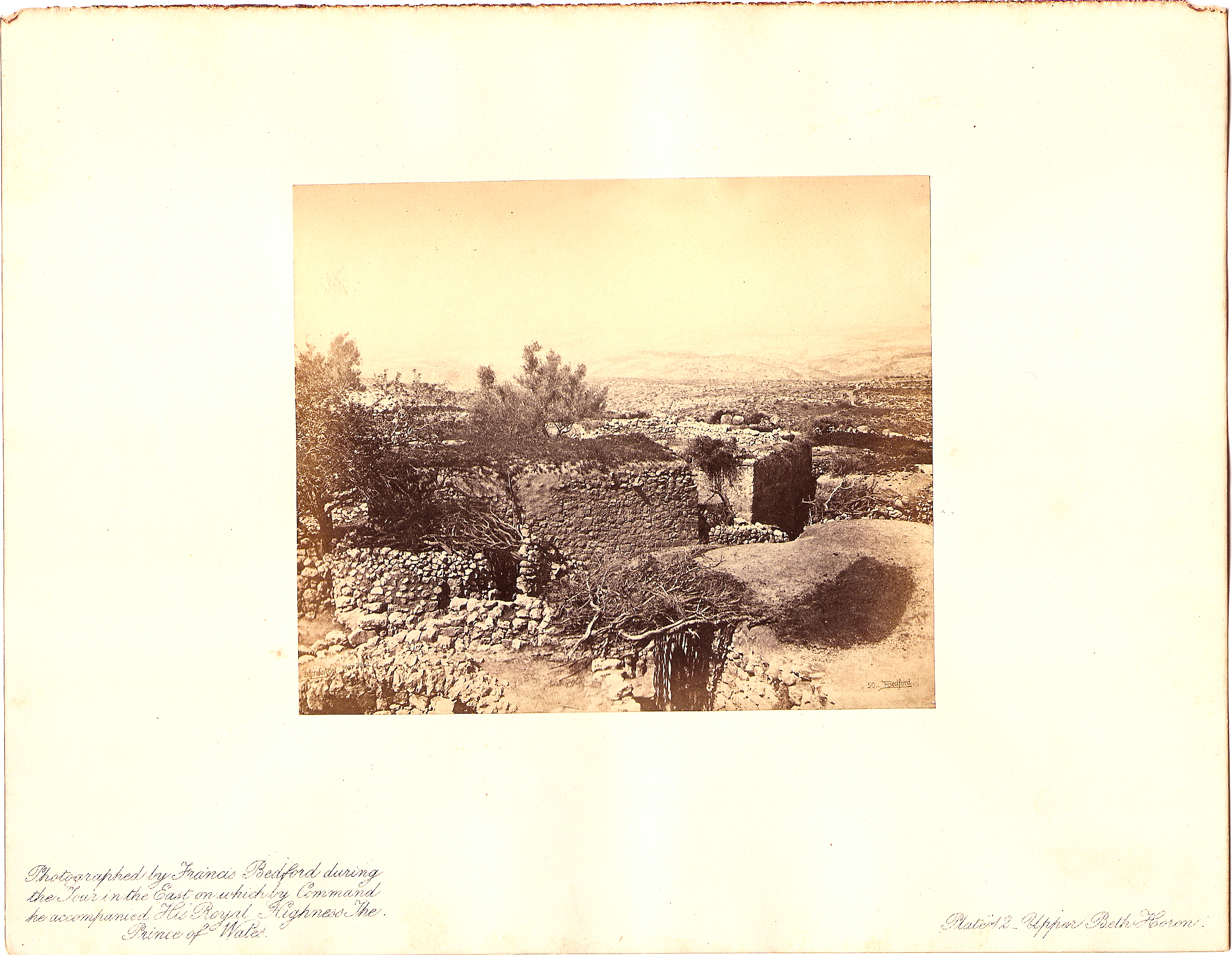
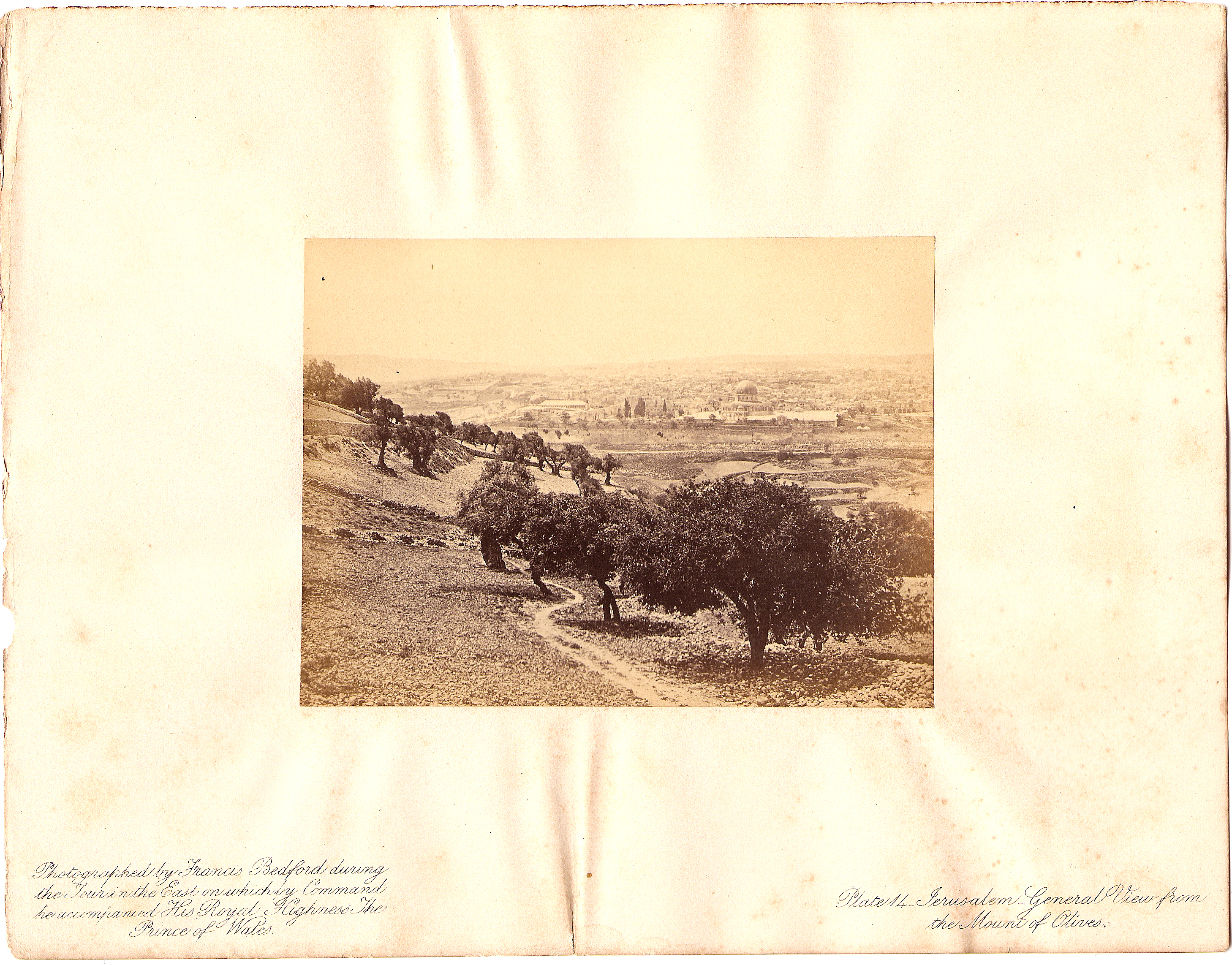
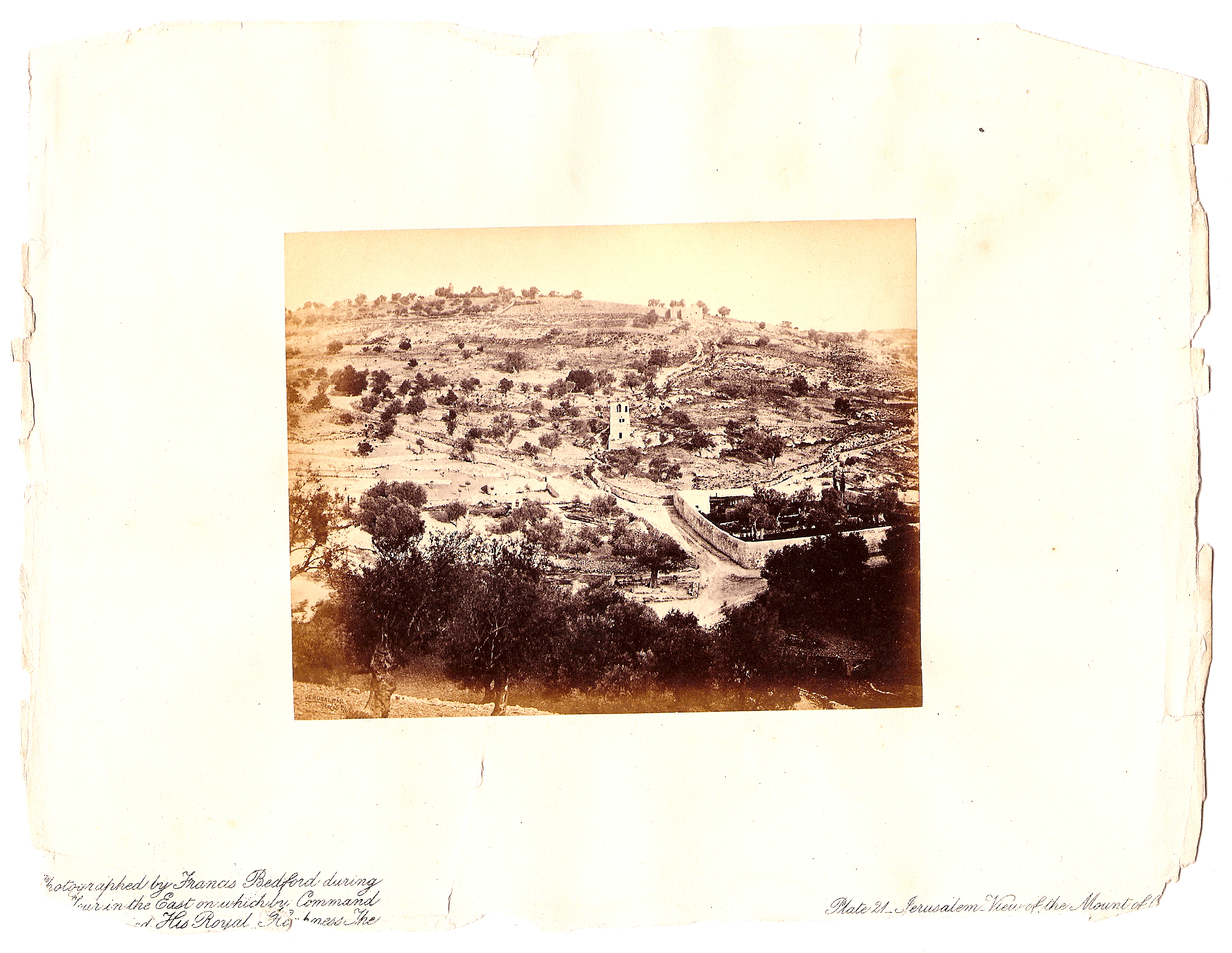
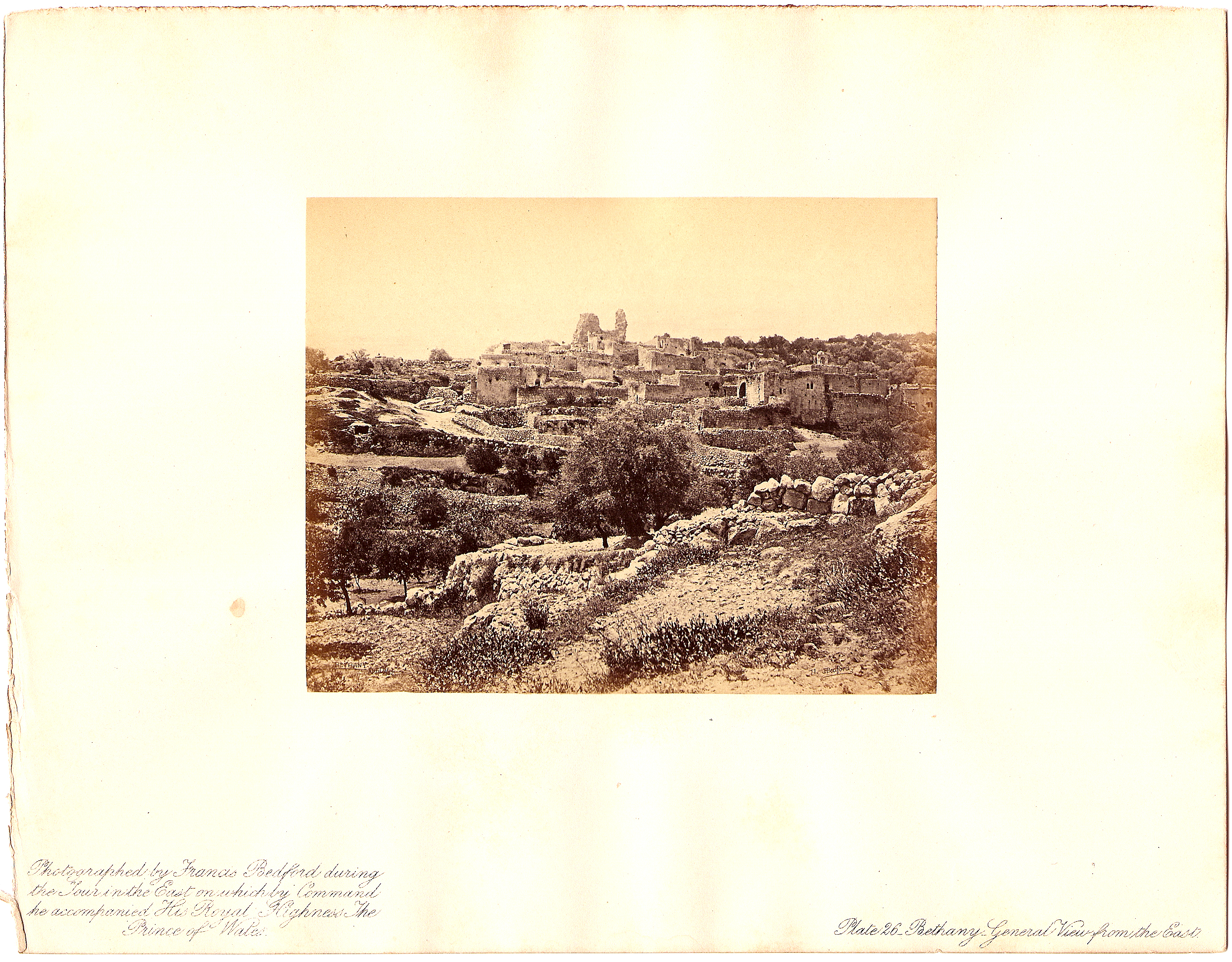
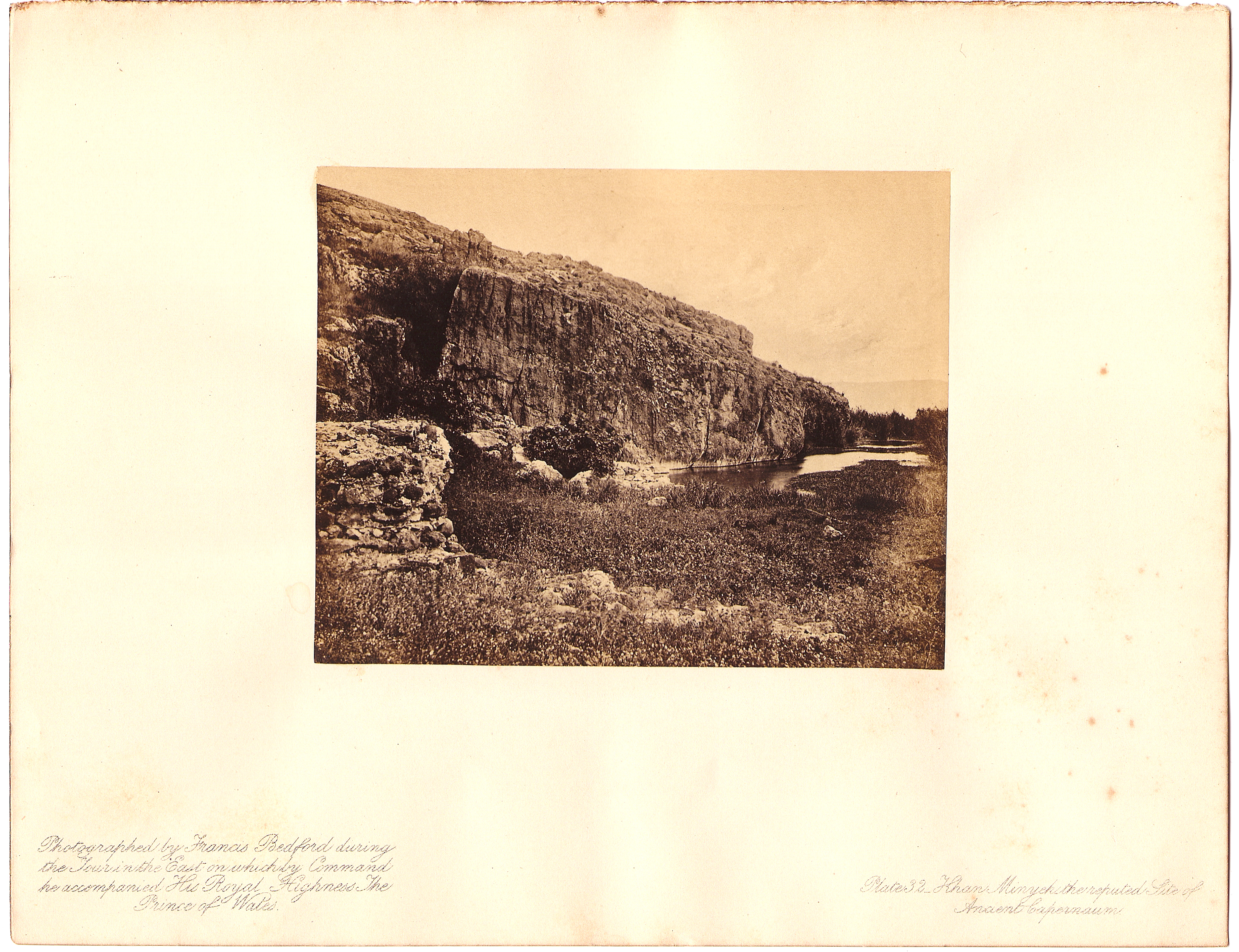
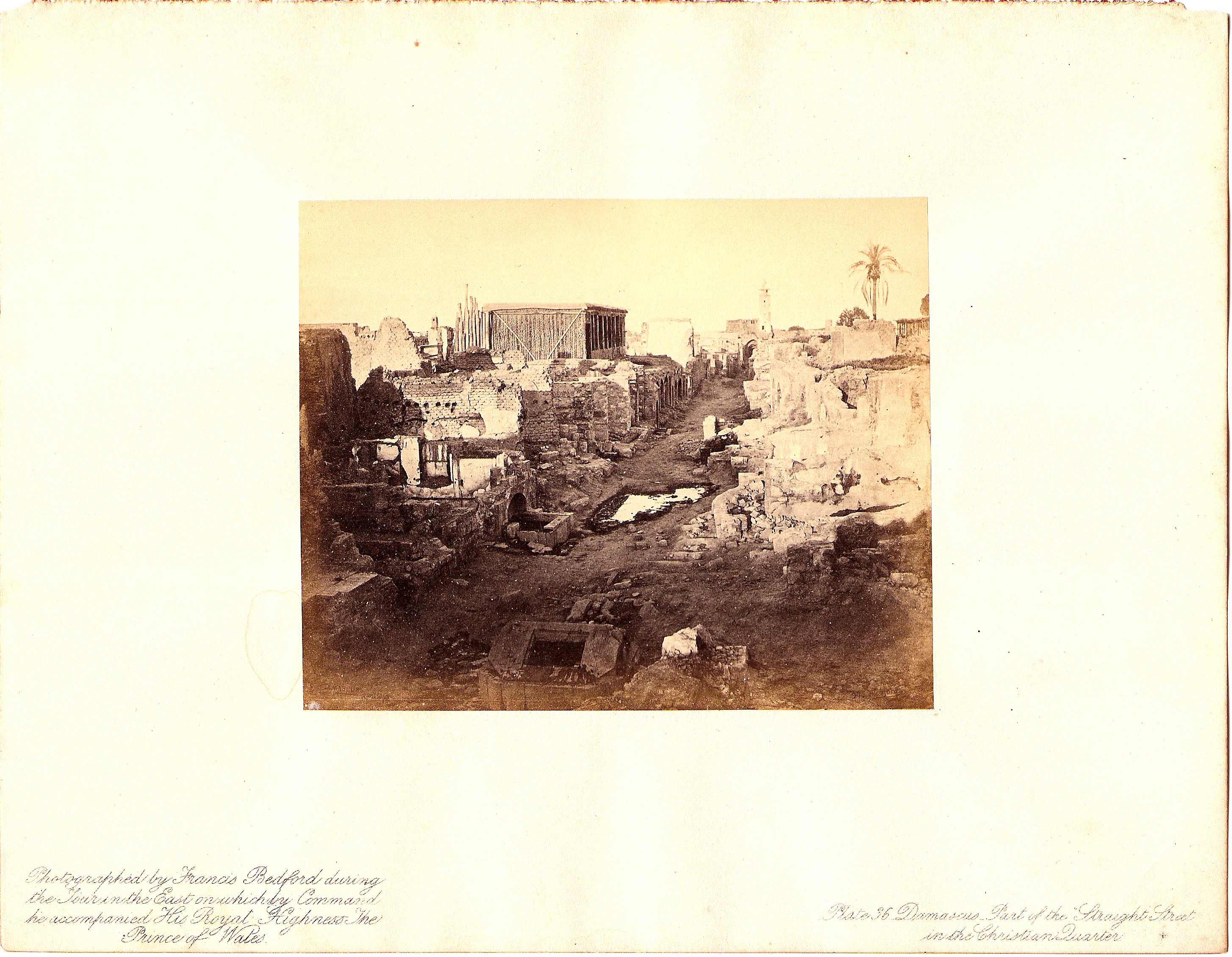
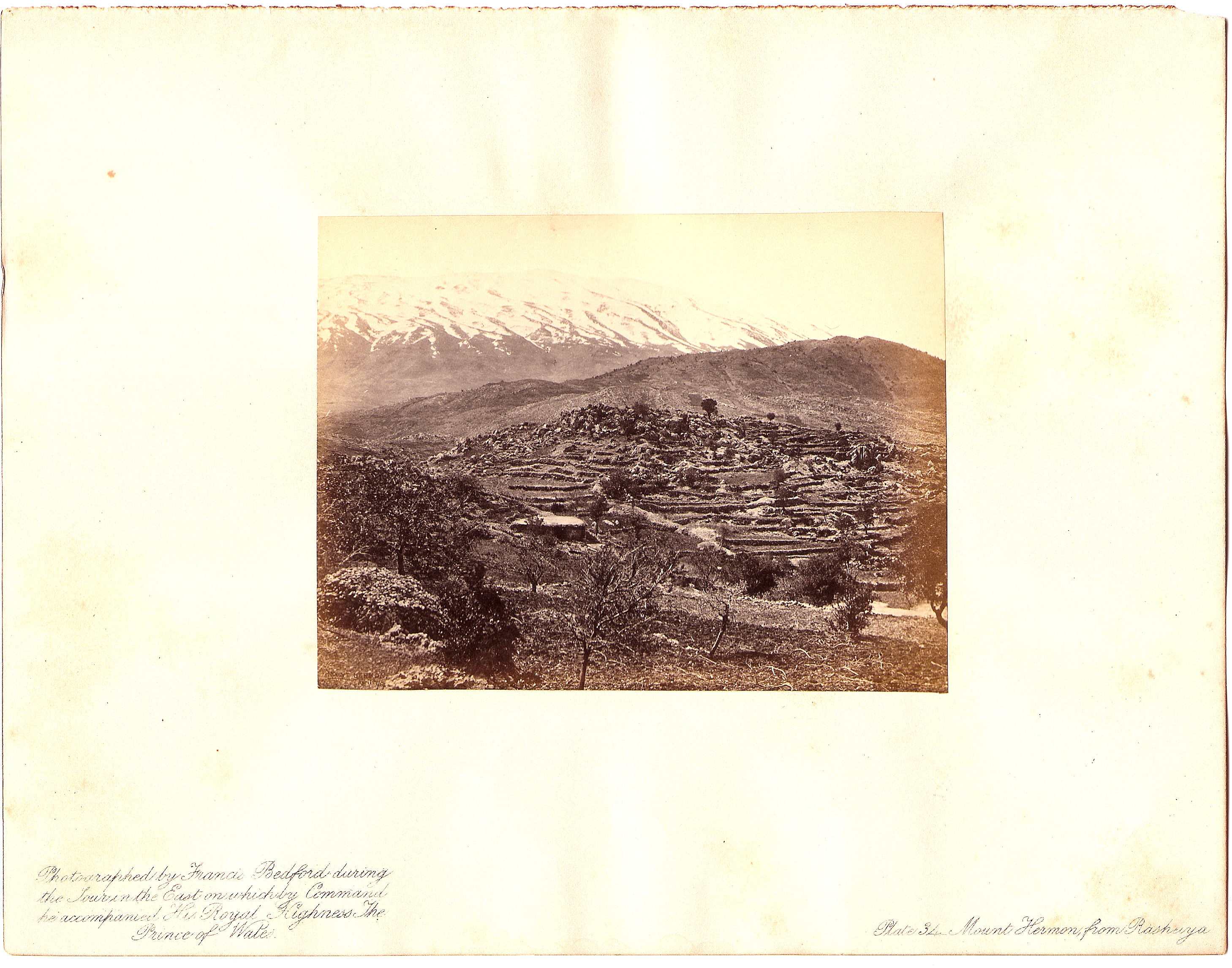
In 1862 Bedford’s strong position with the Royal Family was demonstrated again when he was “one of only eight gentlemen” invited to join the Prince of Wales (the future king of England) on a four-month tour of the Near East. Bedford made about 210 views on this trip. The trip was followed avidly by the British press and a number of Bedford’s photographs were published (in woodcut form) in the London Illustrated News and elsewhere throughout 1862 and later. Bedford also had a one-man exhibition (Still an unusual event at the time.) upon returning to London. The immense prestige garnered by Bedford through these activities buttressed his reputation as one of the leading landscape photographers of the day, both within the photographic community and in the minds of the general populace as Bedford became one of the handful of photographers who was widely recognized outside of the photographic community.
Day & Son, “Lithographers to the Queen, Illustrated, Illuminated, & General Book & Fine-Art Publishers,” who had published Bedford’s earlier chromo-lithographic work, published in 1863 the three volume Photographic Pictures made by Mr. Francis Bedford during the Tour in the East, in which, by command, he accompanied H. M. H. the Prince of Wales, which contained 172 original photographs. This effort was somewhat marred by the fact that Day & Son, one of the largest and most prestigious art publishers of the era, went into liquidation in 1868 and their stock was sold off and broken up in a series of auctions throughout the year. They still held several hundred copies of Bedford’s Egypt,…, the first volume of this publication, in stock and the fact that Bedford’s book was one of the dozen or so titles featured throughout the auction descriptions throughout the year indicates the prestige value placed upon the work. Originally priced at a luxurious 2l. 2s., the work was resold and eventually remaindered for 14s. 6d. per copy. This at least had the effect of making his work accessible to a larger number of people, although to truly succeed as a commercial landscape photographer at that time one had to work as a stereo view maker.
Francis returned from the Near Eastern tour to again begin photographing landscape views in England, focusing his interest in the south-west of England and the West Midlands, while going again and again to his favorite sites in North Wales and Devonshire, which he photographed almost annually from 1863 until at least 1884. Previously Bedford had focused on taking photographs and leaving the complex process of commercial scale printing and distribution through other established publishing sources, but at some point soon after his return from the Near Eastern tour Francis Bedford established his own company for producing the popular stereo views, and the company flourished and grew to be one of the three or four largest producer of stereo cards through the remainder of the century – making Bedford a very wealthy man.
Throughout the 1860s the many large national or international exhibitions, (Some displaying thousands of photographs and seen by scores of thousands of visitors.) provided a major venue for photographers. Bedford diligently participated in the annual Photographic Society exhibitions, the Edinburgh Photographic Society exhibitions, the international expositions in London in 1862 and in Paris in 1867, and in many other regional exhibitions in Great Britain and in Europe, almost always winning awards and the usual degree of high praise for his landscapes.
Francis Bedford was elected to the Photographic Society of London (now the Royal Photographic Society) in 1857? and then elected a member of Council to that organization in 1858. In 1861 he was elected Vice President of the Photographic Society, a position of great prestige. Bedford was active in that organization, periodically serving as one of the Vice-Presidents or as an officer on the Council off and on for the next thirty years. F. Bedford is listed as Vice-President during the years 1863 to 1868. During 1866-1867, Francis Bedford, serving as a Vice-President, chaired five of the monthly meetings, provided the negative for the annual “presentation print” which was distributed to the membership, and participated in the annual exhibition. Frequently, when he was not serving as a Vice-President he served on the Council. F. Bedford is listed on the Council in 1858 to 1861, and from 1871 to 1888. These were rotating positions, renewable each year in theory, and Bedford was voted into them again and again. In fact, Francis is not listed as an officer of the Society between 1858 and 1888 only during the years 1869 and 1870. His son William Bedford was elected to the Society in Feb. 1870, voted to the Council in 1877 and for many of those years joining his father on the Council from 1877 to 1888; and serving thereafter on his own until his death in 1893. During this period The Photographic Society of London (later renamed the Photographic Society of Great Britain) held an important place in British photographic practice and the lectures and exhibitions held by the organizations often defined the most creative, most vital and important aspects of the medium.
Both father and son seemed to be well-respected, and both seemed to provide a moderate, stabilizing and beneficial influence on the activities and actions of the Society during the thirty years of their presence. Both Francis and William Bedford had also been members of the North London Photographic Association during the 1860s. “…The Council notice with regret the dissolution of a useful, and at one time active, auxiliary of this Society which has existed for more than twelve years in the metropolis, under the title of the North-London Photographic Association.” (Photographic Journal (Feb. 16, 1870): 198.)
When this “auxiliary” organization folded, Francis seems to have once again played a more active role in the Photographic Society of London, and William was elected to the Society in February 1870. By 1876 Francis is back on the Council again. This is the year when William seems to blossom, winning a great deal of praise for his landscape views in the annual exhibition, including the statement that his work “…shows that the mantle of the father has fallen upon the son.” In 1878 both father and son were still active participants in the Society, the son, on the Council again, organizing many of the tasks of that group, and the father again elected to a Vice-Presidency to fill a sudden vacancy in the organization. Both Francis and his son William were still displaying landscape views in the annual exhibition in 1878, but by the late 1870s, with Francis reaching into his sixties and having achieved universal acclaim, the weight of the activity seems to have shifted from the father to the son. Francis also contributed liberally to local photographic societies exhibitions and events throughout the United Kingdom during these years.
“From this time until 1884, (Francis was 68 years old.) when he relinquished his business to his son William, he went annually to the country to take fresh negatives, chiefly in North Wales and Devonshire. He had two children, Arthur, who died in 1867, and William, who died in 1893, and whose departure and merits are still fresh in all our memories. The wife of Francis Bedford died in 1888; this was a great blow to him, and long preyed upon his mind. He was extremely painstaking in his work. Once he waited at Lynmouth for a fortnight to get a required satisfactory pictorial effect at the time of high tide. He had certain standards of his own, and when either negatives or prints did not come up to those standards, he destroyed them ruthlessly. He was a great hater of crowds, disliked photographing even in small villages; he preferred solitude, and loved the mountain and the moor in their wildest aspects; he said that in the midst of such scenes he looked up from nature to nature’s God. He was also partial to quiet scenes in country lanes. He was never of strong constitution, and many in his place would have given up work earlier; however, he did not do much actual hard work himself, but he directed everything. He was of a retiring disposition, exceedingly courteous in his manner, he was also considerate and kindly to those who worked under him. He was slow to make friends, but when he made one the friendship was true and lasting. He was pure in thought and speech, and retained all his mental faculties until the last moment.” (Photography: The Journal of the Amateur, the Profession & the Trade (May 31, 1894)
PORTFOLIO OF VIEWS
In 1859 Bedford traveled through North Wales making landscape photographs and stereo views, which he released commercially in the spring of 1860 through the publisher Catherall and Prichard, of Chester. Bedford went to the West Midlands, visiting his favorite sites in North Wales and Devonshire, which he photographed almost annually until at least 1884. These stereo views were issued in series, “North Wales Illustrated Series,” “Devonshire Illustrated Series,” etc., throughout his lifetime, and in some cases these series consisted of two to three hundred images.


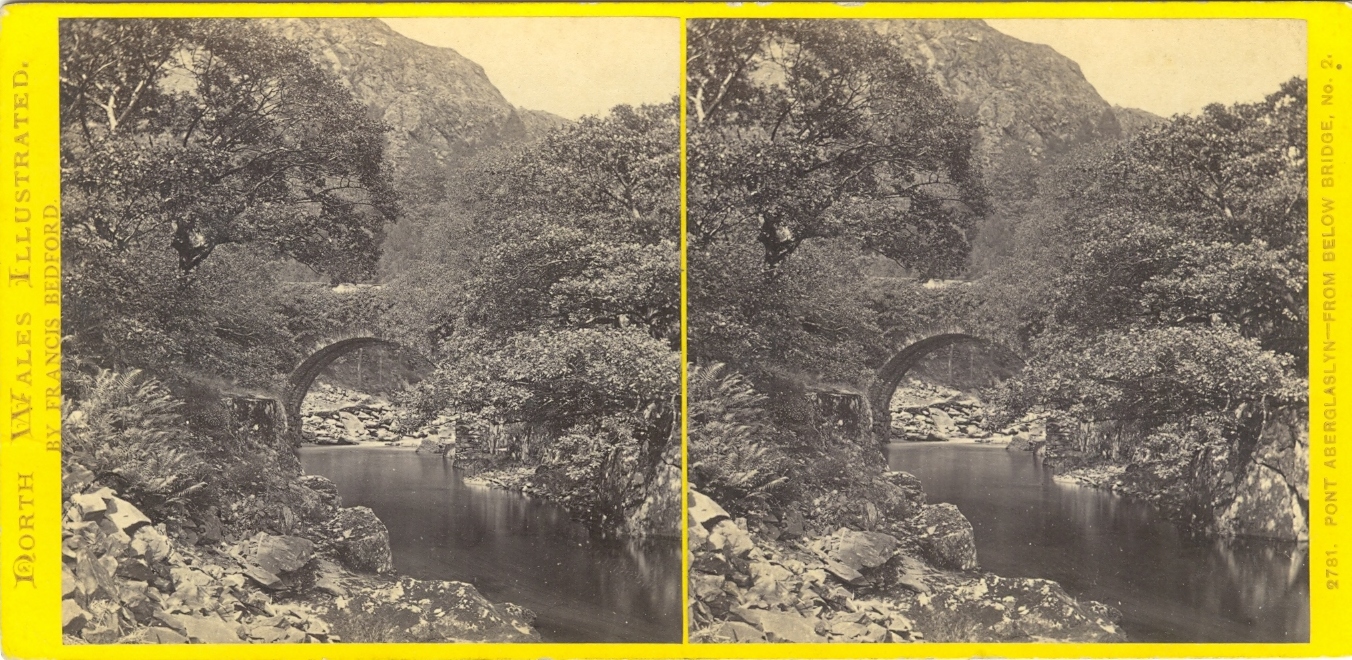
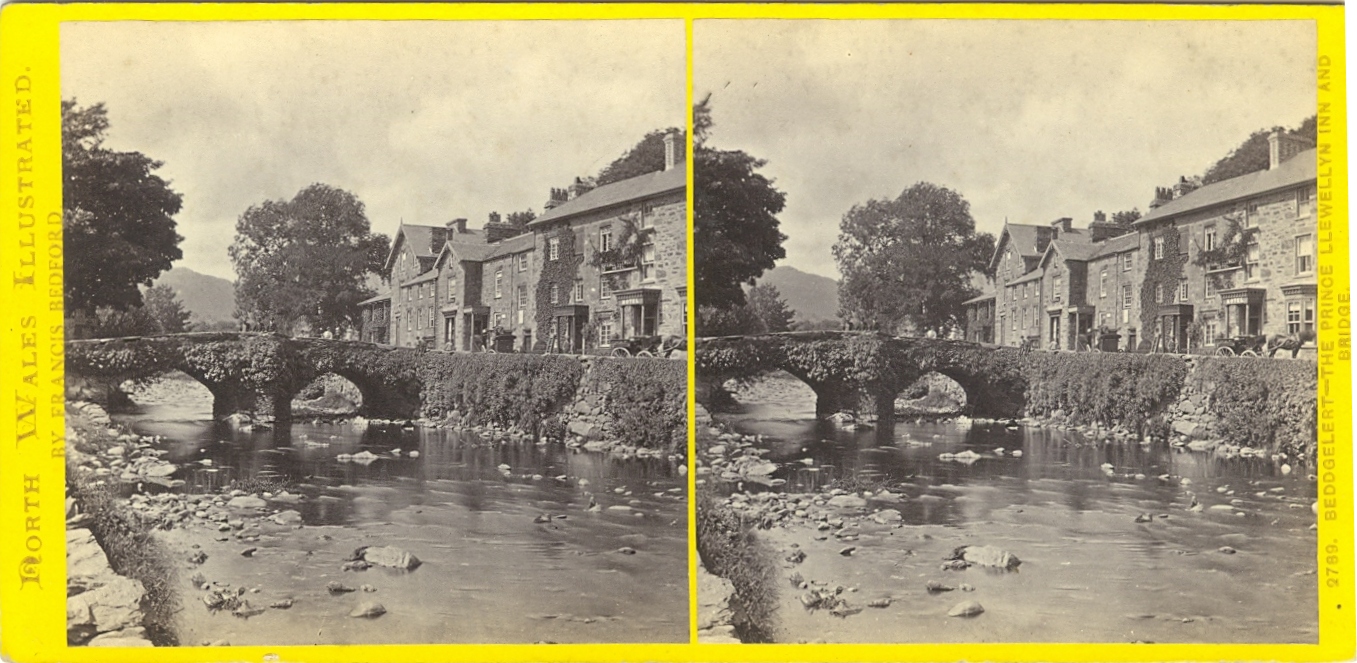
“The names we have just written in juxtaposition, North Wales and Francis Bedford, will suggest at once to most of our readers some very lovely and picturesque stereographs: glorious scenery and perfect photography combined. Abounding with views pre-eminently adapted to the stereoscope. Wales has been a favourite resort with landscape photographers and its scenery has been done in almost every style. Who for instance, is not familiar with the Rustic Bridge at Beddgelert? But how few have obtained such a picture as this before us, No. 174 of the series? Nothing could more forcibly illustrate how far the photographer may also be an artist than these pictures, and the taste, judgment and feeling of the beautiful which has regulated their selection. …” “Critical Notices.” PHOTOGRAPHIC NEWS 4:120 (Dec. 21, 1860): 400-401.


DEVONSHIRE ILLUSTRATED SERIES
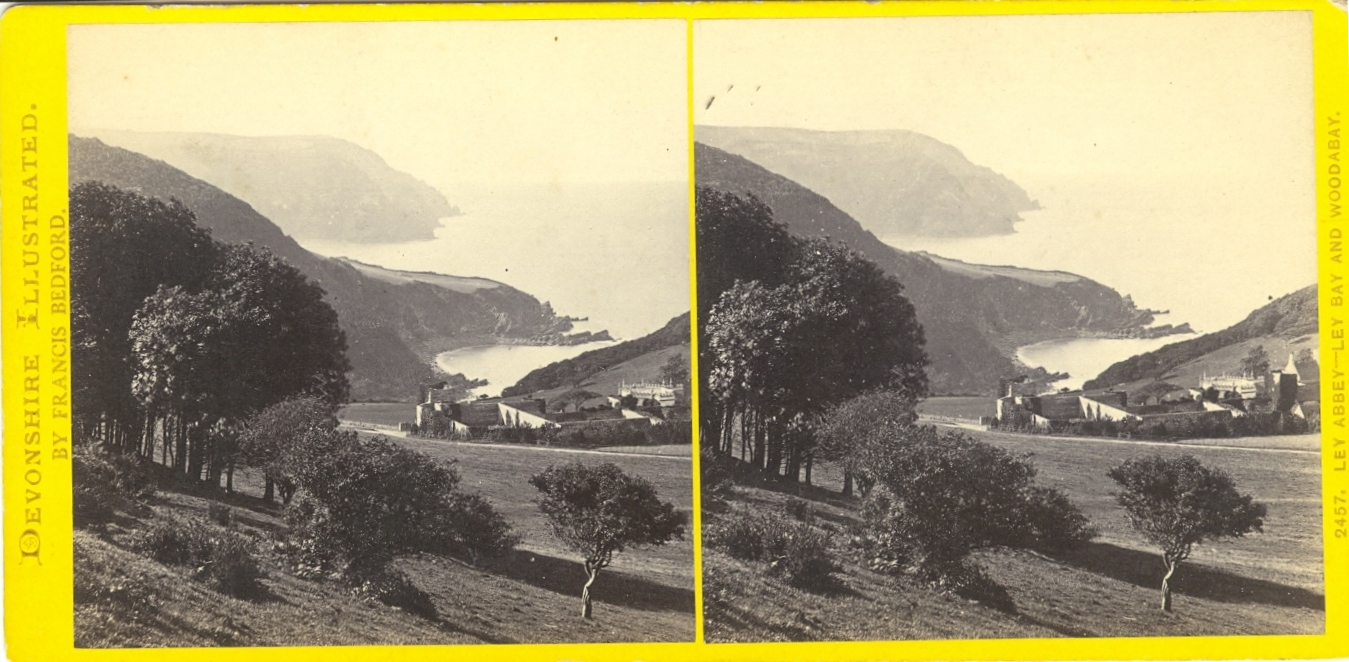


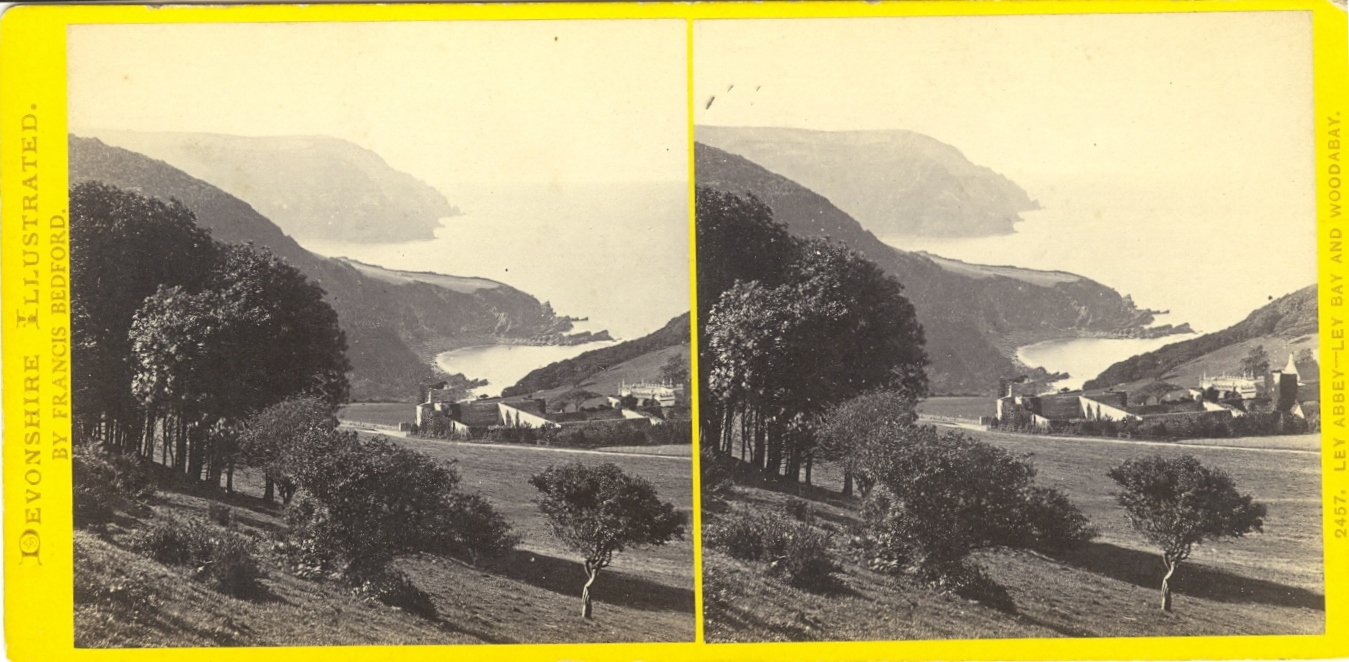
“…In all this Exhibition there is no man’s work, take it all in all, comparable, in our opinion, to Mr. Bedford’s, whether it be of subjects architectural—as his interior views of Wells Cathedral and his exterior subjects from Exeter Cathedral—or natural, as the rocks we have referred to. and other Devonshire scenes. Besides other merits, Mr. Bedford seems to us to have carried the perfect rendering of reflected lights and half tones further than any of our photographers. This is the crux of photographic art. Nothing can be conceived more delicate than the gradations from highest light to deepest shadow in the Ilfracombe subject; nothing fuller of aerial effect than the bit of the Chapter-house vestibule, Bristol. Mr. Bedford appears to us to show peculiarly sound judgment in his selection of subjects….” The Times, January 18, 1861.
“Criticism on the Exhibition.” PHOTOGRAPHIC JOURNAL, BEING THE JOURNAL OF THE PHOTOGRAPHIC SOCIETY. 7:106. (Feb. 15, 1861): 116-117.
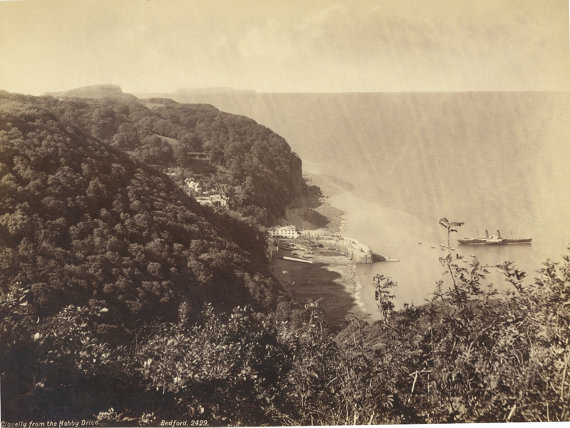

GLOUCESTERSHIRE, ETC.

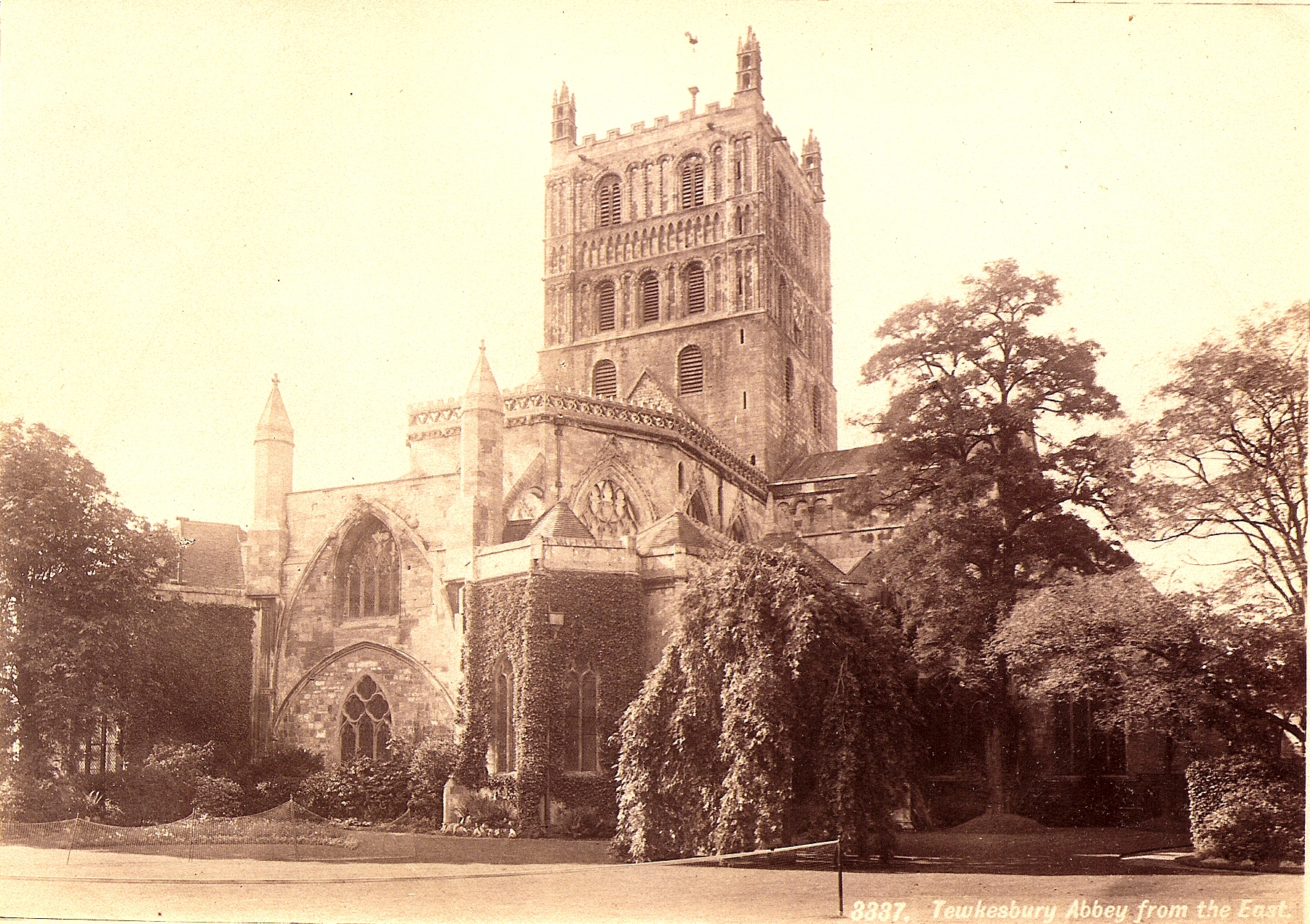


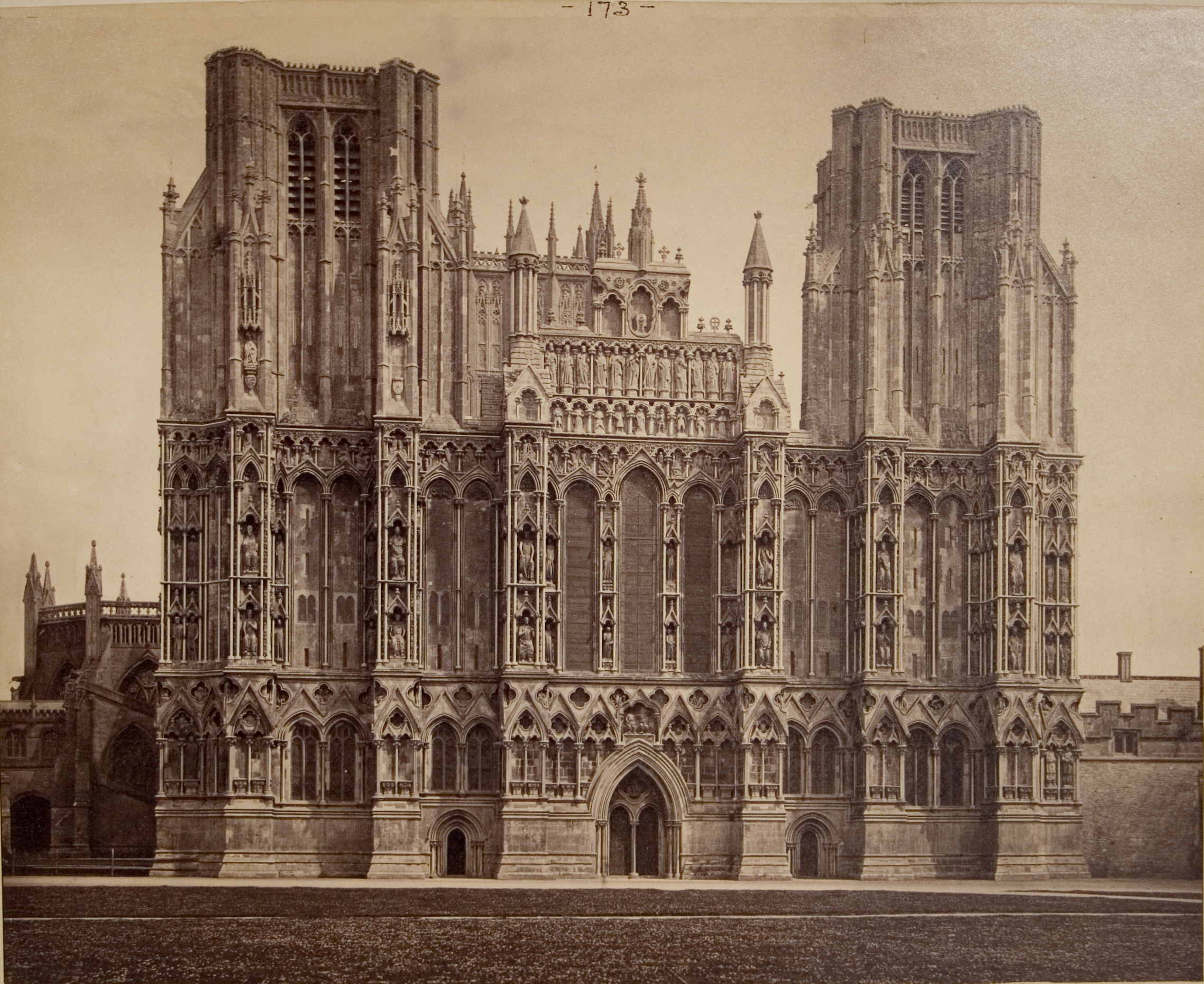
“When Francis Bedford, that prince of the early landscape photographers, began, in 1858, under the auspices of a Chester firm of publishers, to do for large districts what the local photographers had hitherto done for their own little domains, he soon found that first-rate pictorial work had little commercial value. He began with Wales, and afterwards annexed other regions. His work at that time consisted almost entirely of stereoscopic slides, and the imperative demand of the travelling public was that they should be “clear,” and this great artist had to manufacture the article to order. Every item of the view, from the stones in the near church or chapel to the distant mountains, had not only to have all the boldness and definition to be obtained in the clearest weather, but had to be helped by those subtle devices of which he was a master. Besides the stereoscopic slides—it would be difficult to convey to the modern photographer any idea of the immense number sold in those primitive days— Bedford occasionally made larger pictures to suit his own cultivated taste, which were the delight of our exhibitions, but had no interest for the general public, who at that time were sufficiently satisfied with the miracle of definition photography continued to present to their still wondering senses, and who had no eyes for higher qualities. I mention these pictures to show that the fault lay not in the artist, but in his patrons. Although the work manufactured for the tourist had to be suited to the bad taste of the buyers, it was always the best of its kind. The best points of even poor subjects were selected with curious skill; there were few figures admitted in those days of long exposure, but when they were allowed to appear they were in the right place, admirably posed; they were always the addition wanted to make a picture, not the accidental crowd of figures in the wrong place that instantaneous exposures usually present to us. The mounting, as well as the general get-up, was fastidiously careful. All this was art of a kind as far as circumstances would allow….”
Robinson, H. P. “Rambling Papers. No. XXXI.- Local Views.” PHOTOGRAPHIC NEWS 39:1922 (July 5, 1895): 424-426.
HEREFORDSHIRE ILLUSTRATED SERIES
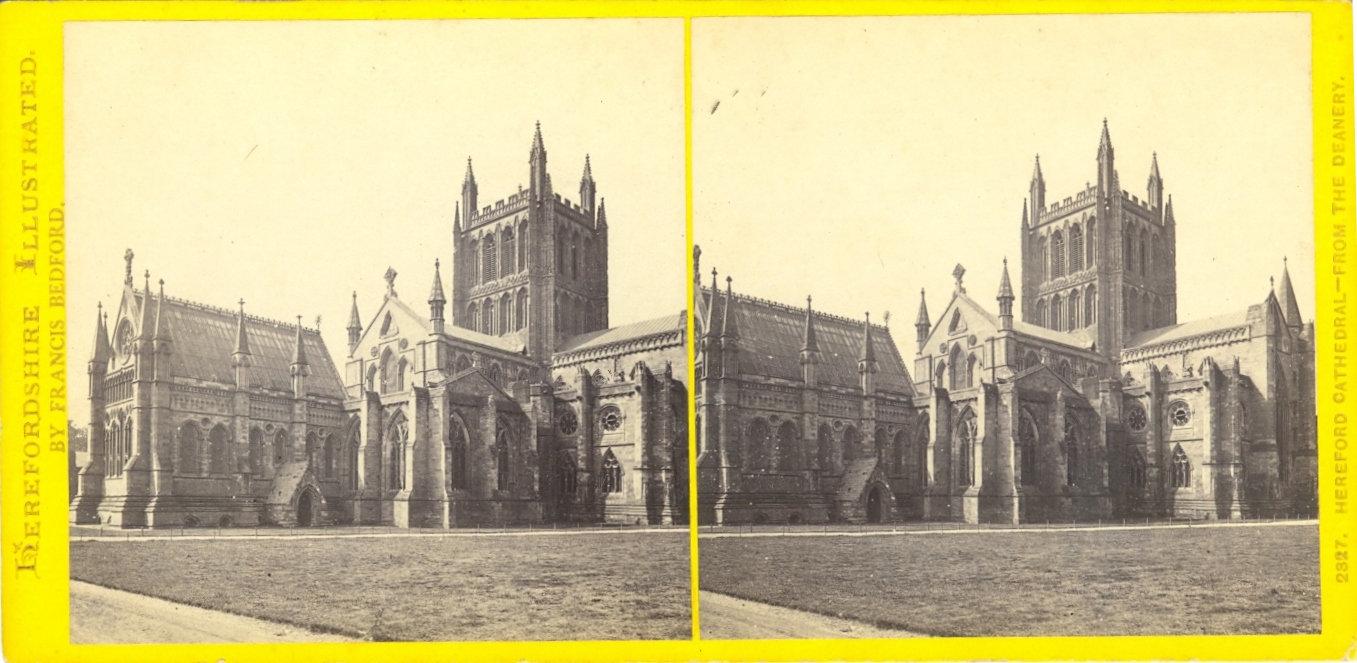
“The Monthly Meeting of the Members of this Association was held at the Myddelton Hall, on Wednesday last, the 4th inst. W. W. King, Esq., in the Chair….” “…The Chairman then read a paper “On Architectural Photography.”
“It must be generally conceded that architectural photography has attained a position of greater prominence in the science than any other branch thereof, and this for two very good reasons:-—first, that the subjects themselves are not liable to be affected by wind, that enemy to photographers—so dangerous, indeed, that Mr. Jabez Hughes, in his excellent little work, advises the reader never to photograph on windy days; and, next, that the subjects possess a permanent interest from their clear individuality. Landscapes, beautiful as they are, cannot successfully compete with them in this respect, for one beautiful view may be exceedingly like another: we pass it by in our portfolios and think but little more about it. But the representation of a piece of architecture is altogether different. There the photograph appears to the greatest advantage: we at once recognize the building, and can, if need be, identify every stone or saint whose sculptured effigy adorns a niche or pinnacle. The building is seen from a point of view known and, therefore, familiar to all. We turn to the photograph again and again with renewed pleasure; for it forms a record of authority and weight. The architectural profession has not been slow to appreciate the value of photography, and the public themselves, now that archaeological and art knowledge are being more diffused, and taste somewhat improved, delight in the beautiful reminiscences of our ancient buildings. I think I may say that our countrymen are far in advance of any other nation in dealing with architectural and archaeological photography. Go to one of our photographic exhibitions, and you are sure to see some of Mr. F. Bedford’s exquisite productions, showing his possession of something more than a mere knowledge of photography—namely, a true appreciation of, and love for, the art works of our forefathers….” * * * * * The superiority of modern English ecclesiastical architecture must be generally admitted, from the greater love for old works which our architects evince by their works; and we see why architectural photography of ancient remains should be more practised in England than in France. I think we may say that the photographs of interiors at the present time leave little or nothing to be desired. I must refer again to the honoured name of Mr. Bedford and to Mr. Good. Their works show the advance which has been made in photographing the interiors of our cathedrals and churches, as do also the stereoscopic slides by the other photographers I have named. Of course, photographers, as a rule, will take subjects which are most popular, those most known belong to that class; for it is nothing more than a mere truism to say that people will patronize things known, though they may be ugly, rather than a beautiful object which they have not seen. Still, it is a great thing to have some old objects from a new point of view….” “North London Photographic Association.” PHOTOGRAPHIC JOURNAL, THE JOURNAL OF THE PHOTOGRAPHIC SOCIETY 12:188 (Dec. 15, 1867): 152-155.


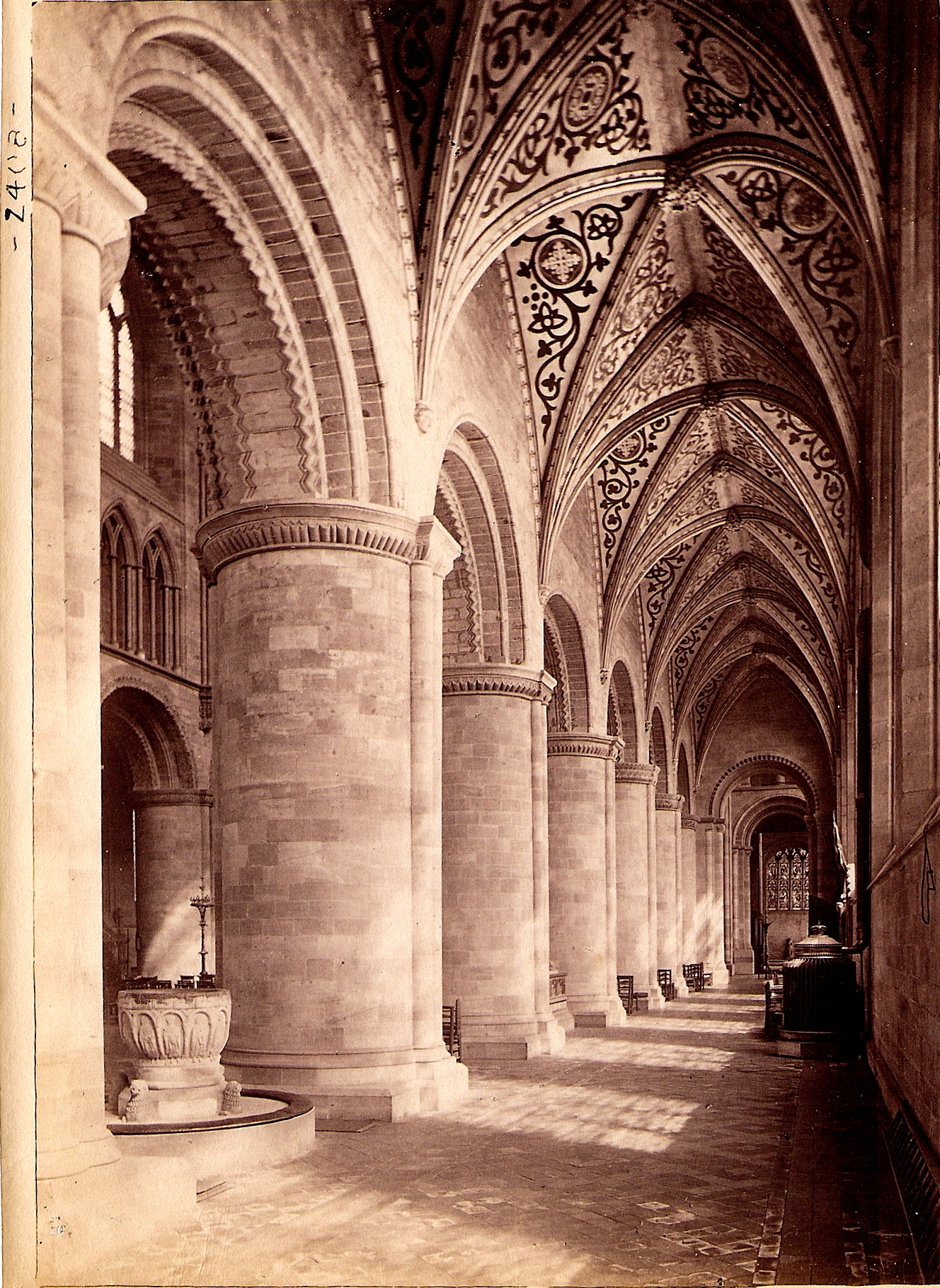
MONMOUTHSHIRE ILLUSTRATED SERIES


WARWICKSHIRE ILLUSTRATED SERIES
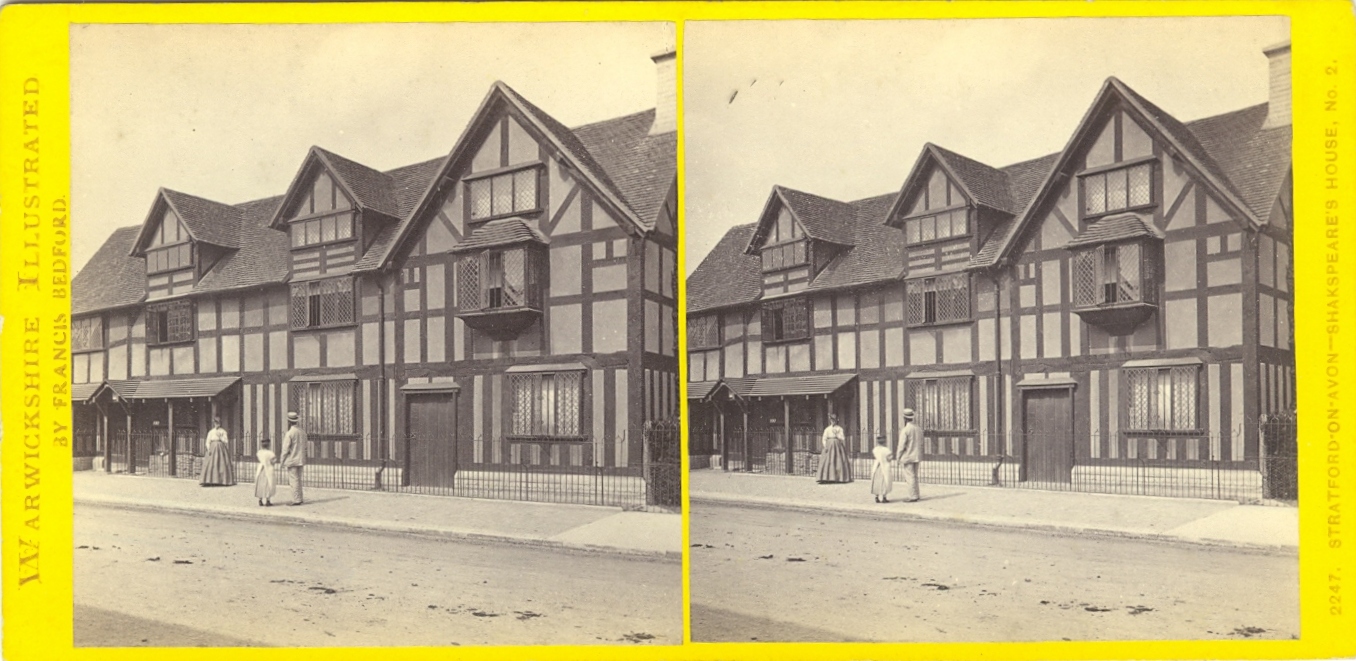

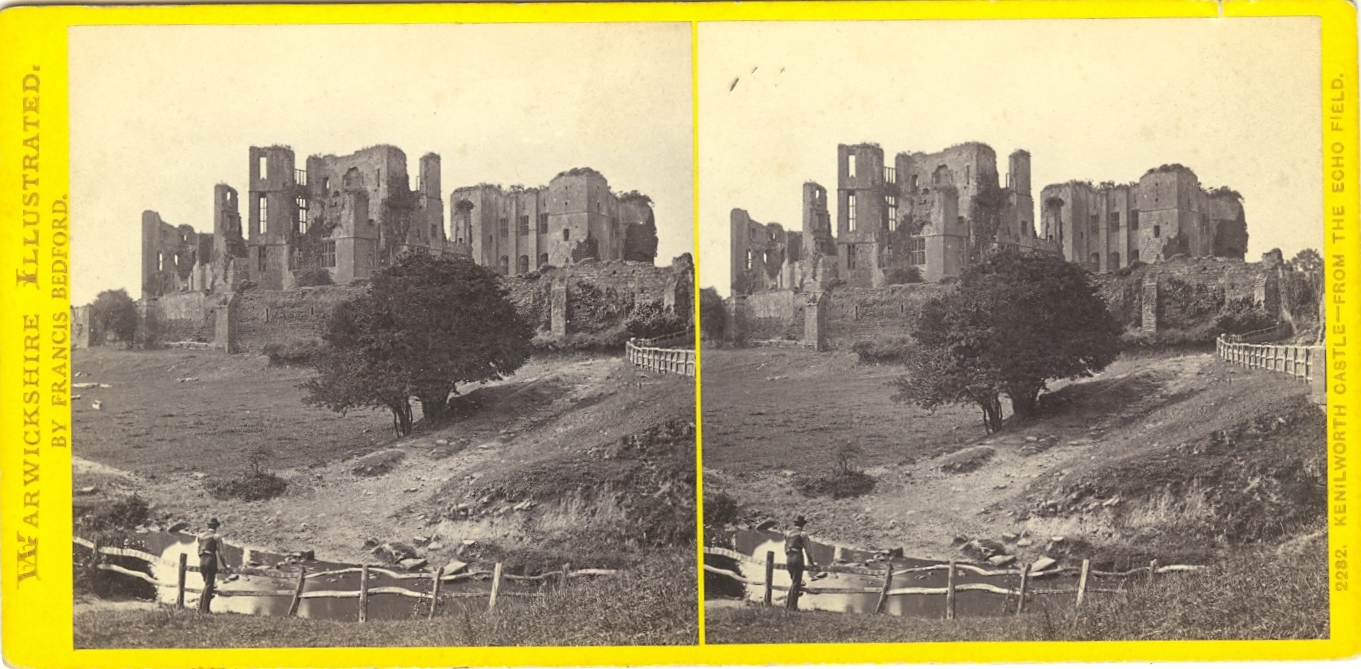

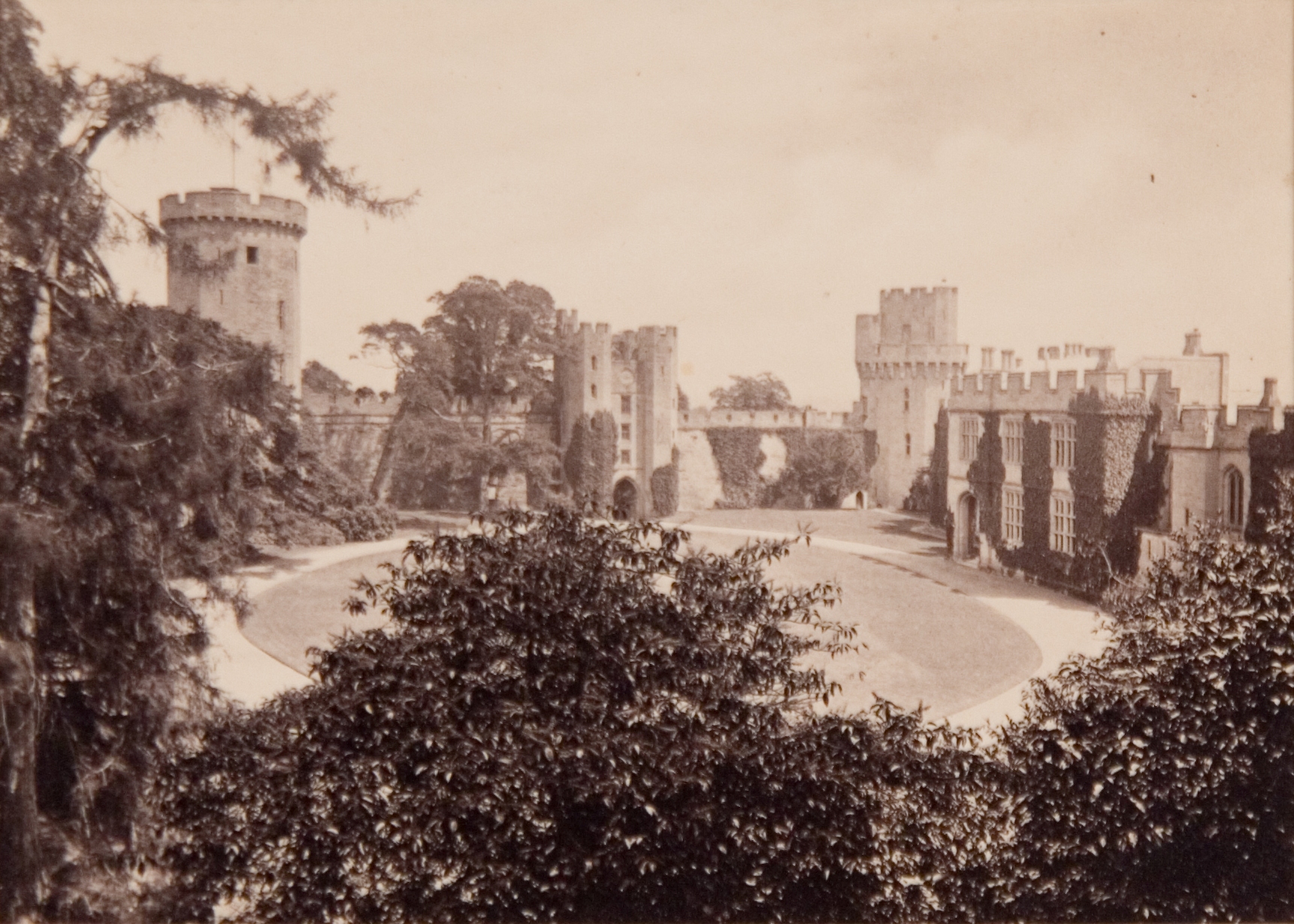
WORCESTERSHIRE VIEWS.
“Mr. Bedford’s last issue of stereographs is timely, consisting, as the views do, chiefly of scenes in Warwickshire, a county abounding at once in natural and in architectural beauties, and in hallowed and venerable associations. Perhaps no spot in England possesses, within the area of a few miles, so much to please the eye, and call up eventful memories. Stratford on-Avon, with its homely cottage in Henley Street, and noble Church, together with the neighbouring Shottery and Charlecote — the goal of many a pilgrimage; Warwick Castle, Guy’s Cliff’, and Kenilworth; Stoneleigh and its noble deer-park, and the Forest of Arden; and quaint old Coventry, with its three tall spires, its treasures of ancient and modern architecture, and its legends; pretty and fashionable Leamington, with its urban charms. The county abounds with scenes famous in English history, and Nature has been prodigal of those calm beauties which constitute the genuine English landscape. Mr. Bedford has produced nearly two hundred stereographs of the scenes of chief importance in the country. In such a number we might naturally expect to find varying degrees of excellence and interest, but by far the greater number are very perfect indeed, good alike in photography and in pictorial qualities.”
“Critical Notices.” PHOTOGRAPHIC NEWS 8:289 (Mar. 18, 1864): 136.
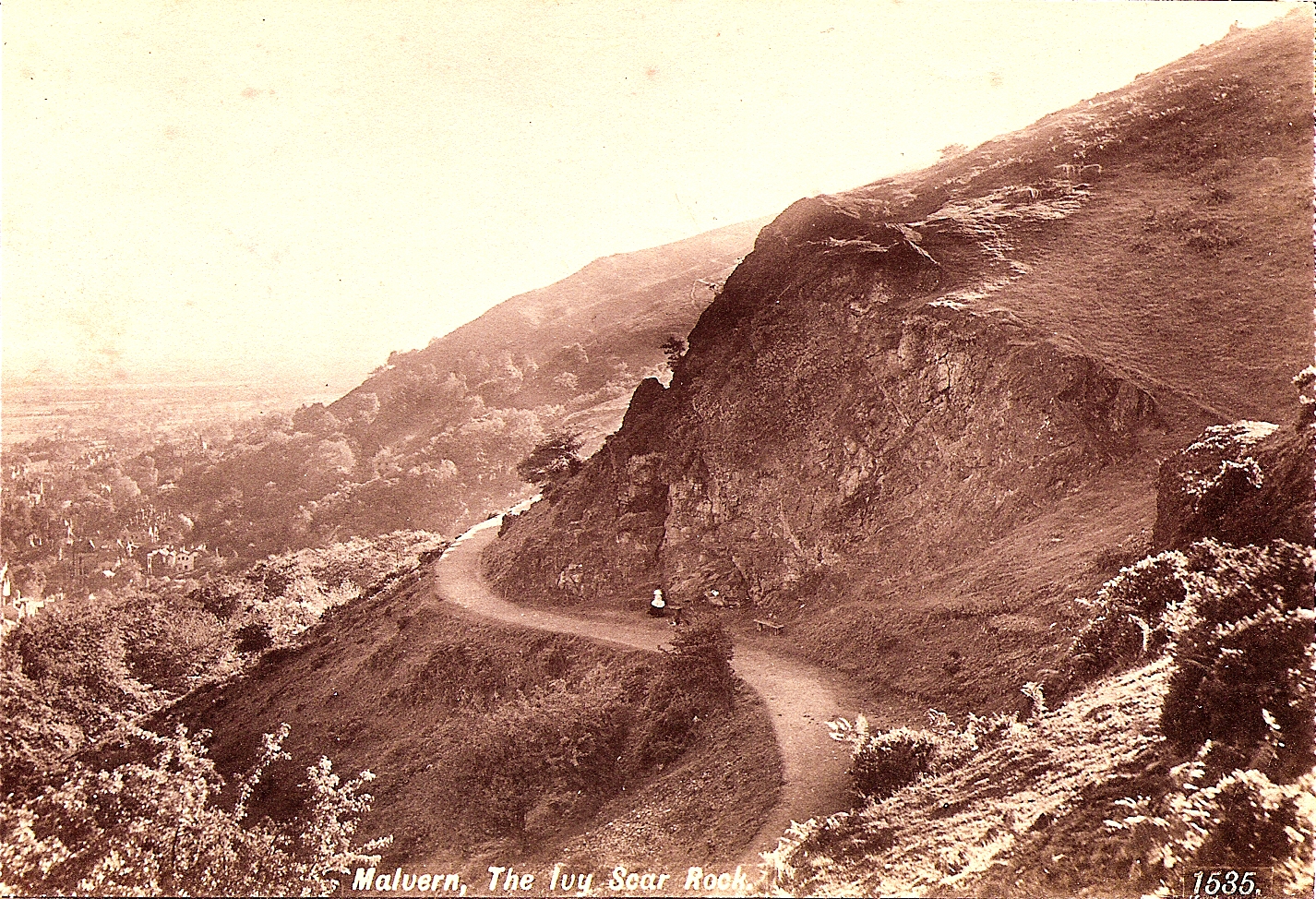
“Messrs. Catterall and Pritchard, of Chester, have sent us some photographs and stereoscopic slides, the productions of the eminent photographer, Bedford, which we have examined with exceeding pleasure. Those of size represent interiors in Hereford Cathedral; more especially views of the rood-screen and reredos, manufactured by Skidmore, of Coventry, which attracted so much attention at the International Exhibition in 1862. The smaller views are very varied: they represent the more attractive objects to be found at Hereford, Warwick, Cheltenham, Gloucester, Malvern, Coventry, Stratford-on-Avon, Kenilworth, and Chester. The points are in all cases well chosen. They thoroughly exhibit several of the most interesting “historic” cities and towns of England. In execution, the stereoscopic slides are clear, sharp, and of great excellence in all respects. The publishers have our thanks for the instruction and enjoyment they have thus afforded us.”
“Minor Topics of the Month.” ART-JOURNAL 27:6 (June 1,1865): 194.

THE HOLY LAND, EGYPT, CONSTANINOPLE, ATHENS, ETC., ETC.
[From the book Bedford, Francis. The Holy Land, Egypt, Constantinople, Athens, etc., etc. A series of forty-eight photographs taken by Francis Bedford for H. R. H. the Prince of Wales during the tour of the East, in which, by command, he accompanied his Royal Highness, with descriptive letterpress and interp. by W. M. Thomson. London: Day & Son, 1866. 2 vol. 48 I. of plates. 48 b & w.]

“Almost as numerous and as various as the scenes that the orb of day itself shines upon are the sun-pictures we see in our stationers’ windows and in every house we visit. How few of us who remember distinctly the first efforts of photography in taking the imprints of feathers, leaves, and bits of lace would have predicted from those childish essays, so great, so wonderful, so rapidly produced, an industry as photography has now become! Not that we are at all disposed to sing an unmitigated praise of photographers or their pictures, for with thorough artist’s feelings we see in their ordinary productions the defects of composition, the absence of that picture-painting of unspoken thoughts, and the want of many another quality that goes to make a perfect picture, while we as painfully perceive in many a way the deleterious effects of their productions on the prospects and qualities of painter-artists; but its good outbalances its evils, and photography flourishes and increases.” * * * * * “…In Mr. Bedford’s charming scenes in Egypt and the Holy Land, taken during the travels of the Prince of Wales, there is the same remarkable clearness and precision of architectural details, although his pictures are on a far smaller scale than those we have referred to, and this notwithstanding his great and successful efforts to pictorialize his views. In this latter respect his use of his optical instrument, his judicious choice of figures and selections of their positions, with the various delicate and unexposed manoeuvres to produce effects, and the tender manipulation of his pictures, render them merely works of art, and take Mr. Bedford out of the ranks of manipulators, and place him in that of true artists….” “From the “London Review.”
“Photography as an Industry.” PHOTOGRAPHIC NEWS 8:290 (Mar. 24, 1864): 153-154.








                FRANCIS BEDFORD BIBLIOGRAPHY
                     By William S. Johnson.
                 (Please credit the blog if you use this bibliography.)
                 (POSTED May 2012, REVISED June, 2023)
[I have compiled and now posted this bibliography to test my belief that current technologies have made it possible to develop a very flexible research tool that can permit a scholar to access a wider range of information and provide a more nuanced look into the functioning of any particular era in the history of photography. This bibliography is composed from the Nineteenth-Century Photography. An Annotated Bibliography 1839-1879, by William S. Johnson. Boston: G. K. Hall & Co., 1990, to which I’ve added a key-word search of my current bibliographic project of indexing more than 800 periodical titles published in the USA and England between 1835 and 1869. After 1869 additional references were drawn from other random projects or sources that I had on hand and a key-word literature search of the internet. Not every important source is on the internet and even though the size of this work (More than 800 pages.) surprised me; nevertheless, it should not be considered an exhaustive survey of the literature published after that date. WSJ]
COLLECTIONS
The Francis Bedford collection (purchased by the Birmingham (England) Public Libraries in 1985) consists of more than 2700 glass negatives and almost 2050 prints, and the manuscript catalogue of his negatives. In 2011 the Birmingham Library and Archive Services purchased an additional collection of 172 photographs from the ‘Tour in the East’ made in 1862 by the Prince of Wales, (the late Edward VII), which covered Athens, Corfu, Constantinople, Tripoli, Egypt, Syria and the Holy Land.
The Francis Bedford Archive was purchased by the National Gallery of Art Department of Image Collections in 2016. 4,397 photographs and two index volumes. [https://library.nga.gov/discovery/fulldisplay/alma991736003804896/01NGA_INST:IMAGE]
Bedford’s photographs are also held in the National Maritime Museum, London, the Royal Collection Trust, the Getty Museum, the Metropolitan Museum of Art, NY, the George Eastman House, Rochester, NY, and in many other art museums and galleries.
BOOKS
1841
Bedford, Francis. Sketches in York. York, England: H. Smith, 1841
14 unnumbered leaves of plates: color illustrations; 38 cm
[York Cathedral, from the north west —
View in water lane, York —
Walmgate Bar, York —
Bootham Bar, York —
Monk Bar —
Castle Yard, York —
York Cathedral, west front —
York Cathedral, the nave —
York Cathedral, the choir —
York Cathedral, from the south east —
St. Mary’s Abbey, York —
Ancient Norman porch, St. Margaret’s Church, York.”]
1843
Monkhouse, William and Francis Bedford. The Churches of York; by W. Monkhouse and F. Bedford, junr; with historical and architectural notes by the Rev. Joshua Fawcett. York: H. Smith, 1843. viii, 48 p. 26 plates. 38cm.
[Eight pages of introduction, followed by 26 historical essays, each one for an individual church. Each essay is preceded by a tipped-in lithograph (which, unusual for the period, are without any titles, or artists or publisher’s credits.]
Bedford, Francis. Sketches of York. York, England: H. Smith, 1843. n. p.
[From a library catalog. Possibly a duplicate of the above reference?]
The Exhibition of the Royal Academy. MDCCCXLIII. The Seventy-Fifth. London: Printed by W. Clowes and Sons, Printers to the Royal Academy. 1843.
[“Architecture.”
1271 Interior-York Cathedral, from the transept F. Bedford [May be the Father.] (Etc., etc.) (p. 48)]
1844
Bedford, Francis. A Chart of Anglican Church Architecture: Arranged chronologically with examples of the different styles. “5th ed.” York: R. Sunter, 1844. 1 folded sheet (15 pages): chiefly illustrations; 55 x 38 cm, folded to 12 cm.
The Exhibition of the Royal Academy. MDCCCXLIV. The Seventy-Sixth. London: Printed by W. Clowes and Sons, Printers to the Royal Academy. 1844.
[“Architecture.
1140 Choir of St. Saviour’s Church, Southwark; the stained glass and the statues in the altar screen restored F. Bedford. [May be the Father.]”]
1845
The Exhibition of the Royal Academy. MDCCCXLV. The Seventy-Seventh. London: Printed by W. Clowes and Sons, Printers to the Royal Academy. 1845.
[“Architecture.
1172 Summer morning—banks of the Rhine G. Franklin
1173 Fishing boats landing, Hastings, Sussex W. R. Earl
1174 Distant view of London J. B. Hill
1175 Ruins of the Chapter House, Furness Abbey, Lancashire W. B. S. Taylor
1176 Hotel de Ville, Louvaine G. S. Clarke
1177 St. Augustine’s gateway, Canterbury F. Bedford, jun.
1178 The north-east view of a design for the Episcopal chapel, at the Nunhead Cemetery; which was submitted in competition, and obtained the second premium . W. H. Brakspear
1179 South-west view of the new church of St. Helen, in course, of erection at Thorney, in Nottinghamshire, for the Rev. Christopher Neville, M.A., from the designs, and under the superintendence, of L. N. Cottingham and Son (Etc., etc.) (p. 45)]
Bedford, Francis. The Architecture of York Cathedral, Arranged chronologically. York: W. Hargrove, Oxford: J. W. Parker, London: Hamilton Adams & Co., 1845. n. p., folded pp. illus.
Whichcord, John. The History and Antiquities of the Collegiate Church of All Saints, Maidstone, With the Illustrations of Its Architecture; Together with Observations on the Polychromatic Decoration of the Middle Ages. By John Whichcord, Jun., Architect. Thirteen Engravings, Some of Which are Illuminated Fac-Similes. London: John Weale. 1845. 1 p. l., 25, 15 p.13 pl. (part col.) 31 cm. [Francis Bedford generated all of the colored lithographic plates, i.e. 8, 10, 11, 12, 13. WSJ]
[Plate I. “All Saints Church, Maidstone. General Plan.” .” J. Whichcord, Jun., Archt, Del.” “W. A. Beever, sc”
Plate II. “All Saints Church, Maidstone.” J. Whichcord, Jun., Archt, Del.” “W. A. Beever, sc”
Plate III. “All Saints Church, Maidstone. Elevation of part of North Aisle of Chancel.”.” J. Whichcord, Jun., Archt, Del.” “W. A. Beever, sc”.
Plate IV. “All Saints Church, Maidstone. Plans and elevations.” ”J. Whichcord, Jun., Archt, Del.” “W. A. Beever, sc”.
Plate V. “All Saints Church, Maidstone. Elevation.” “J. Whichcord, Jun., Archt, Del.” “W. A. Beever, sc”.
Plate V. “All Saints Church, Maidstone. Plan of.” J. Whichcord, Jun., Archt, Del.” “W. A. Beever, sc”
Plate VI. “All Saints Church, Maidstone. Plan of Sedelia and Tomb.” J. Whichcord, Jun., Archt, Del.” “W. A. Beever, sc”
Plate VII. “All Saints Church, Maidstone.” J. Whichcord, Jun., Archt, Del.” “John LeKeux sc”
Plate VIII. “All Saints Church, Maidstone. Figs. 1. to 9. Bosses. Fig. 10. Strawberry Leaf Enrichment Surmounting Cornice of Tomb.” J. Whichcord, Jun., Archt, Del.” “F. Bedford;, Litho London.”
Plate IX. “All Saints Church, Maidstone. [Floor plans and windows.] J. Whichcord, Jun., Archt, Del.” “W. A. Beever, sc”
Plate X. “All Saints Church, Maidstone. Elevation of Oak Screen, in Chancel.” “J. Whichcord, Jun., Archt, Del.” “F. Bedford;, Litho London.”
Plate XI. “All Saints Church, Maidstone. Elevation of Tomb, at back of Sedilia.” “J. Whichcord, Jun., Archt, Del.” “F. Bedford;, Litho London.”
Plate XII. “All Saints Church, Maidstone. Painting on Back of Recess. Wotton’s Tomb.” “J. Whichcord, Jun., Archt, Del.” “F. Bedford;, Litho London.”
Plate XIII. “All Saints Church, Maidstone. Painting on East Wall of Recess. Wotton’s Tomb.” “J. Whichcord, Jun., Archt, Del.” “F. Bedford;, Litho London.”
1846
Bedford, Francis. A Chart of Anglican Church Ornament, wherein are figured the Saints of the English Calendar, with their appropriate Emblems, the different Styles of Stained Glass, &c., by F. Bedford;, in a sheet, 3s. 6d. 1846.
The same, mounted in case, 4s. 6d. [“…No. 506 A Chart Of Anglican Church Ornament; Wherein are figured the Saints of the English Kalendar, with their appropriate Emblems; the different Styles of Stained Glass; and various Sacred Symbols and Ornaments used in Churches. By Francis Bedford, Jun. Author of a “Chronological Chart of Anglican Church Architecture, “&c.”
Johan Weale’s 1845 Catalog Supplement. and
Johan Weale Catalogue of Books on Architecture, etc. 1854…}
Bedford, Francis. Examples of ancient doorways and windows, arranged to illustrate the different styles of church architecture from the Conquest to the Reformation, from existing examples, by F. Bedford, Junr. London: John Weale, [1846]. 1 folded sheet: ill.; 43 x 32 cm., folded to 15 x 12 cm.
Sheet divided into 9 sections and mounted on cloth. Bound in red book cloth, stamped in blind and gilt.
[…“No. 507. “By the same Author, uniform with the above, Price 3s. Examples of Ancient Doorways and Windows; Arranged to illustrate the different Styles of Gothic Architecture, from the Conquest to the Reformation. It has been the aim of the Author of this little Chart to present such examples as may most clearly illustrate the successive changes in style, together with a few remarks on the characteristic peculiarities which marked each period. The names of the Buildings from which the examples are selected, are in all cases given.” John Weale’s 1845 Catalog Supplement. (p. 4)]
The Exhibition of the Royal Academy. MDCCCXLVI. The Seventy-Eighth. London: Printed by W. Clowes and Sons, 14, Charing Cross., 1846.
[“Architecture.”
1299 View of Westminster Abbey, looking west. F. Bedford, jun. (p. 52)
“List of the Exhibitors, 1846, with their places of Abode.”
Belford, F., Jr. 18, Hampton-place, Gray’s-inn-road.1299. (p. 61)]
Bedford, Francis. A Chart Illustrating the Architecture of Westminster Abbey. London: W. W. Robinson. [1846]. 1 sheet: chiefly ill.; 56 x 44 cm., folded to 20 x 15 cm. Linen back folded chart which opens into 9 sections depicting the architecture of Westminster Abbey. Views and details of Westminster Abbey on tinted bisque background with gothic frame, black letter with red initials. The illustrations are drawn and lithographed by F. Bedford, Jun. and printed by Day & Haghe.
[“It would be difficult to select from among all the beautiful piles, which the zeal and taste of our ancestors have left us, a monument in which the several varieties of Pointed Architecture are more perfectly illustrated than in the Abbey Church of St. Peter, at Westminster. The exquisite and airy grace of the lofty pointed Arch and clustered Shafts of the Early English Style, the beautiful purity of design and enrichment of the Decorated, and the elaborate profusion of ornamental detail which marked the Perpendicular or Tudor work, each and all find here most glorious representatives. To describe the peculiarities which characterised the successive changes in English Architecture is not the object of this Chart; but it may not be amiss to point out briefly, in connection with the examples selected from different portions of the Abbey, those distinctive features of style which they illustrate.) The style which began to prevail at the close of the Twelfth, and continued during the greater part of the Thirteenth, Century, and which is usually known by the name of Early English, is exemplified in the Views of the North Transept, the South Aisle of the Nave, and in the Elevation of one compartment of the interior of the Nave….” (Etc., etc.) [One page introduction by Francis Bedford on inside front cover.]
Hackle, Palmer. Hints on angling, with suggestions for angling excursions in France and Belgium, to which are appended some brief notices of the English, Scottish, and Irish waters. By Palmer Hackle, Esq. London: W. W. Robinson, 1846. xvi, 339 p. [Advertisement] “Architecture of Westminster Abbey.”
Just Published,
To fold in an Ornamental Cover, Price 7s. 6d., or on a Sheet, 5s.
A Chart Illustrating the Architecture of Westminster Abbey. Drawn and Lithographed by F. Bedford, Jun. This Chart exhibits the different styles-Early English, Decorated, and Perpendicular-the combination of which makes the Abbey
Church of St. Peter, Westminster, a chef d’œuvre of Ecclesiastical Architecture. It contains views of the Exterior and Interior of the Abbey; Tombs, Shields, Statues, Panels, and Ancient Paintings.
W. W. Robinson, 69, Fleet Street.” (p. 340)]
Lamb, Edward Buckton, architect. Studies of Ancient Domestic Architecture, Principally Selected from Original Drawings in the Collection of the Late Sir William Burrell, Bart., With Some Brief Observations on the Application of Ancient Architecture to the Pictorial Composition of Modern Edifices. London: John Weale.1846. viii, 30 pages, 20 leaves of plates: illustrations (lithographs);38 cm
[List of Plates.
I. “Passingworth, in Waldon” “E.B.L. del. From Drawing by S. H. Grimm.” “F Bedford, Litho.”
II. “Chequers Court, Bucks. Restored” “E.B.L. del. From Drawing by S. H. Grimm.” “F Bedford, Litho.”
III. “Ote Hall, Sussex.” “E.B.L. del. From Drawing by S. H. Grimm.” “F Bedford, Litho.”
IV. “Tanners, in Waldon, Sussex.” “E.B.L. del. From Drawing by S. H. Grimm.” “F Bedford, Litho.”
V. “West Front of Riverhall, Sussex.” “E.B.L. del. From Drawing by S. H. Grimm.” “F Bedford, Litho.”
VI. “At Harrold, Bedfordshire.” “E.B. Lamb, Archt Del.” “F Bedford, Litho.”
VII. “At Yaverland, Isle of Wight.” “E.B. Lamb, Archt Del.” “F Bedford, Litho.”
VIII. “West Front of Plumpton Place, Sussex.” “E.B.L. del. From Drawing by S. H. Grimm.” “F Bedford, Litho.”
IX. “Packshill, Sussex. “ “E.B.L. del. From Drawing by S. H. Grimm.” “F Bedford, Litho.”
X. “Ewehurst, Sussex.” “E.B.L. del. From Drawing by S. H. Grimm.” “F Bedford, Litho.”
XI. “Drenswick Place, Sussex.” “E.B.L. del. From Drawing by S. H. Grimm.” “F Bedford, Litho.”
XII. “Hammond’s Place, Sussex.” “E.B.L. del. From Drawing by S. H. Grimm.” “F Bedford, Litho.”
XIII. “North-east View of Brandeston Hall, Suffolk.” “E.B. Lamb, Archt Del.” “F Bedford, Litho.”
XIV. “East View of Derm Place, Horsham, Sussex.” “E.B.L. del. From Drawing by S. H. Grimm.” “F Bedford, Litho.”
XV. “Mr. Clutton’s, Cuckfield, Sussex.” “E.B.L. del. From Drawing by S. H. Grimm.” “F Bedford, Litho.”
XVI. “Seddlescomb or Selcomb Place, Sussex.” “E.B.L. del. From Drawing by S. H. Grimm.” “F Bedford, Litho.”
XVII.” At Lincoln.” “E.B. Lamb, Archt Del.” “F Bedford, Litho.”
XVIII. “Cookham Tower, Sussex”. “E.B.L. del. From Drawing by S. H. Grimm.” “F Bedford, Litho.”
XIX. “At Lincoln.” “E.B. Lamb, Archt Del.” “F Bedford, Litho.”
XX. “West Gate, Peterborough.” “E.B. Lamb, Archt Del.” “F Bedford, Litho.”]
Suckling, Alfred Inigo. The History and Antiquities of the County of Suffolk: With Genealogical and Architectural Notices of Its Several Towns and Villages. By The Rev. Alfred Suckling, Ll. B. Rural Dean, Rector of Barsham, &c. Vol. I. London: John Weale, 59, High Holborn. 1846-48. 2 v. col. front. (v. 2) illus. (incl. coats of arms) plates (part col.) port., plans, fold. geneal. tab. 30 x 23 cm.
Vol. 1: 66 illustrations total, 17 lithographic plates tipped-in (16 credited to F. Bedford). The other engravings printed with the text.
[“ List of Illustrations. (Edited to show Bedford only).
- “South Porch, Beccles Church.” “A. T. Suckling Del. March, 1845” “ “F. Bedford Litho, London.” to face p. 15
- “Beccles Church &c, from the N. E.” “A. T. Suckling Del. Febr, 1845” “ “F. Bedford Litho, London.” to face p. 17.
- “Sir John Suckling, the Poet.” “Vandyke, pinxt.” “Jas Thomson, sculpt.” to face p. 39
- “East End of Barshan Church.” “A. T. Suckling Del. Febr, 1845” “ “F. Bedford Litho, London.” to face p. 41.
- “Brass at Barsham Church.” “F. Bedford Litho.” London.” to face p. 43
- “Brass Effigies of Nicholas Garneys and Family” (Not credited) to face p. 69.
- “The Old Hall, Shaddingfield.” “Drawn by the Rev. G. Barlow” “F. Bedford, Litho.” to face p. 73.
- “Stained Glass, Sotterly Church.” “A. T. Suckling Del. Febr, 1845” “ “F. Bedford Litho, London.” to face p. 83.
26.* “Brass Effigies (1, 2, 3) In Sotterley Church.” (Not Credited) to face p. 89 - “St. Mary’s Church, Bungay” “A. T. Suckling Del. Febr, 1845” “ “F. Bedford Litho.” to face p. 149.
- “Gateway of Mettingham Castle” “A. T. Suckling Del. Febr, 1845” “F. Bedford Litho,” to face p. 173.
- “Flixton Hall, Suffolk” “R. B. Coe, delt.” “F. Bedford Litho.” London.” to face p. 200.
- “The Galilee, Mutford Church.” “A. T. Suckling Del. “F. Bedford Litho, London.” to face p. 275.
- “View of Pakefield.” “Drawn by Mrs. Cunningham.”. “F. Bedford Litho, London.” to face p. 281.
- “Brass Effigy of Richard Folcard.” “Alfred Suckling del. “F. Bedford Litho, London.” to face p. 285
- “Compartment of Screen in Blundeston Church.” “Miss Dowson, del.” “F. Bedford, Litho”” to face p. 318
- “Fritton Church and Ground Plan “ “A. Suckling Del.” “F. Bedford Litho”” to face p. 353-
- “Brass Effigy in Corleston Church.” “F. Bedford, Litho. London” “Printed by Standidge & Co.” to face p. 373.”]
—————————————
Vol. 2: 77 illustrations total, 17 lithographic plates tipped-in (credited to F. Bedford). The other engravings printed with the text.
[ List of Illustrations. - “Screen, Bramfield Church,” “Drawn by Alfred Suckling.” “F. Bedford, Litho., London” to face title-page.
- Interior of the Crypts in St. Olave’s Priory. “Alfred Suckling, del.” “F. Bedford, Litho., London” to face p. 19.
- “Oulton High House, Ancient Mantel-Piece.” “Drawn by Miss J. Worship.” “F. Bedford, Litho., London” to face p. 37
- “Brass in Oulton Church.” “F. Bedford Litho. London.” “Printed by Standidge & Co.” to face p. 39
- “Somerleyton Hall.” “Drawn by Alfred Suckling.” “F. Bedford, Litho., London” to face p. 47
- “Lowestoft Church from the S. E.” “Drawn by Mrs. Cunningham.” “F. Bedford, Litho., London” to face p. 99
- “Blythborough Church. Interior.” “Drawn by Alfred Suckling.” “F. Bedford, Litho., London” to face p. 151
- “Blythborough Church from the S. E.” “Drawn by Alfred Suckling.” “F. Bedford, Litho., London” to face p. 151
- “Poppy-Heads, Blythborough Church.” “Drawn by H. Watling.” “F. Bedford, Litho., London” to face p.155
- “Bramfield Church from the S. E.” “Drawn by Alfred Suckling.” “F. Bedford, Litho., London” to face p. 175
- “Bramfield Church. Monument of Arthur Coke, Esq.” “Drawn by Alfred Suckling.” “F. Bedford, Litho., London” to face p. 176
- Font in Cratfield Church.” “Drawn by Miss Jane Worship.” “F. Bedford, Litho., London” to face 215
- “Ruins of the Convent of Franciscan Friars. Dunwich.” “Drawn by Mrs. Barne.” “F. Bedford, Litho., London” to face p. 283
- “Dunwich Seals.” “F. Bedford, Litho., London” to face p. 292
- “Ancient Mantel-Piece. From an Old House, Halesworth.” “H. Watling, Del.” “F. Bedford, Litho., London” to face p. 336
- “West Doorway, Halesworth Church.” “Drawn by Miss Jane Worship.” “F. Bedford, Litho., London” to face p. 341
- Interior of the Great Court, Henham, Old Hall.” “F. Bedford, Litho. From an Old Drawing in the possession of the Earl of Stradbroke.”” to face p. 355.”]
1848
The Exhibition of the Royal Academy. MDCCCXLVIII. The Eightieth. London: Printed by W. Clowes and Sons, 14, Charing Cross, 1848.
[“Architecture.”
1170 Magdalen Tower, from the bridge, Oxford F. Bedford. (p. 47)
“List of the Exhibitors, 1848, with their places of Abode.”
Belford, F., 18, Hampton-place, Gray’s-inn-road.1170. (p. 59]
1849
The Exhibition of the Royal Academy. MDCCCXLVIX. The Eighty-First. London: Printed by W. Clowes and Sons, 14, Charing Cross, 1849.
“Architecture.”
1109 West Front of York Minster F. Bedford. (p. 47)
“List of the Exhibitors, 1849, with their places of Abode.”
Belford, F., 18, Hampton-place, Gray’s-inn-road.1109. (p. 56)]
1850
Poole, George Ayliffe. An Historical & Descriptive Guide to York Cathedral and Its Antiquities. By Geo. Ayliffe Poole, M.A., Vicar of Welford, and J. W. Hugall, Esq., Architect. With a History and Description of the Minster Organ. York: Published by P. Sunter, Stonegate. [1850] xiii, 213 pages, 43 unnumbered leaves of plates; illustrations (some color); 30 cm.
[“Title page.”
“To the very reverend William Cockburn D. D. Dean of the Cathedral Church of Saint Peter of York and to the Residentiaries and Canons of the same Church this Little Work is inscribed with feelings of respect and esteem by their most obedient humble servant the Publishers.” (Lithographic dedication page, facing p. iii.)
“Preface.” (p. iii)
“A Series of Views Plates of Detail and Antiquities from the Cathedral Church of Saint Peter of York. Drawn on stone by F.
Bedford. York. Robert Sunter. MDCCCL” (Lithographic title page, following p. viii.)
“Ground Plan of the Cathedral Church of St. Peter, York.” “From a Plan in Britton’s York Cathedral.” “F. Bedford, Litho.
“ Day & Son litho to the Queen.” (folded print preceding p. ix.)
[Text pages. pp. ix-x]
“St. Peters Cathedral, York. Published by R. Sunter, York. Hamilton and Adams, London” “F. Bedford, Litho. Day & Son
litho to the Queen.” (Second lithographed title page, facing p. x.)
[Text pages. pp. xi. – xiii.]
“York Cathedral. S. E. View.” ““F. Bedford, Del & Litho” . “Day & Son litho to the Queen.” (following p. xiii.)
“York Cathedral. N. W. View.” ““F. Bedford, Del & Litho” . “Day & Son litho to the Queen.” (following p. xiii.)
[Text pages. pp. 1-213]
“Plate II. York Cathedral. Pillars from the Crypt.” “J. Sutcliffe del., F. Bedford Litho.” (facing p. 24)
“Plate III. York Cathedral. Capitals from the Crypt.” “J. Sutcliffe del., F. Bedford Litho.” (facing p. 26)
“York Cathedral. South Transcript.” F. Bedford, Del & Litho” . “Day & Son litho to the Queen.” (facing page 46)
“York Cathedral. North Transcript.” F. Bedford, Litho” . “Day & Son litho to the Queen.” (facing page 48)
“York Cathedral. North Transcript. (Interior) ” F. Bedford, Litho” . “Day & Son litho to the Queen.” (facing page 49)
“York Cathedral. South Transcript. (Interior) ” F. Bedford, Litho” . “Day & Son litho to the Queen.” (facing page 50)
“York Cathedral. Large Bracket, Finials and Poppy Head.” ” F. Bedford, Litho” . “Day & Haghe litho to the Queen.” (facing
page 51)
“York Cathedral.Gargoyles, Pendents, Bosses and Head.” ”F. Bedford, Litho” . “Day & Haghe litho to the Queen.”
“York Cathedral. West Front.” “F. Bedford, Litho” . “Day & Son litho to the Queen.” (facing page 66)
“Plate IX. York Cathedral. Specimens of Stained Glass from the West Window.” “F. Bedford, Litho.” (facing page 68)
“York Cathedral. The Nave, looking East.” (Interior) “F. Bedford, Litho” . “Day & Son litho to the Queen.” (facing page 75)
“York Cathedral. Heads, Capitol & Sculptured Panel.” “F. Bedford, Litho” “Day & Haghe litho to the Queen.” (facing page
78)
“Plate XIII. York Cathedral. Specimens of Stained Glass from the East Window.” “F. Bedford, Litho” . “Day & Haghe litho
to the Queen.” (facing page 98)
“York Cathedral. East End.” “F. Bedford, Litho” “Day & Son litho to the Queen.” (facing page 102)
“York Cathedral. The Choir.” “F. Bedford, Litho” “Day & Son litho to the Queen.” (facing page 108)
“York Cathedral. The Creen.” “F. Bedford, Litho” “Day & Son litho to the Queen.” (folded print preceding page 119)
“York Cathedral. Shields from the Central Tower” “T. Sutcliffe del. F. Bedford, Litho” “Day & Son litho to the Queen.”
(following page 126)
“York Cathedral. Shields from the Central Tower. East Side.” “T. Sutcliffe del. F. Bedford, Litho” “Day & Son litho to the
Queen.” (following page 126)
“York Cathedral. Shields from the Central Tower. West Side.” “T. Sutcliffe del. F. Bedford, Litho” “Day & Son litho to the
Queen.” (following page 126)
“York Cathedral. Tomb of Ancestors for Walter Grey.” “F. Bedford, Litho” “Day & Son litho to the Queen.” (facing page 160)
“York Cathedral. Monumental Brass Arch.BP of Greenfield” “F. Bedford, Litho” “Day & Son litho to the Queen.” (facing page
162)
“York Cathedral. Tomb of John Haxley.” “A. H. Cater, del. “F. Bedford, Litho” (facing page 164)
“York Cathedral. Sepulchral Crosses.” “F. Bedford, Litho” “Day & Haghe litho to the Queen” (facing page 182)
“York Cathedral. St. Peter’s Well.” “F. Bedford, Litho” “Day & Haghe litho to the Queen” (facing page 187)
“York Cathedral. Ancient Pastorial Staff.” “A. H. Cates, del.” “F. Bedford, Litho” (facing page 190)
“York Cathedral. Horn of Ulphus.” “A. H. Cates, del.” “F. Bedford, Litho” (facing page 191)
“York Cathedral. Plan of Saxon and Norman Remains. .” “F. Bedford, Litho” (facing page 192)
“York Cathedral. Ancient Silver Chalices with Cover.” “A. H. Cates, del.” “F. Bedford, Litho” (facing page 194)
“York Cathedral. Ancient Silver Chalices with Cover.” “A. H. Cates, del.” “F. Bedford, Litho” (following page 194)
“York Cathedral. Ancient Spere Head, Helmet, Spur & Rings.” “A. H. Cates, del.” “F. Bedford, Litho” (following page 194)
“York Cathedral. ArchBP Scrope’s Mazer Bowl.” “A. H. Cates, del.” “F. Bedford, Litho” (facing page 196)
“York Cathedral. Ancient Coronation Chair.” “A. H. Cates, del.” “F. Bedford, Litho” (facing page 198)
“York Cathedral. Ancient Encaustic Tiles.” “A. H. Cates, del.” “F. Bedford, Litho” (following page 198)
“York Cathedral. Ancient Sculpture. Virgin & Child.” “F. Bedford, Litho” “Day & Son litho to the Queen.” (following page 198)
“York Cathedral. Ancient Sculpture. Virgin & Child.” “F. Bedford, Litho” “Day & Son litho to the Queen.” (following page 200)
“York Cathedral. Ancient Chest.” “A. H. Cates, del.” “F. Bedford, Litho” (folded page following page 200)
“Description of the Plates.”
“The title-page is designed from the door leading into the vestibule of the Chapter-house from the North transept, with the addition of several heraldic insignia, connected with the ecclesiastical history of York. The first at the top is the ancient coat of the see, and the other is the arms of the city of York. Below these is the archiepiscopal mitre, as it is now borne with the ducal cincture, an appendage not found in the ancient mitres of Archbishops, as may be seen in the brass of Archbishop Greenfield, figured in Plate XX. The four lower coats are those of the Chapter of York, and of Bishop Skirlaw, at the top, and of St. Wilfrid, and of King Edwin, at the bottom. These four occupy the sides of the great Lantern-tower, in the interior: the two last (p. 192) are of course only conventionally appropriated to the persons whose names they bear. Plate I. — Ground plan of the Saxon and Norman remains in the crypt. A Saxon choir, probably part of the stone church of Paulinus. B Norman church of Archbishop Thomas. C Norman church of Archbishop Roger. D Chamber of access to crypt from the church. E Ambulatory to crypt. F G-H Aisle, body and transept of crypt. K Crypt of present choir. M Base of walls of present choir. a a Enriched Norman door to crypt. b Place over which the High Altar stood, and proba- bly the centre of the chord of the Eastern apse, both of the Saxon and of the Norman choir. c Floor of Saxon choir. d Steps to Saxon crypt. e Place of Norman staircase in the tower above, supported by arch . g Commencement of apsidal chapel in the North transept of the church of Archbishop Thomas….” (Etc., etc.) (p. 193)]
1851
Official Catalogue of the Great Exhibition of the Works of Industry of all Nations, 1851. London, Spicer brothers [1851] 320 p. 22 x 18 cm.
“The present volume is a very condensed abstract of [the Official descriptive and illustrated catalogue] … having been prepared by Mr. G. W. Yapp.”–Introd., signed: Robert Ellis.
At head of title: By authority of the Royal commission.
[“UNITED KINGDOM.
CLASS 30. Sculpture, Models, and Plastic Art, Mosaics, Enamels, &c.
SECTION IV.-FINE ARTS.
TRANSEPT.
BAILY, E. H. 17 Newman St. Sculp.-A Youth sitting after the Chase. A Nymph preparing for the Bath.
BRUCCIANI, D. 5 Little Russell St. Manu-Plaster bust of Apollo Belvedere, from the original, to imitate marble,
BURNARD, N. 36 High St. Eccleston Sq. Des. and Sculp.-The Prince of Peace, Isaiah. ix. 6.
DAVIES, E. 67 Russell Pl. Fitzroy Sq. Sculp.- Venus and Cupid…. * * * * * (p. 145)
UNITED KINGDOM.
CLASS 30. Sculpture, Models, and Plastic Art, Mosaics, Enamels, &c.
BOND, C. Edinburgh, and 53 Parliament St. London. -Model of Highland cottage, combining simplicity of construction, comfort, warmth, ventilation, and economy.
BONE, H. P. 22 Percy St. Prod.-Enamel paintings.
BREMNER, J. James Ct. Edinburgh, Des. and Chaser. -Specimens of silver embossed chasing in heraldic and other styles of ornament, intended chiefly to be used for brooches.
COWELL, S. H. Ipswich, Suffolk.-Specimens of anastatic printing, as applied to original drawings in chalk or ink, ancient deeds, wood engravings, archæological illustrations, &c.
DAY, R. 1 Rockingham Pl. New Kent Rd. Mod Portico of the Parthenon at Athens; Temple Church, Fleet St.; portico of the Pantheon at Rome; the Martyrs’ Memorial at Oxford; a chancel in decorated Gothic, the window from Herne Church, Kent.
DAY & SON, 17 Gate St. Lincoln’s Inn Flds.- Specimens of tinted and chromo-lithography, by and after Haghe, G. Hawkins, E. Walker, M. Digby Wyatt, and F. Bedford.
DAYMOND, J. 5 Regent Pl. Westmer. Des. and Sculp.-Vase and flowers, in marble. …” (Etc., etc.) (p. 147)]
Wyatt, Matthew Digby, Sir. The Industrial Arts of the Nineteenth Century. A series of illustrations of the choicest specimens produced by every nation at the Great Exhibition of the Works of Industry, by Matthew Digby Wyatt. London: Day and Son, 1851-1853. 2 vol. 158 chromolithographs. Illustrated by Francis Bedford, John Clayton, Edward Dalziel, Philip Henry Delamotte, Henry Noel Humphreys, Henry Clarke Pidgeon, W.W. Pozzi, H. Rafter, John Sliegh, Frederick Smallfield, Alfred Stevens and John Alfred A. Vinter. 158 of the colored lithographic illustrations for this work were created by Bedford.]
1852
Carpentry; Being a Comprehensive Guide Book for Carpentry and Joinery; With Elementary Rules for the Drawing of Architecture in Perspective and by Geometrical Rule: Also, Treating of Roofs, Trussed Girders, Floors, Domes, Stair-Cases and Hand-Rails, Shop-Fronts, Verandahs, Window-Frames, Shutters, &c. &c.; and Public and Domestic Buildings, Plans, Elevations, Sections, &.c &c. Vol. II. One Hundred and Sixteen Engravings. (Being The Practical Part for the Use of Carpenters and Joiners.) London: John Weale, 59 High Holborn. 1852. 2v. illus, plates. 28 cm.
[ Plates
Illustrations of Shop Fronts, Elevation, Plan, and Details:-
Ladies’ Shoe Maker’s, Mount Street, Grosvenor Square.. 2 plates
Dyer’s, Elizabeth Street, Chester Square. . . 2 plates
Umbrella and Cane Shop, Regent Street.. 2 plates.
Tailor and Draper’s, Regent Street .. 2 plates
Elizabethan Terminations of Shop Fronts and Consols 1 plate
[There are four color lithographs (of the shop fronts) and five b & w prints of plans and details. The digital copy is underexposed, making many of the credit lines under the prints illegible; but “F. Bedford, Litho, London” is visible under the color prints.]
Masfen, John. Views of the Church of St. Mary at Stafford. By the Late John Masfen, Jun. With an Account of its Restoration, and Materials for Its History. London: John Henry Parker, 377, Strand. 1852. 42 p. 16 leaves of plates, 39 cm.
[ “Printed by Day and Son, Lithographers to The Queen, 17, Gate Street, Lincoln’s-Inn-Fields, London.” (Verso of the title page.) Day and Son was the publisher of Bedford’s lithographs at this time. The digital copy of this book is underexposed, so that most of the attributions under the prints are illegible. But several, including the full-color frontispiece, are credited “F. Bedford Lith.” and I feel that most, if not all of the other prints were made by him. WSJ]
Wyatt, M. Digby, Architect. Metal Work and Its Artistic Design. London: Printed in Colours and Published by Day & Son, Lithographers to the Queen, 17, Gate Street, Lincoln’s Inn Fields. MDCCCCLII. [1852} lii, 81 pages, L leaves of plates: illustrations (some color); 49 cm
Added title page illustrated in colors, included in number of plates.The plates are credited as drawn by various artists, but all lithographed by F. Bedford and Printed by Day and Son, Lithographers to the Queen.
[ List of the Plates.
I. The Frontispiece: being a Design for a precious Book-cover, introducing many of the most elaborate processes of Metal Working.
II. Iron Screen, from the Church of Santa Croce, Florence.
III. Bronze Candelabrum, in the possession of Lewis Wyatt, Esq..
IV, Italian Enameled Chalices and Ciboria.
V. Iron Grilles from Venice, Verona, Florence, and Sienna.
VI. English and German Door-handles, and Lock-escutcheons.
VII. Venetian and Bolognese Knockers, in Bronze.
VIII. Reliquaries and Thurible, from near Düsseldorf.
IX. Hinges from Frankfort-on -Maine and Leighton Buzzard.
X. Locks and Keys, from the Hotel de Cluny, Paris, and in private possession.
XL Bronze Figures, from the Gates of the Baptistery at Florence.
XII. Chalice, brought from La Marca, in the possession of the Marquis of Douglas.
XIII. Hinges, — English, French, and Flemish.
XIV. Burettes and Thuribles, from the Louvre and Hotel de Cluny, Paris.
XV. Bronze Door-handle, from the Rath-haus, at Lubeck.
XVI. Processional Cross, from the Museum of Economic Geology, London.
XVII. German and Italian Bracket-lamps.
XVIII. Bronze Figures, from the Font at Sienna and Shrine of San Zenobio, at Florence.
XIX. English and German Locks and Keys.
XX. Pastoral Staff of San Carboni, preserved in the Cathedral at Sienna,
XXI. Italian Chalice and Ciborium, with German Monstrances.
XXII. Pendant Lamps, from Venice, Rome, Perugia, and Nuremberg.
XXIIL German and Flemish Hinges and Door-latches.
XXIV. Double Reliquary, from the Treasury of St. Mark’s at Venice.
XXV. A Group of Enamelled Objects exhibited at the Salisbury Meeting of the Archaeological Institute of Great
Britain and Ireland, held in 1849.
XXVI. Bronze Ornaments, from the Gates of the Baptistery, Florence, and from a Candelabrum (l’Albero)
Cathedral.
XXVII. Pendant and Processional Lamps, from the Cathedral of Lubeck.
XXVIII. Silver-gilt Reliquary, from the Cathedral of Pistoia,
XXIX. Details of Door-Furniture from St. George’s Chapel, Windsor.
XXX. Chalice and Paten, from Randazzo, in Sicily.
XXXI. English and German Door-handles.
XXXII. A Group of Chalices and Patens, from Randazzo, in Sicily.
XXXIII. Wrought-Iron Grilles, from Rome and Venice.
XXXIV. Hinges, and Details of Iron-work, from Oxford.
XXXV. Lectern in Brass, from the Cathedral at Messina.
XXXVI. A Group of Flemish Drinking-Cups; Wiederkoms and .
XXXVII. Lock-plate and Key, formerly belonging to an old house at Wilton, in Wiltshire.
XXXVIII. Portions of the Screen surrounding Edward IV.’s Tomb, in St. George’s Chapei, Windsor.
XXXIX. Specimens of Jewellery, executed by Froment Meurice, of Paris.
XL. Chalice, brought from La Marca, in the possession of the Marquis of Douglas.
XLI. Wrought-Iroii Gates of the Clarendon Printing-Olfice, Oxford.
XLII. Sicilian Clialice and Venetian Drinking-Cup.
XLIII. Locks, from Nuremberg.
XLIV. Italian Reliquaries, Pix and Crystal Vase, mounted in gold.
XLV. Italian Silver Dagger, and Coins by Cellini; and Bronze Ornament, from the Church of La Madeleine,
Paris.
XLVI. Chalice, from the Treasury of the Cathedra! at Pistoia.
XLVII. Filagree Enamel Brooch, German Jewellery, and Enamels from the Altar Frontal of San Giacomo, Pistoia.
XLVIII. Italian, German, and Flemish Door-handles, Finials, and Crockets, all in Wrought-iron.
XLIX. A Group of Objects, the principal being the Enamelled Chalice and Patea, from Mayence Cathedral.
L. Wrought-Iron Doors, from the Cathedrals of Rouen and Ely.” ]
1855
Bedford, Francis. Examples of Ornament. Selected chiefly from Works of Art in the British Museum, Museum of Economic Geology, the Museum of Ornamental Art in Marlborough House, and the new Crystal Palace. Drawn from Original Sources, by Francis Bedford… and edited by Joseph Cundall. London: Bell & Daldy, 1855. 5, [2] p. 24 I. of plates, illus. 34cm. [“Consisting of a Series of 220 Illustrations (69 of which are richly coloured), classified according to Styles, and chronologically arranged: commencing with the Egyptian and Assyrian, and continued… These Illustrations have been selected by Joseph Cundall from existing specimens, and drawn by Francis Bedford, Thomas Scott, Thomas MacQuaid, and Henry O’Neill.”]
Photographic Club. Photographic Album for the year 1855. (1855)
Frontispiece, a portrait of Sir John Herschell,
Gorge of Gondo, Switzerland, by Sir Joscelyn Coghill;
View of the Grinddwald, by W. C. Plunket;
L’ Auberge de L’Etoile, Val d’ Enfer, Grand Duchy of Baden, J. J. Heilmann.
Highland Cottage, near Loch Fine, Argyleshire, by T. L. Mansell.
A View on the River Blackwater, by F. S. Currey,
Camp at Sebastopol, by Roger Fenton,
River Douro, by Mr. J. J. Forrester
Salisbury Cathedral, by R. W. S. Lutwidge
Hurstmonceaux Castle, Sussex,
Eashing village, near Godalming, by the Hon. Arthur Kerr,
A Pool in Warwickshire, by Dr. Percy
Bredicot Court, Worcestetshire, by B. B. Turner,
Castle of the Desmonds, by Lord Otho Fitz Gerald,
The Wool Bridge, Dorsetshire, by T. H. Hennah,
Green Meadows, by G. Shadbolt
Piscator, by J. D. Llewellyn
Fishing Smack in Tenby Harbour, by G. Stokes,
The Hippopotamus at the Zoo, by the Count de Moritzon. [sic Montizon]
Youth and Age, by Fallon Horne
Fortune Telling, by Rejlander
Innocence, by P. H. Delamotte,
A Study of Plants, by Francis Bedford
Interior, an Old Elizabethan Mansion, by Lieutenant Petty
[This information is from a secondary source (an article published thirty years later by J. Vincent Elsden, in the British Journal of Photography for Sept. 25, 1885) and it may be incomplete or inaccurate. However this citation verifies the information somewhat. The project only lasted for two or three years. WSJ
“Town and Table Talk on Literature, Art, &c.” Illustrated London News 28:797 (Sat., May 3, 1856): 475. [“…The biographers describe in very enthusiastic language the beauties of a folio volume of fifty photographs by fifty different hands, and those of eminence, to which Mr. Whittingham, of Chiswick, has attached fifty pages of letterpress of corresponding beauty. The volume is a present to her Majesty, and is one of fifty-two copies of a series of photographs made by members of the Photographic Club—a newly-established club akin to the old Etching Club, and instituted to advance and record the progress of the art of photography. This is their first volume, and most wonderfully does it exhibit the progress which photography has made in England during the past year. Each of the fifty members sends fifty-two impressions of what he considers to be his best photograph with a description of the process used in obtaining it. Fifty copies are distributed among the fifty; the fifty-first is offered to her Majesty, and the fifty-second presented to the British Museum. Very wonderful, indeed, are some of the photographs in this very beautiful volume. We would especially point out as perfect in their truth to nature and adherence to art Mr. Batson’s “Babblecombe bay,” Mr. Henry Taylor’s “Lane Scene,” Mr. Llewellyn’s “Angler,” Mr. Bedford’s “Flowers,” Mr. Delamotte’s “Innocence,” Dr. Diamond’s “Interior of Holyrood,” Mr. Henry Pollock’s “Winsor Castle,” Mr. Mackinlay’s “Bediham Castle,” Mr. White’s “Garden Chair,” and Mr. John Stewart’s appropriate vignette to the volume—the portrait of Sir John Herschel.”]
Further:
“‘A Copy of the Photographic Album’ (Fading Photographs).” Photographic Journal 7:114 (Oct. 15, 1861): 285-286. [“To the Editor of the Photographic Journal. October 5, 1861. Sir,-As the last volume of the ‘Photographic Album’ is now before me, which has been carefully wrapped up since its delivery and preserved in a dry place, I fear the following notes on the pictures therein will not be thought very satisfactory for the permanence of photographic works in general. We must remember that all the pictures were produced after the report of “Mr. Pollock’s Fading Commitee,” and several of them are by members of that Committee. No doubt, on the occasion of the production of a volume like this, all care was taken by the several contributors that their works should appear to the best advantage; and should you think it worthy of a place in the Journal, the present notice will draw their attention to the subject, and probably some will be enabled to compare their practice then with their present mode of manipulation, and good results may thereby ensue.
A Member of the Photographic Club.
The Photographic Album. Vol. ii. (Thirty nine Pictures.)
Quis solem dicere falsum and eat?—-Virg.
The Frontispiece —- Durham’s beautiful Bust of Her Majesty the Queen. By Dr. Diamond.
A truly effective photograph; but the white parts are all becoming yellow, premonitory of future decay.
- Jerusalem: Site of the Temple on Mount Moriah. By John Anthony, M.D.
Faded very much; all the delicate shadows gone; what was a very excellent picture is now a miserable production. - Wild Flowers. By Mark Anthony.
Remains as perfect as when produced. - Babbicombe from the Beach. By Alfred Batson.
Yellow, and fast decaying. - Pont-y-pair, North Wales. By Francis Bedford.
A very beautiful picture, as perfect as the day it was printed. - The Lesson. By W. G. Campbell.
An admirable picture, with great artistic excellence; remains quite perfect. - The Castle of Chillon. By Sir Joscellyn Coghill, Bart.
The sky and water have become of one dirty-yellow tint. The mountains in the distance, which were well given and very effective, are now scarcely visible; the picture will soon disappear. - Winter. By C. Conway. Quite fresh and beautiful.
- Highlanders. By Joseph Cundall.
Almost obliterated, the foot of one of the worthies having vanished into the floor. - The Court of Lions, in the Alhambra, Spain. By John G. Grace.
Remains in a very satisfactory state; the tone is admirable. - Wood Scene, Cheshire. By Thomas Davis.
Full of breadth, and no signs of change. - Art Treasures’ Exhibition. By P. H. Delamotte.
Beautifully soft and effective; quite unchanged. - Bury St. Edmunds. By George Downes.
Almost vanished; the tomb-stones in front of the Abbey are all blended together, and the print has a yellow tint all over. - Birth of St. John. By Roger Fenton, from a carving in yellow house-stone by Albert Durer. Nothing can exceed the truthfulness of this picture in its present state, the yellow tone it has assumed being an improvement. I fear, however, that peculiar tint forebodes future decay.
- The Meeting of the Waters, Killarney. By Lord Otho Fitzgerald.
Is perfect, without any change. - Peasants of the Alto Douro. By Joseph James Forrester (Baron de Forrester).
Is a picturesque contribution, and remains unaltered. - The Lower Fall. By G. B. Gething.
This is in a dreadful state of fading. It would puzzle those who had not seen it before, exactly to imagine what is intended to be represented. - Loch Long Head. By R. J. Henry.
Is also in an unsatisfactory condition. - Old Gateway, Raglan. By the Rev. Dr. Holden.
Remains with all its minutiae quite perfect. - Piscator. No. 2. By J. D. Llewellyn.
Is unchanged. - Still Life and Embroidery. By R. W. Skeffington Lutwidge.
Was never a first-rate picture; it is not altered. - Newark Abbey, near Chertsey. By the Rev. J. R. Major.
Is fast disappearing. - Dr. Livingstone. By J. E. Mayall.
Has become of an unfavourable brown tint, and is fast vanishing. - Port de Dinar, Brittany. By Dr. Mansell.
Is as beautiful as ever. - Study for a Picture. By Thos. G. Mackinlay, F.S.A.
An excellent performance, and quite unchanged - Windsor Park. Deer feeding. By W. H. Nicholl.
In its present state good, but shows incipient stages of decay. - Lynmouth, North Devon. By Henry Pollock.
Is much changed, and losing the beauty it formerly possessed. - New Mill, near Lynton, Devon. By Dr. Percy.
Is as perfect as at first. - Near Lynton. By Julius Pollock.
Becoming yellow and disappearing. - The Woodland Stream. By W. C. Plunkett.
Has signs of decay. - Earlham Church Porch. By Dr. Ranking.
Has become a very unsatisfactory production; it is much decayed. - Sparrowe’s House, Ipswich. By R. C. Ransome.
Much faded, although there is none of the yellow tint so common with fading pictures. - Study of a Head. By O. G. Rejlander.
Is off colour, but has lost none of its details. - Nant Frangen, North Wales.
Has almost disappeared; it is now like the worst of lithographs. - The Time of Promise. By George Shadbolt.
Has become of a pale blue colour and almost vanished; as this is one of the most unsatisfactory pictures in the book, it is only just to Mr. Shadbolt to say that it was not printed by himself. - Tenby Town and Harbour. By George Stokes.
Is quite as good as at the time it was printed. - The Castle of Nairns, Forfarshire. By John Sturrock, Jun.
Is of a beautiful tone, and unaltered. - Bonchurch. By B. B. Turner.
Has not altered. It was always printed so dark as to be in some parts quite indistinct. No doubt this is a truly permanent picture. - Hever Castle, Kent. By H. T. Wood.
The sky has turned quite yellow, and the entire picture anything but agreeable.”]
[The project lasted only a few years, and only two or three of these albums were published Library records are confused, but the period of activity seems to have been ca. 1855 to 1857. WSJ]
Views of the Crystal Palace and Park, Sydenham. From Drawings by eminent Artists, and Photographs by P. H. Delamotte. With a Title-page, and Literary Notices by M. Digby Wyatt. Lithographed, Printed and Published by Day & Son, London, 1855. [“…How easy it would have been for the artists who have otherwise so well done their work, Messrs. Delamotte, Bedford, &c, to have enlivened their subjects with a few figures of the respective nations of antiquity, …”]
1856
Jones, Owen. The Grammar of Ornament. Illustrated by examples from various styles of ornament. One hundred folio plates, drawn on stone by Francis Bedford, and printed in colours by Day and Son, Lithographers to the Queen. London: Day & Son, 1856. pp. 100 I. of plates. Originally published in 1856 in 28 parts, in a larger folio size (ca. 57 cm.)
[“Preface. The drawing upon stone of the whole collection was entrusted to the care of Mr. Francis Bedford, who, with his able assistants, Messrs. H. Fielding, W. R. Tymms, A. Warren, and S. Sedgfield, with occasional help, have executed the One Hundred Plates in less than one year. My special thanks are due to Mr. Bedford for the care and anxiety which he has evinced, quite regardless of all personal consideration, to render this work as perfect as the advanced state of chromolithography demanded; and I feel persuaded that his valuable services will be fully recognised by all in any way acquainted with the difficulties and uncertainties of this process. Messrs. Day and Son, the enterprising publishers, and at the same time the printers of the work, have put forth all their strength; and notwithstanding the care required, and the vast amount of printing to be performed, the resources of their establishment have enabled them, not only to deliver the work with perfect regularity to the Subscribers, but even to complete it before the appointed time. Owen Jones. 9 Argyll Place, Dec. 15, 1856.”]
[The second, less expensive edition was altered in size, etc. ]
Jones, Owen. The Grammar of Ornament. Illustrated by Examples from Various Styles of Ornament. One Hundred and Twelve Plates. London: Published by Day and Son. [1865?] 157 p., 112 leaves of plates, col. Ill.; 35 cm.
[reprinted]
Jones, Owen. The Grammar of Ornament. Illustrated by Examples from Various Styles of Ornament. One Hundred and Twelve Plates. London: Bernard Quaritch, 15 Picadilly, 1868. 157 p., 112 leaves of plates, col. Ill.; 35 cm.
[many editions follow.]
The Photographic Album for the year 1856; being contributions from the members of the Photographic Club. Printed for the Members of the Photographic Club by Charles Whittingham, London, 1856. [(This is the second album produced by the Photographic Exchange Club; the first, published in 1855, consisted of 43 photos by 23 members. Bedford was not in the first publication.) “A folio volume of fifty photographs by fifty different hands, and those of eminence, to which Mr. Whittingham, of Chiswick, has attached fifty pages of letterpress of corresponding beauty. The volume is a present to her Majesty, and is one of fifty-two copies of a series of photographs made by members of the Photographic Club—a newly-established club akin to the old Etching Club, and instituted to advance and record the progress of the art of photography. This is their first volume, [Not true.] and most wonderfully does it exhibit the progress which photography has made in England during the past year. Each of the fifty members sends fifty-two impressions of what he considers to be his best photograph with a description of the process used in obtaining it. Fifty copies are distributed among the fifty; the fifty-first is offered to her Majesty, and the fifty-second presented to the British Museum. Very wonderful, indeed, are some of the photographs in this very beautiful volume. We would especially point out as perfect in their truth to nature and adherence to art Mr. Batson’s “Babblecombe Bay,” Mr. Henry Taylor’s “Lane Scene,” Mr. Llewellyn’s “Angler,” Mr. Bedford’s “Flowers,” Mr. Delamotte’s “Innocence,” Dr. Diamond’s “Interior of Holyrood,” Mr. Henry Pollock’s “Winsor Castle,” Mr. Mackinlay’s “Bedlham Castle,” Mr. White’s “Garden Chair,” and Mr. John Stewart’s appropriate vignette to the volume—the portrait of Sir John Herschel.”]
1 color illus. (“Chester-le-Street Church, from the Organ-Loft.”) as frontispiece in: The History of the Church of Chester-le-Street, by the Rev. John Dodd, Curate of Lumley, in the County of Durham. Newcastle-upon-Tyne: Robin Robinson, 38, Pilgrim Street, 1856. xii, 52 p.: ill.
[“F. Bedford, Lith.” “Day & Son, Lith to The Queen” is credited under the illustrations. WSJ]
1857
The Photographic Album for the Year 1857. Being Contributions from the Members of the Photographic Club. Printed for the Members of the Photographic Club by Charles Whittingham, London, 1857. (It may be that it was not actually published until 1861) [(This is the third album produced by the Photographic Club. With 39 original photographs by 39 photographers, including “At Pont y pair, Bettws-y-Coed, North Wales,” by Francis Bedford. “An angry brook, it sweeps the glade, Brawls over rock & wild cascade, And foaming brown with double force, Hurries its waters on their course.” W. Scott. “Taken on Collodion (wet), in the middle of June, 1856; weather bright sunny day, very hot; Exposure one minute; developed with one grain solution Pyrogallic Acid.” “Lens by Ross; focal length fifteen inches; diameter three inches; Diaphragm three eighths of an inch.” “Printed on albumenized paper coloured with gold.”]
The Sunbeam: A Photographic Magazine, No. 1, edited by Philip H. DelaMotte. Chapman & Hall, 1857. [4 original photographs, 1 each by F. Bedford, Sir Jocelyn Coghill, P. H. DelaMotte, and J. D. Llewellyn.]
Bedford, Francis. The Treasury of Ornamental Art. Illustrations of objects of art and virtu, photographed from the originals and drawn on stone by F. Bedford, with descriptive notices by Sir John C. Robinson. London: Day & Son, 1857. 145 pp. 70 I. of plates, illus. 27 cm
[“ List of Plates.
- Silver-gilt Frame enriched with Translucent Enamels, Italian Quattro-cento Work.
- Recent Indian Vases in Oxydised Pewter, Encrusted or Damascened with Silver. Tazza in Wrought Iron, Inlaid with Silver. Modern Belgian Work.
- Lid of a Casket in Carved Sandal-Wood. Recent Indian Work. Executed at Mangalore.
- Specimens of Modern French Ornamental Wood Flooring. (“Parquetage en Marqueterie.”)
- Silver Chalice in the Style of the Fifteenth Century, designed by Pugin and manufactured by J. Hardman and Co. of Birmingham.
- Ancient Gilded Chalice. Sixteenth-century Work.
- Vase or Hanap with Cover, in Silver Gilt, Enamelled and Set with Jewels. Recent French Work.
- Ewer, Enamel on Copper, in the Manner of the Enamels of Limoges. Recent French. Manufactured at Sevres, 1851.
- Chasse, or Reliquary, of the Fifteenth Century, in Carved and Gilded Wood.
- Mirror Case of the Fourteenth Century, in Carved Ivory.
- Statuette of the Virgin and Child, in Carved Boxwood. Fourteenth-century Work.
- Diptych in Carved Ivory, of Fourteenth-century Work, representing the Adoration of the Magi and the Crucifixion.
- Hindoo Prayer-Carpet, in Silk and Gold Brocade.
- Indian Embroidered Satin Stuffs for Dresses.
- Indian Embroidered Satin Apron.
- Indian Embroidered Satin Apron.
- Sheet of Designs for Textile Fabrics, reproduced from the Pattern-Book of a Persian Designer.
- Persian Designs for Textile Fabrics.
- Designs for Textile Fabrics, reproduced from the Pattern-Book of a Persian Designer.
- Persian Designs for Textile Fabrics.
- Persian Designs for Textile Fabrics.
- Persian Designs for Textile Fabrics.
- Italian Cinque-cento Embroidered Silks.
- Linen Scarf, Embroidered with Silk, — recent Morocco or Tunisian Work. Ancient Embroidered Silk Table-cover, — Chinese or Japanese.
- Relievo in Carved Ivory — the Virgin and Infant Saviour adored by Angels. Fourteenth-century Work.
- Powder-Flask in Stag’s Horn, mounted in Silver Gilt.
- Tankard in Carved Ivory, mounted in Silver Gilt. Flemish. Seventeenth Century.
- Tankard in Carved Ivory, mounted in Oxydised Silver.
- Silk Carpet. Modern Indian. Manufactured at Cashmere.
- Indian Silk and Gold Tissues.
- Indian Gold-tissue Scarf.
- Indian Scarf in Purple Muslin, with Pattern in Gold Planting.
- Indian Gold Tissues.
- Vase in Silver Repousse Work, the subject representing Jupiter Warring with the Titans. Executed by Antoine Vechte for the Firm of Hunt and Roskell.
- Silver Ewer, executed in Repouss6 by Vechte for Messrs. Hunt and Roskell.
- Flagon in Silver, Parcel Gilt. Modern Work, in the German style of the beginning of the Sixteenth Century.
- Tazza in Oriental Onyx, mounted in Enamelled Gold. Modern, in the style of the Cinque-cento.
- Group in Terra-Cotta — Bacchanalian Subject by Clodion. Period of Louis the Sixteenth. 39. Group in Terra-Cotta — Bacchanalian Subject by Clodion. Period of Louis the Sixteenth. 40. Two Friezes in Terra-Cotta. Tritons and Sea Nymphs by Clodion.
- Cameos in Old Wedgwood Ware.
- Circular Pedestal in Old Wedgwood Cameo Ware, designed and modelled by Flaxman. 43. Italian Cinque-cento Bronze Vase.
- Italian Cinque-cento Bronze Door-knockers.
- Niello Pax — Italian. Fifteenth-century Work.
- Pendant Jewels in Gold, Enamelled, and Set with Precious Stones. Sixteenth- century Work.
- Quiver and Indian Fan. Manufactured at Jodhpore in Rajpootana.
- Indian Powder-Horn and Three Pieces of Matchlock Furniture. Manufactured at Jodhpore.
- Patterns of Indian Lacquered Work from Writing Boxes. Executed at Lahore.
- Toilet-Box in Ebony, inlaid with Ivory, and mounted with Silver, Oriental Work. Batavian. (?) Seventeenth or Eighteenth Century.
- Hunting-Sword, with Hilt and Scabbard in Silver and Gilt Bronze. Modern French Work.
- Casket in Oxydised Silver. Modern French Work.
- Cup, or Chalice, in Oriental Onyx, mounted in Enamelled Gold. Modern French.
- Tazza, with Cover, in Silver set with Jewels. Modern French Work.
- Italian Embroidered Silk Hangings. Sixteenth Century.
- Lamp-Stand, in Gilt Bronze. Italian Cinque-Cento Work.
- Small Mirror Frame, in Carved and Gilded Wood. Venetian. Circa 1700.
- Panel of Painted Glass. St. Catherine. Modern German Copy from an ancient Work.
- Chalice, in the Style of the Fifteenth Century, in Silver, Parcel Gilt and Enamelled. Modern English Work.
- Brocade for Upholstery Work, and Wall Papers, in the Style of the Fifteenth Century. Recent Manufacture.
- Encaustic or Inlaid Tiles, in the Mediaeval Styles. Manufactured by Minton and Co.
- “Jewelled Bottle” in Porcelain. Manufactured by Copeland and Co., Stoke-upon-Trent. 63. Silver-gilt Salver— Dutch or Flemish, Seventeenth-Century Work.
- Ewer in Silver, Parcel Gilt. Spanish or Italian. Seventeenth-Century Work.
- Cover of a German Prayer-Book in Silver Gilt. Augsburg Work. Circa 1720.
- Pewter Flagon. Ancient German or Swiss Work. Circa 1530.
- Rosewater Bottle, or Sprinkler, in Silver Gilt, and Enamelled. Recent Indian Work.
- Spice-Box in Silver Gilt, enriched with Translucent Enamels. Recent Indian Work.
- Knocker, in Wrought Iron. French or German Work. Circa 1500-20. And Dagger in Cast and Chiselled Iron, Modern, imitation of Sixteenth- Century Work.
- Chiselled Steel Keys of the Sixteenth and Seventeenth Centuries.
- Iron Shield executed in Repousse or Hammered Work. Subject, the Apotheosis of Rome. Augsburg Work. Dated 1552. (A double plate.)”]
Exhibition of the Art Treasures of the United Kingdom. Manchester, 1857. Supplemental Catalogue, Drawings and Sketches of Old Masters, Engravings, Photographs. Price Sixpence. London: Bradbury and Evans, Printers to the Manchester Art Treasures Exhibition, Whitefriars, London., 1857. 78p.
—————————————
“Catalogue of the Photographic Gallery, Collected and Arranged by Philip H. Delamotte, Esq., F.S.A.
Professor of Drawing, King’s College, London. “
—————————————
1 Rev. H. M. Birch. Claudet. 37 Owen Jones. H. Watkins.
2 Portrait. Ditto. 38 Luke Limner Ditto.
3 Dr. Forbes Winslow J. Watkins. 39 Robert Simpson T. R. Williams.
4 W. H. Russell Ditto. 40 J. Doyle Ditto.
5 Count Creptowitch Ditto. 41 Lord Brougham Ditto.
6 John Gilbert. Ditto. 42 Dr. Livingston Claudet ^
7 Douglas Jerrold Ditto. 43 Portrait of Lady. Ditto.
8 Donald Nicoll, M.P. Ditto. 44 Lieut. Bellot. Ditto.
9 The Ameer of Keyerpoor Barker. 45 Dr. Hassall Ditto.
10 Lord Talbot de Malahide Ditto. 46 W. T. Brande Ditto.
11 Dr. Todd Ditto. 47 Dr. Hamel Ditto.
12 Portrait. Ditto. 48 Crystal Cup. C. T. Thompson.
13 Hepworth Dixon. Ditto. 49 Rev. O. Winslow. H. Watkins.
14 Sir Houston Stewart Claudet. 50 Horace Yernet Bingham.
15 John Britton. Ditto. 51 Miss Brougham Claudet.
16 W. L. Chance Ditto. 52 Lord Gough. Barker.
17 Carlotta Leclerq. Ditto. 53 Earl of Belmore Ditto.
18 George Godwin. H. Watkins. 54 W. G. Rogers Claudet.
19 Luca della Robbia Ware C. T. Thompson 55 Portrait. Ditto..
56 Harrison Weir R. Howlett..
20 Charles Knight T. B. Williams. 57 Bishop of Durham. J. Watkins..
21 Sir R. Mayne Ditto. 58 Samuel Warren Ditto.
22 Capt. Baynes. Ditto. 59 Dean of Westminster Ditto.
23 Charles Mackay. H. Watkins. 60 Sir John Herschel. J. Stewart
24 George Grote Ditto. 61 George Cruikshank J. Watkins.
25 Le Due de Guise. Claudet. 62 Lord Alfred Paget. Ditto.
26 Horatio Ross. Ditto. 63 Sir C. Roney. Ditto.
27 T. B. Macaulay Ditto. 64 Col. Griffiths. Kilburn.
28 Dr. Major Delamotte. 65 Two Ways of Life. Rejlander.
29 Bishop of Manchester Brothers.
30 Lord Naas Barker. 66 Statue. Antique. Exhibited by Prince Albert.
31 Mayor of Manchester Brothers.
32 Miss Murray Goodman. 67 Portraits J. Watkins.
33 Luca della Robbia Ware C. T. Thompson. 68 Bishop of Oxford. Contencin.
69 Portrait. Coloured. Claudet.
34 Alderman Agnew. Brothers. 70 Lord Lyons „ Caldesi.
35 Town Clerk of Manchester Ditto. 71 Mille. Piccolomini Ditto.
36 Portrait. Barker. 72 Captain Wilson Claudet
(p. 72)
73 Miss Swanborough. Col’d. Caldesi. 115 James Sant Lake Price.
74 Portrait „ Claudet. 116 George Cattermole Ditto.
75 Mr. Mechi „ Kilburn. 117 Lord Palmerston H. Watkins.
76 Portrait „ Claudet. 118 Lord Lyndhurst Ditto.
77 Portrait „ Ditto. 119 H.R.H. Prince Albert Lake Price.
78 Portrait „ Locke. – 120 Marquis of Lansdowne H. Watkins.
79 Duke of Newcastle „ Caldesi. 121 T. B. Macaulay Maull & Co..
80 Duke of Cambridge „ Claudet. 122 Professor Owen Ditto.
81 Sir Benj. Hall, M.P. „ Caldesi. 123 Sir Wm. Cubitt Ditto.
82 Portrait „ Locke.
83 Signor Mario „ Caldesi. 124 Lord Campbell. Ditto.
84 Group „ Claudet. 125 Napoleon III. Ex. by H.R.H. Prince Albert.
85 Carlotta Leclerq „ Ditto.
86 Signor Lablache „ Caldesi. 126 William Fairbairn Brothers.
87 Group „ Claudet. 127 Admiral Lord Lyons Kilburn.
88 Giulia Grisi., Caldesi. 128 Sir Harry Smith Brothers.
89 Sir R. Peel, Bart. „ Claudet. 129 Mark Antony De la Motte.
90 Duke of Wellington „ Ditto. 130 Portraits Goodman.
91 Signor Benedict „ Caldesi. 131 Lord Brougham H. Watkins.
92 Prince Oscar „ Kilburn. 132 J. C. Horsley Howlett.
93 Signor Costa „ Caldesi. 133 J. C. Hook. Ditto.
94 Hepworth Dixon „ Claudet. 134 T. Webster. Ditto.
95 Lord Mayor of London Mayall. 135 W. P. Frith. Ditto.
96 Col. Macdonald Ditto. 136 Thomas Creswick Ditto.
97 Sir C. Eastlake Ditto. 137 F. R. Pickersgill Ditto.
98 Mr. Stern Ditto. 138 Lake Price Lake Price.
99 Sir Colin Campbell Ditto. 138 * Le Mont Rosa Martens.
100 Lord Panmure Ditto. 139 J. D. Harding Lake Price.
101 John C. Deane Ditto. 139* Partridges Ditto.
102 Duke of Cambridge Ditto. 140 Frederick Tayler Ditto.
103 Mr. Dallas Ditto. 140* Falls of Niagara Ex. by A. Brothers.
104 Serjeant, Coldstream Guards. Cundall. 141 William Howard Russell H. Watkins.
105 42nd Highlanders. Ditto. 142 Hepworth Dixon Ditto.
106 Serjeant, Grenadier Guards Ditto.
107 Serjeant, 42nd Highlanders Ditto. 143 Stirling Coyne Ditto.
108 Scotch Fusilier Guards Ditto. 144 J. R. Planche Ditto.
109 Serjeant, Scotch Fusiliers Ditto. 145 Charles Selby Ditto.
110 Falls of Niagara Ex. by A. Brothers. 146 Bayle Bernard Ditto..
111 Portrait Lake Price. 147 H. Brittan Willis Ditto
112 Glacier du Rhone. Martens. 148 Albert Smith Ditto.
113 Owen Jones Lake Price. 149 Professor Morse Maull & Co.
114 Clarkson Stanfield. Ditto. 150 E. B. Denison Ditto.
151 Admiral Beechey Ditto.
152 Sir H. Holland Ditto.
(p. 73)
153 Dr. Rae.. Maull & Co. 193 On the Stock Bulloch.
154 N. B. Ward. Ditto. 194 Study of Shipping. Grundy.
155 Sir J. Lubbock Ditto. 195 Study of Arabs Ditto.
156 W. De la Rue Ditto. 196 Study of Arab Tent Ditto.
157 Dr. Lankester Ditto. 197 Study of Fishermen Ditto.
158 Dr. Todd Ditto. 198 Landscapes (four) Dolamore & Co.
159 Dr. Daubeny Ditto. 199 Windings of the Dee Fenton.
160 Capt. Ibbetson Ditto. 200 Lydstep Point Dolamore & Co.
161 Earl of Burlington. Ditto. 201 Bust — Antique Exhibited by H.R.H. Prince Albert.
162 Sir R. Murchison. Ditto.
163 Professor Ansted. Ditto. 202 Pont de St. Louis. Ditto.
164 J. Glaisher Ditto. 203 Study of Game Lake Price.
165 Professor Grove Ditto. 204 Mill at Ambleside. Bullock.
166 J. S. Bowerbank. Ditto. 205 Porch — Roslin Chapel Fenton.
167 Dr. Lee Ditto. 206 Pavilion Richelieu. Exhibited by H.R.H. Prince
168 Rev. J. Barlow Ditto. Albert.
169 Sir C. W. Pasley. Ditto. 207 Mill on the Stock . Dolamore.
170 Dr. Carpenter Ditto. 208 Bust — Antique Exhibited by H.R.H. Prince Albert.
171 Dr. Roget Ditto.
172 Professor Graham. Ditto. 209 Chapel de St. Pont Ditto.
173 W. T. Brande Ditto. 210 Don Quixote. Lake Price.
174 M. F. Tupper Ditto. 211 Cottages Mudd.
175 Admiral Smyth Ditto. 212 Study — Cavalier Grundy.
176 Babbicombe Bay. Batson. 213 Arab Ditto.
177 On the Tees Llewelyn. 214 Arab Ditto..
178 Study from Life . H. White. 215 Fishermen Ditto.
179 Rydal Fall. Bullock. 216 Monte Rosa. Exhibited by Murray & Heath.
180 A Reach of the Don Wilson,
181 The Brig o’Balgounie Ditto, 217 Lyulph’s Tower Bullock.
182 Pont du Diable. Ex. by P. H. De la Motte 218 At Notre Dame Exhibited by H. R. H. Prince Albert. 183 Aber, North Wales Dolamore, 219 Moonlight, by Le Gray Ditto.
184 Matterhorn, pres Zerrmatt. Ex. by De la Motte. 220 Rydal Chapel Bullock.
221 High Street, Dinan Mansell.
185 Home, Sweet Home H. White. 222 At Pont, Aberglaslyn Bedford.
186 Cornfield Ditto. 223 Baptistry at Canterbury Ditto.
187 Reach of the Dee. Benton. 224 Mill at Guy’s Cliff. Bullock.
188 Lausanne. Ex. by P. H. De la Motte. 225 Easling Village H. Taylor.
226 Fir Trees F. Bedford.
189 The Decoy H. White, 227 Rivaulx Abbey Ditto.
190 A Watermill. Ditto, 228 Wotton House H. White.
191 Rosace de Notre Dame. Ex. by H. R. H. Prince Albert 229 Study of Ships Grundy.:
230 Study of Tent Ditto.
192 The Brig, by Le Gray. Ex. by Murray & Heath. 231 Le Mont Cervin Martens.
232 Rydal Water Bullock.
(p. 74)
233 Brake. H. Taylor. 274 Hedgerow Trees B. B. Turner.
234 Wheat Field. Ditto. 275 Scotch Firs. Ditto.
235 Paris — The Seine Bisson. 276 Cottage, Worcertershire Ditto.
236 Fisherman Grundy. 277 St. Peter’s, Rome. Exhibited by Prince Albert.
237 Arab Smoking Ditto.
238 Glastonbury Abbey Dolamore. 278 Cascade. J. Knight.
239 Bryony H. Taylor. 279 Lake Price.
240 Yellow Water Lily Ditto. 280 Ditto.
241 Paris — The Louvre Bisson. 281 Circassian Costume, &c. Bedford.
242 Study — A Nun Grundy. 282 At Rome Ex. by Prince Albert.
243 Italian Boy Ditto. 283 A Country Church. Leverett.
243* At Durham. Dr. Holden. 284 Pass of Aberglaslyn Bedford.
244 The Bower. H. White. 285 Park Scene. Leverett.
245 Ulleswater Bulloclc. 286 Gateway, Canterbury Bedford.
246 The Lover’s Walk. H. Taylor. 287 Arch at Rome. Exhibited by Prince Albert
247 Mill on the Cluny. Fenton..
248 The Louvre. Ex. by H. M. Page. 288 High Street, Oxford Delamotte.
249 At East Grinstead. Delamotte. 289 Tom Tower. Ditto.
250 At Rome. Ex. by Prince Albert. 290 Judge Halliburton H. Watkins.
251 Kirkstall Abbey W. S. Ward. 291 Col. Portlock. Maull § Co.
252 Cardinal Wolsey. Lake Price. 292 E. N. Dennys H. Watkins.
253 British Museum Ditto. 293 Madame Ristori Ditto.
254 Approach to Penllergare J. Knight. 294 Kenny Meadows. Ditto.
255 Babbicombe. A. Batson. 295 Gordon Cumming. Ditto.
256 The Monk Lake Price. 296 Alexander Dumas. Ditto.
257 Arch at Rome Ex. by Prince Albert. 297 Charlotte Cushman Ditto.
258 A Photographic Truth B. B. Turner 298 Copy of Painting. R. Howlett.
299 Ditto… Ditto.
259 The Church Oak. Ditto. 300 Copy of Engraving R. Harmer.
260 Park Scene Ditto. 301 A Study. From life. R. Howlett.
261 Rome. Ex. by Prince Albert. 302 Copy of Painting. Ditto.
262 Statue, by M. Angelo Dr. Becker. 303 Ditto Ditto.
263 Children Rejlander. 304 Ditto Ditto.
264 Fluhlen Martens. 305 The Lake Penllergare Delamotte.
265 Vases. Ex. by Prince Albert. 306 Evening. Ditto.
266 At Notre-Dame Ditto. 307 Magdalen Tower, Oxford Ditto.
267 At Notre-Dame Ditto. 308 Geneva Lake Price.
268 Landscapes (Nine) Sir J. Coghill. 309 Study of Game Ditto.
269 At Rome Ex. by Prince Albert. 310 The Baron’s Welcome Ditto.
270 Statue, M. Angelo Ex. by Dr. Becker. 311 The Crystal Palace. Delamotte.
312 The Rialto, Venice. Exhibited by Prince Albert.
271 Bantry Bay. Ditto.
272 Lucerne. Martens. 313 A Tale of the Crimea. H. White.
273 Statues. Exhibited by H.R.H. Prince Albert. 314 An Entrance to the Ward Ditto.
315 Aberdeen Granite Quarry Wilson.
(p. 75)
316 A Cottage in Surrey H. Taylor. 357 In Switzerland Ex. by Murray & Heath.
317 At Gorden, Surrey. Ditto.
318 Bindweed and Nettles Ditto. 358 Pavilion Turgot Ex. by Prince Albert.
319 Wild Hop. Ditto.
320 The Baptistry, Canterbury, &c. Bedford. 359 Glaciers Ex. by Murray Heath.
360 Ditto. Ditto.
321 The Coliseum Ditto. 361 Forest Scene Ex. by H. M. Page.
322 Portraits of Children Lake Price. 362 Ex. by Murray & Heath.
323 The Sisters. Ditto. 363 Landscape Ex. by H. M. Page.
324 Portrait Ditto. 364 Welsh Landscapes. Bedford.
325 Studies of Plants. Bedford. 365 On the Wharf Llewelyn.
326 Monte Rosa Ex. by Prince Albert. 366 Welsh Landscapes. Bedford.
327 From the Winters Tale Goodman. 367 Kirkstall Abbey W. S. Ward.
328 Ditto Ditto. 368 Welsh Landscapes. Bedford.
329 Near Weybridge. H. White. 369 Tenby Bay Llewelyn.
330 Ferns and Brambles Ditto. 370 Doorway, Rouen Ex. by Murray & Heath.
331 In Ottershaw Park. Ditto.
332 The Mill Stream Ditto. 371 At Penllergare Llewelyn.
333 Cottage, at Farncomb H. Taylor. 372 Stock Ghyll Force. Bullock.
334 The Young Audubon Ditto. 373
335 Black Bryony Ditto. to Copies of Drawings by Raffaelle
336 Lane Scene Mansell 407 in the Royal Collection at Windsor,
337 Venice Ex. by Prince Albert. and in the Louvre, photographed
338 Rydal Mount Bullock. by C.Thurston Thompson, and
339 Interior. Ex. by Prince Albert. Ex. by H.R.H. Prince Albert.
340 What ails Amy?. Rejlander..
341 The Confessional. Goodman. 408 J. P. Harley. H. Watkins.
342 Watermill Mudd. 409 Sir J. Coleridge Ditto.
343 Landscapes (Four) Ponting. 410 Bishop of Oxford. Ditto.
344 Stock Ghyll Cottage Bullock. 411 Lord Combermere Ditto.
345 Sea Views Ex. by Murray & Heath. 412 Sir Colin Campbell Ditto.
413 George Lance Ditto.
346 Caesar’ s Tower Bullock. 414 Earl of Stanhope. Ditto.
347 Conway Castle Dolamore. 415 Sir R. Peel Kilburn.
348 Leicester’s Gate, Kenilworth Bullock. 416 Admiral Ross Maull & Co.
417 J. P. Gassiot. Ditto.
349 A Sheltered Nook. H. Taylor. 418 Sir W. Hooker Ditto.
350 Old Chestnut Tree. Ditto. 419 Sir J. South. Ditto.
351 Interior of St. Ouen Ex. by Murray Heath. 420 R. Stephenson Ditto.
421 Sir E. Ryan. Ditto.
352 Mill on the Loire Ex. by Dr. Becker 422 Wm. Yarrell. Ditto.
353 Lausanne Ex. by Prince Albert. 423 Sir Grey Egerton. Ditto.
354 Kenilworth Bullock. 424 Rowland Hill Ditto.
355 Glaciers Ex. by Murray & Heath. 425 Prof. Airy Ditto.
356 Castle of Heidelberg Ditto. 426 Prof. Taylor. Ditto.
(p. 76)
427 E. M. Ward. Maull & Co. 478 Bishop of Ripon Mayall.
428 W. P. Frith. Ditto. 479 J. Gibson, R.A. Ditto.
429 E. H. Baily. Ditto. 480 John Doyle Ditto.
430 George Cruikshank Ditto. 481 The Prince of Prussia Ditto.
431 Sir B. Brodie Ditto. 482 F. R. Lee, R.A. Ditto.
432 Sir W. Williams Ditto. 483 Alfred Tennyson. Ditto.
433 Professor Bell Ditto. 484 The Lord Chancellor Ditto.
434 B. Oliveira, M.P. Ditto. 485 The Earl of Aberdeen Ditto.
435 Dr. Playfair. Ditto. 486 Earl of Lucan Ditto.
436 Sir Charles Lyell. Ditto. 487 Sir De Lacy Evans. Ditto.
437 Dr. Conolly. Ditto. 488 Sir R. Vivian Ditto.
438 W. H. Pepys. Ditto. 489 Colonel Walker. Ditto.
439 R. McAndrew Ditto. 490 Sir H. Bentinck Ditto.
440 J. A. Roebuck Ditto. 491 Colonel Seymour. Ditto.
441 Sir F. Pollock Ditto. 492 Instantaneous Pictures Caldesi.
442 Samuel Warren Ditto. 493 Portraits Hennah.
443 Copy of Engraving Major Penrice. 494 Temptation. Lake Price.
444 Copy of Painting. Brothers. 495 Hedgerow and Ferns H. White.
445 Copy of Fresco Alinari. 496 to 498 Statue by Durham,
446 Copy of Painting. Bingham “Sunshine” Ditto.
447 Copy of Painting. Howlett. 499 Old Bridge,
448 Copy of Painting. Ditto. , Fountains Abbey Dr. Holden.
449 Copy of Painting. Ditto. 500 Hermitage Falls, Dunkeld. Fenton
450 Copy of Engraving. Exhibited by Murray & Heath. 501 Ludlow Castle Dr. Holden.
451 Copy of Painting. Howlett. 502 On the Rothay, Rydal Bullock.
452 W. Mulready, R.A. P. H. Delamotte. 503 The Forum, Rome Exhibited by Prince Albert.
453 Copies of Paintings Howlett.
454 Copies of Paintings Ditto. 504 Bolton Castle Fenton.
455 Copies of Engravings Mrs. Verschoyle. 505 Clouds by Le Gray Exhibited by Murray & Heath.
456 Copy of bas-relief. Anderson.
457 Copies of Engravings Exhibited by H.R.H. Prince Albert. 506 Durham Cathedral,
Midsummer. Dr. Holden.
458 Copies of Paintings. Howlett. 507 Studies of Clouds Ex. by Murray & Heath.
459 Copies of Engravings Exhibited by Murray $ Heath. 508 Bed of the Garravalt Fenton.
460 Ditto.. R. Harnier. 509 British Museum Lake Price.
461 to 464 Copies of Paintings. Howlett. 510 Canterbury Cathedral Bedford.
465 to 476 Copies of drawings by 511 On the Coast. Llewelyn.
Raffaelle, &c. photographed by 512 The Grounds, Penllergare Ditto.
C. Thurston Thompson, &c . 513 Wellington and Napoleon III. Hogarth.
514 Bell Harry Tower,
477 Sir W. Molesworth Mayall. Canterbury. Bedford.
(p. 77)
515 The Wood, Penllergare Llewelyn. 548 Constantinople. Robertson.
516 The Lake, Penllergare Ditto. 549 Turnip-field. H. White.
517 Studies of Clouds. Ex. by Murray & Heath. 550 The Oat-field. Ditto.
518 Bridge at Dunkeld Fenton. 551 to 562 Portraits of Insane Women Dr. Diamond.
519 The Vatican Ex. by Prince Albert. 563 Wheat field. H. White.
520 Durham, Midwinter Dr. Holden. 564 Brig of Balgrunie Wilson,
521 Copies of Friezes Ex. by Prince Albert. 565 Lynmouth Knight,
523 Steamer at Sea Ex. by Murray & Heath. 566 Penllergare. Ditto.
523 Stutton Park. H. Leverett. 567 Study — Arab Tent Grundy.
524 Stothard Shield Hogarth. 568 Harvest-time. H. White,
525 Ludlow Castle Dr. Holden. 569 Ferry on the Wye Ditto,
526 A Suffolk Lane H. Leverett. 570 Kenilworth Castle Delamotte.
527 Dr. Newman. Contencin. 571 Spring Morning H. Taylor.
528 Colonel Long Ditto. 572 Jaw-bone of Old and Young Lion.
Exhibited by Dr. Pecker,
529 Raglan. Dr. Holden. 573 Balaklava. Robertson,
530 Mediaeval Court, Crystal Palace. Delamotte. 574 The Malakhoff. Ditto,
531 Scene on the Thames Exhibited by H. M. Page. 575 Sebastopol. Ditto,
532 Group of Fish Lake Price. 576 Sultan’s Palace, Constantinople. Ditto.
533 The Moor-hen’s Haunt H. White. 577 Sebastopol Ditto.
534 Italian Boy. Grundy. 578 Traktir Bridge Ditto.
535 Stereoscopic Pictures Wilson. 579 Sebastopol. Ditto.
536 View’s of Windsor. Stereoscopic Company. 580 View from Malakhoff Ditto.
537 The Malakhoff Robertson. 581 Interior of Redan Ditto.
538 Blackberry Hunting H. White. 582 Study — Ship Grundy,
539 Shelling Peas Ditto. 583 Kenilworth Castle Bullock.
540 Barrack Battery Robertson. 584 Study — Ship. Grundy.
541 Runic Stones Llewelyn. 585 to 591 Studies of Arab Tents
and Fishermen. W. M. Grundy.
542 Forest Scene. Ditto. 592 Arch, at Rome. Exhibited by Prince Albert,
543 Constantinople Robertson. 593 Bridge in Switzerland Ditto.
544 Beeches H. White. 594 Piazza, Venice. Ditto.
545 Cordwood Ditto. 595 Glaciers. Murray & Heath.
546 Cottage, near Chertsey Ditto. 596 The Louvre.. H. M. Page
547 Wood Yard. Ditto. 597 Alfred Tennyson. G. Downes.
—————————————
Bradbury and Evans, Printers to the Manchester Art Treasures Exhibition, Whitefriars, London.
(p. 78)]
Art Treasures Exhibition. Jerrold’s guide to the exhibition: how to see the Art Treasures Exhibition: a guide, systematically arranged, to enable visitors to take a view, at once rapid and complete, of the Art Treasures Palace, edited by W. Blanchard Jerrold. Manchester: A. Ireland and Co.,1857, 63 p.
[“…Hence, the visitor should turn to the north-western entrance to the Orchestra Gallery, where he will find
The Photographs,
and a miscellaneous collection of pictures. The Photographs need little or no introduction. “As usual,’” says the Athenaeum, “Mr. Thurston Thompson contributes a long series of careful copies of Raphael’s drawings, the very rub and catch of the chalk imitated, their fire and fervour and intensity of love perfectly reproduced. Mr. Fenton is great in distances and rough stone gateways. Mr. Claudet is great in portraiture; a branch of the art in which he fears no rival. Dr. Diamond’s Studies of the Insane excite deep wonder, art contending for admiration and respect with nature. Messrs. Bisson are grand in their architectural views, the Louvre, for instance, proud of a better atmosphere for the purpose than London has. Mr. Watkins is admirable for his touched portraits, complete works of art, and remarkable for rare simplicity and breadth. Mr. Taylor’s studies of the tangles of plants astonish nature. Messrs. Dolamore and Bullock are transparent in their Kenilworth studies. Mr. Bedford’s Welsh views pass belief for needlepoint finish and minuteness; and Mr. White’s rustic bits are matchless. Every different exhibitor has, some peculiar merit, either of choice or execution. One gives the clear, sharp shadows of sunlight best; another likes a predominant golden mellow middle tint. A takes corners of hedge-rows, prickly and flower spangled; B follows the owl to crumbly towers and ivied belfries high up among the bells; C, perhaps more adventurous, tries to make a picture and throw half Rembrandt’s mystery over Newman-street models. No. 1 is all for children, and No. 2 settles down perseveringly with most commendable energy to still-life studies of ivory cups and luminous light focussing armour. So by turns we get all the world done, — and one taking the joint and another the side-dish, the whole dinner is eaten.” Upon Screens A and B, the visitor should remark some portraits of Crimean heroes from the ranks, photographed for Her Majesty, by Mr. Joseph Cundall. Upon Wall C, M. Baldus’s wonderful view of the Clock-tower of the Louvre, Messrs. Fenton and Bedford’s productions; and Le Gray’s well-known sea and cloud pictures. Upon Wall D, a collection of views of Italian buildings, contributed by the Prince Consort, and Mr. Delamotte’s views of Oxford. Upon Wall E, a view of the Alps, upwards of six feet in length, and Thurston (p. 46) Thompson’s wonderful photographic fac-similes of the Raffaele drawings in the Royal Library. Wall F, some of Bisson Frere’s specimens, and some English landscapes, by Messrs. Llewelyn, F. Bedford, Roger Fenton, Bullock, and Pouting, and some copies of the Raffaelle drawings in the Louvre, by Mr. Thurston Thompson.” (p. 47)]
1858
Bedford, Francis. Portfolio of ancient capital letters, monograms, quaint designs, &c. &c.: Coloured and tinted. Eighteen plates. London: John Weale, 1858-9. [2] leaves, 19 unnumbered leaves of plates: all illustrations (some color); 37 cm
[Plates include added title-page reading: Monograms, old architectural ornament, sacred illustrations, borders and alphabets collected on the continent and in England by John Weale, London. Lithographed by F. Bedford, printed by Standidge & Co. and Day & Haghe.]
Waring, J. B., ed. Art Treasures of the United Kingdom; from the Art Treasures Exhibition, Manchester. Chromo-lithographed by F. Bedford. The drawings on wood by R. Dudley, with essays by O. Jones, M. D. Wyatt, A. W. Franks, J. B. Waring, J. C. Robinson, C. Scharf Jun. London: Day and Son., 1858. [237] p. illus., col. plates. 40 cm.
1859
Waring, J. B., ed. Ornamental Arts. Series edited by J B. Waring. London: Day and Son, Lithographers to the Queen. 1859.
I. Pottery and Porcelain; with 17 Plates, 10 Wood Engravings, and an Essay by J. C. Robinson, F.S.A., &c.
II. Glass and Enamel; with 17 Plates, 9 Wood Engravings, and an Essay by A.W. Franks, M.A., Dir. Soc. Ant.
III. Weaving and Embroidery; with 16 Platea, 11 Wood Engravings, and Essays by Owen Jones and Mr. Digby Wyatt.
IV. Decorative Art in Furniture; with 15 Plates, 34 Wood Engravings, and an Essay by J. B. Waring, Architect.
V. Sculpture in Marble, Terra-Cotta, Bronze, Ivory, and Wood; with 18 Plates, 21 Wood Engravings, and an Essay by G. Scharf, Jun., F.S.A, F.R.S.
VI. Metal-Work and Jewellery; with 17 Plates, 10 Wood Engravings, and an Essay by Mr. Digby Wyatt.
[The examples forming the illustrations to the foregoing works were selected from the Royal and other collections which formed the leading features of the Manchester Art Treasures Exhibition. The Chromolithographic Plates, all executed by F. Bedford, surpass anything hitherto issued; the Wood Engravings are from Drawings by R. C. Dudley; the Essays are by writers of eminence on each subject The Plates and Text throughout will be upon vellum-tinted paper. Each volume, complete in itself, is limited to 300 copies.]
The Sunbeam: A Book of Photographs from Nature, edited by Philip H. DelaMotte, F. S. A. London: Chapman & Hall, 1859. [18 original photographs by Francis Bedford (4), Sir Jocelyn Coghill (1), Lebbus Colls (2), Joseph Cundall (2), P. H. DelaMotte (1), Dr. Holden (1), J. D. Llewellyn (2), Phoebus Pickersgill?, Henry Taylor (1), George W. Wilson (1), Thomas Wilson (1).]
1861
Parry, R. Llandudno: Its History and Natural History; comprising a brief sketch of the antiquities, natural productions, and romantic scenery of the town and neighbourhood. Illustrated with Engravings. Llandudno: Thomas Williams, Chemist. 1861. viii, 200, {2}, 24 p. adv. incl. tables, plates, plan. 19 cm.
[ “Advertisements.”
Mementoes of Welsh Scenery. Conway & Llandudno Illustrated,
In Views for the Stereoscope.
By F. Bedford.
Price One Shilling Each.
- Conway Castle, from the Quay
- Conway Castle and Railway
- Conway Castle, from the Beach
- Conway Castle and Suspension Bridge
- Conway Castle, seen at end of Suspension Bridge
- Conway Suspension and Tubular Bridges
- Conway, View from the Creek (Photographic encampment)
- Conway Tubular Bridge, from the Meadow
- Conway, Court-yard of the Castle
- Conway, Banqueting Hall, from the West
- Conway, Banqueting Hall,from the East
- Conway, Castle-street
- Conway Church, from the N. E.
- Conway, Plas Mawr
- Llandudno, the Parade and Queen’s Hotel
- Llandudno, the Parade and St. George’s Hotel
- Llandudno, Mostyn-street
- Llandudno, the Baths
- Llandudno, St.George’s Church
- Llandudno,St. Tudno’s Church
- Llandudno, View from the Telegraph Hill
- Llandudno Bay and Little Orme’s Head
- Llandudno, Great Orme’s Head and Rocks, from the Hill behind the Baths
- Llandudno Parade, looking West
- Llandudno Parade and Beach
- Llandudno Baths and Landing Pier
- Llandudno, Cliff Walk on Great Orme’s Head, No. 1
- Llandudno, ditto, No. 2
- Llandudno, ditto, No. 3
- Llandudno, ditto, No. 4
- Llandudno, ditto, No. 5
- Llandudno, Gloddaeth, from the Garden
- Llandudno, Great Orme’s Head Telegraph
Also Bedford’s other Views of North Wales,
A list of which may be had on application.
“Bedford’s Stereoscopic Views are certainly among the best that have been produced, supplying a rich intellectual feast. To us they have given enjoyment of the rarest character, and so they may to our readers, for they are attainable at small cost.”- The Art Journal, April, 1860.
Sold By Herbert Ellerby, Bookseller and Stationer,
Mostyn-Street, Llandudno.” (adv. p. v.)]
The Illustrated Hand-Book of North Wales: A Guide for the Tourist, the Antiquarian, and the Angler. By John Hicklin. And a Map and Fifty-Two Engravings, By Thomas Gilks, From Original Drawings by George Pickering. London: Whittaker and Co.; Hamilton Adams and Co.; Simpkin and Marshall. Catherall and Prichard, Chester. Catherall and Nixon, Bangor. 250 p. Frontispiece, map and other illus.
[(Adv. on p. xvii for Stereo views of Llandudno & Conway is the same as in previous reference. WSJ)
[Advertisement.] “ Evan Davies,
44, Pride Hill, Shrewsbury,
Carver, Gilder, & Picture Frame Manufacturer.
All kinds of Frames, Cases, Pappertons, &c., for Photographic Pictures. Collodion Varnishes, &c., for Positives and Negatives. A large assortment of Stereoscopic Views in North Wales, Shropshire, &c., including several Views of Wroxeter, by Bedford, and other eminent Artists.” (p. 119)
[Advertisement.] To Tourists
New Series of Stereoscopic Views of Chester.
Catherall and Prichard
Beg to [damaged copy illeg.]
Views of Chester
and its Antiquities.
Including Several of Eaton Hall,
The magnificent seat of the Most Noble the Marquis of Westminster.
by F. Bedford.
As they are much superior to any hitherto published, C. & P. with confidence
recommend them to all Tourists desirous of possessing faithful and artistic
representations of the
Antiquities of the Ancient City of Chester.
Eastgate Row, Chester.” (inside back cover)]
1862
Gems of Photographic Art. Photo-Pictures Selected from the Universal Series by Francis Frith. Reigate: Printed and published by Francis Frith, 1862. 1 pp. 20 I. of plates. 20 b & w. [Title page and twenty original photographs. Six by F. Bedford, two by T. Eaton, one by R. Fenton, five by F. Frith, one by Meteyard, five by A. Rosling. (Variants, with different prints, may exist)]
Howitt, William & Mary Howitt. Ruined Abbeys and Castles of Great Britain… The photographic illustrations by Bedford, Sedgfield, Wilson, Fenton, and others. London: Alfred W. Bennett, 1862. viii, 228 pp. 27 b & w. [Original photos.]
[“ Illustrations.
Bolton Priory; By W. R. Sedgfield 4
Bolton Priory, The Strid ,, do. 9
Glastonbury Abbey; Chantry Chapel „ do. 25
Iona ,, G. W. Wilson. 40
Lanthony Abbey „ F. Bedford. 53
Chepstow Castle „ do 65
Chepstow Castle, Marten’s Tower ,, do. 71
Tintern; view from Chapel Hill „ W. R. Sedgfield 75
Tintern; West Door and Window ,, do. 83
Raglan Castle „ F. Bedford. 88
Raglan Castle; Grand Staircase „ do. 19
Conway Castle „ W. R. Sedgfield 107
Goodrich Castle „ F. Bedford 125
Fountains Abbey; from the Abbot’s House „ W. R. Sedgfield 139
Fountains Abbey; Lady Chapel „ do. 145
Roslin Chapel; Interior „ G. W. Wilson 149
Roslin Chapel; Prentice Pillar „ do. 153
Elgin Cathedral; South Aisle ,, do. 162
Elgin Cathedral; Choir „ do. 165
Holyrood Abbey; Interior „ do. 169
Melrose Abbey; from South West „ do. 181
Melrose Abbey; the Nave „ do. 186
Carlsbrooke Castle; the Gateway „ McLean & Melhuish 193
Carlsbrooke Castle; General View „ do. 201
Rievaux Abbey; Old Gateway „ W. H. Sedgfield 211
Furness Abbey „ R. Fenton 217
Furness Abbey; North Transept „ do. 223. “]
1 illus. (“Mosque in Citadel at Cairo. From a Photograph by F. Bedford”) on p. 426 in: History of the Modern Styles of Architecture: being a Sequel to the Handbook of Architecture, by James Fergusson, Fellow of the Architects. With 312 Illustrations. London: John Murray, Albemarle Street, 1862.
The International Exhibition of 1862. Official Catalogue of the Industrial Department. Third Edition. London: Printed for Her Majesty’s Commissioners by Truscott, Son, & Simmons, [1862] In printed paper wrapper; advertisements. At head of title: By authority of Her Majesty’s Commissioners. International Exhibition 1862. With 82 page “Official catalogue advertiser.“ xvi, 432, 82 p.: ill., plans; 22 cm.
—————————————
Class 14. Photographic Apparatus and Photography.
Central Tower and Gallery, North Court.
- Bedford, F. 23, Rochester-rd. Camden-rd. Villas. — Photographs: landscape and architecture by the wet collodion process…” (p. 50)
—————————————“Official Catalogue Advertiser.” (p. 82)Day & Son, Lithographers to the Queen,
Illustrated, Illuminated, & General Book & Fine-Art Publishers.
Dedicated, by Command, to Her Most Gracious Majesty the Queen,
And by permission of Her Majesty’s Commissioners.
Masterpieces of Industrial Art & Sculpture at the International Exhibition, 1862, by J. B. Waring.
This collection will consist of 300 Plates, containing several hundred Illustrations of the best examples in Sculpture and the Decorative and Industrial Arts j to be executed in the highest style of excellence attainable in Chromo-lithography, from coloured Photographs, &c., taken for the purpose, with the express permission of the Exhibitors, by Francis Bedford; and will form a complete and valuable epitome of the state of the Industrial Arts throughout the World in the year 1862; a work, as one of reference, calculated to advance the state of these Arts in the future. It will be of such permanent value, and of such elegance and beauty in its production, as to render it necessary for every library in the world, and fit for the drawing-room table.
The Edition will be limited to 2,000 copies, and the stones will then be Destroyed, thus insuring the fullest permanent value for every copy issued.
Subscribers’ names should be sent to the publishers at once. The Work will be published in Parts, each to contain Five Plates and Descriptive Text. The entire work will form Three Volumes. Part I. May 1st. To be completed in 12 months.
—————————————
Day & Son’s Authentic Views of the International Exhibition Building, and its Contents, of all sizes and at all prices.
—————————————
The Photographs in the East, by Mr. Bedford, who, by command, has accompanied His Royal Highness the Prince of Wales in his Tour through the Holy Land, &c. &c. will be published by Messrs. Day & Son on Mr. Bedford’s return.
The terms of publication of this highly interesting and beautiful Series may be had on application.
A list of Mr. Bedford’s English Photographs may also be had.
—————————————
Illuminated and Illustrated Works in preparation.
Capt. Cowper P. Coles’ (R.N.) Shot-Proof (Cupola) Steam Raft, contrasted with the appropriation of the Invention in the “Monitor.” Views, Elevations, Sections, and Plans: with Dimensions, Price 7s. 6d.; also Views of Armour-clad Ships, each 10a. 6d.
—————————————
Lately Published. - The Victoria Psalter. Illuminated by Owen Jones. Dedicated by command to the Queen. Bound in leather, in relief, £12. 12s.
- Painting in Water-Colour. By Aaron Penley. With Water-Colour Studies, £4. 4s. Proofs, £6. 6s.
- The Sermon on the Mount. Illuminated by W. & G. Audsley. Magnificently bound, £8. 83., £10.10s., and £12.12s.
A splendid and extraordinary work. - Manuals for the Practice of Illuminating. By Wyatt & Tymms. 1s. 6d. each.
- Mr. C. T. Newton’s Discoveries at Halicarnassos is out of print, and can only be obtained at the price of £21.
- Mr. W. Eden Nesfield’s work on Mediaeval Architecture in France and Italy. Just ready, £4.
A list of other Architectural Works.; 7. A List of Illuminated and Illustrated Works; 8. A List of Government Educational Diagrams; 9. A List of Books and Prints, illustrative of all parts of the world; 10. A List of Chromo-lithographs from Drawings, lent for publication by the Queen, may be had on application.
—————————————
The Destroyed Plate
Christ Blessing Little Children,
By Eastlake and Watt, 22 by 29, on paper 44 by 33.
Artists’ Proofs, India, published at £15 15s. price £5. 5s.
Before Letters, ditto 12 12 4 4
Inscription Proofs, ditto 8 8 3 3
After Letters proof, plain, ditto 5 5 2 2
Prints, plain ditto 4 4 11
—————————————
Illuminated and Illustrated Works in preparation - Ephesus, and the Temple of Diana. E. Falkener, £2. 2s.
- The Miniatures and Ornaments of Anglo-Saxon and Irish Manuscripts. J. O. Westwood.
200 copies printed, and the stones destroyed. In 17 parts, at £1. 1s. - Anatomy for Artists. By J. Marshall, £1. 1s,
- The Church’s Floral Kalendar. Miss Cuyler, with 38 Illuminated pages by Tymms, £1. 11s. 6d.
- The Prisoner of Chillon. Illuminated by Audsley, £1. 1s.
- The Colours of the British Army. By R, F. McKair, In 36 parts at 5s.
- The History of Joseph and his Brethren. Illuminated and Illustrated by O. Jones and H. Warren, £2. 2s.
- One Thousand and One Initial Letters. Designed and Illuminated by O. Jones, £4. 4s.
- Bunyan’s Pilgrim’s Progress, 30 Water-Colour Drawings. By J. Nash, £3. .1s.
- Indian Fables, Translated from the Sanscrit and Illustrated in Colours. By Florence Jacomb, £2. 2s.
- The Art of Decorative Design. By C. Dresser, 200 Illustrations, many Chromolithographs.
- Sketches from Nature in Pencil and Water-Colours. By G. Stubbs, 17 Plates £1. 1s.
- Passages from English Poets. Illustrated by the Junior Etching Club, 47 plates, proofs £6. 6s. fine copies £8 9s.
—————————————
Books nearly out of Print, never to be reproduced, the Stones being destroyed. - The Grammar of Ornament. By Owen Jones.
Published at £19. 19s., present price £12. 12s. - Roberts’s Sketches in the Holy Land. &c.
6 vols. in parts, published at £7. 7s. price £ 3. 15s.
6 do. 3 ditto. 9 0 4 10
6 do. 3, half mor., ditto 10 10 5 0
6 do. 3, morocco, ditto 11 11 6 0 - The Art of Illuminating. By M. D. Wyatt and W. R. Tymms. Published at £3.10s., price £2. 2s.
A List of other Works nearly out of print may be had.
—————————————
Commissions Executed In Every Branch Of The Fine Arts.
Day & Son, Lithographers to the Queen, Chromo-Lithographers, Steel and Copper-plate Engravers and Printers, Draughtsmen and Engravers on Wood, Artistic, Scientific, or Commercial.—Architectural Draughtsmen and Colourists; Letter-press Printers and Bookbinders: in fact, Producers of all Parts and the entirety of Works of every class
Bank Note and Cheque Engravers And Printers, Photographers, Etc.
Patentees and Sole Workers of a New System of Automatic Lithography and Chromo-Lithography, which offers immense advantages to all Consumers of plain, ornamental, or colour Printing. Estimates on application. Picture-Frame Makers, &c.
Presses, Stones, and Every Material for the Practice of Lithography.
—————————————
4 to 9, Gate Street, Lincoln’s-Inn Fields, London, W.C.
Day & Son show Specimens of their Productions, and Copies of their Works, at their Stall, North Gallery, near Eastern Dome; and exhibit Colour-printing in action in the Processes Court.
————————————— • • • • • • • • • • • • • • • • • • • • • • • • • • • • • • • •
The Practical Mechanics’ Journal Scientific Record of the International Exhibition of 1862; Being a Systematic and Scientific Synopsis of the Chief Productions Shown Relating to Commerce, Arts, and Manufactures. Conducted by J. Henry Johnson, Proprietor of the “Practical Mechanic’s Journal.” Contributed by Various Authors of Eminence. Edited by Robert Mallet, M.A.. M.I.C.E., F.R.S. London: Longman, Green, Longman, and Roberts, 1862. 607 p.: ill. 29 cm.
“2. – Photography and Photographic Apparatus. By Dr. Diamond, Secretary of the Photographic Society, and Editor of the Photographic Journal.
“In the display of the world’s industry which has just been closed, photography has, for the first time since its introduction, received definite recognition as a separate art worthy of distinct classification. Its position has for some time been an anomalous one. Dependent on the one hand for its results on a careful observation of scientific laws, on the precise application of chemical formula, and on the right use of apparatus, it has appeared to rank properly with the skilled industrial arts; dependant on the other hand for successful pictorial results on the photographer’s knowledge of the laws of pictorial art, and being capable of giving embodiment by its right application to the artist’s conceptions, as well as to produce a literal transcript of whatever is placed before the lens, it seems to claim kindred in some way with the graphic forms of the fine arts….” (p. ) “…Portraits painted upon the photograph scarcely come within the scope of our present notice, but we may mention some very fine contributions in oil by Claudet, Williams, Mayall, Kilburn, and others; and in water by Lock & Whitfield, Gush & Ferguson, Heath & Bean, and others, in which the literal truthfulness of the photograph is retained, whilst the charms of colour are added. In landscape photography the photographers, whether professional or amateur, of this country are in unquestionable advance of all others. Francis Bedford, James Mudd, Vernon Heath, and some others, amongst professional photographers, exhibit pictures in which exquisite definition, fine chiaroscura, harmonious rendering of tone, and general artistic treatment, leave little to desire….” (p.
(Verify if there is no other listing for Bedford)
• • • • • • • • • • • • • • • • • • • • • • • • • • • • • • •
International Exhibition of 1862. Catalogue of the Photographs Exhibited in Class XIV. “Published under the sanction of Her Majesty’s Commissioners and Allowed by Them to be Sold in the Building. London: printed by W. Trounce, 9, Cursitor-Street, Chancery-Lane, W. C., 1862. [2], 16, [8] p.; ill (advertisements); 27 cm.
[Includes an historical and explanatory Preface, list of exhibitors, a catalogue of the exhibition (927 entries), 13 p. of advertisements, many illustrated, chiefly photographic equipment and supplies.”
“List of Exhibitors.
“….Bedford, Francis, 596—598, 604—627, 630, 631, 634—636.” (p. iii)
Catalogue.
The numbers begin at the South- West Comer of the Room, and are at the Right-hand Corner of the Pictures.
Where not otherwise expressed the Collodion process is understood.
“596. Francis Bedford— Wells Cathedral— S. Aisle.
- Francis Bedford — The Prior’s Door, Ely Cathedral.
- Francis Bedford— Chapel, Ely Cathedral.
- Cundall and Downes — Raffaelle Drawings, copies.
- Stovin and Co. — View in London, Somerset House.
- Stovin and Co. — View in London, the Tower.
- Stovin and Co. — View in London, Westminster Hospital.
- Stovin and Co. — View in London, Somerset House.
- Francis Bedford — River scene, Capel Curig.
- Francis Bedford — Gate House, Stokesay Castle.
- Francis Bedford— Lincoln Cathedral, North West.
- Francis Bedford — St. Catherine’s Cave, Tenby.
- Francis Bedford — Pier, Lynmouth.
- Francis Bedford — Glen, Lynmouth.
- Francis Bedford — Moel Siabod, Capel Curig.
- Francis Bedford — Ludlow Castle.
- Francis Bedford— Wells Cathedral.
- Francis Bedford— Tintern Abbey, S.W.
- Francis Bedford — Valle Crucis. Abbey, North Wales.
- Francis Bedford — On the Llugwy at Bettws y Coed.
- Francis Bedford — Pass of Llanberis, North Wales.
- Francis Bedford — Ladye Chapel, Wells Cathedral.
- Francis Bedford — West Porch, Peterborough Cathedral.
- Francis Bedford — The Feather’s Inn, Ludlow.
- Francis Bedford — Rocks on the Beach, Lynmouth.
- Francis Bedford — Ilfracombe, View from the Parade.
- Francis Bedford— Cheddar Cliffs.
- Francis Bedford— Slate Ridge, Llanberis.
- Francis Bedford — A Study from Nature.
- Francis Bedford— Raglan Castle,
- Francis Bedford— Pont Abei-glaslyn, N.W.
- Francis Bedford— Glen Lledr, North Wales.
- R. Cade— Machinery.
- E. Cade— Machinery.
- Francis Bedford — West Screen, Exeter Cathedral.
- Francis Bedford— Wells Cathedral, South Aisle of Nave.
- R. Cade— Machinery.
- R. Cade— Machinery.
- Francis Bedford — South Porch Lincoln Cathedral.
- Francis Bedford— West Door Ely Cathedral.
- Francis Bedford — Redmayne’s Tomb, Ely Cathedral….” (p. 12)
* * * * * (Advertising Section) Victor Dilarue, Wholesale Print-Seller and Publisher. ——— On View! An Entire Collection of the Works by the following Artists:O. G. Rejlander. Francis Bedford
Dolamore And Bullock. Roger Fenton.
L. Caldesi. Henry White.
Russel M. Gordon. Stovin And Co.
S. Bourne. James Mudd.
C. J. Fountaine. .
———
Foreign Artists.
Firlans — Musuem of Antwerp.
Bisson Freres — Alpine Views, Architecture, &c.
Maxwell Lyte — Views of the Pyrenees.
Bingham — Reproductions of the Paintings by Messonier, &c.
PeyroL — Bronzes, after Rosa Bonheuer, &c.
I. Desjardins — Chromo-Lithographs, &c, &c.
Yvon — Battaille de Solferino.
Soulange, Teissier— Prise de la Tour de Malakoff, d’apres Yvon, Exhibited in the French Picture Gallery.
———
Cartes de Visites and Albums,
      10, Chandos-Street, Convent-Garden, London, W.C.”
                    ———                         “]
London International Exhibition. International Exhibition1862. Official Catalogue of the Fine Art Department.
Class 37. Architecture.
Class 38a. Art Designs for Manufactures.
Class 38. Paintings in Oil, and Water Colours, and Drawings
Class 39. Sculpture, Models, Die-Sinking, and Intaglios.
Class 40. Etchings and Engravings.
[Corrected.]
London: Printed for Her Majesty’s Commissioners by Truscott, Son, & Simmons, Suffolk Lane, Cannon Street, City. 1862, 48 p.
[Advertisement.] “Fine Arts Catalogue Advertiser.”
Day & Son, Lithographers to the Queen,
Illustrated, Illuminated, & General Book & Fine-Art Publishers.
Dedicated, by Command, to Her Most Gracious Majesty the Queen,
And by permission of Her Majesty” s Commissioners.
Masterpieces of Industrial Art & Sculpture at the International Exhibition, 1862,
by J. B. Waring.
This collection will consist of 300 Plates, containing several hundred Illustrations of the best examples in Sculpture and the Decorative. and Industrial Arts; to be executed in the highest style of excellence attainable in Chromo-lithography, from coloured Photographs, &c, taken for the purpose, with the express permission of the Exhibitors, by Francis Bedford; and will form a complete and valuable epitome of the state of the Industrial Arts throughout the World in the year 1862; a work, as one of reference, calculated to advance the state of these Arts in the future. It will be of such permanent value, and of such elegance and beauty in its production, as to render it necessary for every library in the world, and fit for the drawing-room table.
The Edition Will Be Limited To 2,000 Copies, and the Stones will then be Destroyed, thus ensuring the fullest permanent value for every copy issued.
Subscribers’ Names Should Be Sent to the Publishers at Once.
The Work will be published in Parts, each to contain Five Plates and Descriptive Text. The entire work will form Three Volumes. Part I. May 1st. To be completed in 12 months.
—————————————
Day & Son’s Authentic Views of the International Exhibition Building, and its Contents, of all sizes and at all prices.
—————————————
The Photographs in the East, by Mr. Bedford, who, by command, has accompanied His Royal Highness the Prince of Wales in his Tour through the Holy Land, &c. &c. will be published by Messrs. Day & Son on Mr. Bedford’s return. The terms of publication of this highly interesting and beautiful Series may be had on application.
A list of Mr. Bedford’s English Photographs may also be had.
—————————————
Capt. Cowper P. Coles’ (R.N.) Shot-Proof (Cupola) Steam Raft, contrasted with the appropriation of the Invention in the “Monitor.” Views, Elevations, Sections, and Plans: with Dimensions, Price 7s. 6d.; also Views of Armour-clad Ships, each 10s. 6d.
—————————————
Lately Published.
- The Victoria Psalter. Illuminated by Owen Jones. De- dicated by command to the Queen. Bound in leather, in relief, £12. 12s.
- Painting in Water-Colour. By Aaron Penley. With Water-Colour Studies, £4. 4s. Proofs, £6. 6s.
- The Sermon on the Mount. Illuminated by W. & G. Audsley. Magnificently bound, £8. 8?., £10. 10s., and £12. 12s. A splendid and extraordinary work.
- Manuals for the Practice of Illuminating. By Wyatt & Tymms, 1s. 6d. each.
- Mr. C. T. Newton’s Discoveries at Halicarnassus is out of print, and can only be obtained at the price of £21.
- Mr. W. Eden Nesfield’s work on Mediaeval Architecture in France and Italy. Just ready, £4. A list of other Architectural Works.;
- A List of Illuminated and Illustrated Works;
- A List of Government Educational Diagrams;
- A List of Books and Prints, illustrative of all parts of the world;
- A List of Chromo-lithographs from Drawings, lent for publication by the Queen, may be had on application.
—————————————
The Destroyed Plate
Christ Blessing Little Children,
By Eastlake and Watt, 22 by 29, on paper 44 by 33.
Artists’ Proofs, India, published at £15. 15s. price £5. 5s.
Before Letters, ditto 12 12 „ 4 4 Inscription Proofs, ditto 8 8 „ 3 3
After Letters proof, plain, ditto 5 5 „ 2 2
Prints, plain ditto 4 4 „ 11
—————————————
Illuminated and Illustrated Works in preparation. - Ephesus, and the Temple of Diana. E. Falkener, £2. 2s.
- The Miniatures and Ornaments of Anglo-Saxon and Irish Manuscripts. J. O. Westwood. 200 copies printed, and the stones destroyed. In 17 parts, at £1. 1s.
- Anatomy for Artists. By J. Marshall, £1. 1s.
- The Church’s Floral Kalendar. Miss Cuyler, with 38 Illuminated pages by Tymms, £1. 11s. 6d.
- The Prisoner of Chillon. Illuminated by Audsley, £1. 1s.
- The Colours of the British Army. By R. F. McNair, in 36 parts at 5s.
- The History of Joseph and his Brethren. Illuminated and Illustrated by O. Jones and H. Warren, £2. 2s.
8 One Thousand and One Initial Letters. Designed and Illuminated by O. Jones, £4. 4s. - Bunyan’s Pilgrim’s Progress, 30 Water-Colour Drawings. By J. Nash, £3. 3s.
- Indian Fables, Translated from the Sanscrit and Illustrated in Colours. By Florence Jacomb, £2. 2s.
- The Art of Decorative Design. By C. Dreiser, 290 Illustrations, many Chromolithographs.
- Sketches from Nature in Pencil and Water-Colours. By G. Stubbs, 17 Plates £1. 1s.
- Passages from English Poets. Illustrated by the Junior Etching Club, 47 plates, proofs £6. 6 s. fine copies £1. 3s.
—————————————
Books nearly out of Print, never to be reproduced, the Stones being destroyed. - The Grammar of Ornament. By Owen Jones. Published at £19. 19s., present price £12. 12s.
- Roberts’s Sketches in the Holy Land, &c.
6 vols, in parts, published at £7. 7s. price £3. 15s.
6 do. 3 ditto. 9 0 4 10
6 do. 3, half mor., ditto 10 10 „ 5 0
6 do. 3, morocco, ditto 11 11 „ 6 0 - The Art of Illuminating. By M. D. Wyatt and W. R. Tymms. Published at £3. 10s., price £2. 2s.
A List of other Works nearly out of print may be had.
—————————————
Commissions Executed In Every Branch of The Fine Arts.
Day & Son, Lithographers to the Queen, Chromo-Lithographers, Steel and Copper-plate Engravers and Printers, Draughtsmen and Engravers on Wood, Artistic, Scientific, or Commercial— Architectural Draughtsmen and Colourists; Letter-press Printers and Bookbinders: in fact, Producers of all Parts and the entirety of Works of every class.
Bank Note and Cheque Engravers and Printers, Photographers, Etc. Patentees and Sole Workers of A New System of Automatic Lithography and Chromo-Lithography, which offers immense advantages to all Consumers of plain, ornamental, or colour Printing. Estimates on application. Picture-Frame Makers, &c. Presses, Stones, and Every Material For The Practice of Lithography.
—————————————
4 to 9, Gate Street, Lincoln’s-Inn Fields, London, W.C.
Day & Son show Specimens of their Productions, and Copies of their Works, at their Stall, North Gallery, near Eastern Dome; and exhibit Colour-printing in action in the Processes Court.” (p. 48.) (Back wrapper for the catalog. WSJ)]
1863
Day and Son, Publishers. Architectural and Picturesque Photographs. By Mr. Francis Bedford. London:
Day and Son, 6 Gate Street, Lincoln’s Inn Fields. n. d. [1863] 6 unnumbered pages; 16 cm
[ Extract from the “Times” Notice of the Photographic Exhibition.
“In all this Exhibition, there is no man’s work, take it all in all, comparable, in our opinion, to Mr, Bedford’s, whether it be of subjects architectural – as his interior views of Wells Cathedral and his exterior subjects from
Exeter Cathedral— or natural, as the rocks we have referred to” (‘‘At Ilfracombe,” No, 31), “and other Devonshire scenes.
Besides other merits, Mr. Bedford seems to us to have carried the perfect rendering of reflected lights and half-tones further than any of our photographers. This is the crux of photographic art. Nothing can be conceived more delicate than the gradations from highest light to deepest shadow in the Ilfracombe subject;, nothing fuller of aerial effect than the bit of the Chapter- house, Bristol.
Mr. Bedford appears to show us peculiarly sound judgment in his selection of subjects.”
First Series of Twenty-five Photographs.
- Litchfield Cathedral, West Front.
- Raglan Castle, Principal Entrance.
3 St. Giles’s Church. Wrexham; North side of the Tower. - Monument to the late Venerable Archdeacon Raikes, Chester.
5 Wells Cathedral, West Front .
6 Tintern Abbey, the Choir. - Salisbury Cathedral, from the North-East.
- Bp. Stafford’s Tomb, Exeter Cathedral.
- St. Mary Redcliffe Church, Bristol, from the South-West.
- Wells Cathedral, Interior of Nave.
11 Exeter Cathedral, the North-West Tower.
12 Monument to Mrs. Myddleton, by Roubiliac, Wrexham
12a (Free) St, Mary Redcliffe Church, Bristol, South Porch - Wells Cathedral, from the South-East.
- Glastonbury Abbey, North Door.
- Exeter Cathedral, the Western Screen, from the North-West.
- Wells Cathedral, Sculpture on the North-West Angle.;
- Ely Cathedral, General View, from the West.
- West Porch of Higham Ferrers Church, Northamptonshire.
- Peterborough Cathedral, the West Front.
- Lincoln Cathedral, Central Portion of West Front.
21 Tomb of Bishop Redmayne, Ely Cathedral.
22 Lincoln Cathedral, the West Doorway.
23 Ely Cathedral, the Galilee and Portion of West Front.
24 Lincoln Cathedral, General View, from the South-East. [p. 1]
Second Series of Twenty-five Photographs.
101 The Altar and Reredos, Ely Cathedral
102 The Gate-house, Stokesay Castle
103 Peterborough Cathedral, the Western Porch
104 Hereford Cathedral, from the North-East
105 Ely Cathedral, Chapel at East End
106 Ludlow Castle, the Principal Front
107 Ely Cathedral, the Western Entrance
108 Peterborough Cathedral, the Apse (East End)
109 ‘‘The Feathers” Inn, Ludlow
110 Ely Cathedral, General View from the East
110a (Free) Llanthony Abbey, from the North-East
111 Lincoln Cathedral, South Door,
112 Tintern Abbey, the West End
113 Ely Cathedral, the Prior’s Door
114 Lincoln Cathedral, the South Porch
115 Croyland Abbey, the West Front
116 Lincoln Cathedral, the West Front and Exchequer Gate
117 Lincoln Cathedral, Lower Portion of West Front
118 Hereford Cathedral, Bishop Audley’s Chapel
119 (Free) Gloucester Cathedral, General View, from the South-East
120 Gloucester Cathedral, South Porch and Side of Nave
121 St. David’s Cathedral, from the North-East
122 St. David’s Cathedral, from the West
123 St. David’s Cathedral, South End of Rood Screen, with Tomb of Bishop Gower
124 St. David’s, Bishop’s Palace, Entrance to the Great Hall.
—————————————
Additional Photographs by Mr. Bedford.
- At Lynmouth, North Devon
- The Minstrel’s Gallery, Exeter Cathedral
- Cheddar Cliffs, Somerset (with 2 Figures)
- Exeter Cathedral, from the South-East
- Bristol Cathedral, Vestibule to Chapter House
- Centre Portion of Western Screen, Exeter Cathedral
- At Ilfracombe (Rocks)
- Western Screen, Exeter Cathedral, from the North-West
- In the Valley of the West Lynn, Lynton
34, Bristol Cathedral, the North Aisle - St. Mary Redcliffe Church, Bristol, the North Porch
- Wells Cathedral, South Aisle of Nave
- Wells Cathedral, North Porch
- In the Bishop’s Garden, Exeter
- Exeter Cathedral, South-West Doorway
- St. Mary Redcliffe Church, Bristol, West Front
- Wells Cathedral, Chantry in Nave
- Wells Cathedral, West Front
- A Study from Nature
- On the West Lynn, Lynmouth
- Rocks on the Beach at Lynmouth
- Wells Cathedral, Sculpture on North-West Angle
- Norman Gateway, Bristol
- Portion of Screen, Exeter Cathedral
- On the Beach at Lynmouth
- Cheddar Cliffs, Somerset (with 3 Figures)
- Excavations at Uriconium
- Wells Cathedral, North Side and Central Tower
- Wells Cathedral, Reverse of North-West Angle
- Beckington’s Chantry, Wells Cathedral
- North Porch, Wells Cathedral
- St Mary Redcliffe Church, Bristol, South Transept
57 Bristol Cathedral, from the South-East. - In the Ladye Chapel, Wells Cathedral.
Size, about 12 by 9 inches; mounted on white board, 18 by 14 inches. [p. 2]
Prices.
Any Single Photograph £0 6 0
Any Six ditto 1 11 6
Any Twelve ditto 3 0 0
Annual Subscriptions (payable in advance) entitling to 25 Photographs. 5 5 0
Portfolios: half-morocco, to hold 25 Photographs 0 6 0
Also, a large series of Bedford’s Architectural And Picturesque Photographs In England, and a series of Seven Photographs in Portfolio, price 2l. 2s., of the Victoria Fountain lately erected at the expense of Miss Burdett Courts.
The above Photographs are of the very highest excellence,
In ordering any of these Photographs, it will be sufficient to give the numbers
prefixed to the titles of those required in the above lists.
—————————————
Messrs. Day & Son undertake Publications of every class, whether illustrated or otherwise. They will be happy to receive communications from Authors desirous of issuing works, and will promptly supply every information as to the best method of facilitating the object, and in the way most likely to result favourably to the Author’s profit and reputation. They desire to state that every work, in addition to being published by them, is Produced throughout in their own establishment, and that thus alone is insured that harmonious and perfect whole which it is their earnest effort should be a special characteristic of all their books.
Day & Son, Lithographers to the Queen, execute in the best style, on the most reasonable terms, and with despatch, every description of Artistic and Commercial Lithography, Chromo-lithography, Automatic Chromo-lithography, Steel and Copper-plate Engraving and Printing, Drawing and Engraving on Wood, Perspectives and Water-colour Drawings, and Photography of all kinds. Also, Letter-press Printing and Bookbinding, the Framing and Glazing of Pictures, Drawings, Engravings, &c. &c.; and bring to bear a long Course of experience in attending to Commissions in every branch of the Fine Arts. Bank-note and Cheque Engraving and Printing.
Day & Son’s New System of Automatic Chromo-Lithography, by means of which they are enabled to offer great perfection in the execution of all Plain Printing, Ornamental and Colour Printing, at prices which will render Lithography and Chromo-lithography serviceable for all Commercial purposes, where the cost has hitherto rendered it impossible to employ it. Messrs. Day and Son invite communications on the subject from all large
Consumers of Printing of every kind.
—————————————
*** The Illustrations in this work are printed by the Automatic Process.
[p. 3]
New Work by Mr. W. H. Russell, LL.D.
(Late Special Correspondent to the Times.)
The Marriage of H.R.H. the Prince of Wales and H.R.H. the Princess Alexandra.
———
Price to Subscribers . £3 3 0
Price to Non-subscribers £5 5 0
A History of the Wedding at Windsor, By W. H. Russell, Esq., LL.D. (late Special Correspondent of the Times). The account of this most interesting national event, which Mr. Russell has undertaken to write, will be illustrated by the pencils of accomplished artists, and will be preceded by a brief description of the Progress of the future Princess of Wales, and of the chief incidents connected with her journey, and such information in relation to the subject-matter as may justify the publishers in calling it the History of the Marriage. The text thus illustrated will describe the principal scenes antecedent to the Nuptials, from the departure of H.R.H. from Denmark to her reception by the British fleet off the Nore; her passage through London and her welcome by the people, her arrival at the Castle, and the arrangements and details of the Marriage Ceremony. In addition, it is proposed to depict the costumes of the leading persons at the wedding, and to represent in their true colours
the magnificent bridal presents, chromo-lithography affording a certain method of realizing to perfection refined and characteristic likenesses, as well as the utmost splendour of dress, or jewellery, or other object of artistic embellishment or decoration. The plates will be in full colours and gold, in double-tinted lithography, and in wood engraving-
The Illustrations generally will be made by or under the direction of Robert Dudley, Esq.; the Incidents of the Reception on the Thames, and the Arrival at Gravesend, will be by O. W. Brierly, Esq. As a work of the greatest national interest, as one possessing every element of elegance and refinement, it is expected that it must
meet with a very large demand, whilst for a long time to come it is felt that it must be, beyond every other, the most coveted gift-book.
Owing to the extent and expensive nature of the Illustrations, the Publishers think it probable that it may be necessary, as the work progresses, to increase the price to Non-subscribers to Five Guineas: they guarantee, however, to deliver the work to all Subscribers of Three Guineas, whose names may be received prior to the announcement of the increase of price.
[p. 4]
Mr. George Thomas’s Picture of
The Marriage of H.R.H. the Prince of Wales.
Price £10 10 0
———
Messrs. Day and Son have the honour to announce that they have received the gracious permission of Her Majesty to produce and issue a Picture in Chromo-Lithography of the Marriage of His Royal Highness the Prince of Wales and Her Royal Highness the Princess Alexandra of Denmark in the Chapel of St. George, Windsor; to be painted by Mr. G. H. Thomas, who has been honoured on many occasions with the Queen’s commands for works of a similar order.
The Queen has commanded that all facilities be afforded Mr. Thomas in reference to this Picture, which will describe the most touching and interesting part of the happy scene, when, by Divine Blessing, the two being made ‘‘one,’’ the Prince leads his Wife from the Altar.
Messrs. Day and Son, therefore, have the privilege to state that, as soon as possible they will publish a fac-simile copy of the Picture by Mr. G. H. Thomas—of important size—exerting to the utmost all the appliances of their art to render justice to a subject so deeply interesting to the British people.
Messrs. Day and Son hope they may be permitted to enlarge somewhat on this theme, with a view to show how many and great are the advantages it supplies to the Artist, more especially with reference to the Art of which they are Professors.
The venerable Chapel, consecrated by time and associated with memories of so many British worthies, will form a grand and impressive background to the Picture, with its elaborate carvings and numerous banners of Garter Knights. The guests at the ceremony will not only consist of the whole of the Royal Family of England
and the Majesty of Denmark; it will include the Peers, the principal Commoners, and the leading men of these kingdoms,— the men who give dignity to the Senate, the Church, and the Bar; the chief officers of the Army and Navy, and the several members of the Royal House-holds. The Ambassadors of all nations will be there, dressed in their state robes, assisting largely the brilliancy of the display, where Colour must be a principal auxiliary to the pictured scene, so as rightly to describe and comprehend it.
Especially will the Ladies of the several Courts of Europe contri- (p. 5) bute to the grace and glory of the occasion; and the Artist will have one of the most delightful tasks within the range of Art —to picture the beauty of the English Aristocracy and that of so many other countries of the world. Above all, the prominent part of such a Picture will be the Prince and Princess—both in early youth, both with rare personal advantages, both such subjects as the artist would desire to paint, if found in any class of life.
It is seldom that a subject so admirably calculated for pictorial representation—considered in reference to its several accessories—can be supplied to the artist, or one that so imperatively demands an adequate commemoration by Art.
It is much that the universal accord of a whole people goes with this auspicious event; that the choice of the Prince and of the Royal Families of: England and Denmark gives its proportionate degree of happiness to the whole realm: promising another bond of loving union between the Crown and the People —another link in the chain that binds the millions of her subjects to the Queen; consecrating anew the memory of ‘‘the Good Prince,’’ whose far-seeing intelligence sanctioned the young affection of the Heir of England, as fruitful of good to present and future generations.
Messrs. Day and Son are justified in believing that this deeply interesting and singularly ‘‘picturesque’’ Ceremony— with reference to the impressive character of the place (St. George’s Hall), the variety of state dresses, robes, and ‘‘orders’’ that will be there abundant, receiving immense value from the varied display of colours—is peculiarly calculated for display by the of. Chromo-Lithography, which, far better than any other
art can fully, accurately, and worthily represent it.
They, therefore, pledge themselves that an event so auspicious, so suggestive of happiness in the present, and of hope in the future, and so full of subject for commemoration by Art, shall supply materials for the greatest and best Work in Chromo-Lithography that has yet been produced in England or in any country.
                     —————————————
             Messrs. Day and Son, Lithographers to The Queen,
                 And to H.R.H. The Prince of Wales,
                 6 Gate Street, Lincoln’s Inn Fields.
                                             [p. 6]
A Hand-Book to the Topography and Family History of England and Wales: being a descriptive account of twenty thousand most curious and rare books, old tracts, ancient manuscripts, engravings, and privately printed family papers, relating to the history of almost every landed estate and old English family in the country, interspersed with nearly two thousand original anecdotes, topograpaical [sic topographical] and antiquarian notes. The Labour Performed by John Camden Hotten. The Books, &c., now on Sale, each Article having a small Price affixed. Mæret Qui Laborat. London: John Camden Hotten, Piccadilly, 1863. 368 p.
[“Essex Topography and Family History”.
“Engraved Views of Landscapes, Old Houses, Antiquities, Ancient Churches, & in Essex.
Here follow those at 6d each, &c….” (p. 66)
…Leigh’s Priory, Conduit, by F. Bedford. (p. 67)
* * * * *
“Engraved Views of Landscapes, Old Houses, Antiquities, Ancient Churches, & in Lincolnshire.
Here follow those at 6d each, &c.
Lincoln, Conduit, at St. Mary’s, F. Bedford….” (p. 135)
“Stamford, Ancient Gateway, F. Bedford….” (p. 136)” ]
Photographic Pictures made by Mr. Francis Bedford during the Tour in the East, in which, by command, he accompanied H. M. H. the Prince of Wales. London: Day & Son, 1863.3 vol. 172 b & w. [No. 1, “Egypt,” 48 b & w; No. 2, “The Holy Land and Syria,” 76 b & w; No. 3, “Constantinople, the Mediterranean & Athens,” 48 b & w.]
Howitt, William and Mary Howitt. The Wye: Its Ruined Abbeys and Castles; Extracted from “The Ruined Abbeys and Castles of Great Britain” by Wm. & M. Howitt. The photographic Illustrations by Bedford and Sedgfield. London: Alfred W. Bennett, 1863. 75 p. 19 cm. 6 b & w.
[ Contents.
Chepstow Castle; with Photograph by Bedford 1
Tintern Abbey . with Photograph by Sedgfield… 17
Raglan Castle with Photograph by Bedford 33
Goodrich Castle with Photograph by Bedford 45
Lanthony Abbey with Photograph by Bedford 65
Photograph of The Wye from Chapel Hill, by Sedgfield … On Cover.”]
1864
Howitt, William and Mary Howitt. The Ruined Castles of North Wales; With photographic illustrations by Bedford, Sedgfield, Thompson, Wilson, Fenton, and others. (2nd Series) London: Alfred W. Bennett, 1864. n. p. [“…. In each volume we have some five-and-twenty exquisite photographs of venerable piles, whose names are as household words upon our lips; and each subject is made the theme of from ten to twenty pages of well-told history and description. Some of these pictures are so artistic that they almost shake our faith in the assertion that photographs are not suggestive. We may especially notice, for example, the view of “Kenilworth Castle from the Brook,” which forms the frontispiece to the second volume, the view of “Holy Cross Abbey” in the same volume (with its sky “sunned down,” as photographers call it), and one or two little “vignetted ” head and tail pieces….”]
Smith, Captain R. Murdoch, R. E. and Commander E. A. Porcher, R. N. History of the Recent Discoveries at Cyrene, made during an expedition to the Cyrenaica in 1860 – 61 under the auspices of Her Majesty’s Government by Capt. R. Murdock Smith and Commander E. A. Porcher. London: Day & Son, 1864. n. p. 16 b & w. illus. [“Preface….” “…The following pages will therefore be principally devoted to an account of the excavations that were carried on by my companion and myself and will also contain a description of the site of Cyrene, its Necropolis, and the surrounding country, together with a brief notice of the sculptures discovered. The ten plates of unedited Greek inscriptions have been lithographed in fac-simile from impressions of the originals reduced by photography, and a selection from the sculpture has been photographed by Mr. Francis Bedford. In the absence of Captain Smith, who is at present professionally employed in Persia, I take this opportunity of thanking the Government authorities and the Trustees… (p. 17)
“Photographs. Plate. 61. Bacchus. 62. Apollo Citharcedus. 63. The Emperor Hadrian. 64. Minerva and A Male Head 65. Cn2eus Cornelius Lentulus Marcellinus (Proprietor of Cyrene). 66. Bronze Iconic Head. 67. Aphrodite and Female Torso. 68. Iconic Female Statue. Plate. 69. Bust of The Emperor Antoninus Pius. 70. Bust of The Emperor Marcus Aurelius. 71. Aphrodite Euploia. 72. Aphrodite and Eros. 73. Iconic Female Figure. 74. Female Bust of Roman Period. 75. Head of Perseus. 76. The Nymph Cyrene Overcoming a Lion. and Being Crowned by Libya….”
[illustrated with 60 “plates,” including 23 full-page color lithographs from drawings, and 47 smaller engravings placed within the text, most are credited to “E. A. P. del.” (Commander E. A. Porcher, R.N.) Several of these engravings, (Almost all from the early part of the expedition and probably by Captain Smith.) are credited “From a Photograph.” and “Plate 9 – Interior of the Tomb of Residence.” depicts the members of the expedition resting in a room amid their gear, including cooking apparatus and a large camera on a tripod. A portfolio of 16 tipped-in photographs of Greek statues, (probably taken at the British Museum) which are credited to Francis Bedford, is included in the “Appendices: Description of the Sculpturers found at Cyrene.” WSJ]
Smyth, Professor C. Piazzi, Astronomer Royal for Scotland. Our Inheritance in the Great Pyramid. London. Alexander Stratum and Co., 1864. [9], viii-xvi, 400 p., 19 leaves of plates (some folded): ill., col. map, photo.; 20m.
[“The frontispiece is a reduction from the excellent original photograph of Mr. Francis Bedford, representing a good view of the Great Pyramid of Jizeh…”]
1865
Mott, Augusta. The Stones of Palestine; Notes of a Ramble through the Holy Land…By Mrs. Mentor Mott. Illustrated by 12 photographs by F. Bedford. London: Seeley, Jackson & Halliday, 1865. viii, 88 pp. 12 b & w. [Original photographs.]
Newton, Sir Charles Thomas. Travels & discoveries in the Levant. London, Day & son, limited, 1865. 2 v.
[In vol. 2, under “List of Plates.” the phrase “Photographed by F. Bedford, from a Drawing by Mrs. C. T. Newton.” is repeated nine times. Corporal B. Spackman, Royal Engineers, a member of a small party of military sappers attached to this semi-official archeological survey party, was the actual photographer in the Levant, and six of his photographed are reproduced in woodcut throughout the book.
Bedford, Francis. The Holy Land, Egypt, Constantinople, Athens, etc, etc. A series of forty-eight photographs taken by Francis Bedford for H. R. H. the Prince of Wales during the tour of the East, in which, by command, he accompanied his Royal Highness, with descriptive letterpress and interp. by W. M. Thomson. London: Day & Son, 1866. 2 vol. 48 I. of plates. 48 b & w. [Volume one contains viii, 99 pages of text. Volume two consists of 48 original photographs.]
1 b & w (“Warwick Castle from the Bridge.”) as frontispiece in: Guide to Warwick. With its Castle and Surroundings Warwick: Henry T, Cooke and Son, Publishers of Guides and Photographs, 9, High Street. n.d. 74 p., 8 pages advertising in front (including the Bedford catalogue) and 2 additional pages of advertising in the back.
[This publisher printed many similar guidebooks over many years. This copy has a copy of Francis Bedford’s catalogue of photographs bound in it. Other copies have a similar list of photographs, but not credited to Bedford. Other copies do not have the photograph catalogue at all. WSJ]
[“Catalogue of Photographs, Album Views, Guides and Illustrated Books, Published by H. T. Cooke & Son, High Street, Warwick.
These Photographs are now offered at a great Reduction from the 4 Published Price. For particulars enquire of H. T. Cooke & Son, 9, High Street, Warwick. (p. 1)
         Catalogue of an Entirely New Series of Photographs,
                 By Francis Bedford.
                     —————————————
                       Cabinet Figures, 6¼ X 4½
     Leamington.
The Parade, and Regent Hotel 2007
The Parade, looking up the Street 2008
Fountain in the Jephson Gardens, and the Pump Room 2010
The Parish Church, Interior, looking East .. .. 2014
Holly Walk and Avenue . . 2016
View on the River Walk . . 2017
St. Paul’s Church, from the North-East .. .. 2018
Warwick.
The Castle:
From the Bridge .. .. 2942
By Moonlight 1359
From the Ferry . . . . 2944
The Entrance 2945
From the Outer Court . . 1362
The River Front . . . . 1977
View in the Outer Court . . 1979
The Portcullis 1364
The Porter’s Lodge . . . 1361
The Inner Court, from the Mount 1980
The Principal Front, from the Mount 1981
Gatehouse and Caesar’s Tower 1982
Gatehouse and Guy’s Tower 1983
Entrance Porch and Caesar’s Tower 1984
The Great Hall, looking West 1985
The Great Hall, looking East 1986
The State Dining Room . . 1987
The Breakfast Room . . . . 1988
The Red Drawing Room . . 1989
The Cedar Drawing Room, looking West 1990
The Cedar Drawing Room, looking East 1991
Queen Anne’s Bedroom 1992
The Warwick Vase 1993
The Cedars of Lebanon 621
The Gilt Drawing Room 629
The Boudoir . . . . . . 631
St. Mary’s Church:
From Church Street . . 1996
Interior of Nave 3283
Interior of the Chancel 1997
Crypt and Ducking Stool 3284
The Beauchamp Chapel, Interior, looking East . . 1998
Leicester’s Hospital:
The West Gate 2938
The Courtyard . . 2939
The Principal Front . . 2002
The Master’s House . . 2003
———
The East Gate 3940
St. Mary’s Church and Town, from Guy’s Tower 1994
The Castle Mill on the Avon . . 2004
Emscote Church, from the South-East 2005
Emscote Church, Interior of Chancel 2006 (p. 2)
Guy's Cliffe:
From the Mill 2949
From the River . . . . 2950
The Avenue 1969
Interior of the Chapel .. 1971
The Mill, from the Road ..1972
Guy’s Well 635
Guy’s Cave 636
Kenilworth.
The Castle:
From the Entrance . . .. 2955
From the West.. .. 2024
From the Bridge .. 2025
From the South-East.. .. 2026
From the Echo Field. . .. 2027
From the Road . . .. 2028
Lancaster Buildings and Banquet Hall .. .. .. 2030
Leicester’s Buildings, and Caesar’s Tower . . .. 2021
Interior of the Banquet Hall 2034
Mervyn’s Bower . . . . 3287
Entrance to the Great Hall.. 3286
———
Stoneleigh Abbey, the Principal Front, from the Garden 2039
Coventry.
St. Michael’s Church
The Church . . 2041
Interior, looking East .. 2042 ..
Holy Trinity Church:
From the South-East. . . . 2043
From the Tower of St. Michael’s .. .. 2044
Interior, looking East . . 2045
Interior, looking West . . 2046
The Reredos 2047
St. John’s Church:
From the South-East.. 2048
Interior, looking East 2049
———
View from the Green . . 2040
The Grey Friars Hospital 663
     Stratford-on-Avon.
     Shakespeare's House:
From the East 2907
From the West 2908
The Museum 2910
The House Place, No. 1 . . 2911
The Room in which the Poet was Born 2063
Holy Trinity Church:
The South Side 2062
Interior of the Chancel . . 2056
Shakespeare’s Monument . . 2057
Inscriptions on the Tombs of the Shakespeare family 2058
Avenue and North Porch . . 2059
———
Church and River, from Memorial, No. 1 2886
The Memorial, from the River 2900
The Memorial Library . . 2904
Washington Irving’s Parlour, with Arm-Chair, Clock and Poker 2917
The Grammar School and Street 2064
The Memorial Statue . . . . 3055
The Stratford Picture of Shakespeare, from the Original Picture .. …. 2670
Ann Hathaway’ S Cottage:
From the Brook, at Shottery. . 2921
Interior 2922
The Bedstead 2923
The Cottage 2067
———
Mary Arden’s Cottage, at Wilmcote 3295
Charlecote, from the River . . 2924
Hampton Lucy Church, from the North-East 666
Hampton Lucy Church, Interior, looking East 667
Sherbourne Church, from the North-West 664
Sherbourne Church, Interior, looking East 665 (p. 3)
                 Large Cabinets, 8½ X 6½
     Warwick.
     The Castle:
From the Bridge .. .. 627
The River Front . . . . 629
View in the Outer Court . . 630
The Inner Court, from the Mount 631
The Gatehouse and Guy’s Tower 632
The Principal Front, from the Mount .. .. ..633
The Great Hall, looking West 634
The Great Hall, looking East 635
The State Dining Room .. 636
The Cedar Drawing Room . . 637
From the Avon . . . . . . 291
From the Outer Court . . 1173
Entrance and Road in the Rock 2117
Gateway and Portcullis . . 2120
Gatehouse Tower, Bridge and Moat 2119
St. Mary’s Church:
Interior 2123
Crypt and Ducking Stool . . 2124
The Beauchamp Chapel, Interior, looking East, No. 2 . . 638
Leicester’s Hospital:
The West Gate 1164
The Courtyard 1165
The King’s School, from the River 1178
The East Gate 2121
The Castle Mill, on the Avon 639
Guy’s Cliffe:
From the Mill 1181
From Backwater . . . 1182
From the Road 641
The House, from the Avon . . 286
Kenilworth.
The Castle:
From the South . . . . 642
From the Bridge . . . . 643
From the Echo Field . 644
View in the Inner Court . . 645
Leicester’s Buildings and Caesar’s Tower .. .. 646
The Banquet Hall . . . . 647
Mervyn’s Bower . . .. .. 2127
Coventry.
St. Michael’s Church:
The Church . . 649
Interior, looking East . . 650
Holy Trinity Church;
From the South-East . . 651
Interior, looking East . . 652
———
View from the Green . . . . 648
Stratford-on-Avon .
Shakespeare’s House:
From the East 1142
From the West .. .. .. 1143
The Museum . . . . . . 1145
The Room in which the Poet was born . . . . 661
Holy Trinity Church:
The Avenue 1136
From the Avon . . .. .. 1126
From the Island . . . . 1692
The South Front . . . . 654
Interior of the Chancel . . 657
———
The Memorial, from the River. . 1139
Washington Irving’s Parlour, with Arm-Chair, Clock and Poker 1151
The Church and Lock No. 2 . . 1132
The House Place 1146
The Stratford Portrait of Shakespeare, from the Original Picture . . 664
Mary Arden’s Cottage, at Wilmcote 2135
Charlecote, from the River .. 1155
Ann Hathaway’s Cottage:
The Cottage 1152
Interior 1154 (p. 4)
                 Small Cabinets, 4½ X 3
     Leamington.
The Parade and Regent Hotel 226
The Parade, looking up the Street 227
View in the Jephson Gardens 228
The Fountain in the Jephson Gardens .. .. ..229
The Parish Church, from the Jephson Gardens . . 230
The Parish Church, the South Front 231
The Parish Church, Interior, looking East .. .. 232
The Holly Walk and Avenue 233
View on the River Walk . . 234
———
St. Paul’s Church, Interior, looking East .. ., 235
Old Milverton Church .. 236
Warwick.
The Castle:
From the Bridge . . . . 1173
From the Park 202
The River Front . . . . 203
View in the Outer Court . . 204
The Inner Court, from the Mount .. .. .. 205
The Gatehouse and Guy’s Tower 206
Entrance Porch and Caesar’s Tower 207
The Principal Front, from the Mount 208
The Great Hall, looking West 209
The Great Hall, looking East 210
The State Dining Room .. 211
The Red Drawing Room . . 212
Cedar Drawing Room, looking West 213
Cedar Drawing Room, looking East 214
The Green Drawing Room . . 215
The Warwick Vase . . . . 216
St. Mary’s Church:
The Church and Church Street 218
Interior of the Beauchamp Chapel 219
Leicester’s Hospital:
The Westgate 1171
The Master’s House . . . . 222
The Courtyard 1172
———
St. Mary’s Church and Town from Guy’s Tower .. ..217
The Castle Mill, on the Avon „ . 223
Emscote Church, from the South- East 224
Emscote Church, Interior, looking East 225
Guy’s Cliffe:
From the River 11 75
The Avenue, from the Road . . 198
Guy’s Mill, from the Road . . 199
Kenilworth.
The Castle:
From the Bridge .. ..1178
View from Abbey Hill. . . . 237
From the South 238
From the Echo Field .. .. 241
From the Road 242
View in the Inner Court . . 243
Leicester’s Buildings and Cesar’s Tower . . . . 244
Leicester’s Buildings and Lancaster Buildings .. 245
Lancaster Buildings and Banquet Hall . . . . 246
The Banquet Hall . . . . 247
Interior of Banquet Hall . . 248
Caesar’s Tower 249
———
Stoneleigh Abbey, from the River Bank . .,252
Stoneleigh Abbey, the Principal Front, from the Garden 253
Coventry.
St. Michael’s Church:
The Church 255
Interior, looking East .. .. 256 (p. 5)
Holy Trinity Church:
From the South-East 257
From Tower of St. Michael’s 258
Interior, looking East 259
Interior, looking West 260
The Reredos . . 261
St. John’s Church:
From the South-East 262
Interior, looking East 263
———
View from the Green 264
Stratford-On-Avon.
Shakespeare’s House:
From the West 1153
From the East 274
The Room in which Shakespeare was born . . . . 276
Holy Trinity Church:
From the Memorial .. .. 1142
From the North- West . . . . 267
The Avenue and North Porch 269
Interior, looking East . . . . 270
Interior of Chancel .. .. 271
Shakespeare’s Monument . . 272
Inscriptions on the Tombs of the Shakespeare family 273
———
The Grammar School and Street 277
The Guild Chapel and remains of New Place .. .. 278
The Stratford Portrait of Shakespeare, from the Original Picture . . 282
Mary Arden’s Cottage, at Wilmcote 3295
Ann Hathaway’s Cottage:
The Cottage 1159
The Cottage, with Portrait of Old Lady 3294
Interior 1160
—————————————
Photographic Pictures, 12 X 9
Warwick Castle:
From the Bridge . . … 182
From the Park 183
The River Front . . . . 184
Caesar’s Tower, from the Park 185
The Castle Mill, on the Avon 186
Guy’s Cliffe, from the Mill . . 187
Kenilworth Castle, from the Bridge 188
The Stratford Portrait of Shakespeare, from the Original Picture 189
Stratford Church, from the River Bank . . . . 190
—————————————
Panoramics, 11 x 7¼
—————————————
A Grand Etching of Warwick Castle from the River, By David Law.
The Finest Etching ever issued, Price £1 11s. 6d.
—————————————
A large stock of Etchings of the Neighborhood-very cheap (p. 6)
Cooke’s Guide to Warwick & Kenilworth Castles, Guv’s Cliffe, Stratford-on-Avon,-Charlecote, Stoneleigh Abbey,
and every place of interest in the Neighbourhood,
Elegantly Bound In Cloth,
With 10 Steel Engravings, and about 200 Wood Engravings,
Three Shillings & Sixpence. Condensed Edition One Shilling.
—————————————
In Shakespeare’s Country.
A complete Guide, with an account of the Poet’s Life,
By Samuel Neil,
Full of Illustrations, One Shilling.
—————————————
The Home of Shakespeare,
By F. W. Fairholt,
And Introduction By J. Halliwell-Phillipps,
With Illustrations, Sixpence.
—————————————
William Shakespeare As He Lived
A most interesting Novel, founded on the Poet’s Life.
Two Shillings.
—————————————
A Full Account of the Siege of Kenilworth and the Military Architecture of Warwick
and Kenilworth Castles. 6d.
Henry T. Cooke and Son, 9, High Street, Warwick. (p. vii)
—————————————
History of Guy, Earl of Warwick.
The unabridged edition from the old copy in Warwick Castle.
One Shilling.
—————————————
Sir Walter Scott’s Novel of ‘Kenilworth.’ Sixpence.
—————————————
The Last of the Barons! (Nevil, the King Maker),
By Lord Lytton. Sixpence.
—————————————
The Warwickshire Avon,
By A. T. Quilter-Couch,
With illustrations By Alfred Parsons,
12s. 6d.
“A Lovely Book.”
—————————————
A Book of Fifteen Permanent Photographs of Warwick, &c. One Shilling.
————————————— (p. viii.)]
[The next two references were taken without personal inspection, from library catalogues, and they are probably variants of the last reference. WSJ]
Bedford, Francis. Catalogue of an Entirely New Series of Photographs of Warwick, Guy’s Cliffe, Kenilworth Castle, Leamington, Coventry, Stoneleigh, Stratford-on-Avon, Etc. Cooke, n. d. 8 pp.
Bedford, Francis. A Guide to Warwick, Kenilworth, Stratford-on-Avon, Coventry and the various places of interest in the neighborhood. Warwick: H. T. Cooke & Son, n. d. 142 pp.
1867
Exposition Universelle de 1867 à Paris. Catalogue Officiel des Exposants Récompensés par le Jury International., (2e edition, revue et corrigée.) Paris: E. Dentu, Libraire-Éditeur, Palais-Royal, 17 et 19, Galerie d’Orléans. [1867] 1 v. (various pagings);21 cm.
[“Classe 9
Épreuves et Appareils de Photographie.
Exposants
Médailles d’argent.
Bingham. Paris. — Reproduction de tableaux France 17
Soulier. — Paris. — Vues et intérieurs; positifs sur verre France 162
Louis Angerer. Vienne. — Portraits et reproductions photographiques Autriche 20
W.-B. Woodbury, Londres. — Nouveau mode d’impression photographique Gde Bretagne. 105 (p. 32)
F. Bedford. Londres. — Vues d’après nature. Gde-Bretagne.
Adam Salomon. Paris. — Portraits France 1
Placet. Paris. — Gravure héliographique France…… 139
Negre. Nice. — Gravures héliographiques France 125
Baldus. Paris. — Gravures héliographiques France 7
L.-M. Rutherford. New-York. — Photographie astronomique États-Unis … 13
Lackerbauer . Paris. — Épreuves micrographiques. France 96…” (p. 33) (Etc., etc.)]
[Awards given: Grand Prize. (1) Gold Medal (2), Silver Medal (48), Bronze Medal. (many) Honorable Mention.(many)]
• • • • • • • • • • • • • • • • • • • • • • • • • • • • • • •
Paris Universal Exhibition of 1867. Catalogue of the British Section. Containing a List of the Exhibitors of The United Kingdom and Its Colonies, and the Objects Which They Exhibit. In English, French, German, and Italian. With Statistical Introductions, And an Appendix in Which Many of the Objects Exhibited are More Fully Described, together with a List of the Awards Made to British and Colonial Exhibitors by the International Jury. London: Printed for Her Britannic Majesty’s Commissioners and Sold by Spottiswoode and Co., New-Street Square and 30 Parliament Street. Mdccclxviii.[1868] xviii, xxxiii, 464, 419, 46, 322 pages, [1] folded leaf of plates, illustrations, plan; 22 cm. 10 p. advertisements at beginning and end.
[“Group II. Class IX. Photographic Proofs and Apparatus.” (Pp. 81-87.)
- Alfieri, Charles, Hanley
Various photographs
Epreuves photographiques
Verschiedene Photographien
Fotografie varie - Austen, William. 5 Buxton-place, Lambeth-
Photographic appliances
Appareils de photographie
Photographische Werkzeuge
Cose attenenti alla fotografia - Ayling, Stephen 493 Oxford-street, London
Photographs and photolithographs
Epreuves photographiques et photolithographiques.-
Photographien und Photolithographien
Prove fotografiche e fotolitografiche - Beasley, Frederick, Jun., 30 Upper Hamilton-terrace, St. John’s-wood
Framed photographs
Epreuves photographiques encadrées
Eingerahmte Photographien
Fotografie in cornice (p. 81) - Beau, Adolphe, 283 Regent-street
Photographic pictures
Épreuves photographiques
Photographische Bilder
Quadri fotografici - Bedford, Francis, 326 Camden-rd., London
Framed photographs
Epreuves photographiques encadrées
Eingerahmte Photographien
Fotografie in cornice - Belton, John Charles, 13 Clifton-villas, Camden-square, London
Photographs
Épreuves photographiques
Photographien
Fotografie…” (Etc., etc.)
[There are 107 photographers listed.] (p. 87)] • • • • • • • • • • • • • • • • • • • • • • • • • • • • • • •
Keane, Marcus, M. R. I. A. The Towers and Temples of Ancient Ireland; their origin and history discussed from a new point of view. Illustrated with one hundred and eighty-six engravings on wood, chiefly from photographs and original drawings. Dublin:Hodges, Smith,1867. x [i.e. xxviii], 492 p. illus., plates.26 cm.
[“ List of Illustrations.
- The Four Evangelists of Norman sculpture, Selby Abbey; from “A Chart of Anglican Church Ornament,” by F. Bedford, Jun. Esq.,…” (p. xiii.)
“The Four Evangelists, Etc.— Sculptures.
Among the many relics of Heathenism which were thus transferred to Christianity, I reckon the Winged Bull, the Winged Lion, the Angel, and the Eagle. Whilst other monstrosities of Heathenism were rejected from Christian uses, these were suffered to remain, and were adopted as the emblems of the Four Evangelists. The Christians, who first adopted them as such, never anticipated, that in the nineteenth century similar figures would be found among the ruins of Nineveh, to which Christianity could lay no claim. I believe that they had their origin, like many heathen customs and traditions, in some primeval revelations (probably antediluvian) such as are described in Ezekiel (chap, i.), and elsewhere in Scripture; and that, like other sacred truths, they became corrupted in after times into the heathen monstrosities exhibited at Nineveh. Fig. 6 is copied from A Chart of Anglican Church Ornament — collected from ancient existing samples — by F. Bedford, Jun.” The Emblems of the Evangelists: — The Angel (appropriated to St. Matthew) supposed to signify the Manhood of our Lord — the Lion, (St. Mark) His Almighty power — the Ox or Bull, (St. Luke) His Sacrifice — and the Eagle, (St. John) His Resurrection and Ascension. From a Brass in Selby Abbey Church.” * * * * * (p. 31)]
1868
Bedford, Francis. Photographic Views, of Beddgelest, by Francis Bedford. Photographer to H. R. H. the Prince of Wales during the tour of the East. Chester: Catherall & Prichard, n. d. [ca. 1868]. 10 I. of plates. 10 b & w. [10 mounted prints. Title page, but no texts with the photos.]
Bedford, Francis. Photographic Views, of Bettws y Coed, by Francis Bedford. Chester: Catherall & Prichard, n. d. [ca. 1868]. 12 I. of plates. 12 b & w. [12 mounted prints. Title page, but no texts with the photos. UCLA Library.]
Bedford, Francis. Photographic Views, of Bristol and Clifton, by Francis Bedford. Photographer to H. R. H. the Prince of Wales during the tour of the East. Chester: Catherall & Prichard, n. d. [ca. 1868]. 16 I. of plates. 16 b & w. [16 mounted prints. Title page, but no texts with the photos. Another edition, 10 b & w.]
Bedford, Francis. Photographic Views, of Chester, by Francis Bedford. Photographer to H. R. H. the Prince of Wales during the tour of the East. Chester: Catherall & Prichard, n. d. [ca. 1868]. 10 I. of plates. 10 b & w. [10 mounted prints. Title page, but no texts with the photos.]
Bedford, Francis. Photographic Views, of Devonshire, by Francis Bedford. Photographer to H. R. H. the Prince of Wales during the tour of the East. Chester: Catherall & Prichard, n. d. [ca. 1868], 20 I. of plates. 20 b & w. [20 mounted prints. Title page, but no texts with the photos.]
Bedford, Francis. Photographic Views, of Exeter, by Francis Bedford. Photographer to H. R. H. the Prince of Wales during the tour of the East. Chester: Catherall & Prichard, n. d. [ca. 1868]. 10 I. of plates. 10 b & w. [10 mounted prints. Title page, but no texts with the photos.]
Bedford, Francis. Photographic Views, of llfracombe, by Francis Bedford. Photographer to H. R. H. the Prince of Wales during the tour of the East. Chester: Catherall & Prichard, n. d. [ca. 1868]. 10 I. of plates. 10 b & w. illus. [10 mounted prints. Title page, but no texts with the photos.]
Bedford, Francis. Photographic Views, of North Devonshire, by Francis Bedford. Photographer to H. R. H. the Prince of Wales during the tour of the East. Chester: Catherall & Prichard, n. d. [ca. 1868]. 15 I. of plates. 15 b & w. [15 mounted prints. Title page, but no texts with the photos.]
Bedford, Francis. Photographic Views, of North Wales, by Francis Bedford. Photographer to H. R. H. the Prince of Wales during the tour of the East. Chester: Catherall & Prichard, n. d. [ca. 1868]. 30 I. of plates. 30 b & w. [30 mounted prints. Title page, but no texts with the photos.]
Bedford, Francis. Photographic Views, of South Devon, by Francis Bedford. Photographer to H. R. H. the Prince of Wales during the tour of the East. Chester: Catherall & Prichard, n. d. [ca. 1868].15 I. of plates. 15 b & w. [15 mounted prints. Title page, but no texts with the photos.]
Bedford, Francis. Photographic Views, on Stratford-on-Avon and Neighborhood, by Francis Bedford. Photographer to H. R. H. the Prince of Wales during the tour of the East. Chester: Catherall & Prichard, n. d. [ca. 1868]. 101, of plates. 10 b&w. [10 mounted prints, about 4″x4″. Title page, but no texts with the photos.]
Bedford, Francis. Photographic Views, of Tenby and Neighborhood, by Francis Bedford. Photographer to H. R. H. the Prince of Wales during the tour of the East. Chester: Catherall & Prichard, n. d. [ca. 1868]. 17 1. of plates. 17 b&w. [17 mounted prints. Title page, but no texts with the photos.]
Bedford, Francis. Pictorial Illustrations of Torquay and Its Neighborhood. Chester: Catherall & Pritchard, n. d. [ca. 186-?]. 26 pp. 30 b & w. [30 original photographs. Scenery and views.]
Bedford, Francis. Photographic Views of Torquay. No. 2. Chester: Catherall & Pritchard, n. d. [ca. 186-?].?? pp.?? b & w. [ At least 63 original photographs. Scenery and views.]
Bedford, Francis. Photographic Views of Warwickshire; by Francis Bedford. Photographer to H. R. H. the Prince of Wales during the tour in the East. Chester: Catherall & Prichard, n. d. [ca. 1868?],16 I. of plates. 16 b & w. [16 photographs, each plate bearing a title plus a number. The numbers run from 591 to 657, but with gaps in the numbering. Photos about 4″ x 6″. Views, with people.]
1870
Science and Art Department on Education, of the Committee of Council, South Kensington. The First Proofs of the Universal Catalogue of Books on Art Compiled for the Use of the National Art Library and the Schools of Art in the United Kingdom. By Order of the Lords of the Committee of Council on Education. Vol. I.-A to K. London: Published by Chapman and Hall, 193, Piccadilly, W., and at the Office of “Notes and Queries,” 43, Wellington Street, W.C. 1870. 2 v. 22 cm.
[“ * * * * *
Cundall (Joseph).— Examples of Ornament, selected chiefly from the Works of Art in the British Museum, the Museum of Economic Geology, the Museum of Ornamental Art in Marlborough House, and the Crystal Palace. Drawn from original sources, by Francis Bedford, Thomas Scott, Thomas Macquoid, and Henry O’Neill, and edited by J. C. 4to. London, 1855. S.K. (p. 360) * * * * *
Fawcett (Joshua). – The Churches of York, by W. Monkhouse and F. Bedford; with historical and architectural notes, by J. F. Lithographic plates. Fol. York (1843). B.M. (p. 539) * * * * *
Jones (Owen). – The Grammar of Ornament. Drawn on stone, by F. Bedford. Printed in colours, by Day and Son. 100 plates. 2 vol. Folio. London, 1856.
Another edition. 112 plates. 1865. B. M.” (p. 952)” * * * * * ]
Science and Art Department on Education, of the Committee of Council, South Kensington. The First Proofs of the Universal Catalogue of Books on Art Compiled for the Use of the National Art Library and the Schools of Art in the United Kingdom. By Order of the Lords of the Committee of Council on Education. Vol. 2 L to Z. London: Published by Chapman and Hall, 193, Piccadilly, W., and at the Office of “Notes and Queries,” 43, Wellington Street, W.C. 1870. 2 v. 22 cm.
[“ Mott (Mrs. Mentor). — The Stones of Palestine. Notes of a ramble through the Holy Land………(Edited S. II, S.) Illustrated with photographs by F. Bedford. 4to. London, 1865. B.M. (p. 1420)]
1871
The Home of Shakespeare. Described by Samuel Ņeil, Author of “Shakespeare, A Critical Biography;” And Illustrated in Thirty-Three Engravings, by the Late F. W. Fairholt. F.S.A., Author of “The Costumes of England,” Etc. “Second Edition.” Warwick: Henry T. Cooke and Son, Publishers, High Street. 1871. 80 p. Illus. 18 cm.
[“[Advertisement.] “Catalogue
of an
Entirely New Series
of
Photographs
of
Warwick,
Guy’s Cliffe, Kenilworth Castle,
Leamington, Coventry,
Stoneleigh, Stratford-on-Avon, &c.,
By Francis Bedford.
Published By Henry T. Cooke and Son, 9, High Street, Warwick.
April, 1878. (p. 1)
( 2 )
Catalogue
Photographic Pictures.
Price Five Shillings Each.
182. Warwick Castle, from the Bridge.
183. Warwick Castle, from the Park.
184. Warwick Castle, the River Front.
185. Warwick Castle, Cæsar’s Tower, from the Park.
186. Warwick, the Castle Mill on the Avon.
187. Guy’s Cliff, from the Mill.
188. Kenilworth Castle, from the Tiltyard Bridge.
———
Cabinet Pictures.
Price Two Shillings and Sixpence Each.
627. Warwick Castle, from the Bridge.
291. Warwick Castle, from the Park.
629. Warwick Castle, the River Front.
630. Warwick Castle, View in the Outer Court.
631. Warwick Castle, the Inner Court, from the Mount.
632. Warwick Castle, the Gatehouse and Guy’s Tower.
633. Warwick Castle, the Principal Front, from the Mount.
634. Warwick Castle, the Great Hall, looking West.
635. Warwick Castle, the Great Hall, looking East.
636. Warwick Castle, the State Dining Room. (p. 2)
( 3 )
637. Warwick Castle, the Cedar Drawing Room.
638. Warwick, the Beauchamp Chapel, Interior, looking East.
639. Warwick, the Castle Mill on the Avon.
286. Guy’s Cliff, from the Mill.
641. Guy’s Mill, from the Road.
642. Kenilworth Castle, from the South, 293. Kenilworth Castle, from the Tiltyard Bridge.
644. Kenilworth Castle, from the Echo Field.
645. Kenilworth Castle, View in the Inner Court.
646. Kenilworth Castle, Leicester’s Buildings and Cæsar’s Tower.
647. Kenilworth Castle, the Banquet Hall.
618. Coventry, View from the Green.
619. Coventry, St. Michael’s Church.
650. Coventry, St. Michael’s Church, Interior looking East.
651. Coventry, Holy Trinity Church, from the South-East.
652. Coventry, Holy Trinity Church, Interior looking East.
654. Stratford-on-Avon, the Church, the South Front.
657. Stratford-on-Avon, the Church, Interior of the Chancel.
659. Stratford-on-Avon, Shakespeare’s Birthplace, from the East.
660. Stratford-on-Avon, Shakespeare’s Birthplace, from the West.
661. Stratford-on-Avon, Shakespeare’s Birthplace, the Room in which the Poet was born.
662. Stratford-on-Avon, Ann Hathaway’s Cottage at Shottery.
663. Stratford-on-Avon, View on the River, showing the Church.
664. Stratford-on-Avon, Painting of Shakespeare in the Birthplace.
———
Cabinet Pictures.
Price One Shilling Each,
1968. Guy’s Cliff, from the River Bank.
1969. Guy’s Cliff, the Avenue.
1970. Guy’s Cliff, View in the Courtyard.
1971. Guy’s Cliff, Interior of the Chapel.
635. Guy’s Cliff, Guy’s Well.
636. Guy’s Cliff, Guy’s Cave.
1972. Guy’s Mill, from the Road. (p. 3)
( 4 )
1974. Warwick Castle, from the Bridge.
9176. Warwick Castle, from the Park.
1977. Warwick Castle, the River Front.
1978. Warwick Castle, Cæsar’s Tower, from the Park.
1979. Warwick Castle, View in the Outer Court.
1980. Warwick Castle, the Inner Court, from the Mount.
1981. Warwick Castle, the Principal Front, from the Mount.
1982. Warwick Castle, Gatehouse and Cæsar’s Tower.
1983 Warwick Castle, Gatehouse and Guy’s Tower.
1984. Warwick Castle, Entrance Porch and Cæsar’s Tower.
1985. Warwick Castle, the Great Hall, looking West.
1986. Warwick Castle, the Great Hall, looking East.
1987. Warwick Castle, the State Dining Room.
1988. Warwick Castle, the Breakfast Room.
1989. Warwick Castle, the Red Drawing Room.
1990. Warwick Castle, the Cedar Drawing Room, looking West.
1991. Warwick Castle, the Cedar Drawing Room, looking East.
629. Warwick Castle, the Gilt Drawing Room.
1992. Warwick Castle, Queen Anne’s Bedroom.
631. Warwick Castle, the Boudoir.
1993. Warwick Castle, the Warwick Vase.
1994. Warwick, St. Mary’s Church and Town.
1996. Warwick, St. Mary’s Church, from Church Street.
1997. Warwick, St. Mary’s Church, Interior of the Chancel.
1998. Warwick, the Beauchamp Chapel, Interior, looking East.
1999. Warwick, the Beauchamp Chapel, Leicester’s Monument and Tombs.
2001. Warwick, the West Gate and Leicester’s Hospital.
2003. Warwick, Leicester’s Hospital, the Court Yard.
602. Warwick, Leicester’s Hospital, Interior of the Chapel.
2004. Warwick, the Castle Mill on the Avon.
2005. Emscote Church, from the South East.
2006. Emscote Church, Interior of the Chancel.
2007. Leamington, the Parade and Regent Hotel.
2008. Leamington, the Parade, looking up the Street.
2009. Leamington, View in the Jephson Gardens.
2010. Leamington, Fountain in the Jephson Gardens and the Pump Room. (p. 4)
( 5 )
2013. Leamington, the Parish Church, the South Front.
2014. Leamington, the Parish Church, Interior, looking East.
2015. Leamington, Avenue in the Spa Gardens.
2018. Leamington, St. Paul’s Church, from the North East.
2019. Leamington, St. Paul’s Church, Interior, looking East.
2020. Old Milverton Church (Guy’s Cliff).
2021. Kenilworth, View from Abbey Hill.
2023. Kenilworth Castle, from the South.
2024. Kenilworth Castle, from the West.
2025. Kenilworth Castle, from the Tilt Yard Bridge.
2027. Kenilworth Castle, from the Echo Field.
2028. Kenilworth Castle, from the Road.
2029. Kenilworth Castle, View in the Inner Court.
2030. Kenilworth Castle, Lancaster’s Buildings and Banquet Hall.
2031. Kenilworth Castle, Leicester’s Buildings and Cæsar’s Tower.
2034. Kenilworth Castle, Interior of the Banquet Hall.
2038. Stoneleigh Abbey, from the River Bank.
2039. Stoneleigh Abbey, the Principal Front, from the Garden.
2040. Coventry, View from the Green.
2041. Coventry, St. Michael’s Church.
2042. Coventry, St. Michael’s Church, Interior, looking East.
2043. Coventry, Holy Trinity Church, from the South East.
2044. Coventry, Holy Trinity Church, from the Tower of St. Michael’s.
2045. Coventry, Holy Trinity Church, Interior, looking East.
2046. Coventry, Holy Trinity Church, Interior, looking West.
2047. Coventry, Holy Trinity Church, the Reredos.
2048. Coventry, St. John’s Church, from the South East.
2049. Coventry, St. John’s Church, Interior, looking East.
663. Coventry, the Grey Friars Hospital.
2050. Stratford-on-Avon, Holy Trinity Church, from the North East.
2052. Stratford-on-Avon, Holy Trinity Church, the South Side.
2054. Stratford-on-Avon, Holy Trinity Church and Lock, from the Meadow.
2055. Stratford-on-Avon, Holy Trinity Church, Interior, looking East.
2056. Stratford-on-Avon, Holy Trinity Church, Interior of the Chancel.
2057. Stratford-on-Avon, Holy Trinity Church, Shakespeare’s Monument.
2058. Stratford-on-Avon, Holy Trinity Church, Inscriptions on the Tombs. (p. 5)
( 6 )
2059. Stratford-on-Avon, Holy Trinity Church, Avenue and North Porch.
2061. Stratford-on-Avon, Shakespeare’s Birthplace, from the East.
2062. Stratford-on-Avon, Shakespeare’s Birthplace, from the West.
2063. Stratford-on-Avon, Shakespeare’s Birthplace, the Room in which the Poet was born.
2064. Stratford-on-Avon, the Grammar School and Street.
2065. Stratford-on-Avon, the Guild Chapel and Remains of New Place.
2066. Stratford-on-Avon, View in the Gardens of New Place.
2067. Stratford-on-Avon, Ann Hathaway’s Cottage, at Shottery.
2070. Stratford-on-Avon, Painting of Shakespeare.
270. Charlecote Hall.
664. Sherbourne Church, Exterior.
665. Sherbourne Church, Interior.
666. Hampton Lucy Church, Exterior.
667. Hampton Lucy Church, Interior.
———
Cabinet Pictures.
Price Sixpence Each.
196. Guy’s Cliff, from the River Side.
198. Guy’s Cliff, the Avenue, from the Road.
199. Guy’s Mill, from the Road.
201. Warwick Castle, from the Bridge.
202. Warwick Castle, from the Park.
203. Warwick Castle, River Front.
204. Warwick Castle, View in the Outer Court.
205. Warwick Castle, the Inner Court, from the Mount.
206. Warwick Castle, the Gatehouse and Guy’s Tower.
207. Warwick Castle, Entrance Porch and Cæsar’s Tower.
208. Warwick Castle, the Principal Front, from the Mount.
209. Warwick Castle, the Great Hall, looking West.
210. Warwick Castle, the Great Hall, looking East.
211. Warwick Castle, the State Dining Room.
212. Warwick Castle, the Red Drawing Room.
213. Warwick Castle, Cedar Drawing Room, looking West. (p. 6)
( 7 )
214. Warwick Castle, Cedar Drawing Room, looking East.
215. Warwick Castle, the Green Drawing Room.
216. Warwick Castle, the Warwick Vase.
217. Warwick, St. Mary’s Church and Town, from Guy’s Tower.
218. Warwick, St. Mary’s Church and Church Street.
219. Warwick, Interior of the Beauchamp Chapel.
220. Warwick, the West Gate and Leicester’s Hospital.
222. Warwick, Leicester’s Hospital, the Courtyard.
223. Warwick, the Castle Mill on the Avon.
224. Emscote Church, from the South East.
225. Emscote Church, Interior, looking East.
226. Leamington, the Parade and Regent Hotel.
227. Leamington, the Parade, looking up the Street.
228. Leamington, View in the Jephson Gardens.
229. Leamington, the Fountain in Jephson Gardens.
230. Leamington, the Parish Church, from Jephson Gardens.
231. Leamington, the Parish Church, the South Front.
232. Leamington, the Parish Church, Interior, looking East.
233. Leamington, the Holly Walk and Avenue.
234. Leamington, View on the River Walk.
235. Leamington, St. Paul’s Church, Interior, looking East.
236. Old Milverton Church (Guy’s Cliff).
237. Kenilworth, View from Abbey Hill.
238. Kenilworth Castle, from the South.
240. Kenilworth Castle, from the Tiltyard Bridge.
241. Kenilworth Castle, from the Echo Field.
242. Kenilworth Castle, from the Road.
243. Kenilworth Castle, View in the Inner Court.
244. Kenilworth Castle, Leicester’s Buildings and Cæsar’s Tower.
245. Kenilworth Castle, Leicester’s Buildings and Lancaster Buildings
246. Kenilworth Castle, Lancaster Buildings and Banquet Hall.
247. Kenilworth Castle, the Banquet Hall.
248. Kenilworth Castle, Interior of the Banquet Hall.
249. Kenilworth Castle, Cæsar’s Tower.
252. Stoneleigh Abbey, from the River.
253. Stoneleigh Abbey, the Principal Front, from the Garden.
254. Coventry, View from the Green. 255. Coventry, St. Michael’s Church. (p. 7)
( 8 )
256. Coventry, St. Michael’s Church, Interior, looking East.
257. Coventry, Holy Trinity Church, from the South East.
258. Coventry, Holy Trinity Church, from the Tower of St. Michael’s.
259. Coventry, Holy Trinity Church, Interior, looking East.
260. Coventry, Holy Trinity Church, Interior, looking West.
261. Coventry, Holy Trinity Church, the Reredos.
262. Coventry, St. John’s Church, from the South-East.
263. Coventry, St. John’s Church, Interior, looking East.
264. Stratford-on-Avon, Holy Trinity Church, from the North-East.
266. Stratford-on-Avon, Holy Trinity Church, the South Side.
267. Stratford-on-Avon, Holy Trinity Church, from the North-West.
269. Stratford-on-Avon, Holy Trinity Church, the Avenue and North Porch.
270. Stratford-on-Avon, Holy Trinity Church, Interior, looking East.
271. Stratford-on-Avon, Holy Trinity Church, Interior of the Char
272. Stratford-on-Avon, Holy Trinity Church, Shakespeare’s Monument.
273. Stratford-on-Avon, Holy Trinity Church, Inscriptions Tombs.
274. Stratford-on-Avon, Shakespeare’s Birthplace, from the East.
275. Stratford-on-Avon, Shakespeare’s Birthplace, from the West.
276. Stratford-on-Avon, the Room in which Shakespear was born.
277. Stratford-on-Avon, the Grammar School and Street
278. Stratford-on-Avon, the Guild Chapel and Remains of New Place.
279. Stratford-on-Avon, View in the Gardens of New Place.
281. Stratford-on-Avon, Ann Hathaway’s Cottage at Shottery.
282. Stratford-on-Avon, Painting of Shakespeare.
———
H. T. Cooke and Son, Printers, High Street, Warwick. (p. 8)]
1873
1 b & w (“Dartmouth and Kingswear Castles; Entrance of the Dart.” “From a Photograph by F. Bedford.”) as frontispiece in: From the Thames to the Tamar: A Summer on the South Coast. By The Rev. A. G. L’Estrange. London: Hurst and Blackett, Publishers, 13, Great Marlborough Street. 1873. viii, 341 p. front. 22 cm. [Woodcut illustration, drawn from a photograph.]
1874
1 b & w (“St. Asaph Cathedral from the South West, from a Photo. by F. Bedford. By Permission of the Publishers, Catherall and Prichard, Chester.”) as frontispiece in: A History of the Diocese of St. Asaph, General, Cathedral, and Parochial, by David Richard Thomas, London: James Parker, 1874. ix, 889 p. plates 22 cm. [Engraving, from a photograph.]
1878
Crace, Frederick & John Gregory Crace. A Catalogue of Maps, Plans, and Views of London, Westminster & Southwark, Collected and Arranged by Frederick Crace; ed. by his son John Gregory Crace. London [Spottiswoode & Co., printers] 1878. xxii, 696 p. front. (port.) 27 cm.
[“Views of London.”
* * * * *
26. View of the West Front of Buckingham Palace and the Garden. Thos. Higham del. et sculp., 1831. 16 by 8.
27. Buckingham Palace, with the Marble Arch, as erected by J. Nash, Archt Thos. Higham del. et sculp, 1834. 16 by 8.
28. View of Buckingham Palace, with the Marble Arch, from St James’s Park. 7. S. Boys lithog. 18 by 10.
29. Buckingham Palace. N. Whittock del. et sculp, 1836. 8 by 5*.
30. Geometrical Elevation of Buckingham Palace. The East Front and North Wing, with Plan of the principal Floor. E. Blore archt, 1837. 3 Drawings. 19 by 8. 10 by 8. 10 by 8.
31. Geometrical Elevation of the East Front of Buckingham Palace, with Plan. E. Blore archt. A Drawing. 13½ by 8.
32. Geometrical Elevation, showing the alterations and additions to the East Front of Bucking ham Palace, E. Blore archt, 1837. 24 by 12 and 10 by 12.
33. View of “The East Front of Buckingham Palace, with Mr. Blore’s suggestions for laying out the Ground in front.” F. Bedford del. Standige lithog. 19 by 10¼.” (p. 308) * * * * *
“98. The New Coal Exchange, Thames Street, designed by J. B. Bunning, 1847. R. S. Groom del. et lithog. 10 by 8.
99. The New Coal Exchange. A woodcut. 7½ by 7.
100. The West and South Fronts of the New Coal Exchange. T. Bedford lithog, 1847. 16 by 12.
[Possible typo. Could there be two Bedfords working as lithographers in the late 1840s, one “T. Bedford” not cited again? WSJ]
101. View of the West and South Fronts of the New Coal Exchange, with Prince Albert, the Prince of Wales, and the Princess Royal at the Ceremony of the Opening. J. Salmon del. H. Adlard sculp, 1849. 16 by 9….” (Etc., etc.) (p. 424)]
CONTEMPORARY BOOKS
Jay, Bill. Francis Bedford, 1816-1894: English landscape photographer of the wet-plate period. Albuquerque: University of New Mexico, 1976. xiii, 195 leaves: ill.; 28 cm. & slides (30 slides: some col.; 2×2 in.) in pockets. [Thesis (M.F.A.)–University of New Mexico, Dept. of Art and Art History, 1976. Bibliography: leaves 194-195.]
Seely, Gail. Egypt and the Holy Land as photographic subjects 1849-1870: a comparative study of seven photographers. Austin: G. Seely, 1976. Thesis (M.A.)–University of Texas at Austin, 1976. 272 leaves, [17] leaves of plates: ill., maps; Bibliography: p. 265-272. [“The purpose of this thesis is to discuss seven European photographers of Egypt and the Holy Land … whose work is included in the Gernsheim Collection”–Introd., leaf 9. Typescript copy, with 8×10 photo reproductions.” The photographers discussed are: Maxime du Camp, John Shaw Smith, James Robertson, Felice A. Beato, Francis Frith, Francis Bedford, Charles Piazzi Smyth and Sgt. J. McDonald.]
State University of New York College at Brockport. Fine Arts Gallery. Two Victorian photographers: Francis Frith, 1822-1898, Francis Bedford, 1816-1894: from the collection of Dan Berley: (September 19 – October 11, 1976) Fine Arts Gallery, New York State University College at Brockport. [Brockport, N.Y.: The Gallery, 1976] [24] p. ill.; 19 x 22 cm. Cover title: Photographs, Frith and Bedford. Catalog of an exhibition held Sept. 19-Oct. 11, 1976 at the Fine Arts Gallery, New York State University, College at Brockport. Bibliography: p. [24].
Millard, Charles. “Images of Nature: A Photo-Essay.” on pp. 3-26 in: Nature and the Victorian Imagination. Edited by U. C. Knoepflmacher and G. B. Tennyson. Berkeley: Univ. of California Press, 1977. 519 pp. illus. [24 photographs by various photographers published in the portfolio, of which 4 are by Francis Bedford. Also a comment upon the photography of the period by Millard on pp. 23-26.]
Original Prints, Francis Bedford, 1816-1894. [Microfilm.] Woodbridge, CT: Research Publications, 1981. On 1 microfilm reel; 35 mm. (History of photography. Monographs; reel 12, no. 118) [Filmed original was photocopy of a printed catalog with added leaves of typescript and manuscript. Description: [71] leaves: ill.]
The Photographic Heritage of the Middle East: An Exhibition of Early Photographs of Egypt, Palestine, Styria, Turkey, Greece And Iran, 1849-1893. Los Angeles, California: Department of Special Collections, UCLA Research Library (Nov. 5, 1981 – Feb. 21, 1982). P. E. Chevedden. Malibu, California: Undena Publications (1981), 36pp. 29 Illus. [Discusses Antonio Beato, Francis Bedford, Maxime Du Camp, Francis Frith, W. Hammerschmidt, and others.]
Bartram, Michael. The Pre-Raphaelite Camera: Aspects of Victorian Photography London: Weidenfeld & Nicolson. 1985, 200 pp. 179 illus. [A study of the use of photography by the Pre-Raphaelites, and their impact on contemporary photographers. ]
Drew, John H. Bedford’s Warwickshire: a record of the 1860s Buckingham, England: Barracuda Books. 1987, 112 pp. 48 illus. bibliog. [The book reproduces the photographs, with descriptive captions, of sites in the county of Warwickshire made by Francis Bedford in the 1860s, and gives an account of his career. Includes a list of Bedford’s printed books, an index, and facsimile pages of his catalogue of English Scenery.]]
Perez, Nissan. Focus East: Early Photography in the Near East (1839-1885) New York: Abrams, 1988. 256 pp. [Gathers photographs of the nineteenth century Middle East and its people, culture, and ruins, and offers brief profiles of early photographers, including Bedford.]
Erdogu, Ayse. Selling the Orient: Nineteenth Century Photographs of Istanbul in European Markets Ph.D. dissertation: University of Texas at Austin. 1989, 369 pp. Dissertation Abstracts International: Order no. DA9016880. [Investigates photographs produced by three photographers in Istanbul: Sébah & Joailler; Abdullah Frères; and Basile Kargopoulo. The author compares their work to that of Swedish artist Guillaume Berggren and James Robertson and Francis Bedford.]
Commercial Aesthetics: Nineteenth Century British Photographs by Francis Bedford, Francis Frith, James Valentine and George Washington Wilson St. Louis Community College at Florissant Valley. Art Gallery, Margaret Harwell Art Museum. David R. Hanlon, exhibition curator. St. Louis Community College at Florisant Valley, 1992. 40 pp. ill.
Photography as art and social history [microform]. Marlborough, Wiltshire, England: Adam Matthew Publications, c. 1993. microfiches: ill., maps; 11 x 15 cm. Pt. 1. The Francis Bedford topographical photographs (5 microfiches) + 26 leaves of text. Introductory textual material contained in loose-leaf binder for pt. 1 includes maps and list of major publications by Francis Bedford.
Gibson, Shimon. Jerusalem in original photographs, 1850-1920 Winona Lake, IN: Eisenbrauns; London: Stacey International, c2003. 204 p. ill., map; Includes bibliographical references (p. 197-200) and index. A number of Bedford’s photographs printed; Bedford mentioned or discussed several times.]
Spencer, Stephanie. Francis Bedford, Landscape Photography and Nineteenth-Century British Culture: the Artist as Entrepreneur. Farnham, Surrey; Burlington, VT: Ashgate Pub., 2011. viii, 202 p.: ill.; 25 cm. Notes: Includes bibliographical references and index.
W. M. Thompson, Francis Bedford. The Holy Land, Egypt, Constantinople, Athens … A series of forty-eight photographs, taken by F. Bedford, for … the Prince of Wales during the Tour in the East, in which … he accompanied His Royal Highness. With descriptive text and introduction, by W. M. Thompson. Publisher: British Library, Historical Print Editions, 2011. 218 pp.
Ryerson University. IMA Gallery. Seeking Solace., Francis Bedford’s Framing of Victorian Ideals: Photographs from the from the Steven Evans Collection: April 1-April 28, 2012, IMA Gallery, Ryerson University. [Toronto: The Gallery, 2012. [1 sheet, 50 x 31.5 cm., folded to make 9 pages. ill.; [“Exhibition and publication realized by Professor David Harris’ 2012 Exhibitions and Publications Class in the Photographic Preservation and Collections Management Program at Ryerson University.”]
Gordon, Sophie. Introduction by John McCarthy. With contributions from Badr El Hage and Alessandro Nasini. Cairo to Constantinople: Francis Bedford’s Photographs of the Middle East. (March 8, 2013 – July 21, 2013) The Queen’s Gallery, Palace of Holyroodhouse. Royal Collection Publications. Distributed by University of Chicago Press, 2013, 256 pages, 220 color illustrations.
******
PERIODICALS
1844
BEDFORD, FRANCIS.
QUARTERLY PAPERS ON ARCHITECTURE. WITH NUMEROUS ENGRAVINGS, THE GREATER PART OF WHICH ARE COLOURED. Edited and Published by John Weale, London. 1844-1845. 4 vols.
[“Francis Bedford. Litho. 40 Ely Place, Holborn.” “Printed by Standidge & Co.” is printed on the bottom of several lithographic plates that illustrated various articles in the four volumes of this brief-lived quarterly. Other plates throughout all four volumes are also credited to Bedford. Unfortunately, when various libraries bound up these volumes they also bound all the plates for every issue in the back, usually without adequate documentation to identify the correct position or article illustrated. (This happens frequently in the library world – a point of frustration for me.)
The editor Weale used dozens of artists to illustrate his journal and Bedford’s contributions are hard to trace, but it does clearly show how Bedford was working commercially at the start of his career and that he made contacts and friendships that allowed him to pursue and expand his talent and his business. Bedford began as one of scores of lithographers publishing in this journal and elsewhere, but he soon became a featured illustrator in many of Weale’s other publications.
———
Vol. 1.
“Illuminated and Ornamental Capitals. Pl. I. Examples of the 14th & 15th Centuries.” “F. Bedford, Litho. 40 Ely Place.” “Day & Haghe, Litho to the Queen.” (folded page)
———
Vol. 2 (1844)
[“Contents of Volume II.”
Supplement to Part III. Papers on Architecture.
I. Fac-simile coloured Illustrative Portraits of Mary the First, Queen of England, and her Consort Philip the Second, King of Spain, drawn under the direction of John Weale, from the painted window in the north transept of Gouda Church, in Holland, which window was expressly painted by Dirk Crabeth, a native of Gouda, by order of the Queen, by whom it was presented as a gift to this church.
II. St. Augustin, the first Christian Bishop in England, receiving the Supplications of the Nuns, with ornaments and capital letters of the fourteenth century.
III. Ornamental Alphabet of the fourteenth century.
IV. “Glory be to the Father,” &c., &c., &c., with the ancient Gregorian Music, &c., &c., &c.
[Plates III. and IV are by Bedford. vol. II.
“Illuminated and Ornamental Capitals, etc. Capital letters of the fourteenth century. Illuminated miniature of the Resurrection. Capital letters and ancient music of the fourteenth century. Ancient capital letters of the time of Charles the Fifth of Germany. Monograms of the fifteenth century. Ditto ditto Illuminated alphabet, 1500. Queen Mary, the last Roman Catholic Ruler of Eng- land, and her Consort, Philip the Second of Spain. Pray for us, pious St. Augustin.” — Miniature, with capital letters, &c. Alphabet from an illuminated manuscript of the fourteenth century. ” Glory be to the Father, and to the Son, and to the Holy Ghost, as it was in the beginning, is now and ever shall be, world without end. Amen.” In the ancient abbreviated Latin words, with their beautiful capital letters.”
[No. 506 in Johan Weale’s 1845 Catalog Supplement.]
———
vol. 3 (1845)
“West End of Tower, Stock Church.” “A. T. Inchling, del.” “F. Bedford, Litho.”
“Arms & Brasses.” “F, Bedford, Litho.” “Printed by Standidge & Co.”
“Arms, Brasses, &c. Margarting Church” “F, Bedford, Litho.” “Printed by Standidge & Co.”
“Arms, & Brasses, Hutton Church.” “F, Bedford, Litho.” “Printed by Standidge & Co.”
“Arms, & Brasses.” “F, Bedford, Litho.” “Printed by Standidge & Co.”
“Arms, & Brasses. North ” Ockenden Church.” “F, Bedford, Litho.” “Printed by Standidge & Co.”
“Armorial Bearings in Springfield Church, Essex.” “F, Bedford, Litho.” “Printed by Standidge & Co.”
“Progergams Cathedral. Longitudinal Section.” “George Watwick, Archt.” “F. Bedford, Litho.”
———
vol. 4 (1845)
“Church of the Holy Cross, Binstead, Isle of Wight. From Drawings and Admeasurements By R. J. Withers, Architect.
“No. I. “Church of the Holy Cross, Binstead. South East view of Church.” “F. Bedford, Litho. London.”
”No. 2. “Church of the Holy Cross, Binstead. Stained or Painted Glass.” “F. Bedford, Litho. London.”
”No. 3. “Church of the Holy Cross, Binstead.. East Windows and Details.”” “F. Bedford, Litho. London.”
”No. 4. “Church of the Holy Cross, Binstead. Window south side of Chasel.” “F. Bedford, Litho. London.”
”No. 5. “Church of the Holy Cross, Binstead. Section of Chacel Roof. “F. Bedford, Litho. London.”
“No. 6:St. Matte’s Church, Cartsbrook.”.“F. Bedford, Litho. London.”
(n. p., Part VIII – Arch. II)
“St. Marie’s Abbey, Beaulieu. Encaustic Tiler, Copied from Examples Remaining In Various Parts Of The Abbey.” By R. J. Withers, Architect.
Plate 1. St. Marie’s Abbey, Beaulieu. Encaustic Tiles from various parts of the Building.” F. Bedford, Litho. London.”.
Plate 2. St. Marie’s Abbey, Beaulieu. Encaustic Tiles from various parts of the Building.” F. Bedford, Litho. London.”.
Plate 3. St. Marie’s Abbey, Beaulieu. Encaustic Tiles from various parts of the Building.” F. Bedford, Litho. London.”.
Plate 4. St. Marie’s Abbey, Beaulieu. Encaustic Tiles from various parts of the Building.” F. Bedford, Litho. London.”.
(n. p., Part VIII. Arch. V.)]
BEDFORD, FRANCIS.
“Recent Archaeological Publications.” JOURNAL OF THE BRITISH ARCHAEOLOGICAL ASSOCIATION 1:1 (Apr. 1845): 181.
[“Architectural Antiquities.”
* * * * *
“…The Architecture of York Cathedral, arranged Chronologically, shewing all the different Styles of Architecture in that Edifice, with examples of each, drawn and executed in Lithography, by F. Bedford;. On a sheet, imp. folio, 5s….”
(Etc., etc.) (p. 181)]
BEDFORD, FRANCIS.
“Recent Archaeological Publications.” ARCHAEOLOGICAL JOURNAL. PUBLISHED UNDER THE DIRECTION OF THE CENTRAL COMMITTEE OF THE ARCHAEOLOGICAL INSTITUTE OF GREAT BRITAIN AND IRELAND FOR THE ENCOURAGEMENT AND PROSECUTION OF RESEARCHES INTO THE ARTS AND MONUMENTS OF THE EARLY AND MIDDLE AGES. 2:4 (Dec. 1845): 426. [“Westminster Abbey. A Chart, illustrating the Architecture of Westminster Abbey, drawn and lithographed by F. Bedford, jun. Mounted on Canvas, and folded in a Case, 7s. 6d., or on Sheet, 5s.”]
BEDFORD, FRANCIS.
“Myine, Robert W. “A brief account of the ancient basilicæ, with a description of the church of San Clemente, at Rome.”
QUARTERLY PAPERS ON ARCHITECTURE vol. 4 (1845): 1-10. Followed by 4 folded plates, tipped-in.
[Three of the plates are plans and elevations of the Church, engraved by John Henry Le Keux. The final plate is an “Interior View of the Church of San Clemente, Rome,” “R. Mylne, del.” “F. Bedford, Litho.”
The V & A Museum has a bound copy of this work, and so catalogued as a book, but I think it was an offprint bound for a single individual.]
1846
BEDFORD, FRANCIS.
“Notices of New Publications.“ JOURNAL OF THE BRITISH ARCHAEOLOGICAL ASSOCIATION 2:1 (Apr. 1846): 126.
[“A Chart of Anglican Church Ornament: wherein are figured the saints of the English kalendar, with their appropriate emblems, &c. By F. Bedford, jun. London: published by John Weale, 59, High-Holborn.
“This chart forms an excellent supplement to those already published, more directly architectural in their character, and is intended to be a guide to the emblems of saints most frequently met with, as well as other
ecclesiastical symbols. In addition to this, it also gives a general view of the styles of glass-painting, according to the different areas of execution. The examples illustrative of this latter portion are well selected for the purpose, whilst they are executed in a style which leaves nothing to desire. One taken from All-Saints’ church, is a very graceful design of the coronation of the Virgin—a fine specimen of the fourteenth century. Another, from the same church, of St. John the Baptist, is hardly less worthy of notice. Of saints there are the twelve Apostles, the Evangelist, the Virgin, St. John the Baptist, St. Stephen, and St. Barnabas, all taken from authentic sources, and of a good period of art. In point of getting up, this chart must take precedence of all the others for taste and elegance of design; and contains, in a small space and convenient form, a great variety of useful information to the student of ecclesiastical art. J. G. W.”]
BEDFORD, FRANCIS.
“Notices of New Publications.” ARCHAEOLOGICAL JOURNAL. PUBLISHED UNDER THE DIRECTION OF THE CENTRAL COMMITTEE OF THE ARCHAEOLOGICAL INSTITUTE OF GREAT BRITAIN AND IRELAND FOR THE ENCOURAGEMENT AND PROSECUTION OF RESEARCHES INTO THE ARTS AND MONUMENTS OF THE EARLY AND MIDDLE AGES. 3:2 (June 1846): 183. [“A Chart Illustrating the Architecture of Westminster Abbey.” By F. Bedford, Jun. London, W. W. Robinson.
“This is one of the best, if not the very best, of the Pictorial Charts of Gothic Architecture, of which we have lately had so many; the lithography is beautifully executed, and the drawing on the whole is creditable: this cannot often be said of these publications, which have enjoyed much greater popularity of late than their merits in general warrant. They are all intended as royal roads to knowledge, and of course the knowledge conveyed by them is of the most superficial character. When confined to a particular building, as in this instance, there is less objection to them; they are a great improvement on the old guide books. Such lithographic drawings as these of Mr. Bedford’s are vastly superior to the generality of the plates to be found in the local Guides, and for the purpose of mementos they are really valuable.” (p. 183)]
BEDFORD, FRANCIS.
“Publications Received.” THE SPECTATOR 19:940 (July 4, 1846): 643.
[“Illustrated Work.”
A Chart Illustrating the Architecture of Westminster Abbey. Drawn and Lithographed by Francis Bedford junior.
[This pictorial chart” consists of a set of nine views of the most characteristic features of Westminster Abbey, interior and exterior, drawn on stone with exquisite neatness, and surrounded by a rich Gothic border composed of some details of ornament. The design of this beautiful group of pictures is to illustrate the several styles of Gothic in Westminster Abbey; which is accomplished by a single page of explanation on the cover that encloses this elegant print. The Chart would be ornamental in a frame as well as useful in the pocket.]
1847
BEDFORD, FRANCIS.
“Reviews.” THE ECCLESIOLOGIST 8:63 (Dec. 1847): 185.
[“The Churches of York. By W. Monkhouse and F. Bedford, Jun. With Historical and Architectural Notes by the Rev. Joshua Fawcett. J. Shuttle: York. Folio: twenty-three plates of churches,and three of ground plans, and fifty-six pages of letter-press.
“We are somewhat tardy in our notice of this work. It contains a picturesque external view, and a ground plan of every parish church in York, with descriptive letter-press. With the latter we occupy ourselves. The introduction contains a few short notices of the archaeology of the churches of York, including the names of seventeen parish churches in that city, destroyed in the times of “our young Josiah ” Edward VI.; for York had forty-one parish churches in the reign of Henry V., now she has twenty-three; one of them. Holy Trinity, Micklegate, the fragment of a conventual one; so there were two more, which must have been destroyed at some other time. Besides these and the cathedral, the city contained before the Reformation nine religious houses, sixteen hospitals, and seventeen chapels.
To each church two pages are devoted in the work before us. The first is headed Historical, the second Architectural, containing a very full and carefully drawn account of the church, written in abbreviated language, much upon the plan of our Church Notes. This uniform treatment of each church is not much to our taste, but we believe the author had no option in it, having in a very handsome manner undertaken to write letter-press to a volume of plates, which would otherwise have appeared without any, and been restricted to a certain length. We cannot too strongly deprecate the very general system of making letter- press subordinate to the illustrations.
At the end a description of the painted glass of some of the churches by that well known and most meritorious Yorkshire antiquarian, Gent, is reprinted. Imperfect as this is, it is valuable, from the losses which those treasures have since sustained.
The churches of York have been much attended to within the last few years. Besides incidental notices, there have appeared the volume before us, an article which we gave in our sixth volume, and more than one paper in the volume for 1846 of the Archaeological Institute.”]
1854
EXHIBITIONS. 1854. LONDON. PHOTOGRAPHIC SOCIETY OF LONDON.
“The Exhibition of the Photographic Society.” ART-JOURNAL 16:2 (Feb. 1854): 48-50. [(First exhibition of the Photographic Society, with 1500 photographs on display.) “At the rooms of the Society of British Artists in Suffolk Street, there was opened on Tuesday the 3rd of January, a novel exhibition. In many respects it was worthy of especial note; it was a fine example of the value of every abstract discovery in science: it was singular, as it exhibited remarkable progress, made in an art by non-scientific men, every stage of which involved the most refined physical and chemical principles. It was of great interest, as showing the value of photography to the artist, to the traveller, the historian, the antiquarian, and the naturalist: to all, indeed, the exhibition appears to display points of the utmost importance. We purpose, therefore, to devote an article to the consideration of this, the first exhibition of the Photographic Society. It is pleasing to commence our task by recording the interest taken by our Most Gracious Queen in the progress of everything which has any tendency to exalt the character of the people over whom she reigns. Upon the formation of the Photographic Society, her Majesty and Prince Albert became its patrons; and on the morning previously to the opening of the Exhibition, these illustrious personages paid a visit to the Gallery, and spent a considerable time in examining the numerous specimens exhibited. The Queen and Prince were received by Sir Charles Eastlake, President; Professor Wheatstone, Vice-President; Mr. Roger Fenton, the Honorary Secretary; and Mr. Fry, Mr. Berger, Mr. Rosling, Dr. Diamond, and Professor Robert Hunt, members of council, with Mr. Henfrey, the editor of the Journal, and Mr. Williams, the Assistant-Secretary. Both her Majesty and the Prince have for a long period taken the utmost interest in the Art; and their expressions of delight at the productions now brought together, cannot but have the most important influence on the yet greater advance of photography. Nearly 1,500 pictures, illustrating, with a few unimportant exceptions, every variety of the photographic Art, are now exhibited. It is, of course, impossible, and if practicable, it would be useless to examine so many productions in detail. To the inexperienced, it may also appear that, since every picture is drawn by the same agent— the sunbeam, in the same instrument—the camera obscura, they must have the same general character, and therefore admit not of any critical remarks as to their artistic value. Such is not, however, the case. The productions of the painter are not more varied than those of the photographer; and it is a curious and interesting study to examine the subjects selected for photographic view, and to trace in these, as we would in an artist’s picture, the peculiar bent of the mind. To select a few examples: —Sir William Newton delights in the picturesque features of the Burnham beeches, and studies to produce a general harmony and breadth of effect, rather than to secure the minute details in which many of his photographic brethren delight. The Count de Montizon is a student of natural history; and in some fifty pictures which he exhibits, we have examples of the zoological collection in the Regent’s Park. These are curious evidences of the sensibility of the collodion process which the count employs: lions, tigers, bears, birds, and fish are caught, as it were, in their most familiar moods, and are here represented with a truthfulness which but few artists could approach with the pencil. The Viscount Vigier delights in nature’s grander moods,—the mountain gorge, the foaming torrents, the beetling rocks, and the everlasting snows, are the subjects which he labours to secure upon his photographic tablets. The views in the Pyrenees, now exhibited, prove how completely he has succeeded in securing the bold features of alpine scenery, with all its depths of shadow and its savage grandeur. Nothing more successful than these photographs of the Viscount Vigier have yet been produced. Mr. Turner leads us amidst the ruins of the English abbeys; he delights in ivy-clad walls, broken arches, or mouldering columns; his pictures are purely, essentially English; when he leaves the ruined fanes hallowed by ancient memories, he wanders into the quiet nooks of our island, and with a poet’s eye selects such scenes as “wavering woods, and villages, and streams.” Mr. Delamotte displays a natural feeling somewhat akin to this; his quiet pictures of the “Old Well,” “Alnwick Castle,” “Brinkburn Priory,” and the ” River Coquet,” show him to be one of those “who lonely loves To seek the distant hills, and there converse With Nature.” Exquisitely curious as are the details in the views of the Crystal Palace at Sydenham, and in Mr. Delamotte’s copies of Irish Antiquities, they bear no comparison as pictures with those little scraps from nature which he exhibits. Mr. Hugh Owen, with the eye of an artist, selects bits out of the tangled forest, the “Path of the Torrent,” or the depths of the glen, which must prove treasures to a landscape-painter. Mr. Rosling is amongst Photographers what Crabbe was amongst poets, one who delights, in all the minute details of the most homely scenes, who, if he ventures far from home, seeks “villages embosom’d soft in trees. And spiry towns by surging columns mark’d of household smoke.’ The delight in details is shown by the really wonderful microscopic reproductions of the Illustrated London News which this gentleman exhibits. It has been, from time to time, said that in all Photographic productions the veil of air through which all nature is seen, is wanting. In most of them this is the case, but there are two striking exceptions in this collection; a view of St. Paul’s by Mr. Rosling, and “The Garden Terrace,” by Mr. Roger Fenton. In these little pictures the gradation of tone is as perfect as in any sun pictures which we have seen, and the gradual fading off of the outlines of the objects as they are respectively more and more distant from the eye, yet still retaining their distinctness, is beautifully artistic and at the same time natural. The productions of Mr. Fenton are more varied than those of any other exhibitor. His pictures of the works at the suspension bridge at Kief, now in the process of construction by Mr. Vignolles, for the Emperor of Russia, mark the stages of progress, and thus the camera of the photographer is made to act the part of a clerk of works and record the mechanical achievements of every day. This is by no means an unimportant application of Photography; the engineer or the architect can receive from day to day, the most accurate information respecting works which he may have in the process of construction hundreds of miles apart, and thus be saved the labour of constant personal inspection. Mr. Fenton’s Russian tour has enabled him to enrich his portfolio with numerous views of the monasteries, churches, &c, of the Russian capitals. Many of these are exhibited, and then he gives us homely views, selected with an artist’s eye, and manipulated with great skill, together with portraits of considerable merit. Although some of Mr. Fenton’s productions are obtained by the collodion process, the greater number are the result of wax paper, in which process this gentleman, the secretary of the society, is one of the most successful operators in this country. Messrs. Ross and Thomson continue to familiarise us with Scotch scenery. There is “the copse-wood gray That waved and wept on Loch Acliray, And ruiugled with the pine-trees blue Of the bold cliffs of Ben-venue.” We have on former occasions had to commend the productions of these artists, and the fine character of the specimens on the walls of the gallery in Suffolk Street causes us to regret that there are not a larger number of such scenes, as their Loch Acliray, and Loch Katrine, so nearly realising Sir W. Scott’s description of those lakes and their enclosing “mountains, which like giants stand, To sentinel enchanted land.” We might in this manner gather into groups the especial subjects now exhibited, each group bearing the well-marked impress of the mind of the photographer. The art is purely mechanical, and the results are obtained by means of a philosophical instrument, which has no power to alter its conditions. That which external nature presents the camera-obscura represents, therefore the varied character to which we allude is dependent, mainly, on the selection made. We say mainly dependent, because the photographic manipulator has it in his power, in the process of printing his pictures, to secure certain effects, which add more or less of the pictorial character to the result. A few years since, and a period of twenty minutes was required to obtain upon the most sensitive tablet then known a view of a building. How greatly does the sensibility of our preparations now exceed this. Here we have Mr. Dillwyn Llewellyn presenting us with a view of a Welsh sea-coast, and the waves of the restless ocean have been caught ere yet the crest could fall, the hollow ascend to become the crest, or the breaker cast its foam upon the shore. Dr. Becker, librarian to the Prince Albert, has also, since the opening of the exhibition, contributed a picture in which the fleeting, and ever-varying clouds are painted, by their own radiations, in singular truth. The improvement in sensibility is particularly shown however in the portraits of the insane by Dr. Diamond. The rapidity of operation is shown by the life which is in every countenance. The physiognomy of the affliction is truthfully preserved, and all the phases of excitement or melancholy rigidly preserved. High medical testimony assures us that these portraits are of the highest value in the study of that most severe of human afflictions, the deprivation of reason. The portraits by Mr. Berger are equally remarkable for the evident rapidity with which they have been taken, and for the artistic tone which is given to many of them. Two of these portraits, in particular, struck us as proving the correctness of Raffaelle, and his boldness. It is not possible that we can particularise the respective excellences of the numerous exhibitors. The portraits by Mr. Hennah, by Mr. Home, and Mr. James Tunny are especially deserving of notice. To the daguerreotype productions of Mr. Claudet, Mr. Beard, and Mr. Mayall we need scarcely devote a line; their various excellences are already too well known to the public. There are many pictures, subsequently coloured by the artists’ hand, of great merit, but as being coloured they are removed, as it were, from the domain of the photographer. Yet, not entirely so, since we have here examples of colouring upon photographic portraits by the artists already named, and also by Mr. Laroche, equal in nearly all respects to the first class ivory miniatures, but which are produced at about one-tenth their cost. The value of photography to the traveller who desires to secure faithful resemblances of the lands he may visit, and to the “Home-keeping Wit,” who still wishes to know something of the aspects of other climes, is here most strikingly shown. We have an extensive series of views from Egypt—the Vocal Memnon, the Sphinx, the Pyramids, the temples of Isis and Dendera, and numerous other photographs by Mr. Bird, make us acquainted with all the peculiarities of the architecture of the land of the Pharaohs. Mr. Tenison brings us acquainted with Seville and Toledo, while Mr. Clifford shows us Segovia, with its modern houses and its ancient aqueduct, Salamanca, and other Spanish scenes. M. Baldus exhibits several most interesting photographs of scenes hallowed by historical associations, amongst others the amphitheatre at Nimes, is on many accounts a remarkable production. This picture is by far the largest in the room, and certainly one of the largest photographs which has yet been executed. The positive now exhibited is copied from three negatives; that is, three views have been taken in the first place, by moving the camera-obscura round as it were upon a centre, so as to embrace a fresh portion of the ruins each time. These three negatives being fixed are united with much care, and the positive taken by one exposure. In this case the joining has been so skillfully contrived, that it is scarcely possible to detect the points of union. The study of natural history cannot but be greatly aided by the publication of such photographic copies of objects as those produced by the MM Bisson. We learn that in the production of these, every assistance is rendered by the French government, and in this way it is contemplated to publish all the choice specimens of the Museum of the Jardin des Plantes, and other Parisian collections. Since this was written, a set of prints from steel plates, etched by Niepce’s bituminous process, have been received, and show still an extension of photography in the aid of art and science. The portraits of the Zulu Kaffirs, by Mr. Henneman, prove the value of the art to the ethnologist, since the physiognomy of races may be in this way most faithfully preserved. Under this section, the microscopic objects photographed by the Rev. W. I. Kingsley, and those by Mr. F. Delves require notice; those by the latter gentlemen are, as it appears to us, the most remarkable productions of this class which have yet obtained. Mr. Kingsley’s pictures are the largest in point of size, but they want that clearness and definition, that evidence of space penetration which strikingly distinguishes the works of Mr. Delves. Amongst the objects of purely scientific interest, the i impressions of the spectrum by Mr. Crooke, showing the Fraunhofer lines, and some j copies of the images produced in crystals by polarised light will attract most attention. The practical value of these is to j show the advantages of the bromide of silver over the iodide in all cases where we desire to copy objects, such as foliage, in which green and yellow surfaces .prevail. These are not new facts, as they were pointed out by Sir John Herschel in 1840, and particularly examined by Mr. Robert Hunt in his “Researches on Light,” in which volume is also given a drawing of the fixed lines of the chemical spectrum. The photographs of Mr. Stokes’ charming little bits of nature, those of Mr. Waring, of Sir Thomas Wilson, and numerous others, as illustrating interesting photographic phenomena, would, did our space permit, claim some observations. Any one examining the collodion pictures executed by Mr. C. T. Thompson, and those by Mr. F. Bedford, cannot but be struck with the wonderful detail and correctness of every part. The finest chasings in silver, carvings in ivory, and copies of the antique furniture which was exhibited last year at Gore House show the variety of purposes to which the art can be, and is now being, applied. There are several specimens of much historical interest exhibited, such as the first collodion portrait by Mr. P. W. Fry, and the earliest application of the protonitrate of iron by Dr. Diamond. Of actual novelties in the Art, there are none; the linotype, or pictures stained on linen, scarcely deserving the name, and its utility being very doubtful. The examples of photo-lithography, and of Mr. Talbot’s etchings on steel we have already given a full description in former numbers. Auguring from this, the first exhibition of the Photographic Society, which has only been in existence one year—and that a year remarkable for its paucity of sunshine— the very element upon which the success of photography depends; we may expect great advances in another year. As a word of advice to all who are interested in the art, we would say in conclusion, rest not satisfied with the agents you are now employing, or the mode of manipulation you follow, try other agents and new methods.”]
EXHIBITIONS. 1854. LONDON. PHOTOGRAPHIC SOCIETY OF LONDON.
“The Exhibition of Photographs and Daguerreotypes, by the London Photographic Society.” LIVERPOOL PHOTOGRAPHIC JOURNAL1:2 (Feb. 11, 1854): 17-19. [“We are enabled to give an original critique on the Exhibition of Photographs, in London, by one of our own members, who has very recently visited it.
The number of Photographs, of all kinds, from the Daguerreotype to Collodion, Wax- paper, Albumen, &c., nearly reaches one thousand specimens. These fill the large room of the gallery in Suffolk-street, as well as two small rooms at the south end. The centre of the large room is occupied by a number of stereoscopes of both kinds — the common form, and that of Mr. Wheatstone; specimens of exceedingly minute copies of prints and papers, with microscope to view them, sent by Mr. A. Rosling; Daguerreotypes and Calotypes, by Mr. Mayall; Photographs by Mr. A. Rosling; a Negative Photograph by Mr. Sanford, taken on the 19th December, 1851; Etchings, by George Cruikshanks and Bartholomew, on glass, covered with Collodion and Gutta Percha, and printed by P. W. Fry, also on the 19th December, 1851; the first Protonitrate Positive upon glass, by Dr. Diamond; three Stereoscopic Pictures, taken from the actual head of Henry Grey, Duke of Suffolk (the father of Lady Jane Grey), who was beheaded in 1554; in which No. 2 shews the incision made by the first cut of the axe, the executioner having failed in severing the head at that blow, and requiring a second stroke for that purpose: the head has been preserved in a tanned state by the antiseptic properties of the vault in which it was deposited, at the Church of the Trinity, Minories, near the Tower of London. There are Collodion Positives, by Mr. J. Rippingham. Five Portraits, collodion positives, by C. Rich; nine Stereoscopic Collodion Positives, by Stewart; a view of the Solent, from Osborne, Isle of Wight, on Collodion, by Dr. Becker, shewing the natural impression of Clouds; a Daguerreotype of a Snow Scene, by R. Lowe; a series of Photographs, to illustrate the various tints acquired by a shorter or longer exposure in the old hyposulphite of soda bath, by T. R. Williams, and some Prints from Steel Plates, which have been etched by the bitumen process of M. Niepce, by Bisson, exhibited by Mr. Solomon.
These are arranged on screens and stands. From end to end, the walls are covered with Photographs, indiscriminately mingled, rather with a view to the general effect of the exhibition, than to scientific classification, or experimental comparison of the various methods employed. The most striking example on entering the room is a very large Calotype, from a negative on iodized paper, by E. Baldus, a view of the Amphitheatre at Nimes. It is about three feet six inches long, perfect in perspective, rather reddish in tone, but very minute in detail, and altogether a very favourable example of the power to produce representations on a large scale by Photography. It is probably enlarged from a smaller view, taken by means of the camera, but the catalogue does not give us any information on the subject. There are three or four large copies of busts, two of them life-size, by Counsellor Auer, exhibited by the Photographic Society, which are also very favourable instances of the capabilities of Photography to produce ivories of large size; though we cannot think that the subjects in the last mentioned examples are such as to do justice to the peculiar advantages afforded by the Photographic art. Counsellor Auer’s are from negatives on wax-paper, the tints very solid and even in quality, too much so indeed to afford the brilliancy that is required for such large work. The painters find as they increase their work in size they are obliged to open the texture of their execution, or the shadows will become heavy, and the middle tints vapid or dirty, as they may be light or dark.
There are a number of copies of engravings of various degrees of merit, by P. Delessert and Mr. Aguado, some from negatives on wax-paper, some from collodion, others from the talbotype, which in these instances appear to have been the most successful. There is a beautiful copy of a crayon drawing, by G. Richmond, printed from a negative or collodion, by C. T. Thompson; Mr. James Contencin has also been successful in applying the same process to the same purpose, but we cannot speak so favourably of his copies of pictures. Sir Thomas M. Wilson has been more successful in his calotype and talbotype copies of pictures by Mclan. There is a very good copy, by Bisson Brothers, of the Hundred Guilder print, from one of Rembrandt’s etchings, so called, because a single impression of the original was sold for that sum; but by what process the copy is produced is not mentioned. Mr. F. Bedford exhibits some copies of the lithographic prints, from Roberts’s Sketches in the Holy Land; but, except as trial of skill, these cannot be considered an advisable proceeding in photography. Copies of rare or valuable engravings, such as the Hundred Guilder print and the Annunciation to the Shepherds, by Bisson, on collodion, also from Rembrandt, are very legit;- (p. 17) mate exercises for the art; but not such works as are existing on stones or plates, and capable of being produced in a direct way as perfectly by another process. The substitution should be for the labour or skill in copying on to the stone or plate, not for the impression of that stone or plate, where the labour of placing it there has been undergone. The object of the Photograph from the original drawing, as in Mr. C. T. Thompson’s beautiful reproduction of Mr. Richmond’s head, is to avert the risk of error in copying, by the lithographic draughtsman or the engravers. If they have been successful, the Photographic copy of their work will not be superior to the original; if they have made any error, or failed in any part, the Photographic copy will not remedy or remove them. On the other hand, in this exhibition, there are some beautiful specimens of Photo- Lithography of Architecture, by Mr. Lesecq, from wax paper negatives, and of the stained glass windows in Cologne Cathedral, by Marable, on the same method; and of Photographic engravings upon steel, of objects of natural history, from collodion negatives, by Bisson Brothers, which are exquisite hi detail and completeness, and obviating the possibility of mistake or error, form the most legitimate and most valuable exercise of Photographic art.
Mr. Fox Talbot exhibits some beautiful specimens of engravings on steel plates, by the influence of sunshine on a preparation of chromium and subsequent etching by chloride of platinum.
The Rev. W. J. Kingsley and Counsellor Auer exhibit some admirable examples of the application of Photography to the microscope, from negatives or wax paper; and we think we saw some reproductions of similar microscopic objects by the Photo-Chalcographic process, than which nothing could be a more fitting application of Photographic art, as human eyes and human hands can scarcely be minute enough, and certainly cannot be adequately remunerated for the work, if they have the power to prepare it. In one instance the Rev. W. J. Kingsley has been very successful in obtaining Photographs of microscopic objects, by artificial light, on wax paper negatives.
Mr. C. T. Thompson and Mr. F. Bedford have applied the collodion process very satisfactorily, in general, to still life, articles of furniture, plate, and vertu, which are never worth wasting the time and talents of an artist upon to produce the accuracy that usually constitutes their chief value.
The Count de Montizon has devoted his operations in the collodion process to the equally legitimate and valuable, though far more difficult, task of fixing indisputable representations of living objects of natural history, at the Zoological Gardens, Regent’s Park, London. The back grounds sometimes interfere with these otherwise admirable specimens of Photography, as the handmaid to science and the embodiment of truth.
Some of the Photographic reports of the engineering constructions in Russia, by Mr. C. Vignoles, taken by Mr. Roger Fenton, and of the progress of the Crystal Palace, at Sydenham, taken by Mr. C. Delamotte, exhibit another highly valuable application of Photographic art as preserving an indisputable record of facts.
Mr. William Crookes — to whom the art is indebted for a very effectual process on waxed paper, and the means of restoring deteriorated collodion, referred to in our last number — exhibits the results of some experiments on light by means of Photography, which may be of great importance. He first gives a drawing of the solar spectrum; then the effect produced by throwing the spectrum on a sensitive surface of iodide of silver, and developing.
The action is due only to the indigo, violet, and invisible rays; no effect taking place where the red, orange, yellow, green, or blue rays fall.
3. The effect produced on bromide of silver under the same circumstances.
The action is here due to the upper three-fourths of the green, together with the blue indigo, violet, and invisible rays: no action being produced by the red, orange, yellow, or lower part of the green.
4 and 5. Photographs of the solar spectrum after having submitted it to the absorbing action of sulphate of quinine.
The only rays which this substance allows to pass are those below’ the violet, limiting the Photographic action, in the case of iodide of silver, to a narrow band about the centre of the indigo; and in the case of bromide of silver to the upper portion of the green, the blue, and indigo rays.
These results deserve the serious consideration of the scientific Photographer, as they appear to involve a partial action of light that may account for many oi the failures we find in the most successful operations, and some means may be discovered whereby the action of the light may be made more uniform; for until that is done, it will be hopeless to make the practice of Photography so universal as it deserves to be.
Mr. W. Crookes’ Photographic copies of the phenomena of polarised light in crystals of nitrate of potassa, and of calcareous spar, though interesting, do not appear to bear so directly on the progress of Photography, though the difference of effect on iodide of (p. 18) silver producing the normal figure, and on bromide of silver producing an abnormal figure, may suggest a hint to our scientifically inquisitive readers.
The applications of Photography to portraiture and to landscape and architecture, as might be expected, are very numerous. Mr. Roger Fenton takes the lead in point of quantity and variety of subject, and many of the specimens are of very high quality. But the large Photographs of the cloisters of St. Trophimus, at Arles, and other architectural views by M. Baldus, must be admitted to surpass him; and in the instance of Burnham Beeches, Sir W. Newton has been more successful. Mr. Hennah’s portraits are the best in the exhibition, excepting a frame of exquisite productions — portraits and groups — from collodion negatives, by the Ladies Neville. The Hon. H. Kerr also takes a distinguished position with a view of the High-street, Guildford, and three other views in Surrey, from Talbotype negatives, which are first-rate. Viscount Vigier exhibits a number of large views in the Pyrenees, many of them of high character; but our space will not allow of special comment in this number of our Journal, either on these or numberless beautiful examples by Mr. Rosling, Mr. Owen, Mr. Sedgefield, Dr. Diamond, and the other distinguished Photographers who have contributed to make this exhibition so attractive and interesting. We should warn our readers that it will close at the end of the month, as the galleries will be required for other purposes.”]
EXHIBITIONS: 1854: LONDON: PHOTOGRAPHIC SOCIETY OF LONDON.
“The Exhibition of the Photographic Society.” PHOTOGRAPHIC AND FINE ART JOURNAL 7:4 (Apr. 1854): 107-109. [“From London Art Journal.” At the rooms of the Society of British Artists in Suffolk Street, there was opened on Tuesday the 3rd of January, a novel exhibition. In many respects it was worthy of especial note: it was a fine example of the value of every abstract discovery in science: it was singular, as it exhibited remarkable progress, made in an art by non-scientific men, every stage of which involved the most refined physical and chemical principles. It was of great interest, as showing the value of photography to the artist, to the traveller, the historian, the antiquarian, and the naturalist: to all, indeed, the exhibition appears to display points of the utmost importance.
We purpose, therefore, to devote an article to the consideration of this, the first exhibition of the Photographic Society. It is pleasing to commence our task by recording the interest taken (p. 107) by our Most Gracious Queen in the progress of everything which has any tendency to exalt the character of the people over whom she reigns. Upon the formation of the Photographic Society, her Majesty and Prince Albert became its patrons; and on the morning previously to the opening of the Exhibition, these illustrious personages paid a visit to the Gallery, and spent a considerable time in examining the numerous specimens exhibited. The Queen and Prince were received by Sir Charles Eastlake, President; Professor Wheatstone, Vice-President; Mr. Roger Fenton, the Honorary Secretary; and Mr. Fry, Mr. Berger, Mr. Rosling, Dr. Diamond, and Professor Robert Hunt, member of council, with Mr. Henfrey, the editor of the Journal, and Mr. Williams, the Assistant-Secretary. Both her Majesty and the Prince have for a long period taken the utmost interest in the Art; and their expressions of delight at the productions now brought together, cannot but have the most important influence on the yet greater advance of photography.
Nearly 1,500 pictures, illustrating, with a few unimportant exceptions, every variety of the photographic Art, are now exhibited. It is, of course, impossible, and if practicable, it would be useless to examine so many productions in detail. To the inexperienced, it may also appear that, since every picture is drawn by the same agent the sunbeam, in the same instrument the camera obscura, they must have the same general character, and therefore admit not of any critical remarks as to their artistic value. Such, however, is not the case. The productions of the painter are not more varied than those of the photographer; and it is a curious and interesting study to examine the subjects selected for photographic view, and to trace in these, as we would, in an artist’s picture, the peculiar bent of the mind. To select a few examples: Sir William Newton delights in the picturesque features of the Burnham beeches, and studies to produce a general harmony and breadth of effect, rather than to secure the minute details in which many of his photographic brethren delight. The Count de Montizon is a student of natural history; and in some fifty pictures which he exhibits, we have examples of the zoological collection in the Regent’s Park. These are curious evidences of the sensibility of the collodion process which the count employs: lions, tigers, bears, birds, and fish are caught, as it were, in their most familiar moods, and are here represented with a truthfulness which but few artists could approach with the pencil.
The Viscount Vigier delights in nature’s grander moods, the mountain gorge, the foaming torrent, the beetling rocks, and the everlasting snows, are the subjects which he labors to secure upon his photographic tablets. The views in the Pyrenees, now exhibited, prove how completely he has succeeded in securing the bold features of alpine scenery, with all its depths of shadow and its savage grandeur. Nothing more successful than these photographs of the Viscount Vigier have yet been produced. Mr. Turner leads us amidst the ruins of the English abbeys; he delights in ivy-clad walls, broken arches, or mouldering columns; his pictures are purely, essentially English; when he leaves the ruined fanes, mellowed by ancient memories, he wanders into the quiet nooks of our island, and with a poet’s eye selects such scenes as ” wavering woods, and villages, and streams.” Mr. Delamotte displays a natural feeling somewhat akin to this; his quiet pictures of the “Old Well,” “Alawick Castle,” “Brinkburn Priory,” and the “River Coquet,” shows him to be one of those
. “lonely loves
To seek the distant hills, and there converse
With Nature.”
Exquisitely curious as are the details in the views of the Crystal Palace at Sydenham, and in Mr. Delamotte’s copies of Irish Antiquities, they bear no comparison as pictures with those little scraps from nature which he exhibits.
Mr. Hugh Owen, with the eye of an artist, selects bits out of the tangled forest, the “Path of the Torrent,” or the depths of the glen, which must prove treasures to a landscape-painter. Mr. Rosling is amongst photographers what Crabbe was amongst poets, one of those who delight in all the minute details of the most homely scenes, who, if he ventures far from home,
“seeks villages embosom’d soft in trees,
And spiry towns by surging column’s mark’d
Of household smoke.”
The delight in details is shown by the really wonderful microscopic reproductions of the Illustrated London News which this gentleman exhibits. It has been, from time to time, said that in all photographic productions the veil of air through which all nature is seen, is wanting. In most of them this is the case, but there are two striking exceptions in this collection; a view of St. Paul’s by Mr. Rosling, and “The Garden Terrace,” by Mr. Roger Fenton. In these little pictures the gradations of tone is as perfect as in any sun pictures which we have seen, and the gradual fading off of the outlines of the objects as they are respectively more and more distant from the eye, yet still retaining their distinctness, is beautiful artistic and at the same time natural. The productions of Mr. Fenton are more varied than those of any other exhibitor. His pictures of the works at the suspension bridge at Kief, now in the process of construction by Mr. Vignolles, for the Emperor of Russia, mark the stages of progress, and thus the camera of the photographer is made to act the part of a clerk of works and record the mechanical achievements of every day. This is by no means an unimportant application of photography; the engineer or the architect can receive from day to day, the most accurate information respecting works which he may have in the process of construction hundreds of miles apart, and thus be saved the labor of constant personal inspection. Mr. Fenton’s Russian tour has enabled him to enrich his portfolio with numerous views of the monastries, churches, &c., of the Russian capitals. Many of these are exhibited, and then he gives us homely views, selected with an artist’s eye, and manipulated with great skill, together with portraits of considerable merit. Although some of Mr. Fenton’s productions are obtained by the collodion process, the greater number are the result of wax paper, in which process this gentleman, the secretary of the society, is one of the most successful operators in the country.
Messrs. Ross and Thomson continue to familiarise us with Scotch scenery. There is
” the copse-wood gray
That waved and wept on Loch Achray,
And mingled with the pine-trees blue
On the bold clifl’s of Ben-venue.”
We have on former occasions had to commend the productions of these artists, and the fine character of the specimens on the walls of the gallery in Suffolk Street causes us to regret that that there are not a larger number of such scenes, as their Loch Achray, and Loch Katrine, so nearly realising Sir W. Scott’s description of those lakes and their enclosing
“mountains which like giants stand.
To sentinel enchanted land.”
We might in this manner gather into groups the especial subjects now exhibited, each group bearing the well-marked impress of the mind of the photographer. The art is purely mechanical, and the results are obtained by means of a philosophical instrument, which has no power to alter its conditions. That which external nature presents the camera obscura represents, therefore the varied character to which we allude is dependent, mainly, on the selection made. We say mainly dependent, because the photographic manipulator has it in his power, in the process of printing his pictures, to secure certain effects, which add more or less of the pictorial character to the result. A few years since, and a period of twenty minutes was required to obtain upon the most sensitive tablet then known a view of a building. How greatly does the sensibility of our preparations now exceed this. Here we have Mr. Dillwyn Llewellyn presenting us with a view of a Welsh sea-coast, and the waves of the restless ocean have been caught ere yet the crest could fall, the hollow ascend to become the crest, or the breaker cast its foam upon the shore.
Dr. Becker, librarian to Prince Albert, has also, since the opening of the exhibition, contributed a picture in which the fleeting and ever-varying clouds are painted, by their own radiations, in singular truth.
The improvement in sensibility is particularly shown however in the portraits of the insane by Dr. Diamond. The rapidity of operation is shown by the life which is in every countenance. The physiognomy of the affliction is truthfully preserved, and all the phases of excitement or melancholy rigidly preserved. High (p. 108) medical testimony assures us that these portraits are of the highest value in the study of that most severe of human afflictions, the deprivation of reason. The portraits by Mr. Berger are equally remarkable for the evident rapidity with which they have been taken, and for the artistic tone which has been given to many of them. Two of these portraits, in particular, struck us as proving the correctness of Raffaele, and his boldness.
It is not possible that we can particularise the respective excellences of the numerous exhibitors. The portraits by Mr. Hennah, by Mr. Horne, and Mr. James Tunny are especially deserving of notice. To the daguerreotype productions of Mr. Claudet, Mr. Beard, and Mr. Mayall we need scarcely devote a line; their various excellences are already too well known to the public. There are many pictures, subsequently colored by the artists’ hand, of great merit, but as being colored they are removed, as it were, from the domain of the photographer. Yet, not entirely so, since we have here examples of coloring upon photographic portraits by the artists already named, and also by Mr. Laroche, equal in nearly all respects to the first-class ivory miniatures, but which are produced at about one-tenth their cost.
The value of photography to the traveler who desires to secure faithful resemblances of the lands he may visit, and to the “Home-keeping Wit,” who still wishes to know something of the aspects of other climes, is here most strikingly shown. We have an extensive series of views from Egypt the Vocal Memnon, the Sphinx. the Pyramids, the temples of Isis and Dendera, and numerous other photographs by Mr. Bird, makes us acquainted with all the peculiarities of the architecture of the land of the Pharaohs. Mr. Tenison brings us acquainted with Seville and Toledo, while Mr. Clifford shows us Sevogia, with its modern houses and ancient acqueduct, Salamanca, and other Spanish scenes. M. Baldus exhibits several most interesting photographs of scenes hallowed by historical associations, amongst others the amphitheatre at Nimes, is on many accounts a remarkable production. This picture is by far the largest in the room, and certainly one of the largest photographs which has yet been executed. The positive now exhibited is copied from three negatives; that is, three views have been taken in the first place, by moving the camera-obscura round as it were upon a centre, so as to embrace a fresh portion of the ruins each tune. These three negatives being fixed are united with much care, and the positive taken by one exposure. In this case the joining has been so skilfully contrived, that it is scarcely possible to detect the points of union.
The study of natural history cannot but be greatly aided by the publication of such photographic copies of objects as those produced by the MM. Bisson. We learn that in the production of these, every assistance is rendered by the French government, and in this way it is contemplated to publish all the choice specimens of the Museum of the Jardin des Plantes, and other Parisian collections. Since this was written, a set of prints from steel plates, etched by Niepce’s bituminous process, have been received, and show still an extension of photography in the aid of art and science. The portraits of the Zulu Kaffirs, by Mr. Henneman, prove the value of the art to the ethnologist, since the physiognomy of races may be in this way most faithfully preserved. Under this section, the microscopic objects photographed by the Rev. W. I. Kingsley, and those by Mr. P. Delves’ require notice; those by the latter gentleman are, as it appears to us, the most remarkable productions of this class which have yet been obtained. Mr. Kingsley’s pictures are the largest in point of size, but they want that clearness and definition, that evidence of space penetration which strikingly distinguish the works of Mr. Delves. Amongst the objects of purely scientific interest, the impressions of the spectrum by Mr. Crooke, showing the Fraunhofer lines, and some copies of the images produced in crystals by polarised light will attract most attention The practical value of these is to show the advantages of the bromide of silver over the iodide in all cases where we desire to copy objects, such as foliage, in which green and yellow surfaces prevail. These are not new facts, as they were pointed out by Sir John Herschel in 1840, and particularly examined by Mr. Robert Hunt in his “Researches on Light,” in which volume is also given a drawing of the fixed luies of the chemical spectrum.
The photographs of Mr. Stokes‘ charming little bits of nature, those of Mr. Waring, of Sir Thomas Wilson, and numerous others, as illustrating interesting photographic phenomena, would, did our space permit, claim some observations. Any one examining the collodion pictures executed by Mr. C. T. Thompson, and those by Mr. F. Bedford, cannot but be struck with the wonderful detail and correctness of every part. The finest chasings in silver, carvings in ivory, and copies of the antique furniture which was exhibited last year at Gore House show the variety of purposes to which the art can be, and is now being, applied.
There are several specimens of much historical interest exhibited, such as the first collodion portrait by Mr. P. W. Fry, and the earliest application of the proto-nitrate of iron by Dr. Diamond. Of actual novelties in the art there are none; the linotype or pictures stained on linen, scarcely deserving the name, and its utility being very doubtful. The examples of photo-lithography, and of Mr. Talbot’s etchings on steel we have already given a full description in former numbers.
Auguring from this the first exhibition of the Photographic Society which has only been in existence one year and that a year remarkable for its paucity of sunshine the very element upon which the success of photography depends; we may expect great advances in another year.”]
1855
EXHIBITIONS: 1855: LONDON. PHOTOGRAPHIC SOCIETY OF LONDON.
“Photographic Society.” ATHENAEUM no. 1421 (Jan. 20, 1855): 86. [“If universal Art progressed as fast as this small scientific branch of it, we might soon look for new Phidiases and new Raphaels. The second annual Exhibition is now open in Pall Mall, and presents evidences of great improvement. The portraits are broader and clearer and the compositions more artistic….” (Review of second annual exhibition. Sherlock, F. Bedford, Lake Price, H. Owen mentioned.)]
EXHIBITIONS: 1855: LONDON. PHOTOGRAPHIC SOCIETY OF LONDON.
“The Second Exhibition of the London Photographic Society.” PHOTOGRAPHIC AND FINE ART JOURNAL 8:2 (Feb. 1855): 62-63. [“London, January 12, 1855. To the Editor of the Photographic and Fine Art Journal: Dear Sir,—Knowing that the proceedings of the London Photographic Society are of interest to you, I send a short notice of their second annual Exhibition. Yesterday Prince Albert paid a visit to the Gallery, and this morning the members of the Society and their friends were invited to a private view. It will be at once admitted that this is the best exhibition of photographs we have yet had. The progress of the Art, though slow, is sure and steady, and we see many difficulties which were, once thought almost insurmountable, yielding to the care and increased knowledge of the operator. We are not a whit afraid that even in its ultimate success photography will ever interfere with the artist, any further than to stimulate him to a more truthful appreciation of nature. We know that the small fry of miniature painters have been nearly swept away by the daguerreotype and the photograph, but that is simply because, their art was so bad—Richmoud and Thorburn, and Watts and Hayten drew as many heads year by year as ever they did, and although we can admit that a good photograph is better than a bad picture, we must allow that there is and ever must be an immeasurable distance—a broad gulf that can never be crossed —between the best photograph and the work of a true painter, An artist of great repute was by our side as we looked at one of Mr. Llewellyn’s photographs, appropriately called ‘Summers Evening.” “This is like summer,” said the artist; “the effect is as like many of his drawings as possible,” and in truth it is a most poetical little bit—certainly the nearest approach to a fine work of art. Mr. Llewellyn has many other subjects, nearly as good. He seems to delight in the picturesque, and chooses his subject with an artist’s eye. His instantaneous views are more wonderful than beautiful; but who does not look with interest at the ripple of the sea—the surf beating on the shore, the cloud-bank in the heaven, all pictured by this magic art, with a truth no mortal hand could ever imitate. Perhaps the most successful exhibitor—certainly the most prolific—is the Honorary Secretary of the Society, Mr. Roger Fenton. The fruits of his Tour in Yorkshire are for the most part exquisite. The “Valley of the Wharze,” is on the whole, the best landscape with distance that we are acquainted with, and shows how far the collodion process may be carried. The advocates of the paper negatives have always claimed a preference for their process in distant views, but this picture has certainly never been equalled. Mr. Fenton seems to have been very fortunate in the weather and the time of year during his stay at Rivaulx Abbey. The large picture of the Abbey taken from the north end is a singular, and at the same time a very beautiful example of what may be accomplished with the sun nearly in front of the camera. Several little road-side and cottage bits near Rivaulx are charming compositions and excellent photographs. Mr. Lake Price, the well-known artist, has contributed four pictures, which demand some attention. They are large and very imposing at first sight; one, the “Baron’s Welcome” is very like a drawing by Chattermole. The figures, clothed in armor, are ranged “dramatically” round a table, and there are plenty of ancient old weapons and quaint jugs to help make up the picture, but it will hardly bear examination. The attendants are more like stuffed figures than real men, and there is not an expression to be found in any one of their faces. This is precisely an illustration of our remark that a good photograph is immeasurably distant from a fine work of art. Mr. Lake Price’s “Retour de Chasse” is his best photograph, because it is his least ambitious—the dead game and the gold and silver are well grouped, and the effect is much more pleasing than in the semi-theatrical subjects. We hear that Mr. Price is almost a novice in photography, if so, we must compliment him on his ready proficiency in the art, but we cannot refrain from asking him to light his pictures from the side more than the direct top. Mr. B. Turner.—Six well chosen and well photographed pictures, show this gentleman’s excellence both as an artist and a manipulator. There are no other Talbotypes in the room to equal his. We like the size and style of his pictures: they are hold and vigorous, yet not wanting in detail. Mr. Phillip Delamotte, the photographer to the Crystal Palace, exhibits his two large views of the interior of that immense structure. The picture of the completed Palace is perhaps the grandest work of photography yet accomplished in England. It is a wonder to see with what precision the details of every part are given. One recognizes the face of the policeman, and can tell the geraniums from the nasturtiums, and yet at the same time one sees the whole height and nearly the whole length of the building. Some of the views in the Alhambra and Renaissance Court are as beautiful as we could wish for. Mr. Delamotte has likewise been on a visit to the Yorkshire Abbey, and has brought home charming views. He as well as Mr. Cundall, who was with him, seems to have devoted his attention especially to the buildings, and we have consequently a series of pictures of Fountains Abbey, Rivaulx, Kirkeshall and Bolton, which are highly interesting, Mr. Delamotte’s Fountains Hall, Echo Rock, and interior of the choir of Rivaulx, are his best productions. Mr. Cundall’s are his interiors of the choir and chapter—exterior of the Refrectory at Fountains, and his interior of Rivaulx, There are likewise views of Hastings by Mr. Cundall that are very good. Mr. Bedford also exhibited many views from Yorkshire, bright and sparkling bits most of them, which we are only sorry to find so small. Mr. Bedford seems to be a most careful manipulator. We scarcely discover a flaw or a fault in any of his pictures, and he is equally successful in his views from nature and his copies of pictures and still life. Mr. Thurston Thompson has been commissioned by H. R. H. Prince Albert, to copy the drawings of Raffaelle in the Royal possession. The specimens exhibited show how well qualified Mr. Thompson is for the task he has undertaken. No one but a photographer would understand the great difficulty of copying the drawings the size of the original. The photographs are perfect, the lines are clear to the very edge, and the very best possible result has been attained by Mr. Thompson’s skill. By what other process could such perfection have been arrived at? The Rev. Mr. Kingley’s microscopic views of insects are excellently photographed, and will no doubt be attractive to naturalists. Mr. Taylor’s country pictures are extremely well chosen, and are both bright and effective. Several photographs by Mr. Sherlock are worth especial commendation—witness the “Boy peeling a turnip,” the “Girl’s head,” of an unusually large size, and “still life.” Mr. Robertson contributes some of his well known views of Constantinople; Mr. Hugh Owen some charming studies of trees and a few pictures from Spain, which hardly increase his reputation. Besson, freres send a few excellent pictures, views of Paris; Mr. Russell Ledgfield many capital bits of Cathedrals and country architecture, and Mr. George Barker several good groups and full length figures from life. In portraits Mr. Hesinah, as usual, bears the palm, but we see no great progress in this branch. Mr. Claudet, Mr. Kilburn, Mr. Elliott and Mr. Williams each contribute a stand of daguerreotype stereoscopic pictures, all of them in our mind, though wonderful, very much resembling Madame Tassand’s exhibition.”]
PHOTOGRAPHIC LITERATURE. BOOKS. 1855.
“Reviews.” ART-JOURNAL 17:3 (Mar. 1, 1855): 99. [Book review. Views of the Crystal Palace and Park, Sydenham. From Drawings by eminent Artists, and Photographs by P. H. Delamotte. With a Title-page, and Literary Notices by M. Digby Wyatt. Lithographed, Printed and Published by Day & Son, London. “Of all attempts which have hitherto been made to set forth, by means of pictures, the wonders of the existing Crystal Palace, this is, beyond measure, the best. Such commendation is, however, but comparative, and does not justice to the work before us; we will say then it is a very beautiful volume in its illustrations, and highly instructive in the letter-press descriptions which Mr. Wyatt has introduced. The principal subjects, or, at least, those which will interest most, are the views of the Courts: they are drawn with exceeding delicacy and with strict attention to detail; and, being printed in two or three tints, are thus rendered very effective: but why not print all in colours (where such are necessary to the complete elucidation of the architecture) as two of the Courts—the Pompeian and the Italian—are printed? And why destroy the illusion of past ages by the introduction of tall ladies in shawls and mantillas, and tall gentlemen in frock-coats, Oxonians, Chesterfields, and “registered paletots?” These may do very well at Sydenham, because they are parts of the living and breathing world all around; but in the silent though eloquent picture, they seem to us a mockery: here they appear intruders upon the solemn grandeur of ancient Egypt — the very sphynxes look outraged at their presence—and amid the restored magnificence of Assyrian pomp. In the Roman Court these interlopers have been judiciously kept almost out of sight; there is little here to disturb the dream of enchantment that rises up from arch and column, and graceful sculptures. How easy it would have been for the artists who have otherwise so well done their work, Messrs. Delamotte, Bedford, &c, to have enlivened their subjects with a few figures of the respective nations of antiquity, which they might readily have procured from authentic sources: Egypt, Nineveh, Greece, Rome, and the medieval ages, would then have stood before us in their own proper persons, and not as they now do, denationalised by obtrusive introductions, .Such are the only exceptions we take to this tastefully illustrated publication.”]
EXHIBITIONS. 1855. LONDON. PHOTOGRAPHIC SOCIETY OF LONDON.
“Correspondence.” LIVERPOOL PHOTOGRAPHIC JOURNAL 2:15 (Mar. 10, 1855): 43. [“We are indebted to a valuable correspondent for the following “glance at the London Exhibition of Photographs”: —
To the Editor of the Liverpool Photographic Journal. Dear Sir, — Having recently visited the Exhibition in Suffolk-street, and made a few observations not recorded by your correspondent in the last number, I beg to submit them to your notice. My impression on entering the room was, that the wall space was smaller and less advantageously presented to the eye than in the building occupied last year; the space is extended by central cloth covered screens, but the point of view is thus restricted, and the general effect rather crowded; moreover, the pictures are many of them placed so near the ground as to forbid careful examination. A striking feature in the general survey is the number of large photographs — life-size portraits; of these, several by Mr. Laroche deserve the highest praise, being well shaded, free from distortion, and from that coarseness of texture and prominence of minutiae which usually detract from the merit of large portraits. These are paper prints from collodion negatives, A few melancholy looking collodion positives appear, both small and large, and in one of the latter a friendly Liverpool face is unmistakeable, though not flattered. No collodion positives at all approach in delicacy, colour, and finish, the productions of our Liverpool operators.
Copies of arms from Windsor Castle by Mr. Thurston Thompson, waves and clouds by J. D. Llewellyn, plants by F. Bedford, photographic romance by R. Fenton, Fountains Abbey by De la Motte and Cundall, are excellent prints from collodion negatives, and prove that this process has great capabilities for the tourist, notwithstanding the difficulties which embarrass the inexperienced. Many paper negatives, however, stand unrivalled. The six views by Mr. B. B. Turner, in Talbotype, none can fail to admire; and Mr. Sanford maintains his success with the waxed paper. In the latter process, however, the most remarkable specimens are those taken from the microscope by the Rev. Mr. Kingsley, the whole of whose collection from collodion and waxed paper negatives are exquisitely delineated, and appear to me the most successful, especially of semi-opaque objects, that have yet been taken. A curious result is obtained by Mr. O. J. Rejlander, in which a group is made up in one print from five distinct negatives, but the edges of each have by some ingenious management been so shaded in, as to give no clue to the composite nature of the picture; the grouping is very natural, and the effect good.
In contrast to the excellent, Mr. J. C. Bourne has a few muddy views in Russia, by Talbotype, which give one an equally unprepossessing idea of the place and the process. While Mr. Rosling’s collodion positives make one long to give him an arm through the streets of Liverpool.
The chef d’ouvre still remains to be noticed, by Bisson Frerès, Paris. It is an excellent print from an albumen negative, of the entrance to the library of the Louvre. It is 28 in. by 20½ in., the largest glass picture I have seen, and perfect in every respect. I learned that it was taken by a Lerebour’s 4 in. single lens, 24 in. focal length, so that we may hope for increased size as the art progresses, within the limits of a moderate expense, which is a desideratum our English opticians at present fail to appreciate.
The albumen process although so successfully handled by our gallant neighbours, appears to make but little progress in the favour of our own countrymen; nearly all the specimens are of foreign production. Of daguerreotypes, a few in the stereoscopes were all I could discover, which I take to be a “sign of the times.”
I trust we shall soon see our walls in Liverpool again well covered, believing we have excellent materials in the north, and that all such collections promote in a high degree the advancement of photographic art. I am, yours truly, J. B. E., Liverpool, Feb. 23rd, 1855”]
EXHIBITIONS. 1855. LONDON. PHOTOGRAPHIC SOCIETY OF LONDON.
1 b & w (“Waves in Caswell and Three Cliffs Bay.”— From a Photograph by Llewellyn.”) on p. 349 in: “Photographic Exhibition. (Concluding Notice.)” ILLUSTRATED LONDON NEWS 26:736 (Sat., Apr. 14, 1855): 349. [“In connection with the perfect representation of landscape scenery there are two difficulties with which the photographer has at present to contend. They are the representation of moving water and the foliage of trees, which is almost always in motion. The most successful representation of water is the views, a copy of one of which we have engraved, of “Waves in Caswell and Three Cliffs Bay,” by Mr. Llewellyn. They are remarkable for their brilliant play of light and distinctness in the dark shades upon the surface of the rocks, not less than for the accurate manner in which the waves are represented… Some views of Mr. Fenton showing the departure of the squadron of Admiral Napier for the Baltic, are also eminently successful with the water. Passing from the regions of “still life,” Photography has essayed its hand at the “fleeting clouds,” and in this department Mr. Sherlock has been highly successful. It is not easy to overrate the value to artists of such studies of clouds as those by Mr. Sherlock, Mr. Hennah, and some very good examples sent by Prince Albert. Another highly valuable assistance which Photography is calculated to render to the artist is in the representation of animal forms. There is a most valuable collection of Photographs of live animals and birds, from the Zoological Gardens, by the Count de Montizon. The varied expression of these animals — the keen glance of the eagle, the fierce glare of the lion’s eye, the soft expression of the giraffe — are rendered with a precision and beauty which make these photographs exceedingly valuable alike to the connoisseur and to the artist. We noticed, also, a few very good specimen of dogs and deer, by Mr. W. Bainbridge, taken for her Majesty by the artist. A Calotype Portrait of a Lunatic Patient in Dr. Diamond‘s Asylum, illustrative of that peculiar and most distressing phase of lunacy, “melancholy,” shows how much Photography may be made subservient to even this branch of medical science. The startling revelations of the microscope, of the breathing system, of the structure of bones, of the marvellous and minute anatomy of insect life, of sections of mineralogical specimens, when secured by the camera, in the clear and distinct form in which they are presented by the Rev. Mr. Kingsley and others, proves that a new and vast field is open to the photographer, in which his exertions will be alike beneficial to the cause of science and of popular instruction. In the production of copies of ancient pictures, and sketches of statuary and smaller works of art, the sun’s actinic rays have shown themselves equally docile and useful. Most successful instances of this are to be found in a series of Photographs of sketches of Raphael in the Royal Collection at Windsor They include, among others, the “Murder of the Innocents,” a “Pieta,” a “Leda,” studies with the pen for the heads of Homer, Virgil, and Dante, the “ Three Graces,” &c. It is, we believe, the intention of his Royal Highness to distribute copies of these works among the principal museums and collections in the country, and to obtain in exchange copies of other fine works which exist in some of our collections, but which are but very imperfectly known and appreciated. The photographs of Mr. Bedford, of a “Chinese Card-rack,” some Shields and some Statuettes, are remarkably fine and real in their appearance. The portrait department did not evince so much progress as that of landscape and still life. The finest portraits in the collection are undoubtedly two of Mr. Rosling‘s, of a lady. They appear to us to be the very perfection of Photography. Some very good cases of specimens are sent by the principal photographers, such as Mr. Mayall, Mr. Henneman, and others, which fully sustain their reputation; and those who may admire pretty miniature likenesses, rather than fine photographic specimens, will be able to witness some very charming coloured portraits, principally contributed by Mr. Mayall.”]
EXHIBITIONS. 1855. LONDON. PHOTOGRAPHIC INSTITUTION.
“Photographic Institution.” ILLUSTRATED LONDON NEWS 26:741 (Sat., May 5, 1855): 430. [“—The Exhibition of the works of the Photographic Institution, 168, New Bond-street, affords gratifying evidence of the advances constantly making in that important and interesting art. Mr. De la Motte, now appointed Professor of Drawing at the King’s College, is extremely happy in his architectural views, more particularly those in the series from the various portions of the Crystal Palace and its contents. That of the “Colossi of Aboo Simbel,” in the Nineveh Court, is a striking production, and remarkable for the successful manner in which the gradations of light and tints have been realised. This, like other triumphs in the photographic art, is chiefly owing to the skilful application of the discoveries in chemical science, to which important additions are every day being made. Mr. Macpherson’s architectural views, bas-reliefs, &c., in Rome (contributed, we believe, by the Rev. J. L. Petit), are noble representations of noble objects; executed upon a scale somewhat similar to the far-famed views of Piranese. Mr. Cundall is also extremely happy in his views of Gothic monastic ruins in Yorkshire. Bisson has some admirable views, amongst which that of the “Bibliothèque” of the Louvre is striking from minute perfection in sculptured detail. From the same rich field Mr. Bedford brings several objects, most successfully represented. Mr. Llewellyn’s landscape and sea pieces are well known, both for the poetic taste displayed in the selection of the views, and for the skilful manner in which all the difficulties of the art have been overcome in their treatment. Four “Instantaneous Pictures,”—in which the steam and smoke of a steam-vessel, the ripple of waves, and the sharp out line of surf, of breakers amongst rocks, have been hit off to perfection—may indeed be pronounced triumphs of execution. In the Portrait department we find several very successful examples of finishing in colours by first-rate miniature painters, on the photographic basis, by which the crudities of the later are softened down, and a happy medium obtained between the severity of absolute nature-painting and the ideal of educated art. Altogether the Exhibition is one of great merit, and will amply repay inspection by those who are interested in the development of a new and most important art.”]
BY COUNTRY. GREAT BRITAIN. 1855.
“Advertisements.” NOTES AND QUERIES 11:290 (May 19, 1855): front cover. [Interesting and Valuable Collection of Photographic Pictures, by English, French, German and Italian Photographers, partly from the late Exhibition of the Photographic Society in Pall Mall. Southgate & Barrett will sell by Auction, in their Rooms, 22 Fleet Street, on Wednesday Evening May 23, an Important Collection of several hundred photographs, by the most eminent Photographers; including Pictures by Fenton, Delamotte, Owen, Bedford, Cundall, Baldus, Le Gray, Bisson, Bilordeaux, Le Secq, Ferrier, Macpherson, Anderson, Martens, Negre, Shaw, Colls, Buckle, Sutton, Sedgfield. Many of the more important specimens are in Gilt Bend Frames. May be viewed two days prior to the Sale. Catalogues will be forwarded on receipt of Two Postage Stamps.”]
BEDFORD, FRANCIS.
“Advertisements: Examples of Ornament.” NOTES AND QUERIES 12:315 (Nov. 10, 1855): inside front cover. [“Just published, handsomely printed, in Imperial Quarto, price 2l.2s. Examples of Ornament in Every Style. Consisting of a Series of 220 Illustrations (69 of which are richly coloured), classified according to Styles, and chronologically arranged: commencing with the Egyptian and Assyrian, and continued… These Illustrations have been selected by Joseph Cundall from existing specimens, and drawn by Francis Bedford, Thomas Scott, Thomas MacQuoid, and Henry O’Neill. London: Bell and Daldy, 186. Fleet Street.”]
EXHIBITIONS. 1855. PARIS. EXPOSITION UNIVERSELLE DES BEAUX ARTS.
“The Great Exposition in Paris.” ILLUSTRATED LONDON NEWS 27:770 (Sat., Nov. 17, 1855): 579. [“The following are the English Exhibitors who have received medals and honorable mention in the classes….”
“…Twenty-Sixth Class. – Drawing and Modelling Applied to Industry, Printing In Types and Copperplate (Taille-Douce), and Photography.
Medal of Honour. — Lockett, Manchester.
First Class Medals. — Abaté, G. Baxter, F. Bedford, Besley, V. Brooks, Caslon, J.A. P. Claudet, Clowes, East India Company, Cripps, W. Day and Son, D. Wyatt, Eeles and Son, Fenton, Photographic Society; Figgins, M. and N. Hanhart, Harris, Holloway, J. Leighton: Leighton, Son, and Hodge; Llewellyn, Photographic Society; M’Queen; Maxuelle, Lyte, Photographic Society; Rivière; Sherlock, Photographic Society; C. H. Thompson, Wright, A. White, London; S. Austin, Hertford; Robertson, Constantinople.
Second Class Medals.-J. Aresti, Bradbury and Evans, Clements, P. De la Notte, [sic De la Motte] D. Diamond, W. Dickes, L. Grüner, J. K. Harvey, Lamb, Neale, Miss Sheppart, Smith, Toway, Townsend, B. B. Turner, Waterloo, Whison; Black, Edinburgh; G. Rowney and Co.; Rylander; H. R. Williams, Paris.
Honorable Mention.–Bishop, Bohn, Cole, Hullmandell and Walton, Miss Ironside, J. Leighton, J. E. Mayall, J. Posi, London i J. C. Doan, Montreal; Adolphe Duperey, Jamaica; Miller, Montreal, Canada; T. J. Palmer, Toronto, Canada; Reade; Ross and Thanson, Edinburgh; Sir M. Newton: Snelgrave and Thompson, Sydney; De Soisa; T. Underwood, Birmingham; Wallis, Louth; Waugh and Cox, Sydney; West, Wilkes, H. Yates, and Young, Montreal, Canada.”]
PHOTOGRAPHIC LITERATURE. BOOKS. 1855.
“New Publications. THE CRITERION. ART, SCIENCE, AND LITERATURE 1:4 (Nov. 24,1855): 61. [ “England.” “…Cundall, (J.) – Examples of Ornament, selected chiefly from Works of Art in the British Museum, the Museum of Ornamental Art in Marlborough House, and the Crystal Palace. Writings, by the Rev. Joseph C. Passmore, A. M. Professor 12mo. pp. 409. (Jewett & Co., Boston.] $1 25. Drawn from Original Sources, by Francis Bedford, Thomas Scott, Thomas Macquoid, and Henry O’Neill. Edited by Joseph Cundall. Folio, bds. 42s. ….” (p. 61)]
1856
BEDFORD, FRANCIS.
“The Grammar of Ornament.” BUILDER, AN ILLUSTRATED WEEKLY MAGAZINE FOR THE ARCHITECT, ENGINEER, ARCHAEOLOGIST, CONSTRUCTOR AND ARTIST 14:675 (Jan. 12, 1856): 24. [“Under this title we observe Mr. Owen Jones is about to issue a series of 3,000 examples, from various styles, exhibiting the fundamental principles which appear to reign in the composition of ornament of every period, these will be set forth in 100 imperial folio plates drawn on stone by F. Bedford, and printed in colours by Day and Son. The intention of the author is to define the apparent origin and trace the development of the several styles of ornament. He will proceed to ascertain the laws which govern their composition; both those which are general to all styles, and those which are peculiar to each. He will further attempt in the 20th chapter to show how, bearing in mind, those general laws which he finds also to pervade the works of nature, and returning to her for fresh inspiration, we may yet go forward; and, whilst availing ourselves of the experience of all time, may be enabled to produce works in harmony with our own times, instead of blindly following in the footsteps of the past.”]
EXHIBITIONS. 1856. LONDON. PHOTOGRAPHIC SOCIETY OF LONDON.
“The Photographic Society’s Exhibition.” ILLUSTRATED LONDON NEWS 28:779 (Sat., Jan. 12, 1856): 42. [“The Third Annual Exhibition of the Photographic Society was opened to public view on the 7th inst. The private view, on the 5th, was honoured by the presence of her Majesty, H.R.H. Prince Albert, and the Princess Alice. The collection, numbering some 600 specimens, fully represents the capabilities of the art in its various and increasing applications, and displays a marked advance upon the Exhibition of last year. The progress of the art is most conspicuous in the better artistic treatment of subjects, due, probably, to the greater facility and certainty of manipulation gradually attained to. In the infancy of the art mechanical difficulties to be overcome in obtaining a tolerably perfect picture were so great, that the photographer could give but little consideration to the aesthetics of his art. With the result, however harsh and uncouth in treatment, he was satisfied, although the composition might be bad in every respect, and the point; of view ill selected. But since artists have occupied themselves with this powerful auxiliary to pictorial art, they have brought their peculiar technical knowledge to bear upon the subjects represented, and the critic is called upon to pronounce upon photographs as he would upon a gallery of water-colour drawings. Those who regard photography only as a mechanical art should compare views of the same landscape or view taken by different photographers, and they will soon recognize that the individuality of the operator is as much a part of a photograph as the picture is of the individuality of the painter. What a delicate perception of the beautiful in nature is displayed in the landscapes of Knight, Cundall, Shadbolt, Holden, Llewelyn, Delamotte, H. Taylor. and others whose productions proclaim them artists as much as if they were members of the Water-Colour Societies! Each has his favourite tone of colour, which of itself is frequently sufficient to proclaim the artist at a first glance. One revels in sepia, another in bistre, another in Indian-ink. No less indicative of the artist is the choice of subject. One haunts the tangled copse; others the shady glen, the mill-stream, the loch, the moor, the rural lane, the quaint cottage or mouldering ruin; another, more soaring in his imagination, mounts the castle-tower to depict the panorama beneath his feet. In the architectural subjects this individuality of treatment is still more striking and remarkable, because at first sight there would appear to be much less scope for it: but how widely different are the architectural views by Bedford, Newton, Bolton, Trout, Holden, Dolamore, and Bullock! and is not this difference the artist’s individuality? Therefore, since the manipulation of the art, how-ever delicate it may be, is no longer an impediment to the highest perfection of which photography is capable, we may fairly pronounce upon the works submitted to examination according to the canons of art.
BEDFORD, FRANCIS.
[Advertisement.] “New Publications.” ATHENAEUM no 1473 (Jan. 19, 1856): 61.
[ “The Grammar of Ornament.
By Owen Jones.
Being a Series of Three Thousand Examples, from various Styles, exhibiting the Fundamental Principles which appear to reign in the composition of Ornament of every period.
One Hundred Imperial Folio Plates.
Drawn on Stone by F. Bedford.
Printed In Colours by Day & Son.
To be published in Twenty-five Numbers of Four Plates each, price 10s.
The First Number will appear on the 1st of February, and the subsequent Numbers be continued Fortnightly.
———
The Work when Complete Will Consist of: –
Chapter. Plates
I. The Ornament of various Savage Tribes 3
II. Egypt 8
III. Nineveh and Persia 3
IV. Greece 8
V. Pompeii 4
VI. Rome 3
VII. Byzantium 3
VIII. the Arabs 3
IX. the Turks 3
X. the Moors 5
XI. Ornaments from Persian MSS. 5
XII. the Indian Exhibition of 1851 and 1855 7
XIII. The Ornament of the Hindoos 3
XIV. the Chinese 4
XV. the Celtic races 3
XVI. the Middle Ages 7
XVII. the Period of the Renaissance 10
XVIII. the Elizabethan period 3
XIX. the Italians 5
XX. A Series of Leaves drawn from Nature as Models of Ornament 10
100
———
The Author will endeavour in these several chapters to define the apparent origin and trace the development of the several styles of Ornament. He will proceed to ascertain the laws which govern their composition: both those which are general to all styles and those which are peculiar to each. He will further attempt in the 20th chapter to show how, bearing in mind those general laws which he finds also to pervade the works of nature, and returning to her for fresh inspiration, we may yet go forward; and, whilst availing ourselves of the experience of all time, may be enabled to produce works in harmony with our own times, instead of blindly following in the footsteps of the past.
The collection of this vast amount of material has been the labour of many years. On the eve of giving it forth to the world the Author fully feels the difficulty of the task he has undertaken; he trusts, nevertheless, that with this collection, artists, and all others engaged in any way with the decorative arts, will have before them an amount of material which does not elsewhere exist in convenient form, and in the use of which it will be his endeavour to serve them as a guide.
N.B.-The Letter-press will appear at intervals during the progress of the Work. Size, 8vo. Royal.
———
Published by Day & Son, Lithographers to the Queen,
6, Gate-street, Lincoln’s Inn-fields.
——— ]
EXHIBITIONS. 1856. LONDON. PHOTOGRAPHIC SOCIETY OF LONDON.
”The Photographic Society’s Exhibition. (Second Notice.)” ILLUSTRATED LONDON NEWS 28:780 (Sat., Jan. 19, 1856): 74. [(3rd Annual Exhibition.) “Architectural subjects would, to the ordinary observer, appear to present the fewest difficulties and the greatest uniformity of treatment by the photographer. The pictorial aspect of a stone wall or tower would seem unchangeable; and so, perhaps, it would be were there no such thing as chiaroscuro. The artist-photographer, however, knows that in sunshine the play of light and shade, constantly varying, imparts to the simplest object a Protean character, and the picturesque may be found better in the morning or in the evening, and he will carefully watch for the fit hour. In the studies under notice we see that one artist affects extreme sharpness of outline, as in “Rivaulx Abbey” (No. 284), and in “West Front of Peterborough Cathedral” (No. 335). Another studies boldness and breadth, as in “Canterbury Cathedral” (No. 36), by V. A. Prout, whose productions constantly remind us of the drawings of his illustrious namesake. In this section of the art the works of Mr. Bedford appear to us most completely to satisfy the requirements of art. It is scarcely possible to conceive anything more beautiful than this artist’s views of Canterbury Cathedral (Nos. 152, 183, 203, and especially Nos. 467 and 499). We are inclined to place Mr. Bedford first in the rank of artist-photographers. In the selection and treatment of subjects his taste is always refined, and their execution, especially in colour, unexceptionable. We may refer for confirmation of our opinion to his “Studies from the Studio” (No. 128) and “More Gleanings from my Portfolio” (No. 356)….”]
EXHIBITIONS. 1856. LONDON. PHOTOGRAPHIC SOCIETY OF LONDON.
Hunt, Robert. “Photographic Exhibitions.” ART-JOURNAL 18:2 (Feb. 1856): 49-50. [“The Photographic Society has during the month opened its third Exhibition. Fenton’s Crimean photographs (noticed Art-Journal, October) are now exhibited in Pall-Mall; and Robertson’s photographs, taken after the fall of Sebastopol, are to be seen in Regent Street. The fact, that three exhibitions of sun-drawn pictures are open in the metropolis at the same time, sufficiently proves the growing interest in this beautiful art. The present appears a favourable opportunity for examining the state and prospects of photography—and, with these public exhibitions to refer to, we shall find no difficulty in directing attention to illustrative examples of each point with which we shall have to deal. During the last year or two, there have not been any considerable advances in the science of photography, but the art has been greatly improved. When the discoveries of Daguerre and Talbot were first published to the world, several experimental philosophers seized upon the subject, and their industrious researches were soon rewarded by the development of new and unexpected truths. These directed the way to secure improved sensibility in the photographic agents, and pictures were in a little time produced, in a few seconds, superior in all respects to those which formerly required, often, nearly an hour for their development. Herschel, for example, was the first to point attention to the importance of organic bodies in combination with the salts of silver. He showed that the equilibrium was more readily overturned, and the system of chemical decomposition more rapidly carried forward, when the metallic salt was associated with some of those carbon compounds, which especially possess the power of removing oxygen from substances with which it is associated. A knowledge of this fact led to the use of gallic acid as an accelerating agent, and, although unfortunately the steps are wanting, and we are prevented from tracing the progress of the discovery, we find photographers advancing from the use of paper, to the employment of gelatine and albumen, and eventually to the introduction of that important agent, collodion. Collodion proved so distinguishingly an accelerating power in photography, that almost every other preparation has given way before it. In proof of this the present Photographic Exhibition numbers 606 frames of photographs of various kinds. Of these there are of pictures by the Waxed paper process 64. The Calotype 78. The Daguerreotype 3. The Collodion 461. Total 600. This large majority of collodion pictures is, we believe, mainly referrable to the remarkable facility of the process. The preparations required can be purchased ready for use—and it is almost impossible for the veriest amateur to fail of obtaining a picture. We are rather disposed to think that the discovery of the collodion process has had an injurious tendency in stopping enquiry. The pictures obtained are generally so excellent, that little is desired by the photographer beyond the means of ensuring the permanence of his productions. We have had numerous valuable suggestions for the improvement of the collodion process, many of which have been adopted, but no one appears to attempt an advance beyond this. There is no reason why other agents possessing all the advantages of collodion, and some which are yet a desideratum, should not be discovered. It is with some regret that we visited the three exhibitions of the Photographic Society, without discovering, with one exception, any evidence of the study of photography as a science. Amongst the members of the Photographic Society we see the names of men eminent in their especial departments of science; and there are others who, although young, have given evidence of their powers to carry forward original research. Why is it, then, that the exhibition is almost without examples of experimental enquiry? Why is it that the Photographic Journal gives no evidence of the progress of scientific investigation? To produce a picture, the process being given, is excessively easy; any one with industry may succeed in this and even excel; to enquire into the physical and chemical phenomena concerned in the production, is a task demanding much higher powers. There are, however, two frames in the exhibition illustrating—one, the action of the hydrosulphide of ammonia, and the other of the permanganate of potash on finished photographs, which are excellent examples of one line of enquiry. These are by Mr. F. Hardwick, who has carefully investigated many points in the chemistry of photography, and he, in these examples, seeks an elucidation of the conditions under which photographs are found to give way j these demand a careful study. We have on a former occasion devoted an article to the subject of the fading of photographs, and we still hold to our opinion, that a sun-drawn picture may be rendered absolutely unfading under any of the ordinary atmospheric influences, proper care being taken in the manipulation. So much for the condition of photographic science. Now let us look at the art. The third exhibition of the Photographic Society is an exceedingly satisfactory one. We miss the productions of some wellknown photographers, but they are replaced by others, differing from the older hands in style, but in no respect inferior to them in general effect. We conceive there is more harmony—more delicacy—throughout the pictures than formerly. The printing processes have been more carefully attended to, and we have less of that hard contrast, of intense shadows with high lights, than formerly. We also see that the art of photography has had the advantage of leading its students to look at nature with a more careful eye than was their wont. The results of the camera obscura have not always been found to be quite agreeable; sometimes the sunshine, or rather the effects, upon the landscape, were offensively brought forward, and violent results not unfrequently marked the photographer’s studies. These defects, however, our more advanced photographic artists have learned to avoid. They now select natural objects under their more favourable aspects; they look at nature with an eye to the impression which her illuminated surface will make on the chemically prepared tablet; and they select those conditions of light and shadow which give a pleasing photographic result. Some of the landscapes, especially those by J. Knight (497, 502), several by J. D. Llewelyn (504, 511, 411, 443, &c.); T. W. Ramsden’s scenes in Yorkshire (533, 545); F. Scott Archer’s views (61, 62); those by W. Pumphrey (127, &c.); the delightful little bits of nature by G. Shadbolt (34, 57, and 58) will, upon careful examination fully confirm our remarks. “Inhaling the Breeze” (58) “breathing from the meadows, As the west wind bows down the long green grass, And the light clouds pass as they were wont to pass, Long time ago”-— by Mr. Shadbolt, possesses to us an inexpressible charm; there is a quiet poetry, and a fulness of light about the picture which is magical; it is like a picture by Turner, we can almost feel the west wind soft and balmy. Pre-Raphaelites might study this and some other photographs, and learn how the sun paints, disclosing every minute line on trunk and leaf—yet blending all into one—light melting by undulations into shadow, and shade brightening into sunny glow, like the illumination on summer seas. For minute and yet distinct detail of a peculiar kind, charming in its general effect, we would name (557) Ferns and Brambles, by H. White. In one picture by Mr. Archer, and in Bantry Bay (14) by T. Cadby Ponting, we have natural clouds, but we think we have seen more delicate and beautiful copies of “Cloudland” than those. How valuable to the artist would a good series of photographic cloud studies be, since few know how to paint them! There are many fine examples of “Ruined fanes, relics of hood and cowl devotion,” of crumbling castles and tottering mansions, which show the manner in which Time’s effacing fingers produce disintegration of the solid stone. The weather-worn fragment is depicted with every scar upon its face, every channel which the rain drops and the wind has worn. Scenes from Kenilworth (45, 46), Dolamor and Bullock; Ludlow Castle (10), Rev. H. Holder; several portions of Windsor Castle, by A. F. Melhuish; The Choir, Canterbury Cathedral (183), F. Bedford; and some similar productions by V. A. Prout, are excellent studies. Few men could paint as the sun paints; it is not to be desired that they should do so, since the expenditure of time in producing all this wonderful detail would swallow up too much of a man’s life, and it would, we fear, as a final result, produce marvellous mechanism, to the sacrifice of mind. Photography has its uses,—we fear we see its evils, or abuses, in the way in which some of our artists employ the photographic copy of nature, instead of looking at nature with their own eyes, and, mentally fixing some of the ever-varying images which are drawn upon the tablets of those wonderful stereoscopic cameras, the human eyes. Yet many are the lessons, if read aright, which are taught by photography. O. G. Rejlander and Lake Price contribute several artistic studies of a far more ambitious kind than we have hitherto seen. They are all wonderfully clever, but after all they are but the images of actors posed for the occasion; they all want life, expression, passion. Passion they have none, and yet these pictures tell a pleasing tale. The three Subjects (4), by Rejlander, are exceedingly well treated. The Breakfast Table, by Lake Price, is a pretty comfortable English interior, in which all is happiness and peace; let us hope it is the artist’s home. The Wolsey—Charles Kean—(135), by the same photographer, is an exquisite portrait and a fine picture. The Monk (150), also by Mr. Lake Price, and its accompanying studies, are good in their way, but they are dramatic representations; and this applies yet more forcibly to the Scene in the Tower (139), in which the murder of the young princes is the subject. We doubt the propriety of attempting to rival the historical painter. We believe, indeed, that such pictures as those will have a tendency to lower the appreciation of Art in the eyes of the public, and unfit them for receiving the full impression intended by, or of seeing the beauties of, the artist’s production. We do not mean to disparage the works of Mr. Price or of Mr. Rejlander, they are excellent of their kind, but our love of High Art leads us to desire not to see too many of this class of subjects. J. Watson & Co. exhibit an Academic Study (227), and the Broken String (259), which must also be regarded as an artist’s study, and both possess very great merit as such. We have in this Exhibition numerous examples of the applications of the photographic art. A Frame containing four subjects of Cuneiform Inscriptions (201), by Roger Fenton, which are copies of the natural size of clay tablets brought from Nineveh, are wonderfully exact. It would be an almost endless labour to draw these relics of Assyrian story by hand—and here we have every character, by one impulse, faithfully depicted in a few seconds. We have Hindoo Antiquities and Egyptian Bas-relief (210) as other examples of the same class. One of the Engraved pages from the German Edition of the Ars Moriendi, Black Book, date about 1470 (198), Mrs. L. Leigh Sotheby, furnishes another example of important applications of the photographic art. There has been some discussion on the question of copying valuable records, manuscript and printed books. We have seen examples sufficiently numerous to convince us that any of those things cau, under almost any conditions, be faithfully copied by the collodion process. Dr. Diamond has shown the antiquary how excellently well coins can be copied, in the Tray of Admiral Smyth’s Roman Coins (434); and C.Thurston Thompson exhibits the application of the art in copying enamels (585, 594), Art-manufactures (597), and furniture (603). Portraits are numerous, and many of them excellent; we hesitate to particularise, but we must mention Mr. Fenton’s Prince Napoleon (213), and Sir Colin Campbell (195), and Mr. Mayall’s portraits of Sidney Herbert (337); Lord John Russell (338); the late Sir William Molesworth (339); Sir George Grey (371); the Earl of Aberdeen (372), and Sir Cornwall Lewis (373). Thus our heroes and statesmen, as they lived and looked, are preserved to us, and their lineaments handed down to future ages. We think we have said enough to prove that the present exhibition of the Photographic Society is well worthy of close examination. Of the Crimean photographs of Mr. Roger Fenton we have already spoken (Art Journal, October, 1855). Mr. Robertson, chief engraver to the Imperial Mint, Constantinople, has produced an interesting series of views taken in the Crimea after the fall of Sebastopol, which are exhibiting at Mr. Kilburn’s, 222, Regent Street, The sad tale of destruction is here told with strange exactness. The Redan with the breach where the great struggle took place; the Malakoff Tower and Battery, and other celebrated scenes of “bloody strife,” are brought home to us, with fascines and gabions, in confusion thrown, in a manner which no artist could realise. We were especially struck with the Barrack Battery, showing the mantelettes for protecting the Russian gunners. Here, we see the excellent engineering of the Russians; and we learn to appreciate the value of these rope protections {mantelettes) for the gunners from the rifle-balls: these we have heard a competent authority declare to be the crowning invention of the war. Sebastopol and Balaklava, with all the strange confusion which distinguishes both, are before the beholder. The curious may find everything here to gratify them. The locality of each heroic or sad event is chronicled. The geologist may study the rocks of the Crimea without crossing the sea; and the architect the buildings which decorated this fine city. The trenches, the tents, the huts, are respectively represented; and —” last scene of all this sad eventful tragedy”—we have the English Burial Ground on Cathcart Hill, with the monuments of the brave men who sleep in the embraces of death, but whose memoirs are dear to the country of their birth, where their names will live and kindle heroic life in the souls of those who must preserve the high character of the Briton for courage and honour. Photography has achieved wonders. Let any one visit each of the three exhibitions which we have named, and we feel conscious they will leave them with a full conviction that the Art which has achieved the end of the enchanter’s mirror, and preserved for us, and shown to us, shadows which cannot fade, of persons and of things which are lost us, or at a distance from us, must produce yet greater triumphs with each recurring year. The sun, which gives light and colour, has answered the call of the evocator, and become the painter of the objects which it illuminates. In obedience to the bidding of the philosopher it will give us yet more truthfulness, and show us still nearer approaches to life. R. H.”]
BY COUNTRY. GREAT BRITAIN. 1856.
“Address.” LIVERPOOL PHOTOGRAPHIC JOURNAL 3:26 (Feb. 9, 1856): 17-18. [“The season is becoming more favourable for photography, and societies and individuals are making preparations for commencing active operations. With the desire of holding out inducements to photographic production, the Liverpool Society have appointed a committee to negotiate with other bodies the interchange of prints between amateurs of the art residing in different parts of the world. Hitherto the modesty of private practitioners has prevented their carrying out this idea, many times previously suggested. They are not aware of the beauty of their own productions, and fancy that no one else will value them. We trust this mauvaise honte will gradually subside, and the art will be greatly benefitted by the interchange. The exhibition of the London Society exhibits considerable improvement, and brings forward some new names in connection with photographs of great beauty. Some of the better known operators retain their position. We have not space lor a review of the works in the present number, but cannot postpone notice of some exquisite prints from collodion, of scenes in Yorkshire, by Mr. J. W. Ramsden, which combine every beauty that such subjects will admit of. Mr. F. Bedford and Mr. G. B. Gething are also very successful on collodion, while waxed paper is upheld by Mr. Leverett, of Ipswich, and Mr. Melhuish, of Blackheath; and the Talbotype in equal rank by Mr. Llewellyn and Mr. Buckle. Clouds make a very good appearance in Mr. Ponting’s panoramic view of Bantry Bay. The portraits are not satisfactory; but of those which are coloured, Mr. Locke’s are far the best we have ever seen: we must give a more detailed notice next month.
We have given, in another page, a notice of the encouragement which photography is receiving in Bombay from the Government. Perhaps we may see the example followed in England, and a professorship of photography established at King’s College, London. The new Secretary to the London Photographic
Society, and Editor of the Journal, is Mr. Mavor, the son of Dr. Mavor, the principal of that establishment. Mr. Delamotte, the distinguished photographer, is the drawing master; and Mr. Hardwicb, the Professor of Chemistry to the College, has long and successfully devoted his knowledge to photographic art.
A correspondent in the Bombay Photographic Journal describes a novelty which, as he says, may prove interesting. Wishing to increase the sensibility of his collodion, as the room was dark and his lens slow in action, he attempted to pour a few drops of oil of cloves into it, but, instead of doing so, accidentally let a stream of that oil run in. Nothing daunted; he exposed the plate 25 seconds, and on opening his slide in the preparing closet, “was surprised to see the picture was visible, although not a drop of pyrogallic acid, protosulphate, or any other developing agent had been poured on to it. This was repeated several times, and afterwards in like manner by his friend.” Now the question arises, what made it visible? His suggestion is, “that there being a large quantity of organic matter in the collodion, the iodide of silver on the glass plate, instead of being partially reduced, by the action of the light as usually, was in this case completely so; the oil of cloves having, in common with other accelerating substances, much affinity for oxygen, did, in reality, the work of the developing agent.” Another writer in the same journal says, “In practising the wax-paper process I have been annoyed by uneven depth in the skies. This could be partially remedied by a larger quantity of silver in the developing solution, but the pictures were thereby rendered less delicate. Abandoning this mode, and thinking the unevenness of the coating of the iodide of silver might be due to its solution in the nitrate bath, I saturated the latter with iodide of silver as in the collodion process, which entirely removed the defect, the (p. 17) skies subsequently being solid and even throughout.”
Mr. Hogarth has opened a printing establishment, and has announced that on the 1st of March be will publish the first part of “Cambridge Illustrated, in a series of Photographic Views, by Charles Critchett.”
We have had a letter handed to us addressed to the Secretary of the Liverpool Photographic Printing Establishment, enquiring our terms. We only print the Journal, of which our publisher will be happy to supply as many copies at threepence each as any of our admirers may require.” (p. 18)]
BEDFORD, FRANCIS.
[Advertisement.] “The Amateur’s Photographic Album.” PHOTOGRAPHIC NOTES. 1:3. (Feb. 25, 1856): 12.
[ “Published Monthly, by
Messrs. Sutton & Blanquart Evrard.
Price 6s., post free, secured in a stout Millboard.
No. 2, published January 25, will contain the following subjects: –
1.-Boat House, Patterdale; by J. W. Oxley Esq. Leeds.
2.-Conway Castle; by David Johnson Esq. Blackburn.
3.-Ripon Minster; by F. Bedford Esq. London.
4.–A Pose; “Mariuccia and Victoria,” two celebrated Roman Models; by H. Yatman Esq. London.
To be obtained of Messrs. Horne and Thornthwaite;
122, Newgate Street, London. “]
EXHIBITIONS: 1856: LONDON: PHOTOGRAPHIC SOCIETY OF LONDON.
Hunt, Robert. “Photographic Exhibitions.” PHOTOGRAPHIC AND FINE ART-JOURNAL 9:5 (May 1856): 141-143. [“From London Art J.” “The Photographic Society has during the month opened its third Exhibition. Fenton’s Crimean photographs (noticed Art Journal, October) are now exhibited in Pall-Mall; and Robertson’s photographs, taken after the fall of Sebastopol, are to be seen in Regent Street. The fact, that three exhibitions of sun-drawn pictures are open in the metropolis at the same time, sufficiently proves the growing interest in this beautiful art.
The present appears a favorable opportunity for examining the state and prospects of photography — and, with these public exhibitions to refer to, we shall find no difficulty in directing attention to illustrative examples of each point with which we shall have to deal.
During the last year or two, there have not been any considerable advances in the science of photography, but the art has been greatly improved. When the discoveries of Daguerre and Talbot were first published to the world, several experimental philosophers seized upon the subject, and their industrious researches were soon rewarded by the development of new and unexpected truths. These directed the way to secure improved sensibility in the photographic agents, and pictures were in a little time produced, in a few seconds, superior in all respect to those which formerly required, often nearly an hour for their development. Herschel, for example, was the first to point attention to the importance of organic bodies in combination with the salts of silver. He showed that the equilibrium was more readily overturned, and the system of chemical decomposition more rapidly carried forward, when the metallic salt was associated with some of those carbon compounds, which especially possess the power of removing oxygen from substances with which it is associated.
A knowledge of this fact led to the use of gallic acid as an accelerating agent, and, although unfortunately the steps are wanting, and we are prevented from tracing the progress of the discovery, we find photographers advancing from the use of paper, to the employment of gelatine and albumen, and eventually to the introduction of that important agent, collodion. Collodion proved so distinguishingly an accelerating power in photography, that almost every other preparation has given way before it.
In proof of this the present Photographic Exhibition numbers 606 frames of photographs of various kinds. Of these there are of pictures by the
Waxed paper process 64
The Calotype 78
The Daguerreotype 3
The Collodion 461
606
This large majority of collodion pictures is, we believe, mainly referable to the remarkable facility of the process. The preparations required can be purchased ready for use — and it is almost impossible for the veriest amateur to fail of obtaining a picture. We are rather disposed to think that the discovery of the collodion process has had an injurious tendency in stopping enquiry. The pictures obtained are generally so excellent, that little is desired by the photographer beyond the means of ensuring the permanence of his productions. We have had numerous valuable suggestions for the improvement of the collodion process, many of which have been adopted, but no one appears to attempt an advance beyond this. There is no reason why other agents possessing all the advantages of collodion, and some which are yet a desideratum, should not be discovered. It is with some regret that we visited the three exhibitions of the Photographic Society, without discovering, with one exception, any evidence of the study of photography as a science. Amongst the members of the Photographic Society we see the names of men eminent in their especial departments of science; and there are others who, although young, have given evidence of their powers to carry forward original research. Why is it, then, that the exhibition (p. 141) is almost without examples of experimental enquiry? Why is it that the Photographic Journal gives no evidence of the progress of scientific investigation? To produce a picture, the process being given, is excessively easy; any one with industry may succeed in this and even excel; to enquire into the physical and chemical phenomena concerned in the production, is a task demanding much higher powers. There are, however, two frames in the exhibition illustrating — one, the action of the hydrosulphide of ammonia, and the other of the permanganate of potash on finished photographs, which are excellent examples of one line of enquiry. These are by Mr. F. Hardwick, who has carefully investigated many points in the chemistry of photography, and he, in these examples, seeks an elucidation of the conditions under which photographs are found to give way; these demand a careful study. We have on a former occasion devoted an article to the subject of the fading of photographs, and we still hold to our opinion, that a sun-drawn picture may be rendered absolutely unfading under any of the ordinary atmospheric influences, proper care being taken in the manipulation. So much for the condition of photographic science. Now let us look at the art.
The third exhibition of the Photographic Society is an exceedingly satisfactory one. We miss the productions of some well-known photographers but they are replaced by others, differing from the older hands in style, but in no respect inferior to them in general effect. We conceive there is more harmony — more delicacy — throughout the pictures than formerly. The printing processes have been more carefully attended to, and we have less of that hard contrast, of intense shadows with high lights, than formerly. We also see that the art of photography has had the advantage of leading its students to look at nature with a more careful eye than was their wont. The results of the camera obscura have not always been found to be quite agreeable; sometimes the sunshine, or rather the effects, upon the landscape, were offensively brought forward, and violent results not unfrequently marked the photographer’s studies.
These defects, however, our more advanced photographic artists have learned to avoid. They now select natural objects under the more favorable aspects; they look at nature with an eye to the impression which her illuminated surface will make on the chemically prepared tablet; and they select those conditions of light and shadow which give a pleasing photographic result.
Some of the landscapes, especially those by J. Knight (491, 502); several by J. D. Llewelyn (504, 511, 411, 443 &c); T. W. Ramsden’s scenes in Yorkshire (533, 545); F. Scott Archer’s views (61, 62); those by W. Pumphrey (121, &c.);the delightful little bits of nature by G. Shadbolt (34, 57, and 58) will, upon careful examination fully confirm our remarks.
“Inhaling the Breeze” (58)
“breathing from the meadows,
As the west wind bows down the long green grass,
And the light clouds pass as they were wont to pass,
Long time ago” —
by Mr. Shadbolt, possesses to us an inexpressible charm; there is a quiet poetry, and a fulness of light about the picture which is magical; it is like a picture by Turner, we can almost feel the west wind soft and balmy. Pre-Raphaelites might study this and some other photographs, and learn how the sun paints, disclosing every minute line on trunk and leaf — yet blending all into one — light melting by undulations into shadow, and shade brightening into sunny glow, like the illumination on summer seas. For minute and yet distinct detail of a peculiar kind, charming in its general effect, we would name (557) Ferns and Brambles, by H. White. In one picture by Mr. Archer, and in Bantry Bay (14) by T. Cadby Ponting, we have natural clouds, but we think we have seen more delicate and beautiful copies of “Cloudland ” than those. How valuable to the artist would a good series of photographic cloud-studies be, since few know how to paint them!
There are many fine examples of “Ruined fanes, relics of hood and cowl devotion,” of crumbling castles and tottering mansions, which show the manner in which Time’s effacing fingers produce disintegration of the solid stone. The weather worn fragment is depicted with every scar upon its face, every channel which the rain drops and the wind has blown. Scenes from Kenilworth (45, 46), Dolamor and Bullock; Ludlow Castle (10,) Rev. H. Holder; several portions of Windsor Castle, by A. F. Melhuish; The Choir, Canterbury Cathedral (183), F. Bedford; and some similar productions by V. A. Prout, are excellent studies. Few men could paint as the sun paints; it is not to be desired that they should do so, since the expenditure of time in producing all this wonderful detail would swallow up too much of a man’s life, and it would, we fear, as a final result produce marvellous mechanism, to the sacrifice of mind. Photography has its uses, — we fear we see its evils, or abuses, in the way in which some of our artists employ the photographic copy of nature, instead of looking at nature with their own eyes, and mentally fixing some of the ever-varying images which are drawn upon the tablets of those wonderful stereoscopic cameras, the human eyes. Yet many are the lessons, if read aright, which are taught by photography.
O. G. Rejlander and Lake Price contribute several artistic studies of a far more ambitious kind than we have hitherto seen. They are all wonderfully clever, but after all they are but the images of actors posed for the occasion; but they all want life, expression, passion. Passion they have none, and yet these pictures tell a pleasing tale. The three Subjects (4), by Rejlander, are exceedingly well treated. The Breakfast Table, by Lake Price, is a pretty comfortable English interior, in which all is happiness and peace; let us hope it is the artist’s home. The Wolsey — Charles Kean — (135), by the same photographer, is an exquisite portrait and a fine picture. The Monk (150), also by Mr. Lake Price, and its accompanying studies, are good in their way, but they are dramatic representations; and this applies yet more forcibly to the Scene in the Tower (139), in which the murder of the young princess is the subject. We doubt the propriety of attempting to rival the historical painter. We believe, indeed, that such pictures as those will have a tendency to lower the appreciation of Art in the eyes of the public, and unfit them for receiving the full impression intended by, or of seeing the beauties of, the artist’s production. We do not mean to disparage the works of Mr. Price or of Mr. Rejlander, they are excellent of their kind, but our love of High Art leads us to desire not to see too many of this class of subjects. J. Watson & Co. exhibit an Academic Study (227), and the Broken String (259), which must also be regarded as an artists’s study, and both possess very great merit as such. We have in this Exhibition numerous examples of the applications of the photographic art. A Frame containing four subjects of Cuneiform Inscriptions (201), by Roger Fenton, which are copies of the natural size of clay tablets brought from Nineveh, are wonderfully exact. It would be an almost endless labor to draw these relics of Assyrian story by hand — and here we have every character, by one impulse, faithfully depicted in a few seconds. We have Hindoo Antiquities and Egyptian Bas-relief (210) as other examples of the same class.
“One of the Engraved pages from the German Edition of the Ars Moriendi, Black Book, date about 1470” (198), Mrs. L. Leigh Sotheby, furnishes another example of important applications of the photographic art. There has been some discussion on the question of copying valuable records, manuscript and printed books. We have seen examples sufficiently numerous to convince us that any of those things can, under almost any conditions, be faithfully copied by the collodion process. Dr. Diamond has shown the antiquary how excellently well coins can be copied, in the Tray of Admiral Smyth’s Roman Coins (434); and C. Thurston Thompson exhibits the application of the art in copying enamels (585, 594), Art manufactures (597), and furniture (603). Portraits are numerous, and many of them excellent; we hesitate to particularize, but we must mention Mr. Fenton’s Prince Napoleon (213), and Sir Colin Campbell (1951, and Mr. Myall’s portraits of Sidney Herbert (337); Lord John Russell (338); the late Sir William Molesworth (339); Sir George Grey (371); The Earl of Aberdeen (372), and Sir Cornewall Lewis (373). Thus our heroes and statesmen, as they lived and looked, are preserved to us, and their (p. 142) lineaments handed down to future ages. We think we have said enough to prove that the present exhibition of the Photo* graphic Society is well worthy of close examination.
Of the Crimean photographs of Mr. Roger Fenton we have already spoken (Art-Journal, October 1855). Mr. Robertson, chief engraver to the Imperial Mint, Constantinople, has produced an interesting series of views taken in the Crimea after the fall of Sebastopol, which are exhibiting at Mr. Kilburn’s, 222 Regent street. The sad tale of destruction is here told with strange exactness. The Redan with the breach where the great struggle took place; the Malakoff Tower and Battery, and other celebrated scenes of ” bloody strife,” are brought home to us, with facines and gabions, in confusion thrown, in a manner which no artist could realize. We were especially struck with the Barrack Battery, showing the mantelettes for protecting the Russian gunners. Here we see the excellent engineering of the Russians; and we learn to appreciate the value of these rope protections {mantelettes) for the gunners from the rifle-balls: these we have heard a competent authority declare to be the crowning invention of the war.
Sebastopol and Balaklava, with all the strange confusion which distinguishes both, are before the beholder. The curious may find everything here to gratify them. The locality of each heroic or sad event is chronicled. The geologist may study the rocks of the Crimea without crossing the sea; and the architect the buildings which decorated this fine city. The trenches, the tents, the huts, are respectively represented; and — “last scene of all this sad eventful tragedy”— we have the English Burial Ground on Cathcart Hill, with the monuments of the brave men who sleep in the embraces of death, but whose memories are dear to the country of their birth, where their names will live and kindle heroic life in the souls of those who must preserve the high character of the Briton for courage and honor.
Photography has achieved wonders. Let any one visit each of the three exhibitions which we have named, and we feel conscious they will leave them with a full conviction that the Art which has achieved the end of the enchanter’s mirror, and preserved for us, and shown to us, shadows which cannot fade, of persons and of things which are lost to us, or at a distance from us, must produce yet greater triumphs with each recurring year.
The sun, which gives light and color, has answered the call of the evocator, and become the painter of the objects which it illuminates. In obedience to the bidding of the philosopher it will give us yet more truthfulness, and show us still nearer approaches to life. R. H.”]
ORGANIZATIONS. GREAT BRITAIN. PHOTOGRAPHIC EXCHANGE CLUB. 1856.
“Town and Table Talk on Literature, Art, &c.” ILLUSTRATED LONDON NEWS 28:797 (Sat., May 3, 1856): 475. [“…The biographers describe in very enthusiastic language the beauties of a folio volume of fifty photographs by fifty different hands, and those of eminence, to which Mr. Whittingham, of Chiswick, has attached fifty pages of letterpress of corresponding beauty. The volume is a present to her Majesty, and is one of fifty-two copies of a series of photographs made by members of the Photographic Club—a newly-established club akin to the old Etching Club, and instituted to advance and record the progress of the art of photography. This is their first volume, and most wonderfully does it exhibit the progress which photography has made in England during the past year. Each of the fifty members sends fifty-two impressions of what he considers to be his best photograph with a description of the process used in obtaining it. Fifty copies are distributed among the fifty; the fifty-first is offered to her Majesty, and the fifty-second presented to the British Museum. Very wonderful, indeed, are some of the photographs in this very beautiful volume. We would especially point out as perfect in their truth to nature and adherence to art Mr. Batson’s “Babblecombe bay,” Mr. Henry Taylor’s “Lane Scene,” Mr. Llewellyn’s “Angler,” Mr. Bedford’s “Flowers,” Mr. Delamotte’s “Innocence,” Dr. Diamond’s “Interior of Holyrood,” Mr. Henry Pollock’s “Winsor Castle,” Mr. Mackinlay’s “Bedlham Castle,” Mr. White’s “Garden Chair,” and Mr. John Stewart’s appropriate vignette to the volume—the portrait of Sir John Herschel.”]
BEDFORD, FRANCIS.
[Advertisement.] “Bell & Daldy’s List of New Works.” EXAMINER. A WEEKLY PAPER, ON POLITICS, LITERATURE, AND THE FINE ARTS no. 2545 (Nov. 1, 1856): 703.
[“ Imp. 4to. Price 2l.2s.
Examples of Ornament in Every Style.
A Series of 220 Illustrations (69 of which are richly coloured), classified according to Styles, and chronologically arranged: commencing with the Egyptian and Assyrian, and continued through the Grecian…(Etc., etc.)
Selected by Joseph Cundall from existing specimens, and drawn by Francis Bedford, Thomas Scott, Thomas MacQuoid, and Henry O’Neill.
London: Bell and Daldy, 186. Fleet Street.” ]
ORGANIZATIONS. GREAT BRITAIN. NORWICH PHOTOGRAPHIC SOCIETY. 1856.
“Photographic Societies. Norwich Photographic Society.” JOURNAL OF THE PHOTOGRAPHIC SOCIETY OF LONDON 3:49 (Dec. 22, 1856): 184. [“At the usual monthly meeting held in the Council Chamber on Friday the 5th instant, the president in the chair, three new members were elected. Owing to the absence of Mr. Edwards, who, it was expected, would have read a paper on dry collodion, the proceedings of the meeting were confined to the inspection of several photographs, amongst which some by Mr. Stewart were much admired—more especially some snow scenes taken during the week, which were exceedingly fine. The Society’s exhibition is now open. Nearly 600 photographs are exhibited; all, except about ten or twelve, by British artists— amongst whom are Fenton, White, Sherlock, Cundall, Howlett, Bedford, Turner, Dr. Diamond, and many others of celebrity.”]
1857
BEDFORD, FRANCIS.
1 illus. (View of the building “Longleat House,” in Wiltshire, England.) on p. 280 in: “The History of Longleat,” by the Rev. J. E. Jackson. WILTSHIRE ARCHÆOLOGICAL AND NATURAL HISTORY MAGAZINE 3:9 (1857): 281-312. [“F. Bedford, Lith.” is credited under the lithograph.]
EXHIBITIONS. 1857. LONDON. PHOTOGRAPHIC SOCIETY OF LONDON.
“The Photographic Exhibition.” ILLUSTRATED LONDON NEWS 30:840 (Sat., Jan. 17, 1857): 41. [“We are disappointed in the Fourth Exhibition of the Photographic Society. Whether the great Sun, to whom Photographers bow down, has behaved unkindly to his worshippers during the past year, or whether the hot enthusiasm of the professionals and amateurs has begun to cool, we are unable to decide, but certain it is that, looking at the evidence before us, this new art has not progressed in England one step since our visit to the Water-Colour Gallery at this time last year. We miss, too, the names of many of the old exhibitors. What have Mr. Lake Price, Mr. Henry Leverett, or Mr. Hennah been doing that they cannot contribute a single picture? Even the venerable Knight, Sir W. Newton, who rejoices, in pictures “out of focus,” has not sent his portraits of trees; nor has Mr. Claudet added his usual coloured stereoscopic pictures of fair ladies. To make amends, however, that Crimean hero, Mr. Fenton, covers the walls with large, bold, and well-chosen pictures from Scotland and the north of England; but we regret to say that, as photographs, we consider them to be far inferior to his pictures of “Bolton ’’ and “Rievaulx Abbey,” exhibited two years since — one of which we have engraved. It was suggested to us that his pictures this year look as if a thin sheet of gauze were laid over them, so faint is the general effect, and so wanting are they in that vigour which every good photograph from nature should possess. Of Mr. Fenton’s contributions we like best his 102, 115; but we have not a word to say for such flat and unprofitable things as 159, 420, 306.
Mr. Henry White, too, usually a most careful and successful practitioner of the art, has this year failed in impressing us with an favourable sensation. His pictures are much less brilliant than usual. Some of the subjects are too commonplace and ill chosen, such as No. 633; but we cannot pass by Nos. 319 and 647 without drawing attention to the foliage of the clematis, the honeysuckle, and rose, which are here better rendered than in any picture we have before noticed.
Mr. Philip Delamotte sends this year a series of beautiful little views of Oxford. One of the chief recommendations of Mr. Delamotte’s works is that his points of view are always well selected. He seems to possess an educated eye that at once rejects those combinations which are so painful to men of taste, but which never give one moment’s uneasiness to those photographers who rejoice in the minute detail to be found in brick walls, or in the excellent portraits of individuals who are seen standing in the foreground in various attitudes much more natural than artistic, and who are always staring vigorously at the camera. Whenever Mr. Delamotte introduces figures it is with propriety, and as an aid to the general effect; but we notice that he very rarely has recourse to this assistance, and we can readily imagine that it is from the great difficulty he finds in getting people in easy attitudes. The moment a man is asked to stand still that he may be included in a picture he almost invariably assumes some ungainly and constrained position, and all ease seems to have forsaken him: directly he is told that he may move he becomes himself again. We recommend this curious fact to the notice of psychologists, and if they can tell photographers how to get over the difficulty they will do a great service. On one of the screens is a large frame containing some twenty or more stereoscopic views of the Colleges at Oxford, by Mr. Delamotte, which are undoubtedly the prettiest things of the kind ever done.
Mr. Thurston Thompson’s copies of drawings by Raphael and Holbein are perhaps the most valuable reproductions ever effected by photography — no other art can give such exact copies as these are — to every intent they are equal to the originals; and when we see how beautifully Mr. Thompson has done his work — and there is nothing in photography more difficult — we do not wonder that he is afforded access to the Royal Collection, the Louvre, and the Oxford Museum. His copy of the large enamel by Leonard Limousin, in the Louvre, is very fine. It is taken on several different negatives, and he has managed to print from them, and join them in such a way that a casual observer would imagine the whole was printed from one glass.
Mr. Llewelyn’s pictures this year are not so good as usual. They have the same fault as Mr. Fenton’s. They are not bright and sparkling as we are accustomed to see his landscapes. His best is a “Gipsy Encampment” — a pleasing photograph; but the truthful art tells us they are not real gipsies. He exhibits a little picture, “The Forest Scene” (582), by the oxymel process, which is a perfect gem.
Messrs. Bullock and Dolamore’s large pictures are some of them very excellent, especially the “Views of Rydal Water” (237, 239, and 247); but then “Wells Cathedral” and “Glastonbury Abbey” are not up to the mark.
Mr. Bedford has sent but few contributions this year; but, as usual, they are among the best in the room. There are qualities in his views 350, 356, 360, which we never saw surpassed. The wet, glassy look of the stones, the reality of the tumbling water, &c., are all exact transcripts of nature. Many of the photographers may take a hint from the very beautiful way in which Mr. Bedford always prints his pictures. (To be continued.)”]
EXHIBITION.S. 1857. LONDON. PHOTOGRAPHIC SOCIETY OF LONDON.
“The Photographic Exhibition.” ILLUSTRATED LONDON NEWS 30:841 (Sat., Jan. 24, 1857): 61. [“(Continued from page 41.)” “There are two or three frames of “Crimean Heroes,” photographed for her, Majesty, by Mr. Cundall, which are very praiseworthy. is no easy matter to group three or four men together, and take them of so large a size, and preserve “the focus” well throughout. The attitudes of the men are excellent; and we do not know that we have ever seen a much finer portrait than that of Sergeant-Major Edwards, of the Scotch Fusiliers, the man who presided at the banquet to the Guards. Mr. Cundall’s views of Wells Cathedral and Glastonbury Abbey afford further evidence that he is a good photographer.
We must not pass by Mr. Henry Taylor’s productions without a word of praise. This gentleman delights in nature, has a good eye for the picturesque, and is always careful and painstaking his country cottages and his studies of hedgerows are admirable.
Major Penrice has succeeded in making a series of reduced copies of Hogarth’s “Harlot’s Progress,” which evince great care and a good knowledge of photography. We see that they are copied from proof impressions of Hogarth’s great work.
The copies of last year’s Academy pictures by Mr. R. Howlett are as excellent in their way as Mr. Thurston Thompson’s Raphaels. O’Neill’s “Market-day,” Lee and Cooper’s cattle piece, Faed’s “Home and the Homeless,” and several other well-known pictures, are reproduced in all faithfulness — excepting where the red and yellow colours of the painting interfere. His large studies of heads are very fine, but we certainly think that they are eclipsed by others in the room. Nor can we say much for his landscapes or views of buildings. We see that he and Mr. Harrall have both taken very indifferent “Views of the Baptistry at Canterbury Cathedral,” which was so extremely well done by Mr. Bedford a year ago. Surely there ought to be a delicacy among photographers which should prevent them from taking a particular view selected by another.
Of Mr. Rejlander’s many contributions it is difficult to speak: they are mostly attempts to make up pictures of the genre school; and we must say, as compositions they are utter failures. He chooses his subjects chiefly from vulgar life; and all we can say of them is, they are faithfully represented. We must except, however, the heads of the two children posed after the little angels in Raphael’s “Madonna di S. Sisto,” which are good. His landscape, which is printed from several negatives, is pretty, but must not be commended, as it is false to nature.
The portraits this year are certainly better than before. The series of eminent men issued by Messrs. Maull and Polyblank are well known. They are pure photographs, not “touched” as many are, and are, therefore, the more valuable; the heads of Professor Owen and Bell are excellent — so, also, is that of Mr. Warren De la Rue.
Mr. Herbert Watkins sends a series of large heads which are also “pure” and very good; we do not know when we have seen a head we have more admired than his portrait of “Ernest Reed” (8). Surely such works as these ought to be preferred to those “made-up” pictures in which one knows how little of photography is left: to our minds these last are mamby-pamby prettinesses, the former vigorous and truthful works of art.
Mr. Bingham’s “Horace Vernet” (92) is another splendid illustration of our meaning: what “touching” could improve that picture? We miss Mr. Kilburn this year as an exhibitor.
Among the highly-finished coloured portraits Mr. Lock’s are preeminent — there is a charm in his paintings which we look for in vain in the works of others. Mr. Williams vignette portraits, however, are delicious. His fair-haired young ladies and beautiful children seem almost to belong to the fairy world. The same gentleman’s stereoscopic views of “Our Village” are the most charming little views we know of. Mr. Williams must possess a cultivated taste, or he would never have selected such a series of capital bits.
The celebrated sea and cloud view, by Le Gray, about which the world has run mad, is exhibited — almost the only picture from France. It is certainly very fine, and can only be attributed to a combination of lucky accidents.
Dr. Percy exhibits several fine picture scenes from Devonshire. We cannot tell why he should print them such a wretched colour. There are several nice little subjects sent by Mr. Knight. We must not forget to mention some fine pictures of Tintern and Melrose Abbeys, by Mr. Melhuish. In conclusion, we earnestly to advise photographers not to show their pictures in public till the time of their exhibition. Nearly two-thirds of the present collection have been seen during the last autumn. Let us draw the attention of the council to this matter. The interests of the society imperatively demand a new regulation.”]
PHOTOGRAPHIC LITERATURE. MAGAZINES. SUNBEAM. 1857.
[Advertisement.] “On January 31st will be published, in a handsome cover, price 12s.,…” ILLUSTRATED LONDON NEWS 30:842 (Sat., Jan. 31, 1857): 94. [“Part I. of
The Sunbeam: A Photographic Magazine.
Edited by Philip Delamotte, Professor of Drawing, King’s College.
Contents. – The Woods at Penllegare; photographed by J. D. Llewelyn, Esq.
The Tournament Court in the Castle of Heidelberg; by Sir Jocelyn Coghill, Bart.
Magdalen College, Oxford, from the Cherwell; by Philip H. Delamotte, F.S.A.
The Baptistry, Canterbury Cathedral; by James Bedford, Esq. [Francis Bedford?]
The Photographs are Printed in the best manner, Mounted on Card, accompanied by Descriptive Letterpress.
Part II will be ready on March 31st.
Chapman and Hall, 193, Piccadilly.”]
EXHIBITIONS. 1857. LONDON. PHOTOGRAPHIC SOCIETY OF LONDON.
“Photographic Exhibition.” ART-JOURNAL 19:2 (Feb. 1, 1857): 40. [“The Photographic Society has opened its fourth Annual Exhibition; and it is a thing to see, and to talk of after it has been seen. The sun has been made to work after an admirable style, and to tell us many remarkable truths. There we find certain chemical ingredients spread upon paper, developing, under solar influence, into artistic studies,—into regions of cloud-land,—and into water, trees, and rocks. We have wonderful light and shadow, and we can but marvel at the beautiful gradations of tone which this etherial painter has produced. We rejoice in the progress of this delightful Art; and we perceive that the photographer has a power at his command, which will, if tempered with due care, produce yet greater wonders. There are many shortcomings here, and in the friendliest spirit we call attention to them, hoping that they may cease to appear in the next Exhibition. Any man can now take a camera-obscura, and he can, with but little trouble, learn to cover a glass plate with iodized collodion, render it sensitive, and place it in his dark box. He may obtain an image, or images, of external nature; but it does not follow that he will secure a picture. There are many photographs in this Exhibition which are anything but well-chosen subjects, and which have been obtained under badly-selected aspects. There are another class which must be regarded as only accidentally good. We say accidentally good because we see a great want of uniformity in the productions from the same photographer. We think we could point to some pictures, which are the picked result of some twenty trials upon the same object. This should not be; nor need it be if the photographer will patiently study the physics and the chemistry of the agents with which he works. There are many charming pictures, showing peculiar atmospheric effects. We look at those with great pleasure, but with some doubt. Jt would be most instructive if the photographer would give a clear description of the true atmospheric effect which produced the photographic effects to which we refer. Beautiful as are some of skies, with their heavy and their illuminated clouds—pleasing as are some of the mist-like valleys, and the vapour-capped mountains, —we desire to be assured that the photograph is a true representation of the natural condition of the air and earth at the time the photograph was taken. We cease to value a photographic picture if it is not true. Are the fleecy clouds on the blue empyrean faithfully transferred to the sensitive tablet? Are we not deceived? Did not dull masses of rain-cloud float over the blue of heaven? Were not the heavy cumuli coloured with the golden and the rosy rays of morning, or of evening, when those pictures were taken? Was not nature very bright when the photograph indicates obscurity? Did not a glorious sun flood those hills with yellow light which look so poetically obscure? We know this to be the case with some of the photographs: may it not be more commonly the case than is generally imagined? Again, much has been said about the fading of photographs. It is a sad thing to see so many pictures in this Exhibition which must of necessity fade. This is the more lamentable since we know that a little more care would have rendered them quite permanent. There is no mistake upon this point. The presence of sulphur-salts in the paper is evident, and they are only to be secured now by thoroughly washing and re-mounting them. The committee having charge of the Exhibition would do wisely to reject such photographs as these, for it is most damaging to the Art to find its productions fading out like a shadow. W ith the Photographic Exhibition it is not necessary to speak of individual works as we would of the productions of the painters. The cases are not parallel: the painter employs, or should employ, eye and hand, governed by a presiding mind, the photographer uses a machine, and requires a little judgment. The artist works from within to that which is without; the photographer employs external agents to do his bidding. A few alone require especial notice. Mr. Rejlander comes with a new and extensive series of compositions, many of them being remarkably clever. We feel, however, in looking at productions of this class, that we are looking at portraits of actors—excellent in their way, but still actors. “Grief and .Sorrow,”‘ ” Don’t cry, Mamma! do not impress us with any feelings of sympathy from this want of reality. Many of these studies of Mr. Rejlander are excellent; but they cannot be regarded as works of Art, and, indeed, we should be sorry to see such productions taking place amongst us as works of Art. Mr. Fenton has, as usual, many very beautiful landscapes and truth-telling pictures of time-honoured piles. Mr. Cundall’s portraits of “Crimean Heroes” are a fine and interesting series of portraits; and the portraits of living celebrities—George Cruikshank and Hobson, Professor Owen and Bell, Samuel Warren, Rowland Hill, and others, will command attention. Mr. C. T. Thompson’s copies of prints and drawings, Dr. Diamond’s Portraits of the Insane, Mr. Robertson’s Views of Malta, Mr. Backhouse’s Swiss Scenes, Dr. Braun’s Views of Home, Rev. Mr. Holden’s Old Buildings, are especially commendable for their respective excellences. Mr. De la Motte has been very happy in his Oxford Scenes. Mr. Rosling has produced capital pictures, with more force than usual. Mr. F. Bedford, Mr. Llewellyn, Mr. Gastineau, Dr. Percy, Mr. Spiller, and numerous other well-known ”children of the sun,” have been successful in catching some of the beautiful effects of illumination which give a poetry to nature.”]
EXHIBITIONS. 1857. LONDON. PHOTOGRAPHIC SOCIETY OF LONDON.
“The Photographic Exhibition.” PHOTOGRAPHIC AND FINE ART JOURNAL 19:2 (Feb. 1857): 51. [“From the Illustrated London News.” “We are disappointed in the Fourth Exhibition of the Photographic Society. Whether the great Sun, to whom Photographers bow down, has behaved unkindly to his worshipers during the past year, or whether the hot enthusiasm of the professionals and amateurs has begun to cool, we are unable to decide, but certain it is that, looking at the evidence before us, this new art has not progressed in England one step since our visit to the Water-Color Gallery at this time last year. We miss, too, the names of many of the old exhibitors. What have Mr. Lake Price, Mr. Henry Leverett or Mr. Hennah been doing that they cannot contribute a single picture? Even the venerable Knight, Sir W. Newton, who rejoices in pictures “out of focus,” has not sent his portraits of trees; nor has Mr. Claudet added his usual colored stereoscopic pictures of fair Indies. To make amends, however, that Crimean hero, Mr. Fenton, covers the walls with large, bold, and well-chosen pictures from Scotland and the north of England; but we regret to say that, as photographs, we consider them to be far inferior to his pictures of “Bolten” and “Rievaulx Abbey,” exhibited two years since—one of which we have engraved. It was suggested to us that his pictures this year look as if a thin sheet of gauze were laid over them, so faint is the general effect, and so wanting are they in that vigor which every good photograph from nature should possess. Of Mr. Fenton’s contributions we like best his 102, 115; but we have not a word to say for such flat and unprofitable things as 156, 420, 306. Mr. Henry White, too, usually a most careful and successful practitioner of the art, has this year failed in impressing us with any favorable sensation. His pictures are much less brilliant than usual. Some of the subjects are too commonplace and ill chosen, such as No. 633; but we cannot pass by Nos. 319 and 617 without drawing attention to the foliage of the clematis, the honeysuckle, and rose, which is here better rendered than in any picture we have before noticed. Mr. Philip Delamotte sends this year a series of beautiful little views of Oxford. One of the chief recommendation of Mr. Delamotte’s works is that his points of view are always well selected, he seems to possess an educated eye that at once rejects those combinations which are so painful to men of taste, but which never give one moment’s uneasiness to those photographers who rejoice in the minute detail to be found in brick walls, or in the excellent portraits of individuals who are seen standing in the foreground in various attitudes much more natural than artistic, and who are always staring vigorously at the camera. Whenever Mr. Delamotte introduces figures it is with propriety, and as an aid to the general effect; but we notice that he very rarely has recourse to this assistance, and we can readily imagine that it is from the great difficulty he finds in getting people in easy attitudes. The moment a man is asked to stand still that he may be included in a picture he almost invariably assumes some ungainly and constrained position, and all ease seems to have forsaken him; directly he is told that he may move he becomes himself again. We recommend this curious fact to the notice of psychologists, and if they can tell photographers how to get over the difficulty they will do a great service. On one of the screens is a large frame containing some twenty or more stereoscopic views of the Colleges at Oxford, by Mr. Delamotte, which are undoubtedly the prettiest things of the kind ever done. Mr. Thurston Thompson’s copies of drawings by Raphael and Holbein are perhaps the most valuable reproductions ever effected by photography—no other art can give such exact copies as these are—to every intent they are equal to the originals; and when we see how beautiful Mr. Thompson has done his work—and there is nothing in photography more difficult—we do not wonder that he is afforded access to the Royal Collection, the Louvre, and the Oxford Museum. His copy of the large enamel by Leonard Limousin, in the Louvre, is very find. [sic fine.] It is taken on several different negatives, and he has managed to print from them, and join them in such a way that a casual observer would imagine the whole was printed from one glass. Mr. Llewlyn’s pictures this year are not so good as usual. They have the same fault as Mr. Fenton’s. They are not bright and sparkling as we are accustomed to see his landscapes. His best is a “Gipsy Encampment”—a pleasing photograph; but the truthful art tells us they are not real gipsies. He exhibits a little picture; “The Forest Scene” (582), by the oxyimel process, which is a perfect gem. Messrs. Bullock and Delamore’s large pictures are some of them very excellent; especially the “Views of Rydal Water” I (237, 239, and 247); but then “Wells Cathedral” and “Glastonbury Abbey” are not up to the mark. Mr. Bedford has sent but few contributions this year; but as usual, they are among the best in the room. There are qualities in his views 350, 356, 360, which we never saw surpassed, The wet, glassy look of the stones, the reality of the tumbling water, &c., are all exact transcripts of nature. Many of the photographers may take a hint from the very beautiful way in which Mr. Bedford always prints his pictures.”]
EXHIBITIONS. 1857. LONDON. PHOTOGRAPHIC SOCIETY OF LONDON.
“Photographic Exhibition.” ART-JOURNAL 19:2 (Feb. 1, 1857): 40. [“The Photographic Society has opened its fourth Annual Exhibition; and it is a thing to see, and to talk of after it has been seen. The sun has been made to work after an admirable style, and to tell us many remarkable truths. There we find certain chemical ingredients spread upon paper, developing, under solar influence, into artistic studies,—into regions of cloud-land,—and into water, trees, and rocks. We have wonderful light and shadow, and we can but marvel at the beautiful gradations of tone which this etherial painter has produced. We rejoice in the progress of this delightful Art; and we perceive that the photographer has a power at his command, which will, if tempered with due care, produce yet greater wonders. There are many shortcomings here, and in the friendliest spirit we call attention to them, hoping that they may cease to appear in the next Exhibition. Any man can now take a camera-obscura, and he can, with but little trouble, learn to cover a glass plate with iodized collodion, render it sensitive, and place it in his dark box. He may obtain an image, or images, of external nature; but it does not follow that he will secure a picture. There are many photographs in this Exhibition which are anything but well-chosen subjects, and which have been obtained under badly selected aspects. There are another class which must be regarded as only accidentally good. We say accidentally good because we see a great want of uniformity in the productions from the same photographer. We think we could point to some pictures, which are the picked result of some twenty trials upon the same object. This should not he; nor need it be if the photographer will patiently study the physics and the chemistry of the agents with which he works. There are many charming pictures, showing peculiar atmospheric effects. We look at those with great pleasure, but with some doubt. It would be most instructive if the photographer would give a clear description of the true atmospheric effect which produced the photographic effects to which we refer. Beautiful as are some of skies, with their heavy and their illuminated clouds—pleasing as are some of the mist-like valleys, and the vapour-capped mountains, —we desire to be assured that the photograph is a true representation of the natural condition of the air and earth at the time the photograph was taken. We cease to value a photographic picture if it is not true. Are the fleecy clouds on the blue empyrean faithfully transferred to the sensitive tablet P Are we not deceived? Did not dull masses of rain-cloud float over the blue of heaven? Were not the heavy cumuli coloured with the golden and the rosy rays of morning, or of evening, when those pictures were taken? Was not nature very bright when the photograph indicates obscurity? Did not a glorious sun flood those hills with yellow light which look so poetically obscure? We know this to be the case with some of the photographs: may it not be more commonly the case than is generally imagined? Again, much has been said about the fading of photographs. It is a sad thing to see so many pictures in this Exhibition which must of necessity fade. This is the more lamentable since we know that a little more care would have rendered them quite permanent. There is no mistake upon this point. The presence of sulphur-salts in the paper is evident, and they are only to be secured now by thoroughly washing and re-mounting them. The committee having charge of the Exhibition would do wisely to reject such photographs as these, for it is most damaging to the Art to find its productions fading out like a shadow. With the Photographic Exhibition it is not necessary to speak of individual works as we would of the productions of the painters. The cases are not parallel: the painter employs, or should employ, eye and hand, governed by a presiding mind, the photographer uses a machine, and requires a little judgment. The artist works from within to that which is without; the photographer employs external agents to do his bidding. A few alone require especial notice. Mr. Rejlander comes with a new and extensive series of compositions, many of them being remarkably clever. We feel, however, in looking at productions of this class, that we are looking at portraits of actors—excellent in their way, but still actors. “Grief and Sorrow,” “Don’t cry, Mamma,” do not impress us with any feelings of sympathy from this want of reality. Many of these studies of Mr. Rejlander are excellent; but they cannot be regarded as works of Art, and, indeed, we should be sorry to see such productions taking place amongst us as works of Art. Mr. Fenton has, as usual, many very beautiful landscapes and truth-telling pictures of time-honoured piles. Mr. Cundall’s portraits of “Crimean Heroes” are a fine and interesting series of portraits; and the portraits of living celebrities—George Cruikshank and Robson, Professor Owen and Bell, Samuel Warren, Rowland Hill, and others, will command attention. Mr. C. T. Thompson’s copies of prints and drawings, Dr. Diamond’s Portraits of the Insane, Mr. Robertson’s Views of Malta, Mr. Backhouse’s Swiss Scenes, Dr. Braun’s Views of Rome, Rev. Mr. Holden’s Old Buildings, are especially commendable for their respective excellences. Mr. De la Motte has been very happy in his Oxford Scenes. Mr. Rosling has produced capital pictures, with more force than usual. Mr. F. Bedford, Mr. Llewellyn, Mr. Gastineau, Dr. Percy, Mr. Spiller, and numerous other well-known “children of the sun,” have been successful in catching some of the beautiful effects of illumination which give a poetry to nature.” (p. 40)
BEDFORD, FRANCIS.
“Reviews.” ART-JOURNAL 19:2 (Feb. 1, 1857): 67. [Book review. The Grammar of Ornament. By Owen Jones. Illustrated by Examples from various Styles of Ornament. Drawn on Stone by F. Bedford. Printed in Colours and published by Day & Sons, London. “On looking over this work, the concluding parts of which, with the explanatory text, have just reached us, we are almost astounded at what the artists and publishers have accomplished. Such a publication would have been considered, not many years ago, the labour of a life, and the project of a Lorenzo de Medicis, or some other powerful and liberal patron of the Arts. But to produce one hundred folio plates, each containing several subjects—in some instances twenty, thirty, and even more, the whole three thousand in number, and all full of delicate and intricate details, coloured, too, with the utmost brilliancy and delicacy,—to effect this within the short space of one year is a marvel, as it is also a sign of the enterprising spirit that actuates the producing classes of the day, from the capitalist and master down to the lowest “hand” he employs. Having explained the character and nature of Mr. Owen Jones’s “ Grammar of Ornament” towards the close of the last year, it seems only necessary now that we announce its completion, with the remark that a more valuable publication for the instruction and gratification of the man of taste, and for the use of all engaged in ornamental work of every kind, has never been put forth in any age or country. A few words are, however, due to those who have aided Mr. Jones in his gigantic and laborious undertaking, and have enabled him to bring it to so successful a termination. In the formation of the Egyptian collection, he was assisted by Mr. J. Bonomi and Mr. J. Wild, the latter gentleman contributing also the materials for the Arabian collection. For the plate of stained glass he was indebted to Mr. T. T. Bury; from Mr. C. J. Richardson the principal portion of the materials of the Elizabethan collection was obtained; those of the Byzantine collection were contributed by Mr. J. B. Waring, who also wrote the valuable essays on Byzantine and Elizabethan ornament. Mr. J. O. Westwood assisted in the Celtic collection, and wrote the interesting history and exposition of the style. Mr. C. Dresser, a contributor to the columns of the Art-Journal, provided the plate that exhibits the geometrical arrangement of natural flowers. Mr. Digby Wyatt is the author of the essays on the ornament of the Renaissance and the Italian periods. The drawings, not hitherto mentioned, were chiefly executed by Mr. Jones’s pupils, Messrs. A. Warren and C. Aubert, who, with Mr. Stubbs, reduced the whole of the original drawings, and prepared them for publication. To Mr. Bedford and his assistants— Messrs. H. Fielding, W. R. Tymms, A. Warren, and S. Sedgfield—was assigned the onerous and most important task of reproducing the drawings upon the stone; how well it has been executed the publication itself will testify. And, lastly, Messrs. Day and Son are entitled to no small commendation for the manner in which they have performed their duties as printers. None but a large establishment conducted with vigilance, care, and attention could have accomplished a work of such magnitude and beauty-—one as well adapted for the library and drawing-room table as for the studio of the ornamentist; in truth, we cannot imagine a few horn’s more agreeably passed than in the examination of its multitudinous and varied examples of Decorative Art.” (p. 67)]
PHOTOGRAPHIC LITERATURE. MAGAZINES. THE SUNBEAM.
“Fine Arts.” LITERARY GAZETTE AND JOURNAL OF ARCHAEOLOGY, SCIENCE, AND ART No. 2090 (Feb. 7, 1857): 139-140. [Book review. The Sunbeam, a Photographic Magazine. Edited by Philip H. Delamotte, F.S.A., Professor of Drawing, King’s College. Chapman and Hall. “The claims of photography upon the attention of all classes are now so universal, the progress of its methods is so decided, and the results it gives are so constantly and prominently before the public eye, that little remains for the art journalist, except to record from time to time the leading stages of its development as they first appear. Well-nigh everything that the sun shines upon, from the moon downwards, has now been caught and stereotyped within the camera; but still the triumphs of the new science are re- referred to the Faculty of Sciences of Strasburg, carried off served for those examples that range themselves under the old long-established divisions of art. We have now seen statuary, paintings, furniture, utensils of all kinds, rich dresses, fruit, insects—even the features of insane persons, submitted to a transforming process of reproduction, and our eyes are accustomed to a new style of representation, which, whilst it sometimes distorts the truth, more frequently corrects false perceptions, formed in ignorance or carelessness, and rendered familiar by habit. But it is only in the great departments of landscape and figures that a continuous advance is made. Photographers, in fact, follow the practice of painters: the same branches of study are kept distinct from each other, and the relative importance of the results is much the same in the two cases. Whilst; however, colour remains to the landscape artist, and when expression is within the command of the figure-painter, their dominion will still be uninvaded. Before the masterpieces of genius, where spirit has revealed itself in certain material symbols, photography must be a mechanical science, an alphabet of dead letters. But in everything short of intellectual revelation, its range is as extensive as that of nature itself; and its products infinitely more subtle and intricate in detail than anything producible by the hand of man. This is the feature of photography that ranks it as a science rather than an art, exhibiting two transcripts of nature, which may be studied at leisure.
The success of photography as auxiliary to science, has, however, not yet been strongly marked. It is obvious that a reproduction of infinite natural detail, wonderful as it is, is merely the material upon which science commences operations. The task of the naturalist is to eliminate all the non-essential features of his subject, and, at least for purposes of instruction and classification, to present only—perhaps even to exaggerate-the generic distinctions. A few rough drawings would teach botany far better than photographs, or reprints by the natural process, of a thousand flowers. How far photographic processes may be brought to illustrate astronomy, surgery, and many other branches of science, will depend, again, upon their capability of being adapted to the telescope and microscope. We have not yet heard of the phenomena of an eclipse, or the course of a nerve being mapped down for perpetual reference by any of these means. It is in pure art alone, as we have already said, that the sun-painting exhibits its greatest successes, and these in departments precisely analogous to the main divisions of painting.
Landscape stands by itself pre-eminent, for even the prominence formerly gained by views of architectural elevations seems now to be giving way before the magnificent transcripts of light and shade and aërial effect with which the shop windows are filled. In figure, again, the use of the photograph is invaluable, though practically confined to academical study; except, indeed, where, as a minister to licentious prurience, it has disgraced its high functions. Portrait is therefore the branch of figure-subject which is next in order of importance and the representations of the objects of still life rank lower again in the scale of interest.
The work the title of which we have transcribed above, contains examples of some of the highest efforts which have yet been made in one of the main divisions above rereferred to.
The Sunbeam is a Magazine devoted to select specimens of landscape art, the first number of which is now issued under the superintendence of Mr. Delamotte. The views are four in number. The first was taken in the woods of Penllergare, a place which has now become classical in the annals of photography, by J. D. Llewelyn, Esq. The scene is the middle of an English, or rather Welsh, “good greenwood,” where a little open space has been made by a clearance effected for the passage of a small private railway supported on an artificial pile of earth and wood, across which a path is carried along a rustic bridge leading down from the right. Words cannot convey an idea of the multiplicity and intricacy of the forms of vegetation in this subject, from the thick tree stems to the minutest twigs and blades of foliage. All is illuminated by a bright sun, which throws strong shadows; and some beautiful gradations of shade are to be observed on the trunks of the trees, whilst the play of light and shade is pictorially complete on a general view of the whole. The second view is The Tournament Court in the Castle of Heidelberg, taken by Sir Jocelyn Coghill, Bart. Less bright and sharp than the pre- (p. 139) ceding, it exhibits nevertheless the forms and tracery of architecture of very various dates of antiquity. A melting softness of outline, due perhaps to some peculiarity in the process, marks this view, corresponding to the effects produced by the impasto of the greatest landscape painters, and proving the truth and accuracy of such attempts in the hands of men like Cuyp, Claude, and Turner. The lines of the architecture all appear to converge upwards, which is a defect. Magdalen College, Oxford, from the Cherwell, the third view, is taken by Mr. Delamotte. The lights and darks in this subject are contrasted perhaps too strongly, and the whole wants tone; but the sharpness of the detail, particularly in the foreground, is admirable. The reflections in the water of the tower, of the standing figure, and the punt, are striking, and their darkness, as compared with the light on the objects themselves, very remarkable. The Baptistery, Canterbury Cathedral, by Francis Bedford, Esq., completes the series. This subject, whilst it is a particularly favourable one, combines a great variety of merits. The masses of ivy, bushes, and weeds in the foreground, are rendered with surprising accuracy and sharpness of detail; the walls, grey and mottled with age, delight the eye, whilst the architecture of the building, supported by its modern buttress, may be examined leisurely. As a work of art, this is not surpassed by any of the foregoing. Appended to each subject is a short descriptive state. be admitted free. the melodramatic part of Wolf is not one which ment, and the whole work is remarkable for its elegance.” (p. 140)]
PHOTOGRAPHIC LITERATURE. MAGAZINES. SUNBEAM. 1857.
“New Publications.” ATHENAEUM no. 1529 (Feb. 14, 1857): 218. [“Book review: The Sunbeam: A Photographic Magazine, edited by Philip H. DelaMotte. no. 1. (Chapman & Hall). 4 illus, by J. D. Llewellyn, Sir Jocelyn Coghill, P. H. DelaMotte, and F. Bedford.”]
EXHIBITIONS. 1857. LONDON. PHOTOGRAPHIC SOCIETY OF LONDON.
“Editorial.” LIVERPOOL & MANCHESTER PHOTOGRAPHIC JOURNAL n. ser. 1:4 (Feb. 15, 1857): 35. [“…We have already mentioned the general features which distinguish the present Exhibition of the Photographic Society of London, both from the contemporary Exhibitions of other Societies, and from their own former annual actions, and we cannot help thinking that the change is for the worse. Collodion, doubtless, has very many advantages over every other process, but we think that the absence of artistically beautiful productions of old well-known paper men, is a loss which the finest collodion pictures fail to supply. All who had the fortune to see the perfection to which Turner brought the Talbotype process in the views which he exhibited two years ago, must regret that the present Exhibition is almost exclusively with collodion pictures. The waxed-paper process too has been discarded by our greatest master of English landscape photography, Roger Fenton, but still finds a steady advocate in Mr. XXX, some of whose pictures are scarcely distinguishable from collodion. Fenton’s contributions this year are exclusively collodion, and most valuable they are as examples of how the touch of a master cannot fail to shew itself under circumstances which would have conquered any skilled and less artistic photographer. Let one of our readers imagine himself nearly five hundred miles away from home, working with collodion on plates of the largest size, what can he hope for with a bath which previously refused to give anything but foggy and feeble pictures? Assuredly, in the same time that all the best qualities of a general are brought out in a well-conducted retreat, so the grand and vast expanses of aerial perspective—-river, plain, and mountain merging into sky at the far distant horizon — foggy and misty though they be, are a higher tribute to their author’s consummate skill than any success, even the most perfect, could afford. As Fenton’s Highland Views serve to illustrate one fault or misfortune into which photographers are liable to fall, — too much half tint, — arising either from over-exposure or want of intensity in the collodion: so Delamotte’s otherwise perfect Oxford Views may be placed at the opposite extremity; they are, with hardly an exception, characterized by a great want of half tone. All the shadows pass from black to white with but little softening down, and in their abruptness shew unmistakably the employment of a very intense collodion, in a slightly acid bath. Midway between these two extremes, and approaching as nearly as possible to absolute perfection, are some views of Welsh Scenery by F. Bedford. Always famed for the high merit of his pictures, this year he has, we think, outshone any of his former productions, and one of them, a view at Bettws-y-Coed, North Wales, should be in the hands of every amateur as a specimen of the height to which it is possible for a truly artistic eye and perfect manipulation to bring this marvellous offspring of applied chemistry….”]
BY COUNTRY. GREAT BRITAIN. 1857.
“Address.” LIVERPOOL & MANCHESTER PHOTOGRAPHIC JOURNAL n. s. 1:4 (Feb. 15, 1857): 35-36. [“The photography of the moon is at present occupying very considerable attention among scientific men. In the last number were mentioned some successful experiments which had been tried during the recent lunar eclipse: we lay before our readers an extract from a most interesting letter which Father Secchi, of the Roman Observatory, has recently addressed to the Abbe Moigno relative to the same subject. Moreover, we hope in our next to present our readers with the results of some experiments which were undertaken about fourteen months by ourselves, in conjunction with Mr. Hartnup, with the noble equatoreal at the Liverpool Observatory, a paper on the subject of Lunar photography having been read by our Editor to the Royal Society, on Thursday last. We have we may with justice take credit to ourselves for having obtained the most rapid photograph of our satellite which has yet been taken: four seconds being about the time required, under not very favourable circumstances,
We have already mentioned the general features which distinguish the present Exhibition of the Photographic Society of London, both of the contemporary Exhibitions of other societies, and from their own former annual colIections, and we cannot help thinking that the change is for the worse. Collodion, doubtless, has very many advantages over every other process, but we think that the absence of artistically beautiful productions of old well-known paper men, is a loss which the finest collodion pictures fail to supply. All who had the good fortune to see the perfection to which Turner ‘brought the Talbotype process in the views which he exhibited two years ago, must regret that the present Exhibition is almost exclusively filled with collodion pictures. The waxed-paper process too has been discarded by our greatest master of English landscape photography, Roger Fenton, but still finds a Steady advocate in Mr. (illegible), some of whose pictures are scarcely distinguishable from collodion. Fenton’s contributions this year are exclusively collodion, and most desirable they are as examples of how the touch of a master cannot fail to shew itself under circumstances which would have conquered any less skilled and less artistic photographer. Let (illegible) our readers imagine himself nearly five hundred miles away from home, working with collodion on plates of the largest size, what can he hope for with a bath which persistently refused to give anything but foggy, feeble pictures? Assuredly, in the same (illegible) that all the best qualities of a general are brought out in a well-conducted retreat, so grand [illrgible] grand and vast expanses of aerial perspective — -river, plain, and mountain merging into sky at the far distant horizon — foggy and misty though they be, are a higher tribute to their author’s consummate skill than any success, even the most perfect, could afford. As Fenton’s Highland Views serve to illustrate one fault or misfortune into which photographers are liable to fall, — too much half tint, — arising either from over-exposure or want of intensity in the collodion: so Delamotte’s otherwise perfect Oxford Views may be placed at the opposite extremity; they are, with hardly an exception, characterized by a great want of half tone. All the shadows pass from black to white with but little softening down, and in their abruptness shew unmistakably the employment of a very intense collodion, in a slightly acid bath. Midway between these two extremes, and approaching as nearly as possible to absolute perfection, are some views of Welsh Scenery by F. Bedford. Always famed for the high merit of his pictures, this year he has, we think, outshone any of his former productions, and one of them, a view at Bettws-y-Coed, North Wales, should be in the hands of every amateur as a specimen of the height to which it is possible lor a truly artistic eye and perfect manipulation to bring this marvellous offspring of applied chemistry.
At the forthcoming Exhibition of Art Treasures of the United Kingdom, to be held at Manchester this year, it is intended to include first-rate specimens of photography. Most of our eminent photographers are exerting themselves to contribute something worthy of the occasion; and in order to give it the greatest publicity possible, we have been requested by Professor Delamotte, who has entire control over this department, to insert the following circular, which is at present being forwarded to our first photographic artists: —
Exhibition of Art Treasures of the United Kingdom, Manchester, 1857.
Photographic Department.
The committee are desirous that the photographic art should be well represented in the forthcoming Exhibition of Art Treasures, and have requested me to make a few inquiries on the subject.
The space that can be appropriated will not admit of more than a thousand pictures; it will therefore be necessary to exclude all that are not of first-rate merit.
The committee suggest that as complete a series as possible of portraits of eminent men should be included in the collection.
I should be glad to hear from you at your early convenience, how far you would be able to assist in this Exhibition.
I am, yours faithfully, Philip H, Delamotte, King’s College, London.
As contributions are being zealously prepared in all parts of the country, and the space to be occupied is very limited, it is particularly wished that none but pictures of the very (p. 35) highest excellence in the art, or possessing some special interest, may be offered for exhibition. It is intended that the pictures shall be hung against a dark crimson back ground, in not more than three horizontal rows, so that no picture shall be in such a position as to render any of its beauties hid, and the contributions of each exhibitor will be placed together.
In our next we shall be able to give information respecting the kind of frames recommended, margin admissible, and where and how photographs are to be sent for exhibition.
Pictures by foreign artists will not be admitted, unless exhibited by persons in this country, as it is only contemplated that the art treasures possessed by our own country should be represented. Nevertheless, it should be borne in mind by intending exhibitors, that the number of pictures by foreign artists are likely to be considerable, and will represent as accurately as possible the position of the art abroad; and thus an opportunity will be afforded of a true comparison being made between the productions of our own countrymen and those of our continental rivals. Let us, for the credit of Old England, show that the land which gave birth to the art, does not lack either talent or skill to hold the high position thus acquired.” (p. 36)]
EXHIBITIONS. 1856. LONDON. PHOTOGRAPHIC SOCIETY OF LONDON.
“The Photographic Exhibition.” JOURNAL OF THE PHOTOGRAPHIC SOCIETY OF LONDON 3:51 (Feb. 21, 1857): 213-217. [“Continued from p. 195.”] “An interesting feature of the Exhibition is the copies of frescoes, statues, drawings, pictures, and engravings. Mr. Howlett sends a frame containing ‘Copies of Frescoes’ from the new Drawing Room at Buckingham Palace, taken by command of Prince Albert. They are positives projecting with relief, and make the sceptic finger ashamed of its incredulity. The groups of running and leaping children, half-cherubs, half-Cupids, bounding, rolling, struggling, playing, are worthy of all praise. Mr. Contencin’s copy of ‘A Crayon Drawing,’ by J. Richmond, has all the grace and suavity of the original, giving the very grit of the chalk—such a skilful forger is this art when genius once sets it at work and gives it the right starting-point for imitation. Mr. H. White’s three photographs from Durham’s statue of ‘Sunshine’ are equal to the continental copies of sculptors’ work. The line of light between the two masses of shadow, the soft midnight on the rounded limbs, are all extraordinary for the originality of their truth. Major Penrice sends four photographs of engravings from Hogarth (collodion), skilfully and carefully translated from paper to paper, though the originals were small and timid. Mr. Howlett’s copy of Mr. O’Neill’s ‘Market Day’ reproduces a good picture with all its excellences and faults. The pompous beadle and the wandering crowd of a country town are crowded into this scene; The blind man in the background, the gossiping barber, and the circus-van driving past, are full of minute humour and character. Mr. C. T. Thompson’s ‘Drawing by Raphael’ is an exact counterpart of the original head, with its strong, firm touches and its sweeping grace and courage of line. The same photographer’s studies from Holbein—‘Sir John Godsalve’ and ‘Anne Boleyn’—are equally careful and good specimens of a more exact and less daring genius. The orderly-set, methodical affidavit stroke are given just as the old artist, whom bluff Harry petted, left them. Sir John has suspicious and rather villanous eyes, and the unfortunate Anne of the taper neck, a homely, coarse face, of no great beauty and some sensuality. Mr. Fenton contributes copies of drawings from originals in the British Museum of the works of Raphael, John Bellini, and Mabeuse. Beautiful as these are as photographs, they have the same fault to the eye of the connoisseur which pervades nearly all reproductions of this class of work, giving a certain indecision and blurring of outline similar to writing on damp paper: this is very noticeable in some of the otherwise charming productions of Mr. Thurston Thompson. Close to one of these Holbeins hang Mr. Howlett’s copies of Mr. Johnston’s ‘Arrest of a Lollard,’ a theatrical average painting, and Mr. Faed’s more successful ‘Home and the Homeless,’ an excellent specimen of the Wilkie manner. He has also Mr. Frith’s ‘Dream of the Future,’ the arch, pretty face losing none of the minute beauty by translation. . Mr. R. Thompson contributes a frame of three copies of old engravings. Herr .Pretsch sends some specimens of his new “Photogalvanographic Process,”—‘Don Quixote,’ from a photograph by Mr. Lake Price. The Don is not quite lanthorn-jawed and ascetic enough, but is still a fair shadow of the Hidalgo of Cervantes. The books, patched morion, inlaid arquebuse, ornamented rapier, gauntlet, and ivory-bellied lute are perfect in their way; so is the roll of matting, and all the detail that scatters the foreground. The eyes are wild and staring, and the composition successful, but there is still something deficient in the manipulation and texture—it is too uneven and disturbed, and wants smoothness and depth. Among the miscellaneous and unassorted works of this kind, we must enumerate with praise MM. Alinari‘s Painting of Fra Angelico; Mr. G. T. Thompson’s copy of Dubufe’s Portrait, very bewitching, with its pouting lips and siren eyes. Mr. R. Fenton contributes a ‘Cleopatra by Guido,’ rather flat and unmeaning, though the expression is pure and touching —almost saintly. Mr. H. White has a statue of Lady A. C. Pole, by Thorneycroft; and Mr. R. J. R. Bingham, Horace Vernet’s ‘Battle of the Alma.’ This is an interesting view of the battle by a clever painter, but it has none of the dash and vigour of his earlier works. The trees round the stream and the heights give a local character to the groups of soldiers. The officer dragging away his horse and leaning aside from the splintering shell is the recollection of an old campaigner. Mr. J. B. Pyne renders a ‘Swiss Valley,’ and Alinari Freres’ ‘Orgagna’s Last Judgment,’ from the Campo Santo, in which Ruskin has spent so much time, musing over the blurred Giottos with their mildewed colours and fading shadowy outlines. Mr. C. T. Thompson copies too the celebrated ‘Enamel’ by Lemosin (Tableau votif de la Sainte Chapelle), from the Louvre Museum —a quaint, cumbrous work of more curiosity than beauty; but every one to his gout. There is also by the Alinari Brothers, ‘The Last Supper of Raffaelle,’ from St. Onofrio in Florence, very delicately limned in a pure silvery manner, most deserving commendation. Mr. A. Brothers preserves for us Mr. Wyburd’s Oriental prettiness—‘The Kiosk’ with its lounging Sultanas. Mr. C. Wright does as much for that true work of genius, Mr. Wallis’s ‘Death of Chatterton.’ No visitor to the Arcademy of last year can, we think, forget the pathos of that saddest of London’s many tragedies, with the dismal garret, the yellow-smoked glass of the windows, the dome small in the distance, the dead body of the poor lad on the wretched pallet, and to crown all that simple piece of poetical sadness, the smoke of the faded candle creeping towards the open pane. Many tears have been shed over this brave young soul, so godlike, so busy of brain, the proud young ship that went awreck on these iron shoals of our London, but never did painter treat a sad story with such tearful tenderness. Mr. J. Green’s study ‘Still Life,’ has great merit. Mr. J. Hogarth, jun., excels in his two copies of ‘Martin’s Belshazzar’s Feast’ and ‘Da Vinci’s Battle of the Standard.’ The first is a lurid firework, of gloom and shell-bursting; the last a grapple of men and horses, the figures twisted into serpentine lines, of robust and convolved strength. The same artist sends some skilful copies of the following engravings: ‘Raphael’s Marriage of the Virgin,’ ‘Baroccio’s Noli me Tangere,’ ‘ Raphael’s Spasimo,’ and ‘Webster’s Smile and Frown.’ Among other mixed and miscellaneous efforts of the imitative art, we must not forget, (taking them as they come in the Exhibition,) –Mr. Howlett’s ‘Landscape and Cattle,’ by Lee and Cooper, and Mr. Brooke’s ‘Guy Fawkes’—Mr. C. T. Thompson’s ‘Christ’s Charge to Peter’ (Raphael)—Mr. Hering’s ‘Destruction of Jerusalem’ (Roberts) –Portraits of Dante, Ariosto, Tasso, and Bocaccio (after Raphael Morghen),—and A. Brothers’s ‘Day-dream,’ by M‘Dowell.
Among the landscapes we stop with astonishment before Mr. Le Gray’s ‘Sea and Sky,’ the most successful seizure of water and cloud yet attempted. The effect is the simplest conceivable. There is a plain unbroken prairie of open sea, lined and rippled with myriad smiling trails of minute undulations, dark and sombrous and profoundly calm, over the dead below—smooth as a tombstone. Overhead is a roll and swell of semi-transparent dusky clouds, heaving and breaking and going they know not whither. From the midst of this “pother” of dimness falls a gush of liquid light, flush and full on the sea, where it leaves a glow of glory. The delight and surprise of this descent of the god is a new pleasure. It is as when Jacob’s ladder of angels was but just withdrawn, and the radiance above and below, where it rested on earth and sky, had not yet melted out. Messrs. Bisson’s French photographs have not the same merit of surprise and daring, but they astonish from the purity and superiority of their atmosphere. The ‘Figures of St. George and the Dragon,’ below the clock at the great cathedral of Berne, is matchless for its light and air. The knight’s long lance driven into the monster’s throat, throws a shadow which seems to move and darken. The great disk of the clock is covered with a golden middle tint pure as the softest oil ever driven over canvas. The very stones are rough to the eye, and the mortar projects in lines that seem to bulge and thicken. This is rank sorcery, and staggers the imagination; the shadows are cut so dark and knife-like; the middle tint is so diffusive and calm; the scene is so picturesque, and the figures so well worth the record of enduring art. ‘La Grosse Horloge at Rouen’ is no less wonderful, perhaps even more so: the curious old gate with the giant imperial clock, the quaint houses, the fountain with the Cupids and Nymphs, are the finest features of Rouén, down whose pebbly and knobby streets the noisy sabots clatter so merrily, and on the steps of whose fine old Hotel de Ville old women knit, and soldiers sing and chat. The ‘Hotel Bourgetheroulde’ is beautifully finished, with its broad luminous windows, the glass now stained and flawed, though the reliefs still show ‘Henry VIII. and Francis I. riding to the Field of Gold, horses champing, pages running, pike men and halberdiers marching. The detail is not smoked or spotty, not all sooty, dismal black, and washed grey-white like our public statues and buildings,—but pure and sharp in the chiselling, dried and hardened in the sun, not cracked in summer and split in winter. This rich palace will become a favourite haunt for artists, especially to the photographer whose patience is not tried by copying its many panes. MM. Alinari show that Italian air has some power, in their ‘Cortile del Bargillo,’ Florence. They give us a magnificent staircase, whose white marble steps deserve to have been swept by the crimson train of kings, or the white satins of Doge brides. Malatesta or Sforza, Visconti or Colonna, may have tramped up here in their mail, poniards clattering against their jewelled belts; the giant stairs at Venice are not of a grander type. Dr. E. Braun reproduces Rome and all its ruined wonders—Time’s greatest and most pitiless conquest. The ‘Temple of Antoninus and Faustina’ is taken at a good point of view; the marble of the pillars is torn and twisted like so much bent cable; the linen drying on lines at the base shows us that where Caesars prayed, drunken fools now squeal and fight: that little grating to the right over the capital and pediment may be the window of a strange place of refuge, or a hermit solitude. The ‘Temple of .Mars the Avenger’ is the shrine, we believe, that Augustus erected to the memory of the great Caesar. The Arch of Pantani close by completes the scene. After these works, .which are remarkable for specific excellences, we scarcely know how uninvidiously to select examples from the mass of excellence before us. There is Mr. C. Thompson’s ‘Sand-bank near Dorking,’ for instance, quite unrivalled for its successful texture. How crumbly and granular the sand is; how it breaks into holes, or cuts off sharp into clefts! In such places as these the rabbit founds her colonies, and the stoat seeks its shuddering prey. The views contributed by Dr. Percy are of the greatest interest: such rustic and truthful scenes as the lover of Nature delights in, all chosen with an artist’s eye. Mr. Fenton’s ‘Cedars ’ feather out nobly, but his work has some of the usual defects of photogalvanography. Still the noble tree plumes its dark boughs, through which the wind surges and whistles, and sways with a rising and falling of the branches, that are mere serfs to repeat its words. But Mr. Fenton’s great triumphs are his ‘Windings of the Dee’ and ‘Reach of the Dee,’ admirable for their wide stretch of sight and thought—quite small epics in fact, connected and held together by the river that traverses them both. The ‘Reach’ is a tract of shore strewn with grey pebbles as a battle-field with shots. For miles away you see the river, “wandering at its own sweet will,” passing and ever-present; its silver current washes and topples below crops and meadows. Mr. Fenton’s ‘Berwick-upon-Tweed’ is the more remarkable for its distance and its silvery zig-zag of river,—the salmon-river, whose murmur poor Scott, when he lay a-dying, had his window opened that he might catch. .With some exceptions we have thought that there has not been the progress in landscape, which there has been in the portrait art. Why has Mr. B. B. Turner sent us ineffective collodion in lieu of his charming calotypes, which, on former occasions, have attracted so many admiring eyes? Mr. Rosling, on the contrary, having forsaken calotype for collodion, has done so with advantage—his contributions, both as photographs and works of truth and beauty, may vie with any in the exhibition; the more you ponder on that calm scene, ‘Buckland near Reigate,’ the more your admiration is excited. Mr. Robertson’s views in Malta have a strong local character, and are full of Maltese heat and height. The ‘Strada Vescovo’ particularly, with its hard dark shadows, and the whiteness of the great heat; the panelled and decorated windows have gratings like a prison, which belly out at the bottom to let in air. The ‘Fortifications ’ are enormous bulwarks of stone, vast and bare, and not to be easily put down by ball or shell. The ‘Gateway,’ guarded by stone heights, is characteristic of the island of St. Paul; the figures in black clothes, and the vertical shadows give a strange impression of heat and torridness. The Swiss scenes by Mr. Backhouse will save many a Murray, for they supersede travelling. Every day now lessens the old distance between the travelled and untravelled man. Mr. Backhouse has brought the Alps into our back—parlours. In his ‘Jungfrau, from the Wengern Alps,’ he has taken the Manfred view. This is the spot where, on a hot summer‘s morn, you may see half a dozen avalanches rush and powder down the steeps, chasing each other like young Titans: first you see a spit of white smoke, then a shift and change; and lastly you hear the great blow on the Cyclops’ anvil, that seems to make the very sun shake in its golden orbit. The tremendous barren bulk of the virgin mountain, the scantier snow on its more exposed and slanting ledges, Mr. Backhouse has given with the zest and patience of a true terrae filius. ‘Courmeyeur,’ and the ‘Allée Blanche,’ are equally successful. We should like to see the hour, day, month, and year attached to each photograph, to show when it was taken, and what it professes to represent. This would be invaluable to the poet, as well as to the art student and the naturalist. The specimens of Mr. Delamotte’s art are highly deserving of all that commendation which has been so freely and justly bestowed upon them. Who would not wish to possess his view of ‘Magdalen College, Oxford’? Mr. Cundall’s views of Wells antiquities deserve close attention. They consist of the Chain Gate and Chapterhouse; the Cathedral (from the Bishop’s Garden); the Palace and Moat; and the North Door of the Minster, and are full of pure Gothic feeling. Mr. T. Grubb’s photograph (waxed-paper), though poor as a work of art, of Lord Rosse’s Telescope, by which earth has become a spy upon the moon, and is beginning to learn its physiognomy, is interesting from its subject alone. The enormous piece of astronomical artillery, with all its pulleys, ropes, and tackle, stares helplessly at the moon in Lord Rosse’s pleasure-grounds, and presents an extraordinary appearance to the uninitiated. Messrs. Dolamore and Bullock ransack the old Saxon secrets of Glastonbury Abbey; its vandykes, massy doorways and rude strength, are all collodionized with skill and fidelity. Mr. Melhuish presents us with the ‘ Highstreet, Oxford,’ and its stately rows of Colleges, with all their ancient memories investing them like a halo. Mr. J. Hilditch attacks St. Paul’s, and gives us a view of Wren’s glory from the smoky-red roofs of Ludgate-hill. The great crown of the dome; the huge dark orifice that matches the broad disk of the clock, with its gilded figures and hands stretched out like golden wands, and looking like the open mouth of an immense cannon; the stone saints that preach and pray, unheeded by the rolling and heaving multitude below, form a grand coup d’oeil, had we but room to see it, and could elbow back the cabs, ticket-porters, carmen, waggons, and shops. The pillars painted with funeral black, washed here and there into whitey-grey surfaces, the stone fruit and the trophies of lutes and palm branches, as incongruous as milliner’s garlands round a mountain peak, the dim windows, are things never to be forgotten by the thoughtful Londoner, if his eyes ever wander from his red lined ledger, his full till, and his glittering shop-front. Mr. R. Fenton’s Scotch scenes have great merit. We know not which most to admire: his ‘Melrose,’ famed by Scott; his ‘Dunkeld,’ ‘Arthur’s Seat,’ ‘Bed of the Feugh,’ ‘Roslin,’ ‘Lindisfarne,’ or ‘Jedburgh.’ A skilful mechanist and a graceful artist, his works are all pure, finished, flawless, and excellent. Mr. V. A. Prout’s ‘Bruar Water’ is a most valuable reminiscence of one of Burns’s favourite scenes. It is no longer drear and bare, as when the great poet wrote his Petition, but shaded and guarded by innumerable firs, that wave and murmur an unceasing and never to-be published poem over the molten silver that laps and splashes beneath. To our mind ‘Bruar ’ is wonderful enough, particularly after floods or spreets, when the Kelpie in her shroud comes riding on the cataract and singing its dirge over the drowned traveller, as his blue swollen body rushes by in a white drift of moonlight, and the demon laugh of Shellycoat the Scotch Puck re-echoes from the bank. Yet we prefer ‘Abergeldie,’ where the tricksy, playful water gambols down between the grey green birches, merry and happy as a child. Never did water-nymph sing so sweetly, and never did water assume so fairy-like a character. The Rev. H. Holden shows much poetic taste in his ‘Durham Cathedral,’ in mid-winter and mid-summer. His ‘Feathers Inn, Ludlow,’ is a clear and faithful sketch of a fine Elizabethan house, striped with dark timbers, that tell well against the lighter plank-work: the lozenges, vandykes, and frettings are most picturesque. The Welsh views of Mr. F. Bedford are most choice. ‘Aberglaslyn ’ is one of the best; and to rival him comes Mr. Gething with his ‘Seven small Views in Wales.’ Mr. H. White’s ‘Cornfield’ is the whole book of Ruth in miniature. The eyes revel in the receding corn-stooks, those triumphal trophies of autumn, and in the broad vale of the covert in the background, so leafy, and suggestive of song and united melody. Mr. Gastineau’s ‘ Neglected Corner’ is another choice and beautiful bit of quiet Nature. of Mr. Taylor’s ‘Photographic Memoranda’ (calotype), the gems are the ‘Burdock,’ stiff and proud, with its pyramid of broad ribbed leaves; the ‘Bryony,’ with its woolly foliage; and the ‘Fern,’ fretted and lace-like. We doubt if collodion would so faithfully give us these truthful sketches of Nature. Mr. Llewellyn, by his oxymel process, has; in his ‘Magpies,’ attained a most delicious tone and surface. The bark of his wood is rough and wrinkled, and the plumed, pied birds perch about and climb so shy and graceful, that it is a joy and delight to see them. His ‘Kestrels’ are as proud and fierce and keen eyed as any falconer could wish. Mr. H. White is successful in his ‘Ferny banks;’ such a wilderness of tendrils, leaves and flowers, and grass-blades, a perfect wilderness of light and shade, dark and light. To show the variety of this year’s exhibition, we may mention Mr. Melhuish’s ‘Tintern Abbey;’ Mr. Morgan’s ‘Gateway, Peel Castle;’ Mr. Watkins’s ‘Athol Cottage, Dunkeld;’ Mr. Sedgefield’s ‘Salisbury ‘Cathedral;’ Mr. Fenton’ s ‘Lindisfarne Abbey; Mr. Morgan’s ‘Study of Trees;’ Mr. Hirsch’s ‘Greenwich Naval Asylum;’ Mr. Burke’s ‘Willesden Station; ’ Capt. Cooper’s ‘Loughrea;’ Rev. H. Holden’s ‘Ludlow Castle;’ Mrs. Bright’s ‘Dieppe Cathedral;’ L. Smith’s ‘Fountains Abbey;’ F. Frith’s ‘Balmoral;’ H. White’s ‘Cordwood;’ Mr. Tibbits’s ‘Haddon Hall;’ Gibson and Tuke’s ‘Ambleside;’ Mr. B. Jones’s ‘Bridge at Charlton Kings;’ Mr. Greenish’s ‘Wells Cathedral;’ Mr. Gutche’s ‘Lynmouth;’ Mr. S. Archer’s ‘Rochester;’ Tuke and Gibson’s ‘Furness Cathedral;’ Major Russell’s ‘Mill near Colchester;’ Mr. Gething’s ‘Nymph’s Retreat;’ Mr. Gibson’s ‘Raglan Abbey;’ Mr. B. Smith’s ‘ Chiselhurst;’ Mr. Grundy’s ‘Smyrna;’ Mr. Bannerhouse’s ‘Rotterdam;’ Mr. O. Heath’s ‘Putney Vale;’ Mr. D. Piper’s ‘Old Oak near Ipswich;’ Mr. Craddock’s ‘Boston Church;’ Mr. Bolton’s ‘Thames below Bridge.’ Not less than seven hundred and twelve examples in all, we have scarcely two of which are at all undeserving. .
In conclusion, we would draw attention to Dr. Diamond’s admirable ‘Studies of the Insane;’ and to his copy of ‘Bernini’s Bust of Charles I.,’ which Pope mentions:—
“Charles, to late times to be transmitted fair,
Assign’d his figure to Bernini’s care;
And great Nassau to Kneller’s hand decreed
To fix him graceful on the bounding steed.”
The grace of the bust is well retained. Every one will remember Macaulay’s severe saying, that it was only the peaked beard and oval face that prevented the brand of tyrant being affixed to Charles. Dr. Diamond’s studies of maniacs are perfect as Hogarth’s. The one is a fat, coarse old woman, whose frizzled hair straggles about her staring concentrated eyes. Her arms a-kimbo, she stands the virago and Meg Merrilies of the airing-ground of Bedlam, noisy, shameless, rapacious and quarrelsome. Next her is a third woman of a better class of life, a servant, or at least a respectable cottager. A wan and wasted wretch, she sits disconsolate, with her blank, unspeculating eyes and sullen face turned to heaven with a strange sort of demoniacal patience and yet mute complaint, godless, hopeless and fearless. Her arms are doubled up and extended upon her pillow, like those of a crucified person; she is probably in that fearful form of mental disease termed catalepsy. The deprivation of reason is such an awful physical mystery, that any comment upon it has interest, whether in Dr. Diamond’s photographs, Shakspere’s Lear, or Scott’s Gallatly.
A new feature in this year’s exhibition are specimens of the collodio-albumen or “Taupenot’s” process. This bids fair to be the “keeping process” which will supersede all others. Dr. Baker gives us good proof of this in his specimen (671): “A Negative exposed seven weeks after being excited.” Beautiful as are the results of the honey process in the hands of Mr. Shadbolt, Dr. Mansell and others, the oxmel process under the manipulation of ‘Mr. Lewellyn, or the glycerine and its modifications by Mr. Henry Pollock, they seem to vanish when “Taupenot’s” is put in comparison, in consequence of the far less loss of sensibility in this than in the before-mentioned preservative processes. The specimens of M. Fierlants’, so executed, added since the opening of the exhibition, require only to be seen to be admired.
Photography is an enormous stride forward in the region of art. The old world was well nigh exhausted with its wearisome mothers and children called Madonnas; its everlasting dead bodies called Entombments; its wearisome nudities called Nymphs and Venuses; its endless porters called Marses and Vulcans; its dead Christianity, and its deader Paganism. Here was a world with the soil fainting and exhausted; worn by man into barrenness, overcrowded, over-housed, over-taxed, over-known. Then all at once breaks a small light in the far West, and a new world slowly widens to our sight— new sky, new earth, new flowers, a very heaven compared with the old earth. Here is room for man and beast for centuries to come, fresh pastures, virgin earth, untouched forests; here is land never trodden but by the angels on the day of Creation. This new land is Photography, Art’s youngest and fairest child; no rival of the old family, no struggler for worn-out birthrights, but heir to a new heaven and a new earth, found by itself, and to be left to its own children. For photography there are new secrets to conquer, new difficulties to overcome, new Madonnas to invent, new ideals to imagine. There will be perhaps photograph Raphaels, photograph Titians, founders of new empires, and not subverters of the old.” (p. 217)]
EXHIBITIONS: 1857: LONDON. PHOTOGRAPHIC SOCIETY OF LONDON.
“Photographic Exhibition.” PHOTOGRAPHIC AND FINE ART JOURNAL 10:3 (Mar. 1857): 71-72. [“From the London Art-Journal.” (4th Annual Exhibition of the Photographic Society.) “The Photographic Society has opened its fourth Annual Exhibition; and it is a thing to see, and to talk of after it has been seen. The sun has been made to work after an admirable style, and to tell us many remarkable truths. There we find certain chemical ingredients spread upon paper, developing, under solar influence, into artistic studies,—into regions of cloud-land,— and into water, trees, and rocks. We have wonderful light and shadow, and we can but marvel at the beautiful gradations of tone which this ethereal painter has produced. We rejoice in the progress of this delightful Art, and we perceive that the photographer has a power at his command, which will, if tempered with due care, produce yet greater wonders. There are many short-comings here, and in the friendliest spirit we call attention to them, hoping that they may cease to appear in the next Exhibition. Any man can now take a camera-obscura, and he can, with but little trouble, learn to cover a glass plate with iodized collodion, render it sensitive, and place it in his dark box, He may obtain an image, or images, of external nature; but it does not follow that he will secure a picture. There are many photographs in this Exhibition which are anything but well-chosen subjects, and which have been obtained under badly-selected aspects. There are another class which must be regarded as only accidentally good. We say accidentally good because we see a great want of uniformity in the productions from the same photographer. We think we could point to some pictures, which are the picked result of some twenty trials upon the same object. This should not be; nor need it be if the photographer will patiently study the physics and the chemistry of the agents with which he works. There are many charming pictures, showing peculiar atmospheric effects. We look at those with great pleasure, but with some doubt. It would be most instructive if the photographer would give a clear description of the true atmospheric effect which produced the photographic effects to which we refer. Beautiful as are some of the skies, with their heavy and their illumined clouds—pleasing as some of the mist-like valleys, and the vapor-capped mountains,—we desire to be assured that the photograph is a true representation of the natural condition of the air and earth at the time the photograph was taken. We refuse to value a photographic picture if it is [sic not] true. Are the fleecy clouds on the blue empyrean faithfully transferred to the sensitive tablet? Are we not deceived? Did not dull masses of rain-cloud float over the blue of heaven? Were not the heavy cumuli colored with the golden and the rosy rays of morning, or evening, when those pictures were taken? Was not nature very bright when the photograph indicates obscurity? Did not a glorious sun flood those hills with yellow light which looks so poetically obscure? We know this to be the case with some of the photographs: may it not be more commonly the case than is generally imagined? Again, much has been said about the fading of photographs. It is a sad thing to see so many pictures in this Exhibition which must of necessity fade. This is the more lamentable since we know that a little more care would have rendered them quite permanent. There is no mistake upon this point. The presence of sulphur-salts in the paper is evident, and they are only to be secured now by thoroughly washing and remounting them. The committee having charge of the Exhibition would do wisely to reject such photographs as these, for it is most damaging to the Art to find its productions fading out like a shadow. With the Photographic Exhibition it is not necessary to speak of individual works as we would of the productions of the painters. The cases are not parallel: the painter employs, or should employ, eye and hand governed by a presiding mind, the photographer uses a machine, and requires a little judgment. The artist works from within to that which is without; the photographer employs external agents to do his bidding. A few alone require especial notice. Mr. Rejlander comes with a new and extensive series of compositions, many of them being remarkably clever. We feel, however, in looking at productions of this class, that we are looking at portraits of actors—excellent in their way, but still actors. “Grief and Sorrow,” “Dont cry Mamma,” do not impress us with any feelings of sympathy from this want of reality. Many of these studies of Mr. Rejlander are excellent; but they cannot be regarded as works of Art, and, indeed, we should be sorry to see such productions taking place amongst us as works of Art. Mr. Fenton has, as usual, many very beautiful landscapes and truth-telling pictures of time humored [sic honored] piles. Mr. Cundall’s portraits of “Crimean Heroes” are a good and interesting series of portraits; and the portraits of living celebrities— George Cruikshank and Robson, Professor Owen and Bell, Samuel Warren, Rowland Hill, and others, will command attention. Mr. C. T. Thompson’s copies of prints and drawings, Dr. Diamond’s portraits of the Insane, Mr. Robertson’s Views of Malta, Mr. Backhouse’s Swiss Scenes, Dr. Braun’s Views of Rome, Rev. Mr. Holden’s Old Buildings, are especially commendable for their respective excellencies. Mr. De la Motte has been very happy in his Oxford Scenes. Mr. Rosling has produced capital pictures, with more force than usual. Mr. F. Bedford. Mr. Llewellyn, Mr. Gastineau, Dr. Percy, Mr. Spiller, and numerous other well-known “children of the sun,” have been successful in catching some of the beautiful effects of illumination which give a poetry to nature.”]
PHOTOGRAPHIC LITERATURE. ILLUSTRATED MAGAZINES. THE SUNBEAM. 1857.
“Review.” PHOTOGRAPHIC NOTES (Mar. 1, 1857): 83-84. [Review. The “Sunbeam”; a Photographic Magazine; edited by P. H. Delamotte, F.S.A. Chapman edited by P. H. Delamotte, F.S.A. Chapman and Hall. “This work should hardly have been called a magazine; it is an Album of Photographs, bound up with descriptive notices in a very pretty wrapper.
There are four subjects, dimensions about nine by seven inches. The first three are good, and represent fairly the present state of out door Photography, that is to say, the subjects are such as Photographers are generally content to take, and even to publish as specimens of the art; and their execution, if not faultless, is much above the average.
The fourth subject is a gem; perfect in execution, and one of those “choice bits,” which the true artist appears so frequently to stumble upon, and the pseudo-artist as invariably to miss.
The Baptistery, Canterbury Cathedral, a small round building, having a North aspect, much overgrown with ivy, and approached by a winding path skirted with high grass and weeds, has furnished Mr. Bedford with an exquisite study for the camera.
We may learn something from an analysis of this fine photograph.
Observe, in the first place, that it is nearly all half-tone, with a few high lights and a few intense shadows, the entire paper being, with these exceptions, covered with detail. This gives a charming softness and sentiment to the picture, which we appreciate the more if we turn, by way of contrast, to the view of Magdalen College, by Mr. Delamotte, which is all black and white, and observe the difference in artistic effect, and the hard character of the latter. Mr. Bedford’s view appears to have been taken without sun, in a diffused North light, and the contrasts of light and shade are due principally to differences of local colour; Mr. Delamotte’s has been taken in the full glare of a calm midsummer day, and the effect is startling, and disagreeable. We learn then that sunshine is not only unnecessary in many cases, but that excess of light may be positively objectionable.
Mr. Bedford’s subject is, with the exception of the two figures, picturesque in every part.
These excepted, we are not offended by any stiff common-place object. Nature has had it all her own way in that quiet corner for many a long year, and right busy has she been in effacing the marks of the chisel and scythe of a former generation, by crumbling the surface of the old stone, and adding weight to the toppling ivy, and luxuriance to the long waving tufts of grass and weed, and roughness to the unrolled gravel walk. The figures, however, are a mistake. Let the Photographer be careful how he introduces young gentlemen in cap and jacket, and workmen staring at the lens, into pictures with such artistic pretensions as the present. Figures should be very good or they are much better omitted.
What would become of our picture if the reverend authorities at Canterbury had ordered a gardener before it was taken, to fresh gravel the path and clear away the litter and rubbish from the lawn on the right? That would be merely putting the foreground a little tidy, and the principal object in the view would remain untouched. The Baptistery of Canterbury would still be there, with its crumbling stones, and clumps of ivy, and quaint old windows, and it would have a better approach, and stand better, and look more respectable. But would this improve the picture? Certainly not. (p. 83)
We fear we must confess that it is not the old Baptistery, with its legends of the “Bell Jesus,” and Bishop Warner, and Eadwin, the Monk, that have enchanted us, but the pretty picture it makes in its state of ruin and neglect. The fact is, the charm of these things does not lie in their antiquarian associations. Let not the photographer deceive himself in this matter, Antiquarian associations alone will never make, and they but rarely sell a picture. Next year Mr. Bedford’s photograph will be remembered while its title may be forgotten by many., A tumulus on the plains of Marathon may be a less worthy subject for the camera, than a simple hillock on an English moor. No doubt we learn much from Marathon and Thermopylæ, but we learn more from nature. To learn to love and appreciate the beautiful in nature is a study worthy of the highest intellects; and, what is very remarkable, this faculty of the appreciation of the picturesque appears to have received considerable development in modern times. The old Greeks seem to have known but little of it.
The Tournament Court, in the Castle of Heidelberg, by Sir Jocelyn Coghill, is an excellent Photograph, but we regret that we cannot conscientiously say more in its favour.
Woods at Penllargare, by Mr. J. D. Llewellyn, stands next in merit to Mr. Bedford’s Baptistery. But the tangled mat of branches and stems wants simplicity and intelligibility, and breadth of light and shade. The private railway and wooden bridge would be better away. They destroy the solitude and sentiment of the scene.
Magdalen College, Oxford, by Mr. Delamotte, would be improved by cutting off the lower half of the picture. Nevertheless there is something remarkable in the absolute stillness of the water, and the beauty of the reflexions. The punt, and the head and shoulders of the puntsman, have been whitewashed, and the conservatory on the other side of the river is an eyesore. We should prescribe for Mr. Delamotte, as a punishment for such pictures as this, a three month’s excursion among the Alps or Pyrenees, with a bad lens and a feeble collodion. We might then hope for a little less mechanical excellence in his works, and a little more display of that artistic feeling which he really possesses.
Let us hope that the motto on the title-page of the Sunbeam—”I mark the fleeting shadows,” may never prove infelicitous.
The more we see of Photographic Albums, the more we value this mode of publication, and the more convinced we become that Photographic Exhibitions are a mistake. How is it possible for Photographs, whose merit consists in their accuracy and minuteness of detail, to be seen to advantage when piled, tier upon tier, on the crowded walls of an exhibition room? Commend us to a well-filled portfolio, and a table near a window, in a good north light. The same is true, to some extent, of paintings. The Italian picture- dealer knows this well, and he does not hang his treasures on the walls of a badly-lighted apartment, but places them on separate stands, which are rolled, one at a time, to a window, to be viewed in a good light, at the proper level, and without distractions.” “Ed. of Phot. Notes.” [George Shadbolt] (p. 84)]
BEDFORD, FRANCIS.
“Leader.” THE BUILDER. AN ILLUSTRATED WEEKLY MAGAZINE FOR THE ARCHITECT, ENGINEER, ARCHÆOLOGIST, CONSTRUCTOR, SANITARY-REFORMER & ART-LOVER. 15:735 (Mar. 7, 1857): 125-126. [“On Monday evening last, as our readers will find in a notice of the proceedings on another page, the Institute of British Architects resolved unanimously to recommend to her Majesty, that the Royal Medal for the present year should be conferred on Mr. Owen Jones, for his published works, including the “Alhambra” and the “Grammar of Ornament.”…”* [*The Grammar of Ornament,” by Owen Jones. Illustrated by examples from various styles of ornament. 100 folio plates drawn on stone by F. Bedford, and printed in colours by Day and Son. Published by Day and Son, Lithographers to the Queen. Gate-street, Lincoln’s-inn-fields, London.] The recommendation, we have no doubt, would be endorsed by the profession, not only in our own country, but throughout Europe.…” (p. 125)
“…We must take another occasion to refer to this beautiful book, which, we may add, is admirably printed and bound….” “… The drawings have been chiefly executed by Mr. Albert Warren and Mr. Charles Aubert, the author’s pupils, and by Mr. Stubbs; while Mr. Francis Bedford and his assistants, with their accustomed skill, have drawn the whole upon the stone, and have executed the 100 plates in less than a year. To Messrs. Day and Son, printers, of the work, we cannot give too much praise: their own energy and enterprise, and the great resources of their large establishment, are shown by the rapidity and excellence with which so vast an amount of coulor-printing has been executed….” (p. 126)]
BEDFORD, FRANCIS.
“Note.” PHOTOGRAPHIC JOURNAL: THE JOURNAL OF THE PHOTOGRAPHIC SOCIETY. 3:52. (Mar. 21, 1857): 232. [“…The first Number of the long-promised Sun Beam, edited by Professor Delamotte, has lately reached us, with which we are much pleased. The letter-press and the whole getting-up are in admirable taste; and the names of the contributors to this Number (comprising Mr. Llewelyn, Sir Jocelyn Coghill, Mr. Bedford, and Professor Delamotte himself) are a guarantee that the pictures are the best of their class. Comparison would be unfair where each picture illustrates a peculiar and separate style and subject, but we think that no judge of photography would grudge the price, if no more were contained within the wrapper than Mr. Bedford’s perfect picture of the Baptistery at Canterbury.”]
BEDFORD, FRANCIS.
“Fine Arts.” ATHENAEUM No. 1536 (Apr. 4, 1857): 441-442. [Book review. The Grammar of Ornament. By Owen Jones. Illustrated by Examples from Various Styles of Ornament. One Hundred Folio Plates, drawn on Stone by F. Bedford, and printed in Colours by Day & Son. (Day & Sons.)
“The Grammar of Ornament is beautiful enough to be the horn book of angels. From the blue marks on the skull of the bygone savage to all the designs treasured in the head of Mr. Owen Jones himself — still well and hearty–we have records in this volume. Egyptian, Assyrian, Greek, Roman, Byzantine, Arabian, Persian, Hindoo, Chinese, Celtic, Italian: – he extracts glories from them all, and ends by original designs, based on the severest truth of nature.…” (Etc., etc.) (p. 441)]
BEDFORD, FRANCIS.
“Prints and Drawings.” THE BUILDER. AN ILLUSTRATED WEEKLY MAGAZINE FOR THE ARCHITECT, ENGINEER, ARCHÆOLOGIST, CONSTRUCTOR, SANITARY-REFORMER & ART-LOVER. 15:735 (Apr. 4, 1857): 195. [“Works executed by Mr. Myers, and designed by E. W. Pugin, – Mr. Myers has had prepared for private circulation a chromolithograph, showing the various works which were executed by him from designs by the late E. W. Pugin, and exhibited at the Crystal Palace in 1851, including a canopied altar-tomb with recumbent figure, font, tabernacle, chimneypiece, screen, cross, and cabinet. It was produced at the establishment of Messrs. Day, drawn by Ordish, lithographed by F. Bedford, and, apart from the great excellence of the objects represented, is one of the most successful specimens we have see of the art. The font and tabernacle are now in Pugin’s church at Ramsgate, Mr. Myers having presented them to him for that purpose.”]
BEDFORD, FRANCIS.
“Just ready, price 12s.” ATHENAEUM No.1540 (May 2, 1857): 575.
[“ The Sunbeam. Part II.
Edited by Philip H. Delamotte, F. S. A.
Containing Four Photographic Pictures.
The Old Bridge at Fountains Abbey. By the Rev. H. Holden D.D
Sunshine and Shade. By F. R. Pickersgill, A.R.A.
At Pont Aberglaslyn. By Francis Bedford.
The Young Audubon. By Henry Taylor.
Interleaved with descriptive Letter-press, and bound in a handsome Wrapper.
Part I. has been reprinted, and may now be had of the Publishers,
Chapman & Hall, 193, Piccadilly.”
(This advertisement published throughout the year. WSJ) ]
PHOTOGRAPHIC LITERATURE. ILLUSTRATED BOOKS. 1857.
[Advertisement.] “New Books, &c.” ILLUSTRATED LONDON NEWS 30:858-859 (Sat., May 16, 1857): 469. [(An example of photography used in the making of books.) “The Art-Treasures of the United Kingdom. – Magnificent Work in Chromo-Lithography. Dedicated by express permission to H.R.H. Prince Albert, &c., &c. The Executive Committee of the Art-Treasures Exhibition having by the subjoined letter recorded their opinion of the value that would attach to such a work. Messrs. Day and Son, Lithographers to the Queen, beg to announce that, under the direction of Mr. Waring, Architect, they are preparing for publication an important work on the contents of the Exhibition, of which it is intended to print a limited edition of 700, copies, and then to destroy the stones, and so ensure a permanent and increasing value for every copy issued. The series will embrace and thoroughly illustrate sculptures, the ceramic metallic, vitreous, textile, and other: decorative arts, and each of these divisions of the work will be accompanied by historical and descriptive essays by writers of known authority. The entire Work will be produced under the direction of Mr. J. B. Waring, and executed in chromo-lithography by Mr. F. Bedford. The following letter contains the permission of the Committee, and testifies its approval of the publication: – “Exhibition Building, Manchester, May 1, 1857. Sir, –The Executive Committee for conducting the Exhibition of Art-Treasures of the United Kingdom have given the subject of your notes of the 30th ult., and this day their attentive consideration. The Committee desire me to say that they quite approve of the appearance of the Work intended to be published by you, embracing as it does the illustration of sculpture, the ceramic, metallic, vitreous, textile, and- other: decorative arts in all their varieties and modifications; and, the Committee have no doubt that the work will be sent forth in such a manner as to add to your already extensive reputation, as well as to repay you for the heavy risk and responsibility attending its. publication. It is to be distinctly understood that written authority must be obtained by you from the contributors to the Exhibition, and placed in the hands of the Committee, before photographs of copies can be taken of the works entrusted to their care. In conclusion, I am directed to say that the Committee record their opinion that the proposed work would be a most desirable and useful memorial of the General Museum of Art to be opened to the public on the 5th of May. I am, Sir, your most obedient servant, Thos. Hauilton, Secretary. – To Mr. W. Day, Messrs. Day and Son, Lithographers to the Queen.” The work will consist of 100 Chromo-lithograph Plates, and a large number of Wood Engravings will be interspersed with the descriptive letterpress. The size will be folio, 15½ by 11½, The issue will take place in parts, for nighty: each part will contain three and occasionally four plates, with the descriptive letterpress at intervals. The price of the parts will be 10s. 6d.; there will be 32 parts in all. Part I. will be issued July 1st. As the edition is to be so limited in number, and the stones are then to be destroyed, it is expected the list for the entire number will soon be filled up. Subscribers’ names should be sent immediately to the publishers; and the trade who may wish prospectuses to circulate should apply or the same immediately. London: Day and Son, Lithographers to the Queen, 6, Gate-street, Lincoln’s-inn-fields.”]
EXHIBITIONS. 1857. MANCHESTER, ENGLAND. ART TREASURES EXHIBITION.
“Art Treasures Exhibition.” LITERARY GAZETTE AND JOURNAL OF ARCHAEOLOGY, SCIENCE, AND ART No. 2106 (May 30, 1857): 519-521. [“Before we descend from the Western Gallery we must notice an entirely new feature in this exhibition of works of art. In former collections, and in this, may be traced the rise and progress of sculpture, fresco painting, oil painting, water-colour drawing, engraving on copper, steel, wood, and stone, pottery, enamel, and glass. To this long list of the imitative arts is now to be added that of photography. To what uses this may yet be made subservient, or of what improvements it is susceptible, it is difficult to conjecture. But its introduction into the arts is certainly an event to be chronicled. The collection of specimens appears to us to be well selected. As a substitute for portraiture, it is as yet a failure. Here is Lord Lyndhurst; but not the Lord Lyndhurst who, at eighty, dazzles the house with his periodical displays of oratory. Here, too, is Mr. Justice Haliburton; but where is the humour which conceived the inimitable clock-maker, and which wrings applause even from liberals, for the facetious Justice’s most outrageous tory paradoxes? A bad miniature is better than a good photograph. How this can be it is difficult to say; but the fact is obvious.
Of the representations of the human face, the most successful are some ludicrous but horrible caricatures. How any one could have been prevailed upon to sit for them we cannot conceive. There is an old witch-like being, who would have had a bad chance of life in the reign of James I. Then follow faces of all conceivable kinds of ugliness, and distorted by the most hideous grimaces. We have read of Wilkie’s taking off studies for his pictures on his thumb-nail. We can fancy that photography might be useful to assist an artist’s memory, and to provide him with faces for such a picture, for example, as The Enraged Musician.
Landscapes, too, are far from satisfactory. There are some fine specimens of the ponderous marriage. In the first place, it has nothing what- Sir George Beaumont would here have no difficulty in finding “the brown tree.” Photographic trees are, in fact, nothing but great blotches of brown, spotted with white. There is no means of representing distance, or the fine gradations of light and shade.
As yet the only success of photography has been in taking transcripts of buildings, statues, and pictures. The French architectural photographs of Bisson frères, Caernarvon and Conway castles, by Mr. Francis Bedford, and facsimiles of some drawings of Raffaelle in the Louvre, by Mr. C. Thurston Thompson, are really extremely beautiful. These last are of great interest, showing as they do that some of the highest works of art which have hitherto contributed to the cultivation and enjoyment of the favoured few, may be, in some degree, reproduced at a moderate cost, and made available for the improvement of the many. No doubt the photographer will soon be busily employed in the saloons of the Manchester Exhibition; and those who have seen the treasures of art collected there will have their recollections revived, and those who have not seen them, will be able to form some idea of what they are, from the facsimiles of the camera….” (p. 219)
[From this point on the reviewer discusses other media, apparently more appropriate for him – miniatures, enamels, suits of armour, statues, furniture, tapestries, book bindings, glassware, woodcarvings, etc. WSJ]
ARCHER, FREDERICK SCOTT.
“Miscellanea. The Archer Testimonial.” CHEMIST: A MONTHLY JOURNAL OF CHEMICAL & PHYSICAL SCIENCE n. s. 4:45 (June 1857): 572-576. [”…The above circular states the case so ably, that we have thought that we could not do better than insert it here. We have now earnestly to call upon our readers to subscribe liberally to this fund. The readers of The Chemist constitute a very large body of the most eminent men of science in the kingdom, as well as of the largest manufacturers—men who can well afford to contribute handsomely towards a provision for the unprovided wife and children of a departed brother; and we call upon them to come forward, and show by their subscriptions that the bereaved family of a man who had the nobleness of mind to bestow on the world the great discovery by which, had he patented it, he must speedily have realised a handsome fortune, may safely be left to the generous care of those who follow science, whether as a profession or as applied to the arts. Let every one give according to his ability, and at once…” “…. As a tribute of respect to departed worth, and of deep sympathy with the cause of the fatherless and widow, the following gentlemen have undertaken the duties of a committee, to receive subscriptions, and carry, out in its fullest integrity, the object of this testimonial. Committee.—Herbert Ingram, Esq., M.P.; Dr. John Diamond; Jabez Hogg, Esq.; P. Le Neve Foster, Esq.; George De Morgan, Esq.; Dr. Hyde Salter; Henry Pollock, Esq.; Robert Hunt, Esq., F.R.S.; J. E. Mayall, Esq; T. Fred. Hardwich, Esq.; Nathaniel Machin, Esq.; A. Sweeting, Esq. Treasurers.—Sir William Newton and Roger Fenton, Esq. Hon. Secretaries. —professor Delamotte and Professor Goodeve. The following Bankers have very kindly consented to receive Subscriptions.—The London And Westminster Bank and The Union Bank Of London (Argyll Place). List of Subscriptions. Her Majesty The Queen. £20 0s. 0d. The Council of the Photographic Society. £50 0s. 0d. … (This is followed by a list of approximately 80 subscribers, ranging from J. E. Mayall (£21) and Antoine Claudet (£10 10s.) to C. J. Slater (3s.). The list includes Dr. Diamond, Prout, Llewellyn, W. J. Newton, Hardwich, Malone, Shadbolt, Delamotte, Lake Price, Fenton, Sedgwick, Bedford, Johnson, Howlett and others.)]
EXHIBITIONS. 1857. MANCHESTER, ENGLAND. ART TREASURES EXHIBITION.
“Art Treasures Exhibition, Manchester.” WILLIS’S CURRENT NOTES: A SERIES OF ARTICLES ON ANTIQUITIES, BIOGRAPHY, HERALDRY, HISTORY, LANGUAGE, LITERATURE, NATURAL HISTORY, TOPOGRAPHY, &C. SELECTED FROM ORIGINAL LETTERS AND DOCUMENTS ADDRESSED DURING THE YEAR 1857, TO THE PUBLISHER. 7:78 (June 1857): 48. [“We are happy to find that the unparalleled Collection in the Museum of Ornamental Art at Manchester will not be dispersed without an honourable record of its existence. Through the enterprising spirit of Messrs. Day, a work consisting of one hundred prints in chromolithography founded on photographs taken expressly by Mr. F. Bedford, is announced for publication in fortnightly parts. The Text, which will consist of valuable Essays on the several Arts described, will be further enriched with wood-cuts illustrative of the subjects; and the names of Messrs. Owen Jones, Digby Wyatt, G Scharf, jun., J. C. Robinson, and J. B. Waring, are satisfactory assurances that the useful portion of this publication will be properly conducted. The entire direction of the work is under the editorial care of Mr. Waring, and altogether we have reason to feel assured it will be a book of the most desirably useful, as well as of the most ornamental character. We hope that some means will be adopted of adding to the letter-press, a satisfactory and descriptive Inventory of the various Articles in the Museum at the Exhibition, which is not only already found to be essentially a desideratum, but a positive requirement in aid of all future archæologists and collectors.” (p. 48)]
PHOTOGRAPHIC LITERATURE. MAGAZINES. THE SUNBEAM.
[Advertisement.] “Just published price 12s.” LITERARY GAZETTE AND JOURNAL OF ARCHAEOLOGY, SCIENCE, AND ART No. 2107 (June 6, 1857): 531.
[“The Sunbeam. Part II. Edited by Philip H. Delamotte, F.S.A., containing Four Photographic Pictures.
The Old Bridge at Fountains Abbey. By the Rev. H. Holden, D.D.
Sunshine and Shade By F. R. PickersgilL, A.R.A
At Pont Aberglaslyn. By Francis Bedford.
The Young Audubon. By Henry Taylor.
Interleaved with descriptive letterpress, and bound in a handsome wrapper.
Part I. has been reprinted and may now be had of the Publishers.
Chapman and Hall, 193, Piccadilly.
EXHIBITIONS. 1857. MANCHESTER, ENGLAND. ART TREASURES EXHIBITION..
“The Great Manchester Exhibition.” ALBION, A JOURNAL OF NEWS, POLITICS AND LITERATURE 35:24 (June 13, 1857): 286. [“The Photographers have a snug nook in the gallery, all by their wonderful selves. To review them in detail would be merely to repeat our remarks of the last exhibition in London, there being nothing but a six foot view of glaciers and and Alp peaks peculiarly astonishing as a Novelty, … Mr. Thurston Thompson contributes a long series of careful copies of Raphael’s drawings… Mr. Fenton is great in distances and rough stone gateways. Mr. Claudet is great in portraiture,… Dr. Diamond’s studies of the insane excite deep wonder… Messrs. Bisson are grand in their architectural views… Mr. Watkins admirable in his touched portraits…. Mr. Taylor’s studies of the tangles of plants astonish nature… Messrs. Dolamore and Bullock …Kenilworth studies… Bedford’s Welsh views… White’s rustic bits are matchless….”]
EXHIBITIONS. 1857. MANCHESTER, ENGLAND. ART TREASURES EXHIBITION..
“Exhibition of Art Treasures at Manchester.” LIVERPOOL & MANCHESTER PHOTOGRAPHIC JOURNAL n. ser. 1:14 (July 15, 1857): 144-145. [“It has always been esteemed a great advantage to the tourist, whether he journey through the beauteous regions of nature, or ramble among the inestimable treasures of art; whether he turn aside to contemplate the ancient reliques of times gone by, or to examine the triumphs of modern engineering skill, that the memory should be assisted by some means within his grasp. A portfolio of engravings, a wallet of fragments selected by himself (ofttimes to the great detriment of the object of his visit), are of themselves great and useful adjuncts to the tablets of memory, on which, with a pen of a writer more or less ready, every one writes to some extent. These things are not to be valued according to the simple standard of what they will fetch, if offered to competition, but are enhanced in worth by the associations which connect themselves inseparably with the objects or places visited, and which value, somewhat selfishly, can only obtain in the possessor’s own mind. But when a traveller can by simple chemical appliances reproduce, not only to his own, but to the eyes of every one, the actual scene in which his delight was aroused, and in a great measure excite the same pleasurable feelings in others which he experienced himself, it must be clear that the benefit becomes infinitely less selfish, and its extent is only confined by the limits of reproduction. Now photography is a combination of these contrivances; the ingenuity of many minds has arranged means which, if rightly made use of, can extend our most treasured reminiscences to those around us, and at the same time may increase our own enjoyment. But the photographer needs warning; it is not sufficient that a subject represented shall be so merely in a matter of fact manner, but its aspect must be favourable. A painting of Vesuvius, without the usual concomitants of an eruption, as detailed by Pliny, or the picturesque pine tree-like cloud which usually precedes it—a view of Niagara without a rainbow, would be to many people uninteresting: it would not certainly sustain our view of the matter, if we presented subjects like these without the accompaniments, simply because when we visited them they were absent. It is therefore incumbent on our photographic friends that they choose the most favourable conditions of which they can possibly avail themselves, and in this we are only seconding the opinion of a writer in the leader of the last number of this Journal. This idea is one which will hardly fail to occur to a visitor to this exhibition; for without some conceptions not necessarily suggested by the scenes themselves, many of the artists would have quite fallen short of our standard of excellence. The department of photography which we propose at this time to notice, commences with the Falls of Niagara (Nos. 110 and 140); these are interesting as the work of an American artist, whose name is not known to us, and still more so as faithful representations of a scene which has long been regarded as one of nature’s most marvellous masterpieces. We next notice two Alpine scenes, by Martens (112), Glacier du Rhone and (138*) Monte Rosa; and, viewing pictures of these and similar scenery, we cannot fail to be struck with astonishment at the results obtained. We have not hitherto been in favor with any account of Alpine photography; comparing great things with small, we are sure, from the impediments which beset the ambitious artist, that the difficulties of the higher regions must be immense. They are mostly of an altitude which is unattainable in this country. That of the Finsteraahorn (exhibited by Prince Albert,) is an immense height above the level of the sea. While speaking of the region of everlasting snow, we may mention, as fine specimens of photography, Matterhorn (184), by Mr. De la Motte; Le .Mont [Ce-illegible] (231), Flühlen, with fine cliffs in the background (264), Lucerne (272), with a somewhat spoiled sky, by Martens; Glaciers (355); (359) the [illegible] de Gluce, is a fine picture, though somewhat distinct in parts; (216), Monte Rosa has an atmospheric effect of distance quite well exhibited by Murray and Heath. Messrs. Dolamore and Bullock’s contributions are amongst the first of their class, both as favorably chosen scenes and excellent specimens of photographic printing, being characterized by a decisive clearness which is not often excelled; and the productions of Mr. Bedford bear also the same marks. Of the former may be mentioned Rydal Fall (179), with capital transparent water; Aber, N. Wales (183); Coast Scene (200): the latter is a capital study for a geologist; (201), a mill, at Ambleside, is an example of photography much more agreeably told than in (207), Stock Ghyll Force, a favourite scene, also (193), on the same stream; (198) a frame containing four landscapes — Hampstead Heath — evidently taken quickly so that we almost might expect to find images of rabbits emerging from the brake in the foreground of No. 1. (220) Rydal Church is not so successful, but is interesting, as a spot sacred to the memory of the best of the the poets. (217), Lyulph’s Tower —we think a view from the west would have been preferable; (232) Rydal Water, another favorite spot. (238) Glastonbury Abbey, (245) Ulleswater (347) Conway Castle, (502) On the Rothay. By the latter artist are a fine view of Pont-a-glashyn (222), and (284). (286), a Gateway at Canterbury, and (320) the Baptistry of the Cathedral of that city. (364), (366), and (368). Welsh Landscapes, which for fine definition, may be registered as very beautiful specimens; (510) and (514) are other fine views at Canterbury. There are some good studies of trees, marked T. Bedford, the same artist we presume. (226) Fir Trees, (325) [illegible.] (182) Pont du Diable, by Mr. Delamotte is almost stereoscopic, and this gentleman’s pictures are all to be well spoken of. There are (188) [illegible-anne,] which we rather suspect of painted clouds, (288) High-street, Oxford, much superior to his stereoscopic views of that city. The visitor should compare this with No. 138, the Water Colour Gallery, a drawing by Mr. A. Pugin. While speaking of Mr. Delamotte, we wish to call attention to his series of Reproductions of the Manchester Art Treasures Exhibition, of which honourable mention may be made. (p. 144) well printed, every local photographer ought to possess a portfolio of these. Mr. White’s pictures are all good photographs. “We wish we could say as much for his prints, some of which we have noticed to be in a state of deterioration from fading. He shows a first-class view of a Watermill (190), The Decoy (189), [Illegible-ies] from Life (178) and (244); also (373), a [illegible] of the Crimea—-these three have all the [illegible] back-ground of foliage, which is very good. In (228) Wotton House, we think he has attempted too much in endeavouring to show the whole precincts of Mr. Evelyn’s home; the print is of an unpleasant colour, usual with this artist. Mr. Fenton’s pictures may be identified anywhere; they are just to be distinguished as well from any other artist’s as a Rembrandt would be in a collection of Claudes or Poussins. An extensive group of scenery such as (187) Reach of the Dee, a characteristic bit of ancient architecture, as (XXX) Roslin Chapel, a picturesque mill (247), a waterfall (500), a River’s Bed (508), the [Garraillegible] (518) a Romantic Bridge—all these are:excellent examples of photography on a large [illegible], and some in which a degree of ingenuity in obtaining a position must have been required. Llewellyn sends some very good pictures, and some of them may be very favourably compared with others. His views of Penllergare (512, 516) are much superior to No. 566 of the same by Mr. Knight, and to 305, by Mr. Dellamotte. Mr. Llewellyn’s 177, On the Tees, is a very good study of rocks scattered about in rapid stream. We think 365 and 369, On the Surf and Tenby Bay, must be early attempts by this artist. The comparisons between the different views of Penllergare will afford good considerations of our opening remarks. S.” (p. 145)]
PHOTOGRAPHIC LITERATURE. MAGAZINES. THE SUNBEAM. 1857.
“Reviews.” ART-JOURNAL 19:8 (Aug. 1, 1857): 263. [Book review. The Sunbeam, a Photographic Magazine. Nos. I. & II. Edited by P. H. Delamotte, F.S.A. Published by Chapman & Hall, Loudon. “Mr. Delamotte has given a most appropriate title to his published sun-pictures, when he calls his work the “Sunbeam but to speak of it as a “ Magazine,” is surely a misnomer, according to the ordinary acceptation of the meaning of the word, which we believe is generally understood as a miscellaneous pamphlet containing original contributions in prose and verse, with or without illustrations of the text. But here the text is, in several instances, quotations selected to suit the pictures. However, we will not run a tilt with the editor upon a point not of any great importance in itself, and certainly of no value at all as regards the “Art” of his publication.
Each part contains four subjects. The first number commences with “The Woods at Penllergare,” photographed by J. D. Llewelyn—a close, umbrageous scene, so thick that the “sunbeams” seem scarcely able to penetrate into its recesses; but they fall forcibly on the trunk of a large tree to the left of the picture, and on a rustic bridge that intersects it in the foreground; all else is in comparatively indistinct masses. “The Tournament Court, in the Castle of Heidelberg,” photographed by Sir Jocelyn Coghill, Bart., is very beautiful; the architecture of the old edifice comes out sharp and clear in its details; trees, ivy, and long grasses, are defined in all the delicacy of their sprays, leaves, and long tender blades. “Magdalen College, Oxford, from the Cherwell,” by P. H. Delamotte, is a very brilliant picture; it makes one feel hot to look at it: marvellous are the lights and shadows that stand opposed to each other. “ The Baptistry, Canterbury Cathedral,” photographed by F. Bedford, is less vivid, but very striking: the dark trees and shrubs in the foreground contrast effectively with the light thrown on the buildings, which retain all the indications of venerable years, except weakness: the only sign of decay is on their wrinkled fronts.
The first subject in Part II. is “The Old Bridge at Fountain’s Abbey,” by Dr. Holden: this is an extraordinary sun-picture, taken, it may be presumed, at a late season of the year, for the branches of some of the trees are denuded of their coverings, leaving the minutest spray in clear and sharp relief against the sky. How admirably the whole scene composes itself into a picture! what adjustment and balance of parts to each other! There is throughout not an object too much or too little; nothing that the most skilful artist would omit, and nothing that he would introduce to supply a vacuum, or to aid the effect: had it been possible to lower the shadows on the bridge, it would have made the work a little less heavy, without lessening its powerful chiar-oscuro. “Sunshine and Shade,” photographed by F. R. Pickersgill, A.R.A., is the title given to two figures, a lady and a gentleman, the former standing, the latter in the act of reading, in the open air under a hedge: the photographer has evidently placed his figures in position, and very pictorially they are arranged, and with wonderful truth are they made to appear. We know not whether Mr. Pickersgill’s title has a meaning beyond the mere expression of the sunshine and shade of nature, but certainly the face of the lady is not lighted up with sunny smiles: this is the only “shadow” that casts a real gloom over this exquisite picture. “Cottages at Aberglaslyn,” by F. Bedford, is not a well-chosen subject: parts of it are rendered with undoubted fidelity, but, as a whole, it does not come well together, to speak artistically. “The young Audubon,” by H. Taylor, is a fanciful title given to a wood scene—the idea suggested by a young rustic, who is standing by a stile, contemplating, it may be presumed, some birds in the trees over his head; this is a beautiful photograph, delicate in colour, in gradation of tints, and in the expression of the minutest object that enters into the subject. Among the multitude of photographic works now coming before the public, the “Sunbeam,” if continued as it has been commenced, must take a foremost place: the subjects, generally, are as well selected as the)’ are varied, and certainly the camera of the photographer has never produced more satisfactory nor more exquisite results.”]
EXHIBITIONS. 1857. MANCHESTER, ENGLAND. ART TREASURES EXHIBITION.
“Exhibition of Art Treasures at Manchester.” PHOTOGRAPHIC AND FINE ART JOURNAL 10:9 (Sept. 1857): 285-286. [“From the Liverpool Photo. J.” “It has always been esteemed a great advantage to the tourist, whether he journey through the beauteous regions of nature, or ramble among the inestimable treasures of art; whether he turn aside to contemplate the ancient reliques of times gone by, of to examine the triumphs of modern engineering skill, that the memory should be assisted by some means within his grasp. A portfolio of engravings, a wallet of fragments selected by himself (oft-times to the great detriment of the object of his visit), are of themselves great and useful adjuncts to the tablets of memory, on which with a pen of a writer more or less ready, every one writes to some extent. These things are not to be valued according to the simple standard of what they will fetch, if offered to competition, but are enhanced in worth by the associations which connect themselves inseparably with the objects or places visited, and which value, somewhat selfishly can only obtain in the possessor’s own mind. But when a traveller can by simple chemical appliances reproduce, not only to his own, but to the eyes of every one, the actual scene in which his delight was aroused, and in a great measure excite the same pleasurable feelings in others which he experienced himself, it must be clear that the benefit becomes infinately less selfish, and its extent is only confined by the limits of reproduction. Now photography is a combination of these contrivances; the ingenuity of many minds has arranged means, which if rightly made use of, can extend our most treasured reminiscences to those around us, and at the same time may increase our own enjoyment. But the photographer needs warning; it is not sufficient that a subject represented shall be so in a merely matter of fact manner. But its aspect must be favorable. A painting of Vesuvius without the usual concomitants of an eruption as detailed by Pliny, or the picturesque pine tree-like cloud which usually precedes it—a view of Niagara without a rainbow, would be to many people uninteresting; it would not certainly sustain our view of the matter, if we presented subjects like these without the accompaniments, simply because when we visited them they were absent. It is therefore incumbent on our photographic friends that they choose the most favorable conditions of which they can possibly avail themselves, and in this we are only seconding the opinion of a writer in the leader of the last number of this Journal. This idea is one which will hardly fail to occur to a visitor to this exhibition; for without some conceptions not necessarily suggested by the scenes themselves, many of the artists would have quite fallen short of our standard of excellence. The department of photography which we propose at this time to notice, commences with the Falls of Niagara (Nos. 110 and 140); these are interesting as the work of an American artist, whose name is not known to us, and still more so as faithful representations of a scene which has long been regarded at one of nature’s most marvellous masterpieces. We next notice two Alpine scenes, by Martens (142), “Glacier du Rhone” and (138) “Monte Rosa;” and, viewing pictures of these and similar scenery, we cannot fail to be struck with astonishment at the results obtained. We have not hitherto been favored with any account of Alpine photography; but, comparing great things with small, we are sure, from impediments which beset the Iess ambitious artist, that the difficulties of these higher regions must be immense, They are mostly of an altitude which is unattainable in this country. That of the Finsterhorn, exhibited by Prince Albert, is an immense height above the level of the sea. While speaking of the region of everlasting snow, we may mention, as fine specimens of photography, Matterhorn (184), by Mr. De la Motte; La Mont Cervin (231), Fluhlen, with fine cliffs in the background (261), Lucerne (272), with a somewhat spotty sky, by Martens; Glaciers (355); (359) the Mer de Glace, is a fine picture, though somewhat indistinct in parts; (216); Monte Rosahas, an atmospheric effect of distance quite illusive, exhibited by Murray and Heath. Messrs. Delamore and Bullock’s contributions rank amongst the first of their class, both as favorably chosen scenes and excellent specimens of photographic printing, being characterized by a decisive clearness which is not often excelled; and the productions of Mr. Bedford bear also the same marks. Of the former may the mentioned Rydal Fall (179) with capital transparent water. Aber, N. Wales (183); Coast Scene (200); the latter is a capital study for a geologist; (291) a mill, at Ambleside, is an example of photography much more agreeably told than in 258; (207), Stock Ghyll Force, a favorite scene; also (193), on the same stream (198), a frame containing four landscapes—Hamstead Heath—evidently taken quickly, so that we almost might expect to find images of rabbits emerging from the brake in the foreground of No. 1. (220) Rydal Church is not so successful, but is interesting, as a spot sacred to the memory of the best of the lake poets. (217), Lyulph’s Tower—we think a view from the west would have been preferable; (232) Rydal Water, another favorite spot. (238) Glastonbury Abbey, (245) Ulleswater (347) Conway Castle, (502) On the Rothay. By the latter artist are a fine view of Pont Aberglashyn (222) and (281) (286), a Gateway at Canterbury, and (320) the Baptistery of the Cathedral of that City. (364) (366), and (368), Welsh Landscapes, which for fine definition may be registered as very beautiful specimens; (510) and (514) are other fine views at Canterbury. There are some good studies of trees, marked T. Bedford. The same artist, we presume. (226) Fir Trees, (325) Plants (182) Pont du Diable, by Mr. Delamotte, is almost stereoscopic, and this gentleman’s pictures are all to be well spoken of. There are (188) Lausanne, which we rather suspect of painted clouds, (288) Highstreet, Oxford, much superior to his stereoscopic views of that city. The visitor should compare this with No. 138, in the Water Color Gallery, a drawing by Mr. A. Pugin. While speaking of Mr. Delamotte, we wish to call attention to his series of Recollections of the Manchester Art Treasures Exhibition, of which honorable mention may be made. If well printed, every local photographer ought to possess a portfolio of these. Mr. White’s pictures are all good photographs. We wish we could say as much for his prints, some of which we have noticed to be in a state of deterioration from fading. He shows a first-rate view of a Watermill (199). The Decoy (189), Studies from Life (178) and (244); also (373), a Tale of the Crimea—these three have all the same back-ground of foliage, which is very good. In (228) Wotton House, we think he has attempted too much in endeavoring to show the whole precincts of Mr. Evelyn’s house; the print is of an unpleasant color, not usual with this artist. Mr. Fenton’s pictures may be identified anywhere; they are almost to be distinguished as well from any other artist’s as a Rembrandt would be in a collection of Claudes or Poussins, An extensive sweep of scenery such as (187) Reach of the Dee, a characteristic bit of ancient architecture, as (205) Roslin Chapel, a picturesque mill (217), a Waterfall (500),a River’s Bed (508), the Garravalt, (518) a romantic Bridge—all these are excellent examples of photography on a large scale, and some in which a degree of ingenuity in obtaining a position must have been required. Mr. Llewellyn sends some very good pictures, and of them may be very favorably contrasted with others. His views of Penellgare (371, 512, 516) are much superior to No. 566 of the same by Mr. Knight, and to 305, by Mr. Delamotte. Mr. Llewellyn’s “On the Tees,” is a very good study of rocks scattered about in a rapid stream. We think 365 and 369, “On the Warf” and “Tenby Bay,” must be early attempts of this artist. The comparisons between the different views of Penellgare will afford good illustrations of our opening remarks.”]
BEDFORD, FRANCIS.
“Société Française de Photographie.” LIVERPOOL AND MANCHESTER PHOTOGRAPHIC JOURNAL n.s. no. 17 (Sept. 1, 1857): 184-185. [“From the August number of the Bulletin de la Société Française de Photographie
we learn that the last meeting for the season was held on the 16th July, M. Durieu in the chair.
M. Violin presented, through M. Girard, a paper “On a New Process for Printing Positives on Collodionized gelantined paper.”….” (p. 184) * * * * * “…M. De La Blanchere exhibited a photographic tent which could be set up in ten minutes and taken down in five. It weighed about eight pounds. Two persons could work beneath it at one time. It is well adapted for the practice of wet collodion.* [* This is important; for hitherto the chief of the finest pictures have been obtained by wet collodion, as the pictures by Bisson Freres, Fenton, Bedford, and others testify.—Ed. L. & M. P. J.]” (p. 185)]
PHOTOGRAPHIC LITERATURE. BOOKS. 1857.
“List of New Works. American. English.” AMERICAN PUBLISHERS’ CIRCULAR AND LITERARY GAZETTE 3:36 (Sept. 5, 1857): 564-565. [Book notice. The Treasury of Ornamental Art: Illustrations of Objects of Art and Virtu. Photographed from the Original by F. Bedford and Drawn on Stone by J. C. Robinson. Royal 8vo. 73s. 6d.]
EXHIBITIONS. 1857. MANCHESTER, ENGLAND. ART TREASURES EXHIBITION.
Theta. “Manchester Exhibition.” PHOTOGRAPHIC JOURNAL: THE JOURNAL OF THE PHOTOGRAPHIC SOCIETY 4:58 (Sept. 21, 1857): 45-47. “Art-Treasures’ Exhibition, Manchester. Photographic Department. In this short notice of the Photographic Department of the Art-Treasures’ Exhibition, I only purpose giving a criticism upon the Landscape and Miscellaneous portion, as I look upon Portraiture almost as a distinct art. And, perhaps, a better idea of the adaptation of Photography to different branches of Art will be gained by classing the works according to their subjects, as follows:—1. Studies from Life, Landscapes, and Architecture. 2. Statuary, Porcelain, and Still-life. 3. Copies of Paintings, Engravings, &c. 4. Stereoscopic. In the First Class, the most ambitious are the studies of Rejlander, of which No. 65, ‘Two Ways of Life,’ is the largest. As this is so well known, it needs very little criticism: the picture is well arranged, yet the figures are not perfection; and though it may be the best of its class, it cannot yet compete with the figure painter….” [(Rejlander, Grundy, Lake Price, A. Brothers, Martens, Batson, Llewelyn, Wilson, Delamotte, Delamore & Bullock, White, Le Gray, Fenton, Mudd, Bedford, H. Taylor, Bisson Freres, Dr. Golden, H. M. Page, W. S. Ward, B. B. Turner, Sir J. Coghill, Dr. Becker, Leverett, Goodman, Robertson, Dr. Diamond all briefly discussed.)
“… Of Bedford’s works it is difficult to make a selection, as all are so very artistic and perfect in tone, distinctness, and light and shade: certainly his works must raise the art in popularity. If Pictures can be perfect in black and white only, we need go no farther than these. No. 222, ‘Pout Aberglaslyn;’ No. 226, ‘ Fir-trees;’ No. 227, ‘Rivaulx Abbey;’ No. 286, ‘Gateway, Canterbury,’ and his ‘Welsh Landscapes,’ will, I think, justify the above remarks. In No. 320, ‘The Baptistery, Canterbury,’ the appearance of the foliage combined with the architecture is exquisitely beautiful. If he uses, as I suppose, the common collodion process, what an illustration of the truth that manipulation is less than taste in photography; and that a man must be an artist to get good results!…”
In the Second Division—Statuary, Porcelain, and Still life—we have many good examples, some of which must prove useful to the artist and antiquarian….” (C. T. Thompson, Lake Price, Dr. Becker, White mentioned.)
The Third Division—’Copies of Paintings, Engravings, &c.—is rich, very rich, and shows the high state of perfection to which the art has arrived in this class….”
The Stereoscopic — the Fourth Department, has but few exhibitors….” (Wilson, The Stereoscopic Company mentioned.)
ORGANIZATIONS. GREAT BRITAIN. ARCHITECTURAL PHOTOGRAPHIC ASSOCIATION. 1857.
“Architectural Photographic Association.” PHOTOGRAPHIC JOURNAL: THE JOURNAL OF THE PHOTOGRAPHIC SOCIETY.4:59 (Oct. 21, 1857): 52. [“This Society, only established in May last, has met with such warm support both in the Architectural and Engineering professions, and from the Public, that it is even now taking a prominent place in the field of Art. It numbers already between 500 and 600 subscribers of One Guinea and upwards per annum, and the Committee have been enabled to enter into such arrangements with the most eminent Photographic artists both in our own country and on the Continent, as to ensure the formation of probably the largest collection of Architectural Photographs yet brought together. It is intended that the Photographs shall be exhibited in the beginning of December next, and that Members shall have free admission, when they will have an opportunity of choosing such subjects as shall best please them. By this arrangement not only will every one be enabled to select his prints of the styles which he prefers, but the annoyance will be avoided of finding that every other subscriber has the same as himself, — those perhaps selected by one having tastes and associations totally different from his own. “We have seen in the possession of the Association prints by Bedford and others illustrating the beautiful and chaste Mediaeval Architecture of our own country; by Robertson and Beale, of the ancient Architecture of Athens and Greece, and of the remarkable Byzantine and Saracenic Architecture of Constantinople and Turkey; Bisson, Baldus, and others will contribute numerous specimens of the Architecture of France, Belgium, &c.: Alinari and others of Italy; and for other countries arrangements are nearly complete. It would be premature to do more than mention the certainty of the operations of the Association being extended into India, China, and other countries of Asia; but as the warm cooperation of several Public Departments is being afforded towards this National project for promoting Art-education, and the extension of the love of Architecture amongst all classes of the community, we may safely rely upon the Association becoming worthy of the large support which is being accorded to it, and we recommend our readers to enable it at once to take up the position which it ought to fill, by becoming early subscribers….”]
ORGANIZATIONS. GREAT BRITAIN. LIVERPOOL PHOTOGRAPHIC SOCIETY. 1857.
“Liverpool Photographic Society.” LIVERPOOL & MANCHESTER PHOTOGRAPHIC JOURNAL n. ser. 1:21 (Nov. 1, 1857): 231-233. [“The second meeting of the session was held Tuesday evening, the 21st ult., at the Royal institution, Colquitt Street, Liverpool. Mr. Corey, Vice-President, in the chair….”
“…The Chairman called attention to a series of prints published by the Architectural Photographic Society. They comprised prints from negatives by the most eminent English and French photographers, including Robinson and Beale, Bisson Freres, Fenton, Bedford, &c. Subscribers of £1 1s. and upwards would be entitled to select about eight for every guinea, and he stated that subscriptions would be received by Mr. Ellison, of 36, Bold-street, the local agent. He proceeded to expatiate on the striking and singular beauty of the pictures, which certainly were fully entitled to the admiration which they elicited….” (p. 231)]
BEDFORD, FRANCIS.
“Reviews. Architectural Publication Society.” THE BUILDER. AN ILLUSTRATED WEEKLY MAGAZINE FOR THE ARCHITECT, ENGINEER, ARCHÆOLOGIST, CONSTRUCTOR, SANITARY-REFORMER & ART-LOVER. 15:774 (Dec. 5, 1857): 710. [“We notice the recent issue of the second part of the works for the year 1856-7, consisting of thirteen plates in illustration of some of the articles in the letter C of the “Dictionary of Architecture,” now in course of publication by the Society. These plates, like their predecessors, are full of useful and instructive material…” (Etc., etc.) “…Our impressions, for some reason, are not all printed so sharply as usual: in fact, the work on some of the stones is not executed with Mr. Bedford’s usual effect: a heavier and uncertain hand appears to have worked on many of the plates with a result less happy than that of previous parts. To speak more plainly, they are very ill done.”]
BEDFORD, FRANCIS.
“Miscellania.” THE BUILDER. AN ILLUSTRATED WEEKLY MAGAZINE FOR THE ARCHITECT, ENGINEER, ARCHÆOLOGIST, CONSTRUCTOR, SANITARY-REFORMER & ART-LOVER. 15:776 (Dec. 19, 1857): 748. [“The Architectural Society’s Illustrations. — Sir: May I beg to be allowed to make a few remarks in reference to a review of the Architectural Publication Society’s last part, in the Builder of the 5th inst. Did the plates, as issued to the members, represent my work as it was drawn upon the stone, your critique would be perfectly just; but so far from such being the case, the drawings have, in the preparation of the stones, or from some accident in the printing, suffered to such an extent as quite to ruin them. My work has hitherto given satisfaction to the Society, and some members of the committee, who saw these on the stone before they were proved, expressed themselves pleased with them. Valuing my reputation as an artist, which would suffer severely were so unfavourable a review of my work deserved, I venture to trouble your columns with this explanation; and, thanking you for your approval of my work in general, I am, Sir, &c. Francis Bedford.]
ORGANIZATIONS. GREAT BRITAIN. PHOTOGRAPHIC SOCIETY OF LONDON. 1857.
“Photographic Society.” PHOTOGRAPHIC JOURNAL: THE JOURNAL OF THE PHOTOGRAPHIC SOCIETY 4:61 (Dec. 21, 1857): 101-102. [“Ordinary Meeting. December 3, 1857. Dr. Percy, F.R.S., Vice-President, in the Chair….” “…The Secretary announced that at the next Annual Meeting in February the following Gentlemen would retire from the Council, in accordance with Law VII.:—Dr. Becker, Earl of Craven, F. H. Wenham, Esq., T. G. Mackinlay, Esq., Sir T. M. Wilson; and that the Council nominated in their stead— The Rev. J. Barlow, F. Bedford, Esq., M. Marshall, Esq., N. S. Maskelyne, Esq., F. H. Wenham, Esq. Also that the following persons were recommended by the Council to be appointed to the offices of President, Vice-President, and Treasurer of the Society at the Annual Meeting in February next:—President—Sir F. Pollock (Lord Chief Baron). Vice-President—R. Fenton, Esq. (in the room of Sir W. J. Newton). Treasurer—A. Rosling, Esq. The Lists were then ordered to be suspended in the Meeting-Room….” (p. 102)]
1858
EXHIBITIONS. 1858. LONDON. PHOTOGRAPHIC SOCIETY OF LONDON.
“The Photographic Exhibition.” NATIONAL MAGAZINE vol. 3 (1858): 365-367. [“The Photographic Society is indebted to the Department of Science and Art for the most commodious gallery in which this its fifth exhibition is held. As the visitor enters the Brompton Museum, he should turn to the right, ascend a flight of stairs (pay one shilling), and enter the most mediaeval-looking room in London. Glancing up, he observes the apartment is open to the roof, — the bare rafters, tie-beams, and king-posts being visible, and covered with quaint decoration appropriate to the fourteenth century. Truly, if he conceives the timbers five times as thick, and the whole place dark and dingy, he may well imagine himself an inhabitant of a moyen-âge room, and easily get up the moyen-âge feeling by reading the inscriptions which run round the walls under the roof. Without entering upon the recondite mysteries of the collodion, calotype, waxed-paper, oxymel, or albumen processes, — or entangling ourselves with the honey or the sugar systems, — still less looking on photographs as works of art (a common and ungenerous mistake), we may find great delight in contemplating the success of the delicate chemical operations which have brought these charming and magical results before us. Dead indeed would be the man who could go round these walls without experiencing the deepest interest and delight: for scores of the earth’s famous localities are pictured here by the faithful lens; the portraits of almost all our great living countrymen are here. Many a lovely face and many an innocent child have had their beauty secured before vanishing under “Time’s effacing finger,” to stand before us in all the naiveté of life and nature. Among the portraits are those of Brunel, with fitting background of vast iron cable-links; two most characteristic ones of the Laureate; one of Sir D. Brewster, and of Alison. Here is the gimlet-look of Lord Brougham, the hard, prosaic lines of Mr. Frith’s face, E. M. Ward’s thoughtful countenance; perfect likenesses of Daniel Maclise, of David Roberts, and of Creswick. Martin F. Tupper, Esq., D.C.L., F.R.S., who we rejoice to see has fattened on his “Philosophy,” is here also, for the edification of his admirers. There are numerous others whom the visitor will recognise with pleasure. Hundreds of charming landscapes throng the walls; amongst which we will call attention to No. 12, “Martello Tower, Jersey,” as remarkable for the sharpness of its execution; and to a series representing various steps in launching the Leviathan, as extremely interesting from their subject. These are mostly photographed by R. Howlett, all of whose productions are worthy of attention. Another series, by Dr. Murray, from localities in India, will be examined with interest, as representing scenes connected with the mutiny: “The Fort at Agra,” “The Taj Mahal,” “Mynee Tal,” the same from the Bareilly Road, the route of flight of so many of our countrymen; “The Gateway at Futtehpore,” “The Tomb of Etmad-ood-Dowlah,” the place of capture of the Delhi princes; “The Mosque at Muttra,” and many others not less remarkable. Remaining in the East, we will turn to the productions of Mr. F. Frith, No. 318, a frame containing five subjects in Palestine: 1. “The Mosque of Omar, Jerusalem.” This famous edifice stands surrounded by those memorial cypresses that wave mournfully, bowing their tall heads in the breeze; we see part of the ancient city-wall, covered with old growths of weed and small shrubs, the road beneath guarded by prickly pears and other cacti. For keen minuteness and exquisite finish this is very admirable. No. 2, in the same frame, representing “Nablons, the ancient Sheckhem,” is almost as pictorially excellent. The renowned village lies in a shallow hollow of the hills. This is the burial-place of Joseph; and in the twelfth century, according to Benjamin of Tudela, was inhabited by Samaritan Jews, whose priests were asserted to be direct descendants of Aaron. They pretended that this was the ancient Temple in preference to that at Jerusalem, quoting Deut. xi. 29, which says, “Thou shalt put the blessing (sacrifice) on Mount Gerizim, and the curse on Mount Ebal;” both of which places are visible in the photograph. In “Nazareth from the North,” we see the residence of our Saviour lying fair amongst hills, a most beautiful situation, surrounded by trees: the terraced houses lie white in the sun, a minaret surmounts the town, and a ruined tower in the foreground, said to be the house of Joseph, forms a striking object. A photographer could not get a fitter place than the ancient city of the Sun, who has been most beneficent to Mr. F. Frith, enabling him to present “The Great Columns at Baalbec” with such truth and force. Maundrell states them to be six feet three inches in diameter and forty-five feet high. “The Circular Temple at Baalbec” is equally beautiful. Another frame (No. 326) contains five views in Egypt, also by Mr. F. Frith. We commend to the visitor the last of these, “The Approach to Philae,“ where we see the sacred island crowned with its temples, and old Nile rushing smoothly past between the narrowing rocks in the foreground. No. 321, “The Statues of Memnon, Thebes,” gives us by far the finest idea of these marvellous colossi we have met with: one is surprised to observe them situated in a sort of hollow of the plain. “Pharaoh’s Bed, Philae,” No. 322, is a noble view of the famous hypetheral temple. The columns seem as if they would stand for ages; the tall palms, their natural prototype, which grow out of the ruined water-stairs, have been renewed, like the generations of men, and shake their plumed and feathery tops against the immemorial granite, which was their representative thousands of years ago. The large canjair, or Nile-boat, which lies against the stairs, was that used by the photographer in his journeys on the river. There are other of his works here, all remarkable for perfectness of execution and the interesting localities from which they come. Leaving the East, we shall stop before No. 589, and by favour of Dr. Mansell plunge into the narrow streets of that ancient town Dinan, and stand in the High Street before a most remarkable edifice, one room of which is fairly brought into the road in front, supported by quaint dwarf pillars of stone and wood, whose massive forms look absolutely indestructible. There is great breadth and force of tone about this photograph, a quality which some others lack. The operator has chosen his effect with taste, and rendered it with skilful power. It is not wonderful that photographers delight in architectural subjects, when they can produce such delightful transcripts as Mr. Roger Fenton’s “Arches of the West Front, Peterborough Cathedral,” No. 512, where we have all the magnificent Gothic work of that noble edifice rendered with astonishing clearness, and with such apparent reality that we could almost fancy ourselves (say) the twelfth of an inch high, and about to Walk into the gigantic porch, here reduced to some five inches, yet marvellously full of detail. Mr. G. S. Penny sends a view of “Malmesbury Market-Cross,” No. 119, a beautiful rendering of the finest perpendicular work of its class in existence. The same exhibitor shows us “The South Porch, Malmesbury Abbey,” No. 123, a noble Norman doorway, surprisingly rich in carving; as a photograph second in clearness and sharpness to none in the room. No. 327, “Charlecote Hall,” by Delamore and Bullock, has a very fine tint about it, and is remarkably pure and clear in its shadows. “The West Porch at York Minster,” No. 537, by Roger Fenton, is as admirable as that of Peterborough just referred to. Two views by Lyndon Smith, in one frame, N0. 559: 1. “Porch of Adel Church, erected about 1066,” is from that most perfect Norman building which, with Barfreston Church, Kent, divides the glory of being the prominent work of the period in England. 2. “The unfinished Tower of Bolton Priory,” is not only interesting from the locality, but equally remarkable with its companion for the beauty of the photograph. “Mervyn‘s Tower, Kenilworth Castle,” No. 315, by Dolamore and Bullock, is remarkably fine: we are in the interior of the ruin, under the trees which have grown up in the proud house of Dudley. The effect of this is very beautiful, with the tree-branches against the light, and the solid mullions of the windows given in absolute truth. “The Garden-stairs at Haddon Hall” has long been a favourite subject with artists, not only for its own sake, but as supplying an admirable background to many a picture of Messrs. Mudd have, in No. 147, given us one of the most exquisite transcripts of this subject that can be conceived: the lordly screen of trees seems to have stood still for the purpose, excepting one or two of the light- foliaged order, whose motion has produced a not disagreeable relief to the massed umbrageousness behind. Two photographs by Francis Bedford, No. 400, in one frame, — (1) “The Garden-terrace, Rosenau,” and (2) “The Cascade, Rosenau,” — are both remarkable for clearness and beauty; than the latter it would be difficult to fancy a more exquisite example of landscape gardening. It would render happy the heart of Sir Uvedale Price, and send Capability Brown into extasies: “a shallow river” falls in a little rapid under some tall and slender trees, whose boughs meeting overhead, render soft the light, which scarce glitters on the gentle stream; behind is a pleasaunce, like a picture for orderly and artificial beauty. Robert Hewlett, besides the “Martello Tower” we admired, has another scene in Jersey, No. 48, “Near St. Brelade’s Bay.” Upon the top of a cliff, and built between its peaks, as a sort of natural fortress, is a house, whose picturesque situation seems delightful; from its foundations the cliff falls down till lost in a dark wood at foot. It is noticeable how truly the picture renders the varying intensity of the masses of shadow which lie on the front of this Cliff, broken as they are by shadows which have reflected light upon them: the whole effect is admirably true and pure in tone, remarkably so even for a photograph. This effect is of broad clear daylight; but the second subject, — in No. 497, by Lyndon Smith, “Four Views of Bolton-Morning Light,”—is a novel rendering of early morning. The scene is a little dell, bordered by a rough path overhung by trees, which cast soft shadows upon it; in the mid-distance the shelving bank of the dell lies before us in the tenderest shadow, and the half-subdued light of the young day just reveals the trees standing further off. We never saw a photograph render a sweet effect so truly as this. Mr. Roger Fenton sends many scores of photographs, all more or less beautiful in themselves, and frequently valuable for their subjects. Of these we can only particularise “Ravine in the Lledr Valley, North Wales,” No. 390, as a most exquisite view, in which, the trees are rendered with charming truth and delicacy; the distance being soft yet varied as in nature, the foreground sharp and clear. Mr. Fent0n’s examples are remarkable for their transparency and vigour, in which qualities he has almost surpassed his own practice by No. 535, “Nan Francon, from Llyn Ogwyn,” a striking view of a Welsh valley traversed throughout by a bright river, to which Rogers’s beautiful simile of the road over the Simplon — that it was like “a silver zone flung about carelessly.” — might be applied with perfect appropriateness. We commend this work to the visitor’s warmest admiration. In “View in Dolwyddellan,” No. 520, a similar effect is obtained by a road passing like a keen white line along the side of a hill. No. 143, “Lyn Valley,” and No. 150, “The Valley of Rocks, Linton, Devon,” by A. J. Melhuish, are comparable with the best for beauty of tone and loveliness of scene, as well as tastefully-chosen effect. Mr. C. Thurston Thompson is, we think, the photographer most after an artist’s heart, both for the beauty of his contributions and the subjects chosen. “A Lane-Scene,” No. 414, shows one of those hollow roads between deep banks which are so often picturesque; there we see an ancient beech, whose branches, breaking from the bright stem, overhang the narrow passage; its huge roots, half of them bare, are seen to the foot of the bank on one side, through the maze of its leafless branches; other beeches are seen, intricate-boughed and delicate as lace-work; down the opposite bank winter-trailers are pendent. “The Root of the Beech-tree,” No. 546, is a nearer view of the same gigantic tree. No. 496 is a frame containing three subjects – “The Oak,” “The Spanish Chestnut,” and “The Beech.” The first, lichened and mighty-branched, divides itself near the root into massive columns, which might form a temple for Pan himself. The second is a beautiful tree, with its bark channeled like a Corinthian column, and its boughs twisted into a maze like knotted serpents. We see the aptness of Spenser’s epithet of “warlike” to the beech on looking at the third, where a mighty trunk, clad in the glittering armour of its rind, not bark, starts up from the earth like an armed knight in polished plate. No. 395, “Shiere Heath, Surrey,” is an admirable view of English common-land. We are indebted to Mr. Thurston Thompson, not only for these beautiful transcripts from nature, but for some most interesting fac-similes of drawings by the old masters. No. 18 is a copy from an exquisite design by Raffaello of the Virgin teaching the Saviour to read, a work scarcely ever surpassed by the great Urbinate for perfect naturalness. Let the visitor compare the naive truth of this with the gross drawing evinced in No.46, “One of the Studies for the Transfiguration,” and judge for himself which was the finest, the purest, and noblest, his early or his later style. Another fac-simile, from a drawing by Leonardo da Vinci, exhibited by Alinari Frères, No. 45, is of great interest and beauty. Messrs. Caldesi and Montecchi send a valuable copy from that remarkable work by Michael Angelo, which attracted so much attention at Manchester, the small unfinished “Holy Family,” which is as remarkable for beautiful dignity of design as it is for subtlety of composition. Another comparison between an artist’s early and later work may be made by crossing the room to see a photograph (No. 80) of his disproportioned and hideous “Moses,” contributed by J. Cundall. Of this statue, by the way, there is a cast in the museum beneath well worthy the attention of all people who are apt to take their opinion on art by hearsay. The last-named photographer exhibits some excellent transcripts, mostly from sculptures. We may commend a little work by D. Gay, No. 90, “The West-Kent Shoeblack Society;” a group of those dingy urchins, so skilfully arranged that it suggests to us the lamentable need under which photographers lie to study the science of composition. This should really be an essential point of their education. Another set of blacks is shown in No. 196, “Aborigines of South Australia,” by R. Hall of Adelaide; old-fashioned positives on glass, not at all remarkable for photography, but so full of character, that Lavater would have gone out of his senses at the sight of them. Their character is most various: Burrancoo is evidently a humorist, Monachecoo is atrabilarious and ferocious, and Yarretobcoo, in spite of his grim appearance, is not without magnanimity. Of the marvels of instantaneous photography, “The Waves of the Sea,” No. 369, by W. Crookes, will attract attention. The time of exposure varies in these from the eightieth to the hundred-and-fiftieth part of a second, and yet in some we see the water falling like a liquid wall upon the beach, or dragging backwards from the roaring strand of shingle; in others the foam lies on the top of the wave before the latter has time to fall, and is fixed here out of its infinite atom of life and motion to remain unchanged for ever. A new photographic luminary has made his appearance in the person of Ivan Szabo, whose portraits here are quite unparalleled for delicate beauty, and in their clear untouched state support the sound principle, that to touch upon a photograph with the brush is to ruin it for its own character without making a picture. We are glad to see that the coloured photographs are placed in a quiet corner out of the way. The contents of a room adjoining afford the public the gratifying information that many non-commissioned officers of the Royal Engineers are instructed in photography, and sent to various stations with instructions to furnish the War Office with transcripts of interesting objects, – illustrations of history, ethnology, natural history, and antiquities. We may therefore hope, in the course of a few years, to possess a collection of memoranda of the state of various parts of the world such as may be invaluable to the future time. We earnestly recommend a visit to this exhibition, which on the first three evenings of the week is open from seven till ten o’clock, to all who take interest in the art or its objects. L. L.”]
ORGANIZATIONS: GREAT BRITAIN: LIVERPOOL PHOTOGRAPHIC SOCIETY: 1858.
“Liverpool Photographic Society.” PHOTOGRAPHIC AND FINE ART JOURNAL 11:1 (Jan.1858): 14-15. [From Liverpool Photo. J. [“The second meeting of the session was held on Tuesday evening, the 21st ult., at the Royal Institution, Colquitt Street, Liverpool. Mr. Corey, Vice-President, in the chair.
Among some beautiful specimens of the art, circulated among the members for their inspection, were several excellent miniature portraits by Mr. Keith, the Honorary Secretary. The back-ground was a delicate light color of great softness, and the portraits, which were finished in the style of enamel painting, stood out with great effect. Mr. Keith said he had brought them for the purpose of showing the advantages possessed by his new operating room in Castle Street, over the old one, the former being constructed of tinted glass. The portraits were much admired. The Chairman having referred to the exquisite photographs by Le Gray, exhibited at the previous meeting, for the purpose of eliciting a discussion on the probable means adopted by that artist in taking such instantaneous views, as enabled him to depict the effect of the curl of the wave, upon the sea-shore, — Mr. Keith suggested that instead of the usual cap to cover the lens, a perforated sliding disc was used, by means of which the lens could be uncovered and covered in the fraction of a second. Mr. Corey was inclined to think, as far as the mechanical contrivance was concerned, that that would answer the purpose but they would agree with him that no negative hitherto produced by the agency of pyrogallic acid could be obtained with so short an exposure as that involved by the passage of the disc in the front of the lens. It was clear therefore, that some other agent as a developer must have been employed, exceedingly expeditious in its action. He was confirmed in his belief because the development was just as sharp in the fore-ground as in the distance; but this could not be obtained by pyrogallic acid. He was convinced, therefore, that these pictures were taken in the first instance as positives, by the influence of iron and then converted into negatives.* [*By the agency of bichIoride of mercury, and afterwards ammonia.]
They knew that by a very moderate light pictures might be obtained by iron, almost with instantaneous exposure. Mr. Knott, one of our most experienced operators, had said that he could never produce a negative with fore-ground and distant perspective clearly rendered with anything else than iron. The Rev. Mr. Banner said he had taken views almost instantaneously with pyrogallic acid. He thought he would have been entirely successful, but he could not get his camera sufficiently quickly covered. The Chairman. read a letter from Mr. Archibald Robinson, Honorary.Secretary of the Bombay Society, enclosing the names of four members who are to represent that Society as honorary members of the Liverpool Photographic Society. They were ordered to be entered on the list. Mr. J. B. Forrest announced that a member of the Society would bring forward, at a future meeting, a paper on “The Bath,” and what another member would read a paper on “Winter Photography.” The same gentleman having mentioned incidentally that the collodion film adhered so tenaciously to ground glass that was almost impossible to scratch it off. Mr. Keith stated that Mr. Frith formerly made some experiments on polished ivory, finding the action very slow, he scraped the ivory with a piece of glass, and he then obtained a very rapid impression. The Rev. Mr. Banner exhibited„,and explained his portable stereoscopic camera, which, with the chemicals in a box, weighed about six pounds. He had two light tripods, on one of which he rigged up a small dark room, placing a sort of bag over the upper portion, the floor of this unique “dark room” being formed by a board which had also the effect of imparting additional rigidity to the tripod. On this board his materials, including bath, developing dish, bottles, &c., were placed, and he had free and ample access to them by means of a wide sleeve on each side of the bag. At the top of the bag was an aperture, ingeniously shaded through which he could see into the room to guide the operations, and ascertain when the pictures were fully developed. The whole “room” was not more than a few inches square, and yet he found it as comfortable to work in as if he was in his own house. He always washed the pyrogallic off inside the “room.” Some photographers said it did not matter, but he thought they were in error, as the acid turned black immediately it was exposed to light. The camera might be either placed at the top of the dark room or upon a separate tripod. He preferred the latter plan. Instead of screwing the camera on the tripod, he secured it by a stout elastic band. The Chairman called attention to a series of prints published by the Architectural Photographic Society. They comprised prints from negatives by the most eminent English and French photographers, including Robinson and Beale, Bisson Freres, Fenton, Bedford, &c. Subscribers of 1 pound 1s. and upwards would be entitled to select about eight for every guinea, and he stated that subscriptions would be received by Mr. Ellison, of 36 Bold-Street, the local agent. He proceeded to expatiate on the striking- and singular beauty of the pictures, which certainly were fully entitled to the admiration which they elicited.
Mr. J. A. Forrest made the following interesting and important observations on
Experiments In Burning Photographs Into The Glass.
“ln the course of the summer, on the publication of M. Sella’s process, I was induced to try some experiments with a view to arrive at some process that would enable me to fix the photograph by burning in the impression in the furnace with a coating of glass over it. From the specimens I exhibit to-night it will be for you to say how far they are encouraging. I regret exceedingly that my brother photos cannot try the experiments themselves, as very few have the opportunity of a furnace in which to try them. I may, in passing,, however, give them some encouragement, for out of these trials I find if you grind a piece of opal glass very finely, afterwards collodionize, sensitize in the usual manner, and lay a negative upon it by superposition you will receive a very beautiful impression by transmitted light, and alter, being fixed, washed, and dried in the usual manner, you will discover that the film adheres most rigidly to the glass, and scarcely any amount of rubbing will take it off. This is a plan that any one may follow out on a winter’s evening by gas light, and no doubt would look remarkably well in a hall lamp, or you might have your staircase window filled with landscapes taken by yourselves or friends. Any silver stains by this process can only be removed by regrinding the surface with fine emery. I will now proceed with the more immediate object of. the evening….” (His experiments and processes follow.) “…This process is one of great promise, and does not seem to break up in the furnace like the starch. I hope by the next meeting to exhibit some specimens.” Mr. Forrest produced several specimens, showing the results of his experiments, some to be used as transparencies for hall lamps, staircase windows, &c., and others to be seen by a reflected light, with a dark ground under them. Some of the transparencies, taken on opal glass were very beautiful. They were taken, he said, with wet collodion, and he was satisfied that he could print 200 or 300 a day. Referring, in connection with the same subject, to the oxidization of the silver in the furnace, he stated that there were many, combinations of silver, of which in the present day, we were completely ignorant, and he instanced a case in which one of his men, in preparing a furnace for the production of yellow glass, neglected to withdraw the lime. The glass on being taken out instead of yellow was a brilliant purple. It was spoiled for the purpose it was wanted, but the mistake had produced a great novelty. He had since attempted to obtain the same results, but had not been successful. A vote of thanks to the treasurer for his paper and observations terminated the-proceedings.”]
ORGANIZATIONS. GREAT BRITAIN. ARCHITECTURAL PHOTOGRAPHIC ASSOCIATION. 1858.
“Note.” PHOTOGRAPHIC NOTES (Feb. 1, 1858): 34-35. [“The Architectural Photographic Association held a conversazione at the Gallery, Suffolk Street, Pall Mall, on the evening of Thursday, January 7th, Professor Cockerell in the Chair.
There was a large attendance. The Chairman delivered an appropriate address, and stated
that the number of subscribers was already 750, and that the Association had succeeded in obtaining 360 subjects from Greece, Constantinople, Malta, Italy, Spain, France and Great Britain. These were exhibited, some on screens, others in portfolios, and subscribers of one guinea each, are allowed to select Four subjects from certain screens or portfolios: the subscribers of more than that amount a certain number from any of the works exhibited. The Constantinople views are taken by Robertson and Beato; those at Florence by Alinari brothers; at Madrid by Clifford; in Paris by Bisson frères, and Baldus; in London by Fenton and Bedford; in Malta by Captain Inglefield; at Leeds by Lyndon Smith: Ipswich by Cade; Malvern by Gutch; Lausanne by the Rev. J. Lisson; and at Chatham by Members of the Engineer Corps. Many of the subjects are well known. The Exhi- (p. 34) bition will be open daily, as well as on every Thursday evening, until the 18th of February.
On referring to the Catalogue we find that out of the four subjects to which Subscribers of one guinea are entitled, three are of a size not less than 17 ins. by 11 ins., and the fourth 12 ins. by 10 ins. It appears therefore the Committee of the Association have not entirely succeeded in carrying out their wishes with respect to the number of prints to be given to Subscribers, and we have our suspicions that some disappointment will be felt on this score. Nevertheless their selection of subjects appears to have been very judicious, and none have been admitted which do not exhibit first-rate excellence as regards manipulation. On looking over the list of Subscribers we are surprised to find so few names, comparatively, of well-known photographers and photographic, amateurs. The practical photographer never has been, and probably never will be, an extensive purchaser of photographs. With him the desire is rather to produce than to possess.”]
ORGANIZATIONS. GRREAT BRITAIN. PHOTOGRAPHIC SOCIETY OF LONDON. 1857.
“Photographic Society.” PHOTOGRAPHIC JOURNAL: THE JOURNAL OF THE PHOTOGRAPHIC SOCIETY 4:63 (Feb. 22, 1858): 154-159. [“Annual General Meeting. Tuesday, 2nd February, 1858. Sir F. Pollock, Lord Chief Baron, President, in the Chair….” “…Gentlemen, in meeting you on the present occasion at this Annual Meeting of the Society, I am exceedingly glad to be able to announce nothing, with one single exception, but what is good and cheerful. The Society has increased in its members. We have obtained fifty additional members during the last year. The publication issued by the Society has increased in its circulation from 3000 to 3500, the number published by the Society being greater than that of any publication of the same class existing in this country; and, indeed, you must resort to publications which have the character of a newspaper before you can get anything which will exceed in circulation that of the Photographic Journal….” “…I have to call your attention to a very few matters; but there are some which I think I ought to mention on the present occasion. Among the first is a communication that I have received from the Society of Arts, requesting the co-operation of this Society in an object which I think every honest and well-directed mind would concur in, for the protection of what might be called intellectual or artistic property. A committee has been formed, composed of members of the Society of Arts, and they have selected some members of the Photographic Society, and, I believe, of other societies, for the purpose of endeavouring to protect by law (where direct protection is not afforded) those results of scientific labour, or the mere efforts of genius, in producing that which instructs and delights mankind….” (Several other matters discussed.) “…The election of officers was then proceeded with, at the conclusion of which the vases were emptied and the Scrutineers reported….” “…The Chairman announced that the Scrutineers had reported that the President and Treasurer had been re-elected; that Mr. Fenton had been appointed a Vice-President in the room of Sir W. Newton; and that the following gentlemen had been elected into the Council: Rev. J. Barlow., N. S. Maskelyne, Esq., F. Bedford, Esq., F. H. Wenham, Esq., M. Marshall, Esq….” ‘…A vote of thanks was accorded to the Scrutineers, and to the Chairman, and the meeting adjourned.”]
EXHIBITIONS. 1858. LONDON. PHOTOGRAPHIC SOCIETY OF LONDON.
“Fine Arts. Exhibition of the Photographic Society.” ILLUSTRATED LONDON NEWS 32:905 (Sat., Feb. 27, 1858): 219. [“The fifth annual exhibition of the Photographic Society shows that considerable progress is making in the art; and offers, besides, some noteworthy features. In the first place, however, we must congratulate the society upon the very spacious, handsome, and well-lighted rooms to which they have been admitted in the South Kensington Museum. The situation is a little far from the general run of sight-seeing business; and this, to a certain extent, is a disadvantage; but to real lovers of art this drawback is fully compensated by the admirable view they may now succeed in obtaining of a class of works which, beyond many others, stand in need of a good, full, clear light. A most interesting circumstance in the progress and application of photography is its introduction into the Corps of Engineers, and the important use which has already been made of it, under Col. James, R. E., the Director of the Ordnance Survey, in making reductions of the various maps and plans required in that work. The money value of this application of the art may be judged of from the fact that in this item alone a saving will be effected to the country of not less than £30,000. This, however, has not been the only manner in which photography has been brought into public use under the authority of the Government. Photographers have been attached to military and other services employed in India, the Colonies, and other parts abroad where works of interest are going forward, with instructions to send periodical photographs of the progress of those works; as well as of other objects, either valuable in a professional point of view, or interesting as illustrations of history, natural history, antiquities, &c. The first results of this new enterprise are now before us in photographs of maps and plans made under the Ordnance Department, and a variety of subjects from all parts of the world; and a most interesting collection they form. Amongst the contributions from abroad are views in Moscow and St. Petersburg, by Sergeant J. Mack, R.E., who accompanied the Embassy Extraordinary at the late Coronation; a series of photographs by Corporal B. Spackman, transmitted by Lieut. Smith, commanding the party of Royal Engineers attached to the expedition now exploring the ruins of ancient Halicarnassus, in the island of Mytilene; and views taken at Singapore by Corporal J. Milliken, of the 23rd company of Royal Engineers, now en route to India. We may expect shortly to receive contributions from the actual seat of hostilities in India and China, a photographic staff having been sent to head-quarters in both those parts of the world.
In the general collection of photographs we are struck with the admirable use made of the art in reproducing drawings and engravings of acknowledged merit, particularly those of the old masters, some of which are of high price, and invaluable as a means of study. For instance, Mr. Robert Howlett produces (26) a marvellous facsimile of an etching by Rembrandt; Messrs. Caldesi and Montecchi, a fine translation of Raphael’s “St. Catharine’’ (32), after a copy by Mr. Stohl; and a translated copy of Michael Angelo’s sublime “Holy Family,” exhibited at the Manchester Art-Treasures; Alinari Frères, a study of a female head by Leonardo da Vinci (45), from the Academy of Fine Arts at Florence; Mr. Thurston Thompson, a copy of one of Raphael’s studies for a group in the “Transfiguration” (46), in the collection of the late Duke of Devonshire; to say nothing of numerous other products of truly classic art now placed by this means within the reach of all. Photography and portraiture are closely allied. Passing over, however, a whole army of mere portraits the eye rests upon one or two subjects of more than ordinary claims to attention, – as the curious group of the “Siamese Ambassadors” (171), and the charming group of the “Princess Royal’s Bridesmaids” (373), taken, by command of her Majesty, by Caldesi and Montecchi; a pretty frame of vignettes (172), including a good study of “Juliet with the Phial in her Hand,” by H. P. Robinson, a capital scene from “Il Tro vatore,” with Mario and Grisi in admirable pose (547), by Caldari and Montecchi. Mr. Hogarth, jun., sends three frames (444, 451, and 459), containing each six photographs from drawings by the Sketching Society, many of them very clever. Amongst the landscape subjects we have several very interesting from Coburg, well executed by Mr. Francis Bedford, by command of her Majesty, and a numerous series of views in Wales by Mr. Roger Fenton, Messrs. Lock and Whitfield exhibit a large collection of coloured portraits, executed with considerable ability and success.
Of the respective merits of the various processes — collodion, waxed paper, talbotype, honey process, positive on glass, &c. — we have not room, now to speak; suffice it to say that in point of numbers the collodion appears to maintain a decided call. To those engaged in the practice of the art a critical comparison of results, appended in so extensive a collection, must be of interest and value.”]
ORGANIZATIONS: GREAT BRITAIN: PHOTOGRAPHIC SOCIETY: 1858.
“Minor Topics of the Month.” ART-JOURNAL 20:3 (Mar. 1, 1858): 94-95. [The Photographic Society Club has just published issues of portraits of the members, for their own use and interest. We notice this publication because of its intimate connection with Art; each page of the rules is elegantly decorated with colour printing until they rival the glories of an enriched manuscript of the olden time, but the novel feature is the addition of portraits of all its members, executed in photography. They are all “men of mark,” and include the able photographers Bedford, Delamotte, Diamond, and Fenton; Drs. Percy and Hardwick, Durham the sculptor, and Thomas, the editor of Notes and Queries, are among the number. The Lord Chief Baron Pollock, as the president, appropriately heads the series, and two of his sons are among the members, who have also executed some of the best portraits in the series. Out of the twenty which are here, Dr. Diamond has completed thirteen, and for clearness and beauty of composition in effect we have never seen his works surpassed. It would be well if many other of our societies would thus secure portraits of their members; it might readily be done on the plan adopted here, which is, that each member gives the twenty required of his own portrait, and receives twenty in return, being one of each member. The passages from the poets, which appear in these pages, are singularly happy, particularly that from Milton, which describes this photographic volume as well as if the poet lived since the art was discovered—”___What with one virtuous touch The arch-chemick sun, so far from us remote, Produces.”]
EXHIBITIONS. 1858. LONDON. PHOTOGRAPHIC SOCIETY OF LONDON.
“Exhibition of Photographs at the South Kensington Museum.” LIVERPOOL AND MANCHESTER PHOTOGRAPHIC JOURNAL n. series 2:5, (Mar. 1, 1858): 61-63. [“This is a supplementary exhibition, held by the London Photographic Society for the winter months, that body having determined to hold its regular annual exhibition in the months of May, June, and July, at their own rooms in New Coventry-street.
The locality selected, though perhaps the only one available under present circumstances, we cannot but regard as highly objectionable, on account of its distance from a central position, while we very much question the wisdom of holding a supplementary exhibition at all, as it appears to us calculated to annihilate anything like a concentration of interest in the annua] collection.
The present exhibition was, on Friday, the 12th ult., honored by the presence of her Majesty the Queen, H. R. H. the Prince Consort, H. R. H. the Princess Alice, and several members of the Court in attendance upon the illustrious visitors. The following day (Saturday) was devoted to the private view by the members and their friends, and on Monday it was opened to the public generally.
On inspecting the collection we could not help being struck by the conviction that it is rather one of professional than amateur photographers; for (though we do not mean to assert that there are not some amateur productions,) there is a marked absence of many of our familiar names, including some of the highest reputation. No doubt tin’s is in consequence of their reserving themselves for the summer display, where their works can be seen without the compulsory pilgrimage to the far-west.
Another remark that forces itself upon our attention is the fact of a large portion of the pictures consisting simply of copies of drawings, paintings, &c., while a still larger portion consists of portraits—the majority of the latter being simply so described, without reference to the individuals delineated, which, in the cases in question, are correctly left anonymous, as they are likenesses of those unknown to the public.
The total number of frames exhibited is 705: of these no less than 74, or one in every ten, are copies; and where the originals are good, especially amongst the paintings, the photographs of them, with some few exceptions, will certainly not add to the reputation of the original artists. Amongst the exceptions we would especially notice No. 22, The Abandoned, after Clarkson Stanfield, R.A., by Messrs. Caldesi and Montecchi, in which the effect of the painting is beautifully preserved; and No. 64, copy of an old engraving of Raphael’s Holy Family, by Roger Fenton, which would puzzle a novice to distinguish from one produced by the burin. Now, in objecting to mere copies, we would not be understood to include such subjects as the present, firstly, because the original is not only of high value in an artistic point of view, but one that cannot, from its nature, be multiplied in any other manner without an enormous expense, if at all, and certainly not with the fidelity and accuracy attained in the present instance; and secondly, because the care bestowed upon the manipulation is quite equal to the occasion.
We mean these remarks to apply to both of the numbers quoted.
Portraits of eminent characters always command a considerable amount of interest, and in this collection there are many, including, at the head of the list, a good likeness of the Prince Consort. There are also artists, scientific men, and many of the notabilities of the church, the bar, the army, &c. But portraits, however excellent, of unknown individuals, are simply valuable to the public as evidences of the skill of the producers, and as such, surely two or three from each exhibitor would be sufficient to be admitted.
Now in addition to 75 portraits, of which there is either a name or some description given, we have here no less than 110, of which there is no description of any sort; being upwards of one in seven —or including those named, one in four -of the whole exhibition—and this is exclusive of groups of figures, which are regarded rather in the light of composition. The effect of so large an admixture of this class of productions is, to our mind, to dilute the value of the whole without any equivalent good.
Having been compelled to give expression to so much that we consider condemnatory, in order to fulfil conscientiously a public duty, let us turn to the far more pleasing occupation of pointing out what we consider deserving of commendation.
To begin, then, the room appropriated to the pictures is one well adapted for the purpose, and the gentlemen who have undertaken the onerous and frequently odious task of arranging them, have accomplished it in a most judicious and what ought to be satisfactory manner to every exhibitor. This is not saying a little, as only those who have tried such a feat can be aware of the difficulties in the way of even an approximation to such a state of things.
The works are generally well classified, being massed as follows, viz:—copies of drawings &c., portraits of unnamed originals, coloured photographs, works of extensive contributors, such as Fenton, Lake Price, &c., but with a certain proportion of them mingled with one another, by which arrangement unity of design with well marked contrasts are both attained. On glancing round the walls we recognise many works with which we are already familiar, though they have not appeared in all probability in any London exhibition before. In the post of honour is an excellent likeness, by Lake Price, of H. R. H. the Prince Consort, No. 404:—we need scarcely add artistically posed, having already named the exhibitor, but as critics we feel bound to notice a fact that somewhat lowers the work in our estimation as a photograph, that is, a stopping out of the back ground by artificial means. We understand that the figure itself has not been tampered with. We do not condemn artists for resorting to any means by which they can add to the effect of their productions as likenesses, but we feel bound, when comparing the merits of various specimens of photography, to accord the palm to untouched specimens in preference to touched ones, however beautiful the latter may be made to look. In the present case the interference with the integrity is perhaps as (p. 61) little as can be done where any at all has been resorted to.
On the same screen, but to the extreme left, is a production which will, we venture to predict, command a very general interest with every visitor. The eight bridesmaids of the Princess Royal are there in one group, No. 373, by Messrs. Caldesi and Montecchi. They are perhaps scarcely as sharp as some of the pre-Raphaelite photographers would prefer, but that very fact will add to the charms in some eyes.
Arranged on either side of it, and in the centre, are five frames, Nos. 400,401, 405, 409, and 410, containing ten views, taken by command of Her Majesty, of Roseneau and Coburg. These, to an experienced eye, require nothing but simple inspection to proclaim them as the production of Francis Bedford. They are remarkable for the exquisite perfection of finish for which this gentleman is famous; in fact, Mr. Bedford’s works may be regarded as the cabinet pictures of photography.
Holding these pictures as well as others of the same artist in very high estimation, it may appear somewhat unreasonable to offer a suggestion, by the adoption of which we conceive that some few of them might have been improved, but we are convinced that had a smaller aperture to the lens employed been used for two or three amongst them, where there is a considerable amount of remote distance, the effect would have been better.
We are no advocates for using a very small aperture in all cases, in fact our bearing is towards the opposite direction, but optically there is a sound reason for adopting small apertures, where the distance between back and foreground is very great.
Nos. 413 and 414, by Mr. C. Thurston Thompson, are very beautiful productions, the former an Oak Tree, the latter (our own especial favourite) a Lane Scene in Surrey.
No. 395, Shiere Heath, by the same artist, is also deserving of notice. Nos. 396 and 415, the Memnonium at Thebes, by F. Frith, are two of an extensive series of Egyptian views of the highest interest, both as regards the subjects and the execution. The wonderful impress of truth, the brilliancy of the atmospheric effects, the transparency of the shadows, the perfect rendering of every point and scratch in the stone, all combine to excite an amount of pleasurable satisfaction in the spectator rarely to be surpassed.
Nos. 391, Retour de Chasse, and 420, Don Quixote, are both of them familiar to most Londoners, having been conspicuous objects in the shop windows of Messrs. Negretti and Zambra, in Cornhill, for some considerable time.
Perhaps the most remarkable work in this exhibition is No. 476, Two Ways of Life, an allegorical representation of the roads to virtue and vice, by O. J. Rejlander, of Wolverhampton. This picture is produced by printing from a very large number of negatives (some 50 or 60), but in such a manner that they compose into one harmonious whole; portions from the different negatives being all printed upon a single sheet of paper, but without the limits of each being perceptible, the blending of one with another having been most perfectly accomplished. The method by which this has been attained has not been made public—a circumstance to be regretted, as we consider it as calculated to open up a new era in photographic manipulation. Report says that this picture was refused admission at one of the exhibitions in the north, on the alleged ground of indelicacy—a charge which we regard as quite unfounded, and which might, with equal propriety, be brought against any partially-draped figures. The primary idea of the subject, if not absolutely new, is certainly so as regards photography.
Nos. 507 to 538 inclusive are thirty-two of Roger Fenton’s gems, executed with his usual skill, consisting of statuary in the British Museum, architectural subjects, and views in Wales.
Mr. Lake Price was one of the first, if not the first, photographer who made an attempt to introduce the ideal into our art; and the present exhibition includes five more of his most happy efforts in this direction, viz., 610, The Mountain Daisy, being a bare-legged peasant girl at a small mountain stream, backed by picturesque rocks, with a goat and other accessories; and a series of four, Nos. 550, 554, 561, 564, designed to illustrate De Foe’s tale of Robinson Crusoe, so dear to our childish recollections. In one of them Crusoe appears alone, with his spoils from the wreck scattered in picturesque confusion; in the others he is accompanied by Friday, surrounded by his domesticated pets, goats, parrots, &c., while the various articles are now arranged in equally picturesque order.
No. 542, Studies of Fishermen, Hastings, and 609, Dutch Fishermen, by W. M. Grundy, are worthy of attention. Dr. Mansell has lost none of his cunning in the production of St. Peter’s Port, Guernsey, No. 605, where the immense amount of detail in no way deteriorates from the effect of the picture as a whole. Mr. Llewelyn is a large contributor, and maintains his well-earned reputation; but of all his pictures we prefer a Woodland Scene at Penllergare, No. 531. We must not omit to notice a highly useful scientific application of photography in Mr. Crooke’s Photometeorographs, No. 372.
The Leviathan figures rather largely — we mean no pun—in this exhibition, being presented in every possible position, except upside down,—Nos. 112 and 115, by Robert Howlett, being perhaps the best. No. 142 is a large picture, of considerable merit, by A. J. Melhuish, of Blackheath, and represents the Thames, Greenwich, and Blackheath. It is taken from one of the hills in Greenwich Park; and the sinuosities of the river, bearing on its bosom the numberless vessels, combined with the buildings on either bank, compose a most agreeable whole. We are somewhat puzzled to understand how some few coloured pictures, including especially Nos. 452 and 461, have gained admission, seeing that one of the regulations requires an uncoloured copy of every coloured photograph to accompany it. It appears to us that this regulation should be adhered to strictly, or abrogated altogether.
Amongst the portraits we recognise many who bear names of note; with some of the (p. 62) forms we are already well acquainted, with regard to others, we are highly pleased to have an opportunity of familiarising our eyes with the lineaments. Most of them are pleasing representations of the originals. How unlike some we have constantly noticed of late in the shop windows in every direction, professing to be likenesses of some of our eminent statesmen, but which serve only to recall to our mind the idea conveyed in the transatlantic phrase—face-mapping.
Good as many of the portraits undoubtedly are, there are none, in our opinion, that equal in excellency of execution those of Mr. T. R. Williams generally; but we would single out particularly Nos. 271, 272, 273, 274, 278, and 279, which are no less elegant in design than perfect in manipulation; in short, they are our beau-ideal in photographic portraiture.” (p. 63)]
EXHIBITIONS. 1858. LONDON. PHOTOGRAPHIC SOCIETY OF LONDON.
“Exhibition of Photographs at the South Kensington Museum. Second Notice.” LIVERPOOL & MANCHESTER PHOTOGRAPHIC JOURNAL n. s. 2:7 (Apr. 1, 1858): 83-84. [“On Saturday, the 13th ultimo, the Council of the Photographic Society of London gave a soiree at the South Kensington Museum, at which the members and their friends were present, together with many distinguished representatives of science and art from the various learned and other societies of the metropolis. The works exhibited and entertainment afforded contributed much gratification, and elicited a large amount of commendation. In addition to the hall in which the photographs were displayed, a very extensive suite of rooms, containing some of the most interesting objects of the collection at the museum, was also thrown open to the visitors, but the photographs were indisputably the centre of attraction….” (p. 83) “…No. 324, a group of Old Chelsea China, from the Art Treasures’ Exhibition, by Francis Bedford, is a splendid specimen of a series by this careful manipulator….” (p. 84)]
PHOTOGRAPHIC LITERATURE. MAGAZINES. PHOTOGRAPHIC ART JOURNAL. 1858.
[Advertisement.] “Photographic Art-Journal,” ATHENAEUM No. 1588 (Apr. 3, 1858): 444.
for April Price 2s. 6d. contains:- a Revolution in Photography – Philosophy of Positive Printing – Cellini and his Works, Illustrated – Beauty – Schiller’s ‘Artists’ – and two Photographic Pictures, by F. Bedford and T. Bolton.
Published at 34, Brydges-street, Strand, W.C.”]
EXHIBITIONS. 1857. LONDON. PHOTOGRAPHIC SOCIETY OF LONDON.
“Exhibition of the Photographic Society.” PHOTOGRAPHIC NOTES (Apr. 15, 1857): 140-141.
[“The Exhibition of the London Photographic Society was closed on Saturday the 28th ultimo. Altho’ comprising some fine works which denote advance, and altho’ the average merit of the works exhibited is high, and indicative of considerable taste among photographers as a class, yet this Exhibition is on the whole inferior to that of last
year. In fact, the works of some three or four enterprising, original, poetic men have saved it from the charge of being altogether common-place. But works equal to the best of these may be seen in the shop windows of Messrs. Herring, Hogarth, Spooner and others; while the direct positive processes on glass and the metal plate are scarcely represented at all in the Exhibition; nor are there any novelties in the way of Apparatus, such as large Reflecting or Prismatic Stereoscopes, Diaphanoscopes, Cameras for microscopic objects, Magic Lantern transparencies, &c. nor any instance of the attempted application of photography to science, save Mr. Crookes’s view of the Moon, of which we shall speak presently. The Exhibition is therefore by no means what it might have been, considering the resources of the Society; and if any enterprising person would next year procure some half-dozen very large and fine original works, and six or eight hundred of the best common things from the various repositories of London and Paris, together with some novelties in apparatus, and a few examples of the possible applications of photography which have been pointed out during the last three years by various writers and thinkers on the subject, and would exhibit them in an appropriate exhibition room, he might carry off one of the sources of income of the Photographic Society, and earn much glory besides.
We have said that with a few exceptions the works exhibited shew taste in the operator, and skill in the manipulation. The exceptions we may be excused from pointing out more particularly than by stating in what respects they are defective. The faults of a bad photograph, according to our judgment, consist in-poverty of subject, -hardness of treatment, -bad management of the light and shade,–and in paper positives, a bad style of printing. On the latter point we would observe that a very effective style of printing, when it is intended to exhibit the print behind a glass, is to use highly albumenized paper, and to tone up to a rich chesnut black. The objections to albumen are not felt when the print is exhibited behind a glass, because the glaze is not then so readily perceived, and all the fine qualities of definition and transparency are gained without any drawback. Albumenized prints when framed and glazed look nearly as fine as they do in water, or when cemented to the back of the glass.
We may mention as an example of good printing, in this style, Mr. Bedford’s frame of six charming views in Wales, (his “Bettwys-y-Coed, North Wales,” being one of the finest things in the Exhibition). A bad style of printing, on the other hand, is that in which, either a sickly (p. 140) yellow predominates, or a blue inky tint, foggy and opaque. This latter style of printing, altho’ probably very permanent, from the abundant use of gold, is objectionable on artistic grounds, and should be avoided. As an instance we may allude to the works of Mr. Henry Taylor, of Godalming, as particularly disagreeable in colour, altho’ exhibiting much neatness of manipulation. But at the same time no one has more fully vindicated the capabilities of paper for Negatives than Mr. Taylor. Collodiotypes must be very prefect to surpass in delicacy the negatives which are produced, apparently with great certainty, by this clever manipulator. But his subjects are common-place, and in some instances objectionable. His Photographic Memoranda are frequently little better than a drift of snow flakes on a ground of slate pencil dust. As for the yellow style of printing, that has been abolished, and the general character of the prints exhibited would lead us to hope they may be for the most part permanent. The tendency to redness in a large number of prints, in preference to over-toning, implies that photographers have a conscientious dread of old-hypo, and are anxious to do what is right. We hope they may not be beguiled out of their present good practice by the very bad toning process lately brought forward by Mr. Shadbolt, and which we have commented on in another part of this Journal.
And now for the really good things of the Exhibition. We have fresh in our memory the glorious Sea and Sky piece, by Le Gray, (or his assistant) — the glorious landscapes by, Roger Fenton the admirable portraits by Herbert Watkins, Howlett, and Goodman-the clever interiors and other artistic“ bits” by Scott Archer -the grand interior of St. Ouen, and the Grosse Horloge” at Rouen, and other grand subjects by Bisson frères, the brother giants of photography- the large bold subjects on waxed paper by Melhuish-the Cenacolo of Da Vinci, by Sacchi, (the most valuable photograph in the world; we have seen the remains of this noble picture, and can vouch for the absolute fidelity of the photograph, which has been taken on that magnificent scale which foreigners alone seem to have the pluck to attempt as a rule and not an exception). – the wonderfully clever studies by Rejlander (a dozen of which well considered, carefully posed, and perfectly executed groups are worth a year’s labour; and who can tell how much labour these may have cost the artist? a fine work of art tells no tales of the labour bestowed on it; let not the tyro go home and fancy he can do the like without much thought and trouble)-the Sea and Sky by Cyrus Macaire, which if magnified ten times would have beaten Le Gray; size is an essential condition of a great work, -Lord Rosse’s Telescope by the Optician who mounted it, our old antagonist, T. Grubb of Dublin,-some choice Stereoscopic Views of Oxford, by Professor Delamotte, – some Alpine subjects, glaciers, peaks, aiguilles, precipices, torrents, Swiss villages, by Backhouse, which tho indifferent as photographs are delightful as subjects. All these we remember without consulting our marked catalogue. On referring to it we find marks against several works not reported above, but which did not happen, amidst the gossiping of friends, and the whirl of London, to have made a lasting impression. We must apologize therefore for passing over a few good things without mention.
The Sea and Sky piece of Le Gray has been advertised as “the finest photograph yet produced,” and this is no exaggeration. It will do immense good by stimulating photographers to aim at a higher class of subjects than field gates, stiff trees, and stuck-up country mansions. The sentiment of landscape scenery lies in the sky and distances, and in atmospheric effects. Those who doubt this may work for another season at the old class of subjects, but they will find, unless we are much mistaken, that the public have read Ruskin, and studied Turner to advantage, and that subjects which include natural skies and distances will be the most appreciated. Fortunately the photography of sea and sky pieces is neither expensive nor difficult. It requires no travelling tent; nothing but the hire of a bathing machine, which may be easily fitted up for the occasion. The collodion
should contain no empirical substance added to it with the view of increasing the density of the blacks. A plain simple collodion made with the purest ether and alcohol is the proper thing; and there should be nothing to fug the plate. The exposure must be timed without any reference to dark foreground objects. These must take their chance, and be printed, if desirable, from a second negative.
Fame is to be earned, and money too, by following up the hint given us by Le Gray; but the works of this class already produced by him leave but little room for advance. The combination of Mountain Scenery with Water and Sky, may perhaps be another step forward; and the coasts of Norway, or the passes of the Alps, might be visited without serious trouble or expense, and they would afford endless studies of those effects which rise into absolute sublimity. Great Britain contains nothing worthy to be called a Mountain. It takes four or five Snowdons or Ben Nevises to make such a Mountain as would gain immortal fame for the photographer. The goal may be reached at one bound by him who will at once soar high enough. English photographers have at present been thoroughly beaten by the French. In architecture Bisson frères have swamped our own puny efforts, and now Le Gray has produced a score of magnificent sea and sky pieces to which we have nothing to oppose save one or two of the best works of Roger Fenton. What is to be the best works of Roger Fenton. What is to be the next great work in Photography, and who will win the laurels, an Englishman or a Foreigner?
The present summer will probably decide, and then photography will have no more novelties for the artist save the discovery of the re-production of the natural colours, or a really instantaneous process which shall be available for an immense plate, a lens with the smallest diaphragm, and an exposure occupying but the millionth part of a second.
On walking round the Exhibition for the first time, and marking a dozen or two of the finest things, we found these were for the most part by (p. 141) Roger Fenton. They are of large size, 18X15, (there is a merit in mere size) and they exhibit a daring choice of subject, and an artistic and defiant contempt of the little mechanical qualities which are by some photographers considered essentials; and they are essentials of little common-place works, but Mr. Fenton has got beyond common-place, and nothing will now serve his purpose that would not have arrested the pencil of a Turner, a Martin, a Creswick, or a Pyne.
The subjects of which we speak are so fine, so far beyond the things about them, that we are disarmed of the power to criticise the mere photography, until some officious friend points out a stain in the corner of a sky which through honesty has not been blackened, or some lines which have happened in the Collodion, or some other defect which we do not deny, but which does not weigh for a moment against the higher qualities of these magnificent works. The fact is, Mr. Fenton has been using a Methylated Collodion, which, perhaps was not of the best quality, and which he may be wise enough to avoid in future. But the collodion in common use might have been quite as objectionable for this class of subjects. Nothing is worse than hard black and white in Landscape photography. The printing is on plain paper (albumen would not have done for these subjects), and the tone resembles an artist’s sketch in bistre. We perceive then in these works the taste and judgment of an admirable artist, coupled with a defiance of narrow criticism. The subjects we thought the most remarkable are “Afternoon,” in which a rolling mass of clouds have been reproduced, as clouds have never yet been put upon paper since the world was created, and a view of Newcastle, which teaches us how common objects may be glorified by any accident which veils them in mystery, even if that accident be no more poetical than a cloud of coal smoke. This latter subject has been pronounced by certain critics a mere chance effect, the result of bad manipulation, but this we emphatically deny. It exhibits as much purpose as the hardest and most mechanical picture in the room.
A few words in conclusion on Mr. Crookes’s photograph of the Moon. An attempt of this sort is highly praiseworthy, and we were prepared to be pleased with even an approximation to success. But so many pages have been written about this photograph in the Liverpool and London Journals that we must confess our disappointment with a result that is no better than a signal failure. If there be an object in creation which should come out hard and sharp in a photograph, that object is the Moon.—a vast cinder floating in space, with scarcely a trace either of atmosphere or water to coated in the usual way with Collodion iodized with wear away its asperities, and with but little diffused light to mitigate the intense blackness of its shadows. Such an object might be expected, beyond all others, to come out, as it appears in the telescope, hard and sharp. But Mr. Crookes’s photograph reminds us of nothing so much as a palette smeared with Vandyke brown. It is for all the world as if Etty had set his palette here and there with gobs of brown, and had then given it a round turn against the wall, adding afterwards a very effective border of cerulean blue. As a piece of colour the effect is delightful, and we are almost led to believe Mr. Crookes a better artist than a philosopher;- but the picture is certainly not the moon as we know her to be, and a vast deal too much has been said about it.
The pictures have been very badly hung. Some of the best are in the highest tier, and others on the ground. Too many cooks have perhaps spoiled the broth. Had any one of the carpenters been left to his own devices he would probably have made a better job of it.” (p. 142)]
PHOTOGRAPHIC LITERATURE. MAGAZINES. PHOTOGRAPHIC ART JOURNAL. 1858.
“Reviews of New Books” PRACTICAL MECHANIC’S JOURNAL 11:122 (May 1, 1858): 45-46. [Book review. Photographic Art Journal. Illustrated. Folio. Pp. 16. Photographs and Wood Engravings Parts I. II. and III: London: 1858.
“First impressions are proverbial for going a great way. Be they for good or ill, they exercise even a far greater power than is usually conceded to them. As Thackeray has told us in Old Brown’s Letters, ‘‘A good face, a good address, a good dress, are each so many points in the game of life, of which every man of sense will avail himself. They help many a man more in his commerce with society than learning or genius.” The presiding head of The Photographic Art Journal has evidently felt the full force of all this, for he has adorned his work with perhaps the most elegant title-page cover which the annals of periodical literature can show—the sun-flower being the leading feature of the chief initial letter, whilst the three compartments of the encircling floral device are emblematic of the operations of sitting for a picture, developing the image, and exhibiting it when complete to the gaze of the sitters. As a whole, this title-page is the prettiest thing of the kind that we know.
The leading illustration in Part I. is a photograph from an alto-relievo, by Justin, of ‘‘The Baptism of Christ in the River Jordan,” and it is an admirable example of the marvellous fidelity with which the art enables us to reproduce the minutest details. The other is a portrait of Mr. Russell, the great descriptive writer in the Times, and the likeness is certainly very capital; but the picture, as a photograph, is wanting in the sharpness of which the art is capable.
Part II is illustrated by a beautiful photograph of Dogherty’s statue in marble of ‘‘Gondoline,” and one from a fruit piece, by that king of still-life painters—Lance. ‘The latter is the best picture of the series; but in spite of its excellence, it plainly shows us that if the photograph had been taken from the relief of a good grouping of the natural objects, instead of from the flat canvas of the painter, the effect would have been far more magnificent in its expressive depth.
The leading picture in Part III. —‘‘ The Proposal,” by Mr. T. Bolton —is very effective, but at the same time in many respects very disagreeable. In spite of the rich effect of some of the more minute details, there is an absence of charm, which is perhaps to be accounted for in some degree by the fact, which we are sorry to be obliged to bring forward, that neither is the lady (who has her hair adorned with an enormous white back comb, and who has undeniably large feet) pretty—nor the gentleman (who wears a hideous Spanish cap) handsome.
The other picture in the same part, a ‘‘Farm Yard near Hythe,” by Mr. F. Bedford, is a really pretty homestead scene. It is a rustic cart-shed, such as you only see in the south of England; and the moss-grown thatch upon it is most beautifully brought out. The general tone, too, is rich and good. (p. 45)
Some very good wood engravings, vignettes, and border figures, are added for the general ornamentation of the parts, the solid text of which, however, only shows us how difficult a thing it is to produce a set class serial for general purposes from such exclusive matter as photography.” (p. 46)]
BEDFORD, FRANCIS.
[Advertisement.] “Entire Remaining Copies of the most Magnificent Work of Art ever published.” ATHENAEUM No. 1593 (May. 8, 1858): 580. [“Southgate & Barrett will Sell by Auction, in their Great Sale of ‘The Holy Land;’ ‘Penny Cyclopædia,’ &c., the Limited Remainder of that truly splendid illustrated Work, The Grammar of Ornament, By Owen Jones, Being a series of Three Thousand Examples, from various Styles exhibiting the fundamental principles which appear to reign in the composition of Ornament of every period, 101 imperial folio plates, drawn on stone by F. Bedford, printed in colours by Day & Son. The complete Work, handsomely half bound morocco, with appropriate Designs by the Author, published at 19l. 12s. The wonderful comprehensiveness of this book, and the calm and capacious knowledge of the beautiful which every plate illustrates, makes it one peculiarly adapted to enlighten and instruct the age in all the departments of Illustrative Art, and renders it, as the Athenaeum justly describes,” a horn-book for the angels.”
*** Full particulars will be obtained upon application to the Auctioneers, 22, Fleet-street.”]
BEDFORD, FRANCIS.
[Advertisement.] “Entire Remaining Copies of the most Magnificent Work of Art ever published.” ATHENAEUM No. 1593 (May. 8, 1858): 580. [“Southgate & Barrett will Sell by Auction, in their Great Sale of ‘The Holy Land;’ ‘Penny Cyclopædia,’ &c., the Limited Remainder of that truly splendid illustrated Work, The Grammar of Ornament, By Owen Jones, Being a series of Three Thousand Examples, from various Styles exhibiting the fundamental principles which appear to reign in the composition of Ornament of every period, 101 imperial folio plates, drawn on stone by F. Bedford, printed in colours by Day & Son. The complete Work, handsomely half bound morocco, with appropriate Designs by the Author, published at 19l. 12s. The wonderful comprehensiveness of this book, and the calm and capacious knowledge of the beautiful which every plate illustrates, makes it one peculiarly adapted to enlighten and instruct the age in all the departments of Illustrative Art, and renders it, as the Athenaeum justly describes,” a horn-book for the angels.”
*** Full particulars will be obtained upon application to the Auctioneers, 22, Fleet-street.”]
EXHIBITIONS. 1858. LONDON. PHOTOGRAPHIC SOCIETY OF LONDON.
“The Exhibition.” PHOTOGRAPHIC JOURNAL: THE JOURNAL OF THE PHOTOGRAPHIC SOCIETY 4:66 (May 21, 1858): 207-211. [“The Fifth Annual Exhibition of the Society, at No. 1, New Coventry Street, was on Wednesday last inspected by the Members and Visitors invited by the Council, and yesterday was thrown open to the public…. As in the majority of critics (or perhaps better called visitors) who may visit this Exhibition, it is not likely that there will be many who do understand the photographic process; and as criticisms from a photographic point of view often appear in pages similar to these, allow us to venture upon another ground, and look and write upon this Exhibition as “one of the public.” In the first place, it is easy to sec that the majority of pictures in the present Exhibition formed a part of that so recently closed at South Kensington….” “…As we said before, the majority of the pictures in the present Exhibition formed a part of the Kensington Exhibition, and we are compelled to say far exceed anything which has been sent to the new one. Of course no one can touch Fenton in landscape: he seems to be to photography what Turner was to painting —our greatest landscape photographer; not that there is any similarity between the aerial perspectives of Turner, and the substantial and real which we get transferred by Fenton. The finest things produced by Fenton are Nos. 42 and 48. There is such an artistic feeling about the whole of these pictures, the gradations of tint are so admirably given, that they cannot fail to strike the beholder as being something more than mere photographs. Then there are others nearly as good and interesting; but as his contributions are so numerous— being between forty and fifty pictures, and all of them first-rate—it is needless to specify them. We notice an almost entire absence of Melhuish’s landscapes, which were indeed gems, but, on the other hand, we see some new ones by Leverett and B. R. Turner. There are also some small pictures by Rosling, by Taupenot’s process; these, as a rule, show the usual faults of this process—an absence of those middle tints which we find in Fenton, or, perhaps more appropriately, in Lyndon Smith’s pictures. There is too much white and too much black; none of those nice balancing tints which we see in some other landscapes, such as Bedford’s. Bedford need only be mentioned as exhibiting his perfect Continental landscapes: he is a very Nasmyth in the beautiful miniature landscapes (photographed by command of Her Majesty the Queen) in the present Exhibition. It would be difficult to say which is the best….”]
ORGANIZATIONS. GREAT BRITAIN. PHOTOGRAPHIC SOCIETY OF LONDON. 1858.
“London Photographic Society.” LIVERPOOL AND MANCHESTER PHOTOGRAPHIC JOURNAL n. s. 2:12, (June 15, 1858): 148-151. [“An ordinary meeting of this Society was held in the rooms in New Coventry-street, on the [illegible] instant; Roger Fenton, Esq., Vice-president in the chair….” (p. 148) (Paper by Hardwich “On the Solarization of Negatives” read; Francis Frith was in the audience and was called forward, with applause, to describe his experiences in Egypt with solarization. (p. 150); Bedford, Davies, Malone and others also commented. WSJ)
“Mr. Shadbolt:…” “…Mr. Hardwich has referred to the paper recently read by Mr. Heisch at the meeting of the Blackheath Photographic Society, in which he recommends the use of bromides in taking subjects with vegetation. Our Vice-president in the chair has been applying it, whether from preconceived theory or from practice only he will probably explain to us by and bye. I am aware that Mr. Frith has used it, but whether he continues to do so I do not know. There is one point to which I would venture to direct your special attention: the quantities first of all experimented upon by Mr. Heisch were in the proportions of their chemical equivalents, and he still retains the opinion that this particular proportion is the most desirable to use; but in a conversation I had some twelve months since with Mr. Glaisher, he informed me that at the Greenwich Observatory the use of bromides with artificial light is constantly employed for meteorological and other registrations, but that with the artificial light the exact chemical proportions were not found so sensitive as some others, whereas Mr. Heisch’s observations apply especially to light from the sun upon vegetation. I have just been informed that Mr. Frith is in the room; probably he will be kind enough to communicate his experience.
The Chairman: I shall be very glad to hear Mr. Frith, and to welcome him back to our Society again. Mr. Frith, after being rapturously cheered, said: Sir, I can do no other than very gratefully acknowledge the kind manner in which my name has been introduced; but I do not think I am at present prepared to lay anything before the Society. I agree very much with what Mr. Hardwich has said, and I think that the use of bromide does permit the obtaining of good half-tones, and prevents solarization. There are very many conditions under which solarization takes place, and, as Mr. Hardwich has remarked, it requires a number of appliances to overcome the defect; but I am of opinion, that the correct time in the exposure of the picture is the most important. I believe, with a very good collodion film, sensitized with the iodide of cadmium, a good developing solution will produce a picture always. I found a difficulty, in Nubia and Egypt, from the heat of the climate. I found that my nitrate of silver bath was very much more active; and in some instances, when the thermometer was at 120° or 130° in my tent, an immersion of half a minute was sufficient; with a longer immersion the plate lost sensitiveness. I confess I am extremely careless, and scarcely know often what I use; at the same time, I, with ordinary materials, I scarcely ever fail to produce a picture of some sort. I do not prefer to work rapidly upon a landscape, from which I may pass away for ever, but rather slowly; for if you are working with rapid collodion, half a second more or less of exposure may spoil your picture. I prefer taking about forty seconds. As regards the use of bromide, I certainly think that it does rather tend to the production! of good half tones and the decrease of solarization. I was not prepared to speak to-night, but I shall be happy to give the Society, on all future occasion, the experience I have picked! up in the course of my journeys in the East.
Mr. Bedford: Sir, I have worked with Mr. Thomas’s collodion, with Mr. Ponting’s, and! also with Mr. Hardwich’s, and, under most (p. 150) circumstances, have produced satisfactory pictures. I think that the mistake into which beginners and amateurs frequently fall, is owing to the theory that the collodion being a very rapid process, they jump to the conclusion that a subject is to be shot off quickly, and they work as rule with too much light. I think that however strong the light may be, if the lens is stopped down sufficiently you may produce a good picture with the lights not more solarized than if vou gave half the exposure. Again, a great deal is to be done with the development. I have worked in a broiling sun at 100°, and as soon as I have poured on the developer the picture has started up very quickly; and I have referred, under such circumstances, to flush the plate in water, stop the development entirely, and then commence afresh, when I have generally found that you can go on developing perfectly. At Coburg last year I had one subject, an interior of a quadrangle, one wall of which vas painted dark yellow, and the other was white-washed; the yellow was in shadow, and the white-wash in strong sun-light—yet that made my best picture. 1 used a very small stop, and I gave it live minutes with collodion that had been iodized about three days; that picture was perfect in its shadows and lights, and had the texture of the wall most perfectly defined. I think generally it is better to work with collodion not fresher than a fortnight; but that by studying the light and other circumstances, including the size of the aperture in the stop, you may produce a picture with almost any collodion. I cannot enter into the chemistry of the subject, because I am accustomed to work with collodion which I buy ready made….” (p. 151)
“…Mr. Frith: I would remark that Mr. Keith, of Liverpool, who has just spoken, is one of the best authorities we have, and his testimony on that subject must have very great weight.
The Chairman: Before conveying to Mr. Hardwich the thanks of the Society, I may be permitted to answer a question put to me by Mr. Shadbolt, as to the reason which induced me to use bromide in taking my landscape collodion pictures. I was induced to apply it by a series of experiments undertaken by Mr. Crookes, in which he obtained results from the spectrum by the use of bromine, which he could not obtain by the salts of iodine; and I think the pictures I obtained bore out the truth of the theory; however, I do not attach too much importance to this, and abstain from laying it down as a rule, because I quite agree that if you employ any good collodion, you can always get a good picture: it is the starting point from which you proceed. Taking a photographic picture is very much like the process you adopt in painting a picture. You take a pallete and certain well known pigments; you mix those perfectly according to well-known rules, and probably you succeed—if you do not, you perhaps throw in a little of one colour and a little of another, or even your maul stick: and sometimes that succeeds when nothing else will. To aid experiments in photography, you succeed by altering your chemicals, but to tell how you do so, or what are the steps of the process you have gone through, is quite impossible for you or any philosophical chemist to state, or to what it is that you owe your success. There is no other paper before the Society; but a very ingenious stop for increasing or diminishing the aperture of lenses (which has been described in the Journal some time back), is upon the table, and very simple in its construction.* There are two specimens of collodion placed upon the table without any description attached to them. There is also a very ingenious portfolio by Mr. Harvey, to which I invite attention. I may also add that a book on photography has been presented to the Society by Mr. Chas. Seeley, Editor of the American Journal of Photography. The thanks of the Society were then voted to Mr. Hardwich and to Mr. Seeley.” (p. 151)]
EXHIBITIONS. 1858. LONDON. PHOTOGRAPHIC SOCIETY OF LONDON.
The London Photographic Society’s Fifth Annual Exhibition.” LIVERPOOL AND MANCHESTER PHOTOGRAPHIC JOURNAL n. s. 2:12, (June 15, 1858): 153-155. [“When the Photographic Society opened their exhibition at the commencement of the present year, we expressed pretty plainly our conviction as to the impolicy of a locality of so unpromising a nature as the Museum at South Kensington having been selected, to say nothing of the objection of dividing the interest by holding two exhibitions with scarcely an interval of time between the close of the one and the opening of another. Had we entertained any doubts about the matter, they would certainly ere this have been dissipated, for we regret to find that the public appear to be under the impression that the exhibition now open in Coventry-street is “flat, stale, and unprofitable,’’ and this impression (though an erroneous one), we verily believe, arises in part from the somewhat astounding critique which the editor (p. 153) of the Journal of the Photographic Society has suffered to appear in the pages of that publication. From the sentiments expressed in the critique we have mentioned, we desire to record our most cordial dissent, considering it as we do unsound, unfair, and going out of the way to notice unfavourably works which are not in the present exhibition, and which, by the way, have been otherwise regarded by the majority of photographers. It professes to be the opinions of “one of the public,” by which, we presume, is meant a non-photographer; and certainly, on reading it, we were impressed with a conviction that the writer could not be too well versed in our gentle art. Be this as it may, we will endeavour to give our readers a notion of it from another point of view, by one who takes a deep interest in the progress of photography, and whose opinions can neither lose nor gain anything by being sheltered under an “incognito.”
The present collection consists, as we have before stated, of many new and interesting works, together with a selection from those formerly at the South Kensington exhibition, including, of course, the French collection.
We readily admit that the effect on first entering the room is disappointing, from the fact of the hanging having not been well performed, probably owing to the inexperience of those gentlemen who were charged with this invidious task, no systematic design being apparent, but a general jumble of subjects of every kind in which a frame of stereoscopic slides of a commonplace, not to say trivial, character holds a place in the line because it happens to “fit” well, while works of merit have met with a second or third rate place only. This has been from no kind of favouritism or selection by the hanging committee, but simply from a want of selection, or want of attention, and under such circumstances the coup d’oeil is, as might be expected, unfavourable, and the general effect suffers; but when we come to examine the details we find much to repay our inspection.
There are several mongrel affairs, called photo-Flemish paintings, holding good places, which we should have rejected altogether, not deeming them fitted for photographic exhibition at all. We are, however, pleased to find that the productions of the mere copyists of paintings have received, as a rule, a very elevated position, not that we undervalue that application of the art, but regard it as more mechanical than in any other light; in fact, we have hut little doubt that the undue prominence given in former exhibitions to these mere reproductions has been one of the chief causes why (in a recent meeting of artists and others for devising means to obtain copyright protection for works of art) photographic works were included, as it were, on sufferance, being regarded solely as copies.
We notice, first, on account of the exhibitor, no less illustrious a one than Her Majesty the Queen, No. 331; full lengths of their Royal Highnesses the Prince and Princess Frederick William of Prussia, which, though of small size, are striking likenesses of the originals. The negative was taken by W. Bam bridge. There is also a large-sized group of the Royal Family at Osborne, by Caldesi and Montecchi, well executed and highly interesting, as displaying most vividly the domestic character. Her Majesty forms the centre of the group, holding her last-born in her lap; the Prince Consort stands opposite, leaning against a balustrade; and the young Princes and Princesses are naturally disposed around; there is, however, some appearance of “ touching.” By the same artists, No. 93, portraits of Mr. Rarey and Cruiser will attract notice on account of the subject, though we cannot reckon this as one of their successful results.
Nos. 97, 108, and 122 are three frames containing twelve subjects, by Alfred Rosling, chiefly from collodio-albumen negatives, all good, some very good, especially “Betchworth Park,” “The Spanish Chestnut,” “A Peep at the Mole,” and “A Lane near Reigate.” Besides being artistic in effect, these pictures will bear close inspection, and are altogether worthy of their skilful producer.
The operators in paper negatives shew well in the present collection, both as regards waxed paper and calotype. In the former we were particularly struck with Nos. 102 and 103, “Scenes in North Wales,” by J. and R. Mudd; and No. 131, “Gainsborough Lane, Ipswich,” by H. and F. Leveritt, in which the ferns are particularly effective. Nos. 137,140, and 147, by the same exhibitors, are also very meritorious productions.
Henry P. Robinson is a photographer of the school in which careful thought is of more importance than the mere production of “pretty” picture. His frame, No. 159, containing four studies of the passions, together with a portrait of the model (and what a jewel of a model she must be), displays a large amount of artistic feeling, and a pure love for art.
We are rejoiced to find that B. B. Turner has returned to his first affection for rural pieces. In the present instance he exhibits some exquisite groups of trees, from calotype negatives; amongst which we notice particularly Nos. 193, 211, and 213, not only as favourable examples of the process employed, but as agreeable and picturesque illustrations.
No. 130, “The Tot Bridge, South Devon,” by W. Sherlock, is highly pleasing; as is also No. 138, by W. J. Cox, though very different from the last, being in fact nothing but some ancient houses of rough stone on the Quay in Sutton Pool, Plymouth; but the play of light and shade is very fine, and as a brother operator, Mr. F. Bedford, remarked, on our drawing his attention to the beauty of the effect, “the sun seems to be kissing the edges of the stone.” No. 139, by the same artist, though well executed, is quite in a different style, and though containing far more “incident,” is not to be compared to the former.
Amongst the new works, Nos. 153 and 157, “The Linn of Quoich,” and “Mill in Castletown, Braemar,” are perhaps the gems as regards landscapes; they are as nearly faultless as possible; and whether we regard the selection of the subjects, the execution of the negatives, or the printing of the positives, they deserve to rank as models for imitation. They are by G. W. Wilson, of Aberdeen; as also three instantaneous pictures, Nos. 154, 155, 156, which are equally worthy of attention. We have recently had the pleasure of inspecting several other works by this gentleman, all equally fine.
The Rev. W. Ellis (there is an error in the name as printed in the catalogue,) has produced some very interesting results, both as regards ethnology and botany. No. 445, “Natives of Madagascar,” the one a princess, the other a woman of the common order, as also No. 232, a very intelligent looking male representative, may be cited as belonging to the first category; while Nos.231 and 235 give an admirable idea of the peculiar aspect of the vegetation in the locality specified.
Hennah and Kent, of Brighton, exhibit two frames of their carefully, neat, and compact productions— No. 140, “Animals from the life;” and 175, “Officers of the 1st Dragoon Guards.” We rejoice to find that these gentlemen take a pride in abstaining from extraneous aid, a virtue extremely rare amongst professional photographers.
Buss shews two well executed subjects, Nos. 178 and 179, each containing the contrasted portraits of Dutch girls, in their holiday attire and in their ordinary costume. Though good, as photographs, they do not possess the humour displayed in Rejlander’s well known “Joe and Jane on Sunday,” and “Joe and Jane on Monday.” (p. 154)
There are several proofs from albumen negatives, by the late H. Johnson, that will repay examination, particularly Nos. 417, 418, and 420.
As curiosities we would direct attention to Mr. Pouncey’s specimens of photographic printing in carbon— Nos. 384 to 388, which are the same as were exhibited some short time ago at one of the ordinary meetings of the Society.
Truth compels us to add that which we are very unwilling to admit, viz., that we do not think this process promises well at all, as there is literally no half tone, except in the copies of engravings, and in them the half tones are produced solely by the increased tenuity of the lines composing it, consequently there is nothing of what photographers know as middle tints, that is, a lighter shade produced by a thinner film of the colorific deposit. Many of the coloured portraits shew a considerable amount of “artistic” merit, but as we regard them as “illegitimate” in a photographic exhibition, we pass them by in silence. No. 457, by Samuel A. Walker, is a good example of portraiture. We have omitted in the above all mention of Fenton’s, Bedford’s, and Lyndon Smith’s beautiful and numerous productions, as well as those of Cundall, Hewlett, Dolamore, Bullock, and others, having already noticed them when at South Kensington, but they do not please any the less for their new quarters. The collection of the French Society contains nothing new, but is now separated from the English pictures, and occupies the two upper rooms.
We think we have shewn satisfactorily that the collection now at New Coventry Street will well repay a visit of inspection.” (p. 155)]
BEDFORD, FRANCIS.
“Photographic Society.” PHOTOGRAPHIC JOURNAL, BEING THE JOURNAL OF THE PHOTOGRAPHIC SOCIETY 4:67 (June 21, 1958): 226-229. [“Ordinary Meeting. June 1, 1858. Roger Fenton, Esq., Vice-President, in the Chair. The Minutes of the last Meeting were read and confirmed.
Dr. Thomson; W. Hamilton Drake, Esq.; Sir W. Smith; George Goff, Esq.; W. Warden, Esq.; John R. Rogers, Esq.; and Alfred W. Niblett, Esq., were balloted for, and duly elected Members….”
“Mr. Hardwich read a paper “On the Solarization of Negatives.” (p. 226) * * * * * “…Our Vice-President in the chair has been applying it, whether from preconceived theory or from practice only he will probably explain to us by-and-by. I am aware that Mr. Frith has used it, but whether he continues to do so I do not know. There is one point to which I would venture to direct your special attention: The quantities first of all experimented upon by Mr. Heisch were in the proportions of their chemical equivalents, and he still retains the opinion that this particular proportion is the most desirable to use; but in a conversation I had some twelve months since with Mr. Glaisher, he informed me that at the Greenwich Observatory the use of bromides with artificial light is constantly employed for meteorological and other registrations, but that with the artificial light the exact chemical proportions were not found so sensitive as some others, whereas Mr. Heisch’s observations apply especially to light from the sun upon vegetation.
I have just been informed that Mr. Frith is in the room; probably he will be kind enough to communicate his experience.
The Chairman.-I shall be very glad to hear Mr. Frith, and to welcome him back to our Society again.
Mr. Frith, after being rapturously cheered, said: Sir, I can do no other than very gratefully acknowledge the kind manner in which my name has been introduced; but I do not think I am at present prepared to lay anything before the Society. I agree very much with what Mr. Hardwich has said, and I think that the use of bromide does permit the obtaining of good half- tones, and prevents solarization. There are very many conditions under which solarization takes place, and, as Mr. Hardwich remarks, it requires a number of appliances to overcome the defect; but I am of opinion, that the correct time in the exposure of the picture is the most important. I believe, with a very good collodion film, sensitized with the iodide of cadmium, a good developing solution will produce a picture always. I found a difficulty, in Nubia and Egypt, from the heat of the climate. I found that my nitrate of silver bath was very much more active; and in some instances, when the thermometer was at 120° or 130° in my tent, an immersion of half a minute was sufficient; with a longer immersion the plate lost sensitiveness. I confess I am extremely careless, and scarcely know often what I use; at the same time, with ordinary materials, I scarcely ever fail to produce a picture of some sort. I do not prefer to work rapidly upon a landscape, from I may pass away for ever, but rather slowly; for if you are working with rapid collodion, half a second more or less exposure may spoil your picture. I prefer taking about forty seconds.
As regards the use of bromide, I certainly think that it does rather tend to the production of good half-tones and the decrease of solarization. I was not prepared to speak tonight, but I shall be happy to give the Society, on a future occasion, the experience I have picked up in the course of my journeys in the East.
Mr. Bedford.–Sir, I have worked with Thomas’s collodion, with Ponting’s, and also with Hardwich’s, and, under most circumstances, have produced satisfactory pictures. I think that the mistake into which beginners and amateurs frequently fall, is owing tỏ the theory that the collodion being a very rapid process, they jump to the conclusion that a subject is to be shot off quickly, and they work as a rule with too much light. I think that, however strong the light may be, if the lens is stopped down sufficiently, you may produce a good picture with the lights not more soiarized than if you gave half the exposure. Again, a great deal is to be done with the development. I have worked in a broiling sun at 120°, and as soon as I have poured on the developer the picture has started up very quickly; and I have preferred, under such circumstances, to flush the plate in water, stop the development entirely, and then commence afresh, when I have generally found that you can go on developing perfectly. At Coburg last year I had one subject, an interior of a quadrangle, one wall of which was painted dark yellow, and the other was white-washed; the yellow was in shadow, and the white-wash in strong sun-light, yet that made my best picture. I used a very small stop, and gave it five minutes with collodion that had been iodized about three days: that picture was perfect in its shadows and lights, and had the texture of the wall most perfectly defined. I think generally it is better to work with collodion not fresher than a fortnight; but that by studying the light and other circumstances, including the size of the aperture in the stop, you may produce a picture with almost any collodion. I cannot enter into the chemistry of the subject, because I am accustomed to work with collodion which I buy ready-made….” (p. 229) * * * * * “…Mr. Frith.-I would remark that Mr. Keith, of Liverpool, who has just spoken, is one of the best authorities we have, and his testimony on that subject must have very great weight.” (p. 229)]
EXHIBITIONS: 1858: SYDENHAM: CRYSTAL PALACE.
“Critical Notices: The Photographic Exhibition at the Crystal Palace. Part 1.” PHOTOGRAPHIC NEWS 1:3 (Sept. 24, 1858): 29-30. [“First Notice. It is a happy idea, on the part of the directors of the Crystal Palace, that in addition to the already long list of attractions, there should be added another item — in other words, a Photographic Gallery. This is as it ought to be. Photography has now assumed a very important position among the arts and sciences, and it is only fitting and proper that it should have appropriated to itself a court or gallery at Sydenham. and that in that court there should be a collection which should in every way be worthy of the importance of the art and the Palace. Fresh discoveries are being made every day, and every day we find out some new application of this wonderful art, whether it be a means by which we can the more easily detect a prisoner, or record the rapid flight of a cannon ball through the air. When first we heard of the idea of a photographic collection at Sydenham we thought that not only were the directors taking proper steps in regard to making the Palace even more attractive to the public than it is at present, and not only were they taking a course which must tend to increase their dividends, but that they were placing a means within reach of the photographic world of keeping a record of the progress which the art is daily making. We thought that it must be indeed a pleasing feature in the attractions of the Palace to the amateur or beginner in photography that here he might have an opportunity of consulting the best results of each particular “process,” and thus be enabled to judge of the efficiency or inefficiency of any particular mode of development, and that in this way the Sydenham Gallery might become an object of constant interest not only to the amateur, but to the public, who, having no means of seeing the progress in the art except in the shop windows, and not feeling sufficient attraction or interest in a simple exhibition of photographs, they might, by the more frequent familiarization of the eye with photographic progress, acquire a more widespread interest than they do at present. These were some of the thoughts which occurred to us, we say, when we heard of a Photographic Gallery being about to be formed at Sydenham, and with every desire of being m courant in all that relates to photography, and that we might (as it is our desire and intention) keep our readers equally so, we proceeded List week to Sydenham for the purpose of inspecting “The Photographic Collection.” We cannot but express disappointment at the almost entire absence of new pictures. It was to us by no means a new exhibition. Wherever we turned it seemed as though an old friend nodded to us, and that with an almost self-complacent air. Here we met with one whom we had first known at Manchester, and with whom we had afterwards renewed acquaintance at the South Kensington Exhibition; but not content with this, it again made its appearance in the Coventry Street Exhibition. This we had thought the culminating point of re-exhibition, but what was our astonishment to meet again with these old friends who seem to have retained (notwithstanding their exhibitive campaigns) all their juvenescence. The reader will be inclined to agree with us, that the least thing that could be expected, was some new pictures on the occasion of opening a Photographic Exhibition at the Crystal Palace. Of course it may be urged that just at present there is some difficulty in obtaining new photographs; then why not delay the opening and wait until such time as they are obtainable? By all means let the present collection be replaced with something which shall reflect credit upon the Palace, and the art. There is in the Crystal Palace Gallery, as far as regards light, arrangements for hanging everything which can conduce to a successful exhibition. The screen saloon principle we very much admired, and for such a gallery as that at Sydenham it is decidedly preferable. In the Art Treasures Exhibition at Manchester, the screen was used, but owing to the narrowness of the gallery the saloon principle, which was carried out in the picture galleries on a large scale, could not be introduced in the Photographic Gallery, as that portion of it which was appropriated to photographs was in such close contiguity to the orchestra that for three or four hours in the afternoon it was impossible to examine any of the photographs in the front of the screens, owing to the crowds who listened to the music. The saloon principle was admirably carried out at the fourth Kensington Exhibition, and it could not but strike the visitor how much it conduced to his comfort in examining the photographs, since it enables people to inspect the pictures in peace without that continual throng which is always passing behind them, when pictures are hung in long lines. The colour of the screens, which is a neutral or tea green tint, is admirably suited for as a background, and where there are spaces, which must necessarily occur now and then between the frames, it never obtrudes itself as more staring colours do, nor does it offend or strike the eye as disagreeable. It is worthy of notice how different is the effect here from that produced at Coventry Street, where there were dark rooms and bad light, and, to make things worse, a dirty looking background which gave a sombre appearance to the room that was anything but agreeable. Of course those works which are new deserve our first attention, and amongst these we may mention Herbert Watkin’s series of portraits of contemporaneous celebrities. These will no doubt prove interesting to the general public, who will be anxious to behold the lineaments of those about whom they may have heard or read much. Who, for instance, would not feel interested in seeing the portrait of William Howard Russell, the Crimean and Indian special correspondent of the Times? he who has certainly raised the profession of ” special correspondent” to an enviable position; who has thrilled the world with wonderful descriptions, and astonished it with his keen observations. He is indeed the photographer of life as it is. With all the correctness of the camera does he ‘transmit pen-and-ink pictures to paper, which make the blood of the reader circulate the faster by the wonderful power of his word-painting. We say, who is there, then, that would not feel a great desire to look on him as he really is, with his smiling face and patriarchal beard? None, we will venture to reply; and so might we say of each celebrity, who in the circle in which lie moves is a centre around which many admirers revolve, be that circle political, literary, artistic, dramatic, or scientific. This portion of the Exhibition will at all times prove an attraction, though to speak of the pictures from a photographic and artistic point of view, we cannot say that we admire them much. We think that it will not be denied that generally the human face has some defect or other, which, as we have it constantly before us, we do not so readily notice; but the moment that the face is portrayed on the glass or paper of a photograph, when there is the absence of that colour which hides what is here a perceptible defect, it is immediately noticed, and the photograph, though a good one, is condemned as being a bad likeness; another view is taken, possibly so as to exclude the defective part, and then we have what is termed a good portrait, which in reality is only half of the truth, but decidedly the pleasantest half, because it administers to the vanity of the sitters by the exclusion of what would be painful. If, then, this much can be said of ordinary plain photographs, what must be said of such exaggerated pictures as those of Mr. Watkins, where every one of the defects (which perhaps under other circumstances would hardly be noticed) is brought forward with faithful yet painful fidelity? To show that we are not taking too extreme a view of the case, we cannot do better than refer the reader to a hideous portrait of the eminent tragedian Mr. Barry Sullivan, which is here given with an alarming reality; all the smallpox marks which unfortunately that gentleman has on his face are here so exaggerated, that on inspection the face looks as though it were taken upon a coarse-grained canvas. Then there are other faces—for instance, those of Mr. Robert Bell, Viscount Combermere, Lord Palmerston, and many others—which look decidedly repulsive, but the portraits of those whom time has furrowed are the least able to bear exaggeration. All this series are given with a truthfulness free from flattery, which makes the human face appear anything but divine. The whole of these photographs are open to the above objection of exaggeration. Some faces do not suffer so much as others, but speaking generally we think it desirable that the size of these pictures should be smaller, and then they would be free from their most objectionable traits.”]
EXHIBITIONS: 1858: SYDENHAM: CRYSTAL PALACE.
“Critical Notices: The Photographic Exhibition at the Crystal Palace.” PHOTOGRAPHIC NEWS 1:5 (Oct. 8, 1858): 52-53. [“Concluding Notice….” “…The views on the continent, which were taken by Mr. Bedford at the command of her Majesty the Queen, are here exhibited again. It would indeed be superfluous on our part to do more than even mention such works as these. A verdict has been so generally pronounced in their favour, and they have so well deserved all the encomiums which have been heaped upon them, that we can only say, Go, Mr. Bedford, and charm us again in the same manner. Having thus dismissed the question of landscape photography, we of course come to the next feature of the exhibition, viz., portraiture. We have already given an opinion upon the productions of Mr. Herbert Watkins; we will, therefore, now proceed to notice briefly the other specimens. Fust, then, we have to call attention to the series of contemporaneous portraits by Mayall….”]
BEDFORD, FRANCIS.
“List of New Books and New Editions of Books.” THE ARTIZAN 61:190 (Nov. 1, 1858): 276.
[“The Rudiments of Civil Engineering; with plates and diagrams. By H. Law purely and Burnell. 4s. 6d. Weale, Holborn.
The Rifle Catechism; relating to the laws which control the flight of the bullet. By C. P. Stone. 2s. Hope….” (Etc., etc.)
Art Treasures (The) of The United Kingdom; illustrating sculpture, the ceramic, metallic, vitreous, textile, and other decorative arts. The text interspersed with wood engravings and chromo-lithography. By F. Bedford. Folio, £16 16s. Day.
The Elements of Inorganic Chemistry. By Buckmaster. Longman….” (Etc., etc.) ]
ORGANIZATIONS. GREAT BRITAIN. LIVERPOOL PHOTOGRAPHIC SOCIETY. 1858
“Liverpool Photographic Society.” LIVERPOOL & MANCHESTER PHOTOGRAPHIC JOURNAL n. s. 2:21 (Nov. 1, 1858): 231-233. [“The second meeting of the session was held Tuesday evening, the 21st ult., at the Royal Institution, Colquitt Street, Liverpool. Mr. Corey, Vice-President, in the chair….”:… The Chairman called attention to a series of prints published by the Architectural Photographic Society. They comprised prints from negatives by the most eminent English and French photographers, including Robinson and Beale, Bisson Freres, Fenton, Bedford,. &c. Subscribers of £1 Is. and upwards would be entitled to select about eight for every guinea, and he stated that subscriptions would be received by Mr. Ellison, of 36, Bold-street, the local agent. He proceeded to expatiate on the striking and singular beauty of the pictures, which certainly were fully entitled to the admiration which they elicited….” (p. 231)]
ORGANIZATIONS. GREAT BRITAIN. PHOTOGRAPHIC SOCIETY OF LONDON. 1858.
“Note.” PHOTOGRAPHIC JOURNAL; BEING THE JOURNAL OF THE PHOTOGRAPHIC SOCIETY 5:74 (Dec. 11, 1858): 89. [“…Endeavours have been made from time to time, by Members of the Society, to organize a system of exchange of photographs. The subject has been several times brought before the Council, and a Committee was appointed last summer, one of whose duties was to arrange a plan for carrying out this object. Without going so far as to say that it is not possible to form a plan which shall work satisfactorily, it is enough to state that no progress has hitherto been made towards such a result. It is very desirable that the Members of the Society should have occasionally laid before them visible evidence of the progress which the photographic art is making. Other societies have purchased, and presented to their members, copies of successful photographs produced by artists of established reputation. There are obvious objections to the adoption of such a course by the Council of the Photographic Society of London. Some of its Members, however, together with other gentlemen belonging to the Society, have offered to contribute each a certain number of copies of their best negatives, in order that the Society may present to every Member, whose name shall be included in the list of the year 1859, a good specimen of the present state of the art. Mr. Bedford, Mr. Fenton, Mr. Delamotte, Mr. White, and Dr. Diamond have already pledged themselves to furnish 50 prints each. Mr. Frith and Mr. Thurston Thompson, we have heard, approve of the plan and will assist us. Mr. Rosling will be induced to favour us with specimens of his beautiful pictures now exhibited at the Crystal Palace; and Mr. Llewellyn some contributions from his portfolio, which all photographers are so desirous of possessing. Members may also expect to be favoured from Mr. W. B. Turner, whose choice specimens of calotype will be remembered by all who have visited our exhibitions,. In fact, we believe that among the many good photographers who are members of this Society, there are few who will not be pleased to give their zealous assistance. All those who are willing to cooperate in carrying out this plan, already announced, either by the loan of negatives, or the gift of a number of positive prints, are invited to communicate with the Secretary of the Society….”]
BEDFORD, FRANCIS.
“Photographic Society.” PHOTOGRAPHIC JOURNAL, BEING THE JOURNAL OF THE PHOTOGRAPHIC SOCIETY 5:74 (Dec. 11, 1958): 90-94.
[“Ordinary General Meeting. December 7, 1858. Roger Fenton, Esq., in the Chair.
December 7, 1858.
The Secretary read the minutes of the last Meeting, which were confirmed.
The Chairman announced the following names, as recommended by the Council for election upon the change of Officers, by rotation. As Vice-Presidents:-Mr. Peter Le Neve Foster and Mr. Vignoles, F.R.S., in the place Dr. Percy and Dr. Diamond.
As New Council:~Mr. Mackinlay, F. S. C.; Mr. Thurston Thompson, Mr. White, and Mr. Harding, in the place of Mr. Anthony,…etc., etc.” * * * * * “…Mr. Pouncey was then introduced to the meeting to read a Paper upon Carbon Printing, and said:- Mr.. Chairman and Gentlemen, -I will tell you how I came in possession of this printing; I will be as brief as possible. If I seem a little excited on the subject, I must beg your forbearance, because it is one that I am very much attached to. On my arrival here in London the last time, I could not understand the manner in which I was received. …” (p. 90)
* * * * * ““…Mr. Vignoles.—Mr. Chairman, I rise to order. I think it is a standing rule in all societies that we are very glad to receive information, but it is one of the inflexible rules that we do not pronounce an opinion on other processes.
Mr. Pouncey was about to proceed, when
Mr. Bedford said–As this is an interesting discussion, and it is getting late, I propose that it be adjourned to another evening.
Mr. Thurston Thompson seconded the proposition, which was duly put and carried.” (p. 94)]
ORGANIZATIONS. GREAT RITAIN. PHOTOGRAPHIC SOCIETY OF LONDON. 1858.
“The London Photographic Society.” LIVERPOOL AND MANCHESTER PHOTOGRAPHIC JOURNAL n. s. 2:12, (Dec. 15, 1858): 311-314. [“The ordinary general meeting of this Society was held on the 7th Dec., 1858, R. Fenton, Esq. in the chair. The Secretary read the minutes of the last meeting, which were confirmed. The Chairman announced the following names as those recommended by the Council for retirement in February, next and for election in their place —…” (p. 311) “…Mr. Pouncey was then introduced to the meeting to read a paper upon “ Carbon Printing,” and said — Mr. Chairman and Gentlemen -—I will tell you how I came in possession of this printing, and will be as brief as possible. If I seem a little excited on the subject, I must beg your forbearance, because it is one that I am very much attached to. On my arrival here, in London, on the last occasion, I could not understand the manner in which I was received, because I came here and asked for the Secretary. I was shown, by a messenger to a room, when I heard it said, “Oh, tell him I shall be ready in a few minutes.” I waited half an-hour, and was then told he was not here, but the messenger said, “He will be here at three o’clock — will you be kind enough to leave the prints, and call at three o’clock in the afternoon.” I left the prints, and in the afternoon I called accordingly, and with reference to the conversation I had with that gentleman, he let out that he was very much displeased that my printing process had not appeared in the Journal of the Photographic Society first….” (p. 311) [This is followed by a long discursive discussion of the difficult history of the invention of carbon printing.]
“…Mr. Pouncey — Sir, in all the observations that have been made, not one single carbon print has been produced. Mr. Malone has very ingeniously carried you round the different processes of engraving but has not come to the point of carbon printing. Now we, as Englishmen, think that the proof of the pudding is in the eating. I expected to have seen a lot of carbon proofs here this evening, and yet there is not one in addition to those I have brought. Then I demand, whether I am not entitled to ask the meeting to sanction the statement, that the first carbon prints are produced by me, and that those produced by me to-night are equal to the silver impressions.
Mr. Vignoles — Mr. Chairman. I rise to order. I think it is a standing rule in all societies, that though very glad to receive information, it is an inflexible rule not to pronounce an opinion.
Mr. Pouncey was about to proceed, when Mr. Bedford said: As this is an interesting discussion, and it is getting late, I propose that it be adjourned to another evening.
Mr. Thurston Thompson seconded the proposition, which was duly put and carried….” (p. 314)]
EXHIBITIONS: 1858: LONDON: ARCHITECTURAL PHOTOGRAPHIC ASSOCIATION.
“Exhibition of the Architectural Photographic Association.” PHOTOGRAPHIC NEWS 1:16 (Dec. 24, 1858): 185-186. [“The second annual exhibition of this association opened on Friday last—the “private view” being held on the previous evening—the attendance on that occasion was not large, and the show of -pictures, both in quantity and quality, was below that of last year….” “…Macpherson has illustrated Rome in one hundred and twenty views. Cimetta, Venice in thirty-three views. Melhuish, London in two views. Robertson and Beato, Cairo, in thirty-one views. Lousada, Spain in twenty views. Lowndes, Cocke, Frith, Bedford and Cade, in England, and Baldus, Paris, are also contributors with several other minor artists. Among whom our readers will be as much astonished as we were to find the absence of Fenton; this is to be regretted, for there are very few who will not remember with pleasure such choice specimens of architectural photography as his “Galilee Torch, Ely Cathedral,” “the West Porch of York Minster,” and pictures of that class….” “…In noticing the pictures, the arrangement enables us to proceed with all the works of one artist; Rome, as we before stated, is illustrated by Macpherson, in one hundred and twenty views. In this number there is more diversity in the negatives, and more inequality in the printing than we ever noticed before in one artist’s productions; and not only does this inequality occur in subjects of different classes, such as architecture and landscape, but also in subjects which ought to have been treated alike. There is, besides, on the average, a great want of halftone in these pictures; the blacks and whites are too intense even when the picture is only moderately printed. In some instances, owing apparently to the inferiority of the lens, there is a violation of all received notions of gravitation, and certainly a great want of that which we are always led to expect in architectural drawings—mathematical precision; while, on the whole, these pictures lack that brilliancy which we have seen in other pictures of this city….” (Names and describes about twenty of Macpherson’s photographs.) “…Having thus impartially noticed this series and pointed out the most glaring defects, we would state that we do not speak with any bias on the subject of these productions; the foregoing are our honest convictions of the merits of Mr. Macpherson’s pictures.”]
1859
EXHIBITIONS. 1859. LONDON. PHOTOGRAPHIC SOCIETY OF LONDON.“The Photographic Society. Sixth Annual Exhibition.” NATIONAL MAGAZINE 5:20 (1859): 287-288. [“The Photographic Society have changed the locale of their exhibition from Brompton, where it was held last year, to the rooms of the Society of British Artists, Suffolk Street — a far superior position. Nor is the improvement confined to the position, but extends to the quantity, and markedly to the quality, of the works exhibited. Some operators, as Messrs. Thurston Thompson and Roger Fenton, were before very considerably in advance of their coadjutors; now this pre-eminence is by no means so great, for others have, in many instances, attained to their level, and as a rule, but few are far behind. A collection of nearly seven hundred photographs, all faithful transcripts from nature, cannot but be of singular interest; and the wider our sympathies and associations, the more pleasure shall we derive from the contemplation of portraits of such immensely varied subjects, embracing as they do the earth’s most remarkable sites, from the Crystal Palace at Sydenham to the lonely Pyramids of Egypt; the immemorial sculptures on the banks of Indian rivers, swallowed up in jungle and the “strange overgrowths” of Eastern vegetation; the desolate island-shores of the Hebrides, on which the sea breaks for ever; or the crowded streets of metropolitan cities. To particularise in such a mass is difficult, but we will commence by reference to an enormous photograph of the Crystal Palace, by Philip H. De la Motte (No. 169), one of the most successful examples of the art we have yet seen, as well as one of the largest, being about four feet long by two broad. It is taken from the entrance end of the building, and the whole of the vast length of the fairy nave is exquisitely rendered. Even in that house of wonders the amazed delight of the spectator palls upon him after a time, and the gorgeous combination of light, colour, brilliancy, beautiful art and beautiful nature, becomes somewhat deadened to the senses from frequent observation; we recommend any one thus satiated to go look at this rendering of the place, for he will infallibly revive his lost perceptions in all their freshness, and again enjoy the infinite variety which at first he felt so strongly. The myriads of shadows from the myriads of bars and rods of the roof and sides are cast in that intricate and infinite variety which is so striking, chequering the floor with a maze like an enormous lace-work of shade and light; the long lines of statues, the multitudinous trees and shrubs, stretch before us down the enormous length of the nave; and the still calm waters of the fountain-basin suggest repose amongst all the glitter and intense variety of the scene. This work is truly a delightful study; it is Mr. De la Motte’s sole contribution, but it worthily occupies the place of honour. An even larger photograph is 553, by F. Frith, “Panorama of Cairo.” Probably from the unavoidable impediments to successful action in such a place, this work is not comparable with the last for completeness, being composed of many parts not very perfectly joined, but the whole effect is not less surprising. We look over a vast space of the city’s roofs into the maze of streets, and their lofty and innumerable minarets and countless domes. Near at hand the queer pigeon – trapdoors in the house-tops cluster in quaint irregularity; further off, and beyond the city wall, the arches of the railway contrast oddly with those other marvellous works of man — not more marvellous, however — the Pyramids; between these a thin bright line traces the eternal Nile; and far away, in the extreme distance, the hills on the horizon stand up vaguely, broken and indistinct. A great heap, like a rampart, to the left of the view, and close on its margin, shows the huge accumulated rubbish of the city got together in a mound. Mr. Frith displays many other proofs of his exquisite skill and perfect success with the camera, the fruits of his labour in the East. 546, “Street-view in Cairo,” shows the quaint lattices of the houses, and the narrow streets between, with their little shops, or rather stalls. 547, “Mount Serbal, Sinai,” contrasts with this in subject, and shows the lofty, ragged mountain-tops of heaped-up rock, while nearer at hand is an ancient cedar. In 550, “Mount Horeb,” the sun-shadows sleep in the hollow glens and monstrous clefts of the many-peaked mountains; all seems still, immemorial, and without change, — all as it might have been when Moses held converse with the Lord in the burning bush, or Elijah fasted forty days and nights upon the Mount of God. Mr. Frith’s views from various localities in Egypt and the Holy Land are all most interesting, not only from the places they represent, but from their great success as photographs. They embrace the Pyramids of Sakkara and Gizeh, the Sphinx, Jerusalem from Mount Scopas, &c. An important series of reproductions from Raffaele’s Cartoons at Hampton Court occupy a prominent place on the walls, and are extremely interesting from the perfect manner in which many of them render the handling of the pencil in the original. Of course, for expositions of colour they are worse than useless. The great master invariably employed masses of colour, of a cold or warm hue, in that manner which best suited his chiaro-scuro; that is to say, where he wished to introduce a mass of light or dark he would employ a dark or light hue of colour, irrespective of the mere light and shade of the natural effect, The fault of the photographic process is that it renders cold, as blue, colours lighter than warm, as red, and thus completely destroys the scientific dispositions of the artist. The greater number of these works are by Messrs. Caldesi and Montechi, whose efforts are deserving of highest praise. Others amongst them, by C. Thurston Thompson, are not less admirable. A study of the head and hands of Peter in “The Miraculous Draught of Fishes,” may be pointed out for the expressive rendering of the painter’s handling; each masterly stroke of the brush may be seen. Notwithstanding the fault we have noted as incidental to the present state of photography, this series will be found to render the expression and drawing of these celebrated works with far greater truth than even the finest engravings which have yet been published. For the true excellence of photography, when wisely employed on a colourless subject, we have never yet met with a better example than a series of three views from Mr. Woolner’s glorious bust of the Laureate (No. 167). In these the marvellous finish of the original is exquisitely given, and the subject has been so judiciously placed for light and shade that the effect of relief is quite equal to anything seen with the aid of the stereoscope. The peculiar semi-lucidity of surface, which is the great charm of marble, is given with absolute truth. Those who admire the works of the greatest poet of the age, and wish to secure a portrait executed by the most earnest and truthful English sculptor, should possess themselves of these exquisite copies by William Jeffrey. A series of portraits in a large frame, by Dr. Diamond, of the most notable members of the well-known literary gathering styled “Our Club,” will interest reading people. The portraits are excellent. Many views in India are of large interest to us; let us name first, No. 101, “Seven Pagodas, Madras Presidency, Stone Canopy.” Seven Pagodas is the popular English name for the famous Temple of Vishnu at Mavellipoorum. A pyramidal canopy rises upon four lofty and slender shafts of beautiful design, based upon a plinth of shallow steps, one of the most admirable architectural productions that can be conceived. No. 113, a little further on, styled “The Palmirah Palm,” should be studied in connexion with this: the latter is a group of palms growing four-square to each other, and lifting their tall and graceful heads upon their trunks in such a manner that the spectator cannot fail to see at once what was the natural type which suggested the canopy just referred to — that really being little else than an architectural reproduction of the work of Nature herself. No. 160, also from the ” Seven Pagodas,” shows an immense number of figures carved in low relief upon the living rock of the scarp of a hill. The conical style of head-dress worn by the figures forcibly reminds one of those shown in Egyptian works, and resembles no other ancient art production. “A Study of Clouds” (4), by Ernest Edwards, a rolling mass of cumuli, is suggestive of a new world for photo- graphic practice. No. 19, a frame, with four examples in it, should be looked at with attention; that marked 1 therein, “Fingle Bridge,” shows a glen, between whose sharp-angled stark hill-sides flows a quiet stream, the smooth waters reflecting the bare branches of the trees to perfection. Several studies from Glastonbury Abbey, by Roger Fenton, are worthy of great praise. No. 34, “Arches of the North Aisle,” shows the lofty arches of bold design, and the striking effect produced by employment of zig-zag mouldings of high relief upon the outer lines of the curve. No. 68, “North Side of the Choir,” is not less worthy of note, and for sharpness and clearness of execution almost unrivalled in the exhibition. By the same photographer is a set of views from Raglan Castle. No. 84 is a beautiful example, showing the massive entrance-towers, with their machicolations, over which the vast mantle of ivy has spread itself. From the same locality, two photographs by Francis Bedford are remarkable. No. 99 is a nearer view of the same portion of the edifice, and shows plainly where the curtain wall connecting the towers with each other has been destroyed, displaying the huge gap of an unguarded chamber within. This example is exquisitely sharp in all its details. “The Norman Staircase at Canterbury” (112), by J. Cruttenden, is a splendid example of vigorous management of the materials, unequalled in that quality, we think. We are glad to find that photographers have so freely made use of the ancient baronial and ecclesiastical edifices which abound both in England and France. “The Porch of the Cathedral at Rheims” (271), by Paul Pretsch, shows the marvellous stone lace-work of that gorgeous porch, got into a breadth of effect which is charming to the eye of an artist, yet at the same time displaying the utmost minuteness of detail on close examination. “Hardwick ” (32), “Haddon Hall” (33), “Dorothy Vernon’s Doorway” (37), “Salisbury Cathedral, from the Chapter House” (45), the same “from the West Porch” (49), all by Roger Fenton, are fine examples. Of all photographs, however, the most delightful to a lover of nature will be 573, by Silvy, a French river-scene, showing still waters running between level banks, and watched by tall poplars, whose lofty heads wave on high, while their lengthy reflections tremble softly in the smooth mirror of the river. Nearer at hand than these are the houses of a village clustering on the bank, while, above, the dark side of a world of huge clouds is turned towards us in a great flat of shadow-hidden surface. This is indeed a delicious transcript of nature, and one which might be contemplated for hours with ever-increasing pleasure. While we yield our warmest admiration to these things, we cannot avoid expressing the utmost astonishment at the blindness of some photographers in placing the clumsy blotches of brush-work on their productions. A photograph, as such, simply, is a perfectly delightful study, but directly it is touched the beauty of it is gone. All hand-work upon a photograph must be ruin to it, and it is not a little amazing to artists to observe how many operators obstinately persist in catering to a vulgar taste, by thus maltreating the very finest of their works. We gladly, however, remark, that the abominations of touched, i.e. spoilt photographs, are few here, and that none of the finest practitioners give way to the foolish and heartless custom. Of those astounding things, instantaneous photographs, there are several here, particularly amongst which to be noticed is 290, by Mr. Downes, a coast view, where the waves are caught upon the verge of falling, and we almost hear the scream of the beach, as the flood draws backward from its face. The shadow of the foamy crest lies in the hollow of the wave, fixed for ever.”]
BEDFORD, FRANCIS.
2 illus. (“Plan of Westminster Abbey.” “G. G. Scott, A.R.A.” “F. Bedford, Lith.”), (“The Old Revestry, Westminster Abbey”) before p. 3 in: “Gleanings from Westminster Abbey,” by G. Gilbert Scott, Fellow, A.R.A. PAPERS READ AT ROYAL INSTITUTE OF BRITISH ARCHITECTS, SESSION 1858-59. (1859): 1-27.
BEDFORD, FRANCIS.
“Fine Arts. The Architectural Photographic Association.” ILLUSTRATED LONDON NEWS 34”953 (Jan. 1, 1859): 22. [“There is no more delightful and useful application of the art of photography than that to the wide field of landscape, and more particularly to architectural subjects. The Government have already acknowledged this position, and have, in consequence, made photography a distinct feature in the education and practice of the Engineer corps. Artists, tourists, and amateurs of all sorts also acknowledged the fact, and look to all parts of the world, snatching the hasty but permanent visions of “the Sublime and Beautiful” through the simple and inexpensive agency of the sun. The Architectural Photographic Association
is formed for the purpose of encouraging this tendency, and concentrating and utilising the results obtained. The subscription is small, and is returned in photographs to the nominal value of the amount subscribed, at the choice of the individual. The second annual exhibition of this association is now open at the rooms of the Water Colour Society, in Pall-mall. The number of subjects exhibited is 379, and a glance at the catalogue show how distant and various are the fields from which they have been taken, and consequently the wide margin of choice offered by them to collectors. Macpherson produces upwards of a hundred extremely fine views in Rome, illustrating individually the most remarkable historical spots in the Eternal City. The “Sybil’s Temple,” “Tivoli,” “The Coliseum,” “The Horses of the Capitol from the Palazzo Caffarelli,” and ‘The Cloaca Maxima”—the last, all in ruins, and overgrown with ivy, struck us as particularly effective. In the “Cascatella” (No. 64), and the “Cascatella at the Villa of Mecenas” (No. 89), the gushing waterfall, broken here and there into spray, is marvellously realised, proving the rapidity and accuracy of the process employed. Cimetta treats us to a score and a half views in picturesque old Venice, at once so gay and so gloomy in its character. The Chiesa della Madonna dell’Orto,” “The Doge’s Palace from the Piazza,” and the Byron-immortalised “Bridge of Sighs” stand before us in all their solid, sombre individuality. Robertson and Beato (the former already well known and esteemed for his Oriental scenes) produce a series of views in Cairo. Frith, starting from Cairo, takes us up to the Pyramids, to Karnac, to Jerusalem, to Mount Sinai. His panoramic view of Cairo, eight feet six inches long by one foot ten inches high, must be commended as one of the most successful efforts of photography on a large scale that has yet been produced. Then Ponti wanders amongst the old historic sites of the North of Italy-Padua, Verona, Monza, Milan, &c., whilst Lousada illustrates some of the most interesting objects in Seville, Madrid, Malaga, and Baldus presents views of the Tuileries, the Louvre, and other public buildings in Paris, as well as some ancient church architecture in Caen. Nor, amidst all this varied display from “foreign parts, “are the architectural beauties of our own country entirely over looked. Cade, of Ipswich, produces most careful and artistic views of some of the principal colleges at Cambridge; Cook, of Salisbury, does the like for Oxford; and Bedford exhibits some thirty views of English cathedral, abbey, and castle architecture, amongst which seven of Tintern will strike every one by their beautiful execution and the fine poetic character pervading them.”]
EXHIBITIONS. 1858. LONDON. ARCHITECTURAL PHOTOGRAPHIC ASSOCIATION.
“Exhibitions. Architectural Photographic Association.” PHOTOGRAPHIC JOURNAL (LIVERPOOL) 6:85 (Jan. 1, 1859): 6-7. [“The managers of this Association, which was formed for the distribution among its subscribers of photographs illustrative of architecture, have opened an Exhibition at the Gallery in Pall Mall East, in order to give the members an opportunity of selecting such works as they may prefer, and doubtless, also, to enlist new subscribers.
Besides the ordinary catalogue, an illustrated one is also published, containing six photographic plates, on which are represented very reduced copies of the whole of the subjects (with their catalogue numbers), comprising the collection, thus enabling those members, who from absence from the metropolis or other cause are unable (p. 6) to attend, to make their choice. Each proof has attached to it a relative numerical value, members being entitled to receive for their subscriptions a number of proofs, not exceeding a certain aggregate amount of these arbitrary numbers.
The ostensible object of the Association is clearly not understood by our excellent contemporary, the Athenaeum, as will be readily gathered from the following extract of a notice of the exhibition, which appeared in its pages last week — “Why the figure photographers should recede from the architectural photographers we cannot see; but we suppose these secessions are protests against error, and that somebody has done wrong and compelled the planting of this fresh art-colony at a time of the year when any thing new in art is always welcome, as long as it is not connected with ‘the old Christmas trick,’ which shopkeepers seem to use, as by common consent, to work off their faded stock.”
By the way, the above is rather an unfortunate illustration, as regards “the old Christmas trick;” for about nine-tenths of the pictures exhibited, however meritorious they may be, are very old acquaintances of ours, and doubtless also of most other photographers.
We cannot very clearly perceive in what way photography is advanced by this Association, neither is the advantage to the member’s themselves very apparent, as most of the subjects can be procured direct from the artists themselves, or their publishing-agents, at a cost certainly not exceeding that now charged for them without each person being compelled to take (or to pay for) any thing he does not want.
The disadvantage to photography is more potent, firstly, in the presumption set afloat that its votaries are a very disunited set; secondly, in the fact that a collection of merely architectural subjects must and does present a very monotonous effect; and thus an erroneous impression is likely to gain ground with the public that a photographic exhibition is a very “slow affair,” for it can hardly be expected that mere sight-seers will take the trouble of ascertaining the cause of its sombre aspect.
A criticism of such a collection as that now under consideration, is of necessity more than usually liable to be influenced by the personality of the critic, and his figurative “point of view,” of which in the present case there are at the least four, viz., — the architectural, the antiquarian, the artistic, and the manipulative. As we write however for photographers, and for them only, it is as a photographer we shall deal with the contributions.
One of the remarkable features is the absence of frames, properly so called, the subjects being arranged against the walls, and the edges covered by horizontal and perpendicular slips of gilt beading, — an arrangement that not only economises space, but we should think money also, and, in our opinion, well worthy of the consideration of managers of these exhibitions. It is a modification of a measure adapted by the Leeds photographers, at the late meeting of the British Association for the Advancement of Science, and was described at the time in our pages.
Another unusual arrangement consists in the collection in separate masses of the productions of each contributor, and in this the advantages and disadvantages seem to be pretty equally balanced, for though it tends to the unity of design, it also adds materially to the monotony; in the present case, perhaps more than in an ordinary collection, where all classes of subjects, instead of one only, are admitted. The happy medium was hit upon at the exhibition of the Photographic Society (London), in January 1858, at the South Kensington Museum, where masses of works, the production of one artist, were relieved by the occasional commingling with those of many other operators; thus unity of design and variety of contrast being both duly represented.
Of the 120 views in Rome, contributed by Macpherson, we have no remarks to make interesting to photographers: they are all well known, and as photographs have no particular merit. The antiquary and architect will probably be delighted with them; our own choice would fall upon No. 110, “Window in the house of Lucrezia Borgia,” as presenting something more of the picturesque than the generality of them.
Cimetta has thirty-four illustrations of Venice, of large size, 21 by 17 inches, but scarcely one of which we should care to possess, for not only are they of a very unpleasant brown tone, but most if not all of them are distorted in consequence of what is generally known by “cocking the camera.” Had they been taken on a smaller scale, this defect might very probably have been avoided.
Robertson and Beato exhibit about thirty views of and around Cairo, of about one-third of the size of the last mentioned, and among them are several very interesting illustrations of street architecture, valuable in every collection. We notice particularly Nos. 190, 197, 204, 212, 214, and although in some of these a slight haziness is apparent near the basements of the houses, owing evidently to the constant movement of figures in the way, it is not sufficient materially to interfere with the general effect.
Lonsada has a score of Spanish subjects, but the whole of them are so deficient in sharpness and general manipulation, that they are only fit for stop-gaps for an architect, until he can procure better representations of the objects delineated — photographically, they are absolutely valueless.
Cade of Ipswich, and Cocke of Salisbury, contribute between 50 and 60 subjects from Oxford, Cambridge, Ipswich, Salisbury, &c.
We are somewhat surprised at the absence of Delamotte’s Oxford illustrations, and Fenton’s Cathedrals; surely, they ought to have found an honourable position in an architectural collection.
Baldus has a dozen of his views in Paris, Caen, &c., but these are too familiar to photographers to need further comment.
Of Frank Frith’s beautiful Egyptian and Scotch scenes we need say but little, having more particularly noticed them on previous occasions. There is one curiosity, however, that must not be overlooked, a Panorama of Cairo, measuring 8 feet 6 inches by 20 inches high. This is of course produced by joining several proofs from as many negatives, but the junctions are in all the cases well managed, and the printing of each piece toned to the same hue.
There is one point in which the managers of the Association have been “wise in their generation.” We mean in retaining the services of Mr. Bedford, to produce expressly for the Association a set of negatives of Tintern Abbey, Raglan Castle, &c., in number about thirty. It is amongst these, Frith’s, and some few others only, that any members, not architects, will be sure to make their choice. Certainly, as pictures, those named are the most desirable in the room.
Of Mr. Bedford’s we admire especially No. 313, West Front of Tintern Abbey, and 321, West Door of the same; 323, Chepstow Castle; 315, the Donjon, Raglan Castle; and 317, the Entrance Gate of the same. Nos. 336, 337, 338, 340, 341, Subjects at Canterbury, are also very beautiful, and executed with the usual skill of this artist.
We shall be somewhat curious to learn how far this exhibition will prove popular, after the opening of that of the Photographic Society in Suffolk Street, which is now shortly to take place; for, if report speaks truly, the occupation of these rooms in Pall Mall by the Association was accomplished by aid of what we suppose we must call “successful diplomacy,” at the expense of the Photographic Society. However, be that as it may, we rather think that a preference will be shown where the attractions are likely to be more varied than in the present case.” (p. 7)]
EXHIBITIONS. 1858. EDINBURGH. PHOTOGRAPHIC SOCIETY OF SCOTLAND.
“Notes on the Exhibition of the Photographic Society of Scotland [From a Correspondent.]” PHOTOGRAPHIC JOURNAL (LIVERPOOL) 6:85 (Jan. 1, 1859): 7-8. [“Edinburgh, December, 1858.” “Happening to be in Scotland in December, as I was piloting my way from the station to some respectable hotel, two or three ragged urchins badgered me to buy from them the morning paper, which I did, more to get rid of their pertinacity than any thing else. On opening the paper after getting to my hotel, the first thing that caught my eye was the advertisement of the Exhibition of the Photographic Society of Scotland. This was more than I had bargained for in my journey to the north, but too good an opportunity to let slip; so I discharged my more urgent business, determining to make the most of my short stay in Edinburgh. I have resolved to send you a few notes to keep you au courant with the times on the art I love so much, but have time to practice so little.
The Society’s Exhibition Room is situated in George Street, about the centre of the New Town, in a very eligible locality, consisting of one large ornamented saloon, with two screens across the room, erected for the purpose. I find a goodly number of pictures from English artists (somewhere about 300, or nearly a third part of the whole), have found there way north from F. Bedford, Barnes, Caldesi, Claudet, Delamotte, Davies, Frith, Herring, Lyte, Maull and Polyblank, Melhuish, Morgan, Mudd, Pouncey, Robinson, and last though not least, our old friend, Rejlander, whose mag (p. 7) nificent landscape of Loch Katrine surpasses anything I have seen as a photograph from nature, in or out of Scotland; it is No. 639.
“Where wild rose, eglantine, and broom,
Wasted around their rich perfume,
The birch-trees wept in fragrant balm,
And aspens slept beneath the calm,
The silver light……………………………………….”
It is by far the largest and finest composition in the saloon. How soft and placid is the water in the fore-ground; the bold, gray lichened crags in the middle distance, whose base is richly clothed with dwarfed birch and oaken copse, to the water’s edge; the sweetly subdued and distant hills, miles away, with the light playing through the clouds, softening and illuminating the entire piece! This glorious picture is the centre piece of one of the screens, and is worth coming to Scotland to see, to those who have time and means at command. I even forgive the badgering newspaper boys who annoyed me, and will be on good terms with the whole race till next Christmas at least. I find a few more pictures of this ingenious and ambitious artist, which I have not seen before. — No. 427 is an interior group, entitled “The Scripture Reader.” In a humble cottage sits a young person, a female missionary, reading the Bible to a quaint-looking old woman, who, busy spinning, has stopped her wheel; the old man is seated on the stair-case in wrapt attention, listening to the reader; in the foreground is a dog (a remarkably good sitter for his portrait) and basket, with the neck of a bottle obtruding, doubtless containing a cordial to refresh some way-worn, weary spirit. The young woman’s overdress and bonnet are carelessly laid on a chair, and the open Bible spread in her lap. The shelf with domestic utensils, and the German clock, with other accessories, render this a most inviting study. The grouping is excellent, and implies a master’s hand. — No. 510, is a portion of “Two Ways of Life,” which as a whole was turned to the door a year ago, by the fastidious Scotch committee, and which, I am informed, disrupted the Society, dividing the professional and amateurs into two distinct parties. This photographic picture, as a whole, is unsurpassed in Europe; but, clipped into little bits, tells no tale: this is the industrial or right hand group. Whether this has been received and shown this year in order to mollify the keen and bitter feelings evoked by its rejection, I cannot tell; but the committee seem either to be changed, or something “has come o’er the spirit of their dream,” for I find, in perhaps the most prominent place in all the Exhibition (No. 283), an entirely nude Venus de Medici, by Alinari, (does being an Italian make the difference?) nude from top to toe, and I cannot understand upon what ground or principles men act, who hang and prominently exhibit the one while they reject the other, unless it be by way of condonement for the egregious blunder stumbled into on that occasion, which gentlemen connected with the art and locality inform us was far from being homologated by a large portion of the Society, even of the remanent members.
“………………..But to confess their error,
That were nobler still.”…………………….
Perhaps Mr. Rejlander’s sympathies will be touched when he is informed they were a committee of Bachelors. He has not, however, given them the option of choosing and rejecting this year, as I observe by the catalogue all his pictures exhibited seem to be the property of others. — No. 505, exhibited by Mr. Laurie, is another of Rejlander’s composite pieces, “Judith and Holofernes.” I think the heroine in this piece is rather too good-natured looking to have been a murderess; and yet she has a bold, defiant bearing, as she stands with the weapon in the one hand and the head of Holofernes in the other. The drapery of the figure is well executed. — No. 67 is a portion of an intended larger work, entitled the “Seven Ages of Shakspeare.”
These are pictures in which there is a breadth and harmony that might be envied by a “Harvey,” even though in that gentleman’s estimation, “Photographers are not artists,” but all artists (that is R.S.A’s.) are photographers (?) You should commend to your friend Rejlander, as a text book for his next great picture, the “Pilgrim’s Progress;” and in doing so have little fear of his habiting honest John Bunyan in the costume of Italian Piferari, as was done by an artistic Royal Academician some years ago, and exhibited at the Royal Scottish Academy, — Mr. Robinson, of Leamington, has also been trying his hand at composition from various negatives, somewhat less ambitiously than Rejlander. No. 219 to 223 are five pictures, entitled “Fear,” “Vanity,” “The Model,” “Devotion,” and the “Minature,” with the same figure in all, evidently being his model, for she also appears in “Fading Away,” and some others, by this artist. In these five he has endeavoured to catch the delicate and subtle expression of the passions, not easily attained, even with skilful pose, drapery, &c.
I think him more successful in the “Red Riding Hood” series, an ancient nursery epic, where four of the chief incidents of that charming story are well depicted. In the first there is the mother, a bustling, active-looking woman, preparing the present, the little “pot of butter,” &c., to be carried by the child to gran’ma, and is strongly contrasted with the simplicity of the little messenger. In the next she has arrived at the cottage door (too little of the cottage is seen): having knocked, she is invited to enter in a strange, hoarse voice. In the third the artist places her standing at the head of grandmamma’s bed, amazed and frightened at the change undergone since her last visit; the wolf being habited in the old woman’s nightcap, trimly put on, with a partially-opened mouth, showing the long, large, white, pearly teeth; entirely covered with bedclothes save the head, enough to stupify and confuse the philosophy of an older and wiser head than that of the simple child. In the fourth the frightened little woman has returned to her mother, and having related the story of her adventures, is seen thanking her Maker at her mother’s knee, for having been preserved from being eaten up by the horrid wolf. There is a large amount of skilful grouping and arrangement in the details of this series, which render each one a fascinating study.
No. 644, “Fading away,” is a subject I do not like, and I wonder Mr. Robinson should have allowed his fancy to fix on it; it is a picture no one could hang up in a room, and revert to with pleasure. I am certain this artist is competent to do something better; his conception and rendering of character is good, and, with more practice and a proper choice of subject, will yet shine lustrously in the photographic firmament. — Fenton’s “Reverie,” (No. 149), is also something akin to this class of pictures. No Scottish artist exhibits in, or seems to have turned his attention to, this branch of the art. Perhaps the most curious and interesting pictures to photographers, are some seascapes by Mr. Kibble, a Glasgow amateur, who exhibits 22, if I mistake not, mostly, if not the whole, by the collodio-albumen process. Of these, No. 164, “Express Steamer,” is a magnificent production, though the picture is small; it is taken in the fortieth part of a second, and developed in ninety hours: the rolling clouds are a beautiful transcript of nature. The steamer (of which you have a profile) is running very quickly, leaving a deep furrow in the waste of water, heaving with agitation, as she is forced onward by the propulsive steam. This is verily a triumph of instantaneous photography, of which I had no conception dry collodion was capable. I trust, as this gentleman is an amateur artist, that he will publish his developer, which will be certain to give an impetus to the dry process. His other pictures, of which there are both landscapes and portraits, are remarkably fine. — Mr. Wilson, of Aberdeen, has also several sea and cloud pieces by collodion, equal, in my estimation, to any I have seen of Le Gray’s. The “waxed paper” seems also to be improving, and gives good results, where collodion would be too quick and set before it had been sufficiently exposed, in corridors, such as Roslin Chapel, of which there are several views by Mr. Herries and W. D. C. Those of Mr. Herries are very good, but I rather suspect, on close examination, that the bars or beads holding the squares of glass have been deepened and strengthened, if not in some parts entirely ruled in. The windows of W. D. C. (No. 203,) is evidently doctored, and that with a rough hand. — There are also some good pictures of buildings and landscapes by Mr. Zeigler. (No. 112) “The Grange House,” and (No. 171) “Cottages at the Grange,” are good specimens; the latter is a first-rate production, well chosen, sharp and clear in the shadows, with reflected light twittering from the sheen, glossy leaves of the climbing ivy.
Mr. Raven is also an adept in manipulating this waxed paper process, and exhibits a large number (thirty two) from the district of Pau, in France, and the Pyrenees — fine large views, 10 by 12 or thereabouts. — No. 216, “Pierrefitte,” is a noble specimen, with a conical mountain in the distance, and the town spread in the foreground at its base, sharp and clear. — 242, “Pau,” is also very creditable to this artist: in short he has been very successful; but it would be impossible to go over them in detail, the more especially as I intend to allude to some others in the same locality, by. Maxwell Lyte, which are superb. However, you have now as much as you will be able to find space for in your next number. Sel D’or.
[Many of the pictures in this exhibition, noticed by our correspondent, have been described by us in our last volume, and we are glad to find our favourable opinion of them corroborated by others. We allude more particularly to those of Rejlander, Robinson, and Wilson. — Ed.]” (p. 8)]
EXHIBITIONS: 1858: LONDON: ARCHITECTURAL PHOTOGRAPHIC ASSOCIATION.
“Exhibition of the Architectural Photographic Association.” PHOTOGRAPHIC NEWS 1:18 (Jan. 7, 1859): 207-208. [“The inspection of the views by Cade has given us much pleasure. These views are small compared with those we have already noticed, but they are exquisitely fine in tone and detail. (Several of Cade’s photographs named and critiqued.) “…Altogether these views by Mr. Cade do him great credit, and we hope to see some more by the same artist in future exhibitions. The brilliant and beautiful photographs by Frith of Egyptian scenery are already so well known to the majority of our readers, that it would be superfluous on our part to criticise them at any great length. They possessed such merit, and received such well deserved encomiums, that it is almost matter of surprise that any one should have attempted to photograph Cairo so soon after Frith had done it. However, we have here a series of views of Cairo by Robertson and Beato, not so large, nor yet so beautiful, as those of Frith. We do not intend going into detail; suffice it to say, that they have all the characteristics and peculiarities of oriental photographs. Many of the views are extremely interesting, among which we may mention the “Tomb of the Mamelukes” (198), and the “Tombs of the Mamelukes and Caliphs ” (203). In many of the photographs there is great nicety of detail, and generally the sites are well selected. The next series are the old Spanish views by Lousada. We are astonished to see these photographs here, since, apart from the interest attaching to those views themselves, there is nothing to recommend them as photographs, and they are very bad as architectural studies; for instance, in some of the architectural views illustrated there is really a great deal of fine detail, but in the photographs by Lousada there is nothing but masses of black and white, with no half-tone. A few Oxford views by Cocke are very mediocre indeed. They will not bear the slightest comparison with Cade’s Cambridge views; or even with any of the Oxford views we have seen. They have some few good points, but are generally too dark….” “…Baldus’s Paris views are certainly the worst we have ever seen executed by this artist. They are not clear in tone, nor interesting in subject. He has introduced into one an artificial sky, which we do not like. Indeed, we are surprised to find that a photographer, who has earned such well-deserved laurels as . M. Baldus, has allowed such very bad pictures to leave his studio. Taking the photographs as they are catalogue;!, we next come to the Egyptian views by Frith; of these there can not be two opinions—they have deservedly established the reputation of Mr. Frith as a first-class photographer. Of the English views by the same artist, we cannot speak so highly. There is, if we may use the term, a decided mannerism in them. They are treated exactly iu the same way as the Egyptian views: each photograph having a great intensity of black and white, and looking as though they had been taken under a scorching Eastern sun. This is a fault which is rendered more strikingly apparent by the contrast it offers to the Egyptian views. In the Eastern views there is much detail, while, in the English views, foliage is rendered in black masses. The view of “Inverness” (308) is a most faulty picture; it is full of spots, and is altogether a very bad photograph. The water in the foreground is especially bad, while the stones in the bed of the river appear much as though spots of soot had accidentally fallen on the negative. There is an exquisite little view here by Cade, of the “Terrace at Sir William Middleton’s,” which we are inclined to think far surpasses any of those pictures already noticed. The views by Gutch, the “Exterior and Interior of Holyrood Chapel” are not equal to some we have seen by this artist. Since the exhibition of the photographs of the Royal Engineers at South Kensington, we are not enabled to perceive any advance in the manipulation of these military photographers, if the “Rochester New Bridge,” and the “Rochester Cathedral” are to be taken as specimens of progress. And now we come to the most charming series of pictures in the collection. When we say they are executed by Bedford, need we say more? There are twelve views which have been “taken expressly for the association.” We cannot help thinking that, when the association obtained Mr. Bedford’s services, they ought at least to have asked him to have chosen some other subject than “Tintern Abbey.” We have had this splendid ruin ad nauseam. The only thing that makes the present views at all bearable, is the astonishing perfection in which they are rendered. When we compare the views by Cocke with those by Mr. Bedford, we are then enabled to judge how far Mr. Bedford can surpass all other photographers in his execution. In no piece is this so perceptible as in the “View of the Choir looking East”, and in the same view by Cocke. In the one there is clearness of tone, detail in (lie foliage, and a beautiful perspective half tint as seen through the window of the Abbey; the foliage in the background is given with the greatest nicety: while in the other we have few or none of the characteristics of Bedford’s photographs, and the foliage as seen through the window is only discernible in small patches. “The West Door, Tintern Abbey” (321), is a marvellously clear photograph; even the largo nails in the door are easily discernible. But decidedly the best views are “The Donjon, Raglan Castle” (315); “The Entrance Gate, Raglan Castle” (317). In these we can see almost the form of every leaf, clear without even the aid of a glass; all the foliage is crisp, and every sprig of the delicate tendrils of the creeper as it reaches upward, looks as though it were a copy of some finely pencilled picture; indeed, the mass of foliage seems almost to invite one to put one’s hand among the leaves. We confess we are at a loss to do full justice to these inimitable photographs. By the aid of a magnifying glass the detail of the grass could be almost seen. No photographer who exhibits in the present collection can compare with Bedford for the clearness of his foregrounds; whilst the lens with which these views were taken must be as near perfection as human skill could make, it. There is a. number of photographs here by Mr. Bedford which were exhibited in 1857. They are beautiful, but when we compare them with the new pictures, they show how decided are the marks of progress in Mr. Bedford’s manipulative skill. The most beautiful of the old series is the celebrated “Baptistry of Canterbury Cathedral” (340), which attracted so much attention when first exhibited. Of the Italian views by Ponti we are not able to say much. They lack what is needful to make them good photographs. There is a fault in them which seems to be prevalent in the pictures exhibited in this collection—too much black and white, and a want of half-tone. Some have many good points, but generally speaking, they are not such as to merit a long notice. In conclusion we can only remark, that we think it would be almost desirable to introduce stereoscopic views as a part of the exhibition. One of the leading objects of the association is “to form a collection of photographs for the association; and, if thought desirable, to exhibit them; ” and, of course, to distribute them to subscribers. There are many persons who would gladly subscribe, if among the photographs there were some good stereoscopic slides—such, for instance, as those by Sedgefield, which we recently had occasion to notice.”]
EXHIBITIONS. 1859. LONDON. PHOTOGRAPHIC SOCIETY OF LONDON.
“Photography. The Photographic Society’s Exhibition.” THE BUILDER. AN ILLUSTRATED WEEKLY MAGAZINE FOR THE ARCHITECT, ENGINEER, ARCHÆOLOGIST, CONSTRUCTOR, SANITARY-REFORMER & ART-LOVER. 17:832 (Jan. 15, 1859): 36. [“The Exhibition opened by the Photographic Society, in the Gallery of the Society of British Artists, Suffolk-street, includes 643 works, contributed by ninety-four photographers! What a hive of industry has been put into action by Messrs. Fox Talbot, and Daguerre! Who that listened to Mr. Talbot’s first paper on the subject, read a very few years ago at the Royal Society, imagined that it would put so many minds and hands to work,-afford such wide-spread enjoyment, or profitable employment, to so many hundreds of persons all over the world, as it has done? The Collodion process reigns supreme, and we do not find any new masters in the art threatening the position of those who are best known in it. The great feature of the Exhibition is the set of photographs from the cartoons at Hampton Court, by Messrs. Caldesi and Montechi, an admirable work, supplemented by Mr. Thurston Thompson’s fine studies of heads at large, from the same originals, so that these remarkable creations are now opened to the near study of all. Mr. Hamilton Crake contributes some valuable additions to our knowledge of Indian remains; such, for example, as the views of the Parthsadiah Pagoda, Madras (156), the Seven Pagodas, in the same presidency (165), and others. Mr. Roger Fenton is an important contributor; and has sent, besides numerous landscapes, showing that amount of air and distance for which his works are remarkable, some illustrations of Eastern costumes and manners. Mr. Frith has some charming specimens; notice particularly 517 and 558. For delicacy and clearness conjoined, Mr. Francis Bedford is unrivalled, -see, for example, his North Transept, Tintern (137), and Pembroke Castle (139), and the West Front of Tintern (143). Mr. W. H. Bosley’s frame (522) lends a countenance to the abuse of the art to be seen in some of the shop-windows, which it ought not to find on these walls. Dr. Diamond, to whom photography owes much, exhibits amongst other things an excellent set of interesting portraits of “Our Club.”
The frame of stereographs, 510, is remarkable as the result of the first important photo-literary exploit. It consists of views in Brittany, by Mr. Taylor and Mr. Lovell Reeve, illustrative of a walking tour by Mr. Mounteney Jephson. We shall have many such before long.
Looking now more to the general question, we may note that, as regards the application of photography to wood for the purpose of engraving, there is still much difference of opinion. When looking at some of the best efforts of the art, a person of artistic taste, but who was not acquainted with the conventionalities of engraving on wood, would think that these sun pictures of bold objects would be the very things to suit the engraver.
Engravers, however, have a strong opinion that photography cannot in this way be rendered available to any great extent. They say that the immense amount of detail in a photograph would cause an amount of labour which would greatly overbalance the cost of a drawing on wood, by a practised artist, which would be adapted to the engravers; besides there are certain arrangements of light and shadow which they say are necessary for the purposes of printing. They refer, for instance, to the works of Gilbert, Thomas, Foster, and others, which, when engraved and printed, are remarkable for the force and brilliancy of their effects, and contrast them with the engravings from photographic pictures which have been executed on prepared blocks, or of a careful fac-simile drawn by the draughtsmen on wood. It is argued that the appearance of any architectural object or landscape can, if. faithfully sketched and then transferred to the wood in the ordinary way, be conveyed to the great bulk of observers in a more striking manner than by means of photography.
While submitting to some extent to the opinions of many who have for years practised the art of engraving on wood, we cannot but notice the wonderful progress which photography has made during the last few years. Our belief is, that many purposes photographs on wood will supersede the hand-drawings at present in use, especially for engravings of art-manufactures, objects of natural history, illustrations of anatomy and scientific e subjects, &c- in all of which the greatest neatness and attention to detail ought to be a chief recommendation. The value of photography in this engravers will break through the present conventionalities, and adapt these sun pictures on the wood both to the engraver and printer.
Even in other subjects the application of photography may be useful to the present English
school of wood engraving, which, not withstanding its great merits, might be improved by a little more of the work which is a characteristic of the German and French wood engravings.
The Photographic News details a new mode of applying photography to engraving on wood. A suitable block is covered, in the darkened laboratory, or by candle-light, with a mixture composed of oxalate of silver and water, to which may be added a little gum or pulverised Bath brick, to suit the convenience of the engraver. The mode in which the oxalate is spread over the surface is precisely the same as that employed by the draughtsman on wood in applying the preparation of flake-white and gum-water. A little of the substance that is to say, about as much as would lie on a fourpenny-piece for a block 4 inches square—is sprinkled on the surface, and the finger then being dipped in water (either with or without a little gum), the mixture is spread evenly over the whole surface of the block by rubbing the finger backwards and forwards across the block in various directions, until the evaporation or absorption of the water leave the surface impregnated with a delicate and almost impalpable coating of oxalate of silver. The block may then be placed in a drawer, or any other place from which the daylight is excluded, and left to dry, or for any length of time until required; and it has been stated that no deterioration or loss of sensitiveness has been detected, in blocks thus prepared, in six months, so long as they remained protected from the light.
Oxalate of silver is susceptible of being acted upon by the actinian rays, and when the block has been prepared in the manner above indicated, it is only necessary to expose a negative in the printing frame to sunlight, and a positive picture is obtained in the same manner as on paper prepared in the ordinary way. The block requires no subsequent washing, nor any preparation of any description before being placed in the hands of the engraver, so that he receives it precisely in the same condition, as regards the surface to be operated upon, as under ordinary circumstances. The engraver, however, must not expose the block to the direct action of the solar rays while working at it, as it will gradually blacken on surface: * [* This would not be a great drawback; for, in order to protect the pencilling of drawings executed in the ordinary way; it is usual to cover all drawings on wood with paper while in the hands of the engraver, and only to tear off a small portion of the paper at a time.] exposure to diffused daylight, however, has no deleterious effect on it, unless it be continued for a length of time-say several hours.
It is impossible, when looking at the examples of this art which have been lately produced, to avoid speculating on the probable results of the processes which enable photographs to be printed from with rapidity in the same manner as in lithography. Wise men shake their heads at this, and say, “It will never do.” The same was said when etching was applied to plate engraving; and it is remarkable that for a long time the etcher endeavoured to the utmost to imitate the stiff lines which were produced by the graver instead of those of the free pencil which the etching needle great extent. They say that the immense amount could so readily produce. People shook their heads at lithography when in its infancy: the race of head-shakers never dies. The locomotive, the electric telegraph, and all other great things, have been doubted and looked upon as impossibilities or absurdities; but these, by the labour of those who would not doubt, have been made to confer benefit on the world at large. In the same way we have faith that the exertions which are being made to apply photography to the purposes of printing will be attended with important results
The greatest desideratum in photography at the present moment, is the certainty of obtaining a or from a careful fac simile drawn by the draughts- picture which will not fade.”]
EXHIBITIONS. 1859. LONDON.PHOTOGRAPHIC SOCIETY OF LONDON.
“Fine Arts. Exhibition of the Photographic Society.” ILLUSTRATED LONDON NEWS 34:955 (Jan. 15, 1859.): 59.
The sixth annual exhibition of the. Photographic Society, now open at the Suffolk-street Gallery, exemplifies in a striking manner the rapid development of a new process, which is destined to effect so much for art, and for all pursuits involving ocular illustration as a means. Moreover, the varied and ambitious subjects to which this process is already applied, and the success which has crowned each succeeding effort, lead us to a consideration of the status it is entitled to hold in the of representation, and more especially of its bearings and relations upon painting and engraving. That it will prove an invaluable adjunct to both, and at times, to a certain extent, a foil to them, all must admit who witness what it has already done, and with what avidity its products are seized upon by the public. But there are conditions essential to art–both painting and engraving—which this sun-printing process can never command, and without which the highest aims of art cannot be even attempted–we mean the subjective power of the artist over his materials, which adapts them to his purpose, and, even in the merest effort of portraiture, and the most faithful engraving after a picture, shows the mind of the artist as the creative and ruling principle. We are, therefore, of opinion that photography can never supersede engraving nor painting portrait painting-which, though now temporarily discouraged in presence of the cheaper attractions of a new and rapid process, must eventually recover its position in the estimation of all who really know the peculiar attributes and difficulties of art directed by mind. It may be true enough to say that, in the case of some great works of the highest genius-Raphael’s Cartoons, for instance, the photographs from which by Caldesi and Montecchi, and of parts of some of them by Thurston Thompson, gloriously fill one wall of the present exhibition: it may be true, and it is true, to say of such works as these that sun-painting has achieved that which no hand of engraver could possibly approach. But why is this? Simply because the great originals are so perfect in drawing, in expression, in the handling in every line, that no copy could satisfactorily reproduce them; whilst to colour—the only point in which photography fails of affording an accurate transcript–they are comparatively little beholden for their effect. Beside these grand photographs-invaluable to art – the most elaborate and highly finished engravings after Raphael will in future appear tame and satisfactory. But, for the very same reason, works of less merit in design and expression, and depending for their effect, more or less, upon colour, will to a certain extent fail when submitted to the severe test of sun-printing; whereas, with a little judicious treatment at the hands of the engraver, they might be made to come out in a manner perfectly satisfactory for general purposes. In portraits, and the numberless made-up groups which photographists manufacture for the multitude (particularly those intended for the stereoscope), we have all the natural defects, vulgarity of expression, forced grimace, and ungainly attitude of the original actors relentlessly perpetuated, without a hint of artistic intelligence applied to them; wherefore to our mind all such subjects, with few and rare exceptions, are abominations. Amongst the rare exceptions in the present exhibition in which the practitioner has succeeded to some extent in drilling his sitter to his mind, let us by the way mention H. P. Robinson’s four clever subjects from the story of “Little Red Riding Hood,” and the “Preparing for Market” and “The Dead Bird,” by W. A. Delferier and A. C. C. Beer. The “Fading Away” group of the first named, which appears to have had a wonderful run in the shop windows, is a sickly sentimental affair, too obviously taken from a “pose plastique,” the actors in which do not attain to our notions of the ideal appropriate to the case. The artifice of placing the father with his back to the spectator, because no model could be found to realise the necessary expression, itself betrays poverty of resource, and is borrowed from an early Greek precedent, which has been generally censured. But we must now-dismissing abstract qualities-take a hasty glance at some of the principal contents of the exhibition before us. R. Fenton exbibits a numerous and varied collection. In landscape he is particularly happy; take, for instance, “Chatsworth from the River,” with the shadows in the water, so fine in effect, and “Chatsworth – Cattle in the River,” full of material, which Claude or Cuyp would have rejoiced in; “The Virgin of the bas-relief after Leonardo da Vinci,” and “Copy of Engraving after Raphael,” are most successful productions. F. Bedford exhibits a frame containing nine views of Gotha and its vicinity, photographed by command of the Queen; and several views of Tintern Abbey, Pembroke Castle, and other picturesque ruins. R. Howlett has some exquisitely delicate photographs of St. Ouen, Rouen. P. Delamotte has a grand interior of the Crystal Palace, Sydenham, full of marvellous detail, and most satisfactory and striking in its general effect, which is only surpassed in size by H. F. Frith’s unrivalled “Panorama of Cairo,” and Macpherson’s “The Forum-Rome,” two of the most interesting architectural representations we have ever met with, throwing even Piranesi into the shade.
A new application of photography is that to the purpose of book illustration; and this we find is about to be adopted upon a considerable scale, and in a matter of no mean public interest. It appears that Mr. Redgrave, R. A., the surveyor of her Majesty’s pictures, has been employed to prepare a complete catalogue of all the Crown pictures, and that, to make the work more complete, it has been determined that each picture shall be identified in the catalogue by its photograph. Mr. William Johnson, formerly secretary of the Royal College of Chemistry, and now employed in the Lord Chancellor’s office, has been intrusted with the task of taking the photographs for this interesting purpose, and has received the permission of her Majesty to send some specimens of his labours to this exhibition. The photographs are necessarily small, four inches by three inches; but as there is no limit to the minute accuracy of sun-printing, the result will be perfectly satisfactory as regards book illustrations, although upon the walls of an exhibition they may seem somewhat diminutive. The four subjects here exhibited are–three portraits, “Rudolph, Prince of Hungary,” “Lady of the Court of Philip IV. of Spain,” and “Marie Antoinette;” and “The Fruiterer’s Shop,” after Mieris; all in the Royal Collection at Buckingham Palace.
We have something more to say about photography in general, and this exhibition in particular, and shall return to the subject.”]
EXHIBITIONS. 1859. EDINBURGH. PHOTOGRAPHIC SOCIETY OF SCOTLAND.
“Notes on the Exhibition of the Photographic Society of Scotland.” PHOTOGRAPHIC JOURNAL (BRITISH JOURNAL OF PHOTOGRAPHY) 6:86 (Jan. 15, 1859): 22-23. [“Second Notice, [From a Correspondent.]” “In my last, addressed to you from Scotland, I gave you a brief notice of the principal or leading pictures, but scarcely touching those of Scottish artists, save one or two — to which I will now return, if you find my remarks sufficiently interesting to your readers.
I closed my last letter by an allusion to Maxwell Lyte’s six pictures, Nos. 965 to 970. Four are by the wet collodion process, two by metagelatine. They are about equal in minuteness of detail, fine perspective, and richness of foliage, with the mountains towering aloft in the distance, “ lending enchantment to the view.’’ The skies are evidently from separate negatives, but skilfully printed, greatly enhancing the beauty of the scene. They are softer and sharper than those of Mr. Haven’s of the same scenery; but not apposite to compare, the one being by waxed paper, the other by collodion. No. 969, “Le Sac Bleu de Bagneres,” is exquisite, very similar in tone to Rejlander’s “Loch Katrine,” both in the still water and lichened rock on the spur of the hill. They are toned with phosphate of gold.
Mr. H. Ross (who is, I believe, Vice-President of the Photographic Society of Scotland) exhibits a gigantic quota, no less than different subjects. Some are by the wax-paper process, and some by collodion. Nos. 481 to 484, “The Happy Days when we were Young,” are studies of frolicsome juvenility, such as shooting and fishing during schoolboy vacations, calling up reminiscences of days long gone by-, never to return to those engaged with the sober realities of life, but on the page of memory.
There are among this gentleman’s contributions (who follows in the wake of Landseer) several sporting pieces, with deer, that would make fascinating studies were the composition in keeping with the subject. No. 390, for instance, has a mere blank paper sky, but would make a good picture if the details and other accessories in the foreground and distance were suitable. I think Mr. Ross might make charming groups if he would try printing from various negatives like Rejlander or Robinson, not altogether the barren waste or bleak mountain side, but from some warm corrie or glen, with gorse, stunted shrubs, and trees for a foreground, and for distance the undulating mountain scenery abounding in the Highlands of Scotland, or following the language of the poet —
“The rugged mountain’s scanty cloak,
With dwarfish shrubs of birch and oak,
With shingles bare, and cliffs between.
And patches bright of broken green.”
From the large number of pictures sent by this amateur I would infer that he is enthusiastic, and not to be deterred by trifles from accomplishing what he has set his mind to do — once surmounting his present bias, he (p. 22)) will send no more Royal Stags, with a skyless, distanceless, background. No. 789 — “Infantry in Column,” is a good picture, though a little out of focus at the margin: the men have been very steady, as is the wont of the British when called to duty. The waxed paper in the hands of this artist is not quite up to the mark, though he exhibits a great variety by that process. I was informed that he had heretofore worked only with collodion, and think he would do well to adhere to his first love.
Lyndon Smith’s views on the “Rye,” (Nos. 443 to 446,) and “Woodlands on the banks of the Rye,” are fine studies, with good clear distance. — No. 737 is dense, thick, feathery foliage, yet has fine aerial effect, the light playing through among the stems on a sloping bank.
Mr. Lamb, of Aberdeen, contributes ten pictures. No. 743, “Castle Street, Aberdeen,” is excellent, sharp and clear. He has also several good landscapes.
William Walker’s (Nos. 97, 381, 531) “Dalhousie Castle,” and views on the “Esk,” by the calotype (old school) process, are very good; Nos. 531 and 535 are pictures of the same spot — the waxed paper one by Mr. Kinnear is much larger, but it is not so well printed, or is from an inferior negative.
No. 582, by C. Silvy, “River Scene in France,” exhibited by Murray and Heath, London, is a singular picture, with a dark thunder cloud ready to burst, black as midnight, yet clear and transparent in the shadows. Is this a true portrait of that country? Is it a method of speaking out, yet escaping the fate of a political martyr? To these questions I cannot reply, as I do not profess to be able to solve such enigmas; but as a picture it has my approbation.
“Laymouth Castle” (Nos. 65 and 66), by Mr. Craigie, is a noble pile of building, but the outlines are too sharp and hard. I hope he will do something better on a future occasion.
Mr. Pouncey has found his way across the Tweed, notwithstanding the scene in London on a late occasion: he is represented by one solitary specimen. No. 578. I assure you if the advertised specimens at a guinea are like this, I shall button my pocket, and reserve my guinea for something better. It is harsh and hard, without gradation of tone, and few would regret its “fading away.” The carbon process will not become universal, even though it does promise permanence, until, in competent hands, it educes something very superior to that now exhibited in Edinburgh.
F. Bedford shows some exquisite pictures of buildings by the collodion process, principally ruins, with ivy clambering over them; they are all purchased by the Society, and I believe are got up for the Architectural Association. Fenton exhibits several large landscapes of Scottish and Welsh scenery, well-known to most photographers throughout Britain. B. B. Turner, and J. H. Morgan, Bristol, excel in woodland scenes; it would be difficult indeed to over-praise them, they are so faithfully translated—so perfectly true to nature.
There are also several lady photographers, who work by the collodion process, and are not afraid to be seen with silver stains upon their fingers. Miss Ann Taylor (professional) exhibits twenty pictures. Nos. 581 and 696 are comparable with the great majority of proofs in the saloon: “Entrance to the Falls of Moness,” with a fine rustic bridge, is as choice a landscape as one could desire, and a brilliant impression.
Even in the cold, frigid north of Scotland, this fascinating science has its devotees. Sutherlandshire sends its views of the Helmsdale by Mr. Houstoun. Every village and hamlet through the length and breadth of Scotland seems to be inoculated with a desire to promote the fine arts, by exercising their talent in producing pictures through the mysterious actinic power of light, so lately developed out of the darkness of bygone centuries.
Before leaving the landscapes, we must notice some to which our attention was drawn, not in the Exhibition, but in Messrs. Ross and Thomson’s case, at the bottom of the stairs leading to their rooms. They are very large botanical studies, perhaps about 16 by 16, fitted to form splendid foregrounds for artists: they are described by Sir David Brewster in the North British Review, a quotation from which I have copied out, and is as follows:- ‘Messrs. Ross and Thomson published some time ago the most beautiful photographs of plants for foregrounds, taken while growing at the foot of rocks and trees. Of these, the ferns, the dock leaves, the foxgloves, and the nettle, are beyond all praise; but charming as these are, they are surpassed by two on a larger scale, which have recently appeared under the name of “The Quiet Corner,’ and ‘The Dike Side.’ These photographs, 15 by 15½ inches, full of the poetry of vegetable life, teem with wild plants of the most picturesque lovely forms, and are rich in the variety and luxuriance of leaf and stem. Though devoid of fragrance and of colour, they allure us to the cooling fountain which waters them: they tempt us to nestle in the little rocky hollow which they adorn, and to weep with human sympathies amid creations that are fated but to bloom and die.’’ In the Exhibition there are none of this class that will for a moment compare with them, and I send you the quotation from the pen of the President, as preferable to anything I could give you.
In the Exhibition there are shoals of portraits, but these have little interest out of the locality. Some are touched, some are painted, some are enlarged to the size of life; many have eyes put in, while others have no eyes at all. I examined minutely a considerable number of these, and would place first and highest on the roll those exhibited by Mr. Rodger, of St. Andrew’s: they have a delicacy and beauty of finish, are soft, chaste and posed in a dignified attitude. No. 667 is a “Portrait of a Lady,” to which I refer as a specimen. — Messrs. G. and D. Hay send a large number of excellent portraits. No. 266 is a good example of their work, and I am persuaded they are purer photographs than those of any other large contributors to the Exhibition. Their positives on glass are well known, and highly appreciated in Auld Reekie.
Maull and Polyblank send thirty-five specimens of portraits, not one being marked as touched, while I am persuaded every one is tampered with more or less. I am acquainted with a gentleman who unmounted a copy of Macaulay’s portrait, issued by that firm, and found it to be almost entirely painted over with sepia, which being removed by the washing, left the historian’s countenance somewhat unsightly. They are very creditable specimens of art, when touched up and hot-pressed, but miserable photographs. The great bulk of the portraits exhibited are in this condition. Mr. Moffat’s, I believe, are less so than either Claudet’s or Maull and Polyblank’s, but they are certainly touched. Mr. M’Leay exhibits a touched and an untouched photograph, side by side: this is as it should be, and renders the competition fair and honesty Mr. Tunny’s portraits are less touched than some others, but some of them want life and light in the countenance; they look in a brown study, with downcast eyes, as if meditating on the pains of impecuniosity or other dismal state. Mr. Valentine, of Dundee, sends some about half-life size: I always find the smaller portraits most faithful. It is impossible to go over the whole. There are specimens from Messrs. Nelson and Lamb, of Aberdeen, Mr. Dounnie, of St. Andrew’s, and various others. I was glad to have an opportunity of seeing them. I was greatly pleased with the Scotch Exhibition as a whole, and will do myself the pleasure of endeavouring to conjoin business with amusement, and pay it another visit on some future occasion. Sel D’or.” (p. 23)]
EXHIBITIONS. 1859. LONDON. PHOTOGRAPHIC SOCIETY OF LONDON.
“The Exhibition of the Photographic Society.” PHOTOGRAPHIC NEWS 1:20 (Jan. 21. 1859): 230-231. [“In the present collection, the show of landscape photographs is not large, but it is diversified; and, as was to be expectal. Bedford, Fenton, and Morgan are among the foremost. Fenton we have always regarded as the leading English landscape and architectural photographer; now, however, Bedford seems likely to take the lead. In the productions of the former we see scarcely any progress, on the contrary, rather retrogression, while in the latter gentleman’s pictures, as we recently remarked, there is great and decided improvement. In Fenton’s series there are some perhaps finer than he has ever executed before, but, at the same time, we regret to state that the majority of his landscapes are far below the average merit of his pieces. Among his best are “Tintern Abbey” (46); it is clearer in tone than too generality of his pictures, and as Bedford has happened to execute a view of almost the same place, comparison is forced upon us, and we are compelled to admit the superiority of Bedford’s treatment of the subject….” (Additional critiques of specific images.) “…Many of Bedford’s views are similar in character to those already noticed in the collection of the Architectural Association. In looking at them we are almost inclined to think that they are even finer than those which we have previously referred to. We feel that we cannot speak too highly of this artist’s work; everything he does, he does well….” (Further commentary on Bedford.) Next in order comes Morgan, who is the nearest competitor that Bedford has. Yet how distinctive are the characteristics of the treatment in each case! Both are successful in the selection of artistic sites, in the beautiful delicacy of intricate detail. Still, each has an individuality so striking, that the most careless observer would at once detect the difference. Morgan’s views are numerous. In many points they are much like some that he has previously exhibited, but, generally speaking, they are more carefully executed. In his river scenery he is most successful, and every one of his pictures must be interesting to the artist. “On the Froom, Evening,” is a beautiful study. The shadows of the trees, and the reflection of the foliage in the river, are really charming. There are several views here by T. Davies, chiefly woodland scenery. They have many good points about them, but the artist’s style of treatment, and really excellent mode of printing, are hardly adapted to his selections; if he attempted architectural views he would be attended with great success. Rosling’s small views are, generally speaking, good, though they would lose nothing by having, in some instances, a little more half-tone….” “…The views by Truefitt Brothers are very feeble in tone. To the Indian Views by W. Hamilton Crape, we are not inclined to award such a high meed of praise as has been bestowed upon them in some quarters. As views of celebrated places in India they have a great historic interest, but in executive skill they are far below others which we have seen. Crittenden’s views have many good points about them, but, generally speaking, they are too intense in tone. We may just mention one, “The Baptistry, Canterbury Cathedral” (97), which at once calls to mind Bedford’s beautiful photograph of the same. The French views by the late Robert Howlett have the distinguishing beauties which marked his works. The present series of views of buildings are more like copies of elaborate ivory carvings than anything else. Dixon Piper has some good landscapes, although they are not superior to what we have seen by him on other occasions. B. B. Turner we are glad to see continues to adhere to his “Talbotype,” and gives us some very clever and interesting views, which make us regret that he is almost the only adherent of this beautiful process. Mr. Melhuish does not appear to have done much for the present exhibition; his landscapes, in many instances, are not equal to what we have seen by him before. To the geologist, Gutch’s photographs must prove of the greatest interest. The show of architectural views is not so large as might have been expected; no doubt the knowledge of the fact that an exhibition formed exclusively of architectural views was about to be formed, would influence photographers, and cause them to abstain from exhibiting here this class of views. The finest view in this way is one of Rome. It is on a very large scale, and is a grand and striking feature in the room in which it is placed. It is immediately over a panoramic view of Cairo, by Frith, and the contiguity of the two is by no means favourable to the patched, uneven tone of the Cairo view. Frith’s views are of the same character as those we have noticed before. Fenton’s interiors are fine, with a great amount of soft, clear tone. There are several views by Cade, much the same as those in the other exhibition already noticed. In sculpture copying, Fenton still stands unrivalled in the ancient department, while, in copying modern works, Jeffrey seems to be the best; witness the copies from Woolner’s bust of Tennyson (167). Picture copying, apart from the Raffaelle Cartoons, is not strongly represented here. Bingham’s copies, from Paul Delaroche’s drawings, are among the leading attractions. There are two beautiful copies by Howlett. The four copies of engravings contained in frame 198, by William Best, are about the nicest and most successful we have ever seen; the black tone in them is much better adapted to copies of engraving, than the brown one which is seen in Fenton’s copies. We must not omit to notice the beautiful little views by Maxwell Lyte. The combination of atmospheric effect, the beauty of his clouds, and the detail of the landscape, cause us to suspect that they are compositions, rather than actual views from nature. Ross and Thompson still continue to prepare botanic studies for artistic foregrounds, though on a larger scale than heretofore. What could have induced the Rev. J. M. Raven to exhibit his two views, “Pierrefitte” (86), and “View near Luz” (87), we cannot conceive: there is not the slightest pretence to anything like detail in them; they are, in fact, pure and simple blacks and whites. R. Ramsden has some interesting little landscapes, remarkable for clear printing, as “The Vale of St. John, Cumberland” (184), which is rather vigorous in tone. Dr. Holden, we regret to find, only exhibits a few very small views of Durham. Many well-known photographers are unrepresented, such as Lake Price, W. M. Grimsby, J. D. Llewellyn, and others. We are sorry for this. In looking at the beautiful little picture of “The River at Penllergau” (288), we thought we had fallen upon one of Mr. Llewellyn’s choice views, but a reference to the catalogue informed us that it was the work of James Knight. Sedgefield’s stereoscopic views, of which we have spoken at length, are here side by side with “The Stereographic Views in Brittany,” by Henry Taylor and Lovell Reeve; the latter have, indeed, among them the best we have seen for some time. (To be continued.)”]
EXHIBITIONS: 1859: LONDON. PHOTOGRAPHIC SOCIETY OF LONDON.
“Fine-Art Gossip.” ATHENAEUM no. 1628 (Jan. 8, 1859): 55. [“Brief review of Photo. Soc. exhibition. Fenton, Bedford, Caldesi & Montecchi, Roslyng mentioned.”]
EXHIBITIONS: 1859: LONDON. PHOTOGRAPHIC SOCIETY OF LONDON.
“Fine-Arts. – Photographic Society.” ATHENAEUM no. 1629 (Jan. 15, 1859): 86-87. [“The sixth Annual Exhibition of these children of the sun, who, like the old Italian dial, “count only the sunny hours,” is now open in the Suffolk Street Gallery….” (6th annual exhibition. Caldesi & Montecchi; Fenton; Diamond; Gutch; Bisson Freres; W. Hamilton Crake; Truefitt; Frith; Morris Moore; Sherlock; Choponin; Cruttenden; Bedford; Deleferier & Beer; R. Howlett; B. B. Turner; Cade; Rejlander; Dr. Holden; Bingham; H. P. Robinson; J. H. Morgan; Delamotte; Maxwell Lyte; others mentioned.) “Meeting of the Photographic Society and their friends will take place on Thursday evening next, January 20, in the rooms at Suffolk Street. Every gentleman invited to this soiree is expected to bring a lady on his arm….”]
EXHIBITIONS. 1859. LONDON. PHOTOGRAPHIC SOCIETY OF LONDON.
“Fine Arts. Exhibition of the Photographic Society.” ILLUSTRATED LONDON NEWS 34:955 (Sat., Jan. 15, 1859): 59. [“The sixth annual exhibition of the Photographic Society, now open at the Suffolk-street Gallery, exemplifies in a striking manner the rapid development of a new process, which is destined to effect so much for art, and for all pursuits involving ocular illustration as a means. Moreover, the varied and ambitious subjects to which this process is already applied, and the success which has crowned each succeeding effort, lead us to a consideration of the status it is entitled to hold in the arts of representation, and more especially of its bearings and relations upon painting and engraving. That it will prove an invaluable adjunct to both, and at times, to a certain extent, a foil to them, all must admit who witness what it has already done, and with what avidity its products are seized upon by the public, But there are conditions essential to art — both painting and engraving which this sun-printing process can never command, and without which the highest aims of art cannot be even attempted — we mean the subjective power of the artist over his materials, which adapts them to his purpose, and, even in the merest effort of portraiture, and the most faithful engraving after a picture, shows the mind of the artist as the creative and ruling principle. We are, therefore, of opinion that photography can never supersede engraving nor painting — even portrait painting — which, though now temporarily discouraged in presence of the cheaper attractions of a new and rapid process, must eventually recover its position in the estimation of all who really know the peculiar attributes and difficulties of art directed by mind, It may be true enough to say that, in the case of some great works of the highest genius – Raphael’s Cartoons, for instance, the photographs from which by Caldesi and Montecchi, and of parts of some of them by Thurston Thompson, gloriously fill one wall of the present exhibition: it may be true, and it is true, to say of such works as these that sun-painting has achieved that which no hand of engraver could possibly approach. But why is this? Simply because the great originals are so perfect in drawing, in expression, in the handling in every line, that no copy could satisfactorily reproduce them; whilst to colour – the only point in which photography fails of affording an accurate transcript — they are comparatively little beholden for their effect. Beside these, grand photographs — invaluable to art – the most elaborate and highly finished engravings after Raphael will in future appear tame and unsatisfactory. But, for the very same reason, works of less merit in design and expression, and depending for their effect, more or less, upon colour, will to a certain extent fail when submitted to the severe test of sun-printing; whereas, with a little judicious treatment at the hands of the engraver, they might be made to “come out” in a manner perfectly satisfactory for general purposes. In portraits, and the numberless made-up groups which photographists manufacture for the multitude (particularly those intended for the stereoscope), we have all the natural defects, vulgarity of expression, forced grimace, and ungainly attitude of the original actors relentlessly perpetuated, without a hint of artistic intelligence applied to them; wherefore to our mind all such subjects, with few and rare exceptions, are abominations. Amongst the rare exceptions in the present exhibition in which the practitioner has succeeded to some extent in drilling his sitter to his mind, let us by the way mention H. P. Robinson’s four clever subjects from the story of “Little Red Riding Hood,” and the “Preparing for Market” and “The Dead Bird,” by W. A. Delferier and A. C. C. Beer. The “Fading Away” group of the first named, which appears to have had a wonderful run in the shop windows, is a sickly sentimental affair, too obviously taken from a “pose plastique,” the actors in which do not attain to our notions of the ideal appropriate to the case. The artifice of placing the father with his back to the spectator, because no model could be found to realise the necessary expression, itself betrays poverty of resource, and is borrowed from an early Greek precedent, which has been generally censured. But we must now — dismissing abstract qualities — take a hasty glance at some of the principal contents of the exhibition before us. R. Fenton exbibits a numerous and varied collection. In landscape he is particularly happy; take, for instance, “Chatsworth from the River,” with the shadows in the water, so fine in effect, and “Chatsworth–Cattle in the River,” full of material which Claude or Cuyp would have rejoiced in: “The Virgin of the bas-relief after Léonardo da Vinci,” and “Copy of Engraving after Raphael,” are most successful productions. F. Bedford exhibits a frame containing nine views of Gotha and its vicinity, photographed by command of the Queen; and several views of Tintern Abbey, Pembroke Castle, and other picturesque ruins. R. Howlett has some exquisitely delicate photographs of St. Ouen, Rouen. P. Delamotte has a grand interior of the Crystal Palace, Sydenham, full of marvellous detail, and most satisfactory and striking in its general effect, which is only surpassed in size by H. F. Frith’s unrivalled “Panorama of Cairo,” and Macpherson’s “The Forum—Rome,” two of the most interesting architectural representations we have ever met with, throwing even Piranesi into the shade.
A new application of photography is that to the purpose of book illustration; and this we find is about to be adopted upon a considerable scale, and in a matter of no mean public interest. It appears that Mr. Redgrave, R.A., the surveyor of her Majesty’s pictures, has been employed to prepare a complete catalogue of all the Crown pictures, and that, to make the work more complete, it has been determined that each picture shall be identified in the catalogue by its photograph. Mr. William Johnson, formerly secretary of the Royal College of Chemistry, and now employed in the Lord Chancellor’s office, has been intrusted with the task of taking the photographs for this interesting purpose, and has received the permission of her Majesty to send some specimens of his labours to this exhibition. The photographs are necessarily small, four inches by three inches; but as there is no limit to the minute accuracy of sun-printing, the result will be perfectly satisfactory as regards book illustrations, although upon the walls of an exhibition they may seem somewhat diminutive. The four subjects here exhibited are — three portraits, “Rudolph, Prince of Hungary,” “Lady of the Court of Phillip IV. of Spain,” and “Marie Antoinette;” and “The Fruiterer’s Shop,” after Mieris; all in the Royal Collection at Buckingham Palace. “
We have something more to say about photography in general, and this exhibition in particular, and shall return to the subject.”]
EXHIBITIONS. 1858. LONDON. PHOTOGRAPHIC SOCIETY OF LONDON.
“The Exhibition in Suffolk Street.” PHOTOGRAPHIC JOURNAL: BEING THE JOURNAL OF THE PHOTOGRAPHIC SOCIETY 5:77 (Jan. 21, 1859): 143-150. [(Reviews of the exhibition from several journals reprinted.) “…Mr. Roger Fenton is an important contributor; and has sent, besides numerous landscapes, showing that amount of air and distance, for which his works are remarkable, some illustrations of Eastern costumes and manners. Mr. Frith has some charming specimens; notice particularly 547 and 558. For delicacy and clearness conjoined, Mr. Francis Bedford is unrivalled,—see, for example, his North Transept, Tintern (137), Pembroke Castle (139), and the West Front of Tintern (143).”—Builder.
“Foremost among the landscapes of the exhibition stands the magnificent dioramic view of Cairo, upwards of eight feet in length, by Mr. Frith. It was taken from the summit of one of the buildings that command a view of the famous city. The flat-roofed houses, the tall minarets, the narrow streets, the crowded localities, the Nile winding in the distance, and beyond it the dim outline and diminished form of the great pyramids, all contrive to make this one of the most extraordinary and interesting works which have been produced. The dioramic view is surrounded by a number of other views of the locality which have already been made familiar to the public by the charming stereoscopic views published by Messrs. Negretti and Zambra. Next to this in point of size, and remarkable for its boldness, combined with the most remarkable accuracy and clearness of detail, is the great view of the interior of the Crystal Palace, Sydenham, by Mr. Delamotte. The sharpness of outline’ of the long vaulted roof and its supporting columns, the play of shadow on the water of the basin of the crystal fountain, the foliage of the climbing plants, and the trees and shrubs iu the nave, are all given with a success which has rarely or ever been equalled. This work is one of the photographic pictures which it is intended to distribute among the subscribers to the newly-established Crystal Palace Art Union. Some views, by Mr. Cundall, of places of interest in Kent are deserving of great praise for their execution, not less than for the inherent beauties of the pictures themselves. Igtham Moat is exquisitely beautiful, and scarcely less so are some tine views of Charlton, of Rochester Cathedral, and other places. Mr. Alfred Rosling again exhibits some of those delicious little pictures in the choice of which he appears to have almost an instinctive good taste. It is difficult to say whether one admires more the points of view which he selects, or the careful manipulation which is evident in the development of his subjects. A view of Betchworth, a group of chestnut trees, and some other bits of rural scenery, are among the gems of the present exhibition. Mr. Bedford, a not less careful manipulator, revels in the ruins of Tintern Abbey, of old Kitham Palace, of Raglan, Haddenhall, and other places of interest and picturesque beauty. They are charming specimens, and the army of photographers who traverse the land every year to discover new beauties for the million, deserve the warmest thanks for their exertions.”— Morning Chronicle.
“Of our home-landscape photographers, Mr. Fenton still maintains the lead. He has many works here, some perhaps new, but as we are not sure of the fact, as the major part are certainly familiar, we shall not attempt to particularize them. They are all, or nearly all, admirably selected as to point of view, and are enough to make the topographic landscape draughtsman tremble for his craft. They are also, we need hardly say, excellent as examples of photographic manipulation. But Mr. Fenton wants either some change of subject or of style. There is coming over his works some feeling of mannerism or monotony. It is needless to say that this does not apply to his noble photographs of ancient sculpture, or his studies of female form and costume, though these last arc not among the happiest of his works. Treading closely on Mr. Fenton’s heels—if he would take a bolder stride we are not sure that he would not outstep him—is Mr. Francis Bedford, who has here the works we noticed in the Architectural Gallery, and others at least equal to them, all surprisingly brilliant in tone and sharp in detail, whether that detail be crumbling stone, or moss-covered rock, or quivering foliage—but here again we want to see some new thing. We are glad to see these here, however, for the exhibition is decidedly weak in architecture. It sadly wants supplementing with some works on a grand scale, like the Venetian buildings in the Architectural Gallery. Inferior to Mr. Bedford’s, but still very’ pleasing, are some of the views of Canterbury Cathedral by Mr. Turner….”—Literary Gazette.
“In Architecture Mr. Fenton ranks quite first as a ‘New Master,’ sometimes broad and crumbly as Front’s ripe Stilton, old and mildewy; sometimes fine and graduated as Turner. One of his finest works here is the nave of ‘Salisbury Cathedral,’ with the sunshine in arches on the wall, and in sister arches of light on the pavement. At the far end twinkles the painted window with its amaranthine bloom of saints turned to flowers, or rather of victorious saints heaped by the angels with the blossoms of heaven. His” ‘Wolsey’s Gate, Ipswich’ (622), is rich in tone and impasto; the bricks seem really thick and crusted. For massive breadth Mr. Cruttenden’s ‘Norman Staircase, Canterbury’ (112) is especially good, and a fine example of our early style it is. Mr. Bedford’s ‘Views of Tintern’ are choice, but scarcely equal to his ‘Raglan Castle’, which has darkness the eye can traverse, and bushes of ivy wrought in a way that would drive weak men to split their palettes and light their fire with them…”—Athenaeum.
“…English and foreign landscape and home and continental architecture have been treated with conspicuous skill, not only by Fenton—the completest master, perhaps, of his craft (everything considered) who exhibits here—but by M. Bisson, Mr. Maxwell Lyte, Mr. Francis Bedford, Mr. Morgan, Mr. J. W. Ramsden, and Mr. R. Howlett, among others too numerous to mention. The Rouen subjects by the latter are hardly to be surpassed in sharpness and delicacy of light and shade….”— Times….”]
EXHIBITIONS. 1859. LONDON. PHOTOGRAPHIC SOCIETY OF LONDON.
“The Exhibition of the Photographic Society.” PHOTOGRAPHIC NEWS 1:20 (Jan. 21. 1859): 230-231. [“In the present collection, the show of landscape photographs is not large, but it is diversified; and, as was to be expected. Bedford, Fenton, and Morgan are among the foremost. Fenton we have always regarded as the leading English landscape and architectural photographer; now, however, Bedford seems likely to take the lead. In the productions of the former we see scarcely any progress, on the contrary, rather retrogression, while in the latter gentleman’s pictures, as we recently remarked, there is great and decided improvement. In Fenton’s series there are some perhaps finer than he has ever executed before, but, at the same time, we regret to state that the majority of his landscapes are far below the average merit of his pieces. Among his best are “Tintern Abbey” (46); it is clearer in tone than too generality of his pictures, and as Bedford has happened to execute a view of almost the same place, comparison is forced upon us, and we are compelled to admit the superiority of Bedford’s treatment of the subject….” (Additional critiques of specific images.) “…Many of Bedford’s views are similar in character to those already noticed in the collection of the Architectural Association. In looking at them we are almost inclined to think that they are even finer than those which we have previously referred to. We feel that we cannot speak too highly of this artist’s work; everything he does, he does well….” (Further commentary on Bedford.) Next in order comes Morgan, who is the nearest competitor that Bedford has. Yet how distinctive are the characteristics of the treatment in each case! Both are successful in the selection of artistic sites, in the beautiful delicacy of intricate detail. Still, each has an individuality so striking, that the most careless observer would at once detect the difference. Morgan’s views are numerous. In many points they are much like some that he has previously exhibited, but, generally speaking, they are more carefully executed. In his river scenery he is most successful, and every one of his pictures must be interesting to the artist. “On the Froom, Evening,” is a beautiful study. The shadows of the trees, and the reflection of the foliage in the river, are really charming. There are several views here by T. Davies, chiefly woodland scenery. They have many good points about them, but the artist’s style of treatment, and really excellent mode of printing, are hardly adapted to his selections; if he attempted architectural views he would be attended with great success. Rosling’s small views are, generally speaking, good, though they would lose nothing by having, in some instances, a little more half-tone….” “…The views by Truefitt Brothers are very feeble in tone. To the Indian Views by W. Hamilton Crape, we are not inclined to award such a high meed of praise as has been bestowed upon them in some quarters. As views of celebrated places in India they have a great historic interest, but in executive skill they are far below others which we have seen. Crittenden’s views have many good points about them, but, generally speaking, they are too intense in tone. We may just mention one, “The Baptistry, Canterbury Cathedral” (97), which at once calls to mind Bedford’s beautiful photograph of the same. The French views by the late Robert Howlett have the distinguishing beauties which marked his works. The present series of views of buildings are more like copies of elaborate ivory carvings than anything else. Dixon Piper has some good landscapes, although they are not superior to what we have seen by him on other occasions. B. B. Turner we are glad to see continues to adhere to his “Talbotype,” and gives us some very clever and interesting views, which make us regret that he is almost the only adherent of this beautiful process. Mr. Melhuish does not appear to have done much for the present exhibition; his landscapes, in many instances, are not equal to what we have seen by him before. To the geologist, Gutch’s photographs must prove of the greatest interest. The show of architectural views is not so large as might have been expected; no doubt the knowledge of the fact that an exhibition formed exclusively of architectural views was about to be formed, would influence photographers, and cause them to abstain from exhibiting here this class of views. The finest view in this way is one of Rome. It is on a very large scale, and is a grand and striking feature in the room in which it is placed. It is immediately over a panoramic view of Cairo, by Frith, and the contiguity of the two is by no means favourable to the patched, uneven tone of the Cairo view. Frith’s views are of the same character as those we have noticed before. Fenton’s interiors are fine, with a great amount of soft, clear tone. There are several views by Cade, much the same as those in the other exhibition already noticed. In sculpture copying, Fenton still stands unrivalled in the ancient department, while, in copying modern works, Jeffrey seems to be the best; witness the copies from Woolner’s bust of Tennyson (167). Picture copying, apart from the Raffaelle Cartoons, is not strongly represented here. Bingham’s copies, from Paul Delaroche’s drawings, are among the leading attractions. There are two beautiful copies by Howlett. The four copies of engravings contained in frame 198, by William Best, are about the nicest and most successful we have ever seen; the black tone in them is much better adapted to copies of engraving, than the brown one which is seen in Fenton’s copies. We must not omit to notice the beautiful little views by Maxwell Lyte. The combination of atmospheric effect, the beauty of his clouds, and the detail of the landscape, cause us to suspect that they are compositions, rather than actual views from nature. Ross and Thompson still continue to prepare botanic studies for artistic foregrounds, though on a larger scale than heretofore. What could have induced the Rev. J. M. Raven to exhibit his two views, “Pierrefitte” (86), and “View near Luz” (87), we cannot conceive: there is not the slightest pretence to anything like detail in them; they are, in fact, pure and simple blacks and whites. R. Ramsden has some interesting little landscapes, remarkable for clear printing, as “The Vale of St. John, Cumberland” (184), which is rather vigorous in tone. Dr. Holden, we regret to find, only exhibits a few very small views of Durham. Many well-known photographers are unrepresented, such as Lake Price, W. M. Grimsby, J. D. Llewellyn, and others. We are sorry for this. In looking at the beautiful little picture of “The River at Penllergau” (288), we thought we had fallen upon one of Mr. Llewellyn’s choice views, but a reference to the catalogue informed us that it was the work of James Knight. Sedgefield’s stereoscopic views, of which we have spoken at length, are here side by side with “The Stereographic Views in Brittany,” by Henry Taylor and Lovell Reeve; the latter have, indeed, among them the best we have seen for some time. (To be continued.)”]
EXHIBITIONS. 1858. LONDON. PHOTOGRAPHIC SOCIETY OF LONDON.
“Photographic Society’s Sixth Annual Exhibition.” PHOTOGRAPHIC JOURNAL (LIVERPOOL) 6:87 (Feb. 1, 1859): 34-36. [“We intimated in our last the opening of this Exhibition, but the great press of other interesting matter precluded the possibility of then giving any thing like a detailed description of its contents. We now propose to make a few remarks upon it by way of criticism, for the purpose of keeping our readers acquainted with that which is going on in connection with our art.
On glancing through the catalogue, we are at once struck by the existence of a fact — a gradual tendency towards which we have before now remarked upon — we mean the increased professional character of the display, which has been of late more and more apparent. In the present case, more than nine-tenths of the whole assume the qualification above designated. This is, perhaps, not surprising, when we reflect that the amateur of yesterday is the professional operator of the present day: nor are we at all certain that the fact is one to be deplored; still we cannot but feel some little regret that amateur exhibitors do not now muster in greater force as regards numbers, even although the works contributed by each should be but few. Experience teaches us, that however much professional operators may be able, from constant practice, to excel as regards skill in manipulation, when compared with the generality of amateurs, it is nevertheless amongst the latter class, as a rule, that scientific discoveries, tending towards the improvement of the art itself take place. It would therefore be unwise, as well as unjust, towards those who labour purely for love and not for profit, to deny them a full share of the honours that are to be acquired by a due representation in each succeeding exposition. Not that we have aught on this head to charge against the hanging committee of the present exhibition; on the contrary we have before remarked, that the members of it have performed their duties with unusual success and discretion.
In our opinion there is one great advantage in the Suffolk Street Gallery not easily to be attained elsewhere — that is, a sufficiency of wall space to display the works without the aid of central screens, which take off so materially from the general effect as a whole, and materially interfere with the comfort of the visitor in examining the various productions. The three rooms en suite also admit of a very convenient mode of classification of the pictures, tending towards unity of design, without in the least producing the idea of disruption apt to be engendered by portions of a collection being located in different apartments. In a collection of photographs of all kinds, we have always found that stereoscopic subjects collected in one mass in a huge frame — portraits, coloured and uncoloured, and of widely different dimensions — invariably mar the general effect, producing what an artist will recognise by the term spottiness in a picture. Now by collecting these together, as is done at Suffolk Street, and arranging them in one of the smaller divisions; the remainder of the collection is freed from the damaging effect before spoken of; and these works themselves are considerably the gainers, being seen to much better advantage than when overshadowed by some huge giant; while at the same time they are not obnoxiously dissociated from their larger brethern, but have rather a post of distinction assigned to them.
The mode of nocturnal illumination adopted, viz., by gas external to the extensive skylight, is very conducive to the comfort of the visitors; but, as few advantages are attained without a corresponding outlay, we have in this instance also the penalty to pay, which we regret to admit is at the expense of a portion of the beauty of the photographs for, as a rule, these are seen to better advantage the greater the amount of light that is allowed to fall on them, while the pleasant and mellow light produced by the arrangement described is better fitted to the display of paintings or drawings not produced by its agency. We heard the remark (p. 34) made that it was a capital imitation of a London fog. If so, it must have been an external one; for certainly nothing of a haziness was perceptible within the building, though we felt inclined to repeatedly to remark that we were “waiting for more light.”
On taking a general survey, we do not find, as on some former occasions, a few subjects standing prominently out from amongst the general mass; but we believe this arises from a very satisfactory cause — we mean that the prominent ones are the few indifferent works that are included; for the generality reach a very high standard of excellence. Of course we took notes for the benefit of our readers; but we find, on going over the catalogue, we have; I marked so many pictures, that it would be an infliction to specify in detail one-half even of those signalised: we propose, therefore, in the present instance, to make our observations more general than particular.
Amongst the few amateurs exhibiting, we are much pleased to recognise again the handiwork of our old friend, Mr. Rosling, who is a pretty extensive contributor of works of a high order of merit, both by the collodio-albumen and by the ordinary humid collodion processes. We cite Nos. 91 and 599 — each frame containing four subjects — as well worthy of careful inspection,
Mr. B. B. Turner has this year a series of architectural subjects, (chiefly from Canterbury, taken by the Talbotype process, which is well adapted to render them in a bold and effective manner. Specimens will be found numbered 207 to 211, and 277 to 279, and are of such generally equal merit that it is hard to select one in preference; perhaps, however, that last indicated is entitled to the most honourable mention.
To Mr. F. Maxwell Lyte we are indebted for the display of some very fine and interesting landscape subjects, with natural clouds, of which the most effective are No. 636, Le Pont de Scia, and 637, Saint Sauveur. Nos. 629, Bagnerres da Bigorres, and 630, St. Béat, are also very fine.
Of the collection of Messrs. Caldesi and Montecchi’s copies of the Cartoons of Raphael, enough has already been said in The Times and other daily papers. Their value is greater amongst professional artists and the general public than with photographers, who like to be something more than mere copyists. We have never regarded this branch of the photographer’s occupation as one standing in more than a secondary position — very useful, very important in its way, but not tending, in our opinion, to the elevation or progress of photography proper: and we have the hardihood to give expression to this conviction, notwithstanding the risk we run of incurring displeasure for presuming to differ from so great an authority as “the Thunderer.”
Mr. Fenton comes out in great force; and we are pleased to notice that he is turning his attention to a department of the “art” in which he is less known than in his exquisite landscapes – we mean those subjects that in art-slang are generally designated as genre subjects. Of these, No. 43, The Pasha and Bayadère – No. 50, The Reverie — No. 606, Turkish Musicians and Dancing Girl — No. 608, Nubian Water Carrier, are favourable examples, being admirable illustrations of Eastern scenes of actual life. Their execution, also, is worthy of Mr. Fenton’s well-known fame. – Amongst this gentleman’s landscapes there are so many that we covet, that we feel almost inclined to mention the whole of them; but Nos. 34, Glastonbury Abbey, and 54, Raglan Castle, are especially fine; as also No. 55, The Central Valley, Cheddar Cliffs, which has an indescribable charm, the atmospheric effects being truly wonderful. The South Aisle of Salisbury Cathedral (No. 63) is a good specimen of the delineation of a difficult subject — an interior; but one of the most interesting as a photograph is No. 69, Chatsworth: Cattle in the River, — a perfect Cuyp in its way. In this, we need scarcely I say, there is no stiff attitudinising, but life, vivid life, in all its natural grace. Here is a direction in which photography is truly invaluable to the artist: it offers the means of catching truly the “poetry of motion.” Photography has dispelled the illusion of the old conventional way of rendering the horse at full gallop, having all four legs radiating from the trunk as from a centre — an attitude never in reality assumed by this animal, except perhaps momentarily in the act of leaping; for when the fore-legs are thrown out, the hind ones are doubled up under the belly, and vice versa.
Mr. Bedford’s architectural subjects always impress us with the idea of their having been executed by Mr. Fenton’s younger brother, so similar are they in style — that is, as similar as a portrait and a miniature can be. We do not mean, however, that Mr. Bedford is the least bit of a plagiarist — far from it: he has a style as unmistakably his own as ever artist had; but, in the particular class of subject named, Mr. Fenton’s and Mr. Bedford’s ideas seem to run in parallel lines. Raglan Castle and Tintern Abbey, in all their numerous phases, as shown by Mr. Bedford, are our especial favourites amongst this gentleman’s large contribution to the collection, particular!}’ those numbered 88, 99, 118, 130, 137, 139, 143, 145, 149, in which the effect of solidity is something marvellous — they are gems of the first water.
While amongst the architectural pieces, we must not omit to direct attention to No. 178, four subjects at Rouen, by the late Mr. R. Howlett, in whose decease photographers have been deprived of a most skilful and energetic follower of the art. The exquisite delicacy and fidelity of representation of the beautiful sculpture-adorned buildings, as exhibited in this frame, possess a charm that is only to be felt by the spectator; no description can do justice to them. No. 158 contains four views of St. Ouen, and the Cathedral at Rouen, equally fine in execution; and besides several others are some microscopic studies, No. 519, by the same lamented brother of our craft.
If the art of photography be yet old enough to possess a veteran amongst its votaries, we suppose we may regard Mr. P. H. Delamotte as one of them; but then a photographic veteran does not necessarily indicate an old man. This gentleman exhibits only one picture; but that one contains as much as a dozen ordinary ones, being a magnificent Interior of the Crystal Palace at Sydenham, occupying three large sheets of paper, but of a tone so even and so cleverly joined, that only the initiated are able to detect the fact. The most difficult point of attainment in these panoramic views is, not so much the junction of the component lines, as the production of negatives of equal intensity, allowing proofs of the same tone to be printed from the whole of them.
We come naturally next to consider Mr. Frank Frith’s still more extensive Panoramic View of Cairo (No. 553), consisting of no less than seven large sheets united together. This work we have recently noticed in our review of the Architectural Photographic Exhibition, as well as many of Mr. Frith’s other works. We understand that the view of Cairo is intended as a present to the Pasha of Egypt, as some acknowledgment of his kind assistance to Messrs. Frith and Wenham, when engaged in procuring the negatives in the dominions of that potentate.
To those who accuse the collodio-albumen process of being hard and deficient in half-tone, in addition to Mr. Rosling’s, we would point to some of Mr. W. Sykes Ward’s pictures, as showing that this alleged failing is not necessarily the case. More particularly we allude to the upper left-hand picture in frame No. 400.
There is a very charming landscape by Silvy (No. 573), that we should much like to gain some more information about: the effect is very fine, yet not altogether satisfactory — the sky, evidently a natural one, being far too dark for the rest of the subject. We cannot quite make out whether it has been printed from a different negative to the rest of the picture, or from the same: there appear reasons for arriving at either conclusion.
Mr. J. H. Morgan is a photographer quite after our own heart. We should feel tempted, but that we have not his acquaintance, to imagine that he had selected his subjects for our own especial delectation, so completely are they the style that we particularly delight in, and choose when we have the chance. No. 601, The Nightingale’s Haunt, and No. 614, The Early Violet’s Home, are enough to make one wish to be alternately a bird and a flower. Nos. 612 and 613 are also very beautiful; but we must pause, or our list will look like a table of logarithms.
There are three or four instantaneous pictures, not very striking; but the best is, perhaps. No. 148, Waves, by Messrs. Cundall and Downes, which are not merely stereoscopic-sized pictures, but about 8 x 6 inches in dimensions.
Two fine foreground studies — No. 134, Tussilago, and No. 146, Ferns — by Messrs. Ross and Thomson, are, doubtless, identical with those recently noticed by our Edinburgh correspondent.
We are glad to find that Mr. Rejlander has not deserted us. We always regard his productions with interest, even when they do not happen to be precisely to our taste, because he always works with a purpose. No. 154, Well! is very graphic. An old schoolmaster is hearing a scholar, in the garb of a blue-coat boy, say his lesson, in which the latter is evidently not sufficiently “well up;” whilst a friend in need, in the guise of a schoolfellow, is “helping the lame dog over the stile,” by aid of what, in our younger days, we used to designate a “crib.” The Scripture Reader (No. 183) has been before noticed in our columns, as well as several others of this gentleman’s works.
Mr. H. P. Robinson also exhibits several that we have before had the pleasure of introducing to our readers — amongst them Fading Away (No. 18), and the Little Red Riding Hood series (Nos. .13 and 22), which last, by the way, should have been reversed in (p. 35) their order — a circumstance which gives rise to grave doubts in our mind, whether the hanging committee were well versed in that veritable history. No, 8, LuIu, is a charming picture of a charming model. No. 27, Mariana, from Tennyson’s poem —
An image seemed to pass the door,
To look at her with slight, and say —
“But now thy beauty fades away.
So be alone for evermore.”
The figure is well posed, and the gleam of light on the eyeball (not on the iris) is something striking in its effects. The same model appears in 564, She never told her Love, &c., and seems to be able to assume and retain certain expressions of feature in a wonderfully clever manner.
There are some clever subjects by Messrs. Truefit Brothers. No. 10, Granny’s Lesson — an old woman crouching beside a wooden fence and teaching her little grandchild her letters — forms a very picturesque group. No. 35, The Rejected, is also good, and so is No. 70, Listeners seldom hear good of themselves — in all, the models not exactly ranking amongst the “upper ten thousand.”
Messrs. Delferier and Beer have some pictures which indicate considerable powers of composition in a peculiar style; but there is a slight want of reality in the result, and the accessories are rather too crowded. No. 83, two subjects in one frame, called One Wink and Forty Winks, are however exceedingly good. An old Dutchman appears with a grin and a wink of satisfaction, pouring out of a corpulent-looking bottle, for his private refreshment, no niggardly dose of veritable Schiedam: the companion picture exhibits our hero enjoying his “forty winks,” the probable consequence of the previous solitary one.
Amongst the portrait photographers appears a new star, in the person of Mr. Chloponin — we believe a Russian — whose productions are well worthy of critical examination — Nos. 352 and 338 in particular. The former is a lady in a white ball dress, which not only appears beautifully transparent and perfect in detail, but the figure is artistically illumined, and stands out from the background more than any portrait we have ever before seen.
Mr. Williams is still at the head of the English portrait photographers, and exhibits amongst others an excellent likeness of our friend, Mr. Hardwich, whose features will doubtless be scanned with interest by many who know him well by his deeds, though not personally.
Dr. Diamond gives some forcible reminders of well-known faces.
Herr Pretsch exhibits some fine specimens by his photogalvanographic process.
Mr. Burnett has some examples of his uranium, iron, and copper printing. Nos. 384 and 392 are the same as he exhibited some years back at the meeting of the British Association; but they are of present interest, in consequence of his valuable paper recently published in our Journal and elsewhere.
We must bring our notice to a conclusion for fear of tiring our readers. We cannot, however, but feel, that long as we have been obliged to make it, we have not half exhausted the many interesting matters for discussion presented to us.” (p. 36)
EXHIBITIONS. 1858. EDINBURGH. PHOTOGRAPHIC SOCIETY OF SCOTLAND.
“Exhibition of the Photographic Society of Scotland.” PHOTOGRAPHIC JOURNAL, BEING THE JOURNAL OF THE PHOTOGRAPHIC SOCIETY 5:78. (Feb. 5, 1859): 178-181. [“The Third Annual Exhibition of the Society was opened towards the end of December in Mr. Hay’s Pine Art Saloon, George Street, and has since continued to attract a large number of visitors. We may fairly congratulate the Society, not only on the admirable series of photographs which the Exhibition contains, but also upon the excellent accommodation which has been provided for their display; in this respect Mr. Hay’s Saloon appears to us to be much superior to the rooms occupied by the Exhibition on previous occasions, and has doubtless in some measure contributed to the greatly-increased attendance observable this year. Most of the old contributors appear to have sent specimens of their works; but there are a few whom we miss—Mayall, H. Taylor, White, Holden, and Ross and Thomson; on the other hand, the Exhibition is enriched with the productions of H. P. Robinson, Maxwell Lyte, W.T. Mabley, Melhuish, J. H. Morgan, Padre Secchi, Silvy, and an amateur W. D. C, all of whom we rather think contribute on this occasion for the first time, and many—indeed all—of them works of great excellence. In reviewing an Exhibition numbering nearly 1000 pictures, it is impossible to do more than notice a comparatively small number of the leading works; and even of these some may have escaped our attention. As must almost necessarily happen, several of the pictures in the Scottish Exhibition are duplicates of those now hanging on the walls in Suffolk Street, while a few others are so well known, from having been recently exhibited by the leading London publishers, as not to require particular remark….” “….A series of photographs taken by Mr. Bedford, from the rich and picturesque ruins of Raglan, Chepstow, and Tintern. Of these we particularly admire his interiors, (14) ‘Chepstow Castle—in the Chapel,’ and (19) ‘Tintern Abbey—the Nave,’ which are admirable for their detail and a fine play of light and shade; one or two of his other pictures—(11) ‘Raglan Castle,’ (12) ‘ditto—the Donjon,’ though equally beautiful in detail, appear to us to be somewhat monotonous in tone. We should be glad if Mr. Bedford would on a future occasion send some of his charming ‘ bits’ of English landscape, which we believe have not hitherto been exhibited in Edinburgh….” p. 179.]
OGLE & EDGE. (PRESTON, GREAT BRITAIN)
“Critical Notices: Stereoscopic views in the North of England and in Wales. By Messrs. Ogle and Edge, Preston.” PHOTOGRAPHIC NEWS 1:24 (Feb. 18, 1859): 281. [“These gentlemen deserve the thanks of the artistic, for the very excellent series of views they have published. They consist of English lake scenery, “Welch landscapes, and English ruins. Of the quality of these slides there cannot be two opinions; they are clear, well defined, and, in many cases, very brilliant. Perhaps the only fault that can be urged against them is, a slight reddishness of tone. In some instances this is more agreeable than otherwise; but, generally speaking, we should prefer the red a little more subdued. “The Dungeon Ghyll, Langdale Pikes, “Westmoreland,” is a most vivid and beautiful picture. “Near Stock, Ghyll Porce, Ambleside,” is a wonderful specimen of clear printing; and, at the same time, it exhibits a great amount of detail in the foliage, while the water, as it rolls over the rocky bed of the river, is caught with great and striking force. But of the lake scenes, the best is “Rydal Water, with Hartley Coleridge’s Home and Nab Scar in the background.” The rendering of the water in the picture is really beautiful, while the background is clear and distinct; the whole picture seems, as it were, the very embodiment of tranquillity. In giving a happy illustration of “The brook that brawls along the wood,” Messrs. Ogle and Edge have been eminently successful in the selection of a spot that exactly represents the idea. It is a charming little picture. We will not go into particulars with regard to the other slides before us; suffice it to say, that the views of Tintern, Rievaulx, and Fountains Abbey, are done in a manner that would bear comparison with Bedford’s best and happiest views. Of all the views we have ever seen of “Tintern Abbey,” we have no hesitation in saying that the View from “The North Aisle, looking “West” (No. 4), is one of the best. It gives the spectator such an idea of distance, and impresses him with the grandeur of the building in a manner that cannot easily be forgotten. This series contains the most choice and beautiful views that we have seen. They are very artistic; and the selection of rites has been most careful and judicious.”]
BEDFORD, FRANCIS.
[Advertisement.] “New Books, &c.” ILLUSTRATED LONDON NEWS 34:960 (Feb. 19, 1859.):183. [“The following Works on the various Ornamental Arts are now published, the entire Series being Edited by J B. Waring, Architect. Each volume, elegantly bound, price £3 10s. The Edition in each case limited to 300 copies.
I.
Pottery and Porcelain; with 17 Plates, 10 Wood Engravings, and an Essay by J. C. Robinson, F.S.A., &c.
II.
Glass and Enamel; with 17 Plates, 9 Wood Engravings, and an Essay by A.W. Franks, M.A., Dir. Soc. Ant.
III.
Weaving and Embroidery; with 16 Platea, 11 Wood Engravings, and Essays by Owen Jones and Mr. Digby Wyatt.
IV.
Decorative Art in Furniture; with 15 Plates, 34 Wood Engravings, and an Essay by J. B. Waring, Architect.
V.
Sculpture in Marble, Terra-Cotta, Bronze, Ivory, and Wood; with 18 Plates, 21 Wood Engravings, and an Essay by G. Scharf, Jun., F.S.A, F.R.S.
VI.
Metal-Work and Jewellery; with 17 Plates, 10 Wood Engravings, and an Essay by Mr. Digby Wyatt.
The examples forming the illustrations to the foregoing works were selected from the Royal and other collections which formed the leading features of the Manchester Art Treasures Exhibition. The Chromolithographic Plates, all executed by F. Bedford, surpass anything hitherto issued; the Wood Engravings are from Drawings by R. C. Dudley; the Essays are by writers of eminence on each subject The Plates and Text throughout will be upon vellum-tinted paper. Each volume, complete in itself, is appropriately bound, and in every way produced in the best style. London : Day and Son, Lithographers to the Queen, 6, Gate-street, Lincoln’s inn-fields .”]
BY COUNTRY. 1859.
[Story-Maskelyne, Mervyn Herbert Nevil.] “Art. IV.-The Present State of Photography.” NATIONAL REVIEW 8:16 (Apr. 1859): 365-392. [Book review. A. Manual of Photographic Chemistry; including the Practice of the Collodion Process. By T. F. Hardwich. Fifth edition. Churchill. The Journal of the London Photographic Society. Taylor and Francis. “It is no rare phrase that characterises the exciting age on which our lives are thewn as the age of the electric telegraph and of photography….” “…But what artist would select such huge masses of masonry alone for the subjects of a picture? To convert them into a picture, he must make them into the background of some living scene, with humanity stamped upon it; or must throw round them the garb of beauty—some tinted gauzy atmosphere won from a setting sun, caught in those transient moments when nature is, as it were, her own poet; or rather when the exuberance of her beauties can overflow and deck in a foreign grace scenes not else beautiful, and so make even such to appeal to the seat of poetic and artistic sympathy, the human heart. De la Motte, and Fenton, and Bedford, and a few others, may strive, and may now and then succeed in catching some happy effect in their camera; but it is where the camera is pointed to some expressly lovely scene at some happy moment; and is it not also due in no small degree—in fact entirely, in so far as such a result is not accidental—to the artistic feeling in the mind of the photographist himself, who knows how to choose and when to take his view?…”]
BEDFORD, FRANCIS.
“Photographic Society.” PHOTOGRAPHIC JOURNAL, BEING THE JOURNAL OF THE PHOTOGRAPHIC SOCIETY 5:82 (Apr. 9, 1959): 241-242. [“Ordinary General Meeting. April 5, 1859. Charles B. Vignoles, Esq., F.R.S., V.P., in the Chair.
The Minutes of the last Meeting were read and confirmed.
Josiah Spode, Esq., of Hawkeyard Park, Staffordshire, was elected a Member of the Society.
Mr. Sutton, of Jersey, exhibited a model of boat built for photographic purposes…” (p. 241)
* * * * * “…The Secretary then read the following list of Members of the Society who had accepted the office to serve on the Collodion Committee:- Mr. Bedford; Dr. Diamond; Professor De la Motte; Mr. Fenton; Mr. Frith; Mr. Hughes, Strand; Mr. Llewellyn; Mr. Mayall; Count de Montizon; Mr. Morgan, Bristol; Mr. Robinson, Leamington; Mr. Rosling; Mr. Thurston Thompson; Mr. White; and Mr. Williams, Regent Street.” (p. 242)]
BEDFORD, FRANCIS.
“Meetings of Societies. London Photographic Society.” PHOTOGRAPHIC JOURNAL (LIVERPOOL) 6:92 (Apr. 15, 1859): 93-95. [“An ordinary general meeting of the above Society was held on Tuesday, the 5th instant; Professor Vignoles in the chair. The minutes of the last meeting were read and confirmed, and several gentlemen were duly elected members of the Society. Messrs. Burfield & Rough exhibited a new folding camera, of ingenious construction; also a modification of their dark operating chamber, by which it was converted into a roomy and commodious dark tent for working large collodion plates in the open air. Mr. Sutton, of Jersey, exhibited a model of a boat built for photographic purposes, and the Secretary read a description of it. The two ends of the vessel were made alike, that is, with bows at either end, the length being about forty feet. The bottom of the boat was flat, and furnished with a false keel, to give stability, but which could be readily unshipped to adapt the vessel for shallow water. The timbers were merely uprights attached to the bottom, thus avoiding the use of curved timbers, by which the cost of construction would be materially less than would otherwise be the case. A small cabin and three masts were provided, and the estimated cost of the whole amounted to but £50. The Chairman said, that speaking from his own experience, having been in many parts of the world, he considered that travelling by boat was a very pleasant mode of conveyance, to say nothing of the convenience of carrying photographic apparatus in that way. The Secretary then read the names of those gentlemen who had been appointed by the council a sub-committee to examine and report upon Mr. Hardwich’s collodion, as requested by that gentleman at the previous meeting of the Society. The committee was to consist of Messrs. Fenton, White, Mayall, Williams, Llewellyn, De la Motte, Bedford, Rosling, Frith, Hughes, Morgan, and Robinson. Mr. Malone suggested the addition to the collodion committee of Mr. Storey Maskelyne, who was one of the first to draw attention to the probable importance of the addition of bromides with iodides; of Mr. Hughes, of Middlesex Hospital, who has devoted great attention to matters of the kind; and of Mr. Spiller, whose labours in connection with this subject were well known; and there would then be three chemists upon the committee. Mr. Hardwich, so far as he was concerned, assented to the addition, stating his belief that the addition would give satisfaction, and that in proportion to the number of names upon the committee. The Chairman stated that, inasmuch as it was for the advantage of the Society and for the art of photography, there should be as much light of science thrown upon the subject as possible: if the three gentlemen named did not object their names would no doubt be added by the council; and this would have been the case, without the subject having been brought before the meeting, if Mr. Malone had been good enough to have communicated with the council upon the subject. Mr. Le Neve Foster objected that the meeting was proceeding irregularly. The council was very desirous of falling in with the views of the Society at large; yet still it was the duty of the council, and not of a meeting of the Society (unless specially convened for the purpose), to appoint a committee. Mr. Malone suggested, that if the names were not added there would ensue the anomaly of a chemical report from other than chemists; and was proceeding to move accordingly, but was stopped by the Chairman, stating that it was unnecessary to make a substantive motion, as he was sure the council would attend to the suggestion….” (p. 93)]
EXHIBITIONS. 1859. BLACKHEATH. BLACKHEATH PHOTOGRAPHIC SOCIETY. (SOIREE)
“[Editor’s Foreword.]” PHOTOGRAPHIC JOURNAL (BRITISH JOURNAL OF PHOTOGRAPHY) 6:93 (May 1, 1859): 103-104. [“On the evening following the day on which our last issue was published, the 15th ultimo, we had the pleasure of assisting (as our French neighbours phrase it) at one of the most brilliant and successful soirees of the season, where photography formed the piece de resistance of the intellectual part of the entertainment, with a garnish of microscopes, gyroscopes, electromotive engines, and other philosophical apparatus by way of side dishes.
The gathering took place at the Mansion House, in consequence of invitations from the Right Honourable the Lord Mayor and the Lady Mayoress to some of our most noted photographers, together with many distinguished members of the scientific world and private friends of the entertainers, including a goodly array of the fair sex, to meet the President (Mr. Glaisher, the celebrated meteorologist) and other officers and members of the Blackheath Photographic Society, Mr. T. Wire, the son of the Lord Mayor, being one of the Secretaries.
Judging from the animated conversation which was carried on in every direction, the pleased and eager countenances that met the eye wherever turned, and the frequent expressions of admiration and satisfaction which fell upon the ear, the entertainment provided must have been highly gratifying to every one concerned.
The number of photographs exhibited was considerable and, what is more important, of high character; in fact, many of them have before been fully noticed in these pages, consequently it will be sufficient to mention the names of the artists to indicate the class of productions.
There were contributions from Francis Bedford, M. Claudet, P. H. Delamotte, Roger Fenton, Frank Frith, Melhuish, Alfred Rosling, B. B. Turner, Williams, &c., &c., in addition to many i others, chiefly members of the Blackheath Society, amongst which we recognised with pleasure some subjects taken by Mr. Wire in his trip through Kent, described in a paper published in our last volume, entitled “ A Week with the Camera among the Kentish Hills,” in which that gentleman sung the praises of a “dog-cart” as a photographic vehicle; to the justice of which praises the photographs bear ample testimony, particularly those taken at Chiddingstone, a locality apparently abounding in the picturesque.
Mr. Glaisher exhibited some highly interesting photographs from drawings of snow crystals, presenting very many varieties of form, as observed by him a winter or two back, when a copious fall of snow took place, in such condition as was most favourable for a microscopical investigation into the subject; the flakes not being composed of agglomerated masses, but consisting generally of regularly formed feathery crystals, perfectly symmetrical, and of great beauty.
Surrounding the collection of photographs contributed by the members of the Blackheath Society, was a beautiful series of large-sized ones representing the fronds &c., of various ferns; these, besides being of an out-of-the-way character, were further distinguished as the production of a lady follower of our art, Mrs. Glaisher. The method of execution was by simple interposition of the actual frond itself upon a sheet of sensitised waxed-paper, which, after sufficient exposure, was developed and fixed in the usual way. This afterwards acted as a negative, from which the positives exhibited were printed, and thus a faithful facsimile produced, displaying all the beauties of venation, fructification, &c.
Botanists and Naturalists generally, as might be anticipated, prefer these illustrations to all others taken by any process hitherto devised. It will be at once perceived that this is a most valuable application of photography, and one that may be followed by the many without any expensive apparatus.
The Rev. A. B. Cotton’s picture of Sinai, from two negatives on waxed-paper, we notice as very effective for the particular subject delineated; indeed the waxed-paper process, in skilful hands, not unfrequently rivals collodion—for instance, some of Mr. B. B. Turner’s works are such as to leave little to be desired.
We were much struck by some small pictures of Mr. Heisch’s, viz., a red and a white camellia, -with the bright green leaves, in a hand basket, colours most trying to the photographer to reconcile, but which under Mr. Heisch’s treatment were successfully interpreted in simple light and shade. This be it remembered is no slight praise — no engraver can do more in this respect; while, as regards truthfulness of form and minutiae of detail, of course the photographer beats the engraver hollow. There were several examples from the same subject exhibited, illustrative of Mr. Heisch’s researches upon the value of employing iodides, bromides, and chlorides in something like atomic proportion; the views entertained by him being fully set forth in a paper published in our last volume. Certainly the most perfect is the proof from the negative prepared with four parts of iodide, two of bromide, and one of chloride, as a sensitising mixture.
Mr. Claudet’s contribution comprised many large-sized photographic portraits coloured in oils.
Herr Pretsch displayed some of his photogalvanographic plates, together with the impressions therefrom.
M. Rejlander had a small pair of his very suggestive morceaux, which we believe he calls “The Two Children,” the subject being taken from an old Norse legend:—
1st. Thus they played for hours together.
And the dog went fast asleep.
2nd. So they both would sleep together,
But the dog then watch would keep.
In both pictures the group consists of an aged grandsire, the little grandson, and the dog. In the first, the two children, (that is, first and second childhood) are playing at “cat’s-cradle,” (p. 103) the old man’s countenance expressive of kindly and eager interest and lit up with a beaming smile,—the dog snugly sleeping at their feet. In the other, the two playfellows are locked in one another’s arms and having a quiet doze after their game, while the dog wide awake keeps a vigilant look out. The complete repose of the muscles is the point especially aimed at, and this is beautifully exemplified in the child’s hand, which is particularly expressive of sleep.
And the dog! — what a famous dog he must be! — we fancy we have made his acquaintance before accompanying his master with a camera turned into a wheelbarrow!
Of course stereoscopes and stereoscopic subjects formed a very attractive feature in the entertainment. As novelties in the latter branch, we have to mention a series of twenty-five, recently published by Messrs. Negretti and Zambra, of scenes and individuals of note in China, which are particularly interesting, and exhibit characteristics differing materially from the ordinary class of stereoscopic illustrations. We believe they are the productions of a photographer sent out specially by the publishers for the purpose of procuring them.
Messrs. Horne and Thornthwaite exhibited the illustrations of the moon, and also the beautiful sea-view, noticed in another column as the work of Mr. S. Fry, together with two others of a similar description to the last-named, representing the calm and the ground-swell.
Messrs. Smith and Beck were intrusted with the magnificent stereographs of the moon belonging to Mr. Warren De la Rue, enlarged by the late Mr. Robert Hewlett to about twelve inches in diameter, from negatives taken by Mr. De la Rue. These were shown in the large reflecting prismatic stereoscope constructed purposely for their display, and are truly wonderful productions. Smaller copies of the ordinary stereoscopic size were also shown by the same gentlemen in their well-known achromatic stereoscopes. Among the stereoscopic luxuries were some pillar arrangements for showing in succession a series of subjects. In one, which we believe is called “Stereoscopia,” twenty or thirty paper slides are attached by their backs to endless tapes, passing over a square piece of wood, revolving on an axis upon the principle of the Jacquard loom. This arrangement does not admit of the display of transparencies. In another a series of drawers, containing about fifty slides each, placed in racks, are so contrived that the whole, amounting to some hundreds as a total, can be viewed in succession by simply working a handle. This we believe is the result of American ingenuity; it is, we must admit, a little complicated, and rather puzzling to work correctly at first. Like the preceding, also, it is only adapted for opaque slides.
Another form, manufactured by Messrs. Negretti and Zambra, is contrived to be employed with transparencies, and this in a very ingenious manner, occupying but small space, the twenty-five Chinese views before alluded to being all mounted in one instrument. It is difficult, without the aid of diagrams, to give an idea of the method of arrangement; some notion of it may however be formed, by imagining the slides to be all arranged like the spokes of a wheel around a cylinder, but with a sort of hinge so contrived that all except the one under inspection bend out of the way.
A magnificent collection of first-class microscopes, by Powell and Lealand, Ross, Smith and Beck, and others, attracted very general admiration.
Of photographic apparatus there was a goodly display, comprising every possible necessary convenience and luxury that a photographer could desire; in fact, if any objection could have been made to such a collection, it could only have arisen from un embarras de richesse. Cameras of every possible (we had almost added and impossible) form—rigid and folding, portable, square, long, massive, &c., &c. — together with the thousand and one contrivances for changing plates in the field — lenses, dishes, plate-boxes, tripods, plate-holders, baths, dark slides, cum multis aliis.
Amongst Messrs, Horne and Thornthwaite’s collection we noticed a new bellows camera, with diagonal brass stays to insure rigidity, and Powell’s box stereoscopic camera. Messrs. Burfield and Rouch had their new dark operating chamber for large plates (a developement of their registered box), in which one or two unusual essentials to comfort were apparent, viz., elbow room, and ventilation. They also exhibited a new portable camera that has some advantages.
Messrs. Murray and Heath brought out several interesting novelties in the apparatus department; in the first place there was a small deal plate box for a dozen glasses, so arranged: that they rest on slips of india rubber, and are placed in V-shaped racks, other slips of india rubber being fitted into the lid to prevent any vibration during transport from place to place. At the bottom of the box is a little drawer, just under the cross pieces of india rubber; this drawer being for the reception of waste blotting paper to absorb the drainings from the plates which may be put in while wet. By removing the drawer, and leaving open the lid, a free current of air passes to dry the plates. To some of these boxes, for work in the field, an additional partition is added to carry the chemicals, and the whole is thus as snug and compact as it is possible for such a j thing to be. Some folding racks for draining wet plates are also I natty contrivances, the principle being the same as adopted in t those made by Mr. Francis—the novelty is their folding. Another well-contrived affair was a glass water-tight bath in a mahogany case, the lid being of ground-glass, and kept tight by means of a spring underneath and a vulcanized rubber pad between it and the wooden part of the lid, which also was so contrived as to be removeable without being actually separated. It is extremely simple and effective, and a matter of very great convenience to a travelling photographer, while equally efficient in the operating room.
We have been thus diffuse upon the various kinds of apparatus, because we find that our country friends especially are always eager for information relative to new and useful appliances in the mechanical department, as is indeed natural from the greater difficulty experienced by them in obtaining a sight of such matters. We therefore endeavour as much as lies in our power to make use of our eyes upon all occasions for their particular benefit, and take a note of all that strikes us as worthy of comment.
While on the subject of mechanical conveniences we may mention that we have been contriving a new folding tripod that is extremely firm and handy to use, also an effective and economical swinging back for cameras, both of which we purpose describing shortly.” (p. 104)]
BY COUNTRY. GREAT BRITAIN. 1859.
“On some of the Applications to which Photography has been applied.“ PHOTOGRAPHIC JOURNAL, BEING THE JOURNAL OF THE PHOTOGRAPHIC SOCIETY. 5:84. (May 7, 1859.): 285-287. [“The recent and sudden call from the scene of his valuable labours of one who energetically promoted one of these applications seems to call for a statement of the modes he employed to effect this one among the many results of his life. Manuel Johnson, but yesterday the Radcliffe Observer at Oxford, established at that observatory, which he raised to so high a place among the observatories of the world, a complete series of meteorological records….” “…. Astronomy has also tried to avail itself of the photographic agency of light. Mr. De la Rue’s beautiful photographs of the moon, on a scale never dreamt of till he produced them, proclaim what may be hoped to be effected with such an instrument as Lord Rosso’s….” “… The microscope, too, has a part to play as an instrument for the photographist,…” “…On the relations of photography to art there is room for much discussion, and probably also for controversy. Photography has driven into the limbo of the unemployed a class of miniature-portrait painters, and they, like the ostlers and innkeepers of the old “roads,” who occasionally revenged themselves upon the railways by becoming employes upon them, have in many instances joined the motley ranks of photography itself. But that the true artist will not throw down his brush and retreat before the advance of photography into his domain, is evident enough. The utter powerlessness of the chemical pencil of the sun to give the true relations of intensity of colour, the absence from the photograph of that ideal element which is the soul of art, leaves the relation of the photograph to the picture at best only as that of a useful auxiliary to a great result. Even were it possible for the photographist to surmount the former of these difficulties, and to depict not only in correct relative intensity of light and shade but even in actual colour the truth of nature, of which at present there is not the faintest hope, must not the photograph still stand towards the artist’s great work as the truest prose description to the imagery of the poem? The artist need not fear the encroachment of the photographist. He may take the results of the camera,—he has already done so,—and by careful scrutiny of nature thus depicted on a flat surface in such marvellous detail, he may learn a new reverence for that patient elaboration of particulars which need not mar his whole; and he may thereby feel that if he never can attain he can yet approach that infinite delicacy of finish which marks the photograph, and that in that approach he is being truer even to the poetry of art than if he were to live in that scorn of detail and emulation of “broad effect” alone, which was born of the consciousness of the limit placed to human action in the production of minutiae, but has never characterized any really great school of art in any age. M. Le Gray may startle by the instantaneous production of a sea-piece, crisped .with laughing waves, fringed with the froth and foam of breakers, and overhung with skies of magical reality. But these pictures only startle: the artist feels all their want of true soft harmony, in fact their want of truth; and the public express the same consciousness of their false contrasts by asking if they are indeed moonlight views, or if the heavy clouds are really thunder-clouds. M. Baldus and the Bissons have it all their own way in their colossal views of the new Louvre and the new Tuileries, or of other vast buildings in Paris and elsewhere. But what artist would select such huge masses of masonry alone for the subjects of a picture? To convert them into a picture, he must make them into the background of some living scene, with humanity stamped upon it; or must throw around them the garb of beauty—some tinted gauzy atmosphere won from a setting sun, caught in those transient moments when nature is, as it wore, her own poet; or rather when the exuberance of her beauties can overflow and deck in a foreign grace scenes not else beautiful, and so make even such to appeal to the seat of poetic and artistic sympathy, the human heart. De la Motte, and Fenton, and Bedford, and a few others, may strive, and may now and then succeed in catching some happy effect in their camera; but it is where the camera is pointed to some expressly lovely scene at some happy moment; and is it not also due in no small degree—in fact entirely, in so far as such a result is not accidental—to the artistic feeling in the mind of the photographist himself, who knows how to choose and when to take his view? But in fragments of foreground, in those small bits of detail in which the artist has to subordinate his genius to mechanical and patient labour, the photographist is his best colleague; and it is in the careful study of such photographs that he will feel that art has nothing to fear, but much to learn, from her mechanical (?) associate, photography….” “…The invention of the stereoscope has given a remarkable stimulus to photography. Without photography the stereoscope would have been but a curious apparatus confined to the lecture-room or the drawer of philosophic toys; with photography it has become an article of furniture in every household….” From the National Review.”]
ORGANIZATIONS. GREAT BRITAIN. BLACKHEATH PHOTOGRAPHIC SOCIETY. 1859.
“Photographic Societies. Blackheath Photographic Society.” PHOTOGRAPHIC NEWS 2:38 (May 27, 1859): 138-140. [“The seventeenth ordinary meeting of this Society was held on May 16th, at the Golf Club House, the President, J. Glashier, Esq., F.R.S., in the chair. The usual business having been transacted, Messrs. Chatteris, C. Busk, and Dr. Kidd, were duly elected members of the Society….” “…The following report of the council has been circulated among the members:— Second Annual Report of the Council,
The lapse of another year brings round the second anniversary of the Blackheath Photographic Society, and the Council have the pleasure of presenting their second annual report. The Council heartily congratulate the Society upon its present prosperous condition. During the past year the Society’s numbers have been recruited by the introduction of many of the influential residents in the neighbourhood, several practical photographers — and all zealous to promote the art of photography. The treasurer’s account is annexed, exhibiting a balance of £49 11s. 2d. in favour of the Society. The soiree, which was held at the Mansion House, by the kind permission of the Rt. Hon. the Lord Mayor, on Friday, the 15th April, was eminently successful; and the works of Messrs. Glaisher, Heisch, Melhuish, Knill, Ledger, Smith, Spencer, Wire, and Wood, were such as to elevate the character of the Society from which they emanated. The following gentlemen contributed also materially as exhibitors to the success of the Exhibition, viz. —Messrs. Bedford, Bell, Dunning, Burfield and Kouch, Claudet, Cumming, Delamotte, Fenton, Frith, Horne and Thornthwaite, Jones, Knight, Ladd, London Stereoscopic Company, Murray and Heath, Malone, Negretti and Zambra, Otterwill, Paul Pretsch, Powell and Leland, Pillischer, Rayne, Reeve, Rosling, Ross, Salmon, Shadbolt, Smith and Beck, Thurston, Thompson, Turner, White, Williams, E. G. Wood, and Herbert Watkins; to each of these gentlemen the Council beg to render their warm acknowledgments…” “…The new forms of lenses are still exciting much discussion. The members have had some opportunity of judging of the results obtained with them at the late exhibition at Suffolk Street. The pictures by Mr. Bedford were mostly taken with a Grubb lens, those by the late Mr. Hewlett, with a Ross Petzval….”]
ARCHER, FREDERICK SCOTT.
“The Archer Fund.” PHOTOGRAPHIC JOURNAL, BEING THE JOURNAL OF THE PHOTOGRAPHIC SOCIETY. 5:85. (May 23, 1859): 298-299. [“It will be seen from the following statement, that the amount of the subscriptions collected for the benefit of the family of the late Mr. Archer is very nearly £740. Of this sum, about £98 was received directly by the late Mrs. Archer.
Of the remainder, £618 6s. 9d. has been invested by the direction of the Committee in. Consols, in the names of Messrs. Nathaniel Machin, Samuel Hanson, Alfred Sweeting, and Roger Fenton, as trustees for the orphan children….” (Etc., etc.)
Subscriptions to the Archer Fund received by the Treasurers.
£ s. d.
H. M. 20 0 0
The Photographic Society 50 0 0 … (Etc., etc.) (p. 298)
“…Miss Foster. 1 1 1
R. Cade 2 2 0
Mr. Steer 1 1 1
The Stereoscopic Company 5 0 0
Lake Price 2 2 0
Mr. Goodman. 2 2 0
Messrs. Lock and Whitfield. 5 0 0
F. Bedford 2 2 0
J. Leighton Messrs. 1 1 0
Negretti and Zambra 1 1 0 (Etc., etc.) (p. 299)]
[(Bedford is listed among the donors to Archer’s widow’s relief fund. He donated 2£. 2s, 0d., a respectable but not lavish amount. He may have contributed to the fund on several occasions.)]
ORGANIZATIONS. GREAT BRITAIN. BLACKHEATH PHOTOGRAPHIC SOCIETY. 1859.
“Photographic Societies. Blackheath Photographic Society.” PHOTOGRAPHIC NEWS 2:38 (May 27, 1859): 138-140. [“The seventeenth ordinary meeting of this Society was held on May 16th, at the Golf Club House, the President, J. Glashier, Esq., F.R.S., in the chair…. Messrs. Chatteris, C. Busk, and Dr. Kidd, were duly elected members. The President then proceeded to read a paper on “The application of Photography to Investigations in Terrestrial Magnetism and Meteorology, as practised at the Royal Observatory, Greenwich,”… A vote of thanks was then unanimously tendered to Mr, Glashier for his able and interesting paper; and Messrs. Kent, Crossland, Kieser, and Skaife, having been proposed as candidates for future election, the meeting adjourned….” “Second Annual Report of the Council,”
The soiree, which was held at the Mansion House, by the kind permission of the Rt. Hon. the Lord Mayor, on Friday, the 15th Apr., was eminently successful; and the works of Messrs. Glaisher, Heisch, Melhuish, Knill, Ledger, Smith, Spencer, Wire, and Wood, were such as to elevate the character of the Society from which they emanated. The following gentlemen contributed also materially as exhibitors to the success of the Exhibition, viz.—Messrs. Bedford, Bell, Dunning, Burfield and Rouch, Claudet, Cumming, Delamotte, Fenton, Frith, Horne and Thornthwaite, Jones, Knight, Ladd, London Stereoscope Company, Murray and Heath, Malone, Negretti and Zambra, Otterwell, Paul Pretsch, Powell and Leland, Pillischer, Rayne, Reeve, Rosling, Ross, Salmon, Shadbolt, Smith and Beck, Thurston, Thompson, Turner, White, Williams, E. G. Wood, and Herbert Watkins; to each of these gentlemen the Council beg to render their warm acknowledgments…. The following is a list of papers read during the session:— “On the Simultaneous Photography of various Coloured Objects.” By Mr. Heisch. “A Week with the Camera among the Hills of Kent” By Mr. Wire. “On Nautical Photography.” By Mr. Skaife, showing his “Instantaneous method” of taking photographs. “On two main points in Photography.” From Herr Paul Pretch. read by the president; … “On Metagelatine as a substance for mounting Photographs.” By Mr. Heisch. “On the Dry Collodion Process.” By Mr. Heisch. “On the Application of Photography to Investigations In Terrestrial Magnetism and Meteorology, as practised at the Royal Observatory, Greenwich.” By Mr. Glashier….”]
EXHIBITIONS. 1859. EDINBURGH. PHOTOGRAPHIC SOCIETY OF SCOTLAND.
Sel D’Or. “Notes on the Exhibition of the Photographic Society of Scotland.” PHOTOGRAPHIC AND FINE ART JOURNAL 12:1 (June 1859): 3-4. [“From Photographic J.” “Edinburgh, December, 1858. Happening to be in Scotland in December, as I was piloting my way from the station to some respectable hotel, two or three ragged urchins badgered me to buy from them the morning paper, which I did, more to gel rid of their pertinacity than any thing else. On opening the paper after getting to my hotel, the first thing that caught my eye was the advertisement of the Exhibition of the Photographic Society of Scotland. This was more than I had bargained for in my journey to the north, but too good an opportunity to let slip; so I discharged my more urgent business, determining to make the most of my short stay in Edinburgh. I have resolved to send you a few notes to keep you an courant with the times on the art I love so much, but have time to practice so little. The Society’s Exhibition Room is situated in George Street, about the centre of the New Town, in a very eligible locality, consisting of one large ornamental saloon, with two screens across the room, erected for the purpose. I find a goodly number of pictures from English artists (somewhere about 300, or nearly a third part of the whole), have found their way north from F. Bedford, Barnes, Caldesi, Claudet, Delamotte, Davies, Frith, Herring, Lyte, Maull and Polyblank, Melhuish, Morgan, Mudd, Pouncey, Robinson, and last though not least, our old friend, Rejlander, whose magnificent landscape of Loch Katrine surpasses anything I have seen as a photograph from nature, in or out of Scotland; it is No. 639.
“Where wild rose, eglantine, and broom.
Wasted around their rich perfume,
The birch-trees wept in fragrant balm,
And aspens slept beneath the calm,
The silver light_______________ “
It is by far the largest and finest composition in the saloon. How soft and placid is the water in the fore-ground; the bold, gray lichened crags in the middle distance, whose base is richly clothed with dwarfed birch and oaken copse, to the water’s edge; the sweetly subdued and distant hills, miles away, with the light playing through the clouds, softening and illuminating the entire piece! This glorious picture is the centre piece of one of the screens, and is worth coming to Scotland to see, to those who have time and means at command. I even forgive the badgering newspaper boys who annoyed me, and will be on good terms with the whole race till next Christmas at least. I find a few more pictures of this ingenious and ambitious artist, which I have not seen before. No. 427 is an interior group, entitled “The Scripture Reader.” In a humble cottage sits a young person, a female missionary, reading the Bible to a quaint-looking old woman, who, busy spinning, has stopped her wheel; the old man is seated on the stair-case in wrapt attention, listening to the reader; in the foreground is a dog (a remarkably good sitter for his portrait) and basket, with the neck of a bottle obtruding, doubtless containing a cordial to refresh some way-worn, weary spirit. The young woman’s overdress and bonnet are carelessly laid on a chair, and the open Bible spread in her lap. The shelf with domestic utensils, and the German clock, with other accessories, render this a most inviting study. The grouping is excellent, and implies a master’s hand. No. 510, is a portion of “Two Ways of Life,” which as a whole was turned to the door a year ago, by the fastidious Scotch committee, and which, I am informed, disrupted the Society, dividing the professional and amateurs into two distinct parties. This photographic picture, as a whole, is unsurpassed in Europe; but, clipped into little bits, tells no tale: this is the industrial or right hand group. Whether this has been received and shown this year in order to mollify the keen and bitter feelings evoked by its rejection, I cannot tell; but the committee seem either to be changed, or something “has come o’er the spirit of their dream,” for I find, in perhaps the most prominent place in all the Exhibition (No. 283) an entirely nude Venus de Medici, by Alinari, (does being an Italian make the difference?) nude from top to toe, and I cannot understand upon what ground or principles men act, who hang and prominently exhibit the one while they reject the other, unless it be by way of condonement for the egregious blunder stumbled into on that occasion, which gentlemen connected with the art and locality inform us was far from being homologated by a large portion of the Society, even of the remnant members.
“_____________ But to confess their error,
That were nobler still.” —
Perhaps Mr. Rejlander’s sympathies will be touched when he is informed they were a committee of Bachelors. He has not, however, given them the option of choosing and rejecting this year, as I observe by the catalogue all his pictures exhibited seem to be the property of others. — No. 505, exhibited by Mr. Laurie, is another of Rejlander’s composite pieces, “Judith and Holofernes.” I think the heroine in this piece is rather too-good-natured looking to have been a murderess; and yet she has a bold, defiant bearing, as she stands with the weapon in the one hand and the head of Holofernes in the other. The drapery of the figure is well executed — No. 61 is a portion of an intended larger work, entitled the “Seven Ages of Shakspeare.” These are pictures in which there is a breadth and harmony that might be envied by a “Harvey,” even though in that gentleman’s estimation, “Photographers are not artists,” but all artists (that is R.S.A’s.) are photographers (?) You should commend to your friend Rejlander, as a text book for his next great picture, the “Pilgrim’s Progress;” and in doing so have little fear of his habiting honest John Bunyan in the costume of Italian Piferari, as was done by an artistic Royal Academician some years ago, and exhibited at the Royal Scottish Academy. Mr. Robinson, of Leamington has also been trying his hand at composition from various negatives, somewhat less ambitiously than Rejlander. No. 219 to 223 are five pictures, entitled “Fear,” “Vanity,” “The Model,” “Devotion,” and the “Miniature,” with the same figure in all, evidently being his model for she also appears in ” Fading Away,” and some others, by this artist. In these five he has endeavoured to catch the delicate and subtle expression of the passions, not easily attained, even with skilful pose, drapery, &c. I think him more successful in the “Red Riding Hood” series, an ancient nursery epic, where four of the chief incidents of that charming story are well depicted. In the first there is the mother, a bustling, active-looking woman, preparing the present, the little “pot of butter,” &c., to be carried by the child to gran’ma, and is strongly contrasted with the simplicity of the little messenger. In the next she has arrived at the cottage door (too little of the cottage is seen): having knocked, she is invited to enter in a strange, hoarse voice. In the third the artist places her standing at the head of grandmamma’s bed, amazed and frightened at the change undergone since her last visit; the wolf being habited in the old woman’s nightcap, trimly put on, with a partially-opened mouth, showing the long, large, white, pearly teeth — entirely covered with bedclothes save the head, enough to stupefy and confuse the philosophy of an older and wiser head than that of the simple child. In the fourth the frightened little woman has returned to her mother, and having related the story of her adventures, is seen thanking her Maker at her mother’s knee, for having been preserved from being eaten up by the horrid wolf. There is a large amount of skilful grouping and arrangement in the details of this series, which render each one a fascinating study. No. 644, “Fading away,” is a subject I do not like, and I wonder Mr. Robinson should have allowed his fancy to fix on it — it is a picture no one could hang up in a room, and revert to with pleasure. I am certain this artist is competent to do something better; his conception and rendering of character is good, and, with more practice and a proper choice of subject, will yet shine lustrously in the photographic firmament. Fenton’s “Reverie,” (No. 149), is also something akin to this class of pictures. No Scottish artist exhibits in, or seems to have turned his attention to this branch of the art. Perhaps the most curious and interesting pictures to photographers, are some seascapes by Mr. Kibble, a Glasgow amateur, who exhibits 22, if I mistake not, mostly, it not the whole, by the collodio-albumen process. Of these. No. 164, “Express Steamer”, is a magnificent production, though the picture is small; it is taken in the fortieth part of a second, and developed in ninety hours: the rolling clouds are a beautiful transcript of nature. The steamer (of which you have a profile) is running very quickly, leaving a deep furrow in the waste of water, heaving with agitation, as she is forced onward by the propulsive steam. This is verily a triumph of instantaneous photography, of which I had no conception dry collodion was capable. I trust, as this gentleman is an amateur artist, that he will publish his developer, which will be certain to give an impetus to the dry process. His other pictures, of which there are both landscapes and portraits, are remarkably fine. Mr. Wilson, of Aberdeen, has also several sea and cloud pieces by collodion, equal, in my estimation, to any I have seen of Le Gray’s. The “waxed paper” seems also to be improving, and gives good results, where collodion would be too quick and set before it had been sufficiently exposed, in corridors, such as Roslin Chapel of which there are several views by Mr. Herries and W.D.C. Those of Mr. Herries are very good, but I rather suspect, on close examination, that the bars or beads holding the squares of glass have been deepened and strengthened, if not in some parts entirely ruled in. The windows of W.D.C. (No. 203,) is evidently doctored, and that with a rough hand. There are also some good pictures of buildings and landscapes by Mr. Zeigler. (No. 112) “The Grange House,” and (No. 111,) “Cottages at the Grange,” are good specimens; the latter is a first-rate production, well chosen sharp and clear in the shadows, with reflected light twittering from the sheen, glossy leaves of the climbing ivy.
Mr. Raven is also an adept in manipulating this waxed paper process, and exhibits a large number (thirty-two) from the district of Pan, in France, and the Pyrenees — fine large views, 10 by 12 or thereabouts. No. 216, “Pierrefittee,” is a noble specimen, with a conical mountain in the distance, and the town spread in the foreground at its base sharp and clear. 242, “Pau,” is also very creditable to this artist: in short he has been very successful; but it would be impossible to go over them in detail, the more especially as I intend to allude to some others in the same locality, by Maxwell Lyte, which are superb. However, you have now as much as you will be able to find space for in your next number. Sel D’or.
(Many of the pictures in this exhibition, noticed by our correspondent, have been described by us in our last volume, and we are glad to find our favourable opinion of them corroborated by others. We allude more particularly to those of Rejlander, Robinson, and Wilson — Ed)”]
EXHIBITIONS. 1859. LONDON. ARCHITECTURAL PHOTOGRAPHIC ASSOCIATION.
“Architectural Photographic Association Exhibition.” PHOTOGRAPHIC AND FINE ART JOURNAL 12:1 (June 1859): 4-5. [“From Photographic J.” “The managers of this Association, which was formed for the distribution among its subscribers of photographs illustrative of architecture, have opened an Exhibition at the Gallery in Pall Mall East, in order to give the members an opportunity of selecting such works as they may prefer, and doubtless, also, to enlist new subscribers. Besides the ordinary catalogue, an illustrated one is also published, containing six photographic plates, on which are represented very reduced copies of the whole of the subjects (with their catalogue numbers), comprising the collection, thus enabling those members, who from absence from the metropolis or other cause are unable to attend, to make their choice. Each proof has attached, to it a relative numerical value, members being entitled to receive for their subscriptions a number of proofs, not exceeding a certain aggregate amount of these arbitrary numbers. The ostensible object of the Association is clearly not understood by our excellent contemporary, the Athenaeum, as will be readily gathered from the following extract of a notice of the exhibition, which appeared in its pages last week — “Why the figure photographers should recede from the architectural photographers we cannot see: but we suppose these secessions are protests against error, and that somebody has done wrong and compelled the planting of this fresh art-colony at a time of the year when any thing new in art is always welcome, as long as it is not connected with the old Christmas trick, which shopkeepers seem to use, as by common consent, to work off their faded stock,” By the way, the above is rather an unfortunate illustration, as regards “the old Christmas trick;” for about nine-tenths of the pictures exhibited, however meritorious they may be, are very old acquaintances of ours, and doubtless also of most other photographers. We cannot very clearly perceive in what way photography is advanced by this Association, neither is the advantage to the members themselves very apparent, as most of the subjects can be procured direct from the artists themselves, or their publishing agents, at a cost certainly not exceeding that now charged for them without each person being compelled to take (or to pay for) any thing he does not want. The disadvantage to photography is more potent, firstly, in the presumption set afloat that its votaries are a very disunited set; secondly, in the fact that a collection of merely architectural subjects must and does present a very monotonous effect; and thus an erroneous impression is likely to gain ground with the public that a photographic exhibition is a very “slow affair,” for it can hardly be expected that mere sight-seers will take the trouble of ascertaining the cause of its sombre aspect. A criticism of such a collection as that now under consideration, is of necessity more than usually liable to be influenced by the personality of the critic, and his figurative ” point of view,” of which in the present case there are at the least four, viz., — the architectural, the antiquarian, the artistic, and the manipulative. As we write however for photographers, and for them only, it is as a photographer we shall deal with the contributions. One of the remarkable features is the absence of frames, properly so called, the subjects being arranged against the walls, and the edges covered by horizontal and perpendicular slips of gilt beading, — an arrangement that not only economises space, but we should think money also, and, in our opinion, well worthy of the consideration of managers of these exhibitions. It is a modification of a measure adapted by the Leeds photographers, at the late meeting of the British Association for the Advancement of Science, and was described at the time in our pages. Another unusual arrangement consists in the collection in separate masses of the productions of each contributor, and in this the advantages and disadvantages seem to be pretty equally balanced, for though it tends to the unity of design, it also adds materially to the monotony; in the preset case, perhaps more than in an ordinary collection, where all classes of subjects, instead of one only, are admitted. The happy medium was hit upon at the exhibition of the Photographic Society (London), in January 1858, at the South Kensington Museum, were masses of works, the production of one artist, were relieved by the occasional commingling with those of many other operators; thus unity of design and variety of contrast being both duly represented. Of the 120 views in Rome, contributed by Macpherson, we have no remarks to make interesting to photographers; they are all well known, and as photographs have no particular merit. The antiquary and architect will probably be delighted with them; our own choice would fall upon No. 110, “Window in the house of Lucrezia Borgia,” as presenting something more of the picturesque than the generality of them. Cimetta has thirty-four illustrations of Venice, of large size, 21 by 11 inches, but scarcely one of which we should care to possess, for not only are they of a very unpleasant brown tone, but most if not all of them are distorted in consequence of what is generally known by “cocking the camera.” Had they been taken on a smaller scale, this defect might very probably have been avoided. Robertson and Beato exhibit about thirty views of and around Cairo, of about one-third of the size of the last mentioned, and among them are several very interesting illustrations of street architecture, valuable in every collection. We notice particularly Nos. 190, 191, 204, 212, 214, and although in some of these a slight haziness is apparent near the basements of the houses, owing evidently to the constant movement of figures in the way, it is not sufficient materially to interfere with the general effect. Lonsada has a score of Spanish subjects, but the whole of them are so deficient in sharpness and general manipulation, that they are only fit for stop-gaps for an architect, until he can procure better representations of the objects delineated — photographically, they are absolutely valueless. Cade of Ipswich, and Cocke of Salisbury, contribute between 50 and 60 subjects from Oxford, Cambridge, Ipswich, Salisbury, &c. We are somewhat surprised at the absence of Delamotte’s Oxford illustrations, and Fenton’s Cathedrals; surely, they ought to have found an honorable position in an architectural collection. Baldus has a dozen of his views in Paris, Caen, &c., but these are too familiar to photographers to need further comment. Of Frank Frith’s beautiful Egyptian and Scotch scenes we need say but little, having more particularly noticed them on previous occasions. There is one curiosity, however, that must not be overlooked, a Panorama of Cairo, measuring 8 feet 6 inches by 20 inches high. This is of course produced by joining several proofs from as many negatives, but the junctions are in all the cases well managed, and the printing of each piece toned to the same hue. There is one point in which the managers of the Association have been “wise in their generation.” We mean in retaining the services of Mr. Bedford, to produce expressly for the Association a set of negatives of Tintern Abbey, Raglan Castle, &c., in number about thirty. It is amongst these, Frith’s, and some few others only, that any members, not architects, will be sure to make their choice. Certainly, as pictures, those named are the most desirable in the room. Of Mr. Bedford’s we admire especially No. 313, West Front of Tintern Abbey, and 321, West Door of the same; 323, Chepstow Castle; 315, the Donjon, Raglan Castle; and 311, the Entrance Gate of the same. Nos. 336, 331, 338, 340, 341-, Subjects at Canterbury, are also very beautiful, and executed with the usual skill of this artist. We shall be somewhat curious to learn how far this exhibition will prove popular, after the opening of that of the Photographic Society in Suffolk Street^ which is now shortly to take place; for, if report speaks truly, the occupation of these rooms in Pall Mall by the Association was accomplished by aid of what we suppose we must call “successful diplomacy,” at the expense of the Photographic Society. However, be that as it may, we rather think that a preference will be shown where the attractions are likely to be more varied than in the present case.”]
EXHIBITIONS. (SOIREES). 1859. LONDON. BLACKHEATH PHOTOGRAPHIC SOCIETY
“Blackheath Photographic Society.” PHOTOGRAPHIC JOURNAL (LIVERPOOL) 6:95 (June 1, 1859): 138-139. [“The seventeenth ordinary meeting of this Society was held on the 16th ultimo at the Golf Club-house, J. Glaisher, Esq., F.R.S., President, in the Chair. After the usual business had been transacted, Messrs. Chatteris and J. Busk and Dr. Kidd were duly elected members of the Society. The President proceeded to read a paper, which was a continuation of that commenced on the 21st of March, entitled “The Application of Photography to Investigations in Terrestial Magnetism and Meteorology, as practised at the Royal Observatory, Greenwich.”….”
“Second Annual Report of the Council of the Blackheath Photographic Society.”
The lapse of another year brings round the Second Anniversary of the Blackheath Photographic Society, and the Council have the pleasure of presenting their Second Annual Report.
The Council heartily congratulate the Society upon its present prosperous condition.
During the past year, the Society’s numbers have been recruited by the introduction of many of the influential residents in the neighbourhood, several practical photographers — and all zealous to promote the art of photography.
The Treasurer’s Account is annexed, exhibiting a balance of £49,11s. 2d. in favour of the Society.
The Soiree, which was held at the Mansion House, by the kind permission of the Rt. Hon. the Lord Mayor, on Friday, the 15th April, was eminently successful; and the works of Messrs. Glaisher, Heisch, Melhuish, Knill, Ledger, Smith, Spencer, Wire, and Wood, were such as to elevate the character of the Society from which they emanated. The following gentlemen contributed also materially as exhibitors to the success of the Exhibition, viz. — Messrs. Bedford, Bell, Bunning, Burfield and Rouch, Claudet, Cumming, Delamotte, Fenton, Frith, Horne and Thornthwaite, Jones, Knight, Ladd, London Stereoscopic Company, Murray and Heath, Malone, Negretti and Zambra, Ottewill, Paul Pretsch, Powell and Leland, Pillischer, Rayne, Reeve, Rosling, Ross, Salmon, Shadbolt, Smith and Beck, Thurston Thompson, Turner, White, Williams, E. G. Wood, and Herbert Watkins; to each of these gentlemen the Council beg to tender their warm acknowledgments.
Through the continued kindness of the Golf Club, the meetings of the Society have taken place during the past Session at the Golf Club House; the Council therefore offer their best thanks to the Officers of the Club for affording them a lociis standi.
The following brief list of Papers read during the Session will show the energy and intellect which have been exercised on behalf of the Society by some of its leading members; and it is pleasing to record the fact, that the journals specially devoted to photography, and some of the local newspapers, have given a preference to many of the Society’s papers in their publications, and by making them the subject of favourable criticism, have demonstrated their original and instructive character. The Council have to acknowledge, with many thanks, the great, nay, the special courtesy shown them by the press generally, and particularly by the editors of the local press, who have not unfrequently, during an unusual pressure of business, given insertion to, and notice of, the transactions of the Society.
The following is a list of Papers read during the Session: —
“On the Simultaneous Photography of various Coloured Objects.” By Mr. Heisch.
“A Week with the Camera among the Hills of Kent.” By Mr. Wire.
“On Nautical Photography,” by Mr. Skaife, showing his “instantaneous method of taking Photographs.
“On two main points in Photography.” From Herr Paul Pretsch, read by the President; and, from the same source, a paper on Pretsch’s “Photogalvanographic Process.” (p. 138)
“On Metagelatine as a substance for mounting Photographs.” By Mr. Heisch.
“On the Dry Collodion Process.” By Mr. Heisch.
“On the application of Photography to investigations in Terrestrial Magnetism and Meteorology, as practised at the Royal Observatory, Greenwich.” By Mr. Glaisher.
The Council regret that so few strictly scientific researches have this year to be reported, as from these only can fundamental improvements be expected. M. Niepce de St. Victor continues his experiments upon the so-called storing up of light. Without absolutely ignoring his facts, a careful examination of his experiments, as reported by himself, convinces the Council that they by no means justify the theory he has raised on them. The fact, that the bodies supposed to contain the bottled light exercise their reducing action only through porous substances, such as paper, and have no action through glass or other non-porous substances, however transparent, while the reducing action of light passes most easily through transparent bodies, quite independently of their porosity, — coupled with the admission by M. Niepce, that heat, vapour of water, and any thing which favours the passage of vapours through such substances as paper, materially assist, if indeed they be not essential to the supposed new action — render it more than doubtful if light have any thing to do with the matter. It is also worthy of remark, that none of those accustomed to scientific investigation, who have attempted to repeat his experiment, taking the most moderate precautions against self-deception, have ever succeeded; while Mr. Crookes has shown that at least one of his experiments is quite as successful with substances that have been kept rigorously in the dark. On the whole, the Council see no more reason for ascribing the effect produced by M. Niepce to light, than they do for attributing anastatic printing to the same agency, because the nitric acid employed in that process penetrates the white parts of the paper, and attacks the zinc plate beneath them, while it does not attack those parts which are covered by the ink. In another direction, however, M. Niepce’s experiments seem to have led to more satisfactory results. He has added to the number of substances which receive an impression from light capable of after-development, and the Uranium Printing Process, founded on these experiments, promises to become of some importance. M. Chevreul, in an appendix to M. Niepce’s last paper, points out the necessity of distinguishing between such substances as are acted on by light alone and those which are only affected when oxygen is present; and gives a list of those substances on which light acts “in vacuo,” of those on which it only acts in the presence of air, or of oxygen, or of those bodies in conjunction with moisture.
The Council must also bring under the notice of the Society Mr. Pouncy’s Carbon Printing Process; for though they can by no means agree with him in his assertion that his prints are quite equal to silver ones, the immense strides he has made, in a comparatively short time, render his process one of great promise. At the same time, the Council cannot but remark that the conclusion that the prints must be as permanent as those made with printer’s ink, because in both carbon is the colouring matter employed, has been much too hastily arrived at, as it has yet to be proved that the glue and bichromate of potash employed as a vehicle is as unalterable as the oil, resin, &c., which enter into the composition of printer’s ink.
The discovery of Mr. J. H. Young, that the invisible image on a collodio- albumen plate can be developed, after the removal of the iodide of silver, by hyposulphite of soda, or cyanide of potassium, is too important to be passed over without notice, showing, as it does, that the change produced in the iodide of silver by light is even greater than has hitherto been thought. At present, it does not appear that he has produced any but transparent positives, printed from negatives by superposition; so it remains to be seen if the comparatively feeble light of the camera is capable of producing the same effect.
The Council would take the opportunity of reminding Members of the forms for the registration of observations with which they were last year furnished, none of which appear, up to the present time, to have been filled up. They would press upon Members the necessity for a little exertion on this point, as it is only by a comparison of a number of observations, made in different places, and under various other considerations, that any good results can be hoped for. With a view to facilitate these observations, Mr. Heisch has prepared shorter forms, embodying only the most important points, and those which can most easily be attended to in the field.
The new forms of lenses are still exciting much discussion. The Members have had some opportunity of judging of the results obtained with them at the late exhibition at Suffolk Street. The pictures by Mr. Bedford were mostly taken with a Grubb lens, those by the late Mr. Hewlett with a Ross Petzval.
The Society, since the publication of the last Report, have to regret the loss of several Members, from various causes, chiefly through removal from the neighbourhood, among whom should be especially noticed the name of G. Busk, Esq., F.R.S. The Council record the secession of such with regret. While acknowledging with thankfulness the labours of those Members, who in the midst of important avocations have kindly devoted their time to the production of papers for the intellectual gratification of the Society, the Council have to urge upon other Members the necessity of contributing somewhat to its intellectual maintenance, recording their opinion that a failure in this particular presses somewhat unfairly upon those gentlemen who have already exerted themselves so much in that direction. In conclusion, the Council point with satisfaction to the position the Society has obtained in public estimation, and venture to add that such combinations cannot fail to exert a beneficial influence upon the community at large, fostering, as they do, two important principles, viz., the extension of scientific information and original research, and the bringing together, for that result, those who are desirous of cultivating knowledge.” (p. 139)]
BEDFORD, FRANCIS.
“Photographic Society, London.” PHOTOGRAPHIC JOURNAL, BEING THE JOURNAL OF THE PHOTOGRAPHIC SOCIETY 5:86 (June 15, 1959): 305-307. [“Tuesday, June 7, 1859. P. Le Neve Foster, M.A., Vice-President, in the Chair.
The Secretary was absent in consequence of a report, which had reached him during the day, of a fatal accident having occurred to one of his sons, who is at sea, but which report turned out to be wholly untrue….” (p. 305) * * * * * “…The Chairman invited criticism. Obtaining no response, he then requested Mr. Malone to describe his camera, which was upon the table.
Mr. Malone stated, that his camera combined in one but instrument all the latest improvements for general working, both at home and out of doors, and at the same time with as little complication and weight as possible; of course, all being made with due consideration as to its usefulness. A similar camera, at first sight, appeared to have been made for Mr. Fenton and Mr. Bedford, but that was not so….” (p. 306) (Etc., etc.) (p. 307) ]
ORGANIZATIONS. GREAT BRITAIN. BLACKHEATH PHOTOGRAPHIC SOCIETY. 1859.
“Second Annual Report of the Council of the Blackheath Photographic Society.” PHOTOGRAPHIC JOURNAL, BEING THE JOURNAL OF THE PHOTOGRAPHIC SOCIETY 5:86. (June 15, 1859.): 310-311. [“The lapse of another year brings round the Second Anniversary of the Blackheath Photographic Society, and the Council have the pleasure of presenting their Second Annual Report. The Council heartily congratulate the Society upon its present prosperous condition. During the past year, the Society’s numbers have been recruited by the introduction of many of the influential residents in the neighbourhood., several practical photographers, and all zealous to promote the art of photography…. The soiree, which was held at the Mansion House, by the kind permission of the Right Hon. the Lord Mayor, on Friday, the 15th April, was eminently successful; and the works of Messrs. Glaisher, Heisch, Melhuish, Knill, Ledger, Smith, Spencer, Wire, and Wood, were such as to elevate the character of the Society from which they emanated. The following gentlemen contributed also materially as exhibitors to the success of the Exhibition: viz. Messrs. Bedford, Bell, Bunning, Burfield and Houch, Claudet, Cumming, Delamotte, Fenton, Frith, Horne and Thornthwaite, Jones, Knight, Ladd, London Stereoscopic Company, Murray and Heath, Malone, Negretti and Zambra, Ottewill, Paul Pretsch, Powell and Leland, Pillischer, Rayne, Reeve, Rosling, Ross, Salmon, Shadbolt, Smith and Beck, Thurston Thompson, Turner, White, Williams, E. G. Wood, and Herbert Watkins. To each of these gentlemen the Council beg to tender their warm acknowledgments.
The Council regret that so few strictly scientific researches have this year to be reported, as from these only can fundamental improvements be expected. M. Niepce de St. Victor continues his experiments upon the so-called storing up of light…” “…The Council must also bring under the notice, of the Society Mr. Pouncy’s Carbon Printing Process; for though they can by no means agree with him in his assertion that his prints are quite equal to silver ones, the immense strides he has made, in a comparatively short time, render his process one of great promise….” “…The discovery of Mr. J. H. Young, that the invisible image on a collodio-albumen plate can bo developed, after the removal of the iodide of silver, by hyposulphite of soda, or cyanide of potassium, is too important to be passed over without notice, showing, as it does, that the change produced in the iodide of silver by light is even greater than has hitherto been thought….” “…The new forms of lenses are still exciting much discussion. The members have had some opportunity of judging of the results obtained with them at the late exhibition at Suffolk Street. The pictures by Mr. Bedford were mostly taken with a Grubb lens, those by the late Mr. Howlett with a Ross Petzval….”]
BEDFORD, FRANCIS.
“Critical Notices.” PHOTOGRAPHIC NEWS 3:40 (Oct. 28, 1859): 87. [Book review. How to take Stereoscopic Pictures. By William Ackland. London: Horne and Thornthwaite. “How to take stereoscopic picture is a problem which we trust most of the readers of the “Photographic News” have long since solved; those among them, however, who may have doubts on this subject can obtain the information necessary to enable them to overcome all difficulties in their way by purchasing a little book under the above title….” “…The kind of camera to be used, and all the various apparatus requisite to enable the novice to become a Fenton, or a Woodward, or a Bedford, are all duly set forth; and if he has not all the apparatus which he can possibly require under every conceivable circumstances, it will not be because Mr. Ackland has omitted to call his attention to it….”]
ORGANIZATIONS. GREAT BRITAIN. PHOTOGRAPHIC SOCIETY OF LONDON. 1859.
“Proceedings of Societies. London Photographic Society.” PHOTOGRAPHIC NEWS 3:61 (Nov. 4, 1859): 106. [“The first meeting of this Society since the vacation was held on Tuesday last, the President, the Lord Chief Baron Pollock, in the chair. The minutes of the last meeting having been read, the Secretary proceeded to read a letter from a subscriber, who withheld his name, on the subject of the Archer Fund. The purport of the letter was to urge on photographers the great claim which the family of the late Mr. Archer had on their generosity, and offering, on the part of the writer, to subscribe a sum of a guinea, or half a guinea, for each of the seven photographic establishments he possessed, for a certain number of years, provided two hundred other photographers would subscribe in a similar proportion;…” “…Mr. Fenton stepped forward, and said, that just previous to the close of the last meeting the question of lenses formed the subject of conversation. During the vacation he had been working with one of the orthoscopic lenses, as well as with the old form of lens, and in his hands he found that the latter was the best for landscape purposes. With the orthoscopic lens he was unable to focus near and comparatively distant objects with the same distinctness, and, on the whole, he considered the old form of lens the best for general purposes. He had heard something of a new lens, invented by Mr. Sutton; and, perhaps, if any gentleman present had been using it, he would favour them with some remarks thereupon. He had made the above observations in the hope of inducing a discussion…. On Mr. Fenton resuming his seat another long silence ensued, which was at last broken by Mr. Bedford, who said that he, too, had tried the orthoscopic lens, and had arrived at the same conclusion as Mr. Fenton. For landscape purposes he found that it failed to give the same distinctness, in respect to near and distant objects, unless a small stop was used; and in that case, the length of the exposure was greatly increased. He had found that, to obtain the same degree of sharpness as with a different form of lens, it was necessary to expose for six minutes; whereas, with the latter, he could obtain the desired result in three minutes. He thought the orthoscopic combination a good one for architectural subjects, but not for landscapes. As for Mr. Sutton’s lens, he had not tried it, and therefore could not say anything on the subject. On Mr. Bedford ceasing to speak, the same uncomfortable silence pervaded the meeting, and several members rose and left the room, with that elaborate attempt to do so without making a noise, with which people sometimes leave a church at the beginning of a sermon, and which affects the nerves of those who remain infinitely more than would be the case if the exit had been accompanied by the overthrow of half-a-dozen chairs. At last, Mr. Shadbolt rose to offer some remarks on what had been said….” He began by saying that it would be well, if those who offered observations on a particular form of lens, first made themselves acquainted with what that particular combination was intended to effect; they would then be in a position to offer an opinion as to its relative advantages and disadvantages as compared with others. Moreover, the lens ought to be used under the conditions most favourable for developing its capabilities. Neither of the gentlemen who had spoken had stated whether they used a camera with a swing back, which was absolutely essential to enable the operator to benefit by the peculiar construction of the orthoscopic lens. (He illustrated this by a diagram.) He thought a good deal of confusion existed in the minds of many people on the subject of focal distinctness. They seemed to think that inasmuch as the eye discerned near and distant objects, within a certain range, with the same distinctness, the lens ought also to take in objects in the same manner, but this idea was fallacious….” “…The Secretary read a letter from M. Joubert on the subject of a new process of producing fac-similes of engravings, &c., …” As it seemed hopeless to attempt to revive discussion on the subject of lenses, or to originate another on any other topic, the President announced that the meeting was adjourned until the 6th of December. The attendance of members at this the first meeting of the association, since June last, was very small, probably not more than forty were present at the commencement of business, if that may be called business of which we have given a report above….”]
BEDFORD, FRANCIS.
“Meetings of Societies. London Photographic Society.” PHOTOGRAPHIC JOURNAL (LIVERPOOL) 6:106 (Nov. 15, 1859): 286-287. [“An ordinary Meeting of the above Society was held on Tuesday, the 1st instant. The Lord Chief Baron Sir Frederick Pollock, President, in the Chair. The minutes of the last meeting were read and confirmed. The Viscountess Jocelyn, Frederick J. Smith, Esq., Capt. Rooke (Scots’ Fusileer Guards), F. Joubert, Esq., Braham La Mert, Esq., Alfred Read, Esq., and C. Silvi, Esq., were duly elected members of the Society.
The Secretary read a letter, signed “One of the Collodion Photographers,” from which we extract the following; — “Pray, sir, stir up the profession to an act of bare justice! Enriched by Mr. Archer’s invention, surely we shall feel a pleasure in sending his children into the world in a position equal to that which they might have attained had their father followed his original profession. Surely we are strong and numerous enough as a body, professional and amateur, to support three little children! £50 per annum for each child would probably be sufficient to provide them with a first-class education, so that £100 per annum would be wanted in addition to the Government £50. This amount could be raised at once, if 200 photographers would subscribe 10s. each per annum, or 100 photographers £1, Is. each; but I should think there must be in Great Britain more than 200 well-to-do photographers, who owe their present gains mainly to the discovery of the late Mr. Archer.
“I have at present seven photographic businesses, each yielding a certain amount of income, and will therefore subscribe seven half-guineas or guineas per annum, during the next 10 or 15 years, if 200 or even 100 photographers will also subscribe a half-guinea or guinea per annum. For my own part, in rendering to the children so small a homage to their father’s memory, seeing I cannot give them back their father, I should look on the money each year as a payment — a poor payment — a very bare act of justice.
P.S. — I forgot to say that I would propose not to touch the money now invested, but let it accumulate as capital to be divided among the children when they become of age.”
The Secretary mentioned that the writer of the letter had communicated his name in confidence.
The Chairman stated that he regretted there was no paper to be read at this meeting, and announced that there were two or three gentlemen who had promised to make communications at the next meeting, one of whom was Mr. Ennel, and then asked if any member had any oral communication to make to the Society.
Mr. Roger Fenton said he saw many gentlemen present who no doubt had been working hard during the recess. Before they parted after the last meeting the question of lenses occupied much attention; and, to commence a discussion, he would state that he himself had been working with three of Ross’s orthographic lenses, and comparing them with others of the old form by the same maker, he (Mr. Fenton) felt bound to confess that for landscapes he preferred the old combination. He had tried the orthographic lens for portraits and for copying, and in the latter application found that if the picture were not too large the lines were certainly very correct; but in forcing the lens to cover a surface beyond that which it was legitimately intended for, as is frequently necessary for landscape work, the distortion of the lines produced by the orthographic lens was more offensive than that by the meniscus form.
It also had the great defect that it would not give the foreground and distance with anything like a sharp definition. There should be a certain limit for distance, within which every object might be rendered comparatively distinct, and with the orthographic lens he could not get sufficient depth of focus to satisfy him as an artist. If by using a small stop anyone had been able to produce satisfactory results, he (Mr. Fenton) would feel obliged by his communicating the result of his experience to the Society.
There had been a lens constructed by Mr. Sutton which had been said to produce great results; perhaps if any one were present who had been working with such a lens, he would favour the meeting by a statement of his opinion respecting it.
Mr. Bedford had employed the orthographic lens very little this summer, because when he had previously tried it he found that it possessed very few, if any, advantages over the old landscape combination. There might be some advantage in rendering architecture, and in other cases where there were flat surfaces, with less convergence of the vertical lines. For landscapes, in his opinion, the old form of lens was decidedly the best, both in depth of focus and in sharpness. The same result might be obtained by the orthographic lens; but in order to accomplish it the lens must be “stopped down” to such an extent as to make the increased time of exposure become of serious importance.
Mr. Shadbolt thought it advisable, in a discussion on lenses, first of all to determine what are the qualities required in a landscape lens? Then they would be in a condition to judge whether operators had conducted their examinations in such a manner as to allow of lenses of different construction being fairly compared the one with the other.
There were certain qualities in a landscape lens which might be regarded as absolutely essential; — fair correction of the spherical aberration to insure good definition was one; absence of all but a moderate amount of distortion was a second point. With regard to rendering foreground and distance both tolerably perfect it seemed to be forgotten, or not understood, that it is a question of actual and not of angular aperture — the reason being sufficiently evident; for with any construction of lens a large aperture in use is equivalent to taking a picture from two or more points of view, and superposing the results, thus introducing a painful amount of confusion, because objects in the foreground, if viewed from opposite side of a large aperture, would eclipse different portions of the distance. This was a fact that could be verified by any one, whether acquainted with optical science or not.
In delineating flat objects, or those situated nearly in one plane, the preceding observation did not apply, as angular and not actual aperture would be that subject to limitation. In near and distant objects delineated by a lens with an aperture of two-and-a-half inches, a confusion would ensue to the extent of the superposition of the picture seen by the right eye upon that by the left, or, in other words, equivalent to that of placing a pair of stereographs one upon the other. He made these remarks because he perceived there existed a little confusion of ideas upon this point. To compare a lens of large size and long focus with one of small size and short focus required certain allowances and conditions of operation to be fairly adjusted. With regard to the orthographic lens he thought there was one point which had been overlooked by Mr. Fenton in his statement. In noticing that the foreground was not well rendered by it, he did not state whether he had used a camera with a swinging back: certainly without it, when an orthographic lens was employed, to delineate a foreground with moderate distinctness as well as distance ought not to have been expected. One of the principal uses of the orthographic lens was, that with regard to architectural subjects, the photographer could rarely get to a sufficient distance from the object to include the whole properly on his plate. It was very curious that the defect of that lens could, in such cases, be actually turned to account. It was well known that parallel vertical lines, copied with an orthographic lens, curved with their extremities diverging from each other. In taking a square tower with a camera looking upwards, furnished with an ordinary lens, a cone would be produced; but as an orthographic lens, if placed horizontally, would cause the upper part to appear wider than the centre, so by directing it somewhat upwards (a great convenience when space is contracted) the lines would then become again nearly parallel.
There was also one advantage which he did not recollect to have been hitherto noticed — that by removing the back combination of an orthographic lens and reversing the position of the remainder, an ordinary landscape lens was produced of much shorter focus; so that by procuring an orthographic lens, two lenses were in effect obtained, one of which could be applied to a small camera, which was sometimes a convenience when away from home.
The Secretary stated that he had received a letter from M. Joubert, who had that evening been elected a member, and who had invented a new mode of printing which he termed “Phototype.” M. Joubert stated in his letter that he had obtained a result which he would show if Dr. Diamond would pay him a visit. He (the Secretary) had seen the result, but M. Joubert did not describe the mode of production. The inventor also says he will present to each of the subscribers of the Journal of the Photographic Society a specimen proof, to which end he will at his own expense supply (p. 286) the Society with three thousand prints in time for distribution with the ensuing number of the Journal. Copies from original engravings or from the life can be produced in large numbers, quickly, and at a very cheap rate — in fact a very large number were able to be taken off in a few hours.” (p. 287)]
BEDFORD, FRANCIS.
“Photographic Society.” PHOTOGRAPHIC JOURNAL, BEING THE JOURNAL OF THE PHOTOGRAPHIC SOCIETY 6:91 (Nov. 15, 1959): 72-74. [“Ordinary General Meeting. Tuesday, November 1, 1859. The Lord Chief Baron, F.R.S.,. in the Chair.
The Minutes of the last Meeting were read and confirmed.
The Viscountess Jocelyn; Frederick J. Smith, Esq.; Captain Rooke, Scots Fusileer Guards; F. Joubert, Esq.; Braham La Mert, Esq.; Alfred Keene, Esq., and C. Silvi, Esq., were duly elected Members of the Society. …” (p. 72) * * * * * “…If by using a small stop any gentleman had been able to produce satisfactory results, he (Mr. Fenton) would be glad if that gentleman would communicate the result of his practice to the Society. There had been a lens constructed by Sutton, which was said to produce great results; perhaps some gentleman who had been working with that lens would communicate the result of his experience.
Mr. Bedford had tried it but little this summer, because when he did try it he found that it possessed very few advantages over the old landscape combination, and those advantages were in rendering architecture, in which case there were advantages in rendering flat surfaces with less convergence in vertical lines. For landscapes, the old form of lens was decidedly the best in focal depth and sharpness. The same results could be obtained by the orthographic lens, but it must be stopped down to such an extent as to make the time become of importance.” (Etc., etc.) (p. 74)]
BEDFORD, FRANCIS.
“Architectural Publications.” THE BUILDER AN ILLUSTRATED WEEKLY MAGAZINE FOR THE ARCHITECT, ENGINEER, ARCHÆOLOGIST, CONSTRUCTOR, SANITARY-REFORMER & ART-LOVER. 17:878. (Dec. 3, 1859): 788.
[“The Architectural Association.” “The ordinary meeting of this Association was held on Friday evening last, at the house in Conduit-street. The chair was occupied by Mr. John Norton….” * * * * * Mr. B. A. C. Herring then read a short paper entitled “A Review of New Publications.” “He noticed among them…” * * * * * “The Art-Treasures of the United Kingdom; consisting of Selections from the Manchester Art-Treasures Exhibition of 1857, withe Historical and Descriptive Essays by the following writers: – George Scharf, Jun., J. C. Robinson, A. W. Franks, M. Digby Wyatt, Owen Jones, and J. B. Waring; chromo-lithographed by F. Bedford, produced under the direction of J. B. Waring. “Treasury of Ornamental Art, “” by F. Bedford, with descriptions by J. C. Robinson, F.S.A. …. “ (Etc., etc.)]
BEDFORD,
“Meetings of Societies. North London Photographic Association.” PHOTOGRAPHIC JOURNAL (LIVERPOOL) 6:108 (Dec. 15, 1859): 316-317. [“The ordinary monthly meeting of the Association was held at Myddelton Hall, on Wednesday, the 30th ult.; George Shadbolt, Esq. V.P. in the chair. After the usual business of the Association had been disposed of, Mr. G. W. Simpson read a paper On the Positive Collodion Process, with some remarks on the alabastrine process, illustrated by a large number of specimens. [See page 312.]
A vote of thanks was given to Mr. G. W. Simpson for his interesting paper; and a discussion ensued on the permanency of pictures taken by the alabastrine process. Mr. Simpson informed the members that many of the specimens on the table had been taken more than three years; and during that time had been standing on a shelf unprotected by glass or case; and although exposed to atmospheric influence for so long a period, there was no perceptible change, or deterioration in them. He thought this was a good test and proof of their permanency.
Mr. Hughes wished to know whether the want of brilliancy in some of the coloured non-inverted pictures was a general result in this process.
Mr. Simpson considered that it arose from the penetrating varnish used when preparing the non-inverted pictures, slightly disturbing the powdery surface of the film, rendering it less radiative of the light than before its application: it was not always the case, it might arise from the original picture before the use of the alabastrine solution not being adapted for th.at process.
The next subject discussed, arising out of the paper that had been read, was the glass used for photographic purposes.
The Chairman stated that he had examined some of the glass mentioned by Mr. Wall and others at the late meeting of the South London Photographic Society [see page 299], which though very white and brilliant to the eye, did not as a rule admit of the production of negatives without either being fogged or stained. On looking at some samples in Messrs. Cotton and Wall’s establishment, from the appearance presented, he was induced to examine the surface by the aid of a powerful lens, and found, as he had (p. 317) expected, that it was imperfectly polished, being covered with a number of minute depressions, each one forming a centre of chemical action.
Mr. Hughes stated that some time ago he had among his stock of glass a description that was exceedingly white, very smooth on one side, but hillocky, pimply, and rough on the other, he had taken some of his best pictures on this glass; it gave an exceedingly bright image with great depth of tone, and whenever he wanted to produce something extra good, he always selected this glass, but it was necessary to be very particular as to which side was coated with collodion.
Mr. A. Goslett had no doubt, from Mr. Hughes’s description, that it was “chrystal sheet;” it was of course necessary to use the right side, for if the uneven side were coated with collodion it would produce a very unsatisfactory result. The best glass, in his opinion, was “polished flatted crown,” this is flatted crown polished by hand, but previously flattened by fire, which he explained was done by passing a hot iron over one side of it to reduce irregularities.
Mr. D. W. Hill always used patent plate, after losing many good negatives in flatted crown by breakage in the printing-frame.
The Chairman then directed attention to the next point of importance noticed in Mr. Simpson’s paper, viz., the cleaning of glass. In his opinion there was nothing better than old collodion.
Mr. Hughes remarked that the only objection was its unpleasant effect upon the eyes.
Mr. Simpson had used it, but thought the Tripoli mixture, the formula for making which he had given in his paper, was preferable. The Chairman said that with regard to the use of the methylated spirit in the collodion, he widely differed from Mr. Simpson, considering it highly injurious to the nitrate bath. Several members were of opinion that methylated spirit was extensively used in the manufacture of collodion.
Mr. Hughes said there was no difficulty in ascertaining whether such spirit were used, all that was necessary was to let a little collodion evaporate in the hand; the unmistakeable smell of tar would remain when methyle had been used.
Mr. Simpson had examined a large number of collodions, and almost all contained methyle. A few makers were named whose collodion did not contain it.
With regard to the method of iodising the positive nitrate bath the Chairman said that the method adopted by Mr. Simpson was, in his opinion, decidedly the best (that of leaving in the bath for some time a plate coated with the collodion to be used), as the bath thereby obtained not a simple iodide only, but a first dose of the other salts with which the collodion was sensitised, so essential to the production of a good picture.
A discussion then arose relative to iron developers.
Mr. Hughes and Mr. Simpson were both of opinion that the addition of sulphuric acid to the developer, especially when acetic acid was also used, produced a dead flat picture, or one covered with silver spangles — in fact, it had all the disadvantages of nitric acid, without any of its counterbalancing advantages.
Mr. D. W. Hill stated that a friend of his had produced some excellent pictures by development with formic instead of citric acid.
Mr. Wall also stated the same fact; but the general opinion was that these good results were merely accidental, and produced in spite of its presence, formic acid having a tendency to fog and produce dirty pictures.
Mr. D. W. Hill had also seen good positives developed with protosulphate of iron, without the addition of any acid.
Mr. Simpson had in his paper remarked that he thought the beneficial effects of bromides had not been noticed.
Mr. Hughes stated that he believed he had first called the attention of Mr. Hardwich to the advantages derived from its use, and in the course of experiments he found there is a tendency in bromide, in certain conditions of the collodion, to greatly influence and modify the effects of iodide. [See The Photographic Journal, No. 93, vol. vi. page 111.]
The Chairman exhibited a number of stereoscopic pictures of China, published by Negretti and Zambra [see p. 315], and a remarkable picture of the spire of Salisbury Cathedral, by Mr. Sedgfield, which appeared horribly distorted in looking at it in the usual position of the stereoscope, owing to excessive “cocking up” of the camera; but on changing its position and looking upwards, the picture assumed a natural appearance.
The Chairman also exhibited several stereoscopic sunset pictures, by G. W. Wilson, of Aberdeen, with the sun directly in front of the camera — a position in which it has been hitherto considered impossible to take a good impression. These proofs were very much admired for their brilliant and artistic effect. ln addition to the above, he exhibited a small print, on paper, by Mr. Church, of Glasgow, prepared six weeks ago, and kept in a case similar in principle to that of Messrs. Marion and Co., and described at p. 66 of the present volume.
A copy of the Presentation Photograph* [*A copy of this beautiful production will be presented to every member of the Association. It is a photographic gem. – Ed.] for the present year was handed round: the subject, “Tintern Abbey,” by Bedford. This elicited general approbation, and a vote of thanks was given to the gentlemen of the sub-committee for the good taste and judgment displayed by them in the selection.
Mr. D. W. Hill exhibited a picture taken by the Fothergill process, with the addition of one grain phosphate of ammonia to the ounce of albumen solution.
Mr. Wall kindly presented a stereoscopic picture of the costly bedstead lately presented to the Queen, for which the thanks of the meeting were accorded to him.
Captain Higginson and Mr. Henry Squire were duly elected members of the Association.
Two of Mr. Moginie’s tents were erected in the room for exhibition — one a tent only, the other camera and tent combined, weighing only 9 lbs. They attracted a considerable share of attention, and long after the meeting had closed, many of the members were discussing the merits of both. [See The Photographic Journal for July 1st, page 160.]
The meeting adjourned to the 28th instant, when some important improvements in cameras and other apparatus will be exhibited and explained.” (p. 317)]
ORGANIZATIONS. GREAT BRITAIN. NORTH LONDON PHOTOGRAPHIC ASSOCIATION: 1859.
“Proceedings of the Societies: North London Photographic Association.” PHOTOGRAPHIC NEWS 3:69 (Dec. 30, 1859): 201-202. [“The ordinary monthly meeting of the Association was held at Myddelton Hall, on Wednesday, the 30th ult.; George Shadbolt, Esq., V.P., in the chair. After the usual business of the Association had been disposed of, Mr. G. W. Simpson read a paper “On the Positive Collodion Process,” with some remarks on the Alabastrine Process, illustrated by a large number of specimens. A vote of thanks was given to Mr. G. W. Simpson for his interesting paper; and a discussion ensued on the permanency of pictures taken by the alabastrine process. Mr. Simpson informed the members that many of the specimens on the table had been taken more than three years; and during that time had been standing on a shelf unprotected by glass or case; and although exposed to atmospheric influence for so long a period, there was no perceptible change or deterioration in them. He thought this was a good test and proof of their permanancy….” (Followed by discussions from members.) “…The Chairman exhibited a number of stereoscopic pictures of China, published by Negretti and Zambra, and a remarkable picture of the spire of Salisbury Cathedral, by Mr. Sedgfield, which appeared horribly distorted in looking at it in the usual position of the stereoscope, owing to excessive “cocking up” of the camera; but on changing its position and looking upwards, the picture assumed a natural appearance. The Chairman also exhibited several stereoscopic sunset pictures, by G. W. Wilson, of Aberdeen, with the sun directly in front of the camera—a position in which it has been hitherto considered impossible to take a good impression. These proofs were very much admired for their brilliant and artistic effect. In addition to the above, he exhibited a small print, on paper, by Mr. Church, of Glasgow, prepared six weeks ago, and kept in a case similar in principle to that of Messrs. Marion and Co. A copy of the Presentation Photograph for the present year was handed round: the subject “Tintern Abbey,” by Bedford. This elicited general approbation, and a vote of thanks was given to the gentlemen of the sub-committee for the good taste and judgment displayed by them in the selection. Mr. D. W. Hill exhibited a picture taken by the Fothergill process, with the addition of one grain phosphate of ammonia to the ounce of albumen solution. Mr. Wall kindly presented a stereoscopic picture of the costly bedstead lately presented to the Queen, for which the thanks of the meeting were accorded to him. Captain Higginson and Mr. Henry Squire were duly elected members of the association. Two of Mr. Moginio’s tents were erected in the room for exhibition—one a tent only, the other camera and tent combined, weighing only 9 lbs. They attracted a considerable share of attention, and, long after the meeting had closed, many of the members were discussing the merits of both. The meeting then adjourned.”]
1860
BEDFORD, FRANCIS.
2 illus. (Westminster Abbey floor plans, details, and a view of “The Old Revestry” signed “F. Bedford, lith.”) on two pages inserted before p. 1 in” Gleanings from Westminster Abbey,” by G. Gilbert Scott, Fellow, A.R.A. PAPERS READ AT THE ROYAL INSTITUTE OF BRITISH ARCHITECTS, SESSION 1859-60. (1860): 1-27.
BEDFORD, FRANCIS.
2 illus. (Longitudinal sections, floor plans and details of girder construction for the theatre.) before p. 54 in: “On the Construction and Rebuilding of the Royal Italian Opera House, Convent Garden.” By E. M. Barry, Associate. PAPERS READ AT ROYAL INSTITUTE OF BRITISH ARCHITECTS, SESSION 1859-60. (1860): 53-64. [“F. Bedford, Lith.” is credited under the illustrations. Fenton probably illustrated other articles for this journal as well, but the crediting is unclear. WSJ]
BEDFORD, FRANCIS.
“Curious Circumstances.” PHOTOGRAPHIC AND FINE ART JOURNAL 13:1 (Jan. 1860): 10-11. [“At the last Meeting of the French Photographic Society Dr. Valtier mentioned the following curious circumstance which had occurred to him — A positive print, taken in the usual way, and not fixed, having been left for some time in contact with several sheets of sensitive nitrated paper, laid one upon the other, he observed with astonishment that an image was impressed, with diminishing intensity, not only upon the upper sheet which was in contact with the print but also upon several of the sheets which were beneath. This reminds us of a still more curious circumstance which we observed some time ago when taking some calotype negatives in company with Mr. Bedford. Three sheets of iodized paper were taken from a portfolio in which they had been placed in contact, and where, against the outer one, the right-angled corner of a sheet of cardboard had been closely pressed so that the corner of the cardboard came near the middle of the iodized paper. These iodized papers, which when in the portfolio were insensive to light were excited and exposed. On developing the negative the image of the oorner of the cardboard was clearly perceptible upon all of them, although the outer sheet only had been in contact with it. Photographers should always take a note of any remarkable circumstance, inexplicable at the time, which occurs to them. They would soon fill their note book; and possibly years after these notes would be valuable in confirming the evidence of others on the same points. Mr. Woodward mentioned a curious circumstance which occurred to an artist friend of his at Baltimore (Mr. Henry McCann,) who uses the Solar Camera. He once placed a negative in the camera to be copied, and did not observe that there was also another negative in the camera between it and the lens, the image of which was of course entirely out of focus. The exposure was unusually long, but a good print was obtained from the second negative inserted, and the astonishment of the operator was of course great when he discovered that this print had been taken from one negative through another….” “…At the same meeting of the French Photographic Society, M. Girard made the following communication;— ” Every photographer must have been struck with the curious phenomenon which positive prints present on removing them from the pressure frame, and immersing them in the fixing bath. The voilet tint of the print is immediately changed into red, which is more or less feeble. This circumstance has been hitherto explained by the supposed decomposition of a sub-chloride of silver in the print. But that theory having been repudiated by M. M. Davanne and Girard, they are compelled to offer some other explanation of the phenomenon….”]
WALL, ALFRED H.
Wall, Alfred H. “Practical Observations upon Photographs in Their Relation to Art.” BRITISH JOURNAL OF PHOTOGRAPHY 7:109 (Jan. 1, 1860): 3-5. [“[Read at the Meeting of the South London Photographic Society}’, December 15,1859.]” “Before commencing this paper I pondered carefully upon the character I should (or could) give it: practical I had determined it should be, useful I hoped it would prove, and yet it absolutely needed an introduction which in itself would constitute a long communication. I must, therefore, solicit your indulgent consideration. Whenever I take up modern works upon, or connected with, Art, I find that however much they may disagree in regard to various Art questions of the day, they are generally harmonious in asserting that photographs are “not works of art:” to look upon them as such, says the National Magazine, is “a common and ungenerous mistake.” Mr. Frank Howard (a gentleman well known as a writer and lecturer upon Art), in the 13th number of the Journal of the Photographic Society, pooh poohs the idea of photography rivalling even the humblest branch of art, and, in a sneering spirit, brings prominently forward, and makes the most of, every defect in its productions. A very eloquent and well-written article in the Quarterly Review (which is frequently quoted) makes much of all its weak points, also; and in the Art-Journal for December, 1858, a “dialogue held in an artist’s studio” appeared under the title of “photography for portraits,” which displayed no little feeling against the new art. You may, perhaps, remember that this dialogue takes place between an artist of the ideal school (so much talked of and so little understood) and a certain vulgar, illiterate, and be-fogged nigger overseer, named, expressively enough, “Dogberry,” who, visiting an artist’s studio in a great hurry to get his portrait “ taken off,” naturally stops a tediously long time to smoke a cigar and conduct a long argument with the artist in favour of “photography for portraits. As the artist is a talented, educated, and dreadfully refined individual, and Mr. Dogberry a conceited imbecile, with profound contempt for music, poetry, and painting, but admiring photography and cheap coloured lithographs, the aforesaid argument is, of course, by no means one-sided, and everybody’ wonders at the glorious victory achieved by the representative of Art over his self-created opponent. I might refer to no end of other similar attacks (emanating in many instances from disappointed fifth-rate painters), but it is no part of my present purpose to refute their objections. If we desire to know why photography is thus disparaged, the reason is so plainly visible, that — putting aside “envy, jealousy, and all uncharitableness” — we have but to look around and see it. In the first place, among the many thousands of photographs passing before us, how many are there which have the slightest claim to any pictorial element? Alas, the number of these is so sadly small, and photographs have, in a general way, so little pretension to any thing approximating to Art, that we cannot but regard any want of permanence, which most of them may display, as a charitable arrangement of Providence, brought about by the Genii presiding over the beautiful and true. The ease and facility with which a little may be done in photography are its worst foes, and fill our streets with hideous representations of humanity, our folios with drearily uninteresting specimens of snowy or sooty landscapes, and our shop-windows with disgustingly indecent or tawdry theatrical groups, under deceptive titles. In the next place, as a body, photographers have not set up their standard sufficiently high: great as the superiority of the productions of to-day may be when compared with those of a few years back, in one vital point they are the same —they have no greater claim to artistic qualities….” (Etc., etc.) (p. 3)
“…I must now conclude. In pointing out a new field for our studies, and dwelling upon its importance, I hope, gentlemen, you will assist me in bringing forward papers of an artistic character, which, blending with the amount of practical, manipulative, and chemical experience which we already possess, will tend to raise the art we all love high above the sneers and ill-natured attacks of a class of dreaming idealists, who would fain make an artist one of the most mysterious of the world’s creations, and his productions things to be viewed with unquestioning faith and superstitious reverence. The cause of Art is at enmity with these worthies. By way of illustrating my remarks I must refer you to some of the specimens before you. In the series illustrative of Little Red Riding Hood’s tragic story the various expressions on the face of the child will show what a good model can do, as will also that on the face of the female model from Rejlander’s Seven Ages, and those found on the faces in The Scripture Reader, The Wayfarer, Robinson’s picture called I know, and in Mariana. For characteristic effect of light and shade and the expression of sentiment I must refer you to The Convent Bell, The Five Foolish Virgins, The Spinning Wheel, more particularly that with the dark background. The Abbey Gate in Yorkshire, by F. Bedford, some stereographs of Rochester Castle and other spots, by our Treasurer, Guy’s Cliff, Watson’s Roman Bridge, The Wayfarer, and Tong Village, by Rejlander.
For atmospheric effects I must refer to the three slides of Wilson’s from Aberdeen representing sunsets. These will also serve to shov.’ how singularly important a sky is to the picturesque. For instances of the destructive influence exercised by white skies take — all pictures which have them, more particularly an exquisite vignette of Blackburn Priory, by Delamotte (so sadly spoilt), and Conway Castle, by Rosling.
For “breadth” refer to the Abbey Gate, by Bedford, one of the most beautiful and artistic photographs in the volume before you — to the third picture of the Red Riding Hood series—to the pictures called The Spinning Wheel, The Scripture Reader, and The Convent Bell. Not to delay the discussion, which I hope will follow, I thank you for a patient hearing, and conclude.” (p. 5)]
EXHIBITIONS. 1860. LONDON. PHOTOGRAPHC SOCIETY OF LONDON.
“Fine Arts. Photographic Society.” ILLUSTRATED LONDON NEWS 36:1012 (Sat., Jan. 14, 1860): 35. [“The seventh annual exhibition of photographs and daguerreotypes by this society was opened to private view, on Thursday, at the gallery of the Old Water Colour Society, in Pall-mall East. The collection, which comprises some thousand or so specimens, great and small and of every variety of subject, is satisfactory, as showing successful achievement in what concerns the practice of the art, and gives evidence also of the finality of its resource. Though valuable as an accurate transcriber of existence, crudely, and without power of intellectual treatment, it may afford assistance to fine art, but can never seriously enter into competition with it. We apprehend, however, that the facilities it affords for the production of materials will, to a certain extent, lead to the disuse of the pencil in the process of sketching, and that herein the readiness and accuracy of hand of the artists who resort to its aid may be somewhat impaired; whilst it is certain that in the composition of many pictures produced within the last few years the manner as well as the matter of the photograph has been followed to an extent to destroy that freedom of handling which is the test of high artistic capacity. In short, the arts have gained something and lost something by photography; and it is some consolation to reflect that the loss has been to the weak and the gain to the strong. Of the contents of the exhibition before us it will be sufficient if we notice a few of the more prominent objects. Foremost in interest and value are the numerous photographs of sketches by Raphael and Michael Angelo in the Oxford collection; the Raphael cartoons, various portraits by Holbein, and other works by the old masters produced by C. Thurston Thompson. Looking at these works, and afterwards at the numerous realities of landscape and portraiture which surround them, we are impressed the more strongly with the truth of the remark already suggested by us of the supremacy of mind over matter as entering into creations of art. Herbert Watkins has several frames containing effigies of Lord Brougham, Charles Dickens, George Cruikshank, Cardinal Wiseman, the Bishop of Oxford, Mr. Macready, and other celebrities. Lyndon Smith shows us several delightful umbrageous spots, in the Valley of the Wharfe and other riverways, which are struck with great delicacy and silvery effect. Various architectural ruins in France, interior and exterior, by Bisson Frères, are perfect in their way. The same may be said of a series of interiors of Westminster Abbey — difficult subjects to treat — by Victor A. Prout. Another interesting architectural group is that of Arcades from Rome, photographed for the Commissioners of the Exhibition of 1851. Roger Fenton abounds in picturesque bits from Oxford, and in glimpses of fine natural scenery in Lancashire and Yorkshire; and, altogether, may be said to be the most successful landscape operator in the room, though he is closely followed by F. Bedford, who also exhibits some, very pleasing bits in sculpture. F. Maxwell Lyte has a series of sixteen views in the Pyrénées, which cannot fail to be admired. The portraits, plain and coloured, by Lock and Whitfield, Heath, Claudet, Caldesi and Co., the London School of Photography, and others, abound, covering one side of the room. They show little real intellectual advance upon what has been done before in this way; whilst the coloured efforts show what we have lost, and are still losing, in miniature-painting, which these manufactured products are gradually superseding.]
BEDFORD, FRANCIS.
“London Photographic Society.” BRITISH JOURNAL OF PHOTOGRAPHY. (Jan. 16, 1860): 24-27.
[“An ordinary meeting of the above society was held on Tuesday, the 7th instant. Boger Fenton, Esq., Vice-President, occupied the chair.
The minutes of the last meeting were read and confirmed.
The Right Hon. the Earl of Caithness, and Messrs. Robinson and Garrick, were duly elected members of the society.
The Chairman reminded the members that this was the night for the nomination and election of auditors, and to nominate for the council in opposition to those names recommended by the present council.
Mr. Grace proposed and Mr. Bedford seconded the motion, which was duly put and carried, that Vernon Heath, Esq., and John Major, Esq., do act as auditors….” (Etc., etc.)]
BEDFORD, FRANCIS.
“Photographic Society.” PHOTOGRAPHIC JOURNAL, BEING THE JOURNAL OF THE PHOTOGRAPHIC SOCIETY 6:93 (Jan. 16, 1860): 116-127. [“Ordinary General Meeting. Tuesday, Jan. 3, 1860. Roger Fenton, Esq., Vice-President, in the Chair.
The Minutes of the last Meeting were read and confirmed.
The Rt. Hon. the Earl of Caithness, J. W. Robinson, Esq., and T. Carrick, Esq., were duly elected Members of the Society.
Collie exhibited a series of portraits taken many years since by the Calotype process, and which are referred to in his account in the present Number of the Journal. being fitted on to the ends of the table, ren- The Chairman reminded the Members that this was the night for the nomination and election of Auditors, and to nominate for the Council in lieu of any of those names recommended by the present Council.
Mr. Bedford seconded the Motion, which was duly put and carried. …” (Etc., etc.)]
EXHIBITIONS: 1860: LONDON: PHOTOGRAPHIC SOCIETY.OF LONDON.
“The Photographic Exhibition.” ATHENAEUM No. 1682 (Jan. 21, 1860): 98-99. [“The Photographic Society having attained its seventh anniversary, has again furnished the public with an opportunity of judging of the progress made in perfecting an art to which its members are presumed to devote their special attention. Judging from the pictures which now grace the walls of its rooms in Pall Mall, their labours have not been unproductive. It may safely be pronounced that this year’s Exhibition is an advance on its predecessors; not so much in the introduction and development of new methods of taking pictures, as in the judicious treatment of subjects and the better management of those processes which are open to all photographers. Indeed, in the present Exhibition, there is a marked absence of what may be termed experimental essays. The specimens of the dry processes brought to our notice contain in themselves nothing new, the instantaneous pictures are in nowise novel; yet, with all this, in many works exhibited there is an evidence of study and care that promise more for the future of the photographic art than if every picture were taken by some newly-invented process, or by some adaptation of an old one. Strange to say, wherever in this Exhibition operators have ventured upon a departure from the routine of the art, they have failed; particularly in working with dry collodion. Four views on the ‘Wharfe near Bolton Abbey,’ which Mr. Sykes Ward announces in the Catalogue to have been taken by a modification of the collodio-albumen process, bear ample testimony to this, as almost every specimen gives evidence of having been printed from a somewhat blistered negative; but such is not the case with Mr. A. Rosling’s ‘Four Views in Surrey,’ taken by the original process of Dr. Taupenot, which are particularly worthy of commendation, not only for the rapidity with which they appear to have been impressed, but also for the neat manner in which their development has been conducted. As there is an absence of theoretical extension in the present Exhibition, so is there an absence of originality in subjects. Few have attempted to rival Bisson Frères in their Alpine scenery; none to follow Mr. Robinson in the formation of pictures from living models. The merit of the present Exhibition can be said to exist in the choiceness of its selection, and in the artistic industry which appears to have been bestowed on their works by the principal exhibitors. Nor do the pages of the Catalogue show many new names among them. Messrs. Roger Fenton, Maxwell Lyte, Hering, Meidd, [sic Mudd] Robinson, among our own countrymen, Bisson Frères, Bingham and Caldesi among foreigners, still reign supreme, and with varied success have sustained their former reputation
Mr. Fenton, particularly, has well maintained his place by the numerous pictures which he has exhibited. The new buildings, ‘Magdalen College, Oxford,’ ‘The Hodder,’ Views on the River Ribble,’ ‘Scenes from Stonyhurst,’ are wonderful instances of his taste in choosing picturesque spots for illustration. There is about his pictures an atmosphere which gives reality, and what is more difficult in the art, a perspective to the scenes which he alone would seem to possess the secret of correctly reproducing. Mr. Fenton’s highest skill may be said to consist in his selection of subjects, and in his wonderful management of the lights in every part of his pictures. We have never seen his negatives, but we should divine that they are as fine as any that can be produced. It is, therefore, the more unfortunate that he cannot use them better in the printing process than he does. In this he frequently fails to bring forth a proof at all commensurate with the plate he uses to produce it. We suspect his fault lies not so much in printing his proofs as in toning them. Witness his two pictures of the ‘Mill and Cottage at Hurst Green,’ which have a uniformity of shade about them that completely mars their general effect, although no fault can be found with their details. The interior and altar of the ‘Sodality Chapel, Stonyhurst,’ are beautiful specimens of Mr. Fenton’s skill in photographing interiors, and are entirely exempt from the fault we have just pointed out. Next to Mr. Fenton, and in many respects we may almost say superior to him, comes Mr. W. F. Bedford. This gentleman has made real progress in the art since last year, and from the number of pictures which he has exhibited shows that his zeal for it has not diminished. His works are not of so large a nature as Mr. Fenton’s, but are well worthy the attention of all lovers of photography. A frame numbered 216 in the Catalogue, containing four landscapes, will bear comparison with many of the pictures of a more pretentious character, which hang around it; accuracy of focus, clearness of development, and judicious toning are here visible in every shade. Nor is this group the only one which evidences Mr. Bedford’s skill and judgment; his ‘Carnarvon Castle,’ ‘View at Llanberris,’ and the ‘Deserted Cottage at Capel Carig, North Wales,’ are all gems of Art, and to him earnests of future triumphs in this field. Perhaps no man understands the process of printing from the negative better than Mr. Maxwell Lyte; the lights of his proofs are unequalled. We much regret that he has not given us larger specimens than those that bear his name in this year’s Exhibition. His wanderings in foreign countries have presented him with many opportunities of selecting subjects, but he has not availed himself of them as we could wish. ‘Le Moulin au Cascade, in the Hautes Pyrenées,’ ‘Le Cascade d’Enfer, Luchon,’ ‘Le Pont du Roi’ and many others of his pictures are finely executed, but might be more artistically finished; the ‘Passages,’ Spain, is decidedly bad.
It is a pity that Mr. Lyndon Smith does not either expose his pictures a little more, or else continue their development longer. He has exhibited one or two which would have been much better for attention to these points. His ‘Study in the Valley of Desolation,’ however, is a beautiful work, and one which cannot fail to attract admirers; unfortunately, the proximity of the foliage to the foreground somewhat spoils the general effect.
The works of the gentlemen we have named may safely be said to be the masterpieces of this Exhibition in Landscape Photography,—many others of their co-exhibitors are, however, entitled to praise. Mr. Henry White’s study of ‘Oak Trees and Water,’ Dr. Holden’s Evening, Durham,’ and Mr. Spode’s ‘Netley Abbey,’ are all carefully only executed pictures, although the latter gentleman’s ‘Lilleshall Abbey, Salop,” is capable of improvement. As English photographers take the lead in (p. 114) rural subjects, we must be content to allow the chief praise to the French School in the treatment of architectural ones. Messrs. Bisson Frères still stand unrivalled in this branch; we may also add, in their pictures of Alpine scenery. A great deal of their success may be attributed to the clearness of a Continental atmosphere, and to the extreme whiteness of the stone in the public buildings abroad, in comparison with our own. Whatever effect these causes may have upon their photographs in general, it cannot be considered the main cause of their success in the ‘Moissac,’ which is as fine a specimen of the kind as we met with; the highest lights and the deepest shadows are equally brought out, and that, too, without making the former too glaring, which is generally the case when the two extremes of light and darkness have to be produced.
Messrs. Cundell and Downes have shown themselves not a little enterprising in endeavouring to rival these great masters of the French School. Their ‘Hurstmonceaux Castle’ and ‘Norman Tower, Bury St. Edmund’s,’ are entitled to all praise, but fail to equal Bisson’s “Tourelle of the Palais de Justice at Rouen;’ probably on account of the atmospheric defects of our climate.
Mr. Piper Dixon has exhibited nothing gigantesque, but in his unassuming pictures there is much to admire. Mr. Victor Prout’s interiors are wonderfully executed and fitting pendants to some of Mr. Fenton’s best; his views of the ‘Tombs in Westminster Abbey’ will all bear a minute examination. Some, however, are a little overprinted.
It is to be regretted that Mr. Melhuish, whose fame in this line is world-wide, has not exhibited finer specimens of his manipulation; those which he has on the walls of the Society cannot be otherwise than well executed, but are scarcely calculated to satisfy the expectations of his friends.
Messrs. Caldesi, Blandford and Co. have exhibited many of their works, but in none have they shown themselves deserving of particular mention. There is to us something unfinished about their pictures; witness their copies of Mr. W. E. Frost’s ‘Syren’ and ‘Allegro,’ which, setting aside the difficulty they may have had to contend against, in producing a different shade for each colour on the artist’s canvas, are, nevertheless, crude. Compare Mr. Fenton’s copy from one of Lance’s ‘Fruit-pieces,’ or Mr. Bingham’s ‘Chien de Temps’ with them, and their inferiority will be manifest. We expected better things from the photographers of the Hampton Court Cartoons.
Mr. Thompson’s monster photograph of the cartoon, ‘Paul preaching at Athens’ is a proof of what photography can be carried to, yet we doubt whether the colouring will stand; his desire to apply photography to the purposes of the Studio is apparent in most of the works which he has sent to this Exhibition; he may, therefore, be considered a worthy exception to the rule.
The success which attended his original photograph, ‘Fading away,’ has induced Mr. H. P. Robinson to attempt at least six pictures from real life, but in each he has signally failed in giving effect; for here we are not speaking of manipulation. His ‘Gleaners’ is a good conception, but the girls are badly grouped. To all appearance one, instead of reposing, is rolling down the bank on which she is supposed to be lying; while in ‘Preparing to cross the Brook,’ the light is allowed to shine askant one of the female faces so as only to lighten up her nose; the effect produced is far from improving the young lady’s beauty, or adding to the artistic appearance of the group; but in the ‘Lady of Shalott,’ Mr. Robinson has been most unfortunate, both as regards the personal attractions of his model and his method of posing her. The position of the shoulder requires study, and more folds on the upper drapery would have broken the monotony of the figure. ‘Nearing Home,’ another pretty idea, is marred by the bad effect of the background. Notwithstanding these defects in his present attempts, Mr. Robinson is deserving of commendation for his efforts in this field. At present he stands almost alone; for although Mr. Lake Price’s ‘Don Quixote’ was a
masterpiece, still he has not persevered, nor has Mr. Rejlander published any of his compositions of late. The former gentleman has only exhibited the portrait of Angelica Kauffmann, by herself, three pictures in the present Exhibition, the latter none.
Coloured photographic portraits abound in the present Exhibition, and in many instances occupy space which their merit but little entitles them to. Messrs. Claudet, Herbert Watkins, Hering (whose copies of engravings, by-the-bye, are exquisitely done), and Williams, are still unrivalled in their respective styles. The exclusion of oil-painted miniatures, photographs only in name, would be a wholesome regulation, and one which would in nowise injure the Society. Many of these portraits should more fitly hang at the photographer’s door than on the walls of the Society’s rooms.” (p. 115)]
EXHIBITIONS. 1860. LONDON. PHOTOGRAPHIC SOCIETY OF LONDON.
“Photographic Society’s Exhibition.” THE BUILDER. A JOURNAL FOR THE ARCHITECT, ENGINEER, OPERATIVE & ARTIST. 18:886 (Jan. 28, 1860): 59.
[“We have already said that the Exhibition of Photographs, now open in Pall Mall East, is a good one; but we must go a little into particulars. It consists of 586 frames, some containing several specimens, and is very varied in character. Copies of oil paintings seldom are successful, and we saw no exception to this rule in the present collection. Copies of drawings on the contrary usually are,—witness particularly those by Mr. Thurston Thompson, after Holbein and Raffaelle. Mr. Roger Fenton in landscape retains his position: 130, “The Reed Deep, River Ribble,” and 140, “Valley of the Ribble,” are excellent specimens: Mr. James Mudd (20), Durham Park”), Mr. Lyndon Smith (67, “View of Knaresborough”), and Mr. F. Bedford, compete worthily with him. Pagan Rome” (476) “Christian Rome” (473), and “Rome” (484), are three remarkably fine photographs of the Eternal City, made by Mr. Lake Price expressly for the Art-Union of London. “Arcades from Rome” (244), photographed for the Royal Commissioners, as suggestions for the works in the gardens at Kensington, is such an application of the art as we have before now urged. A frame of portraits near these (249), consisting of a well- known explorer and five female beads, was well christened, by a learned Theban in the room, “Layard puzzled which to choose;” and gains interest under its new title. Herbert Watkins, amongst others, has as usual some excellent male portraits; and the specimens of “Nature’s Engraving,” by Paul Pretsch, show an advance, but are not yet up to the mark.”]
BEDFORD, FRANCIS.
“Architectural Association.” GENTLEMAN’S MAGAZINE AND HISTORICAL REVIEW n. s. 8:2 (Feb. 1860): 144-145. [“Nov. 26. At the fortnightly meeting of the Architectural Association, Mr. Herring, Hon. Sec., gave a short review of works connected with architecture and the fine arts, noticing amongst the works in progress The Art of Illuminating as practised in Europe from the Earliest Times, Illustrated by Initial Letters and Alphabets, selected from the British Museum, South Kensington Museum, and other valuable Collections, by W. R. Tymms, with an Essay on the Art, and Instructions as to its Practice in the present day, by Digby Wyatt, Architect;” and the “Architectural Publication Society’s Dictionary,” which would be, when complete, the only really comprehensive Dictionary of Architecture that we possessed. Among books recently published he mentioned….” * * * * “…”The Grammar of Ornament,” by Owen Jones; “Treasury of Ornamental Art,” by F. Bedford, with Descriptions by J. C. Robinson, F.S.A.; “Architectura Numismatica, or Architectural Medals of Classic Antiquity,” by T. L. Donaldson, Ph.D.;….” (Etc., etc.) (p. 144)]
BEDFORD, FRANCIS.
ORGANIZATIONS. GREAT BRITAIN. SOUTH LONDON PHOTOGRAPHIC SOCIETY. 1860.
“Meetings of Societies. South London Photographic Society.” BRITISH JOURNAL OF PHOTOGRAPHY 7:111 (Feb. 1, 1860): 37-39. [“The usual meeting of this society was held on Thursday, the 19th ultimo, at the Lecture Hall, Carter Street, Walworth; the Rev, E. F. Statham, B.A., F.G.S., President, in the chair. (p. 37)
The minutes of the last meeting were read and confirmed.
Mr. G. S. Tear presented two excellent prints from negatives, produced by himself — one, a landscape, by Hockin’s modification of the Fothergill process; the other, a portrait, developed with iron, possessing great beauty of definition and softness, but in the drapery only somewhat deficient in vigour.
Mr. Squire presented a set of his recently-published stereographs of sea waves. These were of a very interesting description, representing the tumbling waves in the act of breaking into foam upon a shingly shore.
Mr. Leake, Sen., presented some transparent stereographs.
The Photographic News Almanack: A copy of this useful little work was kindly presented by the Publishers.
A specimen of the society’s Presentation Photograph was handed round for inspection. It had been selected by the appointed subcommittee from a very fine collection by Bedford, and was, as a photograph and a picture, equally meritorious. The subject of the print chosen is a view from the eminently graceful and interesting ruins of gothic architecture, Tintern Abbey, and represents the silently decaying grandeur of the beautiful nave arcade, with its tall range of symmetrical pillars and noble arches, half concealed by the picturesque, because not too closely cut, ivy; and its scattered fragments of sculpture and cunning work crumbling into dust amid the grass, weeds, and creeping plants below. The small quantity of white in the picture is in harmonious keeping with the dim religious gloom which, associated with so much solemn glory and departing magnificence, is eloquently expressive. The lightest portions of the picture being massed together, on the right, and blending gradually into the more subdued lights and deeper shadows grouped on the left, secures the valuable quality — breadth; nevertheless, the utmost perfection of detail exists on either side; and a painter may find a day’s profitable study in every square inch of this very beautiful photograph.
Much satisfaction was expressed upon inspecting the above.
The discussion on Mr. Keens’ paper [see page 10], postponed at the last meeting until this evening, was opened by the Hon. Secretary, who said: — I don’t know whether Mr. Keens is conscious of having run foul of so eminent an authority as Sir David Brewster, in boldly asserting that “a good photograph will give a faithful representation of the subject with due proportions,” but he certainly has. Theory and practice, immaculate apart, when contrasted sometimes reveal contradictions of a very puzzling character; and the present is, I think, a case in point. By careful measurements, we artists have obtained certain scales of proportions by which figures have been drawn universally acknowledged to be accurate representations. Mr. Keens has applied these identical measurements to well proportioned figures produced by photography, and proved to us at our last meeting that they would bear this test. Now, in opposition to Mr. Keens’ assertion. Sir David Brewster has emphatically said that the ordinary photographic image is, from the size of the lenses used, perceptibly disproportionate — that, to quote his very words, “However perfect the glasses of which its lenses are composed, however accurately the spherical and chromatic aberrations of the lenses are corrected, and however nicely the chemical and luminous foci are made to coincide, the photographic camera is utterly unfit from the size of its lenses alone to give accurate representations of living beings, and of all objects in relief, whether single or in groups.” Thus, then, stands the matter. Now, gentlemen, I am not competent to treat this question scientifically, but I will nevertheless presume to put forth a few suggestions.
The arguments used by Sir David Brewster are doubtless too well known to you to need recapitulation, and you will at once recognise the points to which I intend my very humbly-tendered suggestions to apply.
In the inconceivably minute fraction of a second light impinges upon the retina, and there forms the images of external objects; but it is not less than the tenth part of a second, I believe, which elapses before a consciousness of the impression reaches the mind. Is it not possible, then, that the lens of the eye, continually varying its aperture (and consequent curve), and by instinctively, or unconsciously, moving from right to left when turned by the will towards any object, may embrace more views, or admit many more dissimilar images, than are generally allowed, and in this case the optical image and the photographic may be more closely allied than Sir David admits. It seems to me, also, that the simple fact of our receiving impressions (by no means identical) through two lenses at a distance of about two and a quarter or two and a half inches apart, has not, been sufficiently considered in our great optician’s theory. As a properly focussed portrait, taken with a perfectly corrected achromatic lens, does not offend the educated eye, and will bear the test usually applied to drawings for ascertaining the correctness of their proportions, I at any rate shall dare to uphold the truthfulness of any photographic portrait which does not outrage the common principles of our art, and has been taken with the best instruments. With reference to Mr. Quin’s diagrams, although Mr. Keens appeared to forget that they could only be applied to objects taken on a plane surface, or lines upon an imaginary plane, they illustrated a very useful optical principle.
The President said, Mr. Wall having opened the discussion, he trusted members would at once take up the subject (which promised to be useful), as they had a paper to follow. Although Sir David Brewster was in theory undoubtedly correct, there was one fact which appeared to be left unexplained, viz., that living objects Iooked at through lenses (opera glasses, &c.) suffered no apparent distortion, although great distortion, it seems, must exist. He thought a brief resume of the paper under consideration by Mr. Keens would be of great assistance to such members as were not present at the last meeting.
Mr. Keens rose to carry out briefly the suggestion made by the President, and alluded to the inutility of mere theorising when untested by practical experiments.
Mr. Wall had purchased and laid upon the tables several journals for the use of members desirous of referring to Mr. Keen’s paper.
Mr. Keens, speaking in reference to Mr. Quin’s diagrams, explained the point of sight in perspective drawings as the focus of sharpness, and stated that all objects removed from that point were, in proportion to their distance, out of focus.
Mr. Herve said no photographic image could be absolutely correct not taken upon a curved surface, and recommended curved glasses, as used by Mr. Ross in one of his experiments, explaining the form of the retina in connection with the outer lens of the eye as a reason for doing so.
Mr. Leake, Sen., remembered trying to obtain correct copies of some plans by one of Lerebour’s lenses, and then found so much distortion as to render its productions useless.
Mr. Hannaford: A print or mass could not be copied with the ordinary lens: the triplet and the orthographic would give the best copy. With reference to Mr. Quin’s diagrams, he thought the experiment would have been more satisfactory had the figure and the photograph been in point of size perfectly identical.
Mr. Herve pointed out the want of sharpness in portions of the lines in Mr. Quin’s diagram as evidence of distortion.
Mr. Wall said the question before them was not one of mere sharpness, but of absolute distortion, such as would destroy accuracy of representation.
Mr. Herve: A want of sharpness is distortion.
Mr. Wall: Although the want of sharpness might be, logically and optically, distortion, he still thought absolute distortion, in the sense more commonly understood, was a very different matter.
Mr. Quin did not think indistinctness and distortion one and the same thing, and pointed out in the distorted diagram that parts were very distinct, although distorted, and other parts very perfect in their relative proportions, although not distinct. Mr. Herve should confine himself to the subject more immediately under discussion, viz., proportion.
Mr. Wall had tried an experiment recommended in one of Sir David Brewster’s articles on this subject, by using (with a portrait lens) a stop having five apertures; and, when in focus, the difference between the image produced by the marginal pencils and that produced by the centre — apart from the simple brilliancy ensured by the larger amount of light and some small degree of sharpness — was so slight as to defy detection.
Mr. Herve inquired if Mr. Wall had taken pictures of images so produced, because then they might judge for themselves.
Mr. Wall had not done so, having but little time, and not too much light to spare, for experiments just now.
Mr. Leake produced a diagram which showed the thickening of the lines consequent upon the curvature of the lens affecting the intersection of the ray’s. In reference to Mr. Quin’s assertion about cocking the camera when raised to the breast of the figure.
Mr. Leake thought this the proper position for the camera when taking whole-length figures, and explained his reasons by exhibiting a large and carefully-drawn diagram.
Mr. Herve made some remarks to the same effect.
Mr. Hannaford: The most correct proportions were obtained by enlarging from small negatives, which could be best done with the orthoscopic lens, as he thought the inward curvature of the lines obtained by the old form of lens might be corrected by the slight outward curvature of the orthoscopic. (p. 38)
Mr. Quin thought the diagrams being his bantlings he had some right to defend them, and proceeded to state that they were taken very hurriedly, when the light was so bad that he really could not see whether the images on the ground glass were sharp or not; but although the lines were slightly blurred, the proportions of the diagram under discussion were quite perfect.
Several other remarks were tendered, and the discussion grew very animated. The President thought they might now bring this discussion to a close, and call upon Mr. Leake for his paper. As in the old tale of the chameleon, they were, he thought, all right and all wrong. Mr. Wall had referred to the construction of the eye, and some peculiarities of the sense of vision. In seeing objects we were so greatly assisted by the associated ideas of the mind in arriving at correct notions both of form and surface, that it was difficult to define exactly how much was due to the image formed on the retina. For his own part, he thought he could demonstrate that images received into the eye must necessarily be distorted. The amount of aberration discoverable in photographic portraits seemed to be so small as not to affect their truthfulness to at least any serious extent. As to its superiority in this particular over art, being a clergyman he had frequently been requested to sit for pictures by local artists, and had found that from this source just so many pictures, just so many un-likenesses; but photographic portraits, whatever their other faults, were always like.
Mr. Leake, Jun., was called upon to read his paper on Failures in the Wet Process: their Cause and Cure. [See page 34.]
At the conclusion of the above paper,
The President said Mr. Leake’s failures were, he thought, very successful, and he regretted that so little time remained in which to discuss the paper, and hoped the discussion would be postponed in order that they might study it in detail when printed, and come to the next meeting fully prepared to enter into the subject.
Mr. Hannaford thought in justice to Mr. Leake the discussion had better be postponed, as it certainly needed more time than they could that evening give it. Again, many failures not enumerated might be brought forward at the next meeting, and in the interval some experiments of an useful nature might be tried. Mr. Hannaford then referred to the use of an iron developer, exhibited a specimen of a Fothergill plate developed with iron and pyrogallic, and thought the advantage gained was that it brought out details with greater perfection.
Mr. Howard inquired if this reduced the time of exposure, and how much acid would Mr. Leake consider sufficient in the bath? Mr. Leake, Jun., thought test-paper was not sufficiently sensitive for the detection of acidity. He had known baths to be acid when test-paper did not change after twenty minutes’ immersion. The best way of restoring the bath was to render it slightly alkaline by carbonate of soda, adding acetic acid in very small quantities until a clear result was obtained.
Mr. Tear had used the iron developer with both an acid and alkaline bath with equally good results,
Mr. T. Clarke expressed a similar opinion.
Mr. Hannaford did not think the iron developer reduced the time of exposure.
Mr. Howard agreed with Mr. Leake as to draining the plate. He always got better detail by using iron than pyrogallic alone; and found that in portraits generally there was too much intensity.
Mr. Quin could quite bear out the observations Mr. Leake made in reference to the use of iron in cold weather; but thought the pyrogallic would, in warm weather, develop as quickly as iron. He sometimes found great peculiarities in the quality of light — one light producing a negative best developed with iron, when the pyrogallic was a failure. He thought a weak solution — two grains to the ounce — best.
Mr. Tear considered that an iron developer gave a shorter exposure both in winter and summer.
Mr. Leake, Jun., said the greatest advantage obtained by using the iron was that it enabled you to push the development so as to secure all the details in the shadows without that excessive intensity, destructive of the more delicate gradations, in the lights.
Mr. Hannaford very much regretted that Mr. Hughes was not present, as he had heard that gentleman at the North London Association make some remarks upon the iron developer which were the best he had yet met with; and hoped that Mr. Hughes would be present at the renewal of this discussion.
Several gentlemen promised to bring specimens of failures at the next meeting. A vote of thanks was awarded to Mr. Leake, Jun.
The President then announced that a paper had been promised by Mr. T. Clarke upon the improvements recently made in photographic apparatus, and invited any gentlemen present, whether members or not, to bring down to the next meeting any specimens of improved apparatus they might possess.
Mr. J. R. Silstone was duly elected a member.
A vote of thanks having been awarded to the chairman, the meeting then adjourned.” (p. 39)]
EXHIBITIONS: 1860: LONDON: PHOTOGRAPHIC SOCIETY.
“Exhibition: London Photographic Society’s Exhibition.” BRITISH JOURNAL OF PHOTOGRAPHY 7:111 (Feb. 1, 1860): 41-42. [(Seventh Annual exhibition. Bedford; Fenton; Gutch; Hennah; John H. Morgan; H. P. Robinson; Rosling; Thompson; Williams; Henry White; F. M. Lyte; James Mudd; Lyndon Smith; Dixon Piper; J. Spode; Vernon Heath; A. J. Melhuish; Bisson Fréres; Russell Sedgfield; Woodward; S. Bourne; Sykes Ward; Mrs. Verschoyl; others mentioned.) “The Seventh Annual Exhibition of the Photographic Society was, as intimated in our last, opened to the public on Friday, the 13th ult., the private view having been held on the preceding day, on which occasion there was such a goodly gathering of photographers and their friends, that in the course of the day the visitors perhaps outnumbered the works exhibited, and, in consequence, there was not much possibility of seeing to advantage: there was, however, no lack of something to be heard.
The first thing that strikes one on entering the room is that, in returning to the old quarters occupied by the society for several years in succession (until the last two), we have literally come back and can almost fancy the collection to be the same as we last saw there, so familiar is the aspect presented by the general arrangement of the room. There are, however, on the present occasion but very few striking pictures that stand prominently forward from amongst the general mass; yet it must not be supposed from this assertion that the collection is not a good one — on the contrary, it is precisely because the whole collection is generally highly meritorious that the absence of any markedly striking feature is felt. We must, however, make one exception with regard to this statement; for the place of honour at the west end of the room is occupied by a production that is certainly conspicuous in a pre-eminent degree, we mean (No. 338) a copy of the cartoon, Paul Preaching at Athens, photographed by C. Thurston Thompson, and coloured by J. S. Morgan so as to resemble the original before the colour was partially destroyed by age. This picture is upon a very large scale, and as an illustration of what can be effected in this way by the aid of photography, is truly valuable; in fact, it shows us how, by a judicious combination of science and art, we may rescue many invaluable works from nearly total seclusion, and, at the same time, goes far to enable us almost to bid defiance to the destructive hand of time; for just as the printing press preserves the spirit of the manuscript so does this new application of the camera and the pencil preserve the spirit of the painting, in producing copies too numerous and, consequently, too widely diffused to allow of their running much chance of total extinction.
We have often before had occasion to deprecate the abuse of the brush with regard to photography: it is therefore with the greater pleasure that we feel able to recognise its legitimate application. We cannot refrain also from noticing Mr. Thompson’s good taste in not attempting to overdo a good thing. This single specimen is more effective than a dozen of the same tribe would be, and where the size is so large, the space required is an important consideration. No one can grudge it for the one fine specimen; but with a room of such moderate dimensions as that occupied, a greater number of the cartoons, even if as well executed as the one under consideration, would have been embarrassing. Mr. Thompson’s moderation is therefore satisfactory as, well as graceful.
The general arrangement of the works does credit to the hanging committee. There are, however, some very meritorious specimens that occupy but indifferent, not to say bad places. Some of them we shall have to notice hereafter, when we can manage to see them; but on making inquiries of the custodian of the collection, we were informed that the works so placed were not sent in until long after the last day fixed for receiving contributions, and most of them not until after the arrangement of the pictures was completed and the catalogue partly framed. Under these circumstances, though we are sorry that works deserving a better situation should be so placed that they can only be imperfectly seen, we do not think that the producers can justly complain. They have only themselves to blame; for it would be simply impossible to re-arrange the whole at the last moment, even if those who have devoted their gratuitous labour and valuable experience to the performance of an onerous and thankless duty were inclined to do it. There is one suggestion which we would offer to the gentlemen of the hanging committee: that to exonerate themselves from want of due discrimination, they should append a label to all specimens that have been thus unavoidably badly placed for examination, indicating the unreasonable lateness of time at which they were sent in. It is our opinion that had they been altogether excluded the committee would have been quite justified in such a decision, and their being included at all should be regarded as a concession.
It is with considerable satisfaction we observe that the printing of the several productions is of a high character: this has been more and more noticeable at each succeeding exhibition, and tends to display the growing conviction of the great importance of this part of the manipulation. We also recognise the fact that there are more lady exhibitors than have ever hitherto favoured us, and we think there is not improbably some connection between the two circumstances. Photographic printing is an employment peculiarly adapted for female industry, and when once sufficiently interested in the occupation to undertake it, it is not surprising that some at least of our photographic sisters should like to try their skill at producing negatives. It is with much pleasure that we welcome them amongst our effective volunteers. We may here remark, en passant, that one of the most beautiful landscape pictures in the exhibition (No. 463) is the handiwork of a lady.
We would recommend for the future the addition of some initials at least to the intimation as given in the present catalogue, which merely indicates — “by a lady.” The regulations require the name of the photographer; and though we are quite willing to admit that ladies should be entirely at liberty to withhold their names if they please, it is rather puzzling when we find works evidently by different hands described in the same manner. This will no doubt suggest itself to the fair exhibitors for the future; the intimation simply “by a lady” being evidence of the novelty of the position- each one of course supposing that it would be a sufficient distinction.
We will now proceed to take a rapid glance at the various works. Time will not permit us to review in detail more than a fraction of those that deserve special notice, the average of excellence being, as we before stated, very high. We shall therefore content ourselves on the present occasion with general rather than particular remarks. (p. 42)
Amongst the veteran contributors we observe the names of Bedford, Fenton, Gutcb, Hennah, Lyte, Morgan, Robinson, Rosling, Thompson, Williams, &c., &c. But several old friends are altogether unrepresented. For instance, we miss the thoughtful productions of Rejlander, the charming rural scenes of Turner, the finished studies of Llewellyn, and many others for which we naturally look; but on the other hand we have some new recruits.
Occupying the post of honour at the east end of the room, and exactly facing the cartoon before noticed, we find a mass of Mr. Fenton’s charming landscapes, &c., of which we may mention particularly (Mo. 134) The Keeper’s Rest, Ribbleside, which displays a wooded nook beside the river, where the guardians of wood and stream are assembled for their mid-day refreshment: it is altogether a refreshing picture. Nos. 131 and 142 are companions, and are both excellent subjects, but not given with Mr. Fenton’s usual ability. No. 120, however, is on the contrary a perfect gem: it represents a portion of The Cloisters, New College, Oxford, and is very artistic in its treatment. No. 121, The Lily House, Botanic Garden, Oxford, deserves especial commendation, and is not only a picture but a valuable botanical illustration. The two last are of smaller dimensions than most of Mr. Fenton’s works, but of a size that we very much prefer. We think, also, that they are on this account more likely to attain a much larger circulation than those of very great size.
We notice also that Mr. Fenton has been unusually successful in copying a painting by Lance, as exhibited in No. 116, where the equivalent of colour in light and shade is very happily accomplished. “May his shadow never be less!” — not an inappropriate sentiment towards a landscape photographer, as it presupposes the presence of sunshine.
Mr. Henry White exhibits some very carefully-executed landscapes of large sizes. No. 155, The Wheat Field, and No. 115, Scotch Firs, struck us as favourite examples, in which pleasing subjects are rendered with plenty of nice half-tone and well posed.
Mr. Bedford charms us as usual with his highly-finished cabinet-picture style. Our especial favourite is (No. 238) Moel Siabod, at Capel Curig: the distance especially is exquisitely rendered. (No. 216) View at Aber, (217) Pont-y-Pair, and (227) View at Capel Curig — all in North Wales — are decidedly above the average, that is, Mr. Bedford’s average, and consequently super-excellent.
We are pleased to observe that Mr. Bedford has taken two views in Chester, one in Bridge Street, the other in Eastgate Street. Chester is a very picturesque old town, and affords abundance of “food for the camera,” but somewhat difficult to get at, owing to the extreme narrowness of the streets.
Conway Castle seems a very favourite subject, if we may judge from the frequency of its occurrence. We have it by Mr. Bedford (in No. 225) from a more picturesque point of view than usual. There are two illustrations of it by S. H. G. (a Liverpool lady, as we are credibly informed). Nos. 63 and 306, both beautifully printed from very fair negatives. We scarcely remember an exhibition of photographs in which Conway Castle has not figured, It is something like the Finding the Body of Harold amongst the knights of the palette.
Mr. John H. Morgan, of Bristol, whose exquisite productions we have several times noticed on former occasions, contributes many beautiful landscapes, &c., amongst which we prefer No. 90, View near Chagford, a lovely combination of wood and water; No. 93, The Cart Shed, a capital study; and No. 465, View at Aber. This last is taken from a spot not far from that chosen by Mr. Bedford (No. 216); but let those who deride photography as a mechanical art look at the two and own that the impress of the individual is undeniably stamped on each. Both are excellent, yet how different the treatment! The two gentlemen named appear to have been following much the same track during the past season.
Messrs. Ross and Thompson, of Edinburgh, have furnished some of their valuable studies of what we may call roadside plants, as No, 80, Marsh Coltsfoot; No. 95, Hemlock; No. 305, Reeds and Water Plantain. These are botanical illustrations, artists’ studies, and pictures, all in one.
Mr. Henry P. Robinson, of Leamington, is the principal contributor of figure subjects. We have already mentioned that he is to be the recipient of the Prize Medal of the Photographic Society of Scotland, for his group designated Here they come! (No. 429), a well-posed group of two peasant girls on a moorland, one of them being prone on the heath, the other wearing a sun-bonnet, and shading her eyes with her left hand, while she is looking eagerly for the coming of her expected companions. There are several groups that we have before noticed in these pages at length, as well as many new ones, amongst which No. 504, Studies, No. 447, The Lady of Shalott, No. 459, A Cottage Home, No. 462, Lavinia, are deserving of attention.
We mentioned in the earlier part of this notice that there were several lady exhibitors. On the screen next the door there are four which we judge to be by the same hand, though of very different degrees of merit. No. 412 is under-exposed, but No, 413, Village Carpenters, is very good in manipulation, though the pose is a little stiff and formal. No. 390, Interior of a Church in Salop, affords evidence of future promise in the operator.
Mr. F. M. Lyte displays a goodly number of his continental gems — some fifteen or sixteen we reckoned, perhaps there are more — all good, some perfectly beautiful, as, for instance. No. 448, St. Jean-pied de Port, Haute Pyrenees, in which there is a combination of sky, water, and, above all, atmosphere, that cannot fail to delight the eye of an artist. No. 436, Le Chaos de Gavarnie, No. 96, Le Pas de l’Echelle, and No. 172, Le Pont de Betharram, are, perhaps, amongst the extra charming ones.
No. 488, Near Coniston, Lancashire, by James Mudd, of Manchester, is an exquisite landscape, in which the distant hills are beautifully softened by the intervening atmosphere; the waters leaping from rock to rock are transparent; and the whole subject is well chosen and as well executed. This is the picture which wins the prize medal at Edinburgh in the landscape competition. We notice that it is by the collodio-albumen process. We have several others of Mr. Mudd’s productions to notice, but as they are mostly by a dry process we shall postpone any further mention of them until, a future number, as we wish to contrast them with others also by dry processes, and treat of the whole of these together, as they do not hold a place one whit inferior to those from moist plates, when considered en masse. Amongst those to comment on we have reserved some very fine pictures by Mr. Rosling, Mrs. Verschoyle, Mr. Sykes Ward, Mr. Melhuish, Mr. S. Bourne, &c. &c. With regard to the last-named, we perceive with much satisfaction that he has made wonderful progress since last year in artistic excellence: his manipulation was then of very high character, and, if we remember rightly, he only missed securing the prize given by the Nottingham Society in consequence of the pictures he sent in for competition being somewhat deficient in this quality. Should that circumstance have directed his attention to the failing, the apparent loss will have been a positive gain of no slight value. We have not half exhausted our notes, but the length to which we have already extended this notice warns us for the present to close our observations.” (p. 42)]
EXHIBITIONS. 1860. LONDON. ARCHITECTURAL PHOTOGRAPHIC ASSOCIATION. 1860.
“The Architectural Photographic Association.” PHOTOGRAPHIC NEWS 3:75 (Feb. 10, 1860): 265-266. [“On Wednesday last the Exhibition of the above association was opened at No. 9, Conduit-street; and whether viewed with regard to the number and excellence of the works of art displayed, or the attendance of visitors, the promoters may, we think, congratulate themselves on having achieved a well-merited success. The specimens of sun-painting are arranged and classified so as not only to impart full effect to the scenes they depict, but to arouse the mind to the contemplation of the many and important historical incidents with which they are inseparably connected. Set apart in a room by themselves are some of the finest productions of the camera, representing our own cathedral, civic, and palatial architecture, while those from Spain, Rouen, Rome, the Roman States, Constantinople, Jerusalem, France, and the North Italian States, fully evidence the skill, taste, and enterprise of the photographers of the present day. Space precludes us from entering into a critical and minute description of the pictures. This we shall do at another time; but at present we must confine ourselves to the enumeration of a few of the principal exhibitors, as follows:— Signor Ponti, and Messrs. Robertson, Bent, Macpherson, Cundall, Downes, Melhuish, Clifford, Bedford, Greenish, Fenton, Cocke, &c. &c….” “…Our English cathedrals were illustrated by many views in the gallery-. The civil and domestic architecture of the medieval period was also illustrated by many striking views, and our own true, happy England, with its Gothic abbeys, churches, baronial halls, and colleges, was represented by many pictures, upon which he could not now stop to enlarge. In connection with these works he would mention the names of Mr. Fenton and Mr. Cocke (to the latter of whom he could not refer without expressing his gratitude for the personal obligations under which he lay- to him), of Messrs. Dolamore and Bullock, Mr. Robinson, of Leamington, and also of Mr. Bedford, who was not only so well known to the profession as a photographic artist, but who was particularly successful in his combinations of building and landscape scenery-—views remarkably clear and distinct in all their various tones….”]
BEDFORD, FRANCIS.
“The Photographic Society of London.— Annual Meeting and Soiree.” PHOTOGRAPHIC NEWS 3:75 (Feb. 10, 1860): 278-280. [“On Monday evening, the fifth inst., the soiree of the Photographic Society was held at the Suffolk-street Gallerv. The attendance, which was very numerous, included a larger number of ladies than usual, and the scene was one of great animation. The Right Hon. the Lord Chief Baron Pollock, F.R.S., President of the Society, received the guests…” “…Report of the Collodion Committee. In March, 1859, the Photographic Societv appointed a Committee to examine samples of photographic collodion, and report upon them, with a view of arriving at a definite formula….” “…The following are extracts from the Reports of those members who make complaint. Mr. Bedford says— “One fault I have found is a too quick drying of the film in hot weather. If, as is frequently the case the plate has to be kept over fifteen minutes or so, it is necessary to add alcohol to the developer to prevent stains and patches of unequal development…” “…First, with regard to the sensitiveness of the collodion, the opinion of the majority is, that it is unsurpassed. Mr. Delamotte, who has worked in the subdued light of the Crystal Palace, at Sydenham, with lenses of very considerable focal length, speaks confidently on his point; and Messrs. Bedford, Hughes. Robinson, Sedgfield, and Williams, are of the same opinion….” “…When iodide of potassium is employed as the iodiser, the collodion loses its sensitiveness verv considerably after a time, but the members of the Committee are not agreed as to how long it will keep in good working condition. Mr. Bedford says: “I prefer using it newly iodised, say in about two day’s; after five or six days it loses sensitiveness, and deteriorates rapidly, but in this state it works well enough when time of exposure is no object. I kept it in even working order by adding some freshly-iodised collodion to the stock bottle daily….” “…In drawing up a report in which gradation of tone in a photograph is spoken of, it must always be borne in mind that the character of the light and the aperture of the lens have much to do with the hardness or softness of the picture; and this observation we find corroborated in the separate reports sent in to us, for whilst one or two members have found at times a difficulty in obtaining sufficient contrast, others have complained of excessive intensity, although both were working with the same description of bath. Mr. Bedford alludes to this, and says: “In a strong light or glare of sunshine, there is, I think, a tendency to too great densitv, a too rapid starting out of the image. This I have remedied by employing a weaker developer, and, in some cases, by washing the free nitrate away from the plate before putting it on, or washing the plate once or twice during the development, using, in that case, silver to give force to the image. By this means I avoided hardness, and secured a good picture under trying circumstances of light and heat.” “…In concluding this Report, the Committee have much pleasure in expressing their opinion of the superior excellence of the collodion submitted to them by Mr. Hardwich, and they can confidently recommend the Society to stamp the same with the full mark of its approbation. F. Bedford, P. Delamotte, Hugh W. Diamond, Roger Fenton, C. J. Hughes, T. A. Malone, J. H. Moran, H. P. Robinson, Alfred Rosling, W. Russell Sedgfield, J. Spencer, T. R. Williams.” (p. 280)]]
BEDFORD, FRANCIS.
“Report of the Collodion Committee.” BRITISH JOURNAL OF PHOTOGRAPHY 7:112 (Feb. 15, 1860): 48-50. [“In March, 1859, the Photographic Society appointed a committee to examine samples of photographic collodion, and report upon them, with the view of arriving at a definite formula….” * * * * * “…The report being satisfactory on the points above mentioned, we next consider the quality of the film yielded by the collodion, as regards closeness or openness of texture, and here it is found that some members speak of it as being too horny. That the film does possess such a structure is certain, and hence the question of how far this must be considered a defect. The following are extracts from the reports of those members who make complaint. Mr. Bedford says — “One fault I have found is a too quick drying of the film in hot weather. If, as is frequently the case, the plate has to be kept over fifteen minutes or so, it is necessary to add alcohol to the developer to prevent stains and patches of unequal development….” (p. 48) * * * * * “…Passing next to the consideration of the photographic properties of the collodion, we find it necessary, as before said, to distinguish between the results obtained by simple iodides and those from iodide and bromide in mixture. To begin with the former, there are embodied in this report the observations of nine or ten members who have worked either with iodide of potassium as an iodiser, or v/with iodide of cadmium. The following is an epitome of their conclusions: —
First, with regard to the sensitiveness of the collodion, the opinion of the majority is, that it is unsurpassed. Mr. Delamotte, who has worked in the subdued light of the Crystal Palace, at Sydenham, with lenses of very considerable focal length, speaks confidently on this point; and Messrs. Bedford, Hughes, Robinson, Sedgfield, and Williams, are of the same opinion. Mr. Frith also, in a letter dated Cairo, August 1st, 1859 says — “I find this collodion exceedingly rapid. Three days after iodising (potassium iodising solution), it will take a picture with the smallest aperture of the landscape lens (fifteen-inch focus) in five seconds; and I have some hope of getting an interesting series of instantaneous pictures, by using a stop of 1½ inch diameter on the portrait lens (3¼ inch diameter). The lens then covers a 4½ inch plate, with tolerable depth of focus, and I can obtain a sufficiently-developed picture with an absolutely instantaneous exposure, sailing boats with the ropes sharp, moving figures, &c.” Under date of the 7th of August, he adds — “We have just returned after having spent five days in the mud-house of an artist at the Pyramids, where we were devoured by thousands of sandflies; the water very bad, and the heat great. I worked hard, and took some fine pictures. Nothing can be more satisfactory than the performance of the collodion. I still get landscapes with the smallest aperture of the view-lens in four seconds, and have taken capital pictures in the heat of the day. I should imagine the temperature in my little tent could not be less than 130⁰ F. The developing solution was quite hot.* [*It is only fair to state that the above favourable opinion from Mr. Frith was extracted from private letters written without any idea that they would be included in this report.] (p. 50) * * * * * “…When iodide of potassium is employed as the iodiser, the collodion loses its sensitiveness very considerably after a time, but the members of the committee are not agreed as to how long it will keep in good working-condition. Mr. Bedford says — “I prefer using it newly iodised, say in about two days: after five or six days it loses sensitiveness, and deteriorates rapidly; but in this state it works well enough when time of e * * * * * In drawing up a report in which gradation of tone in a photograph is spoken of, it must always be borne in mind that the character of the light and the aperture of the lens have much to do with the hardness or softness of the picture; and this observation we find corroborated in the separate reports sent in to us, for, whilst one or two members have found at times a difficulty in obtaining sufficient contrast, others have complained of excess of intensity, although both were working with the same description of bath. Mr. Bedford alludes to this, and says: ”In a strong light, or glare of sunshine, there is, I think, a tendency to too great density, a too rapid starting out of the image. This I have remedied by employing a weaker developer, and, in some cases, by washing the free nitrate away from the plate before putting it on, or washing the plate once or twice during the development, using, in that case, silver to give force to the image. By this means I avoided hardness, and secured a good picture under trying circumstances of light and heat.” Allowing for these differences in intensity, which must occur with any collodion, we find that the preparation which we have examined is sufficiently good, and that it is not a collodion of that kind which requires a considerable addition of nitrate of silver to the developer, or fails to yield an intense picture unless acetate be added to the bath. As a rule, the image will attain its maximum density shortly after the pyrogallic acid is applied, and there will be a fair share of the characteristic drab or cream colour upon its surface.
Whilst speaking of gradation of tone, it may also be remarked that different developers have been employed by the committee to assist in securing the correct amount of contrast under varying conditions of light and temperature exposure is no object. I kept it in even working order by adding some freshly iodised collodion to the stock-bottle daily….” * * * * *
“…In concluding this report the committee have much pleasure in expressing their opinion of the superior excellence of the collodion submitted to them by Mr. Hardwich, and they can confidently recommend the society to stamp the same with the full mark of its approbation.
F. Bedford, J. H. Morgan, P. Delamotte,
H. P. Robinson, Hugh W. Diamond, Alfred Rosling,
Roger Fenton, W. Russell Sedgfield, C. J. Hughes,
J. Spencer, T. A. Malone, T. R. Williams.” (p. 50)]
EXHIBITIONS: 1860: LONDON: ARCHITECTURAL PHOTOGRAPHIC ASSOCIATION.
“Meetings of Societies: Architectural Photographic Association.” BRITISH JOURNAL OF PHOTOGRAPHY 7:112 (Feb. 15, 1860): 51-52. [(Includes a paper by Prof. Donaldson, “Photography the Instructor of the Architect, and Architecture the Best Subject for the Photographer.” This was, in effect, a précis of the Society’s exhibition. Bedford; Bent; Clifford; Cundall; Cocke; Downes; Fenton; Greenish; Macpherson; Melhuish; Ponti; others mentioned.) “The opening of the Exhibition of this Society, on the 8th instant, was inaugurated by a conversazione at the rooms, No. 9, Conduit Street. There was a full gathering of members and visitors, who appeared highly delighted with the entertainment provided for them.
The photographs hung around the gallery are well classified and arranged, so as to be displayed to the best advantage. The subjects are sufficiently varied and interesting, being drawn from the Holy Land, Turkey, the Roman States, and Rome itself, Northern Italy, Spain, France, and our own country. They are the productions of many of our most eminent photographers, including Messrs. Bedford, Bent, Clifford, Cundall, Cocke, Downes, Fenton, Greenish, Macpherson, Melhuish, Ponti, &c.
The chair was taken by Professor Cockerell, President of the Royal Institute of British Architects, who addressed the company, and introduced Professor Donaldson, who he said would explain and illustrate the photographic pictures forming the collection. (p. 51) Photography the Instructor of the Architect; and Architecture the best Subject for the Photographer.
Professor Donaldson, who was received with applause, first described his interview, in 1840, with M. Daguerre. He then proceeded to say, that photography, in relation to architecture, was one of the most important discoveries of the age, and extremely useful to architects, whether regarded as artists or men of science. The simplest building, devoid of meretricious ornament, lost nothing when made the subject of a photographic picture, while, at the same time, the most elaborate structures of Rome, mediaeval monuments, &c., were depicted in all their elaborate details and correctness, light and shade. Each point had its due prominence, and all were harmoniously subjected to due relations with the whole. The rapidity with which photographs were taken was a very important consideration; for in foreign countries, where suspicion followed the footsteps of the lover of art, it was sometimes found necessary for him to abandon his task before he had succeeded in sketching his view. When travelling in Asia Minor, he had often diverged from the direct road to catch a glimpse of some important or interesting spot, and often been forced to depart without obtaining the views which he wished; whereas, with the apparatus photographers employed, it was possible in a short time to obtain a correct and vivid image of the desired object. Had photography been discovered two or three hundred years ago, what precious memorials should we not now have had of countries visited by Benjamin of Tudela and Marco Polo! What mementoes should we not have had of Asia Minor, and Greece, and other parts of the classical world!
The Professor then drew attention to the various photographs in the room, in the order in which they were classified and grouped. Commencing with Rome, he remarked that there were many associations connected with the word Rome of a religious and an artistic nature, and he almost shrunk from venturing upon a subject which seemed to rise so immeasurably high. Two of our countrymen, Messrs. Macpherson and Anderson, were among the principal photographers of Rome. The first-named artist had contributed several views in Italy and Rome to this Exhibition; amongst them was that scene of desolate, solemn grandeur, The Roman Forum, the scene of the renowned amusements and games, where eighty thousand persons could assemble within its ample walls to witness them — where hundreds of lions were brought into the arena to try their strength, and where numerous gladiators, and probably Christian martyrs also, fought and died. He wouId call especial attention to the views of the Colosseum at Rome, as combining gracefulness of effect and correctness of detail in a most harmonious whole. He also pointed out the views of the temple of Antoninous and Faustina, and the theatre of Marcellus, whose arches were now occupied as common dwellings, and one of the lower arches of which was used as that smith’s shop so well known to all the art-students of Rome. Other Italian towns and cities were mentioned. Assisi with its temple of Minerva, and Narvi with the bridge of Augustus, which still remain to excite the admiration of art-students.
The combination of grace, harmony, and beauty in those Roman monuments revealed to the mind a new world of delight. He felt that he could not pass over this portion of his subject without bestowing an eulogium upon that wonderful artist, Peruzzi, whose thorough knowledge of perspective, whose vivid imagination, and whose skill in the combination of light and shade, gave him a peculiar power in grouping, and the result of which was a series of views which overpowered all criticism, and carried one away with enthusiasm.
Following the flight of the Roman eagle, the Professor next led his audience into Spain, and traced the influence of the Roman struggles with Carthage, in that country, upon the growth of art; as manifested in the numerous remains which were so beautifully depicted by Mr. Clifford in his photographic views. He alluded more especially to a view of the ruins of the Roman theatre at Merida, and a beautiful picture of the interior of a corridor of the Alhambra. Among the numerous other views, claiming particular attention, the Professor pointed out the Gothic architecture on the door of Santa Maria del Mare, and of the cathedral at Leon, as showing how specific minuteness was, in those pictures, blended with the grand and the sublime. More modern art is illustrated in the Puerta de Alcala at Madrid, and in the theatre and custom house at Barcelona. These were evidence of the art-feeling that still existed in Spain; although they were not so pure and lofty as those which existed in other capital cities of Europe. There was, however, much of art to be learned in that country. The Spaniards were a people of vivid imagination; and when they enjoyed the vast wealth drawn from America, they employed artists of the first reputation to ornament their religious and secular edifices, and paid them liberally. Their past works are full of suggestive hints to warm the imagination of artists from the colder regions of Northern Europe.
Passing on to Venice, the Professor gave a succinct history of the numerous works of art which are to be found in that renowned city, drawing a distinction between the classical and elevating features and those that were wild and voluptuous. He described the Venetian merchants, endowed with great taste, and liberal in their patronage of art, who devoted their time and money to the adornment of their public squares, churches, and public edifices. Much of this refinement in taste might be attributed to their intercourse with Byzantium, whence they derived many of their most striking monuments.
The views in Venice exhibited in the room were very numerous and beautiful. We might fancy ourselves walking in the midst of the facades, columns, monuments, and palaces of that city of the waters. The view of the Palace of the Doge was one of the most striking monuments of modern art.
The Professor observed that the photographic views in Venice are characterised not only by faithfulness, but by a certain richness and strength of outline peculiar to photography. In the course of his remarks he touched lightly upon many points of interest, historical and classical, connected with several of the views exhibited. Referring to cathedral architecture, he said there was nothing more wonderful than the boundless expenditure of the Christian church during the brief three centuries of the mediaeval period. The erection of Gothic cathedrals was entirely a gratuitous work. We could not traverse the length and breadth of England without being struck with the number and beauty of the religious edifices erected within this period; and in France, Germany, and Spain, there were similar indications of that ardent spirit which resulted in the erection of cathedrals and churches of vast extent, rising many hundred feet towards heaven. The monks went from palace to palace, and from cottage to cottage, gathering from all classes of the people the means wherewith to build these edifices. The English cathedrals were illustrated by many views in the gallery. The civil and domestic architecture of the mediaeval period was also illustrated by many striking views; and our own true, happy England, with its Gothic abbeys, churches, baronial halls, and colleges, were illustrated by many views in the gallery. In connection with these works he would mention the names of Mr. Fenton, Mr. Cocke, Messrs. Dolamore and Bullock, Mr. Robinson, and Mr. Bedford, the latter of whom was not only well known to the profession as a photographic artist, but was particularly successful in his combinations of building and landscape scenery — views remarkably clear and distinct in all their various tones.
The Professor concluded his remarks by saying that his object had been to offer a few brief passing suggestions to guide the inquiries of others; to show how fine a subject architecture was for photographers, and how, in return, photography might become a teacher of the architect.
The discourse, which we have but briefly sketched, was listened to with great attention and interest, and the Professor, upon resuming his seat, was greeted with much applause.
The Chairman then rose and said that he was quite sure he should be commissioned by the meeting to offer to Professor Donaldson their most sincere thanks for his admirable paper, to which he had listened with the greatest interest, and which was worthy of the highest admiration.
The resolution was passed; and, on the motion of Mr. Mair, a vote of thanks was unanimously accorded to the Chairman.” (p. 52)]
ORGANIZATIONS. GRREAT BRITAIN. PHOTOGRAPHIC SOCIETY OF LONDON. 1860.
“Photographic Society of London. Annual General Meeting. Tuesday, February 7, 1860. Report of the Collodion Committee.” THE PHOTOGRAPHIC JOURNAL, BEING THE JOURNAL OF THE PHOTOGRAPHIC SOCIETY 6:94 (Feb. 15, 1860): 151-155. [“In March 1859, the Photographic Society appointed a Committee to examine samples of photographic collodion, and report upon them, with a view of arriving at a definite formula. Advertisements were Issued, which were replied to by Messrs. Hardwich, Mayall, and Sutton; but the two latter of these gentlemen did not send in collodion in sufficient quantity to admit of its being thoroughly tested. Hence, although individual members have worked with the collodions of Mr. Mayall and Mr. Sutton, the Committee in its collective capacity can only pronounce upon that prepared for them by Mr. Hardwich. They trust, however, that the investigation which they have undertaken will not be suffered to end with one Report, but that other makers of collodion will come forward and assist the Society in the determination of this difficult but important question….” “…The Report being satisfactory on the points above mentioned, we next consider the quality of the film yielded by the collodion, as regards closeness or openness of texture, and here it is found that some members speak of it as being too horny. That the film does possess such a structure is certain, and hence the question of how far this must be considered a defect. The following are extracts from the reports of those members who make complaint. Mr. Bedford says, “One fault I have found is a too quick drying of the film in hot weather. If, as is frequently the case, the plate has to be kept over fifteen minutes or so, it is necessary to add alcohol to the developer to prevent stains and patches of unequal development.” Mr. Hughes also observes: “My dark room being small, and with a southern exposure, becomes almost like an oven in hot weather, and one of the principal difficulties which I encountered was the partial drying of the film whilst it was in the camera slide.” The attention of the other members of the Committee was particularly directed towards this horny quality of the film; but, with the exception of Mr. Morgan, who speaks of it as inconvenient, but not insuperable, they make no allusion to it in their replies….” p. 151. “…When iodide of potassium is employed as the iodizer, the collodion loses its sensitiveness very considerably after a time; but the members of the Committee are not agreed as to how long it will keep in good working condition. Mr. Bedford says: “I prefer using it newly iodized, say in about two days; after five or six days it loses sensitiveness, and deteriorates rapidly, but in this state it works well enough when time of exposure is no object. I kept it in even working order by adding some freshly iodized collodion to the stock-bottle daily.”…” p. 152. “…In drawing up a Report in which gradation of tone in a photograph is spoken of, it must always be borne in mind that the character of the light and the aperture of the lens have much to do with the hardness or softness of the picture; and this observation we find corroborated in the separate reports sent in to us; for whilst one or two members have found at times a difficulty in obtaining sufficient contrast, others have complained of excess of intensity, although both were working with the same description of bath. Mr. Bedford alludes to this, and says: “In a strong light or glare of sunshine, there is, I think, a tendency to too great density, a too rapid starting out of the image. This I have remedied by employing a weaker developer, and in some cases, by washing the free nitrate away from the plate before putting it on, or washing the plate once or twice during the development, using, in that case, silver to give force to the image. By this means I avoided hardness, and secured a good picture under trying circumstances of light and heat.” Allowing for these differences in intensity, which must occur with any collodion, we find that the preparation which we have examined is sufficiently good, and that it is not a collodion of that kind which requires a considerable addition of nitrate of silver to the developer, or fails to yield an intense picture unless acetate be added to the bath. As a rule, the image will attain its maximum density shortly after the pyrogallic acid is applied, and there will be a fair share of the characteristic drab or cream colour upon its surface….” p. 153. “…In concluding this Report the Committee have much pleasure in expressing their opinion of the superior excellence of the collodion submitted to them by Mr. Hardwich, and they can confidently recommend the Society to stamp the same with the full mark of its approbation. F. Bedford, P. Delamotte, Hugh W. Diamond, Roger Fenton, C. J. Hughes, T. A. Malone, J. H. Morgan, H. P. Robinson, Alfred Roslino, W. Russell Sedgfield, J. Spencer, T. R. Williams.”]
ORGANIZATIONS. GREAT BRITAIN. PHOTOGRAPHIC SOCIETY OF LONDON. 1860.
“Report of the Collodion Committee.” PHOTOGRAPHIC NOTES 5:93 (Feb. 15, 1860): 52-55. [“In March, 1859, the Photographic Society appointed a Committee to examine samples of photographic collodion, and report upon them….” (p. 52) * * * * * “…Mr. Bedford says, “One fault I have found is a too quick drying of the film in hot weather. If, as is frequently the case, the plate has to be kept over fifteen minutes or so, it is necessary to add alcohol to the developer to prevent stains and patches of unequal development….” (p. 53) * * * * * “…First, with regard to the sensitiveness of the collodion, the opinion of the majority is, that it is unsurpassed. Mr. Delamotte, who has worked in the subdued light of the Crystal Palace at Sydenham with lenses of very considerable focal length, speaks confidently on this point; and Messrs. Bedford, Hughes, Robinson, Sedgfield, and Williams are of the same opinion….” * * * * * “When iodide of potassium is employed as the iodizer the collodion loses its sensitiveness very considerably after a time, but the Members of the Committee are not agreed as to how long it will keep in good working condition. Mr. Bedford says: “I prefer using it newly iodized, say in about two days; after five or six days it loses its sensitiveness, and deteriorates rapidly, but in this state it works well enough when time of exposure is no object. I kept it in even working order by adding some freshly iodized collodion to the stock-bottle daily,,,,” * * * * “…In drawing up a report in which gradation of tone in a photograph is spoken of, it must always be borne in mind that the character of the light and the aperture of the lens, have much to do with the hardness or softness of the picture; and this observation we find corroborated in the separate reports sent in to us, for whilst one or two members have found at times a difficulty in obtaining sufficient contrast, others have complained of excess of intensity, although both were working with the same description of bath. Mr. Bedford alludes to this, and says: “In a strong light or glare of sunshine, there is, I think, a tendency to too great density, a too rapid starting out of the image. This I have remedied by employing a weaker developer, and in some cases, by washing the free nitrate away from the plate before putting it on, or washing the plate once or twice during the development, using, in that case, silver to give force to the image. By this means I avoided hardness, and secured a good picture under trying circumstances of light and heat.” (p. 54) * * * * * “…In concluding this Report the Committee have much pleasure in expressing their opinion of the superior excellence of the collodion submitted to them by Mr. Hardwich, and they can confidently recommend the Society to stamp the same with the full mark of its approbation.
F. Bedford. J. H. Morgan.
P. Delamotte. H. P. Robinson.
Hugh W. Diamond. Alfred Rosling.
Roger Fenton. W. Russell Sedgfield.
C. J. Hughes. J. Spencer.
T. A. Malone. T. R. Williams” (p. 55) ]
EXHIBITIONS. 1860. LONDON. PHOTOGRAPHIC SOCIETY OF LONDON.
“The Photographic Exhibition. Third Notice.” PHOTOGRAPHIC NEWS 3:76 (Feb. 17, 1860): 282-284. [“It would be difficult to decide which prints are most attractive, those by Fenton, or those by Bedford. Fenton’s pictures have the advantage as regards size, but those by Bedford represent such beautiful scenes, and have a tone so peculiarly rich, that it is with renewed pleasure one returns to look at them. At all events, it is certain that without the prints contributed by these artists, the Exhibition would have made a comparatively poor appearance; not that there are no good prints beside theirs, but not a sufficient number to have formed an Exhibition worthy of the name. Beside these, Mr. Maxwell Lyte and M. Bisson are very liberal contributors, and their pictures possess a peculiar charm. We shall refer to them in detail as we advance in our review….” “…Just at this part of the room the attention is powerfully arrested by a group of Bedford’s prints. The first of these is a view of “The Eagle Tower, Carnarvon Castle,” a good picture, both in respect to manipulation and subject. The tower is a fine object, and well rendered; the water is particularly good. “At Llanberis” is a beautiful photograph of a picturesque spot; the gradation of tone is very fine, the mountains appearing to melt away in the distance, while the water in the foreground is rendered with that effect which, we may venture to say, is peculiar to this artist. Frame 216 contains four prints, three of which are perfectly charming. The exception is the “View at Aber.” There is too much glare in the foreground, and the scene is not so pleasing as the others. As regards the remaining three, the view in “Lledr Valley” is exceedingly good; the details are beautifully rendered; the water and foliage could not be surpassed, and the whole print has a wonderfully soft appearance. Quite as much may be said in favour of the picturesque view of “Pont Aberglaslyn” — a lovely spot, and one to which the photographer has done ample justice. The manner in which the water and the foliage, and the effects of light and shade, are reproduced, is worthy of the highest praise. The view on “The Lluywy ” is also a beautiful print, but hardly equal to the preceding. It is a change in every way to turn from these representations of some of the most lovely scenes in Nature to views of streets in Chester. The view of “Bridge Street” is hardly worthy of Mr. Bedford’s reputation. In his case it is not sufficient that he should produce a picture of which we can say that it is very good; is a whole, but it should be perfect in all its parts, and this is not the case in the print under consideration. The upper part is all that could be desired, but the lower part has serious defects, which ought to have prevented him from sending it to the Exhibition. The view of “Eastgate Street Row” is much superior. The manner in which the quaint old architecture is represented is what it ought to be, and the print is a very interesting one. Hanging in the same frame with the view of “Bridge Street,” and offering a striking contrast in every way, is one of the best of Mr. Bedford’s prints. The scene is exceedingly picturesque, and selected with great judgment. ‘The catalogue says it is “Pont-y-Pair” (we will not set our readers’ teeth on edge by giving the remainder of the consonants which form a caption of the entry in the catalogue), and it is an infinitely more lovely spot than its name would seem to indicate. The print of “Conway Castle” is a very nice one; there is great clearness .and definition combined with great softness. “A River Scene, Capel Curig,” is not inferior to the preceding, but is excelled by that numbered 227, which is another view taken at Capel Curig. The perspective is excellent, the mountains gradually fade away in the distance, and the objects in the foreground are rendered with beautiful effect. The view of “Moel Siabod,” is not equal to many other of Mr. Bedford’s prints. ‘There is a want of definition in many parts, and it is altogether inferior to its companion print, a “View of ‘Trefriew Mill,” in which the foliage is beautifully given, as well as the minor details of the picture. These do not include the whole of the prints exhibited by Mr. Bedford, but they are sufficient to show how much he contributes to uphold the character of the Exhibition….”]
ORGANIZATIONS: GREAT BRITAIN: ARCHITECTURAL PHOTOGRAPHIC ASSOCIATION: 1860.
“The Photographic Societies of Great Britain. Architectural Photographic Society.” PHOTOGRAPHIC AND FINE ART JOURNAL 13:3 (Mar. 1860): 70-71. [“From the British Journal of Photography.” “The opening of the Exhibition of this Society, on the 8th Feb., was inaugurated by a conversazione at the rooms, No. 8 Conduit Street. There was a full gathering of members and visitors, who appeared highly delighted with the entertainment provided for them. The photographs hung around the gallery are well classified and arranged, so as to be displayed to the best advantage. The subjects are sufficiently varied and interesting, being drawn from the Holy Land, Turkey, the Roman States, and Rome itself, Northern Italy, Spain, France, and our own country. They are of the productions of many of our most eminent photographers, including Messrs. Bedford, Bent, Clifford, Cundall, Cocke, Downes, Fenton, Greenish, Macpherson, Melhuish, Ponti, &c. The chair was taken by Professor Cockerell, President of the Royal Institute of British Architects, who addressed the company, and introduced Professor Donaldson, who he said would explain and illustrate the photographic pictures forming the collection.
Photography the Instructor of the Architect; and Architecture the best Subject for the Photographer.
Professor Donaldson, who was received with applause, first, described his interview in 1840, with M. Daguerre. He proceeded to say, that photography, in relation to architecture, was one of the most important discoveries of the age, and extremely useful to architects, whether regarded as artists or men of science. The simplest building, devoid of meretricious ornament, lost nothing when made the subject of a photographic picture, while at the same time, the most elaborate structures of Rome, medieval monuments, &c., were depicted in all their elaborate details and correctness, light and shade. Each point had its due prominence, and all were harmoniously subjected to due relations with the whole. The rapidity with which photographs were taken was a very important consideration; for in foreign countries, where suspicion followed the footsteps of the lover of art, it was sometimes found necessary for him to abandon his task before he had succeeded in sketching his view. When travelling in Asia Miuor, he had often diverged from the direct road to catch a glimpse of some important or interesting spot, and often been forced to depart without obtaining the views which he wished; whereas, with the apparatus photographers employed, it was possible in a short time to obtain a correct and vivid image of the desired object. Had photography been discovered two or three hundred years ago, what precious memorials should we not now have had of our countries visited by Benjamin of Tuleda and Marco Polo! What mementoes should we not have had of Asia Minor, and Greece, and other parts of the classsical world! The Professor then drew attention to the various photographs in the room, in the order in which they were classified and grouped. Commencing with Rome, he remarked that there were many associations connected with the word Rome of a religious and an artistic nature, and he almost shrunk from venturing upon a subject which seemed to rise immeasurably high. Two of our countrymen, Messrs. Macpherson and Anderson, were among the principal photographers of Rome. The first-named artist had contributed several views in Italy and Rome to this Exhibition; amongst them was that scene of desolate, solemn grandeur, The Roman Forum, the scene of the renowned amusements and games, where eighty thousand persons could assemble within its ample walls to witness them — where hundreds of lions were brought into the arena to try their strength, and where numerous gladiators, probably Christian martyrs also, fought and died. He would call especial attention to the views of the Colloseum at Rome, as combining gracefulness of effect and correctness of detail in a most harmonious whole. He also pointed out the views of the temple of Antoninous and Faustina, and the theatre of Marcellus, whose arches were now occupied as common dwellings, and one of the lower arches of which was used as that smith’s shop so well known to all the art-students of Rome. Other Italian towns and cities were mentioned. Assissi with its temple of Minerva, and Narvi with the bridge of Augustus, which still remain to excite the admiration of art-students. The combination of grace, harmony and beauty in those Roman monuments, revealed to the mind a new world of delight. He felt that he could not pass over this portion of his subject without bestowing an eulogium upon that wonderful artist, Peruzzi, whose thorough knowledge of perspective, whose vivid imagination, and whose skill in the combination of light and shade, gave him a peculiar power in grouping, and the result of which was a series of views which overpowered all criticism, and carried one away with enthusiam. Following the flight of the Roman eagle, the Professor next led his audience into Spain, and traced the influence of the Roman struggles with Carthage in that country, upon the growth of art; as manifested in the numerous remains which were so beautifully depicted by Mr. Clifford in his photographic views. He alluded more especially to a view of the ruins of the Roman theatre at Merida, and a beautiful picture of the interior of a corridor of the Alhambra. Among the numerous views, claiming particular attention, the Professor pointed out the Gothic architecture on the of Santa Maria del Mare, and of the cathedral at Leon, as showing how specific minuteness was, in those pictures, blended with the grand and the sublime. More modern art is illustrated in the Puerta de Alcala at Madrid, and in the theatre and custom house at Barcelona. These were evidence of the art-feeling that still existed in Spain; although they were not so pure and lofty as those which existed in other capital cities of Europe. There was, however, much of art to be learned in that country. The Spaniards were a people of vivid imagination; and when they enjoyed the vast wealth drawn from America, they employed artists of the first reputation to ornament their religious and secular edifices, and paid them liberally. Their past works are full of suggestive hints to warm the imagination of artists from the colder regions of Northern Europe. Passing on to Venice, the Professor gave a succint history of the numerous works of art which are to be found in that renowned city, drawing a distinction between the classical and elevating features and those that were wild and voluptuous. He described the Venetian merchants, endowed with great taste, and liberal in their patronage of art, who devoted their time and money to the adornment of their public squares, churches, and public edifices. Much of this refinement in taste might be attributed to their intercourse with Byzantium, whence they derived many of their most striking monuments. The views in Venice exhibited in the room were very numerous and beautiful. We might fancy ourselves walking in the midst of the facades, columns, monuments, and palaces of that city, of the waters. The view of the Palace of the Doge, was one of the most striking monuments of modern art. The Professor observed that the photographic views in Venice are characterized not only by faithfulness, but by a certain richness and strength of outline peculiar to photography. In the course of his remarks he touched lightly upon many points of interest, historical and classical, connected with several of the views exhibited. Referring to cathedral architecture, he said there was nothing more wonderful than the boundless expenditure of the Christian church during the brief three centuries of the mediaeval period. The erection of Gothic cathedrals was entirely a gratuitous work. We could not traverse the length and breadth of England without being struck with the number and beauty of the religious edifices erected within this period; and in France, Germany, and Spain, there were similar indications of that ardent spirit which resulted in the erection of cathedrals and churches of vast extent, rising many hundred feet towards heaven. The monks went from palace to palace, and from cottage to cottage, gathering from all classes of the people the means wherewith to build these edifices. The English cathedrals were illustrated by many views in the gallery. The civil and domestic architecure of the mediaeval period was also illustrated by many striking views; and our own true, happy England, with its Gothic abbeys churches, baronial halls, and colleges, were illustrated by many views in the gallery. In connection with these works he would mention the names of Mr. Fenton, Mr. Cocke, Messrs. Dolamore and Bullock, Mr. Robinson, and Mr. Bedford, the latter of whom was not only well known to the profession as a photographic artist, but was particular successful in his combinations of building and landscape scenery — views remarkably clear and distinct in all their various tones. The Professor concluded his remarks by saying that his object had been to offer a few brief passing suggestions to guide the inquiries of others; to show how fine a subject architecture was for photographers, and how, in return, photography might become a teacher of the architect. The discourse, which we have but briefly sketched was listened to with great attention and interest, and the Professor, upon resuming his seat, was greeted with much applause. The Chairman then rose and said he was quite sure he should be commissioned by the meeting to offer to Proffessor Donaldson their most sincere thanks for his admirable paper, to which he had listened with the greatest interest, and which was worthy of the highest admiration. The resolution was passed; and, on the motion of Mil. Mair, a vote of thanks was unanimously accorded to the Chairman.”]
EXHIBITIONS: 1860: LONDON. PHOTOGRAPHIC SOCIETY OF LONDON.
“Exhibition of the Photographic Society.” ART-JOURNAL 22:3 (Mar. 1, 1860): 71-72. [The seventh exhibition of the Photographic Society is now open, and, with great unwillingness, we are compelled to declare that we are unable to detect any improvement in any division of this interesting art. There are numerous very beautiful pictures, but they are all at that dead level of excellence which has become wearisome. A few glaring departures from the stereotyped customs of the photographists of the day—even were they examples of failures—would be a great relief. The Photographic Society has been established for many years, and their Journal has been regularly published since March, 1853. They begin their work with the following paragraph:—” The object of the Photographic Society is the promotion of the art and science of Photography, by the interchange of thought and experience among photographers, and it is hoped this object may, to some considerable extent, be effected by the periodical meetings of the society.” Let any one examine the work done by the Society in the seven years which have passed— let any one go carefully over the collection of pictures now exhibiting, remembering the promise of former years—we are convinced that their judgment will be in accordance with our own, and that they will declare the Society has failed in every way to fulfil the hopes, upon the strength of which it was started. We believe the cause of this lies somewhat below the surface, and hence it has not been detected in the earlier working of the Society; and the influence has evidently extended itself too thoroughly through the body now for us to entertain any hope of its removal, or of there being any chance for a renovation of a society which might have done much for the advancement of the art and science of photography. The exhibition of last year was rendered above the average by the collection of photographs from the Cartoons. Those were the striking point of that exhibition; the present one, wanting this, is singularly tame and uninteresting. There are the same exhibitors as before, and a few new ones. Mr. Roger Fenton exhibits between thirty and forty pictures, all of them fine specimens of photography, and many of them exceedingly beautiful. These pictures are examples of great industry, of the most careful photographic manipulation, and of a true artistic feeling. Mr. C. Thurston Thompson, who devotes himself to the photographic department of the Art-Museum at South Kensington, has contributed copies of the sketches by Raphael and Michael Angelo; of drawings by Holbein and some others, which ore evidences of the value of photography as a means of multiplying the works of our greatest masters for the purposes of study. Mr. Alfred Rosling is charming, as usual, in his small but complete pictures. Mr. Lyndon Smith, in his views on the Wharfe, treads close on the heels of Roger Fenton. Mr. Francis Bedford, always good, quite equals any of his former works: there are few things in the exhibition superior to those pictures which are to illustrate a work entitled “The Home tour of the Picturesque and Beautiful.” Messrs. Cundall and Downes have two or three very charming photographs; some are, however, to our eyes, objectionable in colour. It is useless particularizing the works of all: as photographs the works deserving of commendation are those of the well known Bisson Freres, of Captain Tnpper, of J.M. Mackie, of Lake Price—whose’ Romes’ are excellent, of John H. Morgan, of V. A. Prout, of Mrs. Verschoyle, of A. J. Melhuish, and of Sykes Ward. There are others who have produced good photographs, but they do not appear to rise in any respect above the level, which is so easily obtained by the Collodion process with a good camera obscura. Mr. Samuel Fry has attempted a large picture of a heavy sea at Brighton: we cannot but regard this as a failure. The wave rolling on the shore is most imperfectly represented. ‘Sea and Clouds,’ by the same photographist, is superior to the other attempt. Mr. Henry P. Robinson has some composition pictures; of these, ‘Sour Apples’ is the only one possessing any merit. The groups are most unartistically arranged, and the photography is of the common order. The exhibition of portraits is large, and many of them are certainly excellent specimens of the art, and highly recommendatory of the several eihihitors to those who desire faithful resemblances of their friends or of themselves. Photographs of the finest kind are now so publicly exhibited in the shop windows of our principal streets, that we must urge upon the Photographic Society the importance of their insisting on the production of novelties for their exhibitions. If the Society desires to maintain a respectable position, it must sternly refuse any picture which has been previously exhibited; and it should abandon the very objectionable plan of putting in their catalogue the prices at which the photographs are to be sold. There are 586 photographs named in the catalogue; of this number about one-half have the selling price printed, and the large majority of those not so priced are advertisements of individuals or companies who live by taking photographic portraits. The profession is a most honourable one, and one which calls upon the mind of the artist for the exercise of some of its best functions. We have the highest respect for all, an especial friendship for some, but we do contend that a Society honoured by having the Queen and the Prince Consort for Patrons, and the Lord Chief Baron for President, should not allow their exhibition-room to be converted into a shop. We have heard the Royal Academy and the Water-Colour exhibitions I quoted in defence: we have never seen the selling price of a picture in the Royal Academy catalogue. But there is no parallel between the sale privately of a picture, which has been the labour of months, or it may be of years, and the sale of photographs, which can be multiplied at will, and of which the finest specimens by Mr. Roger Fenton are ticketed at 12s. This must be altered, or the Photographic Society may rest assured that each exhibition will become less and less attractive, and it will learn that, as a Society, it has lost its vocation, since it does not attend to “the promotion of the art and science of photography.”]
EXHIBITIONS: 1860: LONDON: PHOTOGRAPHIC SOCIETY.
“Exhibition: London Photographic Society’s Exhibition.” BRITISH JOURNAL OF PHOTOGRAPHY 7:111 (Mar. 1, 1860): 69-70. [(Seventh Annual exhibition. Bedford; Fenton; Gutch; Hennah; John H. Morgan; H. P. Robinson; Rosling; Thompson; Williams; Henry White; F. M. Lyte; James Mudd; Lyndon Smith; Dixon Piper; J. Spode; Vernon Heath; A. J. Melhuish; Bisson Fréres; Russell Sedgfield; Woodward; S. Bourne; Sykes Ward; Mrs. Verschoyl; others mentioned.) “[Second Notice.]” “Press of matter precluded the possibility of our continuing this notice in our last. On reference to our catalogue, we perceive that our next memorandum relates to the contributions of Mr. Lyndon Smith, of Leeds, a gentleman whose name is well known as an ardent photographer, but with whose works we have not hitherto been familiar. In glancing at Nos. 23, Valley of the Wharfe, Early Morning, and 47, Study in the Valley of Desolation, it is impossible to be otherwise than struck with the fact, that the producer must possess a strong appreciation for the beautiful and artistic, and yet, strange to say, we have rarely felt more disappointed than after examining the two specimens we have named. There is a peculiar spottiness and confusion about them that is very unsatisfactory’, and the exaggerated effect of attempted atmosphere is carried to an extent that causes one to tremble on account of the anticipated attack of rheumatism and bronchitis from being exposed to such a dense mass of vapour. These failings are the more provoking, because they are not only evidently under the artist’s control, but it is manifest that he is capable of better things, as witness for instance his View of Knaresborough (No. 67), which is soft, clear, and verging on the very opposite extreme of manipulative dexterity, being only so far short of failing from over-exposure as to be almost liable to a charge of want of vigour; while in the two previously mentioned the details in the foreground are unpleasantly hard. This (No. 67) is, however, a very charming production, and forms a beautiful illustration of our quiet English landscape pictures. It is a great pity that one who evidently possesses in an eminent degree the artistic Element should suffer himself to be led astray by the conventional mannerisms which we have noticed. We have been told that the aqueous-looking atmosphere does not exist in the negative, but that it is an effect produced in the printing by what has been decried as a “trick.” We do not perceive, by the way, the justice of such a designation. If it be a “trick” it is a clever one, though in our opinion in the instances cited carried to an unreasonable and detrimental extreme; with somewhat less of straining after effect, the operation, whatever it be, might be very probably beneficially applied.
Mr. Dixon Piper contributes many carefully-executed subjects, amongst which we admire No. 479, The Old Curiosity Shop at Bury St. Edmunds — an illustration that forcibly calls to mind the work of that name by Mr. Charles Dickens: we almost expect to see the figure of “Little Nell” emerge from the shop door. Another very excellent production by this photographer is No. 178, A Cottage, near Ipswich, which is very cleverly treated, though perhaps there is in the cottage itself rather too marked a patch of white in the composition, which would be improved if this part were a trifle deeper in tone.
Mr. J. Spode has a keen eye for the picturesque, and contributes many very exquisite productions. No. 435, Lilleshall Abbey, Salop, though a little spotty, is very artistic in treatment. No. 445, Goodrich Castle, by the same gentleman, and No. 457, Netley Abbey, are perhaps some of his best.
Mr. Vernon Heath has produced some very nice pictures. No. 452, The Cottage Porch, is especially worthy of commendation.
Mr. Victor A. Prout has very successfully rendered a number of interiors, many of them subjects in Westminster Abbey, of which Nos. 254, The Cloisters, and 277, The Tomb of Edward III., may be taken as fair samples.
In noticing Mr. Fenton’s works we omitted to mention one with which we were specially pleased: No. 304, Altar of the Sodality Chapel, Stonyhurst.
Mr. A. J. Melhuish, of Blackheath, furnishes many interesting scenes, amongst which there is one that we have often seen pourtrayed before, but never with anything like success until now: we allude to No. 330, Black Gang Chine, in the Isle of Wight. The fact is that it is a very difficult subject to convert into a pleasing picture.
Messrs. Bisson Frères, in addition to other subjects, exhibit a very effective Panoramic View of Mont Blanc.
M. Gabriel de Rumine unfortunately sent in his contribution at so late a period that there was not a particle of space left uncovered on the wails or screens when they arrived, and they are consequently hung at the back of the screens, but in so bad a light that we could not properly see them either by night or day.
A similar observation applies to some American photographs, which, like the last named, are not mentioned in the catalogue; but they have the advantage of not being hung at all, but simply stand upon the seat and rest against the screen, so that visitors with an inquiring turn of mind can examine them by taking them in their hands. They are well worthy of examination, and represent scenes materially differing with those with which most people on this side of the Atlantic are familiar.
The screen next the door is devoted principally to stereoscopic subjects, of which there are many by Mr. Russell Sedgfield that have been already noticed in our columns. Mr. Bedford appears also as a producer of stereographs, but we do not think him nearly so successful in this branch of photography as in his usual walk, most of the specimens exhibited being in our opinion far too hard. There is a frame standing on one of the seats containing stereographs by Mr. Woodward, of Nottingham, which, though not nearly so natty and sightly in the mounting as many others that (p. 69) are better displayed, possess intrinsic merits far superior, and will repay examination.
We now come to a point in which we take peculiar interest — a comparison of the results produced by several of the dry processes; of which we have in the present collection a very fair exposition. Our friend, Mr. Rosling, as usual shines in his manipulation of collodio-albumen plates by the original process of M. Taupenot; and in several of his frames of four subjects, one or more by the ordinary moist collodion may be noticed, as introduced for comparison. Nos. 4, 19, and 71 are excellent illustrations in Mr. Rosling’s happiest manner. The printing of Mr. Rosling’s specimens is also super-excellent.
Mr. James Mudd, of Manchester, is also a disciple of the collodio-albumen process, and an eminently successful one. His picture, which gained the prize medal of the Scotch Society, we have already noticed. His Moat and Bridge, Chorley Hall, Cheshire (No. 10), is scarcely less successful, as also No, 224, View from the Cloister Window, Fountains Abbey, and No. 424, View in Scardale, Lancashire. Those who talk of the hardness of collodio-albumen productions should examine those we have just cited, and we have no hesitation in declaring that they must necessarily admit that hardness is not a failing that need ever be incurred when working by this process.
Of Mr. S. Bourne’s specimens (No. 50), by the Fothergill process, we have already spoken in favourable terms.
Mr. Sykes Ward, with his modification of the collodio-albumen, is not so successful, most of his pictures exhibiting the peculiar brain-like markings in the skies of which some operators complain. One specimen, however, his View on the Wharfe (No. 179), is good, and free from the defect alluded to.
Dr. Hill Norris’s process finds favourable illustrators in the persons of Mr. Melhuish and Mr. A. R. Hamilton (Nos. 113, 329, 347, 385), &c.
The oxymel process has Its advocates in Mr. Penny (Nos. 384 and 420), Mr. Barber (No,410), Mr. Melhuish (No. 346), Mr. Baynham Jones (No. 112), &c.
It is, however, to the exertions of a lady, Mrs. Verschoyle, that we are indebted for illustrations of the largest number of preservative processes by any one operator, as shown in Nos. 72, 314, 428, &c,, which include proofs from negatives by the honey, dry collodion, and collodio-albumen processes, fairly contrasted.
The conclusion at which we arrive relative to the results obtainable by the various preservative processes, is — that when properly worked each one is capable of yielding first-rate productions, and that the choice of any one of them should be rather dependent upon the peculiar convenience of each operator, than upon any fancied superiority as regards excellence inherent in any one of them.” (p. 70)]
BEDFORD, FRANCIS.
“Note.” PHOTOGRAPHIC NOTES 5:95 (Mar. 15, 1860): 76. [“We come next to views of architectural subjects; for which photography is peculiarly well adapted. But, alas? it is found that although the chemical processes leave nothing to desire for copying architecture, yet the optical image is in general imperfect, the lines being curved either inwards or outwards. This is so grave a defect that it cannot be too strongly denounced. Fancy distortion in an architectural photograph;-distortion in the copy of a piece of sculpture, or cartoon, or map, or model. The thing is not to be endured if it can by any means be got rid of. If the Photographic Society are really anxious to do some good for photography, here is a matter which they might take in hand at once, and the following is a plan which they might with propriety adopt: Let them offer a gold medal and fifty guineas for the best Architectural view lens;-the award to be decided in three months time, by a committee composed of two of the highest optical authorities in the kingdom, and two practical photographers. Let these gentlemen receive a fee for their trouble, and let the report of each be published separately. If we might venture to propose the names of the two optical members of such a committee, we would say, let the Astronomer Royal and Professor Stokes (both senior wranglers Cambridge and interested in photography) be invited to undertake the theoretical investigation of the lenses sent in; and let the practical testing of them be entrusted to two such men as Mr. Bedford and Mr. Delamotte, neat, careful manipulators who would detect flare, or any practical defect of that kind proceeding from improper mounting or internal reflexions. Then if a satisfactory result was obtained, and the medal awarded, let the Society pass a rule that no architectural photograph should be admitted to their next exhibition which was not taken with the prize lens, or the lines of which did not bear the rigorous test of a straight edge applied to them….”]
BEDFORD, FRANCIS.
“North London Photographic Society.” PHOTOGRAPHIC NEWS 3:75 (Mar. 30, 1860): 363-365. [“The annual meeting of this Society took place on Wednesday evening, the 28th inst., G. Shadbolt, Esq., Vice-President, in the chair. The minutes of the last meeting having been confirmed, The Secretary read the following Report….” (p. 363) “…Your Committee would not let this opportunity pass without recording its sense of obligation to those gentlemen who have kindly read papers, exhibited apparatus in the discussions at the meetings, and also to Mr. F. Bedford, for the liberal terms on which he supplied the presentation photograph….” (p. 364)]
EXHIBITIONS. 1860. LONDON. ARCHITECTURAL PHOTOGRAPHIC SOCIETY. 1860.
“Architectural Photographic Exhibition. Concluding Notice.” PHOTOGRAPHIC NEWS 3:79 (Mar. 30, 1860): 319-320. [“As soon as we turn from the views in France, by native artists, we are forcibly, and somewhat unpleasantly, reminded, that there is an artistic element in photography which is seldom recognised or employed by the photographer. The views in which the whole picture is covered with architectural or sculptural details are, for the most part, satisfactory in an artistic point of view; the chiaroscuro is harmonious, and an equality of tone throughout prevails. In those views, on the contrary, where a large portion of the picture is occupied with sky, the artistic effect is marred by the blankness of that portion of the subject, which produces a cold, raw, crude effect, very displeasing to the eye, and no less injurious to the picture: such is the result of stopping out the skies….” “…There is a series of views, taken expressly for the Association, by Mr. Bedford, which display that artist’s peculiar traits; among the best of which is 440, “Baptistry, Canterbury Cathedral,” and 441, “Precinct Gate” of the same. 459, 461, and 464, views of “Tintern Abbey,” possess great excellence….”]
BEDFORD, FRANCIS.
“North London Photographic Society.” PHOTOGRAPHIC NEWS 3:75 (Mar. 30, 1860): 363-365. [“The annual meeting of this Society took place on Wednesday evening, the 28th inst., G. Shadbolt, Esq., Vice-President, in the chair. The minutes of the last meeting having been confirmed, The Secretary read the following Report….” (p. 363) “…Your Committee would not let this opportunity pass without recording its sense of obligation to those gentlemen who have kindly read papers, exhibited apparatus in the discussions at the meetings, and also to Mr. F. Bedford, for the liberal terms on which he supplied the presentation photograph….” (p. 364)]
BEDFORD, FRANCIS.
“Note.” ART JOURNAL (Apr. 1860): 126. [Photographs and stereoscopic views of scenes in North Wales by Mr. F. Bedford have been issued by Messrs. Catherall & Prichard of Chester.]
BY COUNTRY. GREAT BRITAIN. 1860.
“Report of the Collodion Committee.” PHOTOGRAPHIC AND FINE ART JOURNAL 13:4 (Apr. 1860): 94-96. [“From Photographic Notes.” “Continued from Page 93.”
“This Report, professing to deal with the practical working of negative collodion, may be naturally divided into two parts, for the experience of members of the Committee using simple iodides does not admit of comparison with that of others employing in preference iodide and bromide conjoined. There is, however, one ground common to both, viz. the mechanical properties of the collodion under examination, and of these we proceed to speak. The Committee are unanimous in thinking that the collodion which Mr. Hardwich has sent in to them is comparatively if not entirely free from glutinosity, crazy lines, contractility, and other defects of the film, which were very commonly met with some years back, when the manufacture of collodion was first commenced. The reports of Messrs. Delamotte and Fenton are the most valuable on this head, since they have worked on glasses of a large size, viz. 21 inches by 18, and 18 by 15. Their experience is, that although the collodions sometimes contains too much soluble cotton for these large plates, and occasionally requires thinning down with ether or alcohol in very hot weather, yet that the pyroxyline is nearly of the right kind as regards flowing properties, and may with justice be said io be well calculated to support a smooth an even layer or iodide, without any wooliness or ridges. Another matter which falls under the same head of mechanical properties is the tenacity of the film, and its adhesion to the glass. We are satisfied that the collodion submitted to us is sufficiently tough to bear a reasonable application of water, either from a tap or jug, without tearing, and that with ordinary care in manipulating it will not fall away from the glass. No member of the Committee, as far as can be gathered from their separate reports, has been compelled to grind the surface of the glass at the edge to prevent splitting, or curling off on drying. Mr. Fenton, indeed, states that on using some of the earlier samples of collodion supplied to him by Mr. Hardwich, he was obliged to roughen his largest plates, but that with the collodion which he received during the past summer and autumn he did not find it necessary to take this precaution. The Report being satisfactory on the points above mentioned, we next consider the quality of the film yielded by the collodion, as regards closeness or openness of texture, and here it is found that some members speak of it as being too horny. That the film does possess such a structure is certain, and hence the question of how far this must be considered a defect. The following are extracts from the reports of those members who make complaint: — Mr. Bedford says, “One fault I have found is a too quick drying of the film in hot weather. If, as is frequently the case, the plate has to be kept over fifteen minutes or so, it is necessary to add alcohol to the developer to prevent stains and patches of unequal development.” Mr. Hughes also observes: “My dark room being small, and with a southern exposure, becomes almost like an oven in hot weather, and one of the principal difficulties which I encountered was the partial drying of the film whilst it was in the camera slide. The attention of the other Members of the Committee was particularly directed towards this horny quality of the film, but with the exception of Mr. Morgan, who speaks of it as inconvenient but not insuperable, they make no allusion to it in their next replies. Passing next to the consideration of the photographic properties of the collodion, we find it necessary, as before said, to distinguish between the results obtained by simple iodides and those from iodide and bromide in mixture. To begin with the former, there are embodied in this Report the observations of nine or ten Members, who have worked either with iodide of potassium, as an iodizer, or iodide of cadmium. The following is an epitome of their conclusions: First, with regard to the sensitiveness of the collodion, the opinion of the majority is, that it is unsurpassed. Mr. Delamotte who has worked in the subdued light of the Crystal Palace at Sydenham with lenses of very considerable focal length, speaks confidently on this point; and Messrs. Bedford, Hughes, Robinson, Sedgfield, and Williams are of the same opinion. Mr. Frith also, in a letter dated Cairo, August 1st, 1859. says: — “I find this collodion exceedingly rapid. Three days after iodizing (potassium iodizing solution,) it will take a picture with the smallest aperture of the landscape lens (15-ins. focus) in five seconds; and I have some hope of getting an interesting series of instantaneous pictures, by using a stop of 1 ½ in. diameter on the portrait lens 3 ¼ -in. diameter.) The lens then covers a 4 ½ in. plate, with tolerable depth of focus, and I can obtain a sufficiently developed picture with an absolutely instantaneous exposure, sailing boats with the ropes sharp, moving figures, &c.” Under date of the 7th of August, he adds: — “We have just returned after having spent five day, in the mud house of an artist at the Pyramids where we were devoured by thousands of sand flies; the water very bad, and the heat great. I worked hard, and took some fine pictures. Nothing can be more satisfactory than the performances of the collodion. I still get landscapes with the smallest aperture of the view-lens in four seconds, and have taken capital pictures in the heat of the day. I should imagine the temperature in my little tent could not be less than 130° Fht.; the developing solution was quite hot.”* [*It is only fair to state that the above favorable opinion from Mr. Frith was extracted from private letters written without any idea that they would be included in this Report.] Mr. J. Morgan, of Bristol, in the report which he has forwarded, does not coincide with the above statement, for he says: — “I am able to obtain a similar negative with another collodion in one-half of the time.” This decrepancy is the more remarkable because the nitrate bath in each case was made out of pure nitrate of silver crystallized purposely for the Committee. The developer, however, which Mr. Morgan employs, contains less than the usual proportion of pyrogallic acid, and he sometimes, but not invariably, adds a small portion of citric acid. When iodide of potassium is employed as the iodizer the collodion loses its sensitiveness very considerably after a time, but the Members of the Committee are not agreed as to how long it will keep in good working condition. Mr. Bedford says: “I prefer using it newly iodized, say in about two days; after five or six days it loses its sensitiveness, and deteriorates rapidly, but in this state it works well enough when time of exposure is no object. I kept it in even working order, by adding some freshly iodized collodion to the stock -bottle daily.” Mr. Delamotte writes: “I found, whilst working in the Crystal Palace, that it lost a good deal of its sensitiveness in three or four days, and in offering a suggestion for the improvement of this collodion. I would say that if possible, it be made to retain its sensitiveness longer, with the same qualities it now possesses in other respects.” Mr. Morgan says, in reference to its keeping qualities: “A day or two after iodizing is the best time. I have taken a landscape picture with it after a month, but I do not think it improves by keeping as long as that.” Mr. Robinson reports: “It gives good results for portraits if used immediately after iodizing, but I prefer it when it has been kept two or three days, or for landscapes two or three weeks.” Mr. Russell Sedgfield, giving his experience in stereoscopic photography, writes: “I cannot say much as to its keeping qualities, as I seldom have any by me more than a week old.” Lastly we have the report of Mr. T. R, Willliams, who, working in a London studio, necessarily requires the maximum of sensitiveness. He considers that the collodion does not alter much during three or four days, but that afterwards it becomes useless for the purpose which he requires. The foregoing observations apply to the summer season of the year, and not to the colder months, during which the deterioration in sensitiveness is less rapid: Mr. Williams has lately obtained good pictures after a fort-night’s keeping. We next examine the collodion with regard to the quality of the negative which it yields, and in this respect we are able to pronounce upon it favorably. The image is very sharply defined, and the development can be pushed to an extent sufficient to bring out the deepest shadows without adding too much to the opacity of the high lights. The printing qualities of the negative are good, and those parts of the film which are protected from light remain free from fogging. The liability to staining and marks of all kinds in hot weather is not great, as attested by Messrs. Delamotte, Morgan, and others, who state that the collodion gives a clean and bright picture. In drawing up a report in which gradation of tone in a photograph is spoken of, it must always be borne in mind that the character of the light and the aperture of the lens, have much to do with the hardness or softness of the picture; and this observation we find corroborated in the seperate reports sent in to us, for whilst one or two members have found at times a difficulty in obtaining sufficient contrast, others have complained of excess of intensity, although both were working with the same description of bath. Mr. Bedford alludes to this, and says: “In a strong light or glare of sunshine, there is, I think, a tendency to too great density, a too rapid starting out of the image. This I have remedied by employing a weaker developer, and in some casees, by washing the free nitrate away from the plate before putting it on, or washing the plate once or twice during the development, using, in that case, silver to give force to the image. By this means I avoided hardness, and secured a good picture under trying circumstances of light and heat.” Allowing for these differences in intensity, which must occur with any collodion, we find that the preparation which we have examined is sufficiently good, and that it is not a collodion of that kind which requires a considerable addition of nitrate of silver to the developer, or fails to yield an intense picture unless acetate be added to the bath. As a rule, the image will attain its maximum density shortly after the pyrogallic acid is applied, and there will be a fair share of the characteristic drab or cream color upon its surface. Whilst speaking of gradation of tone, it may also be remarked that diflerent developers have been employed by the Committee to assist in securing the correct amount of contrast under varying conditions of light and temperature. Thus Mr. Delamotte, working in the Crystal Palace, at rather a low temperature, has developed plates of the stereoscopic size by preference with sulphate of iron, and Messrs. Robinson and T. R. Williams have occasionally used the same reducing agent for portraits. The intensity of the negative taken with sulphate of iron is often sufficient, but if not so, the development is completed with pyrogallic acid and nitrate of silver. One question put to the individual Members of the Committee was the following: “Have you found the collodion to injure the bath by long use? The reply is in the negative, and this we consider of importance, because we have on other occasions worked with collodions which had a decided effect in throwing the bath out of order. The Committee, as a body, pronounces no opinion on the cause of this, but certain individual members attribute it to the employment of methylated spirits, in place of the pure ether and alcohol which are used by Mr. Hardwich. The seventh question in the suggestions on the order to be observed in drawing up the reports was as follows: “What do you consider the principal defects in the collodion?” Mr. Hughes complains of transparent spots with tails, taking the direction of the draining, and showing most distinctly when the collodion was newly iodized; by using bromo-iodide instead of simple iodide, and developing with sulphate of iron, the spots almost invariably disappeared. Two or three of the Members speak of narrow black lines like threads in the direction of the dip; these same lines being sometimes, but not invariably, remedied by rocking the plate laterally immediately after putting it into the bath. Under the head of Question, 9, viz.: “State anything which has occured to you in the course of your experiments likely to forward this investigation,” we have the following suggestions from Mr. Russel Sedgfield: “A collodion iodized with cadmium only is very useful in extreme cases such as dark glens, &c., and I always carry a little with me on my excursions. At present my decision is in favor of a pure potassium iodizer, with some cadmium collodion carried separately for use on occasion, either by itself or, perhaps preferably, mixed. The mixture of the two seems the best for the majority of amateurs, who cannot be expected to go into detail in these matters, and whose consumption is small and irregular. When iodized it certainly keeps much better than it would with potassium alone, and I have just been taking, to satisfy myself, some excellent portraits and views with remnants from my last journey iodized three months ago.” This plan of mixing together collodions possessing opposite properties has been successfully adopted by several Members of the Committee, when they have satisfied themselves as to the working qualities of each collodion by using them apart. Mr. T. R. Williams was supplied with cadmium collodion from the Committee, in addition to the same plain collodion iodized with potassium; he remarks upon it as follows: “I have found the cadmium collodion to give the softer image of the two, but they are both good, and some of my best portraits have been taken with them. By using sometimes pyrogallic acid, and sometimes sulphate of iron, and occasionally both on the same plate, it is possible to obtain either a soft, delicate effect, or a bold and hard picture. The cadmium collodion does not appear to deteriorate by keeping in the iodized state.” Included under this same head of “Suggestions for Improvement,” &c., we give the following, also from the pen of Mr. Sedgfield: “Lately when taking interiors, I have adopted a suggestion of Mr. Sutton’s, by adding strong alcohol and soluble cotton, with a little more iodide, to the samples of collodion which I have by me, in order to get a pappy film capable of retaining its moisture longer than the ethereal and skinny mixtures. My experience of this kind of work has been so far satisfactory that next season I shall carry the plan out more regularly, although I cannot say whether such a collodion is equally suited for use on all occasions.” Having now concluded the first division of our Report, viz., that which refers to the collodion prepared with simple iodides, we pass on to the second, in which is given the experience of those Members of the Committee who have worked with iodide and bromide conjoined. Mr. Fenton has used collodion sent to him from the Committee, in the regular course of his photographic practice during the past year, and has been at some pains to ascertain in what manner it ought to be iodized in order to secure the best results. His lenses have been almost entirely single ones, and of every variety of focus; the character of work, landscape and architecture, with occasionally interiors, and copies of drawing and sculpture. His experience is as follows: — “The collodion prepared with iodide of potassium only, ought not to be entirely rejected; it is useful on occasion, being sufficiently sensitive, and producing for some purposes a good quality of picture. It has, however, formidable drawbacks, such as soon becoming red and insensitive, and being liable to show white spots, often when used alone, but still more frequently when added to any other collodion.” On the whole he gives preference to a mixture of iodide and bromide, which not only produces a far more stable collodion, but represents the colors of landscape scenery in a truer gradation, and brings out the sky and the foreground of the picture at the same time, without solarizing. With reference to the salts which should be employed, Mr. Fenton has worked with a collodion prepared by Mr. Mayall, containing iodide and bromide of magnesium, and also with one made by Mr. Hardwich with the same compounds. The two collodions, however, did not agree in properties, for whereas the former was rather glutinous, and gave a fair share of intensity, the latter was limpid, and produced a weak negative. By mixing them together a good working collodion was obtained, with which some of the views of Oxford now in the Exhibition were taken. He is not inclined, however, to recommend the use of the iodide and bromide of magnesium. During the months of August and September Mr. Fenton worked with plain collodion similar to that sent to the other Members of the Committee, but iodized with iodide and bromide of ammonium and cadmium dissolved in the usual proportion of alcohol. It is extremely sensitive, and takes the dark parts of the picture well, but should be kept for some days after iodizing, or there will be occasional white spots and lines on the image. This collodion improves by keeping even for many weeks, and is so for good, but it is difficult to use it for landscape work for hot weather, because the least over-exposure destroys the intensity, and makes the picture flat and thin. A solution of sulphate of iron was used to develop, with mixed pyrogallic acid and nitrate of silver as an intensifier. Mr. Hughes is an advocate for the employment of iodide and bromide conjointly in portrait collodion, and the reasons which he alleges are these:— “Although with simple iodide a picture of superlative excellence may be taken by a skilful operator, yet to the amateur, who desires only a good average result, with little liability to failures, bromide is an assistance. I would direct the attention of the Committee to this point.” Mr. J. Spencer communicates an account of some experiments which he has made during the preceding season with bromo-iodized collodion sent to him from the Committee. It appeared to him to be very valuable for some kinds of landscape works, and at the season of the year when the light is strong. In the winter, however, he works by preference with a simple iodized collodion, containing only iodide of cadmium. As regards the proper developer to employ with bromo-iodized collodion, he commenced his experiments with sulphate of iron, but as the heat became greater he found pyrogallic acid to be sufficient. In order to render the above observations complete, we require exact experiments on the comparitive sensitiveness of the simply iodized and bromo-iodized collodion. These have not at present been made, and so far the Report is incomplete. Without doubt, however, the latter retains its properties very much longer after iodizing and has the merit of producing delicate half-tones, whilst a sufficient intensity can in most instances be obtained by carrying on the developing action with pyrogallic acid and nitrate of silver. Mr. Thurston Thompson, a Member of the Committee, works exclusively with the bromo-iodide. All the pictures he has exhibited were taken with a collodion of his own manufacture, and he was unable during the last season to give such careful attention to the collodion sent to him as would justify him in speaking confidently of its merits. The names of other gentlemen, members of the Committee, viz., Mr. Llewelyn, Mr. Maskelyne, Mr. Mayall, Count de Montizon, Mr. Spiller, and Mr. White, will not appear in this Report from the same reason. Mr. Malone, on whom devolved the task of examining the formulae as regards their chemical aspect, has expressed his full satisfaction with that by which the collodion sent to the Committee by Mr. Hardwich was prepared. He has assisted at the manufacture of the pyroxyline and collodion, not in small quantities but on a commercial scale, and has received a complete list of details and precautions which are necessary in order to ensure success. In concluding this Report the Committee have much pleasure in expressing their opinion of the superior excellence of the collodion submitted to them by Mr. Hardwich, and they can confidently recommed the Society to stamp the same with the full mark of its approbation.
F. Bedford, J. H. Morgan, P. Delamotte, H. P. Robinson, Hugh W. Diamond, Alfred Rosling, Roger Fenton, W. Russel Sedgfield, C. J. Hughes, J. Spencer, T. A. Malone, T. R. Williams.”]
BEDFORD, FRANCIS.
“Minor Topics of the Month. Photographs and Stereoscopic Views by Mr. F. Bedford.” ART-JOURNAL 22:4 (Apr. 1, 1860): 126. [“…, have been issued by Messrs. Catherall and Prichard, of Chester, descriptive of scenery, buildings, &c., in North Wales. The series of the latter is large, and comprehends a considerable number of the leading objects which excite the wonder and admiration of tourists, and have been the special delights of artists time out of mind. The photographs are of good size, and it is scarcely requisite to say, are of the highest possible merit,— the name of Mr. Bedford will sufficiently guarantee their excellence. They picture the leading beauties of the country—hills, dales, rivers, rocks, and waterfalls—and are delicious copies of surpassing natural attractions. The stereoscopic views are certainly among the best that have been produced, supplying a rich intellectual feast: to us they have given enjoyment of the rarest character—and so they may to our readers, for they are attainable at small cost. We name them at random, but they are all of famous places—Pont Aberglaslyn, Capel Curig, Llyn Ogwen, Bettys-y-coed, Beddgelert, Pont-y-gilli, Trefriew, Llanberis, Pen Llyn, with views also of the Britannia Bridge, Carnarvon Castle, &c.
BEDFORD, FRANCIS.
“Minor Topics of the Month.” ART-JOURNAL 22:4 (Apr. 1, 1860): 126. [“Photographs and Stereoscopic Views, by Mr. F. Bedford, have been issued by Messrs. Catherall and Prichard, of Chester, descriptive of scenery, buildings, &c., in North Wales. The series of the latter is large, and comprehends a considerable number of the leading objects which excite the wonder and admiration of tourists, and have been the special delights of artists time out of mind. The photographs are of good size, and it is scarcely requisite to say, are of the highest possible merit, — the name of Mr. Bedford will sufficiently guarantee their excellence. They picture the leading beauties of the country—hills, dales, rivers, rocks, and waterfalls — and are delicious copies of surpassing natural attractions. The stereoscopic views are certainly among the best that have been produced, supplying a rich intellectual feast; to us they have given enjoyment of the rarest character — and so they may to our readers, for they are attainable at small cost. We name them at random, but they are all of famous places—Pont Aberglaslyn, Capel Curig, Llyn Ogwen, Bettys-y-coed, Beddgelert, Pont-y-gilli, Trefriew, Llanberis, Pen Llyn, with views also of the Britannia Bridge, Carnarvon Castle, &c. It is highly to the credit of a provincial establishment to have issued a series so entirely good.”]
BEDFORD, FRANCIS.
“Meetings of Societies. North London Photographic Association.” BRITISH JOURNAL OF PHOTOGRAPHY 7:115 (Apr. 2, 1860): 99-100. [ The annual meeting was held at Myddleton Hall, Islington, on the 28th ult.,—George Shadbolt, V.P., in the chair. The minutes of the last meeting having been confirmed, The “Report of the Committee” was submitted as follows: — “Third Annual Report.….” (Etc., etc.) “…Your Committee would not let this opportunity pass without recording its sense of obligation to those gentlemen who have kindly read papers, exhibited apparatus, and taken part in the discussions at the meetings; and also to Mr. F. Bedford, for the liberal terms on which he supplied the Presentation Photograph. Your Committee again assures you that it will avail itself of every opportunity of increasing the advantages of the members, and rendering the association worthy of the rank it has attained in the photographic world….” (p. 99)]
BEDFORD, FRANCIS.
“Proceedings of Societies. North London Photographic Society.” PHOTOGRAPHIC NEWS 3:82 (Apr. 9, 1860): 363-364. [“The annual meeting of this Society took place on Wednesday evening, the 28th inst., G. Shadbolt, Esq., Vice-president, in the chair. The minutes of the last meeting having been confirmed. The Secretary read the following
Report.
The time has again arrived for your Committee to address you, and it congratulates you on the prosperous state of the Association….” “…Your Committee would not let this opportunity pass without recording its sense of obligation to those gentlemen who have kindly read papers, exhibited apparatus in the discussions at the meetings, and also to Mr. F. Bedford, for the liberal terms on which he supplied the presentation photograph….”]
EXHIBITIONS. 1860. LONDON. PHOTOGRAPHIC SOCIETY OF LONDON.
“Photographic Exhibition.” PHOTOGRAPHIC NOTES 5:97 (Apr. 15, 1860):112-114.
[ “(From a Correspondent. – Concluded.)
“No. 98. Preparing to cross the Brook.” H. P. Robinson. Beyond a doubt this clever photographer has done much for a branch of his art presenting most serious, if not insurmountable difficulties, but these he has only “combatted, not conquered.” In all his productions the patchwork he adopts is more or less apparent, and a very unpleasant and destructive effect is produced by the appearance of hard outlines, where cut-out figures stick against the cut-out foreground, which distance. About the landscape backgrounds frequently introduced, there is an air of unreality which, considering these must be procured from nature, is somewhat puzzling, and this will be found in the picture now before us.* [* These remarks were written before the publication of Mr. Robinson’s Paper on the subject of composition printing, in which he explains the ingenious fraud he has been practising on the public, of manufacturing mountains, rivers, &c., out of the material at hand in “his small back yard.” Photographs have been pardoned many faults on the ground of their redeeming merit-truth. When it is confessed that this is wanting, what contemptible shams its productions become.] The group of girls here seen are in positions neither natural nor consistent with their actions; one is in a position painful to herself to retain, and another has raised her clothes so high that one might suppose she rather intended to wade through a stream than cross a brook. There is extreme beauty and effect in the shadows upon the drapery, which, with distinct and sharply-defined outlines, have an amount of clearness, softness, and transparency, which gives intense satisfaction to the artistic eye.
No. 120. “In the Cloisters, New College, Oxford.” Roger Fenton. A truly artistic and beautiful photograph, full of delicate details yet forcible and vigorous. (p. 112)
No. 119. By the same, is no less worthy of praise; but 125 is spoilt by the mass of opaque black, supposed to be foliage, but possessing nothing characteristic of the same, it having evidently been sacrificed to secure the beauties existing in the lower part of the picture. — 126. (Another of this artist’s excellent productions), full of picturesque and photographic charms.-135. A difficult subject, successfully treated.—134. Illustrates forcibly the value of a group of figures in a landscape; but Roger Fenton is too well-known, and his works too widely-admired, to need a tribute from our pen, and without noticing all the numerous specimens he exhibits, the reader must be content with our simple statement that every work has its individual and relative merit, and that this merit is of the highest order.
As we have neither the time nor space necessary to describe and particularize every work deserving notice, we shall proceed rapidly to a conclusion.
No. 154. Study of Oak Trees and Water. Henry White. A little spotty in effect, but very vigorous and beautiful. The water is most faithfully rendered. We recognize immediately the buoyancy, transparency, and mirror-like character of the shining liquid surface-peering below which, we see the- motion-depth and surface, in short every quality of this not easily depicted element has been caught, and the resulting whole is a charming study for the earnest painter, and a triumph for every lover of photography. — No. 155. By the same, is spoilt by the white sky.
No. 168. The Gold Bedstead presented to Her Majesty, valued at £150,000. Messrs. Cotton and Wall . If beauty could be estimated by pecuniary value, such a subject ought to have made a beautiful picture; but it is singular to see how commonplace a piece of furniture this costly bedstead appears, divested of its gorgeous colors.
No. 182. Bagnère de Bigorre, Haute Pyrénées. F. Maxwell Lyte. A very artistic picture, exhibiting great breadth of effect, and full of atmosphere.
No. 191. Osborne. Cundall & Downs. A very excellent photograph.
No. 204. At Llanberis, N. Wales. Francis Bedford. This, and many others, a few of which only we shall notice, have been photographed for a work entitled The Home Tour of the Picturesque and Beautiful,” which if published would doubtless importance, viz: the sacrifice of the immediate fore-ground for that which is almost the middle distance. The latter being sharp and distinct, and the former – composed of picturesque groupings of ferns and weeds-faint and foggy.
No. 221. A Portrait. Baugh & Bensley. Have these photographers no pity? Is it not enough to place this poor victim himself in a position so ludicrously awkward, but must they also expose this image of the poor clergyman to public ridicule? Straight and stiff, like a plank in a winding sheet, balanced with difficulty. Truly this is one of the most inartistic of all the badly posed photographs we have seen-and yet their name is Legion.
No. 216. A frame containing four views for the same work as 204 belongs to. These beautiful photographs demand a more lengthy description than, despite our fervent admiration of their many beauties, we can possibly spare time for. The name of Francis Bedford will however guarantee their high merit more thoroughly than our best praise. Nos. 226 and 227 are also to illustrate the same work, and are equally worthy this artist’s great repute.
Nos. 290 & 291. Mont Blanc, vue de Plampraz, and the Aiguille d’Argentière, et Aiguille Verte. By Bisson frères. The wild and desolate grandeur of these solitary spots are doubtless recalled to the memory of all who have visited them, by the inspection of these fine photographs; but there is little of the picturesque in their strongly contrasting tones and harsh outlines.
No. 309. By L. Smith. Picturesque as this subject is in itself and full of good points though the photograph is, there is a want of breadth, and a mistiness in the more immediate foreground, which would go tremulously moving weeds: shadows-reflections- far to spoil even a better production. No. 308. By the same, is a subject well chosen and artistically treated.
No. 326. Portraits. By C. Silvy. This gentleman exhibits several other productions which we
should like to criticise but, for the reasons given, cannot. In anxiously avoiding the clownish and common-place, Mr. Silvy displays a tendency towards the other extreme, viz: the artificial and theatrical, which he would do well to check. Nevertheless we are much pleased with his productions, more especially with a most beautifully photographed large male head exhibited in another part of the room.
No. 430. Ophelia. H. P. Robinson. A flight which is all too bold for artificial wings, resulting perforce in a most ignoble fall. Call this white- faced damsel, with her placid, common-place expression, what you will, but not Ophelia! As a photograph, the face is flat and devoid of half-tone, although there is much skill displayed in the arrangement and lighting of the drapery, which is altogether much better done than the face; that drapery, with a female head, would not be a bad name for the production, so inferior is the latter to the former. * [*These characteristics are explained by Mr. Robinson’s statement, published since these remarks were written, that the head was printed from one negative, and the body from another.]
We have yet page after page of notes before us, but, as we must stop soon, why not here? We pass the exquisitely delicate and surpassingly lovely vignettes by Williams, and steel our hearts to reject their eloquent plea for even one expression of admiration; we see wretched productions mocking at us as we make towards the door, but bottle down our indignation and leave their presumption (p. 113) unchallenged. From costly shrines of ormolu, velvet, and polished wood, photography, presses forward its beautiful partner, English miniature-painting; but we pass the smiling charmer without a word, and do not even pause to smile upon the gaudy hues, ill-drawing, and worse taste displayed in Barnard’s vulgar paintings-plain copies of which we did not expect to find, although we looked for the same with some little curiosity.
Are they Photographs at all we wonder as we pass them in our exit.* [* It was stated in the preliminary announcements of the Committee, as an imperative condition of exhibition, that uncolored duplicates must accompany colored photographs. How was it that in this and many other cases no such duplicates were forthcoming?] Well now we are in Pall-mall, and so ends our visit to the seventh year’s Exhibition of the Photographic Society, Don’t say good-bye yet though, we want to add just a few words more before we part. Painting is far too costly for any but the rich, and the art education of the people will be greatly influenced by the introduction, power of multiplication, and cheapness of photographs. If then we would not obstruct improvement, and desire to advance photography, we shall not encourage the production and publication of paltry works which pander to and strengthen the ignorance of uneducated admirers; but take all such steps as are calculated to improve the taste and judgment of both producers and purchasers. This is done most effectually by such exhibitions as that we have just quitted, in affording an opportunity for the comparison and critical examination of the best works of our cleverest photographers with those occupying a less important position. The discriminating power and good taste which will be thus propagated must eventually make its beneficial effects felt in every branch of art, and raise both painters and photographers in the social scale. This fact is already recognized, as witness the present sale of the finest photographs for cost price at the educational department of the South Kensington Museum.
But photography has yet to be appreciated at its true worth, as a proof of which permit us to refer to an illustrative fact. When a Mr. Holloway, having obtained his late Majesty’s permission to and engrave Raphael’s cartoons, commenced to do so, great was the fame thereof. The King watched their progress in the engraver’s hands. Holloway was directed to assume the title of “Historical Engraver to the King.”. The first plate was dedicated to His Gracious Majesty, and a day was set apart for its formal reception. The president of the Royal Academy, Benjamin West, anxiously watched progress; the national importance of the work was everywhere acknowledged, and the prints were exhibited to an admiring public in a new gallery built in Soho Square. Now contrast with this the comparatively insignificant stir with which our vastly superior photographic fac-similes have stolen into existence, and been placed within the reach of the very humblest student or lover of art. The fact is, as we have said, photography has yet to be appreciated, and the art critic, who now smiles so condescendingly upon the new art, and graciously pats the aspiring youngster’s rising head, while bestowing, in charity, à passing word of scant encouragement, shall yet enter our photographic exhibitions as he does those devoted to paintings, and criticise, with the same respectful attention, the productions of pencil and camera: for, look you, don’t we know that in 1768 London had only one annual exhibition of works of art, and that of a character below mediocrity, and that, in looking over the Gentleman’s, London, Westminster, and other old magazines and newspapers of the latter half of the last century, we do not find a single page of art-criticism in any of them. Thus, let us at least hope; in order that the assiduity and enthusiasm of our professors, and the taste and judgment of our patrons may be to either a continual stimulus, and so Excelsior!-Adieu. A. H. W.“ (p. 114)]
BEDFORD, FRANCIS.
“A Calumny Reputed.” BRITISH JOURNAL OF PHOTOGRAPHY (May 1, 1860): 126. [As a rule we are averse to admitting anything like personal controversy into our columns: it is, however, generally admitted that there are exceptions to every rule, and certainly this is one of them. Mr. Grubb has been assailed in consequence of his contributions to this Journal; we therefore consider that he has a right to claim, the insertion of the following correspondence. —Ed.] To the Editor.
Sir, It is matter of no surprise that the projector of the new panoramic lens should feel excessively galled at the result of the late discussion in London (as published in all the Photographic Journals but his own) on that production, which, in his eyes, was destined to eclipse all other lenses in photography. But, I am by no means content, nor shall I quietly submit, to be constituted the “scape-goat” on which the disappointed projector shall unscrupulously wreak his resentment or vent his spleen….” * * * * *
This last production I am not alone in considering at once impertinent and threatening. Its impertinence is beneath my notice, and its threat I meet by requesting you to publish those letters which the said editor insinuates that I would desire not to have published. If I had any such desire, it was on his account, not on my own. The correspondence is as follows:— [Copy.]
No. 1.— Mr. Gruer to Mr. Sutton.
No. 15, Leinster Square, Rathmines, Dublin, Oct. 27, 1859.
Sir, —A friend of mine having lately sent me a number of your publication, dated August 15, 1859, I find at page 204 of same the following Words:—“Every one knows, except Mr. Grubb, of Dublin,” &c. Now, sir, I feel fully justified in calling upon you as the editor of said Photographic Notes, to inform me, firstly, Whether I am, or am not, the Mr. Grubb alluded to in the above-quoted passage? * * * * *
No. 2. —Mr. Sutton to Mr. Grubb.
St. Prelude, Jersey, Oct. 29, 1859.
Mr. Thomas Grubb,
Sir, —I hasten to reply to your note of Oct. 27th.
1st, You are the Mr. Grubb to whom I alluded in my Notes of August 15th.
2nd, The grounds on which I have “ held you up,” &c., are these:—
I said, in Notes of August 15th, “ Everybody knows (except Mr. Grubb, of Dublin) that a large single view lens, with a stop in front, gives more distortion of the marginal objects of the picture than any other optical arrangement which could be devised.”….” * * * * * “…Pray make any use you please of this letter, as I shall do of yours. And if you think my statements contain anything libellous I inclose you the address of my solicitor.—I am, Sir, your obedient servant,
Thomas Sutton.
P.S.—Since the professional photographer whose print I inclose takes quite as high a standing in photography as Mr. Bedford, you will no doubt think it only fair to the public to add his remarks on the working of your lens to the other statements contained in your advertisement.
Be good enough to observe that you have provoked this reply from me by your absurd letter.
The address of my solicitor is—Mr. Evans, English Solicitor, King Street, St. Helier’s, Jersey.
In conclusion, I have merely to add that, having shown the above correspondence to several persons, they have agreed with me in considering my note as a straightforward letter of business, with which there is, under the circumstances, no fault to be found, and the letter I received in reply, to be an addition of impertinence, if not of insult, to injury; while that which the said editor, in his lately-published production, is pleased to call his “good-natured forbearance ”(!)—(subsisting, it should be observed, under a threat)—is esteemed by myself and others as a crowning cap of unwarrantable effrontery .—I am, &c. Thomas Grubb.Dublin, April 24, 1860.”]
EXHIBITIONS. 1860. LIVERPOOL. LIVERPOOL SOCIETY OF FINE ARTS.
“Liverpool Society of Fine Arts. Exhibition of Paintings, Engravings, and Photographs, At The Queen’s Hall, Liverpool.” BRITISH JOURNAL OF PHOTOGRAPHY 7:117 (May 1, 1860): 136-137. [“For the first time, we believe, paintings and photographs are here exhibited together, the council of the Society of Fine Arts having devoted a compartment of its rooms to photographs. This department of the exhibition is purely photographic, coloured and touched pictures having been declared inadmissible, as well as copies of pictures. With the first resolution we cordially agree; but at the Manchester exhibition copies of paintings formed one of the most interesting portions, and it is, in our opinion, a legitimate application of science to art.
The specimens exhibited number about 250 or 300, but as they are not numbered or catalogued we are sometimes unable to ascertain either the subject or name of the artist. Altogether it is a very satisfactory exposition of the present state of the art in this country. The printing of nearly all the pictures shows a marked improvement, and their circulation may tend to disabuse the public mind as to the instability of photographs.
The collodion process, wet and dry, with its various modifications, is well represented — indeed almost to the exclusion of all others; for we believe Mr. Helsby’s daguerreotypes and Mr. Duckworth’s calotype and waxed-paper pictures are the only exceptions.
Rejlander’s and Robinson’s pictures attract much attention, being almost the only representatives of artistic photography in the collection.
Mr. Rejlander has sent three new subjects, prepared expressly for this exhibition, two of which are named Do it Again! and Twinkle, Twinkle, Little Star! The expression of innocent child-like glee in the one, and of calm placid wonderment in the other, are rendered in a manner which we had thought almost beyond the power of photography. We can only compare them to the beautiful pictures by Sant, the pre-eminent painter of children. We do not remember to have seen anything more calculated to impress upon us the capabilities of photography in the hands of a real artist than these two pictures.— Shell your Coat, Sir? is a piece of broad humour levelled at the Volunteer movement.—The exhibition of pictures such as the above is calculated to raise both photography and photographers; and the public generally, and photographers in particular, owe a deep debt of gratitude to Mr. Rejlander for his labours in this direction.
F. Frith’s pictures of Egypt and Palestine, including the Panorama of Cairo, about ten feet long, occupy a prominent position; but as they have been so recently noticed in our pages, they will not need further comment. Mr. Mudd has sent his prize picture, Coniston Falls, and we think three others, but they are not numbered or named. R. Fenton exhibits a few choice specimens. His Mill at Hurst Green, and Salmon Leap on the Kibble, are two of the most exquisite pictures we have seen. His Interiors of the Refectory and Sodality Chapel, Stoneyhurst, are also remarkably fine as specimens of manipulation.
A series of Views of Furness Abbey, by William Keith, are very good, clean, sharp, and well defined, although some have a slight tendency to hardness. We have hitherto only known Mr. Keith as a positive operator, but his pictures show that he need not confine himself to that branch of the art. The Arch in the Cloisters we consider the best of his productions.
F. Bedford exhibits a series of Views of Chester and Wales, fully equal to his former works. It is interesting to notice the individuality which attaches itself even to the works of different photographers, as well marked as the touch and style of an artist. Bedford’s Miner’s Bridge is a striking contrast to Fenton’s.
The pictures by J. H. Morgan, of Bristol, are already well known. The best exhibited here are The Salmon Trap, The Water Mill, and The Well on the Beach.
Mr. Duckworth has contributed nine waxed-paper and calotype pictures of temples and scenery in India, and Mr. W. G. Helsby (p. 136) above fifty large daguerreotypes illustrative of the scenery, architecture, and ethnology of Tahiti, Copiapo, Chili, and Bolivia.
The fair sex is not entirely unrepresented. Four Views of Conway and Carnarvon, by a Liverpool lady, are quite up to the mark. They are by the Fothergill process, and are very finely printed.
Mr. Rosling has sent two frames, which have already been noticed. The portraits exhibited are below the average of what we have been accustomed to see in London and elsewhere. Coming so close upon the London exhibition we cannot expect much novelty; but for a provincial exhibition, or rather part of an exhibition, it will well repay a brief inspection.!” (p. 137)]
ORGANIZATIONS. NORTH LONDON PHOTOGRAPHIC ASSOCIATION. GREAT BRITAIN. 1860.
“North London Photographic Association.” BRITISH JOURNAL OF PHOTOGRAPHY 7:118 (May 15, 1860): 151-152. [“The usual monthly meeting of the above Association was held at Middleton Hall, Islington, on ^Wednesday, the 2f)th ult. George Shadbolt, V.P., occupied the chair. Mr. Hill, Treasurer, officiated as Secretary, in the absence of Mr. J. Barnett. The minutes of the last meeting having been read and confirmed, _Mr. George Dawson read a paper On the Reaction of Chloride of Silver upon the Hyposulphite of Soda. [See page 127, No. 117.]…” (p. 151) “…The following gentlemen were duly elected members of the Association, viz,, Messrs. Francis Bedford, H. J. Godbold, King, and Bawtree. Votes of thanks to Messrs. Dawson, Goslett, Hare, &c., having been passed, the meeting adjourned at an unusually late hour.” (p. 152)]
ORGANIZATIONS. GREAT BRITAIN. PHOTOGRAPHIC SOCIETY OF LONDON. 1860.
“Meetings of Societies. London Photographic Society.” BRITISH JOURNAL OF PHOTOGRAPHY 7:120 (June 15, 1860): 179-181. [“An ordinary general meeting of this Society was held on Tuesday, the 5th instant, — P. Le Neve Foster, Esq., V.P., in the chair.
The Secretary read a letter from Mr. Denyer, photographic artist, of St. Petersburgh.
The object of the letter was to make the writer known in this country, and expressive of a desire to become an honorary member of the Photographic Society. It was accompanied by two very large portraits, artistically executed, but possessing all the defects inherent in specimens taken by lenses of very large aperture, viz., want of distinctness and atmosphere, the figures appearing flattened. In point of execution, apart from the defects produced by the lens, the proofs were all that could be desired. A vote of thanks was awarded to Mr. Denyer.
The Secretary read a letter from Capt. Biggs, of the Bombay Artillery.
Four large-sized photographs of Indian subjects, from the neighbourhood of Bombay, upon plain paper, printed by the ammonio-nitrate of silver process, accompanied the letter. They were very clean and good. They were from paper negatives by the original Talbotype process, taken upon Turner’s paper. The proofs were printed upon Marion’s positive paper.
The letter related chiefly to the difficulties experienced by photographers in the Bombay Presidency, partly from the nature of the climate — the foliage never being in repose, necessitating the exposure being made before the breeze sets in, which is usually about nine a.m. — and partly from the enormous extra cost of chemicals, and their inferiority to English chemicals, the cost being three to four hundred per cent higher.
The thanks of the Society were voted to Capt. Biggs.
Mr. Dallmeyer then read a paper On Distortion as Produced by the Existing Forms of View Lenses, &c., which we do not insert for reasons elsewhere given. (p. 179)
Mr. Malone asked how many surfaces there were in the altered portrait lens. Mr. Dallmeyer, in reply, said six.
Mr. Shadbolt asked what was the equivalent focal length.
Mr. Dallmeyer said about twelve inches, being about the same as those supplied by his late father-in-law for the last four years. The aperture of the front combination was three and a-quarter inches, and that of the back combination three and a-half inches, which gave great equality of illumination over the whole extent of plate, otherwise there was no material difference in time of exposure. He said that he had not adopted the most elegant manner of proving his position, but had availed himself of a familiar means of illustrating the angles of distortion. He stated that the form of the front combination, as left by his late father- in-law, did not admit of its being used as a single combination. He (Mr. Dallmeyer) had so constructed the front combination of his portrait lens, that on removing entirely the back combination this might be screwed into its place, and then be employed as an ordinary view lens.
The Chairman having invited discussion, Mr. Shadbolt said he was not a little disappointed in finding a total absence of novelty in that which was brought forward as such, inasmuch as he had in his possession a lens, made by the late Mr. Archer, that comprised nearly all, if not absolutely all, the principles involved in the one described by Mr. Dallmeyer. His memory was bad as to dates, but he could vouch for his possession of this lens for upwards of seven years, but whether he had possessed it eight or nine years he could not recollect. He had resided in the house which he now occupied for seven years on the 3rd of last March, and he took Mr. Archer’s lens into the house when he first went to it, consequently he was clear upon that point. The front lens fitted the back of the mounting, and was the lens which he commonly uses as a landscape lens, and a better landscape lens he had never yet seen of any one’s manufacture. As a double combination lens it was constructed according to the ordinary form, after the formula of Professor Petzval, the late Mr. Ross, and the present Mr. Ross — that is to say, the front being a cemented compound, and the back being a separated compound; but, in addition to that, the diaphragms were placed between the lenses at a distance corresponding to the respective foci of the combinations of the lenses, that is, being somewhat nearer to the front lens, which was of_ shorter focus than the back, and it is the position of the diaphragm which avoids the production of distortion, and the introduction of a small concave at that spot which, he conceived, lengthened out the focus, precisely in the manner Mr. Dallmeyer had described. Now that was an addition to the arrangement which was made subsequently to the construction of the lens. It was not added by Mr. Archer but by himself, from hints given to him by Mr. Archer; and he could vouch for the fact of those hints having been given to him five years ago, if not six. Mr. Archer was then using, for landscape work, a lens constructed precisely similar to the one he (Mr. Shadbolt) was then using. Mr. Archer showed him that lens; and one particular point in connexion with its use was the advantages he found in taking interiors where crowded for space and wishing to get a considerable angle. But he thought Mr. Dallmeyer had a little slurred over the fact, that in order to get freedom from distortion he must sacrifice something — possibly a certain portion of flatness of field. He had not described the mode in which he had altered the ordinary portrait lens, but, from what he had stated, he presumed Mr. Dallmeyer used a back and front combination of identical focus, with a concave lens between them; in point of fact, taking up just what Mr. Sutton had alleged as being his symmetrical triplet. At the time when that triplet was brought forward, he (Mr. Shadbolt) pointed out the facts to which he was now alluding, and consequently alleged that there was not the novelty that was supposed to exist in the lens. He was not aware that Mr. Archer did very publicly bring forward that lens, but that he made and sold several of them, he did know, both from Mr. Archer himself and from his late wife. He (Mr. Shadbolt) saw several of them in his possession at the time that he first of all showed him the mode in which he (Mr. Archer) was then working. Not being aware of any public statement of the fact by Mr. Archer, it is probable that neither Mr. Sutton nor Mr. Dallmeyer had heard of it; but certainly at the time that Herr Paul Pretsch introduced Petzval’s orthographic lens he (Mr. Shadbolt) did publish a statement to that effect. He believed that about two years ago — certainly eighteen months ago — he pointed it out, and, subsequently, when the so-called Lens-Committee of the Scotch Society issued a very droll report upon lenses, he pointed out the fact that they assumed to have discovered something extraordinary, that the position of the diaphragm in front of a lens produced the barrel-shaped image, and the diaphragm, when placed behind, produced the hourglass shaped image of a square original. That was not novel to him, and he did not presume that it was novel to many others; yet still the fact was pointed out at both the times specified. It had been frequently remarked, that in optical instruments they very rarely could get an advance in one direction without a sacrifice in another. If Mr. Dallmeyer could assure the Society that the alteration which he had made in the portrait lens did not .sacrifice anything, either in definition or curvature of field, then he presumed Mr. Dallmeyer’s must be considered an advance in the construction of the lens. Unless Mr. Mr. Dallmeyer shows that he had sacrificed nothing, he was afraid they where they were before, except that they were simply substituting one error for another. He (Mr. Shadbolt) stated his object to be for no other purpose than simply to draw as much out of Mr. Dallmeyer for public information as could possibly be obtained.
Mr. Malone confessed his ignorance of the exact proofs of the theory of optics. Of course he should not pretend to enter into any philosophical discussion of the subject. He regretted there were not more gentlemen of Mr. Shadbolt’s degree of attainments. He (Mr. Malone) thought he might be allowed to mention that it had always been a great object with him that the late Mr. Ross should have been attached to the Society in a permanent manner. His suggestion was overruled, and it was said that he was so connected with trade that it would not be well to place him on the council. He regretted that sort of feeling to this day. He could not, of course, but welcome Mr. Dallmeyer’s presence at the meeting. Mr. Malone then stated that, having made these introductory remarks, he must say that it certainly was very clear, as Mr. Dallmeyer had said, that photographers generally, not having that intimate knowledge of this subject to enable them to know sufficiently what to expect from a lens, it was only by trying it that they got any idea at all about it other than that which they got from the makers and sellers of lenses, and that which was occasionally written upon the subject. They were much perplexed. They knew that it was the business of the maker of the lens to make the best of his invention. In trying to disparage a lens, care must be taken that it be done with judgment; and, without taking upon himself to be a general censor, he would just point out how it appeared to him members occasionally erred. The late Mr. Ross had a strong opinion, speaking generally, that those writers and gentlemen who took part in optical discussions had what is called the school knowledge, which might be sufficient to enable them to take some part in a discussion, and to understand the nature of improvements suggested, but hardly justified them in giving to an optician in full detail the plan of procedure by which he should make a good lens of new form. Now this was the case; they had a suggestion made by a person only partially competent; and then they wanted such a practical man as Mr. Ross or Mr. Dallmeyer to work it out for them, which, of course, they did not want to do, for it involved a great amount of labour — ideas coming fast, they had all the past to correct. In addressing himself to the subject as a photographer, and speaking as a practical photographer who had handleci many lenses, his impression was that members ought to hail and welcome cordially any attempt to produce a lens that will give straighter lines — if without loss of flatness of field or definition so much the better. Let them take any invention offered to them, and look well, calmly, and dispassionately to see whether there were any advantages of which they could avail themselves. He hailed with joy the introduction of the orthographic lens, and he had expected to get better results than he found, for they had been told it gave straight lines. Now there was a fallacy involved in that. For instance, if a picture with a gateway were examined, the lines of the gateway would appear to be straight, because they did not fill the whole of the picture. But the lines were not straight: it was only a kind of artifice. There was no doubt that the orthographic or orthoscopic lens would be a better lens than the old form of view lens, but it was seen at once that there were many things to discriminate. They found that in taking a view of a street with the corner of another street running into the picture, then that corner would represent that line curved; and if that corner of the street ran into the whole picture, they would, by the orthographic lens, have the buildings appear to be about to tumble over into the street, or to tumble out at the bottom — in neither of which cases would it be natural — and then they would probably prefer the old form of view lens. Photographers could not get rid of the necessity for the old form of view lens; and it appeared to him that, on starting, they must take the old form of view lens, whether single or double, which gave the barrel-shaped distortion, or the orthographic, which gave the pincushion shape; and, if all that had been said at the meeting were true, they would have to add this third lens. Mr. Dallmeyer had said that his portrait lens, in which he had lessened the distortion, might be taken in half, and one half used as a view lens. The reason he gave for that did not satisfy him (Mr. Malone). Mr. Dallmeyer had said that, in dealing with buildings with a view lens, they got that barrel-shaped distortion; but he said, if they took a landscape in which there were no buildings, then that distortion was of no consequence. He thought it was of essential importance, and he would give an instance where it would be detected. If this single combination were taken to avoid any loss by diffraction in consequence of the number of reflecting surfaces, or want of flatness of field, and a picture were taken containing trees, which in nature were absolutely straight, and it was wished to produce them in the picture as they absolutely appeared, then they must go back to the old lens, and have the trees of a barrelled shape. He knew it would be said. Who knew that they were barrelled? He wanted photographers to guard against that. Let members look at the three diagrams and say which they would prefer. He (Mr. Malone) thought they must sacrifice a little definition if they could get straight lines. The result is that photographers will find all these lenses useful, and perhaps a fourth, for he was bold enough to think that they ought to have a very large double portrait combination for certain purposes, to meet every possible case, and to do the best under any circumstances.
Mr. Bedford said certainly the objections that Mr. Malone made to the peculiarity of these lenses prevailed to a great degree. He (Mr. Bedford) had had a sea line curved up and down, he had had larch trees and fir trees bent in all ways, and he thought it was necessary, in order to be prepared for all kinds of work, to take all the lenses that are made. He (Mr. Bedford) took a portrait lens of Ross’s — the one known as the £25 lens — which he found very useful for dark subjects, in glens and interiors, and (p. 180) such subjects as those; the orthographic for flat architectural views; and the old Boss view lens — than which there was nothing better — for landscapes, as giving greater depth of view and better average perfection than any other lens. He (Mr. Bedford) was quite certain that the orthographic was not an improvement for landscapes, although very useful and almost indispensable in certain exceptional cases. He should have liked to have seen specimens of productions of Mr. Dallmeyer’s lens upon larger plates. The lines seemed straight, but even in that small surface there was a very sensible falling off in the sharpness of the picture, and particularly that of The Times: small as it was the outside lines were not only out of focus but blurred. He did not know what the lens had been when worked under all its advantages.
Mr. Hardwich said he had lately been attempting to copy maps and pictures of a large size, and had been struck with the necessity of not too much lessening the aperture of the lens. He took an interest in the symmetrical triplet lens, or in any lens which promised an image free from distortion, and he would wish to inquire what the chances were of getting such a lens to cover a plate two feet square, and to work within a reasonable time? Would the number of reflecting surfaces be so great as to occasion a serious difficulty in producing intensity? He supposed that it was in copying maps particularly that the triplet would be used. Could it be so used without cutting off too much light? He would also ask of gentlemen who had used Petzval’s orthoscopic or orthographic lens on very large plates, how far the distortion became a serious matter? because only the day of the meeting he had been measuring very carefully on a plate twenty-two inches square, by fastening strings across a board, and taking the exact distances between those strings. Unfortunately he was prevented finishing his experiments, but when he came away he had not succeeded in satisfying himself that there was any material distortion. He (Mr. Hardwich) remembered a conversation he had with the late Mr. Hewlett at the time the orthoscopic was first made, and that gentleman said the error was so small that he might practically disregard it: whereas with his old form of lens, the lines of a map taken piecemeal would not meet, with his orthoscopic the lines did meet. The result of much that he had since heard was different. He confessed, from his experiment, he was astonished to find how small was the distortion. The focal length of his lens was four feet two inches. He had been engaged in trying to find an easy method of getting up the intensity of negatives taken with long focus lenses. What he wished to do was to get rid of the bichloride of mercury. He believed they ought to discard the use of bichloride of mercury, for it was deleterious in its results, and, from what he had read lately, he believed it was difficult to get it off the plate again. He hoped that the optical part of the question was not concluded, for there were many readers of the Journal who wished for all the information it could give.
Mr. Malone thought it would not be out of place if he rose again to speak of an experiment which was pertinent to Mr. Hardwich’s inquiry. He made the experiment in conjunction with Mr. Ronalds, the director of the Kew Observatory, and assisted him in carrying out the photographic registration there. Mr. Ronalds was extremely anxious to know whether he could rely upon photographic results as to division and so on. There was a certain normal line, and it became very important to ascertain the power of lenses with regard to this. Mr. Ronalds drew a square foot on paper with square inches with the greatest accuracy, and asked him if he could copy that of the exact size with the spaces true. Many experiments were made, and at last he succeeded in making a copy, which he believed he retained now, of the exact size of the diagram — a foot square, divided into square inches, painted black and white. Mr. Ronalds measured the copy with square and rule, and expressed himself satisfied with the result. He was surprised at getting so exact a, facsimile. The lens was made by Mr. Slater: it was a lens to take large portraits, of some four or five inches aperture, and it could be used either as two lenses together or as one, or there was a third lens put in to shorten the focus. The third lens was a greenish glass, and very slow for portraits; but tried in that way, with a stop which he believed was an inch, he got that result, and his impression was that he could not have done it with any other form of lens. He added that the late Mr. Ross impressed upon him the necessity, when asking what sized plate a particular lens would cover, of explaining the object in view: thus, if about to copy a map, so that the lines should meet exactly, they ought to go to the expense of a large lens with a long focus, and the result would be that they would get a portion out of the centre of the field which would appear to be nearly a straight line, but that of course involved expense. He had great hopes of Mr. Dallmeyer’s lens.
Mr. Dallmeyer said he would explain the reason of his bringing the paper forward. It was owing to the fact of his being continually asked what lens was free from distortion, which led him to conceive the subject was not sufficiently well understood by most photographers, and it was for those that he had written the paper. He had purposely abstained from giving formula), for what he could give might be found in the works on optics to which he had alluded; and gentlemen, on seeing formulae in a paper, often made the remark, that not being mathematicians they did not interest them. He had, consequently, simply exhibited the diagram. With reference to novelty, he claimed none. The lens was free from distortion as far as that was obtainable, for he might state that no lens could be made to project an image on a flat screen absolutely free from distortion. The nearest approximation possible required the lens to be of the same diameter as the picture produced, which he had stated was too expensive a matter to consider. Hence it was necessary to ascertain how far he could approach to the production of an image which was free from distortion; and it was both by form and focal length of the combinations that the distortions due to the displacement of the lateral pencils, as occasioned by the first combination, were corrected by the opposite nature of the distortions of the second combination, as was exhibited in the diagram; but the remaining distortions, as occasioned by the difference of the focal lengths, so to speak, of the central and marginal pencils, when the image was required to be projected on a flat screen, would remain, and could not be corrected unless the flat screen be exchanged for a curved one. Therefore it was desirable to arrive at the nearest approximation; and it would be found that the distortion due to the difference of focal length of central and lateral pencils presented but a small fraction as compared to that occasioned by the difference of the refracting angles of the lens, as shown in the diagram; and therefore he had neglected that distortion, and merely paid attention to the distortions he had previously alluded to. He would correct a mistake: his lens, when employed for architectural views, did not consist of two positive combinations with a negative lens between them, but of two positive combinations only; the number of reflecting surfaces therefore was six and not eight, as in Mr. Shadbolt’s combination, and as such it was employed for views. He had already stated that the number of reflecting surfaces in lenses, where of necessity a small aperture was employed, was a great objection on account of the loss of light; and hence persons have found that with the orthographic lens the time of exposure, as compared with the ordinary view lens, was greater — perhaps double. With regard to lenses for copying, it was readily understood from what he had stated that the amount of distortion depended on the focal length of the lens: the longer the focal length the less the amount of distortion. He would beg to say that, perhaps, what was considered by Mr. Hardwich to be a chemical difficulty, might perhaps be due to an optical deficiency, and due to aberration from diffraction; for, if the amount of confusion produced by this aberration were taken into account for a lens of long focal length with a very small diaphragm, it might be that the confusion spoken of by Mr. Hardwich was due to that. He just threw that out as a hint, perhaps, to be inquired into, so as not to be misled in the rationale which he might form of the subject. With regard to a number of lenses being requisite at different times, that was one of the reasons why he had made his portrait lens subservient to different purposes — not that he wished to say, use the front lens alone, since the focal length of the front combination was different to the focal length of the two when combined. There might be at times a desire to produce pictures of different sizes; hence he had utilised his front combination, so that it might be employed to that end. With regard to the observations of Mr. Shadbolt, and his inquiry whether other important qualities were sacrificed to the obtaining the one sought after, namely, freedom from distortion and flatness of field, he had brought with him the pictures exhibited, by which he thought he had afforded the best means of judging as to its merits as a portrait lens. He had given its equivalent focal length and diameter, which expressed its rapidity of action; and, in regard to any sacrifice being made to give the lens the properties described, he believed there was no sacrifice of material consequence. With regard to the exposure given in obtaining the views exhibited, that was written on each plate. In answer to the remarks made as to the copy of The Times, he ought to have stated, on placing it on the table, that it was taken with an aperture of one and a-half inches, which was at least three times larger than that always employed for copying purposes; consequently, the remarks did not fairly apply. He (Mr. Dallmeyer) would be happy to answer any further questions.
The Chairman, in tendering the thanks of the Society to Mr. Dallmeyer, stated that the subject was most interesting to photographers, although he feared that among photographers generally there were not many who had gone deeply into optics, for he had generally found that when optical subjects had been brought before the Society there were very few who rose to discuss them. He thought it would lead to improvement if photographer’s would give more attention to the study of optics. He wished the members a pleasant and a happy vacation, and adjourned the meeting until the first Tuesday in November next.” (p. 181)]
BEDFORD, FRANCIS.
“Photographic Society of London.” PHOTOGRAPHIC JOURNAL, BEING THE JOURNAL OF THE PHOTOGRAPHIC SOCIETY 6:91 (June 15, 1860): 246-254.
[“Ordinary General Meeting. Tuesday, June 5, 1860.
P. Le Neve Foster, Esq., M.A., V.P., the Chair.
The Secretary then read the following letter:
The two Photographs which are now presented to the Photographic Society of London, were taken in St. Petersburg by Monsieur Denier, a Russian artist, who is universally acknowledged to stand the highest in Russia in this branch of art….” * * * * * “…Mr. Dallmeyer read the following paper: – “On the Nature of Distortion, as produced by the present forms of View-Lenses; and on a Lens, or combination of Lenses, free of this defect.” (p. 247) * * * * * “The Chairman invited discussion…” (p. 251) * * * * * “…Mr. Bedford remarked that the objections made by Mr. Malone to the defects of certain lenses did prevail to a great degree. He (Mr. Bedford), for instance, had found the line of the horizon in a sea-view curved up or down, and the straight stems of the Scotch fir and larch bent to a serious extent, and he thought it desirable therefore, in order to be prepared for all difficulties, to take various forms of lenses now made. The £25 Portrait Lens of Ross, when stopped down, was especially useful for such subjects as dark glens and interiors; the Orthographic for architectural views; and the old “Ross” View Lens, than which there was nothing better for landscapes and general use, as giving greater depth of view and a better average of perfection any other lens. The Ortho. lens was no improvement for landscape purposes, although very useful and almost indispensable in some cases. He should like to have seen what this lens would do on larger plates. The lines certainly appeared remarkably straight; but there was, even in these small plates, a very perceptible want of sharpness at the edges, particularly in the copy of the ‘Times,’ where the outside columns were out of focus and blurred; but possibly the lens had not been worked under the most favourable conditions….” (p. 253) (Etc., etc.) that none of the Oxymel.-Mr. Llewelyn still practises the process…”]
ORGANIZATIONS. GREAT BRITAIN. PHOTOGRAPHIC SOCIETY OF LONDON. 1860.
“Proceedings of Societies. London Photographic Society.” PHOTOGRAPHIC NEWS 4:93 (June 15, 1860): 79-83. 3 illus. [“We this week continue our report of the proceedings at the above Society, held at King’s College on the 5th instant. The chair was occupied by P. Le Neve Forster, Esq., M.A., one of the Vice-Presidents of the Society. Mr. Dallmeyer read the following paper
On the Nature of Distortion, as produced by the Present Forms of View Lenses, and on a Lens or Combination of Lenses free from this Defect.
“He said, the subject he was about to bring before the notice of the Society had already occupied, at various times, a considerable portion of the Journal of this Society, as also of other journals, which he thought fully indicated the importance of the subject. Such being the case, he trusted that they would bear with him, if some of the points he might state were already familiar to some of them….” (Followed by a long, detailed description of the topic, in turn followed by extensive comments from the audience.) “…Mr. Bedford said, that certainly the objections Mr. Malone made to the peculiarity of these lenses prevailed to a great degree. He (Mr. Bedford) had a sea line curved up and down, and he had also had larch and fir trees bent in a singular manner; and he quite agreed in the opinion that it was necessary, in order to be prepared for all kinds of work, to take all the lenses that were made. He took a portrait lens of Ross — the one known as the £25 lens —which he found very useful for dark objects in glens and interiors, and such subjects as those; the orthographic, for flat architectural views, and the old Ross view lens, than which there was nothing better for landscapes, as it gave greater depth of view and better average perfection than any other lens. He was quite certain that the orthographic was not an improvement for landscapes, although very useful and almost indispensable in certain exceptional cases. He should like to have seen specimens of the production of those lenses upon large plates. In those exhibited the lines seemed straight, but there was a very sensible falling off in the sharpness of the pictures, and particularly that of the Times, for, small as it was, the lines were not only out of focus but blurred. He did not know whether the lens had been worked under all its advantages….” (p. 82.)]
ORGANIZATIONS. GREAT BRITAIN. NORTH LONDON PHOTOGRAPHIC ASSOCIATION. 1860.
“North London Photographic Society.” PHOTOGRAPHIC AND FINE ART JOURNAL 13:7 (July 1860): 205-207. [“From British Journal of Photography.” “The usual monthly meeting of the above Association was held at Myddleton Hall, Islington, on Wednesday, the 25th ult. George Shadbolt, V.P. occupied the chair. Mr. Hill, Treasurer, officiated as Secretary, in the absence of Mr. J. Barnett. The minutes of the last meeting having been read and confirmed. Mr. George Dawson read a paper On the Reaction of Chloride of Silver upon the Hyposulphite of Soda. Mr. Dawson during the reading exhibited two halves of a stereographic print, produced by floating paper on the liquid alluded to in his paper, …” “…After the conclusion of the paper, a general murmur of applause followed, and the Chairman remarked that it was unnecessary to propose the thanks of the meeting to Mr. Dawson for his paper as they had been already spontaneously accorded. He observed that a paper like that they had listened to left but little room for discussion, as it was so utterly conclusive: still the meeting would be glad to hear any observations upon it. Mr. Hill inquired whether some test had not been suggested for detecting the presence of hyposulphite of soda? Mr. Dawson considered that the testing was not of much importance with regard to paper photographs,…” “…The Chairman adverted to Mr. Maxwell Lyte’s plan of diffusiug chalk in the fixing bath. A somewhat desultory though instructive conversation then ensued between Messrs. Barker, Hill, G. W. Simpson, and Dawson, on printing and toning generally,…” “…Mr. Hannaford demurred to this,…” “…The Chairman thought that Mr. Hannaford probably had not been able to follow the reading of the paper closely, as he would have seen that the case supposed by him could not have occurred….” “…The following letter from the Secretary, who was absent from indisposition, was then read: —
April 25th, 1860. Gentlemen,— I much regret that I cannot be with you this evening. I am suffering from an attack of the throat; my medical attendant prohibits my leaving the house. I intended asking a few questions respecting the extremely unsightly appearance of the portraits you will find in the minute book. The albumenized paper is old, the nitrate bath sixty grains to the ounce, new hypo, and used for those pictures only; it became water, and no soda. Can this be the cause? You will see some of the pictures have an ungrained, mottled appearance, as though the size or albumen were decomposed. More flat, dead, dull, and unsightly prints I never produced, and the negative will and has produced some excellent and bold results.— I am Gentlemen, yours, &c. J. Barnett. The Committee North London Photographic Association. The prints alluded to were then handed round, being, as described, dull, flat, and presenting the appearance of what Mr. Hughes called on a former occasion “measly spots,” though evidently printed from good negatives. Mr. Dawson demonstrated that the unsightly appearance was not due to sulphurisation by warming a print at the fire….” “…The Chairman exhibited two proofs from negatives of Trinity College, Dublin, taken with an aplanatic lens (Mr. Grubb’s) of nine inches focus, and covering a plate ten by eight inches, by which an angle of view of 60° was included. These excited considerable curiosity and attention. Mr. Goslett exhibited some specimens of glass taken from an operating-room, showing a considerable darkening of the color from exposure to light, as was manifest from the part which had been covered by the putty retaining its pristine colorless brilliancy. The Chairman reminded the members that this fact had been pointed out by Mr. Forrest, of Liverpool, more than a year and a-half ago, and in precisely the same way. That gentleman had shown that some glass of ancient date, taken out of a window of a cathedral or other ecclesiastical edifice, had, where covered with the putty, kept its color, while the exposed part was darkened to a surprising degree. Mr. Goslett had not been aware of the fact having been before noted, and was pleased at the corroboration. Mr. Hare exhibited one of his very portable stereoscopic bi-lens cameras, with box and several spare backs, similar to one shown at a previous meeting, but with a few more improvements adopted from observations which he had noted on the former occasion. The camera in its present form received general approval. The following gentlemen were duly elected members of the Association, viz., Messrs. Francis Bedford, H. J. Godbold, King, and Bawtree. Votes of thanks to Messrs. Dawson, Goslett, Hare, &c., having been passed, the meeting adjourned at an unusually late hour.
The ordinary monthly meeting of the Association was held at Myddelton Hall, Islington, on Wednesday, the 30th of May, — George Shadbolt, Esq., Vice-President, in the chair.
The minutes of the previous meeting were read and confirmed. Mr. Hill called the attention of the meeting to two samples of thick glass which he had been using in the printing frame. One was of a cerulean blue, the other of the usual green tint, and contrary to the general opinion that the blue would not only allow printing to be performed more quickly but permit better tones, he found the green exhibited a decided advantage, although it had been in use more than two years. He exhibited slips of paper demonstrating these facts. Mr. Dawson observed that it was not generally supposed that blue glass allowed more rapid action than colorless glass, but was considered preferable to that having a greenish tint, and colorless glass was found to change. Mr. Barber said that colorless glass ought not to arrest any of the rays. The Chairman reminded him that a solution of di-sulphate of quinine, though absolutely colorless, arrested the whole of the actinic rays. Mr. Barker said that with the quinine solution though colorless itself, a blue color is seen on looking along the surface. The Chairman assented, and pointed out that according to the theory of Professor Stokes, the blue color was owing to the previously invisible actinic rays being stopped by the quinine solution, and thus rendered visible. Mr. T. A. Barker read a paper from Mr. Oakeshot, of Ryde, On the Relative Sulphurising Tendency of New and Old Hypo. Baths. [See page 191.] Specimens in illustration of the paper were’also exhibited. The thanks of the meeting were given to Mr. Oakeshot for his interesting communication. The Chairman said that, as Mr. George Dawson’s paper would embrace the same subjects as those treated of by Mr. Oakeshot, he thought it better to call upon Mr. Dawson to read his paper, and take the discussion on both together. Mr. George Dawson then read a paper On the Mutual Reaction of Chloride of Silver and Hypo salphite of Soda, and an Inquiry into the Cause of the “Measly Spots” in Positive Proofs. [See page 193.] Specimens of the various products were exhibited by Mr. Dawson…” “…At the conclusion of the paper, the thanks of the meeting were so warmly volunteered, that the Chairman remarked that it was manifestly unnecessary to put it to the vote whether they should be accorded, He thought the papers just read would afford ample discussion to last until past midnight, and he should be glad to hear what the members had to say on so engrossing a subject. Mr. G. W. Simpson was of opinion that Mr. Dawson had treated the subject in so elaborate and conclusive a manner illustrated, as it had been with such demonstrable results, that there was scarcely room for discussion, in which opinion he was supported by the majority of the members. The Chairman said there were several points of considerable interest brought forward in the two papers which had been read. First of all, in Mr. Oakeshot’s paper it was stated that the conditions requisite for discoloration of the silver coins were only present after a very long exposure to the action of the hyposulphite; and Mr. Dawson, who had treated of the “measly” effects produced, had most satisfactorily shown the actual condition of the substances formed. Mr. Barker said the print which had been sent up by Mr. Oakeshot, and in which there were spots, had been fixed with cyanide of potassium, and not with hypo. at all. The Chairman said the spots were not “measly” ones, but caused by the cyanide of potassium effecting a partial solution in the size of the paper. On putting the print into water these spots would instantly become perfectly transparent.
Mr. Dawson, in reply to the Chairman,…” “…The Chairman said…” “…Mr. Dawson said…” “…Mr. Hill said he never had a “measly” print,…” “…Mr. Barker observed, that when Mr. Oakeshot was in town he showed him some prints in which upon the albumenised paper, there was a kind of bluish “blur,” which he attributed to putting the paper between steel rollers. He (Mr. Barker), however, had never any “measly” pictures himself. The Chairman could add evidence of having produced “measly” pictures, some purposely; and he had arrived, by inductive reasoning, at the same conclusion as Mr. Dawson had done by direct experiment….” “…Mr. Simpson remarked…” “…Mr. Dawson…” “…Mr. Legg exhibited a negative on a collodioalbumen plate that had been kept eight months before exposure. The Chairman exhibited two by Fothergill’s process, which had been sensitised on the 19th June, 1859, and exposed respectively on the 3rd and 8th May in the present year….” “…The Chairman said it was, at all events, evidence to prove it to be possible, if the right means were taken, to keep the plates without being deteriorated — at any rate, for considerable length of time. He did not, however, recommend the keeping longer than necessary under any circumstances. Mr. Moginie’s tent was erected in the room, and obtained a considerable share of attention. The meeting then adjourned for the recess. The next meeting of members will be held on Wednesday, Sept. 26.”]
ORGANIZATIONS: GREAT BRITAIN: PHOTOGRAPHIC SOCIETY: 1860.
“London Photographic Society.” PHOTOGRAPHIC AND FINE ART JOURNAL 13:7 (July 1860): 207-210. [“An ordinary general meeting of this Society was held on Tuesday, the 5th of June, — P. Le Neve Foster, Esq., V.P., in the chair. The Secretary read a letter from Mr. Denyer, photographic artist, of St. Petersburgh. The object of the letter was to make the writer known in this country, and expressive of a desire to become an honorary member of the Photographic Society. It was accompanied by two very large portraits, artistically executed, but possessing all the defects inherent in specimens taken by lenses of very large aperture, viz., want of distinctness and atmosphere, the figures appearing flattened. In point of execution, apart from the defects produced by the lens, the proofs were all that could be desired. A vote of thanks was awarded to Mr. Denyer. The Secretary read a letter from Capt. Biggs, of the Bombay Artillery. Four large-sized photographs of Indian subjects, from the neighborhood of Bombay, upon plain paper, printed by the ammonia-nitrate of silver process, accompanied the letter. They were very clean and good. They were from paper negatives by the original Talbotype process, taken upon Turner’s paper. The proofs were printed upon Marion’s positive paper. The letter related chiefly to the difficulties experienced by photographers in the Bombay Presidency, partly from the nature of the climate — the foliage never being in repose, necessitating the exposure being made before the breeze sets in, which is usually about nine a.m. — and partly from the enormous extra cost of chemicals, and their inferiority to English chemicals, the cost being three to four hundred per cent higher. The thanks of the Society were voted to Capt. Biggs. Mr. Dallmeter then read a paper On Distortion as Produced by the Existing Forms of View Lenses, &c, which we do not insert for reasons elsewhere given. Mr. Malone asked how many surfaces there were in the altered portrait lens.
Mr. Dallmeyer, in reply, said six. Mr. Shadbolt asked what was the equivalent focal length. Mr. Dallmeter said about twelve inches, being about the same as those supplied by his late father-in-law for the last four years….” “…He (Mr. Dallmeyer) had so constructed the front combination of his portrait lens, that on removing entirely the back combination this might be screwed into its place, and then be employed as an ordinary view lens. The Chairman having invited discussion, Mr. Shadbolt said he was not a little disappointed in finding a total absence of novelty in that which was brought forward as such, inasmuch as he had in his possession a lens, made by the late Mr. Archer, that comprised nearly all, if not absolutely all, the principles involved in the one described by Mr. Dallmeyer. His memory was bad as to dates, but he could vouch for his possession of this lens for upwards of seven years, but whether he had possessed it eight or nine years he could not recollect. He had resided in the house which he now occupied for seven years on the 3rd of last March, and he took Mr. Archer’s lens into the house when he first went to it. Consequently he was clear upon that point. The front lens fitted the back of the mounting, and was the lens which he commonly uses as a landscape lens, and a better landscape Iens he had never yet seen of any one’s manufacture. As a double combination lens it was constructed according to the ordinary form, after the formula of Professor Pelzval, the late Mr. Ross, and the present Mr. Ross —…” “…It was not added by Mr. Archer but by himself, from hints given to him by Mr. Archer; and he could vouch for the fact of those hints having been given to him five years ago, if not six. Mr. Archer was then using, for landscape work, a lens constructed precisely similar to the one he (Mr. Shadbolt) was then using. Mr. Archer showed him that lens; and one particular point in connexion with its use was the advantage he found in taking interiors where crowded for space and wishing to get a considerable angle. But he thought Mr. Dallmeyer bad a little slurred over the fact, that in order to get freedom from distortion he must sacrifice something — possibly a certain portion oi flatness of field. He had not described the mode in which he had altered the ordinary portrait lens, but, from what he had stated, he presumed Mr. Dallmeyer used a back and front combination of identical focus, with a concave lens between them; in point of fact, taking up just what Mr. Sutton had alleged as being his symmetrical triplet. At the time when that triplet was brought forward, he (Mr. Shadbolt) pointed out the facts to which he was now alluding, and consequently alleged that there was not the novelty that was supposed to exist in the lens. He was not aware that Mr. Archer did very publicly bring lorward that lens, but that he made and sold several of them he did know, both from Mr. Archer himself and from his late wife. He (Mr. Shadbolt) saw several of them in his possession at the time that he first of all showed him the mode in which he (Mr. Archer) was then working. Not being aware of any public statement of the fact by Mr. Archer, it is probable that neither Mr. Sutton nor Mr. Dallmeyer had heard of it; but certainly at the time that Herr Paul Pretsch introduced Petzval’s orthographic lens he (Mr. Shadbolt) did publish a statement to that effect. He believed that about two years ago — certainly eighteen months ago — he pointed it out, and, subsequently, when the to-called Lens-Committee of the Scotch Society issued a very droll report upon lenses, he pointed out the fact that they assumed to have discovered something extraordinary — that the position of the diaphragm in front of a lens produced the barrel-shaped image, and the diaphragm, when placed behind, produced the hourglass shaped image of a square original. That was not novel to him, and he did not presume that it was novel to many others; yet still that fact was pointed out at both the times specified. It had been frequently remarked, that in optical instruments they very rarely could get an advance in one direction without a sacrifice in another. If Mr. Dallmeyer could assure the Society that the alteration which he had made in the portrait lens did not sacrifice anything, either in definition or curvature of field, then he presumed Mr. Dallmeyer’s must be considered as an advance in the construction of the lens. Unless Mr. Dallmeyer could show that he had sacrificed nothing, he was afraid they were where they were before, except that they were simply substituting one error for another. He (Mr. Shadbolt) stated his object to be for no other purpose than simply to draw as much out of Mr. Dallmeyer for public information as could possibly be obtained. Mr. Malone confessed his ignorance of the exact proofs of the theory of optics. Of course he should not pretend to enter into any philosophical discussion of the subject. He regretted there were not more gentlemen of Mr. Shadbolt’s degree of attainments. He (Mr. Malone) thought he might be allowed to mention that it had always been a great object with him that the late Mr. Ross should have been attached to the Society in a permanent manner. His suggestion was overruled, and it was said that he was so connected with trade that it would not be well to place him on the council. He regretted that sort of feeling to this day. He could not, of course, but welcome Mr. Dallmeyer’s presence at the meeting. Mr. Malone then stated that, having made these introductory remarks, he must say that it certainly was very clear, as Mr. Dallmeyer had said, that photographers generally, not having that intimate knowledge of this subject to enable them to know sufficiently what to expect from a lens, it was only by trying it that they got any idea at all about it other than that which they got from the makers and sellers of lenses, and that which was occasionally written upon the subject. They were much perplexed….” “…Mr. Bedford said certainly the objections that Mr. Malone made to the peculiarity of these lenses prevailed to a great degree. He (Mr. Bedford) had had a sea line curved up and down, he had had larch trees and fir trees bent in all ways, and he thought it was necessary, in order to be prepared for all kinds of work, to take all the lenses that are made. He (Mr. Bedford) took a portrait lens of Ross’s — the one known as the £25 lens — which he found very useful for dark subjects, in glens and interiors, and such subjects as those; the orthographic for flat architectural views; and the old Ross view lens — than which there was nothing better — for landscapes, as giving greater depth of view and better average perfection than any other lens. He (Mr. Bedford) was quite certain that the orthographic was not an improvement for landscapes, although very useful and almost indispensable in certain exceptional cases. He should have liked to have seen specimens of productions of Ms. Dalmeyer’s lens upon larger plates. The lines seemed straight, but even in that small surface there was a very sensible falling off in the sharpness of the picture, and particularly that of The Times: small as it was the outside lines were not only out of focus but blurred. He did not know what the lens had been when worked under all its advantages. Mr. Hardwich said he had lately been attempting to copy maps and pictures of a large size, and had been struck with the necessity of not too much lessening the aperture of the lens….” “…He (Mr. Hardwich) remembered a conversation he had with the late Mr. Hewlett at the time the orthoscopic was first made, and that gentleman said the error was so small that he might practically disregard it: whereas with his old form of lens, the lines of a map taken piecemeal would not meet, with his orthoscopic the lines did meet. The result of much that he had since heard was different. He confessed, from his experiment, he was abtonished to find how small was the distortion….” “…Mr. Malone thought it would not be out of place if he rose again to speak of an experiment which was pertinent to Mr. Hardwich’s inquiry. He made the experiment in conjunction with Mr. Ronalds, the director of the Kew Observatory, and assisted him in carrying out the photographic registration there. Mr. Ronalds was extremely anxious to know whether he could rely upon photographic results as to division and so on. There was a certain normal line, and it became very important to ascertain the power of lenses with regard to this. Mr. Ronalds drew a square foot on paper with square inches with the greatest accuracy, and asked him if he could copy that of the exact size with the spaces true. Many experiments were made, and at last he succeeded in making a copy, which he believed he retained now, of the exact size of the diagram— a foot square, divided into square inches, painted black and white. Mr. Ronalds measured the copy with square and rule, and expressed himself satisfied with the result. He was surprised at getting so exact a fac-simile. The lens was made by Mr. Slater: it was a lens to take large portraits, of some four or five inches aperture, and it could be used either as two lenses together or as one, or there was a third lens put in to shorten the focus….” “…Mr. Dallmeyer said he would explain the reason of his bringing the paper forward. It was owing to the fact of his being continually asked what lens was free from distortion, which led him to conceive the subject was not sufficiently well understood by most photographers, and it was for those that he had written the paper. He had purposely abstained from giving formulae, for what he could give might be found in the works on optics to which he had alluded; and gentlemen, on seeing formulae in a paper, often made the remark, that not being mathematicians they did not interest them. He had, consequently, simply exhibited the diagram. With reference to novelty, he claimed none. The lens was free from distortion as far as that was obtainable, for he might state that no lens could be made to project an image on a flat screen absolutely free from distortion….” There might be at times a desire to produce pictures of different sizes; hence he had utilised his front combination, so that it might be employed to that end. With regard to the observations of Mr. Shadbolt, and his inquiry whether other important qualities were sacrificed to the obtaining the one sought after, namely, freedom from distortion and flatness of field, he had brought with him the pictures exhibited, by which he thought he had afforded the best means of judging as to its merits as a portrait lens….” “…He (Mr. Dallmeyer) would be happy to answer any further questions. The Chairman, in tendering the thanks of the Society to Mr. Dallmeyer, stated that the subject was most interesting to photographers, although he feared that among photographers generally there were not many who had gone deeply into optics, for he had generally found that when optical subjects had been brought before the Society there were very few who rose to discuss them. He thought it would lead to improvement if photographers would give more attention to the study of optics. He wished the members a pleasant and a happy vacation, and adjourned the meeting until the first Tuesday in November next.”]
BEDFORD, FRANCIS.
[Advertisement.] “The Last copies…” ATHENÆUM no. 1708 (July 21, 1860): 110.
[“…of Roberts’s Holy Land, Egypt, &c, will be sold shortly. — Particulars of Day & Son, Lithographers to the Queen, 6, Gate-street, W.C.
———
The Last Copies of the Grammar of Ornament, by Owen Jones, will be sold shortly. —Particulars of Day & Son, Lithographers to the Queen, 6, Statestreet. W.C.
———
The Last Copies of The Treasury of Ornamental Art, South Kensington Museum, by Bedford & Robinson, will be sold shortly — Particulars of Day & Son, Lithographers to the Queen, 6, Gate-street, W.C.
———
The Last Copies of The Art-Treasures of the United Kingdom, By Waring & Bedford. “A present fit for a king.’ — Athenæum. Will be sold shortly, — Particulars of Day & Son, Lithographers to the Queen, 6. Gate-street, W.C.”]
BEDFORD, FRANCIS.
“Letters to a Photographic Friend. No. II.” BRITISH JOURNAL OF PHOTOGRAPHY 7:123 (Aug. 1, 1860): 224-225. 1 illus. [“My dear Frank, The first name I had upon my list was that of Melhuish; for as this well-known photographer has lately entered into partnership with McLean, the print publisher, of the Haymarket, this was the first establishment that presented itself in progressing westward. I found that Mr. Melhuish had as yet found no occasion to alter the plan of his metal camera, a description of which you will recollect was given in the 1st January number of The British Journal of Photography; but he had found it impracticable to employ aluminium in its construction, that being, with our present knowledge of its properties, a very unworkable metal….” (p. 224)
“…I must not forget to call your attention to Mr. Smartt’s tent, which, although invented in the early part of 1858, has only just been brought to its utmost point of perfection. The peculiarity of its construction is, that its framework when put together constitutes a system of triangles disposed so as to strengthen and support each other. The following sketch will convey a better idea of its arrangement than any lengthened description I can give.
Over this framework a carefully contrived covering of a double thickness of black twill is fitted in such a way that the overlapping folds at the entrance readily adjust themselves to each other to the perfect exclusion of light. This tent is both roomy and airy; and by the various contrivances for economizing the available table space, affords the greatest comfort in manipulating plates, even of the largest size, the internal dimensions being three feet square by six feet high. Both the table and developing tray are contrived so as to fold up into an exceedingly small space when out of use. The weight of the whole, when packed in the case, is twenty pounds, and the tent is easily erected and taken down by one person. If I say it is decidedly the most practical and convenient tent yet introduced, I think I am borne out in my opinion by the fact that it is not only employed by such well-known photographers as Fenton, Bedford, Raven, and others, but by Negretti and Zambra, (themselves photographic apparatus manufacturers), who have sent two or three of them to their operators in China and Japan. The late Astronomical Expedition to Spain likewise took out one of these tents.
From Piccadilly I turned into New Bond Street, and called at Callaghan’s, Voigtlaender’s London agent, to examine the orthoscopic lenses made expressly for taking stereographs; but as they had neither negatives, prints, or camera, wherewith to test the capability of the lenses, I was not enabled to form the slightest idea as to their performance….” (p. 225) “…Yours faithfully, Simon Headsman.” (p. 226)]
BEDFORD, FRANCIS.
“Note.” PHOTOGRAPHIC NOTES. 5:105 (Aug. 15, 1860): 219-220. [“In the next place, we have sent, some beautiful prints which were published in 1851 by M. Blanquart-Evrard, in his “Album de l’Artiste et de l’Amateur, We have had shew how sharp and good paper negatives them in our possession nine years, and they have not in the slightest degree faded. They are developed prints, and we value them at more than their weight in gold for their marvellous beauty of color, and sentiment of effect. Nothing that we have seen in photography is comparable to these prints, or to be named in comparison with them. Let our readers put all their preconceived notions and prejudices on one side and go and see them But let them not expect to see anything sharper than they have seen yet, or more vigorous in the lustre of varnish. The prints are sharp enough, and vigorous enough, that is all; their merits do not consist in sharpness and vigor, but in a peculiar charm of color, and sentiment, which it is impossible to describe in words, and which some of our readers will understand and feel, others perhaps not. These, and several other prints from the same publication, which are equally beautiful and permanent, and which we have now on the table before us, were in our possession at the time when the unfortunate Printing Committee was at work, and we had some thoughts of sending them as examples of a despised method of printing which had then but few advocates; but seeing how things were going, and what unfairness and jealousy there was, and how little real taste and knowledge was likely to be brought to bear on the subject, we kept the prints by us to be exhibited on some future occasion to those who might appreciate them as they deserve. Some of these prints can now be seen at Mr. Cox’s, and we advise our readers by all means to go and see them, by daylight if possible.
Then there are a considerable number of prints from paper negatives taken by us in Italy, in 1851, and toned, some by sel-d’or, others by old hypo, or hypo and gold. All these prints date as far back as 1854, and are six years old. Those which were toned with sel-d’or are permanent, and have not changed in the slightest degree; but all the other sun- prints have, without exception, faded badly. That is to say all the prints which were obtained by development, or toned with sel d’or, have proved to be permanent; while all those which were
sun-printed, and toned with hypo, or hypo and gold, have faded. This remark is true without an exception, and the facts are now put before our readers in an unmistakeable form. They bear out all that we have said in this Journal, and in our letters in the Society’s Journal, on the subject of printing, and fading.
We are anxious that these prints should carefully examined because, as we said before, they are from Calotype Negatives, and they can be got, even by a blundering tyro, as we were ten years ago. Two of these pictures are views of the Roman Forum, taken from the same spot, and before the rows of trees were planted, which now disfigure that interesting place, and bother photographers. These two views having been taken from the same spot, by turning the camera, can be put side by side to form a panoramic picture, and we have drawn an oval line round the two prints in order to indicate what sort of picture can now be taken upon paper with a Panoramic Lens and Camera, at one tenth part of the trouble and expense which some amateurs incur in taking trumpery collodion views, not one in a hundred of which is commercially worth the paper upon which it is printed. Let our readers go and examine these two paper views of the Forum, and remember that they were taken before Collodion was invented, and then ask themselves whether, if such things could be done nine years ago upon paper, it is now worth while for any amateur to encumber himself with boxes of glass plates, to encumber himself with boxes of glass plates, and collodion paraphernalia, for taking bits of pictures which include a small angle, when paper opens to him the possibility of taking really fine compositions at comparatively little trouble and cost. To those who cannot manage to go about taking views with a horse and van, and carry all their collodion paraphernalia with them, we earnestly recommend paper in preference to using dry plates, or the wet collodion process in a portable tent. If everyone who has worked collodion out of-doors, at a distance from home, on a tour, would frankly exhibit his results and describe his experiences, those results would generally prove to be utterly unworthy of the time, and money, and misery which have been involved in their production. When the collodion process was first published, and photographers were running mad upon it, we ventured, in a letter to the “Photographic Journal,” to point out how inapplicable the process was to the requirements of the amateur, and how much better it would be for the photographic tourists to confine themselves to paper. That advice has now proved to be sound practical common sense. In proof of, it let our readers compare the prints from paper negatives which appeared in M. Blanquart-Evrard’s Album, published in 1851, with the four prints about the same size, published in the first Number of the “Sunbeam,” a work edited by Mr. Delamotte in 1857, and which we have sent along with the other things for the purpose of (p. 218) comparison. M. Blanquart-Evrard’s four pictures are handsomely mounted, were enclosed in a handsome wrapper, and were sold for THREE FRANCS. Mr. Delamotte’s “Sunbeam” was sold for TWELVE SHILLINGS, and was published six years after the other. Now compare these two publications. In the former, three of the subjects are from paper negatives, and the prints are by development. There is a view of the Parthenon- a copy of an old Roman baş relief in the Uffizij Gallery at Florence,–a copy of an old Flemish painting, —and a view of the church of St. Germain d’Auxerrois, in Paris. These four prints, which, although nine years old, are now as fresh and perfect as if printed yesterday, exhibit four different shades of exquisite color which cannot be got by any other known method of printing, and the beauty of which words cannot fairly describe; the lights being as exquisite in tint as the shadows. Compare them with the prints in the “Sunbeam,” from negatives taken by collodion, and printed upon albumenized paper by the much lauded process. These four subjects are by four distinguished photographers, viz., Mr. Llewelyn, Sir James Coghill, Mr. Delamotte, and Mr. Bedford, and they are the best which could be got three years ago for that expensive publication. We mean no offence in saying that three out of these four pictures are so bad in subject that they may be held up as a warning to photographers what to avoid in the pursuit of their art. And as for the prints, they are all badly faded, and of that sickly filthy yellow tint with which photographers are but too familiar.
Now surely there is an important practical lesson to be gathered from a comparison of these two publications, which fairly represent the ultimate results of adopting two different modes of operating. We see on the one hand development printing, and on the other hand the results obtained by collodion negatives and sun-printing upon albumenized paper. In the one case the subjects are well chosen and the printing beautiful and permanent; in the other case the subjects badly chosen and the prints have faded. The conclusion is that amateurs of taste who adopt the former method of working may get beautiful and permanent pictures at a moderate expenditure of time and cash, while those who against all warning and in the face of all evidence have been going on for years working with collodion and sun-printing, have squandered an incredible amount of valuable time, wasted incredible sums of money, incurred all sorts of miseries and dis- appointments, and have for the most part nothing to show but faded pictures.
Suppose, when Mr. Fenton was about to start for the Crimea some years ago, we had suggested to him to work upon paper instead of collodion, and print by development, would he not have ridiculed our advice? Suppose we had then predicted (as we could have done with perfect certainty of the prediction coming true), that if he worked with collodion in å van he would spend more than £1000, and bring back with him only two good pictures, and a heap of rubbish, and that his whole collection of photographs when printed would fade within a year and bring disgrace upon himself and the art, would he have paid any attention to the prediction? Certainly he would not. There is a species of infatuation, and a deeply rooted prejudice in the minds of most photographers who only understand one process; and they will neither listen to reason, nor be guided by evidence. If then so many clever men possessing skill and taste have been for so many years utterly wrong in their mode of working, let the fact be now held up as a warning to amateurs. What we say to our readers is simply this. Do as we are now doing. Collect together at times all your old pictures, examine them impartially, study their defects, and ask yourself whether they are worth the money and the trouble which you have spent upon them. If not, try some simpler process, which will, on the whole, be more suitable to the object you have in view. If your objects are purely artistic, and you are satisfied with such pictures as were published nine years ago in Mr. Blanquart-Evrard’s album, which we have sent to Mr. Cox, then by all means adopt that process. Give up collodion, and work upon paper. If such pictures as we show you in that album are sufficiently good to satisfy you, then follow our advice and go and take similar ones. Leave collodion in the hands of portraitists, the results obtained, by paper negatives and those who employ it at home for some special purpose for which it is suitable, or who can afford to travel about in a photographic van, and on your own excursions work upon paper; or at any rate do not remain any longer in ignorance of the paper process, and do not undervalue it. Remember also that whatever may be the comparative merits of paper and collodion, the former has now one great advantage, viz., that it can be used for taking pictures in a Panoramic camera, without involving any extra expense or trouble; while, with collodion, the curved glasses introduce difficulties in the printing, and some other inconveniences which are alarming to an amateur. Remember that an amateur working upon paper can now take with a Panoramic camera a grand and important class of pictures, which another amateur, working upon glass, (p. 220) and spending ten times as much upon his hobby, does not dare to dream of. And while the latter is tormented at every turn with the
smallness of the angle which his lens includes, and is obliged to relinquish with a sigh the fine subjects which mock him, you, with your curved sheet of paper and your Panoramic objective can take them all, as quickly as he can his little bits upon dry plates, and afterwards print them in a flat pressure frame, and if you like view them in a Panoramic stereoscope suitable to their size and importance.” (p. 221)]
BEDFORD, FRANCIS.
“Architectural Photographs.” THE BUILDER. A JOURNAL FOR THE ARCHITECT, ENGINEER, OPERATIVE & ARTIST 18:915 (Aug. 18, 1860): 531.
[“Messrs. Thompson & Co., of Pall-mall, propose to publish a series of Architectural Photographs, on the 1st and 15th of each month. They profess that they intend to issue only first-class, carefully printed, impressions, of really good and interesting subjects, at an unusually low price; and they have engaged the co-operation of Mr. F. Bedford, by whom all the photographs will be taken. They propose to include, in the series, “Illustrations of Mediæval Ecclesiastical Architecture – Exteriors and Interiors; Mural, Monumental, and other Sculpture; choice or remarkable examples of Civic and Domestic Architecture; Picturesque Ruins, and various other noteworthy subjects of more or less rigidly technical character, interesting, to architects, artists, archæologists, literati, and persons of taste generally.”
Each view is to be 11½ inches by 9½ inches, mounted on board, 18 inches by 14 inches, and singly will be sold for 6s.: to half-yearly subscribers, each will cost 5s.; and to yearly subscribers, only 4s. 4d.
We have before us half a dozen of the photographs prepared for issue, including an excellent view of Lichfield Cathedral (and giving the whole height of the spires); the Tower of Wrexham Church; the Roubiliac’s Monument to Mrs. Myddleton (not a wise choice); and the monument erected to the memory of the late Venerable Archdeacon Raikes, in Chester Cemetery, from the design of Mr. Penson. Mr. Bedford’s name gives sufficient assurance that the photographs will be good as photographs. Everything will depend on the taste and tact employed in the selection of subjects.”]
BEDFORD, FRANCIS.
“Correspondence. The Triplet Lens.” PHOTOGRAPHIC NOTES 5:106 (Sept.1, 1860.): 243. [“To the Editor of Photographic Notes.” “Dear Sir,-I must inform you that your Symmetrical Triplet has occupied my attention for some time, and that a field quite perfect of 43/4 ins. diameter has been obtained with a back focus of 5½ inches. Being anxious to extend the picture far beyond this angle has induced me not to make the matter public, nor indeed do I intend till this is effected, if it be possible. I believe it will prove of great advantage for copying and for architectural subjects, but never will equal, for general effect, and pluck, the landscapes taken by the old single cemented lenses; and in this opinion I am not singular, for the fact is borne out by the experience of such men as Fenton, Bedford, and others. Ask how many reflecting surfaces the compound has, and the more they multiply so in proportion vanishes vivacity of effect. It may truly be said that the Orthographic has six surfaces, and is in the same dilemma with the Triplet; quite true; so it is; but the Orthographic lens is invaluable for close quarters and great tilt of lens and camera; the lines come much better than with any other. lens yet constructed, and its lateral pencils can be better corrected than those of the single cemented lenses. The same argument holds good against the portrait lens, which is in a condition even more unfavorable, from not only the number of reflecting surfaces, but the greater amount of thickness of glass absorbing the light. Thus it becomes evident that the photographer should possess sufficient tools to meet any, emergency, I but if he restricts himself to, one form, that which is to be recommended is the old cemented single lens of the best construction. However, the Sutton’s Symmetrical Triplet shall receive all the attention I can give it, and in the meantime make up your mind what I shall say of it in my advertisement and my catalogue.
Make what use you please of this communication. You may recollect that all your communications were marked “Private.” I must inform you that I always of late opened all letters addressed to my late father, whether marked. “private” or not, for the management of his business for years past.. The Triplet would have been introduced before this had not business so occupied the whole of my time. I do not mean to imply that lenses with many surfaces will not produce, under very favorable circumstances, fine effects that I am aware they will do, but the chances of favorable circumstances are few, Thomas Ross. Featherstone Buildings, August 20, 1860”]
BEDFORD, FRANCIS.
“From A Photographer’s Commonplace Book.” PHOTOGRAPHIC NEWS 4:106 (Sept. 14, 1860): 230-231. [“Returning to Pegwell a day or two after I obtained from the other side of the village a capital collection of picturesque “little bits,” such as are usually called “studies for artists.” The best of them I got from a rugged, irregular, earth-bank beside the path, crowned with some stumpy, ragged bushes, with weeds, flowers, grasses, bits of detached earth, twigs, roots, &c., at its base and sides, which “composed” into something really nice when selected with due reference to light, shade, and colour. The actinic influence of colour must, as I have said before, never be absent when you are calculating photographically pictorial effects. Camera artists do sometimes look for these “little bits,” but when they introduce them we too commonly find all their beauty lost, because the combined influence of light and colour has not duly entered into their calculations. I don’t know when I—the digressor—shall get to the end of these rambles, for here am I going off the track before I am fairly on it again, because it strikes me I can say something that may be useful to you about these aforesaid ‘bits’.…” “…Photographic landscapes seldom have good foregrounds,* [*The reason for this may be an optical one, it being almost impossible to secure good definition in the extreme or middle distance, and in the foreground also;but then arises the question, where can sharpness be dispensed with to least injure the result? I do not think the artist will say it is in the foreground, whatever others may affirm. I have seen pictures by Lyndon Smith, Bedford, Frank Howard, and Fenton with good foregrounds, in which the middle and extreme distance had not, apparently, suffered.] and this I have frequently regretted, because conscious that nothing gives more interest or better effect. One of our celebrated water-colour landscape painters—Aaron Penley —says; “A good foreground often gives interest to a scene which otherwise would have nothing to recommend it.”…”]
BEDFORD, FRANCIS.
“From A Photographer’s Commonplace Book.” PHOTOGRAPHIC NEWS 4:106 (Sept. 14, 1860): 230-231. [“Returning to Pegwell a day or two after I obtained from the other side of the village a capital collection of picturesque “little bits,” such as are usually called “studies for artists.” The best of them I got from a rugged, irregular, earth-bank beside the path, crowned with some stumpy, ragged bushes, with weeds, flowers, grasses, bits of detached earth, twigs, roots, &c., at its base and sides, which “composed” into something really nice when selected with due reference to light, shade, and colour. The actinic influence of colour must, as I have said before, never be absent when you are calculating photographically pictorial effects. Camera artists do sometimes look for these “little bits,” but when they introduce them we too commonly find all their beauty lost, because the combined influence of light and colour has not duly entered into their calculations. I don’t know when I—the digressor—shall get to the end of these rambles, for here am I going off the track before I am fairly on it again, because it strikes me I can say something that may be useful to you about these aforesaid ‘bits’.…” “…Photographic landscapes seldom have good foregrounds,* [*The reason for this may be an optical one, it being almost impossible to secure good definition in the extreme or middle distance, and in the foreground also;but then arises the question, where can sharpness be dispensed with to least injure the result? I do not think the artist will say it is in the foreground, whatever others may affirm. I have seen pictures by Lyndon Smith, Bedford, Frank Howard, and Fenton with good foregrounds, in which the middle and extreme distance had not, apparently, suffered.] and this I have frequently regretted, because conscious that nothing gives more interest or better effect. One of our celebrated water-colour landscape painters—Aaron Penley —says; “A good foreground often gives interest to a scene which otherwise would have nothing to recommend it.”…”]
BEDFORD, FRANCIS.
[Advertisement.] “New Books, &c.” ILLUSTRATED LONDON NEWS 37:1053 (Sat., Oct. 6, 1860): 308. [“The Last Copies of Roberts’s Holy Land, Egypt, &c., will be Sold by Auction shortly by Messrs. Southgate and Barrett.
Particulars of Day and Son, Lithographers to the Queen, 6, Gate-street, W.C.
—————————————
The Last Copies of The Grammar of Ornament, by Owen Jones, will be Sold by Auction shortly by Messrs. Southgate and Barrett.
Particulars of Day and Son, Lithographers to the Queen, 6, Gate-street, W. C.
—————————————
The Last Copies of The Treasury of Ornamental Art, South Kensington Museum, by Bedford and Robinson, will be Sold by Auction shortly by Messrs. Southgate and Barrett.
Particulars of Day and Son Lithographers to the Queen, 6, Gate-street, W.C.
—————————————
The Last Copies of The Art-Treasures of The United Kingdom, By Waring and Bedford. (“A present fit for a King.” — Athenaeum), will be Sold by Auction by Messrs. Southgate and Barrett.
Particulars of Day and Son, Lithographers to the Queen, 6, Gate-street, W.C.”
(This notice ran at least seven times throughoutvol. 37 (July-Dec. 1860) of the ILN.)]
BEDFORD, FRANCIS.
“Correspondence.” PHOTOGRAPHIC JOURNAL, BEING THE JOURNAL OF THE PHOTOGRAPHIC SOCIETY 7:102 (Oct 15, 1860): 22. [“…L. B. (Shrewsbury). – 1. The Views in Switzerland are by Bisson, of Paris; they may be procured of Murray and Heath, Piccadilly. 2. We believe there is a work on Landscape Photography, by Mr. Hugh Owen, of Bristol, but have not seen it. For aërial perspective, you may procure the separately published pictures of Fenton and Bedford; for minute detail of foliage, there are some choice examples to be had, from the camera of Mr. H. White. In the last exhibition of the Society, Mr. Lyndon Smith also exhibited some choice effects.”….”]
BY COUNTRY: GREAT BRITAIN: 1860.
“Caution to Photographic Dealers, &c.” BRITISH JOURNAL OF PHOTOGRAPHY 7:128 (Oct. 15, 1860): 297-298. [“To the Editor.” “Sir, — Some three or four months since a person calling himself Kastner paid me a visit, showing me a printed circular signed by several gentlemen at Portsmouth, also photographs by Mr. Rejlander, which he stated he was selling for him, and photographs which were printed for him by Mr. Bedford. He wished to have a quantity of photographs of mine from the Dresden Gallery, and which, with the others he had, he said he could sell any quantity of. Believing his statements to be correct, I let him have nearly five pounds’ worth. He went to Exeter, and wrote for over one hundred more. In the meantime I wrote to Mr. Bedford, and found he was indebted to him about ten pounds, which he was doubtful of receiving. Having sent several letters to him they were returned to me from Exeter, where, I found, after receiving the photographs from me he left, paying for three weeks’ lodging six shillings only, promising to return in a couple of days. Thinking he might be serving others in the same way, I wrote to Mr. Rejlander, whose reply was: — “He has done me by false representations, &c., in a similar way.” I then wrote to one of the gentlemen named in his circular, Mr. Thomas Vickery, Hope House Academy, Southsea, who stated, in reply, that he was for eighteen months a teacher in his school, but in April last he drew his quarter’s salary in advance — fifteen pounds — and left in a few days; that he never expected to get it again; and also that Professor Kastner was wanted by others at Portsmouth. Mr. Wood, of the Abbey Hotel, in this (p. 298) city, also informs me that he stated to him he was travelling for me, and he allowed him to run up a bill for one pound twelve shillings. On the Saturday, when he was absent, he went away, saying he should come back on the Monday, which I need hardly say he has not done, or remitted his account. I should not have written to you had this been a matter concerning myself; but finding he has been playing others the same trick, and doubtless is doing so in some other part, I think it quite time his “little game” was put a stop to; and I trust this will prevent any one else being served in a similar way. The said Professor Kastner is about five feet ten inches high, stout, and very restless in his movements. — I am, yours, &c., Horatio N. King. Photographic Depot, 42½ Milsom Street, Bath.” (p. 298)]
BEDFORD, FRANCIS.
“Answers to Correspondents.” BRITISH JOURNAL OF PHOTOGRAPHY 7:129 (Nov. 1, 1860): 324.
[“…Spotty — Your dilemma is one easily got out of: you have simply forgotten to saturate your nitrate bath with iodide of silver. Coat a plate, and immerse it, leaving it in all night, and you will most likely find that the bath will work properly next day.
P. Scott. — Mr. Francis Bedford took many of the same Welsh scenes that were previously exhibited by Mr. Fenton — the former adopting a more manageable size, viz., about ten inches by eight inches, though those appear to be somewhat larger than you ask for.
Agatha. — We should not hesitate for an instant as to which of the two to select — that at £35, decidedly. There is no comparison between the two. However, we never recommend large lenses to amateurs: they are never so satisfactory in performance as smaller ones….”]
BEDFORD, FRANCIS.
“Fine-Art Gossip.” ATHENÆUM no. 1723 (Nov. 3, 1860): 566-597. [“The Tenth Part of the ‘Dictionary of Architecture’ (Architectural Publication Society) lies before us, with the plates to the same, six illustrations, viz., “Egyptian,” a very elaborate and partly-coloured set of examples of Egyptian capitals and their entablatures, drawn by Mr. F. Bedford, from the temples of Esneh, Karnac, Medinet Habou and Luxor, the tinting of which renders them very valuable to all students of architecture and artists who may be engaged upon subjects requiring such details. 2. Two fonts and their covers from Fingeringhoe, Essex, and Halle, Belgium. 3. “Gable,” —displayed by examples from Ghent, Sinzig, Luneberg, Nuremberg and Soissons. 4. “Gargoyle,” examples from various English localities, immensely outre” and characteristic. 6. “Gatehouses,” with the beautiful specimens from Villeneuve-sur-Yonne, also Nevers, Laon and Soleure. 6. “Half-timber Houses,” from Forcheim and Bourges (Matron de la Seine Blanche), an admirable specimen of a late style, well worthy of consideration and application to modem street architecture. The text contains a succinct and interesting paper ‘On Early English Architecture,’ — an article ‘On Earthenware,’ which is only too brief, — an account of Edinburgh, which seems to us almost useless, because, although the matter is almost confined to the architectural features of the place, the limits of such a work as this do not admit of more than mere mention of some most interesting matters of importance to every student. ‘On Egyptian Architecture’ is a clever and erudite sketch. The same may be said for that ‘On Elizabethan Architecture,’ which is, however, rather more elaborate than the first named. This Dictionary is well calculated to be of essential service to architects, not only from the comprehensive range of subjects it treats of, but in the manner in which the work has been performed by the contributors, who do not follow the practice of many of their compeers when so engaged, in avoiding reference to sources of further information on each respective subject, as if their brief lucubrations exhausted each theme. On the contrary, most of the authors quote the text-books they condense, — a plan which is calculated to enhance the value of such a publication. We heartily commend the work to the profession. The subjects extend from “Eadgha” to “Elland Edge.”…” (p. 597)]
BEDFORD, FRANCIS.
1 b & w (Dover Castle) on p. 347 in: “Photographic Engraving of Blocks, To Be Printed with Ordinary Letterpress. The Invention of Mr. Paul Pretsch.” BRITISH JOURNAL OF PHOTOGRAPHY 7:131 (Dec. 1, 1860): 347. [“We have had the pleasure of presenting our readers, in the last number of this Journal, with one of the first blocks produced by the above-named process. It was printed by steam with ordinary letterpress. However, for the sake of making the advantageous application of this process more striking to the public, we have now inserted one of these blocks amongst the types themselves.
The process consists, as already stated, in a combination of photography with electrotype. Photography furnishes the engraving of the picture in the proper and desired effect. It appears wonderful how Nature can be used and guided (it can never be compelled) to meet the requirements of technicalities — to produce the engraving just in the very same style as it is wanted. An experienced engraver, examining some of these blocks, may be misled in his judgment, and believe that some portions of them have been executed by the graver, or by some other assistance of the human hand.
The engraving produced by photography is not solid, but is transient; consequently it must be transformed into something solid, to print from. This is done by the means of moulding and electrotyping, resulting in a solid block — the face of copper, backed with type metal, and mounted on wood in the usual manner.
Our readers will easily perceive that all originals which are serviceable to photography can be used for reproduction by this process; consequently almost every subject of art or nature can be transformed into a block for ordinary letterpress, without the interference of a draughtsman or engraver. Therefore, the real touch of the artist, or the true finger of nature, will be preserved and reproduced. Science and art, the faithful followers of nature, will receive authentic illustrations, and the influence of the press, already in active power for general distribution of knowledge, will be increased. Experience and time will very soon bring to light the results, to be seen in our books, periodicals, and newspapers.
Printing from blocks by ordinary letterpress cannot be surpassed in cheapness and rapidity by another mode of printing; it is, therefore, literally the art for the million. However, for high works in the fine arts, where a few thousands of copies only are required, there is still Mr. Paul Pretsch’s first process available, in which are used similar means, and results in the production of an engraved copperplate, which can be coated with iron, and printed with the usual printers’ ink on the ordinary copperplate printing-press. This is called Intaglio Printing, contrary to the explained process of printing from blocks, or Surface Printing. We hope and wish that both processes may be cultivated and applied in the most extensive manner.
— — — — — — — — — — — — —
Dover Castle.
Photographed from Nature by Francis Bedford.
Printed with ordinary Letterpress from a Block produced By Photography and Electrotype, absolutely untouched by the graver. The invention of Herr Paul Pretsch.”]
BEDFORD, FRANCIS.
“Proceedings of Societies. London Photographic Society – Continued.” PHOTOGRAPHIC NEWS 4:119 (Dec. 14, 1860): 391-393. [“Mr. Thomas prefaced and interspersed his paper on varnishing with some remarks, which were important….” “…the film shrivelled up in some places and finally cracked. Mr. Bedford had had some films spoiled by cracks of honeycomb form. They had been varnished with spirit varnish and printed from. He had not had any crack with amber varnish; but he did not find it hard enough. He sometimes recoated with spirit varnish after amber varnish, and never found any crack which were so treated. He would be glad to know if there were any means of arresting the cracking after it had commenced, for when it had begun on one part of the film it generally spread. Mr. Quin had met with the honeycomb cracks. He thought it important not to heat the plate too much before applying the varnish, a gentle heat was sufficient. Mr. Bedford always applied a greater heat in varnishing than he thought it was likely the film would be subjected to from the rays of the sun. Mr. Hughes remarked…” “…Dr. Diamond said he believed he was the first to use the Soehnée varnish in this country. It was originally intended for varnishing leather, and was manufactured by Soehnée Freres, from a recipe by Dr. Ure. Mr. Quin had made some experiments to ascertain its composition. he found it to consist largely of white lac in combination with some other gums. Mr. Vernon Heath had never heard of any case in which the Soehnée varnish had cracked, and asked Mr. Bedford if the spirit varnish which he had described as cracking was the Soehnée varnish. Mr. Bedford believed not. It was a spirit varnish he had from Mr. Thomas. Mr. Thomas had been prepared for much variety of opinion on this subject….”]
BEDFORD, FRANCIS.
“Stereographs: Chester and North Wales Illustrated, by Francis Bedford.” BRITISH JOURNAL OF PHOTOGRAPHY 7:132 (Dec. 15, 1860): 368-369. [“(Chester: Catherall and Prichard, Eastgate Row.)” “There is, perhaps, no more perfect specimen of a walled city now extant in this country than the ancient city of Chester; and there are few persons who have any pleasure in contemplating the records of a by-gone age but must experience a thrill of pleasure on wandering for the first time surrounded by the numerous tokens which it contains of the former existence of customs and habits long since passed away. The wall, which, in ancient times, was erected for the defense of the city, entirely surrounds it, and is still in a state of very good, if not perfect, preservation. It is about two miles in circumference, and is sufficiently broad to admit of two or three persons walking abreast on the top of it. At the present day its chief use is to form a promenade; and a very pleasant one it is, affording agreeable prospects of the surrounding country, including the famous race-course and the river Dee, on the banks of which it is situated. When we say the wall surrounds the city entirely, we do not mean to assert that there are no extramural dwellings. On the contrary, there are many of them; but these are chiefly of modern date, the oldest of them bearing no comparison in age to those within the walls, though perhaps none of the edifices now standing were so as far back as the time at which we have records of the existence of the city itself, which date as early as a. d. 607.
The most striking features of all to a stranger are, however, the “rows,” or terraces, evidently designed with a view to affording additional shop accommodation in a contracted space, necessarily limited when the walls served their original purpose of defense. In the streets where these rows are found the front rooms of the storeys immediately above the ground floors of the houses are absent, the back rooms being, as a rule, converted into shops, and the third stories project overhead as far as the basement storeys; so that a sort of covered terrace pathway is formed over the tops of the shops which stand in the ordinary level of the streets. To these terraces access is obtained by means of flights of steps at irregular intervals from the main thoroughfares; and, as the houses were originally built in the most independent fashion — scarcely any two contiguous ones being of the same height or style as regards any of the several storey’s — the effect produced is highly picturesque, if not convenient. But for the narrowness of the streets, Chester would be a photographer’s paradise in affording subjects. As it is, however, there is rather too much of the cup of Tantalus as an unavoidable ingredient to allow of unmixed gratification.
Amongst the series now before us. No. 61, Bishop Lloyd’s House in Watergate Street, gives an excellent idea of the appearance presented by some of the more ancient edifices which we have been endeavouring to describe, and in which slide one of the flights of steps leading to the rows is discernible, as also the variation in the level of the adjoining houses. The quaint old carving on the wood-work forming the entablature, and on the front of the topmost storey under the high-pitched gables, is of itself a complete study, and would, for this feature alone, render this slide valuable.
No. 38, Eastgate Street, containing a view of the publishers’ establishment, illustrates the method in which the characteristic arrangement of the rows has been retained, even with the modern erections, which are almost exclusively to be seen now in this street.
No. 45, Watergate Row (South), must have been a very trying subject for the camera, in consequence of the marked absence of light — indeed, more trying than many interiors. Here the spectator is located on the footway of the row itself, and looking along it. The ups and downs of the pavement are readily perceived, arising from the varying heights of the shops below; and the low ceiling formed by the floors above recall vividly to the memory the strange impressions produced on first beholding the place itself.
Amongst the illustrations of North Wales, some Cottages at Aberglaslyn, Beddgelert, No. 188, form the subject of one of the most excellent slides of the series. With low thatched roofs, and windows “pitched” in anywhere, built in a hollow at the base of a towering hill of slate rock, and backed by a clump of trees, which are seen through a partial veil of transparent smoke issuing from the cottage chimneys, while the road winds in a graceful curve towards the left hand, fenced off by low walls of loose stones, these cottages, which are ostensibly the subject of the picture, really form but an insignificant element therein. In the foreground, a fine fir tree stands out boldly; and on the extreme right the windings of the valley, backed by many distant hills, are rendered with a truth of atmospheric effect that is highly to be esteemed. This is in our estimation one of the gems of the series, whether as regards composition (if we may apply this term to happiness of selection) or execution. It is in every way satisfactory.
Stone Depot at Penmaenmawr does not sound very attractive as a title; but the slide, to which it is applied is an exceedingly good one as a photograph, and by no means unpicturesque. The gentle curve of the bay on the left, repeated by that of the railway, (p. 368) just clear of the beach, together contrast admirably with the rugged outlines of the rocky mountains in the far and middle distance; while on the right hand is a precipitous slope, down which huge masses of stone from the depot above have rolled in admired disorder, while numerous cottages seem to be disposed in various parts of the view much upon the same plan.
For breadth of effect. No. 118, Llanberis Pass, from Pont-y-Cromlech, can scarcely be surpassed. As a study of light and shade, it is truly magnificent. The somewhat insignificant stream in the centre, which reflects an intensely white glare from the unveiled sky, stumbles, as it were, amongst the huge boulders which have rolled from the massive ranges of rocky hills on either hand, which form the far-stretching valley: — those on the right o’er-shadowed by a frown; while the distant parts of the opposite range smile with a reflected gleam of sunshine, melting into shadow with the most delicate gradation of half-tone, as the eye is turned towards the nearer portions of the valley. In this slide there is next to nothing of “incident.” The whole value consists in the chiaroscuro; but then what a value it is!
No. 150, Bettws-y-Coed, Pont-y-Pair, from below Bridge, is about as complete a contrast to the preceding as could well be conceived. In this, hill and rock and the very stream itself are almost smothered in a wealth of verdure. In that, all is stern severity — perfect in its very sternness, it is true: in this, there is a lavish indulgence in graceful foliage. In the foreground a huge mass of rugged and grotesquely-formed rock juts, promontory-wise, out into the stream, and upon which, in a naturally-formed hollow, sits a youth. In the middle, the stream, dashing from side to side in a zig-zag direction, courses along in the deeply-worn rock channel, and across which a bridge is thrown; but so densely is this bridge covered with the luxuriant ivy, that little more than its outline is suggested, not seen, while behind it the graceful feathery tops of a clump of fir trees are themselves backed by high hills, with fir-crowned summits and wooded base. On either side the stream numerous forest trees revel in wild luxuriance — the ash, sycamore, and holly being plainly discernible. Beautiful as this slide is, the effect is a little marred by a trifle of over-development of the negative. The same observation applies also to one or two others; and, though it may savour of hyper-criticism to point it out, we have no fear of being misunderstood by the clever artist who produced these charming pictures, whose aim is always to advance still further towards perfection. Mr. Bedford’s larger works are too well known to need commendation from us. We have on many occasions before the present expressed our deep admiration of his style — artistic, neat, compact, clear, and brilliant; but it is in all probability the latter quality — excellent in larger single pictures — that, in a trifling degree, takes from the effect of a few of his stereographs: for it may be regarded as a very general rule that even dull and heavy-looking stereographs, when viewed in the instrument for which they are designed, not unfrequently surpass in beauty the more brilliant and striking specimens when viewed without its aid. And the reason why this is so is not difficult to discover on consideration of the subject; because the single eye, which of itself does not readily appreciate distance, requires the aid of high lights and deep shadows in an exaggerated degree in order to arrest the attention at particular prominent features in the subject. But when both eyes of the spectator are employed to view a single picture, the fact of its being delineated upon a plane surface becomes unmistakably evident, and the artistic exaggeration of the high lights becomes doubly a necessity in order to give effect to the subject; but when each eye has presented to it its own proper picture, then there is no need to indicate by extraneous artifice the prominent features. It is for this reason that we constantly recommend the use of an iron developer for stereographic negatives; because there is less danger of exaggerating the effects of light and shade: a softer negative is generally produced than when an organic developer is employed, more especially when the exposure has been a trifle too short; and this does not preclude the possibility of after-intensification with pyrogallic acid, if found desirable.
No person who is making a collection from this series should omit including A Group of Welsh Peasants, eminently characteristic as it is of the costume and general appearance of the poorer class of Welsh women. An old woman is seated in a chair at the cottage door, knitting; a younger one is just starting on some errand, with milk-can on her left arm, and poising a huge brown pitcher on her head; while another, dressed in the broad-brimmed beaver hat and singularly ugly full-frilled muslin cap, with boat-shaped market-basket on her arm, appears to be conversing with her. The middle figure of the group is evidently constrained; but the other two are posed easily and naturally, and the verity of the nationality is unquestionable.
We have marked many more of this admirable series for comment; but we have already extended the present notice to so great a length that we must defer till a future time further mention of them. We propose, however, returning to them in due course.” (p. 369)]
ORGANIZATIONS. GREAT BRITAIN. PHOTOGRAPHIC SOCIETY OF LONDON. 1860.
“Meetings of Societies. London Photographic Society.” BRITISH JOURNAL OF PHOTOGRAPHY 7:132 (Dec. 15, 1860): 372-374. [“The second monthly meeting of this Society for the season was held on Tuesday evening, the 4th inst., at King’s College, – Peter Le Neve Foster, Esq., V.P., in the chair.
The minutes of the last meeting having been read,
Mr. Watson objected to them on the ground that they stated that Mr. RothwelI’s paper had been read at the last meeting, whereas the fact was that only the merest fragment was read on that occasion, so that those members who had not had an opportunity of seeing the paper beforehand could not understand the subject. The paper could not be said, under these circumstances, to have been properly “discussed,” and he thought it would be well if the paper were again brought before the Society.
The Chairman said he was sorry to say that Mr. Watson was irregular and could not be heard upon the subject. If there were any objection to the course of proceeding it must be taken before the council. The statement in the minutes was that ‘‘portions” of Mr. Rothwell’s paper were read.
The minutes were then confirmed.
The following gentlemen were balloted for, and declared duly elected members of the Society: E. L. Lloyd, Esq., W. Rowles, Esq., G. Wharton Simpson, Esq., and William Gray, Esq.
The Chairman said at this meeting they had to act under the 7th rule of their Society relating to the election of their officers. The following were the names of the gentlemen retiring by rotation: – Messrs. Roger Fenton, V.P., T. E. Hardwich, Henry Pollock, F. H. Wenham, Mackinlay, and Marshall.
Professor Bell was recommended for election as Vice-President, making another vacancy in the council.
The Earl of Caithness, Messrs. Roger Fenton, Walter Hawkins, Warren de la Rue, T. R. Williams, and Rev. J. B. Major, were recommended for election.
Mr. Robinson exhibited his large photograph from the life, called The Holiday in the Woods.
Mr. Zetzler, of Sydney, New South Wales, exhibited a series of stereoscopic views of that country.
Dr. Ryley then read a paper On the Result of a Series of Experiments on the Collodio-Albumen Process, &. [See page 367], and exhibited illustrative specimens.
(Commentary in response to the paper by Peter Le Neve Foster, Mr. Hardwich, Sebastian Davis, et al.)
“…Mr. Thomas, before reading his paper, said the subject of varnishing the negative was one of great importance, and had not yet received the attention it deserved. He had been able to gather the opinions of many large collectors, and he was enabled to state that in nearly every instance the cracking of the varnish was not owing to any peculiarity in the varnish or in the film, but to want of care and caution in carrying out certain simple rules. He did not believe in the cracking of any good varnish if the film were properly washed; neither did he believe that cyanide of potassium was more likely to cause the varnish to crack than hyposulphite of soda. The fact was that people did not wash off cyanide of potassium so carefully as they did hyposulphite of soda, although it really required quite as much washing. Mr. Thomas then proceeded to read a paper on How to Varnish the Negative. [See page 370]….”
(Commentary in response to the paper by Dr. Diamond, Mr. Hardwich, Sebastian Davis, Mr. Fry, Mr. Downes, J. Williams, Mr. Quin, Mr. Hughes, Mr. Bedford, et al.)
“…Mr. Bedford wished to know if any member could tell him what was to be done when the cracking first made its appearance. Its progress was very gradual. It showed itself on a small part of the negative first of all, and if it could then be arrested, it would not do much harm; but in the course of a week or two it covered the whole surface.
Mr. Quin said cracking sometimes arose from over-heating the plate when the varnish was being applied. It ought to be just the heat of boiling water. He found the gum dammar stick to the paper when exposed to the sun.
Mr. Bedford said his reason for exposing the varnish to a great heat was to avoid its becoming sticky when warmed by the sun. It did away with that tackiness to which some of the spirit varnishes were liable. He thought Mr. Thomas’s suggestion of well washing the plate before varnishing deserved the gravest attention.
Mr. Hughes said, amber varnishes were very easy of application, while benzole, or “crystal-varnish,” was more difficult to manage. Sœhnée varnish was prepared by a very old firm in France which had a reputation for its varnishes before photography was discovered. In his opinion it was (p. 373) a most excellent varnish, although some persons said it was too thick, and others that it was too thin. Gum dammar dissolved in benzole certainly possessed many advantages; but he could not recommend it, as it was not hard, was not substantial, and it left the negative in much too unprotected a condition. After twenty, thirty, or fifty copies had been taken it showed signs of wear. The composition of the Soehnée varnish was not known.
Dr. Diamond said the Sœhnée varnish was made from a formula by the late Dr. Ure. He did not know its composition, although it had been proved by analysis to consist of a combination of several gums.
Mr. Quin said he found lac in it.
Mr. Heath said he had never found Sœhnée varnish crack.
Mr. Bedford stated that on one occasion he had found Sœhnée varnish become tacky, and stick to the paper.
Mr. Thomas hoped that they would receive communications on the subject from the country. It was a good plan to remove the film from the edges of the plate, and to allow the varnish to flow over the margin so as to completely encase the film. He could not consider lac to be a hard varnish, as a sharp point would make a trace on it, which could not be done on the French or any other spirit varnish. He wanted to find out whether the cracking was to be attributed to the varnish or not. He thought that if the cyanide or hyposulphite of soda were properly washed off, and the film carefully dried, the varnish would not crack. He also thought the cracking was owing to the difficulty of applying the heat from a spirit lamp equally over a large surface. Last week he visited a number of gentlemen who possessed large collections of negatives for the purpose of inspecting their condition. He found that Mr. Kilburn, who had some thousands of negatives, used amber dissolved in chloroform, with the greatest success, not having had one case of cracking, except from want of care, either in washing or drying. He fixed with hyposulphate of soda, washed the plates freely, and let them dry spontaneously: he always warmed them to drive off the superfluous moisture, and allowed them to cool before varnishing. He then visited Mr. Herbert Watkins, who told him that he used all sorts of varnishes. That gentleman had some thousands of negatives, and always fixed with hyposulphite. He never had a negative crack; but he was always very careful to wash his plates well. He then went to M. Claudet’s, and inspected his very large collection. For some years that gentleman used amber and chloroform, until this time last year, when, on inspecting his stock, he found two or three signs of cracking in the form of segments of circles. He became anxious, and jumped to the conclusion that it was owing to the amber varnish: he now used spirit varnish, and only one or two had since shown signs of cracking. He then went to Mr. Melhuish, who worked upon very large plates. He told him that he never had a negative crack — that he used all sorts of varnishes, but gave the preference to amber and chloroform. If any of his negatives cracked, he had been able positively to say that it was owing to some carelessness on his own part in washing or drying the film. He used hyposulphite, and always washed his plates very freely. He found that Mr. Bedford had a large collection, and that he had negatives cracked both with amber and spirit varnishes. He now used amber varnish. One very important point was that M. Claudet fixed with cyanide, washed it off rapidly, dried the plate over a flame, and varnished immediately. Thus, he thought, it was proved that where hyposulphite of soda was used, the plate well washed afterwards, allowed to dry spontaneously, the moisture being driven off by heat, and the plate allowed to cool, neither amber or spirit varnishes would crack; and where cyanide was used, the plate well washed and rapidly dried, both amber and spirit varnishes would crack….” (p. 374)]
ORGANIZATIONS. GREAT BRITAIN. PHOTOGRAPHIC SOCIETY OF LONDON. 1860.
“Photographic Society of London.” PHOTOGRAPHIC JOURNAL, BEING THE JOURNAL OF THE PHOTOGRAPHIC SOCIETY 7:104. (Dec. 15, 1860): 50-57. [“Ordinary General Meeting. December 4, 1860….” “…Dr. John Ryley then read the following paper:—“Result of a Series of Experiments on the Collodio-Albumen Process, as tending to show that the structural condition of the Albumen plays an important part in the Sensitiveness of the Plate.” (Members then commented upon the paper.) “Mr. Bedford stated that he thought negatives were not always destroyed by those ridges under the varnish. He found that upon the application of heat the would assume its original position and take a new coating of varnish. The most fatal was the clear open crack which was seen honeycombed all over the plate. He found, out of a dozen all varnished on the same day, two were all honeycombed in this way, and they had never been printed from; and that day ho had noticed some stereoscopic negatives, from which he had printed about 800 copies, were beginning to crack in the same way. That was the hard spirit varnish. He tried varnish from another maker; and that answered perfectly. The amber he never knew to crack in this way, but he discontinued using that because it was not sufficiently hard to stand the printing of a large number of impressions: after a certain time, cither by contact with the excited paper, or by damp acquired by contact with the paper, the varnish wore. He had also on a journey used amber varnish, and revarnished at home with spirit varnish, and never knew that to crack. He would he very glad if anybody would tell what was to be done to prevent this spreading of the crack; from its first appearance its advance was very gradual, and in the course of a week or two it covered the whole of the surface. He never knew more than six plates go in this way out of a very large number indeed; but it generally happens that if an accident does occur, it is with the most valuable negative. p. 55. “…Mr. Bedford said, his rule in varnishing a negative was always to expose it to a greater heat than ever it was likely to be exposed to in the hottest sun. The two negatives he had mentioned were the only ones that had come to grief with him from varnish obtained from Mr. Thomas; the others were as hard and perfectly varnished as could be wished. He thought Mr. Thomas’s suggestions most admirable, as recommending great care in the varnishing of negatives; and it was quite as necessary to varnish a plate well as to form a good collodion film upon it….” “…Mr. Bedford said his two cracked varnishes were Mr. Thomas’s. He only tried one sample of the Soehnee Varnish, and condemned it for its tackyness. The paper adhered to the varnish, and peeled it off. and the film with it. He then discontinued it, and tried another varnish. p. 56.]
BEDFORD, FRANCIS.
“Varnishes and Varnishing.” PHOTOGRAPHIC NEWS 4:120 (Dec. 21, 1860): 397-398. [“One of the most annoying circumstances that can happen to a photographer is the destruction of a fine negative. Vexatious at all times, even where it is the result of carelessness or unavoidable accident, it becomes irritating in the last degree when the destruction arises out of the very steps taken for its utmost protection. So far as the printing qualities are concerned, many negatives give finer pictures without varnish than with it, many varnishes having the tendency to reduce, slightly, the brilliancy and contrast in the negative. It is, therefore, in most cases for the sole purpose of protection that varnish is used. The numerous instances of late in which we have heard of the varnish cracking and destroying the picture, prove, however, that the protector becomes under some circumstances the destroyer. Under the operation of what law, it might puzzle the profoundest philosopher to decide; but it often happens, as recently remarked by Mr. Bedford, that the most prized negatives are the most certain victims. The only portrait of a valued and perhaps departed friend; the one choice view out of a series which have cost much effort and time, perfect in selection, lighting, exposure, and development, having passed through every process quite safely, is carefully varnished. If the fates be unpropitious, its doom is sealed: it may be that the picture is dissolved before the operator’s astonished eyes;it may be that—safely put away in the box until opportunity serve for printing— it is found in a few months to be hopelessly cracked; or if it escape these fatalities, it may, if printed in the sun, stick to the print and be destroyed without remedy in removing. As all these misadventures are dependent on varnishes and varnishing, the question becomes, therefore, one of serious import to consider. A very interesting discussion on this subject took place at the meeting of the Photographic Society, reported in our last….”]
BEDFORD, FRANCIS.
“Critical Notices.” PHOTOGRAPHIC NEWS 4:120 (Dec. 21, 1860): 400-401. [North Wales Illustated. A Series of Views by Francis Bedford. Chester: Catherall and Pritchard. “The names we have just written in juxtaposition, North Wales and Francis Bedford, will suggest at once to most of our readers sonic very lovely and picturesque stereographs; glorious scenery and perfect photography combined. Abounding with views pre-eminently adapted to the stereoscope, Wales has been a favourite resort with landscape photographers, and its scenery has been done in almost, every style. Who, for instance, is not familiar with the Rustic Bridge at Beddgelert? But how few have obtained such a picture as this before us, No. 174 of the series? Nothing could more forcibly illustrate how far the photographer may also be an artist than these pictures, and the taste, judgment and feeling of the beautiful which has regulated their selection. Perhaps one of the greatest gems of the series — it is almost invidious to select where all are good— is No. 186, Beddgelert, Pont Aberglaslyn, from below the bridge. Unlike so many photographic renderings of water, which present little but a glaring mass of white paper, the stream here is thoroughly transparent, and dark with the shadows of overhanging rocks and foliage. .Just at the bend of the river, portion of the arch of a bridge embowered in foliage is seen, beyond is distant foliage, whilst the extreme distance is a huge, ragged hill, which shuts out all but a glimpse of sky. Scarcely inferior in beauty of an entirely different class, is Capel Curig, Moel Siabod, No. 130. Here the foreground consists of a broken wall and bold woodland scenery; whilst the atmospheric effect in the retiring foliage and distant hills is most beautifully rendered. A Water Mill at Trefriw is a most charming slide and full of poetry, the disused, silent wheel forming a striking contrast with the tumbling, headlong water, which rushes down by its side, as though glad to escape its accustomed work, and boisterously bent upon a holiday among the wild foliage which overhangs the stream into which it hurries. Llanberis Pass, from Pout-y-Cromlech, pleases us less: an admirable chosen scene, consisting of a stream running its zig-zag turbulent course, dashed hither and thither by the huge boulders which so plentifully intercept its passage, between the far-reaching rocky hills which hem it in on either side, its chiaroscuro is sadly marred by a mass of ungraduated white sky. Cottages, at Aberglaslyn, Beddgelert. otherwise a lovely picture, is marred by the same fault. Bettws-y-Coed, Pont-y-Pair, from below the bridge, is a magnificent production, and leaves nothing to wish, except the annihilation of time and space to the extent of placing the beholder by the side of the youth who reclines there on the green knoll in the glorious summer time. Llanberis Slate Bridge is another of our favourites in the series; but we must. forbear further detail. The series throughout, in an artistic point of view, is full of beauty; photographically or stereographically, there is in some of the pictures a slight tendency to chalkiness from under-exposure and over-development, which we could wish had been avoided, as we could that of the white skies to which we have referred in a few. As a whole they are amongst the most charming stereographs we have seen. The series will form a valuable addition to the delights of many a Christmas meeting.
————————————
Chester Illustrated: A Series of Views for the Stereoscope. By Francis Bedford. Chester: Catherall and Pritchard. “There are few of our old cities possessing more features of interest for photographic illustration than the city of Chester, and the series before us does full justice to all those interesting features. the quaint old houses presenting their pointed steep gables to the narrow streets are highly picturesque, and tell their own story of times long before railways, electric telegraphs, and photography. This series will form a rich treat for many besides the archeologist.”]
BEDFORD, FRANCIS.
“Our Weekly Gossip.” ATHENÆUM no. 1730 (Dec. 22, 1860): 873-874. [“…A dozen stereoscopic views of Chester and North Wales, photographed by Mr. Bedford, and published by Messrs. Catherall & Pritchard, lie on our table. These dozen specimens appear to be selected from a larger number, illustrating the quaint streets, picturesque churches, and historical walls of Chester, as well as the more romantic beauties of Llangollen and Llanberis. The specimens sent to us are very well done—though the choice of subject sometimes speaks too much of the shop. The most ardent lover of photography will hardly care for a picture of Mr. Catherall’s premises, even though the portraits of all his shopmen are thrown in for nothing….” (p. 874)] (Longitudinal sections, floor plans and details of the Cathedral of Notre Dame le Puy.) before p. 101 in: “On the Churches of Le Puy en Venlay, in Auvergne. By George Edmund Street, Fellow. PAPERS READ AT ROYAL INSTITUTE OF BRITISH ARCHITECTS, SESSION 1860-61. (1961): 97-120. [“Drawn by G. F. Street, F. S. A.” “F. Bedford, Lith.” is credited under the illustrations. WSJ]
1861
BEDFORD, FRANCIS.
1 illus. (Longitudinal sections, floor plans and details of the Cathedral of Notre Dame le Puy.) before p. 101 in: “On the Churches of Le Puy en Venlay, in Auvergne. By George Edmund Street, Fellow. PAPERS READ AT ROYAL INSTITUTE OF BRITISH ARCHITECTS, SESSION 1860-61. (1961): 97-120. [“Drawn by G. F. Street, F. S. A.” “F. Bedford, Lith.” is credited under the illustrations. WSJ]
BEDFORD, FRANCIS.
“Fine-Art Gossip.” ATHENÆUM no. 1732 (Jan. 5, 1861): 23. [“ Part II. of the Architectural Publication Society’s “Dictionary of Architecture’ has reached us; it extends from “El-legem” to “Félibien”; and contains six plates, on “Font-covers,” “Gallery,” “Griffin,” “Lectern” and “Metal-work.” Amongst the articles are several succinct and well-written biographies of architects,—for example, one on Henry de Allerton, the supposed architect of Carnarvon Castle, — another on Burkhard Engelberger, of Hornberg,-and the like recondite subjects, besides many on modern designers. The paper on “Enamel” seems to us extremely brief and incomplete, dealing rather with the mere technicalities of manufacture than the history and most famous examples of that interesting branch of Art; neither are the references to writings on the subject complete or even valuable. Labarte, the best modern authority, is not even indicated. The same may be said of the article on “Encaustic.” That on “Etruscan Architecture” is only too brief for the material which might have been found. Many obscure architects find a place in the biographical notices; but we observe no painters, even of the first rank, although they may have been employed on architectonic work. Surely this is an erroneous omission, to say the least. There is an excellent notice of Cosimo Fansaga, carefully and judiciously written. The plate to “Gallery”—a forthcoming article—is cleverly executed by Mr. Bedford, from a drawing, we believe, by Mr. E. G. Scott, R.A., of the Muniment Room, Westminster Abbey. On the whole, it is the best publication of its kind. The mere necessity of extreme brevity may reduce the articles to be only of a skeleton form; but it is small satisfaction to the student to be referred to a distant paper in the Builder, or other journal, however excellent the articles contained therein may be.”]
EXHIBITIONS. 1861. LONDON. PHOTOGRAPHIC SOCIETY OF LONDON.
“London Photographic Society’s Exhibition.” BRITISH JOURNAL OF PHOTOGRAPHY 8:134 (Jan. 15, 1861): 37-38. [“Cards of invitation were issued for the private view of the eighth annual collection of photographs, by the authorities of this society, for the 12th instant, upon which occasion a goodly gathering of photographers and their friends took place at the old quarters, No. 5, Pall Mall East, where most of the preceding Photographic Exhibitions have been held. A large amount of interest was manifested upon the occasion, as well by visitors as photographers, evincing the steady progress in popularity achieved by our favourite pursuit. It would be quite impossible for us to enter into any lengthened and detailed criticism of the various works displayed on account of the proximity of our day of publication; yet, we are not willing to forego altogether some account of the present collection, as, by the time these lines meet the eyes of our readers, the Exhibition will have been opened to the public, of whom many will be glad to know what is in store for their entertainment.
The hanging committee has adopted a very judicious modification of a recommendation from the pen of our esteemed contributor, Mr. A. H. Wall, which appeared in a paper published in our pages but a short time since, relative to the aggregation of the works of each exhibitor. To have carried out such a plan in its entirety would have required a very much larger amount of space than was at the command of the committee; and we are by no means sure that a rigorous adherence to this plan would have so greatly tended to the general excellence of effect. The works of each contributor of but a few specimens have, as a rule, been kept together; but, when they have been tolerably numerous, they have been arranged in what we may designate as several symmetrical masses, so that there is no difficulty, if the visitors be so minded, in going through each exhibitor’s works seriatim.
The coup d’oeil is decidedly pleasing, and the works in detail do not take off from the first impression. We cannot forbear remarking, however, upon the extreme complaisance of the hanging committee in according so large a space to the productions of a few portraitists, including a very considerable number of coloured specimens, which have been, however, judiciously arranged together, but which occupy very nearly the entire of the south side ot the room.
Most of the other specimens are contributed by the old familiar veterans of the photographic art, including the names of Bedford, Fenton, Mudd, Robinson, Morgan, Wilson, Downes, Lyte, Dixon, Piper, &c.; while the absence of a few of the celebrated names is no less remarkable. We noticed nothing from Rosling, Frith, Rejlander, Llewellyn, Turner, White, or Thurston Thompson. As some compensation, however, we find a few new artists that are likely to be men of mark, amongst whom we may cite David Campbell, William Lloyd, and P. Dovizielli.
So much for general observations. We will now proceed to make a few particular ones in connexion with the works displayed for our admiration.
On taking up a position in the centre of the gallery, and glancing around, we are first struck with the fact that Mr. Roger Fenton has come out in an entirely new character, and may now be regarded in the photographic world in the same light as Lance amongst painters, whose studies of fruit and flowers (oddly enough designated “still life”) are of a world-wide reputation. The present collection is enriched by about a dozen of the most charmingly-grouped specimens of magnificent samples of fruit and flowers, so completely in the manner of the renowned artist already named that, on first seeing them, we could not help exclaiming— “How delighted Lance would be with these!” It is not a little difficult to make a choice from amongst such a collection, but, perhaps, that on “the line” a little to the right of the centre and one immediately below it, are amongst the most charming. In the former, the petals of a delicate rose and those of a lily are rendered with exquisite felicity. That group a little below “the line,” to the left of the centre, is also very beautiful. We congratulate collectors of photographs upon the new pleasure that is in store for them in acquiring some of this novel class of productions.
It must not be supposed that, in assuming a new character, Mr. Fenton has abandoned his old ones; on the contrary, as a landscape operator, he comes out in as full strength, so far as skill is concerned, as in any former year. Amongst these works we may mention specially, The first view of Ullswater from the Keswick Road, and a charming view of Derwentwater looking towards Borrowdale, somewhat in the style of Mr. Wilson, of Aberdeen. The mention of this gentleman’s name is opportune, for, on turning towards one of the centre screens, we recognise with pleasure some of his artistic gems, which, though but Liliputians in size, are true giants in beauty. There are six Studies of Sunset in the Loch of Park, Aberdeenshire, and as many of sea views, including the Great Eastern at Southampton, which, in their stereographic form, we have so recently noticed that it is needless again to criticise them. There are six other subjects also, only one of which is familiar to us. Two of them deserve especial notice— A View in Glencoe, in which the gathering mist on the mountain side forms a prominent and striking feature; and Loch Katrine, in Perthshire, which presents a scene of placid beauty seldom equalled.
Mr. Bedford’s works are always fresh and always welcome, doubly so when they include (as on the present occasion) many well-remembered scenes, some of the most charming in Somersetshire and the North of Devon, Lynmouth, Ilfracombe, &c. We have also records of the late excavations at Uriconium (Wroxeter), and a gem entitled A Study of Nature, in which the rugged stem of a tree is surrounded by a charming conglomeration of ferns, ivy, meadowsweet, and brambles.
A near relation of the preceding is a Study of Foliage, by Mr. Dixon Piper, on the north wall of the gallery, in which the dock, coltsfoot, ferns, ivy, &c., take part.
The post of honour—the centre of the top of the room—is awarded to Mr. Henry P. Robinson’s important composition picture of The Holiday in the Wood, which we have recently described. The same artist has also another production or two of minor interest.
Mr. Mudd has lost none of his former skill, and will certainly gain in prestige. Of many fine productions, the most exquisite is one, On the Greta, Rokehy Park, in which the effect of atmosphere and distance is unusually fine. Another picture, designated In Teesdale, is also particularly noteworthy.
Mr. Downes exhibits numerous reproductions of paintings, some of which are familiar to frequenters of the various metropolitan Art Exhibitions. It is very observable how the kinds of colour employed in the paintings influence the photographic results. The vivacity and bustle of Mr. Hicks’s picture of The General Post Office are capitally rendered, but we miss the colouring; while in Mr. Lewis’s Punch the loss is but little felt.
Mr. Maxwell Lyte is, as usual, in the first rank among photographers, his contributions to the present exhibition being unusually fine, possessing a depth of poetry quite out of the common way. His Valley of Pierreftte and Valley des Eaux Bonnes leave nothing to be desired. (p.37)
Mr. Lyndon Smith, like many artists who adopt a mannerism, and elaborate a perverse idea, has, duriug the past season, still further mistified his productions. The artistic merit—spoiled to some extent as it was, but which however those of last year undoubtedly did possess—is, in our estimation, entirely wanting in those now displayed. What can be the value of such a “thing” as that immediately over the entrance door? An under-exposed branch of some tree, with a background of—smudge, looking like a rough landscape on blotting paper that an unfortunate black beetle, which had just taken a bath in the inkstand, had been crawling over.
The exigencies of time and space will not permit us to make more than a casual reference to a few other subjects.
Mr. Heath makes a fair show. His Gardener’s Cottage, at Endsleigh, is the specimen which we prefer, and, though the foliage has been sadly interfered with by a stiff breeze, the evil effects have been cleverly counteracted by vignetting the subject.
Mr. William Lloyd may become a clever artist. His view in Beckworth Park is good.
Mr. Bourne has two frames, each containing four subjects, all worthy of attention.
Mr. David Campbell is also an operator possessing considerable skill: his Auld Brig o’ Boon, Ayrshire, and Home! Sweet Home! are excellent landscapes. We perceive that Mr. Wardley puts in an appearance with a scene in Ambleside that is very nice. Captain Dixon has some interesting illustrations of Indian scenes. We must not omit to mention a very fine photograph of Raglan Castle, on two pieces of paper admirably joined—and almost perfect, whether regarded as a picture or a photograph—the work of Mr. Earl.
Mr. Beeves Traer comes out with a few of his microscopical illustrations.
Mr. Morgan, of Bristol, exhibits some of his well-known landscape beauties, of which we prefer A Scene in Leigh Woods. M. Claudet has an admirable likeness of Dr. Becker amongst his numerous portraits. While on this subject, we cannot forbear a few words of high commendation to Mr. Hering for some admirably executed and artistic portraits of children.
With this we must for the present close.” (p. 38)]
EXHIBITIONS. 1861. LONDON. PHOTOGRAPHIC SOCIETY OF LONDON.
“The Photographic Exhibition.” PHOTOGRAPHIC NEWS 5:124 (Jan. 18, 1861): 25-26. [“The annual Exhibition in connection with the Photographic Society is naturally regarded as the epitomized and embodied record of the year’s photographic progress; of its scientific discoveries, its practical improvements, and its advance in art-culture. What men of science or practice have proposed, what societies have discussed, and what journals have suggested, recorded, examined, and criticised, we here hope to find in practical results, and, in a very literal sense, “teaching by example.” The eighth annual Exhibition, which was opened for a private view on Saturday the 12th, and to the public on Monday, at the Gallery of Water Colours in Pall Mall, whilst it meets this view very fully in some respects, is scarcely a satisfactory exponent of the year’s progress as a whole….” “…The result of an analysis of these six hundred and twenty-two specimens is somewhat singular. Of the total number not less than five hundred and fifty-two are by the wet collodion process; twenty-eight by the collodio-albumen process, of these twenty-eight, seventeen are by Mr. Mudd; twenty by the metagelatine process, eighteen of these being by Mr. Maxwell Lyte; eight by the Fothergill process; nine by the waxed paper process, of which eight are by the Rev. T. M. Raven; two are by the malt process; two by the honey process; and one by the oxyrnel process. Whilst the wet process claims such a pre-eminence in the number of its representatives, we can by no means accord to it the same position as to excellence; the number of specimens being borne in mind, dry collodion takes much the foremost rank. It is a somewhat invidious task to award the palm of highest merit where there are a dozen of unexceptionable artists; but deciding by the specimens now exhibited, we should give decided priority to the works of Maxwell Lyte, Janms Mudd, and Francis Bedford; or to Mudd, Bedford, and Lyte; or to Bedford, Lyte, and Mudd, for the three are equal. The specimens of these gentlemen represent three distinct processes, the wet collodion worked by Mr. Bedford, the collodio-albumen process worked by Mr. Mudd, and the metagelatine process worked by Mr. Lyte. Nothing could be a more satisfactory verification of the idea so frequently enunciated in these pages, that it is not so much in processes, as in the cultivation of artistic taste and manipulatory skill that excellence depends. The pictures of each of these processes, abound in everything, constituting good pictures; the most perfect photography guided by thoroughly artistic feeling, We might mention a host of others whose productions are scarcely inferior: Fenton, Robinson, Bisson Freres, Wilson. Wardley, Bourne, Cundall and Downes, Heath, Campbell, Dovizielli, Fry, Gillis, Piper, and others….” “…Mr. Bedford’s pictures, of which there is a goodly number, are all fully equal to his own standard, and that is saying much; some indeed surpass what we have before seen….”]
EXHIBITIONS. 1861. LONDON. ARCHITECTURAL PHOTOGRAPHIC ASSOCIATION.
“Exhibition of the Architectural Photographic Association.” PHOTOGRAPHIC NEWS 5:124 (Jan. 18, 1861): 26. [“The Exhibition of photographs of architectural subjects in connection with this association was opened in Conduit street, on the evening of Tuesday, the 15th instant. As a whole the Exhibition is superior to that of any former year, and displays a greater number of fine interiors than were perhaps ever exhibited. We find the familiar names of Bisson, Fenton. Bedford, Mudd, Dellamore and Bullock and others, and we are glad to add especially, Mr. Frith, who puts in no appearance at the Society’s Exhibition. There are some exquisite interiors of Canterbury Cathedral by Mr. Austin, a gentleman whose name we do not remember before to have met with, but who possesses especial excellence in this branch of the art. We shall notice the Exhibition in. detail in a. future number.”]
EXHIBITIONS. 1861. LONDON. PHOTOGRAPHIC SOCIETY OF LONDON.
“Photographic Society’s Exhibition, Pall-Mall.” THE BUILDER. . A JOURNAL FOR THE ARCHITECT, ENGINEER, OPERATIVE & ARTIST 19:937 (Jan. 19, 1861): 39. [“The eighth Exhibition by the Photographic Society is a good one, and shows as much advancement as can now be looked for year by year. In copying oil pictures improvement is evident, and the process by Paul Pretsch, which includes the production from photographs, by electrotype, of blocks to be printed by the ordinary letter press, an important matter, is progressing. We hear, by the way, of a mode of preparing calico for photographic impressions, which, being dyed with a madder colour, become fast pictures that cannot be washed out. The inventor, Mr. Mercer, further dips calico into a certain’ kind of cold bath, whereby it undergoes a transformation, somewhat similar to that of paper into parchment, and acquires a stiffness which no heat will afterwards soften.
The great card of the present exhibition is a very large view of the Coliseum in Rome (30), by P. Dovizielli. It appears to have been made in three pieces, and, with marvellous accuracy, brings before the spectator the whole construction of the mighty theatre. The “Aurora,” by the same photographer, is already known: it is a fine work. Mudd’s landscapes are very good; but the best, as Mr. Penrose,– promote the realization of. Meantime, from a it seemed to us, are those by Maxwell Lyte; notably (153) “Pie du Midi d’Ossau,” and (515) “View from the Coumelie.” Amongst the landscapes we may mention also (279), “Panorama of Raglan Castle,” by F. C. Earl. Fenton has some remarkable studies of fruit and flowers, 148 and 150. “The Tomb of Bishop Fox, Winchester (234), by Cundall and Downes, is a nice specimen, and (266) “Copy of Engraving after Murillo,” by H. Hering, shows the power of photography in this path. “No. 4 in the series, 252, showing the statue of Newton, by Munro, presented by the Queen to the Oxford Museum, and photographed on waxed paper— by S. Thompson, is very attractive. It is a most graceful thing; thoughtful and calm in the pose of the figure; and it is admirably reproduced. Captain H. Dixon’s views it were, the gas with sulphuretted hydrogen and lime would keep back every impurity which can be
of their own. F. Bedford maintains his position, whether in landscape, “Cheddar Cliffs,” or buildings, as 482, “The Vestibule of Bristol Chapter House,” and his views of Wells Cathedral. The appearance of the exhibition owes much to the care of Dr. Diamond, the secretary of the Society.”]
EXHIBITIONS:1861: LONDON: PHOTOGRAPHIC SOCIETY OF LONDON.
“Fine Arts: The Photographic Societies.” ILLUSTRATED LONDON NEWS 38:1070 (Sat., Jan. 19, 1861): 68. [“The photographic societies have opened their exhibitions for the season. Judging from the appearance of the various works produced, we should be inclined to conclude that the new art had reached its limits, leaving nothing further of importance to be accomplished. As a rival, therefore, to the fine arts, its powers and resources may be considered as known quantities; and we are still of the opinion which we have always entertained, that, as far as the estimation of the real lovers of art goes, the palette and easel have nothing to fear from the camera and darkened room. One circumstance will be remarked in these exhibitions, more particularly that of the Photographic Society proper, and that is the uniformity in character, tone, and general appearance of the majority of the specimens, a fact which seems to indicate that the resources and practice of the art were thoroughly ascertained and understood by those professing it.
The Photographic Society, whose exhibition takes place in the Gallery of the Society of Painters in Water Colours, embraces, as usual, almost every conceivable subject in nature and structural production; with the addition, of course, of a multitude of portraits. Conspicuous by their size, as well as their successful treatment, are two views of the Coliseum and St. Peter’s at Rome by P. Dovizielli; by whom, also, we have a very fine version on a considerable scale of Guido’s “Aurora,” photographed from the original picture. One of the few group-subjects attempted is one which has been turned out very creditably, entitled “A Holiday in the Wood,” by H. P. Robinson.
Roger Fenton claims our admiration for his beautiful landscapes, amongst which, very charming in effect, is “The Terrace, Garden, Park, Harewood,” and his numerous studies of fruit, flowers, vases, &c., in the style of Lance. James Mudd has, inter alia, two very delicate landscapes, “Westdale, Cumberland,” and “In Teesdale,” produced by the collodio-albumen process. Vernon Heath also must be commended for his frame, containing five views at Ensleigh, in Devon, the picturesquely-situated cottage residence of the Duke of Bedford.
For wonderful success in rapid photographing we may point to a set of marine views and others by G. Wilson. But perhaps the most striking and effective bit of outdoor-work is the Panorama of Raglan Castle, by F. C. Earl, in all respects an astonishing and satisfactory production. Bedford’s and Thompson’s interiors are always excellent, and those in the present collection are such as will not be easily surpassed. Foreign lands contribute, amongst others, an interesting series of architectural views in Orissa by Captain H. Dixon, and a collection of views in Pau and its neighbourhood by F. Maxwell Lyte, produced by the meta-gelatine process. R. W. Thomas exhibits three frames of photographs of medallions in plaster, which are curious as having been taken at three different periods of the day, and serving to illustrate the difference of effect obtainable in full sunshine under these circumstances. Another curious exhibit, which must not be overlooked, is a specimen of printing by the electro-light, contributed by Professor Way. The process, it would seem, has proved entirely successful, the only objection to its general use being its costliness.
The Architectural Photographic Association opened their season at their rooms in Conduit-street with a conversazione, on Tuesday evening, when E. P. Anson, Esq., presided, nearly five hundred persons being present, amongst whom were several distinguished connoisseurs and patrons of art. The exhibition is enriched by contributions from every corner of the globe, The Brison [sic Bisson] Brothers, of Paris, send a large and valuable collection comprising, amongst others remarkable for their size and beauty, views of the cathedrals of Rheims and Rouen, and of Notre Dame at Paris. M. Triste exhibits most interesting views of Egyptian subjects; some of them never before edited – as Soleb above the Cataracts, and a collection of various forms of Egyptian capitals of columns.
Messrs. Horne and Thornethwaite send a collection of Indian pictures from Trichinopoly and elsewhere; Captain Dixon, a most excellent collection of the temples and rock-cut caves of Orissa ; and Dr. Murray, some highly-interesting pictures from Agra. F. Bedford’s collection comprises, besides a series of details of carvings by Grinley Gibbons from St. Paul’s Cathedral , taken specially for the society, under the direction and by the kindness of Mr. Penrose-a fine picture of the Excavations at Wroxeter, and beautiful views and details from St. Mary Redcliffe, Bristol; Exeter, Wells, and other cathedrals.
Messrs. Bullock and Dolamore send some excellent specimens from the New Museum, Oxford, Warwick Castle, &c. There is also a superb photograph of very large size by Earl, of Worcester, of the whole of Raglan Castle. The interiors of Canterbury, by Captain Austin, are superior to anything of the kind we have yet seen. We should not omit to mention that Venice, Florence, Rome, &c., are well represented by Macpherson, Alinari, Ponti, and others.”]
BEDFORD, FRANCES.
“Photography as a Fine Art.” PHOTOGRAPHIC NEWS 5:125 (Jan. 25, 1861): 41-42. [“Those who deny to Photography the right to be ranked among the Fine Arts may be surprised to learn that it, requires a greater variety of talent, and that of a high order, to produce a good photographic picture, than it does to cover a square yard of canvass with a picture eligible as an Art-Union prize….” “…We watch, year by year, the development of the artistic element in photography in the Society’s exhibitions. This year there are evident signs of progress. There are few very bad pictures, while the average is far above mediocrity. In landscapes, the productions of Fenton, Bedford, Heath, Mudd, Piper, Raven, Lyte, and some others, are noteworthy for a genuine appreciation of the artistic capabilities of their subjects, in portraiture the coloured specimens are greatly in the majority, and the pictures of Garrick, Claudet, Lock, Whitfield, Gust, and Ferguson arrest the attention of admiring crowds. Two large views in Rome —the Colosseum and the Church of St. Peter —the work of P. Dovizielli, are marvels of art. There is the usual quantum of contributions from amateurs, neither remarkable for excellence, nor particularly interesting for their subjects. We miss many names of those who have powerfully contributed to render the art as excellent as it has now become, and we may justly deplore the extremely narrow limits within which this wonderful art continues to be exercised. There is abundant display of dilettantism, but little of genuine connoisseurship. With the boundless wealth in art possessed by this country we ought to have been made much more familiar by the aid of photography than we now are. Looking at the unlimited resources of photography, we must confess ourselves disappointed at the poverty of this year’s exhibition. — The London Review.”]
EXHIBITIONS. 1861. LONDON. ARCHITECTURAL PHOTOGRAPHIC ASSOCIATION..
“Fine Arts Architectural Photographic Exhibition.” ATHENÆUM no. 1735 (Jan. 26, 1861): 124-125. [“Photography, let the ignorant or thoughtless say what they will, unless, indeed, the now unattained mystery of colour be applied at some future time, can never be anything more than the reproducer and transcriber, not the inventor; claiming for it the powers of the last displays only astonishing blindness to the very meaning and ends of Art proper. Even as the transcriber and reproducer, photographic skill has but a limited range, — within which the examples before us of architectural studies are the only successes that are beyond question. Accordingly, the critic can look with more complete satisfaction upon the contents of this gallery than on those of cognate Exhibitions. We should no more think of entering upon the technical peculiarities of the results before us, them with the noblest examples of those qualities, for which see Mr. Frith’s series from Egypt, Nos. 125 to 155.—The Portal of St. Rémy at Rheims (12) is an instance of an earlier style than that of the Cathedral. On the whole, it is chaster and purer in Art. The series from Rouen, by the same photographers, exhibits in No. 15, North Portal of the West Front of Rouen Cathedral, the exquisite mouldings of fern-fronds, under-cut and delicate as they are, yet in perfect preservation, owing to judicious sheltering of the outer mouldings.—We never saw so fine a transcript of the marvellous Central Portal of the same front as No. 16 shows. No. 17, The South Portal of the same, is soberer in effect and design. The Cloisters of St. Trophine, at Arles (23), may afford a hint to modern designers, with the coupled shafts, bold, rich and diversified capitals, and angular sections of the arcade pillars it displays. The barrel-roof is in admirable keeping with the rest of the design. Another study, in a widely different style, may be found in No. 26, Château of Blois, the Angle-Staircase of Tower, which is brick, with stone dressings and window-framings, flat and what we style Tudor archings over the cloister below; altogether picturesque and effective. dilating upon systems of chemical operation, Let us turn from these, an unparalleled gallery, manipulation, use of lenses or materials, than we representing the triumphs of Gothic Art in its should examine what oils, what varnishes or what chosen seat, North France, to that specimen of pigments should or should not be employed by the same style of architecture, which the unpainters contributing to the Royal Academy. taught are apt to regard as a good, or even the Photography, as presented here, is a substitute | best, example we possess in England, i. e., King’s for engraving, infinitely transcending it in most College Chapel, Cambridge (70a), by Mr. T. J. respects. Barnes, and Nos. 71, 72,73, the same in different Those famous French operators, MM, Bisson views, by Mr. W. Nichols. Its bald, poor and Frères, contribute probably fewer examples than comparatively mean design, in the dying manner before, but the present are marked with a greater of the Perpendicular,—hardly even a good sample success in quality, and are generally of an increased of Perpendicular style as it is,—will be apparent size. The Tower of St.-Jacques de la Boucherie (No. 1), at once—English Gothic finds far better illustration and Notre Dame (2, 3, 4), The Louvre, Entrance in the series by Messrs. Cundall and Downes, to the Imperial Library (5), Palace of Industry (6), Nos. 79 to 102, a collection of beautiful studies Place de la Concorde (7), and The Hôtel de Ville (8), from Glastonbury Abbey; Waltham Cross; Tewkesare the Parisian themes chosen this year. Of these, No.4, Tympanum of the South Portal, is very fine, showing the fine high reliefs of the Martyrdom of St. Stephen in all their quaint vigour. Let the observer notice the vigorous action and characteristic design of the attitudes of the stoners. The relief of the subject is rendered with almost stereoscopic quality. No. 6, as an example of modern design, has great interest, and is not | without considerable merit; it shows the principal entrance to the Palace of Industry, the spanning arch over the entrance, with semi-circular sweep, casting an effective shadow into the recessed porch. The repetition of the same order of form in the window-heads tells well; but the duplication of columns, set aloft and useless upon plinths, far above the ground, and supporting nothing whatever —in fact, stuck on “for ornament” and no more— fails to give the richness and picturesqueness of effect obtainable by the subordination of decoration to service. Let your ornamentation be functional —the great law of sound Art—is ignored here; the merit of the design consists entirely in the repose of the flat and smooth wall surface and form of the arched entrance. Compare this with the subtle beauty of No. 3, The Central Portal of the West Front of Notre Dame, where the richest and most delicate decorations are concentrated about the porch and near the eye. The infinitely varied mouldings and picturesque effect of the line of arcade above, filled in with statues (the last modern restorations), and the exquisite rose window above are all in the truest spirit of fine Art. Or turn to No. 11, South Portal of the West Door of Rheims Cathedral, where the fantastic beauty of the frost work of marvellous carving is gathered on its face, with row on row of statues of saints, kings and martyrs, instead of the ‘cold abstraction of the symbolical group of the Genius of France distributing crowns to the industrious or successful citizens, which surmounts the design in the modern French style (No. 6). Observe, also, how finely the sculptures | in the tympanum of No. 10, Central Portal of the West Door, Rheims Cathedral, keep place with the rich lacework of the carving about. How infinitely more magnificent is this than the poverty-stricken pretentiousness of recent designs!, These last also fail in simplicity or in repose when we compare bury Abbey; Shiffnal Church, Salop; Winchester and Salisbury Cathedrals, and the Old Well at Alnwick Castle. The same photographers have a small series from French examples at Rouen, and Spanish at Bilbao, of The Palace of the Moorish Kings (113), — and Nos. 110, 111, 114, Doorways of the Church of Santiago, are most interesting. Mr. Frith’s Egyptian series has its usual interest from the subjects chosen and beauty of reproduction. There is a series of studies of columns and capitals of various periods of Art in Egypt, from Karnac, Dendera, Thebes and Philae, well worthy of the architect’s attention for their variety and beauty. It is in this way we should like to see photography applied on an extensive scale, to illustrate the progress of Art in various countries and times. Such a thing would be almost as serviceable as travel to our students, and outweigh the efforts of a regiment of lecturers. The colossal ruins of The Hall of Columns at Karnac (137), and another view of the same (138), are admirable in every respect. No. 139 is interesting, as showing The Recent Excavations at Medinet Abou, Thebes, a newly-discovered Hall, with the bases of rows of columns standing. The Memnonium (140) forms a beautiful study; but more so still are the feathery palm groups that stand on the shore of the sheeny river at Philae, with the distant sacred island, in No. 144. Very lovely is No. 145, Philae, Pharaoh’s Bed, — or the rarely-visited Temple at Soleb, Nos. 151, 152, General View, and the same, with the Pylon-No. 142. shows the newly-excavated figure of Osiris at Medinet Abou. — A few studies from Carthage, by Mr. W. J. C. Moens, will interest the readers of Dr. Davis’s book. Here are to be seen The Large Cisterns at Moalka (156), The Cisterns at Carthage (157), two views of the Ancient Aqueduct and one of the Temple over the spring. — Dr. J. Murray sends a collection from India, of which No. 171, showing The East Side of the Khas Muhul, with a whole vegetation growing on its hill-like sides: the beautiful Taj Mehal, Agra (174), with its great battlemented walls, advanced fort-bastion, domed and terraced as it is, will interest the observer. — Let him “take wings of fancy and ascend” from hence to cold, far-off Iona, and see what Mr. Annan has to show (p. 125) of its Monastery (185), Cathedral (186), M’Lean’s Cross (187), Doorway of St. Oran’s Chapel (188), and the other examples, to No. 194, of the island that is sung over by the wind, “shrill, chill, with flakes of foam.” — Mr. R. Fenton is here, as at the Photographic Exhibition, with his studies from Furness Abbey, all beautiful, — No. 207, a large view from the south-west, notably so, for its sober grandeur, round-headed arches and picturesque forms. No. 208 shows these arches (Norman) on a fuller scale. — Mr. F. Bedford has been busy at Uriconium, Bristol, Wells, and Exeter, to say nothing of a collection of details from St. Paul’s, London, an inspection of which last will fill people with surprise at the enormous amount of labour and expense the architect absolutely threw away upon his carvings, placed so as they could not possibly be seen, as in Nos. 247, 248,250. Compare the lumbering Dutch taste of the naked, chubby, shivering infants in 240, whose attitudes are utterly without meaning or purpose, with the supreme chastity, exquisite art, and perfect beauty of No. 254, Detail of the North Porch of Wells Cathedral, and 253, a full view of the same.”]
EXHIBITIONS: 1861: LONDON. PHOTOGRAPHIC SOCIETY OF LONDON.
“Exhibition of the Photographic Society.” ART-JOURNAL 23:2 (Feb. 1861): 47-48. [“The eighth exhibition of pictures by the members of the Photographic Society is now open, at the Gallery of the Society of Painters in Water Colours, Pall Mall East. There is a large collection of these sun-painted pictures; sufficiently large, indeed, to persuade the observer, that 1860 was not the year of gloom that most persons imagine it, to have been. Although luminous and calorific rays may have been absorbed by the vapoury clouds which hung over our islands, it is quite evident that a fair proportion of the actinic radiations must have readied the rain-soddened earth. There can be no Jack of enthusiasm amongst photographers. Notwithstanding the uncertainty of the past season, we perceive that the camera-obscura has penetrated the wildest moors, the most iron-bound coasts, the bleakest hills, and the recesses of the flooded valleys. The love of the art has carried the photographer onward through rains and storms. Indeed, we are disposed to believe that many of the most striking effects observable in the pictures exhibited, are due to that beautiful transparency of the atmosphere which follows a period of drenching rain. Our catalogue informs us that 622 pictures are exhibited; but there are more than this number of frames, and many frames contain four and six photographs. This is a proof of industry amongst the members of the society; but, when we ask ourselves if there is any distinguishable advance in the art, we are compelled to pause. For several years we have seen photographs which have possessed all the qualities that mark the best of these chemical pictures, in an eminent degree. Minuteness of detail, sharpness of outline, aerial perspective, freedom from the convergence of perpendicular lines, are merits with which we are familiar. The pictures which Mr. Roger Fenton exhibits this year—many of them very beautiful—are in no respect superior to photographs exhibited by that gentleman four or five years since. The Cheddar Cliffs and the views at Lynmouth are very charming,—perhaps Mr. Francis Bedford never produced more perfect works,—but we do not think them superior to many of the productions which Mr. Llewellyn, Mr. Sutton, and others have shown us. We were especially attracted by Mr. Bedford’s interiors. The views of parts of Canterbury Cathedral, of chosen bits of the Cathedrals of Wells and Exeter, together with portions of St. Mary Redcliffc Church, are all of them valuable studies to the artist, the architect, and the archaeologist; but we have now before us views of the interior of St. Mary Redcliffe, taken full ten years since by Mr. Owen of Bristol, which are in no respect inferior to them. So we might proceed from one class of subjects to another, showing, and we believe correctly, that there has not been any real advance in the photographic art for many years. The facilities for producing pictures, under all circumstances, are far greater than they were. Every mechanical arrangement has received, it would appear, the utmost amount of attention. The physical appliances have been improved, and the chemistry of the art, producing extreme sensibility to the solar influences, has been carefully studied. Yet we have not obtained pictures superior to those which marked the productions of the earlier exhibitions of the society. We cannot explain this. Has photography arrived at its maximum power? Can it not, by the aid of physical science—by the optician’s skill,—or the chemist’s experiments—be advanced higher? We believe much may yet be done; and we hope the society will interest itself in lifting the art beyond that dull level of excellence which has marked the exhibitions for several years. It is not possible for us, even were it desirable, to go through the long list of productions, so much like each other, and so nearly resembling the photographs which we have seen in former years. Fenton is good in his landscapes, but we venture to ask him if he has been quite so careful as usual; Bedford deserves praise; Cundall and Downes are in no respects behind; Caldesi has many beautiful studies; Maxwell Lyte has proved what can be done with metagelatine; Vernon Heath has wandered with advantage amidst the woods of Devonshire. James Mudd exhibits many pictures—all of them excellent—many of them may be classed with the best photographs ever produced. Maull and Polyblank require no advertisement for their portraits, nor do the London Stereoscopic Company for their stereoscopic views. There are, as might be expected, a crowd of “album portraits.” Those of Her Majesty the Queen and the Royal Family, by Mayall, are well-known, but we saw none superior to the chosen few exhibited by the London Stereoscopic Society. There are some successful attempts, not so ambitious as many which Lake Price and others have exhibited, in the direction of subject pictures. ‘The Holiday in the Wood,’ is the most successful of these, but the grouping indicates a deficiency of artistic feeling. Some of the small and so-called instantaneous pictures are good, but, with the extreme sensibility of the collodion process, when employed under the best possible conditions, we certainly fancy that better results are to be obtained. The Photographic Society directed especial attention some few years since to the fixing of photographs. This is a most important matter, demanding still the care of the society. We have now before us photographs which have been executed more than twelve years, in which there is not the slightest symptom of decay. We have others which have been produced within twelve months, which are fading rapidly. We have frequently expressed our opinion that there is no reason why a photograph should not be rendered as permanent as a water-colour drawing. These pictures need not necessarily fade. The experienced eye can almost always certainly tell whether a photograph is fixed or not. We do not intend to say that a man so judging may not be sometimes deceived, although within our experience this is rarely the case. It is to the interest especially of the seller of a photograph, that it proves permanent. If his pictures fade it shows carelessness, and he loses his customers. If the buyer of those chemical pictures finds, by and by, that he has a portfolio of “vanishing scenes” or of “fleeting images” he will weary of collecting them, and return to less truthful, but to more enduring productions. Is it not possible for the society to give some guarantee, or to insist upon some guarantee, that the necessary amount of care has been taken in washing the pictures sold from its walls? We advise our readers to pay this exhibition a visit, they will be much gratified; there is a great variety of subjects, and many very beautiful works. The solar rays have produced pictures which must ever strike the reflecting mind with wonder. A power has been generated millions of miles beyond this earth, which flows, and gives life and beauty to it. That agency which combines and maintains a living organism, paints, by its occult power, a magic picture. Every picture now hanging on the walls of the Photographic Exhibition, the result of chemical change in the hands of the photographer, is directly due to a physical change occurring in the far distant Sun.”]
EXHIBITIONS. 1861. ARCHITECTURAL PHOTOGRAPHIC ASSOCIATION.
Exhibitions. Architectural Photographic Association.” BRITISH JOURNAL OF PHOTOGRAPHY 8:135 (Feb. 1, 1861): 50-51. [“The fourth Annual Exhibition of this Society was opened by a private view on the evening of January the 15th, when a numerous and fashionable assemblage of subscribers and those favoured with cards of invitation filled the galleries of the Architectural Union Company, at 9, Conduit Street, Regent Street, W. The collection for the present year comprises 488 photographs not previously exhibited, together with 81 sent in on former years. Most of the subjects have been selected according to the taste of the exhibitor; but others have been taken expressly for the Association, and these illustrate some special point of architectural interest. During the season, evening lectures will be delivered on The Egyptian Photographs, by Joseph Bonomi, Esq.; The Photographs of French Renaissance Architecture, by E. l’Anson, Esq.; The Photographs of French Gothic Architecture of the 13th Century, by R. P. Pullan, Esq.; The Collection of Indian Photographs, by James Fergusson, Esq.; Architectural Progression, by E. B. Lamb, Esq.; The Grotesque in Art, by J. P. Seddon, Esq.; The Collection of Photographs Generally, by W. Burges, Esq. Arthur Ashpitel, Esq., will also give a lecture on a subject not yet determined on. Those who may have recently visited the Exhibition of the London Photographic Society will not fail to mark the striking difference in the general aspect of the two collections; for, as a rule, the picturesque element is here, as might be anticipated, to a great extent wanting; nevertheless the photographs possess features of the greatest interest, and the excellencies of execution testify as to the valuable aid photographic delineations are capable of rendering to the architectural student; for, as Petit observes in his Architectural Studies, “The value of photography in conveying architectural character, combined with the most faithful accuracy of detail, is universally recognised. It is applicable both to general outline and minute ornament.” The productions of each exhibition are grouped together, but are subdivided as to size.
We will proceed to notice the productions of the principal exhibitors, in the order in which they stand in the catalogue. Bisson contributes a fine series of sixty-five photographs, varying in size from 25 by 20 to 14 by 12 inches, comprising general views, together with the details of continental cathedrals and other public buildings. Of these we may draw attention to The Tower of St. Jacques de la Boncherie at Paris (No. 1), which, however, would be improved as a picture if the mass of white sky surrounding the shaft of the tower above the houses were broken up, after the manner Mudd has now accustomed us to. The Tympanum of the South Portal of Notre Dame (No. 4) represents a quaint sculpturing of the martyrdom of St. Stephen. No. 6 is a large and effective view of The Principal Entrance to the Palace of Industry. The well-known Place de la Concorde, and that magnificent pile of building, the Hotel de Ville, Paris, are finely rendered in Nos. 7 and 8. The West Portal of Rheims Cathedral (No. 9), and the West Front of Rouen Cathedral (Nos. 13 and 14), attract attention, together with the Palais de Justice (No. 19) of the same place. The Staircase of Francis I. at the Chateau de Blois (Nos. 27 and 28), the interesting Byzantine Doorway, Bourges (No. 33), the Details of the Portals of Chartres Cathedral (No. 36), the quaint West Front of Notre Dame, Poitiers (Nos. 44 and 45), the Doors of Rouen Cathedral, carved by Jean Goujon (No. 50), the Hotel Bourgtheroulde, of haunted aspect (No. 56), and the Groups of Antique Sculpture in the Palais de Beaux Arts (Nos. 59 and 60), all possess features of archaeological interest. Nor must the Roman Theatres at Arles and Nismes (Nos. 21, 22, 40, and 41) be overlooked.
Legrey contributes four views from the tympanum of the portal of Notre Dame, Paris (Nos. 66, 67, 68, and 69). One of these represents a quaint sculpturing of The Last Judgment, and the last a detail of grotesque character representing An Angel holding a Balance, with a praying figure in one of the scale pans weighing down a devil in the other, whilst the arch-fiend, with greedy eye, is watching the important operation, and an attending demon is attempting to turn the beam in his master’s favour by hanging on to the side out-balanced. A file of kings, counsellors, knights, priests, and queens, who have passed the scale and been “found wanting,” are chained together, like a gang of dockyard convicts,’ and politely attended on by demon warders, who are pushing them on to a warm reception-room.
W. Nichols exhibits views of the Cambridge colleges, the best being that of The Fitzwilliam Museum (No. 74).
Messrs. Cundall and Downes exhibit forty views in England, France, and Spain. No. 91 represents the engineering works of the Albert Bridge at Soltash. Nos. 92 to 99 are photographs of Winchester Cathedral. No. 93 is particularly free from distortion, showing the Interior of the Nave, looking West. The Triple Arch, Saint Cross, Winchester, and The Old Well, Alnwick Castle, are of archaeological importance. No. 103 is a pretty vignette view of St. Paul’s Cathedral from the River —in fact, one of the best photographs we have seen of that noble pile. The Grand Entrance to the Palais de Justice, Rouen (109) again presents a subject that attracts attention.
Barnes exhibits two neatly-executed views, the subjects being King’s College Chapel, Cambridge, and the Patriotic Asylum, Wandsworth.
R. Gordon’s views of antiquities in the Isle of Wight next present themselves, the best being that of Yaverlund Church.
Tyley exhibits two views of Bristol Churches.
Frith’s Egyptian views, 31 in number, are one of the features of the present Exhibition. No. 144, giving a distant view of The Island of Philae, is a picturesque subject, showing a curious stratified appearance in the shallows of the rivers towards the foreground. Pharaoh’s Bed { 145) and The Details of the Columns (146), and Colossal Sculpture on the Pylon of the Structure (147), possess considerable interest. The Ruined Roman Arch on the Island of Biggeh is as picturesque from a photographic point of view as it is (p. 50) attractive from an archaeological one. The General View of the Temple of Soleb (151), and The Details of the Pylon and Columns (152-153), claim attention. From being above the sixth cataract of the Nile, this is seldom visited by Europeans.
Mr. Moens contributes a unique collection of photographs of the ruins of Carthage, being those described in his “Notes of a Photographic Yacht Voyage in the Mediterranean” that have lately appeared; in The British Journal of Photography. These include The Cisterns at Moalha; Cisterns at Carthage; views at Zoylievare, showing The Ancient Aqueduct to Carthage (Nos. 159-159); and The Temple at that place over the spring of water. The Gate of Lions, \Mycena; Temple of Jupiter, Egina; and The Temple of Minerva, Sunium —are perhaps the most noticeable of the seventeen photographs exhibited by this gentleman.
Dr. J. Murray contributes twenty photographs of Indian subjects, all of which possess great interest; but we would call attention to No. 168, The Gateiway of the Gardens of Secundra; 173, The Great Temple of Bindrabund; 174, The Taj; 176, The Fort at Agra — a fine group; and 182, an unnamed subject, representing a templelike group of buildings, with a curiously carved low wall advancing from the centre of the picture to the left side of the foreground.
Mr. Annan has sent in ten views of the antiquities of Iona: Mac-Lean’s Cross (187), The Doorway of St. Oran’s Chapel (188), The Burial-place of the Scottish Kings, being those that first fix the attention. He has also given one of the best general views we have seen of Edinburgh, looking towards Calton Hill from Holyrood.
Roger Fenton exhibits twenty-four fine views of Furness Abbey— 206, 208 (Norman Arches) and 211 being the most to our fancy— Southwell Minster, Harewood House from the Parterre (224), and Kirkstall Abbey (225). The last, however, is of a gloomy, inky tint, being the most marked of a style Fenton has adopted this season, we presume to avoid the defects of the much-decried white paper skies. The treatment of his subjects is, however, always artistic.
Bedford contributes seventy photographs, inclusive of twenty-nine subjects taken expressly for the Association. This collection includes some fine cathedral interiors, marked by the rich tones and the exquisite rendering of the lights and shades that characterise the productions of this artist in the treatment of such subjects. The wrought-iron work and the Grinlin Gibbon’s wood-carvings in St. Paul’s Cathedral present subjects of interest. The Excavations at Wroxeter (227) arrests the attention of the archaeologist. Salisbury, Bristol, Wells, and Exeter have furnished ample material for Mr. Bedford’s camera. The subjects taken for the Association comprise architectural details or general views of Rivaulx Abbey, Tintern Abbey, Whitby Abbey, York Cathedral, Fountain’s Abbey, Ripon Minster, Chepstow Castle, Raglan Castle, Carnarvon Castle, Conway Castle, Barfreston Church, and Canterbury Cathedral.
Delamore and Bullock exhibit subjects from Ely, Iffley, Cambridge, and Oxford—the most interesting being those of the interior and I details of the New Museum at Oxford: Nos. 328-9-30, show the fretwork of the elegant iron arches that support the roof of that building. S. Thompson also exhibits some good representations of the! same building, which has lately attracted so much attention; but J we are surprised that in neither of these collections are to be found I details of the capitals of the marble columns, which are sculptured j with novel designs from Natural History subjects, by local artists, as these excited considerable interest among the visitors at the j recent meeting of the British Association at Oxford.
Captain Austin contributes some admirably-rendered Interiors of Canterbury Cathedral, quite worthy of a professional photographer.
Mr. Church, jun., sends some interesting views of various parts of Glasgow Cathedral. Irish Antiquities find their representor in Dr. Hemphill, The Round Tower at Cashel giving a good idea of those peculiar constructions.
Mudd gives perhaps the most picturesque treatment of an architectural subject in the exhibition. Goodrich Castle (417) is, we think, one of the gems of the collection. His subjects are from Lincoln, Roslyn, Linlithgow, Edinburgh, Fountains, Tintern, Raglan, Chepstow, and Worsley, Lancashire.
Frost contributes views of Beaulieu and Romsey Abbeys.
Cocke confines himself to Exeter Cathedral. Nos. 435 and 437 are the best by this excellent photographer; but the last view is somewhat marred by the Punch-and-Judy-looking “tent” putting in too prominent an appearance beneath the noble Porch of the Tower of the Cathedral.
The Terrace at Sir W. F. F. Middleton’s, by Cade, is a fine subject, well treated, and taken expressly for the Association.
Captain Dawson contributes some interesting views of Indian structures, amongst which we may specify The Pagodas and Horse Court at Seringham, and those of The Rock at Trichinopoly (Nos. 463, 464, 465). The Bridge over the Cauvery River (460), with its vista of arches across the broad stream, strikes one as a remarkable engineering work in such a country.
Captain Henry Dixon contributes a numerous series of peculiar interest of the Rock-cut Caves of Orissa, and the curious structure of the Native Temples at the same place, together with two views of the great Temple of Juggernaut at Pooree.
The entire collection presents numerous features of varied interest, whether the visitor be interested in archaeology, architecture, and engineering works, or not, and is well worthy of a visit from those wishing to mark the progress of photography in it 3 various applications. S. H.” (p. 51)]
BEDFORD, FRANCIS.
“Proceedings of Societies. North London Photographic Association.” PHOTOGRAPHIC NEWS 5:126 (Feb. 1, 1861): 54-56. [“The usual monthly meeting was held at Myddleton Hall on the evening of Tuesday the 30th ult. Mr. George Shadbolt in the chair. The minutes of the previous meeting having been read and confirmed, Mr. Woodward of Nottingham, and Mrs. Chapman were elected members of the society. The Chairman called the attention of the members to some exquisite specimens of photography on the table, which had been presented by Mr. Bedford to the portfolio of the society. He took occasion to commend Mr. Bedford’s example in presenting these pictures to the members generally. The portfolio he might remind them was always on the table, except when out in the hands of some member. Any gentleman wishing to borrow it at any time, could do so on application to the secretary, who, if the portfolio were at the time engaged, would place the applicant’s name on a list for receiving it in the order of his application….”]
ORGANIZATIONS. GREAT BRITAIN. PHOTOGRAPHIC SOCIETY OF LONDON. 1861.
“Meetings of Societies. London Photographic Society.” BRITISH JOURNAL OF PHOTOGRAPHY 8:136 (Feb. 15, 1861): 69-72. [“The annual meeting of this Society was held on Tuesday evening, the 5th inst., at Eight o’clock, at King’s College, — C. B. Vignolles, Esq., F.R.S., Vice-President, in the chair.
The minutes of the last meeting were read and confirmed.
The Chairman regretted the absence of their President, the Lord Chief Baron, who prayed to be excused from taking the chair on this occasion on the grounds of ill health and the fatigue of attending the opening of Parliament. The first business was the election of them officers.
The following gentlemen were then, after some discussion on the method adopted for the appointment of the Council, unanimously elected officers of the Society for the ensuing year: —
President.
Sir E. Pollock, F.R.S., Lord Chief Baron.
Vice-President.
Professor Bell, F.R.S.
Treasurer.
A. R. Hamilton, Esq.
Council.
The Earl of Caithness. J. G. Crace, Esq.
Warren de la Rue, F.R.S. E. Kater, F.R.S.
Walter Hawkins, F.S.A. G. Stokes, F.R.S.
Rev. J. R. Major, F.S.A. H. White, Esq.
T. R. Williams, Esq. Professor Delamotte.
F. Bedford, Esq. J. Durham, F.S.A.
Roger Fenton, M.A. Arthur Farre, M.D., F.R.S.
N. S. Maskelyne, F.R.S. J. D. Llewellyn, F.R.S.
C. T. Thompson, Esq. Professor Wheatstone, F.R.S.
Mr. Hamilton, the Treasurer, in the absence of Dr. Diamond, the Secretary, read the annual report and the balance-sheet.
Report.
In submitting to the members of the Photographic Society the eighth annual report, the council beg to congratulate them on the scientific position now attained by the Society, and on the general recognition accorded to it as representing photography in this country.
On presenting the report for the past year, the council trust that the efforts made by them to guard the interests of the Society, to uphold its position, and to promote its welfare, will meet the approval of the members.
The plan of throwing open the rooms of the Society in order to promote social intercourse among the members, and to afford opportunities for study, although conceived in a spirit which met with general approval, was found unsuccessful when practically tested. It was therefore determined at the last yearly meeting, that notice should be given of an intention to vacate, at midsummer, the premises occupied by the Society at an annual cost of more than £300.
Through the courtesy of the authorities of King’s College, a place of meeting more suitable, and equally convenient, was rendered available. The council at once accepted the liberal terms, and trust that, both as regards expediency and efficiency, the change will meet the approval of the meeting.
The expenditure entailed by retaining the premises in Coventry Street during the first six months of the year was unavoidable; but it may be now fairly assumed that the change of premises will materially reduce the expenditure.
At the last annual meeting there was presented the report of the committee appointed to invest! at j and decide on the relative merits of such collodions as were submitted for examination under the only conditions to which such a committee could fairly accede. To sanction the admission of preparations without information as to the precise process of manufacture was of course unwarrantable; and to test the properties of collodion supplied in insufficient quantities to allow of thorough examination would have been merely wasting the valuable time of the gentlemen who undertook the investigation. The council can only regret that specimens of the productions of the numerous makers of collodion were withheld, but think it right to mention that every detail in the manufacture of the preparation approved by the committee has since been fully published, according to the terms of competition. The expenses incurred during the investigation amounted to nearly fifty pounds.
The Journal has during the past year chronicled in its columns not only the proceedings of the Society, together with the transactions of the Photographic Society of Scotland, but has also recorded the details of various new processes, and the latest inventions and improvements in the heliographic art, often accompanied with illustrations, and afforded information on all current subjects of interest to both scientific and practical photographers. As a mere record of the proceedings of the societies, the Photographic Journal would have caused a heavy annual loss to the Society, as the expense of publishing their transactions does entail on most scientific societies. The actual cost of supplying the Journal has amounted to £90 17s. 3d. The total cost of the year’s printing and publishing has been made up by advertisements, winch attest the almost universal adoption of photography as a lucrative art. There are now several publications devoted exclusively to photography where there was formerly only one; and to this cause the publishers attribute some diminution in the advertisements, which gives rise to the small loss on the Journal above mentioned.
The presentation to the subscribers of plates illustrating the processes of Colonel Sir H James and Herr Pretsch entailed an expense of £20. The specimens of the photographic process of M. Joubert, issued with the number for June, were presented by that gentleman for distribution, and involved no expense to the Society.
The loss standing to the account of the Exhibition for 1860 will, there is good reason to believe, not attend the admirable collection of photographic pictures this year. The ex-(p. 69) penses of the Exhibition of 1860, up to the end of January, were about £60, and the receipts £76, leaving a profit of £16 only; whereas a clear profit (allowing for similar expenses) has accrued of £50 during the same period of the present Exhibition, when the long continuance of wet and foggy weather especially interfered with the success of an exhibition held before the commencement of the season. The year which began so disastrously to photographers was equally unfavourable throughout: of continuous bright weather, affording both the opportunities and stimulants to work, there was literally none; and to this cause may be probably attributed the dissolution of several photographic societies which had local habitations.
It is hoped that some of the members of these societies will, in the season now commenced, join the Central Society, as the observations of photographers working in the country, and away from towns, where “houses thick and drains pollute the air,” are especially valuable.
During the past year the governments of this country and on the continent have on several occasions officially recognised the importance of photography in ordinary scientific research, in advancing education, and in preserving authentic records of the stirring events of the time. The expedition which visited Spain under government auspices, for the purpose of securing photographs of the eclipse of the sun, most satisfactorily maintained the high repute of English photographers. The results obtained evinced the scientific precision and exceeding skill of the gentlemen who represented this country; and we are proud to say that Mr. De la Rue, Mr. Vignoles, and others, are members of this Society.
Photographers accompanied the brilliant campaign in Italy by Imperial command; and the choicest and rarest works of ancient art in the museums of this country and abroad are now, under Government orders, produced and made known to thousands by the aid of photography.
The Society desire to sound a note of preparation to the members of this Society and to English photographers generally. The photographic section will form an important part in the Exhibition of 1862; and the council beg to suggest that every effort should be made during the forthcoming season to ensure that this country shall be worthily represented. The earliest information as to the arrangements of the photographic section will be published in this Journal.
The council have felt sincere regret at the loss of their colleague, the late Mr. P. W. Fry. From the first commencement of the discovery, by M. Daguerre, of a process by which light was made to impress upon a silver tablet the images it illuminated, Mr. P. W. Fry became an earnest student of photography. He was amongst the small band who commenced their labours ere yet Mr. Fox Talbot’s earliest photogenic (so-called) processes were fully developed, and before the publication of the calotype process. So earnest was Mr. Fry, that he purposely visited Falmouth to make the acquaintance of Mr. Robert Hunt, who was reported to have become one of the most successful of the earliest English photographers. Under Mr. Fry’s auspices a photographic club was formed; and Mr. Cundall, who did so much towards rendering the Calotype a manageable process, and Mr. F. Scott Archer, to whom we owe the use of the iodised collodion, were frequently seen at those agreeable gatherings.
Eventually Mr. Roger Fenton, aided by Mr. Vignoles, conceived the idea of a Photographic Society. The suggestion was warmly entertained by Mr. Fry, Mr. Robert Hunt, and a few others. They were naturally desirous of enlisting Mr. Fox Talbot; and several preliminary meetings were held, at which Mr. Talbot was present. The object of these meetings was to endeavour to induce that gentleman to relinquish some of his claims, in favour of the Photographic Society. Mr. Talbot, however, claimed so much, and, although professing liberality to the young society, his conditions were in every way so stringent, that it was resolved (mainly on the representaion of Mr. Fry) to reject the offer which Mr. Talbot, no doubt, conscientiously, felt was all he could concede.
To the efforts then made by Mr. Fry and his friends must be referred the ultimate removal of the objectionable restrictions, and the freedom of photography from the shackles of the patent law.
Much discussion has arisen respecting the introduction of the use of collodion; and Mr. Fry’s name has been mixed up with that discussion as if he were a claimant for the discovery of the collodion process. This Mr. Fry never was. The facts were as follows; — Mr. Hall, of Dartford, who purchased Schönbein’s patent for the manufacture of gun-cotton, was the first to exhibit the film formed from the ethereous solution of guncotton: the collodion film so formed was used in the hospitals to protect abraded surfaces from the air. The beauty of this film attracted the attention of photographers; and many endeavoured to avail themselves of it. Collodion was spread on glass, on paper, and on other substances; and films of chloride and iodide of silver were precipitated on the collodion surface, and pictures (very poor ones) were obtained. The earliest application which Mr. Archer made of the use of collodion was for the improvement of his paper surface; for, being then engaged as a sculptor, he saw the service photography would render his art; and as such he took up the study, that he might retain resemblances of objects which he had executed, and which would pass away from his hands. At length, at one of the meetings of the Photographic Club, held at Mr. Fry’s house, some really beautiful specimens of collodion pictures were exhibited by Mr. Archer, being the production of a friend to whom Mr. Archer had imparted his discovery, and who had worked with much earnestness in carrying out Mr. Archer’s original ideas. Some little time elapsed, and many pictures were circulated, before Mr. Archer developed publicly his secret of uniting a solution of the iodide of potassium with ethereous solution of gun-cotton. Mr. Fry especially urged Mr. Archer on in his discovery, and rendered him the means of bringing it fairly before the public. By this happy discovery the collodion was made an active agent in the delicate process; and from this we date the great extension of the art of producing pictures by sunshine.
When Mr. Fox Talbot commenced his action against La Roche, Mr. Fry most zealously assisted the defendant. He left no stone unturned to bring into court a sufficient amount of evidence to show that the collodion process in no one example could be involved by Mr. Fox Talbot’s specification; and very great was Mr. Fry’s delight at the success which crowned his efforts. It is not necessary to speak of the many experimental modifications which were introduced into our art by Mr. Fry; several of them are recorded in the Society’s journal. To the late Mr. Fry the Society owes much. He was one of its founders, and, to the period of his death, was one of its warmest supporters.
The council have to express regret that the accounts for the current year show a considerable deficit, although the general balance proves that the Society has ample means to discharge all claims against it. Certain expenses, unavoidably incurred during the year (which have been referred to in detail), will be very much diminished, or entirely avoided, in future.
In conclusion, the council have much pleasure in announcing that during the ensuing year there will be presented to each member of the Photographic Society a print selected from the present Exhibition.
Mr. Peter Le Neve Foster moved that the annual report and balance-sheet be received and adopted. This motion having been seconded,
Mr. Malone said he could hardly allow the report to pass without some comment on his part. Some allusion was made in that report to their late member, Mr. Fry; and in passing a just tribute of praise to his memory, the writers of the report had thought fit to refer to certain matters that in times past had raised unpleasant feelings, he referred to Mr. Talbot’s patents. Statements were made in the report which did not appear to him to be correct, and he considered that it was written with a party spirit which he had hoped had died out long ago. He would have been silent upon this occasion had not this long-forgotten feeling manifested itself so strongly in the wording of the report, he therefore felt bound — looking upon Mr. Talbot as a friend — to offer a few observations upon the subject. For instance, the report stated that Mr. Fry began his work before Mr. Talbot’s process had been fully developed. That was a gratuitous assertion, made for the purpose of exalting Mr. Fry’s reputation at the expense of Mr. Talbot.
The Chairman said he thought Mr. Malone’s good feeling and good taste would have prevented him from bringing Mr. Fry’s name into discussion. That gentleman was dead. Mr. Malone should recollect the adage, “De mortuis nil nisi bonum,” and throw no reflection upon him.
Mr. Malone said the maxim was a very good one, but each must judge for himself to what extent it should be applied, under circumstances like the present one. He simply wished to correct an erroneous statement of what were now historical facts, and he could assure the Chairman that he had no other object in view. The fault he found was that the writers of the report had brought Mr. Fry’s name into collision with that of Mr. Talbot. It was said that Mr. Talbot’s claims, if admitted, would patent the use of the sun itself. He complained that such a statement was incorrect and unjust.
The Chairman: No such statement appears in the report.
Mr. Malone repeated that the words used in the report were: — “Patent the use of the sun altogether.”
The Chairman observed that the words used were: — “They declined to accept his proposals, as, in so doing, they would almost acknowledge his right to patent the use of the sun.” That expression did not bear at all the meaning Mr. Malone wished to give it.
Mr. Malone said Mr. Talbot made no such claim. It was an invidious remark to make in a report of the Society, as it threw an imputation upon that gentleman that he did not deserve.
The Chairman: Nobody said Mr. Talbot made such a claim.
Mr. Malone said he must appeal to those listening whether these statements did not contain charges against Mr. Talbot; or whether, at all events, his name was not brought invidiously before the Society so as to cast odium upon him. It must be recollected that the verdict on the trial was a mixed one, and owing to the judge’s want of information with regard to their science he did not place the points properly before the jury.
The Chairman said: Now you are attacking the judge who presided at the trial: this cannot be allowed.
Mr. Malone remarked that what Mr. Fry did was done for a given purpose, and in the same partisan spirit that pervaded the report. Mr. Archer’s name was also introduced in a laudatory manner, calculated to prejudice Mr. Talbot’s reputation.
The Chairman said that gentleman’s name was not introduced in the way Mr. Malone suggested. Everybody joined in giving praise to Mr. Archer.
Mr. Malone was going to state that Mr. Archer had told him at one of their meetings that if he and Mr. Talbot had put their heads together they might have made a nice thing of it. That would show his disposition with regard to the law of patents.
The Chairman said he really must stop this discussions Mr. Malone had commenced with the assertion that there was a certain spirit displayed in the report. He must say that no person had shown such a spirit except Mr. Malone himself. It was exceedingly bad taste on the part of that gentleman to make such observations.
Mr. Malone stood strictly on his right to speak, and he appealed to those present as to whether such a spirit existed or not. He maintained that Mr. Talbot did not endeavour to throw obstacles in the way of amateurs.
The Chairman said he recollected that at the time the general impression was that Mr. Talbot did endeavour to throw a great many obstacles in the way of amateurs, and it made a very strong and deep impression on everybody connected with photography. Mr. Talbot retracted afterwards but it must be in the recollection of some of the members that at the time Mr. Talbot endeavoured to monopolise the art of photography.
Mr. Malone said that he had been told by Mr. Talbot himself that he did not wish to prevent amateurs practising the art, but he wished to indemnify his licensees by requiring amateurs to sign a paper, whereby they bound themselves not to practice photography for profit. Mr. Hunt did sign such a paper, and thought the requirement a perfectly fair one. He thought he ought to state such facts as these, in answer to the odium the report threw upon Mr. Talbot’s proceedings. He looked at the matter historically, and any warmth he might have shown was more external than internal. He should not have mentioned the subject had it not been for the expressions used, and he should not move any amendment on the report, as his purpose was answered in making the protest he had done.
The Chairman said he thought if that alone was Mr. Malone’s object, he might have obtained it by means of a very few words, and without showing the animus he had exhibited. Considering how highly they esteemed Mr. Malone’s character, he must say he had listened to him with very great pain.
Mr. Foster’s motion, “that the report be received and adopted,” on being put to the meeting, was carried by a majority, but the show of hands on either side was very small.
The Chairman called attention to some photographs before him, photographed on boxwood, by Mr. Bolton; and also to some engravings, from photographs on wood, engraved by that gentleman.
Mr. Hughes read a paper On Albumenised Paper and Alkaline Gold Toning. [See page 59.]
The Chairman said he was sure the meeting must be exceedingly obliged to Mr. Hughes for his paper, which so judiciously mingled wit (p. 70) and wisdom. The ball having been set rolling, he trusted somebody else would take up the subject.
Mr. Hardwich stated that his reason for wishing to bring the subject of albumenised paper forward was that a superior kind of paper than any they could obtain at present was much required. More depended upon the paper now than in the old times; and he knew that operators frequently could not succeed with formulae which ought to yield good results. He had been much struck with a former paper read by Mr. Hughes, and as he did not coincide with that gentleman’s opinions he had invited this discussion. Some years ago he was a member of a committee of this Society nominated for the purpose of examining the various papers used in photography. He found the qualities of some papers totally different from those mentioned by Mr. Hughes. A paper which he found soft that gentleman considered hard and one that would be readily albumenised; whereas English paper, which Mr. Hughes stated to be soft and porous, he found hard and good. What they wanted was a mode of sizing their paper so as to produce an article suitable for the alkaline chloride of gold toning process. He had examined that process with great care, and it appeared to him to give the greatest security for permanent results; hence if was only required to determine the proper conditions of the albumenised paper to be worked in conjunction with it. Whilst working on the committee he came to the conclusion that a great deal depended on the composition of the size. By taking two different kinds of starch sized papers he observed that there was a great difference in the colour of the photograph, and some samples of papier Rive he had worked with fulfilled all the desiderata. Albumenisers, however, complained that they could not get this paper uniform — one sample being porous, and another being hard. Some time ago a gentleman who called upon him at King’s College showed him an English paper which he found nearly as good as Rive paper. It yielded agreeable tones, free from mealiness and all the other defects alluded to by Mr. Hughes. He did not know, however, whether this paper was uniform; but surely what had been done in England once could be done again, and if so, the paper might in future be obtained at home, instead of their having to go abroad for it. He was informed that the water-mark was stamped on all paper bearing the name of “Rive,” whatever its composition might be.
Mr. Hughes suggested that that fact might account for the different opinion Mr. Hardwich and himself had formed regarding the character of the same paper.
In reply to a remark by the Chairman, Mr. Hardwich said the nature of the fibre, whether linen or cotton, would alter the effect, but not so much as the composition of the sizing. He should try to obtain a tone of red from the paper, which, being corrected by the blue colour of the gold process, would give the warm purple tone they so much admired. He had found that an acid entered into the composition of some commercially- albumenised papers; and the question then arose, if acid were to be used, which acid was the best for the purpose? He had tried two or three experiments with the view of ascertaining the effect of various acids upon albumen. He found that citric acid liquefied the albumen, so that it would even run through filtering paper readily, and yet left a strong gloss upon the paper. It must not be supposed that limpid albumen gave less gloss, or that by the admixture of gum to thicken it, would yield a better gloss, the fact being just the contrary. Exposing the albumen until it became sour would also make it run easily and give more gloss; but it was not so suitable to work with as when acid was added to fresh albumen, on account of the decomposition and disagreeable smell. In adding acid great care must be taken not to use too much, as it interfered with the toning process. He had, however, found that the commercial paper containing acid toned sufficiently quickly, and gave pictures of a good colour, although the paper he experimented on did not tone so quickly. He gave up the use of citric acid after a few trials, since it appeared to him to interfere with the toning, at least with the paper he then used. He desired to obtain, if possible, a plain paper that coloured quickly, and then to use an albumen containing acetic acid, which would not interfere much with the toning. They must agitate for a better supply of paper; at present they were entirely in the hands of individuals who did not understand what photographers wanted.
Mr. Malone said he had taken some active steps with regard to the paper used in photography, having been engaged in experiments at a paper mill some years ago. Nothing could be done by individuals in the matter, and therefore it was necessary that the Society should take the matter up. The difficulty was that manufacturers did not consider it worth their while to put all their ordinary course of business out of order for the purpose of making the necessary experiments required of them by photographers. In England we were not in the habit of making these kinds of paper. If we could but get the foreign makers to do something for us it would be a great gain; but they would not do so. They kept secret their method of sizing, on which a great deal turned. Our own paper was sized with alum and gelatine, whereby atmospheric causes sometimes spoiled its effect. A resinous soap was used by some French manufacturers; and it was just possible that on coming into contact with acid the resinous matter, which resisted water, would be liberated unevenly into the paper, and the albumen would not be so likely to take upon the resinous surface. That might be the reason of some of the paper not working properly. If they treated such paper with a weak alkaline solution, which would alter the nature of the surface and act upon the resin, they might then try whether the albumen would take better. Those who prepared the albumenised paper for sale differed as to whom they considered the best makers. In his judgment, therefore, the Society ought to endeavour to induce some paper manufacturer, possessed of adequate machinery, to take the matter in hand- The paper might be made from linen, or what was called “government canvas.” There was some difficulty in using that paper sized by gelatine, and it might perhaps become necessary to introduce the size into the pulp. He thought the French put the size into the pulp, and then passed it through rollers, so as to iron down the fibres, and thus give a smooth surface. This plan, in his opinion, was much better than putting the sheet of unsized paper into the size; and, if possible, we should adopt that method. He was afraid that if they did not get up a joint stock company of their own they would never obtain a good paper. He must, however, say that, in his opinion, many of the bad results complained of arose out of the neglect of the old and recognised method of working. He had seen albumen used in such a state of putrefaction as to be of a buff colour, and in that state the sulphur and phosphorus it contained must be liberated by decomposition. He knew that pictures sent into the trade were frequently taken upon paper prepared from albumen in that condition for the sake of the high gloss and the rapidity of printing attained by its use. This sort of pictures were likely to fade, and were in fact almost fraudulent. Good paper albumenised with fresh salted albumen, would give every quality of surface they required. Then with respect to the proper quantity of nitrate of silver to be used in the bath. Photographers frequently, perhaps from a notion of economy, did not use a sufficiently strong solution. Sometimes a solution of 100 grains strength was used to obtain a rapid effect; and good effects might be obtained from a bath of 60 grains to the ounce, but in general it was far weaker than it ought to be. Mr. Hughes had mentioned sulphur when referring to fixing and toning. He was not going to advocate sulphur against gold, but he must say that there were unfaded pictures toned by the old process staring them in the face; and it was not yet absolutely proved that the alkaline gold process was permanent, as any portion of silver remaining in the picture not rep aced with gold would be attacked by sulphur. He might add, in favour of the old process, that there were unfaded pictures now in existence that were toned by it in 1844.
The Chairman: So that the devil is not so black as he is painted.
Mr. Shadbolt was surprised to find himself in a very insignificant minority with regard to the present discussion, as he well remembered that his colleague on the printing committee, Mr. Hardwich, had formerly thought well of a specimen of English paper which he (the speaker) considered the best of all the various kinds examined by the committee. This opinion was one of the few which he shared also in common with Mr. Sutton. The paper to which he specially made allusion was that made by Mr. Hollingsworth, and sized (he believed) with gelatine. He admitted, however, that paper sized with gelatine was more troublesome to manipulate, and that was one of the reasons why a preference was shown in favour of starch-sized paper. The former was more difficult to albuinenise and more difficult to sensitise than the other, in consequence of its tendency to curl up when laid on the bath. A great deal had been said about mixing a small quantity of acid with the albumen; but from experiments he had made years ago, he thought it best to proceed in exactly the contrary direction, by mixing a small quantity of free ammonia with the albumen. That mixture gave a high gloss, and did not cause the albumen to run in streaks; but, in using it, especial care should be taken to hold the paper before a brisk fire as soon as it was removed from the albumen so that the drying might proceed rapidly. He wished also to refer to a paper read some time ago at Manchester, by Mr. Mabley, who experimented rather extensively upon various subjects connected with printing. That gentleman therein stated that papers sensitised upon a nitrate of silver bath, rendered slightly acid with nitric acid, were found to tone more readily in the subsequent operation than those excited in either a neutral or alkaline silver bath.* [* See page 128 of our last Volume. — Ed.]
Mr. Henry Bohn had great experience in all varieties of paper, but did not know before that evening there was any difficulty in obtaining the proper description of paper for photographic purposes. He was sure that there were manufacturers who would be glad to undertake the necessary experiments for discovering the best material and method of making it. It ought to be made from pure white linen rag, and to be sized probably with vellum size, which, although largely used by foreigners, was not much used in this country on account of its expense and the difficulty of procuring it in quantity. They could get first-class paper from three makers, A\ r hose names he would communicate privately to any member who desired to know them. In case of difficulty he would advise the members to make experiments by sizing the paper themselves, as it was a very easy process. He could tell them that the foreign paper was not usually made of pure linen — that there was not one ounce that was not made up, and he wondered how they could use it at all. There was a great deal of woody fibre in it, which, from causing hard spots, was inconvenient to the photographer.
The Chairman thought it would be strange if, with a great demand and without any great restriction as regarded price, they could not induce manufacturers to make them a paper suitable for their purposes. But photographers should specify beforehand what they wanted, or, at all events, state what must not enter into the composition of the paper. It might be a question whether some of the newly discovered materials for making paper would not answer their purpose exactly. For instance, might not straw paper be made useful? (p. 71)
Mr. Bohn said straw paper would not do at all: it must be made either of linen or cotton, or half linen and half cotton.
Mr. S Davis, in referring to the hydrometer alluded to by Mr. Hughes for measuring the strength of nitrate of silver solutions, said he objected to it on the ground of its uncertainty when any substance was present to decompose the nitrate. The most certain and simple way of ascertaining its strength was to dissolve eighty-eight grains of chloride of sodium in sixteen ounces of water, half a drachm of this liquid being exactly sufficient to convert one grain of nitrate of silver into chloride, an ordinary glass minim measure being all that was required for the purpose. By adding a single drop of chromate of potash to the nitrate a red colour would be imparted to it, which would vanish the moment the entire conversion took place, and thus the exact amount of silver salt in the bath could be estimated with certainty.
Mr. Thomas said he objected to the use of English papers on account of their being all sized with gelatine, and thus, as a rule, they did not give so good a colour when working with them as the foreign papers, which were sized with starch. He always used papier Saxe for albumenising, which, although rather difficult to manage, gave an agreeable colour. The best paper ought to be hard, not very absorbent, and should, when shaken, have quite a metallic ring. He might mention one point respecting toning by the alkaline gold process, namely, that the more albumen there was used the greater difficulty there would be in obtaining the darker tints. He always used pure albumen with sufficient water to dissolve the chloride, and modified his effects by adding more or less water. It was also necessary to pay particular attention to the temperature when albumenising the paper; for if the paper were kept in a damp place, and then brought into a hot room, the albumen would be unequally absorbed, which would probably account for the faults usually attributed to defects in the paper. He always albumenised in a temperature of 70° and he had never experienced any of the ill effects complained of. Something might be due to the condition of the eggs used, and to the method in which they were broken, as great care ought to be taken not to allow any particles of the germ or yolk to be mixed with the white. In using the papier Saxe care should be taken to albumenise the proper side. In answer to Mr. Hardwich, he said he found he got on very well without the use of acid, and therefore he did not use it.
Mr. Shadbolt asked Mr. Thomas what he called “an agreeable colour,” when he said such was given by a starch-sized paper, as he found there was great difference of opinion on that subject, and he regarded that produced by Hollingworth’s paper as preferable to the cold tone of a starch-sized paper?
Mr. Thomas replied that that was a matter of opinion: he might refer to Mr. Bedford’s pictures in the exhibition as the kind of tone he admired.
Mr. Sutton exhibited some stereographs, which he said might be considered as good types of various methods of printing and toning.
Mr. Hughes thought it would be a pity to close the discussion that night, as he had purposely omitted several important points in his introductory paper, in the hope that other gentlemen would take them up.
The further discussion was then adjourned to the next meeting.
The proceedings terminated with a vote of thanks to the Chairman.”]
EXHIBITIONS. 1861. LONDON. PHOTOGRAPHIC SOCIETY OF LONDON.
Thompson. “Notes on the present Exhibitions.” PHOTOGRAPHIC JOURNAL, BEING THE JOURNAL OF THE PHOTOGRAPHIC SOCIETY. 7:106. (Feb. 15, 1861): 110-114. [“When the alchemists of old, amidst the multiplicity of their processes, in the vain pursuit of the “philosopher’s stone” and the “elixir vita,” stumbled upon a peculiar form of silver which became blackened on exposure to light, and after experimenting on the phenomenon,— doubtless taking it up like a savage would a watch, or a monkey a letter, and obliged after all to lay it down again with a puzzled expression of countenance which told they could make nothing of it,—simply recorded the fact for their posterity in science, how little they imagined they had hit upon the germ of a discovery that was one day to be to art what printing was to literature; and that by its means this dear old world, which so often has presented itself to many of us in moral and social problems, would now present itself to us in pictures!…” “…The Annual Exhibition now open in Pall Mall is the eighth one of the Photographic Society. There will be found in it a more than usually interesting display of sun pictures – pictures, in which is exhibited the latest development of the art. The landscapes and architectural subjects comprise a wide range of examples of varied style and treatment, and in some of them there are carried farther what have hitherto been the boundaries of the art in particular directions. There is also more than an average number of works, a fact which is the more remarkable when we remember how unpropitious the past season has been for the trapping of sunbeams….” “…Turning from Mr. Mudd’s to Mr. Bedford’s, it would be difficult to decide who should hold the champion belt. The photographs of both are emphatically pictures. Mr. Mudd has the advantage in size: for versatility, Mr. Bedford carries away the palm. All are alike good, whether we turn from his architectural subjects to his ‘Cheddar Cliffs,’ from these to his cathedral interiors, and thence to his studies as in No.485, which would set a pre-Raphaelite crazy, —such leaves and tangled weeds, such a conglomeration of beautiful forms and ferns, and such richness of tone as make one scarcely deplore the absence of colour. For perfection of half-tones his ‘Cheddar Cliffs’ are unrivalled. No. 438, ‘South Aisle of Nave, Wells Cathedral,’ is one of, if not the gem of the Exhibition. There is an inimitable grace in the treatment; and from the broken masses of light, the eye is carried into the picture in a most remarkable way. Nos. 477, 479, ‘ Valle Cruris Abbey,’ are both very beautiful. Such subjects are always especial favourites, and the artist has displayed his usual felicity in treating them. Rich, crumbly, picturesque,
“And everywhere the torn and mouldering Past Hung with the ivy. For Time, smit with honour Of what he slew, cast his own mantle on him, That none should mock the dead.”
The last number is hung so low that its merits cannot be well seen; but it is a remarkable picture, taken quite against the light. The sun is glancing in softened radiance through the loopholes made by Time, lighting up turret and tree, and scattering patches of light on objects beyond. It has all the witchery of effect which a picture taken so much against the light would naturally possess, yet it is not in any way deficient in detail—indeed is quite a pioneer of what may be done in photographing effects rather than objects.”
The Fourth Exhibition of the Architectural Photographic Association, now open at the Institute in Conduit Street, is by far the best they have yet been able to set before the public. Their specialties are some grand subjects of Rouen Cathedral, of the very largest size, by Bisson Freres. No. 8, ‘ Hotel de Ville,’ has never been surpassed; and No. 9, ‘ Rheims Cathedral, West Portal,’ is wonderful; a journey need no longer be made to study its details. It may be done here at leisure, and with the sunshine for ever on it. We have also some fine interiors shown; and some details of wood-carving, &c., by Mr. Bedford, from which the most skilful draughtsman must turn away in hopeless despair. Some of them were secured by the opportunities afforded during the alterations at St. Paul’s Cathedral, and which may never occur again. Messrs. Delamore and Bullock send some new ones of Ely, and details of New Museum, Oxford; Mr. Frith some thirty new Egyptian views; and Dr. Murray contributes some of the Temples and Tombs of India. The remainder of the Exhibition consists either of old subjects and views, or duplicates of those shown at the Society’s Exhibition….” p. 113.
EXHIBITIONS. 1861. LONDON. PHOTOGRAPHIC SOCIETY OF LONDON.
“Criticism on the Exhibition.” PHOTOGRAPHIC JOURNAL, BEING THE JOURNAL OF THE PHOTOGRAPHIC SOCIETY. 7:106. (Feb. 15, 1861): 116-117. [(Reviews from various journals reprinted.) “The Exhibition of the Society in Pall Mall East has attracted so much notice, and has received such a large share of attention, from all the leading journals and periodicals, that we have thought it very desirable that our readers should be enabled to see, with as little trouble as possible, the opinions which have been expressed upon it….”
The Times, January 18, 1861.
The Eighth Exhibition of the Photographic Society, now open at the Old Water-Colour Gallery, Pall Mall East, contains gratifying evidence that this new art is advancing in English hands, and has been carried by English manipulators at least as far as by their French or Italian rivals. We are glad to observe in this year’s Exhibition indications that our photographers, or at least the Council of this Society, are arriving at a sound conception of the real functions of photography. We see here hardly any examples of those unwise encroachments by the photographer on the domain of the painter which we, in former notices of this Exhibition, felt it our duty to protest against. There is only one signal case of this kind, in Mr. Robinson’s “Summer Holiday,” a composition showing very considerable taste in grouping, and commendable ingenuity in the employment of photographic machinery, but not the less to be protested against as a miserable substitute for even the photographic reproduction of a picture. It is true that Mr. Robinson has done his best by combining into his composition separate studies, lighted and arranged in subservience to a common design; but the effect is not the less unpleasant—reminding us of a stage-grouping after pictures, or a tableau vivant, than which nothing more entirely fails in all ihj true conditions of picture-making. It is well that the domain where photography ends should be so sharply and certainly fenced on as it is from that where art begins. Nothing short of the proof of this separation afforded by the conspicuous failure of all the photographer’s attempts to make pictures is required to correct the corresponding error which most of our young painters fall into when they strive to make their pictures photographs. Let the painters who are pursuing this mistaken road examine such works as Mr. Bedford here exhibits—for example, his “Study of Rocks at Ilfracombe,”—and they will be forced to admit the hopelessness of contending with the sun and chemistry combined, in the delineation of natural details. In all this Exhibition there is no man’s work, take it all in all, comparable, in our opinion, to Mr. Bedford’s, whether it be of subjects architectural—as his interior views of Wells Cathedral and his exterior subjects from Exeter Cathedral—or natural, as the rocks we have referred to. and other Devonshire scenes. Besides other merits, Mr. Bedford seems to us to have carried the perfect rendering of reflected lights and half tones further than any of our photographers. This is the crux of photographic art. Nothing can be conceived more delicate than the gradations from highest light to deepest shadow in the Ilfracombe subject; nothing fuller of aerial effect than the bit of the Chapter-house vestibule, Bristol. Mr. Bedford appears to us to show peculiarly sound judgment in his selection of subjects. Mr. Mudd is little inferior to Mr. Bedford in perfection of photographic execution, and in taste applied to landscape subject. After Mr. Bedford’s, we should single out Mr. Mudd’s work—…”
Athenaeum, January 19,1861.
“The eighth Annual Exhibition of this Society is now on view at the Gallery of the Society of Painters in Water-colours, Pall Mall East. The exhibition, as a whole, is far above the average in ready productions….” “… Landscape Photography is exceedingly well represented. Mr. Bedford, of course, stands first, as a clear, neat, and careful photographer. His architectural interior of ‘Wells Cathedral, North Porch;’ ‘Exeter Cathedral, South-west Door’ (442); and ‘View in Ladye Chapel, Wells Cathedral’ (448), are among the most exquisite things that this most perfect of photographers has done. Mr. Fenton no longer holds the place he once held as the only good landscape photographer. He is now surpassed in manipulation by Mr. Bedford, and quite equalled by Mr. Mudd and Mr. Earl…”
Illustrated News of the World, Jan. 16, 1861.
The private view of this Exhibition was held on Saturday last in the Gallery of the Old Society of Water Colour Paintings, Pall-mall East. The Exhibition of this year is, perhaps, the best of the kind that we have seen. It is equal, in quality of pictures, to that held at South Kensington some years ago, though not so extensive….” “…In English architecture Mr. Bedford, the foremost of English photographers, has some very fine views on the “Second Screen.” In landscape photography Mr. Bedford and Mr. Mudd lead off very spiritedly. Then comes Mr. Roger Fenton, Mr. R. Gordon, Mr. Earl, and Mr. Spode….”]
EXHIBITIONS. 1861. LONDON. PHOTOGRAPHIC SOCIETY OF LONDON.
“Criticism on the Exhibition.” PHOTOGRAPHIC JOURNAL, BEING THE JOURNAL OF THE PHOTOGRAPHIC SOCIETY. 7:106. (Feb. 15, 1861): 118-119. [Reviews from various journals reprinted.) “The Court Circular,” February 9, 1861. “
“The eighth Annual Exhibition of this Society is now on view at the Gallery of the Society of Painters in Water-colours, Pall Mall East. The exhibition, as a whole, is far above the average in really artistic productions. This is the more remarkable, as there is an absence of many of the exhibitors of former years, whose places are, however, supplied by men equally clever, and whose works show that photographic excellence is not a gift possessed by the few, so much as that it is a general aptitude in a branch of chemical science combined with a little artistic knowledge. The uniformity of quality arises from the fact that the only “process” which can really be relied upon with certainty by all professors of the art is the “Collodion” one. At one time every amateur and professor had his own peculiar “process,” which he, of course, thought superior to everything else. There were as many processes” as professors, until absurdity reached its height when a grave wag read a learned paper before a provincial society on his celebrated gin and water process.
The leading picture, and the one which deservedly holds the place of honour, is ‘A Holiday in the Wood “-(136), by Mr. Henry P. Robinson. It is a compo-(p. 118) sition; that is to say, it is a photograph composed of several negatives, and so printed together on a sheet of paper as to give the appearance of having been done at once; it is in fact a photographic mosaic. It is so ingeniously devised, that unless the uninitiated spectator were made aware of the fact that it is taken from nature as a composition, he would be at a loss to account for the clever grouping. The picture abounds in all the necessary qualities of a good photograph; it is equal in tone, and there is a fine distribution of light and shade. Mr. Robinson seems to have distanced all others who have attempted this branch of the art; and has been most successful in overcoming the great mechanical difficulties which must necessarily lie in his way.
Landscape Photography is exceedingly well represented. Mr. Bedford, of course, stands first, as a clear, neat, and careful photographer. His architectural interior of Wells Cathedral, North Porch;’ ‘Exeter Cathedral, South-west Door’ (442); and ‘View in Ladye Chapel, Wells Cathedral (448), are among the most exquisite things that this most perfect of photographers has done. Mr. Fenton no longer holds the place he once held as the only good landscape photographer. He is now surpassed in manipulation by Mr. Bedford, and quite equalled by Mr. Mudd and Mr. Earl. The former has, year by year, shown great progress, until at length this year his various views have excited universal admiration. Mr. Earl has several charming little specimens of rural scenery; but his chief and most important work is the ‘Panorama of Raglan Castle’ (279), which is on a larger scale than any views we have seen of this place. The effect of the · water as it flows gently along in its placid limpidity is life itself. There are some nice views by Mr. Dunn, Mr. Spode, and Mr. G. Wilson, of Aberdeen.
From this collection of photographs we should think that the folios of artists ought to be enriched with the sketches of little works such as only can be found in this country-ought to be suggestive. By means of the “pencil of light” the artist can have more correct representations of nature than the most laboured sketch can afford. The reproduction of the “Elgin Marbles,” by Caldesi, Blanford & Co., are interesting. Of portraits there are the usual quantity, from those interesting little cartes de visite of the Royal Family to highly finished coloured pictures. The chief contributors of these small album portraits are Messrs. Mayall, Clarkington, Caldesi, Blanford & Co., Claudet, and Daubray.
—————————————
“Illustrated News of the World,” Jan. 19, 1861.”
“The private view of this Exhibition was held on Saturday last in the Gallery of the Old Society of Water Colour Paintings, Pall-mall East.
The Exhibition of this year is, perhaps, the best of the kind that we have seen. It is equal, in quality of pictures, to that held at South Kensington some years ago, though not so extensive. This seemed to cause a great amount of surprise on Saturday, as there have been many gloomy predictions in regard to this Exhibition, owing to the extraordinary un-photographic year which has just passed. The arrangement in hanging this year is a very great step in advance of former years. The grouping of some scenes is especially effective. All branches of photography are well represented; landscape, architecture, picture copying, composition, and portraiture. Among photographers “conspicuous by their absence” may be mentioned Professor Delamotte, Mr. J. D. Llewellyn, Mr. Lake Price, Mr. O. G. Rejlander, Mr. Thurston Thompson, Mr. W. Crookes, and Mr. Grundy; yet, in spite of the absence of such a number of eminent photographers, the Exhibition is, as we have said, a very good one.
The photograph which attracts a large share of attention, is the composition of Mr. Henry P. Robinson (136), “A Holiday in the Wood.” The peculiarity of this picture is, that instead of being taken in one operation, as is usual in photography, it is composed of several negatives.” The photographer first arranges a design, which he works out by taking several pictures so arranged and so grouped that he may be enabled, by a process of patchwork, to combine them into an effective whole. The difficulties to be overcome are immense, and a vast amount of patience is required to carry out the idea. There have been many attempts at this high class of art among the profession; but those who have been most successful have been Mr. Lake Price, Messrs. Delferrier and Beer, Mr. Rejlander (the inventor of it), and Mr. Robinson. Those who have been eminently successful are Mr. Rejlander and Mr. Robinson. “The Holiday in the Wood’ is a good photograph, clear, warm in colour, with beautiful half-tone, and a careful observation of light and shade. Among the curiosities here, are some prints produced by the combination of photography and electrotype; but the success obtained is not encouraging, as a glimpse at Mr. Paul Pretsch’s two frames (11, 12) will show. Architectural views are the most successful, as the granulated substance of stone is given with the necessary. “woolly” effect. In picture copying Signor Dovizielli leads with his splendid copy of ‘Aurora,’ from the original by Guido (30). Messrs. Cundall and Downes have some excellent copies, as also have Messrs. Caldesi, Blanford, and Co. In architecture, Signor Dovizielli again leads by his two grand views, The Coliseum, Rome’ (30), ‘St. Peter’s, Rome’ (52). They are broad and grand, and give all the effects that a picture by David Roberts, or by Canaletti would. In English architecture Mr. Bedford, the foremost of English photographers, has some very fine views on the “Second Screen.” In landscape photography Mr. Bedford and Mr. Mudd lead off very spiritedly. Then comes Mr. Roger Fenton, Mr. R. Gordon, Mr. Earl, and Mr. Spode. There are some very interesting foreign photographs by Bisson frères, among which is one of Col du Géant,’ the scene of the terrible accident in the Alps last year. In portraits, Mr. Mayall is the largest contributor; and many beautiful works of art he shows. While in small photographs, Cartes de Visite, the principal contributors are Messrs. Claudet, Mayall, Caldesi, Blanford and Co., Mons. Henri Daubray, Clarkington, and Hering.” (p. 119)]
BEDFORD, FRANCIS.
“Printing by Electric Light.” PHOTOGRAPHIC NEWS 5:129 (Feb. 22, 1861): 85-86. [“Since the opening of the present Exhibition, and too late for either regular hanging or insertion in the first edition of the catalogue, Mr. Bedford has contributed a frame of three photographs, which to us possess an interest equal to, if not surpassing anything in the room. These three specimens, No. 623, are printed by the electric light, Professor Way’s valuable modification having been used. The first impression on glancing at the frame is that it simply contains some of Mr. Bedford’s prints, the only peculiarity of which is their excellence. The fact of there being copies of the same prints already on the walls induces an examination to ascertain why this duplicate frame stands in front of the Curator’s table, and then it is found that the modest information is subjoined, that they are printed as we have stated, and that they are the result of a first trial. The latter part of the information need not be understood in any apologetic sense, for the pictures need no such plea: they are as brilliant, vigorous, rich, and perfect as need be desired; and so far as the gas-light comparison we made may decide, equal in all respects to the same pictures produced by sun-printing. Our readers are aware that printing by electric light has before been accomplished. The interesting paper read a few months ago by Mr. Malone, and published in our columns together with the results he showed, demonstrated the possibility of the process; but we have not before seen absolutely perfect pictorial results produced by such agency, and under conditions which attest that this experiment need not remain an isolated one, illustrating a curious and inapplicable possibility; but affords good assurance that the process may be brought quite within the commercial exigencies of the first-class photographer. Mr. Bedford has favoured us with a few details of the conditions under which these pictures were produced, which are to us in the highest degree interesting, and cannot fail to be so to photographers generally. Our readers are already aware of the peculiarities of Professor Way’s lamp, which have been described in previous articles. One of its advantages over the Duboscq and other electric lamps being that the perpetual flow of the fine stream of mercury gives a light perfectly continuous, whilst where the carbon points are used the light is intermittent. The chief peculiarity and advantage to photographers arise out of the nature of the light, which possesses great volume, instead of appearing as a single vivid point; and, of still more importance, that it possesses, in a much greater degree than the electric light produced by other means, an intensely actinic character, which gives it a peculiar value for printing purposes. The pictures now exhibited, Mr. Bedford informs us, are not only the result of a first trial, but that trial was made under circumstances somewhat unfavourable for success, the lamp being an imperfect one, and all the arrangements of an improvised and temporary character. The printing-frames were suspended about twenty inches from the source of light, and the exposure required was a little upwards of an hour, the negatives being somewhat dense and the paper prepared as for ordinary printing. One especial point that strikes us is a remark made by Mr. Bedford, to the effect that the light possesses a peculiarly penetrating power, readily finding its way through the densest portions of dense negatives, thereby giving more detail in the lights than can be obtained by diffused daylight. Here, then, is a valuable source of power to the artistic printer, by which every class of negative may receive exactly the treatment it requires. If it be dense, and require a penetrating light to bring drawing into what would otherwise be snowy patches of light, it can be brought near to the source of light, the most penetrating power of which it may then receive. If the negative be soft or weak, by removing the printing-frame some distance from the source of light, all the effect of diffused daylight may be obtained; and this may be graduated to suit any character of negative. Here is a power of the utmost value to the printer quite under his control. Regarding the cost of the light, Mr. Bedford informs us that in this instance the expense was about two shillings per hour, and adds, that “as it would be an easy matter to arrange a goodly number of frames around the light, it might be worked economically.” Various details as to the best method of working, at the least cost, and questions regarding the best method of preparing the paper, &c., must necessarily be elucidated by further experiments; but we think that this “first trial” of Mr. Bedford’s establishes the fact that the thing can be done, and that it may, at least, under many such circumstances as Mr. Malone on a former occasion adverted to, be done so as to be commercially remunerative. Mr. Bedford emphatically remarks, “I am convinced that the light is suitable for our purpose; it only wants utilizing.”…”]
ORGANIZATIONS. GREAT BRITAIN. BLACKHEATH PHOTOGRAPHIC SOCIETY. 1861.
“Blackheath Photographic Society.“ BRITISH JOURNAL OF PHOTOGRAPHY 8:137 (Mar. 1, 1861): 91-92.
The ordinary monthly meeting of this Society was held on Monday evening, the 18th ult., at eight o’clock, at the Golf Club House, Blackheath,—Charles Heisch, Esq., the President, in the chair.
The minutes of the last meeting were read and confirmed.
The Chairman said he had much pleasure in informing them that Mr. Negretti had kindly brought a number of views from Java and other countries, and had promised to give some interesting information concerning them. Before requesting him to do so, however, he (the Chairman) -wished to make a few remarks On the Toning of Positives. [See page 81.]
Mr. Negretti said he had found from experience that the alkaline gold-toning process could not be used in large printing establishments, for the hands of the person whom he employed in toning had broken out in postules and sores, solely on account of the action of the carbonate of soda and gold on the skin, and it would be years before they were entirely cured. Thinking that the eruption might be owing to other causes, he: had employed another person, who suffered in a similar manner, and he found that Mr. Hayward (Frith and Hayward) had also experienced unpleasant effects from its use. Its ill effects were now so well known among his people, that if he asked them to tone a picture by the alkaline gold process, they would tell him he had better do it himself. It must, however, be recollected that, at times, upwards of 100 or 150 full sheets were toned daily in his establishment during the summer, and, therefore, no ill effects might be experienced by amateurs who only toned a few prints in the day. He was quite sure that the eruption on the hands of his toners was caused by the action of the chemicals, as they had been told, at the Hospital for the Cure of Cutaneous Diseases, that it was owing to the action of the carbonate of soda, in combination with the gold, upon the skin, and they were, he believed, subjected to arsenical treatment. The process certainly produced beautiful pictures; but he could not say exactly whether it was permanent or not; for some of Frith’s last series of views in Egypt, toned by it, had faded, whilst the first series, toned by the old process, still retained their tone—the average washing being the same in both cases.
In reply to the Chairman,
Mr. Negretti said it was an absurdity to say that prints taken on barium paper could not be toned by the alkaline process, as for six months his firm had toned prints on that paper. Less gold was required in toning when barium was used, as the latter gave a very beautiful effect of itself.
The Chairman said Mr. Negretti had been kind enough to bring down a number of beautiful transparent glass prints of views from various parts of the world for their inspection, and had offered to give any explanation of them in his power.
Mr. Negretti produced a series of stereoscopic slides of Views in Java,
from negatives taken by Mr. Woodbury, a photographer residing at Batavia, in that country, and printed on glass by Negretti and Zambra. In his opinion they were the first series that gave any idea of tropical scenery, and many of them were of great beauty—one, of The Slave Girl, especially so. The process by which they were printed on glass was, with a few modifications, identical with that he had described at a meeting of the London Photographic Society, about six years ago, and which was printed in the Society’s Journal. The negatives were taken on collodion plates, and the prints were taken on the regular albumenised plates, as used by Fevrier and Soulier. Nothing was put into the albumen but iodides. All the prints were printed by superposition.
In answer to Mr. Glaisher,
Mr. Negretti said that any person who stated that Soulier or Fevrier took large negatives and then reduced them in the camera did so purely from imagination, and he did not think a more mischievous statement could have been made, as it impressed amateurs who were producing good negatives, and who would eventually have produced good glass pictures, with the belief that there was some grand secret with which they were unacquainted, and so deterred them from proceeding with their labours. He had seen at least one thousand of Fevrier’s negatives, all of which were on small stereoscopic plates. On one occasion he went to Paris for the purpose of treating with M. Clouzard, Soulier’s former partner, for the purchase of various negatives. That gentleman showed him a great number, and among them was the celebrated Bridge of Prague, for which he (Mr. Negretti) offered a considerable sum. Soulier and Fevrier, however, brought an action against Clouzard, under the deed of dissolution of partnership, whereby he engaged not to carry on the business of a photographer, and so the sale was put a stop to. All the negatives he saw upon that occasion were on small plates, and he considered that sufficient evidence of the fact that Soulier and Fevrier did not reduce them. Soulier and Fevrier printed by superposition, and not in the camera. In answer to Mr. Glaisher, he said he did not believe that Soulier and Fevrier used artificial light for printing. That was another idea started which had a tendency to frighten amateurs. In London, with its ever- varying light, nearly two-thirds of his prints were lost from under or over exposure—for in glass printing it is a question of seconds only— whilst, in Paris, with its clear, steady light, prints could be obtained from an early hour in the morning to four o’clock in the afternoon, without hardly varying the exposure—so that artificial light was only imagination. He considered the pictures taken from negatives ou albumen plates to be the best and sharpest of any, for the simple reason that they did not require varnishing, and therefore there was nothing between the negative and the print. He had some negatives that were taken on collodion plates which had received three coats of varnish, and yet he never could take a print from them without making holes in the negative. It was necessary, in printing by superposition, in order to obtain good, sharp impressions, to press the two glasses in a pressure- frame; and, when albumen prints were taken from collodion negatives, the albumen was so much harder that it injured the collodion film even when varnished. Soulier and Fevrier, who used albumen for their negatives, did not use varnish at all, the films being so hard that it required a knife to scrape them off the glass. Sometimes, however, those gentlemen modified the albumen by mixing with it a little collodion; but pure albumen was decidedly the best for wearing and sharpness. When Soulier’s negatives were injured by use, he repaired the positives by re-touching them with Indian ink. On a close examination of his slides, sometimes as many as two hundred patches might be discovered— although it must be acknowledged that the painting was most beautifully done. He had seen nearly a whole tree in the foreground put in in a most exquisite manner. Their surprise at this would be less when they recollected that both Soulier and Clouzard were formerly well-known as artists on glass. In one of their pictures called The Bath-room in the Alhambra, the plank on the left hand was a glaring white originally, but it was carefully shaded down in the print. When any part was too black they applied a sort of mordant, which rendered the object transparent. Patching the prints was absolutely necessary sometimes, for a little speck of dust on the negative would leave a white spot that if not hidden would entirely spoil the general effect. He made no secret of his process, because it would be impossible to expect secrecy among a number of workmen necessarily employed. He (Mr. Negretti) produced some negatives on albumen taken last year at Borne by one of their young men. These negatives had never been varnished, and they were still perfect, although at least four hundred glass impressions had been taken from each negative. When they wanted cleaning he put them under the tap and washed them. In reply to Mr. Glaisher, Mr. Negretti said English lenses were mostly better than the French, and English photographers did not spare expense, either in apparatus or chemicals, nor could it be asserted they were less intelligent than the French. If he could only induce English amateurs to try albumen for negatives, he was sure the would be able to beat the French completely, and, in fact, to “shut them up,” as far as glass printing was concerned.
In replv to a question put by Mr. Glaisher,
Mr. Negretti said the operation certainly was more troublesome where albumen was used, and having to wait until night to develop the negative was a great objection, which accounted for their operators in China, (p. 91) Japan, and India not often taking negatives by that process—a circumstance he greatly regretted. . .
The Chairman inquired the time required for exposure m the camera when albumen was used?
Mr. Neoretti replied that in an English light three minutes’ exposure was necessary in summer, whereas in Italy only one minute and a-half would be required. The lens used was the ordinary single lens of 4^-inch focus. In answer to Mr. Glaisher, he said his firm was the only one in England that produced albumen pictures commercially. He supposed that others were frightened by the supposed difficulties, generally asserted to be insurmountable, but which, he said, did not exist. The positives after development were toned with a little gold. When iron was used as a developer for collodion negatives, varnish could never be put on clean enough for glass printing, and spots on the print were the result.
The Chairman asked whether there was any reason why they should not varnish with a thin film of albumen over collodion?
Mr. Negretti said he had tried that method, and found it could not be used for negatives for printing on glass, although it might do well enough for paper printing. He had even tried pouring the albumen on whilst the negative was still wet, but it would not do at all. He was very anxious that English photographers should adopt the albumen process, as with the exception of Soulier and Fevrier’s views, and a few large pictures by Bisson and Martens—which, by-the-bye, are from albumen and collodio-albumen negatives — he had never seen any French pictures to be compared with those of Bedford, Wilson, Fenton, and a host of other English photographers. The French also were very slow in working, as during the four months Soulier was in England last year, taking the royal palaces, he only took about 250 negatives—good, bad, and indifferent — while Mr. Frith would have taken double the number in as many weeks. In answer to Mr. Wire, Mr. Negretti said he knew the albumen process was not so quick as the Taupenot process. There was one secret about Soulier’s process that had never been hinted at, and the only one, namely, that he took his negatives on the back instead of the front of the glass, focussing through the ground glass; for, in the manner he mounts the pictures, they would be reversed if he did otherwise. In answer to the Chairman, he said the albumen plate would only keep three or four days if sensitised—that is, to get first-rate negatives; but if not sensitised, they would keep for years. Whenever they had plates that had been long sensitised, the negative developed foggy: in that case they are put under the tap and -well washed, when the development is resumed; but the negatives are never so bright and sharp as when recently sensitised. They always washed their plates well with rain water after sensitising. He then proceeded to explain in detail the slides from Java, and stated, as a curious fact, that having sent to the representative of his firm in Japan some stereoscopes, as presents to the European officers, the natives immediately imitated them in lacquer work, and their operator was presented with some within a week after the arrival of the English ones. He ordered a large quantity of them, and sent them home. There were now upwards of 200 in the London Docks.
A vote of thanks was given to Mr. Negretti for his kind communication.
The proceedings terminated with a vote of thanks to the Chairman.” (p. 92)]
EXHIBITIONS. 1861. LONDON. PHOTOGRAPHIC SOCIETY OF LONDON.
“The Photographic Society’s Exhibition, Pall Mall East.” CIVIL ENGINEER AND ARCHITECT’S JOURNAL 24:3 (Mar. 1, 1861): 69. [“Any well-selected collection of photographs possesses intrinsic materials which must attract notice, but beyond this, in respect to the art itself, we have now arrived at a stage from which greater things can hardly at present be anticipated. Viewed in this light, the eighth exhibition of the Photographic Society is a good one, perhaps beyond the the mark of previous years, but yet presenting no very striking novelty or fresh development of science that we can detect. The most important picture is (30) a view of the Coliseum at Rome, produced by collodion, the photographer being P. Dovizielli, who also exhibits the “Aurora,” after Guido (40), and St. Peter’s at Rome (52). There are some exquisite landscapes by Fenton, Lyte, Pumphrey, and others, including F. Bedford, whose architectural gems, as usual, bear- the palm. His “Excavations at Wroxeter” (Uriconium), (41, 43) will be examined with great interest. Mr. Dixon Piper, whose excellent photographs of Suffolk buildings we have on former occasions referred to, contributes several of these to the present exhibition, as do Messrs. Bisson of Continental subjects. Mr. Baynham Jones has two views of Raglan Castle (32, 34) which may be examined in comparison with those by Mr. Bedford, Mr. Mudd, and Mr. Dunn. Capt. Verschoyle has a frame (137) containing nine interesting subjects, including Glastonbury, Wells, and Launceston Church. Messrs. Cundall and Downes send some good architectural bits-such as (234), Bishop Fox’s tomb, Winchester Cathedral; (248) the Hospital of St. Cross, near Winchester, and several others from the same neighbourhood. Several Indian structures, which have been well photographed by Capt. H. Dixon, will be found on the first screen (399-410), while on the third screen will be observed some charming land- scape groups from the Cheddar Cliffs (475) by Bedford, and two from North Devon (481) by the same artist. There are in all upwards of 600 pictures.”]
BEDFORD, FRANCIS.
“Proceedings of Societies. South London Photographic Society.” PHOTOGRAPHIC NEWS 5:130 (Mar. 1, 1861): 105-106. [“The usual monthly meeting was held in St. Peter’s Schoolroom, Walworth, on the evening of Thursday, February 21st. The Rev. F. F. Statham, B.A., F.G.S., in the chair. The minutes were read and confirmed, and some specimens and apparatus were examined. Amongst the former were some exquisite card portraits by Mr. Lacy, of Ryde, and a fine specimen of reproduction from an oil painting, which was contributed to the society’s portfolio by Messrs. Sydney Smith, and Valentine Blanchard….” “…Mr. Thomas Clarke handed round for inspection, some stereographs from negatives prepared by the Fothergill process, which had only been exposed 20 or 30 seconds. Mr. Hughes remarked that, with all due deference to Mr. Clarke, he must urge the importance of abundance of exposure, and the specimens handed round, he thought would have been better if they had been exposed at least twice as long. He thought one of the chief charms of the best pictures in this year’s Exhibition arose from this very circumstance that they had been exposed sufficiently to give transparency and detail in the deepest parts of the deepest shadows. The tendency of good photographers was to expose longer than of yore, and the consequence was a softness, a delicacy, and truth, before unattained. He would refer especially to two illustrations, the pictures of Bedford and Mudd. He had recently been in conversation with an intelligent amateur, who remarked that Mr. Bedford regarded full exposure as a sine qua non in the production of first-class results, and mentioned one picture to which he gave twenty-five minutes exposure with wet collodion. Mr. Clarke thought that in some instances energetic and long development might be substituted for long exposure. Mr. Hughes thought not….”]
BEDFORD, FRANCIS.
“Proceedings of Societies. London Photographic Society.” PHOTOGRAPHIC NEWS 5:131 (Mar. 8, 1861): 113-116. [“The monthly meeting of the Photographic Society was held at King’s College on the evening of Tuesday, March 5th. F. Bedford, Esq., in the chair. After the minutes of the previous meeting were read and confirmed, the following gentlemen were elected members of the society: — Thomas Sutton, Esq., B.A., Lecturer on Photography at King’s College; the Hon. Maurice Wingfield; R. K. Dick, Esq.; Capt. James Buchanan, Madras; J. E. Norris, Esq.; L. Musgrave, Esq.; R. W. Hall, Esq. Several specimens of prints were exhibited by Messrs. Vernon Heath, Fry, and others; also a large folding camera by the first-named gentleman….” “…Mr. Samuel Fry said, that there was a picture of his on the table, to which he would call attention, which had been kept a month after printing before toning, having been accidentally put away with some sensitive paper. It subsequently toned very well….” “…The Chairman [Bedford] remarked that too much atmospheric air was enclosed with the quantity of paper to render the chloride of calcium available. Mr. Fry described…” “…A desultory conversation on the causes of cracking in the varnished negative film ensued, in which the Chairman, Dr. Diamond, Mr. Spiller, Mr. Fry, Mr. Thomas, and others, took part. A general opinion prevailed that damp and changes of temperature were the chief causes of such cracks….” (A general discussion involving about a dozen members about fading in photographs ensued.) “…Mr. Malone, referring to the pictures from the “Pencil of Nature,” remarked that in the one which had faded at the edge it was not the mounting which had caused that fading, but simply that the edge was first attacked by the atmosphere. These pictures furnished a singular illustration of how little was understood of the causes of permanency. They were printed in 1844, and had most of them remained permanent, and yet they only received about half an hour’s washing. After fixing each print was put into a pan with two gallons of water, and about 25 prints would be washed in that water. After remaining about ten minutes in the first pan, the print was removed into another similar pan, and in ten minutes more to a third; each print in succession, until the whole 25 were completed. So that six gallons of water washed the 25 prints of the size 9 x 7. That some portion of hyposulphite of soda remained in them there could be no doubt, as they toned darker when a hot iron was passed over them; and yet many of them were good now. It was a great misfortune, but the simple fact was we knew very little about it; we did not know to this day of what the image was formed, whether of metallic silver entangled with the fibre of the paper, or of suboxide of silver with organic matter. Knowing so little of what the picture itself really was, it was not surprising we knew so little of the sources of permanency or fading. The Chairman thought the causes of many photographs fading was the culpable negligence and carelessness with which they were kept. He thought if the same care were bestowed upon them as upon valuable drawings, the cases of fading would be less frequent….”]
EXHIBITIONS. 1861. LONDON. PHOTOGRAPHIC SOCIETY OF LONDON.
“Photographic Exhibitions.” SATURDAY REVIEW OF POLITICS, LITERATURE, SCIENCE, AND ART 11:280 (Mar. 9, 1861): 244-245. [“It would perhaps be unjust to last year’s photographic exhibition to say that there is this year any very decided improvement, but it may safely be said that the exhibition is very good. The novelty, indeed, is less on each successive occasion; and in this respect the admiration which is excited must be of a tamer kind, but the standard is very high, and in the present instance great care has evidently been taken to secure variety as well as excellence.
Of the many uses to which photography has been put, the most perfectly satisfactory is the copying of old and works of art. The brilliant success with which the Cartoons were by this means reproduced first proved upon a large scale how great and important the discovery was. In the present exhibition are a series taken from the Elgin Marbles by Caldesi, Blandford, and Co., which, though they can never be so popular as the Cartoons, are, in their way, quite as good; and the “Aurora” of Guido, by Dovizielli, gives a far juster notion of this celebrated fresco than can possibly be given by a copy. The editor of Murray’s Handbook for Rome describes the sensation which was produced throughout Europe when, in 1849, the report was spread that the “Aurora” had been destroyed by a cannon-ball. It is some comfort to think that now, whatever troubles Rome may be doomed to witness, such absolute destruction as was then possible is no longer possible; and it is much to be wished that Michael Angelo’s masterpieces in the Sistine Chapel were in like way secured. But the height and obscurity of the building are in this case, perhaps, insuperable obstacles. A photograph is, it is true, a poor substitute for an original; but it is, nevertheless, by far the best substitute which has been devised as yet. It is said that the Sistine Chapel was once seriously endangered by the explosion of a powder-magazine in the fortress of St. Angelo.
Among many excellent landscapes, those of Mr. F. Bedford seem to be the best. The gradations of intensity from the fore-ground to the distance are preserved with surprising delicacy and truth, and a weak place can hardly be discerned in any of them. Besides landscapes, he exhibits photographs of the recently-opened Roman remains at Wroxeter, and several ordinary architectural pieces of uniform excellence. Mr. J. Mudd is also a contributor of some beautiful landscapes, among which the “Pass of Killicrankie” (100) and “Giant Steps, River Tummel” (109) merit particular mention. Mr. J. Mudd proves himself to be, not only a good manipulator, but also a skilful judge of the proper points of view to be selected. Mr. J. Dixon Piper is an exhibitor of’ several views, in which the difficulties presented by a (p. 244) combination of different distances are no less successfully mastered. Captain H. Dixon’s most curious series of Indian temples should not be passed over; and we may hope that the example which he has set will be further followed up. How must Mr. Fergusson regret that he had not the help of photography while pursuing his researches in India.
In no department has photography advanced more steadily than in that of portraiture. It was long doubtful whether photographic portraits could ever have much besides their cheapness to recommend them, but the defects which used to be visible have in the best instances altogether disappeared, and little improvement can now be desired. The exaggeration of light and shade produced, so long as the art was imperfect, a harshness of effect which was especially fatal where women or children were the subjects. At present, the round contour and quiet expression of an infantine countenance can be perfectly preserved, as may be seen in case 31, by H. Hering. Young men appear, whole, to be the least favourable subjects. The very old, the very young, and women generally, seem to face the ordeal with equanimity, and maintain a composed and natural expression, but most of the young men wear an uneasy look, and betray too evident a consciousness that they are sitting or standing for their pictures. A photographer should be provided with a jester to set nervous subjects at their ease. In the coloured photographs it is impossible to feel much interest. They have ceased to be photographs in anything but name, and they hardly rise to the dignity of paintings. It is only too evident that the real secret popularity lies in the flattery which is practised in the opera text.” The original story is an interesting one, and the finishing process.
The contents of the cases numbered 10 and 11 are described as follows in the catalogue:-“Printed by the ordinary letter-press from blocks produced by Photography and Electrotype. Absolutely untouched by the graver. “The invention of Paul Pretsch.” Whether this invention has much practical value or not, it is certainly an interesting fact that a method has been discovered by means of which chemistry can be made to do the work of an engraver. The electrotype plates, which may be seen in the room, bear out by their appearance the assertion that they are untouched by the graver. It was very proper to exhibit them, and the impressions taken from them, in this their original condition, in order that the capabilities of the process might be fairly estimated; but it may be found, possibly, that finer effects can be produced where such plates are touched up by an engraver. If this method is found to be tolerably certain and easy, it is clear that it may be of great use in illustrating books— books about architecture especially. Something of the delicacy of the original photograph must, indeed, inevitably be lost in so complicated a proceeding, but the general outline will be preserved with perfect fidelity, and the exhibited examples prove that even the details can be transferred with very tolerable accuracy. Whenever it is important to secure permanence, the discovery will be valuable, as a printed impression and a copper plate are certainly more durable than a photograph and its negative.
Mr. Fenton’s flower and fruit pieces have been generally condemned, but, as it seems to us, in rather too sweeping a manner. They are, it is true, little more than pretty curiosities, but the arrangement displays in many instances considerable taste, and the forms of any cluster of flowers are really very beautiful when closely examined. Alison, the author of Essays on Taste, dwells upon the symmetrical grace which may be observed in the development of a sprig of holly; and a bunch of lilac flower reproduced by the photograph, without smell or colour, might serve to illustrate the same theme. It seems to be injudicious to combine fruit and flowers, as the latter cannot be rendered too great sharpness and distinctness, while for the former is essential to preserve the look of plumpness and softness. The defect of the fruit in several of these groups is that it has a stony appearance, produced by a too great intensity of light.
At the Architectural Exhibition in Conduit-street, the MM. Bisson completely eclipse all the other contributors. Their display of French Gothic is an exhibition in itself enough to satisfy the keenest æsthetic appetite. Nor does their skill as manipulators fall short of the splendour and variety of their subjects. It would be difficult to find a set of photographs of equal magnitude with so few imperfections. One defect, indeed, is to be seen in almost all of them—this is the distortion of the perpendiculars. It would seem that this defect is unavoidable in large photographs, unless they are made up by joining together different pieces. This artifice must add immensely to the difficulty, but that it may be most successfully practised can be seen in the fine views of the Coliseum and St. Peter’s, by Dovizielli, in the Pall-Mall Exhibition.
Among English contributors Mr. Bedford’s superiority is very marked. Captain Dixon’s series of temples in Central India is exhibited, with some few additions; and Dr. J. Murray has a set of very fair photographs of some of the most celebrated buildings of Northern India. The latter have, however, been so often engraved and described that they cannot lay claim to the same degree of interest as the former.” (p. 245)]
WOODWARD, WALTER.
“Stereographs.” BRITISH JOURNAL OF PHOTOGRAPHY (Mar. 15, 1861): 106-107.
[Review. Abbeys, Castles, and Cathedrals of Great Britain. Illustrated by W. Woodward, Nottingham.
“On turning over the series before us, the first picture we come to is identical with that first noticed in our issue for 15th February of the present year, as regards the subject, and taken nearly from the same point of view. We allude to The Cloisters at Fountains Abrey, No. 204; but, as we have so recently described the scene, it is unnecessary to repeat it. We may, however, remark that Mr. Woodward’s negative was taken by the collodio-albumen process, and we are informed that this subject being very dark entailed the lengthened exposure of one hour. We are somewhat surprised to find that, contrary to what might have been expected, the outlines of the shadows are sharp and distinct in spite of the change of 15° in direction which of course they must have undergone.
Mr. Woodward has made more pilgrimages than one to Fountains Abbey, and it will probably be in the recollection of some of our readers that we have noticed in previous volumes some of his productions from this locality. We find that here and there he has issued a second edition of a former subject, and generally an improved one, notwithstanding the very unfavourable weather during the past season: in a few instances, though rare ones, he has had the worst of the contest. Amongst the improved editions of the Fountains Abbey illustrations is No. 198, The North Aisle, looking East. Of the new ones there are two nearly identical, both numbered 201, and entitled Bridge over the River Skell. Both of them are excellent illustrations of a picturesque subject, and the position of the camera appears to have been altered after taking one negative, but to a very small extent; yet it has not been done without material improvement—that containing a trifle more of the subject towards the right of the operator being in our judgment considerably the best. We know not whether or not this is the same bridge which figured in one of Mr. Ogle’s series: it is by no means improbable, although there is not the slightest resemblance between Mr. Woodward’s and Mr. Ogle’s illustrations, except in name. In the latter the bridge formed but a very insignificant item in the “theme:” in the former it is a prominent object, and the water is beautifully transparent, while the banks of the river, bridge, trees, ruins, bushes, &c., receding from the observer in successive planes, one behind another, cause this to be an effective slide as well as a highly pleasing picture. There is one little fault in this as in some others of Mr. Woodward’s otherwise excellent productions, and it is one for which we have before had a quarrel in a quiet way: he will use a single instead of a bi-lens camera, and it is consequently impossible always to prevent this being perceived by slight difference in the illumination of the members of the pair of pictures, though Mr. Woodward frequently manages it cleverly.
No. 199, View from a Window in the Cloisters, Fountains Abbey, is a very charming subject, whether for the stereoscope or a larger picture: the disjointed portions of the ruined walls appear to be literally crushed under the luxuriant mantle of ivy, while a grove of fine trees forms a fitting background.
No. 175, Bolton Abbey, from the South-West, is taken from an admirably-selected point of view, and the pair of noble old trees in the foreground, leafless as they are, add materially to the artistic value of the subject.
There are two pictures from Easby Abbey, the negatives of which were exposed during the rain as we are informed, though, beyond the absence of sunshine, they exhibit no symptoms whereby we could have inferred this extra difficulty in operating. No. 181 is a View from the Churchyard, and No. 182 A peep through the Refectory Window, and a very pleasant peep it is we must admit.
Of Rivaulx Abbey we have three different views in the Choir— all excellent. No. 192, The West of the Choir Side, _ looking South, is perhaps the most pleasing as a picture, owing to its containing more variety of incidents than the others, and being more broken up in detail; but, when viewed in the stereoscope, No. 193, The Choir looking South, from the Inside, is particularly charming, the row of columns and arches on the left being adorned with the chequered light from the corresponding openings on the opposite side. We may safely predict an extensive demand for these beautiful specimens.
Tintern Abbey has long been known as a favourite resort to the artist, and of late years to his brother of the camera. In some few of the numerous illustrations of the locality now before us, we do not think that Mr. Woodward has attained to his usual standard of excellence—no doubt owing to bis having been afflicted with the malefic influence of continuously bad weather—while in others he has been particularly felicitous.
No. 220, South Aisle, looking West, and 217, The Nave, looking East, are both charming semi-interiors. No. 218, The Nave, looking West, is only a little inferior; but 219 is a trifle too chalky in appearance.
There are three of the slides presenting a general view of the abbey; and of these we prefer No. 207, View from the Chapel Hill. There is, however, an absence of sunshine, which would materially have improved the landscape; and the high wooded hills in the background present rather too hard and cutting a line against the sky, that is destructive of atmospheric effect. In No. 210, View from the South-east, the distant hills are beautifully mellowed (p. 106) down; but a tree on the left in the foreground is far too dark, and the foliage having been in motion is indistinct and unsatisfactory. The abbey itself, also, is a little too “dreamy” for a photographer, so that we fancy a rather large aperture was employed for the lens when taking this picture.
No. 211, The South Transept, and 212, The West End, are both extremely well-executed specimens of Mr. Woodward’s work, the last-named being almost identical in subject with a large proof by Mr. Bedford, which formed the presentation photograph of the North London Photographic Association last year.
Amongst the illustrations of Lichfield Cathedral there are three that merit especial notice, viz., Nos. 235, 236, and 237, being all representations of The West Front or portions thereof. In No. 236 the whole front is included with the exception of the topmost portion of the spires, and the effect of the rich gothic style is well displayed. No. 235 is a somewhat nearer view, and of course includes but a smaller portion of the subject executed on the larger scale: it enables the observer to examine closely and particularly the five-and-twenty figures occupying the series of arched compartments extending entirely across the front. No. 237 is specially devoted to the magnificent West Door, rich in carving and chaste in design, the subject being similar to one delineated by Mr. Bourne on a larger scale, and which is to be seen at the Photographic Society’s Exhibition, now open in Pall Mall. Our architectural friends must not omit procuring these.
Raglan Castle has found so many worshippers that we had come to the conclusion that it would be impossible to present it from any new point of view, but we were mistaken. No. 226, A View from the Walls, we have not before seen; nor yet 225, View in Fountain Court —both of which are pleasing studies. In the latter the blossom on the elder-tree fixes unmistakeably the period of the year when the picture was taken. No. 223, View from the Moat, though perhaps the most picturesque, has suffered a little from slight over-development of the negative: the transparency of the water which is in shadow is beautifully retained, but the leaves of the ivy on the stem of the tree to the left are rather chalky. This is a favourite view with most operators.
Henry Martin’s Tower, Chepstow Castle, No. 230, is one of last year’s successful achievements, and is a pleasing subject.
There are two capital slides of Helmsley Castle:— No. 184, The Gateway and Barbican; and No. 185, View from the Inner Moat. It is evident that both of these were taken in the early spring time of the year, for the buds on the trees are just beginning to burst into leaf. In the latter the young leaves of the elm on the left contrast beautifully with the tufts formed by the half-opened ends of the ash on the right; and through a vista between the branches the upper part of the tower of the castle forms a fitting central point, around which a very charming composition is grouped. The execution is perhaps a trifle harder than might have been desired; but, if not faultless, the picture is still an excellent one.
In conclusion, we must express our gratification at finding that the season, so trying to all photographers, has not proved altogether barren of results to Mr. Woodward; and we cannot but entertain the conviction that, should the forthcoming season be only equal to the average of former years, he will add fresh laurels to those already earned.” (p. 107)]
EXHIBITIONS. 1861. LONDON. PHOTOGRAPHIC SOCIETY OF LONDON
“Exhibitions. London Photographic Society’s Exhibition.” BRITISH JOURNAL OF PHOTOGRAPHY 8:138 (Mar. 15, 1861): 108-109. [“…In interiors and other architectural subjects Mr. Bedford distances all competitors. Chantry in the Nave of Wells Cathedral (No. 417), and View in the Ladye Chapel, Wells Cathedral (No. 448), are first-rate samples of interiors; and The North Porch of Wells Cathedral and South-west Door of Exeter Cathedral (No. 442), corresponding ones of exteriors. It is on the third screen that Mr. Bedford appears in strongest force; but his pictures are all so excellent it would occupy more space than we can now afford to particularise all we have specially noted. We must therefore be content with asserting that in the present collection Mr. Bedford’s works form decidedly the most prominent feature, and are one and all unexceptionable. …”]
ORGANIZATIONS. GREAT BRITAIN. PHOTOGRAPHIC SOCIETY OF LONDON. 1861.
“Meetings of Societies. London Photographic Society.” BRITISH JOURNAL OF PHOTOGRAPHY 8:138 (Mar. 15, 1861): 110-112. [“The ordinary monthly meeting of this Society was held on Tuesday evening, the 5th instant, at eight o’clock, at King’s College, — Francis Bedford, Esq., in the chair.
The minutes of the last meeting were read and confirmed.
The following gentlemen were proposed and declared duly elected members of the Society: — Mr. Thomas Sutton, B.A., Professor of Photography, King’s College, the Hon. E. Wingfield, R. K. Dick, Esq., Capt. James Buchanan, of Madras, T. Morris, Esq., Lewis Musgrave, Esq., and Albert W. Hall, Esq.
Mr. Spieler explained his new desiccating box for sensitised dry paper. It consisted of a case (of any convenient dimensions) of some depth, made of well-seasoned deal. Into the bottom of the case a tray, about four inches deep, fitted, which was half-filled with lumps of fresh lime; over this fitted a perforated shelf, on which the papers were thrown in rolls, just as they came from the drying cupboard. The sensitive papers could be kept good in this apparatus for a fortnight or three weeks, or even longer. When the lime became entirely slacked, it was replaced by a fresh charge. When the paper was required, it was necessary to expose it to the atmosphere, in a dark drawer, for a few hours, so that it might reimbibe some of the moisture that the desiccating body had removed, otherwise the paper did not yield such satisfactory results, from being too dry. Mr. Spiller stated that he had found paper weighing eighty grains when taken from the box acquired seven grains additional after exposure to the moisture of the atmosphere, being about eight per cent, increase in weight; and it was the removal of that eight per cent, of moisture that constituted the advantage derived from the employment of the box. He thought that dry collodion plates might be preserved in the same manner, and also that the method would be found useful in preserving varnished negatives during cold weather, by preventing them from cracking. He had several plates (which he produced) entirely spoiled by the film cracking-, in consequence of their being placed in a damp room during the cold weather.
In answer to Mr. Shadbolt,
Mr. Spiller said he had never employed his box for the preservation of albumen or any dry plates. The action of the lime would not coagulate the albumen, but it would abstract a great deal of its moisture.
Mr. Vernon Heath inquired whether Mr. Spiller had ever tried Marion’s cases, as he had kept paper in one of them for three months; but, as in Mr. Spiller’s method the paper became too dry, and required exposure to a moist atmosphere before using, what was the special advantage of Mr. Spiller’s box over that of Messrs. Marion and Co.’s?
Mr. Spiller said its cheapness, and the convenience of being able to throw in the rolls of paper without the trouble of spreading them out in sheets. He thought lime was better than chloride of calcium.
Mr. Shadbolt suggested the use of a lead drawer, containing sulphuric acid in place of the lime, to adapt it as a drying box for albumenised plates.
Mr. Hughes observed that photographers did not seem to approve of dried paper in general. Their objection might arise from their omitting to restore the necessary degree of dampness to the paper before using it. He had himself noticed a resistance to tone in paper so dried although it answered very well in other respects.
Mr. Fry produced a photographic print that had accidently been kept sensitised for some time before it was employed. He said that the plan that he adopted for preserving sensitised paper was very simple; viz., putting the sheets into a tall glass jar with a layer of salt at the bottom covered with a piece of cardboard. The paper kept very well when so preserved, but still he found that it acquired a horny surface ‘ through which the toning liquid seemed scarcely able to penetrate; however, for a few days it kept very well indeed.
Mr. Eliot said that Mr. Sedgefield had tried to keep a large quantity of sensitised paper in a box containing a tray of chloride of calcium, but (p. 110) he always found that with the exception of five or six sheets at the bottom and top they were all spoilt.
The Chairman suggested that too much atmosphere might be shut into; the box.
Mr. Fry agreed with the chairman on this point. He also thought that deal cases might prove prejudicial — that glass or metal was far better for the purpose.
Mr. Malone said it was necessary to watch carefully to see that through the absorption of water the action was not exhausted. The objection to lime was its rapid power of absorption, by which the paper was too much dried; but that objection applied in a greater degree to chloride of calcium, and still more so to sulphuric acid. He had personally no liking for the desiccating plan. He thought that if, when photographers prepared their paper, they would dry it in a steam bath, put it whilst hot into a the box, or screw it down in a pressure frame, it would be found to be preserved sufficiently for their purpose, and they would then not be annoyed by a horny surface, as Mr. Eliot stated. Of course where the papers were put in a thick pile into a box the chloride of calcium could not act upon the middle papers until after several days. The chief advantage of Mr. Spiller’s plan was that the papers were thrown into it in a roll, and the surface of each was properly exposed to the desiccating action.
A discussion than took place as to the cause of the cracks in some negatives exhibited by Mr. Spiller. The Chairman, Dr. Diamond, and Mr. Thomas did not attribute them to the varnish, but to the original improper drying of the film, or to the fixing agent not being properly washed out. Mr. Spiller and Mr. Fry considered the effect to be owing to the frost and damp.
Dr. Diamond said he kept his negatives in a damp place, in a temperature frequently below freezing point, yet they had not cracked; but he produced two prints that had hung on a damp wall that had completely faded, whilst other prints in the same room, but on a dry wall, were unaffected. Mr. Malone said some of Mr. Talbot’s pictures, which had kept very well in a frame exposed to the sunlight, had faded entirely when put into a damp place. The fact was, it was impossible to keep photographs when exposed to the action of damp or sulphurous vapours, let them be toned and varnished in whatever manner they might. It was much better to tell persons buying photographs so at once than to lay the blame on the materials employed. If people chose to expose their photographs to damp it was impossible to control the action of the elements, and fade they would. Mr. Spiller’s drying box might, therefore, be usefully employed in preserving the prints, as well as the plain sensitised paper. With regard to the cracks in the negatives, mentioned by Mr. Spiller and Mr. Fry, why should it not be due to the unequal expansion of the collodion film and the varnish? With regard to the washing of the film he did not admit that all the hypo. was removed in general; for different collodions required a different amount of washing, and it was very difficult to know when the film was sufficiently washed. They ought to determine upon some test for determining the point when the washing was sufficient, for at present they were quite in the dark.
Mr. Bohn, in referring to Dr. Diamond’s faded pictures, observed that they had been lying upon a damp lime wall, which dissolved the size in the first instance, and then destroyed the print. The same effect would have occurred if they had been engravings instead of photographs.
The discussion on Mr. Hughes’s paper read at the last meeting was then resumed.
Dr. Diamond read a letter on the subject of the manufacture of paper from Mr. Hardwich.
Mr. G. F. Busbridge (a paper manufacturer, of the firm of Spalding and Co., Maidstone Mills) had read with the double interest of a photographer and a paper-maker the account of their last meeting, and he looked with great jealousy upon the remarks of those gentlemen who said the English manufacturers could not compete with the foreign manufacturers in making paper adapted for photographic purposes. Being conversant with the subject, he felt those remarks to be unjust to the English manufacturer, whom he was sure had only to be informed of the requirements of photographers to produce a paper superior to the foreign. In making the paper for photographic purposes only one sort of fibre ought to be used, by which means a uniform and perfect paper might be produced. If the brilliancy of colour so much admired were desired they could produce it just as well as their continental friends. Gelatine and resin had been recommended for sizing, but he thought they could produce a better size than either. He took great interest in the matter, and he wished to succeed, not so much for the sake of £ s. d., as for the sake of winning what might be called the blue riband of the Society, and to show the world that the English paper-maker would not be left behind; Let the Society but co-operate with the paper-makers, and give them suggestions, and they might rely on soon having the exact description of paper they desired.
A vote of thanks was passed to Mr. Busbridge for his offer of cooperation.
Mr. Shadbolt drew his attention to the minute metallic spots in the paper of which photographers had reason to complain so bitterly.
Mr. Malone said that they arose from pins and buttons being left in the rags from which the paper was made, and these were chopped up in the mill, and so became incorporated in the pulp.
Mr. Sebastian Davis said that after the very handsome offer made by Mr. Busbridge it appeared to him that specimens of plain unsized paper should be put into the hands of those members who expressed an inclination to experiment on the subject, as well as specimens sized with gelatine and starch, so as to enable them to furnish data for the manufacturers’ operations. He thought, however, that the Society should not confine its communications to one manufacturer alone, as that might produce a monopoly.
Mr. Fry said perhaps it might be possible to produce a paper with such a surface that it should not require albumenising.
Mr. Thomas said that, as alum was employed for fixing the mordants, might not that throw some light on the sulphurous decomposition and decay so frequently occurring? and might not alum be a very injurious ingredient to introduce into paper required for photographic purposes? By its use they had at once sulphuric acid in contact with the chloride of silver. He thought some other mordant might be used in preference.
Mr. Busbridge said that alum was used for fixing delicate colours in the papers; but, as the paper they required would be colourless, the smallest quantity of alum would suffice as a preservative for the gelatine size.
Mr. Malone advised paper manufacturers not to trust too much to the opinions of photographers, who were all utterly in the dark with respect to the most elementary points of this subject. He was sure alum was not a cause of fading; for he had in his possession some unfaded pictures that were printed in 1844, on paper made at Hollingworth’s mills, and treated with alum. They were washed with hot water, and if the size could be dissolved with hot water the paper would be reduced to the condition of blotting-paper. He did not exactly know the action of the alum, but it was supposed that the alumina separated from the sulphuric acid and mordanted the gelatine to the fibres of the paper. What became of the sulphuric acid he could not say. He did not know whether alum was better for performing that operation than resinous soap. He thought they wanted brilliancy, not only on the surface but also through the body of the paper, so that it could be used for positive or negative processes. The French papers possessed this quality, and that was one reason why they were preferred. In fact the French paper fulfilled the required conditions, and the only complaint against them was that they were not uniform in character.
Dr. Diamond understood that hyposulphite of soda was occasionally used in the preparation of superior paper. That was just the paper likely to come into the hands of the photographer.
Mr. Malone could give some information on that point; for when he was at some mills at Maidstone he asked if the proprietor felt disposed to state what materials were used in the manufacture of the paper, and he was told that nothing was used but alum and size made from fresh hoofs kept in running water, and then boiled in clear spring water until they dissolved. Before he left the mill he took occasion to observe that a substance was used by some paper manufacturers, called antichlore, made of hyposulphite of soda, to cleanse the paper from the chloride required in bleaching. Upon that they admitted that they did use something of the kind for that purpose.
Mr. Busbridge said the antichlore was sometimes employed for the purpose indicated by Mr. Malone, but it was not by any means essential that it should be used in paper-making. For photographic purposes he should employ the purest materials of one kind of fibre, and avoid all chemical bodies that were unessential in the process. With one fibre, either hard or soft, thin or thick paper could be produced with all the peculiarity of surface and body they might desire, without the introduction of anything deleterious to their pictures.
Mr. Vernon Heath was exceedingly pleased that an English manufacturer had given them a promise to endeavour to make them a first-rate paper, and he was sure they ought to give him every assistance in their power. If they could get men of energy, skill, and determination to enter into the subject, they would soon have good English paper. With regard to the paper read by Mr. Hughes at the last meeting, it was one of the most interesting of the season. That gentleman had struck a chord that it would be well for the Society to sound at all times and at all seasons. He referred to the admitted negligence and carelessness of photographers with respect to printing. It was impossible for greater injustice to be done to negatives: few people were aware of the qualities of their own negatives. They intrusted their printing to other persons, and consequently had no idea what they could, by proper management, be made to yield. He himself had on many occasions been obliged to take several prints before he could satisfy himself that he had obtained all that was possible. If they could only once induce a desire in persons to get the best results from their negatives, they would hear no more of their giving them up to the tender mercies of those who print by the acre, and almost at the same price that other work by the acre was done. He could assure photographers that there was no cheapness in that method of proceeding. There was another point to which he wished to call attention, viz., whether we had not too hastily condemned the old printing processes, and attributed to them defects which were due only to the carelessness of the manipulator. He produced some specimens, taken in 1844, by the Talbotype process, all of which, with the exception of one, were unfaded. In that one instance the fading had occurred at the edges, but in the other parts the picture still remained perfect. The fading at the edges had been attributed to the effect of the paste with which it was mounted; but he found that it was caused by the action of the atmosphere, which commenced in the first instance at the edges. He had also found (p. 111) that a great number of prints toned by the method which was in use a few years ago exhibited the utmost brilliancy of tone and colour, and remained unfaded; but still he must say his feelings went almost entirely with the alkaline gold process. Nevertheless, he was quite sure they would find just as many fade by the alkaline process as by the others, not from any disease in the process itself, but from the negligence and carelessness of photographers. He used chloride of barium in his papers, and he mentioned this fact because it was stated that it would not work. There was less loss in fixing and toning when it was used, and the operator had more command over the tones. He used Saxe paper, and always washed his prints with the utmost care. The latter could not be too much impressed upon photographers.
Mr. Malone stated that some of Mr. Talbot’s pictures, prepared in 1844, were not washed half an hour altogether, and yet they remained unchanged at the present day. During the washing they passed through six gallons of water, contained in three separate pans. What, then, became of the theory of twelve or twenty-four hours’ washing being necessary? It was strange that they should have to finish a discussion by having to acknowledge that they really knew nothing about the matter; but, honestly, that was the state of the case. It was really difficult to find a remedy for a disease, when neither it or the constitution of the patient was understood.
The Chairman wished to say a word with regard to the culpable negligence of those persons who kept photographs — placing them on damp walls, or within reach of horrible smells — for he had known them kept in the most singular places. Would they place drawings or paintings in such positions? Then how could they expect photographs to stand such extraordinary tests, or to be permanent under such severe trials? And yet they were complaining that their pictures faded under these circumstances, and found fault with paper, process, and printer.
Mr. Sebastian Davis inquired whether Mr. Malone’s pictures were printed by sunlight or in the shade, as it was said some time ago that there was a different action of chloride of silver when exposed to the actinic rays of sunlight to that which took place in the diffused light.
Mr. Malone said they were printed indifferently in sunlight or shade, according to the nature of the day on which they were operating.
Mr. Fry said undoubtedly they found some prints fade even when toned by the alkaline process with care, by persons of skill. He wanted to know why they could not use a neutral process instead of an alkaline one. There were three salts of soda applicable, viz.: — Phosphate of soda, acetate of soda, and carbonate of soda; and he found that a paper that would not tone with one bath would answer very well with another; he, however, rather preferred the acetate of soda toning-bath. He considered Mr. Hughes was hasty in the opinion he had passed on the hypo, bath, for photographers had not done it justice when using the filthy black liquid they were in the habit of toning with, and photographs toned in such a bath could not be expected to last. Another point was, that there were many negatives taken that yielded a very weak result by the alkaline process, and those, he believed beyond a doubt, would yield much better results if toned with the old hypo. bath. In fact, professional photographers had not, as a body, quite relinquished the old bath, as there were some negatives that could not be treated successfully by any other process.
Mr. Eliot had tried four grains of citrate of soda to every grain of gold, with which he had produced most brilliant pictures. Since that time he had tried to use that solution with papier Rive; but he found that he could not get the pictures dark enough, and he then tried the alkaline process with it, which answered well enough. Some years ago he found the alkaline process did better on English than upon foreign paper, without leaving that cold blue colour over the picture. He mentioned these facts to show that they must not take up one solution and suppose that it will do for all papers under all circumstances. They must vary their method according to the nature of the paper they had to deal with.
Mr. Hughes, in bringing the discussion to a conclusion, said that, as he had previously stated, a good print was the sole end and object of their labours. Photography had passed from the condition of a mere scientific amusement and had become an every-day want; and, at the present time, it was one of the great questions of the age. Their very difficulties were national, if not human; and he thought they could get up a case for a Royal Commission to investigate with much more plausibility than very many objects that had received that distinction. He must say that he had expected there would have been more practical experience laid before them on the subject than there had been; but the discussion had touched a more vital point — that which was at the bottom of all their difficulties — viz., the paper. Ever since the days of Fox Talbot paper had been the sore point. He thought it was a pure accident that the French or German paper should have answered their purposes better than the English; for he had no reason to believe that the foreign manufacturers had tried to meet the views of photographers any more than the English makers had done. It was most desirable that the question of the primitive nature of the paper should be seriously entered upon by those competent to deal with the subject. Photographers had always desired to have more control over the manufacture of the paper; but for the first time in their lives they had heard that they were to have the assistance of a gentleman competent to deal with the subject, and he need scarcely say how much the information pleased him. He had albumenised all kinds of paper from different parts of France, Germany, and England; but the results had convinced him that more depended on the nature of the plain paper than anything else. Unless they could obtain the proper kind of paper they would find their troubles increased by the alkaline gold toning process, simply because with it the best results could not be obtained on the inferior qualities of paper, whilst an} f thing would do with the old process. Photographers had hitherto great wants which they could only satisfy by means of foreign manufacturers; but now that it was shown, as a commercial fact, that they used large quantities of paper, paper manufacturers were willing to come forward to take the matter in hand. It was an entirely new phase in their history, for they never yet had a supply of good paper expressly made for their use. Most people when they talked of Saxe-paper knew nothiug more about it than that they supposed it came from Germany; and when they talked about Papier Rive, they did not know whether it was the name of a maker or the name of a place — in fact, they knew nothing about the nature of the paper they were dealing with. His last address was only intended for the purpose of opening the question, and of drawing out other people’s opinions and knowledge on the subject. With regard to Mr. Fry’s observations respecting the advisability of using the organic salts of soda under different circumstances he entirely concurred, as he was sure one formula would never suit all papers; and he would recommend printers to try the effect of the tartrates, oxalates, formiates, and the endless series of analogous organic compounds, as well as the citrates and acetates, in connection with chloride of gold, and he had no doubt but that an improved method of gold toning would arise from such experiments. With regard to the prints produced by Mr. Malone and Mr. Vernon Heath, toned with sulphur, all he could say was that, when one was troubled with the difficulties of gold toning, the tempter Sulphur points to one or two prints, and says — “These were printed in 1844, with sulphur, and are still unchanged, therefore, &c., &c.” But it would be found that, whilst ninety-nine out of every hundred toned by that process went the way of all flesh — and photographs — a far larger proportion of gold-toned photographs remained unfaded, if carefully manipulated. Their weak point was still the hypo. bath. Whilst they now flattered themselves that they had found a way to depose his Sulphur Majesty, with characteristic vindictiveness he still managed to do them harm, if they were off their guard; for the fact was, they used the same hypo. bath too often and changed it too seldom. They often found the stale hypo. bath improved the tones, and thus, unconsciously going back to sulphur toning, they reinstated his Infernal Majesty on his throne without knowing it. The great point was to discover some more suitable fixing agent — something that would not give rise to sulphurous decomposition. Dilute liquor ammonia had been proposed; but it was but the other day that hyposulphite of soda was discovered — for its discoverer, Sir John Herschel, still lived; and it was scarcely to be supposed that, if this substance had not been found, something else would not have been used in its place for fixing purposes. He hoped to see the day when some harmless agent would be discovered for dissolving out the chloride of silver from their prints.
The thanks of the meeting were accorded to Messrs. Spiller and Hughes for their communications.
The proceedings terminated with the usual vote of thanks to the Chairman.
—————————————
Specimens of landscapes with clouds introduced, also of an enlarged portrait, were exhibited by Mr. Samuel Fry. Photographs were also exhibited by Dr. Diamond and Mr. Heath, in illustration of points in the discussion.
In apparatus, the drying-box described by Mr. Spiller was also exhibited by him; and a folding camera, as well as one of a novel construction adapted for lenses of both long and short focus, without the latter being drawn within the sides, were exhibited by Messrs. Murray and Heath. These last, we were informed, comprised a portion of the outfit for a mission to Africa; but we did not learn the name of the gentleman who is to use them.” (p. 112)]
ORGANIZATIONS. GREAT BRITAIN. NORTH LONDON PHOTOGRAPHIC ASSOCIATION. 1861.
“Meetings of Societies. North London Photographic Association.” BRITISH JOURNAL OF PHOTOGRAPHY 8:138 (Mar. 15, 1861): 112-113. [“The ordinary monthly meeting of this Association was held on Wednesday evening, the 27th ult., at eight o’clock, at Myddleton Hall, Upper Street, Islington. — George Shadbolt, Esq., Vice-President, in the chair.
The minutes of the last meeting were read and confirmed.
The following gentlemen were proposed and declared duly elected members of the Association Mr. W. Rodgers, of Montrose; Mr. T. Stone, Mr. Edward Scott, and Mr. James Shepherd, jun., of Aldie, Aberdeenshire.
Mr. Barber read a paper On a New Method of Preparing Pure Nitrate of Silver from Metallic Silver Alloyed with Copper. [See page 83.] During the reading of his paper he produced specimens of the granulated silver, of the nitrate of silver contaminated with copper, and of the nitrate of silver crystals freed from the copper, referred to in his communication.
The thanks of the meeting were awarded to Mr. Barber for his paper.
The Chairman observed that Mr. Burnett made use of copper in his photographic printing, to obtain certain tones. He used it first with nitrate of uranium.
Mr. Barber said a mixture in the bath of half a drachm of nitrate of silver with half a drachm of nitrate of copper would produce a very faint negative.
Mr. Barber then read a paper on a Delicate Test for Organic Matter in (p. 112) Distilled Water [see page 100], and produced several bottles of solution illustrative of the subject. Another vote of thanks was passed to Mr. Barber…” (p. 112). “…Mr. Hughes read a paper, entitled Remarks on Mr. Cramb’s Paper on Testing used Silver Baths. [See page 84.] Mr. Dawson then read a paper on the same subject. [See page 103.] The thanks of the meeting were passed to Mr. Dawson for his paper. “…The Chairman said, as it was the evening for proposing the names of members to be elected as officers of the association for the ensuing year, it would be better to proceed with the nomination of the gentlemen to fill the place of the officers about to go out by rotation. Any number of members might be nominated, out of which the officers for the ensuing year would be elected at their next meeting. The following gentlemen were then nominated: — As President: Mr. Woodward. Vice-President: Mr. Moens and Mr. Shadbolt. Treasurer: Mr. Hill. Honorary Secretary: Mr. Barnett. Committee; Messrs. Bingham, Nicholson, W. W. King, Dawson, Hughes, Barber, Goslet, Shave, Simpson, Mainwaring, Morley, Bedford, and Moens. Auditors: Messrs. Bingham and Foxley.
Mr. Hughes gave notice that he should propose, at their next meeting, that the number of members of the committee be increased from six to eight. He also thought it advisable that an experimental committee should be elected, after the example of the South London Society.
Mr. Hill intended to propose that they should have a photographic album, in which unmounted prints should be preserved.
The Chairman announced that at their next meeting a paper, by Mr. Glover, [of Liverpool, would be read, On the Resin Dry Process; and also a short note from Dr. Maddox, On a Peculiar Action of a Dry Plate.
Mr. Hill produced some negatives from plates preserved with pale ale.
The proceedings terminated with the usual vote of thanks to the Chairman.
— — — — — — — — — — — — —
Notice.
On the 27th instant, the last meeting for the present year will be held at Myddleton Hall, Islington, at eight o’clock in the evening, when the Annual Report, and a statement of the financial affairs of the Association, will be laid before the members. It is expected that the presentation photographs will then be distributed. The subscription for the ensuing year falls due on that evening, and the Treasurer and Secretary will be in attendance to receive the same. Ladies and gentlemen who contemplate joining the Association are informed, that amongst the many advantages enjoyed by members, the following may be enumerated: —
The delivery of The British Journal of Photography (post free) fortnightly, from April 1st to the 15th March following inclusive.
A copy of a selected photograph, by Wilson, F. Bedford, or other well-known artist.
The privilege of introducing a member at each meeting of the Association.
And the use of the portfolio of the Association, containing productions by many of the best photographers of the day.
The subscription is 10s. 6d. per annum, payable in advance.
All communications may be addressed to the Secretary, Mr. John Barnett, 9, St. Peter’s Terrace, Islington, N.” (p. 113)]
BEDFORD, FRANCIS.
“Photographic Society of London.” PHOTOGRAPHIC JOURNAL, BEING THE JOURNAL OF THE PHOTOGRAPHIC SOCIETY. No. 107. (Mar. 15, 1861): 123. [“King’s College. Tuesday, March 5, 1861. F. Bedford, Esq., in the Chair. The Minutes of the last Meeting were read and confirmed. The following gentlemen were elected Members of the Society:…” (Etc., etc.) (p. 23)]
BY COUNTRY. GREAT BRITAIN. 1861.
“Editorial.” THE PHOTOGRAPHIC JOURNAL, BEING THE JOURNAL OF THE PHOTOGRAPHIC SOCIETY 7:109 (Mar. 15, 1861): 171. [“In Our last Number we took occasion, in a hurried manner, to call the attention of our readers to the extraordinary classification decided upon by Her Majesty’s Commissioners for the Exhibition of 1862. Since then, an official communication from Mr. F. K. Sandford, the Secretary to the Commissioners, has been addressed to our President, requesting the Council of the Photographic Society to appoint a Committee to organize Class 14, “Photographic Apparatus and Photography.” Under these circumstances the Lord Chief Baron assembled the Council to consider the proposition. The Council express themselves unanimously as feeling aggrieved at the manner in which the Art of Photography is classed. In a reply, which will be found below, the Lord Chief Baron puts the grievance in a manful and logical manner. It is needless to recapitulate the various points in this powerful and effective reply. From the manner in which the case is put, we cannot anticipate anything other than an immediate alteration of the obnoxious classification. Last month we quoted instances which we think sufficiently prove that Photography by common consent is acknowledged to be a branch of the Fine Arts. Since then, in the discussion of the new Copyright Bill, the Attorney-General, and the various Members of the House of Commons who spoke on the subject, placed Photography on the same footing as Engraving; that being the case, the Lord Chief Baron is undoubtedly right when he says “that the Council of the Photographic Society claim for it a position (however humble) among the Fine Arts (if etching and engraving may be so placed, as no doubt they may).” He then goes on to say that “Photography, quite as much as engraving, gives room for the exercise of individual genius, so as to stamp a special character on the works of photographers, and give to the result of their labours the impress of the mind of each artist.” The truth of this succinct statement is annually to be found on the walls of our Exhibitions, where any one who has the least knowledge of the productions of our leading photographers can instantly, without the assistance of a catalogue, single out the productions of Messrs. Fenton, Bedford, Llewellyn, Lake Price, Robinson, Vernon Heath, G. Washington Wilson, Maxwell Lyte, and others too numerous to mention. It is this “impress of the mind of each artist” that enables us to do so without any trouble….”]
BEDFORD, FRANCIS.
[Advertisement.] “Architectural Photographs.” THE BUILDER. A JOURNAL FOR THE ARCHITECT, ENGINEER, OPERATIVE & ARTIST 19:945 (Mar. 16, 1861): 168.
[“ By Mr. F. Bedford.
“In all this exhibition there is no man’s work, take it all in all, comparable, in our opinion, to Mr. Bedford’s. “–Times, January 1861.
For prices and list of fifty-two of Mr. Bedford’s choicest subjects, see prospectus, free by post.
May be obtained through any Bookseller or Printseller.
Thompson & Co. 16, Charing-cross, London, S.W.” ]
BEDFORD, FRANCIS.
“Messrs. Thompson’s Series of Architectural Photographs.“ THE BUILDER. A JOURNAL FOR THE ARCHITECT, ENGINEER, OPERATIVE & ARTIST 19:947 (Mar. 30, 1861): 211. [“Since our first notice of this series of architectural photographs, by Mr. F. Bedford, issued Mr. Messrs. Thompson & Co.,* [* 16, Charing-cross.] a dozen have added. These include the wonderfully rich Western Screen of Exeter Cathedral, very fine photograph; a view of the North-west Tower (Norman, with Decorated window inserted), and one of Bishop Stafford’s tomb, in the Lady Chapel, of the same cathedral (very charming in colour); the Interior of Wells Cathedral (the nave looking west); a general Exterior View of the same Cathedral, from the south-east; the recently restored South Porch of St. Mary’s Redcliff, Bristol; and a general View of Salisbury Cathedral, from the north-east, including the central tower, in anticipation of the fall threatened by Professor Willis. We may mention, as showing the willingness of the publishers to listen to advice, that an additional photograph is presented to the subscribers to displace or accompany one to which we took an objection in our previous notice. “]
BEDFORD, FRANCIS.
“Edinburgh Photographic Society.” BRITISH JOURNAL OF PHOTOGRAPHY 8:139 (Apr. 1, 1861): 134-135. [“The first ordinary meeting of the above Society took place in the Library, Queen Street Hall, on Wednesday, the 20th ult.
The meeting was graced by the presence of several ladies. Among the gentlemen present were the following:— Bailies Blackadder and Auchie; the Lord Dean of Guild; Mr. James Falshaw; Dr. Moir; Dr. Easton; Mr. David M‘Gibbon; Mr. Andrew Mure, advocate; Mr. Thomas Knox; Mr. John French, W.S.; Mr. Hugh Watt, S.S.C.; Mr. George Bowe; Mr. Robert Paterson, architect; Mr. Adam Walker; Mr. John Galletly, S.S.C.; Mr. P. L. Cattenach, S.S.C.
Around the walls of the room were hung upwards of 700 very choice specimens of photographic skill. Among the various artists whose pictures adorned the rooms were the names of Fenton, Bedford, Mudd, Horatio Ross, Tunny, A. Y. Hemes, Piper, Rodger, Ramage, Silvy, Bisson, &c., &c. There was also a fine selection of pictures from the Exhibition of the Architectural Photographic Association, now open at the rooms of the Architectural Institute, George Street. Mr. Ramage exhibited several excellent photo-lithographs, which were much admired. Stereoscopes, binocular pictures, &c., were spread over the table in great abundance.
After a considerable time had been devoted by the company to the inspection of the photographic treasures provided by the Committee,
The minutes of the previous preliminary meeting were read by the Secretary, and approved. Four new members were admitted.
Mr. J. D. Marwick, the President, then delivered the following “Opening Address.” …” (Etc., etc.)]
BEDFORD, FRANCIS.
“Proceedings of Societies. North London Photographic Association.” PHOTOGRAPHIC NEWS 5:135 (Apr. 5, 1861): 163. [“The annual meeting of this Association was held on the evening of Wednesday, the 27th ult. Mr. G. Shadbolt in the chair….” “…The President, Vice-President, Treasurer and Secretary were then, on the motion of Mr. Dawson, re-elected. On the motion of Mr. Hughes, the rule enacting that the committee consist of six members was modified, to make the committee consist of eight members. The following gentlemen were then elected as members of the committee for the ensuing year: — Messrs. T. A. Barber, F. Bedford, G. Dawson, C. Jabez Hughes, G. R. Mainwaring, C. J. Moens, W. Shave, and G. Wharton Simpson….”]
ORGANIZATIONS. GREAT BRITAIN. NORTH LONDON PHOTOGRAPHIC ASSOCIATION. 1861.
“Meetings of Societies. North London Photographic Association.” BRITISH JOURNAL OF PHOTOGRAPHY 8:140 (Apr. 15, 1861):149-150. [“The Annual Meeting of the Association was held at Eight o’clock on Wednesday Evening, the 27th ultimo, at Myddleton Hall] Upper-street, Islington, — George Shadbolt, Esq., Vice-President, in the chair.
The minutes of the last meeting were read and confirmed.
Mr. John Barnett (the secretary) read the following letter from Mr. J. Cramb, of Glasgow, in reference to the late discussion on the use of the hydrometer in testing silver baths: —
“67, West Nile Street, Glasgow, March 23, 1861.”
“Dear Sir, I am anxious to offer a few words of explanation through you to the members of the North London Photographic Association, regarding the hydrometer silver meter question. It would be difficult for me to risk entering at any length on that subject, without endangering further my own peace of mind and that of those for whom I entertain the highest respect, notwithstanding that we have taken a different view of a matter which has, no doubt, two sides. I merely wish in this note to disclaim distinctly any intention to give offence, or any expectation that anything I was doing was calculated to do so; and I feel no difficulty in expressing the most sincere regret that anything I have written should have had an effect I never contemplated.
On the treatment I have received I make no further remark than that I leave it to the gentlemen who have animadverted on me and my conduct to do as to them seems just and honourable.
My views on the merits — as a lawyer would phrase it — are unchanged.
You will perhaps be kind enough to read this at your first meeting,
By so doing, you will oblige, Your most obedient and humble servant, John Cramb.
The Chairman said that, when an unintentional offence had been given (or even an intentional one), and every possible atonement made, it would be ungracious and unreasonable not at once to let the matter drop — and immediately proceeded to read a paper by Mr. Glover, On the Resin Process [see page 125], and exhibited specimens of the failures, as well as the successes, of that gentleman. He also exhibited a specimen by the same process, executed by Mr. C. Corey, which in his eyes gave some promise of success, although it had the appearance of being underexposed. Mr. Glover had also sent several prints, as a present to their portfolio. He (the chairman) had brought several bottles of resinized collodion which he had received from Mr. Charles Jones, of Birkenhead, and which were at the service of those members who felt desirous of experimenting on that process. In answer to Mr. Simpson, he stated that the ordinary resin was used, the purest that could be obtained being selected.
The thanks of the meeting were awarded to Mr. Glover for his paper and contribution to the portfolio.
Mr. Simpson had tried the effect of Canada balsam and Venice turpentine with the wet process, in quantities varying from a quarter of |a grain to two grains to the ounce; but he had also found that the addition of the substances he had named caused the film to adhere with greater tenacity to the glass. His experiments had been conducted for the purpose of determining the effect of various kinds of organic matter on the collodion. He found no perceptible difference until he had added two grains, when white spots began to appear. He had not tried it with the dry process.
Mr. Hill said it was very important to ascertain whether the continued use of resin would not spoil the nitrate bath.
Mr. Simpson had not found it injure the bath, although he had used the process with some scores of plates.
The Chairman on first hearing of the resin process by the Abbe Despretz had added amber varnish, instead of the resin, to the collodion, with the view of ascertaining its effects when treated in the same manner. He found the plates very apt to spot, and that the film, after washing, became powdery. He had also experimented with camphor, but had found it highly unsatisfactory.
Mr. Hill had used amber varnish for the same purpose, but, although he had obtained respectable pictures, he had given it up from a fear of spoiling his bath.
Mr. Simpson, who had also used camphor, had found that it had a tendency to cause the film to become powdery, and to create opacity in the shadows.
The Chairman read a paper from Dr. Maddox, an old member of the society, On the Singular Appearance presented by two Negatives taken by the Wet Process. [See page 125.]
Mr. Hill had found portions of some of his negatives present the appearance of transmitted positives, which he attributed to splashes of hyposulphite of soda falling on the plate just before it was developed. He could always produce a similar effect by adding hyposulphite of soda to the developing solution.
Mr. Moens said similar effects had been produced in a case where the bath was made from water obtained from a steam-engine condenser.
Mr. Dawson said a transmitted positive was likely to be produced when an iron developed negative was being strengthened by pyrogallic acid.
Mr. Foxlee thought that light falling upon the negative before the development was completed would also produce such a result. He believed, however, that it was only where an old bath was used that such an effect would be produced.
The Chairman said that about three years ago Mr. Rippingham had exhibited at the London Photographic Society a similar effect in a negative, occasioned by slightly developing the picture, exposing it to diffused light, and then completing the development.
Mr. Simpson observed that method was somewhat similar to the one M. Sabatier, a French gentleman, bad lately re-discovered.
Mr. Reiner thought the effect was produced by pouring on the developing solution too violently on one spot.
The Chairman noticed a trifling inaccuracy in the paper. The collodion used was described as a bromo-iodised one, composed of iodide of potas- (p. 149) sium, holding bromide of silver in solution. Now, bromide of silver was not soluble in iodide of potassium, but was converted into iodide of silver.
A vote of thanks to Dr. Maddox for his communication was passed.
Mr. Dawson read a paper On the Testing of Old Collodion Printing Baths [see page 138], for which he received the thanks of the meeting.
The Secretary read the annual report of the committee, as follows, which was received and adopted with an expression on the part of the members of great satisfaction.
The Annual Report.
In celebrating the fourth anniversary of the North London Photographic Association your Committee cannot forbear expressing no small degree of pleasure at witnessing the rapid advance it is making in the science it was established to promote, and at finding that it is acknowledged in the scientific world as an authority in matters photographic.
Without doubt it is greatly indebted for much of its vitality and strength to several influential and accomplished members: — to the worthy Vice-President, who, always at his post, has laboured most energetically for its prosperity; to Mr. George Dawson, for the elaborate and delicate chemical experiments he has undertaken on its behalf; and to other gentlemen who, by the papers they have read and the valuable information they have imparted in the various discussions at the meetings, have contributed so largely to the present gratifying position of the Association. The Committee acknowledges the kind services of all, and thanks them for their disinterested labours in the cause of photographic art.
The valuable addition of seven large photographic gems by Mr. F. Bedford, and the promise of a selection of unique floral photographs, by Mr. G. R. Mainwaring, to the portfolio of the Association have induced the Committee to entertain the suggestion of the Treasurer, “that an album be provided, to circulate amongst the members in the same manner as the portfolio;” and, in according its thanks to those gentlemen, hopes that other members may be induced to follow their excellent example, as the circulation of a valuable collection of photographs cannot fail to implant or encourage a predilection for the practice of the art.
It has long been the desire of your Committee to increase the friendly ties already existing between the surrounding Photographic Societies and this Association, and desires it to be generally known that members of other societies will be most cordially welcomed at all its meetings, on producing their card of membership.
The financial state of the Association is satisfactory: the income has exceeded the expenditure by a small amount.
The number of members belonging to the Association for the past year was seventy- eight, and we have a list of fourteen for election this evening, which, considering that besides the parent society there are two other suburban ones connected with the metropolis, cannot but be regarded as highly gratifying.
In conclusion, the Committee feels that it has done its best to promote the interests of the members, and, in resigning its trust, congratulates them on the still increasing prosperity of the Association.
The Treasurer in Account with the North London Photographic Association.
Dr. Cr.
. £ s d. £ s d.
To Balance from last year. 8 17 11 By Journals, Presentation
Photographs, Rent, Printing,
Stationery, & c. 34 2 5
Subscriptions 36 15 0 Balance in hand 11 10 6
£45 12 11 £45 12 11
Audited 27th March, 1861. — (Signed) D. Bingham, E. W. Foxlee.
A vote of thanks was passed to the Vice-President, Treasurer, Honorary Secretary, and Committee for the energetic manner in which they had conducted the business of the society during the past year.
The business of the annual election of the officers of the Association for the ensuing year was then proceeded with.
Mr. Hughes rose, pursuant to notice, to move that the number of the committee, limited by their 5th rule to six, should be increased to eight. He thought such an alteration would be beneficial to the interests of the Association, by infusing fresh blood into its management.
The motion having been seconded by Mr. Dawson, was carried unanimously.
Mr. Hughes, Mr. Dawson, and other gentlemen, made some jocular observations on the advisability of determining, before the next annual meeting, as to the propriety of following the practice of many scientific societies of more frequently changing the gentlemen that filled the office of president and of increasing the number of vice-presidents, they brought the subject forward on the occasion, as it would give the members of the Association twelve months to think over the matter, and to ventilate the question.
The following gentlemen were then duly elected officers of the Association for the forthcoming year
President — Charles Woodward, Esq., F.R.S., &c.
Vice-President — George Shadbolt, Esq.
Treasurer — D. W. Hide, Esq.
Hon. Secretary — John Barnett, Esq.
Committee.
T. A. Barber, C. J. Hughes, W. Shave,
F. Bedford, Jun., G. R. Mainwaring, G. W. Simpson.
G. Dawson, C. J. Moens,
The following gentlemen were proposed and declared duly elected members of the Association: — Messrs. Henry Morton, Samuel Evershed, T. M. Mackie, John Louch, Samuel Mason, A. H. Bateman, Robert Gordon, R. Ramsay, M. Bradshaw, M. M’Gellivray, Theodore Joyce, Bingham Smith, R. H. Dickinson, and C. Marsh Denison.
The Chairman expressed his pleasure to find that, by the addition of the 14 new members that night, their number was now increased to 84. He begged to present the portfolio of the Association with four prints.
The proceedings terminated with the usual vote of thanks to the Vice- President, for his services in the chair.” (p. 150)]
BEDFORD, FRANCIS.
“Photography, and the International Exhibition of 1862.” PHOTOGRAPHIC NEWS 5:140 (May 10, 1861): 217. [“The photographic community at large were somewhat startled when, some weeks ago, the first rough draft of the classification proposed for adoption in connection with the coming International Exhibition was published, in which photography was placed under the head “machinery,” and in the, doubtless highly respectable, company of “ship’s tackle,” “agricultural implements,” &c. Our own first impression of the matter was that it was purely an inadvertency or oversight. It appeared too rich a joke to suppose that the pictures of such men as Bedford and Mudd, Wilson and Fenton, Lyte and Heath, Rejlander and Robinson, Williams, Claudet, and Mayall, and a host of others, could seriously be regarded as rightly classified amongst railway plant, machinery, and tools; and the more so, when we remembered that the royal family of this country were amongst the warmest admirers and patrons of our art. Knowing, however, that the surest way to render permanent the blunder was to enlist the amour propre of its perpetrators in its defence, by a public condemnation of it, and perceiving no readier means of calling the attention of the authorities to its rectification, we resolved to write to Her Majesty’s Commissioners, pointing out the error, and the evil influence it must have in preventing a fair representation of our art. Accordingly, a little more than a month ago we forwarded a letter, of which the following is a copy:—…”]
BEDFORD, FRANCIS.
“Proceedings of Societies. London Photographic Society.” PHOTOGRAPHIC NEWS 5:140 (May 10, 1861): 222-223. [“The usual monthly meeting was held on Tuesday evening, the 7th instant, at King’s College; Mr. Henry White in the chair. Captain Willoughby Osborne, H. Hailstone, Esq., and Col. Maitland were elected members of the society. The Secretary read a letter from Mr. Lazarus, Secretary of the Bengal Photographic Society, remitting the sum of one hundred pounds collected in India in aid of the Archer Fund. Mr. Thomas then read a paper entitled, “How to prevent Stains and Streaks in the Negative.” Passing over a variety of easily traceable causes of stains, &c., such as damp or dirty clothes for polishing the glasses, he expressed his conviction that the most prevalent cause was too much light in the dark room. Photographers were, he observed, in the habit of working at the present day with their dark rooms admitting as much yellow light as they did several years ago, forgetful of the increased sensitiveness in which improved preparations communicated to their excited plates….” “…Mr. Bedford, in reply to an appeal from the Chairman for his opinion said, that he worked with so much light in his dark room, and yet got satisfactory results, that he felt unwilling to make any remark on the subject. He certainly could not entirely go with Mr. Thomas in regarding this as such a fertile source of failure. It was undoubtedly essential to take every precaution to avoid the presence of diffused white light; but he thought a sufficient amount of yellow light was desirable. Had Mr. Thomas ever developed a plate without any further exposure than that to which it was submitted in the dark room to see if it produced streaks? He remembered that some of the most brilliant negatives he ever produced were taken at Marlborough House, on plates 8 by 5, and he there only used two thicknesses of yellow calico over the window. He there had sufficient yellow light to read the smallest print in any part of the room, and yet the negatives did not fog, streak, or stain. When he had been troubled with those streaks, he had tried darkening the room with additional yellow calico; but, although it made the room very inconvenient to work in, it did not remove the streaks. He did not think Mr. Thomas had indicated the true cause. Mr. Vernon Heath asked what aspect the window had at Marlborough House to which Mr. Bedford had referred. Mr. Bedford: Nearly south. Mr. Heath thought it was due to Mr. Thomas to mention his experience during the last few weeks. He had been much troubled, whilst working in his glasshouse in London, with stains, and Mr. Thomas had pointed out the cause as being too much light in the dark room, although it was lighted with ordinary care. He had altered it according to Mr. Thomas’ suggestion. The streaks at once disappeared, and he obtained brilliant negatives, with printing qualities to which others he had obtained in the room bore no comparison….” “…Mr. Thomas, referring to Mr. Bedford’s statement regarding his operating at Marlborough House, remarked that he believed that this was some six or seven years ago, and that the nitrate of silver then used contained much nitric acid; the collodion was chiefly iodized with potassium; and the pyroxline then used was of that quality which soon decomposed, so that everything at that time was in a less sensitive condition than at the present time, and that now, therefore, additional precautions were necessary. In reference to the use of orange, or yellow glass, he could not allow that it was ever sufficient to protect sensitive wet plates from the action of light. He had not had much experience in dry collodion, and for his own part he wished all dry collodion processes were at the bottom of the sea, because they had superseded the most beautiful dry process in his opinion, the calotype paper process, the results of which were superior to anything produced by dry collodion plates that he had ever seen. Mr. Malone protested against the assumption that orange glass might not be procured, which would entirely intercept actinic light, if not always in one thickness, at least in two. Mr. Crookes’ experiment was conclusive on that subject, and he was too good a chemist to use a nitrate bath containing nitric acid in such an experiment; if that were the assumption which was to meet Mr. Bedford’s experience. Mr. Thomas of course could speak definitely in that case, as he had sold Mr. Bedford the nitrate of silver containing this free acid….” “…Mr. Vernon Heath gave notice that at the next meeting he would bring under the notice of the society the anomalous position in which photography was proposed to be placed in the Exhibition of 1862. Dr. Diamond stated that the Chief Baron had received a communication from the Commissioners requesting the Photographic Society to appoint six or eight persons to advise with them regarding arrangements for the representation of photography. A meeting of the Council was at once called, and it was resolved that photography ought to be placed in its right position before photographers could take any part in the matter. The Chief Baron had, therefore, written a remonstrance to the Commissioners, which he hoped would have the effect of bringing about the desired result. Mr. Heath thought that this was highly satisfactory. When he first saw the announcement of the classification he thought it must have been a mistake, as photography could never be intended to rank as a simple mechanical operation. How was it there was such a striking individuality in the productions of different photographers? The distinctive styles of men like Bedford, and Fenton, and Lyte, were just as distinctly marked as those of the masters in painting. This distinctiveness, as artistic excellence, was alone surely enough to prove the right of photography to a place amongst the skilled arts, and rescue it from being regarded as purely mechanical. Mr. Shadbolt suggested that if photography were not properly placed in the Exhibition of 1862, photographers should not exhibit there, but that a contemporaneous Photographic Exhibition should be got up, disassociated from that undertaking. He might mention that a correspondent of the British Journal had suggested that it would be well if the space could be so arranged as to allow of the works of different societies being kept together, so as to secure the emulation of societies as well as of individuals. Mr. Malone stated some of his personal experiences in connection with the Exhibition of 1851, having been appointed at the last moment on a sub-committee to attend to the matter; and he well remembered the hostility of feeling then manifested to any consideration of photographs as works of art. Some specimens arrived late which were coloured, and the photographer who had sent them contrived to get them into the fine art department. He (Mr. Malone) pointed out the anomaly, and simply received for answer that the photographer who had sent them was a noisy troublesome fellow, and they had better remain where they were. He feared a similar spirit was likely to prevail in regard to the Exhibition of 1862….”]
BEDFORD, FRANCIS.
“London Photographic Society.” BRITISH JOURNAL OF PHOTOGRAPHY 8:142 (May 15, 1861): 184-186. [“The ordinary monthly meeting of this Society was held at eight o’clock on Tuesday evening, the 7th instant, at King’s College,—Henry White, Esq., in the chair.
The minutes of the last meeting were read and confirmed.
The following gentlemen were proposed and declared duly elected members of the Society:—Captain W. Osborne, Edward Hailston, Esq., and Colonel Maitland.
Dr. Diamond announced the receipt of a cheque for £100, sent by the Honorary Secretary of the Bengal Photographic Society, in aid of the fund being raised for the support of the widow and orphans of the late Mr. Archer.
Mr. Thomas read a paper On How to Prevent Stains and Streaks in the Negative, for which he received the thanks of the meeting.
Mr. Bedford had worked with so much light in the yellow room, and had obtained such satisfactory results, that he could scarcely ascribe (p. 184) these streaks to the presence of too much light, or to diffused light. _ Of course it was very essential to take every possible precaution against having too much light. Had Mr. Thomas ever developed these plates without exposing them, and did they then present the streaks as in the ordinarily exposed finished picture? Some of the brightest pictures he had ever taken were in a room at Marlborough House, with a southern aspect, where the window was eight feet by five feet, covered with only two thicknesses of yellow calico. There was such an abundance of light in the room that he could see to read the smallest print in any of the corners; but, notwithstanding that, his pictures were quite clear, and in the transparent parts were quite free from any symptoms of streaks or fogging. He had himself tried, lately, to find out the cause of these streaks. He had tried putting on an additional thickness or two of calico over the window, but he did not find that the difficulty was obviated. Of course if there were too much light fogging would occur, and people very often spoilt their pictures by working with too much light in the yellow room.
Mr. Vernon Heath considered it was only due to Mr. Thomas that he should mention his experience on the subject during the last few weeks. He informed Mr. Thomas a short time ago that stains occurred on the plates he prepared in his glass house, in London, and Mr. Thomas very kindly volunteered to point out the cause of them. Mr. Thomas attributed the stains to the presence of too much light in his yellow room, the light in which was regulated with the ordinary care photographers take; but he must say that since Mr. Thomas had induced him to alter the condition of the light by putting additional yellow tammy the stains had entirely disappeared. The moment he removed the tammy the stains returned, and so, although the dulness of the light was very inconvenient, he was compelled to put up with it. He now obtained very brilliant negatives—so brilliant, indeed, that, when looking at them by reflected light, they presented all the appearance of positives, with all the characters Mr. Thomas had indicated in his paper; and for printing there was no comparison to be made between the prints he obtained before the alteration and those taken from the negatives he had since produced. The peculiarity of the streak in his negative was that it commenced at the top and ran downward.
The Chairman asked why, if too much light were the cause of the marks, general fogging was not produced, instead of the action being confined to thin lines?
Mr. Malone agreed with Mr. Thomas that great care should be taken with regard to the exclusion of light. He had been unfortunate enough to have worked in a country-house, where there was nothing beyond a small square of yellow calico, except some old carpets placed over a large window, to exclude the light. His negatives were covered with spots, comets, streaks, &c., and he came to the conclusion that they were owing to the presence of photogenic light in the room in injurious quantities. As to how it acted, and as to how photographers got into the difficulty, he would point out. People generally got into these kind of difficulties by not adhering to acknowledged principles in their work. Mr. Crookes, in fitting up his dark room, put a sheet of yellow glass in the window shutter, and in order to ascertain whether the glass was properly covered with the silicate of silver—to which the yellow colour is due—he put a sensitised plate behind the sheet of yellow glass, and left it there for a considerable time with the light of the sun pouring directly upon it, and then proceeded to develop it. He found it quite clear, which justified him in concluding that the photogenic light was completely excluded. If the yellow or rather orange glass were not sufficient, or was speckled with little holes that admitted rays of white light, two sheets of glass might be used, as it was not probable that the holes in one sheet would be coincident with those in the other sheet, or else a mixture of yellow glass and yellow calico, or tammy would answer the purpose. In fitting up the London Institution they had not been quite so successful as they might have wished, as the glazier had taken upon himself to use some panes of a lighter coloured glass than was selected. However, the light was not admitted to an injurious extent, as far as he had yet noticed. It must be recollected that, even when the room appeared almost dark, photogenic rays might obtain access through cracks and crevices to an injurious extent. If collodion were poured upon a dirty plate a chemical action would take place; but unless a certain amount of photogenic rays were present no ill effect would be produced. A slight amount of photogenic light, however, would cause a chemical action to be set up, and stains, &c., would be the result. He thought that the streaks were formed by the solution when running down the plate, on being taken out of the bath, forming ridges in the direction of the draining, and the fluid being denser than the air, and not so dense as the glass, any white light in the room would be concentrated by refraction, after the manner of a lenticular body, and lines would be formed on the plate, corresponding with the direction of the ridges. He might state that he always covered his bath over with black velvet whilst a plate was being exposed, so as to protect it from any extraneous light.
Mr. S. Davis thought all streaks and spots were not to be attributed exclusively to the presence of actinic rays of light that had obtained access to the dark room. He had found when preparing dry plates that streaks which appeared upon a plate when dipped in one bath disappeared when dipped in another, the same collodion being used. In one instance he had used a new bath, and in the second he had used an old one. The old one, having an excess of ether, required a considerable amount of time before the nitrate of silver would flow evenly over the plate, and
streaks were produced. He generally used a sheet of yellow glass in combination with one of orange, covered over with a sheet of orange paper. He recommended that a regulator of the light should be used, especially when preparing dry plates, as sometimes the light was more brilliant than at other times.
Mr. Malone thought that the use of a second bath, rather old and slightly acid, would tend to remove the streaks which had occurred when the plate, in a high state of sensibility, was taken out of the first bath; and even redipping the plate in nitrate of silver might have a beneficial effect in removing stains, by destroying the excessive sensibility of the film. Was there any reason to suppose that there was an excess of ether in the new bath when these streaks occurred?
Mr. Eliot had noticed that lines would occur even in a new bath when plates were kept out of the solution for any length of time during the operation of sensitising. Lines were produced in that case even where the plate was not exposed to light. If the collodion contained plenty of alcohol there would be less likelihood of the stains being produced.
The Chairman inquired what effect would be produced if a candle were in the room when the plate was being prepared?
* * * * * “…Mr. Thomas said that the effect would vary according to the distance of the caudle from the plate and the means of protection employed, as it was quite possible to print by either a strong candle or gas light. If their plates were prepared in a perfectly dark room, they would produce negatives far surpassing any they had obtained before. Mr. Bedford had stated that he worked, when at Marlborough House, with a great deal of light in the operating room. Now, he knew how easy it was to come to an erroneous conclusion upon the subject—in fact, one day’s experience was exactly contrary to that of another. A great deal depended upon the character of the light and the relative position of the sun to the window of the room at the time of operating. That was the reason why he advised them to try their test-plate when the light was strongest—on the brightest day they could select. With regard to those negatives taken by Mr. Bedford at Marlborough House, ho was almost sure that they had been taken some seven years ago. [Mr. Bedford acquiesced in this opinion.] Now, seven years ago they knew very little of the character or quality of nitrate of silver used for the silver bath. At that time, if the crystals looked pretty and were large they were considered pure; whereas, in fact, they contained a very sensible quantity of nitric acid. In his paper he had referred to the use of a neutral bath in making his experiments, which would, of course, be more sensitive than an acid one….” (Etc., etc.) (p. 185)]
EXHIBITIONS. 1862. LONDON. EXHIBITION OF THE INDUSTRY OF ALL NATIONS.
“London Photographic Society.” BRITISH JOURNAL OF PHOTOGRAPHY 8:142 (May 15, 1861): 184-186. [“The ordinary monthly meeting of this Society was held at eight o’clock on Tuesday evening, the 7th instant, at King’s College,—Henry White, Esq., in the chair. * * * * * “…Vernon Heath gave notice that, at their next meeting, he should ask some questions with respect to the position photographers were to occupy in the Exhibition of 1862. The session ought not to be allowed to pass over without some observations being made upon so interesting a point.
Dr. Diamond said the Lord Chief Baron informed him, last Sunday week, that he had received a communication from Her Majesty’s Commissioners respecting the position photographs were to occupy in the forthcoming Exhibition, and requesting the Photographic Society to appoint six or eight members competent to advise them on the course they should pursue in reference to photography. The Lord Chief Baron at once requested a special meeting of the Council, -who decided unanimously that, previously to their taking any steps in the matter, photography must be placed in its right position, in connexion with the art section of the Exhibition, and that it should not be treated as a mere mechanical appliance. They were now awaiting the result of the communication to the Commissioners of that decision.
Mr. Vernon Heath said that, if photography were so purely a mechanical art, how was it that the pictures by Bedford, Fenton, Mudd, and others, were as easily distinguished by their individual characteristics as were the pictures hanging on the walls of the Loyal Academy? Surely that distinctive character could not entirely be due to speciality of process. If his conviction were correct, surely it could not be right to endeavour to throw photographers back to the position they originally held in public estimation as mere mechanical operators, when they had been struggling so hard to raise their art to the excellence it had at present obtained.
Mr. Shadbolt was glad to find the Society was determined to place photography on its proper footing in relation to art at the forthcoming Exhibition. He wished to suggest to the Society that if they found there was no intention of placing photography on the same footing with other arts’ subjects, they should take the matter into their own hands, by getting up a special photographic exhibition in 1862, totally distinct from the Great Exhibition. Another matter which he wished to suggest was one that had appeared in The British Journal of Photography, namely, that it would be much to the advantage of photography if the pictures of the members of each society could be arranged in groups, so that the members of the various photographic societies would have a double motive for emulation. He would not propose any resolution on the subject, but would merely suggest it to the Council for consideration.
Mr. Malone said he had striven personally, at the time of the Great Exhibition of 1851, to have photography placed on a proper footing in connexion with art. On that occasion some photographs were sent in by an eminent photographer, some of which were coloured and others were not, and by his management they were placed in the fine art department, whilst those sent in by himself (Mr. Malone) and others were put up in the gallery devoted to photographic apparatus. Remonstrance was made on the subject to one of the sub-chiefs of the Exhibition, who replied that the gentleman whose pictures were so distinguished was a noisy, troublesome fellow, and that it would be better to leave his pictures where they were and to leave theirs in the gallery. He felt that the same influence was at work again, and that they must do something to prevent photography being treated in 18G2 as it was in 1851.
The Chairman said there could be no doubt but that the position assigned to photographic art in the Exhibition of 1862 was highly derogatory to them. However the Lord Chief Baron had written to Earl Granville on the subject, and he trusted that something would be done in the matter to place them right in public estimation. Photography was the only result of chemical invention that was classed among the mechanical arts.
Mr. S. Davis suggested that no photographs that had been touched up by the pencil, brush, or other means should be admitted into the Exhibition as specimens of pure photography, so that the public might be convinced what the art per se was really capable of producing.
Mr. V. Heath announced that at the next meeting, on the first Tuesday in June, he would exhibit Professor Way’s electric lamp in operation, and its application to photography.
The proceedings terminated with the usual vote of thanks to the Chairman.” (p, 186)]
ORGANIZATIONS. GREAT BRITAIN. PHOTOGRAPHIC SOCIETY OF LONDON. 1861.
“Photographic Society of London.” PHOTOGRAPHIC JOURNAL, BEING THE JOURNAL OF THE PHOTOGRAPHIC SOCIETY 7:109. (May 15, 1861): 175-182. [“Ordinary General Meeting, Mar 7,1861. Henry White, Esq., in the Chair. The Minutes of the last Meeting were read and confirmed….” “….How to prevent Stains and Streaks in the Collodion Negative. By R. W. Thomas, Esq.” “Whilst some have been for several years engaged in investigating the changes which take place in the various photographic substances exposed to the reducing action of the sun’s rays, others have been no less actively employed in researches of a more practical, and perhaps of an equally useful character….” (Responses from the audience.) “…Mr. Bedford had worked with so much light in his room that, instead of producing effects similar to those stated by Mr. Thomas, it had produced results which were so perfectly satisfactory to himself that he could hardly go the length that Mr. Thomas had gone in ascribing the streaks to too much light or diffused light. He thought it was necessary to take every precaution in not having too much light or diffused light; but he would ask whether Mr. Thomas had ever developed plates without having exposed them in the camera, and whether the greasy streaks which were observable on the plates on lifting them from the bath would develop the same results as a streaky picture. He remembered that some of the brightest negatives he had ever taken were produced in Marlborough House with a bright window two feet by five, with two thicknesses of yellow calico, the room being Bo light that he could read the smallest print; and yet his negatives were free from spots, stains, or fog. He had tried lately to find out the cause of the streaks, and had put an additional thickness of calico to his light, and made his room inconveniently dark; but still the evil was not remedied; therefore he concluded that, although too much light might cause streaks in some cases, there were other causes beyond too much light in the operating-room. Mr. Vernon Heath asked, what was the aspect of the window in Marlborough House? Mr. Bedford replied, very nearly south. He did not for a moment wish to be understood as disregarding the amount of light; for he thought that a most important thing, and very often photographers did work with too much light….” p. 179.“…Mr. Thomas said that that, was a most favourable condition, provided the candle be protected, for it was known that a candle or gas-light might be used to produce prints on a collodion plate; therefore, if a candle were used, it would be necessary that the candle should be protected, though not to so great an extent as in the case of sunlight….” “…He thought he was right in coming to the conclusion that the negatives referred to by Mr. Bedford as having been obtained as described were obtained some six or seven years ago. He was able to say Bo because Mr. Bedford had been one of his patrons for many years.Mr. Bedford said that the negatives to which he had alluded were taken nearly seven years ago. Mr. Thomas then said that he thought he could suggest a satisfactory explanation. In the first place, seven or eight years ago very little was known about the character and the quality of the nitrate of silver used for the bath…” p. 180.”
(Later in the meeting the controversial action of the Commissioners of the forthcoming Exhibition of 1862 placing photography among the mechanical arts rather than the fine arts was brought up and discussed.)
“Mr. Heath regretted that so much time had been devoted to that which he could not help feeling might have been left out of the business of the evening. Observing the late hour, he would only ask permission to give notice that at the next Meeting he would offer some observations as to the position of photography in the Exhibition of 1862, because he thought the session should not close without some remarks upon a subject of so much importance to photography. The Secretary stated that he had seen the Lord Chief Baron, who informed him that he had received a communication from Her Majesty’s Commissioners of the Exhibition of 1802, requesting the Photographic Society to appoint some six or eight members who were competent to advise the Commissioners what course they should pursue with reference to photography being exhibited at the Exhibition; and the Lord Chief Baron at once requested a Council to be called, which was done, and which was very fully attended. The Council were unanimously of opinion that, previously to the Society taking any part in that Exhibition, photography should be placed in its right position. The Chief Baron had interested himself very much; and that day he had brought, in his own handwriting, what he considered a strong remonstrance and proper address to the Commissioners, of which they had yet to learn the result. Mr. Vernon Heath said that, somehow or other, photography had been misunderstood when it was proposed to treat it as something which was wholly mechanical. If it were so wholly mechanical, how was it that there was such a striking individuality of character in the works of different photographers? How was it that persons were so well able to select the works of Mr. Bedford, Mr. Fenton, Mr. Maxwell Lyte, and others, just as well as the works of different masters could be selected on the walls of the Royal Academy? Surely such a peculiarity could not be due to mere superiority of apparatus. If the peculiarly characteristic distinctiveness was really duo (as he apprehended it was) to artistic excellence, it was surely not for this age to say that that artistic excellence, which had only been obtained after years of struggling, should be put back again and dealt with as something mechanical. Mr. Shadbolt was glad that the Executive had intimated a disposition to enforce that which only the Society was capable of enforcing on behalf of photography. He had been requested to call the attention of the Council of the Society to the suggestion, that, if there shall be no intention of placing photographers on the footing of other artists, photographers should take the matter into their own hands, and get up an Exhibition about the time of the Exhibition of 1862, totally dissociated from that undertaking….” pp. 182.]
BEDFORD, FRANCIS.
[Advertisement.] “Bedford’s Landscapes and Architectural Photographs,…” ATHENÆUM no. 1753 (June 1, 1861): 710. [“…mounted on thick card, 20 by 14½ inches (average size of subject 12 by 10 inches). Price 6s. each.
“In All This Exhibition (Photographic) there is no man’s work, take it all in all, comparable in our opinion to Mr. Bedford’s.”-Times.
“Of the highest possible merit.”—Art-Journal.
“Taking incomparably the first rank here, we think, are the productions of Francis Bedford.”—Photographic News.
Catalogue post free.
London: A. W. Bennett, Publisher, 5, Bishopsgate Without, E.C.
Agents for the West End: Messrs. M’Lean, Melhuish, Napper &Co. 26, Haymarket,
Agents for the City: The Stereoscopic Company, 54, Cheapside.”]
BEDFORD, FRANCIS.
[Advertisement.] “The Photographically Illustrated Gift-Book.” ATHENÆUM no. 1781 (Dec. 14, 1861): 819. [“Ornamental binding, cloth, 21s.; morocco, 3l. 6d.
Ruined Abbeys and Castles of Great Britain. By William and Mary Howitt. The Photographic Illustrations by Bedford, Sedgfield, Wilson, Fenton and others.
“One of the most pleasing volumes published this season. In printing, paper, illustration and binding, it is a triumph of the graphic arts.”—Daily News.
“A beautiful volume.”—Art-Journal.
“To collect photographs of the Abbeys and Castles of Great Britain into a volume was a happy thought.” Publishers’ Circular.
London: A. W. Bennett, 5, Bishopsgate Without.”]
EXHIBITIONS. 1861. BIRMINGHAM, ENGLAND: BIRMINGHAM PHOTOGRAPHIC SOCIETY.
“Exhibition: Birmingham Photographic Society’s Exhibition.” BRITISH JOURNAL OF PHOTOGRAPHY 8:143 (June 1, 1861): 206. [“The Exhibition of this Society, proposed to be held at Aston Hall, was partly opened on Tuesday the 28th ult.; and although only so short a notice could be given of it, the response on the part of some of our first photographers has been most liberal.
We noticed amongst the list of contributors the names of Mr. Mudd, of Manchester, who sends eighteen pictures, including his Coniston Falls, Goderich Castle, &c.; Mr. Vernon Heath, fifteen, comprising his Views of Endsleigh, the seat of the Duke of Bedford, &c.; Mr. F. Bedford, twenty of his architectural and other subjects — and Messrs. Thompson, the publishers, also exhibit twenty-four pictures by the same artist; Mr. Samuel Fry, nine; Messrs. Wall and Co., three, one being a portrait in oil, by Mr. A. H. Wall; Lyndon Smith, Esq., Leeds, four; John H. Morgan, Esq., Clifton, twenty-four; the Rev. T. Melville Raven, eighteen; Major Gresley, of Winterdyne, near Bewdley, sends eight; Major Shakespear, Royal Artillery, five — Views in the Island of Corfu; T. C. Earl, of Worcester, eleven, comprising his panoramic and other Views of Raglan Castle, &c.; Mr. Robert Gordon, of the Isle of Wight, seven; Mr. Annan, of Glasgow, seven, who is at present the only exhibitor from Scotland, as is Mr. Brownrigg, of Dublin, from Ireland, who sends two pictures; Mr. Lyley, of Bristol, [sic. Birmingham Exhibition.— Mr. Tyley, of Bristol, was, by a typographical error, miscalled Lyley in our first notice of this Exhibition. His speciality is that of photographing architecture and sculpture.” (BJofP July 1, p. 246.) WSJ] twelve; Mr. Rogerson, of Manchester, four by the waxed-paper process; Dr. Anthony contributes six pictures, being a portion of Robertson’s Views of Sebastopol and Neighbourhood; Miss Campbell, of Gand, a beautiful little reproduction; and Mr. Bowen, of Kilbain, a Study of a Cottage in Middlesex. A number of photographs from China, taken during the late war, and kindly lent by a Birmingham gentleman, will form a very interesting portion of the Exhibition; while Messrs. Rejlander and Robinson make a good show in their respective departments. Portraiture is as yet the weakest point in the Exhibition, and while M. Claudet sends some twenty-four specimens, we miss with regret the names of Mayall, Williams. &c., in this branch, as in others we also miss those of Fenton, Maxwell Lyte, Lake Price, Frith, Cundall and Downes, Dolamore and Bullock, Negretti and Zambra, Cocke, Wilson, Baldus, Bisson, &c. &c.
The productions from the solar camera are not so numerous as we hoped from the liberality displayed on the part of the Society in awarding two medals to them. Messrs. Smyth and Blanchard of London contribute six, Mr. Angel of Exeter four, and Mr. Atkinson of Liverpool three, all plain untouched prints; Mr. Turner of Birmingham three plain and two coloured in oil, and Mr. Pickering of Birmingham three coloured ones.
The only stereographs we have to notice are those of C. Bruse, Esq., of Birmingham, which are very remarkable instantaneous pictures.
At present the Society has not received any apparatus. This is to be regretted, as they have space at their disposal for a large display; as also for hanging a large number of pictures, should any gentleman who has not yet contributed feel disposed to assist the committee by doing so, either at once or at any time during the continuance of the Exhibition; but of course they will now be ineligible to compete for the medals of the Society.
We were very much surprised to find that the Birmingham photographers had exhibited so few pictures, as there are many gentlemen in the town using the solar camera; but not only in “solars,” but in portraiture and landscape, the Birmingham Society is entirely unrepresented, except by Messrs. Rejlander and Robinson; and it is to be the more regretted as there are men in the town capable of producing first-class pictures. We hope in the next number of the Journal to give a more detailed description, and also a list of the successful competitors.”]
BEDFORD, FRANCIS.
“Sharpness.” BRITISH JOURNAL OF PHOTOGRAPHY 8:143 (June 1, 1861): 213-214. [ “…We have had this illustration forcibly recalled to our memory by perusing a paper recently read at one of our suburban societies by a gentleman who has deservedly acquired some reputation as an art-instructor, but who has not a little surprised us by such a display of his want of familiarity with science as to put the question — “Sharpness: What is it?” and we come to the conclusion that he has been perpetually heaving half-bricks at “sharpness” simply because it was a stranger to him….” (Etc., etc.)
“…Here is another proposition which we dissent from in toto: — • “Sharpness, as at present understood, has never been very popular with our best men.”
Queries. — 1. Understood by whom?
2. Who are our “best men?”
We will take the liberty of suggesting the names of two whom we recognise as amongst our best men, viz., Mr. Francis Bedford and Mr. James Mudd. That “sharpness” is both understood and thoroughly appreciated by them we have only to point to their works to prove; and if we see photographic landscapes “frequently” with the most distant objects most sharply focussed by other operators, we have only to rejoin that we “frequently” see the works of graphic self-styled “artists” frightfully out of drawing, and with every conceivable offence against correct taste. It is merely the assertion that there are pretenders and bunglers in every art in plenty; but they ought no more to influence the judgment we form of the capabilities of the art or the implements used in its pursuit in the one case than in the other….” (Etc., etc.)]
EXHIBITIONS. 1861. BIRMINGHAM, ENGLAND: BIRMINGHAM PHOTOGRAPHIC SOCIETY.
“Exhibition: Birmingham Photographic Society’s Exhibition.” BRITISH JOURNAL OF PHOTOGRAPHY 8:143 (June 1, 1861): 206. [“The Exhibition of this Society, proposed to be held at Aston Hall, was partly opened on Tuesday the 28th ult.; and although only so short a notice could be given of it, the response on the part of some of our first photographers has been most liberal.
We noticed amongst the list of contributors the names of Mr. Mudd, of Manchester, who sends eighteen pictures, including his Coniston Falls, Goderich Castle, &c.; Mr. Vernon Heath, fifteen, comprising his Views of Endsleigh, the seat of the Duke of Bedford, &c.; Mr. F. Bedford, twenty of his architectural and other subjects — and Messrs. Thompson, the publishers, also exhibit twenty-four pictures by the same artist;….”]
BEDFORD, FRANCIS.
“M. Ferrier’s Albumen Process.” PHOTOGRAPHIC NEWS 5:144 (June 7, 1861): 265-268. [“A singular controversy has recently occurred relative to the albumen process of M. Ferrier, whose exquisite transparencies have long been the admiration of photographers. Some half dozen years ago Mr. Negretti read a paper to the Photographic Society, which was published in the Society’s Journal, describing an albumen process which had been communicated to him by M. Ferrier. Our Liverpool contemporary having recently published an article entitled “The Albumen Process of M. Ferrier, as practised by Mr. Negretti,” which it appears was a resume of the paper read in 1855, M. Ferrier emphatically denies that the process is his, or that he ever communicated it to Mr. Negretti….” “…We think it important here to reiterate what we have often before endeavoured to enforce; that less at any time belongs to a process than to the individual working it. No one dreams of doubting that the master-pieces of men like Williams or Bedford are produced by the wet collodion process. And yet it is well known that the vilest libels on the art are constantly perpetrated by the same process. A good process and reliable formula; are unquestionably of vital importance; but certainty and success can come with no process without a patient and persevering compliance with the common-sense conditions of success….”]
BEDFORD, FRANCIS.
“Proceedings of Societies. London Photographic Society.” PHOTOGRAPHIC NEWS 5:144 (June 7, 1861): 272-273. [“The monthly meeting of the society was held at King’s College on Tuesday evening, Joseph Durham, Esq., in the chair. The meeting was held on this occasion in the theatre of the college to afford a better opportunity of exhibiting Professor Way’s electric light, as announced by Mr. Vernon Heath at the last meeting….” “…The Secretary called attention to some specimens by Mr. Bedford taken for the purpose of testing one of Ross’s orthographic lenses. Mr. Bedford stated, that the lens had been especially tested in reference to an alleged want of what was termed depth of focus. He had tested the lens very severely, inasmuch as he had taken the negatives upon a 12in. by 10in. plate with a lens only intended to cover 8½ by 6½ in., or ordinary whole plate. The interior, one of Ely Cathedral, was exposed five minutes with the full aperture, and taken on a wet collodion plate. The exterior of the same building was exposed eight seconds with a stop of 7/16 of an inch. The results were, he thought, under the circumstances, very satisfactory….”]
BEDFORD, FRANCIS.
“Way’s Electric Light for Photographic Purposes.” PHOTOGRAPHIC NEWS 5:145 (June 14, 1861): 279-280. [“It is not necessary that I should offer to you, sir, or this meeting, any apology for the subject I am about to bring under your notice: for the possibility of making the electric light subservient to our purposes in photography, is too important and too interesting to need my excuses….” “…It will be remembered that in our late exhibition Mr. Bedford exhibited a frame of photographs which were printed, as a first experiment, with Mr. Way’s lamp; and it will also be remembered that these peculiar photographs had all those brilliant, vigorous, and rich qualities for which Mr. Bedford’s photographs are famous. One remark Mr. Bedford made as to his results with this lamp I am quite able to confirm—viz., that the light possesses a singularly penetrating power. For this reason the negative should be somewhat dense, and probably it will result that a paper with less silver than ordinary in its preparation could be used. That is, if, as I believe, the lamp will come into use for printing purposes, we shall have to manipulate our negatives accordingly….”]
BEDFORD, FRANCIS.
“Proceedings of Societies. London Photographic Society.” PHOTOGRAPHIC NEWS 5:145 (June 14, 1861): 282-283. [“We resume the report of the meeting of this society, held at King’s College on the 4th inst., Joseph Durham, Esq., in the chair. Before proceeding to the electric light experiments we may refer to the specimens submitted to the attention of the society….” “…Mr. Hughes having made his enlarging experiments, Mr. Malone referred to the former experiments of himself and others with the electric light. Interesting as the subject doubtless was, he did not think the experiments they had seen were sufficiently conclusive….” “…He was not at all sure that the mercury lamp would prove the best, and in comparing it with a Duboscq lamp, they should bear in mind that there was now an improved form of lamp with the carbon points, that of M. Serrin. The mercury might also prove dangerous to health. He knew one gentleman who having been experimenting with the Way lamp, suffered in health next day from its effects.* [*We may remark that the gentleman referred to was Mr. Bedford, who felt unwell the day after his printing experiments with one of these lamps. It is but fair to add. however, that Mr. Bedford explained to us that the lamp was confessedly an imperfect one, and out of order, the escape of mercurial vapour being an accident rather than a necessity of the apparatus.—Ed.] Mr. Heath was not there to recommend that lamp to photographers as best for their purpose, but rather as the exponent of its characteristics, as he knew something of it and its inventor….”]
AESTHETICS & CRITICISM. 1861.
“Sharpness.” BRITISH JOURNAL OF PHOTOGRAPHY 8:144 (June 15, 1861): 213-214. [“ — Some time ago our facetious friend, Punch, entertained the world with a glimpse of the social amenities prevalent in the mining districts. An illustration was given of a mild, peaceable-looking gentleman passing quietly by a couple of miners lounging against a gate, the following dialogue being supposed to pass between the latter: —
First Miner: “Who’s that?” —
Second Miner: “Stranger.”
First Miner: “Then heave half a brick at him.”
We have had this illustration forcibly recalled to our memory by perusing a paper recently read at one of our suburban societies by a gentleman who has deservedly acquired some reputation as an art-instructor, but who has not a little surprised us by such a display of his want of familiarity with science as to put the question — “Sharpness: What is it?” and we come to the conclusion that he has been perpetually heaving half-bricks at “sharpness ” simply because it was a stranger to him. Now although we perceive, from certain indications to be found in the paper quoted, that a slight acquaintance has at length been sought with “sharpness,” nothing approaching to intimacy has hitherto been attained.
The fact is, that certain words and phrases have been employed in common both by men of science and by artists in a technical sense, but each class applying them to the expression of totally different ideas — e.g., “sharpness,” “focus,” &c.
We beg emphatically to assure the author of the paper to which we have alluded that amongst opticians there is no doubt whatever as to the meaning of the word “sharpness” as applied to the image formed by a lens; that there is no connexion at all between it and “hardness,” used in an artistic sense; and, further, that the word is by no means inappropriate to the idea intended to be conveyed, as we will endeavour to show.
From each point of a visible object rays of light proceed in every direction. A certain portion of these diverging rays being intercepted by a convex lens has the primary direction of each ray diverted, so that the whole of the intercepted rays are made to converge towards another point on the opposite side of the lens, which point is termed “the focus.” Now, if these rays could be made to unite accurately in a mathematical point similar to that from which they proceed, there would be formed a perfect image of that point; and, if of that point, so also of all other points in the subject. It is therefore abundantly evident that the cone of rays meeting in such a point might not inaptly be compared to the very “sharp” point of a pencil carefully cut. If we were to break off the end of a lead pencil the “blunt point” would represent the section of the cone of rays formed by putting the object “out of focus.” What sort of a highly.finished portrait could an artist execute if he were to employ only a broken-pointed pencil? That he sometimes for convenience uses a pencil in this condition for a portion of his subject, so as to save labour by making one thick line do duty for half-a-dozen thin ones, is only analogous to the corresponding practice of the skilled photographer who knows that a well-constructed lens can only give a ”sharp ” image in one plane; and hence the better the definition the more artistic is the image produced, provided only that the instrument be applied with intelligence. Like the graphic artist who wants a fine pencil to make his delicate lines, so the photographic artist requires a lens effecting a maximum of definition — that is, giving a “sharp” pencil of light to make his fine lines; but also like his graphic brother using the blunted pencil (of light) to delineate the more unimportant parts of his subject.
We have been rather startled by the heterogeneous assemblage of names quoted as “authorities” on the question raised, and also strongly demur to some of the misinterpretations appended to quotations made. For instance: it is attributed to Mr. Robert Hunt (by implication) that he asserted an image produced by a lens under certain conditions to be “sharper” than that produced by the human eye. This is a proposition which, if made, we should flatly contradict. The image formed by the most perfect lens ever constructed must of necessity fall far short in “sharpness” to that in the retina, for the simple reason that, while the lens of the eye unites all the rays proceeding from any given point and of whatever colour they may be accurately in another point, there is no artificial lens that can accomplish the absolute coincidence of rays even of one colour in one absolute point, and still less so those of many colours. But we deny the propriety of the allegation against Mr. Hunt from the context of the passage quoted. His animadversions are directed against the improperly intense illumination of the objects pour- tray ed. It is a well-known axiom that the more intense the illumination the greater is the depth of shadow. Hence by too intense illumination an offensive contrast between light and shade is engendered, and this, of course, produces the effect known by artists as “hardness.”
What would be thought by the author of the paper respecting which we address these remarks if we were to assert that he taught his pupils never to point their pencils or sharpen their crayons? And yet by decrying sharpness this is practically what he is doing — evidently without being aware of it.
Here is another proposition which we dissent from in toto: — “Sharpness, as at present understood, has never been very popular with our best men.”
Queries. — 1. Understood by whom?
2. Who are our “best men?”
We will take the liberty of suggesting the names of two whom we recognise as amongst our best men, viz., Mr. Francis Bedford and Mr. James Mudd. That “sharpness” is both understood and thoroughly appreciated by them we have only to point to their works to prove; and if we see photographic landscapes “frequently ” with the most distant objects most sharply focussed by other operators, we have only to rejoin that we “frequently” see the works of graphic self-styled “artists” frightfully out of drawing, and with every conceivable offence against correct taste. It is merely the assertion that there are pretenders and bunglers in every art in plenty; but they ought no more to influence the judgment we form of the capabilities of the art or the implements used in its pursuit in the one case than in the other.
The fact is, that upon this point the opinions of some of (p. 213) the quasi authorities quoted are worthless, and they are all of a piece with a reason given by one of them for advocating the practice of taking pictures a little out of focus — because, forsooth, “it is so suggestive, and leaves room for the imagination!” How much more room for the imagination, &c., would a single sheet of paper with a few indistinct scratches leave does not appear to have struck this gentleman at all.
There is but a very small amount of truth in the assertion of Mr. Lake Price — “The parrot cry of sharp! sharp! which the ignorant in art raise, seems the main point aimed at.” The truth is that, as a musician shrinks at a false note, so does an optician at an image out of focus; and, when some professional artists first began to show photographers how they should take pictures, those amongst the latter who also knew anything of the use of optical instruments were naturally enough disgusted with what was to them an unbearable offence. For, however fine the “composition” or perfect the “keeping,” in nine cases out of ten the model pictures were valueless from being “out of focus” — none more so than those of Mr. Lake Price himself: witness one of the earliest pictures exhibited by him, Genevra, the subject being the burden of the ballad known as “The Old Oak Chest.” That there were and still are many photographers who could take a “sharp” picture, but not an artistic one, we should be the last to deny; but, though we should attach absolutely no value to a photograph out of focus, nor to a “sharp” picture of a worthless subject, we cannot admit that this quality of sharpness has been exalted at the expense of art: rather let us say in aid of it.
To show how much an artist may yet learn about the question of “focus,” as understood by the optician, we quote the following paragraph from the paper: —
The other day, being with my friend Mr. Simpson, the editor of the Photographic News, we were examining the effect of stops upon the image on the ground-glass. I took my station under the focussing cloth, with my eye fixed on the ground-glass screen, and Mr. Simpson changed stops the while. At every change of aperture, beginning with the larger and coming to the smaller, there was a clear distinctive variation in the character of the view, distant objects growing sharper and coming nearer, until at length an almost flat map-like appearance gradually became apparent. Sharpness was everywhere, focus was nowhere, and space was annihilated.
That sharpness could be everywhere under the circumstances detailed we know to be impossible — the explanation of the statement made being given by the author himself by his inquiry, “What is sharpness?” The remainder of his observations are accurate enough; but he is evidently not aware of the explanation and remedy for the defects noted. If upon each change of diaphragm he had re-focussed the view, he would (if the lens were a good one) have found that his foreground might have in all cases been made most distinct, though the smaller the aperture employed the less indistinct would have been the distant objects. Only focus properly, and there is no fear of distant objects ever appearing too near even with small stops, nor of loss of atmosphere from the same cause; yet are we by no means an advocate for the indiscriminate use of a small aperture.
We will explain the phenomenon witnessed. The lens, when used with a large aperture, has its ”circle of least confusion ” (focus) at a definite point from itself; but with a small aperture the place of the “circle of least confusion ” is further removed therefrom; therefore, as the effective aperture of the lens is reduced, it follows that the focussing screen must, in order to keep the same object in perfect focus, be removed further back; and if it be not so adjusted, then a more distant object projects its image into the spot formerly occupied by that of a nearer one, which in its turn is”pushed off,” as it were, to a spot behind the ground glass.
Seeing how the effect of mere change of diaphragms was tried, can we wonder that our author makes the following remarks? —
Yet we “stop down” our lenses to the smallest possible aperture, and bring all their powers of focus to bear upon the most distant portions of a view, in order to obtain no focus, and so ruin pictorial effect and natural truth. Sharp distances, as evidence of depth of focus, are mistakes only to be equalled by “white skies.” Why, nearly all the poetry of nature lies in the exquisite sensations of the broad free air — the home of the glorious sunlight, and the boundless dwelling-place of the fetterless wind: the ocean of the universe, connecting worlds with worlds, and systems with systems: and we are to shut out this mighty element from our beautiful sun-pictures — are to push back our foregrounds, and drug forward our distances, and crowd them into a little white-washed dungeon, for the sake of “sharp distances” and “depth of focus.” Truly it wont bear thinking of.
Truly it won’t! And this brings us to another matter that we perceive has been, to say the least of it, a particeps criminis in causing the mystification about sharpness, we mean the quality that has been miscalled depth of focus — that ignis fatuus which leads its pursuer into a quagmire — that myth which has been exalted by ignorant, lazy, or designing opticians, and which science can prove to be impossible. The sooner photographers cease to seek lenses possessing this impossibility the less will they be likely to be troubled with indifferent instruments. The demand is born of laziness; for it needs but intelligent application of known laws to make any lens, however good, do all that is required in art, so far as the rendering of different planes in nature upon one plane in the picture.
The indiscriminate use of small apertures is a great mistake. We advise, as a rule, the use of the largest aperture that each subject will permit, and to “stop down” the lens only enough to prevent the more distant parts from appearing too indistinct. Too small an aperture obliterates relief; and, as a rule, the larger the aperture that can be used the more “plucky” does the resulting picture appear; but perfect roundness is quite compatible with perfect sharpness.
We find our remarks have run to a great length, such as we never contemplated when commencing this article; but, as the paper on which they are founded was put forth principally to “elicit discussion,” and that there was much misapprehension to remove, we have been unable to condense our observations within shorter limits. If in any of them we may seem to have overstepped the limits of calm remonstrance, it is because the subject is one upon which we feel strongly; but we would not voluntarily give offence to any, and least of all to the gentleman whose communication has formed the basis of our dissertation.” (p. 214)]
ORGANIZATIONS. GREAT BRITAIN. PHOTOGRAPHIC SOCIETY OF LONDON. 1861.
“Meetings of Societies. London Photographic Society.” BRITISH JOURNAL OF PHOTOGRAPHY 8:144 (June 15, 1861): 223-225. [“The last ordinary monthly meeting of this Society for this session was held on Tuesday evening, the 4th inst., in the Lecture Theatre of King’s College, — Joseph Durham, Esq., in the chair. …” (Etc., etc.)
“…Mr. Bedford exhibited several fine photographs, characteristic of his style, taken with one of Mr. Ross’s orthographic lenses. A charge had been made against one of those lenses by a gentleman who had purchased one, that it was deficient in depth of focus, and otherwise wanting in necessary qualities, tie had therefore tried the lens under the most unfavourable circumstances, by using an absurdly large aperture, and he had succeeded in taking a picture twelve by ten with a lens only intended for a field of eight and a-half by six and a-half inches. That was about the most severe trial a lens could be put to. The convergence of the lines in one of the pictures produced was owing to his having “cocked” the camera to get in the whole of Ely Cathedral. The exposures were about eight seconds for the exterior, and five minutes for the interior. He thought the result was a satisfactory proof of what that lens was capable of.
Mr. Shadbolt laid on the table two prints from negatives taken by the gentleman who complained of the lens to which Mr. Bedford referred, with that lens, and also two others taken by the same operator with another lens, to show by comparison the alleged inferiority of the former. He was informed that the malcontent asserted that the two sets of pictures were regarded by him as “corresponding subjects” respectively, but in both instances the subjects were really of an opposite nature, instead of similar in character; for in one the objects in the centre of the picture were the nearest to the spectator, whilst in the other the objects at the side were the nearest. In another pair of test pictures the objects were all in one plane: in the other there were several planes. It was, therefore, impossible to call these in any way corresponding or analogous subjects, and he thought any one so regarding them utterly unfit to judge of the capabilities of a lens. There was a mistake commonly made by photographers to which he might as well refer — namely, that a lens with a great “depth of focus,” as they called it, must be a good lens. Now, in his opinion, a lens with great depth of focus was as bad a lens as could possibly be produced….” (Etc., etc.]
ORGANIZATIONS. GREAT BRITAIN. PHOTOGRAPHIC SOCIETY OF LONDON. 1861.
“Photographic Society of London.” PHOTOGRAPHIC JOURNAL, BEING THE JOURNAL OF THE PHOTOGRAPHIC SOCIETY 7:110. (June 15, 1861): 195-200. [“King’s College. Ordinary General Meeting. Tuesday, June 4, 1861. Joseph Durham, Esq., F.S.A., in the Chair. The Chairman announced that the President, the Lord Chief Baron, had attended several Council Meetings, and much regretted his inability to be present this evening. The Members would be informed of what had taken place with regard to the letter which the Lord Chief Baron had written to Her Majesty’s Commissioners for the Exhibition of 1862…. “…Mr. Vernon Heath, at the request of the Chairman, then exhibited and explained Professor Way’s new Electric Light, saying— It is not necessary that I should offer to you, Sir, or this meeting, any apology for the subject I am about to bring under your notice; for the possibility of making the electric light subservient to our purposes in photography is too important and too interesting to need my excuses….” “…It will be remembered that in our late exhibition Mr. Bedford exhibited a frame of photographs, which were printed as a first experiment with Mr. Way’s lamp; and it will also be remembered that these peculiar photographs had all those brilliant, vigorous, and rich qualities for which Mr. Bedford’s photographs are famous. One remark Mr. Bedford made as to his results with this lamp I am quite able to confirm—viz. that the light possesses a singularly penetrating power. For this reason the negative should be somewhat dense, and probably it mil result that a paper with less silver than ordinary in its preparation could be used; that is, if, as I believe, the lamp will come into use for printing purposes, we shall have to manipulate our negatives accordingly. An ordinary iron developed negative, which will by diffused daylight yield a most satisfactory print, will not be sufficiently intense to produce a brilliant print by this lamp….” p. 200.]
BEDFORD, FRANCIS.
[Advertisement.] “H. R. H. the Prince of Wales’s Tour in the East.” ATHENAEUM No. 1808 (June 21, 1862): 806. [“The Photographic Pictures of the many remarkable and interesting places in the Holy Land, Egypt, &c., made by Mr. Francis Bedford during the tour in which, by command, he accompanied His Royal Highness, will, by special permission, graciously accorded, be exhibited and published shortly.–Prospectuses may be had of the Publishers, Day & Son, Lithographers to the Queen, 6, Gate Street, Lincoln’s Inn fields, London, W. C.”
[This advertisement was repeated twice throughout this volume. WSJ]
BEDFORD, FRANCIS.
“Notes of the Month.” BRITISH JOURNAL OF PHOTOGRAPHY (July 1, 1861): 244. [“That erratic luminary which is said never to set on Her Majesty’s dominions, but is certainly too often obscured for the disciples of the heliographic art—breaking through all the monotony of official routine without the slightest compunction, or even so much as despatching a note to warn us of his intended “absence from business”—is now shining on both sides of the hedge at his maximum of intensity, tempting the laziest into the field, intent and earnest upon doing something.
Our greatest master in landscape and architectural subjects is about to gratify the admirers of Welsh scenery with a second edition of his Beauties of Wales —in which will be included, beside new ones of North Wales, a series of the whole of South Wales— and has just left town for a protracted course of labour, extending over a period of several months. Mr. Bedford has, this time, discarded his tent and its impedementa for the more commodious and ever-ready travelling carriage. A clarence, fitted up by Ottewill and Co., has been arranged on the principle embodied in Goldsmith’s description of something that was
“made a double debt to pay,
A bed by night, a chest of drawers by day.”
In appearance, when en route, there is nothing to indicate the purpose to which it is devoted, save and except a suspicious- looking japanned tin despatch box on the roof; which is not a despatch box, but a water-tank and reservoir, or “camel of the desert,” communicating with the interior by means of a gutta percha tube, with tap appended. On either side of the near half of the interior of the carriage is what appears at first sight a kind of yellow glass panelling, where padding is usually seen. These, when the metamorphosis is about to be effected, open like cupboard doors, revealing unsuspected rows of bottles, measures, &c., on neat shelves, and these ingeniously folding back against the usual front windows (being themselves of yellow glass), and black shutters being drawn up at the side windows of the doors, a dark chamber is at once formed. A brass handle of what might be supposed a drawer pulls out from under the coachman’s seat what proves to be a gutta-percha sink, with which the tank communicates, and from which the waste is carried away by another gutta percha pipe under the bottom of the carriage. The bath is suspended permanently to the inside of one of the doors. Numerous other receptacles and lockers are formed under the seats and cushions for the stowage of plate-boxes, lenses, and all the thousand- and-one things which a landscape photographer may at any moment have occasion to call into requisition. Let us wish carriage and occupants un bon voyage. The walls of the next Exhibition will, doubtless, show good results; but we will not anticipate.
“Sweets to the sweet!” Coals to Newcastle!! Instantaneous views of Paris from London to Paris!! The Stereoscopic Company are supplying French houses with the instantaneous pictures, on which they have two artists engaged there. Some twelve others are in the field, but (with the exception of Ferrier and Soulier), so far, unsuccessfully….” (Etc., etc.)]
BEDFORD, FRANCIS.
“Messrs. Thompson’s Architectural Photographs.” THE BUILDER. A JOURNAL FOR THE ARCHITECT, ENGINEER, OPERATIVE & ARTIST 19:961 (July 6, 1861): 471. [“Messrs. Thompson (of Charing.cross), have issued eight more architectural photographs by Mr. F. Bedford, completing the delivery of their first year’s series. These include the west porch of Higham Ferrers’ Church, Northamptonshire; the west front of Peterborough Cathedral; central portion of west front of Lincoln Cathedral, tomb of Bishop Redmayne, Ely Cathedral; the west doorway of Lincoln Cathedral; Ely Cathedral, the Galilee and portion of west front; and general view of Lincoln Cathedral from south-east. Some. of these are very beautiful; particularly the porch of Higham Ferrers’ Church, and the Lincoln doorway. In one or two of them there is a want of uprightness in the lines, which is to be regretted. Mr. Bedford is, nevertheless, a master in his art; and this series, being moreover remarkably cheap, deserves to have a wide sale.”]
BEDFORD, FRANCIS.
[Advertisement.] “Architectural Photographs.” THE BUILDER. A JOURNAL FOR THE ARCHITECT, ENGINEER, OPERATIVE & ARTIST 19:963 (July 20, 1861): viii.
[“ By Mr. F. Bedford.
“In all this exhibition there is no man’s work, take it all in all, comparable, in our opinion, to Mr. Bedford’s. “–Times, January 1861.
For prices and list of fifty-two of Mr. Bedford’s choicest subjects, see prospectus, free by post.
May be obtained through any Bookseller or Printseller.
Thompson & Co. 16, Charing-cross, London, S.W.” ]
BEDFORD, FRANCIS.
“Stereographs. North Wales and Chester Illustrated, by Francis Bedford. Chester: Catherall & Prichard.” BRITISH JOURNAL OF PHOTOGRAPHY 8:147 (Aug. 1, 1861): 272-273. [“We resume our notice of this very attractive series, as promised at page 368 of our seventh volume; and, first of all, we would direct attention to one subject of a class in which Mr. Bedford has been peculiarly happy in his illustrations — we mean architectural interiors. The slide before us represents The Nave of Chester Cathedral — a subject possessing no claims for admiration on account of ornamentation or sculpture of any kind, as it consists merely of a single series of Gothic arches of the plainest type; yet from the treatment an artistic value has been attained. We may remark, en passant, that the east window, which though partially obscured by the organ is visible in the distance, is entirely free from the hazy obscurity sometimes so objectionably present in photographic representations of interiors. The bare expanse of the floor is relieved by the solitary figure of a lady, while the bright sunbeams, streaming in from the range of clerestory windows, not only impart an effect of atmosphere truly exquisite, but, falling on the ground behind the figure, light up the former, and give that prominence to the latter which, without the patch of light, would have lost half its value. The delicate half-tones of the shaded side are nicely varied, though harmonious.
Until we put it into the stereoscope we were not a little puzzled at the appearance presented by the sky (!) in a view at Pont-y-Pair, Bettws-y-Coed, from near the Falls; but then the mystery was immediately cleared up, for the sky proved to be no sky, but a background of trees, in a dense mass, against the distant hill-side. Three arches of a bridge, the central one of considerable span, across a natural chasm in the rock, form the central features of the composition. In the left and middle foreground the branches of a sturdy oak break up the outline, and the figure of a man leaning over the parapet of the bridge imparts an air of life to the subject.
In the Penrhyn Slate Quarries, near Bangor, does not seem a very attractive title; but, though a mere quarry, it is singularly artistic. The broken masses of slate catching the diffused light at all sorts of angles, reflect those soft pearly tones which shed such an air of repose, while the extreme upper part of the quarry is lit up by the departing beams of the setting sun. In the foreground is a miner’s but (little better than a hole in the rock), and just above it a man is standing, with his back to the spectator.
As an extraordinary contrast to the last-named slide, we may cite an evening scene On the Ellesmere Canal, Llantisilio, near Llangollen. This is one of those quiet scenes by which we are always particularly attracted. At the spot delineated the canal winds gracefully round the base of a mound, its sloping banks clothed with vegetation. A precipitous path, protected by a light railing, leads to the top of the mound, which is crowned by a wide spreading elm tree. From the side of the mound juts out a graceful silver birch tree, overhanging the water, and on the opposite bank are three magnificent larches. A rough rustic bridge gives access to the mound, and the vista permits a view of the distant hills which, with the bridge, are reflected in the water.
There are few more interesting objects regarded in the light of picturesque adjuncts to a landscape than a water-mill, and that at Trefriw, North Wales (No. 168), forms no exception to the rule; indeed, with one exception, we have nothing but commendation to apply to the slide before us, the exception being the chalkiness of the falling water, which in consequence of this defect loses both transparency and liquidity of appearance. The distant wooded hills, the little white cottage, the mill works, the wheel at rest and in shadow, the fine clusters of trees and shrubs on the banks of the stream, which is also strewn with huge rounded calcareous rocks, form a highly pleasing combination.
Of all the locally characteristic illustrations, perhaps The Pass of Aberglaslyn, from the Bridge, is one most deserving of notice. The graceful curve of the road in the valley, the huge bare precipitous slate rocks on the right brightly illuminated, the dense mass of coniferous vegetation clothing the conical hill on the left, contrast well with the rugged bare rocks opposite both in tone and character; for though the wooded hill is in shadow, every tree, nay every spray, is visibly defined, yet there is no frittering away of effect by the detail, but all is broad and massive in grandeur. There is a little to be desired in the way of atmosphere, and the outline of the hill is a little too hard; but for all that this slide will be a favourite.
Wolf’s Castle, near Beddgelert, is the name given to a huge rock supposed to contain subterranean apartments once haunted by a robber chief called “The Wolf.” Though there is but little (p. 272) to interest us in the rock itself beyond the legend attached to it, its “surroundings” make it one of the most picturesque of the whole series. Here is a beautifully-wooded stream, with sinuous course and gentle falls. In this slide there is plenty of atmosphere, and a distant hill recedes most naturally from the view. The water, it is true, is a trifle too solid in that part where the foam rises from the force of the fall; but, nevertheless, this also is a charming slide.
At Pont-y-Pant, in the Lledr Valley, we have a turbulent stream, split into several streamlets by the sharp cutting rocks, and again and again “anastomosing,” as the anatomists phrase it; but here, though the whole course of the stream is one mass of white foam, there is a foaminess of aspect about it which leaves the observer in no doubt about its nature, though we by no means intend to assert that it is perfect. The bridge consists but of a series of rough planks laid across from pier to pier, built of still rougher stones piled together apparently without cement of any kind.
There are some fine effects of chiaroscuro in No. 186, Pont Aberglaslyn, Beddgelert, and in No. 130, Capel Curig, Moel Siabud, from the hotel gardens; but in some parts of both pictures the contrasts between the lights and shades are too marked for stereoscopic slides, though for this same reason they look more brilliant as single pictures. This is no doubt owing to a little overdevelopment; but we believe that, for stereographs, Mr. Bedford intends using an iron developer on a future occasion, when we may expect the slight defects, as we must regard them in this class of picture, will be avoided. Mr. Bedford is not one to rest satisfied with anything short of the best; and his exquisite neatness of style adds an additional charm to the subjects he delineates, however beautiful they are naturally. Long may he continue to delight us with his productions! (p. 273)]
EXHIBITIONS. 1861. BIRMINGHAM. BIRMINGHAM PHOTOGRAPHIC SOCIETY.
“Exhibition. Birmingham Photographic Society’s Exhibition. [Communicated.]” BRITISH JOURNAL OF PHOTOGRAPHY 8:147 (Aug. 1, 1861): 273-274. [“Having in our last departed from the numerical order of the catalogue to notice the productions of Mr. Breese, we must somewhat retrace our steps; but before doing so we cannot refrain from remarking that, after a careful perusal of the works of Mudd, Bedford, Vernon Heath, and others, we are more than ever induced to maintain a decided stand against the ignominy so wilfully cast upon our art by the Royal Commissioners for the International Exhibition of 1862. That such works, exhibiting as they do an amount of artistic perception rarely met with in the works of either ancient or modern artists, should be degraded to the position assigned is surely a stretch of official importance which cannot be too strongly deprecated. But from such unpleasant feelings we revert to our subject.
Next in order to the solar pictures are the contributions of Mr. Mudd, of Manchester, eighteen in number; and amongst them Coniston Falls, which is not by any means so good a copy as we have seen, being rather over-printed and somewhat flat in the distance. The picture is too well known to require particular description; but its exquisite texture, the light and shade of the weatherworn rocks in the foreground, and the admirable contrast thereby afforded both to the mid and extreme distance, produce a picture almost perfect in its entirety. To our taste the effect is somewhat marred by the water, which, as in other of Mr. Mudd’s productions, is not so sparklingly limpid as we hope ere long to obtain it; but the attempt was a bold one, and any defect must be referred to the art itself rather than to the artist. In the Study of Rocks, Perthshire, and High Force Falls of the Tees, the granulation of the rocks is perfectly rendered; but in the former the water is muddy, and in the latter woolly, but accompanied by an exquisite mistiness at the base of the falls which renders the picture a charming one. The gem of the collection is the River Greta, Rokeby Park, though the water is too decidedly black and white; but, as a really artistic production, and exhibiting Mr. Mudd’s consummate taste in selecting a proper point of view, we prefer the Bridge over the Greta, Rokeby Park — a scene which can hardly fail in the hands of an appreciative photographer in stamping out for him an artistic position. The same may be said of Goodrich Castle, which exhibits a minute detail with general breadth of effect and a depth of focus almost unequalled in any of the others. The Entrance to Bolton Woods is perhaps the most picturesque of the group, apart from its many other good qualities. The Mill Stream is a careful study, which should be placed under the same category as Goodrich Castle. Goodrich Court and the River Wye, from its extraordinary aerial effect, and the exquisite gradation of distance rendered by the meandering of the river, with the natural misty atmosphere arising therefrom, has nearly all the essentials of a good picture; but the finest effect of aerial perspective is to be found in Westdale, Cumberland, a picture combining great depth of focus and photographic effect with an evident consideration on the part of the artist in selecting his point of view. On the Calder, Cumberland, should form a companion to the Bridge over the Greta, but the artistic effect is totally marred by the perpendicular trunk of a tree, entirely denuded of branches or foliage, which cuts the picture in two, almost centrally; and the reflections, particularly of the left hand bank in the water, and the shadows upon the trunks of the trees, are opaque, giving an appearance of spottiness. The Pass of Killiecrankie, Perthshire, has the effect of atmosphere excellently rendered. Wastdale Head, Cumberland, is not pleasing in general effect, though the bridge is picturesque. Raglan Castle and Moat is flat, a tendency to which may also be observed in many of the others. The Old Moat, Chorley Hall, Cheshire, as also the View at Worsley, near Manchester, are not transparent in the shadows, and the View at Worsley is very yellow. The whole are by the collodio-albumen process. Although the comparison is obviously unfair, yet we cannot but think that Mr. Mudd will ere long be enabled to obtain that sparkling freshness of motion and liquid transparency in water which Mr. Breese has attained in his Powerscourt Waterfall. The want of such is so far the only drawback to his productions, which, as delineations of the external beauties of nature, are almost unsurpassed in the Exhibition, and tend to place Mr. Mudd in the enviable position of one of the leading photographic artists of the day.
Mr. Francis Bedford, of London, contributes a collection of twenty- seven pictures, carefully and judiciously selected. The whole are extraordinarily meritorious productions, thoroughly artistic in their character, and peculiarly delicate in their gradation, from the highest light to the most intense shadow. The Excavations at Wroxeter (Uriconium) are more interesting from their archaeological associations than as photographs. The Interior, Looking East, and the West End of Valle Crucis Abbey, are somewhat deficient in that transparency of shadow which many of the others possess in so remarkable a degree, though in other respects good. The North Porch of St. Mary Redcliffe Church is unsurpassable as an architectural subject, exquisite in detail, and the effect of the new work much enhanced by the old buildings being rendered quite subsidiary. A Study from Nature is treated in a most artistic manner, and such a subject as any painter might luxuriate in, though it is somewhat under-exposed. To the Sculpture on the North West Angle of Wells Cathedral, we could not award higher praise than that it is an architectural picture. The Chantry in the Nave of Wells Cathedral exhibits careful artistic perception, full of detail, soft yet vigorous. A few occasional rays of light fall upon and illuminate the delicate carving of the screen, light up the arch mouldings, and thereby relieve them from the distance; in fact, just as a painter would employ the means at his disposal to produce the effect of relief, Mr. Bedford has accomplished by natural means, guided by the perceptive powers of the artist. In the South Aisle of the Nave of Wells Cathedral a similar effect has been produced, as also in the View in the Ladye Chapel, Wells Cathedral. In the former the effect of distance is finely rendered, and the reflected lights are carefully arranged: the female figure is placed in the proper position, but we think it would have been better if, as in the Interior of Valle Crucis Abbey, the back had been turned instead of the face. In the latter the distance is well illuminated; but to obtain this the light in the centre of the picture is too strong, and, as contrasted with the dark cluster of shafts supporting the arch, gives a somewhat chalky effect, though the entire picture is stereoscopic in a very high degree. The Western Screen of Exeter Cathedral is an exquisite photograph and a picture. The North Porch of Wells Cathedral shows great recedence: the interior is well illuminated, and the reflected lights artistically managed. The South-West Door of Exeter Cathedral is an extraordinary photograph. An accidental ray lights up in a marvellous manner the internal walls; a flood of light tips the salient points of the statuary, rendering the shadows deeper, though the half-tone is carefully preserved; and the granulation of the stone, together with the crumbling effect of the ravages of time upon it, are beautifully indicated. In Exeter Cathedral from the South-East the light is rather strong, rendering the shadows too intense, especially from the ivy surmounting the buildings to the left. Wells Cathedral, the North-east Angle, and Portion of the West Front, are architectural photographs, perfect (p. 273) an in every respect, though the Portion of the Western Screen of Exeter Cathedral is not so pleasing as the Western Screen of the same cathedral, from the plane of the object being nearly parallel to the plane of delineation. The Vestibule of the Chapter House, Bristol Cathedral, renders in a wonderful manner the effect of reflected light and aerial internal perspective: the detail of the deepest shadows is clearly indicated, and the peculiarly luminous effect of sunlight fully attained. At Ilfracombe, North Devon, is a geological photograph, exquisite in texture. At Lynmouth, North Devon, is a fine picture, but somewhat flat and marred by the straight line of a rope running diagonally across it from the lower corner to the yard of a mast nearly in the centre of the picture. In The Valley of the West Lynn, Devon, is somewhat foggy. On the West Lynn, North Devon, has more the appearance of a carefully-finished drawing than a photograph, though the water is not limpid. Two views of Cheddar Cliffs, Somerset, are valuable in a geological point of view, and the position of the figures well chosen; but one, a ravine, has too much top light. The Beach at Lynmouth, North Devon, weed-grown boulders, is tame; but Rocks on the Beach at Lynmouth, a similar picture, is much more lively.
Mr. Bedford’s interiors are far the best of his productions: the reflected light in all cases is soft, and a sound artistic judgment has been displayed by him in the selection of his subjects. Of their photographic merits little need be said: with the exceptions previously named, they are all high-class productions, rich, fresh, and brilliant in tone, full of detail, and especially noticeable from the exquisite transparency even of the most intense shadows — a quality which few other pictures exhibited possess, if we except those by Mr. Vernon Heath; and, in contradistinction to the works of Mr. Mudd, they are all by the collodion process.” (p. 274)]
EXHIBITIONS. 1862. LONDON. EXHIBITION OF THE INDUSTRY OF ALL NATIONS.
Claudet, A, F.R.S. “On the Classification of the International Exhibition of 1862 as Regards Photography.” PHOTOGRAPHIC JOURNAL, BEING THE JOURNAL OF THE PHOTOGRAPHIC SOCIETY. 7:112. (Aug. 15, 1861): 241-244. [“Dear Sir, I cannot but admire the noble feeling expressed in all the correspondence published in the last Number of the Photographic Journal (with only a single unhappy exception), on the question of the classification of photography in the International Exhibition of 1862, and I should be ashamed if I could be supposed not to concur in the general wish to stand by and to support the dignified position taken by the Photographic Society of London, for the defence of the honour of photography….” (p. 241) * * * * * “…But when it shall have been decided that either Voigtlander, Ross, Secretan, or any other great optician has constructed the best photographic lens—that either Thomas, Hardwich, Hocking, or any other good chemist has made the best compound of collodion, is it to be supposed that all photographers who are able to purchase such lenses and such collodion can produce invariably with them the same photographic representations that they want nothing else to bring out and compose pictures all of the same character–that every photographer of landscape and rural sceneries is a Fenton, a Maxwell Lyte, a Lake Price, an Aguado, a Montizon, a Bedford, a Legray, a Ferier, á Bisson—that every photographer of portraits can produce pictures of the most perfect kind—and that there are no such portraits as those the price of sixpence for which is a fair remuneration for the talent and taste displayed in their composition?…” (p. 242) * * * * * “…Let us hope that in photographic aspiration there may be something more æsthetic than a picotin d’avoine. I am, dear Sir, Yours faithfully, A. Claudet, F.R.S. “ (p. 244)]
BEDFORD, FRANCIS.
“The Art Claims of Photography.” PHOTOGRAPHIC NEWS 5:157 (Sept. 6, 1861): 426-427. [“Audi alteram partem.” “Sir,—The old and trite story of the two-sided shield seems to illustrate, not inaptly, the controversy which has recently arisen regarding the position photography is to occupy in the International Exhibition of next year. Photographers, or at least some of them, have accustomed themselves to look only on the golden side of the shield, and appear ready to do battle with all comers who shall declare that any particle—not to say a whole side —of baser metal enters into its composition. To a looker-on like myself, associated with art, but not indifferent to a power, so nearly allied to art as photography, and having some practical knowledge of both, the controversy, the record of which in your pages I have read, has alternately amused and surprised me….” “…And now I fancy some enthusiastic photographer ready to exclaim. “Why the fellow who can form his estimate of the capabilities of our glorious art by an examination of the specimen cases of twopence-halfpenny portrait shops, is unworthy of attention. Why does the fellow ignore the exquisite productions of Mudd and Bedford, Heath and Wilson, Rejlander and Williams! Why I wonder if the fellow ever saw a good photograph!” Fair and softly my extravagant young friend. I have a portfolio of photographs in which are specimens of the masters you have named and some others, and which I cherish amongst my art treasures. Nay more, I unhesitatingly admit, that I have seen many photographs perfect gems of art, and that photography in the hands of a true artist may often yield results worthy to be classed as works of fine art. But all this is due to the man, not to the method. The true artist will make himself felt no matter what the vehicle of expression…. “…R. A.”]
BEDFORD, FRANCIS.
“The Art Claims of Photography.” PHOTOGRAPHIC NEWS 5:158 (Sept. 13, 1861): 431-433. [“Is photography a fine art? With all submission to our correspondent R. A., and those who hold similar opinions, we maintain that it is. It is both an art and a science, or perhaps more correctly speaking it is, like many of the arts, whether polite or industrial, an applied science, or an art based upon a science. We are not at all concerned to refute our correspondent’s arguments, by which he endeavours to prove that photography is essentially a science, although perhaps he would have been more exact if he had simply affirmed that it was a branch of chemical science. Science is the grand foundation upon which all the arts are based, and we readily admit that for the successful practice of the art of photography, a more comprehensive knowledge of science is necessary, than is needed for the prosecution of any other art. We have yet to learn, however, that the necessity for completer education, or higher culture of a given kind in the artist, should involve any derrogation to the art. To succeed perfectly as an art-photographer, the student requires all the art-knowledge of the painter. He should he perfectly familiar with the laws of composition and chiaroscuro, have a perfect appreciation of the balance of forms and of tones, and their value in his work; and be a master of those higher qualities, relating to concentration of interest, expression, &c., which give unity, purpose, and character to a picture. he needs not to learn the mechanical art of drawing, or applying pigments; but in place of this, he must acquire a perfect knowledge of the chemistry of his art, and such a practical knowledge of optical laws as will enable him to choose, and use, his lenses efficiently. But there is no such difference in the mechanical part of the duties of each as to constitute an essential distinction in the character of the art. If the painter require more skill with the hand, the photographer requires more activity of the brain: if the drawing of the one be more under his own control, the result of the other is generally more absolutely true and exact. All painting is not fine art; nor all painters artists. Our correspondent “R. A.” admitted the existence of photographs which were gems of art, but attributed these to the skill of the artists producing them, not to the art by which they were produced. To “the man, not to the method.”…” “…The individual genius of the photographer, as well as that of the painter, may be stamped upon his work. Photography, too, has its masters in different styles, as painting has. The grander phases of imaginative art, it is true, are unsuited to its powers. But in rendering the calm beauties of nature, the graceful and true in portraiture, the unmistakeable purpose and intention in genre pictures, photography can boast of its masters, each having a distinct individuality. Who that has given the subject fair attention has not been reminded of Wilkie and Webster by the genre studies of Rejlander? of Sir Thomas Lawrence by the portraits of Williams? Of Sant, by those of Lacy? Are finer or more characteristic portraits than the Lord Brougham and Lord Derby of Mayall, to be found amongst those of Grant? Are the interiors of Bedford much surpassed by those of David Roberts? In Lake Price we are often reminded of Leslie; in Claudet, of Sir Joshua Reynolds; in Wilson, of Turner; in Heath, of Claude Lorraine; in Mudd, of Constable; in some pictures recently issued by hitherto comparatively unknown artists—Jackson, brothers —we are forcibly reminded of Ruysdael, and other Dutch masters. We know that on reading these comparisons there are some who will charge us with comparing great things with small; but we, nevertheless, maintain that the mental characteristics, the genius, which produced the paintings, are manifested to a large extent in the photographs; that the men are in the best sense of the word artists, and that the works and the process are worthily designated by the term fine art. We have not attempted in these few remarks to define the term fine art. We have rather chosen to show how photographs comply with the conditions popularly regarded as constituting fine art in paintings, and how, notwithstanding limitation and modifications, the methods by which each are produced, and their excellence secured, are in many of their elements identical in character….”]
EXHIBITIONS. 1862. LONDON. EXHIBITION OF THE INDUSTRY OF ALL NATIONS.
Silvy, C. “The International Exhibition of 1862.” THE PHOTOGRAPHIC JOURNAL, BEING THE JOURNAL OF THE PHOTOGRAPHIC SOCIETY 7:113 (Sept. 16, 1861): 269-270. [“Dear Sir, — I regret much troubling you with the request to insert in the esteemed journal of the Society this letter, in answer to M. Claudet’s, which appeared in your number of the 10th of August, and in which he honoured me, both at the beginning and the end, with the title of a servile unhappy exception. Faithful to the view with which they have been founded, photographic journals should be the promoters of progress, and not a battlefield for questions of amour propre; nevertheless, since the subject of classification interests at present the whole of the photographic world, I hope you will permit mc, who am as much devoted to my art as any one, to sustain in your columns an opinion which is less mine than that of the Royal Commissioners, and which, I regret, is not shared by the greater part of photographers. I remain, Sir, yours faithfully, C. Silvy.
A Monsieur Claudet. Sir,—Permit me, from the commencement, to assure you that I am sorry to be obliged to refute all your arguments, one after the other. If I have not the pleasure of being known to you, I have, at least, that of knowing you. I am aware that, from the very first, you were engaged with those learned men to whose researches we owe the discovery of photography. I fully acknowledge all the claim that you have to the esteem and consideration of the public, and which you so justly enjoy. I know, moreover, that you arc twice my age; and this alone would oblige me to be silent, were it not that the desire of serving the real interests of photography compels me to speak. In my letter addressed to the Photographic Society on the 4th of June, 1 said that, for my own part, I accepted the department which the Royal Commissioners had given to photography (that is to say, the mechanical one). You find the position assigned to photography unworthy of it; you protest, and demand for it a classification with the Fine Arts. Let us, then, examine frankly and calmly, if you will, the subject in dispute.…” “…Must we therefore say that photographic productions are not works of art? Far from it, they partake with every object formed by the hand of man, even indirectly and with the aid of machinery, the privilege of retaining the impress of the sentiment which has inspired them. The talent, the taste employed in the execution of these productions, constitute their quality, but cannot, on that account, make us forget their nature and origin, which are essentially mechanical. Their very perfection is an argument against it. Since you speak of landscapes, do not those obtained tiy the means of photography surpass in delicacy and exactitude all that the hand of man has ever been able to produce? An artist would be worn out with fatigue before having painted half the details which Messrs. Fenton, Maxwell Lyte, Bedford, &c. &c. assemble on their plates by a few seconds’ exposure to the camera obscura. Are those gentlemen on that account the greatest landscape painters in the world? Let them produce the same works without the succour of the lens and the camera, and no one will refuse them that title. The mechanical part and the artistical part are so completely united that each advancement accomplished by one promotes the advancement of the other. Take away the camera obscura; and photography is an impossibility. Suppress collodion, and you irreparably injure the production of portraits in bringing them back to the necessity of a lengthened sitting. Is it not therefore natural to show the public both the productions of photography and the instruments by which they have been effected? Every object, whatever it may be, bears the stamp of the originality, taste, and care of the maker who has produced it. When you simply see in it the result of machinery, it is a mechanical production; on the contrary, when the imprint of artistic sentiment is evinced, it becomes an object of art….” p. 269.]
PHOTOGRAPHIC LITERATURE. ILLUSTRATED BOOKS. 1861
“Literary Intelligence.” LONDON REVIEW AND WEEKLY JOURNAL OF POLITICS, LITERATURE, ART & SOCIETY 3:64 (Sept. 21, 1861): 380. [“Mr. A. W. Bennett, of Bishopsgate-street, has in the press a work, intended as a Christmas gift-book, on the “Ruined Abbeys and Castles of Great Britain,” edited by William and Mary Howitt, the illustrations consisting of photographs by some of the most eminent English artists, including Bedford, Sedgfield, Wilson, and Fenton.”]
BEDFORD, FRANCES.
“The Roman City of Uriconium.” LONDON REVIEW AND WEEKLY JOURNAL OF POLITICS, LITERATURE, ART & SOCIETY 3:65 (Sept. 28, 1861): 411. [Review. The Wonderful City of Uriconiom; or, The Roman Remains at Wroxeter, near Shrewsbury. A Series of Stereoscopic Views, by F. Bedford; with Description of each View, by Thomas Wright, Esq., F.A.S. Chester: Catherall & Prichard. “Messrs. Catherall & Prichard, of Chester, have become celebrated for the quantity and the great excellency of their stereoscopic publications, the most charming of all methods of preserving memorials of the beauties and characteristic scenery of different countries. Nothing can exceed the beauty of the series of stereoscopic views in North Wales which Messrs. Catherall & Prichard have published; and the series now in course of publication, illustrative of the Welsh Border, are equally perfect. It is to this latter series that the eight views at Wroxeter belong; and every one who has visited the place, which is now exciting so much interest in the world, can bear witness to the extraordinary truthfulness and effect with which the excavations on the site of Roman Uriconium are here displayed. They represent some of the most interesting points of view in which the extensive Roman remains, now uncovered, may be seen. The publishers have adopted the very useful plan of printing on the back of each a short description of the scene or object represented; and it is an advantage in the present instance that these descriptions, though necessarily very brief, have been written by the gentleman under whose direction these very remarkable discoveries have been made. The first of these views represents a part of the interior of one of the hypocausts, the most striking object in which is a mass of the concrete which formed the floor of the room above, still remaining in its position, supported by the columns of bricks. Another gives a most interesting view into the interior of a room which is supposed to be the workshop of an enameller, and includes the upright furnace and most of the objects of interest in it. The third slide gives a general view of the excavations in the baths, looking to the west, and includes the whole range of rooms which follow each other in a line from east to west, from near the eastern extremity. The fourth view is taken from the large hypocaust first discovered, and shows the remains of the arched entrance to the hypocausts from the external staircase, and the imposing mass of the Old Wall in the background. The next, which is again a more general view, has the Old Wall also partly for its background, and gives us a rather extensive view of the excavations in the public baths from the south-west; it includes the corner of the inner court, in which repairs, or new buildings, were going on at the time the city of Uriconium was destroyed, with one of the large stones which the stonemason was in progress of forming into ornamental sculpture, and which was left half wrought as he was working at them. The sixth slide, taken from what appears to have been the receptacle for the fuel of the fires of the hypocausts, gives us the great hypocaust, with the semi-circular end, the adjoining hypocaust, with the arched entrance already mentioned, and a more complete view of the Old Wall. The seventh is a general view of the ruins of the public baths, looking towards the east, including most of the principal rooms; and the eighth is a view taken from the W.N.W., and, having for its foreground the great room at the west end of the public baths, runs over part of the excavations to the south, and has for its background the artificial hill which is being formed by the earth from the diggings, with the range of the Wenlock mountains in the distance. Altogether, we can imagine no more pleasant memorials of the excavations at Wroxeter than this series of eight stereoscopic views; and they will have the more interest at the present moment, when the excavations have been resumed with activity, and we just learn that very interesting discoveries are already rewarding the zeal of those who are directing them.”]
EXHIBITIONS. 1861. MANCHESTER. BRITISH ASSOCIATION FOR THE ADVANCEMENT OF SCIENCE.
Our Eye-Witness at Manchester. “Exhibition of Photographs at Manchester in Connexion with the Meeting of the British Association for the Advancement of Science.” BRITISH JOURNAL OF PHOTOGRAPHY.8:151 (Oct. 1, 1861): 344-346.
[“We will now proceed to make a few remarks more in detail than our former notice permitted; and in doing so shall endeavour to avoid as much as possible reiteration of what we have said before.
Rydal Church and Nabscar, Wordsworth’s House, Bridge House, Ambleside, &c., by Mr. Faulkner. This gentleman has only recently taken up photography, and has much to learn, especially in the management of his lenses.
Mr. Kershaw’s Lincoln Cathedral is very clear and free from distortion. His Manchester Infirmary and Dunham Mill will not compare with other views of the same subjects in the room, the shades being too dark and the water too chalky.
Mr. Buxton’s Egyptian views are very beautiful, particularly his Great Court of Medineet Aboo, and the Memnonium at Thebes, the Temple of Esculapius, and other views at Philae, the “Tivoli of Egypt,” as Mr. Milnes so poetically styles it. The Two Memnoms are worthy of a larger representation, but the one given here is very good. The Nile Boat is the worst of the series. The Cataracts of the Nile is an exceeding fine picture: the huge blocks of stone scattered about by the hand of Nature seem to vie with the havoc caused by time in the ruined temples. The pictorial inscriptions in some of the views are very well brought out, and afford ample scope for the student of such hieroglyphics. Thebes. —The fallen greatness of the city of the sun is well portrayed in several of the views. The Pylon at Carnac is a noble relic of Egyptian architecture. Since our last we regret to have been undeceived with regard to one of Mr. Buxton’s pictures, which we mentioned as having a fine effect of streaming sunbeams. This we find is owing to an accidental access of light to the negative, which has been made so good a use of by the printer that we could almost mistake the picture for one of Mr. Bartlett’s drawings.
There is here the Express Boat (Taupenot), by Mr. Kibble—an extraordinary instantaneous picture.
To speak in detail of Mr. Mudd’s pictures is a hopeless task, their excellence is so uniform and their beauties so innumerable. We must, however, select his Bridge at Dunkeld, and other views in that neighbourhood, as particularly worthy of notice. It must be a very Eden for photographers: all seems so placid that a failure would hardly disturb the photographic equanimity. Eskdale, from Birker Fell. —This is a large panoramic picture taken at two operations from one centre: the difficulties are well overcome, the printing is nicely managed, and the joining is scarcely visible. Valley of the Tay. —Some natural clouds in this and one or two others of Mr. Mudd’s deserves more than a passing notice. The effect produced is not very pleasing, although extremely natural. We believe the negatives were taken with a £-in. stop and thirty seconds’ exposure. As soon as any cloud-marking is perceived the development is stopped, and that of the foreground, which is under-exposed, is pushed on rapidly with warm water; and when it has reached the same tone as the clouds both are intensified together. Cloud pictures (pur et simple) obtained in this way would be valuable to artists who have frequently difficulty in transferring to canvas the fleeting forms of the cloudy regions. A Study from Nature —a perfect background for a pic-nic. A pre- Raphaelite would revel in a bit like this, but his minutest pencillings of leaf and spray cannot rival the perfect mirror of nature here produced. Borrowdale. —The atmospheric effect in this picture is, we think, very fine indeed. The Silent Pool —a little too chalky, but replete with indescribable beauties. The Screes, Wast- water. —The water in this is very black, but is not unsuited to the solemnity of the scene, over which a Stygian darkness often broods. Bowdon Church. —This fine picture will always call up regrets that the original edifice has disappeared before the “improvements” of the restorer.
H. Miller’s Glodaeth, Tabley Old Hall, Llangollen Bridge, and Rostrevor Bridge, are evidently the work of a young photographer, whose works are severely tested by the hanging committee placing them so near their splendid neighbours, Mr. Mudd’s pictures. They have many good points, which should encourage the artist to persevere in the path which he has begun to tread. The last is really a very good picture, and does the artist credit.
Llandajf Cathedral. —Major Ashton has successfully contended with some difficulties of situation, and has produced a pleasing picture.
Chepstovi Castle. —This picture has a very artistic foreground, and, together with all Mr. Sidebotham’s pictures, is worthy of all admiration. It is of large size, 22 inches by 14, is a pleasing scene, and is well worked out. Mr. Sidebotham is one of the most careful and successful operators we know: to a thorough knowledge of chemistry as regards photography, and the painstaking perseverance of an enthusiast, he unites the skill of an experienced adept, and there is scarcely any department of photography, not to name other sciences, in which lie has not made considerable progress. His is one of those spirits we would not like to miss from the circle of our friends, and we hope his career in the scientific world may be as long as it has been successful. In this place, though out of order, we would refer to one of the screens in which are some copies of Mr. Nasmyth’s etchings by Mr. Sidebotham. As etchings they have extraordinary merits, but as photographic reproductions they have almost microscopic beauties. Roclcs at Holyhead. —This picture, and another of Contorted Strata in the same locality, by Mr. Sidebotham, are full of interest to the geologist. In Mr. Side* botham’s South Stack Lighthouse there is a deficiency of atmosphere.
Mr. Wai’dley has managed to make a fine picture of a most incongruous building, Manchester Infirmary, in which, however, the bronze statue is much too dark. (p.344)
Kenilworth, and Ancient House at Warwick, by W. M. Rae.—This gentleman is, we understand, but a novice in the art: his progress must, we consider, be deemed very satisfactory. We would, however, advise him to forbear exhibiting his Pitville Spa any more: the whites, in some cases, require softening. The Town Hall at Maestricht is an exception, which we like very much. We do not admire his choice of position in Guy’s Cliff, which, however, we presume was forced upon him, and the subject is not one of those which we would have chosen at the risk of artistic failure. The cognisance of the “bear and ragged staff,” on the front of the old house, has a very curious stereoscopic effect, and seems to be quite an afterthought of the artist.
A. Neild.—From the early connexion of this artist with photography we expected more from him: his Coltsfoot Leaves, however, makes a beautiful bit of foreground.
High Tor, Derbyshire. —Mr. Mann has evidently reached a high degree of perfection before he modified his manipulation. Of his process in collodio-abumen this is a satisfactory specimen, and we would advise him to adhere to the original process. This is an excellent example of his style, as is also a Schooner on the Sands, which has been mistaken for an instantaneous picture on a dry plate.
Mr. Clarke’s pictures are all admirably printed, but some are very deficient in arrangement: a little more attention to this would obviate the bad effects sometimes perceptible of distortion by the lens and introduction of gables. One of his pictures is a fine study for the architectural student—the true swell and proportion of the columns being apparent on measurement. The “Auld Toon” is vividly brought under our notice in these fine pictures, and one can realise Scott’s description of an Edinburgh wynd at once:— “The passage, in which they stood, had a window to the close, which admitted a little light in the daytime and a villanous compound of smells at all times.” Some ghosts of horses and passengers in the Grassmarket have by no means a pleasing effect. Cardinal Beaton’s House. We consider this one of Mr. Clarke’s best. Mr. Clarke rather overdoes the introduction of artificial skies; in one, however, that of Princes Street, Edinburgh, he has produced such a pleasing effect that we are inclined to forgive him the use of the unphotographic brush.
Patterdale Churchyard (Mr. Wardlev) is a piece of study which would delight Mr. Harding with its trees, and might almost inspire a Gray with another elegy.
Millbeck, Langdale, by A. F. Smith. — We do not at all admire this picture and so pass on, first naming his View on the Irwell. We would hardly expect such a beautiful scene on such a river. It is a very choice photograph.
Free Trade Hall, Manchester, by G. Wardley. — A well contrived view of a fine building, but one which is very difficult to manage.
Eagle Crags, Borrowclale, by G. Wardley. — In this a fine aerial effect is given, which shows great care in the manipulation.
The Bowder Stone, by G. Wardley. — A small shrub on the summit of this geological monster has a singular effect, like smoke. In this, as in many others, the stay-at-home traveller may find “sermons in stones.”
Two of Mr. Fenton’s fruit pictures which are here are better than his landscapes, and are good witnesses in favour of the party which regards photography as a fine art—the marks of a master are so strongly impressed thereon.—We are sorely tempted to beg the “loan of a bite” of Mr. F.’s apples.
We do not think the Lady of Shalott has been done justice to in Mr. Robinson’s picture. We do not mean to be uncomplimentary to the model, who seems also to have figured as Elaine with the Shield of Sir Launcelot, but she is of too earthly a mould to have disposed of herself in any such style: the boldness of her writing on the boat’s prow is sufficient proof of this. No maiden distraught with such feelings could have executed such an inscription. Mr. Robinson gives us a good photograph, but not a good poetical conception of the poet’s genius. The background strikes us as rather too heavy.
Holiday Rambles, by Mr. Cottam, and various stereographs by Mr. Underwood.— Mr. Cottam’s frame and those of Mr. Underwood are hung respectively too high and too Iow. Those of the former are not bad specimens of the hot-water process, and exhibit great variety of subject; and Mr. Underwood’s views are exceedingly well chosen and uniformly printed. We would, however, recommend these gentlemen to try their skill with larger cameras.
We shall never treat the oxymel process with favouritism, having had many failures with it ourselves; but it is here shown that good results may be obtained with it, as Mr. Mann certainly proves. The Old Mill, near Dunham, is a very artistic study.
With all due respect to Mr. Petschler’s perseverance, we are unable to declare ourselves satisfied with his process. The shades in many of his pictures are often much too intense, and an uniform grey seems to spread itself over them, completely obliterating the high lights. The pictures of Haddon and Chatsworth are the best. Matlock High Tor also competes with Mr. Mann’s view of the same subject by a different process. We think the process well suited to copying, of which he exhibits some good specimens. Knowing Mr. Petschler well, we cannot help stating our strong faith in his capabilities as well fitted for success in any branch of photography to which he may apply himself.
We should have been glad to have seen more of Mr. Consterdine’s productions. His Conway Castle is a very good picture. We hope he has not permanently taken to Hill Norris’s plates in preference to preparing his own.
Mr. Hebert we know to be a co-worker with Mr. Parry, and we should have preferred some of his transparencies to those views of Dovedale, St. Etienne, &c., which do not do justice to this very convenient process.
Old Church, St. Brelade’s, Jersey. —One of the worst views Mr. Sutton could have chosen to show off his new lens. Aways considering photography to give true perspective, we cannot agree with a theory which seems to our apprehension to give curved in place of right lines. We have here a church which we may represent by a straight line, and we are not aware of any mode of placing a straight line so that all its component points shall be equidistant from one point, i. e., the point of sight; yet it seems impossible to view this print rightly without curving it and placing the eye in the centre—indeed we understood Mr. Ross’s assistant to admit this, in. reply to the Astronomer Royal’s question in the sectional meeting. If this be so, pictures so constructed must be, for all practical purposes, useless. It is possible to have too much included in the field of view, as with other good things. We are not of that class which holds the painter of the “Bolt in Tun” right in depicting both ends of that famous butt on the signboard. Mr. Sutton’s camera, as made by Mr. Ross, is a very ingenious affair; but we fear it offers difficulties which will prevent its general adoption.
Conway Castle, &c.—These pictures we remember seeing some years ago, and regret Mr. Compton does not exhibit more recent ones.
West Door, Kirkstall Abbey (Mr. Sisson’s process), and Loch Ranza (tannin process), by Mr. Annan.—As illustrations of new processes we are glad to see these pictures, but they serve only to heighten our appreciation of the old ones. There is a want of sunshine in the latter which the clouds from a second negative do not diminish. Elaine Gazing on the Shield of Sir Launcelot. —This picture is by no means so ambitious as usual. It is to be admired for its simplicity of treatment and the pleasing nature of the composition, though we think we recognise the Lady of Shalott again.
Chirk Castle, View of Llangollen, &c. —Mr. Alfieri’s camera campestra has.been employed with advantage by Mr. Albin, who uses wet collodion and an iron developer. The Valle Crucis Abbey is a very good specimen.
Kirkstall Abbey, Lowood, Windermere, Kirkstall Pass, and Windsor Castle, by R. Fenton. — We regret to say anything disparaging of this veteran’s productions, but really a very different feeling is excited by these pictures to that which we should wish. Every artist, should exhibit his best; but these are only valuable as showing the attainments of Mr. Fenton some time since, and as such are links in the photographic chain. Having been exhibited over and over again they have become weather-beaten and grimy, and present altogether a dispiriting appearance.
Aberfoyle (Wet collodion), by Mr. Annan.—Common consent seems to have invested this picture with the blue ribbon of merit in this Exhibition. The sky is printed from a second negative, and is well put in and in harmony with the rest of the view, which has a very good distance, both middle and extreme, but the foreground is rather deficient in conspicuous objects. We must leave the readers of Rob Roy, which category includes all our own, to people the fertile plain with the characters of the romance, and to those with whom the affray at the Change House is familiar. This will be no difficult task, especially aided by one of G. Cruickshank’s pictures of the interior, which one may almost suppose to be that of them both in the centre of the view; at all events, if they do not recognise it, we are sure Baillie Nicol Jarvie, in the saut market o’ Glasgow, or Andrew Fairservice would.
Mr. Piper’s Old Curiosity Shop is indeed a medley and a beautiful picture too. There are, in the front of an old shop, kept by one Fenton, at Bury St. Edmunds, “suits of mail standing like ghosts (p. 345) here and there, fantastic carvings brought from monkish cloisters, rusted weapons of various kinds, distorted figures in wood and china, and iron and ivory, tapestry and strange furniture that might have been designed in dreams.” The artist might surely have improvised a Little Nell and her old Grandfather, to make the picture a worthy illustration of Dickens.
Monument at Mansfield, View at Brislington, &c., and Bust of Tennyson. —Mr. Tyley’s sculptural subjects are exceedingly fine: no doubt he possesses some unusual advantages in this branch.
With one or two exceptions, the instantaneous pictures by Smyth and Blanchard look too much like moonlight; but they are admirable specimens of chiaroscuro, as exhibited in the broad firmament above our heads.
Bust of Professor Sedgwick, by W. Jeffrey.—This is a very fine photograph, and well exhibits the utility of the art to the sculptor.
St. Leonard’s and Hastings, by Arthur Neild.—This gentleman is, we believe, connected with the Manchester Photographic Society, lie has apparently not done much in photography lately, and so exhibits his old pictures. Whoever named these two pictures has omitted a very meaning preposition from the title. We cannot see how three strips of house, promenade, and shingle can represent St. Leonard’s; and a timber yard is no more Hastings than the Portico is Manchester—and there is not much to admire in them, photographically speaking.
Two river scenes by Mr. Wilson, with Dallmeyer’s new lens, are to be specially commended for pictorial as well as photographic excellence. The large angle they embrace is remarkable. They deserve a little more careful printing.
On the Thames at Maidenhead. —Two views of very simple subjects, by Mr. Heath, which were greatly admired. It were well that photographers generally should follow the example of Mr. Heath, and not “let vaulting ambition overleap itself” in the choice of subjects.
The Glaciers, with a Party Ascending, is rather a poor specimen of Messrs. Bisson’s skill. The figures too much resemble the ombres diaboliques which our neighbours are so fond of.
Chapter House, Furness, and Views on the Duddon, are specimens, by Mr. Hooper, of the turpentine waxed-paper process. They are somewhat deficient in details, and have chalky lights, which are not agreeable. Mr. Sheard also exhibits Furness Abbey, by the same process.
Dalhousie Castle, by Mr. Kinnear.—This subject is vignetted in printing—a style we do not generally admire.’ * [* We differ emphatically from our collaborateur upon this point—except for stereographic purposes.— Ed.]
Old Bee Hives, Ludlow, by Mr. Sidebotham.—This we deem the best picture among those from waxed-paper negatives: it is so clear and bright that we at first assigned it to wet collodion.
Tintern Abbey, and Gateway of Raglan Castle, by Mr. Sidebotham.—- Oft-repeated subjects, well treated.
Raglan Castle, by Mr. Sidebotham.—A very neat picture, with good perspective.
Near here is a landscape, very fairly coloured, by Mr. Briggs, who, we hope, will not neglect this branch of art, though we are not inclined to commend the spoiling of good photographs for the purpose. There are many bad ones which would be kept out of sight it the art were a littie more practised.
Calotypes, by Mr. Buckle.—These are old landscapes which find many admirers, who now have to lament that the artist’s hand is cold.
Insanity. —These are highly interesting examples of the great utility of photography to the psychological student, and exhibit in a striking manner the melancholy effects of the most terrible calamity which flesh is heir to. It could hardly be expected that such subjects would give good pictures: these are, however, very fair, and might well be studied with good effect with some photographic illustrations of a paper On the Encephalon of Mammalia, read in one of the sections.
Portraits on ivory and in oil.—Of the large group of officers so deservedly admired we have before spoken. Mr. Brothers’ great success in portrait-photography is remarkable in many respects, and his fine photographs are exceedingly good; but he will excuse us for giving a word of advice to the artists employed as well as to himself. We do not use our own words, and of course the remarks apply to all the artists in this department: at the same time we are bound to say we have seldom if ever seen these ivory pictures surpassed:—”The success of a portrait depends upon the sitter as well as the painter, and may be spoiled by the bad taste of the one or the other. Excellence in portraiture consists in placing every feature in its proper place, in correctness of modelling, injudicious arrangement of light and shade suited to the complexion, in tasteful attire, and unaffected and simple attitude. No defect is more striking than a forced and affected attitude. In every portrait the countenance should constitute the picture: all accessories must be kept subordinate to the principal object.” Photographers are generally great sinners in this last particular.
Messrs. Smith and Blanchard contribute some portraits enlarged by the solar camera, which, had they been treated in a proper style by the artist, might have shown the advantages of enlargement to the fullest extent; but they are coloured in a crude manner, which is not pleasing.
Portrait of a Lady, by H. Hering.—A neat specimen, resembling a litho-tint print.
Proffeser Owen (sic).—One of Maull and Polyblank’s very effective pictures. The orthography of the label made this conspicuous.
The Earl of Derby and Lord Brougham, by Mayall.—So much has been said in praise of these excellent portraits that we would not add to it. We wish we could say the same of the very bilious- looking album Portraits of the Royal Family, by the same artist.
Mr. Hering’s album portraits are excellent; but we must except one, in which the most prominent feature is the interior of-a
gentleman’s hat.
Mr. Eastham’s large portrait of F. Crossley, Esq., was admired, but it is not to our taste.
Among the portraits is a positive, on glass, of Mr. Nasmyth, by Mr. Sidebotham. We should not omit to mention a very good hand, from nature, serving as an index or pointer round the room— a “notion” we recommend for use at other Exhibitions.
Messrs. Caldesi have three portraits of actors— Fechter, Gassier, and Webster. They are very good, and the costumes are not unnecessarily obtrusive, except in one case, where parti-coloured hose has caused a difficulty. The aqua-tinted ground on which they are mounted is very neat and appropriate.
Two portraits of the Right Hon. Mr. Moncreiff, by Holt and McGlashan, we consider the best modern portraits in the room; and we regret that the style does not receive more encouragement from the public.
The early calotype portraits, by Hill and Adamson, are worthy of all commendation. They are examples of what ought to be done in portraiture. Subsequent progress in the art is not marked by the same features of artistic excellence which characterises these fine pictures.
The first screen is occupied by Colonel Sir H. James’s reproductions of maps and MS., all highly interesting and satisfactory in their way.
One side of the second screen is covered by the copies of the Liber Studiorum of Turner, of which—as well as of some of the cartoons of Raphael, to be found in this room—enough has already been said.
On the other side are specimens of Pretsch’s process, and some fine copies by Ponting, Spencer, Bedford, Thurston Thompson, and A. Brothers, and one of Mr. Tyley’s mural monuments, which is a very good example.
Mr. Hering occupies the whole of the third screen with copies of engravings—all very fine, especially the pictures of the Cumaean Sybil and the Mater Amabilis of S. Ferrato, and Wilkie’s well- known Blind Fiddler. There is also a curious picture of a silver cradle, by Mr. Sharpe.
The fourth screen contains some more of Mr. Tyley’s pictures, and some specimens by Mr. F. H. Morgan, which we must allude to as very choice. His Chagford Bridge and Rising Mist are both good. One of Mr. Fenton’s best will be found here—it is The Foot of Windermere. On the reverse side of this screen is a curious collection of photographic wonders—examples of varied developments, by Mr. Mercer; some enlargements of microscopic objects, by Mr. J. R. Tracy; some peculiar pictures from the exhibitions in Scotland in 1855-6-7; and a large number of Mr. Dancer’s micro-photographs, which should, we think, have been shown under the microscope upon the tables, on which there were two of his instruments: and here, in like manner, might have been mounted some pillar stereoscopes for transparencies, of which Mr. Parry was the only exhibitor, but his specimens were very beautiful.
There were also on another table some very early collodion positives, by Mr. Sidebotham; and that gentleman lent a Vue Generale de Roma, on silver, by Daguerre himself, who, if he could but don once more “this mortal coil,” and visit such an Exhibition as this, could not fail to be astonished at the prodigious progress made since his day.
This Exhibition was to be a “complete and trustworthy exponent of the present state of photographic art, and of the steps by (p. 346) which it has obtained its now popular and important position.” We think that this has hardly been realised in extent. We have visited much larger collections. On running over the ground again we find there have been less than 700 pictures shown, counting a frame of portraits as one only, and that these are the work of about 70 artists. This is a small number to represent such a constituency, and we miss many names which ought to have been represented. Cundall, Howlett,* [* Our eye-witness does not appear to be aware that Mr. Howlett died above two years ago.—Ed.] Llewellyn, White, Dolamore, Alinari, Melhuish, Frith, Raven, Lake Price, Rejlander, Lyndon Smith, Sedgfield, Watkins, to say nothing of a legion of others, are all absent; and, when we consider that many of the pictures shown are contributed by the owners, not the artists, we are inclined the less to overlook the omission.
Some time ago we had the pleasure of inspecting the portfolio of the Society, which contains many remarkable productions which we should have been glad to have seen on these walls. We shall have to contrive to ferret them out of their concealment, and tell our readers of what they consist. How the Committee came to forget this portfolio we cannot imagine: we are sure the Society would have lent it. A little management would have prevented much disappointment in another way. The placards, announcing the Exhibition to “continue open until Saturday next,” remained visible upon the Saturday, and, we believe, prevented many going on the last day, under the belief that they had still a week in which to go. The advertisements to the same effect were repeated on the last day. These are all deviations from “that business-like precision for which the men of Manchester are celebrated,” and for which a contemporary gives them credit.
We do not wish to undervalue the success which this Exhibition has attained; but, considering previous Exhibitions, we had larger expectations from this than have been quite realised. At the Manchester Society’s Exhibition in 1856 there were near seven hundred pictures and about fifty exhibitors; at the Exhibition in London this year, which we visited, there were six hundred and twenty-three pictures, and one hundred and seven exhibitors.
A contemporary, we see, finds an excuse for the absence of a catalogue in the “temporary character and purpose of the Exhibition.” We think the purpose, as indicated by the circular of May last, was far from temporary, whatever the character of the Exhibition may have been; and we regret much that each visitor was not enabled to take away with him a cheap and comprehensive hand-book of the valuable collection now dispersed.
The absence of any special allusion to photography in the President’s opening address has been before alluded to in this Journal. We must add, also, that in closing the business of the Manchester meeting there were no thanks given to the gentlemen whose arduous labours resulted in this Exhibition. We therefore take it upon ourselves to thank them, both as members of the British Association and as fellow-workers in photography. We are sure that all the visitors whose appreciation is worth anything will join with us in so doing.”]
ORGANIZATIONS. GREAT BRITIAN. PHOTOGRAPHIC CLUB. 1861.
“‘A Copy of the Photographic Album’ (Fading Photographs).” PHOTOGRAPHIC JOURNAL 7:114 (Oct. 15, 1861): 285-286. [“To the Editor of the Photographic Journal. October 5, 1861. Sir,-As the last volume of the ‘Photographic Album’ is now before me, which has been carefully wrapped up since its delivery and preserved in a dry place, I fear the following notes on the pictures therein will not be thought very satisfactory for the permanence of photographic works in general. We must remember that all the pictures were produced after the report of “Mr. Pollock’s Fading Commitee,” and several of them are by members of that Committee. No doubt, on the occasion of the production of a volume like this, all care was taken by the several contributors that their works should appear to the best advantage; and should you think it worthy of a place in the Journal, the present notice will draw their attention to the subject, and probably some will be enabled to compare their practice then with their present mode of manipulation, and good results may thereby ensue.
A Member of the Photographic Club.
The Photographic Album. Vol. II. (Thirty nine Pictures.)
Quis solem dicere falsum and eat?—-Virg.
The Frontispiece —- Durham’s beautiful Bust of Her Majesty the Queen. By Dr. Diamond.
A truly effective photograph; but the white parts are all becoming yellow, premonitory of future decay.
2. Jerusalem: Site of the Temple on Mount Moriah. By John Anthony, M.D.
Faded very much; all the delicate shadows gone; what was a very excellent picture is now a miserable production.
3. Wild Flowers. By Mark Anthony.
Remains as perfect as when produced.
4. Babbicombe from the Beach. By Alfred Batson.
Yellow, and fast decaying.
5. Pont-y-pair, North Wales. By Francis Bedford.
A very beautiful picture, as perfect as the day it was printed.
6. The Lesson. By W. G. Campbell.
An admirable picture, with great artistic excellence; remains quite perfect.
7. The Castle of Chillon. By Sir Joscellyn Coghill, Bart.
The sky and water have become of one dirty-yellow tint. The mountains in the distance, which were well given and very effective, are now scarcely visible; the picture will soon disappear.
8. Winter. By C. Conway. Quite fresh and beautiful.
9. Highlanders. By Joseph Cundall.
Almost obliterated, the foot of one of the worthies having vanished into the floor.
10. The Court of Lions, in the Alhambra, Spain. By John G. Grace.
Remains in a very satisfactory state; the tone is admirable.
11. Wood Scene, Cheshire. By Thomas Davis.
Full of breadth, and no signs of change.
12. Art Treasures’ Exhibition. By P. H. Delamotte.
Beautifully soft and effective; quite unchanged.
13. Bury St. Edmunds. By George Downes.
Almost vanished; the tomb-stones in front ofthe Abbey are all blended together, and the print has a yellow tint all over.
14. Birth of St. John. By Roger Fenton, from a carving in yellow house-stone by Albert Durer. Nothing can exceed the truthfulness of this picture in its present state, the yellow tone it has assumed being an improvement. I fear, however, that peculiar tint forebodes future decay.
15. The Meeting of the Waters, Killarney. By Lord Otho Fitzgerald.
Is perfect, without any change.
16. Peasants of the Alto Douro. By Joseph James Forrester (Baron de Forrester).
Is a picturesque contribution, and remains unaltered.
17. The Lower Fall. By G. B. Gething.
This is in a dreadful state of fading. It would puzzle those who had not seen it before, exactly to imagine what is intended to be represented.
18. Loch Long Head. By R. J. Henry.
Is also in an unsatisfactory condition.
19. Old Gateway, Raglan. By the Rev. Dr. Holden.
Remains with all its minutiae quite perfect.
20. Piscator. No. 2. By J. D. Llewellyn.
Is unchanged.
21. Still Life and Embroidery. By R. W. Skeffington Lutwidge.
Was never a first-rate picture; it is not altered.
22. Newark Abbey, near Chertsey. By the Rev. J. R. Major.
Is fast disappearing.
23. Dr. Livingstone. By J. E. Mayall.
Has become of an unfavourable brown tint, and is fast vanishing.
24. Port de Dinar, Brittany. By Dr. Mansell.
Is as beautiful as ever.
25. Study for a Picture. By Thos. G. Mackinlay, F.S.A.
An excellent performance, and quite unchanged
26. Windsor Park. Deer feeding. By W. H. Nicholl.
In its present state good, but shows incipient stages of decay.
27. Lynmouth, North Devon. By Henry Pollock.
Is much changed, and losing the beauty it formerly possessed.
28. New Mill, near Lynton, Devon. By Dr. Percy.
Is as perfect as at first.
29. Near Lynton. By Julius Pollock.
Becoming yellow and disappearing.
30. The Woodland Stream. By W. C. Plunkett.
Has signs of decay.
31. Earlham Church Porch. By Dr. Ranking.
Has become a very unsatisfactory production; it is much decayed.
32. Sparrowe’s House, Ipswich. By R. C. Ransome.
Much faded, although there is none of the yellow tint so common with fading pictures.
33. Study of a Head. By O. G. Rejlander.
Is off colour, but has lost none of its details.
34. Nant Frangen, North Wales.
Has almost disappeared; it is now like the worst of lithographs.
35. The Time of Promise. By George Shadbolt.
Has become of a pale blue colour and almost vanished; as this is one of the most unsatisfactory pictures in the book, it is only just to Mr. Shadbolt to say that it was not printed by himself.
36. Tenby Town and Harbour. By George Stokes.
Is quite as good as at the time it was printed.
37. The Castle of Nairns, Forfarshire. By John Sturrock, Jun.
Is of a beautiful tone, and unaltered.
38. Bonchurch. By B. B. Turner.
Has not altered. It was always printed so dark as to be in some parts quite indistinct. No doubt this is a truly permanent picture.
39. Hever Castle, Kent. By H. T. Wood.
The sky has turned quite yellow, and the entire picture anything but agreeable.”]
PHOTOGRAPHIC LITERATURE. ILLUSTRATED BOOKS. 1861.
“Literary Intelligence.” LONDON REVIEW AND WEEKLY JOURNAL OF POLITICS, LITERATURE, ART & SOCIETY 3:71 (Nov. 9, 1861): 591. [“The author of “Literature and Art,” in the pages of the Illustrated London News, announces that Mr. George Augustus Sala’s story of “The Seven Sons of Mammon” is to be completed in December next; and simultaneously will be given the first instalment of a new serial by the same hand—…” “…The friends and admirers—and who were not?—of the late Mrs. Browning will be glad to hear that Messrs. Chapman & Hall have just published a portrait of that lady, photographed from a sketch taken in Rome, in 1859, by Mr. Field Talfourd. The likeness is considered excellent, and is to be purchased for a small price; and, as but few copies have been photographed, they will, no doubt, be eagerly prized in memory of the great poetess of our time….” “…During November, Messrs. Smith & Elder will publish a cheap edition of Mr. Anthony Trollope’s “Framley Parsonage.” The firm also announce a unique Christmas book, “Egypt, Nubia, and Ethiopia,” illustrated by one hundred photographs, taken by Mr. Frith; the letter-press by Joseph Bonomi and Samuel Sharp, author of “Egyptian Antiquities.”…”]
THOMPSON, S.
“Recent Publications.” BRITISH JOURNAL OF PHOTOGRAPHY 8:154 (Nov. 15, 1861): 408-409. [Review. “Series of Cabinet-sized Photographs, taken by S. Thompson, Including the Waverly Photographs, Places of Historical Interest in England and Scotland, Reproductions, &c. London: A. W. Bennett, 5, Bishopsgate Without.” “What is a cabinet-sized picture? We fear that it would be difficult to obtain a more direct reply to this question than that given by the cautious witness When under cross examination relative to the size of an article that had been stolen — the nearest definition that he could be brought to state being “that it was about the size of a lump of chalk.” However, if the specimens before us be cabinet-sized pictures (and we are not disposed to dispute the assertion) they measure from about eight and a-half inches by six and a-half, to ten by eight inches. We presume that the term is intended to convey the idea of convenience for handling and fitness for close inspection, which these specimens do undoubtedly possess. It may be a mere fancy on our part, but we certainly do prefer photographs of the dimensions quoted to those of a larger size, which always appear to us cumbersome and inconvenient. As a rule, large photographs are both too large and not large enough: too large for the folio — not large enough for mural decoration.
Mr. Thompson is evidently a disciple of the same school as Mr. Bedford, than whom no better model can be selected. Not that we mean to insinuate that he is a servile copyist of this gentleman’s style, but that he belongs to the same class.
The Waverly Photographs comprise scenes in the home…” (Etc., etc.)]
BEDDFORD, FRANCIS.
“City of Glasgow and West of Scotland Photographic Society.” BRITISH JOURNAL OF PHOTOGRAPHY 8:154 (Nov. 15, 1861): 412-413. [“This Society held its ordinary monthly meeting on Thursday evening, the 7th instant,—Mr. A. Mactear occupying the chair.
Mr. A. Robertson read a paper on the subject of Alkaline Toning. [See page 399].
Mr. James Cramb said Mr. Robertson had given his manner of conducting alkaline toning, but, he thought, had scarcely touched that part of the subject intended for consideration now— the difficulties and danger of this plan of toning….” * * * * * “…Mr. James Cramb said he thought the permanence of prints toned by the alkaline process had been much over-estimated,…” .”…On the point of permanence, he would wish most particularly to dissent from an opinion expressed by a writer in the last number of The British Journal of Photography; On Cheapness. The writer of the article seemed to think that all faded photographs had been the production of low-class photographers, and that fading was the offspring of cheapness. He (Mr. Cramb) had some years ago purchased at an Exhibition prints by Delamotte, Bedford, and others. They had completely vanished, or rather had become pieces of yellow paper. These were not cheap productions. Price alone would not be a measure of permanence in photographic productions…..” (Etc., etc.)]
BY COUNTRY. GREAT BRITAIN. 1861.
“Photography in Its Relation to the Fine Arts.” LONDON REVIEW AND WEEKLY JOURNAL OF POLITICS, LITERATURE, ART & SOCIETY 3:73 (Nov. 23, 1861): 663-664. [“Define terms,” it has been said, “and controversy will cease.” Unfortunately for the simplicity of this dictum, the uncertain relation of well defined terms to indefinite ideas constitutes the whole difficulty. The term “Fine Art” is one of the most common to be found in the works of writers on aesthetic science; its meaning in a general sense is understood by everybody; but for any precise definition, any accurate statement of the conditions involved, any unchallengeable landmarks pointing out its extent or limitations we may search in vain. The consideration whether photography possesses a legitimate claim to a position amongst the fine arts involves, however, at the outset, that the conditions necessary to such recognition should be defined. All art may be broadly divided into two classes, the mechanical or industrial arts, and the beautiful or fine arts. The first has reference only to what belongs to the material facts—the physical necessities of man’s life. These supplied, he discovers that he has a higher nature and nobler cravings which must be satisfied. The subjugation of matter to all purposes of material use is the province of the industrial arts. The perception and embodiment of the beautiful in its various forms belongs to the province of fine art. The distinction here drawn is a broad and obvious one, and has, in effect, been universally recognized. We shall have to inquire, then, to which category photography belongs, whether it is a mechanical or a fine art. Every work of fine art is the embodiment of a pre-existing idea in the mind of the artist. Whatever the process used, none of its products can become works of art merely in virtue of that process; its art qualities must entirely depend upon the skill of the artist. It is the artist who makes the art, not the art the artist. The time was when painting and sculpture were not known as fine arts; they were not admitted into the sisterhood of the Nine. They had not at that time, we presume, become recognized methods of embodying the beautiful. Poetry, music, eloquence, dancing, and similar arts were the more natural and spontaneous expressions of man’s sense of the beautiful, while the plastic and graphic arts demanded some aid from science for their satisfactory culture. The industrial arts, with science for their guide, needed to make some progress before sculpture or painting could make many strides towards perfection, — the art of working metals, the art of hewing stone, must precede sculpture, and pigments must be found and their physical properties ascertained and developed as a preliminary step to painting. Photography, the latest born of the graphic arts demands still more aid from science; but it claims not the less a position among the fine arts. Whatever of art-knowledge is required by the painter is required by the photographer; and the same order of mental powers, developed by the same kind of training, is as necessary to one as to the other. Each must have the perception of the beautiful before he can embody it. The true artist, whether he be painter or sculptor, engraver or photographer, will stamp the impress of his powers upon his work; while the mere mechanic to whose material perceptions the more subtle and higher beauties of nature have no existence, whether he use a chisel, a pencil, or a camera, will as assuredly prove that neither sculpture, punting, nor photography are necessarily fine arts. In a certain sense, however, it may be claimed for photography that a higher culture is necessary for its successful practice than is requisite for the prosecution of any of the recognized fine arts. To the natural endowments and education necessary for a painter he must add the education and habits of a first-rate chemist, and with these he must combine manipulatory skill, neatness, and order, each in their highest degree. In selecting his subject, his point of view, his time of day, and mode of lighting, he must exercise the judgment and taste of the painter. This done, his optical knowledge must decide the form of lens best suited to the perfect rendering of his subject. And now his results depend upon a series of chemical manipulations of the most exquisitely delicate kind. As regards the art itself, then, and the amount of skill and culture necessary for its successful practice, there is nothing to derogate from the claims of photography as a fine art. The question resolves itself into one of results. These entirely depend upon the artist. The rough sketches of a Raphael with a piece of charcoal are treasured as works of art, because they give expression to the beauty of form in the mind of the artist,—the true artist produces true art, no matter what his vehicle of expression, and the first ranks amongst photographers are already filled up by men who have been associated with art before they practised photography; such as Bedford and Wilson, Lake Price and Rejlander. The new art needs, however, to be wielded by such men in order to receive recognition, for photography cannot create or idealize. It is not an imaginative art; it must be literal. It must deal with the actual; the world of imagination is to it a terra incognita. What it sees of beauty or deformity it uncommonisingly depicts, and nothing more. “But for Apelles,” Ovid remarks, “Venus would still have remained concealed beneath the waves,” and to photography the goddess still remains invisible; what its eye hath not seen it cannot depict. It cannot refine the vulgar or give freshness to the common-place. In all ages painters and sculptors have secured the most perfect and true types of beauty by judicious selection and harmonious combination from many models; but if photography cannot combine, it may still aid high art by the contribution of fragmentary truth; here, however, its sphere in the domain of high art ends. All this may be admitted without hesitation; but it in nowise affects the question at issue. “True art,” remarks an able writer,”has two legitimate divisions: high art and common art. The former includes all work which renders the spiritual — which appeals for its interpretation to the soul; the latter comprises merely the faithful representation of natural objects. Genius guides the first; for the second, industry and clever imitation are sufficient.” In the highest ranks of the second division here described, photography may claim a place. Correctness of drawing, truth of detail in a degree unapproachable by the nicest manual skill, absence of hackneyed conventionalisms are at least amongst the merits of all photographs of average excellence, while in portraiture photography may unhesitatingly claim pre-eminence. Undoubtedly there is more truth, more character, more vraisemblance in a portrait by Williams, Claudet, or Mayall than was to be found in ninetenths of the “portraits of gentlemen” that have for years past hung on the walls of the Royal Academy. In fact, wherever literal truth, accurate detail, perfect imitation is of value in art, there photography takes honourable prominence, for the most painstaking pre-Raphaelite may emulate in vain its wondrous precision. As regards the reproduction and multiplication of works of art, photography may, unquestionably, in many respects claim precedence of engraving, which is, nevertheless, recognized as a fine art, and admitted within the walls of the Royal Academy. In the reproduction of the works of the great masters, for instance, not only is the drawing rendered with unerring truthfulness, but the very touch, the precise handling is reproduced. Photography must nevertheless be admitted to be an art au generis. It is more allied to science than any other of the graphic arts, and in some of its most beautiful phases it becomes a scientific process, scarcely dependent for its results upon any kind of manual, still less artistic, intervention. The recent controversy between her Majesty’s Commissioners and the Photographic Society regarding the classification of photography in the forthcoming International Exhibition, has illustrated, for the first time since the birth of the new art, the importance of having its position accurately defined. Recognized art authorities do not admit photography to be fine art; that was to be expected. On the other hand, photographers disclaim the mechanical position. The Commissioners decide on a happy compromise; they offer to photographers a separate department, a kind of neutral ground. The question is not whether photography is a fine art per se—neither painting nor sculpture can make that claim — but whether it is capable of artistic expression; whether in the hands of the true artist its productions become works of fine art. This photographers have to prove, and await the decision of one of the largest juries ever empanelled since the world began. There is one other question (p. 663) the Commissioners have yet to deal with. How will they modify the position of photography in the catalogue? They can scarcely leave it in its present companionship.” (p. 664)]
BEDFORD, FRANCIS.
“Talk of the Studio. Award of Medals.” PHOTOGRAPHIC NEWS 5:168 (Nov. 29, 1861): 562. [“The following award of medals was made at the close of the Photographic Exhibition in connection with the Birmingham Society: —
Silver Portrait Claudet
Bronze Group Robinson
Silver Landscape Bedford
Bronze Landscape Heath
Bronze Landscape Mudd
Silver Solar, untouched Angel, Exeter
Bronze Solar, coloured John Turner Stafford Street, Birmingham
The judges recommended the society to give an extra bronze medal to Mr. C. Breese, for his stereographs, and Sir Francis E. Scott generously awards an extra prize to Mr. Rejlander for his works generally, but more especially for the likeness of a little girl (which he exchanged for the one of Prince Albert, which was withdrawn shortly after the exhibition opened), and which was of course too late for competition.”]
PHOTOGRAPHIC LITERATURE. BOOKS. 1861.
“Reviews.” ART-JOURNAL 23:12 (Dec. 1, 1861): 376. [Book review. Ruined Abbeys and Castles of Great Britain. By William and Mary Howitt. The Photographic Illustrations by Bedford, Sedgfield, Wilson, Fenton, and others. Published by A. W. Bennett, London. This beautiful volume, one of the books of the season,” reached us at the eleventh hour only, when time and space are opposed to our noticing it in such a way as we desire to do. A hasty glance through its pages is sufficient, however, to warrant a commendatory line or two this month; in the next we hope to speak of it at greater length.”]
EXHIBITIONS. 1861. BIRMINGHAM, ENGLAND: BIRMINGHAM PHOTOGRAPHIC SOCIETY.
“Birmingham Photographic Exhibition. Award of Metals.” BRITISH JOURNAL OF PHOTOGRAPHY 8:155 (Dec. 2, 1861): 427.
[“Silver — Best Portrait. A. Claudet, London.
Bronze — Second Best Group. H. P. Robinson, Leamington.
Silver — Best Landscape. F. Bedford, London.
Bronze — Second Best Landscape. Vernon Heath, London.
James Mudd, Manchester.
In this class the judges recommended two Bronze Medals to be given — placing Mr. Heath and Mr. Mudd.
Silver — Best untouched Solar Picture. Mr. Owen Angel, Exeter.
Bronze — Best coloured Solar Picture. Mr. John Turner, Stafford Street, Birmingham.
Sir Francis E. Scott gives an extra prize to Mr. O. G. Rejlander, of Wolverhampton, for his works generally’; and the judges recommended the Society to give an extra Bronze Medal to Mr. Breese, for his instantaneous stereographs.”]
BEDFORD, FRANCIS.
“North London Photographic Association.” BRITISH JOURNAL OF PHOTOGRAPHY 8:155 (Dec. 2, 1861): 428.
[“An ordinary meeting of the above Society was held on Wednesday evening, the 20th instant, at Myddleton Hall, Islington,—George Shadbolt Esq., Vice-President, in the chair.
The minutes of the last meeting having been read by the Secretary and confirmed by the meeting, the Chairman called on Mr. Ross, who had kindly undertaken to exhibit a complete set of apparatus for taking pictures by means of Mr. Sutton’s patent panoramic lens.
The whole apparatus was neatly packed in a case, measuring about 30 in. by 18 in., by 18 in., and furnished with divisions to keep each piece of apparatus in its place in travelling. The size of the pictures yielded by the lens was 12 in. by 4 in., embracing an angle of 100 degrees, and the cost of the whole was stated to be £22.
While displaying the individual pieces of apparatus, as camera, lens bath, pressure-frame, &c., to the meeting, Mr. Ross took occasion to remark that the essential difference between this and the usual apparatus for landscapes was, that everything in this was curved. The glass plates upon which the pictures were taken were made expressly for the purpose, and cut from cylinders blown to such a diameter as to suit the curve required by the lens. This being the case the bath, camera, back, plate- holder, pressure frame, &c., must necessarily also be curved; and, with regard to the last-mentioned piece of apparatus, he directed attention to the fact that no plate glass was required upon which to place the negative, the negative itself being placed in the frame. A gentleman present having alluded to the risk attending such a method of printing, Mr. Ross stated that Mr. Bedford had taken as many as 60 or 70 impressions from one negative without breaking it…Etc., etc.)]
BEDFORD, FRANCIS.
“Proceedings of Societies. London Photographic Society.” PHOTOGRAPHIC NEWS 5:168 (Dec. 6, 1861): 582-583. [“The usual monthly meeting of this society was held on the evening of Tuesday, December 3rd, Henry White, Esq., in the chair. The minutes of a previous meeting having been read and confirmed, the following gentlemen were elected members of the Society:— Messrs. Greenwood, Cole, Taut, Montefiore, Hewitt, and Castleman. The Chairman said in accordance with the seventh rule of the society, he would now read the names of the retiring officers, and those nominated by the Council for election in their places at the annual meeting to be held in February. Should any member desire to propose other gentlemen for election it would be necessary to do so at, or previous to, the next meeting to be held in January. The retiring Vice-President was Professor Bell, and Mr. F. Bedford was nominated by the Council as his successor. The members of the Council retiring were Messrs. Crace, Maskelyne, Stokes, Delamotte, Bedford, and Dr. Fane; in their places the following gentlemen were nominated:—Messrs. D. Wright, Vernon Heath, Glaisher, Joubert, H. P. Robinson, and Professor Sedgwick….” “…Mr. T. Ross then read a paper on the panoramic lens. At the termination of which he exhibited the apparatus and showed a number of very fine negatives; one of his assistants also showed the facility with which curved plates could be coated with collodion. The Chairman asked if it was possible to flatten the glass after the negative was taken, and so print from it flat. Mr. Ross did not think it could be done, nor did he think it was necessary. If the chairman would examine the printing frame provided he would see that the printing was very easy. It had been suggested that the film might be removed so as to print from it when flat. The Chairman remarked that removing the film was a difficult and a dangerous operation. He asked Mr. Bedford’s opinion of the apparatus. Mr. Bedford said this was the first time he had seen it. Mr. Ross stated, in answer to a question, that the glasses exhibited, 9 by 5, were 18s. a dozen….”]
BEDFORD, FRANCIS.
“Photography in its Relation to the Fine Arts.” PHOTOGRAPHIC NEWS 5:169 (Dec. 13, 1861): 595-596. [“From the London Review.” “Define terms,” it has been said, “and controversy will cease.” Unfortunately for the simplicity of this dictum the uncertain relation of well-defined terms to indefinite ideas constitutes the whole difficulty. The term “Fine Art” is one of the most common to be found in the works of writers on esthetic science: its meaning in a general sense is understood by everybody; but for any precise definition, any accurate statement of the conditions involved, any unchallengeable landmarks pointing out its extent or limitations, we may search in vain….” “…As regards the art itself, then, and the amount of skill and culture necessary for its successful practice, there is nothing to derogate from the claims of photography as a fine art. The question resolves itself into one of results. These entirely depend upon the artist. The rough sketches of a Raphael with a piece of charcoal are treasured as works of art, because they give expression to the beauty of form in the mind of the artist. The true artist produces true art, no matter what his vehicle of expression, and the first ranks amongst photographers are already filled up by men who have been associated with art before they practised photography; such as Bedford and Wilson, Lake Price and Rejlander. The new art needs, however to be wielded by such men in order to receive recognition, for photography cannot create or idealize. It is not an imaginative art; it must be literal. It must deal with the actual; the world of imagination is to it a terra incognita. What it sees of beauty or deformity it uncompromisingly depicts and nothing more….” “…The recent controversy between her Majesty’s Commissioners and the Photographic Society regarding the classification of photography in the forthcoming International Exhibition, has illustrated, for the first time since the birth of the new art, the importance of having its position accurately defined. Recognized art authorities do not admit photography to be fine art; that was to be expected. On the other hand, photographers disclaim the mechanical position. The Commissioners decide on a happy compromise: they offer to photographers a separate department, a kind of neutral ground. The question is not whether photography is a fine art per se—neither painting nor sculpture can make that claim— but whether it is capable of artistic expression; whether in the hands of the true artist its productions become works of fine art. This photographers have to prove, and await the decision of one of the largest juries ever empanelled since the world began. There is one other question the Commissoners have yet to deal with: how will they modify the position of photography in the catalogue? They can scarcely leave it in its present companionship.”]
BEDFORD, FRANCIS.
“London Photographic Society.” BRITISH JOURNAL OF PHOTOGRAPHY 8:156 (Dec. 16, 1861): 446. [“The second meeting of the Session was held at King’s College, on Tuesday evening, the 3rd instant. H. White, Esq., occupied the chair.
The minutes of the last meeting were read and confirmed.
The following gentlemen were elected members of the Society: — Messrs. H. Greenwood (Liverpool), — Cole, John Tawse (Madras), Jacob Montefiore, White, and Henry Castleman.
The Chairman then announced the names of the officers and members of Council who retire in accordance with Rule 7, and also read the list of names of the gentlemen nominated by the Council to fill their places, viz.:—
Recommended by the Council for retirement:—
Vice-President—Professor Bell. Six members of Council—Dr. Arthur Farre, Messrs. Bedford, Crace, Delamotte, Maskelyne, and Stokes.
Recommended for election:—
Vice-President — Mr. Bedford. Council — Professor Sedgwick, Dr. Wright, Messrs. Vernon Heath, Glaisher, Joubcrt, and Robinson.
For re-election:—Treasurer—Mr. Hamilton….” (Etc., etc.)]
BEDFORD, FRANCIS.
“Answers to Correspondents.” THE BRITISH JOURNAL OF PHOTOGRAPHY 8:156 (Dec. 16, 1861): 452
[“H. R. Nichols —In our next.
C. B. J.—He has entirely given up the art.
O. R. B —Received with thanks. We will forward the information, as requested.
J. A M.—If the chloride of gold shows an acid re-action to test-paper. it should be neutralised with the carbonate of soda before adding the acetate to your bath.
Monmouth Operator —Mr. Bedford, Mr. Ogle, and Mr. Woodward have all of them visited the spot you indicate, and brought away some excellent illustrations….” (Etc., etc.)]
BEDFORD, FRANCIS.
“Photographic Society of London.” PHOTOGRAPHIC JOURNAL, BEING THE JOURNAL OF THE PHOTOGRAPHIC SOCIETY. No. 116. (Dec. 16, 1861): 319. Ordinary General Meeting. King’s College, London. Tuesday, December 3, 1861. 1862. Henry White, Esq., in the Chair. The Minutes of the last Meeting were read and confirmed.…”
“…The Chairman, in pursuance of the 7th Rule of the Society, announced the names of those Officers of the Society who would retire in rotation, and of those whom the Council proposed for Election, as follows:
Professor Bell, as Vice-President, will retire, and Francis Bedford, Esq., is recommended to fill his place.
A. R. Hamilton, Esq., is recommended for re-election as Treasurer.
The Members of the Council who retire are J. G. Crace, Esq., P. H. De La Motte, Esq., Dr. Farre, V. J. Maskelyne, Esq., J. Stokes, Esq., F. Bedford, Esq.; and to supply the vacancies thus created, the following Gentlemen are proposed as new Members of the Council:
Dr. H. G. Wright; H. Sedgwick, Esq.; Vernon Heath, Esq.; James Glaisher, Esq.; H. Joubert, Esq.; and H. P. Robinson, Esq.
The Chairman then announced, that if any Member desired to propose any other gentlemen, it must be done at or before the next meeting….” (p. 319)]
PHOTOGRAPHIC LITERATURE. ILLUSTRATED BOOKS. 1861.
[Advertisement.] “The Photographically-Illustrated Gift-Book.” ILLUSTRATED LONDON NEWS 39:1122-1123 (Sat., Dec. 21, 1861): 628. [“Fcap 4to, ornamental binding, cloth 21s.; morocco, 31s. 6d.
Ruined Abbeys and Castles of Great Britain. By William and Mary Howitt, the Photographic Illustrations by Bedford, Sedgfield, Wilson, Fenton, and others.
“One of the most pleasing volumes published this season. In printing, paper, illustration, and binding, it is a triumph of the graphic arts.” – Daily News.
“A beautiful volume.” – Art-Journal.
To collect photographs of the abbeys and castles of Great Britain into a volume was a happy thought.” – Publishers’ Circular.
London: A. W. Bennett, 5, Bishopsgate Without.”]
PHOTOGRAPHIC LITERATURE. ILLUSTRATED BOOKS. 1861.
“Christmas Books.” ILLUSTRATED LONDON NEWS 39:1122-1123 (Sat., Dec. 21, 1861): 652. [. (Damaged copy. WSJ) “Book review. The Ruined Abbeys and Castles of Great Britain. By William and Mary Howitt. London: A. W. Bennett
“…..few persons would believe how pleasantly to the eye and gracefully they interweave with the typographic, as they most faithfully supplement the topographic, department of the work. The contents include, notably among others, Bolton Priory, Glastonbury Abbey, Iona, Chepstow Castle, Tintern Abbey, Roslin Chapel and Castle, Holyrood Abbey and Palace, Melrose Abbey, Carisbrook Castle, &c. Apart from its other undoubted merits, the book is valuable in showing the great advance in the photographic art and its applicability to the illustration of works of the class which is best expressed by the phrase de luxe. While on the subject of photography, it may not be wholly inappropriate to introduce a few words of notice of a remarkable instance of the application of that art — we allude to a very interesting “Facsimile of the Original Autograph of Gray’s Elegy in a Country Churchyard,” which has been successfully photographed by Messrs. Cundall, Downes, and Co., of Bond-street, and published by Messrs. Sampson Low and Co. The singular delineating powers of photography have been brought to bear on this manuscript in a remarkable degree; even creases on the paper are reproduced. Of the authenticity of the manuscript to which photograph has been applied there is no doubt. It was sold in August, 1854, by Messrs. Sotheby and Wilkinson, for £130, to Mr. Robert Charles Wrightson, in whose possession it has remained, and who, anxious that the public should participate in the enjoyment of a manuscript so unique, has, after repeated efforts, been enabled to publish it in its form. It is curious to observe how comparatively few the alterations and emendations in the manuscript are. One, however, is well worth mentioning. In the well-known lines,
Some mute inglorious Milton here may rest,
Some Cromwell guiltless of his country’s blood,
the names originally stood “Tully,” and “Caesar,” respectively. On the suggestion of Mason the alteration was made which has rendered the lines so essentially English, and has given them a currency as household words in this country which they could hardly have obtained when the sentiment referred only to classical celebrities….””]
BEDFORD, FRANCIS.
Hughes, Jabez. “My Impressions of Photography in Paris; Autumn 1861.” PHOTOGRAPHIC NEWS 5:173 (Dec. 27, 1861): 611-612. [“I have already stated my impression that English landscape photographers are more advanced than French ones. But I cannot resist the conviction that the French are superior to us in portraiture. I have been reluctant in coming to this conclusion, and have been trying to persuade myself that I am led away by the freshness and novelty of all things around me; but as 1 look on the collection of portraits in in the photographic exhibition, as well as those in the principal Boulevards, I feel compelled to acknowledge that those of our neighbours, compared with our own, surpass us….” “…Vernon Heath contributes a frame of his exquisite pictures, as if to show what good landscapes should be. Mr. Russell Gordon of Chiswick, has some of the most exquisite pictures I have ever seen— views in Madeira. How is it we do not know more of this gentleman, for truly he is one of our very best photographers? While looking at his charming views I made a marginal note in my catalogue, that “they were examples of the very best English landscape photography, combining the sharpness and softness of Bedford, the delicacy of Heath, the atmosphere of Mudd, the sentiment of Robinson, and artistic feeling of Lyndon Smith,” and I still feel that they merit this eulogium. I was proud to see such excellent work by a comparatively new name. I notice that this gentleman remarks that all his pictures were taken with wet collodion heavily bromised. Can this in any way account for the unusual softness and atmospheric feeling in these pictures? It is certainly confirmation for the advocates of bromine in collodion. Mr. Annan of Glasgow exhibits three very nice Scotch scenes. It was very pleasant to stand in the Champs Elysees, to admire “the country of Rob Roy,” the banks of Loch Lomond, and the old Clachan of Aberfoyl. I looked in vain for art-photographs, in the sense that Rejlander and Robinson execute them. Neither in the shops nor the Exhibition did I see any….”]
1862
BEDFORD, FRANCIS.
“The Monthly Mirror of Fact and Rumor.” NATIONAL MAGAZINE vol. 12 (1862): 239-240. [“…Photography has assumed a. conspicuous standing in the ranks of both the useful and the ornamental. Among the Exhibitions not to be missed by our visitors to Town, is that of the photographs taken by Mr. Bedford during the tour of the Prince of Wales. The views in Egypt, Syria, and the Holy Land, possess an interest in themselves which is enhanced by the exquisite delicacy and perfection of their reproduction. Mr. Macphern’s [sic Macpherson] Views of Rome, and its vicinity, present another triumph of this wonderful art. The collection numbers 400; the scenes are taken from spots the most picturesque; faithful, of course, to nature, we might almost suppose them to have stolen something from the life and sunshine of their great original, so exquisitely is rendered the effect of the clear atmosphere and translucent waters. Claiming so large an amount of interest as Italy now does, in the mind of every man, this exhibition cannot fail to be an especial object of attraction….” (pp. 239-240)]
PHOTOGRAPHIC LITERATURE. ILLUSTRATED BOOKS. 1862.
“Reviews.” ART-JOURNAL 24:1 (Jan. 1, 1862): 31. [Book review. Ruined Abbeys and Castles of Great Britain. By William and Mary Howitt. The Photographic Illustrations by Bedford, Sedgfield, Wilson, Fenton, and others. Published by A. W. Bennett, London.
“We recur, according to promise, to the beautiful volume, the appearance of which was merely announced in our last number. There is in the simple title of the book a world of thought and reflection; it carries us back to a period of our history’ when might overcame right, — when there were lords and vassals, — when there were intestine feuds, and men of the same lineage strove together, — when there were pageants and tourneys, as if in mockery of the real “ tug of war; ”—to a time when the people were but half civilised, and half the land brought forth briars and thorns. It takes us back, moreover, to ages when priestcraft was dominant, and prince, noble, and peasant bowed in submission to ecclesiastical rule,—when the sacerdotal robes covered iniquity of every kind, and vice turned holy,—when ignorance was allied with superstition, the one using the other to work out its object, the enslavement of the human mind.…” (Etc., etc.)
“…If, however, the plan of the book is not new, the manner in which it is illustrated is somewhat of a novelty, for the pictures are photographs, and perfect gems, too, they are.
The authors say,-“It appears to us a decided advance in the department of Topography, thus to unite it to Photography. The reader is no longer left to suppose himself at the mercy of the imaginations, the caprices, or the deficiencies of artists, but to have before him the genuine presentment of the object under consideration.” Without subscribing to the opinion of artistic failings here implied, we are perfectly willing to express our own upon the beauty of these sun-pictures; and only hope, though we may doubt, they will be as brilliant twenty years hence as now. One of them forms a medallion in the centre of each side of a richly ornamented cover of Magenta and gold-fit outward adorning of an elegant gift-book.” (p. 31)]
BEDFORD, FRANCIS.
Aur. Chi. “Sixth Annual Exhibition of the Photographic Society of Scotland.” BRITISH JOURNAL OF PHOTOGRAPHY 9:157 (Jan. 1, 1862): 10-11. [“This Exhibition, now open in the same place in which it has been held for some years past—George Street, Edinburgh—presents no contrast to that of last year, unless it may be in the great accumulation of cartes de visite portraits, of which, as might have been anticipated, some are miserable in the extreme, some possess average merit, and some few would satisfy all the requirements of the most fastidious taste.
Although the catalogue shows that there are 85 artists exhibiting, some of these are not exhibitors in the usual sense. Wilson, of Aberdeen, for example, sends none for exhibition himself, although a considerable number of his little souvenirs are contributed by a printseller in this city….” * * * * * “…Among the non-resident contributors to this Exhibition are Annan, Claudet, Vernon Heath, Hering, Abbot, Kirkland, S. Thompson, Bedford, Lyte, Mudd, Piper, Rodger, Robinson, and others. Most of the pictures are by the collodion process—some few being by modifications of it, such as collodio-albumen, tannin, malt, and “hot water.”
The Rev. D. T. K. Drummond practices chiefly the malt process….” (Etc., etc.) (p. 11)]
BEDFORD, FRANCIS.
“Notes of the Month.” BRITISH JOURNAL OF PHOTOGRAPHY 9:157 (Jan. 1, 1862): 13. [“The curtain has fallen on another year—say, rather, a funereal pall, of which the bearers are countless. The empire of mind has lost a true king; and science and art has sustained an irreparable injury in the loss of one whose sun has gone down while it is yet day. The event is all too recent—a mournful light still broods above the fallen luminary like the after-glow in the golden west—to estimate the full extent of that loss. We know not—nor perhaps shall ever know—what we lose in one whose influence was immense, and that influence always exercised on the right side. The late Prince Consort was decidedly in advance in seeing the incalculable value and the refining social importance of art-teaching. Photography loses much in losing the direct countenance and support it received by his steady and intense interest in it. It spoke much for it when a man of his large views would devote so much time to its details. His visits to our Exhibitions were never cursory ones, nor those of the mere dilettanti. May we never, in the unknown future, have occasion to exclaim—
“O for the touch of a vanish’d hand,
And the sound of a voice that is still! ”
The sculptors have their “little – grievance” as well as others, and are labouring under some anxiety as to the allotment of space which will be made to them in the forthcoming Exhibition. According to the present decision of the Commissioners no applications will be entertained on behalf of works which are not so far complete that their merits, as well as the space to be occupied, can be exactly estimated. Some discretionary power seems desirable, especially in reference to sculptors of acknowledged position and reliable capabilities. The last day for sending in works of sculpture is fixed for the 31st of March.
One notable feature of the present season is the number of books illustrated by photography. Amongst them we enumerate Photographs of English and Native Life in India, published by Messrs. Lovell Reeve and Co.; One Hundred Photographs of Egypt, Nubia, and Ethiopia, by Francis Frith, with letterpress by Mr. Joseph Bonomi and Mr. Samuel Sharpe, published by Messrs. Smith, Elder, and Co.; The Ruined Abbeys of Great Britain, illustrated by Fenton, Bedford, Sedgfield, and Wilson, with descriptive matter by William and Mary Howitt, published by A. W. Bennett.
A magnificent work, in illustration of the great Picture Gallery at Antwerp, is now in course of publication at Brussels. The first livraison contains The Nativity, by Josse de Gand, one of the early Flemish masters; and the Vierge om Penoquet, by Rubens, the greatest master of the same school. From the inherent difficulties in copying paintings, the copy of the first-named is far more pleasing than that from the greater master, Rubens. This, though a pity so far as it concerns Rubens in a photographic point of view, holds out a prospect of some very beautiful results with the Van Eycks, the Van der Weydens, and the Hans Mendings, in the Antwerp Museum. A new work on the Art Treasures of Russia, to be illustrated by photographs, has been commenced at Paris, under the auspices of the Emperor Alexander.
The Athenaeum advocates an extension of the series of photographs from Turner’s Liber Studiorum, published by Messrs. Cundall and Downes, of New Bond Street, London, so as to embrace the whole number of seventy-one drawings made by the artist towards the one hundred of his original intention. Many more of these works are in possession of the Trustees of the National Gallery than those already reproduced from the series at South Kensington. There can be no reasons urged against the extension suggested, and renewed examination of those already published confirms the belief that these marvellous works of Turner’s cannot be too widely disseminated.
A recent number of the official journal at Rome contains an edict from the Cardinal Vicar announcing that no one will be allowed to exercise the art of photography without authorisation from the Rev. Master of the Sacred Palace, from the Cardinal Vicar, and from the police, under penalty of fifty dollars fine. Amateur photographers are liable to the same. The clandestine publication of some very scandalous photographic representations, in which the heads of the Pope, the Queen of Naples, Cardinal Antonelli, and other persons of high rank were placed on the bodies of other individuals in such a skilful manner as to deceive any spectator, has called forth this stringent measure. Provision has also been made for the punishment of offenders of this kind, and the author of the above publications has been captured, and incarcerated in one of the Papal prisons. S. T.”]
BEDFORD, FRANCIS.
“Photographic Tourist. Photographic Pencillings of an Eastern Tour.” PHOTOGRAPHIC NEWS 6:174 (Jan. 2, 1862): 9-10. [“Taking a pleasant, hurried, final leave of my few good friends and true, one briskly invigorating, and hearty December morning, after duly superintending the stowing away of luggage, I sprung into the railway carriage, and away I went, feeling that I really was, at last, on my way to quit dear old England for a long-promised tour amid scenes associated with so much that is dear to the Christian’s heart. That night I stowed myself away, horizontally, in one of the berths on board the boat which conveyed me across the channel, and woke up to go ashore and be horridly annoyed by ‘the suspiciously overhauling of my various traps, especially the photographic. This trouble over — I had to pay duty, by-the-bye, for such glass as I took with me— I was speedily in the streets of Paris….” “…Paris is said to be the home of art, and I have seen, in the pages for which I am now writing, that photography is regarded as superior in artistic quality there than here. Now I am no artist myself, although an amateur photographer, but I must say that while no one can deny that art is more widely understood and appreciated in Paris than in London, French art, in all its applications, including photography, is, after all, wanting in the elements which we English best understand. It is brilliantly attractive in all the more popular qualities, but does not indicate much thought or feeling. Its paintings arc almost gaudy in colour, and their subjects seem always to be more or less melodramatically treated; and as to its photography, I have no patience with those who would compare, detrimentally, the productions of Robinson, Heath, Mudd, Bedford, Rejlander, and other eminent English masters, with works of a similar character by their French representatives….” “…M. H.”]
EXHIBITIONS. EDINBURGH. PHOTOGRAPHIC SOCIETY OF SCOTLAND. 1861.
“Sixth Exhibition of the Photographic Society of Scotland, at Edinburgh.” PHOTOGRAPHIC JOURNAL, BEING THE JOURNAL OF THE PHOTOGRAPHIC SOCIETY 7:117 (Jan. 15, 1862): 349. [“Having only partially inspected this interesting Exhibition, our notice of it must be brief. Indeed, we can do little more than indicate results, without dwelling on individual performances. From the wretched weather with which Scotland, and particularly its western districts, was visited in 1861, we were prepared to anticipate a scanty supply of contributions from that quarter, and to doubt whether these would possess their usual excellence. These anticipations, we are happy to say, have not been realized. Among our resident Scotch photographers the specimens sent equal the best contributions of former years, while Mudd, Dixon Piper, and Vernon Heath from England, and Mr. Maxwell Lyte from the Pyrenees, have filled the walls with specimens of their characteristic styles (for a difference of style among photographers is just as perceptible as a different touch among artists), which leave nothing, we think, to be desired. On the whole, we cannot hesitate to say that the Exhibition of this year is at least equal to any of its predecessors. The number of photographs exhibited amounts to 635, many of these (such as the cartes de visite) embracing twelve in a frame. In the few lines which are left to us, we can only indicate at hazard a few pictures that have caught our attention, .satisfied at the same time that we must have overlooked many, perhaps equally deserving of notice, and regretting that neither time nor space enabled us to do justice to all….” “…Among those by Mr. Bedford the finest is (411) “Rocks at Ilfracombe,” almost equal to anything in the Exhibition;…”]
BY COUNTRY. GREAT BRITAIN. 1862.
“Photography in its relation to the Fine Arts.” PHOTOGRAPHIC JOURNAL, BEING THE JOURNAL OF THE PHOTOGRAPHIC SOCIETY 7:117 (Jan. 15, 1862): 359-360. [“Define terms,” it has been said, “and controversy will cease.” Unfortunately for the simplicity of this dictum, the uncertain J relation of well-defined terms to indefinite ideas j constitutes the whole difficulty. The term “Fine Art” is one of the most common to be found in the works of writers on Aesthetic science; its meaning in a general sense is understood by everybody; but for any precise definition, any accurate statement of the conditions involved, any unchallengeable landmarks pointing out its extent or limitations, we may search in vain. The consideration whether photography possesses a legitimate claim to a position amongst the fine arts involves, however, at the outset, that the conditions necessary to such recognition should be defined. All art may be broadly divided into two classes, the mechanical or industrial arts, and the beautiful or fine arts. The first has reference only to what belongs to the material facts—the physical necessities of man’s life. These supplied, he discovers that he has a higher nature and nobler cravings which must be satisfied. The subjugation of matter to all purposes of material use is the province of the industrial arts. The perception and embodiment of the beautiful in its various forms belongs to the province of fine art. The distinction here drawn is a broad and obvious one, and has, in effect, been universally recognized. We shall have to inquire, then, to which category photography belongs whether it is a mechanical or a fine art….” (The author later cites photographers “—such as Bedford and truthfulness, …Wilson, Lake Price and Rejlander….” who’s work challenges the existing boundaries.) From the London Review.]
BEDFORD, FRANCIS.
“Photographic Allotments at the Exhibition.” PHOTOGRAPHIC NEWS 6:178 (Jan. 31, 1862): 50-51. [“The allotments of space in the photographic department of the forthcoming International Exhibition are by this time, we believe, in the hands of photographers. The conditions for the guidance of contributors, which are few, simple, and reasonable, are as follows…” “…The “consideration of the Committee” will doubtless be largely influenced by the character of the pictures submitted to them. We must confess that we should feel sorry if, in the rigid enforcement of the rule, it were found necessary to regard as “touched” some of the skilfully managed skies of Mudd, Bedford, and others. The limited space at their disposal, will, however, compel the committee to be more inexorably rigid in their exclusiveness than would be otherwise necessary….”]
BEDFORD, FRANCIS.
“Photographic Exhibition at Edinburgh.” PHOTOGRAPHIC NEWS 6:178 (Jan. 31, 1862): 55-57. [“We extract the following notice of the exhibition in connection with the Photographic Society of Scotland from the Photographic Journal.” “From the wretched weather with which Scotland, and particularly its western districts, was visited in 1861, we were prepared to anticipate a scanty supply of contributions from that quarter, and to doubt whether these would possess their usual excellence. These anticipations, we are happy to say, have not been realized. Among our resident Scotch photographers the specimens sent equal the best contributions of former years, while Mudd, Dixon Piper, and Vernon Heath from England, and Mr. Maxwell Lyte from the Pyrenees, have filled the walls with specimens of their characteristic styles (for a difference of style among photographers is just as perceptible as a different touch among artists), which leave nothing, we think, to be desired. On the whole, we cannot hesitate to say that the exhibition of this year is at least equal to any of its predecessors. The number of photographs exhibited amounts to 635, many of these (such as the cartes de visite) embracing twelve in a frame. To the old list of exhibitors have been added some new ones of distinguished merit; and some of the productions of amateurs, who have only recently become votaries of this delightful art, maintain their places beside the performances of veterans and professionals….” “…In the few lines that are left to us, we can only indicate at hazard a few pictures that have caught our attention, satisfied at the same time, that we must have overlooked many, perhaps equally deserving of notice, and regretting that neither time nor space enable us to do justice to all. Among those by Mr. Bedford the finest is (411) “Rocks at Ilfracombe,” almost equal to anything in the exhibition; (559) by Mr. Mitchell, jun., amateur, “Scene on the Eye Water (360) “St. John’s College, Oxford, garden front (403) “Roadside on Isle of Wight,” R. Gordon; (418) “On the Maclury, Strathallan,” J. B. Stewart; (483) “In Hawthorne Grove, Phoenic Park (92) “The Dargle, Wicklow,” by J. M. Brownrigg, (99) “View on the Don,” Lamb (who, by the way, has this year tried the experiment of printing on unglazed paper, and, as we think, with manifest advantage to his prints); “Portrait” (273), H. Hering; (307) “Portrait of Miss M. Wilson,” Tunny; (328) “The Bass,” D. Campbell; (388) “Fountains Abbey, from the West,” A. F. Adam (wax-paper); “Wooden Bridge, St. Fillans,” Vernon Heath; (485, 486) “Studies of Trees,” A. J. Harris (waxed paper)….”]
BEDFORD, FRANCIS.
“Proceedings of Societies. North London Photographic Association.” PHOTOGRAPHIC NEWS 6:178 (Jan. 31, 1862): 57-58. [“The usual monthly meeting of this association was held at Myddelton Hall, on the evening of Wednesday, January 22nd. In the absence of the Vice-President, Mr. C. J. Hughes occupied the chair. The minutes of the previous meeting having been road and confirmed, The Chairman called the attention of members to the presentation print for this year, a copy of which was on the table. It is a very fine photograph by Bedford, “A Study of Rocks, at Ilfracombe.” The size is 12 in. by 10 in., and is an exquisite specimen of photography —delicate, brilliant, and well defined. Its photographic merit is, however, superior to its pictorial interest….”]
BEDFORD, FRANCIS.
“North London Photographic Society.” BRITISH JOURNAL OF PHOTOGRAPHY 9:159 (Feb. 1,1862): 50.
[“An ordinary general meeting of this Society took place at Myddleton Hall, Islington, on Wednesday the 22nd ult.,—Mr. C. Jabez Hughes occupying the chair.
In opening the proceedings the Chairman expressed his regret at the absence of the Vice-President of the Society, who usually occupied the chair. He was also Sorry to be obliged to announce the absence of the Secretary on that occasion: in his absence the Society would avail itself of the services of Mr. Shave, who had kindly volunteered to read the minutes of the last meeting….” * * * * * “…Mr. D. W. Hill (the Treasurer) exhibited a copy of the presentation print for the current year, which was approved. The subject is The Beach at Ilfracombe, taken by Bedford….” (Etc., etc.)]
BEDFORD, FRANCES.
“Learned Societies and Institutions. Photographic Society, February 4.” LONDON REVIEW AND WEEKLY JOURNAL OF POLITICS, LITERATURE, ART & SOCIETY 4:84 (Feb. 8, 1862): 136. [“.—This the annual meeting was presided over by Chief Baron Sir F. Pollock, who was re-elected President. The other elections were: — Mr. Hamilton, as Treasurer; Mr. F. Bedford, as Vice-President. Council: Messrs. Vernon Heath, Glaisher, Joubert, H. P. Robinson, Sedgwick, and Dr. Wright. The financial statement exhibited a very satisfactory state of the society. The Secretary mentioned, aa an interesting fact to photographers, that Mr. F. Bedford had been appointed to accompany the Prince of Wales on his tour through the East.”]
BEDFORD, FRANCIS.
“Proceedings of Societies. The London Photographic Society.” PHOTOGRAPHIC NEWS 6:179 (Feb. 7, 1862): 68-70. [“The annual meeting of the Photographic Society was held on the evening of Tuesday, the 4th instant, at King’s College. Sir F. Pollock, the Chief Baron, in the chair. The minutes of a former meeting having been read and confirmed, the Chairman called attention to some stereoscopic views in Ireland by Mr. Browning, and a large and interesting collection of slides by Capt. Allen Scott, embracing a variety of Indian subjects in portraiture and natural scenery. A pair of coloured miniatures, Her Majesty and the late Prince Consort, being Mayall’s album portraits, coloured by Madame Mansion were exhibited. A water-tight bath, invented by Dr. Wright was also handed round for inspection….” “…The Secretary read the names of the gentlemen who had been proposed in December as officers of the society. Sir F. Pollock for re-election as President, and Mr. Hamilton as treasurer. Mr. F. Bedford as Vice-President, in place of Professor Bell. The retiring members of the council were Messrs. Crace, Maskelyne, Stokes, Delamotte, Bedford, and Dr. Fane; in place of these, Messrs. Vernon Heath, Glaisher, Joubert, H. P. Robinson, Sedgwick, and Dr. Wright, had been proposed, and were now elected by general consent….”]
BEDFORD, FRANCIS.
“Talk in the Studio. The Prince of Wales and Photography.” PHOTOGRAPHIC NEWS 6:179 (Feb. 7, 1862): 72. [“We have much pleasure in announcing the first public act which illustrates that the heir to England’s throne takes as deep an interest in photography as his late royal father. In the Eastern tour, which he is about to take in as private a manner as possible, accompanied by a very limited suite, eight gentlemen only accompanying, Mr. Francis Bedford, photographer, forms one of that eight. A complete equipment for photographic operations will be taken so as to secure, under the best possible conditions, photographic mementoes of a journey through scenes so fraught with historic and sacred associations. Mr. Bedford has, we believe, received permission to publish the series of photographs, when, after their completion, the requirements of Her Majesty are supplied. The 13th instant is fixed for the Prince leaving England….”]
BEDFORD, FRANCES.
“Learned Societies and Institutions. Photographic Society, February 4.” LONDON REVIEW AND WEEKLY JOURNAL OF POLITICS, LITERATURE, ART & SOCIETY 4:84 (Feb. 8, 1862): 136. [“.—This the annual meeting was presided over by Chief Baron Sir F. Pollock, who was re-elected President. The other elections were: — Mr. Hamilton, as Treasurer; Mr. F. Bedford, as Vice-President. Council: Messrs. Vernon Heath, Glaisher, Joubert, H. P. Robinson, Sedgwick, and Dr. Wright. The financial statement exhibited a very satisfactory state of the society. The Secretary mentioned, aa an interesting fact to photographers, that Mr. F. Bedford had been appointed to accompany the Prince of Wales on his tour through the East.”]
BEDFORD, FRANCIS.
“Eastward Ho!” BRITISH JOURNAL OF PHOTOGRAPHY 9:160 (Feb. 15, 1862): 66. [“His Royal Highness the Prince of Wales, and suite, left town per S. E. Railway, on Thursday, the 6th inst., en route for the East. The Princess Alice accompanied His Royal Highness to the Station. The suite in attendance consists of Major-General the Hon. R. Bruce, Lieut.-Colonel Keppel, and Major Teesdale, R. A., Equerries; the Hon. Robert Meade, Dr. Minter, the Rev. Dr. Stanley, and Mr. Francis Bedford. Though so short a time has elapsed since Mr. Bedford was specially summoned to Osborne (on the 22nd ult.) and requested to accompany His Royal Highness on this interesting tour, which will extend over a period of five months, Mr. Bedford leaves England provided with every requisite necessary for such an undertaking — duplicate sets of apparatus, a chemical “army of reserve,” &c., &c., most of the heavy cases of which have been despatched per Peninsular and Oriental Company to Alexandria.
The bare mention of “Eastern travel ” summons up a crowd of historic and sacred associations, which ever dwell around the far-famed and almost fabulous East, Horeb, Carmel, Etham, Nazareth, Bethlehem, the Jordan, the brook Kedron, and Hemnon’s vale- names around which are entwined all the poetry of the Bible — and olive-crowned hills and citron groves — camels and caravanserais — picturesque groups and primitive tents — arid deserts and Bedouin Arabs — the Nile — the Sphynx- — the Pyramids — until the mind whirls with teeming images and “thick-coming fancies.”
That Mr. Bedford will come back richly laden from the gorgeous East it would be superfluous to express a hope or belief. It is a matter of congratulation that photography is — with this instance before us — not likely to languish for want of Royal Patronage. We can fairly say, with regard to the compliment to the profession in Mr. Bedford’s person, “palmam qui meruit ferat.” “S. T.”]
BEDFORD, FRANCIS.
“London Photographic Society.” BRITISH JOURNAL OF PHOTOGRAPHY 9:160 (Feb. 15, 1862): 70-71.
[The annual meeting of this society was held at King’s College, on Tuesday, the 4th instant – the Lord Chief Baron, Sir Frederick Pollock, President, occupied the chair….” (p. 70) * * * * * “…The Secretary, at the request of the President, read over the list published at p. 446, vol.viii., of this Journal, and, while doing so, incidentally nentioned that Mr. Bedford had been appointed to accompany H.R.H. The Prince of Wales for the purpose of superintending the photographic proceedings connected with the tour of his Royal Highness in the Holy Land….” (p. 71) (Etc., etc.)]
BEDFORD, FRANCIS.
“Notes Literary and Photographic.” PHOTOGRAPHIC JOURNAL, BEING THE JOURNAL OF THE PHOTOGRAPHIC SOCIETY. 7:118. (Feb. 15, 1862): 368. [“We are sure that our readers will join with us most heartily in rejoicing at the appointment of Mr. Francis Bedford as the photographer who is to accompany His Royal Highness the Prince of Wales in his Eastern tour. Mr. Bedford will take views of landscapes, figures, and architecture of the various remarkable places that may be visited. Those who remember the charming landscapes which Mr. Bedford took for Her Majesty and His late Royal Highness the Prince Consort on the Continent will see at once the judiciousness of the appointment. Mr. Bedford is not only one of the very best photographic manipulators we have in this country, as all our readers know, but he is one of the best lithographic artists also; so that His Royal Highness has, in Mr. Bedford, a first-rate artist and a first-class photographer. We shall look forward with great interest for the results of that the compound is capable of affording for this journey. We expect that Her Majesty, with that liberality which always characterizes her, will permit the public to have the benefit of Mr. Bedford’s photographs, if not for sale, at least for exhibition, as on former occasions.” (p. 368)]
BEDFORD, FRANCIS.
“Note.” PHOTOGRAPHIC JOURNAL, BEING THE JOURNAL OF THE PHOTOGRAPHIC SOCIETY. No. 118. (Feb. 15, 1862): 368. [“We are sure that our readers will join with us most heartily in rejoicing at the appointment of Mr. Francis Bedford as the photographer who is to accompany His Royal Highness the Prince of Wales in his Eastern tour. Mr. Bedford will take views of landscapes, figures, and architecture of the various remarkable places that may be visited. Those who remember the charming landscapes which Mr. Bedford took for Her Majesty and His late Royal Highness the Prince Consort on the Continent will see at once the judiciousness of the appointment. Mr. Bedford is not only one of the very best photographic manipulators we have in this country, as all our readers know, but he is one of the best lithographic artists also; so that His Royal Highness has, in Mr. Bedford, a first-rate artist and a first-class photographer. We shall look forward with great interest for the results of that the compound is capable of affording for this journey. We expect that Her Majesty, with that liberality which always characterizes her, will permit the public to have the benefit of Mr. Bedford’s photographs, if not for sale, at least for exhibition, as on former occasions.” (p. 368)]
BEDFORD, FRANCIS.
“Miscellaneous Items: The Prince of Wales and Photography.” AMERICAN JOURNAL OF PHOTOGRAPHY AND THE ALLIED ARTS & SCIENCES n. s. 4:19 (Mar. 1, 1862): 454-455. [From Photographic News. Note that Francis Bedford, one of only eight gentlemen accompanying the Prince of Wales on his eastern tour.]
BEDFORD, FRANCIS.
“Minor Topics of the Month.” ART-JOURNAL 24:3 (Mar. 1. 1862): 94. [“The Prince of Wales will be accompanied during his tour in the East by Mr. Francis Bedford, as photographist to his Royal Highness; the object of Mr. Bedford’s journey being to take views of the most interesting places visited by the Prince.”]
PHOTOGRAPHIC LITERATURE. ILLUSTRATED BOOKS. 1862.
Thompson, S. “Photography in its Application to Book Illustration.” BRITISH JOURNAL OF PHOTOGRAPHY 9:161 (Mar. 1, 1862): 88-89. [ “The application of photography to book-illustration is not by any means a new or novel idea; but its value has hitherto been scarce sufficiently appreciated. We have had works published from time to time which have pressed it into their service; but either from injudicious selection, imperfect photography — as practised by the illustrators, who have in many cases been also the authors — or want of adaptation to the subject, its scope and capabilities have not been duly and fairly estimated.
I rejoice to see, in many directions, a movement towards a wider and more discriminating appreciation of its value in this walk of art. I have faith in the future of photography, in any and all of its applications, and I fearlessly predicate that it will create for itself a sphere of action in this direction. I expect to see the time arrive when we shall look curiously at announcements of new works in order to know whether they are to be illustrated by John Tenniel, J. D. Watson, our favourite Birkett Foster, or some equally famous photographer. I can admire them all — diversity is charming! The drawings of one of these — so full of power, so graceful and tender — cannot be ranked too highly! But for verisimilitude, for subtle power in raising the keenest emotions, by presenting to us facsimiles of places we have seen and loved, photographic pictures are beyond compare. Samuel Prout — no mean authority — once said, “I would rather have a photograph of any place that is dear to me than all the pictures of it that were ever painted.” No picture produces an impression on the imagination to compare with a photographic transcript of the home of our childhood, or any other scene with which we have been long familiar. It may not be pictorial in itself, but it will have the power to moisten the eye, and set the heart dreaming of by-gone days. It may be that only “the vision of one happy day lingers around that image,” or we may remember it as long as we remember the stars in Heaven.“ The secret of our emotions never lies in the bare object, but in its subtle relations to our own past. No wonder the secret sometimes escapes the unsympathising observer, who might as well put on his spectacles to discover odours.”
I regret to be compelled to observe a great want of that catholic spirit which should prevail in every department of art. Book-illustration by photography* [* Ruined Castles and Abbeys of Great Britain. By William and Mary Howett. Illustrated by Bedford, Sedgfield, Wilson, Fenton, and others. London: A. W. Bennett, 5, Bishopsgate Without.] appears to be taken as an invasion of another domain, the which has elicited some amount of ignorant criticism. It was ever thus: the party of conservatism and that of innovation are very old, and have disputed possession of the world ever since it was made. But photography has not been mis-sent to an earth-world where all the seats are taken. I say — not unadvisedly — ignorant criticism, because some of the reviewers of the work referred to have betrayed an almost Cimmerian darkness in regard to the conditions involved in the production of a really good photographic picture.
It will not be thought too much to assert also that an education of the eye is as necessary to estimate the comparative merits of photographs as of paintings. To the trained eye a hundred things force themselves forward for attention which are as invisible to other eyes as the difference in the manipulation of Turner, Etty, Wilson, and others, is to other than artists or connoisseurs. Try and remember — and there are few who cannot do so — the first gust of youthful uneducated admiration of some painting which the trained eye now regards with a sterner, juster appreciation. Photography has its difficulties — not perhaps like that of drawing a foreshortened arm — which, though different in kind, are not less in degree. To the initiated, many photographs display great difficulties contended with and surmounted, and much art in the fine nuances which constitute the great difference between one artist and another. A reviewer of this work, in the Spectator, apparently wishing to condense the subject into a nutshell, asks, with withering sarcasm, “if the work of a machine can for a moment be compared with the work of a creature possessing heart and brains?” Tried by a rigid logic, I find no fault with his conclusions: logically they cannot be other than what they are. But I object in toto to his assumptions: starting from false premises his conclusions must necessarily be false. He has first to prove how much of a really beautiful photograph is the work of “a machine.” Alas! how many of us become violent partisans when we ought to be simply earnest students!
I cannot now do better than quote the language of Mr. and Mrs. Howitt, in their preface: — “It appears to us a decided advance in the department of topography thus to unite it to photography. The reader is no longer left to suppose himself at the mercy of the imaginations, the caprices, or the deficiencies of artists, but to have before him the genuine presentment of the object under consideration. We trust that this idea will be pursued to the extent of which it is capable, and that hereafter we shall have works of topography and travel illustrated by the photographer, with all the yet-to-be improvements of the art, so that we shall be able to feel, when reading of new scenes and lands, that we are not amused with pleasant fictions, but presented with realities.”
It remains but to speak of the photographs illustrating this work as being many of them very beautiful, though of very unequal merit. I like those by Bedford and Russell Sedgfield (by whom the whole were printed) best. The Strid, Bolton Priory (Sedgfield), is a gem. Raglan Castle — Grand Staircase (Bedford), is exquisitely beautiful — so brilliant — so soft — so perfect. I regret to see some of Wilson’s, of which I know him to possess finer versions of the subject. ‘Prentice Pillar, Roslin Chapel, is, however, very good: also Holyrood Abbey. Chepstow Castle (Bedford) is a remarkable example of photographic composition. Most landscape photographers know the inherent difficulties in making a picture of a general view, to embrace which you must retire some distance, constituting nearly two-thirds of your view “foreground, (p. 88) I found that foreground bald, flat, and uninteresting. In this example, the judicious use of a rustic gate and of a perfectly unconscious figure, well-placed, has metamorphosed it into an excellent picture. Furness Abbey (Fenton), though somewhat too dark, is a very artistic photograph.
With regard to the prose portion of the work, a most interesting subject — “The Ruined Castles and Abbeys of Great Britain” — has been treated with much care and precision, and contains some graceful writing; how interesting a subject is best told in the passage which I here quote as being both an example of the style and scope of the book: —
“Whilst recalling for a moment the past glories of these memorials of a vanished condition of human society in these islands, we have felt strongly not only the fragmental beauty of their remains, but the lessons and encouragements that they afford us. They stand amid the fair landscapes of England as if meant only to stud them with gems of additional loveliness; but from amongst their ivy-mantled walls, where huge trees strike their roots into their once hallowed or dreaded pavements, and the wild rose and the wall-flower fling their hues and fragrance from traceried windows once gorgeous with emblazoned glass, there come to us whispers of retribution, and of the profound purposes of Providence. In no country besides our own do we meet with such numbers of the graceful skeletons and fractured bones of the once proud forms of Papal greatness. We are so accustomed to regard these with the eye of poetry and pictorial effect that we almost forget at times the stupendous power of which they are the signs, and of the great conflict and victory of which they preserve the remembrance. How little do we realise the state and the veneration, amounting to terror, with which these superb palaces and temples of a gigantic priesthood were surrounded! With what feelings an ignorant and simple population gazed on their sculptured towers and quaintly-chiselled pinnacles, and, at the sound of their matin or their vesper anthems, prostrated their souls before an overshadowing dread, which drew its triple force from the powers of earth, of heaven, and of hell — which came armed with assumptions more than regal from the King of kings, and His Viceregent sitting afar off on some distant throne, around which, in the clouded imaginations of the long-bowed-down multitude, flashed the lights of Deity, and beneath which roared the fires of delegated damnation. How little do we now realise the deep reverence which like an aura rose up from the broad lands and wealthy farms, the dark, vast forests alive with deer and wild cattle, from the streams and the mountains that lay around the palaces of these satraps of that spiritual king, and set them above the steel-clad barons, themselves so haughty and august! No longer with the same palpitating souls do we behold the great mitred abbot issue with his train like a very army, with crozier and cross and banner borne before him, and with glittering battle-axes following on stalwart shoulders, as he went forth to attend as a great temporal and spiritual peer in Parliament. No longer do we drop, with all our kith and kin, on our knees, and as the solemn dignitary slowly passes by on his plump mule, in caparison of damask and gold, receive the blessing from his extended hands. Those hands! which could to the general belief open the gates of Paradise, or lock them up at pleasure — open the place of purgatorial or of more consuming fires!”
• • • • • • • • • • • • • • • • • • • • • • • • • • • • • • •
“And now, from these fallen haunts and tabernacles of the past spiritual dynasty, come up more reconciled and musical voices. The wrath and the resentment have died out, and we remember only the beauties and the benefits. We recall the works of literature preserved, the science delved after, the arts cherished, and the benevolence practised towards the poor. We seek, though yet with unequal success, to revive the architectural genius which evolved these fallen fanes; amid their crumbling stones and clasping ivy we seek for principles of grace and truth; and these point us smilingly to that inexhaustible source whence mediaeval builders drew their laws of forms — to all-informing, God-informed Nature. To these voices, to this great school-mistress, we cannot listen too much or too frequently, amid the beautiful remains of the Castles and Abbeys of England.” (p. 89)]
BEDFORD, FRANCIS.
“North London Photographic Association.” BRITISH JOURNAL OF PHOTOGRAPHY 9:161 (Mar. 1, 1862): 91-92. [“An ordinary meeting of this Society took place on Wednesday evening, the 18th ult., at Myddleton Hall, Islington,—George Shadboit, Esq., Vice-President, in the chair.
The minutes of the last meeting were read and confirmed….” * * * * * “…Mr. Simpson exhibited some prints from negatives taken on simply washed collodion. The subjects were Shakespeare’s House, at Stratford- on-Avon, and Ann Hathaway’s Cottage, at Shottery, near Stratford-on- Avon: the latter was taken with a lens of 15 inches focus and an exposure of three minutes. The pictures bore good evidence of the possibility of preparing dry collodion plates without a preservative.
Mr. Seeley, who had been unsuccessful in his experiments in this direction, said he would feel obliged if Mr. Simpson would furnish him with the formula….”
“The Chairman, in the absence of other matter, volunteered to read a paper by M. Niepce do St. Victor, On Heliochromy. The paper had recently been read before the Academy of Sciences of Paris. [See page 80.]
In opening the discussion at the conclusion of the paper, the Chairman remarked that there were several important points in the paper he had just read, not the least among which was the power of being able to retain the colours on the plates for some hours.
Mr. Seeley said that some few months ago he had been assured by a gentleman connected with the photographic department, at South Kensington that they had there once obtained a portrait of a sapper whose scarlet coat was reproduced with almost natural brilliancy: the colour remained four days and finally vanished….” (p. 91) * * * * * “…The discussion on this subject subsiding, Mr. Ross asked if the photograph of Ann Hathaway’s Cottage was taken with a single or double combination lens? He was led to infer from the brilliancy and general character of the picture that a single landscape lens had been employed. He might mention that Mr. Bedford, who had “gone to Jericho ” and other cities in Palestine with the Prince of Wales, had taken with him a fifteen-inch focus lens, and one of twenty-inch focus, stating that he much preferred an ordinary single combination for general purposes to any of the compound forms, because it produced a more vigorous and telling picture.
Mr. Hughes asked if distorted lines were a necessary accompaniment to the work of the orthographic lens, or were they mainly evident at the edges of the field when the lens was “strained?”
Mr. Ross replied that although with the orthographic, as with the ordinary single combinations, the lines produced at the margins of the picture were not, strictly speaking, absolutely free from curvature, unless the lenses were strained to cover a surface larger than they were constructed for, the curvature was so slight that it would be scarcely perceptible.
Mr. Dawson could support the statement made by Mr. Ross in reference to Mr. Bedford’s preference for the ordinary landscape lens by informing the meeting that Mr. Wilson, of Aberdeen, had abandoned the use of compound lenses for his general work, and returned to his single combinations.
Mr. Ross remarked, in reference to the pictures of large angular extent recently taken by Mr. Wilson, that it was well known that all lenses, if worked to the full extent of their capabilities, yielded circular pictures, from which rectangular ones might be cut, having a certain diagonal; and so long as that were maintained, any shaped picture, from the square to the long parallelogram, might be cut out of the circular field. He thought there were a great many misstatements put forward in reference to angle of field….” (p. 92) (Etc., etc.)]
BY COUNTRY. GREAT BRITAIN. 1862.
“Answers to Correspondents.” BRITISH JOURNAL OF PHOTOGRAPHY 9:161 (Mar. 1, 1862): 98.
[“…A Member of the North London Photographic Association. — You are rightly informed that the presentation print has been decided on: the subject, On the Beach at Lynmouth — the artist, Francis Bedford. You must recollect that many good copies from one negative take some time to print, and the artist named has many other matters of importance to attend to as well; therefore it is not likely that the copies will be ready for presentation immediately. Due notice will be given when that is the case….”]
BEDFORD, FRANCIS.
“Talk in the Studio. Mr. Bedford at the Pyramids. PHOTOGRAPHIC NEWS 6:185 (Mar. 21, 1862): 144. [“We notice that Mr. Bedford is attempting instantaneous effects in his eastern tour with the Prince of Wales. The Times correspondent describing the visit of the royal party to the Pyramids states that the cavalcade was successfully photographed by Mr. Bedford before its return to Cairo….”]
BEDFORD, FRANCIS.
“The Prince of Wales in Egypt.” ILLUSTRATED LONDON NEWS 40:1136 (Sat., Mar. 22, 1862): 300. [“We learn by telegram from Alexandria that the Prince of Wales arrived on the 13th inst. at Siout, on his way up the Nile.
A letter from the Times correspondent at Alexandria, dated March 6, describes the arrival there of his Royal Highness on the 1st inst., and his travels in Egypt: — The arrangements for the reception of his Royal Highness underwent considerable modification, and, among other things, the intention of receiving him with a sort of feu de joie from the batteries of the harbour was abandoned. The matter was compromised by the Prince landing under the ordinary salute of twenty-one guns, which the Viceroy insisted could not be dispensed with, since its omission would have been liable to be misconstrued by the people of the country. The Prince landed at the railway terminus, and at once went on to Cairo, where the Viceroy awaited his arrival and received him with every possible attention. The train was driven direct to the Pacha’s palace of Kasr-en-Nil, on the banks of the Nile, whence, after a short interview, the Prince and his suite were conveyed in carriages to the palace prepared for their residence. On the following day the Viceroy visited the Prince, but without form or state, in consideration of the privacy in which his Highness travels. The Prince on Monday, in like manner, returned the calls of the several members of the Viceroy’s family who had come to pay their respects to him. With these few unavoidable exceptions, the Prince’s visit to Cairo has differed but little in its circumstances from that of a private gentleman. On Sunday afternoon his Royal Highness attended Divine service at the English chapel, and on his excursions into the town few of the Cairenee who beheld him riding through the bazaars on the ordinary monture of the city can have suspected that they looked upon the future King of England. On Tuesday, at midday, his Royal Highness left Cairo for Upper Egypt. The Pacha’s steamer conveyed the Prince and his suite from the palace of Kasr-en-Nil, and they were accompanied by Vice-Consul Calout for the first day.
At Djizah the Viceroy again received his Royal Highness in person, and Colonel Minić exhibited to the Prince and his party some of his recent improvements in the rifle. On the shore every variety of Eastern means of locomotion had been provided by the Viceroy, and awaited his Royal Highness’s arrival — carriages, horses, asses, and dromedaries. The last-mentioned obtained the preference, and a long cavalcade of richly-caparisoned dromedaries wound its way through the green fields and palm-groves of Djizeh, under the declining light of a glorious evening to the platform of the Pyramids. The sun had just set when the Prince and his party came into full sight of that memorable view. They had just time to survey the colossal features of the sphinx and the general outline of the Pyramids by the fading light, and then retired, not to the ordinary bivouac in which European travellers rough it in the Desert, but to the sumptuous tents supplied by the Viceroy. Here, after a late meal, the party retired to rest till they were roused by early dawn to make the ascent of the Great Pyramid before sunrise. The Prince, who was the earliest of the party, excited the astonishment of the Bedouins by climbing to the summit without assistance, a feat which, as all who have tried it, are well aware is anything but a light one. “Is that the governor? Why does he go alone?” was the questions the Bedouins put in their broken English. The sunrise revealed in its usual beauty the wonderful view that spreads itself out at the foot of the Pyramids; and, after enjoying it at their leisure, the Prince and his suite descended again to their tents. An hour or more was devoted to the examination of the other antiquities in the neighbourhood, and the cavalcade returned as it had come, not without having been successfully caught by the skill of Mr. Bedford, the photographer, who accompanied the Prince’s suite.
At Djizeh his Royal Highness rejoined the steamer, when he was met by Mr. Coiguhoun, her Majesty’s Consul General, who accompanies him to Upper Egypt. ‘The Prince will return to Alexandria about the end of the month, when he will re embark for Syria.”
(The ILN diligently and frequently reported on the Prince of Wales’ trip through the Near East. I have indexed only those reports that mention Bedford by name, but a more detailed description of the entire trip is available in the relevant volumes of the ILN. WSJ)]
BEDFORD, FRANCIS.
“Proceedings of Societies. North London Photographic Association.” PHOTOGRAPHIC NEWS 6:186 (Mar. 28, 1862): 153-154. [“The annual meeting of this Association was held in Myddelton Hall on the evening of Wednesday, March 19th, Mr. G. Shadbolt in the Chair. The minutes of the previous meeting having been read, the following gentlemen were elected members of the Society:— Messrs. Homersham, Jones, Spicer, and Toulman. The Secretary then read the following Annual Report. In addressing you on the Fifth Anniversary of the North London Photographic Association your Committee has little but congratulations to offer. The success of the Association has been steady and progressive. The number of its members exceeds one hundred, and there are this evening several new names for election. The meetings have been well attended; the papers read have elicited more than ordinary interest; and the discussions have been conducted with greater freedom, ability, and energy — all tending to demonstrate the progress of our art and the social feeling pervading our Society. The financial statement is satisfactory, showing a balance more than sufficient to defray all the liabilities of the Association. Your Committee regrets the unavoidable delay in the distribution of the presentation photograph, but rests assured there will be ample compensation in the size and beauty of the picture; and your Committee takes this opportunity of thanking Mr. Bedford for his liberality in supplying so superior a photograph at a mere nominal cost to the Association….”]
BEDFORD, FRANCIS.
“The Prince of Wales.” BRITISH JOURNAL OF PHOTOGRAPHY 9:163 (Apr. 1, 1862): 132. [“ — We learn that Mr. Bedford took a photograph, while in Egypt, of the Prince’s party, with the train of camels, &c., just after the ascent of the Great Pyramid.”]
ORGANIZATIONS. GREAT BRITAIN. NORTH LONDON PHOTOGRAPHIC ASSOCIATION. 1862.
“Meetings of Societies. North London Photographic Association.” BRITISH JOURNAL OF PHOTOGRAPHY 9:163 (Apr. 1, 1862): 134-135. [“The Annual Meeting of this Society was held at eight o’clock on Wednesday Evening, the 19th ult., at Myddleton Hall, Upper Street, Islington, — George Shadbolt, Esq., Vice-President, in the chair.
The minutes of the last meeting were read and confirmed. The following gentlemen were elected members of the Society: Messrs. J. Homersham, W. Spicer, R. P. Jones, — Toulmin, and D. Hornby.
The Secretary, at the request of the Chairman, then read the following
Annual Report.
In addressing you on the Fifth Anniversary of the North London Photographic Association your Committee has little but congratulations to offer. The success of the Association has been steady and progressive. The number of its members exceeds one hundred, and there are this evening several new names for election. The meetings have been well attended; the papers read have elicited more than ordinary interest; and the discussions have been conducted with greater freedom, ability, and energy — all tending to demonstrate the progress of our art and the social feeling pervading our Society.
The financial statement is satisfactory, showing a balance more than sufficient to defray all the liabilities of the Association.
Your Committee regrets the unavoidable delay in the distribution of the presentation photograph, but rests assured there will be ample compensation in the size and beauty of the picture; and your Committee takes this opportunity (p. 134) of thanking Mr. Bedford for his liberality in supplying so superior a photograph at a mere nominal cost to the Association.
Your Committee will be happy to receive contributions of unmounted photographs towards the completion of the first volume of the “Album” for circulation among the members, and begs leave to tender its best thanks to Mr. Bourne and other gentlemen who have already kindly presented specimens to the “folio.” Arrangements have been made by your Committee to provide at least one paper to be read at each meeting; and will, when practicable, announce its subject at the previous meeting, that members may come prepared to enter more largely into the discussions which invariably ensue, and which will tend to render the ordinary meetings even more attractive than at present.
The attendance of members of other Societies has been large; and your Committee will esteem it a privilege at all times to welcome those who, although not subscribers to the funds of this Association, come forward to aid by their presence and information the progress of photographic art.
Your Committee, in resigning office, is happy to state that its duties have been both light and agreeable. The readiness evinced by the members to communicate information, and the exceedingly pleasant tone pervading the discussions, have rendered the recurrence of the meetings a source of pleasure, and your Committee trusts that a state of affairs so satisfactory may long be characteristic of this Association.
Treasurer in Account with the North London Photographic Association
Dr. Cr.
Balance from last year. £11 10 6 Journals, Rent, Stationery,
Subscriptions . 50 18 6. Printing, &c, … £36 2 3
— — — —– Balance 19th March. £26 6 9
£62 9 0 — — — —–
— — — —— £62 9 0
Balance £26 6 9 March 19, 1862 D. W. Hill.
We have this day examined the Treasurer’s accounts,with the balance sheet, and find the same to be correct. W. Hislop, E. W. Foxlee} Auditors.
The Report and the statement of accounts were received with expressions of the highest satisfaction by the members, and it was moved by Mr. Hislop, and seconded by Mr. Goslett, that they be adopted. The motion was carried nem. dis.
The Chairman stated that Mr. Hughes had at the last meeting given notice of his intention to move that Rule 5 of the Society be altered, so as to admit of the election of two Vice-Presidents. He (the Chairman) heartily concurred in the proposition, as he thought it not a mere matter of ornament but one of utility that two gentlemen should be elected to hold office as Vice-Presidents. Perhaps, as Mr. Hughes was unfortunately absent, some gentleman would put the motion to the meeting.
It was moved by Mr. Simpson, and seconded by Mr. Moens, that Rule 5 be altered in accordance with Mr. Hughes’s proposition, as stated to the meeting by the Chairman. This motion was also carried unanimously.
Messrs. Martin and Goslett having been appointed scrutineers, the election of officers then proceeded, and resulted as follows: —
President — Charles Woodward, Esq., F.R.S., &c.
Vice-Presidents — George Shadbolt, Esq.; George Dawson, Esq.
Treasurer — D. W. Hill, Esq.
Honorary Secretary — John Barnett, Esq.
Committee — Messrs. F. Bedford, C. J. Moens, G. W. Simpson, W. Hislop, T. Ross, T. A. Barber, D. Bingham, and E. W. Foxlee.
On the motion of Mr. Hislop, seconded by Mr. Foxlee, a hearty vote of thanks was accorded to the Vice-President, Treasurer, Secretary, and Committee for the efficient manner in which they had conducted the business of the Society during the past year.
The motion was carried by acclamation.
Mr. Martin exhibited a “Fothergill” plate upon which an impression had been taken after the plate had been prepared for two years.
The Treasurer announced that the presentation print — subject, The Beach at Ilfracombe, by Mr. F. Bedford — was now ready for delivery. Members who were present could take their copies home with them. He could not forbear calling attention to the very beautiful way in which the whole of the copies were printed — not a single faulty or mealy-looking one amongst them; in fact each was a facsimile of the others, their uniformity of excellence being something marvellous.
The formal business of the meeting having been concluded, the Chairman announced that Mr. England had very kindly undertaken to exhibit his instantaneous views of Paris and America, illuminated by a mixture of ordinary coal gas and oxygen.
The most interesting facts in connexion with these photographs will be found noticed at page 113. Mr. England modified his method of showing the pictures on this occasion by first using the lenses of the lantern in the same way as at King’s College on the 4th instant, and then by removing the non-achromatic lenses and replacing them by an ordinary quarter plate double achromatic combination. Although the picture produced (at the same distance from the screen) was smaller, the absence of distortion at the edges and increase of sharpness in the details of the picture were so marked as to elicit warm expressions of approbation from the members.
Mr. Hislop said he had exhibited pictures of the same size with a similar effective arrangement of lenses, illuminated, however, by an ordinary paraffine lamp, which he found amply sufficient for the purpose.
A vote of thanks was passed to Mr. England for his great kindness in exhibiting so interesting a series of photographs. The meeting was then adjourned.
Notice.
In consequence of the 23rd instant having been fixed for the soirée of the Microscopical Society, to be held at King’s College, at which many of the members of this Society will be present, the next meeting of the North London Photographic Association has been arranged to be held on the 16th instant, when a paper On Micro Photography will be read.” (p. 135)]
EXHIBITIONS. 1862. LONDON. EXHIBITION OF THE INDUSTRY OF ALL NATIONS.
Wall, Alfred H. “Exhibition Gossip. About the Classification Question.” BRITISH JOURNAL OF PHOTOGRAPHY 9:164 (Apr. 15, 1862): 149-151. [“To resume our gossip. — When, somewhere about this time last year, we first read in the Gazette how all the productions of our beautiful art were to be classed with agricultural implements and ship’s tackle in the World’s Great Fair of 1862, how astounded and indignant we all were! What a cry went forth against the monstrous injustice of such an absurd classification! and how sure most of us felt that it must have originated in some mistake which would be speedily discovered and promptly rectified! Then, when we were at length convinced that there really was no mistake at all in the matter, and that the authorities resolutely adhered to their unreasonable decision, how glad we were to read the Lord Chief Baron’s powerful protest, and to see the seemingly resolute opposition of the central society, and to find the different sections of the press speaking out very nearly unanimously on our behalf! As to what followed — why, “the least said the less to mend,” and so let the past sleep undisturbed. I shall think my thoughts and be silent.
But let us glance at our art as it probably appears to those who, like the Commissioners, judge it from the view-point of an outsider. It is sometimes very interesting to try and see ourselves as others see us, and, moreover, it is generally very profitable when we can succeed in doing so.
John Bull is only too apt to associate his ideas about the real value of every mortal thing with what it represents in so much hard cash, and to narrow his conceptions of the great and good to the most high in price and the most rare in the markets. Now, photographs are certainly cheap, and they are by no means rare. Twenty-one shillings will purchase John B. twenty whole length portraits; and he may pick his favourite photographer from a vast crowd of anxious rivals. For a few shillings he can secure a larger specimen of the art, either a figure or a landscape subject; and the most ambitious and laboriously-produced works of the most skilful photographers rarely secure a sufficiently remunerative sale at one, two, or three guineas each. Some, I know, attribute this to the inferiority of photographic pictures as works of art, but they are mistaken. Large publishers will inform you that the commercial success of photographic publications can rarely be traced to their intrinsic merit as works of art, but rather to some novel (p. 149) feature, or some interesting associations, or some connexion with passing events in which the public mind chances to be unusually interested. Vile pirated copies of carte portraits, and worthless stereographs, manufactured wholesale by armies of ill-paid boys and girls, pay much better than the slow, studious, and self-executed work of real artists engaged in striving to elevate and advance photography instead of building their temporary success upon its degradation. There are signs that the photographic market must be speedily glutted with these inferior productions, and when it is there will certainly be a change for the better. Public taste will then demand works of real excellence, and John Bull will not grudge that hire of which he knows the intellectual labourer to be so nobly worthy. To raise the standard of the art, then, is to advance the prosperity and welfare of its professors; and to encourage and stimulate all engaged in this generous labour is the duty of every true lover of photography.
Injudicious, thoughtless friends are frequently as mischievous as actual enemies; and in photography we have a large class of operators and writers who do no small mischief in this direction. These will persist in talking, within hearing of John Bull, as if the process was the one thing needful, and every imaginable excellence was due to the proper condition of the chemicals and simple mechanical skill. I read in these pages, not long since, how at a meeting of the Birmingham Photographic Society one of its members’* [A gentleman well known by his really beautiful productions, too.] coolly attributed the great success of the late Mr. Lacy to — mirabile dictu! — to the skilful manner in which he flowed the developer over his plate!! Being very familiar with Mr. Lacy’s peculiarities of manipulation — and knowing how in the dark room his mind was ever too absorbed in studying the growing details, half-tones, and general pictorial effects of his negatives, sometimes even to give sufficient thought to the manipulatory processes, although these are gone through almost instinctively by the practised hand — the Birmingham gentleman’s funny remark was, I can assure you, very amusing indeed both to me and to others as familiar with Mr. Lacy, who was far too good an artist to give the hand precedence over the head. Another writer, recently, following, as I was sorry to see, in the steps of an active friend-foe and “brother secretary,” seems to recognise photographers as belonging to two classes only — the scientific or experimental, and the practical or mechanical — ignoring altogether the third and most important class, viz., the artist. As Lake Price once said — “The practical result — without which the art would remain an optical and chemical theorem — is a picture;” and it is something more than scientific accuracy of formula and mechanical dexterity of hand which are required in its production, or else photography has small right to the claim we advance for it as an intellectual, fine, or beautiful art. John Bull never hears the scientific discoverer of new pigments lauded as the real producer of his artists’ paintings — he never hears the painter speak of any great work of art as due solely to skilful stippling or an ingenious method of putting on colour; and yet both stippling and putting on colour are certainly not less difficult than coating a plate or sweeping on the developer, &c. So when he hears from the mouths of photographers themselves that in such gigantic efforts of the intellect as the mere acts of exposing, developing, and printing require, the greatest difficulties of our art are found — and that these thoroughly surmounted, perfection stares you in the face — why what wonder if John Bull shrugs his shoulders and says decidedly —”photography is not a fine art.” But John Bull’s great leading authorities in all questions of art are the R.A.’s, whose decision is said to have ruled the Commissioners in their very strange classification. Now, in relation to this question, it may not be amiss if we just glance back to a little matter of history in connexion with the R.A.’s, or what the late deeply-lamented Prince Consort used to call “the aristocracy of art.” The controversy between the Photographic Societies and the Exhibition Commissioners cannot but remind all who may be acquainted with art-history of the once hotly-fought battle which raged between the Royal Academicians and the engravers, and which thus fell out: — Four artists, from four different nations — but never an engraver amongst the four — each and all being duly shielded under the benign protection of George the Third, formed the original constitution and organised the first laws of our Royal Academy. And they agreed amongst themselves that engraving was not a fine but a mechanical art; and was, therefore, to be excluded from their aristocratic circle. Thereupon, the engravers banded together and proclaimed war. At that time a more kindly and republican spirit of brotherhood united foreign artists, by whom engravers were recognised and received into their older and more stable academies, as younger and less ambitious, but nevertheless very worthy, brethren. But with a contempt for all foreigners, which was quite British in its quality, the newly-fledged academicians scornfully said, when this was urged as a precedent for them “The example of foreign academies can have no weight in the argument, because they are constituted on a wrong principle, and maintained by the funds and under the dictation of Government.” In other words, the foreign societies were all wrong and they alone were right. But the engravers — who were not at all inclined to give vent to their protest and then relapse into supineness and inaction — fought on; and, gaining their ground inch by inch, at length, by words and works, won the general public to their side. To satisfy the public, the academicians then cried out, with a firm well-grounded faith in popular ignorance of art matters, that this part of their institution was based upon a law regulating the Royal Academy of Painting at Paris — the academy “constituted on a wrong principle!” Anything for a quiet life. But not so. No peace for the wicked: no peace until you become just and do right! cried the engravers. And they soon proved this rash assertion to be a simple falsehood — a mere attempt at imposition. But, when driven, from their Parisian stronghold, the bewildered academicians cried out Oh no! they meant not the Paris Academy — of course not — but that of St. Luke at Rome! Then, again, cried the unyielding engravers — If you go to Rome, do as Rome does! and showed how at that very Academy of St. Luke its members had overruled the old laws of their institution, and, in a full assembly of their body, admitted an engraver purely upon his merit as an engraver. And then the academicians of London did as certain ladies are wont to do — that is to say, being unable to reason, they began to scold; and they abused engraving and engravers to their heart’s content, calling the poor art “ignoble, mechanical, and contemptible” — said its followers were”men of no genius, “mere“ artisans,” “servile copyers of other men’s work,” &c., &c.; in short, said exactly all those generous things of engraving and engravers which have been recently dug up and cleaned to look like new for the special benefit of photography and photographers. Still all was vain. Even abuse failed; and the poor academicians were at length reluctantly compelled to admit a few engravers as associates, taking good care, however, by the passing of a spick-and-span new law, to exclude them from the Royal Academy’s lofty honours and great advantages. [* Abstract of the Instrument of Institution of the Royal Academy of Arts.] The field was won, but yet it was but a barren victory: the engravers remained dissatisfied, and nine of their most celebrated brethren publicly pledged themselves “never to become candidates for election into that body of artists” until the value and status of their art was more honourably recognised. They eloquently and most loyally petitioned the King, but he only referred them to the academicians. Mr. John Landseer also appealed formally to the academicians, setting forth, exactly as we might set forth in a plea for photography, how the art was one of great national importance — how it was advantageous to commerce, and served to spread vastly and make more widely popular the arts of painting, sculpture, and architecture and how it made the great artist of world-wide celebrity by its faithful reproductions. Then, after urging the necessity in so important an art of supplying “that powerful stimulus of honourable distinction by which the progress of other arts have been accelerated and ennobled,” he cleverly used his soft-soap brush, and insinuatingly added “inferior men — mistaking the present for the possible state of engraving” (or, as we might say, photography] — “might confirm the degradation of the art in England by stamping it with the reproach of an art without theory — if such a thing might be — and fixing it in the condition of a mere trade, obedient to the beck and subservient to the views of ignorance and avarice.” But they — the superior men — recognising the advantage of uniting the manual and mental applications of the art, would, said Mr. Landseer, purify a stream “which should communicate a just and general taste in all the arts to the public at large.”* [* The Academy has since abandoned the position described, although quite recently, and now elects two engravers academicians. Is not this good argument for our art? We have good firm ground under us and ought to hold it strongly, malgre all the Commissioners and R.A.’s in the kingdom.]
As my end is now attained in calling your attention to what has been said and done for an art not one whit superior in either its commercial and educational importance or intellectual pretensions (and far more narrow in its applications) to that which this Journal represents, I shall leave off gossiping about the R.A.’s and the engravers for the present, and detain you only a little while longer. It is for us to raise photography — not the Commissioners — by encouraging and emulating and stimulating to renewed exertions (p. 150) such men as Rejlander, Lake Price, Robinson, Bedford, Mudd, Williams, Wilson, and others — feeling that it is to their patient and laborious study in producing works of high character to which we owe the best hopes for the future of our art. We shall not raise photography by making prominent the mechanical at the cost of the mental, nor by sneering down honourable rivalry and generous competition for artistic honours; but by recognising the high practical mission of the art, and bidding it God-speed before a good strong puff from the united breath of pictorial, optical, and chemical science.
Just before I go give me leave to read you — by way of a parting hint upon the importance of bringing the public up to your standard instead of going down to theirs — the following quotation from Lord Shaftesbury’s”Letter Concerning the Art and Science of Design”: — [ Published in 1773.]
“Without a public voice, knowingly guided and directed, there is nothing which can raise a true ambition in the artist — nothing which can exalt the genius of the workman, or make him emulous of after-fame, and of the approbation of his country and of posterity; for with these he naturally, as a freeman, must take part — in these he has a passionate concern and interest, raised in him by the same genius of liberty, the same laws and government, by which his property and the rewards of his pains and industry are secured to him and to his generations after him. Everything cooperates in such a state towards the improvement of the arts and sciences — and for the designing arts in particular, such as architecture, painting, and statuary. They are in a manner linked together: the taste of one kind brings naturally that of the others along with it. When the free spirit of a nation turns itself this way, judgments are formed, critics arise, the public eye and ear improve, a right taste prevails, and, in a manner, forces its way.”
Many little matters concerning photography’s progress in connexion with the Great Show were to have found their way into the present gossiping paper; but, as I think it is really quite long enough, adieu.” — “A. H. W.” (p. 151)]
BEDFORD, FRANCIS.
“Miscellanea.” PHOTOGRAPHIC JOURNAL, BEING THE JOURNAL OF THE PHOTOGRAPHIC SOCIETY 8:120 (Apr. 15, 1862): 39. [“…Mr. Bedford, it is stated, produced a successful photograph of the cavalcade, consisting of His Royal Highness the Prince of Wales and his attendants, on the occasion of their visit to the Pyramids….”]
EXHIBITIONS. (SOIREES). 1862. LONDON. PHOTOGRAPHIC SOCIETY OF LONDON.
“Photographic Soiree.” BRITISH JOURNAL OF PHOTOGRAPHY 9:165 (May 1, 1862): 161-162. [“ — On Friday, the 25th ult., the annual soiree of the Photographic Society was held in the large hall at King’s College, London, at which a very numerous gathering of members and visitors, including a considerable proportion of (p. 161) ladies, assisted. Prominent amongst the specimens displayed for the entertainment of the company was a very large collection of, or rather selection from, the works belonging to the Amateur Photographic Association. In addition to the immense album containing about eighteen hundred pictures, and a smaller one with about two hundred, there was a large portfolio of separately mounted specimens and several heaps of stereoscopic slides; and, to crown the whole, the slopes down both sides of the long hall were more than half filled with separate mounted specimens of the Association prints. There were of course many other contributors, but each to a very much more moderate extent than that we have just noticed.
M. Claudet exhibited a goodly array of his elegant portraits, both coloured and plain; a few photographically enlarged, which were very effective; and two or three life-sized pictures, that can only by a very extreme stretch of courtesy be considered as connected with photography at all. These, if we are rightly informed, were produced by projecting the enlarged image from a small photographic negative upon a paper screen, sketching in the outline by hand, and then filling in the details, &c., with colour — also by hand.
Mr. Mayall contributed a number of whole-plate and extra-plate portraits of celebrities, executed in his usual happy manner; and these were additionally interesting from having the names conspicuously appended to each one.
Mr. Williams contributed only a few specimens, but those few were artistic gems. They included a finely-vignetted head of the Earl of Tankerville, and an elaborately-coloured portrait of Mrs. Windham.
Mr. Thurston Thompson’s reproductions from Turner’s pictures attracted much attention; but we must candidly admit this was in a great measure owing to the fact that a very numerous proportion of the spectators could not at all make out what they were intended to represent, and mystery notoriously has its attractions. That the task of reproducing such works as those of Turner in monochrome is a most difficult one nobody would be likely to deny; that Mr. Thompson has executed his part of the work as perfectly as the photographic art would permit him to do, most people who understand the subject will readily concede; but that Turner’s pictures, photographically rendered, are, to the general public, of much interest, we could not now admit, had we previously entertained any doubt upon the subject. As studies for artists they may be invaluable; but as pictures for the public they are almost valueless.
Mr. Stephen Thompson displayed some of his cabinet pictures in a convenient and novel manner — two being slid into light leather frames, hinged together like the sides of a portfolio, so that when closed the pictures faced one another. This allows of their being conveniently examined in the hand without risk of injury.
Messrs. Caldesi and Montecchi’s collection of illustrations of antiquities, chiefly from the marbles in the British Museum, taken on plates of large size, were much admired.
Mr. Hockin exhibited a proof from an untouched heliographic copperplate, being the representation of one of Albert Durer’s works.
Mr. H. P. Robinson’s Lady of Shalott, and one or two other of his compositions, attracted much attention.
Unfortunately many of the works had no names or descriptions appended, and consequently we are unable to indicate many that we should otherwise have noticed. We recognised, however, the works of Mr. Rejlander and Mr. Mudd amongst them.
Messrs. Murray and Heath, Negretti and Zambra, and many others, exhibited stereoscopes, with beautiful transparent slides; Mr. Ross a complete set of panoramic camera and apparatus; Messrs. Horne and Thornthwaite a very large collection of apparatus and photographic chemicals, in addition to a table filled with microscopes.
There was plenty of animated and interesting conversation.
Amongst other scraps of information we gathered was one that Mr. Bedford’s tour in Egypt and Syria, in attendance upon the Prince of Wales, is as satisfactory in a photographic point of view as otherwise. He has already secured eighty interesting negatives, of which upwards of fifty are views on the banks of the Nile. Mr. England showed us some very promising portraits of stereoscopic size taken upon dry plates, with exposures of ten and twelve seconds. The details were fully out, and the half-tones everything that could be desired. Mr. England is still continuing his experiments with a view to competing for the prize offered by the Marseilles Photographic Society for the best instantaneous process. And, now, time and space warn us to conclude our remarks.” (p. 162)]
BY COUNTRY. GREAT BRITAIN. 1862.
“Notes of the Month.” BRITISH JOURNAL OF PHOTOGRAPHY 9:165 (May 1, 1862): 178. [“The same date these pages bear will record the opening of the (in every sense) Great Exhibition of 1862: the world’s fair — nothing more — nothing less: the industrial produce of all the nations that on earth do dwell — of all those upon whom the primeval curse of labour — so often converted into a blessing — has fallen. From the uttermost ends of the earth people of every tongue or race have sent whatsoever work their hands have found to do. To wander amidst its mazes during the few last days of preparation ere the opening was to witness a scene not easily forgotten. As statue after statue was bared to the gaze, was, but for the noise, to realise a dream of the “Arabian Nights:” with the noise and hum of many tongues, we can remember no better comparison than the Tower of Babel.
Grumbling — that inalienable privilege of Englishmen — may be exercised by photographers with all the force imparted by a righteous cause. The eyrie in the Southern Tower, to which Photography has been banished — like a refractory child for correction — is so excessively hot, from its situation, that few will be able to stay there long enough to inspect the pictures, if they should by any chance find their way into such a remote region: and the way is not by any means easily found. Unlike other departments which have spacious flights of stairs, the entrance to ours is so small and mean as to be easily overlooked, resembling the entrance to servants’ apartments more than anything else. Indeed, on our first visit we passed and repassed it again and again without finding it. Then comes “such a getting up-stairs as never was seen” — enough to discourage the most indefatigable sight-seer. The Royal Commissioners have elevated the art with a vengeance! There can no longer be any doubt of its being high art! The temperature there was upwards of eighty degrees on the 24th ult. What it will attain to in the dog-days we dare not predicate. We overheard the poor sapper and miner stationed there bewailing his hard fate, evidently thinking the lines had not fallen to him in pleasant places. It is but fair to add that blinds will ultimately be fixed, and some ventilation attempted; but still it must be the “hot-house” of the building. Descending the staircase, and pacing along the cool vistas below, the contrast is forced upon the mind most painfully. Foreign photographers will have much the best of it in situation, being each in their national department. One lingers about the cool recesses in which they are placed, while in the other case the foremost feeling is to get away as soon as one can. Every one would wish the Commissioners, in the character of host, to do the correct thing by our foreign visitors; but it is not usual when receiving guests to dismiss your own family to the attic. It is most unfair to their fellow-countrymen. Once more, save us from our friends!!! Much noise is made about the sum paid for Frith’s really splendid painting of the Railway Terminus; but little can be said about the commercial inferiority of photography when so large a sum as three or four thousand guineas has been paid by one firm for the simple privilege of photographing the Exhibition. Perhaps photographers can find consolation, as the poor student who, forced to live in an attic, found comfort in the thought that he was nearer the stars. Or will they, like Disraeli, say — “the day shall come when they will be listened to?”
The show is not on the whole so extensive as we expected, but every inch granted has been filled. Photographers would have liked their works kept more together; but we must assume it could not be, and some “skying” was inevitable. In Mr. Bedford’s case (almost the only one) the pictures are admirably kept together. Some of Messrs. Colnaghi’s people were employed, and entirely unqualified praise cannot be given them. A large table from Messrs. Lock and Whitfield has been placed in one of the very best places, by an “amendment of allotment,” in some mysterious manner — which is a gross injustice to other exhibitors, thus giving one undue preponderance, more particularly when some of the works of T. R. Williams are thrust into a corner, and miniatures by Mr. Thomas Garrick were refused admission altogether.
Mr. Vernon Heath is said to have constructed one of the most perfect studios in London, and announces for publication, on the 1st of May, the last portraits for which his late Royal Highness the Prince Consort ever sat.
Lord Henry Lennox’s motion for inquiry into the expenditure of the public money on the national art-galleries has come to nothing. The sum of £1500 has been put down for photography at the South Kensington Museum during the past year, and no details given. Mr. Bedford’s “Eastern Scenes” are to be published by Messrs. Day and Son. S. T.”]
BEDFORD, FRANCIS.
1 illus. (“Reception of His Royal Highness by Said Pacha, Viceroy of Egypt, at Cairo.”); 1 illus (“His Royal Highness Examining the Negative taken by Mr. Bedford, Photographist, at Philae.”) on p. 466.; 1 illus. (A Portion of the Royal Party leaving the Encampment at Djizeh for the Pyramids.) on p. 467 in: “The Prince of Wales in Egypt.” ILLUSTRATED LONDON NEWS 40:1143 (Sat., May 10, 1862): 466, 467, 488. [(The sketch depicts a fully-bearded Bedford showing the developed negative to the prince and two others, while standing in front of the ruins, with a large camera on a tripod, part of his developing tent, and a scattering of natives and visitors scattered about the landscape.) “The visit of the heir apparent of the British throne, the representative of one of the most energetic races of the living present, to a land abounding with mighty memorials of the long-buried past is so full of interest, and so strangely, even sadly, suggestive, as the mind perforce glances to the future, that no apology is needed for a recurrence to the theme. Or, should some excuse be thought necessary, it will be found in the Illustrations which, through the courtesy of a gentleman attached to the Prince’s suite, we are enabled to give of some incidents connected with the visit of his Royal Highness to Egypt. Mr. Frederick George, the gentleman to whom we are thus indexed, gives the following narrative of the Prince’s sojourn in Egypt, beginning with the arrival of his Royal Highness in Cairo:—
“On the arrival of the train at Kasr-el-Nil the Viceroy descended the steps of the palace and advanced towards the Prince of Wales, After the interchange of compliments between the Prince and the Viceroy, they entered the palace, followed by the suite. Pipes and coffee were served in the splendid audience chamber, and after a lengthened conversation the Prince took his leave and proceeded to the palace provided for him by the Viceroy. His Royal Highness the Prince of Wales was attended by the Consul-General Mr. Colquhoun, Major General Bruce: Colonel Keppel, Major Teesdale, Captain Bower, the Hon. Mr. Mead, the Rev. Canon Stanley, and Dr. Winter. With the Viceroy there were, besides the several Ministers and heads of departments, the three Princes — namely, Somail, Mustafa, and Halim Pachas.
“The arrangements made by his Highness Said Pacha, the Viceroy of Egypt—whose hospitality is notorious — for the reception of his distinguished visitor in a manner befitting his rank were upon the most generous scale. A commodious palace—“Kasr el Nouser’—pleasantly situated on the Shoubra road, was placed at the disposal of the Prince, as well as two of the Viceroy’s State river steamers, one of which had in tow a saloon barge for the Prince’s private use, and the other took up Mr. Colquhoun’s (the Consul-General) dahabićh. Nothing was forgotten, no expense spared, to ensure the success of the expedition and the comfort and convenience of the Royal party. Habib Effendi, of the Foreign Office, was appointed by the Viceroy attaché to the Royal party.
“The expedition left Cairo on March 4 and went to Djizeh, thence to the Pyramids on dromedaries provided by his Highness the Viceroy who took leave of the Prince at the Palace of Djizeh. The Prince and suite remained one night at the Pyramids and returned the following day.
On the afternoon of the 5th the expedition finally started for Upper Egypt. Nothing of interest occurred during the journey up the river, except occasional stoppages at the several principal towns to coal and provision, every attention being paid to the Royal guest and his suite, and every available means of locomotion being placed at his disposal to visit the different objects of interest that were near at hand. These intervals were generally taken advantage of by the Prince to indulge in his favourite pastime of shooting.
“We arrived at Assuan on the 12th of March, where we found everything in readiness, such as guides, horses, and donkeys, to take us to Philae. The Royal party crossed over to the island in boats, some -distance above the cataract. One of the accompanying Sketches represents a portion of the ruins. We returned the same day to Assuan, and thence back to Edfou, where we remained one day inspecting its magnificent temples. Several fine views were taken by Mr. Bedford, photographer to the Prince. The following day Esneh was reached and its temple visited; and on Saturday, the 14th, at midnight, we took up our quarters at Luxor. The Duke of Coburg had arrived from ‘Cairo a few hours previously. The Prince of Wales immediately visited the Duke.
“On the following morning (Sunday), horses having been provided, the Royal party, attended by a numerous guard, visited Karnak, remaining there a whole day. After º; about the ruins, the Prince gave directions for Divine service to be held at eleven a.m. in the Hall of Columns. The Rev. Canon Stanley officiated, and, after prayers, delivered a most appropriate and highly-interesting sermon, which would have been impressive under any circumstances, but was particularly so from the many associations it called up by the singularity of our position. Some English travellers who happened to be on the spot were invited to attend the meeting. At two p.m. a sumptuous lunch was in readiness, having been prepared on board the steamer and brought up to the temple in charge of M. le chef de cuisine and his satellites. The remainder of the day was occupied in explaining these splendid monuments of a past and almost unknown age. The sun was setting and tinging with its roseate hues every object, as the Royal cavalcade emerged from amongst those immense piles of ruined palaces and temples even now the wonder and admiration of the world, and the whole scene was picturesque in the extreme, A band of armed Bedouins led the way. The Scheik of the district, on a beautiful white camel; Fadel Pacha, the Governor of Upper Egypt, on his white donkey; the Prince, with his suite, surrounded by bodies of armed men on foot; while a promiscuous mob of guides, guards, followers, and villagers brought up the rear.
“The two following days were spent in visiting the extensive ruins on the opposite side of the river…The Tombs of the Kings, Koorna Palace, the Memnonium, the Colossii, and Medinet Hâboo, were all in their turn inspected; and, under the same favourable circumstances as at Karnak on Wednesday, the expedition started for Keneh, arriving there on the same day, and remained twenty-four hours. The Prince had some shooting, and afterwards visited Dendera Temple, and then took leave of Fadel Pacha, Governor of Upper Egypt, who had accompanied the expedition to every place within the limits of his governor ship, and who had been unremitting in his courtesy and attention.
“On the way down the river the Prince stopped at Assiout and saw the ‘Jereed’ exercise performed by some Arabs and Turkish horsemen. Beni Hassan, Memphis, and other celebrated ruins were not forgotten, and on the 23rd (Sunday) we reached Cairo, after an absence of nineteen days. The following day was occupied by visiting the places of interest in and about the capital. …
“At 9.39 a.m. on the 25th the Royal party left for Suez, arriving at 11.45 a.m. The Prince was received by Mr. G. West, Consul, and Omar Bey, Governor of Suez. A great number of people assembled on the occasion, the majority of whom were English. The Prince and suite were conducted to the hotel, where an excellent dinner had been prepared by the proprietor, Mrs. Schembri. The hotel was tastefully decorated with flags and other devices.
“After dining the Prince and suite started for Moses Wells, in the steamer belonging to the Transit Administration. The shore on the Arabian coast being very shallow, the boats could not get within some fifty yards of the dry land. Mr. West had, however, taken the precaution of sending over his own horses to await the Prince’s arrival. But his Royal Highness preferred walking on shore, then mounted, and rode to the wells. After an hour or two’s rest the whole party returned to the steamer and to Suez, which was reached at 8 p.m., and at 8.30, p.m. left for Cairo. The residents of Suez mustered in great force, and cheered heartily on the departure of the train—some still more enthusiastic discharging a quantity of fireworks.
“On the 27th the Royal party left Cairo for Alexandria by special train at 9.30 a.m., arriving at 1.15 p.m. The Prince partook of luncheon at the Hôtel d’Europe, and, after visiting Cleopatra’s Needle, Pompey’s Pillar, and other objects of interests in the neighbourhood, went on board the yacht, and left the following day for Jaffa.” (p. 488)]
EXHIBITIONS. 1862. LONDON. EXHIBITION OF THE INDUSTRY OF ALL NATIONS.
“The International Exhibition.” BRITISH JOURNAL OF PHOTOGRAPHY 9:166 (May 15, 1862): 183-185. [“ — Words are altogether inadequate to convey any just idea of the intense disgust with which we made our first acquaintance with the locality to which English photography has been condemned. Not contented with sneering at and heaping every indignity upon our art with regard to classification, the Royal Commissioners have broken faith with photographers in not keeping the pledge which they made — nominally as a concession — in undertaking that photographs should be exhibited in a separate apartment, but have added this above all, that the portion of an apartment shared with maps, plans, and a heterogenous mass of objects exhibited by the Educational Commissioners, has been also cumbered with a quantity of photographic apparatus, and the whole is so contrived that it is little short of a miracle when any one who happens to be aware of the existence of such a department can by diligent inquiry and perseverance manage to find his way to it. We can only liken the said apartment to an attic, high up above the picture galleries, access to which is attainable exclusively by means of a kind of back staircase, the entrance to which is carefully hidden away so as to escape observation as much as possible. The opening to the staircase when found looks merely like the doorway to some lumber closet; and, if by accident the unconscious visitor should chance to stray through the dismal portal, his first impulse would be immediately to retire, under the impression that he would be intruding into the place for the receptacle of ladies’ shawls, &c., — an impression which was confirmed on the occasion of our visit by our seeing two female attendants receiving the attentions of a policeman, several cloaks, mantles, &c., being thrown carelessly over the railings which we subsequently discovered led to the staircase up which it was our then business to proceed. Let not our readers imagine, however, that although we had attained to the gate of this photographic paradise, it was any easy task even then to find our way, for, being under the conviction that we had stumbled upon a cloak-room we made diligent inquiry of the gallant policeman, and he directed us to some imaginary spot on the other side of the building; but, just as we were moving off, one of the female attendants corrected the policeman’s mistake, and we found that we had actually to proceed up the staircase leading out of the dingy hole in the wall.
Should any of our readers determine on making the perilous ascent, we may as well help them to find the way by mentioning that the apartment is said to be in the southern tower — that if they will proceed through either the British or foreign picture galleries until they are at the junction of the two, over the central entrance in the Cromwell Road, by careful search along the wall they may find the inviting entrance we have already described. Let them proceed boldly if they can find any staircase leading upwards, particularly if it be such an one as reminds them of the ascent to the servants’ bedrooms in a house of moderate pretensions. Truly the foreign exhibitors have been wise in their generation not to consent to their photographs being detached from their own particular sections; for, without exception, they have hung them not only favourably for inspection by photographers, but also in such a manner that casual visitors cannot fail to see them — a very important advantage.
We are almost of opinion that British photographers would have been better off if totally unrepresented than they now are under the treatment they have experienced at the hands of the Royal Commissioners. But this is not the whole of their grievance; for, on at length reaching the long-sought-for portion of an apartment, we at once perceived that the gentlemen under whose superintendence the hanging was supposed to have been conducted have scarcely done justice to any of the exhibitors. Mr. Bedford has, perhaps, been most fortunate in this respect — or, to phrase it more correctly, we ought perhaps to say least unfortunate; for most of his productions are kept in one mass, and are placed against a screen, where they can be inspected — that is, provided it be attempted by not more than one or, at most, two persons at a time. But the majority of the exhibitors in this department have their pictures mixed up together in the most incongruous and inextricable confusion wherever, from their being in separate frames, it has been possible to disarrange them. If we add to this that, in order to economise space, a very insufficient amount of margin has been permitted, that the pictures have been crammed together as if to pack them for a sea voyage, and that the view of them is frequently more or less intercepted by cases of apparatus, our readers may form some notion of the advantage of being an exhibitor at the International Exhibition.
We admit that the apartment is still in a very imperfect state of arrangement, even as intended to be; but nothing can remedy the evils of which we complain except by entirely rehanging the collection, and then only a partial rectification of matters could be effected.
With regard to the intrinsic merits of their collection, as a whole, British photographers have no cause to be ashamed. The standard of excellence is high — pre-eminently so in landscapes.
There are certain points in which our foreign competitors surpass us; though it is very difficult to make a fair comparison when one has to make half-an-hour’s journey between one set of pictures and another. There is also another consideration: the modes of treatment are sometimes very different, though neither can be said to be absolutely superior to the other.
The very incomplete and backward state of the photographic, as well as many (we had well nigh said most) other departments in the Exhibition, precludes the possibility of our giving anything like a detailed account of what is intended to be shown. But we do not purpose to bring our present article to a close without special mention of some of the productions displayed; and, as a matter of courtesy, we shall commence with those of our guests.
The Russian Collection is of very moderate extent, so far as at present appears, and consists chiefly of portraits, which (p. 183) are, however, well executed. The northern gallery is where these are to be found.
The Norwegians show but few, principally portraits.
Amongst the Italian Photographs (chiefly to be found on the ground floor near the Roman court) are some cleverly-executed architectural subjects of very large dimensions, and they are remarkable for the ingenious manner in which the joints in the paper upon which they are printed have been concealed. This has been effected by cutting out the photographs and pasting them upon a sheet of white paper, the joints being always at the edge of some building. No attempt has been made to tone the glaring white of where the sky ought to be, so that, as art productions, they are very bad, and offensive to good taste.
We apprehend that in the Prussian Court, when displayed, there will be something worth attention in the way of greatly enlarged proofs: when we saw them but very few were suspended, many having been taken down to make room for other articles that had arrived, and the bulk of the collection was in a heap upon the floor. We obtained permission to turn a few of the frames over, and, as far as we could judge of them in that condition, it has led us to express the opinion already given. They will be hung in the south end of the western transept, on the ground floor.
From Holland, if we mistake not, there were two masses of portraits, arranged as a sort of background to a couple of pianofortes; but they were in so unfavourable a position for examination, and when we found them the light was so bad, that we were quite unable to judge of their merits.
Of the French Collection — which is far the most important of the foreign ones, numerically speaking, and probably also in other respects — we have deferred mention to the last. In its extent we should judge it to be as great as the British display. It may be found in the gallery of the French court, on the south side, and very near to the centre of the building — easily accessible from the foreign picture gallery. The collection is exceedingly well hung, the productions of each artist being collected in masses: all are fairly and distinctly visible, most of the pictures being convenient for close inspection. Indeed, in this respect the contrast between the French and British arrangement of the works is most mortifying to the latter. The quality of the pictures is also excellent, and, like that of our own collection, of a generally high standard.
We cannot forbear mentioning in detail some of the French as well as of the English productions. And, firstly, we may observe that in landscapes we may honestly affirm that England is entitled to rank highest; for not only is there is nothing in the French collection that surpasses our own — as regards landscape work — but the best of those in the French department are taken by one of our own countrymen, Mr. F. Maxwell Lyte, though, having been executed by commission for the Emperor Napoleon, they are included with the productions of his own subjects. In addition to Mr. Lyte’s, there are some other fine landscape productions: for instance, a series of magnificent Egyptian views, by M. Gammas — superior, in our judgment, to those formerly taken by Mr. Frank Frith of his largest size. M. Eugene Jouet exhibits some very soft, delicate, and artistic landscapes, as also groups of fruit; and M. Jean Renaud very excellent bold landscapes, taken by the Taupenot process. Amongst the landscape operators we must also include M. Silvy; but we do not find any works of his but such as we have before noticed in some of the Annual Exhibitions of the Photographic Society. M. Silvy also exhibits a few of his genre subjects, to which the same observation will apply. M. Muzet has some very graphic views.
M. Warnod has produced some very fine instantaneous sea pieces, or rather marine subjects, of considerable dimensions, for this class — consisting chiefly of vessels in full sail entering and leaving some dock or harbour. The natural skies, waves, &c., are admirably portrayed, and there is nothing of the sombre appearauce so common with many of the “instantaneous” views.
Our countryman, Mr. Bingham, appears in the French court as an exhibitor of fine reproductions of paintings — a specialty with this artist.
M. A. Ken exhibits two or three fine panoramic views (not taken with the panoramic lens).
MM. Bisson’s productions are well known already in this country, and those in the present collection are similar to, if not the same with, some we have before noticed — chiefly of high Alpine scenery.
In portraiture our French competitors treat their sitters in as different a manner from ourselves as they do their landscapes. They endeavour to infuse sentiment, or rather sentimentalism, sometimes verging on the theatrical, while an Englishman holds the latter in considerable disestimation. However, a very commonplace model is sometimes rendered less insipid by this course; and, as a rule, there is generally a good deal of the artistic about the French portraits — though not more than is the case with our best operators. But certainly in the collection at South Kensington there are fewer bad specimens exhibited. Those of M. Carjat struck us as amongst the best. Disderi has some well-executed large portraits; but they appear to us to be much indebted to the pencil for their effect. Nadar’s collection contains a beautifully-executed study of a hand, both negative and positive having been produced by the illumination from the electric light.
Amongst the curiosities we notice carbon prints as well as burnt-in enamel proofs, by M. Lafon de Camarsac, that deserve attention; some variously-tinted proofs upon uranium-salted paper, by M. Charles Negre; and, lastly, a novelty, by M. Laffon, in the form of hand-screens made of white silk stretched upon a light frame, photographs being printed upon the silk itself, the pictures being positives both by reflected and transmitted light.
The British Photographs, as we have already intimated, are in a very unfavourable state for criticism: we can therefore do little more than mention the names of some of the exhibitors and a few of the subjects shown, for many, although extremely good, are old acquaintances that we have already described in our pages. On first setting foot in the room we encounter at the top of the staircase Mr. Mayall’s display, including some large and highly-interesting daguerreotypes of the Exhibition of 1851 in Hyde Park. These are not well displayed, from their position causing the light to be reflected unpleasantly from the polished surface of the plate; but they are well worthy of inspection, if only to show how much more picturesque was the coup d’oeil on that occasion than on the present one, so far as the interior of the building is concerned. Besides portraits, coloured and plain, Mr. Mayall has also attempted something in composition of genre subjects. Of these, Some of the Bye-Ways of Life, Love and Labour, and The Great Light Comes in at the Smallest Window, are worth notice. The Bridge of Sighs is a well-intended failure.
Mr. Bedford’s exquisite gems are some of them new — others we have seen before. His works are always pleasing.
Rejlander, Wilson, Mudd, Blanchard, and Robinson all exhibit some of their peculiarly excellent works; but we did not perceive any with which we were not already familiar. Of Stephen Thompson, Lyndon Smith, Wardley, and Vernon Heath we may make the same remark, with the exception of the latter, whose scenes On the Banks of the Almond, and On the Turrit, Perthshire, we have only before casually glanced at upon one occasion, at a meeting of the Photographic Society.
Mr. T. R. Williams, Mr. Hennah, and M. Claudet represent portraiture; and they do so very worthily. The latter has some enlarged specimens, but they are by no means faultless in manipulation — a fact that many would at first sight overlook in consequence of their artistic excellence.
We are at some loss to understand what is meant by a placard attached to some portrait groups photographed by Mr. (p. 183) M’Glashon, the announcement being to the effect that they are “contributions towards fine art in photography, by D. O. Hill.” We presume that Mr. Hill posed the groups which Mr. M’Glashon photographed; but how these are to be regarded as more specially conducive to fine art than the groups by several of our artist photographers, who are also portraitists, we cannot make out. We have seen at least as good, nay, better, groups — by which we mean more artistic ones — by Lake Price, Rejlander, Robinson, and several others.
There are amongst the landscapes several from the Amateur Photographic Association; but what can the Secretary, Mr. Melhuish, have been about when he sent in such an abomination as the frame containing the prize pictures? They are utterly spoilt by the mounting; and, if that were not enough to condemn them, the way in which they are grouped or, rather, thrown higgledy-piggledy together, would complete that consummation. Now we know the pictures to be really good ones; but nothing could withstand the depressing influence under which these works have suffered. We shall certainly counsel their being re-arranged, if possible.
Mr. Macdonald exhibits a very excellent scene in a Hampshire lane, Mr. Reeves Traer some photo-micrographs that are highly commendable, and Mr. Olley some that have been produced by a different method of illumination, and which are certainly inferior to the others.
Mr. Fox Talbot, Herr Pretsch, Colonel Sir Henry James, Mr. Ramage, and Messrs. Walker and Son show various specimens of photographs in printing ink or carbon, by their respective processes.
The last we shall mention here is a fine collection of stereographs printed on glass, by Mr. Breese, of Birmingham, several being “instantaneous” views — all excellent, but we name especially The Sea off Eype, Bridport, and Sunlight after a Storm. Of the moonlight views we only observed one that was alleged to be so, and this a rather faint picture of a white statue. We must, however, state that we had to remove a huge calico covering to get at what we did see; and, besides, the light being at the time very bad, and the stereoscope scarcely to be used, we had no fair opportunity of judging respecting the merits of the pictures, more than that the productions are certainly fine ones as a rule.
In conclusion, we must not omit to draw attention to a series of fine enlarged transparencies of the annular solar eclipse, taken by Mr. Warren De la Rue, which are not condemned to the photographic lumber attic, but may be found in the north gallery, near to the entrance, towards the dining saloon, and in close proximity to the philosophical instruments. We may safely affirm that these will be highly attractive.
— — — — — — — — — — — — —
Since the preceding was “in type, ” we have observed with pleasure that the reporter for The Times newspaper has stumbled upon the condemned hole in which English photography is doing penance, and thanks to his notice we may hope that some visitors will be attracted to the spot. We have no cause to be dissatisfied with his estimate of the productions, and reproduce the paragraph to which we allude from the impression of the 10th instant: —
“We mentioned yesterday, with the praise they deserved, the very fine collection of French photographs in the south gallery, though we now learn that some of the very best in this display are by English artists resident in France. Some remarkably good ones are sent by Mr. Maxwell Lyte, an amateur, whose pictures may be at once known by the words “Lux fecit” — a true photographer’s pun on his name and art. Mr. Bingham, too, one of the best of the Paris professionals, sends some fine specimens, which go far to keep up the general excellence of the French show. There is a special class devoted to English photography in the building, which contains some of the finest specimens of the photographic art ever brought together. There was no class devoted to photography in 1851, and there was near being no exhibition of the art on this occasion, in consequence of the most unfavourable place assigned to it. As it is, the London Photographic Society have refused to exhibit, and, but for the efforts made by the most eminent photographers, the art, as regards England, would have been unrepresented altogether. The photographic collection is placed along with the class devoted to educational appliances, in a large room in the upper floor of the tower, between the English and foreign picture galleries — about the most inaccessible and unfavourable spot to which it could be banished, but to which we feel now justified in calling the attention of visitors, as containing a collection which will repay a long visit. Here are collected the finest portraits of Williams, Claudet, Watkins, and Mayall, Caldesi’s copies of miniatures and cartoons, the exquisite views of Bedford, Fenton, Cundall, Downes, and White, and the fancy pieces of Robinson. Frith also sends specimens of three great views in the East, which were taken for Negretti and Zambra. Some of the best exhibitors in this class are to be found among the amateurs, of whom there are many, such as Colonel Sir Henry James, the Earl of Caithness, Lady Jocelyn, Colonel. Verschoyle, Colonel Stuart Wortley, Sir A. Macdonald, &c.” (p. 185)]
PHOTOGRAPHIC LITERATURE. ILLUSTRATED BOOKS. 1862.
“Review. Ruined Abbeys and Castles.” PHOTOGRAPHIC JOURNAL, BEING THE JOURNAL OF THE PHOTOGRAPHIC SOCIETY 8:121 (May 15, 1862): 57-58. [Book review. Ruined Abbeys and Castles of Great Britain, by William and Mary Howitt. The Photographic Illustrations by Bedford, Sedgefield, Wilson, Fenton, and others. A. W. Bennett, 5 Bishopsgate Without, London, 1862. “There could scarcely be any subject selected by a writer better calculated to show to advantage the great aid which photography can render as a means of illustration than that before us,—photographic views of buildings of architectural note being generally among the most attractive pictures in our Annual Exhibitions. The views in this work are small, and their miniature size in many cases adds greater beauty to them. In the preface the publisher makes some very sensible remarks upon the necessity of accuracy in views of this class, as a means of enabling the reader correctly to understand the technical descriptions which accompany the views. He says, “In this volume, he has availed himself of the accuracy of photography to present to the reader the precise aspect of the places which at the same time are commended to his notice by the pen. It appears a decided advance in the department of topography thus to unite it to photography. The reader is no longer left to suppose himself at the mercy of the imaginations, the caprices, or the deficiencies of artists, but to have before him the genuine presentment of the object under consideration. He trusts that this idea” (and we heartily join with him) ” will be pursued to the extent of which it is capable; and that hereafter we shall have works of topography and travel illustrated by the photographer with all the yet-to-be improvements of the art, so that we shall be able to feel, when reading of new scenes and lands, that we are not amused with pleasant fictions, but presented with realities.” Nothing could possibly contribute more to this desirable state of things than the very clever manner in which the publisher of this work has combined able descriptive matter with first-class illustrations. The views executed by Mr. Sedgefield vary more in quality than any of his collaborateurs. It is to be regretted that he has vignetted several of his architectural views; he has by that means so entirely destroyed the fine and striking lines which are the chief beauty of views of this character. His little vignette of the “Shid,” is a perfect gem of photographic landscape photography. Of the views by Messrs. Fenton and Bedford it is needless to say more than that they are done in the usually careful manner that they execute all their works. Mr. Wilson, who has gained a deserved reputation for the beauty of his miniature landscapes, entirely preserves it by the views he has contributed to this work. We must, in conclusion, say a word about the neat and careful manner in which these pictures are mounted. Inattention to this little point, in our opinion, often spoils the effect of the most carefully executed pictures.”]
BEDFORD, FRANCIS.
“Miscellanea.” PHOTOGRAPHIC JOURNAL, BEING THE JOURNAL OF THE PHOTOGRAPHIC SOCIETY No. 121 (May 15, 1862): 58. [“Mr. Francis Bedford has been very successful in the East, having already secured a large number of excellent negatives. He has made arrangements, we understand, with Messrs. Day and Son to publish them.”]
BEDFORD, FRANCIS.
“Talk in the Studio. Photography in the Exhibition.” PHOTOGRAPHIC NEWS 6:193 (May 16, 1862): 240. [“We observe with pleasure that, notwithstanding the inferior position accorded to photography by Her Majesty’s Commissioners, the “leading journal” regards it as worthy of repeated and prominent notice in its criticisms on the contents. Of the British department it recently remarks:— “ We mentioned yesterday, with the praise they deserved, the very fine collection of French photographs in the south gallery, though we now learn that some of the very best in this display are by English artists resident in France. Some remarkably good ones are sent by Mr. Maxwell Lyte, an amateur, whose pictures may be at once known by the words, ‘ Lux fecit ’—a true photographer’s pun on his name and art. Mr. Bingham, too, one of the best of the Paris professionals, sends some fine specimens, which go far to keep up the general excellence of the French show. There is a special class devoted to English photography in the building, which contains some of the finest specimens of the photographic art ever brought together. There was no class devoted to photography in 1851, and there was near being no exhibition of the art on this occasion, in consequence of the most unfavourable place assigned to it. As it is, the London Photographic Society have refused to exhibit, and, but for the efforts made by the most eminent photographers, the art, as regards England, would have been unrepresented altogether. The photographic collection is placed along with the class devoted to educational appliances, in a large room in the upper floor of the tower, between the English and foreign picture galleries —about the most inaccessible and unfavourable spot to which it could be banished, but to which we feel now justified in calling the attention of visitors, as containing a collection which will repay a long visit. Here are collected the finest portraits of Williams, Claudet, Watkins, and Mayall, Caldezi’s copies of miniatures and cartoons, the exquisite views of Bedford, Fenton, Cundall, Downes, and White, and the fancy pieces of Robinson. Frith also sends specimens of three great views in the East, which were taken for Negretti and Zambra. Some of the best exhibitors in this class are to be found among the amateurs, of whom there are many, such as Colonel Sir Henry James, the Earl of Caithness, Lady Jocelyn, Colonel Verschoyle, Colonel Stuart Wortley, Sir A. Macdonald, &c. the educational appliances in this department of the Exhibition likewise deserve an attentive visit.” The error made as to the Photographic Society having refused to exhibit, will be understood by photographers as a misconception as to the nature of the steps taken some months ago.”]
BEDFORD, FRANCIS.
“Talk in the Studio. The Photographic Contract at the Exhibition.” PHOTOGRAPHIC NEWS 6:193 (May 16, 1862): 240. [“We intimated a conviction a few weeks ago, that the impossible conditions attached to the photographic tender, for the privilege of photographing in the Exhibition Building, had a definite purpose, and was part of a little scheme of jobbery. An advertisement which appears in the official catalogue, affords a striking illustration of this idea. A certain firm who have not obtained the contract, had made such arrangements and received such assurances, it would appear, that the contract was already regarded as secured. Accordingly, in the advertisement in question, the firm to whom we allude, announces the publication of a series of views of the interior and contents, taken by Mr. Francis Bedford! Rumour tells other curious tales on this subject, which we forbear, however, to chronicle. We may mention one incident we have heard related, however, which throws some light on the source of the scurvy treatment photography, generally, has received in this international undertaking. A few days ago Mr. England was engaged in photographing a piece of machinery in the annexe, and had placed an attendant in such a position, as to show relative size, &c., when one of the commissioners passing, immediately denounced this as a breach of contract, styling the operation as taking “shilling portraits,” and obtaining a sight of Mr. England’s pass or warrant unhesitatingly appropriated and put it in his pocket! A telegraphic message brought Mr. Nottage, who took prompt measures to have the pass restored, and his staff put on a proper position, safe from further indignities. Without mentioning this commissioner’s name, we may state that it was the same gentleman, who, some time ago in certain evidence before the House of Commons, denounced “photographic professors” as “pests!” We then said photographers were obliged by his good opinion. They may now guess how much more they have to thank him for.”]
BEDFORD, FRANCIS.
“Illustrations of the Prince of Wales’s Visit to Egypt.” ILLUSTRATED LONDON NEWS 40:1144 (Sat., May 17, 1862): 495, 498, 499. 4 illus. [(Scenes of events, from drawings, of the visit.) “…On the preceding page we illustrate the ride of the Royal party to Edfou. here the Prince remained for a day inspecting its magnificent temples, several fine views of which were taken by Mr. Bedford, photographer to hid Royal highness…” p. 499.]
BEDFORD, FRANCIS.
“Copyright in Photographs.” PHOTOGRAPHIC NEWS 6:195 (May 30, 1862): 253-254. [“On another page we give at some length the discussion which arose at the second reading in the House of Lords, of the “Copyright (Works of Art) Bill,” in which protection from piracy is provided for photographs. We do so in order to impress on those concerned the fact that the Bill and their recognition in it, is by no means safe yet. We know there are, at the present moment, many photographers who are reserving, at temporary inconvenience and loss, with hopes of permanent gain, works ready for publication, until the Bill shall pass into law. It is important, therefore, that any influence which can be brought to bear shall not be neglected or relaxed….” “…Earl Stanhope, whilst defending the Bill generally, and showing the groundlessness of the forebodings and vaticinations of objectors, stops short when he approaches photography. In defending the object of the Bill he cannot be gainsaid. “If,” he observes, “it were once admitted that a man should profit by the fruits of his own genius, no person could fairly say that, having given a copyright to another, Parliament should refuse it to the artist. There was no difference in theory between a poem and a picture, and the producers of both had an equal right to protection.” Why, in the name of common sense, the insertion of the word “photographic’’ before the words “artist” and “picture” in the above sentence, should alter the whole case, we cannot conceive. But he suddenly qualifies his arguments, and admits he feels some difficulty on one part of the Bill. “For example, he could not see how the principle of copyright could be carried out in the case of photographs. One person might make a copy of a photograph of the Coliseum, originally produced by another; but who could say that the copy was not an original photograph? How could anyone assert that the person who published it did not go to the Coliseum, take his stand upon the same spot of ground as the other photographer, and commence his operations at the same hour? So, too, with respect to photographic portraits of living persons. He should be glad if some noble and learned lord could show how the proposed law was to be enforced in the case of photographs.” If the noble earl had understood anything of his subject, had known anything of photography or photographs, he would not have needed to ask how it was possible to distinguish between the works of different photographers. He would have understood that in photography it was as possible for the artist to stamp his individuality upon his productions, and be distinguished by his “manner,” as in painting. If he will walk with us, or anyone familiar with photography and photographers, through any public exhibition of photographs, we will undertake, unhesitatingly, to point him out at once, without reference to catalogue, the works of Bedford, Heath, Mudd, Wilson, or any other artist of standing, in landscape; or of Williams, Claudet, Mayall, and others, in portraiture. But another argument might have suggested itself to the noble earl. If photographs were so lacking in individuality as he seems to conceive; if photographs of the same place and person were necessarily as much “alike as two peas,” a large element in the photographer’s desire for protection would be removed. If all photographs were alike, the value of property in any of them would be at least much diminished. But one part of the injury done to photographs by piracy derives its force solely from this individuality. The pirated copies possess the style and manner of the artist who is plundered, but the work is bad, flat, mealy, and fading. Thus the original artist is not only robbed, but his works are travestied, and his reputation damaged. Again, in the case of portraiture, there could rarely be any difficulty in enforcing the law or proving its infringement, because it would be very easy to prove, in the majority of instances, that the original of any pirated portrait never sat to the pirate for the picture in question, and that he could only have obtained a negative by reproducing it from an original print. The piracy would in such case be placed beyond a doubt. But we can put a stronger case than this, in reference to many subjects, and one in which the wrong is still more patent. We have not, moreover, to suppose a case; there is one before us actually in point. The London Stereoscopic Company have just paid a heavy sum to Her Majesty’s Commissioners for the right of photographing inside the Exhibition Building. Fifteen hundred guineas have been paid down, and an engagement entered into for the prospective payment, under certain conditions, of sums which may amount to twice the amount already expended. The Company have undertaken these heavy payments for the sole right of photographing in the building, and doubtless with the view to reaping the sole profit of such undertaking; and, if we are not mistaken, they are at present delaying the publication of the pictures until the passing of this Bill shall give them protection. Without such protection the moment they publish their views, the sole right to obtain which has cost them some thousands of pounds, they are at the mercy of all who are sufficiently unscrupulous to profit by pirating the property of others….”]
BEDFORD, FRANCIS.
“North London Photographic Association.” BRITISH JOURNAL OF PHOTOGRAPHY 9:167 (June 2, 1862): 213-214.
[“The final meeting of this Society for the Session 1861-2 was Held at Myddleton Hall, Islington, on Wednesday evening, the 21st ult.,—George Shadbolt, Esq., Vice-President, in the chair.
The minutes of the previous meeting having been read and confirmed the following gentlemen were ballotted for, and duly elected members of the Society Mr. John Sinclair (of Tottenham), Mr. William Cornish and Mr. John Turner.
The Treasurer (Mr. Hill) presented two proofs to the portfolio of the Society. The negatives were taken by the metagelatine process, and the subjects were Mailing Ahheg and Steep Hill Castle. The thanks of the Society were accorded to Mr. Hill for his gift.
The Chairman then called on Mr. Dawson to read his paper On the Practical Working of the Panoramic Lens [see page 204], at the conclusion of which, discussion being invited,…” (p. 213) * * * * * [ The suitability of gutta percha baths for photographic purposes developes in the conversation. WSJ] “…Mr. Dawson pointed out that the omission of the alkali was the omission of the real test: he assumed that there were some samples of guttapercha which produced the effect usually attributed to organic matter, and others which did not do so.
Mr. Moens observed that Mr. Bedford had told him that he used gutta-percha baths.
The Chairman said he could not see any reason, either on the score of economy or cheapness, why gutta-percha should be used when glass was obtainable….” (p. 214) (Etc., etc.)]
BEDFORD, FRANCIS.
“Notes of the Month.” BRITISH JOURNAL OF PHOTOGRAPHY 9:167 (June 2, 1862): 217. [[“The full tide of a busy London season has now fairly set in, to which is superadded the attractions of the international display, and most photographic studios are working at “high pressure.” The jurors appointed for the various departments of the Exhibition are painstakingly investigating the claims of exhibitors to preeminence. Those of the photographic department might have been seen at an early hour one morning last week prosecuting their labours amidst dust and paint, for the place is still unfinished. One unlucky wight let an enormous paint-brush full of wet paint fall from his scaffolding upon the irreproachable hat of Lord Lennox, crushing it to ruins. His lordship apparently did not enjoy the joke.
The absence of the Presidents of the two Water Colour Societies was remarked on the opening day at South Kensington. These gentlemen had offered on the part of the bodies they represent to superintend the hanging of their Own pictures, fondly believing they were more competent for the task than any one else. However, they were snubbed by the officials, and when invited to swell the pageant of the 1st of May, very properly declined the honour.
Messrs. Day and Son, the well-known lithographers, are publishing a work entitled Masterpieces of Industrial Art and Sculpture at the International Exhibition of 1862. It will consist of 300 plates of the most choice examples, foreign as well as nature, in sculpture and decorative art, executed in the highest style of excellence attainable in chromo-lithography. The whole of them will be from photographs taken expressly for the purpose, which will then be destroyed. The edition is limited to 2000 copies. The price of the work will be fifteen guineas, thus representing a sum of upwards of £30,000. This important work — more complete than any of the kind yet published — will be the most magnificent, useful, and interesting souvenir of the Exhibition, rendering with exact fidelity, both in form and colour, the chef d’oeuvres of the world’s progress in art and industry.
Many additions are yet being made to the foreign photographs at the “World’s Fair.” We commend to the lovers of the beautiful some studies of heads just hung in the Indian department. Some coloured photographs in the Hungarian Court will prove amazing and amusing.
An useful chapter might be made of the curious applications of photography to be found throughout the Exhibition building. One of the most elegant is its application to the adornment of porcelain and other vases, &c. By some process they are made to show through transparent media, but are not get-at-able, being bound up in the manufactured article.
The light in the Exhibition building, except under the domes and a few other places, is not found to be favourable for photographic purposes. The exposure required is so long that single view lenses, except in the best lighted spots, are useless — many, very many, of the objects requiring an exposure of ten minutes, even with double combination lenses of large diameter.
From letters dated “Damascus,” we learn that Mr. Francis Bedford was in excellent health and spirits, as also were the whole party; and doubtless in the course of another fortnight Mr. Bedford will be (D.V.) again amongst us. He had, up to the latest date, acquired 130 twelve by ten good plates. The lovers of superlatively good photography have unquestionably a great treat in store.
Some photographs from Japan, now on view at Mr. Hogarth’s, in the Haymarket, are very interesting and curious, as displaying the physical character, costumes, and manners of that people, and as attesting the extreme fidelity of Japanese art. These photographs render what we find in their pictures with a resemblance which is startling. The Japanese Court at the International Exhibition is full of things displaying the soundest principles of ornamental art. A learned savant in such matters, whose judgment every one must respect, is loud in his praises of the exquisite workmanship displayed, even to the fashioning of a button or the simplest ornament. Let no one be deterred by the somewhat sombre exterior of this department from giving it a close inspection.
An interesting application of photographic art has been made by Messrs. Powell and Co., in the ornamentation of glass vases which are now in the International Exhibition. These vases consist of an external envelope of fine flint glass, and an external coloured glass representing marble, &c.: between these two portions lightly-printed photographic impressions of statues, &c. have been included, producing the effect of sculpture upon marble.” “S. T.” (p. 217)]
BEDFORD, FRANCIS.
“Who Should Receive the Medals— Artists or Exhibitors?” PHOTOGRAPHIC NEWS 6:196 (June 6, 1862): 265. [“As the period approaches when the awards of jurors in the Exhibition will be made; a question of considerable interest arises, which is, however, one of not less difficulty. On examination of the pictures, and reference to the catalogue, it will be seen that the contributor and the artist are not always comprised in one and the same person. A correspondent, whose letter will be found in another column, calls attention to the anomaly which may very easily be perpetrated in the award of medals in such cases, by placing the laurels on brows which have not won them, awarding an honour to the publisher, who exhibits, which unquestionably should belong to the artist who has produced…” “…We submit that the case is different, however, as regards photography. There is no difficulty in deciding to whom the palm belongs. Whatever advantages he may have derived from the purest of chemicals and the best of apparatus, these matters will receive recognition in their proper quarter. Whatever wide-spread publicity his productions may have received through the efforts of an enterprising publisher or employer, there no is room for doubt at any time that the results of the skilful photographer are due to himself alone, and that he alone should receive recognition in an award to merit. Francis Bedford is at this moment in the employment of the Prince of Wales: his pictures are announced for publication by Messrs. Day and Son; but no one will for a moment dream of crediting either his Royal Highness, or the publishing house we have named, with the merit of Mr. Bedford’s pictures. As a general rule, moreover, there is no obscurity or doubt existing about these matters. Skilled photographers are well-known and recognised; their productions being more familiar evidence than their sign manual….”]
EXHIBITIONS. 1862. LONDON. SOUTH LONDON PHOTOGRAPHIC EXHIBITION.
“The South London Photographic Exhibition.” PHOTOGRAPHIC NEWS 6:197 (June 13, 1862): 277-278. [“We cannot help coming to the conclusion that the Crystal Palace at Sydenham possesses, for a Photographic Exhibition, many advantages over the building, which is no palace, at South Kensington; and we fancy that those least disposed to admit this some months ago, will now, in view of the absolute fact, be quite prepared to agree with us. We admit the occasional distraction of music and “frivolous amusements;” but the music is not perpetual; and even the agile Blondin cannot risk his neck for more than an hour a day; whilst the minor claims on attention, such as distant music of the organ or pianos, the plashing of water from fountains, the murmur of a happy multitude in the magnificent grounds, &c., add, we think, to the pleasure — rather than cause any distraction —of examining the photographs. These, and the ready access to the department, the ample space afforded, the good array of pictures, and the excellent arrangement, will all contribute, we think, to make the South London Society’s first Exhibition a successful one….” “…Passing from the portraiture, we come to a screen covered with the well-known pictures of Francis Bedford. Most of these are very familiar; but from their real excellence they always seem to possess the charm of freshness. The interiors have unquestionably never been surpassed. Mr. E. C. Buxton contributes a frame containing shipping, genre studies, &c. “The Pickle” yacht, on one of the Scottish lochs, is a very good picture. Messrs. Jackson, Brothers, of Jumbo, near Manchester, contribute a series of their charming studies of rustic grouping and scenery. We have more than once on former occasions referred to these pictures, which are, of their kind, amongst the very finest which have been produced by our art. The subjects are for the most part familiar and accessible to everyone; but by careful and judicious selection of position and lighting, we have pictures such as would have delighted Gainsborough. We especially commend these pictures to the attention of those visiting the Exhibition….”]
EXHIBITIONS. 1862. LONDON. (SYDENHAM). CRYSTAL PALACE. SOUTH LONDON PHOTOGRAPHIC SOCIETY. 1862.
“Exhibition: Exhibition of the South London Photographic Society.” BRITISH JOURNAL OF PHOTOGRAPHY 9:168 (June 16, 1862): 232-234. [“Although not a very large collection, that of the above Society at the Crystal Palace is, at least, a very satisfactory one. Nearly every branch of the art has its able representatives, both as regards its productions and its processes; and, although many very desirable names are absent from the catalogue whose pictures would have been very valuable to the effect of the whole, on the other hand, many are there whose presence in our photographic exhibitions we have not before had the pleasure of greeting. We doubt not that, as a very attractive addition to the many attractions in science, art, and industry contained in the beautiful Palace at Sydenham, this Photographic Exhibition will be largely appreciated.
Some of the works exhibited have already been censured and praised, defended and criticised, in our own and in contemporary pages; of these, therefore, we shall say nothing, unless the little we can add to what has already been said chance to be more or less original. The catalogue shows us between sixty and seventy exhibitors of somewhere about five hundred specimens. A large number of these are reproductions from paintings and engravings, contributed chiefly by Mr. Henry Hering, of Regent Street, who, with another enterprising photographic publisher, Mr. Gladwell, of Gracechurch Street, contributes a larger number of specimens than have been received from any other individual exhibitors. The pictures of the latter gentleman are very remarkable, and will excite no small interest in very varied classes of spectators. Many of the former’s copies are from indifferent prints, which have already had their little day, and are not of sufficient artistic merit in themselves to render their reproduction and perpetuation by photography a matter of any great interest or particular desire, although others are from choice copies of first-class engravings, rare and valuable in themselves, and nearly all are extremely fine as examples of photographic reproduction, being sharp, crisp, brilliant, and clean, with the more delicate tints and lines well preserved, and the deeper and more forcible passages given with all the intensity and vigour of the very best and earliest proofs from the original plates.
Among the reproductions, which are the first things to greet us on commencing our inspection, we find a very interesting one in No. 16, A Page from an Early Newspaper (date 1759), exhibited by F. Newberry and Sons, and containing the advertisement of the well- known Dr. James’s powders. W. Jeffreys (Nos. 24 to 26) exhibits some very interesting reproductions of etchings by Albert Durer, and one of a sketch by Turner, the same of which Mr. Ruskin gives a partial copy in his Elements of Drawing to illustrate the increased effect gained in expressing character by judiciously adopting the laws of pictorial composition. Some poor, weak, woolly-looking specimens of reproductions, by Mr. T. Gregory (p. 232) prove that, for copying prints, the waxed-paper process is not exactly the right thing in the right place.
The next screens introduce us to portraiture. Some large portraits by Mr. C. T. Newcombe (the same as this gentleman exhibits in the International photographic garret), taken direct, are very bold, round, and vigorous, but lean rather towards the coarse and hard. This is more observable in the portrait of that very charming actress, Miss Sims, than in the picture of Messrs. Toole and Bedford, the comedians: the former, we should think, was a little spoilt in the printing.
Mr. Wright, who exhibits some rather inferior specimens of commonplace portraiture, and some very poor attempts at grouping and composition, and which, moreover, have been exhibited more than once or twice at other exhibitions, or we are very much mistaken, ostentatiously parades himself as being both artist and photographer. A contemporary once remarked of this same gentleman that he had much to learn in both art and photography, and we are of precisely the same opinion.
Some carte de visite pictures by Messrs. Maull and Polyblank are certainly not the kind of productions we ought to expect from so old and flourishing a photographic firm. Excelling in no one photographic or artistic quality — many of them awkwardly posed, few of them sharp, and none of them either delicate or forcible — little can be said of these save that they are anything but the photographs we ought to expect from such a source.
Some card portraits, by Mr. Wall, are wanting in brilliancy and roundness, and have a little too sombre and heavy an effect for pictures of such a size and character; but the vignetted heads are very soft and delicate, and one picture of a mother bending over a little toddling child, indicating an almost instantaneous exposure, is very successful. The best card-portraits on this screen are those by Mr. C. T. Newcombe, and they are, undoubtedly, very excellent specimens. In these little pictures there are no such staring monstrosities as deform the stages of booths at country fairs, and may degrade photographic portraiture to a very similar level. The accessories are, like the portrait, real, and could never be mistaken for anything at all resembling the flat profile “set pieces” of the theatre: the backgrounds — generally plain, or nearly so — are neither cut up with staring lines of pure black and unqualified white, nor rendered painfully prominent by representing a mass of incongruous objects crowded into a small space, which the figure itself should have no difficulty in filling if well photographed and artistically posed. As a protest against the too commonly adopted abuses we have ventured above to denounce, Mr. Newcombe’s capital pictures, like those of nearly all our best and most tasteful portraitists, are refreshingly welcome.
As an example of the reverse side of the question there is No. 35, a large frame of card-pictures by Messrs. Bullock and Co., of Leamington, in which, with photography by no means bad, we have in combination, one or two of the most comical attempts at pictorial background painting we have yet seen. These backgrounds are like nothing so much as the curly, well-gummed, much elaborated landscapes sometimes seen in the shop windows, or hung on the door-posts of certain artists — “in hair.” Messrs. Bullock and Co. should take a lesson from the card-pictures of their talented fellow-townsman Mr. Robinson, whose tasty little bits of unpresuming landscape backgrounds (sketched by himself) are about the best models to which we could direct their attention.
Occupying the post of honour in the centre of the screen we are examining, hangs No. 37, a very large composition picture, Officers of the 84th Regiment, valued at 150 guineas, and exhibited by Mr. Brothers, of Manchester, representing a group of forty-one figures in various perfectly natural positions, but ranged in one long line right across the picture: the size of this picture is about 48 X 21 inches. Having heard so much of this production, and never having seen it before, we must confess to being very considerably disappointed. It is ingenious, displays great patience and perseverance, is a mechanical wonder, perhaps; but how it came about that the Athenaeum and other journals could award such high praise to this picture for its artistic qualities we know not. There is certainly an absence of affectation, a simple unpretending ease about the positions assumed which is very praiseworthy, very natural, and very pleasing, but little else we fear can be said in its praise. The background is very neatly executed with the parallel rule, indian ink, and compasses of some unambitious architectural draughtsman, and is, so far, geometrically correct, perhaps, but — as is common to such work — has neither the depth, relief, nor genuine breadth of chiaroscuro which combine to form the picturesque. The portraits are all touched and are all very flat and feeble in effect. For ingenuity, patience, good posing of individual figures, and, above all, for the bold attempt, we can conscientiously praise the producers of this large “composition” picture; but we cannot avoid pointing out that something more is required to constitute real artistic excellence in so ambitious and difficult a department of the art.
J. de Mouxy exhibits a small case containing a photograph on ivory, coloured, a vignette printed on a dark instead of a white ground, and two copies from prints, glass positives. The ivory picture is very nicely painted, but the vignette is ruined by the brush of an “artist,” who seemingly “touched” it with an idea that “all flesh” was brass, very highly polished, and the ground is much too dark.
A great number of large and excellent photographic bust portraits of literary, operatical, and theatrical celebrities are exhibited by Mr. J. G. Macandrew. These are very round and vigorous in effect, and, with but few exceptions, are all well deserving of praise, although in some cases the tones of the prints are too coldly black, and in others the negatives have suffered from underexposure.
No. 55, A Holiday in the Woods, by Mr. H. P. Robinson, is, to our thinking, the most masterly, perfect, and beautiful specimen of artistic and photographic composition that has yet been executed. The lights and shadows in every part of the whole are in harmonious keeping; the grouping is managed with the most consummate pictorial knowledge and skill; the story is most eloquently told in all the various actions and incidents; the just perspective is preserved in the relative sizes of the figures; and almost the only fault discernible is that which indicates a want of mechanical skill and ingenuity in so contriving that the outlines made by the scissors in cutting out the different figures should be lost or concealed, after the fashion of Rejlander. But, turning from this charming picture to No. 64, another subject-piece by the same artist, we are struck with dismay. Can it be possible that so feeble an attempt can emanate from the same source? Here we have a vacant-looking damsel, who, kneeling in her night-dress before a table, lays her finger unmeaningly upon a smudge on a shield, which, seemingly cut out of pasteboard, bears the heraldic lion in a rampant condition on its front, and is placed conveniently for the purpose upright before her. This is called “Elaine,” and bears a quotation from the Laureate’s “Idylls of the King.” In the first place, the exquisitely beautiful picture painted by Tennyson is not realised even in the faintest degree. The vivid fancy which pictures the danger of her warrior —
“And ah! God’s mercy! what a stroke was there!
And here a thrust that might have killed!
and shrinkingly realises in the suggestions of the foeman’s blows upon his shield all the terrible dangers of the strife — is exhibited neither in the attitude nor in the expression of Mr. Robinson’s model. In the next place the costume might have been historically correct, and have been very much more picturesque in effect than the indefinite any-period drapery in which this young lady’s form is so completely lost. Dion Cassius’s description of Queen Boadicea — generally given in any work on British costume — would have furnished Mr. Robinson with many useful hints on this subject. In the third place heraldic devices upon the shield were only invented when, locked up in complete steel, the warriors had no other resource left by which to make themselves known to their friends and followers, therefore the rampant lion is out of place. And, once again, the shape of the shield is one which we have every reason to believe our rude forefathers never adopted — all the British shields of which we have any account or relies remaining being flat and circular, ornamented more or less with metal knobs and bosses. In the British Museum a shield exists which might well have served as a model for Launcelot’s.
No. 65, A Sleeping Child, by N. E. Fitch, one of our most successful amateur portraitists — whose amusing and useful paper we recently published — represents a little fellow tired-out with play, and so falling asleep. The flesh is very flesh-like, which is more than can be said of all photographic portraits: the modelling is remarkably fine, and the general effect very picturesque and pretty.
No. 73 is Mr. Robinson’s now well-known Lady of Shalott. Many valuable suggestions and just criticisms, as well as many that were unjust and valueless, have already been proffered in these and contemporary pages regarding this beautiful picture — the poetry and sentiment of which are in perfect accordance with those of the poem. The solemn gloom beneath the canopying willows, through which the pallid white-draped form of the lady comes slowly and noiselessly gliding in her coffin-like boat is very expressive, and one has but to imagine the using mists which wait to veil her for ever from our eyes, and the sickly, greenish (p. 233) gleam of the fading twilight seen through the dark boles of the trees and reflected in the water, to realise all the force and effect of the embodied sentiments. The picture has faults which have already been pointed out by other critics, and nothing now remains for us to add to the list save mentioning the frequent, formal repetition of parallel horizontal lines, and the unsubdued glare of the killingly-white and opaque patches on the water, the latter being the most seriously defective of all its chronicled shortcomings. Despite its failings (and what picture, be it painting or photograph, is altogether without such) this is a very fine specimen of the art’s more ambitious and latest aspirings, for which, in behalf of photography and of its best and most earnest friends, we very heartily thank our clever fellow-labourer Mr. Robinson. If the reader desires to contrast a successful artist-photographer’s works with an unsuccessful artist-painter’s, let him visit this year’s Exhibition of the Royal Academy, and look at No. 359, a small oil picture, which is either a very palpable copy from Mr. Robinson’s Lady of Shalott, with a few alterations (which are not improvements), of the most trivial description, or a most unusually remarkable and astonishing coincidence of idea and execution. The painting is as inferior to the photograph in all the higher, as well as in all the less important, qualities of such a picture as it well could be.” “R. A. S.” (p. 234)]
BEDFORD, FRANCIS.
“Correspondence. What A Lens Will Cover.” BRITISH JOURNAL OF PHOTOGRAPHY 9:168 (June 16, 1862): 240.
[“To the Editor., Sir, —In reference to the letter of Mr. Hornby, published in your last number, I beg to say that it does not appear either to require any reply at my hands, or to have disturbed any point in a previous letter of mine to which it refers. There is indeed one novelty in Mr. H.’s letter, viz., the comparing of an optical truth to “stinking fish the former of these is much more to my taste to digest than the latter. Instead of taking Mr. H.’s letter to pieces, I conclude it is much better preserved as a whole— “To all an example —to no one a pattern.”
In reference to Mr. Dallmeyer’s letter, I think its tone is adequate to show that had I not been somewhat brusque in announcing my dissent, it had a good chance of being passed by as unworthy of notice. I have, therefore, dealt honestly, if not complimentarily, with him, and I reserved my final judgment for his reply. His letter has by no means dissipated the “blunder,” and I refer to my article on “displacement,” &c. (written for insertion in your present number), as indicating on whose side the error lies. Mr. D. has no right to require of me to prove that my lens has no distortion until he can show that in some one instance, at least, I have said so (which I never have, but have constantly asserted the contra). When I have stated that it has less distortion than the ordinary single combination, I have done so partly from my own deductions, and partly from the observations of others, including Mr. Bedford.
Instead of proving his case, Mr. Dallmeyer has introduced some irrelevant matters. I believe it will be conceded that the judgment of a disinterested party is to be preferred to that of a highly-interested one, and I desire to place in juxtaposition with Mr. D.’s examination of the aplanatic lens a single extract from one of the many communications I have received respecting the aplanatic; and when I mention that the writer is Mr. Bedford I shall have said enough as to his capability of judgment and previous experience with other lenses. Mr. Bedford, just before proceeding on a photographic excursion, in 1858, for taking negatives of 12 X 10, was by my then agent lent one of the first half-dozen 3-inch aplanatics sent to London for sale; and on Feb. 2, 1859, he wrote me as follows;—
“I had the opportunity of testing its capabilities during a photographic excursion to Tintern and Raglan, and with it I worked to my own very great advantage, and with so much satisfaction, that although I had two other lenses with me, I do not think that I used them on more than one occasion. Your lens, although made to cover only 10 X 8, answered perfectly for plates 12 X 10, as the specimens I shall send you will show; and I considered it a great advantage to get so great an angle as its short focal length gave me, while there is certainly much less bending of the lines, and consequently less distortion than I have hitherto been accustomed to meet with. I was able, too, to work always with the medium stop, even on pictures 12 X 10, which enabled me to shorten the time of exposure.”
There is one more paragraph of Mr. D.’s letter which I would here allude to. He informs (?) us that if, for the purpose of covering a large field, the stop be approached nearer to the lens than the previous (or best distance) the lateral pencils will suffer in distinctness. Had Mr. D. referred to the price list of the aplanatic lenses, be might have seen that the instructions there given relative to the stop are based upon that fact; but with that fact I here desire to couple another, which I intend shortly to show in that manner which I admit to be the most satisfactory—that is, by actual “results,” and with a simple mention of which I shall conclude—viz., that if a triplet and an aplanatic of the same focus be charged with stops of equal size, and the stop of the aplanatic be approached to half its best distance from the lens, the aplanatic will be, in such case, a quicker acting lens, cover a much larger field, and still retain greater distinctness (in corresponding lateral pencils) than the triplet.—I am, yours, &c., Dublin, June 6, 1862. Thomas Grubb.”]
BY COUNTRY. GREAT BRITAIN. 1862..
“Memoranda: Photographic, Scientific, and Practical.” PHOTOGRAPHIC JOURNAL 8:122 (June 16, 1862): 74-75. [“Acetate of Silver in the Printing-bath—M. Davanne states a curious result which recently occurred in his printing-operations….”
Photography at the International Exhibition. –The photographic department of the Exhibition is now complete. A new and corrected Catalogue of the photographs has been issued; and notwithstanding the somewhat remote and inconvenient position which—compelled, we presume, by the exigencies of space—the Commissioners awarded to British photographers, their works have received honourable recognition by the public and the press. The Times, speaking of them, says:— “We mentioned yesterday, with the praise they deserved, the very fine collection of French photographs in the south gallery, though we now learn that some of the very best in this display are by English artists resident in France. Some remarkably good ones are sent by Mr. Maxwell Lyte, an amateur, whose pictures may be at once known by the words, ‘Lux fecit’-—a true photographer’s pun on his name and art. Mr. Bingham, too, one of the best of the Paris professionals, sends some fine specimens, which go far to keep up the general excellence of the French show. There is a special class devoted to English photography in the building, which contains some of the finest specimens of the photographic art ever brought together. There was no class devoted to photography in 1851, and there was near being no exhibition of the art on this occasion, in consequence of the most unfavourable place assigned to it. As it is, the London Photographic Society have refused to exhibit, and, but for the eiforts made by the most eminent photographers, the art, as regards England, would have been unrepresented altogether. The photographic collection is placed along with the class devoted to educational appliances, in a large room in the upper floor of the tower, between the English and foreign picture-galleries—about the most inaccessible and unfavourable spot to which it could be banished, but to which we feel now justified in calling the attention of visitors, as containing a collection which will repay a long visit. Here are collected the finest portraits of Williams, Claudet, Watkins, and Mayall, Caldesi’s copies of miniatures and cartoons, the exquisite views of Bedford, Fenton, Cundall, Downes, and White, and the fancy pieces of Robinson. Frith also sends specimens of three great views in the East, which were taken for Negretti and Zambra. Some of the best exhibitors in this class are to be found among the amateurs, of whom there are many, such as Colonel Sir Henry James, the Earl of Caithness, Lady Jocelyn, Colonel Verschoyle, Colonel Stuart Wortley, Sir A. Macdonald, &c. The educational appliances in this department of the Exhibition likewise deserve an attentive visit.” It will be unnecessary for us to explain the error into which our contemporary has fallen in saying the Photographic Society refused to exhibit; our readers are familiar with the exact steps the Council of the Society felt it desirable to take in relation to this question.
“Spontaneous Generation” in a Nitrate Bath. -—Dr. Maddox recently describes a singular discovery in his nitrate bath, which will recall to the mind of the scientific reader the startling discoveries of Mr. Cross, some years ago, of what was then conceived to be spontaneous generation of living organisms in a corrosive liquid….” “…The insects are provided with a pair of terrible, strong-looking mandibles, each composed of two claws with irregular teeth—four or five that interlock. The eye-spots were visible. Dr. Maddox arrived at the conclusion that they were Acari, but not like any with which he was familiar. Photographs of the insects were exhibited by Mr. Shadbolt at a recent meeting of the Microscopic Society.
Ammonia-nitrate Solutions for Albuminized Paper.——Since the use of albuminized paper has become almost universal for photographs, ammonio-nitrate of silver has fallen into disuse, as it was found that, with albuminized paper, the albumen was dissolved by the ammonia. Within the last few months a modification of the ammonia-nitrate has again come into use, originally in the United States, and is now finding favour in this country….”
Sulphuric Acid in Iron Developers—M. Martin states that the presence of any excess of sulphuric acid in solutions of protosulphite of iron is very injurious to the quality of the negative….”
Photographic Engraving—M. Fontaine, of Marseilles, thus describes a method of photographic engraving he has invented:— “Having a photographic negative of the object which it is desired to engrave upon copper, I expose it in a pressure-frame to the light in contact with a plate of that metal, covered with a solution composed of pure gelatine, bichromate of potassa, and fish-glue. After exposure to the light, I immerse the plate in a dish containing lukewarm water, the biehromate of the soluble portion of the gelatined plate being dissolved. I obtain the design from the negative en creux, (intaglio); then I pour upon it some pyrogallic acid to harden the gelatine and fix it, so that the minute details should not disappear upon its drying. When dried, I pour upon the plate a solution of pure gutta percha in sulphide of carbon, and afterwards I take a piece of gutta percha of the same size as the plate, and warm it on one side. I then put it in contact with the side of the plate, which I had covered with the solution of gutta percha and put in a press. Next removing the whole from the press, I remove the gutta percha from the gelatined plate, which is perfectly united with the purified gutta percha, and I have then obtained in relief in great purity the design of the negative which I desire to engrave. After black-leading it, I place it in an electrotype bath, and thus obtain an engraved plate.”
Cleaning Glass Plates—American operators are stated to have found an acid solution of nitrate of mercury very useful for this purpose. It consists of “equal parts of commercial nitric acid and water, to which a quarter of an ounce of mercury per pint of acid is added….”
Photographic Copyright—The Copyright (Works of Art) Bill has been read in the House of Lords a second time, but not without having had exception taken to the right of photography to be included in its provisions. A variety of objections to the form of the Bill were made, and Earl Stanhope could not see how the principle of copyright could be carried out in the case of photographs. One person might make a copy of a photograph of the Coliseum, originally produced by another; but who could say that the copy was not an original photograph? How could any one assert that the person who published it did not go to the Coliseum, take his stand upon the same spot of ground as the other photographer, and commence his operations at the same hour? So, too, with respect to photographic portraits of living persons. He should be glad if some noble and learned lord could show how the proposed law was to be enforced in the case of photographs. The Lord Chancellor, in defending the Bill, said:—A point had been raised respecting the difficulty of proving in some cases that photographs were copied, but he thought it possible that the copy of a photograph might be sufficiently detected, as it would be hardly possible for two persons to produce representations of the same object under exactly the same conditions of light, position, and other circumstances. He did not deny that there were many provisions in the Bill which would require careful consideration in committee; but the great principle of the measure, which recognized property in works of art, and the adoption of which had been too long delayed, was in accordance with a natural feeling of justice; The Bill was finally referred to a select committee, where it is to be feared further objection to the recognition of photographs will be made.
A Practical Working of the Panoramic Lens.— At a recent meeting of the North London Photographic Association, Mr.G. Dawson, Lecturer on Photography at King’s College, read a paper on the practical working of the panoramic lens. After pointing out the suitability of this lens for landscape subjects rather than architecture, he proceeded to give a series of practical hints to those who may contemplate panoramic operations….”
South London Photographic Society’s Exhibition.-—-We notice that the Exhibition of Photographs at the Crystal Palace, under the auspices of the South London Photographic Society, is now open to the public. It comprises a very fine selection of pictures, many of them by photographers whose works have been familiar at our own annual exhibitions, and some few whose names are new to the public. The various processes in use are fairly represented, the wet process having, however, the largest number of adherents. Amongst the names hitherto comparatively unknown to fame, we may mention those of Jackson Brothers, near Manchester, who exhibit a series of very charming rural studies, in which the composition and photography are alike good. Mr. J. J. Cole, a recently joined Member of our own Society, has a series of very fine architectural photographs, consisting of examples of the works of Sir Christopher Wren. They are taken on tannin plates, and many of them possess very great merit in every sense. Mr. Buxton, an amateur, exhibits some views in the East, taken on collodio-albumen plates, which will compare favourably with the best we have seen of the localities. Mr. Bedford and other well-known artists contribute freely. The Exhibition is altogether a good one, and the ample space at the Crystal Palace permits the contributions to be arranged to the best advantage.
The Japanese Ambassadors, on the day previous to their leaving England, honoured Mr. Vernon Heath with a sitting. Mr. Heath was most successful in obtaining a series of satisfactory portraits and groups.”]
EXHIBITIONS. 1862. LONDON. EXHIBITION OF THE INDUSTRY OF ALL NATIONS.
“Photography at the International Exhibition.” PHOTOGRAPHIC JOURNAL, BEING THE JOURNAL OF THE PHOTOGRAPHIC SOCIETY 8:122 (June 16, 1862): 75. [“The photographic department of the Exhibition is now complete. A new and corrected Catalogue of the photographs has been issued; and notwithstanding the somewhat remote and inconvenient position which—compelled, we presume, by the exigencies of space—the Commissioners awarded to British photographers, their works have received honourable recognition by the public and the press. The Times, speaking of them, says:— “We mentioned yesterday, with the praise they deserved, the very fine collection of French photographs in the south gallery, though we now learn that some of the very best in this display are by English artists resident in France. Some remarkably good ones are sent by Mr. Maxwell Lyte, an amateur, whose pictures may be at once known by the words, ‘Lux fecit’—a true photographer’s pun on his name and art. Mr. Bingham, too, one of the best of the Paris professionals, sends some fine specimens, which go far to keep up the general excellence of the French show. There is a special class devoted to English photography in the building, which contains some of the finest specimens of the photographic art ever brought together. There was no class devoted to photography in 1851, and there was near being no exhibition of the art on this occasion, in consequence of the most unfavourable place assigned to it. As it is, the London Photographic Society have refused to exhibit, and, but for the efforts made by the most eminent photographers, the art, as regards England, would have been unrepresented altogether. The photographic collection is placed along with the class devoted to educational appliances, in a large room in the upper floor of the tower, between the English and foreign picture-galleries—about the most inaccessible and unfavourable spot to which it could be banished, but to which we feel now justified in calling the attention of visitors, as containing a collection which will repay a long visit. Here are collected the finest portraits of Williams, Claudet, Watkins, and Mayall, Caldesi’s copies of miniatures and cartoons, the exquisite views of Bedford, Fenton, Cundall, Downes, and White, and the fancy pieces of Robinson. Frith also sends specimens of three great views in the East, which were taken for Negretti and Zambra. Some of the best exhibitors in this class are to be found among the amateurs, of whom there are many, such as Colonel Sir Henry James, the Earl of Caithness, Lady Jocelyn, Colonel Verschoyle, Colonel Stuart Wortley, Sir A. MacDonald, &c. The educational appliances in this department of the Exhibition likewise deserve an attentive visit.” It will be unnecessary for us to explain the error into which our contemporary has fallen in saying the Photographic Society refused to exhibit; our readers are familiar with the exact steps the Council of the Society felt it desirable to take in relation to this question.”]
EXHIBITIONS. 1862. LONDON. (SYDENHAM). CRYSTAL PALACE. SOUTH LONDON PHOTOGRAPHIC SOCIETY. 1862.
“South London Photographic Society’s Exhibition.” PHOTOGRAPHIC JOURNAL, BEING THE JOURNAL OF THE PHOTOGRAPHIC SOCIETY 8:122 (June 16, 1862): 77. [“We notice that the Exhibition of Photographs at the Crystal Palace, under the auspices of the South London Photographic Society, is now open to the public. It comprises a very fine selection of pictures, many of them by photographers whose works have been familiar at our own annual exhibitions, and some few whose names are new to the public. The various processes in use are fairly represented, the wet process having, however, the largest number of adherents. Amongst the names hitherto comparatively unknown to fame, we may mention those of Jackson Brothers, near Manchester, who exhibit a series of very charming rural studies, in which the composition and photography are alike good. Mr. J. J. Cole, a recently joined Member of our own Society, has a series of very fine architectural photographs, consisting of examples of the works of Sir Christopher Wren. They are taken on tannin plates, and many of them possess very great merit in every sense. Mr. Buxton, an amateur, exhibits some views in the East, taken on collodio-albumen plates, which will compare favourably with the best we have seen of the localities. Mr. Bedford and other well-known artists contribute freely. The Exhibition is altogether a good one, and the ample space at the Crystal Palace permits the contributions to be arranged to the best advantage.”]
BEDFORD, FRANCIS.
[Advertisement.] “H. R. H. the Prince of Wales’s Tour in the East.” ATHENAEUM No. 1808 (June 21, 1862): 806. [“The Photographic Pictures of the many remarkable and interesting places in the Holy Land, Egypt, &c., made by Mr. Francis Bedford during the tour in which, by command, he accompanied His Royal Highness, will, by special permission, graciously accorded, be exhibited and published shortly.–Prospectuses may be had of the Publishers, Day & Son, Lithographers to the Queen, 6, Gate Street, Lincoln’s Inn fields, London, W. C.”
[This advertisement was repeated twice throughout this volume. WSJ]
BEDFORD, FRANCIS.
1 b & w (“West Front of Wells Cathedral.”) facing p. 42; 1 b & w (“St. Auqustin and His Mother.”) facing p. 44 in: “Engraving by Photography.” GENTLEMAN’S MAGAZINE (July 1862): 42-45. [(Two tipped-in photoengraved illustrations. One is a view, credited to Francis Bedford, the second is a copy of an artwork, credited “By Ary Scheffer. From an Engraving. Printed by the ordinary Letterpress from a Block produced by means of Photography and Electrotype. Absolutely untouched by the graver.”) “Comparing the productions of the present International Exhibition with those of its predecessor, the progress is most strikingly visible in photography; in fact, in 1851 photography not being sufficiently advanced to be placed in a separate class, it was, with the apparatus used, included among philosophical instruments; now, however, it has a class of itself, namely, Class XIV. We have not space to describe the beauties exhibited, or to enter into the difficulties surmounted, but we can present our readers, at least, with some specimens of a process which appears to be an extraordinary achievement, and of which the consequences may be of great importance. Many people interested in photography may recollect having seen some photographs, done from paper negatives, obtained by the ordinary wet process, and exhibited in 1851 under the head of the Imperial Printing Office at Vienna, executed by the manager of it, Mr. Paul Pretsch, for which he was rewarded with the prize medal. But they may have asked themselves, What has a printer to do with photography? In the present year we have received an answer to such questions. There are to be seen in Class XIV of the English Department eighteen frames, filled with impressions, printed with ordinary printing ink by the ordinary printing-presses, from plates and blocks engraved by nature’s mysterious hand only, viz. by photography and electro-metallurgy. Photography and its sister art are made subject to the printing press, and for this reason the manager of the Vienna Printing-office became a photographer. These frames are headed by printed inscriptions, “Engraving by Photography.” The blocks, from which these copies have been printed with the ordinary press, are all absolutely untouched by the graver; and the plates, whose printed copies are exhibited in a considerable number, are of various descriptions. Some of them are, like the blocks, absolutely untouched by the graver, but some have been assisted, cleaned, and improved by the engraver, and a few shew the process of nature in combination with the work of the human hand, producing a result not attainable by the latter alone. In many instances this capability proves to be of great advantage. They are distinguished by printed labels on the specimens, and two frames of them contain the photographed original side by side with the printed copy….But not satisfied with this clear definition, Mr. Pretsch has exhibited on a counter in glass cases the plates and blocks themselves for examination by connoisseurs. There are to be seen seven blocks entirely untouched with the graver; the photographic originals of them being partly taken from nature and partly from works of art. There is also a large engraved printing-plate of copper, absolutely untouched; and a second plate, which has been assisted by the graver, and afterwards coated with a very thin film of steel, by which means the copperplates have been made almost as durable as engraved steel-plates. Therefore we see here the specimens of two processes, viz.,— 1. Producing engraved printing-plates of copper, coated with steel, for the copperplate printing-press. 2. Producing engraved printing blocks (surface copper, backed with type metal, mounted on wood, like the cast of a wood engraving), to be printed by the ordinary printing-press with or without types; and by this last process the specimen before our readers is executed. Both processes preserve the true finger of nature, or the real touch of the artist. The first process is for the best works of the fine arts, and for hundreds of people; the second process, however, is for the million. Photographs in our present time are still perishable, but printer’s-ink and paper stand the test of centuries. The influence of light is used in these two processes only for the production of the first engraved surface; having obtained the engraving in the desired effect, the subsequent portion of the processes is mere mechanical skill, however great the number of copies. Our ancestors had only written books, but since the invention of typography, religion, wisdom, and knowledge became universal goods of mankind. The rapidity and cheapness of production by the ordinary printing-press are as well known as the spread of its productions over the whole globe. And what typography has been for the spread of thought that is photography for the reproduction of authentic illustrations, if they can be printed with ordinary printer’s-ink, and by the common cheap process. To enable our readers to obtain a correct idea of these processes, we introduce a brief explanation of them. An ordinary glass plate is coated with a certain mixture sensitive to the influence of light, and this coating is dried. The photographic negative is placed on the surface of the coated glass plate, both of them are fixed in an ordinary photographic copying frame, and exposed to the influence of light. After sufficient exposure they are taken out of the frame, separated, and the picture now appears in a faint coloured copy on the flat surface of the coated glass plate, which is to be immersed in a bath of powerful chemical action. By this treatment some portions of the picture become more or less raised, and some remain sunk, according to the previous action of light, and exactly corresponding to the lights and shadows of the picture. Id fact, this picture is the main portion of the process; it forms the engraved surface, and therefore must be obtained so as to answer the requirements of the printing-press. A picture can be obtained without much difficulty, but not so easily the picture which will suit a certain purpose. It is marvellous how nature can accomplish this result, but it does so only under certain conditions; she demands great attention, experience, and study of her laws, because they are not easily discovered. Having obtained in this manner the engraving as it ought to be, though the material is perishable and transient, a cast or mould is made from it; the coating of the glass plate, having served its purpose, is removed, the plate cleaned, and may be used over and over again. The above-mentioned mould, having been made conductive, is used for the purpose of inducing, by means of voltaic electricity, a deposit of copper thereon, forming the matrix from which the printing surface of copper is obtained by repeating the process of electrotyping. The illustration of a portion of Wells Cathedral, in our present number, has been executed in the above-mentioned second process. The photographic original has been taken from nature by Mr. Francis Bedford, and the engraved block, absolutely untouched by the graver, produced by Paul Pretsch. Only the white portion of the sky, requiring great depth in the block, has been built up in the matrix. We selected the west front of Wells Cathedral for a specimen of this process, with the double object of testing Mr. Pretsch’s powers by giving him a very elaborate subject, which requires great skill on the part of the draughtsman, and great patience on the part of the engraver to produce an accurate representation of it by the ordinary processes of art, and consequently must be very expensive and very apt to be unsatisfactory. Such exquisite figures require to be drawn and engraved with minute care, whereas by the process of Mr. Pretsch the matter is almost as easy as if the subject was a plain wall; and as the magnifying glass can be applied to it to any extent, the renovations of the sculptures, which are numerous, can be at once detected, which cannot be done in an engraving. This very remarkable series of sculptures was originally executed in the first quarter of the thirteenth century, and it is considered by Professor Cockerell and other high authorities to be absolutely unrivalled in Europe in work of that period. Many of the figures have been renewed, but the greater part are original. Another reason for selecting this subject was to call the attention of the Dean and Chapter, and the architect to the Ecclesiastical Commission, to the very bad effect produced by having four of the windows in this beautiful west front blocked up, in order to save a few pounds. It really does appear almost incredible that they should be suffered to remain blocked up at the present day, and in any ordinary engraving the accuracy of the artist might well be doubted, but in photography there can be no mistake or misrepresentation; and there they stand plainly, two of the tall lancet windows on either side of the central triplet; that is to say, there have been originally seven lancet windows in the front, three of which remain open; the other four are blocked up in consequence of a change in the roofs of the aisles behind them, and it having been thought cheaper to fill them up with stone than to retain the glass and put black boards behind it, which would have retained the original effect of the windows in the front. It would not be difficult, nor very expensive now, to restore the passage behind these blocked-up windows, and thus again give reality to them. Our second engraving, “St. Augustin and his Mother,” requires neither explanation nor comment.”]
BEDFORD, FRANCIS.
“Experimental Committees.” BRITISH JOURNAL OF PHOTOGRAPHY 9:169 (July 1, 1862): 245-246.
[“The time of year having arrived when photographic experimentalists are generally most active, it may not be amiss to offer a few remarks upon experimental committees. There are few documents looked for by the great mass of photographic amateurs with more interest than the “reports” of experimental committees, whether the subject discussed be the qualities of collodion, the excellence of lenses, or an inquiry to ascertain the best dry process. At the same time it must be admitted that there are but few, if any, such documents in existence that are not almost universally disappointing….” (p. 245) * * * * * “…In a comparison between different processes the value of the mode of proceeding that we have been advocating will become at once apparent. Let us suppose a dry process committee to be formed, and to consist of, Iet us say, Sir Frederick Pollock, Dr. Hardwich, and Mr. Bedford. Having determined upon the various processes to be compared, they would probably request certain gentlemen, advocates of their respective methods of operating, who had proved by their works that they did not uphold any particular plan from mere caprice, to operate before them. The various demonstrations would, probably, suggest certain inquiries as to matters of fact, which would be either undertaken personally by some of the members of the committee, or be entrusted to some one or more of the associates to report: Now, with such a committee as we have imagined—with scientific acuteness of Mr. Hardwich and the practical manipulative skill of Mr. Bedford—error of either kind could hardly escape detection; while in the summing up of the evidence, giving each portion its due weight as a preparatory measure to the framing of the report, the experience of the Lord Chief Baron could not fail to be of importance.
Of course, we are not proposing that the particular three gentlemen named should really form a committee. We know that it would be, to say the least, a highly improbable event. But we mention their names as representatives of the classes of persons that we believe it would be judicious to induce to act in combination in such a matter.
We have discussed this question at much greater length than we had intended when commencing it; but we have opened up only a very small portion of the considerations which might profitably be entertained in connexion with it. We cannot avoid thinking that much good might arise from pursuing it further.” (p. 246)]
BY COUNTRY: GREAT BRITAIN: 1862.
“Notes of the Month.” BRITISH JOURNAL OF PHOTOGRAPHY 9:169 (July 1, 1862): 257. [“The full tide of one of the most brilliant London seasons ever known — a season presenting a series of unparalleled attractions — leaves but little time to photographers for the addition of any new facts to the store of photographic knowledge. They are, as a rule, too strenuously engaged in the practice of their art to allow of time for theorising.
It is said that never before have so many eminent men in every department of science and art been gathered together under one roof as at some of the conversaziones held during the past month.
We have much pleasure in announcing the safe return of Mr. Francis Bedford from the East. The whole party have returned in perfect health, with the exception of General Bruce, who has suffered severely from fever contracted during the heavy rains to which they were exposed at Lebanon. So rapid was their transit from place to place, that the extent of ground traversed in the time they have been absent would seem incredible, did we not take into account the facilities afforded to royalty, and the means set at the command of an individual of such exalted rank as the future sovereign of the British Empire.
Mr. Bedford had much to contend with in all the difficulties incidental to Eastern travel. Heat, dust, rain, agitation, and exposure to a blazing sun on the backs of mules and constant travelling, are not particularly conducive to a perfect balance of such sensitive agents as photographic chemicals, and made it no small matter to keep them under perfect control and prevent them from breaking out into open insurrection. The total number of plates secured is upwards of one hundred and ninety; but the number which will be published is one hundred and seventy, the remainder being of too private a nature for general publication. The series includes some of the loveliest, most picturesque, and desolate scenes of nature, and the ruined remains of some of the most ancient, interesting, and grandest works of man — Cairo, the Nile, the Jordan, the Dead Sea, and the Lake of Genneserat, the district of Lebanon and the Mount of Olives, Damascus, Joppa, Nazareth, Jerusalem, the Plains of Mamre, Athens, Constantinople, and Malta. One of the public west-end galleries will be engaged for the display of the whole series as a separate exhibition, which will be opened during the present month. Thus the public will not have to wait for the far-off Winter Exhibition; and it is also a matter for congratulation that there will be at least one good display of English photography during this all-important season, in a position where it is likely to be seen. These views are announced for publication by Messrs. Day and Son.
One of the most extraordinary collections of art-treasures ever yet gathered together is that now displayed at the South Kensington Museum. It was a happy thought, and deserves all praise. The thoughtful observer can now, fresh from the study of modern art at the International Exhibition, step across the way and study the art of the past.
The Builder pays a just tribute to photography for its splendid reproductions, exhibited in the Roman Court of the Great Exhibition, of some of the grandest works in ceiling painting that art has ever produced. The photographs are said to reveal to students much of the art and mystery of Raphael’s rapid and masterly manipulation that they could form no conception of while the works were at so great a distance from the eye. We more particularly allude to those of the Farnese Palace.
Signor Beato’s photographs, taken during the Chinese war and the Indian mutiny, are now on view at Mr. Hering’s, in Regent Street, London. The collection not only gives views of all the more interesting and best known spots connected with the mutiny and the war, some of which are panoramic, but also depicts the terrible sight of a battle field as it remained after victory and defeat; showing the dead strewn thickly about the field they fought to gain, their sun-dried corpses and bleached bones showing horribly distinct, and all the varied circumstances of their retributive slaughter.
In the South-east Transept of the Exhibition Building is a model of a house with an apparatus (purporting to be designed for photographers) for conveying persons from the ground floor to the roof. The platform upon which people are to take their place (after paying their money), and the means used, are very similar to those employed in the ascent and descent of the shaft of a coalmine. In these “sensation” days — when people like things so highly seasoned — the days of Magenta dye, and colours beyond anything in the chromatic scale — the idea may be worth adopting; we commend it to the London Stereoscopic Company or some other of the large portrait establishments.” “S. T.”]
BEDFORD, FRANCIS.
“Talk in the Studio.” PHOTOGRAPHIC NEWS 6:200 (July 4, 1862): 324. [“Francis Bedford has arrived in England from his Eastern tour, with a large number of very fine negatives.”]
BEDFORD, FRANCIS.
[Advertisement.] “H. R. H. the Prince of Wales’s Tour in the East.” ATHENAEUM No. 1810 (July 5, 1862): 18. [“The Photographic Pictures of the many remarkable and interesting places in the Holy Land, Egypt, &c., made by Mr. Francis Bedford during the tour in which, by command, he accompanied His Royal Highness, will, by special permission, graciously accorded, be exhibited and published shortly.–Prospectuses may be had of the Publishers, Day & Son, Lithographers to the Queen, 6, Gate Street, Lincoln’s Inn fields, London, W. C.”
[This advertisement was repeated at least eight times throughout this volume. WSJ]
BEDFORD, FRANCIS.
“Talk in the Studio. Mr. Bedford’s Eastern Pictures.” PHOTOGRAPHIC NEWS 6:201 (July 11, 1862): 336. [“We hope shortly to announce definitely the opening of an Exhibition of Mr. Francis Bedford’s Eastern Photographs, most probably in the German Gallery. After upwards of four months of very rapid travelling by every mode transit, he has arrived at home in excellent health and spirits, with something like two hundred good negatives, having met with no more serious casualty than the smashing of his camera by an Arab to whom it was entrusted to carry up a rock. The bulk of the negatives were by the wet process. A stock of Dr. Hill Norris’s plates which were taken, gave excellent negatives during the earlier part of the journey; but some trying changes of temperature having rendered them doubtful, Mr. Bedford, not having time for experiment, confined himself in future to the wet process. The appliances for this, we are violating no confidence in stating, were a stock of Ponting’s collodion, and a stock of Thomas’s bromo-iodized, both of which were used with the pyrogallic acid development. The former was found very sensitive, but, owing to the very glaring light, solarized very readily. The use of the bromo-iodized collodion obviated this difficulty, and was found therefore most suitable for the work. Notwithstanding the great intensity of the light, a tolerably long exposure was generally necessary to bring out detail in the black shadows. The heat was found very trying, the plate not unfrequently being partially dry before it could be developed; the use of a weak pyro developer was found the best mode of meeting the difficulty. All the negatives were on 12 by 10 plates. The lenses used were a single Ross and a Grubb, both of which we understand did their work very well. His Royal Highness the Prince of Wales manifested a deep interest, we understand, in Mr. Bedford’s success, making daily enquiry as to the result of operations, and making an occasional attempt at some of the manipulations. His brother, the Prince Alfred, we may here add, is an enthusiastic amateur, undertaking any department of the work himself, from cleaning the plates to focussing the negative. Messrs. Day and Sons, as we have before announced, will publish Mr. Bedford’s pictures.”]
BEDFORD, FRANCIS.
“Answers to Correspondents.” BRITISH JOURNAL OF PHOTOGRAPHY 9:170 (July 15, 1862): 282.
[“J. J.—Declined with thanks.
A.—We are unable to comply with your request.
Atticus. —We have not seen any Grecian views.
Chas. Lavey.—Add a drop or two of dilute tincture of iodine.
Received. —O. C., Laevis., R. F. T. Also several others, too late for reply.
T. Jameson. —We have never heard of any photographer of note of the name mentioned by you.
Sambo. —Send one of your spoiled prints, and we will try if we can discover the cause of your unsuccess.
Admirer. —Mr. Rejlander is now permanently located in London, and may be found daily at No. 6, Haymarket.
S. M. W. (Falkirk.)—The Editor’s address may always be found in the last page of the Journal above the list of “Contents.’’
C. M. T.—We have been informed that the subjects taken by Mr. Bedford in the Holy Land will be published in due course.
Juvenis. —It is an indication of your having added too much iodising solution: a little more plain collodion will rectify the inconvenience complained of.” (Etc., etc.)]
EXHIBITIONS. 1862. LONDON. EXHIBITION OF THE INDUSTRY OF ALL NATIONS.
“Photography at the International Exhibition.” PHOTOGRAPHIC JOURNAL, BEING THE JOURNAL OF THE PHOTOGRAPHIC SOCIETY 8:123. (July 15, 1862): 79-86. [“The Great Exhibition has become for photography, as for many of her sister arts, a very great fact. The palace in Cromwell Road contains a selection of fine pictures from many nations, unrivalled for number and for beauty, for the variety of subjects chosen, for the novelty of many of the processes, and for the perfectness of the execution. The practised operator will find as much to inform his mind as the casual visitor finds to delight his eye. But the fact of all others, and before all others, on which the photographer will dwell with pleasure is the public recognition which his favourite study has obtained. After a long battle with the guardians of established rights, the Italy of the Arts, as we may now fairly term photography, has made good her pretensions, and received her place. We are a class of ourselves; we take our place with oil-painting, with sculpture, with engraving, with design. We do not blame the conservators of privilege who contested our right to the rank we have now secured. We are a very young art: the sisterhood are proverbially and properly jealous of intruders: our pretensions were high, and we will not raise any objections now that we have gained our point against those who put us to our probation. It was their duty to see whether we had enough vitality in us to bear the day of trial and to work down opposition. We have done it. Our Palestro, our Volturno, have been fought and won: peace has been made. Thursday, July 11, was a day to be remembered; a brilliant sun, a sumptuous garden, a pretty ceremonial, a brilliant company, and an unrivalled band lent grace and gaiety to the more solid justice of the declaration of prizes. Our more immediate department was represented on the occasion by the jurors who had studied the collection and made the award:— A. Claudet, F.R.S., Hugh W. Diamond, M.D., F.S.C.; C. T. Thompson. No one need be told that, with so magnificent a collection before them, the work of these jurors had been anything but easy. Where so many subjects were in a high degree meritorious, it was often difficult, and in some cases perhaps impossible, to assign the exact order of merit. In rivalries of taste, which involve questions as well as points of science, which sun-pictures have now come to do, to a very large extent, general agreement is unattainable. The best judgment can only be an approximation to absolute justice; and the most sincere judge of such work will already feel that, when his best has been done, there will be a margin of oversight and prejudice left for the wiser public to correct. We say this, not as doubting the general propriety of the awards made, but from a conviction of the great delicacy of the task imposed on the jurors, and of the consideration of which even the most able and impartial judgments stand in need. The list of gentlemen whose works have been signalized for medals and honourable mention was handed by H.R.H. the Duke of Cambridge to the Lord Chief Baron, President of the Photographic Society, and Messrs. H. White, H. P. Robinson, T. R. Williams, R. Fenton, F. Bedford, and E. Kater, F.R.S. – A future day will be fixed upon by Her Majesty’s Commissioners for the delivery of the various awards. Meantime our readers will be glad to have the following list, which we take from official sources:—…”]
BEDFORD, FRANCIS.
“Miscellanea.” PHOTOGRAPHIC JOURNAL, BEING THE JOURNAL OF THE PHOTOGRAPHIC SOCIETY 8:123. (July 15, 1862): 97. [“Mr. Francis Bedford has returned from his Eastern tour in company with His Royal Highness the Prince of Wales. The number of good negatives obtained is nearly two hundred, prints from the whole of which, with the exception of a few private ones, will shortly be exhibited and published. Notwithstanding the inconvenience of very rapid travelling, and the trying vicissitudes of such a tour, Mr. Bedford has been on the whole successful. His chief operations were on 12 x 10 plates, with wet collodion, in a dark tent.”]
EXHIBITIONS. 1862. LONDON. EXHIBITION OF THE INDUSTRY OF ALL NATIONS.
“Awards of Jurors in the Exhibition.” PHOTOGRAPHIC NEWS 6:202 (July 18, 1862): 337-338. [“The second great ceremony in connection with the International Exhibition is over. How processions were marshalled, how addresses were delivered, and bands played, how the grand pageant was performed in all its parts, it is unnecessary to describe here, as our readers are doubtless more interested in the important announcement that the awards are made and published. The record of medals and honourable mentions tills a bulky volume, sold by the Commissioners for five shillings, this being the cheapest rate at which successful exhibitors were apprized of their good fortune, and the unsuccessful that they had been overlooked, or were undeserving of recognition. In another page we give the awards in Class XIV., with the reasons appended, as published in the official record. In the main we believe the decisions are tolerably just, and will give as much satisfaction as could be anticipated, under the circumstances….” “…In the ceremonial of last Friday, photography was represented by Dr. Diamond, M. Claudet, and Mr. Thurston Thompson, as jurors; and by Messrs. R. Fenton, T. R. Williams, H. White, and H. P. Robinson, as a committee to receive the awards. The names of the Lord Chief Baron as chairman, and of Mr. Bedford and Mr. Kater, as members of the committee, were also mentioned in the programme of the ceremonial, but only the gentlemen we have named were present.”]
EXHIBITIONS. 1862. LONDON. EXHIBITION OF THE INDUSTRY OF ALL NATIONS.
“The International Exhibition. Jury Awards in Class XIV.” PHOTOGRAPHIC NEWS 6:202 (July 18, 1862): 342-344. [“ Medal
United Kingdom.
Name of Exhibitor. Objects Awarded and Reasons for the Award.
Amateur Photographic Association For general photographic excellence.
Beckley For a valuable series of photographs of spots on the
sun, and for the application of photography to
astronomical science.
Bedford, F. Photographs. For landscapes and interiors of great
excellence.
Breese, C. S. For a series of instantaneous views on glass of
clouds, waves, &c.
Colnaghi and Co. For a valuable series of large photographs of
antiquities, copies of cartoons, miniatures, &c.
Dallmeyer, T. H. For excellence of lenses, and introduction of a new
triplet lens free from distortion, with chemical and
visual foci coincident.
De la Rue, W. For the application of photography to astronomical
science.
Fenton, R. For great excellence in fruit and flower pieces, and
good general photography.
Frith For views in Egypt taken by himself.
Heath, Vernon For excellent landscape photography.
James, Col. Sir H., R.E. For specimens of photography, photozincography,
and photopapyrography.
London Stereoscopic Company For great excellence of photographic views, and
especially a series of stereoscopic pictures of Paris.
Mayall, J. E. For artistic excellence in photographic productions.
Mudd, J. For very excellent landscapes produced by the
collodio-albumen process.
Negretti and Zambia Beauty and excellence of photographic
transparencies, and adaption of photography to
book illustration, &c.
Piper, J. D. For general excellence in the pictures exhibited,
especially in landscape photography.
Ponting, T. C. For the excellence of his iodized sensitive
collodion.
Pretsch, P. For a series of specimens of photographic printing
by various means as improved and invented by
himself.
Robinson, H. P For good photographic manipulation, and great
artistic excellence in combined pictures, as well as
in carte de visite portraits.
Ross. T. For superiority of his photographic lenses.
Roach, W. W. For small photographs taken with his new binocular
camera with Hardwich’s bromoiodized collodion.
Sidebotham, J. For beautiful landscape photography by the
collodio-albumen process.
Talbot, Fox. W. H. For photographic engravings on copper and steel
produced by the action of light alone.
White, H. For great artistic excellence in landscape
photography.
Williams, T. R. Photographs. For excellence in photographic
portraiture.
Wilson, G. W. Photographs. For the beauty of his small pictures of
clouds, shipping, waves, &c., from nature. &c.
Australia
Osborne For the photolithographic process invented and
patented by himself
Canada
Notman. For excellence in an extensive series of
photographs.
India.
Simpson, Dr. For a valuable series of portraits of the native tribes.
Jersey.
Mullins For general photographic excellence.
Victoria.
Daintree. For an extensive series of photographs illustrative
of the colony.
Haigh. For stereoscopic and other views in the colony,
excellent in photographic treatment.
Nettleton. For excellence of photographic views in the colony.
Austria.
Angerer, L. For general excellence and great definition of the
photographs exhibited.
Dietzler, Ch. For photographic lenses of excellence.
Ponti, Ch. For the alethoscope, with the photographs exhibited
therein.
Voigtlander and Son For great excellence of photographic lenses.
Baden.
Lorent, Dr. For a beautiful series of large pictures of great
photographic excellence.
Bavaria.
Albert, T. For a valuable series of reproductions of pictures
and objects of art
Belgium.
Fierlants, Ed. Photographs. For excellence in a series of
photographs taken by the albumen process for the
Government.
France.
Aguado, Count O. Enlarged photographs. For specimens of
enlargements from small negatives.
Aguado, Viscount O. Enlarged photographs. Pictures of shipping. &c.,
enlarged from small negatives.
Alophe, M. Photographs. For excellent photographs, especially
as regards artistic arrangement.
Baldus, E. Large photographs. For large views of monuments,
views from nature, reproductions, &c.
Bayard and Bertall. Photographs. For excellence of photographic
pictures.
Bertaud For excellence of lenses.
Bertsch, A. For excellence of articles exhibited.
Bingham, E. Photographs. For excellent reproduction of pictures
and other objects of art.
Bisson, Bothers Photographs. For panoramic views of Mont Blanc,
pictures of monuments, &c.
Braun, A. Photographs. For pictures of natural flowers, views.
&c.
Cammas Photographs. For large views, on waxed paper, of
Egypt and its monuments.
Darlot For excellence of articles exhibited.
Davanne and Girard Photographs. For pictures of photographic excellence.
Delessert, E. Large photographs. For large views of monuments
in Paris, untouched.
Derogy For an arrangement for altering the focus of a lens.
Disderi Photographs. For excellency of enlarged and other
pictures.
Dubosq, L. J. Photographic apparatus. For photographic
appliances, lamp, &c.
Duvette and Romanet Photographs. For excellent architectural views of
Amiens cathedral.
Fargier Photographs. For pictures done by the carbon
process.
Ferrier Large photographs on glass. For excellent pictures
on glass, instantaneous views in Paris, &c.
Garnier and Salmon For the carbon process invented by them.
Jeanrenaud Photographs. For excellence of photographic views,
&c.
Lafon, De Camarsac For photographic reproductions in enamel.
Lyte, Maxwell Views in the Pyrenees. For excellence of landscapes
in the Pyrenees.
Marville Photographs. For photographic pictures of objects
of antiquity, landscapes, &c.
Muret Views of the Isère. For good landscape
photography.
Nadar Photographs. For pictures obtained by the aid of
electric light.
Negre, C. For heliographic pictures on steel.
Niepce de St. Victor For heliographic engravings on steel, and various
specimens by processes described by himself.
Poitevin, A. Carbon photographs. For carbon pictures and
photolithographs, &c.
Robert Photographs. For landscapes and copies of works of
art, &c.
Warnod Photographs. For views of shipping, natural clouds
and waves, &c.
Greece.
Constantin For views in Greece of great excellence.
Hanse Towns.
Kruss For photographic lenses of great excellence.
Italy.
Alinari, Brothers For great excellence of photographic productions.
Van Lint, E. For excellence of pictures exhibited.
Prussia.
Busch, E. For excellence of lenses and photographic
apparatus.
Oehme, G., and Jamrath For excellence of photographic productions.
Schering E. For chemical products and photographs.
Wothly, J. For excellence of large pictures by the process
invented by himself.
Rome.
Cuccioni For general photographic excellence.
Dovizielli, P. For general photographic excellence.
Russia.
Denier For general photographic excellence.
Saxony.
Manecke, F For excellence of photographs.
Sweden.
Manerke For excellency of photographs exhibited.
Honourable Mention.
. United Kingdom
Austen, W. For superior arrangement of headrests, and beauty
of action of rolling press for photographs.
Barrable, J. G. For artistic excellence.
Beatty, F. S. For heliographic surface and intaglio printing.
Bland and Co. For very excellent workmanship and arrangement,
especially adapted for India and foreign countries.
Bourquin and Co. For general excellence of articles exhibited,
especially for photographic albums, of his own
manufacture.
Brothers, A. For artistic excellence, and for a photographic group
finished in water colours.
Bull, J. T., and G. For photographic accessories and backgrounds.
Burnett, C. J. For experimental researches in photography, as
exhibited in the specimens of printing by uranium,
platinum, palladium, copper, &c.
Caithness, Earl of For photographic landscape, especially the
representation of hoar frost.
Cox, F. J. For general excellence of articles exhibited.
Cramb, Brothers For a series of views in Palestine.
Cundall, Downes, and Co. For photographic reproductions.
Dancer, J. B. For microscopic photographs, landscapes, and
portraits.
Davies, T. S. For excellent arrangement of his photographic
manipulating camera for field purposes.
Gordon, R. For excellent views in the Isle of Wight.
Green, B. R. For artistic excellence in coloured photographs.
Hare, G. For excellence in the manufacture of cameras.
Hemphill, Dr. W. D. For excellence of views of antiquities in Ireland.
Hennah, T. H. For photographic portraits.
Hering, H. For artistic excellence.
Highley, S. For excellence of apparatus exhibited.
Hill, D. O. For great artistic merit in photographs exhibited.
Hockin and Wilson For excellence of articles exhibited.
Hopkin and Williams For excellence of photographic chemicals.
Horne and Thornthwaite For general excellence in articles exhibited.
Jocelyn, Viscountess For artistic effect in landscape photography.
Kilburn, W. E. For artistic excellence in coloured photographs.
Lock and Whitfield For artistic excellence in coloured photographs.
Maclean, Melhuish, and Co. For general excellence of photographic apparatus,
and artistic excellence in coloured photographs.
Mayland, W. For good photography in views, &c.
Meagher For great excellence and cheapness in the apparatus
exhibited.
Moule, T. For his apparatus for taking portraits by night.
Murray and Heath For superior arrangement and work in articles
exhibited, and especially for usefulness of Smart’s
tent.
Olley, W. H. For photographs from the microscope by the
reflecting process.
Ottewill, T., and Co. For excellence in the manufacture of cameras.
Ramage, J. For applications of photolithography.
Reeves, A. For microscopic photographs.
Rejlander, O. G. For artistic photographic effect.
Ross and Thompson For artistic portraits.
Russell, J. For views of the ruins of Chichester Cathedral after
the fall of the spire.
Sedgefield For good stereoscopic views.
Skaife, T. For a pistolgraph and a series of productions called
pistolgrams.
Smith, Lyndon For landscapes, &c., artistically taken.
Smyth and Blanchard For a series of instantaneous views for the
stereoscope.
Solomon, J. For the introduction of many useful aids to
photographic manipulation as exhibited.
Sutton, E. For artistic excellence in coloured photographs.
Thompson, S. For excellence in architectural photography, &c.
Traer, J. R. For excellence of photographs of microscopic
objects, &c.
Wardley, G. For excellent landscapes by the collodio-albumen
process.
Warner, W. H. For photography in a series of enlargements from
small negatives.
Wortley-Stuart, A. H. P., Lieut.-Col. For views of Vesuvious during the eruptions of
1861-62.
Wright, Dr. Portable photographic apparatus for field purposes,
combining tent, &c., adapted for railway
travelling.
British Columbia.
Claudet, F. For a series of views in New Westminster.
British Guiana.
Tucker For photographic views in the colony.
India.
Sellon, Capt. For a series of views in India,
Jamaica.
__* [*The name is blank in the official
list of awards, and there is no mention of
the contribution in question in the catalogue.] For a valuable series of photographs of the fish of
the island.
. Melbourne.
Cox and Lukin For photographic excellence.
New Brunswick.
Bowren and Cox For photographic views, being the earliest taken in
this colony.
New Zealand.
Crombie, J. N. For views in the colony.
Queensland.
Challingor, G. For excellence of photographs.
Wilder, J. W. For excellence of photographs.
South Australia.
Hall, Rev. Ethnological studies of the aborigines.
Tasmania.
Allport, M. For interesting pictures exhibited, including
stereoscopic and other views.
Victoria.
Bachelder and O’Neill For photographs of volunteers, &c.
Charlier For portraits of the aborigines of the colony.
Davis For excellence of photographs in Melbourne and
Fitzroy.
Johnston For a collection of photographic views
Austria
Lemann, C. For excellent reproductions of objects of art and
` archaeological subjects.
Leth For a new carbon process, and copies of wood
engraving accomplished by the same.
Melingo, A. For general photographic excellence.
Oestermann, C. For illustrations of Buda-Pesth, the metropolis of
Hungary.
Rupp, W. For his valuable application of photography.
Tiedge, T. For a large collection of photographic pictures of
peasantry, costumes, &c., from South Hungary.
Widter, A. For general excellence of pictures exhibited.
Bavaria
Gypen and Frisch For excellence of pictures exhibited.
Belgium
Ghémar, Brothers For general excellence of photography.
Maseré, J. For photographic copies of pictures, &c.
Michiels, J. J. For general excellence of photographs.
Neyt, A. L. For excellent specimens of photographic
micography.
Denmark.
Hansen, G. E. For excellence of photographs.
Lance, E. For excellence of photographs.
Striegler, R. For his portrait of the Princess of Denmark.
France.
Albites, T. For excellence of articles exhibited.
Aleo For delicacy in landscape photography, &c.
Bérenger, Le Marquis de For good landscape photography on wax paper, &c.
Berthier. P. For excellent reproduction of works of art.
Blanc, N. For good artistic arrangement in portraiture and
excellent photography.
Bobin, A. Photographic reproductions of maps and plans with
great accuracy.
Breton, Madame For archaeological views, &c.
Briois, C. A. For excellence of chemicals used in photography.
Carjat and Co. For excellent photographic portraits.
Charnay, D. For excellence of photographs exhibited.
Charavet For his carbon pictures.
Collard For excellence of photographic views.
Crémière For instantaneous pictures of animals, &c.
Dagron, E For microscopic photography applied to bijouterie.
De Clercq, L. For excellence of photographs exhibited.
Delondre, P. For excellent views obtained by the wax paper
process.
Delton For instantaneous pictures of animals.
De Champlouis For views in Syria, obtained by his “wet-dry”
process, as described by himself.
Garin For excellence of photographic chemicals.
Gaumé For reproductions of photographic pictures for glass
in churches, &c.
Hermagis For excellence of photographic lenses.
Jouet, E. For landscape photography.
Ken, A. For good photographic portraiture.
Koch For excellence of articles exhibited.
Lackerbauer For excellence in microscopic photography.
Laffon, J. C. For studies of still life, photographs on silk.
Lecu, F. N. For excellence of articles exhibited.
Lemercier For specimens of photolithography, &c.
Mailand, E. For excellent photographic landscapes by the wax-
paper process.
Marion For excellence of photographic paper.
Masson For excellence of photographs exhibited.
Mayer and Pierson For excellent photography.
Michelez, C. For reproductions of works of design ancient and
modern, &c.
Millett, A. For excellence of photographic lenses.
Moulin, F. For excellence of photographs exhibited.
Pesme For excellence of photography.
Plessy, M. For excellence of photographic chemicals.
Potteau For excellence of photographs exhibited.
Puech, L. For excellence of photographic chemicals.
Quinet, A. M. For excellence of articles exhibited.
Richebourg For good photography in portraiture and objects of
art.
Rolloy, Fils For excellence of articles exhibited, especially for
his photographic varnish.
Roman, D. For excellence of photographs exhibited.
Silvy For good photographic pictures.
Tournachon, A. jun. For instantaneous pictures of horses and other
animals.
Villette, E. For large photographic pictures obtained by
Duboscq’s electric light.
Frankfort
Hamacher For excellence of articles exhibited.
Italy
Roncalli, A. For excellence of microscopic reproductions.
Mecklenberg-Schwerin.
Dethleff For excellence of pictures exhibited.
Netherlands
Eyck, Dr. J. A. van For his photographic copies of etchings by
Rembrandt, the size of the originals.
Norway
Selmer For a series of pictures of the peasantry of the
country.
Persia
Peace, Luigi Views of Teheran, Persepolis, and other localities in
Persia.
Portugal
Silveira, J. W. For excellence of photographs.
Prussia
Beyrich, F. For photographic paper.
Kunzmann, H. For photographic paper.
Minutoli, Von For a valuable series of reproductions of objects of
art
Schauer, G. For excellence of pictures exhibited.
Russia
Mieczkowski, J. For good portraiture and artistic effect.
Rumine, G. For a series of views in the East, and general
photographic excellence.
Sweden.
Unna and Hoffert For general photographic excellence.
Switzerland.
Georg For general photographic excellence.
Poncy, F. For general photographic excellence.
Vuagnat For general photographic excellence.
United States.
Dexter For a series of busts of the Governors of States in
America.
Wurtemburg.
Sprösser For photographic excellence.
Zollverein.
Exhibitor not identified. For excellence of photographic impressions.” ]
BEDFORD, FRANCIS.
“Calendar for the Ensuing Week.” ILLUSTRATED LONDON NEWS 41:1155 (Sat., July 19, 1862): 78. [“His Royal Highness the Prince of Wales’s Tour in the East.—The Photographic Pictures of the many remarkable and interesting places in the Holy Land, Egypt, &c. &c, made by Mr. Francis Bedford during the tour in which, by command, he accompanied his Royal Highness are, by special permission graciously accorded, Exhibited Daily at the German Gallery, 168, New Bond-street. Dally, from Ten to Six O’Clock. Admission, 1s.
BEDFORD, FRANCIS.
“Mr. Bedford’s Photographs of the East.” PHOTOGRAPHIC NEWS 6:203 (July 25, 1862): 351-352. [“Mr. Francis Bedford invited his friends, on Tuesday last, to a private view, at the German Gallery, Bond Street, of his Photographs taken during the tour in the East, in which, by command, he accompanied His Royal Highness the Prince of Wales. These pictures are one hundred and seventy-two in number, chiefly on 12 by 10 plates. The entire series will be published in twenty-one parts, each containing eight or more pictures, the cost of the entire series being forty-three guineas. They will also be divided into sections, consisting severally of the Holy Land and Syria, of Egypt, and of Constantinople and the Mediterranean. The occupation of a gallery, and formation of a complete exhibition with the works of one photographer, is a novel thing in this country, but we have rarely been more delighted by a visit to any exhibition than we were on Tuesday, and we left, after a few hours of close examination of these pictures, feeling very proud of photography; proud of its capabilities, of its progress, and of the recognition it was beginning to receive. If it had been necessary to offer any plea in mitigation of judgment, Mr. Bedford would have been furnished with the most cogent. A hasty summons, with little time for preparation; vicissitudes and transitions of climate the most unfavourable to photographic operations, rapid travel permitting no opportunity for the examination and selection of localities, points of view, or conditions of light. Mr. Bedford informs us that he never had a single opportunity of going twice to the same view, such selection as he could make at once, under such conditions of light as might then exist, was alone possible. Of the trials of climate, &c., some idea may be formed when it is stated that it was not unusual for swarms of small flies to fill the camera during exposure, and sometimes cover the plate! With all the drawbacks which existed, however, we have never seen a more magnificent collection of photographs, even of scenes and subjects affording the best facilities for successful operation. Apart from all other associations which give value and interest the photography is, in the majority of instances, perfect. Unlike so many eastern pictures, these are entirely free from hardness, and that spotty, cut-out effect and entire absence of atmosphere, which many have regarded us the inevitable characteristic of photographs taken under the glare of an eastern sun: these are full of gradation of tone, delicate, yet vigorous, and full of relief. There is no white-paper sky in the whole series, everywhere a satisfactory atmospheric tint is present, and in many instances exquisitely-managed clouds are introduced by skilful “dodging.” We know this will be condemned by some photographic purists as not legitimate. We have ever held that success is the touchstone of legitimacy. These are so successful, in many instances, as to deceive even a technical eye into the conviction of their genuineness. The method employed is, we believe, simply painting on the back of the negative, in which the sky is in all cases sufficiently thin to print through; the old-fashioned sky, “as black as your hat,” once regarded as such an excellence in a negative, has no existence here. Only the skilled artist could, however, produce such results by painting on the negative, as these; and this success will be no justification to the bungler who shall attempt a similar process. Mr. Bedford’s object has been to make his photographs pictures, and he has succeeded to admiration. This is, unquestionably, out of all proportion the finest series of eastern photographers which has ever been produced. Many new pictures not brought home by former operators are here; and subjects before done are here presented from new aspects. Notwithstanding the necessity of prompt action, and the lack of time for carefully studied choice of position and light, it is surprising in how many instances both seem all that could be desired, the practised eye of the artist having, almost intuitively, at once selected the position which would yield a picture. Our space precludes the possibility of entering into detailed criticism or description of the pictures, otherwise, perhaps, no subjects could be more alluring. The scenes here depicted are fraught with associations of the deepest possible interest in relation to sacred or profane history; here are relics, indeed, of a period, in regard to which the most venerable antiquity of recorded facts are but as yesterday. Here, amongst the ruins of Baalbec, are still standing, notwithstanding the ravages of time, and the still more ruthless ravages of man, titanic columns, in regard to which much of the architecture of modern days seems child’s play. These were ruins even before the dawn of history, and are monuments of the state of the arts at a period we are in the habit of regarding as the night of time! Here, too, are the scenes so sacred to the student of Biblical history; Bethlehem, Bethany, and Jerusalem; here is the Mount of Olives, and the Garden of Gethsamene; and here the Lake of Gennesareth, whose face seems to wear an eternal calm in memory of the feet which once trod it. But the series abounds with associations of every kind which are full of interest, to which we have not space even to refer. We merely call the attention of our readers to the photographic interest of the series, and earnestly recommend all who can to visit the German Gallery where they are now exhibited. To photographers they are full of value in an educational point of view, as illustrating the result of excellent judgment, fine taste, and unsurpassed photographic skill when working under difficulties. Notwithstanding the picturesque nature of the subjects and the associations by which they are surrounded, we have seen many views of eastern scenes, which from their hard, dry, spotty character, even these associations have failed to make interesting. These photographs are, however, valuable as pictures: some few are a trifle under-exposed, one or two may not be well lighted, and in one or two more the architecture may be a trifle distorted, but, as a whole, they are perfectly harmonious, with a singular uniformity of excellence, well worthy of study and imitation. As we have before stated, those pictures were produced by the wet collodion process, the operator working in a tent. In the majority a bromo-iodized collodion and pyrogallic acid development were used. The lenses were single landscape lenses, about thirty seconds being an average exposure. Development was in all cases stopped before entire density of the sky was obtained, a circumstance to which much of the harmonious and atmospheric character of the pictures is doubtless due.”]
EXHIBITIONS. 1862. LONDON. EXHIBITION OF THE INDUSTRY OF ALL NATIONS.
“The International Exhibition. British Photographic Department.” PHOTOGRAPHIC NEWS 6:203 (July 25, 1862): 354-356. [“The landscape photographs in the British Department is, as we have before intimated, out of all proportion the best in the Exhibition. It is not, however, illustrated by many novelties, the majority of the pictures having been exhibited before. The exquisite examples of Bedford, and Heath, and Mudd, have all before come under our notice. Wilson’s charming little views, 7 by 4 in., including a wide angle, by the triple lens, are novelties, and are universally admired. Here are Sidebotham’s “Chepstow Castle” and “Tintern Abbey,” by the collodio-albumen process, which we have noticed on a former occasion, and which we now think, notwithstanding the extensive collection in which they appear, are as fine pictures as ever have been produced by the art. Dixon Piper’s “Old Curiosity Shop,” “Lock Gates,” &c., have before been seen and admired; a large instantaneous picture entitled, “Early Morning,” is, we think, new; it contains a magnificent study of clouds. The photographs of Sir A. K. Macdonald, Bart., we have already noticed at the Crystal Palace: all the specimens we have seen, both in the Exhibition and elsewhere, are among the finest examples of picturesque photography we have seen. Mr. Rouch exhibits a frame of the small landscapes of the same sort and style as those to which we have referred of Wilson’s. The subjects, which are all in the Isle of Wight, and include some instantaneous pictures, are well chosen and picturesque, and the photography delicate and brilliant, and the pictures altogether exceedingly good. Lieut. -Col. S. Wortley exhibits a series of views of Vesuvius in a state of eruption. These are, in our estimation, amongst the most charming photographs in the Exhibition: each picture includes some view of the noble Bay of Naples, with Vesuvius belching forth smoke in volumes; this, together with the exquisite natural clouds, are most perfectly rendered, indicating that the exposure has been instantaneous. There are some interesting views of the effects of the earthquake in the town of Torre del Greco. The majority of the pictures are on 12 by 10 plates, and were taken, we are informed, with the 8½ by 6½ triple lens. We regret that these prints were amongst the severe sufferers by the damp walls, and are at present removed for the purpose of being replaced by fresh prints. Mr. Henry White exhibits a series of very beautiful and well-selected views in North Wales, in which the photography and the art are alike good. The contributions from the Amateur Photographic Association include many specimens of great excellence. Mr. Lynden Smyth exhibits several of his most artistic pictures. Mr. D. Campbell sends his fine picture, the “ Auld Brig o’ Doon,” and several others. Dr. Hemphill’s photographs of Irish antiquities attract attention, not only from the interest of the subjects, but the excellence of the photography. W. L. Novorre’s photographs of Indian subjects are full of interest. Mr. W. J. C. Moens sends a capital series of fine pictures taken at various places full of classic memories, during a yacht voyage up the Mediterranean. Roger Fenton sends many of his old favourites. Mr. Wardley contributes a number of his very excellent pictures by the collodio-albumen process. Mr. II. Keene contributes a good number of very fine specimens. B. B. Turner sends some of his fine calotypes. Amongst other very meritorious contributors of landscapes we find the names of John Burton, and Robert Pateson, T. Carr, W. Mayland, Baynham Jones, Stoven and Co., Major Russell Manners Gordon, Major R. Gordon, J. Cade, Stephen Thompson, Dr. Holden, J. Spode, S. Bourne, F. Frith, Lord Caithness, and some others. As we have before said, however, so many of the landscape photographs have been exhibited before that they do not call for lengthened notice here.
The Daily Telegraph has the following remarks on the display of British photography:—
“The stairs that lead from the middle vestibule of the picture galleries to the photographic department are three score and ten. Sated and dazed. With acres of glowing colour, the visitor to the Louvre of Old Brompton will hesitate about ascending to that height where sun-pictures are displayed in their uniform sameness of hue, relieved here and there by tinted specimens. Truth to tell, the photographs have proved the least attractive branch of the show; and the contributors of these productions must now perceive that they gained little by refusing to be classed with exhibitors of machinery. Still, for those who take any interest in an art which is one of the poetical commonplaces of our day, and whose history is quite a fairy tale of science, the ‘skychamber ’ in the south central tower of the Exhibition Building will, assuredly, have charms enough. We ask our readers to accompany us thither in our notice to-day. The first thing to strike them is the ominous fact, that many frames are being removed, leaving great blank gaps on the bare walls. Damp is the unfortunate cause of this proceeding. Signs of warping, and of mildew, are apparent on many of the photographs which remain. Another very striking peculiarity about some of these works — we will not say of all, or half, or a quarter of the number exhibited, but certainly of a large proportion — is their faded appearance. Evidently there has been haste on the part of several photographers; and if their pictures continue this growth of indistinctness, they will, before the close of the Exhibition, be little else than strips of yellow paper. It is not a pleasant indication of the quality of photographs, on the permanence of which we depend for reminiscences in future years of scenes and faces which are present, and which are dear to us. Every practitioner should be able to assure his patrons that each portrait is sufficiently washed to stand exposure to light for any duration of time. That this precaution is efficacious, we may see in the pictures taken of the 1851 Exhibition by Mr. Mayall. The date of these works is established beyond dispute. We know that they were produced exactly eleven years since, and they are as clear and deep in tone as if they had been printed yesterday. The fact speaks for itself, and must prove an additional recommendation of Mr. Mayall to the confidence of the public. Of his portraits we need only say that they are worthy his reputation.”
Without any wish whatever to lessen the weight of this recommendation, we must point out the absurdity of the deduction. The pictures of the Exhibition of 1851, here referred to, are very fine Daguerreotypes, worthy of all praise, but their permanency and that of paper pictures have nothing in common, the causes of permanency in the former having no analogy or relation to the amount or mode of washing employed in the latter. The writer proceeds:—
“Others who follow in the same beaten track of portrait photography deserve praise as great for the good focussing and tone of their specimens. Messrs. John and Charles Watkins are specially to be commended; and Mr. H. N. King has a great variety of likenesses, which readily strike the beholder. In coloured photographs —a very nice and somewhat dangerous ground — we see nothing to rival the pure, though rich and brilliant, miniatures of Messrs. Loch and Whitfield. Their table includes quite a little gallery of aristocratic beauty. Mr. A. Claudet, who takes a bold stand as a life-size delineator, has a portrait of a lady which might almost pass for an original painting from the walls of the Royal Academy; and his likeness of Sir Charles Wentworth Dilke, taken by the enlarged solar camera, is a most characteristic and vivid piece of portraiture. The branches into which the practice of photography has lately struck are fairly, though not abundantly, illustrated in this collection. The photogalvanographic process, which is a species of engraving by the combined aid of photography and the electrotype, is exemplified by Mr. Paul Pretsch. The kindred method of phototyping in carbon, claimed as a French invention, is also shown in the fac-similes of old prints and title-pages exhibited by Mr. John Pouncy. Another system of reproduction by photographic agency, is that of Col. Sir Henry James, director of the Ordnance Survey, whose plan of photozincography has the credit of saving the country many thousands a year. For maps, engravings, and printed objects, this method is eminently efficient and serviceable. We must conclude our present remarks with a reference to the transparent albuminous pictures for the stereoscope, and other interesting productions shown by Messrs. Negretti and Zambra. In these stereoscopic views, principally from Siam, Java, Sumatra, China, and Japan, the only specimens of albumen transparencies to cope with the works of M. Ferrier of Paris, are here afforded. There is in the stand of the above-named firm a work of high merit and interest. It is in the form of a printed volume, published by Messrs. Smith and Elder, but chiefly noticeable as a wonder of photography. The book is a recollection of Egypt, Nubia, and Ethiopia, principally from the pen of Mr. Joseph Bonomi, the great Eastern traveller, with controversial notes by Mr. Sharpe, of Egyptian celebrity. It is illustrated with stereoscopic scenes; and a folding instrument accompanies the work, to enable the reader, as he proceeds, to realise each description. The London Stereoscopic Company, as may be supposed, is not behindhand in contributing to the display. Among their noteworthy objects are some American views, including an excellent photograph of the Virginia Falls, and several good examples of the instantaneous process. Messrs. Cundall and Downes have a show of unexceptionable specimens. They manifest quite a speciality for picture copying —another and a far more difficult operation than photographing a print in black and white. Mr. L. Caldesi reproduces cartoons and other works of art with wonderful skill, and also displays great capability in rendering all the fine qualities of highly-finished and delicate miniatures. The albumen photographs from Palestine, by Messrs. Cramb Brothers, are praiseworthy for their clearness and precision; but, as pictures, they are deficient in half-tones and nice gradations. That deservedly-famed artist, Mr. James Mudd, adheres principally to the collodio-albumen process, and wite [sic with] a result which justifies his preference. Indeed, we are of opinion that this is the only known operation of photography by which justice can ever be done to scenes of external nature. Ordinary collodion photographs are best for portraiture, simply because they do not require so much time; but for landscapes, despite the almost perfect works of such experienced and able men as Mr. Bedford and Mr. Wilson, the true method of bringing out every nuance, and of assimilating shadows with high lights, seems to involve the slower operations of collodio-albumen.”
Photographers will smile to learn that the exquisite delicacy, softness, atmosphere, half-tone, and gradation of Mr. Mudd’s pictures are due to his use of a dry process, and that in regard to such qualities wet collodion is inferior!
“We have mentioned Mr. Bedford, and it would be a difficult task to do him full justice, were this column free for a descriptive account of his labours at the International Exhibition. We need scarcely say that they do not comprise the pictures taken by him in the Holy Land, while accompanying the Prince of Wales, inasmuch as the return of his Royal Highness and suite took place after the Exhibition had long been open. They are, in fact, mostly English and Welsh scenes. “Cheddar Clift’s” and a “Study of Nature” are gems which no visitors to the gallery should miss. The simple truthfulness of these and kindred works is worth a hundred feats of artistic arrangement, such as photography, undervaluing its true mission, sometimes aspires to. A very ingenious manufacturer of subjects is Mr. Robinson, whose “Holiday in the Woods” made quite a sensation at one of the annual shows of the Photographic Society. Almost as much trouble must have been expended on the building up of this scene, and on the bringing together of all its constituent parts, on the drilling its actors, on the subordination of its accessories, and on the careful eliminating of all petty “accidentals,” which, though likely to pass unobserved in a tableau vivant, are apt to grow painfully obtrusive in a permanent picture —almost as much trouble, we say, is apparent in the mere posing and scene-setting, and arrangement of properties, in this composition, as a practised draughtsman would have found in placing the whole group on paper or canvas. There is something almost absurd in all this preparation for a mechanical and instantaneous operation. It is an anti-climax — a reversal of the order of things. Mr. Robinson’s subject photograph, “The Lady of Shalott,” is quite an artistic bouleversement. We not learn from Mr. Tennyson that this interesting damsel, before she floated down to Camelot, had her hair nicely crimped and spread out as we see it in the picture; but this may or may not have been the case. What we would specially remark is the disproportion in this work between the model’s part and the artist’s. The whole merit lies in the cleverness of a pose plastique. The printing from several negatives may be adduced as a feat of photographic skill, but such a system of legerdemain is radically vicious, and cannot help photography on to higher things.”
It is somewhat amusing to remember that the “set scenes” and “properties” which the critic declaims against in the “Holiday in the Woods” are simply the noble woods of Kenilworth. His other strictures here are of equal worth. For instance, the real beauty of the “Lady of Shalott” consists far more in the mystic twilight effect which pervades the meadow trees overhanging the river, than in anything else; the faults chiefly belong to the boat and figure; .and yet we are told the “whole merit lies in the clearness of a pose plastique” The question of composition printing is one upon which competent authorities differ; but the mode in which the critic discusses the matter shows that he understands nothing whatever about it, either as regards its failings, difficulties, or merits.
“Mr. Frith exhibits some of those wonderfully sunny Eastern views for which he is celebrated; and Messrs. Dolamore and Bullock have some neatly vignetted landscapes. The cartes de visite of Mr. Kilburn must not be passed over; they are very sharp and well defined. Colonel Verschoyle contributes several valuable illustrations of different processes. His favourite method seems to be the employment of collodio-albumen, but he is also very successful with tannin. We spoke yesterday of the effective results of printing in carbon, instead of nitrate of silver; and we may refer to the specimens exhibited by Messrs. C. Walker and Son as admirably demonstrating the immediately good results of the operation. Its lasting qualities, however, are its great speciality. The prints may be submitted to acid, which will destroy the paper, but leave the carbon uninjured. The perishable nature of photography is the worst charge that can be brought against it. Let this character of evanescence and frailty be removed, and photographic portraits will be preferred to all others. We have had to speak of the faded appearance of many pictures in the present exhibition, and we have ventured to attribute the defect to want of care in fixing the image. It is urged as a plea in extenuation that the damp on the walls has partly caused the blemish; but this excuse will only serve the photographs on the walls, not those on either of the screens.”
And we may add, although the critic implies the contrary, that it is on the walls alone, and not on the screens that the palpably fading pictures are found. Some few old pictures on the screens, have a somewhat yellow tinge; but it. Is unquestionably the damp walls which has proved the grand crux of exhibitors. We trust, as we have before said, that the annoyance will be turned to good account.”]
BEDFORD, FRANCIS.
“Talk in the Studio. Mr. Bedford’s Tour.” PHOTOGRAPHIC NEWS 6:203 (July 25, 1862): 360. [“History informs us that in all memorable journeys the functions of the secretary have not been least important. Even the Japanese, on their late entrance into society, were everywhere accompanied by this indispensable functionary. The works of Mr. Bedford go far to prove that another state officer must shortly be created. While Court dignitaries in different countries are defining the duties of the Court photographer, the public at large cannot do better than admire the very admirable memoranda of the latest Royal progress which have been penned by the industry and skill of the artist who took part in it. — The Times.”]
BEDFORD, FRANCIS.
“Photographs of His Royal Highness the Prince of Wales’s Eastern Tour.” ILLUSTRATED LONDON NEWS 41:1156 (Sat., July 26, 1862): 99. [“The German Gallery, New Bond-street, is now opened with a collection of photographs, taken by Mr. Francis Bedford, the eminent photographer, during the tour in the East, in which, by command, he accompanied his Royal Highness the Prince of Wales. The series is extensive, numbering 172 photographs, and comprising views of all the most striking or historic cities and buildings, ruins and sites, traditional and sacred localities, visited in the four months’ tour. As a mere manipulator Mr. Bedford has been eminently successful. If these photographs had been taken at home with none of the excitement and unforeseen difficulties of travel in the known conditions of our own climate, Mr. Bedford could hardly have been more successful than in the large majority of these photographs. He has, by judicious “exposure” and perfect control of “developing” processes and chemicals employed, overcome the difficulty of giving the middle tint better than we have hitherto seen in photographs from Eastern subjects, in which the contrasts of light and shade are usually so violent. Breadth and detail are combined in the happiest and most effective manner. The minutest hieroglyphic and other details are not lost by radiation in the lights or swallowed up by the intensity of the darks. The photographs, indeed, probably present more than could be detected by the unaided eye on the blinding sands of Egypt and Syria. Mr. Bedford has, moreover, shown much artistic taste in the choice of the point of view. The series opens with twelve views of the streets, the citadel, the new palace, and the beautiful arabesque mosques and fountains of Cairo. One of these is an interior view of the mosque of Sultan Hassan. There are also two photographs of the tombs of the Memlooks. At Gheezeh we have, of course, the great and lesser Pyramids, the Sphinx, and the excavated temple at its feet, which we have described in another column. We are then taken up the Nile to the extreme point of the journey, at the first cataract, and Philae with its very elegant temples, colonnades, propylea or gateways, and plumed palms. Thence we descend the river to the remarkably perfect remains at Edfou, and then to the stupendous ruins on both sides of the sacred river—of Thebes, the temples, and hall of columns of Karnac, the Memnonium, the colossi of the plain, and many other scenes which we engraved recently in illustration of his Royal Highness’s tour; the temple-palace of Medeenet Haboo, and the ruins of the Christian church, and the great propylon, &c., of Luxor. Denderah is the last place in Egypt given. The views of the Holy Land and Syria are equally numerous, and many of them are less familiar. The localities presented are Jaffa (the ancient Joppa), Upper Beth-Horon, Gibeon, Jerusalem (of which there are seventeen views), Bethlehem, Bethany, Mar Saba, with its convent; Nairnlus, Sebaste (the ancient Samaria), the Sea of Tiberias, Kahn Minyen (the reputed side of Capernaum), Banias and the Chapel of St. George, Hasbeiya, the scene of the late massacres; and Damascus, with its Greek church and Christian quarter, its mosques and minarets. A photograph is given of the ancient Pentateuch, preserved at Nabulus or Nablous, which is said to be the oldest book in the world. The Samaritan sect who inhabit this neighbourhood is certainly the most ancient in existence; they have worshipped in the same sanctuary for nearly twenty-five centuries. Their Pentateuch is a manuscript on a parchment roll, which they reverently keep, like the Jews, in a richly-embroidered cover and within a brass case; and they preserve the tradition that it was written by the great-grandson of Aaron. The strongest proof of its extreme antiquity is that it is written in the ancient Hebrew characters used before the introduction of the alphabet employed by Ezra after the captivity. Hasbeiya and the Christian quarter at Damascus bear the traces of the frightful devastation committed in the massacres of the Maronites nearly two years since. One photograph taken from an elevated point shows some scores of unroofed houses. Nothing conveys a higher idea of the magnificence of ancient architecture than the stupendous remains, the vast blocks of granite, and the rich and elaborate carvings on the ruins of Baalbec. One of several photographs of Baalbec shows the western end of the outer wall of the Temple of the Sun, with the immense stones, three of which, at about 20ft. from the ground, measure each 60ft. in length and 12ft. in height and thickness. After Baalbec we have Beyrout, Tripoli, Lebanon, the seaports of Dalmatia and Albania, Durazzo, Corfu, Rhodes, Patmos, and Smyrna. At Constantinople Mr. Bedford was very industrious, bringing home views of the city from the Seraskah Tower, of the Mosque of St. Sophia, the Obelisk of Theudosius, the Fountain of the Seraglio, and the splendid new Palace of the Sultan. There is also a similar series of Athenian views. Some of the photographs contain portraits of H.R.H. the Prince of Wales and suite; but these are not the most successful, from causes probably beyond the photographer’s control. The collection is altogether of extraordinary interest and instructiveness.”]
BEDFORD, FRANCIS.
“Exhibition.” BRITISH JOURNAL OF PHOTOGRAPHY 9:171 (Aug. 1, 1862): 288.
[Exhibition review. “H.R.H. The Prince of Wales’s Tour in the East. Photographically Recorded by Francis Bedford.”
“At the German Gallery, in New Bond Street, London, there has recently been opened, by Messrs. Day and Son, perhaps the most important photographic exhibition that has hitherto been placed before the public, whether we regard it as an aid to history or as a collection in which unity of design has been a ruling principle in the artist’s mind.
Most, if not all, of our readers will remember that Mr. Bedford accompanied, by royal command, the heir to the British throne, during his recent tour in the Holy Land, for the express purpose of bringing away with him records of the principal places visited; and permission has been graciously accorded by Her Majesty both for exhibiting and publishing proofs from the negatives secured.
It is almost a work of supererogation to say that the task has been executed in a highly creditable manner, for those who are acquainted with Mr. Bedford know that he would do it well, or not at all; but only those who are well informed relative to the difficulties under which a photographer labours in a climate such as obtains in the localities in which the subjects before us have been taken, can really appreciate the amount of judgment and skill brought to bear in order to obtain the admirable results arrived at. The photographs are faultless as works of mere manipulative skill — some distortion, arising from the camera having been here and there unavoidably tilted, being excepted. This alone is no slight merit to have achieved, when surrounded by the adverse circumstances encountered; but, in addition, it is to be remembered that, besides being faithful transcripts of the scenes visited, many, not to say most, of these photographs exhibit also a high degree of artistic skill, for which Mr. Bedford is pre-eminently celebrated, and are executed with that exquisite neatness and finish that stamp them unmistakably with the impress of his own individuality.
Although the present is not quite the first instance in which the works of a single photographer have formed an entire exhibition — Mr. Fenton’s Crimean photographs having enjoyed priority in this peculiarity — we may fairly assert that never before has so large, so harmonious, so fine, and so intimately connected a series been collected together. We have not forgotten Mr. Fenton’s Crimean collection; but those individual specimens were connected but loosely, and, in many cases, scarcely connected at all, the bulk of them being portraits. Neither have we forgotten Mr. Frith’s collection, illustrative of localities common to both; but, so far as we are aware, Mr. Frith’s pictures were never publicly exhibited as a series, and even when the work was published which contained them, the grave error was committed of not arranging the subjects in any kind of order, topographical or otherwise.
Mr. Bedford’s views are remarkably even in execution, and evidently cast in similar moulds — the prominent feature being that of unobtrusive softness, if we may employ such an apparent contradiction as prominence and unobtrusiveness in the same sentence. In a considerable number of the negatives clouds have been skillfully introduced by hand — in others a few judicious touches which rather suggest than define the existence of atmosphere.
We notice one very useful and interesting practice adopted by Mr. Bedford. Most of the negatives have scratched upon them, in an obscure corner, the date when each was taken, which forms a very desirable, record, photographically considered, and when examining the several pictures one learns not only where the royal party went, but the precise day on which it might have been found at each of the spots depicted.
Though by far the greater number of the specimens are landscape or architectural subjects, yet a few and these not the least interesting — figure-subjects are to be met with. Amongst these are a portrait of Abd-el-Kader (No. 103); a group of the Prince of Wales, and several Members of his Suite, at Thebes (No. 34), a group of Albanians, Soldiers, showing the ordinary military dress, at Durazzo (No. 128); and A Group of Gipsy Oil-Carriers, belonging to the same locality (No. 129). The two last-named are particularly noteworthy, highly interesting, and picturesque.
Here and there we meet with a specimen or two recalling more familiar scenes, by the same artist — such as No. 126, Catarro, a seaport of Dalmatia, with the fort, and part of the Via Dolorosa, which might well pass for a Welsh scene; or No. 88, Banias—the Upper Source of the Jordan and Chapel of St. George, which reminds one of Derbyshire. No. 83, Kan Minyeh, the reputed site of ancient Capernaum, exhibits a beautiful bit of light and shade, and so does No. 3, A Street in the City of Cairo, though this is perhaps a trifle too deep in the shadow. No. 16, Philae, the Outer Court in the Temple of Isis, is also peculiarly Bedfordian in treatment; as also No. 23, View through the Great Gateway into the Grand Court of the Temple of Edfou.
It would be an admirable lesson for those who absurdly contend for the mechanical nature of our art to compare Mr. Bedford’s view of the Hypaethral Temple at Philae, generally called Pharaoh’s Bed, and Mr. Frith’s view of the same object taken from nearly the same place — both excellent, but the sentiment and expression entirely different in the two renderings.
At Nabulus an excellent photograph was obtained of the Ancient Samaritan Pentateuch (No. 79); while of ruined temples with their deeply-cut hieroglyphics, telling of deeds of heroes long since passed away — when the veil of mystery is now and again lifted by the learned student of Eastern lore, there are enough to provide materials for much investigation.
No. 49, Jaffa, the ancient Joppa, recalls immediately the Angel’s directions to Cornelius to send to Joppa for Simon whose surname is Peter, lodging with one Simon, a tanner, whose house is by
the sea-side.
The Jerusalem views are of course especially interesting from their associations; but in addition to this they are mostly excellent as mere views. How soft and suggestive, for instance, is No. 52, A General View of Jerusalem from the Mount of Olives! Who can look unmoved on No. 63, The Mount of Olives, or fail to speculate upon the precise spot where our Saviour used to sit with His disciples? Who, again, can view without emotion the Garden of Gethsemane, as shown in Nos. 67 and 68? — or omit to conjecture where Mary stood when she turned at the voice of Our Lord and pronounced the word Rabboni?
Apart from localities named in sacred history, there are others in and about Jerusalem that claim the attention of the visitor. The Pulpit in the Enclosure of the Mosque of Omar (No. 58) is an exquisite photographic study; and so also is No. 59, the Mosque El Aksa.
There are many excellent illustrations of Constantinople, amongst which the Fountain of the Seraglio is a particularly pleasing subject.
We have noticed but hastily a few of the. most striking examples in this admirable collection. Those who visit it will not be likely to content themselves with a hasty glance; for, after having gone through in order, whenever one looks up to take a general survey, the spectator seems irresistibly drawn first to one side, then to another, to examine more closely this or that striking object.
We have no need to wish the proprietors success. If they cannot command they have certainly deserved it; and we doubt not that they will meet with their deserts.” (p. 288)]
EXHIBITIONS. 1862. LONDON. EXHIBITION OF THE INDUSTRY OF ALL NATIONS.
“Exhibition Gossip. The Awards of the Jurors.” BRITISH JOURNAL OF PHOTOGRAPHY 9:171 (Aug. 1, 1862): 289.
[“The great evil and injustice of the classification must now make itself more widely felt. Looking over the awards of the Jurors, I cannot help thinking of a certain good old friend of mine, who, taking up a picture to which I had somewhat proudly called his attention, lauded it, as the saying goes, to the skies; but, turning to one of the most wretched daubs that ever provoked contempt or laughter, he spoke of it in precisely the same terms, and with exactly the same amount of enthusiasm.
The awards of the photographic Jurors may be in perfect accordance with the way in which such have been distributed by other Jurors in other classes, and their method of recognising merit may also be in perfect harmony with a classification which places such a strangely and widely-varied number of excellencies all under the one head, “Mechanical” — recognising the merit of the artist as of one and the same grade as the merit of such as manufacture his apparatus and materials.
The difficulties in the way of the Jurors in making their awards were serious and complicated. They had to recognise degrees of merit so varied and numerous that to represent them fairly by any possible method of distributing two kinds of awards was simply out of the question, while to alter the foolish plan laid down by the dogmatic Commissioners may, for aught I know to the contrary, have been equally impossible. Still, it does seem absurd, -when we consider that medals are the highest awards, and that “honourable mention” is the lowest, to find these bestowed indiscriminately for “superior arrangement of head-rests;” for “beauty of action of rolling presses,” and “for artistic excellence;” for the “manufacture of photographic albums,” and for “great artistic excellence in combined pictures;” for such works as Rejlander’s, Two Ways of Life, full of widely and readily-recognised intellect and genius, and for “cheap and excellent apparatus.” The highest honour these Jurors could have bestowed upon Rejlander, Robinson, Bedford, Wilson, and their brave aspiring peers, -would have been to omit their names altogether from the list of awards, asserting in their forthcoming report that they could never award to an artist, for works full of poetry, sentiment, and feeling, the same recognition they were compelled to extend to the mechanic for good cabinet work, fancy bookbinding, and commonplace mechanism. This would have been brave, true, and praiseworthy; and we might then have been proud of those who (if the Commissioners are to be believed) were elected by the great body of photographers themselves to protect the art, and to assert its real dignity and capabilities, and not to set the seal of an ignoble acknowledgment to a most degrading, unjust, and ridiculous classification.
After such a lame and comical fashion, the Jurors may have been thoroughly earnest and conscientious in their awards. Far be it from me to assert that they actually were not, although there are certain awards which, when viewed by the light afforded by certain others, hint one of two things on the part of those who ruled them, viz., incompetency or private feeling. A glance over the awards will, I feel sure, make this plain to every impartial judge.
Can it be that I am bilious, morbidly irritable, envious, in want of my dinner, of a discontented nature, or what not, that I cannot for the life of me feel so satisfied and pleased with the awards of these Jurors as others profess to be? I start up with a ——— when I see backgrounds, cheap cameras, and Rejlander’s glorious pictures altogether under the head of “Honourable Mention!” I could not feel quite hearty in congratulating those whose talents I admire and respect upon the receipt of one of those same medals. I am almost inclined to write mournful notes of condolence to Messrs. Bedford, Robinson, and Wilson, sympathising with them in their misfortune, and proffering my deepest commiseration; and another to O. G. Rejlander, expressing similar feelings, but nevertheless congratulating him, inasmuch as he did escape the crowning insult of a medal, and, I have heard, very nearly escaped the lesser indignity called “honourable mention.” Heaven save the mark!
These difficulties in the way of awarding medals have been met with before, and many only see one way of putting matters right: the knot they can not untie they would cut, and so do away with such awards altogether. Now, for myself, I do not quite see the force of this. A medal is valuable (as I have before urged in these pages) — although its value must always depend upon its rarity, upon the character of those who award it, and upon the standard and class of excellence it is intended to represent. To say that I am the successful one out of fifty able aspirants for certain honours is something to be proud of. To say that I am the victor chosen from a hundred rivals by competent and highly esteemed judges is something of which I may be more proud. But if, in either case, the decision rested with the aforesaid good old friend of mine, however conscientious and honest he might be in awarding me the medal or “mention” — as the case might be — and however proudly I might exhibit the same in my shop-window, show-case, or advertisements, I should be secretly conscious that I had very little to be proud of, and that there was a good deal of humbug and nonsense about the whole affair. From this the reader may glean my opinion about the awards of Jurors in Class XIV.
In the British Department “artistic excellence” is rewarded with a medal in three instances only, the successful competitors being Messrs. Mayall, Robinson, and White; while the same qualities are rewarded by “honourable mention” not less than thirteen times. The names of those so distinguished are Barrable, Brothers, Green, Hering, Hill, Vicountess Jocelyn, Kilburn, Locke, McLean, Melhuish and Haes, Rejlander, Ross and Thompson, Lyndon Smith, and Sutton. Mayall, therefore, as an artist — and according to the opinion of the Jurors — is superior to Rejlander! This, in my opinion, is a very funny and original discovery.
It should please us to find medals more sparingly awarded in Class XIV., I think, than in others: they evidently represent merit more rare in character than can be found in less artistic productions. For the same reasons, we should not find fault, perhaps, with the larger share of medals carried off by our French rivals. In the English Department, medals have been awarded to about one in six: in the French they have been given to one in four. If this indicates that the English standard of photography (pure) is higher than that of the French productions, well and good; if it indicates anything else, ill and bad.
In these papers I have ventured to claim for our Department the highest artistic ambition, and this seems almost to be admitted in the awards — inasmuch as, while we have “artistic excellence” among “Reasons for the Award” in the British Department given sixteen times, in the Foreign Department such a reason is only found in the French twice (one medal and one “mention”), and in the others once — that solitary exception being claimed for Russia by Wieczkowski, “for good portraiture and artistic effect.”
In the British Department — perhaps because the Jurors hoped, by such a step, to mark their sense of the unjust and singularly levelling character of the classification, and separate the higher order of intellectual excellence from the lower, despite the Commissioners — or, perhaps not; but in this department no medals have been awarded for photographic apparatus.* [* Excepting for lenses, which, of course, take higher rank.] “Honourable mentions” are liberally bestowed for apparatus, but no medals. The aim, if it be such as I have imagined, was good, but the mischief of such a plan lies in the fact that medals for apparatus were given in Foreign Departments; and the public will, therefore, imagine that the French and others excel us in the manufacture of apparatus, which is notoriously not the case. Surely’ the French have not here stolen a march upon the English Jurors.
There are about 400 contributors to Class XIV. from all countries. The number of awards is 232, including both kinds of award— one in five being the average of medallists, and one in three being the average of those who have obtained “honourable mention.
In the awards for apparatus there is much food for dissatisfaction. The value of certain discoveries seems also to have been overlooked. Instantaneous photography has to a large extent received the encouragement it deserves. In short, merit — and demerit in some cases — of almost every kind has been more or less fairly and thoroughly recognised and rewarded. Some of the distinctions implied in the published “reasons” for the awards are rather hard to understand; some of them are more or less out of focus; and some leave you in a state of blissful uncertainty as to where and in what the particular excellence recognised had its being.
But, after all, the awards might have been worse, you know— which is a nice little piece of consolation, seldom inapplicable, and always of a very elastic description. That they might have been better is also more or less true; but in either case let us charitably remember the difficulties which, being neither small nor few, hemmed in the Jurors, and which may have had more to do with the general result than we are yet aware of. It would be well perhaps, before coming to a conclusion, to read that glorious and immortal old fable, called “The Old Man and his Ass.” I dare say we shall know all about it by the time the medals have been duly distributed, and the reports of the Jurors duly made public.
I must resume my review of the pictures in my next, as these remarks have already exhausted my supply of space.” “A. H. W.” (p. 289)]
EXHIBITIONS. 1862. LONDON. EXHIBITION OF THE INDUSTRY OF ALL NATIONS.
“Jurors’ Awards in the Photographic Department of the International Exhibition.” BRITISH JOURNAL OF PHOTOGRAPHY 9:171 (Aug. 1, 1862): 290-292.
[“Note. — The letters a, b, c, attached to some of the names in the succeeding list, indicate the following peculiarities
a — Photography applied to science.
b — Photography applied to copying.
c — Photographic printing in carbon, enamel, &c.
———
For Photographic Excellence.
Medals.
United Kingdom.
Amateur Photographic Association. For general photographic excellence.
Beckley. b For a valuable series of photographs of spots on the sun,
and for the application of photography to astronomical science.
Bedford, F. Photographs. For landscapes and interiors of great excellence.
Breese, C. S. For a series of instantaneous views on glass of clouds, waves, &c.
Colnaghi & Co. a For a valuable series of large photographs of antiquities, copies of
cartoons, miniatures, &c.
De la Rue, W. b For the application of photography to astronomical science.
Fenton, R. For great excellence in fruit and flower pieces, and good
general photography.
Frith. For views in Egypt taken by himself.
(Etc., etc. The full list of medalists is in the July 18, 1862 Photo. News reference. WSJ)]
BEDFORD, FRANCIS.
“Scraps and Fragments.” BRITISH JOURNAL OF PHOTOGRAPHY 9:171 (Aug. 1, 1862): 294.
[“A New State Officer. —The works of Mr. Bedford go far to prove that another State officer must shortly be created. While Court dignitaries in different countries are defining the duties of the Court photographer, the public at large cannot do better than admire the very admirable memoranda of the latest Royal progress which have been penned by the industry and skill of the artist who took part in it.— Times…..”]
BY COUNTRY: GREAT BRITAIN: 1862.
“Entremets: Photography at the Royal Dramatic College Fete.” and “The ‘Powerful’ Lecture on Photography, by Professor Toole, F.R.A.” BRITISH JOURNAL OF PHOTOGRAPHY 9:171 (Aug. 1, 1862): 295-296. . [(Everybody having fun – “Prof. Toole” and “Mr. Bedford” mentioned as an important part of the festivities. This is not Francis Bedford, but a well-known and established professional actor, Paul Bedford, who was an almost exact contemporary of Francis Bedford and who, to confuse the issue, frequently turns up in key-word searches for Bedford. In this instance, where Mr. Bedford played a photographer, the confusion is heightened, so I have included this reference for clarity. WSJ) “The gorgeously-attired herald having, with sound of trumpet and solemn proclamation, duly opened the fair, its fun, frolic, and noise immediately burst into being. Photography came out strong on the occasion. There were cartes de visite of every imaginable shade of merit, vended with smiles of sweetness and words of great temptation, by their fair originals; some of which cartes were increased in value from the low sum of eighteen pence to that of half a guinea, simply by the addition of a lady’s autograph — so beautiful must be the penmanship of these fair daughters of the stage! Then there was a lecture — a “powerful” lecture — on photography, by Professor Toole, T.R.A.; and there was a photographic establishment conducted by little Toole and by big Bedford — the former, as photographer, taking upon himself the reception and exposure, and the latter as developer, illustrating in his own person a remarkable instance of his powers in this department. To crown all, there was the first introduction of “a new, novel, and original” photographic process, which, being “patent,” was not made public, and which would turn out fifty cartes per minute! The inventor of this “wonderful invention” was an unaccountably hairy countenanced Count, who, on account of his countless scientific discoveries was of great account in his own country (Russia), and who recounted for our edification how he derived the first hints suggestive of this singular discovery from these identical pages, which it appears are in high repute in Russia!
This great artist in hair and general effect was of a very singular appearance, as great geniuses frequently are. Knowing that guncotton was intended to supersede the use of gunpowder in war, he saw no reason why the latter should not take the place of the former in photography; and, as a creamy film was very desirable in the preparation of the plate, what could be better for such a purpose than cream itself!! From such simple facts — strangely overlooked in our country — arose this marvellous discovery, which Messrs. Toole and Bedford have now so widely advertised as the “gunpowder and cold cream process,” and which was so successfully practised by them at the Crystal Palace on the 19th and 21st ult. Cartes produced by this admirable, simple, and efficient process are to be termed “Toole and Bedford’s new, novel, and original photographic carte blanche.”
Another astounding photographic wonder was exhibited by the Russian Count aforesaid, who appeared to be of Yankee origin-(for this occasion only). This was a wonderful piece of apparatus, (p. 289) worked by steam, which, through the agency of “bottled sunshine,” produced portraits at the rate of — we are almost afraid to say how many thousands per hour. By merely placing “a written description” in a funnel attached to the apparatus, and turning on the steam, it immediately turned out a most faithful photographic portrait of the individual described. The Russian Count, we believe, was indebted for the original idea of this ingenious instrument to a certain advertisement of a similar apparatus still appearing daily in the Telegraph and other of our contemporaries; and this idea, it was stated, was worked out by the joint labours of himself and Lord Palmerston. Some one said that the Russian Yankee Count was C. J. Smith, of the Adelphi Theatre, an amateur photographer.
In photographing from the life, Mr. Toole has already won high honours; but, though we have no wish to convert Mr. Bedford into a “hot developer,” we must say, without irony, that, as a developer, he was rather slow. Still old developers cannot be expected to exhibit the same activity as young ones do; and Mr. Bedford has now devoted so many years of his life to the development of mirth and harmless fun on the stage, and to the development of that quality which, the old proverb informs us, invariably springs from laughter, that he must be, as the saying goes, “no chicken:” and so bravo “developer” too!
The most satisfactory event in connexion with photography at the Royal Dramatic College Fete was that of its success in bringing grist to a mill which makes the bread of those who “strut and fret their hour upon the stage, and then are heard no more.” All honour to the labourers in such a cause, and great success to the cause itself, will be sentiments as gladly echoed by photographers as by any other section of the community.”
— — — — — — — — — — — — —
The “Powerful” Lecture on Photography.
By Professor Toole, T.R.A.
“Come, now, let us have a little nonsense.” — Sydney Smith.
“Professor Toole’s photographic establishment, with its attractive announcements and large display of photographic portraits, was situated on the right hand in the north nave from the centre transept. The lecture commenced at about 2 p.m., to an audience composed of between fifty and sixty individuals, and was as follows: —
“Ladies and Gentleman, — Permit me to say that this (the apparatus in question) is the invention of a Russian nobleman, whom I shall have the honour of introducing to you in a few minutes, and I may say that it has been the sole object of his life to see this apparatus brought to perfection; and such indeed is the perfection to which it has been brought, that, after you have given me your attention for a few minutes, I guarantee to all a perfect likeness.” Then, turning to the doorkeepers, the learned Professor called out that “there was room for six more,” explaining to the company “that it was necessary to get the full complement, or the pictures would be spoilt.” The six more having arrived Mr. Bedford proceeded to place the ladies in the front, for “the better effect of the picture,” and Mr. Toole then proceeded: —
“Now, ladies and gentleman, allow me to focus you (laughter): quite still for one moment, if you please — thank you, thank you, ladies, that will do very nicely.” The plate being brought out by Mr. Paul Bedford, Mr. Toole requested the company again to keep quite still, “only for two seconds, if you please, ladies,” whereat a lady laughed: he therefore informed her that if she laughed it would cause him “to go through the whole operation again.” He then explained to the company how this lens and camera had the very great advantage of taking “round the corners” (laughter), and repeated the operation again, requesting the ladies “to be perfectly still,” to “look” as amiable as angels, and be as still as statues. Mr. Bedford next raised the cloth, While Mr. Toole anxiously examined his watch, till at his (Mr. Toole’s) sign the cloth again dropped over the lens, and the operation was complete. Mr. Bedford then informed the company that “they might laugh and talk,” while he disappeared with the plate into the developing room.
The able lecturer then resumed, saying — “Now, ladies and gentleman, while Mr. Bedford is developing the plate (and I may say that developing, in connexion with plates, has been a particular study of his for the greater part of his life) I will explain the process. This, as I said before, is the invention — the marvellous invention — of a Russian nobleman, Count Sarakowitchemof” (the count was here duly introduced as a venerable gentleman, with a profusion of hair all over his head and face, decorated very liberally with orders and medals, and in a very singular costume trimmed with fur.) “As I said before, it has been the sole object of his life to see this invention brought to perfection, which you will not doubt when I inform you that he travelled all the way from Russia on foot, in consequence of which feat he felt very much fatigued. But to the process.
“The double oxide of potassium or cadmium (which ever you like) is a vegetable substance, obtained from mustard-and-cress seed, grown in a warm situation on a blacking bottle (laughter), constantly kept damp with paragoric elixer. In three days it forms into a small leaf, which must be subjected to the gas evolving the decomposition of the felocusinsicumdecorriswesublimate. If carried further, it becomes a crystallised substance, in the form of a white powder, known as the Epsom salts of commerce.
(Laughter.)
“I must next explain a fact with which you are all doubtless familiar. If you take a small glass plate, and hold it before the kitchen fire till it becomes so hot that you must drop it, and then look hard at it for about two seconds, your likeness will become perfectly impressed upon it. (Laughter.) You must then have ready a solution composed of equal portions of gunpowder and cold cream. (Roars of laughter). With this mix a spoonful of Germanfluis. The Russians generally prefer klatueum, to which the nobleman present has a very decided aversion” (the nobleman present here expressed this aversion very energetically); “or you may use, instead of this, a few carefully-fried postage stamps, as scraps secretum. (Roars of laughter.) Into this mixture you dip the plate, and let it remain therein until the photograph is done, when you are done too, and the picture is ready for a beautiful blue and gold frame — and, to use the sublime words of the poet Byron, ‘There you are!’
”Mr. Toole was then interrupted by the advent of the well-developed developer, with the developed portraits securely enveloped in envelopes ready for delivery. While these were being distributed, the elegant photographer and lecturer informed his patrons that the autograph of both Mr. Bedford and himself would be found on the back of each portrait, and also informed them that “should any individual lady or gentleman present not approve of their portrait they could instantly convert it into the portrait of ‘any other man’ or woman by presenting it to them.” Upon taking out our portrait, We saw printed on the back of the frame, in large letters, “taken in,” and turning it round to look at the likeness we saw our own face most faithfully represented in the natural colours, and in a little bit of elaborately ornamented looking- glass! Again: looking at the back of the picture we found, under the large letters of “Taken In,” “The Crystal Palace” in very much smaller type.”]
BEDFORD, FRANCIS.
“Notes of the Month.” BRITISH JOURNAL OF PHOTOGRAPHY 9:171 (Aug. 1, 1862): 297. [“In the photographic world, the two principal events of the past month have decidedly been the award of medals and certificates of honourable mention, and the opening of the Exhibition at the German Gallery of Mr. Francis Bedford’s photographs, taken during his tour in the East with His Royal Highness the Prince of Wales….” (Etc., etc.)
“…Of the second event (the Exhibition at the German Gallery) if would be but feeble “Dundreary” sort of praise to say that Mr. Bedford has added another laurel to his already well-earned chaplet of fame. To every photographer we say-“Go and see the spoil of this peaceful crusade! See how far good photography can go – how far qualities not essentially photographic can make themselves felt in photographs.” The reviewer in The Times has gone “straight as the crow flies” to their distinctive excellence.
“Mr. Bedford has not only solved the difficult problem of obtaining the half-tone, but succeeded in rendering the carving and raised hieroglyphics in the shade of the interior of a building. * * * * That disappointing paleness which disfigures many photographs seems, in this instance, to have been altogether avoided.”
Mr. Bedford had the honour of submitting the proofs to Her Majesty at Osborne, on the 18th ult. The Prince of Wales and four members of his suite who accompanied him on the tour. Dr. Stanley, the Hon. Robert Meade, Major Teesdale, and Capt Grey — paid an early visit on the day of the private view, and were received by Mr. Bedford before the visitors arrived. The Prince manifested the most lively interest, and expressed his entire satisfaction in the display. David Roberts — whose opinion is worth something— has expressed himself warmly upon the artistic merits of this interesting series. Probably it is to the enlightened policy pursued by the late Prince Consort that we owe them. When some future Macaulay shall write the life of Albert Edward the First they will have an historical interest also.” “S. T.” (p. 297)]
BEDFORD, FRANCIS.
“To Correspondents.” PHOTOGRAPHIC NEWS 6:204 (Aug. 1, 1862): 372. [“Subscriber inquires, “If such articles as cloud plates exist, or in what manner clouds are introduced into views?” We presume, by “cloud plates,” our correspondent means negatives of clouds. These certainly exist, and aid in one of the methods of introducing clouds into photographic landscapes; we are not aware that they exist at all as articles of commerce, each photographer who uses them producing his own, and getting such a selection, under such circumstances, as will best suit his pictures. Mr. Maxwell Lyte adopts this method; Mr. Annan, of Glasgow, and Mr. Samuel Fry, both, at times, adopt the same method. The latter gentleman described his plan of operating in our last volume. There are other methods of introducing clouds, either by using a very rapid process, or shading the sky so as to secure them on the same negative. This method is used by Mr. Wilson and others. Some secure cloud effects by painting carefully on the back of the negative; these effects maybe seen in some of the pictures of Mudd, Bedford, and others. Whichever plan be used, taste, judgment, and care are imperatively necessary….”]
MACPHERSON, ROBERT. (1811-1872) (GREAT BRITAIN, ITALY)
“Exhibitions: MacPherson’s Views of Rome, and Sculptures of the Vatican.” BRITISH JOURNAL OF PHOTOGRAPHY 9:172 (Aug. 15, 1862): 315. [“It is but recently that we found occasion to notice an Exhibition the entire contents of which were the work of Mr. F. Bedford. We have now to call attention to a still more extensive collection at present on view at No. 9, Conduit Street, Regent Street, the whole contributed by Mr. Robert Macpherson, whose head quarters are in the city which he so ably illustrates. There are upwards of four hundred specimens in the collection executed with judgment and skill, Mr. Macpherson’s name alone being sufficient guarantee for their artistic excellence.
Amongst the collection illustrative of the Vatican are six interiors of the Hall, the remainder consisting of representations of its world-renowned contents — for the most part photographed without removal, Mr. Macpherson having enjoyed some unusual facilities to enable him to execute the work. The larger portion of the collection consists of views of Rome and the surrounding neighbourhood from almost every possible point of interest — the various temples, columns, tombs, arches, statues, and even some paintings, having been reproduced. Numerous also are the general views, such as those of Civita Vecchia, Ninfa, Sermoneta, Porto d’Anzio, and the Pontine Marshes, as well as others of a more particular character. In short, there is scarcely any object of interest in and around the Eternal City of which a record cannot be obtained from this collection, which we must remind our readers will only remain open until the 23rd instant.”]
EXHIBITIONS. 1862. LONDON. (SYDENHAM). CRYSTAL PALACE. SOUTH LONDON PHOTOGRAPHIC SOCIETY.
“Exhibition of the South London Photographic Society.” BRITISH JOURNAL OF PHOTOGRAPHY 9:172 (Aug. 15, 1862): 315-316. [“Concluded from p. 234. This review has been in type for some time, but owing to pressure in our space we have been compelled to hold it over till now. – Ed.” “In our last review of this Exhibition we pointed out what we conceived to be certain errors in respect to the costume and accessories of Mr. Robinson’s picture of Elaine, and in doing so we have drawn down upon our devoted heads the serious indignation of a contemporary, “If,” says the writer in question, “Mr. Robinson’s picture errs in this matter, why so does the poem, and the critic” (our hapless self) “is under such circumstances right.” This little word “if” seems to infer that the critic alluded to is more familiar with Tennyson’s poem than with his school-boy history of England; and this opinion is yet further confirmed by the style in which our simple reference to sundry commonplace historical facts is described as “historical and learned lore — the consideration of which would demand a comparing of dates and costumes.” This reminds us of the old lady who thought a boy of sixteen who could absolutely read and write must be a marvel of learning, simply because she at sixty could do neither the one or the other.
To resume our review. Some card-portraits, No. 416, by Mr. John Hawke, of Devonshire, exhibited in frames which are much too “loud” for the quiet beauty of their contents, are the most brilliant, clear, and vigorous specimens we have seen: they are equally fine as specimens of good negatives and good printing. — No. 499, a frame of portraits by Mr. Leake, jun., although not so good as many of this gentleman’s which we have seen, are, nevertheless, excellent pictures.
Some specimens of instantaneous work, by Mr. Buxton, rather incongruously grouped, are very picturesque. — A number of Mr. Bedford’s splendid geological, architectural, and pictorial studies nearly fill the whole of the next screen. In examining these we are struck with the fine choice of light, and the artistic care with which, in almost every case, the point of view has been selected. We never have to look for the source of illumination in Mr. Bedford’s pictures, and are never in any danger of making a mistake as to what parts retire from and what parts advance towards the light. To this may be primarily attributed the great brilliancy and fine breadth of chiaroscuro which characterises very nearly, if not quite all, these works. Mr. Bedford is evidently a strong believer in sunshine. We could linger for hours over this collection, studying therefrom such a mass of botanical, geological, architectural, and artistical lore as we should find in very few libraries of books, and in no other “libraries” of pictures.
A series of pictures by Jackson Brothers. These works seem to be produced by photographers who combine with their keen perception of the picturesque and their skilful readiness of securing effect an occasional carelessness and inartistic blundering which may belong to an individual “brother” or to the Jackson Brothers collectively, but which rather tend to puzzle a critic. Some of the photographs exhibited by these gentlemen are little gems of pictures which remind us strongly of certain works by the fine old Dutch painters; others make interesting and attractive, by clever pictorial treatment, subjects of the most familiar and ordinary, indeed in some cases most unpicturesque, character; some are spoilt by white skies, some are “chalky,” and some are very commonplace; but the best, which are by far the most numerous, well deserve the high praise which has more than once been bestowed upon them in the pages of a contemporary The prices attached to these pictures are too far below their worth. — Mr. Blanchard’s pictures are those which have already received well-merited laudation from our hands. — Mr. Lennie, of Edinburgh, contributes specimens of instantaneous photography, some of which are very beautiful. — J. Spode sends some otherwise good views, which are in one place, at least, so monotonously uniform in tone and so deficient in brilliancy that they serve as famous foils to some fine pictures hanging near, which are altogether as full of luminous power and vigorous contrasts of chiaroscuro: the latter are by J. H. Morgan. — A very pretty little vignette, although far from faultless as a photograph, is exhibited by E. Edwards, together with many other specimens, possessing very various degrees of merit. — Some copies from etchings by Albert Durer, photographed by Mr. J. M. Dodd, are very successful. — Mr. Olleys contributes some excellent specimens of microscopical studies, enlarged by his new “reflecting process,” which will prove very interesting to all who love to investigate these minute wonders of creation. The foot of a spider, the eye of a fly, sting of a bee, and transverse sections of plants, will be found among these, together with other similar curiosities no less attractive.
Thomas Annan has sent some pictures which are among the greatest treasures of the Exhibition. In these, the picture does not abruptly terminate at the horizon, leaving a blank white space of paper, but has its crowning charms of melting cloud and aerial space, printed in separately, it is true, but in thorough keeping with the general effect, and of the most priceless value, as giving an aspect of reality and artistic power. — Mr. Warner exhibits a number of very fine Venetian views, produced, we believe, by one of our most skilful amateurs. — Some architectural novelties by Ponti, of Venice, are also exhibited, being views from this same romantic city, cleverly coloured by thin washes of body colour, laid on with great mechanical skill, and producing a very pleasing result. — Some very large photographs, by F. C. Earl, are strikingly good. In size these are about 18 X 24. They combine vigour, brilliancy, and clearness to a remarkable degree, and give such views of and its belongings as must delight the heart of the owner thereof. The most picturesque is a grand-looking view of a beautiful fountain, representing the story of Andromeda; and the picture least to our taste is that large view of Raglan Castle exhibited for so long a time in the window of Murray and Heath, of Piccadilly. Inspecting this formal-looking picture, the first thing that strikes one is that, while it would, if nearly equally divided, make two very excellent pictures, as one there is a want of keeping and harmony which spoils the general effect. One-half the picture (divided from top to bottom by the perpendicular line of the tower and its perpendicular reflection in the moat) is dark, one-half light, and the negatives from which the parts are printed do not (as they should always do) possess the same characteristics. The joinings, cut to a serpentine line, are very ingeniously contrived.
Mr. Cole’s series of photographs of the works of Sir Christopher Wren have a very soft, harmonious, and pleasing effect. There is not that vigorous intensity of contrast which, when judiciously secured, bring force and brilliancy to the proof; but, without (p. 315) degenerating into monotony and flatness, there is that peculiar unity and truthfulness in the general effect of tone which, although quiet and modest, is most pleasing, more rare, and very admirable. — A Memorial Design is artistically depicted by Mr. Tyley in three good photographs. — Edward Haigh has some admirable specimens: one of the Botanic Gardens, Melbourne (from whence all this gentlemen’s productions have been sent) is very soft, clear, and delicate, its fault being due to our old enemy the wind. — Flowers from Nature, by Mainwaring, show with what success great difficulties in the grouping of colours for photographing may be overcome. One frame full of these productions exhibit them tinted in water colours, but, save in one or two exceptional cases, the colouring is not an improvement. — A few delightful little bits of artistic study are exhibited by A. E. Ainslie.
Some recent arrivals in the shape of solar camera enlargements are contributed by Mr. Atkinson, of Liverpool. They are good, and being produced by the calcium light, can be taken in a darkened room or cellar as readily and with as much certainty as with the strong sunlight we have hitherto believed indispensable for the proper use of this instrument. “What’s in a name?” may be asked in reference to the term “solar” in this case. These pictures are touched with chalk. — Mr. John Lamb contributes some pictures, not altogether perfect as photographs, but still good and interesting, as showing what can be done by the development printing process, so strongly recommended by Mr. Sutton. We do not like some of the tones; but variety in this respect has been purposely got to show that the power of regulating such matters is as great by this process as by that more usually adopted. — Mr. Bartholomew exhibits some photographs illustrative of his experiments in various novel directions: these are not otherwise interesting either as pictures or as photographs. Mr. Bartholomew is a clever experimentalist, who, like others who resemble him, would, doubtless, rather make one scientific discovery than a very large number of artistic pictures, and must therefore be judged rather as the valuable experimentalist than as the artist whose skill afterwards gives to such experiments their real and practical value. — The modified process of Petschler and Mann has produced some pictures of great merit, which have natural skies, and are altogether most effective and pleasing specimens of landscape art. — Among the most picturesque and attractive specimens are some which, owing to their late arrival, have not received that prominence of position which they thoroughly deserve. These are landscapes, by A. K. Macdonald, full of such sentiment, beauty, and truthfulness, as must arouse all Mr. Wall’s enthusiasm on behalf of such high qualities of the picturesque. The frames in which these pictures are hung tend to spoil them, being of the same gaudy kind as those in which Mr. Hawke’s specimens are placed. — Mr. Skaife contributes a neat glass shade protecting his pistol-camera, and illustrating by various specimens and apparatus its mode of taking life. The enlargements from the minute negatives do not strike us as particularly good or pleasing.
Mr. Gladwell contributes some grand large photographs from Borne. Certainly nothing but a photograph can convey a genuine conception of the mighty works and wondrous genius here embodied. The Moses of Michael Angelo, from the Vatican, done over and over again in sketches and engravings, by artists of all countries and of every degree of merit, can only be truly realised to the mind when seen de facto, or in a photograph: as the subject of one huge picture here exhibited it is quite awe-inspiring. It makes us understand the ardour of Etty, who, having made a sketch of Angelo’s glorious masterpiece, which would have been poor if compared with this photograph, and having lost it on the road from Bologna to Florence, lit a lantern, and retraced his steps along the wild and lonely mountain path, after nightfall, in order to recover it. Among the magnificent specimens sent by Mr. Gladwell we recognise the fine works of Alinari, Cuccioni, and others, who are also exhibitors at the International Exhibition.
Some prints from enlarged negatives, by Mr. Warner, illustrative of the process explained by Mr. Heath at a recent meeting of the London Photographic Society, are good on the whole, although not equally so. — Glorious bits of cloud-land on glass and paper, in which we seem to trace hills and valleys, plains and mountains, formed by the ever-changing vapours through vast regions of space, are contributed by Mr. Kibble. — Selections from Mr. S. Thompson’s excellent Cabinet Photographs have already been described and criticised in these pages.
Mr. R. Gordon largely increases the show of first-class landscapes; but he does not seem to be thoroughly awakened to the mistake of white skies. — Mr. Frank Howard’s stereographs, by the Fothergill process, are good specimens of careful manipulation and excellent photography. — Lyndon Smith’s specimens are not what one might expect from this clever artist. — Some vignetted card-portraits, by Mr. Wall, are good, and a photograph from one of this gentleman’s humorous pen-and-ink sketches, by Mr. Ash, is very amusing. — Mr. Ernest Edwards is a valuable contributor. — Mr. Fothergill and Mr. Branfill contribute some admirable examples of pictures by the tannin process — (the doctor does not always patronise his own medicines). — Mr. Penny has sent some excellent specimens of the same. — Views in the East, by Mr. G. C. Buxton, are remarkably good. — The calotype process — seemingly one of the most neglected — is not without worthy representatives in this Exhibition, chief amongst whom are Mr. Baynham Jones and Captain Sellon.
Coloured photography occupies a minor position. Mr. Macandrew exhibits some capital specimens. — A very fine picture of a Spanish Girl is contributed by M. Ado Lafollie, with a portrait of Piers St. Aubyn, both these being most artistically painted in oil. — A neatly-tinted picture is exhibited by Miss E. P. Barlow. — Some pictures painted in water-colours, by Mrs. Macandrew, are very cleverly executed. — A well-rounded, vigorous, life-sized head and bust, painted in oil on a photograph, enlarged from a quarter-plate negative, is contributed by Mr. A. H. Wall. The likeness, judging from the small untouched print, is well preserved, but there is a want of mellow harmony in the blending of the flesh-tints. — Some inartistic, vulgarly-coloured (?) portraits, by G. Triptree — hard, unnatural, and metallic — are funnily enough advertised for sale at £1 10s. coloured, and 10s. plain: one of these being described as a Portrait of the Artist, H. A. C., leads us to wonder whether the young ladies visiting this gallery are likely to purchase a portrait of a semi-military gentleman so eager to dispose of his “counterfeit presentment” in the uniform of the “Honourable Artillery Company;” or if not, what is likely to create a sale for this portrait? Is it possible that he is “a celebrity” and we don’t know it?
In concluding this review of a young Society’s first Exhibition, we must not forget to congratulate its members upon the very large amount of success achieved. The catalogue is a well-intentioned failure, due, we understand, to some blunder on the part of officials at the Crystal Palace.” “R. A. S.” (p. 316)]
BEDFORD, FRANCIS.
“Mr. Bedford’s Exhibition of Photographs (taken by command) of the Tour of His Royal Highness the Prince of Wales.” PHOTOGRAPHIC JOURNAL, BEING THE JOURNAL OF THE PHOTOGRAPHIC SOCIETY 8:124. (Aug. 15, 1862): 102-103. [“There are many reasons why this exhibition should receive at our hands, and also at the hands of photographers generally, a most cordial and appreciative welcome; and amongst these, not the least is the great meritoriousness of the collection as chefs-d’oeuvre of the photographic art under the greatest difficulties. We well remember the predictions of the probable failure of the expedition, and how positively it was stated that the hurry and pressure of a Royal tour would utterly disarrange the necessary neatness and care which is requisite, especially to such a photographer as Mr. Bedford, whose works have hitherto had those characteristics almost to a proverb. How all these vaticinations have been falsified, it will be our duty further on to point out. But a still more important point appears to present itself to us in connexion with this collection; and that is the entire triumph of photography as a branch of the fine arts, and the complete refutation of that prejudice and narrow-mindedness which would class it as purely mechanical. Singularly enough, at the very time when five gentlemen, acting as Commissioners, in Her Majesty’s name, for the management of the International Exhibition, were disputing the right of photography to enter its proper class, Her Majesty, with that keen and discriminating good sense which has always marked her, commands (happily for photography) Mr. Bedford to attend in the Royal suite, to record with the pencil of light the tour of His Royal Highness. To those who still maintain that photography is purely a mechanical art, we recommend most heartily a visit to this exhibition, and whilst there, let them disabuse their minds, by carefully examining Nos. 20, 38, 39, 68, 97, 105, and 106. Out of these we can only speak of one, viz. (20) “Philae, the Hypraethral Temple, commonly called Pharaoh’s Bed, and small chapel.” This is probably the most complete picture in the series. In artistic arrangement, there is nothing that the most fastidious and hypercritical could object to; and as a photograph it contains such infinite variety of detail, such an amount of half-tones, clearness, and indeed everything that goes to make a good photograph. That Mr. Bedford, in executing this collection, has put out his best efforts, and has in every -way done all that he could to enhance his own reputation, there can be but little doubt; but we at the same time think that he has, especially under recent circumstances, done all he can to raise the art which he so much loves, and has done so much to promote, above the unworthy cavils which have been urged against it. If we are right in our surmises, we have just to congratulate him on his success, and then thank him. In examining this collection for critical purposes, we have a formidable difficulty to encounter; and that is, that there is such a uniformity of excellence in all the subjects that, if we were to enter too largely into detail, it would result in a tedious reiteration of praise. To obviate this, we must be content to speak of classes of subjects, and that only in a general way. The figure-groups, which are few in number, are well arranged and carefully executed: Nos. 34 and 84 have a special value as including in each a portrait of the Prince. Of the landscapes, with one or two exceptions, it is impossible to speak too highly. We have, for another purpose, already enumerated above a number of works. In these and many others, we feel that there is a truly poetic rendering of the ruins of past ages. Silent though they be, they speak to us, in their solemn and deserted grandeur, of a past civilization, a past power, and a past wealth; they speak to us, in their carved columns, pillars, and friezes, of all that has been great and glorious, more eloquently and more forcibly than anything which the words of a ready writer could convey to us in poetry or in prose. The feeling of utter blankness and desolation which is expressed in many of these views, is often very much heightened by the artistic introduction of figures, which at the same time enables us to more fully appreciate the height and grandeur of these piles. No description, however vivid, could ever convey the feeling of desolated grandeur as shown in (28) “General view of the Temple of Karnak,” and again, in (97) “Damascus, part of the Straight Street, in the Christian Quarter.” In the architectural views which are here exhibited there is a marvellous stereoscopic effect, produced of course by the wonderful perfection of the half-tones which Mr. Bedford has succeeded in obtaining. In this lies a great part of the charm of the pictures. Comparisons are proverbially odious; but we cannot help contrasting these views with those which have preceded them; and in doing so, we must say that they are by far the best that have ever been done of similar subjects. Probably this is in a great measure attributable to the introduction of skies, which, whether produced naturally or artificially, undoubtedly add immensely to the artistic effect of these pictures. We have none of those hard skylines so noticeable in Oriental photographs. In the Grecian views, more especially the copies of the friezes, there is wonderful perfection of detail. We must not omit to call attention to (79) “The Ancient Samaritan Pentateuch,” which is apparently copied with great fidelity, and must be of interest to the linguist. Of the more modern views we need say nothing more than that they are in every respect worthy of Mr. Bedford. Shortly after the opening of the exhibition, His Royal Highness the Prince of Wales visited it, with the Hon. R. Meade, Major Teesdale, Colonel Keppel, and Dr. Stanley—a compliment which was, certainly, in every way deserved. As a record of the tour, the series is most valuable; and we doubt not that many persons will be desirous of having copies of these productions. We wish the publication every success. Before concluding, we should say that this collection is not a rechauffe of what has already been done before by other photographers. The facilities afforded by the passport of Royalty have enabled Mr. Bedford to obtain views never before done, and not again likely to be done, except under somewhat similar circumstances; so that there is a real value attaching to a large number of these photographs.”]
EXHIBITIONS. 1862. LONDON. EXHIBITION OF THE INDUSTRY OF ALL NATIONS.
“The ‘Times’ on Photography at the International Exhibition.” PHOTOGRAPHIC JOURNAL, BEING THE JOURNAL OF THE PHOTOGRAPHIC SOCIETY 8:124. (Aug. 15, 1862): 109-111. [“There was, as usual, a large proportion of country excursionists, whom the Great Western alone are now bringing up at the rate of 7000 a day. These country visitors do really go as far towards seeing the whole contents of the building as any human beings can in a one-day’s inspection. They are not ” among-‘ the earliest arrivals; they form the early arrivals themselves, coming in en masse the instant the doors are opened, and only leaving with the last. They penetrate every court, gallery, and nook, even to that least visited and least known place of all within the precincts of the building—the tower devoted to the exhibition of photography and education. Both these classes are far better worth a visit than many others which receive more notice. The visitor will find the staircase which gives access to them in the centre tower, between the picture-galleries over the entrance from the Cromwell Road. Photography may be said to be an entirely new class since 1851; indeed, the art itself can scarcely be said to have existed at that time, if we compare it with its now universal spread. It is true we had then the Daguerreotype and the Talbottype, the former the only process sufficiently rapid to take portraits, and the latter only suited to views and objects admitting of long exposure to the camera. We all remember the very beautiful specimens of both these processes exhibited in the building in Hyde Park. They were, however, few in number, and exhibited as mere adjuncts of the philosophical instruments. In 1851 Archer invented the collodion process; and this has given rise to the marvellous development of the art of late years. The Daguerreotype, however exquisite in its details (probably even now unsurpassed by any process), bad an unpleasant leaden hue, and gave a ghastly appearance to the picture. The Talbottype, owing to the negative being on paper, was subject to all the imperfections of texture; and though, when great care was bestowed on the manipulation, charming pictures were produced, the art had no commercial value, and it remained in the hands of a very few amateurs. The Exhibition of 1851 showed what was doing; for hitherto the workers had carried on their labours without knowing what others were employed upon; and this, combined with Archer’s invention, gave a great impulse to the art. The Society of Arts established and held in the Adelphi the first photographic exhibition; and this led to the formation of the Photographic Society of London, the parent of the innumerable photographic societies existing all over the kingdom. By the collodion process the extremest rapidity was obtained, the imperfection of the texture of the paper got rid of, and the power of multiplying copies to any extent, at a cheap rate, was achieved. Hence photography at once took a commercial standing, and photographers multiplied in all directions. With this the adaptation of the art to an infinite variety of purposes rose up in all directions. Mr. Charles Vignoles was, it is believed, the first to turn it to account for engineering purposes. Having large works in Russia, he had photographs sent him periodically of their progress, and copies were also sent to the Emperor Nicholas. Such reports could not be •’ cooked,” and the Emperor saw literally with his own eyes what was doing. Astronomers have turned the art to account; and Mr. Warren De la Rue this year has received the gold medal of the Royal Astronomical Society —the highest honour it can bestow—for the perfection to which he has brought the art in this direction, and for the valuable addition to science which he has made by its aid. The Commissioners for the present Exhibition seemed to have been puzzled in what class to place it, and at last decided to give it a class to itself; and fearing to give it a position in Section IV. (Fine Arts), placed it in Section II., as a sort of branch of philosophical instruments. This gave great offence to the lovers of the art; and the council of the Photographic Society of London, whose assistance had been invoked by the Commissioners, after a long correspondence, flatly refused to give as a body any aid whatever in the matter. Some few persons having at heart the interest of the Exhibition and of their art, and not wishing that English photography should be imperfectly shown, took the matter up, and a committee was formed. The result will show, notwithstanding the very inadequate space which the Commissioners have been able to allot for the display of the art, that British photography need fear no comparison with its Continental rivals. The landscapes of Bedford, Mudd, Robinson, the Earl of Caithness, Vernon Heath, Lady Jocclyn, Cundall and Downes, and a host of others, attest a supremacy in the art which, we venture to assert, very few, if any, Continental rivals will dispute. C. Thurston Thompson and Caldesi show gigantic photographs of the cartoons of Raffaelle, which are wonderful as masterpieces of manipulation. In portraits, the well-known names of Williams, Claudet, Mayall, Lock and Whitfield, Mayer, Dolamore and Bullock, Maull and Polyblank, &c., as exhibitors, give assurance of that branch of the art being well represented. Their coloured photographs are in reality miniatures, bring so-worked by hand as to leave no trace of the photograph. Doubts at one time existed as to whether these should be admitted in this class; but, inasmuch as they are founded on the photograph, it was thought desirable to allow their introduction. Photography has completely destroyed miniature painting proper; hence it was but fair that the new art of converting photographs into miniatures should be represented. Very eh arming and artistic are some of the specimens shown; but photographs these are not. One of the great drawbacks in photography has been the liability of the specimens to fade or change colour, and sometimes absolutely disappear; hence great efforts have been made by chymists and photographers to get some process in manipulation which should defeat this enemy of the art. The result has been that photographs, when carefully and honestly prepared, and preserved with ordinary care, are now very fairly permanent—probably as permanent as a water-colour drawing. Many trials have been made to produce in printers’ ink or carbon a print from a photograph, which would thus have all the permanency of an engraving, and some very charming results have been produced; but hitherto—probably from expense, uncertainty, or difficulty in manipulation—none have come into general use. Negretti and Zambra exhibit transparent photographs on glass, similar to those well-known productions of Ferrier of Paris, than which none were thought finer till Negretti and Zambra entered the field against them. Enlarged photographs are shown by Claudet and! others, which are life-sized, and some of them coloured; the latter, however, can scarcely be called photographs—they are simply a result of photography. Paul Pretsch, Pouncey, John Field, and F. Joubert contribute specimens of this class. Colonel Sir Henry James, director of the Ordnance Survey, shows specimens of a very valuable adaptation of the art, by which the Government saves many thousands a year in the operations of his department, in the reduction, enlarging, and printing of maps and plans. It is termed “photozincography,” and the results are extremely beautiful and interesting. Sir Henry shows adaptations of it to the production of fac-similes of ancient MS.; and one of a page of Domesday Book is shown. The photograph, by a simple and cheap process, is transferred to a zinc plate, whence any number of copies can be taken off by the ordinary plate printing-press. F. Joubert exhibits a series of very beautiful pictures burnt in on glass, a marvellous adaptation of the photographic art in an absolutely new direction; and hero perfect permanency is obtained, at least so long as the glass will last. By a pure photographic process he produces on the glass, in ceramic colours, a picture, which by exposure to heat in the furnace becomes burnt in like any other picture on glass or china. By a careful and artistic manipulation he has been able to produce effects in several colours. The process has been perfected, and a cheap and artistic ornamentation of our windows, whether in portraits of our friends, landscapes of familiar scenes, architectural objects, or statuary, is brought within the means of the many. Mingled with the photographs, and closely packed on the small floor-space allotted for their display, are the instruments and appliances used in the art. In lenses, on which the artist is so greatly dependent, there has been great progress made since 1851. Ross and Dalmeyer show some very fine specimens— marvellous proofs of a combination of mathematical theory with the skilful development of the practical optician. Horne and Thornethwaite, veterans in the field of photography, Murray and Heath, Bland and Co., attest what the English can do as makers of apparatus. All sides show a host of contrivances thoroughly unintelligible to the uninitiated, but seemingly contrived with great ingenuity for extemporizing a laboratory, workshop, and dark room, wherever the labours of the photographer may carry him. Ono firm shows specimens of albuminized paper, an article much in use by the photographer, and it is said that this firm alone (and it is only one of a legion of others) uses for this purpose annually half a million of hens’ eggs. Class 14 has a high position in the building, and, though only to be reached by overcoming the labour of a long staircase, will, we venture to say, well repay the toil of the undertaking.”]
EXHIBITIONS. 1862. LONDON. EXHIBITION OF THE INDUSTRY OF ALL NATIONS.
“British Photographic Department.” PHOTOGRAPHIC NEWS 6:206 (Aug. 15, 1862): 388-389 [“The Times has an excellent article on British Photography speaking of this and the Educational Department contiguous it says:—“ Both these classes are far better worth a visit than many others which receive more notice. The visitor will find the staircase which gives access to them in the centre tower, between the picture galleries over the entrance from the Cromwell-road. Photography may be said to be an entirely new class since 1851; indeed, the art itself can scarcely be said to have existed at that time, if we compare it with its now universal spread. It is true we had then the Daguerreotype and the Talbotype, the former the only process sufficiently rapid to take portraits, and the latter only suited to views and objects admitting of long exposure to the camera. We all remember the very beautiful specimens of both these processes exhibited in the building in Hyde Park. They were, however, few in number, and exhibited as mere adjuncts of the philosophical instruments. In 1851 Archer invented the collodion process, and this has given rise to the marvellous development of the art of late years….” “…The Commissioners for the present Exhibition seemed to have been puzzled in what class to place it, and at last decided to give it a class to itself, and, fearing to give it a position in Section IV. (Fine Arts), placed it in Section II., as a sort of branch of philosophical instruments. This gave great offence to the lovers of the art, and the Council of the Photographic Society of London, whose assistance had been invoked by the Commissioners, after a long correspondence, flatly refused to give, as a body, any aid whatever in the matter. Some few persons, having at heart the interest of the Exhibition and of their art, and not wishing that English photography should be imperfectly shown, took the matter up, and a committee was formed. The result will show, notwithstanding the very inadequate space which the Commissioners have been able to allot for the display of the art, that British photography need fear no comparison with its Continental rivals. The landscapes of Bedford, Mudd, Robinson, the Earl of Caithness, Vernon Heath, Lady Jocelyn, Cundall and Downes, and a host of others, attest a supremacy in the art which, we venture to assert, very few, if any, Continental rivals will dispute. C. Thurston Thompson and Caldesi show gigantic photographs of the cartoons of Raffaelle, which are wonderful as masterpieces of manipulation. In portraits, the well-known names of Williams, Claudet, Mayall, Lock and Whitfield, Mayer, Dolamore and Bullock, Maull and Polyblank, &c., as exhibitors, give assurance of that branch of the art being well represented….”]
BEDFORD, FRANCIS.
“To Correspondents.” PHOTOGRAPHIC NEWS 6:208 (Aug. 29, 1862): 420. [“R. G.—We do not know anyone who undertakes professionally to paint clouds on negatives for photographers. Those of Mr. Bedford, to which we recently referred, are done by himself.”]
EXHIBITIONS. 1862. LONDON. EXHIBITION OF THE INDUSTRY OF ALL NATIONS.
“Exhibition Gossip. The British Landscape Photographers.” BRITISH JOURNAL OF PHOTOGRAPHY 9:173 (Sept. 1, 1862): 332-333. [“And now we are in the presence of an army of conquerors. Breese, Bedford, Wilson, Blanchard, England, Mudd, Robinson, Frith, and a crowd of other landscape artists stand foremost among the photographic victors greater in number, higher in rank, than the landscape photographers of any other country. We have some glorious landscapes in the French Department; but how few they seem in proportion to the number of exhibitors when we look around our own department! Crowded together in their small lofty space— huddled up with all sorts of incongruous objects in the narrow passages between the screens—they yet attract the eye and enchain the attention.
Look at the visitors crowding eagerly to get their turn at the stereoscopes which contain those wondrously beautiful pictures taken by Mr. Breese, and listen to their exclamations of pleasure and delight.
Hear the heavy sigh of enjoyment with which that enchanted, sentimental-looking youth contemplates Wilson’s rolling masses of sun-illumined vapour, and traces the golden path which, seeming to flicker and sparkle as he looks, carries his eager eyes over the vast plain of restlessly-heaving waters to the far-away horizon. Then listen to the loud, hearty laugh with which that “young man from the country” prefaces his honest, vulgar expressions of wonder, and anxiously inquires after “our Jane,” that she, too, may share the delightful sight which has transported him with more than magic speed to a familiar scene “at whoam,” and tickled him through pleasure into laughter, because it is “so loike.” In the one case poetry asserts its influence, in the other fidelity of resemblance —in both we see how universal our art is in its varied and powerful appeals. There is an artist enraptured with Blanchard’s exquisite bits of picturesque sky and water; there an architect pondering thoughtfully before Bedford’s architectural productions; here a geologist carefully scrutinising the pictured rocks of some wildly- romantic scene, by Mudd, perhaps; and yonder an antiquary absorbed in thoughts called up by some lone relic-ruins of an earlier age.
On a crowded day at the Exhibition, and in the course of a very short visit to the Photographic Department, all these and many other classes of deeply-interested visitors may be seen, and a lesson read which may do those who have thought lightly and spoken contemptuously of photography’s mission and value no small good.
Mr. W. W. Rouch exhibits some very charming little pictures, which are full of space, aerial delicacy, light, tone, and clearness. They are sharp without being hard, forcible without having staring contrasts, brilliant without lacking repose and harmony. Some, however, are under-exposed, and some have glaring white skies, which is a great pity.
Some capital large Talbotype pictures are exhibited by Brecknell Turner. They lack transparency and detail in the shadows, and are somewhat chalky in the lights; indeed, some are very chalky. Good, bad, and indifferent specimens are exhibited by Colonel Shakespeare. Some curious smears and streaks which mysteriously deform some tolerably good landscapes by the Mon. W. Vernon I suppose were intended for clouds. Mr. Branfill exhibits some very good pictures, one of which—a view of a rustic road winding between trees—from a tannin plate, is a gem of a picture. Some of this gentleman’s pictures are rather under-exposed. Ebbage’s photographs are hard and ugly. R. Gordon shows some beautiful specimens. Cade, of Ipswich, has some tolerably good photographs, which are, however, deficient in transparency and detail in the shadows. S. Thompson has some excellent pictures. Sidebotham contributes some exquisitely delicate, soft, and harmonious pictures. Artistically beautiful pictures are exhibited by Campbell, of Ayr, but most of these also exhibit effects due to under-exposure. Mudd eloquently asserts in his works the beauty and power of his art. An interesting view of Chichester Cathedral after the fall of the spire comes from J. Russell. Sir A. Macdonald contributes many specimens, good, commonplace, and very good: in several the great fault lies in a striking want of transparency in the shadows, and a general want of contrast and relief. Mr. Brownrigg, of Dublin, exhibits some pictures which, with one or two exceptions, are decidedly commonplace. The London Stereoscopic Company’s contributions vary in quality, from the magnificent stereographs of Mr. England to others which range from very good to very queer indeed. Dixon Piper’s pictures are remarkably fine.
Vernon Heath’s pictures are very varied in their degrees of merit. Some are as fine as artist could desire—full of beauties— and all display most excellent photography. In most of this gentleman’s productions, however, there is a want of interest, an absence of pictorial focus, a monotony, which, although distinct from that caused by a lack of contrast or relief, is no less readily felt. In other words, they want subordination. Two excellent pictures, The Cottage Porch and The Castle Gate, only require this charm to complete them. Scattered lights of equal intensity, and chess-board patches of dark, would destroy the picturesque beauty of the otherwise finest work by the most skilful operator. Mr. Heath should take a lesson in this from the neighbouring photographs by Mr. Bedford, which almost invariably exhibit an artistic breadth and principal focus of effect. Good photography, with exceeding delicacy, clearness, and softness, characterise Mr. Heath’s productions; but they are strangely unequal in an artistic direction. (p. 332)
H. White’s, although sometimes rather stiff and formal from the choice of view, discovers excellent photography, and in many cases very high artistic merit.
Mr. W. D. Hemphill contributes a somewhat large number of excellent landscapes, which, unfortunately, are deformed by the frequent presence of that breadth and truth-destroying enormity, white “skies ” (?). For choice of subject, light, and effect, most of this gentleman’s pictures deserve the highest praise.
As so many of the landscapes here exhibited have already received notice in these and in contemporary pages, we shall here quit this branch of the art until our next number, when it may be resumed in connexion with the foreign departments.
A. H. W.” (p. 333)]
BEDFORD, FRANCIS.
“Architectural Photographs; and Hints as to a “New Style.” THE BUILDER. A JOURNAL FOR THE ARCHITECT, ENGINEER, OPERATIVE & ARTIST 20:1022 (Sept. 6, 1862): 631-632. [“The architectural monuments of Western Europe have been ransacked by modern architects for general characteristics, as well as for every feature of minute detail, till they are no longer able to yield any novelty to the student. The Romanesque; the round-arched Gothic; the Pointed, in all its phases; the styles of the Italian risorgimento, and of the French Renaissance; and lastly, those of the Elizabethan, have all in turn yielded their chief characteristics to the modern system of architectural adaptation. Under the influence of a laborious study of precedents and authorities, modern Mediævalism has developed itself, by slow degrees, from the mere Cockney Gothic of the beginning of the century, into excellent imitations of the architectural works of various epochs, producing such a heterogeneous olla podrida of distinct styles, as surely was never before dished up contemporaneously within the range of the entire history of art. Yet, with all the stimulation of this crowd of styles, no true originality of treatment has yet made itself manifest, and the younger members of the profession-naturally thirsting for independence and for liberation from the shackles of imitation-are beginning to clamour for a “new and national style.” They are sickened with the continual perpetration of shams, however excellent. The simple fact is, we have had rather too much of it. We have had sham Gothic of every phase, and sham Renaissance of all kinds: the and the ordinary opening of the chimney, no oven as the same as that done before sham Classical has not been absent from the list; and now elaborate shams of the various Byzantine epochs are beginning to appear. It should be stated also, that the most slavish and literal copies have hitherto led to the greatest amount of (professional) success.
After the utter debasement into which the noble art of the builder had sunk towards the close of the last century, the success of good copies of noble monuments of former epochs was perhaps natural. In fact, the way to progress inevitably led the student through a period of imitation before he could hope to emerge from its narrow path to the high ground of originality. To understand thoroughly the works of his great predecessors was evidently the first step of the modern architect towards the creation of a new style, as fitted to the spirit of his own epoch, as the various styles of his precursors were intimately associated with the manners and institutions of theirs. But it is now time that the successes derived through the medium of mere imitations should cease. A sufficient foundation of appreciative taste has now been laid, upon which we may fairly hope to raise a superstructure of originality: that is to say, an originality founded upon new combinations; for certain fundamental principles must ever remain essentially, the same, even should all the building materials at present known, and which have been used for ages, be entirely superseded by more or less artificial substitutes; which is every becoming more probable.
In order to discover the manner in which new combinations may be made, there is no more and ready method than to study the way in which they have arisen in previous epochs. It will be found that the most strikingly new features have always arisen from the accidental blending of two or more styles which had each previously worked out a character of its own. For instance, engrafting of the barbaresque nallystyles of the Europe upon the sinking Roman produced, by combination, a marked and, in many respects, noble style, which we distinguish as the Romanesque. Several other combinations subsequently took place in the north and west of Europe which produced well-defined and distinct styles.
During the Crusades, and even at quite recent epochs, combinations of Western and Eastern stoves (those made wholly of iron, we mean, whilst according to the position with styles have taken place in the East, which have not as yet been well studied; indeed, they may be not to have been studied at all. of this meeting and blending of styles in the East, and the novel combinations resulting from them, the architectural photographs taken by Mr. F. Bedford, while professionally accompanying the Prince of Wales in his Oriental tour, of which we spoke briefly not long since, afford many interesting examples. We will endeavour to point out some of the peculiarities thus made accessible, in something like chronological order; examining, first, some features of Egyptian architecture which have evidently received modifications of form and treatment from a reflex of Greek art. The western portico of the Temple at Dendera (No. 47) is reproduced in a most successful photograph, with an accuracy as to the relative proportion of parts, such as no drawing can possibly convey. The student can therefore study from photographs of this kind with almost the same advantages as from the monuments themselves. The effect produced by the photograph of the portico of Dendera is more truly massive and grand than that of any picturesque drawing of the same subject which we have ever met with. In the hands of the pictorial sketcher, some of the parts have been almost invariably more or less exaggerated, imparting a kind of Titanic grotesqueness in place of the lost simplicity and grandeur arising from a true artistic balance of parts. The great gateway of this temple is given in a separate photograph, in which the figures, in that peculiar kind of wall sculpture which Mr. Bonomi has felicitously called incavo rilievo, are reproduced with a sharp distinctness that is most satisfactory, because it enables the student to perceive that these figures present a noble grandeur of outline very different (p 631) from the conventional kind of Egyptian caricature with which we have been accustomed to see them treated, when pictures, and not architectural studies, have been the object. But it is in the near view of a portion of the hypethral Temple at Philæ that we meet with that combination of distinct national styles which are invaluable to architectural students, as pointing out the true means by which the nucleus of a new style is founded, and from which nucleus a positively original style has in many instances brilliantly radiated. The Greek of the Alexandrian age, blending with the Egyptian, produced certain remarkable effects, which evidently might have resulted in a very remarkable and very magnificent style. The sharply sculptured foliage of the fine capitals which crown the columns of this beautiful temple bears evidence of the immediate influence of the Grecian chisel; the Greek treatment of the acanthus in the Corinthian capital being clearly a model of style held in view by the Egyptian carver. But the meeting of these two styles has produced something more than modification of treatment. It has produced variety of design, the ornamentation of every one of the capitals of Philae being differently composed. This has generally been the result of a meeting between a comparatively new and an ancient style. We have precisely analogous examples in the history of our own Mediæval architecture. The capitals of the twelfth century, often very close copies of the Romanized Corinthian, soon began to sport into xuberant variety of design, which resulted, as at Philæ, in making every individual capital in an important edifice different from its neighbouring capital in every detail. At Esne (No. 21) we have a still nearer view of a series of highly-enriched columns, in which every stroke of the chisel may be traced in the extraordinary clearness and distinctness of the photograph. These examples serve to prove that the architectural sculptor of Egypt possessed a picturesque power of treating ornamental detail which we have hitherto not estimated at its full value. The examples of Dendera and Philæ, properly studied, are highly suggestive of new effects to be produced by a grand distribution of simple masses, and masses of ornament, in new relative proportions, which might be applied to any style in a way to infusenovelty and freshness of character, without in the least bastardizing its inherent features. The fact is that, in all that regards a true artistic appreciation of the real characteristics of Egyptian art, we have been, till quite recently, in about the same position as we were in regard to Gothic in the well-abused Batty-Langley period.
Next in chronological order come the Baalbec subjects of this interesting collection. In these magnificent remains we have examples of Roman architecture, just before its final debasement had set in; mingling the grandeur and simplicity of towering columns and majestic cornice, which it had inherited from its Grecian provinces, with features of a decidedly Eastern character. In fact, the whole style is tinctured with a kind of profuse Oriental richness which stamps it with a new and distinct aspect. At Baalbec, as at Petra, we get Roman architecture of a class not to be found in the West. It was precisely on that account that English architects (of a happily gone by period) stigmatized it as “bastard” and “debased,” seeing that it departed from the printed rules and diagrams of their “five orders.” We have now learnt to feel that it is especially in its departure from routine models, however perfect, that the Oriental architecture of Rome acquires its greatest value, as showing the true ductility of all architectural styles when directed by legitimate influences. We have before now compared what have hitherto been considered debased forms with those representing epochs of the highest and most classical purity, without detriment to the so-called debased. In one of Mr. Bedford’s photographs the great masses of cornice and other remains impress the spectator with a high sense of the grandiose caste of the semi-Orientalized Roman architect, under whose direction they assumed their magnificent forms, grand proportions, and richly-wrought detail.
In these remains we have examples of a grander manner of treating the main features of the Roman style of architecture than any presented in the whole range of the Palladian modifications.
Of Mediæval combinations of unusual character, full suggestive features and fruitful hints, the several interesting photographs afford remarkable examples. When the debased Roman, the Romanesque, and the Byzantine styles came into contact, in Western Europe, with the rising genius of Gothic art, certain features were evolved which, like sparks bursting from the contact of the flint and steel of art, gave a brilliant and new vitality to the architecture of the West, When a similar contact took place in the East, between the Byzantine, the Western Gothic, and the Oriental styles, at the epoch of the Crusades, a result took place which, while analogous in principle, was very distinct in character from the results which took place in the West. At Hasbeiya, for instance (No. 91), the semi-Saracenic remains of the citadel exbibit features capable of imparting an almost entirely new character to a transitional style such as we are now hovering over, and which is destined to conduct us eventually far beyond mere slavish imitations of Gothic, towards some such style as the French are now developing for themselves from combinational innovations, which were long considered the semi-barbaric works of their own Philibert de Lorme. In the citadel of Hasbeiya, the features analogous to Western Gothic ones, and which may be termed capping and labelling, are beautifully enriched with semi-Oriental borderings, such as might be at once adopted certain modifications now beginning to appear in our modern treatment of Medieval styles; and they would lead to others of equally novel and pleasing character. It is from new shoots, and the careful training of new branches, that we may hope to see a new style successfully developed, rather than from an entirely new root, which it would require ages to rear into a noble tree.
There is in this example a harmonious blending of pendants and truss-work, of an Oriental character, with the scaled columns and highly-wrought capitals of the Western Gothic of Spain and Sicily, which is very charming. The two manners are so skilfully dove-tailed, that no disaccordance is anywhere traceable. The Church of the Holy Sepulchre, also, exbibits valuable hints on combinations,—blending, as it does, the Romanesque, the Gothic, and the Saracenic styles into one harmonious whole.
Of more recent date, and more Oriental character, the minbar or pulpit in the inclosure of the Mosque of Omar abounds in hints that might be freshened into a new style of what we may fancifully term Modern Pulpit architecture. The capitals of the columns exhibit a very curious and interesting departure from the Ionic type; and the columns themselves, springing from husks of the foliage, offer a pleasing example of Oriental observation of nature in works of art that we shall have occasion to refer to again in reference to a more recent style. These columns (at the foot of the pulpit stairs) form, with the pierced guard and handrail, very important features in a very graceful structure. Some of the details of the Mosque of El Aska (57) exhibit a nearer approach to our own Western Gothic, picturesquely mixed with such characteristics of debased Roman as those which are exhibited in the remains of the Palace of Diocletian at Spalatro. Of a style fitted to mingle with Renaissance works are the arcades, supported on slender columns, which surround the ablution-fountain in the court of the Mosque of Omar, at Cairo. These slender columns present an effective and peculiar feature in the absolute reversal of the effect of fluting. This is done by means of raised ribbings, terminating a few inches short of the mouldings of the base and capital. A chamber in the interior of the Mosque of Sultan Hassan, at Cairo, presents a feature which might be adopted with effect in modern apartments, when large and lofty. A very monotonous appearance is produced, in nearly all our modern rooms, by making the decoration, whether of stained paper or painted panelling, extend from dado to cornice; while in Eastern chambers, on the contrary, the decoration is only extended to a certain height. In the excavated chambers of Assyrian palaces, sculptured subjects in low relief clothed the walls to about a third of their total elevation, leaving the space above altogether unadorned, or treated in a more simple manner. In the comparatively modern chamber of the Mosque of Hassan, the lower portion of the wall has also a marked separation from the plain upper portion, in the shape of a rich lacy border in low relief, of a kind of coronet pattern, which is a feature capable of being treated with the happiest effect in the modern decoration of interiors.
Before quitting the subject of Mahomedan architecture, we would remark that in the south front of the Mosque of Omar will be found valuable hints towards the formation of a modern kind of window tracery; and that the exquisite effect of the Oriental borderings which enrich the fountain of the seraglio might be looked into, in search of a new feeling for the enrichment of string courses and other architectural features of an analogous kind.
Our concluding remarks on combined styles will apply to the architecture of the newly-erected Palace of the Sultan at Constantinople, of which in an earlier volume we gave illustrations. The grand River Gate, with its picturesque piers, formed by groups of columns of a Corinthian character, is a really remarkable object. The details of the capitals and bases of these columns exhibit new treatment of an Orientalized character: the bases—which form, in Oriental fashion, cups of foliage (as mentioned in describing the pulpit of the Mosque of Omar), from which the columns spring-forming a preface, or introduction, to the foliage of the capital above: the leaves at the base being made to present a different character from those of the capital, just as the radical leaves of many herbaceous plants differ from those of the upper branches. Other features of this gateway present details full of novelty: in short, this Oriental treatment of the Corinthian order has evolved many peculiarities. The south-western entrance is also extremely rich; and presents a in mixture of Orientalisms, almost approaching a Hindoo feeling, which yet do not clash with the other features, many of which are of purely
European character. The river in front of the palace is peculiarly rich in general effect. The windows are founded upon a rich kind of Italian art of the Cinque-Cento period rather overloaded with ornament. The great defect of this façade is to be found in one of its richest features; viz., the pairs of highly decorated quasi-Corinthian columns, which only support projections of cornice carried out merely for the purpose of resting on columns, which thus become mere parasitic ornaments of the worst kind; vicious and offensive to the eye of the true architect in proportion to their extreme conspicuousness. The photographs by Mr. Bedford of the Sultan’s new palace on the banks of the Bosphorus are, on the whole, the most perfect examples of photographic manipulation of the entire series; and perhaps, in clearness of definition, surpass anything of the kind yet produced.” (p. 632)]
BEDFORD, FRANCIS.
“Echoes of the Week, and the International Exhibition.” ILLUSTRATED LONDON NEWS 41:1164 (Sat., Sept. 13, 1862): 283. [“Those so well-abused One of the most admirable and interesting exhibitions now open in London is that of the photographic pictures taken by Mr. Francis Bedford during his tour in the East, on which, by command, he accompanied his Royal Highness the Prince of Wales, and which are now on view at the German Gallery in Old Bond-street. Panoramas, sketches, pictures, and photographs of the Holy Land are no novelties in this country, and are honourably connected with the names of Roberts, Bartlett, Bonomi, and others; but the circumstances under which Mr. Bedford’s tour was undertaken give additional interest to his collection of photographs. We may remark, en passant, that another artist of eminence, although in a widely-different style, is now occupying himself in Oriental fields. Mr. Buckstone, of the Haymarket, has commissioned the famous scene-painter, Mr. William Telbin, to proceed to the East to follow the scarcely-effaced footsteps of the Prince of Wales, for the purpose of making sketches illustrative of his Royal Highness’s tour in Syria and Palestine, which will be reproduced in a panorama for a grand spectacle founded on the Story of “Rasselas, Prince of Abyssinia.” Dr. Johnson will himself officiate as chorus, and, in his immortal snuff-coloured suit and bushy wig, deliver a sonorous commentary on the adventures of Rassolas, who, dramatically speaking, is to be taken in hand by Mr. William Brough.”]
BEDFORD, FRANCIS.
[Advertisement.] “Bedford’s Photographs of the East,” ILLUSTRATED LONDON NEWS 41:1166 (Sat., Sept. 27, 1862): 330. [“…taken during the tour in which, by command, he accompanied his Royal Highness the Prince of Wales in the Holy Land, and Syria, Constantinople, the Mediterranean, Athens, &c., Exhibiting by permission, and names of Subscribers received, at the German Gallery, 168, New Bond-street, daily from Ten till Dusk. Admittance, 1s.”]
EXHIBITIONS. 1862. LONDON. EXHIBITION OF THE INDUSTRY OF ALL NATIONS.
“Printing and Bookbinding in the International Exhibition.” ILLUSTRATED LONDON NEWS 41:1166 (Sat., Sept. 27, 1862): 350-351. [“Typography proper—at least the produce of the typefounders’ art and appliances of the printing-office— are not things to tell well in an exhibition upon the desultory visitor, deprived of one of his senses by the groaning of organs and braying of brass bands; not even have they the seductions of form or colour to attract. Printing, that magic power of modern times, so potent as a leader of public opinion, so essential to our wellbeing and development, is worthily represented in class 28, north gallery, next the eastern dome, where our founders show type and printed specimens of good and durable character, well suited to the wants of the newspaper, book, and general offices, the whole of the contributors wisely avoiding a display of decorative printing, in which we are not great, our pattern-books being sadly discounted by the volumes from Paris, Vienna, and Berlin; indeed, here the taste in book-printing and book-binding is rather to retrograde, to seek in old forms and styles that have a beauty, but tell not of progress. Old type, quaint cuts, toned paper, and Renaissance bindings are the order of the day, exhausting a great deal of talent in their production, or rather reproduction- affectations that ought not to be encouraged. It is by improving upon the good English type of the present bit by bit, and the bringing good art to bear upon the ornamental parts, that printing will be advanced. Besley and Co., Caslon, Figgins, the Patent Type Company of London; Stephenson, Blake, and Co., of Sheffield; and Miller and Richards, of Edinburgh, all show, effectively and well, plain specimens, which include the Times, the Illustrated London News, the “Official Catalogue,” and one or two other severe tests for type. Of printers’ furniture—that is to say, rules, cases, frames, and wood letters—Bonnewell has a large display, and Ullmer a small one. Scott shows a collection of box-wood, as prepared for the draughtsman and engraver. Stereotype, electrotype, engraved and prepared plates, copper, steel, zinc, and pewter, brass type, and bookbinders’ tools, are all to be found here. Of foreign types, the specimens sent by the Imprimerie Impériale at Paris must take the lead, so complete is it in all the forms known, including signs and hieroglyphics. Derriey, of Paris, also has a nice show of type, delicate and in good taste. Austria and Prussia like- wise show; but in connection with printing, the concentration of labour upon one department or branch of profession being less common abroad than with us, many establishments doing everything, one or two even to the fabrication of their own paper. But to continue with our exhibitors of printing surfaces. We have but one wood-engraver—Leighton and Leighton—showing a collection of blocks and transfers below, and impressions of nice engravings above, demonstrating the ordinary method, old as the days of Albert Durer and Bewick, who doubtless had their dreams of metallic relief to supersede the labour of the engraver, as shown by Mr. Linton in his process of keriography, which, though brilliant and artistic in the hands of a master, is speculative in the highest degree for general use. [In the awards of the juries this process receives reward “for engraving,” being in truth exactly the contrary, a method to supersede engraving, showing the justice of the decisions arrived at.] Here, perhaps, may be noticed the very ingenious method (not new, for it was shown in Paris, in 1855, by a French exhibitor) of enlarging and reducing engravings employed by the Electro Block Company, celebrated neither for their blocks nor electrotypes, but for their power of making great or small impressions from engravings by the elastic properties of indiarubber, especially valuable where a few copies are required, as in the instance of Mr. John Leech’s sketches in oil now exhibiting, they having been taken from woodcuts in Punch stretched by this method and painted over. From France we have a process of obtaining relief and incised plates from engravings, drawings, &c, shown by Dulos. In the Austrian Court are lithographs transferred to copper, and chemically treated to become surface blocks, by Giessondorf, of Vienna. In this battle of the processes both artists and engravers take part, the one trying to do without the aid of the other, as may be seen in an engraving from Flaxman exhibited by Mr. John Leighton—an engraved photograph on wood, with which the draughtsman has had nothing to do. Photography and printing surfaces may be seen to great advantage in the display of Sir H. James, of the Ordnance Department at Southampton, who shows one of Hogarth’s engravings, “The Election,” reduced and engraved by the action of light, producing a repetition that would puzzle a connoisseur to make out. Messrs. J. and J. Leighton also show an old print by the same process in their case of restorations. In nature-printing we have tangible objects reproduced without the aid of draughtsman, engraver, or photographer, Nature doing all but print for herself, as may be seen in the beautiful transcripts of ferns and seaweeds by the late Mr. Henry Bradbury—a principle in part taken advantage of by Mr. Wallis in his specimens of autotypography, a process by which he is enabled to impress in a plate of soft metal an artist’s own drawing, even to his washes and delicate renderings, provided they be done upon the transparent medium supplied by him, somewhat as drawing upon tracing-paper, on easy and facile method, requiring no reversing of the subject or writing. From typefounding and printers’ surfaces to specimens of typography the transition is not great, commencing with the most opulent printing establishment in the world, the Bank of England, who expose their own notes, both English and Indian, in tempting array. They are of all denominations, printed and numbered by steam power from surface blocks in imitation of the old copperplate script—the most ephemeral, most valuable, and most coveted productions of the press, made but to be destroyed—to confound the forger rather than develop the noble art they grace. Of samples of printing contributed by a printer, the well-arranged frame of Mr. Clay is the only specimen here—the pages bearing evidence of nicely-balanced art direction. Mr. Watts, also a printer, exhibits not so much as such as the owner of founts of type curious and rare. His one hundred repetitions of the text, “And how hear we every man in our own tongue wherein we were born?” show the wide range of his types, and the dialects from zone to zone. Messrs. Bradbury and Evans and W. and R. Chambers come next—actual bookmakers —combining as they both do the offices of printers and publishers. Mr. Austin, of Hertford, has printed some creditable works, with borders in gold and colours, Persian in style; and educational works in Sanscrit and other Oriental characters. Of the two houses exhibiting Bibles, her Majesty’s printers are the largest — holding as they do the patent right to print the authorised version, a right that has not degenerated into a monopoly, the Holy Scriptures, perhaps, being the cheapest book produced. Of Messrs. Baxter’s productions, their biblical works in all languages are as good as the width of the demand and wants of the subject will allow, being produced for a superior class of students and polyglot readers. Mr. Mackenzie, of Glasgow, has a well-printed Bible, composed by machinery and illustrated by photographs. In England it is the practice to divide and subdivide trades, publishers taking the rank of producers of the highest order, as may be seen by the show of Longman, who exhibit “Macaulay’s Lays” and “Cat’s Emblems;” or Murray, who shows “Milman’s Horace” and “Lockhart’s Ballads.” We have named these books because they are good, and are displayed. Messrs. Black, McMillan, Bell and Daldy, Low, Trübner, and Dulau, all show their best works, to describe which would be like writing a description of daylight—things to be seen every day and everywhere, and yet wanting to complete the vast encyclopaedia, to demonstrate to foreigners what is doing. In France, in the gallery next the nave, will be found their display of books. That of M. Henri Plon, showing the produce of an establishment where nearly everything is executed; as also MM. Mama and Sons, of Tours, who here display their chef-d’oeuvre of 1855, “La Tourraine,” printed upon vellum—a beautiful sample of engraving and typography, executed by a provincial house, which shows books and bindings from the cheapest to the most costly. Of other exhibitors, M. Paul Dupont, of Paris—who works his large establishment on a co-operative system where all to some extent participate in the profits—shows a folio collection of French histories and other fine works. Renouard has many works in the fine arts, geography, and history; Dideron, works on archaeology; Parin, of Lyons, some good specimens of typography in old type; Charpentier, of Nantes, a good illustrated book on Normandy; M. Mallet-Bachelier, many scientific books; and Ernest Bourdin, a first-rate atlas. B. Bance shows architecture, including the works of “Violet le Duc.” Pagnerre has not a good display; Claye many of his illustrated books; and Charpentier books of a classical and varied character. Of the books of M. Crumer, his livres de luxe and their lavish illustration—well known from the time of his “Paul and Virginia,” reprinted here—to the costly and beautiful illuminated books of latter years the display is fine. Of Austrian specimens the exhibition is not large, several works being in the educational department, including that magnificent specimen of typography in colours, a “Missale Romanum,” shown by H. Reiss, of Vienna, a truly fine book; also a copy of a translation of “Paradise Lost,” printed in Armenian, at the Mechitarists’ College, Venice, a duplicate of which may be seen in the Italian Court. With mention of the house of Zamarski and Dittmarsch, who send many ordinary-printed books, we pass into Prussia, or rather the Zollverein, there to find a collective exhibit—one of the largest being that of Trowitzsch, of Berlin, who sends specimens of type-founding and printing, rather coarse in quality beside those of R. Duncker, of the Imprimerie Royale, and his goodly array of 4tos. The works of the Great Frederick, and the Grand Prussian Bible: the letter and pattern book sent by this exhibitor is fine and classic in style. A. Duncker, also of Berlin, sends some fine works, including “König Friedrich’s Zeit,” glorious drawings on wood by Menzel; and R. Friedlander and Sons some old books, reproduced, we suspect, by the anaestatic process. Of typography, Leipzig, of course, contributes specimens, Brockhaus showing the products of his extensive office, where everything, from the compilation to the completion of a volume, is performed in a fair and substantial manner; not, of course, in luxurious taste, but good, very good. The same, also, may be said of Giesecke and Devrient, of that famous town, who send all sorts of specimens—books, engraved plates, ornamental printing and embossing, and of first-rate excellence; whilst from the capital, Dresden, we have from C. Meinhold and Sons four volumes of capital oblong woodcuts of events in German history, and many other books. From Stuttgardt little of importance comes; though from Brunswick excellent scientific works are sent by Vieweg and Sons. Belgium sends but few specimens of printing; M. Hayez, of Brussels, printer to the Academy, contributing some good quartos; as does also M. Grouse, and M. Tireher a history of glass-painting. Italy sends some specimens; as do the Portuguese, Norwegians, and Turks—none being very remarkable for style. Those from China and Japan are very curious and instructive, and would well repay the attention of the careful student; the quaint beauty of their block books, printed in colours, is something extraordinary. But to conclude with our typographic section, we finish in the Netherlands. Holland, the home of so much that was excellent in early printing, sends little or nothing to be commended; a book or two from Leydon, in Chinese and Japanese; whilst Haarlem, which claims to be the cradle of the art and home of Jacob Costor, sends a few droll specimens of type worthy of the last century, and a large frame in which is locked up the facade of a building—het paviljoen te haarlem—done in printers’ rules and ornaments; a wonderful piece of pain, not worthy the candle burned over it—a work that ought to be hung with that of M. Moulinet, a French compositor, who has done a statue of Guttenburg and other heroes in “leads,” that look strikingly like engravings—a difficulty overcome, or nearly, and that is all. Having disposed of the principal typographic works, we will devote a few lines to the display of impressions from incised plates, in so far as they come within the province of class 28, a class bordered by a great deal of debatable ground, literary and artistic. In plate-printing Messrs. M’Queen show some of the choicest line engravings of late years, well printed; also, Chardon, of Paris, in the French department. This art, old and primitive in its manipulation, is, nevertheless, important, the engraver owing much of his effect to the printer for its development. In the display of Messrs. Bradbury and Wilkinson are many engraved plates, impressions of bank notes, bills of exchange, and postage labels—a marked advance upon anything done here before. Their large exhibition diploma is excellent; whilst for use the copper plate coated with steel, exhibited beside it, will be apparent when it is known that by this process a soft engraved plate may be made hard and durable, the covering of iron to be renewed and washed away at pleasure. Of the nature prints here we have spoken before. Not so the machine engraving, or effects produced by the “guilloche engine,” a most difficult thing to use with effect in connection with art or hand work. Of postage-stamps the French send the plates of Barre, and also those of Hulot, who likewise sends that of the bank-note of France. In chromatic printing lithography will first have our attention, not because it has a priority of invention, but because it was brought to perfection earlier than chromo-typography, having made vast strides since 1851, when the Austrians caused a sensation with a few brown transcripts of still life. All our lithographers make creditable displays, Messrs. Hanhart, in black, white, and colour, doing good work, particularly in rendering representations of still life, their birds’ -nests and flowers making the walls most charming and refreshing to behold. So good now are our chromatic prints become that artists do not hesitate to sign them as faithful transcripts of the drawings. Vincent Brooks also has a varied and excellent display, imitating equally well the old cracked oil picture, the chalk drawing, or the water colour, for which he deserves all praise. Rowney and Co. also have some nice works of a pleasing character; whilst behind, at a stall redolent in brown, and blue, and gold, is the show of Day and Son, not very strong in pictorial chromatics, but making up in illuminated books, displayed upon a counter before a screen covered with private portraits, in black and white, the property of the Queen. For chromo and other lithography of a commercial character—as plans, documents, &c.— the frames of Maclure, Standidge, and Faulkner, of Manchester, bear good evidence of the useful; whilst Underwood, of Birmingham, in one specimen of colour, a corn-field, after V. Cole, shows the provinces alive to excellence in the reproductions of pictorial effects and landscapes we are in advance of other nations; though in renderings of the figure, and particularly in the imitation of illuminations and miniature drawings, either in black or colour, greatly in the rear of France and Germany, From this latter country—the home of Senefelder, the inventor of the art—the display is good. Zemarski and Dittmarsch exhibiting two of large size in colour—Christ taken from the Cross and to the Sepulchre–with others. Reiffenstein and Roesch also expose one of much merit for texture and rendering, “Boys stoning a Scarecrow,” with others, in black and white. Hartinger and Son, again, exhibit several, good in manipulation but crude and hot in colour. All are well drawn, the Viennese seeming better in that respect, even unto the mercantile work sent by Seiger, than we are. Again, in the Bavarian Court, the large oil prints by Becker, of Munich, “The Four Seasons,” though hot and brown, are well drawn. From Leipzig we have several mural maps in oil colours, most durable and good, sent by S. C. Hinrichs. From Paris Lemercicr sends a good display of lithography in all styles; but the most remarkable thing shown is a full-length portrait of the Queen, about the size of life, printed from a stone quarried in France. Of the chromo-lithographs the illuminated work is better than the pictorial, a remark that may be applied to some very beautiful chromo-lithographs sent by Mathieu, perfectly marvellous miniature renderings of figures and ornaments for a small book of prayer; unnoticed by the jury. From chromo-lithography to chromo-typography the gulf is not wide; indeed, to a casual observer, the results are the same—printing in colours—the spectator caring little how it is produced, from stone or wood, provided the price be moderate, a thing that could not have been but for surface-printing and the steam-engine rendering an old principle rapid, enabling Messrs. Leighton Brothers (who make a display in the north gallery) to produce pictures, truly for the million, at a moderate cost, many of them being given gratis with this Journal, thus placing pictorial art in distant homes all over the world, in nooks and comers where it would never other- wise penetrate. In the nicely-arranged show of Mr. Dickes, commendable in many respects, some beautiful specimens are exhibited, printed by machinery, thus following the steps and experience of others. We regret not seeing a display by Mr. G. Baxter, to whose energies the public have been much indebted. From France we have but two small specimens of chromo- typography—portraits of the Emperor and Empress, by Dunaud-Narat, hung so high that it is impossible to see them. Next to British colour-printing, in no art have we made greater progress than in bookbinding, particularly “publishers’ bookbinding;” that has had the benefit of first-rate art, publishers being enabled to devote a sum of money to the decoration of a new work of which thousands are to be struck off, where the extra binder, with his hand- tools, is obliged to rest upon old set types and patterns, often done, as far as art is concerned, infinitely better 200 years ago—Renaissance patterns that find plagiarists in more than one expositor, as may be seen by visitors to the Museum at South Kensington, upon volumes sent by such secondhand booksellers as Toovey, of London, and Craig, of Edinburgh. Of the few extra bookbinders who have not been shackled by old traditions may be named Zaehnsdorf, who should stand first in our alphabet for workmanship and finish, but little on the British side being comparable with his. The Dore’s “Dante,” a noble book (the linings of green morocco, tooled in gold), very perfect; a “Poets of the Nineteenth Century,” in olive morocco, with a good Grolier, a beautiful volume. “The Sakoontola,” though well finished, is not be happy in the ornamentation as the “Etude sur S. Champin,” nice and cleanly tooled on sage morocco. Of the calf books by this exhibitor these “blind” tooled are bright and sharp as it is possible; in fact the whole display, though small, is first-rate. The books sent by Mr. Riviere, though sombre in hue, are nice in design and well tooled—but few of them, we think, having been specially produced for the exhibition—sage and olive morocco covers predominating. The work is particularly solid and good. For novelty of design and execution, combined with colour, no one makes so good a display as Messrs. J. and J. Leighton—not alone in covers, but in the restoration and completion of old volumes; their fault, or virtue, seeming to be in a love of the quaint and original. Their large illuminated “Oxford Album,” in russia, is bold and very good; like two copies of Dore’s “Dante,” one in red morocco and another is black—with the serpent and apple illuminated upon the side—the latter very choice and Venetian in aspect, a poem in itself. A “Moore” also, with its Irish harp, and a “Tennyson,” richly tooled, breathe of the same spirit; also a Rogers’ “Italy,” truly Italian; a valuable original copy of Jacob “Cat’s” works, in folio, tooled in a pane pattern; some calf, vellum, and richly illuminated books, showing the great resources of this house to obtain excellence, not the less to be commended because not painfully laboured. In most of the other examples of bookbinding on the British side we have the other extreme—nothing novel, all the patterns being copies of old forms, executed with a painful expenditure of labour, as if the rich mine of art-manufacture was exhausted and nothing more could be done. Of Mr. Bedford’s display his work is excellent and good, the forwarding solid and durable, though in forms and colours not remarkable for new combinations, except in the case of the fine folio volume designed by Mr. Shaw, F.S.A., much to be commended for its disposition of parts, being quite the reverse of a Louis Quinze folio, which, apart from its appropriateness to a book of the nineteenth century, is a warning of what to avoid, the “beef-bone and chequer” ornament being happily on the wane. The library calf books of this exhibitor are very nice. Mr. Holloway, we must say, is more judicious in his ornament than the last-named exhibitor, showing more leather and colour. His quarto volume, illuminated, though heavy in some of its parts, is very nice. For insides he is not to compare with Chatelin, or for precision with Zachnsdorf. Of M. Chatelin’s display many good words may be said, the exteriors being novel and pleasing. They are sharply forwarded; the tooling, especially that upon silk, admirably worked, though we cannot praise the taste that leads to the delineation of the human figure on the side of a book. That on the “Belle Inconnue” would be better unknown; it is a difficulty nearly overcome, but not vanquished. Rammage, of Edinburgh, has a nice illuminated side, well worked, but of old design again. Of the display of Wright, a line Grolier upon purple morocco is the best; his other books are coarse and heavy. Bemrose, of Derby, deserves great praise for his attempts at novelty of design, though not always successful. Potts and Bolton have some good work, though placed rather out of the way. But, after all is said and done, in extra bookbinding we do not excel the French, or excite their admiration by our blind adherence to conventional traditions. In clothwork this order is just reversed. In this we have created a style the admiration and wonder of all foreigners—toile Anglaise being known for its excellence of workmanship and taste over the whole world, a thing greatly due to the efforts of such men as Mr. Owen Jones and Luke Limner, aided by firms like Leighton, Son, and Hodge. This may be seen by their varied and excellent display, the large size of some of their blocks, the quality and rapidity with which are worked the adaptation of new materials, more than one being worthy of the highest praise apart from the introduction of steam power and development of trade, on which thousands are dependent. Very many old friends that have graced the drawing-rooms of polite society will here be recognised with pleasure; bindings that we see in the shop windows of Paris, Berlin, Vienna, and all the capitals where they can boast a bookseller. Messrs. Westleys and Bone are also exhibitors of this class of work, the former displaying good extra books as well, the latter many illuminated and stamped. With a glance at the well- known designs of Mr. John Leighton, to be seen here and all over the building, being borne to every clime on the cover of “The Official Catalogue,” we will quit class 28 in the north gallery, feeling that something has been done in that class since 1851 to indicate the onward march—straw-paper, chromo-typography, and British publishers’ bindings being the most important. But now to France, or rather Paris, to view the case of M. Gruel Englemann, whose works are the very perfection of workmanship and delicate manipulation, making our own look clumsy and coarse, putting us to the shame in everything but design (lavished on a genre France knows not—clothwork). So fine and sharp are they that we— as is always the case with French work—fear their durability in the hands of a less light-handed race. Of the large book in red and dark green, perfect as it is, we could have wished the colours reversed— the primitive put upon the tertiary, and the ornament perfectly flat instead of imitated from a scroll-shield—some of the diapers and harmonies are very choice, the enamels being delicious, the clasping and hinges well disposed, ornamental, and suited to their office. All the books are simple, not overlaid, though some of them depend upon the embroiderer, the goldsmith, the carver, and enameller for their effect. Not so M. Mame, of Tours. He binds his own books in first-rate style, depending alone upon tooled leather for his effects; and very good they are—choice in form, novel, bright, clear, and harmonious in colours; the lines, scrolls, and flowers worked with precision, even into the inside boards and silk lining. To describe the many good works would take more space than we have to spare. A few are less happy than others, but very few. Of Belgic bookbinding we have but one display, that of M. Schavye, of Brussels; well finished and forwarded books, not always to be commended for style, the best, perhaps, being “Catalogue do la Bibliotheque de la Chambre,” a nicely-covered side in red morocco, well tooled; one or two in old style, including a pigskin with the title under horn, in imitation of Low Country binding of the sixteenth century. Of the Austrian books much may be said in favour of the covers, though little in that of the solidity of the volume itself, the sewing and general getting up not being good; the most remarkable feature is their method of modelling and raising the leather, which is afterwards painted and gilded. The most noteworthy are by Habenicht, of Vienna; a missal, with vessica pattern and brass corners, coarse, but with much character; also a folio, in pigskin, with iron or steel ornaments, bold and good; and an album, or solandor-case, with an archangel in raised leather, painted and illuminated. Of the big album in mosaic leather, by Hollinger, of Vienna, whilst it is ingenious, little can be urged in favour of its design or the policy of its author sending two pirated designs, exhibited by Mr. Leighton in 1851. Of Italian bookbinding little can be said, except that it is spongy and only good for a certain way in which forril is used; of German, that it has the soft quality so common in paper bookbinding, though cloth is working its way and gold stamps coming in—Denmark, even, showing good blocking and engraving, ill adapted to the purpose by Clément, of Copenhagen. Russia sends some bookbinding—a sort of raised leather, metal, and mosaic work, good in design, but rather unsuited to the wants of a volume. C. Haig, of St. Petersburg, and A. Kantor, of Warsaw, are the contributors. Portugal sends a specimen by Ferin, of Lisbon, a red morocco volume, tooled in silver and gold, rude and rich in its workmanship, but with some character; and also a blind pattern on calf of much beauty. We need not remark that our criticisms are little guided by the prize awards, so eagerly displayed by the small exhibitors and neglected by the Iarge. How such a bouleversement of affairs as we find in class 28 could have passed the council of chairmen is beyond our comprehension; and we have good reasons for stating that her Majesty’s commissioners do not consider the administration of the juries their least errors, and heartily wish they had treated the whole exhibition as the Fine Arts, as meditated in the first instance.”]
BEDFORD, FRANCIS.
“The Museum. Catalogue of Contents.” ARCHAEOLOGIA CAMBRENSIS: THE JOURNAL OF THE CAMBRIAN ARCHAEOLOGICAL ASSOCIATION., ser. 3 8:32 (Oct. 1862): 357-363.
[“Wales and the Marches.….”
“…Drawings of Crosses in Cornwall and Wales.
Mr. W. Alexander.
Mr. H. Mackenzie.
Mr. J. H. Lekeux.
Drawings and Plans of Margam Abbey, Glamorgan.
Messrs. Pritchard and Seddon.
Drawings of Churches, Castles, etc., in Wales and the Marches.
Mr. R. K. Penson.
Drawings of Churches in Wales.
Mr. H. Kennedy.
Fifty Drawings of Early Welsh Fonts;
Six Drawings of Pembrokeshire Church Towers;
Early Alphabets and Oghams (twelve sheets); Twenty-four Drawings of Early Crosses and Inscribed Stones, with Oghams;
Thirty Rubbings of Coffin Lids, Incised Slabs, etc. (Wales);
Mr. H. Longueville Jones.
Seventy Engravings from the Archeologia Cambrensis.
Two hundred Seals relating to Wales. A series of Gutta Percha Casts by Mr. R. Ready.
Photographic Views of Mediæval Buildings and Scenery in North Wales and the Marches; Ditto, South Wales and the Marches;
Stereoscopic ditto, North Wales and the Marches;
Ditto ditto, South Wales and the Marches;
Mr. F. Bedford.
These Views comprised all published by Mr. Bedford, and formed a most remarkable and sumptuous series of illustrations.” (p. 263)]
BY COUNTRY. GREAT BRITAIN. 1862
“Antiquarian and Literary Intelligencer. Cambrian Archaeological Association.” GENTLEMAN’S MAGAZINE (Oct. 1862): 445-454. [“The annual meeting of this Association for 1862 took place at Truro, and began on Monday, August 25th, lasting throughout that week….” “…The temporary museum, formed in the Council Chamber of the public buildings at Truro, was unusually rich in rubbings, drawings, and photographs. We understood, indeed, from the gentleman who remained in charge of the museum during the whole week, that the Society had never exhibited so much nor so well before. The photographs comprised the whole of Bedford’s series of views, large as well as stereoscopic, of all the buildings and the natural scenery of North and South Wales and the Marches; and there must have been from 800 to 900 such views in the Welsh department alone. The Cornishmen also exhibited a large collection of excellent photographs; and among them a complete series of the views in the Scilly Islands. Upon enquiry, we were sorry to be informed that this collection, which could never have been previously paralleled in Cornwall, excited not much attention: the ordinary visitors gazed at the photographs with more of vacancy than of astonishment, and asked very few questions about them. Nobody expressed a wish to acquire any of them, though Mr. Bedford had sent down duplicate sets to meet a probable demand. It was much the same with the drawings and rubbings, some of which, such as Professor Westwood’s series of crosses and early inscriptions, were uncommonly fine; the visitors did not understand them. It was the duty as well as the policy of the Association to have instructed the public upon the peculiar merit and value of what was exhibited; and we cannot but think that it would be well for a morning, or else for an evening, to be specially devoted to an examination of the museum under competent guidance, followed by short lectures upon the leading classes of objects by members really competent for the duty….” p. 447.]
BY COUNTRY. GREAT BRITAIN. 1862.
“Photography. A Triumph of Photographic Art.” POPULAR SCIENCE REVIEW 2:5 (Oct. 1862): 125-128. [(Francis Bedford; Alfred Brothers (Manchester, England); D. Campbell (Ayr, Scotland); Dallmeyer; R. M. Gordon; Vernon Heath; London School of Photography; James Mudd; Mr. Sidebotham; John Spiller; Mr. Warner (Ross, England); G. Wharton Simpson; Henry White; T. R. Williams; mentioned or discussed.)
“…One of the most conspicuous and, at the same time, important results which has made itself apparent, in connection with the display of photographs in the International Exhibition, has reference to the degree of permanence attainable in these works of art, and to the dependence which may be placed upon the photographic system of record. It is an undoubted fact, that a large number of the pictures on view at the Exhibi- tion are becoming rapidly defaced, and are showing the most unequivocal signs of fading; some of these which have suffered most have contracted a uniform yellow complexion; others, at an earlier stage, are fading in patches, and present a kind of mottled aspect; some few of the worst cases have, we understand, been altogether withdrawn by their owners from public inspection. These appearances are by no means limited to the works of one or two operators, nor to the productions of England alone; for the same indications of fading are apparent in the beautiful specimens of photography distributed throughout many of the foreign courts….” (p. 125) “…The beautiful view of Buttermere, exhibited by Mr. James Mudd, and hanging beside the former on the same wall, is also the victim of circum- stances which are plainly indicated by the growth of mildew on the mounting-card; while, strange to say, an excellent print of the South Stack Lighthouse, by the same artist, and placed contiguous, has resisted perfectly the action of moisture. The other works by Mr. Mudd are hanging chiefly on the central screen in the photographic gallery, where they are considerably less liable to be affected by damp, and have consequently preserved all the delicacy and beauty of toning for which the photographs by this gentleman have long been celebrated. The same remark applies to the pictures exhibited by Mr. Vernon Heath; to the views in North Wales, by Mr. Henry White, and by Mr. Sidebotham; to those of Mr. D. Campbell, of Ayr; and likewise to the exquisite landscapes in Madeira, by Mr. R. M. Gordon: none of these disclose the least symptom of fading, and all are placed upon the central screens. In like manner, with regard to the portraits by Mr. T. R. Williams, and to the magnificent series of abbeys and cathedrals by Mr. Francis Bedford, not one of these shows the least indication of fading; but it must be stated that they occupy the more favoured position in the centre of the gallery. A remarkable instance of the formation of mildew is apparent on the leather binding of a book exhibited by Mr. A. W. Bennett, and entitled The Ruined Abbeys and Castles of Great Britain, illustrated by Photography.” This book is inclosed within a glass case, and hangs directly in contact with the wall….” (p. 126)]
BEDFORD, FRANCIS.
“Minor Topics of the Month. Mr. Bedford’s Photographs.” ART-JOURNAL 24:10 (Oct. 1, 1862): 211. [“This is the most interesting series of photographs that has ever been brought before the public. There must have been many failures, but nothing can be more beautiful than the precision of these views; they give us that which is masked in pictures, that is, the ground surface, on which most frequently is written ruin and decay. In comparison with these obdurate realities, all pictures of Egypt and the Holy Land are pleasant dreams. We have, for instance, the Vocal Memnon; we are disabused of his being now a monolith; he has been repaired in vulgar piecemeal, at least so he looks here, and he does not look either so human or so mythological as Roberts paints him. Again, the Pyramids appear small, and the ground around them is strewn with a kind of desolation that reminds us the curse lies heavy on every part of the land. The series commences with Cairo, of which there are not less than twelve views. we know not whether the Pasha has seen thoso views; if he have not, he has lost an opportunity of congratulating himself on the contrast presented by the region under his immediate sway with those under the direct dominion of the Porte. From Cairo we proceed to Gizeh, where are shown the Pyramids; after which comes Philae, whereof there are six views, comprehending, of course, the famous Hypnaethral Temple, known as the Bed of Pharaoh. Then follows the Temple of Edfu, a building of the time of the Ptolemies. The figures and names of several of them are commemorated in the sculptures on the pyramidal towers of the gateway, and on the faces of the temple. Thebes supplies not less than nineteen subjects, as the Hall of Columns and other portions of the Temple of Karnak, the Memnonium, the Colossi, the Temple of Medinet Habu, the Temple of Luksur, and the Egyptian subjects, and with the gateway of the Temple of Dendera. The Views in the Holy Land and Syria commence with Joppa, which is followed by seventeen of the most interesting sites in and about Jerusalem, as the Mount of Olives, the Mosque of the Dome of the Rock, the Golden Gate, the Valley of Jehoshaphat, the Garden of Gethsemane, the Monuments of Absalom, James, Zacharias, the Village of Siloam, the Hill of Evil Counsel, &c.; then come Bethany, Mar Saba, Hebron, Nablus, and then Damascus—” O Damascus, pearl of the East, as old as history itself.” The views number one hundred and seventy-two, and in some of them are grouped the Prince of Wales and the distinguished persons in attendance on his Royal Highness. the tour terminates at Malta, and the series is, perhaps, the most interesting ever offered to the Christian and the scholar. We had almost forgotten to mention that the exhibition is held at the German Gallery, in Bond Street.”]
EXHIBITIONS. 1862. LONDON. EXHIBITION OF THE INDUSTRY OF ALL NATIONS.
““The Times” on Photography at the International Exhibition.” BRITISH JOURNAL OF PHOTOGRAPHY 9:176 (Oct. 15, 1862): 395. [“It is not often that the professors of our art rejoice in so powerful an advocate for a recognition of its just claims as the great leading organ of public opinion, The Times.
On the 4th instant an article of considerable length appeared, which want of space will not permit us to reproduce entire, but from which we cannot forbear quoting the following:—
“There is scarcely a class in the Exhibition which does not profess with more or less of truth, to have its peculiar grievances and hardships. Not one, however, has such just grounds for complaints as the contributors to Class XIV (photography), and from none have fewer complaints and remonstrances been received. Not that photographers have been at all indifferent to the slights they have received, or the way in which their once superb collection has been treated. As a body they were among the first of the many whom the Commissioners unfortunately managed to offend, and their association, therefore, early withdrew from co-operating in bringing about an exhibition which they knew was not onlv to be located in a place where few would see it, but exposed to such influences as would destroy their chances of successful competition with their foreign brethren. We would venture to say that only a very small percentage of the visitors to the building ever found by their catalogues there was such a thing as a photographic collection in the Exhibition, and of this small number only a smaller number still have been tempted to scale the weary flights of stairs which give access to the room where the photographs are almost hidden away. For the information of those who may wish to see the little that yet remains worth looking at in this collection, we may state that the room is built above the brick tower of the Cromwell Road entrance—a height very nearly equal to the roof of the nave itself. A worse place than this could not possibly be given to it. The glazed roof, for a long time left unscreened. made the heat here during the summer quite unbearable. The heat peeled the pictures off their mounts, cracked and warped their frames, and the glare of the sun’s rays ruined the tints of some of the finest – Add to this that the whole space given was inadequate to the requirements of the class, and that more than half even of this little had to be shared with the maps and school-books of the education class. It must give foreigners (if any ever penetrate up here) a curious notion of our ideas on education to find that great dolls and cases full of the commonest kinds of children’s toys are thought more worthy as educational objects than the artistic and beautiful results of one of the most important scientific and chemical discoveries of the age. It may be due to this state of things that the collection is by no means divided or arranged with proper effect, and that the catalogue is therefore far from being as good an assistant as the purchaser has a right to expect. Photography in 1851 had no class of its own, and, in fact, was scarcely represented at all except by a few Daguerreotypes and Talbotypes, which, with their apparatus, were exhibited among philosophical instruments. The collodion process, to which is due the development which has taken place since, was then not known. In the present collection all the photographs, with very few exceptions, are by the collodion process, and include, of course, every variety of specimens of the art—large and small portraits, cartes de visite, landscape views (instantaneous and otherwise), towns and buildings, stereoscopes, and positive transparent pictures on glass. Contrary to what might have been expected, only a small number of portraits are exhibited, and of these collections, only three call for any remark, viz., those by Mayall, Williams, and Watkins.”
After a generally good detailed criticism of the works exhibited —some few technical errors excepted — in which deserved commendation is bestowed upon Claudet, Eastham, Caldesi, Bedford, Rouch, Wilson, Stephen Thompson, the Amateur Photographic Association, the Earl of Caithness, Lady Jocelyn, Sir A. macdonald, Sidebotham, Robinson, Mudd, Piper, J. Spede, Vernon Heath, Sir H. James, Paul Pretsch, the London Stereoscopic Company, Negretti and Zambra, and Breese, the article concludes as follows:—
“Even now, after all the ill-usage the collection has experienced from atmospheric influences, there is still more than enough left to show how well our photographers have maintained their reputation against all comers. Few, however, have visited it without feeling that they deserved better at the hands of the Exhibition authorities than having their works huddled away in such a remote and almost inaccessible corner of the building.” (p. 395)]
EXHIBITIONS. 1862. LONDON. EXHIBITION OF THE INDUSTRY OF ALL NATIONS.
“Photography at the International Exhibition.” PHOTOGRAPHIC JOURNAL, BEING THE JOURNAL OF THE PHOTOGRAPHIC SOCIETY 8:126. (Oct. 15, 1862): 153-155. [“There is scarcely a class in the Exhibition which does not profess, with more or less of truth, to have its peculiar grievances and hardships. Not one, however, has such just grounds for complaint as the contributors to Class 14 (Photography); and from none have fewer complaints and remonstrances been received. Not that photographers have been at all indifferent to the slights they have received or the way in which their once superb collection has been treated. As a body they were among the first of the many whom the Commissioners unfortunately managed to offend; and their association, therefore, early withdrew from cooperating in bringing about an exhibition which they knew was not only to be located in a place where few would see it, but exposed to such influences as would destroy their chances of successful competition with their foreign brethren. We would venture to say that only a very small percentage of the visitors to the building ever found by their catalogues that there was such a thing as a photographic collection in the Exhibition; and of this small number only a smaller number still have been tempted to scale the weary flights of stairs which give access to the room where the photographs are almost hidden away. For the information of those who may wish to see the little that yet remains worth looking at in this collection, we may state that the room is built above the brick tower of the Cromwell-road entrance—a height very nearly equal to the roof of the nave itself. A worse place than this could not possibly be given to it. The glazed roof, for a long time left unscreened, made the heat here during the summer quite unbearable. The heat peeled the pictures off their mounts, cracked and warped their frames; and the glare of the son’s rays ruined the tints of some of the finest specimens exhibited. Add to this, that the -whole space given was inadequate to the requirements of the class, and that more than half even of this little had to be shared with the maps and school-books of the Education Class. It must give foreigners (if any ever penetrate up here) a curious notion of our ideas on education, to -find that great dolls and cases full of the commonest kinds of children’s toys are thought more worthy of exhibition as educational objects than the artistic and beautiful results of one of the most important scientific and chemical discoveries of the age. It may possibly be due to this state of things that the collection is by no means divided or arranged with proper effect, and that the Catalogue is therefore far from being as good an assistant as the purchaser has a right to expect. Photography in 1851 had no class of its own, and, in fact, was scarcely represented at all, except by a few Daguerreotypes and Talbottypes, which, with their apparatus, were exhibited among philosophical instruments. The collodion process, to which is due the development which has taken place since, was then not known. In the present collection all the photographs, with very few exceptions, are by the collodion process, and include, of course, every variety of specimens of the art—large and small portraits, cartes de visite, landscape – views, instantaneous and otherwise, towns and buildings, stereoscope, and positive transparent pictures on glass. Compared to what might have been expected, only a small number of portraits are exhibited, and of these collections only three call for any remark, viz. those by Mayall, Williams, and Watkins. Mayall very wisely makes every spectator a judge of his perfection in his art by exhibiting the likenesses of such personages as Lord Palmerston, Earl Derby, Mr. Gladstone, and others whose features are familiar. The art with which he has transferred the features and expressions of these statesmen is something almost marvellous even for photography. The portraits of the two first named peers might be set before all photographers as models of the excellence which they should aim at in such works. Mr. Williams, among untouched photographs, only shows one very well-known face—that of Mr. Gladstone, of which we cannot say more than that it is as good a likeness as that taken by Mr. Mayall, with all the additional advantage derivable from Mr. Williams’s exquisite method of printing. His other portraits are chiefly those of less-known individuals; but one has only to look at them to see that the same success has been attained, especially with the likenesses of ladies. Mr. Watkins shows a fine series of portraits of Histoid in all her chief characters. It may be that these have suffered somewhat from exposure; for their printing is scarcely up to the high standard usual with this photographer. In coloured portraits, Claudet and Williams are the chief exhibitors in point of merit. Some of the former’s enlarged portraits are really wonderful efforts, as are also Williams’s photographic portraits, painted in oils, of the late Primate and the Earl of Malmesbury. Some very admirable likenesses, which can neither be said to belong to the plain nor coloured series, are exhibited by Mr. Eastham. These are taken upon opal glass by the tannin process. Several of these, from the peculiarly soft and delicate tone given by the glass, are exceedingly effective. Caldesi is, as usual, first in his photographs from paintings and miniatures. Of views and landscapes there is great variety. The place of honour in this class, whether for the wildest mountain scenery, for towns or buildings, for interiors of grand old minsters, likenesses of quaint old country inns or ivy-covered ruins—in short, for perfection in all that relates to out-door photography in its wildest and highest sense, belongs to Francis Bedford. Many landscape artists show in this collection, each of whom in his own peculiar walk may equal what Bedford does of the same kind in that branch, but he stands alone in being the only one who can equal all, no matter how long they may have practised, or how peculiarly their own they may have made any single department of landscape photography. Let the visitor look at Ludlow Castle, the Feathers Inn, Ludlow, Raglan Castle, Tintern Abbey, and the interior of Wells Cathedral, and then turn to such views as the Cheddar Cliffs, Pont Aberglaslyn, and the Pass of Llanberis. With the wild, solemn, stony grandeur of the latter, with its pile of overhanging cliffs and rugged crags, he fails, as all photographers have and must do, when they cope with mountains of this class; but the Pont Aberglaslyn is wonderfully rendered in all its endless variety of rocks and pines; and the Cheddar Cliffs are equally good. Mr. Rouch exhibits near these -views a beautiful series of instantaneous pictures of Ventnor and Bonchurch, Isle of Wight. These, especially some of the latter, on the beach, are exceedingly good in the minute clearness of their detail, from the first ripple of the inshore wave out to the regularly marked though distant undulations of the sea in the background. Of the same kind, and equally praiseworthy, are those shown by Mr. Wilson. Than his small view of Land’s End there is nothing better in the collection. The picture of the ‘Cambridge’ at gun exercise, with the smoke wreathing out of her heavy broadside, is also very commendable, and the result, we presume, either of a wonderful piece of good luck or else very carefully timed preparation. Mr. Stephen Thompson shows some remarkably well-developed cathedral pictures; and in the small but very good display made by the Amateur Photographic Association will be found some of an excellence which well-to-do professionals might envy. Conspicuous among the amateurs, though not exhibitors under the association, arc the pictures of the Earl of Caithness, Lady Jocelyn, Sir A. Macdonald, &c. The Earl exhibits many very good views indeed, one of the best being a snow-scene, though in this, as is usually the case in the effort to secure detail in the light flaky effects of the new-fallen snow, all other objects are rendered of an intense blackness. Lady Jocelyn’s pictures are conspicuous for their clear detail, though some appear to have been rather overprinted. Messrs. Sidebotham, Robinson, Mudd, and Piper each send a careful selection of their best effects in landscape and other news, all of which are remarkably good, and some, especially those of Mr. Mudd, are not to be surpassed in their way by any in the gallery. Mr. J. Spode also shows some good views of Stoneleigh-park, which make one wish for more of the same kind. Mr. Vernon Heath exhibits very largely, and, what is more, everything he shows is of the best description. There are views in this collection which are equal in clearness, softness, and detail to any shown by Bedford himself, and which are as exquisitely printed as the portraits of Williams. Sir Henry James, the Director-General of the Ordnance Survey, exhibits a process known now as photozincography, by which photographs can be transferred to a zinc plate, and thus reproduced in common printer’s ink to any extent. This process is used by the Government in the production of maps and plans, either enlarged or reduced in the camera; and a great saving is effected by it. Specimens of it, including a modification of the process called photopapyrography, as well as photolithography, and showing its adaptation to the reproduction of printed matter, engravings, and, above all, MSS. (whether old or modern), are exhibited. For MSS., or for maps and plans, these zincographs are admirably suited, but the more ambitious effort of copying engravings is far less successful. Mr. Paul Pretsch calls to the aid of photography the electrotype process, producing thus not only the engraved plate but blocks for surface printing. The prints, however, especially of portraits, no matter how carefully done, are coarse and thick. The minute detail of a photograph, which an electrotype just as faithfully reproduces, is far too much for the action of such a thick viscid agent as printer’s ink. No doubt this obstacle will be overcome in time, but at present it is still a desideratum. The London Stereoscopic Company, as usual, carry off the palm for stereoscopes. Negretti and Zambra exhibit a -very beautiful series of positive transparent pictures on glass. For a long time this process was exclusively practised in France, and it was believed to be the forte of French photographers till Negretti and Zambra entered the field and latterly distanced all competitors. Their series includes some of the stereoscopes taken for them by Frith in Egypt and Nubia, and their book published on the antiquities of Egypt, the first of the kind ever issued with stereoscopic illustrations, and the forerunner, we believe, of many valuable works of the same class. Mr. Breeze also shows some excellent transparent pictures, among which is one of a statue taken by moonlight. Even now, after all the ill-usage the collection has experienced from atmospheric influences, there is still more than enough left to show how well our photographers have maintained their reputation against all comers. Few, however, have visited it without feeling that they deserved better at the hands of the Exhibition authorities than having their works huddled away in such a remote and almost inaccessible corner of the building.—Times.”]
EXHIBITIONS. 1862. LONDON. EXHIBITION OF THE INDUSTRY OF ALL NATIONS.
“The International Exhibition. British Photographic Department. — Apparatus.” PHOTOGRAPHIC NEWS 6:217 (Oct. 31, 1862): 518-520. [“We find the last days of the Exhibition approaching before the amount of time and space at our disposal has allowed us to complete our notices. We now hasten to proceed with further brief remarks on the apparatus….”
“…The following notice of the British Photographic Department appeared recently in the Times:— There is scarcely a class in the Exhibition which does not profess, with more or less of truth, to have its peculiar grievances and hardships. Not one, however, has such just grounds for complaint as the contributors to Class 14 (photography), and from none have fewer complaints and remonstrances been received. Not that photographers have been at all indifferent to the slights they have received, or the way in which their once superb collection has been treated. As a body they were among the first of the many whom the Commissioners unfortunately managed to offend, and their association, therefore, early withdrew from co-operating in bringing about an exhibition which they knew was not only to be located in a place where few would see it, but exposed to such influences as would destroy their chances of successful competition with their foreign brethren. We would venture to say that only a very small percentage of the visitors to the building ever found by their catalogues that there was such a thing as a photographic collection in the Exhibition, and of this small number only a smaller number still have been tempted to scale the weary flights of stairs which give access to the room where the photographs are almost hidden away. For the information of those who may wish to see the little that yet remains worth looking at in this collection, we may state that the room is built above the brick tower of the Cromwell-road entrance — a height very nearly equal to the roof of the nave itself. A worse place than this could not possibly be given to it. The glazed roof, for a long time left unscreened, made the heat here during the summer quite unbearable. The heat peeled the pictures off their mounts, cracked and warped their frames, and the glare of the sun’s rays ruined the tints of some of the finest specimens exhibited. Add to this that the whole space given was inadequate to the requirements of the class, and that more than half even of this little had to be shared with the maps and school-books of the education class. It must give foreigners (if any penetrate up here) a curious notion of our ideas on education to find that great dolls and cases full of the commonest kinds of children’s toys are thought more worthy of exhibition as educational objects than the artistic and beautiful results of one of the most important scientific and chemical discoveries of the age. It may possibly be due to this state of things that the collection is by no means divided or arranged with proper effect, and that the Catalogue is therefore far from being as good an assistant as the purchaser has a right to expect….” “…Compared to what might have been expected, only a small number of portraits are exhibited, and of these collections only three call for any remark; viz., those by Mayall, Williams, and Watkins….” “…Of views and landscapes there is great variety. The place of honour in this class, whether for the wildest mountain scenery, for towns or buildings, for interiors of grand old minsters, likenesses of quaint old country inns or ivy-covered ruins — in short, for perfection in all that relates to out-door photography in its wildest and highest sense, belongs to Francis Bedford. Many landscape artists show in this collection, each of whom in his own peculiar walk may equal what Bedford does of the same kind in that branch, but he stands alone in being the only one who can equal all, no matter how long they may have practised, or how peculiarly their own they may have made any single department of landscape photography. Let the visitor look at Ludlow Castle, the Feathers Inn Ludlow, Raglan Castle, Tintern Abbey, and the interior of Wells Cathedral, and then turn to such views as the Cheddar Clifts, Pont Aberglaslyn, and the Pass of Llanberis. With the wild, solemn, stony grandeur of the latter, with its pile of overhanging cliff’s and rugged crags, he fails, as all photographers have and must do, when they cope with mountains of this class; but the Pont Aberglaslyn is wonderfully rendered in all its endless variety of rocks and pines, and the Cheddar Clifts are equally good. Mr. Rouch exhibits near these views a beautiful series of instantaneous pictures of Ventnor and Bonchurch, Isle of Wight. These, especially some of the latter on the beach, are exceedingly good in the minute clearness of their detail, from the first ripple of the inshore wave out to the regularly marked, though distant, undulations of the sea in the background. Of the same kind, and equally praiseworthy, are those shown by Mr. Wilson. Than his small view of Land’s End there is nothing better in the collection. The picture of the Cambridge at gun exercise, with the smoke wreathing out of her heavy broadside, is also very commendable, and the result, we presume, either of a wonderful piece of good luck or else very carefully timed preparation. Mr. Stephen Thompson shows some remarkably well-developed cathedral pictures; and in the small but very good display made by the Amateur Photographic Association will be found some of an excellence which well-to-do professionals might envy….”]
BEDFORD, FRANCIS.
“Proceedings of Societies. London Photographic Society.” PHOTOGRAPHIC NEWS 6:218 (Nov. 7, 1862): 538-539. [“The first meeting of the Photographic Society for the session was held on Tuesday evening, at King’s College. Mr. Francis Bedford in the Chair. The meeting was a full and interesting one, and the table was liberally bestrewn with many excellent specimens for exhibition and for presentation to the society….”]
ORGANIZATIONS. GREAT BRITAIN. PHOTOGRAPHIC SOCIETY OF LONDON. 1862.
“Meeting of Societies. London Photographic Society.” BRITISH JOURNAL OF PHOTOGRAPHY 9:178 (Nov. 15, 1862): 433-434. [“The first meeting of this Society for the session 1862-3 took place on Tuesday evening, the 4th instant, at King’s College, — Francis Bedford, Esq., occupying the chair. The meeting was numerously attended, and an unusually large collection of photographs were sent by various gentlemen for exhibition. Foremost among these may be mentioned Mr. England’s stereographs of statuary and works of art in the International Exhibition. The high degree of merit attained by Mr. England in this branch of our art is now so well known as to make any extended notice of his productions unnecessary in this place; it is sufficient to say that the choice collection shown at the meeting commanded even more than its usual share of attention.
The London Stereoscopic Company exhibited also some of their larger specimens, the subjects being in many instances the same as the stereographs by Mr. England.
Mr. Ross contributed a varied assortment of carte-de-visite portraits by Bannister, Ruff, Dean, and Macnab, illustrating the capabilities of a lens manufactured expressly for that class of portraits. Mr. Ross was also the bearer of a very interesting series of six photographs, about twelve by ten inches, showing the progress of the destruction of the tower of the church of St. Martin, at Courtrai, sent by Mr. Sherrington, and photographed by M. Debets, of Courtrai. The destruction of the tower was caused by lightning, which brought about the ignition of the combustible portion; and the series of photographs, taken at short intervals during the burning, illustrated the rapid progress of the devouring element.
Mr. Warner, of Ross, showed a large album, capable of holding 250 cartes-de-visite, eight being arranged on one page, and the leaves being double. This book was designed by Mr. Warner, specially for his album views — an application of the carte-de-visite size of photographs to landscapes first publicly introduced by that gentleman, and, we believe, originally suggested by the Editor of this Journal. Mr. Harmer exhibited a book containing some photographs, both landscape and portrait, printed on paper albumenised on both sides, and surrounded by borders of various depths of shade and shape, obtained by the use of masks during the process of printing. Mr. Harmer showed also six chromo-photographs, i.e., photographs printed on paper tinted by means of lithography, and subsequently albumenised: these two books here briefly described by Mr. Martin, who handed them round for inspection by the members.
Messrs. Horne and Thornthwaite exhibited two negatives, and a proof from one of them, to illustrate the suitability of their bromo-iodised collodion for taking foliage and kindred subjects. The object chosen for this purpose was a very beautiful branch of holly, remarkably full of berries. The result obtained bore favourable testimony to the quality of the collodion.
Mr. C. Jabez Hughes, who has succeeded to the business of the late Mr. Lacey, of Ryde, Isle of Wight, contributed some specimens of his skill in carte-de-visite portraits, and it was gratifying to observe that the specimens shown were calculated to support the reputation established for the Ryde Portrait Gallery by Mr. Lacey.
Mr. Cooper exhibited some remarkably beautiful photographs on white resinised silk (an application of his resin printing process), which were very generally admired.
The following gentlemen were balloted for and duty elected members of the Society: — Messrs. J. W. Osborne, of Melbourne; J. J. Reeves, of Plymouth; Charles Heisch, of Piccadilly; John Clarke, of Astley Castle; — Mayland, of Cambridge; and — Hale, of Eastbourne.
The Chairman, on taking his seat, expressed his regret at the absence of the Lord Chief Baron on that the first meeting of the Society; he had been, however, prevented from attending by press of business in Court on that day. He (the Chairman) would endeavour to perform the duties of the office to the best of his abilities, though he could not but wish that his place had been more worthily occupied. He then called on Mr. J. W. Osborne to read his paper On Some of the Difficulties of Photolithography. [See page 425.]
Mr. Osborne illustrated his very interesting communication by a large collection of maps and other photolithographic reproductions. Among these two maps were specialty noticeable as illustrating the. economy effected by adopting the photolithographic method of multiplying copies. One, reproduced in the ordinary way, had occupied three days and a-half, and cost £3 9s. 5d.; while the photolithograph of the same subject was produced in two and three-quarter hours, at a cost of 6s. 6d. Another large map of Victoria was shown, of the dimensions of 5 feet by 4 feet, costing 42s., which had been successfully reduced to half that size, and was offered to the public at 6s. Mr. Osborne showed also a collection of prints by the processes which were allied in their nature to the process of photolithography, namely, Mr. Fox Talbot’s photoglyphography, Herr Pretsch’s photogavanosgraphy, Mr. Pouncy’s carbon process, some of M. Barreswil’s productions, and also some most brilliant photolithographs by Mr. Damage, of Edinburgh, and by Dr. Hochstetter, of Vienna. These specimens were examined with much interest. At the conclusion of his paper, Mr. Osborne expressed the gratification which it afforded him to have the honour of addressing the Society at so great a distance from the place where the labours he had described were carried out.
The Chairman having invited discussion on Mr. Osborne’s paper,
Mr. Pouncy advanced to the table, and in a somewhat irrelevant manner urged the claims of his carbon process, by which he stated he could produce any amount of half-tone, anywhere or “anywhen,” a result which he contended was unattainable by Colonel Sir Henry James or Mr. Osborne, as the latter gentleman had that evening very frankly admitted. Mr. Pouncy further contended that his process would reproduce the necessary half-tone required in views from nature, while the results which had been shown that evening were only copies of prints. Mr. Pouncy made some further interjectional observations as to the various claims to originality advanced by different experimenters, making special allusion to a person calling himself his (Mr. Pouncy’s) apprentice.
Mr. Hughes desired to ask the Chairman whether the purpose of the meeting was to hear and discuss a paper by Mr. Osborne, or whether they were to receive a separate communication from Mr. Pouncy? He put this question with the desire of ascertaining in what direction the discussion was to be continued.
Mr. Pouncy wished it to be understood that his remarks applied specialty to what fell from Mr. Osborne in reference to half-tone.
Mr. Portbury, (the gentleman alluded to as Mr. Pouncy’s apprentice) here rose, and asserted his claims as the original inventor of the carbon process.
The Chairman deprecated the personal character which the discussion was assuming.
Mr. Sebastian Davis — (recurring to the proper direction of the discussion, namely, the subject of half-tone), said that in the early part of his life he had had some experience in connexion with lithography, and the conclusion which that experience led him to was that it was impossible to obtain by lithography that delicate gradation of tint which existed in a photograph; and this, he thought, arose from the granular structure of the stone itself, and the fact of the ink being so intensely black. He had given expression to this opinion on a former occasion, and he saw no reason for altering his views on the subject.
Mr. Malone had held similar opinions to Mr. Davis at one time on this subject. He was now, however, disposed to entertain them interrogatively, in view of the fact that the impression was communicated to the stone by the exposure of an organic substance and a suitable salt to light, the organic substance acquiring by this exposure the power of resisting moisture and receiving grease, in the shape of lithographer’s ink. The process then under consideration differed from the ordinary silver process in this respect, that in the latter there were different depths of deposit, producing the variations of shade, while in the former the point aimed at was an equal distribution of dark matter over the entire surface. In the print shown by Mr. Pouncy there was not that delicate gradation of tints visible in a silver print, and there certainty was blackness in the shadows, which theory would indicate as likely to be produced. In reference to the last print handed him by Mr. Pouncy, he would observe that there was no negative shown with it, nor any silver print to aid in forming an opinion of its merits: he could not, therefore, praise it, and would not condemn it. Now, if he might be permitted to occupy their time further, he would say that he had examined some of M. Fargier’s prints in the Exhibition, a first glance at which induced him to think that they possessed a degree of half-tone equal to a silver print: on comparing them, however, more closely, he was constrained to alter his opinion. M. Fargier’s prints were certainty inferior in that respect. Seeing, however, that he had obtained so much half-tone, the idea suggested itself whether or not the extent to which the pictures fell short of silver prints in that respect was not attributable to the nature of the pigment. Carbon, it was known, was densely opaque and amorphous, and he would suggest that experiments in this direction might be advantageously made with finely-divided gold or silver, instead of carbon. He felt satisfied that the carbon process would accomplish a great- deal, but it was extremely doubtful if it would ever equal the silver process.
Mr. Osborne was sorry the discussion had not taken a direction more immediately connected with his paper. He must say, however, that the strange request of Mr. Pouncy could hardly be regarded as reasonable, since he wished Colonel James and himself (Mr. Osborne) to tell him all the details of their processes, while he (Mr. Pouncy) communicated nothing. Moreover, Mr. Pouncy was in error in supposing that he (Mr. Osborne) could not obtain half-tone; he did get it every day, but not good half-tone; hence the adoption of his clearing process. For the rest, he could not see what Mr. Pouncy had to complain of on the score of originality of invention, since the first man undoubtedly who produced a carbon print was M. Poitevin; and, as to the somewhat free statement made by Mr. Pouncy that certain gentlemen claimed to be inventors, he must observe for himself, and he thought he might do so for Colonel James, that they made no claim to originating a process, but rather to the initiating and adopting very important modifications. He thought it hardly prudent to say that it was impossible to produce half-tints from stone, so many impossible things were being accomplished every day. He could endorse for the most part the remarks made by Mr. Malone: he thought, however, that the different degrees of intensity in the shadows were produced, not so much by the piling up of material, as by the proximity to or distance of the particles from one another. Mr. Malone had not (p. 433) observed so strictly as might have been desired the distinction between his (Mr. Osborne’s) process and the carbon process. He thought the art of photolithography would tend to utilise and generalise photography very much.
The thanks of the meeting were unanimously accorded to Mr. Osborne and those gentlemen who had contributed photographs for exhibition that evening. The meeting was then adjourned.
The next meeting will take place on the 2nd of December.” (p. 434)]
ORGANIZATIONS. GREAT BRITAIN. PHOTOGRAPHIC SOCIETY OF LONDON. 1862.
“Photographic Society of London. Ordinary General Meeting. King’s College, London Tuesday, November 4, 1862.” PHOTOGRAPHIC JOURNAL 8:127 (Nov. 15, 1862): 159-165. [“Francis Bedford, Esq., in the Chair. The Chairman mentioned, in explanation of the absence of the Lord Chief Baron, that having been engaged in Court all day, and having to resume his duties there on the following morning, it was desirable that he should avoid the fatigue incident to presiding at that Meeting. The Minutes of the last Meeting were read and confirmed. The following gentlemen were proposed, and in the course of the evening duly elected Members of the Society:–J. W. Osborne, Esq., of Melbourne; G. W. Hale, Esq., of Eastbourne; T. J. Reeves, Esq., of Plymouth; W. Mayland, Esq., of Cambridge; Charles Heisch, Esq., of Piccadilly; and J. Clarke, Esq., of Nuneaton, Warwickshire.
A large number of specimens of photography were laid upon the table for exhibition to the Members or presentation to the Society. A letter from Mr. Thomas Ross was read.
To the Chairman, London Photographic Society. 2 & 3 Featherstone Buildings, Holborn, Nov. 4, 1862. Sir,—-—I beg to send you herewith two parcels of photographic pictures, marked respectively Nos. 1 and 2. That marked No. 1 contains a series of eight photographs of the burning and ruins of the Church at Courtrai, a written description of which is enclosed with this letter. Mr. Sherrington (who has placed them in my hands in order that they may be exhibited to the Society) states that the price of each print is 10 francs. No. 2 contains six photographs, 16 x 12, by Charles Clifford, Esq., Photographer to the Queen of Spain, and which are accompanied by a descriptive pamphlet. These have been sent to me for presentation to the Society at the opening meeting of this session. Each print has a corresponding number to its description in the pamphlet. I think the members may congratulate themselves on the possession of six such beautiful specimens, and hope that Mr. Clliford’s example may be followed by others of our countrymen abroad, and thus secure to the Society a large collection of rare and instructive works. I have the honour to be Your obedient servant, Thomas Ross.
The Steeple and Church of St. Martin, at Courtrai (Belgium), destroyed by Lightning 7th of August, 1862. On the above date, at 3 P.M., the lightning struck the steeple of the church of St. Martin, of Courtrai, just under the cross, and, although at the onset seemingly of little importance, it soon became quite evident that it would be next to impossible to save either steeple or church; in fact, notwithstanding the fire brigades from the neighbouring towns came up to lend their assistance, soon the steeple, chimes, clock-tower, and small turrets came down with an awful crash, setting fire to the church itself, and at 6 or 7 o’clock P.M. the bare walls were left standing. The church dates from the seventh century, was destroyed by the Franks in 1382, and rebuilt in the fifteenth century. The artistical damage done is of little importance. Sacred vases and some pictures of not much value were saved before the fire reached the church. ‘The steeple had been struck by lightning several times during the last few years; but, notwithstanding the Government urged upon churchwardens or common council the necessity of placing a lightning-conductor, it was always neglected, for which they will now have to pay dearly. Four “Clichets” have been taken on the spot by Mr. Aug. Debetz, photographer at Courtrai, showing the progress of the fire and the ultimate ruins.
Mr. Martin called attention to the albums by Mr. Harmer, which had been exhibited in the photographic department of the International Exhibition. One of these contained chromo- photographs, or photographs produced on the boards with graduated tints for foreground and sky, which are prepared for chalk or pencil drawings. The other contained an interesting series of photographs produced by double printing, so as to secure, by judicious masking, margins of various kinds, vignettes softening into a demitint instead of into pure white, with a variety of other fine effects. Mr. Martin explained that in these instances the paper was albumenized on both sides. Mr. Martin also exhibited some negatives and a print of holly berries, intended to illustrate the perfect rendering of contrasting and antiphotogenic colours, deep—green leaves and scarlet berries, effected by Home and Thornthwaite’s bromo-iodized collodion.
A large collection of the photographs of the art treasures of the International Exhibition, by Mr. England and other gentlemen entrusted by the London Stereoscopic Company with the duty of photographing the interior, received much admiration. Mr. Hughes exhibited some charming card portraits.- Mr. Warner exhibited a large album for views of the size assigned to card portraits. This form of album, containing twelve pictures on one page, and the style of view, were introduced by Mr. Warner. Mr. Dallmeyer exhibited a variety of specimens of very fine card portraits executed with his No. 2 B lens. Mr. Henry Cooper, jun., exhibited a series of fine prints on paper prepared with various resins, chiefly frankincense and mastic. These have the general characteristics of plain paper prints, but possess more depth and vigour. Mr. Cooper also exhibited some very beautiful specimens on white silk, which were much admired.
Mr. J. W. Osborne then read a paper on some of the difficulties of photolithography. Referring to his paper read at Cambridge before the British Association, he said, to avoid going over the same ground, he would consider that paper as already before the Meeting, presuming that many Members present would have read it.
On some of the Difficulties connected with the Practice of Photolithography.
In a paper read by me at the Meeting of the British Association of this year at Cambridge, I gave exact directions for the execution of my photolithographic process, in as concise a manner as was consistent with a proper elucidation of my subject. On the present occasion I respond to the flattering request of Dr. Diamond to continue the topic in a short paper before the Photographic Society, and I request the members to consider the few observations I have to make as supplementary to the paper just referred to. Foremost among the difficulties which beset the operator engaged in the reproduction of drawings and engravings should be enumerated the circumstances affecting the production of a good negative. I have already referred to the importance of this first step in the process, and explained my method of “clearing up,” and pushing the development, with a view to obtain contrast upon the glass; but more yet remains to be said upon this theme alone than I can possibly find space for within the limits of the present communication. It must be obvious to all, that the quality of the negative depends, first of all, upon the original from which it is taken. A drawing from which a very tolerable silver print copy can be made will not unfrequently cause the photolithographer much difficulty, which he is conscious of when endeavouring to produce a negative suitable for his purposes. This depends to a certain extent upon the peculiarities of the process, but chiefly upon the fact that we apply quite a different criticism to artlstic productions emanating from the press and to those from the pressure-frame. In the one case we expect perfect cleanliness, sharpness, and solidity; in the other we are satisfied if the general effect upon the mind is such that we are forcibly and irresistibly reminded of the original….” [Followed by detailed and specific problems facing anyone attempting to use photolithography to copy artworks, including photographs.] “…Such results, save in as far as they can be made instructive by the investigator, are utterly worthless. And yet I take this opportunity to express my firm conviction that lithography, partly on account of its chemical character, and partly because of the excellent half-tone which the stone may be made to yield, is better fitted for union with the photographic art than are any of the other means of producing artistic works in the press, such as engraving, or surface-printing.”
At the conclusion of his paper, Mr. Osborne exhibited a number of specimens produced by various photolithographic and similar processes. Amongst these were pictures by Talbot, Pouncy, Pretsch, Poitevin, Cutting and Bradford, Colonel James, Ramage, and others. The specimens by Colonel James, he said, whose process was similar to but not quite identical with his own, were very good. Those of Mr. Ramage were so fine, that nothing too high could be said in praise of them. He then called attention to a number of specimens of his own process as it had been in constant use in Melbourne since September 1859. As an illustration of the economic value of the process, he showed a lithograph, the reduction of which by the hand of the draughtsman cost £3 9s. 6d. and required three days and a half, and a similar one which, by his process, cost 6s. 6d. and was completed in two hours and three quarters.
The Chairman remarked that they had listened to a most interesting description of a most important process, as photolithography was undoubtedly one of the most useful applications of the art. Mr. Osborne had given them a very interesting account of difficulties well surmounted. He would now have pleasure in listening to any remarks on the subject.
Mr. Pouncy said, he had listened with considerable interest to the paper just read, but he had hoped that Mr. Osborne would have given them some details of the experiments by which he had arrived at this invention. He had, however, stated that by his process he was unable to produce half-tone, and he had added that no one else could produce it, so far as he knew. If either Mr. Osborne or Col. James were the real inventors of the processes they claimed, they must have made many progressive experiments, the results of which he would have liked much to see, as they must be very interesting. He must remind the Meeting that in January 1859 he (Mr. Pouncy) brought his carbon process before them; and it would only be fair to compare what he then produced with anything done since. He had, however, been at work since; he had not stood still; and he was prepared to produce half-tone on the face of the stone; he was prepared to produce half-tone on the face of a fine-grained stone, equal to that of a silver print. As he did not wish to take advantage of any one, or take the Meeting by surprise, he was willing to attend the Meeting that day month, and bring with him the stones, on which he would place the image from any negative with which any gentleman would supply him, and he would produce impressions in printers’ ink of the same, equal in half-tone to silver prints of the same negative. Mr. Pouncy here produced some specimens, some mounted on card and some in passe-partouts. Referring to some of them, he said they were from negatives by Dr. Diamond. Dr. Diamond said that they were calotype negatives, not of very good quality; he had forgot that they were in Pouncy’s possession. Mr. Pouncy resumed, that he was there to assert, without fear of contradiction, that the prints he now produced were bond fide impressions direct from the negative, in bonifide printers’ ink, and he would produce impressions, by the ink supplied by any printer in London, with all the detail of silver prints. Other prints he now produced were from the stone. He had now a word or two to say regarding the letter of Colonel James in the Times, announcing the discovery of half-tone. He doubted the truth of that statement….” “…Mr. Jabez Hughes wished to know if they were now discussing the paper read by Mr. Osborne, or commencing an independent discussion on the process of Mr. Pouncy. If latter, he wished to remark that it was unusual with the Society to discuss processes the nature and details of which were not first fully made known. The Chairman said, the subject before the Meeting was Mr. Osborne’s paper, but they would have pleasure in hearing Mr. Pouncy on that subject. Mr. Pouncy said, he came forward to say that he could produce half-tone because Mr. Osborne had distinctly admitted he could not. Mr. Vernon Heath asked if the examples handed round were intended as illustrations of half-tone. Mr. Pouncy said they were. Mr. Heath said, if these were the specimens upon which they were asked to judge Mr. Pouncy’s claims to the production of half-tone, he had not another word to say. He was not convinced that he could see any half-tone in them. Mr. Pourtbury said that, as his name had been referred to by Mr. Pouncy (for he was the apprentice referred to), he wished to say that the discovery of the carbon process, which Mr. Pouncy claimed, was really made by himself (Mr. Portbury), and that he produced the very specimens which Mr. Pouncy brought to the Meeting in London on a former occasion. He produced the first carbon prints, and Mr. Pouncy happened to come in —– The Chairmn thought that this personal matter was inadmissible for discussion. A Member said that Mr. Pouncy had introduced his apprentice’s name, and it was but fair to allow that apprentice to explain. Mr. Pouncy.—That person is not worthy of my notice. Mr. Heath must protest against such language being permitted. Mr. Sebastian Davis remembered making some observations when this subject was before the Meeting on a former occasion, to the effect that he did not think half-tone could be obtained in photolithographs. He must still maintain that no real half—tone could be obtained in prints from a stone. He had, earlier in life, had some experience in lithographic printing, and he believed that the nature of the process rendered it impossible to obtain proper gradation of tint. Gradation in lithographs was obtained by the degree of separation between lines or spots, there must be space between those lines and spots sufficient for the water on the stone to repel ink being deposited between them, otherwise they would amalgamate into one dark tint. Here was the difficulty to produce proper gradation: they required open lines, which must be obtained by hand, as photography did not produce its gradation by such mechanical means….”… Mr. Malone said that the views just propounded seemed to be true in philosophy, but they were not absolutely so in fact. He had reasoned in a similar manner to Mr. Davis, and, at one time, held the same view….” “…Mr. Osborne, on rising to reply, said he was sorry that the discussion had diverged from the subject he had brought before them, and that more attention had not been given to its peculiarities. In reference to Mr. Pouncy, he had taken a somewhat incongruous and inconsistent position, in asking Colonel James and himself to prove their discoveries by detailing their experiments, and thus tell him everything, whilst he told them nothing. He had made another error, in saying that he (Mr. O.) confessed he could not get half-tone. He could get it, and did get it often when he did not want it. He got it whenever he had a dirty map to copy. The question was as to getting perfect half-tone, and as to the number of impressions which could be taken and still preserve it as half-tone. He was quite willing to admit, however, that he had not got any so good as that exhibited by Mr. Pouncy, as, indeed, in the work in which he had been chiefly engaged, they required just the contrary effect. Regarding Mr. Pouncy’s claims, he did not quite see what he complained of. He surely did not claim the origin of the carbon process, or photolithography. The first person who took carbon prints was M. Poitevin, as early as 1855, long before Mr. Pouncy did anything. Photolithography was executed as early as 1853, by M. Lemercier. Colonel James or himself did not claim the invention of photozincography or photolithography, but of a certain simple method in which a transfer was used. Regarding the remarks of Mr. Davis, they were, in many respects, true; but it was dangerous to speak of such a thing as impossible, especially when they looked at the progress of photography. He endorsed many of the remarks of Mr. Malone, but not entirely. He believed that half-tone would be obtained, —not, perhaps, as good as that in silver prints, but as good as that usually obtained in lithographs. It was possible that it might never be quite applicable to negatives from nature; but he thought that it might be obtained so as to admit of perfect reproductions of an artist’s drawing, which, as a commercial question, might be of still greater importance.
The Chairman announced that the Society’s Exhibition would open in January; and after some votes of thanks, the proceedings terminated.”]
BEDFORD, FRANCIS.
1 b & w (“Principal Entrance to the Sultan’s New Palace at Constantinople. – From a photograph by Mr. F. Bedford, who accompanied the Prince of Wales in his tour of the East.”) on p. 552 in: “The Sultan’s New Palace on the Bosphorus.” ILLUSTRATED LONDON NEWS 41:1175 (Sat., Nov. 22, 1862): 550, 552. [“At a time when the political tenure upon which Turkey is hence forward to hold possession of her European provinces is being discussed by the international conference recently assembled at Constantinople the fine series of photographs exhibiting the present aspect of the Turkish capital, and which were taken by Mr. Bedford for his Royal Highness the Prince of Wales during his Oriental tour, assumes a more than ordinary interest. The new palace on the Bosphorus, erected for the late Sultan Abdul Medjid, now forms one of the most conspicuous buildings of the city, and it is the more remarkable on account of the character of its architecture, in which the modern classical style of Western Europe has been to a great extent adopted, but in which the predominating features, consisting of the columns and massive cornices of the pseudo-classic styles, have been strangely but sometimes beautifully mingled with features of a truly Oriental character. But, notwithstanding this admixture of Eastern fancy, the new building forms a striking and, in some respects, anomalous effect among the more ancient buildings of Constantinople. In these last the pointed moresque window, the projecting eaves in lieu of cornice, the slender minarets and other fantastic forms, and, above all, the almost constant presence of colour — most of the exteriors being painted in various hues — causes them to contrast very strongly with the plain white marble and massive regularity of form which, in the main outline, prevails in the new palace.
On approaching the edifice from the Bosphorus the first objects that strike the visitor are the remarkable and stately entrance-gates, especially the one known as the River Gate, which is the first seen. The others, however, more particularly the one called the Grand Entrance, which is exhibited in our Engraving, are still richer. From these gates a massive and novel kind of iron fence extends round the palace grounds, the great peculiarity of which is that, instead of presenting a continuously level top line, it droops in deep festoons between each pier, a feature entirely at variance with our own notions of good taste in an architectural appendage of that kind, but which nevertheless produces a fine architectural effect. This ironwork, like that which is so elaborately rich in the gate itself, is painted a rich bronze green. Some of the ornaments on the columns and other parts of the architecture, whether of copper or iron, being also painted of the same colour, in imitation of the tone of natural bronze. It will be observed that many of the architectural details of the grand entrance gate, which we nave engraved from Mr. Bedford’s beautiful photograph, are of Oriental character, both in the style of ornament and in the multitude and richness of their details. They are, indeed, of a style almost approaching that of Hindoo architecture, and yet blend harmoniously enough with the palladian character of the main features.
The Palace of the Bosphorus, with many shortcomings, is a very fine structure, and vastly superior to the irregular mass of buildings which form the old palace known as the Seraglio. The first architect employed, and upon whose designs the great mass of the external building and the internal decorations were executed, was an Armenian, M. Balyan. More recently, an Italian architect, M. Fossati, was associated in the direction of the works. The main body of the palace is composed of a centre and two wings, but the precise style of the architecture it is impossible to define. It has more of the style of the Corinthian order of modern classic architecture about it than any other; but, perhaps, as Theophile Gautier remarked, it comes nearer to what the Spaniards call the Platerosco, in which the facade of a building is made to look like a vast jewel by means of profuse decorations in stucco. There is, indeed, about the building in question a complicated richness, or an excess of intricate detail, that is, in parts, somewhat jewel-like in its effect. The marble of which it is chiefly built was obtained from the quarries of Marmora. It is of extremely fine grain, but somewhat too white and glaring in tone during its present newness. It wants a century of Eastern sun upon it to mellow its tones. It is to be remarked, in the decorations of this building, that, according to Turkish custom, the forms of no living creature have been employed, and yet the Armenian designer and his Turkish workmen have produced an ensemble that is satisfactory to the eye, and certainly more fresh, and even in some way more vigorous in style, than so many yards of the Corinthian or Ionic orders measured out by an English or French architect, and built by his clerk of the works after the working drawings done to rule by his office draughts man. The interior is still more original in style and the splendid and profuse decorations serve to show how much may be done by a clever foreigner without introducing a single figure belonging to animated life.
Our representation of the Great Gateway, which by the kind permission of the Messrs. Day we have been enabled to engrave from Mr. Bedford’s photograph, will convey an admirable general idea of the architectural style of the new Palace of the Bosphorus.”]
BEDFORD, FRANCIS.
1 b & w (“Jerusalem from the Mount of Olives.”) on p. 552 in: “Jerusalem and the Holy Places.” and 1 b & w (“Principal Entrance to the Sultan’s New Palace at Constantinople.”) on p. 552 in: “Jerusalem and the Holy Places.” ILLUSTRATED LONDON NEWS 41:1175 (Sat., Nov. 22, 1862): 550, 552. [“From a photograph by Mr. F. Bedford, who accompanied the Prince of Wales in his tour of the East.” “When it was determined that a photographer should accompany the Prince in his Oriental tour, Mr. Bedford was selected as in every way fitted for the post of Royal photographer during the tour. The great beauty of the specimens brought home, and the general success of Mr. Bedford when working in the East, in the face of obstacles of various kinds which would have discouraged a less persevering artist, prove that the choice was well made. Mr. Bedford describes some of is trials and adversities in the pursuit of art with great humour, especially the difficulties he had to contend with when photographing the Mosque of Omar at Jerusalem. The general View of Jerusalem given on page 552 is from a very successful photograph taken by Mr. Bedford from the Mount of Olives, the distance being about half a mile from the city. the morning which Mr. Bedford had selected for his view of the city from that commanding position turned out very hazy—a gleaming, shimmering light playing in the air, and especially over the city, which he thought would be fatal to photographic operations; but he was agreeably surprised to find that, even in the first negative taken, the actual character of soft, Oriental haze was reproduced in the photograph in a most accurate manner, and yet the outline of every edifice in the city was as distinctly defined as if traced out with a sharp knife. The Mosque of Omar, the Church of the Holy Sepulchre, every irregularity of the walls, every pebble of that stony soil, and every branch of the olive-trees, which so many centuries ago gave their name to the hill over against Jerusalem, were perfectly reproduced in his photograph. Nothing can be more interesting than this inevitably truthful view of Jerusalem. In made-up artistic pictures there is always more or less of exaggeration of principal parts. Masses of light are cast cleverly athwart some point of interest, while other portions of the landscape are thrown into deep shadow, merely for pictorial effect. In ordinary subjects we do not object to this. A “Turner” version of Dover Castle and Cliffs, full of the best poetry of art, is very charming; but Jerusalem is a subject not to be tampered with, even by a Turner. It is the naked, unadorned reality that we seek in a representation of a site made for ever sacred as the centre around which all the events in the life of the Saviour were enacted. Photography alone would give us that absolute reflex of the scene in which nothing is added and nothing taken away; and this aspect of truthfulness, which we feel confident must of necessity exist in the photograph, has, we believe, been most conscientiously preserved by our engraver. The summit of the Mount of Olives rises about 180ft. above the highest part of the city, and being, as stated, only half a mile distant, the view of the whole of Jerusalem and its environs is remarkably firm. Mr. Bedford placed his camera on a spot at some distance from the top of the hill, preferring the prospect there obtained to that from the higher ground, and also to the far more extensive one from the top of the minaret near the Church of the Ascension, or that from the roof of a tower which stands at some distance to the north-west. The best time for the view of the city, as before stated, is the morning, when the valleys are still lying in a soft dewy shade and the early sun is brightly lighting up the buildings of the city. It is at this time that most visitors to the Holy City come to Olivet, map in hand, as it is a point from which they are then able with little difficulty, in the clear atmosphere of Judaea, to identify every prominent or interesting building and witness its exact situation and aspect. The spectator looks down from his elevation, through the olive-trees, towards the barren glen of the Kedron. In the foreground, beyond the ravine, is the inclosure of the hareem, the octagonal-domed mosque (occupying the site of Oman’s threshing-floor and Solomon’s Temple), with the paved space which surrounds it, and beyond an area partly filled with olives and cypresses. At the left-hand extremity is the mosque El Aksa, with its pointed roofs and dome. The group of buildings to the right of it, with a tall minaret adjoining, forms the present residence of the Pacha. At the southern angle of the wall some massive masonry may be distinguished, which is part of the ancient inclosure, and the arohes of the Golden Gate, now walled up, may be plainly distinguished. Further to the right, north of the hareem area, is St. Stephen’s Gate, with the path winding up to it. Northward from this point the city wall is a principal object, its lines varied with the conspicuous towers. The ridge to the right of the hareem, it will be seen (this is the hill of Bezeth), is but thinly inhabited, and the houses are mixed with gardens, among which there is a mosque. These objects occupy the city hills—Bezeth, Moriah, and Ophel. On another ridge, on the eastern side of the city, the Latin Convent is situated, and below the convent one sees the two domes and square tower of the Church of the Holy Sepulchre. To the left is Zion, still the most prominent of the hills, its northern limits marked by the massive turrets of the citadel. Close to these is the fresh-looking architecture of the English church, and further to the left the irregular, straggling buildings of the Armenian Convent, with small central dome. The Jewish quarter occupies the steep slope of the hill; and outside the walls at this point a white square mass and high minaret mark the site of the supposed, and probably true, tomb of David. About three miles from the city, on the south, the Convent of Elias may be distinguished, on the road to Bethlehem; and another object on the distant hills is the ancient Mizpeh. On the way down from the Mount of Olives, by the path indicated in the Engraving, the traveller may reach the Garden of Gethsemane, a spot so closely connected with the closing scene of the life of the Saviour. On the night of his betrayal, we are told that he went forth, passing the Brook Kedron, “to the garden where he oftentimes resorted with his disciples.” The spot believed at the present day to be the Garden of Gethsemane, and which, if not the actual spot, cannot be far from it, is situated in an inclosure of high white walls, near the dry bed of the Brook Kedron, just below St. Stephen’s Gate and between the paths that lead up to the Mount of Olives. This inclosed space is under the charge of an old Latin monk, who for a small fee admits the pious traveller. The ancient olive-trees within the walls are venerable in their ruin, and some of them may actually have existed at the time the events took place which have caused the spot to be considered holy ground. The great number of subjects which Mr. Bedford has succeeded in obtaining in the Holy Land, under adverse circumstances, is very extraordinary, and his results are, in almost every instance, highly successful, greatly surpassing the celebrated series of Egyptian photographs executed by M. Maximi [sic] du Camp for the French Government. The entire series of Mr. Bedford’s photographs, made for the Prince of Wales, is being, by the Royal permission, published by Messrs. Day, of Gate-street, Lincoln’s-inn-fields, by whose kindness we have been enabled to engrave the “View of Jerusalem from the Mount of Olives” previous to its publication.”]
BEDFORD, FRANCIS.
“Notes of the Month.” BRITISH JOURNAL OF PHOTOGRAPHY 9:179 (Dec. 1, 1862): 456. […“The past month of November has, on the whole, sustained its bad reputation for fogs, and general hostility to all photographic pursuits. Printing, under such unfavourable conditions, becomes a most tedious occupation, and calls for more than an ordinary share of patience from all those — whether amateur or professional — who are anxious to get results from their summer plates. At such seasons projects for printing by artificial light are revived and eagerly discussed. One distinguished photographer in composition subjects suggests the formation of a joint stock company, starting with an establishment, on a large scale, in some quarter easy of access, where all could send printing-frames for exposure; the establishment to be carried on by day and night during the winter months, and the entire privileges to be secured by payment of a small fee or annual subscription. The idea is not an impracticable one, and might bear further development.
That prints of the finest quality maybe so obtained was abundantly proved by the views exhibited by Mr. Francis Bedford at the last Exhibition of the Photographic Society in Pall Mall. The cost of plant and the working of it — which has been one of the greatest objections— might thus be reduced to its minimum….”]
PHOTOGRAPHIC LITERATURE. ILLUSTRATED BOOKS. 1862.
[Advertisement.] “New Photographic Gift-Book.” ILLUSTRATED LONDON NEWS 41:1179-1180 (Sat., Dec. 20, 1862): 657. [“…Ornamental binding, fcap 4to, cloth. 21s.; morocco, 31s. 6d., Ruined Abbeys and Castles of Great Britain, By William and Mary Howitt. The Photographic Illustrations by Bedford, Sedgfield, Fenton, Wilson, and others. “Among illustrated books the newly-published volume entitled ‘The Ruined Abbeys and Castles of Great Britain’ is at once the most conspicuous and the most beautiful. As a gift-book the volume is in every respect to be commended, and, better than most gift- books, it will repay whoever shall carefully examine, and peruse it.”— Westminster Review. “Probably few persons would believe how pleasantly to the eye and gracefully the photographs interweave with the typographic, as they most faithfully supplement the topographic, department of the Work.”—Illustrated London News.”]
BEDFORD, FRANCIS.
[Advertisement.] “Bedford’s Photographs of the East,” ILLUSTRATED LONDON NEWS 41:1181 (Sat., Dec. 27, 1862): 698. [“…taken during the tour in which, by command, he accompanied H.R.H. the Prince of Wales in Egypt, the Holy Land and Syria, Constantinople, the Mediterranean, Athens, &c., Exhibiting by permission, and names of subscribers received, at the German Gallery, 168, New Bond-street, daily, from Ten till Dusk. Admittance, 1s.”
—————————————
Water – Colour Painters’ Lancashire Relief Fund. — The Committee have the satisfaction of announcing that this Exhibition (the free gifts of 237 Artists) Will Open This Day at the German Gallery, 168, New Bond-street, Messrs. Day and Son having liberally suspended their own exhibition of Bedford’s Photographs of the East for the space of time-weeks, to give the Committee the gratuitous use of the Gallery. Admission, 1s. Catalogue, 6d. James Faney, Hon. Sec. Committee-room, 5 Waterloo-place, S. W.”]
1863
EXHIBITIONS: 1863: LONDON. PHOTOGRAPHIC SOCIETY OF LONDON.
“Photography.” ART-JOURNAL 25:1 (Jan. 1, 1863): 38. [“The exhibition of the Photographic Society was opened in the rooms of the Society of British Artists, by a private view, on the 10th of January, with a collection of subjects numbered in the catalogue up to four hundred and seventy-nine; but the numbers on the walls went far beyond this, and presented a variety of interest greater than we have yet seen in any similar antecedent collection. In novelty and enterprise we are behind the French, but we have worked out old formulae to a higher perfection than they have ever attained. The imitations of Limoges enamel by M. Laon de Camusac are so perfect as not to be detected save by minute inspection; admirable also are the transparencies by Ferrier, and the examples of the charbon, and photo-lithographic processes. We regret, by the way, we cannot give the names of those who have carried these methods to such perfection. There are many brilliant and highly-finished portraits exhibited by M. Claudet and others; in these we enter the region of Fine Art, for the utmost power of oil colour is called forth in their production. Mr. Williams’s vignettes are peculiar in colour, but in softness and gradation they excel everything that has appeared in this way; and we have to observe of the portraiture generally (Vernon Heath, Robinson, Mayland, McLean and Co., Caldesi, &c.), that the former coarse skin textures are superseded by that kind of softness which is characteristic of painting. There is so much excellence in all the landscape pieces, that it were almost invidious to mention any names; the taste, however, displayed in the selection of subject, and the success in securing effect, give to a great many of these views a rare merit in addition to their photographic quality. The instantaneous views at Naples, by Colonel Stuart Wortley, present well-chosen subjects, and the effects, such as no artist could improvise, immediately suggest Turner, and the truth of his versions of nature. Mr. Bedford exhibits a series of his Eastern views, perhaps the same that were shown in the German Gallery. In such as the Temple of Isis at Philie, that of Medinet Habu at Thebes, and the remains at Baalbek, we are lost in an attempt to penetrate the dim antiquity that veils the history of the remains; but we become fully alive to the thrifty and uncompromising detail of photography wherever there is anything, either in the way of ragged and picturesque objects and surfaces to be represented, or of stately and more formal foregrounds, with retiring distances, as instanced in ‘Four Views in Perthshire,’ and two views near Burnham, and two views of the lock on the Thames at Maidenhead; ‘View up the Llugwy — Bettws-y-Coed;’ ‘The Miner’s Bridge on the Llugwy,’ and ‘ The Lledr Cottage;’ ‘Melrose Abbey,’ ‘Dry burgh Abbey;’ ‘Calton Hill, Edinburgh;’ ‘A Leafy Nook;’ ‘Chedder;’ ‘On the Tay, above Dunkekl;’ ‘The Mill Stream;’ four subjects by the Fothergill process: ‘View near Rokeby;’ ‘An Old Chalk Pit;’ and others. At the meeting of the Photographic Society, and in the journals that treat exclusively of photography, new processes are from time to time announced, and it is sometimes professed that the methods whereby certain effects are produced are accurately detailed; but experimentalists frequently try in vain to arrive at the same results. It is difficult to believe that there is anything disingenuous in the explanations, but successes bear a small proportion to the failures. The great majority of the photographs are taken with collodion. Instances occur of the employment of dry plates, and there are occasional examples of the tannin method. The first instances we have seen of printing on resinised paper are here exhibited; they are vignettes, heads, and figures, and brilliant beyond what we were prepared to see. Mr. Robinson’s (of Leamington) ‘Bringing Home the May,’ makes a figure in the room; the composition has many beauties, but the time and expense indispensable to the production of such a photograph, or rather set of photographs, can scarcely be less than what would be necessary to the painting of a picture of the same size.”]
BEDFORD, FRANCIS.
“Mr. Bedford’s Photographs.” BRITISH JOURNAL OF PHOTOGRAPHY 10:181 (Jan. 1, 1863): 9. [“— These have originated a discussion in the pages of the Parthenon, owing to the names given in Mr. Bedford’s catalogue to the two great temples of Baalbeck.”]
BEDFORD, FRANCIS.
“Notes of the Month.” BRITISH JOURNAL OF PHOTOGRAPHY 10:181 (Jan. 1, 1863): 21. [“Time, with remorseless fingers, has folded down another page in the chronicle of human affairs. Another year, best described as an exceptional one, is over — a year crowded with stirring events and many vicissitudes, in which photography has duly shared; and members of our guild perhaps have, on the whole, not much reason to look back upon 1862 but with feelings of kindliness. If photography has been slighted by Commissioners, it has been honoured by Royalty in a way in which it has never been honoured before; if it has been thrust into a garret by the ignorant, on the other hand it has occupied a degree of prominence in the public mind and in the current literature of the day never so conspicuous before. There has been real solid progress too, and a yet higher standard of excellence has been attained. British photography has come out of the trying ordeal of competition with the whole world in anything but an inglorious manner. The old year has taught many lessons — dispelled many illusions. Thus we may part with ’62 kindly and with regret, as with an honest, rugged friend, whose admonitions, if not often agreeable, were always wholesome and salutary. Requiescat in pace!
So far, the arrival of contributions to the forthcoming Photographic Exhibition in Suffolk Street does not give promise of a large Exhibition, though it will probably be a good one. Photographers have, perhaps, not borne in mind how very much greater is the wall-space to be covered at the spacious rooms in Suffolk Street; some also of the formerly largest exhibitors have forsaken their first love for the seductive carte de visits. Mr. Mudd is said not to have taken a single landscape during the past year. Mr. Bedford will probably prefer to be represented by some of his Eastern scenes. Mr. Vernon Heath will have some fine pictures executed for Her Majesty, and some exquisite bits of “ wood and water” scenery. There will also be some very beautiful pictures by the Hon. Major Vernon, of Italian and Florentine subjects. Mr. Robinson’s greatest and most successful effort in composition subjects will be there. Although he has doubled the price of it (from ten to twenty guineas) he continues to receive more orders than he can possibly execute.
Messrs. Lovell Reeve and Co. contemplate the publication of a Carte-de-visite Magazine, on much the same principle as their former well-known Stereoscopic Magazine, each number to contain a portrait and short biography of some celebrity.
It is curious to mark the change of tone which has certainly been gradually taking place towards photography in our serial literature. One by one have the proprietors and publishers given in their adhesion to the new potentate. But twelve months since the most consistently hostile journal — the Spectator — asked triumphantly: “Can the work of a machine ever bear comparison with the work of a creature possessing heart and brains?” In the current number, reviewing a similar work, we find the following: “Every hand-painted picture, however deeply-imbued the painter may have been with the spirit of the author he illustrates, must seem tame and colourless by the side of Scott’s own word-painting. The cold and accurate details of a photograph only need to be viewed with the glowing imagery of Scott fresh in the mind to produce that perfect harmony of scene and the imagination which is the end and object of all illustration .” * * * “ One would pass over in disgust a good engraving of many a scene, after reading Scott’s description, and gaze with intense interest on even a bad photograph.” * * * “ Instead of the silly ‘ Annuals ’ and ‘ Keep-sakes ’ of not many years ago, with illustrations in which every cavalier is holding a guitar, and every lady a tyre,” &c. Is this genuine? or has the editor been caught napping?
Like many other great men addicted to the pursuit of abstract thought, the Poet Laureate has an extreme aversion to the — to him — painful operation of sitting for a photographic portrait. When such men — said “our immortal bard” (forgive the phrase!) nearly three centuries ago —
“ Are at their beads, ’tis hard to draw them thence,
So sweet is zealous contemplation.”
Cameras, and brass-barrelled lens tubes are often to be seen hovering about the shrubberies of Mr. Tennyson’s marine residence at Freshwater, intent upon getting views of it, or even, if possible, to rob him, not of his purse — nor that greatest of all social robberies, his good name — but of his portrait. To have it over, once and for ever, Mr. Tennyson sat the other day to Mr. Jeffries, Bloomsbury Street, for twelve portraits, seven of which are to be published immediately. Mr. Tennyson is also sitting to Mr. H. C-. Watts, the eminent painter, for a portrait for the Duke of Argyle. S. T.”]
EXHIBITIONS. 1853. LONDON. PHOTOGRAPHIC SOCIETY OF LONDON
“Fine Arts. The Exhibition of the Photographic Society.” ILLUSTRATED LONDON NEWS 42:1184-1185 (Sat., Jan. 3, 1863): 66. [“The ninth annual exhibition of the Photographic Society was this week opened in the large and two of the smaller rooms of the Society of British Artists, Suffolk-street; the remaining two apartments being occupied by the Exhibition for the Relief of Lancashire Distress, noticed elsewhere. This year’s photographic exhibition is more variously illustrative of the art, and especially of its many new applications, than any previous collection. We regret, however, that unforeseen demands on our space oblige us to defer till next week a detailed notice of the many interesting and valuable features of this display. In the mean time we may remark that the system of “enlarging” photographs, in which the future of some branches of photography is doubtless indicated, has received increased attention; that the very valuable processes for transferring the photographic image to stone, zinc, steel, &c., already employed in the Ordnance Survey, are receiving development; the difficulties attending the production of pure carbon prints are being surmounted; and stereographs are prepared with more regard to the true relation of objects as represented to the perception by our binocular vision. The photographers are also becoming educated in the principles of art as well as science. Admirable photographs of our International Exhibition, Loan and National Collections, are exhibited by the London Stereoscopic Society and Mr. Thurston Thompson. Very noteworthy also are the Eastern and other subjects by Mr. Bedford; the skies and eruption of Vesuvius by Colonel Stuart Wortley; the figure-studies by Viscountess Hawarden; the large and fine foreign contributions in the south-west room, and the works of Messrs. Mudd, Dixon Piper, Henry White, H. P. Robinson, Bullock Brothers, and Vernon Heath. There are no portraits for purity and beauty equaling the vignettes of Mr. T. R. Williams; but there are many striking likenesses by Claudet. Among the coloured photographs the miniatures of Messrs. Lock and Whitfield decidedly bear the bell, not only for artistic excellence but also for the respect paid to the likeness.”]
BEDFORD, FRANCIS.
“Proceedings of Societies. London Photographic Society.” PHOTOGRAPHIC NEWS 7:227 (Jan. 9, 1863): 21. [“The usual monthly meeting was held in the theatre at King’s College, Mr. Francis Bedford in the chair. The minutes of a previous meeting were read and confirmed. The Secretary then read a letter just received from Lieut.- General Knollys, in reply to a communication from the secretary, in which he stated that His Royal Highness the Prince of Wales would have pleasure in becoming the patron of the society. The Chairman called attention to a couple of prints from an enlarged negative, by Mr. W. H. Warner….”]
BEDFORD, FRANCIS.
[Advertisement.] “List of Some of the Publications of Day & Son, Lithographers to The Queen, Gate-Street, W.C.” THE LONDON REVIEW OF POLITICS, SOCIETY, LITERATURE, ART, AND SCIENCE 6:132 (Jan. 10, 1863): adv. p. vi.
[“Bedford’s Photographs in the East, taken during the Tour of the H.R.H. the Prince of Wales, &c. &c. H.R.H the Prince of Wales having graciously permitted Mr. Bedford to publish the photographic pictures taken for H.R.H. during the royal tour in the East, and as impressions will shortly be ready for delivery, the subjoined prospectus is now issued. For the guidance of those who may be unable to inspect the photographs before ordering, the following extracts from the criticisms of the most influential journals are appended:-1. The place of honour for perfection in all that relates to out-door photography in its widest and highest sense belongs to Francis Bedford. He stands alone in being the only one who can equal all, no matter how long they may have practised, or how peculiarly their own they may have made any single department of landscape photography. -2. We feel that there is a truly poetic rendering of the ruins of past ages. Silent though they be, they speak to us, in their solemn and deserted grandeur, of a past civilization, s past power, and a past wealth; they speak to us in their carved columns, pillars, and friezes, of all that bas been great and glorious, more eloquently and more forcibly than anything which the words of a ready writer could convey to us in poetry, or in prose. 3. The student can study from photographs of this kind with almost the same advantages as from the monuments themselves. 4. It is impossible to laud too highly the perfection with which the grandest features and the minutest details are alike presented in these pictures. That disappointing paleness which disfigures many photographs seems in this instance, by great precaution or by rare good fortune, to have been altogether avoided. 5. The whole collection is remarkable for the clearness and brilliancy of the views. -6. Here (in the Holy Land) every spot is consecrated by some religious association, and this series will become intensely popular. 7. They are incomparably the finest that have been produced illustrative of the historical scenes of the East. I strongly recommend every one who is interested in the Holy Land, and particularly the theological student, to visit Mr. Bedford’s gallery; and, by the aid of these superb pictures, realize with his own eyes the exact aspect and character of the spots made sacred by the life of Christ. 8. These pictures are severally and individually so admirable, as faithful copies, and 80 beautiful as works of photographic art, that we know not where to make a selection, and are at a loss to be able to define any particular examples.- 9. The photographs are, without exception, clear and brilliant. -10. By this very artistic application of photography, we are enabled so completely to realize the scenes, that we feel as if we had actually visited them ourselves.- -11. The photographs, indeed, probably present more than could be detected by the unaided eye on the blinding sands of Egypt and Syria. Mr. Bedford has, moreover, shown much artistic taste in the choice of the point of view. The collection is altogether of extraordinary interest and ‘instructiveness. -12. Here, too, are the scenes so sacred to the student of Biblical history; Bethlehem, Bethany, and Jerusalem; here are the Mount of Olives, and the Garden of Gethsemane; and here the Lake of Gennesaret, whose face seems to wear an eternal calm in memory of the feet which once trod it. But the series abounds with associations of every kind which are full of interest, to which we have not space even to refer. – 13. The Jerusalem views are, of course, especially interesting from their associations; but in addition to this they are mostly, excellent as mere views. How soft and suggestive, for instance, is No. 52, “A General View of Jerusalem from the Mount of Olives!” Who can look unmoved on No. 63, “The Mount of Olives,” or fail to speculate upon the precise spot where our Saviour used to sit with His disciples? Who, again, can view without emotion the “Garden of Gethsemane,” as shown in Nos. 67 and 68?–or omit to conjecture where Mary stood when she turned at the voice of our Lord and pronounced the word Rabboni? The entire series of photographs is now exhibiting at the German Gallery, 168, New Bond-street. Admission 1s. Descriptive catalogues may be had, price 6d.
The various ways in which these photographs are published are shown in the following advertisements A to G inclusive.
A. The Holy Land, Egypt, Constantinople, Athens, The Mediterranean, &c. The entire series of 172 photographic pictures, with 3 special titles in photography, and 3 portfolios, £45. 3s.
B.-Egypt; consisting of 48 photographic pictures, with a photographic title and portfolio, price £12. 12s.
C.-The Holy Land and Syria, consisting of 76 photographic pictures, with a photographic title and portfolio, price £19. 19s.
D.-Constantinople, The Mediterranean, Athens, &c.; consisting of 48 photographic pictures, with a photographic title and portfolio, price £12. 12s.
E.-Of Great Biblical Interest (a selection of 20 Photographic Pictures)
Yafa, The Ancient Joppa.-From the West
Gibeon: El Jib.
Jerusalem.-General View from the Mount of Olives.
Jerusalem.-Mount Zion, from the Governor’s House, showing the West Side of the Enclosure.
Jerusalem. – The Mosk of the Dome of the Rock, from the Governor’s House.
Jerusalem.-Façade of the Church of the Holy Sepulcher.
Jerusalem.-View of the Mount of Olives, showing the Garden of Gethsemane.
Jerusalem.–The Monuments of Absalom, James, and Zacharias, in the Valley of Jehoshaphat.
Jerusalem. -The Monument of Absalom, in the Valley of Jehoshaphat.
Jerusalem.-The Village of Siloam, in the Valley of Jehoshaphat, with the Hill of Evil Counsel and the Valley of Hindom.
Jerusalem. -View in the Garden of Gethsemane.
Bethlehem.-View of the Town from the roof of the Church of the Nativity.
Bethlehem.—The Shepherds’ Field.
Bethany.-General View from the East.
Hebron.-The Town, showing the Great Mosk.
Nablús.-General View of the Town.
Tiberias.-The Lake of Genpesareth, or Sea of Galilee or Tiberias.
Banias.-Gateway to the Citadel.
Mount Hermon, from Rasheiya.
Damascus.- Part of the Straight Street in the Christian Quarter.
With a photographic title in a portfolio, complete, £7.7s.
F.-Of Great Architectural and Antiquarian Interest (a selection of 20 Photographic Pictures).
Cairo.—The Ruined Mosk at Tayloon.
Cairo-General View from the Mosk of Mohammed Ali, showing the Mosk of Sultan Hassan.
Cairo.-Fountain in the Court of the Mosk of Sultan Hassan.
Cairo.-Ablution Fountain in the Court of the Mosk of Mohammed Ali.
Philæ. – Colonnade of the Great Court of the Temple of Isis.
Philæ. – The Hypæthral Temple, commonly called Pharaoh’s Bed, and Small Chapel.
Edfů.- View through the Great Gateway into the Grand Court of the Temple of Edfů.
Edfu. -The Portico of the Temple of Edfů, from the Great Court.
Esneh.- Portion of the Portico of the Temple of Esneh.
Thebes.-Ruins of the Temple of Karnak, near the Adytum.
Thebes. – Great Court of the Temple of Medinet Habu, enclosing the Ruins of the Christian Church.
Dendera.- The Great Gateway of the Temple.
Jerusalem.- Portion of the Mosk of the Dome of the Rock, from the north-west
Jerusalem.- Minbar, or Pulpit, in the Enclosure of the Mosk of the Dome of the Rock,
Damascus.- Fountain in the Court of the Great Mosk.
Baalbek. – Ruins of the Temple of the Sun and the Temple of Jupiter.
Baalbek.-The North Wall of the Interior of the Temple of Jupiter, showing the Fluted Columns.
Baalbek. – The Circular Temple.
Constantinople.-The Fountain of the Seraglio.
Athens.-The Erechtheum: General View from the East.
With a photographic title in a portfolio, complete, £7.7s.
G.- A Selection of Any 20 Photographs may be made from the entire series; a full prospectus to choose from may be had on application; the 20 photographs complete in a portfolio, with a photographic title, price £7.7s. Catalogues of the above 172 photographs, containing much interesting matter on each photograph. 52 pages demy 8vo., in wrapper, price 6d.
————————————— ]
EXHIBITIONS: 1863: LONDON. PHOTOGRAPHIC SOCIETY OF LONDON.
“Exhibition: The Ninth Annual Exhibition of the Photographic Society (London).” BRITISH JOURNAL OF PHOTOGRAPHY 10:182 (Jan. 15, 1863): 31-33. [“On Saturday, the 10th instant, the private view of one of the most interesting collections of photographs that have hitherto been gathered together was held at the rooms of the Society of British Artists, in Suffolk Street, Pall Mall, London; and on Monday, the 12th instant, the Exhibition was opened to the public. It is notorious that now-a-days private views are more crowded than public ones; and, despite the large space and ample accommodation in the rooms at present occupied by the Photographic Society, it was not at all times easy to obtain a sight of the particular specimens to which one’s attention was at the moment directed. The collection is indeed a large one, and of very great excellence, upwards of a thousand specimens being included, not reckoning each carte de visite as a single work; for though the numbers in the catalogue do not amount to so many, there are numerous instances in which four, six, and sometimes nine ordinary-sized specimens are defined under one number.
It has been thought by some that it would be unwise to hold an exhibition of photographs so soon after the closing of the International Exhibition, and that but few contributors would be found willing to assist. Our own opinion was so diametrically opposed to such a view that we advised the holding of an Exhibition by the Photographic Society even during the time that the International Exhibition was open; for to English photographers the display (if such it can be called) at South Kensington was absolutely worse than useless. The present gathering shows in pleasing contrast to that in the miserable cock-loft then occupied. Here one can see the works exhibited without knocking one’s hat against the pictures behind, while straining the neck in throwing the head back in order to get an oblique view of a frame two or three feet above the line of sight.
At the time when the “Notes of the Month,” published in our last, were written, the number of works then sent in was comparatively small, many of the intending contributors having been reprehensibly late in forwarding their pictures; but towards the close of the time at which they could be received they came pouring in. The result of this has been that besides adding materially and unreasonably to the labours of the hanging committee, a large number of specimens has been necessarily stowed away in a store-room, in addition to very many that have already been returned for want of space to display them, although the space occupied is already very large indeed.
The first thing that arrested our attention on entering the room was the fact that there were but few pictures of a large size, such as we used to find formerly; and though we admit that it detracts somewhat from the coup d’oeil of the Exhibition as a whole, yet we are convinced that in confining their efforts to the production of pictures of more moderate dimensions, photographers have acted wisely. Not only are the results more adapted for mounting in albums and storing in portfolios than the more cumbrous sizes, but the optical difficulties involved are more easily surmounted, and the operator is not distracted by the thousand-and-one petty annoyances inseparable from the manipulation of very large plates. The majority of landscape specimens in the collection now open vary from 9 X 7 inches to 12 X 10 inches in dimensions.
It would be utterly impossible in the time and space at our disposal to give, in the present number, more than a very cursory notice of the works exhibited; we shall therefore not attempt to do more on the present occasion than indicate some of the salient points of the scene, and postpone to a future opportunity more detailed criticism. We may, however, remark that the number of contributors, as well as of specimens, is considerable, and that the average standard of excellence is decidedly high. Another pleasing feature is the number of lady contributors — one of whom, the Viscountess Hawarden, ranks second to none, whether professional or amateur, for artistic excellence in the productions exhibited. On either side of the fireplace are some small frames containing some of the most charming figure studies — for though they are portraits, undoubtedly they are also of far wider interest than any portraits can be — which we remember ever to have seen. Graceful pose, delicate play of light in every gradation of half-tone, fine chiaroscuro, with unity of design, are amongst the many excellent qualities they possess. Were this lady a professional portraitist, instead of a fair amateur, she would not, in our opinion, wait long without gaining both fame and fortune.
Immediately over the fireplace, in a well-merited post of honour, is Mr. H. P. Robinson’s composition, Bringing Horne the May — certainly one of the most ambitious as well as one of the most successful specimens of its genus. The wooded background is in this picture receding, as it should be — with plenty of atmosphere, the play of light and shade on the faces and figures of the girls very pleasing, and the whole production one well deserving of both honour and profit. The following lines from Spencer are appended to the picture by the artist, and appropriately illustrate the subject: —;
“When all is ycladde
With pleasaunce, the ground with grasse, the woods
With greene leaves, the bushes with blosming buds.
Young the folke now flocken in everywhere
To gather May-buskets and smelling brere;
And home they hasten the postes to dight
And all the kirke pillours eare day light
With hawthorne buds.”
A description of the picture has already appeared in these pages from the pen of our Devonshire special correspondent, and we have received from a valued contributor the following stanzas in its honour, which we may appropriately insert here: —
“To Bringing Home the May,” An Art-Photograph by H. P. Robinson.
“Life went a maying
With Nature, Hope, and Poesy,
When we were young!“ — Coleridge.
Ah! golden days, life’s May-time! as we gaze,
Remembrance wakes sweet thoughts of “long ago,”
Like as forgotten music threads the maze
Of the lone heart’s dark corridors below.
Dear child-gone time! yet doth thy mem’ry glow
With tenderest radiance; wreath’d with flowers,
And all the witch’ry that will oft endow
The Past — the far away life’s morning hours!
Seen through the mists of time, with glory, never ours.
—A band of peasant-girls, at break of day,
Bathed in a golden sheen of sunrise glow.
Soft streams of light about young faces play,
Near which the sweet May-blossoms sweeter show.
The perfume-laden gale scarce stirs one tress
Of soft brown hair, shading deep violet eyes,
And forest-flowers cluster like stars; nor less,
Albeit heard not, strains of song arise:
We know birds could not choose but sing ’neath bright May skies.
A simple scene: the rural poesy
England’s green lanes whilom might often show,
Th’ idyllic grace, — the subtle harmony,
Nature doth ever on her own bestow.
Yet, if it touch one chord to mem’ry dear,
Ask not a loftier theme — Enough! for thee.
Nor idly cavil at the moans, nor fear.
E’en as the youthful sapling to the tree,
So is the present fulness to the yet To Be. S. T.
Mr. Robinson also contributes some other minor specimens, amongst which we notice two pleasing ones near the door of entrance, both vignetted, — the May Queen and the May Gatherer.
On the side of the room facing the fireplace there are three large Frames, each containing nine pictures, which cannot fail of arresting the attention of the most casual observer. These are by Lieut. -Col. Stuart Wortley, and consist of instantaneous pictures of considerable size, including some of the most beautiful sky and atmospheric effects, after the manner of Wilson, but on a larger scale than he usually publishes. Mr. Wilson, as a professional photographer, prudently addresses himself to an extensive clientele; but the distinguished amateur whose productions are now under notice, not being dependent upon the public for remuneration, can afford to disregard all considerations but those connected with the advancement of our art. This is one of the many advantages which professionals derive from admixture of the amateur element in their avocations. Amateurs act as pioneers in the way of progress, and, moreover, promote a demand for the fruit of the labours of professionals. Colonel Wortley’s productions are all of very great merit. Perhaps those labelled Clouds, and Sunrise over Vesuvius, are the most extraordinary cloud subjects yet attained. Highly picturesque and effective, also, are Shrimp Catchers at Sunrise, a Wave Rolling In, and Morning after the Eruption of Vesuvius in 1861. These are some of the gems of the Exhibition.
While on the subject of the more than usually artistic productions, we must not omit noticing one near the door on the left side (p. 31) as you enter the large room: it is designated Footsteps of Angels, by Messrs. Bullock Brothers. An old man and his daughter are sitting over the fire, the light from which illumines the faces of both with a Rembrandtish effect, very telling indeed, and cleverly managed. Further on in the centre are two studies, forming a pair, entitled Mischief and Startled, by the same artists as the preceding. In the first is a young girl asleep on a sofa, while another, in walking costume, with a bouquet in her hand, is tickling the face of the sleeper with one of the delicate leaves. In the other, the troubler of repose has roused her slumbering friend, and drawn back out of the immediate range of vision of the other, who has thrown herself over in an attitude of surprise. The idea is good, but the execution is only partially successful. The girl supposed to be sleeping is evidently awake, which would be evident to an observant eye if the hand only were visible, the fingers being in a state of tension that could not consist with a body in perfect repose.
We are much pleased to find a goodly show of Mr. Francis Bedford’s delightful works. There are many that we have already noticed from the collection illustrative of his Eastern tour in the suite of His Royal Highness the Prince of Wales, and their present arrangement by no means detracts from their beauty. There are in addition many new subjects, some of which we very much admire, especially the Vale of Neath, St. Catherine’s Cave, Tenby, Cheddar Cliffs, and A Devonshire Lane. We observe with satisfaction that several are marked as being the property of the City of London National Art-Union — a fact indicative of the advancing estimation in which our art is held. Any collection deficient in Mr. Bedford’s works would be wanting in a feature that no other person could supply — not even Mr. Stephen Thompson, who, probably from frequently working with Mr. Bedford, is imbued with somewhat of his spirit, just as musicians who often perform together contract a similar style, or, at any rate, styles somewhat akin to each other. Mr. Stephen Thompson has recently been working in Northumberland and Cumberland, and brought away many reminiscences of the Border districts, including Dryburgh, Jedburgh, and Kelso Abbeys; Bamborough, Richmond, and Warkworth Castles; Durham Cathedral, &c., &c. — most of which appear in the present Exhibition. The name of Thompson naturally brings us to the consideration of the contributions of Mr. C. Thurston Thompson, whose style differs from that of his namesake as widely as light from darkness. This gentleman we regard as the English archpriest of reproductions, in justification of which opinion we have only to point to the magnificent display of his photographs from Turner’s paintings, which will be found near the door leading into the small room containing the coloured photographs. These reproductions are truly marvellous for their perfect rendering of the spirit of the artist, and form a striking contrast to those of another exhibitor who has attempted similar subjects. That of the Temeraire being Towed to her last Moorings is, perhaps, la creme de la creme. We shall no doubt lay ourselves open to adverse criticism when we assert — what is nevertheless the fact — that we prefer some of Mr. Thurston Thompson’s photographs to the original paintings. But we give a reason. In the originals the glaring colours perplex us, so that we miss the poetic feeling intended to be conveyed; but in these interpretations in monochrome we lose that confusion, and rejoice in the composition and chiaroscuro. Of this we feel quite assured, that Mr. Thompson’s labours will tend to spread still more widely the fame of the celebrated painter.
Mr. Vernon Heath comes out in full force this year, both in the quantity and also in the quality of his productions. Though not exclusively confined to that spot, the bulk of his pictures will be found on the side of the fireplace towards the spectator’s left hand. Some of the scenes exhibited we have before seen in the artist’s studio: others are new. But most, if not all, are charming; and we find it difficult to name one or two as pre-eminent in excellence, so generally good are they all. We shall therefore postpone detailed notice until a future opportunity. There is one slight error to which we would draw the attention of Mr. Heath, and which we are convinced so observant a gentleman needs but to have pointed out to avoid in future — we mean the introduction of the small gilt line in the mount of most of his landscapes, which mars the effect of all to which it is appended, but especially in the. vignetted subjects, which, instead of melting away, as it were, into mere blank paper, are in effect circumscribed and limited by this, simple line. In two contiguous frames the pictures are respectively with and without this line, and are so placed that comparison is inevitable: the appearance is very much in favour of the specimens without the line, irrespective of the subjects themselves.
While on the subject of mounts we cannot forbear noticing, also, the detrimental effect produced by two other breaches of good taste by the introduction of unnecessary distractions. One is the appendage of the words “Amateur Photographic Association,” in heavy type, below a considerable number of pictures contributed by that body; the other is the impress of the Royal Arms in printing ink rather prominently on the mount above the pictures of the London Stereoscopic Company, the photographs of which firm form a compact mass in the angle corresponding to that where Mr. Thurston Thompson’s productions are situated. One of the pictures is without the Royal Arms, and the contrast with the others is palpably in its favour. No doubt the words “Amateur Photographic Association” have been appended with the best motive — that of not claiming to himself any personal merit by the exhibitor, Mr. Melhuish; but it is an aesthetic error, nevertheless. There is no objection to the addition of the words; but, like the arms above noticed, they mar the pictorial appearance. The best method in these and similar instances, where it is deemed desirable to have certain words or devices affixed to the paper or card-mount, is to impress them by means of a raised embossed stamp, merely impressing the paper without the addition of ink or colour of any kind.
Mr. Dixon Piper has some excellent landscapes, but what we admire still more are some studies of weeds of various kinds.
Mr. Russell Gordon contributes several characteristic and charming English lane scenes; and Mr. Morgan, of Bristol, many of his gems of landscape-art, in his familiar style.
Mr. Mudd and Mr. Spode both send some specimens, but they do not appear in full strength on the present occasion.
Mr. Annan, of Glasgow, exhibits some very fine landscape subjects, of great photographic excellence and high artistic merit. His works are but little known in London; but from this time forth he must take rank amongst our first-class artists. The dimensions of his pictures are generally larger than the majority of those in this Exhibition. Mr. White has, on the other hand, reduced the scale upon which he has been working, and, in our opinion, it has been much to the advantage of the results obtained. The pictures he exhibits are all pleasing.
Mr. Manwaring has contributed many of his beautiful portraits of flowers.
Messrs. Fothergill and Branfil show some well-executed scenes in the neighbourhood of Genoa.
Lady Joscelyne and Mrs. Verschoyle are amongst our landscape photographists of repute: and there are some very nice small sized landscapes by Mr. Mayland, of Cambridge.
Mr. Rouch exhibits, also, some well-executed small-sized landscapes, and Mr. Monkhouse illustrates a method of “putting in skies.” Mr. Hanson, of Leeds, shows a few of his productions of high merit, noticed before in these pages. Mr. Penny, of Cheltenham, illustrates the advantage of fuming the sensitised albumenised paper with ammonia, in accordance with the suggestion of Mr. Anthony, of New York.
Mr. Lucas, of the firm of Lucas Brothers, contributes two or three genre subjects, one of which possesses considerable merit, and will, no doubt, attract a full share of attention at the present crisis; it is entitled Hard Times, and illustrates the nakedness of the land in a poor workman’s cottage. Mr. Brownrigg, of Dublin, has sent some photographs of a Hawthorn Grove in Phoenix Parle, which are vigorous and charming productions.
We have said nothing yet about the portraits. M. Claudet is a large contributor, and we need scarcely add, to those acquainted with his skill, that most of them are graceful and artistic productions — many of them very fine. His enlargements we do not admire, especially the Gorgon’s Head over the doorway; for when untouched they are so deficient in definition as to be highly unsatisfactory, and when painted we cannot regard them any longer as photographs. — Whilst alluding to enlarged specimens we may as well note others of this class.
Mr. Stuart, of Glasgow, has sent the best untouched specimens that we have yet seen from any one; and we must candidly admit that they are really good, in spite of the theoretical objection to his method of producing them, so far as some of the optical points involved are concerned. We cannot avoid the conclusion that, were he to eliminate these, his manipulation is so excellent that his results would then leave absolutely nothing to be desired.
A landscape enlargement by Mr. Ponting is not satisfactory.
Some enlarged portraits by Mr. Amos, of Dover, are so coloured that nothing of the originals remain. In one instance, however there are coloured and plain pictures adjoining, representing the same two ladies, and the inevitable conclusion is that, if the colour improves the picture, it spoils the likeness. (p. 32)
Mr. Mayall also comes out with coloured enlarged portraits.
Mr. Williams does not depart from his well-known excellent style, and he acts wisely. His reputation in his own particular class of portrait is unassailable.
We are rejoiced to find Mr. Hennah once more an exhibitor. Fine as his portraits used to be he has improved upon them; some of his portraits of children are really admirable.
Mr. Jeffrey’s portraits of Thomas Carlyle and Tennyson are sure to attract a large share of attention.
Mr. A. Brothers has sent several specimens of his grouped portraits of leading members of the British Association for the Advancement of Science, &c.
Mr. Cooper, jun., has contributed some of his best specimens of printing on resinised paper.
We have not half exhausted our notes, which we took, by the way, with little or no aid from the catalogue, and which we have been writing from in the same desultory manner that we noted them down; but space warns us that we must bring our observations to a close.
Of carbon prints, of various kinds of foreign contributions, and of several ingenious adaptations and modifications of our various processes, as well as of stereoscopes and apparatus of all kinds, we must postpone notice to a future occasion. We will only add, in conclusion, that visitors will find their time pass quickly away in examining the collection, and that they must be indeed hard to please if they do not find very much to gratify their taste.” (p. 33)]
ORGANIZATIONS. GREAT BRITAIN. PHOTOGRAPHIC SOCIETY OF LONDON. 1863.
“London Photographic Society.” BRITISH JOURNAL OF PHOTOGRAPHY 10:182 (Jan. 15, 1863): 36. [“An ordinary meeting of this Society took place at King’s College on Tuesday evening, the 6th instant, — Francis Bedford, Esq., occupying the chair.
The minutes of the last meeting were read and confirmed.
The Secretary read a letter from Lieutenant-General Knollys, in which it was stated that His Royal Highness the Prince of Wales had been pleased to accept the office of Patron of the Photographic Society,
This announcement was received by the members with the highest gratification.
Mr. Warner, of Ross, exhibited some specimens of enlargements printed from the same negative on resinised and albumenised paper. It was understood that the enlarged negatives had been obtained with an exposure of thirty seconds.
Mr. Simpson showed some specimens of photolithography by Messrs. Simonau and Toovey, produced according to the process of M. Asser. These pictures were especially interesting as bearing evidence of great progress in the production of middle tints, a formidable difficulty in the way of the general adoption of this process for pictorial illustration; and it was gratifying to observe that this obstacle had been to a great extent overcome by the gentlemen who had worked M. Asser’s process.
Mr. Waddy, of Sheffield, exhibited some rolling presses, and expressed through the Chairman his willingness to answer any questions in reference to them.
The following gentlemen were balloted for and duly elected members of the Society: — Messrs. H. K. Macdonald, W. E. Debenham, E. Fox, P. Meagher, J. Rivington, and W. Stonehouse.
The purpose of the evening’s meeting having been explained by the Chairman, Mr. Highley proceeded to read his paper on The Application of Photography to the Magic Lantern, Educationally Considered. [See page 33.]
For the convenience of exhibiting transparent photographs by means of the oxyhydrogen lime light, the meeting was held on this occasion in the lecture-theatre of the College. the lecture-table was filled with various apparatus and models of large pieces of apparatus, illustrating the various educational applications of photography made by Mr. Highley, and referred to in the course of his paper, for descriptions of which we refer our readers to the paper itself.
At the conclusion of his paper, Mr. Highley exhibited a very interesting series of educational and other magic lantern slides, among which were the series of Kaulbach’s illustrations to Reynard the Fox; a selection from the Ideal Views of the Primitive World, by Dr. F. Unger, of Vienna, including the flora and fauna of the several geological formations; also some of Mr. Waterhouse Hawkins’s restorations of the pterodactyl and other extinct animals. An enlargement of the sepia or cuttlefish, showing the ink-cells, was remarkably good; and a view of the Skull of a European was distinguished for the remarkable stereoscopic effect apparent therein, a feature which was also very evident in some photographs of statuary. One transparency which illustrated the peculiar suitableness of this method of illustrating lectures on educational subjects consisted of a copy of a sheet of music, being the notes and words of a hymn, commencing “Oft in sorrow, oft in danger,” used in this way by a country clergyman for instructing the children of a school in music. It will be understood that a sheet of music enlarged in this way to 15 feet by 12 feet would be easily seen by the whole class. It was evident throughout that Mr. Highley had spared no pains to render his paper amusing and instructive; and, at the conclusion, his efforts were acknowledged by a very cordial vote of thanks.
Messrs. Heisch and Claudet, jun., were elected as auditors of the Society’s accounts, to be published at the next meeting. The meeting was then adjourned to the 3rd of February.”]
ORGANIZATIONS. GREAT BRITAIN. PHOTOGRAPHIC SOCIETY OF LONDON. 1863.
“Photographic Society of London. Ordinary General Meeting. King’s College. Tuesday Evening, January 6, 1863.” PHOTOGRAPHIC JOURNAL 8:129 (Jan. 15, 1863): 199-201. [“Francis Bedford, Esq., in the Chair. The Minutes of the previous Meeting were read and confirmed. The Secretary then read a letter from General Knollys, received in answer to a request that His Royal Highness the Prince of Wales would become the Patron of the Society, in which he announces that the Prince willingly consents to become the Patron of the Society, in conjunction with Her Majesty. The Chairman called attention to a couple of fine prints from an enlarged negative by Mr. Warner, one being printed on albuminized paper, and the other on resinized paper. He also called attention to some very fine photolithographs sent by Mr. G. Wharton Simpson, produced by Messrs: Simonau and Toovey, of Brussels, by M. Asser’s process. A pair of rolling-presses, by Mr. Waddy, were also exhibited; and it was announced that the maker was present, and would be happy to give any explanation of the working. The following gentlemen were elected Members of the Socicty:—Messrs. J. Rivington, E. Fox, W. Stonehouse, P. Meagher, W. E. Debenham, and Sir A. H. K. McDonald, Bart.
Mr. Samuel Highley then read a paper
On Photography in relation to the Magic Lantern, educationally considered.
“It may seem strange (to some presumptuous) that any one should wish a learned Society to give an evening’s consideration to that reminiscence of the nursery, the galanty show—to that toy of our boyhood, the Magic Lantern. Many scientific phenomena, when first discovered, either from their remarkability or beauty, have excited interest in the popular mind, but have only been regarded by it as pleasing toys, till in the course of time their practical value has been discovered, and they have ranked thereafter in the list of applied sciences. after in the list of applied sciences. Such was the globe of water, magnifying in distorted form the fly or flower, till in the hands of Science it sprung into that exquisite refinement on optical knowledge, the Microscope—that discoverer of hidden Worlds and Life, and the seat or form of disease within the inmost walls of the human frame. Such the Kaleidoscope—the tin case with its bits of coloured glass, regarded long only as a wonder from the fair, till in practical hands we find ourselves indebted to its aid for many of the beautiful geometric designs which ornament our walls or floors. So likewise the Camera Obscura, the discovery of Baptista Porta, of Padua, till the progress of chemical knowledge discovered to us the means of fixing its fleeting shadows; and even then its products, together with its adjunct, the stereoscope, were little thought of in their most valuable practical bearings; but of late these have rapidly impressed themselves upon us, and we cannot as yet even see the limits of their educational utility. In Microscopy, Natural History, Physiological and Pathological research, what an invaluable agent does Photography prove! For Nature here depicts herself with her own pencil, and, in all probability, ere long, from her own palette; and in this resides one of its greatest values; for truthfulness is ensured, and our studies delineated with a faithful and unbiassed hand—with what minuteness of detail the photographs I shall exhibit will bear witness. But I trust that I shall be able to prove, this evening, to many who may not previously have given attention to the subject, that the Magic Lantern is likewise, with attention, destined to become an instrument of great educational value….” “…As to the Production of the Positives.—Following the system of the Microscopic Society, we ought to adopt a standard gauge for our glasses, say 3½ inches square for views for the general run of lanterns. The process—old structureless collodion, exposure in diffused light—the nearer it can be brought to a standard character the better. Iron-development, after intensification with pyrogallic by Major Russell’s process; fix with cyanide of potassium, varnish the picture to give transparency to the film, mount between two glasses; or the albumen process may be followed with advantage.
[To be continued]
A variety of mechanical appliances for adapting photography to educational and scientific purposes were shown during the reading of the paper, at the close of which a large number of photographic transparencies were exhibited by the aid of the magic lantern illuminated by the electric light. The slides consisted of photographs from nature and reproductions from engravings and drawings, and comprised subjects illustrating natural history, such as microscopic objects, remains of extinct animals, and copies from drawings of the same animals as restored, copies from Kaulbach’s Illustrations to “Reynard the Fox,” from Shaw’s Bible Illustrations, from Hogarth’s engravings, &c. A few transparencies from Mr. England’s fine negatives of Niagara, and of street-scenes in Paris, were also shown. A vote of thanks to Mr. Highley for his able paper and interesting illustrations having been passed, The Chairman said that, as the next would be the Anniversary Meeting, it was necessary now to select two and itors to examine the accounts previous to bringing the balance-sheet before the Meeting. Mr. Heisch and Mr. Claudet, jun., were then elected, and were requested to undertake the duty. The proceedings then terminated.”]
EXHIBITIONS. 1863. LONDON. PHOTOGRAPHIC SOCIETY OF LONDON.
“Fine-Art Gossip.” ATHENAEUM no. 1838 (Jan. 17, 1863): 91. [“A very good Exhibition of Photographs has been opened by the Photographic Society, in the galleries of Suffolk Street. Landscape has a more prominent place this year than usual; but there are endless examples of album portraits and a few attempts at elaborate compositions. Among the landscapes our readers should examine carefully a series of studies by Col. Stuart Wortley…. Thurston Thompson… Bedford… A large composition by Mr. Robinson, called ‘Bringing Home the May,’ which stands over the mantelpiece, is worthy of attention. It is an illustration of Spenser, and is perhaps the first picture yet composed mechanically. It has some very beautiful effects…. “]
EXHIBITIONS. 1863. LONDON. PHOTOGRAPHIC SOCIETY OF LONDON.
“The Exhibition of the Photographic Society.” ILLUSTRATED LONDON NEWS 42:1184-1185 (Sat., Jan. 17, 1863): 66. [“The ninth annual exhibition of the Photographic Society was this week opened in the large and two of the smaller rooms of the Society of British Artists, Suffolk-street; the remaining two apartments being occupied by the Exhibition for the Relief of Lancashire Distress, noticed elsewhere. This year’s photographic exhibition is more variously illustrative of the art, and especially of its many new applications, than any previous collection. We regret, however, that unforeseen demands on our space oblige us to defer till next week a detailed notice of the many interesting and valuable features of this display….” “…Very noteworthy also are the Eastern and other subjects by Mr. Bedford; the skies and eruption of Vesuvius by Colonel Stuart Wortley; the figure-studies by Viscountess Hawarden; the large and fine foreign contributions in the south-west room, and the works of Messrs. Mudd, Dixon Piper, Henry White, H. P. Robinson, Bullock Brothers, and Vernon Heath. There are no portraits for purity and beauty equaling the vignettes of Mr. T. R. Williams; but there are many striking likenesses by Claudet. Among the coloured photographs the miniatures of Messrs. Lock and Whitfield decidedly bear the bell, not only for artistic excellence but also for the respect paid to the likeness.”]
EXHIBITIONS. 1863. LONDON. PHOTOGRAPHIC SOCIETY OF LONDON
“Fine Arts. Exhibition of the Photographic Society.” ILLUSTRATED LONDON NEWS 42:1185 (Sat., Jan. 24, 1863): 102-103. [“We last week announced the opening of this very interesting exhibition in Suffolk-street, and now proceed to give the more detailed notice of its contents we then promised. We need merely make the preliminary observation that, for whatever the subject, the marvellous preparation of gun-cotton, collodion, has almost entirely superseded every other process; and that, although we miss some of the “old familiar names,” such as Delamotte, Rejlander (except attached to comparatively unimportant studies), Lake Price, Frith, jun., and Fenton, there are many new aspirants of great merit.
It has been already remarked that the future of some branches of photography will consist in the development of the “enlarging system. It is only by such a system that the inevitable focal distortion of the lenses can be reduced to a minimum. By this method, too, small lenses may be employed, as long since advocated by Sir David Brewster, who proved the optical distortion necessarily attending the use of the large ordinary portrait lenses. There are good examples here, by Mr. Harman and others, of the advantages in correctness of proportion, freedom from curvature of what should be right lines, and “tone,” gained by taking “enlarged” portraits and architectural subjects from the carte-de-visite and small stereographic sizes.
First attention should, perhaps, be given to what we consider legitimate applications of photography; but the prominent situation of Mr. H. P. Robinson’s large composition, representing a group of rustic children “Bringing Home the May” (166), at once challenges criticism of the most elaborate attempt at composing a picture in the rooms. Only photographers can fully estimate the difficulty of selecting and posing the various models, arranging and uniting the separate studies, and toning into harmony such a work as this; and perhaps only artists can fully understand how completely all this labour is thrown away. What have we here? — a funereal rather than a gleeful procession. In all photographic attempts to rival art on this scale, the points of unsuitability in the models, which an artist can suppress, become most prominent, and the simulation in the expression, which he can evade, becomes chiefly obvious. Photography has the noble prerogative of copying with unapproachable exactitude certain classes of facts in nature, but the unthinking camera will never do the work of the artist’s brain. The inevitable failure of photography in such compositions is no detriment to the skill of the manipulator, but the result of a misapplication of his art. We must next call attention to Messrs. Bullock Brothers’ “Footsteps of Angels,” an illustration of Longfellow’s beautiful lines, in which the shadowy unearthliness of the visitant to the fireside is indicated by parts of the room, &c., being seen faintly through the figure. Now this “spiritual photograph” is certainly ingenious in conception and execution, and, being taken from only two models, is not so objectionable, as the last; yet it still more violates what we may venture to call esthetic propriety, because, unlike an artist’s representation, all serious impression from the apparition is instantly chased out of the mind by the desire to know how the mechanical trick was produced. Mr. Lucas’s “Hard Times” (167) is not, for obvious reasons, obnoxious to these objections if it is a bona fide photograph of some poor Lancashire family’s home. Some excuse may even be made for grouping a number of separate portraits together when there is (as in Mr. A. Brothers’s copy of his “British Association Group” in their place of meeting, which we reviewed some time since) some strong inducement to place them in juxtaposition; but still this should very seldom be attempted, and never without due acknowledgment of the fact that the group was not taken at once. To our mind, the most legitimate pictorial attempts in single-figure composition in the exhibition, and at the same time the most artistic in light and shade and tone, are some of Viscountess Hawarden’s “Photographic Studies.” Her Ladyship was particularly fortunate in a model whose ‘ every attitude is full of grace and feeling; and such “Studies” are quite legitimate, because they may be taken as memoranda for the use of artists. Mr. Claudet’s “Religieuse” (134), though less happy, may also pass muster for similar reasons.
But undoubtedly the greatest triumphs of photography are won in copying marble sculpture, carvings, and still-life — but in a less degree if the objects introduced have colour. Several of the many photographs taken from the sculpture, &c., in the late International Exhibition by the London Stereoscopic Company are strikingly beautiful. The bronze group of “The Grapplers” could not, however, be so good, from the diffusion of the metallic lights and the blackening of the patina and shadows. Mr. Thurston Thompson’s photographs of sculpture from the South Kensington Museum are likewise excellent. The monochrome drawings of Turner for the “Liber Studiorum” are also perfectly translated; and so they should be, as we remarked in our review of the second series of that collection upon its publication the other day by Messrs. Cundel and Downes. But Mr. Thompson’s photographs of the pictures of Turner in the National Gallery — especially the later ones — have the drawbacks necessarily resulting from the camera interpreting diverse colours with relatively very different degrees of intensity. A photograph, for instance, of “The Téméraire” is almost like the play of “Hamlet” with Hamlet left out. The Messrs. Caldesi and Co.’s copies of pictures are about as faithful as they can be, but they have, of course, the same deficiencies.
The landscape photographer’s greatest difficulty is with foliage, from the activity of its minute lights and its colour — green, from its component yellow ray, having little photographic power, and tending, therefore, to become black. Otherwise, the grey and humid atmosphere of this climate is well known to be more favourable to the photographer than the brighter blue and fiercer sunlight of Southern Europe and the East. The most important series of landscapes, &c., by a single exhibitor, are Mr. Bedford’s admirable views, taken while, “by command,” accompanying the Prince of Wales on his Royal Highness’s Eastern tour, a series we have already reviewed on their original exhibition. Mr. Bedford also contributes a number of home scenes in Devonshire and elsewhere, of conspicuous merit. We may here observe that photographers — Mr. Bedford in common with his brethren — seem disposed to force the power of their lenses more than heretofore; hence the curvature in the lines of architecture which is becoming so frequently perceptible. We have nothing but unqualified praise for Mr. Mudd’s “Castle Crag, Cumberland.” (48), with its extraordinary quantity of detail, and “The Mill Stream,” in which the reflections in the water and the picturesque foliage are rendered with unsurpassable delicacy. But the works of rarest interest in this department are Colonel Stuart Wortley’s “Instantaneous Views at Naples, &c.” (392, 408), including several photographs of the great eruption of Vesuvius in 1861. Here we have views of this mighty eruption at different times of the day, and from various points of view — when in the morning light the immense volumes of smoke and ashes, slow-rolling their swollen black masses in only a few enormous, billowy, sharply-defined piles near the crater; and then, when drifted a mile or so, and having discharged some thousand tons of dust, with edges broken and greyer hue; and then again, where the lurid, thunderous pall is spread right overhead, blotting out the sun and spreading a veil more ghastly than eclipse over the fair face of earth. These invaluable photographs enable one to realise without much difficulty the sublimely-terrible eruption described by Pliny. The Colonel’s skies, also — especially the sun, bursting from among some tremendous cumuli and a sunrise over the sea — are exceedingly remarkable. Mr. Dixon Piper, besides several other admirable photographs (as, for instance, his “Old Curiosity Shop”), has likewise a very fine study of sky effect entitled “Mist clearing off,” and in which the gradations are very beautiful. (p. 102) Mr. Rouch has likewise some small but very pleasing instantaneous views of the Isle of Wight, taken, we presume, with his ingenious portable apparatus. Talking of clouds, the visitor may be not a little surprised to find identically the same curiously-shaped cloud in some dozen. of Mr. Vernon Heath’s photographs. Feeling the impossibility of joining the sky to the landscape in the ordinary photograph, this photographer has resorted to the expedient of keeping a stock sky on hand and making it do duty over and over again by means of a separate printing, thereby falsifying nature, and, we think, violating our faith in the understood conditions of his art. Apart from this Mr. Vernon Heath’s views and foreground vignettes have much merit. Several of Mr. Annan’s landscape and water views are in a beautiful key of relatively natural gradation. The contributions of Mr. Henry White are extremely tender. Deserving commendation, also, are the views by Mr. Alfieri (although, sometimes, if possible, too microscopic in effect through their sharpness of detail); Mr. Manley, of “East Grinstead Church;” Mr. S. Thompson, Lieut.-Colonel Shakespeare, of “Corfu;” Messrs. Fothergill and Bramfil, of “Genoa,” &c. (by the tannin ‘process) Lieut.-Colonel the Hon. Dudley de Ros, of “Frogmore,” &c.; Jocelyn, of Lord Palmerston’s seat, at “Broadlands,” and Mr. J. H. Morgan. There are the prize photograph and many subjects by the Amateur Photographic Association exhibited by Messrs. M’Lean, Melhuish, and Co.
Photography is eminently suitable for rendering architectural subjects, but there are few besides those by Mr. Bedford, and others mentioned incidentally, which call for particular notice in the British part of the collection, except a very striking view by Mr. Eidman, of “St. Martin’s Church from Pall-mall,” in the early dawn.
In portraiture, photographers still labour under peculiar difficulties. The defects of Photographic portraits arise from various causes always felt though not always understood. First, there is the focal and perspective distortion. Next, the blue rays of light possess so much photographic power that (in the “positive”) the blue eye comes out colourless as water, while the delicate bloom of youthful epidermis, and the atmospheric tints which soften the lines of age, are lost. Then, from the opposite value of other coloured rays, the hair looks dyed if golden or red, and — from the tendency of shining lights to spread — worse exactly in proportion as it is more carefully combed and greased. From this last cause, too, the spectrum or point of light in the eye is exaggerated till it gives a vacant stare, and the smooth texture of the lips acquires a blanched, lifeless look. Hence, not to mention the forced and unnatural expression of most “sitters,” we must not expect much that is artistically beautiful or valuable in the portraits. But if we are content with an authentic map or chart of the face, here is much to value and admire. Mr. Claudet, has many striking likenesses of distinguished personages, male and female. Two portraits by Mr. Jeffrey, of Tennyson and Carlyle, struck up as very powerful in effect. But unquestionably the purest and most pleasing portraits are the vignettes by Mr. T. R. Williams. These photographs have certainly the artistic merit of giving the sharpness and the indefiniteness exactly in the right place: an essential principle in the “handling” of the portrait painter, and carried to the greatest perfection, perhaps, by Vandyke. Photographers are at a loss to understand why the portraits by this hand are generally so agreeable; but we think they are so not from superior chemical manipulation, but simply from the employment of great care in the much-neglected “lighting” of the sitter. We must take this opportunity of protesting against the growing use of painted backgrounds in cartes-de-visite, &c., as, apart from the frequent absurdity of the accessories, entirely illegitimate and indefensible.
The acknowledged deficiencies of even the best photographic portraits may seem to afford a sufficient excuse for calling in the colourist. No person, however, with any just notions of either art or photography can for a moment defend, upon any recognised principles, an anomalous production which has neither the approximate truth of science nor the essential beauty of art. It is in vain, however, to preach against what so directly flatters the vanity of the unthinking. We have only to try to discover the mode of applying colour which shall preserve the photographic basis in its utmost integrity, Opaque oil paint is obviously inadmissible; while transparent tinting in water-colours is undoubtedly the best means to this end. This is the method employed by Messrs. Lock and Whitfield in their numerous contributions; and certainly no other exhibitors show more, if so much, artistic skill. Some of the larger examples of colouring seem sent as a caution rather than anything else. In the room with the coloured photographs are twenty-two subjects “printed” in carbon, by Messrs. Walker and Son, which prove that we may hope ultimately to see the free carbon washed away without leaving any of the “smudginess” of the earlier examples. The extreme value of this discovery is, that, the “carbon prints” are almost indestructible, while the best photographic positives fade in a few years. We regretted not to find in this exhibition any specimens of the photo-zincography and photo-lithography, discovered by Colonel Sir Henry James, and the methods of chromo-carbon printing developed by Captain Scott, and applied by those gentlemen with such success for the multiplication of copies of the “Ordnance Survey,” “Domesday Book,” &c., In the south-west room, containing the foreign contributions to this collection, there are, however, specimens of heliographic and carbon printing. As, however, the foreign collection has been already exhibited in the various courts of the international building, we need not again review it here.
There are various tables with apparatus, albums, indestructible photographs on enamel, and stereoscopic slides, including a series from the International Exhibition, and Mr. Breece’s so-called “moon light” slides, i.e., instantaneous stereographs with a painted moon.” (p. 103)]
BEDFORD, FRANCIS.
“Art Photography and its Critics.” PHOTOGRAPHIC NEWS 7:231 (Feb. 6, 1863): 61-62. [“The majority of the art-critics have shown an amusing agreement in condemning art-photography, as displayed in the Photographic Exhibition this year. Critics do not often endorse each other, but “when they do agree, their unanimity is wonderful.” It is true they vary as to the precise grounds of their condemnation, but they agree in attacking the art wherever it seems most likely to innovate upon what they conceive to be the legitimate province of the artist, wherever it seems likely to produce pictures, or something more than studies, which “may be taken as memoranda for the use of artists.” It is the old story, which we had thought dead and decently buried, revived again. Photography is to be a servant of servants; it may hew wood and draw water, or do other mechanical labour; but it must not presume to act as having attained its freedom in the guild of art. Accordingly, it is against the attempts to make pictures we find the greatest rancour is directed, and Mr. Robinson’s noble composition, “Bringing Home the May,” has been the especial victim….” “…Another remarkable fact is discovered by this critic, which photographers will be surprised to learn, is, that “photographers seem disposed to force the power of their lenses more than heretofore; hence the curvature in the lines of architecture, which is becoming so frequently perceptible.” Our own conviction, which we held in common with the majority of photographers, was, that this curvature, at one time almost universal, was, since the invention of a lens absolutely free from such distortion, becoming very rare. The remark is made, it is true, whilst speaking of Mr. Bedford’s pictures, and charging them with this fault. It happens that Mr. Bedford, in working in the East, used simply the single lens, which, in architectural subjects, gives this curvature; but to base on this fact a statement that such curvature is becoming more common, simply displays ignorance of the real facts. Amongst some just and discriminating remarks, we have many further misuse of terms, displays of ignorance of the art, which are sufficient to show the worthlessness of the general opinion. We have, for instance, talk about “the inevitable focal distortion,” whatever that may be; about the enlargement of the “spectrum,” by which is meant not a spectrum at all. but the point of light in the eye….”
BEDFORD, FRANCIS.
“Photographic Exhibition. Award of Prizes.” PHOTOGRAPHIC NEWS 7:231 (Feb. 6, 1863): 63. [The adjudicators appointed by the council of the Photographic Society to award the prize medals for the best contributions representing six phases of the art, have just tendered their report. We stated in our last that, regarding the majority of the medals, little hesitation would exist as to whom they should be awarded to; but that in regard to landscapes the task would be one of some difficulty. We find from the report that our own views have been shared by the adjudicators. They state that in reference to four of the medals they had no hesitation in coming to a conclusion; that in portraiture the merit was more divided; and that in landscape it was almost equally shared by many contributors. Although it is probable that in regard to some of the decisions opinions will vary, we cannot but think that on the whole the awards will give satisfaction. They stand as follows:— M. Claudet, for the best portrait or portraits. Mr. F. Bedford, for the best landscape or landscapes. Col. Stuart Wortley, for the best instantaneous picture or pictures. Viscountess Hawarden, for the best amateur contribution. Mr. H. P. Robinson, for the best composition picture from life. Mr. Thurston Thompson, for the best reproduction. We must delay further criticism of the exhibition until our next.”]
BEDFORD, FRANCIS.
“Conversazione of the Manchester Architectural Association.” THE BUILDER 21:1044 (Feb. 7, 1863): 97. [“The Association held its annual in the Library Hall of the Athenæum, on Thursday evening, the 29th ult. A number of were arranged in the Hall, on which was displayed a valuable selection of goldsmiths’ work and pottery. The latter comprised specimens of the progress of porcelain manufactory from the Grecian period down to the present time. There was also fine selection of encaustic tiles and some choice serpentine granites from Cornwall. The whole of these were exhibited by Mr. T. Oakden. On the side tables was a magnificent series of architectural and other photographs, by Mr. Francis Bedford, lent for the occasion by his agent, Mr. C. J. Jackson; and on the walls were displayed some original architectural detailed drawings, by Leoni, the Italian architect, which had been contributed by Mr. W. J. Legh, M.P. Portfolios of original sketches by Italian masters, and valuable architectural works of design were placed about the rooms, and numerous architectural designs by native architects were hung upon the walls. At the lower end of the room was a full-sized model of a waterproof glass roof, constructed of the new sectional form of glass manufactured under the patent of Messrs. Showell, of Manchester.
Mr. Lawrence Booth, the vice-president of the Association, delivered a short address….”]
EXHIBITIONS. 1863. LONDON. PHOTOGRAPHIC SOCIETY OF LONDON.
“Prizes at the Photographic Exhibition. Adjudicators’ Report.” PHOTOGRAPHIC NEWS 7:232 (Feb. 13, 1863): 81. [“As to four of the medals, we have had no hesitation in fixing upon the names of those best entitled to the honour of the award. To begin with the Amateurs’ Medal. There is a beautiful picture exhibited by the Earl of Caithness; but it is simply a translation, though very faithful and artistic, of an accidental effect of nature. Greater merit is, we think, shown in the series of studies from nature exhibited by Lady Hawarden. 2. In the class of elaborate figure compositions, we can see nothing that can be placed on a level with Robinson’s “Bringing Home the May.” 3. As for reproductions, Thurston Thompson is facile princeps in this Exhibition. 4. Of instantaneous views, the series exhibited by Col. S. Wortley stand alone in their excellence. So far it has been easy for us to assign the places of honour. In landscape subjects we had much more difficulty, and have not without much hesitation made up our minds as to the rightful claimant of the medal. Messrs. Bedford, Annan, Mudd, Vernon Heath, Dixon Piper, and White have each exhibited pictures of the greatest beauty. If the medal were to be the reward of the best single production, we might have found the duty of deciding even more difficult than it is. The medal, however, is to be given as the reward of the greatest general excellence. We find instances in the works of each of the gentlemen already named, either of happy choice of subject, or of skill in the composition of their picture, or of due attention to contrast of light and shade, and to gradation of distance and atmospheric perspective; but we think that we see in Mr. Bedford’s works the most complete union of all the qualities which must be united in a good photographic picture Taking the same principle of general excellence as our guide in examining the merit of the portraits in the Exhibition, we consider that M. Claudet is entitled to the first place; but we must add that, in delicacy of treatment, nothing can be finer than Mr. Williams’s vignetted portraits. The carte de visite portraits of M. Joubert are unsurpassed, we think, by any of that class of pictures. We were also much pleased with the portrait of Thomas Carlisle, by Jeffrey, and with one of the large portraits exhibited by Mr. Voigtlander. R. Fenton. J. Durham.”]
EXHIBITIONS. 1863. LONDON. PHOTOGRAPHIC SOCIETY OF LONDON.
“Award of Medals.” BRITISH JOURNAL OF PHOTOGRAPHY 10:184 (Feb. 16, 1863): 69-70. [“ — Our readers are most of them fully aware that we do not advocate the principle of presenting medals to exhibitors at our photographic exhibitions. We believe it to be inherently fallacious, and not conducive to progress; nay more, we have reason to know that some of the recipients of medals have, ere now, regarded the presentation of them rather in the light of “bitter pills” which they had to swallow with as good a grace as possible, knowing that the intention of the donors was to confer honour. It has been asserted by some that the prospect of a prize medal adds a stimulus to exhibitors, prompting them to send contributions; but we very much doubt the truth of this opinion, and we are satisfied that, if a stimulus be advisable, a better one would be found in the selection of one or more pictures, copies of which might be ordered from the producers for distribution amongst the members of the Society. This would be equally complimentary and satisfactory to those whose works might be selected, and far more so to the members of the Society. In fact, we regard the presentation of medals in connection with works of art as a sheer waste of the funds of any photographic or other art society.
Having again recorded our protest against the principle, we now turn to a consideration of the methods adopted in selecting works for recognition; and here there is plenty of room for aggravating a vicious principle by an injudicious mode of applying it, or of nearly neutralising its bad effects by tact and skill. Six medals have just been awarded by the Council of the Photographic Society (London), full particulars of which will be found in our report of the last general meeting of the Society; and we are bound to add that the course pursued by the Council was the most judicious one possible (being already pledged to award medals), the delicate task of selection having been entrusted to two gentlemen well fitted to perform that function, and altogether unobjectionable, viz., Mr. Joseph Durham and Mr. Roger Fenton — the former a sculptor of deservedly high reputation, the latter too well known amongst photographers to need any introduction. Lastly, the selection of works — the producers of which are to be honoured — has been made, as perfectly as the somewhat difficult circumstances would allow, as follows: —
For the best portrait or portraits. M. Claudet.
For the best landscape or landscapes. Mr. Francis Bedford.
For the best instantaneous picture or pictures. Lt.-Col. Stuart Wortley.
For the best contribution by an amateur. Lady Hawarden.
For the best composition picture from life. Mr. H. P. Robinson.
For the best reproduction. Mr. Thurston Thompson. (p. 69)
It will be at once perceived that the preceding have all been indicated by us as pre-eminent in our first notice of the Exhibition in our number of the 15th January; therefore we are not likely to quarrel with the selections. But we are of opinion that the original programme was faulty in some respects; for instance, in drawing a distinction between professionals and amateurs, and to a slight extent with reference to “instantaneous” pictures. For example, an amateur might have produced the best landscape, which might also have been the best instantaneous picture; hence, if the programme were strictly followed, he would have been entitled to three medals for it. In the case before us, are we intended to assume that Lady Hawarden is considered to be a better amateur photographer than Lieut.-Col. Stuart Wortley? We do not dispute this decision, if such it be; but we should like to know whether this was the intention of the judges. Lady Hawarden’s studies are quite as admirable in their way as Col. Wortley’s of their kind.
Again, with regard to the landscapes: so many are excellent that one cannot help regretting there were not half-a-dozen more medals for distribution; but of this we are assured that no one will question the propriety of one having been conferred upon Mr. Bedford, whose productions are always so perfect in execution as well as tasteful in selection.
By the way, if Lady Hawarden’s “studies”had been presented as “portraits,” we have some doubt whether she would not have been entitled to the medal for that branch of the art.
In the preceding remarks we have not for a moment contemplated taking the slightest exception to the selection of the judges, but have been merely illustrating some of the difficulties with which they had, or might have had, to grapple.” (p. 70)]
BEDFORD, FRANCIS.
“London Photographic Society.” BRITISH JOURNAL OF PHOTOGRAPHY 10:184 (Feb. 16, 1863): 79-80.
The annual general meeting of this Society took place on Tuesday) th 3rd instant, at King’s College. The Lord Chief Baron (Sir Frederick Pollock), President, occupied the chair.
The minutes of the previous meeting were read and confirmed.
The Viscountess Hawarden, Messrs. J. L. Wenser, A. Sylvester, and William Austen, were duly elected members of the Society.
The President explained that the business which would first occupv the attention of members was the election of officers for the ensuing year. He need scarcely say that the nomination list had been read at a previous meeting in December, and published in the Journal, and, since no notice had been received by the Secretary or Council expressing a desire to alter the list in any way, as was required by rule 7, they had then only (unless any member present wished to propose any other name) to confirm that list by the usual show of hands….” * * * * * “…The award was accompanied by the following letter from the adjudicators, which was read by Dr. Diamond: —
As to four of the medals, we have had no hesitation in fixing upon the names of those best entitled to the honour of the award.
To begin with the Amateurs’ Medal. There is a beautiful picture exhibited by the Earl of Caithness; but it is simply a translation, though very faithful and artistic of an accidental effect of nature. Greater merit is, we think, shown in the series’ of studios from nature exhibited by Lady Hawarden.
- In the class of elaborate figure compositions, we can see nothing that can be placed on a level with Robinson’s Bringing Home the May.
- As for reproductions, Thurston Thompson is facile princeps in this Exhibition.
- Of instantaneous views, the series exhibited by Col. S. Wortley stand alone in their excellence.
So far it has been easy for us to assign the places of honour. In landscape subjects we had much more difficulty, and have not without much hesitation made up our minds as to the rightful claimant of the medal. Messrs. Bedford, Annan, Mudd Vernon Heath, Dixon Piper, and White have each exhibited pictures of the greatest beauty. If the medal were to be the reward of the best single production, we might have found the duty of deciding even more difficult than it is. The medal, however is to be given as the reward of the greatest general excellence. We find instances in the works of each of the gentlemen already named, either of happy choice of subject, or of skill in the composition of their picture, or of due attention to contrast of light and shade, and to gradation of distance and atmospheric perspective; but we think that we see in Mr. Bedford’s works the most complete union of all the qualities which must be united in a good photographic picture.
Taking the same principle of general excellence as our guide in examining the merit of the portraits in the Exhibition, we consider that M. Claudet is entitled to the first place; but we must add that, in delicacy of treatment, nothing can be finer than Mr. Williams’s vignetted portraits.
The carte-de-visite portraits of M. Joubert are unsurpassed, we think, by any of that class of pictures. We were also much pleased with the portrait of Thomas Carlisle, by Jeffrey, and with one of the large portraits exhibited by Mr. Voigtlauder.
R. Fenton.
J. Durham.
The President then invited Lieut. -Col. Stuart Wortley to read hi….”(Etc. etc.)]
ORGANIZATIONS. GREAT BRITAIN. PHOTOGRAPHIC SOCIETY OF LONDON. 1863.
“Photographic Society of London. Annual General Meeting.” PHOTOGRAPHIC JOURNAL, BEING THE JOURNAL OF THE PHOTOGRAPHIC SOCIETY 8:130 (Feb. 16, 1863): 219-228. [“King’s College, London. Tuesday, February 3, 1863. The Lord Chief Baron in the Chair…” “…The Secretary next read the following report from the gentlemen appointed to award the Medals in the Photographic Exhibition:—
Report.
As to four of the medals, we have had no hesitation in fixing upon the names of those best entitled to the honour of the award. 1. To begin with the Amateurs’ Medal. There is a beautiful picture exhibited by the Earl of Caithness; but it is simply a translation, though very faithful and artistic, of an accidental effect of nature. Greater merit is, we think, shown in the series of studies from nature exhibited by Lady Hawarden. 2. In the class of elaborate figure compositions, we can see nothing that can be placed on a level with Robinson’s “Bringing Home the May.” 3. As for reproductions, Thurston Thompson is facile prlncept in this Exhibition. 4. Of instantaneous views, the series exhibited by Col. S. Wortley stand alone in their excellence. So far it has been easy for us to assign the places of honour. In landscape subjects we had much more difficulty, and have not without much hesitation made up our minds as to the rightful claimant of the medal. Messrs. Bedford, Annan, Mudd, Vernon Heath, Dixon Piper, and White have each exhibited pictures of the greatest beauty. If the medal were to be the reward of the best single production, we might have found the duty of deciding even more difficult than it is. The medal, however, is to be given as the reward of the greatest general excellence. We find instances in the works of each of the gentlemen already named, either of happy choice of subject, or of skill in the composition of their picture, or of due attention to contrast of light and shade, and to gradation of distance and atmospheric perspective; but we think that we see in Mr. Bedford’s works the most complete union of all the qualities which must be united in a good photographic picture. Taking the same principle of general excellence as our guide in examining the merit of the portraits in the Exhibition, we consider that M. Claudet is entitled to the first place; but we must add that, in delicacy of treatment, nothing can be finer than Mr. Williams’s vignetted portraits. The carte-de-visite portraits of M. Joubert are unsurpassed, we think, by any of that class of pictures. We were also much pleased with the portrait of Thomas Carlisle, by Jeffrey, and with one of the large portraits exhibited by Mr. Voigtlander. R. Fenton. J. Durham.” p. 220-221.]
EXHIBITIONS: 1863: LONDON: PHOTOGRAPHIC SOCIETY OF LONDON.
“Award of Medals.” BRITISH JOURNAL OF PHOTOGRAPHY 10:184 (Feb. 16, 1863): 69-70. [Six medals awarded at the London Photo Soc. Exhibition to: A. Claudet, Francis Bedford, Lt. Col. Stuart Wortley, Lady Hawarden, H. P. Robinson and Thurston Thompson.]
EXHIBITIONS: 1863: LONDON: PHOTOGRAPHIC SOCIETY OF LONDON.
“The Photographic Exhibition. Fourth Notice.” PHOTOGRAPHIC NEWS 7:233 (Feb. 20, 1863): 86-87. [“The landscapes in the Exhibition, as we are told by the adjudicators of the medals, present the greatest equality of excellence. It is perfectly true that in no previous exhibition have we noticed such a large number of thoroughly good landscape photographs. Whilst, however, there is so much uniformity of excellence, we have never noticed an occasion in which the distinctive characteristics, or “manner,” of each artist was more broadly marked. Amongst the best as well as largest of the landscapes exhibited, are those of Mr. Annan, of Glasgow….” “…Mr. Bedford exhibits a number of his Eastern views, which we have already noticed, and a few other, of landscapes and interiors in this country. All his pictures have gained immensely by the introduction of skies. Perfect as the photography always was, and characterized as it was by artistic feeling, the harmony of some of his pictures was in former years impaired by the white paper sky. Now we find always a tint or clouds. Mr. Bedford adopts the method perfectly successful in his hands, of painting clouds occasionally at the back of his negatives. In less skilful hands such an attempt would fail in producing good results. But here we never dream of questioning its legitimacy, and we think it a noteworthy circumstance that pictures so treated secured the prize for landscape excellence. It would be difficult to select from these contributions any one excelling the whole, and all are pre-eminently characterized by softness, completeness, and harmony….”]
EXHIBITIONS. 1863. LONDON. PHOTOGRAPHIC SOCIETY OF LONDON.
“Fine Arts.” ILLUSTRATED LONDON NEWS 42:1190-1191 (Sat., Feb. 28, 1863): 234. [“The Photographic Exhibition closes to-day. The society gave a brilliant soiree yesterday week, in the rooms in Suffolk-street, containing the exhibition; and at the last meeting—it having been determined to offer prize-medals for the best contributions—the following awards were announced:–For portraits, Mr. Claudet; for landscapes, Mr. Bedford; for instantaneous photographs, Lieut-Col. Stuart Wortley; for composition, Mr. P. Robinson (whose chief work we have engraved); for copies of pictures or reproductions, Mr. Thurston Thompson; for best amateur contributions, not instantaneous, Viscountess Hawarden.”]
BEDFORD, FRANCIS.
1 illus (“Chepstow Castle.” “John P. Seddon, del.” “J. B. Jobbins”) after p. 90 in: “Some Practical Remarks Upon Wall Masonry. (With an Engraving.) “CIVIL ENGINEER AND ARCHITECT’S JOURNAL. 26:3 (Mar. 1, 1863): 66-67. [“In few points do the ordinary run of modern buildings, and notably the Gothic churches in London and its vicinity, differ from and fall short of old ones, more than in the texture of their wall masonry, for while a considerable amount of study has been given to architectural detail in general, so that indifferent proportions, uncharacteristic mouldings, ungraceful arch lines or cuspings cannot now escape detection and censure, the texture of the masonry is generally left to take care of itself, as if it were a matter of comparatively small importance; that such however is by no means the case, it is my present object to attempt to prove….” (Etc., etc.)
“…For simple works an excellent and effective class of base is the battered base, or that which slopes outwards; it is generally a pleasing line, and visibly explains its purpose of gaining a wider footing for the wall alone. Nothing in the way of a base for such character of works can be more splendid than those battered spur- (p. 62) bases of the Edwardian Castles of Wales,-such as those to the Castle at Chepstow (Fig. 1 in plate of illustrations, taken from a photograph by Mr. F. Bedford), and the noble fragment of the Castle at Newport, with its octagonal towers; their bold projection and steep lines and keen angles are most effective; their masonry does not differ at all in character from the other portions of the work….” (Etc., etc.) “John P. Seddon.” (p. 63)]
BEDFORD, FRANCIS.
“Foreign. The Samaritan Pentateuch.” NEW YORK EVANGELIST 33:10 (Mar. 5, 1863): 3. [“…If we mistake not, a photograph of this, taken by the photographer who accompanied the Prince of Wales to Palestine, was exhibited in Bond street not long ago. The manuscript shown by Mr. Mills is of the fourteenth century…” – London Guardian.” (The photographer was Francis Bedford.)]
BEDFORD, FRANCIS.
“Skies in Photographic Landscapes.” PHOTOGRAPHIC NEWS 7:236 (Mar. 13, 1863): 121-122. [“White skies are no longer the “fashion” in photographic landscapes. A few years ago a photographic exhibition scarcely gave us examples of anything else in the shape of landscapes, but a foreground, surmounted by white paper in place of sky, or “buildings,” to use the words of Lady Eastlake, “of rich tone, and elaborate detail, upon a glaring white background, without the slightest form or tint, like a Chinese landscape on a looking-glass.” The “light having burnt out all cloud-form in one blaze of light.” That which originated in a defect soon became a fashion, and the speckless sky, without the suspicion of a tint, was regarded as the pride of the picture. In the last Photographic Exhibition white skies were the exception; natural clouds, or graduated tints, were everywhere present. It is unnecessary here to dwell upon the immense pictorial value thus conferred upon each subject….” “…This plan has been gradually gaining popularity, and is now practised by many of our best photographers, amongst whom we may name Mr. Vernon Heath, Mr. Maxwell Lyte, Mr. Annan, Mr. Archibald Burns, and others. Two or three points demand imperative consideration. The clouds must be lighted in a similar manner to the landscape, and must be of a character to harmonize with it. Nothing would be more incongruous than heavy dark masses of cloud in the sky, when the landscape, perhaps, presents a lake which reflects only bright sunlight. Care must always be taken that the sky be lighter, more atmospheric, and less substantial looking than the foreground. As a general principle, the more light, indefinite, and less pronounced the clouds, the better will be the effect. It is scarcely necessary to say that in using this method immense power is placed in the hands of the artist in balancing his composition, and making a picture out of unpromising materials. The method of painting on the negative has been often attempted, but rarely with complete success. Indeed it can scarcely be expected that it should be successful in other than the hands of an artist. The Eastern pictures of Mr. Francis Bedford afford the best example of successful treatment of this kind that we have seen, and the effect is marvellously fine. It is a necessary condition in this case that the sky of the negative be not too dense; it must print through, giving an appreciable tint. The clouds may then be carefully painted at the back of the negative; or they may be painted on thin semi-transparent paper like tracing paper, which can then be placed at the back of the negative. The safest plan is that adopted by Mr. Mudd who contents himself with a few delicate stratus-like clouds near the horizon, which are just sufficient to break the blank of white paper, and give some gradation….”]
BEDFORD, FRANCIS.
“Talk in the Studio. Photography and the Royal Wedding.” PHOTOGRAPHIC NEWS 7:236 (Mar. 13, 1863): 132. [“Public celebrations in our day are perpetuated by an unerring recorder which the grandest pageants of olden times lacked. Photography is the sworn witness of all public spectacles, and has been very active in all the recent public ceremonials. Many scores of brass tubes took aim at the youthful and fair Dane, who having before invaded many loyal hearts, came on Saturday to take possession of her conquest. Mr. Francis Bedford and Mr. Downes were at Gravesend to photograph the arrival; Mr. Blanchard took some instantaneous stereo negatives of the same ceremony. Many others were engaged in London, with what success we have not heard. The ubiquitous photographer even found his way into St. George’s Chapel, at Windsor, to record the wedding ceremony, Mr. Vernon Heath having, we believe, been honoured with that commission. Not least attractive amongst the many tastefully decorated buildings in the city on Saturday was the Photographic Warehouse of Messrs. Henry Squire and Co., in King William Street, the noble circular front of the building having a fine balcony erected and ornamented with great taste. The warehouse was for the nonce turned into a theatre, with tier above tier of seats, accommodating a hundred persons with a most excellent view of the procession. Mr. Squire had issued photographic tickets, containing portraits of the Prince and Princess, inviting a large number of friends connected with literature, photography, and art, to witness the spectacle. When it had passed, it was announced that a successful instantaneous negative had been obtained from the top of the building, prints from which would be placed in the hand of each guest as a souvenir of the occasion. Of the other interesting parts of the entertainment offered to the guests, in which both wet and dry processes were tried, plates coated and cleaned with amazing rapidity, it is unnecessary to speak here. We need only add, having ourselves been present, that the results were most satisfactory. we learned, from the long examination which a pause in the procession afforded us opportunity for, that the numerous photographs which have crowded shop windows, have not done the young Princess anything like justice. Her fair hair, brilliantly rosy complexion, and the winning grace which lights up her delicate features of pure Scandinavian type, are not fairly rendered in any portrait we have seen.”]
BEDFORD, FRANCIS.
[Advertisement.] “Free Exhibition of Bedford’s Photographs of the East,” ILLUSTRATED LONDON NEWS 42:1193 (Sat., Mar. 14, 1863): 266. [“…taken during the trip, in which by request, he accompanied H.R.H. the Prince of Wales in Egypt, the Holy Land and Malta, Constantinople, the Mediterranean, Athens, &c. daily at the German Gallery 128 New Bond street, from [illegible till Dark. Admittance by presentation of address card.”]
EXHIBITIONS. 1863. LONDON. PHOTOGRAPHIC SOCIETY OF LONDON.
“The Ninth Annual Exhibition of the Photographic Society (London).” BRITISH JOURNAL OF PHOTOGRAPHY 10:185 (Mar. 2, 1863): 99-100. [“[Third Notice.]” “Whenever we determine to go regularly through a photographic exhibition the Fates are against us, and we are sure to find afterwards that our examination has been more than usually irregular and discursive. We have just returned from such a visit, and having opened our catalogue at page 1 we soon lighted upon No. 10, — a print upon resinised paper, from an enlarged negative of a carte- de-visite portrait, by A. Harman, with a print from the original displayed in the corner for comparison. Much skill has been displayed by the operator in performing his task of enlargement, and he has executed it in a much better style than some others who have made similar attempts; but we prefer the original production, chiefly because we are in the habit of looking closely into photographs, and the amount of definition displayed in most enlarged specimens does not satisfy us, especially with reference to the rendering of the hair, face, and other delicate structures. In order, therefore, to place the specimen which we were examining under somewhat fairer conditions we stepped backwards several paces, and our eyes immediately encountered other works by the same artist — e.g. Nos. 61, 79, 84 (the last-named number being, in our opinion, the best) — and, certainly, when viewed at a moderate distance, the result was very satisfactory. We do not know what optical arrangement Mr. Harman adopts, but we are convinced that it is not the best that can be devised; and have no doubt that, with his manipulative skill, he only requires further perfection in the optical appliances to produce some very striking results.
From this survey we flew off at a tangent to the further room, to examine a number of enlarged specimens which we knew to be hung there, in order to compare them with Mr. Harman’s, and we must candidly admit that we were not contented with the definition displayed in any enlarged specimen in the whole Exhibition, without exception.
In the portrait-room some of the specimens are enlarged to a much larger scale than are those upon which we have been descanting; but, as a rule, the want of definition is there still more glaring. There are, however, two specimens, Nos. 557 and 558, by Mr. J. Stuart, of Glasgow, that have less of this defect than any of the others taken upon an equal scale of size, but even in these the hair of the head and whiskers is but little more definite than we are accustomed to see in a marble statue. We neither expect nor desire too much detail in these parts; but we do desire that it should be as definite as in a good crayon drawing, which is far from being the case.
While standing near to Mr. Stuart’s pictures, two familiar subjects attracted our attention, Nos. 567 and 574 — admirable studies by O. G. Rejlander — the former being a lively little crossing-sweeper trotting along, with fingers touching his ragged fore-lock, and a pleading smile begging for a stray copper, — a smile that the crustiest old “curmudgeon” breathing could not resist. The other, No. 574, is a study of the head and clasped hands of a nun. Both are vignetted and effectively printed; but why they have been hidden away amongst the portraits it would puzzle a conjuror to tell.
If ever we had any doubt about our objection to regarding coloured photographs as photographs, we should have had it dissipated on examining the frame just under the last mentioned: it contains three copies of one subject, by Mr. W. Fox (No. 575), Two Girls Making the Wreath. One copy is a plain photograph, another is slightly tinted, the third is a highly-finished water-colour drawing, and, as far as beauty goes, we allow that the latter is entitled to precedence; but had they not been exhibited side by side, we should never have discovered that the portraits were of the same individuals. The conclusion at which we arrive is, therefore, just as uncomplimentary to the artist in which ever of the two lights we regard it: — either he has thoroughly destroyed the likeness by his colouring, or as a photographer he has done his sitters great injustice. We can perceive no escape from one of the two horns of the dilemma.
We wonder whether any other visitor got as queer a catalogue as that which fell to our lot, all the numbers between 457 and 532 being missing; but to make up for them we had from 532 to 674 in duplicate! While puzzling over this evil we lighted upon the name of A. H. Watt, appended to No. 638 — a coloured portrait; and the well-known initials caused us to seek out the picture, thinking it might possibly be one by our worthy contributor, A. H. Wall; and so we have little doubt that it is, the printer having most likely arranged the change of name without any ceremony, legal or otherwise. After some search we found the picture hung far up out of sight, and with the light falling on it so as to be reflected from its surface in a manner that prevents the possibility of pronouncing any judgment upon its merits.
We next began scanning some of the more striking card and other portraits, especially those by H. P. Robinson, Mayland, Williams, Joubert, and Kent and Hennah; and amongst the latter we were especially struck with two portraits of children, which, for excellence of pose, lighting, and general execution, we have never seen surpassed: that of the little boy is particularly attractive. In this room we found also, much out of its place, an effective picture of Tintern Abbey (No. 598), by Mr. Lyndon Smith; and this set us off on a voyage of discovery to find some others which, by glancing down the catalogue, we found this gentleman had contributed. We do not think he has done himself justice, for the mounts are of coloured cardboard of a sombre hue, and the frames of a dark-coloured wood, imparting to the whole a very gloomy and unattractive appearance, much to the detriment of the photographs; and this seems to be the more damaging from the pictures having been scattered all over the rooms, there being only one place, that we remember, where two of the works are hung together.
Mr. Lyndon Smith is not the only exhibitor who has suffered in a similar manner; but, though this scattering of the works of an exhibitor is always more or less detrimental to him, in frittering away the influence of his style, it is doubly so in such a case as that of Mr. Smith.
Mr. Stephen Thompson is one of the unhappy victims whose works have been scattered broadcast over the whole area of exhibiting space. We think there are about a dozen and a-half different places where we encountered his pictures, which are worthy of a better fate. Amongst them we note particularly No. 66, Norman Porch, Lindisfarne; No. 156, Cloistered Tower, Magdalen College. Oxford; No. 176, Durham Cathedral; No. 177, Jedburgh Abbey; and No. 226, Interior of Lindisfarne Abbey.
Near the last-mentioned picture we noticed a photograph of a spot which we instantly recognised with pleasant recollections the Straits of Dovedale (No. 220), by J. Spode.
After again admiring Mr. Bedford’s Eastern views, we examined more particularly those executed by him for the City of London Art Union, with which we were most especially pleased. They are chiefly scenes in the South of Devon, and will be admired by all lovers of our soft English scenery. We allude particularly to Nos. 193, 195, 199, and 211 — the last-named work being very charming.
From Mr. Bedford’s productions we started off to examine those of Mr. H. White, with whose works we were also highly gratified. They are principally scenes in North Wales, and we have cast a special eye of affection upon No. 283, the Lledr Cottage, near Bettws-y-Coed; No. 296, the Lledr Bridge; and 297, Fass Nofyn.
Mr. W. Hanson, of Leeds, next engaged our attention. His works are unfortunately amongst the scattered ones, but they are well worth seeking out. We notice particularly No. 115. Repose: Near the Stria, Bolton Abbey; No. 137, On the Wharfe; No. 409, A Quiet Home; and No. 413, A “Bit” from Ravensgill.
Of Mr. Annan’s fine pictures we have before made mention. They, too, are distributed hither and thither; but they are brilliant enough to attract attention anywhere — a fact which reminds us of an opinion upon which we frequently have insisted before, viz., that for general landscape subjects there is nothing equal to the single combination, if well constructed. We learn that most of Mr. Annan’s pictures were taken by one of Mr. Grubb’s aplanatic lenses. The Waterfall at Inversnaid, Loch Lomond (No. 105), we much admire.
Mr. Vernon Heath — amongst whose works we now find ourselves — has fared well as regards concentration, and he well deserves it. He has surpassed himself on the present occasion, which is no slight commendation. We recognise several subjects that we have before noticed when visiting Mr. Heath’s studio; but there are also many new ones, and of these we cannot forbear particular mention of No. 127, a frame containing four exquisite views at The Grange. Hampshire, the seat of Lord Ashburton; and No. 128, two views, — one of a cottage in the same locality, and another in Perthshire. In the former there are, besides other picturesque beauties, fine atmospheric effects, including some well-executed clouds, which, if not really natural, deserve to be so — they are so admirably executed and appropriately introduced. We warmly congratulate this gentleman on his brilliant success.
Just as we were leaving Mr. Heath’s pictures our eye casually (p. 99) fell upon one that we had not before noticed, by a gentleman with whose name we are not familiar, Mr. H. Castleman, but who has contributed a very excellent photograph (No. 151), Avenue in the Woods, Beech House, Hants. The play of light and shade cast by the trees is very pleasing.
Here it occurred to us not only that it was getting late, but that our intended orderly and systematic examination, from No. 1 to No. 811, had not exactly been adhered to; and now also it occurs to us that we have written a great deal more than will suit the convenience of our space to publish, so we must incontinently conclude for the present.” (p. 100)]
BY COUNTRY. GREAT BRITAIN. 1863.
“Bits of Chat. The Royal Marriage from a Photographic Point of View.” BRITISH JOURNAL OF PHOTOGRAPHY 10:186 (Mar. 16, 1863): 123-124. [“There was nothing particularly threatening or peculiarly promising to the curious eyes of us photographers in the aspect of the important seventh of this cheerful March, as it stole so quietly out from the East. Knowing how many anxious brethren of the camera had awakened early from dreams of failure or success, and made their way to various chosen points for photographing the royal procession, we shook our heads doubtfully at the mists which shrouded our London sky, until — bravo! — the leaden-hued veils were one by one drawn slowly upwards and away, and we knew that great and glorious old Sol would not entirely desert his modern priests and votaries upon this most auspicious occasion.
Now-a-days grand historical events are chronicled by Truth’s own hand. Henceforth History may hope to lead a purer, nobler, and truly more useful life, freed from many of those defects which, having in the course of time clustered so thickly about her, decreased her influence, weakened her power, and marred most of the great lessons it is her lofty mission to convey. Flatterers and time-servers, unreasoning enthusiasts and prejudiced partisans, may vainly attempt to deceive and distort the great facts and influences of our own times. Though backed by all the mighty aids which poets, painters, orators, and sculptors can afford, we have now a means whereby so-termed facts will he tested ere they find a permanent place among the pregnant realities of history. When posterity shall read of that grandly harmonious welcome with which as one man we English of 1863 arose to receive our future Queen, they cannot class such an account with the doubtful records of partial or self-deceived historians; for they will have witnesses which cannot be in a crowd of honest photographs. The thousands upon thousands of faces animated with but one expression of pleasure and gratification — the sky-tossed caps, the waving handkerchiefs, and every other demonstration of affectionate loyalty shall speak to coming generations as they spoke to us. The banners, flags, and flowers, and the costly magnificence of all the various preparations — the words of solemn blessing or hearty greeting on the house-fronts — the future King and Queen placidly and fearlessly confident, though alone, in the midst of the surging and heaving mob, with rude, strong, dirty hands clutching the very sides of their carriage— the generous army of volunteer soldiers with their mutely eloquent salute — these and such incidents, all doubtless photographed, will be witnesses which none can hereafter dream of disputing or denying, whatever changes may arise, or whatever events may conspire for their production.
Doubtless those of our number who prepared their cameras for that day’s work had some such feelings regarding the importance of their labours, and were more than usually anxious lest they should not be crowned with success. To them, the time of year must have been a source of regret, and the weather-glass an oracle of destiny. Their hopes ranged from Gravesend to the city; for, at this time of the year, when the famous firm of Day & Sun have taken to the early-closing movement, there was no chance of success for operations carried on after the procession had passed the city, although some of the nil-desperandum school made futile efforts in the Strand.
At Gravesend report said Mr. Bedford, Mr. Downes, Mr. Harman, and some other photographers were stationed; and from a brewer’s wharf Mr. Blanchard — with whose charming instantaneous pictures we are so familiar — caught pictures full of interest and value, showing the huge sea-castles, whose terrible iron mouths have just roared out their mighty welcome; the clustering crowd of gaily-decked and dangerously-crowded vessels, smart yachts, over-laden boats, and shaky, old, wheezy tubs of river steamers resuscitated for the occasion; the manned yards of the war ships; the densely-crowded shore; and all the bustling activity and joyousness which characterised the aspect of old Father Thames on this eventful morning. These were taken with Squire’s well-known Shepherd’s lenses.
In the Dover-road two cameras, at least, were visible; and, from the air of satisfaction and delight with which the presiding deity of one of these instruments was exhibiting a plate exposed just as the royal carriage passed to those about him, we may surmise that at least one of these genuine historical pictures was more or less a success.
On the Surrey side of London Bridge another camera was observed; and on the other side, in King William-street, Mr. Sydney Smyth essayed to secure the noisy crowd, moving its myriad heads like corn before the wind as its currents and counter currents swayed this way and that, and its component parts cried lustily for help, or shouted in reckless jollity torrents of coarse chaff and rudely witty observations. One picture of this crowd, if not more, was secured, and photography will, in one sense at least, not often produce its rival. This picture, we believe, was taken just after the short but heavy shower had fallen which drenched, but doubtless also refreshed, the hot and perspiring members of that struggling mob; and the steam, palpably visible as it rose above the densely-packed heads, must have given great indistinctness to the picture. Although the Princess and the Prince were detained by the crowd just eight minutes before the very house whence Mr. Smyth was operating, owing to some one or more of the numerous ills to which all photographic flesh is heir, his efforts secured no picture of the royal pair.
Amidst the roaring crowd before the Mansion House, with the blended cries and shrieks of women, and the calls and shouts of men ringing in his ears,* [* The worst possible management created the most terrible danger and confusion at this point.] Mr. England was said to be at work. A camera and a photographer closely resembling that gentleman were certainly visible there as the procession arrived. The light was not favourable at the time, however. In Cheapside another, and doubtless a final, attempt was made, so far as regards the probability of success. (p. 123)
On the day before, and on the Monday following, pictures were obtained of the triumphal arches and street decorations; and we have seen a few of the negatives.
A goodly array of artists, photographers, and the friends of both, were assembled at Mr. Squire’s photographic warehouse in King William-street, City, in a huge first-floor bower of crimson cloth, laurel leaves, and white and red roses, prominently labelled in large white letters, “Art and Photography” — where matters photographic, an excellent cold collation, and a liberal supply of wine, partially served out in a few dozens of developing measures, were pleasantly discussed; and an excellent view was obtained of the happy pair, and the half-old, half-new, half-grand, and half-comical, halved, and again halved, and otherwise divided and crowd-confused, civic procession. Was it comic to see portly unfortunate common council men, in their purple robes and personal grandeur, remorselessly compelled by an energetic common policeman to descend from their gone-astray carriage, and be hustled and projected about in the vulgar crowd in a manner shockingly detrimental to that dignity of which until then they had been so proudly conscious? Ought not the sight to have been quite painful to a well-regulated mind? Yet I blush to say that there were among the guests of Mr. Squire photographers who laughed — absolutely laughed — at this mournful sight.
But photography was no less influential on the night of the 10th than it had been active on the day of the 7th of March. Photographic transparencies, painted from photographs — the worst of which was at Boulton’s, the photographic publisher’s, in the Strand, and the best of which was at Barnard’s photographic establishment, in Regent-street — were displayed in almost every street. Most of the principal portrait establishments were more or less grandly illuminated; and at Carpenter and Westley’s, in Regent-street, there was a magnificent display of beautiful photographs thrown upon a huge screen projecting from the front of the house by a magic-lantern. Here the constantly-increasing crowd grew gradually motionless — every wedged-in individual, who could spare time from the illuminated pictures before him to think about anything beside, wondering at the compressibility of the human form, and all bursting into a hearty English cheer, heard from no small distance around, as, one after the other, the members of the Royal Family and the residences of her Gracious Majesty appeared upon the screen.
In conclusion, let us hope that those whom we have thus enthusiastically and loyally congratulated may have all the happiness the assembled thousands wished them, and that the affectionate feelings of regard with which their union has been celebrated may strengthen that other union by which kings and their subjects secure happiness and prosperity, both for themselves and for each other. “Ich dien” is a good motto for both Prince and People. A. H. W.” (p. 124)]
BEDFORD, FRANCIS.
“The Samaritan Pentateuch.” CHRISTIAN RECORDER 3:12 (Mar. 21, 1863): 47. [“At a meeting of the Syro-Egyptian Society, held on the 13th of January, the Rev. J. Mills read a paper on the copy of the Samaritan Pentateuch, which he exhibited. He had spent some months at Nablous, and had been allowed to examine the scroll said to have been written by Abishama, the grandson of Aaron. If we mistake not, a photograph of this, taken by the photographer who accompanied the Prince of Wales to Palestine, was exhibited in Bond Street not long ago. The manuscript shown by Mr. Mills is of the fourteenth century, and was lent him by a Samaritan priest. He is collating it with the Hebrew text, and with the Samaritan version as given in “Walton’s Polyglot,” with a view to its publication.- London Guardian.”]
BEDFORD, FRANCIS.
“Art. VIII.–Theological and Literary Intelligence. The Samariatan Pentateuch.” AMERICAN PRESBYTERIAN AND THEOLOGICAL REVIEW (Apr. 1863): 344-345. [At a meeting of the Syro-Egyptian Society,…. Rev. J. Mills read a paper on a copy of the Samaritan Pentateuch, which he exhibited…If we mistake not, a photograph of this, taken by the photographer who accompanied the Prince of Wales to Palestine, was exhibited on Bond street not long ago. The manuscript shown by Mr. Mills…”]
BEDFORD, FRANCIS.
“Scientific Summary: Photography.” POPULAR SCIENCE REVIEW 2:7 (Apr. 1863): 440-447.
[“The adjudicators appointed by the Council of the Photographic Society have awarded the prize medals for the best contributions in six distinct branches of photographic art, as follows:-
M. Claudet, for the best portraits.
Mr. Francis Bedford, for the best landscapes.
Colonel the Honourable Stuart Wortley, for the best instantaneous pictures.
Viscountess Hawarden, for the best amateur contribution.
Mr. H. P. Robinson, for the best composition picture from life.
Mr. Thurston Thompson, for the best reproduction.” (p. 440)]
BEDFORD, FRANCIS.
“Minor Topics of the Month.” ART-JOURNAL 25:4 (Apr. 1, 1863): 82. [“Messrs. Day and Son are publishing, in parts (of three prints), Mr. Francis Bedford’s Photographic Tour in the East, in which, by command, he accompanied his Royal Highness the Prince of Wales. As photographs they are of the very highest merit. Mr. Bedford is among the best, if not the best, of our English landscape photographists, while no more interesting series of subjects could by possibility be brought together; it is sufficient to say it comprises views in Egypt, the Holy Land, and Syria, Constantinople, Athens, the Mediterranean, &c.”]
ORGANIZATIONS. GREAT BRITAIN. NORTH LONDON PHOTOGRAPHIC ASSOCIATION. 1863.
“North London Photographic Association.” BRITISH JOURNAL OF PHOTOGRAPHY 10:187 (Apr. 1, 1863): 148-149. [“The annual general meeting of this Association took place at Myddleton Hall, Islington, on Wednesday evening, the 18th instant, — George Dawson, Esq., M.A., in the chair.
The minutes of the previous meeting were read and confirmed.
The following were balloted for, and duly elected members of the Association: — Miss Barfoot, Messrs. W. Braino, James Davis Burton, George Hooper, W. H. Mertens, James Mitchell, and Edward George.
Mr. Morley exhibited some prints from negatives taken by a modification of the Fothergill process, which were examined with interest.
Mr. Simpson showed some enamel paper recently received from Herr Liesegang, of Elberfeld; also some prints on ordinary albumenized and the enamel paper, from the same negatives, in order that members might compare the relative merits of the two papers. These were sensitised on a sixty-grain bath, toned with an acetate of soda bath, and every precaution observed to secure uniformity of treatment. The merit of the two kinds of prints seemed to be regarded as about equal.
Mr. Bocicett observed that he had rolled paper, hoping to destroy its porosity and secure a higher gloss.
Mr. Simpson was of opinion that rolling would not prevent the penetration of the nitrate of silver.
The Chairman thought a certain amount of porosity in the paper itself rather an advantage, as the albumen was thereby enabled to adhere more tenaciously, and those blisters which often occurred with smooth Bive papers were avoided.
The Secretary then read the following
Annual Report.
On resigning office, your Committee has the pleasure of congratulating the members on the uniform and increasing prosperity of the North London Photographic Association, and in placing before them a statement of the results of its labours for the past year.
If all that was contemplated for performance has not been accomplished, your Committee trusts that it has not altogether failed in rendering the meetings attractive and entertaining; and any shortcomings must be set down rather to the score of want of power than to the want of will.
The meetings have been generally well attended. Papers on the various branches of photography have been read, and instructive discussions on some of the subjects dealt with have been held. The various novelties in connection with apparatus and manipulation have been exhibited and explained, and many interesting specimens illustrative of our art have been submitted to the criticism of the members.
On reference to the balance sheet it will be seen that the funds of the Association have been carefully expended, and there is an increased balance to the credit of the Society in the hands of the Treasurer.
Your Committee cannot let this opportunity pass without acknowledging the indebtedness of the Association to the many friends who have prepared and read papers, as also to those who have otherwise assisted by the exhibition of new apparatus, &c., at the various meetings; and especially begs leave to tender thanks to the contributors of photographs for the album, which has already met with much favour in its circulation.
It is in contemplation to form a series of albums for circulation. The Committee would urge upon the members the desirability of contributing Unmounted photographs for them, that a knowledge of the beauties of photography may be more widely diffused, and the advantages of the art more universally acknowledged.
Your Committee, in conclusion, desires to express a hope that each succeeding year may be one of progress; and trusts that, in resigning its duties to other hands, it is fulfilling its advancement.
The Treasurer in Account with the North London Photographic Association.
Dr. Cr.
Balance last year . £26 6 9 Photographs
Less for photographs for 1862 11 0 0 Rent
————- Journals
Members’ subscriptions £15 6 9 Sundries £46 8 8
1 subscription for previous year 0 10 6 Balance 21 18 7
————- ————-
£68 7 3 £68 7
————- ————-
Examined and found correct, D. W. Hill. William Shave. William Morley.
18th March, 1863.
After the Report had been read, the members proceeded to elect the officers for the ensuing year. The result of the election was as follows:
President. — Charles Woodward, Esq., E.R.S., J.P.
Vice-Presidents. — George Shadbolt, Esq., and George Dawson, Esq., M.A.
Treasurer. — D. W. Hill, Esq.
Committee. — Messrs. T. A. Barber, F. Bedford, E. W. Foxlee, W. Hislop, W. W. King, W. J. C. Moens, W. Shave, and G. W. Simpson.
During the time occupied by the scrutineers in ascertaining the above result of the ballot, the Chairman read a paper On Instantaneous Photography. [See page 138.] .
Mr. Dawson’s paper was illustrated by stereographs by Mr. Wilson, of Aberdeen, taken with lenses of varying diameter, focus, and price. Mr. Dawson’s opinions on their merits are contained in his paper. (p. 148)
A very desultory and brief discussion followed, in which, no remarks of general interest were elicited.
Great interest was displayed by the members in the examination of ono of Harrison’s globe lenses, shown by Mr. Dawson, and most unqualified surprise was expressed at their enormously high price, — the general feeling seeming to be that purchasers would hold off until the price was “reduced to reasonable limits.”
The Chairman had been at some pains to ascertain the relative merits of this lens as compared with a triplet, and showed the results obtained on some 12 by 10 plates. He, however, did not hazard any definite expression of opinion on the matter, preferring to wait until the completion of some more detailed and accurately-arranged trials.
The next meeting having been announced to take place on the 22nd of April, the members separated.
—————————————
The members of the North London Photographic Association are respectfully informed that subscriptions for the current year are now due, and should be forwarded to the Secretary before the 28th of April next, in accordance with the bye-laws of the Association. Jno. Barnett, Hon. Sec., 37, Devonshire Street, Islington, N.” (p. 149)]
 vintagephotosjohnson