


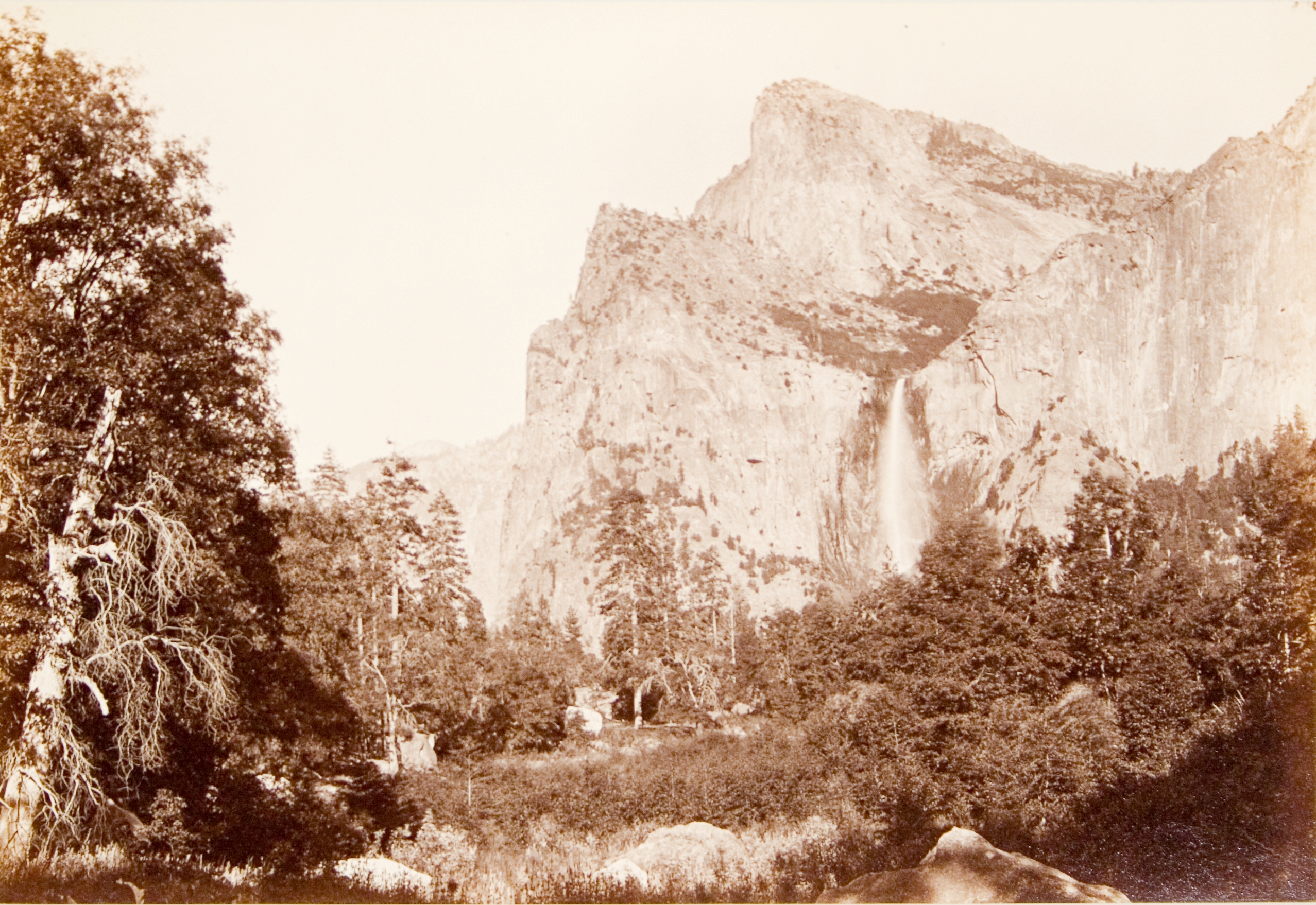
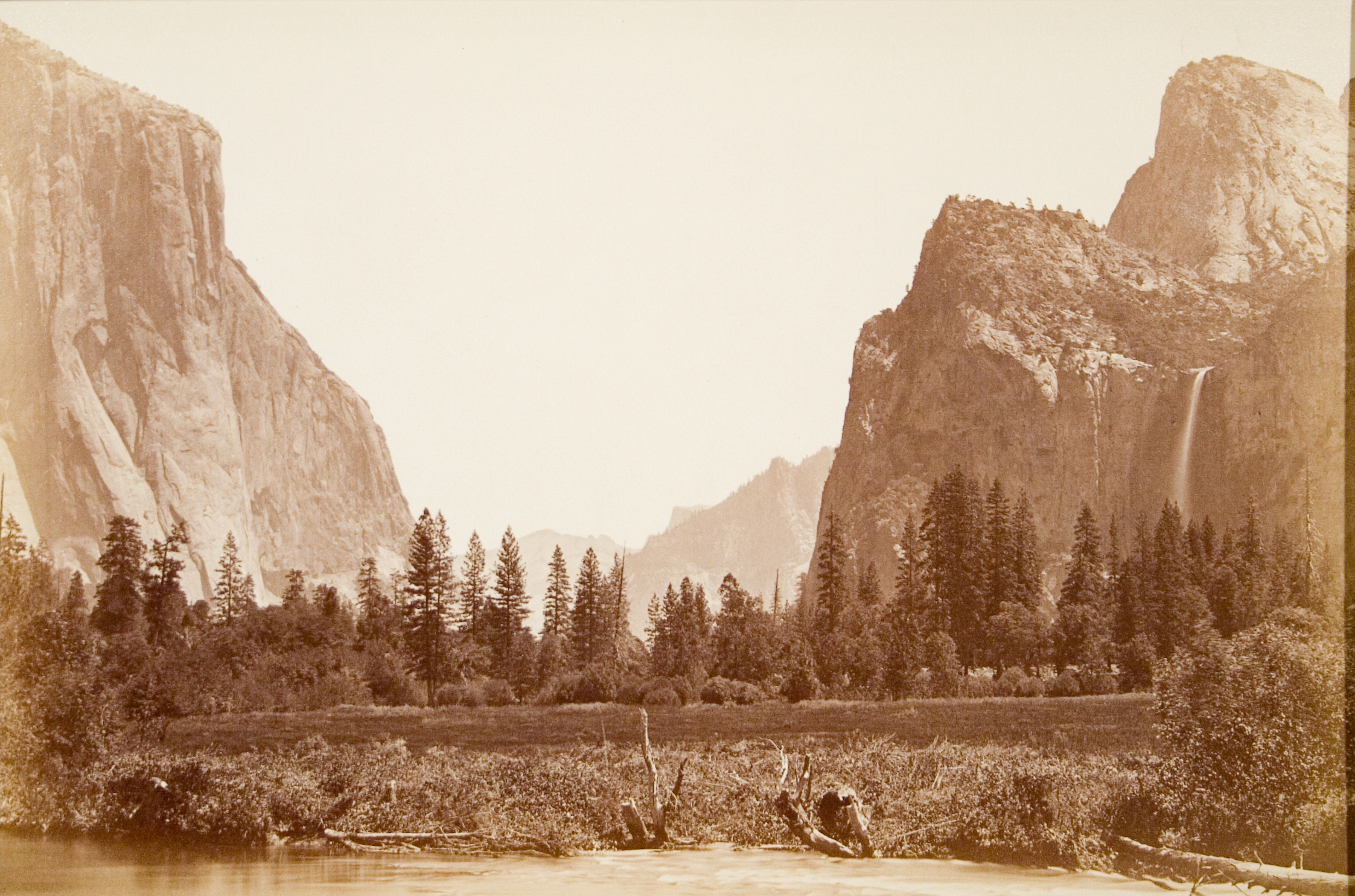

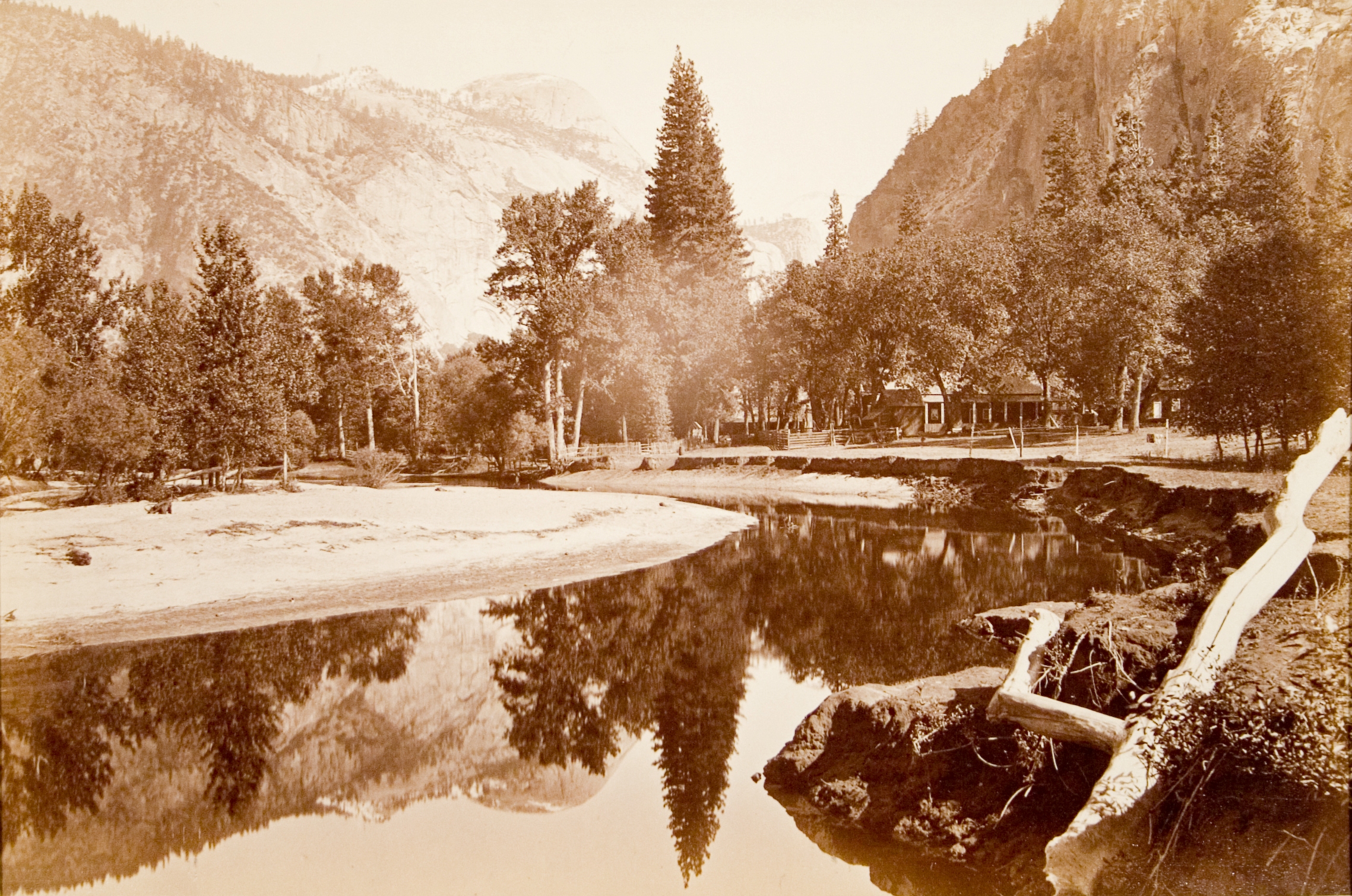
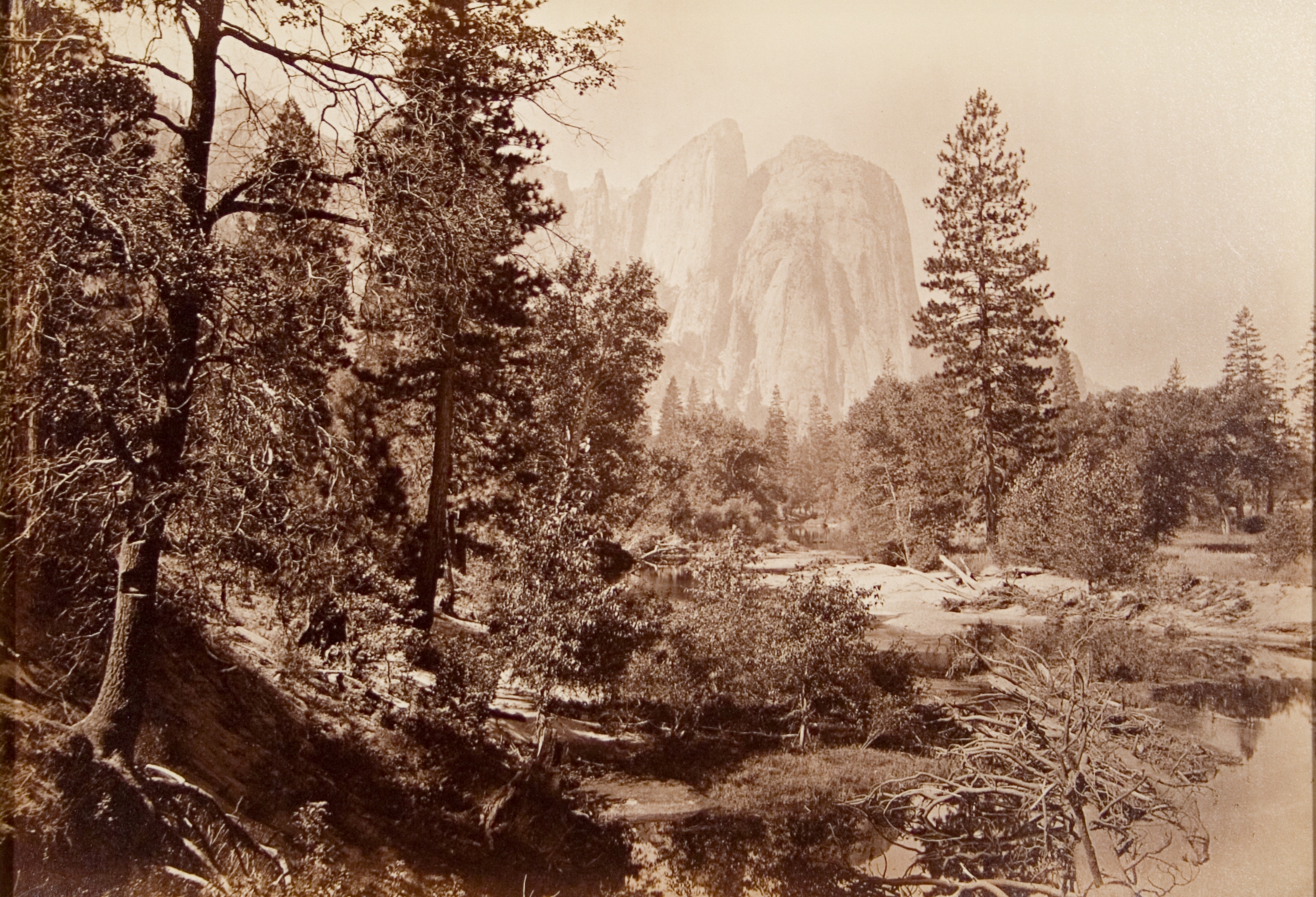

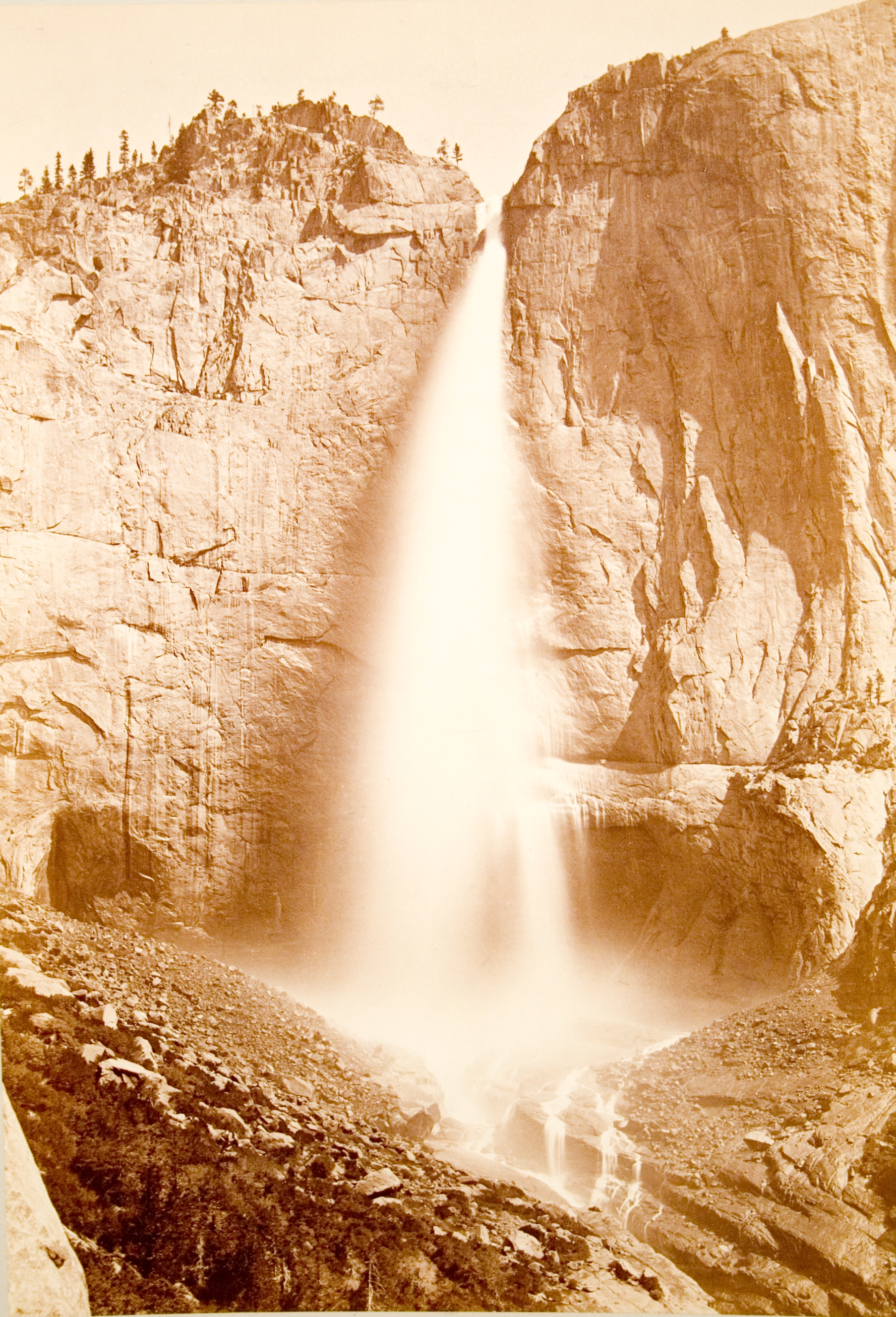


Pohono, the Bridal Veil Fall, Yosemite. 900 ft. Ca. 1865-66.
[I acquired these prints in Cambridge. MA in the early 1970s. I didn’t bother to identify the maker until the 1990s. I just finished compiling the bibliography in 2024. I do not pretend to be a Watkins expert, but I think that these prints most resemble those found in the Watkins’ 1865 album now in the Syracuse University Library. See: Doherty, Amy S., “Carleton E. Watkins, Photographer: 1829 ‑ 1916.” The Courier: Syracuse University Library Associates 15:4 (1978): 3‑20, plus cover. 5 b & w. WSJ]
WATKINS, CARLETON EUGENE. (1829-1916) BIBLIOGRAPHY.
By William S. Johnson.
(Please credit the blog if you use this bibliography.)
(POSTED March 2024)
[I have compiled and now posted this bibliography to test my belief that current technologies have made it possible to develop a very flexible research tool that can permit a scholar to access a wider range of information and provide a more nuanced look into the functioning of any particular era in the history of photography. This bibliography is composed from the Nineteenth-Century Photography. An Annotated Bibliography 1839-1879, by William S. Johnson. Boston: G. K. Hall & Co., 1990, to which I’ve added a key-word search of my current bibliographic project of indexing more than 800 periodical titles published in the USA and England between 1835 and 1869. After 1869 additional references were drawn from other random projects or sources that I had on hand and a key-word literature search of the internet. Not every important source is on the internet and it should not be considered an exhaustive survey of the literature published after that date. WSJ]
************************************************************************************************************************
Carleton E. Watkins began his long and extraordinary photographic career in 1854, in one of Robert Vance’s daguerreotype galleries in California. Watkins was born and grew up in Oneonta, New York, then moved in 1851, at age 22, to California. Watkins worked as a carpenter and clerk first in Sacramento, then in San Francisco before he became a temporary replacement for an employee who had abruptly left one of Vance’s branch studios. Given hasty instructions in the complicated daguerreotype process and asked to stall the patrons for a week until a regular “operator” could be found, Watkins quickly turned into a competent, then excellent, photographer. Watkins spent the next few years working for Vance and in other galleries making daguerreotype and then ambrotype portraits.
By 1856 photographers were experimenting with the new wet collodion process, which made taking landscape views a much more feasible, practical and economical activity. Carleton Watkins learned the new process and by 1858 was using it to photograph views to provide visual documentation for a court settlement of land disputes. For several years Watkins made a reasonable living taking these kinds of documents for litigants, at the same time perfecting his “field” skills and establishing his reputation as a field photographer.
By 1861 he had his own studio, but he specialized in views and travelled throughout California. Made his first trip to Yosemite in 1861 and returned many times in the 1860s. In 1867 Watkins photographed the Oregon and Columbia River region. He opened the Yosemite Art Gallery in 1867.
Attribution for many 19th century photographs is very difficult, as common practice was for gallery owners to attach their name (their brand) to photos made by employees or associates or even to negatives sold to them by other photographers. (Or, occasionally, as with Mathew Brady, even though illegally copying them.) In the late 1860s Watkins acquired the negatives of about 340 stereo views of the construction of the Central Pacific Railroad, which had been made by Alfred A. Hart, a Sacramento photographer, and Watkins then reissued the stereos under his own name. * [* See Alfred A. Hart post on this website.] Watkins also obtained a small series of stereoscopic negatives relating to the Modoc War made by Louis Heller, a photographer of Fort Jones, California, and issued those under his own name as well. Later, I. W. Taber acquired Watkins’ own early negatives of Yosemite when Watkins went bankrupt in 1874 and Taber then printed them under his own name throughout the 1870s and 1880s.
Watkins reopened his practice and rephotographed Yosemite. There must have been some irony present when both photographers separately displayed Yosemite photographs at various international exhibitions.
One way of building a reputation was by exhibiting at the various County or State Fairs or even at the international exhibitions patterned after famous World’s Fair in London in 1851. Watkins started exhibiting at the California State Fairs, but he soon began submitting his photographs to the large international expositions. A small sample of his work was submitted to the Exposition in London in 1862, arriving too late to be officially “listed” but attracting wide critical notice when they were hung. He then exhibited in the Universal Exposition at Paris in 1867, in Vienna in 1873, and in the United States Centennial Exposition in Philadelphia in 1876. Watkins also submitted work to the leading photographic magazines of the day. The strength of his work, seen by thousands through these venues, built Watkin’s a rare international reputation, but the labor and time and expense involved for an individual – not a corporate gallery – may have proved costly.
Commissioned to photograph the estate of Thurlow Lodge in Menlo Park from 1872 to 1874, Watkins produced a large body of work on this subject. For the next twenty years Watkins would travel all over the American West, taking tens of thousands of photographs -most of them good, serviceable documents of the Western landscape and the changes that it was undergoing -and a surprising number of them moving into the realm of creative expression. Watkins continued to photograph into the 1890s, but age and ill health slowed him down. His studio and its contents were completely destroyed in the San Francisco earthquake of 1906, and Watkins was severely affected by the loss of his work. He died, blind and incapacitated, in 1916.
BOOKS
1863
Langley, Henry G. The San Francisco Directory for the Year Commencing October, 1863: Embracing a General Directory of Residents And Business Directory: Also, a Directory of Streets, Public Offices, Etc., and a New Map of the City and County; Together With The Consolidation Act and its Amendments; the Municipal Government; Societies and Organizations, and a great Variety of Useful and Statistical Information, Exhibiting at a Glance the Progress and Present Condition of the City. “Sixth Year of Publication.” San Francisco: Towne & Bacon, Book and Job Printers, 1863. 592 p.; ill., map. 23 cm.
[“San Francisco [W] Directory.”
Watkins, Carleton E. photographer 649 Clay (p.366)]
(Etc., etc.)
San Francisco Business Directory.
Daguerreian, Ambrotype, and Photographic Materials.
Bradley H. W. 622 Clay
Shew W. 423 Montgomery
Daguerreians.
Bayley W. F. 622 Kearny
Bryan & Johnston, 611 Clay
Dyer Wm. D. 612 Clay
Edouart A. 634 Washington
Hamilton & Shew, 417 Montgomery
Higgins T. J. 659 Clay
Hills R. 683 Market
Hord J. R. 11 Third
Johnson G. H. 619 Clay
McGinn A. Miss, 234 Kearny
Selleck S. 413½ Montgomery
SHEW W. 423 Montgomery (see advertisement, p. 530)
Silva J. T. 703 Clay
(Etc., etc.)
[See Photographic Galleries.] (p. 410)
Photographic Galleries.
Bradley & Rulofson, Vance’s, 429 Mont
Gibbons H. 6 Montgomery
Suckert J. 306 Dupont
Bryan & Johnston, 611 Clay
Bush H. 9 Post
DYER W. D. 612 Clav (see adv. p. 561)
Edouart A. 634 Washington
Hamilton & Shew, 417 Montgomery
Higgins T. J. 659 Clay
Johnson G. H. 645 and 649 Clay
Selleck S. 415 Montgomery
SHEW W. 423 and 425 Montgomery
(see advertisement p. 530)
Silva T. J. 703 Ciay
(See Daguerreians.) (p. 429)
Watkins, Carleton E. Yo‑Semite Valley: Photographic Views of the Falls and Valley of Yo‑Semite in Mariposa County, California. San Francisco, CA: Bartling & Kimball, 1863 [1866?] n. p. 65 l. of plates. 65 b & w. [Album, of original photographs, bound by the publisher. Syracuse Univ. Library.]
Whitney, J. D. Notice of the Two Masses of Meteoric Iron Brought from Tucson To San Francisco, 1862 and 1863. San Francisco: Printed by Towne & Bacon, Book and Job Printers, No. 636 Clay Street, opposite Leidesdorfl. 1863. 12 p. 8 vo.
[“Head Quarters Column from California,
Tucson, Arizona, June 30th, 1862.
To General George Wright, U. S. Army,
Commander Dep. of the Pacific, San Francisco, Cal.
My dear General:—Soon after my arrival at this place I sent by a train to Port Yuma, to be shipped to your address at San Francisco, a very large and beautiful Aerolite, which I found here and which I had heard and read of for many years. In Bartleit’s Explorations, vol. 2, page 297, it is described as follows: “In the afternoon,” July 18th, 1853, “I called to take leave of General Blanco, and at the same time examine a remarkable meteorite, which is used for an anvil in a blacksmith’s shop. This mass resembles native iron, and weighs about six hundred pounds. Its greatest length is five feet. Its exterior is quite smooth, while the lower part which projects from the larger leg is very jagged and rough. It was found about twenty miles distant on the road towards Tubac and about eight miles from the road.” I desire that you present this aerolite to the City of San Francisco, to be placed upon the Plaza, there to remain for the inspection of the people and for (p. 6) examination by the youth of the city forever. It will be a durable memento of the march of the Column from California. I am, General, sincerely and respectfully, Your friend and servant, James H. Carleton, Brigadier General U. S. A.
Soon after this mass of meteoric iron came into the possession of the city, I obtained permission from the Board of Supervisors to have sawn from it a small piece for analysis and for distribution to a few of the principal public institutions in this country and Europe having collections of aerolites; this has been done, and also a fine photograph of it taken by Mr. C. E. Watkins, of which copies will be forwarded, with the specimens of the mass itself, as convenient opportunity offers….” (p. 7) (Etc., etc.)
“…At present the mass in question lies upon the steps of the Custom House, where it has been most admirably photographed by Mr. Watkins.* [* The mass was shipped on the Panama steamer, which sailed from San Francisco on the 3d of August,] It was said by Mr. Ainsa to weigh 1,600 pounds. The shape of this meteoric mass is very peculiar; and, at first, it would hardly be recognized as the identical specimen figured by Mr. Bartlett at Tucson, especially as this gentleman estimated its weight at 600 pounds only….” (p. 10) (Etc., etc.)
“…The photograph was taken by Mr. Watkins, at my request, partly to be sent abroad as a specimen of the high degree of perfection which has been attained by this gentleman in this department of art, and partly that an exact representation might be secured of this very remarkable body, in case it should be lost or captured on its way to Washington.” (p. 10)]
1865
Across the Continent: A Summer’s Journey to the Rocky Mountains, the Mormons, and the Pacific States, With Speaker Colfax. By Samuel Bowles, Editor of the Springfield (Mass.) Republican. Springfield, Mass.: Samuel Bowles & Company. New York: Hurd & Houghton., 1865. xx, 452 p. front. (folded map) 19 cm.
[“Introductory Letter to the Hon. Schuyler Colfax.”
“…In Natural Wonders and Beauties, as in rare gifts of wealth, the country of our Summer Journey stands out prominent and pre- eminent. Neither the Atlantic States nor Europe offer so much of the marvellous and the beautiful in Nature; offer such strange and rare effects, such combinations of novelty, beauty and majesty,– as were spread before us in our ride Across the Continent, through the mountains, and up and down the valleys. No known river scenery elsewhere can rival that of the Columbia, as it breaks through the Continental mountains; no inland seas charm so keenly as Puget’s Sound; no mountain effects are stranger and more impressive than those the Rocky and the Sierras offer; no atmosphere (p. vii) so fine and exhilarating, so strange and so compensating as California’s; no forests so stately and so inexhaustible as those of Washington; no trees so majestic and so beautiful as the Sequoia Gigantea;-aye, and no Vision of Apocalypse so grand, so full of awe, so full of elevation, as the Yosemite Valley! Does not that vision, that week under the shadows of those wonderful rocks,-by the trickle and the roll of those marvelous water-falls,-stand out before all other sights, all other memories of this summer, crowded as it is with various novelty and beauty? The world may well be challenged to match, in single sweep of eye, such impressive natural scenery as this. Professor Whitney tells us that higher domes of rock and deeper chasms are scattered along the Sierras, farther down the range; but he also testifies that, in combination and in detail, in variety and majesty and beauty of rock formations, and in accompanying water-falls, there is no rival to, no second Yosemite. You will be interested in Professor Whitney’s more detailed account of the Valley, and his suggestions as to its creation, which are appended to my Letters. They are from his just issued second volume of the Reports of the Geological Survey of California, which, if suffered to be completed as begun, will present a complete scientific account, in aggregate and in detail, of that wonderful State, and be the guide to all her future development.
The Yosemite Valley ought to be more known in the East, also, through the marvelous photographs of Mr. Watkins of San Francisco; he has made a specialty of these views, and, besides producing the finest photographs of scenery that I know of anywhere, he gives to those who see them very im- pressive ideas of the distinctive features of this really wonderful valley….” (p. viii) (Etc, etc.)
Geological Survey of California. Geology. Volume I. Report of Progress and Synopsis of the Field-Work, from 1860 to 1864. [Sacramento:] Published by Authority of the Legislature of California. 1865. xviii, 498 p.: ill., plates. [Illustrations are 9 full-page, tipped-in, “plates,” and 81 “figures,” which are illustrations withIn the body of the texts. All are engravings, some obviously after photographs, but not necessarily credited. WSJ]
“…The valley is a nearly level area, about eight miles in length and varying from half a mile to a mile in width. For the lower six miles its course is from northeast to southwest; the upper two miles are nearly at right-angles to this, the angle of the bend being at the spot where the Yosemite Fall comes over the precipice on the north side. Below the expanded portion of the valley, the Merced enters a terribly deep and narrow cañon, which is said to be inaccessible, and which we had no time to explore.
To make the peculiar features of the Yosemite more intelligible to those who have not seen it, or who have not enjoyed, what is next best to the thing itself, the admirable photographs of Mr. C. E. Watkins,* [*These photographs, thirty in number, and twenty-one inches by sixteen in size, are pronounced by all artists to be as near perfection as possible. They are already well known and widely distributed through the Eastern States, and will be more so. The glass stereographs taken in the valley, by Mr. Watkins, are in some respects even more effective than the photographs. All the views of the Yosemite given in this volume are taken from these photographs, by permission.] we give a wood-cut (Fig. 62), representing a portion of both sides of the valley, and which is one of the first near views which the traveller gets of the grander masses, whether he descends by the Coulterville or the Mariposa trail. On the right-hand or south side (the view being taken looking up, or to the northeast), we have the cliffs on the face of which the Bridal Veil Fall is seen. Behind this is a much higher mass, which forms a portion of the Cathedral Rock. On the other side is Tutucanula, or El Capitan, the first of these names being the original Indian appellation for this mighty cliff, and supposed to be either the name of some great chief, or else the word by which their “Great Spirit” or Deity was called, while “El Capitan” is the term by which the first visitors to the valley undertook to translate the aboriginal idea into the Spanish. As the idea of the dimensions and verticality of the walls of the Yosemite may be somewhat less easily taken from the shaded woodcut, a section (Fig. 63) is appended of the valley at this point, on an (p. 408) (Etc., etc.)
“…it is especially fine in the direction of the Obelisk Group of mountains, and it commands the cañon of the south fork of the MercedIllilouette,” as it is called by the Indians. From this point the glacial phenomena, and especially the regular and extensive moraines, of that valley are finely displayed. The profile of the Half Dome, of which more farther on, is best seen from the Sentinel Dome. From near the foot of Sentinel Rock, looking directly across the valley, we have before us, if not the most stupendous feature of the Yosemite, at least the most attractive one, namely the Yosemite Fall. We have endeavored to convey some idea of the grandeur and beauty of this fall, by reproducing (in Plate 2) as well as can be done on the small scale allowable in this volume and on wood, one of Mr. Watkins’ photographs; but it is in vain that we attempt, by any work of art, to do more than give the faintest echo of the impression which this glorious exhibition of nature produces on all who are so fortunate as to see it under favorable circumstances. About the time of full moon, and in the month of May, June, or July, according to the dryness and forwardness of the season, is the time to visit the Yosemite, and to enjoy in their perfection the glories of its numerous water-falls. Those who go later, after the snow has nearly gone from the mountains, see the streams diminished to mere rivulets and threads of water; they feel satisfied with the other attractions of the valley, its stupendous cliffs, domes and cañons, and think that the water-falls are of secondary importance, and that they have lost little by delaying the time of their visit. This is not so; the traveller who has not seen the Yosemite when its streams are full of water has lost, if not the greater part, at least a large portion, of the attractions of the region, for so great a variety of cascades and falls as those which leap into this valley from all sides has, as we may confidently assert, never been seen elsewhere -both the Bridal Veil and the Nevada Fall being unsurpassed in some respects, while the Yosemite Fall is beyond anything known to exist, whether we consider its height or the stupendous character of the surrounding scenery. The Yosemite Fall is formed by a creek of the same name, which heads on the west side of the Mount Hoffmann Group, about twenty miles north of the valley….” (p. 413) (Etc., etc.)
“…The North Dome, on the opposite side of the valley of Tenaya Creek, is another of these rounded masses of granite, of which the concentric structure, already frequently alluded to in this chapter, is very marked. The annexed wood-cut (Fig. 68), engraved by Mr. * [Fig. 68. North Dome-Yosemite Valley.] Andrews from one of Watkins’s photographs, will illustrate both the form of the dome and its structure. It is 3568 feet in elevation above the valley, and is very easy of ascent from the north side. At the angle of the cañon, appearing as a buttress of the North Dome, is the Washington Column, a grand, perpendicular mass of granite, and by its side the Royal Arches, an immense arched cavity formed in the cliff’s by the giving way and sliding down of portions of the rock, the vaulted appearance of the upper part of it producing a very fine effect. Farther up the cañon of Tenaya Creek is a little lake, called Tis (p. 417)
“…and the whole character of the scenery which surrounds it, Mount Broderick alone being an object of which [Fig. 69. Mount Broderick and the Nevada Fall] the fame would be spread world-wide, if it were not placed as it is, in the midst of so many other wonders of nature. There are also grand cascades in the South Fork Cañon, the scenery through the whole of which is little inferior to that of the other portions of the Yosemite; but, amid so many objects of attraction, few visitors find time to examine this cañon, especially as the trail by which it is reached is a rough and difficult one. Judging from Mr. Watkins’s photographs, the views from points along the slopes of the South Fork Cañon must be equal to almost any which can be had in the whole region. In the angle formed by the Merced and the South Fork Canon, and about two miles south-southeast of Mount Broderick, is the high point, called the “South Dome,” and also, of later years, “Mount Starr King.” (p. 419) (Etc., etc.)]
[Fig. 62. Yosemite Valley. (p. 409)
Fig. 63. Section across the Yosemite. “El Capitan” “Bridal Veil” (p. 409)
Fig. 64. Cathedral Rock.” (p. 411)
Fig. 65. Sentinel Rock. (p. 412)
Fig. 66. The Half Dome. Yosemite Valley. (p. 415)
Fig. 67. Section through the Domes. “North Dome Lake Half Dome.” (p. 416)
Fig. 68. “North Dome – Yosemite Valley. (p. 417)
Fig. 69 “Mount Broderick and the Nevada Fall.” (p. 419)
[From Watkins’ photographs.]
[Plate I. Consists of drawings of fossilized sea shells, and is located before p. 481 in: “Appendix B. Description of Fossils from the Auriferous Slates of California.” By F. B. Meek. (p. 477-483)]
Plate II, Before p. 413. Under the Yosemite Fall.
Plate III, p. 415. The Canon of the Merced and the Vernal Fall.
Plate IV, p. 425. The Obelisk Group from Porcupine Flat.
Plate V, p. 427. Upper Tuolumne Valley from Soda Springs, Looking South.
Plate VI, p. 429. “Cathedral Peak Group Upper Tuolumne Valley.”
Plate VIII, Pp. 434.” Crest of the Sierra, Looking East from Above Soda Springs.”
Plate IX, p. 446. “Volcanic Ridges Near Silver Mountain.”
[Plates II and III definitely by Watkins, some others possibly. WSJ]
1866
Watkins, Carleton E. Yo‑Semite Valley: Photographic Views of the Falls and Valley of Yo‑ Semite in Mariposa County, California. San Francisco, CA: Bartling & Kimball, 1863 [1866?] n. p. 65 l. of plates. 65 b & w. [Album, of original photographs, bound by the publisher. Syracuse Univ. Library.]
1867
Hall, Edward H. Appletons’ Hand-Book of American Travel. Containing a Full Description of the Principal Cities, Towns, and Places of Interest: Together with the Routes of Travel and Leading Hotels Throughout the United States and British Provinces. Illustrated With Copious Maps. “Ninth Annual Edition.” New York: D. Appleton & Co., 443 & 445 Broadway. London: Trübner & Co. 1867. 1 v. (various pagings), [9] folded leaves of plates: maps, plans; 29 cm.
[“ “Obligations.”
“Our obligations are due to the entire United States and Canadian Press for their unceasing endeavors to keep us informed of the rapid changes transpiring in their respective localities, as well as for their numerous contributions to local and state history, descriptive sketches, etc., etc. Below will be found a list of authorities referred to in the work.
We are specially indebted to Mr. C. E. Watkins,* [* Views of the Yo-Semite Valley by this clever artist can be obtained in New York of the editor.] and Messrs. Lawrence and Houseworth, of San Francisco, for their fine pictures of scenery in California and on the Pacific coast; to Mr. Edward Vischer, of San Francisco, for his fine collection of drawings in the same region; to Messrs .Savage and Ottinger, of Great Salt Lake City; to Mr. Eugene Piffet, of New Orleans; Mr. Sancier, of Mobile; Mr. Linn, of Chattanooga, and other photographic artists throughout the Union who have kindly furnished us with views of prominent objects of interest in their several localities. We regret that lack of time and space compel us to exclude their contributions from our pages. It is decided to make future issues of the Hand-book uniform in style and appearance with the present work.
For much valuable information contained in the following pages we are indebted to the recently-published Directories of New York, Philadelphia, Boston, New Orleans, Baltimore, Mobile, Cincinnati, Memphis, Chicago, St. Louis, San Francisco, Albany, Milwaukee, Richmond, Va., St. Paul, Virginia City, Nevada, Portland, Oregon, and Austin, Nevada.
We are also under obligations to Mr. A. Gensoul, of San Francisco, for a set of his recently published maps. Thankful to one and all for their valuable assistance, we shall endeavor to merit a continuance of their favors. Authorities Referred To In The Work
Arizona and Sonora, by Sylvester Mowry.
Speeches and Letters of Governor Richard C. McCormick.
North Carolina, Historical Sketches of, by John H. Wheeler.
California Guide, etc., by J. M. Hutchings.” (p. xv.)]
Report of the Commissioner to the Universal Exposition at Paris, 1867.
Notes upon the Universal Exposition at Paris, 1867, by William P. Blake. (pp. 249-347)
Chapter I.
General View of the Paris Exposition of 1867.
The Building.
The general plan and arrangement of the Universal Exposition of eighteen hundred and sixty-seven was the result of the observation and experiences of the former great International Exhibitions at London in eighteen hundred and fifty-one, at Paris in eighteen hundred and fiftyfive and at London in eighteen hundred and sixty-two. In those Exhibitions grand architectural effect were attempted, and large sums were expended in exterior and interior decoration. In the Exhibition building of eighteen hundred and sixty-seven all architectural display was subordinated to the convenience of grouping and display of the various objects contributed. The leading feature of the plan was the division of the space into seven concentric galleries, each one devoted to a particular group or class of objects…. (p. 255)
List of Groups, With the Classes Attached.
Groups. Class.
Group I. — Works of Art.
Paintings in oil 1
Other paintings and drawings 2
Sculpture and dye-Sinking 3
Architectural designs and models 4
Engraving and lithography 5
Group II. — Apparatus and Application of the Liberal Arts.
Printing and books 6
Paper, stationery, binding, painting and drawing materials 7
Applications of drawing and modelling to the common arts 8
Photographic proofs and apparatus 9
Musical instruments 10
Medical and surgical instruments and apparatus 11
Mathematical instruments and apparatus for teaching science 12
Maps and geographical and cosmographical apparatus 13 (p. 258)
The Park.
The visitor to the Exhibition was at once forcibly impressed with the importance and extreme interest of the Park as part of the Exhibition. It was most tastefully laid out with avenues and winding paths, and was adorned with trees, shrubs and flowers, all planted since the ground was first broken for the foundation of the Palace, on what was previously the barren and indurated surface of the Champs de Mars.
“…Alongside of this building there was a pleasing vista over green lawns and parterres of flowers to the American annexe beyond, where could be seen the beautiful locomotive and various agricultural machines. On the left of the avenue was a building for the display of windows of stained and painted glass, to which the art of photography had lent its aid. Portraits and photographs were there reproduced in all the brilliance and permanence of color of stained glass. In continuing a walk toward the entrance of the building, the visitor…” (p. 262)
Distribution of Prizes.
The work of the juries commenced as soon as the Exhibition opened, and the awards were made very soon thereafter, and in many cases before some of the contributions were fairly placed and labelled. The grand ceremony of the distribution of prizes was on the first of July, at the Palace of Industry, the building erected for the Exhibition of eighteen hundred and fifty-five. The recipients of grand prizes and gold medals received them from the hands of the Emperor, in the presence of seventeen thousand spectators, all comfortably seated in that magnificent hall…”
“…The prizes awarded to exhibitors from California were as follows:
State of California* [*The official announcement of this award reads: “Le Gouvernment de California — Céréals.”
As the State of California was not an exhibitor, this destination of the award is apparently the result of misapprehension. The exhibitors of cereals were Mr. D. L. Perkins, Mr. J. W. H. Campbell and Mr. J. D. Peters. The display made by Mr. Perkins included one hundred and twenty varieties of seeds, neatly arranged in glass bottles and labelled, and, together with the photograph, was the most prominent. It is the opinion of the Commissioner that the medal should either be given to Mr. Perkins or to the exhibitors of cereals jointly.] —Cereals. Silver medal.
Dr. J. B. Pigné, San Francisco—Collection of California minerals. Silver medal.
William P. Blake, California—Collection of California minerals. Silver medal. (p. 265)
Mission Woollen Mills, San Francisco—Exhibition of blankets, cloths and flannels. Bronze medal.
C. E. Watkins, San Francisco— Photographs of Yosemite Valley. Bronze medal.
Brown & Level, California—Self-detaching boat tackle. Bronze medal.
Buenavista Vinicultural Society—Sparkling wine. Honorable mention….” (p. 266)
Woods and Products of the Forest.
France.
The forest products and industries of nearly every country were represented in the Exposition, by sections of trees, planks, boards, mouldings, etc., and by collections of the tools used for cutting, hewing and sawing. Of all these collections, that made by France, through the “Administrator of the Forests,” was the most complete, methodical and interesting. It occupied a space about sixty feet in length, in the second gallery, devoted to Group V, and was very tastefully displayed. Sections of all the principal kinds of trees in the Empire were ranged along the wall with the interspaces filled with green moss. Each section of a tree was about six inches thick, and included the bark, so that the whole structure and outer form and appearance of the trunk was clearly shown. Above these, on a table which extended around the room, smaller sections and portions of dressed and worked timber were arranged. with herbaria, photographs and drawings of forest trees. The tools used were grouped above, on the wall, around centre pieces, formed of boar’s heads. In the centre of the room a broad table sustained various models of forests and of sawmills, and of apparatus used in felling and transporting timber. There were also models of the buildings erected for the keepers’ lodges, and of cottages for the laborers. Some of the plans in the relief exhibited the important operations of the administration of forests, such as the replanting of the Alps. A large forest chart upon the wall, of France, showed in the most striking manner the distribution of the wooded parts of the country and the relation which exists between them and the geological constitution of the soil. The whole collection was completed by a series of specimens of the various destructive forest insects.
There was also a series of publications on practical or scientific questions, relating to sylviculture, and a fine collection of photographs of cones and foliage of the various pines and firs….“ (p. 267)
The Forest Products of Canada.
Canada made a very respectable show of its resources in lumber of various kinds. There were sections of the principal trees, with their bark, in great number. They were usually about two feet long, and were super-imposed one upon another, so as to make a base for several columns of square logs, of different woods for building purposes, set up about eight feet apart. These supported above a square timber of yellow pine, fifty feet long and ten feet square. The niches formed by this disposition of the timber were filled with smaller specimens, and by panels of dressed and polished planks of pine, white wood, walnut and birch. The Abbé Brunet, of Quebec, Canada, sent a fine collection of Canadian woods, with herbaria and a series of photographs of trees and of plantations. He made the whole complete and instructive by a printed catalogue of sixty-four pages, which contained a large amount of valuable information upon the trees of Canada. This collection, for its uniformity, neatness and pleasing appearance, was one of the most attractive in the Exhibition, and it received a gold medal. (p. 269)
Suez Canal.
The progress of the great Suez Canal was fully illustrated in a separate building in the Park by a large model, a panorama, photographs, and miscellaneous collections. The model of the Isthmus was a complete miniature representation of the country, with all its elevations and depressions, on a scale of one to five hundred thousand….” (p. 318)
List of Exhibitors of Objects from California at the Paris Exposition.
Names and Articles Exhibited. Group. Class.
MISSION WOOLLEN MILLS, San Francisco, Lazard Fréres,Agents. Four cases of woolen goods, manufactured in California from California wool. IV 30
C. H. HARRISON, San Francisco. Centrifugal pump …. …..
C. E. WATKINS, San Francisco. Series of twenty-eight large photographic views of Yosemite Valley, and two of the Big Trees of the Mariposa Grove II 9
LAWRENCE & HOUSEWORTH, San Francisco. Twenty-six large photographs of Yosemite Valley and of the Great Trees, and three hundred stereoscopic views of different localities in California. II 9
EDWARD VISCHER, San Francisco. One case containing six portfolios of views in California and Washoe. II 9
A. S. HALLIDIE & CO., San Francisco. Samples of wire rope, round
and flat, and iron and copper sash cords of California manufacture. V 40
PACIFIC GLASS WORKS, San Francisco. Specimens of California
made glass bottles. III 16
JOHN D. BOYD, San Francisco. One highly finished ornamental door, made of wood grown in California. III 14
JOHN D. BOYD, San Francisco Specimens of -the wood of the Madrona, or California laurel V 41
JOHN REED, San Francisco. Premium tank lifeboat model, four feet long. VI 66
SAN LORENZO PAPER MILLS Varieties of paper made at the company mills in Santa Cruz, California. …. ….
STANDARD SOAP COMPANY. Specimens of California made soap and washing powders …. …. (p. 336)
D. L. PERKINS, San Francisco and Oakland. Collection of seeds grown in California, and a photograph of California vegetables.
(Donated to the Imperial Garden of Acclimatation.) VII 67
J. W. H. CAMPBELL, San Francisco. One case — about one hundred and twenty pounds — California high mixed wheat.
(Donated to Royal Agricultural Society, England) VII 67
J. D. PETERS, San Joaquin County. One box containing about thirty pounds of wheat VII 67
BUENA VISTA VINICULTURAL SOCIETY (by R. N. Van Brunt, Secretary). Cases of sparkling wine made from grapes grown at the Society’s vineyard, Sonoma County, California, 1865 VII 73
C. H. LE FRANC, New Almaden Vineyard. Four cases of red and white wines made in San José, California. VII 73
SANSEVAIN BROTHERS, Los Angeles. One case of California wine VII 73
KOHLER & FROHLING. California wines. VII 73
M. KELLER, Los Angeles. Four cases of California wines.
A. FENKHAUSEN, San Francisco. Three cases California wine and bitters. VII 73
TAYLOR & BENDEL, ‘San Francisco. One case of stomach bitters. VII 73
Dr. J. PIGNÉ San Francisco. Six cases of California and Nevada minerals and ores.
(Donated to the School of Mines, Paris) V 40
CALIFORNIA STATE AGRICULTURAL SOCIETY. Volumes of the Society’s reports for distribution. V 40
WILLIAM P. BLAKE, San Francisco. Collection of California minerals and ores. (See list of minerals and ores.) V 40
DRS. HARKNESS and FREY, Sacramento. Large mass of silver ore from Blind Springs, Mono County, California, weighing about one hundred pounds V 40
————————————— (p. 337)]
Whitney, Josiah Dwight, State Geologist. Geological Survey of California. The Yosemite Guide-Book: A Description of the Yosemite Valley and the Adjacent Region of the Sierra Nevada, and of the Big Trees of California, Illustrated by Maps and Woodcuts. Published By Authority of the Legislature. (Sacramento]: 1870. viii, 155 p. illus. 8 plates, fold maps. 24 cm.
[“Prefatory Note. A statement of the way in which the present volume came to be authorized by the Legislature, and of the sources from which the information it contains was drawn, will be found in the introductory chapter. It may be proper to add, that two editions of the work have been published, one in quarto form, with photographic illustrations, the other (the present volume, namely), with wood-cuts. These cuts have been selected from among those used in the first volume of our “Geology of California.” The maps are the same in both editions, and the text also, except that some verbal changes have been made, and a few pages added, in this edition, relating to that portion of the High Sierra which lies near the head of the Kern, King’s, and San Joaquin Rivers. J. D. W. Cambridge, Mass., May 1, 1869. (p. viii)
[There are 8 full-page “plates” tipped in and 20 “figures” (primarily engraved landscapes) in the text pages. See Geology of California for titles. WSJ]
Whitney, Josiah Dwight, State Geologist. Geological Survey of California. The Yosemite Book. A Description of the Yosemite Valley and the Adjacent Region of the Sierra Nevada, and of the Big Trees of California. Illustrated by Maps and Photographs. New York: Julius Bien, 1868. 116 pp. 28 l. of plates. 28 b & w. [Twenty‑eight photographs, four by W. Harris, the remainder by Carleton E. Watkins. Photographic edition limited to 250 copies. NYPL, GEH collections.]
Transactions of the California State Agricultural Society During the Years 1866 and 1867.
Sacramento: D. W. Gelwicks, State Printer, 1868. 640 p.
[“ Report Upon the Universal Exposition at Paris, 1867.
Chapter I.
General View of the Paris Exposition of 1867.
The Building.
The general plan and arrangement of the Universal Exposition of eighteen hundred and sixty-seven was the result of the observation and experiences of the former great International Exhibitions at London in eighteen hundred and fifty-one, at Paris in eighteen hundred and fifty-five and at London in eighteen hundred and sixty-two….” (Etc., etc.) (p. 255)
                 List of Groups, with the Classes Attached.
                              Groups.
Group I.-Works of Art.
Paintings in oil………………..
Other paintings and drawings….
Sculpture and dye-sinking…….
Architectural designs and models……
Engraving and lithography….
Group II.-Apparatus and Application of The Liberal Arts.
Printing and books……..
Paper, stationery, binding, painting and drawing materials…….
Applications of drawing and modelling to the common arts….
Photographic proofs and apparatus…..
Musical instruments…….
Medical and surgical instruments and apparatus……
Mathematical instruments and apparatus for teaching science…..
Maps and geographical and cosmographical apparatus..
Group III.-Furniture and Other Objects For The Use of Dwellings.
Fancy furniture……..
Upholstery and decorative work.
Crystal fancy glass and stained glass….
Porcelain, earthen ware and other fancy pottery..
Carpets, tapestry and other stuffs for furniture….
Paper hangings…….
Cutlery……
Gold and silver plate……
Bronzes and other art castings and repoussé work..
Clocks and watches……..
Apparatus and processes for heating and lighting..
Perfumery…………
Leather work, fancy articles and basket work……
Group IV.—Clothing (Including Fabrics) and Other Objects Worn On The Person.
Cotton thread and fabrics…..
Thread and fabrics of flax…….
Combed wool and worsted fabrics…
Carded wool and woollen fabrics…….
Silk and silk manufactures…..
Shawls……Lace, net, embroidery and small ware manufactures…
Hosiery and underclothing and articles appertaining thereto…
Clothing for both sexes……” (p. 258)
Jewellery and precious stones….
Portable weapons………
Travelling articles and camp equipage.
Toys…….
Group V.-Products, Raw and Manufactured, of Mining Industry, Forestry, Etc.
Mining and metallurgy……
Forest products and industries………………..
Products of the chase and fisheries; uncultivated products…
Agricultural products (not used as food)……..
Chemical and pharmaceutical products….
Specimens of the chemical processes used in bleaching, dyeing,
printing, etc…….
Leather and Skins…….
Group VI.-Apparatus and Processes Used In The Common Arts.
Apparatus and processes of the art of mining and metallurgy…..
Agricultural apparatus and processes used in the cultivation of
fields and forests……
Apparatus used in shooting, fishing tackle and implements used
in gathering fruits obtained without culture.……………..
Apparatus and processes used in agricultural works and in works
for the preparation of food……..
Apparatus used in chemistry, pharmacy and in tan yards…..
Prime-movers, boilers and engines specially adapted to the
requirements of the Exhibition…
Machines and apparatus in general……………………….
Machine tools……
Apparatus and processes used in spinning and ropemaking..
Apparatus and processes used in weaving……..
Apparatus and processes for sewing and for making up clothing..
Apparatus and processes used in the manufacture of furniture
and objects for dwellings………
Apparatus and processes used in paper making, dyeing and
printing…….
Machines, instruments and processes used in various works……
Carriages and wheelwrights’ work…..
Harness and saddlery…
Railway apparatus..
Telegraphic apparatus and processes…..
Civil engineering, public works and architecture…..
Navigation and lifeboats……..
Group VII.-Food (Fresh Or Preserved, In Various States of Preparation).
Cereals and other eatable farinaceous products and the products
derived from them…….(p. 259)
Bread and pastry……………….
Fatty substances used as food, milk and eggs.
Meat and fish……
Vegetables and fruit…….
Condiments and stimulants, sugar and confectionery…
Fermented drinks…..
Group VIII.-Live Stock and Specimens of Agricultural Buildings.
Farm buildings and agricultural works……
Horses, asses, mules……
Bulls, buffaloes, etc……
Sheep, goats……
Pigs, rabbits…
Poultry……
Sporting dogs and watch dogs…..
Useful insects……..
Fish, crustace and mollusca…….
Group IX.-Live Produce and Specimens of Horticultural Works.
Hothouses and horticultural apparatus…..
Flowers and ornamental plants……
Vegetables……..
Fruit trees…………….
Seeds and saplings of forest trees…
Hothouse plants……
Group X.-Articles Exhibited With The Special Object of Improving The Physical and Moral Condition of The People.
Apparatus and methods used in the instruction of children………
Libraries and apparatus used in the instruction of adults at home, in the workshop or in schools and colleges…….
Furniture, clothing and food from all sources, remarkable for useful qualities combined with cheapness…….
Specimens of the clothing worn by the people of different countries………
Examples of dwellings characterized by cheapness combined with the conditions necessary for health and comfort….……………………..
Articles of all kinds manufactured by skilled workmen…..
Instruments and modes of work peculiar to skilled workmen….
To each of the first seven of these groups a circle or gallery of the building was arranged thus: Group I-Works of Art-occupied the inner circle or gallery; Group VI-the engines, machines, etc.-were placed in the outer gallery, a portion of which, along the outer side, was devoted to Group VII; and here, for example, were arranged the cereals, (p. 260)
the seeds, dried fruits, wines and liquors.
Group V-Raw and manufactured productions, such as minerals, ores, forest products, etc.-were placed in the gallery adjoining that containing the machinery. By following these galleries the visitor passed in succession among the productions similar in kind of different countries, while by following the avenues the visitor saw in succession the various productions and manufactures of the same country
After the adoption of this system it was decided to devote a portion of the inner circle to antiquities, so arranged as to give an approximate history of the progress of the arts from the earliest periods to the present time. This became a very interesting part of the Exposition to all classes of visitors. Even the pre-historic period was represented by collections of flint and bone implements from the caves and from the lake dwellings of Switzerland. The bronze period was also illustrated, and so on through the great periods of human history to the present age of steel.
The nature of the articles shown in this gallery of the “History of Human Labor” appears more fully by the following enumeration in the classification, by periods, adopted by the Imperial Commission:
First Epoch-Gaul before the use of metal. Utensils in bone and stone, with the bones of animals that have now disappeared from the soil of France, but found with these utensils, and showing the age to which they belong.
Second Epoch-Independent Gaul. Arms and utensils in bronze and stone. Objects in terra cotta.
Third Epoch-Gaul during the Roman rule. Bronzes, arms, Gaulish coins, jewellery, figures in clay; red and black potteries, incrusted enamels, etc.
Fourth Epoch-The Franks to the crowning of Charlemagne (A. D. eight hundred). Bronzes, coins, jewels, arms, pottery, MS. charters, etc.
Fifth Epoch-The Carlovingians, from the commencement of the ninth to the end of the eleventh centuries. Ivory sculptures, bronzes, coins, seals, jewels, arms, MS. charters, etc….” (Etc., etc.) p. 261) (Etc., etc.)
Distribution of Prizes.
A report was presented at this time by M. Rouher, Minister of State and Vice President of the Imperial Commission, enumerating in a general way the principal operations of the Commission and of the Jury, stating the total number of awards and citing some of the great inter-
national advantages derived from the Exposition. The International Jury was composed of six hundred members, chosen from men distinguished in science, industry, commerce and art, and of various nationalities. This Jury awarded:
Grand prizes……. 64
Gold medals….. 883
Silver medals. 3,653
Bronze medals….. 6,565
Honorable mentions. 5,801
The Jury of the new order of prizes awarded twelve prizes and twenty-four honorable mentions. In addition, the Emperor was pleased to confer upon some of the most eminent of the competitors in the Exhibition the Imperial Order of the Legion of Honor. The prizes awarded to exhibitors from California were as follows: State of California*-Cereals. Silver medal.
Dr. J. B. Pigné, San Francisco-Collection of California minerals. Silver medal.
William P. Blake, California-Collection of California minerals. Silver medal….” (p. 265)
Mission Woollen Mills, San Francisco-Exhibition of blankets, cloths and flannels. Bronze medal.
C. E. Watkins, San Francisco-Photographs of Yosemite Valley. Bronze medal.
Brown & Level, California-Self-detaching boat tackle. Bronze medal.
Buenavista Vinicultural Society-Sparkling wine. Honorable mention.” (266)]
Chapter IV.
Gold, Silver, Platinum and the Rare Metals.
Gold and Its Ores-California.
The principal mines of California were represented in the collection, as will be seen by reference to the appended catalogue. Although the collection was not as extensive and rich as it should have been, it was very interesting and instructive, and was highly commended for the uniformity of the specimens in size and for the arrangement. The collection sent by Dr. Pigné was also very complete and well classified, and contained specimens from some mines not otherwise represented. …” (Etc., etc.)
“…The large crystalline mass of gold from the Spanish Dry Diggings, (p. 299) California, which was exhibited for a time at San Francisco, in the window of Hickok & Spear, and was photographed by Watkins, is now in Paris, the property of M. Fricot, formerly the owner of the Eureka mine. at Grass Valley. Owing to the difficulty and expense of making this unique specimen perfectly safe in the Exposition, it was not entered there, but M. Fricot took pleasure in showing it freely at his house to those most interested….” (p. 300) (Etc., etc.)
“List of Exhibitors
of Objects from California at the Paris Exposition.
———————————————————————————————————————————
Names and Articles Exhibited. Group. Class.
———————————————————————————————————————————
MISSION WOOLLEN MILLS, San Francisco, Lazard Fréres,
Agents. Four cases of woollen goods, manufactured in
California from California wool.……………………. IV 30
C. H. HARRISON, San Francisco. Centrifugal pump………. IV 30
C. E. WATKINS, San Francisco. Series of twenty-eight large photographic
views of Yosemite Valley, and two of the Big Trees of the Mariposa Grove… II 9
LAWRENCE & HOUSEWORTH, San Francisco. Twenty-six large photographs
of Yosemite Valley and of the Great Trees, and three hundred stereoscopic
views of different localities in California…. II 9
EDWARD VISCHER, San Francisco. One case containing six portfolios of views
in California and Washoe… II 9
A. S. HALLIDIE & Co., San Francisco. Samples of wire rope, round and flat,
and iron and copper sash cords of California manufacture……. V 40
PACIFIC GLASS WORKS, San Francisco. Specimens of California made
glass bottles… III 16
JOHN D. BOYD, San Francisco. One highly finished ornamental door, made of
wood grown in California….. III 14
JOHN D. BOYD, San Francisco Specimens of the
wood of the Madrona, or California laurel…….. ….. V 41
JOHN REED, San Francisco. Premium tank lifeboat model, four feet long…….. VI
SAN LORENZO PAPER MILLS. Varieties of paper made at the company’s
mills in Santa Cruz, California…… VI 66
STANDARD SOAP COMPANY. Specimens of California made soap and
washing powders. VI 66
——————————————————————————————————————————— (p. 336) (Etc.,etc.)]
1870
Transactions of the California State Agricultural Society During the Years 1868 and 1869. Sacramento: D. W. Gelwicks, State Printer. 1870. 384 p.
[“ “Premiums Awarded in 1868”
Transactions of the Seventh Department.
Paintings, Drawings, Etc.
———————————————————————————————————————————
Exhibitor. Residence. Article. Premium.
———————————————————————————————————————————
W. L. Marple San Francisco. Oil painting $20
Norton Bush. San Francisco. Oil painting $20
W. L. Marple San Francisco. Landscape oil painting. $10
Norton Bush. San Francisco. Landscape oil painting. $10
Colonel Warren San Francisco. Collection of lithographs and engravings Diploma.
Mrs. W. E. Brown… Sacramento…. Flower painting. First-$10
Otto Schrader. San Francisco. Fruit painting First-$10
Mrs. G. D. Stewart. Sacramento…. Crayon drawing. Diploma.
J. B. Grouppe….. San Francisco. Wood engraving. Diploma.
Joseph F. Hess San Francisco. Pencil drawing. Diploma.
Mrs. G. D. Stewart. Sacramento…. Water color painting… First-$20
F. Serregni…….. San Francisco. Penmanship and pen drawing. First-Diploma and $5
J. W. Cherry San Francisco. . Sign painting. First – Diploma.
Wm. Shew. San Francisco. Plain photographs, life size. First-$15
Wm. Shew… San Francisco. Photograph in water color.. First-$15
Wm. Shew… San Francisco. Photograph in India ink……. First-$10
Wm. Shew….. San Francisco. Plain sun pearl. First-$15.
Wm. Shew San Francisco. Porcelain picture, colored…. First-$10
Silas Selleck.. San Francisco. Plain photograph, medium size. First-$10
C. E. Watkins…. San Francisco. Landscape photograph (collection). Special-$10
Thos. Houseworth… San Francisco. Collection of landscape photographs Special-$10
———————————————————————————————————————————
Sculpture. (Etc, etc.)
———————————————————————————————————————————
Musical Instruments. (Etc., etc.)
———————————————————————————————————————————
(p. 110)
“Noteworthy Exhibitions.” (p. 111)-
[“Under this heading we make brief mention of such displays in the Pavilion as from their nature or workmanship merit a careful scrutiny; but we do not wish to have the inference drawn that a failure to specially notice implies lack of merit in any particular exhibition. The Mission Woollen Mills, of San Francisco, Lazard Freres, agent, had a fine display of blankets, from the rough but useful miners’ blanket, to the soft and silky covering that adorns the luxurious couch, and a large variety of tweeds, cassimeres and beavers; besides ladies’ cloakings and flannels of the finest texture, and buggy robes and sluice blanketings. These mills were represented in the Exposition Universalle at Paris, where they were awarded a gold medal. We are told that they now employ three hundred men, and have fifty looms, six thousand spindles, and eleven sets of cards in operation. The goods they manufacture are a credit to our State. Dr. A. Folleau, of San Francisco, anatomical machinist, exhibited a case of artificial limbs and apparatus for human deformities, which attracted considerable attention from surgeons and physicians. Among the apparatus exhibited by him, are some for lateral curvature of the spine, for hip joint diseases, for club feet, for contraction of the muscles of the neck, and for deformities of the neck (torticoli). He had also a collection of trusses for inguinal, femoral, scrotal and umbilical diseases. The whole of the exhibition was manufactured in the City of San Francisco by the exhibitor, and many of the most meritorious particulars are the production of his inventive faculties. His artificial legs can be manufactured at the same price as those made in Philadelphia, and combine lightness with all necessary solidity. Liddle & Kaeding, of San Francisco, exhibited a collection of revolvers, guns, rifles, pistols, etc., and what they claim to be the first breechloading gun ever made on the Pacific Coast. They also exhibited a double-barrelled shot-gun, with a California laurel stock, and mounted with Washoe silver-the first time laurel was ever used for the purpose. They also had a large variety of sporting goods and fishing tackle….” (Etc., etc.) (p. 111)
“…W. L. Marple, of San Francisco, exhibited the finest pictures in the art gallery-comprising views of the Golden Gate, of Cascade Lake, the Summit from near Hawley’s, Lake Valley, and two views on Napa (p. 113) Creek. As at the Mechanics’ Institute Fair, these paintings were constantly surrounded by admiring groups of visitors, and elicited high eulogiums from those who claim to be art connoisseurs. No lover of art failed to examine carefully these very meritorious productions.
Thomas Houseworth & Co., of San Francisco, displayed photographic views of numerous localities and natural curiosities of the Pacific coast. Their collection was varied and interesting.
William Shew, of San Francisco, occupied a large space in the picture gallery with ivory types, sun pearls, cabinet and card photographs, and other choice productions of the daguerrian art, including portraits of many distinguished persons.
Silas Selleck, of San Francisco, also exhibited cabinet portraits, and plain and retouched photographs.
Norton Bush, of San Francisco, exhibited his fine series of paintings of the gorgeous tropical scenery of the Isthmus of Darien, including a view of Panama. Aside from their high artistic merits, they are interesting from the associations they recall in the minds of a large proportion of the visitors. He also exhibited “Mount Diablo,” from nature.
Mrs. C. Cook, of San Francisco, showed a case of beautiful hair jewelry, comprising bracelets, earrings, finger-rings, breastpins, etc. This collection was especially admired by lady visitors
P. Mezzara, of San Francisco, contributed some of his exquisitely cut cameos and some very fine busts. This gentleman has his studio at Bradley & Rulofson’s photographic gallery, San Francisco. As our State advances in the fine arts the productions of his genius are growing more and more in public estimation.
Mrs. G. D. Stewart, of Sacramento, exhibited three fine crayon sketches, entitled “The Bridge of Toledo,” “Apollo,” and “The Windmill.” She also exhibited three pictures of Scottish scenery in water colors. These pictures are from nature, were executed in earlier years, and embarrassed circumstances induces the lady artist to offer them for sale.
C. E. Watkins, of San Francisco, landscape photographer, exhibited in the gallery a large number of very fine views of scenes upon the Columbia River, and of many of the most beautiful landscapes and interesting natural curiosities of California and Oregon, including very large sized photographs of Portland and Oregon City. These views are executed in the highest style of the photographic art.
Serwais Tonnar, of San José, exhibited a rustic settee of heart maple, buckeye and redwood; and a rustic chair of the same woods, ornamented with shells. He also showed specimens of grafting wax-his own invention-which he claims to be superior to any other in use; and a pruning saw, also his own invention, which he claims does its work better and quicker than any other saw. Practical men speak highly of these two latter articles….” (p. 114) (Etc., etc.)]
Whitney, J. D. Report of the Commissioners to Manage the Yosemite Valley and the Mariposa Big Tree Grove, for the Years 1866-7. San Francisco: Towne and Bacon. 1868. 14 p.
[“…As early in 1865 as the season would permit, a party was organized by the State Geologist for the purpose of making a detailed geographical and geological survey of the region of the high Sierra adjacent to the Yosemite Valley. This party consisted of C. King, J. T. Gardner, H. N. Bolander, and C. R. Brinley, with two men employed to pack and cook. They commenced work early in June, and continued in the field until the latter end of October, being accompanied by the State Geologist during a portion of the time. Owing to unavoidable causes, this party was obliged to return from the field before the work was completed. But enough had been done to enable Mr. Gardner to commence and partly finish a map, and the following plan of publication was determined on by the State Geologist. The work will consist of text, maps, and photographic and other illustrations, and two editions will be issued-one without photographs, the other with them. One will be called the “Yosemite Guide Book,” the other the “Yosemite Gift Book.” The Guide Book will contain the text of the Gift Book and the same maps, but the photographic illustrations will be omitted. The text will be such as will be suitable for a complete and thorough guide, or hand-book, to the Valley and its surroundings, including the high Sierra, and, in general, the region between Mariposa and Big Oak Flat on the west, and the head of the San Joaquin and Mono Lake on the east. The map of the region thus designated is drawn on a scale of two miles to one inch, and is thirty inches by twenty in size. It contains all the minute details of the topography of one of the most elevated and roughest portions of the State, and is the first accurate map of any high mountain region ever prepared in the United States. The surveys for the completion of this map were continued during the months of August and September of the present year, by a party of the Geological Survey, in charge of C. F. Hoffmann, and the work is now complete, and the map ready for the engravers. The photographic illustrations, twenty-four in number, made by C. E. Watkins, (p. 5) with the Dallmeyer lens of the Survey, are also all printed and delivered, and the work can be put to press as soon as the State Geologist has time to attend to it. It is believed that it will be one of the most elegant books ever issued from an American press, and that it will have no little influence in drawing attention to the stupendous scenery of the Yosemite and its vicinity.
Mr. Hoffmann and party also made a careful survey of the bottom of the valley, including all the land within the talus or débris fallen from the walls, and this work has been plotted on a scale of ten chains to one inch, making a map fifty inches by thirty in size, with the number of acres in each tract of meadow, timber and fern land designated upon it, and also the boundaries of the claims of the settlers in the valley, and the number of acres inclosed and claimed by them. This map was found to be necessary for the purposes of the Commission, and an appropriation will be asked for to pay the expense of the survey and of preparing the map.
The principal grove of trees in the Big Tree Grant has also been carefully surveyed by the State Geologist, assisted by Hoffmann, each tree of over one foot in diameter measured, and the height of a number of them accurately determined. There are in the main grove, of trees over one foot in diameter (that is, of the Big Trees or Sequoia gigantea), just three hundred and sixty-five, besides a great number of smaller ones. The trees thus measured have been plotted and numbered, so that their exact position and size relative to each other can be seen at a glance.
The Commissioners, seconded by the Geological Survey, have thus done all that is for the present requisite toward obtaining all the necessary statistical data in regard to the valley and grove, and for making this information public in an attractive form. It may be added that the Yosemite Guide-book and the Yosemite Gift-book will both be sold, as are other publications of the survey, and the proceeds paid into the treasury of State, for the benefit of the Common School Fund….” (p. 6) (Etc., etc.)]
Transactions of the California State Agricultural Society during the Years 1868 and 1869. Sacramento: D. W. Gelwicks, State Printer, 1870. 384 p. illus.
Premiums Awarded in 1868.
Seventh Department.
Paintings, Drawings, Etc.
Exhibitor. Residence. Article. Premium.
W. L. Marple San Francisco. Oil painting $20
Norton Bush San Francisco. Oil painting $20
W. L. Marple.. San Francisco. Landscape oil painting. $10
Norton Bush San Francisco. Landscape oil painting $10
Colonel Warren San Francisco Collection of lithographs and engravings Diploma.
Mrs. W. E. Brown Sacramento Flower painting First $10
Otto Schrader San Francisco Fruit painting First $10
Mrs. G. D. Stewart Sacramento Crayon drawing. Diploma.
J. B. Grouppe San Francisco. Wood engraving. Diploma.
Joseph F. Hess San Francisco. Pencil drawing Diploma.
Mrs. G. D. Stewart. Sacramento Water color painting First $20
F. Serregni San Francisco Penmanship and pen drawing First – Diploma and $5
J. W. Cherry San Francisco Sign painting First—Diploma.
Wm. Shew San Francisco Plain photographs, life size First—$15
Wm. Shew San Francisco Photograph in water color. First—$15
Wm. Shew San Francisco. Photograph in India ink. First—$10
Wm. Shew San Francisco. Plain sun pearl First—$15
Wm. Shew San Francisco. Porcelain picture, colored First—$10
Silas Selleck San Francisco. Plain photograph, medium size First—$10
C. E. Watkins San Francisco. Landscape photograph
(collection)Special—$10
Thos. Houseworth San Francisco. Collection of landscape photographsSpecial—$10
Sculpture.
Exhibitor. Residence. Article. Premium.
P. J. Devine San Francisco. Sculpture—A child’s bust First $10
J. C. Devine Sacramento Collection of marble work First—$30
Jos. Dunkerley San Francisco. Collection of prepared birds. First and diploma—$15
P. Mezzura San Francisco Collection of medallions Special—$10..
(p. 110)
Noteworthy Exhibitions.
Under this heading we make brief mention of such displays in the Pavilion as from their nature or workmanship merit a careful scrutiny; but we do not wish to have the inference drawn that a failure to specially notice implies lack of merit in any particular exhibition.
The Mission Woollen Mills, of San Francisco, Lazard Freres, agent, had a. fine display of blankets. from the rough but useful miners’ blanket, to the soft and silky covering that adorns the luxurious couch. and a large variety of tweeds, cassimeres and beavers; besides Iadies’ cloakings and flannels of the finest texture. and buggy robes and sluice blanketings. These mills were represented in the Exposition Universalle at Paris, where they were awarded a gold medal. We are told that they now employ three hundred men, and have fifty looms, six thousand spindles, and eleven sets of cards in operation. The goods they manufacture are a credit to our State.
Dr. A. Follcau, of San Francisco. anatomical machinist, exhibited a case of artificial limbs and apparatus for human deformities, which attracted considerable attention from surgeons and physicians. Among the apparatus exhibited by him, are some for lateral curvature of the spine, for hip joint diseases, for club feet, for contraction of the muscles of the neck, and for deformities of the neck (torticoli). He had also a collection of trusses for inguinal, femoral, scrotal and umbilical diseases. The whole of the exhibition was manufactured in the City of San Francisco by the exhibitor, and many of the most meritorious particulars are the production of his inventive faculties. His artificial legs can be manufactured at the same price as those made in Philadelphia, and combine lightness with all necessary solidity.
Liddle & Kaeding, of San Francisco, exhibited a collection of revolvers, guns, rifles, pistols, etc., and what they claim to be the first breechloading gun ever made on the Pacific Coast. They also exhibited a double-barrelled shot-gun, with a California laurel stock. and mounted with Washoe silver—the first time laurel was ever used for the purpose….” (p. 111)
W. L. Marple, of San Francisco, exhibited the finest pictures in the art gallery—comprising views of the Golden Gate, of Cascade Lake, the Summit from near Hawley’s, Lake Valley, and two views on Napa (p. 113) Creek. As at the Mechanics’ Institute Fair, these paintings were constantly surrounded by admiring groups of visitors. and elicited high eulogiums from those who claim to be art connoisseurs. No lover of art failed to examine carefully these very meritorious productions.
Thomas Houseworth & Co, of San Francisco, displayed photographic views of numerous localities and natural curiosities of the Pacific coast. Their collection was varied and interesting.
William Shew, of San Francisco, occupied a large space in the picture gallery with ivorytypes, sun pearls, cabinet and card photographs, and other choice productions of the daguerrian art, including portraits of many distinguished persons.
Silas Selleck, of San Francisco, also exhibited cabinet portraits, and plain and retouched photographs.
Norton Bush, of San Francisco, exhibited his fine series of paintings of the gorgeous tropical scenery of the Isthmus of Darien, including a view of Panama. Aside from their high artistic merits, they are interesting from the associations they recall in the minds of a large proportion of the visitors. He also exhibited “Mount Diablo,” from nature.
Mrs. C. Cook, of San Francisco, showed a case of beautiful hair-jewelry, comprising bracelets, ear-rings, finger-rings, breastpins, etc. This collection was especially admired by lady visitors
P. Mezzara, of San Francisco, contributed some of his exquisitely cut cameos and some very fine busts. This gentleman has his studio at Bradley & Rulofson’s photographic gallery, San Francisco. .As our State advances in the fine arts the productions of his genius are growing more and more in public estimation.
Mrs. G. D. Stewart, of Sacramento, exhibited three fine crayon sketches, entitled “The Bridge of Toledo,” “Apollo,” and “ The Windmill.” She also exhibited three pictures of Scottish scenery in water colors. These pictures are from nature, were executed in earlier years, and embarrassed circumstances induces the lady artist to offer them for
sale.
C. E. Watkins, of San Francisco, landscape photographer, exhibited in the gallery a large number of very fine views of scenes upon the Columbia River, and of many of the most beautiful landscapes and interesting natural curiosities of California and Oregon, including very large sized photographs of Portland and Oregon City. These views are executed in the highest style of the photographic art.
Serwais Tonnar, of San José, exhibited a rustic settee of heart maple, buckeye and redwood; and a rustic chair of the same woods, ornamented with shells. He also showed specimens of grafting wax—his own invention—which he claims to be superior to any other in use; and a pruning ‘saw, also his own invention, which he claims does its work better and quicker than any other saw. Practical men speak highly of these two latter articles….” (p. 114)
Miss Lillie Hamilton, aged thirteen years, exhibited a fine pieced quilt, evincing much care and taste.
Mrs. A. D. Whitney showed a very prettily arranged medley picture.
Miss Sarah C. Marvin, of Sacramento, exhibited a hair bouquet, very tastily arranged.
Mrs. William .H. Hobby, of Sacramento, also exhibited a very pretty hair bouquet.
Mrs. R. J. Merkley, of Sacramento, exhibited a beautiful wreath of feather flowers.
Mrs. S. M. Coggins, of Sacramento, exhibited specimens of retouched photographs, evincing skill and good judgment.
Miss Mollie Tittle exhibited some very fine crochet work tidies and a pretty bead cushion.,
Miss Maggie Ormsby, of Sacramento, exhibited some very pretty embroidery Work.
Miss Annie E. Hoag, of Washington, exhibited some neat worsted picture frames and embroidery on perforated card-board.
Miss Lottie Hoffman, of Sacramento, exhibited some very fine silk embroidery and water-color paintings….” (p. 119)
—————————————
Premiums Awarded in 1869.
Seventh Department.
Fine Arts.
Exhibitor. Residence. Article. Premium.
Norton Bush San Francisco. Best painting in oil $20
Norton Bush San Francisco Best painting in oil (tropical scene) $20
Mrs. G. D. Stewart Sacramento Best water colored painting Diploma.
A. A. Hart Sacramento Best uncolored photograph $10
G. W. Baker Sacramento Best lithography Diploma.
J. B. Grouppe San Francisco Best wood and seal engraving Diploma
Pacific Business College San Francisco Best penmanship $5
Mrs. W. E. Brown Sacramento Best crayon drawing Diploma.
Mrs. G. D. Stewart Sacramento Best pencil drawing Diploma
P. J. Devine San Francisco Best sculpture (bust) $10
Wm. Shew San Francisco Best plain photograph, life size $15
Wm. Shew San Francisco Best plain photograph, medium $10
Mrs. S. M. Coggins Sacramento Best photograph, in water color $15
Wm. Shew San Francisco Best plain porcelain picture $15
Mrs. S. M. Coggins Sacramento Best colored porcelain picture $10
Mr. Serregni San Francisco Best pen drawing Diploma.
Norton Bush San Francisco Best display of oil paintings $20
J. Wise San Francisco Portrait in oil Special— $10
D. H. Woods Sacramento Oil painting (landscape) Special—$10
W. E. Brown Sacramento Oil painting (St. Jerome) Special—$10
John Cooper Sacramento Best flute $5
(p. 206)
Noteworthy Exhibitions.
“…Norton Bush, the gifted young California artist, contributed quite a number of his beautiful pictures, including “Chagres River,” “Glimpse of Tropic Land,” two “Tropical Sketches,” “Lake Tahoe,” “Donner Lake,” “American River, near the Summit,” “Bay of Panama,” “Castle Rock,” and “Sketch in the Straits of Carquinez.” His tropical pictures were especially meritorious, and received high encomiums from the critical. The gorgeousness and indolence of tropic life are favorite subjects with Bush, and in their delineation he excels. The two small oval framed pictures, entitled “Tropical Sketches,” were gems in their way.
J. Wise, of San Francisco, exhibited several fine oil portraits of gentlemen and ladies, as samples of his skill in that art.
William Shew, of San Francisco, contributed a. large collection of photographs including ivorytypes, pearl pictures, etc., most of which, through their constant presence at our State fairs, have become quite familiar to our citizens. The pictures are very life-like, and bear very favorable testimony to the quality of the work produced at this gentleman’s gallery.
Mrs. Sarah M. Coggins, of Sacramento, exhibited some beautiful specimens of her skill with the brush in coloring photographs. The samples on exhibition were very delicately and truthfully tinted, and worthy of close attention.
Mrs. W. E. Brown, of Sacramento, had on exhibition several very fine oil paintings, including “Donner Lake, Sunrise,” “Donner Lake, Sunset,” (p. 211) “Medora,” “St. Jerome,” and “Winter.” They all evince care and talent, and received much praise.
Howard Campion, of Sacramento, showed “A Sporting Scene,” “Portrait of General Grant,” and “Emerald Bay, Lake Tahoe.” A great deal can be truthfully said in favor of all his pictures; but the portrait of General Grant, whatever may be its merits in an artistic point of view, does not convey a correct idea of the features and figure of the present President. The expression of the countenance is not faithful to life, and Grant is not so large a man as the picture would lead us to imagine. “Emerald Bay” we prefer to all the rest; it is a pretty, evenly-toned picture, and possesses the attribute of merit of being pleasing to look upon. .
Mrs. G. D. Stewart, of Sacramento, contributed some water-color paintings, including “Sacramento City Cemetery,” “A Seaside Sketch,” and “Balmoral Castle.” Also, two crayons, “Pagan Rome” and “Christian Rome.” The two latter, especially, are very creditable, but they all deserved close inspection.
A full-length needlework picture of General Washington, made by the pupils of St. Joseph’s Convent, in this city, was very much admired, by the ladies particularly, though its excellence is sufficiently apparent to be appreciated by all. Quite a knot of spectators was almost always congregated in front of it during exhibition hours.
T. Rodgers Johnson, of San Francisco, exhibited a case of his finely worked regalias and emblems of the Odd Fellow, Masonic, Good Templar and other orders.
Drs. Folleau & Mabon, of San Francisco, had a show-case containing orthopedic apparatus for the hip disease, improved surgical appliances for ladies, orthopedic apparatus for club feet, orthopedic apparatus for angulaire curvature (Potts’ disease), artificial limbs and patent improved trusses. The collection was of special interest to medical and surgical gentlemen, and to those who are unfortunately afflicted with the various ailments which these contrivances are designed to alleviate or cure….” (p, 212)]
The Valley of the Grisly Bear. London: Sampson Low & Marston, 1870. n. p. 100 plus b & w. [Album containing original photographs by Albert Bierstadt and Carleton E. Watkins. (Its unclear from the library citation whether this a published album or a compilation.]
1871
       The Alta California Pacific Coast and Trans.Continental Rail-Road Guide
 Contains more information about the States and Territories of the Pacific
    Coast, and those traversed by the Great Trans-Continental Railroad,
      than any other Book extant. It gives a minutely detailed account
        of every City, Town, Railroad Station, Mining District, Moun-
                    tain, Valley, Lake, River, Hunting and Fishing Ground
            along the Great Trans-Continental Railroad, together
     with an account of CALIFORNIA, ITS INDUS-
        TRIES, LAND, CLIMATE, AND HOW NEW-
           COMERS CAN OBTAIN PUBLIC LAND.
          It is Profusely Illustrated with Excellent Views of the grand scenery of
   the Sierra Nevada and Rocky Mountains, and contains full informa-
      tion about all the Towns and Cities adjacent to the Cal. P. R. B.,
           the C. P. R. R., the S. P. R. R., the U.P. R. R., and the
     Utah Central R. R., together with their connections
           by Rail, Stage, and Steamer. It will tell you
                where to find the Mines, what they
            yield, where to go, how to go,
              where to Fish, and where
  TO HUNT THE BUFFALO, THE ANTELOPE, AND THE ELK.
 J. C. FERGUSSON, Editor and Manager.
San Francisco Cal: Fred MacCrelish & Co., 1871., 293 p., plates: illus., map. 18 cm.
—————————————
[ “Index.”
“Illustrations.
A Valley in the Sierra Nevada Mountains, (Frontispiece)
“From a sketch by Fred. Whymper.” “Engraved by G. W. ShourdS.”
Bay of San Francisco 73
“From a sketch by Fred. Whymper,” “Engraved by G. W. Shourds.”
Bear River Bay, Great Salt Lake, U. T. 212
“Drawn by Nahl Bros., San Francisco.” “Engraved by G. W. Shourds, San Francisco.”
Pleasant Valley, Nevada 193
“From a Photograph by Watkins.” “Engraved by G. W Shourds.”
The Grand Hotel, San Francisco, California 55
“Shourds SC”
The Mormon Tabernacle, Salt Lake City, U. T. 218
“From a Photograph by Savage & Ottinger.” “Engraved by G. W. Shourds.”
The Snow Sheds on the C. P. R. R., Sierra Nevada Mountains, Cal. 145
“From a Photograph by Savage & Ottinger, Salt Lake City.” “Engraved by G. W. Shourds”.
The Summit of the Sierra Nevada Mountains, Cal. 146
“Drawn by Nahl Bros., San Francisco.” Engraved by G. W. Shourds.”
The Prairie on Fire, Nebraska 267
“From a Drawing by Fred. Whymper.” “Engraved by G. W. Shourds.”
Truckee River, from the East 157
“From a Photograph by Watkins.” “Engraved by G. W. Shourds.”
Weber Cañon, U. T. 225
“From a Drawing by Fred. Whymper.” “Engraved by G. W. Shourds. (p. xii)]
—————————————
[Advertisement.]
WATKINS’
YOSEMITE GALLERY.
429 Montgomery Street,
San Francisco, Cal.
PHOTOGRAPHIC VIEWS
OF
YOSEMITE VALLEY,
THE BIG TREES,
THE MINES,
The Splendid Scenery
OF THE
CENTRAL PACIFIC RAILROAD.
THE COAST, ETC., ETC.
CAN BE HAD IN
ALL SIZES FOR FRAMING, THE ALBUM, OR THE STEREOSCOPE.
SOLD
WHOLESALE & RETAIL.
A LIBERAL DISCOUNT MADE TO THE TRADE.
YOU ARE REQUESTED TO VISIT THE GALLERY..” (before p. 113)]
—————————————
1872
Nordhoff, Charles. California: For Health, Pleasure, and Residence. A Book for Travellers and Settlers. New York: Harper & Brothers, Publishers, Franklin Square. 1872. 255 p.: illus., maps.; 23 cm.
[Nearly 60 wood-engraved illustrations, most of them views. Not attributed, but the artist has drawn many of the scenes from stereo photos by Watkins (and possibly Watkins’ Hart stereos). This is an example of a number of such works published soon after the completion of the transcontinental railroad. In addition, this volume has the following advertisement:
[“ CENTRAL PACIFIC RAILROAD.
——————
YOSEMITE
——————
The fame of the Valley of Yosemite has now become world-wide. Its towering cliffs, waterfalls like cataracts from the clouds, and the gigantic vegetation surrounding it has no comparison in the world. In sublimity of grandeur and enchanting beauty it surpasses expression, and must be viewed to be appreciated. Several eminent writers have attempted descriptions, but all have despaired in giving expression to the awe-inspiring feeling which fills the beholder of the mighty chasm. Bierstadt has painted it, and Watkins has photographed it, and these, as all writers say, give the nearest idea of the majesty of the scene to that of being present at the reality. As to the faithful, the admonition to “see Mecca and die,” so to the traveller-“see Yosemite the last of earth.”
——————
New Route for 1872,73,
Via the VISALIA DIVISION of the CENTRAL PACIFIC RAILROAD
From LATHROP to MERCED,
MARIPOSA, CLARKS, and INSPIRATION POINT;
Or via COULTERVILLE to GENTRY’S (Top of the Hill).
——————
LOS ANGELES,
Via SOUTHERN PACIFIC RAILROAD.
Leaving SAN FRANCISCO via C. P. R. R.
Connecting at TIPTON, (terminus) S. P. R. R., 248 Miles from San Francisco,
With the
TELEGRAPH STAGE LINE
Leaving at 6 A.M., Arriving at Los Angeles Next Day About 6 P.M.
PALACE SLEEPING COACHES will be run regularly on Trains between SAN FRANCISCO
(Oakland) and (Tipton) TERMINUS S. P. R. R., in Tulare Valley.
——————
PORTLAND,
(Oregon),
Via the CENTRAL PACIFIC RAILROAD.
Ogden To Junction,-Junction to Redding (Distance, 877 miles).
CALIFORNIA AND OREGON STAGE LINE.
Redding to Oakland, O. (Distance, 287 miles).
OREGON AND CALIFORNIA RAILROAD.
Oakland, O., to Portland (Distance, 181 miles).
——————
T. H. GOODMAN, General Passenger and Ticket Agent, C. P. R. R.
A. N. TOWNE, General Superintendent, C. P. R. R.
SACRAMENTO, California.” (p. 257)]
1876
United States Centennial Commission. International Exhibition. 1876 Official Catalogue. Part II Art Gallery, Annexes, and Out-Door Works of Art. Department IV.—Art.
(Eleventh And Revised Edition) Philadelphia: Published for the Centennial Catalogue Company by John R. Nagle And Company. Printed at the Riverside Press, Cambridge, Mass.,1876. 170 p. frontis.
[“ PHOTOGRAPHY.
No. 104.—PHOTOGRAPHIC EXHIBITION BUILDING.
Architect, H. J. SCHWARZMANN.—Size, 242 by 77 feet.
Situated on the Avenue of the Republic, north of the Main Building, and east of
Memorial Hall. It is a one-story building, containing a single large chamber, with
screens projecting from the side walls and forming alcoves for exhibition purposes..
NO. ARTIST. TITLE. LOCATION.
1 Kurtz, W., New York, Photographs, in pastel, oil, and crayon. Screen 1, W.
2 Benerman & Wilson, Photographic transparencies for magic lanterns. Window, alcove 13.
3 Wenderoth & Co., Philadelphia, Plain and colored photographs. Screen 1, E.
4 Brady, W. [sic M] B., Washington,- Photographs, plain and India ink. Alcove 2, wall.
5 Alman & Co., New York, Photographs, plain and colored, in pastel, oil, and India ink. Screen 2, W.
6 Anthony, E. & H. T., & Co., New York, Magic lanterns and graphoscopes. Main avenue.
7 Burrell, D. T., Brockton, Mass., Plain photographs. Screen 2, S.
8 Sibley & Co., L. D., Vineland, N.J., Stereoscopic albums. Alcove 3.
9 Robbins, F., Oil City, Pa. Photographer’s dark tent., Alcove 15, S. E.
10 Hazzard, W. B., Philadelphia, Shade rollers. Alcove 1.
11 Wilson, J. J., New York, Improved magic lantern. Alcove 3.
12 Bierstadt, Ch., Niagara Falls, N.Y., Stereoscopic views. Screen 2, E.
13 Delamater, R. S., Hartford, Conn., Photographs, collections of. Screen 3, W.
14 Waller & Schrader, Brooklyn, N.Y. Photographic views. Screen 3, W.
15 Cremer, James, Philadelphia, Improved metallic graphoscopes. Main avenue.
16 Watkins, E. C., San Francisco, Photographic views, California. Screen 3, E.
17 Cox, W. A., Baltimore, Porcelain miniatures. Screen 4, W.
18 Edgar, Lydia, Philadelphia,- Photographs in crayon. Screen 4, W.
19 Weston, N., San Francisco, Photographs, enameled. Screen 4, W.
20 Stoddard, S. R., Glenn’s Falls, N. Y., Photographic views and illustrated guide-books. Screen 4, W.
21 Reilly, J. J., San Francisco, Stereoscopic views, Yosemite Valley. Screen 4, W.
22 Berkan, O., Philadelphia, Pyro-photographs, on porcelain. Wall, alcove 3.
23 American Photo- Relief Printing Company, Philadelphia, Transparencies, on glass, for magic lantern, by Woodbury process. vWindow, alcove 3.
24 Bradley & Rulofson, San Francisco, Photographs, plain, in pastel, and crayon. Wall and screen 4, E.
(p. 137) (Etc., etc.)
[There are 287 photographers (American, then Foreign) listed in this portion of the catalog, and:
“No. 110. Centennial Photographic Association Building,
Architects, H. J. Schwarzmann, Hugh Kafka.—Size, 150 feet by 30 feet.
The Photographic Association have erected a one-story frame building, located north of the Main Exhibition Building, on the east side of Belmont Avenue. It contains one room for the exhibition of photographs, and three rooms for photographers, for working purposes.” (p. 145)
[This was an actual portrait studio for visitors to have their portraits taken. WSJ]
1877
United States Centennial Commission. International Exhibition, 1876. Reports and Awards
Vol. VII. Groups XXI-XXVII. Edited by Francis A. Walker, Chief of the Bureau of Awards. Washington: Government Printing Office. 1877.
[Published also in the Reports of the Centennial Commission. Washington, 1880, v.3-8. 32v. in 6. Illus., diagrs. 24 cm.
[“ Reports on Awards.
Photographs.
- Broadbent & Phillips, Philadelphia, Pa., U. S.
Report.–Commended for plain photographs. - G. W. Pach, New York, N. Y., U. S.
Report.–Commended for photographs of groups and horses. - Centennial Photographic Co., Philadelphia, Pa., U. S.
Report.—Commended for good photographs of interiors, buildings, and engines. - Thomas Gaffield, Boston, Mass., U. S.
Report.—Commended for leaf prints and photo-chemical researches. - Schreiber & Son, Philadelphia, Pa., U. S.
Report.—Commended for plain photographs of animals. - J. W. Black, Boston, Mass., U. S.
Report.—Commended for Arctic views. - J. F. Ryder, Cleveland, Ohio, U. S.
Report.—Commended for skillful crayon work. - Thomas Houseworth, San Francisco, Cal., U. S.
Report.–Commended for artistic excellence of landscape photographs. - Charles Bierstadt, Niagara Falls, N. Y., U. S.
Report.-Commended for excellent stereoscopic pictures. (p. 76) - Allman & Co., New York, N. Y., U. S.
Report.—Commended for plain photographs and cloud-pictures. - Henry Rocher, Chicago, Ill., U. S.
Report.-Commended for artistic excellence in plain portraits and genre photographs. - D. H. Anderson, Richmond, Va., U. S.
Report.—Commended for good plain portrait photographs. - C. E Watkins, San Francisco, Cal., U. S.
Report.-Commended for artistic excellence of landscape photographs. - W. I. Marshall, Fitchburg, Mass., U. S.
Report.-Commended for photographs of scenery in the Yellowstone Park. - Bradley & Rulofson, San Francisco, Cal., U. S.
Report.–Commended for good landscape photographs and crayon portraits. - A. Hesler, Evanstown, Ill., U. S.
Report.—Commended for children’s portraits. - C. S. Mosher, Chicago, Ill., U. S.
Report.—Commended for good portrait photographs. - Allen & Rowell, Boston, Mass., U. S.
Report.—Commended for carbon prints. - N. Sarony, New York, N. Y., U. S.
Report.–Commended for artistic excellence in plain portrait photographs and charcoal
drawing. - Dr. J. J. Woodward, Washington, D. C., U. S.
Report.-Commended for excellence of micro-photographs. (p. 77) - J. Landy, Cincinnati, Ohio, U. S.
Report.-Commended for photographs of children, and plain portraits. - W. Kurtz, New York, N. Y., U, S.
Report.—Commended for general artistic excellence in all styles of portrait photographs,
plain, crayon, oil, and pastel, and for a new process of making durable transfer crayons. - J. H. Kent, Rochester, N. Y., U. S.
Report.-Commended for good photographs from large direct negatives. - Carl Seiler, Philadelphia, Pa., U. S.
Report.-Commended for good micro-photographs. - John Reid, Paterson, N. J., U. S.
Report.—Commended for good photographs of bridges and engines. - C. A. Zimmerman, Minn., U. S.
Report.—Commended for photographs of Indians. - L. G. Bigelow, Detroit, Mich., U. S.
Report.-Commended for photographic art publications. - A. Henderson, London, England.
Report.–Commended for photo-enamels. - William Bedford, London, England.
Report.—Commended for artistic landscape photographs. - Vernon Heath, London, England.
Report.—Commended for artistic and technical excellence of large landscape, photo-
graphs by the carbon process. - Colonel Stuart Wortley, London, England.
Report.—Commended for artistic landscape studies and technical excellence of uranium
dry plates. (p. 78) - Julia Margaret Cameron, Isle of Wight, England.
Report.–Commended for good taste and artistic composition of photographs. - H. P. Robinson, Leamington, England.
Report:-Commended for artistic excellence of landscape studies. - Frederick York, London, England.
Report.-Commended for stereoscopic photographs of animals. - Carl Norman, Tunbridge Wells, England.
Report.–Commended for good landscape photographs. - The London Stereoscopic and Photographic Co., London, England.
Report.-Commended for imperial-size photographs. - Frederick Hudson, Ventnor, Isle of Wight, England.
Report.—Commended for artistic landscape photographs. - Payne Jennings, Dublin, Ireland.
Report.—Commended for the highest artistic excellence in landscape photography.
(Etc., etc.)
1878
Crofutt, George A. Crofutt’s New Overland Tourist and Pacific Coast Guide, Containing a Condensed and Authentic Description of Over One Thousand Two Hundred Cities, Towns, Villages, Stations, Government Fort and Camps, Mountains, Lakes, Rivers, Sulpher, Soda and Hot Springs, Scenery, Watering Places, and Summer Resorts;…While passing Over the Union, Central and Southern Pacific Railroads,…From Sunrise to Sunset, and Part the Way Back Again;…Vol. 1 ‑ 1878‑9. Chicago: The Overland Publishing Co., 1878. 322 pp. illus. [“…illustrated with nearly 100 beautiful engravings, most of which were photographed, designed, drawn, and expressly engraved for the author of this work….engraved by R. S. Bross, of New York, and C. W. Chandler, of Ravenswood, Illinois,…The photographs were by Savage, of Salt Lake City, and Watkins and Houseworth, of San Francisco. All these artists, we take pleasure in recommending.”]
1883
California State Mining Bureau. Third Annual Report of the State Mineralogist for the Year Ending June 1, 1883. State Office, Sacramento: James J. Ayers, Supt. State Printing, 1883. 111 p.
[“Death of Joseph Wasson.”
“Since the publication of the last report the Honorable Joseph Was- son, to whom is due the founding of the State Mining Bureau, died in Mexico. The date of his death was April 18, 1883. He was appointed United States Consul for the port of San Blas, and his friends thought the change of climate would restore his failing health. This hope, unfortunately, proved groundless. However great the State Mining Bureau may become in the future, the name of Joseph Wasson will always be associated with its commencement. Mr. P. L. Peters, a well known artist of San Francisco, offered to paint, gratuitously, a portrait of Mr. Wasson from a photograph taken before his death. He has produced an admirable likeness, which has been hung in the library of the State Mining Bureau as a part of the history of the institution.
This incident suggested the idea of obtaining and preserving portraits of all those connected with the geological surveys of the State. To this end a small photograph of Dr. J. B. Trask, first State Geologist of California, was obtained from his wife and enlarged and retouched by C. E. Watkins, of San Francisco, which is now also framed and hung in the library….” (p. 18)]
Disturnell’s Strangers’ Guide to San Francisco and Vicinity.
A Complete and Reliable Book of Reference for Tourists and other Strangers visiting the Metropolis of the Pacific.
With a Map, Showing the Distances to Different Points by Half-Mile Circles from New City Hall.
San Francisco: W. C. Disturnell, Publisher, 534 California Street. 1883. 146 p., illus., maps. 16 cm.
[Advertisement.] “The Finest Specimens of Landscape Photography in America.”
WATKINS’
WORLD-RENOWNED
Photographic Views
OF
PACIFIC COAST SCENERY,
New Series.
Embracing the Very Choicest Views of the Following
Celebrated Localities:
YOSEMITE,
BIG TREES,
GEYSERS,
MONTEREY,
SANTA CRUZ,
Arizona, Columbia River, Etc., Etc.
All Sizes, from Stereoscopic to Imperial.
PRICES REASONABLE.
TOURISTS VISITING SAN FRANCISCO
Are Respectfully Invited to Call and Inspect these Magnificent Views
at the
PHOTOGRAPHIC PARLORS,
No. 427 Montgomery Street,
Between California and Sacramento Streets,
SAN FRANCISCO.” (p. 130)
“Guide to San Francisco and Vicinity.
NICKEL-PLATERS.
W. E. Shepman, 103 Geary.
OPTICAL GOODS.
F. L. M. Peters & Co., 207 Montgomery.
ORE CONCENTRATORS.
Adams & Carter, 109 California (see advertisement).
ORNAMENTAL GLASS.
S. E. Hopper, 39½ Fremont.
PATENT CHIMNEYS AND TOPS.
J. Browell, 727 Montgomery.
PHOTOGRAPHERS.
T. A. Brown, 606 Kearny.
New York Gallery, 25 Third.
C. E. Watkins’ Yosemite Art Gallery, 427 Montgomery
(see advertisement).
FOR THE BEST
TIN TYPES OR PHOTOGRAPHS
And the Finest Medallion Portraits
-GO TO
BROWN’S GALLERY
606 Kearny Street, corner Sacramento.
PHOTOGRAPHIC VIEWS.
C. E. Watkins’ Yosemite Art Gallery, 427 Montgomery
(see advertisement).
PIANOS AND ORGANS.
A. M. Benham, 735 Market.
Matthias Gray, 206 Post.” (p. 158)]
1884
Bentley, William R. Bentley’s Handbook of the Pacific Coast; Containing a Complete List of the Prominent Seaside and Mountain Resorts, Mineral Springs, Lakes, Mountains, Valleys, Forests, and Other Places and Objects of Interest on the Pacific Coast. Oakland: Pacific Press, 1884. n. p. 31 b & w. [Original photographs by C. E. Watkins.]
California State Mining Bureau. Fourth Annual Report of the State Mineralogist for the Year Ending May 15, 1884. Sacramento: James J. Ayers, Supt. State Printing, 1884. 410 p.
[“…There was a rumor, a number of years ago, that there was a large mass of meteoric iron on the line of travel up the coast, a few miles north of Crescent City, Del Norte County, but it could never be traced to any reliable source. The El Dorado meteorite was found at Shingle Springs, by a blacksmith whose name is not given. It was noticed by J. H. Crossman in 1871, and placed in the cabinet of W.V. H. Cronise, where it was seen and described by Professor B. Silliman, in the American Journal of Science and Arts for July 18, 1873, with a figure from a photograph by Watkins of San Francisco….” (Etc., etc.) (p. 261)]
1885
California State Mining Bureau. Fifth Annual Report of the State Mineralogist, for the Year Ending May 15, 1885. Sacramento: State Office. James J. Ayers, Supt. State Printing. 1885, 235 p.
[“Paris Universal Exposition of 1867.”
“This Exposition was created by a decree of the French Emperor. The site chosen was the Champ de Mars, the parade ground of the Ecole Militaire. The grounds were rectangular, and had an area of 119 acres. The building was circular, or rather was in form that of a rectangle with rounded ends, and was in effect seven concentric galleries inclosing a central pavilion surmounted by a dome. The area of the building was thirty-nine acres. Through the center of the grounds and building, from Pont d’ Jena to the Ecole Militaire, ran the wide Avenue de Europe….” (Etc., etc.) “…Each gallery was devoted to a special class of exhibits. This I believe was the first instance in which California was officially represented at any international Exposition. Professor William P. Blake was appointed State Commissioner to represent California, which he did to the credit of him(p. 18) self and the State. He made a collection of ores, minerals, and characteristic products, in all about 300 specimens. Gold, silver, copper, lead, iron, quicksilver, borax, salt, petroleum, and building materials were shown. A full list of the specimens was published in the Mining and Scientific Press, March 23, 1867, vol. 16, folio 178. Dr. J. B. Pigné, of San Francisco, exhibited a special collection of ores and minerals from the Pacific Coast, including California. These specimens were selected for their beauty and richness in the minerals they represented. At the termination, they were donated to the Ecole Imperiale des Mines of Paris. Besides the mineral display, the following names of California exhibitors appear in the reports:
Books.-State Agricultural Society, by reports and transactions.
Cereals.-A collective exhibit of California cereals was made by J. W. H. Campbell of San Francisco, J. D. Peters of Stockton, and L. D. Perkins of Oakland.
A special sack of high mixed white wheat, weighing one hundred and
twenty pounds, was shown by Mr. Campbell, which attracted much attention and was solicited for seed. At the close, what remained was donated to the Royal Agricultural Society of England. A special collection of seeds
of cereals and vegetables, one hundred and twenty varieties in all, was exhibited by Mr. Perkins, all of which were donated at the close to the Imperial Societé de Acclimation of France.
Glassware, by the Pacific Glass Works, of San Francisco, a large variety.
Hops.-T. Scheer, of San Francisco, exhibited a bale of hops of excellent quality, which was distributed to those interested, in small samples.
Life Boat Model, by J. Reed, of San Francisco.
Paper.-San Lorenzo Paper Mills.
Pump-Steam Wrecking-by Harrison & Co., of San Francisco. This, discharging, as it did constantly, a large volume of water, was a conspicuous object in the Exposition.
Photographs.-C. E. Watkins made a fine exhibit of California views, consisting of a complete set (30) of Yosemite views, and views of the big trees of the Mariposa Grove. These views were mounted in frames of the wood they represented.
Lawrence & Houseworth exhibited photographic and stereoscopic views, twenty-two large views of the Yosemite Valley, four of the Big Trees, twenty-one stereoscopic views of the Yosemite Valley, thirty-three of the Mammoth Trees, forty of San Francisco, seventeen illustrating hydraulic mining, forty-three of placer mining, and one hundred and fifty-eight of California scenes.
Edward Vischer, of San Francisco, sent six photographic albums of California and Nevada, which did not reach the Exposition.
Saw Teeth, adjustable for circular saws. Exhibited by W. P. Miller, of San Francisco.
Soap And Washing Powders.-Exhibited by the Standard Soap Company. The following absurd statement appears in the official reports:
“The alkali is said to be made from the ashes of the ice plant, which grows in Santa Barbara County.”
WINES.-Buena Vista Vinicultural Society of San Francisco exhibited sparkling Sonoma wines.
C. H. Le Franc, of New Almaden, Santa Clara County, red and white wines.
M. Keller, Rising Sun and Los Angeles vineyards, brandy, wine, and
bitters. (p. 19) Kohler & Frohling, San Francisco, Los Angeles red and white wines.
Sansevain Brothers, Los Angeles, wines.
Wire Rope.-A. S. Hallidie exhibited round and flat wire rope. The entire exhibit was donated to the Conservatoire des Arts et Metiers, at the close of the Exposition.
Woods.-John D. Boyd, of San Francisco, made a fine display of California woods and veneers, and two doors varnished and highly polished-one of redwood and one of laurel.
Woolen Goods.-Mission Woolen Mills, San Francisco, showed a large assortment of blankets, traveling shawls, cassimeres, and flannels. They were mixed, plaid, and plain, and the blankets were both colored and
plain. The peculiar blanket used to collect gold and sulphurets in the sluices was shown and attracted the attention of mining men.
The following Californian exhibitors received awards:
W. P. Blake, Commissioner, silver medal, for exhibit of California minerals. This is equivalent to an award to the State.
State of California, for cereals, also a silver medal.
Dr. J. B. Pigné. Silver medal.
Mission Woolen Mills, for woolen fabrics, bronze medal.
C. E. Watkins, photographs, bronze medal.
Buena Vista Agricultural Society. Honorable mention.
The following States and Territories were represented by mineral exhibits,
some by large State exhibits, others by a few specimens, sometimes shown
by private individuals:…” (Etc., etc.) (p. 20)]
1886
California State Mining Bureau. Six Annual Report of the State Mineralogist for the Year Ending June 1, 1886. State Office, Sacramento: James J. Ayers, Supt. State Printing, 1886. 222 p.
[“99. Meteoric Iron. In 1866 Dr. Trask found a small fragment of iron in Honcut Creek. Butte County. It had the appearance of cast- iron, and was pronounced by Professor Brush not to be meteoric. Still it was considered remarkable at the time, that a fragment of cast-iron should have been found under the circumstances, and it is a little singular that a similar fragment has been recently sent to the State Mining Bureau, which was found on the bedrock, near Columbia, Tuolumne County. At a meeting of the California Academy of Sciences, February 19, 1866, Professor J. D. Whitney stated that Dr. J. G. Coffin had found fragments of iron in the bed of the Mohave River. At that time no meteorite had been found in California that was known to be such. There was a rumor, a number of years ago, that there was a large mass of meteoric iron on the line of travel up the coast, a few miles north of Crescent City, Del Norte County, but it could never be traced to any reliable source. The El Dorado meteorite was found at Shingle Springs, by a blacksmith whose name is not given. It was noticed by J. H. Crossman in 1871, and placed in the cabinet of W. V. H. Cronise, where it was seen and described by Professor B. Silliman, in the American Journal of Science and Arts for July 18, 1873, with a figure from a photograph by Watkins of San Francisco. A short notice of it by Professor C. U. Shepard of Amherst College, appeared in the same journal of June, 1872. The weight of this meteorite was about eighty-five pounds avoirdupois. Its largest dimensions were twenty-four and twenty-nine centimeters; density, 7.875. No Widmannstattian figures were developed by etching. The following analysis of it by J. A. Cairns, of the School of Mines, Columbia College, New York, is published:…” (Etc., etc.) (p. 122)]
1887
Catalogue of the bric-a-brac, rare Oriental rugs, oil paintings, furniture, fine curtains, large collection of fine old engravings and etchings and the valuable library belonging to the estate of the late Rev. Henry Ward Beecher; the whole to be sold by auction … on Tuesday, November 8th, 1887, and following days … American art association, managers. Thomas E. Kirby, auctioneer. New York: Press of J. J. Little & Co., 1887. 2 pl., 280 p. 24 cm. [3887 lots.]
[ Line Engravings and Etchings.
Woollett (Wm.) And Pouncey (B. E.).
Brother-in-law of Woollett.
3750* Morning. Swanevelt
Zobell.
3751 Thoroughbreds. A. J. Battan
3752 The Little Coquette. Meyer Von Bremen
3753 Portrait. J. M. W. Turner, R.A. D’Orsay
Framed Photogravures.
3754 Avant le Grain. India paper proof. After Marvin Courant
3755 Cheik Arabu en Voyage. India paper proof. Ad. Schreyer
Galvanographs.
3756* Büch Von Aulis. Carl Rottmann
3757* Schlachtfeld von Marathon. Carl Rottmann
Photographs.
3758 9 Views in Utah, Colorado, etc. Large folio, mounted. H. W. Jackson & Co.
3759 10 Views in Yosemite Valley, etc. Large folio. By C. E. Watkins and others
3760 2 Views. The Domes and Lower Semite. Large folio. By T. Houseworth & Co.
3761 5 Views in Rome. Large folio. By McPherson
3762 7 Views, architectural. Various
3763 4 Views, British Cathedrals. By Roger Fenton
3764 3 Views, Durer’s House, Pueblo de Taos and The Parthenon.
3765 8 Views in Arkansas, Colorado, etc. By W. H. Jackson, etc.
3766 11 Views in Switzerland, “plate mounted.” By Ch. Soulier
3767 12 Photographs, various. By Frith, Jr., R. Fenton and Jos. Cundall
Issued by the Art Urion of London, A.D. 1859.” (p. 273) (Etc., etc.)
[Beecher owned more than 120 photographs, (No. 3758 to No. 3877). Many are reproductions of paintings, and some portraits, but a good number are landscapes and architectural views; including views in Rome by McPherson, views in France by Baldus, Bisson Freres, Gambart, Le Gray, and others.]
1888
1 b & w (“Hydraulic Mining.” “Photo. By C. E. Watkins. Photo-Typo by Britton & Rey, S. F.”) tipped-in before p. 307; 1 b & w (“Cave at the Base of the Upper Yo Semite Fall” “Photo. by C. E Watkins.”) on p. 477 in: Hutchings, J. M. In the Heart of the Sierras The Yo Semite Valley, Both Historical and Descriptive: and Scenes by the way. Big Tree Groves. The High Sierra, With Its Magnificent Scenery, Ancient and Modern Glaciers, and Other Objects of Interest; With Tables of Distances and Altitudes, Maps, Etc. Profusely Illustrated. By J. M. Hutchings, of Yo Semite. Published at the Old Cabin, Yo Semite Valley, and at Pacific Press Publishing House, Oakland, Cal. 1888. 496 p.: illus., ports. Maps; 24 cm.
[ “Influential Helpers.”
“The table here presented will also show the steady increase in numbers from year to year, as a knowledge of its marvelous grandeur was disseminated by returning visitors, by newspaper and book eulogiums, by photographs and paintings, and by lectures. Nor will justice to the earnest first workers in this deeply interesting field, both in literature and art, permit me to omit such names as Horace Greeley, Samuel B. Bowles, Albert D. Richardson, Charles L. Brace, Prof. J. D. Whitney, Dr. W. A. Scott, Rev. Thos. Starr King, and a host of others, whose books, newspaper articles, and lectures, contributed so largely to extend the fame of the great Valley: Or of C. L. Weed, its pioneer photographer, and C. E. Watkins, who had no superior in photographic art, and whose excellent prints have found their way to every corner of civilization. And, though last, by no means least, must be mentioned such eminent artists as A. Bierstadt, Thos. Hill, William Keith, Thos. Moran, P. Munger, A. Hertzog, and many more whose paintings have so much contributed to the public appreciation of its sublime scenic wonders. In subsequent times, and additional to the above, should be included the successful labors of Benj. F. Taylor, Helen Hunt (Jackson), Mary E. Blake, and a multitude of other writers: Thos. Houseworth, Geo. Fiske, Taber, J. J. Reilly, S. C. Walker, G. Fagersteen, and other photographers: C. D. Robinson, R. D. Yelland, Holdridge, and other artists–and all worthy helpers in advancing its renown.” (p. 131)
[Illustrated with drawings, photos, etc. Many by George Fiske. The Watkins photos are taken at some time later than his iconic photos from the 1860s. WSJ]
Ninth Annual Report of the United States Geological Survey to the Secretary of the Interior 1887-’88. By J. W. Powell, Director. Washington: Government Printing Office, 1889. 199 p.
[“ The Heads of Divisions.
Abstract of disbursements made by R. R. Hawkins, etc.-Continued.
———————————————————————————————————————
Date of payment. No. of voucher. To whom paid. For what paid. Amount.
———————————————————————————————————————
Feb. 24 20 Samuel C. Partridge Camera, lens, etc. $88.75
(Etc., etc.)
Mar. 2 25 H. A. Messenger. Pasturing public animals $14.75
(Etc., etc.)
Mar. 13 27 C. E. Watkins Silver Prints, etc. $4.75
(Etc., etc.) (p. 189)]
Tenth Annual Report of the United States Geological Survey to the Secretary of the Interior 1888-’89. By J. W. Powell, Director. Washington: Government Printing Office, 1890. p.
[“ Administrative Reports by.
Abstract of disbursements made by R. R. Hawkins, special disbursing agent U. S. Geological Survey, during the second quarter of 1889
———————————————————————————————————————
Date of payment. No. of voucher. To whom paid. For what paid. Amount.
———————————————————————————————————————
(Etc., etc.)
Oct. 27 10 C. E. Watkins Development, etc. $9.90
(Etc., etc.) (p. 226)]
San Francisco Municipal Reports for the Fiscal Year 1887-88. Ending June 30, 1888.
Published by Order of the Board of Supervisors.
San Francisco: W. M. Hinton & Co. Printers, 536 Clay St.,1888. v. illus., plates, ports., fold. maps. 23 cm.
[“Appendix.”
Personal Property Assessment.
Names and Assessments.
The following table contains the names of all persons, firms and corporations assessed for the sum of $2,500 and over, for personal property, on the Assessment Book Personal Property of the City and County of San Francisco for the fiscal year 1888:… (p. 12)
(Etc., etc.)
NAME. DESCRIPTION OF PROPERTY AMOUNT
(Etc., etc.)
Watkins, C. E….Pictures, $3,000; Furniture, $250; Watch, $100;
Money. $1,000….. $4,200.
(Etc., etc.) (p. 84)]
1890
Fallows, Samuel. The United States: its history, physical and political geography, material resources and industrial development. Chicago, R. S. Peale & Co., 1890. [104] p., maps. 26 cm. [n. b. This seems to be an unpaged draft fragment from a larger effort, sent to the Library of Congress for copyright purposes; i.e. the index lists Yosemite Valley as being on p. 816, yet the bound volume is limited to 104 pages WSJ.]
[“… Mount Hood is a very conspicuous and grand mountain mass on account of its isolation, its regular form, and the extent to which it is covered with snow. It appears higher than it really is, because it can be seen from a point only about thirty miles distant, which is but little above the sea-level, and where the fine scenery of the Columbia River and of the basaltic region adjacent to it makes an admirable foreground. It is a favorite subject for landscape artists, and has been repeatedly climbed by tourists, the ascent being without special difficulty. The same may be said in regard to Mount Shasta.
Mount Rainier, of which the aboriginal name is said to be Tacoma, is much less accessible than either Hood or Shasta, but has been climbed several times, and first in 1870 by Messrs. Stevens and Van Trump, of Olympia, Washington. As seen from the southern end of Puget Sound, at a distance of forty miles from its base, this mountain is an object of surpassing grandeur. It is of almost exactly the same height as Shasta, but is much more deeply and extensively covered with snow and ice than is that cone. As Rainier is in the midst of a tangled forest without roads, and almost without trails, it can only be reached by travelers fitted out with pack animals and camp equipage, and who are able and willing to bear the fatigues of camp life in a difficult forested country. So far as known to the writer, its higher portions have never been visited by any skillful photographer; while Shasta and Hood have been finely photographed from a great number of points of view by Mr. C. E. Watkins, of San Francisco.
On the whole, these great isolated snow-covered volcanic cones Of the Pacific coast are, from the scenic point of view, the grandest objects which this country presents.. In the picturesque effect which they produce they may be fairly placed on an equality with anything which the Alps have to show, indeed, so far as an opinion can be relied on which is based on comparison of photographs only, these almost extinct volcanoes of the Cascade Range must be fully as attractive from a scenic point of view as the higher ones of Mexico, and, perhaps, not much less admirable as scenic objects than the much loftier cones of South America, which all rise from very high bases, and of which the snow-covered portions seem but insignificant in extent as compared with the uncovered rocky slopes….” (Etc., etc.) (scan # 100)]
CONTEMPORARY
The Hearst Collection of Photographs by Carleton E. Watkins, Pioneer Pacific Coast Photographer. Berkeley, CA: University of California, 1956. 8 pp. [Exhibition checklist, Apr. 1956.]
Johnson, J. W. The Early Pacific Coast Photographs of Carleton E. Watkins. “Water Resources Center Archive Series, Report No. 8” Berkeley, CA: University of California, Water Resources Center, 1960. 64 p. 5 b & w., 4 illus.
[Table of Contents
Preface iv
Introduction
Biographical Sketch 1
Photographic Methods 7
Watkins’ Scenic Views 11
Appendices
Photographic Methods
A – California Historical Society 17
B – California State Library 19
C – George Eastman House 22
D – Huntington Library 23
E – Library of Congress 28
F – New York Public Library 32
G – Stanford University Library 33
H- U. S. Geological Survey 38
I – University of California, Berkeley (Hearst Collection) 39
J – University of California, Berkeley (Bancroft Library) 50
K – University of California, Los Angeles 59
Notes 60.”]
Alinder, James, ed. Essays by David Featherstone and Russ Anderson. Carleton E. Watkins: Photographs of the Columbia River and Oregon. Carmel, CA: Friends of Photography, in association with the Weston Gallery, Carmel, 1979. 136 pp. 51 b & w. 8 illus.
Sexton, Nanette. Carleton E. Watkins: Pioneer California Photographer. Cambridge, MA: Harvard University, 1982. n. p. illus. [Ph.D. Dissertation, Harvard University, 1982.]
Fels, Thomas Weston. Carleton Watkins: Photographer ‑ Yosemite and Mariposa Views from the Collection of the Park‑McCullough House, North Bennington, Vermont. Williamstown, MA: Sterling and Francine Clark Art Institute, 1983. 42 pp. 14 b & w. [Introduction by Rafael Fernandez.]
Carleton E. Watkins: Photographer of the American West. Fort Worth, TX: Amon Carter Museum, 1983. 1 l. pp. 6 b & w. [Illustrated guide to the exhibition, first displayed at the Amon Carter Museum, Fort Worth, TX, then travelled. One sheet, folded into 16 sections, with a biographical essay, a chronology, and six reproductions of Watkins’ views.]
Palmquist, Peter E. Carleton E. Watkins: Photographer of the American West. Albuquerque, NM: University of New Mexico Press, 1983. 235 pp. 113 b & w. 68 illus. [With a foreword by Martha A. Sandweiss.]
Dimock, George. Exploiting the View: Photographs of Yosemite & Mariposa by Carleton Watkins. North Bennington, VT: Park‑McCullough House, 1984. 32 pp. 8 b & w. [Exhibition: July 8 ‑ Sept. 28, 1984]
Terry, Richard. Carleton E. Watkins: a listing of photographs in the collection of the California State Library. Sacramento, Calif.: California State Library Foundation, c1984. iii, 83 p., [20] leaves of plates: ill.; 28 cm.
Haller, Douglas M. “‘Yosemite Landscape Showing Mount Watkins and Mirror Lake,’ 1861, by Carleton E. Watkins, San Francisco,” in: Four Pioneer Photographers in California: Carleton E. Watkins, Arnold Genthe, Charles C. Pierce, Minor White. San Francisco, CA: California Historical Society, 1986. 4 pp. 4 l. of plates. [Portfolio of four photographs, one by each photographer named, from the photographic collections of the Society. Texts are biographical and critical essays about each photographer in the portfolio.]
Carleton E. Watkins. Photographs 1861 ‑ 1874. Essay by Peter E. Palmquist. San Francisco, CA: Fraenkel Gallery, in association with Bedford Arts, Publishers, 1989. 222 pp. 110 b & w.
Gustave Le Gray, Carleton E. Watkins : Pioniere der Landschaftsphotographie: Beispiele aus der Sammlung des J. Paul Getty Museums, Malibu: Städtische Galerie im Städelschen Kunstinstitut Frankfurt am Main, Graphische Sammlung, 2. September bis 7. November 1993 = Gustave Le Gray, Carleton E. Watkins: pioneers of landscape photography : photographs from the collection of the J. Paul Getty Museum / [Katalog, Margret Stuffmann und Martin Sonnabend mit den Autoren]. Mainz : H. Schmidt, c1993. 128 p.: ill.; 22×27 cm.
Rule, Amy. Carleton E. Watkins: Selected Texts and Bibliography. Boston: G. K. Hall, 1993. Xix, 189 p. ill., facsims., plan, port; 26 cm. Includes bibliographical references (p. [129]-175) and index.
Carleton Watkins: photographs from the J. Paul Getty Museum. Los Angeles: The Museum, c1997. 143 p.: ill.; 20 cm.
Nickel, Duglas R. Carleton Watkins: the art of perception; with an introduction by Maria Morris Hambourg. San Francisco, Calif.: San Francisco Museum of Modern Art; New York, N.Y.: Harry N. Abrams, c1999. 228 p.: ill.; 30 cm.
Naef, Weston J. Carleton Watkins in Yosemite. Los Angeles: J. Paul Getty Museum, c 2008. 82 p.: chiefly ill., map; 27 cm. [Accompanies the exhibition Dialogue among giants, the J. Paul Getty Museum, October 14, 2008, to March 1, 2009.]
Naef, Weston J. and Christine Hult-Lewis; with contributions by Michael Hargraves, Jack von Euw, and Jennifer A. Watts. Carleton Watkins : the complete mammoth photographs. Los Angeles : J. Paul Getty Museum, c 2011. xxv, 572 p.: ill., maps; 33 cm.
Carleton Watkins: the Stanford albums. Stanford, CA: Iris & B. Gerald Cantor Center for the Visual Arts : Stanford University Press, 2014. 280 pages : illustrations (some color) ; 29 x 37 cm.
PERIODICALS
1862
“Notes of the Month.” BRITISH JOURNAL OF PHOTOGRAPHY 9:173 (Sept. 1, 1862): 335. [“To the American Department at the International Exhibition a number of photographs have been added, including a series called Brady’s Incidents of the War —remains of railway depots presenting little but masses of debris, a melancholy spectacle of the sad havoc of war—forts, entrenchments, and Father Mooney Administering Mass to the 69th Regiment; Bridge at Bull Run, &c. Mr. Brady also exhibits some interesting portraits of very large size, 18 by 16, though much worked upon, including His Royal Highness the Prince of Wales, Fremont, Seward, Jefferson Davis, and others.
Some exceedingly large views of the lakes, valleys, gigantic trees, and almost untrodden solitudes of the interior of California— where do not photographers penetrate?—by C. E. Watkins, are worth attention, though much faded.”]
1863
Holmes, Oliver Wendell. “Doings of the Sunbeam.” ATLANTIC MONTHLY 12:69 (July 1863): 1-16. [Extensive and informed survey of the variety of photographic practices at the time, from scientific uses to amateur hobbyists. Mentions by name: E. & H. T. Anthony, John W. Black, Carleton Watkins, London Stereoscopic Company, Mathew Brady [Alexander Gardner’s views of Antietam battlefield.], Walter De la Rue, Rutherford, John Whipple, Dr. Henry Draper, Donne, Professor O. N. Rood, Dr. John Dean, Coleman Sellers, S. Wager Hull, and others. WSJ]
[“Few of those who seek a photographer’s establishment to have their portraits taken know at all into what a vast branch of commerce this business of sun-picturing has grown. We took occasion lately to visit one of the principal establishments in the country, that of Messrs. E. & H. T. Anthony, in Broadway, New York. We had made the acquaintance of these gentlemen through the remarkable instantaneous stereoscopic views published by them, and of which we spoke in a former article in terms which some might think extravagant. Our unsolicited commendation of these marvellous pictures insured us a more than polite reception. Every detail of the branches of the photographic business to which they are more especially devoted was freely shown us, and “No Admittance” over the doors of their inmost sanctuaries came to mean for us, “Walk in; you are heartily welcome.” We should be glad to tell our readers of all that we saw in the two establishments of theirs which we visited, but this would take the whole space which we must distribute among several subdivisions of a subject that offers many points of interest. We must confine ourselves to a few glimpses and sketches….. “We had been for a big time meditating a devotion of a part of what is left of our more or less youthful energies to acquiring practical knowledge of the photographic art. The auspicious moment came at last, and we entered ourselves as the temporary apprentice of Mr. J. W. Black of this city, well known as a most skillful photographer and a friendly assistant of beginners in the art. We consider ourselves at this present time competent to set up a photographic ambulance or to hang out a sign in any modest country town.” (Holmes then describes the process of making a wet-collodion negative and a print.) …“Many “dry methods” have been contrived, of which the tannin process is in most favor. The plate, after being “sensitized” and washed, is plunged in a bath containing ten grains of tannin to an ounce of water. It is then dried, and may be kept for a long time without losing its sensitive quality. It is placed dry in the camera, and developed by wetting it and then pouring over it a mixture of pyrogallic acid and the solution of nitrate of silver. Amateurs find this the best way for taking scenery, and produce admirable pictures by it, as we shall mention by-and-by. In our former articles we have spoken principally of stereoscopic pictures. These are still our chief favorites for scenery, for architectural objects, for almost everything, but portraits,—and even these last acquire a reality in the stereoscope which they can get in no other way. In this third photographic excursion we must only touch briefly upon the stereograph. One of the most interesting accessions to our collection is a series of twelve views, on glass, of scenes and objects in California, sent us with unprovoked liberality by the artist, Mr. Watkins. As specimens of art they are admirable, and some of the subjects are among the most interesting to be found in the whole realm of Nature…. The “London Stereoscopic Company” has produced some very beautiful paper stereographs, very dear, but worth their cost, of the Great Exhibition…. The London Stereoscopic Company has also furnished us with views of Paris, many of them instantaneous, far in advance of the earlier ones of Parisian origin…. With the exception of this series, we have found very few new stereoscopic pictures in the market for the last year or two. This is not so much owing to the increased expense of importing foreign views as to the greater popularity of card-portraits, which, as everybody knows, have become the social currency, the sentimental “green-backs” of civilization, within a very recent period. We, who have exhausted our terms of admiration in describing the stereoscopic picture, will not quarrel with the common taste which prefers the card-portrait. The last is the cheapest, the most portable, requires no machine to look at it with, can be seen by several persons at the same time, in short, has all the popular elements…. The sitters who throng the photographer’s establishment are a curious study. They are of all ages, from the babe in arms to the old wrinkled patriarchs and dames whose smiles have as many furrows as an ancient elm has rings that count its summers. The sun is a Rembrandt in his way, and loves to track all the lines in these old splintered faces. A photograph of one of them is like one of those fossilized sea-beaches where the rain-drops have left their marks, and the shellfish the grooves in which they crawled, and the wading birds the divergent lines of their foot-prints, tears, cares, griefs, once vanishing as impressions from the sand, now fixed as the vestiges in the sandstone. Attitudes, dresses, features, hands, feet, betray the social grade of the candidates for portraiture. The picture tells no lie about them…. We have learned many curious facts from photographic portraits which we were slow to learn from fades. One is the great number of aspects belonging to each countenance with which we are familiar. Sometimes, in looking at a portrait, it seems to us that this is just the face we know, and that it is always thus. But again another view shows us a wholly different aspect, and yet as absolutely characteristic as the first; and a third and a fourth convince us that our friend was not one, but many, in outward appearance, as in the mental and emotional shapes by which his inner nature made itself known to us. Another point which must have struck everybody who has studied photographic portraits is the family likeness that shows itself throughout a whole wide connection…. The field of photography is extending itself to embrace subjects of strange and sometimes of fearful interest. We have referred in a former article to a stereograph in a friend’s collection showing the bodies of the slain heaped up for burial after the Battle of Malignano. We have now before us a series of photographs showing the field of Antietam and the surrounding country, as they appeared after the great battle of the 17th of September. These terrible mementos of one of the most sanguinary conflicts of the war we owe to the enterprise of Mr. Brady of New York. We ourselves were on the field upon the Sunday following the Wednesday when the battle took place. It is not, however, for us to bear witness to the fidelity of views which the truthful sunbeam has delineated in all their dread reality. The photographs bear witness to the accuracy of some of our own sketches in a paper published in the December number of this magazine. The “ditch” is figured, still encumbered with the dead, and strewed, as we saw it and the neighboring fields, with fragments and tatters. The “colonel’s gray horse” is given in another picture just as we saw him lying. Let him who wishes to know what war is look at this series of illustrations. These wrecks of manhood thrown together in careless heaps or ranged in ghastly rows for burial were alive but yesterday. How dear to their little circles far away most of them — how little cared for here by the tired party whose office it is to consign them to the earth! An officer may here and there be recognized; but for the rest if enemies, they will be counted, and that is all. “80 Rebels are buried in this hole” was one of the epitaphs we read and recorded. Many people would not look through this series. Many, having seen it and dreamed of its horrors, would lock it up in some secret drawer, that it might not thrill or revolt those whose soul sickens at such sights. It was so nearly like visiting the battlefield to look over these views, that all the emotions excited by the actual sight of the stained and sordid scene, strewed with rags and wrecks, came hack to us, and we buried them in the recesses of our cabinet as we would have buried the mutilated remains of the dead they too vividly represented. Yet war and battles should have truth for their delineator. It is well enough for some Baron Gros or Horace Vernet to please an imperial master with fanciful portraits of what they are supposed to he. The honest sunshine “Is Nature’s sternest painter, yet the best”; and that gives us, even without the crimson coloring which flows over the recent picture, some conception of what a repulsive, brutal, sickening, hideous thing it is, this dashing together of two frantic mobs to which we give the name of armies. The end to he attained justifies the means, we are willing to believe; but the sight of these pictures is a commentary on civilization such as a savage might well triumph to show its missionaries. Yet through such martyrdom must come our redemption. War is the surgery of crime. Bad as it is in itself, it always implies that something worse has gone before. Where is the American, worthy of his privileges, who does not now recognize the fact, if never until now, that the disease of our nation was organic, not functional, calling for the knife, and not for washes and anodynes? It is a relief to soar away from the contemplation of these sad scenes and fly in the balloon which carried Messrs. King and Black in their aerial photographic excursion…. One of their photographs is lying before us. Boston, as the eagle and the wild goose see it, is a very different object from the same place as the solid citizen looks up at its eaves and chimneys…. We have formerly taken occasion to speak of the wonderful stereoscopic figures of the moon taken by Mr. De la Rue in England, by Mr. Rutherford and by Mr. Whipple in this country. To these most successful experiments must be added that of Dr. Henry Draper, who has constructed a reflecting telescope, with the largest silver reflector in the world, except that of the Imperial Observatory at Paris, for the special purpose of celestial photography…. While the astronomer has been reducing the heavenly bodies to the dimensions of his stereoscopic slide, the anatomist has been lifting the invisible by the aid of his microscope into palpable dimensions, to remain permanently recorded in the handwriting of the sun himself. Eighteen years ago, M. Donne published in Paris a series of plates executed after figures obtained by the process of Daguerre. These, which we have long employed in teaching, give some pretty good views of various organic elements, but do not attempt to reproduce any of the tissues. Professor O. N. Rood, of Troy, has sent us some most interesting photographs, showing the markings of infusona enormously magnified and perfectly defined. In a stereograph sent us by the same gentleman the epithelium scales from mucous membrane are shown floating or half-submerged in fluid, a very curious effect, requiring the double image to produce it. Of all the microphotographs we have seen, those made by Dr. John Dean, of Boston, from his own sections of the spinal cord, are the most remarkable for the light they throw on the minute structure of the body…. Still another application of photography, becoming every day more and more familiar to the public, is that which produces enlarged portraits, even lifesize ones, from the old daguerreotype or more recent photographic miniature. As we have seen this process, a closet is arranged as a camera-obscura, and the enlarged image is thrown down through a lens above on a sheet of sensitive pa per placed on a table capable of being easily elevated or depressed. The image, weakened by diffusion over so large a space, prints itself slowly, but at last comes out with a clearness which is surprising, a fact which is parallel to what is observed in the stereoscopticon, where a picture of a few square inches in size is “extended” or diluted so as to cover some hundreds of square feet, and yet preserves its sharpness to a degree which seems incredible. The copying of documents to be used as evidence is another most important application of photography…. Some of our readers are aware that photographic operations are not confined to the delineation of material objects. There are certain establishments in which, for an extra consideration, (on account of the difficilis ascensus, or other long journey they have to take,) the spirits of the departed appear in the same picture which gives the surviving friends. The actinic influence of a ghost on a sensitive plate is not so strong as might be desired; but considering that spirits are so nearly immaterial, that the stars, as Ossian tells us, can be seen through their vaporous outlines, the effect is perhaps as good as ought to be expected…. There are various ways of producing the spirit-photographs. One of the easiest is this. First procure a bereaved subject with a mind “sensitized” by long immersion in credulity. Find out the age, sex, and whatever else you can, about his or her departed relative. Select from your numerous negatives one that corresponds to the bite lamented as nearly as may be. Prepare a sensitive plate. Now place the negative against it and hold it up close to your gas-lamp, which may be turned up pretty high. In this way you get a foggy copy of the negative in ‘one part of the sensitive plate, which you can then place in the camera and take your flesh-andblood sitter’s portrait upon it in the usual way…. The number of amateur artists in photography is continually increasing. The interest we ourselves have taken in some results of photographic art has brought us under a weight of obligation to many of them which we can hardly expect to discharge. Some of the friends in our immediate neighborhood have seat us photographs of their own making which for clearness and purity of tone compare favorably with the best professional work. Among our more distant correspondents there are two so widely known to photographers that we need not hesitate to name them: Mr. Coleman Sellers of Philadelphia and Mr. S. Wager Hull of New York. Many beautiful specimens of photographic art have been sent us by these gentlemen, among others, some exquisite views of Sunnyside and of the scene of Ichabod Crane’s adventures. Mr. Hull has also furnished us with a full account of the dry process, as followed by him, and from which he brings out results hardly surpassed by any method. A photographic intimacy between two persons who never saw each other’s faces (that is, in Nature’s original positive, the principal use of which, after all, is to furnish negatives from which portraits may be taken) is a new form of friendship. After an introduction by means of a few views of scenery or other impersonal objects, with a letter or two of explanation, the artist sends his own presentment, not in the stiff shape of a purchased carte de visite, but as seen in his own study or parlor, surrounded by the domestic accidents which so add to the individuality of the student or the artist. You see him at his desk or table with his books and stereoscopes round him; you notice the lamp by which he reads, the objects lying about; you guess his condition, whether married or single; you divine his tastes, apart from that which he has in common with yourself….]
Holmes, Dr. O. W. “Doings of the Sunbeam.” BRITISH JOURNAL OF PHOTOGRAPHY 10:195 (Aug. 1, 1863): 308-309. [“From the Atlantic Monthly.” Excerpts, but includes Watkins reference. See Atlantic Monthly 12:69 (July 1863): 1-16. WSJ]
1864
Ludlow, Fitz-Hugh. “Seven Weeks in the Great Yo-Semite.” ATLANTIC MONTHLY 13:80 (June 1864): 739-754. “We were going into the vale whose giant domes and battlements had months before thrown their photographic shadow through Watkin’s camera across the mysterious wide continent, causing exclamations of awe at Goupil’s window, and ecstasy in Dr. Holmes’s study. At Goupil’s counter and in Starr King’s drawing-room we had gazed on them by the hour already,—I, let me confess it, half a Thomas-a-Didymus to Nature, unwilling to believe the utmost true of her till I could put my finger in her very prints. Now we were going to test her reported largess for ourselves.” p. 740. “Far up the Valley to the eastward there rose far above the rest of the skyline, and nearly five thousand feet above the Valley, a hemisphere of granite, capping the sheer wall, without an apparent tree or shrub to hide its vast proportions. This we immediately recognized as the famous To-coy-ae, better known through Watkins’s photographs as the Great North Dome. I am ignorant of the meaning, of the former name, but the latter is certainly appropriate. Between Tu-toch-anula and the Dome, the wall rose here and there into great pinnacles and towers, but its sky-line is far more regular than that of the southern side, where we were standing.” p. 747.]
“Seven Weeks in the Great Yo-Semite. (Continued from page 779.)” FRIENDS’ REVIEW; A RELIGIOUS, LITERARY AND MISCELLANEOUS JOURNAL 17:50 (Aug. 13, 1864): 795-797. [From The Atlantic Monthly. (Describes riding into the valley. “’Clark’s,’ where tourists stop for this purpose, is just half-way between Mariposa and the great Valley… Big Trees… Mariposa County groves… Merced river… Inspiration Point… etc.) “…This we immediately recognized as the famous To-coy-ae, better known through Watkin’s photographs as the Great North Dome. I am ignorant of the meaning of the former name, but the latter is certainly appropriate…”]
“Photographic Notes on Various Subjects.” BRITISH JOURNAL OF PHOTOGRAPHY 11:237 (Nov. 18, 1864): 459. [“ On Relief in Landscape Photography.
An interesting article which appeared recently in One of your contemporaries, on the Use of Stops, has been reprinted in extenso in this country. There is one important point in it on which I feel obliged to differ from the view’s taken by the waiter; and as the matter in question is one which affects every view r taken with the aid of the camera, it seems to deserve further discussion, with the object of arriving, if possible, at the truth. It is alleged in the article in question that the reducing of the diaphragm too much produces a flatness and want of relief in the picture; that, therefore, whilst we should diminish the aperture until w 7 e obtain the requisite definition and depth of focus, we must cany this no further than is quite necessary, otherwise we introduce the defect just mentioned. It is evidently the idea of the waiter that a wide aperture tends to produce something of a stereoscopic effect, by relieving flatness and producing an effect of relief. Now, this may possibly be the case where a portrait lens of large aperture is used, with objects at a very moderate distance; but when the objects are as far off as those ordinarily included in a view, it seems hardly possible that the small variations allowable in the stopping of the lens can have any effect upon the relief obtained.
Relief, as the term is used in photography, denotes the perception of the difference between a solid body and a plane surface included between the same visual angles. How this is accomplished is a matter which has never been made very plain. The theory generally in vogue is that the eyes combine two different pictures, as in the stereoscope, and that the conception of relief arises from some mental perception of the differences in the two images. This theory is at first sight plausible enough. It is so far true that the cause assigned is certainly capable of producing the effect; but it is also equally true that the effect does not always require this cause, and may be produced quite independently of it. Will any one, for example, assert that by closing one eye the perception of relief disappears? On the contrary, the view seen with one eye is exactly similar to that seen with two—so much so that physicians are familiar with the fact that many persons habitually use only one eye, and some have even gradually lost the sight of one eye without becoming aware of the loss until they have casually closed the other, and noticed with astonishment that they could not see
a single picture stereoscopic effect is, of course, always impossible, and relief is only to be obtained by correct perspective and by a favourable disposition of light and shade. In a photograph, this latter requisite is only to be obtained by a fortunate selection of time of day, and accidental illumination.
On the Development of Plates in the Field.
Some photographs of remarkable beauty have been exhibited during the past summer. They consist of a set of thirty views, taken in the Yo Semite Valley, California, of very large size, and generally of excellent definition and fine artistic effect. The scenery represented is very grand and beautiful, and it is a matter of no small surprise how the photographer (Mr. Watkins) could have succeeded in carrying the paraphernalia for photographing on so large a scale through the wilderness which he has so successfully photographed.
Ingenuity has of late been much exercised to find the means of alleviating the labour of carrying the dark tent and its burdensome appurtenances into the field. Sabatier Blot’s apparatus for this purpose has attracted much attention; and Weiske now proposes an ingenious improvement on it. All the arrangements hitherto made, including Blot’s, effect the development by lowering the plate after exposure into a bath or developer. Now r as the quantity requisite to fill even the smallest practicable bath is very greatly larger than what w r c habitually pour over the plate in the usual method of developing, the silver remaining on the plate becomes excessively diluted, and the negative consequently wants strength, which must be given by troublesome and disadvantageous re-developments. To avoid this, Weiske makes a developing box out of thin, well-varnished wood, having at the bottom a narrow trough or pouch of gutta-percha, containing the developer. By inclining the box to one side, the developer is made to flow over the plate. One side of the box consists of a piece of orange-coloured glass, through which the development is viewed. As soon as this is finished, the plate may be taken out and fixed in bright light without injury. Weiske remarks that when iron is used as a developer the development is complete, and all the free nitrate is reduced in from fifteen to twenty seconds. This is certainly an error. A very instructive method of studying the phenomena of photographic development, is to take a clean flat porcelain capsule, and to pour into it various developers in succession, adding a few chops of silver solution. This is done in bright light, and the gradual reduction of the silver can be watched, also the development of invisible stains on the porcelain by the deposit of the silver. Now, having myself frequently and carefully studied the actions of developing solutions in this way, I have no hesitation in affirming that free nitrate will exist in presence of the developer for double or treble the time just mentioned.
As there would be some trouble in procuring a gutta-percha pouch of the form necessary to attach to Weiske’s developing box, Indiarubber might be conveniently substituted. With a little care, good pure India-rubber in sheets can be fashioned into almost any form desired, as the fresh cut sections will always adhere by pressure if kept clean. To form a pouch, therefore, it is only necessary to cut a rectangular piece of proper length and breadth, and then remove a wedgeshaped piece from each end. leaving a re-entering angle. By pressing together the sides of this angle a trough is obtained, somewhat resembling in shape those used in organic analysis, and of any size desired.
Philadelphia, November 1st, 1864. M. Carey Lea.” (p. 459)]
1866
“Views in the Yosemite Valley.” PHILADELPHIA PHOTOGRAPHER 3:28 (Apr. 1866): 106-107. [“Every one has doubtless heard of the magnificent scenery of the Yosemite Valley, Mariposa County, California, and the wonderful views made there by Mr. C. E. Watkins, of San Francisco. A mysterious-looking roll^ having the appearance of a ” sample of albumen paper to try, asking your opinion of it,” was brought us by the mail a few days since, and upon opening it, was found therein six of these grand views, ready to unroll themselves and astonish us. At no time has our table been graced and favored with such a gorgeous contribution. They now lie before us, and as we unroll them, again, we will endeavor to give a faint idea of what they are like; and faint, it must be, for no pen can describe such wonders of art faithfully. It has been said that “the pen is mightier than the sword,” but who shall not say that in this instance, at least, the camera is mightier than the pen? The first is a view up the valley, showing the El Capitan Mountain, which is 3000 feet high. This mountain presents its rocky side to us almost perpendicularly, and the same appearance at one end, which seems to have had a twin piece cleft away from it, leaving one corner of this giant rock almost at right angles, while another range hides itself behind. The great giant trees look like infants alongside, and those on top like mere shrubbery. Like a huge sentinel stands up JSl Ca2ntan in the silent valley, defying any force to surmount it or remove it, and ever watching all that goes on beneath its dignified head. The second is the Bridal Veil, 900 feet high, giving us a view of it from the Coulterville Trail. Here we have another grand mountain study, and being lower than the other, we are able to see the shrubbery scattered on its rocky sides, and at its base to find some magnificent tree studies. It is called the “Bridal Veil,” because of the light aerial sheet of water that leaps from the top of the rocks to the valley below, spreading a beautiful veil of spray over everything in its course, and looking as soft and charming as the veil of the new-made bride, and making one quite as curious to know what beauties are hid beneath it. What is behind this rocky height that modest Dame Nature would not disclose, we will not inquire about. It may be a gorgeous sunset, or it may be some grand composition of nature, creeping closely up to some sensitized plate, and “they twain become one,” for the purpose of giving us another grand view as the fruit of their union. Mayhap the veil hides her blushes while the form of preparation goes on. The third is The Lower Cathedral. Here we might rest and look an hour. Such a formation of solid rock, towering high up into the clouds, well-named Cathedral^ cannot elsewhere be found, and we cannot describe it. Running up its rocky sides, we come to a point which looks more giddy than any steeple height, and once there it seems that the whole world might be viewed from it, and from there ruled and commanded. Where the altar, and where the choir sufficient to grace and to fill such an immensity, we fear the world cannot tell. Yet on one side we see the shadow of a still greater and higher mountain, whose fearful height no one can ever hope to climb. We never saw trees that were more successfully photographed. There seems to have been no wind, and the very best kind of light. Not a sign of motion is apparent, and the leaves can almost be counted. Along the rocky sides of the Cathedral, we see great pines hanging almost horizontally, as if to peep into the valley below, and at its base, here and there, we find such a daring monarch fallen, leafless, and dead. The fourth is a view on the Merced, showing a part of that beautiful stream, full of sunlit rocks and saucy little cascades, and watched by a verdure-clad range of rocks that seem impassable. Here the foliage is also most successfully taken; everything sharp and clean. We get a nearer view of the mountains, only to make their perpendicular sides look more fearful and impossible of ascent, and seeming to say, “Thus far shalt thou go and no farther.” The fifth picture comes without any name, but is evidently another view on the same river. It combines three of the mountain giants, forming valleys, and between them a forest line of splendid trees. Being right on the shore, this whole beautiful panorama is reflected in the stream, leaving the white, smooth shore in the centre of the picture, and almost defying the casual observer to tell which is the reflection and which the real view, telling plainly how clear the water in the stream must be. With such magnificent air and light, and water and scenery, oh! what lover of our art does not sigh to be there with tripod and lens. Lastly, we come to the King’s Mountain, which Mr. Watkins has marked “One of my pets.” We heartily sympathize with him, and with his permission will call it one of our ”pets;” for we assure him, with due thanks and appreciation of the many kind friends who have helped fill our portfolio, we must say, and they would agree with us could they see them, that these views are the “pets” of the portfolio. No wonder that the artist calls this “one of my pets.” It is folly for us to try to describe. The pen is weak, and the camera great. Such mountains, the “King,” in the foreground, and his subjects in the distance; such gorgeous foliage, ceasing their obeisance to their king while they creep into the camera a moment to kiss a shadow at the plate, we cannot describe. Each pebble on the shore of the little lake at the foot of the throne may be as easily counted as on the shore in nature itself. Each leaf stands out, each reflection clear and bright. By all means send to Mr. Watkins for a set of his views, and share our wonder and our delight. The views are 16X20, and came to us by mail in excellent order through our obliging agent, Mr. A. T.Ruthrauff, of San Francisco. In a letter from Mr. Watkins, he says, “I have forgotten what I sent, but think the most of them were made with the Globe; King’s Mountain and the Bridal Veil, I am sure, were. The horizon line in the picture of Mt. Starr King is from eight to ten miles distant, and the Bridal Veil is perhaps three-fourths of a mile. I use wet plates. This summer I shall make another trip to the Valley, and will send you a sample of what I do on my return.” After his next trip we shall endeavor to get more particulars from him.
“California Photographs.” HUMPHREY’S JOURNAL OF PHOTOGRAPHY, AND THE ALLIED ARTS AND SCIENCES 18:2 (May 15, 1866): 21. [Review of an album of twenty prints 17″ x 22″, of the Yo Semite Valley and elsewhere.]
“Chromo-Lithography.” PHILADELPHIA PHOTOGRAPHER 3:32 (Aug. 1866): 233-234. [“As photography and lithography travel so often hand in hand, as we hear of so many photo-lithographic processes, and as it is part of our mission to encourage art, to raise the tastes of the masses to the beautiful, and to tell them what is beautiful, we need ask no apology for offering a paper upon the subject of Chromo-Lithography. From Messrs. L. Prang &Co., publishers, Boston, Mass., we have received a series of nine chromo-lithographs, representing marine and landscape studies from nature, and a 10 x 12 chromo of some little chickens, after an oil painting by A. P. Tait, the renowned chicken painter. The former are very beautiful in their way, but so far eclipsed by the latter that we will have to forget them in our admiration of the chickens. The picture represents five little chicks, apparently twenty-four hours old, who have strayed away from the maternal feathers to forage on their own account. Two of them are pulling at a beetle, while the others, amazed at such youthful combativeness, have assumed the most beautiful attitudes imaginable for baby chickens, and are looking on, ready to seize the coveted morsel, should the contestants let it drop. One involuntarily exclaims, when looking at them, that they are real chickens, and that they can almost be heard to chirp. The picture is certainly the most successful one of the kind that we have yet seen, and we know not why such baby pictures may not be often repeated by photography and chromo-lithography without a touch from Tait’s or any other artist’s pencil. Would we not then have photographs in colors? who can tell but what the future success of photography in colors lies in this direction? Our readers may see how this can be possible when we tell them how chromo-lithographs are made. We have twice visited the immense establishment of Messrs. Prang & Co., and have there seen the workings of their process. Chromo-lithography is the art of picture-printing in colors from stone, and, although not a very recent invention, it has been greatly modified and improved of late years; it might, with propriety, be called mechanical painting, as the colors are laid on one after another, mingling the different tints and shades until the picture is complete, in a manner analogous to painting with a brush; and, provided the men who undertake the work are skilful artists, there is no reason why a chromo-lithograph should fall short, in point of expression or delicacy, of the original painting which it is designed to imitate. As it is familiar to most of our readers, we hardly need say more about the ordinary lithographic process than that a lithograph is a chemical drawing upon stone — the drawing being made with a greasy or oily ink upon the peculiar quality of limestone found in the quarries of Solenhofen, Bavaria. All other processes of engraving are mechanical rather than chemical, as in wood or type work, where the impression is obtained from a raised design, or in copper and steel plates, where the design is made by deep incisions, into which the printing ink is rubbed. In the lithographic process, however, there is neither relievo nor intaglio design — the operation is dependent simply upon the chemical afiinity existing between the greasy matter employed for drawing, and that constituting the printing ink, and the antagonism which this matter has for water, with which the stone is in ail cases dampened before pulling an impression. In chromo-lithography the process is identical, except that a different stone is required for every color employed, and the ink used is a species of oil color, similar to that adopted by artists for painting. The number of stones used depends upon the number of colors required, usually varying between ten and thirty, and the time necessary to prepare these stones for an elaborate piece of work extends over months, and sometimes years; but the number of colors in any given picture is not always an indication of the number of stones employed, as the colors and tints are multiplied by combination in being printed one over another; thus, in an engraving in which twenty-five stones are used, there may be upward of one hundred different shades of color obtained by this means. The amount of labor and detail involved in drawing the different parts of the design upon so many stones is almost inconceivable to one who is uninitiated. The modus operandi is as follows: Upon the first stone a general tint is laid, covering nearly the whole picture, and as many sheets of paper as there are to be copies of the picture are printed from it. A second stone is then prepared, embracing all the shades of some other color, and the sheets already printed with the first color are worked over this stone. A third, fourth, fifth and sixth follow, each one repeating the process, and adding some new color, advancing the picture a step further, until the requisite number of colors have been applied. The printing of so many colors, and the time required for drying each before the application of a succeeding one, involves months of careful and anxiously watched labor. Great care and skill are required to perfect what is technically termed the “registering,” or that part of the process which provides that the paper falls upon every, stone ill exactly the same position relatively to the outline. To attain this end, stout brass pins are fixed in a frame surrounding each stone. These pins penetrate the paper in making the first impression, and, the holes thus made being carefully placed over the pins in all subsequent impressions, insures the certainty of the outline on every stone always falling into the same position on every sheet. At last, however, it leaves the press to be sized, embossed, varnished, mounted and framed. The embossing is that part of the operation necessary to break the glossy light, and soften the hard outlines, a broken structure being given to the print by being passed through the press in contact with a roughened stone. Heretofore we have been compelled to look to England or Germany, when wanting a fine chromo, but we are rejoiced to find that it need no longer be so. This makes the efforts of Messrs. Prang & Co. the more praiseworthy and acceptable, and we trust that ere long every American drawing-room may be decorated with American chromos, after the originals of American artists. Photography is going to be an immense help to this new branch of art in this country. Some day we shall have some of Watkins’s magnificent Yosemite views reproduced in natural colors by chromo-lithography. Photography welcomes this new handmaiden, and will gladly assist her in catering to the wants of good taste and refinement. Success to them both, their helpmates and their votaries.”]
Morton, Rev. H. J., D. D. “Yosemite Valley.” PHILADELPHIA PHOTOGRAPHER 3:36 (Dec. 1866): 376-379. [“Facts,” we are told, “are often stranger than fiction,” and the experience of almost every month satisfies us that it is so. The wildest fancies of the poet and romancer, are left far behind by the startling developments of human passion, or the strange and glorious triumphs of human skill. Fancy a man saying, in the exuberance of his hopefulness only a few years ago, that the time would come, when he would stand on the shores of the new world and talk with a dweller on the other side of the Atlantic, and get an answer to his questions in less time than it would take to convey a message from one hamlet to another, in the same narrow valley, or on the same limited range of ordinary hills! We should have laughed him to scorn as a wild visionary! and yet we have lived to see this rejected dream of fancy a literal fact, and have felt that ” facts were indeed stranger than fiction.” The same remark applies to natural scenery, and has been recalled to our minds by a beautiful series of photographic views, kindly sent us by Mr. Wilson, editor of this Journal, representing the natural features of the Yosemite Valley. Before praising these views and speaking of the grand impressions produced by them, we will relieve our mind by an adverse criticism. One cannot but regret that no human figures have been introduced in these views, by means of which the eye could at once measure the immense distances covered by mountains, attained by trees, or swept by waterfalls! We can only judge of the size of objects whose dimensions are unknown, by comparing them with objects whose bulk is understood. A hill may be as a wall of heaven, a tree as a column supporting the majestic roof, yet who will be able to realize these facts, if there are no objects of known dimensions by means of which we can measure the magnitude of wall and column. A man standing by a tree shows us at once, whether it is a shrub, or a superb heaven-piercing pine. A tent pitched at the base of a granite mass, informs us at a glance whether it is a common boulder, or a gigantic mountain, lifted up many thousands of feet above the level of the plain. A singular illustration of this fact presented itself, on our first visit to St. Peter’s at Rome. Entering the nave of that famed structure, the first feeling, as we looked about us, was one of disappointment! It was, doubtless, a fine building, but certainly not at all extraordinary, as regarded size. We had seen buildings nearly as vast in their proportions. After pausing for a while we moved forward, attracted by two little marble cherubs supporting a shell on the opposite side of the building. They were apparently a foot high, and might have been appropriate ornaments for a mantle or parlor bracket. We were a long while in getting to them, and they grew strangely as we approached, till at last on reaching them, we found that they were figures six feet high, and that the little shell was a vast reservoir, which we could just reach with the hand, and touch the water which it held! Then the building began to grow — to expand on every side — its vastness was at once recognized. We saw, and understood, that it was of perfect but gigantic proportions. Talking a few days ago, with a distinguished artist in this city, we found that he too had experienced the same disappointment, and had been relieved by the same process. We had a similar singular illustration of this fact, in one of the supei-b photographs of the Yosemite Valley, submitted to our inspection! It was the photograph of a tree. The “grizzly giant” it was called, if we recollect aright, and though the tree was manifestly a very fine one, we felt disappointed in regard to the apparent size! The storms of centuries had torn its topmost bough, and indeed had decapitated it. So it stood shorn of its original and just proportions, a giant perhaps, but not a very great one — tall, but not particularly gigantic. On looking more attentively and minutely at the photograph, we discovered a group of men at the base of the tree! They were so small that at first, they had escaped notice, but being once seen, their effect upon the picture was magical. The tree rose and rose as we followed up its trunk (from the points where certain definite standards of height were visible), and towered aloft in majestic proportions, till at last the eye, almost wearied with the work of following its solemn shaft, took in the whole stupendous growth, and we felt that we looked indeed upon a grizzly giant. A magnificent pile of vegetation beside which the grandest pines of our eastern hills or plains, were mere pigmies, and beneath whose great far-reaching shadow the noblest oaks of Windsor Park might grow as simple shrubs. Yes, a tempest might be tearing at the topmost boughs of this majestic Monarch of the West, yet the traveller sitting down by its roots, hear only a far-away murmur, and feel only an occasional wind-waft, swaying lightly the smoke that crept up from his kindled camp fire. But this is only one of the many photographic views, which open before us the wonderful Valley whose features far surpass the fancies of the most imaginative poet and eager romancer. The magic of art is here truly exercised for our accommodation and delight. Without crossing the continent by the overland route, in dread of scalping Indians and waterless plains; without braving the dangers of the sea by the Chagres and Panama route; nay, without even the trouble of the brief land trip from San Francisco, we are able to step, as it were, from our study into the wonders of the wondrous Valley, and gaze at our leisure on its amazing features. The first idea suggested is, that the land is all rock. That there is indeed no land, if by land, we mean soil! But there is a supply of stones, sufficient to macadamize the world, cover all continents with granite cities, and then have an abundant supply remaining for Mars or Mercury, supposing that the former little obscure planet, has any need of stones, when its own density is so great that animals living on it must have solid bodies, unless they expect to be crushed with their own weight, or granting that the latter orb, lurid with a heat seven times that of earth, can harbor living things in want of houses or traversable highways. Rocks tower up on all sides — perpendicular, cloud-piercing, prodigious! A rocky basin receiving into its hollow cavity the tide which tumbles down 2630 feet, first in sheets of solid water, then in foam, and then in mist as fine as that which forms a summer cloud; and then again, condensed into its original fluid state, runs and hides itself away, and lies silent and deadly still, in quiet rocky nooks, or in broad and transparent lakes, reflecting the surrounding landscape so perfectly, that substance and shadow are not distinguishable, and a photograph is as good a picture, when looked at upside down, as when viewed in its natural position. This is eminently the case with the splendid photograph of “Mirror Lake.” We were absolutely at a loss at first as to which way we were to hold the print. The clear, sharp figure of woods, and the wonderfully sharp and perfect details of distant rock masses, were all rendered as well by the reflection, as by the real objects represented, and it was only after some study that we saw how the print was to be held and examined. This picture, by the way, of the “Mirror Lake,” is one of such wild and singular beauty, that it would grace the walls of any gallery, and the richest frame which the gilder could prepare for its reception. Rocks lie bedded round the roots of trees; rocks pave the plains and border the brooks; and looking on the landscape which represents the scene visible from the “South Forks,” it seems as if pine forests and hemlock groves, were engaged, like a countless host of school-boys, during holiday hours, in sliding down the smooth and shining surfaces of rock structure. The Valley, however, notwithstanding this preponderance of stony formation, is full of fertility and fragrant vegetable life. Travellers tell us of its sweet grass and countless flowers, varied fruit and abundant fertility; and these photographic views show us that all kinds of leaf life and shrub life and tree life flourish there luxuriantly. The trees, when once we get a clue to their growth and height, are manifestly monsters. Thirty, and even forty feet in diameter seems the measure of the mightiest, and their height, if we rightly calculate it, falls little short of two hundred and fifty feet! What pigmies beside these are our noblest hemlocks! But the impression most vivid, on looking at these splendid photographs, is that of the stupendous size, and amazing perpendicularity of the mountain masses, towering on every side! As to size, we wonder (as we look) that these tremendous heights of solid granite, do not give the world a cant, and make it roll somewhat out of its orbit! And when one measures, even rudely, the real perpendicular height of some of the precipices, he finds that he might count fifty, ere a stone let fall from the brow of its beetling crests, would reach its base and crash into fragments at its foot. “El Capitan as seen from the Valley,” is a wonderful picture in both aspects. Its mass is magnificent and vast beyond expression; it stands up like one of the walls of heaven, and is as upright as it is gigantic. A broad sheet of hazy atmosphere spreads over its face, veiling but not hiding its features, and as the eye slowly follows up the solid wall to its top, where the forests are faintly seen dividing it from the sky, a dizzy sense of danger fills the mind, and we turn for relief to look at the noble pines which fill the middle ground of the landscape. Gazing on these giant rock masses so majestic, so perpendicular, we naturally ask, “How did we ever get among them?” and then, “How shall we ever get out of them?” “Did we descend by means of a balloon? Shall we be able to escape by means of a ladder?” If so, it must be one like that seen in Jacob’s vision, a ladder reaching from earth to heaven! From the accounts of travellers we find that this wonderful Valley is indeed accessible only by two passages, both narrow and difficult, and fit only for foot and horsemen. Thus this strange nook in nature, lies hidden among the great clefts of the giant rocks, with its own climate and characteristic vegetation, so that a man might live a lifetime in its immediate vicinity, and never know of its existence, or knowing, find out how it was to be entered! We hardly know how to leave this superb series of photographic views, which the kindness of Mr. Wilson has enabled us to examine at leisure. No language can adequately describe their variety and beauty. When the great Pacific railroad is finished, we may be able to visit these wonderful scenes for ourselves, but in the meantime we must heartily thank Mr. C. R. Watkins, the photographer whose rare skill and indomitable energy have enabled him to furnish to those who live in this eastern side of the continent, such exquisite views of the wonderful Valley of “Yosemite.”]
1867
Vogel, Dr. H. “Paris Correspondence.” PHILADELPHIA PHOTOGRAPHER 4:42 (June 1867): 172-174. [“You desire, no doubt, to know how your country is represented in the Exhibition. The Americans do not seem to take much interest in these matters, and we must therefore not be surprised that the space which they occupy in this Exhibition does not stand in any proportion to the size and population of the United States. This refers also to photography. The catalogue mentions the names of 19 American exhibitors, but I have not been able to discover one-half that number. Perhaps the specimens have not arrived yet. Amongst the objects, the moon of Dr. L. M. Rutherfurd and his spectrum, meet with general approval; it is perhaps the most interesting contribution from America, and excites the greatest interest, particularly as there is nothing similar to it here. I saw both of these interesting objects at the Berlin Exhibitions, where Professor Joy had taken them, and it afforded me especial pleasure to discover them here in an out of the way place, and to call the attention of the jury to them. The value of Rutherfurd’s photograph of the lines of the spectrum will be appreciated by any one who has occupied himself with spectral analysis. No less interesting to the astronomer are the splendid photographs of the moon. Professor Schmidt, Athens, published some time ago, a long paper on the disappearance of one of the craters of the moon; this crater is delineated on Lohrmann’s Map of the Moon, published as late as 1830. If Lohrmann was mistaken, it cannot be determined now. If we had a photograph of the moon made in 1830, the question could easily be settled. But the general public care little about the moon, and enjoy more by far the fine landscapes of Watkins, of California. He has exhibited a number of large pictures of the grand mountains and the gigantic vegetation of America. America is still to us a new world, and anything which gives us such a true representation as a photograph, is sure to be looked upon with wondering eyes. Under these circumstances, the photographs of Gardner, in Washington, cannot fail to be looked upon with interest. He gives the portraits of a number of American celebrities, as well as views of Washington City; the latter appear to have been taken with the Zentmayer lens, which I regret is not exhibited. The effect of the views is impaired by the heavy black clouds, and the portraits are too monotonous in position. The position with the arm on the back of the chair is too often repeated. Draper & Husted, Philadelphia, have sent some enlargements marked “untouched.” My opinion about untouched pictures I gave you in my April letter. Williamson, in New York, has also tried himself on enlargements, but with no more success; some of them, however, are well colored. The large portrait photographs of Mr. Gutekunst, of Philadelphia, appear to more advantage; one of them, a praying nun, is really very fine; the artist should, however, by means of the illumination, give more force to the head, and keep other parts more subdued; also a handsome background arrangement would be desirable; such large figures, with a plain background, are apt to appear monotonous. The stereos of Bierstadt deserve special acknowledgment as regards their appearance and elegance; in execution they are the finest productions that I have seen in the stereoscopic line. ‘It was interesting tome to find the American opticians, Willard & Co., represented; they have exhibited a number of portrait lenses which surprised us by the original and practical arrangements of the stops; in place of the heavy brass stop they have taken bone or ebony, and the change in the size of the stops is simply effected by the turning of a screw. I regret that I cannot say anything about the working of these lenses. I have heard much praise of this firm, and should have liked to have examined their instruments practically….” (p. 173).]
Simpson, G. Wharton, M. D. “Photography at the International Exhibition at Paris.” PHILADELPHIA PHOTOGRAPHER 4:43 (July 1867): 201-204. [“The Great Exhibition now open in the Champ de Mars, in Paris, is, notwithstanding the many singular blunders which have marked its progress, probably the completest display of the world’s art and industry ever brought together. Almost every nation with a distinctive name and character is represented by some of its products. From upwards of twenty of these we have examples of photography. Although there is a singular uniformity of character pervading the results, whether produced in the Ottoman Empire or the American Republic, a few notes made on the spot, on the special characteristics or respective degrees of excellence illustrated, may not be without interest to the readers of the Philadelphia Photographer. As might probably be anticipated in an exhibition in Paris, France undoubtedly takes precedence in the excellence and variety of its display: then follows Prussia, then Austria or Russia. America, I regret to say, is comparatively, poorly represented; and England, although so near a neighbor to France, scarcely better….” p. 201. “ The best American photo’s exhibited, are the portraits of Mr. Gutekunst, which are very fine, round, delicate, and well modelled; they do not, however, from the position in which they are hung, produce all the effect they ought. Extreme delicacy and softness are qualities better appreciated when they can be closely examined, than when they are hung against a wall inaccessible for minute inspection. Mr. Williamson, of Brooklyn, also has some fine portraits. Mr. S. Beer (surely an Englishman), has a frame of very fine stereographs. Mr. Gardner exhibits some views of city scenery, Washington, I believe, which are unfortunately somewhat spoiled by the printing in of skies almost as heavy as the foregrounds. Mr. Rutherfurd’s magnificent moon is exhibited, and his wonderfully perfect photograph of the spectrum lines. Mr. Watkins’s views of California are amongst the finest landscapes exhibited in the building. There are a few more exhibitors, but their contributions do not call for remark. Mr. Notman sends a fine display of his cabinet pictures and fine hunting scenes, but they are hung so high that they cannot receive any justice from inspection in the Exhibition….” p. 202.]
“The Award of Prizes at the Paris Exhibition.” PHOTOGRAPHIC JOURNAL 12:183 (July 16, 1867): 65-68. [“Many communications having been received respecting the awards made by the Jury, we give the following list of the names of the Jurors, together with the awards which were made to English Exhibitors. In nearly every instance the decision of the Jury was unanimous. In continuation, we also print the list of recipients in other countries, taking our information from our contemporaries. The names in the original lists, of all countries, not being classed alphabetically, some exhibitors have claimed a sort of precedence of superiority in rotation as their names occur. This is certainly not the case with the Photographic section. The jurors ( having examined the exhibits in the order in which they were pointed out by the delegates, and each juror having then made his notes, it was convenient to adopt the same order in voting the degree of merit when the decision of the Jurors was finally taken by the President.
Jury International.
Le Comte Olympe Aguado, France, President.
Nièpce de Saint-Victor, France.
H. Vogel, Docteur, Professeur à l’Academie Polytechnique, Berlin, Prusse et Etats de l’Allemagne du Nord.
A. Melingo, Conseiller Municipal à Vienne, Autriche.
Dr. De Vylder, Ghent, Beige.
W. A. Adams, Etats-Unis.
Dr. Hugh W. Diamond, F.S.A. (suppléant à Lt.-Col. C. Gordon, C.B., R.E.), Grande Bretagne.
The Jurors, in the examination of Lenses and Chemicals, were assisted and advised by Messrs. Davanne, Dubosq, Marten, and Dr. Hoffmann, assisted by the Imperial Commissioners.
The Jurors in Class IX. examined from all countries the exhibits of 720 exposants, to whom 251 awards were recommended, viz: —
Gold 3
Silver 46
Bronze 82
H. M 120
251
In England the awards -were as follows: —
Silver Medals.
Bedford, F. landscapes.
England, W. landscapes.
Thompson, Thurston C. Reproductions and Views in Spain and Portugal.
Robinson, H. P. Composition pictures.
Mudd, J. Landscapes by his dry process.
Swan, J. W. Carbon process; and Photo-mezzotints.
Woodbury, W. W. Process of Photo-relievo-printing.
Dallmeyer, J. H. For various Lenses of great excellence, especially for his new
Rectilinear wide-angle lens.
Bronze Medals.
Ross, T. Photographic Lenses.
Cherrill, N. K. Specimens in carbon by Swan’s process.
Wortley, Lieut.-Col. Stuart. Landscapes and Sea-pieces with natural clouds, instantaneous
views, &c.
Heath, Vernon. Landscapes &c.
Biggs, Colonel. Views in India, architecture of Ahmedabad, &c.
Bourne and Shepherd. Views in India, temples, antiquities, &c.
Griggs, W. Reproduction of native tribes of India, and other interesting
objects exhibited by the India Museum.
Blanchard, Valentine. Instantaneous views, studies, &c.
Tod, Captain. Roadside scenery &c.
Mayall, J. E. Excellent series of enlarged portraits, &c.
Joubert, F. Portraits in enamel.
Macfarlane, J. D. Views in India, &c.
Meagher, Patrick. Cameras and excellent photographic cabinet work.
White, Henry. Artistic rustic scenery, &c.
Caldesi, Leonidas. Heraldic photographic medallions, &c.
Honorable Mention.
Verschoyle, Colonel Various excellent specimens.
Brownrigg, T. M. Views in Ireland.
Pouncy, John Specimens in carbon.
Cameron, Mrs. Artistic photography in novel style.
Beasley Various photographs.
Thompson, Stephen. Various photographs.
Wilson, G. W. Stereoscopic views.
Swan, Henry The crystal cube or casket pictures.
Beau Studies and Portraits.
Hemphill, Dr. Studies, views, portraits, &c.
Coghill, Sir Jocelyn J., Bart. Studies, &c.
Cruttenden Views in Kent.
Wardley, W. Excellent pictures by a dry-plate process.
Solomon, Joseph Magnesium Lamp and various apparatus.
Grisdale, J. E. A new washing-apparatus.
Rouch,W. W. Chemicals, apparatus, tent, &c.
Thomas, R. W. Chemicals, tent, &c.
Johnson, J. R. Pantoscopic camera.
Royal Engineers Photographs, photolitho-graphs, &c.
Hosmer Portraits, animals, &c.
Cramb Brothers Views in the Holy Land.
Hors Concours.
Diamond, Hugh W., M.D., Juror.
_______________________________
The influence of photography has made itself felt in the manufacture of chemicals. Certain substances, such as hyposulphite of soda, which were formerly very rarely employed, and therefore rather expensive, have been so much used in photographic operations as to cause them to be manufactured on a large scale, and thus to reduce their prices to half, one-third, or even one-sixth of their former value. We may mention, also, the sulphocyanides of potassium or ammonium, which were only used before in the chemist’s laboratory, and are now manufactured extensively at the gas works, where large quantities can be obtained from the distillation of coal. Photography has given rise to a considerable trade with foreign countries. Not only are apparatus, paper, and chemicals largely exported, but also stereoscopic views on paper and other materials. Without depreciating the merits of several foreign opticians, justly renowned for the remarkable quality of their apparatus, we believe that French makers can produce those which combine excellence of manufacture with the advantage of comparative cheapness. We must mention, also, numerous and interesting investigations tending towards the improvement of the apparatus for enlarged photographs and panoramic views. Finally we must add that a survey of the various specimens presented to the committee of admission proves that the Exhibition of 1867 will do honour to the admirable and truly French discovery of Nicephore Niepce and Daguerre, which enable all the images of nature and the works of human art to be reproduced by light in so charming and faithful a manner.
Class IX. includes:—1. Photographs on Paper and Glass. 2. Photographic Enamels. 3. Photographs in Printing-ink by the various Processes in Heliographic Engraving or Photolithography. 4. Photographs obtained on Metal or Paper, with the Colours of Nature. 5. Specimens of various Applications of Photography. 6. Apparatus and Woodwork for Photography, Chemicals, and all other Accessories.
French Catalogue.
The Jury consisted of the following: —
Nièpce de St. Victor, France.
L. A. Davanne, France.
L. Robert, France.
Duboscq, France.
Dr. Vogel, Prussia.
Dr. Diamond, Great Britain.
Grand Prix.—M. Garnier, Paris—Heliographic engraving.
Gold Medals.—MM. Tessié du Mothay, and Maréchal, Metz; Lafon de Camersac.
English Department.—Silver Medals.
Bedford Views.
Dallmeyer Triplet object-glass.
England Views.
Mudd Views.
Robinson Landscapes.
Swan Improving carbon-printing.
Thompson, Thurston. Views.
Woodbury mode of printing.
English Department.—Bronze Medals.
Blanchard, V. Portraits.
Briggs, Col. Indian views.
Caldesi Medallion photographs.
Cherrill Carbon prints.
Griggs Indian views.
Bourne and Shepherd. Indian views.
Joubert Photographic enamels.
Macfarlane Landscapes.
Mayall Enlarged portraits.
Meagher Photographic cabinet-work.
Ross, T. Photographic lenses.
Tod Photographs, various.
Heath, Vernon Landscapes.
Wortley, Col. Stuart. Landscapes.
White Photographs, various.
No fewer than 124 have been awarded “honourable mention,” of whom we only insert the names of the recipients who are connected with this country.
English Department.—Honourable Mention.
Beaslev, Beau, Brownrigg, Cameron, Coghill, Cramb, Cruttenden, Grisdale, Hemphill, Hosmer, Pantascopic Company, Pouncy, Ross (Edinburgh), Rouch, Royal Artillery, Solomon, Swann (Henry), Thomas, Thompson (S.), Verschoyle, Wardley, Wilson.
French Department.—Silver Medals.
Bingham Reproductions.
Soulier Transparencies on glass.
Adam-Salomon Portraits.
Placet Heliographic engraving.
Negre Heliographic engraving.
Baldus Heliographic engraving.
Amant-Durand Heliographic engraving.
Ferrier Transparencies.
Harlot Objectives.
Braun Carbon prints.
Chevalier Photographic surveying-apparatus.
Jean Renaud Views.
Rousset Views.
Lackerbauer Microscopic photographs.
Poitevin Photolithography.
Civiale Travelling-apparatus.
Vauvray Portraits.
Gaillard Photographs.
Berthier Photographs, various.
Reutlinger Portraits.
Franck de Villechole. Portraits and reproductions.
French Department.—Bronze Medals.
Michelet Reproductions.
Poulance et Wittmann. Photographic materials.
Relandin Apparatus.
Poitrineau Photo. carriages.
Cousen Enamels.
Duvette Large photographs.
Brettillot Landscapes.
Champion Photographs on China.
Muzet et Joguet Various photos.
Marquis de Berenger Reproductions.
Leon et Levy Stereographs.
Carjat & Co. Portraits.
Hennagis Objectives.
Derogy Objectives.
Secretan Objectives.
Mulnier Portraits.
Maxwell Lyte Landscapes.
Vilette Transferred collo. prints.
Manthe Heliographic engraving.
Pinel-Pescherdiere. Heliographic engravings.
Marville Photographs.
Cuvellier Dry-paper process.
Puech Photographic materials.
Joubert Application of photography to agriculture.
Prussian Department.—Silver Medals.
Busch Objectives.
Loescher and Petsch. Portraits.
Wigand Portraits.
Schauer Reproductions.
Milster Portraits and reproductions.
Prussian Department.—Bronze Medals.
Beyrich Photographic paper, chemicals, &c.
Schering Photographic chemicals, paper, &c.
Warmbrunn, Quilitz & Co. Photographic glass vessels, &c.
Kellner & Giessemann. Photolithography.
Korn & Co. Photolithography.
Griine Photographic enamels in gold and silver.
Suck Portraits and architecture.
Remele Landscapes.
Graf Photographs.
H. Graf Portraits.
Austrian Department.—Silver Medals.
Angerer Portraits and reproductions.
Leth Photographs by magnesium light
Pretsch Photographic engraving.
Voigtlander Objectives.
Mahleknecht Photographs, various.
Baldi & Wurthle Landscapes.
Benque Portraits and reproductions.
Permulter (Adele). Portraits.
Austrian Department.—Bronze Medals.
Bauer Views and portraits.
Reifenstein Photolithography.
Kramer Photographic carriages.
Moll Photographic materials.
Yagemann Portraits.
Angerer, V. Photographs, various.
Kuss Views.
Tzekely Views.
Knoblech Photozincography.
Widter Historic photographs.
Various Departments.—Silver Medals.
Rutherfurd (New York) Astronomical photographs
Neydt (Gand) Microscopic photographs.
Desrochos (Milan) Photo-enamels.
Maya (Venice) Reproductions.
Klock & Dubtkiewicz (Warsaw). Views and portraits.
Fierlants (Brussels) Reproductions.
Various Departments.—Bronze Medals.
Notman (Montreal) Portraits.
Beer (New York) Stereographs.
Mandel (Stockholm) Photolithographs.
Capt. Piboul (Algeria) Photographs taken in the desert.
Borchard (Riga). Portraits.
Verveer (Lahaye). Photographs.
Garcia (Geneva). Landscapes.
B. de Champions (Algeria). Prints from paper negatives.
Watkins (San Francisco). Landscapes.
Lotze (Verona). Landscapes.
Most & Schroeder (Copenhagen) Photo-enamels.
Constantinous (Greece) Photographs of ruins.
Dovizelli (Pontifical States). Photographs, various.
Petersenn (Denmark). Photographs, various.
Carlevaris (Italy). Magnesium light.
Albert (Munich). Reproductions.
Sorgato (Venice). Various.
Brandtsept (Wurtemburg). Views.
Martinez (Madrid). Enlargements.
Abdullah frères (Turkey) Panorama of Constantinople.
Sommer (Naples). Various.
Simoneau & Toovey Photolithographs.
Monckhoven (Gand) Apparatus.
Mieczkowski (Warsaw) Interiors and plants.
Eurenius & Quist (Stockholm). Portraits.
Steinheil (Munich). Objectives of wide angle.”]
“A Photographic Tour of Nearly 9000 Miles.” PHILADELPHIA PHOTOGRAPHER 4:45 (Sept. 1867): 287-289. [“As photographing on the Plains is becoming more and more fashionable, the following letter will be found most interesting and valuable. — Ed.:
Dear ” P. P.”: Having safely returned from a somewhat prolonged and tedious trip in pursuit of information on matters pertaining to photography, I embrace this opportunity, according to my promise, to give you some account of the trip. I bade adieu to our metropolis of the mountains six months ago, and took coach per the Overland Mail Company, on my trip westward. After leaving Salt Lake Valley and passing a divide, we entered Cedar Valley, where may be seen the ruins of what was Camp Floyd, now called Fort Crittenden. With the exception of the mountain ranges bordering Lake Utah and Salt Lake Valley, but few objects to interest the photographer can be found thus far. As one progresses westward, the country becomes more and more uninteresting, culminating in the Desert — a stretch of land of ninety miles, without water, barren, desolate, and God-forsaken, without a blade of grass or a green thing of any sort. Water for the use of the stations is conveyed in boxes on wagons, from the nearest springs. The tourist in search of landscapes, will find but very few combinations that will make pictures, for the stations are the only objects of particular interest, and a picture of any one of them would be a picture of them all, there is so little difference between them. The country, from the Desert to Austin, Nevada, is a succession of alkali flats and mountain ridges, sparsely covered with cedar. I do not think it possible to secure more than five or six good views in the distance of four hundred miles west from Salt Lake City. At Fish Springs I saw about fifteen Indians basking in the sunshine on a heap of manure. It occurred to me that such a group would be interesting to the admirers of the “noble red men of the forest,” and if I had been prepared, would have secured a negative of such a ” Lay-Out.” Austin, Nevada, is located in a narrow canon, and is a fair specimen of what ” quartz on the brain” can accomplish in a few years. In all these mining towns we may find the representatives of almost every nation. Here the reformed Shoshone Indian saws wood and gets gloriously tight. There the Chinaman does the laundry work, instead of its being done by the ladies, who, by the way, are few and far between in this delightful city, that can neither boast of a gardenov a tree. On every hand you hear the clatter clatter of the stamps pulverizing the silver ore, and the hills on each side of the town are honeycombed by the burrowing miner. “Feet,” “feet,” “feet,” is the universal talk. I found a gentleman of the Teutonic persuasion trying to keep a gallery, sans chemicals, sans books, sans almost everything. It occurred to me that there was a fine chance for a live photographer in that town. I urged the claims of the various photographic publications upon him, and I hope he has profited by the suggestion. Between Austin and Virginia we see constantly the same variety of flats and ridges, unbroken by any scene to please the eye or to suit the lover of the beautiful. Virginia is indeed a remarkable city, and one of the wonders of the great West. Immense structures devoted to mining interests, fine hotels, stores, etc., etc. lit up at night with gas, reminding one of seaboard cities, and a busy moving mass of humanity all absorbed in the great question of mining and its details. There are one or two galleries doing pretty good work and a good business. At Virginia we change stages and take the “Pioneer Stage Company’s” coaches for Placerville. An hour’s drive down hill brings us to Carson City, and from this point there is a gradual ascent to the summit of the Sierra Nevada Mountains. Nature has here atoned for the desolation of the previous six hundred miles, by bringing together everything to charm and delight the tourist photographer. The cedars are exchanged for the giant pines, the flats for the fresh-water lakes, and snow-capped peaks for the barren ridges. We crossed the mountains by a magnificent road, but on descending the Pacific slope we encountered horribly muddy roads, and it will be a long time before I forget the night’s travel before reaching Placerville. As many as twenty times we were invited by the driver to “balance the coach,” first on one side and then on the other, to keep it from falling either into a ravine or a deep gulley in the middle of the road. Of course the railroad will do away with all this, and, instead of being pounded almost to a jelly, we may cross in first-class coaches and hardly know it. From Placerville we drive to Shingle Springs, and thence by railroad to Sacramento City, where we take steamer for San Francisco, generally arriving at the latter place about eight or nine o’clock, p. m. For enterprise and every feature calculated to make a great city, San Francisco (in my opinion), stands next to New York. I believe I shall live to see the day when it will be the second city in the Union. I lost no time in exploring its fine streets and observing its photographic productions. I may say that I was charmed with what I saw. I found many very fine galleries and spirited go-ahead photographers. Here the porcelain picture is known by the poetic appellation of “Sun Pearls.” Every style of work can be obtained equal, with few exceptions, to any work I ever saw. The Philadelphia Photographer was in many of the galleries, and much thought of. Among the most advanced in the photographic art, none stands higher than Mr. E. C. [sic] C. E. Watkins, who has produced, with his camera, results second to none in either the eastern or western hemispheres. I spent many pleasant hours with him, and found him ever ready to communicate information to the ardent photographer. I was somewhat curious to learn his modus operandi for producing his large views in a climate so dry and difficult to work in. After so much attention to photographic ware, porcelain, rubber, and other materials for making baths, I found his to consist of pine wood coated heavily with shellac. In addition to this, he uses the water bath, by means of which he can take a greater number of pictures without losing his chances while the light is good. His negatives are taken, developed, and then placed in the water bath until he is ready to finish them. Just think of carrying such huge baths, glasses, &c., on mule-back, and you can form some idea of the difficulties in the way of producing such magnificent results. In the matter of intensifying, he sometimes uses a very weak solution of bichloride of mercury, washes, then flows with a solution of iodide of potassium of about ten grains to the pint of water. Personally, I have found such a method very serviceable with thin negatives; but it is a very nice point to know when you have applied enough. The rule I adopt in such cases is this: when using the above, I watch for the required intensity as I pour over the iodide solution. When sufficient is poured on, wash, then dry; it will become more intense. By coating with flint varnish, it will bring it to its previous condition before drying. It works best for over-exposed negatives; and for dense foliage nothing is better. I do not wish to recommend this method as preferable to the old one of intensifying before fixing with pyro and citric acid and silver, but in some cases where a negative may be too thin after fixing, it can be advantageously applied. You may perhaps say that it would be better not to intensify at all, but different men have different modes of operating, and in every case where the results were beautiful, I did not find two men who worked precisely alike. Great quantities of Mr. Watkins’s pictures are sold in the Eastern States and Europe, as well as in California. Messrs. Lawrence & Houseworth publish some very fine stereoscopic views, and the galleries of Messrs. Bradley & Rulofsen, Shew, Selleck, and many others, are equal in appointments and style of work to those of first-class galleries in the Eastern States. From San Francisco I took the P. M. Company’s steamer for Panama, thence by rail to Aspinwall, and from there to New York. As this route is more familiar to many of your readers than the overland trip, I pass by in silence the many scenes incidental to such a journey, and would merely say that any devotee of the dry process may obtain a few views at Acapulco, Panama, and Aspinwall, if he is well prepared. Such views would be very interesting, and would repay the trouble of obtaining them. Everything to be used should be condensed as much as possible, and none but a first-class passenger should attempt it. At Aspinwall there is a fine one-horse gallery. Being unwell, I did not see the photographer, but, from the specimens exhibited, I inferred that he had much to learn. (To be continued.)” p. 289.]
1868
“Yosemite Valley. (Concluded from page 733.)” FRIENDS’ REVIEW; A RELIGIOUS, LITERARY AND MISCELLANEOUS JOURNAL 21:48 (July 25, 1868): 758-759. [“Down the valley opposite Tutochanulah is the fall known as the Bridal Veil, so named on account of its thin, gauze-like appearance in the late autumn. To us it is much more than a veil, the stream shooting out over a projecting cliff and falling in a gentle curve–the true line of beauty–to the rocks nine hundred feet below. The volume of water is… To-day we have paid a visit to Mirror Lake… When the air is still in the early part of the day the lake is like a mirror, and reproduces everything above it with most perfect distinctness. Photographs have been taken in which the reflection was so complete that it was impossible to distinguish the top of the picture from its bottom….The number of visitors to the Yosemite is annually increasing. In 1864 there were only a hundred persons,… nearly four hundred in 1865, and the increase has continued every year… excursions were being arranged in San Francisco… The journey is tedious, difficult and expensive,…”]
“Ideality and Sublimity.” AMERICAN PHRENOLOGICAL JOURNAL AND LIFE ILLUSTRATED: A REPOSITORY OF SCIENCE, LITERATURE AND GENERAL INTELLIGENCE 48:2 (Aug. 1868): 60-61. [(Background. Article begins with dictionary definitions of the two terms, briefly discusses the concepts in terms of phrenology, then publishes excerpts from the New York Evening Post about the Yosemite Valley, hearings on which were then before the U. S. Congress. These include an extended description of the valley by Frederick Law Olmstead.) ‘The union of the deepest sublimity with the deepest beauty of nature, not in one feature or another, not in one part or one scene or another, not in any landscape that can be framed by itself, but all around and wherever the visitor goes, constitutes the Yo Semite the greatest glory of nature. No photograph or series of photographs, no paintings ever prepare the visitor so that he is not taken by surprise,…’ …When the Great Atlantic and Pacific Railway shall be finished across the Rocky Mountains, we propose to visit the Yo Semite and look on those grandeurs so eloquently described above. Let no American boast of sight-seeing in foreign lands till he has seen the Yo Semite. Hurry up the railway, Californians! Get things ready. There will be a ‘big crowd’ to see the big things you have for exhibition!”]
“Art Beginnings on the Pacific. II.” OVERLAND MONTHLY, DEVOTED TO THE DEVELOPMENT OF THE COUNTRY 1:2 (Aug. 1868): 113-119. [“The year 1862 is notable in the modest Art annals of San Francisco for the first appearance of a number of painters, who have since done much to increase public taste for the fine arts, and who have laid the foundations of a promising local school. Foremost among these we may rank J. B. Wandesforde, a cultivated English artist,… S. M. Brookes… Thomas Hill… Virgil M. Williams…
“.. In 1864 Albert Bierstadt, accompanied by Fitzhugh Ludlow. Hill and Williams were of his party when he visited Yosemite… Some of his smallest oil sketches in Yosemite give a better idea of its vast dimensions than even the superb photographs of Watkins, or the most carefully finished paintings of other artists… (p. 114)…”1862 visited by E. W. Perry… (Others, including a Mrs. H. M. Gibson and a Miss Swain, mentioned.) “During the long period in review there had generally been several engravers and lithographers at work in San Francisco. The first wood engraver…Hyatt, who did some cuts early in 1849. Harrison Eastman arrived in September 1849… (Discusses several engravers and lithographers.)…“Photography may be mentioned as a handmaid of the fine arts, for the transcripts of scenery, architecture and art objects which it furnishes, are often valuable as guides and suggestors. The clear atmosphere of California is extremely favorable to landscape photography, and Watkins has made a wide reputation by his splendid series of large views in the Yosemite Valley. A new series along the Columbia River, recently taken, is equally fine…” (p. 116) (Describes an exhibition.) “In 1864 our resident artists had the best opportunity which had ever been presented to come into close relations with the public. The Mechanic’s Institute, which held that year its first Fair since 1858, erected an addition to the main exhibition building,… provided every convenience for an art display as a separate and honored department. The walls were covered with paintings, drawings, sketches, photographs, and engravings, and for several weeks the rooms were thronged night and day…” (Describes contents and participants of the exhibition. Formation of a California Art Union in 1865, which failed after a year. Mentions younger California painters.)]
1869
“V. Miscellaneous Bibliography.” AMERICAN JOURNAL OF SCIENCE AND ARTS ns 48:142 (July 1869): 148-152. [“1. The Yosemite Guide Book; A description of the Yosemite valley and the adjacent region of the Sierra Nevada, and of the Big Trees of California. 156 pp. large 8vo, illustrated by maps and woodcuts. Geological Survey of California, J. D. Whitney, State Geologist. Published by authority of the Legislature,— Prof. Whitney has here prepared a model Guide Book, worthy of the State of California and of the remarkable region it illustrates. After general observations on the physical features of California, he treats with much detail of the valley which is the special subject of the work. The routes to the valley and the Big Trees, are given with much detail and other information indispensable to the traveler. He then describes in a graphic style the grand scenery along the routes, the lofty precipices, peaks and waterfalls, mentioning the modes of access to each, and whatever is of popular or scientific interest along the way, closing this chapter with observations on the origin of the wonderful valley. The High Sierra, the Alps of California as sometimes called, where there are traces of ancient glaciers of vast extent and probably the highest mountain peaks of the Continent north of Mexico, is the subject of the next chapter; and here also there is that combination of special practical information with regard to routes, grand descriptions of scenery, and able discussions of the physical geography and geological structure of the region which could be given only by Prof. Whitney, the Geologist of the California Survey. The highest summit was first ascended by Clarence King and named by him Mount Whitney: he found the height of the point he reached 14,740 feet, with 300 or 400 feet of inaccessible rocks still above him. (See this Jour., xxxix, 10.) The work contains two admirable maps, one, of the part of the Sierra Nevada adjacent to the Yosemite valley, from surveys made by Charles L. Hoffman and James T. Gardner, the other, of the Yosemite valley itself, from surveys by Clarence King and J. T. Gardner. The maps are minute in their details of this mountain region, but not more so than is warranted by the thoroughness of the surveys. The volume is published in elegant style, and illustrated by numerous woodcuts representing with great beauty the remarkable scenery of the region. The cuts are from among those used in the first volume of Prof. Whitney’s Report on the Geology of California. The Guide Book has also been issued in quarto form with photographic illustrations.” pp. 148-149. “….Publications of the Geological Survey of California.—The publications of the Geological Survey of California issued up to this date, or nearly ready, are as follows:—…
The Yosemite Guide-book. A work in one volume, 8vo, elegantly printed, and illustrated with wood-cuts (taken from Geology, volume 1), and two elaborate topographical maps of the region described, namely the Yosemite Valley and its surroundings. Price in cloth, with maps in pockets, $5.00. The Yosemite Book. Nearly the same text as that of the Guide-Book, and with the same maps; but superbly printed in 4to form with 28 photographs by Watkins, taken expressly for this volume, of which the edition is strictly limited to 250 copies. Only a few copies still on hand. Price, in half morocco binding, gilt edges, $30.00.” p. 152.]
Wilkinson, T. Warring. “Our Art Possibilities.” OVERLAND MONTHLY AND OUT WEST MAGAZINE 2:3 (Mar. 1869): 248-254. “During a remarkably cool summer, some years ago, an honest Hibernian in New York accosted a fellow countryman with a “good day” and “did ye’es iver see such a summer as this before?”
“Yes,” said he. “Whin?” says Pat. “Last winther.” What was a characteristic bull, or if you choose a jeu d’esprit, in Manhattan, becomes a meteorological statement in San Francisco, and aptly illustrates that equability of the climate of this coast which has no parallel except perhaps in Honolulu; where, however, the mean temperature of the coolest month-January—is a dozen degrees higher than the mean temperature of San Francisco’s hottest month-September. Old Californians enjoy the tempered sunshine of their cloudless days; are enamored of it as a lover is of a mistress whose secret power he does not care to investigate. Joyfully they welcome the winter rain which annually repeats the classic fable of Danæ and the shower of gold, and fructifies the earth with all beautiful forms of vegetable life: yet few realize the full significance of this low-registered, equable climate, or its bearing on the welfare of the State…” (p. 248) (Etc., etc.) “…The habits, pursuits, and modes of (p. 252) thought of a people are to a great extent moulded by climatic and topographical phenomena, and even theology at times takes its cue from the thermometer. In the north of Europe hell is represented as a place of extreme cold. Sir Walter Scott tells of a Scotch clergyman who, on a wintry Sabbath, threatened his congregation with everlasting torments in thick-ribbed ice. Being taxed with the heretical tendencies of such a version, the crafty Caledonian replied: “I’d no try to scare sinners this cauld weather by making them think about a hot fire.” These phenomena, by their suggestions, directly affect the artist. Thoreau remarks that October has tinged all the poetry of New England; and certainly, not less has painting felt the warmth and color of its golden days. During a visit at the last exhibition of the New York Academy of Design, one could not fail to note how many subjects were derived wholly or in part from phenomena peculiar to winter and autumn-seasons for instance that are literally unknown in Western California. Jervis McEntee, who delights so much in autumnal woods, and the dolce far niente days of the Indian summer, would here find little subject for his specialty; and such features introduced into our local Art can only be reminiscences of other lands, which misrepresent the sentiment of our scenery. Unlike the proud queen, who on the approach of death arrayed herself in coronation robes and the insignia of office to meet the King of Terrors in a manner befitting her rank, Nature here dies in russet-brown, not by violence of frost and storm, but by seeming inanition. No snowy shroud hides the face of the poor starveling, and even the gossamer veil of air is thinner than elsewhere. This clear, translucent quality of the atmosphere imparts a hard realism to our scenery that often betrays the artist into mere copyism. It is a fatal mistake to suppose that imitation is the end of Art. Were it so, the photographer would rank the painter, and as M. Taine remarks, the best tragedy or comedy would be a stenographic report of the police court. There is an essence in nature as there is a soul in man, which is not represented in the photograph. “Back of all speech that is worth anything,” says Goethe, “there is a silence which is better.” To get at this silence in man, this essential in Nature, is the endeavor of true Art. We need not tell the frequenters of our picture shops that no such interpreter has yet risen. We have the infinite sea-now moaning in sorrow, now thundering in wrath at our very doors. Where is the Bradford to fathom its mystery? We have the Sierras, wrinkled and furrowed all over with memories of the seething fire-time; mountain clefts, vast and almost fathomless, over whose battlements snow-fed streams, rushing in white frenzy, dissolve into fancies of Kuhleborn, and fall with a patter of rain suggestive of leaves rather than of water. Who will forestall Bierstadt in rendering them? We have trees hoar with the life of unknown centuries, and likely to outlive the mythic New Zealander, who is yet to sketch the ruins of St. Paul. Who will offer us something in Art more than suggestions of commercial values and lumber yards?Watkins has, with commendable patience and enthusiasm, given us the literal features of our finest scenery. Who will give us its poetry? Almost everything in California is fresh and virgin for the purposes of Art. Not only are the mountains new in type and structure, but the flora of the State is unique. The hackneyed maple, elm, beech, and hickory are exotic here, but in their place are found characteristic oaks, the lustrous red-barked madroño, the laurel and sycamore; and beyond, dwelling apart from man and his littleness, the pines-“the builders of the sword,” as Ruskin fancifully styles them (p. 253)…” (Etc., etc.)]
1870
“Bibliographie.“ LE GLOBE. JOURNAL GÉOGRAPHIQUE ORGANE DE LA SOCIÉTÉ DE GÉOGRAPHIE DE GENÈVE 9: 1 (Janvier -Février 1870): 60-86. [Book review. The Yosemite Book. . . . Le livre de la vallée de Yosémité. Extrait de l’exploration géologique de la Californie, par J. D. Whitney.
“…M. Low, Gouverneur de l’état de Californie, prit immédiatement possession des deux districts concédés, nommant des commissaires chargés de leur entretien, et interdisant pour l’avenir tous dégâts et toute coupe de bois. Une carte de la vallée de Yosémité fut immédiatement levée par M. Gardner, sur une échelle assez grande pour indiquer les moindres détails topographiques de la vallée de Yosémité. Elle se trouve annexée au présent volume. Cette concession de terres et ses réserves nous semblent faire le plus grand honneur au sens qui distingue la race anglo-saxonne et les Américains autant qu’aucun de leurs congénères et les rend admirateurs des beautés de la nalure. Dans la législature californienne un acte fut passé pour accepter avec toutes ses clauses la concession fédérale. Il y était en ouire enjoint au géologue de l’Etat, d’en compléter l’exploration géographique et géologique, d’en publier une carte et une description, en indiquant les facilités et les travaux nécessaires pour rendre accessibles au public les beautés de la vallée de Yosémité. En conséquence de ce décret, une Commission composée de MM. King, Whitney, Gardner, Bolander et Brinley, travailla sur le terrain, de Juin à la fin d’Octobre de l’année 1866, dans la région des sources des (p. 61) toute la partie supérieure de la Sierra Nevada comprise entre 37° 30′ et 38° de latitude septentrionale, et dont l’accès est plus facile depuis la vallée de Yosémité. L’achèvement de ce travail construit sur l’échelle de deux pouces pour un mille, nécessita encore la coopération de M. l’ingénieur Hoffmann, pendant les mois d’Août et de Septembre de l’année 1867, et la carte fut mise entre les mains du graveur au printemps de 1868.
La Commission exploratrice a eu la bonne forlune de s’adjoindre deux photographes, M. W. Harris el sur tout M. C.-E. Watkins déjà connu par la publication d’une collection de vues des côtes californiennes de l’Océan Pacifique. Parmi la série nombreuse des vues photographiées par ces artistes l’auteur en a choisi 28, dont 24 exécutées par M. Watkins, et en a fait, dans la rédaction du Yosémité Book le complément de la description de la carte; complément, avouons-le, qui lui donne une valeur inestimable. Mais, comme M. Watkins n’a consenti à en céder qu’un nombre restreint d’épreuves, cet ouvrage n’a été tiré qu’à 250 exemplaires, d’un prix excessivement élevé, nombre qui est bien plus restreint aux Etats-Unis qu’il ne le paraîtrait en France, où le public soutient la librairie d’un concours beaucoup moins généreux et moins général que ne le font les Américains.
Sur ce petit nombre de 250 exemplaires du Yosémité Book, auxquels aspiraient trente millions d’Américains, amis de la lecture, un a passé l’Océan, pour ètre offert å la Société de Gécgraphie de Genève, par un de ses plus zélés membres correspondants, M. F. Berton, i San Francisco. Ce don généreus mérite de notre part (p. 62) (Etc., etc.)]
“The Valley of the Grisly Bear.” ART JOURNAL (Aug. 1, 1870): 252. [“Among the subtle delicacies, and fixed, though invisible, limits, that hem in the operations of the photographer, none is more marked than the influence of the purity of the atmosphere. It is therefore not surprising that in a mountain valley, 4,000 feet above the level of the sea, and 150 miles, in a direct line, from the nearest smoke-producing centre, photographic landscapes may be produced of a beauty unknown elsewhere. But even the most experienced photographers have expressed astonishment at the sight of a set of sun-pictures taken in the Yosemite Valley, or Valley of the Grisly Bear, with which we have been favoured by a valued American correspondent. The scenery in question lies 150 miles, as the crow flies, south-east of San Francisco. To visit it, however, the tourist must make a long detour of 250 miles through the region of the Sierras. Upwards of sixty miles of “stageing,” and forty of horseback, must be undertaken before the only entrance to this valley is reached; the pathway ascending to the height of 7,000 feet. The bottom of the valley is 4,000 feet above the sea level; and its walls are in some places nearly a mile in height. During the winter months access is impossible; and as late as June the snow still lingers about the mountain-paths. From June to October pilgrimages to the spot are in progress.
It is not within the power of language to convey to the mind a just idea of the unrivalled grandeur of this secluded valley. Views and written dimensions might each be thought to apply to a locality in Jupiter, or some equally colossal planet. In one of the photographs before us, we have the base of a lofty coniferous tree, which shoots tip to the height of six times that of the hunter standing by its roots, sheer off the page; and seems, at that point, to be only shaking itself clear of the ground. It is upwards of 200 feet in height, and 30 feet in diameter. It rises up for 90 feet with scarcely a perceptible diminution of girth, and then sends out a branch 6 feet across in itself. This colossal tree is known by the appropriate name of “the grisly giant.” The stem of this vegetable monster is a photographic marvel, credible on no less authentic evidence than that of the sun.
Another photograph represents a wide and wild valley, watered by a rock-bound stream, and presenting no symptoms of human habitations but a white-washed cottage, a rough-andready railway track, and a curving line of vertical rods, which prove to be the poles of the electric telegraph. Range after range of mountains tower beyond; and a snow-clad summit soars in the extreme distance, that seems to mock the utmost skill of the lineengravers to match. The purity of the atmosphere, the cloudless sky, the aerial perspective of the extensive view, the bold outline and rich shades of the vertical rock that rises like a watcli-tower to the left, make this triumph of sun-painting as noble as a picture as it is unrivalled as a photograph.
Again we have a scene in the valley. The river lies limpid and tranquil at our feet. The foliage is so distinct, that a botanist may identify the trees and plants. A “snag,” rising from an eddy, tells that the sleeping stream can wake in fury. Beyond, the rocky wall of the valley towers up with a sheer precipice, rising to the vertical height of 3,000 feet. The poetic contrast of the calm of the stream, the graceful play of the foliage, and the stern grandeur of the barren rock, makes a Cyclopean idyll of the view.
Another print gives us the Pokono, the “water-fall of dread” to the Indian, full of wild tradition. The name signifies “an evil spirit whose breath is fatal.” ‘The white man has given this unrivalled “force” the tender name of “the bridal veil.” It makes a single leap from the summit of 630 feet; dissolving, or rather expanding, as it falls, into a column of spray. Collecting on the rocks, it laughs and plays in a new cascade of 300 feet more, before it joins the silver river Merced, which traverses the valley. This beautiful cataract, however, is but a child in comparison to the Yosemite fall, or Cholooke, which is upwards of half-amile in height, taking a first bound of 1,550 feet without a break or check. It finds a halting-place only to leap a second, and then a third, time in its descent to the valley, through which it rushes at a depth of 2,540 feet from the brink over which it first fell.
We must not attribute to Mr. Watkins, the successful photographer of these magnificent views, credit for the purity of the atmosphere, which has allowed such unusual clearness of definition, any more than for the grandeur of the scenes themselves. But in all that has depended on human Art, he has been most successful—especially in the selection of pictorial points of view, as well as in all the delicate manipulation which is necessary to give free scope to the magic chemistry of light. Between the wonders of nature and the skill of man, we have certainly before us in these views of the Yosemite Valley, the finest photographs that have been seen in Europe. It is no small satisfaction to us to be able to bear this testimony to the work of an American artist. To the lover of nature, in her most sublime aspects, as well as to the collectors of what is most rare and perfect in photography, we can recommend no higher treat, than will be procured by the purchase of Mr. Watkins’ photographs of the Valley of the Grisly Bear.”]
“Minor Topics of the Month.” ART JOURNAL (Sept. 1, 1870): 289-291. [“Mr. Albert Bierstadt is well-known to lovers of Art in this country as the painter of pictures which the large area of canvas which they cover is the least alignment for terming great. So colossal and grandiose are the natural features of the country which he has, by right of prior artistic occupation, made his own, that many persons, familiar only with the Alpine, or Pyrenean scenery of Europe, have half suspected him of heightening his peaks, and deepening his chasms, and throwing an imaginative magnificence over his landscapes. The very remarkable photographs of the Valley of the Grisly Bear, to which we called attention in our last number, have this merit in addition to those on which we commented—they bear unexceptionable witness to the fidelity of Mr. Bierstadt’s works.” (p. 291)]
1871
[Advertisement.] “Stereoscopic Views: Watkin’s Photographic Gallery.” CALIFORNIA MAIL BAG 1:3 (Aug. 1871): advertising section, p. xxviii.]
“Industrial Fair: The Eighth Industrial Exhibition of the Mechanic’s Institute: Photos.” CALIFORNIA MAIL BAG 1:3 (Aug. 1871): li, liv. b & w. [This section, pp. xxxii ‑ li of the magazine, is actually a catalog of the exposition and it may have also been issued as a separate off‑print. The catalog is divided into categories: “California Wine, Quicksilver Furnace,” etc. Photographers mentioned are G. D. Morse, Bradley & Rulofson, Watkins. A separate “Supplementary Catalogue: Compiled for the ‘Mail Bag’ is on pp. lv ‑ lvi.]
Towler, Prof. J., M. D. “Practical Landscape Photography.” PHILADELPHIA PHOTOGRAPHER 8:95 (Nov. 1871): 352-354.During the month of September I had the good fortune and pleasure of meeting my friend T. C. Roche; shall I append the title, Esquire? or leave simply the unsophisticated name? Plain T. C. Roche looks best, because I know the man; his merit is within, and not extraneous; his work is his Doctor’s Degree. My friend had just returned from the Yosemite on the Merced River, county of Mariposa, Cal., where he had been transferring to the stereoscope those lofty precipices and giddy cascades, of whose grandeur and magnificence the mind can form but a faint conception from typographical description. “Watkins was the first, I believe, to photograph the scenery in the Yosemite Valley, and his large views are unsurpassed in excellence of workmanship, and taste of position. Muybridge came next and brought forth grand results. Friend Bierstadt, of Niagara Falls, followed suit He too is a master-hand in the photographic art, and has taste; his stereoscopic views are in the hands of all true lovers of the grand and the beautiful; and now that Roche has been on the ground, I would advise all magnates, potentates, imperial dignitaries, and corrupt statesmen to bespeak a complete set of their views They will act like the balm of Gilead on their hypertrophied conceits, and teach them that the scenes of nature are far ahead of all their financial conceptions. I spent two or three days with Mr. Roche in the Watkin’s Glen, at the head of Seneca Lake; he came on purpose to take stereographs of this ravine, whose reputation is just beginning to get a firm foothold on the public sentiment. For years I have been trying to make all friends of scenic grandeur believe that this region of the lakes Seneca and Cayuga presents titbits of beauty and magnificence not surpassed by the Alpine ravines, not even by the valley of the Merced. Mr. Roche himself confesses to the superiority of these glens for the stereoscope over all that he has seen, either on the Pacific or the Atlantic coast. His judgment has weight. I am permitted to describe the whole process of making a negative on the field, as practiced by my friend.
Collodion. The collodion which he uses, he prepares as follows:
Alcohol, 8 oz.
Ether, 8 oz.
Gun-cotton, 96 grs.
Iodide of Ammonium, 40 grs.
Iodide of Cadmium, 40 grs.
Bromide of Cadmium, 48 grs.
This collodion is for the gallery, that is, for portraiture; for the field, he adds 24 grains more of a bromide. The glass used by Mr. Roche is of excellent quality, flat, and free from flaws; but he does not albumenize the plates, which is an evident proof of itself that he bestows much labor and care in cleaning them; for failure in a plate is something I did not observe.
Silver Solution. The bath solution is filtered in the morning before he starts for the scene of action. He is very particular to keep this in good working condition, for he ascribes nearly all the defects in the negative to some untoward condition of the silver solution. The solution is filtered into a large bottle, and kept there until required for a day’s work, it is then poured into the ordinary rubber bath furnished with an air-tight lid, held fast by screw-clamps Before he employs a new rubber bath, he washes the inside thoroughly with a solution of potash or soda, which removes the grease still adhering to the walls” of the vessel; he then washes it carefully with water to remove the alkali. “When the vessel is quite dry, he pours into it a sufficient quantity of negative varnish, and by tilting the bath, he causes the varnish to cover every part of the inside, which is intended to receive the silver solution; the excess of varnish is poured back into the bottle from which it was taken. As soon as the varnish is completely dry, the bath is ready to receive the silver. By this treatment there will be no trouble in the shape of fortification curves, and specks, &c, of reduced silver, which invariably occur when a new rubber bath is used for the first time or two without such treatment.
Developer. The developer in use is simply the ordinary iron developer, with the addition of a small proportion of sugar candy, and without alcohol. This developer produces a rich bloom on the film, a very slight roseate hue which gives a very pleasing negative, and all the intensity that may be required. Mr. Roche is averse, and properly so, to redevelopment, which in stereographs never fails to produce snowy patches when viewed in the stereoscope. The ignorant and uninitiated, it is true, are better pleased with strong contrasts, and are very apt to select the worst pictures; but the artist and those accustomed to the use of the stereoscope invariably select photographs full of detail well developed, and free from blanched patches of any kind. Now, whilst I am just discussing this subject, it may be a pertinent question for any one to put: How are such artistic negatives to be taken? There are two conditions absolutely necessary in all cases where foliage, rocks, buildings, and water are to be photographed together, which are: the light must be diffused, that is, the sun must be behind a cloudy sky, and the exposure must be long. In this way the development is easy, and being under control, can be stopped at the proper time.
Exposure. Our readers, at least some of them, will be surprised to learn that the length of exposure, in order to produce in the Watkin’s Glen an artistic negative, must seldom be less than five minutes for an aperture of a quarter of an inch, and in very many instances it has to be increased to ten, and even fifteen minutes. The same length of time will naturally be required in all similar deep ravines. Knowing this fact, I have abandoned all hopes of getting good results with dry plates in such dark nooks; and, furthermore, I am convinced that there is a limit at which attenuated light ceases to act on the sensitive film at all, and that this limit of attenuation is sooner reached for a dry plate than for a wet plate. Mr. Roche, accustomed as he is to outdoor photography, can soon judge from the brightness of the picture on the ground-glass, how long the exposure must be — his first exposure was a little more than three minutes (rather long for a wet plate, you will say, especially on a bright morning in August and September), but this was not enough; his second plate, therefore, he exposed nearly five minutes. The picture was all right, and he did not vary the length until he changed his location after dinner, where the light was less powerful — here he gave eight minutes’ exposure, which was scarcely sufficient, although the negative was tolerably good, and, I think, irreproachable; he afterwards increased the exposure to ten minutes, and finally, towards four o’clock, had to abandon the operation for the day — the light ceased to act from the dark rocks! There is one curious fact which I must relate here: when Mr. Roche was about to start on his expedition to the Yosemite Valley, and the saints in Utah, he focussed his lenses in New York and had never varied since, that is, he kept his camera at full cock all the way. He had two pair of lenses, one for all ordinary work — a pair of Dallmeyer’s view lenses, which I do not think can be surpassed in efficiency; he had also a pair of Busch’s lenses, little bits of things, apparently more suitable for a microscope than for photographic purposes; these he used when driven into very close quarters. Their focal length is about one inch and a half, or, perhaps, two inches; but they will take a sharp picture much larger than is required for the stereograph. Such a pair of lenses is invaluable, indispensable in several positions in the glens in this region of New York State.”]
1872
Whitney, Prof. J. D. “State Geological Survey.” OVERLAND MONTHLY 8:1 (Jan. 1872): 79-87. [“Every two years the State Geologist is brought before the Legislature of California and the bar of public opinion, to give an account of himself, whether his works be good or evil….” (p. 79) “…By special direction of the Legislature of 1866-7, a Guide-book of the Yosemite Valley and its Surroundings was issued in 1869, in two distinct editions: one, a superb quarto – intended to be a masterpiece of printing – illustrated with (p. 85) twenty-eight photographs, by C. E. Watkins; the other in octavo form, also beautifully printed and illustrated with wood-cuts, and large and accurate topographical maps of the region described. The quarto edition is limited to 250 copies, which are sold by subscription, and the receipts used for carrying on the work of the survey. A third edition of this guide-book was published recently, in pocket form, to meet the often-expressed desire of travelers for something portable and cheap…” (p. 86)]
1873
“Berlin Photographic Society.” BRITISH JOURNAL OF PHOTOGRAPHY 20:686 (June 27, 1873): 306-307. [“At the second April meeting of this Society (Dr. Vogel in the chair) the most important matter brought forward was the Secretary’s report for the past year. He began by paying a tribute to the former Secretary, Herr Hartmann, and then passed on to detail the transactions of the year. The Society had held twenty meetings during its course, and the benefit accruing from them was in every way very great….” (p. 306) (Etc., etc.)
“…Herr Prang, of Boston, had forwarded a series of stereoscopic views of San Francisco and California, comprising two views of Utah and the line of the Pacific Railroad. The Mormon photographs were by a Mr. Savage, and those of California by Mr. Watkins. They were greatly admired, and excited much interest….” (p. 306) (Etc., etc.)]
1 b & w (Meteorite) on p. 19 in: “Art. IV.-On the Meteoric Iron found near Shingle Springs, Eldorado County, California; by B. Silliman.” AMERICAN JOURNAL OF SCIENCE AND ARTS. 3RD s. 6:31(July 1873): 18-22.
[“(Read before the National Academy of Sciences, Washington, April, 1873.) “
“An Eldorado meteoric mass was found by the writer in March, 1872, in the cabinet of Mr. W. H. V. Cronise, of San Francisco, where it was placed by its discoverer, Mr. James H. Crossman, who in 1871 rescued it from the forge of a smith at Shingle Springs, California. It was found in 1869 or ’70, in a field belonging to the same smith, about half a mile from the town named. It is said to be the first meteoric mass discovered in California. Mr. C. F. Watkins of San Francisco has photographed this specimen of the natural size, and from this photograph the accompanying figure has been reduced to one-third the linear dimensions of the original.
The mass was intact when I first saw it, and weighed about eighty-five pounds avoirdupois. It was flattened upon one side and presented the usual familiar features of iron meteors. It has since been cut in several sections, one of which (which was (p. 18) exhibited with this communication) shows a cross section measuring 12×18 centimeters. The section is approximately a semicircle, having the flattened side for its diameter, with the outline and exterior coating perfectly preserved on all sides. Its weight was over 800 grams. The largest dimensions of the entire mass were about 24 and 29 centimeters.
This meteoric mass is remarkably homogeneous in structure and singularly free from included minerals. Only two very small masses of pyrites, of 3 and 5 millimeters diameter, are visible on one side of the slab, and exteriorly I could detect no heterogeneous substance. When the surfaces of the section exhibited were reduced in the planing machine, it was observed that the exterior or crust was so much harder than the general surface of the section as to cause the tool to rise a little, thus leaving a distinct margin slightly elevated above the adjacent parts, and of a whiter color. This hardened crust had a depth of four to five millimeters.
The density of this iron, determined on a mass of over 750 grams in weight, is 7.875, while the density of the shavings cut by the planing tool from the same mass is 8-024, showing a condensation of 0.149 by this mechanical process. This density (of the mass) is above the average specific gravity of meteoric iron, owing probably to its large percentage of nickel, which, a (p. 19) (Etc., etc.)]
HELLER, LOUIS HERMAN. (1839‑1928) (GERMANY, USA)
[“The Modoc Indians: Captain Jack and his Braves.” FRANK LESLIE’S ILLUSTRATED NEWSPAPER 36:928 (July 12, 1873): 277. (11 portraits credited “From a Photograph by C. F. [sic E.] Watkins, San Francisco.” These photos credited to C. E. Watkins, but research shows them to have been made by Louis Heller.)]
“Photography at Vienna. No. I.” BRITISH JOURNAL OF PHOTOGRAPHY 20:689 (July 18, 1873): 340. [“The incoherent arrangement of the Exhibition at Vienna is a serious drawback to any attempts to draw lessons from it, and any comparative estimates of the value of work of different nations must be taken with the allowances due to the difference of weather and light, lapse of time, and even fatigue in getting from one collection to another, the collections being scattered along a space of half-a-mile—and a weary half-mile too, as any one will attest who has made the attempt to go the rounds. A curious friend of mine made it with a pedometer in his pocket, and found the space traversed in
making the circuit of the main hall, with its galleries, to be about four miles. Who can start from the Greek photographs in the east and arrive at the American in the west with the faintest wish ever to look at a photograph again!
This geographical idea of arrangement is not one of the least faults of the Exhibition, and has neither the merit of ingenuity, simplicity, or novelty to recommend it. It is all very fine for listless visitors, who wander through the Exhibition at the rate of so many transepts the da}% and do not care whether the next thing that their eyes encounter is an India shawl or a statue of Venus in the best toilet soap. They may like the hash; but for people who go for solid information—critics of specialisms above all—the effort to digest the incredible mass of ocular experiences, and bring only what they want out of it (photography, for instance), is almost too great to be made under any regimen possible to Vienna at present prices of living.
But to people who enter where most visitors do, at the great western portal, the Exhibition puts a good photographic face forward; for the American transept, the first at the right, opens its attractions with a fine display of portraits of all styles, stereo, views, and large landscapes; and as the public begin there, I will also take the west in the freshness of the season. Kurtz has a very fine screen of portraits, from a life-sized crayon retouch of Professor Morse to cartes de visite. The majority of the exhibit is composed of photographs so much retouched that the photographer is lost in the handwork; in some, indeed, the latter is so dominant that photography has evidently gone to the wall, and they show, not what the photographer can do, but what he need not do. This is the more to be regretted, as in a single frame of untouched heads he has contributed what I must regard as the best portraiture in the Exhibition. And the superabundant retouching in the others might be regarded as an indication that good pure photography was not so much in his view, but that in a majority of cases he had to employ the pencil to help him out. The worst of these cases of combination of the arts is that the contribution of the painter is invariably inferior work, and betrays the mechanist in every touch; while the virtue of good photography is that the manipulation never appears, and the hardness and unnaturally-modelled-up look of the head is a flagrant contradiction to the essential qualities of photography. The American portraits generally fall under the same censure of being extravagantly retouched. Some larger portraits by Van Loo, of Cincinnati, are quite as objectionable; and it is impossible to say what his pictures were originally, so thoroughly are they remodelled. Rocher, of Chicago, has some full lengths in the same vein, with the additional objection that the taste in arrangement is not by any means equal to the average of his countrymen’s work. His groups are not well grouped, and his single figures are posed with a degree of consciousness, and even awkwardness, which is not at all up to the standard of artistic feeling on this side of the Atlantic. I should not, however, neglect to notice one of Van Loo’s pictures for its drapery—a full length of a lady— which, for perfect definition and manipulation is quite noteworthy, and would be accepted as first-rate anywhere. Howell, of New York, has a screen of portraits which, while they are most excellent in the accessories and show remarkable manipulation, are not at all so creditable to his taste as a composer, most of the ladies in a long line being arranged in positions so nearly the same that the general effect is that of figures in a zoetrope. The poses are, moreover, theatrical, and the prevalent fault of excessive retouching is painfully apparent. Mr. Landy, of Cincinnati, has some very fine 10 X 12 Rembrandts, of which one of an old man and two others of young girls are in every way admirable.
In general, what is more apparent in the portraiture of the American department is the want of artistic feeling. There is plenty of good manipulation, and, as a whole, I am inclined to think the best in the Exhibition, but the standard seems to be too purely that of the dark room. The portraits lack freedom and unconsciousness, or, as is particularly the case with those of Mr. Howell, they are theatrical, reminding one of favourite actors and actresses in some well-known point of their best characters.
Scnwind and Kruger, of New York, have some compositions, of which one of some children who have broken a doll is very well put together and posed; but another of a battle scene is made out with actual foreground and a tableau vivant of an episode of a battle, while the background, the battle itself, is only a painted screen, on which the figures are painfully small and ludicrously badly drawn— without space and without art. Treatment of this kind passes the limits of proper photographic art. The portions done from nature, be they ever so good, are quite put out of court by the shabby company they are forced into; and the partial illusion which is attempted in the photograph, and which is indispensable to success in such subjects, is utterly destroyed by the flimsy unreality of the background. (p. 339) In landscape the principal contributions are from those magnificent wild scenes of the Californian and Yellowstone valleys which are so well known, and so worthy the best which photography can do. Of these there are a great many, the larger part lying in piles on the tables of the Geographical Society. Of those which are exposed on the screen two struck me as especially fine as subjects for photographs—the Domes of the Yosemite, by Houseworth and Co., San Francisco (a very perfect picture, except for being a little underexposed), andthe Lyell Group, by Watkins. Many of these views suffer very much in general pictorial quality by having the skies stopped out and printed quite blank; others are even worse treated by having pretentious clouds painted on the negative, but so badly done that the artificiality of the sky quite overpowers the delicate landscape under it. It is possible that for the general public a more careful and artistic treatment would not pay; but one feels hardly disposed to admit that people who pay so well for what they like, as do the Americans, should not be willing to pay the slight additional cost which would be caused by having fine skies printed into these superb views, to make them really as fine as photographs as they are as subjects. It seems rather another evidence of the lack of fine artistic feeling which appears in the portraiture.
There are some very fair microscopic photographs by Richmann, but not so fine as some in the Austrian department presently to be noticed.
There is a great abundance of stereoscopic views, of which some by Anthony, of New York, are as remarkable for sky and sunlight effects as anything I have ever seen, especially those of Niagara, all the phases of which appear, and some of singular felicity in sky effect.
Of amateur work there is nothing. Of apparatus nothing appears new and desirable, although Anthony’s camera with a patent swing back is novel, but lacking in solidity; and it would seem a more costly arrangement than the old one, without any perceptible advantage.” (340)]
HELLER, LOUIS HERMAN. (1839‑1928) (GERMANY, USA)
“The Modoc Trial. ‑ The Warm Spring Indians. From a Photograph by C. F. [sic E.] Watkins, of San Francisco, California.” FRANK LESLIE’S ILLUSTRATED NEWSPAPER 36:930 (July 26, 1873): 313. b & w. [Outdoor portrait of sixteen Indian braves on horseback. (These photos credited to C. E. Watkins, but research shows them to have been made by Louis Heller.)]
“Fifth Annual Meeting and Exhibition of the National Photographic Association.” PHILADELPHIA PHOTOGRAPHER 10:117 (Sept. 1873): 259-465. [(President Bogardus asked several photographers to submit papers on landscape photography, thus making the report of this session something of a state-of-the art on the topic at this time. J. C. Potter, Mr. Husher, James Mullen (Lexington, Kentucky), C. A. Zimmerman (St. Paul, MN).)
“The Permanent Secretary also presented from Mr. C. A. Zimmerman, St. Paul, Minnesota, the following paper On Landscape Photography. Having a lively interest in the doings of the National Photographic Association, I regret exceedingly my inability to attend the present Convention. Conscious also that it is every one’s duty to give countenance and encouragement to this great and good object by their presence, I deplore it the more. While I am confident that I cannot advance anything materially new or novel to my seniors in the profession, I make free to lay before you a few ideas on landscape photography. Impelled by a somewhat lengthy experience, I have always classed outdoor photography as follows: landscape and bread-and-butter photography. (I beg pardon for the homely term.) In -my experience the two have seldom gone hand in hand. Among a thousand or more view negatives, the result of five or six years’ labor, or recreation, as I sometimes call it, having been made at intervals, when seeking a respite from the labors of the skylight, there are but few, if any, that possess any real merit as landscapes. ‘Tis true, they have some of the elements — sky, water, foreground, near and middle distance; but, alas! that is all. Popular taste controls or influences directly or indirectly every profession. The love of the sensational is inherent in the masses, whether it be the morbid curiosity attending a murder or suicide, a fire, a riot, curious or misshapen rocks, gnarled trees, the most sensational will always find the greatest number of worshippers. I believe I am correct in saying that landscape photography in America has to too great an extent resolved itself into sensational, or local interest views. These find a ready sale, because the tourist, “our patron,” demands such; and a beautiful landscape, unless of local interest, also very rarely finds a purchaser. Whether it be due to their quality or to their quantity, or whether, from a spirit of competition, photographers are to blame for it, I will not here discuss; but certain it is, there has never been a time when views commanded a poorer price; on account of the small remuneration there is but little incentive to any one to engage exclusively in the making of good views. Good views will pay, but only at a good price. This the dealers refuse to give, saying, “The general public does not look to quality as much as to subject, and, furthermore, are no judges whether the pictures be good or bad.” A pertinent remark a widely-known landscape photographer made to me a short time since, when I remarked to him that he was perilling his reputation by the quantity of views he was turning out, as they could not be uniformly good. Said he: “I once thought as you do, but now I am forced to say, give me bread and butter, and let others starve on the reputation.” Neither is good work made by chance or fortune; the most patient application and perception of the requirements of the subject, together with a proper support in the different branches of the art, are necessary. Any one, with a genuine love of the beautiful in nature, combining endurance with perseverance, will make a successful outdoor worker; and, if he has plenty of time and money, will soon make a reputation as a landscape photographer and artist. While I would advise every one who has the inclination and opportunity for outdoor work, to prosecute it as a recreation in connection with portraiture, I could not so advise as a source of income; for, to attain to any excellence in either branch is possible, but scarcely in both. There are but few in this country who devote themselves exclusively to outdoor work, but where this is done we see results equal to anything abroad. Witness the productions of Bennett, of Wisconsin; Watkins, of California; Kilburn, of the White Mountains; Barker, Curtis, and Bierstadt of Niagara, and others; all of their productions are not only gems, but many of the rarest merit. In good weather and under favorable circumstances you may expose — be it under the skylight or under the “firmament blue” — half a gross of plates, of perfect manipulation and chemical effect, and yet have amongst them but one truly artistic result. This is not to be wondered at when we reflect on the important details such a picture is made up of, how many ways of treatment, and perchance but one point of view, one effect of light and shade, together with careful manipulation, that can justly represent or express the subject as it appears to the careful observer. Let not these apparent difficulties deter any one from making the trial, but commence with a determination to succeed, and these fancied V, difficulties will vanish and the road to success be clear as day. That landscape photography in America has not kept pace with portraiture is not surprising, as the improvement in the latter in the last three years has been surprising, and I think all will agree very much more is needed. And here let me ask, do you realize to whom and to what we, on this side of the water, are indebted for the rapid and general advance and improvement in our beloved art? I answer, first of all to Edward L. Wilson, whose ably edited and illustrated journal of photography has month after month brought us examples of good work, stimulating us to renewed exertions for improvement which comparison made imperative. Let us not forget this and selfishly take all the credit to ourselves, but rather let us, each and every one, give him and the National Photographic Association all the material aid in our power, thereby showing in a tangible way our appreciation of his efforts in our behalf, and indirectly furthering our own interests and advancement. (Applause )…” pp. 447-448.
Vogel, H. “German Correspondence.” PHILADELPHIA PHOTOGRAPHER 10:117 (Sept. 1873): 469470. [“Photography — The Vienna Exhibition — North America — Brazil — England. For the past eight days I have been again in Vienna, not only for the purpose of enjoying the exhibition, which is now in complete order, but also to study it; and to sit in judgment on its merits, for, O horror! I am again on the jury, a position in which so far I have not had a pleasant experience….” “…The exhibition is of gigantic size, and extends like the skeleton of a mastodon. It contains more of the beautiful than the French Exhibition, but the beautiful is hard to find, and those who are not provided with a good guide will pass by thousands of objects without noticing them particularly, as the search in the enormous space fatigues, time and strength is lost, and one despairs of finding anything….” p. 469. “…egarding the American exhibition, I would like to exclaim, with the German professor, ” I see a good many who are not there I” Where are the splendid enlargements of Moore, of Philadelphia? Where are Rutherfurd’s celebrated sun and star pictures? Where are Kilburn’s stereos? Where Scholten’s portraits? Sarony, Bogardus, and the Zentmayer lens? Nothing of all this is to be seen; but in spite of all this America may rest satisfied, for although much is wanting, still there are present excellent representatives of American photography, and I must confess that your country has never before been represented so well in a European exhibition. Only now the European public has had an opportunity of forming an idea what beautiful pictures are made, and can be made, in America. There for instance is Kurtz, the eminent New York artist, Mr. Howell, Anthony, Bierstadt, Rocher, and from the Far West, Watkins, Houseworth, and Muybridge. The American section is small, but very advantageously located. The first wing of the great palace, nearest to the city, is devoted to it, and the most frequented western gate leads the visitor directly into the American exhibition, and the first step which he takes in the palace, nay, even before he has paid the first guilder or half guilder admission fee, he is confronted by the gigantic tableau of Mr. Kurtz, a magnificent frame decorated in the most artistic manner, with architectural designs, which contains in its covered sections, perhaps, the best which ever has been made in America photographically. It is difficult to determine which is the best. I state the worst photographer may sometimes make a good picture accidentally, and the best photographer may sometimes make a bad picture without any fault of his. A good picture does not, therefore, indicate an artist, but the artist selects the best pictures that he has produced, perhaps, sometimes by lucky accidents, and leaves the poor ones at home; in short, that he himself knows what is good and what inferior. This critical selection we often miss. Many make a fine picture and do not know its merits. This want of knowledge becomes evident in public exhibitions. “We notice three or four handsome pictures of the same firm, and become favorably impressed, but all at once we see some awful ones made by the same person, and our judgment is at once reversed. “The man does not know himself what he is making, else he would not have sent these pictures,” is said of him. When we place ourselves opposite to the frame of Mr. Kurtz, and examine it thoroughly, we must confess that it does not contain a single picture which lacks taste. Scarcely a second one has made his selection with such a fine appreciation. I share this opinion with many others and express it openly. Very interesting is a comparison with the tableau of Mr. Howell. Both are very similar, and it is said that Mr. Howell’s design is a copy of Mr. Kurtz’s. It is well that Mr. Howell takes such a model, and very flattering for Mr. Kurtz, but the difference between the two exhibitors strikes the eye at once. As much as I admire the easy technical execution of Mr. Howell, and acknowledge that in many instances the illumination gives great effects, although many are beautiful in pose and drapery, still one feels that the finished art-feeling of Kurtz is wanting. The school of Kurtz manifests itself also, if I am not mistaken, in the excellent pictures of Landy, in Cincinnati. The Rembrandt illumination, which, curious enough, the father of the Rembrandt effect (Kurtz) but rarely employs, the graduated backgrounds, and a certain peculiar, perhaps a little too hard and abrupt transition from light to shade, distinguish these pictures. With his baby pictures, Mr. Landy surprises photographers as well as artists. A certain peculiar technical method distinguishes at present Mr. Rocher, of Chicago. He has not sent us any Rembrandt?, but he tries to place the figure in harmony with its surroundings, and to bring about a happy arrangement of person, furniture, and background, which set off the person to the best advantage. In fact, we forget the atelier in looking at these pictures, and believe we see a real room. We can only approve of these pictures; it is the way which Loescher & Petsch first indicated. Less fortunate is Van Loo, of Cincinnati. He also likes backgrounds and a picturesque arrangement of the figure. The painted background, however, is never so agreeable as the real plastic background of Rocher. Original are the still-life pictures in which many splendidl}” posed boys are represented, and which requires only a plastic background. Nothing is more difficult to make than a photographic still-life picture. The person, the costume, furniture, background, action, all have to harmonize if the result is to be satisfactory. The large heads of Schwindt & Kruger in New York excite particular interest. They are taken directly from nature, and, considering the technical difficulties, they deserve much credit. America has, however, not only sent portraits but landscapes also. I mention only the glories of the Yosemite, which are now spread over the whole world, as well as the Niagara by Anthony and Bierstadt, as stereos. Unfortunately the manner in which they are framed makes it impossible to look at them as stereographs. But above all we must mention the large sheets, 45-55 centimetres, scenes from the Yosemite Valley, by Watkins, Houseworth, and Muybridge. These are glorious specimens of landscapes, worthy of the magnificent scenery which they represent. There is plastic sharpness, air, perspective, harmony, and softness. Muybridge, above all others, is distinguished by superb cloud effects, which, in these large pictures, look extraordinary fine….” p. 470.”]
Vogel, H. “Medals Awarded at the Vienna Exhibition.” PHILADELPHIA PHOTOGRAPHER 10:118 (Oct. 1873): 487-488. [“The jury has finished its labors. The prizes have been awarded, and I annex a list of those receiving them. In regard to the medals which have been distributed, I remark that according to the ruling of the Director-General there are three kinds: one for progress or improvement, one for merit, and one for the display of taste. It was originally intended that the jury should have the right to award two medals to one exhibitor — for instance, one for merit and one for taste, if the objects which he exhibits were faultless in a technical sense, and at the same time showing good taste. Unfortunately this principle was abandoned, and in the last week the Director General ordered that only one medal should be given to any one exhibitor, and that the three medals should be considered all of the same grade or value….”The medal for progress or improvement was, according to section 22, article 2, intended for those which in comparison with former efforts displayed marked improvements either by the introduction of new inventions or new material and arrangement. This paragraph could not be carried out strictly. A photographer in Athens, for instance, who could produce neither new inventions nor new arrangements, received the medal for progress because he promoted photography in Greece under peculiar difficulties. The large pictures taken at the Yosemite Valley received also the medal for progress, because, considering the locality and compared with older pictures, they show an improvement. These principles may be open to objection, nor have they been accepted by all the sections of the jury. Some sections have declared directly that they place the medal for merit above the medal for improvement, so you see the jury had no easy task to do justice….”“…America has received the following distinctions: W. Kurtz, New York, medal for taste, with acknowledgment of improvement. Of medals for taste with acknowledgment of improvement, only four have been distributed. Of these, only two to portrait photographers. The one is Mr. Kurtz, New York, the other, Loescher & Petsch, of Berlin. “Watkins, San Francisco, medal for improvement. Houseworth, San Francisco, medal for improvement. Muybridge, San Francisco, medal for improvement. E. & H. T. Anthony & Co., New York, medal for improvement. Howell, New York, medal for merit. Scovill Manufacturing Company, New York, medal for merit. Rocher, Chicago, medal for merit. Landy, Cincinnati, medal for merit. Richman, Cincinnati, medal for merit (for microphotographs). Bierstadt, Niagara Falls, medal for merit. Schwind & Kruger, New York, diploma of acknowledgment. L. Van Loo, Cincinnati, diploma of acknowledgment. Spahn, New York, diploma of acknowledgment (for camera stand) . Vlanievehr, New York, diploma of acknowledgment. Professor H. Vogel, Member of the Jury. Vienna, July 28th, 1873.”]
“The Photographic Medals Awarded at Vienna.” PHILADELPHIA PHOTOGRAPHER10:119 (Nov. 1873): 528-530. [“Photography at Vienna was amply rewarded, every possible kind of medal offered having been awarded to one branch or other of our art, namely, for progress, merit, taste, and for the co-operator. Of this last class, Mr. Elbert Anderson was the only one who received a medal in America…” “…It will be remembered that these medals, although bearing different names, are all of the same value, and only have a different designation to show in what particular respect the productions of the successful competitor excelled. We have prepared a list,
Diploma of Honor.
Societe Francaise de Photographie in Paris; Josef Albert, hofphotograph in München; K. k. Militar-geographiscb.es Institut in Wien; Kaiserl. russische Expedition zur Anfertigung der Staatspapiere in St. Petersburg.
Medal for Good Taste.
W. Kurtz, New York, with mention of progress; H. P. Robinson and N. K. Cherrill, Tunbridge Wells, with mention of progress; Mrs. Julia M. Cameron, Freshwater Bay, Isle of Wight; Walery (Graf Ostrorog), Paris, Rue de Londres 9 bis; M. B. Verveer, Haag; Loescher & Petsch, Berlin, with mention of progress; Franz Hanfstaengl (Edgar Hanfstaengl), Miinchen; Bernhard Johannes, Partenkirchen, Baiern; Robert Eich, Dresden; Victor Angerer, Vienna, with mention of progress for landscape work; A. Perlmutter, Vienna; Dr. J Szekley, Vienna; Otto Schofft, Vienna and Cairo; Karl v. Jagemann, Vienna; Carl Roller, Bistritz in Siebenbiirgen.
Progress Medal.
E. & H. T. Anthony, New York; Muybridge, San Francisco; C. E. Watkins, San Francisco; Thomas Houseworth & Co., San Francisco; E. Amand-Durand, Paris; E. Baldus, Paris; Duboscq, Paris; Harrison, Asnieres; Jeanrenand, Paris; Lefruan & Lourdel, Paris; A. Lumiere, Lyon; A. Merget, Lyon; Ch. Reutlinger, Paris; Rousselon (maison Goupil), Asnieres; Carlos Relvas, Oporto; Vianelli Brothers, Venice; Karl Naja, Venice; Alinari Brothers, Florence; Budtz, Miiller & Co., Hofphotographen, Copenhagen; Mr. C. J. Asser, Amsterdam; Geruzet Brothers, Brussels; Adolph Neyt, Ghent; Belgische Kriegsdepot, Brussels; Societe royale Beige de Photographie (J. Fierlandts), Brussels; E. Bieber, Hamburg; A. Braun, Dornach; Theodor Pruuim, Berlin; Gustav Fritsch, M.D., Berlin; A. Leisner, Waldenburg, Schlesien; J. B. Obernetter, Miinchen; Rathenower optische Industrie-Anstalt (Emil Buseh), Rathenow; Fr. Bruckmann, Miinchen; Ludwig Angerer, Vienna, with mention of good taste; Franz Antoine, Vienna; Baldi & Wurthle, Salzburg; Wilh. Burger, Vienna; Julius Gertinger, Vienna; Ant. Goldmann, Vienna; Karl Haack, Vienna; Dr. Hermann Heid, Vienna; August Kohler, Vienna; Julius Leth, Vienna; Josef Lowy, Vienna; E. Rabending, Vienna; L. Schodisch, Vienna; G. Sebastianutti, Trieste; Freih. v. Stillfried, Vienna; Joh. Graf Wilczek, Vienna; Maximilian H. Fajans, Warsaw; Carl J. Bergamasco, St. Petersburg; Johann Mieczkowski, “Warsaw; Moraitis Peter, Attica; P. Sebah, Constantinople.
Medal for Merit.
Scovill Manufacturing Company, New York, apparatus; Wm R. Howell, New York; James Landy, Cincinnati; Henry Richman, Cincinnati; Charles Bierstadt, Niagara Falls; Henry Rocher, Chicago; Henschel & Benque, Rio Janeiro; Douglas Wane Marshall, Isle of Man; T. M. Brownrigg, Dublin; Frank Haes, London; F. Beasley, Jr., London; London Stereoscopic and Photographic Co., London; Colonel Stuart Wortley, London; Abel Lewis, London; A. Darlot, Paris, optical apparatus; A. Dauphinot, Rheims; Ferrier & Lecadre, Paris; Fleury-Hermagis, Paris, lenses; G. Fortier, Paris; Franck de Villecholle, Paris; Geymet & Alker, Paris; Jules Girard, Paris; J. Lachenal. Favre & Co., Paris; E. Lamy, Paris; J. Levy & Co., Paris; Cosquin, Paris; Mathieu-Deroche, Paris; Comte G. de Roydeville, Paris; L. Vidal, Marseilles; Gsell, Saigon; J. F. Camacho, Madeira; Observatorium zu Lissbon; Alviach&Co., Madrid; Zaragozano, Madrid; Laurent, Madrid; F. Charnaux, Genf.; Richard & Baumeister, Genf.; Taschler Brothers, St. Gallen; Tiischler-Signer, St. G alien; Peter Guidi & Ritter Franz Panizzi, San Remo, Porto Maurizio; Jacob Rossetti, Brescia; Anton Perini, Venice; Anton Sorgato, Venice; Witwe Isabelle Cuccione, Rome; Heinrich Verzaschi, Rome; Eurenius & Qvist, Stockholm; G. Joop & Co., Stockholm; W. Lundberg, Stockholm; Selmer, Bergen; L. Szacinski, Christiana; Hansen, Schou & Weller, Copenhagen; E. V. Harboe, Copenhagen; J. Petersen, Copenhagen; F. S. von Kolkow, Groningen; Ministerium der Colonien, Hague; Walter Damry, Liittich; Josef Maes, Antwerp; F. Reinecke, Hanover; Aug. G. Stender, Lamspringe; Ferd. Beyrich (Alb. Bergtnann und Rud. Freyschmidt), Berlin, chemicals for photography; Gustav Schucht, Berlin; Reichard & Lindner, Berlin; J. C. Schaarw’ajhter, Berlin; Otto Lindner, Berlin; Hugo Danz, Berlin; Carl Brasch, Berlin; Moser, sen (Julius Moser), Berlin; Heinr. Schnaebeli, Berlin; Hermann Riickwardt, Berlin; Romaine Talbot, Berlin; Gustav Schauer, Berlin; Ludwig Harnecker, Wriezen a. 0.; Heinrich Keller, Frankfort a. M.; C. Borntrager, Wiesbaden; Aug. Kampf, Aix-laChapelle; Gustav Volkerling, Dessau; Karl Daiithendey, Wurzburg; Johann Laifle, Regensburg; Herm. Krohne, Dresden; Rommler & Jonas, Dresden; A. Kotzsch, Loschwitz bei Dresden; Schulz & Suck, Karlsruhe; Franz Richard, Heidelberg; G. M. Eukert, Heidelberg; Carl Holzamer, Worms a. R.; Joh. Verlag Nohring’s, Liibeck; Benque & Kindermann (Conr. Heinr. Kindermann), Hamburg; G. Koppmann & Co. (G. Koppmann), Hamburg; Carl Damann, Hamburg; George Wolf & Co. (George Wolf), Hamburg; Auguste Colas-Baudelaire, Strasburg; Friedr. Peter, Strasburg; J. F. Schippang & Co., Berlin; M. Gemoser, Munich; F. Fessler’s (successors to A. Stegmann), Berlin; Dr. Oidtmann, Linnich bei Aachen; Dr. Stein, Frankfort on Main; Beer & Mayer, Graz; Leopold Bude, Graz; Tom Burato, Ragusa; August Angerer, Vienna; Alois Beer, Klagenfurt; Beczedes, Vienna; Friedrich Bopp, Innsbruck; A. F. Czihak, Vienna; M. Frankenstein & Co., Vienna; C. H. Haufler, Vienna; Max Jaffe, Vienna; W. F. Jantsch, Reichenberg; Rosa Jenik, Vienna; G. Klocs, Vienna; Franz Knebel, Vienna; Oskar Kramer, Vienna; Karl Kroh, Vienna; Karl Matzner, Vienna; August Red, Linz; J. B. Rottmayer, Trieste; Julius Schindler, Vienna; (p. 529) Johann Schopf, Vienna; N. Stockmann, Vienna; Guido Trapp, Briinn; Othmar v. Turk, Vienna; Josef Ungar, Vienna; F. Friedrich, Prague; Hubert Ginzel, Reichenburg; Franz Largajoli, Meran; Emil Lotze (Verlag von Moser), Bozen; A. Moll, k. k. Hoflieferant, Vienna; Johann Reiner, Klagenfurt; Awit. Szubert, Krakau; Trapp & Munch, Vienna; Karl Diwald, Pesth; Edouard Ellinger, Pesth; Franz Kozmata, Pesth; Michael Rupprecht, Oedenburg; Franz Veress, Klausenburg; Wohlfarth & Lovich, Ofen; Heinrich Denier, St. Petersburg; Carl C. Rottger, St. Petersburg; D. Birkin, Kijew; Ferdinand Kloch & Meletius Dutkewitsch, Warsaw; Kostka & Mulert, Warsaw; Mann, St. Petersburg; Roudneff Brothers, Daguestan; Aug. Kollas, Corfu; Von Szathmary, Bukarest.
Honorable Mention.
W. Schwind & E. Krueger, New York; Leon Van Loo, Cincinnati, Ohio; Emil P. Spahn, Newark, New Jersey; Unnevehr, New York; Joaquim Insley Pacheco, Rio de Janeiro; George Leuzinger, Rio de Janeiro; A. Riedel, Minas Geraes; Charles A. Ferneley, Scalford Road, Melton Mowbray; George Hare, London; Luehlan McLachlan, Manchester; Lemere Bedford, London; A. Bernoud, Lyons; Nuina Blanc, Nice; Victor David, Courbevoie(Seine); Dubroni, Paris; Garin, Jr., Paris; A. Liebert, Paris; Geiser, Algiers; C. H. Luttringer, Paris; Salleron, Paris; Rocchini, Lisbon; Fernandes Souza, Porto; E. Julia, Madrid; E. Otero, Madrid; Almagro, Murcia; Ortiz, Seville; Karl Cru, Geneva; A. Gabler; J. Ganz; F. Jungmann, Basil; F. Richard Sohn, Zurich; Vittorio Besso, Biella, Turin; Angelo Delia Croce, Milan; Ritter Franz Heyland, Milan; Peter Bertoja, Venice; Prof. Ludwig Borlinetto, Padua; E. Beehles & Co., Rome; Angiolini & Co., Bologna; Michael Schemboche, Florence; Ludwig Lamarra, Naples; George Sommer, Naples; Achille Mauri, Naples; Anton Montagna, Lecco; Agostino Lai Rodriguez, Cagliari; Vincenz Seveso, Milan; C. G. W. Carleman, Stockholm; H. Osti, Upsala; 0. Wiklund, Westeras; K. Knudsen, Christiana; A. C. B. Lonborg, Copenhagen; L. Nielsen, Copenhagen; S. Nielsen, Slagelse; C. Petersen, Copenhagen; V. Tillge, Copenhagen; Binger & Chits, Harlem; Francois Deron, Brussels; Ladislav Straszak, Brussels; Carl Suck, Berlin; August Utecht, Berlin; Richard Falk, Berlin; Ernst Lucke & Fischer, Berlin; Rud. Hoffmann, Berlin; Adolf Schwarz, Brandenburg a. H.; Mondel & Jacob, Wiesbaden; Fr. Wilde, Gorlitz; B. Voelkel, Neisse; 0. v. Busch & Co., Hirschberg, Schlesien; E. Kiewning, Greifswalde, Pommern; Schultze, Brunswick; Arno Kersten, Altenburg; G. Bottger, Munich; Christ. Schildknecht, Fiirth; Hans Hanfstaengl, Hofphotograph (Karl Aug. Teich), Dresden; Freimund Edlich, Dresden; Wolf, Constance; Ruf & Dilger, Freiburg, Baden; A. Brauneck, Mentz; H. Greiner & Co., Apolda; R. Hennig, Berlin; W. Champes, Hamburg; George Rotter <fc Co., Dresden; Gabriel Worlein, Berlin; J. C. Grabe & Co., Kiel; Johannes Herzog, Bremen; George Wachsmuth & Co., Dresden; Beute & Stolze, Hamburg; M. Rommel, Stuttgart; Max Auerbach, Vienna and Arad.; Antonie Bogner, Vienna; Eder & Novicki, Vienna and Leinberg; B. Henner, Przemysl Josef Hoffmann, Vienna; Edmund Kozics, Press burg; Ig. Krakowsky. Vienna; L. Mioni, Trieste A. Mutterer, Vienna; Heinr. Eckert, Prague Rosenbach, Lemberg, Xaver Massak, Vienna Karl Skutta, Wr. Neustadt; Ed. Trzemesky, Lemberg; Friedr. Wendling, Vienna; Ernestine Holbling, Vienna; Antonio Jelaska, Ragusa; G. Jelinek, Vienna, albumen paper and passepartouts; Thaddeus Immler, Bregenz; Karl & Rudolf Mahlknecht, Vienna; Prof. A. Mayssl, Briinn; Giuseppe Popovich, Spalato; Franz Reisinger, Hernals; Julius Schleegel, Reichenberg; Franz Scholz, Vienna; Gio. Batta Unterweger, Trient; Albert Doctor, Pesth; Bela Gevay, Pesth; Ignaz Schrecker, Pesth; Ant. Simonyi, Pesth; Max Stern, Trentschin; Schivert, Hermannstadt; Marnitz, St. Petersburg; Michel P. Nastjukoff, Moscow; Baron Johann Mannteufel, Riga; K. Schultz, Dorpat; Conrad Brandel, Warsaw; Hilfs-Comite des Caucasus; Administration des ponts et chaussees, Caucasus; Ingenieur-Verwaltung des Caucasus; Bahuverbindungs-Comite des Caucasus; Barkanoff, Tiflis; Alex. & Jos. Kova, Beyrut; D. Michailides; Giuseppe Berinda, Crete. co-workers’ medal. Elbert Anderson, with W. Kurtz, New York; Huguenin, Chef des travaux photographiques a, Tecole des pons et chaussees, Paris; Carl Fischer, with Fr. Bruckmann, Munich; Carl Quidde, with Gust. Schauer, Berlin; Hans Hartmann, with Loescher & Petsch, Berlin; W. Becker, with Theod’. Prumm, Berlin; C. Schwier, Berlin; Julius Adam, Ludwig Froschle, Anton Meier, with J. Albert, Munich; A. BeyersdorfF, with Carl Kroh, Vienna; H. Zinsler, with J. B. Rottmayer. Trieste; Kl. Langer, with Dr. J. Szekely, Vienna; Turk, with E. Rabending, Vienna; C. Schilhabel (Mariot) im k. k. Military Geographical Institute, Vienna; C. Schierer, with A. Moll, Vienna; J. Beck, with A. v. Jagemann, Vienna; W. Perlmutter, with Adele Perlmutter, Vienna; Edm. Violand, with Fr. Bopp, Innsbruck; G. (p. 530) Scamoni, in der kais. russ. Expedition zur Anfertigung der Credit-papiere, St. Petersburg; Laroche, with P. Sebah, Constantinople.” (p. 530)]
HELLER, LOUIS HERMAN. (1839‑1928) (GERMANY, USA)
4 b & w “The Four Modoc Indians Executed at Fort Klamath, Oregon, Friday, October 3d. From Photographs by C. F. Watkins.” FRANK LESLIE’S ILLUSTRATED NEWSPAPER 37:942 (Oct. 18, 1873): 96. [These are actually republications of the portraits of Captain Jack, etc. published earlier.]
“Photography at the Annual Exhibition of the American Institute, N. Y.” PHILADELPHIA PHOTOGRAPHER10:120 (Dec 1873): 571-572. [“Our absence from home compelled us to confine our visit to the Annual Exhibition of the American Institute to a couple of hours only, and then in the evening of the day before it closed. The display of photography was in excess of any former one, and very creditable indeed to those who contributed to it. Yet withal it is not as great as it should be. That whole art room, erected for photography, should each year be filled, so that the photographs could not be ” peppered ” and spotted here and there with chromos, drawings, sewing-machine work, &c. Next year let them all be crowded out. The parties who exhibited made a fine display of their best work; they show that they improve constantly, as follows: Scovill Manufacturing Company, New York, American Optical Company’s apparatus, Morrison lenses, dreg bottle, &c.; L. Dubernet, New York, frames, passe-partouts, &c.; German Photographic Society, New York, the handsome collection exhibited at Buffalo; and Photo-Belief Printing Company, New York, a fine collection of Woodburytypes on paper and glass; also photographs of all varieties and styles, embracing all the newest and best examples of colored and plain work, by the following photographers: New York, C. D. Fredricks & Co.,Schwind & Kruger, A. Naegeli, A. Jordan, G. A. Flach, E. & H. T. Anthony & Co., William B. Holmes & Co., W. Kurtz, G. G. Rockwood, W. R. Howell, and Baars & Spier; Brooklyn, Alva Pearsail and Mr. Richardson; Hudson City, A. B. Costello; Newark, J. Kirk; Long Branch, C. W. Pach; Jersey City, Theodore Gubelman; Niagara Falls, Charles Bierstadt and George Barker; San Francisco, C. E. Watkins. It will be remembered that our old friend and correspondent, Mr. Charles Wager Hull, is the General Superintendent of the American Institute, and to his energy the success of this great annual exhibition is due — never a greater success than this year. We found him busy enough at his post, sometimes working all night, and must compliment him and congratulate him on his ability to manage so vast an affair with such satisfactory results following.
1874
“Etc. California Photographs in Vienna.” OVERLAND MONTHLY, DEVOTED TO THE DEVELOPMENT OF THE COUNTRY 12:1 (Jan. 1874): 94. [“Last year, as some of our readers may remember, the American Geographical Society of New York, through its Vice President, Mr. F. A. Stout, undertook to make a collection of photographs, maps, and books, illustrative of the natural characteristics and resources of the United States, with the intention of exhibiting the collection at the Vienna Exhibition. California was asked to do her part, and by the efficiency of Mr. Washington Bartlett, Mr. Gansl, Mr. Tevis, and others co-operating, a very respectable exhibit was made of our photographic views, the maps of the Geological Survey, and statistical documents. Now comes the report. A private letter just received in this city from Mr. Stout, conveys the gratifying intelligence that three of the California photographers received the highest medal of the Vienna Exhibition—the Medal of Progress. ‘”Arrived there,’’? he writes, ‘“‘on the 24th of May, and at once began to unpack our boxes and procure the necessary workmen and materiel for insuring them a fair chance in the strife of competition. I had thirty-four of the largest and finest photographs by Muybridge, Watkins, and Houseworth, neatly framed and most conspicuously shown, The names of these gentlemen were also entered for competition. I see by the papers that each one of them has been awarded the Medal of Progress—the highest medal. No Official list of the awards has been, as yet, received in this country, that I am aware of. But the above information may be, I think, relied upon as accurate. Minister Jay has been asked by me to present the thirty-four framed photos to that institution of learning or department of the Austrian Government in which they will be most seen and appreciated, and which will be most likely to reciprocate with matter interesting and valuable to the Geographical Society. A considerable portion of the statistical library, sent to Vienna, is to find a similar destination, The rest of the photos and books will be included in our library at the Cooper Union, where we still occupy the same rooms as of old. To Mr, Jay I gave five unframed photographs for the parlors of the Legation and for its office. Could you not express to the members of the sub-committee, formed by you last winter to insure a representation of California, the gratitude with which their co-operation has been received?”]
“The Awards. Forty Second Annual Fair of the American Institute.” PHOTOGRAPHIC TIMES 4:37 (Jan. 1874): 5.
[ “Awards for Photographs, 1873.”
“WM. KURTZ, 872 Broadway. For the best photographs, crayon drawings, and pencil drawings. Silver medal.
THEO. GUBELMAN. 79 Newark Avenue, Jersey City, N. J. For imperial three-quarter length photographs. Bronze medal.
JOSEPH KIRK, 661 Broad Street, Newark, N. J. For plain photographs. Diploma.
GUSTAVUS A. FLACKE, 1000 Third Avenue. For photographs painted in oil; groups. Bronze medal.
ALFRED B. COSTELLO, Hudson City, N. J. For medallion photographs. Diploma.
A. NAEGELI, 55 Third Avenue. For a collection of photographs. Diploma.
BAARS & SPIER, 294 Bowery. For photographs of plated-ware. Diploma.
GERMAN PHOTOGRAPHIC ASSOCIATION, 66 East Fourth Street. For photographs, colored and plain. Bronze medal.
ALVA PEARSALL, 615 Fulton Street, Brooklyn, L. I. For solar print portraits and imperial cartes. Diploma.
WM. R. HOWELL, 867 Broadway. For the best portrait in pastel. Silver medal.
A. W. JORDAN, 229 Greenwich Street. For the Silver medal. best photographic portraits.
JOHN WEBER, 122 Spring Street. For portraits in crayon. Bronze medal.
C. D. FREDRICKS & Co., 587 Broadway. For the best porcelain pictures and portraits of children. Silver medal.
SCHWIND & KRUGER, 27 Avenue A. For prints from large contact negatives and genre groupings of children. Bronze medal.
GEO. G. ROCKWOOD. 839 Broadway. For the best oil portrait and crayons. Silver medal.
WM. RICHARDSON, 129 Broadway. For the best water-colors and crayons. Silver medal.
CHAS. BIERSTADT, Niagara Falls, N. Y. For the best stereoscopic views. Silver medal.
GEO. BARKER, Niagara Falls, N. Y. For stereoscopic views. Bronze medal. For
E. & H. T. ANTHONY & CO., 591 Broadway. stereoscopic views. Diploma.
SCOVILL MANUFACTURING COMPANY, 36 Park Row. For the best photographic apparatus. Silver medal.
R. MORRISON, Greenpoint, L I. For photographic lenses for outdoor work. Bronze medal. WOODBURY PHOTO-RELIEF PRINTING COMPANY, Philadelphia, J. Carbutt, Superintendent. For glass transparencies and paper prints. Silver medal.
We have to thank Mr. Charles Wager Hull, the efficient and courteous manager of the American Institute Fair, for the above list, and we congratulate the successful exhibitors on the awards received, only wishing the list had been twice as long. But we trust the success of those above named will not only stimulate them to greater efforts to excel even their present degree of excellence, but also induce many others to join in these commendable exhibitions of friendly rivalry and emulation, which are
G. W. PACH, 897 Broadway. For photographs doing so much from year to year, both in the of animals. Bronze medal.
C. E. WATKINS. San Francisco, Cal. For the best landscape photographs. Silver medal.
ROBT. B TALFOR, New Orleans, La. For photographic landscapes, colored. Diploma.
L. A. FINLEY & Co., 16 Cedar Street. For photographic picture, Presidents of the United States. Diploma. national and local exhibitions, to advance the standard of the photographic art.”]
“Table of Contents.” OVERLAND MONTHLY, DEVOTED TO THE DEVELOPMENT OF THE COUNTRY 12:3 (Mar. 1874): n. p. [2]. [(There is a list of advertisers on a sixteen page “Advertising Sheet” and on two pages listed under “Cover” under “Advertisements in Overland Monthly for May” on the Table of Contents page. These items were not bound into this copy of the journal and so I have not seen the actual advertisements, but “Bradley & Rulofson, Photographers, p. 7,” “Watkins, Photographer, p. 9,” and “Houseworth’s Photographs, cover p. 4,” are listed on this page. And, presumably, on other advertising in additional issues of the journal. Watkins is also listed in April and May issues.)]
“Editor’s Table. Watkins’s Stereos.” PHILADELPHIA PHOTOGRAPHER 11:123 (Mar. 1874): 96. [“The finest lot of stereos we have had the pleasure of examining for some time, came to us a few days ago from Mr. C. E. Watkins, San Francisco. These comprise views on the Pacific Railroad, Yosemite Valley, Mt. Shasta, Groups of Indians, Capt. Jack’s retreats, Pacific Coast, &3. We have selected some of the best subjects, and will notice them briefly . “View on the Merced, Yosemite Valley;” this is beautiful in light and composition. ” Mt. Shasta, view from the Northeast,: ‘ and “Glacier on Mt. Shasta, Siskiyou Co., Cal.;” these remind one of the wonderful Swiss and Alpine views, and bring before us scenery that many are not aware exists in America. On the Pacific Railroad we have ”Truckee River below Truckee Station;” ” Summit Tunnel before completion; Altitude, 7042 feet.” “The Devil’s Slide,” Weber Canyon, Utah; a most singular-looking formation of rock on the mountain side; and ” Bloomer Cut, bird’s-eye view.” ” At the Geysers,” is a picture of a happy-looking little miss, and beside her a young pet deer. It might be called the two dears. “Witches Caldron, Geysers.” We can almost imagine we see the three weird spirits circling around and chanting their monotonous song: “Bubble, bubble, toil and trouble, Fire burn and caldron bubble.” ” Steamboat Geyser;” ” Devil’s Canyon;” “Devil’s Teakettle;” “In the Devil’s Canyon,” and the ” Devil’s Canyon, view looking down the canyon.” This last is a magnificent view, and inspires no terrors, as the evil name might indicate. In all these Geyser views, the seething vapor continually boiling from the earth, might indicate that Vulcan had set up a foundry down below, with steam engines and modern machinery. ” View of the spot where Gen. E. R. S. Canby and the Peace Commissioners were murdered by the Modocs. ” “Captain Jack’s Cave;” ” Captain Jack’s Stronghold;” ” Lava Bed, showing Soldier’s Cemetery;” “Group of Warm Spring Indians;” ” At the Rancherio, Mendocino County, California.” This is a picture of an Indian encampment, the principal figure in which is a little chubby Indian baby, sitting on a mat on the ground, and one hand resting on his basket cradle. He sits perfectly still, looks directly at you, and what shows of his form above the basket indicates that his entire suit of baby clothes consists of an ornament like a locket on his neck, and a bracelet on his arm. A fine piece of bronze statuary. ” A Piute Chief, ” is a good picture of an Indian. “The Willamette Falls, Oregon” “Rooster Rock, Columbia River.” “The Oldest Inhabitant of the Farallon Islands,” is not excelled by anything in York’s collection from the Zoological Gardens ” Young Gull presenting his Bill, the latest thing out.” “Gull, Shags, and Murr, Farallon Islands, Pacific Ocean,” “Sea Lions, Farallon Islands,” “At Woodward’s Gardens. San Francisco,” “View of the City of San Francisco.” These views have evidently been chosen with a great deal of care and judgment. They are artistic in treatment, and some of them indicate indomitable energy and perseverance to secure them. Such work assures us that nature will not go unrepresented, even in her most hidden recesses or giddy heights.”]
“Etc. Scientific Notes.” OVERLAND MONTHLY, DEVOTED TO THE DEVELOPMENT OF THE COUNTRY 12:4 (Apr. 1874): 376-379. [“…—Prof. J. D. Whitney and Mr. C. F. Hoffmann, of the Geological Survey, have made a model in plaster of the South Dome, Yosemite, on a scale of 300 feet to the inch, which illustrates very strikingly the peculiar form and characteristics of that remarkable object. Prof. Whitney has suggested that a model of the entire Yosemite, not less than twelve feet long by about three feet wide, would be a most interesting and appropriate object for California to send to the Centennial Exposition. The Legislature would do well to authorize she execution of such a model, which might be placed in the University Museum after the close of the Exposition.
— Watkins, the photographer, has prepared a collection of his large and fine views of Californiatrees for exhibition at the grand horticultural and floral fair to be held in Florence, Italy, during May. The sequoias and the most most remarkable of our indigenous pines, firs, and spruces, with certain oaks, laurels, and so forth, figure in the collection, and will give to Europeans a good idea of our noblest trees….” (p. 378)
“The Eucalyptus, or Fever Tree. Photographed by C. E. Watkins, San Francisco.” FRANK LESLIE’S ILLUSTRATED NEWSPAPER 38:969 (Apr. 25, 1874): 108. b & w. [Tree in a yard, before a house.]
Avery, Benjamin P. “Ascent of Mount Shasta.” OVERLAND MONTHLY, DEVOTED TO THE DEVELOPMENT OF THE COUNTRY 12:5 (May 1874): 466-476. [“Mounting horses accustomed to the trail, and taking along an extra animal, packed with blankets and provisions, our little party–consisting of the writer and his wife, Sisson the guide, and one of his employes–leave Sisson’s house in Strawberry Valley at nine o’clock in the morning, bound for Mount Shasta….” (p. 466)
“…The steepness of this cone was not exaggerated, but it has since been frequently climbed, and has latterly been included on the route to the Main Peak by a few of the strongest and most resolute climbers. In 1871, Clarence King’s party, which spent six weeks on and about the mountain, scaled up this side cone with instruments, including the photographic apparatus of Watkins. If the slopes were really formed of ashes, or other fine material, they could, indeed, hardly be climbed, as they would offer no secure footing at such a steep angle; but they are covered with angular blocks of trachyte, sometimes very large, formed by the breaking down of the crater walls above, and affording a footing in the steepest places….” (p. 470)
“…What remains of the crater on the Main Peak is filled with ice to a great depth, and from this source, through a cleft on the northeasterly side, descends the slow-moving mass of the Whitney Glacier—a genuine river of ice, half a mile wide and perhaps seven miles long—the true character of which was first determined by Clarence King so recently as 1871. All the northerly flanks of the mountain are largely covered with snow and ice, above an elevation of 8,000 or 9,000 feet, and on that side, also, there is another deep gorge between the two peaks. Leaving our perch above the lower crater, we crawl down the ledge toward this gorge, and cross a small pond of smooth blue ice at its base. It was on this level spot that Watkins pitched his field-tent for photographic work, and when he thought he had the light all shut off, found that enough still came through the icefloor to spoil his negatives, obliging him to cover that also. The surface of this ice, as of the large snow-field adjoining, was slightly melting. But the air was sensibly cooler on this side of the mountain, and it was a relief to be walking again on a comparatively level surface….” (p. 472)]
“Etc. Icelandic History and Exploration.” OVERLAND MONTHLY, DEVOTED TO THE DEVELOPMENT OF THE COUNTRY 12:6 (June 1874): 575-576. [“The relations of California and Iceland are not of the most intimate sort; in fact, if the people there know as little of our affairs as we know of theirs—if they know nothing of our City Hall, and Harbor Commission, and Chinese immigration, and Local Option, and railroad discussions—they know very little, and ought to be enlightened! But there is one thing, at least, in which they have served us, in common with all English speaking people; they have perpetuated, as a living language, in that remote and inaccessible island, one of the oldest dialects of that group of languages to which the English belongs; and so, as the study of our mother tongue is becoming more and more interesting in its historical, philological, and literary relations, the knowledge of Icelandic is of great importance to the scholars of our country. In Icelandic literature, too, many clues are found to the beliefs and myths which our ancestors cherished, and the first gleams of light upon the discovery of this western continent are also derived from their Sagas.
Iceland is the most eastern geographical member of the North American continent, as the Aleutian Islands stretch forth upon the extreme west. Its physical structure exhibits as living forces, glaciers, volcanoes, and geysers, which have so much to do with the physical features of this western country. We call attention to these points for the sake of interesting some of our citizens in a project which has found much favor in the East —a proposal to make ‘‘a birthday present’’ to that northern Princess of Thule. In August next, Iceland will celebrate the thousandth anniversary of its colonization, and on the second day the constitution, granted by Denmark, restoring the right of self government to the islanders, will go into effect. Literary gentlemen in New York and elsewhere propose to make this the occasion of sending out a party to Iceland, under the lead of Dr. I. I. Hayes, the Arctic traveler, and under the auspices of the American Geographical Society. A collection of such books, maps, photographs, etc., as may be contributed by Americans, will be then presented to the National Library at Reykjavik, the capital, and the seat of a college. A formal request has just been received by the University of California, asking contributions to this collection. Photographs of California scenery are especially requested, and our (p.574) well-known photographers, Messrs. Watkins, Muybridge, and Bradley & Rulofson, stand ready to contribute. Other parties will, no doubt, take pleasure in adding to the collection —the Mercantile Library its catalogue, the Academy its transactions, the University its registers, our publishers their books, private persons a good book from their library shelves. All such documents and books will be forwarded without expense. They may be left with R. E. C. Stearns, Esq., Secretary of the Academy of Sciencés and of the University of California, at 320 Sansome Street, at the earliest day convenient.” (p. 575)]
1875
“Etc. Art Notes.” OVERLAND MONTHLY AND OUT WEST MAGAZINE 14:4 (Apr. 1875):.387. [“Among the few new pictures contributed of late, the most interesting are a couple of wood interiors by Hill-very graceful effective compositions, forming admirable companion pictures. One is enlivened by a brook of running water, which, with its pretty perspective of overarching foliage, its waters— now rippling over shining stones, and now hiding in deep shadowy pools-is rendered with true artistic feeling. The other, which is simply a glimpse into a forest glade in which the mossy tree-trunks are just touched with the sunlight, that also flecks the bit of greensward on which lies a wounded deer with its solitary and sorrowful fawn standing beside it, is invested by this incident with a bit of tender pathos.
Wandesford has quite a large picture, the subject of which—an old adobe mission church is interesting more from historical associations than from its artistic merit. -Woodman and Ford, two recent arrivals from the East, exhibit each a picture in Roos’ gallery; Woodman’s being a figure subject. boy with a nest of young birds and Ford’s a forest interior. In the same gallery we notice a large photograph executed by Watkins, representing the officers and employés of the Bank of California, about fifty persons; and we doubt if that difficult feat in photography the rendering of a large group of figures-has ever been more admirably and successfully accomplished. The finishing, by G. H. Burgess, is very cleverly done….” (p. 387) (Etc., etc.)]
1876
EXHIBITIONS. 1876. PHILADELPHIA. CENTENNIAL EXHIBITION.
“Photographic Hall.” PHILADELPHIA PHOTOGRAPHER 13:146 (Feb. 1876): 58-62. 2 illus. [(The drawing is a view and the floor plan of the proposed “Photographic Hall” to be erected at the Centennial Exhibition. C. E. Watkins is on a list containing the names of scores of photographers who had already applied for space in the building.)].
“Manchester Photographic Society.” BRITISH JOURNAL OF PHOTOGRAPHY 23:828 (Mar. 17, 1876): 130. [“The monthly meeting of this Society was held at the Memorial Hall, on Thursday, the 9th instant,—Mr. W. T. Mabley, President, in the chair.
After the routine business Mr. J. Pollitt read a paper on Prolonged Exposures by the Wet-Plate Process [see page 124], and handed round some negatives exhibiting the marks and defects alluded to in his paper; also a carrier for wet plates during long exposures, and some capital prints from negatives exposed from half-an-liour to two hours and threequarters.
In reply to Mr. A. Brothers,
Mr. Pollitt said the longest time he had kept a wet plate moist by putting wet blotting-paper behind it was two hours and three-quarters.
Mr. Wade exhibited a number of large and excellent photographs of Californian and American scenery, by Mr. C. E. Watkins and Mr. J. A. Taylor, of California, kindly lent by Mr. Taylor, of Princess-street, Manchester.
The usual votes of thanks closed a very interesting meeting.”]
EXHIBITIONS. 1876. PHILADELPHIA. CENTENNIAL EXHIBITION.
“Photography in the Great Exhibition. II.” PHILADELPHIA PHOTOGRAPHER 13:151 (July 1876): 196-202. [“In continuing our journey in Photographic Hall, we will rectify somewhat the order of things from which we departed last month. The screens are numbered in order, from west to east, commencing on the north side, but we, not regarding this, commenced where the exhibits seemed most complete, and numbered the screens as we proceeded. We now propose to take the proper numbers, and continue our review in the order commenced; first noticing some exhibits which were not in place or complete last month. We notice a great improvement in the appearance of the hall within the past two weeks, and with the completion of the exhibits the number of visitors has greatly increased, so that now Photographic Hall appears not to be the least attractive feature of the Great Exhibition….” “…On the east of Screen 5 is a collection of landscapes and architectural views by Mr. Thomas T. Sweeny, of Cleveland, Ohio. Mr. Sweeny is an outdoor worker of long experience, and gives us some fine illustrations of his proficiency. Also, on the same screen, a large and varied collection of cabinet size and stereoscopic views of American scenery, by George W. Thorne, 60 and 62 Nassau Street, New York. On the wall opposite this alcove are a number of 16 x 20 views of the Yosemite Valley by Messrs. Thomas Houseworth & Co., Nos. 9 and 12 Montgomery Street, San Francisco. …” “…On the east of Screen No. 4, and on the wall opposite this alcove, is the exhibit of Messrs. Bradley & Rulofson, of San Francisco, Cal. There are a few portraits, but the principal part of their plain work consists of large views, mostly in the Yosemite Valley. These are fine examples of landscape work, from which something may b f e learned by those interested in this department. But the most attractive part of Messrs. Bradley & Rulofson ‘s exhibit is comprised in the charming life-size picture of a little miss finished in pastel, and several crayons. The pastel is a most lovely picture, full of life and motion, while happiness is expressed in the doll and sunshade which she carries, as well as in the expression of the charming little subject. Of the Crayons, the head of the old man strikes us as peculiarly effective. The wonderfully plastic effect, together with the admirable play of light and shade, make it a study that is a pleasure to dwell upon….” “… p. 200. “…On the east of No. 3 is a grand collection, being no less than thirty-four 17 x 21 views of the “Yosemite and Pacific Coast, by Watkins, of San Francisco.” Mr. Watkins is said to be one of the pioneers of photography in California. These are certainly a magnificent series of views, and Mr. Watkins deserves great credit for his skill and energy in contributing to this exhibition so many of these truthful representations of scenes in that interesting part of our country….” pp. 200-201.]
EXHIBITIONS. 1876. PHILADELPHIA. CENTENNIAL EXHIBITION.
“Photographic Hall Notes.” PHILADELPHIA PHOTOGRAPHER 13:151 (July 1876): 222-223. [“Visit and study Rocher’s pictures. Payne Jennings’s Irish landscapes are charming. For elegant apparatus, see Scovill Manufacturing Company’s exhibit. See Mosher’s Autograph and Biographical Album of Representative Men. For carbon pictures, Allen & Powell’s exhibit excels anything in Photographic Hall. Watkins’s California views are fine. Landscape workers should see them. How are Kent’s large pictures made? Study them up, and see what conclusion you arrive at. Kurtz’s exhibit has something for all to study. Some of the best lessons in art may be found in Memorial Hall and the annex. Russia is just putting up a fine photographic display. The last is often best. Mr. Carbutt, Superintendent of Photographic Hall, makes a fine exhibit of transparencies by the “Woodbury process, including a number of beautiful lantern slides. “We hope to notice his collection more fully at a future time. Some excellent Egyptian views may be found in the Egyptian section in the Main Building.”]
EXHIBITIONS. 1876. PHILADELPHIA. CENTENNIAL EXHIBITION.
Vogel, Dr. H. “Photographic Sketches from the Centennial Grounds II.” PHILADELPHIA PHOTOGRAPHER 13:151 (July 1876): 234-236. Besides in the Main Building, there are photographs exhibited in Memorial Hall, especially Swedish and Norwegian, and some German (of the Photographic Society in Berlin). All others received their places in the Photographic Hall. Nearly three-fifths of the hall are filled with American photographs; and when we cast a look over the same, we notice instantly a great deference between the American and European pictures. Europe has sent, nearly exclusively, plain photographs (negative retouches not excepted), and, indeed, the plain pictures are the main exhibit of the European photographers; while America has exhibited a great number of life-size pictures, executed in crayon, pastel, and oil. We see at once that the position of the American photographer toward the public is an entirely different one from the European. From him the people expect work which in Europe would belong to the artist. In Europe, portraits in crayon, pastel, etc., are not known as productions of photographers. Now, many perhaps will make the remark that they indeed do not belong to the line of photography; but certainly it would be wrong if we would exclude these works which are ordered, executed, and delivered in the atelier of the photographer. If, in America, crayons, pastels, etc., are executed in the atelier of the photographer, we have, of course, to judge them also. The art jury has therefore to look only at the result; the way and manner of production is a question which, for the artist, is to be a secondary consideration. At the Paris Exhibition, in 1867, they would probably have excluded these photographs, executed by the assistance of a designer, from judgment, as there the jury consisted only of photographers, who wanted the plain photographs to be acknowledged. We notice, therefore, how different the point of view is from which we have to judge the photographer, as it certainly would be for a jury consisting in the greatest part of artists, the most competent to judge about pictures in oil, pastel, or crayon. It must be acknowledged that the Americans show an astonishing skill in the production of these life-size pictures. In Europe we would search in vain for hands to execute the same. Such pieces in crayon as exhibited by Kurtz, of New York, must be considered as first-class work; also the charcoal drawings by Sarony. Here a fine understanding of the form of nature is visible, which assists considerably in the change into the stroke manner, so necessary for a crayon. Kurtz made in this respect a further step. He has noticed very well that there exists a difference between the tint of a photograph and .the tint of a crayon, which is so much more apparent when the photograph changes after some time. He therefore prefers to transfer, so to say, the whole picture into charcoal, and then to take prints of the same by means of a certain process. In this manner a whole picture in crayon is produced, whose durability is guaranteed, a progress not to be depreciated, though the fact, that at last nothing remains of the photograph in the picture is of no consequence. The artist judges only the final result, and does not care about the chemical composition, and just as well, as there is nothing left in the plain photograph of the original negative taken at first. It is well understood that in these crayons, and also in pastel and oil pictures, the individual differences of the artists are remarkably apparent, as the quiet, precise, artistical harmony of the whole by Kurtz; the effective, thorough work by Sarony; the peculiar inclination to sharp-pointed effects by Ryder (Cleveland); the conscientious work by Bradley & Rulofson, Gutekunst, Notman, and others. The manner of cutting out life-size photographs and pasting them on backgrounds to be worked over by drawing, seems to me to be a difficult matter; roughnesses in the contour are too easily seen. The photographer being no artist, or having no artists at his disposal, must leave this field of work to his better situated colleagues. Besides these pictures, which give a peculiar expression to American photography, there are a great number of plain photographs of all sizes, showing that the American photographers are in every respect at the highest position of the art; but what many wished and expected, a characteristic new style, is not to be seen at the Exhibition. As long as such are not existing, we still have to use the old styles, and therefore the Adam Salomon and the Rembrandt effects are as yet performing their great part at the Exhibition….” “…The landscape compartment embraces a smaller domain, though among them are most respectable pieces. In the first line stands Watkins, in San Francisco, with his California views; next, following him, are Houseworth and Bradley & Rulofson, San Francisco; they have delivered especially large prints. After them are many photographers, who have taken landscapes in connection with architecture, namely, Sweeny, in Cleveland; Reid, Paterson, and Doremus, of the same place. The latter, to judge by the picture, had a floating atelier on the Mississippi, and went with it from place to place, or followed some such original wandering existence….”]
“Editor’s Table.” PHILADELPHIA PHOTOGRAPHER 13:152 (Aug. 1876): 255. [“The following copy of a postal card notice will show how Dr. Vogel is being treated in San Francisco; San Francisco, July 10th, 1876. You are earnestly and cordially invited to attend a special meeting of the entire photographic profession, of the Pacific Coast, to be held at Bradley & Rulofson’s gallery, on Tuesday evening, the 18th inst., at 8 o’clock p.m., for the purpose of extending an appropriate welcome to the distinguished Photographic Author and Scientist Dr. Herman Vogel, of Berlin. All are invited to be present. Geo. D. Morse, C. E. Watkins, Jacob Shew.”]
“Centennial Exhibition. No. II.” BRITISH JOURNAL OF PHOTOGRAPHY 23:828 (Sept. 1, 1876): 417-418. [“Besides those in the main building, there are photographs exhibited in Memorial Hall, especially Swedish and Norwegian, and some German (of the Photographic Society in Berlin). All others received their places in the Photographic Hall. Nearly three-fifths of the hall are filled with American photographs; and when we cast a look over the same we notice instantly a great difference between the American and European pictures. Europe has sent, nearly exclusively, plain photographs (negative retouches not excepted), and, indeed, the plain pictures 1 are the main exhibit of the European photographers; while America has exhibited a great number of life-size pictures, executed in crayon, pastel, and oil. We see at once that the position of the American photographer toward the public is an entirely different one from the European. From him the people expect work which in Europe would belong to the artist. In Europe portraits in crayon, pastel, &c., are not known as productions of photographers. Now, many perhaps will make the remark that they indeed do not belong to the line of photography; but certainly it would be wrong if we would exclude these works which are ordered, executed, and delivered in the atelier of the photographer. If, in America, crayons, pastels, &c., are executed in the atelier of the photographer, we have, of course, to judge them also. The art jury has, therefore, to look only at the result; the way and manner of production is a question which, for the artist, is to be a secondary consideration. At the Paris exhibition in 1867 they would probably have excluded these photographs, executed by the assistance of a designer, from judgment, as there the jury consisted only of photographers, who wanted the plain photographs to be acknowledged. We notice, therefore, how different the point of view is from which we have to judge the photographer, as it certainly would be for a jury consisting in great part of artists the most competent to judge about pictures in oil, pastel, or crayon.
It must be acknowledged that the Americans show an astonishing skill in the production of these life-size pictures. In Europe we would search in vain for hands to do the same. Such pieces in crayon as exhibited by Kurtz, of New York, must be considered as first-class work; also the charcoal drawings by Sarony. Here a fine understanding of the form of nature is visible, which assists considerably in the change into the stroke manner, so necessary for a crayon. Kurtz made in this respect a further step. He has noticed very well that there exists a difference between the tint of a photograph and the tint of a crayon, which is so much more apparent when the photograph changes after some time. He therefore prefers to transfer, so to say, the whole picture into charcoal, and then to take prints of the same by means of a certain process. In this manner a whole picture in crayon is produced, whose durability is guaranteed—a progress not to be depreciated, though the fact that at last nothing remains of the photograph in the picture is of no consequence. The artist judges only the final result, aud does not care about the chemical composition, and just as well, as there is nothing left in the plain photograph of the original negative taken at first.
It is well understood that in these crayons, and also in pastel and oil pictures, the individual differences of the artists are remarkably apparent—as the quiet, precise, artistical harmony of the whole by Kurtz; the effective, thorough work by Sarony; the peculiar inclination to shai’p-pointed effects by Ryder (Cleveland); the conscientious work by Bradley and Rulofson, Gutekunst, Notman, and others. The manner of cutting out life-size photographs and pasting them on backgrounds to be worked over by drawing seems to me to be a difficult (p. 417) matter; roughnesses in the contour are too easily seen. The photographer being no artist, or having no artists at his disposal, must leave this field of work to his better-situated colleagues.
Besides these pictures, which give a peculiar expression to American photography, there are a great number of plain photographs of all sizes, showing that the American photographers are in every respect at the highest position of the art; but what many wished and expected, a characteristic new style, is not to be seen at the Exhibition. As long as such are not existing we still have to use the old styles, and, therefore, the Adam-Salomon and the Rembrandt effects are as yet performing their great part at the Exhibition. Many photographers show a predilection for them—like Anderson, of Richmond; Kent, Rochester; and Kiewning, of Greifswald (Germany).
Yet it is much more astonishing to find that, properly speaking, the father of the Rembrandt effects, Kurtz, has disdained to exhibit them; on the contrary, he has sent a large number of plain photographs, all of which avoid the dazzling contrasts of pitch black and snow white. In their place is to be observed a mild weakening in tints, which, by the public, is considered as less effective, but which certainly will attract the sympathy of the judge of fine arts. As in lights and shades, there are also avoided all extremes in position and illumination.
A quite different character is to be seen in the pictures of Sarony; they abound with what the Frenchman calls “chic.” We may shake the head as much as we please about the bold positions and the daring effects of light; they are wonderful anyhow, and they show the artist. It is surprising how well he understands how to adjust the too long and unpractical promenade size to his figures; it looks as if the size was cut to the figures. In respect to various positions Sarony produces some astonishing; he is never in want of ideas, and as he likes strong effects of light his pictures give an impression of brilliancy. We only regret that nearly all of his pictures show something of a theatrical air.
Right next to Sarony are the exhibits of Rocher, of Chicago, who this time has sent only plain photographs. He gives the most of his attention to the whole arrangement of the picture, to a stylish decoration, and a genrelike conception. Most of his pictures show in their selection of position and their subtle gradations of tint a certain nobleness of appearance, which make them very attractive, as in the group of the Two Sisters, Before the Looking-glass, the Fortune Teller, the Lady in Rococo Dress, and the excellent imperial border card.
The exhibits of Gutekunst, of Philadelphia, are grand. Besides large photographs of thorough work there is a long row of pictures of medium size, among them, especially, half-length pictures in cameo style, pressed out oval, and on deep, dark backgrounds, which are linely executed. There are also among his exhibits a large number of landscapes, which seem to be produced by combination printing. We think they are a little too dark, but they show that Gutekunst is an artist in many respects.
Among the portrait photographs there are backgrounds which attract a great share of attention; and hereby it ought to be mentioned that America has an artist who produces very excellent backgrounds, viz., Seavey, of New York. I wish we had some one like him in Europe; but there, unfortunately, we are obliged to paint the necessary backgrounds partly ourselves. In deepness of tint, perspective, and plasticity of effect Seavey’s backgrounds are certainly unsurpassed. Just as recognisable are his plastic firesides and similar pieces.
Kent, of Rochester, exhibited several pictures, which appear in half life-size, and, as advertised, are printed from direct negatives. Most of them are of the Rembrandt effect, and have a certain brilliancy. We find the same in Landy’s pictures; but it seems to be a very precarious undertaking to try to represent the ages of man, after Shakspeare’s known poem. Such a task should have its difficulties even for an artist, and can be considered as unsolvable by photography.
Landy’s pictures of children are well known. Besides him, Hesler of Evanston, and Schwind and Kruger of New York, have delivered good pictures of children. The groups of the latter have an effect of uneasiness, on account of placing things that are too light in the foreground. Mosher of Chicago, Broadbent and Phillips of Philadelphia, Bigelow of Detroit, Alman of New York, and Bradley and Rulofson of San Francisco have delivered work in plain portraits which is worthy of acknowledgment.
Especially ought to be mentioned the enlargements of Paxon, of New York. He delivers them plain, and seems, to judge by the exhibited specimens, to receive numerous orders from foreign photographers. If we count, besides those we have mentioned, Brady of New York, Gubelman of New Jersey, Wenderoth of Philadelphia, Cox of Baltimore, Hardy of Boston, Taylor of Philadelphia, Rice of Washington, Pach of New Jersey, and Freeman of Texas, then, we think, there can be no complaint about neglecting the branch of portraits in the American department.
The landscape compartment embraces a smaller domain, though among them are most respectable pieces. In the first line stands Watkins, of San Francisco, with his Californian views. Next, following him, are Houseworth and Bradley and Rulofson, of San Francisco; they have delivered especially large prints. After them are many photographers who have taken landscapes in connection with architecture, namely, Sweeny of Cleveland, and Reid, Paterson, and Doremus of the same place. The latter, to judge by the picture, had a floating atelier on the Mississippi, and went with it from place to place, or followed some such original wandering existence.
Pach, of New York, is employed in taking pictures of horses, besides landscape scenes and also outdoor groups, in which he is not without success.
Black, of Boston, has sent a row of his well-known Arctic pictures. In strong contrast to them are those of Marshall. There icebergs, here hot springs—the renowned geysers of the Yellowstone, m Colorado.
More yet is represented in the branch of stereoscopies, of which Bierstadt, of Niagara, has the greatest exhibition; he has six hundred pieces exhibited, among which are stereos, from all parts of the world.
Further are to be mentioned Stoddard of Glen’s Falls, Reilly of Yosemite Yalley, and Cremer, with views of Philadelphia and line graphoscopes. Thorne of New York, and Butterfield of Boston have also delivered several prints with success. Alman, of New York, is distinguishing himself by clouds in the English style.
—Phil. Phot. H. Vogel, Ph.D.” (p. 418)]
“Awards of the Centennial Exposition.” PHOTOGRAPHIC TIMES 6:70 (Oct. 1876): 234. [“We copy from the New York Times of September 28th, the names of the Jurors who served in Group XXVII— Plastic and Graphic Art, in the Centennial Exposition. Below is a partial list of the names of the photographers in the United States who received the Medal of Merit.
Group XXVII. Plastic And Graphic Art.
Judges. –American-Frank Hill Smith, Boston; James L. Claghorn, President, Philadelphia; Prof. J. F. Weir, New Haven, Conn.; Brantz Mayer, Baltimore; Donald G. Mitchell, New Haven, Conn.; George Ward Nichols, Secretary, Cincinnati; Prof. Henry Draper, New York. Foreign-Charles West Cope, R. A., Great Britain; Peter Graham, Great Britain; Carl Schlesinger, Germany; Prof. A. Vogel, Germany; J. Emile Saintin, France; Fritz L. Von Dardel, Sweden; P. N. Arbo, Norway; Count of Donadio, Spain; A. Tantardini, Italy; Guglielmo de Sanctis, Italy; Carl Costenoble, Austria; Prof. J. V. Dablerup, Denmark; Thr. F. E. Van Heemskerck van Beest, Netherlands.
Awards To United States Exhibitors.
200 L. G. Bigelow, Detroit, Mich., Photographs.
201 N. Sarony, New York City, Photographs.
202 D. Woodward, Washington City, Photography.
205 Centennial Photograph Company, Philadelphia, Pa., Photography.
209 John Reid, Paterson, N. J., Photographs.
211 American Photo-Lithographic Co., Heliographs.
213 C. S. Mosher, Chicago, Ill., Photographs.
215 J. H. Kent, Rochester, N. Y., Photographs.
216 Carl Seiler, Philadelphia, Pa., Photographs.
217 J. F. Ryder, Cleveland, Ohio, Photographs.
222 W. Kurtz, New York City, Photographs.
224 John Carbutt, Philadelphia, Pa., Heliographs.
228 Bradley & Rulofson, San Francisco, Cal., Photographs.
230 Henry Rocher, Chicago, III., Photographs.
231 Thomas Houseworth, San Francisco, Cal., Photographs.
232 Charles Bierstadt, Niagara Falls, Photographs.
233 D. A. Anderson, Richmond, Va., Photographs.
234 C. E. Watkins, San Francisco, Cal., Photographs.”]
“The Centennial Awards.” PHILADELPHIA PHOTOGRAPHER 13:155 (Nov 1876): 319-323. [The distribution of the awards to exhibitors at the Centennial Exhibition was made on Wednesday, September 27th, and we find among those connected with photography the following successful names: Bradley & Rulofson, San Francisco, Cal., photographs; Henry Rocher, Chicago, III., photographs; J. F. Ryder, Cleveland, Ohio, photographs; William Kurtz, New York, photographs; N. Sarony, New York, photographs; J. H. Kent, Rochester, Nl Y., photographs; L. G. Bigelow, Detroit, Mich., photographs; Centennial Photographic Company, Philadelphia, photographs; C. D. Mosher, Chicago, 111., photographs; Carl Seiler, Philadelphia, photographs; Charles Bier stadt, Niagara Falls, N. Y., photographs; C. E. Watkins, San Francisco, Cal., photographs; D. H. Anderson, Richmond, Va., photographs; John Reid, Paterson. N. J., photographs; Dr. Woodward, Washington, D. C, photographs; John Carbutt. Philadelphia, heliographs; American Photo-lith. Company, New York, heliographs; Wm. B. Hazzard, Philadelphia, skylight shades; James Cremer, Philadelphia, graphoscopes; Alfred L. Hance, Philadelphia, photospecialties, consisting of gun-cotton, collodion, varnishes, etc…” p. 319. “…List of American Exhibitors in Photography receiving Awards. Bigelow, L. Q., Detroit, Mich., Photographs. Sarony, N., New York City, Photographs. Centennial Photographic Company, Philadelphia, Pa., Photography. Reid, John, Paterson, N.. J., Photographs. American Photo-Lithograph Co., New York, Heliographs. Mosher, C. J., Chicago, Ill., Photographs. Kent, J. H., Rochester, N. Y., Photographs. Seiler, Carl, Philadelphia, Pa., Photographs. Ryder, J. F., Cleveland, Ohio, Photographs. Kurtz, W., New York City, Photographs. Carbutt, John, Philadelphia, Pa., Heliographs. Bradley & Rulofson, San Francisco, Cal., Photographs. Rocher, Henry, Chicago. 111., Photographs. Houseworth, Thomas & Co., San Francisco, Cal., Photographs. Bierstadt, Charles, Niagara Falls, N. Y., Photographs. Anderson, D. H., Richmond, Va., Photographs. Watkins, C. E., San Francisco, Cal., Photographs. Woodward, J. J., Washington, D. C, Photographs….” pp. 321-322.]
1877
“Berlin Photographic Society.” BRITISH JOURNAL OF PHOTOGRAPHY 24:887 (May 4, 1877): 215. [“A meeting of this Society was held on the 16th March,—Dr. Vogel in the chair. The proceedings were commenced by the admission of several new members. A delegate juryman for the Amsterdam photographic exhibition was then chosen.
Herr Tiator, of Colmar, rose and protested against the unfavourable report made by the committee on his retouching powder, showing several written testimonies to its excellence—notably one from a Danish dealer in photographic goods, Herr Jacobsen.
Herr Prumm could not see how they should be expected to modify an opinion based upon an independent experiment in consequence of any number of letters from dealers.
The President read a letter from Herr Dietrich, of Banda-Neira, in the Malaccas. This gentleman has been engaged lately in photographing in the wilds of New Guinea, and the President remarked he was probably the photographer who had penetrated the farthest east under the equator. In a passage of the above letter Herr Dietrich propounds a novel mode of defending one’s self against the cannibals of the coast. He says:—“These cannibals are a very peculiar people, and the best way to get away from them with a whole skin is to marry one of them —the daughter of a chief is preferable (they are to be had at all prices); then, if one be not afraid of being eaten up by one’s own wife, one has nothing to fear from the rest of the tribe, who will treat one as a friend whenever he returns to their country.”
The President then showed some landscapes taken along the course of the Pacific railway and in Oregon by Mr. Watkins; and after the transaction of some local business the meeting was adjourned….” (Etc., etc.) (p. 215)]
1878
WATKINS, CARLETON EUGENE. (1829‑1916) (USA)
“Nevada. ‑ The Source of Our Silver Wealth ‑ Panoramic View of Virginia City, Showing the Great Bonanza Mines on the Comstock Load, Including the Consolidated Virginia, the California, the Ophir, the Gould & Curry, the Hale & Norcross, the Savage, Etc. ‑ From Photographs by Watkins, of San Francisco, Cal.” FRANK LESLIE’S ILLUSTRATED NEWSPAPER 45:1170 (Mar. 2, 1878): following p. 456. [4 l. foldout. “Supplement Gratis with No. 1,170 of “Frank Leslie’s Illustrated Newspaper.” (In this copy, bound into the August issue.) This is a large, four-page foldout, with a view of Virginia City, NV.]
1881
WATKINS, CARLETON EUGENE. (1829‑1916) (USA)
“Matters of the Month.” PHOTOGRAPHIC TIMES 11:130 (Oct. 1881): 402. [“Mr. I. W. Taber, No. 8 Montgomery Street, San Francisco, who a few weeks ago made us a pleasant visit, has returned safely to his home and added another branch to his already extensive business. He has purchased the well known Watkins collection of negatives of the Yo-semite Valley and the Pacific coast, and will continue the publication of the photographs therefrom. The additional business derived from the sale of pictures made from these negatives will be very extensive, as we have reason to know. Mr. Taber reports “business good” on the Pacific slope.”]
1883
“Edinburgh Photographic Society.” BRITISH JOURNAL OF PHOTOGRAPHY 30:1223 (Oct. 12, 1883): 612. [“The ninth meeting of the current session was held in 5, St. Andrew-square on the evening of Wednesday, the 3rd inst. The President being still to attend, the chair was occupied by Mr. Norman Macbeth, R.S.A….” “… The Chairman calling on Mr. G. T. Tunny to read an account of his recent American tour, in graceful terms congratulated him on his safe return and welcomed him back in the name of the Society. The very large attendance indicated the widespread desire to see and hear what Mr. Tunny had to bring before them.
Mr. Tunny by means of a map indicated the extent of his tour, and pointing out the magnificent views with which he had adorned the wall paid a high tribute to the untiring industry and artistic ability of Mr. Watkins, who, with nearly two tons of impedimenta, mounted on sixteen mules, secured under the most trying circumstances those first photographs of the wonderful Yosemite Valley.
The Chairman, in proposing a vote of thanks to Mr. Tunny for his interesting communication, said he hoped that on a future occasion he would favour the Society with matter more directly affecting the photgraphic profession, as the many men with whom he had been brought in contact and the number of studios he had visited must have enabled him to pick up many items of utility which would well occupy another evening in discussing.
Dr. Thompson hoped that Mr. Tunny would entertain the suggestion of the Chairman, as one of his experience must have met with many things specially valuable to photographic practice—many things both chemical and manipulative which he was not able to introduce into a descriptive paper.
Mr. Wm. Dougall hoped that transparencies could be made from the wonderful views, to be available for a “popular evening.”
The Chairman read an account of a sky-shade that Mr. John Parker, President of the Glasgow Photographic Society, had devised.
Mr. Howie thanked the Chairman for his courtesy in bringing such useful apparatus before the Society, and for his lucid explanation of the details of its construction….” (Etc., etc.)
“…Cordial votes of thanks to the gentlemen who had contributed to the proceedings of the evening, and to the Chairman, terminated the proceedings.”]
Tunny, J. G. “A Few Notes of a Tour from Maine to California.” BRITISH JOURNAL OF PHOTOGRAPHY 30:1227 (Nov. 9, 1883): 678. [“Concluded from page 632.” “Photography in San Francisco stands very high, both in regard to portraiture and landscape work. I was fortunate enough to gam the friendship of Mr. Tabor and Mr. Watkins, whose names are known all over Europe—the latter from the magnificent views of the Yosemite Valley and the former from the beautiful portrait photography that he has sent out from his large establishment, which is on a magnificent scale.
I owe to both Mr. Tabor and Mr. Watkins a deep feeling of gratitude— not only for their personal kindness, but also for the opportunity they have given me for making the display on the walls this evening. These magnificent views will convey to the members of the Society a better idea of the inexhaustible beauty and grandeur of the Yosemite Valley and Pacific Slope than a volume of word-painting. The drives for many miles around San Francisco and along the Pacific Slope are of the most charming description. The ride to Monterey, formerly the capital of the Spanish territory, is about 125 miles south of San Francisco, at the extremity of the bay.’ Recently it has been resurrected, and no doubt in the future it will resume its former magnificence. It has in recent years come into prominence as a favourite sanitorium for the Pacific coast. The climate is wonderful, the difference between the mean temperature of January and that of July being only six degrees. Monterey has one of the most commodious hotels, embowered among fine old trees, and surrounded by all kinds of flowers and shrubs—a perfect Eden, endless beauties everywhere for the artist and the photographer. After our somewhat prolonged journeying along the Pacific coast we had to bid good-bye to the scenes that had thrilled us with wonder and admiration, and bid adieu to the many kind friends who had so greatly enhanced our pleasure and enjoyment. On the 18th of June we began our return journey on the Central Pacific R. R. to pass through Nevada, Utah, Nebras’ a, Iowa, Illinois, and Canada. We left San Francisco on the ferry boat running across the harbour to the end of Oakland Pier. We then entered the famous silver palace cars, sweeping through fruitful plains and vine-clad villages along the picturesque San Pueblo Bay. The Salano, the largest steam ferry-boat in the world, received our train and conveyed us to Benina, the former capital of California. We reached Sacramento, the capital of the State, by a bridge, greatly admired, 600 feet long. This city can well boast of a fine capitol building; it is 220 feet in length. The city itself is very beautiful, all the houses being surrounded by luxuriant shrubbery and the streets shaded with magnificent trees. From Sacramento to Colfax we passed through many smiling villages rapidly becoming cities. From Colfax we began in earnest to climb the Sierras. In fifty miles we discovered that we had ascended 6,000 feet, and in looking back we saw as charming a panorama as ever was looked upon. The line runs along the edge of the precipice, descending 2,000 feet, and is carried on a narrow shelf excavated in the mountain-side, workmen having been swung down in baskets. The scenery was varied, magnificent, and exciting. At the summit we reached the highest point on the Central Pacific line. Fifty miles from there is the town of Truckee, situated in the centre of a picturesque region. From there we entered the snow sheds, which are erected for the protection of the track, and extend a distance of twenty-eight miles; the erection of these sheds must have been a herculean task. We were then 230 miles from San Francisco, and proceeded through Nevada, the youngest of the States, and reached Ogden, from which point we started for Salt Lake City. We crossed the great American Desert, which is upwards of one hundred miles square. Nothing grows there but a sapless weed, five or six inches high; there is nothing that could sustain animal life for any length of time. The earth is very alkaline; the dust came in whirling clouds, blinding us all. Some terrible devastation must have passed over this region.
On the Rio Grande railway we made our way to Zion, or Salt Lake City, which is about thirty-six miles distant. It lies at the southern extremity of the great Salt Lake. The streets are 128 feet wide, and cross . veil other at right angles. Trees are planted on both sides, and ditches filled with clear, running water we found in every street. All the luxuriant foliage that is presented to the eye has been the result of enormous labour; every stream of water has been brought from the mountains; every little home has its orchard of pear, plum, peach, and apple trees, and all has been done by industry and irrigation. The enormous Tabernacle was the first object that attracted our attention. Its length and width is about 250 feet, and is one of the ugliest buildings I have seen, but its acoustic properties are most perfect. We enjoyed a bathe in the briny lake. It is so buoyant that you can float about like a cork. It is not as dense as the Dead Sea, but, if you happen to get a mouthful of it, it is intensely salt, Though pleasant and not horribly bitter, like the Dead Sea. We left Salt Lake City after spending a very pleasant time and gaining a great deal of information about their peculiar social institutions. On leaving the city we ran along the Jordan Valley, which runs into the Salt Lake. We enjoyed. the views along its banks for fifteen miles. From Provo we made the ascent of the Wasatch range. Soldier Summit is the name given to the spot where the railway reaches its greatest height. In passing through Castle Valley, its fantastic and wonderful formations excite every emotion of the soul, its kaleidoscopic pictures being presented at every turn.
We next made the ascent of Cedar Creek Summit. The grade was sometimes so great as 211 feet to the mile. We then traversed the black I canon of the Gunnison, which is thirty miles. This canyon is one of the grandest in the Rocky Mountains. The famous Marshall Pass had to here overtaken—upwards of 10,000 feet. It is far higher than any of the waggon passes of the Alps. The train proceeded on its way eastward, and we entered the never-to-be-forgotten Royal Gorge. This is the most stupendous piece of railway engineering that has been attempted. The track runs for 200 feet on a shelf laid upon iron brackets morticed into the perpendicular rock. We had the surging river below and 3,000 feet of a perpendicular rock above. Every voice was hushed and the soul filled with awe. The photographer has not yet been here. I was more overwhelmed with the awful grandeur of this mighty canon than with the Yosemite Valley, and when the photographer has accomplished his task the world will become acquainted with scenes overwhelmingly grand. From the Royal Gorge we got back to Denver and rapidly reached Chicago. We did not tarry long there. The last time I saw that city a large proportion of it was lying in ashes. Now its public buildings surpass any on the American continent. From Chicago we went on to Detroit, in Michigan, a beautiful city situated on the banks of the Detroit river. It has many large manufactories and foundries. Photography here is flourishing. Dry plates were not much in vogue, but before I left I saw their adoption in four or five of the leading galleries. On our way we stopped at Niagara Falls to see how they stood after seeing the Yosemite Valley, and I must confess that they excited my wonder and admiration more than all I had seen in the valley. I have hurried my hearers through a trip. Only a thread skeleton have I given you. I hope many of you may be privileged to fill in the blanks and crevices I have left. J. G. Tunny.” (p. 678)]
Pringle, Andrew. “Round the World. V.” BRITISH JOURNAL OF PHOTOGRAPHY 30:1234 (Dec. 28, 1883): 788-790. [“…I have now travelled a good deal in my time, and seen a good many of the “show places” of the world; but for grandeur, interest, and beauty combined nothing has so completely fascinated or astonished me as the Yosemite Valley. Leaving Clarke’s early on the 18th we drove up hill for a good many miles till we got to about 7.000 feet above sea level. Then almost suddenly we saw below us a sight never to be forgotten. Right in front of us was a winding, steep road leading down into a valley with sides almost perpendicular and of enormous height, consisting of bright grey granite. From Inspiration Point we saw the valley in grand perspective. On our right was the Bridal Veil Waterfall, falling 940 feet over the face of the Graces, themselves 3,400 feet high. Further away was Sentinal Dome, 4,160 feet high, and in the far distance, Half Dome, 4,953 feet of cliff, and Clouds’ Rest, 521 feet. On our left appeared El Capitan—an almost perpendicular granite cliff of 3,300 feet, and other granite faces stretching away back into the distance. Right below us, partly screened by pine trees of great size, lay the valley, about six and a-half miles long at the bottom, with the Merced River meandering along its course. As we went down into the valley many other cliffs came into view—the North Dome, 3,633 feet; Glacier Point, 3,257 feet; Washington Column; the Cathedral spires, 2,660 feet; the Yosemite Fall, 2,550 feet, and many stupendous cliffs, of which I cannot remember the names. (p. 811)
I have a view taken by Mr. Fiske, of Yosemite Valley, from Inspiration Point—at once one of the most successful photographs I have seen, and a splendid birds’-eye view of this wonderful region. The bed of the Merced in the Valley is 3,850 feet above the sea, and all the heights I have mentioned are calculated from the valley level; so an idea may he formed of what the heights as usually calculated are. The valley is from half a mile to a mile and a-half broad, and runs about north by east and south by west. The remarkable points about it are the height and perpendicularity of its walls, averaging about 4,000 feet in height, and the paucity and smallness of debris lying at the foot of the walls. The latter feature precludes the idea of any sudden tearing or, indeed, sudden action of any kind. I think the valley must have subsided gradually in some way I cannot quite understand. Autumn is not at all a good time to visit the valley; for, not only are most of the cascades dried up, but the dust and dryness of all things are very uncomfortable. I found the valley so narrow and some of the cliffs so high that I could not photograph them, and never in my life did I see any object so change its appearance under different aspect of light and shade as the Cathedral Spires, which for the former reason I failed to photograph.
On the 19th August I drove a mile or two to the Mirror Lake—a small pool of water near the head of the valley, and entirely shut in by very lofty granite cliffs, Mount Watkins being one of the cliffs named after Mr. Watkins, a photographer, who has done much to publish and portray these regions. When I arrived at the lake the sun had not reached the pool, but a heavy mist hung over it, and its surface was as glass. A small pebble thrown in would have spoiled the whole affair. There was not a breath of wind to ruffle the smooth surface, and I took no fewer than nine negatives from various points—some just before and others just after the sun had got high enough in the zenith to reach the lake. After breakfast I carried the camera about a mile from Cooke’s Hotel, where we were staying, and got a view of the Half-Dome, Clouds’ Rest, and some other peaks; but 1 was forced to take rather an ugly foreground, which has spoiled the effect of my pictui’e. This day the thermometer marked 103° in the shade at noon, and about half-past ten in the forenoon a breeze (even amounting at times to a wind) always rises at this season in the valley….” (p. 812) (Etc., etc.)
1885
“Photography at the New Orleans Exposition.” PHILADELPHIA PHOTOGRAPHER 22:258 (June, 1885): 161-172. [“Having now given a complete list of the regular phonographic exhibits at New Orleans, we proceed to keep our promise to present our readers with a catalogue of photographic representation in the U. S. Government and States Building. We have frequently alluded to the fact that this building had robbed the regular photographic exhibit of a great deal that ought to hang with it, but we had no idea that it had done so to such a great extent, for we find in the Government Building a collection that would well serve to make up a national photographic exhibit. At the Centennial Exhibition of 1876, in the splendid photographic hall there was a greater number of processes represented, but the useful appliances of photography were not nearly so largely shown to the public as they are here. Here photography, indeed, makes up a very important element in the whole grand educational exhibit collated by the Government and the States and Territories. Those who carefully read the catalogue given below will see that it has been made to help almost every department of art and industry that is known to our people; in some cases, scientists who have been interesting themselves for some time in collecting material pertaining to their specialties, have relied upon photography entirely to illustrate the result of their work. We have gone over the ground very carefully with our stenographer; and, although some of the pictures in this building may have escaped our notice, we believe we have pretty thoroughly catalogued the productions of our art, and are able to say the list is quite complete. We began our work at the northern entrance of the building, and took the list in three sections. First, that represented by the States; second, that represented by the Government; and, third, what was to be found in the departments devoted to education, to the colored people, and to the woman’s and temperance departments….” p. 161. “…California. Views of natural scenery and big trees. J. Pitcher Spooner, Stockton, exhibits a very unique collection of the mammoth farm machinery used in the golden land, and some splendid views of Stockton, all of excellent quality as photographs. Mr. Spooner’s architectural views are particularly fine; one of a tumble-down old shanty, with the inmates sitting at the door, is the gem picture of the lot, though all are very pretty. Photography is also made use of here for showing up the exhibits of various manufacturers, fruit-growers, and merchants, some of which are of displays made at other Expositions. Some animal and landscape pictures by W. A. Clinch, Grass Valley, are also worthy of mention. Among the others is one entitled “A Big Load of Logs,” the load containing 14,958 feet of round timber. Three very fine views are shown here, without any photographer’s name attached. They illustrate the production of lumber from the boom to the board-yard. The next collection is of Pacific Coast scenery by Mr. I. W. Taber. It exceeds anything else here in our line, and is a much finer exhibit than that made by Mr. Taber in the photographic section proper; a fair instance of how State pride has influenced photographers to bend towards their State exhibits, rather than to enhance the main exhibition of their art. We have no fault to find, however, so long as photography is well represented and receives no snubbing, as it is apt to do. The New Almaden Quicksilver Mining and Smelting Works, and hydraulic mining at North Bloomfield, Nevada Co., Cal., are finely illustrated. Some meteoric iron, and a photograph illustrating the beautiful form of crystallized gold, are very good illustrations of lens work. The last-named specimen was found about sixty feet below’ the surface, in a decomposed quartz seam, between slate. Another photograph is of a meteoric iron mass, whose weight is eighty-four pounds. It was found in 1880 near Shingle Springs, Eldorado Co., Cal. Twelve frames of 5×8 views of the Pacific Coast scenery, of Belmont, Monterey, and surroundings, and of the Yosemite Valley, by Fiske, San Francisco, Cal., are gems of photographic art, and place Mr. Fiske in the front rank. C. E. Watkins, San Francisco, Cal., also displays several frames of magnificent pictures of California scenery, coast and landscape, with others of the old Carmel Mission at Monterey — whale fishing, architectural views, summer resorts, natural springs, the fishing interests of Monterey, and life in the wilderness. The gems of the collection are 20 x 24 views of the “Hotel Del Monterey,” “The American’s Favorite Winter Resort,” and the old “Carmel Mission Church.” The photograph of Mr. Thomas Hill’s splendid painting, “The Last Spike,” by Mr. Watkins, is also displayed here. Three views of the “Hercules Dredgery,” by a nameless photographer, exhibit the interest of the country in. this direction, and how they are applied….” p. 162. “…Washington Territory. In the department of the “Washington Territory, we find a very pretty cabinet of natural scenery of Seattle, by Mr. Peiser. Idaho. Mr. Wm. H. Jackson, of Denver, again comes to our help, and illustrates the scenery of Idaho, which we find displayed in that section. Also a series of views by Watkins, of San Francisco, of Columbia River scenery. …” p. 168.]
1887
“Editor’s Table. Pictures Received.” PHILADELPHIA PHOTOGRAPHER 24:294 (Mar. 19, 1887): 190. [“From Mr. W. G. C Kimball, Concord, N. H., come some views of the late railroad disaster at the White River Bridge, Vermont. Some of them were taken the day after, while the ruins were still smoking. They are excellent works, and speak well for Mr. Kimball’s enterprise. He has a series of twenty of them, all most interesting. Mr. Watkins, of San Francisco, is one of the old-time photographers, and a good one. His views of Columbia River scenery, in Oregon, we have not seen surpassed. In the way of instantaneous work, we have two magnificent things, really unequalled, of the great blasts by which the channel of the Columbia River was cleared. He has in both caught the very most interesting moments — once at the first explosion, the gravel and rocks flying out of a cloud of turbid water; and again when the column then seen starting reaches its utmost height, over a thousand feet up in the air — a superb spectacle. From Mr. D. Banks, Sleepy Eye, Minn., some excellent views of snow-plows pushing their way through great railroad drifts; also some fine examples of his portrait work.”]
“Pictures Received.” PHOTOGRAPHIC TIMES AND AMERICAN PHOTOGRAPHER 17:317 (Oct. 14, 1887): 520. [“Clearing the channel of Columbia River,” Oregon, of Watkins’ new photo series, is an exceedingly fine specimen of instantaneous work. The picture reminds us very much of the better photographs made of the recent Flood Rock explosion in the East River. Mr. Watkins is an enterprising young photographer who promises well, and deserves all the encouragement which we can give him.”]
[Advertisement.] “Watkins Palace View Parlors of Pacific Coast Scenery.” OVERLAND MONTHLY Ser. 2, vol. 10, no. 60 (Dec. 1887): adv. section, unpaged n. 166.
[ “26 New Montgomery St. Under Palace Hotel.
San Francisco, Cal
City of San Francisco and Suburbs, Big Trees, Geysers, Shasta, Lake Tahoe, Central Pacific Railroad, Nevada, Arizona, Southern Pacific Railroad, Southern California, Monterey, Santa Cruz, Hotel Del Monte, Cypress Groves, Placer, Quartz and Hydraulic Mining
THE NEW NORTH-WEST, OREGON, WASHINGTON TERRITORY, BRITISH COLUMBIA,
Embracing
Tacoma, Seattle, Puget Sound, Victoria, Columbia River, Northern Pacific R. R., Montana, Idaho, and the great Yellowstone National Park.
These Views are to be obtained in all sizes, from Stereoscopic to Imperial.
Tourists and all others are respectfully invited to call,
Rear entrance from the South end of the Palace Hotel Corridor.”
This advertisement also published throughout n. s. vol. 11 (1888) WSJ.]
1898
“Publishers’ Column.” OVERLAND MONTHLY Ser. 2, vol. 32, no. 188 (Aug. 1898): adv. p. 19.
[“The fame of Watkins as a scenic photographer is world-wide. His celebrated Pacific Coast Views may be obtained at 1249 Market St., San Francisco. Write for catalogue.”}
[The Overland Monthly began adding half-tone photographic illustrations to its articles in the late 1880s, and they seemed to use Watkins photographs occasionally when appropriate. This continued at least through 1909.
Examples:
“Phil Sheridan’s First Fight” (Oct. 1889) Two views of the Columbia River, pp. 337, 339.
“Dairying in California.” (Apr. 1891) A Kern Pasture, p. 338; A Marin Pasture, p. 339; Feeding, p. 349.
“The Greek Church on the Pacific.” (Nov. 1895) The Russian Church, San Francisco, p. 472.
Etc., etc.
Its impossible to know exactly, but it seems that the editors pulled images from Watkins archived collections, rather than commissioning him to photograph specific subjects. WSJ]
1918
Turrill, Charles B., “An Early California Photographer: C. E. Watkins.” NEWS NOTES OF CALIFORNIA LIBRARIES 13:1 (Jan. 1918): 29‑37.
[“Note. The following account of the life and work of C. E. Watkins was written to accompany a catalog of the Watkins’ stereoscopic views. It is printed here as it is believed that the work of Mr Watkins was a valuable one for California, and also that it is well to draw the attention of California libraries to the worth of these stereoscopic views, some of which every library may have. The State Library would be glad to complete its set and would like to hear from libraries having any of the Watkins or Hart stereoscopic views, which they would be willing to donate to, or deposit or exchange with the State Library.
The accompanying catalog of Watkins’ stereoptic views is an accurate transcript made by me several years ago from Mr. Watkins’ negative register. It is a complete copy of what is designated as “Watkins’ New Series. Any other Watkins’ stereos, excepting the Hart stereos, to be referred to later, belonged to the earlier work of Watkins. Those bearing smaller numbers are extremely rare.
The series of Watkins’ stereoptic views in the State Library collection numbered, for instance, 9, 41, 73, 330, etc., are a portion of what Watkins designated as the “Hart negatives.” This series, numbering somewhat more than three hundred, was made by A. A. Hart, a Sacramento photographer, during the period of the construction of the Central Pacific Railroad. Watkins purchased these negatives many years ago, and incorporated them in his series, printing for sale a portion of them. I have a complete catalog of these Hart negatives which I also copied from Watkins’ record, and which is annexed to this copy as a part thereof. It is questionable whether there are prints in existence of all these negatives. My collection lacks perhaps a dozen or so, and it is the largest collection of the Hart views in existence.
The reason for calling these Watkins’ views “New Series” is that at one time advantage was taken of the gentleman’s absence from the city and through the dishonorable treatment of a man who had advanced money to him a sale was made of his entire property at his studio, 26 Montgomery street. At that sale the negatives and photographic equipment were purchased in the interest of I. W. Taber. Prior to that time Mr Taber had been known as a portrait photographer. though in those days the lines were not closely drawn between portrait and view men. Watkins’ earlier work formed the basis and the greater part of the well known Taber collection of scenic negatives. After losing his property Watkins started his photographic life anew, and with the knowledge of what were the most salable subjects retook these on the various sizes of negatives which he used, giving to the new work the title of “Watkins’ New Series.”
Carleton E. Watkins was born in the State of New York and came to California as a young man. He was working as a clerk in a store on Montgomery street in 1854 when the Montgomery block was erected. He has told me of watching that construction, and it is an interesting fact to note his statement that the lot on which the Montgomery Block was erected was driven almost solid with piles. As the old gentleman expressed it, it was a “forest of piles.” Being on made ground this “Not printed here. On file in State Library for reference. (p. 29) construction is undoubtedly the great reason for the safety of that building which has withstood every earthquake shock that San Francisco has experienced since its erection.
It was about this time that Watkins began his life career. He became acquainted with R. H. Vance, who had a gallery in San Jose, as well as in San Francisco. It chanced that the operator in the San Jose gallery suddenly quit his job and Vance asked the young man Watkins to go down and take charge of the gallery until he got a new man. Those were the days of the daguerreotype. Watkins went by stage to San Jose, and the gallery was turned over to his care. He knew absolutely nothing in regard to photographic processes, and was simply for the first few days a care-taker of the place. In that town the great amount of business done in a photograph gallery-or as it was then called, a daguerreotype gallery-was on Sunday. On Friday or Saturday Vance visited San Jose to see how the young man was getting along. He had not gotten a new operator, so he showed the young man how to coat the daguerreotype plate and how to make an exposure for a portrait. This instruction occupied only a few minutes, and naturally did not go into the minutiae of the profession. Vance told Watkins that when the visitors came in on Sunday he could make a bluff at making the exposures and take their money and that when they came back the following week he would have an operator there to make over anything that had to be made over-it being the idea of both that the green young man would not succeed in his daguerreotype operations. good fortune would have it, he did succeed, however, and no new operator was ever sent from San Francisco to take the place his predecessor had resigned. He remained for a short period operating and entirely conducting the Vance gallery in San Jose. While I am not at the present time absolutely certain about the two daguerreotypes of Mission Santa Clara, (one of which exists, and the other of which we have a Watkins photographic copy) both were probably made by Watkins during this San Jose career. In the Vance gallery in San Jose he found a number of landscape daguerreotypes. A few of these he copied. One is that of a daguerreotype (destroyed in the 1906 fire) of Sutter’s Mill at Coloma, with Marshall standing in the foreground. While I do not recall that Watkins ever told me that this was a Vance daguerreotype. I have always considered that it was. That daguerreotype was made about 1850. Watkins had two other copies of the mining settlement at Mormon Island, which belonged to this same series of daguerreotypes. The daguerreotype of Mission San Jose now in the Golden Gate Park Memorial Museum was another of this old series. Watkins had made a photographic copy of this, probably at least thirty years ago. As a matter of verification, some three years ago, I also photographed the daguerreotype in the Golden Gate Park Museum. The two photographs show distinctly that they were taken from but one daguerreotype.
In 1856-7 Watkins visited New Idrea and the Almaden quicksilver mines. This was during the time of the celebrated litigation and his photographs were of value, undoubtedly, as evidence, and he received quite an incentive in his photographic career from the sale of pictures. (p. 30)
This may safely be called the beginning of his work as a photographer in contradistinction to a daguerreotypist.
It may be mentioned here that his experience in lighting, posing, etc., gained in the gallery in San Jose led to his doing a vast amount of portrait work. The specimens of this portion of Watkins’ career are extremely rare. The earlier ones will be found almost entirely in the old fashioned card-de-viste. While on this point, I would state that one of the noted pieces of Watkins’ portrait work was the celebrated portrait group showing William C. Ralston and the employees of the Bank of California, made in 1874. This large picture is remarkable for its system of construction. Each figure in the group was carefully posed (with the pre-arranged plan of its being placed in a large picture) as a portrait study in Watkins’ studio, at 26 Montgomery street. Prints of these portraits were made and carefully trimmed around the margins and mounted on a large sheet of Wathman drawing paper. Then Burgess, the writing and drawing teacher, carefully drew, in india ink the entire background for these figures, representing a room in the Bank. This large picture was afterward photographically copied by Watkins; but these copies are now extremely rare.
Watkins returned to San Francisco during 1857 or 1858. He kept no definite record on his negatives as to when they were taken and it was difficult in his old age for him to state definitely when certain negatives were made. In his entire collection there are but one or two exceptions to this rule. These are the stereoscopic negatives made during the period of the Centennial celebration of 1876, which covered a period of three days, and one Southern California view. Very few of the old Watkins pictures from ’57 to the latter 60’s have been found. I have probably either the originals or copies of nearly all that exist.
It must be borne in mind that all these photographs were made on wet plates. Owing to the scarcity of glass, if it was found that the prints from the negatives proved unsalable or a commercial order had been fully executed, the glass was cleaned off and again coated for another exposure. Watkins had several extra prints of most of these. These were at his home and did not escape from him when he lost his negatives as above; some were quickly made proofs and others imperfect. prints. I copied all but about a dozen of these which were in Watkins’ possession at the time of the 1906 fire, when everything in his gallery was burned. A stereo of this period can be recognized by the fact that it is mounted on a plain stereo mount and the title (sometimes with a number and sometimes without) written in ink beneath the picture, or on one end of the mount. Usually Watkins wrote his name at the end of these mounts. What might be called the Second Series of Watkins’ stereos which Taber secured, were always mounted on printed mounts, bearing serial numbers. Usually these mounts bore a copyright notice and on the reverse was printed a reproduction of the medal awarded at the Paris Exposition, being the first medal, according to Watkins, ever awarded for view photographs. Watkins’ earlier stereos were all taken by what was then known as a stereo camera.
The Hart stereos were also taken in the same way. In (p. 31) the “new series” of stereos a different system was adopted. Watkins had constructed a camera which would work a plate 5″x14″. Thus he made at each exposure two negatives approximately 5″x7″. From these ends of his stereoscope plate he made prints, approximately 5×7, which he published as his “Boudoir Series,” using the same plates for stereoscopic views by employing mats, properly cut out. He printed a certain portion from each negative for a stereo. In the catalog of his “new” series in certain instances two or more serial numbers are given, connected by brackets, as, for instance, 3013 and 3014. The meaning of this is that, using one mat, the proper portions of the large stereo negative were used for a certain view, as, for instance, 3013, and by repeating the process with another mat the stereoptic view 3014 was produced. In at least one instance, the interior of the dining room of the Baldwin Hotel, three of these stereoptic pictures were printed from one negative. In my research in regard to photographs and photographic methods I believe that this system of Watkins was never used by any one except himself.
We have seen that Watkins had returned to San Francisco some time in the latter part of 1857, or the early part of 1858. The New York country boy was gifted with a deep love for nature. The young man who had been forced through circumstances to make good, in his mature years did more to introduce to the world and to perpetuate the scenic beauties of California than any other man who has lived in our State. In 1858 or 1859, he visited the Mariposa Grove. He was the first man who photographed the “Grizzly Giant.” A print from that negative showing Galen Clark standing by the side of the “Grizzly Giant” is our first photographic reproduction of the sequoia gigantia. These trees had been drawn previous to that time and had been illustrated in Hutchings California Magazine and on old letter sheets, but Watkins is entitled to the credit of having been the first man to photograph any of them. In 1861 Watkins first visited the Yosemite Valley and made the first 18×22 landscape photographs in California, if not in the world. In our present day photographic methods, it is almost impossible to understand the difficulties of the task and the indomitable energy and courage of the man who produced those pictures. Watkins had had constructed in San Francisco a camera sufficiently large for this class of work. From the window of his studio (on the southeast corner of Clay and Kearny streets) he made a test plate. This is quite likely his view “Over the Plaza.” The next morning he set out on his pilgrimage. At that time travel to the Yosemite Valley was difficult and the Valley itself accessible only by very crude trails. At least twelve mules were required to pack the outfit of the indomitable photographer. It must be borne in mind that large glass plates formed a very important part of his equipment. The tent used in coating and developing these plates was a load for one mule. This young man was compelled to take five mules in his train carrying camera, tent, etc., around the Valley with him, from point to point. As each picture was made the tent had to be set up, the plates coated and then immediately exposed and at once developed. Photographic processes were slow, as also the exposure, which must necessarily be prolonged. One of the most (p. 32) beautiful pictures in this early series-a view of Sentinel Rock-was taken in the early morning light, with an hour’s exposure, before the sun had risen on that part of the valley. Only by this method was it possible to have stillness among the leaves of the trees. These prolonged exposures will explain why there is no detail in the foam indicated in the waterfalls, as is shown by the rapid processes of today. When Watkins had finished his work on the floor of the Valley and wished to reach Sentinel Dome he was compelled to retrace his course for a considerable distance, down through the gorge toward Coulterville, and then gradually make trails backward until he reached the southern wall of the Great Valley. These old photographs are now extremely rare.
It was Watkins’ practice to devote a large portion of the summer to photographic trips to different parts of the State, leaving his gallery and studio in San Francisco in the hands of an assistant. Incidentally it may be mentioned that during the early 80’s while he was at 422 Montgomery street, on the upper floor of the Austin Building, where he lived with his wife and children, he had as a printer a most capable Chinaman. This man whom Watkins had trained for this particular line of work, was careful and efficient. He became an adept in “Silvering” the old albumen paper and in the difficult chemical manipulations required in early day photography. He got out the negatives and did the printing, while Mrs Watkins and an assistant attended to the business part of the establishment. It was along about this time that Watkins opened an elaborate establishment in one of the stores on the New Montgomery street side of the Palace Hotel. This room was handsomely carpeted and fitted up with solid walnut show cases, tables and easels for the display of the superb large photographs that Watkins had made. These were of the new series. About this time Watkins made a continuous exhibition of his 18×22 views, (entirely filling the wall space and with center structures covered with views) in the second story of the Aquarium Building at Woodward’s Gardens. It was his habit along about this time to sell many of his photographs already framed. These were always framed in heavy black walunt frames, usually with a gilt band close to the picture, which was always matted. He also sold his larger views in portfolio form. For some of his earlier stereos issued during the 60’s and perhaps as late as the early 70’s, he used a sliding cloth-covered card board box holding respectively one or two dozen. Along about that time these pictures were sold for $5.00 per dozen.
In 1868 Watkins made his first Oregon trip. The stereos, probably something over a hundred in number, made along the Columbia River, were the first photographic reproductions of its scenery. At least this is the statement which Watkins made to me many years ago. Later, while working up his new series, Watkins again visited the northwest. His stereo series for this trip commence with No. 5201. It may be noted that it was Watkins’ rule in numbering his negatives, to begin a series with the first unit of a new hundred or a new thousand. The reason for this was to allow filling in with subsequent negatives should they be made, in order that those relating to a particular locality (p. 33) should, as far as possible, be numbered consecutively. There are few exceptions to this rule, where San Francisco views may have been inserted. In the case of his Mission stereos, those of Carmel are listed under two serial numbers-this being the only instance of such duplication.
On his second trip to the northwest, Watkins visited the Port Blakeley Lumber Mills, where he made a number of stereoscopic views and also several 18×22 negatives. The series of Victoria, B. C., stereoscopic views made at this time is extremely valuable, as showing marked development in that city. It was probably at the time of this trip that Watkins extended his journey to Montana, where he made a magnificent collection of large views, 18×22, of the Anaconda and other properties. It is interesting to recall that a part of the 8×10 photographic work on this trip, unfortunately, was a failure. Watkins visited the lower levels of the mines for the purpose of making 8×10 flash lights of the workings. He spent an entire day on this work. Part of his negatives were ruined through the inquisitiveness of some unknown parties drawing the slide in his plateholders, which he had left in the superintendent’s office while he went to dinner. Other interesting views showing the workings proved failures, owing to a condensation of moisture on the lens. Nevertheless a vast amount of historical material relating to Butte was gathered in pictorial form.
It was in 1880 that Watkins made his first trip through southern California along the line of the Southern Pacific Railroad (later he went to the “End of the Track” and as far as Tucson, Arizona). This series of stereos commences with No. 4301, “The Loop Tehachapi Pass, S. P. R. R.” This series historically is of extreme interest, inasmuch as we find a large number of the earliest photographic views of San Bernardino, Los Angeles, Pasadena, San Diego and coast towns when those places were in their infancy. In the series are many views of the vinewards, orange orchards, etc., which have been swept away by the town lot activities of southern California. In this series also is the extremely valuable collection of photographs of the various missions. It may be remarked that in all of Watkins’ tours, with the exception of his first into the Yosemite Valley, he traveled with a twohorse wagon in which he carried his paraphernalia and developed his negatives. While traveling on long reaches of the railroad his wagon was conveyed on a flatcar. On his first southern California trip Watkins returned in his wagon from San Diego, following the old overland stage road the greater part of the way, and visiting most of the Franciscan missions. Not only did he make his stereoscopic pictures of these, but also a collection of 18×22 negatives. From the latter he made prints of varying sizes. This collection of mission views is the earliest general photographic collection of California Missions made. They are extremely valuable in showing details of construction which the hand of time has swept away. It must not be supposed that all of the mission stereos were made during this trip, there being a few exceptions. For example, those of Carmelo were taken during a photographic visit to Monterey county and the Hotel Del Monte. (p. 34)
As previously mentioned, this series of stereos was made on a series of negatives 5½x14. Consequently there were printed boudoir views of a very large portion. This especially applies to views of the missions. Also Watkins issued printed lists of his stereoscopic negatives of this southern trip, which I am quite positive is the only printed list of his work that was ever issued.
It has already been noted that Watkins obtained from Alfred A. Hart his series of 364 stereoscopic negatives showing the construction of the Central Pacific Railroad. These were progress pictures, and it seems to have been Hart’s plan to go each successive season to the then terminus of the road, photographing the work in that vicinity as well as in sections which had not been visited on previous trips, and also filling in views of structures which had not been begun at an earlier period. This explains the view of the round house at Rocklin, which chronologically is not in its proper place in the list.
Watkins purchased from Louis Heller the extremely valuable small series of stereoscopic negatives relating to the Modoc war, which thereupon became a part of the Watkins series. These probably went to Taber. Heller was a local photographer in the northern part of the state, Fort Jones, and made a series of Modoc war negatives, including the portraits of the captive Modoc chiefs which were certified to by General Jefferson C. Davis, and became the official pictures of the war. These are the ones which later passed into the possession of Watkins. Some time after the Modoc war Heller gave up the photographic business and destroyed all of his remaining negatives. Beautifully executed large portraits of Captain Jack and Scar Face Charley in the Watkins gallery were from these Heller negatives.
During the development work of the Kern County Land Company Watkins visited Bakersfield, where he made a series of some seven hundred views on the Haggin and Tevis property. These were all 8×10 negatives and were dry plates. This was probably his last large commercial job and long country trip. It is a matter of regret that I did not make a copy of but a small portion of Watkins’ catalog of his larger negatives. About the only ones of these which I noted were his 11×14 and 16×20 historical views of San Francisco. Nearly all of these are preserved in my collection.
Specimens of the magnificent collection of large Yosemite Big Trees, Del Monte, Virginia City, Railroad and Mission views are extremely rare. Watkins’ last work in a photographic way was the making of a series of 16×20 transparencies from selected negatives of these large views. This superb collection of most valuable subjects was lost in the 1906 fire, together with all but a very few of Watkins’ negatives, which at the time were in my possession. But one of his 18×22 negatives exists-his copy of the first Admission Day celebration in San Francisco. Two or three of his earliest stereoscopic negatives and possibly three or four dozen 8×10 originals and copies remain sole survivors of thousands of negatives representing a life work of forty years.
The last photographic work done by Watkins was for Mrs Phoebe A. Hearst at her Hacienda, at which time the old gentleman realized that his eyesight was rapidly failing. The work then undertaken was never completed. (p. 35)
The life-long friendship between Carlton E. Watkins and Collis P. Huntington are bright spots in the life histories of both men. During his youth Watkins’ father kept a hotel at some small town in the state of New York. During that period Collis P. Huntington was making his living as a “tin” peddler. It was his habit when in that particular section of the state to make his headquarters at the Watkins’ hotel. A life-long friendship grew up between the two young men. Both came to California. Huntington’s activities were of a broader nature than those of his friend. During the construction and the early days of the Central Pacific Railroad, Watkins did a large amount of photographic work for the company, though for some reason this did not begin until after the making of the Hart series before referred to. Watkins made photographic reproductions of a great many plans and drawings for the engineering department and for other departments of the road. Only one or two of these are preserved in prints. Owing to the close friendship between Watkins and Huntington the making of bills for this work was a secondary consideration. Much of the work done was purely on the grounds of friendship, and no bills were ever presented. Watkins always traveled, and his outfit was transported, free. During the entire time that Collis P. Huntington was connected with the road Watkins was the recipient of annual passes. This return from the railroad was only a small recompense for the expenditure of time and material on the part of the friendly photographer. An amusing circumstance and one showing the magnificent fidelity of Collis P. Huntington may be instanced: As is well known, Huntington’s activities in connection with the railroad required his residence in New York, with an annual visit to San Francisco. On the occasion of one of these visits he found that a clerk in the Passenger Department, a most accomplished amateur photographer, had been making photographic copies of documents for the company, and also doing certain other photographic work for the corporation. In order that this work might be done more expeditiously rooms on the top floor of the Fourth and Townsend Street building had been well fitted up for operating purposes. When the railroad magnate discovered the photographer’s shop in the building he at once ordered it closed and the clerk discharged. Incidentally it may be remarked, that the clerk was simply put back on his other work; and while the room was closed some necessary railroad photographing was carried on there. Later this clerk retired from his clerkship, opened up business for himself and has done magnificent service for photography and for the railroad company which he served with fidelity. Probably no one knew Huntington’s reason for ordering. that clerk discharged and the company’s photographic activities ended. Even his friend Watkins did not know of the circumstance until some years later; and never profited financially by it.
Watkins was a man who was deeply loved by those who were, through his reserve, permitted to become his close friends. I recall but two portraits of him, one in which he posed in one of his stereos, taking the picture himself, personating a miner using a rocker; the other a print from an amateur’s film, showing the old man being led in his blindness along Ninth street on the morning of April 18, 1906, after he had been ordered from his studio, which was also his home, by the United States (p. 36) troops, and just prior to the time when the fire swept out of existence his negatives and thousands of prints. He was a man of strong likes and dislikes. He had been helped financially and socially by some of the most prominent people of San Francisco and California. Naturally, he made some enemies. For those he had no charity, and never forgave those who injured him, and of whom he spoke in the harshest terms. He was always generous to a fault, but more of an artist than a business man, which accounts for his lack of financial success. He made enormous amounts of money from his photographic work, but through friends lost it all.
During one of his trips to California Collis P. Huntington arranged to have a small ranch in the Capay Valley deeded to Watkins by the Railroad Company, as a partial recompense for the man’s fidelity and unpaid-for labors. The last few years prior to 1906 Watkins lived in his studio on the top floor of the building on the southeast corner of Ninth and Market streets. Part of the time his wife, daughter and son lived with him. The greater portion of the time, however, the wife and son or daughter were away, most of this time at the Capay Valley ranch. The son attempted to help his blind father in his photographic work by making prints from negatives but was not very successful. A photographer* [* The photographer mentioned here and later in this article is Mr. Turrill himself.— Editor. ] in the city volunteered to make these prints and assist the old gentleman in many ways where possible, making sales of his wares and cataloging and arranging his stock. At the time of the great fire the entire Watkins family was living at the studio. The wife and daughter went to a refugee camp at the Presidio. The blind old gentleman was led by his son to the home of the photographer, who for a few years had been helping to keep the Watkins bark afloat. There he was left by the son, to be cared for by the photographer friend, who took care of him almost continuously until the following October. The old gentleman was suffering from very bad ulcers on his legs, making it almost impossible for him to walk. Dr E. M. Bixby kindly and without price, dressed these ulcers, and D. H. Wulzen, a druggist, without cost, supplied the necessary medicine and dressings. A small amount of money was given to Watkins from the relief fund sent by the American Photographers Society for the rehabilitation of San Francisco photographers. Watkins visited Governor Pardee in Sacramento and was financially helped by him personally.
About two weeks after he had been left by his son at the home of the photographer friend referred to, the son called to see how his father was getting along. He was informed that the old gentleman had been placed, after some difficulty, in St. Joseph’s hospital, where he would undoubtedly have been allowed to remain indefinitely. The son, however, procured his removal to the hospital at the Presidio. Later on, a stranger appeared at the door of the friendly photographer with Watkins, who said “I have come to stay with you.
In October a lease having expired on the Capay Valley ranch, the Watkins family decided to go there, and through help of the Red Cross the blind photographer also went to his country home.
(p. 37)]
CONTEMPORARY
[Unlike the period ca.1850 to ca. 1920, (roughly the artist’s professional career while living) where I made a sustained effort to gather a reasonably complete listing of citations on this artist, the following is a more or less random gathering of citations gathered ca. 1970s. It should not be considered a complete search of the more recent literature. WSJ]
Pattison, William D. “Westward by Rail with Professor Sedgwick: A Lantern Journey of 1873.” HISTORICAL SOCIETY OF SOUTHERN CALIFORNIA QUARTERLY 42:1 (Mar. 1960): 335-349. 6 b & w, 4 illus. [(Stephen James Sedgwick toured professionally for several years in the 1870s giving illustrated lectures of the constructions, places, and scenery along the tracks of the Union Pacific Railroad in a series of one and a half hour lectures. He used lantern slides copied from stereo views. The majority of these views were attributed to A. J. Russell and his team of Union Pacific photographers, yet at least one of Sedgwick’s lectures continued over the Central Pacific R. R. to the end in Sacramento, California. WSJ)
“…Sedgwick’s final lecture, in contrast to its three predecessors, depended for pictures almost entirely upon photographers operating outside the Union Pacific photographic corps.” To complete the contrast, the sources of information were apparently confined to travel accounts and guidebooks collected by Sedgwick. (21)…” (p. 347)
“…(21) The supplementary contributors were Central Pacific photographers, principally Alfred A. Hart, C. E. Watkins and Edward J. Muybridge.
(22)About thirty western travel sources are recorded in “Catalogue of the Library of S. J. Sedgwick, 1883,” MS at Ledge Rest, Sheffield, Massachusetts. No evidence of Sedgwick’s venturing westward beyond Union Pacific territory has been found.
23. Press notices and other sources for discussion of Sedgwick’s fourth lecture are contained in Announcement of Lectures (1879)….” (p. 348)
(C. R. Savage and William Henry Jackson also photographed along the railroad, and the confusions, some apparently generated by Sedwick himself, over the authorship of these photos was still not completely resolved in 1960 or even today. The article provides a valuable insight into the cultural impact of the U.P.R.R. and the photographs of its construction. WSJ)]Lindquist‑Cock, Elizabeth., “Stereoscopic Photography and the Western Paintings of Albert Bierstadt.” ART QUARTERLY 33:4 (Winter 1970): 360‑377. 11 b & w. [Influence of stereoscopic photography on Bierstadt’s paintings, with stereos by Bierstadt, Muybridge, and Watkins cited.]
Newhall, Beaumont., “Documenting the Photo Document.” IMAGE 14:3 (June 1971): 4‑5. 3 b & w. [Discussion of some of the problems of present‑day historians identifying 19th century photographer’s work ‑ since they often didn’t sign them, often swapped prints or negatives and sometimes copied the work of others. Cites the case of three photographs by T. O’Sullivan and W. H. Jackson sold and signed by Carleton E. Watkins.]
Millard, Charles E., “An American Landscape.” PRINT COLLECTORS NEWSLETTER 7:2 (May ‑ June 1976): 47‑48. 1 b & w. [Illustration is a view by Muybridge. Article is a brief, incisive discussion of an American style or vision of landscape, with references to, and descriptions of, the work of certain Western landscape photographers of the 1870s, such as W. H. Jackson; T. O’Sullivan; A. J. Russell; Wm. Bell; E. Muybridge; and C. E. Watkins.]
Daniels, David., “Photography’s Wet‑Plate Interlude in Arizona Territory: 1864 ‑ 1880.” JOURNAL OF ARIZONA HISTORY 9:4 (Winter 1968): 171‑194. 9 b & w. [Mentions Charles Thomas Rogers (1864), J. G. Gaige (1869), John C. Preston (1870), William A. Bell (1867‑68, Kansas Pacific R.R. Survey), E. O. Beaman & John K. Hillers (Powell Colorado River Survey, 1871‑1872), Timothy O’Sullivan (Wheeler Surveys, 1871‑ 1875), D. P. Flanders (1863), Henry Bushman (1874), E. M. Jennings, F. W. Moon (Company B, 11th U.S. Infantry), W. H. Williscraft (1876), Mr. Rothrock (1877), D. F. Mitchell, from San Francisco (1877), Camillus S. Fly (1878), Ben A. Wittick (1878), Carleton E. Watkins visited in 1880.]
Palmquist, Peter E., “The California Indian in Three‑Dimensional Photography.” JOURNAL OF CALIFORNIA AND GREAT BASIN ANTHROPOLOGY 1:1 (Summer 1979): 89‑116. 22 b & w. [Survey of stereographs of Indians in California. Illustrations by Lawrence & Houseworth; Carleton E. Watkins; Eadweard Muybridge; E. & H. T. Anthony & Co.; William N. Tuttle; R. E. Wood; C. W. Mills; M. M. Hazeltine; J. T. Boysen; George Wharton James. The works of these and other photographers discussed. Bibliography on pp. 115‑116.]
“News Notes: Watkins Albums Sell for Record Price.” AFTERIMAGE 7:3 (Oct. 1979): 21.
Hickman, Paul Addison., “Carleton E. Watkins and His Modern Interpreters.” AFTERIMAGE 11: (Dec. 1983): 6‑7. ## b & w.
Hooper, Bruce., “Arizona Territorial Stereography: Part II ‑ The Rise of Stereography in Arizona 1875‑1880. Part III ‑ The Railroad Comes to Arizona Territory: Stereography along the Rails, 1880‑1890.” STEREO WORLD 13:3 (July ‑ Aug. 1986): 4‑16, 40. 16 b & w. [Part II. Describes the careers and work of Henry Buehmann (b. 1851) (GER, USA); W. H. Williscraft; George H. Rothrock (1843‑1920) (USA). Illustrated with seven views or Indian portraits by Rothrock. Part III. Discusses the work of Carleton E. Watkins; J. C. Burge; George Benjamin Whittick; Hildreth & Burge; and others. Includes checklist of stereographs by D. P. Flanders, George H. Rothrock, J. C. Burge, W. H. Williscraft, D. F. Mitchell, and miscellaneous photographers. Illustrated with stereos by Ben Wittick; C. E. Watkins; Charles O. Farciot; Camilius S. Fly; J. C. Burge; Mitchell & Baer. (Parts IV and V of this series deal with the period 1890 to 1930, and will therefore be listed in a following volume of this bibliography.)]
Hickman, Paul., “Art, Information, and Evidence: Early Landscape Photographs of the Yosemite Region.” EXPOSURE 22:1 (Spring 1984): 26‑ 29. 2 b & w. [W. Harris; M. M. Hazeltine; J. J. Reilly; Ch. Bierstadt; Ch. L. Weed; Watkins; and others mentioned.]
Palmquist, Peter., “Silver Plates Among the Goldfields: The Photographers of Siskiyou County, 1850 ‑ 1906.” CALIFORNIA HISTORY 65: 2 (June 1986): 114‑125, 153‑154. 21 b & w. [Between 1850 and World War II, 150 professional photographers practiced their trade in Siskiyou County region. F. E. Bosworth; Philip Castleman; Hendee Brothers; Louis Herman Heller (1839‑1928); Jacob Hansen (c. 1828‑1893); Carleton E. Watkins; others discussed.]
Giffen, Helen S., “Carleton E. Watkins, California’s Expeditionary Photographer.” EYE TO EYE:6 (Sept. 1954): 26‑32. b & w.
Kearful, Jerome., “Carleton E. Watkins: Pioneer California Photographer.” WESTWAYS 47:5 (May 1955): 26‑27. 5 b & w.
Parker, Alice Lee., “Photographs and Negatives.” QUARTERLY JOURNAL OF THE LIBRARY OF CONGRESS 13:1 (Nov. 1955): 54‑55. b & w. [Thirty‑three photographs by Watkins, of the Yosemite Valley, in the collections.]
Hemmingsson, Per., “Carleton E. Watkins ‑ Natur‑fotograf; Storformat.” FOTOGRAFISK ARSBOK 1969: (1969): 54‑60. 5 b & w.
Wollenberg, Charles., “Reviews: Pictorial Resources: Carleton E. Watkins Photographs.” CALIFORNIA HISTORICAL QUARTERLY 53:1 (Spring 1974): 83‑86. 4 b & w. [Ex. Note: “Carleton E. Watkins,” Focus Gallery, San Francisco, CA.]
Hoffman, Gordon., “Railroading in 3‑D. Part I.” STEREO WORLD 1:4 (Sept./Oct. 1974): 1, 5‑9, 16. 13 b & w. [Illustrated with views by C. E. Watkins; Langenheim Brothers; Coleman Sellers; A. C. McIntyre; E. Anthony; W. M. Chase; C. W. Woodward; D. S. Damp; F. Jay Haynes; C. H. Freeman; R. B. Whittaker.]
Millard, Charles W., “An American Landscape.” PRINT COLLECTORS NEWSLETTER 7:2 (May ‑ June 1976): 47‑48. 1 b & w.
Hill, Eric., “Carleton E. Watkins.” STEREO WORLD 4:1 (Mar.‑Apr. 1977): 4‑5. 3 b & w.
Doherty, Amy S., “Carleton E. Watkins, Photographer: 1829 ‑ 1916.” THE COURIER: SYRACUSE UNIVERSITY LIBRARY ASSOCIATES 15:4 (1978): 3‑20, plus cover. 5 b & w. [Thorough description of Watkins’ career and practices, as well as a general background of events that led to his making an album of sixty‑five photographs of views in Yosemite, published in 1865, now in the collections of the Syracuse University research library. The article also contains a description and plate list of the album.]
Weinstein, Robert A., “North from Panama, Went to the Orient, The Pacific Mail Steamship Company, As Photographed by Carleton E. Watkins.” CALIFORNIA HISTORY 57:1 (Spring 1978): 46‑57. 9 b & w.
“Special Issue: Carleton E. Watkins.” CALIFORNIA HISTORY 57:3 (Fall 1978): 210‑270. 50 b & w. [“Carleton E. Watkins, Pioneer Photographer” pp. 210‑216; “Watkins and the Historical Record,” by Richard Rudisill, pp. 216‑219; “Before Yosemite Art Gallery: Watkin’s Early Career,” by Pauline Brenbeaux, pp. 220‑229; “The Mariposa Views” pp. 230‑235; “The Yosemite Views,” pp. 236‑241; “Watkin’s Style and Technique in the Early Photographs,” by Nanette Sexton, pp. 242‑251; “Watkins ‑ the Photographer as Publisher,” by Peter E. Palmquist pp. 252‑257; “After 1875: Watkin’s Mature Years,” pp. 258‑263; “A Watkins Chronology,” pp. 264‑265; “Watkin’s Photographs in the California Historical Society Library,” by Laverne Mau Dickee, pp. 266‑267; “Notes” pp. 268‑270.]
Lifson, Ben., “Photography: Notes for a Historical Fantasy.” VILLAGE VOICE: (Oct. 23, 1978): 112. b & w.
Coplans, John., “C. E. Watkins at Yosemite.” ART IN AMERICA 66:6 (Nov.‑Dec. 1978): 100‑108. 7 b & w.
Lifson, Ben., “Photography: Tales without Morals. III. The Ambiguous Apotheosis of Carleton E. Watkins.” VILLAGE VOICE: (May 21, 1979): 101. [Discussion of sale of two albums of Watkins’ views by the Swann Galleries on May 10th, 1979.]
Schiffman, Amy M., “Gallery: Carleton E. Watkins.” AMERICAN PHOTOGRAPHER 3:4 (Oct. 1979): 74. 1 b & w. [Ex. notice: Fraenkel Gallery and Simon Lowinsky Gallery, San Francisco, CA.]
Murray, Joan. “Carleton Watkins, New Discoveries.,” ARTWEEK 11:8 (Mar. 1, 1980): 13. 1 b & w. [Fifteen Watkins photos taken in 1861 found by Peter Palmquist in Bancroft Library.]
Palmquist, Peter E., “What Price Success? The Life and Photography of Carleton E. Watkins.” AMERICAN WEST 17:4 (July‑Aug. 1980): frontispiece, 14‑ 29, 66‑67. 22. b & w.
Palmquist, Peter E., “Carleton E. Watkins: A Checklist of Surviving Photographically Illustrated Books and Albums.” THE PHOTOGRAPHIC COLLECTOR 2:1 (Spring 1981): 4‑12. 6 b & w.
Palmquist, Peter E., “Carleton E. Watkin’s oldest surviving landscape photograph.” HISTORY OF PHOTOGRAPHY 5:3 (July 1981): 223‑224. 1 b & w. [Two‑part panorama, taken ca. Aug. 1858.]
Palmquist, Peter E. “Taber Reprints of Watkin’s Mammoth Plates.” THE PHOTOGRAPHIC COLLECTOR 3:2 (Summer 1982): 12‑20. 5 b & w.
Palmquist, Peter E., “Carleton E. Watkins at Work (A Pictorial Inventory of Equipment and Landscape Technique used by Watkins in the American West, 1854 ‑ 1900).” HISTORY OF PHOTOGRAPHY 6:4 (Oct. 1982): 291‑325. 32 b & w.
Sandweiss, Martha A., “To Look On, To Analyze, To Explain Matters to Myself.” JOURNAL OF AMERICAN CULTURE 5:4 (Winter 1982): *. b & w. [Explores the parallels between the work of a photographer and the historian. Includes an extended discussion of the Carleton Watkins photograph “Wreck of the Viscata.”]
Palmquist, Peter E., “Watkins’s New Series Stereographs, Part I.” THE PHOTOGRAPHIC COLLECTOR 3:4 (Winter 1982/1983): 10‑20. 9 b & w.
Street, Richard Steven., “A Kern County Diary: The Forgotten Photographs of Carleton E. Watkins, 1881 ‑ 1888.” CALIFORNIA HISTORY 61:4 (Winter 1983): 243‑ 263. 26 b & w.
Palmquist, Peter E., “Views to Order. Carleton Watkins: Life and Art.” PORTFOLIO: THE MAGAZINE OF THE FINE ARTS (Mar.‑Apr. 1983): 84‑91. 11 b & w.
Palmquist, Peter E., “Watkins’ E‑Series: The Columbia River Gorge and Yellowstone.” STEREO WORLD 10:1 (Mar. ‑ Apr. 1983): 4‑14. 18 b & w. [Brief summation of Watkins’ forth trip to the northwest in 1883‑1884. Checklist of Watkins’ E‑Series Stereographs: Oregon, Idaho (?) and Yellowstone, 1884‑85. (43 views listed.).]
Palmquist, Peter E., “Watkins’s New Series Stereographs, Part II.” THE PHOTOGRAPHIC COLLECTOR 4:1 (Spring 1983): 28‑39. 18 b & w.
Haller, Douglas M., “CHS Collection Represented in Watkins’ Photography Exhibit.” CALIFORNIA HISTORICAL COURIER 35:2 (Apr. 1983): 10‑11. 7 b & w. [Discusses the fourteen photographs from the California Historical Society’s collections in the Watkins’ exhibit, organized by the Amon Carter Museum.]
Haller, Douglas M., “An Addition and Amplification.” CALIFORNIA HISTORICAL COURIER 35:3 (June 1983): 2. 1 b & w. [Discusses a Watkins’ portrait, now correctly identified as an Japanese Ambassador, Tomomi Iwakura, visiting San Francisco in 1872.]
Palmquist, Peter E., “Watkins’s New Series Stereographs, Part III.” THE PHOTOGRAPHIC COLLECTOR 4:2 (Summer 1983): 18‑27. 16 b & w.
Palmquist, Peter E., “`Second to None’ Carleton Watkins, Photographer of the American West.” THE MUSEUM OF CALIFORNIA JOURNAL 7:3 (Nov. ‑ Dec. 1983): 4‑7, plus cover. 6 b & w.
Palmquist, Peter E., “The Early Panoramists (and Other Mothers of Invention).” DARKROOM PHOTOGRAPHY 6:1 (Jan. ‑ Feb. 1984): 26‑32. 11 b & w. [Unusual apparatus to achieve special photographs discussed. Watkins’s and Muybridge’s views in California; B. O. Holterman’s views in Australia; George R. Lawrence’s views of the Chicago & Alton Railroad train and his aerial views from kites, etc.]
Solomon‑Godeau, Abigail., “Books in Review: Reviewing the View: Carleton E. Watkins Redux.” PRINT COLLECTOR’S NEWSLETTER 15:2 (May ‑ June 1984): 70‑ 74. 4 b & w. [Review of several books on Watkins.]
Palmquist, Peter E., “`It Is as Hot as H‑‑‑’ Carleton E. Watkins’s Photographic Excursion Through Southern Arizona, 1880.” JOURNAL OF ARIZONA HISTORY 28:4 (Winter 1987): 353‑372. 17 b & w. [In 1880 Watkins photographed along the line of the Southern Pacific R. R. in southern California and Arizona.]
Palmquist, Peter E., “Chapter 1: Oneonta, New York 1829‑1851,” and “Chapter 2: California, 1851‑1854.” THE PHOTOGRAPHIC HISTORIAN 8:4 (Winter 1987/88): 1‑10, 17‑26. [First and second chapters in C. E. Watkin’s biography, The first part offers details his family background, and his childhood years until he left for California at age 21 in 1851. Part two describes his early years in California.]
Hickman, Paul Addison., “Carleton E. Watkins, 1829 ‑ 1916.” NORTHLIGHT (ARIZONA STATE UNIVERSITY):1 (Jan. 1977): 1‑41. b & w.
Fletcher, Stephen J., “Watkins’ Stereographs.” CALIFORNIA HISTORICAL COURIER 38:5 (Dec. 1986 ‑ Jan. 1987): 6‑7. 3 b & w. [Fifty‑nine Watkins’ stereos added to the California Historical Society Collection. Essay discusses the collection and the additions.]
**************************************************************************************************************************


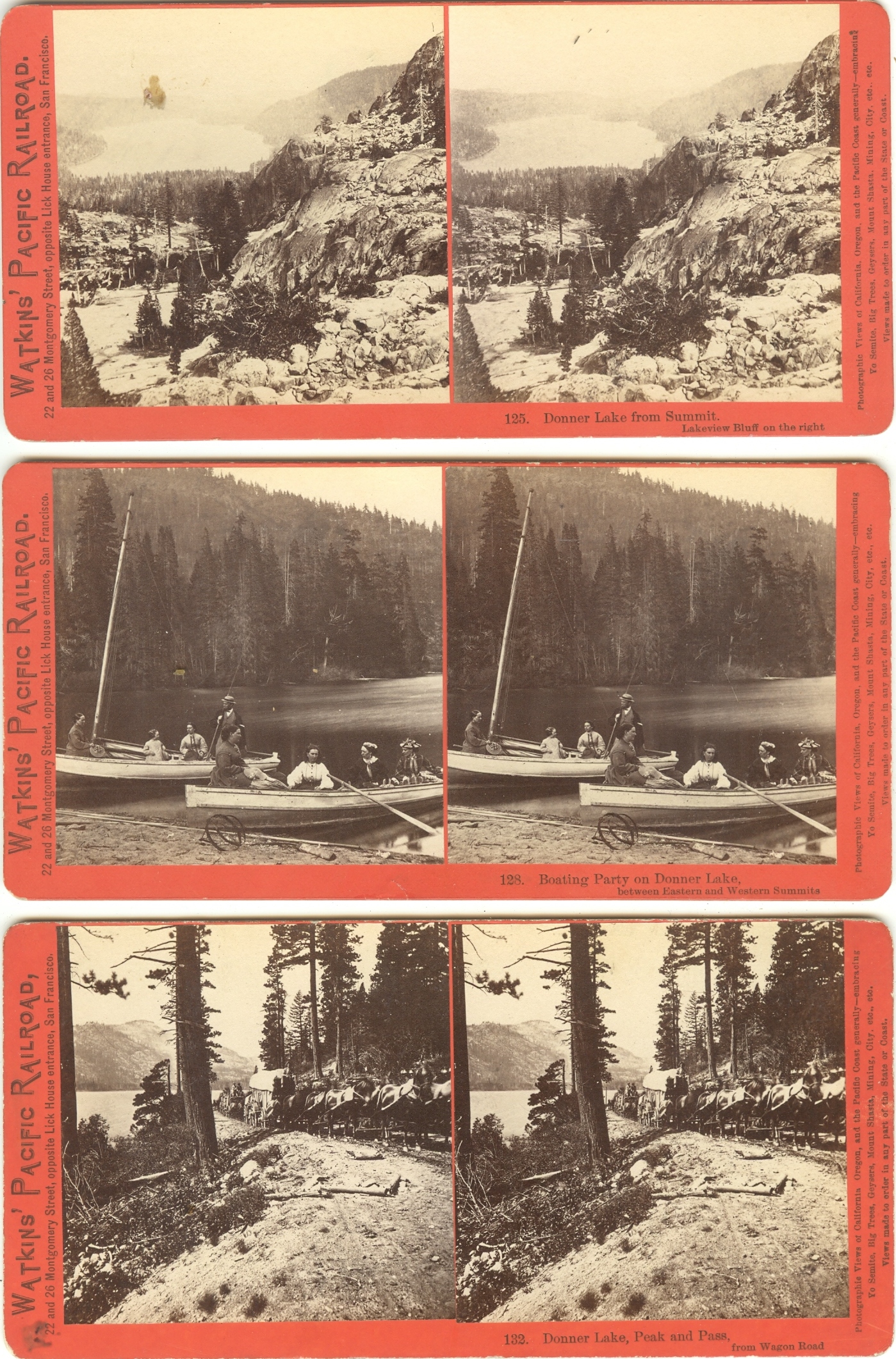


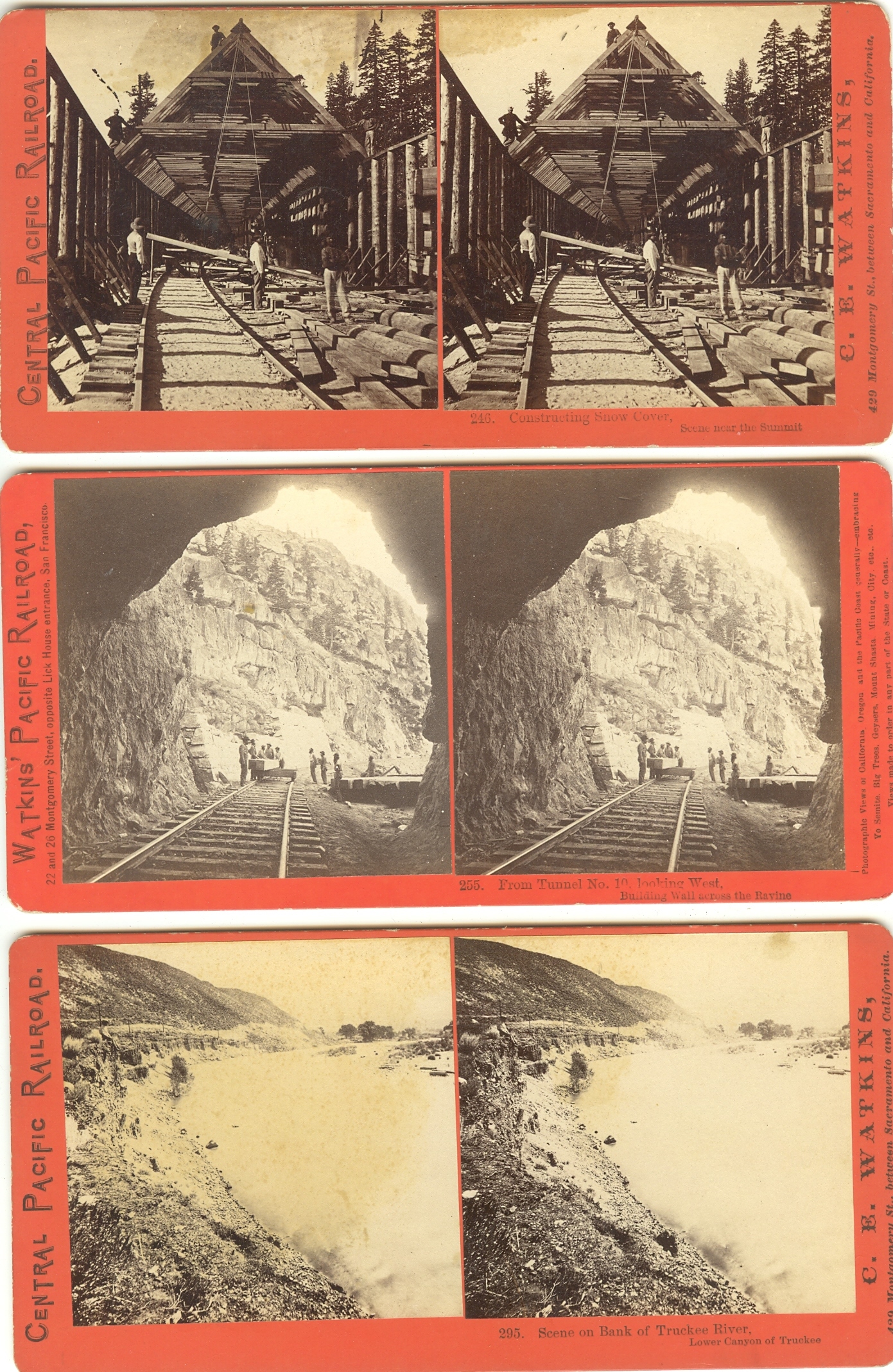















 vintagephotosjohnson