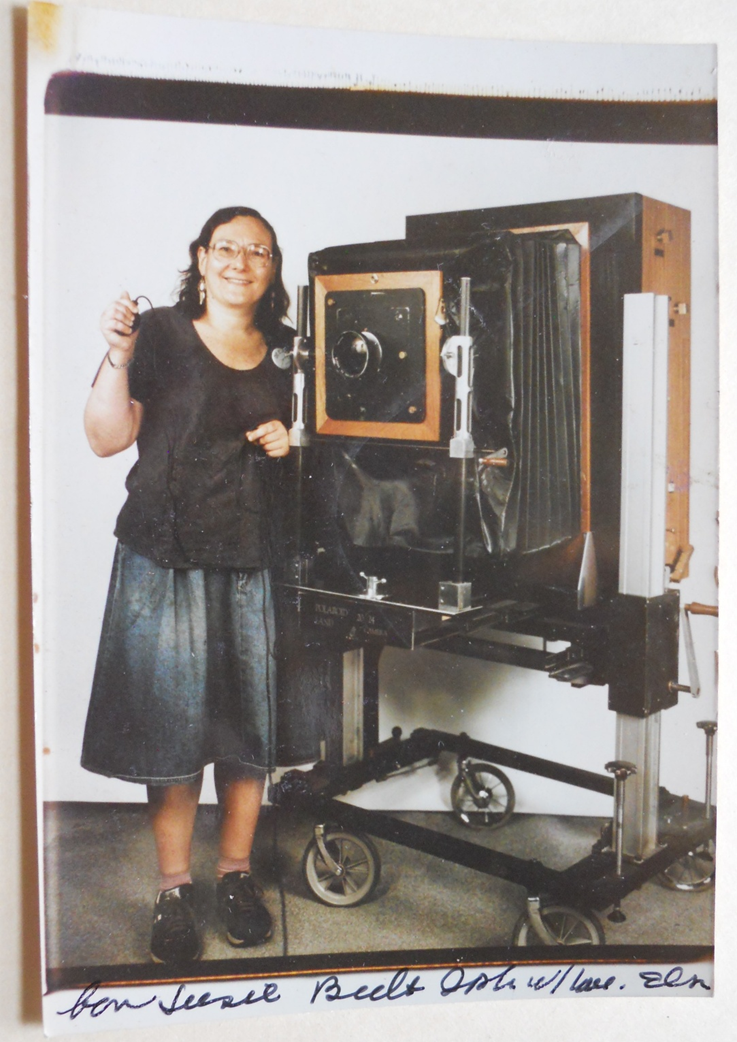
ELSA DORFMAN 1937 – 2020

      “Self Portrait with Camera,” copyright Elsa Dorfman. (Photographic post-card)

The first time I met Elsa Dorfman was in 1975, just before Christmas, in Harvard Square. Harvard Square is a slight misnomer. It is really more like a triangle where Mass. Ave. (a major thoroughfare) comes out of Boston across the river, then runs through Cambridge from east to west for a mile or so, then turns a corner at the oldest western part of the Harvard Yard and runs north to Porter Square in northern Cambridge, then turns northwest for several more miles through Somerville, Arlington and then on out of my awareness. Several smaller streets converge at that triangle point, which held a newspaper and magazine stand positioned on the closed subway entrance. Brattle St., and a street now called John F. Kennedy St. (It had a different name when I was there, I think it was called Mount Auburn Street.) met at the triangle point. The “Square” was actually a clutter of commercial businesses that clustered for a few blocks around the Mass. Ave turn. Several bus routes ended there. A bank with mysterious second floor offices held one corner. The Harvard Coop, where you bought books and Harvard memorabilia (scarfs and sweatshirts and chairs, if you wanted that kind of thing) dominated another corner, with plenty of other bookstores where you bought both new and used books back down Mass. Ave for several blocks, shops where you bought dishes and towels and stuff, hole-in-the-wall cafes where you bought some of the best sandwiches in the world, a larger, more formal German-American restaurant where you could get a full sit-down meal, other restaurants, an administration building for Harvard University (Bursar’s Office, Clinic, Harvard Press Office, etc.), even a movie theatre; all were clustered below Mass Ave. on the south to southwest; while the quieter, walled-off Harvard Yard held the north-north-east corner.

In those days Harvard Square was an active, bustling place.

Harvard Square, ca. 1975. Photos by William Johnson.

Students and teachers and tourists and commerce of all sorts during the day, and on the summer weekend nights – buskers, jugglers, with music from steel-drum bands or the hippy, guitar-playing, folk singers. And at Christmas time street vendors were allowed to sell hand-made crafts and food and other good things from temporary booths on the sidewalks in and around the Square.

One Christmas season I found a short, boxy, plainly dressed woman selling her photographs from a grocery-shopping cart on the sidewalk in front of the Harvard administration building. But this was not your typical craft-fair vendor, with the decorative photographs you would typically find in this sort of situation. As I looked more closely, I realized that these were serious black & white photographs, about 8” x 10”, carefully seen and photographed, carefully printed, and carefully mounted on board; and she was selling them for $2.00 or $5.00 each. She had to be taking a loss on the cost of the materials alone.
I loved it. In the academic circles I was embedded in at the time, where there was still a struggle to get photography recognized as legitimate by the “high-art” people, things could occasionally get pretentious around the notion of “Fine Art Photography” and I just loved it that this woman seriously liked to make
good photographs and she seriously wanted to make them easily available to anyone who liked them.

So I bought one.   

It came in a plastic bag with its own information card.

At that time, separated from my first wife, I was living very cheaply in a tattered one-room basement apartment just outside of Harvard Square. Elsa lived a few blocks away and occasionally we would run into each other on the street and chat. Once she invited me to lunch at her house to meet her husband, who I remember as a very quiet and somehow sweet little man who apparently was a very serious lawyer out in the real world. I learned that not only was Elsa a very good cook but that Robert Creely, the poet who had let her use his poem for her book, was a good friend and that Elsa was also friends with Jack Kerouac, Allen Ginsberg, Peter Orlovsky, and other artists of the “Beat” movement in New York in the ‘50s.

And, more interesting to me at the time, that she had worked for the avaunt-guard publisher Grove Press and had literally couriered Robert Frank’s photographs for the US version of The Americans back and forth between the publisher and the artist while it was being developed. In the early 1970s Robert Frank had not yet attained the exalted status he has today. He was still an apparently reclusive, slightly mysterious, figure who’s book had been roundly trashed by every established photographic critic when it first came out but which was stirring up increasing levels of interest and appreciation within the younger generation of photographers and critics. I was one that younger generation and I was beginning to fall under the spell of that book’s power.

Then in 1976 I moved to Rochester, New York to teach at Nathan Lyon’s Visual Studies Workshop and then on to the Center for Creative Photography at Tucson Arizona to work with W. Eugene Smith and, after his death, to organize his photographic collection. I also married again, to Susie Cohen. I had met Susie in Boston, but we dated in Rochester and married in Tucson. All this took several years and after various projects and events we wound up in Boston again in the mid ‘80s where we had come back to work on an experimental project and exhibition that I had somehow talked Eelco Wolf, a Vice-President at Polaroid to support. That project had run its course and Susie and I were engaged in several concurrent or overlapping projects to earn our daily bread. One of those projects was to take over the editorship of Views: The Journal of Photography in New England, published by the new Photographic Resource Center, then at Boston University. The journal was in editorial disarray at the time, and it took Susie and me a little while to build it back up to the point where it became what was described as “…one of the most important academic‑style journals in photography.” (The Photographer’s Source) which “…set the standard by which other photo center quarterlies should be judged.” (Afterimage).

One of the people who helped rebuild the journal was Elsa. She showed up one day and offered to write a “gossip column.” Which she did and did well – digging up and collating items of news and interest about the photographic community at large by calling people on the phone and chatting and finding out about their professional activities (Exhibitions, awards, etc.) and their personal lives (Marriages, births, etc.); which she presented with the same effortless grace and humor that she brought to her picture making. Some thought that sort of information was outside the scope of the journal. Susie and I thought it helped balance the academic rigor with some human feeling.

Elsa was also by this time making the 20 x 24 inch Polaroid portraits for which she was to become famous.
        “Dorfman had the only privately owned, 240-pound accordion-like box instant Polaroid Land camera.
   Polaroid made only about a half dozen of them. Dorfman couldn’t say why she would only work with this
   rare enormous camera with its fragile film and chemical pods that were hard to come by, especially after
   Polaroid went bankrupt twice in the 2000s and stopped selling instant film in 2009. She just knew that
   when she found the camera in 1980, she was smitten.
       There were five cameras built and then they were kind of underused, so [Elsa] really lobbied to get
   one her own,” Reuter said. “The irony is she leased the camera and she leased it for so long she could
   have bought three of them.”
ttps://www.wbur.org/news/2020/05/31/cambridge-photographer-elsa-dorfman-giant-polaroids-dies.

By the late 1980’s the Polaroid Corporation was in the process of closing down and it had divested itself from the various artist’s programs that it had supported a few years before. (Among them the “Creativity Project” that Susie and I had developed with the artists Robert Frank, Dave Heath, Robert Heinecken and John Wood, which, among other things, had used the 20 x 24 Polaroid camera at the studio located in the Art School at the Museum of Fine Arts in Boston. I think that most of the other cameras scattered around the world were no longer in use, or definitely no longer in continious use. But Elsa had somehow managed to talk some Polaroid executive or other into renting her the Boston 20 x 24 camera, which she then used commercially to make studio portraits – mostly of family groups. I don’t know for certain, but she may have been the only person in the world at that time regularly using a 20 x 24 inch camera and almost certainly the only one regularly usng the 20 x 24 format for commercial portraits.

We asked Elsa to make a 20 x 24 photo of Susie and our son Joshua in 1986. Elsa asked Susie to bring Joshua with some of his toys to the BMFA studio where the camera was still located – which, by accident, we were already familiar with. Elsie asked Susie and Josh to sit on the floor, quickly arranged the photograph and took the picture. The huge wooden camera with its bellows extension, its narrow range of possible operations, and its awkward but immediate processing of the image (You can search “Polaroid Project” or “Robert Frank” on this blog for more information about that 20 x 24 camera and its processes and proceedures.) gave to the session the flavor of a 19th century daguerrian portrait gallery. But Elsa’s charm and her fluid control over the system made the event an easy and pleasant experience.

       “Susie and Josh on the 20 x 24 on May 8, 1886.” 20” x 24” Polaroid print. Copyright Elsa Dorfman.

Then, when we left Boston in 1987 to return to Rochester for me to work at the George Eastman House, Elsa surprised us with a wonderful gift. By the 1980s Allen Ginsberg, once reviled, had become a celebrated iconic figure in American culture and his long, semi-secret involvement with photography had just begun to become publicly known. Susie and I met with him, possibly with the help of Elsie’s recommendation, to plan an article for Views, but then we moved to Rochester before we could complete that project.

As a parting gift Elsa gave us a 20 x 24 Polaroid portrait of Allen Ginsberg and Peter Orlovsky, signed by both poets. It was an exceptionally generous act, as well befitted her character and nature.

“Alan Ginsberg and Peter Orlovsky. March 28, 1985.” 20” by 24” Polaroid print. Copyright by Elsa Dorfman.

Elsa continued to send us postcards and little gifts over the years; although as I am a terrible correspondent, I was always tardy with any responses. But I always appreciated hearing from her.
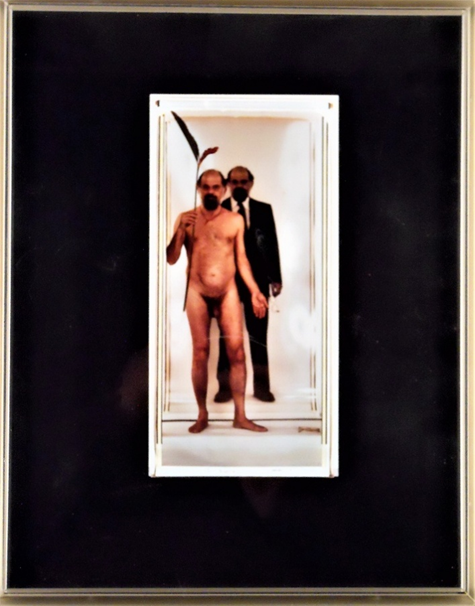
“Allen, November 6, 1986.” reduced copy of 40” x 80 Polaroid print, 1991. Copyright Elsa Dorfman.

I was saddened to learn that Elsa had died in 2020 – which I didn’t even know about until I started writing this note. Her intelligence and spirit will be missed. I also apologize for the quality of the reproductions presented here, the original photos are much better.



“Allen, November 6, 1986.” reduced copy of 40” x 80 Polaroid print, 1991. Copyright Elsa Dorfman.

I was saddened to learn that Elsa had died in 2020 – which I didn’t even know about until I started writing this note. Her intelligence and spirit will be missed. I also apologize for the quality of the reproductions presented here, the original photos are much better.


ÉDOUARD BALDUS (1813 – 1889)

View of Notre Dame Cathedral, Paris, by Edouard Baldus. ca. 1858. Stamped signature under print. “No. 20.” engraved into negative. 10 3/8″ x 8 3/8″

                                                            ÉDOUARD BALDUS (1813 – 1889)

Édouard Baldus was born in Grünebach, Prussia, the second of eight children. He studied to be a painter, was supposed to have exhibited for several years in Antwerp and may have even traveled around the United States in 1837 as an itinerant portrait painter. In 1838, Baldus moved to Paris to study painting. From 1841 through 1852 Baldus submitted work to the annual Salon of painting and sculpture and was just proficient enough to have his work displayed in 1842, 1847, 1848 and in 1850. In 1845 he sought French citizenship and married a Frenchwoman. At mid century, Paris was a major center for economic, social, political, intellectual and artistic activities in Europe. A centralized government and a large and wealthy urban population supported a tradition of public and private patronage in the arts, which permitted an active and creative group of artists, artisans, and photographers to flourish and expand the nature and qualities of their respective crafts.

Baldus seems to have learned to make photographs around 1848 or 1849, during the height of interest in the calotype in France, and by 1851 he had worked out his own variant of a paper negative process, which he published in 1852. His process was described as having “the clarity of glass” and possessing “a depth and vigor of tone,” both attributes serving him well when he began photographing for the Commission des Monuments Historiques in 1851, the first of his many government sponsored assignments. In 1851 Baldus joined forty other artists, scientists and photographers to form the Société héliographique, the first photographic association. Later that year the Commission des Monuments Historiques, a government agency, chose Baldus and four others to form the Mission héliographique in 1851, to document the architectural heritage of France region by region in photographs. 

Baldus photographed in the provinces of Burgandy, the Dauphiné, and Provence for the CMH, taking views from a list of assigned buildings, and making, on those occasions he felt it necessary, both composite views and panoramic views by piecing together several negatives. Baldus’ next major governmental commission was for the project “Villes de France photographiées,” in which, over the next four years, he photographed in Paris and throughout France, working in the Midi, the Auvergne and elsewhere. Baldus was also engaged in making photographic reproductions of paintings, engravings and sculptures during this time. Modern viewers tend to overlook this aspect of a photographer’s work, but it was a major commercial activity in the careers of Francis Bedford, Adolph Braun, Robert Macpherson, the Alinari brothers and others. 

In 1855 Baldus was commissioned by the Baron James de Rothschild to take views of the new railroads he was building throughout France. These views were included in a luxurious memorial gift album to Queen Victoria, “Visite de sa majesté la reine Victoria et de son altesse royale le Prince Albert 18-27 août 1855: Itinéraire et vues du Chemin de Fer du Nord.“.During 1855-1857 Baldus was commissioned to document the building of the new Louvre and the renovation of the Tuileries, which was the largest construction project of the Second Empire, in the heart of a Paris undergoing an immense urban renewal project under Baron Georges Eugène Haussmann’s direction to gut the medieval center of Paris and build the most modern city in the world. Baldus worked on this project for several years, ultimately making over twelve hundred photographs of every aspect of the construction of the Louvre.

At about this time Baldus shifted from his paper negative process to making negatives on glass, which allowed him to make even larger, finer detailed and more spectacular architectural views; which deeply impressed his contemporaries and gained him an even greater reputation as one of the best practitioners of the time. Thus Baldus was simultaneously photographing both monuments of the past and the latest, most modern engineering and architectural accomplishments of the age. This latter activity made him among the first of a new type of photographer, a documenter of the new, urban landscape and of the new technology of the modern industrialized world. The modern world was creating a new type of landscape, and that landscape fell under the camera’s avid gaze with increasing frequency. Baldus was certainly not alone in practicing this new type of industrial photography. There were many other colleagues in France, including Delamet & Durandelle, who made an extensive documentation of the construction of the Paris Opera, or Hippolyte Auguste Collard, who specialized in phoographing the new bridges for the railroads. Or, in England, Philip Henry Delamotte’s detailed recording of the building of the Crystal Palace and Robert Howlett’s views of building the giant ocean steamship, the Great Eastern. Or John Wood’s documentation of the construction of the U. S. Capitol building in Washington, D. C., in the 1850s or, a decade later, William Henry Jackson, Alfred H. Hart, Andrew J. Russell, James Ryder and others documenting of the railroads being built across America..

These new types of landscape demanded a new type of vision; a different, more modern character or feeling. The softer images of the picturesque landscapes of past monuments began to give way to photographs with harder edged compositions, sharper delineations of space, and harsher contrasts of tonalities within the print. This new look seems to have felt better and been more correct for the new age. By the end of the century, the hallmark of style for a professional photographer in portraiture as in landscape practice is a detailed, crisp, sharp, and decisive image. Baldus was exceptionally able at picturing both this modern new urban/industrial landscape in a manner that lent it a powerful and dignified presence while still depicting the older structures and rural landscapes with a picturesque charm and romantic elegance.

Baldus’ career had been extraordinarily successful in the 1850s, during a period of much innovation within the medium while it was experiencing a rapid expansion of the utility and value to the French society. Baldus had perfected a useful varient for printing photographs and was working diligently to figure out a practical photoengraving process and he was recongnized by his peers and the critics as being at the heart of that growth. When anyone discussed the avidly sought-for photoengraving breakthrough in both the professional and the general literature, Baldus was always among the three or four names automatically listed as important players. And when Baldus exhibited his work at the French Photographic Society’s annual exhibitions or at the important large international “World’s Fair” type exhibitions held every few years in England and in cities throughout Europe, he always garnered valuable praise from the critics and won the coveted medals and awards.
After the mid sixties however, Baldus’ career began to faulter. Support from the government or private commissions began to dry up. The large, elegant and costly type of photographs which Baldus had specialized in were being replaced by smaller, cheaper stereo views and cartes de visite and more manageable smaller prints that fit into the tourist’s albums or the picture collections at schools or museums. Even some critics turned away from him. M. Gaduin, the editor of La Lumiere had always been a staunch supporter. But while reviewing the Société Française de Photographie’s annual exhibition for 1861, distressed that Baldus had altered his negatives, Gaduin trashed Baldus’ photographs.
“…The success of Mr.Roman naturally led me to review the works of Mr. Baldus. The comparison was not to the advantage of the latter; everything seemed heavy and garish to me, and to my great surprise I saw skies furnished with clouds of encounter, which were never taken from nature: they are formed of dry lines rounded as best they could. Such a process, if it found its imitators, would be the deviance of photography! Mr. Baldus goes even much further: he sometimes thought of removing mountain ranges to produce a more artistic effect; he has even added to the beautiful middle of glaciers, trees at once grotesque and gigantic which are a monument of clumsiness. Without the condition imposed on exhibitors to present only untouched proofs, we would have seen these monstrosities where art claims to correct nature.”
La Lumière. Revue de la Photographie. (June 15, 1861, p. 41.)

From the 1860s to the early 1880s Baldus invested a great deal of his time, energy and money into perfecting a functional photogravure printing process to publish his work for a larger audience. He perfected a process after several years, but so had many others by then and his process did not gain any dominence in the field. He produced several volumes of works, but they were not financially successful. By 1887 Baldus had to sue for bankruptcy, having already turned most of his stock of prints and plates over to his son-in-law.

Baldus died in December 1889, in a suburb of Paris, at age seventy six. Neither the photographic or the national press recorded his death, his magnificent achievements of the 1850s and 1860s apparently forgotten even within the photographic community.


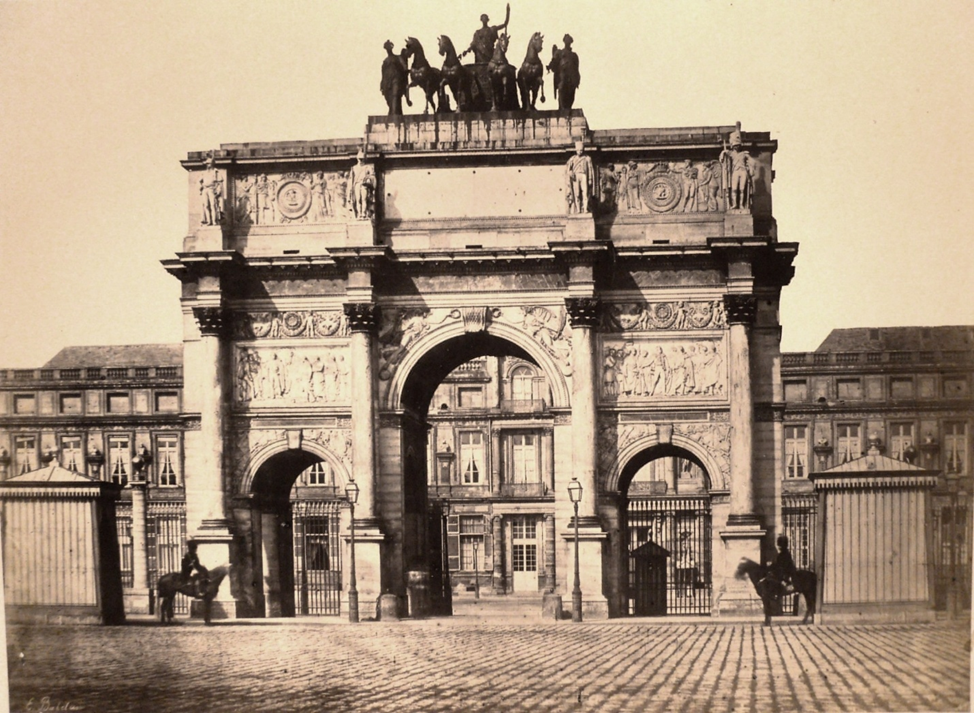
Arc du Carrousel, Paris, by Edouard Baldus. ca. 1853. Albumen print. 13 5/8 ” x 10″ Signature engraved in negative.

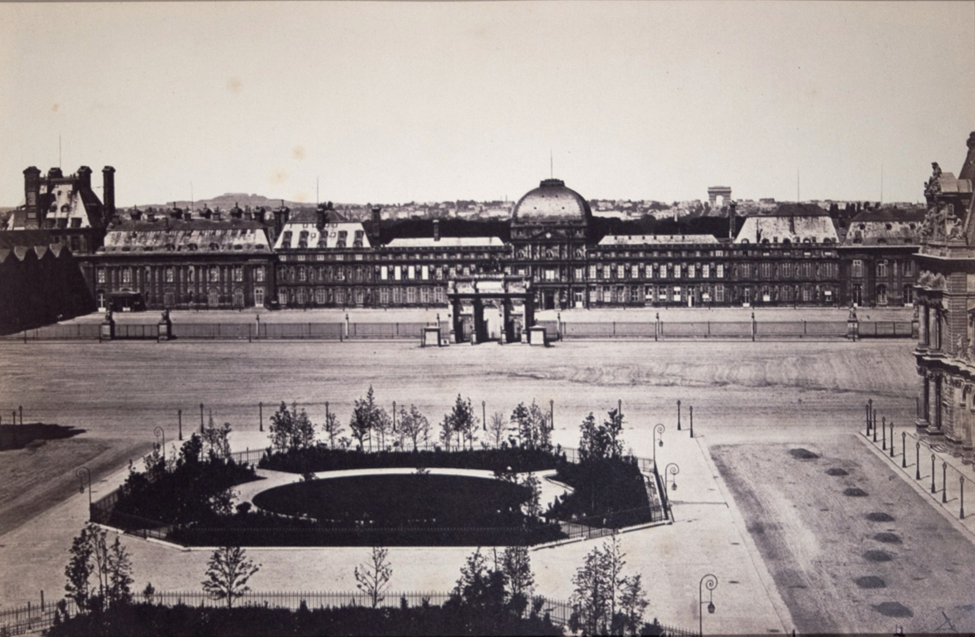
  The Tuilleries and Place du Carrousel, Paris, by Edouard Baldus. ca. 1855. Albumen print. 10 1/4″ x 13”

The Louvre under construction, Paris, by Edouard Baldus. ca. 1855. Albumen print. 9 7/8″ x 13 5/8

The Tuilleries from Pont Neuf, Paris, by Edouard Baldus. ca. 1855. Albumen print. 10″ x 13 ½”

                  Hotel de Ville, Paris, by Edouard Baldus. ca. 1860. Albumen print. 10 1/4″ x 13

            Place de la Concord, Paris, by Edouard Baldus. ca. 1855. Albumen print. 10″ x 13 1/2″ 

                 ÉDOUARD BALDUS BIBLIOGRAPHY

BOOKS

[Compiling an accurate bibliography of books published by a 19th century artist or studio can be tricky. Photographic albums can range from a coherent work with letterpress titles under each photograph, with printed forewords, title pages and the rest, often in elaborately decorated bound covers, published by the studio in multiple copies or as a special edition (Example: The album of railroad views put together for the Baron James de Rothschild as a luxurious memorial gift album to Queen Victoria during her visit to France in 1855, “Visite de sa majesté la reine Victoria et de son altesse royale le Prince Albert 18-27 août 1855: Itinéraire et vues du Chemin de Fer du Nord.”) to a single album containing a random assortment of prints selected by a tourist and bound by the studio or even later placed on the pages by the tourist themself. (Example:” “Paris.” [187-?] [Binder’s Title. 3 volumes of mounted photographs 44 x 61 cm., most photos signed E. Baldus.”)
For many years libraries did not have a coherent way to deal with visual materials and when these photograph albums came into public institutions they were often listed by the cataloguer in a wide variety of ways and so a confusing public record was established with the same works listed under different titles or other works incompletely described. (Example: WorldCat lists more than 250 books attributed to Baldus held in various institutions. When winnowed, many of them are found to be sllght varients of the twenty-odd albums listed in this bibliography.)
Nevertheless, many of these albums are extraordinary works of art and should be recorded. I have tried to limit this listing
to reasonably certain publications and I have often listed the institution where the work is held.
I have also limited the bibliography to works published in the 19th century. Baldus has also had a number of publications written about him in the latter part of the 20th and early 21st centurty. WSJ]


Desains, Charles Porphyre Alexandre. Fables, anecdotes et contes, par Charles Desains … Illustrés par Baldus, Brascassat … Chazal, Couder … Delorme [et al.] Paris, Lemoine [etc.] 1850. Added t.-p., engr. 5 p. l., [5]-280 p. front. (port.) plates. 27 cm.
[“La Staue de Lafontaine,” drawn by E. Baldus, engraved by C. Desains, is the frontispiece.]

Baldus, Édouard. Concours de Photographie. — Mémoire déposé au secrétariat de la Société d’encouragement por l’undustrie nationale; conenant les procèdes A l’aide desquels les principaux Monuments historiques du midi de la France ont ètè reproduits par ordre Du Ministre de l’Intèrieur, par Edouard Baldus (27 mai 1852). Paris: Victor Masson, 1852. 32 p. 22 cm.

Silvestre, Theophile. Histoire des artistes vivants, français et étrangers, peintres, sculpteurs, architectes, graveurs, photographes: Etudes d’après nature / Portrait des artistes et reproduction de leurs principaux ouvrages par la photographie. Corot, peintre. Paris: E. Blanchard ancienne maison Hetzel, 1853. 15 p. – [8] f. de pl.: Photogr. pos.; 48 cm: 52 b & w.
[Photos by Édouard Baldus, Bisson Freres, Émile Defonds Victor Laisné, Henri Le Secq.]

Galimard, Auguste. Vitraux de l’Église Sainte-Clotilde, composés et dessinés par A. Galimard et photographiés par E. Baldus. Paris: (22 rue Cassette): chez l’auteur: chez les principaux libraires religieux, 1854. [3] f.- [11] f. de pl.: photogr.; 32 cm.
[“In the foretitle: “Christian art. Monumental painting.” 11 photographs by Edouard Baldus, prints on salted paper; 10: env. 16 x 6,3 cm, 1 épr. en médaillon: d. 13,5 cm.]

Prime offerte aux abonnées du Journal des jeunes personnes: Album de photographies. Paris: Au bureau de l’administration du Journal des jeunes personnes, 1857, 1 vol. ([8] f.-[6] f. de pl.): 33 photogr. pos.; 36 cm.
[Catalogue entry: “Édouard Baldus, Photographer.”
Bibliothèque nationale de France, département Réserve des livres rares.]

Baldus, Édouard. Réunion des Tuileries au Louvre, 1852-1857: recueil de photographies.Paris: Imprimerie de Chardon ainé, [1857], 4 v., f de pl.: ill.; 9 x 59 cm.
[“Photographs by Edouard Baldus between 1855 and 1857, prints on salted paper or albumen paper from negatives on paper (small formats: details of the sculptures) or on collodion glass (large formats: facades); variable number of plates and photographs Binding in green chagrin by Despierres with the arms of Napoleon III.
Bibliothèque nationale de France, département Estampes et photographie.]

Baldus, Édouard. Chemin de fer du Nord. Ligne de Paris à Boulogne. Album de vues photographiques: [photographie] / [E. Baldus]; [Hippolyte-Auguste Collard]; [Furne fils et H. Tournier]1860. 1 album: 49 positive photographs, 1 ill. card of 24 small prints: mixed media; 40 x 52 cm (album) 63 b & w.
[Bibliothèque nationale de France, département Estampes et photographie.]

Baldus, Édouard. Chemin de fer de Paris à Lyon et à la Méditerranée. Paris: 1861-1863. 2 albums ([70] f. de pl., [69] f. de pl.) 80 b & w.
[Positive photographs on albumen paper: from negative on paper or glass47 x 64 cm (album)
Bibliothèque nationale de France.]

Baldus, Édouard. Chemin de fer du Nord. Ligne de Paris à Compiègne par Chantilly. Petites vues photographiques
Paris: 1865. 2 albums ([70] f. de pl., [69] f. de pl.): photogr. pos. sur papier albuminé: d’après négatif sur papier ou sur verre; 47 x 64 cm (album)
or
1 album: 78 positive photographs on albumen paper: from collodion negatives; 24 x 32 cm (album) Total number of views: 169.
[Bibliothèque nationale de France.]

Baldus, Edouard. Chemin de fer du Nord. Carte illustrée de Paris à Boulogne 1865. 1 Album: 1 fold-out map ill. of 72 small positive photographs; 42,5 x 27,5 cm.
[Bibliothèque nationale de France, département Estampes et photographie.]

Baldus, Edouard. OEuvre de Jacques Androuet dit Du Cerceau 20 cheminées Série Complête Héliogravure reproduit par les procédés de Ed. Baldus. Paris, Eug. Devienne, 1869; [6]-[6]p., [21]f. de planches en héliogravure, 45,4 x 31,2 cm.
[“…Furniture and fireplaces…” Heliogravure title page. 20 heliogravure plates. The first is titled and signed “Héliogre de E. Baldus.”
Municiple Archives Dax.]

Baldus, Edouard. Palais du Louvre et des Tuileries. Motifs de décoration tirés des constructions exécutées au nouveau Louvre et au Palais des Tuileries, sous la direction de M. H. Lefuel, architecte de l’Empereur, reproduits par l’héliogravure de M. E. Baldus. Paris, J. Baudry, E. Devienne, 1869; 200 planches in-fº Parait par livraisons a 30 fr. Et a 37 fr 50 l’une.
also listed as:
Baldus, Edouard. Palais du Louvre et des Tuileries: motifs de décoration intérieure et extérieure. 2, Décorations extérieures /reproduits par les procédés d’héliogravure de E. Baldus. Paris:Vve A. Morel, s.d. 1 vol. (100 pl.; ill. 47 cm.
[Municiple Archives St. Etienne.
also at
Bowdoin College listed as 2 vols, 180 plates.]

Baldus, Edouard. Les Monuments principaux de la France reproduits en héliogravure par E. Baldus. 1re livraison. Paris, Ve A. Morel, 1875; 20 planches in-fº. Prix: 80 fr.
[“On annonce 60 planches, publiées en 3 livraisons.”]
or
Baldus, Edouard. Les Monuments principaux de la France, reproduits en héliogravure, par E. Baldus. 1re et 2e livraisons. Paris, Ve A. Morel, 1878; 40 planches in-plano. Prix: 160 fr.
[“On annonce une troisième livraison de 20 planches.”]

Ballu, Théodore. Reconstruction de l’Hôtel de ville de Paris, par T. Ballu … et Deperthes … motifs de décoration extérieure; soixante planches en héliogravure par E. Baldus. Paris, Librairie centrale d’architecture, Des Fossez et cie, 1884. 2 parts; (folio)
or
Ballu, Théodore. Reconstruction de l’Hôtel de Ville de Paris par T. Ballu, membre de l’Institut, architecte en chef et Deperthes, architecte; motifs de décorations extérieurs :1884. 60 planches en héliogravure; 30 x 43 cm
[Bibliothèques spécialisées de la Ville de Paris.]

Androuet Du Cerceau, Jacques, Oeuvres de Jacques Androuet, dit du Cerceau 20 cheminées Série Complête Héliogravure par Edouard Baldus.: héliogravure par Edouard Baldus. Paris, rue d’Assas, 17. Ancien 25. n. d.
title page in heliogravure, 20 heliogravure plates, 34 cm
[…cups, vases, trophies, cartouches, finials, balustrades, ironwork…,
[Bibliothèque municipale de Lyon and Bibliothèque municipale de Dax.]

Baldus, Edouard. Recueil d’ornements d’après les maîtres les plus célèbres des XVe, XVIe, XVIIe et XVIIIe siècles reproduits par les procédés de l’héliogravure de Édouard Baldus. Paris: J. Baudry, 1869, 1 vol. (4 p.-98 pl.); 45 x 31 cm. 112 b & w.
[Engraved frontispiece followed by a presentation of the work and the notes of the engravers reproduced: Aldegrever, Béham, Boyvin, de Bry, Delaune, Androuet Du Cerceau, Dürer, Holbein, Lepautre, de Leiden, Marot, Schöngauer, Solis, Vico, Woeiriot. Content note: Plates 12 and 13 are the reverse copies and plate 14 the copy of engravings by Enea Vico, whose authors are unknown; Plates 15, 31 and 32 were engraved by Wenceslaus Hollar.
[Many other copies dated 1866. WSJ]

Lefuel, Hector Martin. Palais du Louvre et des Tuileries: motifs de décorations tirés des constructions exécutées au Nouveau Louvre et au Palais des Tuileries. Baldus, Edouard, photographer. Paris: publisher not identified,1870-75, 3 vols.: photographs; 44 cm (folio)]

Bazilevskiĭ, A. P. Collection Basilewsky: catalogue raisonné: précédé d’un essai sur les arts industriels du Ier au XVIe siècle. Paris: Vve A. Morel et cie, 1874. iv, 122, 200 pages, 8 unnumbered pages, 50 leaves of plates: illustrations (some color); 38 cm.
[“Imprimé par D. Jouaust pour La Librairie Vve A. Morel et Cie a Paris et achevé le XV juin M DCCC LXXIV.”
Includes heliographs by E. Baldus; and lithographic work by G. Sanier, Dupuis, Bauer, Daumont, Massot, Régamey, Levie, Lefèvre; graphic work executed by Lefèvre and Schmidt; and chromographic printing by Lemercier.
The collection is now in the Hermitage Museum, Saint Petersburg
Collection “bought by Czar Alexander III in 1885.” Clark Library has number 30 of 110 copies.]

Baldus, Edouard . Palais de Versailles: motifs de décorations. Paris: publisher not identified, 1891.
100 plates: photographs; 44 cm (folio)


PERIODICALS

ORGANIZED BY JOURNAL TITLE, THEN IN CHRONOLOGICAL ORDER.

[Some confusions: There are at least two instances where different journals had the same title.
In the first case the early American journal named the Photographic Art Journal, then renamed the Photographic and Fine Art Journal was published in the 1850s, bu then ceased. Then another magazine published in London in the 1870s was also named the Photographic Art Journal.
The second instance is even more confusing.
The first photographic society established in Britian called itself The Photographic Society and named its journal the Photographic Journal. In March 1858 George Shadbolt, editor of the second British society’s Liverpool & Manchester Photographic Journal, moved to London with his publisher and renamed his journal the Photographic Journal. He did this deliberately, apparently to challenge the Photographic Society’s exclusive right to that title. So there was a period when both journals were being published simultaneously with the same title. Finally the Photographic Society began to call themselves the Photographic Society of London, and later still, the Royal Photographic Society. Shadbolt’s publication was renamed the British Journal of Photography in 1858. Shadbolt edited the BJP until June 1864. Both the Photographic Journal and the British Journal of Photography continued into the 21th century.

It is my belief that if you take the time to reorder these references into strict chronological order that it will provide you with a more precise window into the workings of the artist and possibly the period than is otherwise readily available.
It is my also belief that the most accurate access to the larger dimensions of photographic practice during the 19th century is through the exhibition catalogs and reviews, which is why I tend to record almost all of the information in this type of reference, even if it seems excessive and redundant.

The French language references are far from completely surveyed. I apologize for my rudimentary French, which means that I am less able to catch errors. WSJ.


AMERICAN JOURNAL OF PHARMACY

BALDUS.
“Process for Heliographic Engraving.” AMERICAN JOURNAL OF PHARMACY 3rd. s. 2:4 (Nov. 1854): 549-550. [“M. Baldus takes simply a plate of copper, and spreads upon it a sensitive coating of bitumen of Judea. Upon this plate, thus covered, he lays a photograph on paper of the object to be engraved. This photograph is positive, and must therefore impress a negative on the metal by the action of the light. After about a quarter of an hour’s exposure to the sun, the image is produced upon the resinous coating, but is not visible, and it is made to appear by washing the plate with a solvent, which removes the parts not affected by the light, and allows the picture to be seen represented by the resinous lines of the bitumen…” From Cosmos.”]

AMERICAN RAILWAY TIMES

[BALDUS]
“Railways in France.” AMERICAN RAILWAY TIMES 5:39 (Sep 29, 1853): 2. [“A late account from Paris states that a number of branch Railways have just been undertaken in France. The capitals of all the departments are to be thus united with each other and with Paris. Central governments and provincial administration will be more easy and secure. A company of English, French, and Spanish capitalists, to whom the government of Spain has granted the Seville and Cordova Railway have lately advertised it…. The Parisian correspondent of the New York Times gives the following sketch of Louis Napoleon’s and Mrs. Napoleon’s trip on the cars to Dieppe…. “The train consisted of a new and powerful engine,… the imperial car comprising a saloon and two with drawing rooms, and of five large carriages for the ladies of honor and their suite; besides a car for the managers of the road and sundry counselors,… The saloon of the Imperial car contained several gilt tables, upon which were of views along the railroad to Dieppe, a quantity of daguerreotypes of chateaux in the eighteenth century, a picture of Paris in1760, and the Tuilleries under Francis I. These were intended to divert and distract the Empress during the ride. Six ministers accompanied their Majesties from the palace to the train…”]

ANNUAL OF SCIENTIFIC DISCOVERY, OR YEAR-BOOK OF FACTS IN SCIENCE AND ART FOR 1855

BALDUS, EDOUARD.
“Heliographic Engraving.” ANNUAL OF SCIENTIFIC DISCOVERY, OR YEAR-BOOK OF FACTS IN SCIENCE AND ART FOR 1855 (1855): 204. [“The following process, invented by M. Baldees, [sic Baldus?] appears to bring to perfection the mode of engraving by the sun. The results obtained are very beautiful; and although the author has not described to us fully all the details, we know enough to give a general idea of his method. On a plate of copper covered with petroleum, a photographic proof on paper of the object to be engraved is placed. This proof is a positive, and will necessarily make a negative on the metal by the action of the light. After an exposure of a quarter of an hour to the sun, the image is reproduced on the resinous coating, but it is not yet visible. It is made to appear by washing the plate with a solvent, which removes the parts not impressed by the light, and brings out a negative picture made by the resinous tracings of the bitumen. The designs are very delicate. The tracings receive solidity by an exposure during ten days to the action of a diffused light. When thus hardened, the plate of metal is plunged into a bath of sulphate of copper, and is then connected with the pole of the battery. If with the negative pole, a layer of copper in relief is deposited on the parts of the metal not protected by the resinous coating. If with the positive pole, the metal is graved out in the same parts, and thus an etched engraving is obtained.—Paris Correspondence Silliman’s Journal. “]

ART JOURNAL

HUNT, ROBERT. (1807-1887) (GREAT BRITAIN)
Hunt, Robert. “The Useful Application of Abstract Science: Photography.” ART JOURNAL 5:1 (Jan. 1853): 13-14. [“From the first, we were amongst those who saw that the time must arrive when the art of photography would become one of extreme usefulness, and afford a new proof, if any indeed were required, of the advantages of pursuing abstract enquiries in science. We have lately heard it declared, that the demand must regulate the supply in all things; and that, therefore, if abstract science was required, there would be a greater demand for it than now exists and hence the conclusion,-the demand is small, the necessity for abstract investigation is not evident. Nothing can be more dangerous to progress than such a doctrine; it strikes away all the staves from the ladder by which ascent is to be made, and leaves poor humanity toiling at that level, the possession of which·has already been achieved, but above which it can scarcely dare to look. There is not one of the achievements, which so peculiarly the present age, and distinguishes it from every other period in man’s history, which is not derived from purely abstract investigations; and the blundering failures, which are constantly presenting themselves, are readily traceable to that ignorance of abstract science which too generally prevails. We drain our mines-we drive our carriages, and propel our ships–we weld our chains, and weave our cables–we move the most ponderous masses, and manufacture the most delicate tissues–by the agency of steam. We compel it to perform labours, which equal even the fabled labours of the Titans, and dwarf into child’s-play those colossal tasks upon which the Pharaohs wasted myriads of human lives. Before the purely abstract enquiries of Black and Priestly–and the beautiful, though simple, experiments of Watt, in 1781, to determine the latent heat of steam under different pressure, nothing could be more rude than the attempts made to employ steam as a mechanical power, or, as Savery called it, to take advantage “of the propulsive force of fire.” By these very abstract enquiries, the law was discovered, and we have reduced “the spirit to do us service.” Electricity still more evidently may be quoted in evidence of the truth of our position. From the time that Oersted discovered not by accident, but by exact reasoning, founded on the most careful theoretical deductions that a copper wire, carrying an electric current, attracted iron filings; every stage of progress up to the present moment in the introduction of the electric telegraph and its uniform improvement, until now it spans alike the earth and the ocean is a comment on the text of the present paper. The electrotype also, in all its modifications, would never have existed had not Daniel Faraday, and others, sought to discover the laws of electro-chemical decomposition in relation to the powers of the voltaic battery The electric light has not been hitherto successfully applied; and electricity, as a motive power, appears to baffle the ingenuity of all who have yet directed attention to this power; and all evidence at present goes to prove that, with our existing knowledge, It is not possible to substitute electricity for steam at less than nearly one hundred times the cost. I both these examples, our ingenious mechanics have begun at the wrong end; and have gone on endeavouring to apply a power, not being acquainted with the laws by which it is regulated. They are like the Evocator, who raised by his incantations a mighty spirit, forgetting to make himself previously acquainted with the spell by which he could control the monster. No truth, no glimpse of a truth, however shadowy it may appear, is ever revealed to man without its commercial value. It is degrading to the philosopher to be compelled to prove that his philosophy has a real price in the money market, but in these days of practical science, it is nevertheless necessary. It is not a new thing to ridicule the minute investigations of the experimentalist, and those very instruments which we now commonly employ in navigation and surveying were at one time the subjects of the unsparing jests of clever though superficial satirists. To these we shall however no further refer, and with one more striking example of the applications of a discovery, in the highest degree abstract, we shall for the present conclude this section of our subject, and examine the advances of photography in usefulness. A young French engineer, who had been educated into a love for abstract science, was examining through a piece of tourmaline, the golden splendours of the setting sun reflected from one of the windows of the Tuileries, which was open at a particular angle. He held the crystal in his hand, and the stream of golden light passed through it to his eye, he turned the crystal through a quarter of the circle, and although he saw the window as distinctly as before, it reflected no light, or rather none of the light reflected could pass through the transparent body which he held in his hand. He turned it through another quadrant, and the light passed as before, and through another and the crystal became again opaque. Thus in moving this transparent body, through a circle (and there are many other similar substances now known), it was found there were two positions in which the light passed with perfect freedom, in which it was fully transparent, and two others in which the rays could not pass, or in which it was opaque. The phenomena in this case were curious, but who could see that they would have any useful application. The researches of Malus, of Arago, of Biot, of Herschel, and of Brewster, make us acquainted with the laws regulating this, so-called, polarisation of light;-And what is the result? The polariscope is now employed in every sugar refinery. It tells the refiner the state in which his syrup is, which by no other known means could he detect. On the continent it is used in the examination of the beet-root and parsnip to determine the period when they contain the largest quantity of saccharine matter. The polariscope enables the chemist to detect adulterations which would defy every other means of analysis, and it aids the medical man in making an exact diagnosis of many peculiar forms of disease. Beyond this, by polarised light the navigator is enabled to determine the depth of the ocean over reefs upon which he dared not previously venture without careful sounding; and it enables the astronomer to tell us whether the light of the sun is derived from vapour in the state of flame, or from a solid surface in the condition of incandescence. Photography is another striking example of the value of abstract science, and shows in a remarkable manner the necessity of abstract investigations of the highest class to ensure its advance. It was observed by the alchemists that chloride of silver blackened in the sunshine. Scheele eventually discovered that only one section of the solar rays produced this blackening, and Berard still more recently observed that the yellow and red rays concentrated by a lens would not produce in twenty minutes that degree of darkness which could be obtained by exposing this salt of silver for two minutes to the blue rays. Upon these facts are founded all the effects which we obtain in the process of copying external nature, by exposing prepared tablets to the lenticular image formed in the camera obscura, and the want of knowledge, as to the laws regulating the reflection, refraction, and absorption of these chemical radiations is still evident in the defects of photography. In examining any of the finest examples of the art, the views in Egypt and Syria, to which we referred in our last-the choicest specimens obtained by Mr. Talbot, or any photographists on the calotype or on waxed paper-or those which are obtained by the employment of albumen and collodion on glass, we shall find that the higher lights and the lowest shadows are not equally consistent as in nature. Still more glaringly does this become apparent when coloured objects are the subjects chosen by the photographic artist. Those colours which represent lights in the artist’s chromatic scale, yellows, reds, and their compounds, fail to effect a chemical change, and hence on the resulting impressions they appear as shadows, whilst the bright blues and darker indigos are photographically impressed as whites on the sensitive surface. This sometimes produces very awkward results, particularly in the application of photography to portraiture, and where the dresses of the sitters have not been judiciously selected. Artists have written on the defects of the photographic picture without knowing the sources from which they spring, and many photographic artists contentedly toil onward with the processes with which we are at present acquainted, satisfied with that exquisite correctness of detail which is always obtained, believing that an equalisation of lights and shadows is not practicable and that to hope to obtain an equality of action from a yellow and from a blue surface is an absurdity. A careful examination of the subject will however prove that by careful inquiry we may even hope to attain to this point. In the first place, let us examine what have been the recent results from the empirical mode of experimenting adopted. M. Adolphe Martin, in addition to his modified method of producing positives by the cyanuret of silver on the collodion plate, as mentioned in our last Journal, has published a small pamphlet of instructions, which is reviewed in the Cosmos, (a Parisian publication, which devotes a considerable portion of its pages to photography) and in that we find many remarks on the physical conditions of the film of collodion and the iodide of silver, which are worthy of attention. In the same periodical, M. Baldus communicates his method of proceeding upon paper, and has judiciously adopted different orders of combination in preparing his paper for different purposes. Although every stage of the processes of M. Baldus is marked by that care which is necessary to ensure success, there is not sufficient novelty to allow of our giving up all the space required to his manipulatory details. The success of M. Baldus is great; we have seen some of his views of Paris, and they display much scientific knowledge of the difficulties of the art. The editor of the Cosmos informs us that the Minister of the Interior has employed M. Baldus to reproduce the principal monuments of Paris; and adds, partly in suggestion, and partly in hope, that the mission will only be fully accomplished by his being directed to obtain double proofs for the stereoscope. In addition to many other matters which belong to the minor, but not the less important details, we find accounts of two or three methods of securing that uniformity of tint upon all photographic pictures, which is desirable, but which is wanting in the English examples. In the very extensive series of photographs publishing by Gide and Baudry of Paris, the uniformity of colour is remarkable. This is effected by M. Blanquart Everard, as we understand, by a neutral chloride of gold. His mode of manipulating has not been published, but if, after the picture has been fixed with the hyposulphite of soda, it is placed in a bath of a weak solution of the chloride of gold, rendered neutral by a few drops of lime water, this very fine tone, a dark purple, which may be mistaken for a black, is produced. A second method is to dissolve as much chloride of silver in a saturated solution of the hyposulphite of soda as it will take up, and then add to it an equal quantity of a saturated solution of the hyposulphite of soda, and employ this as a bath for fixing. The photograph being placed in a flat dish, the fixing solution is poured on it, and allowed to rest for some time; the solution is then returned to its bottle, and the photograph washed and dried. This solution, though it becomes black, may be constantly employed; only from time to time, as the hyposulphite becomes saturated with the silver salt derived from the photograph, some more of that salt must be added to the solution. Pictures prepared with this have a very fine dark sepia tone, which strongly reminds one of the finest Italian engravings of the last century. The hyposulphite of gold may be, and is by some, employed in a similar manner to the above, producing a tint similar to that obtained by M. Everard. Mr. Willis, of Exeter, has employed, after fixing with hyposulphite of soda, a solution of chloride of tin, as neutral as possible, in producing some very fine effects. Amongst the more important investigations since those of M. Edmond Becquerel, who appears to have abandoned the inquiry notwithstanding the success of his investigations, are certainly those of M. Niépce de St. Victor. In a former Journal the details as far as they were then published of the process by which he obtained his photochromes, as he terms his coloured photographs, were given. Proceeding upon the same tract M. Niépce has advanced towards obtaining pictures from nature, in colours, by the camera: examples of these have been sent to this country, and exhibited before the Academy of Sciences of Paris, the only difficulty appearing now to be that of fixing the photochromic images obtained. M. Niépce de St. Victor is still zealously engaged on the inquiry, and is sanguine of success. M. Niépce states that the production of all the colours is practicable, and he is actively engaged in endeavouring to arrive at a convenient method of preparing the plates. “I have begun,” he says, “by reproducing in the camera obscura coloured engravings, then artificial and natural flowers, and lastly, dead nature, a doll dressed in stuffs of different colours, and always trimmed with gold and silver lace. I have obtained all the colours: and, what is still more extraordinary and more curious is, that the gold and silver are depicted with their metallic lustre, and that rock-crystal, alabaster, and porcelain, are represented with the lustre which is natural to them. In producing the images of precious stones and of glass I observe a curious peculiarity. I have placed before the lens a deep green gem-an emerald-which has given a yellow image instead of a green one; whilst a clear green flint glass placed by the side of the other is perfectly re-produced in colour.” The greatest difficulty is that of obtaining many colours at the same time on the same plate; it is however possible, and M. Niépce states that he has frequently obtained this result. He has observed, that bright colours are produced much more vividly and much quicker than dark ones, that is to say, the nearer the colours approach to white the more rapidly are they produced, and the more closely they approach to black the greater is the difficulty of reproducing them. Of all others the most difficult to be obtained is the deep green of leaves; the light green leaves are, however, reproduced very easily. After sundry other remarks, of no particular moment, M. Niépce de Saint-Victor informs us, that the colours are rendered very much more vivid by the action of ammonia, and at the same time the volatile alkali appears to fix them with a certain degree of permanence. These results bring nearer than hitherto the desideratum of producing photographs in their natural colours. The results are produced upon plates of silver which have been acted upon by chloride of copper, chloride of barium, or some combination of muriatic acid with a metallic or alkaline base. The manipulatory details have not been published in full, but we understand they are very easy and that they are only reserved by the discoverer until he shall have completed his investigations. M. Nièpce, who appears to possess that enquiring mind which particularly distinguished his uncle, M. Niépce of Chalons, has observed those very remarkable differences which obtain in the radiations of the morning and the evening, and of the northern and the southern sky. These have been previously noticed by Daguerre, by Claudet, and myself, but the confirmation of M. Niépce is more satisfactory, and promise to lead to some important additions to our knowledge. We learn that Mr. Talbot has discovered a preparation which is more sensitive to artificial light than to daylight, thus advancing towards that point which we desire to attain, the equalisation in action of the most luminous and the most chemically active rays. I have already pointed out that collodion is affected with much rapidity by rays which pass through yellow glasses, and I have curious indications of other preparations which are readily changed by yellow light. There is now every prospect of the formation of a Photographic Society in London. We are to have a Photographic Exhibition this month, at the Society of Arts. These are strong indications of the increasing acknowledgment of the value of this art. The society contemplates the high improvement of photography, and its use as an auxiliary aid to Art. With all love for the art of photography, I cannot but fear the practice of it by artists may lead to a mechanical mode of treatment, which is destructive to all those efforts which should be the results of mental power. A figure drawn by rule and compass may be the more correct one; but it wants the vital force of that figure, which is the result of the mind guiding the educated hand; thus, photography is far more. truthfull than any other process can by possibility be. In the last Exhibition of the Royal Academy, pictures, and bits of pictures, could be detected, in which the aid of the calotype was apparent. It is with this, as with the cry of the present moment for practical science, in opposition to abstract science: let us not sacrifice mental power in either case to merely mechanical skill-indeed they cannot long be disunited without the result becoming apparent. In Art, we should discover a rapid degeneration towards the pentagraph style of drawing; and in Science to that sluggish state which would distinctly mark a great moral exhaustion. Abstract science, in its highest meaning, must be cultivated to ensure useful practical results; and if we would advance photography to its most exalted point, we must study the philosophy of those variations which produce chemical change, and the relation which they bear to all the different substances which we can employ as our photographic tablets. Robert Hunt.”]

EXHIBITIONS. 1854. LONDON. PHOTOGRAPHIC SOCIETY.
“The Exhibition of the Photographic Society.” ART JOURNAL 6:2 (Feb. 1854): 48-50. [(First exhibition of the Photographic Society, with 1500 photographs on display.) “At the rooms of the Society of British Artists in Suffolk Street, there was opened on Tuesday the 3rd of January, a novel exhibition. In many respects it was worthy of especial note; it was a fine example of the value of every abstract discovery in science: it was singular, as it exhibited remarkable progress, made in an art by non-scientific men, every stage of which involved the most refined physical and chemical principles. It was of great interest, as showing the value of photography to the artist, to the traveller, the historian, the antiquarian, and the naturalist: to all, indeed, the exhibition appears to display points of the utmost importance. We purpose, therefore, to devote an article to the consideration of this, the first exhibition of the Photographic Society. It is pleasing to commence our task by recording the interest taken by our Most Gracious Queen in the progress of everything which has any tendency to exalt the character of the people over whom she reigns. Upon the formation of the Photographic Society, her Majesty and Prince Albert became its patrons; and on the morning previously to the opening of the Exhibition, these illustrious personages paid a visit to the Gallery, and spent a considerable time in examining the numerous specimens exhibited. The Queen and Prince were received by Sir Charles Eastlake, President; Professor Wheatstone, Vice-President; Mr. Roger Fenton, the Honorary Secretary; and Mr. Fry, Mr, Berger, Mr. Rosling, Dr. Diamond, and Professor Robert Hunt, members of council, with Mr. Henfrey, the editor of the Journal, and Mr. Williams, the Assistant-Secretary. Both her Majesty and the Prince have for a long period taken the utmost interest in the Art; and their expressions of delight at the productions now brought together, cannot but have the most important influence on the yet greater advance of photography. Nearly 1,500 pictures, illustrating, with a few unimportant exceptions, every variety of the photographic Art, are now exhibited. It is, of course, impossible, and if practicable, it would be useless to examine so many productions in detail. To the inexperienced, it may also appear that, since every picture is drawn by the same agent— the sunbeam, in the same instrument—the camera obscura, they must have the same general character, and therefore admit not of any critical remarks as to their artistic value. Such is not, however, the case. The productions of the painter are not more varied than those of the photographer; and it is a curious and interesting study to examine the subjects selected for photographic view, and to trace in these, as we would in an artist’s picture, the peculiar bent of the mind. To select a few examples: —Sir William Newton delights in the picturesque features of the Burnham beeches, and studies to produce a general harmony and breadth of effect, rather than to secure the minute details in which many of his photographic brethren delight. The Count de Montizon is a student of natural history; and in some fifty pictures which he exhibits, we have examples of the zoological collection in the Regent’s Park. These are curious evidences of the sensibility of the collodion process which the count employs: lions, tigers, bears, birds, and fish are caught, as it were, in their most familiar moods, and are here represented with a truthfulness which but few artists could approach with the pencil. The Viscount Vigier delights in nature’s grander moods,—the mountain gorge, the foaming torrents, the beetling rocks, and the everlasting snows, are the subjects which he labours to secure upon his photographic tablets. The views in the Pyrenees, now exhibited, prove how completely he has succeeded in securing the bold features of alpine scenery, with all its depths of shadow and its savage grandeur. Nothing more successful than these photographs of the Viscount Vigier have yet been produced. Mr. Turner leads us amidst the ruins of the English abbeys; he delights in ivy-clad walls, broken arches, or mouldering columns; his pictures are purely, essentially English; when he leaves the ruined fanes hallowed by ancient memories, he wanders into the quiet nooks of our island, and with a poet’s eye selects such scenes as “wavering woods, and villages, and streams.” Mr. Delamotte displays a natural feeling somewhat akin to this; his quiet pictures of the “Old Well,” “Alnwick Castle,” “Brinkburn Priory,” and the ” River Coquet,” show him to be one of those
“who lonely loves To seek the distant hills, and there converse With Nature.”
Exquisitely curious as are the details in the views of the Crystal Palace at Sydenham, and in Mr. Delamotte’s copies of Irish Antiquities, they bear no comparison as pictures with those little scraps from nature which he exhibits. Mr. Hugh Owen, with the eye of an artist, selects bits out of the tangled forest, the “Path of the Torrent,” or the depths of the glen, which must prove treasures to a landscape-painter. Mr. Rosling is amongst Photographers what Crabbe was amongst poets, one who delights, in all the minute details of the most homely scenes, who, if he ventures far from home, seeks
“villages embosom’d soft in trees. And spiry towns by surging columns mark’d Of household smoke.’
The delight in details is shown by the really wonderful microscopic reproductions of the Illustrated London News which this gentleman exhibits. It has been, from time to time, said that in all Photographic productions the veil of air through which all nature is seen, is wanting. In most of them this is the case, but there are two striking exceptions in this collection; a view of St. Paul’s by Mr. Rosling, and “The Garden Terrace,” by Mr. Roger Fenton. In these little pictures the gradation of tone is as perfect as in any sun pictures which we have seen, and the gradual fading off of the outlines of the objects as they are respectively more and more distant from the eye, yet still retaining their distinctness, is beautifully artistic and at the same time natural. The productions of Mr. Fenton are more varied than those of any other exhibitor. His pictures of the works at the suspension bridge at Kief, now in the process of construction by Mr. Vignolles, for the Emperor of Russia, mark the stages of progress, and thus the camera of the photographer is made to act the part of a clerk of works and record the mechanical achievements of every day. This is by no means an unimportant application of Photography; the engineer or the architect can receive from day to day, the most accurate information respecting works which he may have in the process of construction hundreds of miles apart, and thus be saved the labour of constant personal inspection. Mr. Fenton’s Russian tour has enabled him to enrich his portfolio with numerous views of the monasteries, churches, &c, of the Russian capitals. Many of these are exhibited, and then he gives us homely views, selected with an artist’s eye, and manipulated with great skill, together with portraits of considerable merit. Although some of Mr. Fenton’s productions are obtained by the collodion process, the greater number are the result of wax paper, in which process this gentleman, the secretary of the society, is one of the most successful operators in this country. Messrs. Ross and Thomson continue to familiarise us with Scotch scenery. There is
“the copse-wood gray That waved and wept on Loch Acliray, And ruiugled with the pine-trees blue Ou the bold cliffs of Ben-venue.”
We have on former occasions had to commend the productions of these artists, and the fine character of the specimens on the walls of the gallery in Suffolk Street causes us to regret that there are not a larger number of such scenes, as their Loch Acliray, and Loch Katrine, so nearly realising Sir W. Scott’s description of those lakes and their enclosing
“mountains, which like giants stand, To sentinel enchanted land.”
We might in this manner gather into groups the especial subjects now exhibited, each group bearing the well-marked impress of the mind of the photograper. The art is purely mechanical, and the results are obtained by means of a philosophical instrument, which has no power to alter its conditions. That which external nature presents the camera-obscura represents, therefore the varied character to which we allude is dependent, mainly, on the selection made. We say mainly dependent, because the photographic manipulator has it in his power, in the process of printing his pictures, to secure certain effects, which add more or less of the pictorial character to the result. A few years since, and a period of twenty minutes was required to obtain upon the most sensitive tablet then known a view of a building. How greatly does the sensibility of our preparations now exceed this. Here we have Mr. Dillwyn Llewellyn presenting us with a view of a Welsh sea-coast, and the waves of the restless ocean have been caught ere yet the crest could fall, the hollow ascend to become the crest, or the breaker cast its foam upon the shore. Dr. Becker, librarian to the Prince Albert, has also, since the opening of the exhibition, contributed a picture in which the fleeting, and ever-varying clouds are painted, by their own radiations, in singular truth. The improvement in sensibility is particularly shown however in the portraits of the insane by Dr. Diamond. The rapidity of operation is shown by the life which is in every countenance. The physiognomy of the affliction is truthfully preserved, and all the phases of excitement or melancholy rigidly preserved. High medical testimony assures us that these portraits are of the highest value in the study of that most severe of human afflictions, the deprivation of reason. The portraits by Mr. Berger are equally remarkable for the evident rapidity with which they have been taken, and for the artistic tone which is given to many of them. Two of these portraits, in particular, struck us as proving the correctness of Raffaelle, and his boldness. It is not possible that we can particularise the respective excellences of the numerous exhibitors. The portraits by Mr. Hennah, by Mr. Home, and Mr. James Tunny are especially deserving of notice. To the daguerreotype productions of Mr. Claudet, Mr. Beard, and Mr. Mayall we need scarcely devote a line; their various excellences are already too well known to the public. There are many pictures, subsequently coloured by the artists’ hand, of great merit, but as being coloured they are removed, as it were, from the domain of the photographer. Yet, not entirely so, since we have here examples of colouring upon photographic portraits by the artists already named, and also by Mr. Laroche, equal in nearly all respects to the first class ivory miniatures, but which are produced at about one-tenth their cost. The value of photography to the traveller who desires to secure faithful resemblances of the lands he may visit, and to the “Home-keeping Wit,” who still wishes to know something of the aspects of other climes, is here most strikingly shown. We have an extensive series of views from Egypt—the Vocal Memnon, the Sphinx, the Pyramids, the temples of Isis and Dendera, and numerous other photographs by Mr. Bird, make us acquainted with all the peculiarities of the architecture of the land of the Pharaohs. Mr. Tenison brings us acquainted with Seville and Toledo, while Mr. Clifford shows us Segovia, with its modern houses and its ancient aqueduct, Salamanca, and other Spanish scenes. M. Baldus exhibits several most interesting photographs of scenes hallowed by historical associations, amongst others the amphitheatre at Nimes, is on many accounts a remarkable production. This picture is by far the largest in the room, and certainly one of the largest photographs which has yet been executed. The positive now exhibited is copied from three negatives; that is, three views have been taken in the first place, by moving the camera-obscura round as it were upon a centre, so as to embrace a fresh portion of the ruins each time. These three negatives being fixed are united with much care, and the positive taken by one exposure. In this case the joining has been so skilfully contrived, that it is scarcely possible to detect the points of union. The study of natural history cannot but be greatly aided by the publication of such photographic copies of objects as those produced by the MM Bisson. We learn that in the production of these, every assistance is rendered by the French government, and in this way it is contemplated bopublish all the choice specimens of the Museum of the Jardin des Plantes, and other Parisian collections. Since this was written, a set of prints from steel plates, etched by Nièpce’s bituminous process, have been received, and show still an extension of photography in the aid of art and science. The portraits of the Zulu Kaffirs, by Mr. Henneman, prove the value of the art to the ethnologist, since the physiognomy of races may be in this way most faithfully preserved. Under this section, the microscopic objects photographed by the Rev. W. I. Kingsley, and those by Mr. F. Delves require notice; those by the latter gentlemen are, as it appears to us, the most remarkable productions of this class which have yet obtained. Mr. Kingsley’s pictures are the largest in point of size, but they want that clearness and definition, that evidence of space penetration which strikingly distinguishes the works of Mr. Delves. Amongst the objects of purely scientific interest, the i impressions of the spectrum by Mr. Crooke, showing the Fraunhofer lines, and some j copies of the images produced in crystals by polarised light will attract most attention. The practical value of these is to j show the advantages of the bromide of silver over the iodide in all cases where we desire to copy objects, such as foliage, in which green and yellow surfaces prevail. These are not new facts, as they were pointed out by Sir John Herschel in 1840, and particularly examined by Mr. Robert Hunt in his “Researches on Light,” in which volume is also given a drawing of the fixed lines of the chemical spectrum. The photograplis of Mr. Stokes’ charming little bits of nature, those of Mr. Waring, of Sir Thomas Wilson, and numerous others, as illustrating interesting photographic phenomena, would, did our space permit, claim some observations. Any one examining the collodion pictures executed by Mr. C. T. Thompson, and those by Mr. F. Bedford, cannot but be struck with the wonderful detail and correctness of every part. The finest chasings in silver, carvings in ivory, and copies of the antique furniture which was exhibited last year at Gore House show the variety of purposes to which the art can be, and is now being, applied. There are several specimens of much historical interest exhibited, such as the first collodion portrait by Mr. P. W. Fry, and the earliest application of the protonitrate of iron by Dr. Diamond. Of actual novelties in the Art, there are none; the linotype, or pictures stained on linen, scarcely deserving the name, and its utility being very doubtful. The examples of photo-lithography, and of Mr. Talbot’s etchings on steel we have already given a full description in former numbers. Auguring from this, the first exhibition of the Photographic Society, which has only been in existence one year—and that a year remarkable for its paucity of sunshine— the very element upon which the success of photography depends; we may expect great advances in another year. As a word of advice to all who are interested in the art, we would say in conclusion, rest not satisfied with the agents you are now employing, or the mode of manipulation you follow, try other agents and new methods.”]

ARTIZAN, A MONTHLY JOURNAL OF THE OPERATIVE ARTS

PHOTOGRAPHIC PROCESSES. ZINCOGRAPHY. 1855.
“Notes and Novelties. New Process for Engraving on Zinc.” ARTIZAN, A MONTHLY JOURNAL OF THE OPERATIVE ARTS 13:145 (Feb. 1, 1855): 45. [“M. Dumont, an engraver, (Rue Dauphine, 17,) describes, under the name of Zincography, a process for electric engraving which is promising. Upon a thick plate of zinc planed and grained with a steel tool and fine sand, he draws any subject with a kind of lithographic crayon; upon the design, when finished, he sprinkles a fine powder, mixed with resin, Burgundy pitch, and bitumen of Judea; by heating the zinc plate he melts this powder, which is converted into a varnish, and spreads over the parts of the surface which have been covered with the fat crayon, that is, on everything which constitutes the design. To bite in the plate, and obtain the design in relief, he plunges it, while in connexion with the positive pole of the pile, into a bath of sulphate of zinc, in face of another plate connected with the negative pole; the current passes and corrodes the zinc which is not covered by the ink, and thus the design is brought out. From the plate thus engraved in relief, a gutta-percha mould is taken, in which copper is deposited to obtain the engraved plate, from which proofs may be taken by the ordinary typographic press. The process invented by M. Dumont is a new application of the principle first applied by M. Beuviere, and which M. Baldus has successfully used in his attempts at photographic engraving.—Cosmos, vol. v., p. 292.

ATHENÆUM

BY COUNTRY. GREAT BRITAIN. 1855.
[Advertisement.] “Interesting and Valuable Collection of Photographic Pictures by English, French, German, and Italian Photographers, partly from the late Exhibition of the Photographic Society in Pall Mall.” ATHENÆUM no. 1438 (May 19, 1855): 571. [“Southgate & Barrett will Sell by Auction, at their Rooms, 29, Fleet-street. on Wednesday Evening, May 23, an Important Collection of several hundred Photographs, by the most eminent Photographers; including Pictures by
Fenton Baldus Ferriar Shaw
Delamotte Le Gray Macpherson Colls
Owen Bisson Anderson Buckle
Bedford Bilordeaux Martens Sutton
Cundall Le Secq Negre Sedgfield_
Many of the more important specimens are in Gilt Bend Frames. May be viewed two days prior to the Sale; and Catalogues will be forwarded on receipt of two postage stamps.”]

SPOONER, W. (LONDON, ENGLAND)
[Advertisement.] “Photographs.” ATHENÆUM no. 1527 (Jan. 31, 1857): 134. [“Mr. W. Spooner, 379 Strand, has on Sale the Choicest Photographs by Le Gray, Baldus, Bisson, Macaire, Henry White. and other Eminent Artists, consisting of the Public Buildings of France, Marine Views, Clouds, Landscapes, Trees, Figures &c. Also a collection of the Buildings. and other antiquities at Rome, Florence. Pisa, &c.” (This ad published multiple times during the year. WSJ)]

ORGANIZATIONS. GREAT BRITAIN. ARCHITECTURAL PHOTOGRAPHIC ASSOCIATION. 1858.
[Fine Arts. Architectural Photographic Association.” ATHENÆUM no. 1577 (Jan. 16, 1858): 86-87. [“Be it known unto all the world in these level days of mediocrity that this Association intends to do next year a clever thing. The Committee “hopes,” which is an easy stage of doing, next year to issue a Catalogue illustrated with small photographs of the screens, in order to enable country subscribers to the productions of Art machinery to make their selections with greater facility and with all the certainty that the Doric limitations of their judgment enable them to do. This Society was founded in May, and already numbers some hundreds of subscribers. The most eminent solar artists at home and abroad have been Now, as so many of our home artists seem generally quite abroad in Art, and as many foreign artists seem just at home in it, this ultramontane cooperation is most valuable. It is certainly true that the foreign photographers, as prudent as they were friendly, required a guarantee that the Society should ensure the sale of some of their works; but this being promised, their disinterested enthusiasm for machinery-art knows no bounds. This is, in fact, a photographic Art-Union, holding its meetings in the Suffolk Street Galleries and under the wing of the Architectural Society, which in so few years has quitted its hayloft by the water-side to seek a palatial home in the fashionable West. This Society will now be a nucleus for the highest machinery-art, and if we do not get more thought and invention, we shall at least have more truth and wider views of reality. We shall have good sound affidavits of nature, verbatim et literatim reports of her lucky moments, gusts of sun, slanting currents of light and transitory nets of shadow that no artist might see or would have time to report. We shall have these Art-chemists, with their clean precise scientific care, trapping and bagging and imprisoning in portfolios for the amusement and delight of a public that, unable to pore over a Michael Angelo for one hour, require the perpetual stimulus and food of fresh-baked batches of Art. The Art-chemist is not Art-alchemist, but still he is a good thing; no nose should turn up at him. We must remember, too, with gratitude that these hooded men, with their three-legged stands, vastly increase the number of persons engaged in studying Art; they annually double our stock of Art-experience and uproot old conventions by the leverage of old truths: — on the whole, with their bottles, sensitives, soaps, drugs and baths, they are useful picquets to the large army of velvet-coated men with their hogs’ bristles, tin tubes, turpentine and oils. They are auxiliaries, and not enemies. The French photographs by Baldus and Bisson Frères seem to us in many points to excel the productions of all the other artists, whether of Madrid, Constantinople, Florence, or London. They have a grand breadth, lucid and transparent, yet the detail is sharp, vivid and cutting. The French Art has a delicious quality, opening to greater and clearer distances than our own. In few cities are the street aërial perspectives so exquisite and defined as in Paris. Not but that London has its troubled-yellow grandeur of foggy suns looming down Strand side streets, its white sun mists brightening up long valleys of brick and mortar, and its Holborn defiles and Barbican gorges; but it is a miserable painted dullness compared to the flood of laughing light that burns in the Quays of the Tuileries, — that cascades down the dome roof of the Louvre, — that glitters on the Arc de l’Étoile, — that irradiates the Pont Neuf — that quickens the Seine to running gold, — that runs over the great stone roof of the Tower of Nostrodamus, — that strikes between the pillars of the Madeleine. — that smiles on the yellow garlands the old blind soldier hangs on the railings of the Place Vendome Column, — that sparkles in the Place de la Concorde fountains, where the horrid bloody chopper of the Guillotine once ran whistling down with a whir . . r . . r, and a final shud, and then a silence, broken by the ruffle of the drums. As specimens of this breadth of clear, hot, full light, reproduced with magical brush, and a finish that can be carried no further unless we modify or invent, we may instance the Pavillon Richelieu, Louvre, by Baldus (No. 103), and its noble fellow the Pavillon Sully (105), hollow pyramids of decoration, with their statues, pillars and garlanding and trophies, all struggling for notice, but with true dignity, uniting to form a princely whole from the very crest of the roof down to the plain oblong slab on which the name of the Pavillon is written, because nothing is to be taken for granted, and because the building is for the admiration of strangers, and even the mere vagabond public, who were pinched to pay for it, and who have a right to claim it and glory in it. The Arc de l’Etoile (101), with its inframed inflammatory reliefs, plain, bracketed arch, trumpetting angels and long processional line of figures does honour to the purity of French Art. The Hôtel de Ville (102) with its flag-staff and jalousied windows (102) is well reported; and so is the quiet Palais du Luxembourg (100), that most historical-looking of French palaces. But the most prodigal rich bit of detail is the Principal Doorway of Rheims Cathedral (104), with its rose-window, three doorways, and five rows of saints, half in shadow. In the centre is the statue of the Virgin and Child; over which arch this cloud of witnesses, hanging on like so many flies on a ceiling, — bishop, king, saint, and martyr, each in his quiet sentry-box of a niche, with no connexion with those above or below him, all listening to the organ thunder within, and longing for the great trumpet to sound to set them free, and let them return to their primitive dust, from which they have so long been unjustly detained. Celestial guards, they let the sinners pass without chiding or warning. They are dumb, and guardians of a dead religion, we fear; and are too few to keep out sin or to shut in goodness. As companion to this, we have the Gate of St. Denis (82), where the red-caps played such cruel pranks with the dead kings, — cutting off Henri Quatre’s beard to make a moustache of, and making a football of our Louises and Philips. Heidelberg (87) loses nothing of its ruined Geber grandeur in Messrs. Bisson’s hands. What enchantment it is for a shilling to be transported to the old roofless palace, with its chiselled pediments and Palladian dignities, stifled with ivy, that preserves death and destroys life! Then, for contrast with the coined roof of the Château de Chenencieau (90), when ringleted Montespans once prattled wickedness and called honest pleasures insipid, we have the simple bourgeoises houses of Meiringen (88), with the broad shelving acre of flat roof, — the snug open-air staircases and balconies, — the pious sentences; — the thrifty men. The rich, filigree-canopied windows of the Rouen Palais de Justice (91), on whose steps crones knit and gossip, pair off with the mullioned Hôtel de Ville at Ghent (95), so worthy of rich citizens, as full of public spirit as of courage. The saints at Rheims, evidently inventing the deaf-and-dumb alphabet with their fingers as they rest under the leafy capitals, parched with sunlight, set off the rival saints of Chartres (344) and Strassburg. (342) The Ivalides (359) leads us to the casket-work of La Sainte Chapelle (355); and St. Germaines (357) brings us to the door of Bourges (346). So much for Messrs. Baldus and Bisson. Messrs. Robertson and Beato (Constantinople) favour us with views of Stamboul and Athens. We pass at a glance from the iron net that surrounds the fountains, &c., in the Court of St. Sophia (5), to the oval dome-like roof of the Sulimanie Mosque: (15); from the battered temple of Sunium (12), where we have the real Neptune worshippers looking down on the dislocated vertebra of pillars, and the jasper stones of intermittent cornices, to the Imperial Gate of the Seraglio (20), and the tomb of the Sultan Mahmoud (21). Mosque, kiosk, balconied minaret and fountain, contrast with the long rank and file of the stricken pillars of the Parthenon (14) Agora and Propylaea of the old Greek runners, now all potted in the red vases with the black borders, lead us to the palace of the Tartars, who subdued the land of Athene. Suliman and Lysicrates, Mahmoud and Alcibiades, in inclosed pairs, run the contrasts of history. Some white and black renderings of the Maltese sun, scorching on glacis and curtains, on palace-gated window and knightly scutcheons, are worth more than the glance we give to the common Eastern views of the Fountain at Eyoub (212a), the Walls near the Seven Towers (216), the Tower of Galata (206), and the Street of Tophanne (207), which bring to our minds delicious recollections of that sentimental scoundrel, our old friend Anastasius. After these, our snug, trim, small, and rather timid works, look petty, mean, and cold; though in reality, apart from atmospheric misfortunes, no whit inferior to anything Bisson or Alinari can do. Messrs. Bedford, Sisson, L. Smith, and Inglefield are not men to be sneezed at. Still we think that the English photographers are hardly fairly represented, which we suppose is inevitable from the fact of a successful Photographic Society already existing, and indeed superseding, as far as we see, any necessity for the present Society at all, since architecture has always been, and will always be, a strong point with all photographers. As clear, sensible, quiet, small successes, we are pleased enough with Mr. Sisson‘s View of Lausanne (189) — the Royal Engineers’ Rochester (169),—Mr. Gutches Melrose (185), — and Mr. Bedford’s Whitby — (177), — Rievaulx (180), — Fountains Abbey (179), — Conway (155), — Canterbury (172); but as ambitious, and advances, we must bend our most benign glance on Mr. Fenton‘s cathedralisms. Of these, we may mention, as the crown, the Galilie Porch (143), — a most daring mass of transparent dark, clear and deep as when you look into an amethyst; the white man telling against the dark with electrical surprise. There are great beauties in The Rose of Lincoln (146), the Early English being always fresh and vigorous as spring, — Peterborough Cathedral (150), a bulky tower, with trees. Then there is York (40), with its great wall of Paradise flowers wrought in jewels, and the west Doorway of Lincoln (146), with its quaint rows of simpleton, big-headed saints, who seem to be of the same family as our old cronies, the Knave of Clubs and his royal father, the King of Diamonds. Mr. Clifford, of Madrid, somewhat disappoints us with his Moorish towers and dull bits of vicious and neglected Gothic Burgos Cathedral (53), and Salamanca, Cathedral (57), and the Seville Alcazar (59), and the Toledo Cloisters (63) are chiefly interesting as points of comparison or corroboration; Old Gil Blas backgrounds and Quixotic recollections greet us, but with a sense of colourlessness; yet there is the great broken chain of the Segovia Aqueduct (65), stripped and bare, and the Moorish Tower of Segovia (67), where refractory pages used to eat pan del rey. La Puente de Alcuntara (69) has a dignity and pride about it, but it looks rugged and beggarly now. Perhaps the most interesting view is that of the Torre de Sino, Alhambra (64), with its omega-fluted arch and rash buttress of a foreground wall. Then we have the palm~tree pillars of the Court of Lions (325), the Playa Oriente, Madrid (321), — the Door of Burgos (332), — the Orrieto Cloisters (76), —and the Portal of Salamanca Cathedral (75). Messrs. Alinari Brothers carry us all over the land of poets and sculpture, from the inlaid marbles of the Florence Campanile (37) to the re-tiled dome of the house of Dante.”]

EXHIBITIONS. 1858. LONDON. ARCHITECTURAL PHOTOGRAPHIC ASSOCIATION.
“Architectural Photographic Association.” ATHENÆUM no. 1626 (Dec. 25, 1858): 840-841. [“The second annual Exhibition of this useful Art-brotherhood has just opened in the Pall Mall Gallery. Why the figure photographers should recede from the architectural photographers we cannot see; but we suppose these secessions are protests against error, and that somebody has done wrong and compelled the planting of this fresh Art-colony at a time of the year when anything new in Art is always welcome, as long as it is not connected with “the old Christmas trick” which shop-keepers seem to use, as by common consent, to work off their faded stock. This Association, though new, does not, we must say, seem very well managed. The photographer’s catalogue is not published, the Spanish photographs by Clifford have not arrived, and thirty subjects from North Italy, by Ponti, are not even classed or described in the summary. As it is, we have, however, 343 photographs by the most eminent artists of Paris, Rome, Venice, Florence, including studies by itinerant agents from Cairo, Jerusalem, and our home districts. Messrs. Baldus, Clifford, Macpherson, Cimetta, Ponti, Frith, Cade, Locke, Melhuish, all send portfolios of works which will do much to verify or confute books of travels and to spread a taste for a broader and more exact class of Art. The names of Messrs. Cockerell, Hardwick, Smirke, Frith, and Wyatt on the committee of this Art-printing Association, show how thoroughly architectural its objects are. For every art-quality, Messrs. Cimetta’s studies from the poet’s city, Venice, rank highest. They are large, broad, clear, and full of detail. They look more historical, and quite epitomize Daru and Sismondi. One of the finest works in the room is the Sitting Lion at the Venice Arsenal (131), the lion of St. Mark, the saintly lion whose bannered effigy the great Pantaloon family (now so reduced) bore so often to Cyprus and the Golden Horn. We who think only #the long-suffering pantaloons of our Christmas pantomimes, forget the great race from whom they first derived their name. Here is the great porphyry or granite lion, grim and steadfast, a foot long, and with every scar, dent, and dimple of the stone reproduced by this wondrous and faithful art. Mark the great soul in the eye of the beast, the giant moulding of limb that so great is yet so swift and pliant. Observe the great flood of black gore that seems to champ out of his vast stone jaws, and which in reality is the mere rain-stain that has matted black and thick down the front of the guardian beast of Venice. We do not care so much for the great snuffy recumbent lion, our friend’s fellow, but all the lions of Venice are in fact in these grand Cimetta photographs, from the Porta della Casta and Ponte della Paglia to the Palazzo Cavalli and the Colleoni Monument. Here that great Campanile rears its conical head into the sea of blue air; there below we are wondering at the deities, and trophies, and metal thickets in the bronze gates of its Logetta. No. 133 is a surprising view of the Bronze Horses. The cobby-necked, clipped-maned horses that pace above the entrance of that coloured Eastern cave — the Palace of St. Mark’s; waiting for their Angel riders who have not yet left the throne unguarded, and are not yet driven from their long watch and ward within. How full of compact sinew and life are those eternal horses of the great Greek stud long since broken up! From these champing horses, with their bronze collars, that seem descending to earth like Phaeton’s steeds, the chariot broken, the driver dead, we come to the giant’s staircase with the statue guardians that have seen so many Doges come and pass away; and then we go to the Doge’s Palace fretted like a casket, with its alabaster lozengings, rain-streaked, and its cloister-like piazzetta for the red-capped fishermen to gossip and sleep under. The Canopy over the door of St. Stephen’s Church (128) is full of a rich luxuriant growth culminating in that figure of the saint as in a perfect flower. After this we wander on past water palace after water palace, with their sculptured balconies and strange piles and posts for boat moorings, at the gates where men of other cities would tie up their horses. Then there is the Bridge of Sighs (144), with its covered way, as for the passage of hidden secrets, and the great palace walls sloping down to the deep, silent canal that tells no tales. In these the water is much improved, and is less satinny and strange. The reflective shadows are given with exceeding truth and detail, and fill the Venetian lagunes with strange dark phantoms of wild purgatorial life. From Rome of the Caesars Mr. Macpherson brings home rare booty. With him we again watch Marcus Aurelius (17) bestriding his bronze charger on the high platform space of the Capitol; with him we wander out to San Pietro in Vincoli, and go again to that dark recess where Michael Angelo’s Moses (16) sits — type of the lawgiver and the conquering leader; the form Phidian, the gaze sublime; the great train of beard flowing down in a cataract of hair, as the water flowed from the miraculous, stricken rock. We go on to the vast Forum with the scathed pillars bound together in a companionship of desolation by split pediment or slab of carved cornice. There is the round cheese-like Mole of Hadrian, squat and strong, watchful of the statued bridge (14). Here are the Olympian halls of the Vatican, where mythology seems turned to stone; and there is that crawling statue of the river Nile with the swarms of Lilliput cupids that always remind us of populous mites in a ripe Stilton. The sea-god fountains of Rome greet us too here, particularly the Barberini (54) and Tartaraghi (55). Bas-reliefs of all kinds are here from the great grave of Art, — from the Procession on the Arch of Titus (71) to the Funereal Games on the Antonine Column, in the Garden of the Vatican (100). We can go, too, outside the French-guarded walls, and see the Claudian aqueducts stilting over the plain, or look into the darkness of the great black arch of the Cloaca Maxima. We can see the keen-edged Pyramid of Caius Cestus, beside Keats’s grave; and now, by taking one step, find ourselves looking at the god-youth of Apollo, or the circular temple of Vesta, close beside the Tiber, near the house of Rienzi and the old Circus — now a washing-ground. Passing from the giant mountains of ruined brickwork, bushed and bearded with ivy and dead flowers, we go by easy and delightful stages to the charging water, beautiful in its anger, at Tivoli, where invalid Maecenas read Horace, and set the example of quotation, still used now and then in Parliament. The Fresco of Sigmorelli at Orvieto (27) reminds us of Michel Angelo’s obligation to that robust thinker, who painted figures that stand out like statues, and by a mere tumble of men down a staircase and out at a door has conveyed to us so powerful a sense of the expulsion of the Fallen Angels. The Castle at Tivoli (33) is interesting, as a point of comparison with our English more stern and serious-looking fortresses, — and the Etruscan Gateway at Perugia (70) is valuable as a trace of the old Eastern element in European civilization. Leaving basilica, forum, tomb, church, and statue, we get warmer — as children say at their hide-and-seek games — as we approach the Eastern views of Messrs. Robertson and Beato. The Cairo Streets (197) are curious, from their projecting square windows, with their casket-pierced, filagree-walled gratings, where antelope-eyed beauties sit like birds in cages. The globing mosque-domes are here, zoned and figured over with arabesque work. There are mameluke and caliph tombs, and mosque fountains, and the Pyramids in all positions. Yes; our old friends the Pyramids, — those queer geometricisms, – types of nobody, after all, knows what, some all but peeled of their stony tunicle; others ribbed into terraces, — one looking like a heap of loose building-stone, the edges worn by Arabs’ feet into steps. We leave them for M. Lousada’s Spanish scenes, which, though not matchless, are interesting from their singularity of scene. In these views we stroll round the honey-combed walls and fairy-trellised arcadings of the Alhambra, or visit Pedro the Cruel’s Moorish Alcazar at Seville. We pass through the horse-shoe arch that leads into the Court of Orange-Trees – the old Moorish court of purification — or look up at the terra-cotta looking towers of Malaga Cathedral. The gridiron Escurial (230) and a Valencian Market-Place (237) stand as contrasts. For tone, finish, and sharpness, there are none of the English photographs superior to Mr. Bedford’s Tintern Abbey (312, 313). The flower-like stalk of the east window is exquisitely graceful and slender, and the speckle of the stone is perfect. In Raglan Castle (317), the picture is small, but very finished. Mr. Baldus’s French views are few and meagre. The Pavillon d’Horloge—Louvre (273) — the ivy is inferior to Brisson’s. — Mr. Frith achieves wonders; and in Mount Horeb, Sinai (285), attains an effect of distance that Turner never surpassed. The foreground tree helps this by its black, spiky branches, that throwback and give air to the barren, mysterious mountain; but his greatest work is his bright, full, long Panorama of Cairo (311). This is a miracle of Art, with half the population thrown in, small as pismires. The egg-like mosques, the flat roofs, the awnings and slantings of sheds and windows, form curious combinations, amid which a native might pick out his quarter – street nay, very house. Mr. Cooke confines himself entirely to the Old Country, and gives us more Tintern Abbeys, spires, and cloisters. He shows us the picturesque, monastic, covered bridge of St. John’s at Cambridge, St. Botolph’s Priory at Colchester, St. Osyth’s Priory at Ipswich, Seckford Hall, Suffolk, and Sir Isaac Newton’s Tower, Cambridge. So we go on cataloguing nature, and bringing home each day fresh fruit into our Art garners. So we must go on: the photographer recording fact — fact in her sunniest or saddest mood, — but still fact, sworn fact, — while the artist collating these certificated affidavits of nature, will compare, select, heighten, and raise them to the grand ideal convention which is called Art. Thus Nature will glorify Art — Art, Nature; and more spies, with their hooded heads, sensitive glasses, baths, and soaps, will traverse rare and forgotten corners verifying history, illuminating fiction, lending lustre to fact, rendering imagination more brilliant by increasing the regions of her reign, and bringing fresh subjects to her queenly feet.”]

EXHIBITIONS. 1860. LONDON. ARCHITECTURAL PHOTOGRAPHIC ASSOCIATION,
[Advertisement.] “Architectural Photographic Association.” ATHENÆUM no. 1686 (Feb. 18, 1860): 221. [“The Exhibition of Five Hundred Photographs, from which Subscribers can select their Subjects, is Open, at the Galleries, 9, Conduit-street, Regent-street, from 9 to 6 daily, and from 7 till 10 on Tuesday Evenings, when the following Lectures will be delivered:-
Tuesday, February 21.-E. I’Anson, Esq., ‘On French Architecture of the Renaissance Period.’
Tuesday, February 28-James Fergusson, Esq., F.R.A.S., On the Photographs of Jerusalem.’
Tuesday, March 6.-William Burges, Esq.,’ On French Portals.’
Admission: Free to Subscribers; to the Public, One Shilling. Season Tickets, admitting at all times, and to the Lectures, Half-a-Crown. Illustrated Catalogues for the benefit of those who cannot visit the Exhibition, Six Shillings. Selections in excess of the Subscriptions may be made from the Collections of former years. Will close March 10. Wm. Lightly, Hon. Sec.”]

BALDUS
[Advertisement.] “Architectural Photographs….” ATHENÆUM no. 1686 (Feb. 18, 1860): 221. [“…at
unprecedentedly Low Prices, for a short time only. Cathedrals of England, by Roger Fenton, 4s. to 7s. each. France and Belgium, by Bisson, 2s. 6d. to 8s.; by Baldus, 5s. Constantinople, by Robertson, 3s. Venice, by Ponti, 3s. 6d. at Roman Views, 16 by 12 inches (unmounted), 36s per dozen. Also, a large quantity of other English, French, and Italian Photographs at equally low prices. T. H. Gladwell, Publisher and Importer of Foreign Photographs, 21, Gracechurch-street, London, E. C.”]

BRITISH JOURNAL OF PHOTOGRAPHY

TENISON, E. K.
“Photographic Society of Ireland.” BRITISH JOURNAL OF PHOTOGRAPHY 7:113 (Mar. 1, 1860): 67-68. [“The monthly meeting of this society was held on Friday evening last, the 24th ult., at the Royal Dublin Society’s House — Frederick Sanders, Esq., in the chair.
The minutes of the previous meeting having been read and confirmed,
H. T. Vickers, Esq., Honorary Secretary, read a paper, by E. K. Tenison, Esq., J.P., D.L., County Roscommon, descriptive of a paper process. Mr. Vickers read a communication from Mr. Tenison, regretting his inability to attend the meeting of the society owing to his detention on important business in London.
Mr. Tenison’s observations were, in effect, that he had tried almost every process of photography, from its first introduction by Daguerre on the silvered plate, up to the present time, on both waxed and unwaxed paper, together with the albumen and collodion processes on glass,— having been much devoted to each in its turn; but, having almost given up the science altogether, he might now be allowed to express an opinion on the merits and advantage of each system without being considered prejudiced in favour of any. The extreme minuteness of definition in the daguerreotype system could not be denied, nor could it be excelled even by the collodion positive picture on glass. The process, however, had its disadvantages, which did not require recapitulation. In point of definition the albumen process seemed to come next, to which process, he thought, justice had not yet been done. The process was certainly slow compared with the collodion; but the albumenised plate retained its sensibility so long, that it fully equalled in point of convenience the dry collodion. Mr. Maxwell Lyte was the only successful manipulator of the dry process whom he had ever seen, and his results he considered beautiful. He had seen Mr. Lyte travelling with his dry sensitised plates, and never knew of a failure. Still, however, there was great inconvenience from carrying so much glass. The advantage of the paper process to a travelling photographer was immense, provided it was limited to architectural subjects and landscape scenery. Figures could rarely be introduced, except as Count O. Agaado did, who carried with him various lay figures of both sexes, which, after being dressed in the costume of the country, he placed in the most prominent positions to suit his pictures. It was true the development of a paper negative was sIow, but that prolonged the pleasure to an amateur. There was little danger of over-exposing a waxed-paper negative, whereas, with a collodion, a minute more or less might spoil the result; besides, one hundred paper negatives, sixteen by ten, could be easily carried in a portfolio weighing less than two glass plates of the same size. He thought that each paper process or formula had a paper more or less adapted to it. The Fox Talbot process he generally found best on old English paper; whilst the French and German papers probably suited best Le Gray’s process, having been previously waxed; but Baldus’s plan succeeded best with a papier Saxe. He found Le Gray’s printed formula excellent. From him he learned the waxed-paper process, and worked with his paper successfully for several years. He afterwards became a pupil of Baldus, and a convert to the calotype or unwaxed method of iodising. This process was perhaps rather more troublesome (p. 67) than the other, as the negative picture, when fixed with hypo, &c., should be well waxed before it could be used in the pressure frame for printing. This process he found more generally successful, and produced cleaner negatives and darker skies. He did not think that climate or temperature much affected the methods of Le Gray or Baldus, whereas the collodion amateur constantly found his bath out of order without any apparent cause ; indeed, so far as his experience went, he had found collodion capricious and uncertain in its results. He had, according to the Baldus mode, iodised in a few days sufficient paper to serve him a year or two, and never found it to deteriorate when kept dry. If a paper negative, from exposure or over-development, became too dark for printing, it could easily be rendered clearer by a chemical process which had been adopted by French photographers. The same chemical action would cleanse a negative if injured by the nitrate of silver from frequent contact with positive sensitised paper. Sir William Newton, he believed, worked the calotype process, and sensitised with a glass rod. He had tried that for some time, but found it far more difficult than either of the other processes which he had mentioned. He recommended all beginners to adopt one system, and not to attempt various methods. Each process had its advantages and disadvantages, but each was capable of producing good results. There was no more difficulty in manipulating a piece of paper 16 inches by 12 than there would be in manipulating one half that size. He strongly recommended Baldus’s system, because of its simplicity and general success. In his photographic excursions the whole of his apparatus, except a few glass bottles for solutions, was entirely of gutta percha, thus avoiding all danger of breakage.
The Chairman remarked that, of course, there was a great deal to be said in favour of paper, as compared with glass, on account of its portability.
Mr. Vickers said it was very much to be regretted that they had not been favoured with more detail as to the exact manipulation. However, it was right to state that it was not Mr. Tenison’s intention to leave them in the dark, as he originally hoped to have read the paper himself—to have explained how the process was to be carried out, and to have exhibited the manipulation. However, on a future occasion they might expect Mr. Tenison’s explanation.
Mr. Beatty then exhibited a number of photographic engravings, according to the Fox Talbot method, and produced the negative and copperplate of a programme of the Royal Dublin Society’s meetings for the evening. In his paper, explanatory of the process, Mr. Beatty remarked that Mr. Fox Talbot’s productions possessed almost all that could be desired in minuteness of detail, depth of shadow, and graduations of half-tone, which had never been approached by any other process hitherto adopted. They realised the aspirations of the enthusiastic photographer, by affording permanent pictures of the fleeting images of nature, reproduced by means of the printing press. Having referred to Niepce’s plans, Mr. Beatty characterised them as simple, and gave him the credit of being the first to fix, not only a direct positive photograph, but also to secure on metal and glass plates the images of the camera obscura. The simplicity of his plans arose from the tendency of light to dry certain varnishes, and to make them insoluble. When so dried, the portions not acted on by the action of light washed away by certain solvents. Asphaltum was employed with oil of lavender to produce a varnish with which the plates were coated ; when partially dry, they were exposed to the light with an engraving superimposed, or they were placed in the foci of a camera obscura, and after a time a photographic image was obtained on the varnished plates. This image was not visible, and the plate had to be subjected to the solvent action of a mixed liquid, composed of one part of oil of lavender and ten parts of mineral naphtha. On immersion in this fluid, wherever the light acted, the varnish became insoluble, and in a certain degree proportionate to the intensity of the light. The shadows of the picture were now represented by the parts of the white metal or glass laid bare by washing with the solvent: the lights were given by the film of varnish which had been hardened by the action of light, and which had been left untouched by the solvent. The plate was etched by the ordinary method used by engravers, by the application of an acid; while the shadows and demi-tints, partially or wholly denuded of the varnish, were “bitten” into the plate by the acid. On washing the plate and removing the varnish, an etching was produced, capable of being charged with printing ink, from which impressions could be taken in the printing-press. The method with which Mr. Fox Talbot used to produce engravings on steel and copper was simple, but required great care in the manipulation. A plate of polished steel or copper might be used; the plate should be perfectly clean, and coated with a solution of gelatine and bichromate of potass ; it should then be dried over a spirit lamp; When cold, a photographic glass was to be laid on the coated plate, and placed for a time in diffused daylight, in order that it might pass through the transparent portions of the picture into the gelatinised surface. Experience could only make known the time which the plate should be allowed to remain in this position ; it was then to be placed in a dark room where it had been previously coated, and, when breathed upon, the subject which covered the plate would appear in all its detail. Mr. Talbot, instead of washing the plate, sifted over its surface some finely powdered gum copal very thinly and evenly, so as to form an engraver’s aquatint ground ; he then heated the plate over a spirit lamp, to melt the coating which would adhere to it in finely divided particles; and then applied, with a camel-hair brush, perchloride of iron, slightly impregnated with water, graduated to the proper strength, which could only be ascertained by experience.
Mr. Beatty was warmly applauded at the conclusion of his explanation of the process.
Mr. Vickers said it was right to mention that the plate had never been touched by a graver.
The Chairman inquired the length of time necessary for exposure?
Mr. Beatty replied that in diffused daylight it required an exposure of about three hours, but in the sunlight it would take only about so many minutes: he preferred the slow action.
The meeting was then adjourned.” (p. 68)]

BY COUNTRY: FRANCE: 1860.
Lacan, Ernest. “Foreign Correspondence.” BRITISH JOURNAL OF PHOTOGRAPHY 7:125 (Sept. 1, 1860): 259-260. [“I have lived enough in England to know the unfavourable opinion which is there generally professed for honorary distinctions in the form of stars and ribands. You are disposed to look upon them as toys, fit only for satisfying the vanity of trivial minds. Though, from a certain point of view, you are not, perhaps, altogether wrong, yet it is not less true that, in our country, where the thing is looked at in quite another manner, such rewards are powerful incentives to emulation; indeed, we are indebted to them for many an act of heroism, for many important labours in science, in art, in literature, in industry, for many great and useful discoveries,—all which things are nowise hurtful to the glory of the country. They serve also to measure the importance assumed by any given science, art, or industry. From such twofold point of view the honours of this kind accorded to photographers have a welcome meaning for all those in this country who interest themselves in the new art. For several years past no list of nominations has appeared in the Moniteur on New-year’s day or the Emperor’s fete without containing the name of a photographer. First, there was M. Niepce de Saint Victor, whose labours you well know; Blanquart Evrard, the author of the earliest manuals and the first photographic printer; then Maxime du Camp, an amateur, already knighted as a literary man, who was named officer for his Egyptian and Syrian views ; then Salzmann, author of a collection of views from Palestine; Martens, one of the first who practised the albumen method, and whose pictures still bear comparison with the most perfect productions of the present day ; M. E. Delessert, a distinguished writer and able photographer; Braun, the photographer of flowers; finally, on the 15th August last, Baldus, who reproduced the new Louvre, during its construction, piece by piece, and stone by stone. Besides this immense and successful labour, the most important that photography has been officially called upon to execute, Baldus is the author of a considerable number of works, remarkable alike for their beauty of execution, the artistic feeling which marks them, and for their colossal dimensions. You will, doubtless, be surprised at not finding in the list certain names which should hold the first places: the name of Claudet, for instance, who, since the origin of our art, has so perseveringly contributed to its progress, whose studies have been so useful, and who has obtained so many triumphs; that of Ferrier, the first who spread a taste for the stereoscope in France, with his beautiful views on glass, hitherto unexcelled, and who thus created one of the most fruitful applications of photography. We deeply regret such delay in the accomplishment of an act of simple justice; but we are confident that reparation will not be long retarded.
If I have dwelt at some length upon these facts, it is because with us they are important. The same distinctions being bestowed upon photographers as upon men of science, literary men, and artists, it is evident that photography is not considered as a series of mechanical operations requiring but the bare dose of intelligence necessary for seconding the instruments and the chemical reactions; and that is a noteworthy conquest, for it was not always so.
You will, I trust, allow me to say a few words with respect to a letter in your last number, signed “P. Warbeck,” and headed “A Photographic Miracle !” seeing that it indirectly touches myself; for, both in the Moniteur and the Lumière, as well as in your Journal, I have spoken with praise of Woodward’s apparatus, of Bertsch’s automatic camera, and of the photographic ink. If your correspondent is a serious man, I may perhaps tranquillise him by the assurance that his outlay is not useless, and for this reason :— he will always be free to operate with the old processes and the old instruments; but that will not prevent him from procuring, if he thinks fit, photographic ink and Bertsch’s camera, which will certainly render him great services. I am not aware that it has ever been asserted that, with this new apparatus and new bath, a mere (p. 259) tyro can, without preliminary study, become a clever photographer. That would be absurd ; and those who would say so would lower photography to the level of mechanical operations, in which the instrument would be everything and the intelligence nothing. It has been asserted, and truly asserted, that a man of taste — an artist — might, by studying the length of exposure, obtain good pictures upon glasses prepared beforehand, and developed on his return. It is clear, however, that it is then the preparer who must be clever; and if your correspondent has such an one, and is himself possessed of artistic feeling, nothing hinders him from employing Bertsch’s automatic camera with advantage. As to the photographic ink and Woodward’s solar camera, I can assure him that they have given results which will not be readily disparaged by those who, like myself, have had them before their eyes. If “P. Warbeck ” meant to joke, he will allow me to remark, that he criticises at least two things that he is not yet acquainted with, for neither the photographic ink nor Bertsch’s apparatus have hitherto been tried in England. When we speak of an art and a science still so near their origin, and which have yet so many improvements to realise, we ought not, I think, to be in a hurry to criticise new things, especially when we have not maturely examined them. It is in such cases that the most entire impartiality is indispensable. Your correspondent will, I trust, pardon these frank observations coming from the veteran of photographic journalism, who has seen the birth of many new processes which, though often lightly esteemed at the first, have brought fortune and a name to those who adopted them. I will merely cite, as an example, the albumenised collodion method, the original description of which my dear and much-regretted friend, Taupenot, wrote one evening at my house, while he told me, with discouragement, of the miserable reception it had met with from those to whom he had spoken of it. At present some of those very persons employ no process but this, which has helped them to attain results both beautiful and profitable.
Some additional communications have lately been made on the subject of the photographic observations of the eclipse of the 18th of July. Father Secchi, director of the Observatory of the Roman College, has reported the results of the observations he made in Spain, with the co-operation of an amateur, M. Monserat. Besides the numerous images of the whole sun, fourteen enlarged pictures of the phases were made, and five pictures of the natural size of the focal image of twenty-three millimetres, representing all the phases of the phenomenon.’ The exposure was very variable— from three to thirty seconds. All the images are over-exposed in the protuberances, but the corona has an intensity which differs according to the time. The force of the light from the protuberances is such that one picture is triple from the glass having received a jerk. MM. Maxwell Lyte and Michelier have also forwarded to the Academy a series of images of the eclipse, obtained by them on the southern side of the Pic du Midi, in the Pyrenees. Ernest Lacan.” (p. 260)]

BY COUNTRY: FRANCE: 1860.
Lacan, Ernest. “Foreign Correspondence.” BRITISH JOURNAL OF PHOTOGRAPHY 7:129 (Nov. 1, 1860): 321-322. [ “Paris, October 26, 1860.”
“The French Photographic Society’s opening meeting of this session, which was to have taken place on the 19th of October, and upon which I had counted for a host of novelties to be communicated to you, has been postponed because of the absence of the majority of the members. It certainly cannot be the beauty of the end of the season which keeps the photographers away from Paris, for October is as ill-humoured as any one of its elder brothers, the months of Spring or of Autumn, and it is much to be feared that the whole family from January to December will have the same character. Doubtless the absent artists may be found in storied cities, amidst agrestic scenes, or on the mountain slope, lingering to the last to catch the sunbeam which has so long refused to smile upon them. And yet I know some — and more than one — of these laborious travellers who are returning laden with a plentiful harvest. How they have managed I know not, but the results are there to prove my assertion. Thus, M. Braun (of Dornach) has just published a collection of stereoscopic views of the banks of the Rhine. This artist operates with collodion, and nearly always in full sunlight, which gives a very vigorous effect to his productions, and permits him to animate them with groups of persons, so that they become real little pictures ; but this time he has been forced to content himself with that diffuse light which falls with uniformity upon the edifice or the landscape. His views certainly lose much by this, but they are not the less interesting. M. M. Bisson, Brothers, who had for this season the most marvellous projects—among others, that of setting up their operating-room on Mont Blanc—have been obliged to limit themselves to completing as far as possible their collection of glaciers, and to reproducing the most curious sites in the new French departments formed of Savoy. At the time that they intended to go and pitch their tent on the top of the giant of the Alps, several English tourists perished with their guides in a tempest, and that upon the very road that they would have been obliged to take. The event was not encouraging to amateurs of super-alpine portraits, so M.M, Bisson have had to postpone the execution of their photographic feat to a more auspicious year. Another of our great masters, M. Baldus, has also executed a series of views taken in Savoy, thinking that the recent annexation of that beautiful country, and the journey of the Emperor and Empress, would, in the eyes of the public, give an additional interest to those eminently picturesque sites. And lastly, M. Soulier, the associate of M. M. Ferrier (father and son), has returned within the last few days from his sojourn of several months in England and Scotland. He had obtained authority to penetrate into the different palaces of the Queen, and to take interior and exterior views of them. His mission would have been greatly facilitated by the kind orders which had preceded him in all royal dwellings, if the weather had not made a point of persecuting him. Imagine what must have been the disappointment of the poor photographer, and the obstacles he had to struggle against, when installed with arms and baggage in a gallery at the far end of a chapel, or in a spacious chamber, into which there penetrated but a feeble ray of light through murky air or falling shower! He had prepared his glasses before leaving Paris, not thinking he should be absent more than a month, and the same glasses served him till his return—a fact which constitutes the greatest eulogy of Taupenot’s process that can be offered. In spite of all difficulties, M. Soulier has brought back a large number of stereoscopic cliches, which have perfectly succeeded. In addition to fifty views, offering the monography of Buckingham Palace — the royal residences at Windsor, Osborne, and Balmoral—a numerous series of views of London, of the Isle of Wight, of Windsor Park and its environs—he has given us a few subjects from old poetic Scotland. These, as well as all the others, are executed on glass. Among the latter are the ruins of Melrose Abbey, a panorama of Edinburgh, a corner of Loch Lomond, and, lastly, a ravishing view of Loch Katrine. Examined in the stereoscope, this little picture makes a vivid impression upon the mind of the spectator.
One burnished sheet of living gold
Loch Katrine lay beneath him rolled ;
In all her length far-winding lay,
With promontory, creek, and bay.
And islands that empurpled bright,
Floated amid the livelier light;
And mountains that like giants stand
To sentinel enchanted land.
Nought is wanting but the mild face of Ellen Douglas, listening to the melancholy songs of Old Allen, or roving to the shore to offer (p. 321) the aid of her boat and the hospitality of her isle to the wanderer Fitz-James. But I find that I have let mere mention run into description. It is the fault of M. Soulier and his beautiful picture.
To conclude, I have just seen the specimen of a new publication which seems to me well imagined, and not less well executed. It is the Galarie Contemporaine, by Disderi, published with a text by Alphonse Karr, whom you must know as one of our wittiest writers, and one of those most savoured by the public. The work appears in numbers, each of which is composed of a photographic portrait, carefully printed upon China paper, and several pages of letterpress. All our celebrities will figure in this book. The price is moderate, and does not exceed that of ordinary illustrated publications.
As our photographers return, I shall have other new works to speak of, and, no doubt, some of the tourists will bring back new processes with them. Let us then wait and hope. Ernest Lacan.” (p. 322)]

EXHIBITIONS. 1861. PARIS. SOCIÉTÉ FRANÇAISE DE PHOTOGRAPHIE.
Lacan, Ernest. “Foreign Correspondence.” BRITISH JOURNAL OF PHOTOGRAPHY 8:142 (May 15, 1861): 191. [“Paris, May 10th, 1861. [“The Exhibition of the French Photographic Society was opened on the 1st May. It occupies, as it did two years ago, a gallery in the Palace of Industry, adjacent to that in which the paintings are being exhibited.
As was to be expected, this Exhibition is full of interest, both from the number of the exhibitors and from the diversity and excellence of their works. On first entering, one’s eyes are naturally attracted towards the amplified pictures, both on account of their size, and especially on account of the progress made in that branch of photography during the last two years. Two amateur artists, Count Aguado and M. Edouard Delessert, have consecrated the space allotted to them to such works. The first has amplified groups of animals and teams of oxen; and, as there is always some pleasing landscape for a background, he forms rural scenes of charming aspect. These pictures, whose dimensions do not exceed those of oil paintings, are remarkably clear. Whether it be from the excellence of the cliche, or from the perfection of the apparatus, or from the judicious proportions observed by the operator, they have not only all the delicacy of detail which pleases us in the best productions of the objective, but also a relief and a perspective which are truly surprising. The vigorous contrasts of light and shade nowise interfere with the proper graduation of the half-tints, and the shades themselves are of wonderful transparency. In fact, it will be difficult to carry the perfection of execution any further. A half-length portrait of the artist himself, two-thirds of the natural size, has preserved all the charm of the original picture.
M. Edouard Delessert’s exhibition is composed of half and full-length portraits and groups, all of natural size, with the exception of a carriage with ponies of about one-third. The artistic effect of these works is excellent; but, whether it be that the cliches were deficient in sharpness, or that the amplifying was somewhat exaggerated, they are slightly flou.
MM. Mayer Brothers and Pierson have only a female portrait of natural size, and of exquisite modelage.
The portraitists are numerous, and they have so vied with each other in zeal and talent that it would be difficult to assign to them their respective rank. Pierre Petit has a certain number of his portraits of contemporaries: they are distinguished by their vigour of tone and of modelage, and by a singularly happy choice of the pose. M. Alophe has different characteristics. His pictures are delicate, and approach more closely to the English school. M. Claudet’s exhibition shows us that the art of which he was one of the earliest adepts will ever find him in the foremost rank. I admired, and not alone, his beautiful portraits, at once of such finished detail and of such masterly unity. His specimens have a character of their own, neither exclusively English nor exclusively French, but combining, I think I may say, that which is most excellent in the one school and in the other.
M. Bilordeau, a photographer who has already made himself known by his reproductions of bass-reliefs, and who has recently become a portraitist, has exhibited a large number of portraits, which excite general admiration. They are cleverly executed, and of great finesse. The poses are well chosen, and the tone is harmonious. On the other hand, the artist surrounds his model with too many accessories. I know that this enables him to compose veritable pictures; but still the principal figure suffers, as the beholder’s attention is, so to speak, too much disseminated. The great painters are always sober in the composition of their portraits, and I think that photographers should, in this matter, follow their example.
Nadar only gives us some of the results of his printing with electric light, and some equestrian specimens. These pictures offer an interesting study, and show that the art is entering upon hitherto unexplored regions, and not without success. In a first rapid visit I did not catch sight of Disderi’s exhibition; and as the catalogue is not yet printed, I cannot say positively whether he is present or not,
A photographer of Vienna, M. Angerer, has sent very good portraits and visiting cards, which are in no respect inferior to those which are produced here. There are also some fine portraits by an artist of Amsterdam. I did not see any English specimens of this kind, and I much regret it ; for we like to compare our productions with those of your fellow-countrymen, and we find such comparison serviceable. For instance, there are, happily, at the present Exhibition, some new views from the Pyrenees, by Mr. Maxwell Lyte. These landscapes possess the same delicacy, the same depth of perspective, the same harmony of tone, which are always to be found in Mr. Maxwell Lyte’s works ; while the skies give to them an additional charm, and a greater completeness as pictures.
M. Caldesi exhibits reproductions of valuable ancient sculptures in the British Museum. The representation of works of art has also been the chosen labour of M. Fierlants, of Brussels. Baldus has sent a few fine landscapes ; Bisson Brothers some magnificent views of public edifices.
I cannot in this letter speak of all the works which arrested my glance during my first visit. I shall return to the subject, and notice the principal productions which figure in this Exhibition, as well as the new processes, or ne applications of old processes, for which they naturally claim our attention.
Before closing this letter I will say a word or two on an invention which has been communicated to me. It may be called photographic sculpture. The inventor, M. Villame, places his model in the centre of a circular operating-room. Four objectives, placed at equal distances round the circumference, give four views of the model—the front, the back, and the two profiles. With one point of a pantograph the artist follows the outlines of each picture, and thus accurately reproduces them with the other point upon a block of clay. The system is very simple, and in M. Villame’s hands yields excellent results. Ernest Lacan.” (p. 191)]

EXHIBITIONS. 1861. BIRMINGHAM. BIRMINGHAM PHOTOGRAPHIC SOCIETY.
”Exhibition. Birmingham Photographic Society Exhibition.” BRITISH JOURNAL OF PHOTOGRAPHY 8:143 (June 1, 1861): 206. [“The Exhibition of this Society, proposed to be held at Aston Hall, was partly opened on Tuesday the 28th ult.; and although only so short a notice could be given of it, the response on the part of some of our first photographers has been most liberal.
We noticed amongst the list of contributors the names of Mr. Mudd, of Manchester, who sends eighteen pictures, including his Coniston Falls, Goderich Castle, &c.; Mr. Vernon Heath, fifteen, comprising his Views of Endsleigh, the seat of the Duke of Bedford, &c.; Mr. F. Bedford, twenty of his architectural and other subjects—and Messrs. Thompson, the publishers, also exhibit twenty-four pictures by the same artist; Mr. Samuel Fry, nine; Messrs. Wall and Co., three, one being a portrait in oil, by Mr. A. H. Wall; Lyndon Smith, Esq., Leeds, four; John II. Morgan, Esq., Clifton, twenty-four ; the Rev. T. Melville Raven, eighteen; Major Gresley, of Winterdyne, near Bewdley, sends eight; Major Shakespear, Royal Artillery, live–‘ Views in the Island of Corfu ; T. C. Earl, of Worcester, eleven, comprising his panoramic and other Views of Raglan Castle, &c.; Mr. Robert Gordon, of the Isle of Wight, seven; Mr. Annan, of Glasgow, seven, who is at present the only exhibitor from Scotland, as is Mr. Brownrigg, of Dublin, from Ireland, who sends two pictures; Mr. Lyley, of Bristol, twelve; Mr. Rogerson, of Manchester, four by the waxed-paper process; Dr. Anthony contributes six pictures, being a portion of Robertson’s Views of Sebastopol and Neighbourhood ; Miss Campbell, of Gand, a beautiful little reproduction; and Mr. Bowen, of Kilbain, a Study of a Cottage in Middlesex. A number of photographs from China, taken during the late war, and kindly lent by a Birmingham gentleman, will form a very interesting portion of the Exhibition; while Messrs. Rejlander and Robinson make a good show in their respective departments. Portraiture is as yet the weakest point in the Exhibition, and while M. Claudet sends some twenty-four specimens, we miss with regret the names of Mayall, Williams. &c., in this branch, as in others we also miss those of Fenton, Maxwell Lyte, Lake Price, Frith, Cundall and Downes, Dolamore and Bullock, Negretti and Zambra, Cocke, Wilson, Baldus, Bisson, &c. &c. The productions from the solar camera are not so numerous as we hoped from the liberality displayed on the part of the Society in awarding two medals to them. Messrs. Smyth and Blanchard of London contribute six, Mr. Angel of Exeter four, and Mr. Atkinson of Liverpool three, all plain untouched prints; Mr. Turner of Birmingham three plain and two coloured in oil, and Mr. Pickering of Birmingham three coloured ones.
The only stereographs we have to notice are those of C. Bruse, Esq., of Birmingham, which are very remarkable instantaneous pictures.
At present the Society has not received any apparatus. This is to be regretted, as they have space at their disposal for a large display ; as also for hanging a large number of pictures, should any gentleman who has not yet contributed feel disposed to assist the committee by doing so, either at once or at any time during the continuance of the Exhibition ; but of course they will now be ineligible to compete for the medals of the Society.
We were very much surprised to find that the Birmingham photographers had exhibited so few pictures, as there are many gentlemen in the town using the solar camera; but not only in “solars,” but in portraiture and landscape, the Birmingham Society is entirely unrepresented, except by Messrs. Rejlander and Robinson ; and it is to be the more regretted as there are men in the town capable of producing first-class pictures.
Wo hope in the next number of the Journal to give a more detailed description, and also a list of the successful competitors.”]

EXHIBITIONS. 1861. PARIS. SOCIÉTÉ FRANÇAISE DE PHOTOGRAPHIE.
“Exhibition. The Exhibition of the Photographic Society of Paris, Considered from an English Point of View.” BRITISH JOURNAL OF PHOTOGRAPHY 8:149 (Sept. 2, 1861): 311-312. [“Communicated.) “This Exhibition is a very important one, not only as regards quantity, but quality. It contains more than thirteen hundred specimens, produced by one hundred and fifty photographers of all countries, those of France naturally forming the large majority. About a hundred and twenty of the exhibitors are French, nine or ten are English, while almost every country in Europe is represented by one or more. Egypt on one hand, and Peru on the other, has each contributed its mite; and the only important country we find totally unrepresented is the United States of America. The Exhibition occupies a corner of the Palais de l’lndustrie, in the Champs Elysees, and, as the present is the season when many Englishmen make trips to Paris, we think it right to notice it somewhat in detail. There are photographers who touch up their proofs—at least so says rumour—and the jury of admission would almost lead one to imagine that some of the aforesaid had, by mistake of course, attached the word untouched to their productions, for at the back of the title-page of the catalogue we find the following useful hint :—“The jury has rigorously caused to be effaced the word untouched from all proofs which are not completely exempt.”
The catalogue is printed in alphabetical order; and as the photographs are, as nearly as possible, arranged in the same manner, we think it best to follow in the same course.
Conspicuous in the room and at the head of the catalogue stands the name of an eminent amateur—the Count Olympe Aguado. His contributions are remarkable, although not numerous. They are principally cattle and farm-house or rural views, and several of them are original studies from nature admirably enlarged by the Woodward apparatus. The portrait of a pet horse or other animal as carefully rendered as are those of M. Aguado is a very pleasingpossession.
M. Louis Angerer, of Vienna, contributes a large number of excellent portraits, mostly full-length cabinet pictures, which, besides their artistic qualities, derive an additional interest from the celebrity of the originals. Amongst these are the Imperial lady who is now seeking health in the Island of Corfu, Comte Jean de Waldstein and Comte Schlick, in highly picturesque national costume. M. Angerer also exhibits an admirable View of Ischl, The Palais Schlick, and the Salon de Diomabad. If these are not much above the average of Viennese photography the art must have been pretty well studied in Austria.
Mr. Thomas Annan, of Glasgow, exhibits three very excellent views in Scotland, The Inverness Cascade on the Banks of Loch Lomond, Aherfoyle, and the Sources of the Forth.
M. Baldus has a panorama of Paris extending to 200°, which gives an admirable coup d’ceil of the renovated city, and especially of the Tuilleries and Louvre. Some, if not all, of the views of which it is composed have been published, and therefore do not call for anything more than general high commendation. His views in Dauphiny, Chamounix, and the Mer de Glace also deserve high praise: they are both solid and brilliant.
M. Bertsch exhibits five views enlarged by means of his heliographic megascope. Four of these are in France; the fifth and most remarkable is from one of M. Ferrier’s admirable cliches, and represents the Pavilion of the Court of the Lions of the Alhambra, with all its exquisite enrichments, in a most remarkable manner. (p. 311)
Mr. R. J. Bingham, who, though an Englishman, practises here, seems to have obtained almost a monopoly of the photography of art reproductions, and has one of the most important collections in the Exhibition. It includes more than fifty gems of modern art. Some of these beautiful chemical pictures are already well known, such as Meissonier’s Amateurs and Scene in a Cabaret , Horace Vernet’s remarkable little picture, Chien de temps (two soldiers and a dog in a drenching rain), Yvon’s Scenes in the Crimea , Cabanel’s charming Florentine Poet. Ary Scheffer’s Francesca and Paola de Rimini, for which no word of eulogium is needed. Besides these there are many not yet known to the world, and of which the originals hung but the other day in the biennial Exhibition of Paintings and Sculpture under the same roof, such as Gerome’s Rembrandt. Mr. Bingham also exhibits beautiful photographs of Raphael’s Belle Jardiniere, and of the Supper in Canaan and Jesus at the house of Simon , by Paul Veronese, and a small collection of Raphael’s sketches and drawings in the gallery of the Louvre. In all the exhibits more than sixty specimens, and some of his more recent works prove that he is still improving. We trust that the London International Exhibition of next year will afford Englishmen the opportunity of seeing this admirable collection with augmentations.
The works of the brothers Bisson, of this city, are well known to amateurs, and most of our readers will have, doubtless, seen an account in this Journal recently of an ascent of Mont Blanc, by one of these gentlemen, for photographic purposes, and of the difficulties with which he and his companions had to contend. One of the pictures obtained is here exhibited, and is a very fine specimen, exhibiting the features of the monarch of mountains, which are almost beyond the reach of any other form of art. Several of M. Bisson’s other productions are akin to this; and, amongst the most remarkable, are the Pic du Midi, a snow-drift on Mont Blanc, caught in the very midst of its career, and two of the Valley of Chamounix.
A series of maps, amplified and diminished, executed by M. Bobin, photographer attached to the Bureau of the Minister of War, shows how the French government has made use of the photographic art. Amongst the rest we find specimens of enlarged maps of Austria and Sardinia, prepared for the late Italian campaign.
Mr. Blanford Caldesi’s collection of pictures in the National Gallery of London, of the Elgin marbles, and of the gems in Her Majesty’s collection at Buckingham Palace, represent worthily the condition of art-photography in England, and attract great attention here, where most of them and of their originals are but little known to the public, and even to the artistic world at large.
M. Claudet’s portraits take rank with the first of their class, and he has sent some excellent specimens; but other well-known English photographers should have been represented also.” (p. 312)]

BY COUNTRY. FRANCE. 1862.
Lacan, Ernest. “Foreign Correspondence. BRITISH JOURNAL OF PHOTOGRAPHY 9:160 (Feb. 15, 1862): 66. [“Paris, February 11, 1861.[sic 1862]” [“Our photographers are at present in some agitation in consequence of a judgment just pronounced by the court of Police Correctionnelle under the following circumstances:—MM. Mayer and Pierson had made a large number of portraits of political men. A Paris photographer, M. Thidbault, executed counterfeits of several of these portraits, printed them in the form of visiting cards, and disposed of them in the way of trade as if the cliches had been his own. MM. Mayer and Pierson prosecuted. Now the Tribunal of Commerce, which had to judge the matter, decided against the prosecutors, on the ground that the law concerning works of art and intellectual property is inapplicable to photography, “which cannot be ranked among the fine arts, but must be considered as an industrial art.” The tribunal based its decision upon the fact that photographic operations depend upon the use, with more or less ability, of mechanical processes and apparatus; and it added that Daguerre, in giving the secret of his discovery to the public, had rendered it freely applicable by all. At the same time the judges recognised that MM. Mayer and Pierson, having sustained a real injury commercially, were entitled to sue M. Thiebault for damages before the civil court.
Thus photography is denied to be an art, and is placed on the same level as common industries; so that photographers like the Bissons, Baldus, Ferrier, and many others who, with great cost and fatigue, and often with serious peril, travel in the East, in Russia, to the summit of Mont Blanc, will be liable to see the pictures they have obtained with such effort piratically copied by the first comer without their being able to claim any redress from the law. In the eye of the law they are but clever workmen : talent, taste, and artistic feeling count for nothing in their labours. And, further, Daguerre having given publicity to his discovery, all the transformations and improvements which it has since undergone belong of right to the public. The law serving as a basis for this decision is of 1793. May we not ask whether the progress of modern discovery does not necessitate new laws? and, if a place among the fine arts be denied to photography, whether it has not at least a right to special legislation? Some measure in this sense would be but just, and it would spare our magistrates the painful embarrassment in which the present insufficiency of the code places them.
This important question was discussed at the last meeting of the Marseilles Photographic Society. That body intends taking some steps for the purpose of calling attention to the subject.
M. Reynaucl, with whose studies on the iodide and the bromide of silver you are already acquainted, has communicated to me some observations relative to pyroxyline. He says that a powdery cotton, when too much attacked by the acid and salt employed in its preparation, gives a friable and uncohesive film which offers but a feeble resistance to the liquids it is treated with, and produces hut indifferent images. It is not easy to determine at once whether any given cotton will produce such a result. To ascertain this, a small quantity should be dissolved in a mixture of alcohol and ether, in about the proportion of one gramme of pyroxyline to 20 cubic centimetres of alcohol and 40 of ether. After sufficient repose, so that the undissolved fibres may sink to the bottom, a small glass plate is covered with the collodion. The coating, when formed, is broken with the finger; and the aspect of fracture’gndicates the quality of the cotton. If the fracture shows a layer without cohesion, if the portion separated does not stick to the glass, the operator may be sure that the cotton is bad. If, on the contrary, the collodion is broken off with difficulty, and the separated portion adheres tightly to the glass—if, in a word, the layer has the appearance of a thin sheet of parchment—then the cotton possesses the requisite physical qualities.
It should also be carefully ascertained whether all trace of the acids employed in the preparation of the cotton has been washed away. For this purpose a little of the cotton is put into a phial with a certain quantity of water, and shaken up. A slip of litmus paper is introduced, and immediately reveals the presence of acid in the water, if any there be.
~ With the aid of litmus paper the operator should likewise ascertain that the ether is free from acid. The presence of alcohol in the ether, which is frequent, of course does but little harm ; hut the quantity of water therein contained is more important.
At the last meeting of the Marseilles Society a discussion arose with respect to the use of the tannin process. M. Meynier complained of his want of success in several trials of that process, at the same time that he had obtained very good results with a dry collodion, to which had been added twenty-five per cent, of benzole.
M. Leon Vidal, who has studied these methods thoroughly, remarked that tannin gives excellent results, but that it is necessary to take certain precautions. He mentioned rigorous cleanliness as indispensable. The defect that occurs the most often consists in numerous spots which proceed in general from drops of nitrate that have slipped in between the collodion and the glass. To avoid these spots M, Vidal, after he has well cleaned the glass, passes a pencil impregnated with gelatine along the borders. He lets the gelatine dry and then coats with the collodion. The layer is thus firmly fixed in a sort of framework, and the inconvenience referred to is avoided.
As I am speaking of M. Vidal, I will add that I have just seen several carbon pictures obtained by him with M. Poitevin’s process, and which are perfectly successful, both for modelage and for harmony of tone. Ernest Lacan.”]

EXHIBITIONS. 1862. LONDON. EXHIBITION OF THE INDUSTRY OF ALL NATIONS.
“Exhibition Gossip. The Awards of the Jurors.” BRITISH JOURNAL OF PHOTOGRAPHY 9:171 (Aug. 1, 1862): 289-291.
[“The great evil and injustice of the classification must now make itself more widely felt. Looking over the awards of the Jurors, I cannot help thinking of a certain good old friend of mine, who, taking up a picture to which I had somewhat proudly called his attention, lauded it, as the saying goes, to the skies; but, turning to one of the most wretched daubs that ever provoked contempt or laughter, he spoke of it in precisely the same terms, and with exactly the same amount of enthusiasm.
The awards of the photographic Jurors may be in perfect accordance with the way in which such have been distributed by other Jurors in other classes, and their method of recognising merit may also be in perfect harmony with a classification which places such a strangely and widely-varied number of excellencies all under the one head, “ Mechanical ”—recognising the merit of the artist as of one and the same grade as the merit of such as manufacture his apparatus and materials.
The difficulties in the way of the Jurors in making their awards were serious and complicated. They had to recognise degrees of merit so varied and numerous that to represent them fairly by any possible method of distributing two kinds of awards was simply out of the question, while to alter the foolish plan laid down by the dogmatic Commissioners may, for aught I know to the contrary, have been equally impossible. Still, it does seem absurd, -when we consider that medals are the highest awards, and that “ honourable mention ” is the lowest, to find these bestowed indiscriminately for “ superior arrangement of head-rests;” for “beauty of action of rolling presses,” and “for artistic excellence;” for the “manufacture of photographic albums,” and for “great artistic excellence in combined pictures;” for such works as Rejlander’s, Tivo Ways of Life, full of widely and readily-recognised intellect and genius, and for “cheap and excellent apparatus.” The highest honour these Jurors could have bestowed upon Rejlander, Robinson, Bedford, Wilson, and their brave aspiring peers, -would have been to omit their names altogether from the list of awards, asserting in their forthcoming report that they could never award to an artist, for works full of poetry, sentiment, and feeling, the same recognition they were compelled to extend to the mechanic for good cabinet work, fancy bookbinding, and commonplace mechanism. This would have been brave, true, and praiseworthy; and we might then have been proud of those who (if the Commissioners are to be believed) were elected by the great body of photographers themselves to protect the art, and to assert its real dignity and capabilities, and not to set the seal of an ignoble acknowledgment to a most degiading, unjust, and ridiculous classification.
After such a lame and comical fashion, the Jurors may have been thoroughly earnest and conscientious in their awards. Far be it from me to assert that they actually were not, although there are certain awards which, when viewed by the light afforded by certain others, hint one of two things on the part of those who ruled them, viz., incompetency or private feeling. A glance over the awards will, I feel sure, make this plain to every impartial judge.
Can it be that I am bilious, morbidly irritable, envious, in want of my dinner, of a discontented nature, cr what not, that I cannot for the life of me feel so satisfied and pleased with the awards of these
Jurors as others profess to be? I start up with a-when I
see backgrounds, cheap cameras, and Rejlander’s glorious pictures altogether under the head of “ Honourable Mention!” J could not feel quite hearty in congratulating those whose talents I admire and respect upon the receipt of one of those same medals. I am almost inclined to write mournful notes of condolence to Messrs. Bedford, Robinson, and Wilson, sympathising with them in their misfortune, and proffering my deepest commiseration ; and another to 0. Gf. Rejlander, expressing similar feelings, but nevertheless congratulating him, inasmuch as he did escape the crowning insult of a medal, and, I have heard, very nearly escaped the lesser indignity called “honourable mention.” Heaven save the mark !
These difficulties in the way of awarding medals have been met with before, and many only see one way of putting matters right: the knot they can not untie they would cut, and so do away with such awards altogether. Now r , for myself, I do not quite see the force of this. A medal is valuable (as I have before urged in these pages)—although its value must always depend upon its rarity, upon the character of those who award it, and upon the standard and class of excellence it is intended to represent. To say that I am the successful one out of fifty able aspirants for certain honours is something to be
proud of. To say that I am the victor chosen from a hundred rivals by competent and highly esteemed judges is something of which I may be more proud. But if, in either case, the decision rested with the aforesaid good old friend of mine, however conscientious and honest he might be in awarding me the medal or “ mention ”—as the case might be—and however proudly I might exhibit the same in my 6hop-window, show-case, or advertisements, I should be secretly conscious that I had very little to be proud of, and that there was a good deal of humbug and nonsense about the whole affair. From this the reader may glean my opinion about the awards of Jurors in Class XIV.
In the British Department “artistic excellence” is rewarded with a medal in three instances only, the successful competitors being Messrs. Mayall, Robinson, and White; while the same qualities are rewarded by “honourable mention” not less than thirteen times. The names of those so distinguished are Barrable, Brothers, Green, Hering, Hill, Vicountess Jocelyn, Kilburn, Locke, M c Lean, Melhuish and Ilaes, Rejlander, Ross and Thompson, Lyndon Smith, and Sutton. Mayall, therefore, as an artist—and according to the opinion of the Jurors—is superior to Rejlander ! This, in my opinion, is a very funny and original discovery.
It should please us to find medals more sparingly awarded in Class XIV., I think, than in others : they evidently represent merit more rare in character than can be found in less artistic productions. For the same reasons, we should not find fault, perhaps, with the larger share of medals carried off by our French rivals. In the English Department, medals have been awarded to about one in six : in the French they have been given to one in four. If this indicates that the English standard of photography (pure) is higher than that of the French productions, well and good ; if it indicates anything else, ill and bad.
In these papers I have ventured to claim for our Department the highest artistic amb: ion, and this seems almost to be admitted in the awards—inasmuch as, while we have “artistic excellence” among “ Reasons for the Award ” in the British Department given sixteen times, in the Foreign Department such a reason is only lound in the French twice (one medal and one “mention’ ), and in the others once —that solitary exception being claimed for Russia by Wieczkowski, “ for good portraiture and artistic effect.”
In the British Department—perhaps because the Jurors hoped, by such a step, to mark their sense of the unjust and singularly levelling character of the classification, and separate the higher order of intellectual excellence from the lower, despite the Commissioners—or, perhaps not; but in this department no medals have been awarded for photographic apparatus.* [* Excepting for lenses, which, of course, take higher rank. ] “Honourable mentions” are liberally bestowed for apparatus, but no medals. The aim, if it be such as I have imagined, was good, but the mischief of such a plan lies in the fact that medals for apparatus were given in Foreign Departments; aud the public will, therefore, imagine that the French and others excel us in the manufacture of apparatus, which is notoriously not the case. Surely’ the 1 rench have not here stolen a march upon the English Jurors.
There are about 400 contributors to Class XIV. from all countries. The number of awards is 232, including both kinds of award—one in five being the average of medallists, and one in three being the average of those who have obtained “honourable mention.
In the awards for apparatus there is much food for dissatisfaction. The value of certain discoveries seems also to have been overlooked. Instantaneous photography has to a large extent received the encouragement it deserves. In short, merit—and demerit in some cases—of almost every kind has been more or less fairly and thoroughly recognised and rewarded. Some of the distinctions implied in the published “reasons ’ for the awards are rather haid to understand; some of them are more cr less out of focus; and some leave you in a state of blissful uncertainty as to where and in what the particular excellence recoguised had its beiug.
But, after all, the awards might have been worse, you know— which is a nice little piece of consolation, seldom inapplicable, and always of a very elastic description. That they might have been better is also more or less true ; but in either case let us charitably remember the difficulties which, being neither small nor few, hemmed in the Jurors, and which may have had more to do with the general result than we are yet aware of. It would be well perhaps, before coming to a conclusion, to read that glorious and immortal old fable, called “The Old Man and his Ass.” I dare say we shall know all about it by the time the medals have been duly distributed, and the reports of the Jurors duly made public.
I must resume my review of the pictures in my next, as these remarks have already’ exhausted my supply of space. A. H. W.” (p. 289)
“Jurors’ Awards In the Photographic Department of the International Exhibition.
Note. —The letters a, b, c, attached to some of the names in the succeeding list, indicate the following peculiarities
a —Photography applied to science. b —Photography applied to copying. c —Photographic printing in carbon, enamel, etc.
For Photographic Excellence.
MEDALS.
United Kingdom.
Amateur Photographic Association. For general photographic excellence.
Beckley . b For a valuable series of photographs of spots on the sun, and for
the application of photography to astronomical science.
Bedford, F. Photographs. For landscapes and interiors of great excellence.
Breese, C. S. For a series of instantaneous views on glass of clouds, waves,
&c.
Colnaghi & Co. a For a valuable series of large photographs of antiquities, copies
of cartoons, miniatures, &c.
De la Rue, W. b For the application of photography to astronomical science.
Fenton, R. For great excellence in fruit and flower pieces, and good general
photography.
Frith . For views in Egypt taken by himself.
Heath, Vernon. For excellent landscape photography.
James, Col. Sir H., R.E. c For specimens of photography, photozincography,
photopapyrography.
London Stereoscopic Company For great excellence in photographic views, and especially a
series of stereoscopic pictures of Paris.
Mayall, J. E. For artistic excellence in photographic productions.
Mudd, J. For very excellent landscapes produced by the collodio-albumen
process
Negretti & Zambra. Beauty and excellence of photographic transparencies, and
adaptation of photography to book illustration, &c.
Piper, J. D. For general excellence in the pictures exhibited, especially in
landscape photography
Pretsch, P. c For a series of specimens of photographic printing by various
means as improved and invented by himself.
Robinson, H. P. For good photographic manipulation, and great artistic
excellence in combined pictures, as well as in carte de visite
portraits.
Rouch, W. W. For small photographs taken with his new binocular camera with
Hardwich’s bronio-iodised collodion.
Sidebotham, J. For beautiful landscape photography by the collodio-albumen
process.
Talbot, W. H. Fox…c For photographic engravings on copper and steel produced by
the action of light alone.
White, H. For great artistic excellence in landscape photography.
Williams, T. R. Photographs. For excellence in photographic portraiture, &c.
Wilson, G. W. For the beauty of his small pictures of clouds, shipping, waves,
&c., from nature.
Australia.
Osborne . For the photolithographic process invented and patented by
himself.
Canada.
Notrnan. For excellence in an extensive series of photographs.
India.
Simpson, Dr. For a valuable series of portraits of the native tribes.
Jersey.
Mullins. For general photographic excellence.
Victoria.
Daintree. For an extensive series of photographs illustrative of the colony.
Haigh. For stereoscopic and other views in the colony, excellent in
photographic treatment.
Nettleton. For excellence of photographic views in the colony.
Austria.
Angerer, L. For general excellence and great definition of the portraits
exhibited.
Baden.
Lorent, Dr. For a beautiful series of large pictures of great photographic
excellence.
Bavaria.
Albert, T. a For a valuable series of reproductions of pictures and objects of
art
Belgium.
Fierlants, Ed. Photographs. For excellence in a series of photographs taken by
the albumen process for the government.
France.
Aguado, Count O. Enlarged photographs. For specimens of enlargements from
small negatives.
Aguado, Viscount O. Enlarged photographs. Pictures of shipping, &c., enlarged from
small negatives.
Alophe, M. Photographs. For excellent photographs, especially as regards
artistic arrangement.
Baldus, E. Large photographs. For large views of monuments, views from
nature, reproductions, &c
Bayard and Bertall. Photographs. For excellence of photographic pictures.
Bingham, R. a Photographs. For excellent reproduction of pictures and other
objects of art.
Bisson, Brothers. Photographs. For panoramic views of Mont Blanc, pictures of
monuments, &c.
Braun, A. Photographs. For pictures of natural flowers, views, &c.
Camarsac, Lafon De..c For photographic reproductions in enamel.
Cammas. Photographs. For large views, on waxed paper, of Egypt and its
monuments.
Davanne and Girard. Photographs. For pictures of photographic excellence.
Delessert, E. Large photographs. For large views of monuments in Paris,
untouched
Disderi . Photographs. For excellency of enlarged and other pictures.
Fargier .c Photographs. For pictures done by the carbon process.
Ferrier . Large photographs on glass. For excellent pictures on glass,
instantaneous views in Paris, &c.
Gamier and Salmon.,c For the carbon process invented by them.
Jeanrenaud . Photographs. For excellence of photographic views, &c.
Lyte, Maxwell. Views in the Pyrenees. For excellence of landscapes in the
Pyrenees.
Marville. Photographs. For photographic pictures of objects of antiquity,
landscapes, &c.
Muzet. Views of the Isere. For good landscape photography.
Nadar. Photographs. For pictures obtained by the aid of electric light.
Negre, C.c For heliographic pictures on steel.
Niepce de St. Victor..c For heliographic engravings on steel, and various specimens by
processes described by himself.
Poitevin, A. c Carbon photographs. For carbon pictures and photolithographs,
&c.
Robert . Photographs. For landscapes and copies of works of art, &c.
Warnod. Photographs. For views of shipping, natural clouds and waves,
&c.
Greece.
Constantin. For views in Greece of great excellence.
Italy.
Alinari, Brothers. For great excellence of photographic productions.
Van Lint, E. For excellence of pictures exhibited.
Prussia.
Oehme, G. & Jamrath For excellence of photographic productions.
Wothly, J. For excellence of large pictures by the process invented by
himself.
Rorne.
Cuccioni. For general photographic excellence.
Dovizielli, P. For general photographic excellence.
Russia.
Denier. For general photographic excellence.
Saxony.
Maneeke, F. For excellence of photographs.
Sweden.
Manerke. For excellency of photographs exhibited.
HONOURABLE MENTION.
United Kingdom.
Barrable, J. G. For artistic excellence.
Brothers, A. … For artistic excellence, and for a photographic group finished in
water colours.
Burnett, C. J. . …b For experimental researches in photography, as exhibited in the
specimens of printing by uranium, platinum, palladium, copper,
&c.” (p. 290)
Caithness Earl of. For photographic landscape, especially the representation of
hoar frost.
Cramb, Brothers For a series of views in Palestine.
Cundall, Downes and Co. a For photographic reproductions.
Dancer, J. B. For microscopic photographs, landscapes, and portraits.
Gordon, E. For excellent views in the Isle of Wight.
Green, B. E. For artistic excellence in coloured photoglyphs.
Hemphill, Dr. W. D. For excellence of views of antiquities in Ireland
Hennah, T. H. For photographic portraits.
Hering, H. For artistic excellence.
Hill, D. O. For great artistic merit in photographs exhibited.
Jocelyn, Viscountess.. For artistic effect in landscape photography.
Kilburn, W. E. For artistic excellence in coloured photographs.
Lock and Whitfield. For artistic excellence in coloured photographs.
Macdonald, Sir A. For excellence of photographic landscapes.
Mayland, W. For good photography in views, &c.
Olley, W. H. For photographs from the microscope by the reflecting process.
Ramage, J. c For applications of photolithography.
Reeves, A. For microscopic photographs.
Rejlander, O. G. For artistic photographic effect.
Ross and Thompson For artistic portraits.
Russell, J. Sedgfield For views of the ruins of Chichester cathedral after the fall of the
spire. For good stereoscopic views
Smith, Lyndon. For landscapes. &c., artistically taken.
Smyth and Blanchard For a series of instantaneous views for the stereoscope
Sutton, E. For artistic excellence in coloured photographs.
Thompson, S. For excellence in architectural photography, &c.
Traer, J. E. For excellence of photographs of microscopic objects, &c.
Wardley, G. For excellent landscapes by the collodio-albumen process.
Warner, W. H. For photography in a series of enlargements from small
negatives.
Wortley-Stuart, Lieut. Col. A. H. P. For views of Vesuvius during the eruptions of 1861-2.
Columbia , British.
Claudet, F. For a series of views in New Westminster.
Guiana , British.
Tucker . For photographic views in the colony.
India.
Sellon, Capt. For a series of views in India.
Jamaica.
Sellon, Capt. For a valuable series of photographs of the fish of the Island.
Melbourne.
Cox and Lukin. For photographic excellence.
New Brunswick.
Bowren and Cox. For photographic views, being the earliest taken in this colony.
New Zealand.
Crombie, J. N. For views in the colony.
Queensland.
Challingor, G. For excellence of photographs.
Wilder, J. W. For excellence of photographs.
South Australia.
Hall, Rev. Ethnological studies of the aborigines.
Tasmania.
Allport, M. For interesting pictures exhibited, including stereoscopic and
other views
Victoria.
Bachelder and O’Neill For photographs of volunteers, &c.
Charlier. For portraits of the aborigines of the colony.
Davis. For excellence of photographs in Melbourne and Fitzroy.
Johnson . For a collection of photographic views.
Austria.
Lemann, C. a For excellent reproductions of objects of art and archaeological
subjects.
Leth. c For a new carbon process, and copies of wood engraving
accomplished by the same.
Melingo, A. For general photographic excellence.
Oestermann, C. For illustrations of Buda-Pesth, the metropolis of Hungary.
Rupp, W. a For his valuable application of photography.
Tiedge, T. For a large collection of photographic pictures of peasantry,
costumes, &c., from South Hungary.
Widter, A. For general excellence of pictures exhibited.
Bavaria.
Gypen and Frisch For excellence of pictures exhibited.
Belgium.
Ghemar, Brothers For general excellence of photography.
Mascre, J. a For photographic copies of pictures, &c.
Michiels, J. J. For general excellence of photographs.
Neyt, A. L. For excellent specimens of photographic micrography.
Denmark.
Hansen, G. E. For excellence of photographs.
Lange, E. For excellence of photographs.
Striegler, E. For his portrait of the Princess of Denmark.
France.
Aleo For delicacy in landscape photography, &c.
Berenger, Le Marquis de For good landscape photography on waxed paper, &c.
Berthier, P. a For excellent reproduction of works of art.
Blanc, N. For good artistic arrangement in portraiture and excellent
photography.
Bobin, A. a Photographic reproductions of maps and plans with great
accuracy.
Breton, Madame For archaeological views, &c.
Carjat and Co. For excellent photographic portraits.
Charnay, D. For excellence of photographs exhibited.
Charavet .c For his carbon pictures.
Collard . For excellence of photographic views.
Cremere . For instantaneous pictures of animals, &c.
Dagron, E. a For microscopic photography applied to bijouterie.
De Clercq, L. For excellence of photographs exhibited.
Delondre, P. For excellent views obtained by the waxed paper process.
Delton For instantaneous pictures of animals.
De Champlouis. For views in Syria, obtained by his “ wet-dry’’ process, as
described by himself.
Gaume. A For reproductions of photographic pictures for glass in churches,
&c.
Jouet, E. For landscape photography.
Ken, A. For good photographic portraiture.
Lackerbauer For excellence in microscopic photography.
Laffon, J. C. For studies of still life—photographs on silk.
Lemercier.c For specimens of photolithography, &c.
Mailand, E. For excellent photographic landscapes by the waxed-paper
process.
Masson For excellence of photographs exhibited.
Mayer and Pierson For excellent photography.
Michelez, C. a For reproductions of works of design, ancient and modern, &c.
Moulin, F. For excellence of photographs exhibited.
Pesme . For excellence of photography.
Potteau For excellence of photographs exhibited.
Richebourg For good photography in portraiture and objects of art.
Roman, D. For excellence of photographs exhibited.
Silvy For good photographic pictures.
Tournachon, A., jun. For instantaneous pictures of horses and other animals.
Villette, E. a For large photographic pictures obtained by Dubosq’s electric
light.
Italy.
Roncalli, A. a For excellence of microscopic reproductions.
Mecklenburg-Schwerin.
Dethleff. For excellence of pictures exhibited.
Netherlands.
Eyck, Dr. J. A. van.a For his photographic copies of etchings by Rembrandt, the size
of the originals.
Norway.
Selmer . For a series of pictures of the peasantry of the country.
Persia.
Pesce, Luigi. Views of Teheran, Persepolis, and other localities in Persia.
Portugal.
Silveira, J. W. For excellence of photographs
Prussia.
Minutoli, Von. a For a valuable series of reproductions of objects of art.
Schauer, G. For excellence of pictures exhibited.
Russia.
Mieczkowski, J. For good portraiture and artistic effect.
Rumine, G. For a series of views in the East, and general photographic
excellence.
Sweden.
Unna and Hoffert. For general photographic excellence.
Switzerland.
Georg. For general photographic excellence.
Poncy, F. For general photographic excellence.
Vuagnat For general photographic excellence. “ (p. 291)]

ORGANIZATIONS. GERMANY. BERLIN PHOTOGRAPHIC SOCIETY. 1865.
“Berlin Photographic Society.” BRITISH JOURNAL OF PHOTOGRAPHY 12:252 (Mar. 3, 1865): 117.
[“A meeting- of this Society was held on the 6th January,—Dr. Vogel in the chair.
After announcing several new members, and the receipt of various pictures for the Society’s album, the President read the rules that had been adopted by the committee appointed to manage the Benevolent Fund, inaugurated at the festival in November last.
The rules having been agreed to generally, Herr Ernst was unanimously elected acting steward. It was decided that an appeal for voluntary contributions should be made to provincial and foreign members. An invitation to contribute fixed sums periodically was received with much favour, and a subscription was at once set in motion.
[Among the regulations, which may be interesting to those who are anxious to imitate this excellent idea of the Berlin Society, the following are the chief features:—The fund is for the benefit of, primarily, mem¬ bers of the Society, their dependents and assistants. Non-photographers can lay no claim to relief, except in virtue of their being members of the Society. Provisionally, a third of the annual profits of the Society is to be devoted to the fund. Further, a portion of the profits of any future Exhibitions, &c., shall always be put aside for the fund.]
Herr Nachtigall read a paper on his portable studio.
A Member praised the arrangement, but stated that the oiled canvas cracked by use. Another Member proposed to substitute a covering of gutta-percha for the canvas. In answer to inquiries,
Herr Nachtigall said that such a glass house might be erected in less than a day. Its total weight was only thirteen or fourteen cwts., and it could therefore be easily carried with a one-horse vehicle.
The President made some remarks on the so-called American construction of studios, which requires less glass and space than the ordinary studio.
A Member stated that about six out of every ten of the studios in Bavaria were constructed on the same plan. The pictures taken in them could not be said to be inferior to others. Another Member remarked that the sitter had the advantage of looking into a dark space instead of into a flood of light. The operator required no hood for the camera.
After some discussion,
The President reviewed the opinions expressed, and gave it as his opinion that an ordinary long glass house facing north was decidedly preferable to the studio described. He mentioned a form of studio recommended by Rowe, of England,* [* See The British Journal or Photography, Vol. xi., page 386]. similar to the American, from which it differed only in its glass walls and roof being zigzagged.
Some remarks were made on the use of blue glass in studios.
The President thought that it might be advantageous in some cases where it would soften the glare of the light on the eyes without affecting the actinism of the rays. But that would only be with studios built facing the south. For studios looking north he thought blue glass quite useless.
A Member mentioned that Hanffstangl, of Dresden, worked with a blue-glass studio, and was very much pleased with it.
The President thought that the distribution of light and shade on the sitter would not be so easily discernible with blue as with white glass.
Herr Bette gave some interesting statistics of the Berlin and Paris Photographic Societies. The Paris Society was established ten years since, and counted, according to its latest list, 269 members, of whom only about a fourth (75) were practical photographers ; the remaining 196 being non-professionals, including 148 amateurs, 48 tradesmen, &c. Hence there was a considerable majority of amateurs. Among the non-Parisian members were seventy-one foreigners, including eighteen Russians and eight Germans. The Paris Society also had three lady members. Strangely enough, the names of several celebrated photographers resident in Paris were not found among the members, such, for instance, as Disderi, Gaudin, Lacan, Radoult, Baldus, &c. The Berlin Society had not yet completed the first year of its existence, and already numbered (December, 1864) 267 members, of whom 124 resided in Berlin. Two-thirds (178) were practical photographers, and only one-third (89) non-professional, of whom 24 were amateurs. The considerable preponderance in the number of professional photographers in the Berlin Society in contrast with the Paris Society, formed a very important point of difference in the character of the two societies. Of the 143 members not resident in Berlin, 112 were Germans and 31 foreigners, among whom were thirteen Russians and five Dutch.
Herr Beyrich observed, from his own experience, that the characteristic difference between the Berlin and Paris Societies was noticeable also in their external demeanour. The meetings of the latter partook of the nature of academical sessions ; whereas those of the Berlin Society were of a more social character.
In answer to a question in the “question-box,” as to whether any one could give information about Dr. Reissig’s method of removing soda from prints,
The President remarked that the process still remained secret; but the testimonials accompanying Dr. Reissig’s prospectus were furnished by men of such estimable character and position, and the terms for the purchase of the process were so moderate, that he believed he might safely advise individual members to obtain it.—He (the President) con¬ cluded the meeting by again exhibiting his new argentometer. He demonstrated the extraordinary accuracy and certainty of the method by some experiments ; the presence of organic matter, acids, &c., did not affect its accuracy, but it could not be used for fixing solutions.”]

LAKE PRICE.
“Landscape Photography.” BRITISH JOURNAL OF PHOTOGRAPHY 16:467 (Apr. 16, 1869): 184-185.
[“In introducing the following excellent remarks of Mr. Lake Price, we would merely take occasion to endorse his statement as to the importance, in the artistic treatment of landscapes, of the student’s carefully studying the works of our great masters in this branch of art. Engravings of artistic works of recognised merit can now be easily obtained at a trivial cost; and the young photographer who, before setting out on a landscape tour, spends a few hours in carefully and intelligently studying works of the kind indicated, will certainly find his reward in so doing.
Lenses for Landscapes. —The lenses proper to employ for landscape pictures are both single and double ; the first to be used when the subject is of that nature that some size is required, and that it will not suffer by a lengthened exposure ; the best diameters are two and a-half, three and a-half, and five inches, covering respectively eight inches by six, twelve inches by ten, and sixteen inches by twelve ; the aperture to be used will be better reasonably small if the subject is well illuminated, since under that condition the extreme planes of distance will be more perfectly rendered. The triplet, especially when refinement of treatment is desirable, Ross’s wide-angle doublet, and Dallmeyer’s wide-angle rectilinear, in many situations where it is necessary to take the subject at close quarters, and the double portrait combination where, at small sizes, a favourable opportunity is seen for quasi-instantaneous treatment of passing effects of chiaroscuro. Many very charming effects of aerial perspective, marking the different planes of distance, in undulating or mountainous country, are obtained by working towards the sun. This must be done when it is not too near the horizon, as then the light would look directly into the lens. Such treatment of the subject requires precaution to avoid fogging ; it is well to shield the lens, whether single or double, by a dark cloth, which can be held above it.
If the student has no previous knowledge of artistic treatment of landscape, he should make himself familiar with the works of Claude, Turner, Vandervelde, Ruysdael, Wynants, Both, and our own great living talents in this department. As has been previously said, mere skilful mechanism will not suffice; if photography is to stand as an art those who practice it must qualify by study for artistic requirements. A short time will suffice for an intelligent mind to imbue itself with as much knowledge of the subject as will prevent egregious blunders; careful practice from nature will do the rest.
Architecture. —Of all the subjects offered to the camera, none are more facile of execution than those from architectural originals; their rigid and immovable forms, the large area of the surfaces reflecting light to the lens, in open air and sunshine, present advantageous conditions, which enable larger sizes to be covered, smaller apertures to be employed, and longer exposures to be given than any other class of objects.
It may, indeed, be said, with considerable confidence, that in the close imitation of the originals by Baldus, Bisson, and the Roman photographers, a limit has in this direction been attained which it will be difficult if not impossible to surpass.
At the same time that we feel that the mechanical excellence shown in these subjects has been such as to delight by its clear definition and precision, regret has been experienced by artists and amateurs at the “geometrical elevation” effect which has characterised some of the best subjects hitherto executed, and which has rendered them much more fitted as documents for the office of the architect, than complete and agreeable as pictures to the lover of art.
In looking at a series of architectural photographs of the foregoing description, it is impossible not to wish for the completion of the subject by the selection of a more picturesque point of sight, the infusion of more artistic qualities into its composition, and its completion as a whole, by the representation of that foreground and accessories which in nature made it captivating by contrast, and formed a base from which the edifices represented rose.
The mere size of some of the large subjects of architecture does not compensate to the artist for the loss of those incidents of perspective and composition, and qualities of light and shade, he would have preferred seeing in the picture, and which at less dimension were quite within the scope and province of the lens.
If very large sizes are undertaken, they are of necessity from plane or nearly plane surfaces, the wondrous manner in which the lens draws every minute break, angle, or varying surface in the perspective view is not seen ; and though our first impression is surprise at the dimension attained, our subsequent feeling is indifference to the subject, which, by its mechanical treatment, ceases to interest as soon as its mere novelty has subsided.
Medium and even small sizes, therefore, are desirable, which shall enable the photographer to produce pictures having the composition of line, and qualities of light and shade we are accustomed to admire in the works of the painters who have treated this class of subject, Canaletti, Panini, &c. —the photograph possessing, in addition, the interest given by its being the actual reflex of most interesting localities, and the gratification imparted by the delicacy and minuteness of its execution.
The mediaeval remains of our own country, historically so interesting to us ; the florid Gothic edifices of Spain, her mauresque architecture, the intricacy of whose details bewilders the eye of the draughtsman; the cinque-cento arabesques of Italy, sculptured in marble with an artistic grace and finesse which defy the pencil ; all can, with the utmost facility, be rendered by the camera. We have, indeed, had evidence of what photography is capable of producing in the Egyptian pictures which have been executed by means of the camera ; the hieroglyphic-covered surfaces of those colossal ruins never could have been rendered by any other means. We must hope that welldirected study on the part both of professors and amateurs will give us further interesting and useful subjects.
However, in whatever maimer they may be treated, it is certain that the facilities for near comparison and study given by photographic transcripts from remarkable architectural examples will produce as striking results, by the advancement of taste and knowledge, in this as in any of the applications of the art.
In the earlier practice of photography, the single lens alone was employed to execute this class of subject; subsequently, some of the most perfect representations of edifices have been made by using the double lens, at very small apertures. There is much more rotundity and realisation of the forms of the subject in the latter mode of treatment. The size of lenses employed, if double combination, is considerable when large pictures are desired; six and eight inch diameters were used by French photographers for some of the elevations of portions of the Louvre. The single lens giving a much larger picture at the same diameters, has the advantage of greater portability for the amateur, who would find an eight-inch double lens a cumbrous companion.
More recently new lenses have been introduced, and the writer has used them on subjects of this nature. For large sizes he found that the Petzval orthoscopic offered great advantages ; its portability, compared with the double portrait combination, was very great, whilst it worked better up to the margins of the subject. It far exceeded in delicacy of definition, and discrimination of textures, and working into deep shadows, the single or landscape lens, and was even more portable than that; whilst at the size of twelve inches by ten, the pictures produced may be considered, in delicacy of finish, quite equal to those executed by the triplet. The writer used this form of lens, made by both Ross and Voigtlander, in several sizes. The largest dimensions he produced were 18 x 14 inch plates. The following are the most useful memoranda:—the Forum, Rome ; foreground, the Temple of Saturn within fifty yards of the lens, distance Colosseum half a mile, both included in the picture : size 18 x 14 ; lens No. 3, Ross orthos. ; £ diaphragm; Thomas’s collodion, iodised three weeks ; bath, thirty grains recrystallised nitrate, just acid; three minutes’ exposure ; development, pyrogallic 14 grain, when well out, the picture being large, strengthened with twenty minims nit. sol. thirty grains strength Result: fine creamy negative. For such a picture as the above, the pyrogallic developer is decidedly better than iron; since the size requires bright vigorous, treatment, and iron, at these sizes, is apt to give an over-detailed weak-looking picture. Size 12 x 10, if near, treat with No. 1 or 2, according to quantity of subject intended to be included, and vicinity of objects to camera. If distant No. 3 or 4; all were done by the writer with such modifications of the above treatment as might be necessitated by light, &c., being in the main very similar. Note, especially, that in using the above lens, it is most necessary to shade its surface very completely, so as to avoid fogging. Dallmeyer’s triplet has been also used for about the foregoing size, on Roman subjects, by Soullier, developed by iron ; the results show great finesse of detail. In confined situations, it will often be necessary to have recourse to wide-angle lenses, in order to obtain, photographically, the subject.
When the operator desires to produce a detailed representation of a flank of an edifice, as a geometrical elevation, the mode of proceeding is as follows :——If windows in buildings immediately opposite permit, endeavour that the lens shall be placed at about one-half the height of the subject, instead of on the ground, whereby the proportions will be (p. 184) better observed in the picture. Carefelly level the camera with the spirit-level, to preserve the lines in the perpendicular, and use the smallest diaphragm the nature of the light will allow. These pictures will be perfectly calculated for the use of architects, as, if skilfully taken, they may be considered as exactly drawn to scale.
If it is desired to produce works of a more artistic character, in which various masses of buildings, at different, planes of distance, are introduced, less dimensions must be attempted. In some such subjects, as for instance, views of Florence looking down the Arno, of Paris from the Seine, &c., the want of figures in the picture is not so much felt as when the squares and streets of populous cities are represented ; here, if anything approaching the appearance of the originals is to be shown, it can only be by combining in the picture the moving panorama, and not giving a Pompeian aspect to the most crowded and busy thoroughfares. For the first, single or stopped-down double lenses may be employed indifferently ; the resulting pictures will be distinguished by the less size and greater definition in those taken with double lenses. For the second double lenses can alone be used. The operator must avoid large masses of shadow, and, if skill is shown, pictures of ten by eight inches may be thus obtained. Not but that very considerable difficulties must be contended with and overcome ; but if a picture of this class of subject is to be presented to the spectator which shall impress him with the aspect of the original, as seen in nature, it is to this treatment alone we must look for success.” (p. 185)],

ORGANIZATIONS. FRANCE. SOCIÉTÉ FRANÇAISE DE PHOTOGRAPHIE. 1869.
“Photographic Society of France.” BRITISH JOURNAL OF PHOTOGRAPHY 16:483 (Aug. 6, 1869): 379.
[“A general meeting of this Society took place on the 2nd ult.,—M. Balard in the chair.
The Chairman announced that the Exhibition at the Palace of Industry, which was to have closed on the 31st of July, is to be kept open till the end of October next.
M. Baldus exhibited two proofs of photographic engravings intended for his collection. One of them was obtained by him in 1850, and the other figured at the Paris Exhibition of 1855. M. Baldus also exhibited a heliographic engraving representing a detail of the ceiling of the Louvre.
M. Ch. Cros presented a pamphlet published by him, entitled Solution of the Problem, of Photography in Colours.
M. Marion presented a pamphlet which he had just published, bearing the title of Initiatory Catalogue of the old and new processes.
M. Marconi presented to the Society some positive proofs obtained by a process which consisted in immersing sheets of albumenised paper in a particular bath, of which he did not give the preparation, and the effect of which was to coagulate the albumen. The sensitising took place afterwards in a silver bath of two or three per cent.
M. Blanc had addressed the following note to the Society, on the washing of dry collodion proofs:—“I have endeavoured to utilise, for the washing of dry plates, the property which zinc possesses of decomposing solutions of nitrate of silver. For this purpose I divided a box of zinc into five compartments, forming five vertical baths, and for the last three years I have washed my dry collodion plates in this box. I filled the first compartment with rain water and the others with ordinary water, making the plates pass through them successively. They are thus washed rapidly and completely. The only precaution to be taken is that of rinsing the plate, on leaving the silver bath, with a little rain water. That, however, is not absolutely necessary, and I have frequently omitted doing so from the want of a sufficient quantity of it. this box having a lid, permits the operator to leave his laboratory and return at pleasure. Besides occupying a small space, it is very economical, and has not cost me more than five francs for halfplate glasses, and the box will contain ten plates by placing two, back to back, in each of the compartments. For persons who may desire to make them, the following are the dimensions for the half-plate size : —
Height . 20 centimetres.
Length . 30 centimetres.
Width . 15 centimetres.
It would be difficult, I believe, to find any other combination which admits of five baths being united in so small a space.’’
M. Davanne observed that the decomposing action of zinc upon nitrate of silver set at liberty a precipitate of metallic silver in a state of minute division, which adhered to the side of the bath, and which the photographer should be careful to avoid transferring to the collodion layer.
M. Clouzard addressed some observations to the Society on the employment of baths of varnished wood. The first wooden vessel which he made use of became often unglued when cold by the sole action of the silver bath. This bath had been glued with strong size. Though varnished with the greatest care moisture had reached the glue, and little by little dissolved it. Perhaps the bath mentioned on a former occasion by M. Gobert had been glued in the same manner ; but, having discovered the difficulty, he (M. Clouzard) caused a vessel to be fastened with a mixture of one part of marine glue and four parts of gum lac, in thick solution, with turpentine. Further, he nailed this bath with brass nails, which were much less liable to be attacked than iron. In addition to this precaution he also glued the junction of the sides—a triangular moulding, which prevents the filtration at the sides, gives solidity, and renders the cleansing easy, the acute angles of the bath being filled thereby. He had tried the following means^ for giving to the varnish greater thickness:—He first sized, with glue and gum lac, a sheet of thick blotting-paper, which he then varnished until it shone; the body of varnish with which the wood was covered was equal to the thickness of a sheet of blotting-paper. According to all probability a body of this thickness will preserve the wood from any attack of humidity. He thought since that, instead of varnish, the wood might be impregnated with gutta-percha, caoutchouc, or paraffine. These substances are not more impermeable than the varnish, but they resist better the agents employed in photography ; for the cyanide dissolves varnish, and, according to the experience of M. Gobert, ammonia dissolves it also.
A Member remarked that if the substitution of brass nails for iron had in reality the advantage pointed out by M. Clouzard when speaking of acids, that advantage disappeared when treating of the nitrate of silver, which the copper dissolved as rapidly as iron.
Dr. Ozanam presented and operated with his apparatus for reproducing by photography the beatings of the heart and pulse. He also presented therewith the following note:—
“The mathematical precision with which light fixes, instantaneously, the form of objects, has made me desirous, for a long time, of applying photography to the faithful reproduction of the course of the blood in the vessels of the human body. I am now going briefly to explain by what means I have succeeded in realising this idea, by means of a new registering apparatus.
“It was necessary, in the first instance, to fulfil four conditions, in order to arrive at the desired end: —
“1. To reproduce the artery, artificially, by a tube or vessel, the transparent sides of which would allow the light to penetrate freely and in such a manner as to be seen.
“2. To imitate the blood by a liquid column, the level of which might be influenced each moment by the impulsion of the blood, and which, rising or falling in the tube without wetting or colouring its sides, did not interfere with its transparency.
“3. To inscribe the undulating line represented by the liquid surface, by means of an apparatus bearing a paper or glass ready to receive the impression of light everywhere that the lowest level of the liquid permitted it to enter.
“4. To enclose these different elements in a dark chamber conveniently placed for the operator.
“These four conditions are obtained by the apparatus which I have the honour to submit to the Society, and which I have had constructed by M. Brequet.”
A small camera thirty-five centimetres long, twelve high, and four in depth, contains the whole of the instrument. It is quite portable, and divided at half its height as by the lid of a box. During the preparation all elements of the apparatus are perfectly open. About the middle of the length a cursory tube covers and uncovers at pleasure a longitudinal vertical slit, very narrow, and by which alone the light can penetrate. It is along this slit that the artificial and transparent artery is placed, composed of a tube of glass, the cavity of which, one millemetre wide, encloses mercury to simulate blood.
(To be concluded in our next.)”]

BLANQUART-EVRARD.
“Correspondence. Foreign.” BRITISH JOURNAL OF PHOTOGRAPHY 16:499 (Nov. 26, 1869): 572-573.
[“Paris, November 22, 1869.”
“As stated in my last, I have in this to notice the valuable work by M. Blanquart-Evrard, entitled Photography: its Origins, Progresses, and Transformations. Few persons are more capable than the author of this book of executing the task he proposed to himself, which is described by the title. An ardent admirer of our art, an early and enthusiastic practical worker, who devoted himself to its popularisation when its productions were more objects of scientific curiosity than of general utility, who has carefully followed its various transformations since actively engaged in its propagation, M. Blanquart-Evrard now devotes his time and means to the production of this work, upon which neither expense nor trouble have been spared. It is a labour of love, for it is published for private circulation and not for sale, and the author has been able to give good specimens of a large number of the new processes; for no fewer than eleven fine prints, produced by the processes of Poitevin, Gamier, Baldus, E. Edwards, Braun, and Woodbury are found in its pages, besides specimens of the old developed pictures, so much brought into notice by the author, the ordinary silver prints on albumenised paper, and a photo-wood engraving, executed by an obscure Paris artist at least fifteen years ago. The mere enumeration of these pictures does not give an adequate idea of their value.
There are several specimens of the photo-engraving of M. Gamier of different classes of subjects, including the stereoscopic view of the 1851 Exhibition, which gained him the gold medal in the Exhibition of 1867. The carbon picture by Mr. Edwards is a finely-toned portrait. M. Braun contributes one of his reproductions of the drawings of the old masters, and Mr. Woodbury’s picture comes from the same hands as the silver print, viz., MM. Goupil and Co., and it is very difficult to say which is the better production for fineness and tone.
I have before me the chapter on pre-journalistic photography, which I find in The British Journal Photographic Almanac for 1866 ; and as I find no mention in it of some curious and important contributions to our art, which are noticed in the volume of M. Blanquart-Evrard, I am tempted to call the attention of your readers to them. A quaint quotation from the pen of Francis Wey on the history of photography, which was published in 1853, is still very apropos, I think, to the “discoveries” in photography of the present day. He says that “the ideas or principles of discoveries are present at certain epochs in the atmosphere, just like the elements of epidemics; an innovation arrives at its full term, borne by several minds, and when it begins to germinate here and there it is often seen to flower upon several branches simultaneously.”
Thus, in 1777, Scheele noticed the action of light upon chloride of silver, and in 1780 Professor Charles used to exhibit at his lectures in Paris, as a sort of recreation, the shadows of his pupils on a sheet of paper covered with chloride of silver, and impressing them thereon. He also obtained images in the camera, but he did not know how to keep them from fading. Then, a little later, came Wedgwood; and then M. Blanquart-Evrard reveals to us a mysterious personage of the name of Gonord, whose productions figured in an industrial exhibition in the Louvre in 1819. M. Gonord exhibited specimens of a method of obtaining enlarged or diminished pictures of the same subject, and he was rewarded with a medal. In 1821 this artist was found in the greatest poverty, gaining his living by transferring copies of engravings on to objects of porcelain which the porcelain manufacturers brought to him. He charged very little for his work, and only required two or three hours to make and transfer a copy of an engraving, either of the same size as the original, or larger or smaller, as required. When asked by the writer who visited him to allow him to pay for the three pictures which he gave him, it was impossible to make this ingenious but “bizarre ” man accept anything. He died soon after, and with him his secret. How did Gonord obtain his pictures? At the time it was thought that he did it somehow with gelatine; but there is no practical manner of accomplishing the fact this way, and M. Evrard considers that these enlargements, &c., must have been done by means of a camera and photography.
Another mysterious personage figures in the history of French photography. A young man, with all the outward signs of poverty, entered the shop of the celebrated M. Charles Chevalier some time before the year 1839, and told him he was able to produce pictures of the images formed by the camera obscura. “Ah!” said M. Chevalier, “I have known for years plenty of persons who have lost at that game.” But the young man drew out an envelope from his pocket, and showed the optician a true photograph upon paper of a collection of chimney pots and objects of a similar description that would be seen from the window of a garret situated at an elevation. “I operate with this liquid,” said the young man, who pulled out a bottle of brown fluid, which he placed on the counter. He shortly afterwards left the shop, taking his picture with him but forgetting his bottle. This man was never heard of again. Some time after M. Chevalier gave this bottle to Daguerre, who kept it for two months. When his friend asked him if he had made anything out of it, Daguerre replied :—“I have made a great loss of time with it; for all the experiments I have made with this liquid have entirely failed. The secret of your man, if he had one, was not in his bottle.”
The branch upon which this germ settled and budded died without producing fruit. M. Bayard, however, appeared on the scene, in 1839, six months before the publication of the process of Mr. Fox Talbot, and before the publication of the results of Daguerre, and showed pictures obtained in the camera ; and on June 24, of the same year, he exhibited thirty at a public exhibition for raising funds for the relief of the victims of an earthquake in Martinique. If any one will compare what I have just written with the dates given in the Almanac of 1866, to which I have referred, he will find some discrepancies, and I must leave them to the compiler of that article to account for them. M. Blanquart-Evrard states that M. Bayard showed his pictures to some scientific friends in 1839, and six months before the publication of Mr. Fox Talbot’s process. I find from the Almanac that this process was published on Jan. 30, 1839; hence, if this date be correct, M. Bayard would have shown his pictures in 1838. M. Evrard cannot refer to the date of the publication of Mr. Talbot’s process in France. The date given in the Almanac of the communication to the French Academy of Sciences (Jan. 7, 1839) of Daguerre’s process cannot be correct, for he says :—“A few days after June 24, 1839, Daguerre appeared, divulging his discovery and method. ” Hence, Daguerre cannot have made his communication till June, 1839—not January, 1839. So great was the emotion produced by the announcement of Daguerre, that M. Bayard and his works were overlooked. The great merit of Daguerre’s process— and this is proof of his clever wisdom—was that he gave a substantially perfect process to the world, in a state quite workable. If it had been 4 4 nearly workable, difficult, and incomplete, it would not have appeared with such eclat.” This is very true, being as applicable now to many inventions as it was then, and is the reason why many who may not be real discoverers obtain all the glory. Take, for example, Mr. Scott Archer and the collodion process. The process adopted by M. Bayard had been communicated to M. Evrard, in 1839. M. Bayard only half did his work ; he showed his pictures, but did not describe how he did them—he was waiting, probably, to perfect the process. The prints he obtained in the camera were positives on paper, and these are his formulae :—

  1. Dip a sheet of paper for five minutes in solution of chloride of ammonium, of five per cent. Dry.
  2. Float on a bath of nitrate of silver, ten per cent., for five minutes, and dry in the dark.
  3. Expose the nitrated side to the fight, till black, taking care that it be not bronzed. Well wash in several lots of water, dry, and keep in a portfolio for use.
  4. Dip a sheet of this prepared paper for two minutes in a bath of iodide of potassium of four per cent. Apply the white side of the sheet against a perfectly flat piece of slate (or glass), and expose, wet, in the camera. The fight whitens the parts it acts upon.
  5. Wash the picture well in water, and then in a bath composed of equal parts of water and ammonia. Wash again, and dry. The progress of the picture can be judged of by watching it in the camera. These pictures can be strengthened by pyrogallic acid, and then fixed in hyposulphite of soda.
    I must resume the notice of this book in my next.
    E. J. Fowler.“ (p. 572)]

PHOTOGRAPHIC PROCESSES. PHOTOGRAPHIC ENGRAVING. 1870.
“An Indian Photographer on the Continent. Photographic Engraving, Photolithography, and Cognate Processes.” BRITISH JOURNAL OF PHOTOGRAPHY 17:521 (Apr. 29, 1870): 196-199. [“Lieut. Waterhouse, R.A., who has the charge of the photographic department of the Surveyor-General’s office in Calcutta, having lately made a tour of the principal European establishments connected with photo-printing, photolithography, and photo-engraving, has embodied his observations in a report which is now before us. When Lieut. Waterhouse was in this country he called upon us, and we ascertained from him that he had been making copious notes in all the branches of photography above-mentioned with a view to their being afterwards published, and the result is a goodly volume of 240 pages, of which we shall now proceed to give some account, with extracts. The author divides his report, to a certain extent, into nationalities, of which France receives the largest share of attention. As the exquisite results obtained by M. Placet have on a previous occasion afforded a theme for our expressions of warmest commendation, we commence our extracts by giving—
M. Placet’s Process.
M. Placet works only in half-tone, and has produced some very fine results. He did not tell me his exact method of proceeding, but referred me to a photographic journal, in which the principles of it are described as follows:—
‘ ‘ A film of bichromated gelatine is exposed under a transmitted positive cliche so that the light enters on the under side of the film; this is done either by covering the cliche itself with the sensitive layer, or by using a thin transparent support for it. After exposure to light the film is soaked in water. Those parts which have been protected from the light swell up in proportion to the amount of the action of the light. By treating the mould in relief thus obtained with metallic solutions, an electrotype copy in copper can be made, which may be printed in the copperplate press. If a negative cliche is used the unaltered gelatine must be dissolved away, or a second electrotype must be made. The modus operandi may differ, but the principle always remains the same.”
Printing on the Reversed Side.—Swelling of the Unaltered Gelatine .— “ Galvanoplasty .”—This process is the same in principle a3 that of Paul Pretsch, of Vienna, which was introduced into England some time ago, but failed as a commercial speculation.
I saw some silver prints and some of M. Placet’s engraved proofs from the same negative, and noticed that there was a great deal more detail in the engraved proofs than in the silver prints; they also appeared sharper. I observed that all his engraved plates were enfaced with steel. He explained to me the advantages of the process in enabling several thousand proofs to be pulled from an electrotyped copper plate, and told me that it was especially necessary in his process, in order to preserve the finest tints. He also showed me some transferred negatives, and the tissue he made use of for supporting them when transferred; this consisted of the now well-known castor oil collodion. I have to thank M. Placet for many civilities and a great deal of useful information.
M. Baldus’s Process.
M. Baldus was kind enough to show me several proofs, some of which were fine, but I did not consider them, on the whole, so good as those of M. Durand. I have every reason to believe that his process is similar to that of Durand, and like his a modification of that of Niepce de St. Victor. I saw some of his negatives; they were clear, but not very sharp, and could not give a good result without much retouching. He obtains them by the dry collodion process. Some specimens in halftone were good, but not so good as Placet’s; they very much resembled photolithographs in half-tone, and were somewhat coarse in the grain. His plates were totally unlike Placet’s, but were enfaced with steel, and I saw the process of enfacing them in operation.
M. Drivet’s Process.
M. Drivet’s process differs in some respects from all the others, though in principle it is, I believe, much the same as Placet’s. The chief difference is an artificial grain in the form of a cross-hatching all over the plate, which gives rather an unpleasant effect. I do not know his method of working, but he showed me a cliche, on which were the image, the grain, and the relief at the same time; he has then only to silver the surface by some means and take an electrotype. He told me he worked on a film more sensitive than the bichromate of potash and gelatine, but his process must be based on the reactions of chromic salts upon gelatine. The cliche I saw had no visible trace of chromate salt on it, and had the colour and the appearance, both by transmitted and reflected light, of an ordinary iron negative; but on examining the surface the relief and grain were easily seen. He showed me some very fine reproductions of maps, and also several fine proofs in half-tones; but the uniform artificial grain in these last destroys their beauty very much, and, moreover, is not necessary, as the swelled gelatine gives of itself a most perfect grain, large in the shadows and small in the lights. M. Drivet told me he was about to replace it by a grain resembling that of an aquatint engraving. (p. 196)
M. Durand’s Process.
I called upon M. Durand to renew the acquaintance I had made with him during my visit to Paris in 1867. In my opinion he has produced the finest photo-engravings in line that have yet been seen, excepting, perhaps, those executed at the Royal Printing Office, Berlin. His process is a modification of that of Niepce de St. Victor, and consequently he works with asphaltum. He kindly showed me several of his latest productions, both for plate and surface printing—among them some excellent reproductions of maps—and gave me a few hints on the working of the process, but without going into details. He told me that, in the first place, all depended upon the cleaning of the copper plate, which should be cleaned at the moment of using with charcoal, or with solution of potash, till it will show no trace of greasiness when water is poured on it. The bitumen may be applied in solution or by dabbing. The solvent should be benzine alone, nearly saturated with bitumen ; the object of this is to weaken the action of the benzine, so that it may not be so liable to dissolve the altered parts. The plate should be placed in a dish, the solvent poured over it, and allowed to act slowly. It is better not to develope the plate the same day as it is exposed to light. In the biting-in the great difficulty is to bite the dark lines sufficiently and yet preserve the fine lines. Finally, he impressed upon me the necessity for working slowly in all the operations.
M. Garnier’s Process.
M. Garnier is one of the cleverest photo-engravers in Paris ; he obtained the gold medal at the Exposition in 1867, and has produced some very beautiful works in half-tone. He received me very courteously, but would give me no inkling of his process. He showed me some fine specimens in line and half-tone, and some exceedingly good cliches, which were almost all transmitted positives. I have an idea that his process is similar in principle to Fox Talbot’s process of photoglyphy ; that is to say, that a film of bichromated gelatine on a metal plate is exposed to light, and then treated in such a manner as to withstand the effects of the acid solution used for biting in. The plate is then bitten through the film, and the biting agent acts on it in proportion as the film has been acted on by light, the protected and soluble parts being bitten deepest. He works on steel, and his prints have some resemblance to those produced by Fox Talbot’s process in the extreme delicacy of the grain. The above, however, is only a conjecture, as I received no information on the process. For working in winter or in wet weather he uses an electric-light apparatus.
M. Niepce de St. Victor’s Process.
M. Niepce de St. Victor, Commandant of the Louvre, nephew of Nicephore Niepce, the originator of photographic processes, has worked out and made many improvements in the processes made known by his uncle, and has published the details of his process in a work entitled Trait6 Pratique de Gravure Heliographique sur Acier et sur Verre. Paris, Victor Masson. It is unnecessary to describe the process here, as it is well known, though not practised, in England; suffice to say that he makes use of a thin varnish of bitumen of Judea, the image formed upon which, after exposure to light, is developed with suitable solvents, and the plate bitten in with acids. He showed me some very good specimens of the process, consisting of copies of pencil drawings, and some copies of maps, &c. He said the process required a great deal of experience and practice before success could be attained, and that it was absolutely necessary that the materials should be of the proper quality and preserved from light. A great deal depends upon the quality of the bitumen, and it is very difficult to obtain the true bitumen of Judea.
From Lieut. Waterhouse’s report on the state of photolithography in France it would appear that this branch is not so far advanced as photo-engraving, which, he says, has been carried to a high pitch of excellence in Paris, where he believes that it is practised more extensively than in any other city in Europe. He describes with minuteness the carbon ‘•printing establishment of M. Braun, of Dornach; but, as this has been described in our own pages even more circumstantially, we pass it at present in favour of—
The Phototype Process of MM. Tessie du Mothay and Marechal.
On my way to Paris from Dornach I visited M. Marechal, at Metz, where he has large painted glass works, and also a small establishment for working the phototype process of Tessie du Mothay, the details of which he kindly allowed me to see. This process is chiefly suited to the reproduction of photographic half-tone, and differs from photo¬ lithography in the use of a film of insolated chromated gelatine to receive the application of the greasy ink instead of a stone. The proofs pro¬ duced by this method are extremely beautiful, and possess a greater delicacy and more perfect half-tone than can be obtained by any other analogous process. Its extensive use has, however, been prevented by the drawback that only from fifty to seventy proofs, and often not more than twenty or thirty, can be taken from one plate. The greatest number ever pulled was about 100. The plates, however, cost so little, and are so easy to prepare, this cannot be regarded as a very serious defect in the process, all that is necessary being to prepare several plates beforehand, and as soon as one is exhausted it is put aside and another used, and thus there need be no delay in the printing. The process, as I saw it in operation, is as follows:—
A plate of copper is grained with sand and then coated very evenly with a mixture containing gelatine and the trichromate of potash, and possibly some other substances, and is dried by exposing it in an oven to a heat of 122° F. for some hours. These plates may be kept two or three days, sometimes more, before use. The plates thus prepared are exposed in diffused daylight under a reversed negative for about half-anhour; they are then taken out of the printing-frames and washed under a rose jet of water until all the chrome salt is dissolved out, and then dried in the open air. After they are dry, it is better to put them away to harden for a day or two than to proceed to print them at once. However, to show me the process copies were printed off the two plates I saw exposed. The dried plate is taken to a lithographic press and placed on a stone, which serves as a support. It is damped with water in the usual way, which causes those parts of the gelatine film which have not been acted upon by light to swell freely, and the exposed parts to swell up according to the degree of protection they have received, and thus the plate presents the appearance of a graduated mould. It is next rolled in with a roller and lithographic ink, modified to suit the process ; the rolling in takes longer than with a stone, and requires some skill and care,
The effect of the inking is that the water contained in the pores of the higher parts of the gelatine film, which have undergone little or no change by the action of light, repels the ink, whilst the insoluble parts, which have been acted on by light and remain sunk, take up the ink in proportion as the action of light has rendered them impenetrable by water. The more the gelatine has been altered the thicker will be the coating of ink taken up. The paper is laid on dry, and the proofs are pulled in the ordinary way ; they are then trimmed and mounted. The effect of printing the plates too soon is that the paper sticks to the film and is torn in pulling off, leaving little white spots over the print. I saw a great many perfect specimens of the process, the most delicate details being rendered with a perfection seldom seen in any other process. Messrs. Marshal have not as yet practised the process on a commercial scale ; it has, however, been in use for a long time for making copies of the drawings and designs of their paintings on glass, and they are now desirous of extending its use.
I consider it a most valuable process ; no method of photolithography or photo-engraving hitherto published gives results to compare with it, and I think it is, perhaps, simpler and cheaper to work than either Swan’s or Woodbury’s process. It would be extremely useful for reproducing photographs of architectural subjects and antiquities.” (p. 197)]

PHOTOGRAPHIC PROCESSES. PHOTOGRAPHIC ENGRAVING. 1870.
“An Indian Photographer on the Continent.” BRITISH JOURNAL OF PHOTOGRAPHY 17:530 (July 1, 1870): 306. [“Concluded from page 296.”
“Photography.
Photography is not very extensively used for reductions where perfect accuracy is required; moreover, the original drawings are very seldom suitable for reproduction in this manner, but its principal use is in making copies for the use of engravers as guides for copying the hill shading, the outline being drawn by means of the pantograph. It is extensively U3ed for making copies of maps for temporary purposes, and in Holland has been applied as an aid to the engraving on stone with great success. A very economical and rapid process of photographic printing will be found in the account of the Belgian Topographical Department, where it is very much used as well as at Paris.
Photolithography.
Photolithography is not as yet very extensively employed for the reproduction of maps. It is used in Prussia to some extent, but not in a Government establishment, as also in Austria and Bavaria. In Bel¬ gium, however, considerable use is made of it, the map, upon a scale of 1 : 20,000 being produced in this manner, and this is the only instance in which it has been really applied to the production of a series of maps of a country.
The causes which have operated against its more extensive introduction are the uncertainty of exactly preserving the scale through the numerous washings and pressings the prints have to undergo and the difficulties in manipulating so as to produce fine, sharp work and avoid a heavy and generally woolly appearance. The finest and most accurate work is produced by working direct on the stone; but this limits the application of the process to maps of comparatively small size. Taking all things into consideration I am disposed to think that the process used at Southampton is the best hitherto published for the reproduction of maps, &c., of large size; but for fine, delicate work of moderate di¬ mensions it is probable that Toovey’s or some of the asphaltum processes will be found better. Photozincography was not used at all in any of the institutions I visited.
Photolithography applied to the reproduction of drawings and photo¬ graphs from nature has been brought to great perfection, and, as a rule, the results far surpass anything of the kind done in England. In this respect the processes of Marie, Toovey, Korn, Kellner, Leth, and Reiffenstein leave little to be desired.
Notwithstanding the success which has already been attained in re¬ producing subjects in half-tones, the processes which succeed best are extremely difficult and uncertain, and require a great amount of skill and experience on the part of the operator. A means of producing better results with more certainty and less expenditure of labour is still a great desideratum.
The phototype process of Tessie du Mothay and Marshal fulfils these requirements in an eminent degree, but labours under the great disad¬ vantage that only a very limited number of impressions can be obtained from one plate. If a means could be found of successfully transferring such phototypes to stone, and thus obtaining an image capable of giving some thousands of impressions, the problem would be completely solved.* [* I have lately seen some specimens of photolithography in half-tones, executed by Mr. Frilwirth, of Norwood, which surpass most of the continental specimens in that style, but are not quite equal to the results of Tessie du Mothay’s process. I believe they are obtained by a somewhat similar method.]
Photo-Engraving.
The process of photo-engraving is not as yet used to any extent for reproductions of maps. Several essays have, however, been made with more or less success, and there is little doubt that this process can render the greatest services in this respect, and that before long it will be extensively used. Some specimens I saw at Berlin and Paris could scarcely be surpassed in delicacy and distinctness. The advantages of photo-engraving over photolithography, as a means of reproducing maps, are the superior accuracy and the power of obtaining finer and far more delicate results; at the same time its application is limited to work of moderate size, and the printing requires more time and care. The process is not very expensive to work, though naturally more so than photolithography; its use will therefore be restricted to reproductions of a high class. This process has been applied to fine-art reproductions with the greatest success. For reproductions in line the processes of Armand Durand, Baldus, Gamier, and the Royal Printing Office, Berlin, leave nothing to be desired; while in half-tones the processes of Placet, Gamier, and Drivet, of Paris, have yielded fine results— those of the two first being almost perfect.
From what I have seen of the various processes, I am of opinion that, for reproductions in line, the asphaltum processes give the best results, and of these I can confidently recommend the Berlin process; while for half-tone work the best results are obtained by the use of bichromated gelatine, either by swelling it and taking a cast of the film, or by rendering it less impervious to acid solutions, and then biting in through it. At present these processes are very little practised out of Paris; Berlin is the only other city in which I saw anything of the kind.
Application of Photography to Surveying.
Though essays have been made to apply photography to surveying for some years past, the subject ha3 not received the attention it de¬ serves. It has been taken up to some extent by the French and Prussian Governments, but no regular use is made of it. The existing methods have been described as fully as possible in this report, and it is hoped that the attention of those competent to judge of its merits may be drawn to the subject.” (p. 306)]

BY COUNTRY. FRANCE. 1874.
“Photographic Society of Marseilles.” BRITISH JOURNAL OF PHOTOGRAPHY 21:753 (Oct. 9, 1874): 488. [“A meeting of this Society was held on Wednesday, the 19th August, when M. Leon Vidal, the Secretary, read a letter announcing the formation of the Association Beige de Photographie at Brussels.
Among several new publications which were laid upon the table was included the second edition of the Traite Complet de Photographie Pratique, by M. A. Liebert. This is an important new work, beautifully illustrated by specimens of helio-engraving and the Woodbury process from the ateliers of MM. Goupil. It is interesting to compare the proofs of a portrait from the same negative by these two processes. The comparison is by no means unfavourable to the proof from the photo-engraved plate. The work treats of all the important novelties in the art, and gives a large place to those processes by which permanent prints are obtained. The other works presented to the Society comprised Manuel Elementaire de Photographie au Collodion Humide a l’Usage des Commengants, by M. Eugene Dumoulin ; Premieres Lecons de Photographie, by M. L. Perrot de Chaumeuse—2nd edition, revised and enlarged; Traite Pratique Complet d’Impression Photographique aux Encres Grasses, by M. L. Moock. Also, a Compte Rendu of the recent Exhibition of the French Photographic Society, by M. Junca; and Programmes of the Photographic Exhibitions of Amsterdam and Calcutta.
The Secretary then offered some remarks on the present state of photography, casting a rapid coup d’ceil over the work recently done, so as to measure the progress gained and create a point of departure for fresh advances. Turning first to improvements in the negative pro¬ cesses, he alluded to the interesting and remarkable results described by Messrs. Sutton, Vogel, M. Carey Lea, and Monckhoven. Mr. Sutton, in striving to obtain more sensitive films, had been inspired by a happy idea. His bromised collodion, by the aid of which moist plates might be prepared which were not only as sensitive as the best wet ones, but would retain their sensitiveness during a whole day unimpaired, was capable of rendering great service to the art. He placed great reliance both on Mr. Sutton’s practical as well as theoretical knowledge. He had also heard with satisfaction of the experiments lately made by the other above-named authors, relating to the influence of different colours upon collodions specially prepared, with the view of obtaining thereby a more faithful translation into monochrome of the colours of nature, so as to produce more softness and harmony in the photograph, and avoid those heavy blacks which were yielded by objects of a yellow, red, or green colour. With respect to positive printing, the permanent processes in printing ink of MM. Rousselon, Baldus, Amand Durand, Dujardin, &c., were advancing rapidly in public favour, as proved by the many fine specimens recently exhibited in the Palais de 1’Industrie. The future of our art he conceived to lie entirely in these photomechanical processes of printing. It was grievous to see so many proofs, essentially perishable, still produced by the old silver chloride process, whilst so many better methods were now open to the choice of the photographer—helio-engraving, carbon printing, photolithography, and photoglypty. Silver printing might answer the immediate purpose of a professional portraitist, but it should be remembered that nothing permanent, and therefore nothing of serious value, could be produced in that way; and the process ought to yield the place to methods by which permanency could be secured. After a few observations on the photo-chromic processes, and experiments of MM. Becquerel, .Saint Florent, and Ducos du Hauron, he (M. Vidal) concluded by offering some remarks on his own method, concerning which he discoursed with his usual eloquence and enthusiasm, predicting for it a great and important future. He pointed out its special value as a means of copy- ing, with perfect half-tone, objects in gold, silver, bronze, &c.
A Member present asked whether it was true that positive prints fixed with sulphocyanide instead of with hyposulphite of soda were as permanent as carbon prints.
M. Vidal was surprised at the question, for there could be no doubt they were not. One might as well suppose that the moon gave out as much light as the sun. The following simple test would be sufficient:— Plunge the point of a needle into any liquid slightly acid with nitric, sulphuric, or hydrochloric acid, and then prick the proof with it. If fixed with sulphocyanide a white spot would be quickly produced round the puncture ; whilst the carbon print, similarly treated, would remain unchanged Images with a metallic base were liable to fade from the endless modifications of the conditions in which they were placed. The moisture of the air—its state more or less carbonous, sulphurous, alkaline, or acid—and even the sizing of the paper support acted upon such proofs, oxidised, and finally destroyed them. Nothing was really stable but proofs in carbon.
The meeting was shortly afterwards adjourned.” (p. 488)]

PHOTOGRAPHIC PROCESSES. PHOTOGRAPHIC ENGRAVING. 1875.
“Foreign Notes and News.” BRITISH JOURNAL OF PHOTOGRAPHY 22:789 (June 18, 1875): 296-297.
[“(Etc., etc.) “…An article in the Photographische Archiv, from the pen of M. Joseph Leipold, Superintendent of the Government Printing Establishment at Lisbon, contains some suggestions for the improvement of the lichtdruck and heliographic processes. M. Leipold introduces his subject somewhat lengthily by considering the progress made during the last few years in the application of photography to printing in inks. He passes in review the lichtdruck process, by which coloured prints have been obtained that so completely reproduce the half-tones of the photograph direct from nature as to be scarcely distinguishable from prints upon sensitised albumenised paper; photography applied to lithographic printing—a great assistance to the production of printing-stones of linear drawings; Rousselon’s new process for printing with fatty inks; and the latest improvements in heliography introduced by Baldus, Mariot, Scamoni, &c. Some of our readers may remember that, a short time ago, M. Leipold himself published a heliographic process. He then expressed a hope that he would not be considered a mere carping critic if, notwithstanding the rapid advance of late in this direction, he considered those processes capable of still further improvement. Lichtdruck, for instance, charming as its productions were, had not yet been able to take a place as a means of illustrating books, magazines, and journals of all kinds alongside of that long held by woodcuts and steel and copper engravings, nor even of that gained and maintained by lithography. The greatest drawback of lichtdruck printing was that even an experienced printer could not anticipate with any certainty the number of proofs that the gelatine film fixed to glass was capable of giving off. But, though the process might not on that account be adapted for illustrating books of which large editions were likely to be required, it was suitable enough when comparatively few copies are likely to be needed; and M. Leipold was not prepared to say that, if the negatives were multiplied, it would not in time entirely supersede the tiresome process of copying upon chloride of silver paper. Another fault he had to find with the lichtdruck process was that in most of the prints he had seen the picture wanted softness; it was also monotonous and flat. That seemed to be principally occasioned by the want of transparency in the deep shadows. Of course they might be told that this want of variety in the lights and shadows was as likely to be attributable to an imperfect original negative as to the defects of the prepared printing plate; yet, making every allowance for the imperfections of the negative, M. Leipold was persuaded that the results of lichtdruck would be much improved if a strong grain could be produced in the printing film by the introduction of some suitable substance, such as chromic salt, into the gelatine, as that would not only increase the softness of the picture, but bring the lights and shadows into better harmony. How far that was applicable to lichtdruck remained to be seen. But Pretsch, the inventor of photogalvanograpliy, said that the addition of iodide of silver to gelatine produced a useful grain which could be so manipulated as to be coarse or fine as desired. Would not iodide of silver have the same effect added to gelatine intended for lichtdruck ? Another way in which some had tried to obtain the desired grain was by dusting finely-powdered graphite upon the developed picture, and giving the surface a number of dabs, the strokes being of equal force, with a not very hard brush held perpendicularly over the picture, as house painters produce a dead stippled surface on an oil-painted wall….” (Etc., etc.) (p. 297)]

PHOTOGRAPHIC PROCESSES. PHOTOGRAPHIC ENGRAVING. 1876.
“The Photographic Section of the American Institute.” BRITISH JOURNAL OF PHOTOGRAPHY 23:849 (Aug. 11, 1876): 381-382. [“The last meeting for the season was held on the 6th June,—Mr. H. J. Newton, President, in the chair. After some preliminary business had been transacted,
The President exhibited a number of prints from emulsion plates, the first of which was a view of the new post-office, from a negative made by Mr. E. Bierstadt, and printed by the Albertype process. He (the President) said that at a previous meeting he partially promised to show some further results in portraiture with emulsion. At that time his intention was to go to some of our well-known galleries, and to make negatives with such skylights as are ordinarily used. His time, however, had been so much occupied with other matters that he was unable to do so. He was able, nevertheless, to show sufficient to convince them that his emulsion could be worked successfully in the gallery for portraits, producing finer results, with more uniformity and certainty, than by the old process. The development was more under control, and when one had had a little experience, and was properly fitted up for working emulsion, as many negatives could be produced in a given time as with the bath. He wished it to be understood that he presented these specimens more as a prophecy of the future of emulsion than as a perfected process. As he remarked on a former occasion, the process is in its infancy. There had never been a photo¬ graphic process perfected by one person. One individual, in following out the experiments and suggestions of another, would think of methods of improvement in one direction, another would make some important change for the better in a different branch of the process, and so on, gradually improving until the utmost capacity of the process was developed. That was the way the nitrate bath system had been brought to its present state of perfection. The emulsion with which those negatives were made was as sensitive as the ordinary bath-plate, and, he claimed, would produce a better negative with the same exposure. He had good reasons for believing the sensitiveness could be still further increased by at least one-third, perhaps one-half. In the last year the keeping qualities of the emulsion had been thoroughly tested. He had there a negative and a print from it, both of which were made that morning. The emulsion with which the negative was made was compounded on the 1st of March, 1875; it was, therefore, fifteen months and six days old, and worked as clear and brilliant as ever. He had discarded the use of a chloride to take up the excess of silver, and adopted hydrochloric acid. He had some prepared in that way about a month old, and it worked as well now as when first made. He had prepared some four or five different lots in that way, and the results were very uniform. As hydrochloric acid was not of uniform strength, a good way to ascertain how much of a given sample would be required was to dissolve ten grains of silver in half-an-ounce of water, and with a dropping-tube drop in the acid until the chloride of silver ceased to form. In that way they could learn how much of that particular acid was necessary to take up the excess of silver in a given quantity of emulsion. They could determine if any free silver remained by pouring a small quantity of emulsion on a plate of glass, exposing a few seconds to the light, and then pouring on to it a small amount of the ordinary iron developer ; if any free silver re¬ mained the emulsion would turn black, and more acid should be added. If there should be a considerable amount of acid it weuld do no harm —at least he had not discovered that it did in his experiments. In developing a portrait negative he first brought out the faint image with the plain pyro. in water, from three to six grains to the ounce, then the alkali was added, and the details all brought out; hut no attempt was made to obtain sufficient strength with the developer. When the details were well out he washed off, and flowed the plate with an acid solution to neutralise the ammonia; citric or tartaric acid would answer. The development was then completed with pyro. and tannin and silver, as before given, or with iron. At another time he would give the formula for an iron developer. He had used iron for many years for developing dry plates, as w r as well known by those who read the photo¬ graphic journals. Some six years ago the Philadelphia Photographer was illustrated with prints from his dry plates which were developed with iron, and the formula was given at that time. At the last meeting the question of tannin as a developer for dry plates was raised, which to a certain extent involved the question of priority in its use as a developer. He had never made any claim to originating the idea of its use. The first time he ever heard of it as such was many years ago. Being one day in the office of Mr. Charles Wager Hull—the veteran dry-plate worker, and one of the most successful in the country—he showed him (the President) the first dry-plate negative ever made in the United States. He stated to him that it was developed entirely with tannin, no other developer being used except tannin and silver. That was the first time he ever heard of its use for that purpose. It may have been used before that, but never to his knowledge. Mr. H. T. Anthony had used it in very small quantities in combination with iron in developing the ordinary bath negatives. Who first used it in combination with pyrogallic acid he was unable to say ; but for many years he had used it, and those who had read in the photographic journals his process for developing dry plates with iron would find that he used the pyro. and tannin alternately with the iron to strengthen the negatives.
Mr. O. G. Mason (Secretary) said : These pictures, gentlemen, take us—especially the older workers of a quarter of a century—entirely out of the field of light-painting with which we were acquainted at first. We have even discarded the nitrate of silver bath. It does not appear at all in this process. But in this picture of the post-office the President remarked that the fine quality of the work was due to emulsion, but I am convinced that there was some one behind the camera used who knew how to work it. This certainly is the most successful carbon picture that I have seen in this country, and I believe it to be the finest picture of its kind, all things considered, I have ever seen. In regard to the emulsion, I would say that I have seen it worked within the last two weeks, and, although I expected to be surprised, yet I did not think I would be so much surprised. Although the President says he considers it but a promise of what can be done, yet from its present appearance I would say that we are very near a very material change in our methods of working—not only out of doors, but in-doors.
Mr. John Gurney exhibited several portrait prints from emulsion plates. The pictures were finished in glaze and covered with oval glass. They were coloured by Mr. Gurney’s process, and presented a very fine appearance. The price of these pictures, imperial card size, was stated to be fifteen dollars each.
Dr. Adolphe Ott, having exhibited a large number of prints made by Messrs. Aubel and Kaiser, at Cologne, said:—Most of the photo¬ graphic processes of the present day are based on the application of a mixture of gelatine and bichromate of potash. Pure chromic acid, as well as its compounds, are not sensitive to the light; but in presence of an organic substance capable of parting with oxygen—such as paper, woody fibre, gelatine, &c.—-the light immediately acts thereon. Al¬ though this fact was discovered in the same year from which we date the for-ever-memorable discovery of Daguerre, it was not applied to any practical use until about twelve years later, when, in the year 1852, Talbot, to whom we owe the first durable photographs on paper, worked out a problem that Wedgwood had vainly tried to solve, and on which was based the first heliographic (light-engraving) process on the reaction of chromic salts on gelatine. Talbot covered a steel plate -with bichromated gelatine, left it to dry in a dark room; then placed it under a positive, and submitted it to the sunlight. The opaque parts of the glass picture, preventing the light from acting upon the gelatine, left the same in its normal soluble condition, while all the transparent parts were rendered insoluble. The plate was then subjected to a bath of warm water, when all the parts unaffected by light were washed away, and the other parts remained. In this manner Talbot obtained a relief picture, which, on being treated with acid, produced an engraving on steel capable of giving a print upon removing the gelatine. In 1854 Paul Pretsch, an Austrian, invented his photogalvanographic process, by exposing the gelatine relief to the action of a galvanic current in a bath of sulphate of copper. This electrotype was taken in the same way as from a wood engraving, being elevated, when the original was the reverse. Pretsch employed a mixture of gelatine, bichromate of potash, and iodide of silver, the latter being added to produce a grainy structure on the plate, and, after being washed with water, it was finally treated with alcohol and an astringent liquid. This process was adopted and carried into practical use by the Photogalvanoplastic Company, of London, from which I have seen exceedingly fine reproductions of the size of IS x 25 inches. Why this company was not successful I do not know; probably it was because retouching was then unknown, and also owing to the fact that the chemicals and apparatus of the period left much to be desired. Among the many investigators who have developed this photogalvanographic process, the names of Gamier, Placet, and Baldus in Paris, Avet in Italy, and Mariot in Vienna may be mentioned ; but I would say that it is by no means practicable for producing anything else but line engravings, such as maps, pen-and-ink drawings, &c., for which purpose, however, it is of great value. Instead of taking directly an electrotype from the gelatine relief, a coat in plaster of Paris, wax, gutta-percha, or even sulphur can be taken, and from such matrices casts in type-metal can be produced. It is probable that the PhotoEngraving Company of this city uses this or a similar process. I have here a number of engravings by Messrs. Aubel and Kaiser, of Cologne, printed from plates of type-metal, which can be placed among ordinary (p. 381) types and multiplied by the printing-press. Scammoni, in St. Petersburgh, succeeded as early as 1861 in obtaining electrotypes directly from photographic negatives. The picture is intensified with pyrogallic acid, silver, and mercury solutions until a perfect relief is obtained. This is then covered over with a varnish and dusted with graphite, whereupon it is ready for the electroplater. Most of us, I suppose, have seen such helio-engravings of Scammoni. They were on exhibition at Paris in 1867, and some specimens of it are appended to Professor “Vogel’s popular Treatise on the Chemical Effects of Light (Liepsic, 1876). I have mentioned in a few words in what manner a photographic impression is obtained in gelatine. To describe all the particulars of the process would require a whole evening, and then no one who had not prepared a number of plates would be able to make immediate use of such a description, how¬ ever detailed it might be. As all of us know, it was Albert, of Munich, who first succeeded in printing from a gelatine surface in the same manner as lithographs are printed. These Albertypes (as they are called) give a picture with all the shadings; and, in fact, so high is the perfection this art has reached that the work cannot often be distinguished from a photograph. But while Albert has only succeeded in producing prints by the hand-press, Messrs. Brannerk and Maier, in Mainz (Germany), have now made the steam-press available to this process, enabling them to obtain from one thousand to fifteen hundred prints a day, and one uniform with the other. With the hand-press it is difficult to get even one hundred prints a day, and, moreover, the most experienced person is not always able to produce uniform prints. The firm just mentioned have recently completed a large work, consisting of several hundred pictures, representing the most interesting objects of the late Art Exhibition in Frankfort. They have also reproduced a series of cartoons of celebrated masters, representations of which are now placed within the reach of almost everyone, the cost of printing being much lower than with the process employed by Albert. There can be no doubt that this latest improvement will be of immense value to both the arts and sciences, as copies of any subject can now be taken with an ease and perfection equal to ordinary photographs in every respect. Another advantage in this process consists in this— that the plates can be set up with type, thus enabling the publication of a photographic newspaper. The invention has thus far been secured by several large firms in Europe.
The meeting was then adjourned to the 5th September.” (p. 382)]

EXHIBITIONS. 1878. PARIS. EXPOSITION UNIVERSELLE DES BEAUX ARTS.
Harrison, W. “Correspondence. The French Exhibition. – Meetings of the Photographers of France.” BRITISH JOURNAL OF PHOTOGRAPHY 25:940 (May 10, 1878): 224-226.
[“On the 28th ult. I paid a visit to the Exposition Universelle in the palace of the Champs de Mars, and in the British section there were no photographic prints visible-the screens to which they were to be suspended not being then finished; in fact, French workmen were engaged nailing on rough canvas and papering. This last is of a warmish, flat colour to relieve the tone of the proofs. The screens-fourteen in number, and open at the bottom-are about seven and a-half feet high and about nine feet long, surmounted by a black moulding. They are movable, being supported upon scrolled feet, both sides of the screens being available as hanging surfaces, and therefore balancing each other. They will occupy the floor space between the court of the noble display of drawings for the Graphic and the upright window forming part of the angles thereto, and therefore having, like a portrait studio, a very high Street of the Foreign Nations. The screens are to be placed at right northern side light very suitable for the uniform lighting of the photographic specimens which will be exposed for our admiration.
The old saying that “one volunteer is worth a dozen pressed men will again be verified, for a distinguished photographer having offered his services to hang the pictures sent in by British photographers, and which having been accepted by Mr. Cunliffe Owen, I am sure that what man can do in the very limited time left, whether his tastes be of the school of Young England or of Old England, will be ably and efficiently done to the best of his talent. I think I have sufficiently named Mr. William England, who will be aided by his confrères, Messrs. Payne Jennings, Warnerke, and other English exhibitors.
During the same visit, and likewise on a previous occasion, I had the pleasure to see completed with its noble contents the exhibition of Mr. J. H. Dallmeyer, and which, amidst the astonishing chaos around it, is seen to great advantage. For the early completion of this show-case great credit is due to the exhibitor’s son, Mr. Andrew Dallmeyer, whose activity under trying circumstances is very praiseworthy, and who was well seconded by one of the chefs d’atelier, Mr. Ford. The automatic equatorial appears to be of marvellous construction, having the seal his photographic lenses, telescopes, microscopes, view searcher, &c. which also stamps the production of this celebrated optician, including also remarked the show-case of Mr. Dolland, with its thermometers, field glasses, levels, burners, &c., but which were, like a lady’s hair on the eve of some grand display, still in paper.
Mr. T. J. Middleton has a well-got-up triple lantern, designed by Malden, consisting of French polished mahogany body and brass fittings. The back of the show-case being a large mirror enables the visitor to see the back of the lantern, with its electric gas tubing and stopcocks, without changing his position. It is accompanied by numerous examples of lantern slides.
The colony of Victoria has already arranged a large collection of photographs of her public buildings, country houses, and scenery. There are views in Melbourne equal in artistic merit to anything in the old country. I was pleased with a photograph of Sargood, Son and Co.’s stores, Melbourne, which possesses a fine Italian palatial front of great architectural beauty. This picture, and also that of the classical elevation of the Mint and the town residence of Dr. Beanay, are by Mr. C. Nettleton, photgrapher, and are worthy of praise. The city of prints, among which are the great Yen Year reservoir and the residence Sandhurst and the borough of St. Kilda have sent frames of interesting of Mr. Twentyman, which display great taste. There is a frame from the borough of Echuca connected with the united shire of Metcalfe, the shire of Colac, and other subjects. This Victoria collection occupies a wall space of about twenty-four yards long, and was the first I saw completed, which is highly creditable to the representative of a country one of the farthest from the place of exhibition. (p. 224)
Sydney, New South Wales, is largely illustrated. Owing to its great size the eye is at once attracted to the panoramic view of Sydney harbour and suburbs, photographed by Mr. Charles Baylis. The work is about eleven yards long and in twenty-three pieces. This print, which is attached to a flat wall, would have had its importance and value increased had it been exposed upon a circular surface like a diorama, which would admit at the same time of arrangements to increase the appearance of reality. The work of the photographer is meritorious, but he should have reduced the darker parts of the margins of the several pieces to conform with the tone of the central parts. There is a copy from a negative five feet by three feet two inches in one piece a view taken from the same residence and by the same photographer-which in its immensity and excellence I have not seen surpassed in Europe, and here the defects I have alluded to in the panorama do not appear. Mr. Greenfield’s name is on several frames of enlarged portraits, and Mr. Hubert Newman, photographer, of Sydney, exposes some really excellent large portraits direct from life, and which display fine artistic qualities, the sizes being about 20 × 15 inches.
In the section of the United States the only display of photographic prints I saw during my recent visit was some that were utilised above the cornice, and forming part of the glass show-case of Mr. Mohr, of Philadelphia, which contained their manufactures, and the photographs showed the different employés of the establishment in which their goods were manufactured. The idea is excellent.
In the Spanish department I only saw the photographs of Ortega, Otera, and the good work of Alviach.
In the Hungarian section were already placed the show of Kozic, of Pressburgh, and Zansboni, of Fiume.
The Austrian photographic display is in an outer building, and is under the able direction of Dr. Hornig, who, I find, has been promoted to the rank of Colonel.
In the Russian department will be found the name of Count Lewitsky, whose name is highly esteemed in France, and who will represent his country here as juror-the same office he so well filled at Vienna, where he gained universal approbation by his knowledge and great courtesy to his colleagues. M. Lewitsky first introduced negative pencil retouching in Paris, having learnt it, when he was an able and rich amateur and Grand Seigneur, from a young English lady who practised photography professionally at Naples, and whose talent was so highly appreciated that an appointment for a sitting could not be secured under three weeks. This lady’s name, if I recollect rightly, was Young, but she was best known under a French translation as Mademoiselle Lejeune. In the French portion of the photographic display very little progress has been made, owing, in a great measure, to the delay of the administration in the construction of a staircase up to the top of the roof for repairing and cleaning purposes, and which prevented the court being finished, and at the same time occasioned great quantities of dust.
I again made a tour of the palace on the 30th of April, the day and evening before the opening day, and found my expectations as to the English section gratified, for Mr. England and his associates had in two days made considerable progress, and it was my privilege to see, among other contributions, those of Mr. William Bedford, who makes a goodly show. Amongst the exhibits of the London Stereoscopic Company are portraits of the Beaconsfield Cabinet. Mr. A. L. Henderson exhibits enamels; M. Bardoux, of Jersey, shows chromotypes; Mr. Carl Norman agricultural specimens; and Mr. Faulkner a large collection of portraits of children and fine enlargements. The Autotype Company contribute collotypes and an enlargement of the Princess of Wales. Mr. Samuel Fry shows three genre pictures, and Mr. England a collection of views and sculpture. At the time of my visit the pictures of Mr. Payne Jennings and some others had not been hung. Mr. Slingsby exhibits his picture entitled Alone, which appears to me to greater advantage lighted up as it now is from the north than it did when shown in the London Photographic Society’s top-lighted gallery in Pall Mall. Mr. Slingsby also exhibits two portraits.
Mr. Robinson has contributed his two well-known pictures, When the Day’s Work is Done and Preparing Spring Flowers for Market. Last, though not least, in the show Messrs. Elliott and Fry exhibit several large and effective heads and busts, relieved by colour, and also a fulllength, naked sleeping child, on seeing which some of my American cousins exclaimed-“What a sweet little darling!”-“What a shame it should be naked!”-“Pray cover it up!” whilst one kind soul tried to catch with her hand a fly resting and sucking the left arm, and on finding out how she had been tricked by the artist said “Well, really, it is too wicked of the painter to attempt to play upon our feelings by representing the sweet love of a child likely to be disturbed by such a blood-sucking monster!”
Altogether, if the English contributors do not startle the Parisians by the large number of works exhibited, they will, at all events, do so by the quality of their exhibits.
In the French Court the dirt has been got rid of and progress made. A splendidly rich collection of frames and portraits in various sizes by M. Frank de Villecholles is displayed. M. Pierre Petit contributes portraits, some on porcelain in blue, sepia, and purple, which I was told by one of the committee were burnt in the fire, but which I imagine are not vitrified pictures at all, being probably in carbon and warm dried varnish; in fact, some of the portraits have the lightest half-tones washed away, as is well known by carbon workers when the development is commenced with too hot water.
I recommend English visitors to examine the richly-bound and gilt. edged portfolios of MM. Provost, Pere and Fils, of Toulouse, containing some fine pellicular films, which are very thin but perfectly flat. They smell of caoutchouc, and are accompanied by a positive placed in juxtaposition. They are only attached by a slip at the upper edge, and so rest suspended while the pages of the portfolio are turned over and examined. The negatives are pure and without spots, stains, or other defects. M. Manoury, of Angers, comes out strongly. MM. L. Loup Fils, of Rodez, has some very creditable and clean photolithographs from negatives after nature. M. Ernest Ravet, notary, shows diatoms and other microphotographs of great excellence. The exhibits of M. Baldus, helio-engraver, do not show much advance; and the same may be said of the productions of M. Henri Garnier, the inventor of the method of coating engraved copper plates with iron. The proofs of M. Jeanrenaud (from negatives on bromide of silver, partly emulsions and partly bath plates) are in carbon prepared by himself, Two of his prints are perfect pictures. He has a partiality for sepia or black tones like engravings. M. Walery exhibits silver and carbon prints-cartes, cabinets, whole size, and enlargements; also enamels of great dimensions executed in his own studio. His carved frames and fittings up cost over £300. M. Gumet exhibits some most excellent views in silver with a sepia tone. M. Vidal has a goodly show of his varied works, in printing ink, Woodburytype, and photochromy, which, I need not say, are unrivalled. M. Vidal is entitled to great praise for the progress he has made, and his present work may be regarded as only the avant courier of what he will yet do. M. Liebert makes a good display, and his frames are most luxurious-in no way behind his competitors for public favour. A special feature is his carbon printing. Every day will now largely add to the attractions of the photographic court.
I must return on a future occasion to the admirable photographs displayed in the Canada section, where some of Mr. Notman’s frames were only brought out for the inspection of the Prince of Wales during the general review he made before the opening, and which were then closed in consequence of the dust.
May 1, 1878.-It would be out of place in this Journal to say more than this grand day for France is past, and all her friends who, like myself, remained upon her soil and laboured hard for her during her days of misfortune and suffering may well rejoice at the grandiose aspect of the Exposition Universelle opened with such ceremony, and in the presence of such an illustrious company, scarcely a few years after her days of disaster and grief. It was truly a solemn moment, and the patriotic emotion of the spectators can well be appreciated and acknowledged by one of her old and steadfast friends. At the same time my native loyalty was not extinct, for I became for the moment fugleman and gave the measure of time with my “hip, hip, hurrah!” as the old Marshal came gingerly along upright, slightly like a dashing young cavalry officer, picking his way along the newly-made roads freshly gravelled, which from the almost unprecedented fall of a thunder shower a short time before was like a sponge and retained, in chemical phraseology, an unknown quantity of water, until he reached the terrace in front of the Palace of the Champ de Mars, having on his left the Prince of Wales. The ringing cheers produced by the measure I adopted quite took by surprise my French friends around me, and they actually, in the heat of the moment, neglected to give (except in the case of one solitary patriot) the counter cry of “Vive la Republic!” I noticed a French photographer at work on the balcony over the central entrance, giving numerous but long exposures of from five to ten seconds with a large single lens of patristic shape that is, of French manufacture-and which would embrace the lines of soldiers, the park, the bridge, the fountains on the slope of the hill side crowned with the palace of the Trocadero and its hemicycle of galleries, arcades, and columns-a view and decoration truly French in character and unequalled in the world,
I looked around for Messrs. England, Payne Jennings, and York, and their instantaneous exposures of the ceremony, having understood they had made applications for the necessary official permission to photograph generally the Exhibition.
The whole world now photographs, and from every clime are contributions which I must examine and see if national peculiarities have any bearing upon our art; for even Japan uses photography to illustrate her works, and I saw prints of the silk-weaving establishment of Oshmia Shosha, showing an excess of most minute details. I had almost written that you could count the blades of grass in the foregrounds, and this quaintlike minuteness is to be found in many of the Japanese productions.
At the last monthly meeting of the Photographic Society of France there was a very poor programme, consisting mostly of presentations of examples of proofs in printing ink and of M. Vidal’s new publication-General History of Tapestry—a work admirably adapted to display the marvels of photochromie. The Honorary President (M. Peligot) and the Honorary Secretary were unavoidably prevented from attending, I had the honour, as representative of The British Journal of Photography, to introduce to M. Davanne, who so well occupied the chair, three English gentlemen whom I had invited to be present. (p. 225) First there was Mr. William England, whose labours, M. Davanne said, for many years in several quarters of the world, in heat and in cold, had brought him universal renown. Secondly, to Mr. Payne Jennings, M. Davanne said, on regarding an album of his landscapes, that in offering to him his compliments he must add that France, after a display of such great beauty, had still to learn how to produce landscapes. Thirdly, to Mr. Warnerke he (M. Davanne) remarked that his reputation as an emulsion worker commanded his respect. To the three gentlemen the Chairman gave a warm welcome, and said the Society was honoured by their presence on that occasion. The reception by the members of Mr. Payne Jennings’ proofs was the event of the evening.
I must, from the length of this communication, reserve further remarks until next week, simply adding that I shall forward to the Editors one of M. Michaud’s photo-engravings, presented by him to the Society. Mr. Warnerke had the kindness to make an interesting experiment on blurring; but he wishes the details to be reserved until he can present them, together with a paper, to the Photographic Society of Great Britain on his return to England. Asnières (Seine), Paris. W. Harrison.” (p. 226)]

EXHIBITIONS. 1878. PARIS. EXPOSITION UNIVERSELLE DES BEAUX ARTS.
“Paris International Exhibition, 1878. Complete List.” BRITISH JOURNAL OF PHOTOGRAPHY 25:964 (Oct. 25, 1878): 509-510.
[“CLASS XII.-PHOTOGRAPHY.
Hors du Concours.
M. DAVANNE, Juror for France, President
LUCKHARDT, Juror for Austria, Secretary.
ENGLAND, Juror for Great Britain.
FRANK DE VILLECHOLLES, Supplementary Juror for France.
ALFRED CHARDON, Expert for Photo-engraving.
Decorations of the Legion of Honour.-M. Davanne, President of the Council of the French Photographic Society, Paris, for distinguished labours for many years in the advancement of the art and science of photography, author of several works on photographyChevalier; Goupil and Co., Asnières, France, remarkable for his splendid exhiM. Rousselon, director of the photographic establishment of Messrs. bition of photo-engravings-Chevalier; M. Dujardin, photo-engraving— Chevalier.
GRAND PRIZES.
Diplomas of Honour.-Direction General of Government Works of Geography (Photographic Section), Portugal; Imperial Fabrication of Paper for the State, Russia; French Society of Photography, France; Photographic Society of Vienna, Austria.
Collaborator-Grand Medal.-A. Poitevin, specially recommended to the Minister of Commerce by (1) the Imperial Fabrication of Paper for the State at St. Petersburg; (2) by the French Society of Photography at Paris, France; (3) by the Photographic Society of Vienna, Austria; (exceptional prize) France.
Diplomas of Gold Medals.-Janssen (member of the Institut), presented (1) by the Minister of Public Instruction, (2) by the French Society of Photography, France; Rodriguez, J. J. (Section Photographic of the General Direction of the National Works of Geodesy, Topography, Hydrography, and Geology, of Portugal.)
Diplomas of Silver Medals.-Scamoni, for the perfection of his heliographic plates and of different processes employed for photographic impressions in printing inks, Russia; Pinard Frères, photographers of the School of Medicine at Nantes, Ministry of Public Instruction, France; Capello, Director of the Observatory of the Enfant Don Luis de Portugal, Portugal; Lombard, chief of the photographic service at the Prefecture of Police, Paris, France.
Diplomas of Bronze Medals.-Bouche, attaché to the photographic service of the Prefecture of Police, Paris, France; Collard, photographer, of the city of Paris, Council Municipal, France; Emonds, photographer, of the city of Paris, Council Municipal, France; Gelbke, co-operator with M. Luckhardt, with eleven years of service, Vienna, Austria; Lissonde, attaché to the photographic service of the Prefect of Police at Paris, France; Marville, photographer to the City of Paris, Council Municipal, France; Merlet (Tony), co-operator with M. Walery, Comte d’Ostrorog, Paris, France; Rafray, missionary of the Ministry of Public Instruction, France; Schmidt (Otto), co-operator with the Maison Czihah, Vienna, Austria; Zotmann, co-operator with M. V. Angerer, Vienna, Austria.
Recall of Gold Medal awarded in 1867 and again in 1878.-Lafon de Camarsac, France.
Gold Medals.-Angerer, Austria; Bergamasco, Russia; Bechard, Egypt; Braun, France; Brusa, Italy; Cheri-Rousseau, France; DallGoupil and Co., France; Vernon Heath, England; Joliot, France; meyer, England; Dujardin, France; Garnier, France; Gillot, France; Karéline, Russia; Koller, Hungary; Levy and Co., France; Lumière, France; Matheiu-Deroche, France; Mieczkowski, Russia; Nadar, France; Perlmutter, Austria; Quinsac, France; H. P. Robinson, England; Carlos Relvas, Portugal; Ross and Co., England; Sarony, United States; Sebastianutti, Austria; Leon Vidal, France; Victoire, France; Comte Ostrorog Walery, France.
Recall of Silver Medals awarded in 1867 and again in 1878.-Baldi and Würthle, Austria; Baldus, France; Berthier Paul, France; Darlot, France; Jeanrenaud, France; Negré, France; Reutlinger, France. Silver Medals.-Allessandri Fratelli, Italy; Alinari Fratelli, Italy; Alviach, Spain; Ambrosetti, Italy; Arosa, France; Audra, France; Autotype Company, England; Bacard Fils, France; Balogny, France; William Bedford, England; Beernnaert Freres, Belgium; Berthaud, France; Blaise and Rochas, France; Boissonnas, Switzerland; Brandel, Russia; Carette (Lille), France; Chambay, France; Chaumaux, Switzerland; Centennial Photographic Co., United States; Chaulnes (Duc de), France; Chute and Brooks, Uruguay; Dagron, France; Delton Photo. Hippique, France; Derogy, France; Deroux, France; (p. 509) Duboscq, France; Ducos du Hauron, France; Elliott and Fry, England; Faulkner and Co., England; Fernique, France; Fleury Hermagis, France; Flormann, Sweden; Francais, France; Adelbert Franz, Austria; Garcin, Switzerland; Geruzet Freres, Belgium; Gugenheim and Forest, France; Gutekunst, United States; Henderson (Montreal), Canada; Holterman, N. S. Wales; Jaffé, Austria; Jocger, Sweden; Payne Jennings, England; Jonte, France; Klösz, Hungary; Kostka and Mulert, Russia; Kozmata, Hungary; Lochenal and Favre, France; Landy, United States; Laurent, Spain; Lawton, United States; Lacadre, France; Lemercier, France; A. Liébert, France; Linck, Switzerland; Löwy, Austria; Mieusement, France; Moraes, Portugal; Mulnier, France; Neurdein, France; Notman and Sandham, Canada; Penabert, France; Prazmowski, France; Provost, Pere and Fils, France; Puech, France; Achille Quinet, France; Ravet, France; Comte de Roydeville, France; Rupprecht, Hungary; Sebah, Egypt; Stillfried, Austria; Slingsby, England; Smith, United States; Szekely, Austria; Taeschler Freres, Switzerland; Tourtin and Co. (Emile), France; Turner and Henderson, Canada; Ultzmann, Austro-Hungary; Warnerke, England; Winter, Austria; Yves and Barret, France,
Bronze Medals.-Almagro, Spain; Alophe, France; Franz Antoine, Austria; Angiolini and Tuminello, Italy; Appert, France; Arenas; Spain; Asser, Holland; Bardoux, England; Beil, Portugal; Boggio. Italy; Bonfils, France; Dr. Borsos and Varsagh, Hungary; Boucher, England; Brownrigg, England; Bude, Austria; Carjat, France; Cayrol, France; Chamoin, France; Charconnet and Lavergne, FranceChauvigné, France; Christiano, C. Argentine; Cognacy, France; Collard, France; Czihah, Austria; Daintree, Queensland; Dandoy, Belgium; Davis, South Australia; Decagny, France; Delié, France; Delon, France; Otero Diaz, Spain; Dupont (Antwerp), Belgium; Dupont (Brussels), Belgium; Durandelle, France; Eder, Dr. J. M.. Austria; Espagnet, France; Fabre (Toulouse), France; Fiorillo, Egypt; Fisk, England; Freeman, South Australia; Samuel Fry, England; Garin, France; Geiser, Algeria; J. Girard, France; Gilles Freres, France; Godillot, Algeria; Gobelmann, United States; Guerin, France; Gugier, Austria; Gurney, United States; Hare, England; Harrison and Co., France; Hedges, England; Heid, Austria; Henderson (enamels), England; Houze (de l’Aulnay), Gabon; Hunter and Co., Canada; Hutinet, France; Janart and Guillot, France; Julia, Spain; Junior, C. Argentine; Just, Austria; Klary, France; Kozies, Hungary; Ladrey, France; Lampué, France; Lamy, France; Liverpool Dry Plate Company, England; London Stereoscopic Company, England; Lönborg, Denmark; Loudet B., Argentine Confederation; MacLaughlin, Canada; Marché (du), France; Marion, France; Mawson and Swan, England; Maunoury, France; Mezzara, France; Michaud, France; Minister of Public Works, Japan; Molteni, France; Mora, Mexico; Muller M., Austria; Nobas, Spain; Numa-Blanc (Scarborough and Nice), France; Nunes, Portugal; Pacht, Denmark; Pector, France; Peignot, France; Pellet and Co., France; Petersen, Denmark; Pierre Petit, France; Pinel, de la Chardiere, France; Pont, France; Poullenc and Wittmann, France; Poujade, France; Raoul, Russia; Rechnitzer, Hungary; Richard; Robin de Lormel, Caladonie; Roechini, Portugal; Rhomaìdès Peres, Greece; Rossetti, Italy; Rothschild, France; Rottmayer, Austria; Ruckert, France; Salzj, France; Saunier, Reunion; Sauvager, France; Schaeffer, France; Seavey, United States; Skeen, Ceylon; Sherlock, England; Szubert, Austria; Terpereau, France; Thorsen, Norway; J. Ainé Tourton, France; Truchelut, France; Trompette, France; Trutat, France; Ungar, Austria; Unwin Brothers, England; W. H. Wheeler, England; Van der Weyde, England; Yermakoff, Russia; York, England.
Honourable Mention.-Abdullah Bey, Egypt; Alker and Chotteau, Belgium; Antonopouls, Russia; Atchison and Co., Cape of Good Hope; Aubert, Norway; Audouin, France; Aumont, France; Barnard, France; Barthelamy and Co., France; Bate and Co., Uruguay; Beal, United States; Adolphe Beau, England; Beer and Mayer, Austria; Besso (Vittorio), Italy; Billon (Daguerre), France; Boake, New South Wales; Boiarski, Russia; Borris B., Greece; Boscher, France; Boulanger, France; Brun, France; Bruton, Cape of Good Hope; Burato, Austria Bureaux Freres, France; Cardinali, France; Carette (Paris), France; Carleman, Sweden; Carré, France; Castillo, Peru; Couton, France; M. Danesi, Italy; Davelny, Belgium; David, France; Paul Delondre, France; Demaria, France; Deyrolle, France; Dubroni, France; Dufour, France; Eckert and Mullern, Austria; Ferrié, France; Fiorillo, France; Fleurquin and Co., Uruguay; Foucher, France; Fouquet and Guetant, France; Frattacci,Italy; Frossmann, Cape of Good Hope; Fruchier, France; Gilbert, France; Goldbolt and Basebe, England; Gotz, Russia; Gouin, France; Greenfeld, New South Wales; Greiner, Holland; Guérin, Belgium; Guidi (St. Remo), Italy; Guidi (Florence), Italy; Guilleminot, France; Guler, Switzerland; Viscount Hainoque de St. Senoch, France; J. Haller, Belgium; Harboc, Denmark; Hoch, Russia; Jankovich, Italy; Jellasco, Austria; Jesoutschefski, Russia; Joergensen, Denmark; Julian la Ferriere, France; Knudsen Berzen, Norway; Lacroix, Switzerland; Lafargue, France; Largajoli, Austria; Ledentu, Guadaloupe; Lemere and Co., England; Lemuet, France; Linck, Switzerland; Livernois, Canada; Lize, France; Lochard, France; Lombardi and Co., England; Lopez-Fabra, Spain; Lorent, Austria; Lory, France; Loup, France; Maltby, England; Mandar, France; Marti, Spain; Meus-Verbeke, Belgium; F. de Mezer, Russia; Michelez, France; Montreuil, France; Morin, Island of Trinidad; Nettleton, Victoria; Newman, New South Wales; Nitikine, Russia; Noone, Victoria; Notman, Canada; Notman and Fraser, Canada; Olsen, Norway; Ortolani, Austria; Osti, Sweden; Ozanam, France; Panagopoulos, Greece; Patte, France; Pereira, Portugal; Pereira Sousa, Portugal; G. Pereire, France; Pedra, Algeria; George de la Personne, France; Person, France; Poole, Canada; Porgerin, France; Portier, Algeria; Pricam, Switzerland; Alexandre Guinet, France; Ravasz, Hungary; Raynaud, Belgium; F. de Reisinger, Austria; W. Roe, Cape of Good Hope; Roman, France; Romanet, France; Rubins, France; J. M. Santos, Portugal; Miss Schpakowski, Russia; D. Scott, New South Wales; Secretary of Native Affairs, Cape Town; Someliani, Guatemala; Staudenheim, Austria; Stephan, Switzerland; Stern, Hungary; G. W. Sweet, South Australia; Szacinski, Norway; Piffereau, France; Tillge, Denmark; Tillot, France; De la Tombele, France; Vallette, France; Verryck, Belgium; Veysset, France; Watkins, England; Welti, Switzerland; Whiting, England; Widmayer, Switzerland; Wilz, France; Zamboni, Hungary.
CLASS XV.-INSTRUMENTS OF PRECISION AND OPTICS.
Jury
M. Broch, Sweden and Norway, President.
Colonel Laussedat, France, Vice-President.
M. Cornu, France, Reporter.
Lord Lindsay, Great Britain.
G. Colombo, Italy.
De Fleischld, E., Austria.
L. Soret, Switzerland.
Vice-Admiral Mouchez, France.
Commandant Perrier, France, Secretary.
M. Bardoux, Sen., France.
Gold Medals to English Exhibitors.-J. H. Dallmeyer (Rappel); Howard Grubb; A. Légé and Co.; Negretti and Zambra; T. Ross and Co. (Rappel); Sir W. Thompson.
Silver Medals to English Exhibitors.H. Crouch; G. B. Glover, China; Horne and Thornthwaite; M. Pillisher; J. Swift; S. Tisley and Co.
Bronze Medals to English Exhibitors.-Cetti and Co.; Royal Commission of Victoria; Dollond and Co.; Hearn and Harrison, Canada; Sir C. Layard, Ceylon.
Honourable Mention.-F. Darton and Co.; Charles Potter, Canada; A. E. Thomas.
W. Harrison,” Asnières (Seine), October 19, 1878.” (p. 510)]

PHOTOGRAPHIC PROCESSES. PHOTOENGRAVING. 1878.
“On Processes of Map Production by Photography. Photographic Engraving.” BRITISH JOURNAL OF PHOTOGRAPHY 25:971 (Dec. 13, 1878): 591-592. [“Continued from page 547.” “The earliest practical process of photography was a method of photographic engraving invented by Nicéphore Niepce, and since his time nearly every great improvement in photography has been applied to this object. Thus, no sooner was the daguerreotype invented than essays were made by Fizeau, Donné, and others to engrave the images produced on the metal plates. In like manner the earliest application of the peculiar action of the alkaline bichromates upon colloid substances was Fox Talbot’s photoglyptic process, which was soon followed by the photogalvanographic and helioplastic processes of Pretsch and Poitevin. Engraving processes have also been based upon Swan’s pigment-printing process, the Woodbury type, and the collotype. With the exception, perhaps, of the second, all these methods, from the earliest to the latest, are in use at the present time in a more or less modified form..
The object of engraving maps upon copper is to obtain a plate taking but little storage room, and not liable to break, which shall yield a large number of impressions of uniform quality, and, with due precautions, be capable of being preserved in a good condition for printing during any length of time.
Copperplates have the further advantage that they may be multiplied to any extent by electrotyping, and corrections may be made when required, either on the original plate or on the electrotyped matrix or copy. Transfers may also be made from them to stone or zinc, and printed in the same way as ordinary lithographs. This procedure is specially applicable when very large numbers are required or when the subject is to be printed in colours.
Besides these more practical advantages, the superior beauty and permanent or standard character.
With these objects in view nearly every civilised nation has at least one engraved map giving the results of the state surveys on a convenient scale for general use. For the same reasons map-publishers generally engrave the maps composing their atlases and other standard publications.
Notwithstanding its many advantages copperplate engraving is a very slow process and is also expensive, because the art of the engraver acquired by an almost life-long apprenticeship. Map-engraving, it is one requiring great artistic and manipulative skill, only to be fully true, does not require so high a degree of artistic skill as line or aquatint engraving, but it nevertheless requires a long training, particularly in the more difficult branch of hill-etching, which demands almost as much skill to produce first-rate results as ordinary lineengraving. Although the advantages of photographic engraving as a means of avoiding the long and costly labour of engraving maps by hand are obvious, for various reasons these processes have not yet come into general use. A successful commencement has, however, been made by the Italian and Austrian governments of employing photography in the production of their engraved maps, and there is little doubt that before long photographic engraving will be more extensively used for this purpose than it is at present, especially as processes are now available by which gradation of shade may be obtained without difficulty, and the expensive hand-work of the engraver in biting in or finishing may to a great extent be dispensed with.
The processes of photographic engraving that have been proposed from time to time for producing incised images on metal plates capable of being printed in the copperplate press are very numerous. I shall, however, confine myself to those which have been most successfully worked, and of which the details have been more or less fully published. Further information on the subject will be found in the special works referred to in the footnotes, and also in Hammann’s Des Arts Graphiques Destinés à Multiplier par l’Impression, and A. Martin’s Handbuch der Email-photographie und der Phototypie order des Lichtdruckes, which both give very complete résumés of the early progress in this branch of photography, with details of many of the processes. The photographic journals and the Patent Office records may also be consulted. The principal methods of obtaining an incised image on a metal plate by means of photography are

  1. Obtaining a photographic image on a metal plate coated with asphaltum and then etching or “biting in” with acid.
  2. Obtaining a photographic image in gelatine on a metal plate, and etching the latter with some substance that will not attack the gelatine.
  3. Obtaining an image by the direct action of light on a metal plate, as in the daguerreotype process, then forming a metallic reserve to protect either the lights or shadows of the image, and etching with a suitable mordant.
  4. Electrotyping from a relief obtained by the swelling or partial solution of a chromated gelatine film, either directly or by the intervention of a cast in wax or plaster. 5. Electrotyping from a relief in insoluble gelatine obtained in the same way as in the autotype or pigment-printing process.
  5. Electrotyping from a leaden plate on which an image has been impressed from a gelatine relief, as in the Woodburytype process.
  6. Electrotyping from a relief obtained directly on a collodion positive cliché.
    It will be seen that these methods divide themselves into two principal groups of etching and electrotyping processes.
    Etching Processes with Asphaltum.-We have already seen that Niepce, in his experiments to find a substitute for lithography, made use of the property possessed by bitumen of Judæa, or asphaltum, of becoming insoluble in oil of lavender and other solvents, after exposure to the action of light, to obtain photographic images on metal plates, which were then bitten in with acid, so as to form engraved plates, usually copies of engravings, though he also obtained images from nature.
    Owing to the imperfection of photographic appliances in those early days of the art, the results obtained by Niepce could not have been very satisfactory; but with better appliances the same process has yielded in the hands of Niepce de St. Victor, the nephew of the inventor, Amand Durand, and others, results which prove its practicability and its capabilities for reproducing images direct from nature or (p. 591)
    for copying fine line engravings and similar subjects, for which latter it is much better adapted.* [* See Traité Pratique de Gravure Heliographique sur Acier et sur Verre, par M. Niepce de St. Victor.] A process on this principle has been very successfully used at the Imperial State Printing Office, Berlin, for the engraving of plates for bank notes and other purposes, and I have also tried it myself with fair success. The following outline will give an idea of the operations:* [* Full details will be found in my Report on the Cartographic Applications of Photography, p. 79.] -A perfectly smooth copperplate, having been thoroughly cleaned, and polished is coated with a solution of asphaltum in turpentine, to which a little oil of lemon is added. It is then carefully dried in the dark, so as to preserve an even coating, free from dust. The image may be impressed upon the sensitive surface by sunprinting through an ordinary negative on glass; but as there is by this plan great risk of losing perfect sharpness by want of close contact between the glass and the copperplate, it is better to remove the collodion film from the negative and transfer it on to the surface of the asphaltum, so that it may be in absolute contact with it all over, and thus secure the utmost possible sharpness of the image. The collodion film is loosened from the glass in an acid bath, containing one part each of sulphuric and acetic acids in 320 parts of water, and the transfer is then effected in a bath of one part of glycerine and four parts of water. The transferred film being dry, the plate is ready to be exposed to light, and as the asphaltum is not very sensitive the exposure is somewhat long-extending from six to thirty-six hours; but it is better to overexpose and to work in diffused daylight rather than in the full sunshine. When the plate is judged to have been sufficiently exposed, the collodion film is removed and the asphaltum surface is rubbed lightly with a tuft of cotton dipped in olive oil, to which after a short time a little turpentine is added. The image gradually begins to appear, and by degrees the unaltered asphaltum is all removed, so that the design appears in clear brown upon the polished copper. The plate is then washed with soap and water and allowed to dry.
    The next operation is the etching or biting-in of the image. The back of the plate having been well coated with a thick varnish of asphaltum, to protect it from the action of the acid, the plate is plunged into a trough containing a mixture of one part of chlorate of potash, ten parts of muriatic acid, and forty-eight parts of water, and allowed to remain till the weakest lines of the drawing begin to appear. It is then well washed and the asphaltum covering the lines is removed with benzole. The design will now be seen standing in a slight relief, and an electrotype must be made in order to obtain a printing-plate, from which impressions may be taken in the ordinary way. The sharpness of the lines is better preserved by making a relief and electrotyping than it would be by biting-in.
    The best results by this process are obtained from subjects in line, and even with these the operation of biting-in demands a little manipulative skill. Good results have, however, been obtained in reproducing half-tone subjects, but they require the greatest skill on the part of the operator, and generally much retouching by a practised engraver.
    Etching Processes with Gelatine.–In 1852, Mr. Henry Fox Talbot brought forward a method of photographic engraving called “photoglyphy,” which is of some interest as being the first practical photographic process founded on Ponton’s discovery of the decomposition of bichromate of potash in contact with organic matter under the influence of light. Talbot found that by the action of light a dried film of gelatine mixed with an alkaline bichromate became impermeable to certain fluids in proportion to the intensity of the action of the light upon it. He coated steel plates with a thin film of gelatine and bichromate of potash, and after exposure to the light under a photographic positive he etched the image so produced with a solution of bichloride of platinum, which, penetrating the unaltered gelatine in the parts protected from the light and attacking the underlying metal produced the shadows of the resulting picture. Some very promising results were obtained in this manner, and great expectations were entertained of its utility in producing engraved plates for book illustration and other purposes. These hopes, however, have not been fulfilled, and the process, though remarkable as the first of the many valuable methods of photographic press-printing dependent on the use of gelatine and the alkaline bichromates, has inherent defects and difficulties which seem to render it of little practical value.* [A full description of Talbot’s process, with specimens, will be found in the appendix to the English translation of Tissandier’s History and Handbook of Photography, edited by J. Thomson.] M. Baldus has successfully employed a modification of the photoglyphic process for line work. [* See the above work, p. 207.] He coats a copperplate with gelatine and bichromate and exposes it under a negative or a positive, then etches in a solution of perchloride of iron, which attacks the copper in all the parts not acted upon by the light, and thus a first relief is obtained. As this relief is not sufficient, the plate is inked in with a printing roller, when the ink attaches itself to the parts in relief and protects them from the action of the etching liquid. This procedure is repeated till the desired effect is produced. If a negative be used an incised plate is obtained, which may be printed in the copperplate press. If a positive be used the image is in relief and suitable for being printed with type. I have found that the reliefs obtained in this way are exceedingly sharp, though the gelatine films will not stand the action of the etching fluid very long.
    Messrs. Leitch and Co., of London, have lately introduced a similar process, called by them “photogravure.” It appears to be due to M. Garnier, who has had great experience in these processes, and produced some very fine results. The method of working is a secret, but it is said that a metal plate is coated with a sensitive composition capable of resisting the action of acids. The photographic image is impressed on the sensitive surface through a negative, and is then etched with perchloride of iron. The etching is said to be to a certain extent automatic; that is to say, the etching action on the lines ceases at different periods in proportion to their fineness. J. Waterhouse, Capt.
    (To be continued.)” (p. 592)]

PHOTOGRAPHIC PROCESSES. PHOTOENGRAVING. 1887.
“Correspondence. The History of the Gelatino-Bromide Process.” BRITISH JOURNAL OF PHOTOGRAPHY 34:1439 (Dec. 2, 1887): 767. [“To the Editors.
Gentlemen, —Gustave Legray’s book had been examined by me before asking Mr. Jerome Harrison for the source of his statements, and I could find nothing about gelatine therein, so he would oblige by, as soon as convenient, giving exact references to his authority for his record.
Among the very early gelatine processes not mentioned by him, was a celebrated one by Poitevin. Excellent prints by a gelatine process on paper were obtained in primitive days by Baldus. The few gelatine processes other than Gaudin’s before 1868 I will examine to see if they contain anything about the use of an emulsion.
The broad facts appear so far to be that there were two classes of gelatine processes. In the one, in the endeavour to find a substitute for collodion, excess of nitrate of silver was used and acid development. Gaudin, in 1861, went beyond this, by using an emulsion from which all alkaline nitrates were washed away. He, however, then added excess of nitrate of silver, and used acid development. Gaudin was probably the first who used a washed gelatine emulsion. The other class, the pre¬ cursors of the present dry plates, contained an emulsion with no excess of nitrate of silver, and included alkaline development.
The first class was found to be exceedingly slow in the camera; it was almost exclusively used and promulgated for positive printing, and sometimes without development. So far as anything before the public in the recent utterances is concerned, the first plate of the second order of processes was made in January, 1868. In Mr. Jerome Harrison’s recent historical articles, he does not state who devised the system of washing the gelatine emulsion made without excess of nitrate of silver. It was a vital step in the process, so it would be interesting if he would furnish the particulars. W. H. Harrison.”]

BULLETIN DE LA SOCIÉTÉ FRANÇAISE DE PHOTOGRAPHIE
(Searched for Baldus.)
t.1 (1855); t. 2 (1856); t. 3 (1857); , t.5 (1859) [no results]; t. 6 (1860); …. ; t. 8 (1862); ; t. 10 (1864) [no results]; ; t. 14 (1868); t. 18 (1872) [no results]; t. 19 (1873); t. 20 (1874); t. 21 (1875); t. 22 (1876) [no results]; t. 23 (1877) [no results]; ]; t. 24 (1878); t. 25 (1879); t. 26 (1880); t. 27 (1881) [no results]; t. 28 (1882) [no results]; t. 29 (1883) [no results]; ser. 2 t. 5 (1889), ser. 2 t. 6 (1890) [no results]

PETIOT-GROFFIER.
“Nécrologie. M. Petiot-Groffier..” BULLETIN DE LA SOCIÉTÉ FRANÇAISE DE PHOTOGRAPHIE vol. 1 (1855): 87. [“Une mort subite, et que les circonstances toutes récentes lui rendent particulièrement pénible, vient de priver la Société française de Photographie d’un de ses membres les plus distingués. M. Petiot-Groffier, raffineur et distillateur aux Alouettes, près Châlon-sur-Saône, ancien député sous la monarchie pendant près de dix années, se délassait de ses utiles travaux par la pratique habile de notre art, pour lequel il était plein d’ardeur et de zèle. Ami de l’éminent photographe M. Baldus, qui le comptait parmi ses meilleurs élèves, il avait, l’un des premiers, donné son concours à nos travaux, et dans son dernier voyage à Paris, il s’était empressé d’apporter à nos collections naissantes un large et généreux tribut de grandes et belles épreuves. Mais plusieurs d’entre nous avaient eu le bonheur d’apprécier encore plus vivement la cordialité pleine de courtoisie, la complaisance parfaite et l’excellent esprit de confraternité de ce regrettable collègue. A peine venait-il de nous quitter, en nous laissant l’espoir des plus précieuses relations, que nous avons reçu la triste nouvelle de sa mort. Mais nous l’avons assez vu pour comprendre combien ce malheur frappera tous ceux qui l’ont connu. Famille, amis, ouvriers, compagnons d’études et de travaux, tous à des titres divers voient disparaître avec douleur en M. Petiot-Groffier l’un de ces hommes qu’on ne remplace pas. (Paul Périer.) (p. 87)]
[“….. Petiot-Groffier, refiner and distiller at Alouettes, near Châlon-sur-Saône, former deputy under the monarchy for nearly ten years, relaxed from his useful work by the skillful practice of our art, for which he was full of ardor and zeal. Friend of the eminent photographer M. Baldus;, who counted him among his best students, he had been one of the first to give his support to our work, and on his last trip to Paris, he had hastened to bring to our nascent collections a large and generous tribute of large and beautiful proofs. …]

EXHIBITIONS. 1855. PARIS. EXPOSITION UNIVERSELLE DES BEAUX ARTS.
Périer, Paul. “Exposition Universelle.1st Article.” BULLETIN DE LA SOCIÉTÉ FRANÇAISE DE PHOTOGRAPHIE vol. 1 (1855): 146-148. [“Dans un des premiers couloirs qu’on trouve à sa gauche en entrant au Palais de l’Industrie par le grand portail, on rencontre quatre ou cinq compartiments, réduits ou cabines, sur les quatre faces desquels se pressent les plus brillants spécimens de la Photographie française, en se disputant les rayons obliques d’un jour changeant et douteux. Certes, si nous avons lieu d’être fiers pour notre art de cette exhibition, ce n’est pas en raison de l’hospitalité qui nous est faite. Elle rappelle un peu trop ces catacombes du Louvre, de sinistre mémoire, où tant de peintres se sont vus ensevelir de leur vivant. Déjà beaucoup d’entre nous se sentaient à l’avance dépaysés au milieu des produits, tout merveilleux qu’ils soient, de l’industrie cosmopolite. Les résultats glorieux et féconds d’une découverte qui surpasse et menace dans leur existence même la lithographie, la gravure, et jusqu’à certaines régions de la peinture, leur semblaient dignes de trouver place dans le sanctuaire des arts….” (Etc., etc.) (p. 146)
“…bien fait de nous séparer des vitrines de Lyon et des montres de messieurs les parfumeurs, car le véritable satin et le rouge en pot n’auraient pas eu beau jeu près de ces enchanteurs. Nos yeux se reposent enfin sur les cadres de nos artistes sérieux. Nous sommes heureux de rendre un premier hommage à MM. Baldus, Bertsh, Bilordeaux, Bisson, Giroux, Legray, Lesecq, Martens, Ch. Nègre, Tournachon, etc., etc. Non-seulement ils soutiennent une renommée légitime, mais ils offrent encore à divers titres, avec des qualités différentes, de nouvelles et magnifiques preuves de ce que peuvent le goût, la conscience et la passion de l’art, aidés par une habileté pratique supérieure. A la suite, émules redoutables ou disciples ardents stimulés par l’exemple, se présente la tribu des amateurs. MM. Aguado, Cousin, B. Delessert, Fortier tiennent le premier rang, que viendra leur disputer M. Bayard, quand il sera prêt. M. Renard, de Bourbonne-les-Bains, excelle dans la reproduction des gravures et bas-reliefs. Parmi les plus fraîches recrues, M. de Bérenger promet d’égaler ses anciens. On regrette l’absence de MM. Caron, J. Couppier, Gaillard, Humbert de Molard, Mestral, L. Rousseau, Stéphane Geoffray, Vigier, Roman, Vallou de Villeneuve, et d’autres encore qui manquent au rendez-vous, sans pouvoir être admis à présenter la modestie pour excuse. Enfin, si nous passons le détroit, en montant au premier étage, les noms de MM. Roger Fenton, Maxwell Lyte, H. White, nous frappent des premiers, et nous aimons à proclamer sans retard quel merveilleux parti nos excellents alliés ont su tirer de la Photographie sur collodion. Peu de personnes, jusqu’à présent, ont pu jouir de la vue de ces charmants ouvrages; c’est un plaisir qui coûte encore cher. En outre, le déballage et le placement sont loin d’être achevés pour l’Exposition en général, et le public, averti, s’abstient, pour ne pas gâter le plaisir que lui promet la pièce en assistant à la répétition. Nos diverses revues photographiques arriveront donc encore assez à temps, soit pour signaler à nos lecteurs les œuvres exceptionnelles, soit pour exprimer en l’honneur des plus habiles, si toutefois cette ambition nous est permise, le commun sentiment des amateurs de l’art. 28 mai 1855. : P. P. Paris, imprimerie de Paul Dupont, rue de Grenelle-St-Honoré, is.” (p. !48)]
[ well done to separate ourselves from the windows of Lyon and the watches of gentlemen perfumers, because real satin and potted rouge would not have had a good game near these enchanters. Our eyes finally rest on the frames of our serious artists. We are happy to pay a first homage to MM.Baldus; Bertsh, Bilordeaux, Bisson, Giroux, Legray, Lesecq, Martens, Ch. Nègre, Tournachon, etc., etc. Not only do they maintain a legitimate reputation, but they also offer, in various ways, with different qualities, new and magnificent proofs of what taste, conscience and passion for art can do, aided by superior practical skill. …(p. 148)]

EXHIBITIONS. 1855. PARIS. EXPOSITION UNIVERSELLE DES BEAUX ARTS.
Périer, Paul. “Exposition Universelle.2nd Article.” BULLETIN DE LA SOCIÉTÉ FRANÇAISE DE PHOTOGRAPHIE vol. 1 (1855): 167-169.
[“S’il est à notre époque un travers commun, disons plus, une maladie contagieuse, c’est la vanité qui pousse chacun à sortir de sa sphère, et surtout à vouloir paraître plus qu’il n’est. Sutor ultra crepidam. Aussi n’est-ce pas sans quelque hésitation que nous venons revendiquer, au nom de la photographie sérieuse, un titre plus éclatant, un rang plus élevé que ne les lui ont accordés les directeurs de l’Exposition, dans ce solennel classement des œuvres du travail manuel et de l’intelligence….” (Etc., etc.) (p. 167)
“…-Il leur suffirait, pour s’en convaincre, de parcourir les yeux ouverts nos rues, nos boulevarts et même le Palais de l’Industrie. Tout homme, dont le mauvais goût ne sera pas assez robuste pour placer les drôleries de MM. deux, trois et quatre étoiles sur la même ligne que les chefs-d’œuvre des Bisson et des Baldus, devra convenir qu’en photographie, comme jadis en plus gaie science, non licet omnibus adire Corinthum. Sans doute, il est vrai qu’avec une chambre noire, un objectif, du verre ou du papier, quelques produits chimiques, Jocrisse lui-même finira par obtenir un portrait ou une vue; seulement le portrait sera de tous points une caricature, et la vue fera regretter le papier blanc qu’elle couvrira….” (Etc., etc.) (p. 168) [“…. Any man whose bad taste is not robust enough to place the drolleries of Messrs. two, three and four stars on the same level as the masterpieces of Bisson and Baldus;, will have to agree that in photography, as formerly in the gayest science, non licet omnibus adire Corinthum. Without doubt, it is true that with a darkroom, a lens, glass or paper, a few chemical products, Jocrisse himself will end up obtaining a portrait or a view; only the portrait will be in all respects a caricature, and the view will make one regret the white paper that it will cover. …(Etc., etc.) (p. 168)] “Récompenses accordées à la suite de l’Exposition d’ Amsterdam.” BULLETIN DE LA SOCIÉTÉ FRANÇAISE DE PHOTOGRAPHIE vol. 1 (1855): 186-187.
[“L’Exposition d’œuvres photographiques ouverte à Amsterdam le 23 avril dernier, sous les auspices de la Société internationale d’Industrie, vient d’être close, après deux mois du plus grand succès, par la distribution des récompenses. Quinze médailles en argent et vingt-six en bronze ont été mises à la disposition du jury. La France en a obtenu plus de la moitié: soit sept médailles d’argent, et quatorze de bronze. Voici les noms des lauréats : L’Exposition d’œuvres photographiques ouverte à Amsterdam le 23 avril dernier, sous les auspices de la Société internationale d’Industrie, vient d’être close, après deux mois du plus grand succès, par la distribution des récompenses. Quinze médailles en argent et vingt-six en bronze ont été mises à la disposition du jury. La France en a obtenu plus de la moitié: soit sept médailles d’argent, et quatorze de bronze. Voici les noms des lauréats : (p. 186)
Médailles en argent. MM. E. Baldus, à Paris; Disderi et Ce, id.; Lesecq, id.; comte Aguado, id.; Bisson frères, id.; Millet, id.; Charles Nègre, id.; A. Claudet, à Londres; prince de Montizon, à Londres; baron de Minutoli, à Berlin; Lutre et Witée, à Berlin; F.-A. Oppenheim, à Dresde; docteur Aüer, à Vienne; Wegner, à Amsterdam; Maxwell-Lyte, à Londres. Médailles en bronze. MM. A. Bilordeaux, à Paris; Belloc, id.; marquis de Béranger, id.; veuve Gouin, id.; Moulin, id.; Victor Plumier, id.; M. et Mme Riffaut, id.; Benjamin Delessert, id.; Harville, id.; Lemercier-Lerebours, id.; Delahaye, id.; Laurent et Casthelaz, id.; Blanquart-Evrard, à Lille; J. et O. Brockmann, à Dresde; H. Krone, à Dresde; J.-A. Renard, à Bourbonne-les-Bains; A. Plumier, à Bruxelles; Deutman, à Amsterdam; C. Mouhot, à la Haye; H. Mouhot, à la Haye; Schuyttot Castricum, à la Haye; Kellenbach jeune, à Rotterdam; Wotke, à Rotterdam; Rensing, à Deventer; Vogel, à Venise; Barboni, à Bruxelles. Il y a, en outre, onze mentions honorables” (p. 187)]
[“…… 187 Silver medals. MM. E.Baldus;, in Paris; Disderi and Ce, id.; Lesecq, id.; Count Aguado, id.; Bisson brothers, id.; Millet, id.; Charles Nègre, id.; A. Claudet, in London; Prince of Montizon, in London; Baron of Minutoli, in Berlin; Lutre and Witée, in Berlin; F. …” (p. 187)]

EXHIBITIONS. 1855. PARIS. EXPOSITION UNIVERSELLE DES BEAUX ARTS.
Périer, Paul. “Exposition Universelle.3e Article.” BULLETIN DE LA SOCIÉTÉ FRANÇAISE DE PHOTOGRAPHIE vol. 1 (1855): 187-200.
[“Au moment d’aborder la partie la plus scabreuse de la tâche du critique et de nous piquer les doigts aux fortes et rudes épines qui font de toute personnalité soumise à l’examen une sorte de hérisson très-incommode à toucher, nous devons expliquer comment nous avons résolu de simplifier la besogne; nous devons faire comprendre ce qui passerait à bon droit pour un parti pris de compliments, et pourquoi nous allons inévitablement tomber dans les banales placidités d’une satisfaction sans mélanges….” (Etc., etc. (p. 187)
“…M. Baldus, dont les cartons doivent être pourtant richement garnis, n’a qu’une seule épreuve de paysage: il est vrai que c’est un chef-d’œuvre. On ne saurait voir un morceau plus brillant, transparent et lumineux. Les eaux sont limpides et profondes, le moulin bien à sa place au dernier plan; les ombres claires et partout pénétrables, même dans leurs plus intenses localités.
L’absence de ciel, regrettable en principe, prête une réalité de plus à ce coin obscur de la montagne, d’un charme assez farouche, et le touriste sait bien qu’on n’y aperçoit guère les cieux sans risquer un torticolis….” (Etc., etc.) (p. 192)]
[“..Mr. Baldus, whose boxes must nevertheless be richly furnished, has only one landscape print: it is true that it is a masterpiece. One could not see a more brilliant, transparent and luminous piece. …(Etc., etc.)]

EXHIBITIONS. 1855. PARIS. EXPOSITION UNIVERSELLE DES BEAUX ARTS.
Périer, Paul. “Exposition Universelle.4e Article. Photographes Francaise.” BULLETIN DE LA SOCIÉTÉ FRANÇAISE DE PHOTOGRAPHIE vol. 1 (1855): 218-228.
[ “Science.Monuments et Vues Panoramiques.”
“Ce n’est pas seulement dans l’histoire des arts, mais aussi dans celle des sciences, ou pour mieux dire dans l’histoire de la civilisation même, que la révélation publique des travaux de Niepce et Daguerre assure à l’année 1839 un rang parmi les dates mémorables; ces deux noms associés se perpétueront dans la mémoire des âges à la faveur et sous la recommandation toujours croissante des bienfaits d’une merveilleuse invention.
Déjà, quand la grande voix d’Arago se fut fait entendre du haut de la tribune législative, il ne fallut rien moins que les termes hyperboliques du langage pour exprimer l’admiration des contemporains, et cependant, aux yeux mêmes des savants, la nouvelle découverte n’allait guère au delà d’une récréation pour les gens de loisir.
En effet, tout amateur plus ou moins éclairé, tout oisif un peu curieux de nouveautés, tous maraudeurs de l’art trop paresseux, trop vieux ou trop occupés ailleurs pour affronter le rude apprentissage des écoles, s’emparèrent du féerique appareil et se promirent des amusements sans fin. Mais par delà ces distractions, et dans les sphères supérieures, l’homme sérieux, les grands chercheurs, ne comprirent pas tout d’abord qu’il pût y avoir dans ces jeux de la lumière une puissance digne de tous leurs respects, une force prête à seconder les plus nobles travaux….” (Etc., etc.) (p. 213)
“…Aurions-nous épuisé toutes les formes de l’éloge devant la Cour du vieux Louvre, la Porte de la Bibliothèque, le Palais de l’Industrie, l’Escalier de Blois, etc., que nous voudrions en trouver d’autres encore. Aussi n’y tâcherons-nous pas. Mais nous dirons à l’homme du monde: Venez, apprenez, et provisoirement prosternez-vous de confiance, ce que vous faites si souvent mal à propos; à l’artiste : Appréciez et jugez. Nous dirons à l’architecte, d’accourir et d’emporter ces épreuves dans son cabinet, comme l’avare son trésor; à l’étran-ger, de s’incliner après comparaison; à tous les confrères, de rendre hommage et de venir contempler des œuvres qu’ils.. doivent et peuvent avoir l’ambition d’égaler, mais avec peu d’espérance de les surpasser jamais.
On retrouve à côté de MM. Bisson frères le seul photographe qui, jusqu’à ce jour, puisse être considéré comme aspi-.. rant à leur disputer la prééminence dans la reproduction des monuments. Nous avons nommé M. Baldus. En parlant de lui, nous ne saurions être suspect, n’ayant jamais écrit ni prononcé ce nom sans y accoler un sympathique éloge; mais il nous faut.. bien aborder un parallèle exigé par la circonstance, aux risques d’une conclusion que, d’ailleurs, les artistes et les amateurs ont déduite avant nous de leur examen.
Il’ est étrange que, pour une solennité pareille, M. Baldus n’ait pas choisi plus heureusement ses épreuves positives, et c’est à cette négligence que doit être attribuée, pour bonne part, le résultat par nous signalé. Ces épreuves sont poussées trop loin au tirage, ou retirées trop tôt des bains fixateurs; de là des ombres d’une intensité telle, qu’elles restent complétement en dehors de la gamme de ton générale, et n’offrent plus que des taches noires, ternes et sourdes, impénétrables à la pensée comme à l’œil, et qui ne laissent rien deviner dans leurs ténèbres. Il suffit de regarder les voûtes intérieures de l’Arc de l’Étoile, les maisons au pourtour, les portes arcades au-dessous du Pavillon de l’Horloge, etc., pour vérifier que nous n’exagérons rien, et que, soit dit en termes d’atelier, entre les vigueurs que nous critiquons et notre critique ellemême ce sont les premières seules qui sont féroces. Il nous sera (p. 218) donc permis de protester contre l’appréciation comparative qu’on a faite des œuvres exposées par MM. Baldus et Bisson. C’est bien malencontreusement, selon nous, qu’on tire avantage de ce rapprochement pour attribuer une supériorité quelconque à la méthode anglaise de négatifs sur papier. Il y a d’abord erreur en fait, car, ou nous nous trompons singulièrement et cela en compagnie de nombreux confrères, ou les négatifs des deux monuments de M. Baldus sont obtenus sur collodion si ce n’est sur albumine.
Il nous paraît en outre y avoir erreur de jugement. En principe, il est vrai, nous opinons avec le critique, et notre profession de foi sur le papier se trouvait naguère à cette place même. Mais si nous pouvions être ébranlé, ce serait par MM. Bisson; si nous admettons tout au moins une exception de fait, c’est en leur faveur. Il y a précisément dans leurs épreuves toutes les qualités qu’on prête à celles de M. Baldus, et que ce dernier présente souvent, sans aucun doute, mais qu’enfin il n’a pas rencontrées cette fois. A bien dire même, si quelque excès caractérise les épreuves de MM. Bisson, c’est un excès général de transparence et de douceur, surtout dans les enfoncements où se perd le regard, tandis que nous en voyons un bien autrement palpable et tout contraire dans celles de M. Baldus.
L’un et l’autre ont exposé des vues d’ensemble qu’on peut appeler panoramiques, quoique formées de plusieurs pièces réunies; MM. Bisson une Vue de Paris, prise par-dessus le Pont-Neuf, et M. Baldus les Arènes de Nîmes et le Lac. Comme tour de force, comme égalité de résultats, comme ton surtout, la première est encore préférable; mais nous déclarons n’avoir aucune sympathie pour le genre patagon, et réserver à des morceaux plus délicats, plus artistiques, les exclamations superlatives que tant de gens prodiguent à ceuxci. Foin des opinions toutes faites et des impressions convenues! Il nous répugne de mesurer le mérite et le talent soit à l’hectare sur le terrain, soit à l’aune sur les cadres….” (Etc., etc.) (p. 219)]
[“… Bisson brothers the only photographer who, to this day, can be considered as aspiring to dispute their preeminence in the reproduction of monuments. We have named Mr. Baldus;. In speaking of him, we cannot be suspect, having never written or pronounced this name without attaching a sympathetic eulogy to it; but we must approach a parallel required by the circumstance, at the risk of a conclusion that, moreover, artists and amateurs have deduced before us from their examination. It is strange that, for such solemnity, Mr. Baldus; did not choose his positive tests more happily, and it is to this negligence that the result reported by us must be attributed, in large part. …(p. 218)
“…therefore allowed to protest against the comparative assessment made of the works exhibited by MM. Baldus; and Bisson. It is very unfortunately, in our opinion, that advantage is taken of this connection to attribute any superiority to the English method of negatives on paper. There is first of all an error in fact, because, either we are singularly mistaken and this in the company of many colleagues, or the negatives of the two monuments of M. Baldus; are obtained on collodion if not on albumen. It also seems to us to be an error of judgment. In principle, it is true, we agree with the critic, and our profession of faith on paper was formerly in this very place. …
…Bisson; if we admit at least one factual exception, it is in their favor. There are precisely in their tests all the qualities that are attributed to those of Mr. Baldus; and which the latter often presents, without a doubt, but which he finally did not encounter this time. To be fair, if any excess characterizes the proofs of MM. Bisson, it is a general excess of transparency and softness, especially in the recesses where the gaze is lost, while we see a much more palpable and completely opposite one in those of M. Baldus;. Both exhibited general views that can be called panoramic, although formed from several pieces put together; MM. Bisson a View of Paris, taken from above the Pont-Neuf, and M. Baldus; the Arena of Nîmes and the Lake. As a feat of strength, as equality of results, as tone above all, the first is still preferable; but we declare that we have no sympathy for the Patagonian genre, and reserve for more delicate, more artistic pieces, the superlative exclamations that so many people lavish on them. ..(p. 219)].

EXHIBITIONS. 1855. PARIS. EXPOSITION UNIVERSELLE DES BEAUX ARTS.
Périer, Paul. “Exposition Universelle.5e Article. Photographes Francaise.” BULLETIN DE LA SOCIÉTÉ FRANÇAISE DE PHOTOGRAPHIE vol. 1 (1855): 256-274.
[ “Reproductions.”
(Etc., etc.)
“…On examine avec une sympathie toute particulière le cadre de M. Nègre, quand on sait quelle passion éclairée cet artiste apporte à ses recherches photographiques, et qu’il est de ceux dont on peut dire :
Nil actum reputans si quid superesset agendum!
C’est ainsi qu’il a mis toute son ardeur à trouver les meilleurs procédés de gravure héliographique, et qu’étant déjà l’un des fondateurs de cet art appelé par tant de vœux, il en sera, croyons-nous, l’une des gloires. Son Trophée d’armes, ses deux Portails et ses deux Rembrandt justifient cet horoscope. Les Lepautre de M. Baldus et les œuvres de M. Riffaut forment dignement, avec les précédentes, le contingent de gravures héliographiques mis au jour en 1855. Quant à M. Niepce, il paraît s’être contenté de faire acte de présence et de fixer les dates par deux ou trois curiosités d’un pouce carré de surface, placées au bas du cadre de M. Aguado. Nous nous défions trop de notre compétence et de notre mémoire historique, pour avoir l’honneur d’en parler….” (Etc., etc.) (p. 272)]
[… This is how he put all his ardor into finding the best processes of heliographic engraving, and that being already one of the founders of this art called for by so many wishes, he will be, we believe, one of its glories. His Trophy of Arms, his two Portals and his two Rembrandts justify this horoscope. The Lepautre of M. Baldus; and the works of Mr. Riffaut worthily form, with the preceding ones, the contingent of heliographic engravings brought to light in 1855….(Etc., etc.)]

VIGIER, LE VICOMTE.
Vigier, M. le vicomte. “Une Communication.” BULLETIN DE LA SOCIÉTÉ FRANÇAISE DE PHOTOGRAPHIE vol. 2 (Apr. 1856): 105-113. [(This was a long lecture presented at the March 28, 1856 meeting of the Society. The Viscount Vigier describes his method of making landscape photographs, including the chemistry, etc.; as well as a summary history of the development of these practices. Baldus, among others, is mentioned during the lecture. WSJ)
“…(Etc., etc.) “…M. Talbot, dit-il, obtenait, en 1839, la couche d’iodure d’argent à la surface des papiers par deux opérations, deux immersions successives, longues, incertaines dans leurs résultats, et d’un travail pénible de cinq ou six heures fait dans l’obscurité.
L’application directe de l’iodure d’argent dont parle M. Vigier se fait en un seul temps, instantanément, en pleine lumière, et d’une manière toujours régulière. Or il y a différence dans les deux manières d’opérer. Jusqu’en 1847 il ne fut apporté aucune espèce de modification au procédé primitif Talbot, dit calotype; ce ne fut qu’à cette époque que le docteur Guillot-Jaguez, pour simplifier les opérations longues du procédé primitif, proposa de supprimer la première immersion au nitrate d’argent, et de passer tout simplement la feuille à l’iodure de potassium, se réservant d’y constituer la couche d’iodure d’argent sensible par l’acétonitrate d’argent luimême au moment d’opérer à la chambre noire. C’était une simplification qui depuis a été adoptée généralement.
Néanmoins plusieurs opérateurs pensèrent, à tort ou à raison, que la présence de l’argent dans la première préparation du papier n’était pas indifférente à la richesse des images. Mais, ne voulant pas retourner aux préparations longues du procédé primitif Talbot, ils s’ingénièrent à trouver un mode de préparation pouvant réunir en une seule opération et l’iode et l’argent. Ils introduisirent alors en photographie l’emploi des sels doubles, soit d’iodure d’argent et de potassium, soit de cyano-iodure de potassium, etc.
Assurément ces modes d’opération dérivent du procédé primitif dont M. Talbot doit conserver incontestablement l’honneur de l’invention; mais ils constituent des modifications qui ont une importance réelle.
MM. l’abbé Laborde, Humbert de Molard, Baldus, Huggens, Elmoore, Jordan, Hennemann et d’autres encore ont travaillé dans ce sens d’application des sels doubles, chacun à leur point de vue particulier et avec des appréciations diverses (1).
Nous n’agitons ici aucune revendication personnelle de priorité; sculement, pour rendre justice à qui de droit, il est (1) Une Notice plus détaillée donnera plus tard les explications nécessaires à ce sujet.” (p. 112)]
[ … Talbot must undoubtedly retain the honor of the invention; but they constitute modifications which have real importance.” MM. l’abbé Laborde, Humbert de Molard, Baldus;, Huggens, Elmoore, Jordan, Hennemann and others have worked in this direction of application of double salts, each from their own particular point of view and with various appreciations (1)
We are not making any personal claim of priority here; only, to do justice to those who are entitled, it is (1) A more detailed Notice will later give the necessary explanations on this subject.”}

PHOTOGRAPHIC PROCESSES. PHOTOENGRAVING. 1856.
“Procès-verbal de la Séance du 20 juin 1856” BULLETIN DE LA SOCIÉTÉ FRANÇAISE DE PHOTOGRAPHIE vol. 2 (July 1856): 105-113.
[“…(Etc., etc.) “…M. Thevenin, de Rome, adresse à la Société trois nouvelles épreuves de gravure chimique. A propos de cet envoi, M. Girard annonce que le Comité d’Administration de la Société a écrit à M. Thevenin pour connaître ses procédés; celui-ci a répondu qu’il en avait plusieurs, et qu’il les mettait à la disposition de la Société. M. Girard pense que leur description parviendra au Comité pour la séance du mois de juillet. Du reste, on peut s’en faire une idée générale d’après la phrase suivante que l’on trouve dans la Corrispondenza scientifica di Roma :
L’estimable M. Thevenin, mettant en pratique les procédés des photographes sus-énoncés (Niepce de Saint-Victor, Talbot, Beuvière, Baldus, etc.), après de nombreuses expériences, est arrivé à perfectionner, au moyen de nouveaux agents chimiques, l’opération si délicate de la gravure héliographique, en formant sur une plaque quelconque, soit un creux, soit un relief, et employant de préférence pour cela le courant électrique….” (Etc., etc.) (p. 186)
[… Moreover, one can get a general idea of it from the following sentence found in the Corrispondenza scientifica di Roma: “The esteemed” Mr. Thevenin, putting into practice the processes of the photographers mentioned above (Niepce de Saint-Victor, Talbot, Beuviere Baldus;, etc.), after numerous experiments, has succeeded in perfecting, by means of new chemical agents, the very delicate operation of heliographic engraving, by forming on any plate either a hollow or a relief, and preferably using electric current for this purpose. The Society votes thanks to the authors of these different submissions. …(p. 186)]

EXHIBITIONS. 1856. BRUSSELS. EXPOSITION UNIVERSELLE DES ARTS INDUSTRIELS.
Molard, Humbert de “Exposition Universelle de Photographie a Bruxelles.” BULLETIN DE LA SOCIÉTÉ FRANÇAISE DE PHOTOGRAPHIE vol. 2 (Oct. 1856): 278-293.
[“En remettant à notre Secrétaire de rédaction cette volumineuse copie, j’éprouve le besoin de protester contre toute prétention personnelle d’accaparer, au profit de mon mauvais style, une si bonne partie de ce Bulletin. Je remplis humblement un devoir envers la Société. J’étais depuis six semaines à Bruxelles, profitant in extenso de la bonne et amicale hospitalité que m’avait offerte un de nos collègues, M. Dubois de Nehaut, à l’occasion des fêtes nationales préparées pour la célébration du vingt-cinquième anniversaire du règne de S. M. Léopold Ier. J’avais pu ainsi, tout à mon aise, voir chevaucher la jeunesse de Bruges en costumes historiques, contempler ces brillants chevaliers de la Toison d’Or de la cour de Philippe le Bon, etc. J’avais vu défiler ces chars somptueux représentant les attributs de chaque province de la Belgique et cherchant à se surpasser les uns les autres par leur magnificence….” (Etc., etc.) (p. 278) “…Ainsi, nous avons dit franchement toute notre admiration pour les magnifiques reproductions de monuments de l’École italienne; mais nous devons déclarer avec la même franchise que les œuvres de MM. Bisson, Baldus, Nègre, exposées à Bruxelles, maintiennent encore la France au premier rang. En fait d’albumine, M. Bayard, dont les titres occupent une des premières pages dans les annales de la Photographie, MM. Fortier, Robert, Ferrier, J. Couppier, n’ont-ils pas prouvé qu’ils ne craignent pas de rivalités? Et, à ce sujet, nous ne saurions trop blâmer MM. Ferrier et J. Couppier de n’avoir pas joint à leurs belles épreuves stéréoscopiques, que tout le monde admire, quelques-unes de leurs grandes et magnifiques pages albuminées…” (Etc., etc.) (p. 289)
[… Thus, we have frankly expressed all our admiration for the magnificent reproductions of monuments of the Italian School; but we must declare with the same frankness as the works of MM. Bisson, Baldus;, Negre, exhibited in Brussels, still maintain France in the first rank. In terms of albumen, Mr. Bayard, whose titles occupy one of the first pages in the annals of Photography, MM….” (p. 289)]

EXHIBITIONS. 1856. BRUSSELS. EXPOSITION UNIVERSELLE DES ARTS INDUSTRIELS.
“Rapport du Jury Chargé de Juger la Section de Photographie a L’exposition Universelle des Arts Industriels de Bruxelles.” BULLETIN DE LA SOCIÉTÉ FRANÇAISE DE PHOTOGRAPHIE vol. 2 (Dec. 1856): 344-352.-
[“La sculpture, la peinture et la gravure, ont un passé si glorieux, que l’on considère, avec raison, l’étude des œuvres anciennes comme le plus puissant moyen de progrès auquel nos artistes contemporains puissent avoir recours. Le photographe, lui, n’a pas les ressources d’un enseignement analogue: de création trop récente encore pour avoir eu des époques de décadence, l’art qu’il cultive ne cesse de progresser avec une rapidité telle, que l’œuvre de la veille se trouve dépassée par l’œuvre du jour, comme celle-ci le sera, à son tour, par l’œuvre du lendemain…” (Etc., etc.) (p. 344)
“…Voici la liste des récompenses accordées pour la photographie et ses applications. Les noms sont classés, dans chaque catégorie, par ordre alphabétique :
MÉDAILLES AVEC MENTION.
BALDUS (Ed.). HANFSTAERGL (F.) *LEGRAY (Gustave). LORENT (D.-A.). *NADAR. WHITE (H.)
MÉDAILLES:
*AGUADO (Comte). ALINARI (Frères L. et J.). ARCHER (J.). *BÉRANGER Marquis de). *BERSTH Et ARNAUD. *BISSON (Frères). *BLANQUARDÉVRARD. *CLAUDET. DELESSERT (B.). *DUBOIS DE NEHAUT (Cheva(p. 346) lier) FENTON (R) FERRIER (Claude). I FORTIER GETHING (G.-B.). GHÉMAR et SEVERIN HUMBERT DE MOLARD. JEANRE -NAUDS TO LE GHAIT (Madame). MAXWELL-LYTE. MINUTOLI (Baron de *NEGRE (Ch.). -OPPENHEIM (F.-A.). PÉRINI (4.). POITE VIN ROUSSEAU (Louis), ROBERT (Louis). RYLANDER (O.-J.). SEDGFIELD (W.-R.). TAYLOR (H.). *TOURNACHON-NADAR (Jeune). VANDE GREEN (Madame). VIGIER (Vicomte J.).
MENTIONS HONORABLES
ADLICH (C.-W.) *BELLOC (Auguste). BRAUNS (E.). *CARANZA (E. de) TEL CLAUSEL *COUPPIER (J.) Cox (J.) *DE LA BLANCHERE. *DELEHAYES et SLUYTS. DHOY. *DURIEU (E.) *GAILLARD (Paul) JOHNSON *GAUMÉ. *GREENE. GRILLET. *HERMANN KRONE. (D.). KRAMER (P.). MENCKE (A.). — MILLET. — *PESME et VARIN. PLUMIER (Victor). RADOUX. *RICHEBOURG. RIFFAUT. SACCHI (L.). *Stéphane GEOFFRAY. THIERRY. VOGEL (F.).(Etc., etc.) (p. 347)]
[ Here is the list of awards given for photography and its applications. The names are listed, in each category, in alphabetical order: MEDALS WITH MENTION. BALDUS; (Ed.). HANFSTAERGL (F.) LEGRAY (Gustave). LORENT (D.-A.). *NADAR. WHITE (H.) MEDALS. : *AGUADO (Count). ALINARI (Brothers L. and J.). ARCHER (J.). *BÉRANGER Marquis de). *BERSTH And ARNAUD. *BISSON (Brothers). *BLANQUARDÉVRARD. *CLAUDET. DELESSERT (B.). *DUBOIS DE NEHAUT (Cheva(1) The names marked with an asterisk are those of the Members of the French Society of Photography.” (p. 346)].

EXHIBITIONS. 1857. PARIS. SOCIÉTÉ FRANÇAISE DE PHOTOGRAPHIE.
“Exposition de la Societe.” BULLETIN DE LA SOCIÉTÉ FRANÇAISE DE PHOTOGRAPHIE vol. 3 (1857): 27-28. [“L’Exposition organisée par notre Société dans les galeries du boulevard des Capucines réalise toutes les espérances qu’avait fait naître la première tentative de 1855.
Les photographes les plus éminents, de presque tous les pays, nous ont envoyé des œuvres de choix qui, réunies aux plus belles épreuves qu’on ait encore produites en France, composent un ensemble dont nous avons droit d’être fiers.
Il ne fallait rien moins que cette haute qualité des ouvrages présentés pour lutter victorieusement contre une conjuration de circonstances défavorables. Le soleil est parti depuis bientot deux mois pour aller passer l’hiver dans les pays chauds, ce qui rend le ciel fort maussade, et réduit la plupart des photographes à se croiser les bras. Nous en connaissons qui montent chaque matin la tour de la sœur Anne sans voir ve-(p. 27) nir de l’horizon le moindre de ces rayons solaires qu’ils voulaient utiliser à notre profit.
L’Exposition de Londres coïncide avec la nôtre, quoi qu’ait pu faire une bonne volonté réciproque; enfin, les jours, par leur couleur et leur durée, semblent nous être venus d’Islande avec notre habile et courageux collègue L. Rousseau : si bien que le public est aussi gêné dans son examen que l’ont été les auteurs dans leurs productions.
Mais l’inclémence du ciel se lassera sans doute, et c’est alors seulement que notre Exposition brillera de tout l’éclat qu’elle doit répandre.
Hàtons-nous de remercier nos confrères étrangers, auxquels nous avons fait les honneurs de notre mieux. L’Angleterre continue ses traditions de finesse, de charme et de poésie, dans l’art du paysagiste, et par deux cadres envoyés de Brighton, elle nous montre un artiste hors ligne pour le portrait. L’Italie nous a donné des pages magistrales par la tournure, l’effet et la dimension les plus grandioses et les plus carrément réussies qu’on ait peut-être encore vues, si bien qu’on se prend à balancer entre elles et les plus beaux morceaux signés Baldus ou Bisson: que saurait-on en dire de plus? Munich et Francfort conservent, dans le portrait, le rang élevé qu’ils ont si brillamment conquis.
Quant à nos compatriotes, ils persistent, nous ne dirons pas à braver, mais à soutenir avec honneur ces formidables comparaisons. Les louer ici rien qu’en les nommant serait trop long, et nos lecteurs ont déjà lu mainte fois dans ce Bulletin des appréciations qu’on ne saurait varier que par un degré de plus dans l’éloge. Bref, nous pouvons convoquer sans crainte, à ce nouveau rendez-vous, nos amis et nos ennemis. Il est de ces derniers aux attaques desquels personne de nous n’a répondu, quelque retentissant que fût leur nom, quelque avantageux que fût le terrain par eux choisi (la Revue des DeuxMondes, par exemple).
Mais après tant d’épreuves décisives qui nous ont déjà dispensé de toutes controverses par-devant le public éclairé, voici de nouvelles victoires qui nous autorisent à varier le mot du général Bonaparte: La Photographie est comme le soseil, aveugles sont ceux qui ne la voient pas. (P. P.) (p.28)]
[“…Italy has given us masterful pages with the most grandiose and downright successful turn of phrase, effect and dimension that we have perhaps yet seen, so much so that we find ourselves swinging between them and the most beautiful pieces signed Baldus; or Bisson: what more could one say about it? Munich and Frankfurt retain, in the portrait, the high rank that they have so brilliantly conquered. As for our compatriots, they persist, we will not say in braving, but in supporting with honor these formidable comparisons. …(p. 28)]

BALDUS.
“Assemblée Générale de la Société. Procès-verbal de la Séance du 16 janvier 1857.” BULLETIN DE LA SOCIÉTÉ FRANÇAISE DE PHOTOGRAPHIE vol. 3 (Feb. 1857): 29-42.. [“M. REGNAULT, de l’Institut, Président de la Société, occupe le fauteuil.
M. LE PRÉSIDENT annonce que depuis la dernière séance la Société a reçu plusieurs membres nouveaux, ce sont:
MM. d’AVILLERS,
BALDUS,
BRANISKI (le comte),
Gosset,
JOUET,
LEMERCIER,
CIVIALE.
MM. Dubois de Nehaut, Fortier et le vicomte de Montault font hommage à la Société de plusieurs épreuves qu’ils ont exposées.
M. DURIEU met sous les yeux de la Société des gravures curieuses, présentées par M. Delecluze; l’origine de ces gra-vures, dont la production remonte à 1819, présente une certaine obscurité, et il ne serait pas impossible qu’elle eût quelque rapport avec la Photographie…” (Etc., etc.)]
[REGNAULT, of the Institute, President of the Society, occupies the chair. THE PRESIDENT announces that since the last meeting the Society has received several new members, they are: MM. d’AVILLERS, BALDUS, BRANISKI (the count), GOSSET, JOUET, LEMERCIER, CIVIALE.
MM. Dubois de Nehaut, Fortier and the Viscount of Montault pay homage to the Society for several proofs that they have exhibited. …(p. 29)]

BALDUS.
“Assemblée Générale de la Société. Procès-verbal de la Séance du 19 juin 1857.” BULLETIN DE LA SOCIÉTÉ FRANÇAISE DE PHOTOGRAPHIE vol. 3 (July 1857): 201-209. [“M. REGNAULT, de l’Institut, Président de la Société, occupe le fauteuil.
M. VINMER, de Saint-Quentin, fait hommage à la Société, pour ses collections, de deux épreuves qui ont figuré à l’Exposition. Depuis la séance dernière MM. Baldus, Bayard, Henri de la Baume, le marquis de Berenger, Bilordeaux, Bisson frères, J. Couppier, Davanne, Durieu, Ferrier, Fierlants, le comte de Galard, Philippe Gardner, Stéphane Geoffray, Humbert de Molard, Jacott-Cappelaëre, Jeanrenaud, Le Gray, Lemaître, Lemercier, le docteur Lorent de Venise, le comte Roger du Manoir, Marion, le vicomte de Montault, Nadar, Charles Nègre, le marquis de Noailles, Richebourg, Robert de Sèvres, Louis Rousseau, L. Sacchi de Milan et le vicomte J. Vigier ont offert à la Société, pour la vente qui a eu lieu le 5 juin, diverses séries d’épreuves qui n’ont pu être mentionnées dans le dernier procès-verbal….” (Etc., etc.) (p. 201)]
[ VINMER, from Saint-Quentin, pays tribute to the Society, for its collections, of two proofs which appeared at the Exhibition. Since the last session MM. Baldus; Bayard, Henri de la Baume, the Marquis of Berenger, Bilordeaux, Bisson brothers, J. Couppier, Davanne, Durieu, Ferrier, Fierlants, the Count of Galard, Philippe Gardner, Stéphane Geoffray, Humbert de Molard, Jacott-Cappelaëre, Jeanrenaud, Le Gray, Lemaître, Lemercier, Doctor Lorent of Venice, Count Roger du Manoir, Marion, the Viscount of Montault, Nadar, Charles Nègre, the Marquis of Noailles, Richebourg, Robert de Sèvres, Louis Rousseau, L. …(p. 201)]

EXHIBITIONS. 1857. PARIS. SOCIÉTÉ FRANÇAISE DE PHOTOGRAPHIE.
“Rapport Sur l’Exposition Ouverte par la Societe en 1857.” BULLETIN DE LA SOCIÉTÉ FRANÇAISE DE PHOTOGRAPHIE vol. 3 (Aug. 1857): 250-272. [“Messieurs et Chers Collègues,”
“En 1855, le succès de la première Exposition de notre Société, à peine naissante, avait fait concevoir pour l’avenir de légitimes espérances. Nous sommes heureux de pouvoir constater que ces espérances viennent d’ètre largement réalisées par le nouveau succès plus grand, plus complet, de notre deuxième Exposition….” (Etc., etc.) (p. 250)
“…L’albumine, qui nous a paru aussi un peu négligée, était cependant dignement représentée par deux grandes vues de la cathédrale de Chartres, de M. Charles Nègre, et divers monuments de Venise, de M. Perini ; la belle reproduction de la Cènc par M. Sacchi; plusieurs charmants paysages de MM. Martens et Fortier; les reproductions si remarquables de M. Robert, de Sèvres; plusieurs beaux groupes d’après nature morte, de M. Bilordeaux; des reproductions intéressantes de vitraux, de M. Gaumé; une vue de l’hôtel de ville de Bruxelles, de M. Jouet; enfin par les positives sur verre et les épreuves stéréoscopiques de MM. Ferrier, Clouzard et Soulier et J. Couppier.
A notre première Exposition figurait un cadre unique contenant divers spécimens des résultats obtenus par M. Taupenot, au moyen de son procédé dont il venait à peine de faire la communication à notre Société. Vous savez que Mme Lebreton, puis M. Gaumé et M. Bayard, nous ont également communiqué diverses modifications tendant à simplifier l’application de ce procédé, dont beaucoup de photographes se sont servis très-heureusement. A l’Exposition de cette année, M. Fierlants, par de belles reproductions de tableaux, M. Bilordeaux, par d’excellentes reproductions de nature morte, MM. Fortier, Davanne, de Brebisson et Sabbatier, par charmantes vues, nous ont prouvé tout le parti que l’on peut tirer de ce procédé, que chacun de vous connait trop bien pour que nous devious en décrire les avantages. de Nous voulons seulement exprimer de nouveau ici le vif regret que nous éprouvons en pensant que la mort prématurée de M. Taupenot, notre ancien collègue, ne lui a pas permis de juger par lui-mème du service qu’il nous a rendu par sa communication libérale.
“…Le collodion humide est de tous les procédés celui qui, cette année encore, dominait à notre exposition. Il régnait même pour ainsi dire sans partage dans l’exposition si importante et si remarquable des œuvres que nous a envoyées l’Angleterre, et dont presque tous les auteurs mériteraient d’ètre cités à côté de MM. Fenton, Maxwell-Lyte, Withe, etc.; mais pour ne pas faire d’injustice, nous aurions aussi, en France, une liste si nombreuse à joindre aux noms de.(p. 255) MM. Baldus, Bertsch et Arnaud, Bingham, Bisson, Jeanrenaud, Le Gray, Marville, Nadar, Périer, Pesme, Richebourg. Rousseau, Tournachon Nadar jeune, etc., etc., que nous préférons renvoyer ces citations à la revue un peu moins succincte que nous ferons des œuvres au point de vue du résultat artistique qui les distingue plus encore que l’habileté de manipulation….” (Etc., etc.) (p. 256)
“…Certes, les exemples ne nous manqueraient pas plus en faveur du procédé sur papier qu’en faveur du collodion, et nous aurions à joindre bien des noms à ceux depuis longtemps connus, et la plupart cités déjà de MM. le comte Aguado, Baldus, marquis de Bérenger, de la Blanchère, de Caranza, Clifford, Davanne, Durieu, comte de Favières, Paul Gaillard, Giroux, Le Gray, Lorent, Mailand, Martens, Piot, vicomte Vigier, etc., etc.; mais, nous l’avons dit, ces exemples et ces (p. 257) noms, nous les retrouverons dans la revue que nous allons faire des œuvres exposées.
La vive curiosité avec laquelle le public demandait à voir les plaques colorées de M. Edmond Becquerel prouve tout l’intérêt qu’il attache à la solution de cette découverte encore incomplète….” (Etc., etc.) (p. 258)]
[“…MM. Baldus;, Bertsch and Arnaud, Bingham, Bisson, Jeanreaud, Le Gray, Marville, Nadar, Périer, Pesme, Richebourg. Rousseau, Tournachon Nadar jeune, etc., etc., that we prefer to refer these quotations to the slightly less succinct review that we will make of the works from the point of view of the artistic result which distinguishes them even more than the skill of manipulation. …(p. 256)
“…Certainly, we would not lack examples in favor of the paper process any more than in favor of the collodion, and we would have to add many names to those long known, and most of them already cited, of Messrs. Count Aguado, Baldus;, Marquis of Bérenger, of la Blanchère, of Caranza, Clifford, Davanne, Durieu, Count of Favières, Paul Gaillard, Giroux, Le Gray, Lorent, Mailand, Martens, Piot, Viscount Vigier, etc., etc.;…(p. 257)]

EXHIBITIONS. 1857. PARIS. SOCIÉTÉ FRANÇAISE DE PHOTOGRAPHIE.
“Rapport Sur l’Exposition Ouverte par la Societe en 1857. [Suite et Fin.]” BULLETIN DE LA SOCIÉTÉ FRANÇAISE DE PHOTOGRAPHIE vol. 3 (Sept. 1857): 273-313.
[(Etc., etc.) “…L’Exposition française, pour être moins spécialement paysagiste que l’Exposition anglaise, n’est pas moins remarquable ni moins importante dans ce genre, qui compte le plus grand nombre d’exposants et le plus grand nombre d’œuvres. Les paysages de M. Baldus témoignent, comme ses belles (p. 280) vues de monuments dont nous parlerons tout à l’heure, d’une habileté d’exécution si bien reconnue d’ailleurs, qu’il suffit à cet égard de citer le nom de l’auteur. Les oeuvres de M. Baldus, par la finesse, par la transparence de la lumière bien distribuée, n’ont rien à envier aux plus charmantes pages anglaises. M. Le Gray semble s’abandonner davantage à toute sa fougue dans ses vues. Plus hardi d’effets, il conserve cependant une heureuse harmonie dans ses plus grandes vigueurs. Une de ses études de bois, avec un arbre splendidement éclairé sur le premier plan, semble peinte par Diaz dans une de ses meilleures inspirations. Il devient presque banal de parler du succès de sa marine, tant a été grande la vogue de cette œuvre; il est juste de dire que, par la composition et par l’effet, tout s’est réuni favorablement pour lui donner l’importance d’un tableau.
Ce qui a dû naturellement attirer surtout l’attention des photographes, c’est l’obtention simultanée d’un ciel vigoureux et bien modelé avec les divers détails encore assez nets de la vue. C’est là, on le comprend, une question très-importante pour la photographie. Les paysages les mieux réussis perdent beaucoup de leur intérêt par l’absence d’un ciel. Nous avons bien remarqué dans l’Exposition anglaise un ciel trèsvigoureux et d’un bel effet de M. Fenton, mais la vue complétement sacrifiée ne laisse voir au bas de l’épreuve qu’une bande noire. Ce serait donc rendre un grand service à la photographic que de résoudre ce problème déjà tant étudié. Puisque nous venons de parler de ciels, nous devons signaler la collection si belle exposée par M. Marville. Dans ce cadre, les vues, nous devons le dire, sont encore sacrifiées, mais ces études sont si bien réussies, avec des effets si variés, qu’elles présentent aux artistes un grand et sérieux intérèt. Les œuvres de M. Giroux ont, au point de vue artistique surtout, un mérite supérieur. Généralement moins vigoureuses peut-être que les vues de M. Le Gray, leurs effets se fondent avec une harmonie plus douce qui leur donne beaucoup de charme. Les sujets sont toujours choisis, composés et éclairés avec beaucoup de goût et d’intelligence; ce sont là autant de bons tableaux qui révèlent le sentiment et toutes les qualités de l’artiste….” (Etc., etc.) (p. 281)
“…Nous avons constaté la rivalité sérieuse de l’Exposition vé nitienne pour la reproduction des monuments, mais notre admiration sincère pour ces œuvres ne doit pas nous empêcher de rendre justice aux artistes français; ainsi les vues du nouveau Louvre, de M. Baldus, placées immédiatement à côté des plus belles pages de M. le docteur Lorent; les panoramas, surtout celui des Tuileries, des frères Bisson, ainsi que les grandes vues de la cathédrale de Chartres, de M. Charles Nègre, peuvent, par des qualités différentes, il est vrai, sautenir dignement la comparaison.
M. Baldus n’est pas moins prodigue de lumière que M. Lorent, mais il la distribue d’une manière plus douce, et ses effets, qui ont peut-être moins de vigueur et de verve, ont cependant une égale richesse. Ses épreuves, d’une finesse extrême, ont une étonnante netteté dans tous les moindres détails, aux extrémités comme au centre, non-sculement dans les lumières, mais dans les ombres. La dimension des épreuves rend d’autant plus remarquable la rectitude des lignes.
MM. Bisson frères, qui nous ont donné déjà si souvent l’occasion de rendre justice à leur talent, ont exposé avec de superbes reproductions, dont nous parlerons tout à l’heure, deux vastes panoramas. Dans celui de la ville de Berne, nou moins remarquable comme exécution photographique, les blancs, inévitables sans doute, mais un peu durs, de quelques maisons, nuisent à l’effet artistique du tableau. Aussi préférons-nous leur nouveau panorama des Tuileries, du Louvre et des Quais; dire que c’est une de leurs meilleures œuvres, c’est en constater le mérite. Plus fine encore peut-être que leur belle vue de la Cité, l’œuvre serait complète avec une lumière un peu moins égale….” (Etc., etc.) (p. 286)]
[“…The French Exhibition, although less specifically landscape-oriented than the English Exhibition, is no less remarkable or less important in this genre, which has the greatest number of exhibitors and the greatest number of works. The landscapes of M. Baldus; testify, like his beautiful (p. 280) views of monuments which we will speak about shortly, of a skill of execution so well recognized elsewhere, that it is enough in this regard to cite the name of the author. The works of Mr. Baldus, by the finesse, by the transparency of the well distributed light, have nothing to envy the most charming English pages. Mr. Le Gray seems to abandon himself more to all his ardor in his views. …(Etc., etc.) (p. 281)
“…We have noted the serious rivalry of the Venetian Exhibition for the reproduction of monuments, but our sincere admiration for these works must not prevent us from doing justice to French artists; thus the views of the new Louvre, by M. Baldus;, placed immediately next to the most beautiful pages of Mr. Doctor Lorent; the panoramas, especially that of the Tuileries, of the Bisson brothers, as well as the large views of the cathedral of Chartres, of Mr. Charles Nègre, can, by different qualities, it is true, worthily stand up to comparison. Mr. Baldus; is no less prodigal with light than Mr. Lorent, but he distributes it in a gentler manner, and his effects, which perhaps have less vigor and verve, nevertheless have an equal richness…” Etc., etc.. (p. 286)]

EXHIBITIONS. 1856. BRUSSELS. EXPOSITION UNIVERSELLE DES ARTS INDUSTRIELS.
“Communications. Exposition de Bruxelles. 1857.” BULLETIN DE LA SOCIÉTÉ FRANÇAISE DE PHOTOGRAPHIE vol. 3 (Dec. 1857): 364-366.
[“Nous apprenons de source certaine que le jury de la section photographique à l’Exposition des arts industriels de Bruxelles a accordé les récompenses dont la liste suit la distribution doit en avoir lieu prochainement.
MÉDAILLES D’EXCELLENCE.
Charles NEGRE, membre de la Société française dé Photographie, à Paris.
BALDUS, membre de la Société, à Paris. (Rappel dè médaille.)
NADAR, membre de la Société, à Paris. (Rappel de médaille.)
MÉDAILLES.
BERTSCH et ARNAUD, membres de la Société, à Paris. (Rappel de médaille.) (p. 364)
Roger-Fenton, membre de la Société, à Londres. (Rappel de médaille.)
Paul PÉRIER, membre de la Société, à Paris. (Rappel de médaille.)
DELERAYE. et,SLUYTS, à Anvers.
GIROUX, à Paris..
ALARY, à Alger.
MAILAND, membre de la Société, à Paris.
Paul DELONDRE, membre de la Société, à Paris.
SOULIER et CLOUZARD, à Paris.
Paul GAILLARD, membre de la Société, à Paris.
MAXWELL LYTE, membre de la Société, à Bagnères: (Rappel de médaille.)
Ivan IZABO, à Edimbourg.
Marquis DE BÉLENGER, membre de la Société, à Paris. (Rappel de médaille.)
WOTHLY, à Aix-la-Chapelle.
JEANRENAUD, membre de la Société, à Paris. (Rappel de médaille.)
GHEMAR et SEVERIN, à Bruxelles.
RICHEBOURG, membre de la Société, à Paris.
LEMERCIER, membre de la Société, à Paris.
RELANDER, à Londres.
MENTIONS HONORABLES.
RADOUX, membre de la Société, à Bruxelles. (Rappel de mention.)
TOULOUSE, à Paris.
PRETSCH, à Londres.
DAVANNE, membre de la Société, à Paris.
DE LA BLANCHÈRE, membre de la Société, à Paris.
JOUET, membre de la Société, à Paris.
CRETTE, à Nice.
DUBOSCO, à Paris.
Comte DE FAVIÈRES, membre de la Société, à Lille.
FLOTTWELL, à Dantzig.
BARNE et JUDGE, à Londres.
DARTOIS, à Paris. (p. 365)
D. JOHNSON, à Blackburn.
HERMANN-KRONE, membre de la Société, à Dresde
MICHELET, à Paris.
DANDOY, frères, à Namur.
“Un rappel de médaille a été accordé à M. JAMIN et à M. MARION, membres de la Société, à Paris. (p. 366)]
[“We have learned from a reliable source that the jury of the photographic section at the Brussels Industrial Arts Exhibition has awarded the following prizes, the distribution of which should take place shortly. MM. MEDALS OF EXCELLENCE. Charles NEGRE, member of the French Society of Photography, in Paris. BALDUS;, member of the Society, in Paris. (Recall of medals.) NADAR, member of the Society, in Paris. (Recall of medals.) MM. MEDALS. TO MAG BERTSCH and ARNAUD, members of the Society, in Paris.”.(p. 364)]

BULLETIN DE LA SOCIÉTÉ FRANÇAISE DE PHOTOGRAPHIE vol. 4 (1858)
[Missing]

BULLETIN DE LA SOCIÉTÉ FRANÇAISE DE PHOTOGRAPHIE vol. 5 (1859)
[No mention of Baldus.]

EXHIBITIONS. AMSTERDAM. 1859. INTERNATIONAL SOCIETY OF INDUSTRY OF AMSTERDAM.
“Assemblée Générale de la Société. Procès-verbal de la Séance du 23 Mars 1860.” BULLETIN DE LA SOCIÉTÉ FRANÇAISE DE PHOTOGRAPHIE vol. 6 (1860): 85-97.
[ (Etc., etc.) “…M. le PRÉSIDENT annonce qu’il a reçu de M. le Directeur de la Société internationale d’Industrie d’Amsterdam une lettre dans laquelle celui-ci adresse ses remerciments pour la part prise à cette exposition par les photographes français. Celle-ci a eu beaucoup de succès, et MM. le marquis de Bérenger, Baldus, Bisson frères, Ch. Nègre et autres ont dignement représenté les progrès de la photographie par leurs collections. Le nombre des épreuves exposées s’élevait à cinq cents environ. M. BINGHAM met sous les yeux de la Société une épreuve positive de 33 centimètres sur 40, obtenue au moyen de l’appareil Woodward, par le grandissement d’un cliché stéréoscopique ordinaire….” (Etc., etc.) (p. 86)]
[“..The PRESIDENT announced that he had received a letter from the Director of the International Society of Industry of Amsterdam in which he expressed his thanks for the part taken in this exhibition by French photographers. It had been very successful, and Messrs. the Marquis de Bérenger, Baldus, Bisson brothers, Ch. Negre and others have worthily represented the progress of photography by their collections. The number of prints exhibited amounted to about five hundred. …(p. 86)]

EXHIBITIONS. 1862. LONDON. EXHIBITION OF THE INDUSTRY OF ALL NATIONS.
“Exposition Universelle De Londres. Médailles et Mentions Honorables. Decernées a la Classe XIV.” BULLETIN DE LA SOCIÉTÉ FRANÇAISE DE PHOTOGRAPHIE vol. 8 (July 1862): 187-200.
[“PHOTOGRAPHIE ET APPAREILS PHOTOGRAPHIQUES.
COMPOSITION DU JURY INTERNATIONAL.
MM. H. DIAMOND, Secrétaire (Angleterre).
A.-F.-J. CLAUDET (Angleterre).
Baron GROS, Président (France).
LORD H. LENNOx, Vice-Président ( Angleterre ).
THOMPSON (Angleterre).
B. DELESSERT, associé (France).
Lieutenant-colonel DEMANET, associé (Belgique).
Exposants faisant partie du Jury et hors de concours :
MM. CLAUDET et THOMSON, C. THURSTON,
LISTE DES RÉCOMPENSES (). [ Les numéros placés à la gauche de chaque nom reproduisent ceux sous lesquels les exposants se trouvent inscrits au catalogue général.
MÉDAILLES.
ROYAUME-UNI.

  1. Association photographique d’amateurs. Mérite photographique général. (p. 186)
  2. Beckley. Bonnes photographies des taches du soleil, et application de la photographie à la science astronomique.
  3. Bedford (F.). Paysages et intérieurs d’un grand mérite.
  4. Breese (C. S.). Vues instantanées sur verre de nuages, de vagues, etc.
  5. Colnaghi et Cie. Bonnes épreuves de grandes dimensions objets d’antiquités, copies de cartons, miniatures, etc.
  6. Dallmayer (T.-H.). — Excellente qualité de ses lentilles; introduction d’une nouvelle lentille triple sans déformation dans laquelle les foyers chimiques et optiques coïncident.
  7. De la Rue (W.). Application de la photographie à la science astronomique.
  8. Fenton (R.). — Grande supériorité dans les sujets de fleurs et de fruits, bonne photographie en général.
  9. Frith. — Vues d’Égypte prises par lui-même.
  10. Vernon-Heath. Excellents paysages.
  11. James (colonel sir H.). Épreuves de photographie, de photozincographie et de photopapyrographie.
  12. Cie stéréoscopique de Londres. Grand mérite des épreuves, et notamment des vues stéréoscopiques de Paris.
  13. Mayall (J.-E.). — Qualités artistiques de leurs œuvres photographiques.
  14. Mudd (J.): Excellents paysages obtenus sur collodion albuminé.
  15. Negretti et Zambra. Beauté et qualités de leurs épreuves par transparence; application de la photographie aux illustrations de livres.
  16. Piper (J.-D.) Mérite général de leurs épreuves et surtout de leurs paysages.
  17. Ponting (T.-C.). Qualité de son collodion ioduré sensible. (p. 187)
  18. Pretsch (S.).Spécimens d’impression photographique par différents procédés inventés et perfectionnés par lui.
  19. Robinson (H.-P.) Bonne réussite photographique; mérite artistique de ses compositions et de ses
    portraits cartes.
  20. Ross (T.). Supériorité de ses lentilles photographiques.
  21. Rouch (W.-W.). Petites épreuves obtenues au moyen du collodion bromo-ioduré d’Hardwich dans sa nouvelle chambre binoculaire.
  22. Sidebotham (J.) Beaux paysages obtenus sur collodion albuminé.
  23. Talbot (Fox). -Gravures photographiques obtenues sur cuivre et acier par l’action de la lumière seule.
  24. White H.): Grand mérite artistique de ses paysages.
  25. Williams (T.-R.). Mérite de ses portraits photographiques.
  26. Wilson (G.-W.). Beauté de ses petites épreuves de nuages, vaisseaux, vagues, etc.
    AUSTRALIE.
    —308. Osborne. Procédé photolithographique inventé et breveté par lui.
    CANADA,
  27. Notman.Mérite de ses nombreuses photographies.
    INDE.
  28. Simpson (D’). –Bons portraits d’indigènes.
    JERSEY.
  29. Mullins. Mérite photographique général. (p. 188)
    VICTORIA.
  30. Draintree. Nombreuse série d’épreuves relatives à la colonie.
  31. Haigh. Vues stéréoscopiques et autres de la colonie, d’une belle réussite.
  32. Nettleton. Vues bien réussies de la colonie.
    AUTRICHE.
  33. Angerer (L.). Qualités générales et grande finesse des épreuves exposées.
  34. Dietzler (Ch.). Bons objectifs photographiques.
    677 bis. Ponti (Ch.). Alétoscope et épreuves y exposées.
  35. Voigtlander et fils. Grand mérite de ses objectives.
    BADE.
  36. Lorent (Dr). -Belle série de grandes épreuves de hautes qualités.
    BAVIÈRE.
  37. Albert (T.). Bonne série de reproductions de tableaux et d’objets d’art.
    BELGIQUE.
  38. Fierlants (Ed.). -Excellente série d’épreuves obtenues sur albumine pour le compte du gouvernement.
    FRANCE.
  39. Aguado (comte 01.). Spécimens d’épreuves agrandies d’après de petits clichés.
  40. Aguado (vicomte 0.). Épreuves de vaisseaux, etc.,agrandies d’après de petits clichés.
  41. Alophe (M.). -Excellentes épreuves, surtout au point de vue des dispositions artistiques.
  42. Baldus (E.). Grandes vues de monuments, vues d’après nature, reproductions, etc.
  43. Bayard et Bertall. Mérite de leurs épreuves photographiques.
  44. Bertaud. Mérite de ses objectifs. (p. 189)
  45. Bertsch (A.). Mérite des objets exposés.
  46. Bingham (R.). — Excellentes reproductions de tableaux et autres objets d’art.
  47. Bisson frères. Vues panoramiques du mont Blanc, épreuves de monuments, etc.
  48. Braun (A.). Épreuves de fleurs naturelles, vues, etc.
    1465: Cammas. Grandes vues de l’Égypte et de ses monuments, sur papier ciré.
  49. Darlot. Mérite des objets exposés.
  50. Davanne et Girard. Mérite de leurs épreuves photographiques.
  51. Delessert (Ed.).Épreuves agrandies; grandes vues des monuments de Paris, sans retouche.
  52. Derogy. Disposition permettant de changer le foyer des objectifs.
  53. Disderi. Mérite de ses épreuves agrandies et autres.
  54. Duboscq (L.-J.) Appareils photographiques, applications, lampe, etc.
  55. Duvette et Romanet. Belles vues architecturales de la cathédrale d’Amiens.
  56. Fargier. Épreuves obtenues par le procédé au charbon.
  57. Ferrier. Belles épreuves de grandes dimensions sur verre, vues instantanées de Paris, etc.
  58. Garnier et Salmon. Procédé au charbon inventé par eux.
  59. Jeanrenaud. Mérite de ses vues photographiques.
  60. Lafon de Camarsac. Reproduction photographique sur émail.
  61. Maxwell Lyte. Mérite de ses vues des Pyrénées.
  62. Marville.-Épreuves d’objets d’antiquité, paysages, etc.
  63. Muzet. Vues de l’Isère; bons paysages. (p. 190)
  64. Nadar. Épreuves obtenues à l’aide de la lumière électrique.
  65. Nègre (Ch.). Épreuves héliographiques sur acier.
  66. Niepce de Saint-Victor. Gravures héliographiques sur acier; différents spécimens des procédés décrits par lui.
  67. Poitevin (A.) Photographie au charbon. Épreuves au charbon, photolithographie, etc.
  68. Robert. Paysages et copies d’ouvrages d’art, etc.
  69. Warnod. Vues de navires, nuages naturels, vagues, etc.
    GRÈCE.
  70. Constantin, Vues de Grèce d’un grand mérite.
    VILLES HANSÉATIQUES.
  71. Krüss. Objectifs photographiques d’un grand mérite.
    ITALIE.
  72. Alinari frères. Grand mérite de leurs œuvres photographiques.
  73. Van Lint (E.). Mérite des œuvres exposées.
    PRUSSE.
  74. Busch (E.). Qualités de ses objectifs et appareils
    photographiques.
  75. OEhme et Jamrath. Mérite de leurs productions photographiques.
  76. Schering (E.). -Produits chimiques et épreuves photographiques.
  77. Wothly (J.). Mérite des grandes épreuves obtenues par le procédé dont il est l’inventeur.
    ROME.
  78. Cuccioni. Mérite photographique général.
  79. Dovizielli (P.). — Mérite photographique général. (p. 191)
    RUSSIE.
  80. Denier. Mérite photographique général.
    SAXE.
  81. Manecke (F.). Mérite de ses épreuves.
    SUÈDE.
  82. Manerke. Mérite des épreuves exposées.
    MENTIONS HONORABLES.
    ROYAUME-UNI….(Etc., etc.) (p. 191)]

EXHIBITIONS. 1867. PARIS. EXPOSITION UNIVERSELLE DE 1867.
“Exposition Universelle de 1867.” BULLETIN DE LA SOCIÉTÉ FRANÇAISE DE PHOTOGRAPHIE vol. 14 (Aug. 1868): 207-224.
[“(Extrait des Rapports du Jury international, publiés sous la direction de M. Michel Chevalier.)
Classe 17.
Épreuves et Appareils Photographiques;
Par M. A. DAVANNE.
(Suite.)
CHAPITRE II.
Divers modes d’impressions des épreuves obtenues à la chambre noire.
§ I. Impressions par les sels d’or et d’argent.
Ce procédé, qui est le plus ancien, est encore le plus généralement employé; c’est celui qui donne, pour les portraits surtout et pour les paysages, une fraîcheur de ton que l’on cherche vainement jusqu’à ce jour à obtenir par d’autres moyens. Presque toutes les épreuves exposées sont faites par ce procédé. Les autres modes d’impression, bien que présentant un très-grand intérêt, ne sont pas encore répandus d’une manière générale dans l’industrie et ne figurent en réalité qu’à l’état de spécimens d’inventions nouvelles. Les procédés d’impressions aux sels d’argent présentent, à l’Exposition de 1867, une grande amélioration sur les expositions antérieures; les méthodes défectueuses sont abandonnées; presque toutes les épreuves sont belles, fraîches, d’un bon ton noir ou pourpré, et il ne semble pas que l’on ait à craindre l’altération rapide qu’elles subissaient il y a quelques années. On reproche à ce mode de tirage le prix élevé des matières premières; mais, (p. 207) en tenant compte des résidus, la dépense est réellement minime, et, lorsqu’il s’agit de faire seulement quelques épreuves, la facilité de la préparation fait préférer ce procédé à tout autre. Le second reproche adressé au tirage par les sels d’argent et d’or est le peu de solidité des épreuves; nous pouvons constater qu’un grand progrès s’est accompli dans cette voie depuis 1862, et maintenant ces épreuves peuvent subir sans changement appréciable l’influence de plusieurs années. Les résultats sont dus en grande partie aux recherches théoriques qui ont été faites en France par MM. Davanne et Girard, en Angleterre par M. Spiller, recherches qui ont permis d’indiquer les causes qui produisent l’altération, et les meilleurs moyens de les éviter.
§ II. Impressions par le bichromate de potasse et les matières colorantes.
(Etc, etc,) (p. 208)
“§ IV. Impressions à l’encre grasse.”
“Transporter l’image photographique sur une planche de métal ou sur une pierre que l’on puisse traiter ensuite par les méthodes ordinaires pour obtenir, soit une planche gravée en creux ou en relief, soit une pierre lithographique, tel était le problème posé dès le début de l’invention de Niepce et de Daguerre. M. le duc d’Albert de Luynes, comprenant que là était l’avenir de la Photographie, encouragea, par la mise au concours d’un prix considérable, les premiers essais des inventeurs, et c’est à sa généreuse initiative que l’on doit les progrès rapides qui, depuis 1855, se sont produits tant en France qu’à l’étranger, non-seulement pour la gravure et la lithographie, mais aussi pour les divers modes d’impression sans sels d’argent, que nous avons développés plus haut. Le nombre des inventeurs qui ont exposé en 1867 des images obtenues à l’encre grasse par des procédés divers est relativement considérable, et parmi ces exposants, vingt-deux ont été récompensés.
Les épreuves présentées prouvent que le problème est résolu, et que l’image photographique peut être reproduite par la gravure en taille-douce, la typographie, la lithographie, et fournir à la presse un nombre considérable d’exemplaires qui joignent à la solidité connue des images faites à l’encre grasse, la fidélité et l’authenticité de l’épreuve photographique. Toutefois, nous n’oserions pas encore affirmer que toute épreuve photographique peut être transformée en planche d’impression: il y a lieu d’étudier quel genre de cliché convient le mieux pour la réussite, et il serait désirable que, comme M. Nègre, M. Baldus, etc., tous les inventeurs qui étudient les procédés héliographiques fussent en même temps d’habiles Photographes, sachant faire eux-mêmes leurs clichés selon le but qu’ils se proposent. Il y a dans la gravure héliographique un écueil très-diffi(p. 212) cile à surmonter, c’est l’obtention de ces demi-teintes si légères qui sont un des mérites particuliers de la Photographie, et qui, jusqu’à présent, n’étaient rendues que d’une manière très-incomplète. Il est facile d’obtenir et de montrer quelques planches faites d’après d’autres gravures ou d’après des monuments anciens, mais, le plus souvent, on échoue lorsqu’il faut reproduire un portrait ou tout autre sujet finement modelé. Les méthodes diverses sont actuellement si nombreuses, qu’il ne nous est pas possible de les passer toutes en revue; nous citerons donc seulement les procédés et les résultats les plus remarquables….” (Etc., etc.) (p. 213)]
[“…However, we would not yet dare to affirm that any photographic proof can be transformed into a printing plate: it is necessary to study what kind of cliché is best suited for success, and it would be desirable that, like Mr. Nègre, Mr. Baldus, etc., all the inventors who study heliographic processes were at the same time skilled Photographers, knowing how to take their own shots according to the goal they set for themselves….” (p. 212)]

ORGANIZATIONS. FRANCE. SOCIÉTÉ FRANÇAISE DE PHOTOGRAPHIE. 1868.
“Avis. Collections Mises en Souscription par la Société Française de Photographie.” BULLETIN DE LA SOCIÉTÉ FRANÇAISE DE PHOTOGRAPHIE vol. 14 (Nov. 1868): 305-308.
[ “DÉSIGNATION DES COLLECTIONS ET DES LOTS
. PREMIÈRE SÉRIE,
comprenant deux collections du prix, chacune, de 500 francs, et se composant comme suit :
Héliochromie.
Une épreuve sur plaque métallique avec couleurs naturelles, par M. Niepce de Saint-Victor.
Une épreuve sur papier avec couleurs naturelles, par M. Poitevin.
Emaux photographiques. Un grand émail d’une valeur de 100 francs, par M. Lafon de Camarsac.
Une épreuve spécimen de photographie transparente sur verre, au charbon, par M. Soulier.
Photographie sur verre, pour vitraux. Une épreuve spécimen de photographie transparente vitrifiée, par MM. Tessié du Motay et Maréchal (de Metz).
Une épreuve spécimen de photographie transparente sur verre, pour vitraux, par M. Ferrier. Photographie stéréoscopique sur verre. Six épreuves stéréoscopiques sur verre, par MM. Léon et Lévy, successeurs de MM. Ferrier et Soulier.
Premiers temps de la Photographie. Dix épreuves provenant de divers auteurs des premiers temps de la Photographie,(p. 305) par MM. Bayard, Bingham, Blanquart-Évrard, de Brebissou, Constant, Fortier, Humbert de Molard, Le Gray, Regnault (de l’Institut), Scott Archer, Stephane Geoffray, Talbot.
Gravure et lithographie héliographiques. Douze épreuves, spécimens variés d’impression aux encres grasses, par MM. Niepce, Poitevin, Lemercier, Lerebours, Barreswil et Davanne, Mante, Ch. Nègre, Baldus, Pretsch, Garnier, Placet, Tessié du Motay et Maréchal (de Metz), Amand Durand, Drivet.
Photographie appliquée aux sciences. Dix épreuves spécimens de la photographie appliquée aux sciences, par MM. Bertsch, Civiale, de Gayffier, Jules Girard, Grubb, Lakerbauer, Neyt, Rousseau.
Photographie appliquée aux beaux-arts et aux arts industriels. Dix épreuves spécimens de photographie spécialement appliquée aux beaux-arts et aux arts industriels, par MM. Bingham, Braun, Fierlants, Franck de Villecholle, Gaumé, Robert (de Sèvres).
Photographie au charbon. Huit épreuves au charbon, de MM. Poitevin, Testud de Beauregard, Fargier, Swan, Braun, Jeanrenaud, Despaquis.
Photographie aux sels d’argent (sujets variés: vues, monuments, œuvres d’art). Vingt-cinq épreuves spécimens variés des divers procédés humides et secs, sur verre et sur papier, d’après les clichés de MM. Aguado (le comte), Aguado (le vicomte), Aléo, Baldus, Bertall, Bingham, Bisson, Cammas, Civiale, Cliffort, de Constant-Delessert, Cousin, Cremière, Cuvellier, Davanne, Degousée, Delondre, Erwin, Ferrier, Fierlants, Franck de Villecholle, Paul Gaillard, Geymet-Alker, Green, Harrison, Hocédé du Tremblay, Jeanrenaud, Joguet et Muzet, Mailand, Masson, Paul Perier, Reutlinger, Richou, Robert (de Sèvres), Ildefonse Rousset, de Rumine, Silvy, Soulier.
Portraits. Un grand portrait du souscripteur et dix portraits de célébrités contemporaines, par un des auteurs portraitistes déjà désignés, savoir: MM. Alophe, Bertall, Bingham, Cremière, Erwin, Franck de Villecholle, Reutlinger. (p. 306)
DEUXIÈME SÉRIE,
comprenant cinq collections du prix, chacune, de 100 francs.
Un portrait sur émail, de 60 francs, par M. Lafon de Camarsac.
Un portrait-album sur papier, et 6 portraits-carte du prix de 35 francs, par un des auteurs portraitistes déjà désignés.
Six portraits de célébrités contemporaines.
Trois épreuves de photographie stéréoscopique sur verre, par MM. Léon et Lévy.
Six épreuves spécimens de gravure et de lithographie héliographiques.
Trois épreuves spécimens de photographie au charbon.
Vingt épreuves d’après différents procédés et de sujets variés (vues, monuments, œuvres d’art, objets scientiques, etc.).
TROISIÈME SÉRIE,
comprenant vingt collections du prix, chacune, de 50 francs.
Un portrait sur émail du prix de 30 francs, par M. Lafon de Camarsac.
Un portrait-album, sur papier, du prix de 15 francs.
Quatre portraits de célébrités contemporaines.
Une épreuve stéréoscopique sur verre.
Quatre épreuves de gravure et de lithographie héliographiques.
Dix épreuves d’après différents procédés et de sujets variés.
QUATRIÈME SÉRIE,
comprenant cinquante lots du prix, chacun, de 20 francs.
Deux épreuves spécimens d’impression aux encres grasses.
Six épreuves d’après différents procédés et de sujets variés.
Huit portraits-carte du souscripteur ou de célébrités contemporaines. (p. 307)
CINQUIÈME SÉRIE,
comprenant cent lots du prix, chacun, de 10 francs.
Quatre épreuves de sujets variés.
Quatre portraits-carte du souscripteur ou de célébrités contemporaines.
Les bons pour portraits-carte pourront être remplacés par des épreuves de même valeur.
Les collections ou lots seront délivrés à partir du 20 décembre. Les souscripteurs des départements et de l’étranger doivent envoyer le montant de leur souscription en un bon de poste, ou en un mandat sur une maison de Paris au nom de M. Mª Laulerie, secrétaire-agent.” (p. 308)]
[“…Twelve proofs, various specimens of printing in oily inks, by MM. Niepce, Poitevin, Lemercier, Lerebours, Barreswil and Davanne, Mante, Ch. Nègre, Baldus, Pretsch, Garnier, Placet, Tessié du Motay and Maréchal (de Metz), Amand Durand, Drivet…. (Etc., etc.) “…Silver salt photography (various subjects: views, monuments, works of art). Twenty-five varied specimen prints of the various wet and dry processes, on glass and on paper, based on the photographs of MM. Aguado (the count), Aguado (the viscount), Aléo, Baldus, Bertall, Bingham, Bisson, Cammas, Civiale, Cliffort, de Constant-Delessert, Cousin, Cremière, Cuvellier, Davanne, Degousée, Delondre, Erwin, Ferrier, Fierlants, Franck de Villecholle, Paul Gaillard, Geymet-Alker, Green, Harrison, Hocédé du Tremblay, Jeanrenaud, Joguet et Muzet, Mailand, Masson, Paul Perier, Reutlinger, Richou, Robert (de Sèvres), Ildefonse Rousset, de Rumine, Silvy, Soulier. Portraits. …” (p. 306)]

EXHIBITIONS. 1873. VIENNA. EXPOSITION UNIVERSELLE DE VIENNE.
“Exposition Universelle de Vienne – 1873. Photographie.” BULLETIN DE LA SOCIÉTÉ FRANÇAISE DE PHOTOGRAPHIE vol. 19:9 (Sept. 1873): 225-
[“GROUPE XII, ARTS GRAPHIQUES. SECTION E.
Récompenses décernées aux exposants français.
DIPLOME D’HONNEUR. – SOCIÉTÉ FRANÇAISE DE PHOTOGRAPHIE.
Rue Louis-le-Grand, nº 20, à Paris.
MÉDAILLES DE PROGRÈS, DE MÉRITE, DE BON GOUT (1) [(1) Les trois genres de médailles sont d’une égale valeur morale (decision du Conseil supérieur). Les titulaires doivent être rangés par ordre alphabétique. Le jury du groupe XII a admis une dérogation à cette règle dans des circonstances très-limitées pour faire ressortir le mérite exceptionnel d’un exposant.]


ROUSSELON (HENRI-MARIE), Maison Goupil, à Asnières (Seine), et rue Chaptal, 9, Paris. Photographies; reproductions; Photoglyptie; gravure d’après un nouveau procédé. Médaille de Progrès.
ROYDEVILLE (COMTE DE), rue Royale, 6, Paris. Émaux photographiques. Médaille de Mérite. DUBOSCQ, rue de l’Odéon, 21, Paris. Planchette-Chevallier pour le lever des plans; Mégascope; appareils de projection pour l’enseignement. Médaille de Progrès.
AMAND-DURAND, Paris, boulevard Saint-Germain. – Gravures héliographiques en taille douce et en relief. Médaille de Progrès. BALDUS, Paris, rue d’Assas, 17. Gravures héliographiques Médaille de Progrès. (p. 225)
COSQUIN, Paris, 4, rue de Courty. Héliogravure; cartes de Géographie. Médaille de Mérite.
DARLOT, Paris, 14, rue Chapon. Instruments de Photographie. Médaille de Mérite.
DAUPHINOT, Reims. Trésors de la Cathédrale de Reims; étude des procédés au charbon. Médaille de Mérite.
FERRIER ET LECADRE, 56, rue de Larochefoucauld, Paris. Reproductions d’œuvres d’art. Médaille de Mérite.
FLEURY-HERMAGIS, 18, rue Rambuteau, Paris. Objectifs photographiques; photolithographies. Médaille de Mérite.
FORTIER (GEORGES), 290, rue Saint-Honoré, Paris. Épreuves photographiques aux encres grasses. Médaille de Mérite.
FRANCK DE VILLECHOLLE, 18, rue Vivienne, Paris. Portraits et études photographiques. Médaille de Mérite.
GEYMET ET ALKER, 8, rue Neuve-Saint-Augustin, Paris. Émaux-poudres vitrifiables; épreuves photolithographiques. Médaille de Mérite.
GIRARD (J.), 10, rue Bossuet, Paris. Études microphotographiques. Médaille de Mérite.
GSELL. Colonie de Saïgon; études et paysages photographiques. Médaille de Mérite.
HARRISON, Asnières (Seine). Paysages et agrandissements. Médaille de Progrès.
JEANRENAUD, 24, rue Montaigne, Paris. Études sur la Photographie au charbon. Médaille de Progrès.
LACHENAL ET FAVRE, 73, boulevard de Sébastopol, Paris. Épreuves stéréoscopiques sur verre. Médaille de Mérite.
LAMY, 44, rue de Clichy, Paris. Épreuves stéréoscopiques sur papier. Médaille de Mérite.
LEFMAN ET LOURDEL, 57, rue Hauteville, Paris. Héliogravure en relief pour la Typographie. Médaille de Progrès.
LEVY ET CIE, 113 et 115, boulevard de Sébastopol, Paris. – Épreuves stéréoscopiques sur verre. Médaille de Mérite.
LUMIÈRE, rue de la Barre, Lyon. Portraits et agrandissements photographiques. Médaille de Progrès.
DEROCHE (MATHIEU), 39, boulevard des Capucines, Paris. Émaux photographiques. Médaille de Mérite.
MERGET, 16, rue de l’Hôtel-de-Ville, Lyon. — Recherches théoriques et scientifiques. Médaille de Progrès.
REUTLINGER, 21, boulevard Montmartre, Paris. Portraits photographiques. Médaille de Progrès.
(p. 226)
VIDAL, Marseille. Photographies polychromiques. — Médaille de Mérite.
WALERY (COMTE OSTROROG), 9 bis, rue de Londres, Paris.Portraits et études photographiques. — Médaille de bon Goût.
MÉDAILLE DE COOPÉRATEUR.
HUGUENIN, Chef des travaux photographiques de l’École des Ponts et Chaussées. DIPLÔMES DE MÉRITE.
BERNOUD, 2, rue des Archers, Lyon. Portraits et paysages.
BLANC (NUMA), II, Promenade des Anglais, Nice. – Miniatures photographiques.
DAVID (VICTOR), Courbevoie (Seine). Paysages photographiques.
DUBRONI, 236, rue de Rivoli, Paris. Appareils photographiques.
GEYSER, Alger. Panorama d’Alger.
GARIN, 9, rue du Faubourg-Montmartre, Paris. Papiers albuminés.
LIEBERT, 81, rue Saint-Lazare, Paris. Photographies.
LUTTRINGER, 2, rue de la Ville-Neuve, Paris. Encadrements photographiques.
SALLERON, Paris. Émaux photographiques pour la bijouterie.
SCHÆFFNER, passage du Buisson-Saint-Louis, 11 et 12, Paris. Papiers et produits photographiques.” (p. 227)]
[“Duboseq, rue de l’Odeon, 1, Paris Planchette-Chevallier for drawing up plans; Megascope; projection devices for teaching. Medal of Progress. Amand-Durand, Paris, boulevard Saint-Germain. Heliographic engravings in intaglio and relief. sandstone. Baldus, Paris, rue d’Assas, 17. Medal of Progress. Heliographic engravings. (1) The three types of medals are of equal moral value (decision of the Higher Council). …” (p. 225)]

EXHIBITIONS. 1874. PARIS. SOCIÉTÉ FRANÇAISE DE PHOTOGRAPHIE.
“Procès-verbal de la séance du 5 juin 1874.” BULLETIN DE LA SOCIÉTÉ FRANÇAISE DE PHOTOGRAPHIE vol. 20:6 (June 1874): 154-156.
[“La parole est donnée à M. GOBERT pour communiquer à la Société la liste des récompenses pour l’Exposition de Photographie de 1874.
Messieurs,
Le Jury des récompenses à décerner aux Exposants de notre dixième et très-brillante Exposition de Photographie vient de terminer ses travaux. Son Rapport complet vous sera présenté à la prochaine séance; mais le Jury a pensé qu’il convenait de vous faire connaître sans retard le résultat de ses décisions.
UNE GRANDE MÉDAILLE D’ARGENT et unique est décernée à M. ROUSSELON, directeur des travaux photographiques de la maison GOUPIL et Ce, à Paris.
Quarante-cinq médailles ou rappels de médailles sont décernées à MM. les Exposants dont les noms vont suivre. Les travaux récompensés sont tous, incontestablement, trèsimportants et très-méritants; mais le Jury croit devoir signaler comme hors ligne les œuvres de мм.
Bedfort (W.), à Londres…… Médaille.
Braun (A.), à Dornac.. Rappel de méd.
Luckhardt (F.), à Vienne. Rappel de méd.et méd, nouv.
Lumière, à Lyon……. Médaille.
Rodrigues (J.-J.), à Lisbonne, directeur de lasection
photographique des travaux géographiques
et géodésiques de Portugal……… Médaille.
Rommler et Jonas, à Dresde. Médaille.
Rutherfurd, à New-York……… Médaille.
Thiel aîné et Cº, à Paris. Médaille.
Victoire, à Lyon…… Médaille. (p. 154)
Viennent ensuite les œuvres de мм.
Baldus (E), à Paris.. Médaille.
Barkanoff, à Tiflis (Russie). Médaille.
Bingham (ancienne maison), Ferrier,
Lecadre et Co (successeurs). Rappel de méd.
Brandel (K.), à Varsovie. Médaille.
Chambay, à Paris……… Médaille.
Derogy, opticien à Paris.. Médaille.
England (W.), à Londres… Rappel de méd.
Ermakow, à Trébisonde. Médaille.
Fortier (G.), à Paris.. Médaille.
Gertinger, à Vienne……. Médaille.
Geymet et Alker, à Paris. Médaille.
Girard (Jules), à Paris. Médaille.
Gougenheim et Forest, à Paris. Médaille.
Hedges (D.), à Lytham (Angleterre). Médaille.
Johnson, à Londres.. Médaille.
Koller (C.), à Bristritz (Autriche). Rappel de méd.
Knebel, à Sabaria (Hongrie)… Médaille.
Lachenal, Favre et Cº, à Paris. Médaille.
Lafon, à Paris…. Médaille.
Lefman et Lourdel, à Paris. Médaille.
Lévy (V.) et Co, à Paris……. Rappel de méd.
Liébert (A.), à Paris……… Médaille.
Maes, à Anvers….. Médaille.
Magny (A.), à Paris.. Médaille.
Mathieu-Déroche, à Paris.. Médaille.
Quetier et Co, à Paris Médaille.
Quinet (Achille), à Paris. Médaille.
Ravaisson (de l’Institut). Médaille.
Reds (A.), à Linz (Autriche) Médaille.
Relvas (C.), à Collegaa (Portugal). Rappel de méd.
Reutlinger (C.), à Paris. Rappel de méd.
Rottmayer, à Trieste. Médaille.
Roydeville (comte de), à Paris. Médaille.
Vidal (L.), à Marseille… Médaille.
Waléry, à Paris.. Médaille.
Woodbury, à Paris.. Médaille.
Des mentions honorables ont été décernées à MM.
Benoist, à Compiègne;
Brignoli, au Caire; (p. 155)
Brownbigg, à Dublin;
Cadot et Delaunay, à Bruxelles;
Denier (H.), à Saint-Pétersbourg;
Diston, à Leven Fife (Écosse);
Fleury-Hermagis, opticien à Paris;
Ginzel (H.), à Reichemberg (Bohême);
Gondy (Ch.), à Debreczin (Hongrie);
Haincque de Saint-Senoch, à Paris;
Hermann, à Paris;
Hervé (L.) et Perier (Ch.), à Paris;
Jacobi, à Neuendorf (Allemagne);
Knudsen (C.), à Christiania;
Lambert et Co, à Paris;
Mage, à Brest;
Mayssl, à Brunn (Autriche);
Mezzara (Mlle R.), à Paris;
Pector (S.), à Paris;
Pinel-Péchardière frères, à Paris;
Piquée, à Troyes;
Rive (R.), à Naples;
Rupprecht (M.), à Oldenburg (Hongrie).
Schultz, à Dorpat (Russie);
Strumper et Co, à Hambourg;
Szacinski, à Christiania;
Ungar (J.), à Vienne;
Wolf (G.) et Co, à Hambourg.” (p. 156)]
[“Next come the works of MM. Baldus (E), in Paris. Medal. Barkanoff, in Tiflis (Russia). Medal…” (p. 155)]

EXHIBITIONS. 1874. PARIS. SOCIÉTÉ FRANÇAISE DE PHOTOGRAPHIE.
“Rapport du Jury chargé de décerner les récompenses à la Société de la dixième Exposition de la Société française de Photographie..” BULLETIN DE LA SOCIÉTÉ FRANÇAISE DE PHOTOGRAPHIE vol. 20:7 (July 1874): 175-181.
[“Messieurs,
La précédente Exposition de Photographie a eu lieu en 1870, peu de temps avant la guerre. Les douloureux événements survenus en France à cette époque, et aussi l’Exposition universelle de Vienne, n’ont pas permis à notre Société d’organiser plus tôt l’Exposition actuelle, c’est-à-dire la dixième. Il y a donc eu une interruption forcée de quatre années. C’est contraire aux vœux et aux souhaits de notre Société qui s’efforcera, soit par elle-même, soit avec son concours, d’organiser annuellement nos prochaines expositions, en même temps que celles des Beaux-Arts.
Vous avez tous été frappés, comme le Jury, des progrès considérables effectués depuis 1870 : progrès artistiques et scientifiques, tout a marché de pair. A bon droit, et nous sommes fiers et heureux de le proclamer, la dixième Exposition de Photographie comptera, dans nos annales, comme l’une des plus belles, des plus brillantes et des plus complètes. Les progrès et améliorations de notre art si intéressant ne se sont pas seulement produits en France; l’étranger, auquel nous avions offert nos soins et notre hospitalité, et qui a répondu avec empressement à notre appel, nous a envoyé des produits très-remarquables. Nous n’en serons point jaloux; le rang de la France est très-beau; mais nous vous dirons, Messieurs, que nous ne devons pas oublier que notre pays est le berceau de la Photographie, que nous devons continuer de travailler avec ardeur et persévérance. Les Sciences ont pour patrie le genre humain. Cherchons donc tous à améliorer nos œuvres. Sur ce point, toutes les nations seront d’accord et pourront, à l’unisson, marcher en avant.
Ainsi que nous vous le disions plus haut, Messieurs, les progrès signalés par le Jury sont de deux espèces : les progrès artistiques et les progrès scientifiques. Sans nous y arrêter longuement, nous vous demandons la permission de les analyser.
Les études de paysages sont nombreuses et variées, choisies (p. 175) avec un soin rare et beaucoup de goût. Les procédés négatifs, aujourd’hui si divers, ont permis aux photographes de produire des pages d’un puissant intérêt et d’un charme réel.
Les portraits sont aussi entrés dans une excellente voie. Nous croyons pouvoir dire qu’à aucune époque il n’a été donné d’en voir de plus remarquablement beaux. Modelé parfait, éclairage brillant et doux, telles sont les qualités qui les distinguent.
Nous avons également à dire les meilleures choses des reproductions diverses, tableaux, dessins, architecture, etc.
Mais ce qui était de nature à appeler davantage l’attention du Jury et à frapper son esprit, c’est l’impression de la Photographie aux encres grasses. Le fait est aujourd’hui irrévocablement acquis. La voie nouvelle est déjà largement tracée. Ne perdons pas de vue, Messieurs, que c’est l’avenir de la Photographie, un avenir fécond et dont l’importance considérable n’échappera à aucun d’entre nous. C’est une véritable conquête. Les examens du Jury ont porté sur ce point avec le plus vif intérêt et son avis a été unanimement favorable aux exposants, relativement nombreux, de cette catégorie. Nous appelons sur ces procédés l’attention laborieuse des amateurs et des industriels.
Il nous reste à signaler, pour les louer hautement, les applications de la Photographie aux Sciences. Les reproductions micrographiques sont d’un immense intérêt; les chimistes, les médecins peuvent maintenant consigner leurs délicates observations avec une fidélité et une perfection inimitables.
L’Astronomie a également recours à la Photographie pour enregistrer d’une manière précise et merveilleuse les phénomènes célestes. Vous connaissez tous les nombreux préparatifs faits par toutes les nations civilisées afin d’étudier, sur divers points éloignés du globe, le passage de Vénus. Nous pouvons nous attendre à des résultats très-intéressants. L’industrie fait aussi appel à la Photographie. Citons, entre autres choses, les applications à la gravure typographique. Déjà d’importantes maisons en font usage, et nous croyons pouvoir prédire sous peu de temps à ces procédés un essor considérable.
L’examen du Jury a porté sur tous les points que nous ve-(p. 176) nons d’énoncer; sa tâche a été laborieuse, agréablement laborieuse, car tout dans notre Exposition est frappé au coin du beau et digne des éloges les plus mérités.
Il nous reste, Messieurs, à vous faire connaître les récompenses accordées. Nous allons le faire en les motivant, ce qui n’a pu être fait à notre dernière séance.
UNE GRANDE ET UNIQUE MÉDAILLE D’ARGENT est décernée à M. ROUSSELON, directeur des travaux photographiques de l’importante maison GOUPIL ET Cº, à Paris.
Tout le monde a admiré cette belle exposition: reproductions de tableaux, de dessins, etc., par la Photographie ordinaire, épreuves splendides par la Photoglyptie (procédé Woodbury); et enfin les belles impressions aux encres grasses par le procédé d’héliogravure de M. Rousselon.
Les titres d’habileté et de savoir de M. Rousselon sont trop bien établis pour que le Jury pense devoir les reproduire ici. En lui accordant une récompense unique et spéciale, il ne fait que rendre hommage à ses longs et laborieux travaux.
Viennent ensuite, Messieurs, quarante-cinq médailles ou rappels de médailles. La Société française de Photographie ne pouvait mettre à la disposition du Jury qu’une seule catégorie de médailles, c’est-à-dire d’une seule et même classe. Parmi les travaux récompensés, il s’en est trouvé un certain nombre qui ont fixé, plus que les autres, l’intérêt du Jury. Pour ne pas créer deux classes de médailles et pour respecter les précédents, le Jury a cru devoir porter en tête de la liste générale et alphabétique les noms de
мм.
Bedfort (W.), à Londres. Médaille. Expose une série de paysages très-modelés, très-complets et d’une grande finesse.
Braun (A.), à Dornach. Rappel de médaille. Les magnifiques épreuves de M. Braun sont universellement connues. A leur inaltérabilité se joint une perfection rare.
Luckhardt (F.), à Vienne. Rappel de médaille et médaille nouvelle. Portraits et études stéréoscopiques faits avec une habileté et un soin exceptionnels. Une série d’épreuves est coloriée par un procédé très-remarquable. La récompense exceptionnelle décernée à M. Luckhardt a été surtout motivée parce qu’il est un des promo(p. 177) teurs des grands progrès accomplis en Autriche, en Allemagne et en France dans l’obtention et l’éclairage des portraits photographiques.
Lumière, à Lyon. Médaille. Très-beaux portraits photographiques d’un effet brillant et doux à la fois. Éclairage très-savamment compris. Nous devons signaler aussi un agrandissement trèsréussi.
Rodrigues (J.-J.), à Lisbonne, directeur de la section photographique des travaux géographiques et géodésiques de Portugal. Médaille. Le Jury a considéré avec le plus grand intérêt la nombreuse exposition de M. Rodrigues. Il le félicite des remarquables résultats obtenus dans un laps de temps très-court; car les ateliers de Lisbonne viennent d’être installés. L’adoption des procédés aux encres grasses, pour la reproduction des cartes du service auquel appartient M. Rodrigues, assurera à ses travaux la durée que comporte leur importance.
Rommler et Jonas, à Dresde. Médaille. Très-beaux spécimens d’impression aux encres grasses, obtenus par le procédé de M. Albert (de Munich).
Rutherfurd, à New-York. Médaille. Application de la Photographie à l’Astronomie. Agrandissements très-intéressants et trèscurieux de la Lune.
Thiel aîné et Co, à Paris. Médaille. Impression photographique aux encres grasses. Tous les genres: tableaux, portraits, paysages, reproductions, etc., sont rendus avec une rare perfection. Ces Messieurs ont montré que la Photographie aux encres grasses peut rivaliser avec les procédés ordinaires d’impression.
Victoire, à Lyon. Médaille. Très-beaux portraits photographiques parfaitement éclairés. Tons agréables et très-chauds avec des blancs remarquables. Tous ont été obtenus à l’aide d’objectifs français.
Nous citerons ensuite les noms de мм.
Baldus (E.), à Paris. Médaille. Pour ses belles épreuves d’héliogravure.
Barkanow, à Tiflis (Russie). Médaille. Très-belles reproductions de manuscrits et des vues remarquables du Caucase.
Bingham (ancienne maison), Ferrier, Lecadre et C. (successeurs). Rappel de médaille. Reproduction très-soignée de tableaux. (p. 178)
Brandel (K.), à Varsovie. Médaille. Application très-remarquable de la Photographie aux Sciences médicales.
Chambay, à Paris. Médaille. Beaux portraits photographiques. Collection nombreuse de portraits d’enfants très-réussis.
Derogy, opticien à Paris. Médaille. Pour ses objectifs variés et instruments divers.
England (W.), à Londres. Rappel de médaille. Très-belles reproductions de statues.
Ermakow, à Trébisonde. Médaille. Exposition très-importante et très-belle d’épreuves obtenues au collodion humide. Paysages, basreliefs, monuments de l’antiquité, etc.
Fortier (G.), à Paris. Médaille. Application savante de la Photographie à l’impression aux encres grasses.
Gertinger, à Vienne. Médaille. Très-beaux portraits d’après nature.
Girard (Jules), à Paris. Médaille. Applications scientifiques. Très-intéressantes épreuves de photomicrographie.
Gougenheim et Forest, à Paris. Médaille. Émaux photographiques noirs et coloriés très-remarquablement réussis.
Hedges (D.), à Lytham (Angleterre). Médaille. Études et groupes d’animaux d’une très-belle exécution.
Johnson, à Londres. Médaille. Agrandissement de portraits et de paysages obtenus par son procédé au charbon. Travaux très-artistiques d’une beauté exceptionnelle. Épreuves inaltérables. Knebel, à Sabaria (Hongrie). Médaille. Paysages d’après nature parfaitement traités.
Koller (C.), à Bristritz (Autriche). Rappel de médaille. Types et études d’après nature d’un effet très-remarquable.
Lachenal, Favre et Co, à Paris. Médaille. Collection nombreuse de vues stéréoscopiques sur verre faites avec une grande habileté. Application de la Photographie à la micrographie et aux projections destinées à la démonstration dans les cours de grand enseignement. Travaux d’un immense intérêt.
Lafon, à Paris. Médaille. Très-belles épreuves de reproduction de machines industrielles, d’intérieurs d’usines, de dessins, etc.
Lefman et Lourdel, à Paris. Médaille. Application industrielle très-remarquable de la Photographie à la gravure typographique. Spécimens variés et extrêmement intéressants.
Lévy (V.) et Co, à Paris. Rappel de médaille. Très-belles (p. 179) épreuves stéréoscopiqués sur verre et sur papier. Grandes épreuves transparentes d’un effet superbe.
Liébert (A.), à Paris. Médaille. Très-beaux portraits photographiques.
Maes, à Anvers. Médaille. Photographies inaltérables au charbon et imprimées à l’encre grasse. Résultats très-réussis.
Magny (A.), à Paris. Médaille. Très-belles épreuves, paysages et monuments, prises en Algérie. Emploi des procédés secs avec développement alcalin. Beaucoup de science photographique.
Mathieu-Déroche et Co, à Paris. Médaille. Superbes émaux photographiques coloriés et noirs.
Quetier et Co, à Paris. Médaille. Grandes et belles reproductions d’architecture, de monuments, etc.
Quinet (Achille), à Paris. Médaille. Paysages splendides, d’après nature. Tons sépias très-riches. Choix très-artistiques des sujets et des motifs.
Ravaisson (de l’Institut). Médaille. Obtention par la Photographie de modèles des classiques de l’art, destinés à l’enseignement du dessin. Fort beaux spécimens.
Reds (A.), à Linz (Autriche). Médaille. Portraits, groupes et études d’après nature, parfaitement traités.
Relvas (C.), à Collegaa (Portugal). Rappel de médaille. Exposition très-variée, sur verre et sur papier. Très-beaux résultats. Reutlinger (C.), à Paris. Rappel de médaille. Magnifiques portraits. Tons chauds et brillants.
Rottmayer, à Trieste. Médaille. Portraits très-remarquables. Grande finesse et éclairage parfait.
Roydeville (comte de), à Paris. Médaille. Émaux photographiques tout à fait supérieurs et de grandes dimensions.
Vidal (L.), à Marseille. Médaille. Belles épreuves au charbon et très-curieux spécimens de photographie polychromique par le procédé nouveau de l’exposant.
Waléry, à Paris. Médaille. Portraits, compositions de genre, tons très-artistiques et très-beaux.
Woodbury, à Paris. Médaille. Belles et magnifiques épreuves obtenues par son procédé.
Des mentions honorables ont été décernées à MM. Benoist, à Compiègne; Brignoli, au Caire; Brown(p. 180) bigg, à Dublin; Cadot et Delaunay, à Bruxelles; Denier (H.), à Saint-Pétersbourg; Diston, à Leven Fife (Écosse); FleuryHermagis, opticien à Paris; Ginzel (H.), à Reichemberg (Bohème); Gondy (Ch.), à Debreczin (Hongrie); Haincque de Saint-Senoch, à Paris; Hermann, à Paris; Hervé (L.) et Perier (Ch.), à Paris; Jacobi, à Neuendorf (Allemagne); Knudsen (C.), à Christiania; Lambert et Cº, à Paris; Mage, à Brest; Mayssl, à Brünn (Autriche); Mezzara (Mlle R.), à Paris; Pector (S.), à Paris; Pinel-Péchardière frères, à Paris; Piquée, à Troyes; Rive (R.), à Naples; Rupprecht (M.), à Oldenburg (Hongrie). Schultz, à Dorpat (Russie); Strumper et Co, à Hambourg; Szacinski, à Christiania; Ungar (J.), à Vienne; Wolf (G.) et Co, à Hambourg.” (p. 181)] ;
[“…Pleasant and very warm tones with remarkable whites. All were obtained using French lenses.
We will then cite the names of MM Baldus (E.), in Paris. Medal. For his beautiful helio-engraving proofs. Barkanow, in Tiflis (Russia). Medal. Very beautiful reproductions of manuscripts and remarkable views of the Caucasus. …” (p. 178)]

EXHIBITIONS. 1873. VIENNA. EXPOSITION UNIVERSELLE DE VIENNE.
Davanne, A., Membre du Jury international. “Communications. Rapport sur la Photographie a l’Exposition Universelle de Vienne en 1873.” BULLETIN DE LA SOCIÉTÉ FRANÇAISE DE PHOTOGRAPHIE vol. 21:9 (Sept 1875): 225-236.
[“Procédés, Applications, Appareils et Produits;”
(Suite. Voir p. 180 et 217.)
“§ 3. Impressions aux encres grasses.”
“Le mode d’impression aux encres grasses comprend trois procédés bien distincts : la gravure, la lithographie ou méthodes analogues, la typographie photographiques. La gravure photographique est surtout représentée par la France quant au nombre des exposants et à la variété des procédés, et, si nous exceptons les grands établissements publics d’Autriche pour les cartes, de Russie pour les papiers d’État, nous retrouvons chez les autres nations très-peu de spécimens de gravure photographique en taille-douce. M. Baldus, M. Amand Durand, ont envoyé de remarquables planches gravées par la lumière, avec ou sans retouche; les collections (225) d’après les sculptures du nouveau Louvre, par M. Baldus, et les nombreuses reproductions de gravures anciennes ou modernes, eaux-fortes et mêmes tableaux, par M. Amand Durand, ont été justement distinguées; mais nous ne pouvons que les mentionner, sans insister sur les procédés qui nous sont à peu près inconnus.
Il en est de même des cartes et des gravures héliographiques de M. Cosquin, sur lesquelles nous aurons à revenir plus loin, en traitant spécialement des applications de la Photographie. M. Rousselon a présenté également une très-belle série de gravures prises d’après nature, sans retouches, obtenues par un procédé nouveau, dérivé de la photoglyptique d’après les principes suivants :…” (Etc., etc.) (p. 226)
[… Photographic engraving is mainly represented by France in terms of the number of exhibitors and the variety of processes, and, if we exclude the large public establishments of Austria for maps, of Russia for government papers, we find very few specimens of intaglio photographic engraving among other nations. Mr. Baldus, Mr. Amand Durand, sent remarkable plates engraved by light, with or without retouching; the collections (p. 225) from the sculptures of the new Louvre, by M. Baldus, and the numerous reproductions of old or modern engravings, etchings and even paintings, by Mr. Amand Durand, have been rightly distinguished; but we can only mention them, without insisting on the processes which are almost unknown to us….” (p. 226)]

EXHIBITIONS. 1873. VIENNA. EXPOSITION UNIVERSELLE DE VIENNE.
Davanne, A., Membre du Jury international. “Communications. Rapport sur la Photographie a l’Exposition Universelle de Vienne en 1873.” BULLETIN DE LA SOCIÉTÉ FRANÇAISE DE PHOTOGRAPHIE vol. 21:10 (Oct 1875): 255-274.
[“(Fin. Voir p. 180, 217 et 225.)”
“§ 2. Reproductions d’œuvres d’art.”
“La reproduction des œuvres d’art, et surtout des tableaux, est une application spéciale de la Photographie, très-délicate, demandant une grande habitude pour lutter contre les difficultés que l’opérateur rencontre presque toujours dans l’éclairage et dans l’action des couleurs, dont il est quelquefois impossible de rendre la valeur réelle….” (Etc., etc.) (p. 255)
“§ 3. Architecture et paysages.”
“Ces deux applications, que nous réunissons dans un même paragraphe, sont parfois complétement différentes; parfois elles se confondent l’une dans l’autre.
Quelquefois nous voyons un photographe se passionner pour un monument, dont il reproduit avec amour l’ensemble et les détails, comme l’a fait M. Rossetti pour la cathédrale de Brescia; il a reproduit la façade en une grande épreuve formée d’un grand nombre de feuilles; puis, dans un album, il a repris tous les détails de cette église des miracles, et y a joint quelques monuments de sa ville favorite. Nous retrouvons de même les frères Alinari, reproduisant en grand, en détail, en ensemble, les portes du baptistère de Florence par Ghiberti, et, d’autre part, M. Pierre Friederich, faisant la monographie de la cathédrale de Strasbourg, comme M. Dauphinot fait celle de la cathédrale de Reims. M. Sebastianutti, de Trieste, a fait une très-belle collection de vues diverses, intérieures et extérieures, du château de Miramar; les épreuves sont presque toutes tirées par les procédés de lithophotographie. Nous devons citer également, comme difficulté vaincue, une belle collection de statues, que M. Bopp, de Dorhirn, a obtenue entièrement à la lumière artificielle. Dans l’exposition française, l’application de la Photographie à l’architecture était représentée par les gravures de M. Baldus, d’après les détails du nouveau Louvre, surtout par les collections considérables exposées par l’administration de la ville de Paris, qui fait reproduire ainsi tous ses travaux, depuis les monuments jusqu’aux plus simples modèles, et les nombreux et grands albums de l’École des Ponts et Chaussées, dans lesquels se trouvent réunies à grands frais les photographies d’un grand nombre de travaux exécutés dans les diverses parties de la France, pour les chemins de fer, les canaux, les routes, les ponts, les ports et les phares.
Si, de l’application à l’architecture et aux travaux d’art, nous passons à l’architecture pittoresque ou aux vues des monuments des divers pays, nous retrouvons l’Italie en tête; car ce pays réunit à la fois de nombreux monuments anciens et modernes, un ciel favorable, une main-d’œuvre facile et à (p. 257) bon marché; c’est le pays qui peut donner aux touristes les photographies aux prix les plus modérés. Nous citerons les vues de Venise, en très-grandes dimensions, par M. Naya; celles de Florence, par M. Alinari; de Rome, par Mme veuve Cuccioni et par M. Verzaschi. Les autres nations sont moins favorisées; toutefois, nous mentionnerons encore les belles épreuves de M. Sebah, de Constantinople, entre autres la mosquée de Sainte-Sophie; la nombreuse collection de M. Moraites, en Grèce; en Russie, les vues de Kiew et les intérieurs, par M. Birkin; celles de Tiflis et du Caucase, par M. Barkanoff; celles des frères Roudneff, dans le Daghestan. Ces dernières épreuves ont d’autant plus de mérite qu’elles ont été obtenues dans des pays dénués de toutes ressources. Les photographies de paysages, qui, dans les précédentes expositions, étaient presque aussi nombreuses que les portraits, semblent notablement diminuées, ce qui coïncide malheureusement avec la diminution du nombre des amateurs. Nous ne reviendrons pas sur les causes déjà expliquées qui ont amené ce ralentissement chez les amateurs; toutefois, le nombre des photographes paysagistes est encore assez considérable pour qu’on puisse se faire une idée des diverses contrées du globe rien qu’en parcourant et en examinant l’exposition photographique. Ainsi, les grandes épreuves de MM. Muybridge, Watkens, Hausworth nous font connaître des parties intérieures de l’Amérique du Nord et de la Californie; M. Leuzinger nous montre des sites pittoresques du Brésil; M. Camacho a envoyé de charmantes vues de Madère, et, dans l’exposition si complète de M. Carlos Relvas, nous trouvons des vues intéressantes des monuments de l’intérieur du Portugal; les Indes sont représentées par une collection considérable réunie par le musée de Kensington, et dont les auteurs sont MM. Lyon, Bourne, Shepperd, Neil, Pigou, etc. Le gouvernement de la Hollande a pris le même soin pour ses colonies de Java et de Sumatra, qui ont été photographiées par M. Kinsberg; M. Gsell a envoyé des vues nombreuses de Saïgon et de l’Indo-Chine. Nous avons déjà mentionné, pour la Russie, MM. Birkin, Barkanoff, Roudneff, et nous devons féliciter le corps des officiers russes (peut-être devrions-nous les imiter), parmi lesquels se trouvent un grand nombre d’habiles d’opérateurs (p. 258) qui ont pu fournir une série d’albums très-intéressants sur le Caucase; ces albums collectifs ont été envoyés par le comité de secours, les administrations des Ponts et Chaussées, le Comité des constructions. En Roumanie, nous avons trouvé les vues de M. Satmari; en Égypte, dans le pavillon du viceroi, était exposée toute une série de vues pittoresques et de scènes orientales très-artistiques et fort bien réussies, dues à M. Schofft, de Vienne. Nous citerons encore, en Autriche, parmi une collection assez nombreuse de beaux panoramas et points de vue de Salzbourg, par MM. Baldi et Wurthle, les paysages du Sommering, par M. Frankenstein; les vues de Meran, par M. Largazoli; des vues du Japon et des vues prises au pôle Nord, par M. Burger (Wilhem). L’Allemagne a également quelques bons paysagistes, entre autres M. Schucht, M. Prümm, M. Linde. En Angleterre, nous rappellerons les paysages composés de MM. Robinson et Cherrill, les vues de M. Brawnrigg, de M. Beasley, quelques beaux ciels de M. Stuart Wortley. L’exposition française n’était pas suffisamment complète; il nous manquait quelques bons paysagistes; mais les vues de M. Harisson, prises dans la forêt de Fontainebleau, méritent d’être citées tout spécialement, nonseulement pour le choix heureux des sujets, mais aussi pour la finesse et l’éclat des positives. Celles de M. Jeanrenaud, en dehors de leurs qualités artistiques, sont des spécimens trèsréussis de ce que l’on peut obtenir par les procédés dits au charbon et par l’emploi de la sépia naturelle, et nous devons citer également la belle collection de vues d’Égypte exposées par M. J. Lévy et Cie….”
Stéréoscopes. — Nous classerons aussi les stéréoscopes dans les vues de paysage; car c’est l’application la plus fréquente des vues stéréoscopiques, vers lesquelles semble revenir la mode qui les avait un instant délaissées….” (Etc., etc.) (p. 259)]
[“…In the French exhibition, the application of Photography to architecture was represented by the engravings of Mr. Baldus, according to the details of the new Louvre, especially by the considerable collections exhibited by the administration of the city of Paris, which thus reproduces all its works, from monuments to the simplest models, and the numerous and large albums of the School of Bridges and Roads, in which are gathered at great expense the photographs of a large number of works carried out in the various parts of France, for railways, canals, roads, bridges, ports and lighthouses….” (p. 257)]

TALBOT, WILLIAM HENRY FOX.
Perrot de Chaumeux. “Communications. Nécrologie. W.-H. Fox Talbot;” BULLETIN DE LA SOCIÉTÉ FRANÇAISE DE PHOTOGRAPHIE 24:1 (Jan. 1878): 13-15. [“Le 17 septembre dernier, mourait en Angleterre, dans un âge avancé, William-Henri-Fox Talbot, dont les découvertes photographiques sont une gloire pour le pays qui l’a vu naître, car il peut, à bon droit, être considéré comme un des inven- teurs de cette science merveilleuse.
On ne sait à quelle époque remontent ses premières recher- ches, ni comment il a été amené à porter son esprit ingénieux sur ce genre d’étude. On dit qu’émerveillé de l’effet produit par la chambre obscure qu’on employait déjà pour dessiner, il avait voulu en fixer les images; mais, quand on voit que ses premiers essais ont lieu précisément sans la chambre noire, on se demande si ce ne sont pas plutôt le Mémoire et les épreuves présentées au mois de décembre 1827, par Niepce, à la Société Royale de Londres, qui ont décidé ses recherches en lui montrant que le problème n’était pas insoluble….” (Etc., etc.) (p. 13)
“…On sait quel succès il a obtenu entre les mains habiles des Blanquart-Evrard, des Legray, des Baldus, etc.; car c’était toujours le même procédé et les modifications que chacun lui apportait n’en altéraient en rien le principe. Grâce à ces maîtres dans l’art photographique, la calotypie régna un mo- ment en maîtresse, et il fallut les merveilleuses propriétés du collodion pour la détrôner….” (p. 15)
[“… Blanquart-Evrard to give it back, in 1847, the importance it deserved. We know what success it obtained in the skillful hands of Blanquart-Evrards, of Legray, of Baldus, etc.; because it was always the same process and the modifications that each person made to it did not alter its principle in any way. Thanks to these masters in the photographic art, calotype reigned supreme for a while, and it took the marvelous properties of collodion to dethrone it. …(p. 15)]

BALDUS.
“Procès-verbal de Ia séance du 3 mai 1878.” .BULLETIN DE LA SOCIÉTÉ FRANÇAISE DE PHOTOGRAPHIE 24:5 (May 1878): 113-118.
[(Etc., etc.)
“…M. LOUIS LOUP, photolithographe à Rodez (Aveyron), adresse à la Société une collection d’épreuves photolithographiques.
La Société examine ces épreuves avec intérêt et remercie M. Loup de sa présentation.
M. BALDUs présente à la Société des épreuves aux encres grasses obtenues par un nouveau procédé.
La Société remercie M. Baldus de sa présentation.
M. le baron DE MERITENs et M. VICTOR KRESSER présentent· à la Société des épreuves phototypographiques obtenues par leur procédé.
La Société remercie MM. de Meritens et Kresser de leur présentation….” (Etc., etc.) (p. 117)]
[“… LOUIS LOUP, photolithographer in Rodez (Aveyron), sends the Society a collection of photolithographic proofs. The Society examines these proofs with interest and thanks Mr. Loup for his presentation. Mr. Baldus presents to the Society proofs in oily inks obtained by a new process. The Society thanks Mr. Baldus for his presentation. Mr. Baron DE MERITENS and Mr…..”]

EXHIBITIONS. 1878. PARIS. EXPOSITION UNIVERSELLE DES BEAUX ARTS.
“Exposition Universelle de 1878.” BULLETIN DE LA SOCIÉTÉ FRANÇAISE DE PHOTOGRAPHIE 24:10 (Oct. 1878): 271-280.
[“Classe XII.
Épreuves et Appareils de Photographie.
Hors Concours.
DAVANNE (A.), Président du Jury des Récompenses, à Paris.. France.
LUCKHARDT (Fritz), Secrétaire du Jury des Récompenses, à Vienne….. Autriche.
ENGLAND, Membre du Jury, à Londres Angleterre.
FRANCK DE VILLECHOLLE, Membre du Jury suppléant, à Paris.. France.
CHARDON (Alfred), associé au Jury comme expert, à Paris France.
Récompenses
Diplômes d’honneur.
Section Photographique de L’expédition pour la Confection des Papiers
de L’état a Saint-Pétersbourg……. Russie.
Section Photographique De La Direction Générale des Travaux
Géodésiques du Royaume de Portugal a Lisbonne Portugal.
Société Française de Photographie a Paris….. France.
Société Photographique a Vienne Autriche-Hongrie.
Grand prix.
(Collaborateur.)
POITEVIN (A.), presenté par La Société française de Photographie.
La Société Photographique de Vienne.
L’Expédition pour la confection des papiers de l’État à Saint-Pétersbourg
(Russie). Médailles d’or.
I ANGERER… Autriche-Hongrie.
2 BERGAMASCO… Russie.
3 BECHARD… Egypte.
4 BRAUN (Ad.) et Cie…… France.
5 BRUSA…… Italie.
6 CHÉRI-ROUSSEAU… France. (p. 271)
7 DALLMEYER . Angleterre.
8 DUJARDIN. France.
9 GARNIER.. France.
IO GILLOT… France.
II GOUPIL et Cie (M. Rousselon, Directeur) France.
12 JOLIOT (Léon).. France.
13 HEATH VERNON.. Angleterre
14 KARELINE…. Russie.
15 KOLLER (Ch.) Autriche-Hongrie
16 LAFON DE CAMARSAC (rappel) France
17 LEVY et Cie (J.). France
18 LUMIÈRE France
19 MATHIEU-DEROCHE. France
20 MIECZKOWSKI (J.) Russie.
21 NADAR.. France.
22 PERLMUTTER (Adèle) Autriche-Hongrie.
23 QUINSAC… France.
24 RELVAS (Carlos). Portugal.
25 ROBINSON Angleterre.
26 ROSS… Angleterre.
27 SARONY États-Unis.
28 SEBASTIANUTTI.. Autriche-Hongrie.
29 VIDAL (Léon). France.
30 VICTOIRE….. France.
31 WALERY (Cte Ostrorog) France.
Médailles d’argent.
I ALLESSANDRI (F.). Italie.
2 ALINARI…. Italie.
3 ALVIACH. Espagne
4 AMBROSSETTI . Italie.
5 AROSA et Cie…… France.
6 AUDRA (E.)……. France.
7 AUTOTYPE COMPANY….. Angleterre.
8 BACARD (Paul). France.
9 BALAGNY France
10 BALDI ET WURTHLE (rappel) Autriche-Hongrie.
11 BALDUS (rappel)… France.
12 BEDFORT (William) Angleterre.
13 BERNAERT (frères). Belgique.
14 BERTHAUD.. France.
15 BERTHIER (Paul) (rappel). France.
16 BLAISE et ROCHAS. France.
17 BOISSONAS. Suisse.
18 BRANDEL. Russie.
19 CARETTE (de Lille) France.
20 CHAMBAY.. France.
21 CHARNAUX. Suisse. (Etc., etc.)
(p. 272)]
[A total of 88 Silver Medals, 124 Bronze Medals, 143 Honorable Mentions, plus 16 Diplomas for “Collaborateurs” were awarded at this exhibition. WSJ]

BALDUS.
“Procès-verbal de la séance du 5 décembre 1879.” BULLETIN DE LA SOCIÉTÉ FRANÇAISE DE PHOTOGRAPHIE 25:12 (Dec. 1879): 318. [(Etc., etc.) “…M. DAVANNE fait observer que, dans une lettre qui lui a été adressée par M. Pélegry, ce dernier lui annonce que les der- niers essais qu’il vient de faire lui font espérer que le séchage des clichés huilés pourra bientôt avoir lieu en deux ou trois jours.
Quelques essais faits dans le courant de l’été dernier lui font croire que, comme vient de l’indiquer M. Perrot de Chaumeux, il y aurait avantage à faire usage de l’huile de ricin, soit à chaud, soit mélangée d’alcool. Quoi qu’il en soit, nous devons remercier vivement M. Pélegry de ses efforts pour remettre en évidence un procédé simple, commode et sûr, presque oublié aujourd’hui, et cependant il est peu t. 26 (1880); d’épreuves obtenues maintenant qui surpassent en beauté, si tant est qu’il y en ait, les épreuves de M. Baldus, qui, lui, faisait usage de papier gélatiné.
La Société remercie M. Pélegry de son offrande et MM. Per- rot de Chaumeux et Davanne de leurs explications. Elle prie en même temps M. le Secrétaire de rechercher le procédé employé par M. Baldus, afin de pouvoir l’insérer au Bulletin….” (Etc, etc.) (p. 318)]
[“… The Society thanks Mr. Pélegry for his efforts to bring to light a simple, convenient and safe process, almost forgotten today, and yet there are few proofs obtained now which surpass in beauty, if there are any, the proofs of Mr. Baldus, who himself used gelatin paper. The Society thanks Mr. Pélegry for his offering and Messrs. Perrot de Chaumeux and Davanne for their explanations. At the same time, it asks the Secretary to investigate the process used by Mr. Baldus;, in order to be able to insert it in the Bulletin….”]

BALDUS.
“Procès-verbal de la séance du 9 janvier 1880.” BULLETIN DE LA SOCIÉTÉ FRANÇAISE DE PHOTOGRAPHIE 26:1 (Jan. 1880): 6. [“…A la dernière séance, vous m’avez chargé de rechercher les formules employées par M. BALDUS pour obtenir les magnifiques épreuves que nous nous rappelons tous. Voici ce que j’ai trouvé :
Le papier, choisi avec soin, était mis à flotter de six à dix minutes sur un bain, maintenu chaud à l’aide d’un bain-marie, composé de :
Eau distillée.. 500
Gélatine blanche. 10
Iodure de potassium… 5
auquel il ajoutait :
Bain d’acétonitrate (ci-dessous)…. 25 Ce liquide prenait une teinte jaunâtre par suite de la formation de l’iodure d’argent. C’était une sorte d’émulsion insensible.
Le papier, mis à sécher, était ensuite immergé dans un bain d’iodure de potassium à 1 pour 100 d’eau; puis, après un nouveau séchage, il était sensibilisé en le plongeant dans un bain composé de :
Eau distillée… 100
Nitrate d’argent… 6
Acide acétique cristallisable….. 12
Lavage, séchage, exposition à la chambre noire, développement à l’acide gallique, fixage et cirage comme dans les autres procédés.” (p. 6)
[“…At the last meeting, you asked me to look for the formulas used by Mr. Baldus to obtain the magnificent proofs that we all remember. Here is what I found: The paper, carefully chosen, was floated for six to ten minutes on a bath, kept warm with the aid of a bain-marie, composed of: Distilled water.. …}

BALDUS.
“Communications. Prix Gaillard. Rapport de la Commission.” BULLETIN DE LA SOCIÉTÉ FRANÇAISE DE PHOTOGRAPHIE 26:5 (May 1880): 129-131.
[“Messieurs,
Dans votre séance du 5 mars dernier, vous avez décidé que le prix offert par M. Gaillard serait affecté à un concours pour l’obtention d’un subjectile souple, incassable et de mani- pulation très simple.
Depuis longtemps, tous les opérateurs photographes se préoccupent de cette question. En effet, aussitôt après l’aban- don de la plaque daguerrienne, la photographie sur papier prit des développements considérables. Les noms de Talbot, Blanquart-Evrard, Legray, Humbert de Molard, Baldus, Stephane Geoffray restent attachés à des procédés ou à des perfectionnements importants.
Si l’on a gagné par ces découvertes le moyen d’obtenir plusieurs positives à l’aide d’un seul cliché, on y a rencontré d’autre part de nombreux inconvénients.
Sans les énumérer tous, nous ne ferons qu’indiquer la lenteur de la pose et le peu de conservation des papiers préparés. Ceux-ci d’ailleurs présentent une opacité et un grain que l’on n’arrive pas toujours à faire disparaitre complètement. Concurremment apparaissent les procédés sur glace, soit à l’albumine, de Niepce de Saint-Victor, soit au collodion, de Legray, d’Archer et de S. Fry. Viennent ensuite les divers procédés secs du collodion albuminé de Taupenot et des émul- sions, soit au collodion, soit à la gélatine.
Dans ces divers procédés, si nous avons gagné en finesse et en rapidité, les glaces, dont l’emploi est indispensable, sont devenues un inconvénient sérieux pour les voyageurs et une gène considérable pour les industriels.
On chercha alors à atténuer ce défaut et même à y remé- dier complètement; de là naquirent deux méthodes. (Etc., etc.) (p. 129)]
[“…Indeed, immediately after the abandonment of the daguerreotype plate, photography on paper underwent considerable developments. The names of Talbot, Blanquart-Evrard, Legray, Humbert de Molard, Baldus, Stephane Geoffray remain attached to important processes or improvements. “If we have gained through these discoveries the means of obtaining several positives using a single plate, we have encountered on the other hand numerous drawbacks.” Without listing them all, we will only indicate the slowness of the installation and the poor conservation of the prepared papers….”]

BULLETIN DE LA SOCIÉTÉ FRANÇAISE DE PHOTOGRAPHIE ser. 2 vol 5 (1889)
BULLETIN DE LA SOCIÉTÉ FRANÇAISE DE PHOTOGRAPHIE ser. 2 vol 6 (1890)
[Baldus died in 1889. No obituary or other mention of Baldus in the Bulletin de la Société Française de Photographie. WSJ]

CHAMBERS’S JOURNAL OF POPULAR LITERATURE, SCIENCE AND ARTS

BY COUNTRY. GREAT BRITAIN. 1854.
“The Month: Science and Arts.” CHAMBERS’S JOURNAL OF POPULAR LITERATURE, SCIENCE AND ARTS s. 3 1:25 (June 24, 1854): 398-400. [“As the ‘season’ advances towards its close, our learned societies finish off their sessions with more or less of eclat, and shew that theirs is not a mere nominal existence, ere breaking up for the long vacation. The Royal Society wound up with sundry ingenious papers on subjects which, though not easy to popularise, yet have an important scientific value and application…. Photography continues to be, as for some time past, one of the most progressive arts. A report by the Photographic Society, informs us that the Hecla steamer, during her late survey of the Baltic, carried a photographer, who, while the vessel was going ten miles an hour, took collodion views of parts of the coast, the headlands, and fortified places. These views are so well defined as to be highly satisfactory; and what is more, they give the relative dimensions of heights better than can be done by the hand of the artist. Views of the fleet sailing from Spithead, were taken in a similar way, and there will be no lack of others from the East; for some of the Sappers and Miners have been instructed in the art, and will take pictures under direction of their officers. A difficulty is removed by the discovery that collodion-plates may be made to retain their sensibility four or five days, instead of four or five minutes, as hitherto. This is effected by dipping the plates in a bath containing a solution of nitrate of zinc and of silver. The possibility, too, of converting photographs into engravings, has been further demonstrated at Paris, in various ways, of which the one proposed by M. Baldus is thus described by the authority above mentioned:— ‘A copper-plate impressed with a photographic image upon bitumen, and prepared for etching—as in Nièpce’s process—is attached to the positive pole of a Bunsen’s voltaic pile, and placed in a saturated solution of sulphate of copper, with another plate of copper connected with the negative pole. The lines of the image —the parts unprotected by the bitumen—are dissolved out in the voltaic action, and the copper precipitated in the other plate, as in the electrotype process. When the lines are bitten deep enough, the connections with the battery are reversed, and then, consequently, an electrotype impression in relief is deposited upon the original plate. It is requisite that the voltaic action should be very moderate; a deflection of the electrometer amounting to five degrees is found sufficient.’… pp. 398-399.]

CHEMIST: A MONTHLY JOURNAL OF CHEMICAL & PHYSICAL SCIENCE

EXHIBITIONS. (SOIREES) 1856. LONDON. PHOTOGRAPHIC SOCIETY
“Proceedings of Societies. Photographic Soiree at King’s College.” CHEMIST: A MONTHLY JOURNAL OF CHEMICAL & PHYSICAL SCIENCE n. s. 4:40 (Jan. 1857): 255-256. [“A Soiree was held at King’s College, Somerset House, on Wednesday, the 17th of December, 1856, under the auspices of the President and Council of the Photographic Society, with a view to the exhibition of a large and highly interesting collection of photographs, daguerreotypes, and scientific and chemical apparatus connected with the art. The large hall was selected for the purpose; the museum and library being also thrown open, the latter as a refreshment-room. Upwards of a thousand visitors were present, including Professor Wheatstone, Mr. Le Neve Foster, Mr. Barlow, and Dr. Booth of the Society of Arts, Dr. Livingston, the celebrated African traveller, whose hardships, privations, and heroic efforts have become so familiar to the public; Dr. Carpenter, Mr. Fenton, whose Crimean photographs have been so deservedly admired; and other gentlemen connected with science and the arts. The largest and most varied among individual collections was that of Bisson, Frères, of Paris, from the Crystal Palace Exhibition, consisting of specimens of architecture, landscapes, copies after Rembrandt, Glacier Scenery from the Swiss Alps, &c, many of extraordinary size and exquisite manipulation. Similar specimens by Baldus, though fewer in number, were by no means inferior in execution, especially an Amphitheatre at Aries. Some cases of small untouched specimens by Mr. F. R. Williams, exhibited great merit and minuteness of detail, and a small collection of colored portraits by Lock and Whitfield, possessed a softness of tone and a delicacj and finish in the coloring peculiarly their own. Two cases of admirably executed portraits of living celebrities by Messrs. Mayall, including several members of the Cabinet, the Bishops of Oxford and Ripon, &c, were examined with great interest. A number of spirited portraits of Crimean heroes, bearded and stern, were exhibited by Mr. Cundall, and several similar subjects of equal merit by Mr. Howlett. Perhaps the most attractive feature of the evening, if numbers may be considered a test, was a series of photographic Views of the Moon, in various phases, by Mr. Bond of Cambridge, U. S., the same gentleman, we believe, who succeeded in the resolution of the great nebula in Orion, and the double-headed or “dumb-bell nebula,” with the aid of the large refracting telescope of the Cambridge, U. S., Observatory, and a Single View of the Full Moon, taken at Liverpool by Mr. Crookes. These, as may be imagined, were “metal most attractive” to the scientific portion of the company, and scarcely less so to the general visitors. Stereoscopes and stereoscopic views abounded; those of Messrs. Murray and Leigh were remarkably fine, especially a set of snow pieces. The cosmorama stereoscope also, possesses a great superiority over the ordinary instrument, both in the quickness of its adaptation to the eye, and the absence of confusion in the objects. A large stereoscope on a stand, with revolving views of “Douro Scenery” by Baron de Forrester, was also well worthy of attention. A most interesting series of beautiful engravings was exhibited, the subjects taken by photography, and engraven on copper by voltaic electricity. This elegant process, combining as it does the minuteness and accuracy of a daguerreotype, with the finish of an engraving, seems likely to add greatly to the resources and popularisation of art . The shew of chemicals was small, consisting chiefly of some fine specimens of nitrate of silver, hyposulphite of soda and chloride of gold, from Messrs. Home and Thornthwaite. Altogether the entertainment was of a highly interesting nature, and there can be no doubt that such reunions, by bringing under comparison the best productions of the best artists, must tend greatly to advance the science of sun-painting.”]

GAZETTE DES BEAUX-ARTS

“Mouvement des Arts et de la Curiosité.” GAZETTE DES BEAUX-ARTS s. 1 v. 7:4 (Aug. 15, 1860): 245-256.
[ (Etc., etc.) “…Plusieurs artistes viennent d’être récemment promus dans l’ordre de la Légion d’honneur. Ce sont : MM. Bouchot et Aymard Verdier, architectes; Bezard, Armand Leleux, Duclaux et Steinheil, peintres; Fremiet et Cordier, sculpteurs. Nous avons encore remarqué les noms de M. Wormser, professeur de dessin au Conservatoire des arts et métiers; de M. Besson, conservateur du Musée de Dôle; de M. Granger, ciseleur, et de M. Baldus, photographe….” (p. 255)
[“… Several artists have recently been promoted to the Order of the Legion of Honor. They are: Messrs. Bouchot and Aymard Verdier, architects; Bezard, Armand Leleux, Duclaux and Steinheil, painters; Fremiet and Cordier, sculptors. We have also noticed the names of M. Wormser, professor of drawing at the Conservatoire des Arts et Métiers; of M. Besson, curator of the Museum of Dôle; of M. Granger, chaser, and of M. Baldus, photographer….” (p. 255)]

Lagrange, Leon. “Les Illustrations du Tour du Monde.” GAZETTE DES BEAUX-ARTS s. 1 v. 8:6 (Dec. 15, 1860):.333-341.
[(Etc., etc.) “…ans plus de progrès qu’elle n’en avait su faire en deux siècles. On s’en aperçoit en feuilletant les deux volumes du Tour du Monde. Des illustrations sur bois en décorent toutes les pages. La plupart seraient des merveilles pour des yeux moins blasés que les nôtres. L’hivernage de l’Érèbe et de la Terreur dans les glaces du pôle, la Cascade du Rjukandfoss, les couvents du mont Athos, la vue de Pont-en-Royans montrent à quel point de perfection est arrivé ce procédé de la gravure sur bois que l’on regardait, il n’y a pas un siècle, comme moins délicat que la gravure sur cuivre. Il est très-juste de dire au contraire que le bois se prête infiniment mieux que le cuivre aux travaux souples et délicats, aux effets veloutés qu’exige la reproduction du paysage.
L’aspect de ces planches, exécutées le plus souvent d’après des vues photographiques, provoque des réflexions singulières. A l’apparition de la photographie, quelques esprits timides ont pu croire un moment que c’en était fait de la gravure. Ce qui se passe aujourd’hui doit les rassurer. La photographie tend de plus en plus à prendre le vrai rang qu’elle doit occuper dans la hiérarchie des moyens mécaniques mis au service des arts du dessin. Il n’est plus permis de confondre l’opération photographique, moyen puissant et prodigieux, avec son résultat qui ne mérite jamais le nom d’œuvre d’art. Employée seule, la photographie s’est toujours trouvée au-dessous de ce qu’on attendait d’elle. Un exemple suffira. Quand M. Maxime Du Camp a publié son charmant volume, le Nil, il a édité en même temps cent vues photographiques recueillies à grands frais en Égypte et en Nubie. Cette collection se vendait cinq cents francs. Cent gravures sur bois exécutées d’après ces vues se seraient à peine vendues vingt-cinq, et, on peut le dire hardiment, pas une des cent vues photographiques n’aurait eu la valeur d’art du plus petit des bois exécutés d’après elles. En vain les Baldus et les Bisson réunissent en suites nombreuses les paysages et les monuments de l’Europe et de l’Asie, leur travail, au point de vue de l’art, demeure stérile, si la gravure ne s’empare pas des documents qu’ils lui fournissent; et, si elle s’en empare, la perfection naturaliste du modèle, en même temps qu’elle facilite le rendu du détail, impose au graveur une telle précision et un tel fini d’exécution, qu’il arrive sans peine à une perfection supérieure. De là ce résultat étrange qu’il faut saluer avec joie : chaque progrès de la photographie est dépassé par un progrès plus grand de la gravure. La photographie devient pour l’art du graveur une mine inépuisable, un auxiliaire commode, un procédé qui met la réalité sous sa main; réduite à elle-même, elle n’est que le plus précis, mais le plus fugitif des documents. Il semble que la Providence ait voulu marquer la différence…” (p. 336.)
[“[“… years more progress than it had been able to make in two centuries. You can see this by leafing through the two volumes of the Tour du Monde. Illustrations on wood decorate all the pages. Most of them would be wonders to eyes less jaded than ours. The wintering of the Erebus and the Terror in the ice of the Pole, the Cascade of the Rjukand-foss, the convents of Mount Athos, the view of Pont-en-Royans show how perfect this process of wood-engraving has arrived, which was considered, not a century ago, to be less delicate than engraving on copper. It is very fair to say, on the contrary, that wood lends itself infinitely better than copper to supple and delicate work, to the velvety effects that the reproduction of the landscape requires. The appearance of these plates, most often executed from photographic views, provokes singular reflections. When photography appeared, some timid minds may have believed for a moment that engraving was over. What is happening today should reassure them. Photography tends more and more to take the true place it should occupy in the hierarchy of mechanical means put at the service of the arts of drawing. It is no longer permissible to confuse the photographic operation, a powerful and prodigious means, with its result, which never deserves the name of a work of art. Used alone, photography has always fallen short of what was expected of it. An example will suffice. When M. Maxime Du Camp published his charming volume, the Nile, he published at the same time a hundred photographic views collected at great expense in Egypt and Nubia. This collection sold for five hundred francs. One hundred woodcuts executed after these views would have sold for scarcely twenty-five, and, it may be boldly said, not one of the hundred photographic views would have had the artistic value of the smallest of the woodcuts executed after them. In vain the Baldus and the Bissons bring together in numerous sequences the landscapes and monuments of Europe and Asia, their work, from the point of view of art, remains sterile, if engraving does not take possession of the documents they furnish it; and, if it takes possession of it, the naturalistic perfection of the model, at the same time as it facilitates the rendering of the detail, imposes on the engraver such precision and such a finish of execution, that he arrives without difficulty at a superior perfection. Hence this strange result which must be hailed with joy: each progress of photography is surpassed by a greater progress of engraving. Photography becomes for the art of the engraver an inexhaustible mine, a convenient auxiliary, a process that puts reality under his hand; reduced to itself, it is only the most precise, but the most fugitive of documents. It seems that Providence wanted to mark the difference…” (p. 336).

1 illus. (“Adoration des Mages, par Léonard de Vinci.”) Tableau de Florence.Première pensée pour l’Adoration des Mages. Fac-simile par M. Baldus. Gravure tirée hors texte. Collection de M. Émile Galichon, on p. 533 in: GAZETTE DES BEAUX-ARTS s. 2 v. 9:6 (Dec. 1, 1867): 533.

“Bibliographie des Ouvrages publies en France et l”Etranger sur les Beaux-Arts et la Curiosite Pendant le Premier Semestre de l’Annee 1868.”.GAZETTE DES BEAUX-ARTS s. 2 v. 10:6 (Dec 1868): 555-564..
[“Recueil d’ornements d’après les maîtres les plus célèbres des xve, xvie, xvn, xvine siè- cles, reproduits par les procédés de l’hélio- gravure, par Ed. Baldus. -H. Aldengraever. H.-S. Béham. Th. de Bry. René Boyvin. Estienne Delaulne. A. Dürer. J.-A. Ducer- ceau. J. Le Pautre. Lucas de Leyde. Jean Marot. Virgile Solis. Énée Vicot. P. Voei- riot. Paris, J. Baudry. S. D.; 100 planches in-fol. publiées en 20 livraisons. Prix: 140 fr. Papier de Hollande.” (p. 559)]

Catalogue Des Gravures Et Eaux-Fortes Publiées Par La Gazette Des Beaux-Arts Bureau de la Gazette des Beaux-Arts: Rue Vivienne, 55.
[“Eaux-Fortes de Peintres. Prix des Épreuves.” (p. 3)
Eaux-Fortes de Burins. Prix des Épreuves.” (p. 4-7)
(Etc., etc.)
Prix des Épreuves.
Avant la lettre. Avec la lettre.
“Vinci (Leonardo de) 4 2
Baldus. Première Pensée pour l’Adoration des Mages, (Col. de M. E. Galichon.).
(Etc., etc.)
Estampes d’Aqua-Fortistes. Prix des Épreuves.” (p. 7)
Curiosités Prix des Épreuves.” (p. 8)]
[Separate pamphlet published by GBA, circa 1868. Some bound with journal volumes, some bound seperately. WSJ]

Grangedor, J. “Les Derniers Progress de la Photographie.” GAZETTE DES BEAUX-ARTS s. 2 v.11:5 (May 1869): 447-461. [“…les grands éclairs devenait ici une circonstance exceptionnellement favorable à la production d’une gravure chimique. C’est assez dire que, même entre les mains d’un artiste habile et rompu à toutes les pratiques du dessin, la gravure automatique ne paraît pas encore propre à traduire sur le métal toutes les finesses d’un cliché quelconque exécuté dans les conditions ordinaires. M. Baldus, qui a publié un recueil de reproductions d’après les gravures de Marc-Antoine et celles des petits maîtres allemands, s’est également limité dans le choix des modèles qu’il voulait, à l’aide de la lumière, métamorphoser en planches gravées. Il ne s’est pas interdit non plus la retouche à l’outil, sans cependant faire de cette ressource une condition ostensible de la réussite dans le travail de la gravure photographique. M. Amand Durand, bien connu des lecteurs de la Gazette pour ses beaux fac-simile de dessins, proclame franchement, au contraire, la nécessité de faire intervenir la main du graveur dans ses ouvrages, parfaitement réussis du reste, mais où la photographie se combine avec le talent tout personnel de l’artiste. Il est extrêmement difficile, en effet, de faire concorder exactement les profondeurs inégales de la planche attaquée par l’acide avec les teintes si délicates de l’épreuve photographique, surtout lorsqu’elle reproduit leur dégradation de la lumière sur les plans et les reliefs de la nature. Lorsqu’il s’agit d’un dessin formé par des traits, des tailles ou des points d’une dimension appréciable, la tâche du graveur photographe se simplifie et il peut demander à la réserve et à la morsure, qu’il effectue chimiquement, un résultat très-complet. Mais avec un cliché fait d’après nature, c’est tout autre chose. Les points imperceptibles dont la juxtaposition forme les teintes sont tellement rapprochés, que l’action du mordant, si elle est puissante, obscurcit les clairs en engorgeant les noirs, et, si elle est faible et mesurée, accuse à peine l’ombre effacée de l’image….” (Etc., etc.)
[““… The great lightning here became an exceptionally favorable circumstance for the production of a chemical engraving. It is enough to say that, even in the hands of a skilful artist who is well versed in all the practices of drawing, automatic engraving does not yet seem suitable for translating on metal all the subtleties of any cliché executed under ordinary conditions. M. Baldus, who has published a collection of reproductions after the engravings of Mark Antony and those of the little German masters, has also limited himself in the choice of models which he wished, with the help of light, to metamorphose into engraved plates. Nor did he forbid himself to retouch with a tool, without, however, making this resource an ostensible condition for success in the work of photographic engraving. M. Amand Durand, well known to the readers of the Gazette for his beautiful facsimiles of drawings, frankly proclaims, on the contrary, the necessity of involving the hand of the engraver in his works, which are perfectly successful, but in which photography is combined with the artist’s very personal talent. It is extremely difficult, in fact, to make the uneven depths of the plate attacked by the acid match exactly with the delicate tints of the photographic print, especially when it reproduces their degradation of light on the planes and reliefs of nature. When it is a question of a drawing formed by lines, cuts or dots of an appreciable size, the task of the photographic engraver is simplified and he can ask the reserve and the bite, which he performs chemically, to achieve a very complete result. But with a shot taken from life, it’s something else entirely. The imperceptible points whose juxtaposition forms the hues are so close together that the action of the mordant, if it is powerful, obscures the light by clogging the blacks, and, if it is weak and measured, hardly shows the shadow erased from the image…” (Etc., etc.)

“Bibliographie des Ouvrages publies en France et l”Etranger sur les Beaux-Arts et la Curiosite Pendant le Premier Semestre de l’Annee 1869.”.GAZETTE DES BEAUX-ARTS s. 2 v. 12:6 (June 1869): 566-576..
[“…OEuvre de Androuet Ducerceau reproduit par les procédés de l’héliogravure de Ed. Baldus. Meubles et cheminées. Paris, Eug. Devienne, 1869; in-fol. de 25 planches. Prix : 25 fr.
On annonce 65 planches….” (p. 570)]

“Les Derniers Progress de la Photographie.” GAZETTE DES BEAUX-ARTS s. 2 12:3 (Jan. 1870): 47-
[“…les grands éclairs devenait ici une circonstance exceptionnellement favorable à la production d’une gravure chimique. C’est assez dire que, même entre les mains d’un artiste habile et rompu à toutes les pratiques du dessin, la gravure automatique ne paraît pas encore propre à traduire sur le métal toutes les finesses d’un cliché quelconque exécuté dans les conditions ordinaires. M. Baldus, qui a publié un recueil de reproduc- tions d’après les gravures de Marc-Antoine et celles des petits maîtres allemands, s’est également limité dans le choix des modèles qu’il voulait, à l’aide de la lumière, métamorphoser en planches gravées. Il ne s’est pas interdit non plus la retouche à l’outil, sans cependant faire de cette ressource une condition ostensible de la réussite dans le travail de la gravure photographique. M. Amand Durand, bien connu des lecteurs de la Gazette pour ses beaux fac-simile de dessins, proclame franchement, au contraire, la nécessité de faire intervenir la main du graveur dans ses ouvrages, parfaitement réussis du reste, mais où la photographie se combine avec le talent tout personnel de l’artiste. Il est extrêmement difficile, en effet, de faire concorder exactement les profondeurs inégales de la planche attaquée par l’acide avec les teintes si délicates de l’épreuve photographique, surtout lorsqu’elle re- produit leur dégradation de la lumière sur les plans et les reliefs de la nature. Lorsqu’il s’agit d’un dessin formé par des traits, des tailles ou des points d’une dimension appréciable, la tâche du graveur photogra- phe se simplifie et il peut demander à la réserve et à la morsure, qu’il effectue chimiquement, un résultat très-complet. Mais avec un cliché fait d’après nature, c’est tout autre chose. Les points imperceptibles dont la juxtaposition forme les teintes sont tellement rapprochés, que l’action du mordant, si elle est puissante, obscurcit les clairs en engorgeant les noirs, et, si elle est faible et mesurée, accuse à peine l’ombre effacée de l’image.”]
[““… great lightning became here an exceptionally circumstance in favor of the production of chemical etching. Suffice it to say that, even in the hands of a skilled artist who is well versed in all practices of drawing, automatic engraving does not yet seem suitable for translating on the metal all the subtleties of any photograph executed in the ordinary conditions. M. Baldus, who has published a collection of reproduced after the engravings of Marc-Antoine and those of the little masters Germans, also limited himself in the choice of models he wanted, with the help of light, metamorphose into engraved plates. He did not nor does it forbid retouching with a tool, without, however, making this resource an ostensible condition for success in the work of the photographic engraving. M. Amand Durand, well known to the readers of the Gazette for its beautiful facsimiles of drawings, frankly proclaims, on the contrary, the necessity of involving the hand of the engraver in his works, perfectly successful for the rest, but in which photography combined with the artist’s very personal talent. It is extremely difficult, in fact, to make an exact agreement the uneven depths of the plate attacked by the acid with the delicate hues of the photographic print, especially when it is deterioration of light on the planes and reliefs of the nature. When it is a drawing formed by lines, sizes or points of appreciable size, the task of the photographic engraver He simplifies himself and he can ask the reserve and the bite to chemically produces a very complete result. But with a cliché made according to nature, it is quite different. The imperceptible points of which the the juxtaposition forms the hues are so close together, that the action of the biting, if it is powerful, obscures the light by engorgeing the black, and, if it is weak and measured, scarcely shows the effaced shadow of the image.” (p. 47)]

Burty, Philippe. “Les Êcoles Gratuites et Le Musêe Cêramique de Limoges.” GAZETTE DES BEAUX-ARTS s. 2 v. 12:3 (Jan. 1870): 66-78. [(Etc., etc.) “…Je traverse ensuite une grande salle de dessin, peinte jusqu’aux deux tiers de ce beau rouge antique qui double la puissance du modelé en simplifiant les reflets. J’y vois une riche série de plâtres d’après l’antique, achetés aux frais de la commission, en présence de la mauvaise volonté trop marquée du ministère des Beaux-Arts. Quel meilleur emploi pourrait donc faire de ses fonds ce coûteux rouage gouvernemental, que de (p. 71) des modèles de toute sorte : les reproductions de M. Péquégnot, d’après Le Pautre; l’Histoire de la Céramique, de M. G. Arosa; l’œuvre héliographique de M. Baldus, d’après Marc-Antoine et Albert Dürer; les objets. d’art du Musée universel de M. Lièvre; les chromolithographies de M. Carle Delange pour l’OEuvre de Bernard Palissy; d’assez piètres paysages lithographiés par Calame; des planches de la Gazette des Beaux-Arts, etc….” (Etc., etc.)]

“Bibliographie des Ouvrages publies en France et l”Etranger sur les Beaux-Arts et la Curiosite Pendant le Premier Semestre de l’Annee 1870.”.GAZETTE DES BEAUX-ARTS ser. 2 v. 12:6 (June 1870): 569-580.
[“…Palais du Louvre et des Tuileries. Motifs de décoration tirés des constructions exécutées au nouveau Louvre et au Palais des Tuileries, sous la direction de M. H. Lefuel, architecte de l’Empereur, reproduits par l’hélio-gravure de M. E. Baldus. Paris, J. Baudry, E. Devienne, 1869; 200 planches in-fº
Parait par livraisons a 30 fr. Et a 37 fr 50 l’une. …” (p. 571)]

“Bibliographie des Ouvrages publies en France et l”Etranger sur les Beaux-Arts et la Curiosite Pendant le Premier Semestre de l’Annee 1875.”.GAZETTE DES BEAUX-ARTS ser. 2 v. 11:6 (June 1, 1875): 573-584.
[“Les Monuments principaux de la France reproduits en héliogravure par E. Baldus. 1re livraison. Paris, Ve A. Morel, 1875; 20 planches in-fº. Prix: 80 fr.
On annonce 60 planches, publiées en 3 livraisons.” (p. 575)]

1 illus. (“Flore,”) héliogravure de M. Baldus, d’après le groupe de Carpeaux, gravure tirée hors texte on p. 610 in: GAZETTE DES BEAUX-ARTS ser. 2 v. 13:5 (May 1, 1876): 610.

Lostalot, Alfred de. “Expositions Universelle. Aquarelles, Dessins Et Gravures. (Deuxieme et Dernier Article.)” GAZETTE DES BEAUX-ARTS ser. 2 v. 18:5 (Nov 1, 1878): 719-731.
[ (Etc., etc.) “…Désormais, on peut l’affirmer, la gravure en fac-simile n’emploiera plus d’autre ouvrier que le soleil. Nous venons d’exposer les raisons qui militent en faveur des clichés typographiques obtenus au moyen de la photographie; les résultats sont plus remarquables encore si l’on exa- mine les planches en creux qu’elle donne aujourd’hui. Qu’on veuille bien se reporter aux dessins de MM. R. de Madrazo et F.-A. Kaulbach, la Pierrette et le Portrait de femme avec son enfant, publiés ici-même¹; il est impossible de mieux conserver et la forme et l’esprit du dessina- teur, que ne l’a fait M. Dujardin dans ces deux planches. Je rappel- lerai aussi les belles copies d’estampes anciennes faites par M. A. Durand, et les héliogravures de M. Baldus. Le procédé Woodbury, qui permet de graver en creux et d’imprimer aux encres indélébiles les épreuves pho- tographiques, de quelque nature qu’elles soient, et avec une perfection que les caprices du soleil ne permettaient pas d’atteindre quand il était lui-même reproducteur de ses œuvres, ce procédé merveilleux a été porté à sa dernière perfection par M. Rousselon, de la maison Goupil. Par d’ingénieuses combinaisons chimiques, dont il est l’inventeur, M. Rousselon est parvenu à donner aux clichés Woodbury le grain qui leur manquait pour qu’ils pussent être tirés par les presses ordinaires de l’imprimeur en taille-douce. C’est un progrès important au double point de vue de l’art et du commerce, car le tirage par le moyen des encres gélatineuses exige un outillage spécial, et la main-d’œuvre en est longue et coûteuse. – Quant aux essais qui ont été faits pour tirer en lithographie, aux encres grasses, les épreuves photographiques reportées sur pierre, sur verre ou sur métal, ils n’ont pas encore donné de résultats satisfaisants. Je n’en excepterai pas l’invention de M. Vidal. Elle est dénommée pho- tochromie d’une façon un peu arbitraire, puisque la photographie n’entre pour rien dans la coloration des images. Il s’agit simplement d’une épreuve de l’objet, obtenue en noir par les moyens ordinaires, reportée et imprimée en lithographie aux encres de couleur; c’est, en un mot, de la photolithochromie, et je ne saisis pas en quoi elle l’emporte sur la chromolithographie ordinaire, qui donne des images plus nettes, plus claires et moins prétentieuses.” (Etc., etc.) (p. 729)]
[“(Etc., etc.). “…From now on, it can be affirmed, facsimile engraving will no longer employ any other worker than the sun. We have just set out the reasons that militate in favor of typographic plates obtained by means of photography; the results are even more remarkable if we exaggerate the hollow plates that it gives today. Let us refer to the drawings of Messrs. R. de Madrazo and F.-A. Kaulbach, the Pierrette and the Portrait of a Woman with her Child, published here¹; it is impossible to better preserve both the form and the spirit of the draughtsman, than M. Dujardin has done in these two plates. I will also recall the beautiful copies of old prints made by M. A. Durand, and the heliogravures of M. Baldus. The Woodbury process, which makes it possible to intaglio engrave and to imprint with indelible inks photographic proofs, of whatever nature they may be, and with a perfection that the caprices of the sun did not allow to be achieved when it was itself a reproducer of its works, this marvellous process has been brought to its last perfection by M. Rousselon, of the Goupil house. By ingenious chemical combinations, of which he is the inventor, Mr. Rousselon has succeeded in giving the Woodbury plates the grain they lacked so that they could be printed by the ordinary presses of the intaglio printer. This is an important advance from both the point of view of art and commerce, because printing by means of gelatinous inks requires special tools, and the labor is long and expensive. – As for the tests that have been made to print in lithography, with grease inks, photographic prints transferred to stone, glass or metal, they have not yet given satisfactory results. I will not exclude M. Vidal’s invention. It is called photochromy in a somewhat arbitrary way, since photography has nothing to do with the colouring of images. It is simply a proof of the object, obtained in black by ordinary means, transferred and printed in lithograph with colored inks; it is, in a word, photolithochromy, and I do not understand in what way it prevails over ordinary chromolithography, which gives sharper, clearer, and less pretentious images….(Etc., etc.) (p. 729)]
“Bibliographie des Ouvrages publies en France et l”Etranger sur les Beaux-Arts et la Curiosite Pendant le Premier Semestre de l’Annee 1879.”.GAZETTE DES BEAUX-ARTS ser. 2 v. 19:6 (June 1, 1879): 585-600.
[“Monuments principaux de la France, reproduits en héliogravure, par E. Baldus. 1re et 2e livraisons. Paris, Ve A. Morel, 1878; 40 planches in-plano. Prix: 160 fr.
On annonce une troisième livraison de 20 planches.”…(p. 529)]

GENTLEMAN’S MAGAZINE

BY COUNTRY. GREAT BRITAIN. 1867.
Carpenter, J. “Scientific Notes of the Month.” GENTLEMAN’S MAGAZINE (Mar. 1867): 366-367. [“…Photography.—M. Ferrier claims priority of invention of the method of taking panoramic views suggested by M. Rollin, and noticed in our last number. The claim is a just one, for his scheme was duly recorded in the Bulletin of the French Photographic Society for May, 1866. M. Baldus presented to this society, on February 2, a number of proofs taken from ancient engravings and from nature, and printed by a heliographic engraving process, which he did not describe, “for this principal reason, that it is so simple that one would scarcely believe it.” It is said that these proofs leave the phototypes of Messrs. Woodbury, Swan, and others, far behind them. From what we know of Mr, Woodbury’s results—one is before us as we write—we should say this is asserting a great deal, may we say, too much? It is also said that the proofs are only comparable to the heliographic engravings of M. Gamier: from what we have seen of these, we should say this is saying but little.— Photography is to be made available for identifying holders of season tickets for admission to the Paris Exhibition. Under ordinary circumstances the signature of the holder would have to be given whenever demanded; but if two photographs of the owner be sent to the authorities, one will be affixed to the ticket, and he will be exempt from verification by signature. Some years ago the writer attached his photograph to his passport while on the Continent, and it avoided delay and trouble on several occasions.—The Parisian Gas Company have decided to manufacture alkaline sulphocyanides on a large scale, for the benefit of photographers who use this chemical as a fixing agent; the price fixed for it is three francs the kilogramme (32-15 ounces).—By a recent legal decision it has been declared that the photographing of copyright engravings for the purpose of sale is a punishable piracy. The practice has been most extensively carried on of late; but it is to be feared that it will not be stopped by this verdict. If the pirates were men of any substance, there would be hope of the holders of copyrights gaining redress if their rights were violated; but there are few or no cases in which the depredators are not men of straw….” p. 367.]

HOUSEHOLD WORDS

PHOTOREPRODUCTIVE PROCESSES. 1854.
“Imitation.” HOUSEHOLD WORDS CONDUCTED BY CHARLES DICKENS 9:228 (Aug. 5, 1854): 580-583. [“We copy each other more than most of us are aware; and what is further significant, a very large portion of all that we do is simply copying. A very few thinkers can cut out work for a large body of doers; an original artist with pen or pencil can supply wherewithal to many an engraver, draughtsman, and printer who is to follow him; the designer of a new pattern can set hundreds of copyists to work, who realise his idea upon metal or cloth; the patentee of a really new and efficient invention sets to work the imitative brains of a small fry of inventors, who endeavour to avail themselves of some of the advantages of the great invention by a colourable modification of some of the details. If any one would really know what an imitative race we are, let him watch the course of the ordinary mechanical employments, and trace the action of the imitative principle. Mr. Babbage places this matter before us in a curious and instructive light, showing how largely the dexterous fingers of man are employed in producing fac-similes.
Fac-simile by printing. Here the cunning workman copies from hollow lines in one class of productions, and from raised lines in another. A laborious artist will spend a year or two in cutting lines upon a sheet of copper; or he employs a still harder metal—steel, to permit the taking of a greater number of impressions; or a humbler artist punches dots and lines in the surface of a pewter or zinc plate for the music publisher; or the surface of a copper cylinder is cut into an ornamental device suitable for the pattern of a muslin dress; or a cylinder is cut with a device for embossing leather or cloth; or a perforated plate may so admit the action of chemical liquids as to produce the pattern of a bandanna handkerchief. In all these cases the real work done is a copy, an imitation, a fac-simile, from sunken lines; and how it is with raised lines, every one knows. The types for common printing are raised lines or surfaces: the stereotype plates obtained from such types, are copies, intended themselves to produce copies; the wood-engraving; the blocks used by paper-stainers; the blocks which impart pattern to oil-cloth and painted table-covers; the blocks employed in the better kind of calico-printing all belong to a system of raised lines for printing, or the production of copies. When we copy a letter by any one of the numerous copying machines, or print from a lithographic stone or a zincographic plate, or steal a printed page by the anastatic process, or copy shells and leaves by the nature-printing process, or transfer a pattern to blue earthenware from thin printed paper —what do we, in effect, but print or copy from chemical lines
Fac-simile by casting. A truly wide world of imitation. We make a mould in sand by means of a hand-made model; we pour molten iron into the mould, and we obtain a cannon, a cylinder, a pipe, a fender, a flatiron, a stove-grate, a girder, a railing, a scraper, all copies. We use steel instead of iron, and) obtain an infinity of polished castings. We employ a mixed metal of copper with tin or with zinc, and we produce brass candlesticks and chandeliers, brass ornaments, brass guns, bronze statues, and bells—copies also. We call to our aid the softer metals and summon into existence armies of useful articles in tin, lead, pewter, Britannia metal, and the like. We use a cold solution instead of a hot molten mass—cold plaster of Paris instead of hot metal, and obtain by casting, plaster statues, and thousands of copied beauties from the works of the greatest geniuses. We pour melted wax into moulds, and produce those superb copies of humanity which adorn the windows of the perruquiers shops; we pour melted stearine into moulds, and there come forth excellent candles; we, pour liquid clay into moulds, and our Copelands and Mintons show us their delicate Parian statuettes and translucent table-porcelain.
Fac-simile by pressure. The handworker rolls his lump of clay into a soft shapeless mass, and dashes it into a wooden mould; a brick is the result. He uses better clay and better moulds, and produces a tesselated tile, suitable for mediaeval pavements. He employs a red clay and a somewhat complex machine, and there spring forth draining-tiles. He uses white clay, and a tobacco-pipe appears. He presses porcelain-clay upon or into a shallow mould, and the product is a plate, or a dish, or a saucer. He thrusts a glaring red mass of hot glass into an iron mould, and produces a square glass bottle. He pinches a bit of hot glass between nippers which have engraved surfaces, and a glass seal is produced. He heats a metal mould, gives a loving squeeze to a bit of horn, and produces a comb, an umbrella-handle, a knife handle, a shoe-horn, a button, and various other horns of plenty. He places his tin dish-cover on a support, and presses a swage or mould upon it in such a way as to produce a pattern. He adjusts a flat piece of Britannia metal to a lathe, and makes a teapot by pressing up the metal against a revolvmg mould. He engraves a device on a hard steel roller, and then presses this device upon a copper or steel plate or roller, insomuch that millions of dozens of Queen’s heads can be produced by one single process of engraving. He warms a flat cake of gutta percha, and produces anything you please by pressing it in a mould—from a tea-tray to a bottle stopper. He mixes glue and treacle, and makes you a printing-ink roller. He mixes glue and whitening, and produces a dough, which, when pressed into a mould, yields ornaments for a picture-frame or for a cornice. He transforms his paper fragments into papiermach6, and moulds them into various kinds of ornamental articled.
Fac-simile by stamping. The coiner is the chief artist of stamps. He impresses the -double device in every coin by a process of powerful stamping, with dies and counter-dies, on which the patient labours of a Wyon or a Pistrucci have been bestowed. The brass ornaments for military accoutrements, for carriages, for household furniture, are made in enormous number by stamping sheets of thin brass, with dies properly engraved. The button trade depends on the stamping process more than on any other for its products; for not only are metal buttons made chiefly by stamping, but the iron skeleton for a covered button. Spoons are shaped entirely in the stamping press. Many kinds of nails are indebted to the stamping press for existence. The American clocks owe their cheapness .to the uniformity of the pieces, stamped as they nearly all are out of sheets of brass.
Fac-simile by punching. Punching and stamping may seem alike; but in truth they differ very much. Cutting punches are selected with especial reference to the size and form of the hole to be made. If you punch out a disc from a thin sheet of iron, to make the core of a silk button, the disc itself is the object for which you work; but if you cut out a disc from a thicker sheet, to make a rivet hole in a boiler plate, the vacuity is wanted, and not the disc; but in both cases, the disc and the hole round depend in size and shape on the punch. Colanders, wine-strainers, nutmeg-graters, borders of tinned iron tea-trays, nil are perforated by punching. Zinc plates for window-blinds and larder doors and other purposes, are beautifully perforated by punching. Postage stamps have the little holes by which they are now so easily severed made by punching. Sheets of paper are cut for envelopes by punching. The glittering array of spangles and stars, with which the school-boy’s theatrical characters are adorned, is produced by punching small fragments out of sheets of gilt and coloured paper. Punches are also used to impress ornaments upon steel dies, and the matrices for casting type are facsimiles of punches.
Fac-simile by drawing. If we would have a leaden pipe an inch in diameter, we cast a small length of larger pipe, very thick, but with a small bore, and we draw and draw through holes of various sizes until the pipe has thinned and lengthened itself according to our wants. If we would have a brass tube, we lap together the two edges of a sheet of brass, and we give symmetry to the inside and the out by drawing through holes with a solid mandril kept within the tube. If we would make an iron rod or a railing bar, we draw an oblong piece of iron between two rollers, until it has acquired a contour analogous to that of the grooves cut in the rollers. If we require wire—whether thick enough to coil round a telegraphic cable, or thin enough to form the gauze for a Davy lamp—we draw an iron rod through such a series of holes in a steel plate, that it shall become thinner at each drawing, and at length assume the form of wire. If we (who are not Italians) would obtain maccaroni or vermicelli, we draw or force dough through a series of similar holes.
Fac-simile by tracing. To copy a drawing with accuracy a pentagraph is often used; and this, by a simple modification, can produce a copy which shall be the same size as the original, or larger or smaller, as may be desired. The silhouette, by which profile likenesses are frequently taken, acts on the same principle as the pentagraph. Little as the surface of an engine-turned watch may seem to resemble a profile likeness, there is really something of the same principle of copying involved; for the rosettes which are placed on the lathe oblige the cutting tool to trace out the same pattern on the watch-case; and the adjustment of the instance of the tool from the centre may render the copy either larger or smaller than the original. The beautiful works produced in eccentric turning, such as the wonderful convolutions of lines in some of the varieties of bank-notes, are in like manner copying by tracing. The exquisite productions in relief engraving are among the most surprising Works of the class now under notice. Most readers have by this time had opportunities of seeing, in one or other of numerous publications, engraved representations of medals and bassi-relievi, in which the deception is so wonderful that the mind resolutely refuses for a time to believe that the production is on a plane surface and not raised. The process is as curious as it is beautiful. A blunt point passes gently and slowly over every part of the medal of bas-relief, in straight lines, the lines being Very close together, but still clear and distinct. Another and sharper point is connected With this blunt point by a system of rods and levers; and this sharp point passes over and cuts into a plate of copper or steel . The two points travel, pari passu, each doing its own particular work; and if the one travelled simply over a smooth plane surface, the other would simply cut parallel lines on the copper or steel plate uniform and equidistant. But on the bas-relief the blunt point travels over the little hills and valleys in the medallion; and this up and down movement has a singular effect on the movement of the sharp point. The more irregular the surface in the medal, the more irregular is the Width of the lines in the engraving. When the blunt point is passing over a deep or sloping part of the device, the lines engraved by the sharp point are very close together, and thus produce a dark shade or tint; whereas, when the blunt point is traversing a raised or convex portion, the engraved lines become wider apart, and thus produce the high lights. The machine regulates this variation, and ensures a parallelism or ratio between the vertical deviation in the one case, and the lateral deviation in the other. The lights and shadows of the relief are indeed wonderfully preserved; and we do not know where we could look for a more delightful kind of fac-simile. That printing is fac-simile work, we have already said; indeed it is pretty evident that such must necessarily be the case. But how prodigious are the variations in the modes of producing beautiful imitations or copies! When a stone is prepared for lithographic printing the lines of its device can hardly be said to be either raised or sunken; they are chemical lines, and yet they yield wonderful fac-similes. Then oil-colour printing and water-colour printing, and lithotint printing, and paneiconographic printing (awful names some of these), and the stylographic printing, and the anastatic printing, and the glyphograph, and the electrograph— all are merely so many means of producing copies of lines forming devices or words. When the jury on paper and printing were preparing their report, at the time of the Great Exhibition, they had to pass judgment on various productions of this kind. M. Dupont, a French printer, exhibited specimens of litho-typographv, being a reproduction on stone of old books, engravings, and writings. Mr. Harris, an English artist, displayed his extraordinary tact in producing fac-similes of ancient documents—such as imitations of block printing, before the use of movable types; imitations of some of the old books printed by Caxton, Pynson, and Wynkyn de Worde; fac-simile title-pages of Coverdale’s Bible and Tyndale’s Pentateuch; and the like. The jury transcribe a letter which they received from Mr. Harris,-giving an interesting account of his process. About forty years ago, Mr. Harris states he was first employed by an eminent bookbinder, to whom Earl Spencer had suggested the idea of perfecting old books by the aid of fac-similes; and that many choice old Works in the Spencer Library, the King’s Library, the Fitzwlliiam Library, and the Grenville Library, have been thus treated by his hand. The mode of working is patient and pains-taking. At first, Mr. Harris was accustomed to make an accurate tracing from the original leaf (that is, the analogous leaf in another copy of the book), and to retrace it on the n*» leaf by means of a paper blacked on one Bide; this produced an outline lettered page, which was then carefully filled in with pen and pencil, until an imitation of the original had been produced. But this process was very slow and expensive. The patient imitation of the original was even carried to so greats length, that two sets of type were made, like the large and small letters generally used by Caxton; and those types were pressed down dry upon the factitious painted letters of the new page, to give the appearance of the indentation produced by type. The process afterwards adopted was to make the tracing in a soft ink, to transfer it to thin paper, and to re-transfer it to the intended leaf. At a later period, when the photographic process became so much improved and advanced towards perfection, recourse was frequently had to this art, especially when more than one copy was wanted: the copy being transferred to stone, and there finished by hand. Even while these various fac-similes are passing through the crucible of our thoughts, we are told by M. Baldus that his imitation will go far beyond those of ordinary metals He declares that while photographers are causing the sun to produce fac-similes of objects on prepared surfaces; and that while galvanists are causing electricity to produce models of objects in relief, he has been setting the sun and the electric current to work together, to produce — not merely photographs of objects, but electrotypes of photographs.

HUMPHREY’S JOURNAL OF PHOTOGRAPHY, AND THE ALLIED ARTS AND SCIENCES

BY COUNTRY. FRANCE: 1852.
“Photographic Items.” HUMPHREY’S JOURNAL OF PHOTOGRAPHY, AND THE ALLIED ARTS AND SCIENCES 4:13 (Oct. 15, 1852): 207. [(Notes about activities in France, probably taken from La Lumière, but not credited.) “M. Lerebours and two other gentlemen, one a lithographer and the other a chemist, have united their knowledge to produce lithographs of photographic proofs. The process is at present a secret.
M. Baldus, who was commissioned by the French government to take photographs of edifices which have historical reminiscences, has taken a proof upon paper of the amphitheatre of Arles. The picture is over two yards in dimension, and of course is composed of several sheets joined together.
The Industrial society of Mulhouse (France), has offered several prizes for improvements in the manufacture of paper.
M. de Monfort practises a process by which he transfers a film of collodion (already impressed with a negative proof) on to paper. He has lately discovered a mode by which this picture can be turned into a positive proof. This he effects by using some of the salts of mercury.
An English chemist makes and sells a photographic preparation which he terms the xyloiodide of silver. It is probably only a species of collodion.
M. Deville, who is about to undertake a scientific expedition to South America, has received urgent directions from the Academy of Sciences to make use of the camera as frequently as possible. It is to be regretted that the stereoscope was not mentioned in the instructions.
Copies of Professor Bond’s daguerreotype of the moon (J. Whipple) are now sold in Paris, and can be obtained either upon the plate or on glass, or even on paper.”]

BY COUNTRY. GREAT BRITAIN: 1854.
“Progress in Photography.” HUMPHREY’S JOURNAL OF PHOTOGRAPHY, AND THE ALLIED ARTS AND SCIENCES 6:5 (June 15, 1854): 78-79. [From J. of Photo. Soc. Further information on Mr. Elliott’s experiments of photographing aboard ship. Also discussion of photoengraving experiments conducted by Nièpce de Saint-Victor and by A. Baldus.]

PETIOT-GROFFIER, FORTUNE-JOSEPH. (1788-1855) (FRANCE)
“Obituary. M. Petiot-Groffier.” HUMPHREY’S JOURNAL OF PHOTOGRAPHY, AND THE ALLIED ARTS AND SCIENCES 7:3 (June 1, 1855): 52. [“We find a notice in the March No. of the Bulletin of the French Society, of the death of one of its most distinguished members, and an ex-deputy, under the monarchy, for nearly 10 years. He was a very ardent and zealous practitioner of our art, and a friend of the eminent actinic artist, Baldus. He was one of the first who contributed to our labors, and in his last journey to Paris he was eager to procure for the Society’s collection a large and generous tribute of large and fine impressions. We have received the sad news of his death; and the French Society grieve for him as for one whom they cannot easily replace. The announcement in the Bulletin is signed by the Vice-President of the Society, Paul Perier.”]

EXHIBITONS. 1855. PARIS. EXPOSITION UNIVERSELLE.
“Photography at the French Exhibition.” HUMPHREY’S JOURNAL OF PHOTOGRAPHY, AND THE ALLIED ARTS AND SCIENCES 7:13 (Nov. 1, 1855): 203. [(Brief review of the exhibition, followed by a longer commentary by the HJ editor Humphrey, extolling American photographers to take up landscapes as an art practice.) “In the Bulletin de la Société Française de Photographie, there is a long and interesting account of the photographs exhibiting in Paris at the Exposition Universelle, of which our space this month allows us only to give a brief notice. M. Aguado is placed at the head of the exhibitors, for the taste with which he has selected the subjects of his exquisite proofs. They appear to be chiefly the interiors of forests, which the editor considers best adapted to display the capabilities and resources of the art. He mentions a view on the borders of a river as exceedingly fine. M. Baldus is placed in the next rank: then M. De Beranger comes in for high praise, along with M. Delessert.—Liv. Phot. Jour.
[It has been charged (and we fear with too much truth) that the majority of our practitioners satisfy their claims to the beau ideal of art, by exhibiting a map of an uninteresting face. With almost every variety of scenery which the world can produce, and facilities unsurpassed for delineating Nature in her every phase,—lovely landscape scenery,—boundless lakes,—mighty rivers,—roaring cataracts,—primeval forests (planted by the Almighty’s hand), many of which have never echoed to the foot-fall of man,—stupendous mountains, and awe-inspiring water-falls, such as no other land can boast,—with everything calculated to tempt the artistic lover of Nature to her favorite haunts, to transcribe by the aid of the sun’s faithful pencil her works of wondrous and unparalleled magnificence in this favored land, for the admiration of his fellows,—too few of our countrymen have availed themselves of the opportunities afforded. We hope that at no distant day all this will be reversed; that instead of being, among artists, the least appreciative of the sublimities of Nature, they will take the same rank in Landscape Photography as that to which they have already attained in Portraiture, and the interesting though now neglected branch of the art under consideration receive the share of attention which it so richly merits;—then will American Photographers indeed have reason to be proud of the perfection to which their art has advanced. We would urge upon all, to emulate the glorious example set them by MM. Aguado, Baldus, de Beranger and Delessert: we ardently hope that it may not be lost, but will find followers among us, who, not content with mediocrity, but incited with a generous rivalry, will manfully strive until every difficulty has been surmounted.—Ed. HJ.]

LALLEMAND. “
Photography and Engraving on Wood.” HUMPHREY’S JOURNAL OF PHOTOGRAPHY, AND THE ALLIED ARTS AND SCIENCES 9:18 (Jan. 15, 1858): 280-281. [(From La Lumière.) “The art of engraving on wood has been practised for some time, and is now very extensively employed in the illustration of various publications, which owe to it much of their success. The specimens produced by wood-engraving are, in general, well executed, artistic, and cheap. Artists of taste and skill have brought this art to a degree of perfection which it seemed, at first, unlikely to attain. MM. Gustave Dore and Jahyer, among others, have proved, by their splendid illustration of the “Wandering Jew,” that wood-engraving can produce remarkable works, which, in point of size, composition, and execution, are worthy to occupy, in the fine arts, an honorable place near that of the works of the celebrated masters. It is precisely because wood-engraving is so highly appreciated, both by editors and the public, that it cannot meet all the demands made upon it as promptly as one would desire. Many editors have, therefore, thought that the photographic processes, so quick and accurate in their results, might be made to assist it; so that a photograph might be obtained on the wood block, which could then be cut out in relief by the engravor. This result has now been accomplished. The inventor of the process which we are about to describe, M. Lallemand, is a skillful engraver. In consequence of his frequent transactions with the editors of works, in the illustration of which wood-engraving is often employed, he endeavored to solve the problem stated above. But at first two difficulties presented themselves. In the first place it was necessary that the wood should not be affected by the photographic chemicals; and secondly, that it should not be so coated or varnished with any substance as to interfere with the operations of the engraver. After more than a year of fruitless experiments, M. Lallemand discovered a process which is free from the above objections, and he.has published it in a communication made to the Academy of Sciences, in the following terms: The surface of the wood (and that only), is submitted to the action of a solution of alum, and dried. The entire block is then coated with a mixture of animal soap, gelatine, and alum. When dry, the surface which is to reccive the image is placed for some minutes on a solution of hydro-chlorate of ammonia, and allowed to dry. It is next placed on a nitrate bath, containing 20 per cent, of nitrate of silver, and dried in the dark. A negative, either on glass or paper, is then applied to the sensitive surface of the wood, in a pressure-frame made for the purpose, which allows the progress of the printing to be watched. The image is fixed by a saturated solution of hyposulphite of soda. A few minutes in this solution will suffice. It is then washed for five minutes only. The sizing protects the wood from any moisture, and eight months’ experience has proved to the inventor that the employment of alum and hyposulphite, instead of loosening the texture of the wood, gives it a great toughness, which is favorable to engraving. We trust this process may prove successful, for if the publisher of illustrated works is compelled to have recourse largely to wood-cngraving, there are many other branches of industry equally important, which are also indebted to it. For instance, printing on textile fabrics, paper staining, &c.; and also in the sciences, chemistry, archaeology, geography, mathematics, medicine, &c. The process of M. Lallemand is very simple, and before long many hard woods may be converted into photographic blocks, by means of which proofs, very superior in some respects to those which are now produced, may be multiplied. Photography has been reproduced on steel and marble by M. Nièpce de St. Victor. MM. Baldus, Negre, Delessert, and Riffaut, have obtained photographic reproductions on steel and various metals. MM. Robert and Bayard have produced proofs on porcelain. MM. Mayer Brothers, on linen; MM. Moulin and Leblanc on ivory, &c, &c. Photography on wood.is a new step, which we have now to record. The intelligent manager of the Imperial Printing-Office of Vienna has tried, in the interest of his art, most of the new processes, and has successfully employed those above-mentioned.—La Lumière.”]

ILLUSTRATED LONDON NEWS

PHOTOGRAPHIC LITERATURE. BOOKS. 1855.
“Literature.” ILLUSTRATED LONDON NEWS 27:760 (Sept. 8, 1855): 302.
[Book review. The Practice of Photography, by Philip H. Delamotte, F.S.A. Photographic Institution, and Low and Son.
[“The second edition of this useful little work, has speedily followed on the heels of the first, and we welcome it, as a considerable improvement, in many respects, upon its predecessor. The general plan is the same; but the directions in the manipulation are fuller than in the former edition. In the description of the Collodion and Waxed-Paper processes, more particularly, this remark will be found to apply; at the same time that much valuable information is contained in an Appendix, with respect to the Calotype process-to which much advance has been made lately, by Messrs. Stewart, Baldus, Martens, and others, in whose works such evenness and definition have been attained as to render them quite undistinguishable from glass.
The Albumen process is not much in favour just now, and that, we think, has been treated somewhat cavalierly; but we trust this method will ultimately obtain the consideration that it deserves, and that our author will bestow more space and consideration upon it in a future edition.
There is one obvious merit in the present work-the author can appeal to his own productions as a guarantee of his capabilities. The largest exhibited works in Collodion, the views of the interior of the Crystal Palace at Sydenham, are by him; and we think they may fairly challenge comparison, being unequalled as yet, in our opinion, by the works of any other artist. Now it is a grand thing to possess a faithful and candid treatise by one who himself succeeds so eminently, and we should appreciate this circumstance as it deserves; for it unfortunately happens that too many treatises on photography have been written by persons whose object is not so much to benefit others as to advertise their own particular goods, and who have really no practical knowledge of the subject themselves, or any works of first-rate merit, to which to appeal. Photography has now become quite a fashion, and happily for amateurs, every facility is afforded them for acquiring this delightful art. There are no new secrets in it, such an idea is absolutely scouted as unworthy and dishonourable amongst the little fraternity of photographers; and we trust that there will soon be no more monopolies.
There is another merit in this little manual, to which we would call attention. Our author loses no opportunity of insisting upon the treatment of photography as a handmaid to art, and not merely as a mechanical means of copying with fidelity. He is himself an artist, and upon this subject, of making photography and art mutually subservient, Amateurs should heartily enter into these he speaks feelingly and well. sentiments, and act upon them; they should follow this author’s advice and study well their model with reference to artistic composition, effects of light and shade, &c.; and never rest satisfied with any work, however good photographically, which does not fulfil as far as possible the requirements of art.
But if photography is just now a fashion with the aristocratic and the wealthy, it is no less true that the mass of the public exhibit a somewhat singular apathy with respect to its results. They admire, but do not purchase; while bad prints and worse paintings are still as current as ever. This is strange, for there can certainly be no comparison between a second-rate work of art and a first-rate photograph. Whatever defects may be incidental to the latter, in the present state of the art it has at least this advantage, that it can never be vulgar. Drawn by the hand of Nature herself, it must always be in good taste, and may defy criticism in points about which we are accustomed to contend in works of human invention. It is with much concern that we have to comment upon this too notorious state of feeling with respect to photographic views; for it is unfortunately peculiar to our own country. On the Continent the case is widely different; and, in fact, foreigners are beginning to leave off sending us their works for sale, so little encouragement is given to the art in England, except in portraiture. Now how is this? We are a wealthy people, and we lay claim to the first rank in the department of landscape painting. The fault is certainly not that of the photographs.
We recommend to amateurs this little manual of photography with the utmost confidence as an excellent and sure guide, and as containing a fund of useful information, well arranged and digested, and brought up to the present state of the art.”]

EXHIBITIONS. 1857. LONDON. (SYDENHAM). CRYSTAL PALACE.
“Crystal Palace Photographic Gallery.” ILLUSTRATED LONDON NEWS 30:843-844 (Feb. 7, 1857): 121.
[“A knowledge of what photography is accomplishing on the Continent is indispensable in order to determine with precision the relative position occupied by our own school. Hence a portion of the interest which attaches to the Crystal Palace Gallery. Independently however, an examination of this exhibition will prove interesting from the success that has been attained in the three chief functions of photography-a more absolutely perfect representation of human expression than can be attained by the graver; the pleasing reproduction of architectural details; and, thirdly, the cheap, easy,and faithful rendering of the original drawings and etchings of the great masters, so as to extend this enjoyment, which has hitherto been confined only to the most opulent class.
In this last function of photography the collection of the Crystal Palace is peculiarly rich and valuable; and we particularly note the reproduction of the prints of Marco Antonio Raimondi, the celebrated Bolognese engraver, the pupil of Francia, and the friend and contemporary engraver of the works of Raphael, whose portrait this great artist introduced in his “Heliodorus driven from the Temple.” The engravings were not only done for the most part after Raphael’s designs, but executed under his own direction. It is not easy to over-rate the interest attaching to the absolutely faithful reproduction of works of this description, which, although immeasurably surpassed in finish by those of this century and the last, have yet qualities of expression characteristic of that great age, such, for instance, as “Saints Catherine and Lucia,” and “ La Vierge à la longue cuisse, modelled after some fine tall Roman girl. In conclusion, M. Benjamin Delessert has made very clever reproductions of works which ally the-genius of Raphael in drawing and the talent of Marco Antonio in a most interesting manner to the chemical science of the nineteenth century.
Few works suggest themselves more readily as fitter for photography than Rembrandt’s etchings. We have here the Dutchman in all of his coarseness of taste and vulgarity of drawing, combined with his truly masterly treatment of light and shade. The works are too numerous to be particularised. One of the best is the “Descent from the Cross,” by Gile and Baudry.
Of the vast superiority of photography over the very best engraving in the nicest delicacy of expression we have here unmistakable proofs. Take, for instance, Gustave Legray’s “Joconde,” after Leonardo da Vinci, in the Louvre. Setting aside the perfect gradations of tint of this picture, we hold it all but impossible for any engraver, however master of his art, to give the sardonic latent smile of this slily beautiful countenance. The relation of lines and masses in an expression of this sort is something of so infinitely subtle and evanescent a character as to be utterly beyond the genius of any engraver. Take, for instance, Gustave Legray’s photographs-Raphael’s portrait of himself. What engraving could possibly give the strong individuality, refined modesty, and natural aristocracy of this countenance?
Legray takes very nearly the highest place as a manipulator witness his “Brig by Moonlight” in every shop window. As a selector of subject, whether as regards category, point of view, or light and shade, he has no superior. Nor is he confined to one class of subjects. We have already spoken of his expressive figures. In architecture he is equally happy. We would point out his “Gate of St. Pernin, at Toulouse” – a curious specimen of renaissance which, in the hands of this manipulator, solves the problem of extraordinary solar brilliancy without spotty harshness, graduating in all directions to the richest depth of impenetrable gloom; and, in the middle tints, playing deliciously in half revelations of the most luxuriant tracery.
But in architecture we must certainly assign the palm to the “Pavillon Richelieu,” by M. Baldus. It is of large and unusual size and of incomparable manipulation without any apparent distortion. It has the advantage of being in itself an architectural design of a distinct portion of this vast palace of Royal and Imperial France. The upper portion, more exposed to the light, is full of elegant detail, which attracts the attention; and, in the lower part, where the masses are simpler, the gradations and contrasts of light and shade are wonders of natural magic.”]

EXHIBITIONS. 1855. PARIS. EXPOSITION UNIVERSELLE DES BEAUX ARTS.
“The Paris Universal Exhibition.” ILLUSTRATED LONDON NEWS 26:729 (Sat., Feb. 24, 1855): 179. [“(From our Special Correspondent.) Paris, Thursday.
“The distribution of space will hardly please English exhibitors. England has not the place of honour: this prominence is given to the United States. On entering the building by the grand entrance the visitor at once advances into the American part of the Exhibition; to the right is that devoted to Great Britain; opposite Great Britain lies the French space, with the Great Hall between. In the Fine Art department discontent is certain to be felt, and, I fear, justly felt. Certain masters who pretend to the leadership of modern art have already made extravagant demands. The dignity of some of these gentlemen requires a distinct and separate room. Against such demands the humbler ateliers clamour loudly, and bewail the degenerate days of art, handed over to the tyranny of men high in place. Wonderful are the contrasts drawn between the number of pictures in scribed and the number admissible within the limited space. Still all the young artists of Paris are at work vigorously: models never had a more prosperous time, I should think…” “…It is believed that this Exhibition will do English art great good, raising it in the esteem of Continental nations. Our landscape paintings, particularly, will surprise the French, who are only now beginning to rival us in this department of art. The coast-scenes of Jeauron, with their wonderful atmospherical effects, and the charms of Rosa Bonheur’s pencil, tend at the present moment to free French art from the classic fetters in which its Academy has endeavoured to array it. In a department which is rather scientific than artistic, but which requires for its perfect application the artist’s eye and power — I allude to photography — the French will exhibit, I believe some wonderful productions. Of these, the Louvre photographs by Dolfus will be perhaps the most remarkable specimens.
(I think this is an error, I do not know of any photographer named Dolfus working at this time and Edouard Baldus, who did later display works in this exhibition, was photographing the rebuilding of the Louvre at this time. WSJ)
There are vague reports about also of wonderful inventions to be included in the Exhibition Catalogue, but it would be dangerous to rely upon the unsupported promises of enthusiasts. I may, however, remark that the Company, in whose hands the Palace of Industry will remain, have aroused the hostility of the Parisian tradesmen, by assuming a right to sell the exclusive power of publishing drawings of their building….” “…I may add here that, not frightened by the combination of Susse and others, the Company have lately announced that they have appointed their photographers. Seeing this spirit in the administration of an organisation specially designed to foster art and industry, foreigners will be wary in their approaches. They will be surprised and disappointed, moreover, to find such a spirit existing in the midst of a nation so generous as the French in all matters relating to art, science, or literature. In my next communication, I shall fully describe the condition of the Exhibition building; and give the relative quantity of space allotted to each competing nation. W. B. J.”]
Truly we are an imitative race, making fac-similes as busily as we can.”]

DELAMOTTE, PHILIP H.
“Literature.” ILLUSTRATED LONDON NEWS 27:760 (Sat., Sept. 8, 1855): 302. [Book review. The Practice of Photography. By Philip H. Delamotte, F.S.A. Photographic Institution, and Low and Son. “The second edition of this useful little work, has speedily followed on the heels of the first, and we welcome it, as a considerable improvement, in many respects, upon its predecessor. The general plan is the same; but the directions in the manipulation are fuller than in the former edition. In the description of the Collodion and Waxed-Paper processes, more particularly, this remark will be found to apply ; at the same time that much valuable information is contained in an Appendix, with respect to the Calotype process — to which much advance has been made lately, by Messrs. Stewart, Baldus, Martens, and others, in whose works such even ness and definition have been attained as to render them quite undistinguishable from glass.
The Albumen process is not much in favour just now, and that, we think, has been treated somewhat cavalierly; but we trust this method will ultimately obtain the consideration that it deserves, and that our author will bestow more space and consideration upon it in a future edition.
There is one obvious merit in the present work — the author can appeal to his own productions as a guarantee of his capabilities. The largest exhibited works in Collodion, the views of the interior of the Crystal Palace at Sydenham, are by him; and we think they may fairly challenge comparison, being unequalled as yet, in our opinion, by the works of any other artist. Now it is a grand thing to possess a faithful and candid treatise by one who himself succeeds so eminently, and we should appreciate this circumstance as it deserves; for it unfortunately happens that too many treatises on photography have been written by persons whose object is not so much to benefit others as to advertise their own particular goods, and who have really no practical knowledge of the subject themselves, or any works of first-rate merit, to which to appeal. Photography has now become quite a fashion, and happily for amateurs, every facility is afforded them for acquiring this delightful art. There are no new secrets in it, such an idea is absolutely scouted as unworthy and dishonourable amongst the little fraternity of photographers; and we trust that there will soon be no more monopolies attention. Our author loses no opportunity of insisting upon the treatment of photography as a handmaid to art, and not merely as a mechanical means of copying with fidelity. He is himself an artist, and upon this subject, of making photography and art mutually subservient, he speaks feelingly and well. Amateurs should heartily enter into these sentiments, and act upon them ; they should follow this author’s advice and study well their model with reference to artistic composition, effects of light and shade, &c.; and never rest satisfied with any work, however good photographically, which does not fulfil as far as possible the aments of art. But if photography is just now a fashion with the aristocratic and the wealthy, it is no less true that the mass of the public exhibit a somewhat singular apathy with respect to its results. They admire, but do not purchase; while bad prints and worse paintings are still as current as ever. This is strange, for there can certainly be no comparison be: tween a second-rate work of art and a first-rate photograph. Whatever defects may be incidental to the latter, in the present state of the art it has at least this advantage, that it can never be vulgar. Drawn by the hand of Nature herself, it must always be in good taste, and may defy criticism in points about which we are accustomed to contend in works of human invention. It is with much concern that we have to comment upon this too notorious state of feeling with respect to photographic views; for it is unfortunately peculiar to our own country. On the Continent the case is widely different; and, in fact, foreigners are beginning to leave off sending us their works for sale, so little encouragement is given to the art in England, except in portraiture. Now how is this? We are a wealthy people, and we lay claim to the first rank in the department of landscape painting. The fault is certainly not that of the photographs. we recommend to amateurs this little manual of photography with the utmost confidence as an excellent and sure guide, and as containing a fund of useful information, well arranged and digested, and brought up to the present state of the art.”]

EXHIBITIONS. 1857. LONDON. (SYDENHAM). CRYSTAL PALACE.
“Crystal Palace Photographic Gallery.” ILLUSTRATED LONDON NEWS 30:843-844 (Sat., Feb. 7, 1857): 121. [“A knowledge of what photography is accomplishing on the Continent is indispensable in order to determine with precision the relative position occupied by our own school. Hence a portion of the interest which attaches to the Crystal Palace Gallery. Independently of this, however, an examination of this exhibition will prove interesting from the success that has been attained in the three chief functions of photography — a more absolutely perfect representation of human expression than can be attained by the graver; the pleasing reproduction of architectural details; and, thirdly, the cheap, easy, and faithful rendering of the original drawings and etchings of the great masters, so as to extend this enjoyment, which has hitherto been confined only to the most opulent class.
In this last function of photography the collection of the Crystal Palace is peculiarly rich and valuable; and we particularly note the reproduction of the prints of Marco Antonio Raimondi, the celebrated Bolognese engraver, the pupil of Francia, and the friend and contemporary engraver of the works of Raphael, whose portrait this great artist introduced in his “Heliodorus driven from the Temple.” The engravings were not only done for the most part after Raphael’s designs, but executed under his own direction. It is not easy to overrate the interest attaching to the absolutely faithful reproduction of works of this description, which, although immeasurably surpassed in finish by those of this century and the last, have yet qualities of expression characteristic of that great age, such, for instance, as “Saints Catherine and Lucia,” and “La Vierge à la longue cuisse,” modelled after some fine tall Roman girl. In conclusion, M. Benjamin Delessert has made very clever reproductions of works which ally the genius of Raphael in drawing and the talent of Marco Antonio in a most interesting manner to the chemical science of the nineteenth century.
Few works suggest themselves more readily as fitter for photography than Rembrandt’s etchings. We have here the Dutchman in his coarseness of taste and vulgarity of drawing, combined with his truly masterly treatment of light and shade. The works are too numerous to be particularised. One of the best is the “Descent from the Cross,” by Gile and Baudry.
Of the vast superiority of photography over the very best engraving in the nicest delicacy of expression we have here unmistakable proofs. Take, for instance, Gustave Legray’s “Joconde,” after Leonardo da Vinci, in the Louvre. Setting aside the perfect seizure of the gradations of tint of this picture, we hold it all but impossible for any engraver, however master of his art, to give the sardonic latent smile of this slily beautiful countenance. The relation of lines and masses in an expression of this sort is something of so infinitely subtle and evanescent a character as to be utterly beyond the genius of any engraver. Take, for instance, another of Gustave Legray’s [sic Le Gray] photographs — Raphael’s portrait of himself. What engraving could possibly give the strong individuality, refined modesty, and natural aristocracy of this countenance?
Legray takes very nearly the highest place, as a manipulator — witness his “Brig by Moonlight” in every shop window. As a selector of subject, whether as regards category, point of view, or relations of light and mass, he has no superior. Nor is he confined to one class of subjects. We have already spoken of his expressive figures. In architecture he is equally happy. We would point out his “Gate of St. Pernin, at Toulouse” — a curious specimen of early renaissance which, in the hands of this manipulator, solves the problem of extraordinary solar brilliancy without spotty harshness, graduating in all directions to the richest depth of impenetrable gloom; and, in the middle tints, playing deliciously in half revelations of the most luxuriant tracery.
But in architecture we must certainly assign the palm to the “Pavillon Richelieu,” by M. Baldus. It is of large and unusual size, and of incomparable manipulation without apparent distortion. It has the advantage of being in itself an architectural design of a distinct portion of this vast palace of Royal and Imperial France. The upper portion, more exposed to the light, is full of elegant detail, which attracts the attention; and, in the lower part, where the masses are simpler, the gradations and contrasts of light and shade are wonders of natural magic.”]

EXHIBITIONS. 1859. LONDON. ARCHITECTURAL PHOTOGRAPHIC ASSOCIATION.
“Fine Arts. The Architectural Photographic Association.” ILLUSTRATED LONDON NEWS 34:953 (Sat., Jan. 1, 1859): 22. [“There is no more delightful and useful application of the art of photography than that to the wide field of landscape, and more particularly to architectural subjects. The Government have already acknowledged this position, and have, in consequence, made photography a distinct feature in the education and practice of the Engineer corps. Artists, tourists, and amateurs of all sorts also acknowledge the fact, and flock to all parts of the world, snatching hasty but permanent visions of “the Sublime and Beautiful” through the simple and inexpensive agency of the sun. The Architectural Photographic Association is formed for the purpose of encouraging this tendency, and concentrating and utilising the results obtained. The subscription is small, and is returned in photographs to the nominal value of the amount subscribed, at the choice of the individual. The second annual exhibition of this association is now open at the rooms of the Water Colour Society, in Pall-mall. The number of subjects exhibited is 379, and a glance at the catalogue show how distant and various are the fields from which they have been taken, and consequently the wide margin of choice offered by them to collectors. Macpherson produces upwards of a hundred extremely fine views in Rome, illustrating individually the most remarkable historical spots in the Eternal City. The “Sybil’s Temple,” “Tivoli,” “The Coliseum,” “The Horses of the Capitol from the Palazzo Caffarelli,” and “The Cloaca Maxima” — the last, all in ruins, and overgrown with ivy, struck us as particularly effective. In the “Cascatella” (No. 64), and the “Cascatella at the Villa of Mecaenas” (No. 89), the gushing waterfall, broken here and there into spray, is marvellously realised, proving the rapidity and accuracy of the process employed. Cimetta treats us to a score and a half views in picturesque old Venice, at once so gay and so gloomy in its character. “The Chiesa della Madonna dell’ Orto,” “The Doge’s Palace from the Piazza,” and the Byron-immortalised “Bridge of Sighs” stand before us in all their solid, sombre individuality. Robertson and Beato (the former already well known and esteemed for his Oriental scenes) produce a series of views in Cairo. Frith, starting from Cairo, takes us up to the Pyramids, to Karnac, to Jerusalem, and to Mount Sinai. His panoramic view of Cairo, eight feet six inches long by one foot ten inches high, must be commended as one of the most successful efforts of photography on a large scale that has yet been produced. Then Ponti wanders amongst the curious old historic sites of the North of Italy—Padua, Verona, Monza, Milan, &c., whilst Lousada illustrates some of the most interesting objects in Seville, Madrid, Malaga, and other Spanish towns; and Baldus presents views of the Tuileries, the Louvre, and other public buildings in Paris, as well as some ancient church architecture in Caen. Nor, amidst all this varied display from “foreign parts,” are the architectural beauties of our own country entirely overlooked. Cade, of Ipswich, produces most careful and artistic views of some of the principal colleges at Cambridge; Cook, of Salisbury, does the like for Oxford; and Bedford exhibits some thirty views of English cathedral, abbey, and castle architecture, amongst which seven of Tintern will strike every one by their beautiful execution and the fine poetic character pervading them.”]

EXHIBITIONS. 1867. PARIS. EXHIBITION OF THE INDUSTRY OF ALL NATIONS.
Thompson, C. T. “Paris International Exhibition. Reports on the Classes Photography. Class 9.” ILLUSTRATED LONDON NEWS 51:1445 (Sat., Sept. 14, 1867): 298-299. [“Section II.”
“If we may judge from the number of pictures exhibited, photography must be approaching the full tide of its popularity. Never before were so many good works collected from all parts of the world; in whatever part of the globe the they are produced the temperature of the climate would seem to be of little consequence; the photographer after a time appears able to overcome all difficulties that may arise from excessive heat or cold, and to produce works either in Canada or India quite equal to those made in England or France.
In fact so we may almost conclude that no one country has any special vantage over another, excepting perhaps England, which, with its slightly misty atmosphere, gives such beautiful distances to her photographic pictures, and which may account for her landscapes being the best exhibited.
To see the photographs systematically (there are about 600 exhibitors) begin with the French and continue in the same circle of the building, we shall then go through the whole collection in the following order—after France comes England, India, Canada and other colonies, Brazil, America, Constantinople, Rome, Italy, Russia, Sweden, Norway, Denmark, Portugal, Spain Switzerland, Austria, Wirtemberg, Baden, Hesse, Prussia, Holland, Belgium, and Algiers; and, having passed through this interesting series of works, the finest panorama that has yet been produced of the civilized world will have been seen.
If we think of these beautiful photographs, and the knowledge they convey to us, not only external appearance, but also of the manners and customs of the people of so many distant countries, and then think (those who are old enough) how little we knew of these same countries some twenty-five years ago, we should be thankful to photography for the information and pleasure we derive from it.
France.
To begin with the French contributions, the first to be noticed are the portraits by Adam-Salomon F. (French Cat. No. 1) the well-known sculptor, whose bas-relief of Charlotte Corday was a great favourite with the Parisian public some ten or twelve years ago. At that time M. Salomon was a neighbour of M. Bingham’s, and, having the entree to his atelier, M. Salomon had ample opportunities of becoming acquainted with the method pursued by Mr. Bingham in producing the beautiful photographs for which he has been justly celebrated. M. Salomon soon turned to account the knowledge thus acquired by adopting the art professionally.’ His pictures are remarkable for the admirable pose of his sitters, the good arrangement of light and shade, and the agreeable tone in which they are printed.

  1. Bertall shows some portraits of considerable merlt.
  2. Cuvelier, E., views in the forest of Fontainebleau, from paper negatives. These landscapes are well selected. and are excellent specimens of the good old Talbotype process, now so much neglected in England.
  3. Erwin, H, album-sized portraits, very clear, delicate, and effective.
  4. Jean Renaud, A., exhibits a collection of good landscape; the aqueduct and chateau de Maintenon and other subjects; they show excellent photographic qualities, and are by the Tannin process.
  5. Delondre, P., landscapes from waxed-paper negatives are good.
  6. Muzet and Joguet, of Lyons, exhibit landscapes beautifully rendered.
  7. Robert, L. Photographs of objects made at the Imperial manufactory of Sévres. These are well grouped, and the photographs are effective.
  8. Champion, P. A series of views, and groups of figures taken in China and Japan; interesting as showing the architecture and types of the natives. The porcelain tower or summer palace, arm-chairs with native carriers, and group of musicians are amongst the best in the collection.
  9. Lyte, Maxwell, as usual, has some interesting landscapes taken in the Pyrenees. The view with the Chapelle: de P___ de Hun in the middle distance is exceedingly grand. The detail of the most distant mountains are beautifully defined. Mr. Lyte’s photographs are sometimes rather heavy in the shadows.
  10. Bretillot, M., exhibits some very good landscapes.
  11. Vauvray, H. His album portraits are very good in colour and arrangement.
  12. Carjat and Co. show some clever portraits of a large size.
    Richebourg contributes photographs of drawings, &c, executed with great skill. Some studies of fowls, a lady’s hand, and a bunch of grapes, are all clever in their way.
  13. Ferrier and Son show some excellent landscapes, and also some good positives on glass.
  14. Collian, E., exhibits some excellent studies of clouds.
  15. Reutlinger, Ch. His portraits are very successful, and amongst the best in the Exhibition. Those of Eva Rosée, Mdlle. Pierson, Rose Deschamps, and Mdlle. N. Martine are very perfect photographs.
  16. Duvet, A. of Amiens, exhibits an excellent view of Cathedral. It is the largest photograph in the Exhibition, belng about eight feet high. The detail of the architecture is well definedl, all the vertical lines of the building quite correct.
  17. Soulier, C., contributes some very fine photographs made in Rome, especially the tomb of Julius II., by Michael Angelo, the Coliseum, and the arch of Septimus Severus.
  18. Braun, A., has a large collection of works; amongst the most striking are two groups of dead game, photographs of large size and printed in carbon. These are so successful as to leave nothing to be desired.
  19. Cammas, H., fine paper negatives of views of Egypt.
  20. Baldus, E., exhibits some beautiful heliographs, especially his Lucretia, St. Cecilia, and the Virgin, copies from the well-known engravings by Marc Antonio.
  21. Nigre, [sic Negre] Ch., also exhibits some favourable specimens of this application of photography.
  22. Lafonde Camorsac shows a large series of enameled photographs, most of them very successful.
  23. Bingham, R. J., maintains his preeminence for his admirable copies of pictures; in his case may be seen photographic reproductions of the works of all the leading painters of Pans. He also exbibits some very successful carbon prints by the Woodbury process. Mr. Bingham and Mr. Maxwell Lyte are both English, but, pursuing their art in France, they exhibit in the French department.
    England.
    It would be remarkable if the English contributions were not conspicuous in this world-gathering of photography.
    Our great strength is in our beautiful landscapes; in these we are unequalled, as the works of Messrs. Bedford, Mudd, Wardly, Tod, H. White, Beasley, Rouch, Vernon Heath. England, and others testify. But in portraiture we do not hold so good a position in this exhibition as we ought. Austria, France, and other countries show better portraits than we do; why this deficiency? We have the best of lenses and chemicals, and a climate to equal to any in the world for photography. The reason is our photographers, as a rule, do not sufficiently study the pose of their sitters, and the light and shade of their pictures. This is a matter for serious consideration, if we wish for a good reputation in the world of photographic portraits. Among the best of our many good works are the following: –
  24. Beasley exhibits some very successful photographs by the Fothergill process. “At Hungerford ” is a very characteristic photograph of English scenery.
  25. Bedford, F. has a great show of beautiful landscapes (p. 298) able for their refined effects and perfect photography. “The Castle Grove, Kenilworth,” “Colossi,” on the plain of Thebes;” “Ruined Temples at Baalbec,” and “Bridge over the Lledr, North Wales,” are charming works of art.
  26. England, W., is another exhibitor whose works are most perfect. His Views in Switzerland have a character in them quite distinct from the works of any other photographer.
  27. Wardley, G.‘s views in Wales are little gems of photography. The same may also be said of his “Langdale Pikes, Westmorland,” and “Castle Crag, Borrowdale, Cumberland.”
  28. Robinson, H. P. contributes several of his well-known photographs; “A Mountain Dew Girl” and “On the Way to Market ” are both successful pictures.
  29. Mudd, J., exhibits landscapes which are among the very best in the Exhibition; for vigour and, at the same time, great delicacy they have scarcely their equal. . His “View on the Llugwy, North Wales,” “Trees in Dunham Park. Cheshire,” and “The Hermitage Bridge, Dunkeld,” are beautiful works.
  30. Mrs. Cameron shows many of her admirable works, full of artistic feeling and refinement.
  31. White, H., has, as usual, some charming landscapes; the points of view selected with great judgment, and taken at a time of day when the light was favourable for the chiaroscuro of his pictures.
  32. Wortley, Colonel Stuart, exhibits a series of landscapes remarkable for the beautiful delineation and variety of clouds.
  33. Tod, Captain A. G., is evidently a lover of English lane scenery, which he depicts with admirable taste and judgment. His printing is perfect.
  34. Brownrigg, T. M, shows scenes in the Dargle and other views in Ireland, full of beauty.
  35. Ross. J., Edinburgh, is very successful in his portraits of children. Many of these pictures must have given the fathers and mothers great satisfaction.
  36. Haes, F., seems to be quite at home with the wild animals in the Zoological Gardens; his portraits of the tiger, ourang-oatang, cheetah, bison, and others are admirable in their way.
  37. Dunmore, E., exhibits good landscapes. He has a style of his own, very forcible and at the same time delicate.
  38. Cramb Brothers, Glasgow, show some admirable photographs made in the Holy Land on dry albumenised plates, prepared in Glasgow. “The Church of St. Anne,” Jerusalem, and “The Mosque of Omar ” are especially good.
  39. Bean, A., exhibits some of the best portraits in the English division.
  40. Hemphill, W. D., M.D., contributes some excellent figure subjects, full of thought and cleverness. The are somewhat in the style of the beautiful works of the late Lady Harwarden.
  41. Mayall, J. E., exhibits five different sized portraits of himself enlarged from a carte-de-visite, all very good if likenesses and good photographs.
    __ Joubert, E., sends a frame of enamelled photographic portraits, many of them very successful.
  42. Claudet, A., exhibits a. collection of portraits executed with his usual care.
  43. Debenham, W. E., has also some good portraits, especially a frame of cartes-de-visite.
    __The stereoscopic views by G. W. Wilson. V. Blanchard, the London Stereoscopic Company, and W. England are all admirable works.
  44. Bourne and Shepherd, Simla, views in India, representing the beautiful scenery of Cashmere and other places. These photographs will delight everyone who looks at them. In the English department of the history of labour is a large and most interesting collection of photographs illustrating Indian architecture, such as “The Bridge on the Marquel Canal,” “Bheem Tal,” the Lake from near the Dak Bungalow, the Tomb of the Emperor Togluk,” &c.
    English Possessions and Colonies.
    lndia.—There are but few photographs exhibited in the department for Indiabut a collection of types of Indian character from Delhi, Scinde. Bhurtpore, Rajpoutana, Bengal, Assam, and other districts, produced under the direction of Dr. Forbes Watson, possess considerable merit.
    Canada. — Henderson, A., Montreal, has a very large collection of Canadian views especially from the neighbourhood of Quebec and on the Ottawa River. These photographs must convey a good idea of the splendour and picturesque character of Canadian landscape. Some of them have been produced instantaneously. Notman, W., Montreal, exhibits large and small portraits of great merit. He also contributes some skating scenes on the St. Lawrence, seal-stalking amongst the ice, and the caribou-stalking in the middle of the wild and romantic country between St. Urbain and Lake St. John. W. Notman’s photographs leave little to be desired. Mr. McLaughlin, photographer to the Board of Works, Canada, exhibits views of Quebec and Montreal scenes of the timber trade on the Ottawa, timber-yards of Quebec, falls of Montmorency, and delicious wood scenery taken both in summer, and in the spring, when the ice, melting under the rays of the sun, gives a peculiar and striking feature to the picture; also public buildings at Ottawa, all excellent photographs. Livernois, of Quebec, contributes photographs from historical paintings, engravings, plans, and portraits, illustrative of the history of Canada; also a collection of forest trees and plants, and detailed parts for study. He also exhibits some good landscapes. Smeaton, J., of Quebec, exhibits interesting views of the miners at work, at rest, and travelling in the gold-fields of the River Chandiére near Quebec; they give a graphic portraiture of a miner’s life and of the splendid wild scenes of the native forests in Canada. Ellison and Co., Quebec: Views of Quebec and its environs, autumnal scenes of Canada, &c.
    There are also a few photographs from Malta, Natal, Queensland, Victoria, and other British colonies, but they are not of a character to call for any special notice.
    Brazil.
    G. Leuzinger, Rio de Janeiro, exhibits large panoramic views of Rio de Janeiro, the Praia Grand, Bay of Rio de Janeiro, and other views, all admirable photographs of a charming-looking country. The portraits by Carneira and Gasper, J. F. Guimoraca, and Insley Pacheo are all good.
    America.
    Lawrence and Houseworth, San Francisco, send a series of views taken in California, portraying most admirably the grand rock and river scenery of the country, which seems to abound with charming waterfalls, rapid rivers, and rocks, with almost perpendicular faces, rising 3000 ft. from their base. In none of these pictures do we see the least signs of man, not a log hut nor an axe-felled tree to indicate his presence; all seems wild, primitive nature, which gives the great charm to these very excellent photographs.
    B. L. Rutherford, New York, exhibits a large and very clever photograph of the moon, showing its wonderful surface remarkably well; he also shows a very excellent photograph of the solar spectrum.
    There is a good display of portrait by F. Gutekunst, of Philadelphia; A. Gardner, of Washington; and Williamson of Brooklyn, New York. The latter exhibits life-sized portraits of considerable merit.
    Ottoman Empire.
    From Turkey we have two large panoramic views of Constantinople showing this city of domes very completely, with the shipping in the Bosphorus. There is also a large portrait exhibited of his Majesty the Sultan.
    Rome
    sends a series of photographs of the paintings in the Loggia of the Vatican, by Julio Romano and other pupils of Raphael, representing “The Creation,” “The Fall,” “ The Finding of Moses,” &c. Also a fine photograph of the Galatea, and other works of Raphael. “
    Italy.
    From Italy we have some fine photographs of the celebrated fresco paintings by Giotti, in the chapel of the Annunziata dell‘Arena, at Padua. These admirable works are by C. Naya. (13). In the same collection are also some beautiful photographs from the works of Matengua,
  45. Perimi, A., sends a volume of photographs, from original works by Raphael, Julio Romano, Perugino, Michael Angelo, and other great masters. More than eighty in the collection are from drawings by Raphael. M. Perini also shows a collection of photographs from the ancient arms and armour at Turin. These are very interesting works from Italy; but, being kept in a glass case, seeing them is attended with some difficulty. There is also a collection of photographs from Italy hung on the wall of the inner garden of the Exhibition. Many are by Naya; and there are some clever photographs of ships by Alphonso Bernoud, of Naples.
    Russia.
    We have from Russia a large collection of photographs from the atelier of the état major of the army of the Caucasus. These pictures portray rocky landscapes. buildings with a strong feeling of Eastern architecture in them, and native costumes — all interesting, as illustrating a country not much known to Europeans. They are successful photographs.
  46. Alaseine, A., Moscow, contributes some excellent views of the Kremlin and its environs. This celebrated fortress seems to inclose some beautiful specimens of Byzantine architecture, if we may judge by the many domes and minarets above its walls. The view of the village of Mazilowa is very charming, as is also the Temple de l‘Intercession de la Vierge” and “St. Basil le Bien Heureux.”
    H. Dernier, A. Bergamasco, and Fajans exhibit good portraits.
    Kloch and. Dutkiewicz exhibit four groups of tropical plants well arranged and cleverly photographed.
    Lissitzine, an album containing a series of photographs of horses interesting as showing the characteristic varieties of this noble animal in Russia.
    Sweden.
  47. Eurenius and Quist exhibit some cleverly-executed interior views of the International Exhibition held at Stockholm in 1866. Their portraits are also commendable.
  48. Joop, G., shows a large photograph of the members of the Academy of Fine Arts at Stockholm. There are thirty figures well grouped. He also exhibits two charming subjects — a girl seated with a basket by her side, and a little child sitting cross-legged with a large book in her lap. These are excellent photographs.
  49. Jaeger, J., is very successful in his copies of pictures and drawings. Mandel, Ph., is also clever in similar productions.
    Norway.
  50. Selmer, M., exhibits a series of costumes of the Norwegian peasantry, very interesting and good photographs.
    Denmark.
    There is not a very important show of photographs from Denmark; but, as might be expected, several of the exhibitors show photographs of the works of their great sculptor Thorwaldsen. His Night and Morning, Cupid and Psyche, and Ganymede have been well reproduced by Budtz, Müller and Co., Tillge, Hansen, and Kaysen.
    Peterson, J., exhibits some beautiful cartes-de-visite and other portraits, well arranged and very harmonious. Those by Holtzweissig are also good.
  51. Harboe, E. W, exhibits some street and other views. His exterior of a village cabin and entrance to a farm are highly successful.
    Portugal
    does not show many photographs, but there are some interesting architectural views taken at Belem, Batalha, and Coimbra. In the “History of Labour” are some excellent photographs of some of their magnificent ancient state carriages.
    Greece.
    Constantine, of Athens, has a series of his beautiful and well-known photographs of ruins in Greece.
    Spain.
  52. Martinez and Hebert (Madrid) exhibit some life-sized portraits, among the best in the Exhibition for clearness and absence of distortion. They also show some good figure groups.
  53. Fernandez, A. N., exhibits some enlarged photographs.
  54. Eusebio, J. and G. (Madrid) also show large photographs and cartes-de-visite.
    Switzerland.
  55. Poney, F. (Geneva), contributes some very good reproductions from drawings and paintings, executed with great brilliancy, and well printed.
  56. Hoissonas, H. (Geneva), a child sitting on a carpet and leaning on a dog; a very clever large photograph — the head of the dog particularly good.
    Messrs. Chevalier (of Geneva), Gysi, F. (of Aaran), and Bruder Frères (of Neufchatel), exhibit good portraits.
    Wirtemberg.
    Brandseph, Fr. (of Stutgard), is the only exhibitor, and contributes some large portraits of considerable merit; also a view of the “Place du Château,” or Royal palace, with the column of Concord in the foreground; this photograph is about 5½ ft. in length, and is in three pieces.
    Austria.
    From Austria we have an excellent photographic display, at the head of which are the works of Louis Angerer, of Vienna; he exhibits large and small portraits, family groups, architectural subjects, copies of paintings and drawings, composition pictures, &c., all admirably produced. Mons. Angerer uses Voigtländer lenses, and the results prove them to be worthy of the great reputation they enjoy.
  57. Angerer, V., exhibits some interior views (carte-de-visite size) of four or five persons grouped together. These small photographs are well arranged.
  58. Benque and Sebastianutti, of Trieste, exhibit some very good and large photographs, especially one of an Italian peasant, standing with her hands clasped behind her head. The drapery of this figure is well arranged. They also exhibit four composition subjects. The best of these-musicians playing before a rustic doorway to a group of listeners — is, perhaps, the most ambitious picture in the Exhibition, and of Its kind one of the most perfect; but these composition pictures are not suited for photography : the most successful of them is always more or less a failure.
  59. Widter, A. (Vienna), exhibits some admirable photographs of armour.
  60. Glatz, T., has succeeded well in his photographic reproduction of an old missal — a task not easily accomplished, on account of the yellowness of the vellum and the great use made of gold in old illuminated manuscripts.
  61. Perlmutter, A., shows some very good half-length portraits on carte-de-visite sized mounts; also some album portraits, very well posed, with good light and shade.
  62. Kramer, 0., enlarged photograph of a dancing-girl, good from being perfectly free from distortion. About 4 ft. high.
  63. Leth, J., exhibits a collection of photographs from wood engravings by Albert Durer. Some of these are good, but many are wanting in firmness of outline.
    __ Bauer, J., Jagermann, C., and Maplknicht, C., contribute some very good portraits.
    On the whole, Austria may be well satisfied with its photographic exhibition.
    Baden.
  64. Mader, L., exhibits views of Baden and Heidelberg of a large size. There is a want of atmosphere in these pictures.
  65. Franz, R., views of the chäteau of Heidelberg; small but good photographs.
    Hesse.
    Bruckman, F., and Shafer contribute some excellent reproductions from paintings. They are exhibited by Trapp and Munch, of Fribourg.
    Prussia.
  66. Dr. H. Vogel sends a varied collection of photographs from the Royal Polytechnic Academy, Berlin. Amongst them are some small landscapes of great merit; also two very vigorous photographs, taken from the well-known group of the Amazon by Kiss, and another after the some sculptor of a head of St. George. The light and shade in these pictures in very well arranged.
  67. Loescher and Petsch have some good portraits, especially those of Dr. Vogel and Professor Hofmann: these are well printed.
  68. Milster, E., exhibits some very successful copies of pictures; his portraits are also artistically arranged.
  69. Wigand, C., is also successful in his portraits.
  70. Remilé, P., shows some landscapes with very good detail of foliage; unfortunately the points of view, so important in landscape photography, have not been well chosen.
  71. Graf, H., contributes largely, and many of his portraits are well posed, but rather wanting in refinement; the colour of his printing is also objectionable.
    __ Brandt, F., exhibits a volume of photographs of carved Wool furniture, from the fifteenth to the eighteenth century. in the possession of Dr. Thaulow. of Kiel. Many of these specimens are beautifully rich in design, but the photographs are on to small a scale to show well the detail of some of the pieces.
    __Graf, P., sends architectural views and portraits, and Sack, C., landscapes and portraits, all carefully executed. Volkenburgh’s studies of trees should move useful to young artists.
    __Schauer, G., Berlin, exhibits copies of pictures. Friedrich II. at a dinner-party at Sanasouci, from a picture by A. Kennel, is a remarkable photograph, both for its size and its good qualities.
    Pays-Vas
  72. Virveer, M, portraits large and small and groups. These pictures are all artistically arranged, and have a character very distinct from all other photographs in the Exhibition ; in composition they very much resemble some of Rembrandt’s etchings.
  73. Baer, J., of Rotterdam, a large collection of Portraits, large and small, and many of them of great beauty.
    Belgium.
  74. Fierlents and Co. contribute a series of interesting photographs from the paintings of H. Leys and other masters. They represent M. Leys’ pictures very fairly, but are rather heavy in tone. The Royal Photographic Society of Belgium also contributes a large collection of photographs from pictures and drawings in the Wurtz Museum. These are also by Fierlants, and are remarkable photographs.
  75. Maes, J. (Antwerp), sends some good copies of pictures.
  76. Ghimar (frères) oval portraits, life-size, clever, but very much painted upon.
    Algiers.
    Some interesting photographs are to be seen here, contributed by Captain de Champlouis. of the Corps Imperial, and Etat-Major, and by Captain Piboul. They are principally views in the south of Algiers. Several, showing the sandy wastes of that country, are very striking.
    In concluding this report it should be stated that there are very many admirable photographs not noticed in it. The object has been to draw attention to the most successful works exhibited by each country.” (p. 299)]

INDEPENDENT

EXHIBITIONS (SOIREES). 1857. LONDON.. PHOTOGRAPHIC SOCIETY.
“Foreign Miscellany. Discoveries in Science.” INDEPENDENT 9:427 (Feb. 5, 1857): 6. [From London Daily News. “The soiree given by the Photographic Society last night was more numerously attended than any meeting of the kind that has taken place this season. All the newest and most remarkable specimens of photography were collected together. Among the most note-worthy photographical products we may specify some admirable representations of the moon in its various phases. These were taken, we heard, by an American photographer, and were sent by the Astronomical Society. A view of one of the new gates of the Louvre, by Baldus, is the largest and most perfect specimen of the art that has been exhibited. The microscopical photographs excited great attention by the marvelous minuteness of the originals and the astonishing perfection of the image when magnified. There were numerous other objects worthy of notice of the spectators, who, however, on account of the crowded state of the rooms, were obliged to exercise an unwonted degree of patience before they could satisfy their curiosity.”]

JOURNAL OF THE PHOTOGRAPHIC SOCIETY

BY COUNTRY. GREAT BRITAIN. 1854.
“April 21st, 1854.” JOURNAL OF THE PHOTOGRAPHIC SOCIETY 1:16 (Apr. 21, 1854): 189-190. [“The conjectures we expressed last month in regard to the employment of Photography for the purposes of war, have proved to be in part correct. Most of our readers may have read in the daily papers that some experiments have been made on board one of the vessels of the Baltic fleet. The exact history of these, the products of which were exhibited at the last meeting of the Photographic Society, is as follows:—Capt. Scott, one of the Council of the Society, was accompanied to the Sound on board the Hecla by Mr. Elliott, who under Capt. Scott’s directions took a number of views of the coast, on collodion, with a double lens, while the vessel was moving at the rate of 10 knots an hour. Although taken under most adverse circumstances, on board a crowded vessel, where no arrangements had been made to facilitate the operations, these instantaneous pictures were exceedingly satisfactory, and sufficient to prove clearly the great service which the art is capable of rendering. The fortress of Kronberg, lines of coast with headlands, &c., were defined clearly, and it is evident that such a mode of depicting these objects must possess very great advantages over pictures with the pencil, since in the last case it is almost impossible to avoid exaggeration of particular dimensions, especially of heights, the relative dimensions of which are of course of great importance. With regard to the mode in which a practical recognition of the value of Photography might be made by the authorities, our speculations were somewhat premature. Some communications were made to certain members of the Society by the military authorities, but no official request for information has been addressed to the Council of the Society. Nevertheless it was considered the duty of this body to offer to Government such suggestions as were furnished by their experience in the Art, and a letter was addressed to the Board under whose directions such matters fall, embodying all the information which promised to be practically valuable. We understand that it is intended to send out photographers with the expeditions, but that the services of volunteers will not be required, as men belonging to the corps of Sappers are receiving instructions in Photography, and will be placed under the directions of engineer officers in the usual way. We may mention, before leaving this subject, that the patriotism and enterprise which have been so evident in all quarters in reference to the present war, is fully shared b photographers, for the brief notice in our last number was the signal for quite a shower of letters to the Secretary of the Society, from volunteers for photographic service in the field.
Turning to more peaceful developments of photography, we learn from our Paris contemporary, the ‘Lumière,’ that the conversion of photographic pictures into engravings has made one or two steps forward. Our readers are aware that M. Nièpce has succeeded, with the aid of M. Lemaitre, in producing engraved steel plates, by the combined application of photography and the chemical means ordinarily used in etching. M. Gillot has since perfected an independent invention, the methods of which are not yet published, by which any engraving may be converted into a raised block, like a woodcut, so as to be susceptible of being embodied in letter-press in the usual manner. By means of this process, impressions from engravings on steel or copper, obtained by M. Niépce’s process, have been reproduced as raised engravings, on zinc and other metals, exactly resembling the ordinary metal clichés, by which woodcuts are multiplied. M. Baldus has also made known a method of preparing engravings in relief from photographic impressions, wherein a new agent is most elegantly employed. A copper plate impressed with a photographic image upon bitumen and prepared for etching, as in M. Niépce’s process, is attached to the positive pole of a Bunsen’s voltaic pile, and placed in a saturated solution of sulphate of copper, with another plate of copper connected with the negative pole. The lines of the image, the parts unprotected by the bitumen, are dissolved out in the voltaic action, and the copper precipitated in the other plate, as in the electrotype process. When the lines are bitten deep enough, the connections with the battery are reversed, and then consequently an electrotype impression in relief is deposited upon the original plate. It is requisite that the voltaic action should be very moderate; a deflection of the electrometer amounting to 5° is found sufficient.”]

BY COUNTRY. GREAT BRITAIN. 1855.
“July 21st, 1855.” JOURNAL OF THE PHOTOGRAPHIC SOCIETY 2:32 (July 21, 1855): 193. [“Our readers will recollect a brief announcement and notice to Exhibitors given by us a few months ago, relative to a Photographic Exhibition at Amsterdam. The short time that remained after the announcement reached this country, probably prevented many of our Photographers from contributing. The award of‘ prizes has been made, and we learn that a thousand pictures were received, and the committee of judgment have given fifteen silver medals, twenty-five bronze, and eleven honourable mentions. The silver medals were adjudged to Messrs. Claudet, Lyte, and Count de Montizon (London); Messrs. Aguado, Baldus, Bisson, Disderi, Lesecq, Millet, and Negre (France); Messrs. Minutoli, Lutre and Witte (Prussia); M. Oppenheim (Saxony); M. Wagner (Holland). It is probable that many of our best photographers did not exhibit.
A notice has been sent to us of an intended Exhibition at Glasgow during the meeting of the British Association; an advertisement of the regulations appears on our wrapper.
The opening of the first Exhibition of French Photographic Society (open to foreign as well as native artists) is postponed until the 1st of August
While on the subject of Exhibitions, we may notice the discontent of our French brethren at the classification of their works among industrial products, and their exclusion from the place of the Fine Arts, in their Great Exhibition.
The discovery of M. Testud de Beauregard published in this day’s Journal (page 195), would seem to be the commencement of a new and wonderful epoch in our art. We have not yet received any private information on the subject, but trust to be in possession of more intelligence next month; yet the statements of M. Durieu would appear to place the reality of the discovery beyond doubt. The author has promised to publish very shortly a detailed account of his processes.”]

PHOTOGRAPHIC LITERATURE. BOOKS. 1856.
“Review.” JOURNAL OF THE PHOTOGRAPHIC SOCIETY 3:46 (Sept. 22, 1856): 129-133.
[Book review. Traité Pratique de Gravure Héliographique sur Acier et sur Verre. Par M. Niepce De St. Victor. Paris: Victor Masson. 1856.
““This treatise gives a detailed account of the method of heliographic engraving as practised by its author; and its contents are so novel and striking, that a summary of them would seem to be the best way of introducing and of recommending the work to the notice of English photographers.
In an unaffected and modest preface, M. Niepce gives a short account of the rise and progress of heliography, or sun-engraving, and of the labours of himself and others to bring it into practical working; and he mentions the singular fact, that this discovery, which would seem to be naturally the finishing-point or application of photography, was really its commencement.
The first idea of Joseph Nicéphore Nièpce, his uncle, in 1813, was to reproduce on a metal plate an image in the camera, in order to change it afterwards into an engraved plate.
It is also remarkable, that the first result of the connexion between Nièpce and Daguerre was the utter abandonment of such project; it was not till after the discovery of the Daguerreotype that the idea was taken up again.
M. Berres and Dr. Donné were the first to change a daguerreotype into an engraved plate, and they obtained satisfactory pictures.
M. Fizeau, assisted by M. Hurliman, obtained afterwards more complete results. Then followed Claudet and Grove; but all these operated on the daguerreotype plate. On March 23, 1853, Mr. Fox Talbot published his process of engraving on steel with gelatine and bichromate of potash, which more nearly resembled M. Nièpce’s process. At the same time M. Niépce de St. Victor and M. Le Maitre, an old colleague of M. Nièpce the elder, began a series of fresh experiments, substituting steel for tin, and perfecting the composition of the varnish. They were successful; and M. Mante still further improved the process by the discovery of a liquid varnish. M. Riffaut, an engraver, has also devoted himself entirely to this new art, and contributed much to its perfection. Many other artists, among whom may be mentioned Negré, Baldus, and Thevenin, have now taken it up, and have produced very fine engravings of all styles and subjects; and it seems rapidly making its way in public estimation.
The first chapter treats of the original process of Joseph Nicéphore Nièpce, and though very interesting, is not of course now practically useful….” (Etc., etc.) (p. 129)]

EXHIBITIONS. 1856. BRUSSELS. EXPOSITION DES ARTS INDUSTRIELS,
“Universal Exhibition of Photography. Report by Dr. Phipson.” JOURNAL OF THE PHOTOGRAPHIC SOCIETY OF LONDON 3:47 (Oct. 21, 1856): 146-149. [“From Cosmos of Oct. 3 and Oct. 12.” “The Exhibition for encouraging industrial arts in Belgium, offers a great attraction by its photographic department, which is without doubt its most important feature. Proofs from Belgium, England, Italy, Switzerland, and even Hungary and America, occupy a place near those of the French artists. It is the first time that Belgium has had so good an opportunity of comparing her photographs with those of her neighbours, and of studying photographic art from artists of other countries. Before entering into details respecting the photographic proofs which adorn the walls of the Exhibition, we might make some great distinctions between the products of the different nations which we have named. But, first, we must notice the number of proofs exhibited, which is far from being equal from all the exhibitors. There are a great quantity of French and Belgian proofs, a smaller quantity from England, Italy, Germany, and Switzerland, a very small number by one single Hungarian artist, and scarcely a dozen from America. If we could judge of European photography from this Exhibition, we should say that Belgian photographs have been far surpassed by those from other countries. It is for the interest of Belgium that the present Exhibition has been instituted, and Belgium will derive most benefit from it with regard to photographic progress, from the lessons given by her neighbours. No country can compete with France in portraits; none can compare, in landscapes, with those of English photographers. Italy, France, and Germany contend for the first rank in monumental photography; and as to Hungary and America, the few pictures they have exhibited remind us somewhat of the infancy of the art, especially by the side of French and English proofs, although we find a few of their contributions of interest. In the following Report we will follow the order in which the photographs have been exhibited, and if at times our judgement and insufficient knowledge subject us to reproach, at all events no one can accuse us of partiality.
Belgian Photographs.—M. Barboni, of Brussels, has given some charming stereoscopic pictures; but several are coloured, and we are once more obliged to notice the bad effect produced by the addition of colouring to such proofs, an effect much more apparent in stereoscopic than in general pictures. Coloured images are no longer at all natural; the truth of nature, to speak artistically, has completely disappeared; and objects thus represented resemble the painted wooden dolls to be bought at fairs. Photographic proofs of the triumphal arches. in the Brussels fétes, and an oval portrait of two Spanish dancers, are M. Barboni’s best productions. The portraits exhibited by M. Daudoy, of Namur, fail a little in neatness, but deserve to be mentioned for their artistic expression and sentiment. MM. Delahaye and Slaytes, of Antwerp, M. De Schodt, of Bruges, M. Dhoy, of Ghent, and M. Dupont, of Brussels, have exhibited proofs tolerably successful. Mention may be made in particular of direct positives on glass by MM. Delahaye and Slaytes, and proofs by M. Dupont, remarkable for their resemblance to Rembrandt. M. Dhoy’s proofs are very original; the comic scenes which they represent are of a rather vulgar character, but very expressive. MM. Ghemar and Severin, of Brussels, have exhibited a great number of photographs. We notice, above all, enlarged portraits painted over in crayons-a very happy application of photography, and which, in the artistic hands of M. Ghemar, has produced very fine results. We may also mention a good portrait of M. Jobard, Director of the Musée d’Industrie, and copies of pictures, some of which are very successful. Madame L., of Brussels, has exhibited photographs from nature on paper, and without any retouching. Her views of Malines, of the Bois de la Cambre, near Brussels, warrant us in placing Madame L. in the first rank among the photographers of her country. Some portraits, without retouching, of M. Leba, of Brussels, also deserve mentioning. We regret that M. Pavonet, a distinguished amateur of Brussels, has not exhibited some of his specimens, as he would have sustained the honour of Photographic Belgium.
French Photographs.—Most of the French photographs at the Brussels Exhibition were seen at the Paris Universal Exhibition, so that we may dispense with a special detail of them. Many of them rank high in the art, and are known to every one. Portraits by M. N. Nadar and M. Tournachon Nadar have been much admired. Among the pictures of the last artist we must especially mention amplified and retouched portraits of M. de Lamartine, M. Decamps, &c., which are remark able for their breadth of treatment. The contemporary portraits by M. Nadar are considered by connoisseurs as the finest in the Exhibition. The monumental reproductions by MM. Bisson and Baldus are extremely remarkable, and have already obtained for their authors a well-deserved fame. We should not be astonished if some day one of these photographers on a large scale succeeded in taking the whole of Paris at once. The size and clearness of their roofs attract general notice. M. Le Chevalier Dubois de Nehaut, of Brussels (member of the French Photographic Society), has exhibited a quantity of views taken on the occasion of the July fétes at Brussels, which represent processions, fountains, carriages, &c., taken instantaneously. They consist of very remarkable pictures, of which thirty-one distinct negatives may be counted. MM. Bertsch and Arnaud have exhibited portraits done on instantaneous collodion. It would be difficult to find their equals. Their microscopic reproductions are extremely interesting with regard to natural history. Animals completely microscopic are represented, such as the Acarus, one inch long, and, in spite of these dimensions, of perfect clearness. M. Louis Rousseau’s proofs (photography applied to natural sciences) strike us also by the clearness, exactness, and beauty of their details; they are, perhaps, the happiest application of photography. Sponges, corals, bones, skulls, &c. are to be seen, which are much more adapted to teaching natural history than the best drawings by hand. The newest production of M. Belloc is, without doubt, his experiments in photo-lithography, so much admired in Paris. Some of his portraits are admirable, although rather cold; it would, however, be difficult to do better. M. Duboscq has exhibited stereoscopes, as perfected by Mr. Knight and himself, the glasses of which are square; and we noticed some charming stereoscopic proofs on glass by M. Ferrier. We have from M. Thierry, of Lyons, a few well-executed proofs; and we admired the reproductions of old engravings of Marc Antonio by M. Delessert, of Passy, near Paris. M. Cliffort, of Passy, has shown by some extraordinary pictures what can be done on paper. M. Nièpce de St. Victor has exhibited a specimen of heliography. It is a view taken directly on steel, in the camera obscura. The proofs by M. Tiffereau, of Paris, reproducing views taken in Mexico, are very interesting. The heliographic engravings of M. Riffaut, of Paris, are very near perfection. We have never seen anything more happy than his views of the Tour de l’horloge, the Louvre, and Notre Dame; the heliographic engravings, without retouching, on steel, by M. Negre, of Paris, are also very remarkable. An immense view on paper, exhibited by that photographer, has attracted every one’s attention. We must also make especial mention of the photo-lithographs by M. Poitevin, of Paris, remarkable for their clearness above all the other pictures of the kind, and we know that now he can actually do much better.
English Photographs.—Mr. Maxwell Lyte has exhibited twenty photographic pictures on collodion, done by different processes invented by him: his landscapes are remarkable for their beauty. The English part of the Exhibition consists almost entirely of landscapes and genre subjects. English landscapes have a character quite peculiar to themselves; they are generally remarkable for their wonderful delicacy of detail and the sharpness of outline, joined to artistic feeling and good taste in the choice of subjects. The studies and landscapes of Mr. White, of London, have particularly struck us, and we can say that they have elicited from connoisseurs an admiration without bounds; his charming ‘Views on the Thames,’ his ‘Studies of Hedges,’ and his ‘Corn-field,’ surpass all that has been done as yet in this way. Mr. Archer gives to his photographs a character quite peculiar, difficult to describe, but which distinguishes them among thousands. His most astonishing productions are clouds taken at the same time with the landscape, which are evidently natural from their remarkable shapes. This distinguished photographer has also given us pictures removed from glass by means of gutta-percha, which deserve to be mentioned, and his views of streets and interiors are very striking. Mr. Roger Fenton has maintained his artistic fame by admirable pictures; we would notice above all his ‘Rivaulx Abbey,’ his ‘Hampton Court Palace,’ and several proofs, in which the clouds are taken at the same time with the landscape. Mr. Sedgfield’s Calotypes do honour to English photography, as well as his pretty landscapes, and studies of hedges and bushes. A portrait (probably from a picture of Sir Joshua Reynolds’) forms a very remarkable specimen of a copy from an oil painting. Mr. Gething, of Newport, Monmouthshire, has exhibited some very fine landscapes. Mr. Cox’s proofs, although some are not bad, do not generally come up to the degree of perfection which is evident in the productions of his countrymen. Mr. Rejlander, of Wolverhampton, has given us many genre subjects, the expression of which is astonishing; the very thought of each individual is fully expressed in his face. The naiveté and good taste shown by Mr. Rejlander in the choice of his models cannot be too much admired. We would also mention a study of ‘Hands ’ and ‘The Young Philosopher,’ as charming specimens of the same artist. The ‘Grasses,’ ‘A Piece of Muslin,’ and ‘A Fern-leaf,’ by Mr. Fox Talbot, are worthy of inspection. The stereoscopic proofs of M. Claudet, of London, leave nothing to desire with respect to form; but does not the colouring, although a masterpiece of the kind, rather spoil them as regards art? The models have been chosen with much taste.
American Photographs.—Among the clever American proofs, we can only mention a portrait of Mrs. Beecher Stowe, interesting rather on account of the fame of the authoress of ‘Uncle Tom’s Cabin,’ than as a photograph. Mr. Whipple, of Boston, who is the artist, has some other proofs, which offer nothing remarkable. It is fair to add, that these proofs are from the collection of M. Lacan, of Paris.
Italian Photographs.—The Italian photographs in this Exhibition are almost all monumental views. We must first mention a very valuable proof by M. Secchi, of Milan, viz. ‘The Last Supper,’ of Leonardi da Vinci, from the existing original in the old refectory of the church of the Madonna della Grazia at Milan. This fine picture is very valuable as regards art; because the fresco is disappearing daily, and a portion of the wall has been already replaced by masonry; engravings have never reproduced the fresco so perfectly. The great pictures of monuments of this photographer do not reach that perfection remarkable in those of MM. Baldus and Bisson; the cause of it is, we believe, in the difference between albumen and collodion. The views of ancient and modern Rome, and of the statues of its museums, by M. E. Braun, of Rome, attracted our notice for their clearness and accuracy. M. Perini, of Venice, has excited much admiration by his charming views of that town; above all, we would name his ‘Saint Marc,’ and his ‘Palace of the Doge;’ then his ‘Giant’s Staircase.’ Several of these fine pictures were soon bought by connoisseurs, on account of their beauty. In the collection exhibited by Dr. Lorent, of Venice, we also find equally remarkable pictures; his ‘Lion at the Arsenal of Venice’ is quite a phaenomenon in photography. MM. Alinori, [sic Alinari] freres, of Florence, have sent a great number of pictures, most of them previously exhibited in Paris, and well known for their beauty. We can add nothing to the praises which have been already justly lavished on these Italian artists. Bronze was never reproduced with more truth than in the magnificent copy of the ‘Gate of Ghiberti’ in the Baptistery. Michael Angelo always kneeled when passing by the original; amateurs should also kneel before M. Alinori’s photograph. From the same photographers we have interiors, monuments, and frescos of great value. The other Italian photographs naturally attract much admiration on account of the beauty of the monuments they reproduce.
German, Swiss, and Hungarian Photographs. —M. Oppenhein, of Dresden, has exhibited thirty-six pictures, most of them of great beauty, and the subjects are chosen with rare good taste. Above all, we would name his ‘El Mirab,’ which seems to us one of the finest proofs in the Exhibition. M. Adlich, of Berlin, has sent some very fine reproductions of engravings from Raphael, Murillo, &c. As much may be said of M. Kramer, of Cologne. The best German portraits have been exhibited by M. Hanfsaegl, of Munich, among which that of the celebrated ‘Pepita’ is very striking. Dr. Harless, of Munich, has exhibited photolithographs by processes of his own invention; his proofs represent pictures, casts, drawings, &c. There is, however, a want of neatness, which gives them an unfinished appearance. We must not forget the beautiful albums of Baron de Minutoli, of Liegnitz, Prussia, of which there are several folio volumes. The pictures represent objects which form part of the rich collection of antiquities, glasses, cups, &c. of that distinguished amateur. M. Durheim, of Berne, has sent proofs of landscapes and portraits, several of which are remarkable for their size. M. Roth, of Kaschau in Hungary, is the photographic representative of that country at the Brussels Exhibition; his portraits and studies of heads are tolerably well done.
Photographic Objects.Before concluding, we must mention a few photographic objects to which we have not yet alluded. In the first place, the lenses of M. Jamin, of Paris, have attracted general notice. An immense objective for landscapes is 14 inches in diameter, and will take a picture about 3 feet square. By the side of numerous lenses which Jamin has exhibited, we see a full-length portrait, obtained on a plate of glass of a foot and a half by 2 feet, with a double objective of 6 inches in diameter, with a centralizing cone; and also a proof of the Louvre, obtained by M. Bisson, on a plate of 3 feet in height by 2 feet in width, with a single objective of about 7 inches in diameter. These proofs speak better than we can for the excellence of these lenses. At the same time we must mention the photographic chemical preparations of MM. Dufauand and Desespringalle, of Lille, which appeared to us very carefully manufactured. M. Delahaye, of Paris, has also exhibited excellent chemical products, and a travelling chest with bottles; as also have MM. Laurent and Casthelaz. We also noticed vertical and oval baths from M. Delahaye, which seem to .us very well adapted for the silver bath; as well as his pyrogallic acid jar. It is needless to speak of Marion’s papers, already sufficiently known by photographers.
To conclude, we may state, that the localtiy allowed photographic proofs generally to be placed in a good light, and that the Exhibition attracted great crowds, both of foreigners and Belgians; and, lastly, that the opportunity so happily offered by this Exhibition of comparing the works of different countries, cannot fail to have a beneficial influence on Belgium itself.
P.S. We have improperly forgotten to mention three untouched heads, being a part of the collection of MM. Pesme and Varin, of Paris, which have not their equal in the whole Exhibition; they resemble very fine lithographs; the deep black, or dark brown colour, which gives to many photographic portraits so sombre and dull an appearance, does not exist in them. The head is drawn on white paper, with just enough ground to give proper relief. Add to this, that the features of the face are of perfect delicacy and clearness, and you may form some idea of these beautiful studies. If we have not insisted on the merit of the excellent pictures of M. Legray, who pushes the modele of his photographs to its last limits, it is because their praise is already in every one’s mouth, and so it did not seem necessary to bring them prominently forward. T. P.”]

BY COUNTRY. GREAT BRITAIN. 1856.
“December 22, 1856.” JOURNAL OF THE PHOTOGRAPHIC SOCIETY OF LONDON 3:49 (Dec. 22, 1856): 171-173. [“The next General Meeting of the Society is postponed from Thursday, January 1st (New Year’s Day) to Thursday, January 8th.
The Soirée of the Society, which was held on Wednesday last at King’s College, London, through the kind permission of the Authorities of that Institution, resulted in such an assemblage of Men of Science, and such a display of Photographic objects, as have seldom been witnessed in conjunction, and will form an especial and noteworthy feature in this year’s proceedings. Occurring as it did, so shortly before our going to press, it is obviously impossible to give anything like a detailed account; we can only briefly notice some of the most striking points, hoping that more minute description may be rendered less necessary, from the personal observation of the great majority of our Members. The fine Hall of the building was brilliantly lighted, and its walls were covered with contributions of the highest merit; while more than a dozen large tables were filled with Stereoscopes of every kind, with Microscopes displaying Photographic objects, with Apparatus of the latest invention, with Chemical products, in short, with nearly every appliance which could directly or indirectly bear upon Photography, either as a Science or as an Art. Besides the splendid specimens on the walls, choice Prints by English and Foreign Photographers were scattered in profusion about the room; and not only the Members of the Society, but many others who possessed objects of Photographic interest, threw open their stores to contribute to the instruction and amusement of the visitors. It would be unjust and ungrateful to attempt to institute comparison where all was so admirable, and so generously displayed; and in particularizing a few of the striking beauties exhibited, we must not for a moment be supposed to undervalue any not mentioned. It is highly probable that even those most worthy of record may be omitted; for in writing immediately after the inspection of (literally) more than two thousand pictures of the finest character, we frankly confess that the impression on our mind is akin to that left by a delightful but bewildering dream; while the flitting forms of nearly a thousand distinguished men and elegant women, who graced the rooms, blend with our other remembrances and make ‘confusion worse confounded.’ The largest, and, in many points, most remarkable contribution was made by the Crystal Palace Company from the collection now being formed by them at Sydenham, and it comprised above a hundred of the choicest examples of Foreign Art. There was not a picture that was not the best of its class, from the gigantic architectural pieces of Baldus (of which the entrance to the Louvre is so splendid an example) to the lovely sea-view of Le Gray’s, which all London is now wondering at. When we name Fenton’s grand north-country scenes, De la Motte’s series of Oxford Colleges, Thurston Thompson’s copies of the Raphael sketches at Windsor, and of the objects of vertu in the Louvre, Bingham’s reproductions of oil-paintings of French celebrities (his Horace Vernet is wonderful in its pose and character), Cundall and Howlett’s portraits of the Crimean heroes, Mayall’s eminent statesmen, the Da Vinci ‘Last Supper,’ lent by the Rev. J. L. Petit,—we feel that we are commencing a catalogue which would swell to an Homeric length, and yet leave out many who have quite as much claim to be mentioned. In Stereoscopy, Bland and Long, Knight, the Stereoscopic Company (exhibiting some ingenious new adaptations), and Elliot, are only a few of those who provided such a fund of amusement in this beautiful application of the art, as, failing anything else, would have provided occupation enough for many an evening. Among the various ingenious improvements in apparatus, Ottewill’s dark boxes for transferring preserved plates to the camera in the open air, Melhuish’s rolling slide, and Alfieri’s complete portable camera, were well worth examination. Nor must we omit the specimens of engraving sent by the Photogalvanographic Company, the last of whose productions, a print from Mr. Lake Price’s Don Quixote, in itself an admirable subject, shows a most marked advance on the early examples of this process, and possesses all the qualities of a very fine engraving. No examples, again, could have so plainly proved the vast assistance our Art can lend to science in general, as the remarkable copies of the Moon sent by the Astronomical Society, Mr. Crookes’ photograph of the same luminary (6 inches in diameter), and the Copernicus of the Abbé Secchi, exhibited by the Rev. J. B. Reade. As if to show that Photography is recognized as a sister, not as a rival, of Painting, some of the choicest offsprings of the genius and pencil of such well-known names as Linnell, Topham, Duncan, Fripp, Bennett and Richardson added colour and brightness to the scene, and relieved the sameness of tone which might otherwise have predominated. Those curious in the early history of Photography must have been interested by one of the first daguerreotypes of the great inventor himself, lent by Prof. Faraday, and by the suggestive experiments in colours copied on the silver plate, contributed by Prof. Babbage; and every member must feel especially grateful to our Patron, Prince Albert, for the gracious recognition and countenance he lent our Meeting, by granting the use of his complete set of Ferrier’s Stereoscopic Views of Switzerland. But our space, though not our subject, cries “Enough.” We may only briefly add that the spacious libraries of the College were used for refreshment rooms, and that the “Museum of George III.,” rich in mechanical and scientific models, and containing, among other unique objects, Babbage’s Calculating Machine, and Wheatstone’s early forms of Stereoscope, was thrown open; and we believe we may in truth conclude with the usual formula, that “all the company departed highly gratified with the evening’s entertainment.”
The following letter has been received by the Secretary, and demands the best attention of the Members of the Society.
Offices, 100 Mosley Street, Manchester, 10th December, 1856. Sir,—I am requested by the Executive Committee for conducting the Exhibition of Art Treasures, to be held in Manchester next year, to inform you that they propose to allocate a Section of the Exhibition Building for the display of the best examples of the Photographic Art. To obtain such specimens as would be worthy of an occasion like that which the forthcoming Exhibition presents, would, in the judgment of the Committee, be best effected through the cooperation of the several Photographic Societies in the United Kingdom; and I am, therefore, instructed to address you, as the Secretary of the Photographic Society of London, to ascertain whether the Executive Committee may calculate on its co-operation and assistance. . Should the Photographic Society of London set the example, and communicate with various other Societies through the pages of its Journal, there can be little doubt that a wide-spread interest will be taken in the scheme, and that the owners of the works of Photographic Artists— British and Foreign—will be glad to lend them for exhibition. The Committee will defray the expense of carriage to and from Manchester, and will be glad to receive any suggestions which your Society may offer as to the best mode of rendering the proposed collection in every respect worthy of the Photographic Art, and of the Art-Treasures Exhibition. I am instructed to add that the Committee consider that they will not be able to admit in the aggregate more than 1000 specimens. I have the honour to be, Sir, Your very obedient Servant, John C. Deane, General Commissioner.
The distribution of Medals and other rewards of the Brussels Exhibition took place on Sunday the 7th instant. The list of rewards for the Photographic Section is as follows:—
Medals (with mention). — Nièpce de St. Victor; Bayard; Baldus, E.; Hanfstaengl, F.; Le Gray, G.; Lorent, D. A.; Nadar; White, H.
Medals.—The Count Aguado; Alinari (brothers), L. and I.; Scott Archer, F.; Marquis de Beranger; Bertsch and Arnaud; Bisson (brothers); Blanquard-Evrard; Claudet; Delessert; The Chevalier Dubois de Nehaut; Fenton, R.; Ferrier, G.; Fortier; Gething, G. B.; Ghemaret Séverin; Humbert de Molard; Jeanrenaud; Madame Le Ghait; Maxwell Lyte; The Baron de Minutoli; Negré, C.; Oppenheim, F. A.; Perini, A.; Poitevin; Rousseau; Robert; Rejlander, O. G.; Sedgfield, R.; Tayor, H.; Tournachon-Nadar (the younger); Madame Vaudé Green; The Viscount Vigier.
Honourable Mention.—Adlich, G. w.; Belloc, A.; Braun, E.; De Caranza, E.; Clausel; Couppier, J.; Cox, J.; De la Blanchere; De la Hoye and Sluyts; D’Hoy; Durieu, E.; Gaillard, P.; Gaumé; Green; Grillet; Hermann-Krone; Johnson, D.; Kramer, P.; Meneke, A.; Millet; Pesme and Varini Plumier, V.; Radoux; Richebourg; Riffaut; Sacchi; Stephane-Geoffray; Thierry; Vogel.
Apparatus and Products. Medals.—Jamin; Marion.
Honourable Mention.—Barboni; Delahaye; Dufau and Desespringalle; Laurent and Carshelaz.
At the moment of going to press we learn with pleasure that the Council of King’s College, taking into consideration the growing importance of Photography and the demand that exists for instruction in its practice and scientific theory, have determined to make it a branch of tuition in the College, and have appointed Mr. Hardwich to the office of Lecturer on Photography in the Department of Applied Sciences.”]

ORGANIZATIONS. GREAT BRITAIN. ARCHITECTURAL PHOTOGRAPHIC ASSOCIATION. 1857.
“Architectural Photographic Association.” JOURNAL OF THE PHOTOGRAPHIC SOCIETY OF LONDON 4:59 (Oct. 21, 1857): 52. [“This Society, only established in May last, has met with such warm support both in the Architectural and Engineering professions, and from the Public, that it is even now taking a prominent place in the field of Art. It numbers already between 500 and 600 subscribers of One Guinea and upwards per annum, and the Committee have been enabled to enter into such arrangements with the most eminent Photographic artists both in our own country and on the Continent, as to ensure the formation of probably the largest collection of Architectural Photographs yet brought together. It is intended that the Photographs shall be exhibited in the beginning of December next, and that Members shall have free admission, when they will have an opportunity of choosing such subjects as shall best please them. By this arrangement not only will every one be enabled to select his prints of the styles which he prefers, but the annoyance will be avoided of finding that every other subscriber has the same as himself, — those perhaps selected by one having tastes and associations totally different from his own. We have seen in the possession of the Association prints by Bedford and others illustrating the beautiful and chaste Mediaeval Architecture of our own country; by Robertson and Beale, of the ancient Architecture of Athens and Greece, and of the remarkable Byzantine and Saracenic Architecture of Constantinople and Turkey; Bisson, Baldus, and others will contribute numerous specimens of the Architecture of France, Belgium, &c.: Alinari and others of Italy; and for other countries arrangements are nearly complete. It would be premature to do more than mention the certainty of the operations of the Association being extended into India, China, and other countries of Asia; but as the warm co-operation of several Public Departments is being afforded towards this National project for promoting Art-education, and the extension of the love of Architecture amongst all classes of the community, we may safely rely upon the Association becoming worthy of the large support which is being accorded to it, and we recommend our readers to enable it at once to take up the position which it ought to fill, by becoming early subscribers. Mr. Hesketh, of 95 Wimpole Street, is the Honorary Secretary, and receives the names of Subscribers.”]

BY COUNTRY. 1858.
“Miscellaneous. Gleanings from Foreign Journals.” JOURNAL OF THE PHOTOGRAPHIC SOCIETY OF LONDON 4:66 (May 21, 1858): 221-223. [“Mr. Bournan, the engineer to whom is entrusted the charge of the public buildings in the United States, has adopted the plan of having photographs taken at intervals, of the public buildings in course of construction throughout the Union. He is enabled, he says, in this way to watch the progress of a building in course of construction, at a distance of a thousand miles, as well as if he were on the spot. This plan was adopted in France some years ago with respect to ships in course of construction, but was speedily dropped for some reason.
The unaccountable difficulties which the photographer meets with in the course of his operations, especially in taking positive proofs, has induced MM. Davanne and Girard to make some very laborious researches for the purpose of ascertaining the cause. Their first inquiries were directed to ascertaining if any differences existed in the quality of the paper manufactured in England, France, and Germany for photographic purposes, and how far the mode of manufacture was the cause of the difficulties of which photographers complain….”
“…We must not omit to say a few words respect ing the Exposition of Photographs at Brussels. The mode of proceeding of the jury was to take a certain number of the works of each competitor, and then the members of the jury awarded so many points to each competitor, according to their individual opinion of the merit shown in the artist’s pictures; after which, the number of points were added together. To obtain the first medal, 44 points were necessary; 36 for the second, and 28 to obtain honourable mention. At the head of the list to whom prizes were decreed, was M. Negre. The second medal of excellence was decreed to M. Baldus. The third medal was given to M. Nadar. Mr. .Roger Fenton sent a magnificent collection of landscapes to the Exposition; but they arrived very late, and were not framed, and were consequently only seen by a few of the privileged.
The collodion in ordinary use is not without defects, such as a want of transparency, homogeneity, and tenaciousness. Some improvements have been made in its preparation by ‘M. de Lahaye, who has allowed them to be made public….”

JOURNAL OF THE SOCIETY OF ARTS

ORGANIZATIONS. GREAT BRITAIN. SOCIETY OF ARTS. 1857
“Conversazione.” JOURNAL OF THE SOCIETY OF ARTS, AND OF THE INSTITUTIONS IN UNION 5:219 (Feb. 27, 1857): 222-225. [“The first Conversazione of the present Session was held on Saturday evening last, when the attendance was unusually large. All the rooms were thrown open, and contained a fine collection of objects of interest. In the lower rooms were arranged numerous specimens of Art-manufactures in enamel, gem work, gold and silver plate, bronzes, electr deposits, stained glass, fictile wares, tapestry, &c. The following were the principal contributors to whom the thanks of the Society are especially; due:— (This is followed by almost six full columns of listings of the varied items on exhibition, among them the following: –) “…In the suite of rooms on the first-floor, were exhibited a fine collection of water-colour drawings, by Turner, J. D. Harding, Cattermole, Corbould, Stanfield, Danby, Warren, De Wint, Cox, and other eminent artists, as well as photographs, of unusual size, by Bisson frères, Baldus, and other distinguished French photographers. On the tables were displayed several sets of philosophical apparatus, optical instruments, &c. The Crystal Palace Company lent from their picture gallery:—Several fine water-colour drawings, and a series of the most recent and finest French photographs in their collection. From the Literary Department, the following rare and splendid books:—The King of Prussia’s Testament, of which only four copies exist in England. The Dresden Gallery, Vol. I. Dickenson’s pictures of the Exhibition of 1851. Progress of the Sydenham Palace, two vols, (photographs). Miss S. Durant contributed a fine bust in marble, by herself, of Mrs. Beecher Stowe. Mr. W. Essex exhibited three enamels, painted by himself….Mr. Chief Justice Temple—25 Indian antiquities from British Honduras. Messrs. Bland and Long exhibited stereoscopes and stereoscopic pictures. Messrs. Elliott and Co., of Charing-cross, exhibited a set of philosophical apparatus for educational purposes, as approved by the Committee of Council for Education. Also Professor Willis’s apparatus for teaching mechanics. Messrs. Horne And Thornthwaite, of Newgate-street, a similar set of apparatus. Messrs. Knight and Co., of Foster-lane, some improved stereoscopes. Mr. Laud, of Chancery-lane, some microscopes and microscopic objects. Mr. Mayall, of Regent-street, stereoscopes and specimens of his patent artificial ivory photographs. Mr. Williams, of Regent-street, some photographic portraits.” Etc., etc.]

EXHIBITIONS. (SOIREES). 1857. LONDON. ROYAL SOCIETY OF ARTS.
“Conversazione.” JOURNAL OF THE SOCIETY OF ARTS, 5:223 (Feb. 27, 1857.): 222-225.
[“The first Conversazione of the present Session was held on Saturday evening last. when the
attendance was unusually large. All the rooms were thrown open, and contained a fine collection
of objects of interest.
In the lower rooms were arranged numerous specimens of Art-manufactures in enamel, gem work, gold and silver plate, bronzes, electro deposits, stained glass, fictile wares, tapestry, &c. The following were the principal contributors, to whom the thanks of the Society are especially due :-
-MR. JOSEPH ANGELL, OF THE STRAND.
Large group, in silver, of Sir Roger de Coverley and the Gipsies, from the Spectator. An original design; modelled by Henning. Weighs about 340 ounces.
An enamelled tea and coffee equipage, comprising coffee pot, tea pot, cream ewer, and sugar basin, silver gilt, and displaying in contrast the bright silver in line engraving, ornamented with medallions of purple and green enamel. The first specimen ever manufactured. (Mr. Angell claims the first introduction of enamel into articles of this description.)
A chased tea and coffee equipage, in frosted silver, relieved with turquoise enamel, a very delicate and elegant contrast.
A large silver chalice, “repoussé” work, twenty-four inches high, richly gilt and embellished with medallions in enamel of the sapphire, emerald, turquoise, and amethyst colour: original design.
Silver and silver-gilt tankards, inlaid with enamel, an elegant specimen of silver-gilt and enamelled sacramental plate; also equestrian figures in silver gilt.
MESSRS. CHAMBERLAIN AND CO., OF NEW BOND-STREET.
Figure” Lady Macbeth,” porcelain, in imitation of ivory and oxidised silver.
Vase and cover-” Triumph of Galatea.”
Vase-Blue Raffaellesque, richly gilt.
Vase Painted, “The Seasons,” and richly gilt.
Vase-Dark blue, with gilt snake handles.
Vase and cover-Dark blue and gilt, with flowers.
Vase and cover, oval-Turquoise with painted cupids.
Vase and cover, oval-Turquoise with painted cupids, Sèvres shape.
Harewood bottles and covers-Dark blue and gold, with turquoise stones.
Clodion vases-Parian, gilt.
Candlesticks-Porcelain, in imitation of ivory and oxidised silver.
Limoges enamelled vase-Dark blue.
Limoges enamelled tazza and cover-Dark blue.
Limoges enamelled Patera-Dark blue.
Tea-cup and saucer, egg-shell ware-Parian, decorated with grass and butterflies.
Tea-cup and saucer, Jenny Lind ware-Pierced Parian, gilt, and decorated with ivy.
Jenny Lind bottles with stoppers.
Jenny Lind milk jug.
Triumphora-Various patterns.
Parian ewers-gilt.
Jenny Lind cups and saucers-Painted.
Tazzas-Dark blue, painted with roses and gilt.
Small square trays-Sèvres shape.
Inkstand-Painted with flowers.
Cabinet cups and saucers-Various patterns.
Parian figures-“Rebecca and Ruth.”
Parian group-“Boy and Goats.”
Parian group-” Boy and Dolphin.”
Large and small garden-pots and stands-Majolica.
Queen’s vase, chocolate ground-Majolica.
Marine vase, blue, &c.-Majolica.
Parian flower vases with glass linings.
Parian jug-Blue stars and gilt.
Dessert service-White and gold, pierced.
Dinner plates-Blue and richly gilt.
A fine service of cut glass.
MESSRS. W. P. COPELAND, OF NEW BOND-STREET.
Groups of “David and Goliath,” “Burns and Mary,”
“Golden Age,” and “Rebecca at the Well,” in statuary porcelain.
Two Verulam bottles, statuary porcelain, painted with heaths and gold cord.
Two vases, statuary porcelain, jewelled and gilt.
Large and small two-handled renaissance vases, coloured and gilt.
Coral centre piece.
Six dessert plates, China, painted and gilt.
Armada bottle, China, blue ground, jewelled and gilt.
Two-handled Pompeian vases, China, painted with flowers and gilt.
Two plain-shaped vases, China, painted with flowers’ and gilt. (p. 222)
Cord-handle bottle, China, blue ground, jewelled and gilt.
Three Victoria covered vases, Rose du Barry grounds, painted.
One Victoria covered vase, blue grounds, flowers and gilt.
Two Sutherland vases, pink ground, painted with flowers and gilt.
Tile, China, green ground, painted and gilt, mounted in gilt frame.
MESSRS. DANIELL, OF BOND-STREET.
Vases and plateaux in Limoges ware, a pair of vases and ice-pails, Rose-Dubarry; pierced baskets, Dresdenware; vases with cupids and scroll, card tray, flower-pots in Majolica, &c.
MESSRS. ELKINGTON AND Co., REGENT-STREET.
Flower-stand, designed by Mr. L. Gruner, a cornucopia, terminated with ram’s head, gilt, and relieved by oxidised silver.
Flower-stand, gilt and oxidised, designed by the late Mons. E. Jeannest.
Flower-stand, open work, with statuette of a gardener in centre, designed by Jeannest.
Large-size ivy vase, for flowers, from the original in the Royal Gallery at Naples.
Flower vase, designed by Mr. C. Grant. Subject of the reliefs from the story of Galatea.
Tazza, with group of boys for the pillar, designed by Jeannest.
Tripod tazza, the feet terminated with ram’s heads, the top being from a reduction of the shield with the
Battle of the Amazons.
Tazza, from one in the possession of J. Auldjo, Esq., F.R.S. The original found near Calvi.
Casket A cradle with guardian angel, designed by Jeannest.
Casket, enriched with reliefs and enamels, by Jeannest.
Casket, with subjects (in chasing) from the history of Maximilian, Emperor of Germany.
Inkstand, with bas-reliefs, “The Seasons,” designed by G. Stanton.
Inkstand, composed from a foot-lamp found at Herculaneum.
Tankard, in oxidised silver, relieved by gilding, from an ivory one in the possession of Henry C. G. Bedford, Esq.
Jug, enriched with figures of cupids, in bold relief, designed by Jeannest.
Sideboard dish, designed by C. Grant, from Homer’s Iliad.
Shield, copied for the schools of design, from the original in the Royal Armoury at Windsor Castle, which
was presented by Francis I. of France to Henry VIII. The work attributed to Cellini.
Shield, copied from one in the Tower of London. Subject-The Conversion of St. Paul.
Helmet, copied from one in the Tower of London.
Medallion, in commemoration of the achievements of the late Duke of Wellington, designed by Jeannest.
The Earl of Leicester and page, attending Queen Elizabeth, being a reduced copy of the group exhibited
in Hyde-park, 1851.
Charles I. discovering his Standard Bearer, on the field at Edge-hill.
Queen Henrietta Maria, meeting Prince Rupert on the way to Edge-hill. The above three groups are from
portions of the history of Warwickshire; and the fullsized groups were made expressly for the Warwick
for which several other pieces have been produced by this firm, from models by Jeannest.
races,
Pair of Candelabra, with figures in German military costume, by Jeannest.
The foregoing series of specimens are enriched with oxidised silver relieved with gold.
MR. DAVID FALCKE, OF 92, NEW BOND-STREET.
Large antique silver salver. Subject: Esther and Ahashuerus.
Large Italian silver tankard.
Crystal and silver gilt tankard, chased.
Silver-gilt ewer-Louis XVI.
Large silver and parcel-gilt tankard (16th century), engraved with arms.
Large chalice and cover, 24 inches high.
Domestic articles in silver, formerly used as drinking vessels-Silver gilt ox, silver bear with a ragged staff,
silver lion and peacock, silver-gilt huntsman, silver gilt horse, silver cock (parcel-gilt), silver-gilt stag, and
silver-gilt owl.
Fine carved cocoa-nut cup, mounted and chased.
Two boxwood figures, mounted in silver-gilt; inscriptions round the top, Thomas Weilant, Jacob Harmsturffer, Hans Hoffer. Anno Domini 1629,” and the initials ” A. L.” at the back of each of them.
Boxwood figure, mounted as a drinking cup, with numerous badges and arms. A.D. 1679.
Silver tankard, engraved with figures. 16th century.
Early Gothic cup and cover, of great beauty.
Fine old Italian salt-cellar, foot supported by monsters, dragons, and dolphins, surmounted by a figure of Neptune.
Nautilus shells of Italian and German art.
An extraordinary ivory cup and cover, by François Flamands, “Feast of Bacchus.” Originally from Colonel
Sykes’ collection, then from that of the late Colonel Sibthorpe.
Two fine silver salt-cellars. (Period of the Renaissance).
Gothic wine cup on three feet, engraved all over with arabesque and masks, enamelled in various colours.
Chef, very rare and curious, of Byzantine art, studded with gems. Date 1300.
Fine copy of one of the original Portland vases, by Wedgwood, in good preservation.
A collection of rare eastern arms, consisting of guns, dirks, shields, swords, and pistols, elaborately chased in silver, and richly inlaid with gold.
Several vases in Chinese enamel, bottles, &c.
MR. G. FRANCHI, OF MYDDLETON-STREET.
Several electro-deposits from original shields in ‘the Musée d’Artillerie, at Paris. Subjects: The Head of
Pompey brought to Cæsar,” “The Laocoon,” &c., &c.
A similar specimen from the Louvre. Subject: “Siege of Algiers, by Charles V.”
Electro-deposit of small target, from the collection of the Count de Nieuwerkerke, at Paris.
Electro-deposit of shield in the same collection. Subject: “Judith with the Head of Holofernes,” and “De capitation of John the Baptist.”
Electro-deposit of leaden plates by Briot, from Marlborough-house. Subjects: The Prodigal Son,” &c.
Electro-deposits from ancient ivories in the British Museum and the Louvre.
Electro-deposit from an original marble, by Jean Goujon. Subject: “Portrait of the Sculptor’s Daughter.”
Casts in fictile ivory. Subjects: The Crucifixion and the Baptism of Christ,” “Christ Crowned with Thorns,” &c.
A series of specimens in fictile ivory, with copper bronzed surfaces.
MESSRS. HUNT AND ROSKELL.
the Portland vase, an ice-pail with ruby glass lining,
An Etruscan cup and cover, an Etruscan wine cooler,
Mazeppa group, Peter the Great (Ascot cup), a Silenus tankard, and a figure of Victory, all in silver.
MESSRS. JACKSON AND GRAHAM, OF OXFORD-STREET.
A specimen of old tapestry. Subject-Esther.
MESSRS JENNENS AND BETTRIDGE, OF LONDON AND BIRMINGHAM.
A very beautiful vase, produced by a patented process
called, “gem enamelling.” A pair of similar views (p. 223)
designed by Gruner, were manufactured for H.R.H. Prince Albert.
MESSRS. LAMBERT AND RAWLINGS, Coventry-STREET,
Two finely-chased gilt Tazze, Italian manufacture, “Moses striking the Rock,” “Christ and the Woman of
Samaria at Jacob’s Well.”
Fine Cup and Cover 12 inches high, composed of Coins.
Obverse, Portraits. Legend, “Christian John, George and Augustus.” Reverse, “Frat: et duces, Saxon:” 1594, mint marked HB. Bottom of the Cup, a Coin, obverse a savage. Legend, “Deo and Patria,” Anno 1619. Reverse, “Anne of Brunswick and Lunneburg.” Legend, “Fredric: Ulri dux Brunswic et Lunnebur.” Cover, a Coin, obverse two savages holding two boughs. Legend, “Ut frontibus ita frondibus coniunctissimi.” Reverse, “Arms of Brunswic and Lunneburg.” Legend, “D. G.
Rud: Aug. et Anth: Ulr: D.D. Bret Lu. Date 1685,” surmounted by a figure of a savage, holding a bag and
ingot.
Fine silver-gilt Hanap, supported by a figure standing on one leg.
Fine ivory Tankard, (reputed) by Fiamingo, “Boys assisting at a Vintage.”
Magnificent antique alto-relievo chased silver-gilt Tankard, 13 inches high by 6 inches diameter. Subject:
Bacchanalian figures dancing. Antique German Tankard, Nymphs and Satyrs.
This fine specimen of work has the cover and foot of filigree work, a ducal coronet and J.W. reversed.
Fine Spanish silver-gilt Chalice, with six old enamels encircled with gems.
Fine Mulberry Hanap. Antique German silver-gilt Tankard, chased.
Fine Italian silver-gilt Chalice. Subjects: From the Parables.
Richly chased silver-gilt German dish, fruit and scroll border and figures in a garden. A ditto to match, “A
Supper Party.”
Fine German silver-gilt Shield, figures in Alto-relievo, from ancient mythology.
Fine “Couteau de Chasse,” Damascus blade. Handle,
Stag’s head, and antlers on the guard. Two figures, in Ancient Hunting Costume.
MR. PAGE, OF WHITECHAPEL-ROAD.
Specimens of pellucid chromatic embossed glass.
MESSRS. THOMAS PEARCE AND SON, OF LUDGATE-HILL.
Bronze statuette of Spartacus.
Bronze statuette of Andromeda.
Two vases, with covers, after the antique.
Vase with bas-reliefs and olive handles.
Etruscan ewer.
Renaissance ewer.
Vase with relief after Clodion.
Grecian Candelabrum.
Candelabrum (conventional design).
Statuette of Pandora,” after Pradier’s original..
In Sèvres porcelain-Etruscan ewer, decorated; Etruscan vase, decorated; low open vase, decorated.
In Parian-Mug, with open work; small vase, decorated with butterflies, &c.; ewer, with flowers in relief.
A series of vases to show the most recent style of decoration.
Triple flower stand-Bisque.
Ewer-Bisque.
Partridge in relief-Bisque.
Painting on China after Rubens.
Group in Parian-“The Angel’s Mission.”
Moderator lamps with figures in bronze.
MESSRS, JAMES POWELL AND SONS OF WHITEFRIARS.
Painted and stained glass, and patent embossed stained glass. Also, a series of specimens illustrative of the manufacture of articles of utility in plain, cut, engraved, moulded and coloured glass. The glasses after Venetian patterns, were good illustrations of the capabilities of our manufacturers to reproduce this class of works.
MR. SAMUEL L. PRATT, OF BOND-STREET.
A specimen of Tapestry of the 15th century.-Figures of Saints and a Bishop under canopies.
Two ovals of Italian Tapestry, of the period of Henry 8th.” David slaying Goliah;” “David taking the spear
&c., from the tent of Saul.”
Five pieces of the period of Elizabeth, representing the “Parable of the Prodigal Son.”
Eight pieces of Flemish Tapestry, dated 1725 :-“ The Adoration of the Magi;”” The Ascension;” “The Assumption of the Virgin;” “The Conversion of St. Paul;” “Christ Giving the Keys to St. Peter;” “Christ allaying the Tempest ;” “Peter Walking on the Sea.”
Two specimens of Gobelins Tapestry-Flowers and Arabesques, of the period of Louis XVI.
Several large pieces of tapestry of various periods, which entirely covered the walls of the room.
MESSRS. WATHERSTON AND BROGDEN, OF HENRIETTA-STREET. COVENT-GARDEN,
Exhibited their gold, enamelled, and jewelled vase, which obtained a prize medal in 1851, and a first-class medal in Paris, 1855. It is the largest piece of gold plate ever manufactured in this country, and is valued at 2000 guineas.
Copies of Etruscan, Pompeian, and Roman ornaments of jewellery, the originals being in the British Museum, the Louvre, and the Marquis Campana’s collection, at Rome.
There is great difficulty in attaining perfection in this class of work, the soldering filigree wire upon solid
gold mounts being a far more delicate operation than when altogether filigree.
MESSRS. WIDDOWSON AND VEALE, OF THE STRAND,
A flagon in frosted silver, repoussé work, with four compartments, illustrating the Life of Christ.
In the suite of rooms on the first-floor, were exhibited a fine collection of water-colour drawings, by Turner, J. D. Harding, Cattermole, Corbould, Stanfield, Danby, Warren, De Wint, Cox, and other eminent artists, as well as photographs, of unusual size, by Bisson freres, Baldus, and other distinguished French photographers.
On the tables were displayed several sets of philosophical apparatus, optical instruments, &c.
THE CRYSTAL PALACE COMPANY lent from their picture gallery :-
Several fine water-colour drawings, and a series of the most recent and finest French photographs in their collection.
From the Literary Department, the following rare and splendid books:-
The King of Prussia’s Testament, of which only four copies exist in England.
The Dresden Gallery, Vol. I.
Dickenson’s pictures of the Exhibition of 1851.
Progress of the Sydenham Palace, two vols, (photographs). [P. Delamotte? WSJ]
Illuminated Books of the Middle Ages.
Etchings, by John Clerk, of Eldin.
The following gentlemen contributed water-colour drawings:-
H. Burton, Esq.; J. D. Harding, Esq.; John Henderson, Esq.; J. A. Rose, Esq.; Clarkson Stanfield, Esq., R.A.; George Stanfield, Esq.; Thomas Thorby, Esq.
Miss S. DURANT contributed a fine bust in marble, by herself, of Mrs. Beecher Stowe.
Mr. W. ESSEX exhibited three enamels, painted by himself.
Mr. LOUCH-Three enamels, painted by Mr. W. Essex. (p. 224)

gem enamelling.” A pair of similar vases

Mr. B. WATERHOUSE HAWKINS-Models of the restored animals in the Crystal Palace.
Mr. CHIEF JUSTICE TEMPLE 25 Indian antiquities from British Honduras.
Messrs. BLAND and LONG exhibited stereoscopes and stereoscopic pictures.
Messrs. ELLIOTT and Co., of Charing-cross, exhibited a set of philosophical apparatus for educational purposes, as approved by the Committee of Council for Education.
Also Professor Willis’s apparatus for teaching mechanics.
Messrs. HORNE AND THORNTHWAITE, of Newgate-street, a similar set of apparatus.
Messrs. KNIGHT and Co., of Foster-lane, some improved stereoscopes.
Mr. LADD, of Chancery-lane, some microscopes and microscopic objects.
Mr. MAYALL, of Regent-street, stereoscopes and specimens of his patent artificial ivory photographs.
Mr. WILLIAMS, of Regent-street, some photographic portraits.
The only hindrance to a full examination of the numerous objects collected for the entertainment of the company, was the over-crowded state of the rooms. Several applications have been made by members, since the Conversazione, for an opportunity of studying the collections, but owing to the necessity of re-arranging the room for the Society’s meetings, it has been impossible to comply with the requests made. This is, however, much regretted, and leads the Council to hope that the members will be induced to join
with them in making a speedy and vigorous effort to obtain for the Society that enlarged accommodation which its constantly increasing numbers and the importance of its objects render so imperatively necessary.” (p. 225)]

LA LUMIÈRE. REVUE DE LA PHOTOGRAPHIE.

1851

ORGANIZATIONS. FRANCE. SOCIÉTÉ HÉLIOGRAPHIQUE. 1851.
“Des Sociétés en Général et de la Société Héliographique en Particulier.” LA LUMIÈRE. REVUE DE LA PHOTOGRAPHIE. 1:1 (Feb. 9, 1851): 1-2.
[“(Etc., etc.) “…A la première réunion de la commission, un projet de règlement en douze petits articles fut présenté par le dernier de ces membres. Ayant été considéré comme tropbref, on vota la reproduction du faclum, et la copie en fut distribuée à chacun des commissaires.
A la séance suivante, deux de ces messieurs apportèrent un règlement, que dis je! un code complet; des combinaisons civiles et pénales y faisaient le plus grand honneur à leurs auteurs, MM. Mérimée et Horace de VielCastel. Le règlement fut voté d’enthousiasme , il se terminait par ces mots: Délibéré en séance, le 10 avril 1852, promulgué le 10 mai suivant. Imprimé par Didot en un joli volume, cartonné, doré-sur tranche, grâce aux soins de l’ingénieux chef de division du protocole aux affaires étrangères, M. Feuillet de Conches, le règlement fut envoyé à tous les sociétaires. Au 10 du mois suivant, à l’heure convenue, les membres de la commission étaient au lieu de la réunion, attendant les convives… Pas un des sociétaires ne se présenta, la hauteur et la perfection du règlement avaient anéanti la charmante association des dîners du 10. Nous avons lieu d’espérer que la Société héliographique ne périra pas ainsi ; nous avons pleine confiance dans l’expérience de plusieurs de ses membres. Cette réunion est ainsi composé : M. le baron Gnos, président; MM. Bayard, — Ed. Becquerel,— Benjamin Delessert,— E. Durieux,— Mestral,— De Montfort,— L. De Laborde,— Niépce De Saint-Victor,— J. Ziegler, Membres Du Comité.— Aguado, —Arnoux , — Aussandon, — Baldus, — Barre. — Ciiampfleury, — C. Chevalier,— Cousin, — Delacroix (Eugène), —Desmaisons,— Fortier,— C. Le Gray,— comte d’Haussonville, Horeau, Lemaître, Lesecq, Lerebours, Leisse,— De Mercey,—De Montesquiou,— Prince De Montléart, Peccarere, Du Poncéau,— Puech, Puille, Regnault, — Schlumberger, — Renard,—Wey (Francis),— Vigier.— …” (Etc., etc.) (p. 2)
[“At the next session, two of these gentlemen brought a regulation, what am I saying! a complete code; civil and criminal combinations did the greatest honor to their authors, Messrs. Mérimée and Horace de Viel-Castel. The regulation was voted with enthusiasm, it ended with these words: Deliberated in session, April 10, 1852, promulgated the following May 10. Printed by Didot in a pretty volume, hardback, gilt-edged, thanks to the care of the ingenious head of the protocol division of foreign affairs, Mr. Feuillet de Conches, the regulation was sent to all the members. On the 10th of the following month, at the appointed time, the members of the commission were at the meeting place, waiting for the guests… Not one of the members showed up, the loftiness and perfection of the regulations had destroyed the charming association of the dinners of the 10th. We have reason to hope that the Heliographic Society will not perish in this way; we have full confidence in the experience of several of its members. This meeting is thus composed: Mr. Baron Gros, president; MM. Bayard — Ed. Becquerel,— Benjamin Delessert,— E. Durieux,— Mestral,— de Montfort,— L. de Laborde,— Niépce de Saint-Victor,— J. Ziegler, Membres du Comité.— Aguado, —Arnoux , — Aussandon, — Baldus, — Barre. — Ciiampfleury, — C. Chevalier,— Cousin, — Delacroix (Eugène), —Desmaisons,— Fortier,— C. Le Gray,— Comte d’Haussonville, Horeau, Lemaître, Lesecq, Lerebours, Leisse,— De Mercey,—De Montesquiou,— Prince De Montléart, Peccarere, Du Poncéau,— Puech, Puille, Regnault, — Schlumberger, — Renard,—Wey (Francis),— Vigier.— …” (Etc., etc.)]

BY COUNTRY. FRANCE. 1851.
“[Note.]” LA LUMIÈRE. REVUE DE LA PHOTOGRAPHIE. 1:21 (June 29, 1851): 83.
[“Cinq membres de la Société Héliographique, MM. Bayard, Lesecq, Mestral, Le Gray et Baldus, viennent de recevoir, du Comité des monuments historiques, diverses missions importantes dans l’intérieur de la France. Il s’agit de reproduire pholographiquement nos plus beaux monuments, ceux surtout qui menacent ruine et qui exigent des réparations urgentes. L’on ne sait pas assez que la France possède à elle seule plus de cathédrales gothiques, plus de belles cathédrales que tout le reste de l’Europe. Les lettres d’avis ayant pour titre Missions photographiques sont une nouveauté, et une preuve que la direction des beaux-arts ne néglige rien de ce qui a rapport à l’art et à ses progrés.”]
[“Five members of the Héliographique Society, Messrs. Bayard, Lesecq, Mestral, Le Gray and Baldus, have just received, from the Committee of Historical Monuments, various important missions in the interior of France. It is a question of photographically rrproducing our most beautiful monuments, especially those which ruin is threatened and which require urgent repairs. It is not sufficiently known that France alone possesses more Gothic cathedrals, more beautiful cathedrals than all the rest of Europe. The letters of advice entitled Photographic Missions are a novelty, and a proof that the direction of the fine arts neglects nothing which relates to art and its progress.”]

EXHIBITIONS. 1851. LONDON. GREAT EXHIBITION OF THE ART AND INDUSTRY OF ALL NATIONS.
“Exposition Universelle.” LA LUMIÈRE. REVUE DE LA PHOTOGRAPHIE. 1:24 (July 20, 1851): 93-94.
[“Monsieur de Montfort,
“Je me suis empressé, selon vos désirs, de recommander à M. Aruoux la suite de sou premier article sur la photographie à Londres ; j’ai vu que ses occupations à la Patrie et au Correo de ultra mare devaient l’excuser pour quelque temps encore.
Je me suis occupé tout d’abord à l’exposition de reconnaître les diverses régions photographiques: les Américains sont nombreux, rapport de chacun est considérable; les portraits en buste, dont la tête est de 7 à 10 centimètres de hauteur, sont en grand nombre; les plaques de 50 centimètres de hauteur semblent assez communes en Amérique ; Lawrence et Brady sont de première force, mais Vaillat, Gouin, Sabatier, Plumier ne leur cèdent en rien. Du reste, il est assez difficile d’examiner les daguerréotypes américains; on les a placés sous une espèce de dais, en manière d’auvent, qui obscurcit considérablement la lumière, de sorte que pour éviter les rellets on est tombé dans un grave inconvénient; les spectateurs se mirent dans les plaques, ainsi que tout ce qui dans les environs est blanc ou de couleur claire. Je ne pense pas que llarrison, n° 4 du catalogue Arnoux (n°21 de la Lumière), soit héliographe. Il a exposé cinq objectifs de différentes grandeurs, cl vis-à-vis de chacun d’eux une plaque, représentant l’élcndue du foyer, témoigne en même temps de la perfection de l’instrument. L’objectif pour plaques de 30 à 40 centimètres de hauteur est fort beau, les plus grands
Voigtlander n’en approchent pas. Je pense que cet opticien, M. Harrison, est peu connu parmi nous; mais qu’en retour, il est le fournisseur de prédilection des premiers artistes américains : ceci mérite une note toute particulière, car les oeuvres de ces messieurs font l’éloge de leurs objectifs. Lawrence, Brady, Burgess, Holmes, Insley, etc., lui ont donné des certificats excellents, en mettant le nom de Harrison dans la notice de leurs envois. J’ai rendezvous samedi avec le chargé d’affaires de l’Amérique, M. Dodge, pour examiner et démonter les cinq beaux objectifs de l’opticien de New-York; une petite carte rose, qui m’a été délivrée par l’administration, me donne ce droit comme membre du jury, indépendamment de l’intervention de M. Dodge, <i qui je demanderai tous les renseignements qui peuvent intéresser la question de l’objectif, question pour laquelle notre Sociélé n’a nommé aucune Commission, par le sentiment que nous éprouvions lotis de constituer In Sociélé entière en Commission pour celte partie la plus importante de l’iiéliographie. Je vous tiendrai au courant de mes éludes sur l’objectif à l’exposition de Londres; c’est à M. Arnoux qu’il appartient de parler des exposants et de leurs oeuvres.
J’ai cru devoir faire aussi une visite à nos photographes, qui sont fort bien exposés dans leur département écarté. M. Bavard est attaché aux parois extrêmes, à un endroit où, pour la ventilation, l’on a supprimé une certaine étendue de la muraille de verre, de sorte que le souffle rafraîchissant de Kniglsbridge disirait un peu de la méditation qu’inspirent ses beaux portraits gothiques. M. Martens esl parfaitement exposé, ainsi que MM. Lesecq et Le Gray. M. Cousin ne cède à personne la première place pour le paysage, et son beau portrait de femme gagne encore à la grande exposition de Londres. Il est vrai que M. Owen, de Bristol, a fait de beaux arbres; j’en parlerai plus lard à l’occasion des objectifs anglais, car je ne sépare pas l’objectif de l’artiste.
Je me propose.de voir chez eux,M. Claudel,dont les travaux sont si justement appréciés au Palais de Cristal; puis MMH et Malonc, ainsi qucM. Mayall, de Philadelphie, qui a transporté son atelier à Londres. Le journal la Lumière n’a lias encore traité la question de l’atelier héliographique. L’importance de l’atelier, son exposition, la diversité des jours nécessaires selon la lumière et le cours du soleil, méritent d’èlrc examinées cl décrites avec soin. M. Diirieu est, parmi nous, l’homme le plus capable de traiter ce sujet. Il sait toitle la valeur d’un atelier héliographique, et il nous l’a prouvé par ses oeuvres. C’est à lui qu’il appartient de donner les règles de ce genre de construction très-compliquée. M. Perrière a passé quelque temps à Londres, en compagnie de M. ***, de Mulhouse tin des Mécènes de la photographie. Ces messieurs ont fait un grand nombre de vues extérieures el intérieures de l’Exposition. Ils viennent de retourner à Paris, vous ne tarderez pas à voir les produits de celte fructueuse expédition. Je regrette que la Sociélé héliographique ne se soit pas mise en mesure d’acquérir quelques spécimens des daguerréotypes américains el anglais; il serait important aussi d’acquérir en commun un objectif éprouvé, un type de perfection jugé par ses produits, cl que nos opticiens ne tarderaient pas à surpasser. J’ai choisi dans les papiers exposés par la Turquie quelques feuilles qui me semblent fort propres à î’héliographie. Ce papier, fabriqué à Smyrne, dans une manufacture appartenant à la famille Duzoglou, sous la protection spéciale du sultan, mérite de figurer dans une collection de papiers photographiques, dans le cas où ses propriétés iconogéniques répondraient à la beauté de sa contcxlure. Voici encore une entreprise digne delà Société héliographique: une collection des papiers de toutes les fabriques d’Europe, du globe même! pourquoi pas! le temps est venu de parler ainsi. Mais j’oublie qu’il y a une Commission des papiers, et qu’une proposition de cette nature lui appartient. J’ose espérer qu’un de ses membres, M. Léon Delabordc, qui esl à Londres depuis longtemps, trouvera quelques souvenirs pour la Commission de la Sociélé héliographique, parmi les ira-(p. 93) vaux du jury international. Quant aux photographies, je pense qu’il y aurait honneur et profit pour tous les photographes, d’envoyer quelques-unes de leurs helles épreuves pour l’album de la Société, album qui sera un jour le monument et les archives de l’art nouveau. C’est au journal la Lumière qu’il convient d’entreprendre cette conquête précieuse sur toutes les nations civilisées.
En vous adressant ces lignes rapidement tracées, je n’ai eu d’autre désir que de faire part de mes premières impressions à vous et à quelques-uns de nos chers collègues. Recevez, je vous prie, etc.
J. Zlégler.” (p. 94)].

BALDUS.
“Missions du Comité des Monuments Historiques Conflees a Divers Membres de la Société Héliographique.” LA LUMIÈRE. REVUE DE LA PHOTOGRAPHIE. 1:24 (July 20, 1851): 94.
[“(Suite.)
“M. BALDUS.”
“SEINE-ET-MARNE. — Château de Fontainebleau, vue d’une cour intérieure. — Vue de la porte qui donne accès dans celte cour; la porte est ornée de deux tètes antiques
YONNE, Galerie de la préfecture d’Auxerre. — Eglise de Vezelay, porche des catéchumènes en grand détail.— Eglise de Saint-Peré-sous-Vezelay, la façade ; église Notre Dame d’Auxerre, la façade. — Salle synodale de Sens, vue prise du Marché.
ÇÔTE-D’OR. — Eg]ise Notre Dame de Semur, porte latérale et abside, Château de Semur.— Eglise Saint-Thibaut, porche.—Eglise de Beaune, abside et façade.
SAÔNE-ET-LOIRE.—Porte Saint-André, à Autun. — Porte d’Anoix, à Autun.—Eglise de Paray-le-Monial.—Eglise Saint-Philibert de Tournus, vue latérale et vue de la tour du milieu, prise des terrasses.
RHONE.—Eglise cathédrale de Saint-Jean, à Lyon, façade, abside, et Egljse de Belle-Ville-sur-Saône.
ISÈRE. — Église Saint-Maurice, à Vienne, façade latérale. —Musée de Vienne, Temple d’Auguste et Livie, deux façades. —Eglise Saint-Antoine à Saint-Marcellin, façade.
DROME. — Eglise Saint-Bernard de Romans, portes et bas-reliefs d’Adam et d’Eve, à l’abside. — Eglise Saint Paul-Trois-Chateaux. — Église de Saint-Restitute, porche latéral et chapelle des Pénitents.
VAUCLUSE. — Théâtre romain d’Orange. —Arc de triomphe d’Orange. —Chapelle Saint-Quénin à Vaison. —Pont romain sur l’Ouvéze, à Vaison. — Remparts d’Avignon, une vue. — Palais des papes, à Avignon. — Pont Saint Bénézt et, à Avignon. —Abside de l’ancienne cathédrale de Cavaillon.— Cloître de la meme église, à Vil|eneuve-lez-Avignon. —Copie du tableau du roi René, Couronnement de la Vierge, à la Chartreuse de Villeneuve. — Portrait de la marquise de Ganges, à la Chartreuse de Villeneuve — Tour de Villeneuve.
BOUCHES-DU-RHONE. Pont de Saint-Chamas. — Église des Saint Maries.Eglise de Martigues.
VAR Château de l’île Saint-Honorat (îles Saint Marguerite) pt monuments divers de l’île. Fréjus, amphithéâtre, remparts, ruines romaines.
RETOUR PAR BOUCHES-DU-RHONE. — Saint-Trophyme, à Arles, façade et cloître. —Théâtre antique d’Arles.—Amphithéâtre d’Arles. — Eglise des Aliscamps (Sainl-Honorat), à Arles. — Petite chapelle à Monlmajour.
GARD— Eglise de Saint-Gilles, façade, à Nîmes. —Amphithéâtre de Nîmes. — La Tour-Magne. — Le Temple de Diane. — La Porte d’Auguste. — La Maison carrée, — Le Pont du Gard.”}

1852

BALDUS.
“Nouvelles Diverses.” LA LUMIÈRE. REVUE DE LA PHOTOGRAPHIE. 2:12 (Mar. 13, 1852): 47.
[“On annonce une prochaine révélation de procèdes sur papier trés-imporlanls. Les beaux ouvrages pholographiques de M. Baldus nous font désirer vivement celte révéiation qui sera, dit-on, due à un arrangement pris par un Comite du ministere du commerce avec M. Baldus, l’auteur des procédés.
— Une innovation qui nous parait devoir amener d’excellenls résultats va être introduite à l’occasion du projet de achèvement du Louvre. Les plans projetés de cet immense travail qui, à diverses époques, a été l’objet d’un exavamen sérieux, vont figurer à la prochaine exposition des beaux-arts au Palais-National.
M. Soumis ainsi à la critique du public, les plans définitimenl adoptés seront, il faut l’espérer, dignes de la grande pensée artistique qui, depuis Louis XIV jusqu’à nos jours, a présidé aux diverses parties de ce magnifique paiais.
— Ainsi qu’on l’a dit, les quatre salles du Musée Clarles X, au Louvre, consacrées à la céramique grecque, romaine, étrusque et gallo-romaine, ont été ouvertes hier à l’admiration du public.
Ccs quatre nations semblent avoir épuisé la science des beiles et élégantes formes dans leurs vases pour tous les usages de la vie.
La direction a placé au milieu d’une de ces salles, pour porter trois vases magnifiques, un guéridon en bronze oui oui recouvert d’une table de lapis-lazuli qui est d’une __anptuosite digne du plus beau musée du monde.
Enfin les admirateurs du chef-d’oeuvre de M. Ingres, l’Apptheose d’Homere, jetée au plafond de la première de ces salles, qui étaient fermées depuis un an, ont pu conlempler a l’aise l’oeuvre inimitable du grand et illustre maître. “ (p. 47)
[“An upcoming process revelation is announced on very important papers. The beautiful photographic works
Mr. Baldus’s photographs awakening which will be, it is said, due to an arrangement made by a Cabinet of the Ministry of Commerce with Mr. Baldus, the present Wall of Processes. a — An innovation which seems to us to be likely to bring excellent results will be introduced on the occasion of the completion of the Louvre. The projected plans of this immense work which, at various times, has been the subject of serious consideration, will appear at the next exhibition of fine arts at the Palais-National. Thus submitted to public criticism, the plans finally adopted will, it is to be hoped, be worthy of the artistic thought which, from Louis XIV to our own, has presided over the various parts of this magnificent project.
— As has been said, the four rooms of the Clarles X Museum, at the Louvre, devoted to Greek, Roman, Etruscan and Gallo-Roman ceramics, have been opened to the admiration of the public.
These four nations seem to have exhausted the science of beautiful and elegant forms in their vases for all the activities of life.
The management has placed in the middle of one of these rooms, to carry three magnificent vases, a bronze pedestal table covered with a lapis lazuli which is of a worthy of the most beautiful museum in the world.
Finally, admirers of Mr. Ingres’ masterpiece, the “Apotheosis of Homer” skied to he ceiling of the first of these rooms, which had been closed for a year, were able to contemplate with ease the inimitable work of the great and illustrious master. (p. 47)]

BY COUNTRY. FRANCE. 1852.
“Réunion Photographique”. LA LUMIÈRE. REVUE DE LA PHOTOGRAPHIE. 2:18 (Apr. 24, 9, 1852): 71-72.
[“Nous avons promis de rendre compte des épreuves qui ont été admirées à la soirée du 15. Nous ne’savons réellement par où commencer; nous voilà, au moment de puiser dans le trésor de nos souvenirs, comme ces héritiers que la vue des richesses donl ils deviennent possesseurs, éblouit et paralyse.
Nous ne voyons d’autre moyen, pour sortir de notre embarras, que de suivre l’ordre dans lequel toutes ces charmantes visions nous ont apparu.
Voici d’abord les beaux portraits de M. Victor Plumier. Leurs yeux vous regardent et pensent, leur bouche va vous parler, et vous croyez y saisir le mouvement de la respiration, tant l’illusion est complète. AI. Plumier est un laborieux artiste qui, chaque jour, perfectionne les procédés et les résultats. Tous ses portraits sont obtenus au moyen du collodion anglais. Il a su tirer un parti incroyable de cette nouvelle substance, qui lui permet d’opérer sur verre, en huit secondes, avec une perfection dont on ne saurait se faire une idée qu’en voyant ses oeuvres. Espérons que M. Plumier fera des élèves, ainsi que nous le lui avons conseillé; la photographie y gagnera d’habiles praticiens.
Il y a quelque temps, en parlant des épreuves que M. Ziégler nous avait montrées, nous avions peur de commettre une indiscrétion. Aujourd’hui nous pouvons en parler hautement. Celles qu’il a apportées l’autre soir ont été justement appréciées ; elles portent le cachet du peintre éminent. Ton chaud, ombres vigoureusement dessinées, lumières hardiment choisies, composition heureuse, tout concourt à en faire des oeuvres d’art d’un grand mérite.
Une petite Vierge dans une niche de pierre, comme celles que l’on rencontre en Italie, au bord des routes, et où le passant se repose dans la prière ; au pied de la madone, un vase qu’une jeune fille y a déposé, pendant qu’appuyée sur la margelle de pierre, elle se recueille et rêve; à droite et à gauche du reposoir, deux arbres dont les feuilles naissantes serviront bientôt de dais A la sainte image, cl d’abri au voyageur : tel est le sujet pittoresque que M. Ziégler a rendu avec une vérité parfaite et une grâce charma nie. Ce serait un délicieux tableau, si ce n’était une admirable épreuve.
Nous parlions tout à l’heure d’illusion : M. Renard nous en a montré une des plus complètes que la photographie puisse donner. C’est la reproduction d’une vieille el belle gravure d’après un portrait de Philippe de Champaigue. On suit de l’oeil les traits les plus délicats du burin , el le ton même de l’encre jaunie par le temps, se retrouve dans l’épreuve d’hier. C’est une des plus heureuses applications du daguerréotype, et M. Renard l’a faite avec un succès qui ne nous a point étonné, nous qui connaissions depuis longtemps ses beaux clichés sur verre. Voici MM. Baidus, Lesecq, LcGray et Nègre. Ici, l’cmbarrasque nous éprouvions, en commençant cet article, nous saisit de nouveau. Vouloir donner une idée des merveilleuses choses qu’ils ont mises sous nos yeux, ce serait décrire une à une toutes les épreuves que renferment leurs carions. Nous l’oserions, si nous possédions la • plume colorée et poétique de notre collaborateur Henri | de Lacretellc; mais nous comprenons trop combien notre | description serait pâle cl incomplète, cl nous nous taisons | en toute humilité. Comment, par exemple, rendre à nos j lecteurs le sentiment que nous avons éprouvé, en voyant j Avignon, la vieille cilé chrétienne, avec son château des ! papes, grand comme mie ville de guerre, son pont en (p. 71) ruines, ses deux fleuves jumeaux, sa ceinture crénelée, ses I clochers, ses faubourgs, encadrés dans une épreuve de 50 centimètres par M. Baldus? Il nous disait, en refermant son portefeuille, que tout ce qu’il venait de nous montrer n’était rien auprès de ce qu’il allait faire dans un prochain voyage ; nous le croyons, malgré noire étonnement : il a assez de talent et de foi dans son art pour atteindre mieux encore que le beau. I
Une des précieuses épreuves de M. Niépce de Saint-Victor nous est restée; nous l’avons sous les yeux. Elle représente un contrebandier espagnol, chapeau catalan en tête, tromblon en main, d’après une gravure coloriée. Le vêlement se compose d’une sorte de tunique bleue à revers blancs, veste rouge, culottes et ceinture verles. Nous n’avons pas vu la gravure, nous décrivons l’épreuve. Les voici là sous notre regard, nettement et franchement accusées, ces couleurs dont nous parlons, et que M. Niépce a enlevées au rayon lumineux, pour les fixer sur la plaque argentée. L’héliochromie existe, M. Niépce l’a créée.
En terminant cette rapide et imparfaite esquisse, nous dirons qu’après la soirée de mardi, nous éprouvions un sentiment pénible, en songeant que ces chefs-d’oeuvre de la photographie auraient facilement trouvé place à l’Exposition où la foule se presse en ce moment, et que le public aurait pu, lui aussi, leur payer son tribut d’admiration qui encourage et féconde!.
“ (p. 72)]
[“Photographic Meeting.”
“We promised to report on the events that were admired at the evening of the 15th. We really do not know where to begin; here we are, at the moment of drawing on the treasure of our memories, like those heirs who are dazzled and paralyzed by the sight of the riches they become possessors of.
We see no other way out of our embarrassment than to follow the order in which all these charming visions appeared to us.
Here first are the beautiful portraits of Mr. Victor Plumier. Their eyes look at you and think, their mouths will speak to you, and you believe you can grasp the movement of breathing, so complete is the illusion. AI. Plumier is a laborious artist who, every day, perfects the processes and the results. All his portraits are obtained by means of English collodion. He has known how to make incredible use of this new substance, which allows him to work on glass, in eight seconds, with a perfection of which one can only form an idea by seeing his works. Let us hope that Mr. Plumier will make students, as we have advised him; photography will gain skilled practitioners.
Some time ago, when speaking of the proofs that Mr. Ziegler had shown us, we were afraid of committing an indiscretion. Today we can speak highly of them. Those that he brought the other evening were rightly appreciated; they bear the stamp of the eminent painter. Warm tone, vigorously drawn shadows, boldly chosen lights, happy composition, all combine to make them works of art of great merit.
A small Virgin in a stone niche, like those that one finds in Italy, at the edge of the roads, and where the passer-by rests in prayer; at the foot of the Madonna, a vase that a young girl has placed there, while leaning on the stone edge, she meditates and dreams; to the right and left of the altar, two trees whose budding leaves will soon serve as a canopy For the holy image, and as a shelter for the traveler: such is the picturesque subject that M. Ziégler has rendered with perfect truth and charming grace. It would be a delightful painting, if it were not an admirable proof.
We were just talking about illusion: Mr. Renard showed us one of the most complete that photography can give. It is the reproduction of an old and beautiful engraving after a portrait of Philippe de Champaigue. We follow with our eyes the most delicate features of the burin, and the very tone of the ink yellowed by time, is found in yesterday’s proof. It is one of the happiest applications of the daguerreotype, and Mr. Renard has made it with a success that has not surprised us, we who have long known his beautiful glass prints. Here are Messrs. Baidus, Lesecq, LcGray and Nègre. Here, the embarrassment we experienced when beginning this article seizes us again. To want to give an idea of the marvelous things that they have placed before our eyes would be to describe one by one all the proofs that their prints contain. We would dare, if we possessed the colorful and poetic pen of our collaborator Henri de Lacretellc; but we understand too well how pale and incomplete our description would be, and we remain silent in all humility. How, for example, can we convey to our readers the feeling we experienced when we saw Avignon, the old Christian city, with its castle of the popes, as big as a war city, its bridge in (p. 71) ruins, its two twin rivers, its crenellated belt, its bell towers, its suburbs, framed in a 50-centimeter print by Mr. Baldus? He told us, as he closed his wallet, that everything he had just shown us was nothing compared to what he was going to do on a future trip; we believe him, despite our astonishment: he has enough talent and faith in his art to achieve even better than beauty. I
One of the precious proofs of Mr. Niépce de Saint-Victor has remained with us; we have it before our eyes. It represents a Spanish smuggler, Catalan hat on his head, blunderbuss in hand, after a colored engraving. The clothing consists of a sort of blue tunic with white lapels, red jacket, green breeches and belt. We have not seen the engraving, we describe the proof. Here they are before our eyes, clearly and frankly pronounced, these colors of which we speak, and which Mr. Niépce removed with the light ray, to fix them on the silver plate. Heliochromy exists, Mr. Niépce created it.
In concluding this rapid and imperfect sketch, we will say that after Tuesday evening, we experienced a painful feeling, thinking that these masterpieces of photography would have easily found a place at the Exhibition where the crowd is pressing at this moment, and that the public could have also paid them its tribute of admiration which encourages and fertilizes!” (p. 72)]

BY COUNTRY. FRANCE. 1852.
Lerebours, M. “Plaque, Papier ou Verre?” LA LUMIÈRE. REVUE DE LA PHOTOGRAPHIE. 2:19 (May 1, 1852): 74-75.
[“(2e Article.)”
“Quelques développements donnés à noire premier article ne seront pcul-êlre pas inutiles aux personnes qui hésitent encore à prendre une décision.
Suivons le même ordre. Nous avons dit que le régne de la plaque promettait de durer encore de longues années; aux molifs qui servaient de base à noire opinion, nous ajouterons ceux-ci : la facilité de l’opération daguerrienne, l’habitude d’un très-grand nombre d’opérateurs, l’extrême habileté de plusieurs; or, comme le public aime un li«;IJ à être guidé, nous concluons de ce qui précède, qui’ continuera à aimer la plaque daguerrienne à laquelle on ne peut reprocher qu’un seul défaut (le miroilagc), connue (p. 74) si les tableaux à l’huile dont on cherche complaisainmenl le jour n’avaient pas le même inconvénient!
Au nombre des objets qu’il sera toujours préférable de copier par le procédé daguerrien, nous citerons les objets d’histoire naturelle, particulièrement les insectes cl les coquilles; tous les corps qui demandent une très-grande finesse de reproduction, plutôt qu’un grand effet, devront être, de préférence, reproduits par ce procédé et par les prototypes sur verre. De ce nombre sont les inscriptions, les gravures, les médaillons, les statues et les basreliefs en plâtre ou en marbre; bien entendu, si ces objets sont dans le voisinage, car personne ne songe aujourd’hui à entreprendre un voyage avec deux ou trois cents feuilles de plaqué ou de verre.
Parmi les productions qui promettent encore de l’avenir au procédé de Daguerre, nous allions oublier une de ses «lus charmantes applications. Nous voulons parler des portraits, des bustes, des statuettes et autres objets d’art destinés au stéréoscope. On sait que cet instrument fait paraître les images en relief. Imaginé par MM. Weahstone etBrcwsler, le stéréoscope a obtenu en Angleterre un succès incroyable ; espérons qu’en France ce curieux et amusant instrument d’optique ne sera pas mis en oubli.
Depuis notre dernier article, nous avons vu, à l’agréable soirée donnée par M. Lacan, des résultats bien faits pour ébranler noire conviction :c’élaienldes vues ravissantes sur verre, par M. Renard; des épreuves de MM. Ziégler, Nègre, Baldus el Lesecq ; M. Plumier avait apporté de délicieux portraits aucollodion. Presque au même moment, M.Claudel nous écrivait de Londres : « Les portraits au collodion « me font trembler pour le daguerréotype. » Tout cela ne nous a pas troublé ; d’abord, parce que, quand on a des épreuves comme celles de M. Claudel, on ne peut pas trem? hier d’être dépassé ; ensuite, parce qu’il y a peu d’opérateurs habiles el patients comme MM. Plumier, Renard et Ziégler !
La livraison-spécimen sur l’Egypte, de MM. Gide et Bau;dry,n’a pu être présentée dans celle réunion. Quels transports d’admiration n’eussent pas l’ail naître les admirables vues de M. Maxime Dncamp ! Ajoutons que M. BlanqùartEvrard, auquel ont été confiés les prototypes, a imprimé cette première livraison avec une supériorité renversante. Régularité dans le tirage, harmonie parfaite jouant le -./papier de Chine, obtenue sans doute par un nouveau procédé, intérêt puissant de chaque planche, tout annonce que cet ouvrage, véritable monument de l’art, réunira, quoiqu’à un prix modeste, des perfections jusqu’à présent sans exemple.
Les applications du papier sont des plus nombreuses : \ues générales, monuments, ruines aux pierres fouillées, paysages, copies de grands tableaux, toul cela donne des images admirables. 11 faut pour le papier, on se le rappellera, mi grand cadre; les grands effets, les contrastes ;fonl largement, vigoureusement cl grassement reproduits. j
Les portraits sur papier, obtenus par une vive lumière, *ont fort goûtés des artistes ; mais, en général, ils plaisent ijnoinsaux gens du monde, (Il esl entendu que nous ne
Îtarions pas des portraits retouchés; ce sonl là, nous Taons déjà dit, des oeuvres plus ou moins artistiques.)
M. Le Gray vient encore de découvrir pour le papier ciré |in perfectionnement qu’il ;ie nous est pas permis de dévoiler; nous dirons seulement qu’il augmente la finesse fe l’épreuve. Tout le monde photographique parle des -tliefs-d’oeuvrc obtenus par M. Regnault, de l’Institut: |ious n’avons pas été assez heureux pour les voir.
Les procédés sur papier se simplifient autant qu’ils se perfectionnent; maintenant on part de Paris avec une chambre noire, un pied, vingt-cinq ou trente feuilles de papier préparé dans un carton, rien de plus! Nous avons tu M. Pecarer revenir de Chartres avec vingt-cinq clichés excellents; il avait élé absent vingt-quatre heures! Y at-il rien de plus agréable! On prépare son papier un ou •eux jours avant l’excursion projetée, cl l’on fail paraître f!s images à son aise, au retour, même le lendemain.
Tous les objets indiqués, au commencement, de cet article, comme propres à l’application du daguerréotype, Conviennent également pour les prototypes sur verre, ;lils soient préparés à l’albumine ou au collodion. Les images obtenues ont la netteté, la finesse inouïe de la plaque; malheureusement l’opération n’est pas aisée, elil * esl donné qu’à un pclil nombre de réussir.
N.-P. Lerebours.” (p. 75)]
[“Plate, Paper or Glass?
(2nd Article.)
“Some developments given to our first article will not be particularly useless to people who are still hesitant to make a decision.
Let us follow the same order. We have said that the reign of the plate promised to last for many more years; to the reasons which served as a basis for our opinion, we will add these: the ease of the daguerreian operation, the habit of a very large number of operators, the extreme skill of several; now, as the public likes a book to be guided, we conclude from the above, that it will continue to like the daguerreian plate which can only be criticized for one defect (mirroring), known (p. 74) If the oil paintings which we so eagerly seek light did not have the same drawback!
Among the objects that it will always be preferable to copy by the daguerreian process, we will cite objects of natural history, particularly insects and shells; all bodies that require a very great finesse of reproduction, rather than a great effect, should preferably be reproduced by this process and by prototypes on glass. Among this number are inscriptions, engravings, medallions, statues and bas-reliefs in plaster or marble; of course, if these objects are in the vicinity, because no one today thinks of undertaking a journey with two or three hundred sheets of plate or glass.
Among the productions which still promise a future for Daguerre’s process, we were going to forget one of its “most charming applications. We are talking about portraits, busts, statuettes and other objects of art intended for the stereoscope. We know that this instrument makes images appear in relief. Invented by Messrs. Weahstone and Brcwsler, the stereoscope has achieved incredible success in England; let us hope that in France this curious and amusing optical instrument will not be forgotten.
Since our last article, we have seen, at the pleasant evening given by Mr. Lacan, results well calculated to shake our conviction: these were delightful views on glass, by Mr. Renard; proofs by Messrs. Ziegler, Nègre, Baldus and Lesecq; Mr. Plumier had brought delicious collodion portraits. Almost at the same time, Mr. Claudel wrote to us from London: “The collodion portraits make me tremble for the daguerreotype.” All this has not troubled us; first, because, when one has proofs like those of Mr. Claudel, one cannot tremble yesterday of being surpassed; then, because there are few skilled and patient operators like Messrs. Plumier, Renard and Ziegler!
The specimen delivery on Egypt, by MM. Gide and Baudry, could not be presented at this meeting. What transports of admiration would not have been born from the admirable views of Mr. Maxime Dncamp! Let us add that Mr. Blanquart-Evrard, to whom the prototypes were entrusted, printed this first delivery with astonishing superiority. Regularity in the printing, perfect harmony playing on the Chinese paper, doubtless obtained by a new process, powerful interest in each plate, everything indicates that this work, a true monument of art, will bring together, although at a modest price, perfections hitherto without example.
: The applications of paper are very numerous: general pictures, monuments, ruins with excavated stones, landscapes, copies of large paintings, all of which give admirable images. It will be remembered that paper requires a large frame; the great effects, the contrasts , are widely, vigorously and generously reproduced. Portraits on paper, obtained by bright light, are very popular with artists; but, in general, they are less pleasing to people of the world. (It is understood that we do not
Let us not dwell on retouched portraits; these are, as we have already said, more or less artistic works.) | Mr. Le Gray has just discovered for waxed paper |an improvement that we are not permitted to reveal; we will only say that it increases the fineness of the print. The whole photographic world speaks of the -thieves-of-work obtained by Mr. Regnault, of the Institute: |we have not been fortunate enough to see them. .; The processes on paper are simplified as much as they are perfected; now we leave Paris with a darkroom, a stand, twenty-five or thirty sheets of paper prepared in a box, nothing more! We have seen Mr. Pecarer return from Chartres with twenty-five excellent shots; he had been absent twenty-four hours! Is there anything more pleasant! One prepares one’s paper one or two days before the planned excursion, and one can produce one’s images at one’s leisure, upon return, even the next day. ! All the objects indicated, at the beginning of this article, as suitable for the application of the daguerreotype, are equally suitable for prototypes on glass, if they are prepared with albumen or collodion. The images obtained have the sharpness, the unheard-of finesse of the plaque; unfortunately the operation is not easy, and is given to only a few to succeed. N.-P. Lerebours.” (p. 75)]

BY COUNTRY. FRANCE. 1852
“Beaux-Arts. Salon de 1852. Dessins, Lithographies, Gravures, Miniatures, Aquarelles.” LA LUMIÈRE. REVUE DE LA PHOTOGRAPHIE. 2:24 (June 5, 1852): 93-94.
“MM. Alexandre Bida, Pelletier , Salmon, Bénouville , Mme Herbelin, M. Hédouin (Huile), Mm. Soulange-Teissier, Calame, Yvon, Géniole, Vidal, Bellel, Mme Bouclier,, Clerget.”
“Nous commençons par M. Alexandre Bida, parce que c’est lui qui, à noire sens, a fourni aux dessins l’exposition.]n plus complète, la plus originale et la plus hardie. Nous serions presque tenté de dire que sa Bastonnade est un chef-d’oeuvre. Un cndi s’avance sur les degrés de son prétoire : ;’i côté de lui, deux négrillons, prêts à exécuter ses ordres les plus cruels, insolents sous leur face noire, et se vengeant de leur esclavage par le cynisme ; le soldat qui frappe, espèce d’horloge impassible qui laisse tomber les coups de mort qu’on lui a comptés; le bàtonné renversé sous l’effroi et sous la douleur ; le médecin qui examine le supplicié, pour voir si l’on peut continuer sans faire trop tôt un cadavre; puis enfin la femme du condamné, qui lient son enfant effaré dans ses bras. Tout est rendu avec une vigueur et une franchise extrêmes. C’est bien l’Orient impassible, assistant ;’t ces spectacles de torture, et n’en continuant pas moins à fumer son opium. Cela ne peut se passer que dans quelque bourgade de l’Afrique, ou en Turquie dans une province perdue de l’empire, loin du rayonnement d’intelligence et d’adoucissement aux moeurs et à la servitude, que répand autour de lui le Divan actuel. C’est un spécimen de la vieille Turquie, contre laquelle Mahmoud, ce réformateur couronné, cette civilisation faite sultan, a commencé la guerre, que continue pieusement Abdul-Medjid. Mais celte page de l’ancien Orient est palpitante dans ce beau dessin. Lorsqu’il est tenu ainsi, le crayon répand de la couleur comme le pinceau. Decamps n aurait pas mieux saisi ces types par lesquels il s’est immortalisé. M. Bida aura trouvé en Orient une de ses esquisses oubliées, et l’a terminée, en se l’assimilant, par une magnifique faculté de nature.
11 a dessiné aussi, au Caire une femme fellah d’un grand caractère; elle porte un vase sur sa tête; son fils, qui ressemble à un Elyacin, et qui commence de bonne heure ;i s exercer dans la servitude, porte aussi un petit pot sur son front enfantin ; ils marchent tous les deux dans une large rue du Caire, mais, si vile qu’ils passent, la mémoire •es arrête et les garde. Le pastel a encore admirablement servi M. Bida dans un doux portrait de jeune fille. Il décent onctueux cl vif comme de l’huile. Que de grandes ‘”des, en bas, à des places d’honneur, qui ne valent pas, ^mme talent, cl comme inspiration, ces trois petits morceaux de carlon !
Les dernières feuilles de M. Pelletier sont une chaude
aquarelle, et l’enseignement du dessin, qu’il professe à l’école d’application de Metz, n’a pas altéré en lui le sentiment et la fantaisie. Tous nos futurs officiers du génie vont devenir paysagistes avec un tel maître : ils peindront la batterie avant de la commander, la bataille aussi, avant de la gagner, et épargneront de la sorte des voyages à M. Horace Vcrnet.
M. Salmon, grand prix de Rome (gravure), a exposé à l’aquarelle, la Galathée, Y André Doria, et la Vittoria Colonna, et on croirait voir, dans des proportions réduites, mais dans une exactitude parfaite de ton et de contour, le Raphaël, le Sébastien del Piombo, et le Michel-Ange. L’imitation devient une faculté éniinenle lorsqu’elle s’applique à de pareils modèles.
Les martyrs conduits au supplice,]tar M. Bénouville, sont une belle esquisse que nous voudrions savoir déjà un grand tableau, pourvu que l’accentuation en fût plus forte et la couleur plus frappanle. C’est une composition étudiée: tout un pan de gradins du Colysée s’offre aux regards; la société romaine, esclaves, patriciens, prêtres et courtisanes, est là par échappées; elle se penche pour voir sortir les con’ damnés sur lesquels la porte du Vomitorium s’est ouverte, et qui sont conduits au grand soleil de l’arène et de leur foi. Nous _ avons j\cniarqué des lèlcs sereines de jeunes filles et de lévites, souriant aux hôtes du désert qui vont les dévorer, et voyant Dieu au delà de cette agonie. Pour exécuter cette composition dans les proportions probables et avec les détails indiqués, il faudrait presque les brosses de Michel-Ange. Nous souhaitons à M. Bénouville de les rencontrer ; mais avant tout, qu’il ne soit pas classique ! Rien ne l’était moins que l’empire romain.
La miniature est une peinture exquise; souvent, c’est même la plus chère au sentiment et à l’absence, i^uc d’amants ont été consolés d’un long voyage, en emportant avec eux la figure aimée, suspendue à un fil, sur leur coenri Cela est dans tous les romans, mais cela est aussi dans la nature : on est séparé par des mers, on arrive dans un pays où nul ne parle votre langue, et voilà celle qui a toutes vos pensées, qui cause, qui voit avec vous ! Le monde entier est là, à ce coin de la pauvre cheminée sans feu, où l’on a suspendu une miniature!
On disait que Mmc de Mirbcl était morte : elle revit, avec plus de finesse et de perfection peut-être, par M,n’Ilerbelin! Ce petit cadre renferme trois oeuvres accomplies. Une de ces ligures surtout, celle qui a les cheveux roules autour du front, est la grâce et la vie! Le regard n’est pas plus humide, la bouche ne parle pas davantage! Ml,,<! 11erlielin a une ingénieuse manière de choisir ses modèles. Quand elle voit dans un salon une danseuse d’une grande suavité de traits, ou une rêveuse égarée dans ce tourbillon, elle s’en approche sous un prétexte, elle la regarde avec ce regard qui retient, et, quinze jours après, la belle complice innocente reçoit un magnifique cadeau, son portrait. Heureuses celles sur qui cet o:il est tonifié : elles sont sûres de leur immortalité dans leur famille!
Le livret a son utilité pour les oublieux. Il nous fail remarquer que nous n’avons point parlé d’un paysage à l’huile de M. Hédouin, élève de M. Célestin Nanleuil, ce peintre d’un si haut talent, qui s’est prodigué sans s’épuiser, en gravures sur bois, sur lant de romances et sur tant délivres, dont le principal mérite est le dessin qu’ils ont su lui inspirer! Une soirée chez les Aamels (province de Conslaiiline), vous enveloppe à l’instant même de la chaude atmosphère de l’Afrique. On a soif, avec ces guerriers pasteurs, ces femmes, ces enfants et ces Anes qui se sont arrêtés
arrêtés celte source, sous un vieux mur, pour y boire l’eau du désert. Le sentiment du pays est Lien là. La tribu va se retirer sous” ses tentes : les versets du Coran seront prononcés; les feux seront allumés; les chevaux, attachés autour des palissades, mangeront l’orge et brouteront l’herbe, sans que les lions rôdeurs osent en approcher. Et demain peut-être on se bâtira avec les Français. M. Hédouin connaît bien l’Afrique. Et puisqu’il en a la teinte et l’impression, nous lui conseillerons d’en rapporter, une auire fois, quelque chose qui soit moins une esquisse.
Nous avons dit que nous reviendrions sur les lithographies.de M. Soulange-Teissier. Ce qui nous a frappé le plu3 en elles, c’est leur identification complète avec le tableau qu’elles reproduisent. C’est un profond respect dégagé de servilité. M. Soulange-Teissier a traduit trois écoles très-différentes. M”cIlosa Bonheur, .MM. Lafon et Decamps. Dans le Labourage nivernais, il y a une dégradation du ciel jusque sur le dos des boeufs, et un éjiarpillement poussiéreux cl solide des terres labourées, qui ont dû être de la plus grande difficulté. Dans le Sauveur prosterné sur sa croix, la figure laisse deviner la pâleur du sacrifice cl de la fatigue, comme si le lithographe avait eu un pinceau pour rendre la teinte. Enfin, dans VIntérieur d’atelier, d’après Decamps, nous avons retrouvé celte touche hardie, heurtée du maître. Cette faculté si rare de reproduction, qui lui donne instantanément toutes les qualités d’une école, comme s’il avait passé des années à étudier son système ; cette possibilité d’être tour à tour Italien, Flamand, Espagnol et Français, annoncent le travail le plus consciencieux, et expliquent la place éminenle de M. Soulange-Teissier parmi les lithographes.
M. Calame nous a envoyé de beaux dessins de la Suisse. Le Lac des quatre cantons miroite dans sa lithographie, de même que dans un tableau à l’huile. Le Crépuscule, humide et plein de rêveries, fail mouler des rimes et des strophes de Lamartine autour de vous. Enfin, le Souvenir du lac de Lucerne rendra à tous les touristes l’impression el le tressaillement de sa première découverte. Nous honorons ce patriotisme du crayon, qui ne va pas chercher des sites hors de son pays, et nous le comprenons facilement, lorsque ce pays esl la Suisse.
M. Lavicllc a fait une très-helie eau-forle : les Bûcherons en forêt. La hache, mouillée de la sève de l’arbre, frappe bien ses coups sonores et mélancoliques.
La Partie de daines, par M. Yvon, est une heure bien rendue d’un intérieur de famille. On entre complètement dans ce salon, et on regarde tranquillement ces deux hommes, qui n’ont pas d’autres préoccupations actuelles que ces petits ronds de bais, si pleins de signification entre leurs mains. On sent arriver à soi, de cet intérieur paisible, des cfiîuves de tranquillité. Le pastel esl bien autre chose que vaporeux : M. Yvon démontre tout ce qu’il a en lui de vigueur, de puissance et de solidité. Nous le savions déjà, du reste, par les paysages au pastel de M. Léon de Bruys, dont, la Lumière a déjà parlé, el dont les journaux ont répété plusieurs fois l’éloge. Puisque l’occasion se présente, nos lecteurs nous pardonneront de dire un mot de cet artiste inspiré, dont le nom leur a été appris par la muse souriante de Lamartine. Enfants de la même colline, Abnunésau même ruisseau, Comme deux nids sur l’aubépine, I’rèsdu mien, Dieu mit ton berceau. Léon de Bruys est une des Aines qu’a le plus remplies le soufile de la campagne. 11 la porte en lui, el les mots de colline cl de ruisseaux sont venus naturrlleme.nl au (p. 94) grand poète, quand il s’est adressé à lui. Les exhalaisons < des champs, les sou’files prinlaniers des bois ont rein( pli chez Léon de Bruys tous les vases par lesquels la na; < turc permet à l’homme de recueillir ses parfums. Musique, ;poésie, peinture ensuite. Il y a plusieurs années, des mélodies pastorales pleines de ruissellements et d’échos, et signées de ce nom encore nouveau, coururent dans toutes les voix, et sur les claviers des pianos. Plus tard, le même sentiment inspira deux volumes de vers, qui ont vécu tout ce que vivent les strophes, à notre époque submergée par la marée de la prose. Enfin, comme s’il n’avait pas pu se satisfaire lui-même, avec ses essais si heureux pourtant, Bruys a pris dernièrement des crayons et des pinceaux, -et:il a traduit une fois de plus, et mieux que jamais, les frémissements des feuillages, la ‘fraîcheur des eaux, la couleur du ciel, tout ce qtri l’avait ému, et tout ce qui devait retentir au loin de trois vibrations si différentes et si semblables. Précieux rellet de la flamme intérieure qui dévore l’âme, et qui se dégage malgré elle, par toutes les manifestations possibles. Le public verra que nous ne nous sommes pas trompés sur ce talent si vrai et si multiple, lorsqu’il retrouvera, l’année prochaine, au Salon, Léon de Bruys.
M. Géniole, sous prétexte de costume espagnol, a dessiné une très-jolie figure, qui fait regretter l’absence de ses soeurs.
Fleurs et bijoux : sous ce litre si bien mérité, M. Vidal a esquissé.au pastel, une des plus charmantes têtes qu’il ait jamais faites. Une jeune femme, dont les cheveux châtains sont noués par un ruban rouge, essaye une bague qu’elle prend sur une étagère. Elle est bien de cette famille adorable de M. Vidal, où une mutinerie si câline se cache et sourit dans tant de grâce et de finesse. M. Vidal a rendu, plus que personne, la Parisienne du Paris actuel ; et cependant, il s’est bien gardé de la copier. Il l’a inventée. El voyant un type si délicieux, si langoureux de plaisir, et si délicieusement fatigué dans sa fleur, les Parisiennes, auxquelles rien ne parait impossible, se sont étudiées et sont parvenues à le copier, et dans tout un quartier on ressemble à présent aux femmes de Vidal. C’est là un succès! Le peintre qui fait le modèle, et qui le reproduit indéfiniment, dans toutes les jeunes ligures d’une génération !
Et maintenant que cette ressemblance s’est banalisée, nous espérons que M. Vidal, ou tout autre, composera une physionomie plus idéale, et qu’une école de beauté nouvelle naîtra des pinceaux de quelque grand peintre. Ce n’est pas la première fois que ce phénomène se produit. A force de regarder ou d’admirer, on ressemble. La couleur des cheveux, la direction du regard, un pli de la bouche, le mouvement des pas, et surtout l’ajustement des costumes se peuvent imiter, rendant un temps, toutes les femmes rappelaient la Fompadour ; et, plus tard, Mm« Tallicn, tristes Grecques égarées dans la fange des carrefours d’alors ! Personne plus que les peintres n’est placé pour être écoulé dans cet enseignement, et pour faire celle propagande. Ils ont donc au bout de leurs crayons la responsabilité de la beauté de l’avenir. Quelle sera cette beauté, dans ces années sérieuses et héroïques, par lesquelles nous croyons qu’il est dans notre destinée de passer? Nous reviendrons peut-être lin jour sur cette question, qui touche à l’art et à la morale!
Macbeth et les Sorcières, fusin par M. Bellel. La nuit est noire : le chemin rampe sur des roches. Le ciel est de pierre. Le paysage convulsif est tourmenté par les terreurs de la nuit. Macbeth passe : « Salut, Macbeth, tu seras roi ! » Le vieux Shakespeare doit se réjouir de se voir rendu avec tant d’âpretô et de verve par le fusin de M. Bellel. Mais il s’est réjoui encore plus, ie soir où notre grand et cher poëte, Emile Deschamps, a infusé dans des rimes françaises sa noble poésie saxonne, et a fait applaudir cent vingt fois de suite sa traduction, où était resiée toute la senteur primitive du plus admirable des poèmes, de même que le parfum reste au vase d’élite qui a contenu la liqueur généreuse. M. Bellel nous doit un tableau, •et les bruyères sauvages foisonneront sous ses pinceaux, pendant les saisons qui nous séparent de l’autre exposition.
L’entrée du petit Parc, prés de Versailles, nous a révélé un talent de premier ordre chez Mmc Bouclier. Le dessin est net cl ferme, l’allée s’enfonce bien dans le bois profond, sous les mille berceaux croisés des hautes branches. Il y a de la femme dans ce jet puissant de lumière qui arrive sur les inarches-de la grille, et dans ces mystères des retraites sylvestres. Bien des pas se sont arrêtés
devant ce seuil, et auraient voulu-le franchir. M 1″ Bouclier a, dit-on, un riche loisir. Qu’elle le remplisse pour elle et pour nous !
M. Clerget a dessiné le Château du Lude. Ce château en fera faire bien d’autres dans le pays aventureux des Espagnes. On ne voit rien de plus coquet ni de plus clé— I gant dans le style du seizième siècle. Le crayon de M. Clergel a été digne du chef-d’oeuvre en pierre qui posait devant lui.
C’est dans les salles des gravures, des lithographies et des dessins, que nous avons déploré surtout la décision qui a exclu la photographie du Palais-Royal. Nous comparions à ce qui était sous nos yeux, les souvenirs que nous avaient laissés les -épreuves photographiques, en monuments, en paysages, en portraits, et en tableaux de genre, par MM. Ziegler, LeSecq, LeGray, Martens, Nègre, Baldus, Plumier citant d’autres, et nous ne trouvions en eux aucune infériorité, ni comme teinte, ni comme justesse de trait, ni comme composition même. Quanta toutes les supériorités de précision et de vérité, qui distinguent le rellet de l’imitation, nous n’en parlons pas pour ne point conlroverser sur un lexte acquis. La photographie n’est ni le dessin ni la peinture, mais c’est quelque chose à côté, qui doit les aider un jour , et peut-être comme le maître a aidé les élèves. La nuit et le silence ne peuvent pas se systématiser plus longtemps autour de ce procédé du génie, dont les résultats sont incalculables. Nous avons vu les personnes prévenues le plus défavorablement, et néanmoins les plus compétentes et les plus douées du goût des arts, revenir pleines d’admiralion et d’éblouissement de ces petites expositions intra muros, que les photographes se composent à eux-mêmes. Eiles se disaient en entrant : « Nous allons voir un trait au charbon sur le mur, ou une grimace dans un miroir. » Elles se disaient en sortant : « Nous avons vu des tableaux. » Il est temps que le public puisse juger et se dire cela à son tour. Un jour, on prétendait qu’une réunion de philosophes ne s’occupait, à Rome, que de frivolités. Ouvrez la porte, s’écria l’un d’eux. On le fit : la foule entra, et comme la disc ssion était des plus hautes, elle ne la comprit pas et s’en alla. Nous demandons aussi qu’on nous ouvre les portes, et nous sommes bien certains quel» foule ne s’en ira pas. Nous comprenons que l’administration des Musées n’ait pu voir, dans le lointain, que le côté scientifique delà photographie et ne l’ait pas introduite à l’Exposition. Mais nous croyons savoir que l’artiste éminent qui dirige celle administration est revenu de quelques idées hostiles qui soufilenl encore dans certains ateliers, et qu’il est très-disposé à ouvrira la photographie plusieurs salles du Louvre. Ce jour ne peut plus se faire attendre. M. (p. 94)]
[“Fine Arts. Beaux-Arts. Salon of 1852 (tenth article).—Drawings, lithographs, engravings, miniatures, watercolours. MM. Alex. Bida, Pelletier, Salmon, Bénouville, Mrs. Herbelin, Mr. Hédouin, Mr. Soulange-Tessier, Calame, Yvon, Géniole, Vidal, Bellel, Mrs. Bouclier, Mr. Clerget;
We begin with Mr. Alexandre Bida, because it is he who, in our sense, has provided the drawings with the most complete, most original and most daring exposition. We would almost be tempted to say that his Bastonnade is a masterpiece. A man advances on the steps of his courtroom: at his side, two young black men, ready to carry out his most cruel orders, insolent under their black faces, and avenging their slavery by cynicism; the soldier who strikes, a kind of impassive clock that lets fall the death blows that have been counted for him; the beaten man overturned under fright and under pain; the doctor who examines the tortured man, to see if one can continue without making a corpse too soon; then finally the wife of the condemned man, who binds her terrified child in her arms. Everything is rendered with extreme vigor and frankness. It is indeed the impassive Orient, watching these spectacles of torture, and continuing none the less to smoke its opium. This can only happen in some small town in Africa, or in Turkey in a lost province of the empire, far from the radiance of intelligence and softening of morals and servitude, which the present Divan spreads around it. It is a specimen of old Turkey, against which Mahmoud, this crowned reformer, this civilization made sultan, began the war, which Abdul-Medjid piously continues. But this page of the ancient Orient is palpitating in this beautiful drawing. When it is held thus, the pencil spreads color like the brush. Decamps could not have better captured these types by which he immortalized himself. Mr. Bida will have found in the Orient one of his forgotten sketches, and finished it, by assimilating it, by a magnificent faculty of nature.
He also drew, in Cairo, a female fellah of great character; she carries a vase on her head; her son, who resembles an Elyacin, and who begins early to practice servitude, also carries a small pot on his childish forehead; they both walk in a wide street in Cairo, but, however quickly they pass, memory stops them and keeps them. Pastel has again admirably served Mr. Bida in a sweet portrait of a young girl. It is as unctuous and lively as oil. How many great figures, below, in places of honor, which are not worth, in terms of talent, and inspiration, these three little pieces of pastel!
Mr. Pelletier’s latest papers are a hot one
watercolor, and the teaching of drawing, which he teaches at the Metz application school, has not altered his feeling and fantasy. All our future engineering officers will become landscapers with such a master: they will paint the battery before commanding it, the battle too, before winning it, and will thus save Mr. Horace Vcrnet trips.
Mr. Salmon, Grand Prix de Rome (engraving), has exhibited in watercolor, the Galathée, the André Doria, and the Vittoria Colonna, and one would think one saw, in reduced proportions, but in perfect exactitude of tone and contour, the Raphael, the Sebastian del Piombo, and the Michelangelo. Imitation becomes an enormous faculty when it is applied to such models.
The Martyrs Led to Torture, by M. Bénouville, are a beautiful sketch that we would like to see already as a large painting, provided that the accentuation were stronger and the color more striking. It is a studied composition: a whole section of the steps of the Coliseum is offered to the gaze; Roman society, slaves, patricians, priests and courtesans, are there in glimpses; they lean over to see the damned come out on whom the door of the Vomitorium has opened, and who are led into the great sunlight of the arena and their faith. We have painted serene portraits of young girls and Levites, smiling at the guests of the desert who are going to devour them, and seeing God beyond this agony. To execute this composition in the probable proportions and with the details indicated, one would almost need the brushes of Michelangelo. We hope that M. Bénouville will meet them; but above all, let it not be classical! Nothing was less so than the Roman Empire.
The miniature is an exquisite painting; often, it is even the dearest to feeling and absence, i^uc lovers have been consoled from a long journey, by taking with them the beloved figure, suspended by a thread, on their heart. This is in all novels, but it is also in nature: we are separated by seas, we arrive in a country where no one speaks your language, and there is the one who has all your thoughts, who talks, who sees with you! The whole world is there, in this corner of the poor fireplace without fire, where a miniature has been hung!
It was said that Madame de Mirbcl was dead: she lives again, with more finesse and perfection perhaps, through M,n’Ilerbelin! This small frame contains three accomplished works. One of these figures especially, the one with her hair rolled around her forehead, is grace and life! The look is not more moist, the mouth does not speak more! Ml,,<! 11erlielin has an ingenious way of choosing her models. When she sees in a salon a dancer with great suavity of features, or a dreamer lost in this whirlwind, she approaches her under a pretext, she looks at her with this gaze which holds, and, fifteen days later, the beautiful innocent accomplice receives a magnificent gift, her portrait. Happy are those on whom this eye is toned: they are sure of their immortality in their family!
The booklet has its use for the forgetful. We must point out that we have not spoken of an oil landscape by Mr. Hédouin, a pupil of Mr. Célestin Nanleuil, this painter of such high talent, who has lavished himself without exhausting himself, in wood engravings, on the song of romances and on so many books, whose principal merit is the drawing that they were able to inspire in him! An evening at the Aamels (province of Conslaiiline), envelops you at that very moment in the warm atmosphere of Africa. One is thirsty, with these warrior shepherds, these women, these children and these Donkeys who have stopped
stopped this source, under an old wall, to drink the water of the desert. The feeling of the country is there. The tribe will retire under its tents: the verses of the Koran will be pronounced; the fires will be lit; the horses, tied around the palisades, will eat the barley and graze the grass, without the prowling lions daring to approach. And tomorrow perhaps we will build with the French. Mr. Hédouin knows Africa well. And since he has the color and the impression, we will advise him to bring back, another time, something that is less of a sketch.
We said that we would return to the lithographs of M. Soulange-Teissier. What struck us most about them was their complete identification with the painting they reproduce. It is a profound respect free from servility. M. Soulange-Teissier has translated three very different schools. M”cIlosa Bonheur, .MM. Lafon and Decamps. In the Labourage nivernais, there is a degradation of the sky even on the backs of the oxen, and a dusty and solid scattering of the plowed lands, which must have been of the greatest difficulty. In the Savior prostrated on his cross, the figure suggests the pallor of the sacrifice and of the fatigue, as if the lithographer had had a brush to render the tint. Finally, in the Interior of the studio, after Decamps, we have found this bold, abrupt touch of the master. This very rare faculty of reproduction, which instantly gives him all the qualities of a school, as if he had spent years studying his system; this possibility of being in turn Italian, Flemish, Spanish and French, announce the most conscientious work, and explain the eminent place of M. Soulange-Teissier among lithographers.
Mr. Calame has sent us some beautiful drawings of Switzerland. The Lake of the Four Cantons shimmers in his lithograph, as well as in an oil painting. The Twilight, humid and full of reveries, will cast rhymes and stanzas of Lamartine around you. Finally, the Souvenir of Lake Lucerne will give back to all tourists the impression and the thrill of their first discovery. We honor this patriotism of the pencil, which does not seek sites outside its country, and we understand it easily, when this country is Switzerland.
Mr. Lavicllc has made a very fine aquafore: The Woodcutters in the Forest. The axe, moistened with the sap of the tree, strikes well its sonorous and melancholic blows.
The Game of Doe, by Mr. Yvon, is a well-rendered hour of a family interior. We enter completely into this salon, and we calmly look at these two men, who have no other current preoccupations than these little circles of bays, so full of meaning in their hands. We feel coming to us, from this peaceful interior, streams of tranquility. Pastel is something quite different from vaporous: Mr. Yvon demonstrates all that he has in him of vigor, power and solidity. We already knew this, moreover, from the pastel landscapes of Mr. Léon de Bruys, of whom the Lumière has already spoken, and whose praise the newspapers have repeated several times. Since the opportunity presents itself, our readers will forgive us for saying a word about this inspired artist, whose name was learned to them by the smiling muse of Lamartine. Children of the same hill, Abstained from the same stream, Like two nests on the hawthorn, God placed your cradle next to mine. Léon de Bruys is one of the elders who has most filled the breath of the countryside. He carries it in him, and the words hill and stream have come naturally to (p. 93) great poet, when he addressed him. The exhalations of the fields, the spring breezes of the woods have re-introduced in Léon de Bruys all the vases by which nature allows man to gather its perfumes. Music, poetry, painting then. Several years ago, pastoral melodies full of streams and echoes, and signed with this still new name, ran through all the voices, and on the keyboards of pianos. Later, the same feeling inspired two volumes of verses, which have experienced everything that stanzas experience, in our era submerged by the tide of prose. Finally, as if he had not been able to satisfy himself, with his nevertheless so happy attempts, Bruys recently took up pencils and brushes, -and he translated once more, and better than ever, the quivering of the foliage, the freshness of the waters, the color of the sky, all that had moved him, and all that must have resounded in the distance from three vibrations so different and so similar. Precious reflection of the inner flame that devours the soul, and which emerges in spite of itself, by all possible manifestations. The public will see that we were not mistaken about this talent so true and so multiple, when it finds, next year, at the Salon, Léon de Bruys.
Mr. Géniole, under the pretext of Spanish costume, has drawn a very pretty figure, which makes one regret the absence of his sisters.
Flowers and jewels: under this well-deserved title, Mr. Vidal has sketched in pastel one of the most charming heads he has ever made. A young woman, whose chestnut hair is tied with a red ribbon, is trying on a ring that she takes from a shelf. She is indeed from this adorable family of Mr. Vidal, where such a cuddly mutiny hides and smiles in so much grace and finesse. Mr. Vidal has rendered, more than anyone, the Parisian woman of today’s Paris; and yet, he has taken good care not to copy her. He invented her. And seeing such a delightful type, so languid with pleasure, and so deliciously tired in his prime, the Parisian women, to whom nothing seems impossible, have studied themselves and have managed to copy him, and in a whole neighborhood people now resemble Vidal’s women. That is a success! The painter who makes the model, and who reproduces it indefinitely, in all the young figures of a generation!
And now that this resemblance has become commonplace, we hope that Mr. Vidal, or any other, will compose a more ideal physiognomy, and that a new school of beauty will be born from the brushes of some great painter. This is not the first time that this phenomenon has occurred. By dint of looking or admiring, we resemble each other. The color of the hair, the direction of the gaze, a fold of the mouth, the movement of the steps, and especially the adjustment of the costumes can be imitated, making for a time, all the women recalled Fompadour; and, later, Madame Tallinn, sad Greeks lost in the mire of the crossroads of that time! No one more than painters is placed to be swung into this teaching, and to make this propaganda. They therefore have at the end of their pencils the responsibility for the beauty of the future. What will this beauty be, in these serious and heroic years, through which we believe it is our destiny to pass? Perhaps we will return one day to this question, which touches on art and morality!
Macbeth and the Witches, pencil drawing by M. Bellel. The night is dark: the path crawls over rocks. The sky is stone. The convulsive landscape is tormented by the terrors of the night. Macbeth passes: “Hail, Macbeth, you will be king!” Old Shakespeare must be delighted to see himself rendered with such harshness and verve by M. Bellel’s pencil drawing. But he was even more delighted the evening when our great and dear poet, Emile Deschamps, infused his noble Saxon poetry with French rhymes, and had his translation applauded a hundred and twenty times in succession, in which was retained all the primitive scent of the most admirable of poems, just as the perfume remains in the elite vase which has contained the generous liquor. M. Bellel owes us a painting, and the wild heather will abound under his brushes, during the seasons which separate us from the other exhibition.
The entrance to the small park, near Versailles, revealed to us a talent of the first order in Mrs. Bouclier. The design is clear and firm, the path sinks well into the deep wood, under the thousand crossed arches of the high branches. There is something of the woman in this powerful jet of light which arrives on the inarches of the gate, and in these mysteries of the sylvan retreats. Many steps have stopped before this threshold, and would have liked to cross it. Mme. Bouclier has, it is said, a rich leisure. May she fill it for herself and for us!
Mr. Clerget designed the Château du Lude. This castle will lead to many others being built in the adventurous country of Spain. There is nothing more coquettish or more elegant in the style of the sixteenth century. Mr. Clergel’s pencil was worthy of the stone masterpiece that stood before him.
It was in the rooms of engravings, lithographs and drawings that we deplored above all the decision which excluded photography from the Palais-Royal. We compared with what was before our eyes the memories which the photographic prints had left us, in monuments, landscapes, portraits and genre paintings, by Messrs. Ziegler, LeSecq, LeGray, Martens, Nègre, Baldus, Plumier citing others, and we found in them no inferiority, neither in tint, nor in accuracy of line, nor in composition itself. As for all the superiorities of precision and truth, which distinguish the real from imitation, we do not speak of them so as not to argue about an acquired text. Photography is neither drawing nor painting, but it is something beside it, which must help them one day, and perhaps as the master helped the students. Night and silence cannot be systematized any longer around this process of genius, the results of which are incalculable. We have seen the most unfavorably prejudiced persons, and nevertheless the most competent and the most gifted with a taste for the arts, return full of admiration and dazzlement from these little intra muros exhibitions, which the photographers compose for themselves. They said to themselves as they entered: “We are going to see a charcoal line on the wall, or a grimace in a mirror.” They said to themselves as they left: “We have seen paintings.” It is time that the public can judge and say this to itself in turn. One day, it was claimed that a meeting of philosophers in Rome was only concerned with frivolities. Open the door, cried one of them. They did so: the crowd entered, and as the argument was of the highest order, they did not understand it and left. We also ask that the doors be opened to us, and we are quite certain that the crowd will not leave. We understand that the administration of the Museums could only see, in the distance, the scientific side of photography and did not introduce it to the Exhibition. But we believe that we know that the eminent artist who directs this administration has come back from some hostile ideas that still linger in certain workshops, and that he is very willing to open photography to several rooms of the Louvre. This day cannot be delayed any longer. The director of the Museums has done too many remarkable works in his life, not to help with his initiative those who have created the most infallible way to popularize them.” “Henri de Lacretelle.” (p. 94)]

BALDUS.
“Académie des Sciences.” LA LUMIÈRE. REVUE DE LA PHOTOGRAPHIE. 2:26 (June 19, 1852): 102-103.
[“Théories des pliylons el du cambium. Lettre du père Secelii. Réclamation de priorité de M. Maissiat. — Note sur la <juaJilé des rayons de chaleur émis par (les corps différents a jine même température. — Découverte de la titane et de la zircone dans les eaux minérales de Neyrsc. — Nouveau cercle méridien portatif. — Le capitaine Franklin. — Nomination du capitaine Ross à la place de membre correspondant.
Encore les pliylons et le cambium ! Celle fois, il est de noire devoir de mettre nos lecteurs au courant d’une discussion qui doit infailliblement s’éterniser.
L’accroissement en diamètre dans les végétaux dicotylédones ligneux a toujours été un point de la science sinon obscur, loul an moins sujel ,i controverse cl propice ;i l’édification de théories opposées, s’appuyanl cependant sur des phénomènes semblables, mais que l’analomie n’a pu encore expliquer parfaitement.
Nous ne remonterons pas à une époque Irés-rapprocliée de nous, où la mystérieuse action de la sève et sa circulation ont été l’objet de longues polémiques, que îles concessions mutuelles ont terminées, sans trancher la question qui est ou semble encore pendante. Arrivons de suite à la théorie des pliylons, dont M. Charles Gaudicliaud est l’auteur, el qu’il défend seul depuis neuf ans contre les attaques incessantes que ses travaux ont soulevées….” (Etc., etc.) (p.102)
“….M. Arago est venu annoncer à l’Académie un cas de foudre particulier qui a été observé sur la ligne du chemin de fer du Havre, à la station de Beuzeville. MM. les secrétaires perpétuels ont été autorisés à prendre auprès de l’administration cl des ingénieurs, des renseignements officiels.
M. C.-E. Jullien a adressé un mémoire démontrant que les carbures de fer sont des dissolutions.
Nous avons le plaisir d’annoncer que M. Baldus, qui avait soumis à l’Académie, par l’entremise de M. Séguier, une nombreuse collection de dessins photographiques sur papier, et un opuscule sur ses procédés, vient d’élre chargé par M. le ministre de l’intérieur de reproduire les principaux monuments de Paris.
C’est un encouragement donné à un art dont l’avenir est lié plus intimement qu’on ne le pense vulgairement à celui de la peinture qui lui devra pcul-èlre un jour d’être restée dans le sentiment naturel du beau, dans le vrai.
Les admirables travaux de M. Maxime du Camp suffisent déjà pour en faire comprendre toute la portée scientifique. 11 n’en faudrait pas davantage, si la chose était encore douteuse, pour prouver toute l’importance de la photographie, et qu’elle dépend bien plus de l’artiste que du praticien. A. Maronnier.” (p. 103)]
[“Academy of Sciences.
“Rectification) of our last analysis. —Tables of substances measured in rainwater. — Letter from Mr. Gandichaud. — Research by Mr. Regnault on the composition of atmospheric air. — Communication from Mr. Isidore Pierre, of Caen. — Case of lightning observed on the railway from Le Havre. — Memorandum on carbides of iron. —Mission of Mr. Baldus.”
“An accidental fact hastened the composition of our last number, and has consequently caused some errors which require explanation.
The table we have given of the total statement of the materials measured each month has been found to be unintelligible due to a serious omission: it was not indicated that the first column related to the cubic meter, and the second to the hectare. We believe it will be agreeable to our readers to reproduce these two results with all their details.…” (Etc., etc.) (p. 102)]
“…Mr. Arago came to announce to the Academy a particular case of lightning which was observed on the railway line of Le Havre, at the station of Beuzeville. Messrs. the permanent secretaries were authorized to obtain official information from the administration and engineers.
MC-E. Jullien sent a memorandum demonstrating that iron carbides are solutions.
We are pleased to announce that Mr. Baldus, who had submitted to the Academy, through Mr. Séguier, a large collection of photographic drawings on paper, and a pamphlet on his processes, has just been commissioned by the Minister of the Interior to reproduce the principal monuments of Paris.
It is an encouragement given to an art whose future is more closely linked than is commonly thought to that of painting, which will owe it one day to have remained in the natural feeling of beauty, in truth.
The admirable works of Mr. Maxime du Camp are already sufficient to make us understand its full scientific scope.

BALDUS.
“Publications Photographiques.” LA LUMIÈRE. REVUE DE LA PHOTOGRAPHIE 2:27 (June 26, 1852): 108.
[“Parmi les procédés que M. Baldus a présentés à l’Académie et qu’il vient de publier, le tirage des épreuves positives intéresse à un haut degré MM. les photographes ; aussi croyons-nous leur être agréables, en le reproduisant ici textuellement.
Préparation du Papier Positif.
Préparez une dissolution de :
Eau distillée 100 grammes.
Chlorure de sodium pur 4 1/2 —
Versez de cette dissolution dans une cuvette, à l’épais, seur de 5 à 10 millimètres.
Après avoir marqué vos feuilles de papier par un signe, étendez-les, l’une après l’autre, sur le liquide ; laissez-les chacune de 5 à 8 minutes, suivant l’épaisseur, et faitesles sécher en les suspendant par un angle.
On peut ainsi préparer d’avance, et en plein jour, un assez grand nombre de feuilles.
Quand elles sont sèches, placez-les face à face dans un carton où elles puissent se conserver longtemps ; il faut seulement éviter de les mettre dans un endroit humide.
On a préparé uneaulre dissolution de :
Eau distillée 100 grammes.
Nitrate d’argent 15 à 18 —
On y trempe chaque feuille (le côté salé sur le nitrate) pendant 5 à 6 minutes, puis on les sèche de nouveau parfaitement.
Celte dernièreopération ne peut se faire que dans l’obscurité, à la clarté d’une lampe ou d’une bougie ; le mieux est de la faire le soir pour se servir du papier le lendemain. Il n’en faut préparer que la quantité qu’on pensera devoir employer, parce que, quoique bien enfermé, le papier commence à jaunir au bout de deux jours, et cette teinte augmente assez rapidement. Les épreuves faites sur du papier ainsi coloré n’ont plus ni la vigueur ni la
beauté de celles qu’on obtient sur le papier encore blanc ou légèrement jauni.
Tirage de l’Épreuve Positive.
On place le négatif sur la glace du châssis à reproduction, le côté le plus vigoureux en dessus. On le couvre avec un papier préparé pour positif, le côté nitrate sur l’épreuve, en évitant qu’il y ail aucun pli, et en laissant dépasser un poules bords du papier positif pour juger, par la couleur qu’ils prendront, de l’intensité de la lumière. On ferme alors le châssis 1, et on donne une légère pression au moyen des vis pour que les deux épreuves adhèrent bien ensemble.
Quoiqu’on puisse, par habitude, juger du temps nécessaire à la pression, surtout en examinant, par la couleur que prennentles bords, à quel point elle en est, il est encore mieux de regarder l’épreuve elle-même en n’ouvrant qu’un des côtés du châssis pour no pas la déranger.
Il faut généralement laisser cette épreuve venir plus forte et plus foncée qu’elle ne doit être, parce que dans son passage à riiyposulfilc elle se trouve affaiblie.
On reconnaît ordinairement le moment de retirer l’épreuve quand les lumières commencent à se voiler.
Au reste, pour avoir de belles épreuves positives, les soins seuls ne suffisent pas ; il faut avant tout que le cliché, ou épreuve négative, soit d’une exécution parfaite comme harmonie de tons et pureté de lignes.
Fixage de l’Épreuve Positive.
Préparez une dissolution de
Eau distillée 100 grammes.
Hyposulfite de soude 12 —
Cette liqueur étant versée dans une cuvette, on v plonge entièrement l’épreuve positive qu’on vient de sortir du châssis, en ayant soin qu’il n’y ait point de bulles d’air qui feraient des taches en empêchant l’hyposulfile d’adhérer également partout* [On peut mettre plusieurs épreuves à la fois dans ce bain, pourvu qu’il y ait assez de liquide pour qu’elles n’adhèrent pas ensemble.] On laisse l’épreuve dans le bain jusqu’à ce que les lumières soient bien éclaircies, et, ici encore, l’expérience est nécessaire pour bien juger le moment convenable, parce que l’épreuve, après avoir été scellée, reprend toujours un peu plus de vigueur. En sortant l’épreuve de l’hyposullitc, il faut encore une fois la laver, cl la laisser même pendant 5 à 6 heures dans l’eau pour la dégager complètement de l’hyposullitc ; car, sans celle précaution, elle jaunirait de plus en plus et pourrait même finir par s’effacer. En sortant l’épreuve déjà dernière eau, il faut la laisser sécher en la suspendant. En employant la dissolution d’hyposulfite, on obtient des tons rougeâtres assez désagréables. Pour éviter cet inconvénient, il faut ajouter un peu de chlorure d’argent nouvellement précipité (un demi-gramme par 100 grammes de liquide). Quand on a fini, on verse l’hyposulfitc qui a servi dans un flacon, en le filtrant, et il peut servir pour une nouvelle opération, en remplaçant chaque fois par une petite quantité de nouvelle dissolution une partie du vieux bain ; on peut, avec avantage pour la teinte de l’épreuve, en prolonger indéfiniment l’usage. Le papier positif qui contient de l’amidon comme encollage donne les plus beaux tons noirs.” (p. 108)] [“Photographic Publications.” “Among the processes that Mr. Baldus presented to the Academy and that he has just published, the printing of positive proofs interests photographers to a high degree; we therefore believe that we are agreeable to them by reproducing it here verbatim. Preparation of the Positive Paper. Prepare a solution of: Distilled water 100 grams. Pure sodium chloride 4 1/2 — Pour this solution into a bowl, to a thickness of 5 to 10 millimeters. After marking your sheets of paper with a sign, spread them, one after the other, on the liquid; leave each one for 5 to 8 minutes, depending on the thickness, and dry them by hanging them at an angle. This way, you can prepare a fairly large number of sheets in advance, and in broad daylight. When they are dry, place them face to face in a box where they can be kept for a long time; just avoid putting them in a humid place. Another solution was prepared of: Distilled water 100 grams. Silver nitrate 15 to 18 — We soak each leaf (salty side on the nitrate) for 5 to 6 minutes, then dry them again perfectly. This last operation can only be done in the dark, by the light of a lamp or a candle; it is best to do it in the evening in order to use the paper the next day. You should only prepare the quantity that you think you will need to use, because, although well sealed, the paper begins to yellow after two days, and this tint increases quite quickly. The proofs made on paper thus colored no longer have either the vigor or the beauty of those obtained on paper that is still white or slightly yellowed. Drawing of the Positive Proof. The negative is placed on the glass of the reproduction frame, the strongest side up. It is covered with paper prepared for positive, the nitrate side on the print, avoiding any folds, and leaving a few edges of the positive paper protruding to judge, by the color they will take, the intensity of the light. The frame 1 is then closed, and a slight pressure is applied by means of the screws so that the two prints adhere well together. Although one can, by habit, judge the time necessary for the pressure, especially by examining, by the color that the edges take, to what point it is, it is still better to look at the proof itself by opening only one of the sides of the frame so as not to disturb it. This test must generally be allowed to come in stronger and darker than it should be, because in its passage to riiyposulfilc it finds itself weakened. The time to remove the proof is usually recognized when the lights begin to fade. Moreover, to have beautiful positive prints, care alone is not enough; above all, the cliché, or negative print, must be perfectly executed in terms of harmony of tones and purity of lines. Fixing the Positive Test. Prepare a solution of Distilled water 100 grams. Sodium hyposulfite 12 — This liquor being poured into a basin, the positive proof which has just been removed from the chassis is completely immersed in it, taking care that there are no air bubbles which would cause stains by preventing the hyposulfide from adhering equally everywhere. [*Several prints can be placed in this bath at once, provided there is enough liquid so that they do not stick together.]
The proof is left in the bath until the lights are well clarified, and, here again, experience is necessary to judge the right moment, because the proof, after having been sealed, always regains a little more vigor.
When removing the test from the hypoallergenic solution, it must be washed again, and left in water for 5 to 6 hours to completely remove the hypoallergenic solution; because without this precaution it would become more and more yellow and could even end up fading.
When removing the test with the last water, it must be left to dry by hanging it up.
By using the hyposulphite solution, we obtain rather unpleasant reddish tones. To avoid this inconvenience, we must add a little newly precipitated silver chloride (half a gram per 100 grams of liquid). When we have finished, we pour the hyposulphite which has been used into a flask, filtering it, and it can be used for a new operation, replacing each time with a small quantity of new solution a part of the old bath; we can, with advantage for the tint of the test, prolong its use indefinitely.
Positive paper that contains starch as a size gives the most beautiful black tones.” (p. 108)]

PHOTOGRAPHIC LITERATURE. MAGAZINES. LA LUMIÈRE. 1852.
“A Nos Lecteurs.” LA LUMIÈRE. REVUE DE LA PHOTOGRAPHIE 2:53 (Dec. 31, 1852): 209.
[“La Lumière vient de terminer sa seconde année.
Au moment d’en commencer une nouvelle, nous éprouvons ce sentiment qui porte le voyageur, lorsqu’il a gravi quelque haute montagne et qu’il touche au sommet, à s’arrêter pour regarder en arrière, et revoir d’un seul coup d’oeil et dans son ensemble la route qu’il vient de parcourir.
Que nos lecteurs nous permettent donc de nous recueillir un instant, et de résumer en quelques mots ce que nous avons fait pendant l’année qui I vient de s’écouler.
Et d’abord, avons-nous tenu les promesses que nous avions faites ?
Notre conscience et nos numéros consultés, nous croyons pouvoir répondre : Oui!
A mesure que des procédés nouveaux se sont présentés, à l’étranger comme en France, la Lumière les a publiés.
Elle a donné des extraits de toutes les brochures traitant de photographie, imprimées pendant l’année. Les publications de MM. Le Gray, Baldus, Couppier, Berlsch, Archer, etc., ont fourni à nos lecteurs des renseignements précieux.
Nous n’avons laissé passer aucune nouvelle importante, en ce qui concerne l’art héliographique, sans la reproduire.
Notre journal a suivi la marche toujours progressive de la photographie, dans ses procédés, dans ses résultats, dans ses applications. Chaque fois qu’une oeuvre remarquable, soit par
la nouveauté des méthodes employées, soit par’.’lâ beauté de l’exécution, a paru, nous en avons rendu compte. De cette manière nous’avons passé en revue presque toutes les productions de nos artistes.
La Lumière a été ainsi constamment un intermédiaire désintéressé entre les photographes et le public.
Quant à notre rédaction, sa tâche était difficile. Il fallait avant tout qu’elle fût utile, sans faire naître trop d’ennui ; qu’elle fût claire, sans être prolixe ; qu’elle fût variée, dans un cadre restreint. Celte tâche, l’a-t-elle remplie? Nous le croyons.
Le Résumé général du daguerréotype est un manuel complet dans lequel les abonnés de la Lumière j ont trouvé les renseignements les plus précis, les détails les plus minutieux sur les manipulations si compliquées et si importantes de la photographie. L’analyse hebdomadaire des séances de l’Académie des sciences a tenu nos lecteurs au courant de ce qui s’est fait de nouveau dans le monde scientifique.
Le compte-rendu du cours de chimie de 31. Dumas , rédigé avec soin et le plus succinctement possible, a représenté méthodiquement à leur mémoire les éléments de cette science dont l’étude est si nécessaire à ceux qui veulent réussir dans la photographie, en leur épargnant des tâtonnements préjudiciables, et leur donnant la connaissance des produits qu’ils emploient et des effets qu’ils doivent en attendre.
La photographie, on le sait, touche d’un côté à la science par ses rapports d’origine avec la chimie et la physique, et par les phénomènes nouveaux qu’elle révèle chaque jour ; et de l’autre, à l’art, par ses résultats, par ses oeuvres, qui sont l’imitation la plus vraie de la nature. Nous devions donc donner une place aux beaux-arts dans notre journal. Aussi avons-nous confié à un écrivain distingué la mission difficile de rendre compte des Expositions annuelles des beaux-arts. Le succès qu’a obtenu dans le monde littéraire et artistique le Salon de M. Henri de Lacrctelle nous a prouvé que, celte fois encore, nous avions réussi.
Voilà quels ont été nos travaux pendant l’année qui vient de s’écouler.
L’accueil qui a été fait à notre publication par le public cl par la presse, dont les principaux organes (nous citerons le Moniteur, le Pays et la Presse) ont. fait de fréquentes reproductions, le nombre considérable d’abonnés qui sont venus s’inscrire sur nos listes pendant celte première année de notre direction, qui est ordinairement la plus chargée de difficultés et de sacrifices ; tous ces témoignages de sympathie nous prouvent que nos efforts pour bien faire n’ont pas été tout à fait infructueux, et nous encouragent à ne rien négliger pour faire mieux encore Idans l’avenir. Ainsi donc nos collaborateurs resteront les mêmes
mêmes l’année qui commence : M. Erriest Lacan, qui est le vétéran de la rédaction,’et dont le zèle a contribué au succès de la Lumière, nous restera avec le titre de rédacteur en chef; M. Henri de Lacretelle continuera de nous prêter le concours de son talent pour ce qui concerne les beaux-arts. Un écrivain distingué, qui a longtemps habité l’Italie et la Grèce, nous donnera d’intéressants articles sur la vie des grands artistes et sur leurs oeuvres. La partie scientifique restera entre les mains expérimentées de MM. A. T.-L. etEugèneBeau. MM. Fry, et Oswald Murray , de Londres, nous enverront des communications sur tout ce qui se fera de nouveau en Angleterre ; M. Bauchal continuera de correspondre avec l’Allemagne. Nous nous sommes assuré le concours d’un traducteur habile pour les nouvelles d’Italie. Après avoir donné, en 1852 , les éléments de la chimie, nous publierons en 1853 un cours de chimie et de physique appliquées à la photographie.
La photographie sous toutes ses formes, ‘ dans toutes ses applications, continuera donc d’avoir dans nos colonnes la large place que nous lui avons faite. M. M.-A. Gandin, qui poursuit, avec l’expérience et l’ardeur qu’on lui connaît, ses recherches photographiques, en communiquera comme par le passé, avec la même franchise, le résultat à nos lecteurs.
MM. les photographes nous ont accordé pendant cette jannée un concours bienveillant, dont nous sommes heureux de pouvoir les remercier publiquement. Tout nous fait espérer qu’ils voudront bien nous l’accorder encore, en nous envoyant, avec la même obligeance, leurs communications si intéressantes et si profitables pour tous. Alexis Gaudin.” (p. 209.)]
[“To Our Readers.
The Light has just completed its second year.
When we begin a new journey, we experience that feeling which leads a traveler, when he has climbed some high mountain and is reaching the summit, to stop and look back and see again at a glance and in its entirety the road he has just traveled.
May our readers therefore allow us to reflect for a moment, and to sum up in a few words what we have done during the year which has just passed.
And first, have we kept the promises we made?
Having consulted our conscience and our numbers, we believe we can answer: Yes!
As new processes were presented, abroad as well as in France, the Lumière published them.
She gave extracts from all the brochures dealing with photography, printed during the year. The publications of MM. Le Gray, Baldus, Couppier, Berlsch, Archer, etc., provided our readers with valuable information.
We have not let any important news, as far as heliographic art is concerned, pass without reproducing it.
Our journal has followed the ever-progressive march of photography, in its processes, in its results, in its applications. Each time that a remarkable work, whether by
the novelty of the methods employed, either by the beauty of the execution, has appeared, we have reported on it. In this way we have reviewed almost all the productions of our artists.
Light has thus constantly been a disinterested intermediary between photographers and the public.
As for our editorial staff, its task was difficult. Above all, it had to be useful, without creating too much boredom; it had to be clear, without being verbose; it had to be varied, within a restricted framework. Has it fulfilled this task? We believe so.
The General Summary of the Daguerreotype is a complete manual in which subscribers to the Lumière have found the most precise information, the most minute details on the complicated and important manipulations of photography. The weekly analysis of the sessions of the Academy of Sciences has kept our readers informed of what has been done new in the scientific world.
The report of the chemistry course of 31. Dumas, written with care and as succinctly as possible, methodically represented to their memory the elements of this science whose study is so necessary for those who wish to succeed in photography, saving them from harmful fumbling, and giving them knowledge of the products they use and the effects they should expect from them.
Photography, as we know, touches on one side on science through its original relations with chemistry and physics, and through the new phenomena that it reveals every day; and on the other, on art, through its results, through its works, which are the truest imitation of nature. We therefore had to give a place to the fine arts in our journal. So we entrusted a distinguished writer with the difficult mission of reporting on the annual Fine Arts Exhibitions. The success that the Salon of Mr. Henri de Lacrctelle obtained in the literary and artistic world proved to us that, this time again, we had succeeded.
This is what our work has been during the past year.
The reception which has been given to our publication by the public and by the press, whose principal organs (we will cite the Moniteur, the Pays and the Presse) have made frequent reproductions, the considerable number of subscribers who have come to register on our lists during this first year of our management, which is ordinarily the most loaded with difficulties and sacrifices; all these testimonies of sympathy prove to us that our efforts to do well have not been entirely fruitless, and encourage us to neglect nothing to do even better in the future. Thus our collaborators will remain the same
even the year that begins: Mr. Erriest Lacan, who is the veteran of the editorial staff, and whose zeal contributed to the success of La Lumière, will remain with us with the title of editor-in-chief; Mr. Henri de Lacretelle will continue to lend us the assistance of his talent for what concerns the fine arts. A distinguished writer, who has long lived in Italy and Greece, will give us interesting articles on the lives of great artists and their works. The scientific part will remain in the experienced hands of Messrs. AT-L. and Eugène Beau. Messrs. Fry, and Oswald Murray, from London, will send us communications on everything that is new in England; Mr. Bauchal will continue to correspond with Germany. We have secured the assistance of a skilled translator for the news from Italy. After having given, in 1852, the elements of chemistry, we will publish in 1853 a course in chemistry and physics applied to photography.
Photography in all its forms, in all its applications, will therefore continue to have in our columns the large place that we have given it. MM-A. Gandin, who continues, with the experience and ardor for which he is known, his photographic research, will communicate as in the past, with the same frankness, the result to our readers.
The photographers have granted us during this year a kind assistance, for which we are happy to be able to thank them publicly. Everything leads us to hope that they will be willing to grant it to us again, by sending us, with the same kindness, their communications so interesting and so profitable for all. Alexis Gaudin.” (p. 209)]

1853

BALDUS.
“[Note.]” LA LUMIÈRE. REVUE DE LA PHOTOGRAPHIE. 3:6 (Feb. 5, 1853): 21.
[“M. Ch. Nègre, de retour d’un long voyage en Provence, en a rapporté un nombre considérable de vues, qui ont un grand intérêt, en raison des sujets que l’artiste a choisis, et de la beauté des épreuves.
Nous rendrons compte de cette importante collection, ainsi que des travaux récenlsde MM. Bayard, Martens, Le Secq, Le Gray, Baldus, etc.. afin de tenir nos lecteurs au courant de ce que produisent les maîtres de la photographie.” (p. 21)
[Mr. Ch. Nègre, returning from a long trip to Provence, brought back a considerable number of views, which are of great interest, because of the subjects that the artist chose, and the beauty of the prints.
We will report on this important collection, as well as on the recent works of Messrs. Bayard, Martens, Le Secq, Le Gray, Baldus, etc., in order to keep our readers informed of what the masters of photography are producing.]

MESTRAL.
de Lacretelle, Henri. “Albums Photographiques. No. 5 – M. Mestral.” LA LUMIÈRE. REVUE DE LA PHOTOGRAPHIE. 3:12 (Mar. 19, 1853): 45-46. [“N°5. — M. Mestral.
“Hier, pendant ces quelques heures de l’après-midi que le carême remplit de concerts d’un bout delà ville à l’autre, depuis l’humble prélude de la llùle, qui commence, jusqu’au formidable tutti, qui termine, nous avons été faire un voyage en Normandie et en Bretagne. Ce voyage a é!é complet quoique rapide. Nous n’avons perdu aucun détail : ni la mouette qui vole sur les vagues, ni la cloche qui sonne à l’église, sur le sommet de la montagne, ni le passant dans la rue, ni la porte qui s’ouvre, ni la fumée (luimonte du toit, ni les troupeaux d’oies sur les bas côtés de la route. Page à page, nous feuilletions la province dans ses poses les plus vraies et les moins préméditées. La vie de tous les jours, la vie sans mensonges de costumes, nous apparaissait dans ces villages où nous entrions brusquement. Rien n’était fardé, ce n’était pas même un dimanche : le curé portait sa vieille soutane, l’allée du jardin n’était pas ralissée, et. la jeune bergère, qui tricotait en ne regardant jamais ses moulons, avait malheureusement trempé beaucoup pins souvent ses sabots que ses Mains dans le ruisseau qui court sous les saules. El néanmoins le voyage était charmant par ce doux pays que 1 Océan recouvre de ses fraîches exhalaisons. C’est le pays des vergers en fleurs, des pardons cl des calvaires ;
Le pays où les fronts de femme ont des coiffures Comme les reines d’autrefois I
ainsi que le dit beaucoup mieux que notre mémoire ne nous le répète ce cher poëte qu’on appelle Cosnard. Et nous avions avec nous un guide palienl el attentif, nous permettant de nous arrêter aux merveilles et nous raconlantleslégendes. Ce guide, c’était M. Meslral, et ce voyage épisodique el pittoresque, nous le faisions au bout d’un haut escalier de la rue Vivienne, dans l’âlelier de M. Meslral. M. Meslral a travaillé, il y a deux ans, avec M. Le Gray, d cetle belle collection archéologique qui esl au ministère de l’intérieur. Cet automne, il estpartiseul, el, malgré les pluies incessantes qui le retenaient à l’auberge, il a rapporté un grand nombre de clichés. El les clichés de M. Meslral renferment souvent plus de choses que trois ou quatre de ceux des autres. Il sail mieux que nous ne l’avons vu faire encore d personne, se placer au point jusleoùl’on embrasse eu même temps un vaste ensemble el d’infinis détails. En haut el en bas, ciel et terre, il coupe un pan de l’horizon el se l’approprie. Nous sommes revenus de son atelier, les yeux fatigués de loul ce qu’il avait fait tenir dans uu petit nombre de pages.
La photographie commence pieusement toutes ses visites par les cathédrales. La pierre sculptée attire l’objeclif, comme le moule allire le bronze. Le monument ‘dont la construction a use des siècles va se reproduire tout entier, base el clochetons, conlre-forts et llèches, grâce d ce rayon qui passe, et à cel arlisle qui s’agenouille. Il n’y a plus besoin d’appeler l’arrière-ban des vassaux pour soulever ces blocs de pierre gigantesques, ni les slaluaires de l’Italie ou des Flandres pour tailler ces figurines : une main intelligente qui enlr’ouvre un rideau devant un miroir y suffira. L’édifice descend et s’éternise sur le cliché, en moins de temps qu’il n’en a fallu au corbeau pour en faire le tour. Nous avouons que l’admiration ne tarit pas en nous devant ce résultat du génie. Nous ne nous habituons pas à ne point èlre étonnés lorsque nous assistons à une de ces merveilles de la découverte de Daguerre et de Niépcc, si bien continuée par l’école française des photographes tels que MM. Le Secq, Meslral, Nègre, Bavard, Zicgler, Marions, Baldus, Le Gray, el tant d’autres, cl si perfectionnée par le pelil-fils de l’un des inventeurs, M. Niépcc de SaintVictor, qui cherche et qui trouve les couleurs, comme l’alchimiste cherche l’or ; lorsque nous en voyons d’autres saisir le mouvement de la vague dans sa courbe d’un quart de seconde, ou le pli du vent sur le sable de la grève, ou le balancement de la feuille sous le frémissement que l’oiseau imprime a l’arbre en le quittant, ou mieux encore la majesté ou la grâce delà ligure humaine, nous ne pouvons pas admettre qu’une telle faculté n’ait pas été révélée pour agrandir l’art suprême de la peinture, el nous nous sentons ému par celte magnifique preuve de l’intelligence de l’homme, ou plutôt de celle de Dieu, qui prouve son infini, parla grandeur même de celle qu’il lui prête !
Ceci dit pour expliquer une fois ces enthousiasmes qui nous arrivent malgré nous, regardons l’église de Saint-Pierre, de Cacn, par M. Meslral. Nous apprécions dans celle belle épreuve la qualité dont nous parlions loul d l’heure, l’ensemble elles détails. Ainsi, non-seulement l’église y est loul entière, mais ses hases reposent dans une large perspective de cours, de jardins el de maisons. C’est bien de celle manière que l’oeil la détache, el les accessoires qui l’enveloppent la rendent plus réelle. M. Meslral donne, si l’on peut le dire, une envergure plus longue d son appareil; el celle justesse de son orientation est une qualité originale de ses épreuves.
A côté de l’église, voici une rue qui y mène ; rue gothique aux maisons de bois, par lesquelles sortaient les bourgeois et les bourgeoises, leurs Heures d la main. Nous aimons ces maisons imagées d’un autre âge, où est renfermé un peu du parfum d’autrefois, et qui s’affaissent sous le poids des générations qu’elles ont portées. Allons, comme le rayon glissant enlre le nuage, du nord au midi, et du midi au nord. Reposons-nous sur la cathédrale de Bayeux. M. Meslral lui a consacré plusieurs planches sur lesquelles fourmillent les gracieux et fantastiques détails de l’architecture gothique. Comme ils se ressemblent partout, que la même pensée de foi les inspirait dans toute la chrétienté, et que nous en avons déjà trop parlé, nous n’y reviendrons pas, quelque finis qu’ils soient.
Mais la mer se gonfle ld-bas en montagnes perlées. Nous ne la quitterons plus. On la devine au balancement des mâlsau-dessus des toils, dans la Vue générale de Granville-les-Bains, une très-belle épreuve faite sous les yeux de M. Meslral, par M. Tripier. C’est une petite ville souriante el gaie, aux toils élagés, aux rues pleines d’un air sain, qui vous annonce qu’une vague bienfaisante vous attend sur la grève pour vous fortifier. Nous retrouvons encore M. Tripier dans une Rue de Dinan, d’une réalité et d’une netteté remarquables, el dans uu magnifique Groupe d’arbres, les plus imposants et les plus ‘couverts de feuilles que la photographie nous ait montrés. Il n’est plus permis, après l’avoir vu, de désespérer d’une reproduction complète el lumineuse du paysage.
Nous avons tous dans le regard ce sombre el imposant château du Monl-Sainl-Michel, dominant la ville et l’ayant peut-être fait pleurer autrefois. A présent c’eslau château a pleurer! M. Meslral a fait deux fois cetle belle vue sinistre. La première fois, une maison du bourg manquait. Elles sont toutes dans la seconde épreuve. La planche photographique est triste comme la pierre de la geôle.
Nous arrivons à une autre feuille de lumière et de limpidité : c’csl le Viaduc de Dinan ; la ville complète avec toutes ses rues, el coupée au milieu par le cours sinueux de l’Aroncc. M. Meslral s’est placé la mieux que nulle pari pour ne rien perdre. Le panorama est là dans toute sa grandeur. Si une loupe se promenait sur celle page, elle verrait tout ce qui se faisait dans la ville pendant celle minute de soleil, et ceux qui descendaient aux jardins, et celles qui travaillaient sous les arbres, et la fenêtre ouverte qui en observait peut-être une autre, et les promeneurs qui se son l rencontrés ce jour-là, sans se le rappeler sans doute aujourd’hui. Quand la photographie aura accompli assez de progrès pour saisir la ressemblance de la figure qui passe, quelles révélations elle pourra faire, si elle s’exerce pendant l’heure où un fail d’un intérêt quelconque s’accomplit ! El que de choses il tienl déjà dans l’objectif de M. Meslral !
L’Eglise du Kernetroan, à Lanmcur (Finistère), avec ses marches usées par tous les pieds qui s’y sont arrêtés le dimanche, tandis qu’on chante vêpres d l’intérieur, el avec son badigeon à la chaux qui la rend plus difficile d reproduire ; le Clocher de Kreisker (milieu du village) d Saint-Pol-dc-Léon; celui de Roskof, avec ses étages d’un effel si bizarre; el enfin l’église du Folgo’et, qu’une légende populaire enveloppe de ses obscurités et de ses contradictions, sonl des oeuvres d’une finesse et d’un bien rendu irès-exccplionnels. Nous sommes revenu plusieurs fois aussi d la Marée montante el au Champ de bataille, à Landerncau. M. Meslral a encore rendu hommage à la demeure des (p. 45) morts. Il s’est posé en face du portail de Penkran, au milieu du cimetière. Tous ces gazons paraissent soulevés par les mouvements des trépassés qu’ils recouvrent ; toutes ces croix penchées semblent être tirées du dedans de la terre par des bras qui ne se sont pas assez tendus devant elles durant la vie. Cette fois, la photographie s’est poétisée de la réalité. Mais voici l’hommage le plus pieux au Christ, ce mort immortel. Ce sont les trois Calvaires de Pencran, de Plougastel et de Pleyben. Nous ne connaissous pas assez la Bretagne catholique pour expliquer le sens de ces sortes de décorations de gibets de pierre, au milieu desquels se trouve Jésus ; puis ordinairemenlle bon larron, puis en bas deux apôtres, puis enfin, au pied de cet arbre fantastique, la Vierge ou la Madeleine. Quelle est sa place habituelle en dehors de l’église? Est-ce une sorte de chemin de la Croix montant de bas en haut ? Nous ignorons toutes les réponses, mais elles ont une naïveté et une éloquence qui leur sont propres. Cette végétation sculpturale pousse sur le vieux sol de Bretagne comme sur celui de la Belgique et de la Hollande.
Lorsqu’on sait voyager, et choisir comme M. Meslral, lorsque surtout on rapporte dans son portefeuille, rendus avec une supériorité incontestable, tous les incidents, tous les spectacles, toutes les merveilles de la route, il est par trop modeste de renfermer ce beau voyage dans l’ombre de son atelier. Le public saurait certainement gré au photographe de premier mérite, de descendre sa Bretagne des sommets un peu ténébreux de la rue Vivienne, à la clarté de jour et de nuil des galeries qui s’ouvrent en bas.
Henri de Lacretelle.” (p. 46)]
[“Yesterday, during those few hours of the afternoon that Lent fills with concerts from one end of the city to the other, from the humble prelude of the island, which begins, to the formidable tutti, which ends, we went on a trip to Normandy and Brittany. This trip was complete although quick. We missed no detail: neither the seagull flying over the waves, nor the church bell ringing on the mountaintop, nor the passer-by in the street, nor the door opening, nor the smoke rising from the roof, nor the flocks of geese on the sides of the road. Page by page, we leafed through the province in its most real and least premeditated poses. Everyday life, life without the lies of costumes, appeared to us in these villages which we entered abruptly. Nothing was made up, it was not even a Sunday: the priest wore his old cassock, the garden path was not mown, and the young shepherdess, who knitted without ever looking at her wool, had unfortunately dipped her clogs more often than her hands in the stream which runs under the willows. And nevertheless the journey was charming in this gentle country which the Ocean covers with its fresh exhalations. It is the land of flowering orchards, pardons and calvaries;
The country where women’s foreheads have hairstyles Like the queens of old I
as it says much better than our memory can
this dear poet called Cosnard tells us again. And we had with us a pale and attentive guide, allowing us to stop at the wonders and telling us the legends. This guide was Mr. Meslral, and this episodic and picturesque journey, we made it at the end of a high staircase of the rue Vivienne, in the studio of Mr. Meslral. Mr. Meslral worked, two years ago, with Mr. Le Gray, on this beautiful archaeological collection which is at the Ministry of the Interior. This autumn, he left alone, and, despite the incessant rains which kept him at the inn, he brought back a large number of photographs. And Mr. Meslral’s photographs often contain more things than three or four of those of others. He knows better than we have ever seen anyone do, how to place himself at the point where one can embrace at the same time a vast whole and infinite details. Above and below, sky and earth, he cuts off a section of the horizon and appropriates it. We returned from his studio, our eyes tired of all that he had squeezed into a small number of pages.
Photography piously begins all its visits with cathedrals. The sculpted stone attracts the lens, as the mold attracts bronze. The monument whose construction has used centuries will reproduce itself in its entirety, base and bell towers, fortifications and eaves, thanks to this ray which passes, and to this archer who kneels. There is no longer any need to call the rear ban of vassals to lift these gigantic blocks of stone, nor the sculptors of Italy or Flanders to carve these figurines: an intelligent hand which opens a curtain in front of a mirror will suffice. The building descends and lingers on the photograph, in less time than it took the raven to go around it. We confess that admiration does not dry up in us before this result of genius. We do not get used to not being astonished when we witness one of these marvels of the discovery of Daguerre and Niépce, so well continued by the French school of photographers such as Messrs. Le Secq, Messrs. … when we see others capture the movement of the wave in its curve of a quarter of a second, or the fold of the wind on the sand of the beach, or the swaying of the leaf under the trembling that the bird imprints on the tree as it leaves it, or better still the majesty or grace of the human figure, we cannot admit that such a faculty has not been revealed to enlarge the supreme art of painting, and we feel moved by this magnificent proof of the intelligence of man, or rather of that of God, which proves his infinity, by the very grandeur of that which he lends to it!
This said, to explain once these enthusiasms which come to us in spite of ourselves, let us look at the church of Saint-Pierre, of Cacn, by M. Meslral. We appreciate in this beautiful proof the quality of which we spoke a moment ago, the whole of the details. Thus, not only is the church there entirely whole, but its bases rest in a wide perspective of courtyards, gardens and houses. It is in this way that the eye detaches it, and the accessories which surround it make it more real. M. Meslral gives, if one can say so, a longer span to his apparatus; and this accuracy of his orientation is an original quality of his proofs.
Next to the church, here is a street that leads to it; a Gothic street with wooden houses, through which the bourgeois and bourgeois women came out, their Heures in their hands. We love these houses, images of another age, which contain a little of the perfume of the past, and which sag under the weight of the generations they have borne. Let us go, like the ray sliding between the cloud, from north to south, and from south to north. Let us rest on the cathedral of Bayeux. M. Meslral has devoted several plates to it, on which swarm the graceful and fantastic details of Gothic architecture. As they resemble each other everywhere, as the same thought of faith inspired them throughout Christendom, and as we have already spoken too much of them, we will not return to them, however finished they may be.
But the sea swells down there in pearly mountains. We will never leave it again. We can guess it in the swaying of the masts above the canvases, in the General View of Granville-les-Bains, a very beautiful proof made under the eyes of Mr. Meslral, by Mr. Tripier. It is a small, smiling and cheerful town, with trimmed canvases, streets full of healthy air, which announces to you that a beneficial wave awaits you on the shore to strengthen you. We again find Mr. Tripier in a Street of Dinan, of a remarkable reality and clarity, and in a magnificent Group of trees, the most imposing and the most covered with leaves that photography has shown us. It is no longer permissible, after having seen it, to despair of a complete and luminous reproduction of the landscape.
We all have in our eyes this dark and imposing castle of Mont-Saint-Michel, dominating the town and perhaps having made it cry in the past. Now it is a castle to cry! Mr. Meslral has made this beautiful sinister view twice. The first time, one house in the town was missing. They are all in the second print. The photographic plate is as sad as the stone of the jail.
We come to another sheet of light and clarity: this is the Viaduct of Dinan; the complete city with all its streets, and cut in the middle by the winding course of the Aroncc. Mr. Meslral has placed himself better than any bet so as not to miss anything. The panorama is there in all its grandeur. If a magnifying glass were to walk over this page, it would see everything that was happening in the city during that minute of sunshine, and those who were going down to the gardens, and those who were working under the trees, and the open window that perhaps observed another, and the walkers who met that day, without doubt remembering it today. When photography has made enough progress to capture the resemblance of the figure that passes, what revelations it will be able to make, if it is exercised during the hour when a fact of any interest is accomplished! And how many things are already held in Mr. Meslral’s lens!
The Church of Kernetroan, in Lanmur (Finistère), with its steps worn by all the feet that stopped there on Sunday, while vespers are sung inside, and with its limewash which makes it more difficult to reproduce; the Bell Tower of Kreisker (middle of the village) of Saint-Pol-dc-Léon; that of Roskof, with its floors of such a bizarre effect ; and finally the church of Folgo’et, which a popular legend envelops in its obscurities and its contradictions, are works of a finesse and a well-rendered very exceptional. We also returned several times to the Rising Tide and to the Battlefield, in Landerncau. Mr. Meslral again paid homage to the home of the (p. 45) dead. He landed opposite the gate of Penkran, in the middle of the cemetery. All these lawns seem to be lifted by the movements of the dead that they cover; all these leaning crosses seem to be pulled from within the earth by arms that did not stretch out enough in front of them during life. This time, the photograph has been poeticized by reality. But here is the most pious homage to Christ, this immortal dead. These are the three Calvaries of Pencran, Plougastel and Pleyben. We do not know enough about Catholic Brittany to explain the meaning of these kinds of stone gibbet decorations, in the middle of which is Jesus; then usually the good thief, then below two apostles, then finally, at the foot of this fantastic tree, the Virgin or the Magdalene. What is its usual place outside the church? Is it a kind of Way of the Cross going from bottom to top? We do not know all the answers, but they have a naivety and an eloquence of their own. This sculptural vegetation grows on the old soil of Brittany as well as on that of Belgium and Holland.
When one knows how to travel, and choose like Mr. Meslral, when especially one brings back in one’s portfolio, rendered with an incontestable superiority, all the incidents, all the spectacles, all the wonders of the road, it is too modest to confine this beautiful journey to the shadow of one’s studio. The public would certainly be grateful to the photographer of first merit, to descend his Brittany from the somewhat dark summits of the rue Vivienne, to the clarity of day and night of the galleries which open below.” “Henri de Lacretelle.” (p. 46)]

PHOTOGRAPHIC PROCESSES. 1853.
“Épreuves Positives Sur Verre, Soie, Toile Cirée, Etc., Etc. Response a MM. Wulf et Co.” LA LUMIÈRE. REVUE DE LA PHOTOGRAPHIE. 3:33 (Aug. 13, 1853): 129. [“—Nous-avons, dans notre dernier numéro, pris deux engagements vis-à-vis de nos lecteurs, 1° de publier le procédé de M. Fruit pour obtenir des épreuves positives sur verre ; 2° de fournir tous les renseignements que nous aurions pu recueillir sur la découverte de MM. Wulf et Co, qui doit, selon eux, faire une si grande révolution dans l’art photographique. Nous allons satisfaire à ces deux engagements en faisant l’historique de cette question, la question d’Orient de la photographie.
Donc, un beau matin, MM. les photographes de Paris et de la province, de l’étranger même, reçoivent une circulaire qui les jette dans le plus grand émoi. On commençait par énumérer dans cette communication, pour les cxagéivr, les inconvénients du daguerréotype sur plaque et de la photographie sur papier qui n’avaient jamais, disait-on, produit rien de passable. — On voit que nous aurions eu plus d’une raison de croire que cette circulaire venait d’Amérique. Celui qui l’avait écrite ne connaissait évidemment pas les travaux de MM. le baron Gros, le comte Aguado, Plumier, Vaillat, Gouin, Sabatier, Thompson, Millet, Andrieux, de Paris; Claudet, Kilburn, de Londres; Durand, de Lyon; Armande, de Bordeaux ; Simonet, de Boulogne, pour la plaque; ni ceux de MM. Bayard, Le Gray, Baldus, Nègre, Le Secq, pour le papier. — Mais continuons.
Après avoir ainsi posé en principe qu’en résumé, Daguerre, Talbot et Niépce de Saint-Victor n’avaient pas fait grand’chose de bon, on disait, :
« Le procédé que nous venons vous offrir aujourd’hui n’a aucun des inconvénients que nous venons de vous signaler. 11 est simple, facile, et les résultats ne laissent rien à désirer : il possède, en outre, les avantages suivants …” (Etc., etc.) (p. 129)]
[“—We have, in our last issue, made two commitments to our readers: 1.to publish Mr. Fruit’s process for obtaining positive prints on glass; 2. to provide all the information we could have collected on the discovery of Messrs. Wulf and Co, which, according to them, must make such a great revolution in the art of photography. We will satisfy these two commitments by giving a history of this question, the Eastern question of photography.
So, one fine morning, the photographers of Paris and the provinces, and even of foreign countries, received a circular which threw them into the greatest turmoil. This communication began by listing, to exaggerate them, the disadvantages of the daguerreotype on plate and of photography on paper which had never, it was said, produced anything passable. — We see that we would have had more than one reason to believe that this circular came from America. The person who had written it was obviously not familiar with the work of Messrs. Baron Gros, Count Aguado, Plumier, Vaillat, Gouin, Sabatier, Thompson, Millet, Andrieux, of Paris; Claudet, Kilburn, of London; Durand, of Lyon; Armande, of Bordeaux; Simonet, of Boulogne, for the plate; nor those of Messrs. Bayard, Le Gray, Baldus, Nègre, Le Secq, for the paper. — But let us continue.
Having thus established as a principle that, in summary, Daguerre, Talbot and Niépce de Saint-Victor had not done much good, it was said:
“The process that we are offering you today has none of the drawbacks that we have just pointed out to you. It is simple, easy, and the results leave nothing to be desired: it also has the following advantages:
1° To give proofs on paper, on silk, on canvas, etc. 2° Not to deteriorate by contact….” (Etc., etc.)]

“Portraits des Artists Vivants et Reproduction de Leurs Principaux Ourages par la Photographie.” LA LUMIÈRE. REVUE DE LA PHOTOGRAPHIE. 3:35 (Aug. 27, 1853): 139-140.
[“La deuxième livraison de l’Histoire des artistes vivants, français et étrangers, études d’après nature par Théopuile Silyestre, vient de paraître, sans qu’il nous ail été possible de donner à l’auteur de celle importante publication tous les éloges et les encouragements qu’il mérite. Mais, pourquoi n’accuserions-nous pas de ce retard involontaire M. Théophile Silvestre lui-même? LiUératcurdistingué, habile artiste, il est doitéen oulep d’une activité prodigieuse ; ;\ peine avait-il conçu l’idée de son oeuvre, dont la première livraison était annoncée pour paraître en juillet, qu’il cause une heureuse surprise à ses nombreux souscripteurs, en faisant paraître dans la première quinzaine I d’août celte seconde livraison. Ecrire dans un style élé: gant la vie d’un de nos grands peintres, faire paraître | dans un liés-coml espace de temps une biographie des I plus intéressantes qui remplit seize pages in-folio de texte, • imprimées avec le plus grand luxe, faire reproduire par i d’habiles photographes le portrait de M. Corot et sept de (p. 139) ses meilleurs tableaux, voilà les merveilleux résultais obtenus par l’intelligente activité de MM. T. Silvestre et E. Blanchard, deux hommes qui considèrent comme sérieux les engagements qu’ils prennent envers le public. Nous les félicitons pour notre compte au nom de l’art photographique auquel ils promettent, par le concours de leurs talents, un grand et nouveau progrès, et nous souhaitons bien sincèrement la réussite de leur entreprise. Les deux livraisons qui sont sous nos yeux réunissent toutes les brillantes qualités qui assurent un succès.
L’idée de l’histoire des artistes vivants, conçue par M. Théophile Silvestre, présentait au premier abord des difficultés insurmontables d’exécution ; on prétendait que la photographie, malgré ses continuels progrés et ses résultats obtenus, était bornée à la facile reproduction des portraits, des sites naturels, des gravures, des eaux-fortes, des dessins au trait, des sculptures et des monuments; mais on lui défendait d’oser même aborder les ouvrages de la peinture. L’auteur pense qu’il est enfin arrivé à son but, grâce à sa persévérance et au noble concours des meilleurs artistes, et que les plus grandes difficultés de reproduction photographique, inhérentes aux tableaux peints, ont été complètement vaincues. C’est ce que nous examinerons au point de vue de la photographie dans un prochain article, mais nous conviendrons tout d’abord que le portrait de M. Corot, ainsi que les Environs de Paris et le Château de Pierrefond, reproductions des tableaux de cet artiste, peuvent être considérés comme de très-bonnes épreuves.
Cet ouvrage sera publié en même temps dans deux formats différents : in-folio et in-quarto ; et suivant deux modes d’illustration : la photographie et la gravure sur bois.
1° L’ouvrage, dans le format in-folio, sera divisé en 100 livraisons ; il comprendra 800 pages environ de texte, imprimées avec le plus grand luxe sur papier vélin satiné, fabriqué tout exprés dans les manufactures de M. CONTE, à Angoulème, et 400 ESTAMPES PHOTOGRAPHIQUES, d’après les portraits des artistes vivants, pris sur nature, d’après leurs ouvrages originaux, dans les ateliers, les Musées impériaux, les galeries privées, les places publiques et les monuments ;
Exécutées par les photographes :
MM. Edouard BALDUS, Gustave LE GRAY, Victor LAISNE et Emile DEFONDS, Henry LE SECQ, BISSON frères, etc., etc.
2° L’ouvrage, dans le formai in-quarlo, comprendra intégralement le même texte, illustré des mêmes sujets, portraits, tableaux, sculptures, etc., Exécutés sur bois par les graveurs :
MM. Adrien LAVIEILLE, H. PISAN, Charles CARBONNEAU, Louis DUJARDAN, Alphonse MASSON, BRUGNOT, TRICHON.
Le prix de la livraison in-folio avec 4 photographies
montées sur cartons de Bristol est de 20 fr.
Celui de la livraison in-quarto avec 4 gravures comprises dans le texte, de . 1 fr.
Il ne sera mis en vente des photographies, séparées du
texte de la livraison à laquelle elles appartiennent, qu’à
partir du jour de la publication de la livraison suivante.
Le prix de chaque photographie séparée du texte est de 5 fr.” (p. 140)]
[“The second issue of the History of Living Artists, French and Foreign, Studies from Nature by Théopulie Silyestre, has just been published, without it being possible for us to give the author of this important publication all the praise and encouragement he deserves. But why should we not blame Mr. Théophile Silvestre himself for this involuntary delay? A distinguished writer, a skilled artist, he is also a man of prodigious activity; he had barely conceived the idea of his work, the first issue of which was announced to appear in July, when he caused a happy surprise to his numerous subscribers by publishing this second issue in the first half of August. To write in an elegant style the life of one of our great painters, to publish | in a boundless space of time a most interesting biography which fills sixteen folio pages of text, • printed with the greatest luxury, to have reproduced by skilled photographers the portrait of Mr. Corot and seven of (p. 139) ses meilleurs tableaux, voilà les merveilleux résultais obtenus par l’intelligente activité de MM. T. Silvestre et E. Blanchard, deux hommes qui considèrent comme sérieux les engagements qu’ils prennent envers le public. Nous les félicitons pour notre compte au nom de l’art photographique auquel ils promettent, par le concours de leurs talents, un grand et nouveau progrès, et nous souhaitons bien sincèrement la réussite de leur entreprise. Les deux livraisons qui sont sous nos yeux réunissent toutes les brillantes qualités qui assurent un succès.
L’idée de l’histoire des artistes vivants, conçue par M. Théophile Silvestre, présentait au premier abord des difficultés insurmontables d’exécution ; on prétendait que la photographie, malgré ses continuels progrés et ses résultats obtenus, était bornée à la facile reproduction des portraits, des sites naturels, des gravures, des eaux-fortes, des dessins au trait, des sculptures et des monuments; mais on lui défendait d’oser même aborder les ouvrages de la peinture. L’auteur pense qu’il est enfin arrivé à son but, grâce à sa persévérance et au noble concours des meilleurs artistes, et que les plus grandes difficultés de reproduction photographique, inhérentes aux tableaux peints, ont été complètement vaincues. C’est ce que nous examinerons au point de vue de la photographie dans un prochain article, mais nous conviendrons tout d’abord que le portrait de M. Corot, ainsi que les Environs de Paris et le Château de Pierrefond, reproductions des tableaux de cet artiste, peuvent être considérés comme de très-bonnes épreuves.
Cet ouvrage sera publié en même temps dans deux formats différents : in-folio et in-quarto ; et suivant deux modes d’illustration : la photographie et la gravure sur bois.
1° L’ouvrage, dans le format in-folio, sera divisé en 100 livraisons ; il comprendra 800 pages environ de texte, imprimées avec le plus grand luxe sur papier vélin satiné, fabriqué tout exprés dans les manufactures de M. CONTE, à Angoulème, et 400 ESTAMPES PHOTOGRAPHIQUES, d’après les portraits des artistes vivants, pris sur nature, d’après leurs ouvrages originaux, dans les ateliers, les Musées impériaux, les galeries privées, les places publiques et les monuments ;
Exécutées par les photographes : MM. Edouard BALDUS, Gustave LE GIIAY, Victor LAISNE et Emile DEFOKDS, Henry LE SECQ, BISSOK frères, etc., etc.
2° L’ouvrage, dans le formai in-quarlo, comprendra intégralement le même texte, illustré des mêmes sujets, portraits, tableaux, sculptures, etc., Exécutés sur bois par les graveurs : MM. Adrien LAVIEILLE, H. PISAN, Charles CARBOHNEAU, Louis DIIJAHMN, Alphonse MASSOH, BRUGNOT, TRICHON. Le prix de la livraison in-folio avec 4 photographies montées sur cartons de Bristol est de 20 fr.
Celui de la livraison in-quarto avec 4 gravures comprises dans le texte, de . 1 fr.
Il ne sera mis en vente des photographies, séparées du texte de la livraison à laquelle elles appartiennent, qu’à
partir du jour de la publication de la livraison suivante.
Le prix de chaque photographie séparée du texte est de 5 fr.” (p. 140)

“Revue Photographique.” LA LUMIÈRE. REVUE DE LA PHOTOGRAPHIE. 3:37 (Sept. 10, 1853): 146-147. [“…Nous avons à rendre compte d’un grand nombre d’épreuves qui nous ont été communiquées depuis quelque temps par plusieurs arlisles bien connus de nos lecteurs. Ayant tout, nous dirons que ce qui nous frappe toujours lorsque l’un d’eux nous montre ses nouvelles productions, c’est le progrès qu’elles constatent. L’épreuve d’aujourd’hui est toujours supérieure à l’épreuve d’hier, quel que soil le mérite que nous avions reconnu à celle-ci. Souvent, en voyant les belles reproductions de gravures de MM. Bayard et Renard, les fragments architecloniques de MM. Nègre et Le Secq, les vues gigantesques de M. Baldus, les paysages, les statues de M. Le Gray, les portraits de MM. Plumier et Mayer frères, !es épreuves composées de M. Moulin, et tant d’auIres oeuvres d’élite, il nous est arrivé do dire : La photographie n’ira pas plus loin ; ci voilà que le lendemain les mêmes artistes nous apportaient d’autres productions qui surpassaient inconteslablement” (p. 146) les précédentes. Et nous nous demandons encore • aujourd’hui où ces progrès s’arrêteront.
Ainsi, nous avons eu bien souvent à répéter les éloges que tous ceux qui les connaissent donnent aux épreuves de M. Nègre. Ses Ramoneurs, son Chiffonnier, ses’ Artésiennes, nous avaient paru être ce qu’on pouvait faire de mieux dans ce genre. M. Nègre nous a prouvé que nous n’avions pas assez compté sur son talent et sa persévérance. 11 vient, en pffel, de nous montrer trois épreuves qui laissent très-loin en arrière celles que nous aimions tant. L’une, dont le négatif est sur papier (grandeur de plaque entière), représente un Joveur d’orgue. Le parti pris des lumières et des ombres dans le mur contre lequel le bonhomme s’appuie, et la voûte sombre qui s’enfonce derrière lui, rappellent les dessins les plus vigoureux de Decamps, tandis que les traits finement reproduits de la tête intelligente, pensive et triste du vieillard, les détails minutieux de son vêtement de velours jaunâtre, râpé et sordide, reportent aux sujets les plus soigneusement étudiés de Meissonnier. Deux enfants : un petit garçon et une petite fille écoutent, la bouche béante, les bras pendants, les sons inexplicables pour eux de l’instrument populaire. Il y a un contraste étrange entre la pose attentive, la physionomie émerveillée de ces enfants qui ont encore si peu vu, et que fout étonne, et l’expression de lassitude et de découragement du vieux musicien ambulant qui a tant vu de choses, lui, et pour qui toute cette science n’a pu aboutir qu’à la mendicité. Ce n’est pas nous qui disons tout cela, c’est l’épreuve de M. Nègre. Elle n’est pas seulement une froide reproduction de Irois figures posées par le hasard : c’est un tableau raisonné, avec ses intentions et ses enseignements.
M. Nègre ne s’est pas contenté des beaux résultats que lui donnait la photographie sur papier, il a voulu faire aussi du collodion. Comme peintre, la rapidité de ce procédé lui donnait les moyens de prendre sur le fait des groupes, des attitudes, des expressions qu’il pourrait conserver comme de précieux croquis. Il a imaginé une combinaison de verres et une construction d’appareil à très-court foyer, auxquelles il doit une rapidité telle, qu’entrais secondes un portrait est brûlé. 11 opère donc presque instantanément. Nous lui avons vu faire sa troisième épreuve d’essai, et nous devons dire qu’elle est parfaitement réussie. C’est un portrait. M. Nègre en a fait, sur collodion, plusieurs autres qui feraient croire qu’il n’a jamais employé que ce pro_ cédé. C’est avec l’appareil dont nous venons de parler qu’il a obtenu deux ravissants petits sujets, en médaillons, un Maçon et un Tailleur de pierre, pleins de mouvement et de vie.
Nous engageons vivement M. Nègre, qui a créé la ‘photographie de genre, à continuer ces travaux, qui ont tant d’intérêt, puisqu’ils ouvrent un champ inépuisable à l’art, et. qui lui vaudront tant de succès.
II y a longtemps que nous aurions voulu parler de plusieurs portraits que MM. Mayer frères nous ont envoyés. L’espace nous a manqué, mais non la mémoire. L’un de ces portraits est celui de l’Impératrice, que ces artistes ont fait une seconde fois. C’a été une véritable satisfaction pour nous de voir réhabiliter, par la photographie ( qui ne ment pas même pour les têtes couronnées), ces traits si admirablement beaux et si affreusement travestis par la peinture, la gravure, et la lithographie. MM. Mayer auraient pu ne pas retoucher ce portrait, qui est bien supérieur au premier: nous en avons vu le négatif, et nous avons pu juger de sa perfection. Mais nous dirons que leurs relouches ont été faites avec une telle habileté, qu’en donnant plus de vigueur à l’épreuve, elles ne lui ont rien retiré de sa ressemblance. Ce portrait fait un beau
pendant à celui de l’Empereur, dont la Lumière a déjà parlé.
Nous avons vu encore, des mêmes artistes, deux portraits obtenus dans leurs ateliers de Lyon. Le premier, celui d’un ecclésiastique, est d’une remarquable finesse de détail. Le visage doux, méditatif et spirituel du prêtre a conservé toute son expression. Les yeux, bien que vus à travers des besicles, sont très-animés et très-expressifs. La main, qui soutient le menton dans une pose trèsnaturelle, est bien modelée. Enfin, lesplis de la soutane se dessinent parfaitement, malgré la couleur sombre du drap. L’autre portrait est celui d’une toute jeune fille. Il n’y a qu’une tête, mais elle est charmante. Le modelé en est excessivement lin ; les yeux surtout sont très-beaux. Nous sommes heureux de voir que MM. Mayer, en éclairant leur modèle un peu de côté, et non de face, ont évité l’effet déplorable du point visuel au milieu de la pupille, ce qui fait tant de portraits aveugles.
Les deux épreuves dont nous venons de parler sont sans retouches, ainsi que MM. Mayer nous l’ont déclaré.
Nous avons à rendre compte encore de bien des choses. Voilà, dans nos cartons, des oeuvres nouvelles de MM. Baldus, Plumier, Bavard et Renard; des vues de M. Lerebours ; voilà les reproductions, par la photographie, des beaux vitraux de M. E. Galimard, à Sainle-Clolilde, dont nous voulions parler dans cet article ; mais le temps et l’espace nous manquent, et nous aimons mieux remettre à samedi prochain, que de négliger telle ou telle oeuyre, ou de paraître injuste et oublieux envers tel ou tel artiste. Ernest Lacan.” (p. 147)]
[“We have to report on a large number of proofs which have been communicated to us for some time by several artists well known to our readers. Having everything, we will say that what always strikes us when one of them shows us his new productions is the progress which they show. Today’s proof is always superior to yesterday’s proof, whatever the merit which we had recognised in the latter. Often, on seeing the beautiful reproductions of engravings by Messrs. Bayard and Renard, the architectural fragments by Messrs. Nègre and Le Secq, the gigantic views by Mr. Baldus, the landscapes, the statues by Mr. Le Gray, the portraits by Messrs. Plumier and Mayer frères, the composite proofs by Mr. Moulin, and so many other elite works, we have happened to say: Photography will not go any further; And here we are the next day, the same artists brought us other productions that undeniably surpassed the best. (p. 146) the previous ones. And we still wonder • today where this progress will stop.
Thus, we have often had to repeat the praise that all those who know them give to Mr. Nègre’s proofs. His Ramoneurs, his Chiffonnier, his Artésiennes, seemed to us to be the best that could be done in this genre. Mr. Nègre has proven to us that we had not counted enough on his talent and his perseverance. He has just shown us three proofs that leave far behind those that we loved so much. One, whose negative is on paper (full plate size), represents an organ player. The bias of the lights and shadows in the wall against which the good man leans, and the dark vault which sinks behind him, recall the most vigorous drawings of Decamps, while the finely reproduced features of the intelligent, pensive and sad head of the old man, the minute details of his yellowish velvet clothing, threadbare and sordid, refer to the most carefully studied subjects of Meissonnier. Two children: a little boy and a little girl listen, their mouths gaping, their arms hanging, to the inexplicable sounds for them of the popular instrument. There is a strange contrast between the attentive pose, the amazed physiognomy of these children who have still seen so little, and who astonish me, and the expression of weariness and discouragement of the old itinerant musician who has seen so much, himself, and for whom all this science could only lead to begging. It is not we who say all this, it is the test of Mr. Nègre. It is not only a cold reproduction of three figures posed by chance: it is a reasoned picture, with its intentions and its lessons.
Mr. Nègre was not content with the beautiful results that photography on paper gave him, he also wanted to make collodion. As a painter, the speed of this process gave him the means to capture groups, attitudes, expressions in the act that he could keep as precious sketches. He imagined a combination of glasses and a construction of a very short-focus camera, to which he owes such speed that in a few seconds a portrait is burned. He therefore operates almost instantaneously. We saw him make his third test print, and we must say that it is perfectly successful. It is a portrait. Mr. Nègre made several others on collodion that would make one believe that he never used anything but this process. It is with the camera we have just spoken of that he obtained two delightful little subjects, in medallions, a Mason and a Stonecutter, full of movement and life.
We strongly urge Mr. Nègre, who created ‘genre photography’, to continue this work, which is so interesting, since it opens up an inexhaustible field for art, and which will bring him so much success.
We have long wanted to speak of several portraits that Messrs. Mayer brothers sent us. Space has failed us, but not memory. One of these portraits is that of the Empress, which these artists have made a second time. It has been a real satisfaction for us to see rehabilitated, by photography (which does not lie even for crowned heads), these features so admirably beautiful and so horribly disguised by painting, engraving, and lithography. Messrs. Mayer could have not retouched this portrait, which is much superior to the first: we have seen the negative, and we have been able to judge its perfection. But we will say that their retouching was done with such skill, that by giving more vigor to the proof, they have taken nothing away from its resemblance. This portrait makes a beautiful
counterpart to that of the Emperor, of which the Light has already spoken.
We have also seen, by the same artists, two portraits obtained in their workshops in Lyon. The first, that of an ecclesiastic, is remarkably fine in detail. The gentle, meditative and spiritual face of the priest has retained all its expression. The eyes, although seen through spectacles, are very lively and very expressive. The hand, which supports the chin in a very natural pose, is well modeled. Finally, the folds of the cassock are perfectly drawn, despite the dark color of the cloth. The other portrait is that of a very young girl. There is only one head, but it is charming. The modeling is excessively fine; the eyes especially are very beautiful. We are happy to see that Messrs. Mayer, by lighting their model a little from the side, and not from the front, have avoided the deplorable effect of the visual point in the middle of the pupil, which causes so many blind portraits.
The two proofs we have just spoken of are without retouching, as Messrs. Mayer have declared to us.
We still have many things to report. Here, in our boxes, are new works by Messrs. Baldus, Plumier, Bavard and Renard; views by Mr. Lerebours; here are the reproductions, by photography, of the beautiful stained glass windows by Mr. E. Galimard, at Saint-Clolilde, which we wanted to talk about in this article; but time and space are lacking, and we prefer to put it off until next Saturday, rather than neglect this or that work, or appear unjust and forgetful towards this or that artist.
Ernest Lacan.” (p. 147)]

PHOTOGRAPHIC PROCESSES. 1853.
“Papier Photogénique.” LA LUMIÈRE. REVUE DE LA PHOTOGRAPHIE. 3:39 (Sept. 24, 1853): 154. [“Nous nous plaisons à entretenir nos lecteurs des progrés incessants de la photographie, et il se passe peu de semaines sans que nous signalions quelque amélioration, quelque perfectionnement, ou quelque procédé nouveau. Mais nous avions remarqué avec regret qu’un des agents les plus essentiels, lepapier photogénique, restait en arriére du progrés. Cependant, considéré comme source première de réussite, il méritait de fixer l’attention sérieuse des fabricants. Il faut donc savoir bon gré à AI. Marion, chef de l’un des établissements les plus considérables de papeterie, des soins tout particuliers qu’il a donnés à la fabrication et à la préparlion du papier photogénique. M. Mnrion csl photographe amateur très-habile ; il voulut être praticien avant tout, afin de bien connaître, par expérience, les imperfections des papiers en usage ; alors il put étudier en arlisle les améliorations les plus utiles el qui devaient produire les résultats les plus satisfaisants.
Le papier photogénique positif qu’il prépare au muriale d’ammoniaque est exempt de lâches de fer elde loul autre corps nuisible aux reproductions photographiques ; les praticiens qui en font usage se trouvent ainsi dispensés des opérations préparatoires les plus ennuyeuses. Mais le papier Marioii est un peu mince, el ce n’esl qu’avec une certaine prévenlioivqu’on l’essaye d’abord; puis on reconnaît bientôt que la force n’est pas une condition indispensable, el que plus le papier esl mince, moins il a de grain, plus il esl uni ; et par conséquent plus il est propre à reproduire la finesse du cliché. On ignore généralement que la surface qui couvre le papier très-fort esl due à un glaçage exagéré, el que le grain reparaît au mouillage, surtout dans les bains préparatoires.
Avec le papier Marion, le bain au nitrate d’argent est le seul donlon ait, d’abord, à faire usage; el, par une combinaison heureuse de salinage, le côté desliné à recevoir l’image conserve, même après cette opération, loule la finesse de son poli. 11 supporte les autres bains sans se désagréger, elily puise, au contraire, un nouvel aliment de force et de pureté. Le nom de M. Marion, marqué au coin de la feuille, sur le côté opposé à celui qui doit recevoir l’image, prévient l’opérateur distrait, cl l’empêche de commettre une erreur qui lui ferait perdre ‘son temps et sa peine.
M. Marion a préparé, en outre, pour les cas où l’on aurait besoin de papier fort, un carton Bristol gommé, sur lequel on applique l’épreuve au sortir du dernier bain; ce qui forme une feuille d’une solidité à loule épreuve, sur laquelle on peut mettre de l’aquarelle ou loule autre espèce de peinture. Avant d’appliquer répreuve sur le carton gommé, il faut mouiller celui-ci sur le côté opposé à la gomme, en le niellant sur un linge imbibé d’eau ; on pose ensuitcl’éprcuvc sur le côte gommé, en la laissant tomber graduellement pour éviter les bulles d’air. Celle opéralion se fait au sortir du bain, lorsque l’épreuve est encore imbibée d’eau ; on la sèche ensuite entre deux feuilles de buvard.
Les maîtres en photographie ont tous insisté, dans leurs publications, sur la nécessité de choisir les papiers avec la plus grande attention. MAI. E. llaldus, Le Gray, M.-A. Gandin, A. de Brébisson,elc, oui désiré ardemment de voiries fabricants faire des essais suivis pour parvenir à produire des papiers spécialement convenables à la photographie. Quelques-uns déjà étaient entrés dans celle voie. Mais, aujourd’hui, M. Marion’ esl, par ses connaissances spéciales, el par ses relations avec les principaux fabricants de papiers, dans la position la plus favorable pour introduire dans celle industrie les perfectionnements tant désires. Félicitons-le des progrès déjà obtenus, el espérons qu’il sera bientôt permis aux artistes de se procurer en France des papiers qu’on esl réduit à faire venir de l’Angleterre ou de l’Allemagne; c’esl alors aussi que ics beiies épreuves de .ios photographes .”.’.iront acquis la supériorité donl elles sont dignes à lanl de litres.”
“A.-T. L.” (p. 154)]
[“Photogenic Paper.”
“We enjoy informing our readers of the incessant progress of photography, and few weeks go by without our reporting some improvement, some refinement, or some new process. But we had noted with regret that one of the most essential agents, photogenic paper, was lagging behind progress. However, considered as the primary source of success, it deserved to attract the serious attention of manufacturers. We must therefore be grateful to Al. Marion, head of one of the most considerable paper mills, for the very particular care he has given to the manufacture and preparation of photogenic paper. Mr. Marion is a very skilled amateur photographer; he wanted to be a practitioner above all, in order to know well, by experience, the imperfections of the papers in use; then he was able to study in art the most useful improvements which would produce the most satisfactory results.
The positive photogenic paper which he prepares with ammonia solution is free from iron particles and any other body harmful to photographic reproductions; practitioners who use it are thus exempted from the most tedious preparatory operations. But the Marioii paper is a little thin, and it is only with a certain forethought that it is first tried; then it is soon recognized that strength is not an indispensable condition, and that the thinner the paper, the less grain it has, the more uniform it is; and consequently the more suitable it is for reproducing the fineness of the cliché. It is generally ignored that the surface which covers the very strong paper is due to an exaggerated glaze, and that the grain reappears on wetting, especially in the preparatory baths.
With Marion paper, the silver nitrate bath is the only one that has to be used at first; and, by a happy combination of salting, the side designed to receive the image retains, even after this operation, all the finesse of its polish. It supports other baths without disintegrating, and on the contrary draws a new nourishment of strength and purity. The name of Mr. Marion, marked at the corner of the sheet, on the side opposite that which is to receive the image, warns the distracted operator, and prevents him from making an error which would make him waste his time and his trouble.
Mr. Marion has also prepared, for cases where strong paper is needed, a gummed Bristol board, on which the proof is applied after the last bath; which forms a sheet of good strength for the proof, on which watercolor or any other type of paint can be put. Before applying the proof to the gummed board, it is necessary to wet it on the side opposite the gum, by nielling it on a cloth soaked in water; the proof is then placed on the gummed side, letting it fall gradually to avoid air bubbles. This operation is done after the bath, when the proof is still soaked in water; it is then dried between two sheets of blotting paper.
The masters of photography have all insisted, in their publications, on the necessity of choosing papers with the greatest care. MAI. E. Ilaldus, Le Gray, M.-A. Gandin, A. de Brébisson, etc., ardently desired that their manufacturers make continuous tests to succeed in producing papers specially suitable for photography. Some had already entered this path. But, today, M. Marion’ is, by his special knowledge, and by his relations with the principal manufacturers of papers, in the most favorable position to introduce into this industry the improvements so desired. Let us congratulate him on the progress already obtained, and hope that artists will soon be allowed to obtain in France papers that one is reduced to having to bring from England or Germany; It is then also that these beautiful proofs of ios photographers will acquire the superiority of which they are worthy in the ranks of literati.” “A.-TL” (p. 154)]

BALDUS.
“Revue Photographique.” LA LUMIÈRE. REVUE DE LA PHOTOGRAPHIE. 3:39 (Sept. 24, 1853): 154-155. [“Dans noire avant-dernier numéro, nous avons dit que nous rendrions compte d’épreuves récemment obtenues par M. Plumier. Cet arlisle si laborieux, qui opère toujours lui-même, qui apporte tant de soins dans son travail, ne se contentant jamais de ce qui paraît à peu près réussi, cherchant toujours les moyens de faire mieux, quoiqu’il fasse déjà si bien, nous a montré deux portraits sur collodion extrêmement remarquables à plusieurs titres. D’abord ils dépassent, par leurs dimensions, ce qui jusqu’à présent s’est fait directement à la chambre noire. Le visage de l’un d’eux est dans les proportions d’un quart de nature; celui de l’autre est un peu plus pelit, mais, en revanche, le modèle est reproduitpresqtieenpied. Nous le répétons, ces portraits ne sont point grossis, niais obtenus tels qu’ils nous ont été montrés, avec un appareil ordinaire. Cependant les traits en sont excessivement nets et les Ions très-vigoureux. Pour le public, M. Plumier fait colorier ces portraits au pastel, ce qui constitue un genre vraiment nouveau.
Nous ne parlerons pas des portraits, faits dans les conditions ordinaires, sorlis tout récemment de l’atelier de cet habile artiste. On sait quelle est la perfection de ses épreuves sur plaque ou sur collodion ; seulement nous dirons que chaque jour il fait de nouveaux progrès. Il est difficile d’opérer avec plus de certitude et de succès. Quelles que soient la température ou l’intensité de la lumière, M. Plumier réussit toujours avec un égal bonheur. Nous avons été souvent à même d’en juger.
MM. Bayard et Renard continuent, pour M. Blanquart-Evrard, leurs belles reproductions de gravures : il y a quelque temps, c’étaient les Sept SaI crements du Poussin ; aujourd’hui, ce sont les Raphaëls d’Hamplon-Court. 11 y tant d’admirables clichés dans leurs portefeuilles, qu’en leur consacrant un article spécial nous ne pourrons encore qu’indiquer ceux qui nous ont le plus vivement frappé.
Nous avons parlé déjà des magnifiques épreuves de M. Baldus, la Notre-Dame de Paris et la Tour Saint-Jacques. Ces planches, qui n’ont pas moins de 43 centimètres sur 36, sont d’une rare perfection. On connaît la beauté des tons que M. Baldus sait donner à ses positifs ; ceux-ci ont de plus une finesse de détails incroyable.
Nous avons vu, du même artiste, des reproductions de gravures, sur papier, admirablement réussies. M. Baldus a fait également plusieurs reproductions de tableaux. La gracieuse composition d’Hamon, Ma soeur n’y est pas, est devenue dans ses mains une charmante épreuve. La valeur relative des tons un peu voilés de l’original s’est parfaitement conservée dans la copie, et l’on sait que c’est la plus grande difficulté à vaincre en photographie.
Al. Baldus a entrepris un travail qui présentait de plus grandes difficultés encore, et nous devons dire que la réussite la plus complète a répondu à ses efforts.
Un peintre donl le talent s’élail déjà révélé dans plus d’une oeuvre de mérite, M. Galimard, a été chargé de peindre les vitraux de Sainte-Clotilde. C’était une mission importante. II fallait conserver l’individualité de son talent, tout en restant dans le style traditionnel de ce genre de peinture. C’est ce que 31. Galimard est parvenu à faire avec une grande habileté. Mais ces vitraux dispersés çà et là dans la nouvelle église, le peintre a eu l’heureuse idée de les faire reproduire par la photographie, cl de les réunir en un album qu’il a confié au talent de 31. Baldus. De cette façon on peut juger l’ensemble de ce beau travail cl voir avec quelle intelligence et quels soins il a été exécuté.
Nous avons cet album sous les yeux : il contient onze planches. La première se compose de cinq petits vitraux représentant des anges qui portent les attributs de la Passion. Celles qui suivent sont les reproductions de grands vitraux en ogive : saint Dionys, sainte Cécile, sainte Hélène, saint Uilaire,(p. saint Prosper, sainte Camille, saint Germain, sainte Geneviève, sainte Radégonde et saint Grégoire.
Nous avons entendu un critique reprocher à M. Gaiimard, en examinant ces peintures, et particulièrement la sainte Geneviève, de laisser trop voir qu’il s’est inspiré de Raphaël. C’est, à notre avis, le plus bel éloge qu’on puisse faire de ses vitraux. En général, ils ont un très-grand caractère; le dessin en est simple et pur, et le sentiment élevé.
La photographie a rendu merveilleusement ces figures, malgré leurs couleurs vives et tranchées. Ces épreuves font le plus grand honneur à M. Baldus, qui comptait déjà tant de succès.
Avant de passer à un autre sujet, félicitons M. Gaiimard de l’exemple utile qu’il a donné aux artistes, en faisant exécuter ces reproductions. Si les peintres ou les sculpteurs chargés d’une série de travaux dans les monuments publics les réunissaient ainsi dans une suite de planches photographiques, ils prépareraient de curieuses et intéressantes collections, qui seraient, certes, accueillies avec empressement par les élèves et par le public.
M. Lerebours ne se contente pas de faire de bons objectifs, il fait aussi de belles épreuves. Il nous en a montré plusieurs, qu’il nomme modestement des essais, et qui ont cependant des qualités remarquables. Mais il nous en promet d’autres plus complètes ; aussi craindrions-nous de lui déplaire en parlant de celles que nous avons vues. Seulement nous le prévenons que nous ne renonçons pas à en rendre compte. Nous y reviendrons quand il nous aura communiqué celles qu’il prépare, ne fùt-cc que pour constater ses progrès.
Nous espérons pouvoir donner prochainement l’analyse des récents travaux de MM. Le Gray, Le Secq, Martens et autres artistes, qui ont mis à profit en excursions photographiques les rares beaux jours de la saison d’été. E. L.” (p. 155)
[“In our penultimate issue, we said that we would report on proofs recently obtained by Mr. Plumier. This very laborious artist, who always works himself, who brings so much care in his work, never being satisfied with what seems almost successful, always seeking ways to do better, although he already does so well, has shown us two portraits on collodion extremely remarkable on several counts. First, they exceed, by their dimensions, what has until now been done directly in the darkroom. The face of one of them is in the proportions of a quarter of nature; that of the other is a little thinner, but, on the other hand, the model is reproduced almost full-length. We repeat, these portraits are not enlarged, but obtained as they were shown to us, with an ordinary camera. However, the features are excessively clear and the Ions very vigorous. For the public, Mr. Plumier has these portraits colored in pastel, which constitutes a truly new genre.
We will not speak of the portraits, made under ordinary conditions, which have recently come out of the studio of this skilled artist. We know how perfect his prints on plate or collodion are; we will only say that every day he makes new progress. It is difficult to operate with more certainty and success. Whatever the temperature or the intensity of the light, Mr. Plumier always succeeds with equal happiness. We have often been able to judge of this.
MM. Bayard and Renard continue, for M. Blanquart-Evrard, their beautiful reproductions of engravings: some time ago, it was the Seven Sacraments of Poussin; today, it is the Raphaels of Hampon-Court. There are so many admirable clichés in their portfolios, that in devoting a special article to them we can only indicate those which have struck us most vividly.
We have already spoken of the magnificent proofs of Mr. Baldus, Notre-Dame de Paris and the Tour Saint-Jacques. These plates, which are no less than 43 centimeters by 36, are of a rare perfection. We know the beauty of the tones that Mr. Baldus knows how to give to his positives; these have moreover an incredible finesse of detail.
We have seen, by the same artist, reproductions of engravings, on paper, admirably successful. M. Baldus has also made several reproductions of paintings. Hamon’s graceful composition, Ma soeur n’y est pas, became in his hands a charming proof. The relative value of the slightly veiled tones of the original has been perfectly preserved in the copy, and we know that this is the greatest difficulty to overcome in photography.
Al. Baldus undertook a work which presented still greater difficulties, and we must say that the most complete success met with his efforts.
A painter whose talent had already been revealed in more than one work of merit, Mr. Galimard, was commissioned to paint the stained glass windows of Sainte-Clotilde. It was an important mission. It was necessary to preserve the individuality of his talent, while remaining in the traditional style of this kind of painting. This is what 31. Galimard managed to do with great skill. But these stained glass windows scattered here and there in the new church, the painter had the happy idea of having them reproduced by photography, and of bringing them together in an album which he entrusted to the talent of 31. Baldus. In this way one can judge the whole of this beautiful work and see with what intelligence and care it was executed.
We have this album before our eyes: it contains eleven plates. The first is composed of five small stained glass windows representing angels who bear the attributes of the Passion. Those which follow are reproductions of large ogive stained glass windows: Saint Dionysius, Saint Cecilia, Saint Helena, Saint Uilaire, (p. 154) Saint Prosper, Saint Camillus, Saint Germain, Saint Genevieve, Saint Radegonde and Saint Gregory.
We have heard a critic reproach Mr. Gaiimard, in examining these paintings, and particularly the Saint Genevieve, for letting it be too clear that he was inspired by Raphael. This is, in our opinion, the finest praise that can be given to his stained glass windows. In general, they have a very great character; the design is simple and pure, and the sentiment elevated.
The photography has rendered these figures wonderfully, despite their bright and sharp colours. These prints do the greatest honour to Mr Baldus, who already had so much success.
Before passing to another subject, let us congratulate Mr. Gaiimard on the useful example he has given to artists, by having these reproductions executed. If painters or sculptors charged with a series of works in public monuments were to bring them together in a series of photographic plates, they would prepare curious and interesting collections, which would certainly be eagerly received by students and the public.
Mr. Lerebours is not content with making good lenses, he also makes beautiful proofs. He has shown us several, which he modestly calls trials, and which nevertheless have remarkable qualities. But he promises us others more complete; so we would fear to displease him by speaking of those that we have seen. Only we warn him that we do not give up reporting on them. We will return to them when he has communicated to us those that he is preparing, if only to note his progress.
We hope to be able to provide soon an analysis of the recent works of Messrs. Le Gray, Le Secq, Martens and other artists, who have taken advantage of the rare fine days of the summer season for photographic excursions. E. L.” (p. 155)]

BALDUS.
“Revue Photographique. M. Baldus.” LA LUMIÈRE. REVUE DE LA PHOTOGRAPHIE. 3:31 (Dec. 17, 1853): 202-203. [“Nous avons eu souvent l’occasion de citer le nom de M. Baldus. Les perfectionnements qu’il a apportés aux procédés qu’il emploie, le sentiment profondément artistique qui distingue ses épreuves, leurs dimensions gigantesques, leur perfection, ont mis dès longtemps cet habile artiste au premier rang de nos photographes.
Les vues que M. Baldus a rapportées cette année de son voyage dans le Midi dépassent tout ce qu’il a fait jusqu’à ce jour. Il avait déjà reproduit dans de précédents voyages quelques-uns des monuments qui lui ont fourni ses nouveaux clichés. La comparaison est donc facile à faire, et, nous ne craignons pas de le dire, elle constate un progrès incroyable, surtout quand on considère la beauté déjà si remarquable de ses premières reproductions.
M. Baldus s’est tracé un plan vaste dont la réalisation rendra d’éminents services à l’art. Il veut réunir dans ses cartons les vues des monuments qui représentent, en France, les divers styles d’architecture. Ainsi il pourra, quand son oeuvre sera complète, offrir à l’architecte, au peintre, à l’archéologue, une collection de tous les types de’construction, depuis les lourds édifices que les colonies romaines ont laissés dans nos villes anciennes, jusqu’aux constructions bâtardes du siècle dernier. Tout aura sa place dans cette galerie historique et artistique à la fois.
On peut juger de l’intérêt et de la valeur de cette collection quand on a vu quelques-unes des admirables épreuves de M. Baldus. J’en prends une au hasard. C’est le portail de Saint-Trophyme, à Arles. Les dimensions de celte épreuve permettent de ne rien perdre des merveilles de sculpture qui ont rendu cette église célèbre, et que ie temps a respectées. Les plus petites oves des pleins cintres, les figurines des chapiteaux et des frises, jusqu’aux découpures des feuilles d’acanthe, qui courent le long des entablements, tout est distinct, accusé, aussi bien que la légende du tympan ou les statues de la façade. C’est le monument lui-môme, mais isolé, dégagé de tout ce qui distrait le regard ou la pensée, et sous un jour habilement choisi pour faire ressortir tout ce qui doit être remarqué et étudié. M. Baldus ne. se contente pas de vous offrir la représentation identique d’un monument, il vous la donne dans les conditions que le sentiment de l’art, qu’il possède à un haut degré, lui indique comme étant les plus favorables. ï”c Je ne détaillerai pas toutes les richesses que M. Baldus possède dans ses carions; je parlerai seulement encore de deux épreuves qui m’ont vivement, frappé : la Fontaine de Nîmes et la Vue générale d’Avignon.
La fontaine de Nîmes, dont on a peu parlé, est certainement une des meilleures productions dé Pradier.
Sous les traits d’une femme, belle et majestueuse, portant sur son front les Arènes et la maison Carrée, comme un diadème, posée fièrement sous ses draperies à la romaine, Nîmes semble se souvenir de son origine et de sa prospérité. A ses pieds, quatre figures sont assises : le Rhône, la Duranee, le Vâf et la fontaine de Vaucluse. Trois de ces figures ont été reproduites dans l’épreuve photographique. La (p. 202) Durance, couronnée de nénufars, tenant nonchalamment un miroir, semble, la tête appuyée sur sa main délicate, écouter avec mélancolie les plaintives romances que les amants vont, dit-on, le soir, chanter auprès d’elle. On reconnaît dans celte charmante figure l’âme poétique et le ciseau gracieux du grand artiste. A côté d’elle, le Var, armé du trident, est assis dans une attilude mâle et énergique. On sent que l’air pur et fort des Alpes a dû passer sur ces membres musculeux, et leur a donné des formes athlétiques. Mais la troisième statue est, à notre avis, une des plus ravissantes créations du célèbre sculpteur. Pour Pradier, la fontaine de Vaucluse est une frêle et chaste jeune fille, au front ceint du bandeau des vierges, aux formes délicates et charmantes. Elle presse sur son sein la lyre divine de Pétrarque, et, la tète penchée, le regard plongé dans l’espace, elle semble chercher à entendre encore, à travers les siècles, la voix mélodieuse du poëtequi l’a immortalisée. Rien n’est plus délicieux que ce groupe, posé sur quatre petits bassins circulaires dont les eaux se déversent dans un grand bassin entouré de fleurs.
M. Baldus a su choisir son point de vue de façon à ce que les lignes de l’ensemble et les détails des figures apparussent dans toute leur grâce et leur valeur. Nous croyons qu’il est difficile d’obtenir quelque chose de plus complètement beau que cette épreuve.
La vue d’Avignon n’est pas moins remarquable dans un autre genre. Prise de Villeneuve, elle embrasse un immense espace. Au premier plan, des saules nains qui semblent descendre vers le Rhône pour y baigner leur longue et épaisse chevelure ; puis le Rhône ; puis une île qui coupe la perspective ; puis l’autre bras du fleuve avec son vieux pont ; enfin, la ville qui semble sortir tout entière du vieux palais fortifié des papes. Au fond, la vue se perd dans un eimmense campagne que bordent à l’horizon les montagnes du Dauphiué. Cette vue est un véritable chef-d’oeuvre de photographie.
En terminant, disons que les clichés de M. Baldus, qui sont sur papier, ont toute la netteté du verre, et qûé les positifs ont cette profondeur, cette vigueur de ton que les connaisseurs apprécient tout particulièrement. Si quelqu’un nous disait encore que les productions photographiques ne sont pas des oeuvres d’art, nous lui montrerions les épreuves de M. Baldus.
On verra, dans nos prochains articles, qu’elles ne sont point les seules qui aient atteint cette perfection.
Ernest Lacan.” (p. 203)]
[“We have often had occasion to cite the name of Mr. Baldus. The improvements he has made to the processes he uses, the profoundly artistic feeling which distinguishes his prints, their gigantic dimensions, their perfection, have for a long time placed this skilled artist in the first rank of our photographers.
The views that Mr. Baldus brought back this year from his journey in the South surpass all that he has done up to this day. He had already reproduced in previous journeys some of the monuments which furnished him with his new photographs. The comparison is therefore easy to make, and, we do not fear to say, it shows an incredible progress, especially when one considers the already remarkable beauty of his first reproductions.
Mr. Baldus has drawn up a vast plan, the realization of which will render eminent services to art. He wants to bring together in his boxes the views of the monuments which represent, in France, the various styles of architecture. Thus he will be able, when his work is complete, to offer the architect, the painter, the archaeologist, a collection of all types of construction, from the heavy buildings which the Roman colonies left in our ancient cities, to the bastard constructions of the last century. Everything will have its place in this gallery which is both historical and artistic.
One can judge of the interest and value of this collection when one has seen some of the admirable proofs of Mr. Baldus. I will take one at random. It is the portal of Saint-Trophyme, in Arles. The dimensions of this proof allow one to miss nothing of the marvels of sculpture which have made this church famous, and which time has respected. The smallest oves of the semicircular arches, the figurines of the capitals and friezes, even the cut-outs of the acanthus leaves, which run along the entablatures, everything is distinct, pronounced, as well as the legend of the tympanum or the statues of the facade. It is the monument itself, but isolated, freed from all that distracts the eye or thought, and in a light skillfully chosen to bring out all that must be noticed and studied. Mr. Baldus does not. is not content to offer you the identical representation of a monument, he gives it to you in the conditions that the feeling of art, which he possesses to a high degree, indicates to him as being the most favorable. I will not detail all the riches that Mr. Baldus possesses in his caricatures; I will only speak again of two proofs which have struck me deeply: the Fountain of Nîmes and the General View of Avignon.
The fountain of Nîmes, which has been little talked about, is certainly one of Pradier’s best productions.
In the form of a woman, beautiful and majestic, wearing on her forehead the Arena and the Maison Carrée, like a diadem, posed proudly under its Roman draperies, Nîmes seems to remember its origins and its prosperity. At her feet, four figures are seated: the Rhone, the Duranee, the Vâf and the fountain of Vaucluse. Three of these figures have been reproduced in the photographic print. The (p. 202) Durance, crowned with water lilies, nonchalantly holding a mirror, seems, her head resting on her delicate hand, to listen with melancholy to the plaintive romances that lovers go, it is said, in the evening, to sing near her. We recognize in this charming figure the poetic soul and the graceful chisel of the great artist. Beside her, the Var, armed with the trident, is seated in a masculine and energetic attitude. We feel that the pure and strong air of the Alps must have passed over these muscular members, and given them athletic forms. But the third statue is, in our opinion, one of the most ravishing creations of the famous sculptor. For Pradier, the fountain of Vaucluse is a frail and chaste young girl, with a forehead encircled by the headband of virgins, with delicate and charming forms. She presses to her breast the divine lyre of Petrarch, and, her head bent, her gaze plunged into space, she seems to seek to hear again, across the centuries, the melodious voice of the poet who immortalized her. Nothing is more delightful than this group, placed on four small circular basins whose waters flow into a large basin surrounded by flowers.
Mr. Baldus has chosen his point of view so that the lines of the whole and the details of the figures appear in all their grace and value. We believe that it is difficult to obtain anything more completely beautiful than this proof.
The view of Avignon is no less remarkable in another genre. Taken from Villeneuve, it embraces an immense space. In the foreground, dwarf willows which seem to descend towards the Rhone to bathe their long and thick hair there; then the Rhone; then an island which cuts the perspective; then the other arm of the river with its old bridge; finally, the city which seems to emerge entirely from the old fortified palace of the popes. In the background, the view is lost in an immense countryside bordered on the horizon by the mountains of Dauphiné. This view is a true masterpiece of photography.
In closing, let us say that Mr. Baldus’s photographs, which are on paper, have all the sharpness of glass, and that the positives have that depth, that vigor of tone that connoisseurs particularly appreciate. If someone were to tell us again that photographic productions are not works of art, we would show him Mr. Baldus’s proofs.
We will see, in our next articles, that they are not the only ones who have achieved this perfection.
Ernest Lacan.” (p. 203)]

PHOTOGRAPHIC LITERATURE. BOOKS. 1853.
“[Note.]” LA LUMIÈRE. REVUE DE LA PHOTOGRAPHIE. 3:31 (Dec. 17, 1853): 204.
[“Nous croyons devoir annoncer à nos lecteurs qu’ils trouveront à la Librairie Nouvelle les brochures photographiques dont les noms suivent :
Traité Pratique.de le Photographie, exposé complet des procédés relatifs au Daguerréotype, par M.-A. Gaudin. 1844.
Quelques Notes son la Photographie sur plaques métalliques, par le baron Gros.
Daguerréotype sur Plaques.— Renseignements Consciencieux pour Opérer avec Sûreté. — Emploi du chlorobromure de chaux et d’iodo-brome, etc., par E. Vaillat.
Traité de Photographie sur Papier, par m. Blanquarte-Evrard.
Photographie. —Traité nouveau, théorique et pratique des procédés cl manipulations sur papier et sur verre, par Gustave Le Gray.
Résumé Général du Daguerréotype, photographie sur plaques, par M-A. Gaudin. (Extrait du journal la Lumière.
Traité Pratique de Photographie sur Verre, par Jules Couppier, chimiste, 1852.
Photographie sur Verre. — Notice sur l’emploi du collodion rapide, par A. Bertsch, 1852.
Concours de Photographie. — Mémoire déposé au, secrétariat de la Société d’encouragement, etc., par Edouard Baldus (27 mai 1852).
Nouvelle Méthode Photographique sur Collodion, donnant des épreuves instantanées, négatives et positives.— Traité Complet Des Divers Procédés, par A. De Brebisson, 1853.
Manuel Opératoire de Photographie sur collodion instantané, par Disderi (août 1853).
Photographie. — Epreuves positives, directes, obtenues par le collodion, sur toile, soie, bois, porcelaine, pierre, ivoire, etc., nouveau procédé, par Leborgne, avec additions, par M.-A. Gaudin, 1853.
Du Stéréoscope et de ses applications à la photographie, par A. Claudet, membre de la Société royale de Londres, et derniers perfectionnements apportés au daguerréotype, par F. Colas (novembre 1853)” (P. 204).
[“We believe we should announce to our readers that they will find at the Librairie Nouvelle the photographic brochures whose names follow:,
Practical Treatise on Photography a complete presentation of the processes relating to the Daguerreotype, by M.-A. Gaudin. 1844.
Some Notes on Photography on Metal Plates, by Baron Gros.
Daguerreotype on Plates.— Conscientious Information on Operation with Safety.— Use of chloro lime and iodo-bromine, etc., by E. Vaillat. ,
Treatise on Photography on Paper, by Mr. Blanquart-Evrard.
Photography. —New theoretical and practical treatise on processes and manipulations on paper and glass, by Gustave Le Gray.
General Summary of the Daguerreotype, photograph on plates, by Mr.-A. Gaudin. (Extract from the journal La Lumière.
Practical Treatise on Photography on Glass, by Jules Couppier, chemist, 1852.
Photography on Glass. — Notice on the use of rapid collodion, by A. Bertsch, 1852.
Photography Competition. — Memoire filed with the secretariat of the Society for the Encouragement, etc., by Edouard Baldus (May 27, 1852).
New Photographic Method on Collodion, giving instantaneous, negative and positive prints.— Complete treatise on the various processes, by A. De Brïbisson, 1853.
Operative Manual of Photography on instant collodion, by Disderi (August 1853).
Photography. — Positive, direct prints, obtained by collodion, on canvas, silk, wood, porcelain, stone, ivory, etc., new process, by Leborgne, with additions, by M.-A. Gaudin, 1853.
On the Stereoscope and Its Applications to Photography, by A. Claudet, member of the Royal Society of London, and latest improvements made to the daguerreotype, by F. Colas (November 1853) (p. 204)].

1854

BY COUNTRY. FRANCE. 1854.
“Sciences.” LA LUMIÈRE. REVUE DE LA PHOTOGRAPHIE. 4:3 (Jan. 21, 1854): 9-10.
[“Séance de l’Académic du 16 janvier 1854. — Photographie zoologique ; lettre de M. Mante. — MM. Rousseau et Devéria; M. Niépce de Saint-Victor.”
“En procédant au dépouillement de la correspondance, Ht. le secrétaire perpétuel a lu une lettre adressée par M. Mante à M. le président de l’Académie des sciences. Kous donnerons plus loin des extraits de celle communication ; mais nous croyons utile de dire d’abord quelques mots concernant la photographie zoologique.
Le 14 mars 1853, MM. Rousseau et Devéria présentaient à l’Académie des sciences quelques épreuves photographiques, obtenues par les procédés ordinaires, représentant des individus appartenant à toutes les principales divisions du règne animal ; divers spécimens du Muséum d’histoire naturelle, disposés avec art par M. Rousseau, aide-naturaliste, et reproduits, sous sa direction, avec une grande fidélité, par MM. Bisson frères, très-habiles photographes, furent soumis successivement i l’Académie. Ces premiers essais avaient particulièrement attiré l’attention des savants professeurs : mais le mode de reproduction, quoique supérieur à tout ce qui avait été fait jusqu’alors, présentai! encore de nombreuses difficultés d’exécution. Néanmoins, les auteurs de la Photographie zoologique suivirent avec ardeur la voie dans laquelle ils étaient enlrés, et, décidés à surmonter les obstacles, ils firent spontanément des avances de fonds destinées à assurer la réussite de leur entreprise. Les premiers résultats obtenus par ces hommes dévoués au progrès de la science leur valurent de nombreux encouragements; MM. Milne-F.dwards, Diiméril, Geoffroy-Saint Bilaire, Valencieunes, etc., signalèrent à la bienveillante attention de l’Académie les auteurs de cette nouvelle et ingénieuse application de la photographie.
Le 6 juin 1853, l’honorable M. Milne-Edwards, dans les conclusions d’un très-remarquable rapport* [Voir le numéro 35 de La Lumière, 18 juin 1853.] sur la photographie zoologique , proposait, « non-seulement d’encourager les auteurs à poursuivre leurs travaux, mais de mettre à leur disposition les instruments nouveaux que les commissaires considéraient comme étant nécessaires pour leurs expériences, et que la Commission administrative jugerait opportun de leur confier. » Sur ces entrefaites, M. Niépce de Saint-Victor faisait part à l’Académie [*Voir le numéro 22 de la Lumière, 28 mai 1853. Mémoire sur la gravure héliographique sur plaque d’acier, par MM. Niépce de Saint-Victor el Lemailre.] des recherches auxquelles il s’était livré pour continuer les expériences de son oncle, Nicépliore Niépce, et qui l’avaient amené à l’admirable découverte de la gravure héliographique sur plaques d’acier. Ses procédés étant livrés gratuitement au public, chacun pouvait en faire usage ; nous avons vu des essais, trèsbien réussis, par MM. Benjamin Delessert et Baldus ; mais M. Rousseau saisit avec empressement celle bonne forlune qui lui fournissait les moyens de produire à bas pris et au nombre de plusieurs milliers d’exemplaires des épreuves inaltérables. Toutes les difficultés que présentait précédemment l’application de la photographie à l’iconographie zoologique, et signalées par M. Milne-Edwards dans le rapport précité, ont été surmontées par la découverte el l’emploi des procédés de la gravure héliographique sur acier, puisqu’elle procure économie, tirage rapide et stabilité des épreuves.
M. Rousseau a poursuivi avec ardeur le cours de ses travaux; il a suivi les indications et les conseils de M. Niépce de Saint-Victor, el, s’élant adjoint M. Mante pour les opérations photographiques, M. Riffaut, pour faire mordre la gravure, et M. Pcrnel, pour l’exécution typographique, il présentait, le 19 décembre dernier, à l’Académie sa troisième livraison ; c’est le compte-rendu de cette communication, dans le numéro 52 de la Lumière, 24 décembre 1853, que M. Mante cite dans sa lettre à M. le président de l’Académie des sciences.
M. Mante ayant lu dans le journal la Lumière, du 24 décembre, qu’il avait été fait un rapport favorable aux auteurs de la Photographie zoologique, expose qu’il s’occupe depuis un grand nombre d’années de photographie, que depuis cinq ans il a cherché des procédés pour la gravure héliographique sur acier, qu’il a trouvé depuis longtemps ces procédés, el que, comme il n’est pas nommé dans le rapport de M. Milne-Edwards, il prie M. le président de faire rectifier cette omission dans le prochain compte-rendu.
Si cette rectification n’a pas lieu, et si M. Mante n’est pas admis à obtenir sa part des récompenses accordées aux auteurs de la Photographie zoologique, il suspendra immédiatement les publications, en cessant ses travaux. ” Voici le sens de cette lettre, dont nous ne pouvons donner littéralement le texte. Elle serait le comble du ridicule si l’on pouvait croire qu’elle a été écrite de propos délibéré; niais nous savons que M. Mante est un photographe aussi estimable qu’habile, et nous devons croire que, dans un moment d’irréflexion, il a cédé à quelques suggestions, dont il était loin de soupçonner la fâcheuse influence.
M. Manie a-l-il pu croire un seul instant et avancer sérieusement que la publication de la photographie zoo logique serait interrompue parce qu’il cesserait ses travaux? A-t-ildonc oublié tout à coup, dans un mouvement de dépit, qu’il y a dans Paris un grand nombre de photographes d’un mérite incontesté, presque tous disposés à continuer celte oeuvre importante, et que M. Rousseau «i acquis assez d’habileté pour terminer lui-même ces travaux ?
M. Mante n’a été jusqu’à présent chargé que de deux opérations: 1° de tirer en positifs sur glaces les négatifs de MM. Bisson frères; 2″ de reproduire ces posilifs en négatifs, sur la couche sensible qui recouvre la plaque
d’acier. Ces opérations, qui présentent moins de difficultés que le lirage des négatifs, ne pourraient-elles donc élre bien exécutées que par lui seul? M. Mante est trop modeste pour le croire. Nous sommes persuadés qu’il a été le premier à reconnaître l’inopportunité de sa démarche. Quant à la prétention de M. Mante à la découverte de la gravure héliographique, nous n’avons pas besoin de la combattre ; le public peut juger de la validité d’une semblable revendication.
M. Riffaut, qui a concouru comme M. Mante — pour ce qui concerne la gravure — à l’application du procédé de M. Niépce, n’a pas voulu qu’on pût croire un seul instant qu’il était pour quelque chose dans la réclamation de son collaborateur. Nous reproduisons plus loin la lettre qu’il vientd’adresser à M. le secrétaire perpétuelde l’Académie, et qu’il a bien voulu nous communiquer.
Lue par M. Elie de Beaumont, dont la voix est. trèsfaible et à peine entendue de quelques membres voisins du bureau, la malencontreuse lettre de M. Manie a fourni cependant à MM. Milne-Edwards, Chevreul et Flourcns l’occasion de prononcer quelques bonnes et généreuses paroles.
M. Milne-Edwards a rappelé les termes des conclusions de son rapport du C juin, et il a fait remarquer que les commissaires n’avaient eu nullement l’intention de solliciter une récompense pour MM. Rousseau et Devéria ; mais seulement qu’ils avaient pensé qu’en fournissant à ces artistes les moyens d’expérimentation nécessaires, ils arriveraient promplement à des résultats très-utiles pour la science; que, comme rapporteur de la Commission, il n’avait rien de plus adiré; mais que dans le cas où la question de récompense à accorder, dans celte circonstance, viendrait à être agitée, il considérait M. Niépce de SaintVictor comme seul digne de cette honorable distinction.
M. Chevreul, membre de la Commission administrative, a pris ensuite la parole. Comme M. Milne-Edwards, il déclare que la question de récompenseji’a pas même élé posée, qu’elle ne s’est présentée à l’idée de personne dans le sein de la Commission administrative, et que MM. les membres de celte Commission ont satisfait aux intentions généreuses de l’Académie et se sont conformés aux conclusions du rapport, votées à l’unanimité, en accordant, seulement à titre d’encouragement, une somme de 2,000 francs aux auteurs d’une publication qui a déjà produit de très-utiles résultats.
Faisant remarquer, ensuite, qu’il a toujours suivi avec le plus grand intérêt les progrès de la photographie depuis son origine, et. qu’il s’est souvent chargé de présenter les communications qui concernaient particulièrement cet arl^(nous avons eu bien des fois l’occasion de signaler à nos lecteurs la bienveillance extrême avec laquelle le célèbre savant a toujours accueilli les artistes], M. Chevreul rappelle que dans ces circonstances il s’est trouvé plus que personne à même d’apprécier l’importance des fréquentes communications de. M. Niépce. de Saint-Victor, dont il s’est fait, avec l’illustre Arago, l’organe le plus dévoué; et que si cette question de récompense devait être un jour soulevée, il en réclamerait le bénéfice en faveur de ce savant et modeste inventeur, i —On a fait circuler, pendant la séance, une lithographie de M. Travies, qui a reproduit avec une exactitude elune vérité saisissantes, d’après un plâtre moulé, la figure imposante et calme de Frauçois Arago, couché sur son lit de mort. (p. 9)
M. Riltaut » adressé la lettre suivante à M. le secrétaire perpétuel de l’Académie des sciences, à l’occasion de l’incident soulevé par la réclamation de M. Mante.
.Monsieur,
J’ai l’honneur île vous informer que je participe à la Photographie zoologique, publiée par MM. Rousseau et li’véria, pour tout ce • |ui concerne les opérations île grav re.
En désirant éclairer l’Académie sur ce point, j’éprouve le besoin de lui déclarer que je réprouve toute parlieipalion à l’aete de M. .Manie, tendant à s’approprier une découverte appartenant à MM. Niépce île Suint-Victor et Leuiaitre et à réclamer pour lui un encouragement accordé à des personnes qui on! fuit et font tant d’efforts pour le développement de la gravure héliographiqiie.
En vous priant, Monsieur, de vouloir bien donner connaissance à l’Académie de celte lettre,
J’ai l’honneur d’être, etc.
Riffaut, graveur, 27, rue de l’ieurus.” (p. 10)]
[“Sciences.”
“Session of the Academic of January 16, 1854. — Zoological photography; letter from Mr. Mante. — Messrs. Rousseau and Devéria; Mr. Niépce de Saint-Victor.
In proceeding with the examination of the correspondence, Ht. the permanent secretary read a letter addressed by Mr. Mante to Mr. the president of the Academy of Sciences. We will give extracts from this communication later; but we believe it useful to say first a few words concerning zoological photography.
On March 14, 1883, Messrs. Rousseau and Devéria presented to the Academy of Sciences some photographic prints, obtained by ordinary processes, representing individuals belonging to all the principal divisions of the animal kingdom; various specimens from the Museum of Natural History, artfully arranged by Mr. Rousseau, assistant naturalist, and reproduced, under his direction, with great fidelity, by Messrs. Bisson brothers, very skilled photographers, were successively submitted to the Academy. These first attempts had particularly attracted the attention of the learned professors: but the method of reproduction, although superior to anything that had been done until then, still presented numerous difficulties of execution. Nevertheless, the authors of Zoological Photography ardently followed the path on which they had entered, and, determined to overcome the obstacles, they spontaneously made advances of funds intended to ensure the success of their enterprise. The first results obtained by these men devoted to the progress of science earned them much encouragement; Messrs. Milne-F.dwards, Diiméril, Geoffroy-Saint-Bilaire, Valencieunes, etc., brought to the attention of the Academy the authors of this new and ingenious application of photography.
On June 6, 1853, the honorable Mr. Milne-Edwards, in the conclusions of a very remarkable report * [*See issue 35 of the Lumière, June 18, 1853.] on zoological photography, proposed, “not only to encourage the authors to continue their work, but to place at their disposal the new instruments that the commissioners considered to be necessary for their experiments, and that the Administrative Commission would judge it appropriate to entrust to them.” In the meantime, Mr. Niépce de Saint-Victor made
share with the Academy * [*See issue 22 of La Lumière, May 28, 1853. Memoir on heliographic engraving on steel plate, by MM. Niépce de Saint-Victor and Lemailre.] the research he had undertaken to continue the experiments of his uncle, Nicépliore Niépce, and which had led him to the admirable discovery of heliographic engraving on steel plates. His processes being delivered free of charge to the public, everyone could make use of them; we have seen very successful trials by Messrs. Benjamin Delessert and Baldus; but Mr. Rousseau eagerly seized this good fortune which provided him with the means to produce at low cost and in the number of several thousand copies of unalterable proofs. All the difficulties previously presented by the application of photography to zoological iconography, and noted by Mr. Milne-Edwards in the aforementioned report, have been overcome by the discovery and use of the processes of heliographic engraving on steel, since it provides economy, rapid printing and stability of the proofs.
Mr. Rousseau has ardently pursued the course of his work; he has followed the instructions and advice of Mr. Niépce de Saint-Victor, and, having enlisted the assistance of Mr. Mante for the photographic operations, Mr. Riffaut, to have the engraving bitten, and Mr. Pernel, for the typographic execution, he presented, on December 19 last, to the Academy his third delivery; it is the report of this communication, in number 52 of La Lumière, December 24, 1853, that Mr. Mante cites in his letter to the President of the Academy of Sciences.
Mr. Mante, having read in the newspaper La Lumière, of December 24, that a report had been made favorable to the authors of Zoological Photography, explains that he has been working for a great number of years with photography, that for five years he has been looking for processes for heliographic engraving on steel, that he found these processes a long time ago, and that, as he is not named in Mr. Milne-Edwards’ report, he asks Mr. President to have this omission rectified in the next report.
If this rectification does not take place, and if Mr. Mante is not admitted to obtain his share of the rewards granted to the authors of Zoological Photography, he will immediately suspend the publications, by ceasing his work. ” This is the meaning of this letter, the text of which we cannot give literally. It would be the height of ridicule if one could believe that it was written deliberately; but we know that Mr. Mante is a photographer as estimable as he is skillful, and we must believe that, in a moment of thoughtlessness, he yielded to some suggestions, the unfortunate influence of which he was far from suspecting.
Could Mr. Manie have believed for a single instant and seriously advanced that the publication of zoological photography would be interrupted because he would cease his work? Did he then suddenly forget, in a fit of spite, that there are in Paris a large number of photographers of uncontested merit, almost all of them disposed to continue this important work, and that Mr. Rousseau ” has acquired enough skill to complete this work himself?
Mr. Mante has so far been charged with only two operations: 1° to print the negatives of MM. Bisson brothers as positives on glass; 2° to reproduce these positives as negatives, on the sensitive layer which covers the plate.
of steel. Could these operations, which present fewer difficulties than the reading of negatives, therefore be well executed only by him alone? Mr. Mante is too modest to believe it. We are convinced that he was the first to recognize the inappropriateness of his approach. As for Mr. Mante’s claim to the discovery of heliographic engraving, we have no need to combat it; the public can judge the validity of such a claim.
Mr. Riffaut, who, like Mr. Mante as far as engraving is concerned contributed to the application of Mr. Niépce’s process, did not want anyone to believe for a single instant that he had anything to do with his collaborator’s complaint. We reproduce below the letter that he has just addressed to the permanent secretary of the Academy, and that he was kind enough to communicate to us.
Read by Mr. Elie de Beaumont, whose voice is very weak and barely heard by some neighboring members of the office, the unfortunate letter from Mr. Manie nevertheless provided Messrs. Milne-Edwards, Chevreul and Flourcns with the opportunity to pronounce a few kind and generous words.
Mr. Milne-Edwards recalled the terms of the conclusions of his report of June 1, and he pointed out that the commissioners had had no intention of soliciting a reward for Messrs. Rousseau and Devéria; but only that they had thought that by providing these artists with the necessary means of experimentation, they would quickly arrive at results very useful for science; that, as rapporteur of the Commission, he had nothing more to say; but that in the event that the question of a reward to be granted, in this circumstance, should come to be discussed, he considered Mr. Niépce de Saint-Victor as the only one worthy of this honourable distinction.
Mr. Chevreul, member of the Administrative Commission, then spoke. Like Mr. Milne-Edwards, he declared that the question of reward had not even been raised, that it had not occurred to anyone within the Administrative Commission, and that the members of this Commission had satisfied the generous intentions of the Academy and had conformed to the conclusions of the report, voted unanimously, by granting, solely as an encouragement, a sum of 2,000 francs to the authors of a publication which had already produced very useful results.
Noting, then, that he has always followed with the greatest interest the progress of photography since its origin, and. that he often took it upon himself to present communications that particularly concerned this art (we have had many occasions to point out to our readers the extreme kindness with which the famous scholar has always welcomed artists), Mr. Chevreul recalls that in these circumstances he found himself more than anyone else able to appreciate the importance of the frequent communications of Mr. Niépce de Saint-Victor, of whom he made himself, with the illustrious Arago, the most devoted organ; and that if this question of reward were one day to be raised, he would claim the benefit in favor of this scholar and modest inventor, i —A lithograph by Mr. Travies was circulated during the session, which reproduced with striking accuracy and truth, from a plaster cast, the imposing and calm figure of François Arago, lying on his deathbed. (p. 9)
Mr. Riltaut” addressed the following letter to the permanent secretary of the Academy of Sciences, on the occasion of the incident raised by Mr. Mante’s complaint.
.SIR,
I have the honour to inform you that I am participating in Zoological Photography, published by Messrs. Rousseau and Li’véria, for all that concerns engraving operations .
In wishing to enlighten the Academy on this point, I feel the need to declare to it that I disapprove of any reference to the work of Mr. Manie, tending to appropriate a discovery belonging to Messrs. Niépce île Suint-Victor and Leuiaitre and to claim for him an encouragement granted to people who have made and made so much effort for the development of heliographic engraving.
Asking you, Sir, to be kind enough to inform the Academy of this letter,
I have the honor to be, etc.
Riffaut, engraver, 27, rue de l’ieurus.” (p.10)]

AGUADO, COUNT OLYMPE.
“Revue Photographique. M. Le Comte Olympe Aguado.” LA LUMIÈRE. REVUE DE LA PHOTOGRAPHIE. 4:4 (Jan. 28, 1854): 14-15..
[“La photographie est si variée dans ses résultats, elle trouve des applications si nombreuses cl si diverse.;, clic est si riche de mojens et de procédés qu’elle devait nécessairement, et plus encore que les autres arts, donner lieu à des spécialités. Parmi les amateurs et les praticiens qui cherchent en elle une distraction ou une profession,
les uns devaient se consacrer exclusivement au portrait, d’autres au paysage, d’autres encore aux reproductions ; tel devait choisir le plaqué d’argent, tel autre le papier, ou l’albumine ou le collodion, pour opérer, et, une fois l’un de ces procédés adopté, continuer presque invariablement de l’employer. C’est ce qui a eu lieu, cl c’est aussi en grande partie à cette constance dans le but cl dans les moyens que nous devons les <ruvres merveilleuses dont nous avons si souvent à rendre compte. Ainsi, pour citer des exemples, M. le baron Gros a toujours opéré sur plaque, M. Martcns sur albumine, M. Baldus sur papier; mais aussi à quel admirable degré de perfection ils sont arrivés dans leurs oeuvres ! .M. Plumier n’a jamais fait (pie des portraits, M. Cousin que des paysages ; mais aussi quels portraits et quels paysages!
Pourtant, des artistes amateurs cl de profession n’ont pas craint d’essayer leur à lotir chacun des procédés qui venaient ouvrir des voies nouvelles à la photographie, et de la suivre dans ses diverses applications.
C’est ce qu’a fait M. le comte Olympe Aguado, et avec un incroyable succès, car il esl arrivé à exceller dans tous les genres.
Ceux qui ont vu les beaux clichés sur papier qu’il a dans sa collection savent, comme nous, qu’il est impossible d’obtenir plus de finesse et plus de vigueur; ou cite comme point de comparaison les tons veloutés et noirs qu’il sait donner à ses épreuves positives, en ajoutant une légère dose de chlorure d’or à ses bains fixateurs. Il y a deux ans, il rapporta du Havre des vues de la mer, prises instantanément sur plaques métalliques ; la rapidité de ses procédés lui avait permis] de reprodi ” les vagues gonflées et transparentes, les imagos qui couraient dans le ciel, les cordages même des vaisseaux balancés par le Ilot. D’autres épreuves, non moins curieuses représentent, avec une netteté et une précision incroyables, les musiciens d’un régiment de cavalerie, rangés en cercle autour de leur chef de musique, et jouant quelque symphonie militaire, pendant (pie la foule attentive cl. charmée se presse autour d’eux : scène charmante de la vie parisienne prise sur le fait.
Parlcrai-je de ces portraits que M. le comte Aguado fait sur plaques ou au collodion, el (pie les artistes eux-mènies considèrent, par la perfection du modelé, la disposition artistique des lumières, la beauté des tons, comme les cliefs-d’ouivre du genre? Décrirai-je les compositions charmantes que nous voyons tous les jours apparaître dans l’atelier de, i’enlhousiaslc et laborieux artiste, comme si chaque rayon de soleil en faisait nailrc une’.’ Croupes de fumeurs ou de joueurs d’échecs, intérieurs d’ateliers, scènes de la vie rustique, repos de chasse, tous les sujets sortent de sa chambre obscure aussi bien rendus qu’habilement composés. Hier, c’était Gayrard, l’ébauchoir à la main, entouré de ces marbres qu’il a animés de son souille d’artiste, et qui lui ont rendu de la gloire en échange, de la vie qu’il leur a donnée; c’était Massol, dans \a Juif errant, avec son manteau de laine, ses sandales poudreuses, son bâton d’éternelle vieillesse, cl son front marqué d’une croix sanglante, comme d’un stigmate ; demain, ce sera Gérard, le tueur de lions, luttant dans quelque ravin perdu contre un de ces formidables hôtes de l’Afrique, dont il s’est fait le persécuteur.
Nous l’avons déjà dit, M. le comte Aguado sait admirablement composer les fonds, qu’il fait peindre en grisaille par nos premiers arlisles, disposer et varier ses accessoires, poser ses modèles. 1! l’ail des tableaux avec sou objectif.
M. le comte Aguado s’esl occupé aussi de la reproduction des gravures : les O/fres réciproques et les .Musiciens, de Wille, furent les deux premières qu’il reproduisit au collodion. Un jour, ces épreuves se trouvaient mêlées à d’autres oeuvres de l’habile amateur, (pie nous montrions à un graveur, qui est aussi photographe. Ojiaud il les eut examinées un instant, il nous dit naïvement : « Ceci n’est pas de la photographie, c’est de la gravure», et il s’exlasia sur la franchise du burin, la pureté du Irait, l’éncrgicdes tons. Nous l’interrompîmes enfin, en lui disant qu’il se (rompait cl qu’il avait sous les yeux des reproductions de tirauircs par la photographie, el non des gravures. Il répondit par un sourire de doute, examina de nouveau et plus attentivement encore les mystérieuses épreuves. Enfin, après avoir passé le doigt sur le fond du dessin où les tailles soûl le plus profondes ; « c’est vrai, dit-il, si I c’était de la gravure, je sentirais au loucher les creux et (p. 14) les reliefs du burin ; mais cette dernière expérience peut seule me convaincre. C’est merveilleux ! J’aurais été appelé connue expert devant un tribunal que j’aurais juré que c’était de la gravure. »
En effet, la netteté de ces épreuves est si prodigieuse, le ton du dessin et du papier est si admirablement vrai, que tout autre aurait pu s’y méprendre, comme l’artiste dont nous venons de parler et dont le nom est bien connu à Lyon.
M. le eomie Aguado a entrepris récemment une oeuvre nui aura un bien vif intérêt, exécutée avec autant de perfection ; c’est la reproduction des vieilles gravures du Louvre.
Nous avons vu trois épreuves que l’émiiien! artiste a déià terminées, et qui sont encore, s’il est possible, supérieures aux précédentes. Ce sont des vases et des feuillages dessinés et gravés par Jean Lepeaulre avec celle richesse de style, celte, profusion d’ornements, celle finesse de dessin qui distinguent les oeuvres si nombreuses du célèbre graveur. Il est impossible d’arriver à une exactitude de reproduction plus merveilleuse. Il n’y a pas un trait du burin qui ne soit reproduit avec la fermeté de l’acier. Les positifs, lires sur papier Talbol, ont exactement la teinte et l’aspect des vieilles gravures. L’illusion est complète.
M. le comte Aguado oblienl ces belles épreuves avec un eollodion qu’il compose lui-même et qui est une sorle de mélange de tous les collodions qu’il a employés et dont il lui reste des résidus.
Ainsi, l’habile amateur a voulu étudier buis les genres, se familiariser avec tous les procédés, et il est parvenu toujours à la plus complète réussite.
Si nous avons insisté tout particulièrement sur les oeuvres de M. le comte Aguado, c’est que nous croyons qu’en consacrant à la photographie, comme le foui plusieurs des amateurs dont nous avons souvent à citer les noms, une partie de sou letnps cl de sa fortune, en poussant les divers procédés jusqu’à leur plus haut degré de perfection cl en montrant ainsi ce qu’ils peuvent produire, il a rendu d’importants services à cet art, el a puissamment concouru à son-développement. On sait aussi avec quelle bonne grâce el quelle courtoisie il accueille les artistes el ies aide de ses conseils. —Pour nous, nous savons que. ce n’est pas seulement de celte manière qu’il encourage leur zèle et leurs travaux.” Ernest Lcan.” (p. 15)]
[“Photographic Review. Mr. Count Olympe Aguado.”
“Photography is so varied in its results, it finds so many applications and so diverse; it is so rich in means and processes that it necessarily, and even more than the other arts, had to give rise to specialties. Among the amateurs and practitioners who seek in it a distraction or a profession,
Some were to devote themselves exclusively to portraiture, others to landscapes, still others to reproductions; one was to choose silver plate, another paper, or albumen or collodion, to operate, and, once one of these processes was adopted, to continue almost invariably to use it. This is what happened, and it is also in large part to this constancy in the aim and in the means that we owe the marvelous works of which we have so often to give an account. Thus, to cite examples, Mr. Baron Gros always worked on plate, Mr. Martins on albumen, Mr. Baldus on paper; but also to what an admirable degree of perfection they arrived in their works! Mr. Plumier never made portraits, Mr. Cousin only landscapes; but also what portraits and what landscapes!
However, amateur and professional artists were not afraid to try their hand at each of the processes which opened up new paths for photography, and to follow it in its various applications.
This is what Count Olympe Aguado did, and with incredible success, because he managed to excel in all genres.
Those who have seen the beautiful prints on paper that he has in his collection know, as we do, that it is impossible to obtain more finesse and more vigor; we cite as a point of comparison the velvety and black tones that he knows how to give to his positive prints, by adding a light dose of gold chloride to his fixing baths. Two years ago, he brought back from Le Havre views of the sea, taken instantly on metal plates; the speed of his processes had allowed him to reproduce the swollen and transparent waves, the images that ran in the sky, the very ropes of the ships rocked by the Ilot. Other prints, no less curious, represent, with incredible clarity and precision, the musicians of a cavalry regiment, arranged in a circle around their music leader, and playing some military symphony, while the attentive and charmed crowd presses around them: a charming scene of Parisian life caught in the act.
Shall I speak of these portraits that Count Aguado makes on plates or in collodion, and (as the artists themselves consider, by the perfection of the modeling, the artistic arrangement of the lights, the beauty of the tones, as the masterpieces of the genre? Shall I describe the charming compositions that we see appearing every day in the studio of the joyful and laborious artist, as if each ray of sunshine made one of them? The rumps of smokers or chess players, interiors of studios, scenes of rustic life, hunting rests, all the subjects come out of his dark room as well rendered as skillfully composed. Yesterday, it was Gayrard, sketcher in hand, surrounded by these marbles that he has animated with his artist’s touch, and which have given him glory in exchange for the life that he has given them; it was Massol, in \a wandering Jew, with his woolen cloak, his dusty sandals, his staff of eternal old age, and his forehead marked with a bloody cross, like a stigma; tomorrow, it will be Gérard, the lion killer, fighting in some lost ravine against one of these formidable hosts of Africa, whose persecutor he has made himself.
As we have already said, Count Aguado knows admirably how to compose the backgrounds, which he has painted in grisaille by our first artists, how to arrange and vary his accessories, how to pose his models. 1! the eye of the paintings with his lens.
Count Aguado also took care of the reproduction of engravings: the Reciprocal Orders and the Musicians, by Wille, were the first two that he reproduced in collodion. One day, these proofs were mixed with other works by the skilled amateur, which we were showing to an engraver, who is also a photographer. When he had examined them for a moment, he said to us naively: “This is not photography, it is engraving,” and he was extolled by the frankness of the burin, the purity of the drawing, the enigma of the tones. We finally interrupted him, telling him that he was breaking and that he had before his eyes reproductions of drawings by photography, and not engravings. He replied with a smile of doubt, and examined again and more attentively the mysterious proofs. Finally, after having passed his finger over the background of the drawing where the engravings were the deepest; “it is true,” he said, “if it were engraving, I would feel the hollows and (p. 14) the reliefs of the burin; but this last experience alone can convince me. It is marvelous! If I had been called an expert before a court, I would have sworn that it was engraving.
Indeed, the clarity of these proofs is so prodigious, the tone of the drawing and the paper is so admirably true, that anyone else could have been mistaken, like the artist we have just spoken about and whose name is well known in Lyon.
Mr. Eomie Aguado has recently undertaken a work which will be of great interest, executed with equal perfection; it is the reproduction of old engravings from the Louvre.
We have seen three proofs that the great artist has already completed, and which are still, if possible, superior to the previous ones. They are vases and foliage drawn and engraved by Jean Lepeaulre with that richness of style, that profusion of ornaments, that finesse of drawing which distinguish the numerous works of the famous engraver. It is impossible to arrive at a more marvelous accuracy of reproduction. There is not a stroke of the burin which is not reproduced with the firmness of steel. The positives, read on Talbol paper, have exactly the tint and the appearance of the old engravings. The illusion is complete.
Count Aguado obtains these beautiful proofs with a collodion that he composes himself and which is a sort of mixture of all the collodions that he has used and of which he has residues left.
Thus, the skilled amateur wanted to study the genres, to familiarize himself with all the processes, and he always achieved the most complete success.
If we have insisted particularly on the works of Mr. Count Aguado, it is because we believe that by devoting to photography, like many of the amateurs whose names we often have to cite, a part of his money and fortune, by pushing the various processes to their highest degree of perfection and thus showing what they can produce, he has rendered important services to this art, and has powerfully contributed to its development. We also know with what good grace and courtesy he welcomes artists and helps them with his advice. -For us, we know that it is not only in this way that he encourages their zeal and their work. Ernest Lacan.” (p. 15)]

PHOTOGRAPHIC PROCESSES. PHOTOGRAPHIC ENGRAVING. 1854.
“Gravure Héliographique.” LA LUMIÈRE. REVUE DE LA PHOTOGRAPHIE. 4:6 (Feb. 11, 1854): 24.
[“Nous l’avons déjà dit : ce qui nous inspire un intérêt aussi vif et ce que nous admirons autant que les progrès continuels de la photographie, c’est l’ardeur avec laquelle les artistes s’emparent des procédés nouveaux pour les étudier et les perfectionner. Ils n’hésitent pas à laisser de côté, pendant quelque temps, ceux qui leur ont donné de si beaux résultats et qui leur étaient devenus faciles, pour recommencer à lutter contre de nouvelles difficultés.
C’est ainsi que, depuis la publication des procédés de gravure héliographique de MM. Niépcc de Saint-Victor et Lemaîlre, plusieurs artistes ont entrepris d’intéressants et fructueux essais.
Le 12 décembre 1855, M. Benjamin Delessert présentait à l’Académie une planche gravée par lui, d’après Marc Antoine Raimondi. Depuis, le laborieux amateur a continué d’étudier ce procédé qui lui permettra de donner, à un prix encore plus bas, des reproductions plus parfaites, s’il est possible, des anciens graveurs, et de montrer ce que peut celte belle découverte, en refaisant les planches célèbres de ces maîtres.
Nous avons vu, cette semaine, un nouvel essai de M. Delessert : c’est la copie d’une gravure d’Albert Durer. En comparant l’épreuve de cette planche à l’original dont elle a les dimensions exactes, il nous a semblé impossible d’arriver à une identité plus parfaite. Pourtant, M. Delessert veut atteindre une perfection plus grande encore : la récente modification apportée par M. Niépce à son vernis lui en fournira les moyens ; car le seul défaut de cette planche est une tache légère qui s’étend, comme un voile gris, sur l’un des coins et qui vient de ce que la couche de ‘ vernis a été traversée en cet endroit par l’acide.
Nous croyons pouvoir annoncer que M. Benjamin Delessert va entreprendre la reproduction de l’oeuvre d’Albert Durer, par la gravure héliographique. Cette publication sera pour M. Delessert, qui a déjà tant faiten faveur des artistes, un titre de plus à leur reconnaissance. Et, à ce propos, le généreux amateur nous pardonnera de révéler une de ces choses qu’il a l’habitude de cacher, mais que d’autres nous ont fait connaître : c’est que le produit de la vente des reproductions de Marc-Antoine, qui ont eu un si légitime succès, est versé tout entier, par ses soins, dans la caisse des artistes.
M. Baldus a aussi courageusement entrepris la gravure héliographique. Déjà, au commencement de décembre dernier, il nous avait montré une épreuve remarquable par sa netteté et sa vigueur.JNous ne doutons pas qu’il n’arrive à une réussite complète : il a assez de talent pour compter à l’avance que ce procédé lui vaudra de nouveaux et légitimes succès ; nous espérons même pouvoir offrir prochainement à nos abonnés un spécimen ,de ses travaux.
Un autre artiste de mérite, dont le nom est bien connu de nos lecteurs comme peintre et comme photographe, M. Charles Nègre, a commencé ses essais dans les premiers jours de l’année. Il a travaillé avec passion, son imagination d’artiste lui montrant toutes les merveilles qu’il pourrait un jour tirer de cette précieuse application de la photographie. Nous avons vu ses quatre essais successifs. En les examinant, on peut suivre ses progrès et juger de l’intelligence avec laquelle il a su se rendre compte des difficultés et les vaincre. Ainsi, la première planche était trop faible d’impression ; les tons se trouvaient à peine indiqués. La seconde, au contraire, péchait par l’excès opposé. M. Nègre a donc pu en conclure qu’il lui fallait atteindre le degré intermédiaire. C’est ce qu’il a fait dans son troisième essai. Là, les tons ont leur véritable valeur, quelques détails sont charmants, d’autres ont été complètement perdus. Enfin, dans la quatrième planche, qui est de grandeur de plaque entière, tous ces défauts n’existent plus, et cette épreuve esl, sans contredit, une des plus belles que nous ayons vues jusqu’ici. Elle est la reproduction d’une de ces gracieuses scènes qu’il a rapportées de ses voyages dans le Midi. C’est une Artésienne assise et lisant, au seuil du vieux cloître de Saint-Trophime. Quand nous avons vu cette épreuve, elle n’avait encore été soumise qu’à une seuie morsure, et pourtant les détails de la pierre des murs rongés par le temps et sur lesquels la lumière trace des milliers de dessins bizarres, ont été reproduits mieux peut-être sur l’acier que dans le cliché photographique, pourtant si remarquable par sa finesse. Sans retoucher à cette planche, mais en soumettant successivement certaines parties très-vigoureuses, mais manquant de transparence, à l’action du mordant, tempéré par la poudre de résine, l’artiste en fera une oeuvre complète.
On nous dit que M. Martens étudie aussi ce procédé. Nous n’avons pas vu ses travaux, mais ses admirables épreuves sur albumine, si hautement et justement appréciées, suffisent pour assurer qu’il réussira. Quand on fait de pareilles oeuvres, et que d’ailleurs on est un graveur de talent, il suffit d’entreprendre la gravure héliographique pour conserver, là aussi, sa place parmi les plus habiles.
La publication de MM. Rousseau et Devéria n’est nullement suspendue ; on nous assure même que les livraisons qui vont paraître sont d’une supériorité d’exécution due au talent remarquable d’un nouveau collaborateur qui est venu se joindre à ces messieurs. Ce nouveau collaborateur, zélé, intelligent, enthousiaste de son oeuvre, c’estMmeUiffaut. Déjà familiarisée avec toutes les difficultés de la gravure héliographique, elle prépare l’albumine, lire les positifs sur verre, étend le vernis sur la plaque d’acier, y reproduit l’image, s’acquitte, en un mot, de tout ce qui concerne le photographe dans l’appiicalion du procédé, avec une habileté et une sûreté de main qui feraient honneur à nos premiers artistes ; puis elle livre la planche à M. Riffaut qui la termine et la compièie.
C’est ainsi que marche cette admirable application de la photographie, rêvée par Nicéphore Niépce, et réalisée par M. Niépce de Saint-Victor. Ce doit être pour ce dernier une joie bien vive de songer qu’en donnantgénéreusement à tous les artistes les fruits de ses laborieuses recherches, il a créé cette précieuse émulation qui va produire des résultats si nombreux et si importants pour les arts, les sciences cl l’industrie. E. L.
Nous avons reçu de M. François Malacarne, ingénieur en chef à Venise, deux remarquables épreuves photographiques: un beau portrait d’homme, et un insecte reproduit avec beaucoup de netteté à uu grossissement considérable, au moyen du microscope solaire ; nous donnerons quelques extraits des communications très-intéressanles qui accompagnaient ces spécimens.” (p. 24)]
[“We have already said that what inspires us with such keen interest and what we admire as much as the continual progress of photography is the ardor with which artists seize upon new processes to study and perfect them. They do not hesitate to leave aside, for a time, those which have given them such beautiful results and which have become easy for them, in order to begin again to struggle against new difficulties.
Thus, since the publication of the heliographic engraving processes of Messrs. Niépce de Saint-Victor and Lemaîlre, several artists have undertaken interesting and fruitful experiments.
On December 12, 1855, Mr. Benjamin Delessert presented to the Academy a plate engraved by him, after Marc Antoine Raimondi. Since then, the industrious amateur has continued to study this process which will allow him to give, at an even lower price, more perfect reproductions, if possible, of the old engravers, and to show what this beautiful discovery can do, by remaking the famous plates of these masters.
This week we saw a new attempt by Mr. Delessert: it is a copy of an engraving by Albert Durer. Comparing the proof of this plate with the original, of which it has the exact dimensions, it seemed impossible to arrive at a more perfect identity. However, Mr. Delessert wants to achieve an even greater perfection: the recent modification made by Mr. Niépce to his varnish will provide him with the means; for the only defect in this plate is a light stain which extends, like a gray veil, over one of the corners and which comes from the fact that the layer of varnish has been penetrated in this place by the acid.
We believe we can announce that Mr. Benjamin Delessert will undertake the reproduction of the work of Albert Durer, by heliographic engraving. This publication will be for Mr. Delessert, who has already done so much in favor of artists, one more title to their recognition. And, in this regard, the generous amateur will forgive us for revealing one of those things that he is in the habit of hiding, but that others have made known to us: that the product of the sale of the reproductions of Marc-Antoine, which have had such legitimate success, is paid entirely, by his care, into the artists’ fund.
Mr. Baldus has also courageously undertaken heliographic engraving. Already, at the beginning of last December, he had shown us a proof remarkable for its clarity and vigor. We have no doubt that he will achieve complete success: he has enough talent to count in advance that this process will bring him new and legitimate successes; we even hope to be able to offer our subscribers a specimen of his work soon.
Another artist of merit, whose name is well known to our readers as a painter and photographer, Mr. Charles Nègre, began his experiments in the first days of the year. He worked with passion, his artist’s imagination showing him all the wonders he could one day draw from this precious application of photography. We have seen his four successive experiments. By examining them, we can follow his progress and judge the intelligence with which he was able to realize the difficulties and overcome them. Thus, the first plate was too weak in printing; the tones were barely indicated. The second, on the contrary, sinned by the opposite excess. Mr. Nègre was therefore able to conclude that he had to reach the intermediate degree. This is what he did in his third experiment. There, the tones have their true value, some details are charming, others have been completely lost. Finally, in the fourth plate, which is the size of a full plate, all these defects no longer exist, and this proof is, without a doubt, one of the most beautiful that we have seen so far. It is the reproduction of one of those graceful scenes that he brought back from his travels in the South. It is an Artésienne seated and reading, at the threshold of the old cloister of Saint-Trophime. When we saw this proof, it had still only been subjected to a single bite, and yet the details of the stone of the walls eaten away by time and on which the light traces thousands of bizarre designs, have been reproduced better perhaps on the steel than in the photographic plate, yet so remarkable for its finesse. Without retouching this plate, but by successively subjecting certain very vigorous parts, but lacking transparency, to the action of the mordant, tempered by the resin powder, the artist will make a complete work of it.
We are told that Mr. Martens is also studying this process. We have not seen his work, but his admirable albumen prints, so highly and justly appreciated, are enough to assure us that he will succeed. When one does such works, and is also a talented engraver, it is enough to undertake heliographic engraving to maintain, there too, one’s place among the most skilled.
The publication of MM. Rousseau and Devéria is in no way suspended; we are even assured that the deliveries which are going to appear are of a superiority of execution due to the remarkable talent of a new collaborator who has come to join these gentlemen. This new collaborator, zealous, intelligent, enthusiastic about his work, is Mme Riffaut. Already familiar with all the difficulties of heliographic engraving, she prepares the albumen, reads the positives on glass, spreads the varnish on the steel plate, reproduces the image, acquits herself, in a word, of everything which concerns the photographer in the application of the process, with a skill and a sureness of hand which would do honor to our first artists; then she delivers the plate to M. Riffaut who finishes and compiles it.
This is how this admirable application of photography works, dreamed of by Nicéphore Niépce, and realized by M. Niépce de Saint-Victor. It must be a great joy for the latter to think that by generously giving to all artists the fruits of his laborious research, he has created this precious emulation which will produce such numerous and important results for the arts, sciences and industry.
We have received from Mr. François Malacarne, chief engineer in Venice, two remarkable photographic prints: a beautiful portrait of a man, and an insect reproduced with great clarity at a considerable magnification, by means of the solar microscope; we will give some extracts from the very interesting communications which accompanied these specimens.” (p. 24)]

EXHIBITIONS. 1854. LONDON. PHOTOGRAPHIC SOCIETY OF LONDON.
“Exposition Photographique de Londres.” LA LUMIÈRE. REVUE DE LA PHOTOGRAPHIE. 4:8 (Feb. 25, 1854): 29-30…
[“** A M. le Rédacteur en chef du journal la Lumière.
1? Londres, le 20 février 1854.
‘ MON CHER MONSIEUR LACAN ,

Chargé par vous de visiter l’exposition de la Société pho! tcgraphique de Londres, je vais essayer de résumer, le I plus succinctement possible, les notes que j’ai prises sur \ les oeuvres exposées, et sur tout ce qui devait avoir de l’in| térêt pour nos lecteurs. «$j D’abord quelques mots d’introduction. | La Société photographique a choisi pour son exposition % les salles de la Société des artistes anglais, dans Suflblk l| street, et elle a bien fait. Elle a eu ainsi un local disposé % convenablement, connu du public qui s’intéresse aux ^ arts, et dans la situation la plus favorable. Vous savez $, que Suflblk street est une rue aristocratique et tranquille, I à l’entrée de Pall Mail, tout près de la National Gallery, où jg se font les expositions annuelles de peinture et de sculp% ture, au centre même de toutes les associations artistiques, M scientifiques et littéraires de Londres. % Les salles de l’exposition photographique sont au pre| micr étage d’un bâtiment vaste, mais simple d’architecture, ? élevé en 1824.

  • En entrant sous les vestibules, la première chose qui 5 frappe votre vue, c’est le bureau du contrôleur chargé de ; percevoir le prix d’entrée.
    v Donc vous payez un shilling pour admission, et six J pence pour le catalogue, et vous montez. Quelques jolies ” statues vous attendent au premier étage, comme pour vous S faire les honneurs de cette exposition, où la photographie s> règne en souveraine, et vous dire : « Nous sommes la Sculpture, et nous vous convions au triomphe de notre { jeune soeur la Photographie : tous !es arts sont de la même famille. » Il y a surtout parmi ces statues un groupe de Laocoon, ‘ dû au talent de M. Tenant, et dont cet artiste a fait hommage à la Société photographique. ‘ Quand je suis entré dans la première salle, que le cala■ logue désigne, il est vrai, sous le nom daGrcat Room, j’ai ■■ été frappé de son étendue. Mais ce qui m’a surtout étonné, c’est le nombre prodigieux d’épreuves qui y sont exposées. Il n’y a pas un pouce de perdu. Les murs disparaissent complètement sous les cadres d’exposition. Je n’avais personne pour me diriger dans mon voyage autour de ce salon.; j’ai donc examiné tout simplement les cadres comme ils.se présentaient sous mes yeux, en commençant par la droite. Tout d’abord je trouve six des plus belles Vues des Py; rénées, de M. le vicomte Vigier, qui ont ici le même succès « d’admiration qu’en France. 11 faut entendre toutes les exclamations qu’elles arrachent aux visiteurs qui se picssent
    devant elles: « Oh! beautifulindeed!… Capital! Splendid!!.. D L’enthousiasme se traduit parles interjections les plus expressives ; c’est un véritable concert d’éloges. Un peu plus loin je m’arrête, comme le public, devant les beaux portraits sans retouche, au collodion, de M. Ilennah. Puis voici deux épreuves de M. Baldus , les Arènes de Nîmes, dont vous connaissez les gigantesques proportions, et la Tour Magne. Ces vues, si merveilleusement réussies, captivent l’attention du public, comme elles ont attiré celle de la reine et du prince Albert, lors de leur visite à l’exposition. Je trouve encore là des.noms qui nous sont chers, et des oeuvres que nous.;avons admirées bien des fois : les reproductions de Marc-Antoine Raimondi, par M. Delessert ; de charmantes épreuves par M. Regnault; unbas-reliefetunecopiedegravureparM. Bayard; les belles fîtes d’Espagne de M. Tenison ; le Grand escalier du château de Blois, par M. Mestral ; puis les Vues du Palais de cristal, dues au beau talent de M. Ph. Delamotte ; des reproductions de dessins au crayon, par M. Contencin, qui parait avoir adopté ce genre, dans lequel il excelle ; des portraits au collodion par M. Ilorne ; de merveilleuses études d’arbres par sir Willam Newton, si remarquables par la finesse des détails et la beauté des tons. Voici encore un Cottage ,”,’;.”ès du cimetière de Bury, charmante épreuve sur collodion, par M. Stokes ; des Vues de la cathédrale de Wells, par M. Collings ; de beaux portraits au collodion, sans relouche, par M. Tunny.
    A gauche, en entrant, et comme pour attirer tout d’abord le public de ce côté, on a placé les ravissantes épreuves de M. le comte Aguado. Nous avons retrouvé là les groupes si habilement agencés, les études si fines et si vigoureuses de l’habile amateur, le Juif errant, l’Intérieur d’atelier, les Offres réciproques, et les autres reproductions de gravure, si admirablement réussies, dont la Lumière a rendu compte. Il y a de ce côté aussi de charmants portraits, par M. F.-W. Berger ; un Orme qui n’a pas moins de 24 pouces de haut sur 1G de large, obtenu sur papier cité, par M. Collings, et les études d’arbres si bien réussies par M. Roger Fenlon. Cet habile ariislc a exposé également les intéressantes vues qu’il a rapportées de Russie.
    Ce qui m’a beaucoup frappé aussi, ce sont les Portraits de fous, par le docteur Diamond. Ces belles épreuves reproduisent d’après nature les caractères différents de l’affreuse maladie, elles donnent la physionomie des sujets [atteints de folie furieuse, de ceux qui entrent en convalescence ; un de ces portraits enfin a été fait après guérison. On s’arrête longtemps devant ce cadre, si plein d’un triste intérêt.
    Dans cette salle se trouvent encore une épreuve remarquable de M. R.-C. Galton, des vues de MM. Turuer et Owcn, de Bristol ; mais je m’arrête en songeant au peu d’espace qui nie reste pour tout ce que j’ai encore à dire.
    J’ai retrouvé avec plaisir, parmi les bonnes productions exposées dans cette salle, les vues de MM. Bissou frères, les bas-reliefs de M. Soloti, les sujets de M. Moulin, et de beaux portraits par M. Frédéric Mayer, notre compatriote.
    MM. Lemercier, Lerebours, Barreswil et Davanne, ont envoyé quelques-uns de leurs spécimens de phololilhograpliie, d’après les négatifs de M. LcSecq. Ces essais inspirent un vif intérêt à Londres comme ,à Paris, cl l’accueil qui leur est fait doit encourager les auteurs de ce procédé à continuer leurs travaux.
    La seconde et la troisième salles (que le catalogue désigne sous les noms de West Room et A’East Room, ù cause de
    leur situation) sont beaucoup plus petites que la précédente. De moelleux tapis, qui en couvrent ivK«.:;.t:, amortissent le bruit des pas ; elles sont le rendez-vous des visiteurs et des membres de la Société, qui viennent s’y entretenir des impressions diverses que la vue de l’exposition leur a fait éprouver, et discuter sur le mérite des épreuves qui la composent.
    Dans le salon de l’ouest, ce qui attire les regards, au premier abor;d, -ce sont les quarantes épreuves faites d’après nature, au Jardin zoologique de Londres, par M. le comte de Monlizon. Rien n’est plus curieux que ces animaux, reproduits dans leurs allures vraies et avec leurs caractères spécifiques ; la Lumière a déjà parlé de cette série de chefs-d’oeuvre, dus ji la persévérance et à l’intelligence artistique de l’illustre amateur. Je me contenterai donc d’exprimer le regret qu’un de nos artistes, encouragé par l’exemple de M. le comte de Monlizon, n’ait pas tenté de reproduire les animaux vivants de notre Jardin-des-Plantes.
    Dans cette salle reparaissent encore : M. le comte Aguado, avec son Attelage de boeufs; M. le vicomte Vigier, avec ses jolies Vues d’Espagne ; M. Delessert, M. Roger Fenton. Voici la Vue d’Avignon, le Cloître de Sainl-Trophime, l’Eglise de Sainl-Giles, l’Arc de Triomphe d’Orange, de M. Baldus, et puis toute ne série de beaux portraits sur collodion par M. Hennemann, l’habile professeur du Royal Panoptieon. Voici les curieux résultats de diverses expériences faites par M. Crookes, pour reconnaître l’action du spectre soiaire et du polariscope sur l’iodure et le bromure d’argent. Je passe à regret devant un grand nombre de charmantes oeuvres signées Ponting, Byrne, Reeves, Contencin, et j’arrive à la troisième salle, East Room.
    Cette pièce semble affectée plus particulièrement aux épreuves sur plaques métalliques et aux portraits retouchés. On s’arrête et l’on admire : c’est une série de portraits par M. Claudet, oeuvres gracieuses, pleines de mouvement et de vie, et que l’on reconnaîtrait entre mille, quand bien même elles ne seraient pas signées de leur auteur. J’examine soigneusement quelques spécimens de gravure sur acier, exposés par M. Talbot et obtenus par son procédé, et je puis ainsi constater l’immense différence qui existe entre ces épreuves et celles dues au procédé de MM. INiépce de Saint-Victor et Lemaître. Ceci prouve deux choses : l’incontestable supériorité de ce procédé sur celui du célèbre inventeur du talbotype, et l’inconvénient des brevets, qui, en excluant tout travai collectif, arrêtent les progrès d’une découverte. Je voudrais bien parler encore des portraits sur plaque de M. Beard et de M. R. Low; mais je suis forcé d’abréger ce compte-rendu, déjà trop long.
    Au milieu de ce dernier salon se trouvent quatre stéréoscopes, ajustés sur des pieds eu cuivre, et mobiles, afin que chacun puisse les mettre à sa hautcuet à sa vue. Le soir, une lampe éclaire à la fois d’une vive lumière ces quatre] instruments. J’ai pu ainsi, eu prenaut mon tour, car il yavait foule, admirer plusieurs portraits et groupes de M. Claudet. Avec quel art cet habile photographe sait éclairer, grouper, animer ses modèles ! En vérité, si notre cher collaborateur, M. M.-A. Gaudin, avait vu, comme moi, ces portraits stéréoscopiques, dont le relief est si naturel, il eût donné raison à M. Claudet, dont il combat les théories au point de vue mathématique. Je dois citer aussi les épreuves sur plaque et sur papier, de M. Williams. Le relief et la vigueur de ton les renden (p. 29) excessivement remarquables. Il y a surtout une épreuve représentant des livres de science, au milieu desquels un crâne offre ses cavités profondes et ses saillies lumineuses, dont l’effet est saisissant. Je citerai encore plusieurs belles épreuves sur verre, exposées par M. Mayall, et quelques spécimens, envoyés par M. Marmeducke Clarke, directeur du Panopticon.
    En rentrant dans la grande salle, j’ai remarqué, sur une sorte d’estrade, ; plusieurs envois, qui, étant parvenus trop tard, ne figurent pas au catalogue. Parmi ces spécimens, se trouvaient les belles planches de Photographie zoologique, gravées parle procédé de M. Niépce, et éditées par MM. Rousseau et Devéria. Le titre n’indiquant pas suffisamment le procédé employé et le nom de l’inventeur, ces livraisons n’ont pas produit toute l’impression qu’elles auraient faite, s’il eu eut été autrement. Je signalerai encore, parmi les envois tardifs, une collection de très-beaux portraits, sur plaque, des docteurs et professeurs les plus célèbres, par M. Mayall.
    En terminant cet examen trop rapide, je me permettrai de reprocher à la Société photographique de n’avoir pas assez donné de soins aux passe-parlout qui renferment les épreuves exposées ; la plupart sont d’un goût douteux. Cette négligence a plus d’importance qu’on ne le croirait, quand il s’agit d’oeuvres d’art.
    Je me suis acquitté de mon mieux de la mission que vous m’avez confiée. Si je n’ai pu donner tous les détails que nos lecteurs auraient peut-être désirés, je leur ai du moins fait connaître les oeuvres les plus remarquables, et je leur ai cite les noms des artistes qui m’ont paru les plus habiles. En quittant l’exposition, l’impression qui m’est resiée, et que je vous exprime loyalement, c’est que nos artistes ont largement part aux éloges et à l’admiration du public. Il ne rri’appartient pas de juger entre les photographes anglais et les photographes français; pourtant je crois être dans le vrai en disant que les forces sont à peu près égales. Seulement, j’ai vivement regretté de ne pas voir figurer, dans le catalogue de cette exposition, les noms si connus et les oeuvres si estimées de MM. Martens, Ferrie, Le Gray, Renard, Portier, Le Secq, Nègre, Marville, Plumier, Ernest Mayer, Millet, Andrietix,Vaillat, etd’aulres encore qui auraient eu certainement de légitimes succès. Il est vrai que la faute retombe tout entière sur la Société photographique de Londres, qui n’a publié son projet d’exposition universelle que quinze jours avant l’ouverture de cette exposition, ce qui rendait impossible le concours des artistes américains, allemands, et d’un grand nombre de photographes français ; aussi elle s’est privée, par ce retard, de l’intérêt puissant qui eût résulté de la comparaison de leurs oeuvres. Cn. G.” (p. 30)]
    [“** To the Editor-in-Chief of the newspaper La Lumière.
    1? London, February 20, 1854.
    ‘My Dear Mr. Lacan,
    Having been commissioned by you to visit the exhibition of the London Photographic Society, I shall try to summarise, as succinctly as possible, the notes I have taken on the works exhibited, and on everything that may be of interest to our readers. ” First a few words of introduction. The Photographic Society has chosen for its exhibition the rooms of the Society of English Artists, in Suffolk Street , and it has done well. It has thus had premises suitably arranged, known to the public interested in the arts, and in the most favourable situation. You know that Suffolk Street is an aristocratic and quiet street, at the entrance to Pall Mall, very close to the National Gallery, where the annual exhibitions of painting and sculpture are held, in the very centre of all the artistic, scientific and literary associations of London. The rooms of the Photographic Exhibition are at the first micro-floor of a large but architecturally simple building, built in 1824.
  • As you enter the vestibules, the first thing that strikes your view is the office of the controller responsible for collecting the entrance fee.
    v So you pay a shilling for admission, and six pence for the catalogue, and you go up. Some pretty statues await you on the first floor, as if to do you the honors of this exhibition, where photography reigns supreme, and to say to you: “We are Sculpture, and we invite you to the triumph of our young sister Photography: all the arts are of the same family.” Among these statues there is above all a group of Laocoon, due to the talent of Mr. Tenant, and which this artist has paid homage to the Photographic Society. When I entered the first room, which the catalogue designates, it is true, under the name of Grat Room, I was struck by its size. But what surprised me above all was the prodigious number of prints exhibited there. Not an inch is wasted. The walls disappear completely under the exhibition frames. I had no one to guide me on my journey around this room; so I simply examined the frames as they presented themselves before my eyes, starting from the right. First of all I find six of the most beautiful Views of the Pyrenees, by Mr. Viscount Vigier, which have here the same success of admiration as in France. One must hear all the exclamations that they draw from visitors who are staring
    in front of them: “Oh! beautiful indeed!… Capital! Splendid!!.. D The enthusiasm is expressed by the most expressive interjections; it is a veritable concert of praise. A little further on I stop, like the public, in front of the beautiful unretouched portraits, in collodion, by Mr. Ilennah. Then here are two proofs by Mr. Baldus, the Arena of Nîmes, whose gigantic proportions you know, and the Tour Magne. These views, so marvelously successful, captivate the attention of the public, as they attracted that of the Queen and Prince Albert, during their visit to the exhibition. I also find there names that are dear to us, and works that we have admired many times: the reproductions of Marc-Antoine Raimondi, by Mr. Delessert; charming proofs by Mr. Regnault; a bas-relief and a copy of an engraving by Mr. Bayard; the beautiful Spanish peaks of Mr. Tenison; the Grand Staircase of the Château de Blois, by Mr. Mestral; then the Views of the Crystal Palace, due to the fine talent of Mr. Ph. Delamotte; reproductions of pencil drawings, by Mr. Contencin, who seems to have adopted this genre, in which he excels; collodion portraits by Mr. Ilorne; marvelous studies of trees by Sir William Newton, so remarkable for the fineness of the details and the beauty of the tones. Here again is a Cottage ,”,’;.”ès from the cemetery of Bury, charming proof on collodion, by Mr. Stokes; Views of Wells Cathedral, by Mr. Collings; beautiful collodion portraits, without retouching, by Mr. Tunny.
    On the left, as you enter, and as if to attract the public to that side first, there are the delightful proofs of Mr. Count Aguado. There we find the groups so skillfully arranged, the studies so fine and so vigorous of the skillful amateur, the Wandering Jew, the Interior of a Studio, the Reciprocal Offers, and the other reproductions of engravings, so admirably successful, of which the Lumière has given an account. There are also on this side charming portraits, by Mr. F. W. Berger; an Elm which is not less than 24 inches high by 1G wide, obtained on cited paper, by Mr. Collings, and the studies of trees so well done by Mr. Roger Fenlon. This skillful artist has also exhibited the interesting views which he brought back from Russia.
    What also struck me greatly were the Portraits of Madmen by Doctor Diamond. These beautiful prints reproduce from nature the different characteristics of the terrible disease, they give the physiognomy of the subjects [stricken with furious madness, of those who are convalescing; one of these portraits finally was made after recovery. One stops for a long time in front of this frame, so full of sad interest.
    In this room there is also a remarkable proof by Mr. C. Galton, views by Messrs. Turuer and Owcn, of Bristol; but I stop thinking of the little space that remains for all that I have yet to say.
    I was pleased to find, among the fine works exhibited in this room, the views of MM. Bissou frères, the bas-reliefs of M. Soloti, the subjects of M. Moulin, and beautiful portraits by M. Frédéric Mayer, our compatriot.
    MM. Lemercier, Lerebours, Barreswil and Davanne, have sent some of their specimens of photolithography, based on the negatives of Mr. LcSecq. These tests inspire a lively interest in London as in Paris, and the reception which they are given must encourage the authors of this process to continue their work.
    The second and third rooms (which the catalogue refers to as the West Room and the East Room, because of
    their situation) are much smaller than the previous one. Soft carpets, which cover ivK«.:;.t:, muffle the sound of footsteps; they are the meeting place for visitors and members of the Society, who come to discuss the various impressions that the sight of the exhibition has given them, and to discuss the merit of the proofs that make it up.
    In the west drawing room, what attracts the eye, at first sight, are the forty proofs made from nature, at the Zoological Garden of London, by Mr. Count de Monlizon. Nothing is more curious than these animals, reproduced in their true appearance and with their specific characteristics; the Lumière has already spoken of this series of masterpieces, due to the perseverance and artistic intelligence of the illustrious amateur. I will therefore content myself with expressing regret that one of our artists, encouraged by the example of Mr. Count de Monlizon, did not attempt to reproduce the living animals of our Jardin-des-Plantes.
    In this room reappear again: Count Aguado, with his Team of Oxen; Viscount Vigier, with his pretty Views of Spain; Mr. Delessert, Mr. Roger Fenton. Here is the View of Avignon, the Cloister of Saint-Trophime, the Church of Saint-Giles, the Triumphal Arch of Orange, by Mr. Baldus, and then a whole series of beautiful portraits on collodion by Mr. Hennemann, the able professor of the Royal Panoptieon. Here are the curious results of various experiments made by Mr. Crookes, to recognize the action of the silk spectrum and the polariscope on silver iodide and bromide. I pass with regret in front of a large number of charming works signed Ponting, Byrne, Reeves, Contencin, and I arrive at the third room, East Room.
    This room seems to be particularly devoted to proofs on metal plates and retouched portraits. We stop and admire: it is a series of portraits by Mr. Claudet, graceful works, full of movement and life, and which we would recognize among a thousand, even if they were not signed by their author. I carefully examine some specimens of steel engraving, exhibited by Mr. Talbot and obtained by his process, and I can thus note the immense difference which exists between these proofs and those due to the process of Messrs. INiepce de Saint-Victor and Lemaître. This proves two things: the indisputable superiority of this process over that of the famous inventor of the talbotype, and the disadvantage of patents, which, by excluding all collective work, stop the progress of a discovery. I would like to speak again of the portraits on plate of Mr. Beard and Mr. R. Low; but I am forced to shorten this report, which is already too long.
    In the middle of this last room are four stereoscopes, adjusted on copper feet, and movable, so that each can put them at his height and at his sight. In the evening, a lamp illuminates these four instruments with a bright light. I was thus able, when I took my turn, because there was a crowd, to admire several portraits and groups of M. Claudet. With what art this skillful photographer knows how to light, group, and animate his models! In truth, if our dear collaborator, MM-A. Gaudin, had seen, as I did, these stereoscopic portraits, whose relief is so natural, he would have agreed with M. Claudet, whose theories he combats from a mathematical point of view. I must also mention the proofs on plate and on paper, by M. Williams. The relief and the vigor of tone make them (p. 29) exceedingly remarkable. There is especially a proof representing books of science, in the middle of which a skull offers its deep cavities and its luminous projections, the effect of which is striking. I will also mention several beautiful proofs on glass, exhibited by Mr. Mayall, and some specimens, sent by Mr. Marmeducke Clarke, director of the Panopticon.
    On entering the great hall, I noticed, on a sort of platform, several consignments, which, having arrived too late, do not appear in the catalogue. Among these specimens were the beautiful plates of zoological holography, engraved by the process of Mr. Niépce, and published by Messrs. Rousseau and Devéria. The title not sufficiently indicating the process used and the name of the inventor, these deliveries did not produce all the impression they would have made, had it been otherwise. I will also point out, among the late consignments, a collection of very beautiful portraits, on plate, of the most famous doctors and professors, by Mr. Mayall.
    In concluding this too rapid examination, I will allow myself to reproach the Photographic Society for not having given enough care to the passe-parlouts which contain the exhibited prints; most of them are of doubtful taste. This negligence is more important than one would believe, when it comes to works of art.
    I have carried out the mission you entrusted to me as best I could. If I have not been able to give all the details that our readers might have desired, I have at least made them aware of the most remarkable works, and I have cited the names of the artists who seemed to me the most skillful. On leaving the exhibition, the impression I was left with, and which I express to you honestly, is that our artists have largely shared in the praise and admiration of the public. It is not up to me to judge between English photographers and French photographers; yet I believe I am right in saying that the forces are almost equal. Only, I deeply regretted not seeing included in the catalogue of this exhibition the well-known names and the highly esteemed works of MM. Martens, Ferrie, Le Gray, Renard, Portier, Le Secq, Nègre, Marville, Plumier, Ernest Mayer, Millet, Andrietix, Vaillat, and others who would certainly have had legitimate success. It is true that the fault falls entirely on the Photographic Society of London, which did not publish its project for a universal exhibition until fifteen days before the opening of this exhibition, which made it impossible for American and German artists, and a large number of French photographers, to participate; also, by this delay, it deprived itself of the powerful interest that would have resulted from the comparison of their works. Cn. G.” (p. 30)]

BY COUNTRY. FRANCE. 1854.
“Reunion d’Artistes Photographes.” LA LUMIÈRE. REVUE DE LA PHOTOGRAPHIE. 4:12 (Mar. 25, 1854): 45.
[(Damaged copy. WSJ) “Samedi 11 mars, M. Ernest Lacan, rédacteur en chef de La Lumière, réunissait chez lui des artistes photographes des amateurs, des peintres et des hommes de lettres,
afin de fêter, dans une soirée de famille, la présence à Paris de M. Claudet, notre compatriote, dont le talent est si estimé du public de Londres, et les travaux si connus de tous ceux qui s’intéressent à la photographie. Bien que cette réunion ait été pour ainsi dire improvisée, le nombre des personnes qui y assistaient était plus considérable enoore qu’aux soirées précédentes, et MM. les photographes nous permettront de les remercierde l’empressement qu’ils ont mis à se rendre à l’invitation un peu précipitée de notre rédacteur en chef, empressement dont nous sommes fiers, parce qu’il prouve qu’ils ont quelque estime pour notre journal.
Un grand nombre d’oeuvres remarquables ont été admirées dans cette réunion. Nous en rendrons compte,
parce que la plupart sont dues à des procédés nouveaux, s ou constatent des progrès non encore réalisés, ou enfin
présentent des effets que l’oa n’avait pas obtenus jusqu’à cejour.
Parlons d’abord des portraits stéréoscopiques de M. Claudel, qui avaient si vivement attiré l’attention de l’Académie, dans sa séance du 6 mars.
M. Claudet avait apporté de Londres vingt-quatre épreuves dont plusieurs ont ligure avec succès à l’Exposition de la Société photographique. Parmi celles-ci se trouvait
ce portrait que la reine a tant admiré et autour duquel le public de Suffolk-Street se pressait si avidement : celui d’une jeune femme endormie par le magnétisme. Etendue mollement sur un fauteuil, la tôle un peu penchée sur l’épaule, les yeux à peine clos, la bouche entr’ouverlc, elle
4 «lort paisiblement sous l’influence du fluide magnétique.
^ Il semble qu’on entende son souffle pur et régulier ; on ‘U rroit vo’r sc sou’ever doucement son sein sous la den, den, un peu déiachée de son corsage. L’a miroir, placé
près d’elle, reproduit son profil charmant; une de «es mains repose sur sa taille et l’autre tombe négligemment. Il est impossible de rendre l’effet que produit cetteépreuve vue au stéréoscope. On reproche quelquefois à ce merveilleux inslrumentde nedonner qu’une apparence imparfaite de la vie, d’offrir à la vue un contraste entre la vie et la mort, qui n’existe pas dans la nature. Ici, toutes ces objections tombent. Ce n’est point la vie, ce n’est point la mort : c’est l’intermédiaire, c’est le sommeil. L’illusion est complète. Mais ce n’est pas seulement à la perfection du stéréoscope qu’est dû ce résultat ; c’est, avant tout, à la gracieuse altitude que. M. Claudet a choisie, au point de vue sous lequel il a su preudre son charmant modèle, à l’habileté avec laquelle l’épreuve a été coloriée. — Un autre portrait, celui de miss Erskins, a produit aussi une vive sensation. Il y a tant de légèreté dans ces beaux cheveux, un peu ardents, qui descendent en ondes épaisses le long des tempes délicates de la jeune fille ; il y a une si adorabie transparence dans le fin épiderme de ses joues roses, une expression si spirituelle, si douce et si charmante dans ce regard limpide et clair, tant de grâce» dans les contours arrondis de ces épaules aristocratiques, que l’on revient . sans cesse à ce portrait et qu’il vous reste dans l’oeil et dans le souvenir comme une apparition poétique et séduisante.— Voici encore un chef-d’oeuvre : c’est une jenne femme dont la tète est recouverte d’un long voile qui descend jusqu’au tour de sa taille, dont il dessine les formes délicates. Son gracieux visage est seul découvert, mais le voile est si léger, si transparent, qu’il laisse entrevoir tout ce qu’il devrait cacher. Il y a dans les yeux noirs et veloutés de ce portrait un charme incroyable; il y a plus, il y a réellement de la vie et du mouvement.
Que dirai-je des groupes si admirablement composés par l’habile artiste. Là, ce sont quatre jeunes filles causant et riant sous des lilas en fleurs; ici, une famille tout entière, assise autour d’une table élégamment servie: c’est le moment des toasts. Un des convives est debout, le verre en main ; les autres se préparent à lui faire raison. Au fond, la fenêtre ouverte laisse voir une campagne dans laquelle l’oeil sc perd. Ou bien c’est un intérieur de salon, où deux ou (rois personnes sont assises, feuilletant desalbums, lisant des journaux, jouant avec de joyeux enfants qui leur sourient. Et toutes ces épreuves sont des portraits : c’est le comte et la comtesse Waleski, c’est M. Wheatstone et sa famille, c’est Mario et Julia Grisi. On les reconnaît, on va leur parler, ils vivent.
Nous avons souvent parlé des soins que M. Claudet apporte dans ses opérations photographiques. Le polissage parfait de ses plaques, la façon intelligente dont il dirige ses lumières, lespcrfectionncmcntsqu’ilaapportés par ses savantes recherches aux procédés qu’il emploie, le sentiment artistique qu’il possède à un si haut degré, expliquent la perfection de ses épreuves. Je n’ai pu malheureusement en décrire que quelques-unes, mais je dois dire que toutes ont été admirées.
Les portraits stéréoscopiques de M. Claudet n’étaient pas les seuls qui figurassent à ia soirée do M. Lacan. M. Gouin, qui est à Paris ce que M. Claudel est à Londres, en avait apporté aussi d’excessivement remarquables. La Lumière a déjà plusieurs fois parlé des beaux résultats obtenus par ce laborieux artiste. Ses plaques sont d’une grande finesse, d’un ton très-vigoureux ; dans la manière dont il les colorie, on reconnaît le peintre de talent. Ses portraits sont complets comme des peintures à l’huile. Malheureusement il ne peut disposer que d’une lumière presque horizontal» ; il eu résulte qu’il lui est impossible d’avoir certains effets que M. Claudet peut obtenir ; il n’a pas non plus assez d’espace pour faire des groupes. Toutefois , malgré ces conditions défavorables, M. Gouin s’est fait une réputation bien légitimement méritée; c’est qu’il a l’amour enthousiaste de son art. {\ soigne une épreuve comme un peinlre soigne une oeuvre de prédilection. Il a la patience du talent. Rien n’est plus beau que ses académies. Elles sont si habilement posées, si artistiquement éclairées, les tons sont si vrais et si naturels, qu’elles pourraienl servir d’études précieuses aux peintres.
M. -.Plant avait apporté quelques-unes de ses belles épreuves stéréoscopiques sur papier. — Les vues du Lac d’Enghien, du Château de Pierrefonds, les Monuments de Paris sont de charmantes productions’qui se distinguent par leur délicatesse, leur vigueur et l’effet saisissant de leurs perspectives. M. Plaut marche à grands pas sur les traces de M. Ferricr. Nous le félicitons d’avoir adopté ce genre, qui lui vaut déjà des succès mérités.
M. Bayard, qui cherche toujours à perfectionner les beaux résultats qu’il obtient, a mis sous nos yeux une épreuve qui a été très-admirée. C’est une reproduction gigantesque d’un tableau de Guet, intitulé, je crois, Bonheur de mère. Au seuil d’une maisonnette italienne, sous un berceau de figuiers qui enlacent des pampres touffus, une mère est assise, tenant sur ses genoux un enfant rose et blanc, auquel deux jeunes femmes agenouillées offrent, en jouant, des fleurs et des fruits. L’enfant repousse les fleurs et tend les mains vers les fruits savoureux qu’elles lui montrent. Au second plan, un jeune homme et sa fiancée contemplent, en rêvant, celte petite scène de fsmillc. Ces deux figures se détachent sur le fond lumineux du ciel. Cette peinture devait être extrêmement difficile à reproduire par la photographie, à cause des contrastes de lumière et d’ombre qu’elle présente; pourtant M. Bayard en a fait une épreuve charmante et d’une supériorité incontestable sur tout ce qui avait été fait dans ce genre jusqu’à présent. Son cliché est sur albumine, et c’est en ralentissant considérablement l’action de [la lumière qu’il a pu obtenir avec un égal succès les parties les plus claires et les plus sombres, sans que les premières fussent trop venues alors que les dernières commençaient seulement à se dessiner, ainsi que cela arrive ordinairement. Ce résultat est un des plus intéressants que M. Bayard , qui étudie avec tant de persévérance, ait obtenu jusqu’à ce jour.
D’autres reproductions de peinture ont aussi provoqué de sincères éloges. Ce sont les copies du Missel d’Anne de Bretagne, par M. Baldus. Tous ceux qui oct pu voir ces naïves vignettes, si lourdement empâtées de couleurs éclatantes et de dorures, comprendront combien leur reproduction présentait de difficultés ; aussi est-ce avec un étonnemsnt mêlé d’admiration qu’on parcourait du regard cette série d’épreuves si intéressantes à tous les titres. Je nedirai rien d’un album dont La Lumière a déjà rendu compte et qui se compose des copies des beaux vitraux de M. Galimard, par M. Baldus, ni des magnifiques épreuves que cet artiste a rapportées de son dernier voyage dans le Midi, et dont nous avons eu l’occasion de parler plusieurs fois ; je ne pourrais que répéter les éloges qui en ont été faits par toutes les personnes qui les ont vues ; mais je dois parler des essais de gravure héliographique dont nous avons eu, l’autre soir, quelques spécimens entre les mains.
On connaît la nombreuse collection de gravures dues au riche talent de Lepautre. M. Baldus a pris quelques-unes des planches qui composent cette collection et les a reproduites sur acier et sur cuivre. On a vu plusieurs de ces copies chez M. Lacan ; nous avons pu les comparer aux (p. 45) originaux et nous déclarons qu’il serait impossible d’en faire la distinclion si le papier etait le même. On comprend l’importance d’un pareil résultat et l’influence qu’il doit nécessairement avoir sur la vulgarisation de cet, oeuvres précieuses….” (Etc., etc. Remainder of the copy illegible. WSJ)
“…Charles Gaudin. (p. 46)]
[“Meeting of Photographer Artists.”
[“Saturday! March 1, Mr. Ernest Lacan, editor-in-chief of La Lumière, brought together photographic artists at his home
photographer of amateurs, painters and men of letters, in order to celebrate, in a family evening, the presence in Paris of Mr. Clatidet, our compatriot, whose talent is so esteemed by the London public, and whose works are so well known to all those interested in photography. Although this meeting was, so to speak, improvised, the number of people who attended it was greater in 531 oore than at previous evenings, and the photographers will allow us to thank them for the eagerness with which they responded to the somewhat hasty invitation of our editor-in-chief, an eagerness of which we are a third, because it proves that they have some esteem for our journal.

  • A great number of remarkable works were admired in this meeting. We will report on them,
  • because most of them are due to new processes, or note progress not yet made, or finally
    present effects that the oa had not obtained until •v day.
    Let us first speak of the stereoscopic portraits of Mr. Claudel, which had so keenly attracted the attention of the Academy, in its session of March 6. Mr. Claudet had brought from London twenty-four proofs*
    proof, several of which were successfully exhibited at the Photographic Society Exhibition. Among these was < <:the portrait that the queen admired so much and around which the public of Suffolk-Strace crowded so eagerly: that of a young woman asleep by magnetism. Lying limply on an armchair, the sheet metal slightly leaning on her shoulder, her eyes barely closed, her mouth half open, she 4 «lives peacefully under the influence of the magnetic fluid. ^ It seems that one hears her pure and regular breathing; one could see her breast gently lifted under one’s teeth, den, a little untied from her bodice. The mirror, placed
    near her, reproduces her charming profile; one of her hands rests on her waist and the other falls carelessly. It is impossible to render the effect produced by this print seen through a stereoscope. This marvelous instrument is sometimes reproached for giving only an imperfect appearance of life, for offering to the eye a contrast between life and death, which does not exist in nature. Here, all these objections fall away. It is not life, it is not death: it is the intermediary, it is sleep. The illusion is complete. But it is not only to the perfection of the stereoscope that this result is due; it is, above all, to the graceful altitude that Mr. Claudet has chosen, to the point of view from which he has been able to take his charming model, to the skill with which the print has been colored. — Another portrait, that of Miss Erskins, has also produced a lively sensation. There is so much lightness in this beautiful hair, a little ardent, which descends in thick waves along the delicate temples of the young girl; there is such an adorable transparency in the fine epidermis of her rosy cheeks, such a spiritual expression, so sweet and so charming in this limpid and clear look, so much grace in the rounded contours of these aristocratic shoulders, that one returns constantly to this portrait and it remains in your eye and in your memory like a poetic and seductive apparition. Here is another masterpiece: it is a young woman whose head is covered with a long veil which descends to the round of her waist, of which it outlines the delicate forms. Her graceful face is alone uncovered, but the veil is so light, so transparent, that it lets glimpse all that it should hide. There is in the black and velvety eyes of this portrait an incredible charm; there is more, there is real life and movement.
    What shall I say of the groups so admirably composed by the skillful artist. There, there are four young girls talking and laughing under lilacs in bloom; there, an entire family, seated around an elegantly served table: it is the moment of toasts. One of the guests is standing, glass in hand; the others are preparing to make up for it. In the background, the open window reveals a countryside in which the eye is lost. Or else it is a drawing-room interior, where two or three people are seated, leafing through albums, reading newspapers, playing with happy children who smile at them. And all these prints are portraits: it is Count and Countess Waleski, it is Mr. Wheatstone and his family, it is Mario and Julia Grisi. We recognize them, we go and talk to them, they live.
    We have often spoken of the care that Mr. Claudet takes in his photographic operations. The perfect polishing of his plates, the intelligent way in which he directs his lights, the improvements that he has brought by his learned research to the processes that he uses, the artistic feeling that he possesses to such a high degree, explain the perfection of his prints. Unfortunately, I have only been able to describe a few of them, but I must say that all have been admired.
    Mr. Claudet’s stereoscopic portraits were not the only ones that appeared at Mr. Lacan’s evening. Mr. Couin, who is to Paris what Mr. Claudel is to London, had also brought some extremely remarkable ones. La Lumière has already spoken several times of the beautiful results obtained by this laborious artist. His plates are of great finesse, of a very vigorous tone; in the way he colors them, one recognizes the talented painter. His portraits are as complete as oil paintings. Unfortunately he can only have an almost horizontal light; the result is that it is impossible for him
    to have certain effects that Mr. Claudet can obtain; he also does not have enough space to make groups. However, despite these unfavorable conditions, Mr. Gouin has made a reputation for himself that is well deserved; it is that he has an enthusiastic love of his art. {\ he takes care of a proof as a painter takes care of a favorite work. He has the patience of talent. Nothing is more beautiful than his academies. They are so skillfully posed, so artistically illuminated, the tones are so true and so natural, that they could serve as valuable studies for painters.
    Mr. Plant had brought some of his beautiful stereoscopic proofs on paper. — The views of Lake Enghien, of the Château de Pierrefonds, the Monuments of Paris are charming productions which are distinguished by their delicacy, their vigor and the striking effect of their perspectives. Mr. Plaut is following in the footsteps of Mr. Ferricr. We congratulate him on having adopted this genre, which has already earned him deserved success.
    M. Bayard, who always seeks to perfect the beautiful results he obtains, has placed before our eyes a proof which has been much admired. It is a gigantic reproduction of a painting by Guet, entitled, I believe, Mother’s Happiness. On the threshold of a small Italian house, under an arch of fig trees which intertwine bushy vine shoots, a mother is seated, holding on her knees a pink and white child, to whom two kneeling young women offer, while playing, flowers and fruit. The child pushes the flowers away and stretches out his hands towards the tasty fruit which they show him. In the background, a young man and his fiancée contemplate, in dream, this little scene of the farm. These two figures stand out against the luminous background of the sky. This painting must have been extremely difficult to reproduce by photography, because of the contrasts of light and shade which it presents; Yet Mr. Bayard has made a charming proof of it and of an incontestable superiority over all that had been done in this genre until now. His photograph is on albumen, and it is by considerably slowing down the action of the light that he was able to obtain with equal success the lightest and darkest parts, without the former having come too much while the latter were only beginning to be outlined, as usually happens. This result is one of the most interesting that Mr. Bayard, who studies with so much perseverance, has obtained to this day.
    Other reproductions of paintings have also provoked sincere praise. These are the copies of the Missal of Anne of Brittany, by M. Baldus. All those who have been able to see these naive vignettes, so heavily impastoed with bright colors and gilding, will understand how difficult their reproduction was; so it was with a mixture of astonishment and admiration that one looked over this series of proofs so interesting in every way. I will say nothing of an album which La Lumière has already reported on and which is composed of copies of the beautiful stained glass windows of M. Galimard, by M. Baldus, nor of the magnificent proofs which this artist brought back from his last trip to the South, and of which we have had the opportunity to speak several times; I could only repeat the praises which have been made of them by all the people who have seen them; but I must speak of the attempts at heliographic engraving of which we had, the other evening, some specimens in our hands. We know of the numerous collection of engravings due to the rich talent of Lepautre. Mr. Baldus took some of the plates that make up this collection and reproduced them on steel and copper. We saw several of these copies at Mr. Lacan’s; we were able to compare them to the (p. 45) originals and we declare that it would be impossible to distinguish them if the paper were the same. We understand the importance of such a result and the influence it must necessarily have on the popularization of this precious work….” (Etc., etc.) (p. 46)]

PHOTOGRAPHIC PROCESSES. PHOTOGRAPHIC ENGRAVING. 1854.
“Héliotypographie ou Gravure Helographique Reproduite en Relief par la Paniconographie.” LA LUMIÈRE. REVUE DE LA PHOTOGRAPHIE. 4:13 (Apr. 1, 1854): 49-50. 2 illus.. [“La vignette qui figure, en lèle de cet article est un curieux spécimen de la réunion de deux procédés nouveaux : la Gravure héliographique et la Paniconographic Nos lecteurs liront avec intérêt, nous nen doutons pas, l’histoire de ce spécimen, dans laquelle ils trouveront un exemple des nombreuses applications qui peuvent être faites de la belle découverte des deux Niépce, la gravure héliographique. Il y a quelque temps, un de nos amis, M. Charles Read, président de la Société de l’Histoire du protestantisme français, vint nous trouver, et, nous montrant un petit volume très-ancien, renfermant les oeuvres de Clément Marot (1), [(1) Publié : à Lyon, par Jean de Tournes, imprimeur du lioy. M.D.L.XXXV. (in-18 de 597 p.)] nous demanda si, au moyen de la gravure héhographique, il ne pourrait obtenir une copie exacte du médaillon qui figurait sur la première page du livre, et qu’il désirait reproduire dans le Bulletin de la Société qu’il préside. Nous saisîmes avec empressement l’occasion de montrer ce que pouvait la lumière entre dos mains habiles ; M. Baldus nous avait communiqué ses essais : nous lui confiâmes le petit livre ; au bout de quelques jours, il nous apportait une planche de cuivre qui donna une épreuve identique au modèle. Pourtant le volume date de l’an 1585 ; le papier en est jauni, raboteux; le dessin, bien que conservé assez passablement, est indécis, et le faire tient le milieu entre la taille et le pointillé. On comprend que c’était autant de difficultés de plus pour le graveur photographe ; M. Baldus lés a complètement vaincues. Le résultat qu’il a obtenu est un véritable succès pour la gravure héliographique. Nous l’avons dit, cette reproduction devait être publiée, non à part, mais dans le texte du Bulletin, comme une gravure sur bois. Il s’agissait donc de transformer la planche gravée en creux de M. Baldus en un cliché en relief. Une autre invention nouvelle, la Paniconographic, nous en procura les moyens. L’inventeur, M. Gillot, peut, par son procédé, assimiler toute gravure à une gravure sur bois, c’est-à-dire qu’avec la simple épreuve encore récente d’une gravure en tailledouce ou d’une lithographie, il produit très-promptement un report sur zinc en relief, susceptible d’être imprimé typographiquement comme une composition ou un cliché ordinaires. Ainsi donc, nous le répétons, la ligure que nous mettons en tête de cet article est le résultat de la gravure héliographique et de la paniconographic Voici ce que disait le Bulletin de la Société du protestantisme (2) [(2) La Société’ de l’histoire du Protestantisme fiançais a pour luit de rechercher, de recueillir et de faire connaître tous les documents, inédits ou imprimés, qui intéressent l’histoire des Eglises protestantes de langue française. Le Bulletin de cette Société publie 18 numéros par an, Agence centrale, rue Laffitte, n° 3.] en publiant ce même portrait : «…Nous avons voulu utiliser l’admirable découverte due à M. Niépce de Saint-Victor, la gravure héliographique, et arriver à mettre sous presse un fac-similé véritablement autographique pour lequel le soleil et les agents chimiques auraient seuls fait l’office de graveur cl de clicheur. Tel est le fac-similé de gravure originale (malheureusement un peu usée) que l’on a sous les yeux. Un des plus habiles artistes photographes de Paris, M. Baldus, nous a remis la planche de cuivre sur laquelle il avait fixé le calque gravé en creux; et, au bout de vingtquatre heures, M. Gillot nous a livré un report en relief de ce calque sur zinc. Leslignes que nous traçons ici seront, dans quelques heures, composées typographiquement, et encadré dans cet assemblage caractères ; le produit des rayons lumineux, ainsi amené à l’état de cliché, va passer sous presse et multiplier à l’infini ses images. On connaît les beaux spécimens qui ont paru de l’application de l’invention de M. Niépce de Saint-Victor à divers objets d’histoire naturelle {Calcophotographie zoologique, quatre livraisons publiées par MM. Rousseau et Devéria). Nous avons voulu faire faire un pas de plus à cette application, en l’étendant à la photographie, et puisqu’il paraît permis, pour traduire en français nos innovations industrielles modernes, de combiner et d’accu.nuler indéfiniment les syllabes grecques , nous avons voulu tenter un essai de ce qu’on peut nommer la PANICONOPHOTOTYPOGRAPHIE. On voit quel est le résultat de cet essai ; quant au nom que notre ami donne un peu malicieusement à cette application, nous le changerons en héliotypographie, qui nous semble suffisamment long et explicite. Maintenant, comme la réussite de cet essai prouve que la paniconographic Géra dorénavant associée à la gravure héliographique, toutes les fois qu’il s’agira de figures insérées dans un texte typographique, nous croyons devoir donner quelques détails de plus sur cet intéressant procédé. M. Gillot prend une épreuve fraîche, quelle qu’elle soit : lithographique, fiutographique ou typographique ; un dessin à la plume ou au crayon ; une gravure sur bois, sur cuivre, sur acier, sur étain, sur pierre, à l’eau forte ou au burin, et il les reporte sur toute espèce de métal, en relief, de manière à imprimer ces reports au moyen de la presse typographique. La transformation en relief de chaque épreuve reportée est immédiate et sans altération. Dans son avant-dernier numéro, le Bulletin de la Société du protestantisme avait donné un portrait de Charnier, le célèbre ministre protestant qui dressa l’édit de Nantes ; c’est M. Gillot qui en avait fait le calque d’après une gravure entaille douce.— Le portrait de Gultemberg, que nous reproduisons ci-dessous, est un dessin à la plume sur pierre lithographique , reproduit également par la paniconographie. (p. 49) Il y a peu de gravures sur bois dont ia finesse puisse surpasser celle de cette vignette. Nous avons vu d’autres planches, d’après des gravures au burin, qui sont vraiment d’une délicatesse incroyable. 1 serait impossible de distinguer l’original de la copie. Nous devons dire maintenant nue M. Baldus, qui avait été frappé des services que ia gravure héliographique devait rendre aux publications scientifiques et artistiques, si elle pouvait satisfaire aux exigences de la typographie, avait cherché et trouvé, de son côté, le moyen de reproduire ses planches en relief. Nous comptons même donner prochainement, dans La Lumière, un spécimen de son procédé, ce qui ne nous empêchera pas de faire tirer à part et d’offrir à nos lecteurs une des belles planches que cet artiste a obtenues récemment, pour donner à nos abonnés de province une idée du degré de perfection que la gravure héliographique a déjà atteint dans les mains habiles qui s’en sont emparées. En publiant cet article et cette vignette héliotypographique, nous avons voulu prouver à tous ceux qui s’intéressent au progrès et à la vulgarisation de l’art que la merveilleuse découverte rêvée par Nicéphore Niépce et réalisée par Niépce de Saint-Victor dépasse, dans ses applications, toutes les espérances qu’elle avait fait naître dans l’origine. L’ouvrage de MM. Rousseau et Devéria montre quels services elle est appelée à rendre aux études scientifiques ; les belles reproductions de l’oeuvre de Le Pautre, par M. Baldus, que nous avons déjà signalées, celles d’Albert Durer, commencées avec tant de succès par M. Benjamin Delessert, disent suffisamment quelle sera son importance pour populariser les chefs-d’oeuvre de l’art. Mais ce n’est pas tout : voilà que, prenant place sous la presse typographique, elle se prête à l’illustration des textes. D’autres journaux imiteront notre exemple ; ils ont, dès maintenant, plus d’une occasion de mettre à profit les avantages qu’offre la gravure héliographique telle qu’elle est aujourd’hui. Que sera-ce donc dans quelques mois, dans quelques semaines peut-être , quand les essais déjà si encourageants qui se font de tous côtés, avec tant de zèle et d’enthousiasme, auront amené de nouveaux perfectionnements dont on ne peut prévoir l’importance? Ernest Lacan.” (p. 50)]
[“The vignette which appears at the beginning of this article is a curious specimen of the meeting of two new processes: heliographic engraving and paniconographic. Our readers will read with interest, we have no doubt, the history of this specimen, in which they will find an example of the numerous applications which can be made of the beautiful discovery of the two Niépces, heliographic engraving. Some time ago , one of our friends, Mr. Charles Read, president of the Society of the History of French Protestantism, came to see us, and, showing us a very old little volume, containing the works of Clément Marot , [Published: in Lyon, by Jean de Tournes, printer of the King. MDLXXXV. (in-18 of 597 p.)] asked us if, by means of heliographic engraving, he could not obtain an exact copy of the medallion which appeared on the first page of the book, and which he wished to reproduce in the Bulletin of the Society which he presides over. We eagerly seized the opportunity to show what light could do in skillful hands; Mr. Baldus had communicated his tests to us: we entrusted him with the little book; after a few days, he brought us a copper plate which gave us a proof identical to the model. However, the volume dates from the year 1585; the paper is yellowed, rough; the drawing, although preserved fairly passably, is indecisive, and the making is halfway between carving and dotted lines. It is understandable that these were so many more difficulties for the engraver-photographer; Mr. Baldus completely overcame them. The result he obtained is a real success for heliographic engraving. As we have said, this reproduction was to be published, not separately, but in the text of the Bulletin, as a woodcut. It was therefore a question of transforming Mr. Baldus’s intaglio plate into a relief print. Another new invention, the Paniconographic, provided us with the means. The inventor, Mr. Gillot, can, by his process, assimilate any engraving to a woodcut, that is to say, with the simple, still recent proof of an intaglio engraving or a lithograph, he very quickly produces a transfer on zinc in relief, capable of being printed typographically like an ordinary composition or cliché. So, we repeat, the figure that we put at the head of this article is the result of heliographic engraving and paniconography. This is what the Bulletin of the Society of Protestantism (2) [(2) The Society for the History of French Protestantism aims to research, collect and make known all documents, unpublished or printed, which are of interest to the history of French-speaking Protestant Churches. The Bulletin of this Society publishes 18 issues per year, Central Agency, rue Laffitte, n° 3.] said when publishing this same portrait: “…We wanted to use the admirable discovery due to Mr. Niépce de Saint-Victor, heliographic engraving, and to succeed in putting to press a truly autographic facsimile for which the sun and chemical agents alone would have acted as engraver and platemaker. Such is the facsimile of the original engraving (unfortunately a little worn) that we have before our eyes. One of the most skilled photographic artists in Paris, Mr. Baldus, gave us the copper plate on which he had fixed the tracing engraved in hollow; and, after twenty-four hours, Mr. Gillot delivered to us a relief transfer of this tracing on zinc. The lines that we trace here will, in a few hours, be composed typographically, and framed in this assembly of characters; the product of the light rays, thus brought to the state of a cliché, will pass under the press and multiply its images to infinity. We know the beautiful specimens which have appeared from the application of the invention of Mr. Niépce de Saint-Victor to various objects of natural history {Calcophotographie zoologique, four deliveries published by MM. Rousseau and Devéria). We wanted to take this application a step further, by extending it to photography, and since it seems permissible, in order to translate our modern industrial innovations into French, to combine and indefinitely accumulate Greek syllables, we wanted to attempt an essay of what can be called PANICONOPHOTOTYPOGRAPHY. We see what the result of this test is; as for the name that our friend somewhat mischievously gives to this application, we will change it to heliotypography, which seems to us sufficiently long and explicit. Now, as the success of this test proves that the Gera paniconographic is henceforth associated with heliographic engraving, whenever it concerns figures inserted in a typographic text, we believe we should give some more details on this interesting process. Mr. Gillot takes a fresh proof, whatever it may be: lithographic, fiutographic or typographic; a drawing in pen or pencil; an engraving on wood, on copper, on steel, on tin, on stone, with etching or with a burin, and he transfers them onto any type of metal, in relief, so as to print these transfers using the typographic press. The transformation into relief of each reported proof is immediate and without alteration. In its penultimate issue, the Bulletin de la Société du protestantisme had given a portrait of Charnier, the famous Protestant minister who drew up the Edict of Nantes; it was Mr. Gillot who had made the tracing of it from a soft-etched engraving. — The portrait of Gultemberg, which we reproduce below, is a pen drawing on lithographic stone, also reproduced by the paniconographie. (p. 49) There are few woodcuts whose finesse can surpass that of this vignette. We have seen other plates, after burin engravings, which are really of incredible delicacy. It would be impossible to distinguish the original from the copy. We must now say that Mr. Baldus, who had been struck by the services that heliographic engraving could render to scientific and artistic publications, if it could satisfy the requirements of typography, had sought and found, on his side, the means of reproducing his plates in relief. We even intend to give soon, in La Lumière, a specimen of his process, which will not prevent us from having a separate print and offering to our readers one of the beautiful plates that this artist has recently obtained, to give our provincial subscribers an idea of the degree of perfection that heliographic engraving has already attained in the skilled hands that have seized it. In publishing this article and this heliotypographic vignette, we wanted to prove to all those who are interested in the progress and popularization of art that the marvelous discovery dreamed of by Nicéphore Niépce and realized by Niépce de Saint-Victor exceeds, in its applications, all the hopes that it had originally given rise to. The work of MM. Rousseau and Devéria shows what services it is called upon to render to scientific studies; the beautiful reproductions of the work of Le Pautre, by M. Baldus, which we have already noted, those of Albert Durer, begun with so much success by M. Benjamin Delessert, sufficiently say what its importance will be in popularizing the masterpieces of art. But that is not all: now, taking its place under the typographic press, it lends itself to the illustration of texts. Other newspapers will imitate our example; They have, from now on, more than one opportunity to take advantage of the advantages offered by heliographic engraving as it is today. What will it be like in a few months, in a few weeks perhaps, when the already encouraging tests which are being carried out on all sides, with so much zeal and enthusiasm, will have brought about new improvements whose importance cannot be foreseen? Ernest Lacan.”]

BALDUS.
“[Note.]” LA LUMIÈRE. REVUE DE LA PHOTOGRAPHIE. 4:14 (Apr. 8, 1854): 54.
[“M. Baldus prépare on ce moment une publication qui aura un grand intérêt; c’est la reproduction, par la photographie, des tableaux les plus renommés des artistes contemporains.
Nous rendrons compte, dans notre prochain numéro, de la première livraison qui va paraître dans quelques jours.” (p. 54)]
[“Mr. Baldus is currently preparing a publication which will be of great interest; it is the reproduction,by photography, of the most famous paintings by contemporary artists.
We will report in our next issue on the first delivery which will appear in a few days.” (p. 54)]

BALDUS.
“Gravure Héliographique.” LA LUMIÈRE. REVUE DE LA PHOTOGRAPHIE. 4:15 (Apr. 15, 1854): 54.
[“Dans noire article sur l’héliographie (n° du 1″ avril 1854), nous avons annoncé que M Baldus avait trouvé le moyen de reproduire en relief, pour étre tirées typographiquement, aussi bien qu’en creux, les planches gravées par la photographie. Voici ce procédé, que M. Baldus a bien voulu nous communiquer, et qui esl destiné à rendre d’importants services.
Gravure en Creux.
Quand l’image est obtenue, on plonge la planche de cuivre dans un bain composé d’une solution saturée de sulfate de cuivre, après l’avoir allacbée au fil communiquant au charbon ou pôle positif d’une pile de Bunses. Dans ce premier cas, la planche de cuivre joue le rôle d’anode soluble. Après qu’elle a été soumise pendant uu certain temps à l’influence du courant électrique, la plaque se trouve gravée en creux ; c’est-à-dire que toutes les parties qui ne sont pas préservées parle vernis sont creusées ; une quantité de cuivre correspondant à celle enlevée à lu planche dans celle opération, va se déposer uniformément sur une. plaque de cuivre placée dans le même bain, derrière la planche à graver, et communiquant avec le pôle négatif ou clément zinc de la pile.
Gravure en Relief.
Pour obtenir l’image eu relief, on intervertit la position des deux plaques : lu planche qui doit donner le cliché eVi : mise en communication aveele pôle zinc, el l’autre planche avec le pôle charbon.
Dans les deux cas, on aura soin de modérer l’action du courant électrique. Une déclinaison de S degrés sur la boussole indique une marche plus que suffisante.” (p. 58)]
[“In our article on heliography (n° of April 1, 18a’i), we announced that Mr. lBaldus had found the means of reproducing in relief, to be printed typographically, as well as in hollow, the plates engraved by photography. Here is this process, which Mr. Baldus was kind enough to communicate to us, and which is intended to render important services.
Intaglio engraving.
When the image is obtained, the copper plate is immersed in a bath composed of a saturated solution of copper sulphate, after having been connected to the wire communicating with the carbon or positive pole of a Bunsen battery. In this first case, the copper plate plays the role of soluble anode. After it has been subjected for a certain time to the influence of the electric current, the plate is found to be engraved in hollow; that is to say that all the parts which are not preserved by the varnish are hollowed out; a quantity of copper corresponding to that removed from the plate in this operation, will be deposited uniformly on a copper plate placed in the same bath, behind the plate to be engraved, and communicating with the negative pole or zinc element of the battery.
Relief Engraving.
To obtain the relief image, the position of the two plates is reversed: the board which must give the eVi image : put in communication with the zinc pole, and the other board with the carbon pole.
In both cases, care should be taken to moderate the action of the electric current. A declination of S degrees on the compass indicates a more than sufficient rate.” (p. 58)]

BALDUS.
“Gravure Héliographique.” LA LUMIÈRE. REVUE DE LA PHOTOGRAPHIE. 4:17 (Apr. 29, 1854): 66-67. 1 illus. [“Dans un de nos précédents numéros, nous avons publié un spécimen de gravure héliographique, reproduite en relief par la Paniconograpliic. L’accueil qui a été fait par la presse parisienne cl par les journaux étrangers à cette innovation nous a prouvé que notre intention avait été comprise, et que nous n’étions pas seuls à croire que l’admirable découverte des Kiépce, aidée de l’ingénieux procédé de M. Gillot, devait faire une révolution dans (p. 67) la presse illustrée, comme elle en a fait une dans les sciences et dans les arts, par son application aux études diverses qui s’y rattachent.
Nous avions pris, pour le reproduire, le sujet qui s’était présenté, simplement pour montrer ce qui pouvait se faire,
et donner l’exemple. Aujourd’hui, nous offrons à nos lecteurs une gravure qui aura pour eux plus d’intérêt ; c’est une planche que M. Baldus a bien voulu nous confier, et qui fait partie de ces reproductions de Le Paulre, dont nous avons déjà parlé.
Nous voulions écrire un long article sur ce beau travail, que l’artiste a entrepris avec tant de zèle et de talent ; mais la planche que l’on a sous les yeux dit, bien mieux que nous n’aurions pu le faire, les progrès qu’il a réalisés et l’importance de son oeuvre.
(Illustration is a copy of an illustration of an elaborately carved pediment or architectural fragment. WSJ)
“Epreuve sur acier, de M. BALDUS, reproduite en relief par la paniconographie de M. GILLOT.”
En recevant cette reproduction d’une des riches et intéressantes compositions de Le Pautre, d’un maître qui a contribué puissamment à améliorer le goût artistique de son siècle, et qui a laissé un nom célèbre à juste titre, nos lecteurs comprendront la prodigieuse influence que la gravure héliographique exercera, d’ici à quelques années, quand, perfectionnée chaque jour, prenant place dans des publications spéciales, et s’introduisant peu à peu dans les journaux même, elle portera à la connaissance de tous les merveilles de l’art, que le petit nombre seul connaît aujourd’hui.
[“Heliographic Engraving.
“In one of our previous issues, we published a specimen of heliographic engraving, reproduced in relief by the Paniconograpliic. The reception given by the Parisian press and by foreign newspapers to this innovation proved to us that our intention had been understood, and that we were not alone in believing that the admirable discovery of the Kiépce, aided by the ingenious process of Mr. Gillot, was to make a revolution in (p. 66) illustrated press, as it has done in the sciences and in the arts, by its application to the various studies which are related to them.
We had taken, to reproduce it, the subject which had presented itself, simply to show what could be done,
and set an example. Today, we offer our readers an engraving that will be of more interest to them; it is a plate that Mr. Baldus was kind enough to entrust to us, and which is part of these reproductions of Le Paulre, of which we have already spoken.
We wanted to write a long article on this beautiful work, which the artist undertook with such zeal and talent; but the plate before our eyes says, much better than we could have done, the progress he has made and the importance of his work.
Proof on steel, by M. BALDDS, reproduced in relief by the paniconography of M. GILLOT.
In receiving this reproduction of one of the rich and interesting compositions of Le Pautre, by a master who contributed powerfully to improving the artistic taste of his century, and who left a name justly famous, our readers will understand the prodigious influence that heliographic engraving will exercise, in a few years, when, perfected every day, taking its place in special publications, and gradually introducing itself into newspapers themselves, it will bring to the knowledge of all the wonders of art, which only a small number know today.” (p. 67)]

DISDERI.
“Revue Photographique. MM. Disderi, Moulin.” LA LUMIÈRE. REVUE DE LA PHOTOGRAPHIE. 4:24 (June 17, 1854): 95. [“C’était le dernier jour de l’exposition des produits de l’agriculture française: le concours était clos, les vainqueurs désignés! Les taureaux superbes, les blanches génisses, les moutons chargés de laine allaient redescendre pour toujours du piédestal éphémère, que l’admiration publique leur avait élevé , et retourner aux champs qu’ils labourent et engraissent, aux métairies qu’ils enrichissent, aux vertes collines dont ils peuplent la solitude, pour reprendre leur vie de travail, d’abnégation et de dévouement: ils allaient être oubliés! Heureusement que la photographie était là pour conserver l’image de quelquesuns de ces nobles animaux, et perpétuer le souvenir de celte exposition, qui est la réalisation d’un immense progrès de notre agriculture.
Deux, artistes s’étaient établis au Champ-de-Mars : MM. Baldus et Disderi. Nous n’avons pas encore vu les épreuves obtenues par le premier, mais nous espérons être plus heureux samedi prochain, et pouvoir eu rendre compte. Quant à celles de 11. Disderi, nous les avons sous les yeux. Elles sont nombreuses et extrêmement remarquables.
Le temps était sombre, l’ingénieux photographe n’avait d’autre laboratoire que la baraque disjointe d’un marchand de journaux; pourtant il est parvenu à obtenir plus de soixante clichés et positifs sur verre collodionnc.
D’abord M. Disderi s’est placé devant la porte que l’on avait élevée, en manière d’arc de triomphe, à l’entrée de l’enceinte réservée, et il a reproduit l’ensemble de celte façade ornée de drapeaux, de légendes et de trophées. Puis il a fait une vue intérieure de l’Exposition, en prenant la fontaine pour centre de sou épreuve. Hien n’est plus fin, ni plus gracieux, que les figures de cette fontaine, entourées d’une pluie transparente, qui tombe du jet d’eau supérieur, comme pour les envelopper d’un voile argenté. Au fond, un beau groupe d’arbres dessine grassement les masses touffues de son feuillage.
Ces épreuves sont très-bien réussies et ne manquent certainement pas d’intérêt. Mais nous arrivons à des difficultés bien plus grandes, à des résidtats plus sérieux.
Voici un charmant petit tableau flamand, plein d’animation et de vérité.
Au milieu, une lourde charrette à bâche de grosse toile mal tendue. Les deux chevaux qui en formaient l’attelage, mis en liberté, arrachent paisiblement l’herbe du chemin, sous leurs pieds. — Au second plan, un autre cheval, encore emprisonné entre les brancards pesants d’une seconde charrette, regarde, les oreilles en avant, les naseaux ouverts, ses compagnons plus heureux que lui, et dont il voudrait partager le repos et la maigre pitance. A droite, un boeuf attend, en sommeillant, que son conducteur, assis sur le talus, reprenne la route inachevée. De ce cùlé le terrain s’élève en s’éloignant, coupé à une certaine dislance par des palissades et planté d’arbres vigoureux, qui lui donnent l’aspect d’un paysage de Rcrghcim ou de Cuyp. Nous félicitons sincèrement M. Disderi d’avoir aussi complètement réussi celle jolie épreuve.
Celles qui viennent ensuite ne sont plus des positifs, mais des négatifs sur collodion. L’opération, bien que nécessairement moins rapide, a élé assez prompte pour donner avec une grande netteté l’image des animaux qu’il s’agissait de reproduire.
Parmi les plus remarquables de ces clichés, nous citerons la vache achetée par l’Empereur. De haute taille, les flancs développés, le pelage marqué coquettement de taches sombres, qui en rehaussent l’éclat, les cornes gracieusement recourbées en croissant, elle semble personnifier la génisse que Virgile a si admirablement décrite dans ses Géorgiqucs :
Nec niilii displiceal maculis insiguis cl albo, Aut juga detrectuns, inlunliimquoaspera cornu, Et faciem tatiro propior ; quoique ardna Iota, Kl gradiens inn’i verril vestigia candi…
Il y a encore des moutons admirablement bien réussis. liOiir tête se dessine très-finement, et la laine épaisse qui les recouvre a, sous le rayon qui les éclaire, cet aspect moelleux que M”e Hosa iionheur rend si merveilleusement bien dans ses tableaux. Un magnifique taureau a élé pris dans deux positions différentes, avec autant de succès.
D’autres épreuves sont des ensembles très-intéressanls cl qui forment, comme la vue dont nous avons parlé plus liant, des compositions charmantes.
Nous regreltons de ne pouvoir qu’indiquer ces curieux résultats, mais nous avons voulu seulement rendre justice aux efforts de M. Disderi, et constater le succès qu’il a obtenu, malgré les conditions défavorables dans lesquelles il se trouvait placé. Nous espérons que celle réussite attirera l’attention sur ce laborieux artiste, et qu’on utilisera son talent en lui fournissant les moyens de faire mieux encore.
Nous dirons encore quelques mots de plusieurs épreuves de genre par le même artiste. M. Disderi sait parfaitement grouper ses modèles, et leur donner des attitudes vraisemblables ; ses figures sont toujours dans leur rôle, son action n’est jamais incomplète. Nous lui avions reproché jadis de négliger un peu ses manipulations, et de produire des fonds tachés, des positifs imparfaitement fixés ou de Ions douteux. Aujourd’hui, nous avons à louer, au contraire, la pureté de ses épreuves, leur teinte franche et harmonieuse. Elles sont aussi beaucoup plus nelles de dessin, ce qui ne leur retire rien de l’effet artistique que l’habile photographe sait produire par la disposition intelligente des lumières.
Ces qualités font, des trois compositions que nous avons entre les mains, et dont les Pifferari ont fourni le sujet, des oeuvres dignes de sincères éloges.
Nous avons sous les yeux, en outre des épreuves dont ions venons de. parler, deux vues (l’une positive, l’autre négative.) qui prouvent avec quelle rapidité il peut opérer. Elles représentent le boulevard Montmartre, pris de la maison ri” 8 du boulevard des Italiens ; le regard s’étend à perle de vue ; les voitures, qui se croisent en tous sens, les passants, les promeneurs qui se pressent en foule sur les trolloirs, tout a été reproduit dans l’espace d’une fraction de seconde. C’est un effet surprenant et qui donne le verlige. Nous avons parlé autrefois de la belle êpreuve de M. Ileilmann, représentant le marché de Pau, et qui élait alors la mieux réussie que nous eussions vue. dans ce genre. Celles de M. Disderi, auxquelles nous l’avons comparée, sont encore supérieures, et, bien que In scène soit plus vaste et plus animée, présentent une netteté plus grande….” (Etc., etc.) (p. 95)]
[“ It was the last day of the exhibition of French agricultural products: the competition was closed, the winners designated! The superb bulls, the white heifers, the sheep laden with wool were going to descend forever from the ephemeral pedestal, which public admiration had raised for them, and return to the fields which they plow and fertilize, to the farms which they enrich, to the green hills whose solitude they populate, to resume their life of work, self-denial and devotion: they were going to be forgotten! Fortunately photography was there to preserve the image of some of these noble animals, and to perpetuate the memory of this exhibition, which is the realization of an immense progress of our agriculture.
Two artists had established themselves at Champ-de-ifars: Messrs. Baldus and Disdcri. We have not yet seen the proofs obtained by the first, but we hope to be more fortunate next Saturday, and to be able to give an account of them. As for those of 11. Disderi, we have them before our eyes. They are numerous and extremely remarkable.
The weather was gloomy, the ingenious photographer had no laboratory other than the disjointed shack of a newsagent; yet he managed to obtain more than sixty photographs and positives on collodion glass.
First, Mr. Disderi placed himself in front of the door that had been built, in the manner of a triumphal arch, at the entrance to the reserved enclosure, and he reproduced the whole of this facade decorated with flags, legends and trophies. Then he made an interior view of the Exhibition, taking the fountain as the center of his test. Nothing is more refined, nor more graceful, than the figures of this fountain, surrounded by a transparent rain, which falls from the upper jet of water, as if to envelop them in a silvery veil. In the background, a beautiful group of trees generously outlines the bushy masses of its foliage.
These tests are very well-successful and certainly not without interest. But we arrive at much greater difficulties, at more serious results….” (Etc., etc.)]

BALDUS.
“Revue Photographique. M. Baldus.” LA LUMIÈRE. REVUE DE LA PHOTOGRAPHIE. 4:25 (June 24, 1854): 99.
[“Ainsi que nous l’avions annoncé, nous pouvons aujourd’hui rendre compte des épreuves que M. Baldus a faites, au Champ-de-Mars, à l’exposition des produits de l’agriculture française.
L’habile artiste avait été chargé de reproduire les animaux lauréats, et, dans l’espace de quelques heures, il a pu obtenir trente-deux clichés sur verre collodionné. Ces épreuves sont d’une grande netteté; il semblerait que les modèles aient posé docilement devant l’objectif. Toutes les races sont représentées dans cette intéressante collection. C’est une réussite complète, et dont M. Baldus peut se féliciter, bien qu’il ait depuis longtemps l’habitude du succès.
Après cela parlerai-je de chacune de ces épreuves, parmi lesquelles il me serait impossible de choisir? Décrirai-je le gigantesque taureau normand avec sa tète magistrale, sa large encolure, sa robe blanche marquée de grandes taches sombres ; le durham, avec sa tète effilée comme celle du rat (toutes proportions gardées), ses membres lins et élégants, son pelage saumoné; le breton, que sa petite taille ferait prendre pour un veau si la vigueur de ses formes, le dessin mâle et complet de son profil, l’aplomb de ses jambes musculeuses, ne rendaient toute erreur impossible; et la vache bretonne, et le taureau limousin , dont le fanon touche presqu’à terre, et cette belle génisse de je ne sais plus quel pays, si fine, si élégante, si gracieusement drapée dans sa robe fauve ; et le veau charollais, dont la robe de neige, le front pur, les grands yeux noirs eussent si bien figuré sous les bandelettes et les fleurs dont les anciens paraient leurs victimes aux jours de fêtes et de sacrifices? Et ces moutons géants, ces béliers farouches, ces brebis aux épaisses toisons? Pourrai-je laisser passer, sans lui accorder quelques mots, cette truie si rondelette, si potelée, si soyeuse, et qui s’en va, d’un pied mignon et barytonnant, suivant la spirituelle expression de Francis Wey, un hymne à Epicure?
Heureusement j’aurai l’occasion de mieux décrire ces belles épreuves. M. Baldus a tiré, d’après chacun de ses clichés sur verre, un positif sur papier gélatine, qui lui permettra de reproduire sur acier, par la gravure héliographique et avec ce talent dont nos lecteurs ont pu juger, la collection complète de tous ces animaux. On comprend l’intérêt qu’aura cet album, dans lequel on retrouvera les plus beaux types de nos races domestiques, en môme temps que des études précieuses pour les arts. Quelles que soient les difficultés que présente une pareille oeuvre, l’éminent artiste a prouvé qu’il pouvait les surmonter, et le résultat est de nature, d’ailleurs, à exciter une imagination moins active et moins enthousiaste que la sienne.
Au moment où ce concours est venu lui offrir un nouveau sujet d’étude et une occasion de signaler son talent dans un genre qu’il n’avait pas encore adopté, M. Baldus s’occupait de travaux qu’il a entrepris depuis quelques mois, et qui ont aussi une importance capitale au point de vue artistique. Nous voulons parler de ses Monuments de France, de ses reproductions des Chefs-d’oeuvre de la statuaire antique et de la Renaissance, et de son album des Artistes contemporains.
C’est avec un sentiment profond d’admiration que nous étudions, pour en rendre compte, les merveilleuses épreuves qui composent cette immense collection.
(La suite au prochain numéro.) E. L.”]
[As we announced, we can today report on the tests that Mr. Baldus carried out at the Champ-de-Mars, at the exhibition of French agricultural products.
The skilled artist had been commissioned to reproduce the prize-winning animals, and in the space of a few hours he was able to obtain thirty-two photographs on collodion glass. These prints are very clear; it would seem that the models had posed docilely in front of the lens. All the breeds are represented in this interesting collection. It is a complete success, and one which Mr. Baldus can congratulate himself on, although he has long been accustomed to success.
After that, shall I speak of each of these events, among which it would be impossible for me to choose? Shall I describe the gigantic Norman bull with its majestic head, its broad neck, its white coat marked with large dark spots; the Durham, with its head tapered like that of a rat (all things considered), its flaxen and elegant limbs, its salmon-colored coat; the Breton, whose small size would make one take it for a calf if the vigor of its forms, the masculine and complete outline of its profile, the aplomb of its muscular legs, did not make any mistake impossible; and the Breton cow, and the Limousin bull, whose dewlap almost touches the ground, and this beautiful heifer from I no longer know which country, so fine, so elegant, so gracefully draped in her tawny coat; and the Charollais calf, whose snowy coat, pure forehead, and large black eyes would have looked so good under the ribbons and flowers with which the ancients adorned their victims on feast days and sacrifices? And these giant sheep, these fierce rams, these ewes with thick fleeces? Could I let pass, without granting her a few words, this sow so plump, so plump, so silky, and who goes off, with a cute and baritone foot, according to the witty expression of Francis Wey, a hymn to Epicurus?
Fortunately I will have the opportunity to describe these beautiful prints better. Mr. Baldus has taken, from each of his glass prints, a positive on gelatin paper, which will allow him to reproduce on steel, by heliographic engraving and with that talent which our readers have been able to judge, the complete collection of all these animals. We understand the interest that this album will have, in which we will find the most beautiful types of our domestic breeds, at the same time as studies precious for the arts. Whatever the difficulties that such a work presents, the eminent artist has proven that he can overcome them, and the result is of a nature, moreover, to excite an imagination less active and less enthusiastic than his own.
At the time when this competition came to offer him a new subject of study and an opportunity to signal his talent in a genre he had not yet adopted, Mr. Baldus was busy with works he had undertaken for some months, and which also have a capital importance from the artistic point of view. We are referring to his Monuments of France, his reproductions of the Masterpieces of Ancient and Renaissance Statuary, and his album of Contemporary Artists.
It is with a deep sense of admiration that we study and report on the marvelous prints that make up this immense collection.
(Continued in the next issue.) E. L.”]

BALDUS.
“Revue Photographique. M. Baldus.” LA LUMIÈRE. REVUE DE LA PHOTOGRAPHIE. 4:26 (July 1, 1854): 103-104.
[“(Suilte)
Il est impossible à quiconque passe dans notre Musée des antiques de ne point s’arrêter quelques instants devant la Vénus de Milo. Pour l’oisif, c’est une de ces ravissantes créations qui attirent et charment le regard; pour l’artiste, c’est un chef-d’oeuvre, c’est le type éternel de la beauté ; pour le penseur, c’est un symbole. En effet, cette admirable figure, toujours jeune malgré les siècles, ce marbre que legénie a animé et qui s’esl fait chair pour l’éternité, celle statue que le temps a mutilée sans pouvoir lui retirer son cachet divin, que les révolutions humaines ou les commotions terrestres ont enfouie sous la poussière, et. qui est un jour sortie de sa tombe pour reprendre sa place dans l’admiration du monde, c’est la personnification de l’art, qui a eu, comme elle, son époque de triomphe dans le passé, son oubli, son ensevelissement de plusieurs siècles, et que la Renaissance a retiré de la poussière du moyen âge pour lui rendre son piédestal et ses adorateurs.
Mais, il faut le dire, jamais nous n’avions aussi bien vu la Vénus de Milo (pie dans l’épreuve de M. Baldus. C’est du marbre el c’est de la chair, c’est le chef-d’oeuvre luimême, mais isolé, sous le regard qui peut l’étudier, l’admirer sans distraction et sans partage.
Disons de suite que M. Baldus a eu à vaincre les mêmes difficultés que nous avons signalées l’autre jour à propos des belles épreuves de .M. le vicomte de Dax. Comme lui, il a fallu qu’il se contentai de la pâle lumière qui pénètre dans l’intérieur des salles basses du Musée de sculpture. Souvent le marbre qu’il avait à reproduire se trouvait au fond de la galerie et dans une demi-obscurité peu favorable aux opérations photographiques. Cette situation ralentissait
ralentissait travail, mais ne relirait rien à la beauté des résultats: souvent même, comme pour la Vénus, cette pâle lumière a permis àl’émineut artiste d’obtenir un modelé plus doux, des demi-leinlcs mieux estompées, des oml.res plus transparentes.
La Tenus de M. Baldus serait pour de jeunes élèves une excellente élude de dessin à l’estompe. Elle les mettrait à même de copier ensuite avec plusde certitude el d’intelligence eetle figure d’après la bosse.
Le Gladiateur et la Diane ont été reproduits par l’habile artiste avec un égal bonheur.
J’arrive aux oeuvres de la Renaissance.
J’ai devant moi les Prisonniers de Michel-Ange. Quel dessin, si admirable qu’il fût, pourrait rendre avec celle perfection l’oeuvre puissante de l’immortel sculpteur ? La lumière seule peut reproduire sur le papier ce que MichelAuge a taillé dans le marbre.
Eu voyant l’épreuve que -M. Baldus a faite du groupe que Germain Pilon avait composé pour le monument funèbre de Henri 11 et de Catherine de Médieis, un artiste de nos amis s’est écrié : «Mais c’est de la peinture ! » — « C’est mieux que cela, avons-nous répondu, c’est de la photographie. » Et notre ami a reconnu comme nous que nul pinceau n’aurait pu rendre cet aspecl indéfinissable du marbre, ces reflets brillants sans sécheresse, ces; contours si fins, cette transparence unie à tant de fermeté.
La lumière semble avoir réservé ses plus doux rayons pour ces charmantes figures. Elle glisse mollement sur ces purs visages, elle passe avec amour entre les boucles légères de ces cheveux relevés à la grecque, elle suit les contours arrondis de ces bras délicats, de ces poitrines voluptueuses pour en découvrir toutes les beautés ; elle fouille sous chacun des plis diaphanes de ces draperies si légères pour révéler aux yeux charmés les formes élégantes qu’elles recouvrent : le sculpteur a donné la beauté à ces chastes créations de son génie, la lumière leur donne la chaleur et la vie.
Quand on dira devant M. Baldus que la photographie n’est pas un art, qu’il se contente de montrer cette merveilleuse épreuve.
A côté de ce groupe charmant, voici le Milon de Crolone, de Pierre Puget.
g. Le contraste de ces deux groupes suffirait pour démontrer la puissance de l’art, si l’on pouvait en douter un seul instant. Dans les trois figures de Germain Pilon, dont nous venons de parler, tout est gracieux, élégant, tranquille, (“est une douce pensée traduite en marbre. Dans le Milon de Crotone, au contraire, tout est mouvement, lutte, déchirement. C’est le dernier combat de l’homme contre la mort, de la force physique contre la force brutale, de l’orgueil contre la destinée. Il y a beaucoup de Michel-Ange dans Pierre Puget, qui fut aussi peintre, architecte et sculpteur. On retrouve dans le Milon de Crotone le grand style du maître florentin, l’ampleur dosa manière, la hardiesse de son coup de ciseau.
Dans l’épreuve de M. Baldus, à toutes ces belles qualités de l’ouivrc du Puget, vient s’ajouter un eiret dû au jeu de la lumière sur le groupe. Le jour frappe décote, presque de dos, de sorte que l’ombre s’étend largement sur le corps vigoureux de l’athlète, ajoutant ainsi l’énergie de la couleur au mâle dessin des formes, tandis que des reflets, heureusement projetés par une fenêtre éloignée, laissent entrevoir, dans les parties les plus sombres, l’admirable mouvement des muscles. Tout se trouve magnifiquement dessiné. La face, tournée vers le ciel, porte l’empreinte suprême du désespoir : c’est la fores matérielle succombant, qui implore, le secours de la force divine; les muscles raidis, les veines gonflées sous l’épidémie tendu par Page cl l’épuisement, trahissent le dernier effort de la nature contre la douleur et la mort. Le. pied colossal du géant se cramponne au rocher, qu’il sent glisser sous sou étreinlc. Le lion, dont la grille formidable pénètre profondément dans les chairs de la victime, découpe sur le fond son prolil superbe, où l’on sent le frémissement de la férocité prête à s’assoin ir.
Le. fond, se dégradant en sens contraire de la lumière que reçoit le groupe, est du plus heureux elfet.
Le bas-relief, si connu, du même sculpteur, Alexandre el Diuyéne, a fourni à M. Baldus le sujet d’une de ses plus belles reproductions. Il est impossible d’obtenir plus,le relief. Là encore, pas un détail n’est perdu dans la transparence des ombres. Les groupes se détachent, comme dans le marbre lui-même ; il y a une vigueur de modelé, une
harmonie de tons que nous avons vues rarement poussées à un tel degré, et qui ont valu tantde justes éloges aux basreliefs de M. Bavard. C’est admirable el c’est complet.
Je dirai quelques mots encore d’un groupe de petits Bacchus, dansant, après boire, la ronde la plus drolatique qu’on puisse imaginer. L’original est un ivoire, d’après François le Flamand, appartenant à M. le duc de Montmorency.
Nous avons parlé plusieurs fois des belles reproductions de monuments que M. Baldus a rapportées de ses voyages dans le Midi. Le laborieux artiste a ajouté à cette intéressante collection plusieurs vues prises à Paris. Une des plus remarquables est, sans contredit, celle représentant la farade du château d’Ane!, qui orne actuellement la cour d’entrée de l’école des Beaux-Arts.
Quand on est roi et qu’on aime, on peut toujours faire élèvera la femme aimée un palais où l’on réunisse toutes les richesses el toutes les splendeurs ; mais on n’a pas, comme Henri 11, Philibert Delorme et Jean Goujon pour édifier le monument de son amour. Heureux amant, qui satisfaisait son coeur, en laissant à son ,iays un chef-d’oeuvre qui devait faire l’admiration de la postérité!
M. Baldus a bien faitde reproduire cette façade, un peu perdue cnlre la loge du concierge de l’école des Beauxarts et l’amphithéâtre îles études. Il a d’autant mieux l’ait, que c’est une de ses plus belles pages photographiques.
Par un heureux hasard, la gracieuse statue qui occupe la voussure supérieure de ce petit temple, élevé en l’honneur de la belle Diane, et qui en résume à la fois l’inspiration, le caractère et la légende, la statue de l’amour, spirilus loci, se trouve en pleine lumière, tandis que tout le reste se. fond dans une demi-teinte mystérieuse. Toutefois, l’oeil peut suivre toutes les finesses des ornements qui s’enroulent autour des colonnes légères ou des chiffres entrelacés de Diane et de Henri. Les figures qui se détachent eu médaillons dans les entre-colonnes, le bas-relief fronton, où l’on retrouve si bien la manière gracieuse de Jean Goujon, jusqu’aux découpures de la grille qui entoure le monument el dont on distingue parfaitement les deux basreliefs représentant la Résurrection el l’Assomption, tout se modèle, dans la demi-teinte, avec une incroyable finesse.
Nous avons annoncé, il y a quelque temps, que M. Baldus avait entrepris la reproduction par la photographie des («livres des artistes contemporains. Aujourd’hui, sa collection renferme déjà lin grand nombre de pages remarquables, et, malgré les difficultés qui auraient découragé beaucoup d’autres, il est arrivé aune réussite complète et incontestable.
Nous l’avons vu terminer devant nous une de ces reproductions, celle d’un charmant paysage de M. de Mercey. Le feuille extrêmement délicat, des chênes qui couvrent la plus grande partie de celte jolie toile, le ciel lumineux qui parait en mille endroits entre les branches, les eaux transparentes du premier plan, les fonds vaporeux, tous ces contrastes, si nécessaires à l’effel, mais si défavorables à la reproduction photographique, ont toute leur valeur et tout leur charme dans l’épreuve de M. Baldus.
Voici encore une merveilleuse réussite. C’est un tableau do Brasrassal. Au milieu, une magnifique vache Durham menace des cornes un gros chien de garde, en arrêt devant elle à la porte d’une métairie, linc autre vache, couchée mollement sur l’herbe, parait assez indifférente à celte scène; plus loin, une chèvre blanche, posée sur ses !rois paltes, se gratte prosaïquement l’oreille avec la quatrième. Au troisième plan, la gardeuse est assise sur un talus. De l’autre eôlé, ou aperçoit, derrière un feuillage épais, le toit de chaume d’une ferme. Au fond, la campagne se perd dans une perspective lumineuse. Il y avait encore de nombreuses oppositions dans celte peinture, ce qui n’a pas empêché le photographe d’eu faire une copie plus grasse qu’un dessin à l’estompe, plus fine qu’une gravure au burin.
Tout le monde a admiré, au salon de 1835, la belle composition de M. Léon Benouville : saint François d’Assise mourant, bénissant sa ville natale. Les moines, qui portaient le saint sur un humble brancard, se seul arrêtés. L’un soutient le mourant, qui élève sa main pour bénir; deu\ frères mineurs sont agenouillés el prient à ses côtés; tku\ autres, enfui, se tiennent debout, dans l’attitude de la tristesse et do la méditation. Au fond, la ville d’Assise se groupe sur une colline. Le crépuscule éclaire faiblement cotte scène pleine de simplicité, de calme et de grandetu. (p. 103)
Il semble que fout se laiseet se recueille dans ce moment suprême : c’est le soir d’un jour serein, c’est la dernière heure d’une belle vie. Mais ce crépuscule a quelque chose de pur et de céleste, et l’on sent que, pour saint François, c’est l’aube du jour qui ne doit pas finir.
Tout ce. poème se trouve, admirablement écrit dans l’épreuve que nous avons sous les yeux. Il a paru déjà une gravure d’après ce sujet ; nous ne l’avons point vue, mais il est impossible qu’elle rende plus complètement la belle composition de M. Benouville.
Ne pourrai-je dire encore quelques mois du Buveur de bière de Meissonnier, si merveilleusement reproduit par M. Baldus? Le spirituel auteur des Bravi, de VAmateur d’estampes , et de tant d’oeuvres charmantes, a dû être content de celte copie, à la fois si fine et si artistique, de son tableau.
Cet étudiant, nonchalamment accoudé près de sa choppe à moitié vide, fumant avec distraelion sa pipe de terre, donl les bouffées entourent d’un nuage transparent lalêle élégante et rêveuse , personnifie, à ravir, la jeune Allemagne, mais la jeune Allemagne du temps de Schiller et de Goethe.
Lorsque j’ai indiqué quelques-unes des belles oeuvres de ia statuaire que M. Baldus a reproduites, j’aurais dû parler du Guillaume le Taciturne de M. le comte de Neti. wierkerke. La mâle beauté du sujet lui assignait une place à côté de V Alexandre et du Milon de Crotone du Puget, tandis que la reproduction photographique peut être rangée au nombre des meilleures de l’habile artiste.
Toutes ces épreuves sont sur papier gélatine.
En somme, M. Baldus a entrepris une oeuvre gigantesque, et donl la portée esl immense. En réunissant ainsi, dans des reproductions de cette valeur, les grandes choses que le passé nous a léguées et celles qui se produisent de nos jours, il écrit, par la photographie, une histoire de l’art dans tous les temps, et sous ses trois grandes formes, architecture, statuaire et peinture. Les succès obtenus le niellent dans l’obligation de persévérer activement : c’est un magnifique monument qu’il élève et qu’il doit compléter: son talent lui en fournira largement les moyens.
Ernest Lacan.” (p. 104)]
[“Photographic Review. Mr. Baldus.”
(Suilte)
“It is impossible for anyone who passes through our Museum of Antiquities not to stop for a few moments before the Venus de Milo. For the idler, it is one of those ravishing creations that attract and charm the eye; for the artist, it is a masterpiece, it is the eternal type of beauty; for the thinker, it is a symbol. Indeed, this admirable figure, always young despite the centuries, this marble that genius has animated and which has become flesh for eternity, this statue that time has mutilated without being able to remove its divine seal, that human revolutions or earthly commotions have buried under the dust, and. who one day rose from her grave to resume her place in the admiration of the world, is the personification of art, which had, like her, its era of triumph in the past, its oblivion, its burial of several centuries, and which the Renaissance removed from the dust of the Middle Ages to give it back its pedestal and its worshipers.
But, it must be said, we have never seen the Venus de Milo so well (pie in the proof of Mr. Baldus. It is marble and it is flesh, it is the masterpiece itself, but isolated, under the gaze which can study it, admire it without distraction and without sharing.
Let us say at once that Mr. Baldus had to overcome the same difficulties that we pointed out the other day regarding the beautiful proofs of Mr. Viscount of Dax. Like him, he had to make do with the pale light that penetrates into the interior of the lower rooms of the Museum of Sculpture. Often the marble that he had to reproduce was at the back of the gallery and in a semi-darkness that was not very favorable to photographic operations. This situation slowed down
slowed down the work, but would not affect the beauty of the results: often, as with the Venus, this pale light allowed the eminent artist to obtain a softer modeling, better blended half-lights, more transparent shadows.
Mr. Baldus’ Tenus would be an excellent study in stump drawing for young students. It would enable them to copy the figure from the stamp with greater certainty and intelligence.
The Gladiator and Diana have been reproduced by the skillful artist with equal success.
I come to the works of the Renaissance.
I have before me Michelangelo’s Prisoners. What drawing, however admirable, could render with such perfection the powerful work of the immortal sculptor? Light alone can reproduce on paper what Michelangelo carved in marble.
Seeing the proof that Mr. Baldus made of the group that Germain Pilon had composed for the funeral monument of Henry 11 and Catherine de Médieis, an artist friend of ours exclaimed: “But it’s painting!” “It’s better than that,” we replied, “it’s photography.” And our friend recognized as we did that no brush could have rendered this indefinable aspect of marble, these brilliant reflections without dryness, these contours so fine, this transparency united with so much firmness.
The light seems to have reserved its sweetest rays for these charming figures. It glides softly over these pure faces, it passes lovingly between the light curls of this hair tied up in the Greek style, it follows the rounded contours of these delicate arms, of these voluptuous breasts to discover all their beauties; it searches under each of the diaphanous folds of these draperies so light to reveal to the charmed eyes the elegant forms that they cover: the sculptor has given beauty to these chaste creations of his genius, the light gives them warmth and life.
When it is said in front of Mr. Baldus that photography is not an art, let him be content to show this marvelous proof.
Next to this charming group, here is Milon de Crolone, by Pierre Puget.
g. The contrast of these two groups would suffice to demonstrate the power of art, if one could doubt it for a single instant. In the three figures of Germain Pilon, of which we have just spoken, everything is graceful, elegant, tranquil, (“is a sweet thought translated into marble. In the Milo of Croton, on the contrary, everything is movement, struggle, tearing. It is the last combat of man against death, of physical force against brutal force, of pride against destiny. There is much of Michelangelo in Pierre Puget, who was also a painter, architect and sculptor. We find in the Milo of Croton the grand style of the Florentine master, the breadth of his manner, the boldness of his chisel stroke.
In Mr. Baldus’s test, to all these beautiful qualities of the Puget work , is added an effect due to the play of light on the group. The day strikes down, almost from behind, so that the shadow extends widely over the vigorous body of the athlete, thus adding the energy of color to the masculine outline of the forms, while reflections, fortunately projected by a distant window, allow a glimpse, in the darkest parts, of the admirable movement of the muscles. Everything is magnificently drawn. The face, turned towards the sky, bears the supreme imprint of despair: it is the material force succumbing, which implores the help of divine force; the stiffened muscles, the veins swollen under the epidemic stretched by Page and exhaustion, betray the last effort of nature against pain and death. The colossal foot of the giant clings to the rock, which he feels slipping under his grip. The lion, whose formidable grille penetrates deep into the flesh of the victim, cuts out its superb profile against the background, where one feels the quivering of ferocity ready to settle down.
The background, fading in the opposite direction to the light the group receives, is of the happiest effect.
The well-known bas-relief by the same sculptor, Alexandre el Diuyéne, provided Mr. Baldus with the subject of one of his most beautiful reproductions. It is impossible to obtain more relief. Here again, not a single detail is lost in the transparency of the shadows. The groups stand out, as in the marble itself; there is a vigor of modeling, a
harmony of tones that we have rarely seen pushed to such a degree, and which have earned so much just praise for the bas-reliefs of Mr. Bavard. It is admirable and it is complete.
I will say a few more words about a group of little Bacchus, dancing, after drinking, the most droll round one can imagine. The original is an ivory, after François le Flamand, belonging to M. le duc de Montmorency.
We have spoken several times of the beautiful reproductions of monuments that Mr. Baldus brought back from his travels in the South. The industrious artist has added to this interesting collection several views taken in Paris. One of the most remarkable is, without a doubt, that representing the facade of the castle of Ane!, which currently adorns the entrance courtyard of the School of Fine Arts.
When one is king and one loves, one can always have the beloved woman build a palace where one gathers all the riches and all the splendors; but one does not have, like Henri 11, Philibert Delorme and Jean Goujon to build the monument of one’s love. Happy lover, who satisfied his heart, by leaving to his father a masterpiece which was to be the admiration of posterity!
Mr. Baldus did well to reproduce this facade, a little lost between the concierge’s lodge of the School of Fine Arts and the amphitheater of the study islands. He did it all the better, as it is one of his most beautiful photographic pages.
By a happy coincidence, the graceful statue that occupies the upper arch of this small temple, built in honor of the beautiful Diana, and which sums up at once its inspiration, its character and its legend, the statue of love, spirilus loci, is in full light, while all the rest blends into a mysterious half-tone. However, the eye can follow all the subtleties of the ornaments that wind around the light columns or the intertwined figures of Diana and Henry. The figures that stand out in medallions between the columns, the bas-relief pediment, where one finds so well the graceful manner of Jean Goujon, up to the cutouts of the grille that surrounds the monument and of which one can clearly distinguish the two bas-reliefs representing the Resurrection and the Assumption, everything is modeled, in the half-tone, with incredible finesse.
We announced some time ago that Mr. Baldus had undertaken the reproduction by photography of the “books of contemporary artists. Today, his collection already contains a large number of remarkable pages, and, in spite of the difficulties which would have discouraged many others, he has achieved a complete and incontestable success.
We saw him finish before us one of these reproductions, that of a charming landscape by M. de Mercey. The extremely delicate foliage, oaks which cover the greater part of this pretty canvas, the luminous sky which appears in a thousand places between the branches, the transparent waters of the foreground, the vaporous backgrounds, all these contrasts, so necessary to the effect, but so unfavorable to photographic reproduction, have all their value and all their charm in the proof of M. Baldus.
Here is another marvelous success. It is a painting by Brassal. In the middle, a magnificent Durham cow threatens with her horns a large guard dog, stopped in front of her at the door of a farmhouse, another cow, lying limply on the grass, seems quite indifferent to this scene; further away, a white goat, perched on its three pale feet, scratches its ear prosaically with the fourth. In the third plane, the guard is sitting on a slope. On the other side, one can see, behind thick foliage, the thatched roof of a farm. In the background, the countryside is lost in a luminous perspective. There were still many contrasts in this painting, which did not prevent the photographer from making a copy of it fatter than a stump drawing, finer than a burin engraving.
Everyone admired, at the 1835 Salon, the beautiful composition by M. Léon Benouville: Saint Francis of Assisi dying, blessing his native city. The monks, who were carrying the saint on a humble stretcher, stopped alone. One supports the dying man, who raises his hand to bless; two minor brothers are kneeling and praying at his side; the others, having fled, stand, in an attitude of sadness and meditation. In the background, the city of Assisi is grouped on a hill. The twilight (p. 103)faintly illuminates this scene full of simplicity, calm and grandeur. (p. 103) It seems that everyone relaxes and recollects themselves in this supreme moment: it is the evening of a serene day, it is the last hour of a beautiful life. But this twilight has something pure and celestial, and one feels that, for Saint Francis, it is the dawn of the day that must not end.
All this poem is found admirably written in the proof that we have before our eyes. An engraving has already appeared after this subject; we have not seen it, but it is impossible that it renders more completely the beautiful composition of M. Benouville.
Could I not say a few more months about Meissonnier’s The Beer Drinker, so wonderfully reproduced by M. Baldus? The witty author of the Bravi, the Amateur of Prints, and so many charming works, must have been pleased with this copy, at once so fine and so artistic, of his painting.
This student, nonchalantly leaning on his half-empty mug, absent-mindedly smoking his clay pipe, the puffs of which surround the elegant and dreamy soul with a transparent cloud , delightfully personifies young Germany, but the young Germany of the time of Schiller and Goethe.
When I mentioned some of the beautiful works of statuary which Mr. Baldus has reproduced, I should have spoken of the William the Silent by Mr. Count de Neti. wierkerke. The manly beauty of the subject assigned it a place beside the Alexander and the Milo of Crotona by Puget, while the photographic reproduction can be ranked among the best of the skillful artist.
All these prints are on gelatin paper.
In short, Mr. Baldus has undertaken a gigantic work, and one whose scope is immense. By thus bringing together, in reproductions of this value, the great things that the past has bequeathed to us and those that occur in our days, he writes, through photography, a history of art in all times, and in its three great forms, architecture, statuary and painting. The successes obtained oblige him to persevere actively: it is a magnificent monument that he is raising and that he must complete: his talent will provide him with the means to do so.
Ernest Lacan.” (p. 104)]

BALDUS.
[Advertisement.] “On trouve, au bureau du Journal, les brochures ci-dessous désignées:” LA LUMIÈRE. REVUE DE LA PHOTOGRAPHIE. 4:26 (July 1, 1854): n. p. (back cover..
[“M.-A. GAUDIX Traité pratique de Photographie. 1844.— Prix, 3 fr.
LEREBOURS ET SECRETAX. Traité de Photographie. 1846.—Prix,3fr.
VAÏLLAT , Renseignements consciencieux (Daguerréotype sur plaque). 1850. Prix, 2 f. 50.
BARON GROS Quelques Notes sur la Photographie sur plaque. 1850. Prix, 3 fr.
BLANQUART-EVRARD Traitéde Photographie sur papier. 1851. Prix, 4 fr. 50 .ï.
COUPPÎER Photographie sur verre (albumine). 1852. Prix, 3 fr.
BALDUS Concours de Photographie. 1852. Prix, 3 f.
M.-A. GAUDIX Résumé général du Daguerréotype. 1852. Prix, 2 fr. 50
A. BERTSCH Notice sur l’emploi du collodionrapide. 1852. Prix, 3 fr.
LEGROS Photographie sur collodion. 1852.Prix,3f.
Photographiesur plaque. 1855.Prix.r-f.50
Photographie sur papier. 1852.Prix,6f.75
DE BRÉRÏSSOX NouvelleMéthodephotographiquesur collodion, 1853. Prix, 4 fr.
DE VALICOURT Manuel de Photographie. Prix, 3 fr. 50
DISDERI Manuel opératoire de Photographie sur collodion. Prix, 4 fr.
CLAUDET Du Stéréoscope. 1853. Prix, 2 fr. 50
LEBORGXE Epreuves positives directes sur toile, etc. 1853. Prix, 3 fr. I>r
A. BOULOXGXE ,. Photographie et Gravure héliographique. 185k Prix, 2 fr.
BARRESWILL ET DAVANNE. Chimie Photographique. 1854. Prix, 5 fr.
HARDY Méthode pour opérer sur plaque, verre et papier. 1854. Prix. 4 fr.
EMILE GODARD A, B, C de la Photographie. 1854. Prix, 1 fr. 50
Dr J. FAU Douze Leçons de Photographie. 1854. Prix, 3 fr.
A. BELLOC…Traité de Photographie sur collodion. 1S5f. Prix, 5 fr.
LEGRAY Traité de Photographie sur papier et verre. 1854. Prix, 5 fr.
DE LA SOR ET TEXIER Traité complet de Photographie. 1854. Prix, , 5 fr.
Les auteurs ou éditeurs des ouvrages qui ne figureraient pas dansla nomenclature ci-dessus sont pri.’s de les adresser à la Direction, qui en acceptera le dépôt.
NOTA.—Envoyeren payementdes timbres ou bons de poste, les brochures ne pourani s’e.rpnlier contre rembourseme” (p. 105)]

PHOTOGRAPHIC PROCESSES. PHOTOGRAPHIC ENGRAVING. 1854.
“Gravure Héliographique.” LA LUMIÈRE. REVUE DE LA PHOTOGRAPHIE. 4:40 (Oct. 1, 1854): 157-158. 1 illus
[(Illustration is view of a door and front façade of the Louvre, not by Baldus. WSJ) “En présentant à l’Académie des sciences, dans sa séance de lundi dernier, un nouveau mémoire sur la gravure héliographique, que nous reproduisons plus loin, MNiépce de Saint-Victor a mis sous les yeux de l’illustre assemhlée deux planches obtenues, au moyen de ses procédés, par M. Riffaul : le portrait de l’Empereur et une vue de la bibliothèque du Louvre.
C’eslcctle dernière gravure que nous donnons plus bas. Eliecslsaws aucune retouche, et la finesse de son dessin, l’harmonie de ses tons, montrent quels progrès l’admirable découverte des deux Niépce a déjà faits. Quant au portrait de l’Empereur, il a été exécuté sur acier, d’après la belle épreuve photographique de MM. Mayer frères. Habilement retouché par le graveur, il va être offert au public avec ces deux avantages, que la gravure héliographique peut seule réunir, la ressemblance incontestable (puisque le prototype a été fait d’après nature), cl le bon marché.
Ces planches ne sont pas les seules qu’ait produites M. Riffaul. Depuis l’origine de ce nouvel art, il y a consacré son temps et son talent; aussi pouvonsnous aujourd’hui rendre compte de plusieurs productions remarquables que nous avons vues dans son atelier.
Disons d’abord que l’habile artiste a trouvé près de lui un précieux auxiliaire. On sait que pour reproduire sur acier un tableau, un dessin ou une épreuve photographique, il faut d’abord en l’aire un positif sur verre (ou sur papier, connue le fait M. Baldus), à l’aide duquel on reporte l’image sur la planche d’acier recouverte, du vernis sensible. Cette opération, toute photographique, exige une grande habileté, car c’est de la perfection de l’épreuve positive que dépend la beauté de la gravure. Or, cette partie si importante du procédé est confiée à MmC Pauline Riffaul, et nous devons dire qu’elle s’en acquitte avec une habileté qui ferait honneur a nos meilleurs artistes. Elle a donc une large part dans les succès obtenus par M. Riffaul.
Nous avons vu, dans l’atelier du graveur héliographe, des planches dont le nombre nous a paru considérable, eu égard au peu de temps qui s’est écoulé depuis la première communication de M. Niépce à l’Académie (mai 1853), et surtout aux
difficultés qui s’accumulent devant les premiers pas de ceux qui mettent en pratique une découverte récente.
Nous avons d’abord remarqué le Gaulois, d’après un fusin de M. Guignol. Cette composition rapidement tracée, représente un de ces rudes guerriers, dans toute l’ardeur sauvage du combat. Penché sur un cheval ardent, qu’il presse de ses genoux musculeux, sa longue chevelure au vent, il passe dans un tourbillon de poussière comme un de ces génies infernaux créés par le Tasse. 11 y a une mâle énergie de pensée et d’exécution dans ce dessin à peine fait, et que fa gravure héliographique a reproduit avec une rare perfection. Nul autre procédé n’aurait pu rendre les lignes indécises, les ombres largement estompées que donne le fusin, et qui prennent tant do valeur dans l’ensemble.
Nous avons admiré aussi une grande planche d’après un dessin de Doucher, le Saint Jean-Baptiste. Rien que très peu retouchée, celle gravure est d’un très-beau modèle et d’une finesse de dessin charmante.
Deux autres reproductions de dessins, Jupiter et Tlictis, d’après Ingres, et des Costumes persans, d’après Guignol, nous ont aussi vivement intéressé.
Sur maintenant des résultats, M. Riffaut a entrepris beaucoup d’autres oeuvres qui lui feront honneur. La Notre-Dame de Paris cl la Bibliothèque du Louvre, de MM. Bisson frères, sont les plus importantes comme dimension. Ces vues, qui n’onl pas moins de 38 centimètres sur l!0 , ont parfaitement réussi à la morsure. Toutes les parties en sont très-bien venues, et le graveur n’a plus qu’à compléter,par quelques coups de burin, quelques effets habilement ménagés , l’oeuvre de la lumière.M.Riffaul a cominencéeucore d’autres vues de Paris, qui, malgré leurs proportions plus restreintes , n’offrent pas moins d’iniérèl. Nous citerons cuire autres le pont Saint-Michel, qui présente un ensemble très-curieux; la place de la Conrordr. la porte Saint-f)en:s et une partie des boulevards, le Luxembourg, l’Institut, etc. C’est surtout en voyant I ces planches, auxquelles le
burin n’a pas encore touché, et qui sont telles que le procédé de M. Niépce les donne, qu’on peut juger des immenses services que la gravure héliographique peut rendre dès maintenant.—Je prends pour exemple la rue de Notre-Dame, dont j’ai parlé plus haut : combien de temps et de travail n’aurait-il pas fallu au graveur pour arriver au résultat que donne, dès la première morsure, le vernis impressionné par la lumière? Combien de détails eûtil été forcé de négliger, quels que soient son talent, sa patience et son désir d’être exacl. Si la gravure héliographique ne lui fournil pas encore une planche complète, du moins lui resle-t-il bien peu de chose à faire pour la terminer ; ajoutez à l’épreuve sans relouche qui figure au bas de cel article quelques coups de burin ou de polissoir, ou bien soumettez à une nouvelle morsure quelques parties trop faiblement attaquées, et vous aurez un dessin dont aucune gravure ordinaire ne pourrait égaler la perfection.
Mieux que personne M. Riffaut a pu se rendre compte des avantages delà gravure héliographique; (p. 157) aussi fauit-ii enlendre avec quel enthiousiasme il en parle.
Bientôt, grâce à l’infatigable cl féconde persévérance de M. Niépce, le vernis héliographique sera assez sensible pour qu’on puisse facilement opérer à la chambre noire.
Il en résultera que toute celte parlic de l’opération qui consisle à faire une épreuve positive d’après le prototype, et à reporter celte épreuve sur l’acier, sera supprimée, ce qui abrégera considérablement le travail, et améliorera de beaucoup le résullat, l’image ne pouvant que perdre de sa finesse et de sa vigueur dans les diverses phases qu’on lui fait subir. — Nous avons vu une reproduction d’un busle, oblenue directement sur acier dans la chambre noire. Le modelé est beaucoup plus fin, le dessin plus moelleux, le relief plus accusé. Cette image ressemble à une belle épreuve daguerrienne, mais elle est trop faible, ainsi que nous l’a dit M. Riffaul, pour être soumise à l’action du mordant.
JI nous reste à parler maintenant des travaux de M. Cli. Nègre. C’est ce que nous nous proposons de faire dans un prochain article.
Nous le répétons en terminant, cl nos lecteurs peuvent en juger par l’épreuve qui accompagne ces lignes, la gravure héliographique a réalisé, comme la photographie, d’importants progrès que l’on ne peut nier sans une profonde injustice.
Ernest Lacan.” (p. 158)]
[“Heliographic Engraving.”
“In presenting to the Academy of Sciences, in its session last Monday, a new memoir on heliographic engraving, which we reproduce below, M. Niépce de Saint-Victor placed before the eyes of the illustrious assembly two plates obtained, by means of his processes, by M. Riffaul: the portrait of the Emperor and a view of the library of the Louvre.
This is the last engraving that we give below. Eliecslsaws no retouching, and the finesse of his drawing, the harmony of his tones, show what progress the admirable discovery of the two Niépce has already made. As for the portrait of the Emperor, it was executed on steel, after the beautiful photographic proof of MM. Maycr brothers. Skillfully retouched by the engraver, it will be offered to the public with these two advantages, which only heliographic engraving can combine, the incontestable resemblance (since the prototype was made from nature), and the low cost.
These plates are not the only ones that Mr. Riffaul has produced. Since the origin of this new art, he has devoted his time and talent to it; so today we can report on several remarkable productions that we have seen in his studio.
Let us say first that the skilled artist has found a valuable assistant near him. We know that to reproduce a painting, a drawing or a photographic print on steel, it is first necessary to make a positive on glass (or on paper, as Mr. Baldus does), with the help of which the image is transferred to the steel plate covered with the sensitive varnish. This operation, entirely photographic, requires great skill, because it is on the perfection of the positive print that the beauty of the engraving depends. Now, this very important part of the process is entrusted to Mrs. Pauline Riffaul, and we must say that she acquits herself of it with a skill that would do honor to our best artists. She therefore has a large part in the successes obtained by Mr. Riffaul.
We saw, in the heliograph engraver’s workshop, plates whose number seemed considerable to us, considering the short time that has elapsed since Mr. Niépce’s first communication to the Academy (May 1853), and especially the
difficulties which accumulate before the first steps of those who put into practice a recent discovery.
We first noticed the Gaul, after a charcoal drawing by M. Guignol. This composition, quickly drawn, represents one of these rough warriors, in all the wild ardor of combat. Leaning over a fiery horse, which he presses with his muscular knees, his long hair in the wind, he passes in a whirlwind of dust like one of those infernal geniuses created by Tasso. There is a manly energy of thought and execution in this drawing barely made, and which the heliographic engraving has reproduced with rare perfection. No other process could have rendered the indecisive lines, the largely blurred shadows that the charcoal gives, and which take on so much value in the whole.
We also admired a large plate after a drawing by Doucher, Saint John the Baptist. Only very slightly retouched, this engraving is of a very beautiful model and of a charming finesse of drawing.
Two other reproductions of drawings, Jupiter and Tlictis, after Ingres, and Persian Costumes, after Guignol, also greatly interested us.
Now on the results, Mr. Riffaut has undertaken many other works which will do him credit. The Notre-Dame de Paris and the Louvre Library, by MM. Bisson brothers, are the most important in terms of size. These views, which are no less than 38 centimeters by 10 , have succeeded perfectly in engraving. All the parts have come out very well, and the engraver has only to complete, with a few strokes of the burin, some cleverly managed effects, the work of light. Mr. Riffaut has also begun other views of Paris, which, despite their more restricted proportions, offer no less interest. We will mention among others the Pont Saint-Michel, which presents a very curious ensemble; the Place de la Concorde; the Porte Saint-François and part of the boulevards, the Luxembourg, the Institute, etc. It is especially on seeing these plates, to which the burin has not yet touched, and which are such as the process of Mr. Niépce gives them, that one can judge of the immense services that heliographic engraving can render from now on.—I take as an example the rue de Notre-Dame, of which I spoke above: how much time and work would it not have taken the engraver to arrive at the result which, from the first bite, the varnish impressed by the light gives? How many details would he have been forced to neglect, whatever his talent, his patience and his desire to be exact. If the heliographic engraving does not yet provide him with a complete plate, at least he has very little left to do to finish it; add to the proof without retouching which appears at the bottom of this article a few strokes of the burin or polisher, or else subject to a new bite a few parts too weakly attacked, and you will have a drawing whose perfection no ordinary engraving could equal.
Better than anyone, Mr. Riffaut was able to realize the advantages of heliographic engraving; (p. 157) also it was with what enthusiasm he understood.
In the near future, thanks to the tireless and fruitful perseverance of Mr. Niépce, the heliographic varnish will be sensitive enough to be easily operated in the darkroom.
The result will be that all this part of the operation which consists in making a positive proof from the prototype, and transferring this proof to the steel, will be eliminated, which will considerably shorten the work, and greatly improve the result, the image being unable to do anything but lose its finesse and vigor in the various phases it undergoes. — We have seen a reproduction of a bust, oblonged directly on steel in the darkroom. The modeling is much finer, the drawing softer, the relief more pronounced. This image resembles a beautiful daguerreotype proof, but it is too weak, as Mr. Riffaul told us, to be subjected to the action of the mordant.
It remains for us to speak now of the work of Mr. Cli. Nègre. This is what we propose to do in a future article.
We repeat in closing, and our readers can judge by the proof which accompanies these lines, heliographic engraving has made, like photography, important progress which cannot be denied without a profound injustice.
Ernest Lacan.” (p. 159)]

BY COUNTRY. FRANCE. 1854.
“Chronomètre Photographique.” LA LUMIÈRE. REVUE DE LA PHOTOGRAPHIE. 4:45 (Nov. 11, 1854): 179-180.
[“Avantageusement connu du monde musical , pour la bonne facture de ses métronomes de Maëlzel, et ayant constaté que cet instrument servait assez généralement à compter le temps des opérations photographiques, quoique très-imparfait, M. Paquet, horloger-mécanicien, vient de transformer cet instrument. Gardant son mouvement el.sa forme, il lui fait marquer les secondes, puis indiquer et sonner les minutes, avec la plus grande exaelitude.
Ce nouvel instrument, qu’il appelle Chronomètre photographique (brevetés, g.d. g.), rendra service certainement aux nombreux artistes et amateurs, car il est bien établi, joli età bon marché, et remplace avec avantage la montre à secondes, qui est toujours d’un prix très-élevé.
(Voir aux annonces les n°’des25 sept.,” oct. et 4 nov. pour les dessins et les prix.)
Le beau portrait de l’Empereur, gravé sur acier par M. IliiTaul, d’après l’épreuve photographique de M.M. Mayer frères, photographes de Sa Majesté, par les procédés de M. Niépc;> de Saint-Victor et présenté à l’Académie des sciences dans sa séance du 2 octobre, vient d’être mis en vente chez Goupil el Yilierl.
Nous avons entre les main* les portraits de folles, pris dans l’asile de Surrey-Cotmly, par M. le docteur Diamond, qui ont adiré si vivement l’attention des visiteurs de l’Exposition photographique de Londres, l’an dernier. Nous consacrerons un article spécial à celle intéressante application de la photographie.
M. C.h. Nègre nous a montré cette semaine plusieurs épi cuves de gravure héliographique qui déliassent tout ce que nous attendions du talent bien connu de cet artiste. C’est une vue générale de Paris, un des bas-reliefs de l’Arc-de-Triomphe, el l’ensern(p. 179) ble de ce monument. Ces planches non retouchées sonl d’une délicatesse, d’une transparence de ton, d’une perfection que. 1rs plus belles plaques daguerriennes ne pourraient surpasser. 11 est impossible, en les voyant, de ne pas reconnaître que la gravure héliographique est destinée à faire une révolution dans les ails.
Nous y reviendrons prochainement.
Nous avons vu aussi une épreuve de M. Baldus, obtenue par un nouveau procédé. Bien que le cliché en soit sur papier, elle a toute la finesse d’une épreuve sur verre. H esl difficile que la photographie donne un plus beau résultat.
On voit que le zélé et les progrès de nos artistes ne se ralentissent pas.” (p. 180)]
[“Photographic Chronometer”
Well known in the musical world for the good workmanship of his Maëlzel metronomes, and having noted that this instrument was generally used to count the time of photographic operations, although very imperfect, Mr. Paquet, watchmaker-mechanic, has just transformed this instrument. Keeping its movement and its form, he makes it mark the seconds, then indicate and sound the minutes, with the greatest excellence.
This new instrument, which he calls the Photographic Chronometer (patented, gdg), will certainly be of service to many artists and amateurs, because it is well established, attractive and inexpensive, and advantageously replaces the seconds watch, which is always very expensive.
(See advertisements for Sept. 25, Oct. and Nov. 4 for drawings and prices.)
The beautiful portrait of the Emperor, engraved on steel by Mr. IliiTaul, from the photographic proof of MM Mayer brothers, photographers of His Majesty, by the processes of Mr. Niépce de Saint-Victor and presented to the Academy of Sciences in its session of October 2, has just been put on sale at Goupil el Yilierl.
We have in our hands* the portraits of insane women, taken in the Surrey-Cotmly asylum, by Dr. Diamond, which so keenly attracted the attention of the visitors to the Photographic Exhibition in London last year. We shall devote a special article to this interesting application of photography.
M. Ch Nègre showed us this week several prints of heliographic engraving which untied all that we expected from the well-known talent of this artist. It is a general view of Paris, one of the bas-reliefs of the Arc-de-Triomphe, and the structure of this monument. These unretouched plates are of a delicacy, a transparency of tone, a perfection that the most beautiful daguerreian plates could not surpass. It is impossible, on seeing them, not to recognize that heliographic engraving is destined to make a revolution in the arts.
We will come back to this shortly.
We also saw a proof by Mr. Baldus, obtained by a new process. Although the print is on paper, it has all the finesse of a proof on glass. It is difficult for photography to give a more beautiful result.
We see that the zeal and progress of our artists are not slowing down.” (p. 180)]

BISSON FRERES.
“Reproductions Photographiques. Des plus beaux types d’architecture, par MM. Bisson Freres.” LA LUMIÈRE. REVUE DE LA PHOTOGRAPHIE. 4:47 (Nov. 25, 1854): 185-186.
[“Trois grandes et belles épreuves photographiques, déposées par MM. liisson frères dans la salle d’attente de l’Académie, oui attiré l’attention générale avant, pendant el après la séance de lundi dernier. A la suite du dépouillement de la correspondance, M. le secrétaire perpétuel Elie de Reauniont a présenté, au nom de. ces habiles opérateurs, les trois premières livraisons de l’oeuvre qu’ils viennent d’entreprendre sous la direction de MM. Duban, de Gisors, II. Labrouste, l.efuel, l.assus Vaudoyei, Viollel-Lcduc, etc., intitulée Reproductions photographiques des plus beaux types d’architecture, d’après les monuments les plus remarquables et les plus caractéristiques de chaque époque. Chacune de ces li (p. 185) vraisons était composée de deux planches, dites grandes, de 48 centimètres sur 58, et de deux, dites moyennes, de 58 centimètres sur 50, représentant Notre-Dame de face, la place du Chàlelel, l’Arc du Casrousel, le pont de l’Archevêché, etc., le Panthéon, la place de la Concorde, la bibliothèque du Louvre, la porte Notre-Dame, etc. Les trois épreuves qui, à cause de leur volume considérahle, n’ont pas été déposées sur le bureau, mesurent 72 centimètres sur 58, et méritent bien le nom de très-grandes (jui leur est donné : ce sont lu grand pavillon du Louvre, la grande porte de la bibliothèque du Louvre et le grand escalier du château de lilois.
On a fa il depuis longtemps des épreuves photographiques d’une grande dimension ; nos lecteurs se rappelleront, sans doute, que dans divers articles sous ce litre : I’ecue photographique, le rédacteur en chef de la Lumière a eu l’occasion de signaler la splendide Notre-Dame de Paris, de M. Iialdus, de “M centimètres sur 55 ; les épreuves (vues ou paysages), de M. Leseeq, 45 centimètres sur 58 ; celles de MM. Vigier, Baldus, Legray, MarIcns, etc., etc., les reproductions de tableaux de M. Bavard ; toutes sont d’une proportion hors ligne et d’une grande beauté.
MM. lîisson ont déclaré qu’ils avaient obtenu ces épreuves, aussi remarquables par la finesse de l’exécution que par leur dimension, sur verres eollodionnés d’une seule pièce , au moyen d’un objectif de, MM. Lcrebours et 5ecretan, ayant 5 pouces de diamètre et deux mètres de foyer, et que les positifs sont tirés sur papier Marion.
En rendant compte de toutes les communications faites à l’Académie des sciences, qui concernent de près ou de loin la photographie, nous remplissons une mission spéciale, et c’est toujours avec une vive satisfaction que nous saisissons, comme dans celte circonstance, l’occasion de dire combien MM. les membres de la docte Assemblée portent d’intérêt à cet art nouveau, avec quelle bienveillance ils accueillent les spécimens qui leur sont présentés. Les félicitations adressées par les honorables savants à MM. Bisson encourageront ces artistes, aussi zélés qu’habiles,! persévérer dans le but qu’ils se sont proposé, de reproduire dans toute leur magnificence les plus beaux monuments d’architecture, et d’offrir dans leurs merveilleux détails les innombrables chefs-d’oeuvre que nous ont laissés les artistes des grandes époques. M. Ernest Lacan se propose de rendre compte, dans uu prochain numéro, de quelques-unes de ces épreuves. A .-T. L.” (p. 186)]
[“Photographic Reproductions Views of the most beautiful Architecture by MM. Bisson Brothers.
“Three large and beautiful photographic prints, deposited by Messrs. Bisson brothers in the waiting room of the Academy, attracted general attention before, during and after the session of last Monday. Following the examination of the correspondence, Mr. Permanent Secretary Elie de Beaumont presented, on behalf of these skilled operators, the first three deliveries of the work they have just undertaken under the direction of Messrs. Duban, de Gisors, H. Labrouste, Lefuel, l.assus Vaudoyei, Viollet-Le duc, etc., entitled Photographic reproductions of the most beautiful types of architecture, according to the most remarkable and characteristic monuments of each period. Each of these prints (p. 185) The prints were composed of two plates, called large, measuring 48 centimeters by 58, and two, called medium, measuring 58 centimeters by 50, representing Notre-Dame from the front, the Place du Châtelet, the Arc du Casrousel, the Pont de l’Archevêché, etc., the Pantheon, the Place de la Concorde, the Louvre library, the Porte Notre-Dame, etc. The three prints which, because of their considerable volume, were not placed on the desk, measure 72 centimeters by 58, and well deserve the name of very large (which is given to them: they are the large pavilion of the Louvre, the large door of the Louvre library and the large staircase of the Château de l’Ilois.
Large-scale photographic prints have long been made; our readers will doubtless recall that in various articles under this title: the photographic print , the editor-in-chief of La Lumière had occasion to point out the splendid Notre-Dame de Paris, by M. Iialdus, measuring 15 centimeters by 55; the prints (views or landscapes), by M. Leseq, 45 centimeters by 58; those by MM. Vigier, Baldus, Legray, Marins, etc., etc., the reproductions of paintings by M. Bavard; all are of an extraordinary proportion and great beauty.
MM. Lisson declared that they had obtained these prints, as remarkable for the finesse of the execution as for their size, on single-piece eollodioned glass, by means of a lens by MM. Lcrebours and 5ecretan, having a 5-inch diameter and two-meter focus, and that the positives were printed on Marion paper.
In reporting on all communications made to the Academy of Sciences, which concern photography in any way, we are fulfilling a special mission, and it is always with great satisfaction that we seize, as in this circumstance, the opportunity to say how much interest the members of the learned Assembly have in this new art, with what benevolence they welcome the specimens presented to them. The congratulations addressed by the honorable scholars to MM. Bisson will encourage these artists, as zealous as they are skillful, to persevere in the goal they have set themselves, to reproduce in all their magnificence the most beautiful monuments of architecture, and to offer in their marvelous details the innumerable masterpieces that the artists of the great eras have left us. Mr. Ernest Lacan intends to report, in a next issue, on some of these proofs. A .-TL” (p. 186)]

1855

“A Nos Abonnés.”.LA LUMIÈRE. REVUE DE LA PHOTOGRAPHIE 5:1 (Jan. 6, 1855): 1-2.

Y COUNTRY. FRANCE. 1855.
“De La Photograpeie Et Ses Diverses Applications Aux Beaux-Arts Et Aux Sciences.” LA LUMIÈRE. REVUE DE LA PHOTOGRAPHIE 5:3 (Jan. 20, 1855): 11-12..
[“(Extrait du du 12 janvier 1855.)
“Au moment où l’Exposilion universelle se prépare, il n’est peut être pas sans intérêt do résumer l’ensemble des progrès réalisés jusqu’à ce jour par la photographie dans ses applications aiiK beaux arts et aux sciences, et d’indiquer, à côté des résultais obtenus, les noms des hommes qui ont plus particulièrement concouru à ces progrès par leurs continuels et importants travaux.
C’est ce que je vais essayer de faire, en éloignant, autant que possible, les définitions et les mots techniques. Mon but est de composer à larges traits une esquisse, et non de rédiger un traité.
I.
Quand l’invention de Nicéphore Niépce, perfectionnée, rendue pratique par Daguerre, fut donnée au publie, la première idée qui se présenta à l’esprit de tous fut celle d’appliquer au porlrail les ressources de ce merveilleux procédé. Des ateliers s’ouvrirent où, selon la croyance accréditée tout d’abord dans la foule, et qui subsista quelque temps encore, on fixait l’image fugilive du miroir. C’était un prodige qu’on ne s’expliquait pas, mais auquel il fallait bien iroire; et comme les choses les moins explicables sont celles qui ont le plus de su-cès, la dagnerréolypie eut bien vile acquis une immense popularité. L’ne industrie nouvelle était née. .Malgré l’imperfection des résultats obtenus, elle fit un chemin rapide. D’ailleurs, les perfectionnements ne se firent pas attendre : on accéléra les opérations, un peu lentes dans l’origine ; on donna plus de netteté, plus d’éclat aux plaques daguertïennes. MM. Fizeau, Claudet de Londres, et d’autres hommes d’intelligence et de savoir perfectonnaient déja l’oeuvre de Niépce et de Daguerre. On donnait plus de simplicité, plus de certitude aux procédés, et par conséquent on popularisait davantage le goût du daguerréotype.
Mais, en in meme temps que les procédés s’amélioraient, le cercle des applications allait s’élargir. Un homme de goùl, un artiste, de coeur, qui eût fait un peintre de premier ordre s’il n’eût été un diplomate distingué, M. le baron Gros, chargé d’une mission en Grèce, pensa que le beau soleil de l’Orient devait être favorable aux opérations photographiques, qu’il avait étudiées avec enthousiasme Il joignit donc à son bagage de diplomate une chambre noire, des plaques argentées et des produits chimiques. C’était là son album et ses crayons de touriste : le soleil de la Grèce et le sentiment artistique du voyageur devaient faire le reste. Quand sa mission officielle lui laissait quelques heures de loisir, il s’en allait, avec ses appareils, au bord de cette mer poétique ; et si une barque coquettement parée glissait à quelque dislance du rivage, il la reproduisait sur sa plaque, magique, avec le (lof qui bouiljnnuail sur ses traces, le nuage rpii blanchissait au-dessus d’elle et l’horizon qui se perdait au loin ; ou bien il s’installait devant quoique ruine grandiose, et la précieuse, image se dessinait a\oe tous ses détails et ses éternelles beautés. Les admirables ligures «1rs l’r<,j>i/!écx d’Athènes les bas-reliefs, les chapiteaux, les colonnes brisées du l’arfhéuon, les inscriptions à demi eiï.ieéo.s par la main dit temps, la plaque argentée reproduisait tout. Le vovanour enthousiaste passait four à four des cliefs-d’ouivre de l’art à ceux delà nature, des Maluos de Phidias aux paysages de Dieu. Si bien que quand il revint ou France, il rapportait sou \o\ago avec lui, et que quand on uni voir la Grèce, ou n’a qu’à parcourir du regard sa riche collection d’épreuves. ::
L’exemple de l’éniinenl amateur fut suivi par d’autres.
L’application de la dagnerréolypie aux voyages avait trop d’importance pour que le baron Gros n’eût pas d’imilaa leurs. Nous citerons cuire autres M. Tiffereau, qui, en peu plus lard, rapportait du Mexique des vues d’un très-grand intérèt. Cetaient des halles indiennes, des tentes en feuilles de bananier qui abritent la famille nomade jusqu’à ce qu’un tremblement de terre ou une éruption Volcanique entr’ouvre le. sol ou le couvre, de laves brulantes; c’étaient des groupes de Mexicains réunis, avec leur costume bizarre, sur quelque place de marche ; c’étaient vues prises dans les Cordillères, des panoramas de villes fantastiques suspendues aux flancs des roches ‘ calcinées, des monuments que les convulsions terrestres ont engloutis, comme lu cathédrale de San-Juan de los Lagos, par exemple, et qui n’existent plus que dans l’epreuve du voyageur.
Mais l’application de la dagnerréolypie aux voyages présentait plus d’une difficulté comme exécution, et ne répondait pas au grand besoin de noire siècle, qui est la vulgarisation. En premier lieu, le transport d’un nombre considérable de plaques argentées, pour un long trajel, était embarrassant et coûteux; et puis, surtout, les en, epreuves que I’on rapportait étaient uniques: ou pouvait composer une admirable collection particulière, mais non répandre dans le public la connaissance de ces vues si inléressantes qu’on avait éfé chercher au loin à grands frais et au prix de bien des fatigues. Heureusement que des esprits investigateurs s’étaient prémeupés de ces inconvénients, et (pie Je nouveaux procédés allaient ajouter d’immenses ressources à celles de la dagnerréolypie : je veux parler de la photographie sur papier et sur verre.
II.
En substituant le papier au métal, en produisant un cliché photographique et en donnant le moyeu de reproduire ce prototype à l’infini, M. Talbol ouvrit un champ immense aux applications de la photographie. Il rendit possible, la vulgarisation des oeuvres produites: au lieu d’une épreuve, on en pouvait désormais obtenir mille du meme sujet ; au lieu d’une collection, on pouvait faire une publication. Comme pour le daguerreotype, les perfectionnemenls se succédèrent avec une incroyable rapidité. En cirant ou en gélatinant le papier, M. Le Gray et M. Baldus donnèrent plus de finesse, plus de transparence à l’épreuve négative ou cliché: en créant la photographie sur verre, M. Niépce de Saint-Victor compléta l’oeuvre en portant à un degré voisin de la perfection la beauté des résultats obtenus.
C’est de ce moment que [illegible] l’esser de la photographie, qui, eu se prêtant chaque jour à des applications nouvelles, est devenue un auxiliaire si puissant pour les sciences cl le.; arts, Kilo < .4 descendue peu à peu de la terra-.-e du faiseur de portraits clans l’atelier du peintre, dans ie laboratoire du savant, dans le cabinet de l’homme du inonde, jusque dans le boudoir de nos élégantes. Klle a passé les mers, franchi les montagnes, traversé les continents : :l y a des photographes il liombay, à Madagascar, à Valparaiso; et puis, chacun rappliquant à se.; goûts ou à ses besoins, elle csl allée, avec l’artiste et le touriste, dans les musées, dans les cathédrales, au fond des bois silencieux, aux sommets escarpés des Alpes ou des Pyrénées; elle s’est introduite, avec le savant dans les collections précieuses de la science ; avec le médecin, dans les hôpitaux: avec le magistral, dans les prisons ; avec l’industriel, dans les manufactures : elle s’esl montrée nécessaire partout, et partout elle a tenu plus qu’elle n’avait promis.
ili.
Vous êtes dans voire cabinet d\ travail, accoudé sur l’appui de votre fenêtre. C’est l’été. Votre renard cherche, au-dessus des maisons qui vous entourent de tons cniés, le coin de ciel bleu qui est tout voire horizon; cl vous sonne/, qu’il y a, sous ce même ciel dont vous ne vovez qu’un lambeau, de riantes campagnes où l’ccil se perd dans les lointaines perspectives, où la poitrine se dilal”, où la pensée .-e transforme et s’épure, où lame se plonge dans les profondeur.» de la rêverie, comme le regard dans l’atmosphère lumineuse. Vous songez que vous pourrie/, être là eu lieu d’être ici. Vous rêvez aux forêts sombres, aux plaines diaprées, aux valions pilloresqnos, aux villages posés comme dos nids sur le boni des roui, s, aux uionlagues majestueuses, aux mers d’azur ou d’écume, aux Alpes, à la .Méditerranée, à i lialio, à IT-spamie, à l’Orient ! Kl vous allez maudire la olnine qui vous relient dans votre étroite demeure, quand tout cela existe et qu’il vous serait ‘si doux de le conuailro. Allcune/.!… K.-l ce : que la photographie n’est point là?… Ouvrez cet album : vous aimez le soleil, la poésie îles souvenirs’.’ Voici le Nil, avec .son sable tout jonché de ruines, ses rives désolées, son ciel de feu; voici le temple de Jupiter à liualhcck ;
regardez bien, vous verrez au pied de ces gigantesques colonnes, à côlé du chapiteau tombé il y a dix siècles, le morceau de granit détaché hier seulement de la voûte écroulée; voici Jérusalem, avec ses oliviers géants, ses places désertes, ses temples veufs de leur Dieu , triste connue une immense nécropole ; voici les monuments d’Ipsainhnul, le temple de Philno, les propylées de Médiuet-Il iliou à Thélies : prenez une loupe, cl vous lirez les inscriptions que des générations éleinles depuis des milliers d’années ont laissées sur ces monuments, comme pour défier la science à travers les siècles. C’est l’Egypte, la Palestine, la Nubie que vous av ez sous les yeux, et qui viennent, comme dans un coule fantastique, poser sous votre renard. C’est M. Maxime du Camp ou M. Thénard qui sont les magiciens. Voulez-vous l’Espngne? Voici Tolède, posée sur sa colline comme une couronne sur un socle de marbre ; traversez le fleuve, moulez dans la ville, arrélez-vous devant l’Aleazar; allez tout près de i’église San -Juan de los lîeyes, et là, derrière le monument, voyezvous ces chaînes pendues .symétriquement au mur? Ce sont celles qui releiiaieul dans les prisons des Maures leschréli ns délivrés par Ferdinand cl Isabelle, lors de la conquête; comptez-les, il n’eu manque pas une. Voyez celle cour à arcnies mauresques, avec ces orangers grands comme des chênes! c’est la cour de la cathédrale do Cordoue. Arrêtez-vous un iu.-laul auprès de ces beaux arbres, et là, pendant que vous rêverez, l’église vous enverra ses chants, le ciel sou soleil, et les orangers leurs enivrants parfums. Mais c’est l’Alliauibra que vous cherchez du regard, dans ce voyage magique où votre pensée n’a qu’à vouloir pour cpic votre o’il soit satisfait : i’AIhaiiihra,que tous les portes ont chaulé, et dont le nom seul fait rêver toutes les félicités de la terre. Le voici. Kntrez sous ces légères et gracieuses arcades, louche/, ces piliers sculptés comme des bijoux d’ivoire, fatiguez voire regard à suivre les mille contours de ces arabesques qui se croisent, se divisent, s’entrelacent, se confondent comme les dessins d’une dentelle lue/veillouse. Le in<mvcm”nl, les fêles, la vie se sont rclires dce lien de délices, mais c iinhi-n de souvenirs y vivent encore! Vous pouiaez ainsi parcourir toute l’Kspagne et vous reposer où bon vous semblera : MM. le vicomte Vigier, Tenison et le. vicomte de Dax seront vos cicérone. Ksi ce la Suissequo vous voulez parcourir? Vous la trouverez tout entière dans les riches carions de M. Marions. Le lac de Genève est là, et puis Lausanne, elle château de Chillnn ; si vous voulez tenter une ascension, voici les glaciers du Mont-Rose.
Votre esprit est enclin à la rêverie : tous aimez les ballades allemandes, vous avez une prédilection pour le moyen âge, vous vous passionnez pour la blonde châtelaine que la légende vous montre attendant au sommet de sa tour crénelée le retour de son seigneur et maître, pendant que les panes chuchoionl autour d’elle et que l’archer veille à la porte massive Cm donjon? Ouvrez les albums de MM. le vicomte de Dax, Manille et l’orner, vous trouverez là les bords du liliiu avec leurs liurgs démantelés, Drakenfels, Ithoineck, Scluuuborg. Sloisoinfels, cl tous los jolis villages qui ont poussé au milieu do ces ruines, comme les piaules vivaecs qui croissent sur les lomlioauv, et qui rappellent le passant énaré il MIS ses souvenirs aux riantes réalités île la vi’. Vous pouvez inèiuc pousser votre voyage jus ju’au coeur de la Russie, cqui ne manque pas d’un certain iniérèl. par le temps qui court : la photographia par les mains de M. lîoger l’eiilon, amateur anglais, vous ouvrira à i\i’\\ ballants, quelle quo soit votre iialioualilé, les portes de Kiev, de Sainl-I’élorshnurg cl de. Mo~eou. Vous c in’.euiploro/. à loisir, le lornnou dans l’oeil et les mains dans vos poches, sans qu’un soldat russe vienne vous demander votre passe-port, les trois ealhéih.ecs ilu Kremlin, av.e ieurs dénués doiés cl leurs crois sants orientaux, le monastère d’Andreoski, ou le nouveau pont sur la Neva.
M. Edouard Delossert vous conduira en Sardaigne ; M’M. Bresolin, Piol et Constanl, en Italie.
”Maïs, sais aller si loin, parcourez avec quelques uns de unpb.M| ejraplies les riches campaniles de noire belle
France : ‘M. le count Aguado, à qui le nouvel an doit d’admirable productions, et les artists un patronage si [illegible] fera les honneurs du Berry. Il vous con[illegible] des plus ravissants pav sages. Là c’est une ferme au bord d’une route que traverse un gai ruisseau. C’est le le.eus de la moisson, Un char tout chargé d’épis odorants, traîné par quatre boeufs fauves, traverse en ce (p. 11) moment le pont rustique, pétulant que les laveuses étcn, dent le linge humide sur la pelouse, (“est un lalileau plein de mouvement, de lumière et de \ie, que Berghein ou Van Oslade auraient voulu signer : il y eu a cinquante connue cela dans l’album du noble amateur. D’autres fois c’est une vieille église de campagne dont l’ombre tranquille s’étend sur les humbles croix de bois du cimetière, comme la miséricorde divine sur l’homme, couché dans la tombe. Quelle étude pour le peintre ! Que d’enseignements dans ces paysages transportés sur le papier par le soleil, qui les éclaire, les anime, les pare de leurs mystérieuses beautés !
Si vous êtes poète, si vous aimez les grands aspects de la nature, le bruit des torrents sur les laves éteintes, le silence des solitudes alpestres; si vous écoulez avec une religieuse émotion l’hymne éternel que la terre chante à Dieu, suivez M. Baldus au milieu des sites grandioses de l’Auvergne. Il est peintre, il sait choisir les points de vue et diriger votre, admiration. Chacune de ses épreuves est un poème, tantôt sauvage, imposant, fantastique, connue une page d’Ossian ; tantôt calme, mélancolique, harmonieux, comme une méditation de Lamartine. Il vous conduit au fond des gorges profondes où les eaux de la montagne roulent avec un fracas épouvantable, des blocs de rocher que cent hommes réunis ne pourraient ébranler. Les arbustes que vous voyez au loin garnissant le pied de ces murailles de granit, ce sont des sapins géants: ce pont massif et difforme, c’est le pont de la Sainte, que les légendes du pays ont rendu célèbre. Ce lieu sinistre est peuplé, par la superstition populaire, de sombres et lugubres figures. Vous-même vous croyez y voir apparaître l’ombre du roi Lear ou la silhouette décharnée de la sorcière de Macbeth. Tournez la page : vous êtes au sommet d’une des plus hautes montagnes de France, à deux pas du château de Murolles. Plus haut, l’homme ne respire plus. Aussi, voyez comme l’herbe qui couvre le sentier est sèche et courte, comme celle cabane se blottit sous sou toit de chaume épais, pour que le vent des haules régions ne la balaye pas d’uu souffle. Là le bruit du monde expire, la végétation cesse, la vie s’arrête. Mais en voyant celle épreuve, ce tableau si vrai, le poète rêve, et le peintre admire.
Vous que l’archéologie passionne, et qui interrogez les ruines pour y trouver des souvenirs, arrêtez vous devant ce qui reste du château de Bouzols. La féodalité l’avait assis au sommet d’un mamelon gigantesque de b salle, entre le volcan et la foudre. — La foudre l’a frappé sans le détruire, le volcan l’a respecté ; mais les guerres de religion sont venues, et les hommes en ont fait une ruine.— Ces pierres informes et noircies, qui se confondent avec le sombre rocher qui les porte, et au pied duquel coule tranquillement la Borne, sont les derniers vestiges du château d’Espailly. C’est là qu’un soir d’automne, eu H-22, Charles VII, encore Dauphin, apprit la mort de sou malheureux père, et reçut de ses courtisans ce tilre de roi, qu’il allait avoir à payer par tant de soucis et de luîtes. Tout élail alors mouvement cl animation dans celle féodale demeure. Aujourd’hui le replile se glisse sous ces voûtes qui abritèrent Tanuegiiy du Chàlel, Xainlrailles et Dunois, et l’oiseau de nuit repose tristement sous ces hautes fenêtres qui encadraient jadis la douce et mélancolique figure de Marie d’Anjou.
Quel archéologue n’a désiré voir le ehàleau de Polignac, si célèbre par ses légendes et par l’histoire de la famille, illustre qui l’a bàli? Le voiri sur sou piédestal de granit. Frappez à celle maisonnette posée connue une sentinelle à l’eulrée de ce sentier qui grimpe par mille détours jusqu’au pied des vieilles murailles ; interrogez le paysan qui l’habile, il vous dira les naïves traditions du passé; il vous racontera commeul, à une époque qui se perd clans la unit des temps, un dieu parlait, du fond de celle roche massive, aux pèlerins accourus pour le consulter; il vous montrera la place où l’on murmurait sa question en déposant une offrande, et la tète colossale du dieu, dont les lèvres de pierre s’culr’ouv. raient pour formuler la réponse.
Ce précieux monument, connue tant d’autres, tombe pierre à pierre, ; bientôt il disparaîtra comme les générations qui l’ont hululé; mais, grâce à la photographie, il restera tel qu’il est encore, dans ce dessin tracé par la lumière. Tons ces vieux débris d’un autre âge, si précieux pour l’archéologue, pour l’historien, pour le, peintre, pour le poêle, la photographie les réunit et les rend immortels. Le temps, les révolutions, les convulsions terrestres peuvent
peuvent détruire jusqu’à la dernière pierre, ils vivent désormais dans l’album de nos photographes.
Mais, en considérant ce que la photographie a produit dans son applicatiou aux voyages, je ne me suis encore occupé que d’un de ses aspects, celui qui fixe plus particulièrement l’attention du fantaisiste; j’arrive à son application aux choses de l’art proprement dit.
Ernest Lacan.
[La suite au prochain numéro.)” (p. 12)]
[“On Photography and Its Diverse Applications. for the Fine-Arts And Sciences.”
(Extract from the Moniteur of January 12, 1915)
“At a time when the Universal Declaration is being prepared, it may not be without interest to summarize all the progress made to date by photography in its applications to the fine arts and sciences, and to indicate, alongside the results obtained, the names of the men who have particularly contributed to this progress through their continual and important work.
This is what I will try to do, keeping definitions and technical words as far away as possible. My aim is to compose a broad outline, not to write a treatise.
I.
When the invention of Nicephorus Niepce, perfected and made practical by Daguerre, was given to the public, the first idea that came to everyone’s mind was that of applying the resources of this marvelous process to glass. Workshops were opened where, according to the belief initially accredited among the crowd, and which persisted for some time, the fleeting image of the mirror was fixed. It was a prodigy that could not be explained, but which had to be thought of; and as the least explainable things are those that have the most success, daguerreotypes had very quickly acquired immense popularity. A new industry was born. Despite the imperfection of the results obtained, it made rapid progress. Moreover, improvements were not long in coming, operations, which had been somewhat slow at the beginning, were accelerated; Daguerreotype plates were given more clarity and brilliance. Messrs. Fizeau, Claudet of London, and other men of intelligence and perfected knowledge were already perfecting the work of Niepee and Daguerre. The processes were given more simplicity and more certainty, and consequently the taste for the daguerreotype was further popularized.
But, at the same time as the processes were improving, the circle of applications was going to widen. A man of gusto, an artist, of heart, who would have made a painter of the first order if he had not been a distinguished diplomat, Mr. Baron Gros, charged with a mission in Greece, thought that the beautiful sun of the Orient must be favorable to photographic operations, which he had studied with enthusiasm. He therefore added to his diplomat’s baggage a darkroom, silver plates and chemical products. These were his album and his tourist pencils: the sun of Greece and the artistic feeling of the traveler were to do the rest. When his official mission left him a few hours of leisure, he went, with his cameras, to the edge of this poetic sea; and if a coquettishly adorned boat glided some distance from the shore, he would reproduce it on his magical plaque, with the wake boiling in its tracks, the whitening clouds above it and the horizon fading into the distance; or else he would settle down in front of some grandiose ruin, and the precious image would take shape in all its details and eternal beauties. The admirable figures of the ruins of Athens, the bas-reliefs, the capitals, the broken columns of the archaeology, the inscriptions half-written by the hand of time, the silver plaque reproduced everything. The enthusiastic traveler would go through the masterpieces of art and nature, from the statues of Phidias to the landscapes of God. So that when he returned or Franoe, he brought back his proofs with him, and now when one wishes to see Greece, one only has to glance through his rich collection of proofs.
The example of the eminent amateur was followed by others.
The application of the daguerretype to travel was too important for Baron Gros not to have any imitators. We will cite another Mr. Tiffereau, who, a year later, brought back from Mexico views of a very great interest. These were Indian huts, slow, banana leaves that shelter the nomadic family, until an earthquake tremor or a volcanic eruption opens the ground or covers it with volcanic lava ; these were groups of Mexicans gathered, in their strange costume, on some market square; these were views taken in the Cordilleras, panoramas of fantastic cities hanging on the sides of the rocks,
calcined, monuments that the earthly convulsions! have swallowed up, like the cathedral of San-Juan of Lagos, for example, and which only exist in the proofs of the traveler.
But the application of dagnerreotypes to travel presented more than one difficulty in execution , and did not:
did not meet the great need of our century, which is popularization. First of all, the transport of a number
considerable silver plates, for a long trip, was embarrassing and expensive; and then, the proofs that were made were unique: one could compose an admirable private collection, but not spread among the public the knowledge of these very interesting views that had been sought far and wide at great expense and at the cost of much fatigue. Fortunately, investigative minds had been prepared for these drawbacks, and the new processes were going to add immense resources to those of the daguerretype: I mean photography on paper and on glass.
II.
By substituting paper for metal, by producing a photographic cliché and by giving the means to reproduce this prototype to infinity, M. Talbol opened an immense field to the applications of photography. He made possible the popularization of the books produced: instead of a proof, one could now obtain a thousand of the same subject; instead of a collection, one could make a publication. As for the dagoureolvpo, the developments followed one another with incredible rapidity. By waxing or gelling the paper, Mr. Le Gruy and Mr. Baldus gave more finesse, more transparency to the negative proof or cliché: by creating photography on glass, Mr. Niépce de Saint-Victor completed the work by bringing the beauty of the results obtained to a degree close to perfection.
It is from this perspective that the art of photography, which, lending itself every day to new applications, has become such a powerful aid to the sciences and the arts, has gradually descended from the land of the portrait maker into the painter’s studio, into the scientist’s laboratory, into the office of the man of the world, and into the boudoir of our elegant ladies, has crossed the seas, crossed the mountains, and crossed the continents: there are photographers in Bombay, in Madagascar, in Valparaiso; and then, each one applying himself to his own tastes or needs, he has gone, with the artist and the tourist, to museums, to cathedrals, to the depths of silent woods, to the steep summits of the Alps or the Pyrenees; it has introduced itself, with the scholar, into the precious collections of science; with the doctor, into hospitals; with the magisterial, into prisons; with the industrialist, into factories: it has shown itself necessary everywhere, and everywhere it has kept more than it had promised.
III..
You are in your study, leaning on your window sill. It is summer. Your eyes are searching, above the houses that surround you in gray tones, for the patch of blue sky that is your entire horizon; it sounds to you that there are, under this same sky of which you see only a fragment, smiling countrysides where the eye is lost in distant perspectives, where the chest expands, where thought is transformed and purified, where the soul plunges into the depths. of reverie, like the gaze in the luminous atmosphere. You think that you could be there instead of being here. You dream of dark forests, of motley plains, of picturesque valleys, of villages placed like nests on the side of the road, of majestic mountains, of seas of azure or foam, of the Alps, of the Mediterranean, of the ltaly, of Spain, of the Orient! And you are going to curse the olnine which binds you in your narrow dwelling, when all this exists and that it would be so sweet for you to know it. Attention!…is not photography there?… Open this album: you love the sun, poetry, islands memories’.’ Here is the Nile, with its sand strewn with ruins, its desolate banks, its fiery sky; here is the temple of Jupiter at Baalbeck;
Look carefully, you will see at the foot of these gigantic columns, next to the capital that fell ten centuries ago, the piece of granite detached only yesterday from the collapsed vault; here is Jerusalem, with its giant olive trees, its deserted squares, its temples widowed of their God, sadly known as an immense necropolis; here are the monuments of Istanboul, the temple of Philae, the propylaea of Médinet-Habou at Thébes: take a magnifying glass, and you will read the inscriptions that generations elated for thousands of years have left on these monuments, as if to defy science through the centuries. It is Egypt, Palestine, Nubia that you have before your eyes, and which come, as in a fantastical world, to pose under your fox. It is Mr. Maxime du Camp or Mr. Thénard who are the magicians. Do you want to know? Here is Toledo, set on its hill like a crown on a marble base; cross the river, walk through the city, stop in front of the Aleazar; go very close to the church of San Juan de los Reyes, and there, behind the monument, do you see those chains hanging symmetrically on the wall? They are those which held in the prisons of the Moors the Christans freed by Ferdinand and Isabella, during the conquest; count them, not one was missing. See that courtyard with Moorish arches, with those orange trees as tall as oaks! It is the courtyard of the cathedral of Cordoba. Stop for a moment near those beautiful trees, and there, while you dream, the church will send you its songs, the sky under the sun, and the orange trees their intoxicating perfumes. But it is the Allhambra that you seek with your eyes, in this magical journey where your thought has only to want for cpic your eye to be satisfied: the AIhaiiihra, that all the doors have whitewashed, and whose name alone makes one dream of all the felicity of the earth. Here it is. Enter under these light and graceful arcades, these pillars sculpted like ivory jewels, tire your eyes to follow the thousand contours of these arabesques which cross, divide, intertwine, merge like the designs of a lace lue/veillouse. The in<mvcm”nl, the feasts, the life are all filled with this bond of delights, but a few memories still live there! You can thus travel all over Spain and rest wherever you like: Messrs. Viscount Vigier, Tenison and Viscount de Dax will be your guides. What is Switzerland you want to travel? You will find it all in the rich cards of M. Marten. Lake Geneva is there, and then Lausanne, the Château de Chillnn; if you want to attempt an ascent, here are the glaciers of Mont-Rose.
Your mind is inclined to daydreaming: you love German ballads, you have a predilection for the Middle Ages, you are passionate about the blonde lady of the manor whom legend shows you waiting at the top of her crenellated tower for the return of her lord and master, while the winds whisper around her and the archer watches over the massive door of the keep? Open the albums of Messrs. the Viscount of Dax, Marville and Ferrier, you will find there the banks of the river with their dismantled castles, Drakenfels, Rheineck, Schomberg. Stolseinfels, and all the pretty villages that have sprung up in the middle of these ruins, like the lively little houses that grow on the lomlioauv, and which recall the envious passer-by to put his memories to the smiling realities of life. You can also extend your journey to the heart of Russia, which is not lacking in a certain interest these days: photography by the hands of Mr. Roger Fenton, an English amateur, will open the doors of Kiev, Saint-Petersburg and Moscow to you at your leisure, with your eyes wide open and your hands in your pockets, without a Russian soldier coming to ask for your passport, the three palaces of the Kremlin, with their fingerless faces and their oriental crosses, the Andreoski monastery, or the new Palace on the Neva.
Mr. Edouard Delessert will take you to Sardinia; Mr. Bresolin, Piot and Constanl, in Italy .
But you don’t have to go so far, travel with some of the rich photographs of the bell towers of our own
France: M. le count Aguado, to whom the new art owes [illegible] …do the honors of du Berry. [Illegible]. There it is a farm on the edge of a road that traverses a cheerful stream. It’s the harvest season , a cart loaded with ears of fragment corn, pulled by four wild oxen, crosses in this (p. 11) moment the rustic bridge, lively as the washer women spread the damp laundry on the lawn, is a landscape full of movement, light and life, which Bergher or Van Oslade would have liked to sign: there were fifty of them in the album of the noble amateur. At other times it is an old country church whose tranquil shadow extends over the humble wooden crosses of the cemetery, like divine mercy over the man lying in the tomb. What a study for the painter! How many lessons can be learned from these landscapes transported onto paper by the sun, which illuminates them, animates them, adorns them with their mysterious beauties!
If you are a poet, if you love the great aspects of nature, the sound of torrents on extinct lava, the silence of alpine solitudes; if you listen with religious emotion to the eternal hymn that the earth sings to God, follow Mr. Baldus to the midst of the grandiose sites of Auvergne. He is a painter, he knows how to choose the points of view and direct your admiration. Each of his trials is a poem, sometimes wild, imposing, fantastic, like a page of Ossian; sometimes calm, melancholy, harmonious, like a meditation by Lamartine. He leads you to the bottom of the deep gorges where the waters of the mountain roll with a terrible crash, blocks of rock that a hundred men together could not shake. The shrubs that you see in the distance adorning the foot of these granite walls are giant fir trees: this massive and misshapen bridge is the Pont de la Sainte, which the legends of the country have made famous. This sinister place is populated, by popular superstition, with dark and gloomy figures. You yourself believe you see the shadow of King Lear or the emaciated silhouette of the witch of Macbeth appear there. Turn the page: you are at the top of one of the highest mountains in France, a stone’s throw from the castle of Murolles. Higher up, man no longer breathes. Also, see how the grass that covers the path is dry and short, how this hut nestles under its thick thatched roof, so that the wind from the high regions does not sweep it away with a breath. There the noise of the world expires, the vegetation ceases, life stops. But seeing this test, this picture so true, the poet dreams, and the painter admires.
You who are passionate about archaeology, and who question the ruins to find memories, stop in front of what remains of the castle of Bouzols. Feudalism had seated it at the top of a gigantic hillock of b hall, between the volcano and the lightning. Lightning struck it without destroying it, the volcano respected it; but the wars of religion came, and men made a ruin of it. These shapeless and blackened stones, which merge with the dark rock which supports them, and at the foot of which flows calmly the Borne, are the last vestiges of the castle of Espailly. It is there that one autumn evening, in H-22, Charles VII, still Dauphin, learned of the death of his unfortunate father, and received from his courtiers this title of king, which he was going to have to pay for with so many worries and fights. All the movement and animation then appeared in the feudal remains. Today the fold slips under these vaults which sheltered Tanuegiiy du Chàlel, Xainlrailles and Dunois, and the night bird rests sadly under these high windows which once framed the sweet and melancholy figure of Marie d’Anjou.
What archaeologist has not wanted to see the Polignac castle, so famous for its legends and for the history of the illustrious family who built it? The road on its granite pedestal. Knock at this little house placed by a sentinel at the edge of this path which climbs by a thousand detours to the foot of the old walls; question the peasant who dresses it, he will tell you the naive traditions of the past; he will tell you how, at a time which is lost in the unity of time, a god spoke, from the depths of this massive rock, to the pilgrims who came running to consult him; he will show you the place where one murmured one’s question while depositing an offering, and the colossal head of the god, whose stone lips opened to formulate the answer.
This precious monument, known to so many others, falls stone by stone; soon it will disappear like the generations who have howled at it; but, thanks to photography, it will remain as it is still, in this design traced by light. All these old debris of another age, so precious to the archaeologist, to the historian, to the painter, to the stove, photography reunites them and makes them immortal. Time, revolutions, earthly convulsions can destroy every last stone, they now live in the album of our photographers.
But, in considering what photography has produced in its application to travel, I have so far only dealt with one of its aspects, that which more particularly fixes the attention of the fantasist; I arrive at its application to things of art properly speaking. Ernest Lacan. (Continued in the next issue.)” (p. 12)]

BY COUNTRY. FRANCE. 1855.
“De La Photographie et de Ses Diverses Applications aux Beaux-Arts et aux Sciences.” LA LUMIÈRE. REVUE DE LA PHOTOGRAPHIE 5:5 (Feb. 3, 1855): 20-21.
[“(Extrait du Moniteur du 12 janvier 1855.) (Suilc et fin.)
VI.
En considérant l’exactitude des reproductions photographiques et la beauté des dessins obtenus, il devait naturellement venir à l’esprit des savants d’employer ce moyen puissant pour les besoins de la fcience. Quel secours pour la géologie, pour la botanique, pour l’histoire naturelle!
Oulre ce monde visible avec lequel nos sens nous niellent en relation, il existe un monde invisible qui s’agite, se meut, se transforme, se renouvelle autour de nous; une multitude d’èlres organisés naissent, vivent, se reproduisent cl ineurent dans l’eau que nous buvons, dans l’air qui nous fail vivre. Nous savons que ce monde existe, parce que la science nous l’a dit; mais voilà tout. Le savant, dont la mission est de rechercher l’inconnu pour le révéler, prend un microscope, isole ces èlres impalpables pour étudier leur structure, leurs moeurs, les lois de leur existence. Mais son oeil se faligue à cette pénible élude. Voici qu’un prodigieux secours lui est offert. Il adapte son microscope à une chambre noire, la photographie fait son oeuvre, et l’animalcule, amplifié à plusieurs centaines de diamètres, vient prendre sa place dans les albums et les collee’.ions.
Rein n’est plus curieux, plus inléressanl, que d’examiner les épreuves microscopiques obtenues ainsi par M. Berlsch, qui, !e premier en Franco, a réalisé cet important progrès. On distingue le duvet qui recouvre les pattes, imperceptibles à ’l’oeil, d’une puce de souris ; on peut compter toutes les divisions de l’o’il multiple d’une mouche asile. En Angleterre, MM. Kingsley, Deives el Higley se sont livrés avec un égal succès à des essais du même genre.
A côté de ces productions viennent naturellement se , grouper les travaux de M. Louis Rousseau, préparateur au Jardin des Plantes.
Prenant dans les admirables collections du Muséum d’histoire naturelle des types appartenant aux différentes espèces, elles reproduisant par la photographie, M. Rousseau a pu commencer, avec l’aide de deux praticiens habiles, MM. liisson el Mantes, une publication d’une valeur incalculable pour la science. Jusqu’à présent, les ouvrages de ce genre, quel que fût le talent des dessinateurs auxquels ils étaient confiés, ne satisfaisaient qu’imparfaitement l’oeil exigeant du naturaliste. Les caractères dislinetifs des individus représentés étaient, le plus souvent, négligés ou transformés par l’artiste. Aujourd’hui, c’est l’individu lui-même que vous retrouvez dans ia l’hotoyraphie zoologique de M. Rousseau : ce sont les collections du Muséum qu’il met à la portée de tous.
Si la photographie prend au Muséum d’histoire naturelle ses richesses pour les vulgariser, elle peut, en échange, ajouter de précieux spécimens à ses galeries. L’étude des races humaines est une de celles qui intéressent le plus la science. Combien de types le moindre photographe portraitiste no réunit-il pas dans ses portefeuilles! Nous l’avons dit, on fait de la photographie dans tous les pays du monde; les portraits faits dans l’Inde, en Afrique, en Amérique, en Russie, partout enfin, suffiraient à composer une ample collection de types des races vivantes, en supposant rpi’on ne fit pas des épreuves spécialement destinées à cet usage. Quant aux races qui ont disparu, M. Rousseau a pris soin de reproduire lui-même les crânes qui sont entre les mains des anlhropologisles.
Mais la photographie élend plus loin encore sa puissance; el, à côlé des types des diverses races humaines, elle donne ceux des différentes espèces zoologiques. Les admirables épreuves obtenues à Londres par M. le comte de. Montizon, d’après les animaux vivants du Zoological C.arden ; celles prises il y a quelques mois à peine par MM. Disdéri et lîaldus, à l’exposition du concours agronomique au Champ-dc-Mars, ont monlré que la photographie avait des procédés assez rapides pour reproduire, avec une incroyable perfection de dessin, les images d’animaux en mouvement, et qu’elle saisissait, non-seulement les pius petits délails de leurs formes, mais encore leur physionomie et leur attitude particulières.
VII.
J’ai dit que la photographie était entrée avec le magistral dans les prisons ; elle en a rapporté le signalement des condamnés. Si ce système, proposé par M. Morcau Christophe, el mis en pratique dans certains établissements en Angleterre, était adopté en France, quel repris de justice pourrait échapper à la vigilance de la police? Qu’il s’échappe des murs où le retient le châtiment ; qu’une fois libéré, il rompe le ban qui lui prescrit une résidence, son portrait est entre les mains des autorités ; il ne peut échapper : lui-même sera forcé de se reconnaître dans cette image accusatrice. Kl quelles éludes, au point de vue de la physiognomonie, dans ces collections où la nature du crime se trouverait inscrite à côlé du \isagc du coupable! Comme on pourrait lire l’histoire des passions humaines dans ce livre, dont chaque visage serait une page et chaque trait une ligne éloquente! Quel traité de philosophie, quel poème, que la lumière seule pourrait écrire!
Si nous passons des maladies de l’àine à celles du corps, nous trouvons également la photographie prête à jouer un rôle important.
J’ai sous les yeux une collection de quatorze portraits de femmes de différents âges. Les unes sourient, d’autres paraissent rêver, toutes ont quelque chose d’étrange dans la physionomie : voilà ce que l’on comprend au premier coup d’oeil. Si on les considère plus longtemps, on s’attrisle malgré soi : lous ces visages ont une expression extraordinaire el qui fait mal. Un mot suffit pour tout expliquer : ce sont des folles. Ces portraits font partie d’un savant travail du docteur Diamond, attache à l’asile de Surrey-County près île Londres. Dans rinlérèt de sou ail, et pour servira l’étude des maladies mentales, M. liiamonil, qui est un des amateurs photographes les plus habiles, a eu le courage do reproduire les Irails des malheureuses confiées à ses soins. C’est avec un douloureux intérêt qu’on suit dans ces portraits, pris à diverses époques, les phases de la maladie. Une de ces pauvres femmes, atteinte de folie puerpérale, est représentée
quatre fois. D’abord, à son entrée dans l’établissement, elle est calme, cl pourtant la folie est évidente : ses traits contractés, déformés par la souffrance, ses cheveux rudes, hérissés, en désordre, ne l’indiquent que trop. Une autre, épreuve la représenle dans un accès; elle rit, mais quel rire!… La voici en convalescence; le visage reprend un aspect plus tranquille, les traits se replacent el s’adoucissent; enfin la voici guéiie. Si l’on prend ce dernier polirait et qu’on le compare au premier, on pourra juger des perturbations que la folie apporte dans la phj sioiioniic humaine. Ces quatre épreuves en disent plus que tout un livre. D’autres représentent divers genres d’aliénation moniale : la nymphomanie, la folie incurable, la folie accompagnée d’épilepsie, la mononianie du suicide. La dernière, la plus curieuse peut-être, est le portrait d’uni pauvre vieille femme qui est resiée pendant cinq mois dans un état complet de catalepsie. M. Diamond l’a représentée assise dans un fauteuil, les jambes étendues, les bras élevés, la tète droite, les yeux fermés convulsivement. C’est la roideur, l’immobilité de la mort.
Si l’exemple de M. le docteur Diamond est suivi, comme nous l’espérons , que de précieuses collections, pourront ainsi se former, el que de richesses scientifiques seront ajoutées à celles de. nos musées et de nos académies de médecine!
VIII.
Puisque j’ai été amené à parler des portraits, qu’il me soit permis d’indiquer quelques-uns des avantages qui résultent des progrès de la photographie dans ce genre.
Nous applaudissons chaque soir, dans les théâtres, dans les salles de concert, dans le monde, des artistes qui nous émeuvent, nous charment ou nous font rire. Ils appartiennent par leur talent à l’histoire littéraire ou musicale de notre temps, ou loul au moins à celle de nos plaisirs. M. Plumier, un des photographes portraitistes les plus distingués, a eu l’heureuse idée, en réunissant dans un album spécial les portraits des plus célèbres, décomposer ainsi une collection qui présente un vif intérêt el qui aura une valeur in calculable pour l’observateur elle biographe. Les albums de MM. Disderi et Pierson compléteront celui de M. Plumier.
Il y a quelques jours, on nous mollirait un portrait du maréchal de Saint, Arnaud, par MM. Mayer frères, photographes de l’Kmpercur. Où retrouver aujourd’hui, mieux ([ne dans celte épreuve, les traits, le regard, l’altitude de celui qui repose maintenant dans la tombe? Ce portrait. fait une pénible impression. Il y a dans la physionomie du maréchal quelque chose qui annonce les premières atteintes de la morl. Le visage creusé par la maladie laisse entrevoir, sous l’épiderme tendu, la contraction des muscles; l’oeil vitreux s’immobilise dans un regard fixe et anxieux; toule l’énergie d’une lutte désespérée de l’ànie contre le corps, d’une volonté de, fer aux prises avec la douleur, est écrite sur ces traits anguleux et qui semblent comme galvanisés. On comprend le soldat qui a passé les premières heures de l’agonie sur son cheval de bataille, e! qui a forcé ia morl à monter en croupe. Ce portrait est à la fois une biographie el une oraison funèbre. Quel document précieux pour l’historien, et combien on en peut trouver de semblables dans les albums des portraitistes photographes ! Ce sont des galeries historiques où l’on retrouve lous les grands noms de noire époque : hommes publiques, généraux, poêles, art; les, savants, tous ceux qui auront leur place dans l’histoire, sont là vivants, clans le rayon de lumière qui les a dessinés. Mais la photographie, ne diiiiue pas seulement des pe. traits à l’historien, elle reproduit encore pour lui les grailles scènes populairesquo la peiiiluie ne peut qu’imiter. Chienne de. nos tètes publiques, dans les dernières années, a fourni le sujet, de plusieurs épreuves. Tantôt un amateur, comme M. le baron Gros, tantôt des artisies, comme MM. Plumier, lierlsch, Le Gray, Minet el Dindcri , se sont chargés de fixer sur la |i’aque d’argent ou sur le papier ces scènes giaiidiiises et fugitives où lo il un peuple est en mouvo ment, el dont la photographie seule peut rendre Pasperi indéfinissable.
IX.
Lu énumérant les diverses applications de la photographie aux beaux-arls el aux sciences, j’ai dû, en raison des limites restreintes de ce travail, me borner à ciler les faits les plus saillants, et laisser de côté loul ce qui n’était pu-. d’une importance supérieure. Il m’a fallu choisir aussi (p. 20) parmi les artistes, et j’ai dû passer sous silence des noms que j’aurais voulu citer. Comme rédacteur en chef d’un journal spécial de photographie, ayant pour mission d’é«udier tout ce qui se fait de nouveau, me trouvant sans cesse, depuis plusieurs années, en relation ou eu corres.iiotidance avec la plupart des photographes de France, d’Angleterre, d’Allemagne et d’Amérique, il y a une chose aui m’a vivement frappé : c’est le zèle que chacun apporte lu perfectionnement de son art, et je pourrais dire que si MM. Niépce de Saint-Victor, Talbot, Bayard, Claudet, Fitzeau, Marc-Antoine Gaudin, ont, parleurs recherches scientifiques, amené la photographie au point où elle est ad|ourd’hui, chaque photographe, depuis le plus humhle jusqu’au plus habile, les a puissamment, secondés en perfectionnanl sans cesse, par la pratique, les procédés qu’ils Indiquaient. Chaque jour amène une nouvelle application, d’un progrès inespéré.
Je me suis borné scrupuleusement à énumérer ce que la photographie a réalisé jusqu’à ce jour; je me suis lu sur ce qu’elle promet encore: c’est à l’Exposition universelle qu’appartient cette révélation.
La photographien a fait glorieusement sou oeuvre : elle a grandi entre la science à laquelle elle devait son origine, et l’art auquel appartenaient de droit ses productions : elle s’e.-l rendue utile, indispensable à tous deux. Elle a fait plus, elle a donné naissance à un art nouveau, la gravure héliograpliiquo. Née à peine depuis quelques mois, grâce aux laborieuses et sawinles recherches de M. Niépee de Sailli-Victor, la gravure héliographique a déjà fait un chemin rapide. Ce n’est plus d’épreuves photographiques que se compose l’ouvrage entrepris par M. Louis Rousseau sous le litre de l’Iiotoi/rapliie zouluyiijue, et que nous avons mentionné précédemment ; ce sont des planches gravées sur acier, par la lumière, qu’il livre au public. Ce n’est plus sur papier que M. Nègre reproduit ses belles vues du Midi de la France, ses monuments de Paris, que M. Baldus calque les planches de Lepaulre, c’est sur acier. Ce n’est plus avec un burin que M. Iiiffaut, un graveur distingué, copie un tableau ou un dessin, c’est avec un rayon de lumière.
Déjà un établissement que ses importants travaux ont rendu célèbre, l’imprimerie impériale de Vienne, dirigée
avec tant de zèle et d’habileté par M. le conseiller Aùer, avait adopté la photographie comme un de ses moyens les plus puissants. Elle l’employait avec succès dans la plupart *les applications qui viennent d’être indiquées, ajoutant ainsi des ressources incalculables à celles que lui fournissaient les divers procédés graphiques connus jusqu’à ce jour : combien de services nouveaux ne va-t-elle pas pouvoir rendre en s’emparant des procédés de M. Niépee de Saint-Victor!
La gravure héliographique a prouvé qu’elle pouvait faire tout ce que la photographie a réalisé, et, de plus, elle a l’immense avantage de rentrer dans les conditions de l’imprimerie, ce grand moyen de vulgarisation.
Voilà l’état actuel de la photographie ; voilà ce qu’est devenue cette, découverte, dont Nicéphore Niépee doutait lui-même en 1855, alors que, couché sur son lit de mort, inconnu, épuisé, ruiné, il se demandait, à l’heure de l’examen suprême, s’il n’avait pas dépensé son talent, sa fortune et sa vie à la poursuite d’une chimère.” Ernest Lacan.” (p. 21)]
[“Photography and Its Various Applications to the Fine Arts and Sciences.”
(Extract from the Moniteur of January 12, 1855.) (Suilc and fin.)
VI.
Considering the accuracy of the photographic reproductions and the beauty of the drawings obtained, it must naturally have occurred to scientists to employ this powerful means for the needs of science. What help for geology, for botany, for natural history!
Besides this visible world with which our senses deny us a relationship, there exists an invisible world which stirs, moves, transforms, renews itself around us; a multitude of organized beings are born, live, reproduce themselves in the water we drink, in the air which makes us live. We know that this world exists, because science has told us so; but that is all. The scientist, whose mission is to seek the unknown in order to reveal it, takes a microscope, isolates these impalpable beings to study their structure, their habits, the laws of their existence. But his eye grows tired of this painful study. Here is a prodigious help offered to him. He adapts his microscope to a dark room, photography does its work, and the animalcule, amplified to several hundred diameters, comes to take its place in albums and collections.
There is nothing more curious, more interesting, than to examine the microscopic tests thus obtained by Mr. Lierlsch, who, the first in France, made this important progress. We can say linguistic the down which covers the legs, imperceptible to the eye, of a mouse flea; we can count all the divisions of the multiple eye of a fly. In England, Messrs. Kingsley, Doives and Illigley have carried out with equal success tests of the same kind.
Alongside these productions, there naturally come the works of Mr. Louis Rousseau, preparer at the Jardin des Plantes.
Taking from the admirable collections of the Natural History Museum types belonging to different species, reproducing them by photography, Mr. Rousseau was able to begin, with the help of two skilled practitioners, Messrs. Liisson and Mantes, a publication of incalculable value for science. Until now, works of this kind, whatever the talent of the designers to whom they were entrusted, only imperfectly satisfied the demanding eye of the naturalist. The distinctive characters of the individuals represented were, most often, neglected or transformed by the artist. Today, it is the individual himself that you find in Mr. Rousseau’s zoological photography: it is the collections of the Museum that he places within everyone’s reach.
If photography takes from the Natural History Museum its riches to popularize them, it can, in exchange, add precious specimens to its galleries. The study of human races is one of those that most interest science. How many types does the least portrait photographer not gather in his portfolios! As we have said, photography is done in all the countries of the world; the portraits made in India, in Africa, in America, in Russia, everywhere in fact, would be enough to compose an ample collection of types of living races, assuming that prints specially intended for this use were not made. As for the races that have disappeared, M. Rousseau has taken care to reproduce himself the skulls that are in the hands of anthropologists.
But photography extends its power still further; and, besides the types of the various human races, it gives those of the different zoological species. The admirable proofs obtained in London by Mr. Count de Montizon, from the living animals of the Zoological Carden; those taken just a few months ago by Messrs. Disdéri and Ialdus, at the exhibition of the agronomic competition at the Champ-de-Mars, have shown that photography had processes rapid enough to reproduce, with an incredible perfection of drawing, the images of animals in motion, and that it captured, not only the smallest details of their forms, but also their physiognomy and their particular attitude.
VII.
I said that photography had entered prisons with the magisterial; it brought back the description of the condemned. If this system, proposed by Mr. Morcau Christophe, and put into practice in certain establishments in England, were adopted in France, what repeat offender could escape the vigilance of the police? If he escapes from the walls where punishment holds him; if once released, he breaks the ban which prescribes a residence for him, his portrait is in the hands of the authorities; he cannot escape: he himself will be forced to recognize himself in this accusatory image. What studies, from the point of view of physiognomy, in these collections where the nature of the crime would be inscribed next to the image of the culprit! How one could read the history of human passions in this book, of which each face would be a page and each feature an eloquent line! What a treatise on philosophy, what a poem, that light alone could write!
If we move from diseases of the groin to those of the body, we also find photography ready to play an important role.
I have before my eyes a collection of fourteen portraits of women of different ages. Some are smiling, others seem to be dreaming, all have something strange in their physiognomy: this is what one understands at first glance . If one considers them longer, one becomes saddened in spite of oneself: all these faces have an extraordinary and painful expression. One word suffices to explain everything: they are madwomen. These portraits are part of a learned work of Doctor Diamond, attached to the Surrey-County asylum near London. In the interest of his work, and to serve the study of mental illnesses, Mr. Liiamonil, who is one of the most skillful amateur photographers, has had the courage to reproduce the portraits of the unfortunate women entrusted to his care. It is with painful interest that one follows in these portraits, taken at various times, the phases of the illness. One of these poor women, suffering from puerperal madness, is represented
four times. First, when she enters the establishment, she is calm, and yet the madness is evident: her features contracted, deformed by suffering, her coarse, bristling, disordered hair, indicate it only too well. Another test represents her in a fit; she laughs, but what a laugh!… Here she is convalescing; her face takes on a more tranquil aspect, her features are replaced and softened; finally here she is cured. If we take this last test and compare it to the first, we will be able to judge the disturbances that madness brings into human psychological psychology. These four tests say more than a whole book. Others represent various kinds of monastic alienation: nymphomania, incurable madness, madness accompanied by epilepsy, the monomania of suicide. The last, perhaps the most curious, is the portrait of a poor old woman who has lain for five months in a complete state of catalepsy. Mr. Diamond has represented her sitting in an armchair, her legs extended, her arms raised, her head erect, her eyes convulsively closed. It is the stiffness, the immobility of death.
If the example of Dr. Diamond is followed, as we hope, how valuable collections can thus be formed, and how much scientific wealth will be added to those of our museums and our academies of medicine!
VIII.
Since I have been led to speak of portraits, let me indicate some of the advantages which result from the progress of photography in this genre.
We applaud every evening, in theaters, in concert halls, in the world, artists who move us, charm us or make us laugh. They belong by their talent to the literary or musical history of our time, or at least to that of our pleasures. Mr. Plumier, one of the most distinguished portrait photographers, had the happy idea, in bringing together in a special album the portraits of the most famous, thus breaking down a collection which presents a lively interest and which will have an incalculable value for the observer and biographer. The albums of Messrs. Disderi and Pierson will complete that of Mr. Plumier.
A few days ago, we were shown a portrait of Marshal de Saint Arnaud, by Messrs. Mayer brothers, photographers of the Emperor. Where can we find today, better than in this ordeal, the features, the gaze, the altitude of the one who now rests in the tomb? This portrait makes a painful impression. There is in the physiognomy of the marshal something which announces the first attacks of death. The face hollowed by the disease lets glimpse, under the taut epidermis, the contraction of the muscles; the glassy eye is immobilized in a fixed and anxious gaze; all the energy of a desperate struggle of the soul against the body, of an iron will grappling with pain, is written on these angular features which seem as if galvanized. We understand the soldier who spent the first hours of agony on his warhorse, and who forced death to mount on the back. This portrait is both a biography and a funeral oration. What a precious document for the historian, and how many similar ones can be found in the albums of portrait photographers! They are historical galleries where we find all the great names of our era: public figures, generals, poets, artists; scholars, all those who will have their place in history, are there alive, in the ray of light that has drawn them. But photography does not only provide pictures to the historian, it also reproduces for him the beautiful popular scenes that photography can only imitate. The image of our public minds, in recent years, has provided the subject of several prints. Sometimes an amateur, like Baron Gros, sometimes artists, like Messrs. Plumier, Lierlsch, Le Gray, Minet and Dindcri, have taken it upon themselves to fix on silver plate or on paper these picturesque and fleeting scenes where a people is in motion, and which photography alone can make Pasperi indefinable.
IX.
In order to outline the various applications of photography to fine arts and science, I have had, because of the limited scope of this work, to limit myself to citing the most salient facts, and to leave aside all that was not of greater importance. I have also had to choose (p. 20) between the artists, and I had to pass over in silence some names that I would have liked to mention. As editor-in-chief of a special magazine of photography, whose mission is to study everything that is new, finding myself constantly, for several years, in relation or in correspondence with most of the photographers of France, England, Germany and America, there is one thing that has struck me deeply: it is the zeal that each brings to the perfection of his art, and I could say that if MM. Niepee de Saint-Victor, Talhol, Bayard, Claudel, Fiziau, Marc-Antoine Gandin, have, through their specific research, brought photography to the point where it is today, each photographer, from the most humble to the most skilled, has powerfully supported them by constantly improving, through practice, the processes they indicated. Each day brings a new application, an unexpected progress.
T I have scrupulously limited myself to listing what photography has achieved to date; I have read |for what it still promises: it is at the uUniversal Exhibition
uuiver■iéllu this revelation.
X.
“It has done its work gloriously: it has grown between the science to which it owed its origin, and the art to which its productions rightfully belonged: it has made itself useful, indispensable to both. It has done more, it has given birth to a new art, heliographic engraving. Born barely a few months ago, thanks to the laborious and careful research of Mr. Niepee de Sailli-Victor, heliographic engraving has already made rapid progress. It is no longer photographic proofs that compose the work undertaken by Mr. Louis Rousseau under the title of the Iiotoi/rapliie zouluyiijue, and which we mentioned previously; it is plates engraved on steel, by light, that he delivers to the public. It is no longer on paper that Mr. Nègre reproduces his beautiful views of the South of France, his monuments of Paris, that Mr. Baldus traces the plates of Lepaulre, it is on steel. It is no longer with a burin that Mr. Iiiffaut, a distinguished engraver, copies a painting or a drawing, it is with a ray of light.
Already an establishment that its important works had made famous, the imperial printing house of Vienna, directed
with such zeal and skill by Mr. Councilor Aùer, had adopted photography as one of its most powerful means. It used it successfully in most of the applications that have just been indicated, thus adding incalculable resources to those provided by the various graphic processes known to date: how many new services will it not be able to render by seizing the processes of Mr. Niépee de Saint-Victor!
Heliographic engraving has proven that it can do everything that photography has achieved, and, moreover, it has the immense advantage of fitting into the conditions of printing, this great means of popularization.
This is the current state of photography; this is what has become of this discovery, which Nicéphore Niépee himself doubted in 1855, when, lying on his deathbed, unknown, exhausted, ruined, he wondered, at the hour of the supreme examination, if he had not spent his talent, his fortune and his life in pursuit of a chimera.
Ernest Lacan.” (p. 21)]

BY COUNTRY. FRANCE. 1855.
“Réunion Photographique.”.LA LUMIÈRE. REVUE DE LA PHOTOGRAPHIE 5:8 (Feb. 24, 1855): 29-30.
[“Une intéressante réunion a eu lieu vendredi soir (9 février) chez M. Ernest Lacan, rédacteur en chef de la Lumière.
Malgré le mauvais temps et la grippe, trente-cinq artistes photographes, amateurs et de profession, un grand nombre d’artistes peintres, sculpteurs et graveurs, parmi lesquels nous citerons MM. Léon Cogniel, Paul Huet, Adam Salomon, Bovy, et des hommes de lettres, des critiques ‘ appartenant à la rédaction des grands journaux, s’étaient rendus à l’appel de notre collaborateur.
Il nous serait impossible de décrire toutes les oeuvres remarquables qui ont été mises, pendant celle soirée, sous les yeux des invités, et qui ont fait de cette réunion l’une des plus intéressantes dont nous ayons eu à rendre, compte ; nous nous contenterons d’énumérer rapidement celles qui ont le plus vivement attiré l’attention.
M. Benjamin Delesscrt, qui aurait pu trouver dans ses cartons bien des épreuves de premier ordre, ses vues de Suisse et ses nouvelles reproductions de dessins, par excmple, a préféré donner son patronage aux oeuvres peu connues a Paris d’un artiste anglais, M. Roberlson. Les vues de Constantinople, par cet artiste, forment une collection des plus curieuses. Leur dimension, la beauté de leur exécution, le choix heureux des motifs et des effets, la pureté des détails, l’immense espace que quelques-unes embrassent, en font un des plus beaux albums que les voyages aient produits. C’est un livre dont chaque page est imprégnée de la poésie et du soleil de l’Orient. M. Robertson a eu soin que ses vues fussent toujours animées par des personnages dont le costume s’harmonise avec le style caractérisé des monuments, l’aspect des sites, et donne un cachet de vérité de plus à ses épreuves. Tantôt ce sont. des officiers turcs qui se promènent, le fez en tète, au milieu des canons qui gardent le port, an nied de la mosquée de Topana; tantôt ce sont des Musulmans, nonchaalamment assis à l’orientale, sur le seuil de Sainte-Sophie, attendant l’heure de la prière, ou bien des esclaves noirs qui causent en groupes auprès de la fontaine du Suitan Selim, ou devant la porte impériale du Vieux Sérail.
Mais M. Robertson ne s’est pas borné à reproduire les vues animées de Constantinople ; il a aussi réuni, dans une série d’épreuves séparées, les costumes et les types des différentes classes de la population byzantine.’Il a voulu que son oeuvre fût. complète.
Les paysages de M. le comte Aguado ont eu aussi leursadmirateurs. Les peintres surtout contemplaient longtemps ses riantes perspectives, ces horizons lumineux, ces eaux transparentes, ces feuilles délicats, ces délicieux tableaux que nos meilleurs paysagistes ne sauraient composer ni executer avec plus d’habileté. On félicitait l’émincnt amateur
amateur ajouté à ses épreuves des ciels artistement appropriés aux sujets et qui leur donnent bien plus de vie et de vérité.
On s’arrêtait longtemps aussi aux vues d’Auvergne, par M. Baldus. Ce magnifique album, si varié, fera, tomme ceux que nous venons de citer, l’objet d’un article spécial dans la Lumière; aussi nous bornons-nous à mentionner l’impression qu’il a faite, et qui se traduisait par ce mot souvent répété : Admirable !…
Disons que les vues prises également en Auvergne, par un amateur aussi habile que modeste, M. Petiot Greffier, élève de, M. Baldus, étaient confondues dans la mémo admiration, et que l’élève a eu sa part des succès du maître. M. Le Gray avait, apporté des éludes artistiques, où le peintre se révèle dans l’oeuvre, du photographe, et quelques-unes de ses gigantesques épreuves, sur papier ciré et sur collodion, entre autres le groupe de l’Arc de Triomphe, qui immortalisera le ciseau de Kude. On connaît trop le talenl de M. Le Gray pour que nous ayons besoin de dire que ces épreuves sont merveilleusement belles. L’habile artiste, que ses travaux nombreux n’empêchent pas de se livrer toujours à d’intéressantes recherches, avait aussi dans ses cartons plusieurs épreuves de. teintes différentes, obtenues par des procédés de coloration dont l’action des sels de cuivre forme la base, fies planches sont très-curieuses au point de vue scientifique, cl donnent une idée des effets variés que les manipulations photographiques peuvent faire naître.
Un lithographe distingué, M. lïilordeaux, s’est placé tout à coup au premier rang de nos photographes par une oeuvre qui a eu un prodigieux et légitime succès, le Crucifiement, d’après un bas-relief de Justin. M. Bilordeaux ne s’est pas arrêté là, et les épreuves qu’il a exhibées vendredi égalent au moins celte belle production, si elles ne la surpassent. In groupe d’après un jeune sculpteur de mérite, M. Ghalrousse, représentant Héînïse, et Aheihml an l’araclet, un Ilttcchus enfant, composé par le même, pour les décorations du nouveau Louvre, plusieurs bas-reliefs d’après Justin, telles sont les (ouvres (pie renferme le carton de M. Bilordoaux. Filles se l’ont remarquer par une vigueur de ton, un effet de relief, qu’il sera difficile de surpasser. Kilos peuvent rivaliser, bien qu’obtenues sur papier ciré, avec les plus belles productions du même genre, sur albumine, dues au talenl de M. Bavard.
Ce dernier n’avait apporté que trois ou quatre épreuves, mais oii y retrouvait celle perfection qui dislingue les oeuvres (ie l’habile mailre.
Lu pariant des vues , uous’aurions du mentionner déjà le panorama de To\>, par un nnialciiraiiglais bien connu, M. Tenison. Ou se .’.’r.iupail autour de ce magnifique tableau, qui n’a p;\s moins de 1 met. 0(1 sur ’27 c, et représente la ville li.ni eniière,avec ses églises, son aleazar, ses faubourg, s-.u Douve, qui l’entoure comme une immense ceinture argentée, et. la campagne aride qui osl sou horizon. Los trois grandes épreuves qui composent ce panorama on!, été tirées avec une telle ÔL’alilé de. ton et une exactitude si grande, qu’on le croirait obtenu d’un seul cliché gigantesque. L’n autre panorama moins grand, mais tout aussi re marquahlo, celui de Paris, pris du pont des Saints-Pères et embrassant la Cité, les deux rives du fleuve, et tout ce point de vue qui est sans contredit le p’us beau de la grande ville, disputait à la ville espagnole l’attention générale. C’est l’oeuvre de M. Manille; c’est un chef-d’oeuvre. M. Le Sec; avait choisi, dans ses reproductions de tableaux modernes, celle d’une pointure de Diaz. 11 est impossible do vaincre, avec plus d’habiielé dos difficultés plus grandes. Nous avons été heureux dos éloges (pie ce, modeste artiste a reçus du peintre illustre qui assistait a. celle soirée, et qui ont dû faire comprendre à M. Le Secq qu’il est le seul à douler de son propre talent. M. Berslch, dont nous regrettions l’absence, causée par unn douloureuse, indisposition, avait envoyé plusieurs épreuves d’un grand intérêt; ce sont des reproductions de gravures d’après Prud’hoti, Grouzc et l’ragonard. Elles peuvent figurer au nombre des meilleures productions de cet habile photographe. M. Plumier, qui a pu jouir du succès d’un de ses gardesvue artistiques, a montré deux portraits de femme et un portrait d’homme d’une grande perfection de modelé et d’une incomparable, beauté de ton. — Nous croyions que M. Plumier ne pouvait plus faire de progrès, et que, son porlrail de M. Niépce de Saint-Victor, par exemple, était ce que la photographie pouvait produire de plus complet : il a prouvé (pie nous avions jugé trop vite. Enibarrassessansdouto.de choisir dans les richesses de leur album, MM. Maycr frères n’avaient rien apporté. On s’en est consolé eu admirant leurs portraits de l’Empereur, de l’Impératrice, de Marie Label et quelques autres, et l’on s’est vengé de leur négligence par des éloges, du reste bien mérités. Lu artiste peintre qui n’est devenu photographe que récemment, M. Laverdel, a fait une heureuse application de la photographie à sou art de prédilection. — Ses spécimens ont été examinés avec un vif intérêt, et si, en voyant ces portraits largement points sur panneau, d’un coloris brillant, d’un modelé ferme, on cherchait le. rôle que la photographie pouvait y jouer, on y reconnaissait du moins la main exercée d’un peintre et le goût d’un artiste. Voici comment M. Laverdel procède, si toutefois nous avons bien compris ce qu’il nous a dit. Il l’ail un portrait photographique sur verre, qu’il copie exactement à l’huile sur un panneau dv finis ; puis il applique l’épreuve sur sa peinture, et il on résulte une sorte de fixé, dont l’aspect est Irès-agréafilc et la ressemblance incontestable. .MM. T/iomp.-oii et Binghain avaient apporté plusieurs portraits extrêmement remarquables. Nous les avons vus dans les mains de tout le inonde ; l’un d’eux, surtoul, que nous croyons cire celui du maréchal Magnan, était l’objet d’éloges unanimes. !l est impossible d.’oblenir plus de délicatesse, plus de transparence, un modelé plus fin, des tous plus veloutés. 1rs plaques qui nul ligure dans celle soirée étaient nombreuses, et nous croyons qu’il osl difficile d’eu voir de plus belles : nous uienl!omioi.;;s vulomcnl (car il nous reste bien pou d’espace) un por.’rail de M. Audrieiix par lui-même — cette belle éprouve mou Ire que si col artiste a été un dos premiers qui aient applique les procédés de Da] guerre, il est encore un de ceux qui les pratiquent avec le plus de succès : — dos portraits, dos vues et surtout une dilieiouse reproduction de gravure, /o Il illis de l.elimann, par M. Millet. Jamais col article, dont l’habileté est counue, n’a produit d\ouv ros plus puissantes, plus finies, plus complètes. Enfin, trois portraits au daguerréolvpe, par MM. Meade, de .Vsv-York.— Ces dernières plaques sont d’un effet surprenant et qui no peul cire comparé qu’à l’aspect des daguerréotypes de M. Claudel. Par une disposition foule particulière du jour, par le soin apporté au polissage, par le choix artistique de la pose, MM. Meade donnent a leurs portraits un relief qui rappelle l’illusion (p. 29) du stéréoscope. Quand on a vu ces belles plaques, on 1 comprend la réputation que ces artistes se sont faite en Amérique, et la valeur qu’on attache à leurs oeuvres.
Parmi les épreuves qui ont eu le plus de succès, nous devons citer deux poitrails positifs sur verre de M. Disderi. —Entre les mains de l’intelligent photographe, ce procédé est devenu un art. H est impossible d’arriver à une reproI duction plus exacte et plus artistique de la nature. Ses positifs ressemblent à de merveilleux dessins tracés par la main de quelque grand maître. Vrais d’expression, naturels de pose, simples d’arrangement, ils sont destinés à faire une vive impression partout où on les présente. Nous engageons M. Disdéri à consacrer plus particulièrement à ce procédé qu’à tout autre son activité et, son talent, bien que plusieurs portraits coloriés avec un goût exquis prouvent que ce genre est également traité avec succès dans ses ateliers.
Nous devons encore signaler un magnifique portrait sur plaque, et des études d’après nature, par M. Draquehais. La Lumière-A déjà décrit les beaux résultats obtenus par cet artiste : les académies que nous avons vues l’autre soir dénotent encore de nouveaux progrès.
Maintenant disons quelques mots des épreuves stéréoscopiques.
Il y a quelque temps, M. Ferrier revenait d’Italie. Il avait passé là les plus beaux mois de l’année, aussi rapportait-il quatre albums contenant plusieurs centaines de vues stéréoseopiques. Ce sont ces albums qui ont été montrés vendredi. On sait que cet artiste opère sur glace albuminée ; pourtant, malgré la fragilité de ses clichés et les accidents inévitables dans un long voyage, c’est à peine s’il a perdu quelques négatifs. Toute l’Italie est là, dans ces splendides albums. On passe de Nice à Turin, de Turin à Cènes, de Gènes à Florence ; on parcourt Rome, Venise, Padoue, Pi-e ; il n’y a pas un monument, un site, une ruine, qui aient échappé à l’oeil enthousiaste du laborieux photographe.
Le succès qu’ont obtenu ces vues, encore inédites, a pu donnera M. Ferrier une idée de l’accueil qu’elles recevront du public quand elles lui seront livrées. Nous n’attendrons pas jusque-là pour leur consacrer un article spécial.
Il fallait voir aussi avec quel empressement on se disputait les académies de M. Gouin. On ne peut, croyonsnous, arriver à un résultat plus voisin de la perfection. Ces figures vivent, ces chairs palpitent sous votre regard. C’est la nature, prise sur le fait par la photographie cl poétisée par le talent du peintre.
M. Moulin a composé pour le stéréoscope une série d’énreuves de genre très-habilement arrangées. Ce sont de o.liles scènes bien imaginées et bien exécutées. Ses vues crises à Boulogne ont aussi beaucoup d’intérêt. I! y en a surtout une représentant un petit bâtiment entrant à pleines voiles dans le port, qu’on ne se lassait pas de regarder. M. Moulin est certainement un des photographes qui produisent le plus ; il est aussi l’un de ceux qui réussissent le mieux.
On se souvient que la Lumière a annoncé dernièrement, d’après d’autres journaux, la mort d’un photographe anglais, M. Dickens, englouti avec tous ses appareils dans la mer Noire, pendant un des ouragans qui ont causé dernièrement tant de ravages dans les flottes alliées.
Cet artiste, étant à Varna, a fait le portrait du fils de M. Moulin, jeune sous-officier attaché à l’élal-inajor de l’armée d’Orient. M. Moulin avait joint à ses épreuves ce portrait, qui a été examiné avec un vif intérêt. C’est une. épreuve sur collodion, dont la réussite fait regretter que l’auteur n’ait pu pousser plus loin la mission dont il s’était chargé. On lui aurait du bien des documents précieux, bien des pages utiles à l’histoire de la guerre aelucl’e.
M. Quinol a\ail apporté quelques épreuves stéreoseopiques bien réussies, et la reproduction amplifiée d’un dessin qui prouve beaucoup en faveur de ses procédés.
I.a gravure héliographiqtic marche à grands pas. Déjà la Lumirrr a rendu compte des travaux de M. Ilillàut. l.e portrait de M'”c Arsène lloussaye, qu’il vient de. terminer ci qui a été présenté chez M. I.acan, indique de nouveaux et incontestables progrès. Celte reproduction d’une peinture de l.chmaiin peut être comparée aux plus belles gravures anglaises. Il y a une douceur, un charme inexprimables dans celle charmante ligure. Les contours moelleux se dessinent légèrement sur un fond sombre|; le regard se voile dans une ombre transparente; le visage, presque de proûl, se modèle dans la demi-teinte, quelques
lumières vivement enlevées lui donnent un relief puissant. Il est difficile de trouver dans une gravure plus de grâce et d’effet. Disons que ce portrait est à peine retouché. M. iiiffaut a reçu bien des félicitations pour cette belle épreuve ; nous sommes heureux de nous en rendre publiquement l’écho.
De son côté, M. Charles Nègre n’est point resté inaclif. Il nous a montré plusieurs grandes planches qui ne le cèdent en rien à celles que la Lumière a décrites. La Place du Clii’tlelrt, surtout, nous a vivement frappé. M. Nègre a complété ses vues en y ajoutant des ciels habilement exécutés, qui leur donnent un grande valeur, en retirant aux contours extérieurs une sécheresse désagréable à l’oeil.
A propos des gravures de M. Nègre, nous devons mentionner une reproduction en relief de sou cloître de SaintTrophîme, faite par M. Gillot, l’inventeur de la paniconographie. Ce nouvel essai a réussi d’une manière très satisfaisante. La planche de M. Nègre, transformée en cliché en relief, par ces procédés dont nous avons publié plusieurs spécimens, a donné, sous la presse typographique, une épreuve un peu moins fine, il est vrai, mais qui reproduit exactement l’original.
Après Fénumération rapide des épreuves photographiques, qui ont donné tant d’intérêt à cette soirée, on nous permettra, avant de terminer cet article, d’adresser quelques mots de remerciement aux artistes, peintres, graveurs et sculpteurs, qui assistaient à celte réunion.— La satisfaction, nous dirions presque l’enthousiasme qu’ils témoignaient à la vue des oeuvres remarquables qu’on leur soumettait, est un éloquent démenti aux insinuations de ceux qui prétendent que la photographie est la négation de l’art. C’est avec une joie bien vive, par exemple, que nous avons entendu l’illustre peintre à qui l’on doit de si merveilleux chefs-d’oeuvre, le grand maître qui a formé tant d’élèves, devenus célèbres à leur tour, cl qui a si puissamment contribué à maintenir l’école française au rang qu’elle occupe, M. Léon Cogniet, enfin, dire,’eu voyant les portraits de M. Disderi, les académies de M. Gouin, que « l’art ne ferait pas mieux, » et que pas un dessin, si habile que fût son auteur, ne pourrait inspirer et guider un paysagiste mieux que les vues de 11. lialduset les paysages de M. le comte Aguado.
A celte grande et puissante autorité venait se joindre celle d’un de nos premiers paysagistes, M. Paul Huet. Ce dernier ajoutait que la photographie avait donné plus de valeur encore aux oeuvres de l’école moderne de paysage, eu prouvant que cette écolo était, plus que toutes les autres, rapprochée de la nature et de la vérité.
Ce sont là des paroles que nous sommes heureux d’enregistrer, et, pour les artistes photographes, de précieux encouragements qu’il est de notre devoir de publier.
Charles Gaudin.” (p. 30)]
[“Photographic Meeting.”
“An interesting meeting took place on Friday evening (February 9) at the home of Mr. Ernest Lacan, editor-in-chief of La Lumière.
Despite the bad weather and the flu, thirty-five amateur and professional photographers, a large number of painters, sculptors and engravers, among whom we will mention Messrs. Léon Cogniel, Paul Huet, Adam Salomon, Bovy, and men of letters, critics belonging to the editorial staff of the major newspapers, had responded to the call of our collaborator.
It would be impossible for us to describe all the remarkable works which were put, during this evening, under the eyes of the guests, and which made this meeting one of the most interesting of which we have had to give an account; we will be content to quickly enumerate those which most keenly attracted attention. ^ Mr. Benjamin Delesscrt, who could have found in his works many first-rate proofs, his finished views and his new reproductions of drawings, for example, preferred to give his patronage to the little-known works in Paris by an English artist, Mr. Robcrlson. The paintings of Constantinople, by this artist, form a most curious collection. Their size, the beauty of their execution, the happy choice of motifs and effects, the purity of the details, the immense space that some of them have taken, make it one of the most beautiful albums that artists have produced. It is a book whose every page is so imbued with the poetry and sunshine of the Orient. Mr. Robertson took care that his views were always animated by characters whose eoslume harmonizes with the character of the monuments, the appearance of the sites, and gives an additional stamp of truth to his proofs. Sometimes this are Turkish officers who walk , fez in hand, among the cannons guarding the port, at the foot of the Topana mosque; sometimes they are Muslims , newlyweds, seated in the oriental style, on the threshold of Saint Sophia, during the hour of prayer, or else black slaves who chat in groups near the fountain of the Suitan l»n, or in front of the imperial gate of the Old Seraglio. But Mr. Roberlson did not limit himself to reproducing the animated views of Constantinople; he also brought together, in a series of separate proofs, the costumes and the types of different classes of the Byzantine population. He wished that his work was complete. The landscapes of Mr. Count Aguado also had their admirers. The painters especially contemplated for a long time perspectives, these luminous horizons, these transparent waters and these delicate leaves, these delicious paintings which our best landscape painters could not compose nor executet with more skill. The eminent amateur was congratulated amateur added to his proofs skies artistically appropriate to the subjects and which give them much more life and truth. We also stopped for a long time at the views of Auvergne, by M. Baldus. This magnificent album, so varied, will be, like those we have just cited, the subject of a special article in the Lumière; so we limit ourselves to mentioning the impression it made, and which was translated by this often repeated word: Admirable!… Let us say that the views also taken in Auvergne, by an amateur as skillful as modest, Mr. Petiot Greffier, a pupil of Mr. Baldus, were mixed in the same admiration, and that the pupil had his share of the master’s successes. Mr. Le Gray had brought artistic studies, where the painter reveals himself in the work, of the photographer, and some of his gigantic proofs, on waxed paper and on collodion, among others the group of the Arc de Triomphe, which will immortalize the chisel of Kude. We know too well the talent of Mr. Le Gray for us to need to say that these proofs are marvelously beautiful. The skillful artist, whose numerous works do not prevent him from always devoting himself to interesting research, also had in his boxes several proofs of. different shades, obtained by coloring processes based on the action of copper salts, these plates are very curious from a scientific point of view, and give an idea of the varied effects that photographic manipulations can produce. A distinguished lithographer, Mr. Bilordeaux, has suddenly placed himself in the first rank of our photographers by a work which has had a prodigious and legitimate success, the Crucifixion, after a bas-relief by Justin. Mr. Bilordeaux did not stop there, and the proofs which he exhibited on Friday at least equal this beautiful production, if they do not surpass it. In a group after a young sculptor of merit, Mr. Ghalrousse, representing Héînïse, and Aheihml an l’araclet, an Ilttcchus child, composed by the same, for the decorations of the new Louvre, several bas-reliefs after Justin, such are the works contained in the cartoon by Mr. Bilordoaux. Girls are noted for a vigor of tone, an effect of relief, which it will be difficult to surpass. Kilos can compete, although obtained on waxed paper, with the most beautiful productions of the same kind, on albumen, due to the talent of Mr. Bavard. The latter had only brought three or four proofs, but in them he found that perfection which distinguishes works (i.e. the skillful master). Speaking of views, we should have already mentioned the panorama of Toulon, by a well-known painter, Mr. Tenison. We gather around this magnificent painting, which is no less than 1 meter 0.1 by 27 cm, and represents the entire city , with its churches, its market, its suburbs, its moat, which surrounds it like an immense silver belt, and the arid countryside which is on its horizon. The three large prints which make up this panorama were taken with such precision and such great accuracy that one would think it had been obtained from a single gigantic shot. Another less grand, but equally remarkable , panorama of Paris, taken from the Pont des Saints-Pères and embracing the City, both banks of the river, and all this point of view which is without a doubt the most beautiful of the great city, competed with the Spanish city for general attention. It is the work of Mr. Manille; it is a masterpiece. Mr. Le Sec; had chosen, in his reproductions of modern paintings, that of a Diaz size. It is impossible to overcome, with more skill, greater difficulties. We were happy with the praises (such a modest artist received from the illustrious painter who attended that evening, and which must have made Mr. Le Secq understand that he is the only one to doubt his own talent. Mr. Bersch, whose absence we regretted, caused by a painful indisposition, had sent several proofs of great interest; they are reproductions of engravings after Prud’hoti, Grouzc and the Dragonard. They can be included among the best productions of this skilled photographer. Mr. Plumier, who was able to enjoy the success of one of his artistic portraits, showed two portraits of women and a portrait of a man of great perfection of modeling and incomparable beauty of tone. — We believed that Mr. Plumier could make no more progress, and that his portrait of Mr. Niépce de Saint-Victor, for example, was the most complete that photography could produce: he proved that we had judged too quickly. Enibarrassessansdouto.de choose from the riches of their album, MM. Maycr brothers had brought nothing. We consoled ourselves by admiring their portraits of the Emperor, the Empress, Marie Label and some others, and we took revenge for their negligence with praise, moreover well deserved. The painter who only recently became a photographer, Mr. Laverdel, has made a happy application of photography to his favorite art. — His specimens have been examined with keen interest, and if, on seeing these portraits largely dotted on panel, of a brilliant color, of a firm modeling, one sought the role that photography could play there, one recognized at least the practiced hand of a painter and the taste of an artist. Here is how Mr. Laverdel proceeds, if indeed we have understood well what he told us. He makes a photographic portrait on glass, which he copies exactly in oil on a finished panel; then he applies the proof to his painting, and the result is a sort of fixed, the appearance of which is very pleasant and the resemblance incontestable. .MM. T/iomp.-oii and Binghain had brought several extremely remarkable portraits. We saw them in the hands of the whole world; one of them, in particular, which we believe to be that of Marshal Magnan, was the object of unanimous praise. It is impossible to obtain more delicacy, more transparency, a finer modeling, or all more velvety. The plates which no figure in this evening were numerous, and we believe that it is difficult to see more beautiful ones : we have seen (because we have very little space left) a portrait of Mr. Audrieix by himself — this beautiful proof also proves that if this artist was one of the first to apply the processes of war, he is still one of those who practice them with the most success : — portraits, views and especially a diligent reproduction of an engraving, /o Il illis de l.elimann, by Mr. Millet. Never has this artist, whose skill is known, produced more powerful, more finished, more complete works . Finally, three daguerreotype portraits, by MM. Meade, of .Vsv-York.— These last plates are of a surprising effect and which can only be compared to the appearance of the daguerreotypes of Mr. Claudel. By a particular arrangement of the daylight, by the care taken in polishing, by the artistic choice of the pose, Messrs. Meade give to their portraits a relief which recalls the illusion P. 29) of the stereoscope. When one has seen these beautiful plates, one 1 understands the reputation that these artists have made for themselves in America, and the value that is attached to their works.
Among the most successful prints, we must mention two positive breasts on glass by Mr. Disderi. —In the hands of the intelligent photographer, this process has become an art. It is impossible to arrive at a more exact and more artistic reproduction of nature. His positives resemble marvelous drawings traced by the hand of some great master. True in expression, natural in pose, simple in arrangement, they are destined to make a lively impression wherever they are presented. We urge Mr. Disdéri to devote more particularly to this process than to any other his activity and his talent, although several portraits colored with exquisite taste prove that this genre is also treated with success in his workshops.
We must also mention a magnificent portrait on a plate, and studies from nature, by M. Draquehais. La Lumière-A has already described the fine results obtained by this artist: the academies that we saw the other evening still denote new progress.
Now let us say a few words about stereoscopic proofs.
Some time ago, Mr. Ferrier returned from Italy. He had spent the most beautiful months of the year there, so he brought back four albums containing several hundred stereoscopic views. These are the albums that were shown on Friday. It is known that this artist works on albumen glass; yet, despite the fragility of his photographs and the inevitable accidents on a long journey, he has hardly lost a few negatives. All of Italy is there, in these splendid albums. We go from Nice to Turin, from Turin to Cena, from Genoa to Florence; we travel through Rome, Venice, Padua, Pi-e; there is not a monument, a site, a ruin, that has escaped the enthusiastic eye of the laborious photographer.
The success of these views, which have not yet been published, may have given Mr. Ferrier an idea of the reception they will receive from the public when they are delivered to him. We will not wait until then to devote a special article to them.
It was also necessary to see with what eagerness the academies of Mr. Gouin were disputed. We believe that we cannot arrive at a result closer to perfection. These figures live, this flesh palpitates under your gaze. It is nature, caught in the act by photography and poeticized by the talent of the painter.
Mr. Moulin has composed for the stereoscope a series of very skillfully arranged genre prints. They are beautiful scenes, well imagined and well executed. His views of Boulogne are also very interesting. There is especially one showing a small vessel entering the port under full sail, which one never tires of looking at. Mr. Moulin is certainly one of the photographers who produces the most; he is also one of those who succeeds the most.
It will be remembered that La Lumière recently announced, according to other newspapers, the death of an English photographer, Mr. Dickens, swallowed up with all his cameras in the Black Sea, during one of the hurricanes which have recently caused so much devastation in the allied fleets.
This artist, being in Varna, made the portrait of the son of Mr. Moulin, a young non-commissioned officer attached to the elal-inajor of the Army of the Orient. Mr. Moulin had attached to his proofs this portrait, which was examined with keen interest. It is a proof on collodion, the success of which makes one regret that the author was not able to push further the mission he had taken on. He would have been owed many precious documents, many pages useful to the history of the Aelujah War.
Mr. Quinol has brought some very successful stereoscopic proofs, and the amplified reproduction of a drawing which proves much in favor of his methods.
Heliographic engraving is making great strides. The Luminary has already reported on Mr. Ilillaut’s work. The portrait of M'”c Arsène lloussaye, which he has just finished and which was presented at Michael, indicates new and incontestable progress. This reproduction of a painting by Charles can be compared to the most beautiful English engravings. There is an inexpressible softness and charm in this charming figure. The soft contours are lightly outlined on a dark background; the gaze is veiled in a transparent shadow; the face, almost in profile, is modeled in half-tone, some
The brightly removed lights give it a powerful relief. It is difficult to find more grace and effect in an engraving. Let us say that this portrait is barely retouched. Mr. iiiffaut has received many congratulations for this beautiful print; we are happy to publicly echo it.
For his part, Mr. Charles Nègre did not remain inactive. He showed us several large plates which are in no way inferior to those described by Lumière. The Place du Clii’tlelrt, in particular, struck us deeply. Mr. Nègre completed his views by adding skilfully executed skies, which give them great value, by removing from the exterior contours a dryness unpleasant to the eye.
Regarding the engravings of Mr. Nègre, we must mention a reproduction in relief of the cloister of Saint-Trophîme, made by Mr. Gillot, the inventor of paniconography. This new attempt was very satisfactory. Mr. Nègre’s plate, transformed into a relief cliché, by these processes of which we have published several specimens, gave, under the typographic press, a proof a little less fine, it is true, but which reproduces exactly the original.
After a quick enumeration of the photographic prints, which gave so much interest to this evening, we will be allowed, before finishing this article, to address a few words of thanks to the artists, painters, engravers and sculptors, who attended this meeting. The satisfaction, we would almost say the enthusiasm that they showed at the sight of the remarkable works submitted to them, is an eloquent denial of the insinuations of those who claim that photography is the negation of art. It was with great joy, for example, that we heard the illustrious painter to whom we owe such marvelous masterpieces, the great master who trained so many students, who in turn became famous, and who contributed so powerfully to maintaining the French school at the rank it occupies, Mr. Léon Cogniet, finally, say, on seeing the portraits of Mr. Disderi, the academies of Mr. Gouin, that “art could not do better,” and that no drawing, however skillful its author, could inspire and guide a landscape painter better than the views of 11. lialduset the landscapes of Mr. Count Aguado.
To this great and powerful authority was added that of one of our first landscapers, Mr. Paul Huet. The latter added that photography had given even more value to the works of the modern school of landscape, proving that this school of ecology was, more than all the others, closer to nature and truth.
These are words that we are happy to record, and, for photographic artists, precious encouragement that it is our duty to publish. Charles Gaudin.” (p. 30)]

BALDUS.
“Notice sur les Papiers Photographques. III: MM. Blanchet Frères et Kléber, de Rives (Isere).” LA LUMIÈRE. REVUE DE LA PHOTOGRAPHIE 5:10 (Mar. 10, 1855): .40
[“Les expériences les plus récentes, faites au moyen des papiers photographiques b. f. K., leur constituent les qualités suivantes.
Pureté parfaite de la pale, homogénéité complète du tissu, privé d’à jours, qui sont \ui défaut capital dans les négatifs; absence presque complète d’étincelles métalliques, souvent fort abondantes dans quelques fabrications.
Impressionnabilité remarquable.
Le papier B. f. K., plus spongieux que beaucoup d’autres, est d’une manipulation un peu moins facile que ceux plus fortement collés, et demande pour cela même plus de soins de la part du préparateur pour éviter les déchirures. Il absorbe davantage les sels de nature diverse qui servent en photographie, et s’identifie plus complètement avec eux ; sa sensibilité devient un peu plus coûteuse; mais il donne des résultais auxquels n’atteignent jamais les papiers plus corsés, et c’est une remarquable qualité au point de vue artistique.
Dans les négatifs, la pénétration, plus que superficielle du tissu, fournil, par transparence, une inégalité dans les dégradations des noirs et les demi-teintes.
Et dans les positifs, où certains papiers donnent ces oppositions brusques de tons qui ne peuvent charmer que le vulgaire, le B. f. K fournit des ombres et des demiteintes d’une exceptionnelle transparence, et d’un sourd qu’il e.-t rare do rencontrer, ce qui constitue à notre sens le plus rare mérite d’une épreuve.
MM. Blanchel frères et Kléber, en améliorant la fabrication spéciale des papiers nécessaires à la photographie, ont répondu à l’appel qui leur a été fait par un des meilleurs praticiens, M. Edouard Baldus. Voici en quels termes l’habile photographe s’exprimait, chapitre premier de son mémoire à la Société d’encouragement pour l’industrie nationale, intitulé des papiers :
“Nous n’avons malheureusement pas encore cette science infuse qui permet à quelques photographes d’obtenir, comme ils l’affirment, de belles épreuves sur toute espèce de papier.
” Nous sommes obligé, au contraire, d’engager les amateurs à choisir les papiers, pour négatifs surtout, avec la plus grande attention ; ce choix est d’autant plus nécessaire, (pic les fabricants de. papier avouent eux-mêmes qu’il leur est difficile de pouvoir garantir (pie deux rames de pipiersonl exactement de la même qualité.
« Il est vrai de dire que jusqu’à présent aucun de ces fabricants n’avait fait des essais sui\ is pour parvenir à produire des papiers spécialement convenables à la photographie, et qu’on en était réduit à demander à l’Angleterre et à l’Allemagne les papiers qu’on ne trouvait pas en France. Enfin, .MM. Illanchet frères et Kléher, de. Bives, ont bien voulu entreprendre celte fabrication toute, spéciale, cl ils sont à même de fournir aujourd’hui les papiers nécessaires à la photographie ; ils les amélioreront encore, nous n’eu doutons pas, par les soins apportés au choix des matières et à la perfection du travail.” (p. 40)]
[“Notice of the Photographic Papers of the Blanchet Brothers and Kléber, of Rives (Isere).”
The most recent experiments, made with B. f. K. photographic papers, show the following qualities.
Perfect purity of the surface, complete homogeneity of the fabric, devoid of openwork, which is a capital defect in negatives; almost complete absence of metallic bits, often very abundant in some fabrications.
Impression Remarkable ability.
B. f. K. paper, more spongy than many others, is a little less easy to handle than those more strongly glued, and therefore requires even more care on the part of the preparer to avoid tears. It absorbs more of the salts of various kinds used in photography, and identifies itself more completely with them; its sensitivity becomes a little more expensive; but it gives results which the more full-bodied papers never achieve, and this is a remarkable quality from the artistic point of view.
In the negatives, the penetration, more than superficial, of the fabric, produces, by transparency, an inequality in the degradations of blacks and half-tones.
And in the positives, where certain papers give these abrupt contrasts of tones which can only charm the vulgar, the B. f. K provides shadows and half-tones of an exceptional transparency, and of a mutedness which it is rare to encounter, which constitutes in our opinion the rarest merit of a print.
“MM. Blanchel brothers and Kléber, by improving the special manufacture of papers necessary for photography, have responded to the call made to them by one of the best practitioners, Mr. Edouard Baldus. Here are the terms in which the skilled photographer expressed himself, in the first chapter of his memoir to the Society for the Encouragement of National Industry, entitled Papers:
“Unfortunately, we do not yet have this integrated science which allows some photographers to obtain, as they claim, beautiful prints on all types of paper.
“We are obliged, on the contrary, to encourage amateurs to choose papers, especially for negatives, with the greatest attention; this choice is all the more necessary, because the manufacturers of paper themselves admit that it is difficult for them to be able to guarantee, for example, two reams of paper of exactly the same quality.
“It is true to say that until now none of these manufacturers had made sufficient attempts to produce papers specially suitable for photography, and that we were reduced to asking England and Germany for papers that were not available in France. Finally, Messrs. Blanchet brothers and Kléher, from Rives, were kind enough to undertake this very special manufacture, and they are now able to supply the papers necessary for photography; we have no doubt that they will improve them further by the care taken in the choice of materials and the perfection of the work.” (p. 40)]

PHOTOGRAPHIC PROCESSES. PHOTOENGRAVING. 1855.
“Gravure Héliographique sur Acier.” LA LUMIÈRE. REVUE DE LA PHOTOGRAPHIE 5:11 (Mar. 17, 1855): .43.
[“Nous avons eu bien souvent l’occasion de faire remarquer avec quelle bienveillance l’honorable M. Che.vreul rendait compte à l’Académie des travaux cl des découvertes concernant la photographie; lundi dernier, il venait ( more déposer sur le. bureau deux admirables épreuves obteiiuesauinoyen de, la gravure héliographique, par M. Riffaul, d’après les procédés de M. Niépce de Saint-Victor. Après avoir rappelé les communications des 25 mai et 31 octobre 1855 de M. Niépce de Saint-Victor sur la gravure héln.graphique sur acier, qui ont été le point de départ des travaux importants entrepris depuis cette époque par MM. Benjamin Delessert, Riffaut, Baldus, Nègre, Mante, etc., le célèbre chimiste a lu une note de M. Niépce, contenant les détails d’un nouveau procédé de morsure, (voir la Lumière du 24 février I855), et a félicité publiquement, l’auteur de sa rare persévérance et des rapides progrès attestés par la belle réussite des épreuves mises -ous les yeux de l’Académie.
(”est avec joie que nous avons vu MM. les membres de i Académie interrompre leurs sérieux travaux pour exami„ niravec attention ces épreuves, et donner des témoignages , di leur satisfaction. Le beau portrait de M””” Arsène Houssaye a été dans toutes les mains, et l’empressement du public ne l’a cédé en rien à celui des honorables savants. La gravure héliographique sur acier est un fait acquis à la science; ses avantages sont reconnus et appréciés. : Avant peu , d’habiles graveurs suivront l’exemple de MM. Riffant et Nègre, dont le talent cl le zèle sont dignes i, de tant d’éloges. Ils trouveront en M. Niépce de Saint-Victorc un ami de la science, toujours disposé à les aider de ses conseils, et ce. procédé deviendra aussi populaire que le daguerréotype et la photographie. A.-T. L. (p. 43)]
[“Héliographic Engraving on Steel.
“We have often had the opportunity to point out with what kindness the honorable Mr. Chevreul reported to the Academy on the work and discoveries concerning photography; Last Monday, he came to deposit on the desk two admirable proofs obtained in the first place from heliographic engraving, by Mr. Riffaut, according to the processes of Mr. Niépce de Saint-Victor. After recalling the communications of May 25 and October 18 , 1855 from Mr. Niépce de Saint-Victor on heliographic engraving on steel, which were the starting point of the important work undertaken since that time by Messrs. Benjamin, Delessert, Riffaut, Baldus, Nègre, Mante, etc., the famous chemist read a note from Mr. Niépce, containing the details of a new etching process (see La Lumière of February 24, 1855), and publicly congratulated the author on his rare perseverance and the rapid progress attested by the fine success of the proofs presented to the eyes of the Academy.
(It is with joy that we have seen the members of the Academy interrupt their serious work to examine these proofs carefully, and give testimonies of their satisfaction. The beautiful portrait of Mrs. Arsène Houssaye has been seen in all hands, and the eagerness of the public has yielded in no way to that of the honorable scholars. Heliographic engraving on steel is a fact acquired by science; its advantages are recognized and appreciated. Before long, skilled engravers will follow the example of Mr. Riffant and Mr. Nègre, whose talent and zeal are worthy of so much praise . They will find in Mr. Niépce de Saint-Victor, a friend of science, always ready to help them with his advice, and this process will become as popular as the daguerreotype and photography. A.T. L.” (p. 43)]

BY COUNTRY. FRANCE. 1855.
“La Photographie et l’Agriculture.” LA LUMIÈRE. REVUE DE LA PHOTOGRAPHIE 5:16 (Apr. 21, 1855): 61-62.
[“L’agrieulliire est le signe infaillible de l’étal de prospérité d’un peuple. A ce titre, la France occupe eu général le premier rang, el elle le doit moins à la fécondité du sol qu’aux inélliodes de culture intelligentes qu’on y met en pratique. Mais il esl quelques points par lesquels nous sommes notablement inférieurs. Comme ce n’est pas ici le lieu de s’en occuper, acceptons les choses telles qu’elles sont, et parlons des relations de la photographie avec l’art agricole.
On comprend que nous étudierons spécialement la question des races d’animaux domestiques ; c’est là, en effet, le beau côlé de la photographie vis-à-vis de l’agriculture.
Il suffit d’avoir parcouru, même rapidement, quelques provinces de notre pays pour voir que dans chaque contrée les races domestiques possèdent entre elles des différences. Toutes ces races descendent cependant (du moins c’est ce qu’admettent la plupart des naturalistes) d’un type unique. Or, d’où peuvent provenir ces différences? la nature du climat, celle du sol, la nourriture, les soins, nous l’expliquent en grande partie. C’e4 en parlant de ces faits (pie les grandes pratiques agricoles, et surtout l’élevage des races domestiques sur une vaste échelle, sont arrivés au point où nous les voyons aujourd’hui. En Angleterre surtout, un homme dont le nom n’est jamais cité qu’avec vénération, liackevvel, a consacré de longues années de sa vie à l’élève des races domestiques, et il est arrivé, à force de soins et de persévérance à créer des animaux, à les façonner, à leur faire prendre la forme qu’il a voulu, à leur faire produire ce qu’il adésiré. Celte puissance de l’homme sur l’animal s’explique très-bien au moyen des principes que nous invoquions tout à l’heure.
lui France, on n’a pas suivi tout à fait cette voie; on a adopté un système qui semble plus conforme à la nature : on a perfectionné la race par elle-même, en évitant presque toujours l’introduction d’un sang él ranger. Il faut dire que chez nous, on ne demande pas aux animaux domestiques ce qu’en exigent les moeurs anglaises. Il y a encore là une. question que nous devons laisser de côlé.
La photographie, en nous donnant sur les animaux des documents précis, peut jouer un double rôle. D’un côté, elle met en relief la valeur positive des individus, comme race ; de l’autre, elle procure à la science agricole, et surtout à la physiologie de l’élevage tel qu’il est pratique chez nous, de précieux documents.
Mais, dira-l-on, où le photographe ira-t-il chercher îles sujels de reproduction ?
On eu trouve partoul; et, d’abord, dans les concours régionaux. Depuis quelques années, une idée d’une nature féconde et populaire s’est introduite en France, et lesgouvernenienls ont iiislifué de grandes luttes, où viennent se réunir tous les beaux produits de l’élevage. Ces concours régionaux ont lieu annuellement sur six points de la France et comme ces six légions MIIII composées d’un certain nombre de déparleinenls, toute la France se trouve représentée. Supposons que la photographie vienne , qu’elle nous lionne seulement leslvpes primés, el calculons tous les enseignements qui pourront ressortir de ces images.
Cet inventaire annuel des richesses agricoles du pays a évidemment une portée incalculable. En le consultant, l’éleveur peut apprécier les qualités d’un individu cl aller chercher chez lui isi c’est un reproducteur) les qualités qui manqueraient à d’autres individus, parfaits sous d’autres rapports; en les examinant, le physiologiste peut (p. 61) suivre pas à pas les modifications générales des types sous I les diverses influences ; sa théorie a une hase presque aussi certaine que s’il étudiait sur la nature vivante.
Il faut donc ne pas perdre, tous les ans, les occasions qui se présentent de donner à la science des documents précieux, en reproduisant les grands types des concours régionaux. Il serait, ce nous semble, à désirer que l’administration se chargeât elle-même de ce soin, pour obtenir des conditions aussi comparables que possible.
Ce n’est pas, en effet, une reproduction servile qu’il faut à l’agriculteur et au savant ; l’image, pour lui être de quelque utilité, doit réunir des conditions en rapport avec les différents races ; les caractères dominateurs d’un type ressortironl bien d’une image vulgaire, mais certains petits caractères, qu’il l’aul aller chercher là où ils sont, auront été totalement négligés par la manièredonl l’individu a été posé. On a beaucoup discuté, dans ces derniers temps, sur la valeur d’un système par lequel l’auteur prétend arriver à connaître les qualités d’une vache pour la production du lait. Y avait-il un moyen plus simple que la photographie pour donnera ce système une valeur absolue? lui seul pouvait donner, dans des limites mathématiques, la valeur de l’écusson el de l’épi, en rapport avec la faculté laelifère. Tout ceci prouve que la reproduction des types n’est pas une chose qui doive être faite au hasard, et, pour cela , il faut des garanties ou ia direction d’une personne familiarisée avec ces détails. Les soins à employer, la disposition générale des images variant avec les diflérents types, il est impossible de formuler ici notre pensée autrement que d’une manière générale.
Les centres d’élevage, les concours cantonaux, les concours de boucherie, enfin l’Exposition universelle d’animaux reproducteurs, qui va avoir lieu cette année, sont des moyens nombreux pour la reproduction des types de races.
La photographie possède, avec l’agriculture, plusieurs autres rapports dans lesquels elle peut être plus exacte que le dessin ; elle peut vulgariser la connaissance, des grandes machines agricoles, qui est très-peu avancée dans notre pays ; clic peut répandre les espèces nouvelles de plantes ou d’animaux utiles, etc., etc.
Mais tout cela, nous sommes forcé de le dire, un homme seul ne peut l’entreprendre, el il a nécessairement besoin des secours de l’autorité pour arriver à de bons résultats. La lutte qui se prépare est une belle occasion ; il faut savoir en profiler.
Nous ne pouvons cependant terminer sans rappeler les tentatives faites antérieurement. Plusieurs photographes ont déjà donné de bonnes épreuves d’animaux primés dans les grands concours. Nous pourrions citer en particulier MM. Baldus et Disdéri pour le collodion, et M. Millet pour la plaque. Dans le numéro de la Lumière d’aujourd’hui, on verra une nouvelle application de la photographie à l’agriculture faite sous lesauspices de la Société zoologiquc d’acclimatation, et nous pouvons assurer qu’on n’en restera pas là. Ainsi, la voie est tracée, on a commencé à la parcourir; il dépend des amis de la photographie de montrer qu’en la fréquentant, on peut être utile à ia science et à l’art agricole.” “Ernest Conduché.” (p. 62)]
[“Photography and Agriculture.”
“Agriculture is the infallible sign of the state of prosperity of a people. In this respect, France generally occupies the first rank, and it owes it less to the fertility of the soil than to the intelligent methods of cultivation that are put into practice there. But there are some points in which we are notably inferior. As this is not the place to deal with them, let us accept things as they are, and speak of the relations of photography with agricultural art.
It is understood that we will study especially the question of breeds of domestic animals; this is, in fact, the beautiful side of photography with regard to agriculture.
It is enough to have travelled, even quickly, through some provinces of our country to see that in each country the domestic races have differences between them. All these races, however, descend (at least this is what most naturalists admit) from a single type. Now, where can these differences come from? The nature of the climate, that of the soil, the food, the care, explain it to us in large part. In speaking of these facts, great agricultural practices, and especially the breeding of domestic breeds on a vast scale, have reached the point where we see them today. In England especially, a man whose name is never mentioned except with veneration, Liackevvel, devoted many years of his life to the breeding of domestic breeds, and he succeeded, by dint of care and perseverance, in creating animals, in shaping them, in making them take the form he wanted, in making them produce what he desired. This power of man over the animal is very well explained by means of the principles which we invoked just now.
In France, we have not followed this path entirely; we have adopted a system which seems more in keeping with nature: we have perfected the breed by itself, almost always avoiding the introduction of strange blood. It must be said that in our country, we do not ask of domestic animals what English customs require. There is still a question which we must leave aside.
Photography, by giving us precise documents on animals, can play a double role. On the one hand, it highlights the positive value of individuals, as a race; on the other, it provides agricultural science, and especially the physiology of breeding as it is practiced in our country, with valuable documents.
But, one might ask, where will the photographer go to find subjects for reproduction?
They are found everywhere; and, first, in regional competitions. For some years, an idea of a fertile and popular nature has been introduced into France, and governments have established great contests, where all the fine products of breeding come together. These regional competitions take place annually in six points of France and like these six MIIII legions composed of a certain number of departments, all of France is represented. Let us suppose that photography comes, that it only shows us the prize-winning animals, and let us calculate all the lessons that can emerge from these images.
This annual inventory of the agricultural wealth of the country obviously has an incalculable scope. By consulting it, the breeder can appreciate the qualities of an individual and go and look for in him (if he is a breeder) the qualities which would be lacking in other individuals, perfect in other respects; by examining them, the physiologist can (p. 61) to follow step by step the general modifications of the types under the various influences; his theory has a basis almost as certain as if he were studying living nature.
It is therefore necessary not to lose, every year, the opportunities that arise to provide science with valuable documents, by reproducing the major types of regional competitions. It would be desirable, it seems to us, for the administration to take charge of this task itself, in order to obtain conditions that are as comparable as possible.
It is not, in fact, a servile reproduction that is needed by the farmer and the scientist; the image, to be of some use to him, must unite conditions in relation to the different races; the dominant characteristics of a type will stand out well from a vulgar image, but certain small characteristics, which he would have sought where they are, will have been totally neglected by the way in which the individual has been posed. There has been much discussion, in recent times, on the value of a system by which the author claims to arrive at knowing the qualities of a cow for the production of milk. Was there a simpler means than photography to give this system an absolute value? It alone could give, within mathematical limits, the value of the shield and the ear, in relation to the milk-producing faculty. All this proves that the reproduction of types is not something that should be done at random, and for this, it requires guarantees or the direction of a person familiar with these details. The care to be used, the general arrangement of the images varying with the different types, it is impossible to formulate our thought here otherwise than in a general manner.
Breeding centres, cantonal competitions, butchery competitions and finally the Universal Exhibition of breeding animals, which will take place this year, are numerous means for the reproduction of breed types.
Photography has, with agriculture, several other relationships in which it can be more exact than drawing; it can popularize knowledge of large agricultural machines, which is very little advanced in our country; it can spread new species of useful plants or animals, etc., etc.
But all this, we are forced to say, one man alone cannot undertake, and he necessarily needs the help of authority to achieve good results. The struggle that is being prepared is a great opportunity; we must know how to take advantage of it.
We cannot, however, end without recalling the attempts made previously. Several photographers have already produced good prints of prize-winning animals in major competitions. We could cite in particular Messrs. Baldus and Disdéri for the collodion, and Mr. Millet for the plate. In today’s issue of La Lumière, we will see a new application of photography to agriculture made under the auspices of the Zoological Society of Acclimatization, and we can assure you that we will not stop there. Thus, the path is traced, we have begun to travel it; it is up to the friends of photography to show that by frequenting it, we can be useful to science and to the art of agriculture. “Ernest Conduché.” (p. 62)]

EXHIBITIONS. 1855. AMSTERDAM. INTERNATIONAL PHOTOGRAPHIC SOCIETY AT AMSTERDAM.
“Exposition Photographique d’Amsterdam.” LA LUMIÈRE. REVUE DE LA PHOTOGRAPHIE 5:20 (May 19, 1855): 79.
[“Nous avons reçu de M. J.-A. Van Eyk, secrétaire de la Société internationale d’industrie, à Amsterdam, une lettre dans laquelle il veut bien nous donner quelques détails sur l’Iôxpusilion photographique ouverte en ce moment dans celle ville, el dont nous avons plusieurs fois entretenu nos lecteurs.
Grâce au zèle que chacun a apporté dans celle circonstance, les salons de la Sociélé Arti el Amicitiae, où l’on sail que celle Exposition a lieu, ofIreni, nous dit-il, à l’examen du public, un grand nombre d’oeuvres remarquables. L’Angleterre , la Prusse el l’Autriclhe ont envoyé des spécimens trèsbcaux, mais peu nombreux ; presque tous les envois sonl dus aux photographes parisiens.
M. Ciaudet, de Londres, nous a l’ait parvenir, dit M. Van Eyk, une collection de stéréoscopes avec épreuves sur plaque ; je n’ai jamais vu rien de plus beau dans ce genre. Ces épreuves, qui imitent si parfaitement la nature, font le charme de nos dames qui ne sciassent pas de les contempler… M. le, docteur Auer nous a envoyé de beaux spécimens sortis des ateliers de photographie de l’imprimerie impériale de Vienne. Nous devons à MM. le comte Aguado, le marquis de Bérenger, Delessert, Baldus, Lesecq, Disderi, Bisson frères, cl autres artistes français, des photographies admirables… “
M. Van Eyk nous promet de nous donner, dans une prochaine letlre, des détails plus nombreux et plus précis sur celle inléressanlc Exposition. Nous nous empresserons de les faire connaître à nos lecteurs.” (p. 79)]
[“Amsterdam Photographic Exhibition”
“We have received from Mr. J. A. Van Eyk, secretary of the International Industrial Society in Amsterdam, a letter in which he wishes to give us some details on the photographic exhibition currently open in that city, about which we have spoken to our readers several times.
Thanks to the zeal that everyone brought to this occasion, the salons of the Société Arli el Amicitie, where we know that this Exhibition is taking place, offered, he tells us, for public examination, a large number of remarkable works. England, Prussia and Austria sent very good specimens, but few in number; almost all the sendings were due to Parisian photographers.
MM. Claudet, from London, has sent us, says Mr. Van Eyk, a collection of stereoscopes with plate prints; I have never seen anything more beautiful of this kind. These prints, which imitate nature so perfectly, are the charm of our ladies who do not hesitate to contemplate them… Doctor Auer has sent us beautiful specimens from the photography workshops of the imperial printing house in Vienna. We owe to MM. Count Aguado, the Marquis de Bérenger, Delessert, Baldus, Lesecq, Disderi, Bisson frères, and other French artists, admirable photographs… »
M. Van Eyk promises to give us more numerous and more precise details on this interesting Exhibition in a future letter,. We will hasten to make them known to our readers.” (p. 79)]

EXHIBITIONS. 1855. PARIS. EXPOSITION UNIVERSELLE DES BEAUX ARTS.
“Exposition Universelle. Photographie. 2me Article.” LA LUMIÈRE. REVUE DE LA PHOTOGRAPHIE 5:38 (Sept. 22, 1855): 149.
[“Dieu! que c’est beau! (que c’est admirable ! — Dire que c’est de la photographie! — Qui aurait jamais cru à de pareils résultats!… p Telles sonl les exclamations que nous entendons sans cesse dans nos visites quotidiennes au Palais de l’Exposition, et qui résonnent d’une façon singulièrement agréable à nos oreilles. On se presse, on se bouscule, on s’extasie devant ces merveilles, et chacun s’éloigne en se disant (pie la photographie est décidément une belle chose.
Quant à nous, qui savons cela depuis longtemps, nous éprouvons un grand embarras au moment de commencer le compte rendu des oeuvres exposées. Parlerons-nous d’abord des épreuves françaises, ou de celles envoyées par les artistes étrangers, comme il conviendrait pour suivre strictement les règles de l’hospitalité? Classerons-nous ces épreuves par applications, aux sciences, aux arts, à la représentation de la nature vivante, et à l’industrie V ou bien décrirons-nous les cadres, selon le mérite que nous leur trouverons, et en appréciant autant que nous en sommes capable leurs qualités et leurs défauts, en suivant l’ordre dans lequel ils se présentent aux regards des visiteurs ‘?… Ce dernier système semble être à la fois le plus propre à nous tirer d’embarras, le plus commode, et le moins compromettant : triple avantage qui nous déciderait a l’adopter quand bien même nous n’aurions pas Pour nous l’exemple dequelqucsconfrères. Seulement nous n’entrerons pas dans les détails historiques ni dans ceux des procédés: nous ne ferions que répéter ce qu’a déjà publié la Lainière. Nous préférons, lorsque nous aurons sous les yeux quelque beau paysage, bien choisi et bien rendu, quelque portrait posé avec goût et exécuté avec talent, entrer dans des descriptions (pie l’on peut trouver oiseuses, mais qui, selon nous, ont leur utilité, peut-être même leur intérêt, pour ceux qui n’ont point vu l’Lxposition, cl qui valent mieux, à coup sur, qu’une froide nomenclature, sans ordre et sans couleur, dans laquelle l’esprit le plus indulgent ne trouve que sécheresse cl qu’ennui. Cela dit, entrons au Palais de l’Industrie.
Quand on arrive par la porte principale, si l’on tourne à gauche et qucl’on fasse une trentaine de pasdans la galerie du rez-de-chaussée, on se trouve dans le premier compartiment de la section réservée à la photographie française. Le regard est arrêté tout d’abord par des cadres de dimensions phénoménales : t e sont ceux de MM. Baldus et Bisson frères.
M. Baldus, on le sait, voyage souvent. Pendant les beaux jours, il s’en va tantôt sous le ciel poétique de. la Provence, tantôt dans les montagnes de l’Auvergne, ou sur j les bords de la Manche, et là, choisissant avec son oeil de ] peintre les sites les plus remarquables, il eu ecrupose de j nombreuses cl magnifiques collections de clichés qui révèlent toute sou habileté comme photographe.
Ce sont des spécimens de ces voyages que M. Baldus a exposés.
Son Lac, qui n’a pas moins de 1″‘,30, est une des plus belles pages qui aientété produites en photographie. Qu’un se figure un lac de plusieurs heues de circonférence creusé dans la lave, au milieu de volcans éteints depuis des siècles, et que le temps a couverts en certains endroits de sombres forêts de sapins. Sur les eaux calmes cl profondes, quelques des qui ressemblent à des uisis; puis, tout là-bas, les sommets lumineux du Mont-Dure que l’on prendrait pour de grands nuages immobiles à l’horizon, —Tel est ce paysage, que l’artiste a rendu avec le talent qu’on lui connaît. Les plans sont si bien observés, la perspective est si vrae, qu’ l’on se croit transporté devant le site lui-même.
Celle épreuve, obtenue en trois clichés sur papier à la gélatine connue toutes celles exposées par M. Baldus; est srlei haibilement tirée qu’il est impossible de distinguer les ligues de raccord des négatifs.
A coté figure celle belle page qui eut tant de succès à l’Exposilion photographique de Londres , les Arenes .d’Arles. Tout le vieux cirque romain est représenté dans ce magnifique spécimen. L’oeil plonge dans l’enceinte où les gladiateurs et les bêtes fauves se disputaient les applaudissements de la foule, et dans laquelle aujourd’hui le lézard dort tranquillement sous sou brin d’herbe. Le temps détruit peu à peu les banes de pierre de cet amphtlhéàtre, connue la mort a anéanti les populations qui venaient s’v asseoir. C’est ainsi que s’en vont les vieux monuments : heureusement que la photographie est arrivée à propos pour en perpétuer le souvenir et l’image.
Si nous avons bonne mémoire, une des épreuves qui tirent connaître M. Baldus connue un photographe de premier ordre, il y a déjà longtemps, fui un Pavillon de Phorloge au Louvre, dont on admirait la finesse et la vigueur. Celui qu’il expose aujourd’hui, et dont les dimensions atteignent au plus grand format qui ait été adopté, est tout aussi net de contours avec plus de puissance encore dans les tons. On ne saurait aller plus loin, selon nous, dans la représentation des monuments. C’est d’une vérité, d’un Uni, d’une grandeur d’aspect qu’il sérail difficile, sinon impossible de dépasser.
L’Arc de triomphe de l’Etoile parait être obtenu sur verre, tant il y a de délicatesse dans les détails et de transparence dans les ombres. Quant aux deux autres spécimens plus petits, ie Pont de la sainte el le Moulin à eau, ce sont deux charmants tableaux d’un caractère différent. L’un semble avoir été pris en Ecosse, dans les régions les plus sauvages des Highlands; l’autre rappelle les plus tranquilles vallons de là Suisse; tous deux ont élé empruntés aux sites variés de l’Auvergne, cl font partie d’une nombreuse el intéressante collection de vues que M. Baldus a rapportées de son voyage dans celte partie de la France.
Nous voudrions que l’habile el laborieux artiste pût exposer encore les vues qu’il a prises dernièrement sur le parcours du chemin de fer du Nord, de Paris à Boulogne, el dont nous avons dii quelques mots dans un de nos précédents numéros. Il y a surtout dans ce dernierun panorama d’Amiens, qui est une des merveilles de la photographie; c’est l’épreuve la plus complète que nous ayons jamais vue. Le Port de Boulogne a tout autant de valeur dans un autre genre : c’est une marine aussi belle que les plus belles toiles de Gudin. II y a tant de difficultés vaincues dans cette épreuve, et tant de perfection dans le résultat, qu’un amateur photographe anglais à qui elle élail montrée devant nous soutint en présence de plusieurs artistes que c’était la reproduction d’un tableau, et non de la nature. Pour nous, qui avons tint de fois passé sur le pont d’où celte vue est prise, qui connaissons chacune des maisons du quai, et qui pourrions volontiers désigner par leur nom , chacun des bateaux pêcheurs qui se pressent dans ce bassin, il n’y a pas de méprise possible, c’est bien Doulogne, notre cher Ii.;u!:igne, tel que la photographie seule peut le rappeler à noire alléction.
L’exposition de’ M. Baldus ajoute encore à la brillante réputation que cet artiste s’est faite par son activité, son sentimenlt profondément artistique, et sou talent d’opérateur. Le ton de ses épreuves positives est d’une vigueur, d’une harmonie, et nous pouvons ajouter (par expérience) d’une solidité qui nous engagent à le recommander tout particulièrement à l’attention des photographes. Quant aux négatifs, ils atteignent au plus haut degré de perfcolion que l’en puisse attendre des procédés photographies. Ernest Lacan. (La suiti au prochain numéro.)” (p. 149)]
[“World Exhibition. Photography. 2nd Article.”
“God! How beautiful it is! (It is admirable! — To think that it is photography! — Who would have ever believed in such results!…” Such are the exclamations that we hear constantly on our daily visits to the Palais de l’Exposition, and which resonate in a way singularly agreeable to our ears. We hurry, we jostle, we are ecstatic before these marvels, and each one goes away saying to himself that photography is decidedly a beautiful thing.
As for us, who have known this for a long time, we feel a great embarrassment at the moment of beginning the report of the works exhibited. Will we speak first of the French prints, or of those sent by foreign artists, as would be appropriate in order to strictly follow the rules of hospitality? Will we classify these prints by applications, to the sciences, to the arts, to the representation of living nature, and to industry, or will we describe the frames, according to the merit that we find in them, and appreciating as much as we are able their qualities and their defects, following the order in which they present themselves to the eyes of the visitors? This last system seems to be simultaneously the most likely to get us out of embarrassment, the most convenient, and the least compromising: a triple advantage which would decide us to adopt it even if we did not have for us the example of some colleagues. Only we will not enter into historical details or those of the procedures: we would only be repeating what La Lumière has already published. We prefer, when we have before our eyes some beautiful landscape, well chosen and well rendered, some portraits posed with taste and executed with talent, to enter into descriptions (which one may find idle, but which, in our opinion, have their utility, perhaps even their interest, for those who have not seen the Exhibition, and which are worth more, certainly, than a cold nomenclature, without order and without color, in which the most indulgent mind finds only dryness and boredom. That said, let us enter the Palace of Industry.
When you arrive through the main door, if you turn left and take about thirty steps into the gallery on the ground floor, you find yourself in the first compartment of the section reserved for French photography. The eye is first caught by frames of phenomenal dimensions: these are those of Messrs. Baldus and Bisson frères.
Mr. Baldus, as we know, travels often. During fine weather, he goes sometimes under the poetic sky of Provence, sometimes to the mountains of Auvergne, or to the banks of the Channel, and there, choosing with his painter’s eye the most remarkable sites, he has collected numerous and magnificent collections of photographs which reveal all his skill as a photographer.
These are specimens of these voyages that Mr. Baldus has exhibited.
His Lake, which is no less than 1m,30, is one of the most beautiful prints that have been produced in photography. Let one consider a lake of several hours in circumference dug in the lava, in the middle of volcanoes extinct for centuries, which time has covered in certain places with dark forests of fir trees. On the calm and deep waters, some of which resemble [illegible]; then, far away, the luminous summits of Mont-Dure which one would take for great motionless clouds on the horizon. — Such is this landscape, which the artist has rendered with the talent for which he is known. The plans are so well observed, the perspective is so true, that one believes oneself transported before the site itself. j
This print, obtained in three shots on gelatin paper, like all those exhibited by Mr. Baldus, is so carefully printed that it is impossible to distinguish the connection lines from the negatives.
Next to this is the beautiful print which had so much success at the London Photographic Exhibition, the Arles Arena. The whole old Roman circus is represented in this magnificent specimen. The eye plunges into the enclosure where the gladiators and the wild beasts competed for the applause of the crowd, and in which today the lizard sleeps peacefully under its blade of grass. Time gradually destroys the stone benches of this amphitheater, where death has wiped out the populations who came to sit there. This is how the monuments go: fortunately photography has arrived at the right time to perpetuate the memory and the image.
If we remember correctly, one of the events that brought Mr. Baldus to be known as a first-rate photographer, a long time ago, was the Pavilion in Phorloge at the Louvre, whose smoothness and vigor were admired. The one he exhibits today, and whose dimensions reach the largest format that has been adopted, is just as clear in outline with even more power in the tones. We cannot go further, in our opinion, in the representation of monuments. It is of a truth, of a finish, of a grandeur of aspect that it would be difficult, if not impossible, to surpass.
The Arc de Triomphe de l’Etoile appears to have been taken on glass, so much delicacy is there in the details and transparency in the shadows. As for the two other smaller specimens, the and the Moulin à eau, they are two charming pictures of a different character. One seems to have been taken in Scotland, in the wildest regions of the Highlands; the other recalls the most tranquil valleys of Switzerland; both were borrowed from the varied landscapes of Auvergne, and form part of a numerous and interesting collection of views that M. Baldus brought back from his journey in this part of France.
We would like the skilled and industrious artist to be able to exhibit again the views he has recently taken of the route of the Northern railway, from Paris to Boulogne, and of which we have said a few words in one of our previous numbers. There is especially in this last one a panorama of Amiens, which is one of the wonders of photography; it is the most complete proof that we have ever seen. The Port of Boulogne has just as much value in another genre: it is a seascape as beautiful as the most beautiful canvases of Gudin. There are so many difficulties overcome in this proof, and so much perfection in the result, that an amateur English photographer to whom it had been shown before us maintained in the presence of several artists that it was the reproduction of a painting, and not of nature. For us, who have often passed over the bridge from which this view is taken, who know each of the houses on the quay, and who could willingly designate by name each of the fishing boats which crowd into this basin, there is no possible mistake, it is indeed Boulogne, our dear Boulogne, as only photography can recall it to our attention.
The exhibition of Mr. Baldus adds further to the brilliant reputation of this artist, who has gained his reputation for his activity, his profoundly artistic nature, and his talent as an operator. The tone of his positive prints is of a vigor, a harmony, and we can add (from experience) of a solidity that leads us to recommend it particularly to the attention of photographers. As with negatives, they attain the highest degree of perfection that can be expected from photographic processes. Ernest Lacan. (Continued in the next issue.)” (p. 149)]

EXHIBITIONS. 1855. PARIS. EXPOSITION UNIVERSELLE DES BEAUX ARTS.
“Exposition Universelle. Liste Officielle des Récompenses Accordées a la Photographie.” LA LUMIÈRE. REVUE DE LA PHOTOGRAPHIE 5:50 (Dec. 15, 1855): 197.
[“ XXVIe Classe. — 4me Section. Grandes Médailles d’Honneur.
Niepce de Saint-Victor, à Paris. France.— Découvertes cl perfectionnements a la photographie.
Talbot, à Londres (Royaume uni). —Découverte de la photographie sur papier.
Médailles «le première classe (argent).
MM.
Comte Aguado, Paris. France. — Photographie.
9128 Baldus(E.-D). l’aria France, — Photographie.
9129 Bayard. Paris. France. — Photographie.
9134-9185 Bingham et Thompson (W.). Paris. France — Photographie.
9135 Bissou frères. Paris. France. — Photographie.
9304 Blanquart ‘(Evrard) “et Fockedey (A.-A.). Lille. France. — Photographie.
8939 Braun (Ad.). Mulhouse. France. — Photographie.
1922 Claudet (J.-Ant.-Fr.). Londres. Royaume uni.— Photographie.
9147 Disderi et comp. Paris. France. — Photographie.
1934 Fenion (Roger). Société photographique de Londres. Londres. Royaume uni. — Photographie.
152 A Haufstengl (E.). Munich. Bavière.—Photographie.
9157 Heilmann. Pau (Basses-Pyrénées). France.—Photographie.
9103 Legray (J.-B.-G.).’Paris. France.—Photographie.
9101 Lesecq (IL). Paris. France.— Photographie.
1934 Llewelyn. Société photographique de Londres. Londres. Royaume uni. — Photographie.
1211 Lorent (A.). Venise. Autriche. — Photographie.
9100 Martens (P.-R.). Paris. France. — Photographie.
1934 Maxwell-Lyle. Société photographique de Londres. Londres. Royaume uni. — Photographie.
9167-9174 Mayer frères et Pierson (P.-L.). Paris. France. — Photographie.
1104 Michiels (J.-F.-B.). Cologne. Prusse. — Photographie.
1931 A. Moutizon (Le comte de). Londres. Royaume uni.— Photographie.
9170 Nègre (Ch.). Paris. France.— Photographie, gravure héliographique.
10133 Piot (J.-B.-E.). Paris. France.—Photographie.
9110 Riffant (Ad.). Paris. France.— Gravure en tailledouce par l’héliographie.
1932 Robertson.Constantinople. Royaume uni. — Photographie.
1934 Sherlock. Société photographique de Londres. Londres. Royaume uni.— Photographie.
1955 Thompson (C.-Hurslon). Londres. Royaume uni. — Photographie.
10463 Tournaehon, Nadar jeune et comp. France. — Photographie.
1957 White (H.). Londres. Royaume uni. — Photographie.
Médailles de deuxième classe (bronze).
190 Aliniari frères. Florence. Grand-duché de Toscane. — Photographie.
9130 Belloc (A.). Paris. France.—Photographie.
9131 Bérenger (Q.-Ism.-M., marquis de). Paris. France. — Photographie.
191 Bernoud (Alph.). Florence. Grand-duché de Toscane. Photographie.
9152 Bertsch (Ad.) et Arnaud. Paris. France. — Photographie.
9155 Bilordeaux (Ad.). Paris. France.— Photographie.
Clausel. Troyes. France. — Photographie.
Coen. Autriche. — Photographie.
9142 Cousin (Ch.). Paris. France. — Photographie.
1924 De la Motte (Ph). Londres. Royaume uni. — Photographie.
Dr. Diamond (D.). Royaume uni.—Pholhographie.
45 Dovizielli (P.). Rome. Etats pontificaux. — Photographie.
420 Durheiin (Ch.). Berne. Suisse.—Photographie.
9150 Fortier (Fr.-Alph,). Paris. France.—Photographie.
9095 Garnier et Salmon. Chartres. France. —Gravure chimique.
9035 Gillot. Paris. France. — Paniconographic.
1205 Groll (And.).Vienne. Autriche.— Photographie.
82 Guerney (J.). New-York. Etals-Unis. — Photographie sur plaque.
Kingsley. Royaume uni.
9159 Kock (G.-L.). Paris. France. — Appareils photographiques.
1103 Kramer (Fr.). Cologne. Prusse.— Photographie.
Lamb. Royaume uni.— Photographie.
128 Margarilès (P.-H). Grèce.— Photographie.
9108 Mlliet (D.-Fr.). Paris. France. — Photographie sur plaque.
Perini (Antoine). Venise. Autriche.—Photographie.
9173 Plumier (V.). Paris. France.— Photographie.
Richardin(sourd-muet).Paris. France.—Machine a polir les plaques de daguerréotypes.
10457 Rousseau (L.). Paris. France.— Photographie.
Rylander. Royaume uni.— Photographie.
1222 Sacchi (L.). Milan. Autriche.— Photographie.
9185 Soulier et Clouzard. Paris. France.—Photographie.
Szathmari. Bucharest. Turquie.— Photographie.
Taupenot. France.— Photographie.
9184 Thierry (J.-P.). Lyon (Rhône). France.—Photographie sur plaque.
Towsend. Royaume uni.— Photographie.
1936 Turner (R.-B.). Londres. Royaume uni.— Photographie.
9187 Vaillat (A.-C.-E.). Paris. France.—Photographie sur plaque.
1938 Williams (H.-R.). Paris. France. —Photographie.
Mentions honorables.
9127 Bacot. Caen (Calvodos). France.—Photographie.
9156 Boitouzet (J.-E.-Pr.). Paris. France. — Photographie.
9138 Bourquin (J.-P.). Paris. France.—Appareils photographiques.
9139 Bousselon (Alp.) Nantes (Loire-Inférieure).France. — Photographie.
9145 Cuvelier (A.). Arras. France.—Photographie.
9141 Dartois (Et.). Besançon (Douhs). France.—Appareils photographiques.
9573 Delahaye (N.-B.). Paris. France. — Matériel pour photographie.
520 Doane (J.-C). Montréal (Canada). Colonies anglaises.— Daguerréotypie.
Douglas-Kilburn. Australie. Colonies anglaises.— Photographie.
Duperey (Adolphe). Jamaïque. Colonies anglaises.— Photographie.
9148 Ferrier ;CI.). Paris. France.— Photographie.
9152 Gaudin (Al.) el frères. Paris. France.—Appareils photographiques.
9155 Gaume. Le Mans (Sarthe). France.—Photographie.
9151 Gerothwohl et Tanner. Paris. France.— Photographie.
9155 Giroux (Ami.). Paris. France. —Photographie.
197 Gow (J.). Sydney. Australie. Colonies anglaises. — Photographie.
9156 Guesne (J.-M.). Paris. France.—Photographie.
1101 Hermann (W.) et comp. Berlin. Prusse. — Appareils photographiques.
1102 Hundt (Fr.). Munster. Prusse. —Photographie.
9158 Humbert de Molard (L.-A.). Paris. France. — Appareils photographiques. (p. 198)
91 2 Lecu et Richy. Paris. Frauee. — Matériel pour photographie.
9165 Lespiault fils. Nérae (Dordogne). France. — Photographie.
1930 Mayall (J.-E.), Londres. Royaume uni. — Photographie.
85 Meade frères, New-York. Etals-Unis. — Photographie.
1163 De Minutoli (Baron AI.). Liegnitz. Prusse. — Photographie.
9109 Moulin (Fr.l. Paris. France. — Photographie.
Newton (Sir W.). Royaume uni. — Photographie.
21 Palmer (T. J.), Toronto (Canada). Colonies anglaises. — Daguerréolypie.
10138 Périer (C.-J.-P.). Paris. France. — Photographie.
672 Plumier (Alp.). Bruxelles, Belgique. — Photographie.
421 Poney et comp. Genève. Suisse.—Photographie.
Puech (L.). France.— Appareils photographiques.
Reade. Royaume uni. — Photographies. .
9177 Relaudin (Ch.). Paris. France. — Appareils photographiques.
9178 Renard. Bourbonne-les-Bains. France. — Photographies.
1933 Ross et Thomson. Edinihourg. Royaume uni. — Pholographie.
Saillard, pharinacien. Nantes. France. — Photographie , négatifs et positifs sur verre.
19 Schaefer (J.). Francfort-sur-Ie-Mein.—Photographies.
Testud de Beauregard. France. — Photographie en couleur.
9186 Truchelut (J.-N.). Besançon (Doubs). France. — Photographie.
West. Royaume uni —Photographie.
Wilks. Royaume uni. —Photographie.

  1. Wulff et comp., Paris. France. — Photographie.
    Coopérateurs.
    Médailles de première classe (bronze).
    Lemereier. Paris. France. —Maison Lemereier.
    Worriug (André), Vienne. Autriche. — Imprimerie impériale d’Autriche.
    Médailles de deuxième classe (bronzé).
    Ducamp (Maxime). France.—Photographies d’Egypte.
    Greene (John). France. — Photographies d’Egypte.
    Saltzmann. France. —• Photographies de la Palestine.
    Mentions honorables.
    Ernest, Paris. France.— Maison Mayer frères et Pierson.
    Lagardc (F.-Amable), Paris. France. —Chez MM. Bisson frères.
    Marmand (Jean). France. — Maison Bisson frères.
    Petit. France. — Maison Disdcri.
    Vauvray. France. —Maison Mayer frères el Pierson.
    VIIIe Classe. — 3e Section.
    Médaillc d’honneur.
    1905 Lerebours (N.-M.-P.). Paris, France.
    Médailles de première classe (argent).
    1876 Chevalier (Ch.), Paris. France.
    1882 Duboseq (Jules.), Paris. France.
    1905 Lebrun (J.-B.-Desiré), Paris. France.
    1919 PIagniol (Ant.-Al.), Paris. France.
    1929 Serretan (M.), Paris. France.
    Médailles de deuxième classe. (bronze)
    1816 Jamin J.-Th. Paris. France.
    1020 Porro (J.), Paris. France.
    1001 Soleil (Henri), Paris. France.
    XIIe Classe.
    Médaille de première classe (argent).
  2. Rousseau (L.). Paris. France.” (p. 199)]

1856

BALDUS.
“Les Inondations de 1856.” LA LUMIÈRE. REVUE DE LA PHOTOGRAPHIE 6:32 (Aug. 9, 1856): 125.
[“Épreuves de M. Baldus.”
“M. Baldus a rapporté de son voyage sur les bords du Rhône, pendant les inondations, un grand nombre de vues admirablement exécutées, comme tout ce qui sort des mains de cet habile artiste, et qui font comprendre toute l’importance des ravages causés par le débordement du Rhône.
Parmi ces vues, qui sont toutes de très-grande dimension, il en est deux qui dépassent les proportions ordinaires: ce sont les panoramas d’Avignon et de Lyon. Nous croyons que M. Baldus, qui coniple déjà dans sa collection tant d’oeuvres remarquables, n’était pas encore arrivé jusqu’ici à une perfection aussi complète.
Le panorama de Lyon, pris de l’avenue des Martyrs, embrasse le vaste espace qui s’étend jusqu’aux hauteurs de Fourvière et de SainteClaire, de sorte que l’on a sous les yeux tout le quartier des Brotteaux, qui a eu tant à souffrir de l’inondation.
Les maisons écroulées ont laissé bien des vides dans la partie du faubourg qui forme le premier plan de ce triste tableau. Des ruines amoncelées signalent çà et là le passag’e du courant dévastateur, et l’eau qui séjourne dans les rues donne un lugubre aspect à ce quartier d’ordinaire si animé. Il y a dans cette épreuve un effet de lumière que nous n’avions pas encore vu rendre en photographie. Le soleil étant presque de face, les maisons se dessinent sur le ciel en silhouettes plus ou moins sombres, selon leur plan. Il en résulte un effet de perspective aérienne des plus frappants.
Le panorama des bords du Rhône, pris du rocher des Doms, à Avignon, est sans contredit la plus belle; épreuve de ce genre (pu; nous ayons vue. 11 se compose de six vues ajustées avec une telle habileté, et si égales de ton, qu’on les croirait obtenues dans le même moment et en une. seule opération. Les deux bras du fleuve réunis couvrent presque entièrement l’île de Barthelasse , et forment une immense nappe d’eau qui s’étend jusqu’au pied des collines entre lesquelles Villeneuve est assise. A gauche, on distingue le rocher de la Justice,
d’où Napoléon bombarda la ville en n93 ; à droite, le fort Saint-André ; puis, à l’horizon, tout l’amphithéâtre de montagnes qui s’étend depuis Tarascon jusqu’au mont Venteux. Le pont suspendu et le vieux pont Saiut-Benezet ont résisté à la violence du courant; mais toutes les vignes, tous les champs de garance, tous les mûriers qui font la richesse de l’île de Barthelasse ont été ravagés. Pour donner une idée de la hauteur à laquelle se sont élevées les eaux, il suffira de dire que le Christ dominant un petit calvaire situé dans cette île, a été presque entièrement englouti.
Dans l’intérieur des deux villes, M. Baldus a pris un grand nombre de vues que l’on ne peut examiner sans une profonde émotion. A Lyon, ce sont des maisons éventrées, dont il ne reste que des murs informes, des plafonds suspendus dans le vide ou des ruines amoncelées que l’eau entoure encore, et sous lesquelles a été enseveli, morcelé, tout ce que possédaient de pauvres familles aujourd’hui sans abri.
A Avignon, M. Baldus nous montre la brèche taillée par les eaux dans le vieux rempart qu’elles ont renversé sur une étendue d’une dizaine de mètres, pour se précipiter dans la ville, détruisant les jardins, envahissant jusqu’au premier étage les maisons qui se trouvaient sur leur chemin. Puis il nous conduit dans la plaine qui s’étend entre Avignon, Arles et Tarascon, où le Rhône débordé a coupé la ligne du chemin de fer, détruit les récoltes, raviné le sol et changé en lande désolée une campagne fertile et animée.
Enfin, quelques vues prises à Tarascon, après que l’eau se fut retirée, donnent une idée des ravages causés par l’inondation dans cette ville.
Cette belle collection, que nous aurions voulu décrire plus longuement, restera dans les archives de la photographie comme une des oeuvres les plus intéressantes qu’elle ait produites, et fait le plus grand honneur à M. Baldus, qui compte déjà tant de succès.
E. L.” (p. 125)]
[“The Floods of 1856.”
“Prints of Mr. Baldus.”
“Mr. Baldus brought back from his trip to the banks of the Rhone, during the floods, a large number of admirably executed views, like everything that comes from the hands of this skilled artist, and which make us understand the full extent of the ravages caused by the overflowing of the Rhone.
Among these views, which are all of very large dimensions, there are two which exceed ordinary proportions: these are the panoramas of Avignon and Lyon. We believe that Mr. Baldus, who already contains in his collection so many remarkable works, had not yet reached such complete perfection.
The panorama of Lyon, taken from the Avenue des Martyrs, embraces the vast space which extends to the heights of Fourvière and Sainte-Claire, so that one has before one’s eyes the whole district of Brotteaux, which suffered so much from the flood.
The collapsed houses have left many voids in the part of the suburb that forms the foreground of this sad picture. Piled-up ruins here and there mark the passage of the devastating current, and the water that remains in the streets gives a gloomy appearance to this usually lively district. There is in this ordeal a light effect that we had not yet seen rendered in photography. The sun being almost head-on, the houses stand out against the sky in more or less dark silhouettes, according to their plan. The result is a most striking aerial perspective effect.
The panorama of the banks of the Rhone, taken from the Rocher des Doms, at Avignon, is without a doubt the most beautiful proof of this kind that we have ever seen. It is composed of six views adjusted with such skill, and so equal in tone, that one would think they were obtained at the same time and in a single operation. The two arms of the river combined almost entirely cover the island of Barthelasse, and form an immense sheet of water which extends to the foot of the hills between which Villeneuve is seated. On the left, one can distinguish the Rocher de la Justice,
from where Napoleon bombarded the city in 193 ; on the right, Fort Saint-André; then, on the horizon, the entire amphitheater of mountains that extends from Tarascon to Mont Venteux. The suspension bridge and the old Saint-Benezet bridge resisted the violence of the current; but all the vines, all the madder fields, all the mulberry trees that make up the wealth of the island of Barthelasse were ravaged. To give an idea of the height to which the waters rose, it will suffice to say that the Christ dominating a small Calvary located on this island was almost entirely submerged.
In the interior of the two cities, Mr. Baldus took a large number of views that one cannot examine without deep emotion. In Lyon, there are gutted houses, of which only shapeless walls remain, ceilings suspended in the void or piled-up ruins that the water still surrounds, and under which has been buried, broken up, everything that poor families who are today homeless owned.
In Avignon, Mr. Baldus shows us the breach cut by the waters in the old rampart, which they overturned over an area of about ten meters, to rush into the city, destroying the gardens, invading up to the first floor the houses that were in their path. Then he leads us to the plain that extends between Avignon, Arles and Tarascon, where the overflowing Rhone has cut the railway line, destroyed the crops, ravined the soil and changed a fertile and lively countryside into desolate moorland.
Finally, some views taken in Tarascon, after the water had receded, give an idea of the devastation caused by the flood in this town.
This beautiful collection, which we would have liked to describe at greater length, will remain in the archives of photography as one of the most interesting works that it has produced, and does the greatest honor to Mr. Baldus, who already has so many successes.
E. L.” (p. 125)]

EXHIBITIONS. 1856. BRUSSELS. UNIVERSAL EXHIBITION.
“Exposition photographique de Bruxelles. XI.” LA LUMIÈRE. REVUE DE LA PHOTOGRAPHIE 6:47 (Nov. 22, 1856): 181-182. [“XI
On a dit bien haut — trop haut peut-être — depuis quelque temps, que les épreuves photographiques subissaient rapidement une action destructive, par suite de l’insuffisance du fixage, et l’on a exhorté les expérimentateurs à rechercher les moyens d’obvier à ce grave inconvénient. Certes, c’était un bon conseil à donner, et le t’ait est assez grave en lui-même pour qu’on le signale à l’attention des chercheurs; mais le malheur est que le public, dont l’habitude est de tout exagérer, s’est imaginé que pas une épreuve ne résistait à la destruction, et (pie. aujourd’hui, on ne peut plus montrer une seule image photographique sans qu’on vous dise : u C’est bien beau, mais c’est dommage que. m pusse ! » On comprend combien une pareille croyance peut porter préjudice à la photographie au point de vue commercial, car une des qualités que l’on préfère dans la chose achetée, quelle que soit sa nature, c’est la solidité.
C’est dans le but de détruire cette conviction que M. Baldus a placé dans son cadre
des spécimens qui ont déjà figuré dans plusieurs expositions, sans y rien changer : —• par exemple, ce ravissant paysage des environs de Thiers, que les visiteurs ont tant admiré l’année dernière au palais des Champs-Elysées. L’émineut artiste se propose d’envoyer ces mêmes épreuves aux diverses expositions qui se feront encore. Quand on verra qu’après plusieurs années, elles n’ont pas subi la moindre altération , il faudra bien reconnaître que’ toutes les productions photographiques ne passent point, co dont peuvent facilement s’assurer, du reste, les personnes qui possèdent une nombreuse et ancienne collection.
Cette bonne pensée, dont on comprendra l’importance, n’est pas la seule dont on soit redevable à M. Baldus. Cet intelligent et laborieux artiste a toujours saisi avec empressement et sans calculer ses propres intérêts, l’occasion de faire admettre la photographie comme l’auxiliaire utile, nous dirons presque indispensable des beaux-arts, surtout par ceux à qui appartiennent les décisions en pareille matière. Ainsi la collection dans laquelle il a reproduit le nouveau Louvre jusque dans ses moindres détails, est une oeuvre qui restera comme un monument glorieux pour la photographie.
Plusieurs planches faisant partie de ce gigantesque travail figurent à Bruxelles dans le cadre de M. Baldus. Nous avons vu des peintres, des sculpteurs, des architectes s’arrêter devant ces magnifiques épreuves, et traduire en termes non équivoques l’admiration qu’elles leur inspirait. 11 faut dire aussi qu’elles surpassent tout ce que l’éininent photographe a fait connaître jusqu’à ce jour. Il est impossible que la photographie aille plus loin : c’est la perfection. £i l’on étudie, par exemple, le fragment du pavillon de Hichelieu, qu’il a intitulé (irand détail du nouveau Loucre, on y trouvera à la fois toutes les qualités, tous les luxes de la photographie : exquise finesse de détails, transparence aérienne dans les ombres, modelé parfait dans les ligures, richesse, ampleur, puissance dans les eil’ets de lumière et de relief, enfin tout ce qui sullit isolément pour faire remarquer une épreuve, se trouve réuni dans cette page splendide. Quelque soit le talent de M. Baldus, dont nous connaissons lu valeur il ne fera rien de plus beau.
Quant aux panoramas de Paris, aux vues de l’IIotel-de-Ville, de la Bibliothèque, de l’ancien Louvre , des quatre pavillons nouvellement construits, et celles prises à Lyon pendant les dernières inondations, nous dirons seulement qu’elles sont encore supérieures à t .ut ce que M. Baldus a produit.
D’autres artistes, qui ont aussi depuis longtemps fait leurs preuves, Mil. Bisson frères,
ont offert à l’examen du public une exposition des plus remarquables. Que dire du panorama de Paris, du pavillon de l’Horloge et de la bibliothèque du Louvre, de ces épreuves si connues et tant admirées? Bornons-nous à féliciter il M. Bisson d’avoir envoyé à Bruxelles quelquesunes de leurs belles reproductions de l’oeuvre de Rembrandt. Nulle part elles ne pouvaient être mieux appréciées. Le grand maître lui-même aurait peine à les distinguer de ses propres oeuvres, s’il pouvait descendre de son piédestal de marbre pour venir visiter les salles du musée de Bruxelles.
C’est avec un véritable plaisir que nous nous faisons l’écho de l’opinion générale en félicitant Mil. Baldus et Bisson frères des nouveaux succès qu’ils viennent d’obtenir ; car ces derniers aussi ont bien mérité de la photographie , non seulement par les beaux résultats qu’elle a donnés entre leurs mains expérimentées, mais encore par l’extension qu’elle leur doit au point de vue industriel, qui a bien aussi son importance. Par le nombre et la nature de leurs productions, ils ont puissamment contribué avec Mil. Ferrier, Blanquart-Evrard et Moulin à créer une des branches les plus florissantes de l’industrie parisienne.
Puisque nous avons prononcé le nom de il. Blanquart-Kvrard, nous nous bornerons à dire qu’il a exposé dix-sept volumes, sortis de sou imprimerie de Lille, et contenant des spécimens de diverses publications qu’il a entreprises avec succès, telles que : tes Monuments de Jérusalem, le Ml, l’Egypte, la JSubie et la Syrie, l’an s el [‘cisailles, les Ilords du Rhin et les l’yrenees, la Belgique, le Musée, l’Album, les Eludes, les Mélanges photographiques. l’Art religieux, etc., etc. On a trop oublié que M. Blanquart-Kvrard a été le premier éditeur des photographes, alors que tout le monde doutait encore de l’avenir du nouvel art. Il les a encouragés, soutenus, dirigés ; il n’a reculé devant aucun sacrifice pour faire connaître leurs oeuvres; t* en définitive il a bien fait, car les publications qu’il a osé entreprendre resteront en témoignage de son intelligence artistique et desa persévérance. Kn un mot, il. BlanquartKvrard a été pour les photographes ce (pie fut I.advoeat, l’éditeur du quai Voltaire, pour les écrivains les plus célèbres de nos jours. Nous saisissons avec empressement l’occasion de rappeler ce l’ait, qui a son importance pour l’histoire de la photographie.
Le cadre, envoyé par il. Bayard à Bruxelles est absolument le même qu’il avait fait figurer à l’Exposition universelle. Nous n’avons rien à ajouter à ce (pie nous en avons déjà dit, si ce n’est l’expression d’un regret sincère, celui de voir uu artiste comme M. Bayard ne rien pro(p. 181) duire de nouveau dans un aussi long’ espace de temps, alors qu’il pourrait enrichir de tant de merveilles les g-aleries d’une exposition.
Quant à M. Ferrier, son activité ne fait que croître, comme ses succès. Il ne perd pas une minute. A peine vient-il de rapporter plusieurs centaines de vues stéréoscopiques d’un voyage en Italie, en Suisse ou aux Pyrénées, que bien vite il repart pour en aller chercher quelques centaines encore. Il se multiplie e( se surpasse. IL est impossible de travailler davantage ; ajoutons qu’il est difficile de mieux réussir.
A l’exposition de Bruxelles on se disputait ses stéréoscopes, ce qui est facile à comprendre, et c’est avec une vive satisfaction que nous avons été témoin de son triomphe. Dans l’impossibilité où nous sommes de rendre compte de ces bel’es épreuves dans cette revue rapide, nous nous réservons de les examiner dans un article spécial; c’est une si agréable bonne fortune que que de voyager avec un guide comme M. Ferrier, et de laisser courir sa pensée et sa plume à travers les sites qu’il choisit, avec son oeil d’artiste, pour vous les montrer dans toute leur splendeur !
Les amateurs sont nombreux à l’exposition de Bruxelles. M.le comte Ag-uado a envoyé plusieurs études d’animaux d’après nature vivante, et quelques paysages qui montrent suffisamment au public belge que les amateurs en France ne le cèdent en rien aux photographes de premier ordre, et qu’en pratiquant la photographie seulement pour son plaisir, on peut produire des oeuvres éminemment belles et artistiones,
MM. Benjamin Delessert et le marquis de Bérenger ont aussi répondu h l’appel que leur avait adressé l’Association pour l’encouragement des arts industriels. M. Delessert a exposé quelques-unes de ses belles reproductions de Marc Antoine Raimondi qui ont produit, ainsi que l’on devait s’y attendre, une vive sensation parmi les visiteurs intelligents du musée de Bruxelles; quant à M. de Bérenger, il a de nouveaux offert à l’examen du public ses vues si remarquables de Sassenage, en y ajoutant deux reproductions très-curieuses et très-habilement réussies, de gravures anciennes.
Dans notre prochain article nous dirons quelques mots des photographes portraitistes, ainsi que des exposants anglais et allemands pour terminer ce compte-rendu déjà trop long-.
Ernest Lacan.” (p. 182)]
[“Brussels Photographic Exhibition.
XI
It has been said loudly—perhaps too loudly—for some time now that photographic prints rapidly undergo a destructive action, due to the inadequacy of the fixing, and experimenters have been urged to seek ways of overcoming this serious inconvenience. Certainly, this was good advice to give, and the fact is serious enough in itself to be brought to the attention of researchers; but the misfortune is that the public, whose habit is to exaggerate everything, has imagined that not a single print resists destruction, and (for today, one can no longer show a single photographic image without being told: ” That’s all well and good, but it’s a pity that it fails!” It is understandable how such a belief can be detrimental to photography from a commercial point of view, for one of the qualities that one prefers in the thing purchased, whatever its nature, is solidity.
It is with the aim of destroying this conviction that Mr. Baldus has placed in his framework
specimens which have already figured in several exhibitions, without changing anything: —• for example, this delightful landscape of the surroundings of Thiers, which visitors admired so much last year at the Palais des Champs-Elysées. The eminent artist proposes to send these same prints to the various exhibitions which will still be held. When we see that after several years, they have not undergone the slightest alteration, it will be necessary to recognize that not all photographic productions pass, as can easily be assured, moreover, by people who possess a large and old collection.
This good thought, the importance of which will be understood, is not the only one for which we are indebted to Mr. Baldus. This intelligent and hard-working artist has always seized with eagerness and without calculating his own interests, the opportunity to have photography accepted as a useful, we would almost say indispensable, auxiliary of the fine arts, especially by those to whom decisions in such matters belong. Thus the collection in which he reproduced the new Louvre down to its smallest details, is a work that will remain as a glorious monument to photography.
Several plates forming part of this gigantic work are exhibited in Brussels in the frame of Mr. Baldus. We have seen painters, sculptors, architects stop before these magnificent prints, and express in unequivocal terms the admiration they inspired in them. It must also be said that they surpass everything that the eminent photographer has made known to this day. It is impossible for photography to go further: it is perfection. If we study, for example, the fragment of Hichelieu’s pavilion, which he entitled “A Detail of the New Loucre”, we will find there at once all the qualities, all the luxuries of photography: exquisite finesse of details, aerial transparency in the shadows, perfect modeling in the figures, richness, breadth, power in the effects of light and relief, finally everything that emerges in isolation to make a print stand out, is found united in this splendid page. Whatever the talent of Mr. Baldus, whose value we know, he will do nothing more beautiful.
As for the panoramas of Paris, the views of the Hôtel-de-Ville, the Library, the old Louvre, the four newly built pavilions, and those taken in Lyon during the last floods, we will only say that they are still superior to everything that Mr. Baldus has produced.
Other artists, who have also long since proven themselves, Mil. Bisson brothers,
have offered to the public a most remarkable exhibition. What can be said of the panorama of Paris, the Pavillon de l’Horloge and the library of the Louvre, of these so well-known and so admired prints? Let us confine ourselves to congratulating Mr. Bisson for having sent to Brussels some of their beautiful reproductions of Rembrandt’s work. Nowhere could they be better appreciated. The great master himself would have difficulty in distinguishing them from his own works, if he could come down from his marble pedestal to visit the rooms of the Brussels museum.
It is with real pleasure that we echo the general opinion in congratulating Mil. Baldus and Bisson brothers on the new successes they have just obtained; for the latter also have deserved well of photography, not only by the beautiful results it has given in their experienced hands, but also by the extension it owes them from the industrial point of view, which is also very important. By the number and nature of their productions, they have powerfully contributed with Mil. Ferrier, Blanquart-Evrard and Moulin to create one of the most flourishing branches of Parisian industry.
Since we have mentioned the name of Mr. Blanquart-Evrard, we will limit ourselves to saying that he has exhibited seventeen volumes, issued from his printing house in Lille, and containing specimens of various publications that he has successfully undertaken, such as: the Monuments of Jerusalem, the Middle Ages, Egypt, the Subia and Syria, the Ansel [‘cisailles, the Lords of the Rhine and the Pyrenees, Belgium, the Museum, the Album, the Studies, the Photographic Mixtures, Religious Art, etc., etc. It has been too often forgotten that Mr. Blanquart-Kvrard was the first publisher of photographers, when everyone still doubted the future of the new art. He encouraged them, supported them, directed them; he did not shrink from any sacrifice to make their works known; t* in the end he did well, because the publications he dared to undertake will remain as a testimony to his artistic intelligence and his perseverance. In a word, he. Blanquart-Evrard was for photographers what was the advocate, the editor of the Quai Voltaire, for the most famous writers of our day. We eagerly seize the opportunity to recall this fact, which has its importance for the history of photography.
The frame, sent by Bayard to Brussels, is absolutely the same as he had included at the Universal Exhibition. We have nothing to add to what we have already said, except the expression of a sincere regret, that of seeing an artist like Mr. Bayard not pro-(p. 181) to be carried away again in such a long space of time, when it could enrich the galleries of an exhibition with so many wonders.
As for Mr. Ferrier, his activity only increases, like his successes. He does not waste a minute. He has barely brought back several hundred stereoscopic views from a trip to Italy, Switzerland or the Pyrenees, when he quickly sets off again to get a few hundred more. He multiplies and surpasses himself. It is impossible to work more; let us add that it is difficult to succeed better.
At the Brussels exhibition there was a great deal of competition over his stereoscopes, which is easy to understand, and it was with great satisfaction that we witnessed his triumph. Since it is impossible for us to report on these fine proofs in this brief review, we reserve the right to examine them in a special article; it is such a pleasant piece of good fortune to travel with a guide like Mr. Ferrier, and to let his thoughts and pen run through the sites he chooses, with his artist’s eye, to show them to you in all their splendor!
There are many amateurs at the Brussels exhibition. Count Aguado has sent several studies of animals from living nature, and some landscapes which sufficiently show the Belgian public that amateurs in France are in no way inferior to first-rate photographers, and that by practicing photography only for pleasure, one can produce eminently beautiful and artistic works,
Messrs. Benjamin Delessert and the Marquis de Bérenger also responded to the call addressed to them by the Association for the Encouragement of Industrial Arts. Mr. Delessert exhibited some of his beautiful reproductions of Marc Antoine Raimondi which produced, as was to be expected, a lively sensation among the intelligent visitors to the Brussels museum; as for Mr. de Bérenger, he once again offered to the public for examination his remarkable views of Sassenage, adding to them two very curious and very skillfully successful reproductions of old engravings.
In our next article we will say a few words about portrait photographers, as well as English and German exhibitors to conclude this already too long report.
Ernest Lacan.” (p. 182)]

1857
EXHIBITIONS. 1855. PARIS. EXPOSITION UNIVERSELLE DES BEAUX ARTS.
“Documents Officiels. Pour servir a l’Histoire de la Photographie.* [Il suffit d’ouvrir la collection do la Lumière pour voir avec quel soin la rédaction s’est attachée à recueillir tous ‘es faits qui, depuis les temps primitifs de la pliolographic Peuvent servir à l’histoire du nouvel art. En cela, nous soyons avoir fait une oeuvre utile. C’est pour suivre le mémo système que nous commençons aujourd’hui la publication du savant rapport de MM. Benjamin Delessert et Ravené, qui d’ailleurs n’est connu que d’un petit nombre de n°s lecteurs, lo précieux document dont il fait partie n’ayant été distribué qu’aux exposants auxquels le jury a décerné nos médailles d’honneur et des médailles de première classe. C’est à la fin de janvier dernier que la distribution en a été faite.].” LA LUMIÈRE. REVUE DE LA PHOTOGRAPHIE 7:11 (Mar. 14, 1857): 43. ‘”Extrait des Rapports du jury mixte international de l’Exposition universelle. XXVIe Classe. “Photographie.” “Les progrès réalisés^depuis quelques années par la photographie, comme invention et comme exécution, donnaient un grand intérêt à l’exposition de 1855. L’attente n’a pas été trompée, grâce au zèle des photographes les plus distingués qui de tous les pays, des contrées les plus éloignées, le Canada, la Jamaïque, l’Australie même, ont répondu à l’appel et ont envoyé des échantillons de leurs produits. Il y a peu d’années, à l’époque même de l’exposition universelle de 4851, on pouvait encore croire que la photographie, cette curieuse découverte scientifique, serait peu susceptible d’application utile, mais aujourd’hui, en face des produits si variés de l’exposition, de 1851, on est bien obligé de reconnaître que la belle découverte de Daguerre et de Nicéphore Niepce dépasse la valeur d’un pur fait scientifique, et compte à juste titre parmi les arts nouveaux d’une application universelle et d’une pratique facile. Le premier fait à signaler est la disparition presque complète des épreuves daguerriennes. A Londres, en 4851, leur nombre dépassait considérablement celui des épreuves sur papier, et la grande majorité de ces plaques consistait en portraits. Ici les plaques sont rares en comparaison des épeuves sur papier, et les portraits, objet de curiosité plutôt que d’utilité réelle, n’occupent qu’une place secondaire relativement aux applications si variées de la photographie. Le jury a constaté avec satisfaction cette tendance à l’utilité pratique. Pour prendre le rang élevé auquel elle devait arriver, il fallait que la photographie justifiât des services qu’elle pouvait rendre ; aujour d’hui elle y est parvenue, heureusement secondée par les découvertes de la science, qui a sans cesse apporté les perfectionnements indispensables pour . nie.ttre l’art nouveau à la. hauteur de. sa. mission, et le rendre populaire et accessible à fous. ■ Un des reproches les plus fréquemment adressés à la photographie, c’est l’instabilité de ses produits. Trop souvent, il faut l’avouer, par suite de Ja négligence avec laquelle sont tirées les épreuves positives, ces belles planches, dont le prix s’élève quelquefois jusqu’à cent francs, s’altèrent peu à peu par l’effet de la lumière et finissent par disparaître. Ce fâcheux résultat, dû principalement à l’absence de soins dans la manipulation, discrédite la photographie et en dégoûte le public. Mais en dehors de ces faits regrettables, qu’une attention constante de la part des fabricants rendrait d’ailleurs plus rare, la science ne garantit pas encore théoriquement la durée indéfinie des épreuves positives les mieux fixées. Heureusement, la récente découverte de M. Niepc&’de SaintVictor, l’héliographie, en remplaçant les épreuves positives photographiques par des épreuves imprimées à l’encre à l’aide de la presse, donnera, tout le fait espérer, une solution satisfaisante à cette question si capitale pour l’avenir de la photographie. En garantissant l’îndestructibilité des épreuves et en réduisant le prix aux frais du tirage ordinairedesgravures, M. Niepce de Saint-Victor complétera et couronnera l’oeuvre de Daguerre, de Nicéphore Niepce et de Talbot. Le jury doit faire mention des travaux de M. Niepce de Saint-Victor, relatifs à l’héliocromie, C’est-à-dire à la reproduction par la lumière des objets avec leurs couleurs naturelles. Il a vu plusieurs épreuves faites par M. Niepce de Saint-Victor, et a constaté l’obtention de différentes couleurs reproduites dans la chambre noire par l’effet direct, sur la plaque, des rayons colorants. Jusqu’ici, cependant, ces travaux n’ont qu’un intérêt scientifique et non encore pratique, puisque M. Niepce n’a pas trouvé le moyen de rendre inaltérables à la lumière les plaques colorées; l’image s’efface peu à peu et disparaît après un certain temps d’exposition au jour. Les procédés aujourd’hui en usage pour les épreuves négatives sont nombreux ; chacun d’eux a des avantages particuliers et on ne peut reconnaître à aucun d’eux une supériorité absolue. Des résultats également remarquables ont été obtenus par des clichés sur papier humide, ou par des papiers secs différemment préparés, sur glace albuminée et sur glace collodion née, à l’état humide ou à l’état sec. Diverses méthodes nouvelles permettant aux opérateurs de se servir du collodion à l’état sec, il est probable que, dans un temps plus ou moins prochain, le collodion remplacera définitivement l’albumine, qui, seule jusqu’ici, offrait aux praticiens l’avantage de pouvoir garder longtemps les glaces toutes préparées. Cette supériorité relative de l’albumine n’existant plus, l’extrême sensibilité et la facile manipulation du collodion le feront préférer désormais aux procédés à l’albumine. L’usage du papier se perpétuera probablement longtemps encore, à cause de son extrême commodité dans les voyages, de sa longue conservation et de son inaltérabilité. Dans ces concours de photographie, la France et l’Angleterre figurent en première ligne, tant pour le nombre que pour la perfection des produits. Entre ces deux nations, le premier rang peut être assigné à la France ; car si aux admirables vues et paysages anglais de MM. Roger Fenton, Maxwell Lyte, Llewelyun, [sic] la France peut opposer comme perfection ceux de MM. Martens, Aguado, Heilmann, la Grande-Bretagne n’a rien à mettre à côté des gigantesques reproductions de monuments de MM. Baldus et Bisson, ni des planches héliographiques si curieuses de MM. Niepce de Saint-Victor, Nègre, Baldus et Riffàut. La Bavière a exposé des portraits que, sous le rapport du modelé et de l’effet, plusieurs personnes mettent au-dessus de tous les autres produits analogues; en tous cas, ces produits nesont inférieurs à aucun autre du même genre. Généralement, le prix des photographies est encore trop élevé. Les fabricants ne comprennent pas assez , qu’en réduisant leur prix, ils augmenteraient considérablement vente de leurs produits, et, tout en popularisant la photographie, accroîtraient la somme totale de leurs bénéfices. C’est une voie que le jury sait être praticable et où. il aimeraiLà les voir entrer. Sous ce rapport l’établissement de MM. Blanquart-Evrard et Fockedey, à Lille a rendu de véritables services que le jury reconnaît avec plaisir; plusi que tout autre il a contribué à faire baisser la vaJeuE vénale des épreuves, et a rendu accessibles à un public plus nombreux les produits de la photographie! A ce point de vue important, l’héliographie est encore destinée à jouer un grand rôle. Lorsque nous détaillerons les titres des exposants aux récompenses que le jury leur accorde, on jugera du grand nombre des applications nouvelles de la photographie aux sciences, à l’industrie et aux beaux-arts. Nous n’en parlerons donc pas ici, nous bornant à constater ce fait, qui est le trait saillant de l’exposition de photographie, la tendance de plus en plus prononcée de cet art à entrer dans le domaine de la pratique. M. Benjamin Delessert, qui a exposé des reproductions fac-similé des estampes de Marc-Antoine Raimondi et une planche héliographique, d’après une gravure d’Albert Durer, a été mis hors de concours comme membre du jury. M. A. Riffant, qui a beaucoup contribué, par de persévérants travaux, aux progrès de l’héliographie et qui a exposé des gravures hélioaxaphique d’un grandâintérêt, entre autres des fac-similé de dessins à plusieurs planches, est classédans la IIIe section (gravures sur métal). Nous croyons néanmoins devoir le citer ici pour rendre justice aux importants services qu’il a rendus dans cette branche nouvelle de la photographie. M. Lemercier, qui possède un des plus beaux établissements de lithographie du monde entier, et dont les produits exposés sont classés dans la IIe section, a envoyé des spécimens remarquables de photo-lithographies. Déjà, depuis plusieurs années, M. Lemercier cherchait, avec MM. Lerebours, Barreswill et Davanue, à produire une image photographique sur la pierre lithographique, qu’il enduit d’une couche de bitume de Judée, dissoute dans l’éther. Aujourd’hui, M. Lemercier est parvenu à des résultats satisfaisants, et ses spécimens de portraits, de paysages, de reproductions de monumens et d’objets d’art, montrentquel parti important on pourra tirer de la photo-H’ thographie. Le jury félicite M; Lemercier des perfectionnements qu’il a apportésdans cette nouvellebranche de la photographie; La grande imprimerie Firmin Didot frères (n° 9377), qui a exposé une nouvelle édition d’Horace, a fait appel à la photographie pour l’illustration de ce petit chef-d’oeuvre. Elle a fait prendre sur place, par M. Benouville, la vue de la campagne d’Horace ; elle a chargé, en outre, M. Rosa, ingénieur du gouvernement pontifical, de dresser un plan des environs, et a demandé à.M. Barrias un grand nombre de dessins; les travaux de ces artistes ont été reproduits, et de jolies petites photographies ornent les pages de ce charmant volume. C’est là une.heureuse idée qui iadique aux éditeurs une ressource nouvelle pour l’ornementation des livres.
Benjamin Delessert, rapporteur. Louis Ravené, id.
(La suite au prochain numéro.) (p. 43)]
[“Official Documents towards the History of Photography.* [It is enough to open the collection of the LA LUMIÈRE to see with what care the editors have endeavored to collect all the facts which, since the primitive times of polyhedral photography, can serve the history of the new art. In this, we have accomplished a useful work. It is to follow the same system that we begin today the publication of the learned report of Messrs. Benjamin Delessert and Ravené, which moreover is known only to a small number of our readers, the precious document of which it is a part having been distributed only to the exhibitors to whom the jury awarded our medals of honor and first class medals. It was at the end of last January that the distribution was made .”] “Extract.” “Reports of the international mixed jury of the Universal Exhibition.” “XXVI Class.” “Photography.” “The progress made in recent years by photography, as an invention and as an execution, gave great interest to the exhibition of 1855. The expectation was not disappointed, thanks to the zeal of the most distinguished photographers who from all countries, from the most distant regions, Canada, Jamaica, even Australia, responded to the call and sent samples of their products. A few years ago, at the time of the Universal Exhibition of 1851, one could still believe that photography, this curious scientific discovery, would be unlikely to have any useful application, but today, faced with the very varied products of the Exhibition of 1855, one is obliged to recognize that the beautiful discovery of Daguerre and Nicéphore Niepce exceeds the value of a pure scientific fact, and rightly counts among the new arts of universal application and easy practice. The first fact to be noted is the almost complete disappearance of daguerreotype prints. In London, in 1851, their number considerably exceeded that of the paper prints, and the great majority of these plates consisted of portraits. Here the plates are rare in comparison with the paper prints, and the portraits, objects of curiosity rather than of real utility, occupy only a secondary place relative to the very varied applications of photography. The jury noted with satisfaction this tendency towards practical utility. To take the high rank to which it was to arrive, photography had to justify the services it could render; today it has succeeded, fortunately supported by the discoveries of science, which has constantly brought the essential improvements to bring new art up to the level of its mission, and to make it popular and accessible to everyone. One of the most frequent criticisms of photography is the instability of its products. Too often, it must be admitted, as a result of the negligence with which positive prints are made, these beautiful plates, the price of which sometimes rises to one hundred francs, gradually deteriorate under the influence of light and end up disappearing. This unfortunate result, due mainly to the lack of care in handling, discredits photography and disgusts the public with it. But apart from these regrettable facts, which constant attention on the part of manufacturers would make rarer, science does not yet theoretically guarantee the indefinite duration of the best fixed positive prints. Fortunately, the recent discovery of Mr. Niepc&’de Saint-Victor, heliography, by replacing photographic positives with proofs printed in ink using the press, will, one hopes, provide a satisfactory solution to this question so crucial for the future of photography. By guaranteeing the indestructibility of the proofs and reducing the price to the cost of the ordinary printing of engravings, Mr. Niepce de Saint-Victor will complete and crown the work of Daguerre, Nicéphore Niepce and Talbot. The jury must mention the work of M. Niepce de Saint-Victor, relating to heliochromy, that is to say, the reproduction by light of objects with their natural colours. He has seen several proofs made by M. Niepce de Saint-Victor, and has noted the obtaining of different colours reproduced in the darkroom by the direct effect, on the plate, of the colouring rays. Up to now, however, this work has only a scientific and not yet practical interest, since M. Niepce has not found a way to make the coloured plates unalterable to light; the image fades little by little and disappears after a certain time of exposure to daylight. The processes now in use for negative prints are numerous; each of them has its own particular advantages and none of them can be considered absolutely superior. Equally remarkable results have been obtained by printing on wet paper, or by differently prepared dry papers, on albumen ice and on collodion ice, in the wet or dry state. Various new methods allowing operators to use collodion in the dry state, it is probable that, in a more or less near future, collodion will definitively replace albumin, which, until now, alone offered practitioners the advantage of being able to keep ready-prepared ices for a long time. This relative superiority of albumin no longer existing, the extreme sensitivity and easy handling of collodion will henceforth make it preferable to albumen processes. The use of paper will probably continue for a long time to come, because of its extreme convenience in travel, its long conservation and its inalterability. In these photography competitions, France and England are in the front line, both for the number and the perfection of the products. Between these two nations, the first rank can be assigned to France; for if to the admirable English views and landscapes of Messrs. Roger Fenton, Maxwell Lyte, Llewelyun, [sic] France can oppose as perfection those of Messrs. Martens, Aguado, Heilmann, Great Britain has nothing to put next to the gigantic reproductions of monuments of Messrs. Baldus and Bisson, nor to the very curious heliographic plates of Messrs. Niepce de Saint-Victor, Nègre, Baldus and Riffàut. Bavaria has exhibited portraits which, in terms of modeling and effect, several people place above all other similar products; in any case, these products are not inferior to any other of the same kind. Generally, the price of photographs is still too high. Manufacturers do not understand enough, that by reducing their price, they would increase considerably considerably increase the sale of their products, and, while popularizing photography, would increase the total sum of their profits. This is a path that the jury knows to be practicable and which it would like to see them enter. In this respect the establishment of Messrs. Blanquart-Evrard and Fockedey, at Lille, has rendered real services which the jury recognizes with pleasure; more than any other it has contributed to lowering the market value of prints, and has made the products of photography accessible to a larger public! From this important point of view, heliography is still destined to play a great role. When we detail the titles of the exhibitors to the awards that the jury grants them, we will judge the great number of new applications of photography to science, industry and the fine arts. We will therefore not speak of them here, limiting ourselves to noting this fact, which is the salient feature of the photography exhibition, the increasingly pronounced tendency of this art to enter the domain of practice. Mr. Benjamin Delessert, who exhibited facsimile reproductions of Marc-Antoine Raimondi’s prints and a heliographic plate, after an engraving by Albert Durer, was excluded from the competition as a member of the jury. Mr. A. Riffaut, who has contributed greatly, through his persevering work, to the progress of heliography and who has exhibited heliographic engravings of great interest, among others facsimiles of drawings on several plates, is classified in section III (metal engravings). We nevertheless believe that we should cite him here to do justice to the important services he has rendered in this new branch of photography. Mr. Lemercier, who owns one of the finest lithography establishments in the world, and whose exhibited products are classified in the 2nd section, has sent remarkable specimens of photo-lithographs. For several years now, Mr. Lemercier, with Messrs. Lerebours, Barreswill and Davanue, has been trying to produce a photographic image on lithographic stone, which he coats with a layer of bitumen of Judea, dissolved in ether. Today, Mr. Lemercier has achieved satisfactory results, and his specimens of portraits, landscapes, reproductions of monuments and objects of art, show what important use can be made of photo-lithography. The jury congratulates Mr. Lemercier on the improvements he has made in this new branch of photography; The great printing house Firmin Didot frères (no. 9377), which has exhibited a new edition of Horace, has used photography to illustrate this little masterpiece. It had Mr. Benouville take a view of Horace’s countryside on site; it also instructed Mr. Bosa, an engineer of the pontifical government, to draw up a plan of the surroundings, and asked Mr. Barrias for a large number of drawings; the work of these artists has been reproduced, and pretty little photographs adorn the pages of this charming volume. This is a happy idea which gives publishers a new resource for the ornamentation of books.
Benjamin Delessert, rapporteur. Louis Ravené, id.
(Continued in the next issue.)” (p. 43)]
“Galerie Photographique du Palais de Cristal à Sydenham.” LA LUMIÈRE. REVUE DE LA PHOTOGRAPHIE 7:12 (Mar. 21, 1857): 46. [“Sous ce titre, l’llluslrated London News publie les lignes suivantes que nous croyons utile de reproduire :”Il est indispensable de connaître ce que l’art photographique a accompli sur le continent pour déterminer avec précision la position relative occupée par notre école. De là l’intérêt qui s’attache à la galerie du Palais de Cristal. Quoi qu’il en soit et indépendamment de ce que nous venons de dire, l’examen de cette exhibition reste intéressant en constatant le succès qui a été atteint dans les trois principales applications de la photographie, à savoir : une représentation plus absolument parfaite de la physionomie humaine que n’a jamais-pu le faire la gravure; la reproduction agréable à l’oeil des détails de l’architecture , et enfin la copie à bon marché, facile et fidèle des eaux-fortes et des dessins originaux des grands maîtres, de façon à donner à tous la jouissance de leurs chefs-d’oeuvre, jouissance qui était exclusivement réservée aux plus riches.
Dans ce genre, la collection du Palais de Cristal contient particulièrement des spécimens remarquables. Nous pouvons surtout citer la reproduction des gravures de Marc-Antoine Raimondi, le célèbre graveur de Bologne, l’élève de Francia, l’ami et le graveur contemporain des ouvrages de Raphaël. Ce grand artiste a introduit le portrait de Marc-Antoine dans son “Héliodore chassé du Temple.” Non-seulement les gravures de ce maître ont été faites pour la plupart d’après les dessins de Raphaël ; bien plus, elles furent exécutées sous sa direction. Il est impossible de trop priser l’intérêt qui s’attache à la reproduction absolument fidèle des ouvrages de ce genre, qui, bien que surpassés d’une manière extraordinaire pour le fini par ceux de ce siècle et du siècle dernier, ont cependant des qualités d’expression qui caractérisent ce grand siècle : tels que “et “la Vierge à la longue cuisse”, modelée d’après une belle et grande jeune fille romaine. Enfin, M. Benjamin Delessert a fait des reproductions très-habiles d’oeuvres qui allient le génie de Raphaël et le talent de Marc-Antoine delà manière la plus intéressante.
Il y a peu d’oeuvres d’art qui se présentent plus facilement d’elles-mêmes à la photographie que les eaux-fortes de Rembrandt. Les copies de ce maître qui figurent au Palais de Cristal sont trop nombreuses pour les citer chacune en particulier. Une des plus belles est la “Descente de croix.”
“La Joconde”, de Gustave Le Gray, d’après le tableau de Léonard de Vinci, au Louvre, nous montre comment la photographie pourra bientôt l’emporter sur la meilleure gravure pour la délicatesse des nuances et do. l’expression.
Mettant de côté et l’exactitude de reproduction et les teintes si bien graduées de cette épreuve, nous déclarons qu’il faut être un graveur bien habile pour rendre d’une manière aussi parfaite le sourire caché etsardonique de l’original. Prenons encore pour exemple, si vous voulez, une autre des épreuves photograhiques de Gustave Legray “Raphaël peint par lui-même” et notre observation se trouvera encore juste.
Comme opérateur, on peut dire que M. Le Gray est un des premiers ; nous n’en voulons pour preuve que son “Brick au clair de la lune”, que l’on peut voir à toutes les vitrines de marchands de gravures. Quant au choix du sujet, au point de vue, aux relations entre la lumière et les masses, il n’a pas de supérieur. Il n’est pas non plus adonné à un seul genre de sujets. Ses figures sont fort expressives, et en architecture, il est également heureux. Les amateurs connaissent “sa Porte de Saint-Pernin, à Toulouse,” spécimen curieux d’une renaissance précoce, qui, dans les mains de cet opérateur, résout le problème d’une lumière extraordinaire, sans taches ni duretés, se graduant dans toutes les directions jusqu’à la plus grande profondeur d’une impénétrable obscurité.
En architecture, cependant, il nous faut donner la palme au “Pavillon Richelieu”, par M. Baldus, d’une grandeur énorme et inusitée. Cette épreuve, d’une manipulation incomparable, nous paraît être le cherd’oeuvre de la photographie dans ce genre. Elle a en elle-même l’avantage d’être un véritable dessin architectural d’une portion distincte de ce vaste palais de la France royale et impériale. La partie supérieure, la plus exposée à La Lumière, est pleine d’élégants détails qui attirent l’attention, et dans la partie la plus basse, où les masses sont plus simples, les gradations et les contrastes de la lumière et des ombres sont des merveilles de magie naturelle.” “H. H.” (p. 46)]

EXHIBITIONS. 1855. PARIS. EXPOSITION UNIVERSELLE DES BEAUX ARTS.
“Documents Officiels. Pour servir a l’Histoire de la Photographie.” LA LUMIÈRE. REVUE DE LA PHOTOGRAPHIE 7:16 (Apr. 18, 1857): 63.
[“Extrait des Rapports du Jury mixte international de l’Exposition universelle.”
(Suite.)
“Avant d’aborder la liste des récompenses accordées par le Jury, il est de notre devoir de rendre justice à une classe d’exposants qui ne peuvent trouver place ici, parce que leurs produits ressortissent plus particulièrement d’un autre Jury, mais qui ont néanmoins contribué pour beaucoup aux récents progrès de la photographie; il leur revient donc une part légitime du succès de cette exposition; nous voulons parler des opticiens, parmi lesquels nous citerons MM. Charles Chevalier, Lerebourset Secretan, Désiré Lebrun, Jamin et Plagniol; M. Duboscq, qui a introduit en France et perfectionné le stéréoscope, mérite aussi une mention particulière pour ses intéressants travaux sur la photographie microscopique. Le Jury de la XXVI’ classe leur adresse des remercîments pour les remarquables progrès de l’optique appliquée à Ja photographie. C’est à l’aide de leurs puissants instruments que MM. Baldus et Bisson ont obtenu leurs vues gigantesques; MM. Thompson et Disdéri, leurs portraits de grandeur naturelle. En Angleterre M. A. Ross, en Allemagne MM. Voigtlander et fils ont aussi amélioré les instruments d’optique.
Le Jury exprime le regret que la fabrication du papier pour la photographie n’ait pas fait plus de progrès. Il serait à désirer que les fabricants de papier fissent des efforts pour obtenir une pâte plus pure et plus égale. MM. Blanchet frères et Kleber, Marion, en France; R. Turner et Watmann, en Angleterre, font dans ce but des tentatives dignes d’éloges. La fabrication de la maison de Canson frères, d’Annonay, qui fournissait il y a quelques années les meilleurs papiers à la photographie, laisse aujourd’hui beaucoup à désirer.
L’Imprimerie impériale de Vienne, dirigée par M. le conseiller Auër, a exposé des vues de Vienne, des reproductions très-grandes de cartes, de dessins, d’estampes anciennes et des photographies microscopiques d’insectes. Ces produits, d’une exécution remarquable, ont obtenu l’approbation unanime du Jury, qui aurait décerné une médaille de 1″ classe à cet établissement s’il n’eût déjà obtenu pour d’autres produits de la même classe une médaille d’honneur dans laquelle celle de 1″ classe doit se confondre. La création d’un atelier de photographie est le complément nécessaire d’une imprimerie nationale, surtout depuis la découverte de l’héliographie, qui tient de si près à l’impression. La pensée de cette innovation fait honneur à l’Autriche, et le Jury attire sur ce point l’attention spéciale du gouvernement français, si jaloux de ce qui peut compléter le bel étab lissement de l’Imprimerie impériale de France.
XXVIe Classe.
Photographie.
France. Grande Médaille d’Honneur
Le Jury décerne une grande médaille d’honneur à M.Niepce de Saint-Victor, (n° 9,171), à Paris, pour ses travaux, qui ont puissamment contribué au développement et aux. progrès de la photographie, et pour la libéralité avec laquelle il a divulgué et publié ses importantes découvertes.
Dès l’année 4SJ2, M. Niepce de Saint-Victor, alors lieutenant de dragons, commença le cours de ses utiles travaux par la découverte d’un procédé qu’il refusa de vendre et livra gratuitement au ministre de la guerre, pour transformer la couleur et teindre, sans découdre, une partie de l’uniforme des dragons; il en résulta une économie de plus de 400,000 fr. pour le gouvernement.
Le 25 octobre 18 i 7, M. Niepce présenta à l’Académie des sciences son premier mémoire sur l’action des vapeurs Cet important travail, qui embrassait un grand nombre de faits nouveaux, résultant d’une suite d’expériences sur l’iode, le phosphore le soufre, etc., indiquait les moyens de reproduire, par la vapeur de d’iode, les images gravées, dessinées ou imprimées.
Peu de temps après, il envoya à l’Académie deux mémoires dans lesquels il exposait en détail sa découverte de la photographie sur glace, au moyen d’une couche d’amidon ou d’albumine. C’est ce procédé qui, entre les mains de MM. Bayard, Martens, donna les magnifiques résultats dont l’Exposition a vu de si beaux spécimens.
M. Niepce dirigea ensuite ses recherches vers l’béliocromie, c’es*-â dire la reproduction par la lumière des objets avec leurs couleurs naturelles. Guidé par les découvertes si remarquables de M. Edmond Becquerel, il étudia particulièrement les corps qui donnent des flammes colorées, et l’action des rayons lumineux sur ces corps ( les chlorures métalliques ). Aujourd’hui, à la suite de longs travaux, il est parvenu à reproduire toutes les couleurs des objets sur la plaque argentée placée dans la chambre noire ; mais pour que le problème soit entièrement résolu, il reste à obtenir la fixation. Les trois mémoires présentés sur ce sujet à l’Académie, en 4 851 et 1852, décrivent tous les procédés, et donnent par le nombre nouveau des faits qu’ils renferment, une idée du travail énorme que ces recherches ont nécessité.
l.’!iéli”tjrap!ue, c’est-à-dire la gravure par la lumière, ce procédé qui a produit des oeuvres si intéressantes à l’Exposition, est une des découvertes les plus curieuses et les plus fécondes de M. Niepce. On ne sait aujourd’hui, dans l’état actuel de la science, si toutes ces belles épreuves photographiques, produites par l’action de la lumière sur les sels d’argent, ne seront pas altérées et même détruites par l’effet prolongé du temps. Ce doute est funeste à l’art photographique. La meilleure solution à cette question serait, faut-il en convenir? le remplacement des épreuves photographiques par des épreuves imprimées à l’encre sur des planches d’acier, gravées dans la chambre noire; alors l’épreuve serait indélébile. C’est ce problème qu’a résolu M. Niepce, ainsi qu’on peut s’en convaincre en examinant la planche d’acier gravée qu’il a exposée, l’épreuve tirée de cette planche par l’impression. Ce résultat, si considérable au point de vue scientifique, comme au point de vue pratique, n’a été atteint qu’après de longs essais; il est l’objet de plusieurs mémoires présentés à l’Académie, dans lesquels l’auteur fait part libéralement de tous ses procédés. Les gravures héliographiques exposées par MM. Baldus, Nègre, B. Delessert, Riffaut, sont le résulo tat de la découverte de M. Niepce de Saint-Victor.
Le Jury a été frappé de l’importance des découvertes de M. Niepce et de leur caractère éminemment utile et pratique. Mais ce qui a excité non moins vivement ses sympathies, c’est le louable déslntéresment avec lequel il en a toujours fait part au public. En principe, on ne peut blâmer l’inventeur qui garantit sa propriété par un brevet, et qui, pendant le temps déterminé par la loi, monopolise les bénéfices résultant de sa découverte, mais n’estai pas plus digne d’éloges, celui qui, renonçant à son légitime profit, fait libéralement part à tous du fruit de ses travaux, et sacrifie au bien commun le gain qu’il aurait pu se réserver ?
Le Jury a pensé qu’il était de son devoir de signaler cet exemple si rare de désintéressement; il ne saurait trop encourager le modeste et généreux savant à persévérer dans la voie si utile où il s’est engagé, et où d’autres succès l’attendent encore. (p. 63)
[“Official Documents to Serve the History of Photography.
Extract
(Reports of the International Mixed Jury of the Universal Exhibition..)
“Before entering upon the list of awards granted by the Jury, it is our duty to do justice to a class of exhibitors who cannot find a place here, because their products are more particularly the product of another Jury, but who have nevertheless contributed greatly to the recent progress of photography; they therefore deserve a legitimate share of the success of this exhibition; we mean the opticians, among whom we will cite Messrs. Charles Chevalier, Lerebourset Secretan, Désiré Lebrun, Jamin and Plagniol; M. Duboscq, who introduced and perfected the stereoscope in France, also deserves special mention for his interesting work on microscopic photography. The Jury of the XXVIth class addresses its thanks to them for the remarkable progress of optics applied to photography. It is with the aid of their powerful instruments that Messrs. Baldus and Bisson obtained their gigantic views; MM. Thompson and Disdéri, their life-size portraits. In England M. A. Ross, in Germany MM. Voigtlander and sons have also improved optical instruments.
The Jury expresses regret that the manufacture of paper for photography has not made more progress . It would be desirable for paper manufacturers to make efforts to obtain a purer and more even paste. MM. Blanchet frères and Kleber, Marion, in France; R. Turner and Watmann, in England, are making praiseworthy attempts to this end. The manufacture of the house of Canson frères, of Annonay, which a few years ago supplied the best papers for photography, today leaves much to be desired.
The Imperial Printing House of Vienna, directed by Mr. Councilor Auër, exhibited views of Vienna, very large reproductions of maps, drawings, old prints and microscopic photographs of insects. These products, of remarkable execution , obtained the unanimous approval of the Jury, which would have awarded a 1st class medal to this establishment if it had not already obtained for other products of the same class a medal of honor in which that of the 1st class must be merged. The creation of a photography workshop is the comnecessary complement of a national printing press, especially since the discovery of heliography, which is so closely related to printing. The idea of this innovation does honor to Austria, and the Jury draws to this point the special attention of the French government, so jealous of anything that can complete the fine establishment of the Imperial Printing Office of France.
XXVIth Class.
Photography.
France.
Grand Medal Of Honour
The Jury awards a grand medal of honour to Mr. Nïepce de Saint-Victor, (n° 9,171), in Paris, for his work, which has contributed powerfully to the development and progress of photography, and for the liberality with which he has divulged and published his important discoveries.
In the year 452, Mr. Niepce de Saint-Victor, then lieutenant of dragoons, began the course of his useful work by discovering a process that he refused to sell and delivered free of charge to the Minister of War, to transform the color and dye, without unpicking, a part of the uniform of the dragoons; this resulted in a saving of more than 400,000 francs for the government.
On October 25, 1817, Mr. Niepce presented to the Academy of Sciences his first memoir on the action of vapors. This important work, which embraced a large number of new facts, resulting from a series of experiments on iodine, phosphorus, sulfur, etc., indicated the means of reproducing, by iodine vapor, engraved, drawn or printed images.
Shortly afterwards, he sent to the Academy two memoirs in which he explained in detail his discovery of photography on ice, by means of a layer of starch or albumin. It was this process which, in the hands of Messrs. Bayard and Martens, gave the magnificent results of which the Exhibition saw such beautiful specimens.
Mr. Niepce then directed his research towards beliochromy , that is to say the reproduction by light of objects with their natural colors. Guided by the remarkable discoveries of Mr. Edmond Becquerel , he studied in particular the bodies which give colored flames, and the action of light rays on these bodies (metallic chlorides). Today, following long work,he managed to reproduce all the colours of the objects on the silver plate placed in the darkroom; but for the problem to be completely resolved, it remains to obtain the fixation. The three memoirs presented on this subject to the Academy, in 1851 and 1852, describe all the processes, and give by the new number of facts that they contain, an idea of the enormous work that this research has required.
Heliography, that is to say, engraving by light , this process which produced such interesting works at the Exhibition, is one of the most curious and most fruitful discoveries of Mr. Niepce. We do not know today, in the current state of science, if all these beautiful photographic prints, produced by the action of light on silver salts, will not be altered and even destroyed by the prolonged effect of time. This doubt is fatal to the art of photography . The best solution to this question would be, must we agree? the replacement of photographic prints by prints printed in ink on steel plates, engraved in the darkroom; then the print would be indelible. This is the problem that Mr. Niepce has solved, as can be seen by examining the engraved steel plate that he exhibited, the proof taken from this plate by printing. This result, so considerable from a scientific point of view, as from a practical point of view, was only achieved after long tests; it is the subject of several memoirs presented to the Academy, in which the author liberally shares all his methods. The heliographic engravings exhibited by MM. Baldus , Nègre, B. Delessert, Riffaut, are the result of the discovery of Mr. Niepce de Saint-Victor.
The Jury was struck by the importance of Mr. Niepce’s discoveries and their eminently useful and practical character. But what excited its sympathies no less keenly was the laudable disinterest with which he always shared them with the public. In principle, one cannot blame the inventor who guarantees his property by a patent, and who, during the time determined by law, monopolizes the profits resulting from his discovery, but no more worthy of praise is he who, renouncing his legitimate profit, liberally shares with all the fruit of his labors,and sacrifices to the common good the gain that he could have reserved for himself?
The Jury thought it was its duty to signto read this very rare example of disinterestedness; it cannot encourage too much the modest and generous scholar to persevere in the very useful path on which he has embarked, and where other successes still await him.” (p. 63)]

EXHIBITIONS. 1855. PARIS. EXPOSITION UNIVERSELLE DES BEAUX ARTS.
“Documents Officiels. Pour servir a l’Histoire de la Photographie.” LA LUMIÈRE. REVUE DE LA PHOTOGRAPHIE 7:17 (Apr. 25, 1857): 67.
[“Extrait des Rapports du jury mixte international de l’Exposition universelle.
(SUITE.) XXVIe CLASSE.
Photographie.
FRANCE.
MÉDAILLE DE 1″ CLASSE.
Le Jury a décerné une médaille de 1’° classe à M. BÂTARD ;n° 9,129), à Paris, pour ses belles épreuves sur verre albuminé, ainsi que pour les services rendus par lui. depuis plus de quinze ans, à l’art photographique. M. Bayard a envoyé une série d’épreuves sur papier fort intéressantes, faites et exposées publiquement en mai 4S39, bien avant que M. Talbot eût pris en Angleterre les brevets pour les procédés photographiques auxquels jl a donné son nom. M. Bayard faisait paraître l’image en exposant l’épreuve à la vapeur du mercure, tandis que M. Talbot emplo\ait l’acide galliqtie indiqué par le docteur Bead, qui paraît en avoir fait usage le premier. Quoique cotte dernière méthode ait prévalu, M. Bayard peut revendiquer, au nom de la France, une part importante dans la découverte do la photographie sur papier. Personne plus que lui ne s’est occupé de perfectionner cet art, auquel il s’est entièrement dévoué. Les témoignages de l’Académie des beauxarts et de l’Académie des sciences ont constaté à plusieurs reprises l’importance de ses travaux. Tout le monde sait qu’aux efforts do M. Bayard est due en grande partie la perfection où est arrivée la photographie sur verre albuminé. Ses épreuves d’après la Vénus de Milo, des bas-reliefs, des gravures de Wille, sont de véritables chefs-d’oeuvre pour le modelé et le rendu des moindres détails dans les ombres et les demi-leintcs, aussi bien que dans les lumières.
Afin de pouvoir mieux comparer entre eux les produits similaires des différentes nations, nous avons divisé en six sections les objets auxquels le Jury a accordé des récompenses : monuments; — paysages; — applications diverses de la photographie aux sciences, à l’industrie et aux beaux-arts ; — portraits ; — daguerréotypes ; — matériel de photographie.
I. Xîoimmeiits.
France.
Médailles de 1e Classe.
Par la variété des sujets de son exposition, M. LE GRAY (n° 9,403), à Paris, prouve qu’il réussit dans toutes les brancjios de la photographie.
Au milieu de beaux portraits, savamment éclairés, on voit de charmants paysages, des monuments trèsbien rendus, des reproductions de dessins et de basreliefs bien réussies. C’est à M. Legray qu’est duo l’Invention et la vulgarisation du procédé du papier
négatif ciré; c’est dire la large part qui lui revient dans les progrès de cet art Peintre distingué, M. Legray s’est voué à la photographie dès son origine et l’a toujours cultivée avec goût. 11 a beaucoup contribué à rendre les procédés pratigae^lSalfttes, et a sans cesse fait part au publicy^v«j$ï^)a§ke\ des améliorations qu’il a Imaginées^” J$fy!’;0/’* “â
MM. BISSON frères (n° 9,135), à pfeis,^î^^^jsp (n° 9,128), à Paris, rivalisent entra^uwp’èfl^p^li-r^ mension et pour la perfection de leSnâ%ùvf^^’Jn\js-^ c’est par des voies différentes qu’ils aftjeîgnetittà-^es résultats si remarquables. Tandis que MM Bisson prennent leurs négatifs sur verre collodionné, M. Baldus ne se sert que de papier préparé à la gélatine. Les produits sont également satisfaisants, et il serait impossible, sans injustice, de donner aux uns la préférence sur les autres. La plus grande des épreuves de M. Baldus, le Lac, a lm,30 de longueur; le négatif se compose de trois clichés habilement rapportés. MM. Bisson exposent des pièces de plus d’un mètre, tirées d’une épreuve sur verre d’un seul morceau ; ils manipulent le collodion avec une dextérité toute particulière, et que les praticiens seuls peuvent apprécier. Le gigantesque panorama de l’OberlandBernois. les vues des suites du tremblement de terre du Valais, prouvent que ce procédé est applicable dans les localités les plus sauvages et sous la froide température des glaciers
MM. Bisson frères ont créé à Paris un-vaste établissement photographique où ils exploitent avec un égal succès toutes les branches de cet art. De leur atelier sortent les reproductions fac simile des estampes de Rambrandtet de celles d’après Albert Durer, reproductions bien utiles aux artistes, qui, pour quelques francs, obtiennent le fac simile parfait des gravures de ces grands maîtres, devenues aujourd’hui si rares et si chères, et ces grandes épreuves, d’après les chefs-d’oeuvre de la statuaire antique, telles que le buste de l’Apollon du Belvédère, de la grandeur de l’original. Ainsi, aujourd’hui, grâce aux perfectionnements de la photographie, les écoles publiques et particulières de dessin pourront se fournir d’excellents modèles à bon marché, d’après les chefsd’oeuvre des grands maîtres de l’art, qui remplaceront ces mauvaises et ridicules lithographies peu capables d’inspirer aux élèves le sentiment du beau. Les industriels aussi ont souvent recours aux ateliers de MM. Bisson pour faire tirer des épreuves des modèles et des dessins de leurs fabriques, ainsi que l’attestent les photographies de lampes et de candélabres qui figurent dans leur exposition.
A côté des belles planches du pavillon de l’Horloge au Louvre, des arènes d’Arles, de l’arc de triomphe de l’Étoile, où il faut louer tout particulièrement un ton plus agréable et plus solide que celui de MM. Bisson, M. Baldus a envoyé plusieurs gravures héliographiques obtenues par les procédés de M. Niepce de Saint-Victor d’après Lepautre. Il serait difficile de distinguer les originaux de ces copies, tant sont parfaits les procédés nouveaux, qui rendront de grands services pour reproduire et populariser les estampes rares des anciens maîtres.
(La suite au prochain numéro.
[“Official Documents
To Serve the History of Photography.
Extract
“the Reports of the International Mixed Jury of the Universal Exposition.
(Suite.) XXVIth Class.
Photography
France.
1st Class Medal.
The Jury awarded a 1st class medal to Mr. Bayard (n° 9,129), in Paris, for his beautiful prints on albumen glass, as well as for the services rendered by him. since more than fifteen years, to the photographic art . Mr. Bayard sent a series of very interesting paper proofs, made and exhibited publicly in May 4839, well before Mr. Talbot had taken to England patents for the photographic processes to which he gave his name. Mr. Bayard made the image appear by exposing the print to mercury vapor, while Mr. Talbot used the gallic acid indicated by Doctor Bead, who appears to have made use of it first. Although this latter method has prevailed, Mr. Bayard can claim, in the name of France, an important part in the discovery of photography on paper. No one more than he took care of perfecting this art, to which he devoted himself entirely. The testimonies of the Academy of Fine Arts and the Academy of Sciences have repeatedly noted the importance of his work. Everyone knows that to the efforts of Mr. Bayard is due in large part the perfection which photography on albumen glass has achieved . His prints after the Venus de Milo, bas-reliefs, engravings by Wille, are true masterpieces -work for the modeling and rendering of the smallest details in the shadows and half-lights, as well as in the lights.
In order to be able to compare better with each other the similar products of the different nations, we have divided into six sections the objects to which the Jury awarded prizes: monuments; — landscapes; — various applications of photography to science, industry and the fine arts; — portraits ; — daguerreotypes; — photographic equipment .
I. Xîoimmeiits.
France.
Medals Of In Class.
By the variety of subjects of his exhibition, M. Le Gray (n° 9,403), in Paris, proves that he succeeds in all branches of photography.
In the midst of beautiful portraits, skillfully lit, one sees charming landscapes, very well-rendered monuments , reproductions of drawings and basreliefs very successful. It is up to Mr. Legray, which is the duo of the invention and popularization of the paper process
waxed negative; that is to say the large part that is due to him in the progress of this art. A distinguished painter, Mr. Legray has devoted himself to photography from its origins and has always cultivated it with taste. He has contributed greatly to making the Salfttes processes practical, and has constantly shared with the public the improvements that he has imagined.
MM. Bisson brothers (n° 9,135), in Paris (n° 9,128), in Paris, compete in terms of size and perfection of photography; it is by different means that they have achieved such remarkable results. While Mr. Misson takes their negatives on collodion glass, Mr. Baldus uses only paper prepared with gelatin. The products are equally satisfactory, and it would be impossible, without injustice, to give preference to one over the other. The largest of Mr. Baldus’s prints , the Lake, is 1.30 m long; the negative is composed of three skilfully attached plates. Mr. Bisson exhibit pieces of more than a meter, taken from a print on glass of a single piece; they handle the collodion with a very particular dexterity, which only practitioners can appreciate . The gigantic panorama of the Bernese Oberland , the views of the aftermath of the Valais earthquake , prove that this process is applicable in the wildest localities and under the cold temperature of the glaciers . Mr. Bisson brothers have created in Paris a vast photographic establishment where they exploit with equal success all branches of this art. From their workshop come the facsimile reproductions of the prints of Rambrandt and those after Albert Durer, reproductions very useful to the artists, who, for a few francs, obtain the perfect facsimile of the engravings of these great masters, which have become today so rare and so expensive, and these large proofs, after the masterpieces of ancient statuary, such as the bust of the Apollo Belvedere, of the size of the original. Thus, today, thanks to the improvements of photography, public and private drawing schools will be able to provide themselves with excellent models at low cost, after the masterpieces of the great masters of art, which will replace these bad and ridiculous lithographs which are not very good.” (p. 67)]

EXHIBITIONS. 1855. PARIS. EXPOSITION UNIVERSELLE DES BEAUX ARTS.
“Documents Officiels. Pour servir a l’Histoire de la Photographie.” LA LUMIÈRE. REVUE DE LA PHOTOGRAPHIE 7:17 (May 9, 1857): 75.
[“Extrait des Rapports du jury mixte international de l’Exposition universelle.
(Suite.)
XXVIe Classe.
Photographie.
II. Paysages.
Royaume-Uni.
“Si l’école anglaise n’apporte pas d’épreuves d’une dimension aussi colossale que celles de MM. Le Gray, Baldus et Bisson, elle arrive par l’emploi du collodion à des effets de transparence, de perspective et de lumière tout particuliers, qui justifient l’appellation de coloriste. Le collodion à l’usage des photographes anglais a des qualités spéciales qu’il faut attribuer à la présence d’une grande proportion de bromure de potassium, plus facilement impressionné que l’ibdure par les rayons verts. Aussi, les feuillages sont-ils plus nuancés, surtout dans les ombres, et n’offrent-ils jamais ces masses noires qui déparent quelques-unes des meilleures productions des photographes français.
L’épreuve intitulée Hack-Fall, par M. Fenton; la Vue de Bristol, de M. Llewelynn; la Vallée d’Azunou ou le Pont de Betharam, de M. Maxwell-Lyte, montrent qu’on peut surmonter complètement les difficultés que présentent les masses les plus sombres de la végétation.
Médailles de 1re Classe.
M. Roger Fenton (n° 1,934), secrétaire de la Société photographique de Londres, a exposé beaucoup de paysages, tous intéressants par le degré de perfection atteint au milieu d’une grande variété d’effets. Dans la Valley of the Ware et dans Hack-Fall, les teintes sont dégradées avec une telle vérité, qu’on pourrait indiquer la distance entre chaque plan de terrain. Ordinairement, dans les paysages photographiques, les divers plans de terrains paraissent plaqués les uns contre les autres, comme des décorations de théâtre, et on ne sent pas circuler l’air entre eux. Il est impossible de rendre mieux la perspective que dans la Pool below the Strid, qui représente deux pêcheurs sur des rochers, au milieu d’une forêt traversée par un torrent. Plusieurs vues de Rivaulx Abbey, des épreuves instantanées de la flotte anglaise de l’amiral Napier quittant Porstmouth, font voir le talent de M. Fenton dans sa variété, et tout” le parti qu’il a su tirer du procédé sur collodion.
Cet habile photographe vient de rapporter trois cents clichés de vues prises en Crimée, au camp des alliés, devant Sébastopol. Il est à regretter qu’un spémen de cette collection n’ait pas été exposé. Le Jury, à qui une partie de la collection a été montrée, y a remarqué une application nouvelle de la photographie à l’art de la guerre. Pouvoir prendre instantanément la vue d’une brèche au moment de l’assaut, le plan d’une fortification ennemie ou d’une position de campagne dans tous leurs détails ; relever aven l’exactitude la plus paefaite un pays où des opérations militaires vont se passer, avec les accidents du terrain, les cours d’eau, les bois, jusqu’au moindr.; bouquet d’arbres, ne serait-ce pas souvent d’une grande utilité pour un général d’armée? N’y auraitil pas lieu de mettre les officiers d’état-major à même de rendre ces services?
M. Maxwell-Lyte (n° 1,934) emploie le collodion avec la même habileté que M. Roger-Fenton; les vues des Pyrénées, la vallée d’Azun, le pont de Betharam, avec le lointain des montagnes sous une arche couverte de lierre, la vallée d’Argelès et le village de Gavarni avec des effets de neige d’une grande difficulté d’exécution, ne le cèdent, comme finesse et pittoresque, à aucune des meilleures productions dn l’école anglaise. Au moyen d’un lavage à l’eau miel • lée, il conserve pendant plusieurs jours les glaces collodionnées et sensibilisées. Quelques-unes demeilleures épreuves de M. Lyte ont été tirées sur des verres préparés depuis vingt jours. Cette méthode, ainsi que celle de M. Taupenot en France rend plus, commode l’usage du collodion, et permettra, en prolongeant la pose, d’appliquer ce procédé à des usages nouveaux.
M. Llewelynn (n° 1,934) opère aussi sur collodion. Il a envoyé des vues de Bristol et de Pentlegave, prises avec goût et parfaitement réussies. On ne saurait trop admirer avec quel soin les paysagistes anglais choisissent les vues qu’ils veulent reproduire. Il y a un art tout particulier pour le photographe à savoir bien prendre son point de vue, de manière que le paysage soit suffisamment et convenablement éclairé. Cette étude contribue beaucoup au résultat obtenu par les Anglais, auquel ils n’atteindraient pas par le seul fait des procédés.
M. Henry White (n° 1,937), à Londres, expose des vues sur collodion d’une exécution parfaite. Mill Stream est d’un effet délicieux; le feuillage est rendu avec tous les détails de la nature; dans le Corn Field, on se promène au milieu de la moisson ; le Cottage est un délicieux épisode’ de la vie de campagne en Angleterre. L’extrême netteté et finesse des détails n’ôte rien au moelleux des effets de verdure ni à la transparence de l’atmosphère.
M. Sherock (n° 1,93û), qui opère sur collodion avec la même habileté, expose des vues de nuages très-pittoresques et curieuses, des scènes de campagne animées par des personnages, qui fait de ses photographies de charmants petits tableaux de genre avec des effets de lumière d’un agrément infini. Bien de plus délicieux que le Devant d’une chaumière avec un enfant, ou le Vieillard lisant.
Médailles de 2e Classe.
M. Benjamin Turner (no 1,930), à Londres,
M. Townsend, ont obtenu une médaille de seconde classe pour des paysages dont les négatifs sont sur papier et qui offrent de très-jolis détails.
Mentions Honorables.
M. D. S. Kilburn (n° 77), a envoyé des vues de la terre de Van Diémen ;
M. J. Gow (no 197) à Sidney, des vues de Sydney;
Sir William Newton, des études d’arbres bien réussies, dont les négatifs sont sur papier ;
MM. Ross et Thompson (n° 1,933), à Edimbourg, des vues sur albumine et sur collodion, d’une exécution assez bonne et d’une assez grande dimension;
M. Doane (no 320), à Montréal (Canada), vues du Canada d’une bonne exécution, et portraits assez bons.” (p. 75)]
[“Official Documents to Serve the History of Photography.
Extract
Reports from the international mixed jury of the Universal Exhibition.
(Suite.)
XXVI Class.
Photography.
Landscapes.
United Kingdom.
If the English school does not produce prints of such colossal dimensions as those of Messrs. Le Gray, Baldus and Bisson, it achieves by the use of collodion very particular effects of transparency, perspective and light, which justify the appellation of colorist. The collodion used by English photographers has special qualities which must be attributed to the presence of a large proportion of potassium bromide, more easily impressed than idurium by green rays. Also, the foliage is more nuanced, especially in the shadows, and never offers those black masses which spoil some of the best productions of French photographers.
The proof entitled Hack-Fall, by Mr. Fenton; the View of Bristol, by Mr. Llewelynn; the Valley of Azun, or the Bridge of Betharam, by Mr. Maxwell-Lyte, show that the difficulties presented by the darker masses of vegetation can be completely overcome.
1st Class Medals.
Mr. Roger Fenton (No. 1,934), Secretary of the London Photographic Society, has exhibited many landscapes, all interesting for the degree of perfection attained amidst a great variety of effects. In the Valley of the Woods and in Hack-Fall, the tints are gradations with such truth, that one could indicate the distance between each plane of ground. Ordinarily, in photographic landscapes, the different planes of ground appear pressed against each other, like theatrical decorations, and one does not feel the air circulating between them. It is impossible to render the perspective better than in the Pool below the Strid, which represents two fishermen on rocks, in the middle of a forest crossed by a torrent. Several views of Rioaulao Abbey, of the
Instantaneous proofs of Admiral Napier’s English fleet leaving Portsmouth, show Mr. Fenton’s talent in its variety, and all the advantage he was able to take of the collodion process.
This skilled photographer has just brought back three hundred photographs of views taken in the Crimea, at the Allied camp, in front of Sevastopol. It is to be regretted that a specimen of this collection was not exhibited. The Jury, to whom part of the collection was shown, noted there a new application of photography to the art of war. To be able to take an instant view of a breach at the moment of the assault, the plan of an enemy fortification or a campaign position in all their details; to note with the most perfect accuracy a country where military operations are going to take place, with the accidents of the terrain, the waterways, the woods, down to the smallest clump of trees, would this not often be of great use to an army general? Would it not be appropriate to put staff officers in a position to render these services?
Mr. Maxwell-Lyte (No. 1,934) uses collodion with the same skill as Mr. Roger-Fenton; the views of the Pyrenees, the valley of Azun, the bridge of Betharam, with the distant mountains under an arch covered with ivy, the valley of Argelès and the village of Gavarni with snow effects of great difficulty of execution, do not yield, in finesse and picturesqueness, to any of the best productions of the English school. By means of a wash with honeyed water, he preserves for several days the collodionized and sensitized glasses. Some of Mr. Lyte’s best proofs were printed on glasses prepared for twenty days. This method, as well as that of Mr. Taupenot in France, makes the use of collodion more convenient, and will allow, by prolonging the exposure, to apply this process to new uses.
Mr. Llewelynn (No. 1,934) also works on collodion. He sent views of Bristol and Pentlegave, taken with taste and perfectly successful. One cannot admire too much the care with which English landscape painters choose the views they want to reproduce. There is a very particular art for the photographer to know how to take his point of view well, so that the landscape is sufficiently and suitably lit. This study contributes greatly to the result obtained by the English, which they would not achieve by the sole fact of the processes.
Mr. Henry White (No. 1,937), in London, exhibits views on collodion of perfect execution. Mill Sircam is of a delightful effect; the foliage is rendered with all the details of nature; in the Corn Field, one walks in the middle of the harvest; the Cottage is a delightful episode of country life in England. The extreme clarity and finesse of the details takes nothing away from the softness of the effects of verdure nor from the transparency of the atmosphere.
Mr. Sherlock (no 1,93û), who works on collodion with the same skill, exhibits very picturesque and curious views of clouds, countryside scenes animated by characters, who makes his photographs charming little genre paintings with lighting effects of infinite pleasure. Much more delightful than the Front of a Cottage with a Child, or the Old Man Reading.
2nd Class Medals
Mr. Benjamin Turner (born 1930), in London,
Mr. Townsend, obtained a second class medal for landscapes whose negatives are on paper and which offer very pretty details.
Honorable Mentions.
M D S Kilburn (No. 77), sent views of Van Diemen’s Land;
M J Gow (no. 197) in Sidney, views of Sydney;
Sir William Newton, very successful studies of trees, the negatives of which are on paper;
Messrs. Ross and Thompson (No. 1,933), in Edinburgh, views on albumen and collodion, of a fairly good execution and of a fairly large size;
Mr. Doane (no 320), in Montreal (Canada), views of Canada of a good execution, and fairly good portraits.” (p. 75)]

EXHIBITIONS. 1855. PARIS. EXPOSITION UNIVERSELLE DES BEAUX ARTS.
“Documents Officiels. Pour servir a l’Histoire de la Photographie.” LA LUMIÈRE. REVUE DE LA PHOTOGRAPHIE 7:33 (Aug. 15, 1857): 131.
[“Extrait des Rapports du jury mixte international de l’Exposition universelle.
(Suite.)
XXVIe Classe.
Photographie.
VI. —Matériel, De la Photographie.
La fabrication des appareils, qui occupe aujourd’hui beaucoup d’ouvriers, grâce au développement considérable de la photographie depuis quelques années, a fait de grands progrès sous le rapport de la commodité et de la simplification. Par d’adroites combinaisons, d’habiles ébénistes sont parvenus à renfermer sous un petit volume le bagage nécessaire au photographe en voyage, tout en le réduisant à un poids convenable. La construction des pieds destinés à supporter les chambres noires, celle des appuistête laisse encore à désirer.
France.
Médaille de 2e Classe.
M. Kock (n° 9,459), à Paris, a exposé un pied d’atelier facile à manoeuvrer et d’une grande solidité, dans les positions différentes où il peut être nécessaire de placer la chambre noire, même dans la position verticale, indispensable pour la reproduc-^ tion d’un plafond. 11 a aussi envoyé une chambre noire d’un nouveau système fort commode pour les voyages: les côtés de la boîte se plient l’un sur l’autre, en deux parties, au moyen d’une charnière, de façon que la chambre noire n’a qu’une épaisseur très-faible et occupe une très-petite place. Les bois employés par M. KOCK, choisis avec un soin particulier, ne jouent jamais ; les jointures sont solides et ajustées avec précision, qualités indispensables pour les châssis.
Mentions Honorables.
M. Bodrquin (n° 9,438), à Paris.
M. Dartois (n° 9,144), à Besançon (Doubs), pour un appareil de son invention. Il a aussi exposé dès épreuves positives sur verre à fond blanc.
MM. A. Gaudin et frère (n° 9,452), à Paris, pour leurs plaques de daguerréotype et tme Chambre noire de quatre mètres de tirage et d’un mètre de hauteur.
M. Humbert De Molard (n° 9,153), à Paris, pour une chambre noire sur un nouveau modèle de son invention, très-simple et légère. Il est regrettable que cet habile amateur, qui opère avec tant de succès, n’ait pas exposé.
M. L. Pusch, à Paris, pour une chambre noire : portative d’unsystème nouveau-.
M. Ch. Relandie (n° 7,477), à Paris, pour de chambres noires très-bien construites. !
MM. LÉco et RICUY (n° 9,162), à Paris, pour des ‘• bassines en verre et bois combinés, très-bon marché et solides.
M. B. Delanaye (n° 9,373), à Paris, pour ses vases et cuvettes en verre d’une seule pièce, très-commodes pour les bains de nitrate.
Prusse.
Mention’ Honorable.
MM. Hermann et C (n° 4,161), à Berlin, pour leurs plaques de daguerréotypes exécutées par un procédé nouveau, dans lequel l’argent est déposé sur la plaque au moyen de l’électricité.
Coopérateurs.
France.
Médailles De Fi* Classe.
M. Maxime du Camp, à Paris, auteur d’un voyage photographique eh iÉgypte, Nubie, Palestine et Syrie.
M. Saltzmann, auteur de l’exploration photographique de Jérusalem, étude complète sur l’art judaïque hérodien, chrétien et arabe en Palestine.
M. John Greene, auteur d’un voyage sur les bords du Nil.
Mentions Honôrables.
M. Petit, employé chez MM. Disdéri et C«, qu’il seconde habilement.
MM. Vauvray et Ernest, employés chez MM. Mayer frères et Pierson, à qui ils rendent de bons services.
MM. Jean Marmand, et Lagarde, chefs d’atelier chez MM. Bisson frères, dont ils secondent habilement les importants travaux.
Quant à l’invention de la gravure par l’action de la lumière, elle remonte déjà à plus dé trente ans. Elle est due à Nicéphore Niepee, qui la trouva avant 1822; ce fut son premier pas vers la merveilleuse découverte; à laquelle Daguerrê a donné son nom, comme Améric Vespuce a donné le sien au continent découvert par le génie et le courage de Christophe Colomb.
La propriété que possède le bitume de Judée» de former avec les essences un vernis que l’impression de la lumière rend insoluble dans le? mêmes eskepcêfi fit naître à M. Niepee la pensée d’appliquer sur une plaque métallique une couche d’un vernis dé ce bitume dissous dans l’essence de lavande, dé placer sut cette plaque ainsi préparée une gravure rendue transe parente et d’exposer le tout à la lumière; l’action des rayons lumineux achevée, il dissolvait avec l’essence de lavande la partie du vernis que les noirs de la gravure avaient préservée de l’action solaire, et, sour mettant la planche à l’eau forte, comme le font les graveurs, il avait une reproduction en creux du dessin de la gravure originale.
Ces procédés, abandonnés presque à leur naissance en raison de l’imperfection des résultats qu’ils donnaient alors, sont aujourd’hui d’un usage plus facile et plus sûr, grâce aux perfectionnements qu’ils ont reçus de M. Niepee de Saint-Victor, neveu de l’in* venteur, et à qui la photographie a de nombres obligations.
L’héliographie est donc acquise maintenant à l’art de la gravure, et, si elle n’est pas encore parvenue au dernier degré de perfection que les nouvelles découvertes de M. Niepee de Saint-Victor lui promettent, elle rend dès aujourd’hui de grands services aux graveurs qui savent, par un heureux emploi des diverses opérations de l’aqua-tinte et par d’habiles retouches, donner à leurs oeuvres héliographiques la douceur et le modelé que n’ont pas toujours les reproductions obtenues dans la chambre obscure.
Pour les fac-similé de gravure ou de dessins, l’héliographie semble avoir atteint sa dernière limite, si nous en jugeons par les différents spécimens qui ont été exposés, et principalement par l’admirable reproduction d’une gravure d’Albert Durer, exécutée par M. Benjamin Delessert, et qui, placée en regard dé l’original, semblait être une seconde épreuve sortie de la même planche.
M. B. Delessert avait exposé aussi des fac-similé remarquables tirés de l’oeuvre de Marc-Antoine, qu’il publie en reproductions photographiques.
M. Delessert se trouvant hors de concours comme membre du Jury, la XXVIe classe exprime son regret de ne pouvoir lui donner la récompense due à la perV fection de ses produits. Elle le remercie au nom des 1 amis des arts de la libéralité avec laquelle il livre au public la belle collection de l’oeuvre de Marc-Antoine pour un prix représentant à peine les déboursés.
MM. Aguado, Baldus et Nègre avaient également dans leurs expositions de belles épreuves de gravure héliographique. Ces habiles photographes ayant reçu la médaille de 1″ classe dans la iv’ section, nous ne les citons ici que pour rappeler ce double titre à la (récompense qui leur a été décernée. Benjamin Delessert, rapporteur. Louis Ravené, id.” (p. 131)]
[“To Serve the History of Photography.
Extract of the International Mixed Jury Reports of the Universal Exhibition.
Continuation and end.
XXVI Class.
Photography.
VI. — Photographic Materials.
The manufacture of cameras, which today employs many workers, thanks to the considerable development of photography in recent years, has made great progress in terms of convenience and simplification. By clever combinations, skilled cabinetmakers have managed to enclose in a small volume the luggage necessary for the traveling photographer, while reducing it to a suitable weight. The construction of the feet intended to support the darkrooms, that of the headrests still leaves something to be desired.
France.
2nd Class Medal.
Mr. Kock (No. 9,459), in Paris, has exhibited a studio stand which is easy to maneuver and very solid, in the different positions where it may be necessary to place the darkroom, even in the vertical position, indispensable for the reproduction of a ceiling. He has also sent a darkroom of a new system very convenient for traveling: the sides of the box fold one on the other, in two parts, by means of a hinge, so that the darkroom has only a very small thickness and occupies a very small space. The woods used by Mr. Kock, chosen with particular care, never play; the joints are solid and adjusted with precision, qualities indispensable for the frames.
Honorable Mentions.
M. Bodrquin (n° 9,438), in Paris.
Mr. Dartois (n° 9,144), in Besançon (DoubS), for a device of his invention. He also exhibited positive proofs on glass with a white background.
MM. A. Gaudin and brother (no. 9,452), in Paris, for their daguerreotype plates and a four-meter-long, one-meter-high darkroom.
Mr. Humbert de Molard (n° 9,153), in Paris, for a darkroom on a new model of his invention, very simple and light. It is regrettable that this skillful amateur, who operates with so much success, did not exhibit.
Mr. Poech, in Paris, for a portable darkroom: a new system.
Mr. Ch. Relandin (no. 7,477), in Paris, for very well-constructed darkrooms. !
MM. Léce and Rigby (no. 9,162), in Paris, for basins made of combined glass and wood, very inexpensive and solid.
Mr. Delanaye (n° 9,373), in Paris, for his single-piece glass vases and bowls, very convenient for nitrate baths.
Prussia.
Honorable Mention.
MM.Hubmann et C (no. 4,161), in Berlin, for their daguerreotype plates made by a new process, in which silver is deposited on the plate by means of electricity.
Cooperators.
Fringe.
Class Medals.
Mr. Maxime Du Camp, in Paris, author of a photographic journey to Egypt, Nubia, Palestine and Syria.
Mr. Salzmann, author of the photographic exploration of Jerusalem, a complete study of Herodian, Christian and Arab Jewish art in Palestine.
Mr. John Greene, author of a journey on the banks of the Nile.
Honorable Mentions.
Mr. Petit, employed by Messrs. Disdéri and C«, whom he ably assists.
Messrs. Vauvray and Ernest, employees of Messrs. Mayer brothers and Pierson, to whom they provide good services.
Messrs. Jean Marmand et Lagarde, workshop managers at Messrs. Bisson frères, whose important works they skillfully support.
As for the invention of engraving by the action of light, it dates back more than thirty years. It is due to Nicéphore Niepee, who discovered it before 1822; it was his first step towards the marvelous discovery; to which Daguerre gave his name, as Améric Vespuce gave his to the continent discovered by the genius and courage of Christopher Columbus.
The property possessed by the bitumen of Judea of forming with the essences a varnish which the impression of light makes insoluble in the same eskepcêfi gave birth to Mr. Niepee the idea of applying on a metal plate a layer of a varnish of this bitumen dissolved in the essence of lavender, of placing on this plate thus prepared an engraving rendered transparent and of exposing the whole to the light; the action of the light rays completed, he dissolved with the essence of lavender the part of the varnish which the blacks of the engraving had preserved from the solar action, and, putting the plate to the etching, as the engravers do, he had a reproduction in hollow of the drawing of the original engraving.
These processes, abandoned almost at their birth due to the imperfection of the results they gave at the time, are today easier and safer to use, thanks to the improvements they received from Mr. Niepee de Saint-Victor, nephew of the inventor, and to whom photography owes many obligations.
Heliography is therefore now acquired by the art of engraving, and, if it has not yet reached the last degree of perfection that the new discoveries of Mr. Niepee de Saint-Victor promise it, it is already rendering great services to engravers who know, by a successful use of the various operations of aquatint and by skillful retouching, how to give to their heliographic works the softness and the modeling that the reproductions obtained in the dark room do not always have.
For facsimiles of engravings or drawings, heliography seems to have reached its ultimate limit, if we judge by the different specimens which have been exhibited, and principally by the admirable reproduction of an engraving by Albert Durer, executed by Mr. Benjamin Delessert, and which, placed opposite the original, seemed to be a second proof taken from the same plate.
Mr. Delessert had also exhibited remarkable facsimiles taken from the work of Marc-Antoine, which he published as photographic reproductions.
Mr. Delessert being out of competition as a member of the Jury, the XXVIth class expresses its regret at not being able to give him the reward due to the perfection of his products. It thanks him on behalf of the friends of the arts for the generosity with which he delivers to the public the beautiful collection of Marc-Antoine’s work for a price barely representing the expenses.
Messrs. Aguado, Baldus and Nègre also had in their exhibitions beautiful proofs of heliographic engraving. These skilled photographers having received the medal of 1st class in the 4th section, we only cite them here to recall this double title to the reward which was awarded to them. Benjamin Delessert, rapporteur. Louis RAVENÉ, id.” (p. 131)]

BALDUS.
“Revue Photographique.” LA LUMIÈRE. REVUE DE LA PHOTOGRAPHIE 7:37 (Sept. 12, 1857): 145.
[“A en juger par les vitrines des marchands d’estampes, on pourrait croire que la production des épreuves photographiques subit depuis quelques semaines un certain ralentissement. En effet, peu d’oeuvres nouvelles sont mises au jour. Pour nous et pour tous ceux qui sont quelque peu initiés aux moeurs et coutumes des photographes, ce fait n’est.autre chose qu’une question de calendrier. Eu effet, pendant que les hommes d’affaires, les gefisrîlljTHonde, les avocats, voire même les fonctionnaires s’en vont, loin de Paris, se reposer de leurs travaux, de leurs ptéoccupations, dans le doux far niente de la compagnie ou dans les distractions émouvantes de la chasse, les photographes prennent leur bâton de voyage et commencent leur pèlerinage artistique. C’est pour eux aussi le temps de la moisson. Avant que le soleil ait baissé à l’horizon, avant que les arbres aient pleuré toutes leurs feuilles, avant que les brumes tristes des derniers jours d’automne montent au front dépouiller des collines, il faut qu’ils aient fait leurs provisions d’hiver, afin de ne poiut se trouver au dépourvu quand viendra la bise. Aussi s’en vont-ils par les vallées et par les collines cherchant des coins inexplorés, des sites nouveaux à livrer à cet insatiable Gargantua qui s’appelle le public. Et ne craignez pas qu’ils reviennent les mains vides : ils seraient capables d’iuventer des sites et des monuments s’ils venaient à leur faire défaut.
Donc beaucoup sont partis ; mais il en reste encore, et les productions de. ceux-ci sont assez nombreuses et assez remarquables pour faire patienter, jusqu’au retour de la pléiade voyageuse, les amateurs les plus exigeants.
Ainsi l’on admirait dernièrement (et l’on admirera longtemps encore) une magnifique reproduction de la Prise de Malakoff, de M.. Yvon, exécutée par M. Bingham. Or cette belle toile n’est pas la seule que l’habile photographe ait reproduite ; elle fait partie d’une collection qu’il a commencée récemment et qu’il continue avec autant d’ardeur que de succès. Beaucoup des tableaux exposés au salon de 1851 y figurent déjà, et quand on connaît les difficultés inhérentes
inhérentes cette application de la photographie, on s’étonne d’une réussite aussi complète et aussi soutenue. A l’exception du Saint François d’Assise mourant, de M. Baldûs (d’après Benouville) et de quelques oeuvres exceptionnelles dues à MM. Bertsch et Bayard, les copies de tableaux de M. Bingham laissent bien loin en arrière tout ce qui a été publié dans ce genre jusqu’à ce jour. Il semble que pour lui toutes les couleurs aient, dans le rapport de leur valeur, la même action photogénique, ou du moins s’il existe encore quelques transpositions dç toDs, elles sont assez légères pour ne point nuire à l’effet général.
Grâce à l’habileté et à| la persévérance de M. Bingham, la collection entreprise par lui aura bientôt pris les proportions d’un monument historique, car il se foropose de reproduire l’oeuvre entier de Paul TJfelaroche. Nous avons déjà vu plusieurs pages de ce magnifique album, entre autres le Croi/iwell, la Jane Grey, et l’hémicycle de l’École .des beaux-arts. Nous croyons que, dans aucun gas, l’on ne doit comparer la gravure à la photographie; mais nous devons avouer que nous éprouvons une vive satisfaction en songeant que nous retrouverons un jour toutes les oeuvres du grand artiste dans le portefeuille de M. Bingham, et nous sommes convaincu que bien des admirateurs de Paul Delaroche partageront notre sentiment.
Il est une autre collection dont nous avons eu déjà l’occasion de parler et qui s’enrichit chaque jour de quelque page nouvelle ; c’est celle dont Mme Vaudé-Green est l’auteur, et qui se compose des copies des tableaux religieux les plus célèbres des maîtres anciens et modernes, ici ce ne sont plus les toiles mêmes qui sont reproduites, cela étant matériellement impossible ; mais Mme Vaudé-Green a eu soin de choisir les meilleures gravures exécutées d’après ces peintures. Chaque épreuve est publiée dans plusieurs formats, le plus petit rentrant dans les dimensions de l’imagerie de piété ; ce qui permet de changer les médiocres vignettes qui servaient à l’illustration des livres religieux, contre des reproductions de Raphaël, de Titien ou de Paul Véronèse. C’est là une innovation qui mérite d’être encouragée. Quant aux épreuves de grand format, elles composeront un album qui sera certainement un des plus intéressants que la photographie ait produits. Je voudrais pouvoir citer ici en entier le catalogue des copies déjà livrées au public; on pourrait ainsi se rendre compte du travail considérable accompli par Mme Vaudé-Green, et de l’intelligence avec laquelle elle a su choisir les plus beaux joyaux dans ce magnifique écrin de chefs-d’oeuvre. Mais il me suffira de dire qu’elle a emprunté ses sujets à tous les maîtres et à toutes les écoles, et
qu’au point de vue de l’exécution ses épreuves rivalisent avec les plus beaux résultats obtenus précédemment dans ce genre.
L’ouvrage de Mme Vaudé-Green ne s’adresse, pas seulement, on le voit, aux personnes pieuses ; il intéresse encore et surtout les artistes.
E. H.” (p. 145)]
[“A. Judging by the windows of the print dealers, one might think that the production of photographic prints has been experiencing a certain slowdown for several weeks. In fact, few new works are being brought to light. For us and for all those who are somewhat initiated into the customs and habits of photographers, this fact is nothing other than a question of timing. Indeed, while businessmen, gefisrîlljTHonde, lawyers , and even civil servants go away, far from Paris, to rest from their work, from their preoccupations, in the sweet idleness of company or in the moving distractions of hunting, photographers take up their traveling staff and begin their artistic pilgrimage. It is also harvest time for them. Before the sun has set on the horizon, before the trees have shed all their leaves, before the sad mists of the last days of autumn rise to the bare front of the hills, they must have made their winter provisions, so as not to be left unprepared when the north wind comes. So they go out into the valleys and hills seeking unexplored corners, new sites to deliver to that insatiable Gargantua who calls himself the public. And do not fear that they will return empty-handed: they would be capable of inventing sites and monuments if they were to fail them.
So many have left; but there are still some left, and the productions of these are numerous enough and remarkable enough to keep the most demanding amateurs waiting until the return of the traveling pleiad.
Thus, we recently admired (and will continue to admire for a long time to come) a magnificent reproduction of the Capture of Malakoff, by Mr. Yvon, executed by Mr. Bingham. Now this beautiful canvas is not the only one that the skilled photographer has reproduced; it is part of a collection that he began recently and that he continues with as much ardor as success. Many of the paintings exhibited at the 1851 salon are already included in it, and when we know the inherent difficulties inherent in this application of photography, one is astonished at such a complete and sustained success. With the exception of the Dying Saint Francis of Assisi, by Mr. Baldûs (after Benouville) and a few exceptional works by Messrs. Bertsch and Bayard, Mr. Bingham’s copies of paintings leave far behind everything that has been published in this genre to date. It seems that for him all colors have, in the ratio of their value, the same photogenic action, or at least if there are still some transpositions of these, they are light enough not to harm the general effect.
Thanks to the skill and perseverance of Mr. Bingham, the collection undertaken by him will soon have assumed the proportions of a historical monument, for it aims to reproduce the entire work of Paul Delaroche. We have already seen several pages of this magnificent album, among others the Croi/iwell, the Jane Grey, and the hemicycle of the École des beaux-arts. We believe that, in no case, should one compare engraving to photography; but we must confess that we experience a lively satisfaction in thinking that we will one day find all the works of the great artist in Mr. Bingham’s portfolio, and we are convinced that many admirers of Paul Delaroche will share our feeling.
There is another collection that we have already had the opportunity to speak about and which is enriched every day by some new page; it is the one of which Mrs. Vaudé-Green is the author, and which is composed of copies of the most famous religious paintings by the old and modern masters, here it is no longer the canvases themselves which are reproduced, this being materially impossible; but Mrs. Vaudé-Green has taken care to choose the best engravings executed after these paintings. Each proof is published in several formats, the smallest fitting into the dimensions of the imagery of piety; which makes it possible to exchange the mediocre vignettes which were used to illustrate religious books, for reproductions by Raphael, Titian or Paul Veronese. This is an innovation which deserves to be encouraged. As for the large format proofs, they will compose an album which will certainly be one of the most interesting that photography has produced. I would like to be able to quote here in full the catalogue of copies already delivered to the public; We could thus realize the considerable work accomplished by Mrs. VaudéGreen, and the intelligence with which she knew how to choose the most beautiful jewels in this magnificent setting of masterpieces. But it will suffice for me to say that she borrowed her subjects from all the masters and all the schools, and
that from the point of view of execution his tests rival the most beautiful results previously obtained in this genre.
Mrs. Vaudé-Green’s work is not, as we can see, only addressed to pious people; it is also of interest, and above all, to artists. E. H.” (p. 145)]

BY COUNTRY. FRANCE. 1857.
“La Photographie en Province. Bordeaux, Bayonne, Biarritz..” LA LUMIÈRE. REVUE DE LA PHOTOGRAPHIE 7:42 (Oct. 17, 1857): 165-166.
[“Quel que soit le ridicule qu’où attache, dans un certain monde, à cette phrase, cous devons l’avouer, nous revenons de Bordeaux ! Que Nadar, s’il le veut, prenne sa plume et ses crayons et nous livre aux risées de la bande spirituelle et joyeuse qu’il dirige : nous revenons de Bordeaux. Nous avons vu les Quinconces, la place de la Comédie, le Grand-Théâtre, la fontaine de Tourny ; nous avons même vu des Bordelais, nous qui croyions qu’on n’en trouvait plus qu’à Paris ; et nous ne sommes point ébloui ! Nos yeux ont supporté l’éclat de toutes ces splendeurs sans en souffrir. Ce que c’est que l’habitude des belles choses !
Donc, nous revenons de Bordeaux, et là, comme partout ailleurs, nous avons trouvé la photographie faisant son oeuvre et poursuivant sa route. — Et qu’on nous permette ici d’exprimer une humble et juste plainte. Il y a des moments dans la vie où l’on ressent le besoin impérieux de repos moral et physique, et alors, afin de trouver ce repos, on s’isole pour un temps des occupations habituelles, des visages accoutumés, voire même du cercle intime où l’on vit. Dans ces moments-là, l’homme d’affaires se livre avec ardeur à l’exercice de la chasse, l’écrivain s’en va dans les lieux déserts où l’imprimerie n’a pas encore pénétré, l’artiste se laisse aller aux doux entraînements de la pêche à la ligne. Chacun trouve ainsi le calme et la diversion qu’il cherche.
Hélas ! il n’en peut être de même pour nous. Quelle que soit la distraction que nous puissions choisir, l’endroit où nous dirigions notre course, la photographie nous suit partout, et nous ne pouvons faire un pas sans rencontrer quelque nouvelle épreuve. Si toutes étaient bonnes encore! Il y a des épreuves dans les rues les plus étroites des plus petites villes de province, il y en a dans les stations des chemins de fer, il y en a dans les corridors d’hôtel, et l’autre jour, étant entré dans une de ces misérables cabanes que l’on aperçoit de loin en loin dans les landes, et qui ressemblent à des terriers, la première chose qui ait attiré notre regard était un portrait au daguerréotype ! C’est à ne pas le croire I La seule ressource qui reste est d’en prendre son parti, et c’est ce que nous faisons.
Chez les marchands d’estampes de Bordeaux, les épreuves photographiques ont pris leur place comme dans les vitrines de nos éditeurs parisiens. On retrouve là les belles pages de MM. Baldus, Bisson frères, de Mme VaudeGreen, et des groupes et vues stéréoscopiques de MM. Gaudin frères ; peu ou point d’oeuvres exécutées par des artistes du pays. Il paraît qu’en dépit de la supériorité bien reconnue des Quinconces sur les Champs-Elysées, de la fontaine du Cours sur celles de la place de la Concorde et des allées de Tourny sur nos boulevards, le public bordelais ne dédaigne pas les vues de Paris. Il est vrai que c’est à Louis, un architecte girondin, que nous devons nos plus beaux monuments !
Quant aux portraitistes, nous n’avons pu les juger que d’après leurs, cadres d’exposition, n’ayant pas eu le loisir de visiter leurs ateliers. Comme à Paris, la retouche exerce là de cruels ravages ; mais^ nous avons eu la satisfaction de voir de beaux portraits, sagement et habilement exécutés : ce sont ceux exposés par M. Poirier. Sans chercher à dépasser les dimensions ordinaires, cet artiste se contente de faire des épreuves bien modelées, bien éclairées, et qui peuvent rivaliser sous tous les rapports avec celles de nos meilleurs photographes. Nous avons vu aursi quelques sp.’rimons remarquables dans le cadre de M. Verdier, entre autres plusieurs portraits d’acteurs.
Il est évident qu’une ville comme Bordeaux doit posséder plus de deux photographes ; mais nous devons avouer que la place 1e la Comédie, les Quinconces et tout le quartier avoisinant avaient tant d’attraits pour nous, que nous n’avons pu nous décider à nous engager à l’aventure dans les autres parties de la ville. Pourtant nous avons assez vu pour reconnaître dans le cadre de certains photographes des portraits exécutés à Paris et que le premier passant venu reconnaîtrait comme nous. Ceci nous paraît au moins hardi.
En quittant Bordeaux par la ligne du Midi, une ligne admirablement organisée, mais sur laquelle on rencontre trop de landes, de sapins et surtout de maïs (lequel maïs prend dans ces contrées des airs insolents de plante précieuse), nous espérions être délivré pour quelques jours au moins de la photographie ; mais en montant en wagon nous nous heurtons contre un voyageur retardataire, portant avec soin divers objets qu’au premier coup d’oeil nous reconnûmes pour un appareil complet. C’était un photographe!
A Bayonne ce fut bien autre chose : l’aspect de la ville, au clair de lune, nous avait paru si (p. 165) envers la photographie, c’est seulement à Biarritz que ce remords s’est fait sentir.
Ceux de nos lecteurs qui connaissent Biarritz peuvent se faire une idée de l’impression que nous avons éprouvée en parcourant ses plages semées d’écueils, au milieu d’un ouragan terrible. Pourquoi le Gray n’était-il pas là, lui le photographe de la mer? Quel admirable tableau il aurait pu reproduire ! Rien n’y manquait, pas même la coque éventrée d’un navire perdu, servant de repoussoir, au premier plan. Les vagues furieuses, amoncelées au loin, se dispersaient sous le vent pour venir se briser sur les rochers du rivage. Des nuages d’écume, emportés à des hauteurs prodigieuses, allaient blanchir la route, comme des flocons de neige, à plus de deux cents mètres du bord. A droite, le phare oscillait sous les rafales, et pendant que de grands nuages sombres couraient au ciel* un faisceau de rayons, se faisant jour au loin, illuminait les cimes tranquilles des Pyrénées d’Espagne. Jamais nous n’avions assisté à un spectacle si grandiose.
Parfois les mugissements formidables de la mer se taisaient pour laisser dominer les grandes plaintes du vent, comme une mélodie chantée par un choeur invisible.
Les vieilles femmes du pays disent qu’à ces heures de trouble et de colères de l’Océan, on entend une plainte humaine au milieu des voix immenses de la tempête. Alors une blanche figure de jeune fille apparaît au-dessus de la Boche percée. Ses longs cheveux noirs flottent, dénoués, comme un voile de crêpes ; ses joues se colorent sous les ardents baisers du vent ; ses yeux d’un bleu sombre s’animent, et elle sourit à la tempête. Alors l’Océan pare amoureusement sa fiancée. Il sème dans sa chevelure d’ébène d’éclatantes perles d’écume, et il revêt son beau corps d’une vague transparente, comme d’une robe de gaze. Puis la jeune fille, enivrée par le bruit du formidable orchestre qui chante autour d’elle, commence une valse dont le mouvement s’anime à mesure qu’elle glisse sur les flots et sur les rochers. Elle parcourt ainsi, comme un tourbillon, tous les écueils de la rive ; elle va, toujours s’animant, de la plage des Basques au promontoire du phare ; puis enfin, haletante, épuisée, elle tombe. Et la tempête s’apaise, et le lendemain matin, le premier pêcheur qui passe trouve toujours, à la place où la nymphe des roches est tombée, une touffe de beaux oeillets sauvages qu’il a bien soin de cueillir, car ils lui assurent le bonheur.
Je ne sais quelle est l’origine de cette légende ; mais ce que je sais bien, c’est que Biarritz est un port où les poètes doivent trouver bien des inspirations et où les photographes devraient aller quelquefois chercher des sujets nouveaux et vraiment artistiques. Ernest Lacan.” (p. 166)]
[“Photography In the Province.
Bordeaux, Bayonne, Biarritz.
Whatever ridicule one attaches, in a certain world, to this phrase, we must admit it, we are returning from Bordeaux! Let Nadar, if he wishes, take up his pen and pencils and deliver us to the laughter of the witty and joyful band that he leads: we are returning from Bordeaux. We have seen the Quinconces, the Place de la Comédie, the Grand-Théâtre, the Tourny fountain; we have even seen some Bordelais, we who believed that one could only find them in Paris; and we are not dazzled! Our eyes have borne the brilliance of all these splendors without suffering from them. What a habit of beautiful things!
So, we are returning from Bordeaux, and there, as everywhere else, we found photography doing its work and pursuing its path. — And let us here express a humble and just complaint. There are moments in life when one feels the urgent need for moral and physical rest, and then, in order to find this rest, one isolates oneself for a time from the usual occupations, from accustomed faces, even from the intimate circle in which one lives. At such times, the businessman devotes himself ardently to the exercise of hunting, the writer goes off to deserted places where printing has not yet penetrated, the artist gives himself over to the gentle training of fishing. Each one thus finds the calm and diversion he seeks.
Alas! it cannot be the same with us. Whatever distraction we may choose, whatever place we direct our course, photography follows us everywhere, and we cannot take a step without encountering some new test. If only they were all good! There are tests in the narrowest streets of the smallest provincial towns, there are some in railway stations, there are some in hotel corridors, and the other day, having entered one of those miserable huts that one sees from time to time on the moors, and which resemble burrows, the first thing that caught our eye was a daguerreotype portrait! It is hard to believe! The only resource that
The only thing left is to accept it, and that is what we are doing.
Among the print dealers of Bordeaux, photographic proofs have taken their place as in the windows of our Parisian publishers. We find there the beautiful pages of Messrs. Baldus, Bisson frères, of Mme VaudeGreen, and groups and stereoscopic views of Messrs. Gaudin frères; few or no works executed by artists of the country. It seems that in spite of the well-recognized superiority of the Quinconces on the Champs-Elysées, of the fountain of the Cours on those of the place de la Concorde and of the allées de Tourny on our boulevards, the Bordeaux public does not disdain the views of Paris. It is true that it is to Louis, a Girondin architect, that we owe our most beautiful monuments!
As for the portraitists, we were only able to judge them by their exhibition frames, not having had the leisure to visit their studios. As in Paris, retouching wreaks cruel havoc there; but we had the satisfaction of seeing beautiful portraits, wisely and skillfully executed: these are those exhibited by M. Poirier. Without seeking to exceed the ordinary dimensions, this artist is content to make well-modeled, well-lit proofs, which can rival in all respects those of our best photographers. We also saw some remarkable prints in the frame of M. Verdier, among others several portraits of actors.
It is obvious that a city like Bordeaux must have more than two photographers; but we must admit that the Place 1e la Comédie, the Quinconces and the whole surrounding district had so many attractions for us that we could not decide to venture into the other parts of the city. However, we saw enough to recognize in the frames of certain photographers portraits executed in Paris and that the first passer-by would recognize as we do. This seems at least bold to us.
Leaving Bordeaux by the Midi line, an admirably organized line, but on which one encounters too many moors, fir trees and especially corn (which corn takes on insolent airs of a precious plant in these regions), we hoped to be freed for a few days at least from photography; but on boarding the carriage we bumped into a late traveler, carefully carrying various objects that at first glance we recognized as a complete camera. He was a photographer!
In Bayonne it was quite different: the appearance of the city, in the moonlight, seemed so (p. 145) owards photography, it was only in Biarritz that this remorse was felt.
Those of our readers who know Biarritz can form an idea of the impression we experienced when we walked along its beaches strewn with reefs, in the midst of a terrible hurricane. Why was the Gray not there, he the photographer of the sea? What an admirable picture he could have reproduced! Nothing was missing, not even the gutted hull of a lost ship, serving as a foil, in the foreground. The furious waves, piled up in the distance, dispersed in the wind to come and break on the rocks of the shore. Clouds of foam, carried to prodigious heights, were going to whiten the road, like snowflakes, more than two hundred meters from the shore. On the right, the lighthouse swayed in the gusts, and while great dark clouds raced across the sky* a beam of rays, breaking in the distance, illuminated the tranquil peaks of the Spanish Pyrenees. Never had we witnessed such a grandiose spectacle.
Sometimes the formidable roar of the sea fell silent to let the great complaints of the wind dominate, like a melody sung by an invisible choir.
The old women of the country say that in these hours of trouble and anger of the Ocean, one hears a human complaint amidst the immense voices of the storm. Then a white figure of a young girl appears above the pierced Boche. Her long black hair floats, untied, like a veil of crepe; her cheeks are colored under the ardent kisses of the wind; her dark blue eyes come alive, and she smiles at the storm. Then the Ocean lovingly adorns his fiancée. He sows in her ebony hair dazzling pearls of foam, and he clothes her beautiful body with a transparent wave, like a gauze dress. Then the young girl, intoxicated by the noise of the formidable orchestra singing around her, begins a waltz whose movement becomes animated as she glides over the waves and over the rocks. She thus travels, like a whirlwind, over all the reefs of the shore; She goes, always coming to life, from the beach of the Basques to the promontory of the lighthouse; then finally, panting, exhausted, she falls. And the storm calms down, and the next morning, the first fisherman who passes always finds, in the place where the rock nymph fell, a tuft of beautiful wild carnations that he takes great care to pick, because they ensure his happiness.
I do not know what the origin of this legend is; but what I do know is that Biarritz is a port where poets must find much inspiration and where photographers should sometimes go to look for new and truly artistic subjects.
Ernest Lacan.” (p. 166)]

PHOTOGRAPHIC PROCESSES. PHOTOENGRAVING. 1857.
[“Photographie et là Gravure sur Bois.” LA LUMIÈRE. REVUE DE LA PHOTOGRAPHIE 7:42 (Oct. 17, 1857): 166-167.
[“La gravure sur bois a fait ses preuves depuis longtemps; aujourd’hui elle contribue à l’illustration d’un grand nombre d’ouvrages de librairie et de plusieurs publications hebdomadaires qui lui doivent une bonne part de leur succès.
Les spécimens fournis par la gravure sur bois sont généralement bien exécutés, gracieux, et d’un prix relativement très-modique; des artistes de goût et très-habiles ont conduit cet art à un degré de perfection auquel il était douteux qu’il pût atteindre. MM. Gustave Doré et Jahyer, entre autres, ont prouvé, par la splendidepublication delà Légende du Juif errant, que le graveur sur bois pouvait produire des oeuvres remarquables qui, par leur dimension hors ligne, le mérite de la composition et de l’exécution, sont dignes d’occuper dans les beaux-arts une place honorable auprès de celle des maîtres célèbres.
C’est précisément parce qu’elle plaît aux éditeurs, parce qu’elle est goûtée du public, que la gravure sur bois ne peut suffire à toutes les demandes, produire autant et aussi promptement que chacun le désirerait. Dès lors, plusieurs éditeurs ont pensé que les procédés photographiques, si prompts, si sûrs dans leurs résultats, pourraient lui venir en aide; qu’on parviendrait à obtenir la reproduction photographique d’un dessin SUR LE BOIS, OÙ il serait gravé en relief.
C’est ce qui vient d’être réalisé.
L’inventeur du procédé que nous indiquons plus loin, M. Lallemand, est un habile graveur; par suite de ses relations fréquentes avec les éditeurs d’ouvrages pour lesquels la gravure sur bois est souvent employée, il fut engagé à résoudre la question posée ci-dessus. Mais de prime abord deux difficultés se présentaient : il fallait 1* que le bois ne fût pas altéré par les produits chimiques ; 2° qu’il ne fût pas empâté de manière à gêner le graveur dans son opération. C’est après plus d’une année de recherches et à la suite de plusieurs tentatives infructueuses que M. Lallemand a découvert un procédé exempt de ces inconvénients, et il l’a fait connaître par une note communiquée à l’Académie des sciences dans les termes suivants. :
« Le bois, après avoir été posé, seulement dans toute sa surface, sur une dissolution d’alun et séché,reçoit au blaireau un encollage composé de savon animal, de gélatine et d’alun sur toutes ses faces. Lorsque l’encollage est bien séché, la surface qui doit recevoir l’image est posée pendant quelques minutes sur une dissolution de chlorhydrate d’ammoniaque ; on laisse sécher. On pose le bois sur un bain de nitrate d’argent à 20 pour 100 ; on laisse sécher. Un cliché, sur glace ou sur papier, est appliqué sur le bois au moyen d’un châssis spécial qui permet de surveiller les progrès de la reproduction. L’image satisfaisante est fixée au moyen d’un bain saturé d’hyposulfite de soude. Quelques minutes suffisent ; ensuite on lave cinq minutes seulement. »
L’encollage préserve le bois de l’humidité, et huit mois d’expérience ont prouvé à l’inventeur que l’emploi de l’alun et de l’hyposulfite, au lieu de désagréger les bois, leur donne une grande consistance favorable à la gravure.
On doit désirer que ce procédé donne de bons résultats, car si la librairie illustrée s’est empressée d’utiliser les ressources que lui offrait la gravure sur bois, d’autres industries non moins importantes (p. 166) y ont eu recours, aussi; on peut citer, entre autres, l’impression sur étoffes, les papiers peints, les dessins pour broderies, l’imagerie, etc., et dans les sciences, la chimie, l’archéologie, la géographie, les sciences mathématiques, la médecine, etc.
Le procédé de M. Lallemand est peu compliqué, il sera d’une pratique facile, et avantpeules bois durs tels que le buis, le poirier, le cormier, seront convertis en clichés photographiques qui répandront dans le public, au moyen des industries citées plus haut, des dessins, des portraits, des vues de monuments, de paysages, des motifs de tous genres, bien supérieurs à tout ce qui a été fait jusqu’à ce jour.
La photographie a été reproduite sur l’acier et sur le marbre par M. Kiepce de Saint-Victor. MM. E. Baldus, Nègre, Benjamin Delessert, Riffaut, en ont obtenu des reproductions sur acier et sur .divers métaux ; MM. Robert et Bayard ont reproduit des épreuves sur porcelaine ; MM. Mayer frères, sur toile ; MM. Moulin et Leblanc, sur ivoire, etc., etc. C’est donc un nouveau progrès que nous avons à enregistrer aujourd’hui.
L’habile directeur de l’imprimerie impériale de Vienne fait essayer, dans l’intérêt de son art, tous les procédés nouveaux ; il avait fait pratiquer avec succès la plupart de ceux-ci. On a pu en juger au palais de l’Industrie par les spécimens de photographie compris dans l’exposition de ce magnifique établissement, qui doit en partie à M. le conseiller Auër sa supériorité et sa prospérité toujours croissante.
L’initiative des inventeurs dirige les premiers pas vers le progrès, mais les hauts administrateurs et les amateurs zélés en assurent la marche , et c’est à eux surtout que la photographie est redevable de Bes plus beaux succès ; la gravure sur bois, qui est une de ses plus utiles applications, doit espérer que leur concours ne lui fera pas défaut.
A. T. L.” (p. 167)]
[“Photography and Wood Engraving.”
“Wood engraving has long been tried and tested; today it contributes to the illustration of a large number of bookstore works and several weekly publications which owe a good part of their success to it.
The specimens furnished by wood engraving are generally well executed, graceful, and of a relatively very modest price; artists of taste and very skillful have led this art to a degree of perfection which it was doubtful that it could attain. Messrs. Gustave Doré and Jahyer, among others, have proved, by the splendid publication of the Legend of the Wandering Jew, that the wood engraver could produce remarkable works which, by their extraordinary dimension, the merit of the composition and the execution, are worthy of occupying in the fine arts an honorable place alongside that of the famous masters.
It is precisely because it pleases publishers, because it is appreciated by the public, that wood engraving cannot satisfy all demands, produce as much and as quickly as everyone would desire. From then on, several publishers thought that photographic processes, so prompt, so sure in their results, could come to its aid; that one would succeed in obtaining the photographic reproduction of a drawing ON WOOD, WHERE it would be engraved in relief.
This is what has just been achieved.
The inventor of the process that we indicate below, Mr. Lallemand, is a skilled engraver; as a result of his frequent relations with the publishers of works for which wood engraving is often used, he was engaged to resolve the question posed above. But at first two difficulties presented themselves: it was necessary 1* that the wood should not be altered by the chemical products; 2° that it should not be impastoed in such a way as to hinder the engraver in his operation. It was after more than a year of research and following several unsuccessful attempts that Mr. Lallemand discovered a process free from these drawbacks, and he made it known by a note communicated to the Academy of Sciences in the following terms. :
“The wood, after having been placed, only on its entire surface, on a solution of alum and dried, receives with a badger a sizing composed of animal soap, gelatin and alum on all its faces. When the sizing is well dried, the surface which is to receive the image is placed for a few minutes on a solution of ammonia hydrochloride; it is left to dry. The wood is placed on a bath of silver nitrate at 20%; it is left to dry. A plate, on glass or on paper, is applied to the wood by means of a special frame which allows the progress of the reproduction to be monitored. The satisfactory image is fixed by means of a bath saturated with sodium hyposulphite. A few minutes are sufficient; then it is washed for only five minutes.”
The gluing preserves the wood from humidity, and eight months of experience have proven to the inventor that the use of alum and hyposulphite, instead of disintegrating the wood, gives it a great consistency favorable to engraving.
It is to be hoped that this process will yield good results, because if the illustrated bookstore hastened to use the resources offered by wood engraving, other industries no less important (p. 166)
Mr. Lallemand’s process is not very complicated, it will be easy to practice, and before long hard woods such as boxwood, pear tree, service tree, will be converted into photographic plates which will spread to the public, by means of the industries mentioned above, drawings, portraits, views of monuments, landscapes, motifs of all kinds, far superior to anything that has been done to date.
The photograph was reproduced on steel and marble by Mr. Kiepce de Saint-Victor. Messrs. E. Baldus, Nègre, Benjamin Delessert, Riffaut, obtained reproductions on steel and on various metals; Messrs. Robert and Bayard reproduced proofs on porcelain; Messrs. Mayer frères, on canvas; Messrs. Moulin and Leblanc, on ivory, etc., etc. It is therefore a new progress that we have to record today.
The able director of the imperial printing house in Vienna had all the new processes tried out in the interest of his art; he had had most of them successfully put to use. This could be judged at the Palace of Industry by the photographic specimens included in the exhibition of this magnificent establishment, which owes in part to Mr. Councilor Auër its superiority and its ever-increasing prosperity.
The initiative of inventors directs the first steps towards progress, but senior administrators and zealous amateurs ensure its progress, and it is to them above all that photography is indebted for its greatest successes; wood engraving, which is one of its most useful applications, must hope that their assistance will not fail it. A. T. L.” (p. 167)]

BY COUNTRY. FRANCE. 1857.
“Là Photographie en Province.” LA LUMIÈRE. REVUE DE LA PHOTOGRAPHIE 7:45 (Nov. 7, 1857): 177-178.
[“Nîmes, 2 novembre 1857.
La tour Magne; — la Maison carrée; —> la fontaine d& Pradier; — le temple de Diane; — le pont du Gard photographies par M. Crespon fils.
Monsieur le rédacteur,
Je me félicitais, dans ma dernière lettre, d’avoir retrouvé des travaux photographiques sérieux ; j’éprouve ici la même satisfaction. Il est vrai que je suis dans une ville où l’objectif ne demande qu’a’ faire des merveilles. Je ne ferai pas l’injure aux lecteurs de la Lumière de leur décrire pour la mille et unième fois la ville de Nîmes, si riche d’antiquités de toutes sortes; mais je vais tâcher de leur expliquer quel parti un photographe exercé, M. Crespon fils, a su tirer de sa présence dans cette ville. Je n’en veux d’autre preuve que la photographie de la fameuse tour Magne, qui a été également reproduite, et d’une manière si remarquable, par M. Baldus.
Il faut être un artiste consommé pour bien représenter cette tour octogone de 30 mètres de haut, située à l’endroit le plus élevé de la ville, où elle servait à l’éclairage des navires qui s’approchaient de la cité, bien moins éloignée de la mer du temps des Romains qu’aujourd’hui.
M. Crespon a aussi photographié la Maison carrée, monument de l’antiquité le mieux conservé, et certainement, sinon le plus beau, au moins un des plus beaux qui soient en Europe. On prétend que c’est un temple élevé par l’empereur Adrien à l’impératice Plautine. On voit d’abord un massif de pierres élevée de quatre mètres au-dessus du pavé ; sur ce massif est une colonnade magnifique, d’un goût exquis, et dont la colonnade de la Madeleine ne peut donner qu’une idée très-imparfaite. On peut reprocher à cette vue le défaut de perspective que l’on critique sans cesse, et qu’évitent si peu d’artistes.
M. Crespon a mieux réussi la fontaine de Pradier; la ville de Nîmes domine les quatre cours d’eau du pays. Le même défaut s’y retrouve pourtant encore; la statue, très-bien venue du reste, se renverse ; le Var, vu de face, pourrait être plus ferme de des• sin, et les Arènes, au fond, nese détachent peut-être(p. 177) pas suffisamment. Quoi qu’il en soit, cette épreuve est très-belle.
Puisque je viens de parler des Arènes, il me faut dire que M. Crespon en a photographié «ne pariie intérieure et une partie extérieure ; ces deux épreuves, à perspective un peu forcée toujours, sont néanmoins très-remarquables; la vue intérieure surtout est de beaucoup préférable à la vue extérieure.
M. Crespon a également photographié la porte du temple de Diane; cette épreuve me semble la plus complète de celles qu’il a produites. J’aime beaucoup aussi la vue du pont du Gard, du même auteur; mais le ton ressemble trop, selon moi, à celui d’un dessin lavé à l’encre de Chine.
Pour terminer, je dirai que M. Crespon est certainement un photographe très-habile. Si j’ai présenté quelques observations critiques sur ses oeuvres, c’est qu’il m’a paru digne d’être jugé sérieusement; et puisqu’il s’est senti le courage de s’attaquer à la représentation de monuments antiques qui, tout en offrant à l’artiste les plus grandes difficultés, ne souffrent pas de médiocrité dans leur reproduction, je l’engagerai à bien choisir son temps et sa lumière pour éclairer ses vues, de telle sorte qu’on retrouve pour ainsi dire sur l’épreuve la chaude couleur que le temps et le soleil donnent à ces précieux débris d’une autre époque.
Si je trouve à Montpellier des photographies qui valent soit un éloge, soit une critique, cela fera le sujet d’une prochaine lettre. Agréez, etc. H. H.” (p. 178)]
[“Photography In the Province.”
“Nîmes, November 2, 1857.
The Magne tower; — the Maison Carrée; — the Pradier fountain; — the temple of Diana; — the Pont du Gard photographs by M. Crespon fils.
Dear Editor,
In my last letter, I congratulated myself on having found serious photographic work; I feel the same satisfaction here. It is true that I am in a city where the lens only asks to work wonders. I will not insult the readers of La Lumière by describing to them for the thousand and first time the city of Nîmes, so rich in antiquities of all kinds; but I will try to explain to them what advantage an experienced photographer, Mr. Crespon fils, was able to take of his presence in this city. I want no other proof than the photograph of the famous Magne tower, which was also reproduced, and in such a remarkable manner, by Mr. Baldus.
It takes a consummate artist to properly depict this 30-metre-high octagonal tower, located at the highest point in the city, where it was used to light ships approaching the city, much closer to the sea in Roman times than it is today.
Mr. Crespon also photographed the Maison Carrée, the best preserved monument of antiquity, and certainly, if not the most beautiful, at least one of the most beautiful in Europe. It is said that it is a temple built by the Emperor Hadrian to the Empress Plautina. We first see a mass of stones raised four meters above the pavement; on this mass is a magnificent colonnade, of exquisite taste, and of which the colonnade of the Madeleine can only give a very imperfect idea. We can reproach this view for the lack of perspective that is constantly criticized, and that so few artists avoid.
M. Crespon has succeeded better with the Pradier fountain; the city of Nîmes dominates the four waterways of the country. The same defect is still found there; the statue, very well placed in any case, is overturned; the Var, seen from the front, could be more firmly drawn, and the Arena, in the background, perhaps does not stand out. (p. 177) not enough. Anyway, this test is very beautiful.
Since I have just spoken of the Arena, I must say that Mr. Crespon has photographed “an interior part and an exterior part; these two prints, always with a slightly forced perspective, are nevertheless very remarkable; the interior view especially is much preferable to the exterior view.
Mr. Crespon also photographed the door of the Temple of Diana; this print seems to me to be the most complete of those he produced. I also like the view of the Pont du Gard, by the same author; but the tone is too similar, in my opinion, to that of a drawing washed in Indian ink.
In conclusion, I will say that Mr. Crespon is certainly a very skilled photographer. If I have presented some critical observations on his works, it is because he seemed to me worthy of being judged seriously; and since he felt the courage to tackle the representation of ancient monuments which, while offering the artist the greatest difficulties, do not suffer from mediocrity in their reproduction, I will urge him to choose his time and light well to illuminate his views, in such a way that one finds, so to speak, on the print the warm color that time and the sun give to these precious remains of another era.
If I find photographs in Montpellier that are worthy of either praise or criticism, that will be the subject of a future letter.
Accept, etc. H. H.” (p. 178)]

1858

BALDUS.
“Nouvel appareil panoramic de M. Garilla. LA LUMIÈRE. REVUE DE LA PHOTOGRAPHIE 8:3 (Jan. 16, 1858): 9.
[(Portions of the texts missing from the original copy. WSJ)
“Employé par M. Baldus.” “Lundi dernier, à la séance hebdomadaire du Cerle de la presse scientifique, j’ai vu une épreuve de l. Baldus, obtenue avec le nouvel appareil de M. Gailla, et le secrétaire a donné lecture d’une descripion envoyée par l’inventeur.
Il y a dix ans environ, M. Martens, on le sait, avait it exécuter le premier appareil panoramique; mais n ne pouvait opérer que sur des plaques cintrées, e qui nécessitait une armature très-coûteuse, et, de lus, excluait absolumentj’usage des glaces, et, par nséquent, du collodion et de l’albumine. L’apparail de M. Garilla n’est pas borné à l’emploi du plaque d’argent, il permet l’usage du verre, absolument comme les appareils ordinaires. M. Garilla est un ingénieur qui a déjà illustré son om par un projet de canal pour franchir l’isthme Pauama; c’est dire que l’appareil en question a conçu et exécuté suivant toutes les règles de la mêtrie.
Dans l’appareil de M. Martens, l’objectif seul était mobile ; il subissait, pendant l’acte de l’impressionment, un mouvement de pivotement sur un axe perpendiculaire à sa ligne optique, de manière à déoyer successivement l’image d’une extrémité à l’aue de la plaque immobile, qui était courbée, suivant arc de cercle ayant son centre sur l’axe de pivoment de l’objectif, et formant en définitive une surface qui avait pour axe l’axe même de pivotement.
Le système de M. Martens avait résolu le problème pour le plaqué d’argent ; les épreuves qu’il a produites à cette époque avaient de belles qualités; mais l’impossibilité d’opérer avec du verre a enlevé toute extension à cette belle invention.
Les objectifs ordinaires, comme je l’ai fait remarquer il y a longtemps, ont un défaut originel que rien ne peut déguiser; c’est decourb,er toutes les lignes droites autour du centre de perspective, ce qui produit une apparence choquante toutes les fois que l’on a reproduit des monuments élevés . le sommet des édifices étant plus éloigné que leur base, il est représenté avec des dimensions moindres, en raison de cet éloignemeut, et, quand cette inégalité n’est pas corrigée par l’effet stéréoscopique, les murs et les colonnes dévient de la verticale, proportionnellement à leur éloignement du centre de perspective, ce qui ôte aux épreuves toute leur valeur architecturale.
Bien que l’on soit persuadé du contraire, l’oeil ne voit jamais qu’une petite portion d’un tableau à la fois : la vision simultanée des-^âeux yeux corrige toujours les conditions mathématiques en produisant la perspective aérienne, et quand la vision successive se fait sur un ensemble pris avec un même objectif, la courbure des lignes devient choquante.
Avec l’appareil de M. Garilla, l’objectif tourne comme celui de M. Martens, mais la plaque aussi subit un mouvement correspondant, de manière à présenter successivement toute sa surface à une distance unique, qui est celle du foyer de l’objectif : pour cela il a fallu lier le mouvement de rotation, avec celui de l’objectif, au mouvement de translation de la plaque, par des guides et des engrenages savamment combinés. Dans les épreuves ordinaires, le champ embrasse un angle d’environ 35°, et encore les bords ne sont pas nets, à moins d’employer un diaphragme excessivement réduit Dans l’épreuve de M. Baldus le champ dépassait 10û°, la netteté sur les bords était tous aussi grande qu’au centre et la lumière n’y paraissait pas diminuée.
Cette épreuve représentait un panorama de Paris, pris du quai des Tuileries ; il se terminait à gauche par la façade du Louvre, et à droite par le dôme de l’Institut. J’ai remarqué une netteté parfaite dans toute son étendue, aussi bien dans les parties les plus rapprochées du premier plan qu’aux confins de l’horizon : je crois même que ces épreuves possèdent un effet stéréoscopique très-marqué; l’enfilade du quai avec ses colonnes et ses becs de gaz est magnifique, et toutes les plans se détachent avec une dégradation parfaite dans les vigueurs. J’ai aussi remarqué la multitude extraordinaire de figures qui l’animent; les bateaux sur l’eau ont leur batelier; le pont des Arts est garni de curieux dans toutes les attitudes; il s’y trouve même un groupe de plus de vingt-cinq personnes, écoutant sans doute la musique d’un aveugle, qui forme à lui seul un tableau complet, ce qui me fait croire que ce genre d’appareil permet d’employer des objectifs avec toute leur ouverture ; et cela doit être, puisque chaque partie de la plaque se trouve successivement dans la direction de l’axe optique, au moment de l’impressionnement, et que l’effet principal des diaphragmes est de procurer de la netteté, non pas au centre, mais près des bords.
D’après cela, il devient évident que désormais les vues de monuments, pour être à. la hauteur de l’art, devront être prises avec le nouvel appareil, dût^on s’arrêter à une amplitude de 40 ou 50°, et si, comme je crois l’avoir observé, ces épreuves possèdent à un haut degré la perspective aérienne, on pourra compléter l’effet avec un instrument de vision bien connu.
Les épreuves ordinaires de grandes dimensions manquent, je ne dirai pas de relief, le relief est trèsmarqué pour un même plan ; mais les plans n’offrent pas entre eux de fuyant, de perspective, si on les regarde avec les deux yeux; en regardant avec un seul oeil, la perspective se produit d’une façon remarquable ; mais si l’on interpose entre l’oeil et le tableau une lentille grossissante de 1 ou 2 décimètres de diamètre, l’effet de perspective se voit également bien avec les deux yeux, et l’illusion des objets naturels se manifeste bien davantage, surtout quand cet appareil (qui porte dans le commerce le nom d’optique; est armé d’une glace à sa partie postérieure; dans ce cas, l’épreuve se pose aplat sur la table, le ciel tourné vers l’observateur, et on voit l’épreuve redressée en regardant la glace à travers le verre grossissant.
Tous les connaisseurs qui examineront attentivement les épreuves de M. Baldus, obtenues par le nouvel appareil, trouveront, je pense, comme moi, qu’elles ont des qualités qui les rapprochent beaucoup des vues stéréoscopiques, ce qui était fort à désirer.
Le panorama que j’ai examiné avait un ciel garni de nuages qui sentaient un peu l’encre de Chine, bien que très-adroitement dessinés; loin d’y trouver à redire, j’ai remarqué que ce ciel complétait parfaitement l’épreuve, tant il est vrai qu’un ciel d’un blanc uniforme est lui-même aussi choquant que des lignes droites tordues en arc; c’est encore une bonne inspiration de M. Baldus, et dont il a su, comme toujours, se tirer avec bonheur.
M.-À. Gaudin, Calculateur du Bureau des longitudes.”]
[“Mr. Garilla’s new panoramic device. Employed by Mr. Baldus. Last Monday, at the weekly session of the Scientific Press Circle, I saw a proof of l. Baldus, obtained with the new apparatus of M. Gailla, and the secretary read a description sent by the inventor. About ten years ago, M. Martens, as we know, had made the first panoramic apparatus; but it could only operate on curved plates, which required a very expensive frame, and, moreover, absolutely excluded the use of mirrors, and, consequently, of collodion and albumen. M. Garilla’s apparatus is not limited to the use of silver plating, it allows the use of glass, absolutely even ordinary apparatus. M. Garilla is an engineer who has already illustrated his work with a project for a canal to cross the Panama isthmus; This means that the device in question was designed and manufactured according to all the rules of measurement. In Mr. Martens’ apparatus, the objective alone was mobile; it underwent, during the act of impression, a pivoting movement on an axis perpendicular to its optical line, so as to successively move the image from one end to the other of the immobile plate, which was curved, following an arc of a circle having its center on the pivot axis of the objective, and ultimately forming a surface which had as its axis the very axis of pivoting. ; Mr. Martens’ system had solved the problem for silver plate; the proofs he produced at that time had fine qualities; but the impossibility of operating with glass removed all extension to this beautiful invention. Ordinary lenses, as I have long since remarked, have an original defect which nothing can disguise; it is to bend all the straight lines around the centre of perspective, which produces a shocking appearance whenever one has reproduced tall monuments. The top of the buildings being further away than their base, it is represented with smaller dimensions, by reason of this distance, and, when this inequality is not corrected by the stereoscopic effect, the walls and columns deviate from the vertical, in proportion to their distance from the centre of perspective, which deprives the prints of all their architectural value. Although we are convinced of the contrary, the eye never sees more than a small portion of a painting at a time: the simultaneous vision of the two eyes always corrects the mathematical conditions by producing the aerial perspective, and when the successive vision is done on a whole taken with the same objective, the curvature of the lines becomes shocking. With Mr. Garilla’s device, the lens rotates like that of Mr. Martens, but the plate also undergoes a corresponding movement, so as to successively present its entire surface at a single distance, which is that of the focus of the lens: for this it was necessary to link the rotational movement, with that of the lens, to the translational movement of the plate, by cleverly combined guides and gears. In ordinary prints, the field embraces an angle of about 35°, and even then the edges are not sharp, unless an excessively reduced diaphragm is used. In Mr. Baldus’ print the field exceeded <0û°, the sharpness on the edges was just as great as in the center and the light did not appear diminished there. This print represented a panorama of Paris, taken from the Quai des Tuileries; it ended on the left with the façade of the Louvre, and on the right with the dome of the Institute. I noticed a perfect sharpness throughout its extent, as well in the closest parts of the foreground as at the edge of the horizon: I even believe that these prints possess a very marked stereoscopic effect; the enfilade of the quay with its columns and gas jets is magnificent, and all the shots stand out with a perfect degradation in the vigor. I also noticed the extraordinary multitude of figures which animate it; the boats on the water have their boatman; the Pont des Arts is filled with curious people in all attitudes; there is even a group of more than twenty-five people there, doubtless listening to the music of a blind man, which alone forms a complete picture, which makes me believe that this type of device allows lenses to be used with their full aperture; and this must be so, since each part of the plate lies successively in the direction of the axis optical, at the time of printing, and that the main effect of the diaphragms is to provide sharpness, not in the center, but near the edges. From this it becomes evident that henceforth the views of monuments, to be at the height of art, will have to be taken with the new apparatus, even if one has to stop at an amplitude of 40 or 50°, and if, as I believe I have observed, these prints possess to a high degree the aerial perspective, one will be able to complete the effect with a well-known viewing instrument. The ordinary large-scale prints lack, I will not say relief, the relief is very marked for the same plane; but the planes do not offer between them any vanishing point, any perspective, if one looks at them with both eyes; by looking with only one eye, the perspective is produced in a remarkable way; but if one interposes between the eye and the painting a magnifying lens of 1 or 2 decimeters in diameter, the perspective effect is seen equally well with both eyes, and the illusion of natural objects is much more manifest, especially when this device (which bears the name of optics in the trade; is equipped with a mirror at its rear part; in this case, the print is placed flat on the table, the sky turned towards the observer, and one sees the print straightened by looking at the mirror through the magnifying glass. All connoisseurs who carefully examine Mr. Baldus’s proofs, obtained by the new apparatus, will find, I think, like me, that they have qualities which bring them very close to stereoscopic views, which was much to be desired. The panorama I examined had a sky filled with clouds that smelled a little of Indian ink, although very skillfully drawn; far from finding fault with it, I noticed that this sky perfectly completed the test, so true is it that a sky of uniform white is itself as shocking as straight lines twisted into an arc; it is again a good inspiration from Mr. Baldus, and from which he knew, as always, how to extract himself with success. Mr.-A. Gaudin, Calculator of the Bureau of Longitudes.”]

BY COUNTRY. FRANCE. 1858.
“Revue Photographique.” LA LUMIÈRE. REVUE DE LA PHOTOGRAPHIE 6:47 (Oct. 16, 1858): 166.
[“Comme on devait s’y attendre au milieu de la multitude de visiteurs, d’étrangers, de touristes, d’artistes, d’écrivains qui se pressaient à Cherbourg pendant les. fêtes, il se trouvait bon nombre de photographes armés de toutes pièces, et décidés à rapporter dans leurs portefeuilles tout ce que leurs compagnons de voyage ne pouvaient rapporter que dans leurs souvenirs. On en a compté, dit-on, plus de soixante, luttant contre vent et marée, cherchant à percer avec leur objectif le voile impénétrable qu’étendait devant eux l’épaisse fumée des salves, coudoyés de ci, repoussés de là, et poutant toujours sur la brèche. C’est que de pareilles occasions sont rares, et que la photographie ne pouvait faire défaut, alors qu’il s’agissait de reproduire le magnifique spectacle de deux flottes réunies sous les regards d’une foule enthousiaste, accourue de tous les coins de l’Europe, de perpétuer le souvenir d’un des plus grands événements de l’époque, et de tracer une des plus belles pages de notre histoire. Du reste, l’administration, prévoyante et appréciant l’importance des services que le nouvel art peut rendre en pareil cas, avait chargé officiellement M. Baldus, le photographe du nouveau Louvre, de prendre diverses vues de la rade et de la flotte. La mission était honorable, mais difficile. En effet, c’étaient des marines et non de simples reproductions qu’il fallait faire, et l’on sait que ce genre exige l’emploi de procédés dont la rapidité permette.de saisir l’image des objets en mouvement; heureusement que l’artiste choisi pour exécuter ce travail s’embarrasse aussi peu des obstacles que s’ils n’existaient pas, et les épreuves qu’il a rapportées de son voyage le prouvent «ne fois de plus.
Se conformant aux instructions qui lui avaient été données, M. Baldus s’est contenté de choisir un point de vue d’où il pût embrasser du regard et de l’objectif l’ensemble de la rade; le fond du tableau restait le même : le ciel en haut, la mer en bas, la silhouette liardie de la digue formant la ligne d’horizon à plusieurs kilomètres, des rochers baignés par la vague au premier plan. Mais le sujet variait selon les évolutions de la flotte. Toujours le même décor, mais la scène changeait, et, grâce à la dimension du cadre de ses épreuves, l’artiste pouvait en reproduire tous les détails avec une précision qui permet de reconnaître jusqu’au plus humble canot dans cette foule animée et flottante. Les mâts se pressent, les voiles s’accouplent, les vergues se croisent, les pavillons se mêlent, et pourtant rien n’est confus, tout est précis dans le tableau comme dans les manoeuvres.
M. Moulin, à qui une recommandation bienveillante émanant du ministère de la marine assurait accès et protection partout où il se présentait, a pu composer ainsi un album dans lequel les journaux illustrés ont déjà puisé de précieux documents. Les vingt-quatre épreuves que cet album renferme, et qui représentent les principaux épisodes des fêtes, sont toutes d’une exécution très-remarquable. C’est une série de tableaux pleins d’air, de lumière et de mouvement. Celles obtenues pendant l’immersion du bassin Napoléon III et lors du lancement de la Ville-de-Nantes sont surtout d’un aspect saisissant, à cause de l’animation du spectacle qu’elles reproduisent. La netteté du dessin est poussée si loin, qu’on peut dans la foule reconnaître les uniformes, les toilettes, et distinguer l’attitude de la plupart des assistants. Rien n’est plus curieux que de passer en revue, à l’aide d’un verre grossissant, tous ces groupes microscopiques qui semblent s’agiter encore sous le regard. Les vues prises en rade ne sont pas moins frappantes. S’il est difficile de fixer l’image d’une multitude en mouvement, il n’est guère plus facile de reproduire celle d’une escadre saluant de ses bordées les augustes Visiteurs que des canots lui amènent. Pourtant M. Moulin y est parvenu également, avec un succès qui fait le plus grand honneur a son habileté.

  • Un autre artiste, M. Furne fils, qui s’est déjà fait connaître par un Voyage en Bretagne dont nous avons dit quelques mots autrefois, vient de mettre en vente chez MM. Gaudin frères, les Hachette, ou plutôt les Goupil et Vibert de la photographie, une série, nombreuse de vues stéréoscopiques de Cherbourg. Comme
    l’auteur n’avait à suivre aucun plan tracé d’avance et qu’il ne devait se préoccuper que du goût du public auquel le résultat de ses travaux était destiné, il s’est fait évidemment ce raisonnement : « Tout ce qui viendradeCherbourg, tout es qui toucheraâla grande solennité nationale à laquelle nous allons assister devra nécessairement intéresser le public. Il s’agit donc de livrer à sa curiosité le plus d’aliments possible, sans même négliger ce qui paraît avoir le moins d’importance. »
    Partant de ce principe, M. Furne a reproduit tout ce qu’il voyait, et le succès de sa collection prouve qu’il a raisonné juste. En effet, tous ceux qui ont fait le voyage et qui ont assisté au spectacle luimême trouvent dans ces images si exactes le moyen de conserver dans toute sa vivacité le souvenir qui s’efface des yeux et de la mémoire, et ceux qui, comme nous et comme tant d’autres, ont dû se contenter des récits publiés par les journaux et par les visiteurs au retour, peuvent, grâce à ces épreuves, faire le voyage sans fatigue, sans hâte et sans dépense.
    Ainsi nous pouvons parcourir tranquillement la ville, visiter le port, monter sur les hauteurs du Roule, d’où le regard embrasse un si admirable coup d’oeil, suivre les travaux entrepris dans le port militaire, assister même au lancement de la Ville de Nantes; car l’artiste a représenté le bâtiment dans toutes les positions, depuis le chantier où il nous le montre enveloppé de sa chrysalide de charpentes et de cordages, jusqu’au bassin Napoléon III, où nous le voyons flotter orgueilleusement. Il n’est pas jusqu’au camp de la gare dont le photographe ne nous fasse entrevoir le coup d’oeil animé… O tentes discrètes qui avez abrité l’armée pacifique de l’intelligence, pourquoi la photographie, en conservant l’image de vos blanches silhouettes, n’a-t-elle pu recueillir aussi tous les bons mots, toutes les joyeuses chansons, tous les discours pétillant de Champagne et d’esprit que vous avez entendus! Quel livre philosophique, poétique, comique, véridique et rabelaisien elle eût fait ainsi pour la postérité!…
    Il y a parmi les épreuves de M. Furne un petit chef-d’oeuvre : c’est tout simplement la vue d’un steamer en rade. Arrive-t-il ? part-il ? s’en va-t-il au Kamtchatka, ou revient il d’Honfleur ? Peu importe; il marche et il glisse avec tant de légèreté sur la mer transparente, sa mâture se penche si coquettement, il fait flotter avec tant de grâce son panache de fumée, que l’imagination se sent attirée vers lui, et sans plus de façons, prenant place à bord, se laisse entraîner vers l’inconnu dans le pays enchanté des rêves.
    Pendant que M. Baldus suivait les évolutions de la flotte et que M. Furne parcourait la ville, M. Richebourg s’installait dans la gare même du chemin de fer, et s’attachait à reproduire les différentes scènes auxquelles donnaient lieu la réception de Leurs Majestés, et la célébration de l’office divin par Mgr l’évêque de Coutances.
    On peut suivre, à l’aide de ses épreuves, les différents épisodes de la cérémonie. Ici la foule, pressée sur les gradins disposés des deux côtés de la voie, attend l’arrivée des augustes Voyageurs; là, le convoi impérial vient de s’arrêter et Leurs Majestés en descendent pendant que les tambours battent, que les chants religieux s’élèvent et que la foule acclame. Plus loin, l’office est commencé. Sous la gare toute parée de fleurs, de guirlandes et de trophées, au milieu de laquelle s’élève un autel resplandissant de lumières, le prélat, entouré d’un nombreux clergé, célèbre le service divin. Enfin cette pieuse et imposante cérémonie se complète par la bénédiction des locomotives, merveilleuses et formidables machines au sort desquelles sont attachées tant de milliers d’existences.
    On voit que les épreuves de M. Richebourg forment un ensemble des plus intéressants et qu’elles complètent la relation, tracée par la photographie, des fêtes de Cherbourg.
    Bien que ces épreuves ne soient pas parfaites au point de vue de la netteté, ce qui s’explique facilement, car M. Richebourg a dû opérer au milieu d’une foule eu mouvement et dans des conditions toutes
    défavorables, elles constituent d’admirables croquj pour les artistes qui voudraient reproduire cett scène. On fait assez curieux, c’est que dans chacun des épreuves que nous venons de citer, on distingu très-nettement l’heure à l’horloge du débarcadère Ainsi, le train impérial arrivait à cinq heures pr cises, le prélat prononçait son discours de récepti0 à cinq heures cinq minutes, et à cinq heures u quart on bénissait Ses machines. EsMl nécessair d’insister sur l’importance d’une telle précision dan certains cas ? Nous ne le pensons pas.
    Qu’il nous soit permis maintenant de passer rapi dément en revue ce que la photographie a produi de plus nouveau et de plus remarquable pendant ce mois de repos général, qui sont précisément ceux o les disciples de Niepce et de Daguerre s’en vont pa monts et par vaux faire leur provision de clichés D’abord, puisque nous avons cité le nom de M. Bal dus, disons qu’en passant par la bonne ville de Caen cet habile artiste n’a pu résister au désir d’ajouter à’ sa collection de monuments la reproduction des deux magnifiques églises que possède la vieille cité normande ; et bien lui en a pris de céder à l’attrait, car il a ajouté ainsi deux merveilleuses pages à son album.
    » Si vous voulez voir Saint-Pierre de Caen dans toute sa beauté, dit M. Théophile Gauthier dans l’un de ses intéressants articles sur Cherbourg, il faut vous placer de l’autre côté du ruisseau qui baigne son chevet. C’est là que s’assoient les aquarellistes sur une pierre du quai. De cet endroit la vue se compose admirablement bien : vous avez à gauche un pont à voûte surbaissée cù s’appuient des maisons, ou plutôt des baraques chancelantes, irrégulières, à étages surplombants, à toits désordonnés, dont les lignes rompues font ressortir l’élégante architecture de l’église. Le cours du ruisseau, obstrué de pierres, de tessons, de plantes aquatiques, d’oseraies qui ont pris racine sur la berge, forme un premier plan arrangé à souhait : à droite s’affaissent quelques vieilles maisons lézardées; au milieu de cela, le chevet se détache avec sa rotonde de croisées à meneaux, ses galeries trouées à jour, ses rinceaux soutenus par des enfants qui sont des amours aussi bien que des anges, et toutes sa gracieuse ornementation où le goût gothique se mêle à celui de la renaissance. »
    Or, c’est précisément à l’endroit indiqué ci-dessus que M. Baldus s’est placé, de sorte que les lignes qu’on vient de lire contiennent la description exacte et bien supérieure à celle que nous pourrions faire de la charmante épreuve de M. Baldus.
    MM. Bisson frères poursuivent avec activité deux publications d’un haut intérêt artistique qu’ils ont commencées il y a déjà quelque temps. L’une est la reproduction des monuments archéologiques de France, l’autre est celle des principaux chefs-d’oeuvre de la peinture religieuse. C’est une grande et belle idée dont l’exécution sérieuse exige des qualités que nul ne possède à un degré plus éminent que MM. Bisson.
    Quant aux photographes stéréoscopisles, rien n’égale leur zèle et leur fécondité. Ils profitent du goût prononcé que le public accorde à ce genre, et ils ont raison. Personne ne s’en plaindra, car on y gagne chaque jour une foule d’oeuvres vraiment artistiques, et le commerce qui s’en empare pour les répandre dans le monde entier, y trouve d’importants bénéfices.
    Le grand maître en ce genre, M. Ferrier, vient de publier un nouveau voyage aux bords du Rhin. Ces admirables points de vue se prêtent merveilleusement à l’illusion saisissante du stéréoscope, et l’artiste a toujours si bien choisi ses motifs et ses effets de lumière, qu’il a su donner un charme de plus ;i cette nature déjà si riche. Le même auteur vient de faire paraître une série nouvelle de vues des Pyrénées. C’est une suite de ravissants tableaux, de magnifiques paysages que M. Ferrier a vus en artiste et qu’il nous montre tels qu’il les a vus.
    Dans la profusion d’épreuves stéoroscopiques qui se publient chaque jour, il est certaines collections qui justifient à tous les titres la faveur enthousiaste du public. Au nombre de ces dernières, nous citerons les vues de Rome, que MM. Gaudin frères viennent
    [“As was to be expected in the midst of the multitude of visitors, foreigners, tourists, artists , writers who thronged Cherbourg during the festivities, there were a good many photographers armed with all their might, and determined to bring back in their wallets everything that their traveling companions could only bring back in their memories. It is said that more than sixty of them were counted, battling against wind and tide, trying to pierce with their lenses the impenetrable veil that the thick smoke of the salvos spread before them, elbowed here, pushed back there, and always pushing into the breach. It is that such occasions are rare, and that photography could not be lacking, when it was a question of reproducing the magnificent spectacle of two fleets united under the gaze of an enthusiastic crowd, who had come from all corners of Europe, of perpetuating the memory of one of the greatest events of the time , and of tracing one of the most beautiful pages of our history. Moreover, the administration, far-sighted and appreciating the importance of the services that the new art can render in such a case, had officially charged Mr. Baldus , the photographer of the new Louvre, to take various views of the harbor and the fleet. The mission was honorable, but difficult. Indeed, it was seascapes and not simple reproductions that had to be made, and we know that this genre requires the use of processes whose speed allows the capture of the image of objects in motion; Fortunately, the artist chosen to carry out this work is as little concerned with obstacles as if they did not exist, and the proofs he brought back from his voyage prove this “once again. Conforming to the instructions given to him , Mr. Baldus was content to choose a point of view from which he could take in the whole of the harbor with his eyes and his lens; the background of the painting remained the same: the sky above, the sea below, the broad outline of the dike forming the horizon line several kilometers away, rocks bathed by the waves in the foreground. But the subject varied according to the movements of the fleet. Always the same decor, but the scene changed, and,thanks to the size of the frame of his proofs, the artist was able to reproduce all the details with a precision that allows one to recognize even the humblest canoe in this animated and floating crowd. The masts press together, the sails couple, the yards cross, the flags mingle , and yet nothing is confused, everything is precise in the painting as in the maneuvers. Mr. Moulin, to whom a benevolent recommendation emanating from the Ministry of the Navy assured access and protection wherever he appeared, was thus able to compose an album from which the illustrated newspapers have already drawn precious documents. The twenty-four proofs that this album contains, and which represent the principal episodes of the festivities, are all of a very remarkable execution. It is a series of paintings full of air, light and movement. Those obtained during the immersion of the Napoleon III basin and during the launching of the Ville-de-Nantes are especially striking in appearance, because of the animation of the spectacle that they reproduce. The clarity of the drawing is pushed so far that one can recognize in the crowd the uniforms, the toilets, and distinguish the attitude of most of the assistants. Nothing is more curious than to review, with the help of a magnifying glass, all these microscopic groups that seem to be still moving under the gaze. The views taken in the harbor are no less striking. If it is difficult to fix the image of a multitude in motion, it is hardly easier to reproduce that of a squadron saluting with its broadsides the august Visitors that boats bring to it. However, Mr. Moulin has also succeeded in doing so , with a success that does the greatest honor to his skill. • Another artist, Mr. Furne fils, who has already made himself known by a Voyage en Bretagne of which we have said a few words previously, has just put up for sale at MM. Gaudin frères, the Hachette, or rather the Goupil and Vibert of photography, a numerous series of stereoscopic views of Cherbourg. As the author did not have to follow any plan drawn up in advance and as he had to concern himself only with the taste of the public for whom the result of his work was intended, he obviously reasoned as follows: “Everything that comes from Cherbourg, everything that touches on the great national solemnity that we are going to attend must necessarily interest the public. It is therefore a question of providing its curiosity with as much food as possible, without even neglecting what seems to have the least importance.” Starting from this principle, Mr. Furne reproduced everything he saw, and the success of his collection proves that he reasoned correctly. Indeed, all those who have made the journey and who have witnessed the spectacle itself find in these very exact images the means of preserving in all its vivacity the memory that fades from the eyes and memory, and those who, like us and like so many others, have had to be content with the accounts published by the newspapers and by visitors on their return, can, thanks to these proofs, make the journey without fatigue, without haste and without expense . Thus we can leisurely travel through the city, visit the port, climb to the heights of the Roule, from where the eye takes in such an admirable view , follow the work undertaken in the military port , even attend the launching of the City of Nantes; for the artist has represented the building in all positions, from the construction site where he shows it to us wrapped in its chrysalis of timbers and ropes, to the Napoleon III basin, where we see it floating proudly. It is not even at the station camp that the photographer does not give us a glimpse of the animated glance… O discreet tents which have sheltered the peaceful army of intelligence , why has photography, by preserving the image of your white silhouettes, not been able to collect also all the good words, all the joyful songs, all the speeches sparkling with Champagne and wit that you have heard! What a philosophical , poetic, comic, truthful and Rabelaisian book it would have made for posterity!… There is among Mr. Furne’s proofs a small masterpiece: it is quite simply the view of a steamer in the harbor. Is he arriving? Is he leaving? Is he going to Kamchatka, or is he returning from Honfleur? It matters little; he walks and he glides with such lightness on the transparent sea, his mast leans so coquettishly , he floats with such grace his plume of smoke, that the imagination feels drawn towards him, and without further ado, taking place on board, lets itself be carried towards the unknown in the enchanted land of dreams. While Mr. Baldus followed the developments of the fleet and Mr. Furne traveled through the city, Mr. Richebourg set up in the railway station itself , and set about reproducing the different scenes that gave rise to the reception of Their Majesties , and the celebration of the divine office by Mgr the Bishop of Coutances. We can follow, with the help of his proofs, the different episodes of the ceremony. Here the crowd, pressed onto the steps arranged on both sides of the track, awaits the arrival of the august Travelers; there, the imperial convoy has just stopped and Their Majesties are getting off while the drums beat, religious chants rise and the crowd cheers. Further on, the office has begun. Under the station, all decked out with flowers, garlands and trophies, in the middle of which stands an altar resplendent with lights, the prelate, surrounded by a large clergy, celebrates the divine service. Finally, this pious and imposing ceremony is completed by the blessing of the locomotives, marvelous and formidable machines to whose fate so many thousands of lives are attached. We see that Mr. Richebourg’s proofs form a most interesting set and that they complete the account, traced by photography, of the Cherbourg festivities. Although these proofs are not perfect from the point of view of clarity, which is easily explained , because Mr. Richebourg had to operate in the middle of a moving crowd and in very unfavorable conditions, they constitute admirable sketches for artists who would like to reproduce this scene. It is rather curious that in each of the tests that we have just cited, the time on the clock at the landing stage was very clearly distinguished . Thus, the imperial train arrived at exactly five o’clock , the prelate delivered his speech of reception at five minutes past five, and at a quarter to five his machines were blessed. Is it necessary to insist on the importance of such precision in certain cases? We do not think so….” (Etc., etc.)]

1859

BY COUNTRY. FRANCE. 1859.
“Chronique.” LA LUMIÈRE. REVUE DE LA PHOTOGRAPHIE. 9:1 (Jan. 1, 1859): 3.
[“L’année 1858 a été glorieuse pour l’art de Niepce et de Daguerre. On nous saura gré de ne pas nous livrer ici à la revue rétrospective des progrès mentionnés numéro par numéro dans ce journal.
Les services rendus par la photographie à l’astronomie, n la géographie, à la peinture, à la sculpture, à la chimie, dont elle a activé les études sur certains agents peu connus, sont aujourd’hui proclamés par tous.
Elle a envoyé ses disciples dans toutes les parties du globe, et ils revienuent leurs albums pleins de documents précieux.
Trouvez une histoire de l’Algérie plus intéressante que celle rapportée par M. Moulin, et dont notre rédacteur en chef, M. Ernest Lacan, a fait dans le tfoniteur universel une analyse si attrayante?
L’Inde, la Chine, photographiées viendront à leur tour instruire et émerveiller ceux qui, comme nous,
voyagent au coin du feu. Que de bonnes fortunes pour la folle du logis !
Les paysages signés de Baldus, les marines de Le Gray, les beaux portraits de Nadar, de Tournachon, de Plumier, de Millet, etc., etc. ; les superbes vues de Ferrier, de Martens, et tout ce qu’on peut attendre encore d’un art qui a pris à la fois un essor si brillant et si rapide, charmeront les yeux de ce peuple français, qu’on a appelé avec raison le peuple de l’imagerie.
Avec des chercheurs de la force de MM. Niepce de Saint-Victor, David Brewster, Claudet, le père Zeechi, Quinet. etc., etc.; des audacieux du mérite de M. Nadar, dont il est bon de rappeler ici la courageuse tentative; avec des interprètes aussi habiles que la plupart des photographes en renom, quels problèmes insensés à cette heure ne peut-on résoudre demain? Quels perfectionnements ne peut-on pas facilement prophétiser?
Le voeu sincère que nous émettons pour le premier jour de l’an, c’est que des récompenses honorifiques viennent couronner les efforts des savants et des artistes, auxquels la photographie doit la place qu’elle occupe et les développements qu’elle aura.
Quelques-uns déjà ont mérité et obtenu de semblables encouragements, à la satisfaction générale. Espérons que la même faveur sera bientôt accordée à d’autres.
En dépit de la réserve naturelle qui IIOUJ imposée dans ces colonnes, il est juste de rappeler, à propos de récompenses méritées, les titres multiples de MM. Gaudin frères. —Chacun d’eux dans sa spécialité, l’un comme savant, les autres comme industriels, ont puissamment contribué au développement de la photographie. — Non-seulement ils sont les éditeurs sérieux de tout ce qui s’est produit de remarquable en stéréoscopie; non-seulement ils ont ajouté au commerce parisien une des branches les plus florissantes, mais encore c’est grâce à leur concours que la Lumière a pu devenir le Moniteur officiel de la photographie et signaler les travaux dignes d’éclairer ou de fixer l’attention publique. C’est, du reste, la tâche que s’est imposée depuis sept ans le rédacteur en chef de cette feuille. Les sympathies qu’il a trouvéesj dans cette voie ne peuvent que l’encourager à y persévérer.
Je demande maintenant aux lecteurs, pour mon cadeau d’étrennes, la grâce de ne pas leur faire une plus longue chronique. La chronique photographique est aujourd’hui dans la rue : ils peuvent la rencontrer aussi bien que moi. Ce ne sont que portraitistes ambulants, que marchands de stéréoscopes dérangés, faux, sans relief, ou d’épreuves abominables.
En fait d’anecdotes, en voici une seule ; elle a fait ses dents, elle date de l’année dernière :
C’était pour le jour de l’an, Mme X… attendait, dans un salon de la rue de la Paix, les présents d’usage. Elle reçut successivement douze stéréoscopes-Gaudin avec la même collection d’épreuves. Elle crut à une mystification. Les épreuves cependant étaient charmantes : c’était le Voyage d’Italie, qu’elle devait faire la saison suivante.
Il n’y avait eu aucune conspiration, le hasard avait tout fait La même inspiration était venue aux donneurs d’étrennes. Eh bien , cet hivW, Mme X…, pendant ses soirées de petite réceptioV, a trouvé le placement, souvent complet de ce cadé&u multiple. Tous les stéréoscopes étaient en main, et l’on-n’avait pas l’ennui d’attendre ou de distraire l’attention de son voisin.
En fait de nouvelles, je n’en sais qu’une aussi, mais elle en vaut plusieurs. Nul n’ignore la ressemblance proverbiale des frères Lyonnet, les chanteurs inévitables, mais toujours applaudis. On sait aussi que pour obtenir le relief dans une épreuve destinée au stéréoscope, il faut une légère différence dans chaque image ; eh bien I il paraîtrait que les frères Lyonnet ont une parfaite ressemblance stéréoscopique, et qu’on vient d’inventer un instrument à travers lequel, lorsqu’on les regarde réunis, on n’en voit plus qu’un seul. Est-ce assez ? La Gavinie.” (p. 3)]
[“L’année 1858 a été glorieuse pour l’art de Niepce et de Daguerre. On nous saura gré de ne pas nous livrer ici à la revue rétrospective des progrès mentionnés numéro par numéro dans ce journal.
Les services rendus par la photographie à l’astronomie, n la géographie, à la peinture, à la sculpture, à la chimie, dont elle a activé les études sur certains agents peu connus, sont aujourd’hui proclamés par tous.
Elle a envoyé ses disciples dans toutes les parties du globe, et ils revienuent leurs albums pleins de documents précieux.
Trouvez une histoire de l’Algérie plus intéressante que celle rapportée par M. Moulin, et dont notre rédacteur en chef, M. Ernest Lacan, a fait dans le tfoniteur universel une analyse si attrayante?
L’Inde, la Chine, photographiées viendront à leur tour instruire et émerveiller ceux qui, comme nous,
voyagent au coin du feu. Que de bonnes fortunes pour la folle du logis !
Les paysages signés de Baldus, les marines de Le Gray, les beaux portraits de Nadar, de Tournachon, de Plumier, de Millet, etc., etc. ; les superbes vues de Ferrier, de Martens, et tout ce qu’on peut attendre encore d’un art qui a pris à la fois un essor si brillant et si rapide, charmeront les yeux de ce peuple français, qu’on a appelé avec raison le peuple de l’imagerie.
Avec des chercheurs de la force de MM. Niepce de Saint-Victor, David Brewster, Claudet, le père Zeechi, Quinet. etc., etc.; des audacieux du mérite de M. Nadar, dont il est bon de rappeler ici la courageuse tentative; avec des interprètes aussi habiles que la plupart des photographes en renom, quels problèmes insensés à cette heure ne peut-on résoudre demain? Quels perfectionnements ne peut-on pas facilement prophétiser?
Le voeu sincère que nous émettons pour le premier jour de l’an, c’est que des récompenses honorifiques viennent couronner les efforts des savants et des artistes, auxquels la photographie doit la place qu’elle occupe et les développements qu’elle aura.
Quelques-uns déjà ont mérité et obtenu de semblables encouragements, à la satisfaction générale. Espérons que la même faveur sera bientôt accordée à d’autres.
En dépit de la réserve naturelle qui IIOUJ imposée dans ces colonnes, il est juste de rappeler, à propos de récompenses méritées, les titres multiples de MM. Gaudin frères. —Chacun d’eux dans sa spécialité, l’un comme savant, les autres comme industriels, ont puissamment contribué au développement de la photographie. — Non-seulement ils sont les éditeurs sérieux de tout ce qui s’est produit de remarquable en stéréoscopie; non-seulement ils ont ajouté au commerce parisien une des branches les plus florissantes, mais encore c’est grâce à leur concours que la Lumière a pu devenir le Moniteur officiel de la photographie et signaler les travaux dignes d’éclairer ou de fixer l’attention publique. C’est, du reste, la tâche que s’est imposée depuis sept ans le rédacteur en chef de cette feuille. Les sympathies qu’il a trouvéesj dans cette voie ne peuvent que l’encourager à y persévérer.
Je demande maintenant aux lecteurs, pour mon cadeau d’étrennes, la grâce de ne pas leur faire une plus longue chronique. La chronique photographique est aujourd’hui dans la rue : ils peuvent la rencontrer aussi bien que moi. Ce ne sont que portraitistes ambulants, que marchands de stéréoscopes dérangés, faux, sans relief, ou d’épreuves abominables.
En fait d’anecdotes, en voici une seule ; elle a fait ses dents, elle date de l’année dernière :
C’était pour le jour de l’an, Mme X… attendait, dans un salon de la rue de la Paix, les présents d’usage. Elle reçut successivement douze stéréoscopes-Gaudin avec la même collection d’épreuves. Elle crut à une mystification. Les épreuves cependant étaient charmantes : c’était le Voyage d’Italie, qu’elle devait faire la saison suivante.
Il n’y avait eu aucune conspiration, le hasard avait tout fait La même inspiration était venue aux donneurs d’étrennes. Eh bien , cet hivW, Mme X…, pendant ses soirées de petite réceptioV, a trouvé le placement, souvent complet de ce cadé&u multiple. Tous les stéréoscopes étaient en main, et l’on-n’avait pas l’ennui d’attendre ou de distraire l’attention de son voisin.
En fait de nouvelles, je n’en sais qu’une aussi, mais elle en vaut plusieurs. Nul n’ignore la ressemblance proverbiale des frères Lyonnet, les chanteurs inévitables, mais toujours applaudis. On sait aussi que pour obtenir le relief dans une épreuve destinée au stéréoscope, il faut une légère différence dans chaque image ; eh bien I il paraîtrait que les frères Lyonnet ont une parfaite ressemblance stéréoscopique, et qu’on vient d’inventer un instrument à travers lequel, lorsqu’on les regarde réunis, on n’en voit plus qu’un seul. Est-ce assez ? La Gavinie.” (p. 3)]

BY COUNTRY. FRANCE. 1859.
“Chronique.” LA LUMIÈRE. REVUE DE LA PHOTOGRAPHIE. 9:6 (Feb. 5, 1859): 23.
[“Que vous dire de nouveau en fait de photographie après la revue complète de M. Kraft, si ce n’est qu’un écrivain qui aurait besoin de lisières, a osé émettre dans un journal une pensée aussi profonde que bien sentie. La photographie, dit-il, est après tout une assez drôle d’invention. Voilà un critique plein de mansuétude et de bonhomie. Les travaux de Baldus, de Le Gray, de Ferrier,etc etc., les épreuves de l’Algérie, par M. Moulin, ne méritent même pas d’arrêter le regard du grand juge, tous les photographes, à ces yeux, ne sont que les rapins du soleil. Le mérite de l’article consiste dans la réédition de ce cette dénomination oubliée. L’auteur agite aussi cette vieille question : Du tort causé par la photographie à la peinture. Il prétend qu’en s’emparant du commerce du portrait, elle a nui à l’art. Peut-on être moins rationnel ! Je comprendrai l’attaque relativement à la gravure et j’aurai, même plus tard à présenter des observations à ce point de vue. Dans un autre passage, l’écrivain incriminé cherche à faire entendre, et c’est une erreur sinon complète du moins générale, que la plupart des photographes sont des peintres non arrivés—des fruits secs, ten &n mot, des boiis à rien.— C’est encore manquer de logique, ‘car eh admettant cette assertion erronée ce serait pour la peinture un bienfait d’être débarrassée de ces impuissants, de ces parasites.
Sans doute en se promenant le long du boulevard Sébastopol, en trouvant à tous les magasins des maisons en location, les réclames des portraitistes ambulants et la montre de leurs hideuses figures coloriées, je comprends la colère de tout homme de goût et j’excuse ses tirades. Mais à propos de l’imagerie d’Epinal, attaquer la gravure sur bois, cela me paraîtrait par trop fort. — L’art en photographie est loin d’être dans la rue. — Il faut aller lé chercher dans les cartons de Goupil, dans ceux des praticiens les plus habiles, et dans les magasins delà rue de la Perle, pour ce qui regarde le stéréoscope. On s’expose, en écrivant légèrement sur un sujet avec lequel on paraît si peu familier, à passer à son tour pour un rapin de lettres. Du reste, nous signalons l’outrage à M. Renard, le Delisle de la photographie, qui, dans un nouveau poëme, pourra flétrir comme il convient l’imprudent critique, en lui rappelant qu’Apollon est le premier photographe de l’antiquité.
* * *
L’approche de l’exposition bisannuelle des beauxarts redouble l’activité des disciples de Niepce. Ce ne sont que reproductions de tableaux et de statues. On sait qu’un arrêté ministériel autorise une loterie pour les oeuvres d’art exposées au prochain salon. On applaudit comme elle le mérite cette mesure. Le gouvernement doit acheter aussi sans exception aucune de nationalité, les oeuvres des artistes qui seront couronnées par le jury. L’émulation est donc poussée -à ses dernières limites et coups de pinceau, de ciseau ou de burin ne s’arrêtent pas. On pense que cette année on se contentera de partager en deux parties seulement les immenses galeries longitudinales du palais de l’exposition.
* * *
Nous avons annoncé à cette place il y a déjà quelques semaines la brillante fête d’inauguration de l’Eldorado. La vogue de cette établissement est tout à fait assurée, et cela grâce à plusieurs causes dont la plus importante est l’heureuse ventilation de la salle; et à ce sujet nous avons lu un article très-remarquable du docteur Tripier, contenu dans le dernier numéro de la Clinique européenne, li prouve combien l’attention des hommes de la science est fixée sur une question d’une importance aussi hygiénique.
Parmi les inconvénients énuméréssi spirituellement par M. Fiorentino, dans un feuilleton sur les théâtres, celui de la mauvaise ventilation méritait la première place.
* * *
M. van Monckoven, notre correspondant de Gand, faisait, dans le dernier numéro de la Lumière, appel à un photographe ou amateur de Limoges ou des environs. Il s’en est présenté immédiatement un grand nombre qui se sont gracieusement mis à la disposition du jeune savant. Nous avons cru devoir porter notre choix sur M. Nivet Fontaubert, membre de la Société archéologique de Limoges, qui va d’ailleurs se mettre en relation avec lui.” “La Gavini.” (p. 23)]
[“What more can I tell you about photography after Mr. Kraft’s complete review, except that a writer who needs some edges has dared to express in a newspaper a thought as profound as it is well-felt. Photography, he says, is after all a rather strange invention. Here is a critic full of leniency and good nature. The works of Baldus, Le Gray, Ferrier, etc. etc., the proofs of Algeria, by Mr. Moulin, do not even deserve to catch the eye of the great judge, all photographers, in his eyes, are only the rapins of the sun. The merit of the article consists in the re-edition of this forgotten denomination. The author also raises this old question: Of the harm caused by photography to painting. He claims that by seizing the portrait trade, it has harmed art. Can one be less rational! I will understand the attack on the engraving and I will have, even later, to present observations on this point of view. In another passage, the incriminated writer seeks to make understood, and It is a mistake, if not a complete one, at least a general one, that most photographers are painters who have not arrived—dried fruits, in a word, useless people.— This is still lacking in logic, because even if we admit this erroneous assertion, it would be a benefit for painting to be rid of these impotent people, these parasites.
No doubt, walking along the Boulevard Sébastopol, finding in all the shops houses for rent, the advertisements of the itinerant portrait painters and the display of their hideous colored figures, I understand the anger of any man of taste and I excuse his tirades. But on the subject of Epinal imagery, attacking wood engraving would seem to me to be too strong. — Art in photography is far from being in the street. — You have to go and look for it in Goupil’s boxes, in those of the most skilled practitioners, and in the shops on the Rue de la Perle, as far as the stereoscope is concerned. By writing lightly on a subject with which you seem so unfamiliar, you expose yourself to being taken in your turn for a scribbler of letters. Moreover, we point out the outrage to Mr. Renard, the Delisle of photography, who, in a new poem, will be able to brand the imprudent critic as appropriate, by reminding him that Apollo is the first photographer of antiquity.
* * *
The approach of the biannual exhibition of fine arts redoubles the activity of Niepce’s disciples. These are only reproductions of paintings and statues. We know that a ministerial decree authorizes a lottery for the works of art exhibited at the next show. This measure is applauded as it deserves. The government must also buy, without any exception of nationality, the works of the artists who will be crowned by the jury. Emulation is therefore pushed to its limits and the strokes of the brush, chisel or burin do not stop. It is thought that this year we will be content to divide the immense longitudinal galleries of the exhibition palace into two parts only.
* * *
We announced in this place already a few weeks ago the brilliant inauguration party of the Eldorado. The popularity of this establishment is quite assured, and this thanks to several causes of which the most important is the happy ventilation of the room; and on this subject we read a very remarkable article by Doctor Tripier, contained in the last number of the European Clinic, which proves how much the attention of men of science is fixed on a question of such hygienic importance.
Among the disadvantages so wittily listed by Mr. Fiorentino, in a serial on theaters, that of poor ventilation deserved first place.
* * *
Mr. van Monckoven, our correspondent from Ghent, called in the last issue of La Lumière for a photographer or amateur from Limoges or the surrounding area. A large number of them immediately came forward and kindly made themselves available to the young scholar. We felt it necessary to choose Mr. Nivet Fontaubert, a member of the Archaeological Society of Limoges, who will also get in touch with him.” “La Gavini.” (p. 23)]

VERNIER.
“Methode de Photographie Rapide sur Papier.” LA LUMIÈRE. REVUE DE LA PHOTOGRAPHIE. 9:7 (Feb. 12, 1859): 26.
[“Voie humide, voie sèche, révélation de l’image au sulfate de fer.
Belfort, 5 février 1859.
A Monsieur le rédacteur en clief du journal la Lumière.
Monsieur le rédacteur,
Depuis la découverte du collodion, les procédés sur papier sont à peu près mis hors de pratique, et cela pour de bonnes raisons. Le collodion fait plus net et marche plus rapidement. Cependant, si l’on compare deux épreuves positives du même paysage, et de grande dimension, l’une prise sur collodion, l’autre sur papier négatif, on remarquera que l’épreuve prise sur papier est plus grasse, plus moelleuse, plus aérée, plus profonde ; en un mot, plus artistique que la première. Cette différence de résultats m’a conduit à de nouveaux essais sur papier, dans le but d’obtenir la netteté et la rapidité que possède le collodion.
La méthode que je soumets à l’appréciation de vos lecteurs comblera, je l’espère, cette lacune et rétablira le papier négatif au rang qu’il occupait primitivement parmi nos procédés photographiques. Comme base de mes nouvelles expériences, j’ai choisi la gélatine employée par un de nos plus habiles artistes, M. Baldus ; cette substance n’altère pas
le bain d’argent et lui eonserve toute sa limpidité. En Suivant sa méthode, j’obtiens plus de finesse par un enGôllagé que je donne au papier avant l’ioduration, et plus de rapidité en l’immergeant dans un bain éthero-alcoolique d’iodure avant de le passer au bain d’argent; outre ces deux opérations, qui sont en dehors du procédé de M. Baldus, je développe l’image au sulfate de fer, qui, comme on le sait, est le révélateur le plus prompt.
Voici, du reste, la méthode telle que je la pratique :
Je choisis du papier dont la pâte est très-égale ; je marque un des côtés au crayon, puis je l’étends sur la substance suivante : Eau de pluie, 5,000 grâm.; gélatine, 15 gram.; je laisse flotter le papier une à deux minutes sur le bain, après quoi je le relève et le fais sécher par suspension. Je prépare ainsi un grand nombre de feuilles ; quand elles sont sèches, je les réunis dans un cahier buvard, lequel est ensuite mis sous presse jusqu’au lendemain.
Ioduralion. — Si la substance gélatineuse qui a servi à l’encollage des papiers est encore assez étendue, j’y ajoute par 0/0 de liquide : iodure de potassium, 3 gram.; bromure de potassium, 60 centig.; je fais dissoudre à chaud et je passe le tout dans un linge, puis je verse l’enduit chimique dans une cuvette tenue tiède sur un poêle. Je prépare ensuite mes papiers comme la veille, en ayant soin d’éviter les bulles d’air et de placer chaque feuille sur le côté déjà préparé. Après dessication, je les renferme dans une boîte tenue en un lieu sec. Cette double préparation donne une plus grande finesse aux épreuves, rend le papier inaltérable, lui conserve sa blancheur et ne produit jamais de taches; cela se comprend : l’iode n’étant pas en contact avec la. pâte du papier, qui souvent renferme des corps de toute nature qui le neutralisent sur un certain rayon et produisent, lors de la venue de l’image, une infinité de petites taches qui déparent l’épreuve d’une manière irréparable. Cet encollage préliminaire est donc d’une utilité incontestable.
Sensibilisation et impression lumineuse. — Maintetenant, pour employer ce papier, je le saisis par un angle, au moyen d’un petit crochet en fil de fer verni de gomme laque dissoute dans l’alcool ; puis je l’immerge dans le bain suivant : éther, 1 partie ; alcool Ordinaire rectifié, 3 parties; iodure de potassium, Un 1/2 gram. 0/0; le papier s’y imbibe instantanément. Si je dois opérer à sec, je relève la feuille et la fais sécher par suspension ; dans le cas contraire, c’est-à-dire par voie humide, je retends de suite la face en dessous sur le bain d’argent servant aux négatifs pour collodion. Après 2 ou 3 minutes de contact, suivant la température, je relève la feuille et la place immédiatement au châssis négatif pour être impressionnée. Le temps de pose est à peu près le même que pour le collodion ; cependant je fais observer qu’un bain d’argent additionné d’acide acétique donne plus de sensibilité au papier. Pour tout autre procédé, l’acide ralentit l’impression lumineuse, tandis que pour celui-ci l’effet est contraire. L’acide ouvre les pores de la gélatine, la gonfle, et par conséquent la rend plus perméable à l’action chimique de la lumière.
Révélation de l’image. — Quand le papier est impressionné, je le plonge dans l’eau additionnée d’alcool, puis je l’étends sur la solution filtrée de sulfate de fer ayant déjà servi pour collodion. L’image apparaît de suite dans tous ses détails ; si elle manque de vigueur faute de pose, je laisse égoutter le papier ; je l’étends sur une feuille de verre-, je verse dessus, en commençant par un angle, une dissolution faible de nitrate d’argent, puis je le passe une seconde fois au sulfate de fer. Ce simple mode de renforcement suffit pour donner au cliché toute l’intensité désirable.
Comme on le voit, si on a une bonne provision de papiers iodures, les manipulations sont très-simples, exigent peu de temps et ne demandent pas une complication de nouveaux bains. Mais l’avantage que présente surtout cette méthode est la facilité avec laquelle on obtient rapidement par la voie sèche de très-bonnes épreuves. Je reviens à ce que j’ai dit plus haut, relativement au papier que je fais sécher par
suspension ëB le sortant du bain éthero-alcoolique d’iodure. Cette” dessication des papiers pour le procédé sec n’est fcas de rigueur ; je l’indique parce que j’y trouve plus de facilité pour le travail. Je prépare ordinairement 8 à \ 0 feuilles ; quand je suis à la dernière feuille, la première, bien égouttée, est prête à être placée sur le bain d’argent. Après les deux lavages qui doivent suivre la sensibilisation des papiers, les autres opérations sont les mêmes que pour la voie humide.
Encore quelques mots à vous communiquer.
Un jour que j’avais impressionné deux papiers de la même vue, j’en traitai un au sulfate de fer, et l’autre à l’acide gallique. L’épreuve soumise ad sulfate de fer se développa rapidement et me donna, comme à l’ordinaire, un bon cliché ; celle passée au bain réducteur d’acide gallique, après une demi-heure d’immersion, ne révéla aucune trace d’image. Cependant j’avais la certitude que le papier était impressionné, car le temps de pose était exactement le même que pour l’épreuve développée au sulfate de fer..Pour activer la venue de l’image, j’additionnai le bain d’acide gallique de quelques gouttes de nitrate d’argent, puis j’attendis encore une heure sans résultats. Enfin, impatienté de voir que l’image ne voulait pas paraître, je pris un flacon contenant un vieux bain de nitrate d’argent qui, autrefois, m’avait servi à faire diverses expériences ; ce bain renfermait de l’éther, de l’alcool, des iodures, des acides, et quelque peu de sulfate de fer. Je décantai la partie claire du liquide, puis j’en versai une assez grande quantité dans là solution d’acide gallique. M’occupant alors d’un autre travail, j’abandonnai l’épreuve à elle-même, comme un essai sur lequel on ne compte plus. Une heure après, en entrant dans mon cabinet, je fus tout surpris de voir l’image parfaitement développée ; mais ce qui m’étonna bien davantage, ce fut le bain réducteur qui n’avait pas subi d’altération.
Quelle est la substance du vieux bain qui a pu maintenir l’acide gallique en bon état ? J’adresse cette question à mes confrères et à nos chimistes photographes.
Autres questions, auxquelles je crois pouvoir répondre :
Pourquoi le collodion est-il plus rapide que tous les autres enduits employés en photographie ?
Cette rapidité provient-elle du pyroxile qui entre dans la composition du collodion, ou est-elle due simplement aux deux substances dans lesquelles on le dissout ?
Sans vouloir me prononcer ouvertement sur ces questions, je crois devoir attribuer à l’éther et à l’alcool réunis cette propriété d’accélération. En effet, nous avons pu nous rendre compte par la méthode qui précède que l’éther et l’alcool, en imbibant le papier instantanément, facilitaient la combinaison de produits photogéniques et ouvraient par conséquent un plus libre accès à l’action chimique de la lumière. Ces substances sont donc deux agents puissants en photographie.
Veuillez bien agréer, etc.
Verrier fils, de Belfort (Haut-Rhin), Photographe.” (p. 26)
[“Method of Quick Photography on Paper.”
wet collodion, dry collodion, image development with iron sulfate.
Belfort, February 5, 1859.
To the editor of the newspaper La Lumière.
Dear Editor,
Since the discovery of collodion, paper processes have been almost out of practice, and for good reasons. Collodion is sharper and works more quickly. However, if we compare two positive prints of the same landscape, and of large size, one taken on collodion, the other on negative paper, we will notice that the print taken on paper is fatter, softer, more airy, deeper; in a word, more artistic than the first. This difference in results led me to new tests on paper, with the aim of obtaining the sharpness and speed that collodion possesses.
The method which I submit to the appreciation of your readers will, I hope, fill this gap and restore negative paper to the rank which it originally occupied among our photographic processes. As the basis of my new experiments, I have chosen the gelatin employed by one of our most skilled artists, Mr. Baldus; this substance does not alter
the silver bath and preserves all its clarity. Following his method, I obtain more finesse by a coating that I give to the paper before iodization, and more speed by immersing it in an ether-alcoholic bath of iodide before passing it to the silver bath; in addition to these two operations, which are outside the process of Mr. Baldus, I develop the image with iron sulfate, which, as we know, is the fastest developer.
Here, moreover, is the method as I practice it:
I choose paper whose paste is very even; I mark one of the sides with a pencil, then I spread it on the following substance: Rainwater, 5,000 grams; gelatin, 15 grams; I let the paper float for one or two minutes on the bath, after which I raise it and dry it by suspension. I thus prepare a large number of sheets; when they are dry, I gather them in a blotting book, which is then put under the press until the next day.
Ioduralion. — If the gelatinous substance which has been used for sizing the papers is still quite extensive, I add to it in 0/0 of liquid: potassium iodide, 3 grams; potassium bromide, 60 centig.; I dissolve it while hot and pass the whole thing through a cloth, then I pour the chemical coating into a basin kept warm on a stove. I then prepare my papers as the day before, taking care to avoid air bubbles and to place each sheet on the side already prepared. After drying, I put them in a box kept in a dry place. This double preparation gives greater finesse to the proofs, makes the paper unalterable, keeps its whiteness and never produces stains; this is understandable: the iodine not being in contact with the. paper paste, which often contains bodies of all kinds which neutralize it over a certain radius and produce, when the image arrives, an infinity of small spots which spoil the print in an irreparable manner. This preliminary sizing is therefore of undeniable utility.
Sensitization and light printing. — Now, to use this paper, I grasp it at an angle, by means of a small wire hook varnished with shellac dissolved in alcohol; then I immerse it in the following bath: ether, 1 part; rectified ordinary alcohol, 3 parts; potassium iodide, 1/2 gram. 0/0; the paper soaks up this instantly. If I have to operate dry, I lift the sheet and dry it by suspension; otherwise, that is to say by wet method, I immediately stretch the face underneath on the silver bath used for collodion negatives. After 2 or 3 minutes of contact, depending on the temperature, I lift the sheet and place it immediately on the negative frame to be impressed. The exposure time is about the same as for collodion; However, I observe that a silver bath with acetic acid added gives more sensitivity to the paper. For any other process, the acid slows down the luminous impression, while for this one the effect is the opposite. The acid opens the pores of the gelatin, swells it, and consequently makes it more permeable to the chemical action of light.
Revealing the image. — When the paper is impressed, I dip it in water with added alcohol, then I spread it on the filtered solution of iron sulphate which has already been used for collodion. The image appears immediately in all its details; if it lacks vigour due to lack of exposure, I let the paper drain; I spread it on a sheet of glass, I pour on it, starting at an angle, a weak solution of silver nitrate, then I pass it a second time with iron sulphate. This simple method of strengthening is enough to give the image all the desired intensity.
As can be seen, if one has a good supply of iodide papers, the manipulations are very simple, require little time and do not require the complication of new baths. But the advantage that this method presents above all is the ease with which one obtains very good proofs quickly by the dry method. I return to what I said above, relative to the paper that I dry by
suspension ëB taking it out of the ether-alcoholic iodide bath. This drying of the papers for the dry process is not necessarily necessary; I mention it because I find it easier to work with. I usually prepare 8 to 0 sheets; when I am on the last sheet, the first, well drained, is ready to be placed on the silver bath. After the two washes which must follow the sensitization of the papers, the other operations are the same as for the wet process.
Just a few more words to share with you.
One day, when I had impressed two papers of the same view, I treated one with iron sulphate, and the other with gallic acid. The proof submitted with iron sulphate developed rapidly and gave me, as usual, a good image; the one passed through the reducing bath of gallic acid, after half an hour of immersion, revealed no trace of an image. However, I was certain that the paper was impressed, because the exposure time was exactly the same as for the proof developed with iron sulphate. To accelerate the appearance of the image, I added a few drops of silver nitrate to the gallic acid bath, then I waited another hour without results. Finally, impatient to see that the image would not appear, I took a bottle containing an old bath of silver nitrate which, formerly, I had used to do various experiments; This bath contained ether, alcohol, iodides, acids, and a little iron sulphate. I decanted the clear part of the liquid, then poured a fairly large quantity into the gallic acid solution. Then attending to another task, I left the test to itself, like an experiment on which one no longer counts. An hour later, on entering my office, I was quite surprised to see the image perfectly developed; but what astonished me much more was the reducing bath which had not undergone any alteration.
What is the substance in the old bath that could have kept the gallic acid in good condition? I address this question to my colleagues and to our photographic chemists.
Other questions, which I believe I can answer:
Why is collodion faster than all other coatings used in photography?
Does this speed come from the pyroxile which is part of the composition of collodion, or is it simply due to the two substances in which it is dissolved?
Without wishing to pronounce myself openly on these questions, I believe I must attribute this accelerating property to ether and alcohol combined. In fact, we were able to see by the preceding method that ether and alcohol, by soaking the paper instantly, facilitated the combination of photogenic products and consequently opened up freer access to the chemical action of light. These substances are therefore two powerful agents in photography.
Please accept, etc.
Verrier, son, from Belfort (Haut-Rhin), Photographer.” (p. 26)]

BY COUNTRY. FRANCE. 1859.
“Chronique.” LA LUMIÈRE. REVUE DE LA PHOTOGRAPHIE. 9:13 (Mar. 26, 1859): 51-52.
[“Nous avons émis à cette place, il y a à peine quelques semaines, l’idée d’un ouvrage dont nous prouvions l’intérêt et l’utilité. Il s’agissait d’un album destiné à contenir les reproductions photographiques des chefs-a’oeuvre de l’Exposition. Nous apprenons avec un grand plaisir que cette idée n’a point été perdue, et que M. Bingham, dont le nom est célèbre en photographie, a entrepris cette tâche. Son album des oeuvres du Salon formera un splendide recueil, et sera placé sous la direction d’un peintre de talent, M. Louis Martinet.
* * *
La discussion vive soulevée à propos de la gravure et de la photographie n’est point terminée. M. Edouard de Latreille est venu après nous, dans science met à la disposition de ceux qui se livrent à cette étude.
» Comme il est probable que le prix de cent millefrancs, institué comme je l’ai expliqué plus haut, ne sera pas décerné de suite, je veux, jusqu’à ce que ce prix soit gagné, que l’intérêt dudit capital soit donné par l’Institut à la personne qui aura fait avancer la science sur la question du choléra ou de toute autre maladie épidémique, soit en donnant de meilleures analyses de l’air, en y démontrant un élément morbide, soit en trouvant un procédé propre à connaître et à étudier les animalcules qui jusqu’à ce moment, ont échappé à l’oeil du savant, et qui pourraient bien être la cause ou une des causes de ces maladies. » (p. 51) une lettre adressée au directeur de la Revue des Beaux-Arts, soutenir avec sincérité la cause des disciples de Daguerre et de Niepce.
Nous croyons que nos lecteurs nous sauront gré de mettre sous leurs yeux quelques passages de cette réplique qui vient à l’appui des assertions déjà émises par nous dans la Lumière.
« Je ne renouvellerai pas, dit M. Edouard de Latreille, l’éternelle et oiseuse dispute, à savoir si la photographie est un art et si les photographes sont des artistes ; je constate seulement une chose en passant, c’est que le père de la photographie était un artiste éminent, et que les oeuvres photographiques digne d’intérêt sortent des mains de véritables artistes. Qui oserait aujourd’hui refuser cetitred’artisteàDaguerre, à Le Gray, à Nadar, au comte Aguado, à Baldus, à Disderi, et à tant d’autres qui joignent à leur talent de chimiste tant degoûtet d’habileté dans l’exécution de leurs épreuves.
» La photographie a rencontré dans la reproduction de la gravure sa véritable voie. Remarquez, en effet, la reproduction d’une belle gravure ! Si les mêmes proportions entre l’original et la reproduction ont été conservées par le photographe, la copie l’emportera sur le modèle par la vigueur des tons et par la fraîcheur ; si, au contraire, il y a réduction des pr >portions de l’original, la reproduction acquerra v.ie finesse de traits incomparable; ce sera la miniature de l’oeuvre burinée. C’est un fait incontestable, que la photographie semble plutôt, lorsqu’elle reproduit des gravures, avoir refait le travail que de l’avoir copié. Que faire à cela? Faudra-t-il mettre en pratique un système de prohibition, qui peut bien s’appliquer à l’égard de certains produits de la terre et de l’industrie, mais impraticable lorsqu’il s’agit d’art et d’artistes? Evidemment non.
» Si donc il n’est pas plus possible à la photographie de détrôner la gravure qu’à la gravure de détrôner la photographie, pourquoi ces deux reproductrices d’oeuvres d’art ne se donneraient-elles pas amicalement la main? Ni l’une ni l’autre n’auraient à y perdre, à mon sens ; car, si d’un côté la photographie multiplie les belles gravures, cette multiplication même assure et consolide l’avenir de l’art du graveur par le goût qu’elle en inspire et qu’elle en perpétue.
» Que les artistes graveurs ne perdent jamais de lue cette pensée : la photographie ne fait pas de gravures elle-même, son rôle se borne à les reproduire et à les répandre. Reste la question de l’éditeur, mais elleestfacile à trancher. L’amateur degravures aimera toujours mieux une épreuve prise sur planche qu’une reproduction photographique, parce qu’il sait qu’après quelques années, la reproduction aura disparu. Ainsi, loin de perdre de leur valeur, les véritables épreuves n’auront fait qu’en acquérir. En attendant, graveurs et photographes auront vécu de leur industrie, et le goût de la gravure aura pénétré plus avant dans les masses.
» Il est un point encore par lequel la photographie rend un véritable service à l’art de la gravure, c’est celui de la reproduction des chefs-d’oeuvre dont les originaux sont ou uniques, ou fort rares, et dont la planche n’existe plus.

  • La photographie, en les reproduisant à l’infini, remet ces chefs-d’oeuvre dans toutes les mains et à un prix accessible à tous. Mais, objectera-t-on, cela est bien pour les oeuvres tombées dans le domaine public, et qu’on ne peut plus se procurer qu’au moyen de la photographie; quant aux productions nouvelles^ dont les auteurs existent et que des éditeurs exploitent, peut on souffrir qu’on les répande ainsi, au détriment de la spéculation ? A cela je pourrais répondre aux graveurs et aux éditeurs : Messieurs, vous avez la loi pour vous; que demandez-vous de plus ? Vous pouvez poursuivrele contrefacteur, non-seulement en France, mais encore dans la plupart des nations européennes qui ont échangé entre elles des traités protecteurs de la propriété artistique et industrielle.
    » Ceux qui connaissent, par la chimie, toutes les ressources de la photographie, savent fort bien qu’avec une minime dépense, on peut reproduire, à s’y méprendre,
    méprendre, billet de banque de mille francs; la lithoj graphie, combinée avec certains moyens chimiques, est dans le même cas. Faudra-t il donc répudier du même coup la photographie, la chimie et la lithographie ? Ke suffiWl pas à la société d’être armée d’une loi rigoureuse contre les faussaires ?
    » Vous le voyez, monsieur le Directeur, j’ai été obligé de maintenir aujourd’hui la discussion à la hauteur d’un fait général; mais s’il fallait descendre dans la lice avec d’autres preuves et d’autres détails, certes, ma tâche se simplifierait encore, et peut-être ne serait elle pas sans intérêt pour vos lecteurs. Je prends et je me donne aussi, avant tout, le titre d’artiste. Les beaux-arts ont en moi un sincère admirateur ; mais c’est par cette passion presque immodérée du beau que j’ai été conduit à l’étude et à la pratique de la photographie et de la chimie. J’y ai découvert une nouvelle source de jouissances artistiques que je demanderais à pouvoir faire partager à ceux qui se forment des craintes chimériques sur une découverte appelée, tout simplement, à faciliter le travail de l’artiste et à en répandre plus promptement la renommée.
    » Agréez, etc. »
    Ces excellents arguments feront revenir d’opinions trop hâtivement formées certains journalistes dont on avait sollicité le concours dans cette croisade contre la photographie. Nous félicitons M. de Latreille de la manière dont il a exprimé son avis.
    Du res.o, nous espérons que sous peu de temps toutes ces questions seront définitivement jugées, dans un important ouvrage qu’un choix éclairé vient de confier à un écrivain dont nul ne contestera la spécialité et auquel revenait de droit cet honneur. N’est-ce pas nommer M. Ernest Lacan, qui seul a défendu officiellement et avec succès, pendant les années les plus difficiles, cette découverte magnifique, qui est loin d’avoir obtenu encore les merveilleux résultais qu’on peut lui prédire.
    Le gouvernement l’a si bien compris, qu’il ouvre aujourd’hui, dans son palais de l’Exposition, des salles particulières à la photographie. Cet encouragement sérieux, refusé, il’ y a quelques années, n’établit-il pas le retour complet de l’opinion en faveur de l’art dont le journal dans lequel nous écrivons ces lignes
    a été le premier vulgarisateur.
    * * *
    Dans une brochure (il pleut des brochures en ce moment), nous lisons que les organes affectés par la cruelle maladie traitée par le fameux docteur noir sont photographiés, dès le début du traitement, afin de pouvoir juger des progrès du mal ou de son amélioration après quelques jours de régime.
    S’il fallait en croire M. Fauvel, interne à l’hôpital de la Charité, ce jugement ne serait pas du tout aujourd’hui de nature à l’assurer les malades entrepris par M. Yvriès.
    Attendons, pour nous prononcer, la fin du délai accordé à ce médecin nègre, qui assure naïvement qu’il quittera bientôt la Erance pour aller chercher de nouveaux simples dans son pays.
    La Gavinie.” (p. 52)]
    [“We put forward in this place, just a few weeks ago, the idea of a work whose interest and usefulness we proved. It was an album intended to contain photographic reproductions of the masterpieces of the Exhibition. We learn with great pleasure that this idea has not been lost, and that Mr. Bingham, whose name is famous in photography, has undertaken this task. His album of the works of the Salon will form a splendid collection, and will be placed under the direction of a talented painter, Mr. Louis Martinet.
    * * *
    The lively discussion raised about engraving and photography is not over. Mr. Edouard de Latreille came after us, in
    science makes available to those who engage in this study.
    “As it is likely that the prize of one hundred thousand francs, established as I have explained above, will not be awarded immediately, I want, until this prize is won, that the interest on said capital be given by the Institute to the person who will have advanced science on the question of cholera or any other epidemic disease, either by giving better analyses of the air, by demonstrating a morbid element there, or by finding a process suitable for knowing and studying the animalcules which until this moment, have escaped the eye of the scientist, and which could well be the cause or one of the causes of these diseases.” (p. 51) letter addressed to the director of the Revue des Beaux-Arts, sincerely supporting the cause of the disciples of Daguerre and Niepce.
    We believe that our readers will be grateful to us for placing before their eyes some passages from this reply which support the assertions already made by us in LA LUMIÈRE.
    “I will not renew,” said Mr. Edouard de Latreille, “the eternal and idle dispute as to whether photography is an art and whether photographers are artists; I only note one thing in passing, that the father of photography was an eminent artist, and that photographic works worthy of interest come from the hands of true artists. Who would dare today to refuse this title of artist to Daguerre, to Le Gray, to Nadar, to Count Aguado, to Baldus, to Disderi, and to so many others who join to their talent as chemists so much taste and skill in the execution of their prints.
    “Photography has found its true path in the reproduction of engraving. Note, in fact, the reproduction of a beautiful engraving! If the same proportions between the original and the reproduction have been preserved by the photographer, the copy will prevail over the model by the vigor of the tones and by the freshness; if, on the contrary, there is a reduction of the proportions of the original, the reproduction will acquire an incomparable finesse of features; it will be the miniature of the engraved work. It is an incontestable fact that photography seems rather, when it reproduces engravings, to have redone the work than to have copied it. What to do about this? Will it be necessary to put into practice a system of prohibition, which can well be applied with regard to certain products of the earth and of industry, but impracticable when it is a question of art and artists? Obviously not.
    “If, then, it is no more possible for photography to dethrone engraving than for engraving to dethrone photography, why should not these two reproducers of works of art join hands in friendship? Neither would have anything to lose, in my opinion; for, if on the one hand photography multiplies beautiful engravings, this very multiplication assures and consolidates the future of the art of the engraver by the taste it inspires and perpetuates.
    “Let engravers never lose sight of this thought: photography does not make engravings itself, its role is limited to reproducing and spreading them. There remains the question of the publisher, but it is easy to decide. The lover of engravings will always prefer a proof taken on a plate to a photographic reproduction, because he knows that after a few years, the reproduction will have disappeared. Thus, far from losing their value, the real proofs will only have acquired it. In the meantime, engravers and photographers will have lived from their industry, and the taste for engraving will have penetrated further into the masses.
    “There is one more point in which photography renders a real service to the art of engraving, that of the reproduction of masterpieces whose originals are either unique, or very rare, and whose plate no longer exists.
  • Photography, by reproducing them infinitely, puts these masterpieces into everyone’s hands and at a price accessible to all. But, one might object, this is good for works that have fallen into the public domain, and that can no longer be obtained except by means of photography; as for new productions, whose authors exist and that publishers exploit, can we tolerate them being spread in this way, to the detriment of speculation? To this I could respond to engravers and publishers: Gentlemen, you have the law on your side; what more do you ask? You can pursue the counterfeiter, not only in France, but also in most European nations that have exchanged treaties protecting artistic and industrial property.
    “Those who know, through chemistry, all the resources of photography, know very well that with a minimal expense, one can reproduce, to the point of being mistaken,
    misunderstand, thousand franc bank note; lithography, combined with certain chemical means, is in the same case. Should we therefore repudiate photography, chemistry and lithography at the same time? Is it not enough for society to be armed with a rigorous law against forgers?
    “You see, Mr. Director, I have been obliged to maintain the discussion today at the level of a general fact; but if it were necessary to descend into the lists with other proofs and other details, certainly, my task would be simplified still further, and perhaps it would not be without interest for your readers. I take and I also give myself, above all, the title of artist. The fine arts have in me a sincere admirer; but it is by this almost immoderate passion for the beautiful that I was led to the study and practice of photography and chemistry. I discovered there a new source of artistic pleasures that I would ask to be able to share with those who form chimerical fears about a discovery called, quite simply, to facilitate the work of the artist and to spread its fame more quickly.
    “Please accept, etc.”
    These excellent arguments will bring back from opinions too hastily formed certain journalists whose assistance in this crusade against photography was requested. We congratulate Mr. de Latreille on the way in which he expressed his opinion.
    From the reson, we hope that in a short time all these questions will be definitively judged, in an important work that an enlightened choice has just entrusted to a writer whose specialty no one will dispute and to whom this honor rightfully belongs. Is it not to name Mr. Ernest Lacan, who alone defended officially and successfully, during the most difficult years, this magnificent discovery, which is far from having obtained yet the marvelous results that one can predict for it.
    The government has understood this so well that it is today opening special rooms for photography in its Exhibition Palace. Does not this serious encouragement, refused a few years ago, establish the complete return of opinion in favor of the art of which the newspaper in which we are writing these lines
    was the first popularizer.
    * * *
    In a brochure (there are loads of brochures at the moment), we read that the organs affected by the cruel disease treated by the famous black doctor are photographed, from the beginning of the treatment, in order to be able to judge the progress of the disease or its improvement after a few days of diet.
    If we were to believe Mr. Fauvel, an intern at the Charité hospital, this judgment would not at all be of a nature today to reassure the patients treated by Mr. Yvriès.
    Let us wait, before making a decision, until the end of the period granted to this black doctor, who naively assures us that he will soon leave Erance to go and seek new simpletons in his country.
    The Gavinie.” (p. 52)]

BY COUNTRY. FRANCE. 1859.
“Revue Photographique.” LA LUMIÈRE. REVUE DE LA PHOTOGRAPHIE. 9:14 (Apr. 2, 1859): 55-56.
[“En 1844, deux savants, MM. Bravais et Martins, chargés par le gouvernement de faire un voyage scientifique daus les Alpes, publiaient un rapport dans lequel ils faisaient connaître à la fois les résultats de leurs études, et les difficultés qu’ils avaient rencon-, trées sans pouvo;r toujours les vaincre. Plus d’une fois les hardis voyageurs, munis des instruments les plus parfaits et disposant des moyens que l’officialité de leur mission leur fournissait, furent sur le point de renoncer à compléter les observations que l’illustre de Saussure avait eu 1<* courage d’aller faire au sommet du Mont-Blanc.Pourtant, en dépitdes orages, des brouillards, des avalanches suspendues sur leur tête, des abîmes béants sous leurs pieds, du froid qui pénétrait leurs membres jusqu’à la moelle, de l’air qui manquait à leurs poumons, ils parvinrent à i/lanter leur tente sur le géant des Alpes, et la science leur dut la révélation de plusieurs faits importants. Or, ce voyage si périlleux, si hérissé (le mot est applicable vu la circonstance) de difficultés et de périls, un photographe vient de le recommencer, et s’il n’a pas suivi les traces de MM. Bravais et Martins jusqu’à la dernière étape, c’est-à-dire jusqu’au sommet du Mon1>Blanc, c’est que, si la science peut encore observer et notera une pareille hauteur et sur une arête de glaGe d’un mètre à peine de largeur, la photographie n’y pourrait rien obtenir. Ainsi l’artiste dont nous voulons parler, l’un des frères Bisson,— à qui l’on doit déjà des oeuvres si remarquables,— s’estil arrêté au Jardin, c’est-à-dire à une hauteur de 2,828 mètres, ce qui nous paraît fort raisonnable.
Déjà, en 1855, un autre maître en photographie, M. Martens, avait reproduit sur une grande échelle la chaîne du Mont-Rose, et, plus tard, le panorama du Mont-Blanc. L’hono’rable secrétaire perpétuel de l’Académie des sciences, M. Elie de Beaumont, si compétent en pareille matière, avait, en les présentant lui-même à l’Académie, fait ressortir tout la valeur scientifique de ces oeuvres. De son côté, M. Ferrier, qui a parcouru les Alpes en artiste et en montagnard. depuis le Wetterhorn jusqu’aux premières crêtes des Apennins, nous en avait fait connaître les admirables aspects. Mais ce qu’il avait cherché avant tout, c’était le pittoresque; d’ailleurs, ses épreuves, si connues et si estimées, appartiennent à un genre tout différent, puisqu’elles sont stéréescopiques.
Les vues dont nous nous occupons en ce moment ontété exécutées dans de grandes dimensions, afin que les détails de nature à intéresser dans un pareil travail eussent toute l’importance qu’il était possible de leur donner. Toutefois, l’auteur a eu l’heureuse idée de reproduire chaque planche dans un format plus petit, de façon à former un album destiné aux voyageurs et aux artistes.
Le prieuré de Chamoînx, point de départ de l’auteur, comme de la plupart des excursionistes, forme la première page de ce beau livre. Avant de quitter cette splendide vallée, qui a pour ceinture les monts les plus célèbres de l’Europe, M. Bisson a voulu reproduire la physionomie générale de ces géants des Alpes. Le panorama est magnifique. A droite, c’est d’abord la forêt du Montanvers, dont les flots de sombre verdure contrastent avec les blanches vagues du glacier des bois,qui se précipite un peu plus loin des mêmes hauteurs ; puis c’est une série de monts gigantesques, depuis le Bochard jusqu’au col de Balmo, dont on aperçoit l’échancrure neigeuse à l’horizon. A gauche, les hauteurs boisées de la Klegère ferment ce vaste cirque, au fond duquel Ghamoinx éparpille ses gaies maisons sur un tapis de verdure luxuriante que sillonne l’Arve, comme un galon d’argent sur un manteau de velours.
Ensuite le photographe commence sa laborieuse ascension; son regard n’embrasse plus un cercle
aussi étendu; mais si le point de vue se rétrécit, le sujet n’est pas moins grandiose. C’est le Glacier des bois, surgissant tout à coup entre le Montanvers et l’Aiguille du Bochard, qui découpe sur le ciel sa silhouette sombre. L’oeil mesure avec épouvante la hauteur de ce pic colossal, et pourtant ce n’est qu’un échelon au delà duquel se dressent d’autres sommets couronnés de nuages, et dominés eux-mêmes par l’Aiguille verte.
En effet, le photographe monte toujours. Arrivé à l’auberge du Cliapeavr, — un chalet en bois de Spa posé sur un bouquet de fleurs, — il s’arrête encore devant le magnifique spectacle qui se présente à lui. D’un côté, c’est la mer de glace, dont les immenses vagues pétrifiées se heurtent et se pressent en faisant étinceler à perte de vue, sous les rayons du soleil, leurs crêtes aiguës. Au milieu de ces flots de glace se dressent, comme des écueils, l’Aiguille des Charmoz et l’Aiguille noire, dont le front se perd dans les nuage?. De l’autre côté, le regard plonge dans la vallée de Chamounix et en embrasse toute l’étendue. C’est la variété dans la grandeur, la majesté dans les contrastes, l’infini entrevu dans les splendeurs de la nature. Pourtant ce n’est pas encore la dernière note .de ce crescendo d’impressions, le dernier degré de cette échelle sublime. On fait encore un pas, une pas de quelques mille mètres, et l’on atteint le Courtil, une oasis dans ce désert de glace, une pelouse émaillée de fleurs au milieu de cet hiver éternel, et toutes les autres émotions s’effacent devant la solennité de la scène qu’on découvre. La cime du Mont-Blanc dessine sa grande ligne calme sur un ciel dont les vapeurs de la terre ne troublent plus la sérénité; alentour, les autres sommets semblent s’incliner devant la majesté du roi des Alpes, et comme d’un immense réservoir formé entre toutes ces cimes, les glaciers se précipitent en ondes formidables, contournant les obstacles, se divisant ici, se réunissant là, se séparant de nouveau plus loin, comme un torrent qui suit sa marche.
Le Courtil est le point où M. Bisson s’est arrêté, et cette vue est la dernière qu’il ait prise dans les montagnes. On s’étonnera peut-être qu’il n’ait pas été plus loin ; nous sommes surpris qu’il ait pu aller jusque là. Certes, il est très-facile de monter jusqu’à ces hauteurs quand, équipé en touriste et n’ayant d’autre bagage qu’une lorgnette, un portemanteau, voire même un in-folio pour y noter ses impressions, on n’a qu’à suivre des guides sûrs. Mais quand il faut transporter avec soi toute une cargaison d appareils délicats de flacons, de bassines que le moindre choc peut briser, de produits chimiques prompts à s’altérer, avec une tente pour les opérations, il est indispensable de s’adjoindre un personnel nombreux, et les difficultés prennent alors des proportions colossales quand elles ne deviennent pas tout à fait insurmontables. A voir les épreuves que M. Bisson a exécutées dans ces conditions,on ne se douterait certainement pas des obstacles qu’il a dû vaincre. La richesse des détails, la beauté des lignes, le choix intelligent des effets de lumière, la vérité de la perspective aérienne, si difficile à rendre en photographie, mettent ces épreuves au rang des plus complètes qui aient été produites. Les personnes initiées aux difficultés de l’art apprécieront surtout l’habileté avec laquelle l’auteur a su se rendre maître de celles qui naissent de la violence des contrastes dans un pareil sujet, où les tons passent, sans transition, de l’éclat éblouissant de la neige à la teinte brune des rochers, si ce n’est au vert sombre des sapinières. Après avoir accompli la mission qu’il s’était donnée, sans s’écarter un instant de l’itinéraire qu’il avait tracé d’avance, M. Bisson a donné carrière à sa fantaisie, et, chemin faisant, il a reproduit çà et là quelques-uns des attrayants tableaux qui se présentaient à lui. Nous citerons, parmi ces pages où se révèle le sentiment artistique qui constitue le véritable talent chez les photographes, un magnifique panorama de la vallée de Martigny, pris du Col de laForclaz, et deux ravissantes vues, l’une de Si’on et l’autre du ChâteauGhillon. Bien que nous soyons de ceux qui croient encore aux progrès de la photographie, nous ne pensons pas (p. 55) qu’elle puisse produire des oeuvres plus comples5; que ces trois dernières planches, parce que, malgré le perfectionnement des moyens d’exécution, il est, dans cet art comme dans toutes choses, un degré qu’on ne saurait dépasser, et c’est précisément celui que l’auteur a atteint.
Pendant que son frère allait en Suisse reproduire sous leurs divers aspects les imposantes beautés de la nature, M. Bisson aîné recueillait toutes les richesses monumentales éparses dans le midi de la France, pour en composer un magnifique album.
L’idée n’est pas nouvelle, mais elle n’en est pas moins bonne. Déjà plusieurs photographes distingués, parmi lesquels nous signalerons MM. Nègre, Le Cray et Baldus, trois peintres qui savent ce que valent de pareils documents, ont entrepris cette oeuvre. Le dernier surtout, M. Baldus, a si minutieusement exploré le terrain, qu’après lui il eût été difficile de trouver le moindre chapiteau, la plus petite frise, le plus humble morceau d’architecture, si dégradé qu’il pût être, à pourtraiter dans toute la Provence. Aussi M. Bisson s’est-il borné à chercher des aspects différents, et il a si bien réussi que sa collection a tout l’intérêt de la nouveauté.
Ainsi rien n’est plus curieux que la vue des Arènes de Nîmes, non plus désertes et silencieuses comme on est accoutumé à les voir, mais animées par une foule bien vivante. Au premier coup d’oeil l’illusion vous saisit, et Ton se demande si, par quelque prodige inconnu, on. n’a pas sous les yeux de vrais Romains de la colonie gauloise assistant à quelque combat de gladiateurs. Mais on distingue bien vite dans cette multitude la casquette, la blouse, le chapeau rond, voire même la crinoline moderne. Au lieu de fastueux patriciens drapés dans la pourpre, et de fiers plébéiens cherchant dans les émotions du cirque une distraction aux loisirs monotones de la conquête, il n’y a là que de bons bourgeois et de modestes ouvriers qui se reposent des fatigues de la semaine en venant admirer les exercices d’une troupe de saltimbanques. Les hardis gladiateurs, aux membres enduits de l’huile parfumée, qui passaient radieux devant la loge des Césars en proférant ces mâles paroles : Ceux qui vont mourir te saluent! Morituri te salutant, imperatorl sont remplacés dans l’arène par des hercules au maillot taché de boue, qui récitent leur boniment et font la quête.
! A Nîmes, M. Bisson a reproduit encore la Maison Carrée, et la place de l’Esplanade avec la belle fon taine de Pradier. Arles lui a fourni un grand nombre d’épreuves remarquables qui font connaître sous un nouvel aspect et dans toute la richesse de leurs détails, le théâtre d’Auguste, le porche de Sainte-Trophime et l’intérieur du Cloître. Cette dernière page est une des plus belles que la photographie ait produites. Le soleil, en glissant à travers l’élégante colonnade, y produit de splendides effets de perspective et de lumière. Les statues accotées aux angles des piliers se dessinent, dans l’ombre transparente, comme de fantastiques apparitions, et l’on croit entendre sous les arcades silencieuses chuchoter de mystérieuses voix. Une vue d’un autre genre et qui fait naître un autre ordre d’idées, est celle des Alyscamps. C’est un vaste espace tout pavé de tombes en ruine, avec une vieille chapelle romane au fond, et bordé de grands arbres tristes. Parmi les documents les plus curieux que renferme cette collection, nous citerons les copies des tableaux attribués au bon roi René, que M. Bisson a reproduits dans le musée d’Aix. A côté de ces monuments, la plupart en ruine, et qui datent des grandes époques de l’art, nous trouvons dans l’album dont il est ici question un joyau tout moderne. C’est le tombeau de Mgr Cart, érigé dans le cimetière de Nîmes, d’après les plans d’un architecte distingué, M. Revoil. M. Bisson ne s’est pas borné. à explorer la Provence; il a visité, comme nous l’avons dit plus haut, la plupart des villes du midi de la France ; malheureusement un accident qui lui est arrivé à Toulouse, et par suite duquel un grand nombre de ses clichés ont 6tè_t brisée lui a fait perdre en-partie ïg fruit de ses travaux. Les deux frères se proposent de compléter pendant la Faison ‘ proJeliaînlj cette double collection} déjà, si importante. Espérons que les beaux jours né leW feront pas défaut. Il règne une grande activité dans le monde des photographes, pi us nombreux qu,’on ne le pense. Non-seulement ceux qui ont voyagé une partie de l’année dernière commencent à faire connaître les richesses qu’ils ont récoltées partout sur leur route, mais encore les chercheurs ont publié bon nombre de procédés nouveaux qui donnent lieu à des discussions et à des expériences intéressantes. Plusieurs expositions photographiques sont ouvertes en ce moment en Angleterre, et l’on nous en promet une pour le printemps à Paris. Partout on travaille avec ardeur, mais c’est au genre stéréoscopique qu’appartient la majorité des productions qui ont été publiées en France pendant l’année dernière. Les photographes profitent du goût que le public manifeste pour ce genre, et ils ont parfaitement raison. Il faut reconnaître aussi qu’iis entretiennen et développent ces bonnes dispositions par la variété des sujets et les soins apportés dans l’exécution. On ne se contente plus aujourd’hui de reproduire des vues ou des monuments, on compose de véritables tableaux animés. Tantôt ce sont les chansons de Béranger mises en action, d’autres fois ce sont les principales scènes de Shakspeare ou de Molière, ou des romans en vingt épreuves, avec leur exposition, leur intrigue et leur dénoûment. MM. Gaudin viennent d’éditer tout un carnaval dansant, trépignaut et tourbillonnant; c’est à donner le vertige. Il y a là les mille épisodes du bal de l’Opéra, depuis l’intrigue du foyer jusqu’au galop infernal. Il a fallu, pour composer ces amusants tableaux, où figurent souvent plus de vingt peisonnages, mettre en réquisition tous les costumiers de Londres, réunir les meilleurs modèles, et surtout savoir tirer parti de ces éléments avec intelligence. Que de frais d’imagination et d’argent ne faut-il pas faire pour plaire à ce maître exigeant qni se nomme le public ! Dans ses applications scientifiques, la photographie a pris une grande importance cette année. Admise dans les observatoires de France, d’Angleterre et d’Amérique, elle y a rendu d’importants services à l’astronomie, et dernièrement, dans son rapport à l’Académie sur les éclipses, l’honorable M. Faye signalait les intéressants résultats qu’on lui doit. Elle a pris définitivement sa place aussi dans les hôpitaux pour y faciliter les études physiologiques et diagnostiques. Ce sont là des faits que nous sommes heureux de constater, parce que, selon nous, ils doivent influer puissamment sur les progrès des sciences.” “Ernest Lacan.” (La suite au prochain numéro.)” (p. 56)] [“Photographic Review.” “In 1844, two scientists, Messrs. Bravais and Martins, charged by the government with making a scientific journey to the Alps, published a report in which they made known both the results of their studies and the difficulties they had encountered without always being able to overcome them. More than once the bold travelers, equipped with the most perfect instruments and having the means that the officiality of their mission provided them, were on the point of giving up completing the observations that the illustrious de Saussure had had the courage to go and make at the summit of Mont Blanc. However, in spite of the storms, the fogs, the avalanches hanging over their heads, the gaping chasms under their feet, the cold that penetrated their limbs to the marrow, the lack of air in their lungs, they managed to pitch their tent on the giant of the Alps, and science owed them the revelation of several important facts. Now, this journey so perilous, so bristling (the word is applicable given the circumstances) with difficulties and dangers, a photographer has just started again, and if he has not followed in the footsteps of Messrs. Bravais and Martins to the last stage, that is to say to the summit of Mont1>Blanc, it is because, if science can still observe and will note such a height and on a ridge of ice barely a meter wide, photography could obtain nothing there. Thus the artist of whom we wish to speak, one of the Bisson brothers,—to whom we already owe such remarkable works,—stopped at the Garden, that is to say at a height of 2,828 meters, which seems to us very reasonable. Already in 1855, another master photographer, Mr. Martens, had reproduced on a large scale the chain of Mont-Rose, and, later, the panorama of Mont-Blanc. The honorable perpetual secretary of the Academy of Sciences, Mr. Elie de Beaumont, so competent in such matters, had, by presenting them himself to the Academy, brought out all the scientific value of these works. For his part, Mr. Ferrier, who traveled the Alps as an artist and a mountaineer, from the Wetterhorn to the first crests of the Apennines, had made us aware of their admirable aspects. But what he had sought above all was the picturesque; moreover, his prints, so well-known and so esteemed, belong to a completely different genre, since they are stereoscopic. The views we are dealing with at this moment were executed in large dimensions, so that the details of a nature to be of interest in such a work had all the importance that it was possible to give them. However, the author had the happy idea of reproducing each plate in a smaller format, so as to form an album intended for travelers and artists. The priory of Chamoînx, the author’s starting point, as for most excursionists, forms the first page of this beautiful book. Before leaving this splendid valley, which is surrounded by the most famous mountains in Europe, Mr. Bisson wanted to reproduce the general appearance of these giants of the Alps. The panorama is magnificent. On the right, there is first the forest of Montanvers, whose waves of dark verdure contrast with the white waves of the glacier des bois, which rushes a little further from the same heights; then there is a series of gigantic mountains, from the Bochard to the Col de Balmo, whose snowy notch can be seen on the horizon. On the left, the wooded heights of the Klegère close this vast cirque, at the bottom of which Ghamoinx scatters its cheerful houses on a carpet of luxuriant verdure which the Arve crisscrosses, like a silver braid on a velvet cloak. Then the photographer begins his laborious ascent; his gaze no longer embraces a circle as extensive; but if the point of view narrows, the subject is no less grandiose. It is the Glacier des Bois, suddenly emerging between the Montanvers and the Aiguille du Bochard, which cuts out its dark silhouette against the sky. The eye measures with horror the height of this colossal peak, and yet it is only a step beyond which rise other summits crowned with clouds, and themselves dominated by the Aiguille Verte. Indeed, the photographer continues to climb. Arriving at the Cliapeavr inn, — a wooden chalet from Spa perched on a bouquet of flowers, — he stops again before the magnificent spectacle that presents itself to him. On one side, there is the sea of ice, whose immense petrified waves collide and press together, making their sharp crests sparkle as far as the eye can see, under the rays of the sun. In the middle of these waves of ice stand, like reefs, the Aiguille des Charmoz and the Aiguille Noire, whose front is lost in the clouds. On the other side, the gaze plunges into the valley of Chamounix and embraces its entire extent. It is the variety in grandeur, the majesty in contrasts, the infinity glimpsed in the splendors of nature. However, it is not yet the last note of this crescendo of impressions, the last degree of this sublime scale. We take another step, a step of a few thousand meters, and we reach the Courtil, an oasis in this desert of ice, a lawn enameled with flowers in the midst of this eternal winter, and all other emotions fade before the solemnity of the scene we discover. The summit of Mont Blanc draws its great calm line against a sky whose serenity the vapors of the earth no longer disturb; all around, the other summits seem to bow before the majesty of the king of the Alps, and as if from an immense reservoir formed between all these peaks, the glaciers rush in formidable waves, skirting the obstacles, dividing here, reuniting there, separating again further on, like a torrent following its course. The Courtil is the point where Mr. Bisson stopped, and this view is the last he took in the mountains. One may be surprised that he did not go further; we are surprised that he was able to go that far. Certainly, it is very easy to climb to these heights when, equipped as a tourist and having no other baggage than a telescope, a coat rack, or even a folio in which to note down one’s impressions, one has only to follow reliable guides. But when one has to carry with oneself a whole cargo of delicate apparatus of flasks, basins that the slightest shock can break, chemical products quick to deteriorate, with a tent for operations, it is essential to enlist a large staff, and the difficulties then take on colossal proportions when they do not become quite insurmountable. Looking at the proofs that Mr. Bisson executed under these conditions, one would certainly not suspect the obstacles he had to overcome. The richness of the details, the beauty of the lines, the intelligent choice of the effects of light, the truth of the aerial perspective, so difficult to render in photography, place these proofs among the most complete that have been produced. People initiated into the difficulties of art will especially appreciate the skill with which the author has mastered those that arise from the violence of the contrasts in such a subject, where the tones pass, without transition, from the dazzling brilliance of the snow to the brown tint of the rocks, if not to the dark green of the fir trees. Having accomplished the mission he had set himself, without departing for a moment from the itinerary he had traced in advance, Mr. Bisson gave free rein to his imagination, and, along the way, he reproduced here and there some of the attractive pictures that presented themselves to him. We will cite, among these pages where the artistic feeling that constitutes true talent among photographers is revealed, a magnificent panorama of the Martigny valley, taken from the Col de la Forclaz, and two delightful views, one of Sion and the other of Château Ghillon. Although we are among those who still believe in the progress of photography, we do not think (p. 55) that it can produce more complete works5; than these last three plates, because, despite the improvement of the means of execution, there is, in this art as in all things, a degree that one cannot exceed, and it is precisely that which the author has reached. While his brother went to Switzerland to reproduce the various aspects of the imposing beauties of nature, Mr. Bisson senior collected all the monumental riches scattered throughout the south of France, to compose a magnificent album. The idea is not new, but it is no less good. Several distinguished photographers, among whom we will mention Messrs. Nègre, Le Cray and Baldus, three painters who know the value of such documents, have already undertaken this work. The last one especially, Mr. Baldus, has explored the terrain so minutely that after him it would have been difficult to find the smallest capital, the smallest frieze, the humblest piece of architecture, however degraded it might be, to depict in all of Provence. So Mr. Bisson has limited himself to looking for different aspects, and he has succeeded so well that his collection has all the interest of novelty. Thus nothing is more curious than the sight of the Arena of Nîmes, no longer deserted and silent as one is accustomed to seeing them, but animated by a very lively crowd. At first glance the illusion seizes you, and one wonders if, by some unknown prodigy, one does not have before one’s eyes real Romans from the Gallic colony attending some gladiatorial combat. But one quickly distinguishes in this multitude the cap, the blouse, the round hat, even the modern crinoline. Instead of sumptuous patricians draped in purple, and proud plebeians seeking in the emotions of the circus a distraction from the monotonous leisure of conquest, there are only good bourgeois and modest workers who rest from the fatigues of the week by coming to admire the exercises of a troop of acrobats. The bold gladiators, with their limbs smeared with perfumed oil, who passed radiantly before the Caesars’ box, uttering these manly words: Those who are going to die salute you! Morituri te salutant, imperatorl are replaced in the arena by Hercules in mud-stained jerseys, who recite their spiel and take up the collection. •! In Nîmes, M. Bisson has also reproduced the Maison Carrée, and the Place de l’Esplanade with the beautiful fountain of Pradier. Arles has provided him with a large number of remarkable prints which reveal in a new aspect and in all the richness of their details, the theatre of Augustus, the porch of Sainte-Trophime and the interior of the Cloister. This last page is one of the most beautiful that photography has produced. The sun, gliding through the elegant colonnade, produces splendid effects of perspective and light. The statues leaning against the corners of the pillars are outlined, in the transparent shadow, like fantastic apparitions, and one thinks one can hear mysterious voices whispering under the silent arcades. A view of another kind and which gives rise to another order of ideas, is that of the Alyscamps. It is a vast space paved with ruined tombs, with an old Romanesque chapel at the back, and bordered by large sad trees.
Among the most curious documents contained in this collection, we will cite the copies of the paintings attributed to the good King René, which Mr. Bisson reproduced in the Aix museum.
Alongside these monuments, most of them in ruins, and which date from the great periods of art, we find in the album in question here a very modern jewel. It is the tomb of Mgr Cart, erected in the cemetery of Nîmes, according to the plans of a distinguished architect, M. Revoil.
Mr. Bisson did not limit himself to exploring Provence; he visited, as we said above, most of the towns in the south of France; unfortunately an accident happened to him in Toulouse, and as a result of which a large number of his photographs were broken and caused him to lose part of the fruit of his labors.
The two brothers intend to complete this already important double collection during the Faison ‘proJeliaînlj. Let’s hope that the fine days of the W will not be lacking.
There is a great deal of activity in the world of photographers, more numerous than one might think. Not only are those who have traveled part of the last year beginning to make known the riches they have collected everywhere on their route, but researchers have also published a good number of new processes which give rise to interesting discussions and experiments. Several photographic exhibitions are currently open in England, and we are promised one for the spring in Paris. Everywhere work is being done with ardor, but it is to the stereoscopic genre that the majority of the productions which have been published in France during the last year belong.
Photographers take advantage of the taste that the public shows for this genre, and they are perfectly right. It must also be recognized that they maintain and develop these good dispositions by the variety of subjects and the care taken in the execution. Today, we are no longer content to reproduce views or monuments, we compose real animated pictures. Sometimes it is the songs of Béranger put into action, other times it is the principal scenes of Shakspeare or Molière, or novels in twenty proofs, with their exposition, their intrigue and their denouement. MM. Gaudin have just published a whole dancing, stamping and whirling carnival; it is enough to make one dizzy. There are the thousand episodes of the ball of the Opera, from the intrigue of the foyer to the infernal gallop. To compose these amusing pictures, which often feature more than twenty characters, it was necessary to requisition all the costume designers in London, to gather the best models, and above all to know how to take advantage of these elements intelligently. What an expense of imagination and money must be made to please this demanding master called the public!
In its scientific applications, photography has taken on great importance this year. Admitted to the observatories of France, England and America, it has rendered important services to astronomy, and recently, in his report to the Academy on eclipses, the honorable Mr. Faye pointed out the interesting results that we owe to it. It has also definitively taken its place in hospitals to facilitate physiological and diagnostic studies.
These are facts that we are happy to note, because, in our opinion, they must have a powerful influence on the progress of science.” “Ernest Lacan.” (Continued in the next issue.) (p. 56)]

EXHIBITIONS. 1859. PARIS. SOCIÉTÉ FRANÇAISE DE PHOTOGRAPHIE.
“Exposition Photographique.” LA LUMIÈRE. REVUE DE LA PHOTOGRAPHIE. 9:18 (Apr. 30, 1859): 69.
[“L’ouverture dé l’exposition photographique a èu lieu, au Palais des Champs-Elysées, le 15 avril courant, le même jour que celle du salon. Cette exposition occupe un vaste espace au premier étage du pavillon sud-ouest. Nous n’avons pu encore-y faire qu’une rapide visite, mais elle a suffi pour nous convaincre que nous aurons à signaler plus d’une oeuvre remarquable.
Nous avons vu avec une vive satisfaction que toutes les mesures ont été. prises pour que les spécimens fussénb exposés dans les conditions lés plus favorables. La galerie qui forme cette’ antichambre du salon a été divisée par des cloisons tapissées de toiles vertes, sur lesquelles ies cadres sont accrochés à une hauteur convenable. On a évité autant que possible de réunir les épreuves de plusieurs exposants sur le même panneau, de sorte que l’on n’a pas à redouter l’effet nuisible de contrastes trop vio lents. Là lumière, adoucie par le reflet vert des tapisseries, est excellente. En somme c’est la première fois que la photographie reçoit une hospitalité aussi large et aussi intelligente.
Au premier coup d’oeil nous avons remarqué des cadres signés Baldus, Bisson, Braun, Cle Aguado, Claudet, Nadar, Legray, Bingham, Salomon, Pierre Petit, Numa Blanc, Maxwell Lyte, Bilordeaux, Moulin, Alinari, Dr Lorent, etc. Il y a quelques exposants de province, beaucoup de l’étranger.
Maintenant [nous allons étudier tour à tour chacun des cadres exposés pour en faire ressortir, à notre point de vue, les beautés, voire même les défauts, si tant est qu’il y en ait, et cela pour le plus grand bien de la photographie. E. L.” (p. 69)]
[“Photographic Exhibition.”
“The opening of the photographic exhibition takes place at the Palais des Champs-Elysées on April 15, the same day as the salon. This exhibition occupies a vast space on the first floor of the southwest pavilion. We have only been able to make a quick visit, but it was enough to convince us that we will have more than one remarkable work to mention.
We have seen with great satisfaction that all measures have been taken to ensure that the specimens are exhibited in the most favourable conditions. The gallery which forms this antechamber of the salon has been divided by partitions covered with green canvases, on which the frames are hung at a suitable height. As far as possible, we have avoided putting together the prints of several exhibitors on the same panel, so that we do not have to fear the harmful effect of too violent contrasts. The light, softened by the green reflection of the tapestries, is excellent. In short, this is the first time that photography has received such broad and intelligent hospitality.
At first glance we noticed frames signed Baldus, Bisson, Braun, Cte Aguado, Claudet, Nadar, Legray, Bingham, Salomon, Pierre Petit, Numa Blanc, Maxwell Lyte, Bilordeaux, Moulin, Alinari, Dr Lorent, etc. There are some exhibitors from the provinces, many from abroad.
Now we will study in turn each of the frames exhibited to bring out, from our point of view, the beauties, or even the defects, if there are any, and this for the greater good of photography.” E. L.” (p. 69)]

EXHIBITIONS. 1859. PARIS. SOCIÉTÉ FRANÇAISE DE PHOTOGRAPHIE.
“Exposition Photographique. (Cinquieme article.” LA LUMIÈRE. REVUE DE LA PHOTOGRAPHIE. 9:32 (Aug. 6, 1859): 125. [“M. Baldus n’a enyoyé à l’exposition des Champs-Elysees qu’une seule épreuve, la Bibliothèque du Louvre d’après un nouveau cliché ; mais elle vaut à elle seule toute une collection.
Un photographe de Venise, M. Naya, a exposé des vues de l’église Saint-Marc, du palais Ducal, du palais Vendramin et du pont du Eialto dans lesquelles il a su faire ressortir habilement les beautés archLtectoniques de ces célèbres monuments. Nous aimons beaucoup le ton de ces épreuves: il est d’un noir franc et velouté, bien préférable à la teinte criarde que semblent affectionner les photographes italiens.
M. de Brébisson n’a voulu exposer que des positivies obteïïnes à l’àzetate d*urane, d’après des clichés, sur collodion aîbuminé. Nous dirons seulement des négatifs, qu’ils sont à la hauteur de tout ce que l’habile amateur a produit jusqu’ici. Ce sont de bonnes et belles épreuves qui prouvent qu’on peut être artiste quoique savant, et comprendre encore les beautés de la nature même après qu’on connaît ses secrets. Quant, aux positives, dues exclusivement aux procédés de M. Niepce de Saint-Victor, elles montrent tout le parti qu’on en peut tirer. M. de Brébisson nous annonce du reste que poursuivant ses intéressants essais, il étudie en ce moment les procédés de colorations diverses indiqués par M. Niepce, et nous espérons pouvoir bientôt rendre compte à nos lecteurs des résultats obtenus par lui.
M. Hermann Krône (de Dresde), dont les oeuvres ont été déjà remarquées aux précédentes expositions, a fourni à celle dont nous nous occupons quelques vues qui peuvent être citées parmi les meilleures.
Nous signalerons encore quelques cadres de MM. Constant Delessert, Collard, Corbin, Jeanrenaud, Margantin, Jouet, de Nostitz (un amateur caucasien), Paul Périer, Le Genissel, Rensing, d’Amsterdam, et nous passerons aux portraitistes.
Quand il s’agit de portraits photographiques, on pense tout d’abord à Nadar, et l’on cherche des yeux son paraphe fantastique. Ici, ledit paraphe est remplacé par une élégante inscription en lettres dor rayonnant, comme une auréole, au-dessus d’une série de cadres également dorés, renfermant les oeuvres du spirituel artiste. Que d’or, mou Dieu ! Nadar sacrifierait-il, lui aus^i, au dieu du jour? Ou plutôt a-t-il voulu, le fat, rappeler à tous qu’il a su séduire la Fortune et la Gloire, au point de les faire vivre en bonne intelligence sous son toit, comme deux rivales dans un harem? Ou bien encore a-t-il prétendu montrer que l’or fait ressortir sans pouvoir les éclipser les productions de l’art. Si telle a été sa pensée, le philosophe-peintre-photographe-caricaturiste (sans succursale) a du être heureux, car-ses cadres si dorés qu’ils soient n’ont eu qu’uue bien petite part dans l’admiration du public, attachée tout entière aux magnifiques portraits qu’ils contenaient.
Ces portraits sont ceux des contemporains qui se sont acquis à des titres divers une célébrité plus ou moins {fraude. L’auteur les a divisés par séries selon le genre auquel ils appartiennent. Il a donc séparé, par groupes de trois, les notabilités officielles, les politiques d’une autre époque, les poètes, les romanciers, les critiques, les avocats, les peintres, les acteurs, les chanteurs, les compositeurs, les auteurs dramatiques, etc. Il n’y aque l’apôtre Jean Journetqui, n’ayant trouvé place nulle part, soit resté seul. Il est vrai qu’il représente à lui seul tout une catégorie—la plus nombreuse peut-être—celle des esprits chimériques. Nadar a exposé en outre, dans un cadre séparé, plusieurs épreuves représentant Mme Laurent dans les principales scènes des chevaliers du Brouillard, ou elle a obtenu et obtient encore un succès si mérité.
Tous ces portraits sont merveilleusement compris et exécutés. Nadar saisit en observateur profond le caractère physionomique de ses modèles, fit il sait user de tous les prestiges de la lumière pour en faire ressortir les côtés les plus saillants et les plus avantageux. Il est aussi coloriste qu’observateur, et ses épreuves se distinguent surtout par la puissance des effets et la vigueur du modelé.
Le nom de M. Adam Salomon, le sculpteur distingué à qui l’on doit le médaillon si populaire de Charlotte Corday et le buste le plus vrai de Lamartine, figure pour la première fois sur le catalogue d’une exposition photographique. Quand un artiste de cette valeur entre
sur notre terrain, nous devons tous battre des mains et chanter Hozanna !
Le début du nouvel adepte est un triomphe. et l’on devait s’y attendre. Ses portraits ont ce caractère magistral qui procède d’une étude approfondie de l’art. On y retrouve dans la fermeté du mouvement et dans la beauté des ligues le sculpteur dont l’oeil est habitué à l’ampleur des modèles antiques. Comme exécution les épreuves de M. Adam Salomon rappellent les productions si remarquables de M. Hanfstangl, de Munich. C’est la même profondeur de ton, la même grâce de modèle.
M. Adam Salomon doit être satisfait de son début, et nous espérons bien le retrouver dans toutes les occasions .où il y aura de belles <teuvres à faire connaître, et d’honorables succèé à obtenir. L. L.
[“Photographic Exhibition.”
“Mr. Baldus has sent only one print to the exhibition at the Champs Elysees, a new photograph of the the Library of the Louvre; but it alone is worth a whole collection.
A photographer from Venice, Mr. Naya, has exhibited views of the Church of St. Mark, the Ducal Palace, the Vendramin Palace and the Eialto Bridge in which he has skillfully brought out the architectural beauties of these famous monuments. We like very much the tone of these prints: it is a frank and velvety black, much preferable to the garish tint which Italian photographers seem to be fond of.
M. de Brébisson has decided to exhibit only positive prints made with uranium zeta, from albumin-collodion negatives. We will only say of the negatives, that they are on a par with all that the skilled amateur has produced up to now. They are good and beautiful proofs which prove that one can be an artist although a scholar, and still understand the beauties of nature even after one knows its secrets. As for the positives, due exclusively to the processes of M. Niepce de Saint-Victor, they show all the advantage that one can take from them. M. de Brébisson announces to us moreover that pursuing his interesting tests, he is studying at this moment the processes of various colorings indicated by M. Niepce, and we hope to be able to soon report to our readers the results obtained by him.
Mr. Hermann Krone (of Dresden), whose works have already been noted at previous exhibitions, has provided the one we are dealing with with some views which can be cited among the best.
We will also mention a few prints from Messrs. Constant Delessert, Collard, Corbin, Jeanrenaud, Margantin, Jouet, de Nostitz (a Caucasian amateur), Paul Périer, Le Genissel, Rensing, from Amsterdam, and we will move on to the portraitists.
When it comes to photographic portraits, one thinks first of Nadar, and one searches with one’s eyes for his fantastic signature. Here, the said signature is replaced by an elegant inscription in gold letters radiating, like a halo, above a series of equally gilded frames, enclosing the works of the witty artist. How much gold, my God! Would Nadar also sacrifice to the god of the day? Or rather did he want, the fool, to remind everyone that he knew how to seduce Fortune and Glory, to the point of making them live in harmony under his roof, like two rivals in a harem? Or did he still claim to show that gold highlights without being able to eclipse the productions of art. If this was his thought, the philosopher-painter-photographer-caricaturist (without any branch) must have been happy, because his frames, however gilded they may be, had only a very small part in the admiration of the public, attached entirely to the magnificent portraits they contained.
These portraits are those of contemporaries who acquired for various reasons a more or less fraudulent celebrity. The author has divided them into series according to the genre to which they belong. He has therefore separated, into groups of three, the official notables, the politicians of another era, the poets, the novelists, the critics, the lawyers, the painters, the actors, the singers, the composers, the playwrights, etc. There is only the apostle Jean Journet, who, having found no place anywhere, has remained alone. It is true that he alone represents a whole category—perhaps the most numerous—that of chimerical spirits. Nadar has also exhibited, in a separate frame, several proofs representing Mme Laurent in the principal scenes of the Knights of the Fog, where she obtained and still obtains such deserved success.
All these portraits are wonderfully understood and executed. Nadar grasps the physiognomic character of his models as a profound observer, and he knows how to use all the prestige of light to bring out the most salient and advantageous sides. He is as much a colorist as an observer, and his prints are distinguished above all by the power of the effects and the vigor of the modeling.
The name of Mr. Adam Salomon, the distinguished sculptor to whom we owe the popular medallion of Charlotte Corday and the most authentic bust of Lamartine, appears for the first time in the catalogue of a photographic exhibition. When an artist of this value enters
On our field, we must all clap our hands and sing Hozanna!
The debut of the new adept is a triumph. and one had to expect it. His portraits have that masterly character which proceeds from a thorough study of art. One finds there in the firmness of the movement and in the beauty of the lines the sculptor whose eye is accustomed to the magnitude of antique models. As for execution, the proofs of Mr. Adam Salomon recall the very remarkable productions of Mr. Hanfstangl, of Munich. It is the same depth of tone, the same grace of model.
Mr. Adam Salomon must be satisfied with his start, and we hope to find him again on all occasions where there will be fine works to make known, and honorable successes to obtain.” L. L.” (p. 125)]

PHOTOGRAPHIC LITERATURE. PERIODICALS. L’UNIVERS. 1859.
“l”Univers et la Photographie.” LA LUMIÈRE. REVUE DE LA PHOTOGRAPHIE. 9:33 (Aug. 13, 1859): 131.
[“Habitué à ne trouver le nom du rédacteur en chef de l’Univers, M. Louis Veuillot, qu’à la fin des premiers-Paris qui lui ont fait une si grande et si terrible réputation, nous avons été tout surpris de le rencontrer au bas d’un feuilleton d’art, et plus surpris encore da voir ce feuilleton commencer par un éreintement, puisque éreintement est le mot admis, du Titien et finir par un éreintement plus formidable encore de l’innocente photographie que le Cosmos a toujours défendue contre ses adversaires. Pour bien des gens notre ami Louis Veuillot est un oracle, pour bien des gens par conséquent la photographie serait, de par Louis Veuillot, renversée du trône que nous nous sommes tant efforcé de lui élever. Ecoutez plutôt :
« J’ai lu dernièrement, et je crois même à propos du bel ouvrage de M. Pascal, que la gravure avait fait son temps, que la photographie allait la remplacer. L’à-propos était le plus possible hors de propos. Je défie la photographie de jamais rien produire de pareil à la gravure de M. Pascal. Non-seulement la photographie ne fera jamais un portrait, mais même elle ne copiera jamais un tableau ni un monument Il y a dans les choses une vie, elles ont une physionomie que l’artiste seul sait saisir et exprimer. L’artiste ne copie pas : il sent, il interprète, il explique, il fait sentir. Comment la machine rendrait-elle ce qu’elle ne sent pas?
» Si l’on veut jeter un coup d’oeil surjes photographies des monuments de Rome, il y en a d’admirables, et regarder ensuite la gravure des mêmes monuments par le Piranèse, on verra que l’artiste a saisi la belle et grande vérité, la vérité poétique et que la machine l’a manquée. Photographiez le tableau du Titien que M. Pascal vient de graver, vous aurez une lourde exactitude, point de ressemblance ; il y aura la même différence entre cette photographie et la gravure, qu’entre le premier venu qui lirait couramment une fable de la Fontaine et Delsartc qui l’interpréterait. Le premier venu bredouille une platitude, Delsarte vous fait goûter un chef-d’oeuvre inimitable. Tous deux cependant prononcent les mêmes mots, font pause aux mêmes virgules. Il en sera de la photographie comme de tant d’autres belles inventions qui doivent établir l’égalité entre tous les hommes; elles ne supprimeront pas le génie, et le génie qu’elles prétendent suppléer les reléguera au rang des choses utiles. (Univers du 17 mai 1859.) “Louis Veuillot.”
L’attaque est rude, c’est toujours l’éléphant qui abat tout ce que son vaste et robuste poitrail rencontre sur son passage. Mais la réponse sera plus rude encore peut être, évidemment M. Louis Veuillot, quand il a écrit ces lignes, n’avait pas daigné voir ou du moins regarder les portraits de MM. Séverin de Dusseldorff, de Nadar, de Disdéri, de Le Gray, d’Adam Salomon, etc., etc.; les copies de tableaux de Binghara, de Uichebourg, de Dubois de Néhaut, de Fierland, etc., etc., les reproductions monumentales des Lorent, des Bisson, des Baldus, etc.” “(Cosmos.)” (p. 131)
[“l’Univers and Photography.”
[“Accustomed to finding the name of the editor-in-chief of the l’Univers, Mr. Louis Veuillot, only at the end of the first Parises which gave him such a great and terrible reputation, we were quite surprised to find him at the bottom of an art serial, and even more surprised to see this serial begin with a lambasting, since lambasting is the accepted word, of Titian and end with an even more formidable lambasting of the innocent photography that the Cosmos has always defended against its adversaries. For many people our friend Louis Veuillot is an oracle, for many people consequently photography would be, by Louis Veuillot, overthrown from the throne that we have tried so hard to raise for it. Listen instead:
“I read recently, and I believe even in connection with the beautiful work of Mr. Pascal, that engraving had had its day, that photography was going to replace it. The appropriateness was as out of place as possible. I challenge photography to ever produce anything like Mr. Pascal’s engraving. Not only will photography never make a portrait, but it will never even copy a painting or a monument. There is a life in things, they have a physiognomy that the artist alone knows how to grasp and express. The artist does not copy: he feels, he interprets, he explains, he makes felt. How could the machine render what it does not feel?
“If one wants to take a look at the photographs of the monuments of Rome, there are some admirable ones, and then look at the engraving of the same monuments by Piranesi, one will see that the artist has grasped the beautiful and great truth, the poetic truth, and that the machine has missed it. Photograph the painting by Titian that M. Pascal has just engraved, you will have a heavy exactitude, no resemblance; there will be the same difference between this photograph and the engraving, as between the first comer who would read fluently a fable of La Fontaine and Delsarte who would interpret it. The first comer stammers a platitude, Delsarte makes you taste an inimitable masterpiece. Both, however, pronounce the same words, pause at the same commas. It will be with photography as with so many other beautiful inventions which must establish equality between all men; they will not suppress genius, and the genius they claim to replace will relegate them to the rank of useful things. (Univers of May 17, 1859.) “Louis Veuillot.”
The attack is harsh, it is always the elephant that knocks down everything that its vast and robust chest meets in its path. But the response will be harsher still perhaps, obviously Mr. Louis Veuillot, when he wrote these lines, had not deigned to see or at least look at the portraits of MM. Séverin de Dusseldorff, Nadar, Disdéri, Le Gray, Adam Salomon, etc., etc.; the copies of paintings by Bingham, by Richebourg, Dubois de Néhaut, or Fierland, etc., etc., the monumental reproductions of Lorent, of Bisson, Baldus, etc. (Cosmos.)” (p. 131)]

1860

SUTTON, THOMAS.
“Sur Un Nouvel Objectif Photographique par M. Sutton.” LA LUMIÈRE. REVUE DE LA PHOTOGRAPHIE. 10:1 (Jan. 7, 1860): 6.
[“Nous analysons littéralement le résumé de la communication de M. Sutton, en mettant entre parenthèses notre opinion sur ses principales assertions.
« Jusqu’à présent, aucune des lentilles employées par les photographes dans le but de copier des objets d’architecture, n’a pu reproduire dans leur rectitude les lignes droites qui limitent le tableau. (Estce qu’elles ne sont pas parfaitement droites les colonnes dans les incomparables épreuves des Bisson, des Baldus, des Lorent ? Est-ce que M. Porro n’a pas décrit et construit des objectifs qui laissent carrés des carrés, qui reproduisent avec une exactitude mathématique les tracés de la topographie ou des cartes?) Lorsqu’on se sert d’une lentille ordinaire, pour paysage, formée d’un ménisque achromatique, regardant l’objet par sa face concave, et muni d’un diaphragme placé en avant, à quelque distance, les lignes droites marginales du tableau sont concaves et tournent la concavité vers le centre. Lorsqu’à la lentille ordinaire on substitue l’objectif de M. Petzwald, formé d’un ménisque achromatique tournant sa concavité vers l’objet, et d’une seconde lentille achromatique beaucoup plus petite et concave, placée à une certaine distance, derrière la première, avec un diaphragme en contact avec elles, les lignes marginales jlu tableau sont convexes et tournent leur convexité vers le centre de l’image. De fait, il n’est aucune photographie des monuments d’architecture, prise avec les objets ordinaires ou orthoscopiques dans lesquelles les lignes droites marginales ne soient pas rendues courbes intérieurement ou extérieurement. (Jamais M. Sutton n’obtiendra des lignes marginales plus droites que celles qu’il nous a été donné d’admirer.) Mon but, dans ce mémoire, est de décrire une combinaison de verres, inventée par moi, qui fera disparaître complètement les effets de distorsion que je viens de signaler, et qui donnera des images mathématiquement parfaites. …(Etc., etc.) (p. 6)]
[“On A New Photographic Lens, By Mr. Sutton.
“We literally analyze the summary of Mr. Sutton’s communication, putting in parentheses our opinion on his main assertions.
“Until now, none of the lenses used by photographers for the purpose of copying architectural objects has been able to reproduce in their rectitude the straight lines which limit the painting. (Are not the columns perfectly straight in the incomparable proofs of Bisson, Baldus, Lorent? Has not Mr. Porro described and constructed lenses which leave squares, which reproduce with mathematical exactitude the tracings of topography or maps?) When one uses an ordinary lens, for landscape, formed of an achromatic meniscus, looking at the object by its concave face, and equipped with a diaphragm placed in front, at some distance, the marginal straight lines of the painting are concave and turn the concavity towards the center. When the ordinary lens is substituted by Mr. Petzwald’s objective, consisting of an achromatic meniscus turning its concavity towards the object, and a second achromatic lens much smaller and concave, placed at a certain distance behind the first, with a diaphragm in contact with them, the marginal lines of the picture are convex and turn their convexity towards the centre of the image. In fact, there is no photograph of architectural monuments, taken with ordinary or orthoscopic objects, in which the straight marginal lines are not made curved internally or externally. (Never will Mr. Sutton obtain marginal lines straighter than those which we have been given to admire.) My aim, in this memoir, is to describe a combination of glasses, invented by me, which will completely eliminate the effects of distortion which I have just mentioned, and which will give mathematically perfect images.
[For some rason, perhaps an error, the article was reprinted again in the next issue. WSJ]

BALDUS.
“Nouvelles Publications Photographiques.” LA LUMIÈRE. REVUE DE LA PHOTOGRAPHIE. 10:13 (Mar. 31, 1860): 49.
[“Malgré la persistance de la mauvaise saison, e nombre des productions photographiques publiées chaque jour est considérable; Sans ntrer aujourd’hui dans le détail-de ces; oeuvres nouveuës, nous nous bornerons à signaler:
Les reproductions des principales toiles de Meissonhier, par M. Bingham,’qui a déjà reprdouit avec tant de succès tout l’oeuvre de, Paul Delaroche, d’Ary Scheffer (cette dernière collection publiée avec texte) et une grande partie des tableaux qui ont figuré au: dernier salon;
D’admirables vues prises dans le Dauphiné par M. Baldus et deux reproductions de dessins par le même artiste, d’après des allégories de M. Galimard ;
Un portrait du pape et une série de vues prises au mont Blanc, par MM. Bisson frères ;
Des portraits d’hommes politiques, d’artistes et de littérateurs, par MM. Nadar, Mayer frères et Pierson, Numa Blanc, Petit et Trinquart, Franck de Villecholle, etc., etc.
Pour ce qui concerne la photographie stéréoscopique, nous citerons seulement ;
Une série de vues sur verre prisés en Italie et representant tout le théâtre de la dernière guerre, par M. Ferrier ;
Et une collection de vues de Naples et de ses environs, dont l’auteur nous est inconnu, mais que MM. Gaudin viennent d’éditer.
Nous reviendrons sur ces publications qui contrent que l’activité de nos photographes ne ralentit pas, et qu’ils trouvent le moyen de ire progresser encore l’art qu’ils ont déjà porté un si haut degré de perfection. E. L.”]
[“Despite the persistence of the bad season, the number of photographic productions published each day is considerable; Without going into the details of these works today, we will limit ourselves to pointing out the reproductions of the main canvases of Meissonier, by Mr. Bingham, who has already reproduced with such success the entire work of Paul Delaroche, of Ary Scheffer (this last collection published with text) and a large part of the paintings which appeared at the last salon;
Admirable views taken in Dauphiné by M. Baldus and two reproductions of drawings by the same artist, after allegories of Mr. Galimard ;
A portrait of the pope and a series of views taken from Mont Blanc, by MM. Bisson brothers;
Portraits of politicians, artists and writers, by Messrs. Nadar, Mayer brothers and Pierson, Numa Blanc, Petit and Trinquart, Ranck de Villecholle, etc., etc.
As for stereoscopic photography, we will only mention;
A series of glass views taken in Italy and representing the entire scene of the last war, by Mr. Ferrier;
And a collection of views of Naples and its surroundings, the author of which is unknown to us, but which MM. Gaudin have just published.
We will return to these publications which hope that the activity of our photographers does not slow down, and that they find a way to to further advance the art they have already carried forward to such a high degree of perfection.” E.L.”}

BALDUS.
“Causerie Artistique.” LA LUMIÈRE. REVUE DE LA PHOTOGRAPHIE. 10:40 (Oct. 6, 1860): 158-159.
[“Le sujet de concours d’architecture donné cette année par l’Académie était un projet de résiiem; impériale pour la ville de Nice.
Depuis longtemps, l’Ecole est -divisée en deux camps, celui des fantaisistes, et celui des gens sérieux qui veulent qu’on suive, tout en marchant avec le progrès, les règles imposées par les maîtres de l’art.
Malheureusement, le bon sens n’a pas toujours été vainqueur, et notre architecture s’en est ressentie. 11 est sorti depuis quelques années de l’Ecole d’habiles miniaturistes, des dessinateurs et des peintres d’aquarelles d’un grand mérite; mais des architectes, non.
Heureusement, le public, juge souverain en toutes choses, commençait à se lasser de tous ces palais à fées, à peu près inexécutables, et que le jury s’est mis cette fois du côté du public.
Laissant de côté les dessins surchargés de frontons, de colonnes, de portiques, de voussures, de corniches, de bustes, de groupes, de statues, il est allé chercher les compositions plus modestes,: dont les apparences étaient moins fastueuses,; les proportion, moins, gigantesques, mais dont l’aménagement intérieur était facile,; commode et surtout approprié ans besoins journaliers de la vie.
Le mot résidence n’avait certes pas été compris: qui dit résidence, dit demeure habituelle et fixe on quelque lieu. Or, si’l’Empereur et l’Impératrice veulent aller passer chaque année quelques jours i Nice, ce sera pour se reposer des fatiguesde l’étiquette et de l’éclat dès grandeurs. Ne; les forcez pas, par la splendeur exagérée du palaisqui les attendra, à se souvenir en arrivant qu’ils traînent après eux CÎ luxe qu’ils ont cru fuir.
11 y avait cette année huit concurrents; Les ré compenses ont été décernées aux élèves qui avaieçi été admis les derniers. .
Le premier grand prix a été accordé à M-. Josèpii Louis-Achille Joyau, né à Nantes le 18 avril 1831 élève de M. Questel ; un premier second grand pris à M. Paul Bénard, né à Paris le 25 mai 1834, élèv de M. Lebas; un deuxième second grand prix, ‘ M. Julien Guadet, né à Paris le 25 décembre 4 83J élève de M. André.
Nous d3vons dire que ce.jugement, fort approuvé a pleinement satisfait l’opinion publique.
On vient d’inaugurer au Puy-en-Vélay la statut colossale de Notre-Dame de France; c’était non-seul ment une fête religieuse, mais encore nationale e’ patriotique, puisque cette statue est fondue avec lf bronze des canons pris à Sébastopol. On se fera difficilement une idée de l’affiuenee de monde qu’avaï attirée la ‘ solennité ; les habitations particulières, 1couvents ne suffisant plus pour abriter les visiteur* il a fallu joncher de paille l’aire des églises, et 1 convertir en dortoirs. Une magnifique estrade, dressa sur la place du Breuil et pavoisée aux couleurs & la Vierge, a reçu les nombreuses députations eccl siastiques venues des différents diocèses de France La science, le journalisme avaient aussi envoyé à”. représentants.
La statue gigantesque de M. Bonnassieux, haut* comme nous l’avons déjà dit, de 4 6 mètres, a & fondue par MM. Prénot et Cc, à Givors ; elle est place (p. 158) sur lé rocher corneille qui domine la ville, et le pâno^ ràihà qu’offre -à-la_yuë toute cette réunion dé merveilles dont la ville du Puy a le droit d’être fière, forme un spectacle des plus grandioses, et que beaucoup de touristes ne soupçonnent pas. Nous allons essayer d’en donner une idée.
La ville du Puy est assise dans une immense chaîne de montagnes dont la plus haute est le Mezenc (sa cime n’a pas moins de 4,774 mètres) ; ses maisons sont comme accrochées aux flancs du rocher Corneille , dont les escarpements à pic dépassent la cathédrale et son clocher ; derrière, le rocher de l’Aiguillé, dont la Borne baigne le pied et qui porte sur sa pointe effilée l’église Saint-Michel, en apparence inaccessible, et surmontée d’une flèche fort aiguë ; ce pic volcanique a 90 mètres de hauteur et seulement 57 mètres de diamètre à la base. On arrive au sommet de cet énorme pain de sucre par deux cent soixante degrés taillés dans le roc. L’église SaintMichel, construite en 965, a été plusieurs fois réparée; elle n’a de remarquable que son étrange situa. tion ; elle a remplacé un temple de Mercure, dont quelques débris se voient encore. On y dit la messe : une fois seulement dans l’année.
Derrière encore on aperçoit les ruines du château dePolignac, avec les débris de ses forts gothiques. Au pied du roc, la cathédrale sur laquelle la nouvelle statue va tcmbler appeler la bénédiction, et dont la façade gothique, rubanéc d’assises de pierre et de lave se déploie sur un grand perron où l’on monte par 420 degrés. C’est sur le maître-autel en marbre de diverses couleurs, qu’est placée la fameuse image de la Vierge, à laquelle le Puy attache une dévotion presque superstitieuse; c’est une petite statue en ébène donnée par saint Louis, et revêtue de brocart d’or ainsi que l’enfant Jésus posé sur ses genoux.
Une des particularités du rocher Corneille, c’est que vu de la route do Lyon, après le pont SaintJean, il offre une configuration assez singulière ; audessous d’un quartier de roche représentant un lapin au gîte, on remarque comme sculpté en basrelief, sur un fond presque noir, un profil colossal auquel on donne vulgairement le nom de tête de Henri IV. Certes l’illusion y prête beaucoup, mais il est très-vrai quil existe une certaine ressemblance:’ c’est le nez aquilin, la moustache prédominante, le menton et la barbe allongés. La fraise même qui orne le col se trouve formée par un buisson de verdure.
A une demi-lieue au-dessus du Puy se trouve aussi le village d’Espaly, dont les rocs s’élevant au bord de l’eau présentent une agglomération de masses volcaniques de la forme la plus fantastique. Du côté de la rivière ils sont coupés à pic et composés de plusieurs étages de prismes et de colonnes basaltiques rangées comme des jeux d’orgue, ce qui leur a fait donner le nom d’Orgues d’Espaly. Sur le point culminant de cette masse gisent les ruines du vieux château où résidait Charles VII lorsque pour la première
première il fut salué roi de France. Ces ruinés sont considérables encore, mais informes; c’est vue de ce point que la ville du Puy se montre sous l’aspect le plus pittoresque.
11 y a quelques années, M* Baldus a reproduit la plupart dé ces sites dans son magnifique Voyage en Auvergne. . •
La Cérémonie dont nous parlons ajoute aujourd’hui l’intérêt de l’actualité au mérite éminemment artistique de Ces épreuves;
Ce rapide aperçu peut donner une idée de l’émotion qui a dû dominer l’àsslstanCe lorsque l’archevêque de Bordeaux, qui était le prélat officiant, a béni la statue qui domine toutes ces grandes choses. La ville du Puy a compris qu’elle fêtait à la fois, ce jour-là, le nom de Marie, la bravoure de nos soldats et la généreuse et grande pensée de l’Empereur convertissant un trophée de notre gloire militaire en un monument symbolisant la reine des cieux. Aussi le soir, les feux de joie allumés sur les hauteurs de la ville, les bourrées au son du tambour et du fifre sont venus témoigner de la joie générale. A. D.” (p. 159)]
[“Artistic Talk.”
“The subject of the architectural competition given this year by the Academy was an imperial residence project for the city of Nice.
For a long time, the School has been divided into two camps, that of the fanciful, and that of the serious people who want us to follow, while marching with progress, the rules imposed by the masters of the art.
Unfortunately, common sense has not always been the victor, and our architecture has suffered as a result. In recent years, the School has produced skilled miniaturists, draftsmen and watercolour painters of great merit; but no architects.
Fortunately, the public, the sovereign judge in all things, was beginning to tire of all these fairy palaces , which were almost impossible to execute, and the jury this time sided with the public.
Leaving aside the designs overloaded with pediments, columns, porticoes, voussures, cornices, busts, groups, statues, he went to look for more modest compositions, whose appearances were less sumptuous, whose proportions were less gigantic, but whose interior arrangement was easy, convenient and above all appropriate to the daily needs of life.
The word residence had certainly not been understood: who says residence, says habitual and fixed abode in some place. Now, if the Emperor and the Empress wish to go and spend a few days each year in Nice, it will be to rest from the fatigues of etiquette and the splendor of grandeur. Do not force them, by the exaggerated splendor of the palace which will await them, to remember on arriving that they drag behind them the luxury which they thought they were fleeing.
There were eight competitors this year; the awards were given to the students who were admitted last.
The first grand prize was awarded to Mr. Josèpii Louis-Achille Joyau, born in Nantes on April 18, 1831, student of Mr. Questel; a first second grand prize was awarded to Mr. Paul Bénard, born in Paris on May 25, 1834, student of Mr. Lebas; a second second grand prize, to Mr. Julien Guadet, born in Paris on December 25, 1834, student of Mr. André.
We must say that this judgment, which was highly approved, fully satisfied public opinion.
The colossal statue of Notre-Dame de France has just been inaugurated at Puy-en-Vélay; it was not only a religious festival, but also a national and patriotic one, since this statue was cast with bronze from cannons taken from Sevastopol. It is difficult to imagine the crowds that the solemnity attracted; private dwellings and convents were no longer sufficient to shelter visitors; it was necessary to strew the area of churches with straw and convert them into dormitories. A magnificent platform, erected on the Place du Breuil and decked out in the colours of the Virgin, received the numerous ecclesiastical deputations from the various dioceses of France. Science and journalism had also sent representatives .
The gigantic statue of Mr. Bonnassieux, as we have already said, 46 meters high , was cast by Messrs. Prénot and Cc, in Givors; it is placed (p. 158) on the crow’s rock which dominates the city, and the panoramic view which all this gathering of wonders of which the city of Le Puy has the right to be proud offers to the eye, forms a most grandiose spectacle, and which many tourists do not suspect. We will try to give an idea of it.
The town of Le Puy is located in an immense mountain range, the highest of which is the Mezenc (its peak is no less than 4,774 metres); its houses are as if clinging to the sides of the Corneille rock, whose sheer escarpments exceed the cathedral and its bell tower; behind, the rock of the Aiguillé, whose foot is bathed by the Borne and which bears on its sharp point the church of Saint-Michel, apparently inaccessible, and surmounted by a very sharp spire; this volcanic peak is 90 metres high and only 57 metres in diameter at the base. One arrives at the summit of this enormous sugar loaf by two hundred and sixty degrees cut into the rock. The church of Saint-Michel, built in 965, has been repaired several times; its only remarkable thing is its strange location; it replaced a temple of Mercury, some remains of which can still be seen. Mass is said there: only once a year.
Behind again we see the ruins of the castle of Polignac, with the debris of its Gothic forts. At the foot of the rock, the cathedral on which the new statue will rise to call for the blessing, and whose Gothic façade, ribboned with courses of stone and lava, unfolds on a large flight of steps where one climbs by 420 degrees. It is on the high altar in marble of various colors that is placed the famous image of the Virgin, to which Le Puy attaches an almost superstitious devotion; it is a small ebony statue given by Saint Louis, and covered with gold brocade like the child Jesus placed on her knees.
One of the peculiarities of the Corneille rock is that seen from the road to Lyon, after the Saint-Jean bridge, it offers a rather singular configuration; below a section of rock representing a rabbit in a roost, one notices as if sculpted in bas-relief, on an almost black background, a colossal profile which is commonly given the name of the head of Henry IV. Certainly the illusion lends itself to it, but it is very true that there is a certain resemblance: it is the aquiline nose, the predominant moustache, the elongated chin and beard. The very ruff which adorns the neck is formed by a bush of greenery.
Half a league above Le Puy is also the village of Espaly, whose rocks rising from the water’s edge present an agglomeration of volcanic masses of the most fantastic form. On the river side they are cut sheer and composed of several tiers of prisms and basalt columns arranged like organ stops, which has given them the name of Organs of Espaly. On the highest point of this mass lie the ruins of the old castle where Charles VII resided when for the first time
first he was hailed king of France. These ruins are still considerable, but shapeless; it is seen from this point that the city of Le Puy appears at its most picturesque.
A few years ago, M* Baldus reproduced most of these sites in his magnificent Voyage en Auvergne. . •
The Ceremony we are talking about today adds the interest of current events to the eminently artistic merit of These events;
This brief overview can give an idea of the emotion that must have dominated the audience when the Archbishop of Bordeaux, who was the officiating prelate, blessed the statue that dominates all these great things. The city of Le Puy understood that it was celebrating, on that day, the name of Mary, the bravery of our soldiers and the generous and great thought of the Emperor converting a trophy of our military glory into a monument symbolizing the Queen of Heaven. Also in the evening, the bonfires lit on the heights of the city, the bourrées to the sound of the drum and the fife came to testify to the general joy. A. D.” (p. 159)]

1861

EXHIBITIONS. 1861. PARIS. SOCIÉTÉ FRANÇAISE DE PHOTOGRAPHIE.
“Exposition de la Société Française de Photographie. (2e Article.)” LA LUMIÈRE. REVUE DE LA PHOTOGRAPHIE. 11:10 (May 30, 1861): 38-39.
[(Texts in original copy damaged or missing. WSJ)_
“Dans une visite que j’ai faite à M. Becquerel père, l m’a parlé avec éloges du procédé au charbon de M. Poitevin, et il m’a montré à l’appui des reproductions de dessins de Gifodèt à là sanguine: ces reproductions sont en effet très-belles et valent autant, si elles ne surpassent, des épreuves tirées à l’argent. Pour le rendu des lignes de crayon lé charbon est suffisant, niais il n’est pas arrivé à là transparence et aux nuances infinies qui donnent tant de relief aux photographiés.
Je n’avais pas encore vu les épreuves obtenues par lé procédé de M. Fargier. M. Chàràvet en a exposé une série très-cohiplètè valant mieux que les produits de M. Poitevin, mais toujours inférieures à dé bonnes gravures. Le modelé étant incomplet dans les clairs; il y à toujours quelque chose dé dur dans ces imagés, leur ton ripif cendré est mat, et quand le noir est intense, il formé plaque. Toutes les épreuves dé M. Charavet ont ce défaut; mais pour un début C’est un bel échantillon.
Quant au cadre de M. Fargier lui-mêmej il est très-beau ; à coup sûr ses photographies au charbon sont supérieures à celles qui ont été tirées à l’argent avec le même négatif, surtout pour les têtes;; et Cette fois la douceur et là vie sont du côté du charbon. Dôric, quand chacun pourra opérer aussi bien que M. Fargier, la photographie sera égalée
quelquefois, je ne dis pas encore surpassée, p. que l’épreuve à l’argent que M. Fàrgiër a en regard est loin de valoir les bonnes photograp pour îe modelé du visage ; c’est dur et de vais ton.
M. Lafon de Camarsac a aussi exposé dès photographies au charbon qui sont très-bien dans les p; modèles et moins bien dans les grandes épress ce procédé manquant quant à présent de dégration suffisante dans lès grandes masses.
En fait de photographies au charbon, il faut sur ranger dans cette catégorie lés; lithophotographie de M. Lémercier et les gravures de M. Charles Negre. Les lithophotographies de M. Lémercier reproduce parfaitement les dessins au crayon, et ont l’avan ainsi que les gravures dé M. Nègre, de pouvoir tirées rapidement en nombre indéfini. Comme rt d’objet naturel, il y a dans le cadré de M. Leme une reproduction de l’ascension de MM. Bissonf sur les glaciers du mont Blanc, qui approche coup de l’épreuve positive de ces photographe qui tfést pas peu diréj
Quant aux gravures de M; Nègre* elles sont belles ; sa plus griindë surtout représentant un de la càthédràîë dè Chartres de Om^îÔ sûr 0»,6t un morceau magnifique : à voir seulement quelle fidélité sont rendus les débris de pierrj jonchent-le soi, on demeure convaincu que la de l’homme n’y a pris: aucune part; cette ft transparence des ombres existe aussi bien que local. J’ai vu de nouveau les épreuves de M. Maxwell et me suis arrêté longtemps devant celle qui sente la vue de Pierrefitte dans la vallée d’Àrg. c’est tin vrai chef-d’oeuvre; en l’examinant toutes ses parties on ne croit pas possible qi photographie aille plus loin ; quel dommage qi beau tableau soit un pbje’t éphémère devant pèû à peu sa finesse merveilleuse et sa frai qui défient les plus belles gravures anglaises! En passant sans transition à l’examen des yés de MM. Bisson frères, on est tenté de les vër moins belles; mais on récorinàit bien vite le cadre qu’ils ont rëhdû h’bffré plus autant de sbùr’ôes àci’effët; si ce’n’est leur descente du tauvertbù un rideau dé sapins d’une vigueur tràlë sëdécôtipë surlès’ sommités des Alpes nient estompées 1. Leur’ asèension avec force : sûr un énorme glacier, leur aiguille du Midi, ‘ d’une pureté remarquable : mais en fait dédifli ! rien n’àpprôèhè dé là bourrasque’sur là chai: i mont BlanC : toutes lès -hauteurs’ sont couron ! ! nuages en apparence, qui sont saris doute des \ biilons de neige, dont l’ombré est projetée si ! nèvës éclatants’ de soleil; pour que ces o ! aient pu conserver la netteté qui les câracté’ I faut que lé négatif ait été pris: en moins de \ secondes, ce qui suppose absolument l’emploi d i lodibii humide. D’après cela Cette épreuve, , they are beautiful; his most beautiful especially representing one of the Chartes cathedral (of Om^îÔ sure 0*»,6t a magnificent piece: to see only what fidelity are rendered the debris of stones strewn about the ground, one remains convinced that man has taken no part in this transparency of shadows exists as well as] local.
I saw Mr. Maxwell ‘s proofs again and stopped for a long time before the one that shows the view of Pierrefitte in the Argeles valley. It is a true masterpiece; when you examine all its parts, you do not believe it possible for photography to go further; what a pity that a beautiful painting is an ephemeral problem before its marvelous finesse and its freshness which defy the most beautiful English engravings!
Moving straight on to the examination of the { Yes, from MM. Bisson brothers, we are tempted to See more beautiful; but we re-establish ourselves very quickly the framework that they have rehdû h’bffré more as much of sbùr’ôes to this effect; if it is not their descent from the tauvertbù a curtain of fir trees of a vigor tràlë decôtipë on the summits of the Alps 1. Their ascent with force : on a huge glacier, their Aiguille du Midi, ‘ of remarkable purity: but in fact dedifli ! nothing approaches the storm on the cellar: Mont Blanc : all the heights are crowned! ! clouds in appearance, which are without doubt \ snowballs, whose shadow is projected if ! snows bursting with sunshine; so that these o ! were able to retain the clarity that characterized them. The negative must have been taken: in less than \ seconds, which absolutely presupposes the use of wet collodion. According to this This test, <t \ rest is magnificent, because of the difficulty | had with so much happiness^ presents in fact del \ graph as much value as the most ; M; Maxwell Lyte.
What can we say now about the proofs of Mr. Baldus?. This photographer, after having been one of the best, seems to have lost a lot, so much his hard images; he has perhaps progressed nevertheless, much less than his emulators, and he has been considered as such. He seems to be following the path followed by Mr. Blànquart Evrard, after firsts of great merit, by only black silhouettes. Mr. Baldus, of his has long had his views of my admired but his current exhibition is not worth his past works. In writing this, it occurs to me that Mr. Baldûs’ negatives were taken neither on graphite nor on collodion; I see, in fact, from the booklet, that his negatives are on paper, which is very different; and in this case they are as perfect as possible. Dry paper, for landscape, cannot compete for fine transparency with albumen and the collodion’s merit of execution is just as great . (p. 38)
Bingham is distinguished by the very-nomQe series very-nomQe reproduced. There are proofs antes; His Amateur de gravures is a gem; reproduction by engraving may not be possible after aprin the reproductions of personnas personas are modeled in black and lack that the art of the engraver could preserve for them. t inevitable: from the moment that photography yellow and red and black and makes each with its photogenic value, all the visaivent smeared without the photopower has stereoscopic tests, there is a curious collection; sent by Major Gordon. These are views taken in the Malabar coast) including landscapes, seascapes, interiors and Indian types, sees that palm trees and coconut trees; All the waters are of a magnificent vigor and flooded with sunlight, that one feels so much the delight in looking at them. There is a magnitude in the images; each object seems to have its natural size, unlike the images of Mr. Fern, in which everything seems to be shrunk, besides Gordon has omitted nothing; he has represented a walking rake, his dog, his pigeons, his horse, his carriage, his servants, and local people with shiny and tanned skin to the highest degree; it is the most curious collection of images that one can see, and when one has looked at them successively with the stereoscope, one is struck by the recognition that all these images are small squares of paper, so much the illusion of.
The sacred angels, with their stagnant water, closely covered with microscopic plants and their belt of pak fir trees, appear to be of a natural nature; all this, flooded with sunlight which shines on the foliage, creates an illusion of refinishability.
especially a profusion of Indian types that he reluctantly illuminates, as he would for bronzes; and among these proofs, one representing three half-naked women in a palm tree, which produces the most
also a new stereoscope, invented by i Corbin. It consists of a square box in two compartments, where the gaze penetrates two magnifying glasses like at the computer the left compartment, we place left, and the right view is placed lat, lat, on the right wall of the box; right net sees this last test ion using an inclined mirror, which is fixed right compartment. The tests which nt these devices being coarse textured, first day little attention; but in them and carefully, I recognized that they gave excellent. I noticed this effect especially on and death, which seemed to me as much in relief as s of the dismantled battery of Gaeta, which superb proof of Mr. Ferrier, and invites you to ant the illusion is great; but the test of is on albumen, while that of is a crude image on paper. water stereoscope is not as simple as since the images must be placed in isoiacune isoiacune their place; but we can give them larger size, and certainly with are fine, and especially proofs on glass, produce amazing effects. drawing from my notes, I find indicated there s-beautiful a view of Mr. Baldus with foliage, barley, taken in Dauphiné, and called Bout which confirms the excellence of wax paper landscape views. also referred to as superb porue carried out by Mr. Alophe, who succeeded ay, and also the very large portraits of e Bilordeaux, indicated as very beautiful bright accessories, but lacking in of the length of the pose. M.-A G” (p. 39)]

EXHIBITIONS. 1861. PARIS. SOCIÉTÉ FRANÇAISE DE PHOTOGRAPHIE.
“Exposition de la Société Française de Photographie. (3e et dernier Article.)” LA LUMIÈRE. REVUE DE LA PHOTOGRAPHIE. 11:14 (June 15, 1861): 41-42.
[“M. Dominique Roman, à Arles, a. exposé dès épreuves provenant de négatifs pris sur papier ciré sec représentant les monuments romains que possède cette ville. Ses épreuves sont en général d’un beau ton de gravure; ses fragments antiques: surtout présentent une fermeté et une vigueur remarquables; La réussite de M. Roman m’a engagé tout naturellement à revoir les oeuvres de M. Baldus. La: comparaison n’a pas été à l’avantage de celui-ci; tout m’a paru lourd et criard, et à mon grand étonneraient j’ai vu des ciels meublés de nuages de rencontre, qui n’ont jamais été pris sur nature : ils sont formés de lignes sèches arrondies tant bien que mal. Un tel procédé, s’il trouvait ses imitateurs, serait la décar dence delà photographie! M. Baldus va même beau.7 coup plus loin : il s’est avisé’ quelquefois de supprimer des chaînes dé’montagnes pour produire un effet.plus; artistique;’ksouMée;; il a; même ajouté au beau mi-, lieu dès glaciers des, arbresà la fois^ grotesques; et» -gigantesques qui. sont: un’ monument’ de maladresse. Sans la condition imposée aux exposants, de ne présenter que des épreuves sans retouches, nous aurions vu ces monstruosités où l’art prétend corriger la nature.
L’envoi de M. Nadar porte dans tous ses échantillons le sentiment d’un véritable artiste r’ses portraits sont plein de vie, bien éclairés et d’une belle exécution ; ses chevaux présentent un grand fini dans tout leur ensemble, et ses produits obtenus par la lumière électrique ne le cèdent en rien à ceux qu’engendre la lumière solaire; mais,”quant à présent, c’est un objet de pure curiosité. Il lui a fallu employer 75 secondes pour produire un cliché et une heure pour en tirer un positif, ce qui est quatre fois trop long. Ily a six ans j’ai obtenu en 3 secondes des négatifs pour stéréoscope avec un simple mélange d’artifice combiné avec un large réflecteur à courbure elliptique; ce n’est pas la peine de recourir à la lumière électrique pour opérer beaucoup moins vite.
M. Muzet, à Grenoble, a envoyé quelques vues des Alpes et du Dauphiné dont les négatifs ont été pris sur collodion humide. La vallée d3 Chamounix, la route dans le désert près de la Grande-Charlreuse, sont des épreuves magnifiques par le ton et l’effet.
Sas nuages à micôte des sommités sont saisissants de vérité, et m’ont rappelé parfaitement mon séjour dans la gorge de Baréges.
M. Civiale a envoyé des épreuves panoramiques juxtaposées représentant toute une chaîne de montagnes. Sa plus grande épreuve offre le mérite d’un raccord bien réussi ; mais elle est sans relief. La mer de glace qui présente encore 1 mètre S0 de long sur 40 cent, de hauteur est une belle chose, et ses moindres épreuves telles qu’une scierie à Iervoy, route d’Argentières au col de Balme, etc., sont charmantes.
La photographie est comme l’écriture, elle donne une idée sommaire de son auteur. Cette vérité est mise en relief par les oeuvres gracieuses de M”« Lafon, Ses oiseaux pendus (nature morte) sont ren-(p. 42) dus ayeo une finesse et une vérité de forme et de plumage qu’on ne peut dire; ses photographias sur écran en satin sont une magnifique chose, et semblent avoir nécessité le maniement délicat d’une main de femme. Hien n’est gracieux comme le grain délicat que la trame du tissu de soie imprime au dessin, et le vaporeux des épreuves sur papier semble remplacé par le crayonnement parfait d’un grand dessinateur.
Les produits de M.Micheletz consistent en reproductions de tableaux ; les épreuves sont trop noires pour le but à atteindre : j’ai cependant remarqué dans lé nombre le Bènedicite par Chevignard et un portrait de femme par Rembrandt, qui sont excessivement bien.
Les plus beaux portraits, à mon avis, sont ceux de M. Pierre Petit; ses plaques entières sont superbes, malgré la longueur de pose qu’ils ont dû exiger ; mais ses cartôs; de’visite présentent le plus haut degré de perfection.
Ses têtes d’enfants sont d’une pureté “et d’une grâce indicibles; là vie et l’expression s’allient à un ton ravissant : c’est Une réputation bien justifiée.
Lés’grands portraits, dé M. Wegner, d’Amsterdam, sont aussi beaux que ceux de M 1. Pierre Petit.
Le bourg de ïhussis et la vue du Rhin (procédé papier ciré sec), de M. Léon Gérard, sont de trèsbelles épreuves.
Eu dehors du procédé sur papier, qui est pratiqué par un si grand nombre de photographes, il y a deux applications spéciales moins accessibles qui figurent à l’Exposition : ce sont les épreuves sur émail et> porcelaine tendre par M. Lafon de Carmarsac, et les’ images microscopiques par M. Dagron. Ses épreuves fixées au feu sur émail sont évidemment’ d’une solidité absolue. Les progrès faits par M. Lafon sont déjà très-sensibles ; il arrive au ton, et le travail de la cuisson fait seulement disparaître les plus faibles demi-teintes pour les objets pris sur nature : encore un pas, et les images photographiques pourront être fixées intactes, de façon à braver les; siècles.
Les épreuves microscopiques ont pris naissance en Angleterre; Elles étaient fixées sur une fiche ordinaire et se voyaient avec un grossissement de 10 à 20 diamètres ; l’image occupait en moyenne une surface de h~ ou 5 millimètres carrés ; c’était déjà une curiosité assez remarquable et un sujet d’étonnement. A l’aide d’un microscope on lisait toute une page imprimée sur un carré de 2 millimètres de large sur 3 millimètres de hauteur. M. Dagron est allé beaucoup plus loin : il rend visible des images qui n’atteignent pas 1 millimètre de surface, et souvent cette image consiste en un groupe de huit ou dix portraits, le grossissement employé étant de 80 ou 400 diamètres. Ce fabricant a pu adapter ses images microscopiques avec leur lentille grossissante à toutes sortes de bijoux de moindre volume, et, ce qui est fort étonnant, il a obtenu un débouché qui nécessite déjà de sa part une fabrication sur une grande échelle. Après un pareil début, nul ne sait ce que l’avenir produira, tant est grande la série des Objets à représenter, et comme la rapidité est proportionnelle à la petitesse des images, l’industrie de M. Dagron est bien près de pouvoir montrer les vues et les portrails instantanés; il ne manque pour cela qu’un collodion possédant l’homogénéité du verre, ce qui ne semble pas du tout impossible à obtenir.
J’ai examiné de nouveau les images stéréoscopiquesde M. Webster Gordon. J’ai remarqué, comme la première fois, que ses figures copiées à faible distance ne représentaient que des silhouettes, des fantômes et toujours des corps gigantesques : à cause de cette dernière circonstance, j’étais • loin de penser que les négatifs avaient été pris avec un seul objectif et avec un angle plus grand que l’angle visuel ordinaire; mais je me suis assuré que le major Gordon s’est servi d’une chambre à un seul objectif, car il se trouve souvent dans l’une des épreuves un personnage stationnant au loin qui ne se voit pas du tout dans l’autre épreuve. Il ne faut donc attribuer l’ampleur apparente des image, qu’au fort grossissement des oculaires dont sont armés ses stéréoscopes : et, comme preuve d’un grossissement exceptionnel
existant dans ces instruments, je dirai que je voyais mieux les images sans lunettes qu’avec lunettes, ce qui est l’inverse avec les appareils ordinaires.
En résumé, l’exposition de photographie actuelle est très-belle ; on n’y voit rien de médiocre, et pour rendre rigoureusement justice à tous, il faudrait suivre méthodiquement le catalogue, passer une revue et discuter avec des connaisseurs; tel est le rôle que remplira lacommission. Quant à moi-, j’ai dû me borner à signaler les objets les plus saillants, pour donner à nos abonnés résidant au loin une idée exacte de l’ensemble. Par exemple, sur le catalogue, je m’étais borné à écrire en regard de l’énumération des épreuves de. M. RussellGordon, le frère du major, les mots : (Très-belles), et j’avais omis d’en parler dans mon compte rendu. Je puis aujourd’hui faire mieux que réparer cet oubli, en publiant une lettre que j’ai reçue, qui. donne.aux produits de M; Russell Gordon leur vraie valeur, et cela en termes bien sentis et si pittoresques que je ne saurais en retrancher une ligne, et c’est par là que je terminerai la revue de cette Exposition.
Mc-A. Gaduin.” (p. 42)]
[“Mr. Dominique Roman, in Arles, has exhibited proofs from negatives taken on dry waxed paper representing the Roman monuments that this city possesses. His proofs are generally of a beautiful tone of engraving; his antique fragments: especially present a remarkable firmness and vigor; The success of Mr. Roman naturally led me to review the works of Mr. Baldus. The comparison was not to the advantage of the latter; everything seemed heavy and garish to me, and to my great surprise I saw skies furnished with clouds of encounter, which were never taken from nature: they are formed of dry lines rounded as best they could. Such a process, if it found its imitators, would be the deviance of photography! Mr. Baldus goes even much further: he sometimes thought of removing mountain ranges to produce a more artistic effect; he has even added to the beautiful middle of glaciers, trees at once grotesque and gigantic which are a monument of clumsiness. Without the condition imposed on exhibitors to present only untouched proofs, we would have seen these monstrosities where art claims to correct nature.
Mr. Nadar’s submission bears in all its samples the feeling of a true artist; his portraits are full of life, well lit and beautifully executed; his horses present a great finish throughout, and his products obtained by electric light are in no way inferior to those produced by sunlight; but, “as for the present, it is an object of pure curiosity. He had to employ 75 seconds to produce a photograph and an hour to print a positive, which is four times too long. Six years ago I obtained negatives for a stereoscope in 3 seconds with a simple mixture of artifice combined with a large reflector with elliptical curvature; it is not worth resorting to electric light to operate much more slowly.
Mr. Muzet, in Grenoble, sent some views of the Alps and Dauphiné, the negatives of which were taken on wet collodion. The valley of Chamounix, the road in the desert near the Grande-Charlreuse, are magnificent prints in tone and effect.
Its clouds halfway up the peaks are strikingly true, and perfectly reminded me of my stay in the Baréges gorge.
Mr. Civiale sent juxtaposed panoramic prints representing an entire mountain range. His largest print has the merit of a well-successful connection; but it is without relief. The sea of ice which is still 1 meter S0 long by 40 cents high is a beautiful thing, and his smaller prints such as a sawmill at Iervoy, road from Argentières to the Col de Balme, etc., are charming.
Photography is like writing, it gives a summary idea of its author. This truth is highlighted by the graceful works of Mme Lafon, Her hanging birds (still life) are re-(p. 42) dus ayeo a finesse and a truth of form and plumage that one cannot say; his photographs on satin screen are a magnificent thing, and seem to have required the delicate handling of a woman’s hand. Nothing is as graceful as the delicate grain that the weft of the silk fabric imprints on the drawing, and the vaporousness of the proofs on paper seems replaced by the perfect penciling of a great designer.
Mr. Micheletz’s products consist of reproductions of paintings; the proofs are too dark for the purpose to be achieved: I have however noticed among the number the Bènedicite by Chevignard and a portrait of a woman by Rembrandt, which are excessively good.
The most beautiful portraits, in my opinion, are those of M. Pierre Petit; his entire plates are superb, despite the length of exposure they must have required; but his visiting cards present the highest degree of perfection.
His children’s heads are of an indescribable purity and grace; life and expression are combined with a delightful tone: it is a well-justified reputation.
The large portraits of Mr. Wegner of Amsterdam are as beautiful as those of Mr. Pierre Petit.
The village of ïhussis and the view of the Rhine (dry waxed paper process), by Mr. Léon Gérard, are very beautiful prints.
Apart from the process on paper, which is practiced by so many photographers, there are two special applications less accessible which figure at the Exhibition: these are the proofs on enamel and soft porcelain by M. Lafon de Carmarsac, and the microscopic images by M. Dagron. His proofs fixed by fire on enamel are obviously of absolute solidity. The progress made by M. Lafon is already very noticeable; he arrives at the tone, and the work of firing only makes the faintest half-tones disappear for objects taken from nature: one more step, and the photographic images can be fixed intact, so as to defy the centuries.
Microscopic prints originated in England; they were fixed on an ordinary card and were seen with a magnification of 10 to 20 diameters; the image occupied on average a surface of h~ or 5 square millimeters; this was already a rather remarkable curiosity and a subject of astonishment. With the aid of a microscope one could read an entire page printed on a square 2 millimeters wide by 3 millimeters high. Mr. Dagron went much further: he makes visible images that do not reach 1 millimeter in surface, and often this image consists of a group of eight or ten portraits, the magnification used being 80 or 400 diameters. This manufacturer was able to adapt his microscopic images with their magnifying lens to all kinds of jewelry of smaller volume, and, what is very astonishing, he obtained an outlet which already requires on his part a large-scale manufacture. After such a beginning, no one knows what the future will produce, so great is the series of Objects to be represented, and as the speed is proportional to the smallness of the images, Mr. Dagron’s industry is very close to being able to show instantaneous views and portraits; all that is missing for this is a collodion possessing the homogeneity of glass, which does not seem at all impossible to obtain.
I have again examined the stereoscopic pictures of Mr. Webster Gordon. I have observed, as on the first occasion, that his figures copied at a short distance only represented silhouettes, phantoms, and always gigantic bodies: on account of this last circumstance, I was far from thinking that the negatives had been taken with a single objective and with an angle greater than the ordinary visual angle; but I have satisfied myself that Major Gordon used a single-objective camera, for there is often in one of the prints a figure standing in the distance who is not at all seen in the other print. The apparent size of the pictures must therefore be attributed only to the high magnification of the eyepieces with which his stereoscopes are equipped: and, as proof of an exceptional magnification existing in these instruments, I would say that I saw the images better without glasses than with glasses, which is the opposite with ordinary devices.
In short, the present exhibition of photography is very beautiful; there is nothing mediocre in it, and to do rigorous justice to all, it would be necessary to follow the catalogue methodically, to review and discuss with connoisseurs; such is the role that the commission will fulfil. As for me, I had to confine myself to pointing out the most salient objects, to give our subscribers residing far away an exact idea of the whole. For example, in the catalogue, I had confined myself to writing opposite the enumeration of the proofs of Mr. Russell-Gordon, the brother of the major, the words: (Very beautiful), and I had omitted to mention them in my report. I can now do better than repair this omission, by publishing a letter that I received, which gives to the products of Mr. Russell Gordon their true value, and this in terms so well-felt and picturesque that I could not remove a line, and it is with this that I will end the review of this Exhibition. Mc-A. Gaudin.” (p. 42)]

EXHIBITIONS. 1862. LONDON. EXHIBITION OF THE INDUSTRY OF ALL NATIONS.
“Exposition Internationale de Londres.” LA LUMIÈRE. REVUE DE LA PHOTOGRAPHIE. 12:14 (July 30, 1862): 53-55.
[“Liste des Récompenses accordées par le Jury pour la Photographie.
Les récompenses accordées sont de deux degrés : la médaille de bronze et la mention honorable.
Médailles.
Francei
Aguado (comte O. ), grandissement de photographies.
Aguado (vicomte O.), grandissement de photographies.
Alophe (M.), pour ses excellentes photographies, spécialement sous le rapport de la disposition artistique.
Baldus (E.), grandes photographies pour les grandes vues de monuments d’après nature, reproductions, etc.
Bayard et Bertall, pour l’excellence de leurs épreuves photographiques.
Bertaud, pour l’excellence de ses lentilles.
Bertsch (A.), pour l’excellence de ses articles exposés.
Bingham (R.J, pour la reproduction excellente des peintures et autres objets d’art.
Bisson frères, pour les vues panoramiques du mont Blanc, épreuves de monuments, etc.
Braun (A.), pour épreuves de Heurs naturelles, vues, etc.
Cammas, pour de grandes vues, sur papier ciré, de l’Egypte et de ses monuments.
Darlot, pour l’excellence de ses articles exposés.
Davanne et Girard, pour leurs épreuves d’excellence photographique.
Delessert (E.), pour de grandes vues de monuments de Paris, sans retouche,
Derogy, pour une disposition propre à changer le foyer d’une lentille.
Disdéri, pour l’excellence de ses épreuves grandies et autres.
Duboscq (L.-J.), pour ses appareils photographiques, foyer d’éclairage, etc.
Duvette et Romanet, pour leurs excellentes vues architecturales de la cathédrale d’Amiens.
Fargier, pour épreuves au charbon.
Ferrier, pour ses grandes vues sur verre et ses vues instantanées de Paris.
Garnier et Salmon, pour le procédé au charbon de leur invention.
Jeanrenaud, pour l’excellence de ses vues photographiques.
Lafou de Camarsac, pour reproductions photographiques sur émail
Lyte (Maxwell), pour l’excellence de ses vues de paysages des Pyrénées.
Marville, pour épreuves photographiques d’objets antiques, paysages, etc.:
Muzet, vues de l’Isère, pour ses bonnes photographies de paysages.
Nadar, pour ses épreuves obtenues au moyen de la lumière électrique.
Nègre (C), pour ses gravures^ héliographiques suracier.
Niepce (de Saint-Victor), pour gravures héliographiques sur acier, et les échantillons variés obtenus par des procédés de son invention.
Poitevin (A.), pour ses épreuves au charbon, ses photographies, etc.
Robert, ponr ses paysages et ses copies d’objet g d’art.
“VVarnod, pour ses vues de marine, ses nuages naturels, ses effets de vagues, etc.
Angleterre
Association des amateurs de photographie, pour excellence générale photographique.
Beckley, pour une série remarquable d’épreuves des taches du soleil, et pour l’application de la photographie à la science astronomique.
Bedford (F.), pour des paysages et des intérieurs d’une grande supériorité.
Breese (C-S.), pour une série de vues instantanées sur verre de nuages, vagues, etc.
Colnayhi et C°, pour une collection remarquable de grandes photographies d’antiquités, copies de cartons miniatures, etc.
Dallmayer (T.-H.), pour l’excellence de ses lentilles et pour l’introduction d’une nouvelle lentille à trois verres exempte de distorsion, et coïncidence du foyer chimique avec le foyer visuel.
De la Rue (W.), pour l’application de la photographie à la science astronomique.
Fenton (R.), pour grande excellence de ses épreuves représentant des fruits et des Heurs, et sa bonne photographie en général.
Frith, pour ses vues d’Egypte prises par lui-même.
Heath-Vernon, pour sa photographie de paysage excellente.
James (Col. sir H.-R.-E.), pour ses épreuves de photographie, de photozincographie et de photopapyrographie.
Compagnie stérôoscopique de Londres, pour la grande excellence de vues photographiques, et spécialement pour une série de vues stéréoscopiques de Paris.
Mayal (J-.-E.), pour l’excellence artistique de ses épreuves photographiques.
Mudd (J.), pour ses excellents paysages obtenus par le procédé du collodion albuminé.
Négretti et Zambra, beauté et excellence de photographies sur verre, application de la photographie à l’illustration des livres, etc.
Piper (J.-D.), pour l’exeellence générale de sesépreuves, surtout en photographie de paysages. (p.53)
Ponting (T.-C), pour l’excellence de son cellodion iodùré sensible”.”
Pretsch (p.), pour une collection d’épreuves, tirées à l’aidé de différents procédés perfectionnés”et inventés par lui. s h ,! ‘
Robinson (H.-P.), pour sa bonne manipulation pho’ togrâphique et sa grande excellence artistique dans ses épreuves combinées, de même que dans ses portraits carte de visite.
Ross (î.), pour la supériorité de ses lentilles photographiques.’
Rouch (W.-W.), pour ses petites photographies prises \ avec, sa nouvelle chambre binoculaire, avec le coliôdioh bfomo-iôduré d’Hardwich.
Sidebotham (J.), pour sa belle photographie de paysages par le procédé du collodion albuminé.
Talbot, Fox (W.-H:)”, pour-‘ses gravures photographiques sur cuivre et acier produites par la lu-. ihièré seule.
White (H;), pour sa grande excellence artistique en photographie de paysage.
Williams (T.-R.), pour, excellence en portraits photographiques.
Wilson (G.-W.), pour la beauté de ses petites épreuvës dé nuages,” de marines, de vagues, etc., d’après nature.
Australie.
Osbprne, pour le procédé de, phptplithpgraphie inventé et’breveté par lui.
CANADA.
Notman, pour excellence de sa collection nombreuse de photographies.
INDE.
Simpson (D1), pour une “série remarquable de portraits des tribus natives.” x “‘””w’; * ‘” v’r
JERSEY.
Mullins, pour excellence générale photographique.
(Etc., etc.) (p. 54)]
[“International Exhibition from London.
List of Awards granted by the Jury for Photography
The awards granted are of two levels: the bronze medal and the honorable mention.
Medals.
France
Aguado (count O), enlargement of photographs.
Aguado (Viscount O.), enlargement of photographs.
Alophe (M.), for his excellent photographs, especially in terms of artistic arrangement.
Baldus (E.), large photographs for large views of monuments from nature, reproductions, etc.
Bayard and Bertall, for the excellence of their photographic prints.
Bertaud, for the excellence of its lenses.
Bertsch (A.), for the excellence of his exhibited articles.
Bingham (RJ, for the excellent reproduction of paintings and other objects of art.
Bisson brothers, for panoramic views of Mont Blanc, monument proofs, etc.
Braun (A.), for proofs of natural hours, views, etc.
Cammas, for large views, on waxed paper, of Egypt and its monuments.
Darlot, for the excellence of his exhibited articles.
Davanne and Girard, for their proofs of photographic excellence.
Delessert (E.), for large views of monuments in Paris, without retouching,
Derogy, for a disposition suitable for changing the focus of a lens.
Disdéri, for the excellence of his magnified and other tests.
Duboscq (L.-J.), for his photographic devices, lighting fixtures, etc.
Duvette and Romanet, for their excellent architectural views of Amiens Cathedral.
Fargier, for charcoal tests.
Ferrier, for his large glass views and his instant views of Paris.
Garnier and Salmon, for the charcoal process they invented.
Jeanrenaud, for the excellence of his photographic views.
Lafou de Camarsac, for photographic reproductions on enamel
Lyte (Maxwell), for the excellence of his landscape views of the Pyrenees.
Marville, for photographic prints of antique objects, landscapes, etc.:
Muzet, views of Isère, for its good landscape photographs.
Nadar, for his proofs obtained using electric light.
Nègre (C), for his heliographic engravings on steel.
Niepce (de Saint-Victor), for heliographic engravings on steel, and the various samples obtained by processes of his invention.
Poitevin (A.), for his charcoal prints, his photographs, etc.
Robert, for his landscapes and his copies of art objects .
Warnod, for his seascapes, his natural clouds, his wave effects, etc.
(Etc., etc.) (p. 53)]

ORGANIZATIONS. FRANCE. SOCIÉTÉ FRANÇAISE DE PHOTOGRAPHIE. 1867.
“Exposition Universelle de 1867.” LA LUMIÈRE. REVUE DE LA PHOTOGRAPHIE. 11:8 (Apr. 30, 1866): 3.
[(Original copy unclear. WSJ) “…lire suivante a été adresssée par le comité regislration de la Société aux exposants qui l’anllicité de former un syndicat pour l’Exposiivrrselle de 1867.
Monsieur,
innité d’administration de la Société française «raphia a l’honneur de rendre compte des n’s et des résolutions suivantes à tous ceux usants qui, désirant, se grouper autour de lui, devoir lui donner leur «adhésion pour la ford’un syndicat chargé de les représenter dans rs détails d’organisation et, d’installation dont . vous le savez, sont à la charge des expo….” (Etc., etc.)
“…N. B. Nous croyons devoir vous faire connaître la liste des adhésions données jusqu’à ce jour au comité d’administration de la Société française de photographie.
MM. MM.
Aguado (Count Olympe). Hallier.
Aguado (Viscount Onésipe) Humbert de Molard (Bon).
Alophe. Jeanrenaud.
Anlhoni. Jouet
Bacot (from Caen). Koch.
Baldus. Korn.
Bayard. Lafon of Camarsac.
Bénard (Victor). Lemercier.
Berne-Bellecour. Manguin.
Bertall. Mante.
Bertsch. Marville.
Berlhier (Paul). Moisson
De Brébisson. Mangel du Mesnil.
Breton (Mme). Mathieu-Plessy.
Cammas. Nadar.
Chevalier (Arthur). Napoli.
Chevalier (Auguste). Negre (Charles).
Civiale. Perciani.
Cousin. Pipereau
Davanne. Poirier.
David (d’Angers). Poitevin.
Degousée. Puech.
Delondre (Paul). Quéval.
Duboscq. Relandin.
Dufournet. Riout (a Vendôme).
Durand (Arnaud). Robert (de Sèvres).
Duvette. Roman (Dominique).
Erwin Hanfstaengl. Rousset (lldelonse).
Flamant. Roydeville (Cte Gaston de).
Fontaine (Hippolyte). Silvy (Camille).
Fortier. Soulier.
Franck (Victor) (at St.-l)ié). Subercaze.
Gaillard (Paul). Tarault,
Gaumé. Tiflerau.
Geoffray (Stéphane). Tillenger.
Girard (Aimé) Toulouse.
Gobert. Waflard (Lucien).
Guilleminot. Yvon.” (p. 3)]
[“The following letter was sent by the Exhibition Committee of the Society to exhibitors who requested the formation of a union for the 1867 Exhibition. Sir,
The Board of Directors of the French Society of Photography has the honour of reporting on the following resolutions and decisions to all those who, wishing to group around him, must give him their support for the formation of a union responsible for representing them in the details of organisation and installation, which, as you know, are the responsibility of the expos….” (Etc., etc.)
N. B. We believe we should let you know the list of memberships given to date to the board of directors of the French Photography Society.
MM. MM.
Aguado (Count Olympe). Hallier.
Aguado (Viscount Onésipe) Humbert de Molard (Bon).
Alophe. Jeanrenaud.
Anlhoni. Jouet
Bacot (from Caen). Koch.
Baldus. Korn.
Bayard. Lafon of Camarsac.
Bénard (Victor). Lemercier.
Berne-Bellecour. Manguin.
Bertall. Mante.
Bertsch. Marville.
Berlhier (Paul). Moisson
De Brébisson. Mangel du Mesnil.
Breton (Mme). Mathieu-Plessy.
Cammas. Nadar.
Chevalier (Arthur). Napoli.
Chevalier (Auguste). Negre (Charles).
Civiale. Perciani.
Cousin. Pipereau
Davanne. Poirier.
David (d’Angers). Poitevin.
Degousée. Puech.
Delondre (Paul). Quéval.
Duboscq. Relandin.
Dufournet. Riout (a Vendôme).
Durand (Arnaud). Robert (de Sèvres).
Duvette. Roman (Dominique).
Erwin Hanfstaengl. Rousset (lldelonse).
Flamant. Roydeville (Cte Gaston de).
Fontaine (Hippolyte). Silvy (Camille).
Fortier. Soulier.
Franck (Victor) (at St.-l)ié). Subercaze.
Gaillard (Paul). Tarault,
Gaumé. Tiflerau.
Geoffray (Stéphane). Tillenger.
Girard (Aimé) Toulouse.
Gobert. Waflard (Lucien).
Guilleminot. Yvon.” (p. 3)]

L’ILLUSTRATION, JOURNAL UNIVERSEL

Magne, Ch-P. “Exposition universelle de 1855 (1).” L’ILLUSTRATION, JOURNAL UNIVERSEL 26:664 (Nov. 1, 1855): 328-329, 330-332. 2 illus. (Illus. on pp. 328-329 is an elevated view of the exposition grounds, by M. Chapuis. Illus. on p. 332 is a scene, by l’Empereur, of spectators viewing an exhibition of silver plate.)
[“Galerie des Dessins Industriels. Gravure et Lithographie. Photographie, Éventails, Parures, Fantaisies, Etc., Etc.”
“Etc., etc.) …Nous ne classons personne, et ce serait difficile, la plupart des dessinateurs industriels réunissant plusieurs genres, et le même nom présentant souvent une supériorité réelle dans une spécialité, à côté d’une infériorité non moins grande dans une autre. Aucune comparaison n’est réellement possible entre les exposants de cette catégorie. Rien d’ailleurs n’est plus tranché que le talent individuel, et plus rebelle à toute assimilation que l’initiative pure; bornonsnous donc à indiquer : orfévrerie, bronzes, meubles, tapis et tapisseries, papiers peints, soieries, étoffes de toute espèce, chales, dentelles, broderies, modes, linge de table, parures diverses, carrosserie, éventails, reliures, impressions typographiques et autres, coffrets, serrurerie, armurerie, machines, enseignements professionnels, histoire naturelle, musique, calligraphie, etc., etc., cette galerie est à la fois un musée, une école et un temple. La fécondité n’y est égalée que par l’originalité, le goût que par la force, la grâce que par l’utilité, la verve que par la correction. Citons, c’est la meilleure preuve. Les maîtres d’abord : -…(Etc., etc.) (p. 330) “…In dessinateur de Mulhouse, M. Braun, a demandé à la photographie des matériaux admirables pour nos dessinaieurs. Son album de bouquets et de fleurs n’est pas moins bien réussi que savamment composé, et nous servira de transition pour arriver à l’examen de la photographie, qui tend, elle aussi, comme tout ce que touche la main de la France, à devenir un art intelligent et créateur, de simple instrument reproducteur qu’elle était.
Tout le monde connaît et nous n’avons pas le loisir de refaire l’histoire de la découverte et des travaux de Daguerre et de M. Niepce de Saint-Victor. La plaque de métal a fait place désormais à la photographie sur papier ciré ou sur glace à l’albumine ou au collodion, qui n’offre plus de miroitements et permet de reproduire à volonté les épreuves les plus nombreuses et les plus considérables, et enfin à T’héliographie, c’est-à-dire à l’action de la lumière sur plaque de métal, avec assez de profondeur pour que cette plaque puisse servir de planche à impression. Ces deux procédés sont dus à M. Niepce de Saint-Victor, neveu de Nicéphore Niepce, le véritable inventeur du daguerréotype, qui ne vécut pas assez pour donner son nom à son Amérique industrielle et scientifique, dont Daguerre eut tout l’honneur quand il n’avait droit qu’à une part; toujours l’histoire de Christophe Colomb. Mais le daguerréotype n’était encore que l’incunable du grand livre dont le soleil allait devenir l’imprimeur.
Dans la salle où sont réunies les plus rares et les plus consciencieuses reproductions de la photographie (nous en reparlerons tout à l’heure), un tout petit cadre, à qui la foule ne donne pas même un regard et qui représente une maison de la rue de Rivoli, est salué par les visiteurs intelligents, et sera proclamé dans quelques jours au milieu de l’applaudissement universel: c’est le diamant de notre Exposition, le grain de senevé de la parabole, qui est devenu un grand arbre, la première épreuve obtenue par M. Niepce dans la chambre obscure, et gravée directement, sans intervention du burin, sans aucune retouche.
M. Niepce de Saint-Victor était officier dans un régiment de dragons, quand une circonstance, futile en apparence, le mit sur la voie de sa grande découverte ; toujours la pomme de Newton et la baignoire d’Archimède. Pour enlever une tache d’acide qui avait maculé son pantalon d’ordonnance, il avait eu recours à l’ammoniaque, qui avait ravivé la couleur. A la même époque, treize de nos régiments de cavalerie recevaient l’ordre de changer en couleur orange les couleurs aurore, rose ou cramoisie des revers de leurs uniformes. M. Niepce, inspiré par son premier succès chimique, se demanda s’il ne serait pas possible, sans découdre les revers destinés à la teinture ou au remplacement, de les teindre sur place. Il chercha, il trouva, et son procédé, adopté par le ministre de la guerre, procura à l’Etat une économie considérable. M. Niepce n’en voulut pas profiler; il fit don de sa découverte au ministère, et poursuivit ses recherches sur les acides. En même temps son oncle l’associait à ses travaux. De la décomposition des matières tinctoriales à celle des rayons lumineux il n’y avait qu’un pas; les propriétés de l’iode, de la benzine, du baume de Judée, de l’albumine, etc., n’eurent plus de secret pour lui, et la glace albuminée, dont la glace au collodion n’est au fond qu’une espèce de dérivation, fut le nouveau fleuron de cette gloire patrimoniale et nationale à la fois.
L’heureux inventeur ne s’arrêta pas; en même temps qu’il· découvrait la reproduction photogénique des dessins et imprimés soumis à la vapeur d’iode, système incomparable qu’on peut voir fonctionner au palais de l’Industrie, — il formulait et livrait au public la solution de ce problème qui, vingt ans plus tôt, l’eût fait traiter d’insensé, et qui fixe, à l’aide du bitume de Judée, les images de la chambre noire sur une plaque d’acier où un dissolvant chimique les incruste et les grave, de façon à ce qu’on n’ait plus qu’à encrer et à imprimer, sans autres frais que le prix du papier et du tirage. Enfin il découvrait l’héliochromie, consistant à fixer dans la chambre noire, non plus les contours, mais les couleurs mêmes du modèle; malheureusement ces couleurs n’ont pu être fixées comme si la lumière jalouse se fût hâtée de reprendre au grand jour l’action destructive qu’on lui avait enlevée en la concentrant. Mais qui peut douter de l’avenir? M. Niepce poursuivit ses recherches, au milieu desquelles il retrouva un jour, et comme en se jouant, la formule du fameux feu grégeois, brûlant sur l’eau, essayée et constatée officiellement l’année dernière.
L’impulsion une fois donnée, on va vite dans ce pays. L’exposition de la photographie française en est une preuve. L’Angleterre et l’Allemagne sont venues à la suite, et apportent des merveilles. Portraits, paysages, monuments, tableaux, statues, bas-reliefs, ce n’était là que de l’art pur; il fallait plus encore : l’histoire naturelle. la botanique, l’anatomie, tous les arts plastiques, toutes les professions industrielles ont demandé à la photographie ses ressources fabuleuses de rapidité, d’exactitude et de bon marché, et à toutes ces demandes la photographie, représentée au palais des Champs-Elysées, répond aver une plénitude aussi indescriptible qu’infatigable.
M. Dussauce, à qui MM. Delicourt doivent leurs splendides papiers peints, et qui s’est élevé à la hauteur des peintres dont il traduisait la pensée; MM. Chatagnon d’Aubusson (tapis et moquettes), Gauthier (soieries, robes et reps), Lubienski (foulards), Goesin (bijouterie); MM, Revillon, Lourdereau et Schérer, de Nancy (broderies blanches); MM. Tamelier et Jehan, auteurs de la robe en point d’Alençon de S. M. l’Impératrice; M. Walcher, à qui les bronzes et l’orfévrerie doivent de si charmantes inspira-bernois, tions; et enfin le vénérable M. Cavelier père, le Nestor de cette phalange glorieuse, à qui plusieurs fabricants n’ont pas permis (sic) d’exposer les récents modèles qu’ils lui ont achetés, mais dont les œuvres datées de 1840, de 1829 et même de 1810, sont à la fois pour nous de l’art et de l’histoire. –
Le bijou de M. Niepce est, avons-nous dit, dignement entouré. Ici M. Delessert reproduit l’œuvre sublime de MarcAntoine en fuc-simile côtés à deux francs chaque et placés à côté dés gravures originales, payées mille francs, avec lesquelles on les confond; là, MM. Baldus et Bisson frères exposent ces gigantesques vues panoramiques du Louvre, de Paris à vol d’oiseau, du Mont-Dore, du lac Chambon, des Arènes de Nimes, de l’Amphithéatre d’Arles, de l’Oberland et la reproduction si émouvante des œuvres d’Albert Durer et de Rembrandt, des vases de Versailles, des groupes de Lepautre ; M. Lesecq accumule les plus anciens échantillons de l’art gothique; M. Piot expose les monuments de l’Italie et de la Grèce; M. Martens, le Mont-Blanc; M. Legray, inventeur du papier ciré, nos cathédrales du moyen age. Puis viennent les paysages anglais de MM. Fenton et Maxwell Lythe, si finis, si exquis de lumière et de perspective; les admirables travaux de MM. Bayard, Disdéri, Nègre, Riffaut, Heilmann; les vastes et riches albums de M. Blanquart-Evrard de Lille; les épreuves physiologi-tique ques, zoologiques et astronomiques de l’Angleterre, où les affections morbides, les convulsions des aliénés, les mœurs et les passions des animaux, les phases des corps célestes et les différents aspects du ciel ont été instantanément saisis et fixés; les horizons et les monuments baignés de lumière, envoyés de Florence et de Rome, d’Athènes et de Constantinople, quatre ateliers que s’est fabriqués le soleil; les études d’après nature de M. Hanfstangl, de Munich; enfin l’innombrable collection des portraits, en tête de laquelle MM. Thompson et Bingham obtiennent directement des épreuves grandes comme nature, mais dont l’énumération nominale seule remplirait toutes nos colonnes, même en omettant, et à juste titre, la photographie marchande des boulevards et des passages, qui n’est ni un art ni une industrie, mais un commerce banal et vulgaire, à la portée du premier venu qui a de quoi louer un logement avec teret qui n’a d’égale dans le mépris des gens de goût que cette autre abominable industrie de l’achèvement à Thuile ou à l’aquarelle, qui déshonore à la fois la peinture et la photographie, et prouve bien, par la barbarie de leur assemblage, qu’elles sont incapables de se nuire réciproque-nieux ment. Nous en dirions moins encore des stéréoscopistes avec ou sans retouche, des garantisseurs de ressemblance à trois francs, des fabricants d’effigies certifiées conformes sur verre, sur cuir, sur caoutchouc, sur papier à lettres (ce qui est ingénieux pour les cœurs aimants, à condition qu’on ne plie pas trop menu), sur porte-cigares, sur médaillons, bra-d’hui, étalant ses travaux de grande échelle dans la Rocelets, agendas, cartes de visites, prospectus, factures, fonds de chapeau, enveloppes à bonbons, et bien d’autres encore. Ces applications, qui sont à l’art véritable ce que l’écume est à l’Océan et la poussière au soleil, témoignent pourtant de l’activité d’une industrie qui, à peine née, compte déjà ses adeptes par centaines de mille, s’incarne dans toutes les classes, et répond à tous les besoins et à tous les caprices de la société….” (Etc., etc.) (p. 331_)]
[“…Delessert reproduces the sublime work of Marc-Antoine in fac-simile sides at two francs each and placed next to the original engravings, paid a thousand francs, with which they are confused; there, MM. Baldus and Bisson brothers exhibit these gigantic panoramic views of the Louvre, of Paris from a bird’s eye view, of Mont-Dore, of Lake Chambon, of the Arena of Nimes, of the Amphitheatre of Arles, of the Oberland and the very moving reproduction of the works of Albert Durer and Rembrandt, of the vases of Versailles, of the groups of Lepautre…”.(p. 331)]

LIVERPOOL AND MANCHESTER PHOTOGRAPHIC JOURNAL

ORGANIZATIONS.GREAT BRITIAN. MANCHESTER PHOTOGRAPHIC SOCIETY. 1857.
“Manchester Photographic Society.” LIVERPOOL AND MANCHESTER PHOTOGRAPHIC JOURNAL
n. s. no. 2 (Jan. 15, 1857): 13-14. [“— The next meeting of this Society will be held at the Royal Institution on Tuesday, the 20th instant, when Mr. Doyle will exhibit a plan for a stereoscopic camera, and Mr. Atkinson will exhibit a new transfer box for stereoscopic cameras; after which a discussion will take place on the dry collodion processes.— Wm. Keith, Secretary. This society held its third meeting of the present session, at the house of the Literary and Philosophical Society, No. 36, George Street, on Wednesday Evening, the 7th inst. Dr. Frankland, F.R.S., occupied the chair, and the attendance was very numerous. Several new members were elected. The Secretary (Mr. Cottam) reported that the (p. 13) council had completed the selection of pictures for the new number of “Photographic Illustrations,” by the choice of a calotype view of the entrance porch of Haddon Hall, and a wax paper view of Conway Castle, both by members of the Society; a beautiful print of the portrait of W. Fairbairn, Esq., by Mr. A. Brothers, was also exhibited, framed and glazed, we believe for presentation by the Society to the Literary and Philosophical Society, in whose rooms this Society meets. The portrait is an exceedingly characteristic one of our respected fellow citizen, and is a good specimen of photography, and, being untouched, will bear comparison with many of more ambitious pretensions. Some photographic delineations, from the life of South Australian natives, afforded much interest; as did also some choice specimens of French and other pictures, by Messrs. Baldus, Bisson, and Bilordeaux, kindly lent by Mr. Grundv….” (Etc., etc.) (p. 14)]

EXHIBITIONS. 1857. LONDON. (SYDENHAM). CRYSTAL PALACE.
“Photographs at the Crystal Palace.” LIVERPOOL AND MANCHESTER PHOTOGRAPHIC JOURNAL
n. s. no. 7 (Apr. 1, 1857): 68. [“A numerous collection of photographs, chiefly by French artists, is now exhibited at the Sydenham Palace: names of the highest rank Will be found in the list. M.M. Bisson Freres, who are considered the greatest publishers of Paris, are represented by several fine specimens, chiefly on architectural subjects. A large view of Paris, from the quai du Louvre, and various views of the Palais Royal., Place de la Concorde, &c., may be regarded as types of their class; but they have likewise contributed four unusually large photographs of the glaciers of Switzerland. M. Baldus, of Paris, though less prolific than the M.M. Bisson, is nearly their equal in rank, indeed their three large views of the new pavilions of the Louvre are without precedent for brightness, distinctness, depth of colour, and absence of distortion. Some of the smaller works, one representing the havoc made by the recent inundations, were exhibited at the late photographic exhibition at Brussels. So highly are the merits of M. Baldus esteemed in France, that he is at present occupied on a work that will number 1000 subjects, being the entire detail of the new additions to the Louvre, With every ornament of sculpture, moulding, or construction. M. Blanchere, of Paris, is represented by several copies of French pictures, and some landscape studies on the banks of the Loire; M.M. Perrin and St. Marc by their views on the Rhine; M. Duboscq by gems and microscopic objects photographed by the use of the photo-electric microscope ; M. Delessort, by his reproductions of the rare engravings of Marc Antonio; Count Olympe Aguado, by his studies of the trees at Fontainebleau; M. Le Secq, by his photographs after modern pictures of the French School and Le Gray, by his well-known cloud studies, his marvellous reproductions of Leonardo du Vinci, and a portrait of Raffael and several other works ; Mr. Maxwell Lyte.his passes in the Pyrenees, &c. Some views of the remarkable antiquities and edifices of R___ [illegible] have been contributed by Cardinal Wisen___ [illegible] ‘
The English photographers are likewise represented, and the collection will be much increased after the close of the present month, where a large number of works now exhibited in Paris will be transferred to the Sydenham Palace. Contributions are likewise promised from Dresden, Munich, Milan, Florence, Venice. In the same mom with the photographs is an object of singular historical interest, namely, the celebrated Waterloo medal Pistrucci, struck from the original die, which had never been hardened. That the subject consists of the four allied sovereigns, surrounded by figures representing the mythological war with the giants, is generally known; but as, from various circumstances, impressions of the medal have been rarely taken, few persons have seen this exquisite work of art.— Times. “]

EXHIBITIONS. 1857. MANCHESTER, ENGLAND. ART TREASURES EXHIBITION.
“Exhibition of Art Treasures at Manchester.” LIVERPOOL AND MANCHESTER PHOTOGRAPHIC JOURNAL n. s. no. 12 (June 15, 1857): 126-127. [“The continued want of catalogues, and the .and t apparent absence of systematic arrangement constrain us rather to generalize in our remarks upon the Photographic portion of the exhibition….” (Etc., etc. The copy is so damaged that, unlike my usual practice, I have not copied the entire review. The reviewer discussed and identified makers of portraits, then discussed landscape photography – mentioning Turner, Leverett, White, Mudd, Le Gray. Then he praises Baldus.
“This class admits of further subdivision which bring under our notice architectural photography, in which Messrs. Baldus and Bisson Freres stand first and foremost. We next come to the copyists, a class of which every art shews numerous examples, though none so literally …” (Etc., etc.) (p. 127)
Then he discusses the “Art Photographers” Balders, Lake Price and Rejlander. WSJ.]

ORGANIZATIONS. GREAT BRITAIN. LIVERPOOL PHOTOGRAPHIC SOCIETY. 1857.
“Liverpool Photographic Society.” LIVERPOOL AND MANCHESTER PHOTOGRAPHIC JOURNAL n. s. no. 19 (Oct. 1, 1857): 206-209. [“The first monthly meeting of the fifth session was held on Tuesday evening, the 22nd Sept., at the Royal Institution, Colquitt Street. The chair was occupied by Mr. Corey, one of the vice-presidents, and there was a fair attendance of members.
A number of specimens of the photographic art were exhibited, the most important and interesting being a series of stereoscopic views from Egypt, taken by Messrs. Frith and Wenham. They were much admired, as also was a portfolio of large prints, by Bisson Freres, Mr. Fenton, and Messrs. Le Gray, Belloc, Baldus, and Braun, forwarded for the inspection of the Society by Mr. Cros, of Bold Street. A marine view, by M. Le Gray, displayed with remarkable fidelity the breaking of the waves upon the sea shore. That this effect had been legitimately obtained by instantaneous action, and not “put in” by the ingenious artist, was evident by the general appearance of the picture, the whole f)f the waves bearing testimony to its accuracy and honesty. The Chairman exhibited several very beautiful collodion pictures, taken on board a yacht, by Mr. W. J. Cox, of Devonport.
The Hon. Secretary (Mr. Keith) drew attention to the great advantages which are likely to fall upon photography in general, and the impulse that will, in all probability, be given to the art, by the establishment of the “Architectural Photographic Association”—a society which numbers among its promoters some of the leading architects of the country, and which had received the sanction of some of the most eminent photographers of the day. He said he had received a copy of the report of the Provisional Committee, from which it appeared that one of the objects of the Association was the procuring and supplying to its members photographs of architectural works of all countries. It was thus eminently calculated to be of benefit to the architectural profession, by obtaining correct representations of those works, and to the public, by diffusing a knowledge of the best examples of architecture. As the society would have no vendor’s profits to pay, it would not only be able to supply its members with the best photographs, at considerably below the selling price, but would be in a position to form a collection of photographs; and their exhibition, from time to time, might be made to further the interests and objects of the Association. Mr. Ellison, of 33, Bold Street, is the local Hon Secretary….” (Etc., etc.) (p. 206)]

BALDUS.
Malone, Thomas A. “Address.” LIVERPOOL AND MANCHESTER PHOTOGRAPHIC JOURNAL n. s. no. 21 (Nov. 1, 1857): 229-230. [“This column was the editor’s general summation of the various current events, which he published at the beginning of each bi-weekly issue. WSJ.) “(Etc., etc.) “…Having been invited by the Committee of the Literary and Philosophical Society of Sheffield to condense for them the subject matter and illustrations of the lectures on photography, which we have given at various times at the Royal Institution, Albemarle-street, and at the London Institution, we have just visited “black Sheffield,” the rival of Manchester and Birmingham in the production of anti-photogenic clouds and vapours. Being furnished with the oxy-phosphorous light we set these local difficulties at defiance, and had the satisfaction of arresting the attention of one of the most attentive audiences we have ever had the pleasure of meeting with. M. Delarue, of Chandos-street, Covent Garden, contributed to our illustrations some of his latest and finest French importations. The Pavilion Sully, an immense picture, by M. Baldus, was amongst them ; but the greatest interest centred in the photo-galvanographs and photo-lithographs of Herr Pretsch and M. Poitevin. Having the photograph, the gelatine image on the glass plate, (p. 219) and its electrotype counterpart with a printed impression therefrom, the nature of the process was readily apprehended. Mr. Chadburn, of Sheffield, furnished us with a large positive collodion portrait, obtained by one of his large lenses. It is more satisfactory than any large one we have hitherto seen, still there is a coarseness about these very large pictures which is not agreeable. We prefer a moderate sized picture magnified to a slight extent. Mr. Chadburn has contrived an expanding diaphragm which may be found very convenient under many circumstances, lie has also adapted a shield to the upper part of the ordinary large semi-lens stereoscope, which excludes the extraneous light in a very satisfactory manner….” (Etc., etc.) (p. 230)]

LA LUMIÈRE. REVUE DE LA PHOTOGRAPHIE

“Revue Photographique. M. Baldus.” LA LUMIÈRE. REVUE DE LA PHOTOGRAPHIE. 4:25 (June 24, 1854): 99.
[“Ainsi que nous l’avions annoncé, nous pouvons aujourd’hui rendre compte des épreuves que M. Baldus a faites, au Champ-de-Mars, à l’exposition des produits de l’agriculture française.
L’habile artiste avait été chargé de reproduire les animaux lauréats, et, dans l’espace de quelques heures, il a pu obtenir trente-deux clichés sur verre collodionné. Ces épreuves sont d’une grande netteté; il semblerait que les modèles aient posé docilement devant l’objectif. Toutes les races sont représentées dans cette intéressante collection. C’est une réussite complète, et dont M. Baldus peut se féliciter, bien qu’il ait depuis longtemps l’habitude du succès.
Après cela parlerai-je de chacune de ces épreuves, parmi lesquelles il me serait impossible de choisir? Décrirai-je le gigantesque taureau normand avec sa tète magistrale, sa large encolure, sa robe blanche marquée de grandes taches sombres ; le durham, avec sa tète effilée comme celle du rat (toutes proportions gardées), ses membres lins et élégants, son pelage saumoné; le breton, que sa petite taille ferait prendre pour un veau si la vigueur de ses formes, le dessin mâle et complet de son profil, l’aplomb de ses jambes musculeuses, ne rendaient toute erreur impossible; et la vache bretonne, et le taureau limousin , dont le fanon touche presqu’à terre, et cette belle génisse de je ne sais plus quel pays, si fine, si élégante, si gracieusement drapée dans sa robe fauve ; et le veau charollais, dont la robe de neige, le front pur, les grands yeux noirs eussent si bien figuré sous les bandelettes et les fleurs dont les anciens paraient leurs victimes aux jours de fêtes et de sacrifices? Et ces moutons géants, ces béliers farouches, ces brebis aux épaisses toisons? Pourrai-je laisser passer, sans lui accorder quelques mots, cette truie si rondelette, si potelée, si soyeuse, et qui s’en va, d’un pied mignon et barytonnant, suivant la spirituelle expression de Francis Wey, un hymne à Epicure?
Heureusement j’aurai l’occasion de mieux décrire ces belles épreuves. M. Baldus a tiré, d’après chacun de ses clichés sur verre, un positif sur papier gélatine, qui lui permettra de reproduire sur acier, par la gravure héliographique et avec ce talent dont nos lecteurs ont pu juger, la collection complète de tous ces animaux. On comprend l’intérêt qu’aura cet album, dans lequel on retrouvera les plus beaux types de nos races domestiques, en môme temps que des études précieuses pour les arts. Quelles que soient les difficultés que présente une pareille oeuvre, l’éminent artiste a prouvé qu’il pouvait les surmonter, et le résultat est de nature, d’ailleurs, à exciter une imagination moins active et moins enthousiaste que la sienne.
Au moment où ce concours est venu lui offrir un nouveau sujet d’étude et une occasion de signaler son talent dans un genre qu’il n’avait pas encore adopté, M. Baldus s’occupait de travaux qu’il a entrepris depuis quelques mois, et qui ont aussi une importance capitale au point de vue artistique. Nous voulons parler de ses Monuments de France, de ses reproductions des Chefs-d’oeuvre de la statuaire antique et de la Renaissance, et de son album des Artistes contemporains.
C’est avec un sentiment profond d’admiration que nous étudions, pour en rendre compte, les merveilleuses épreuves qui composent cette immense collection.
(La suite au prochain numéro.) E. L.”]
[“Photographic Review. Mr. Baldus.”
“As we had announced, we can today give an account of the tests which Mr. Baldus made, at the Champ-de-Mars, at the exhibition of the products of French agriculture.
The skilful artist had been commissioned to reproduce the prize-winning animals, and in the space of a few hours he was able to obtain thirty-two shots on collodionized glass. These prints are very clear; it would seem that the models posed obediently in front of the lens. All breeds are represented in this interesting collection. It is a complete success, and one which Mr. Baldus can congratulate himself on, although he has long been accustomed to success.
After that, shall I speak of each of these trials, among which it would be impossible for me to choose? Shall I describe the gigantic Norman bull with its masterful head, its broad neck, its white coat marked with large dark spots; the durham, with its slender head like that of a rat (all things considered), its linen and elegant limbs, its salmon coat; the Breton, whose small stature would lead one to take it for a calf if the vigor of his form, the masculine and complete outline of his profile, the plumbness of his muscular legs, did not make any mistake impossible; and the Breton cow, and the Limousin bull, whose dewlap almost touches the ground, and that beautiful heifer from I don’t know what country, so fine, so elegant, so gracefully draped in her tawny robe; and the Charollais calf, whose snow coat, pure forehead, the large black eyes would have figured so well under the bandages and the flowers with which the ancients adorned their victims on days of festivals and sacrifices? And those giant sheep, those wild rams, those ewes with thick fleeces? Could I let this plump, chubby, silky sow pass, without giving her a few words, and who goes away with a cute and baritone foot, according to the witty expression of Francis Wey, a hymn to Epicurus? ?
Fortunately, I will have the opportunity to better describe these beautiful events. Mr. Baldus has printed, from each of his negatives on glass, a positive on gelatin paper, which will enable him to reproduce on steel, by heliographic engraving and with this talent of which our readers have been able to judge, the complete collection of all These animals. We understand the interest that this album will have, in which we will find the most beautiful types of our domestic races, at the same time as valuable studies for the arts. Whatever the difficulties presented by such a work, the eminent artist has proved that he can overcome them, and the result is of a nature, moreover, to excite an imagination less active and less enthusiastic than his own.
At the time when this competition came to offer him a new subject of study and an opportunity to signal his talent in a genre which he had not yet adopted, Mr. Baldus was occupied with work which he had undertaken for some months, and which are also of capital importance from an artistic point of view. We want to talk about his Monuments de France, his reproductions of masterpieces of ancient and Renaissance statuary, and his album of Contemporary Artists.
It is with a deep feeling of admiration that we study, in order to give an account of it, the marvelous proofs which make up this immense collection.
(Continued in next number.) E. L.

“Revue Photographique. M. Baldus.” LA LUMIÈRE. REVUE DE LA PHOTOGRAPHIE. 4:26 (July 1, 1854): 103-104.
[“(Suile.)”
“Il est impossible à quiconque passe dans notre Musée des antiques de ne point s’arrêter quelques instants devant la Vénus de Milo. Pour l’oisif, c’est une de ces ravissantes créations qui attirent et charment le regard; pour l’artiste, c’est un chef-d’oeuvre, c’est le type éternel de la beauté ; pour le penseur, c’est un symbole. En effet, cette admirable figure, toujours jeune malgré les siècles, ce marbre que legénie a animé et qui s’esl fait chair pour l’éternité, celle statue que le temps a mutilée sans pouvoir lui retirer son cachet divin, que les révolutions humaines ou les commotions terrestres ont enfouie sous la poussière, et. qui est un jour sortie de sa tombe pour reprendre sa place dans l’admiration du monde, c’est la personnification de l’art, qui a eu, comme elle, son époque de triomphe dans le passé, son oubli, son ensevelissement de plusieurs siècles, et que la Renaissance a retiré de la poussière du moyen âge pour lui rendre son piédestal et ses adorateurs.
Mais, il faut le dire, jamais nous n’avions aussi bien vu la Vénus de Milo (pie dans l’épreuve de M. Baldus. C’est du marbre el c’est de la chair, c’est le chef-d’oeuvre luimême, mais isolé, sous le regard qui peut l’étudier, l’admirer sans distraction et sans partage.
Disons de suite que M. Baldus a eu à vaincre les mêmes difficultés que nous avons signalées l’autre jour à propos des belles épreuves de .M. le vicomte de Dax. Comme lui, il a fallu qu’il se contentai de la pâle lumière qui pénètre dans l’intérieur des salles basses du Musée de sculpture. Souvent le marbre qu’il avait à reproduire se trouvait au fond de la galerie et dans une demi-obscurité peu favorable aux opérations photographiques. Cette situation ralentissait
ralentissait travail, mais ne relirait rien à la beauté des résultats: souvent même, comme pour la Vénus, cette pâle lumière a permis àl’émineut artiste d’obtenir un modelé plus doux, des demi-leinlcs mieux estompées, des oml.res plus transparentes.
La Tenus de M. Baldus serait pour de jeunes élèves une excellente élude de dessin à l’estompe. Elle les mettrait à même de copier ensuite avec plusde certitude el d’intelligence eetle figure d’après la bosse.
Le Gladiateur et la Diane ont été reproduits par l’habile artiste avec un égal bonheur.
J’arrive aux oeuvres de la Renaissance.
J’ai devant moi les Prisonniers de Michel-Ange. Quel dessin, si admirable qu’il fût, pourrait rendre avec celle perfection l’oeuvre puissante de l’immortel sculpteur ? La lumière seule peut reproduire sur le papier ce que MichelAuge a taillé dans le marbre.
Eu voyant l’épreuve que -M. Baldus a faite du groupe que Germain Pilon avait composé pour le monument funèbre de Henri 11 et de Catherine de Médieis, un artiste de nos amis s’est écrié : «Mais c’est de la peinture ! » — « C’est mieux que cela, avons-nous répondu, c’est de la photographie. » Et notre ami a reconnu comme nous que nul pinceau n’aurait pu rendre cet aspecl indéfinissable du marbre, ces reflets brillants sans sécheresse, ces; contours si fins, cette transparence unie à tant de fermeté.
La lumière semble avoir réservé ses plus doux rayons pour ces charmantes figures. Elle glisse mollement sur ces purs visages, elle passe avec amour entre les boucles légères de ces cheveux relevés à la grecque, elle suit les contours arrondis de ces bras délicats, de ces poitrines voluptueuses pour en découvrir toutes les beautés ; elle fouille sous chacun des plis diaphanes de ces draperies si légères pour révéler aux yeux charmés les formes élégantes qu’elles recouvrent : le sculpteur a donné la beauté à ces chastes créations de son génie, la lumière leur donne la chaleur et la vie.
Quand on dira devant M. Baldus que la photographie n’est pas un art, qu’il se contente de montrer cette merveilleuse épreuve.
A côté de ce groupe charmant, voici le Milon de Crolone, de Pierre Puget.
g. Le contraste de ces deux groupes suffirait pour démontrer la puissance de l’art, si l’on pouvait en douter un seul instant. Dans les trois figures de Germain Pilon, dont nous venons de parler, tout est gracieux, élégant, tranquille, (“est une douce pensée traduite en marbre. Dans le Milon de Crotone, au contraire, tout est mouvement, lutte, déchirement. C’est le dernier combat de l’homme contre la mort, de la force physique contre la force brutale, de l’orgueil contre la destinée. Il y a beaucoup de Michel-Ange dans Pierre Puget, qui fut aussi peintre, architecte et sculpteur. On retrouve dans le Milon de Crotone le grand style du maître florentin, l’ampleur dosa manière, la hardiesse de son coup de ciseau.
Dans l’épreuve de M. Baldus, à toutes ces belles qualités de l’ouivrc du Puget, vient s’ajouter un eiret dû au jeu de la lumière sur le groupe. Le jour frappe décote, presque de dos, de sorte que l’ombre s’étend largement sur le corps vigoureux de l’athlète, ajoutant ainsi l’énergie de la couleur au mâle dessin des formes, tandis que des reflets, heureusement projetés par une fenêtre éloignée, laissent entrevoir, dans les parties les plus sombres, l’admirable mouvement des muscles. Tout se trouve magnifiquement dessiné. La face, tournée vers le ciel, porte l’empreinte suprême du désespoir : c’est la fores matérielle succombant, qui implore, le secours de la force divine; les muscles raidis, les veines gonflées sous l’épidémie tendu par Page cl l’épuisement, trahissent le dernier effort de la nature contre la douleur et la mort. Le. pied colossal du géant se cramponne au rocher, qu’il sent glisser sous sou étreinlc. Le lion, dont la grille formidable pénètre profondément dans les chairs de la victime, découpe sur le fond son prolil superbe, où l’on sent le frémissement de la férocité prête à s’assoin ir.
Le. fond, se dégradant en sens contraire de la lumière que reçoit le groupe, est du plus heureux elfet.
Le bas-relief, si connu, du même sculpteur, Alexandre el Diuyéne, a fourni à M. Baldus le sujet d’une de ses plus belles reproductions. Il est impossible d’obtenir plus,le relief. Là encore, pas un détail n’est perdu dans la transparence des ombres. Les groupes se détachent, comme dans le marbre lui-même ; il y a une vigueur de modelé, une
harmonie de tons que nous avons vues rarement poussées à un tel degré, et qui ont valu tantde justes éloges aux basreliefs de M. Bavard. C’est admirable el c’est complet.
Je dirai quelques mots encore d’un groupe de petits Bacchus, dansant, après boire, la ronde la plus drolatique qu’on puisse imaginer. L’original est un ivoire, d’après François le Flamand, appartenant à M. le duc de Montmorency.
Nous avons parlé plusieurs fois des belles reproductions de monuments que M. Baldus a rapportées de ses voyages dans le Midi. Le laborieux artiste a ajouté à cette intéressante collection plusieurs vues prises à Paris. Une des plus remarquables est, sans contredit, celle représentant la farade du château d’Ane!, qui orne actuellement la cour d’entrée de l’école des Beaux-Arts.
Quand on est roi et qu’on aime, on peut toujours faire élèvera la femme aimée un palais où l’on réunisse toutes les richesses el toutes les splendeurs ; mais on n’a pas, comme Henri 11, Philibert Delorme et Jean Goujon pour édifier le monument de son amour. Heureux amant, qui satisfaisait son coeur, en laissant à son ,iays un chef-d’oeuvre qui devait faire l’admiration de la postérité!
M. Baldus a bien faitde reproduire cette façade, un peu perdue cnlre la loge du concierge de l’école des Beauxarts et l’amphithéâtre îles études. Il a d’autant mieux l’ait, que c’est une de ses plus belles pages photographiques.
Par un heureux hasard, la gracieuse statue qui occupe la voussure supérieure de ce petit temple, élevé en l’honneur de la belle Diane, et qui en résume à la fois l’inspiration, le caractère et la légende, la statue de l’amour, spirilus loci, se trouve en pleine lumière, tandis que tout le reste se. fond dans une demi-teinte mystérieuse. Toutefois, l’oeil peut suivre toutes les finesses des ornements qui s’enroulent autour des colonnes légères ou des chiffres entrelacés de Diane et de Henri. Les figures qui se détachent eu médaillons dans les entre-colonnes, le bas-relief fronton, où l’on retrouve si bien la manière gracieuse de Jean Goujon, jusqu’aux découpures de la grille qui entoure le monument el dont on distingue parfaitement les deux basreliefs représentant la Résurrection el l’Assomption, tout se modèle, dans la demi-teinte, avec une incroyable finesse.
Nous avons annoncé, il y a quelque temps, que M. Baldus avait entrepris la reproduction par la photographie des («livres des artistes contemporains. Aujourd’hui, sa collection renferme déjà lin grand nombre de pages remarquables, et, malgré les difficultés qui auraient découragé beaucoup d’autres, il est arrivé aune réussite complète et incontestable.
Nous l’avons vu terminer devant nous une de ces reproductions, celle d’un charmant paysage de M. de Mercey. Le feuille extrêmement délicat, des chênes qui couvrent la plus grande partie de celte jolie toile, le ciel lumineux qui parait en mille endroits entre les branches, les eaux transparentes du premier plan, les fonds vaporeux, tous ces contrastes, si nécessaires à l’effel, mais si défavorables à la reproduction photographique, ont toute leur valeur et tout leur charme dans l’épreuve de M. Baldus.
Voici encore une merveilleuse réussite. C’est un tableau do Brasrassal. Au milieu, une magnifique vache Durham menace des cornes un gros chien de garde, en arrêt devant elle à la porte d’une métairie, linc autre vache, couchée mollement sur l’herbe, parait assez indifférente à celte scène; plus loin, une chèvre blanche, posée sur ses !rois paltes, se gratte prosaïquement l’oreille avec la quatrième. Au troisième plan, la gardeuse est assise sur un talus. De l’autre eôlé, ou aperçoit, derrière un feuillage épais, le toit de chaume d’une ferme. Au fond, la campagne se perd dans une perspective lumineuse. Il y avait encore de nombreuses oppositions dans celte peinture, ce qui n’a pas empêché le photographe d’eu faire une copie plus grasse qu’un dessin à l’estompe, plus fine qu’une gravure au burin.
Tout le monde a admiré, au salon de 1835, la belle composition de M. Léon Benouville : saint François d’Assise mourant, bénissant sa ville natale. Les moines, qui portaient le saint sur un humble brancard, se seul arrêtés. L’un soutient le mourant, qui élève sa main pour bénir; deu\ frères mineurs sont agenouillés el prient à ses côtés; tku\ autres, enfui, se tiennent debout, dans l’attitude de la tristesse et do la méditation. Au fond, la ville d’Assise se groupe sur une colline. Le crépuscule éclaire faiblement cotte scène pleine de simplicité, de calme et de grandetu. (P. ) Il semble que fout se laiseet se recueille dans ce moment suprême : c’est le soir d’un jour serein, c’est la dernière heure d’une belle vie. Mais ce crépuscule a quelque chose de pur et de céleste, et l’on sent que, pour saint François, c’est l’aube du jour qui ne doit pas finir.
Tout ce. poème se trouve, admirablement écrit dans l’épreuve que nous avons sous les yeux. Il a paru déjà une gravure d’après ce sujet ; nous ne l’avons point vue, mais il est impossible qu’elle rende plus complètement la belle composition de M. Benouville.
Ne pourrai-je dire encore quelques mois du Buveur de bière de Meissonnier, si merveilleusement reproduit par M. Baldus? Le spirituel auteur des Bravi, de VAmateur d’estampes , et de tant d’oeuvres charmantes, a dû être content de celte copie, à la fois si fine et si artistique, de son tableau.
Cet étudiant, nonchalamment accoudé près de sa choppe à moitié vide, fumant avec distraelion sa pipe de terre, donl les bouffées entourent d’un nuage transparent lalêle élégante et rêveuse , personnifie, à ravir, la jeune Allemagne, mais la jeune Allemagne du temps de Schiller et de Goethe.
Lorsque j’ai indiqué quelques-unes des belles oeuvres de ia statuaire que M. Baldus a reproduites, j’aurais dû parler du Guillaume le Taciturne de M. le comte de Neti. wierkerke. La mâle beauté du sujet lui assignait une place à côté de V Alexandre et du Milon de Crotone du Puget, tandis que la reproduction photographique peut être rangée au nombre des meilleures de l’habile artiste.
Toutes ces épreuves sont sur papier gélatine.
En somme, M. Baldus a entrepris une oeuvre gigantesque, et donl la portée esl immense. En réunissant ainsi, dans des reproductions de cette valeur, les grandes choses que le passé nous a léguées et celles qui se produisent de nos jours, il écrit, par la photographie, une histoire de l’art dans tous les temps, et sous ses trois grandes formes, architecture, statuaire et peinture. Les succès obtenus le niellent dans l’obligation de persévérer activement : c’est un magnifique monument qu’il élève et qu’il doit compléter: son talent lui en fournira largement les moyens.
Ernest Lacan.” (p. 104)”]
[Mr Baldus.
(Next)
It is impossible for anyone passing through our Museum of Antiquities not to stop for a few moments in front of the Venus de Milo. For the idler, it is one of those ravishing creations which attract and charm the eye; for the artist, it is a masterpiece, it is the eternal type of beauty; for the thinker, it is a symbol. Indeed, this admirable figure, still young despite the centuries, this marble which genius has animated and which has become flesh for eternity, this statue which time has mutilated without being able to remove its divine seal, which human revolutions or earth concussions have buried under the dust, and. who one day rose from her grave to resume her place in the admiration of the world, she is the personification of art, who had, like her,
But, it must be said, never had we seen the Venus de Milo so well in the proof of Mr. Baldus. It is marble and it is flesh, it is the masterpiece work itself, but isolated, under the gaze that can study it, admire it without distraction and without sharing.
Let us say at once that Mr. Baldus had to overcome the same difficulties which we pointed out the other day in connection with the fine proofs of .Mr. Viscount of Dax. Like him, he had to content himself with the pale light that penetrates the interior of the lower rooms of the Museum of Sculpture. Often the marble he had to reproduce was at the back of the gallery and in semi-darkness unfavorable to photographic operations. This situation slowed down
slowed down work, but would have nothing to do with the beauty of the results: often even, as for Venus, this pale light enabled the eminent artist to obtain a softer modelling, better blended half-lines, smoother shadows. transparent.
Mr. Baldus’ Tenus would be an excellent stump drawing study for young students. It would then put them in a position to copy with greater certainty and intelligence the shape from the bump.
The Gladiator and the Diana have been reproduced by the skilful artist with equal success.
I come to the works of the Renaissance.
I have before me the Prisoners of Michelangelo. What design, however admirable, could render with such perfection the powerful work of the immortal sculptor? Light alone can reproduce on paper what MichelAuge carved out of marble.
Had seeing the test that -Mr. Baldus made of the group that Germain Pilon had composed for the funeral monument of Henri 11 and Catherine de Médieis, an artist of our friends exclaimed: “But it is painting! » — « It’s better than that, we answered, it’s photography. And our friend recognized like us that no brush could have rendered this indefinable aspect of marble, these brilliant reflections without dryness, these; contours so fine, this transparency united with so much firmness.
The light seems to have reserved its softest rays for these charming figures. She slides softly over these pure faces, she passes with love between the light curls of this Greek hair, she follows the rounded contours of these delicate arms, these voluptuous breasts to discover all their beauty; she searches under each of the diaphanous folds of these light draperies to reveal to charmed eyes the elegant forms they cover: the sculptor has given beauty to these chaste creations of his genius, the light gives them warmth and life.
When we say in front of Mr. Baldus that photography is not an art, that he is content to show this marvelous proof.
Next to this charming group, here is the Milon de Crolone, by Pierre Puget.
g. The contrast of these two groups would suffice to demonstrate the power of art, if one could doubt it for a single moment. In the three figures of Germain Pilon, of which we have just spoken, everything is graceful, elegant, tranquil, (“is a gentle thought translated into marble. In the Milo of Croton, on the contrary, everything is movement, struggle, tearing. C t is the last fight of man against death, of physical strength against brute force, of pride against destiny. There is a lot of Michelangelo in Pierre Puget, who was also a painter, architect and sculptor We find in the Milo of Croton the grand style of the Florentine master, the breadth of his manner, the boldness of his chisel stroke.
In the test of Mr. Baldus, to all these fine qualities of the workmanship of Puget, is added an eiretdue to the play of light on the group. The day strikes a haircut, almost from behind, so that the shadow spreads widely over the vigorous body of the athlete, thus adding the energy of color to the male drawing of the forms, while reflections, fortunately cast by a distant window, let glimpse, in the darkest parts, the admirable movement of the muscles. Everything is beautifully drawn. The face, turned towards the sky, bears the supreme imprint of despair: it is the succumbing material force, which implores the aid of divine force; the muscles stiffened, the veins swollen under the epidemic strained by exhaustion, betray the last effort of nature against pain and death. THE. colossal foot of the giant clings to the rock, which he feels slipping under his embrace. The lion, whose formidable grid penetrates deeply into the flesh of the victim, cuts out its superb profile against the background, where one feels the quivering of ferocity ready to sit down.
The. background, degrading in the opposite direction of the light received by the group, is the happiest effect.
The well-known bas-relief by the same sculptor, Alexandre el Diuyéne, furnished M. Baldus with the subject of one of his finest reproductions. It is impossible to get more relief. Again, not a detail is lost in the transparency of the shadows. The groups stand out, as in the marble itself; there is a vigor of modeling, a
a harmony of tones which we have rarely seen carried to such a degree, and which have earned so many just praises for the bas-reliefs of M. Bavard. It is admirable and it is complete.
I will say a few more words about a group of little Bacchus, dancing, after drinking, the funniest round imaginable. The original is an ivory, after François le Flamand, belonging to the Duc de Montmorency.
We have spoken several times of the beautiful reproductions of monuments that Mr. Baldus brought back from his travels in the South. The laborious artist added to this interesting collection several views taken in Paris. One of the most remarkable is, without a doubt, the one representing the farade of the castle of Ane!, which currently adorns the entrance courtyard of the School of Fine Arts.
When one is a king and one loves, one can always make the beloved woman raise a palace where one unites all the riches and all the splendours; but we do not have, like Henri 11, Philibert Delorme and Jean Goujon to build the monument of his love. Happy lover, who satisfied his heart, by leaving to his son a masterpiece which was to cause the admiration of posterity!
M. Baldus has done well to reproduce this facade, a little lost between the lodge of the concierge of the School of Fine Arts and the amphitheater of the studies. He has it all the better, as it is one of his most beautiful photographic pages.
By a happy coincidence, the graceful statue which occupies the upper arch of this small temple, erected in honor of the beautiful Diana, and which sums up its inspiration, character and legend, the statue of the love, spirilus loci, stands in full light, while all else stands. background in a mysterious halftone. However, the eye can follow all the subtleties of the ornaments that wind around the light columns or the intertwined figures of Diana and Henry. The figures which stand out in medallions between the columns, the bas-relief pediment, where one finds so well the graceful manner of Jean Goujon, up to the cut-outs of the grid which surrounds the monument and from which one can perfectly distinguish the two bas-reliefs representing the Resurrection and the Assumption, everything is modeled,
We announced some time ago that Mr. Baldus had undertaken the photographic reproduction of the “books of contemporary artists. Today his collection already contains a large number of remarkable pages, and, in spite of the difficulties which would have discouraged many others, he achieved complete and undeniable success.
We saw him finishing before us one of these reproductions, that of a charming landscape by M. de Mercey. The extremely delicate leaves, of the oaks which cover the greater part of this pretty canvas, the luminous sky which appears in a thousand places between the branches, the transparent waters of the foreground, the vaporous backgrounds, all these contrasts, so necessary for the effect, but so unfavorable to photographic reproduction, have all their value and all their charm in the proof of Mr. Baldus.
Here is another marvelous achievement. This is a Brasrassal painting . In the middle, a magnificent Durham cow threatens with his horns a big guard dog, stopping in front of her at the door of a farmhouse, another cow, lying limply on the grass, seems rather indifferent to this scene; farther on, a white goat, resting on its legs, prosaically scratches its ear with the fourth. In the third plan, the nurse is seated on an embankment. On the other side, or sees, behind thick foliage, the thatched roof of a farmhouse. In the background, the countryside is lost in a luminous perspective. There were still many oppositions in this painting, which did not prevent the photographer from making a copy that was thicker than a stump drawing, finer than a chisel engraving.
Everyone admired, at the salon of 1835, the beautiful composition of M. Léon Benouville: Saint Francis of Assisi dying, blessing his native town. The monks, who carried the saint on a humble stretcher, stopped alone. One supports the dying man, who raises his hand to bless; two lesser friars are kneeling and praying at his side; others , fled, stand upright in an attitude of sadness and meditation. In the background, the city of Assisi is grouped on a hill. Dusk dimly lights up this scene full of simplicity, calm and grandeur. (p. 103 )
It seems that all is at ease and collects himself in this supreme moment: it is the evening of a serene day, it is the last hour of a beautiful life. But this twilight has something pure and celestial about it, and one feels that, for Saint Francis, it is the dawn of the day that must not end.
All. poem is found, admirably written in the proof that we have before our eyes. There has already appeared an engraving after this subject; we have not seen it, but it is impossible that it renders more completely the beautiful composition of M. Benouville.
Can’t I say a few more months of Meissonnier’s Beer Drinker, so marvelously reproduced by M. Baldus? The witty author of the Bravi, of the Amateur Prints, and of so many charming works, must have been pleased with this copy, at once so fine and so artistic, of his picture.
This student, nonchalantly leaning on his elbow near his half-empty tankard, distractedly smoking his clay pipe, whose puffs surround the elegant and dreamy morning with a transparent cloud, personifies, to delight, the young Germany, but the young Germany of the time. of Schiller and Goethe.
When I have indicated some of the fine works of statuary which M. Baldus has reproduced, I should have spoken of the Guillaume le Taciturne of M. le Comte de Neti. wierkerke. The manly beauty of the subject assigned it a place alongside V Alexandre and Milo de Crotone du Puget, while the photographic reproduction may be ranked among the best of the skilful artist.
All of these prints are on gelatin paper.
In short, Mr. Baldus has undertaken a gigantic task, the scope of which is immense. By thus bringing together, in reproductions of this value, the great things that the past has bequeathed to us and those that are happening today, he writes, through photography, a history of art in all times, and under its three major forms, architecture, statuary and painting. The successes obtained rob him of the obligation to persevere actively: it is a magnificent monument that he erects and that he must complete: his talent will provide him with ample means.
Ernest Lacan.” (p. 104)]

PHOTOGRAPHIC JOURNAL (BRITISH JOURNAL OF PHOTOGRAPHY)

VERNIER, JR.
Vernier, Jun. of Belfort, Upper Rhine. “Method of Rapid Photography upon Paper :Dry Manner Wet Mode· Development of the Image by means of Sulphate of Iron.” PHOTOGRAPHIC JOURNAL (BRITISH JOURNAL OF PHOTOGRAPHY) 5:82 (Apr. 9, 1859): 255-257.
[“[Translated from La Lumière.]”
[“Since the discovery of collodion, photographic proceedings upon paper are almost discontinued, and with very good reason. Collodion works with more correctness and rapidity. Nevertheless, if two impressions of the same subject be compared, one taken upon collodion, the other upon negative paper, it is to be remarked that the impression taken-upon paper is richer, softer, more profound,-in a word, more artistic than the other. This difference in results has led me to new trials upon paper, in order to obtain the precision and dispatch procured by the use of collodion.
The method which I submit to the judgment (p. 255) of your readers will, I trust, accomplish this object, and will re-establish negative paper in the place it occupied originally in photographic proceedings. As the base of my new experiments, I have chosen the gelatine employed by one of our most able artists, M. Baldus; this substance effects no change upon the silver bath, and preserves all its limpidity. In following his method, I obtain more delicacy by passing un encollage over the paper before iodizing it, and more rapidity by immersing it in an etherial alcoholic bath of iodine before placing it in the silver bath; besides, these two operations are in addition to the methods of M. Baldus. I develope the image with sulphate of iron, which is, we know, the most rapid means of development. I give now the method just as I practise it….” (Etc., etc.) (p. 256)]

EXHIBITIONS. 1859. LONDON. ARCHITECTURAL PHOTOGRAPHIC ASSOCIATION.
“Exhibitiions. Architectural Photographic Society.” PHOTOGRAPHIC JOURNAL (BRITISH JOURNAL OF PHOTOGRAPHY) 6:85 (Jan. 1, 1859): 6-7. [“The managers of this Association, whicb was formed for the distribution among its subscribers of photographs illustrative of architecture, have opened an Exhibition at the Gallery in Pall Mall East, in order to give the members an opportunity of selecting such works as they may prefer, and doubtless, also, to enlist new subscribers. _ .
Besides the ordinary catalogue, an illustrated one is also published, containing six photographic plates, on which are represented very reduced copies of the whole of the subjects (with their catalogue numbers), comprising the collection, thus enabling those members, who from absence from the metropolis or other cause are unable (p. 6) to attend, to make their choice. Each proof has attached to it a relative numerical value, members being entitled to receive for their subscriptions a number of proofs, not exceeding a certain aggregate amount of these arbitrary numbers.
The ostensible object of the Association is clearly not understood by our excellent contemporary, the Atheneum, as will be readily gathered from the following extract of a notice of the exhibition, which appeared in its pages last week—
“ Why the figure photographers should recede from the architectural photographers we cannot see ; but we suppose these secessions are protests against error, and that somebody has done wrong and compelled the planting of this fresh art-colony at a time of the year when any thing new in art is always welcome, as long as it is not connected with ‘ the old Christmas trick,’ which shopkeepers seem to use, as by common consent, to work ofl’ their faded stock.”
the way, the above is rather an unfortunate illustration, as regards “ the old Christmas trick;” for about nine-tenths of the pictures exhibited, however meritorious they may be, are very old acquaintances of ours, and doubtless also of most other photographers.
We cannot very clearly perceive in what way photography is advanced by this Association, neither is the advantage to the rnembers themselves very apparent, as most of the subjects can be procured direct from the artists themselves, or their publishingagents, at a cost certainly not exceeding that now charged for them without each person being compelled to take (or to pay for) any thing he does not want.
The disadvantage to photography is more potent, firstly, in the presumption set afloat that its votaries are a very disunited set; secondly, in the fact that a collection of merely architectural subjects must and does present a very monotonous effect; and thus an erroneous impression is likely to gain ground with the public that a photographic exhibition is a very “slow affair,” for it can hardly be expected that mere sight-seers will take the trouble of ascertaining the cause of its somber aspect.
A criticism of such a collection as that now under consideration, is of necessity more than usually liable to be influenced by the personality of the critic, and his figurative “ point of view,” of which in the present case there are at the least four, viz.,— the architectural, the antiquarian, the artistic, and the manipulative. As we write however for photographers, and for them only, it is as a photographer we shall deal with the contributions.
One of the remarkable features is the absence of frames, properly so called, the subjects being arranged against the walls, and the edges covered by horizontal and perpendicular slips of gilt beading, — an arrangement that not only economises space, but we should think money also, and, in our opinion, well worthy of the consideration of managers of these exhibitions. It is a modification of a measure adapted by the Leeds photographers, at the late meeting of the British Association for the Advancement of Science, and was described at the time in our pages. Another unusual arrangement consists in the collection in separate masses of the productions of each contributor, and in this the advantages and disadvantages seem to be pretty equally balanced, for though it tends to the unity of design, it also adds materially to the monotony; in the present case, perhaps more than in an ordinary collection, where all classes of subjects, instead of one only, are admitted. The happy medium was hit upon at the exhibition of the Photographic Society (London), in January 1858, at the South Kensington Museum, where masses of works, the production of one artist, were relieved by the occasional commingling with those of many other operators; thus unity of design aird variety of contrast being both duly represented.
Of the 120 views in Rome, contributed by Macpherson, we have no remarks to make interesting to photographers : they are all well known, and as photographs have no particular merit. The antiquary and architect will probably be delighted with them ; our own choice would fall upon No. 110, “Window in the house of Lucrezia Borgia,” as presenting something more of the picturesque than the generality of them.
Cimetta has thirty-four illustrations of Venice, of large size, 21 by 17 inches, but scarcely one of which we should care to possess, for not only are they of a very unpleasant brown tone, but most if not all of them are distorted in consequence of what is generally known by “cocking the camera.” Had they been taken on a smaller scale, this defect might very probably have been avoided.
Robertson and Beato exhibit about thirty views of and around Cairo, of about one-third of the size of the last mentioned, and among them are several very interesting illustrations of street
architecture, valuable in every collection. We notice particularly Nos. 190, 197, 204, 212, 214, and although in some of these a slight haziness is apparent near the basements of the houses, owing evidently to the constant movement of figures in the way, it is not sufficient materially to interfere with the general effect.
Lonsada has a score of Spanish subjects, but the whole of them are so deficient in sharpness and general manipulation, that they are only fit for stop-gups for an architect, until he can procure better representations of the objects delineated—photographically, they are absolutely valueless.
Cade of Ipswich, and Coclse of Salisbury, contribute between 50 and 60 subjects from Oxford, Cambridge, Ipswich, Salisbury, &c.
We are somewhat surprised at the absence of Delamottds Oxford illustrations, and Fenton’s Cathedrals ; surely, they ought to have found an honourable position in an architectural collection.
Baldus has a dozen of his views in Paris, Caen, &c., but these are too familiar to photographers to need further comment.
Of Frank Frith’s beautiful Egyptian and Scotch scenes we need say but little, having more particularly noticed them on previous occasions. There is one curiosity, however, that must not be overlooked, a Panorama of Cairo, measuring 8 feet 6 inches by 20 inches high. This is of course produced by joining several proofs from as many negatives, but the junctions are in all tlie cases well managed, and the printing of each piece toned to the same hue.
There is one point in which the managers of the Association have been “ wise in their generation.” We mean in retaining the services of Mr. Bedford, to produce expressly for the Association a set of negatives of Tintern Abhey, Raglan Castle, &c., in number about thirty. It is amongst these. Frith’s, and some few others only, that any members, not architects, will be sure to make their choice. Certainly, as pictures, those named are the most desirable in the room.
Of Mr. Bedford’s we admire especially No. 313, West Front of Tintern Abbey, and 321, West Door of the same ; 323, Chepstow Castle; 315, the Donjon, Raglan Castle; and 317, the Entrance Gate of the same. Nos. 336, 337, 338, 340, 341, Subjects at Canterbury, are also very beautiful, and executed with the usual skill of this artist.
We shall be somewhat curious to learn how far this exhibition will prove popular, after the opening of that of the Photographic Society in Suffolk Street, which is now shortly to take place ; for, if report speaks truly, the occupation of these rooms in Pall Mall by the Association was accomplished by aid of what we suppose we must call successful diplomacy,” at the expense of the Photographic Society. However, be that as it may, we rather think that a preference will be shown where the attractions are likely to be more varied than in the present case.” (p. 7)]

BY COUNTRY. FRANCE. 1859.
“Foreign Correspondence.” PHOTOGRAPHIC JOURNAL (BRITISH JOURNAL OF PHOTOGRAPHY) 6:88 (Feb. 15, 1859): 50.
[ “Paris, February 10, 1859.”
“The beautiful specimen of Herr Pretsch’s photolithographic process, presented with the last number of your Photographic Journal, has excited a most vivid interest and intense curiosity among our photographic savants. I regret that you did not forward to your agent a larger supply of copies ; I was literally besieged for mine, and could have sold it many hundred times over for what would have produced thrice its weight in gold. The one topic in photographic salons and ateliers is now “photographic engraving and although new processes are announced daily, “the cry is still they come.” Photographers must consider themselves under great obligations to your enterprise and liberality, in thus providing them with so interesting a specimen of the applicablity of photography to book-illustration, &c.
Apropos of this subject, a communication from M. Jobard, made to the Academic des Sciences so long ago as 1840, but only now divulged, of a method invented by him for obtaining lithographic impressions from heliographic images. As the process is very ingenious I shall quote it verbatim. He says, “In my first experiments with the daguerreotype, which art I introduced into Belgium, I recognised the possibility of lithographing heliographic images, by exposing a stone or plate of zinc coated with iodine. Being myself a lithographer, it was natural that it should occur to me among the first. The stone or zinc plate, instead of being developed by exposure to the vapour of mercury, must be immediately covered with a thick solution of gum-arabic, blackened with lampblack, and put away in the dark until the gum water becomes dry. The stone is then plunged into a bath of water to dissolve the gum, and washed. It is next placed on the printing press, and an inked roller passed over it. The portions of iodine which have been decomposed by the light are found to have been removed by the gum which has been placed upon it, which has, in fact, prepared the stone for printing from, that is to say, has communicated to it the property of repulsing the particles of oily ink, but which are attracted, and attach themselves to, the portions in which the iodine is undecomposed, whether the iodine be allowed to is remain or removed with a soft sponge. In this way we may obtain proofs perfect in every part, with the whites quite pure ; but this is a very delicate operation, and can only be successfully performed by a very skilful lithographer. The zinc plate is treated in exactly the same way as the stone. The main point in obtaining a successful result consists in applying as little ink as possible to the roller.” M. Jobard has kept his secret nearly twenty years, but with what motive it is not easy to divine, as his process is ingenious, and has not been anticipated entirely by others.
Like the other sciences, photography has its martyrs. I will relate the tragic fate of one who fell a martyr to photographic engraving. Whoever has moved within the magic circle of Art in this city, must have encountered one of its noblest and most devoted enthusiasts in Hurleman, the engraver with a wooden leg. How he gained this member history sayeth not; but neither he nor his friends would have parted with it, nor exchanged it for a better on any account. There was a wonderful power of expression in that amorphous wooden leg : it was the index of his feelings and emotions, the confidant and interpreter of his thoughts. It imparted a supernatural eloquence to the music of his steps. Was he happy? It rattled along the pavement in bounding steps, expressing the joy of the owner’s heart in all sorts of fantastic curves and quirks. Was he sad or melancholy? Then it came upon the ear like the solemn sepulchral tread of the statue-ghost in Don Giovanni. Unfortunately, the latter phase was too often apparent: Hurleman was poor, miserably poor, in this world’s goods, but rich, unspeakably rich, in genius and devotion to his art. He had one bosom friend as poor and as rich as himself—one Carl Muller, a true genius, but who fell an early victim to the assaults of poverty. Hurleman never truly felt bis poverty excepting when it stood in the way of his enjoying good books and the treasures of the world of art, or the pleasures usually indulged in by artists. Gratuitous exhibitions were never missed by hiin ; but only those that attacked his purse. As an engraver his talent was truly remarkable; no less so was his skill and delicacy of handling. In the manipulation of his art he had no equal; while the fertility of his inventive resources was unlimited. When, in 1846, photographic engraving engaged the attention of the learned, to whom should they so naturally appl}’as to poor Hurleman? Great was his delight when he received from M. Fizeau the commission of engraving a daguerreotype plate, with the congratulations of Ids friends upon his success in his delicate task. But when the Academic decided upon intrusting M. Fizeau with the engraving of an important series of daguerrian plates, with a view of encouraging similar researches, and of giving the artist some testimony of the interest his labours had excited, then Hurleman’s joy knew no bounds. On the day when Hurleman left the sitting of the Academic charged with this important commission, he was like one demented. He could not remain in one place two minutes at a time, but rushed from one quarter of the city to another to announce his good fortune to his friends and to purchase materials. Then, truly, the wooden leg appeared to perform St. Vitus’s dance ; nothing else could describe its eccentric gyrations. It is supposed that he must have travelled on his unequal members some thirty miles in the latter half of the day. This was more than his frail nature could endure. Under a weight of fatigue, care and anxiety, he mounted to the top of the lofty staircase leading to his humble lodgings, and throwing himself exhausted on his bed, was soon attacked by typhus fever, and in a couple of days breathed his last sigh upon the bosom of his wife, with his only child, a son, clinging piteously to his side. The cemetery of Mount Parnassus was near by, and there they made his grave. But the tragedy was not yet concluded : his poor, loving wife, exhausted with the terrible woe and grief that had so suddenly fallen upon her, succumbed, in her turn, to the stroke of the disease. She sank into the bed from which the cold corpse of her husband had just been removed, with the conviction that her last hour had arrived. To the entreaties that she should be removed to a hospital, her reply was,—“No ! let me die here, where he died!” On the following day she was interred by the side of her lost husband, and the same funereal cypress waves over their graves. In the room, so lately redolent with their humble joys and happiness, there remained, stupified with grief, their orphan son.
Hurleman was beloved by many who would have flown to his side at the first hour of his illness, had they known of it, but this sad drama was enacted only in the presence of the performers themselves. On the day succeeding the catastrophe, my friend Baldus thought he would call upon the poor engraver, to see how he was getting on with his work. He mounted up to the sixth storey and gaily jerked the bell. But in vain, no response! He continued to ring, until an old woman, who occupied a neighbouring apartment, attracted by the noise, came to offer an explanation, leading the little orphan by the hand. A few words explained all the sad story, and she opened the door of the deserted apartment. It was nearly empty : the poor artist had been obliged to part with every thing to sustain his family, save one — an engraving after Raffaelle’s Madonna, which his poor friend Muller had given to him with his latest breath. M. Baldus took away this engraving, and made up a little lottery to dispose of it, by which means he raised a sum sufficient to bind the orphan apprentice to M. Lerebours, the optician.” (p. 50)]

VERNIER, JR.
Vernier, Jr. “Photography on Paper – Quick Process.” PHOTOGRAPHIC JOURNAL (BRITISH JOURNAL OF PHOTOGRAPHY) 6:90 (Mar. 15, 1859): 68. [“Photography on paper has gone somewhat out of fashion since the introduction of collodion, and for very good reasons. Collodion is quicker and yields sharper pictures. Still, if we compare two positive proofs of the same landscape, of large dimensions, the one taken on collodion, the other on negative paper, we shall perceive that the latter is richer, softer, more aerial, and with more depth ; in fact, more artistic than the first. This difference in results has induced me to make new experiments with paper, with the view of obtaining the sharpness and rapidity of collodion.
The method which I now submit to the attention of your readers will, I hope, fill up that gap, and restore negative paper to the high place it once occupied in photographic processes.
As a basis for my new experiments, I have selected the gelatine employed by M. Baldus, one of our most accomplished artists. This substance does not produce any change in the nitrate of silver bath, nor impair its limpidity. In following his method I obtain greater finish by sizing the paper before iodising it, and greater rapidity by immersing it in an ethero-alcoholic iodide bath before sensitising; besides these two operations, which are not in M. Baldus’s process, I develope the image with sulphate of iron, which, as is well-known, is the most energetic developing agent.
I select a paper of very equal texture, marking one side with a pencil, then float it on the following for about two minutes :—
Rain water. 12 ounces.
Gelatine . 80 grains.
When removed from this bath, the sheets of paper are suspended by an angle and allowed to drain and dry ; then placed in a portfolio and pressed flat.
Iodising — Take of the above gelatine solution 12 ounces.
Iodide of potassium . 3 drachms.
Bromide of potassium . 36 grains.
Warm the mixture, and when the ingredients are dissolved, filter through muslin into a dish kept warm on a water bath. In floating the paper on this solution, the usual care must be taken to avoid bubbles, and the placing the gelatined surfaces in contact. When dry, they must be kept in a box in a dry place.
This double preparation gives a greater fineness to the proofs, renders the paper unchangeable, preserves its whiteness, and keeps it free from spots, because the iodine is not in contact with the paper, which often contains substances that neutralise its action, and produce spots upon developing, which injure the proof irreparably. The preliminary sizing is then of undoubted utility.
Sensitising — To sensitise this paper I take it by a corner with a pair of horn forceps, and immerse it in the following solution :—
Ether . 1 ounce.
Alcohol .;. 3 ounces.
Iodide of potassium.130 grains.
The paper imbibes this solution. If I intend to use it wet I float it immediately on a collodion negative bath ; after a contact of two or three minutes I remove the paper at once to the camera slide.
If I use the paper when dry, it is only necessary to suspend it in the dark, and preserve it out of contact of the atmosphere.
Exposure — The time of exposure in the camera is nearly the same as with collodion. I have observed that when the sensitizing bath is acidulated with acetic acid, the paper becomes more sensitive. In every other process the presence of acid retards the luminous action, while in this it has a contrary effect. The acid opens the pores of the gelatine, causes it to swell, and consequently renders it more permeable to the chemical action of light.
Developing — Upon removing the paper from the camera I immerse it in a mixture of alcohol and water; then pour over it a filtered solution of sulphate of iron, which has already been used with collodion. The image appears immediately in all its details. If from too little exposure it is deficient in vigour, I let the paper drain, then lay it upon a glass plate, and pour over it, from an upper corner, a weak solution of nitrate of silver, and then apply, for the second time, sulphate of iron. This simple method of strengthening an image will give all the intensity desired.
With a good stock of iodised papers the manipulation of this process is very simple, requiring but little time, and no new complication of baths ; but its chief recommendation consists in the facility it offers for obtaining very good proofs by the dry method. With reference to what I have said above, relating to drying the iodised papers by suspending them in the air upon removal from the iodising solution, I may remark that it is not absolutely necessary for the dry process. I prescribed it because I found it convenient to operate in that manner. Usually, I prepare eight to ten sheets at once, and by the time I have floated the last, the first is sufficiently drained to admit of its being placed on the nitrate of silver bath. After the two washings that must follow the sensitising of the papers, the other operations are the same as with the wet method.
One day I took two pictures of the same object, and treated one with sulphate of iron and the other with gallic acid. The proof treated with sulphate of iron developed rapidly, and yielded a very good picture, as usual; that put into the reducing bath of gallic acid gave, after the lapse of half an hour, no signs of a picture; yet I was sure the paper was properly exposed in the camera, and with exactly the same time as with the other proof developed with sulphate of iron. To accelerate the development of the image I added some drops of nitrate of silver to the gallic acid, and waited another hour without obtaining any results. At length, impatient with waiting so long for a picture, I took a bottle containing an old bath of nitrate of silver, which had served for many experiments, and contained ether, alcohol, iodides, acids, and a little sulphate of iron. I decanted the clear portion of the liquid, and then poured a quantity of it into the gallic acid solution. My attention being engaged, I left the proof to itself, as an experiment from which I did not expect much. Upon looking at it an hour afterwards, I was surprised to see the picture completely developed; but what surprised me still more was, that the developing bath had undergone no change.
I ask my fellow photographers and chemists, what substance m the old bath was it that kept the gallic acid in good condition? and I beg also to submit other questions.
|Why is collodion the most rapid of all photographic agents ?
Is this rapidity due to the pyroxyline which enters into the composition of collodion, or is it due merely to the two substances dissolved in it?
Without presuming to decide upon these questions, I venture to attribute to the ether and alcohol combined this accelerating property. In the method described above it is shown that the ether and alcohol, being imbibed by the paper instantaneously, facilitate the combination of the photogenic products, and consequently opens a freer access to the chemical action of light. These substances are, therefore, two powerful agents in photography .—La Lumière.” (p. 68)]

EXHIBITIONS. 1859. PARIS. SOCIÉTÉ FRANÇAISE DE PHOTOGRAPHIE.
“Foreign Correspondence.” PHOTOGRAPHIC JOURNAL (BRITISH JOURNAL OF PHOTOGRAPHY) 6:94 (May 15, 1859): 129-130. [“ Paris, May 7, 1859.”
“There can be no question that the present Exhibition of our Photographic Society is the best that has ever been presented to public gaze. Not only in point of numbers (there are upwards of thirteen hundred frames), but also in geographical distribution of contributors is the Exhibition remarkable, apart from the intrinsic excellence and variety of the photographs exhibited. Spain sends portraits and Ethiopian types from Seville, and fine Roman and Moorish architectural subjects from Madrid. From Italy we have fac-similes of nine drawings by Raphael, byy Alinari Brothers, of Florence; sculpture and architecture from Rome ; portraits, printed with nitrate of uranium, from Naples; from Venice, views in Algeria and Spain, architectural subjects, and sculpture ; Padua Sends panoramas of Venice and Milan; Turin sends portraits, and Milan sends copies of paintings by the old masters. There are contributions from Pernambuco, Brazil, Bucharest, Mount Caucasus, St. Petersburgh, Mount Athos, Jerusalem, Belgium, Holland, Germany, Switzerland, and England. The photography of the world (p. 129) may be said to be represented, with the exception of the United States. This gives a fine opportunity for comparison, and, all things considered, the French may be said, if not to bear the palm, at least to hold their own. Of course, mustering in greater numbers, they appear to greater advantage. England is represented by the carbon printing of Mr. Pouncy, by Messrs. Maull and Polyblank, Mr. Roger Fenton, Mr. H. Robinson, and Messrs. Caldesi and Montecchi: these latter gentlemen exhibit their photographs of Raffaelle’s Cartoons, which excite the greatest interest among this art-loving people. The French photographers are strongest in portraits and in architecture. Landscape is less cultivated than many other features of the art. There is a very fine series of forty views in the Holy Land, contributed by M. Graham scenes in Corsica, by M. Varin; views in Algeria, by M. Moulin; the Pyrenees are depicted by Mr, Maxwell Lyte and M. Mailand; views in Switzerland by M. de Constant Delessert; views in Egypt and Nubia, by M, de Campigneulles, A great many copies of paintings figure in the Exhibition : among the most interesting may be particularised a series from the works of Hemling and other Flemish painters of the fifteenth century. Van Eyck, Albert Durer, and others.
Of processes, wet collodion seems to be preferred by the majority of exhibitors, although most of the other processes in vogue have their representatives. Very good pictures are presented from waxed-paper negatives. Taupenot’s process has many followers, but I see none of Fothergill’s improved method. Many of the exhibitors describe the mode by which the positives are taken. Mr. Maxwell Lyte’s views show what can be accomplished by his toning process with phosphate of soda. Some pictures are toned by chloride of platinum. The lens, time of exposure, and developing agent, are also specified by some artists, by which we are enabled to form a comparative estimate of what may be expected and accomplished by each. In one case the negative was produced by the aid of the electric light, but I do not see that any one has made use of Mr. Moule’s photogen. There are proofs taken with nitrate of uranium. The proofs from Bucharest, very interesting ethnographical subjects, are from negatives taken on waxed linen. Of course all the best French photographers are included among the exhibitors ; and the works of Bisson, Baldus, Le Gray, Bingham, Aguado, Bilordeaux, are as readily distinguishable among others as the works of different painters, and this is an enigma which those who regard photography as a mechanical art can by no means readily solve.
Upon the whole, the impression made by the present exhibition is highly gratifying and encouraging. It satisfactorily proves that photography has a special and peculiar mission of its own, that it is growing in strength year by year, and taking its place among the graphic arts without disturbing or dislodging others, as was first expected of it. Many a painter who mistook his vocation has become a good photographer, and thus art has become weeded of much mediocrity, I admire the dignified character of the works exhibited; they show that the artists respected their vocation and sought to do it honour. There is a total absence of those punning titles to pictures, and those lame attempts at wit whereby some weak-minded artists seek to provoke the risibility of the groundlings.
Criticism upon works of art I hold to be of no value unless it be made in the presence of the works themselves. Therefore I shall not attempt to convey to you by letter what can be expressed only very inadequately by the articulate word, even on the very spot where are the works that call forth remark. What would it profit you were I to write down that this picture is “beautiful,” that “ surprising,” and the other “ charming.” You have no mirror of my mind in which those words are reflected in the sense I employ them. Among the crowds of intelligent-looking people, who daily crowd this i:avillon, the words I most frequently hear are those I have quoted, especially the “ charming.” These are all expressions of one and the same sentiment — that of gratification or pleasure. Our notions of what is “charrning” differ materially, not only among different persons, but also in the same individual, at difierent periods. For instance, I once thought that red (auburn?) hair and blue eyes, with an aquiline nose, constituted the type of female beauty; but now I incline to the standard of black curling hair, dark-brown or violet eyes, and a nez retrousse. Between the blonde and the brunette there are many degrees of difference, and although we may give the preference to the one to-day, to-morrow we may be hopelessly captive to the other. Here I stand puzzled to decide which is the best photographer, or rather which I like best — now it is Bisson, then tis Baldus, next it is Aguado. Among all the one hundred and forty-four exhibitors there is a wonderful individuality; if the good qualities of each could be concentrated in one, then would the triumph of the art of photography be accomplished.
It is not improbable that photographers may soon be able to dispense with light altogether, and, as I have previously suggested, photography itself become superseded by thermography. M.M. Bouilhon and Sauvage have carefully investigated the philosophy of the experiments of M. Niepce de Saint Victor on stored-up light, and, mirabile dictu! have discovered that the results he obtained, and first attributed to light, and then to heat, are in fact due to neither one nor the other, but to a new agent, which has yet to be examined and described, but which M. Paul Thenard at present considers to be ozone. But when the experiment that produces the effect attributed to stored-up light is repeated upon sensitised paper, acted upon by ozone, the result is wanting. Or to state the matter more literally, M. Thenard made the following experiment.
He took a piece of white paper, previously kept in the dark, and exposed it to the vapour of water, and which was not only not solarised, but on its surface all luminous vibration was extinct The paper was rolled up and placed in a tube, and a current of ozonised air passed into it, and the tube closed. The tube was after a time opened in the dark, and a piece of sensitised paper was placed over the orifice : in a few hours the silver was reduced upon the surface of the sensitised paper, the opening of the tube being well defined in black upon it. This impression could be attributed only to the reducing action of ozone. And yet, what is most singular and perplexing, when a current of ozonized air was passed into a tube containing a sheet of sensitised paper rolled up, no reduction of silver nor impression was produced on the surface of the sensitised paper! Whatever M. Niepce may have failed in, when attributing the results he obtained to the action of stored-up light, he has the unquestionable merit of opening up a new field of inquiry, and placing even thermography upon a new route. I have just learned that Dr. Page, of Washington, has shown that heat is a much more powerful reducing agent than light, and he proposes to print by it not only photographs, but books, and even newspapers ! He experimented with a box with double sides, between which he introduced a current of superheated steam. With paper sensitised with iodide of silver, he obtained as many as five hundred proofs in one night, and he could work even quicker than that, if desired, by placing his box upon an iron table, covered with flannel. This result will certainly form a new era in photography. Dr. Page does not claim originality in this application, as similar results were obtained in 1840, by Dr. Draper, of New York. M. Cusco, surgeon, has made an ingenious application of photography of depicting diseases of the eye, which I shall describe more fully in my next. J. P.” (p. 130)]

EXHIBITIONS. 1859. PARIS. SOCIÉTÉ FRANÇAISE DE PHOTOGRAPHIE.
“Exhibition. The Exhibition of the French Photographic Society.” PHOTOGRAPHIC JOURNAL (BRITISH JOURNAL OF PHOTOGRAPHY) 6:97 (July 1, 1859): 163-165. [“(Continued from page 153)”
“The first name on the catalogue is that of “The Sculptor Adam Salomon,” as he ostentatiously inscribes himself, and which, with his cognomen, admirably bespeaks the man. He exposes forty-two portraits, which are hung in the first court to the left on entering. Of M. Adam we were told to expect wonderful things ; and it would have been better to have let imagination had her course, for the reality is disappointing. When I have said the poses are original I have said all I can in his favour; and yet, if I had a dear friend from whom I was parting, and wished to have a “striking likeness” of him, it is not to M. Adam I should take him. A sculptor having a hero, a great poet, or philosopher to immortalise, is expected to spiritualise — to idealise — his subject, because his work is to be handed down for public observation in after ages ; but your friend is not to be put into a pose which is unnatural to him, and represents him as he is not. Here we have a repetition of little tables, columns, curtains, cords, tassels, and vases, pervading more or less all the frames — a style of portrait quite exploded in London. Generally the accessories and dress are the most studied and sharp in focus, while the human face divine is much out of focus, hazy, indistinct, too black on one side and too white on the other. Generally the portraits have a very dark appearance from improper development, though thickly varnished and much relieved by the broad gold frames. They appear to have been taken with four-inch lenses, and are mounted in cushioned shaped passe-partouts, of whiite cardboard. Perhaps No. 8 may be reckoned the best as to natural pose, light, sharpness, and development, though the hands are large and huge enough to be those of a “navvy.”
Comte Aguado comes next on the catalogue. His specimens were at length found in the third court to the right, after we had had a trot all round the exhibition to discover them, thanks to the (p. 163) bad arrangement of catalogue and numbering. He is a rich amateur, and has a good staff of assistants, and exhibits proofs printed from negatives on waxed-paper and wet collodion, which represent charming studies of trees effectively rendered. One of the most excellent stereographs I ever saw may be noticed ; it shows a small rustic four-wheeled carriage, drawn by an ass along a road in the grounds of a chateau, and a white dog sitting on his hind legs holding the reins in his mouth, a groom walking at the opposite side of the spectator, who is pleased by the unstudied arrangement of the group, the marvellous sharpness of the whole, the equal illumination, the clearness of the proof and the depth of shades, so full of detail. It puts completely in the background the instantaneous views of Caldesi and Montecchi. Another feature to be chronicled is that this print is about double the size of the ordinary slide, and is viewed in a stereoscope of corresponding dimensions, which Monsieur Le Comte also contributes.
Viscomte Aguado displays also some of the novelties of the season. His views, taken at Montfermeil by the wet collodion and the Taupenot processes, have many inferiors. His series of epreuves stereoscopiques are very amusing. There are views taken with the camera at a considerable altitude, and turned downwards nearly perpendicularly towards the ground, showing the human figure in various attitudes as seen directly under the eye, and producing new effects of “fore-shortening” or raccourcisseinent. I cannot speak so well of the reproduction of a lithograph after the famous picture by Winterhalter, of Her Majesty the Empress in the midst of her Ladies of Honour. The lithograph, when photographed, was probably badly lighted, and has a dullheavy aspect as if over exposed; nor is it very well printed, there is a white spot in the midst of it, no doubt occasioned by a bubble of air in the sensitising bath. The beautiful gold frame, a clievalet, surmounted by the imperial crown, is in good taste.
How is it Alinari Freres have not sent more than nine reproductions of designs by Raphael, from the galleries of Florence, Venice, and Vienna? What we do see whets the appetite for the remainder of their collection of this grand master, connoisseurs of whom, and whose names are legion, owe so much to photography for the faithful facsimiles it renders of breadth, shade, power, and the delicate and marvellous touch of his pencil. Of what incalculable value to the artist are these copies of the master’s studies for his great pictures !
M. Asser, of Amsterdam, exhibits several proofs closely approaching the excellency of silver prints. They are by a new process, which he calls lithophotography. The stones from which the proofs are printed are placed side by side with them. The edges of the film which carries the subject has in some places left the stone, but on the whole there is much, promise in his essays.
Baldus exhibits only one example of his skill, namely, the doorway of the library of the old Louvre. This is by no means one of his best, and shows unmistakably signs of photography under difficulties, although attempts have been made to touch out the thousand and one spots produced by dust, &c., in course of manipulation of the wet process. Why has he not exposed for the gratification of his admirers some of his effective views by his paper negatives?
Some of the views by Bernier, of Brest, are very meritorious. In two of them are the forcats at their work ; their countenances are clearly defined, and show how man can be degraded by passion, depravity, and sin. These views must have been taken with very quick working lenses, for the attitudes of the groups of galley slaves are unstudied and of the moment. Thanks to the wet collodion, the pictures are clean, of good size, and are sharp to the edges.
Besson, a sharp tradesman, is not to be baffled out of his advertisement by the determination of the Society not to exhibit photographic apparatus, lenses, &c., which is highly to be regretted on behalf of amateurs as well as professional men, who are thus prevented from viewing, side by side, the improvements which are constantly being made by the various manufacturers, and thus giving facilities for the easy selection of the best, he forwards two views, which he entitles “Divers appareis de photorjraphie d’apres nature” representing a large camera for reproductions, a smaller camera for taking several views or portraits at one exposure, both from the designs of M. Bingham, and an assortment of rests, stands, pedestals, cleaning apparatus, and all the multitudinous appurtenances of photography.
Bilordeaux, who is perhaps the greatest manufacturer of phototographic prints, exhibits some of his best efforts, though these are far from being up to the mark. Is not the production in great masses, the sending out into the market at a low price copies of engravings, &c., which, lacking proper material and care, will last but a very short time, a great evil ? The duped purchaser, savage at his loss, throws the blame upon the body of photographers in general !
Bingham certainly ranks first in this exhibition in his particular branch—reproduction — for the excellency of his proofs, whether it be for their equal illumination, sharpness of definition, beauty of tone, or faithful rendering of the artists he represents. His contributions consist of forty-two subjects, after the modern pictures by Meissonier, Yvon, Paul Delaroche, Cabanel, Piloty, Alfred de Dreux, Horace Vernet, Wappers, Bellange, Jalabert, and designs by Chellart. La Rixe, the most beautiful of Meissonier’s pictures, is reproduced the most perfectly of any painting I have ever seen. The print is a curiosity in more respects than one. It is the same size as the original picture; nevertheless, it equals it in delicacy, in power, and in gradation of colour, and is undoubtedly the best effort that photography has yet given in yielding us the value of tone and colour. It is alike an honour to the artist and the photographer. The printing is exceedingly good, of a rich violet; the mounting is upon India paper, and lettered with the title of the picture, and as being the property of the Queen of England. A copy of the same painting was exhibited at Kensington last year, but was only about one quarter the size of the present reproduction. One’s attention is also arrested by No. 145, which represents the famous hemicycle of the theatre in the Palace of the Beaux-Arts at Paris, and painted by Paul Delaroche. This proof is about two feet long, and evidently required great skill in the photographer, owing to the extreme length of the picture in relation to its comparative lowness in height, and was so difficult a subject to render that one of the principal Paris photographers, after several months’ efforts, had to relinquish it, when recourse was had to M. Bingham, whose success is therefore more creditable. The subject is so well known that it is unnecessary to say more than that it was entirely the work of Delaroche himself, untouched by any of his pupils. In the photograph we find fully defined the countenances of all the great artists of the past ages. It forms one of the series in the Galerie Photographique, published by Goupil & Co., which, from its choice character, has already an European reputation. Proofs are very tastefully mounted by this firm. The admirer of old paintings will be much pleased with the copy of Apollo and Marsyas, by Raphael, the lights, shadows, and definition being as good as if the reproduction were from a crayon drawing, and not from a picture renowned for its colour, drawing and tone, though browned with age and varnishes.
A copy of this proof was exhibited at the last exhibition in London. The Atheneum, in its review at the time, asked, why was the photographer’s name concealed? I could answer this question at length, but will content myself by saying, simply to hide the name of the successful operator. Monsieur Bingham, to whom the owner of the picture came over from England.
The copy of the painting by Alfred de Dreux, of the Emperor Napoleon III., is the best and most characteristic representation of His Majesty that has yet been published. He is seated on his favourite charger at a review, while the army defiles before him.
Bisson Freres are noted for their excellent reproductions of engravings, which have a sharpness and beauty of tone not surpassed in this exposition; they have also a reputation for their views of the monuments of France. &c., but of which they must take more care. No. 170, inscribed in the catalogue as central doorway of the Cathedral of Reims, is in reality a view of the lower part of the facade of Notre Dame, at Paris, but it is quite a caricature of the front of this church—the lines of the architecture, which should be perpendicular, rapidly converge from the ground line towards a common centre in the upper part of the picture, which defect quite destroys the effect of the design and proportions. Such deviations in a severe architectural view cannot be allowed to pass uncondemned. No. 171—view of the Hotel de Ville, Paris—is not equal to the view published by Baldus, which, strange to say, he does not exhibit. Nos. 172 and 173 are, perhaps, the finest proofs Bissons expose, and for the details of the sculpture, the lights and shadows, the very veins of the stone-work are not to be excelled; the perpendicular lines and perspective of the architecture are faithfully represented. These two views are admirably printed from the negatives of M. Godet, to whom much credit for the excellency of his manipulations and judgment is due.
Disderi & Co. exhibit the best portrait in the gallery; it is one of very large size, taken by a lens made by Hermagis, sixteen centimetres in diameter, and is wonderful for its definition, modelling, and illumination. The mounting does credit to Disderi’s taste, the biseau being of a pleasing shade of drab which, with lines of tooling and gold, relieves and adds value to the colour of the proof, which is well -printed. There is a frame enclosing portraits, for (p. 164) visiting cards, of members of the imperial family, which are as inferior as the abovenamed portrait is good. Prince Napoleon is represented like a Daniel Lambert; the faces are badly lighted and dark, as if under-developed. Disderi had lately the honour of receiving the Emperor, Empress, and the young Prince Imperial, at his atelier, on the Boulevards, the first photographer who has been so honoured. Messrs. Mayer and Peirson, to whom the imperial party had already sat, had the great disadvantage of having to operate at the palace, with such indifferent light as came from a window, and the inconveniences attending a temporary service: this was pointed out to their majesties, but they were unwilling, at that time, to visit any atelier. Mayer and Peirson were consequently unable to publish such excellent works as they are justly renowned for producing at their gallery, and it is to their greater credit that the stereoscopic portrait of the Emperor yet remains one of the best, if not the best portrait yet before the public. Let us wait to see what Disderi, who has profited by the objections of J Mayer and Peirson, will do, for he is commissioned to print 20,000 proofs from the negatives he has taken. We are told that the little prince is headstrong and self-willed; and though Disderi says he succeeded well so long as he had the prince to himself, yet, when the Emperor and Empress arrived, and Disderi prepared for a group of three, his highness spoiled nearly every picture by moving during the exposure of the plates. The mode of operation, it is said, was thus arranged to save time and proceed with despatch; the glasses being all cleaned, one operator collodionised and sensitised them. Disderi posed, while a second operator focussed, and a third developed. Disderi’s mode of operation was to count one to seven, while the plate was exposed, begging his august patrons to remain still until he pronounced the final seven! During one pose Disderi, chronometer in hand, commenced one ! two! three! when the young heir to his father’s greatness changing his posture to that of Achilles, in Hyde Park, shouted seven ! to the uncontainable but uncourtly laughter and amusement of the Emperor and Empress. But oh ! ye photographers, what would you say of the perseverance of your great Parisian brothers, who previously having procured a model, and arranged him differently thirty or forty times, so as to secure an unimpeachable pose, the position of the hands, feet, and head, being all carefully marked for after use ? judge then of and pity the chagrin of the unhappy Disderi at this contretemps.” (p. 165)]

ZZZZZZZZZZZZZZZZZZZZZZZZZZZZZ

[This is the other PHOTOGRAPHIC JOURNAL. Check. WSJ]
AESTHETICS, CRITICISM OR HISTORY. 1859.
“On some of the Applications to which Photography has been applied.” PHOTOGRAPHIC JOURNAL 5:84 (May 7, 1859): 285-287. [“From the National Review.” “The recent and sudden call from the scene of his valuable labours of one who energetically promoted one of these applications seems to call for a statement of the modes be employed to effect this one among the many results of his life. Manuel Johnson, but yesterday the Radcliffe Observer at Oxford, established at that observatory, which he raised to so high a place among the observatories of the world, a complete series of meteorological records. These records were continuous and automaton. Clockwork kept a sheet of paper constantly moving behind each meteorological instrument, and as it moved, a lamp threw on it a column of light….” “…This method had been applied at Kew. It had been employed with most admirable results for measuring the constant fluctuations in the force and direction of the magnetic needle, and inversely, therefore, in the magnetism of the earth, at Greenwich, and at several of the magnetic observatories of the world; and Manuel Johnson carried it to a perfection, as a means of recording all the various meteorological changes, that no one else had done before…” “…Astronomy has also tried to avail itself of the photographic agency of light. Mr. De la Rue’s beautiful photographs of the moon, on a scale never dreamt of till he produced them, proclaim what may be hoped to be effected with such an instrument as Lord Rosse’s….” “…The microscope, too, has apart to play as an instrument for the photographist, and undoubtedly much here also has to be revealed by the invisible chemical rays which the eye may see but imperfectly; while the results produced by microscopic photography will place within reach of those whose time, whose purses, or whose eyes are unequal to the undertaking of microscopic studies, results which can be obtained otherwise only by so large a devotion of time, means, and eyesight.
On the relations of photography to art there is room for much discussion, and probably also for controversy. Photography has driven into the limbo of the unemployed a class of miniature-portrait painters, and they, like the ostlers and innkeepers of the old “roads,” who occasionally revenged themselves upon the railways by becoming employés upon them, have in many instances joined the motley ranks of photography itself. But that the true artist will not throw down his brush and retreat before the advance of photography into his domain, is evident enough. The utter powerlessness of the chemical pencil of the sun to give the true relations of intensity of colour, the absence from the photograph of that ideal element which is the soul of art, leaves the relation of the photograph to the picture at best only as that of a useful auxiliary to a great result. Even were it possible for the photographist to surmount the former of these difficulties, and to depict not only in correct relative intensity of light and shade but even in actual colour the truth of nature, of which at present there is not the faintest hope, must not the photograph still stand towards the artist’s great work as the truest prose description to the imagery of the poem? The artist need not fear the encroachment of the photographist. He may take the results of the camera,—he has already done so,—and by careful scrutiny of nature thus depicted on a flat surface in such marvellous detail, he may learn a new reverence for that patient elaboration of particulars which need not mar his whole; and he may thereby feel that if he never can attain he can yet approach that infinite delicacy of finish which marks the photograph, and that in that approach he is being truer even to the poetry of art than if he were to live in that scorn of detail and emulation of “broad effect” alone, which was born of the consciousness of the limit placed to human action in the production of minutiae, but has never characterized any really great school of art in any age. M. Le Gray may startle by the instantaneous production of a sea-piece, crisped with laughing waves, fringed with the froth and foam of breakers, and overhung with skies of magical reality. But these pictures only startle: the artist feels all their want of true soft harmony, in fact their want of truth; and the public express the same consciousness of their false contrasts by asking if they are. indeed moonlight views, or if the heavy clouds are really thunder-clouds. M. Baldus and the Bissons have it all their own way in their colossal views of the new Louvre and the new Tuileries, or of other vast buildings in Paris and elsewhere. But what artist would select such huge masses of masonry alone for the subjects of a picture? To convert them into a picture, he must make them into the background of some living scene, with humanity stamped upon it; or must throw around them the garb of beauty—some tinted gauzy atmosphere won from a setting sun, caught in those transient moments when nature is, as it were, her own poet; or rather when the exuberance of her beauties can overflow and deck in a foreign grace scenes not else beautiful, and so make even such to appeal to the seat of poetic and artistic sympathy, the human heart. De la Motte, and Fenton, and Bedford, and a few others, may strive, and may now and then succeed in catching some happy effect in their camera; but it is where the camera is pointed to some expressly lovely scene at some happy moment; and is it not also due in no small degree—in fact entirely, in so far as such a result is not accidental—to the artistic feeling. in the mind of the photographist himself, who knows how to choose and when to take his view? But in fragments of foreground, in those small bits of detail in which the artist has to subordinate his genius to mechanical and patient labour, the photographist is his best colleague; and it is in the careful study of such photographs that he will feel that art has nothing to fear, but much to learn, from her mechanical (?) associate, photography.
The invention of the stereoscope has given a remarkable stimulus to photography. Without photography the stereoscope would have been but a curious apparatus confined to the lecture-room or the drawer of philosophic toys; with photography it has become an article of furniture in every household. The two images, separately seen by the two eyes, but united into one in the region where optical phenomena pass into the perceptions of the sense, must needs be different. The stereoscope represents such two images, and by an ingenious contrivanee brings each before that eye that might have seen it in nature. But when the stereoscope ceases to represent the two pictures as seen from the two points of view represented by the situation of two human eyes, it ceases to be a true representation of the object to a human mind. A stereoscopic picture of Paris, taken from two points of view, each of which is situate on a different tower of Notre Dame, may represent the aspect of a human city as it might be seen by some “vocal Memnon ” if he were gifted with eyes: but to him it would seem a toy city; and to human eyes, when thus ingeniously severed from one another by some sixty feet, such a scene must look like a cardboard model; for the several distances and the parallax of every point are entirely displaced from their true positions as seen by any two eyes that could look out from any human head. There is therefore always something startling and always something disappointing in such stereoscopic views. The true effects of the stereoscope are those of more modest pretensions; and it is where the angle is correctly taken, and the stereoscopic influence confined to a foreground and to near objects, that the spell of a solid reality investing the objects looked at is complete, and this pretty philosophic toy becomes the instrument of a beautiful illusion, and possesses a charm of that rare kind that may truly be called a new one—From the ‘National Review.’”]

BY COUNTRY. FRANCE. 1859.
“‘L’Univers’ and Photography.” PHOTOGRAPHIC JOURNAL 6:88 (Aug. 16, 1859): 22-23. [“Accustomed as we are to find the name of the chief editor of the ‘Univers’ at the foot of the articles which have made for him such great and terrible reputation, we have been much surprised to find it at the bottom of an essay upon art, and still more surprised to find this essay beginning by an attack upon Titian, and finish by a still more formidable attack upon innocent photography, which Cosmos has always defended against its adversaries. For many individuals our friend Louis Veuillot is an oracle; consequently, for many, photography would be overturned from the throne upon which we have taken such pains to place it. Listen to the following:— “I have read latterly, in reference to the able work of M. Pascal, that engraving has had its day, and that photography was going to supply its place. This possibility I pronounce to be quite impossible. I defy photography to produce anything resembling, or comparable to, the engraving of M. Pascal. Photography can never produce a portrait; neither can it succeed in rendering a copy of a picture or a monument. Everything has in itself a life, a physiognomy, which the artist only knows how to seize and express. The artist does not merely copy; he feels, he interprets, he explains, he makes us feel. How can the machine reproduce that which it feels not? If we cast a glance upon the photographs of the monuments of Rome (there are some admirable ones), and then examine the engravings of the same monuments by Piranesi, we shall see that the artist has seized upon the beautiful, the grand, and glorious truths, which the machine totally fails to accomplish. Make a photograph of the picture of Titian, which M. Pascal has just engraved: you will have a heavy exactitude, but no resemblance; there will be the same difference between this photograph and the engraving as between the first comer who should skim hastily through a fable of La Fontaine, and Delsarte, who should faithfully interpret it. The first produces but a platitude, while Delsarte makes you feel an inimitable ‘chef d‘oeuvre.’ Each, nevertheless, pronounces the same words, halts at the same periods. It will happen to photography as to so many other grand inventions which aim at establishing equality amongst men: they vainly endeavour to suppress genius; and that same genius which they have pretended to replace will rank them quietly among things called useful! This attack is a rude one; it reminds us of the elephant, who crushes everything which his heavy trunk finds in its way. But the reply may perhaps be still more formidable. Evidently, when M. Louis Veuillot penned these lines, he had not condescended to see, much less examine, the portraits of MM. Severin de Dusseldorf, of Nader, of Disderi, of Le Gray, of Adam Salomon, &c., &c.; the copies of the pictures of Bingham, of Nichebourg, of Dubois de Nehaut, of Fierland, the monumental reproductions of Laurent, of Bisson, of Baldus, &c. Cosmos.”]

ORGANIZATIONS. GREAT BRITAIN. PHOTOGRAPHIC SOCIETY OF IRELAND. 1860.
“Photographic Society of Ireland.” PHOTOGRAPHIC JOURNAL 6:95 (Mar. 15, 1860): 182-183. [“This Society met in the School of Art of the Royal Dublin Society on Friday, the 24th February, Frederick Sanders, Esq., in the Chair. The Hon. Secretary read a recommendation from the Council that the meetings of the Society should be held elsewhere than on the premises of the Royal Dublin Society, and it was referred to the Council to carry out their recommendation. A letter from E. H. Tenison, Esq., was read, apologizing for his unavoidable absence, and consequent inability to read his paper and exemplify the manipulation of Baldus’s calotype process, as announced for that evening’s meeting. Mr. Vickers, in consequence, proceeded to read Mr. Tenison’s paper, in which he showed the superiority of Baldus’s process over any other for taking large pictures on a foreign tour, the extreme simplicity of its details and certainty of its results recommending it to the travelling photographer. Mr. Tenison had practised it for months together in Spain; he stated that one of the greatest difficulties he experienced was in getting paper of the proper quality. When obtained, however, it will last in the iodized state for a very long period, and Mr. Tenison had iodized in a few days enough to last him two years, and he never found it deteriorate when kept free from damp. He much preferred the system of sensitizing by floating to that by means of the glass rod, and when starting on a tour, all his apparatus, trays, baths, &c. are made of gutta percha. Mr. Beatty of College Green then exhibited specimens of copper-plates engraved by Mr. Fox-Talbot’s system, and impressions taken from some of them; a plate, being a very beautiful miniature copy of the programme of the business for the evenings, was amongst them, and was pronounced by some of the members present to be capable of being made to yield a very large number of impressions.”]

EXHIBITIONS. 1862. LONDON. INTERNATIONAL EXHIBITION.
“Photography at the International Exhibition.” PHOTOGRAPHIC JOURNAL 8:123 (July 15, 1862): 79-86. [“The Great Exhibition has become for photography, as for many of her sister arts, a very great fact. The palace in Cromwell Road contains a selection of fine pictures from many nations, unrivalled for number and for beauty, for the variety of subjects chosen, for the novelty of many of the processes, and for the perfectness of the execution. The practised operator will find as much to inform his mind as the casual visitor finds to delight his eye. But the fact of all others, and before all others, on which the photographer will dwell with pleasure is the public recognition which his favourite study has obtained. After a long battle with the guardians of established rights, the Italy of the Arts, as we may now fairly term photography, has made good her pretensions, and received her place. We are a class of ourselves; we take our place with oil-painting, with sculpture, with engraving, with design. We do not blame the conservators of privilege who contested our right to the rank we have now secured. We are a very young art: the sisterhood are proverbially and properly jealous of intruders: our pretensions were high, and we not raise any objections now that we have gained our point against those who put us to our probation. It was their duty to see whether we had enough vitality in us to bear the day of trial and to work down opposition. We have done it. Our Palestro, our Volturno, have been fought and won: peace has been made. Thursday, July 11, was a day to be remembered; a brilliant sun, a sumptuous garden, a pretty ceremonial, a brilliant company, and an unrivalled band lent grace and gaiety to the more solid justice of the declaration of prizes. Our more immediate department was represented on the occasion by the jurors who had studied the collection and made the award:— A. Claudet, F.R.S., Hugh W. Diamond, M.D., F.S.C.; C. T. Thompson. No one need be told that, with so magnificent a collection before them, the work of these jurors had been anything but easy. Where so many subjects were in a high degree meritorious, it was often difficult, and in some cases perhaps impossible, to assign the exact order of merit. In rivalries of taste, which involve questions as well as points of science, which sun-pictures have now come to do, to a very large extent, general agreement is unattainable. The best judgment can only be an approximation to absolute justice; and the most sincere judge of such work will already feel that, when his best has been done, there will be a margin of oversight and prejudice left for the wiser public to correct. We say this, not as doubting the general propriety of the awards made, but from a conviction of the great delicacy of the task imposed on the jurors, and of the consideration of which even the most able and impartial judgments stand in need. The list of gentlemen whose works have been signalized for medals and honourable mention was handed by H.R.H. the Duke of Cambridge to the Lord Chief Baron, President of the Photographic Society, and Messrs. H. White, H. P. Robinson, T. R. Williams, R. Fenton, F. Bed ford, and E. Kater, F.R.S. Afuture day will be fixed upon by Her Majesty’s Commissioners for the delivery of the various awards. Meantime our readers will be glad to have the following list, which we take from official sources: —
Jury Awards.
Medal.
Nation. No. in. Name of Exhibitor. Objects Rewarded and
Catalogue Reasons for the Award.
United Kingdom. 3031 Amateur Photographic For general photographic excellence.
Association
,,,, — Beckley For a valuable series of photographs of
spots on the sun, and for the application
of photography to astronomical science.
,,,, 3039 Bedford, F. Photographs. For landscapes and
interiors of great excellence.
,,,, 3049 Breese, C. S. For a series of instantaneous views on
glass of clouds, waves, &c.
,,,, 3061 Colnaghi & Co. For a valuable series of large
photographs of antiquities, copies of
cartoons, miniatures, &c.
,,,, 3069 Dallmeyer, T. H. For excellence of lenses, and
introduction of a new triplet lens free
from distortion, with chemical and
visual foci coincident.
,,,, 2893 De la Rue, W. For the application of photography to
astronomical science.
,,,, 3074 Fenton, R. For great excellence in fruit and flower
pieces, and good general photography.
,,,, — Frith. For views in Egypt taken by himself.
,,,, 3091 Heath, Vernon. For excellent landscape photography.
,,,, 3101 James, Col. Sir H., R.E. For specimens of photography,
photozincography, and
photopapyrography.
,,,, 3117 London Stereoscopic For great excellence of photographic
Company views, and especially a series of
stereoscopic pictures of Paris.
,,,, 3123 Mayall, J. E. For artistic excellence in photographic
productions.
,,,, 3127 Mudd, J. For very excellent landscapes
produced by the collodio-albumen
process.
,,,, 3129 Negretti and Zambra. Beauty and excellence of
photographic transparencies, and
adaption of photography to book
illustration, &c.
,,,, 3135 Piper, J. D. For general excellence in the pictures
exhibited, especially in landscape
photography.
,,,, 3136 Ponting, T. C. For the excellence of his iodized
sensitive collodion.
,,,, 3140 Pretsch, P. For a series of specimens of
photographic printing by various
means as improved and invented by
himself.
,,,, 3147 Robinson, H. P. For good photographic manipulation,
and great artistic excellence in
combined pictures, as well as in carte
de visite portraits.
,,,, 3149 Ross, T. For superiority of his photographic
lenses.
,,,, 3150 Rouch, W. W. For small photographs taken with his
new binocular camera with Hardwich’s
bromiodized collodion process.
,,,, 3167 Talbot, Fox W. H. For photographic engraving on copper
and steel produced by the action of
light alone.
,,,, 3179 White, H. For great artistic excellence in
landscape photography.
,,,, 3182 Williams, T. R. Photographs. For excellence in
photographic portraiture, &c.
,,,, 3183 Wilson, G. W. For the beauty of his small pictures of
clouds, shipping, waves, &c., from
nature.
Australia 308 Osborne For the photolithographic process
invented, and patented by himself.
Canada — Notman For excellence in an extensive series
of photographs.
India — Simpson, Dr. For a valuable series of portraits of
the native tribes.
Jersey — Mullins For general photographic excellence.
Victoria 268 Daintree For an extensive series of
photographs illustrative of the colony.
,, 272 Haigh For stereoscopic and other views in
the colony, excellent in photographic
treatment.
,, 278 Nettleton For excellence of photographic views
in the colony.
Austria 670 Angerer, L. For general excellence and great
definition of the photographs
exhibited.
,, 671 Dietzler, Ch. For photographic lenses of excellence.
,, 677b, Ponti, Ch. For the alethoscope, with the
photographs exhibited therein.
,, 679 Voigtlander and Son For great excellence of photographic
lenses.
Baden 76 Lorent, Dr. For a beautiful series of large pictures
of great photographic excellence.
Bavaria 188 Albert, T. For a valuable series of reproductions
of pictures and objects of art.
Belgium 357 Fierlants, Ed. Photographs. For excellence in a
series of photographs taken by the
albumen process for the Government.
France 1541 Aguado, Count O. Enlarged photographs. For specimens
of enlargements from small negatives.
,, 1542 Aguado, Viscount O. Enlarged photographs. Pictures of
shipping, &c., enlarged from small
negatives.
,, 1462 Alophe, M. Photographs. For excellent
photographs, especially as regards
artistic arrangement.
,, 1469 Baldus, E. Large photographs. For large views of
monuments, views from nature,
reproductions, &c.
,, 1524 Bayard and Bertall Photographs. For excellence of
photographic pictures.
,, 1458 Bertaud For excellence of lenses.
,, 1459 Bertsch, A. For excellence of articles exhibited.
,, 1533 Bingham, R. Photographs. For excellent
reproduction of pictures and other
objects of art.
,, 1463 Bisson Brothers Photographs. For panoramic views of
Mont Blanc, pictures of monuments,…
,, 1527 Braun, A. Photographs. For pictures of natural
flowers, views, &c.
,, 1465 Cammas Photographs. For large views, on
waxed paper, of Egypt and its
monuments.
,, 1491 Darlot For excellence of articles exhibited.
,, 1520 Davanne and Girard Photographs. For pictures of
photographic excellence.
,, 1467 Delessert, E. Large photographs. For large views of
monuments in Paris, untouched.
,, 1488 Derogy For an arrangement for altering the
focus of a lens.
,, 1461 Disdéri Photographs. For excellency of
enlarged and other pictures.
,, 1457 Dubosq, L. J. Photographic apparatus. For
photographic appliances, lamp, &c.
,, 1565 Duvette and Romanet Photographs. For excellent
architectural views of Amiens
cathedral.
,, 1514 Fargier Photographs. For pictures done by
the carbon process.
,, 1546 Ferrier Large photographs on glass. For
excellent pictures on glass,
instantaneous views in Paris, &c.
,, 1516 Garnier and Salmon For the carbon rocess invented by
them.
,, 1526 Jeanrenaud Photographs. for excellence of
photographic views, &c.
,, 1506 Lafon, De Camarsac For photographic reproductions in
enamel.
,, 1537 Lyte, Maxwell Views in the Pyrenees. For
excellence of landscapes in the
Pyrenees.
,, 1523 Marville Photographs. For photographic
pictures of objects of antiquity,
landscapes, &c.
,, 1539 Muzet Views of the Isère. For good
landscape photography.
,, 1498 Nadar Photographs. For pictures obtained
by the aid of electric light.
,, 1504 Négre, C. For heliographic pictures on steel.
,, 1503 Nièpce de St. Victor For heliographic engravings on steel,
and various specimens by processes
described by himself.
,, 1508 Poitevin, A. Carbon photographs. For carbon
pictures and photolithographs, &c.
,, 1517 Robert Photographs. or landscapes and
copies of works of art, &c.
,, 1548 Warnod Photographs. For views of shipping,
natural clouds and waves, &c.
Greece 216 Constantin For views in Greece of great
excellence.
Hanse Towns 36 Krüss For photographic lenses of great
excellence.
Italy 1257 Alinari, Brothers For great excellence of photographic
productions.
,, 1250 Van Lint, E. For excellence of pictures exhibited.
Prussia 1420 Busch, E. For excellence of lenses and
photographic apparatus.
,, 1431 Oehme, G., and Jamrath For excellence of photographic
productions.
,, 1433 Schering, E. For chemical products and
photographs.
,, 1435 Wothly, J. For excellence of large pictures by
the process invented by hlmself.
Rome 29 Cuccioni For general photographic excellence.
,, 30 Dovizielli, P. For general photographic excellence.
Russia 342 Denier For general photographic excellence.
Saxony 2335 Manecke, F. For excellence of photographs.
Sweden — Manerke For excellency of photographs.
Honourable Mention.
United Kingdom 3033 Austen, W. For superior arrangement of head
rests, and beauty of action of rolling
press for photographs.
,,,, 3035 Barrable, J. G. For artistic excellence.
,,,, 3038 Beatty, F. S. For heliographic surface and intaglio
printing.
,,,, 3043 Bland and Co. For very excellent workmanship and
arrangement, especially adapted for
India and-foreign countries.
,,,, 3047 Bourquin and Co. For general excellence of articles
exhibited, especially for photographic
albums, of his own manufacture.
,,,, 3051 Brothers, A. For artistic excellence, and for a
photographic group finished in water
colours.
,,,, 3053 Bull, J. T., and G. For photographic accessories and
backgrounds.
,,,, 3054 Burnett, C. J. For experimental researches in
photography, as exhibited in the
specimens of printing by uranium,
platinum, palladium, copper, &c.
,,,, 3058 Caithness, Earl of For photographic landscape,
especially the representation of hoar
frost.
,,,, 3064 Cox, F. J. For general excellence of articles
exhibited.
,,,, 3065 Cramb, Brothers For a series of views in Palestine.
,,,, 3068 Cundall, Downes, and Co. For photographic reproductions.
,,,, 3070 Dancer, J. B. For microscopic photographs,
landscapes, and portraits.
,,,, 3071 Davies, T. S. For excellent arrangement of his
photographic manipulating camera
for field purposes.
,,,, 3079 Gordon, R. For excellent views in the Isle of
Wight.
,,,, 3081 Green, B. R. For artistic excellence in coloured
photographs.
,,,, 3086 Hare, G. For excellence in the manufacture of
cameras.
,,,, 3092 Hemphill, Dr. W. D. For excellenceof views of antiquities
in Ireland.
,,,, 3093 Hennah, T. H. For photographic portraits.
,,,, 3094 Hering, H. For artistic excellence.
,,,, 3095 Highley, S. For excellence of apparatus
exhibited.
,,,, 3096 Hill, D. O. For great artistic merit in
photographs exhibited.
,,,, 3097 Hockin and Wilson For excellence of articles exhibited.
,,,, 3099 Hopkin and Williams . For excellence of photographic
chemicals.
,,,, 3100 Horne and Thornthwaite For general excellence in articles
exhibited.
,,,, — Jocelyn, Viscountess For artistic effect in landscape
photography.
.,,, 3108 Kilburn, W. E. For artistic excellence in coloured
photographs.
,,,, 3115 Lock and Whitfield For artristic excellence in coloured
photographs.
,,,, 3120 Maclean, Melhuish, and Co. For general excellence of
photographic apparatus, and
artistic excellence in coloured
photographs.
,,,, 3125 Mayland, W. For good photography in views, &c.
,,,, — Meagher For great excellence and
cheapness in the apparatus
exhibited.
,,,, — Moule, T. For his apparatus for taking
portraits by night.
,,,, 3128 Murray and Heath For superior arrangement and work
in articles exhibited, and especially
for usefulness of Smart’s tent.
,,,, 3132 Olley, W. H. For photographs from the
microscope by the reflecting
process.
,,,, 3133 Ottewill, T., and Co. For excellence in the manufacture
of cameras.
,,,, 3143 Ramage, J. For applications of photo-
lithography.
,,,, 3144 Reeves, A. For microscopic photographs.
,,,, 3145 Rejlander, O. G. For artistic photographic effect.
,,,, 3148 Ross and Thompson For artistic portraits.
,,,, 3151 Russell, J. For views of the ruins of
Chichester cathedral after the fall
of the spire.
,,,, — Sedgefield For good stereoscopic views.
,,,, 3155 Skaife, T. For a pistolgraph and a. series of
productions called pistolgrams.
,,,, 3156 Smith, Lyndon For landscapes, &c., artistically
taken.
,,,, 3157 Smyth and Blanchard For a series of instantaneous
views for the stereoscope.
,,,, 3158 Solomon, J. For the introduction of many
useful aids to photographic
manipulation as exhibited.
,,,, 3165 Sutton, E. For artistic excellence in coloured
photographs.
,,,, 3170 Thompson, S. For excellence in architectural
photography. &c.
,,,, 3171 Traer, J. R. For excellence of photographs of
microscopic objects, &c.
,,,, 3175 Wardley, G. For excellent landscapes by the
collodion albumen process.
,,,, 3176 Warner, W. H. For photography in a series of
enlargements from small
negatives.
,,,, 3164 Wortley-Stuart, A. H. P., Lt.-Col. For views of Vesuvius during the
eruptions of 1861-62.
,,,, 3186 Wright, Dr. Portable photographic apparatus
for field purposes, combining
tent, &c., adapted tor railway
travelling.
British Columbia. -— Claudet, F. For a series of views in New
Westminster.
British Guiana — Tucker For photographic views in the
colony.
India . — Sellon, Capt. For a series of views in India.
Jamaica — — For a valuable series of
photographs of the fish of the
island.
Melbourne — Cox and Lukin For photographic excellence.
New Brunswick . 4 Bowren and Cox For photographic views, being
the earliest taken in this colony.
New Zealand 77 Crombie, J. N. For views in the colony.
Queensland 26 Challingor, G. For excellence of photographs.
,, 87 Wilder, J. W. For excellence of photographs.
South Australia -— Hall, Rev. Ethnological studies of the
aborigines.
Tasmania 31 & 34 Allport, M. For interesting pictures
exhibited, including
stereoscopic and other views.
Victoria 306 Bachelder and O’Neill For photographs of volunteers,
&c.
,, — Charlier For portraits of the aborigines of
the colony.
,, 269 Davis For excellence of photographs in
Melbourne and Fitzroy.
,, 273 Johnston For a collection of photographic
views.
Austria 673 Lemann, C. For excellent reproductlons of
objects of art and archaeological
subjects.
,, 673b Leth For a new carbon process, and
copies of wood engraving
accomplished by the same.
,, 675 Melingo, A. For general photographic
excellence.
,, 676b Oestermann, C. For illustrations of Buda-Pesth,
the metropolis of Hungary.
,, 678 Rupp, W. For his valuable application of
photography.
,, 678b Tiedge, T. For a large collection of
photographic pictures of
peasantry, costumes, &c. from
South Hungary.
,, 680 Widter, A. For general excellence of
pictures exhibited.
Bavaria 189 Gvpen and Frisch For excellence of pictures
exhibited.
Belgium 358 Ghémar, Brothers For general excellence of
photography.
,, 359 Mascré, J. For photographic copies of
pictures, &c.
,, 360 Michiels, J. J. For general excellence of
photographs.
,, 362 Neyt, A. L. For excellent specimens of
photographic micrography.
Denmark 127 Hansen, G. E. For excellence of photographs.
,, 131 Lange, E. For excellence of photographs.
,, 133 Striegler, R. For his portrait of the Princess
of Denmark.
France 1451 Albites, T. For excellence of articles
exhibited.
,, 1538 Aleo For delicacy in landscape
photography, &c.
,, 1552 Bérenger, Le Marquis de For good landscape
photography on wax paper, &c.
,, 1540 Berthier. P. For excellent reproduction of
works of art.
,, 1494 Blanc, N. For good artistic arrangement
in portraiture and excellent
photography.
,, 1453 Bobin, A. Photographic reproductions of
maps and plans with great
accuracy.
,, 1522 Breton, Madame For archaeological views, &c.
,, 1476 Briois, C. A. For excellence of chemicals
used in photography.
,, 1535 Carjat and Co. For excellent photographic
portraits.
,, 1557 Charnay, D. For excellence of photographs
exhibited.
,, 1515 Charavet For his carbon pictures.
,, 1561 Collard For excellence of photographic
views.
,, 1551 Crémiére For instantaneous pictures of
animals, &c.
,, 1545 Dagron, E. For microscopic photography
applied to bijouterie.
,, 1554 De Clercq, L. For excellence of photographs
exhibited.
,, 1553 Delondre, P. For excellent views obtained
by the wax paper process.
,, 1468 Delton For instantaneous pictures of
animals.
,, 1564 De Champlouis For views in Syria, obtained
by his “wet-dry” process, as
described by himself.
,, 1486 Garin For excellence of
photographic chemicals.
,, 1513 Gaumé For reproductions of
photographic pictures for
glass in churches, &c.
,, 1490 Hermagis For excellence of
photographic lenses.
,, 1528 Jouet, E. For landscape photography.
,, 1500 Ken, A. For good photographic
portraiture.
,, 1482 Koch For excellence of articles
exhibited.
,, 1558 Lackerbauer For excellence in microscopic
photography.
,, 1536 Laffon, J. C. For studies of still life,
photographs on silk
,, 1479 Lecu, F. N. For excellence of articles
exhibited.
,, 1501 Lemercier For specimens of
photolithography, &c.
,, 1529 Mailand, E. For excellent photographic
landscapes by the wax-
paper process.
,, 1474 Marion For excellence of
photographic paper.
,, 1549 Masson For excellence of
photographs exhibited.
,, 1497 Mayer and Pierson For excellent photography.
,, 1354 Michelez, C. For reproductions of works of
design ancient and modern.
,, 1489 Millet, A. For excellence of
photographic lenses.
,, 1566 Moulin, F. For excellence of
photographs exhibited.
,, 1499 Pesme For excellence of
photography.
,, 1493 Plessy, M. For excellence of
photographic chemicals.
,, 1470 Potteau For excellence of
photographs exhibited.
,, 1475 Puech, L. For excellence of
photographic chemicals.
,, 1487 Quinet, A. M. For excellence of articles
exhibited.
,, 1562 Richebourg For good photography in
portraiture and objects of art.
,, 1473 Rolloy, Fils For excellence of articles
exhibited, especially for his
photographic varnish.
,, 1559 Roman, D. For excellence of
photographs exhibited.
,, — Silvy For good photographic
pictures.
,, 1471 Tournachon, A., jun. For instantaneous pictures of
horses and other animals.
,, 1456 Villette, E. For large photographic
pictures obtained by
Dubosq’s electric light.
Frankfort 312 Hamacher For excellence of articles
exhibited.
Italy 1249 Roncalli, A. For excellence of microscopic
reproductions.
MecklenburgSchwerin 39 Dethleff For excellence of pictures
exhibited.
Netherlands 190 Eyck, Dr. J. A. van For his photographic copies
of etchings by Rembrandt,
the size of the originals.
Norway 89 Selmer For a series of pictures of the
peasantry of the country.
Persia Pesce, Luigi Views of Teheran, Persepolis,
and other localities in Persia.
Portugal Silveira, J. W. For excellence of photographs.
Prussia 1419 Beyrich, F. For photographic paper.
,, 1427 Kunzmann, H. For photographic paper.
,, 1428 Minutoli, Von For a valuable series of
reproductions of objects of art.
,, 1432 Schauer, G. For excellence of pictures
exhibited.
Russia 346 Mieczkowski, J. For good portraiture and
artistic effect.
,, 349 Rumine, G. For a series of views in the
East, and general
photographic excellence.
Sweden 342 Unna and Höffert For general photographic
excellence.
Switzerland 164 Georg For general photographic
excellence.
,, 166 Poncy, F. For general photographic
excellence.
,, 167 Vuagnat For general photographic
excellence.
United States -— Dexter For a series of busts of the
Governers of States in
America.
Würtembürg 2738 Sprösser For photographic excellence.
Zollverein — Exhibitor not identified For excellence of photographic
impressions.”]

EXHIBITIONS. 1867. PARIS. FRENCH INTERNATIONAL EXHIBITION.
“The Award of Prizes at the Paris Exhibition.” PHOTOGRAPHIC JOURNAL 12:183 (July 16, 1867): 65-68. [“Many communications having been received respecting the awards made by the Jury, we give the following list of the names of the Jurors, together with the awards which were made to English Exhibitors. In nearly every instance the decision of the Jury was unanimous. In continuation, we also print the list of recipients in other countries, taking our information from our contemporaries. The names in the original lists, of all countries, not being classed alphabetically, some exhibitors have claimed a sort of precedence of superiority in rotation as their names occur. This is certainly not the case with the Photographic section. The jurors ( having examined the exhibits in the order in which they were pointed out by the delegates, and each juror having then made his notes, it was convenient to adopt the same order in voting the degree of merit when the decision of the Jurors was finally taken by the President.
Jury International.
Le Comte Olympe Aguado, France, President.
Nièpce de Saint-Victor, France.
H. Vogel, Docteur, Professeur à l’Academie Polytechnique, Berlin, Prusse et Etats de l’Allemagne du Nord.
A. Melingo, Conseiller Municipal à Vienne, Autriche.
Dr. De Vylder, Ghent, Beige.
W. A. Adams, Etats-Unis.
Dr. Hugh W. Diamond, F.S.A. (suppléant à Lt.-Col. C. Gordon, C.B., R.E.), Grande Bretagne.
The Jurors, in the examination of Lenses and Chemicals, were assisted and advised by Messrs. Davanne, Dubosq, Marten, and Dr. Hoffmann, assisted by the Imperial Commissioners.
The Jurors in Class IX. examined from all countries the exhibits of 720 exposants, to whom 251 awards were recommended, viz: —
Gold 3
Silver 46
Bronze 82
H. M 120
251
In England the awards -were as follows: —
Silver Medals.
Bedford, F. landscapes.
England, W. landscapes.
Thompson, Thurston C. Reproductions and Views in Spain and Portugal.
Robinson, H. P. Composition pictures.
Mudd, J. Landscapes by his dry process.
Swan, J. W. Carbon process; and Photo-mezzotints.
Woodbury, W. W. Process of Photo-relievo-printing.
Dallmeyer, J. H. For various Lenses of great excellence, especially for his new
Rectilinear wide-angle lens.
Bronze Medals.
Ross, T. Photographic Lenses.
Cherrill, N. K. Specimens in carbon by Swan’s process.
Wortley, Lieut.-Col. Stuart. Landscapes and Sea-pieces with natural clouds, instantaneous
views, &c.
Heath, Vernon. Landscapes &c.
Biggs, Colonel. Views in India, architecture of Ahmedabad, &c.
Bourne and Shepherd. Views in India, temples, antiquities, &c.
Griggs, W. Reproduction of native tribes of India, and other interesting
objects exhibited by the India Museum.
Blanchard, Valentine. Instantaneous views, studies, &c.
Tod, Captain. Roadside scenery &c.
Mayall, J. E. Excellent series of enlarged portraits, &c.
Joubert, F. Portraits in enamel.
Macfarlane, J. D. Views in India, &c.
Meagher, Patrick. Cameras and excellent photographic cabinet work.
White, Henry. Artistic rustic scenery, &c.
Caldesi, Leonidas. Heraldic photographic medallions, &c.
Honorable Mention.
Verschoyle, Colonel Various excellent specimens.
Brownrigg, T. M. Views in Ireland.
Pouncy, John Specimens in carbon.
Cameron, Mrs. Artistic photography in novel style.
Beasley Various photographs.
Thompson, Stephen. Various photographs.
Wilson, G. W. Stereoscopic views.
Swan, Henry The crystal cube or casket pictures.
Beau Studies and Portraits.
Hemphill, Dr. Studies, views, portraits, &c.
Coghill, Sir Jocelyn J., Bart. Studies, &c.
Cruttenden Views in Kent.
Wardley, W. Excellent pictures by a dry-plate process.
Solomon, Joseph Magnesium Lamp and various apparatus.
Grisdale, J. E. A new washing-apparatus.
Rouch,W. W. Chemicals, apparatus, tent, &c.
Thomas, R. W. Chemicals, tent, &c.
Johnson, J. R. Pantoscopic camera.
Royal Engineers Photographs, photolitho-graphs, &c.
Hosmer Portraits, animals, &c.
Cramb Brothers Views in the Holy Land.
Hors Concours.
Diamond, Hugh W., M.D., Juror.
___________________
The influence of photography has made itself felt in the manufacture of chemicals. Certain substances, such as hyposulphite of soda, which were formerly very rarely employed, and therefore rather expensive, have been so much used in photographic operations as to cause them to be manufactured on a large scale, and thus to reduce their prices to half, one-third, or even one-sixth of their former value. We may mention, also, the sulphocyanides of potassium or ammonium, which were only used before in the chemist’s laboratory, and are now manufactured extensively at the gas works, where large quantities can be obtained from the distillation of coal. Photography has given rise to a considerable trade with foreign countries. Not only are apparatus, paper, and chemicals largely exported, but also stereoscopic views on paper and other materials. Without depreciating the merits of several foreign opticians, justly renowned for the remarkable quality of their apparatus, we believe that French makers can produce those which combine excellence of manufacture with the advantage of comparative cheapness. We must mention, also, numerous and interesting investigations tending towards the improvement of the apparatus for enlarged photographs and panoramic views. Finally we must add that a survey of the various specimens presented to the committee of admission proves that the Exhibition of 1867 will do honour to the admirable and truly French discovery of Nicephore Niepce and Daguerre, which enable all the images of nature and the works of human art to be reproduced by light in so charming and faithful a manner.
Class IX. includes:—1. Photographs on Paper and Glass. 2. Photographic Enamels. 3. Photographs in Printing-ink by the various Processes in Heliographic Engraving or Photolithography. 4. Photographs obtained on Metal or Paper, with the Colours of Nature. 5. Specimens of various Applications of Photography. 6. Apparatus and Woodwork for Photography, Chemicals, and all other Accessories.
French Catalogue.
The Jury consisted of the following: —
Nièpce de St. Victor, France.
L. A. Davanne, France.
L. Robert, France.
Duboscq, France.
Dr. Vogel, Prussia.
Dr. Diamond, Great Britain.
Grand Prix.—M. Garnier, Paris—Heliographic engraving.
Gold Medals.—MM. Tessié du Mothay, and Maréchal, Metz; Lafon de Camersac.
English Department.—Silver Medals.
Bedford Views.
Dallmeyer Triplet object-glass.
England Views.
Mudd Views.
Robinson Landscapes.
Swan Improving carbon-printing.
Thompson, Thurston. Views.
Woodbury mode of printing.
English Department.—Bronze Medals.
Blanchard, V. Portraits.
Briggs, Col. Indian views.
Caldesi Medallion photographs.
Cherrill Carbon prints.
Griggs Indian views.
Bourne and Shepherd. Indian views.
Joubert Photographic enamels.
Macfarlane Landscapes.
Mayall Enlarged portraits.
Meagher Photographic cabinet-work.
Ross, T. Photographic lenses.
Tod Photographs, various.
Heath, Vernon Landscapes.
Wortley, Col. Stuart. Landscapes.
White Photographs, various.
No fewer than 124 have been awarded “honourable mention,” of whom we only insert the names of the recipients who are connected with this country.
English Department.—Honourable Mention.
Beaslev, Beau, Brownrigg, Cameron, Coghill, Cramb, Cruttenden, Grisdale, Hemphill, Hosmer, Pantascopic Company, Pouncy, Ross (Edinburgh), Rouch, Royal Artillery, Solomon, Swann (Henry), Thomas, Thompson (S.), Verschoyle, Wardley, Wilson.
French Department.—Silver Medals.
Bingham Reproductions.
Soulier Transparencies on glass.
Adam-Salomon Portraits.
Placet Heliographic engraving.
Negre Heliographic engraving.
Baldus Heliographic engraving.
Amant-Durand Heliographic engraving.
Ferrier Transparencies.
Harlot Objectives.
Braun Carbon prints.
Chevalier Photographic surveying-apparatus.
Jean Renaud Views.
Rousset Views.
Lackerbauer Microscopic photographs.
Poitevin Photolithography.
Civiale Travelling-apparatus.
Vauvray Portraits.
Gaillard Photographs.
Berthier Photographs, various.
Reutlinger Portraits.
Franck de Villechole. Portraits and reproductions.
French Department.—Bronze Medals.
Michelet Reproductions.
Poulance et Wittmann. Photographic materials.
Relandin Apparatus.
Poitrineau Photo. carriages.
Cousen Enamels.
Duvette Large photographs.
Brettillot Landscapes.
Champion Photographs on China.
Muzet et Joguet Various photos.
Marquis de Berenger Reproductions.
Leon et Levy Stereographs.
Carjat & Co. Portraits.
Hennagis Objectives.
Derogy Objectives.
Secretan Objectives.
Mulnier Portraits.
Maxwell Lyte Landscapes.
Vilette Transferred collo. prints.
Manthe Heliographic engraving.
Pinel-Pescherdiere. Heliographic engravings.
Marville Photographs.
Cuvellier Dry-paper process.
Puech Photographic materials.
Joubert Application of photography to agriculture.
Prussian Department.—Silver Medals.
Busch Objectives.
Loescher and Petsch. Portraits.
Wigand Portraits.
Schauer Reproductions.
Milster Portraits and reproductions.
Prussian Department.—Bronze Medals.
Beyrich Photographic paper, chemicals, &c.
Schering Photographic chemicals, paper, &c.
Warmbrunn, Quilitz & Co. Photographic glass vessels, &c.
Kellner & Giessemann. Photolithography.
Korn & Co. Photolithography.
Griine Photographic enamels in gold and silver.
Suck Portraits and architecture.
Remele Landscapes.
Graf Photographs.
H. Graf Portraits.
Austrian Department.—Silver Medals.
Angerer Portraits and reproductions.
Leth Photographs by magnesium light
Pretsch Photographic engraving.
Voigtlander Objectives.
Mahleknecht Photographs, various.
Baldi & Wurthle Landscapes.
Benque Portraits and reproductions.
Permulter (Adele). Portraits.
Austrian Department.—Bronze Medals.
Bauer Views and portraits.
Reifenstein Photolithography.
Kramer Photographic carriages.
Moll Photographic materials.
Yagemann Portraits.
Angerer, V. Photographs, various.
Kuss Views.
Tzekely Views.
Knoblech Photozincography.
Widter Historic photographs.
Various Departments.—Silver Medals.
Rutherfurd (New York) Astronomical photographs
Neydt (Gand) Microscopic photographs.
Desrochos (Milan) Photo-enamels.
Maya (Venice) Reproductions.
Klock & Dubtkiewicz (Warsaw). Views and portraits.
Fierlants (Brussels) Reproductions.
Various Departments.—Bronze Medals.
Notman (Montreal) Portraits.
Beer (New York) Stereographs.
Mandel (Stockholm) Photolithographs.
Capt. Piboul (Algeria) Photographs taken in the desert.
Borchard (Riga). Portraits.
Verveer (Lahaye). Photographs.
Garcia (Geneva). Landscapes.
B. de Champions (Algeria). Prints from paper negatives.
Watkins (San Francisco). Landscapes.
Lotze (Verona). Landscapes.
Most & Schroeder (Copenhagen) Photo-enamels.
Constantinous (Greece) Photographs of ruins.
Dovizelli (Pontifical States). Photographs, various.
Petersenn (Denmark). Photographs, various.
Carlevaris (Italy). Magnesium light.
Albert (Munich). Reproductions.
Sorgato (Venice). Various.
Brandtsept (Wurtemburg). Views.
Martinez (Madrid). Enlargements.
Abdullah frères (Turkey) Panorama of Constantinople.
Sommer (Naples). Various.
Simoneau & Toovey Photolithographs.
Monckhoven (Gand) Apparatus.
Mieczkowski (Warsaw) Interiors and plants.
Eurenius & Quist (Stockholm). Portraits.
Steinheil (Munich). Objectives of wide angle.”]

DUC DE LUYNES.
“Report of the Commission of the French Photographic Society for awarding the Prize of 8000 francs founded by the Duc de Luynes for printing Photographs in Ink.” PHOTOGRAPHIC JOURNAL 12:183 (July 16, 1867): 68-76. [“Concluded from p. 64.” “It was not sufficient, then, to examine specimens presented by the competitors; it was necessary to go further back and estimate the principle of the inventors, the value of the method. To succeed it was necessary to inquire into the most important researches which preceded the foundation of the prize, to follow those published during the competition, and even go further and judge the progress made after closing the competition; for this progress might confirm the judgment of the Commission without determining it. This investigation could not properly be limited to the competitors alone; it was necessary to examine all the other methods which have made any noise either at home or abroad, so as to estimate both the ideas which an inventor might have borrowed from his predecessors and the elements furnished by him to those who, pursuing the same object, have borrowed from his work; that is, we had to draw up a complete history of the question, a history which naturally divides itself into three parts: — The inventions and researches which preceded the competition; Those which were made known during its progress; Lastly, those which have come afterwards and have confirmed without causing the judgment.
First Period.—Inventions and researches on photographic printing with ink before the foundation of the Duc de Luynes’s prize.
However difficult might appear to be the conditions laid down in the programme, previous attempts were sufficient to prove that these conditions might be realized; for long before the year 1856, light had been used to produce engraved and lithographed plates, and the first idea goes as far back as the first inventor who endeavoured to fix the image in the camera obscura. Nicephore Niepce produced the first heliographic plate by means of bitumen, which under the influence of light and oxygen becomes insoluble in its ordinary solvents. The insoluble bitumen forming the relief, Niepce etched his plate by means of acids, and then printed some copies: a remarkable specimen of these first attempts forms part of the collection of historic relics belonging to our Society. However, the absence of the grain necessary for the half-tints restricted this method to the reproduction of outline engravings. Until the year 1839, when Daguerre’s method was made public, we find no attempt of this kind; but the perfection of the Daguerrian image itself, obtained directly on a metallic plate, and quite ready, in some sort, for engraving, could not but direct men’s thoughts in this direction. We see, in fact, some little time after this, the birth of several methods the object of all of which was to change the Daguerrian plate into an engraved one by which copies of a single image could be in definitely increased. Among inventors we find the names of MM. Donné, Berres, Grove, and the Duc de Luynes himself, and especially M. Fizeau, whose methods, used by M. Hurlimann and M. Lemaitre, have given us the most beautiful specimens of this kind. M. Fizeau’s method consisted in etching the metallic plate by nitric acid to which a chloride was added (hydrochloric acid or common salt, etc.). This mixture attacks the blacks formed by pure silver, while it leaves the amalgamated whites. After a first etching, the hollowed and attacked part was preserved by means of a drying-oil, and the whites were gilded by the battery; they thus became more resisting, and the metal could be further etched by acids. These plates, which at first only yielded a limited number of prints, owing to the small resistance of the silver, yield now an unlimited number of prints, thanks to galvanoplastic reproductions in copper and other metals. When Talbot’s method replaced in practice Daguerre’s, the possibility of obtaining a considerable number of copies with an original negative type appeared likely to supersede engraving. But it was soon found that the prints were neither comparable with one another, nor durable, nor economic; and these considerations, which M. de Luynes so well understood, had already led to new attempts to carry out printing in ink. In the year 1852 we find the first attempts at lithographic photography. MM. Barreswill, Lemercier, and Lerebours, taking up Nicephore Niepce’s bitumen, made an application of it to lithographic stone. In this method the stone, covered with a solution of bitumen in ether, is washed with this same solvent, after having received a luminous impression under a negative. It is then acidulated, gummed, and inked. The ink takes wherever the bitumen, rendered insoluble by the action of light, forms a reserve and has hindered the action of the acid. A pretty large number of specimens have been obtained in this manner; some of them in conjunction with M. Davanne. About the same time M. Mante also made attempts at engraving, which he has since then improved and perfected, but without publishing his mode of operating. In 1853 Mr. Talbot endeavoured to obtain heliographic engraving by using as reserve a mixture of gelatine and bichromate of potass. From this time we see the use of soluble bichromates resumed, by means of which Mungo Pinto in 1839 had obtained proofs on paper. But while Mungo Pinto only wished to produce a design with the bichromates, Mr. Talbot wished to use as a reserve gelatinous, albuminous, and gummy masses which chromic acid under the influence of light has rendered insoluble; and from this time date the most interesting applications to engraving and lithography. This method of Mr. Talbot consists in covering a steel plate with a mixture of gelatine and bichromate, and then, after exposure and washing, in etching it by bichloride of platinum or iron. The impressions possess great delicacy, but they do not give the photographic half-tones. In this same year 1853, M. Niepce de St. Victor resumed also the investigation of bitumen, and, modifying the method of his uncle Nicephore Niepce, prepared, with benzole, pure essence of lemons, and bitumen, a layer of extreme sensitiveness; and he produced, with the aid of M. Lemaitre, several engraved plates, on which the bitumen forming a reserve was printed behind a positive proof. After washing with benzole or any other solvent, a first etching was made with acid; then it was covered with a granulation of resin, after which the etching was continued. Several plates were produced by this method, which too frequently required retouching. A year later M. Negre introduced a considerable modification into the treatment with bitumen, which enabled him to obtain remarkable results. In this method the bitumen only affords a temporary reserve, which enables M. Negre to gild by the ordinary electrical processes all the parts of the plate which are not to be attacked by acid; moreover, instead of forming a continuous reserve, the bitumen is, as it were, eaten at all points, and even on the reserved parts there is formed a network of gold, which forms the grain necessary for engravings. This gilding having been effected, the bitumen is removed by means of an essence; the plate has then the appearance of unmasking, in which the gilded parts form the whites, while the uncovered parts of the steel alone remain liable to etching by the acid. At the same period M. Dufresne used an analogous method for obtaining unmasked plates; and he pointed out the use which might be made of it for engraving. M. Poitevin, in 1855, observed the property which mixtures of gummy, gelatinous, mucilaginous, and albuminous substances possess of taking and retaining lithographic ink; and he made the first application of it to lithography. By coating a suitably stippled stone with a mixture of gum or of albumen and of bichromate of potass, it is sufficient after drying to place it under a negative to obtain the design. The ordinary lithographic process is then followed; the ink adheres only to the parts modified by light. In the account which he gave of this method, M. Poitevin points out the means of obtaining at will metallic proofs either in relief or sunk, which can be used either for engraved-plate or letterpress printing, by utilizing the property which gelatine mixed with a soluble bichromate possesses of not being swelled out by water when it has been acted upon by light, while the parts unacted upon present on the contrary a decided relief. By casting, reliefs and depressions may be obtained, which galvanoplastics easily changes into plates or blocks for printing. When, in December 1855, M. Balard presented to the French Photographic Society M. Poitevin’s method above described, M. Pretsch, of London, claimed priority, saying that he had patented a method of engraving based on the action of light on bichromatized gelatine and the use of the relief of this gelatine for obtaining by moulding and galvanoplastics plates suitable for printing. M. Pretsch’s method was from the outset based on the following reaction: — When a layer of gelatine mixed with a soluble bichromate has partially undergone the influence of light, the part unacted upon dissolves in warm water and disappears, the part acted upon, having become insoluble, resists the action of warm water, and in drying solidifies and forms a relief. This relief in gelatine, dried and solidified, M. Pretsch takes as a mould. Subsequently M. Pretsch, in an additional claim, also patented the method of moulding obtained by swelling. M. Poitevin observes that, even allowing the claims in dispute of M. Pretsch, the patent of the latter relates merely to engraving, and leaves quite aside the discovery relative to lithography, to which he then devoted all his care, and a method of which he has brought to completion. But in fact M. Poitevin may claim also a great share in the application of bichromatized gelatine to engraving, and assert his right to the progress which this art has made in the hands of those who have used his method. Your Commission thought it unnecessary to dwell further on this question of priority: the two inventions were patented at times very near each other; and there is found moreover in the previous investigations of M. Poitevin, in his investigations of the properties of gelatine, the path which must have led him to the discovery of helioplastics. Under these circumstances the question of date had but a secondary importance. The description, more or less tardy, of an idea, does not constitute an inventor. To confer this title, the new idea must become fruitful, and bear, in part at least, the fruits which it promised. Thus M. Poitevin’s claims could not be effaced by those of M. Pretsch. In this same sitting of December 1855 MM. Rousseau and Musson also produced a method of lithography, based on the use of a mixture of soluble bichromates and of organic matter. This mixture spread on stone is exposed, then first washed with water and afterwards with a solution of gallic and pyrogallic acids. Washed again with pure water, and then with a solution of white soap, after a last washing the stone goes through the ordinary lithographic processes. This method, which is more complicated than M. Poitevin’s (which acts directly on stone without these successive manipulations), only appears to have given prints of doubtful merit. MM. Rousseau and Musson have also given a mode of engraving on steel and other metals, using as a reserve the mixture of soluble bichromate and gelatine. After washing they render these reserves more resisting by a solution of gallic acid; they then pour on the plate a weak solution of nitrate of copper; this metal deposited on the unprotected parts increases the thickness, and the design is represented by the sunk surface of the steel. It appears that this method, however simple from the chemical point of view, does not easily succeed in practice; for the dark parts of the engraving, corresponding to the smooth steel, must take ink very badly for want of grain, while the copper deposited, which corresponds to the whites, must tend greatly to become stippled. We shall not touch the question of priority as to the lithographic method between MM. Rousseau and Musson and Poitevin: the two communications are of the same date; but while M. Poitevin advanced his method from infancy to maturity, MM. Rousseau and Musson have limited themselves to this single communication, and since then have made no progress. Before terminating this list, which is already so long, we must rapidly study a last method, decidedly original, due to MM. Garnier and Salmon —a method which the inventors communicated to the Academy of Sciences at the commencement of the year 1855, and which is based on the following reaction: — 1. If a brass plate be taken and exposed to the vapours of iodine in darkness, and over the plate be passed a cloth containing globules of mercury, the plate will quickly amalgamate; it will not do so if it has first been exposed to the action of light. 2. If over a brass plate amalgamated in places, an ink-roller be passed, the mercury, acting like water, repels the ink, which becomes fixed wherever there is no mercury. An iodized brass plate is placed under a photographic positive; the parts corresponding to the lights will not amalgamate; those, on the contrary, which correspond to the darker parts will be depicted on the white of the amalgam. Pass over this plate an inked roller, the mercury repels the ink, which only takes on the parts influenced by light, and consequently gives an inverse proof of the model. This ink forms at the same time a reserve; and all the non-reserved parts may be etched by means of a solution of nitrate of silver. With this first etching, a copper-plate engraving is produced like the model; the ink must be removed, and it can be printed from. But a lithographic plate may also be made by immediately following the first etching with a coating of iron, without removing the ink. When the iron is once deposited where the amalgam originally was, the ink forming the reserve is removed, the brass exposed is iodized and immediately coated with mercury. The mercury does not take upon iron; but it takes on the iodized mass; and when the roller is passed over, proofs may be taken; for the ink attaches itself to the iron parts and not to the amalgamated ones. To print from as a block, instead of forming galvanically a deposit of iron, a deposit of gold should be made, and then, by means of an acid, the parts not gilded should be hollowed out. MM. Gamier and Salmon claim as against M. Poitevin the first invention of a direct inking on the surface exposed; but this idea is previously met with in the lithographic method of MM. Barreswill, Lemercier, and Lerebours; it seems moreover that the two methods differ sufficiently to constitute a real invention; and in strictness MM. Garnier and Salmon might just as well be reproached with a certain analogy (though the effect is inverse) between their method and the daguerreotype, in which is used the action of mercury on an iodized metallic surface which has been exposed to light. This, then, was the condition of the art of photographic reproduction by ink when the competition was founded for the Duc de Luynes’s prize. On the one hand we find the use of bitumen by M. Nicephore Niepce, by MM. Barreswill, Lemercier, and Lerebours, by MM. Niepce de St. Victor and Lemaitre and by M. Negre, the use of iodized metallic plates and of mercury by M. Fizeau and MM. Fizeau and Garnier, and the use of soluble bichromates mixed with organic matters by M. Talbot, M. Pretsch, MM. Rousseau and Musson, and M. Poitevin. Among the names of those to whom new inventions are due, we shall only retain as competitors for the prize of 8000 francs those who have offered themselves as competitors and have continued to progress—viz. MM. Negre, Pretsch, Poitevin, and Garnier. Thus, before the foundation of the prize, we find four competitors; and in summing up their claims we say — M. Negre appropriated Nicephore Niepce’s bitumen, and made of it a special method by using a gold resistant, the first idea of which he might have found in the previous researches of M. Fizeau. M. Pretsch, taking Talbot’s mixture of soluble bichromate, utilized the insolubility in warm water of the parts influenced by light, to obtain, not a reserve, but depressions and relief, which, by moulding and galvanoplastics, would yield engraved plates. He also used, but probably after M. Poitevin, the partial enlargement of gelatine in cold water to make moulds with a higher relief. M. Poitevin takes this same mixture of soluble bichromate and of organic matter, and derives from it an entire series of applications: — 1. Spreading this mixture, or its analogue, on stone, then inking after exposure, he gets a practical method, actually in use, of lithophotography on stone or metal. This method belongs entirely to him. 2. Utilizing the swelling of gelatine, he obtains by moulding other depressions or reliefs, which he changes into plates by galvanoplastics. 3. The same method he uses for ceramic decoration. 4. By means of a mould, or countermould, he makes proofs in tinted gelatine. MM. Salmon and Garnier have proposed the action of iodine, of light, and of mercury, on a brass plate; by a series of very ingenious reactions of their own, they change this at pleasure into one for copper-plate, letterpress, or lithographic printing; but at the time of which we speak, and even three years later, the method gave results too mediocre to be taken into account. Second Period.—Investigations published during the Competition.
Such was the state of things in July 1856, when the competition for the Duc de Luynes’s prize was started, the termination of which had originally been fixed for the 1st of July 1859, but which the Commission thought advisable to extend to the 1st of April 1864. We shall have, then, to examine two successive phases—that between 1856 and 1859, and that comprised between 1859 and 1864. First phase of the competition.—For this first period our colleague M. Perier made a Report on the various competitors; and it was in consequence of this Report that the Commission decided the extension of the competition to the 1st of April 1864. It will be sufficient rapidly to enumerate the persons mentioned in this Report and the conclusions which terminate it. On the 1st of July, the various communications which had reference to M. de Luynes’s prize and had been left with the Secretary of the Society, were from MM. Rousseau, Musson, Poitovin, Pretsch, Thevenin, Ch. Negre, l’Abbe Laborde, Asser, Bertschold, Talbot, Pouncy, Newton, Dufresne, Jobard, Renaud-Saillard, Garnier, and Salmon. A rapid examination of these names enables us to eliminate those who having furnished interesting notes, have not offered, or could not be admitted, to compete. Thus M. Newton points out, four years after MM. Rousseau and Musson, a lithographic method with soap, which has the greatest analogy with that of preceding inventors. M. Jobard proposes the use of vapours of iodine on zinc and on steel for producing photographic inking. This is a reminiscence of Gamier and Salmon’s methods. MM. Rousseau and Musson, after communicating their various methods, have not continued them, and have offered no specimens in support. M. Thevenin has sent from Rome several photographic specimens, but he has given no account of his mode of operating. M. Dufresne, after having announced himself as candidate, has withdrawn, expressing his goodwill for M. Poitevin. M. Renaud has sent some remarkable specimens, among others the copy of a bust of Apollo; but in support of his prints he has produced neither notes nor description, in spite of reiterated requisitions for them. His candidature, moreover, has been protested against. He is said to have been only a workman of M. Prestch, making use of his methods, and having merely introduced some modifications in the galvanoplastic part. M. l’Abbe Laborde has made a communication on the use of lithargized oil applied to heliographic processes; but this communication, was not followed by a demand or a specimen, and he could not be received on the list of applicants. We think it right, however, again to mention the name of M. Laborde, who pointed out the impossibility of obtaining half-tints by methods based on the partial solubility of the gelatine, at the moment the surface is washed on the side rendered insoluble. This difficulty has since been happily obviated by M. Fargier. Mr. Talbot did not offer to compete. Mr. Pouncy published a method which had no connexion with engravings or lithography. To these names succeed those of the inventors whom the Commission has thought right to eliminate after examining the methods and the specimens communicated. M. Bertschold does not present any new method; he used bitumen or bichromate of potass; but he points out a device which, as he says, while giving the grain necessary for engravings renders all the various methods possible. This method consisted in making on the plate after exposure a series of hatchings, more or less crossed, by means of a glass plate mechanically covered with fine parallel lines; these lines by their successive crossings and suitable combination give a grain which, by its too great regularity, suggests mechanical engraving. This improvement did not seem to the Commission sufficiently important to be taken into account. The death of M. Bertschold, which occurred during the competition, put a stop to any improvement. M. Asser, of Amsterdam, in his method utilizes the action of bichromate on cellulose and starch; these substances, under the influence of chromic acid, become impermeable to water. Paper impregnated with starch and bichromate, after being exposed, is washed, dried at a high temperature, then exposed again to the action of moisture; this penetrates wherever the bichromate has not acted, and arrives at the surface; if an ink roller is passed over the paper, the ink sticks only to the dry parts, and leaves those which are moist. If transfer-ink has been used, it is sufficient to place this paper on lithographic stone to fix there a design of which a large number of copies may be taken. This method does not differ much from that of M. Poitevin, who uses the stone directly; the copying is not effected without impairing the fineness of the image; and, while admitting the ingenuity of the method, we cannot see that its claims are serious enough to be taken into account. MM. Salmon and Garnier have deposited a complete memoir, which is a repetition of methods described above and invented by them before 1855; but the results presented are still so primitive as not to induce the Commission to dwell on them. After having thus removed these various competitors, there only remained on the list MM. Prestch, Negre, and Poitevin, whose labours, while affording the hope of a satisfac tory conclusion, did not appear complete enough to justify an award of the prize; and consequently the Commission extended the period of the competition until April 1, 1864.
Second phase of the competition.—The names cited for this are those of MM. Pretsch, Negre, and Poitevin (whom the Commission, so to speak, kept in office, and who have continued their labours), MM. Pouncy, Garnier, and Salmon, Asser, and Toovey (whom the preceding Report eliminated, but who have resumed and and endeavoured to improve their methods), and MM. Colombat and Couvez, Fontaine, Placet, James, Marquier, Morvan, de la Follye, Marie, and Regnault (who have appeared subsequent to the extension of the competition). Among these names we shall first take out those authors who merely recall methods already known, and who make neither demand nor communication. M. Marie, in sending a series of prints in ink, states that they are obtained by known methods. M. Toovey, from the description he gives of his method, only applies with greater care the method of M. Asser of Amsterdam. He coats an unsized paper with gum and bichromate of potass, exposes it to light, and puts this paper on a lithographic stone; he covers this paper for a few minutes with some folds of moist and compressed bibulous paper; wherever the mixture of gum and bichromate has not been acted upon, the gum dissolves, and, penetrating the stone, prevents the ink from taking; wherever, on the contrary, the gum has become insoluble, the lithographic stone remains clear and takes the lithographic ink. These practical improvements in Asser’s method did not seem of sufficient importance to keep M. Toovey’s name on the list. MM. Colombat and Couvez have applied to engraving the hygrometric properties of a mixture of tartaric acid and perchloride of iron, already pointed out by M. Poitevin for photography with coloured powders. They cover a metal plate with a slight layer of gum, then passing over this dried layer the solution of tartaric acid and perchloride of iron, they expose it, and dust it with resin; the parts acted on by light become hygrometric, and retain the powdered resin. This granulation of resin, very plentiful in the lights, less so in the half-tints, and scarcely existent in the blacks, is made adherent by strong heat; it forms the reserve; after which the etching is done in the ordinary manner. However intelligent be this inverted application of a known method which has been described by M. Poitevin, the Commission has not thought right to keep the names of MM. Colombat and Couvez on the list of competitors. This method, moreover, appears to have had no results; and the authors have not kept us acquainted with the course of their labours. M. Fontaine, of Marseilles, not having manifested any desire to take part in the competition, having sent no specimen of his method, cannot be placed on the list; his method, moreover, does not constitute a new invention. He takes, in fact, the mixture of gelatine and soluble bichromate already mentioned, spreads it upon a metallic plate, and washes with warm water. There only remains on the plate the relief of insoluble gelatine; this he hardens and makes more regular by treatment with a solution of pyrogallic acid; he then obtains a very fine cast by means of a solution of gutta percha in bisulphide of carbon. After evaporation, he completes the mould by pressing warm gutta percha upon it, and on this fine impression he deposits a galvanoplastic plate. This part of the process is a repetition of that of M. Pretsch. To obtain, lastly, the grain, when photographs, or other objects which only possess tints, are to be copied, M. Fontaine interposes a perforated metal leaf, which resembles the finely striated glass plate of M. Bertschold. M. de la Follye also uses the mixture of gelatine (or of gum) and bichromate, with which he covers a sheet of paper, as do MM. Asser and Toovey. After exposure, he puts the sheet on water, and then places the moist sheet on lithographic stone, which, according to its permeability, it leaves more or less gummed; he then inks this stone by placing on it a sheet of paper previously covered by ink by means of a roller. This small detail in manipulation would not constitute a new invention—any more than a second device, by which he proposes to ink the sheet of paper on which is the image, by applying it directly on a stone previously blackened in the same manner. Colonel James uses this same mixture of gum and bichromate, with which he coats a sheet of paper. After exposure the paper is covered with lithographic ink in a uniform manner; it is then washed with warm water, which detaches the ink wherever the light, not having struck, has left the gum soluble and consequently prevented the complete adherence of the ink to the paper. The result ant print is then placed on stone, on zinc, or on copper. This is, as will be seen, Poitevin’s method, in its original simplicity, published in April 1855. The first attempts of Colonel James go back at furthest to the year 1858. M. Marquier deposited photographic prints in November 1863, announcing his intention of competing for the prize; but he gave then no account of his method, which, according to M. Poitevin, consists in the use of a mixture of gum and bichromate of potass. M. Morvan also presented, in April 1864, some lithographic prints. His method consists in covering the stone with a mixture of albumen and bichromate, and then, after exposure, washing the stone with soap and water and inking. The relief on the stone would be negative. This method suggests that of MM. Rousseau and Musson; it is the exact copy of Newton’s, and cannot give any claim what ever to M. Morvan. M. Regnault has sent, with some specimens, a long memoir, in which he speaks of many things quite wide of the subject; we simply find toward the end a few obscure indications as to a new method of etching steel, and some attempts too incomplete to give to their author a title to the proposed prize. In the preceding series of names, none need be reserved. M. Placet alone among competitors who have arrived since the prorogation of the competition, has successively presented to the Society engraved plates, which indicate sustained and persevering labour. His method is, at bottom, the moulding indicated by M. Poitevin or M. Pretsch; but he has protected it by using a device of M. Fargier, which consists in washing and swelling the proof, not on the side on which the light has struck it, but, on the contrary, on the opposite side—the only means of obtaining delicacy in the half-tints, as has been mentioned by M. Laborde. By means of devices (or rather, we may say, of methods) which are peculiar to him, M. Placet obtains galvanoplastic plates which may serve for copper-plate, for letterpress, and, by transference, for lithographic printing. The specimens presented by M. Placet are sufficiently remarkable to entitle his name to a place among the important candidates. Examining now the claims of the various inventors who, having competed in 1859, have presented new researches, and maintained their candidature for 1864 (these are MM. Pretsch, Negre, Poitevin, Asser, Pouncy, and Garnier): — M. Asser appears to have ceded all his claims to M. Toovey; and the improvements of the latter are not of sufficient importance to keep his name on the list, especially after examining the proof he has presented. M. Pouncy has sent in large photo-lithographic prints. He obtains them, according to his patent, by a mixture of sensitive substance (bitumen, or bichromate, or a mixture of the two) with colouring-matter; then, after exposure, he washes, as much as possible, on the inverse side to that of the exposure, so as to remove by a suitable solvent the parts not fixed by light. If either engravings or lithography be required, he adds to the colouring a fatty substance, and then transfers to metal or stone. The patent taken out in 1863 by M. Pouncy, only gives general indications; and the results obtained do not call for a new distinction in addition to that granted in 1859 to M. Pouncy. The candidates whose claims remain for discussion are MM. Pretsch, Negre, Garnier, Placet, and Poitevin. And while writing M. Poitevin’s name, ought we not to mention that of M. Lemercier, who for so long a time has devoted his personal skill to the service of lithophotography?
Third Period.—Progress effected from the close of the Competition in 1864, until the year 1867.
At first sight it might seem right not to extend these researches any further. Yet, inasmuch as causes independent of the wish of the Commission have until now delayed the Report, it desired to profit by it still further, not with a view of admitting fresh competitors (for the list closed on the 1st of April, 1864), but to examine the results which various methods have led to since that time, whether in the hands of competitors or even in strange hands. With this object we resume the investigation of the methods and the specimens which may have been put forth during these last three years, either by new inventors or by those whose names have been reserved. We shall only mention the following names: — M. Loewe gives a theoretical method, but without having made serious attempts; for he has given no prints in support of its application. M. Bullock confines himself to pointing out the various methods used by him for forming on lithographic stone the grain necessary for obtaining the half-tints. M. Marie sends in new prints, but does not communicate the method. M. Amand Durand, resuming Nicephore Niepce’s old bitumen method, and the improvements in it of M. Niepce de St. Victor, modifies it without giving any detail as to his modifications, commences the industrial reproduction of engravings or other outlines, and finishes by an extensive retouching whatever might have been incomplete in his prints. M. Baldus has presented to the Society some remarkable engravings after photographs from nature. The shading of the tints is well rendered; and his prints prove once more that photographic engraving is now a realized fact. M. Pinel Peschardiero has also presented remarkable specimens of engravings and lithographs, especially reductions and reproductions of geographical maps. In this case the absence of the half-tones facilitates the work of M. Pinel Peschardiero, which we confine ourselves to mentioning. These names are a proof of the activity with, which it has been attempted to obtain and. perfect heliographic methods, but they furnish, no new element. This is not the case with. MM. Tessié du Motay and Maréchal, of Metz, and with M. Woodbury. Under the name phototypy, MM. Tessié du Motay and Maréchal have given in prints in ink, among which you must have remarked several untouched portraits of a remarkable kind. Without exactly giving their methods, these inventors have made known that the prints were obtained by means of a mixture of gelatine and chromic compounds very rich in acid, like the trichromates, spread on a metal plate, then exposed under a photographic print, washed, and dried. By a method which is peculiar to them, the parts of the chromo-gelatinized mixture remaining on the plate become extremely hard and adherent; and it is to this plate that they apply the ink. This method partakes both of typography and of lithography, and arises directly from the applications which M. Poitevin and M. Pretsch have made of chromatized gelatine; it is therefore a new and happy development of the methods of these inventors. Mr. Woodbury has also made a very happy application of the method of M. Pretsch and of M. Poitevin. Given a gelatinized relief, which Mr. Woodbury obtains by exposing on one side and washing on the other, according to the method of the Abbe Laborde and of M. Fargier, he lets it harden, and then makes a mould out of a perfectly plane sheet of lead; then, by means of feebly tinted gelatine, which he runs into these moulds and transfers to paper, he produces very fine, well-shaded tints, which have a very great resemblance to photographic impressions in silver. This is neither engraved plate nor lithographic, but a new and very ingenious mode of printing, which hitherto, however, has only produced proofs on a somewhat small scale. In concluding this lengthened review, there only remains to examine what, during the period elapsed since the closing of the competition, has been the progress of the competitors whose names we reserved in 1864, as worthy of being seriously discussed; these labours, which could not be the starting-point of a judgment, may nevertheless sanction the merit of the competitors, and confirm the choice of the Commission. M. Negre, after a rest of several years, necessitated by the state of his health, has lately presented to the Society some heliographic engravings made on cliches which the Duc de Luynes brought from his journey to the East. If these plates exhibit numerous retouches, ought these not rather to be attributed to photographic imperfections than to the engraving? M. Garnier, whom we find to have been for a long time alone, has deposited in the bureau of the Society some very remarkable engravingproofs, which readily sustain comparison with the silver-salt positives obtained from the same negative. M. Pretsch, by successive consignments, has kept the Commission informed of his labours; and among the large number of prints which have been produced and sent by him, several are worthy of attention. Examination by a lens has shown in all these plates a vermicular grain, which at first suggests manual labour; but the formation of this grain, after a more careful examination, appears inherent in the method itself, and is probably the result of a chemical action. In any case the examination both of the first and of these latter proofs does not appear to indicate a very marked progress. M. Placet, if he cannot be considered an inventor as regards the method he uses, is an earnest worker, employing, as we have seen, M. Pretsch’s or M. Potievin’s gelatine relief, applying to the proof the directions of M. Fargier; but, usefully modifying this operation by introducing into his preparation a means of obtaining a grain (of vermicular appearance), he obtains directly, by galvanoplastics, plates of remarkable delicacy and of such clearness that on the proof retouches are discovered which are invisible on the plate, and are only, says M. Placet, the consequence of the delicacy of the workmanship. M. Poitevin is represented, if not by himself, at all events by the numerous series of lithographic proofs which M. Lemercier has exhibited to the Societe de Photographie. We think that we must here remark once more on the assiduous care and perseverance with which M. Lemercier has never ceased to apply his rare skill as a lithographic printer to the development of M. Poitevin’s method; and, without wishing to detract from the skill of the inventor in whom originated so many applications, ought we not equally to do justice to him who by his persevering labours has improved the method, and shown by a series of applications that this was a practical method? M. Lemercier, however, cannot be placed in competition with M. Poitevin, who, before parting with his patent, produced prints easily and regularly, and had edited several lithographic works. There only remain five names the claims of which are to be discussed:—MM. Garnier, Placet, Pretsch, Negre, and Poitevin. The merit of M. Garnier’s prints cannot be contested; but the small number of prints hitherto produced, and the delay in sending them in (for they only arrived after the competition had closed), do not give M. Garnier a sufficient claim; and, moreover, we do not know whether his work is really the result of the original method; everything would seem to indicate the application of a new one. As regards M. Placet, we have seen that the basis of his process is an ingenious application of discoveries which are foreign to him; by combining, modifying, and adding to them, he has endeavoured to assimilate them; but the merit of the plates he has executed do not constitute rights superior to those of true inventors; and there only remain the three competitors whom the Commission had reserved in 1859—MM. Negre, Pretsch, and Poitevin. The object mentioned in the programme might be obtained in two ways—by photography and by engraving. As regards engraving, two candidates have almost solved the problem; these are M. Pretsch and M. Negre; but both leave something to be desired in the results obtained. M. Pretsch has sent a great number of specimens, which proves that the production is abundant; but they do not seem to indicate any real progress; and the process has remained what it was in 1859, when, judging that there was no occasion for awarding a prize, the Commission asked for a delay until 1864. As regards the claim of priority which M. Pretsch raises as against M. Poitevin, it does not apply to M. Poitevin’s principal claim, which is lithography, but to the application to engraving of gelatine reliefs; and we have seen that each of the inventors had equal claims, since the methods patented at the same time each referred to a different mode of obtaining and using these reliefs. Let us add, lastly, that M. Poitevin, giving up his patent, the improvements of which he could not prosecute, as he devoted himself entirely to the study of lithography, has allowed other inventors by successive modifications to take advantage of it and arrive at results superior even to those of M. Pretsch. M. Negre had also, and a long time ago, exhibited specimens of photographic engraving: as regards dimensions and delicacy he had produced remarkable plates; his prints are superior to those of M. Pretsch: the constant efforts and the remarkable results obtained by this skilful operator make us regret that a recompense should not be the reward of his labours. But turning to the idea of M. de Luynes, which was certainly to see popularized by practical methods documents useful for scientific men, archaeologists, and artists, we must allow that M. Negre has not completely attained this object; for his delicate method has remained confined to himself; there is no pupil, no operator, to show us that some other person might, stand in his place; this method has thus received neither the extension nor the popularization of the methods of M. Poitevin. M. Poitevin, on the contrary, has completely realized the conditions propounded by the Duc de Luynes. By this mode of printing in ink, which is typographic, he easily produces without retouching, and in a perfectly reliable manner, any photograph whatever, and in such a number of examples as may be necessary to place within reach of any one documents useful for the arts and sciences. He has thus fulfilled the intentions of the founder of the prize; and with this view the Commission nominated by you as judge of the competition, decided by a unanimous vote that the prize of 8000 francs founded by the [Duc] de Luynes should be awarded to M. Poitevin.”]

EXHIBITIONS. 1867. PARIS. INTERNATIONAL EXHIBITION.
“Official Reports of the French Exhibition.” PHOTOGRAPHIC JOURNAL 12:186 (Oct. 15, 1867): 113-126. [“The principal proportion of the present Number is devoted to the Official Reports upon Photography in tha International Exhibition at Paris, furnished to the Lord President of the Council of Education. The importance of preserving such a record for future reference renders apology to our readers for the space occupied unnecessary.”
Class 9.
Photographic Proofs and Apparatus.
Section I.
By Hugh W. Diamond, M.D., F.S.A.
“It has been found convenient to divide the report of this class into two portions, inasmuch as it comprises not only photographs in all their various forms, but also the lenses, the apparatus, the many mechanical appliances, and different processes by which they are produced. The remarks made by the writer of this section will therefore be confined solely to the processes used, the apparatus employed, and the general application of photography, apart from its pretensions as a fine art, which division will be treated by another hand. Few persons observing the objects exhibited by various countries in this class will have any idea by what gradual development the art has attained its present exalted position, not only as an art, but as an extensive and important source of commercial industry. The importance attached to the various inventions and discoveries which are indebted to photography for their origin will be appreciated from the fact that up to the year 1860 upwards of 200 patents bearing upon the production of a finished photograph have been secured in England alone. Although many of these patents are of a very trivial character, others are of much importance. Some of the greatest discoveries have been freely communicated by their authors, with the utmost liberality, without resorting to the protection of patent rights. To the honour of the inventor of the collodion process, it can never be too frequently placed on record that Mr. Frederick Scott Archer published, in March 1851, the collodion process, free from all restrictions, without securing any benefit to himself, and presented the world with a mode of producing photographs which may be said to represent, or be the basis of, almost the entire pictures in the present Exhibition—a process so far perfected by him that no author of any subsequent improvement arises in the mind to detract from Mr. Archer’s first and original discovery. Though Mr. Archer gave this beautiful process, in its very perfect state, to the public in 1851, it must not be supposed that he had arrived at its good results without great research and numberless experiments, for it can be verified beyond all doubt that in November 1847 he was taking calotype pictures, and applying substances in the camera in the open air to improve the surface of paper. By slow gradations these early experiments culminated in the process given to his friends in 1850, and published in the ‘Chemist’ in 1851. Every one connected with the science and art of photography will lament to find but little advancement since our last great Exhibition of 1862. The optical improvements of Dallmeyer and others, the general applicability of the carbon process, the collodio-chloride process of Mr. Wharton Simpson will, with the advance which has been made in photographic engraving, claim honourable exception, and constitute the prominent feature in the Champ de Mars, so far as this class is concerned. Such being the case, the first consideration will be that of
Lenses.
Since the Exhibition of 1862 great novelties and improvements have taken place in photographic lenses, the results of which are visible in the beautiful photographs exhibited in the various departments, and which, in many instances, would have been impossible to obtain with the old form of lenses. In that Exhibition the chief improvement exhibited was a triple combination, for which a medal was awarded to Dallmeyer, this being the first practically useful lens with which to photograph buildings, copy maps, prints, &c, free from distortion, embracing angles of from 60° to 70°. Since that time other lenses have been introduced giving angles of upwards of 90°; and amongst these may be mentioned, in the order of dates of introduction, the globe lens by Harrison, of America; the doublet by Ross; a wide-angle single-combination meniscus, composed of three cemented lenses, by Dallmeyer; the periscope, by Steinheil; the pantascope, by Büsch; and, last, the rectilinear wide-angle view-lens by Dallmeyer. These lenses are intended for views and copying. As regards the improvements introduced in lenses for portraiture, advances have been made in enabling the photographer to produce more artistic results. A lens has been introduced, a new form of combination, by Dallmeyer, which, whilst it possesses the advantages in respect to rapidity and definition of the old form of portraitlenses, can, at the will of the operator, by the simple turn of a screw, be made to avoid extreme definition or hardness over one plane and to distribute it over several planes. The specimens exhibited produced by this lens seem to demonstrate that a new power is placed in the hands of the artist. In the English department, Dallmeyer exhibits specimens of the lenses above referred to, as well as those of the older construction. After carefully testing these several lenses (a duty in which the jurors were assisted by several experts, sanctioned by the Imperial Commission) a silver medal was unanimously given to Dallmeyer. From the excellence of the workmanship of cameras to which Mr. Dallmeyer’s lens were applied, his medal was awarded for apparatus as well as lenses. The lenses of Ross (consisting of his new doublet, the triplet, portrait, and the other lenses) were also examined, and a bronze medal thereon awarded to him. In consequence, however, of the decision of the Imperial Commission, it is to be regretted that these exhibitors are deprived of these awards, each having obtained a gold medal for optical productions in another class. In the French department will be found a multiplicity of lenses by many manufacturers, some claiming especial advantages over others. The lens of one maker may be alluded to as stated to be adapted for all purposes, a degree of perfection thus being claimed which simply appears to be impossible. In a brief report, more than a recognition of the generally acknowledged excellence of the lenses by Voigtlander will scarcely be deemed needful. In Prussia, Büsch makes a large display of various forms of lenses. The jurors, finding the exhibit of Büsch to be of excellent quality, awarded him a silver medal. The megascope and other optical contrivances of Carlo Ponti exhibited in Italy are amusing and instructive. Since the Exhibition of 1862, partly from the increased facilities for manufacture as well as in increased competition, opticians have supplied some of their finest productions at a much less rate of cost than formerly.
Permanent Printing.
The stability of the photographic print has always been looked upon as a matter of the utmost importance by the conscientious photographer; but, unfortunately, there is reason to fear this desideratum has not yet been thoroughly obtained by the method of silver printing hitherto employed. The well-known permanence of carbon as a pigment has led to the practice and publication of many methods of procedure in which this substance forms the image—often varying but in trivial details; and yet each process seems more or less to have certain good qualifications to recommend it for practical use. Any attempt to describe in detail all these various modes of manufacture would occupy more than the bulk of this report; attention can only, therefore, be directed to the more remarkable. The one which seems to have achieved the most perfect results is that of Swan, of Newcastle-on-Tyne. An inspection of his exhibits will convince the observer of the beauty of the results which he obtains, and the variety of purposes to which it may be applied. Pouncey exhibits, in the English department, some specimens produced in printers’, or greasy, ink. They seem to be protected on their surface with a sort of varnish. Visitors, by a comparison of those works with those of others, will find that much still remains to be accomplished before this process can produce results as satisfactory as those of many other exhibitors in the class. The jurors awarded Mr. Swan a silver medal. In the French department will be found a series of carbon prints, admirably arranged in juxtaposition for comparison and observation; but those of Poitevin must attract the chief attention. Poitevin has lately received the award of 8000f. offered some years since by the Duc de Luynes for the most satisfactory method of producing permanent photographic proofs. Readers wishing for more detailed information on this important subject will find a full translation of the official report of M. Davanne in the ‘Photographic Journal’ for June and July last. The panoramic pictures in carbon of Braun, of Dornach, who has purchased the patent rights of Swan for France, are especially worthy of notice, as well for their size as for illustrating the satisfactory acting of a camera to which reference will be found below. In the English department, specimens of a process which may be classed with carbon are exhibited by Woodbury. Swan also exhibits an allied process, which he terms photo-mezzotint. These methods consist in the production of a gelatine relief obtained by the wellknown action, discovered by Mr. Mungo Ponton in May 1839, of a bichromate in conjunction with gelatine, under the influence of light with this exception—the process being mechanical, and the image produced without the action of light. The following description of it is given: — “The production of a gelatine relief by exposing a thin film of gelatine and a bichromate to light under a negative, and then washing away the parts not rendered insoluble by the action of light, was discovered, in 1854, by Paul Bretoch; [sic Pretsch?] and most of the engraving processes since introduced have been based on this or, to go further back, the engraving process of Mr. Fox Talbot. Until now it has been impossible to render faithfully, by any mechanical process, the merging tints of black into white as in a photograph, every photoengraving or photolithographic process being a better or worse imitation of this effect. In the photo-relief process, owing to a new principle being introduced (that of using different thicknesses of colouring-matter), this effect is now gained, and the results have all the appearance of photographic prints. When the gelatine relief is washed and dried it is placed in contact with a piece of sheet metal, between two perfectly true planes, and subjected to heavy pressure, which causes the metal to take a sharp impression from the relief. A metal mould is now obtained ready for printing.” In the first part of the process a mould is obtained which, on examination by transmitted light, has all the appearance of a photograph, and which is in reality a carbon print without the paper. By taking a reverse from this in metal a mould is obtained, from which, by again reversing the process of moulding, we have what we started with—namely, a mould in gelatine, which, by the addition of colour, becomes again like the first mould produced by the action of light, but with the advantage that no light is necessary to produce it; and, as a solution of gelatine soon sets, these pictures are produced at the rate of two or three a minute. The principle is not confined to the use of gelatine, but an material that can be moulded into a shape may be used to form these pictures, provided it be of a semitransparent nature.” These details of Woodbury’s process will be sufficient to indicate the mode in which the similar pictures by Swan are produced, it appearing in many respects that Swan is entitled to precedence. A silver medal was awarded to Woodbury. The carbon prints exhibited by N. K. Cherrill, to whom a bronze medal was awarded, prove with what certainty and satisfaction the process by Swan may be worked. Van Lint, of Pisa, also exhibits additional satisfactory working of this process. As a general rule, the carbon productions are more or less the adoption and working out of modifications of the processes described or suggested by M. Poitevin.
Photolithographs, Etc.
Closely allied to the above processes are the photolithographs which prevail, under a greater or less favourable aspect, in this class, in nearly every country which has contributed to the Exhibition. The best specimens are those of Lemercier, in the French department, and Simonan and Toovey, in the Belgian, although the works of no exhibitor should be passed over without a careful examination. De la Follie exhibits specimens of a very satisfactory character, which he describes as done by his own process, “Folliegraphique,” at the cheap rate of from six to nine francs per hundred. The carbon photographs of Garnier are also highly satisfactory; so much so that, in conjunction with his specimens of photographic engraving on glass, his enamels, and other objects here exhibited, the jurors unanimously recommended that he should receive a gold medal, another gold medal being awarded to Tessie-du-Motary for a similar exhibition in connexion with the splendid specimens of photography applied to the decoration of glass suitable for windows and many other purposes. The chief productions of the last-named exhibitor will be found in the pavilion especially erected for their reception in the park. The Heliotype Company, of the United States, display reproductions of ‘Punch’ and various cheap periodicals, executed by photolithography, having good definition and clearness. The display in the English department of photozincography is very excellent. This is practised by the Ordnance Survey, under the direction of Colonel Sir Henry James, C.B., by whose adoption of and perseverance in the use of photozincography a very large sum has been saved to the country in the perfect reduction of the various official publications.
Enamels, Etc.
In the present Exhibition photographic enamels are more plentifully exhibited and are of a more beautiful quality than on any former occasion. There is one exhibitor only in England, Joubert, who has been awarded a bronze medal for his agreeable success in the practice of this branch of the art. In France there are several artists who excel in “photographie vitrifiée sur émail.” Those of Lafon de Camarsan, to whom a gold medal has been awarded, appear to be the most perfect, varied, and elegant. It is a subject of regret that the precise formula used by this .artist has never been made known to the photographic community. Deroche, in France, and Deroche and Meyond, of Milan, have a series of enamels evidently executed by a different mode, inasmuch as they have greater softness of character and a greater freedom in their treatment. Allied to photographic enamel, and in many respects quite as important, is the decoration of porcelain and glass by photographic aid. This appears to be a branch of industry which is rapidly rising in public estimation. One manufacturer alone in Prussia, Grüne (silver medal), is stated to have already manufactured and sold upwards of thirty thousand specimens. Not only are family portraits transferred to ceramic ware, but photographs are represented in various vitreous colours. A process having the appearance of enamel is exhibited in the English department by Powell. In this case the photograph is introduced under the surface of the glass, made perfectly adherent to it, and then hermetically sealed. The vases decorated by this process no doubt retain the photograph in a state of permanency, and, from their cheapness and elegance, are in much request for purposes of domestic ornamentation. There does not appear to be a more valuable application of photography than that of Poitevin for the adornment of ceramic ware or terra-cotta bricks and tiles. A specimen exhibited by this artist is an impression obtained in colour, and designated “lithophaine,” dated 1854. By some this date has been objected to; but it is certain that in December 1855 he states, “my moulds are adapted for printing and embossing, also for moulds for earthenware &c.” Another process, which he terms “photoglastie,” by which medals are repre sented in reverse, heads and legends reading backwards, dated 1863, appears a process from which desirable commercial benefits might be obtained. The exhibit of Poitevin deserves especial attention; but those who will remember an impression of a picture exhibited by him in 1862, and now again brought before the public, may be induced to question if that guaranteed permanence really exists which has been claimed for some of these and allied processes. Photographic engraving appears to have made no advance in England. The curious specimens of Fox Talbot, exhibited in this country more than once, testify how little success has emanated from that which appeared so promising a beginning; on the contrary, many artists in the French department prove with what success under various names they have practised similar modes of procedure. Dallas exhibits in the English department some photogalvanographic pictures, which some few years ago were described as full of promise. These pictures must be compared with others of similar production, and especially with those of Pretsch (bronze medal), exhibited in the Austrian section, with which they are allied, and from which they seem to differ little.
Dry Collodion Processes.
It has already been remarked that nearly all photographic pictures as at present produced owe their origin to the introduction of collodion; but, almost from its first use by Archer, those who have practised the art have endeavoured to get rid of the labour and difficulties of transferring to different localities the necessary chemicals in a fluid state; consequently numerous dry processes have been recommended and practised with more or less success, some of them having been so strongly advocated, with almost an amount of feeling, that operators not having time and resources for experimenting on their relative merits have failed to try any of them. It is very satisfactory to have the beautiful pictures of Mr. Mudd (to whom a silver medal has been awarded) to look at and admire; they stand out so preeminently before the results of all other dry processes that too much praise can not be bestowed on the proccess which Mr. Mudd uses. He has also the merit of freely publishing this process, the collodio-albumen, which, having its origin in France with M. Taupenot, has been so carefully investigated and pursued by Mr. Mudd as to leave but little to be desired. Even in dry plates of any magnitude the weight of the glass is considerable; consequently in many instances the use of paper for negatives is very desirable—so much so, that M. Le Gray has stated his abandonment of the use of collodion, and says, “It is my belief that the future success of photography rests entirely on the paper process.” The large views in Egypt exhibited in the French section by H. Cammas are good illustrations of the value of Le Gray’s process. Dr. Diamond exhibits some pictures taken from negatives produced by a modification of the formulae of Mr. Fox Talbot—a process which was in general use and known in France as “Procédé Anglais.” When the extreme simplicity and portability which this process claims are considered, there is little doubt but that it will again be restored to its former popularity. The exhibitor states his having worked consecutively for many years without experiencing any failure of satisfactory results. A small picture in the English department is exhibited by the Rev. J. B. Reade, F.R.S., developed by Gallic acid, according to the mode used by him in the infancy of photographic research. Such pictures seem to have the advantage of greater permanence than others ordinarily produced by the silver processes. It cannot be affirmed that any instance is known of negatives by this process having become deteriorated by age.
Photosculpture.
This curious application of photography will be witnessed with interest at the building erected in the park for its operation. It is under the direction of M. Willame, and appears to have everything in its favour for more mature development. A specimen is also exhibited by Mr. Claudet in the French department. This is by his own process, and seems to excel many of these productions.
Microscopic Photography.
One of the earliest applications of photography, after the publication of Archer’s collodion process, was that of using the microscope in connexion with the camera. In England many successful workers have appeared, especially Dr. Maddox, whose productions are exhibited by James How on the present occasion. The works of M. Lackerbauer, in the French, and Dr. Neyt, in the Belgian, have received the unanimous approval of the jurors, and silver medals have been respectively awarded. It is to be lamented that Dr. Maddox withheld his name from his exhibit, as the Photographic Society of London had lately awarded to him their medal for his admirable productions.
Enlargements.
The Rev. J. B. Reade very early produced an enormous representation of a flea by the aid of the solar microscope and his sensitive paper; but there has not been, until within the last few years, any public demand for enlarged photographs. Persons possessing carte-de-visite and other small representations naturally have sought to give them a more appreciable existence; this has led to the invention of admirable instruments for the purpose; and many of the best renown have devoted their attention to this class of work. The representations by Mr. Mayall, in England, in a graduated series, are especially interesting, and have been rewarded by a medal. Dr. Van Monckhoven, in the Belgian department, exhibits his admirably arranged apparatus for the enlargement of pictures. There are also other exhibits for the same purpose, but which appear to be less carefully constructed. The little photographs mounted as objects of bijouterie, and exhibited by Dagron and Co., in France, form an amusing series, and contrast with the enlargements. Henry Swan, of London, exhibits a new optical invention for binocular relief in miniatures, which he calls crystal-cube or casket portraits. The object represented has all the relief it would have if viewed in the ordinary stereoscope.
Apparatus.
Great improvements have taken place within the last few years in the design and manufacture of cameras, especially with respect to their portability and lightness; whilst the tripods for outdoor work and fixed stands for the glass room have become more firm and solid, consequently giving a greater stability to the artist’s operations. In the English department the cameras of Meagher (bronze medal) deserve special examination, as well for the perfection of their workmanship as for their perfect adaptation to the purposes for which they are designed; in fact, wherever a camera is exhibited, especially in the English department, it bears the test of scrutiny for its good and stable work. Some of the numerous stands in the French department are fitted with various novelties for accurate adjustment and facility of adaptation. The greatest novelty in cameras is no doubt that of J. R. Johnson, designed for panoramic pictures. In this, which he calls the pantoscopic camera, he appears to have succeeded in bringing into practical use an instrument for panoramic purposes. In the French department a camera is exhibited purporting to be for the same purpose. This was made by Martens, and presented by M. Arago in 1845 to the Academy of Sciences. There is also an improved one, presented by Baron A. Seguier to the French Institute in 1856. Whatever may be the merits of these last-mentioned cameras, it appears that the only pictures worth examining are those produced by Johnson’s instrument. The United Kingdom makes a satisfactory display of tents and similar appliances for working in the field. The tent of R. W. Thomas has met with general commendation. Those exhibited by How and Rouch are also of good design, and well calculated for the purposes for which they are made. The portability of the smaller tent, by Rouch, must be of great advantage. In the French department Dubroni (bronze medal) exhihits a very ingenious apparatus, which, the body of the camera being formed of non-actinic glass, permits all the operations to be carried on in open daylight or any ordinary room, elastic india-rubber bottles serving for the removal and replacement of the different chemicals required. The demonstrations of the working of this apparatus before the jurors in this building was entirely successful. In the same section were also other cameras, by different makers, intended for the same purpose. Oscar Kramer, of Austria, exposes a complete apparatus for photographic amateurs. It contains all the materials needful for producing small negatives and afterwards printing them on paper. It has not only a camera, stand, and double-combination lens, but also chemicals, bottles, dishes, &c., the whole packing in a neat box, the entire cost being 77f. The public taste for stereoscopic views has in a great measure passed away; but still there is a very considerable demand, and there is little probability but that they will always remain objects of attraction in most families. In the French department several stereoscopic stands and appliances will be seen of attractive appearance. In the French colony of Algeria an arrangement is made for the gradual rotation in such a machine of the most attractive views of that country. Although glass baths are generally to be commended for photographic uses, of which there are many specimens exhibited, especially in the Prussian department, yet it must be a great advantage to photographers to have lightness of material combined with absence of fragility in the various accessories, washing-dishes &c. Admirable specimens of these will be found in the exhibit of Dufournet and Co., France, called Carton durci, as well as those in the Austrian department exhibited by Ignace Schrecker, of Pesth; some of these are of very large size. It appears that this material has also the advantage of cheapness. Laurent and Co., of Paris, have a display of useful appliances, to which especial attention may be directed, for vignetting glasses, in which the shadow is adapted for various and irregular forms of pictures. A machine for cutting ovals, exhibited in the French department, appears to be a desirable adjunct to the working photographer. The touching of glass negatives by the hand of the artist, by which, in many instances, improvements are effected, although it must he allowed that such practices frequently detract from the truthfulness of the photograph, has led to the introduction of apparatus for holding the negative in a convenient position for the transmission of light. Specimens of these contrivances are exhibited in the French department. In the English department Austin produces presses of great excellence of workmanship combined with cheapness, and fully maintains that excellence for which he was rewarded in 1862. In Austria, Kramer exhibits a press which appears to have much facility of usefulness, having moveable clamps or screws by which it may be readily moved and attached to any bench or table. Since the last Exhibition there does not appear to have been any material improvement in the manufacture of the various papers employed for photographic proofs. Beyrich, in Prussia, has many specimens of photographs taken on the papers prepared by different chemical methods, thus enabling a judgment in some degree to be formed of their quality, which is in general very satisfactory. The exhibits of photographic chemicals are of great beauty, and have commanded much praise from Dr. Hofmann, who was appointed by the Imperial Commission to assist the jurors in this department. The manufacturers of that very essential material, collodion, in England —Blanchard, Mawson and Swan, Rouch and Thomas—have maintained the well-merited reputation which they have hitherto enjoyed. A new varnish for negatives has been in troduced by Newman, and is exhibited in more than one case of the British exhibitors. It is well calculated, from its brilliancy, hardness, and freedom from liability to be scratched, for general use, especially when a number of impressions are desired.
Applications.
The applications of photography are so numerous that they can only briefly be referred to. It is wonderful, throughout the whole Exhibition, to what numerous occasions and variety of purposes photography has been applied. No specimens of the wonderful astronomical photographs of Mr. Warren de la Rue occur in the present gathering, and there is a general absence of the important application of photography to astronomical science. Rutherford, of New York, has an enlarged photograph of a portion of the moon, 23 inches in diameter, taken from a negative made by him with a refracting telescope, 11¼ inches aperture and 14 ft. focus, constructed and corrected by him with reference to photographic rays. He also exhibits a photograph of the solar spectrum 42 in. in length, with a scale of figures corresponding with those of Kirchhoff ‘s chart. In Canada may be seen a small but interesting specimen of the application of photography to the representation of polarized light. In the Italian department are some valuable applications of the art to the delineation of osteological and other specimens. In the French department the action of artificial glass eyes is illustrated. A record of ancient Oriental architecture is profusely rendered in the History of Labour, in the British Department, by Colonel Biggs, as well as by Bourne and Shepherd; and the ancient marbles in the India Museum, and the early Hindoo, Mohammedan, and other temples, are reproduced with a faithfulness unapproachable by any other art. In the Russian History of Labour are a series of photographs illustrating antiquities in the monastery of Troïtsky Lavra, near Moscow, executed by the monks. In Switzerland are excellent examples illustrating the early remains of the stone, bronze, and lake periods. The tombs and temples of ancient Egypt and Nubia are faithfully recorded by Baron H. Cammas, exhibited in France. The attractive, subject of mediaeval architecture in England is well represented. Thurston Thompson, by his exhibit in Portugal as well as England, shows the extreme value of photographic representations in illustration of ancient objects of art-workmanship, as well as the interesting architectural remains of localities in which he has recently employed his skill. The top of a table from Melbourne, entirely covered with views of public buildings in that town, as well as the representations of the streets of Adelaide, in Australia, bring the present flourishing appearance of our colonies before the view. In Malta, an opinion of the fortifications and military architecture may be formed from the views displayed.
Botany and Natural History.
Illustrations of natural history —and, in fact, of almost the entire aspects of a country —may be displayed by photography. In Algeria especially this is the case, illustrations of everything interesting or useful being exhibited. In Brazil, rows of palm trees are represented. In Trinidad, the specific botanical character of plants may be judged with ease; in Canada, the forest-trees; in Nova Scotia, the geology and fossils; in England, the animals in the Zoological Gardens, by Haes, as well as many other instances too fre quent to record.
Domestic and Other Appliances.
Since the great English Exhibition, the application of photography to book-illustration, as well as its application to many purposes of domestic use, has largely increased. Instances of the latter may be seen in the photographs by Ayling, of the Esterhazy jewels, taken previously to their late sale by auction; the scenes of the late war in Bohemia; the application of photography by the Marquis de Beranger, in France, to the decoration of fans and various objects of elegant use; the different patterns of lacework and ladies’ robes; the general delineation of costume in every country, and bouquets of natural and artificial flowers. In book-illustration France displays many specimens; among which may be noted: —Paul Champion’s journey to China; the country around St. Germain’s, by Ildefonse Rosset; the scientific expedition to Mexico, as well as illustrations of a French chateau, in which every room, with its objects of art, furniture, &c, is represented. In Russia, a large volume is illustrated by representations of the horses of the country; and in Austria is a volume of ornithology. In the French department is exhibited a series of views of the improved mode of culture and training of fruit-trees. The newly discovered metal, magnesium, by the brilliancy and whiteness of its combustion resembling sunlight, has enabled photographers to secure pictures in vaults and other places inaccessible to ordinary light: It has also been made to supply the place of the sun itself in the solar microscope, or enlargingapparatus constructed on the same principle. In order to ensure its steady combustion, lamps have been contrived to secure the gradual supply of a ribbon or wire of the metal. Mr. Solomon, in England, exhibits a very convenient apparatus. The trial before the jurors was perfect. In Austria is a smaller but similar lamp for the same purpose. In France an apparatus is fitted with an electrical means of opening and closing the lens instantaneously. Rouch and Meagher, in England, exhibit instantaneous shutters, which give much more facility of use. Rouch, in England, has an ingenious shutter for instantaneous pictures. For several years photography has been applied in this country to the preservation of the portraits of criminals, and in many instances very important results have ensued from its adoption. The authorities of the India Museum display a very remarkable series of Indian criminals. This department also shows the valuable ethnological uses of the art in the representation of the people of India. A further examination of the class and enumeration of the infinite variety of purposes to which photography is applied would exceed the allotted limits of this report, in which it is presumed sufficient indication has been made of whatever novelties may be now exhibited, and it will at the same time form a sufficient guide for those desiring to more minutely study the objects in detail.”
Class 9.
Photography.
Section II.
By C Thurston Thompson, Esq.
“If we may judge from the number of pictures exhibited, photography must be approaching the full tide of its popularity. Never before were so many good works collected from all parts of the world; in whatever part of the globe they are produced the temperature of the climate would seem to be of little consequence, the photographer after a time appears able to overcome all difficulties that may arise from excessive heat or cold, and to produce works either in Canada or India quite equal to those made in England and France. In fact, we may almost conclude that no one country has any very special advantage over another, excepting perhaps England, which, with its slightly misty atmosphere, gives such beautiful distances to her photographic pictures, which may account for her landscapes being the best exhibited. To see the photographs systematically (there are about 600 exhibitors) begin with the French and continue in the same circle of the building, we shall then go through the whole collection in the following order: — After France comes England, India, Canada, and other colonies, Brazil, America, Constantinople, Rome, Italy, Russia, Sweden, Norway, Denmark, Portugal, Spain, Switzerland, Austria, Wirtemberg, Baden, Hesse, Prussia, Holland, Belgium, and Algiers; and having passed through this interesting series of works, the finest panorama that has yet been produced of the civilized world will have been seen. If we think of these beautiful photographs, and the knowledge they convey to us, not only of the external appearance but also of the manners and customs of the people of so many distant countries, and then think (those who are old enough) how little we knew of these same countries some twenty-five years ago, we should be thankful to photography for the information and pleasure we derive from it.
France.
To begin with the French contributions, the first to be noticed are the portraits by AdamSalomon, F. (French Cat. No. 1.), the wellknown sculptor, whose bas-relief of Charlotte Corday was so great a favourite with the Parisian public some ten or twelve years ago. At that time M. Salomon was a neighbour of Mr. Bingham’s, and, having the entree to his atelier, M. Salomon had ample opportunities of becoming acquainted with the method pursued by Mr. Bingham in producing the beautiful photographs for which he is so justly celebrated. M. Salomon soon turned to account the knowledge thus acquired by adopting the art professionally. His pictures are remarkable for the admirable pose of his sitters, the good arrangement of light and shade, and the agreeable tone in which they are printed.

  1. Bertall shows some portraits of considerable merit.
  2. Cuvelier, E. Views in the Forest of Fontainebleau, from paper negatives. These landscapes are well selected, and are excellent specimens of the good old Talbotype process, now so much neglected in England.
  3. Erwin, H. Album-sized portraits, very clear, delicate, and effective.
  4. Jean Renaud, A., exhibits a collection of good landscapes, the aqueduct and chateau du Maintenon, and other subjects; they show excellent photographic qualities, and are by the Tannin process.
  5. Delondre, P. His landscapes from waxed paper negatives are good.
  6. Muzet and Joguet, of Lyons, exhibit landscapes beautifully rendered.
  7. Robert, L. Photographs of objects made at the Imperial Manufactory of Sevres. These are well grouped, and the photographs are effective.
  8. Champion, P. A series of views, and groups of figures, taken in China and Japan; interesting as showing the architecture and types of the natives. The porcelain tower or summer palace, sedan chairs with native carriers, and group of musicians are amongst the best in the collection.
  9. Lyte, Maxwell, as usual, has some interesting landscapes taken in the Pyrenees. The view with the Chapelle de Poney le Hun in the middle distance is exceedingly grand. The details of the most distant mountains arc beautifully defined. Mr. Lyte’s photographs are sometimes rather heavy in the shadows.
  10. Bretillot, M., exhibits some very good landscapes.
  11. Vauvray, H. His album portraits are very good in colour and arrangement.
  12. Carjet and Co. show some clever portraits of large size.
    Richebourg contributes photographs of drawings &c., executed with great skill. Some studies of fowls, a lady’s hand, and a bunch of grapes are all clever in their way.
  13. Ferrier and Son show some excellent landscapes, and also some good positives on glass.
  14. Colliau, E., exhibits some excellent studies of clouds.
  15. Reutlinger, Ch. His portraits are very successful, and amongst the best in the Exhibition. Those of Eva Rosée, Mdlle. Pierson, Rose Deschamps, and Mdlle N. Martine are very perfect photographs.
  16. Duvet, A., of Amiens, exhibits an excellent view of the Cathedral. It is the largest photograph in the Exhibition, being about eight feet high. The details of the architecture are well defined, and the vertical lines of the building quite correct.
  17. Soulier, C, contributes some very fine photographs made in Rome, especially the tomb of Julius II., by Michael Angelo, the Coliseum, and the arch of Septimus Severus.
  18. Braun, A., has a large collection of works; amongst the most striking are two groups of dead game, photographs of large size, and printed in carbon. These are so successful as to leave nothing to be desired.
  19. Cammas, H., fine paper negatives of views in Egypt.
  20. Baldus, E., exhibits some beautiful heliographs, especially his Lucretia, St. Cecilia, and the Virgin, copies from the well-known engravings by Marc Antonio.
  21. Nigre, Ch., [sic Negre] also exhibits some favourable specimens of this application of photography.
  22. Lafonde Camarsac shows a large series of enamelled photographs, most of them very successful.
  23. Bingham, R. J., maintains his preeminence for his admirable copies of pictures; in his case may be seen photographic reproductions of the works of all the leading painters of Paris. He also exhibits some very successful carbon prints by the Woodbury processs. Mr. Bingham and Mr. Maxwell Lyte are both Englishmen, but, pursuing their art in France, they exhibit in the French department.
    England.
    It would be remarkable if the English contributions were not conspicuous in this world-gathering of photography. Our great strength is in our beautiful landscapes; in these we are unequalled, as the works of Messrs. Bedford, Mudd, Wardley, Tod, H. White, Beasley, Rouch, Vernon Heath, England, and others testify. But in portraiture we do not hold so good a position in this Exhibition as we ought. Austria, France, and other countries show better portraits than we do; why this deficiency? We have the best of lenses and chemicals, and a climate equal to any in the world for photography. The reason is our photographers, as a rule, do not sufficiently study the pose of their sitters, and the light and shade of their pictures. This is a matter for serious consideration, if we wish for a good reputation in the world of photographic portraits. Among the best of our many good works are the following: —
  24. Beasley exhibits some very successful photographs by the Fothergill process. “At Hungerford” is a very characteristic phase of English scenery.
  25. Bedford, F., has a great show of beautiful landscapes, remarkable for their refined effects and perfect photography. ” The Castle Grove, Kenilworth,” “‘Colossi’ on the plain of Thebes,” “Ruined Temples at Baalbec,” and “Bridge over the Lledr, North Wales,” are charming works of art.
  26. England, W., is another exhibitor whose works are most perfect. His views in Switzerland have a character in them quite distinct from the works of any other photographer.
  27. Wardley’s, G., views in Wales are little gems of photography. The same may also be said of his “Langdale Pikes, Westmoreland,” and “Castle Crag, Borrowdale, Cumberland.”
  28. Robinson, H. P., contributes several of his well-known photographs; ” A Mountain Dew Girl” and “On the Way to Market” are both successful pictures.
  29. Mudd, J., exhibits landscapes which are among the very best in the Exhibition; for vigour and, at the same time, great delicacy they have scarcely their equal. His “View on the Llugwy, North Wales,” “Trees in Dunham Park, Cheshire,” and “The Hermitage Bridge, Dunkeld,” are beautiful works.
  30. Mrs. Cameron shows many of her admirable works, full of artistic feeling and refinement.
  31. White, H., has, as usual, some charming landscapes, the points of view selected with great judgment, and taken at a time of day when the light was favourable for the chiaroscuro of his pictures.
  32. Wortley, Colonel Stuart, exhibits a series of landscapes remarkable for the beautiful delineation and variety of clouds.
  33. Tod, Captain A. G., is evidently a lover of English lane scenery, which he depicts with admirable taste and judgment. His printing is perfect.
  34. Brownrigg, T. M., shows scenes in the Dargle, and other views in Ireland, full of beauty.
  35. Ross, J., Edinburgh, is very successful in his portraits of children. Many of these pictures must have given the fathers and mothers great satisfaction.
  36. Haes, F., seems to be quite at home with the wild animals in the Zoological Gardens; his portraits of the tiger, orang-outang, cheetah, bison, and others are admirable in their way.
  37. Dunmore, E., exhibits good landscapes. He has a style of his own, very forcible, and at the same time delicate.
  38. Cramb Brothers, Glasgow, show some admirable photographs made in the Holy Land on dry albumenized plates prepared in Glasgow. “The Church of St. Anne,” Jerusalem, and “The Mosque of Omer” are especially good.
  39. Bean, A., exhibits some of the best portraits in the English division.
  40. Hemphill, W. D., M.D., contributes some excellent figure-subjects, full of thought and cleverness. They are somewhat in the style of the beautiful works of the late Lady Hawarden.
  41. Mayall; J. E., exhibits five different-sized portraits of himself enlarged from a carte-de-visite, all very good likenesses and good photographs.
    Joubert, E., sends a frame of enamelled photographic portraits, many of them very successful.
  42. Claudet, A., exhibits a collection of portraits executed with his usual care.
  43. Debenham, W. E., has also some good portraits, especially a frame of cartes-de-visite.
    The stereoscopic views by G. W. Wilson, V. Blanchard, the London Stereoscopic Company, and W. England are all admirable works.
  44. Bourne and Shepherd, Simla. Views in India, representing the beautiful scenery of Cashmere and other places. These photographs will delight every one who looks at them. In the English department of the history of labour is a large and most interesting collection of photographs illustrating Indian architecture, such as “The Bridge on the Marquel Canal,” “Bheem Tal,” the Take from near the Dak Bungalow, the Tomb of the Emperor Togluk, &c.
    English Possessions and Colonies.
    India.—There are but few photographs exhibited in the department for India; but a collection of types of Indian character from Delhi, Scinde, Bhurtpore, Rajpoutana, Bengal, Assam, and other districts, produced under the direction of Dr. Forbes Watson, possess considerable merit.
    Canada.—Henderson, A., Montreal, has a very large collection of Canadian views, especially from, the neighbourhood of Quebec and on the Ottawa River. These photographs must convey a good idea of the splendour and picturesque character of Canadian landscape. Some of them have been produced instantaneously. Notman, W., Montreal, exhibits large and small portraits of great merit. He also contributes some skating scenes on the St. Lawrence, seal-stalking amongst the ice, and the caribou-stalking in the middle of the wild and romantic country between St. Urbain and Lake St. John. Mr. Notman’s photographs leave little to be desired. Mr. McLaughlin, photographer to the Board of Works, Canada, exhibits views of Quebec and Montreal— scenes of the timber trade on the Ottawa, timber-yards of Quebec, falls of Montmorency, and delicious wood scenery taken both in summer and in the spring, when the ice, melting under the rays of the sun, gives a peculiar and striking feature to the picture —also public buildings at Ottawa—all excellent photographs. Livernois, of Quebec, contributes photographs from historical paintings, engravings, plans, and portraits, illustrative of the history of Canada; also a collection of forest trees and plants, and detailed parts for study. He also exhibits some good landscapes. Smeaton, J., of Quebec, exhibits interesting views of the miners at work, at rest, and travelling in the gold-fields of the river Chaudière, near Quebec; they give a graphic portraiture of a miner’s life and of the splendid wild scenes of the native forests in Canada. Ellison and Co., Quebec—Views of Quebec and its environs, autumnal scenes of Canada, &c.
    There are also a few photographs from Malta, Natal, Queensland, Victoria, and other British colonies, but they are not of a character to call for any special notice.
    Brazil.
    G. Leuzinger, Rio de Janeiro, exhibits large panoramic views of Rio de Janeiro, the Praia Grand, Bay of Rio de Janeiro, and other views, all admirable photographs of a charminglooking country. The portraits by Carneira and Gasper, J. F. Guimaraes, and Insley Pacheo are all good.
    America.
    Lawrence and Houseworth, San Francisco, send a series of views taken in California, portraying most admirably the grand rock and river scenery of the country, which seems to abound with charming waterfalls, rapid rivers, and rocks, with almost perpendicular faces, rising 3000 ft. from their base. In none of these pictures do we see the least signs of man, not a log hut nor an axe-felled tree to indicate his presence; all seems wild, primitive nature, which gives the great charm to these very excellent photographs.
  45. L. Rutherford, New York, exhibits a large and very clever photograph of the moon, showing its wonderful surface remarkably well; he also shows a very excellent photograph of the solar spectrum.
    There is a good display of portraits by F. Gutekunst, of Philadelphia; A. Gardner, of Washington; and Williamson, of Brooklyn, New York. The latter exhibits life-sized portraits of considerable merit.
    Ottoman Empire.
    From Turkey we have two large panoramic views of Constantinople, showing this city of domes very completely, with the shipping in the Bosphorus. There is also a large portrait exhibited of his Majesty the Sultan.
    Rome
    sends a series of photographs of the paintings in the Loggia of the Vatican, by Julio Romano and other pupils of Raphael, representing “The Creation,” “The Fall,” “The Finding of Moses,” &c.; also a fine photograph of the Galatea, and other works of Raphael.
    Italy.
    From Italy we have some fine photographs of the celebrated fresco paintings, by Giotti, in the chapel of the Annunziata dell’Arena, at Padua. These admirable works are by C. Naya (13). In the same collection are also some beautiful photographs from the works of Mantegna.
  46. Perini, A., sends a volume of photographs, from original works by Raphael, Julio Romano, Perugino, Michael Angelo, and other great masters. More than eighty in the collection are from drawings by Raphael. M. Perini also shows a collection of photographs from the ancient arms and armour at Turin. These are very interesting works from Italy; but, being kept in a glass case, seeing them is attended with some difficulty. There is also a collection of photographs from Italy hung on the wall of the inner garden of the Exhibition. Many are by Naya; and there are some clever photographs of ships by Alphonso Bernoud, of Naples.
    Russia.
    We have from Russia a large collection of photographs from the atelier of the état-major of the army of the Caucasus. These pictures portray rocky landscapes, buildings with a strong feeling of Eastern architecture in them, and native costumes—all interesting as illustrating a country not much known to Europeans. They are successful photographs.
  47. Alassine, A., Moscow, contributes some excellent views of the Kremlin and its environs. This celebrated fortress seems to enclose some beautiful specimens of Byzantine architecture, if we may judge by the many domes and minarets above its walls. The view of the village of Mazilowa is very charming, as is also the Temple de l’Intercession de la Vierge ” and “St. Basil le Bien-heureux.”
    H. Dernier, A. Bergamasco, and Fajans exhibit good portraits.
    Kloch and Dutkiewiez exhibit four groups of tropical plants well arranged and cleverly photographed.
    Lissitzine, an album containing a series of photographs of horses, interesting as showing the characteristic varieties of this noble animal in Russia.
    Sweden.
  48. Eurenius and Quist exhibit some cleverly executed interior views of the International Exhibition held at Stockholm in 1866. Their portraits are also commendable.
  49. Joop, G., shows a large photograph of the members of the Academy of Fine Arts at Stockholm. There are thirty figures, well grouped. He also exhibits two charming subjects—a girl seated with a basket by her side, and a little child sitting cross-legged with a large book in her lap. These are excellent photographs.
  50. Jaeger, J., is very successful in his copies of pictures and drawings. Mandel, Ph., is also clever in similar productions.
    Norway.
  51. Selmer, M., exhibits a series of costumes of the Norwegian peasantry, very interesting and good photographs.
    Denmark.
    There is not a very important show of photographs from Denmark; but, as might be expected, several of the exhibitors show photographs of the works of their great sculptor Thorwaldsen. His Night and Morning, Cupid and Psyche, and Ganymede have been well reproduced by Budtz, Müller and Co., Tillge, Hansen, and Kaysen.
    Peterson, J., exhibits some beautiful cartesde-visite and other portraits, well arranged and very harmonious. Those by Holtzweissig are also good.
  52. Harboe, E. W., exhibits some street and other views. His exterior of a village cabin and entrance to a farm are highly successful.
    Portugal
    does not show many photographs, but there are some interesting architectural views taken at Belem, Batalha, and Coimbra. In the “History of Labour” are some excellent photographs of some of their magnificent ancient state carriages.
    Greece.
    Constantine, of Athens, has a series of his beautiful and well-known photographs of ruins in Greece.
    Spain.
  53. Martinez and Hebert (Madrid) exhibit some life-sized portraits, among the best in the Exhibition for clearness and absence of distortion. They also show some good figure groups.
  54. Fernandez, A. N., exhibits some enlarged photographs.
  55. Eusebio, J. and G. (Madrid), also show large photographs and cartes-de-visite.
    Switzerland.
  56. Poney, F. (Geneva), contributes some very good reproductions from drawings and paintings, executed with great brilliancy, and well printed.
  57. Hoissonas, H. (Geneva), a child sitting on a carpet and leaning on a dog: a very clever large photograph—the head of the dog particularly good.
    Messrs. Chevalier (of Geneva), Gysi, F. (of Aaran), and Bruder, Freres (of Neuchatel), exhibit good portraits.
    Wirtemberg.
    Brandseph, Fr. (of Stutgard), is the only exhibitor, and contributes some large portraits of considerable merit, also a view of the “Place du Chateau,” or Royal palace, with the column of Concord in the foreground; this photograph is about 5½ ft. in length, and is in three pieces.
    Austria.
    From Austria we have an excellent photographic display, at the head of which are the works of Louis Angerer, of Vienna; he exhibits large and small portraits, family groups, architectural subjects, copies of paintings and drawings, composition pictures, &c, all admirably produced. Mons. Angerer uses Voigtlander lenses, and the results prove them to be worthy of the great reputation they enjoy.
  58. Angerer, V., exhibits some anterior views (carte-de-visite size) of four or five persons grouped together. These small photographs are well arranged.
  59. Benque and Sebastianutti, of Trieste, exhibit some very good and large photographs, especially one of an Italian peasant standing with her hands clasped behind her head. The drapery of this figure is well arranged. They also exhibit four composition subjects. The best of these (musicians playing before a rustic doorway to a group of listeners) is, perhaps, the most ambitious picture in the Exhibition, and of its kind one of the most perfect: but these composition pictures are not suited for photography; the most successful of them is always more or less a failure.
  60. Widter, A. (Vienna), exhibits some admirable photographs of armour.
  61. Glatz, T., has succeeded well in his photographic reproduction of an old missal—a task not easily accomplished, on account of the yellowness of the vellum and the great use made of gold in old illuminated manuscripts.
  62. Perlmutter, A., shows some very good half-length portraits on carte-de-visite-sized mounts; also some album portraits, very well posed, with good light and shade.
  63. Kramer, O., enlarged photograph of a dancing-girl, good from being perfectly free from distortion. About 4 ft. high.
  64. Leth, J., exhibits a collection of photographs from wood-engravings by Albert Dürer. Some of these are good, but many are wanting in firmness of outline.
    Bauer, J., Jagermann, C, and Maplknicht, C, contribute some very good portraits. On the whole, Austria may be well satisfied with its photographic exhibition.
    Baden.
  65. Meder, L., exhibits views of Baden and Heidelberg of a large size. There is a want of atmosphere in these pictures.
  66. Franz, E., views of the chateau of Heidelberg; small but good photographs.
    Hesse.
    Bruckman, E., and Schafer contribute some excellent reproductions from paintings. They are exhibited by Trapp and Munch, of Fribourg.
    Prussia.
  67. Dr. H. Vogel sends a varied collection of photographs from the Royal Polytechnic Academy, Berlin. Amongst them are some small landscapes of great merit—also two very vigorous photographs taken from the wellknown group of the Amazons, by Kiss, and another, after the same sculptor, of a head of St. George. The light and shade in these pictures is very well arranged.
  68. Loescher and Petsch have some good portraits, especially those of Dr. Vogel and Professor Hofmann; these are well printed.
  69. Milster, E., exhibits some very successful copies of pictures; his portraits are also artistically arranged.
  70. Wigand, C, is also successful in his portraits.
  71. Remilé, P., shows some landscapes with very good detail of foliage; unfortunately the points of view, so important in landscapephotography, have not been well chosen.
  72. Graf, H., contributes largely; and many of his portraits are well posed, but rather wanting in refinement; the colour of his printing is also objectionable.
    Brandt, F., exhibits a volume of photographs of carved wood furniture, from the fifteenth to the eighteenth century, in the possession of Dr. Thaulow, of Kiel. Many of these speci mens are beautifully rich in design, but the photographs are on too small a scale to show well the detail of some of the pieces.
    Graf, P., sends architectural views and portraits, and Suck, C, landscapes and portraits, all carefully executed. Volkenburgh’s studies of trees should prove useful to young artists.
    Schauer, G., Berlin, exhibits copies of pictures. Friedrich II. at a dinner-party at Sans Souci, from a picture by A. Menzel, is a remarkable photograph, both for its size and its good qualities.
    Pays-Bas.
  73. Virveer, M., portraits, large and small, and groups. These pictures are all artistically arranged, and have a character very distinct frqm all other photographs in the Exhibition; in composition they very much resemble some of Rembrandt’s etchings.
  74. Baer, J., of Rotterdam, a large collection of portraits, large and small, and many of them of great beauty.
    Belgium.
  75. Fierlants and Co. contribute a series of interesting photographs from the paintings of H. Leys and other masters. They represent M. Leys’s pictures very fairly, but are rather heavy in tone. The Royal Photographic Society of Belgium also contributes a large collection of photographs from pictures and drawings in the Wurtz Museum. These are also by Fierlants, and are remarkable photographs.
  76. Maes, J. (Antwerp), sends some good copies of pictures.
  77. Ghimar (frères) oval portraits, life-size, clever, but very much painted upon.
    Algiers.
    Some interesting photographs are to be seen here, contributed by Captain de Champlouis, of the Corps Impérial and Etat-Major, and by Captain Piboul. They are principally views in the south of Algiers. Several, showing the sandy wastes of that country, are very striking. In concluding this report, it should be stated that there are very many admirable photographs not noticed in it. The object has been to draw attention to the most successful works exhibited by each country.”]

@@

NATIONAL REVIEW

BY COUNTRY. 1859.
[Story-Maskelyne, Mervyn Herbert Nevil.] “Art. IV.-The Present State of Photography.” NATIONAL REVIEW 8:16 (Apr. 1859): 365-392. [Book review. A. Manual of Photographic Chemistry; including the Practice of the Collodion Process. By T. F. Hardwich. Fifth edition. Churchill. The Journal of the London Photographic Society. Taylor and Francis. “It is no rare phrase that characterises the exciting age on which our lives are thewn as the age of the electric telegraph and of photography. These two of its most startling productions are naturally selected by the popular mind as representing in an emphatic and characteristic manner the rapid growth of a stupendous offspring from a seed of human knowledge so small that our fathers remember the day when it was hardly visible; like that great water-weed from the New World that is now choking our canals and filling the rivers from one end to the other of the land, and which sprang from some minute leaflet that a botanist may have struck but a short ten years ago. Each of these great practical triumphs of a scientific age has sprung into existence and fructified and covered the world with its results during a period so short, that the hair of the very men who introduced them is not yet gray. And each represents and is the type of a distinct method of growth: the one is a discovery, aid the other an invention; the one was born of a dream and elaborated by the resolution of an indefatigable experimentalist, the other was little more than the application of scientific principles already established. Photography had little or no result of scientific truth to start from; electric telegraphy had all the results that a science highly elaborated could supply, and was the product of mechanical ingenuity availing itself of these. The possibility of conducting the voltaic current by means of wires for considerable distances had been established; the beautiful discovery of the electro-magnet had been the reward of one of the great poets of science, OErsted, and its laws had been pursued by a still greater one, Faraday. The mathematician had even brought the scattered results so achieved within the police of his analysis, and at least had sought to assign their laws-, before Cooke had listened to elementary lectures on chemistry, and had sought the aid of Wheatstone to give a finished form to his telegraph. But the mechanical applications of scientific principles are generally effected by a different order of mind from that which discovers those principles. The investigator needs a kind of genius, the inventor rarely exhibits a faculty rising above ingenuity. Photography was the child of investigation. Two persons, and two only, seem to have set about photographic discovery as Columbus looked for a new world; they were the elder Niépce and our countryman Mr. Fox Talbot. We have few data for judging of the train of thought that led Nicephore Niépce to work through many years at the problem of producing a picture by the sunlight, and which induced him to put a firm faith in the conviction that such an end was achievable. Others certainly had gone before; but unsuccessful attempts on the part of others are rather deterring than inspiriting in their influence on the mind of the man who would venture in the trodden path; so that the results of Wedgewood and Davy, which failed because they could by no then known means be rendered permanent, may have deterred M. Niépce from pursuing the course so successfully followed out subsequently by Mr. Talbot with the compounds of silver; while the less conclusive failure of Wollaston to make gum guiacum a photographic agent may, by proving at least the decided chemical change effected by the violet and blue light on that substance, have prepared the mind of M. Niépce for a resolute effort to make gum-resins a means to that great end, in the attainability of which he evidently believed. We may thus understand his elaborating the first practical and successful process of “heliography.” He formed his picture on the bituminiferous substance called asphalt, or bitumen of Judaea (“Jew’s pitch”), a body consisting of at least three, and probably many more substances of a resinous nature, and most likely very variable in its chemical characters. This mineral pitch is found in many places on the earth. The Dead Sea is its most historic locality; the pitch lake of Trinidad, the west coast of Africa, and several other places, produce resinous or pitchy solids which are more or less viscous or even liquid under a tropical sun, and nearly related in their characters to this “bitumen of Judaea.” This substance was found by M. Niépce to be so changed by the light as to be thereby rendered insoluble in substances that were capable of acting as solvents of it before it had been exposed to the luminous agency. This action of the light on many of these resinous substances consists, in fact, in a conversion of them into a new form of resin, more compact, more solid, and less soluble in certain essential and other oils than they are in their pristine state. M. Niépce discovered this fact; and after powdering the Dead Sea asphalt and exhausting it of all its unchanged (and therefore soluble) portion by oil of lavender, he next spread this solution (in comparative darkness, of course) on a polished plate of silver, and drove off the solvent oil by heat. The silver plate, thus coated with the soluble parts of the asphalt, was either exposed in the camera obscura for a lengthened time, or some leaf or other object was superimposed on it, and the light left to do its work wherever—and with a result in exact proportion to the intensity with which—its rays fell on the plate. After the action of the light was carried as far as was requisite, the plate was again removed to a dark room and treated with a mixture of the oil of lavender and natural petroleum, or rock-oil, —a liquid of very complex and mixed composition that exudes from the soil of many regions. This mixture dissolved the asphalt that had been unaltered by the light, leaving the altered portion upon the plate in quantity proportional to the intensity with which the light had operated. A picture remained, therefore, upon the silver surface represented by the asphalt in all the lighter portions of the original, whether an object in the camera, or a superimposed print, or any other thing that intercepted the light. The first real result in a great discovery is always worth detailing, even, though rendered obsolete by the march of events. The heliograph we have described was the first permanent photographic picture ever produced; and it belonged to M. Nicephore Niépce to attain it. Its date was about the year 1826. M. Niépce is next found in company with Daguerre, communicating his knowledge to him, and seeking his aid as a collaborateur. The Daguerreotype was the result. But Niépce died in 1833; and his son, M. Isidore Nièpce, represented him in the scientific partnership when the process that bears the name of the other member of it startled the world in 1839. The sensitive surface of iodide of silver, rendered soon afterwards still more sensitive by Claudet and others by the skilful use of chlorine and bromine, was proved to be susceptible of an invisible impression of the sun’s rays of such a kind, that in those places where the light had thus impressed it, the vapour of mercury would most readily condense; so that after exposing a plate of silver iodised on its surface to the action of light in the camera, a picture was developed by exposing it in a box filled with the vapour of this liquid and readily vaporised metal. The removal of the iodide by a suitable solvent left the plate susceptible of no further change, and upon it the picture depicted in mercurial whiteness on a dark ground of highly-polished silver. But we need no longer be haunted by the metallic spectre of the Daguerreotype. It has passed almost into the same limbo of oblivion as M. Nièpce’s Heliography, yielding its place to the processes that have sprung into existence as the immediate offspring of Mr. Talbot’s Calotype. The spirit in which Mr. Talbot set about his discovery of a photographic process, if not different from that which impelled M. Nièpce, was at least as high and poetic a one as ever inspired a research. It was on that beautiful Italian water whose triple arms converge on the point of Bellaggio that Mr. Talbot longed for a power to enable him to bear away an image of the soft silvery radiance of Lecco and Como. There he resolved to work out the problem by which Nature herself should be induced to perpetuate the outline of her own beauties in an artistic form. The earlier steps of his progress have never been told; but in 1839 there was an announcement made to the world of the birth of a new art practically available for this purpose. It was made simultaneously, though in different processes, in Paris and London; in Paris by M. Daguerre in the form of the Daguerreotype, in London by Mr. Fox Talbot in the shape of a “photogenic process” for copying leaves, prints, &c. by superposition of the same on a surface of paper prepared by certain salts of silver. On exposing this paper with its superposed object, the light darkened the paper wheresoever it either directly fell, or was able to penetrate the more or less transparent parts of the object. The result was a picture varying in the intensity of its shadows in proportion to the degree of transparency of the pictured object. The lights in that object were thus depicted in shadows, while its shadows were inversely represented by corresponding whiteness, the paper retaining the purity of its original whiteness where the opacity of the darkest parts of the object copied defended it from the luminous action. This last process was a great step in advance of the previous attempts of Davy and Wedgewood. They, indeed, had got so far as to operate on leather or paper treated with nitrate or with chloride of silver; but they had neither produced so sensitive nor so dark-coloured a result as Mr. Talbot, nor had they succeeded in ” setting” their picture at all. In endeavouring to trace the connection between the history of photography and that of the discoveries made in chemistry, that mighty mother-science one of whose children photography is, we cannot fail to recognise the quick activity, the Argus-eyed ubiquity of perception, with which the intelligence of man has step by step striven to push investigation into every new avenue as fast as it was opened to view by the onward march of the pioneers of chemical science. It was only in 1812 that the discovery of iodine was made. Before 1812, therefore; the Daguerreotype and the Calotype were alike impossible. The discovery of bromine in 1826 by Ballas completed a trine of elements of which the first, chlorine, was discovered by Scheele in 1794. These three bodies form a singularly interesting group among the elementary forms of matter as yet eliminated by the chemist. Chlorine is a heavy yellow-green gas; bromine a rich carmine-red liquid with a brownish-red vapour; iodine an iron-gray crystalline, solid, easily vaporised by heat in the form of an exquisitely rich violet gas. Their chemical properties are in many respects so analogous, and they form so marked a group by themselves among the elements, as to have led more than one chemist to look on them as likely to furnish a key to the question, Are the chemical elements really prototypic material units indivisible into other forms of matter, or are they the manifold results of combination of a few such unit-forms? for the analysis of which the forces as yet in the hands of the chemist are not adequate. Such a question is necessarily speculative, and the hopes for an answer to it vague. But amid these elements, some sixty-three of which we know, this remarkable trine—chlorine, bromine, iodine—stand singularly unique in their analogies and in the degrees of their mutual difference. They seem to represent to us three consecutive links in that long chain of which we have in the other elements the severed parts; which here and there, indeed, furnish other instances of consecutive order, yet are generally only sufficiently analogous to enable us to assign with some certainty their place in a long series. The intermediate links that would give continuity to the whole are absent. To the photographist this trine of elements possesses peculiar interest. They are in a peculiar degree photographic agents. Their compounds with silver are in many ways remarkable in their behaviour under the influence of light, and furnish the foundation of the most susceptible processes for commemorating the presence of light with which we are at present acquainted; the compounds of silver forming surfaces exquisitely impressionable to this luminous action. In the heliography of Niépce the silver plays no further part than that of a finely-polished surface; and this use of it seems to have led accidentally to the discovery of Daguerre, that when the polished surface was exposed to the vapour of iodine, it became endowed in a high degree with a power which even the pure silver surface itself seems to a certain extent to possess, in common with many other polished surfaces, of condensing the breath and several other vapours on such parts as the light has illuminated. Daguerre, as we have seen, discovered this character of the iodide of silver in the case of its action in condensing the mercurial vapour. But Mr. Talbot began his inquiries from another point; and it may be well to trace this development from that point. When silver is dissolved in any acid,—say in nitric acid, forming nitrate of silver,—and this solution is brought into contact with a solution of any of the direct compounds of chlorine with the alkaline metals,—for instance, with a solution in water of common salt, which is a compound of chlorine with sodium (the metal of soda),—a precipitate, to use a chemical term, is formed. That precipitate is chloride of silver. It results from this reaction: the chloride of sodium and nitrate of silver become chloride of silver and nitrate of sodium simply because the former of these bodies is incapable of solution in water, and therefore must fall as a solid to the bottom when liquids are mixed containing the elements that constitute it in the requisite form. This precipitate, the result of the chemical affinity that attracts the chlorine to the silver and forms the solid .chloride, is a curdy substance, heavy when collected into a mass, and white as driven snow. It may be melted into a wax-like solid, and occurs in nature in this form. It was so known to the alchemists as horn-silver; and they seem to have been aware how to make it, though they could in no way at all explain its constitution. The white precipitate is wonderfully sensitive to light, rapidly changing in sunlight, and more slowly in diffused daylight, to a violet and violet-gray, even to an almost iron-gray substance, chlorine being given off. The action is confined to the surface, so that every particle, however small, after being thus darkened in sunlight appears to consist of unchanged chloride throughout its whole substance except on the immediate and infinitesimal surface. Chemists have never yet succeeded in getting the darkened chloride separate from the white chloride, and thus this first step in the chemistry of photography is still unachieved; but the dark body is believed to be a subchloride, i. e. a chloride containing only half the chlorine contained in the white chloride. Other views have been published about it; but they are certainly erroneous, and this is at present the most probable view of the nature of the change. We have already mentioned how Mr. Talbot employed this substance and intensified its action in his ” photogenic drawing,” —the process which, with but slight additions and improvements, forms the sepia-tinted pictures of our photographic portfolios. If, instead of taking a chloride to throw down the white precipitate from nitrate of silver, we employ an analogous iodide or bromide, e.g. the bromide or the iodide of potassium (the metal of the alkali potash), we obtain in either case a yellow precipitate very similar to the white one, but consisting of iodide of silver or bromide of silver according to the substance used. But we look in vain in these yellow precipitates for the property of becoming blackened under the solar influence. If perfectly pure, they retain their hue unchanged. Let, however, a small trace of nitrate of silver be present in excess of the definite amount requisite to form the iodide or the bromide, and a darkening takes place in the sunlight quite analogous to the intense darkening of the chloride under similar circumstances, and which constituted Mr. Talbot’s photogenic process, and gave it its intensity and sensibility. The fact probably is, that the light is unable entirely to effect the decomposition of the iodide or bromide, though competent to decompose the chloride; but that if a substance be present like the nitrate of silver, capable of absorbing the iodine, bromine, or chlorine, and having, as silver has, an affinity for these elements, this invitation, as it were, to decomposition is rendered by the action of the light sufficiently potent to induce the transfer of the non-metallic element to the silver. Add to this that the molecule in the act of forming itself as chloride or iodide is under the influence of the same luminous agency, and we may understand the greater intensity of the dark result as illustrated in the photogenic process of Talbot. But this is not all; nor is this the only mode by which the light is effective in producing changes on those silver compounds capable of rendering service to the photographist. Mr. Talbot’s Calotype process was the embodiment of another fact into a photographic method. Of course the iodide, or either of the other two salts of silver that we have alluded to, may be formed on the surface of a sheet of paper by washing it with the two solutions consecutively. Mr. Talbot found that a sheet of paper thus coated with the iodide of silver, and treated with a small excess of the nitrate, had acquired a susceptibility to light of an extraordinary kind. Even though no visible change might have been effected by an exposure—it might be an instantaneous one—to light, he showed that a new state had been established in the sensitive surface where the light had fallen. It was a state analogous to that of a body that acts as a ferment; for the iodide had now become able to set up and to maintain decomposition in compounds ready to undergo such decomposition, but in which the condition of, so to say, unstable chemical equilibrium needed some external force, however minute, so long only that it be in the right direction, to set up the change. The agent which he found best to answer for this purpose was gallic acid, a substance obtained by a sort of fermenting process from gall-nuts, and connected by chemical relationship with the tanning principle in bark. This body, mixed with nitrate of silver, will keep clear for a little while in the dark, or by a yellow, green, or red light, though at once rendered turbid in daylight. The balance of its unstable equilibrium was adjusted and brought under control by the use of a few drops of an acid. When, therefore, the “iodised” paper was washed with nitrate of silver, or with this mixture when very great sensitiveness was needed, and then exposed to the light, an action was instantly set up which would go on in the dark, and needed time only for its development by the subsequent use of the gallic-acid mixture. When once ” developed,” the picture, having the appearance of a yellow drawing on a black ground, was washed and fixed by an agent that arrested the further action on the iodised surface. For the means of effectually doing this, photography is indebted to a beautiful discovery by Sir John Herschel of a compound of sulphur called hyposulphurous acid. The soda-salt of this acid, the hyposulphite of soda, has the property of dissolving and forming a double salt with the compounds of silver otherwise of such difficult solubility which we have described. The dark image is left comparatively uninjured by the use of this hyposulphite of soda, so that it needs but proper treatment by it to abstract every silver preparation from the paper save the dark deposit that forms the picture. Mr. Talbot had used at first another and far less effectual means of fixing his Calotype as well as his photogenic pictures, and the employment of this admirable discovery was a new era in the art. We shall speak presently of the negative and positive forms of pictures which formed the matrix and the copies respectively in this Calotype process; as they form equally the peculiarity, and in convenience the superiority, over the Daguerreotype, of the processes that have grown out of the improvements on the Calotype. We need not, therefore, linger over the original form of the Calotype, except so long as may be necessary to follow the steps by which photography has progressed to its present beautiful delicacy. This progress has been due primarily to the improvement of the material or medium used as the surface to receive and retain the sensitive chemical combinations employed, and after that in important variations introduced into the process in order to make these improved materials available. A curious discovery was announced to the Southampton meeting of the British Association in 1846. It was made by Schoenbein. This gentleman has been distinguished for a singular faculty of recognising and bringing into attention phenomena of an obscure and subtle character, though, perhaps from the intrinsic difficulties of the subjects, he has not been equally happy in explaining them. Thus the mysterious and even now perhaps not satisfactorily investigated substance ozone was experimented on by Schoenbein, and the various phenomena which seemed analogous and to belong to it were somewhat indiscriminately grouped together, though certainly not explained by him; and in the announcement to which we are now alluding he was equally successful in an interesting discovery, though chemistry has had a difficult task since in the elucidation of it. That discovery was gun-cotton, the substance into which cotton is converted, with no apparent change in its flocculent texture and physical characters, by the action of nitric acid in the presence of sulphuric acid. Schoenbein had sent to Faraday, shortly after this announcement, a cup made of his gun-cotton; but the cup was transparent as glass, and of the texture of goldbeater’s skin. It was formed by dissolving a variety of the gun-cotton in an ethereal solvent, and after pouring a little of the viscid solution into, and so coating, the hollow of a cup, permitting the ethereal solvent to evaporate, and so leave behind it the textureless residue of transparent explosive cotton. This solution of gun-cotton became presently applied in hospitals under the unintelligible name of collodion, being used as a self-adjusting plaster, which was poured in solution over cuts and wounds, and which after evaporation was left like a transparent film of goldbeater’s skin firmly adhering to the wound. It was about the year 1852 that two photographists, we believe independently, M. Le Gray in Paris and the late Mr. Archer in this country, conceived the idea of substituting for the coarse paper of the Calotype the incomparably delicate and grainless tissue of this new material. No one can for a moment fail to grasp the great improvement involved in such a substitution. The finest paper that art could produce must needs be formed of a pulp whose essential ingredient is a fibre; and the filamentous character of this fibre cannot be entirely destroyed. Such paper consequently presents as a transparency a mottled appearance, and by reflected light reveals under a magnifying glass an inequality of surface which no mechanical rolling can remove. Such a substance is not the material to exhibit the beautiful delicacy of the pictures which it was in the power of the pencil of light to draw. It was in this respect indeed, rather than for any other superiority in the character of the earlier form of the Daguerreotype, that this French process took away the palm from its English rival The exquisite, the absolute evenness of surface of the silver plate enabled the photographic process to deposit upon that surface its minutest beauties in microscopic perfection of detail; while the coarse grain of the paper surface was, in comparison to the plate of silver, as though the engraver should endeavour to depict on a rough slab of cast-iron the fine tracing and delicate imagery of a steel engraving. Wax had been used, indeed, to communicate a transparency and an evenness to the texture of the paper, and delicate tissues of pure paper were manufactured expressly for the photographist. The wonder is, not that all the efforts of photography in this direction were incomplete in their result, but that the marvellous and delicate pictures were obtained at all, “which from the earliest days of the Calotype would every now and then, with a capriciousness peculiar to this empiric art, reward the untiring industry of the votary of the sun. But wax-paper and every paper process soon yielded before the new tissue which the ingenuity of the gentlemen we have named now gave to the photographic manipulator. The fluid gun-cotton needed, indeed, a rather different treatment from that pursued with the paper processes. Instead of forming the iodide of silver in the film of gun-cotton, this was only impregnated with a solution containing iodine. The collodion thus charged is poured upon a rigorously clean plate of smooth glass, and allowed to flow off again. The small quantity of the substance adhering to the glass is enough to produce when dry that delicate and transparent film of “gun-cotton” whose invisible tissue carries within it all the work of the solar pencil. But before the ethereal solvent has completely passed off, and as soon as it has done so sufficiently to allow the cotton to become somewhat continuous in its texture, it is plunged into a bath of nitrate of silver, wherein the iodine in the collodion film meets with the silver ~for which its affinity is so strong, and an even layer of pale yellow solid iodide of silver is produced over the whole surface of the glass, imprisoned in the delicate transparent tissue of the cotton adhering to it. It is now ready for the camera; and if all the ingredients have been the result of that happy combination of good luck with careful manipulation which seems to wait on the best photographists, the film coating that glass plate is the most sensitive of all photographic surfaces, and at the same time capable of exhibiting the delicate delineations of a perfect photograph as no other surface yet known can do. We will follow the manipulator into his dark chamber. The small amount of light allowed by his jealous care to penetrate that room of mysteries is admitted only through yellow glass, and thereby filtered of those blue and violet as well as invisible rays which are the energetic agents in the photographic result. Here we enter; and if the experiment has been a successful one, ere we go out we shall be witnesses to a stroke of magic that might have made the teeth of Cagliostro chatter. From out of his dark slide the photographist takes a square of glass. On its surface is spread that translucent film—infinitely delicate, for a touch will tatter it—on which so much careful skill has been brought to bear. It has just been exposed in the camera; in other words, for a few rapid seconds that delicate film has been placed where the image of some natural object—perhaps some pretty country scene — has been projected by a lens upon a focused plane. That fairy miniature formed by the well-adjusted convergences of the refracted pencils of light, is a thing so beautiful, so unspeakably lovely, that none can for the first time look on the ground-glass of a camera focused to a beautiful scene without carrying away a new feeling and a new delight. That lovely little picture is but a fantasy. Though every varied tint and every waving form be seen there, as the eye sees it in nature, even perhaps more intense in its brilliancy from its being more minute and concentrated, so to speak, in its scale; yet remove the glass screen on which the image falls, and it is gone, unsubstantial as a dream, and with something of a lovely dream’s fascination. But let the glass screen be replaced by the sensitive collodion film, and some at least of the imagery of that otherwise transient picture may be rescued from oblivion. Was not the man a poet to whose mind this thought came on the Lake of Como? was it not something of the creative faculty of the true [greek word]? that gave that thought its first triumphant realization? We look then on the filmed surface of the glass, that has for those two or three seconds been the retina, as it were, on which that image in the camera was projected; but it exhibits only a blank. The most careful scrutiny will reveal no change in it. But no time must be lost, or the surface will be too dry to receive the next process, by which the photographist sweeps rapidly over the glass plate a wave of a susceptible liquid. It is a mixture of a little acetic acid, a very little nitrate of silver, and a solution of a remarkable substance formed by the distillation of the gallic acid we have spoken of before (pyrogallic acid). Look on the glass plate—a moment’s pause—it is but a moment; for now, revealed with magic suddenness, and growing rapidly with increasing loveliness, each moment brighter, clearer, sharper, there is the picture. But the sky is black; and athwart it, with infinite ramifications of twig and gnarled branch, each point tipped with the young bursting leaf-buds (for it is full springtide), stands out in a weird contrast that oak-tree in the foreground, white against the dark midnight-looking sky; yet not entirely white, for a closer view, as the magic growth is fulfilling itself, reveals a thousand pencillings of delicate lines and inexplicable shadows, giving roundness, sharpness, life, to every organic twist of the old tree. Underneath and round it, from the black stone on the foreground in relief on the white grass to the tiny fairy cottage under the hill beside the far-drawn perspective of that dark watered streamlet, a black cottage with its white window-lattices, is spread a scene; not indeed the same we saw but now on the screen of the camera, and yet how like it! The outline is the same. That old oak is a familiar friend loved by our grandsires, and one cannot fail to recognise its well-known form. Under the hill stands indeed a cottage, and its little roadway fords the streamlet; but it is in reality a white cottage, with its brightly-gleaming windows barred by dark lattice—a little cottage-home of England. Why is that gleaming river a dark line, and not a delicate white thread of gleaming rapids? One word explains the spell; it is a negative picture. Those strange underlights in the oak-boughs are thrown by no level sun setting on the horizon. Those shadows are not flung athwart some “land lit by a large low moon.” Those weird lights are natural shadows, and those inexplicable shades are the lights of the natural picture; but the lights have left a darkening impress on the sensitive surface, and the shadows of Nature are left as lights on the photograph, because there the plate was less illuminated when they fell. The picture is complete, and the practised eye of the operator sees the moment to be come when further development would be prejudicial, and the action must be stopped. He washes it carefully but thoroughly with water; and the picture, as now looked at, is composed of ” lights” in Nature, represented by the dark silver deposit, and “shadows,” represented by the iodide of silver still remaining in those parts of the film where the light was comparatively inactive: by the yellow light the tint of the iodide is undistinguishable from white, and its comparative opacity gives a ” body” to the picture. It only remains now to fix the image. It is true that after a sufficient washing it may be exposed to moderate daylight without injury; but the picture is at present impervious to photographic light. The yellow tint of the iodide is as impenetrable to the chemical agency of the rays as are the darker portions on which the light has done its work. And as the next step in the process requires that these yellow lights should be transparent and permeable by that chemical agency, it becomes necessary to remove the yellow iodide from the film. Either an alkaline salt of prussic acid or the hyposulphite of soda may be used for this purp3se; and this is not the least curious part of the operation to observe. The yellow opacity rapidly vanishes; and where it before was the glass plate seems left perfectly pure, with nothing upon it save the photographic image. A closer inspection will reveal the exquisitely delicate sheet of the gun-cotton—pyroxyline—still clinging to the glass, and carrying in its thin web the dark silver deposit which forms the picture. What that deposit is, except that it contains silver, no chemist yet knows. It were needless to remark on the skill, the patience, the nerve needed to preserve that delicate film of pyroxyline intact through so many manipulations, by any one of which it might be floated away like a gossamer from the glass surface to which it has but little adhesion; a pin’s point would make a hole that would break the spell of its continuity and doom it to destruction. Nowadays, indeed, the skill of the photographist may be confined to a very few of the many steps in the process of forming a photograph. The chemistry of the substance he deals in may be a sealed book to him, and, indeed, in general is. He can buy all his materials in the most admirable state of preparation; and all that is left to him to learn is how easily he can throw away by the smallest carelessness all the results of the experience, the patience, and the skill that have been expended on the preparations that he buys. Such a person little knows how many failures and how much perseverance have led to the production of the collodion he may waste like water, or the silver-bath which he abuses because it does not yield him pictures, while perhaps he has himself by one unperceived act of carelessness upset that delicate balance in its ingredients, the adjustment of which is one of the greatest niceties in this most capricious and yet most precise of arts. But if he has himself gone into the details of his preparations in the only true artist’s way, has worked at the manufacture of his own materials; if he has become familiar with the fine precautions to be taken with the strength and temperature of the acids by the aid of which he manufactures his “pyroxyline;” with the purity of the alcohol and ether in which he dissolves it; with the right adjustment of the proportions of these, on which, strange to say, he will find the sensitiveness of his pictures greatly to depend; or, again, if he has studied those subtle mysteries of the silver-bath which experience and keen observation alone can teach,—then, and then only, can he be in a position to feel the true enjoyment of the photographist, and only then will he be able to appreciate the delight of triumph and success, the sort of excitement said to belong to the winner in those games or pursuits in which something of chance or luck is associated with, and rendered available by, considerable skill. His occasional failures he will then meekly bear; and may perhaps console himself as we remember a Wiltshire tenant to have done, who, priding himself on his success in horseflesh, and having once made a bad bargain, looked on the ground with the remark, ” Well, sir, at the best of time they be casialty jokers, bosses be!” The operation that has produced the picture on the glass, as we have thus far sketched it, is an operation complete in itself. The picture needs only to be protected by pouring over it a solution of amber in chloroform, or of some analogous varnish dissolved in a. volatile liquid incapable of dissolving the film. This is done in the same manner as the glass was coated at first with the collodion. The dissolved resin is poured rapidly on, and as rapidly poured off again, the chloroform evaporates, and the picture is protected for ever by a fine varnish. But it remains now to invert the spell of this negative photograph, and to present the picture in its true lights and shadows, and not with these reversed, as in the case of the picture thus far produced. This is effected by the original photogenic process of Mr. Talbot, on which. some few improvements have been made since it was published in 1839. On a sheet of paper, then, rendered photographic by that process, or on a plate of glass prepared with a collodion surface, the original negative is placed, with its face downward and in contact with the prepared surface. The two are pressed together in a frame and exposed to the light. This permeates the lighter portions of the negative with intensity, and with an operative photographic influence on the prepared surface beneath exactly proportionate to the transparency of the image. The result is therefore a positive picture, with its lights and shades and all their gradations of intensity precisely the inverse in degree, as in character, to those of the original negative. Our dark sky, with the weird oak-boughs in white relief, revert into a bright heaven with dark oak-branches athwart it; our white grass becomes, indeed, a too dark lawn; but the little cottage under the hill once more gleams in its cheerful hue by a running water of silvery whiteness-: and photography has now done all it can do to retain as a reality that phantom imagery of the camera obscura. In point of detail in the outline and in the drawing, little more can be desired; but in the grand harmony of landscape, which is colour, the photograph unhappily is not only a failure, but even its sepia hues express, in the delicate gradations of their intensity, nothing of the relative brilliancy of the colours of nature, but follow a law of their own so entirely capricious, as to make a photograph little more true as a representation of the scene it depicts than is the aspect of that scene when looked at constantly through a deep-blue glass. Various means have been employed to give to the surface of the paper an artificial and more smooth face, and many attempts have been made to render the photograph more surely permanent than was the case with Mr. Talbot’s process in its original form. The former object has been most successfully attained by the application on the paper previously to its being treated with the photographic agents of an albuminous varnish formed of the white of egg, so that the photographic image is produced rather on the surface than in the substance of the paper. The greater fixity of the image seems to have been best secured hitherto by the use of a process subsequent to the completion of the photogenic picture. This process consists in the use of a gold salt of such a character that, on its coming in contact with the silvery deposit on the paper, it substitutes gold for the silver; and thus removing a metal easily influenced by even atmospheric agencies, it supplies that metal’s place by another whose affinities are of a more inert order, and whose power of resisting the influences that seem peculiarly destructive of the photograph is probably greater than that of any other among even the so-called noble metals. The gold photograph thus formed varies, according to the mode of manipulating, from a dark violet-black to a pale lavender hue; but some of the tints procured by it may for their effect vie successfully with even the warm sepia tint of a well-managed silver photograph. Thus far our attention has been drawn only to the methods adopted for producing the photographic pictures which swarm on every drawing-room table and in every portfolio. But there are other aspects of this wonderful art. We may look at it from a point of view in which it will seem little else than a ghastly misrepresentation of nature, little more true to the reality than was that automaton doll with an artificial voice, exhibited a few years since in London, which only sufficiently represented the sounds of the human voice to prove how immeasurably transcendent was that supple organ of natural intonation to the most refined mechanism that could be framed to imitate it . We have alluded to the great failure in the photograph in the representation of colour, however exact and minute may be its delineation of details. In point of fact, the photograph represents but two colours out of Newton’s seven, and takes cognisance of but one extreme of the series of manifold hues of the rainbow. If a line of direct sunlight be admitted through a small hole into a dark room, an image of the sun will be formed on a screen at some distance from the window. If a prism be interposed in the path of the ray, instead of an image of the sun there will be an indefinite number of these, as though overlapping each other and forming a long oval, each being refracted out of the direct ray a little more than the one it overlies; and each is of a different colour. Thus the red is the least diverted image, while the violet is in situation the most remote from the direction of the original ray. The bit of rainbow which these in fact indefinite number of successive images of the sun combine to form, is the so called solar spectrum. Of the whole range of its myriad hues the eye sits in judgment on a comparatively small section, the visible spectrum, extending from a deep red to the almost lavender tint, being much less than one-half of the whole. For colour is not the only attribute of the light thus analysed into its component tints; to each angle of refrangibility, indeed,— that is to say, to each degree of divergence from its original direction which the several strands of the thus unravelled thread of light will take,—belongs a series of attributes. The radiant heat, the light, the multifarious chemical agencies, seem to be but so many phases of this one wonderful vibration, which, even in its invisible attributes, we must include under the general name of Light, or of solar radiation; and the separation of these characteristic expressions of solar force from each other is a problem which science, as yet at least, has not in any manner solved. The particular class of chemical forces that are operative in the production of the ordinary photographs resides almost entirely in the portion of the light which vibrates most rapidly, and extends, when dispersed in the rainbow form, from the indigo and through the violet into a long space wherein the eye detects no light at all; so that the very light which the human eye cannot see is the illuminating influence by means of which, for the most part, the eye of the photographic camera looks out into the world. If we can picture in our imagination the effect upon our own senses of a beautiful scene, which we should look on with an eye that saw not colours as we see them,—to which red and yellow and green were as darkness, and the only apparent colours of the garb of Nature were dark-blue and violet and a long range of tints passing through lavender into a series of hues that eye hath never seen nor the mind conceived of,—then indeed we form a notion of the sort of view which the camera represents to us by the photograph. To the photographist, then, all the most luminous, the most cheerful, the most varied hues in nature are as the outer darkness; their effect on the photographic compounds he employs is comparatively nothing; and the view his picture represents is, in fact, impressed on his sensitive surface by rays for the most part of too high refrangibility to be visible. It is hardly strange, then, that the delicate blush-red on a lovely cheek should be in the photographic portrait as though it were a dark stain, or that the golden eye of the water-lily should come out from the collodion plate as a black mass in the midst of those snow-white petals; that the primrose, or the rose ” embowered in its own green leaves,” should present no contrast between its petals and their lovely fringe; or, again, that the sweet ” pleasant green” of foliage that the eye so loves to dwell on should need a prolonged exposure to afford time for the ordinary light that is dispersed from the leaf-surfaces to operate the chemical change which the abundant green light itself is unable to effect. On the other hand too, one can understand, with this explanation in one’s mind, why in an ordinary photograph a blue sky should be so intensely white, while the green tree, however brilliantly illuminated, is a black mass in comparison. Indeed, the wonder is that one can look at a photograph with any patience at all, and that we do not instinctively recognise the wide gulf between the chiaro oscuro of the silver picture and that of any sepia drawing that would depict with at all faithful relations of intensity the impressions made on the eye by the gradations of light as seen through the medium of colour. The only case where the contrasts of the photograph are not false is that in which the object is monochromatic,—where the colour upon that object consists in various tones of one and the same, or nearly the same, tint. Hence the purposes to which photography is best adapted are architectural views, statues, small foreground pictures where the whole scene is of one colour, whether rock and stone or a mass of well-illuminated foliage, or where the two are united, provided that the rock and soil be of a dark colour or a red hue, in which case its photographic action is very similar to that of foliage. But perhaps the most valuable application of photography is one in which it has already been very successfully employed,—the reproduction, namely, of facsimile drawings after Raphael and the other great artists whose genius could write a poem in a line, and convey the expression of a human heart in a symbol little other than a dot, yet embodying the thousand-fold cares, sorrows, and affections of a human eye. Here the photograph is an unrivalled, an unapproachable transcriber. Photography will doubtless be also continually more employed in perpetuating and disseminating engraved works, such as those of Marc Antonio; while as an unerring copyist of the records of other times in other lands,—in giving to a Rawlinson the materials for his researches in the form of exact copies of inscriptions on the great monuments of Assyria or Egypt,—it has done much, and will do more, good service. Photography is an art so empirical in its origin, and, though the facts on which it rests are fundamentally chemical, is so little indebted to chemistry for any satisfactory explanation of these facts, that the chief interest attaching to any record of its development is to be found rather in the ingenuity that has made a few unexplained chemical facts the instruments of such marvellous results than in any popular treatment of the scientific bearing of the facts themselves. Hence, in such a review as we are taking of photographic achievements, it is with processes that we have to deal rather than with the triumphs of theoretical science in a new domain. Yet it would be an injustice to the chemistry of the greatest chemical age to omit the efforts that have been made to throw light on the obscure phenomena in which photography deals. So obscure, indeed, are these phenomena, that at the present moment no single law of chemical action can be declared proved regarding the special kinds of chemical change which the light effects. Decompositions are undoubtedly effected by solar agency; but they are so far like other effects with which chemistry deals, that they are the decompositions which are necessary to, and which herald, a recomposition of the severed elements in a new order. It is as if the light was one of the influences in nature whose office is to regulate the balance of the chemical powers residing in the elements, and to impress a peculiar character on those natural tendencies to union which result in chemical combination. We know as yet nothing definite regarding the special direction thus imparted to those tendencies or “affinities;” but we do know that it is in many cases quite a different class of changes from those which heat effects,—quite different too from those which that other divellent force, the electric current, enforces. Thus, to illustrate our point by the example of a body which we have already described, the chloride of silver, we have seen that the action of light on this chloride of silver is to induce a specific decomposition into chlorine and some body which is probably a subchloride of silver. A considerable heat, however, affects this chloride in no other way than, as we have seen, to fuse it. The voltaic force, on the other hand, completely severs its constituent elements, producing silver at one pole and chlorine at the other. So, too, the sensitive surface of the Daguerreotype, or that of the collodion plate, or the highly delicate mixture used by Mr. Talbot for developing his Calotype pictures, are unchanged for some time by any temperature ordinarily experienced in our climate. Yet a ray, however faint, of the coldest daylight instantaneously effects the photographic change, which warmth has no power to bring about: indeed, the changes which higher temperatures can effect in these several cases appear to be totally different in kind from those impressed by the solar ray. Among those who have laboured in this most recondite field of chemical research, Sir John Herschel stands even now the foremost. His papers, published seventeen years ago, are still valuable for the mass of interesting experiments they contain. He made many salts of silver and of other metals the objects of his experiments, and instituted a most interesting inquiry into the behaviour of vegetable colours under the influence of the solar rays. But what gave the high interest to his memoirs which they will always carry, was the careful observation, and the ingenious means employed therein, of the influence of the different parts of the solar spectrum, or, in other words, of the different colours, in effecting the changes to which he drew attention. Dr. Draper, M. Becquerel, and others, have followed in the same path, and have instituted interesting inquiries into the action of different kinds of light in encouraging or hindering the germination and the growth of plants. The latter subject, however, is aside of the photographic phenomena we are considering; and the results as yet arrived at are of a very uncertain character. Mr. Hunt, an officer of the institution for the Geological Survey, devoted much time to researches into these various effects of solar radiation; and it is much to be regretted that a more exact training in the accurate processes of the chemist, and a little more of the spirit of the investigator, had not given to his many efforts at research in this direction more successful and reliable results. He gave one fact to photography of considerable interest, and of some practical use: he showed that a protosalt of iron was capable of developing the Calotype picture in place of, and with similar result to, the action of gallic acid employed by Mr. Talbot, or of the pyrogallic acid of the improved processes. This fact has never been sufficiently followed up; and it is probably by the careful investigation of the deoxidising influence of this and of other analogous substances in furthering actions set on foot, but not completed, by the action of the solar rays, that we may best hope to elucidate the laws of that action. Many facts point to this, that the deoxidation attributed to the influence of the light seems to belong to the class of chemical decompositions before alluded to, namely those in which new combinations result from, or rather are simultaneous with those decompositions, so that the deoxidation of one body under the solar agency may imply with as much truth the oxidation of another body, and indeed may be dependent on, or at least not effected without the latter. These changes in the degree of oxidation in bodies seem also to dwell in a peculiar region of chemical combination; they are, at any rate, most frequently met with in substances susceptible of different degrees of oxidation, i. e. of combining with different multiples of the chemical units of oxygen, and consist in transitions from one of these degrees to another; transitions which are most frequently aided by the external impulse given by the affinities of some third substance. The chemical action of solar radiation would thus appear to be, in many cases at least, an influence inducing, or tending to induce, chemical changes of the character of concurrent decompositions and re-combinations; but an influence more subtle in action, and less violent, so to say, in its disruptive power on chemical compounds, than are either the decomposing force of ordinary heat or the divellent power of voltaic electricity. There are, indeed, phenomena that are not, at first sight at least, capable of being brought under this explanation. One such is the union of chlorine and hydrogen, which is effected with explosive violence in sunlight, and the laws of which have been most admirably followed up by Mr. Roscoe in the laboratory of Professor Bunsen. But we are considering here especially those changes effected by the light which have been employed by the photographist; and we must not permit ourselves to be diverted into a digression upon the general chemistry of the solar beam. Yet, in truth, one is tempted to pause for a moment to call attention to the strange power with which we are here dealing. When we think of that subtle radiation, that vibration trembling along the far regions of space with a swiftness measured by nearly 200,000 miles in a second, and with a tremulous motion whose pulses in the air vary from l(j,000,000ths to 26,000,000ths of an inch in length; when we think of this pulsation as a motion, not as a transmission of a material essence—as the handing on of a mere passing movement from particle to particle of an elastic, all-filling, subtle form of matter, like the swaying of a crowd to and fro in some densely packed avenue,—when one thus thinks of this subtle influence, light, one is indeed lost in wonder before the complexity of the results it produces, and the infinite variety of blessings that that rapid little motion brings to us. For is it not the feeding influence of all life, the very nerve-force of this universe? To use a significant illustration of the degree in which we are dependent on this ” offspring of heaven first-born,” may we not instance, as but one among ten thousand similar facts, the observation of the first Stephenson, that the steam-engine is but the means of using the force of solar radiation which has been preserved in the bowels of the earth for the long geological ages that have passed since those suns rose and set in whose light the coal-plants grew? When we think that radiant heat, that visible light with its ten thousand lovely hues, that chemical agencies of so subtle a kind that while the chemist uses them he vainly tries to simulate them in the processes of his laboratory, are all but phases of this one vibration,—are, in fact, but expressions of its greater or less rapidity of vibration, —one may well feel overwhelmed with the view opened up to us by this one glance into one series of the marvels of this most intricate universe. One may perhaps look on the fire worshiper in his orison before the rising sun as something better than a benighted idiot; for one may look on the inspiration of his creed as caught from those same thoughts that surrounded Apollo with a grace, and invested him with a power so happily expressed in Shelley’s glorious hymn:

“I feed the clouds, the rainbows, and the flowers
With the ethereal colours; the moon’s globe
And the pure stars in their eternal bowers
Are cinctured with my power us with a robe;
Whatever lamps on earth or heaven may shine
Are portions of one power, which is mine.

I am the eye with which the universe
Beholds itself and knows itself divine;
All harmony of instrument or verse,
All prophecy, all medicine are mine;
All light of art or nature:—to my song
Victory and praise in their own right belong.”

But we must return to the photographist, who at least knows how to invoke this Phoebus Apollo in one of his Homeric attributes, [Greek phrase.] And we may proceed to explain some of the further efforts that have been made in the most recent times to render available this silver-fraught instrument of his beams, and to give extension, permanence, and increased applications to the results of the camera. These are comprised under three divisions: 1. Methods of rendering the sensitive plates portable, so that they need not be used the moment they are prepared, i. e. preservative processes. 2. Methods of producing actual engravings or printing blocks from which prints can be taken, i. e. phototypic and photoglyphic methods. 3. And finally, some of the applications, whether useful, artistic, or only curious, to which photography has been applied. To enlarge on each and all of these subjects would be certainly to go beyond the limits of a general article, and to engage in the details of a complete treatise; and any one who would study these details of photographic manipulation, and read them in the light of sound chemistry and good sense, would do well to procure the portable little volume of Mr. Hardwich of King’s College; a book not perhaps replete with much original suggestion, but certainly the work of a sound chemist and honest photographist, who has shirked none of the difficulties of the subject, and if he has not overcome all, has conquered many, and has at least faced the rest. The still ill-edited Journal of the London Photographic Society contains most of the undigested results of the efforts of inventors, and in its voluminous pages an article or two may be found here and there embodying the details of those photoglyphic and phototypic methods to which we shall advert for a few moments presently. The preservative processes have for their object the retaining the surface of the collodion plate in a state of sensitiveness; and the usual, but not the only method of effecting this, is by the use of a substance that will keep that surface constantly moist. The processes most successful in achieving this end are those which employ sugar in a peculiar state, and are variously 7iamed according as that sugar is applied in the form of honey or of treacle, or of a compound of these with other substances. To judge by the results, the most effective of these methods must be that of Mr. Llewelyn, who uses a substance termed oxymel for the purpose; for certainly in exquisite gradation of half-tint, and for all that constitutes a good photograph, his oxymel pictures are equal to the finest results of the ordinary wet collodion, and in this respect excel those as yet exhibited by the champions of other preservative processes. Yet others have tried this oxymel process of Mr. Llewelyn, and find it no exception to the ordinary rule of photographic results,—too often an annoying failure, though in its inventor’s hand it appears never to fail for an hour. Perhaps if photographists dealt more with their materials as the true chemist deals with them, their results would be more accordant and more certain. There are several varieties of sugar; and one of these is probably the best adapted for the purpose under consideration. It is neither the highly crystallisable cane-sugar, nor the somewhat less easily crystallised grape-sugar, the ordinary sugar of fruits, &c.; but it is a variety called fruit-sugar, the Obsizucker of the German chemists, which is entirely incapable of assuming a crystalline form, and forms by evaporation only a viscous fluid. This can be produced by the careful adjustment of the action of acids on ordinary sugars; and it seems highly probable that this is the sugar which Mr. Llewelyn and other inventors of keeping processes have lit upon in their experiments. The success of such processes of course is dependent on very nice adjustment of the proportions of the ingredients used (especially, in this instance, in the nature of the collodion), and very minute care in manipulatory details. Dry processes have also been employed with much success in which resin is an ingredient, or in which the plate has first been coated with albumen, or some other more or less elastic basis; but for delicacy of middle tint, as we have before observed, these yield in our judgment to the sugar processes. Efforts have been made also to compel the sun not only to draw with the pencil of light original limnings, but also to engrave these in etched lines, or otherwise to aid in forming plates that may be employed in the printing-press. These efforts have been stimulated partly by the great uncertainty as to the permanence of the photographs produced by the present processes, and partly by the desire to multiply some kinds of photographic result with the greater rapidity and with the other advantages attending the employment of printer’s ink. Not one of these can yet be said to be a successful process, from the promising photoglyphic process of Mr. Talbot to the complex photogalvanoplastic process which borrowed its fundamental fact from Mr. Talbot’s first method. A few beautiful results have been certainly produced by the latter, and the graver’s tool has not in all cases been necessary as an auxiliary to the processes of the photographer, though in general its aid has been sought to fill up the details of the shadows. Mr. Talbot’s method, like one that has been employed in France, applied to a lithographic stone, needs further elaboration, but is full of promise. All these methods employ one fundamental photographic property of the light, but employ it in different ways. It consists in a change of the kind we have before explained,—a deoxidation of a high oxide of the metal chromium with the production of a lower oxide of that metal; the oxygen that is separated from it going over to an organic substance employed with the chromic compound, which thus becomes changed into some new substance. Heat will not effect this alteration,—it effects a different one. But the light carries it out; and in this manner gelatine or gum, and a variety of other bodies, undergo changes which, as in Nièpce’s first experiments with asphalt, cause those bodies to become insoluble after the action has taken place. “We will not follow out this result into the details of the various processes that take advantage of it. They are sufficiently numerous, sufficiently various, and all so ingenious as to give every prospect of a process being ere long achieved superior to every other, and which shall enable the photographist, whenever he takes a good photograph of which he is anxious to make a large number of permanent prints, te produce from it, by a process purely photographic and chemical, a steel, a zinc, or a copper plate, or perhaps a lithographic stone, from which he may print off as many copies in printer’s ink as he might have done had his plate been engraved by the burin, or his stone drawn by lithographic chalk. The engraved or photoglyphic processes, and the surface pictures or phototypic processes, whether on metal or stone, promise each peculiar advantages of their own. In all one difficulty has to be overcome, arising from the circumstance that the printer’s ink needs some hollow to lie in, in order that it may adhere to the plate; so that a large breadth of shadow can only be covered by a method that causes hollows to be formed over the whole shadow. The line-engraver employs lines for this purpose; and in the aqua-tint, mezzo-tint, and lithographic printing various means are adopted to give a grain to the surfaces which the ink is to cover. These methods have suggested ingenious and corresponding arrangements to the phototypist and photoglyphist; and one is so ingenious, and, whether practicable as a process or not, is so worthy of its author, that it may be interesting to record it. Mr. Talbot has suggested for the purpose the use of a fine lace-net in advance of the picture, so that the light itself impresses the lines of immunity from its own action, between which the hollows are etched in that are to form the receptacles of the printer’s ink. It remains to us to put on record some of the applications to which photography has been applied. And, indeed, the recent and sudden call from the scene of his valuable labours of one who energetically promoted one of these applications seems to call for a statement of the modes he employed to effect this one among the many results of his life. Manuel Johnson but yesterday the Radcliffe Observer at Oxford, established at that observatory, which he raised to so high a place among the observatories of the world, a complete series of meteorological records. These records were continuous and automaton. Clockwork kept a sheet of paper constantly moving behind each meteorological instrument, and as it moved a lamp threw on it a column of light. The length of that column constantly changed; and an inspection of the instrument would show that that change was really caused by the variation of length, it may be in the mercurial column of the barometer, or of the thermometer, or it might arise from a change in the humidity in the air, in the direction of the ever-vacillating gusts of the wind, or in the wind’s force. Thus there were constantly, day and night, a series of long slips of paper on which these shadows were thrown, and which silently, surely, and with no visible change on the paper itself, passed regularly on, each succeeding part of the paper receiving that image as it varied with the successive moments of time. But that fleeting shadow had left its impress there; for the paper was photographically prepared, and needed only development to yield a permanent and infallible record of the changes in the particular atmospheric movement which it was destined to perpetuate. This method had been applied at Kew. It had been employed with most admirable results for measuring the constant fluctuations in force and direction of the magnetic needle, and inversely, therefore, in the magnetism of the earth at Greenwich, and at several of the magnetic observatories of the world; and Manuel Johnson carried it to a perfection as a means of recording all the various meteorological changes as no one else had done before. Science has a right to expect that his useful work may be carried on in the future at Oxford, and will always associate the results with the memory of one who was not less loved than he was respected by his scientific compeers. Astronomy has also tried to avail itself of the photographic agency of light . Mr. De la Rue’s beautiful photographs of the moon, on a scale never dreamt of till he produced them, proclaim what may be hoped to be effected with such an instrument as Lord Rosse’s. But they have also told some unexpected tales of the nature of the moon’s surface, by showing that some parts of that surface absorb the photographic rays in a much larger degree than others; and the contrast between the great lava-coules, if such they be, that radiate so far and wide from the mighty base of Tycho, as compared with the other parts of the surface, give to these photographs a force and a brilliancy quite startling to the observer who knows them only through the telescope. Nor are the minute specks less interesting which Mr. De la Rue’s home-made and admirable reflecting telescope has produced for him when turned on the planets. One looks on a collodion-coated plate of glass; and one sees nothing, or perhaps only a speck of seeming dust. Yet a lens of some power reveals in that tiny speck the orb of a planet—a Jupiter with his belts strongly marked, or a Saturn,—and, “as he whirls, his steadfast shade Sleeps on his luminous ring.” Here, too, new contrasts, produced by unexpected differences in the absorption of light by different parts of the planets, are exhibited; and here, as in the lunar orb, one is tempted to ask the question, How far will the science of another age be in a position to form some bold surmise as to the lithological or other material of these various parts of planets and satellites, by an increased knowledge of the various powers of absorption exercised on the different solar rays by the various materials composing our own globe, the sister to those orbs in space? Other interesting facts, and needing further experiment for their explanation, have also been exhibited by these astronomical photographs, relating especially to the diminution of the photographic action of the lunar and solar surfaces as the angle of the ray is more oblique. The microscope, too, has a part to play as an instrument for the photographist, and undoubtedly much here also has to be revealed by the invisible chemical rays which the eye may see but imperfectly; while the results produced by microscopic photography will place within reach of those whose time, whose purses, or whose eyes are unequal to the undertaking of microscopic studies results which can be obtained otherwise only by so large a devotion of time, means, and eyesight. On the relations of photography to art there is room for much discussion, and probably also for controversy. Photography has driven into the limbo of the unemployed a class of miniature portrait painters, and they, like the ostlers and innkeepers of the old “roads,” who occasionally revenged themselves upon the railways by becoming employees upon them, have in many instances joined the motley ranks of photography itself. But that the true artist will not throw down his brush and retreat before the advance of photography into his domain, is evident enough. The utter powerlessness of the chemical pencil of the sun to give the true relations of intensity of colour, the absence from the photograph of that ideal element which is the soul of art, leaves the relation of the photograph to the picture at best only as that of a useful auxiliary to a great result. Even were it possible for the photographist to surmount the former of these difficulties, and to depict not only in correct relative intensity of light and shade but even in actual colour the truth of nature, of which at present there is not the faintest hope, must not the photograph still stand towards the artist’s great work as the truest prose description to the imagery of the poem? The artist need not fear the encroachment of the photographist. He may take the results of the camera,—he has already done so,—and by careful scrutiny of nature thus depicted on a flat surface in such marvellous detail he may learn a new reverence for that patient elaboration of particulars which need not mar his whole, and he may thereby feel that if he never can attain he can yet approach that infinite delicacy of finish which marks the photograph, and that in that approach he is being truer even to the poetry of art than if he were to live in that scorn of detail and emulation of ” broad effect” alone, which was born of the consciousness of the limit placed to human action in the production of minutiae, but-has never characterised any really great school of art in any age. M. Le Gray may startle by the instantaneous production of a sea piece, crisped with laughing waves, fringed with the froth and foam of breakers, and overhung with skies of magical reality. But these pictures only startle—the artist feels all their want of true soft harmony, in fact their want of truth; and the public express the same consciousness of their false contrasts by asking if they are indeed moonlight views, or if the heavy clouds are really thunder-clouds. M. Baldus and the Bissons have it all their own way in their colossal views of the new Louvre and the new Tuileries, or of other vast buildings in Paris and elsewhere. But what artist would select such huge masses of masonry alone for the subjects of a picture? To convert them into a picture, he must make them into the background of some living scene, with humanity stamped upon it; or must throw round them the garb of beauty—some tinted gauzy atmosphere won from a setting sun, caught in those transient moments when nature is, as it were, her own poet; or rather when the exuberance of her beauties can overflow and deck in a foreign grace scenes not else beautiful, and so make even such to appeal to the seat of poetic and artistic sympathy, the human heart. De la Motte, and Fenton, and Bedford, and a few others, may strive, and may now and then succeed in catching some happy effect in their camera; but it is where the camera is pointed to some expressly lovely scene at some happy moment; and is it not also due in no small degree—in fact entirely, in so far as such a result is not accidental—to the artistic feeling in the mind of the photographist himself, who knows how to choose and when to take his view? But in fragments of foreground, in those small bits of detail in which the artist has to subordinate his genius to mechanical and patient labour, the photographist is his best colleague; and it is in the careful study of such photographs that he will feel that art has nothing to fear, but much to learn, from her mechanical associate, photography. The invention of the stereoscope has given a remarkable stimulus to photography. Without photography the stereoscope would have been but a curious apparatus confined to the lecture room or the drawer of philosophic toys; with photography it has become an article of furniture in every household. The two images, separately seen by the two eyes, but united into one in the region where optical phenomena pass into the perceptions of the sense, must needs be different. The stereoscope represents such two images, and by an ingenious contrivance brings each before that eye that might have seen it in nature. But when the stereoscope ceases to represent the two pictures as seen from the two points of view represented by the situation of two human eyes, it ceases to be a true representation of the object to a human mind. A stereoscopic picture of Paris, taken from two points of view, each of which is situate on a different tower of Notre Dame, may represent the aspect of a human city as it might be seen by some “vocal Memnon,” if he were gifted with eyes: but to him it would seem a toy city; and to human eyes, when thus ingeniously severed from one another by some sixty feet, such a scene must look like a cardboard model; for the several distances and the parallax of every point are entirely displaced from their true positions as seen by any two eyes that could look out from any human head. There is therefore always something startling and always something disappointing in such stereoscopic views. The true effects of the stereoscope are those of more modest pretensions; and it is where the angle is correctly taken, and the stereoscopic influence confined to a foreground and to near objects, that the spell of a solid reality investing the objects looked at is complete; and this pretty philosophic toy becomes the instrument of a beautiful illusion, and possesses a charm of that rare kind that may truly be called a new one.”]

NEW YORK OBSERVER AND CHRONICLE

BALDUS.
“Miscellany: Scientific. Engraving by Sunlight.” NEW YORK OBSERVER AND CHRONICLE 34:25 (June 19, 1856): 197. [“M. Baldus has invented a process for engraving by sunlight. On a plate of copper covered with petroleum, a photographic proof on paper of the object to be engraved is placed; this proof is a positive, and will necessarily make a negative on the metal by the action of the light….” (Process further described.)]

NEW YORK TIMES

BY COUNTRY. FRANCE. 1853.
Tinto, Dick. “France: Imperial Visit to Dieppe.” Correspondence of the New-York Daily Times. NEW YORK TIMES (New York, NY) (Thur. Sept. 8, 1853): 2. [“Their Majesties left on Saturday for Dieppe, with all the accompaniments of state and magnificence that it was possible to squeeze into a railroad trip of a couple of hours’ duration. Although St. Cloud is not upon the line to Dieppe, they, nevertheless, entered the imperial card at the gate of the Park, and left it at their destination…. The imperial car, comprising a saloon and two withdrawing rooms, and of five large carriages for the ladies of honor and their suite,… The saloon of the imperial car contained several gilt tables, upon which were albums of views along the railroad to Dieppe, a quantity of daguerreotypes of chateaux in the eighteenth century, a picture of Paris in 1760, and the Tuileries under Francis I. These were intended to divert and distract the Empress during the ride…”]

NORTH BRITISH REVIEW

BY COUNTRY. 1862.
“Art. VIII. -Recent Progress of Photographic Art.” NORTH BRITISH REVIEW 36:71 (Feb. 1862): 170-203. [(Review of thirteen books or articles on photography, which has been extended into an excellent survey of the state of the art of the medium in 1862. Adie (Kew Observatory), Antonio de Aguilar, Archer, Baldus, Edmond Becquerel, Berres, Bertsch (Paris, France), Bingham, Julien Biot, Prof. Bond, Sir David Brewster, C. J. Burnett (Aberdeen, Scotland), Busch, Civiale, A. Claudet, John Cramb (Glasgow, Scotland) [working in Holy Land in 1860], Crookes, Cusco, Daguerre, Dallmeyer, Dancer (Manchester, England), Davanne & Girard, Dayron, Warren De la Rue, Dr. Diamond, Captain Donelly, Dr. Donne, John William Draper, Dubosq, Dupuis [French army, in Rome], Enys, Fargier, Ferrier (Nice, France), Ferrier & Son (Paris, France), Fizeau, Fothergill, Girard, Grove, Hadow, Hardwick, Hartnup, Sir John Herschel, Highley, R. Hunt, Hurleman, Sir Henry James, Joubert, Kiffault, Lafon de Camarsac, Laussedat, Le Gray, Le Maitre, Llewelyn, Maxwell Lyte, Macraw (Edinburgh, Scotland), Maenair (Edinburgh, Scotland), Mantre, Maskelyne, Matthews, Negre, Negretti, Joseph Nicephorus Nièpce, Niépce de St. Victor, Orange (Edinburgh, Scotland), Prof. Petzval (Vienna, Austria), Prof. Phillips, Poitevin, Mongo Ponton, Porro (Paris, France), Pouncy (Dorchester, England), Paul Pretsch, Raymond, Rejlander, H. Robinson (Leamington, England), Ross & Thomson (Edinburgh, Scotland), Scaife, Father Secchi (Rome, Italy), Joseph Sella (Biella, Italy), Shadbolt, Spiller & Crookesw, P. Secchi, Balfour Stewart, Sutton, W. H. F. Talbot, Dr. J. M. Taupenot, Thevenin, J. A. Tuchman, Sons & Co. (Paris, France), Tunny, Voightlander, Wenham, Whipple & Black (Boston, MA), Wilson, Woodward and others discussed or mentioned in this article. Pagination for the American ed. is pp. 90-108.) Book review. 1. The Photographic Journal. Vols. i.-vii. Lond. 1853-1862. 2. Photography, in the Encyclopedia Britannica, vol. xvii., p. 544. 3. Report on the Present State of Celestial Photography in England. By Warren De La Rue, Ph.D., F.R.S., Sec. R.A.S., in Report of the Twenty-Ninth Meeting of the British Association for 1859, pp. 131-154. Lond. 1860. 4. Images Photographiques de la Lune. Par P. Secchi. In the Comptes Rendus, Tom. xlvi., p. 199. 5. Dessin d’un tache Solaire; Images Photographiques de la Lune et de Saturne. Par P. Secchi. Id. Id., p. 793. 6. Atlas Photographique Lunaire; Etudes sur le Planete Mars. Par P. Secchi. Id. Id., Tom. xlvii., p. 362. 7. Observations faites pendant l’Eclipse totale du 18 Juillet 1860. Par Le P. Secchi. Id. Id., Tom. li., pp. 156, 276, 386, 750. 8. On the Construction of the Self-recording Magnetographs in the Kew Observatory. By Balfour Stewart, M.A. Report of Brit. Assoc. 1859, pp. 200-228. 9. Report on the Present State of our Knowledge regarding the Photographic Image. By Messrs Maskelyne, Hadow, Hardwick, and Llewelyn. Id. Id., pp. 103-116. 10. Sur une Nouvelle Action de la LUMIÈRE. Par M. Niépce De St. Victor. Comptes Rendus, etc., Tom. xlv., p. 811; xlvi., pp. 448, 489. 11. Memoires sur la Gravure Heliographique. Par M. Niépce De St. Victor. Id. Id., Tom. xxxvi., xxxix., xl., xli., xliii. Mai 1853—Novembre 1857. 12. Traite Pratique de Gravure Heliographique sur l’Acier et sur Verre. Par M. Niépce De St. Victor. Paris, 1856. 13. The Stereoscope, its History, Theory, and Construction, with its Application to the Fine and Useful Arts. By Sir David Brewster, K.H., F.R.S. Lond. 1856. “Nearly fifteen years have elapsed since we directed the attention of our readers to the new art of Photography,—its brief history, its wonderful processes, and its limited applications.* (See this Journal, vol. vii., p. 465, August 1847.) Since that time its progress has been rapid beyond the most sanguine anticipations of its patrons. New materials, new processes, and applications without number to almost every department of knowledge, have illustrated its history, and raised it, perhaps before its time, to the high position of one of the fine arts. Only one step is required to achieve for it so lofty a place. The sun painter has yet to arrest the colours of nature and fix them upon his tablet; and though but a slight approximation to them has been obtained, yet we have no doubt that photography with colour is a possible result of scientific research. But while, in its practical phase, the photogenic art has made such rapid strides, the theory of its processes lingers behind, and researches extensive and profound are still required to raise it to the dignity of a branch of physical science. The photographic processes described in our former article were two in number—the Daguerreotype and the Talbotype; the one invented in France by M. Daguerre, and the other in England by Mr. Talbot, and each of them possessing qualities peculiar to itself. The daguerreotype, however, notwithstanding the richness and beauty of its portraits, has remained almost stationary, while the talbotype has advanced rapidly to perfection, and, from the variety of purposes to which it has been applied, has nearly driven its rival from the field. It is, therefore, the history of this branch of photography, during the last fifteen years, to which we propose to devote the present article; but so numerous are the improvements which it has received, and the useful purposes, both of a scientific and an economical nature, to which it has been applied, that the narrow limits at our disposal will hardly enable us to do justice to the subject. Had paper continued to be the only material for receiving the negative photographic picture, the talbotype would not have reached the perfection to which it has now attained. It is to the employment, indeed, of two new materials—albumen and collodion —that photography owes the superiority of its pictures in almost all its most valuable applications. The value of albumen as a photographic material was discovered by M. Niépce de St. Victor in 1848. It has been employed by photographers of all nations, but more successfully perhaps in Scotland, by Messrs Ross and Thomson, who produced by it a series of splendid photographs (15 1/2 inches by 15 ½) of architectural subjects which have never been surpassed. The following is the process which they employed. Having taken the whites of several eggs, add to them from 12 to 18 drops of a saturated solution of iodide of potasium, beat the whole up into a large mass of froth, and let it stand for ten or twelve hours till it falls into a liquid. A portion of the liquid is then spread upon the well-cleaned surface of a plate of glass, by the following process, invented by Mr. William M’Craw. By means of a bent wire and a piece of worsted thread, the plate of glass, on which the albumen has been poured, is made to revolve with a moderate velocity before a clear fire. A perfect film of albumen is thus spread over the glass by means of the centrifugal force. When the film begins to crack at the edges, it must be removed from the fire; and it will then appear to be covered with minute cracks over the whole of its surface. It is now a substitute for paper, and is prepared for the camera by dipping it in a bath containing a solution of nitrate of silver, having 70 grains in an ounce of water, to which is added one-twentieth part in quantity of strong acetic acid. When the plate is taken out of the bath, it is washed once or twice in water; and it may be placed in the camera, before it is dry, to take the picture. Jf the object is luminous, the picture will be taken in five minutes; but if not, or if red and green colours exist in the object, a longer time will be necessary. The picture is then developed by pouring upon the albumen surface a saturated solution of gallic acid, and spreading it with a piece of clean cotton wool. The negative picture will then gradually appear of a reddish colour; and when it is brought out as far as it will come, a little of the silver solution, mixed with the gallic acid, is spread over the albumen with cotton wool, till the picture becomes darker and sufficiently distinct. It is now fixed by pouring upon it a solution of hyposulphite of soda, which is removed by repeated washings in water. When the negative is thus completed, positive pictures are taken from it in the usual manner. It is obvious that this process is not suitable for taking portraits, on account of the time required for impressing the image upon the albumen. It is peculiarly valuable, however, for architectural subjects, and for landscapes and objects of still life. It has the advantage, too, of cheapness; and prepared plates may be kept for more than a month ready for immediate use. The sensibility of albumen may be increased by the addition of grapesugar or honey; and M. Niépce obtained films of great sensibility by rubbing down 70 grains of starch in 70 grains of water. Three or four ounces of water are then added, along with 51/2 grains of iodide of potassium, and the whole is boiled till the starch is dissolved. The liquid thus obtained is poured upon a plate of glass, and made sensitive as already described. The great practical value of the albumen process has been shown in the admirable pictures obtained by Mr. John Cramb of Glasgow, during his professional tour through the Holy Land. In April 1861 Mr. Cramb exhibited these pictures at a meeting of the Photographic Society of Scotland, and gave a full and instructive account of the process which he employed. (See The Photographic Journal, vol. vii., pp. 185, 233, 247.) He found that sensitized albumenized plates will keep for any length of time, if carefully dried and properly packed. All the plates which he used in the Holy Land were prepared in Glasgow. After they were sensitized, he never tried to keep them longer than six weeks, bat generally a far shorter time. He obtained good pictures occasionally after an exposure of fifteen and twenty seconds. A view of the interior of Westminster Abbey required twenty-four hours, and was under-exposed. Six hours were hardly sufficient to take a view of the interior of the House of Lords; and Mr. Cramb has ‘estimated the photographic power of the light of the House of Lords as being 1600 times less than diffused light outside at the same time.’ The excellency of the albumen process has never been sufficiently appreciated. Mr. Cramb considers it as superior to the collodion process ‘on the score of ease of working,’ and also from the certainty of obtaining the raw material in any country, and from its cheapness, which is a consideration when large plates are used. Mr. Negretti has pointed out the superiority of albumen negatives for printing transparencies, owing to their bearing to be pressed into close contact with the positive without being injured,—an advantage which Mr. Cramb is not disposed to admit. Although the use of collodion was first suggested by M. Le Grey, yet it is to Mr. Archer that we owe its introduction. Gun-cotton is made by dissolving 70 grains of well-selected cotton in a mixture of water, nitric and sulphuric acids, in the proportion of 3, 4, and 5 ounces of each. After this mixture has been stirred and worked with two glass rods, it is taken out, and freed from every trace of acid by repeated washings in boiling water. It is then hung up to dry. Collodion is made by dissolving…. (Formulae.) …In order to fix the picture, pour over it a solution of hyposulphite of soda, consisting of 4 ounces in a pint of water. Every trace of the hyposulphite must be washed away by repeated washings in cold water, or by a smaller number in not water. If this part of the operation is not thoroughly performed, the negative picture will gradually fade away. A spirit varnish, or one made by dissolving amber in chloroform, is then applied to the negative to preserve it from injury. Valuable as the wet collodion process is, a travelling photographer cannot make use of it, unless he prepares his plates, at the time when he requires them, in a portable tent, or in one of those ingenious cameras which allows him to excite the plate and develop the picture in its interior. A dry collodion process, therefore, became a desideratum in photography, and various persons laboured to supply it. Messrs Spiller and Crookes employed nitrate of magnesia, or nitrate of zinc, in order to keep the collodion film sufficiently moist; and by this means their plates could be kept three weeks without injury. Mr. Shadbold poured over his collodion film a syrup made of 3 volumes of pure honey and 5 of distilled water, adding 1 volume of alcohol to the syrup when filtered. Various other processes have been proposed, by the use of glycerine, creosote, and other substances. The following excellent process has been used with great success by M. Dupuis, Officer of Health to the French Army of Occupation in Rome:—Gun-cotton and iodide of zinc, each 1 dram, combined with 80 cubic centilitres of ether, specific gravity 60, and 40 cubic litres of alcohol. M. Dupuis excites the film with a solution of nitrate of silver 10 grammes, acetic acid of commerce 15 grammes, and distilled water 150 grammes; and develops the picture with pj’rogallic acid 1 gramme, crystallized citric acid 1 gramme, and distilled water 300 grammes. Plates prepared in this manner by M. Dupuis at Rome, on the 6th May 1857, were brought by Sir David Brewster to London, and developed on the 27th June at the studio of the Stereoscope Company. Some of them had received the picture at Rome, and others were only prepared, and after being kept 51 days they gave very fine pictures. The most recent dry collodion process is the malt process of Mr. Maenair of Edinburgh. About 3 ounces of malt are put into 20 ounces of water at the temperature of 175°, and the whole well stirred. When cool and filtered through muslin, it is ready for use. Upon the sensitized plate, when freed from all greasy appearance by throwing water over it, pour the solution of malt, making it flow steadily and slowly over the plate. Do this a second time, and set up the plate to dry. The film thus produced is peculiarly transparent, and the middle tints exquisitely delicate. Pictures of great beauty have been obtained by this process by Mr. Orange of Edinburgh, who had used it during the whole of the year 1860. He had prepared 300 plates in one day, all of which were so good that he could be certain of ten good pictures out of every twelve plates. (Dr. Draper of New York has described to the American Photogrnphical Society a method of darkening collodion negatives with the proto-chloride of palladium, which he thinks ‘will permit of good proofs heing taken by unprecedentedly short exposures.’—Report of British Association at Oxford, 1860. Trans., p. C6. In 1859, Mr. C. J. Burnett exhibited, at the Aberdeen Meeting of the Association in 1859, ‘some specimens illustrating the use of platina in photography.’— Id. Id. 1859, p. 258.) A very important photographic process, in which albumen and collodion are combined, was communicated in 1858 to the Academy of Sciences in Paris, and to the French Photographic Society, by Dr. J. M. Taupenot, and published in La LUMIÈRE on the 8th of September, and also in the Comptes Rendus. When a plate, collodionized in the usual manner, has been well washed in distilled water, the following albuminous mixture is poured over it so as to form a varnish: albumen 100 parts, honey 10, iodide of potassium 1£ part, with a little yeast. This albuminous varnish is filtered after fermentation, and put up in bottles with from three to six fluid ounces in each. M. Taupenot considers his process as an improvement upon the albumen process of M. Nièpce, by giving it additional sensibility, and also much detail, especially in trees, owing to the depth of the sensitive coat. The image, he says, is developed entirely in the albumen, and hence he considers it as really an albumen process more than a collodion one, though it combines the advantages of both, without any of their inconveniences. The increased sensibility of the albumen he ascribes to the fact of its resting on a compact basis of iodide of silver, instead of being spread over the inert surface of the glass. In order to remedy an inconvenience which has been found in this process,—namely, a granulated blistering of the film at the time of the last sensitizing,—M. Julien Biot mixes with his albumen a portion of red dextrine, which, he thinks, ‘permits the baking of the albumen without altering at all its iconographic properties,’ and ‘gives the possibility of restoring the albumen film to its normal condition, by cooling or by breathing upon it.’ Another ‘ important property of the dextrine is, that he can wash, and dry the film at the spirit-lamp, which allows him to remove it immediately without fearing the effects of dust on the sensitized film.’ Mr. H. Robinson of Leamington considers the Taupenot process ‘as the simplest and easiest method of obtaining a photographic landscape yet produced. He has never had a failure which he could ascribe to the process. An improvement upon the collodio-albumen process has been made by Mr. Fothergill. When the collodion plate has been sensitized and washed with filtered rain-water, and drained for half a minute, he pours on the plate some plain albumen diluted with 25 per cent, of distilled water, and well beaten up. After one minute the albumen is washed off with filtered rain-water, and the plate dried for use. ‘ The effect of the albumen,’ says Mr. Fothergill, ‘is truly surprising, as it leaves the most visible proofs of its presence, even after the plate has been well washed under a tap, and I have not had one case of blisters since I commenced the present process.’ In this process it is supposed that all the albumen is removed but that which combines chemically with the silver, and perhaps forming an albuminate of silver, or, according to others, a film of chloride of silver, protected from atmospheric action by the coating of albumen. But whatever be the theory of the process, there can be no doubt of its excellence and great sensibility. A process of considerable interest, called The Wax Paper Process, has been used with much success by M. Le Grey and Mr. Roger Fenton. The best paper, that of Canson or Lacroix, is laid on a metallic plate upon which there has been rubbed, while hot, a piece of pare white wax. When the paper has absorbed the wax uniformly, it is placed between sheets of bibulous paper, and smoothed with a moderately heated iron till it is thoroughout equally transparent. It is then iodized by immersion for ten minutes in a bath, composed of iodide of potassium 4 drams, bromide of potassium \ dram, honey 1 ounce, and distilled water 1 pint. When drained and dried, it is made sensitive by a solution of nitrate of silver 3 drams, glacial acetic acid 3 drams, animal charcoal 2 scruples, and distilled water 8 ounces. After exposure in the camera for eight minutes, the picture is developed by gallic acid, and fixed as usual. A process called the Metagelatine Process has been introduced and used by Mr. Maxwell Lyte. When gelatine dissolved in hot water has again gelatinized, and has been repeatedly melted and cooled, it loses its tenacity, and remains liquid even while cool. In this fluid state Mr. Lyte calls it Metagelaline, and considers it superior to all other substances for preserving the collodion film in a dry state. In preparing it, … (Formulae.) This is the first process used by Mr. Lyte; but he has subsequently published ‘ an improved method of preparing metagelatine plates,’ which we have not room to describe. An important process, founded on a valuable property of the bichromate of potash, discovered in 1839 by our countryman, Mr. Mungo Ponton, has been used in various forms. When paper is soaked in a saturated solution of this salt, it takes a deep orange tint when exposed to the sun’s light. In copying upon it dried plants or engravings, a dark orange negative is obtained on a yellow ground, and is fixed by simple immersion in water, which dissolved all the bichromate that is not made insoluble by the light. This curious property led Mr. Hunt to what he calls the Chromatype. A solution of 1 dram of sulphate of copper (Mr. Bingham prefers sulphate of zinc) in 1 ounce of distilled water, with half an ounce of a saturated solution of bichromate of potash, is applied to the surface of good paper. When the paper is dry and exposed to light, it assumes a dullbrown colour, and gives a negative picture if checked at this stage; but if the light continues to act, the brown colour disappears, and we have a positive yellow picture on a white ground. ‘In either case,’ says Mr. Hunt, ‘if the paper is removed from the sunshine, and washed over with a solution of nitrate of silver, a very beautiful positive picture results.’ These pictures are fixed by washing out the nitrate of silver in pure water. Mr. Joseph Sella of Biella, in Piedmont, following the suggestions of Mr. Ponton, has given us the following excellent bichromate process. When the paper has been immersed in a saturated solution of the bichromate, it is exposed in the camera about two-thirds of the usual time, and then immersed half an hour in water, which must be changed three or four times. It is then immersed for three or four minutes in a filtered solution of 5 grains of proto-sulphate of iron in 100 grains of water. After being washed in several waters, and soaked for half an hour, the picture is developed by immersion in a solution of gallic or pyrcgallic acid, and will have a beautiful black tint, bordering on violet. If the yellow prussiate of potash is substituted for the gallic acid, the picture will be in Prussian blue. With acids it will become green, and with alkaline solutions, a deeper green, approaching to violet. An improvement upon Sella’s process, as applied to pictures, has been made by Mr. Macraw of Edinburgh, and is characterized by its cheapness, and by the permanence of its pictures,—the bichromate of potash being only twopence per ounce, and the picture being composed of the same materials which form the constituent parts of ink. In this process, the paper is first floated in fluid albumen with 25 per cent, of a saturated solution of common salt. When dry, it is floated for an instant in a saturated solution of bichromate of potash, containing 25 per cent, of Beaufoy’s acetic acid, and when dry it is ready for use. After being exposed half the ordinary time under a negative, the undecomposed bichromate and albumen is then washed out by copious applications of water, and the picture then immersed for five minutes in a saturated solution of proto-sulphate of iron in cold water. After rinsing with water, the picture is immersed in a cold saturated solution of gallic acid, when the colour will change to a fine purple black. After the shadows are free from the yellow of the bichromate, repeat the washings, and finally immerse in a solution composed of pyrogallic acid 2 grains, water 1 ounce, Beaufoy’s acetic acid 1 ounce, and a saturated solution of acetate of lead 2 drams. ‘ This,’ says Mr. Macraw, ‘ brightens up the pictures marvellously, restoring the lights that may have been partially lost in the previous part of the process, deepening the shadows, and bringing out the details. When well washed in water the picture is completed.’ Very remarkable processes of printing positives on carbon have been published by Mr. Pouncey of Dorchester, M. Poitevin, and M. Fargier, and have excited much interest. In Mr. Pouncey’s process, a sheet of paper, which he characterizes as ‘slack sized,’ is prepared in the following manner:—1st,… (Formulae.) …The following is the process of M. Poitevin:—Having freed from grease a plate of finely ground glass by potash and water acidulated with chlorohydric acid, washed it well in water, and removed any dust from it, he pours upon it the following sensitive mixture, so as to have a uniform film of it, in the usual way. The mixture is composed of… (Formulae.) …As pictures taken from this plate will be inverted, collodion negatives inverted upon paper should be employed. In M. Fargier’s process, …(Process.) …It is in this part of the process that it differs from any previously employed; and we regret that we must refer our readers for the ingenious theory for it to M. Fargier’s paper. (Bulletin de la Soc. Franc, de Photographic, Dec. 1860, 314, Mars 1861. p. 57, et Avril 1861, p. 41.) The glass plate is immersed in a basin of tepid water with a white and smooth bottom, and the film containing the picture is detached by the finger-nail from the edges of the glass. It will then free itself and float in the water, with which it must be carefully washed. All the carbon and gelatine which is in excess will thus be removed. The finest half-tints will adhere to the collodion, and the picture will be perfectly pure. The film is then laid, and carefully extended, upon gelatinous paper, and allowed to dry. The pictures of Mr. Pouncey which, with others, were sent in competition for the Duke de Luyne’s prize, (*This liberal and accomplished nobleman offered also another prize for the best mode of multiplying photographs by any method of printing with ordinary printer’s ink.) offered for unfading photographs, were examined by M. Girard, who found that the black material in them all was carbon, and that they resisted the prolonged action of concentrated nitric and hydrochloric acids, aqua regia, cyanide of potassium, and alkaline sulphates. A new process of obtaining positives on paper, by substituting nitrate of uranium for nitrate of silver, has been recently published. Mr. C. T. Burnett seems to have been the first person who introduced this process, by a paper submitted to the British Association in 1855. M. Niépce St. Victor subsequently communicated to the Academy of Sciences a memoir on the same subject. Three different methods of obtaining positive pictures with the nitrate of uranium, when developed with nitrate of silver, and with the chloride and bichloride of mercury, have been given by M. de Blanchard. In the uranium process, good thin paper is floated for five minutes in a solution of 20 parts of the nitrate of uranium in 100 parts of distilled water, and then hung up to dry in a dark place. When exposed under a negative for ten minutes in the sun, or fifty or sixty in the shade, the picture will be slightly visible, and may be kept in the dark, if necessary, one or two days previous to being developed. If immersed rapidly in a bath of 6 parts of nitrate of silver in 100 of distilled water, it will be brought out in thirty or forty seconds with a gray sepia tint, which becomes brown if kept ten minutes in the bath. When washed in two or three waters, M. Niépce St. Victor says that it will be imperishable, because it resists the action of boiling cyanide of potassium…. (Formulae.) …A singular photographic process, which has been called Photography by absorption, has been described by M. Niépce de St. Victor under the name of a new action of light. If an engraving, which has been kept several days in the dark, and exposed fifteen minutes to the sun, is kept four hours in contact with a sheet of sensitive paper in the dark, a negative picture of the engraving will be obtained. If a space of one-eighth of an inch, or a film of collodion or gelatine be interposed between the engraving and the sensitive paper, a picture will still be obtained; but not if a film of mica, glass, or rock crystal be interposed. ln order to show this action more satisfactorily, M. Niépce took an opaque tube, closed at one end and lined with white paper, and having exposed the open end to the sun for an hour, he placed at that end a sensitive paper, which, after twenty-four hours, exhibited a negative image of the opening. The following experiment is still more interesting. M. Niépce took a sheet of white paper that had been long in the dark, and having placed it in the camera, he exposed it to a picture brilliantly illuminated by the sun. When it was taken out and applied to a sheet of sensitive paper, there was reproduced in twenty-four hours a very visible copy of the brilliantly illuminated picture. This new action of light, to which M. Niépce has given the name of the persistent activity or storing up of light, is finely shown in the following experiment:—A negative on glass or paper is placed on a sheet of paper that has been several days in the dark, and exposed for a sufficient time to the sun’s rays. When taken out in the dark, a copy of the negative is brought out by a solution of nitrate of silver, and fixed by washing in pure water. In continuing these important researches, M. Niépce has shown that photographic pictures may be obtained from almost all chemical actions. If a sheet of paper, for example, is impregnated with any soluble substance, and dried in the dark, it will receive an impression from a negative when exposed to the sun. This impression will be developed if the picture taken out in the dark is treated with any reagent capable of transforming the soluble substance, or entering into combination with it. A result the reverse of this will be obtained if the paper is impregnated with the reagent, and developed with the soluble substance. The salts of gold and silver, the dyes of turnesol and curcuma, and iodide of potassium for common paper sized with soap, are the most important reagents to be employed. If the nitrate of uranium is the soluble substance, and the red prussiate of potash the reagent, the picture will be of a fine blood-red colour, and may be fixed by pure water. If the picture is put into a solution of any salt of copper without washing, it will assume different shades, according to the degree of heat employed. If the reagent is a prussiate of iron, the colour of the picture will be a beautiful blue. M. Niépce is the author of many other discoveries and improvements in photography, which, with some exceptions, we have not space to describe. Since 1847, when he wrote his first paper on the reproduction of engravings and drawings by the vapour of iodine, he has communicated to the Academy of Sciences and published in the Comptes Rendus no fewer than 25 memoirs, six of which are on heliographic engraving, four on heliochromie, or the production of colour, and five on a new action of light. M. Niépce commenced his photographical studies after quitting the school of Subaltern Cavalry Officers at Saumur, and carried them on unremittingly in provincial barracks, without neglecting his military duties. He generously gave the public the advantage of his discoveries, many of which were made at considerable expense. On the recommendation of the Academy of Sciences, who took a great interest in his researches, the Emperor appointed him Commandant of the Louvre, in order that he might devote his time principally to science; and, within the last few weeks, the Academy of Sciences has not only adjudged to him the prize of Tremont, of 1000 francs, for 1861, but has continued it during the years 1862 and 1863, as was done to Ruhmkorff, the celebrated inventor of the Induction coil. A very important branch of photography, hitherto partially studied, is now beginning to excite much interest, namely, the reproduction of photographs upon the surfaces of porcelain, glass, and other substances, into which they are burnt and permanently fixed. M. Lafon de Camarsac seems to have been the first person who practised this interesting application of photography. On the 11th of June 1855 he communicated a paper to the Academy of Sciences, ‘on the transformation of heliographic pictures into indelible paintings, coloured and fixed by the processes of ceramic decoration * (Comptes Rendus, etc., Tom. xl, p. 1266.) and he exhibited to the Academy specimens formed in the oxides of copper, iron, and manganese, and in cobalt and gold, fixed by fusion in a muffle, upon glass and enamel. Selecting for grounds either metals or substances used for pottery, he employs vitrifiable compounds for tracing the image on them; and he operates on the images thus obtained by metallic salts, and those furnished by the resins. With pictures produced by the aid of collodion, albumen, gelatine, etc., he develops the image with nitrate of silver till the half-tints are overdone and disappear, and the deep shades covered with a thick deposit having the appearance of a bas-relief. The proof being then placed in an enamelled muffle, the organic matters disappear under the action of a proper heat, and the fire cleans the image and restores all its delicacy. The heliographic image thus treated may receive any kind of colouring; may be transformed into gold and silver, as well as into blue or purple; and may even be urnt into porcelain with the furnace colours. Having prosecuted for seven years the solution of the problem of the perfect fixation of the image, M. Camarsac communicated to the French Photographic Society, in September 1859, the general results at which he had arrived. (Bulletin de la Socitie Francaise de Phot., Tom. I., p. 241.) On tender porcelain, soft enamel, and delf ware, he formed the image with metallic oxides, and fixed them by fire in the muffle. In hard porcelain, biscuit, hard enamel, glass, and crystals, the metallic oxides have their fluxes added to them; and on these different substances, whether white or tinted, he forms the image in gold or in silver with their fluxes added to them, and he fixes in the muffle. In silver, he forms the image in gold, or in a combination of lead and silver. In paper, parchment, gelatine, ivory, wood, and prepared cloths, he forms the image with any colouring matter, and he fixes it with gum, gelatine, albumen, glues, oils, and varnishes. A portrait of the Queen, and another of Prince Albert, were lately burnt in on enamel by M. Lafon de Camarsac, and painted in colours burnt in by one of Mr. Claudet’s artists. These pictures, which are excellent likenesses, were exhibited at the last Photographic Exhibition in London, and were much admired. In July 1857, Mr. Tunny exhibited to the Photographic Society of Scotland pictures printed on glass, parian, and porcelain, by his newly discovered process of vitro-heliography; and Mr. M’Craw also showed specimens of a process giving similar results, which he intended to patent under the name of Vitrotype. In November of the same year Mr. Tunny described the process which he employed; but, though he burnt the pictures into enamelled glass, he failed in producing them without the disagreeable yellow tint, the consequence of the presence of silver. Early in 1861 M. Joubert communicated to the Society of Arts ‘a new method of producing on glass photographic and other pictures in enamel colours.’ The following is the process which he employed: — (Process.) …The subject, which must be a positive picture on glass or transparent paper, will, after exposure to the light, give a faint negative picture upon the bichromate coating. An enamel colour in finely divided powder is gently rubbed upon the coating with a soft brush, till the picture is seen in a perfect positive form. A mixture of alcohol with a small quantity of nitric or acetic acid is poured over the picture, and drained off at one corner. When the alcohol has evaporated, the glass is immersed horizontally in a large pan of clean water, and left till the bichromate is completely dissolved, and nothing remains upon the glass but the enamel colour. When dried near a heated stove, it is ready to be placed in the kiln for burning. In this process enamel of any colour can be used, so that a variety of colours may be printed, one after the other, in order to obtain a perfect imitation of a picture. M. Joubert suggests that his process may be advantageously used for the decoration of private houses and public buildings. In all the preceding processes the sun has painted his pictures in china ink, or bistre, or in shades of black slightly tinged with particular colours. When the colours of nature are distinctly seen in a photograph, they have been placed there by the hand of man; and more than one philosopher has expressed the opinion, that the finely-coloured picture, which appears with all the tints of nature on a sheet of white paper placed in the camera, can never be reproduced and fixed either upon a paper or a metallic surface. This is the principal discovery which science has in store for photography; and, from the successful attempts which are making to reach it, we are not without hopes that it may yet be accomplished. In 1840 Sir John Herschel obtained, upon photographic paper, a coloured image of the solar spectrum. Daguerre had previously observed that a red house gave a reddish image on an iodized silver plate in the camera; and Mr. Fox Talbot had observed that the red of a coloured print was red when transferred to paper washed with chloride of silver. On paper washed with muriate of barytes and nitrate of silver Mr. Hunt obtained red under a red glass, a dirty yellow under a yellow glass, and a light olive under a blue glass. By preparing metallic plates with chlorine, M. Edmund Becquerel obtained the spectrum in colours, and also coloured impressions of highly coloured maps, which he exhibited to the Academy of Sciences; but though these colours were long durable in the dark, he never succeeded in fixing them. M. Niépce St. Victor, setting out from the fine researches of M. Becquerel, has been more successful by using the purest silver and Mr. Hunt informs us that he has ‘examined pictures on metallic plates, produced by Nièpce, in which every colour of the original was most faithfully represented,’ but they ‘slowly faded out, and became eventually one uniform reddish tint.’ In M. Nièpce’s early experiments, made in 1851 and 1852, and published in three memoirs on Heliochromy in the Comptes Rendus, he obtained his coloured pictures by preparing a bath composed of the deuto-chloride of copper; but in his more recent researches, the results of which are not yet published, he has discovered a very remarkable action of the chloride of lead in the double relation of white, and the duration of the colour of the image submitted to the influence of light. The colours of the landscape have been accidentally produced in the operations of photography. Mr. Raymond, a French artist, when developing a picture on collodion by a combination of pyro-gallic and acetic acids, exposed it to light without washing it, and observed it transform itself quickly into a positive, assuming, with more or less perfection, the colours of the model. The best picture he obtained required a quarter of an hour for its development. It preserved its colours by an exposure to the air for some months, and was not completely effaced at the end of two years. Several photographers have observed colours in their landscapes; but they are the colours of thin plates, and have no relation whatever to the colours of nature. In a memoir published two years ago, M. Niépce has shown how to produce red, green, violet, and blue photographs. A fine blood-red colour is produced by a solution of 20 parts of nitrate of uranium in 100 of water. The paper, after being 15 or 20 seconds in this solution, is dried in the dark. It is exposed for eight or ten minutes under a negative, washed for a few seconds in water at 50° or GO° cent., and then immersed in a solution of red prussiate of potash, composed of 2 parts to 100 of water. It then has a fine blood-red colour, and must be washed repeatedly till the water is limpid. A green colour is obtained by immersing the preceding red paper in a solution of nitrate of cobalt. When taken out and dried at the fire without washing, its colour will be green. It is then fixed by putting it for a few seconds in a solution of sulphate of iron and sulphuric acid, each 4 parts in 100 of water. It is then passed once through water and dried. A violet picture will be obtained, with the paper prepared as above, with nitrate of uranium. When it is taken from beneath the negative, it is washed in warm water, and developed in a solution of chloride of gold, of % part to 100 of water. When it has taken a fine violet colour, it is washed several times in water and dried. In order to get a blue picture, the paper is prepared with a solution of prussiate of potash, 20 parts to 100 of water. It must be taken from beneath the negative when the insulated parts have a light blue tint, and then put for five or ten seconds into a cold saturated solution of bichloride of mercury. When washed once in water, and a cold saturated solution poured upon it of oxalic acid, at the temperature of 50° or 60° centigrade, it is then washed three or four times and dried. If the processes in photography have undergone such remarkable improvements, the cameras and the apparatus, depending upon optical principles, have, as might have been expected, made similar advances to perfection. The fine cameras of the two Rosses, Dallmeyer, and other opticians, have enabled the photographer to obtain pictures with great celerity and of singular distinctness. The ingenious panoramic lens of Mr. Sutton, which can take photographs 120° round the observer, and the lenses constructed from the formulae of Professor Petzval of Vienna, which were employed in the cameras of Voightlander, have furnished all that art can demand from science. Till lately no good apparatus had been invented for enlarging portraits to the size of life, or increasing the size of landscapes and other objects, of which small photographs had been obtained. Professor Petzval recommends one of his combination lenses as specially fitted for enlarging photographic portraits to the size of life; and M. Duboscq, so recently as February 1861, described to the French Photographic Society his apparatus for enlarging pictures under the light of the sun. His communication was confined to a description of the mechanism for moving a large plane mirror, to throw the sun’s light upon the picture to be enlarged. The most ingenious instrument, however, for this purpose, is the patent enlarging camera of Mr. Woodward, which has been successfully used by Mr. Claudet, who justly considers it as a most ingenious and valuable instrument. From small negatives, pictures of any size may be obtained. A carte de visile portrait, for example, may be enlarged in the greatest perfection to the size of life; and stereoscopic views, taken of a small size, may also be greatly enlarged. In Mr. Woodward’s camera, a reflecting mirror, perfectly plane, throws the rays of the sun upon a condensing lens, which should be achromatic in order to form in its focus a perfect image of the sun. The picture to be enlarged is placed behind the condensing lens somewhere in the cone of light which it forms, and the solar focus or image of the sun should fall exactly on the front lens of the camera, so that the image of the negative to be enlarged may be formed only by a portion of the centre of the object-glass equal to the size of the focal image of the sun, without the loss of the smallest portion of the light which illuminates the negative. This position of the solar focus on the front lens of the camera is not mentioned in the specification of Mr. Woodward’s patent, and was first pointed out by Mr. Claudet. The image, too, must be more perfect than if it had been formed by the whole lens of the camera, as the central portion is much freer from the uncorrected spherical and chromatic aberration of the actinic rays. As the camera, however, employed for enlarging the image has two achromatic lenses, the united thickness of which is considerable, they must stop many of the actinic rays, while their eight surfaces must reflect these rays back upon the enlarging picture, and thus alter its tone in places nearer to or more remote from the axis, according as the lenses are well or ill centred. Hence it would be desirable to have a camera with an achromatic lens almost as small as the focal picture of the sun which it receives, and consequently so thin that it would not absorb the actinic rays. The convex lens of the double achromatic should therefore be made of rock crystal, which transmits freely the actinic rays, and the concave lens of any other material transmitting freely the actinic rays, and capable of achromatizing the convex lens. In the early stage of photography, pictures were taken by reflexion from a large spherical mirror, but the process was found of no value. Now, however, that small photographs of the carte de visite size are taken by placing the sitter at a great distance, we are confident that a reflecting camera would be a valuable instrument. If the speculum is made a hyperboloid, which modern art can accomplish, or even a paraboloid for a great distance, the image would be free both from chromatic and spherical aberration, and the luminous and actinic foci perfectly coincident. Before quitting the subject of cameras, we would recommend to the careful study of the professional photographer M. Claudet’s valuable paper on the laws which regulate the conjugate foci, and the sizes and proportion of images according to the distance of objects, with a new method of computing all their various measurements. (See the Photographic Journal, March 1861, vol. vii.) In order to obtain a distinct picture on the sensitive plate, the writer of this article recommended and used an eye-piece for placing on the ground-glass, and magnifying the fine lines of the picture. The lens should be a plano-convex, of such thickness that its focus is exactly on its anterior surface; or, what would be equivalent, the tube of the eye-piece should be of such a length, that when laid on the ground-glass, it should see the ground-surface distinctly. The most perfect method of focusing, however, is to have an achromatic eye-piece, and fit up the camera as a telescope; so that the ground-glass, which might have a hole in its centre, is of no other use than to show the character and position of the object. In taking portraits, the most important department of the art, we look forward to the time when the studio of the photographer shall be so fitted up, that the sitter and the camera have necessarily such fixed positions that the delay and trouble of focusing is entirely avoided, and that portraits can be taken either at such great distances, or with lenses so small, as to remove entirely the two kinds of deformity with which all portraits are affected, the one from the enlargement of the parts of the figure nearest the camera, and the other from the combination of incoincident images. Among the numerous applications of photography, its application to the arts of design has been so successful, that it has been regarded by its more ardent cultivators as one of the fine arts. This rank, however, having been denied it by the Commissioners of the Exhibition of 1862, who proposed to place its productions along with cameras and other pieces of mechanism. The various Photographical Societies protested against the proposal, and have obtained some mitigation of the sentence by giving photographs a place of their own. That photography is entirely a mechanical art, though it is with many of those who practise it, we cannot admit. That it is entitled to the same rank as painting and sculpture, we will not maintain; but we think it will be fully entitled to rank above engraving when its processes have become more sensitive, and its instruments and methods of operation more perfect. In illustration of this, let us compare it with portrait painting. The want of absolute truth in the finest portraits is compensated by an ideal beauty, if not perpetuating the happiest expression of the sitter, at least suppressing the principal defects in his features. Youth is given to age, colour to the pallid cheek, brightness to the ordinary eye, and new and fashionable drapery to complete the picture. The photographer has none of tnese advantages in his favour. His work may, and does disfigure, but never flatters, the human countenance. But if an instantaneous process is employed, and a minute portrait taken with a small lens, or with a large one at a very great distance, and subsequently enlarged to the size of life, we shall have absolute truth in the portrait, compensating, we think, the idealism of the painter. Who would not prefer an absolutely true portrait of Cicero and Demosthenes, of Paul and Luther, of Milton and Newton, to the finest representations of them that time may have spared? In the case of Newton, almost all whose pictures we have seen, it is scarcely possible to obtain an idea of the great philosopher from the most careful study of them all. But is it not possible to make the absolute truth in photographic portraiture, when attained, as pleasing as we would desire? When Chantrey, in conversation with Sir Walter Scott, saw, and transferred to his marble, that happy expression which characterizes the bust, might not the same expression have been more correctly taken had a camera been concealed behind the sculptor? Why, then, should not the studio of the photographer be so constructed that the portrait of a lady or a gentleman may be taken without their knowledge, when, in conversation with their friends or with the artist, they have assumed their best posture and their happiest expression? The application of photography to historical painting has been finely exhibited in the remarkable compositions of Rejlander and Robinson. The ‘Two Ways of Life’ of the first of these artists (for a copy of which we paid ten guineas), and his ‘Wayfarer’ and other compositions, cannot be surpassed, except in colour, by any specimens of ordinary art; and the ‘Holiday in the Wood,’the Little Red Biding Hood,’ and the ‘Lady of Shalot’ by Mr. Henry Robinson, have been equally admired. As the stereoscope was invented long before the discovery of photography, it was applied only to the right and left eye pictures of geometrical solids, because binocular representations of persons or of buildings and landscapes could not be executed by the most skilful artist. But when the binocular camera supplied the pictures which that instrument required, the public was astonished at the reproduction in relief of all the beautiful forms that nature presents to us. The painter has striven in vain, by light and shade, to represent solidity and distance on his canvas; and we may fairly maintain that the stereoscope has given to photography another claim to be ranked among the fine arts; and that claim will be greatly enhanced when binocular pictures shall have received the stamp of truth by being taken with small lenses and at the proper angle. The importance of photography in enabling the naturalist to represent with accuracy the various forms of animal and vegetable life cannot be too highly appreciated, both in its relations to art and to education. When we consider the vast number of species in zoology, the noble forms of animated nature, whether wild or domesticated, and the services which many of them perform as the slaves of man, we can hardly attach too much importance to their accurate delineation. The Landseers, Copes, Ansdells, and Rosa Bonheurs of the present day have given us fine delineations of the deer, the cattle, the dogs, and the horses, and other animals which are associated with the wants and amusements of man; but even fine art might derive some advantage from their truthful photographs, whether in plane perspective, or in solid relief. When we look at the pictures with which Buffon has caricatured the world of instinct, we long to possess genuine representations of the giraffe, the lion, the tiger, the elephant, the gorilla, and the other noble animals which we see only in prison and in chains. With a truthful camera and an instantaneous process, the denizens of the jungle and the fields might be taken captive in their finest attitudes and their most restless moods; and binocular photographs thus obtained, and raised into relief, would furnish valuable ideas to the painters and the poets, whose works or whose epics may require an introduction to the brutes that perish. But photography furnishes to the painter, the sculptor, the architect, and the engineer, still more valuable materials. The noble arts which they profess have in every age summoned into exercise the loftiest genius and the deepest reason of man. ‘Consecrated by piety and hallowed by affection, the choicest productions of the pencil and the chisel have been preserved by the liberality of individuals and the munificence of princes, while the palaces of sovereigns, the edifices of social life, the temples of religion, the watch-towers of war, the obelisks of fame, the mausolea of domestic grief, stand under the azure cupola of heaven to attest, by their living beauty, or their ruined grandeur, the genius and liberality which gave them birth. (Brewster’s Treatise on the Stereoscope, p. 167.) The engraver has endeavoured to copy and perpetuate the finest productions of the pencil and the chisel; and the traveller, in his hurried sketches, has still more imperfectly represented to us the edifices of ancient and modern civilisation. But the sun has outstripped them both; and though he has yet only one colour on his palette, he exhibits on his canvas every visible point and line in his subject, and every variety of light, shadow, and lustre, which the hour of the day or the state of the weather may impress upon it. But, what is equally valuable to the artist, photography enables him to collect from nature all the materials for his profession. It gives him without trouble the most accurate delineations of the trunks and stems of trees, of the textures and markings of their bark, of the shadows upon trunk and branch, of the form of their leaves, and of all those peculiarities of structure and of leafage by which alone the trees of the forest can be distinguished. In like manner, he will obtain the most correct representations of the rocks and precipices, and even of the individual stones, which may enter into his picture, of the plants which spring from their crevices or grow at their base, and of those flowers, in their native grace and beauty, which he may have hitherto either drawn from recollection, or copied from the formal sketches of the botanist. (Messrs Ross and Thomson hare actually supplied, for the use of artists, a number of beautiful photographs, containing plants and flowers, and tangled masses of vegetation, suited for the foregrounds of pictures.) To the sculptor sun-painting is still more valuable. The living subject affords him little choice of materials. Swathed in opaque drapery, the human figure mocks his eager eye; and it is only by stolen glances, or during angel visits, that he can see those divine forms which it is his business to perpetuate. He must therefore quit his home, and spend months and years in the museums of foreign art, copying day after day those master triumphs of genius which have been consecrated by the taste of ages. Brought back to his own studio, these copies will be his principal instructors. They will exhibit to him forms more than human, though human [still, embodying all that is true and beautiful in what might be man. These copies, however, have a limited value. The light of the sun, even in a cloudless sky, is ever varying, and the breadth and direction of the shadows are changing from hour to hour. The portions of the drawing executed in the morning will not harmonize with what is delineated at noon or in the evening; and hence the most skilful representation of a piece of sculpture cannot possibly exhibit those lights and shadows which can give even an approximate idea of figures in relief. The binocular photographs, on the other hand, when rightly taken, give all the shadows at an instant of time, and when combined in the stereoscope, reproduce the statue in relief in all its aspects, and with all its parts as exhibited under the same beam of light. In architecture, and all the arts in which the ornaments are shaped from solid materials, the binocular camera and the stereoscope are indispensable. The carvings of ancient, mediaeval, and modern art, of whatever material, may be copied and reproduced in relief; and the rich forms of Gothic architecture, and the more classical productions of Greek and Roman genius, will possess all the value of casts. With the aid of the kaleidoscope the modern artist may surpass all his predecessors. He may create an infinite variety of those forms of symmetry which enter so largely into the decorative arts; and, if the forms are solid, the binocular-kaleidoscopic pictures taken photographically will be raised into the original relief of their component parts, or they may be represented directly to the eye in relief by semi-lenses placed at the ocular extremities of the reflecting plates. (See Brewster’s Treatise on the Kaleidoscope, 2d edit., chap, xvii., p. 126.) To the engineer and the mechanist, photography and the stereoscope are of inestimable value. The difficulty of drawing complex machinery is often insurmountable; and, even when the drawings are well executed, it is not easy to study from them the construction and mode of operation of the machine; but the union of one or two binocular pictures of it, judiciously taken, will in many cases remove the difficulty both of drawing and under-standing it. In the erection of public buildings, hourly and daily photographs have shown to the absent superintendent the progress of his work. Of all the applications of photography, that which has received the name of Celestial Photography is one of the most interesting. Professor Bond, and Messrs Whipple and Black of the United States, took photographs of the Moon in 1850, upon daguerreotype plates placed in the focus of the 15-inch refractor in Harvard Observatory. In 1851, M. Busch took a daguerreotype of the total eclipse of the Sun of the 8th of July, which exhibited, though not very perfectly, the corona and the red prominences which then attracted the notice of astronomers. In 1852, Mr. Warren De La Rue took lunar photographs with a reflecting telescope, guided by the hand; but having, in 1857, added a driving motion to his telescope, he has since that time unremittingly and most successfully prosecuted the subject. Professor Phillips, Mr. Hartnup, Mr. Crookes, and Father Secchi at Rome, have also produced lunar photographs; and, in April 1857, Professor Bond obtained photographically the distance and angle of position of double stars. The observations of Mr. De La Rue were made at his observatory at Cranford, with a reflecting telescope constructed by himself, with a speculum 13 inches in diameter and 10 feet in focal length; and he has given an account of his methods and processes in his able and most interesting Report, communicated to the meeting of the British Association at Aberdeen in 1859. (Reports, p. 131-154.) As specimens of the results which he obtained, he exhibited ‘ two original negatives of the Moon, which would bear considerable magnifying power;—two positive enlarged copies of the other negatives, 8 inches in diameter, which would bear still further enlargement;—twelve enlarged positives of the Moon in different phases, 3£ inches in diameter, among which were three showing the progress of the lunar eclipse of February 27, 1858; —enlarged positive copies of Jupiter, showing his belts and satellites;—and, lastly, a photograph of Saturn and the Moon, taken together at the recent occupation of that planet, just after the planet had emerged from the Moon’s bright limb (May 1859). The last named photograph was produced in 15 seconds.’ The picture of the Moon in Mr. De La Rue’s telescope is only 1^ of an inch in diameter; but the details are so distinctly given, that, with the object-glass of a compound microscope magnifying 161 times, he can perceive well-defined details occupying a space less than two seconds in each dimension—a second corresponding to 1-149 mile. At the Leeds meeting of the British Association, Mr. De La Rue exhibited binocular lunar pictures, which, when combined in the stereoscope, showed the Moon as a sphere. Our readers will understand how such a remarkable result has been obtained, by considering that binocular pictures of a statue may be taken with a fixed camera, by making it move round its axis through the binocular angle, and taking the two pictures in succession. Now, though the Moon has not a motion of rotation relative to the Earth, yet it has a libratory motion through an arc of 21°, which is more than sufficient to give a right and left eye picture of it; and Mr. De La Rue, having taken photographs of her at two epochs of maximum libration, has succeeded in producing the wonderful result of exhibiting the Moon in the stereoscope with all the roundness of a sphere. As the stereoscope has the remarkable property of exhibiting eifects which are not seen in the single picture, several of the radiating lines in the Moon’s disc have been found by Mr. De La Rue to be furrows, one of which, extending from Tycho, is fifty miles wide. Mr. De La Rue has also taken photographs of Jupiter, which ‘show the configuration of the belts sufficiently well to afford the means of producing stereoscopic pictures.’ In the space of twenty-six minutes, the planet will have rotated through the binocular angle. Mars will rotate through the same angle in sixty-nine minutes; and as the markings are very distinct, Mr. De La Rue hopes to obtain stereoscopic views of that planet. From the opening and closing of Saturn’s ring, Mr. De La Rue expects to obtain a stereoscopic picture of him, having already obtained an approximate result from the union of two drawings which he had made in November 1852 and March 1856. In the photographs of the Sun obtained by Mr. De La Rue, the faculce and the spots, with their penumbra, are finely seen. When the collodion is over-exposed, the faculae first disappear, then the penumbrae, and then the spots. The spots and faculae bear a magnifying power, and show details not visible to the unassisted eye. Good binocular pictures, taken at the interval of a day, when united, show the Sun as a sphere in the stereoscope. In 1858, Father Secchi, of Rome, sent to the Academy of Sciences in Paris a photograph of the Moon, eight inches in diameter, in the seventh day of her age, having taken her picture in various other phases. He obtained also a photograph of Jupiter, which showed his belts very distinctly, and also traces of some of his satellites. It took twice as long time as the Moon the day after the full, so that the force of light (actinic rays only) in Jupiter is greater than that of the Moon, seeing that their distances from the Sun are as five to ten. Father Secchi sent also to the Academy, in the same year, a photographic Atlas, in which the Moon’s diameter was eight inches, from negatives about two inches in diameter, enlarged with a great solar microscope. He had obtained also an excellent photograph of Saturn, which, though only the 25th of an inch in diameter, not only showed the black spaces between the planet and the ring, but ihe shadow of the planet on the ring. It bore to be magnified to a diameter of one and a half or two inches, and established two remarkable facts: 1st, That the planet was ‘more sombre’ than the ring; and, 2d, That the light of the planet (the actinic rays only) was stronger in proportion than that of the Moon; for the full Moon was obtained in twenty seconds, andt Saturn was solarized in eight minutes or 160 seconds. The proportion of these times is as 1 to 24; whereas, according to the law of the distance, it ought to have been as 1 to 80. This result he considers as proving that Saturn has a reflecting atmosphere, as he inferred that Jupiter had, from its superior photogenic power. Very fine photographs of the eclipse of the 15th March 1858 were obtained in Paris by M. Porro, with his fine achromatic telescope, having an object-glass twenty inches in diameter, and fifty feet in focal length. The picture was six inches in diameter, and exhibited the inequalities in the contour of the Moon. M. Faye remarks that it shows ‘the photogenic activity of the margin of the Sun’s disc;’ but Father Secchi, in observing the total eclipse of 1860, found that the light near the margin was much inferior in intensity to that near the centre. The value of photography in astronomy has been strikingly displayed in the photographs taken by Mr. De La Rue of the total eclipse of 1860. In these pictures, the entire series of red prominences and the corona were finely displayed, and prominences observed which could not be distinguished by the eye. Enlarged images of these marvellous photographs were exhibited by their author to the British Association in 1861, with the light of the electric lamp. By means of the great equatorial of M. Cauchoix, Father Secchi and M. Antonio de Aguilar obtained numerous photographs of the entire Sun at the time of the same eclipse,—fourteen of the phases magnified, and five of the natural size of the image nearly an inch in diameter, representing all the phases of the phenomenon. The time of exposure varied from three to thirty seconds, and all the images of the protuberances were solarized. The action and force of the light of the protuberances was so great, that, during an accidental shake given to the telescope, the image of them was made triple. With some slight variations, Father Secchi found that ‘the position of the protuberances in his photographs was identically the same as those in Mr. De La Rue’s.’ We have already mentioned in our former article the application of photography in recording, in the absence of the observer, the variations in meteorological instruments. It has been applied, with the same success, at the Kew Observatory for recording magnetic changes, and the electricity of the atmosphere. The photographic instruments in use at this observatory are—self-recording magnetographs, a self-recording electrometer, and a photo-heliograph for taking pictures of the Sun. The magnetographs, which were made by Mr. Adie, are three in number, for measuring the declination and the horizontal and vertical magnetic forces. The flame used in these experiments is that of gas, and the photographic process is that known as the wax paper process. The self-recording electrometer, invented by Professor Thomson, is called the divided ring electrometer. The photoheliograph has an object-glass 50 inches in focal length, and 3’4 inches aperture. The aperture used, however, is generally only two inches. The focal image at the Sun’s mean distance is 0’466 inch; but it is enlarged, before it reaches the sensitive plate, to about four inches by an ordinary Huygenian eye-piece. The photogenic focus is about the one-seventh of an inch beyond the luminous focus. The photo-heliograph is driven by a clock movement, but this part of the mechanism is not required for the daily work of the instrument. (This beautiful and valuable instrument, with the exception of the electrometer, are described by Mr. Balfour Stewart and Sir De La Rue in the Reports of the British Association for 1859, pp. 200 and 150. Similar instruments are being erected on the model of those at Kew in various foreign observatories.) If photography in the telescope has been of great importance to astronomers, and has exhibited on its tablet what could not otherwise have been seen, we may expect corresponding results when it is applied to the microscope. Naturalists and others have already obtained photographs of objects highly magnified by the microscope; but we must warn them against the extreme incorrectness of all such representations, when they are taken with high powers and large angular apertures. These pictures are all deformed, like those of the human face, when taken with large lenses. Object-glasses of microscopes, with angles of aperture of 100, 150, and 170 degrees will give pictures totally different from what the eye would see if the real oojects had the magnitude which the microscope gives them. (See the Encyclopedia Britannica, Art. Microscope, vol. xiv., p. 803.) Mr. Wenham has greatly improved the processes of microscopic photography by using the ordinary microscope as a solar one, and employing a dark room in place of a camera. He prefers sun-light to artificial light; but when it is necessary to take nocturnal or underground pictures, he employs what he calls a photographic fusee, made by burning phosphorus, or balls of fine zinc turnings, or the electric spark, or the oxyhydrogen or limeball light. He has thus obtained markings on the most difficult test objects, and one of these—the P. Angulatum, magnified about 15,000 times—shows the markings better than the microscope could show them. M. Bertsch, of Paris, lately presented to the Academy of Sciences beautiful microscopic photographs of different specimens of the Diatomaceae and Naviculaa. Photography has also been applied to the microscope, in reducing, for special purposes, large objects into such small dimensions that they are invisible to the naked eye, and can be seen only in the microscope. Mr. Shadbolt seems to have been the first (March 1854) who executed these small photographs, by making an achromatic object-glass 1 or 1 1/2 inches focus the lens of a camera, and using a structureless collodion. His photographs of single persons varied from the 2J(Tth to the ^(1th of an inch, and could bear a magnifying power of a hundred times. The finest microscopic photographs which we have seen are those of Mr. Dancer of Manchester, consisting of single portraits, monumental inscriptions, and family and other groups. One of them, a family group, contains seven full-length portraits, occupying a space the size of a pin’s head, so that 10,000 single portraits could be included in a square inch! In 1857, the writer of this article, who took several of these to Rome, proposed to M. Castellani, the celebrated jeweller there, to have them placed in the centre of a brooch, a locket, or a ring, and magnified by the single or the central jewel, cut into a lens sufficient to exhibit the group distinctly when looked into or held up to the light. It was also suggested to a distinguished diplomatist, that copies of despatches might be transmitted by post, of words placed in spaces not larger than a full stop or a small blot of ink. The first of these suggestions has been carried into effect by several Parisian photographers, who place the photograph on the plane face of a piano convex lens, of such thickness that its anterior focus is on the plane side. We have now one of these before us, executed by MM. J. A. Tuchman, Sons, and Company. It is a quarter of an inch long, the sixteenth of an inch in diameter; and the picture, containing eighteen portraits of the defenders of Italy, is little more than the 50th part of an inch in breadth. A Mr. Dayron had taken a patent for the application of these microscopes, with their included photographs, to rings, watch-keys, ana other things, and has charged with an invasion of his patent all the other opticians who have used the long piano convex lens which we have mentioned. We have no doubt that his patent will be reduced, as such a lens was described long ago in the Article ‘Optics’ in the Edinburgh Encyclopcedia. Among the wonderful applications of photography, we cannot avoid mentioning one by M. Cusco, who, in May 1859, presented to the Academy of Sciences a photograph of a morbid alteration in the choroid coat of the human eye, as seen in the ophthalmoscope, to which he has given the name of partial atrophy. The photograph shows that a large portion of the choroid wants both the vessels and the pigment, and the sclerotic coat is seen through it. M. Cusco has obtained many other photographs of intraocular lesions, both in the living and the dead subject. One of the most valuable applications of photography is that of Sir Henry James, in 1855, to the reduction of the Ordnance maps from the scale of 25 inches to the mile to 6 inches to the mile, which was required for the engraved county plans. In 1859, the accuracy of the plans thus reduced was called in question in Parliament by Sir Denham Norris; but a committee appointed by Government, and presided over by Sir Koderick Murchison, reported that ‘the greatest deviation in any part of the plans from perfect accuracy does not amount to the a fifth part of an inch, and that this small error is not cumulative.’ The committee also reported that this application of photography would, in the course of the survey, eifect a saving of at least L.32,000. The accuracy, indeed, obtained by this method of reduction is much greater than it could have been by any other process. It had one defect, however, which occasioned considerable expense. Before the reduced plans could be transferred either to the waxed surface of a copper plate, or to stone or zinc plates, it was necessary to make tracings of them in ink—a process both tedious and expensive. Sir Henry James, therefore, introduced, in 1859, the chromo-carbon process, by which he was enabled to produce photographs which could be at once transferred either to copper, stone, or zinc; and as zinc was the material generally employed, he gave it the name of Photo-zincography. (*The 10-feet plan has been reduced to 23 inches by this process; but in reducing the 6-inch to the 1-inch scale, the photograph was so crowded with details as to render necessary the use of the peutograph.) We have now before us several beautiful specimens of this valuable process, which show its value in copying old deeds, and especially the finest line engravings, reproducing in the most perfect manner the lines in their darkest parts. At the Ordnance Survey Office, Sir Henry is now engaged in copying the original manuscript of Domesday Book, county by county, and also the folio edition of 1662 of the Plays of Shakespeare. The greatest defect of photography as an art is, that its pictures are more perishable than the material which bears them. Many of them, indeed, have disappeared, and left the paper on which they were drawn in all its original whiteness. This fading of photographs has been ascribed, we believe justly, to the imperfect removal by hot or cold water of the hypo-sulphite of soda used in fixing them; and for a long time photographers have endeavoured to get rid of this injurious salt. It is fortunate, however, for the credit of the art, that a method of reviving faded photographs has been discovered, and the following process has been published by MM. Davanne and Girard:— ‘Place the print in a solution of chloride of gold, and leave it in this bath for three or four hours, if shielded from the light, or for a few minutes, if under the influence of the solar rays. In other respects, follow the ordinary course, pass through hypo-sulphite of soda, and the print, however faded, will be revived.’ In consequence of the fading of photographs, its earliest cultivators laboured to obtain from them permanent copies possessing all the details of the original picture. The first idea of Sun Engraving we owe to Joseph Nicephorus Nièpce, the uncle of M. Niépce de St. Victor. In 1813 he attempted to reproduce on a metal plate an image in the camera, in order to change it afterwards into an engraved plate. The experiment failed, but gave rise to the daguerreotype. M. Berres and Dr. Donne” were the first persons who changed the daguerreotype picture into an engraved plate; and Fizeau, Hurleman, Claudet, and Grove prosecuted with varied success the same branch of the art. M. Le Maitre, Manti, Kiffault, Nièpce, and Mr. Talbot, Negre, Baldus, and Thevenin pursued the subject by different processes, and have obtained results more or less perfect. Our limits will permit us only to notice, and that very briefly, the processes of M, Niépce and Mr. Talbot…. (Processes follow.) M. Niépce is the first person who has engraven on steel directly in the camera, and on the 8th October 1855 he presented to the Academy of Sciences a plate thus executed, and untouched by the engraver. The varnish used in this process is the bitumen of Judea, dissolved in benzine and a tenth part of oil of citron. The time of exposure in the camera varies from half-an-hour to an hour in sun-light, and from two to six hours in diffused light. The graining and biting in is performed as before. In engraving on glass, 15 grains of caoutchouc, previously made into a thick paste, with oil of turpentine, is added to the varnish. In biting in, the fumes of hydro-chloric acid are used, if the engraving is intended to be flat, and by the hydrated acid if deep. M. Niépce has produced, by the same process, beautiful mosaics on marble, which we have had the gratification of seeing. They are bitten in with sulphuric, hydro-chloric, acetic, or carbonic acid, the hollows being filled up with colouring matter, or with mastic, or with oxychloride of zinc. We owe to Mr. Talbot a process of a different kind, to which he has given the name of photoglyphic engraving, and for which he took out a patent on the 21st of April 1858. Having made a solution of gelatine, 1/2 an ounce, water, 8 or 10 ounces; saturated solution in water of bichromate of potash, 1 ounce, he covers a plate of steel, copper, or zinc with a thin film of it. The photograph, or object to be engraved, is then laid upon the film, and screwed upon it in a copying frame. After exposure to the light, a little finely-powdered gum copal is evenly spread over its surface, and melted above a spirit lamp. Perchloride of iron, as the etching liquid, is put up in three bottles: No. 1, a saturated solution of it in water; No. 2 consists of No. 1 in 5 or 6 parts of water; and No. 3, of equal parts of water and No. 1. A little of No. 2 is first spread over the plate with a brush. It will penetrate the gelatine only where light has not acted upon it, and it is upon this remarkable fact that the art of photoglyphic engraving is founded. We have now before us several fine specimens of the art, thrown off from plates of steel. The photo-galvano-graphic process of Mr. Paul Pretsch is one of great beauty and value. A mixture of gelatine, and the usual photogenic chemicals, is spread over a clean glass plate, and dried. The transparent original is placed on the sensitive surface; and, after exposure to light, the faint picture produced is placed in a bath, where it is instantly developed in a brighter colour, and becomes raised in a fine granulation, the dark and shaded parts swelling and rising in granulation, and the parts acted upon by light remaining hard. A mould of gutta percha, with oil, is taken from this bas-relief; and the surface being metallized so as to conduct electricity, an electrotype copy of it in copper is obtained, and from this again is obtained the intaglio copper plate to print from. Among the interesting applications of photography, we must mention one which we believe was first introduced at Nice by M. Ferrier in 1857. The Duke of Parma having had his full-length portrait placed upon his visiting cards, some gentlemen imitated his example, which was soon afterwards followed in Paris and in London. In order to produce these cartes de visite portraits quicker, a Parisian artist is said to have fitted up a camera, with 24 lenses to take 24 negatives upon the same plate. These pictures will represent the party as seen from 24 different points of view. All cartes de visite portraits should be taken with a binocular camera, and so as to show different distances, in order that those who choose it might obtain pairs for their stereoscopes. These portraits are, beyond doubt, superior to all others, especially if taken, as they should be, at the distance of 20 or 30 feet, in which case they may be enlarged into a life size by the camera of Woodward, or other analogous instruments. Our limits will not permit us to describe many other applications of photography of great interest. Mr. Highley has described cameras for naval and military purposes, and Captain Donelly has shown that photographs of particular positions would be of great use to a general commanding an army in the field. M. Laussedat has pointed out the utility, in military reconnaissances, of ‘photographed perspectives’ in obtaining plans of a country, and finding distances approximately by pictures from different points. The ethnologist has begun to collect Sun pictures of the different races of man, and Dr. Diamond has pointed out their ‘application to the physiognomic and mental phenomena of insanity.’ The natural philosopher has been able to delineate photographically all the beautiful phenomena of physical optics. In England and France, photography has been successfully applied to geology. Photographs showing the structure of granite in the quarries of Penrhyn by Mr. Enys, and of the Rowley Rag at Poak Hill, Walsall, by Mr. Mathews, were exhibited to the British Association in 1858. Having undertaken, in 1859, the photographic reproduction of the chain of the Alps, M. Civiale exhibited to the Academy of Sciences, in April I860, beautiful geological pictures taken in the Bernese Oberland, which, in the estimation of Elie-de-Beaumont, exhibit details that baffle the skill of the artist, especially the various accidents of glaciers, the rounded and polished surfaces of the environs of Grimsel, the glaciers of the Aar, and the bold escarpments of the mountains of the valley of Grindelwald. In April 1861, M. Civiale exhibited to the same body the second part of his work, containing the western slopes of Mont Blanc, and the valleys of Chamounix, the Valorsine, the Tete Noir, and the Trient—the whole forming three panoramas, and an album of views in detail. From the very nature of the photographic process, a light rich in actinic rays, and a chemical composition of great sensibility, are necessary to the perfection of the art. We cannot enrich the sun with a higher actinism; and if we endeavour to condense by large lenses what he doles out to us, we must sacrifice truth, the great aim of art, for the ideal is the finest truth. We may discover, however, and we doubtless shall, an artificial light rich in actinic rays; and chemistry will not be long in contributing her share to an instantaneous process. Some approximation, however, has been made to this desirable result. Mr. Wilson has produced photographs of streets, in which persons are seen walking, and carriages in motion; and we have now before us one of Mr. Skaife’s pistolgrams representing a party riding in Rotten Row, in which one of the horse’s forelegs is seen in the air in the act of descending to the ground. MM. Ferrier and Son, of Paris, who had executed the beautiful binocular pictures in glass of buildings and landscapes in Spain, exhibited in April last to the French Photographical Society stereoscopic views of Paris absolutely instantaneous, with persons, horses, and carriages in motion. Mr. Ferrier pointed out the difference between pictures of this kind and those said to be instantaneous, which represent the waves of the sea, which may actually move through a certain space, during the taking of the picture, without losing their distinctness; but in those which he exhibited, it was necessary that the process should be instantaneous, in order that the picture might be perfectly distinct. We regret to say, that, while the practice of photography has been making such rapid advances, the chemical theory of its processes has made little progress. In a report ‘On the Present State of our Knowledge of the Photographic Image,’ by Messrs Maskelyne, Hadow, Hardwick, and Lewellyn, presented to the British Association in 1859, they begin by stating ‘that the chemical problem of the photographic image is one of great complexity,’and they do not profess to have made any very decided step in the inquiry. From the history which we have now given in this and in a previous article of photography, and its processes and applications, the reader cannot fail to see that, notwithstanding the beauty of the Daguerreotype, the Talbotype, or photography on paper, or its equivalents, is the true type of the photogenic art. The public have not yet suitably acknowledged the obligations which they owe to Mr. Talbot, who, in order to perfect the processes of his invention, has drawn liberally upon his fortune, and forgone, for a while, a reputation of no ordinary kind, which his mathematical, physical, and literary accomplishments could not fail to have secured him. A jury of his country, indeed, the highest arbiter of scientific contentions, in a court where Mammon presides, have decided that he is the inventor of the Talbotype; and we trust the day is not distant when the nation shall not grudge some honourable recognition of labours which have given professional bread to thousands—an elegant pursuit to hundreds of amateurs, male and female—domestic gratification to the occupants of the cottage and the palace—new powers of observation and research to the philosopher—and ever-flowing fountains of knowledge to every class of society but the blind. As James Watt was not the sole inventor of the steam-engine, nor Newton the sole discoverer of the laws of the planetary system, so Mr. Talbot does not claim to be the sole inventor of photography, as an art or a science. Wedgwood and Davy were humble pioneers in guiding the pencil of the sun, and Niépce and Archer have added to its power; and if we may name any other individual in England as the great inventor of photogenic instruments and processes, we are sure that every photographer in the empire will not grudge this tribute of praise to Mr. Claudet, who has so long occupied the highest place in the profession.”]

NOTES AND QUERIES

BY COUNTRY. GREAT BRITAIN. 1855.
“Advertisements.” NOTES AND QUERIES 11:290 (May 19, 1855): front cover. [Interesting and Valuable Collection of Photographic Pictures, by English, French, German and Italian Photographers, partly from the late Exhibition of the Photographic Society in Pall Mall. Southgate & Barrett will sell by Auction, in their Rooms, 22 Fleet Street, on Wednesday Evening May 23, an Important Collection of several hundred photographs, by the most eminent Photographers; including Pictures by Fenton, Delamotte, Owen, Bedford, Cundall, Baldus, Le Gray, Bisson, Bilordeaux, Le Secq, Ferrier, Macpherson, Anderson, Martens, Negre, Shaw, Colls, Buckle, Sutton, Sedgfield. Many of the more important specimens are in Gilt Bend Frames. May be viewed two days prior to the Sale. Catalogues will be forwarded on receipt of Two Postage Stamps.”]

BY COUNTRY. GREAT BRITAIN. 1860.
“Advertisements.” NOTES AND QUERIES ser. 2 9:216 (Feb. 18, 1860.): front cover. [Architectural Photographs at unprecedentaly low prices for a short time only. Cathedrals of England, By Roger Fenton. 4s. to 7s. each. France and Belgium. By Bisson. 2s.6d. to 8s. By Baldus. 5s. Constantinople, &c. By Robertson. 3s. Venice. By Ponti. 3s.6d. Roman Views. 16 x 12 inches (unmounted) 36s. per dozen. Also a large quantity of other English, French and Italian Photographs, to be cleared out at equally low prices. T. H. Gladwell, Publisher and Importer of Foreign Photographs. 21. Gracechurch Street, London. E. C.”]

PHOTOGRAPHIC ART JOURNAL (USA)

ORGANIZATIONS: FRANCE: SOCIÉTÉ HELIOGRAPHIQUE FRANÇAISE: 1851.
Zeigler, J. “Of Societies in General and of the Heliographic Society in Particular.” PHOTOGRAPHIC ART JOURNAL 2:2 (Aug. 1851): 102-105. [From La Lumiére. (Contains a translation of the Heliographic Society’s constitution and bylaws, and a list of the membership.) “…We have reason to hope that the Heliographic Society will not perish thus; we have full confidence in the experience of many of the members. This association is thus composed: M. C. Baron Gros, President; M. M. Bayard, Ed. Becquerel, Benjamin Delepert, E. Durieux, Mestral, De Montfort, L. De Laborde, Niepce de Saint Victor, J. Zeigler, Members of the Committee; Aguado, Arnoux, Aussandon, Baldus, Barre, Champ, Fleury, C. Chevalier, Cousin, Delacioux (Eugene), Desmaisons, Fortier, C. Le Gray, Count d’Haussonville, Horeau, Lemaitre, Leseey, Lerebours, Leisse, De Mercy, De Montesquiou, Prince de Montleart, Peccarere, Du Ponceau, Puech, Puille, Regnault, Schlumberger, Renard, Wey (Francis), Vigier. This incomplete list augments from day to day.— If the importance of the communications made to the society has been increasing, the desire of having it do so has increased in the same proportion….”]

BY COUNTRY: FRANCE: 1852.
Lerebours, N. P. “Photographic Re-Union.” PHOTOGRAPHIC ART JOURNAL 4:2 (Aug. 1852): 89-90. [“From La Lumiére. “Trans. from the French of N. P. Lerebours, by Mrs. A. L. Snelling.” “We have promised to give an account of the proofs which have been admired at the 13th meeting. We hardly know where to commence.— We behold ourselves at the time of drawing upon the treasures of our memory, like heirs, whom the sight of riches of which they have suddenly become possessed, dazzles and paralyses. We see no other means of overcoming our embarrassment than to speak of all these charming things in the order in which they were presented.
First, the beautiful portraits of M. Victor Plumier. Their eyes are fixed upon you as if they were actually thinking— their mouths appear as if about to speak to you, and you are almost deluded into the idea that they will soon breathe, the illusion is so complete. M. Plumier is a laborious artist, who every day perfected operations and their results. All his portraits are obtained by means of English collodion. He has been known to make use of an immense quantity of this new substance, which allows him to operate upon glass in eight seconds, with a perfection, of which I could never conceive the least idea, except from examining his works. Let as hope that M. Plumier will take some pupils. We should advise him to do so. Photography will thereby gain many skilful practitioners
While speaking of the works of M. Ziegler, sometime ago, we have shown that we were afraid of committing an indiscretion. Now we can be able to speak very highly of them. Those that he brought forward the other evening have been justly appreciated. They bear the seal of an eminent painter. Very exquisitely shaded, lights well chosen, composition happy, all combine to render them works of great merit. A petite virgin in a niche of prayer, like those that we meet in Italy at the corners of the streets, and where the traveler pauses to pray, a vase that a young girl has placed there while leaning upon the base of the pillar. She falls asleep and dreams. On the right and left of the altar, two trees, with their budding foliage serve as a sort of canopy to the holy image, and as a shade to the traveller. Such is the picturesque subject which M. Ziegler has given with pen feet truth and a charming grace. This will be a delicious tableau, if it is not an admirable proof.
Now let as speak of illusions: M. Renard has shown as one of the most perfect that photographs can give. This is the production of an old and fine engraving from a portrait of Phillippe of Champagne. We follow with the eye the most delicate traits of engraving, and even the tone of the rich yellow with time, is found in the proof of yesterday. It is one of the most happy applications of the photograph, and M. Renard has made it with a success that has not surprised us, since we have for a long time been acquainted with his beautiful stereotypes upon glass.
ln considering the claims of M.M. Baldus, Lesecq, Le Gray and Negre, the embarrassment we experienced in commencing this article seizes upon as anew. We wish to give an idea of the marvelous things which they have taken before our eyes. These will be found in all the proofs composing their collection. If we possessed the colored and poetic pen of our noble co-adjator, Henry de Lacretelle, we might attempt it; but we know too well that our description will be pale and incomplete, and we are humbly silent. How, for example, can we render in words the feelings that we have experienced in seeing Avignon, the ancient christian city, with the chateau of Popes, grand as a city of war, its bridge in ruins, its two pinacles, its centre battlements, its steeples, its faubourgs, encompassed in a proof of fifty inches by M. Baldus? He tells us, as he shuts his portfolio, that all he has shown us is nothing to what he will exhibit after his second voyage. We believe it, notwithstanding our astonishment. He has enough talent and faith in his art, to obtain still finer pictures.
One of the most precious proofs of M. Niepce de St. Victor, remains still to be noticed. We have it before our eyes. It represents a Spanish smuggler, catalanonian hat upon his head, a trombone in his hand, and is from a colored engraving. The costume is composed of a sort of tunic, blue and black, red vest, culottes and green girdle We have not seen the engraving; we can only describe the proof. We here see neatly and freshly applied the colors of which we speak, and that M. Niepce has brought out the luminous rays by fixing them upon the silver plate. The heliochromie exists. M. Niepce has created it.
In closing this rapid and imperfect sketch, we remark that after the Monday’s soiree, we should experience a painful feeling in thinking that these works of art in photography, will be unnoticed in the exhibition or trodden down at once, and the public not have the opportunity of showing their admiration of them, and encouraging their increase.”]

PHOTOGRAPHIC AND FINE ART JOURNAL

EXHIBITIONS: 1854: LONDON: PHOTOGRAPHIC SOCIETY.
“The Exhibition of the Photographic Society.” PHOTOGRAPHIC AND FINE ART JOURNAL 7:4 (Apr. 1854): 107-109. [“From London Art Journal.” At the rooms of the Society of British Artists in Suffolk Street, there was opened on Tuesday the 3rd of January, a novel exhibition. In many respects it was worthy of especial note: it was a fine example of the value of every abstract discovery in science: it was singular, as it exhibited remarkable progress, made in an art by non-scientific men, every stage of which involved the most refined physical and chemical principles. It was of great interest, as showing the value of photography to the artist, to the traveller, the historian, the antiquarian, and the naturalist: to all, indeed, the exhibition appears to display points of the utmost importance.
We purpose, therefore, to devote an article to the consideration of this, the first exhibition of the Photographic Society. It is pleasing to commence our task by recording the interest taken (p. 107) by our Most Gracious Queen in the progress of everything which has any tendency to exalt the character of the people over whom she reigns. Upon the formation of the Photographic Society, her Majesty and Prince Albert became its patrons; and on the morning previously to the opening of the Exhibition, these illustrious personages paid a visit to the Gallery, and spent a considerable time in examining the numerous specimens exhibited. The Queen and Prince were received by Sir Charles Eastlake, President; Professor Wheatstone, Vice-President; Mr. Roger Fenton, the Honorary Secretary; and Mr. Fry, Mr. Berger, Mr. Rosling, Dr. Diamond, and Professor Robert Hunt, member of council, with Mr. Henfrey, the editor of the Journal, and Mr. Williams, the Assistant-Secretary. Both her Majesty and the Prince have for a long period taken the utmost interest in the Art; and their expressions of delight at the productions now brought together, cannot but have the most important influence on the yet greater advance of photography.
Nearly 1,500 pictures, illustrating, with a few unimportant exceptions, every variety of the photographic Art, are now exhibited. It is, of course, impossible, and if practicable, it would be useless to examine so many productions in detail. To the inexperienced, it may also appear that, since every picture is drawn by the same agent the sunbeam, in the same instrument the camera obscura, they must have the same general character, and therefore admit not of any critical remarks as to their artistic value. Such, however, is not the case. The productions of the painter are not more varied than those of the photographer; and it is a curious and interesting study to examine the subjects selected for photographic view, and to trace in these, as we would, in an artist’s picture, the peculiar bent of the mind. To select a few examples: Sir William Newton delights in the picturesque features of the Burnham beeches, and studies to produce a general harmony and breadth of effect, rather than to secure the minute details in which many of his photographic brethren delight. The Count de Montizon is a student of natural history; and in some fifty pictures which he exhibits, we have examples of the zoological collection in the Regent’s Park. These are curious evidences of the sensibility of the collodion process which the count employs: lions, tigers, bears, birds, and fish are caught, as it were, in their most familiar moods, and are here represented with a truthfulness which but few artists could approach with the pencil.
The Viscount Vigier delights in nature’s grander moods, the mountain gorge, the foaming torrent, the beetling rocks, and the everlasting snows, are the subjects which he labors to secure upon his photographic tablets. The views in the Pyrenees, now exhibited, prove how completely he has succeeded in securing the bold features of alpine scenery, with all its depths of shadow and its savage grandeur. Nothing more successful than these photographs of the Viscount Vigier have yet been produced. Mr. Turner leads us amidst the ruins of the English abbeys; he delights in ivy-clad walls, broken arches, or mouldering columns; his pictures are purely, essentially English; when he leaves the ruined fanes, mellowed by ancient memories, he wanders into the quiet nooks of our island, and with a poet’s eye selects such scenes as ” wavering woods, and villages, and streams.” Mr. Delamotte displays a natural feeling somewhat akin to this; his quiet pictures of the “Old Well,” “Alawick Castle,” “Brinkburn Priory,” and the “River Coquet,” shows him to be one of those
. “lonely loves
To seek the distant hills, and there converse
With Nature.”
Exquisitely curious as are the details in the views of the Crystal Palace at Sydenham, and in Mr. Delamotte’s copies of Irish Antiquities, they bear no comparison as pictures with those little scraps from nature which he exhibits.
Mr. Hugh Owen, with the eye of an artist, selects bits out of the tangled forest, the “Path of the Torrent,” or the depths of the glen, which must prove treasures to a landscape-painter. Mr. Rosling is amongst photographers what Crabbe was amongst poets, one of those who delight in all the minute details of the most homely scenes, who, if he ventures far from home,
“seeks villages embosom’d soft in trees,
And spiry towns by surging column’s mark’d
Of household smoke.”
The delight in details is shown by the really wonderful microscopic reproductions of the Illustrated London News which this gentleman exhibits. It has been, from time to time, said that in all photographic productions the veil of air through which all nature is seen, is wanting. In most of them this is the case, but there are two striking exceptions in this collection; a view of St. Paul’s by Mr. Rosling, and “The Garden Terrace,” by Mr. Roger Fenton. In these little pictures the gradations of tone is as perfect as in any sun pictures which we have seen, and the gradual fading off of the outlines of the objects as they are respectively more and more distant from the eye, yet still retaining their distinctness, is beautiful artistic and at the same time natural. The productions of Mr. Fenton are more varied than those of any other exhibitor. His pictures of the works at the suspension bridge at Kief, now in the process of construction by Mr. Vignolles, for the Emperor of Russia, mark the stages of progress, and thus the camera of the photographer is made to act the part of a clerk of works and record the mechanical achievements of every day. This is by no means an unimportant application of photography; the engineer or the architect can receive from day to day, the most accurate information respecting works which he may have in the process of construction hundreds of miles apart, and thus be saved the labor of constant personal inspection. Mr. Fenton’s Russian tour has enabled him to enrich his portfolio with numerous views of the monastries, churches, &c., of the Russian capitals. Many of these are exhibited, and then he gives us homely views, selected with an artist’s eye, and manipulated with great skill, together with portraits of considerable merit. Although some of Mr. Fenton’s productions are obtained by the collodion process, the greater number are the result of wax paper, in which process this gentleman, the secretary of the society, is one of the most successful operators in the country.
Messrs. Ross and Thomson continue to familiarise us with Scotch scenery. There is
” the copse-wood gray
That waved and wept on Loch Achray,
And mingled with the pine-trees blue
On the bold clifl’s of Ben-venue.”
We have on former occasions had to commend the productions of these artists, and the fine character of the specimens on the walls of the gallery in Suffolk Street causes us to regret that that there are not a larger number of such scenes, as their Loch Achray, and Loch Katrine, so nearly realising Sir W. Scott’s description of those lakes and their enclosing
“mountains which like giants stand.
To sentinel enchanted land.”
We might in this manner gather into groups the especial subjects now exhibited, each group bearing the well-marked impress of the mind of the photographer. The art is purely mechanical, and the results are obtained by means of a philosophical instrument, which has no power to alter its conditions. That which external nature presents the camera obscura represents, therefore the varied character to which we allude is dependent, mainly, on the selection made. We say mainly dependent, because the photographic manipulator has it in his power, in the process of printing his pictures, to secure certain effects, which add more or less of the pictorial character to the result. A few years since, and a period of twenty minutes was required to obtain upon the most sensitive tablet then known a view of a building. How greatly does the sensibility of our preparations now exceed this. Here we have Mr. Dillwyn Llewellyn presenting us with a view of a Welsh sea-coast, and the waves of the restless ocean have been caught ere yet the crest could fall, the hollow ascend to become the crest, or the breaker cast its foam upon the shore.
Dr. Becker, librarian to Prince Albert, has also, since the opening of the exhibition, contributed a picture in which the fleeting and ever-varying clouds are painted, by their own radiations, in singular truth.
The improvement in sensibility is particularly shown however in the portraits of the insane by Dr. Diamond. The rapidity of operation is shown by the life which is in every countenance. The physiognomy of the affliction is truthfully preserved, and all the phases of excitement or melancholy rigidly preserved. High (p. 108) medical testimony assures us that these portraits are of the highest value in the study of that most severe of human afflictions, the deprivation of reason. The portraits by Mr. Berger are equally remarkable for the evident rapidity with which they have been taken, and for the artistic tone which has been given to many of them. Two of these portraits, in particular, struck us as proving the correctness of Raffaele, and his boldness.
It is not possible that we can particularise the respective excellences of the numerous exhibitors. The portraits by Mr. Hennah, by Mr. Horne, and Mr. James Tunny are especially deserving of notice. To the daguerreotype productions of Mr. Claudet, Mr. Beard, and Mr. Mayall we need scarcely devote a line; their various excellences are already too well known to the public. There are many pictures, subsequently colored by the artists’ hand, of great merit, but as being colored they are removed, as it were, from the domain of the photographer. Yet, not entirely so, since we have here examples of coloring upon photographic portraits by the artists already named, and also by Mr. Laroche, equal in nearly all respects to the first-class ivory miniatures, but which are produced at about one-tenth their cost.
The value of photography to the traveler who desires to secure faithful resemblances of the lands he may visit, and to the “Home-keeping Wit,” who still wishes to know something of the aspects of other climes, is here most strikingly shown. We have an extensive series of views from Egypt the Vocal Memnon, the Sphinx. the Pyramids, the temples of Isis and Dendera, and numerous other photographs by Mr. Bird, makes us acquainted with all the peculiarities of the architecture of the land of the Pharaohs. Mr. Tenison brings us acquainted with Seville and Toledo, while Mr. Clifford shows us Sevogia, with its modern houses and ancient acqueduct, Salamanca, and other Spanish scenes. M. Baldus exhibits several most interesting photographs of scenes hallowed by historical associations, amongst others the amphitheatre at Nimes, is on many accounts a remarkable production. This picture is by far the largest in the room, and certainly one of the largest photographs which has yet been executed. The positive now exhibited is copied from three negatives; that is, three views have been taken in the first place, by moving the camera-obscura round as it were upon a centre, so as to embrace a fresh portion of the ruins each tune. These three negatives being fixed are united with much care, and the positive taken by one exposure. In this case the joining has been so skilfully contrived, that it is scarcely possible to detect the points of union.
The study of natural history cannot but be greatly aided by the publication of such photographic copies of objects as those produced by the MM. Bisson. We learn that in the production of these, every assistance is rendered by the French government, and in this way it is contemplated to publish all the choice specimens of the Museum of the Jardin des Plantes, and other Parisian collections. Since this was written, a set of prints from steel plates, etched by Niepce’s bituminous process, have been received, and show still an extension of photography in the aid of art and science. The portraits of the Zulu Kaffirs, by Mr. Henneman, prove the value of the art to the ethnologist, since the physiognomy of races may be in this way most faithfully preserved. Under this section, the microscopic objects photographed by the Rev. W. I. Kingsley, and those by Mr. P. Delves’ require notice; those by the latter gentleman are, as it appears to us, the most remarkable productions of this class which have yet been obtained. Mr. Kingsley’s pictures are the largest in point of size, but they want that clearness and definition, that evidence of space penetration which strikingly distinguish the works of Mr. Delves. Amongst the objects of purely scientific interest, the impressions of the spectrum by Mr. Crooke, showing the Fraunhofer lines, and some copies of the images produced in crystals by polarised light will attract most attention The practical value of these is to show the advantages of the bromide of silver over the iodide in all cases where we desire to copy objects, such as foliage, in which green and yellow surfaces prevail. These are not new facts, as they were pointed out by Sir John Herschel in 1840, and particularly examined by Mr. Robert Hunt in his “Researches on Light,” in which volume is also given a drawing of the fixed luies of the chemical spectrum.
The photographs of Mr. Stokes’ charming little bits of nature, those of Mr. Waring, of Sir Thomas Wilson, and numerous others, as illustrating interesting photographic phenomena, would, did our space permit, claim some observations. Any one examining the collodion pictures executed by Mr. C. T. Thompson, and those by Mr. F. Bedford, cannot but be struck with the wonderful detail and correctness of every part. The finest chasings in silver, carvings in ivory, and copies of the antique furniture which was exhibited last year at Gore House show the variety of purposes to which the art can be, and is now being, applied.
There are several specimens of much historical interest exhibited, such as the first collodion portrait by Mr. P. W. Fry, and the earliest application of the proto-nitrate of iron by Dr. Diamond. Of actual novelties in the art there are none; the linotype or pictures stained on linen, scarcely deserving the name, and its utility being very doubtful. The examples of photo-lithography, and of Mr. Talbot’s etchings on steel we have already given a full description in former numbers.
Auguring from this the first exhibition of the Photographic Society which has only been in existence one year and that a year remarkable for its paucity of sunshine the very element upon which the success of photography depends; we may expect great advances in another year. As a word of advice to all who are interested in the art, we would say in conclusion, rest not satisfied with the agents you are now employing, or the mode of manipulation you follow, try other agents and new methods.”]

BY COUNTRY: GREAT BRITAIN: 1854-1856. (CRIMEAN WAR)
“Photography Applied to Purposes of War.” and “Photographic Engraving.” PHOTOGRAPHIC AND FINE ART JOURNAL 7:7 (July 1854): 212. [From J. of Photo. Soc. Mr. Elliott photographing on board a ship in the Baltic Fleet; contemplating usefulness of photography in the Crimean War.) The conjectures we expressed last month in regard to the employment of Photography for the purposes of war, have proved to be in part correct. Most of our readers may have read in the daily papers that some experiments have been made on board of one of the vessels of the Baltic fleet. The exact history of these, the products of which were exhibited at the last meeting of the Photographic Society, is as follows:, Capt. Scott, one of the Council of the Society, was accompanied to the Sound on board the Hecla by Mr. Elliott, who under Capt. Scott’s directions took a number of views of the coast, on collodion, with a double lens, while the vessel was moving at the rate of ten knots an hour. Although taken under most adverse circumstances, on board a crowded vessel, where no arrangements had been made to facilitate the operations, these instantaneous pictures are very satisfactory, and sufficient to prove clearly the great service which the art is capable of rendering. The fortress of Kronberg, lines of coast with headlands, &c., were defined clearly, and it is evident that such a mode of depicting these objects must possess great advantages over pictures with the pencil, since in the last case it is almost impossible to avoid exaggeration of particular dimensions, especially of heights, the relative dimensions of which are of course of great importance.
With regard to the mode in which a practical recognition of the value of Photography might be made by the authorities, our speculations were rather premature. Some communications were made to certain members of the Society by the military authorities, but no official request for information has been addressed to the Council of the Society. Nevertheless it was considered the duty of this body to offer to Government such suggestions as were furnished by their experience in the Art, and a letter was addressed to the Board under whose directions such matters fall, imbodying all the information which promised to be practically valuable.
We understand that it is intended to send out photographers with the expeditions, but that the services of volunteers will not be required, as men belonging to the corps of Sappers are receiving instruction in Photography, and will be placed under the directions of engineer officers in the usual way. We may mention, before leaving this subject, that the patriotism and enterprise which have been so evident in all quarters in reference to the present war, is fully shared by photographers, for the brief notice in our last number was the signal for quite a shower of letters to the Secretary of the Society, from volunteers for photographic services in the field.
Turning to more peaceful developments of photography, we learn from our Paris contemporary, the Lumière, that the conversion of photographic pictures into engravings has made one or two steps forward. Our readers are aware that M. Niepce has succeeded, with the aid of M. Lemaitre, in producing engraved steel plates, by the combined application of photography and the chemical means ordinarily used in etching. M. Gillot has since perfected an independent invention, the methods of which are not yet published, by which any engraving may be converted into a raised block, like a woodcut, so as to be susceptible of being embodied in letter-press in the usual manner. By means of this process, impressions from engravings on steel or copper, obtained by M. Niepce’s process, have been reproduced as raised engravings, on zinc and other metals, exactly resembling the ordinary metal cliches, by which wood-cuts are multiplied.
M. Baldus has also made known a method of preparing engravings in relief from photographic impressions, wherein a new agent is most elegantly employed. A copper plate impressed with a photographic image upon bitumen and prepared for etching, as in M. Niepce’s process, is attached to the positive pole of Bunsen’s voltaic pile, and placed in a saturated solution of sulphate of copper, with another plate of copper connected with the negative pole. The lines of the image, the parts unprotected by the bitumen, are dissolved out in the voltaic action, and the copper precipitated in the other plate, as in the electrotype process. When the lines are bitten deep enough, the connections with the battery are reversed, and then consequently an electrotype impression in relief is deposited on the original plate. It is requisite that the voltaic action should be very moderate; a deflection of the electrometer amounting to 5° is found sufficient.”]

RIFFAUT. (PARIS, FRANCE)
Lacan, Ernest. “Heliographic Engraving.” PHOTOGRAPHIC AND FINE ART JOURNAL 7:12 (Dec. 1854): 363. [“Translated for the P. & F. A. Jour. from La Lumière, by an Amateur.” “In presenting to the Academy of Sciences, at its sitting of last Monday, a new memoir on heliographic engraving that we have reproduced further on, M. Niepce de St. Victor placed before the eyes of the illustrious assembly, two plates obtained through his processes by M. Riffaut: a portrait of the Emperor and a view of the library of the Louvre.
The latter engraving is without any retouch, and the fineness of its drawing, the harmony of its tones, show what progress the admirable discovery of the two Niepce’s has already made. As to the portrait of the Emperor, it has been executed on steel, after the fine photographic proof of the brothers Mayer. Skilfully retouched by the engraver, it is about to be offered to the public with these two advantages, that the heliographic engraving, can alone unite incontestible resemblance (since the prototype has been made from nature) and cheapness.
These plates are not the only ones that M. Riffaut has produced. Since the origin of this new art, he has devoted to it his time and his talent; in addition we can now notice several remarkable productions that we have seen in his atelier.
Allow us to say first that the skilful artist has found near him a precious auxiliary. It is known that to reproduce on steel a picture, a drawing, or a photographic proof, there must first be made of it a positive on glass (or on paper, as it is done by M. Baldus), by the aid of which the image is reprinted on the plate of steel covered by a sensitive varnish. This operation, altogether photographic, exacts great skill, since it is on the perfection of the positive proof that the beauty of the engraving depends. Now this part of the process, so important, is entrusted to Madame Pauline Riffaut, and we must say that she acquits herself of her share with a skill that would do honor to our best artists. She has then a large share in the success obtained by M. Riffaut.
We saw in the atelier of the photographic engraver, plates the number of which appeared to as considerable, when remembering how little time has elapsed since the first communication of M. Niepce to the Academy (May 1853), and especially the difficulties which accumulate in the way of those who put in practice a recent discovery….” “…Sure now of success, M. Riffaut has undertaken several other works which will honor him. The Notre Dame de Paris and the Library of the Louvre, of MM. Bisson Brothers, are the most important in size. These views which are not of less thanby have succeeded perfectly in the biting. Every part is very well brought out, and the engraver has only to complete by a few strokes of the burin certain effects skilfully produced, the work of the light. M. Riffaut has also commenced other views of Paris, which in spite of their more contracted proportions, excite no less interest. We will cite among others the bridge Saint Michael, which presents a very curious ensemble; the Place de la Concorde, the gate Saint Denis, and a part of the Boulevards, the Luxembourg, the Institute, etc.
It is especially while looking at these plates, which the burin has not yet touched and which are just as the process of M. Niepce gives them, that we can judge of the immense service that heliographic engraving is going to render….” “…ln conclusion we repeat that heliographic engraving has realized, like photography, important progress, not to be denied
without profound injustice. Ernest Lacan.” (p. 364)

EXHIBITIONS. (SOIREES). 1855. PARIS. LA LUMIÉRE.
Gaudin, Charles. “Photographic Soiree.” PHOTOGRAPHIC AND FINE ART JOURNAL 8:5 (May 1855): 141-143. [“From La Lumiére.” “A very agreeable assemblage of photographic artists took place Friday evening, (February 9th.) at the house of Mr. Ernest Lacan, principal editor of La Lumière.
Notwithstanding the inclement weather and the great prevalence of colds, twenty-five gentlemen, amateurs and professional photographic artists, numerous painters, sculptors and engravers — among whom we noticed Messrs. Leon Cogniet, Paul Huet, Adam Solomon, Borry and a number of the literati, as also numerous critics attached to the editorial department of the larger journals — obeyed the call of our fellow laborer.
It were impossible for us to speak at length of all the remarkable proofs brought under the inspection of the guests during the course of the evening, and which made this reunion one of the most interesting we have ever had occasion to describe; we shall content ourselves with rapidly enumerating those which attracted the greatest attention.
Mr. Benjamin Delessert who might have produced from his own portfolios proofs of the highest order, his Swiss views and his recent reproductions of drawings, for instance, preferred giving his patronage to the works of an English artist, Mr. Robertson, which are but little known in Paris. The views of Constantinople, by this artist form one of the most curious collections. Their dimension, the beauty of their execution, the happy selection of causes, and effects, the purity of the details, the immense space embraced by some make it one of the finest albums that has ever resulted from the travels of any artist. It is a book whose every page is radiant with the poetry and sunlight of the East. Mr. Robertson has enlivened his views with various characters, whose costumes harmonize with the peculiar style of the monuments, and the nature of their situation, and gives still another stamp of truth to his proofs. Here, a number of Turkish officers with the fez on their head are represented walking among the cannons which protect the port, at the foot of the mosque of Topana; Here we have musselmen indolently seated in the oriental fashion in the porticoes of St. Sophia, awaiting the hour of prayer; here a number of slaves, conversing in groups near Sultan Selim’s fountain, or before the gate of the old seraglio.
But Mr. Robertson has not confined himself to these lively views of Constantinople; he has collected in a series of separate proofs, the costumes and symbols of the different classes of the Byzantine population. He did not wish to leave his work incomplete.
The landscapes of M. le Count Aguado had also their admirers. The painters especially were long in their examination of these exquisite pictures, and were struck with the glowing prospects, the clear horizons, which our best landscape painters could neither conceive or execute with greater skill. The eminent amateur was congratulated on the fact of his having added to his proofs skies skillfully adapted to the subjects, and which give them much more life and truth.
Much time was also spent in the examination of the views of Auvergne, by Mr. Baldus. This magnificent album will be the object of a special article in La Lumière, as also those we have just mentioned; we therefore confine ourselves to mentioning the impression it produced, which is told in the one often repeated word; admirable!
We will add that a number of proofs taken also in Auvergne by an amateur as skilful as he is modest Mr. Petiot Groffier, a pupil of Mr. Baldus, were confounded with the latter’s and that the pupil came in for a share of his master’s success.
Mr. Le Gray brought in some fine studies for the artist, in which the painter is revealed in the work of the photographer, together with some gigantic proofs on waxed paper and collodion, among others the group of the Triumphal arch, which will immortalize the chisel of Rude. The talent of M. le Gray is so well known that it is needless for us to say that his proofs are wonderfully beautiful. This skilful artist who is not prevented by his numerous labors from entering into interesting scientific investigation, had also in his portfolios proofs of various tints obtained by coloring processes founded on the action of the salts of copper. These plates are highly curious in a scientific point of view, and give an idea of the varied effects which may be produced by Photographic manipulations.
A distinguished lithographer, M. Bilordeaux has suddenly raised himself to the first rank among photographers, by a work which has met with tremendous and well deserved success, the Crucifixion, from a bas-relief by Justin. M. Bilordeaux did not stop here, and the proofs which he exhibited Friday eveningare at least equal if they do not surpass this fine production. A group from a young sculptor of merit, M. Chatrousse, representing Eloise and Abellard with the Holy Ghost; an infant Bacchus by the same, intended as a decoration to the new Louvre; several bas-reliefs from Justin, compose the portfolio of M. Bilordeaux. They are remarkable for a depth of tone, and effect of relief which it would be difficult to surpass. Although taken on waxed paper they rival the finest productions of the same nature on albumen, due to the talent of Mr. Bayard.
The latter exhibited but three or four proofs, but they were marked with that perfection which always distinguishes the works of the skilful master.
We should have mentioned before in speaking of views, the Panorama of Toledo by a well known English amateur, Mr. Tenison — All crowded around this magnificent picture, which cannot be less than 41X10 inches, and represents the entire city, with its churches, its alcazar, its suburbs, its river, which girts it like an immense silver belt, and the barren country in the distance. The larger proofs composing this panorama have been drawn with such an equality of tone, and such perfect exactness, that one would suppose they were obtained from one gigantic plate.
Another panorama, not so large but quite as remarkable, is of the city of Paris from the bridge of Saint Peres and embracing the city, both sides of the river and the whole view from this point, which is without contradiction the finest in the city. This panorama divided the general attention with that of the Spanish city. It is a. chef ‘d’euvre. The author is M. Marville.
M. Le Secq chose the painting of Diaz in his reproductions of modern pictures. It is impossible to oppose greater skill to greater difficulties. We enjoyed the eulogiums that were showered upon this modest artist by an illustrious painter present on the occasion, and which necessarily compelled M. Le Secq to (p. 141) understand that he was the only person who doubted his own talent—
M. Bertsch, who much to our regret was absent, owing to a painful indisposition, sent a number of very interesting proofs, reproductions of engravings from Prud’hon, Greuye and Fragonard. They are worthy of a place among the best productions of this able photographer. M. Plunder, who has been very successful in the use of his artistic screens, exhibited two female portraits, and one male, of great perfection of model, and incomparable beauty of tone — we thought that M. Plunder could not make any further progress, and that his portrait of M. Niepce De Saint Victor, for instance, was what might have been considered, in a photographic point of view, as most perfect; he has however proved that our judgment was too hasty.
Messrs Mayer & Bros., embarrassed doubtless in a choice from their rich collections, sent in nothing. We consoled ourselves, however, with admiring their portraits of the Emperor and Empress, of Marie Cobel and some others, and their negligence was revenged by numerous eulogiums; which however were well merited.
An artist (Painter) who has but recently entered upon Photographic studies, M. Laverdet, has made an excellent application of photography to his peculiar art, — his specimens were viewed with lively interest; these pictures are painted in full on squares they are of brilliant coloring and great solidity of model, and if, in examining them, we should endeavor to discover what agency photography has exercised in their productions, we will at least perceive the practised hand and taste of the artist. If we have correctly understood what M. Laverdet told us the following is his process — He first takes a photographic portrait on glass, which he copies with precision in oil on a square of wood; he then applies the proof to his picture, and he thus obtains a sort of fixe presenting a very agreeable appearance, and possessing incontestable resemblance. * [* Oil Painting protected by glass.]
MM. Thompson and Bingham exhibited some extremely remarkable portraits. We have seen them in the hands of every one; one of them particularly, we think of Marshall Magnan, was the object of unanimous praise. It is impossible to obtain greater delicacy, more transparence, finer model, or softer tones. Many plates were examined during the course of the evening, and we think it would be difficult to find any more beautiful; we will only mention (as we have but little more space) a portrait of M. Andrieux by himself-this fine proof shows that if this artist was one of the first to apply the processes of Daguerre, he is one of those who practise it with the greatest success. Portraits, views and especially a fine reproduction from an engraving les Willis of Lehman, by M. Millet. Never has this artist, whose ability is well known exhibited finer, more powerful, or more perfect productions. Lastly, three Daguerreotype portraits by the Messrs Meade of New York. These plates are of surprising effect, and can only be compared to that of the daguerreotypes of M. Claudet. By a peculiar arrangement of the light by the care exercised in the polishing, by the artistic selection of the pose, MM. Meade give a relief to their portraits, resembling the effect of the stereoscope. After having seen these beautiful proofs, we can understand the reputation these artists have made in America, and the value attached to their productions.
Among the proofs which were most successful, were two positive portraits on glass by M. Disderi. In the hands of this skilful photographer this process has become an art. It is impossible to attain a more exact or more artistic reproduction from nature. His positives resemble marvelous drawings produced by the hand of some great master. True in expression, natural in the pose, simple in arrangement, they are destined to make a lively impression upon all who may examine them. We advise M. Disderi to devote all his power and talent to this particular process, although numerous portraits colored with exquisite taste prove that he also successfully devotes himself to this branch of the art.
We must also mention a magnificent plate portrait and studies from nature by M. Braquehais. La Lumière has already described the beautiful results obtained by this artist; the portraits we saw the other evening denote still greater progress.
We will now say a few words relative to the stereoscopic proofs.
Sometime since M. Ferrier returned from Italy. He had passed the most beautiful months of the year in that country, and brought back with him four albums containing many hundred stereoscopic views. These albums were exhibited Friday evening. It is well known that this artist employs albuminated glass; notwithstanding, however, the fragility of these plates and the inevitable accidents of a long voyage, he has lost but a few negatives. He has all Italy in his splendid albums. We pass from Nice to Turin, from Turin to Genoa, from Genoa to Florence; we travel over Rome, Venice, Padua and Pisa; there is not a single monument, a site, a ruin which has escaped the eye of the enthusiastic and laborious photographer.
The success these views met with (which are not yet published) gave M. Ferrier an idea of the reception they will hereafter receive from the public. We shall not wait till then to devote to them a special article.
The portraits of M. Gouin were the subject of earnest dispute. Results nearer perfection cannot certainly be obtained. These faces live, the flesh appears to palpitate beneath the eye. It is nature, nature taken in the fact by photography and rendered poetical by the talent of the painter.
M. Moulier has composed for the stereoscope a series of proofs very skilfully arranged; they are small views well conceived and executed. His views taken at Boulogne are very interesting. There is one especially, representing a small vessel entering port under full sail, which one cannot help examining. M. Moulier is certainly one of the photographers who produce the most; he is also one of those who succeed the best.
It may be remembered that the death of Mr. Dickens, a distinguished English photographer, who was engulphed with all his property in the Black Sea during one of the violent hurricanes which have of late caused so much disaster to the Allied Fleet, was announced in La Lumière.
This artist, being at Varna, took the portrait of the son of M. Moulier, a young officer attached to the staff of an officer in the Eastern army. M. Moulier had this portrait with him, which was examined with lively interest. It is a proof on collodion, the success of which causes us to regret that the author was not enabled to carry out the mission with which he was charged. We should have been indebted to him for many valuable documents, many useful pages in the history of the present war.
M. Quinet brought many very excellent stereoscopic proofs, and the magnified reproduction of an engraving which proves much in favor of his processes. Heliographic engraving is making tremendous progress. La Lumière has already given an account of the labors of M. Riffaut. The portrait of Mrs. Arsene Houssaye, which he has just finished, and which has been presented to M. Lacan, indicates fresh and undeniable progress. This reproduction of a painting of Lehman may be compared to the most beautiful English engravings.
There is a sweetness, an inexpressible charm, in this charming face. The soft contours are lightly formed on a dark ground, the features are veiled by a transparent shade, the countenance, (almost profile), is formed in the mezzotint; some kind of light suddenly thrown upon it gives it a strong relief. It is difficult to find more scarce or effect in any engraving; The portrait is slightly retouched. M. Riffaut received many congratulations for this beautiful proof; we are happy publicly to echo them.
M. Charles Negre has not remained inactive. He has shown us numerous large plates which yield nothing to those described in La Lumière. Laplace du Chatelet especially struck us. Mr. Negre has completed his views by the addition of skilfully executed skies, which give them great value, by removing from the exterior lines a dryness which is disagreeable to the eye.
Speaking of the engravings of M. Negre we should mention a reproduction in relief of his cloister of Saint Trophine, by M. Gillot, the inventor of paniconography. This new experiment (p. 142) has succeeded in a very satisfactory manner. The plate of M. Negre, transformed into a relieved plate by processes of which we have published numerous specimens, has given proof in the printing press, a little less line it is true, but the exact representation of the original.
After the rapid enumeration of the photographic proofs which gave so much interest to the occasion, we will be allowed to present our thanks to the artists, painters, engravers and sculptors, who assisted at this reunion. The satisfaction, we may almost say enthusiasm displayed on viewing the remarkable works submitted to them is an eloquent answer to the insinuations of those who pretend that photography is not an art. It was with great satisfaction, for instance, that we heard the illustrious painter M. Leon Cogniet who has produced such wonderful chefs d’oeuvre, the grand master who has formed so many scholars, who in their turn have become celebrated, and who has so greatly contributed in keeping the French school in the position it now occupies; I say it was with great satisfaction that we heard him say, while examining the portraits of M. Disderi, and the portraits of M. Gouin ”that art could not do better” and that not a design however skilful its author, could be more suitable to inspire and guide a landscape painter than the views of M. Baldus and the landscapes oi M. le Count Aguado.
To this high and powerful authority is added that of our first landscape painters, M. Paul Huet. The latter added that photography had given greater value to the works of the modern landscape school, by proving that this school was, more than all others, nearer nature and truth.
What we have said we are very happy to have been enabled to record, and we hold it as the most valuable encouragement to photographic artists it has ever been our duty to publish. Charles Gaudin.”]

BY COUNTRY. FRANCE. 1865..
Lacan, Ernest. “Photography, and Its Various Applications to the Fine Arts and Sciences.” PHOTOGRAPHIC AND FINE ART JOURNAL 8:6 (June 1855): 170-173. [From La Lumière, trans. by W. Grigg.” “At this particular period, when the Exhibition of the Industry of all Nations is being prepared, it may not be uninteresting to review the entire progress thus far realized by photography in its applications to the Fine Arts and Sciences, and to designate along with the results obtained, those men who have more especially contributed to this progress by their unremitting and important labors.
This I shall endeavor to do, and shall omit as far as possible the use of definitions and technical terms. My object is to compose a rough sketch, not to write a treatise.
I. When the invention of Nicephore Niepce, improved and reduced to practice by Daguerre, was delivered to the public, the first idea which presented itself to the minds of all, was the application of the resources of this wonderful process to portrait taking. Galleries were opened, where, according to the belief at first entertained by the masses, and which existed for some time after, the transient reflection of the mirror was fixed. This was a miracle not to be explained, but in which implicit belief was to be placed; and as things the least susceptible of explanation are those which are most successful, the daguerreotype soon acquired immense popularity. A new avenue for industry was opened. Notwithstanding the imperfections of the results obtained, it made great headway. Improvements, moreover, were rapidly made; the operations at first slow were accelerated; greater sharpness was obtained — the daguerrean plates attained greater brilliancy. MM. Fizeau, Claudet, of London, and other learned and skilful men, already improved upon the work of Niepce and Daguerre. The processes were made more simple and certain, and consequently the popularity of the daguerreotype became still more general.
But while improving the processes their circle of application was enlarged. M. le Baron Gros, a man of taste, and an artist at heart, who would have made a painter of the first order, had he not been a distinguished diplomatist, at his departure on a mission to Greece, took with him a camera-obscura, silvered plates and chemicals, thinking that the luxuriant sun of the East must necessarily be favorable to photographic operations, which he had studied with enthusiasm. These were his portfolio and pencils; the sunlight of Greece and the soul of the artist were to do the rest. When his official business allowed him a few hours of leisure, he retired with his apparatus to the shore of that sea, famous in poetry; and if a coquettishly rigged bark appeared upon the water at any distance from the shore, he reproduced it upon his magic plate, with the foaming surge on its wake, the white clouds above it and the horizon melting away in the distance; or else he stationed himself before some stupendous ruin, and the valuable picture was delineated in all its details, and with its eternal beauty. The admirable representations of the Propylaea of Athens, the bas-reliefs, the capitals, the broken columns of the Parthenon, the inscriptions, half effaced by the hand of time — the silvered plate reproduced all. The enthusiastic traveler passed alternately from chefs d’oeuvres of art to those of nature; from the statues of Phidias to the landscapes of God. On his return to France he brought back his travels with him, and if we desire to behold Greece, we have only to cast our eye over his rich collection of proofs.
The example of this eminent amateur was followed by others. The application of the daguerreotype to the taking of views by tourists was too important to leave Baron Gros without his imitators. We will mention among others M. Tiffereau, who, at a somewhat later period, brought some highly interesting views from Mexico — Indian huts and tents of banana leaves; which shelter the wandering family until an earthquake or volcanic eruption breaks up the soil or covers it with burning lava — groups of Mexicans in their grotesque costume, assembled in some market-place; views taken in the Cordilleras; panoramas of fanciful cities cut in the sides of calcined rocks; monuments which terrestrial convulsions have swallowed up, as the Cathedral of San Juan and Los Lagos, for instance, which only exist on the silver plate of the tourist, are among his proofs.
But the application of ‘the daguerreotype to this purpose presented more than one difficulty of execution, and did not satisfy the great requirement of the age, which is generalization. In the first place the transport of a considerable number of silvered plates on a long journey was embarrassing and expensive; the proofs brought back, moreover, were single views, an admirable private collection might be composed therefrom; but with these interesting views, obtained at such a great distance and at such expense and fatigue, the public generally could not become acquainted. Fortunately investigating minds were at work for the purpose of remedying these disadvantages, and new processes soon added immense resources to those of the daguerreotype. I mean photography on paper and glass.
II. By substituting paper for metal, by producing a photographic plate* and by giving us the means of reproducing this prototype, Mr. Talbot opened an immense field for the application of photography. He rendered possible the generalization of the works produced; instead of one proof a thousand might now be drawn from the same subject; instead of one collection a volume might be published. As in the daguerreotype, improvement succeeded improvement with incredible rapidity. By waxing or gelatinating the paper, M. le Gray and M. Baldus gave more transparency and more delicacy to the negative proof or plate; by creating photography on glass, M. Niepce de St. Victor. As an engraving plate. tor completed the work by increasing the beauty of the results obtained to a degree bordering on perfection.
It is from this epoch that the era of photography actually dates, which by lending itself every day to new applications, has become a powerful auxiliary to the Sciences and Arts. It has descended gradually from the gallery of the portrait maker to the studio of the painter, to the laboratory of the scientific, to the cabinets of men of the world, and even to the boudoirs of our exquisites. It has traversed the seas, crossed mountains, travelled the continents: there are photographers at Bombay, at Madagascar, at Valparaiso: it has gone, moreover, with the artist and tourist, each applying it according to his taste or need; into museums, cathedrals; into the depths of the silent woods, to the steep summits of the Alps or Pyrenees; it has accompanied the scientific man into valuable collections of science; — the physician into the hospitals; the magistrate into the prisons; the mechanic into his manufactories; it has become necessary everywhere, and everywhere it has fulfilled more than it promised.
III. You are in your workroom, leaning on your window sill. It is summer. Your eye endeavors to discover over the tops of the houses which surround you on all sides, the little corner of blue sky which is your entire horizon; and you begin to dream that beneath this same sky, a fragment of which you can only behold, there are joyous fields where the eye loses itself in distant prospects, where the bosom gladdens, where the thoughts become changed and chastened, where the soul is plunged in deep reveries as the eyes in the luminous atmosphere. You think you could be there instead of here. You dream of dark forests, diversified plains, picturesque valleys, of villages laying like nests on the sides of roads, of majestic mountains, of seas of azure or of foam, of the Alps, of the Mediterranean, of Italy, of Spain, of the East! And you begin to curse the chain which confines you to your narrow dwelling, when all this exists, — and you would be so happy to enjoy it. Hold! Is not photography there? Open this album — You love the sun, the poetry of thought? Here is the Nile, with its sands strewed with ruins, its rivers desolate, its sky of fire — here is the temple of Jupiter at Baalbeck, look well, you will see at the foot of the gigantic column, at the side of its capital which fell ten centuries ago, the piece of granite but yesterday detached from the fallen arch — here is Jerusalem, with its giant olives, its desert places, its temples bereft of their God, solemn as a mighty city of the dead; here are the temples of Istamboul, the temple of Philea, the propylaea of Medinet; Habon at Thebes; take a lens and you will read the inscriptions which generations, thousands of years extinct, have left upon these monuments, as though to defy science through ages. This is Egypt, Palestine, Nubia, that you now have your eyes upon, which pass beneath your view as in a romance. M. Maxime du Camp, or M. Thenard are the magicians. Would you like to have Spain? Here is Toledo, laid out upon a hill like a crown upon a block of marble; cross the river, mount up into the city, stop before the Alcazar; go near the church of San Juan De los Reyes, and there, behind the monument, do you see those chains hanging symmetrically from the wall? Those chains were used to bind the Christians in the Moorish prisons, who were delivered by Ferdinand and Isabella at the time of their conquest; count them, not one is wanting. See this court of Moorish arcades, with its huge orange trees like oaks! this is the court of the cathedral of Cordova. Rest awhile before these beautiful trees, and there, while you are dreaming, the church will greet you with its chants, the sky with its sun, and the orange trees with their intoxicating perfumes. But it is the Alhambra you are looking for in this magic voyage, where your thoughts have but to wish, that your eye may be satisfied; the Alhambra, of which every poet has sung, at the name of which alone all the felicities of the earth fall to dreaming. Here it is — enter beneath its light and graceful arcades, touch those pillars sculptured like ivory jewels, fatigue your gaze in following the thousand contours of those arabesques, which cross, divide, entwine and are confounded with each other like wonderful lace-work. Banqueting (p. 171) life, motion, have withdrawn from this voluptuous place, but how many souvenirs thereof still live! You can thus travel over the whole of Spain and rest where you like; M. M. le Vicompte Vigier, Denison and le Vicompte de Dax will be your cicerones.
Would you like to wander over Switzerland? You will find it entire in the rich portfolios of M. Martens. The lake of Geneva is there, and Lausanne, and the Chateau de Chillon; if you would like to attempt an ascent, there are the glaciers of Mount Rose. Your mind is inclined to revery; you like German ballads, you have a predilection for the middle ages, you are passionately interested in the fair lady whom the legend shows you awaiting from the battlements of her tower the return of her lord and master, while the pages are whispering around her and the archer stands guard at the massive gate of the Donjon? Open the albums of MM le Vicompte de Dax, Marville and Ferrier, you will there find the banks of the Rhine, with their dismantled burgs, Drakenfels, Rhinebeck, Schomberg, Stolseinfels, and all the pretty villages which have burst forth in the midst of these ruins like pereunial plants that grow over tombs, and which remind the passer-by of the pleasing realities of time. You may even push your travels to the heart of Russia, which is not without a certain interest at the present time; photography, in the hands of Mr. Roger Fentou, an English amateur, will open wide to you, to whatever nation you may belong, the gates of Kiev, St. Petersburg and Moscow. You may view at leisure, with your glass in your eye, and your hands in your pockets, without fear of a Russian soldier demanding of you your passport, the three cathedrals of Kremlin, with their gilded domes and eastern crescents, the monastery of Andreoski, or the new bridge over the Neva.
M. Edward Delessert will conduct you to Sardinia. MM. Bresolin, Piot and Constant, to Italy.
But, without going so far, travel over our own beautiful country of France; M. le Count Aguado, to whom this new art is indebted for many valuable productions, and artists for a generous patronage, will do you the honors of the Berry. He will conduct you into the midst of the most magnificent landscapes. There, is a farm on the roadside divided by a sparkling stream. It is harvest time, a wagon loaded with fragrant corn, drawn by four red oxen are at this moment crossing the magic bridge, while the washing girls are stretching the wet linen upon the grass. It is a picture full of life, light and motion, and one with which Berghein or Van Ostade would have liked to have joined their names. Fifty of the same kind are contained in the album of this noble artist. There is also a picture of an old country church of former times, whose peaceful shade extends over the humble wooden crosses of the graveyard, like divine pity over the inhabitants of the tomb. What a study for the painter! What lessons do we not receive from these landscapes impressed upon the paper by the sun, which illuminates, animates, and adorns them with their mysterious beauty!
If you are a poet, if you love the glorious aspect of nature, the noise of torrents rushing over dead lava, the stillness of Alpine solitudes; if you listen with religious emotion to the hymn which the earth sends up to God, follow M. Baldus thro’ his grand views of Auvergne. He is a painter and knows how to choose the finest points of view and rule your admiration. Each of his proofs is a poem in itself, now wild, imposing and fanciful, like a page of Ossian; now calm, melancholy, and harmonious, like a revery of Lamartine. He conducts you to the bottom of deep gorges, where the waters from the mountain roll with horrible din from masses of rock, which the united strength of a hundred men could not move. The bushes which you see in the distance at the foot of those granite walls, are gigantic firs; this massive and ill-shapen bridge, is the bridge of the saint whom the legends of the country have rendered famous. This gloomy place is inhabited, according to popular superstition, by dark and dismal shapes. You, yourself, imagine you see the shade of King Lear appearing, or the fleshless visages of the witches of Macbeth. Turn over the page; you are on the summit of one of the highest mountains in France, a few paces from the chateau de Murolles. Any higher, you could not breathe. Do you see, too, how dry and short is the grass along the path, how that cabin cowers beneath its thickly thatched roof, fearful that the wind from the high regions may sweep over it. There the noise of the world ends, vegetation ceases, life stops. But on viewing this proof, this truthful picture, the poet dreams and the painter admires.
You who are interested in archaeology, who examine ruins to discover relics, stop a moment before what remains of the chateau of Bouzols. Feudalism had placed it upon a gigantic hill of basaltic rock, between the volcano and the lightning. The lightning struck but did not destroy it, the volcano respected it; but religious wars came, and men made a ruin of it. These shapeless and blackened stones, which are confounded with the black rock on which they lie, and at the foot of which the Borne quietly glides, are the only remains of the chateau d’ Espailly. It was there that one autumn evening in 1422, Charles VII., while yet dauphin, first heard of the death of his unfortunate father, and received that title of king for which he was to pay by so much anxiety and contention. All was then motion and animation in this feudal abode. Now the snake glides beneath the arches which sheltered Tanneguy du Chatel, Xantrailles, and Dunnois, and the night bird reposes gloomily, under its high windows, which like the framing of a picture, encompassed the sweet and melancholy countenance of Marie d’Anjou.
What archaeologist has not desired to behold the chateau of Polignac, so famous in its legends, and by the history of the illustrious family who built it. There it is on its granite pedestal — knock at the lodge placed like a sentinel at the entrance of the lane which winds along by a thousand curves, ’till it reaches the foot of the old walls; question the peasant who lives there; he will tell you how at an epoch lost in the dark vista of time, a God spoke from the depths of this massive rock, to pilgrims who thither congregated to consult him; he will show you the place where they breathed their wishes and deposited their offerings, and the colossal head of the God, whose lips of stone are parted as though to answer.
This precious relic, like so many others, is crumbling stone by stone; soon it will disappear like the generations whose abode it formed; but thanks to photography, it will ever remain such as it yet is, in its representation by the agency of light. All these ancient relics of a by-gone age are valuable to the archaeologist, the historian, the painter and the poet, photography collects them and endows them with immortality. Let time, civil revolutions, terrestrial convulsions destroy them even to the last stone, they now live in the portfolios of our photographers.
But while showing what photography has accomplished by its applications to travels in distant countries, I have considered it in only one aspect, that which is more particularly directed to the fancy; I now come to its application to matters of art, properly so called.
IV. The historic age, the grand epochs of art have left us cathedrals, palaces and monuments, which serve as symbols for the serious study of the beautiful in its most perfect form, architecture. But a short time ago, to study these celebrated monuments, it was necessary to go to the very place itself, or else to refer to imperfect and unsatisfactory drawings, whatever might have been the talent of the artist. Now photography gives them to you entire, in its admirable reproductions. The most minute detail docs not escape it. With equal facility it reproduces the angel, symbolical of prayer, spreading his wings for flight from the loftiest steeple, and the saint who receives you at the entrance of the portal, wrapt in his mantle of stone. What beauty, what wonders before unperceived are revealed in the splendid reproductions of the cathedrals of Strasbourg, Reims, Beauvai, Chartres, and Poitiers, by MM. LeSacq,[sic Le Secq], Marville and Le Gray; of the chapel of the cloister of St. Trophyme at Aries; of the Palace of the Popes at Avignon; of the Magne Tower, the Maison Carree, the arenas at Nimes, by MM. Baldus and Negre; the Chateau de Blois, by MM. Bisson, Fortier and Ferrier. How interesting, forcible, and truthful! What subjects (p. 172) of study! Collect these proofs together, class the monuments according to the different epochs, and with what facility you will be able to follow in the direction of the large lines, in the change of proportions, in the character of the sculpturing, and in the choice of causes, the various transformations of art.
The Committee on historical monuments was aware of the services which photography could render, and three years ago it entrusted numerous distinguished photographers with various missions. The views they have obtained have fulfilled their expectations. Since this period, what progress these artists have made, and what wonderful works they have produced! I have now in my hand a proof taken scarcely three days since, representing the new pavillion de Rohan, by M. Baldus. Nothing is more beautiful than this proof. It renders all the delicacy of its coquettish architecture, which does so much honor to the talent and good taste of M. Sefuel, a worthy successor of Visconti. The graceful figures of the pediment, the beautiful statue of France, due to the poetic chisel of M. Diebolt; the delicate frieze work which surrounds the cornices, the capitals, the chaplets, the rose work, chiseled with such purity that it has the appearance as it were of iron lace. All the details of this rich embellishment are reproduced with a precision that shows the power of photography in its application to monumental art. It would be a desirable thing to have each particular part of the new Louvre, as it is finished, taken in this manner, in order that the inhabitants of the provinces and strangers may both know and admire the wonderful beauties of the gigantic structure, which will be the collective chef d’oeuvre of the first artists of our time, inspired with the patriotic and enlarged ideas which preside over their labors.
There is no need of dwelling further on the importance of the application of photography to the study of architecture. I desire to touch upon another branch of the subject — the reproduction of chefs d’oeuvres of statuary and painting.
V. Illustrious masters have left us works in marble, on canvass, and on paper, which characterize the epochs of art, and which are carefully preserved in our museums as models for our study, and to inspire talent. The treasures of photography, the art of arts in reproduction, have been laid open, in order that its riches might be spread abroad and shared in by all.
M. Baldus, whose name is attached to every beautiful photographic production, and M. Marville, both painters of merit, have collected in a series of pictures of the first order, the finest sculpturing of the Louvre and Versailles. M. Bayard, who, at the time Daguerre was publishing his processes, and Mr. Talbot was completing his, obtained direct proofs on paper — M. Bayard, one of the greatest masters in the photographic art, has also applied his attention to reproductions of the same nature. By a wise arrangement of the lights, he has been able to produce such powerful effect of relief, that the eye allows itself to be deceived, so that in examining one of his copies of la Venus a la Coqwille, by Jean Goujon, or la Venus de Milo, or some of the animated bas reliefs of Clodion, one would imagine he had the marble or plaster itself beneath his hand, and would feel tempted to touch them and follow with his finger the soft contours. M. Bilordeaux has adopted the same sort; his Calvary is a chef d’oeuvre.
M. Bayard had already made, in conjunction with M. Renard, his pulpil and competitor, reproductions of a different nature, but of equally great importance in poiut of art. I mean photographic copies of old and valuable engravings, such as the Sept Sacrements of Pesme, from le Pessin, the celebrated Wille plates after the Flemish school, etc., etc. These proofs obtained immense success
A distinguished amateur, belonging to a family whose name is found in every great and generous enterprize, M. Benjamin Delessert, saw, in this application of photography, the means of renderiug immense service to artists. Among the engravings of the old masters, those of Marc Antoine Raimondi are the most prized, the rarest, and consequently the most costly. M. Delessert has a large number of them among his rich collection, he procured from the museums, from libraries and from particular galleries, those which he had not himself; he then made identical copies of them, showing the experienced photographer. These he classed together in numbers and delivered them to the public at a price acceptible to every purse. Thanks to these admirable productions, the poorest artist may now procure the complete works of the celebrated Bolognese engraver. He may collect together in his gallery la Vierg auxnunes, la Descente de croix, le Massacre des Innocents, la Sainte Cecile, les Deux femmes an Zodiaque, and all those chefs d’oeuvres created by the genius of Raphael, and transferred to the copper by the skilful hand of Marc Antoine, with that simplicity of workmanship, that fineness of design, that grandeur of character, which Albert Durer’s graver could alone equal.
By publishing this magnificent work, M. Delessert not only rendered an important service to artists, but he opened still another road for the application of photography. The success he obtained encouraged others to follow his example. Trade seized upon the idea, and intelligent editors gave to the public the works of Rembrandt, reproduced with remarkable talent by skilful photographers, MM. Bisson Bro. MM. Baldus and Charles Negre copied the finest plates of Le Panthe. But photography, which renders with such perfection works of architecture, statuary, and engraving, can it not also spread abroad with the like profusion, the riches heaped together in our galleries of painting? This question was long undecided. In the first experiments which were attempted, the tone of the originals lost much of their value — their fullness disappeared; nothing was obtained but spiritless and confused copies. Luckily photographers did not allow themselves to be so easily discouraged. They improved the processes, shortened the operations, in order that the dark parts, to which diffused light does not give a proportionate transparency, as in nature, might have time to perfect and become completely formed on the paper before the lighter portions, which are first reproduced, should be burnt — this was the great difficulty of this species of reproduction; in fine, they succeeded so well that at the present day the copying of paintings is one of the finest attributes of photography. MM. Bayard and Baldus are the two artists who excel in this branch. The copies of numerous pictures by Guet and other painters, by the former; the Mort de Saint Francois d ‘Assise of Leon Beuonville, the Buveur de biere of Meissonier, several of the fine paintings of Brascassat, and an excellent landscape of M. de Mercey, by the latter, are productions which rival the best engravings. In the publications undertaken by M. Blanquart-Evrard, of Lille, we find also, among specimens of every species of photography, copies of paintings taken for the most part from the Flemish school, which are remarkably successful. M. Le Secq has also very recently published a series of proofs, in which he has skilfully reproduced the most highly prized pictures of our modem painters.
When the student has studied, among the works of the great masters, engravers, sculptors or painters, the principles of the art, and his taste has thereby become purified, at the same time that his hand has become accustomed to the difficulties of practice, he has yet to study a far more serious and difficult subject, animated nature. When the painter has conceived his picture and is about giving form to his conception, some model is necessary in which he may find the soft outlines of the flesh, the play of the muscles, motion, life. Here photography comes forward with its rich resources and presents them to the artist. He may collect together in his portfolio, casts showing every attitude, every character, every variety of nature; M. Goin (a pupil of Girodet) M. Monlin, [sic Moulin?] and M. Braquehais have taken enough for every gallery in Paris to have a numerous collection. In Germany, M. Laecherer excels in this branch. There can be obtained at the present day, special models, male and female, for photographers; they are not sufficient, however, to keep up with the activity of those who employ them, nor to supply the demands of artists who purchase these valuable studies. I think I have shown in this rapid expose the services rendered by photography in its application to the fine arts; let us now enter the realms of science. — To be Continued.” (p. 173)]

BY COUNTRY: FRANCE: 1855.
Lacan, Ernest. “Photography, and Its Various Applications to the Fine Arts and Sciences.” PHOTOGRAPHIC AND FINE ART JOURNAL 8:7 (July 1855): 202-204. [“From La Lumière, trans. by W. Grigg.” “Continued from page 173.”
“VI.” “Considering the exactness of photographic reproductions and the beauty of the results, it would naturally occur to the minds of the scientific to employ this powerful agent for the requirements of science. What assistance to the geologist, the botanist, the lover of natural history!
Besides this visible world, with which we are connected by our senses, there is an invisible world around us, which lives and moves, is transformed and continually renewed; a multitude of well organized beings are born, live, multiply and
die in the water we drink, in the very air which gives us life. We know that this world exists, because science has told us so; but that is all. The Savant, whose mission is to explore the unknown and reveal its mysteries to the world, takes a microscope, separates these impalpable beings in order to study their structure, their habits and the laws of their existence. But this tedious (p. 202) process is wearisome to the eye; and here then Photography offers him its valuable aid. He adjusts his microscope to a camera, Photography does the work, and the animalculae, magnified some hundreds of times in diameter, take their place in his albums and form part of his collections.
Nothing is more curious and interesting than the examination of the microscopic proofs obtained in this manner by M. Bertsch, who was the first in France who realized this important improvement. We perceive the soft down, imperceptible to the naked eye, with which the feet of a flea is covered, we can count the divisions of the complex eye of the fly. In England, Messrs. Kingsley, Delves, and Highley have entered with equal success upon experiments of the like nature.
By the side of these productions are naturally classed the works of M. Louis Rousseau, preparateur an Jardin des Plantes.
By obtaining types of different species from the valuable collections of the museums of natural history, and reproducing them by means of Photography, M. Rousseau, with the aid of two skilful practicians, was enabled to commence a publication of incalculable scientific value. Previous to this period, works of this nature, whatever the talent of the artist, gave put imperfect satisfaction to the experienced eye of the naturalist. The distinctive character of the animals represented were very often either neglected or altered by the artist. Now it is the animal itself we find in the Zoological Photography of M. Rousseau: he places the collections of the Museum within the reach of all. If Photography takes these treasures from the Museum of Natural History, and distributes them to the people, it may add to its galleries in exchange, numerous valuable specimens. The study of the human race is one of the most interesting of scientific studies. How many specimens may the poorest portrait photographer collect in his portfolio! Photography, as we have said, is practiced everywhere. Portraits taken in India, in Africa, in America, in Russia, and in other parts of the world, would form an ample collection of types of the living races, supposing that no proofs were taken especially for the purpose. As to races which have disappeared, M. Rousseau obtained proofs of skulls which he found in the possession of our anthropologists.
But Photography extends its power still further, and, along with types of the various human races, it gives us different zoological specimens. The admirable proofs obtained at London by M. le count de Montizon, from living animals in the Zoological Garden, and those taken some months since by MM. Disderi and Baldus, at the agricultural exhibition in the Champs de Mars, have demonstrated that Photography possesses processes sufficiently rapid to produce proofs of animals in motion, of incredible perfection, and that it seizes not only upon the most minute details of their formation, but of the physiognomy and particular attitude.
VII. “I said that Photography had accompanied the magistrate into prisons; that it returned from thence with the impress of the condemned. If the system practised in certain establishments in England, were adopted in France, what prisoner could escape ^the vigilance of the police? Should he escape the walls where his punishment awaits him, he places himself under the ban which denies him a home, his portrait is in the hands of the authorities; he cannot escape; he will be forced himself to recognize the accusing likeness. How much to study, too, as regards physiognomy, in these collections in which the nature of the crime is found written on the features of the criminal! How well we could read the history of human passions in this book, every face of which would be a page, and every feature an eloquent line! What a philosophical treatise, what a thrilling poem, which the light alone can compose.
If we pass from the diseases of the soul to those of the body, we find Photography equally prepared to play an important part. I have now in my hand a collection of fourteen portraits of females, of different ages. Some have a smiling expression, others appear to be dreaming, all have something strange in their physiognomy, this is observed at the first glance. If we examine them more attentively, a feeling of sadness will come over us in spite of ourselves; all these faces have extraordinary expressions, which do not look altogether right. One word will explain all, they are lunatics. These portraits form part of the collections of Dr. Diamond, of the Surrey County Asylum near London. For the interests of his art, and in order to aid the study of mental distempers, Mr. Diamond, who is one of the most skillful photographic amateurs, had the courage to reproduce the features of the unfortunate beings confided to his care. With a mournful interest we follow in these portraits the various phases of the malady, taken at different periods. One of these poor women, suffering under puerperal madness, is represented four times. First, on entering the establishment, she is calm; the disease however is evident; her contracted features deformed by suffering, her rough, bristling, disordered hair, show it too plainly. Another represents her in a delirium, with her discordant laugh — another convalescent; the countenance reassumes a tranquil aspect, the features become smooth and take their place again — another, cured. If we take this last portrait and compare it with the first, we will be able to judge of the various changes which madness produces in the human countenance. These four proofs speak more than a volume. Others represent different kinds of mental alienation, such as nymphomania, incurable madness, madness accompanied with epilepsy, the monomania of the suicide. The last, perhaps the most curious, is the portrait of an old woman who has remained during five months in a complete state of catalepsy. Mr. Diamond has represented her seated in an arm chair, the legs extended, the arms elevated, the head erect, the eyes convulsively closed; with the stiffness, the immobility of death.
If the example of Dr. Diamond is followed, as we hope it will be, what valuable collections will thus be formed, and what scientific riches will be added to those of our Museums and our Acadamies of Medicine.
“VIII.” “Since I have been lead to speak of portraits, let me be allowed to mention some of the advantages which result from the advancement of this branch of photography.
Every evening in our theatres, our concert halls, our gay assemblies, we applaud artists who either interest and charm us, or excite our mirth. By their talents they belong to the literary or musical history of our time, or at least of our pleasures. M. Plumier, one of our most distinguished portrait photographers, conceived the idea of forming a collection of great interest and incalculable value to the observer and biographer, by collecting in a special album the portraits of the most celebrated artists.
The albums of MM. Disderi and Pierson will complete that of M. Plumier.
Some days ago we were shown a portrait of Marshall St. Arnaud, by MM. Mayer Bros., photographers to the Emperor. Where can we find, at the present day, the features, the look, the attitude of him who now reposes in the tomb, better expressed than in this proof? This portrait produces a painful impression. There is something in the face of the Marshall which announces the first approach of death. The countenance, hollowed by sickness, partly anxious to view the working of the muscles beneath the tightly contracted skin; the glassy eye, with its fixed and anxious look; the desperateness of the strife between the soul and body; of an iron will struggling with pain, is written on these sharp features, which seem to be under the effect of galvanism. We recognize the soldier who has passed through the first hours of his agony on his battle horse, and has forced Death to mount up with him into the saddle. This portrait is at once a biography and a funeral oration. Many similar are to be found in the albums of portrait photographers. How immense is their value to the historian! They form historical galleries where may be found all the great names of our time; politicians, generals, poets, artists, savants, and all who will occupy a place in history are there, living, in the ray of light which reproduced them. But Photography does not only give the historian portraits, but it reproduces for him also great national events, which painting can only imitate. Each of our public (p. 203) feasts of late years has been a subject of numerous proofs. — Sometimes an amateur, like M. le Baron Gros, sometimes artists like MM. Plumier, Bertsch, Le Gray, Millet, and Desderi, [sic Disderi?] have fixed upon the silver plate, or paper, these transient and imposing scenes, where a whole nation is in motion, the peculiar appearance of which can be rendered by Photography alone.
“IX.” “In enumerating the various applications of Photography to the Fine Arts and Sciences, I have been obliged, owing to the proposed limits of the work, to confine myself to mentioning the most striking facts, and to dispense with all that was not of paramount importance. It was also necessary for me to make a choice of artists, and I was obliged to pass over in silence the names I would have wished to have mentioned. As principal editor of a Journal specially devoted to Photography, my mission being to study everything new that presents itself, and having been some years in connection or correspondence with most of the photographers of France, England, Germany, and America, there is one thing that has struck me with great force, the zeal which each exercises for the improvement of his art; and I might say that MM. Niepce de St. Victor, Talbot, Bayard, Claudet, Fizeau, and Marc Antoine Gaudin, have, by their scientific researches brought photography to the point we now find it; every photographer, from the humblest to the most skilful, have powerfully seconded them by incessantly improving by their practice the given processes.
I have confined myself strictly to the statement of what Photography has thus far realized; I am silent on what it promises in the future; the revelation properly belongs to the coming exhibition. Photography has “done its work gloriously; it has grown up between Science and Art, to the former of which it owed its birth, but whose productions of right belonged to the latter; it has made itself useful, indispensable to both. It has done more, it has given birth to a new art, heliographic engraving. Thanks to the laborious and learned investigations of M. Niepce de St. Victor, heliographic engraving, but a few months old, has already made rapid progress. Now it has not merely photographic proofs that compose the work of M. Louis Rousseau, under the title of Zoological Photography, which we have before mentioned, but steel plates engraved by the light. No longer on paper does M. Negre take his beautiful views of the Midi de la France, his monuments of Paris; M. Baldus his Sepantre plates, but on steel. M. Riffant, a distinguished artist, no longer uses the graver in copyiug a picture or design, but a ray of light.
The imperial printery at Vienna, celebrated on account of its important operations, and which is conducted with much skill and zeal by M. le consellor Auer, had already adopted photography as one of its most powerful accessories. It employed it with success in most of the applications which have just been mentioned, thus adding incalculable resources to those furnished by the different processes thus far known. What new services is it going to render, by laying hold of the processes of Niepce de St. Victor, Heliographic engraving has proved that it could do all that photography has realized, and it possesses, moreover, the immense advantage of adapting itself to the printing process, the great method of generalization.
This then is the actual state of photography. This is what this discovery has accomplished, which Nicephore Niepce in 1833 doubted himself, when laying on his death bed, unknown, ruined and without resources; he asked himself in that hour of final examination whether he had not wasted his talents, his fortune, and his life, in pursuit of a chimera. Ernest Lacan.” (p. 204)]

EXHIBITIONS. 1855. PARIS. EXPOSITION UNIVERSELLE DES BEAUX ARTS.
“Opening of the Great Exhibition.” PHOTOGRAPHIC AND FINE ART JOURNAL 8:8 (Aug. 1855): 242. [From La Lumiére. [“Thursday last, 15th of May, 1855, took place the opening of the Exhibition. The daily journals gave an account of the ceremony and pomp of the occasion; they have reproduced the Inaugural discourse pronounced by the Prince President of the Imperial Commission, and the response of the Emperor. We have for our part only to say a few words about that which may interest the French and foreign photographers whose works are or ought to be seen in the palace of the exhibition. For nearly a month we have seen with lively interest the localities reserved for photographic productions crowded with boxes; and we had hoped that all the places would be occupied by the day of opening; unfortunately it could not be so. In spite of the activity displayed by the exhibitors, and the zeal displayed by many of our Parisian artists, among others M. M. Martens and Baldus, whom we saw on the evening before the inauguration, employed till the last moment in arranging the works of their brother artists, some places are still empty. Nothing is yet to be seen in the space reserved for American photographers. We have seen no photographs from Germany. A large number of specimens sent from Italy are already on exhibition. As to the English contribution, with the exception of a few drawbacks, it is complete and admirable, which is in a great degree owing to the judgment and the untiring zeal of Mr. Thurston Thompson, the commissioner for arranging the products of industry and art, whom we have seen at work himself in order to hasten the labor of the workmen.
The specimens sent by the Belgian photographers, few in number to be sure, were arranged long before the 15th of May. As to the situations in which these different collections are found, the least favorable is allotted to the French artists, in one of the lateral galleries on the ground floor receiving only a distant and insufficient light; their works are in a situation little in accordance with their incontestable merits. However, we may be assured that they will not attract less attention of the visitors on this account. It is with great satisfaction that we behold the day arrived when we may give an account of the photographic treasures which are displayed in the palace of the Exhibition. We shall fulfill this mission with the more assurance and joy while confining ourselves within the limits of an Impartiality which can alone give to our labor authority and fruit, as we shall find in the comparison of processes employed and results obtained, subjects of study and precious Instruction for the progress of our art.”]

EXHIBITIONS. 1855. PARIS. EXPOSITION UNIVERSELLE DES BEAUX ARTS.
Meade, Charles R. “Photography in Paris.” PHOTOGRAPHIC AND FINE ART JOURNAL 8:8 (Aug. 1855): 253-255. [(Letter from Meade, who was at that time visiting Paris. States that he was taking views for the P&FAJ. Describes the Paris exhibition. Mentions Roger Fenton, Sherlock, William Newton, John Lamb, Maxwell Lyte, H. White, Thurston Thompson, J. Robertson, J. B. Reade, Davizielli, Artis, Bisson Fréres, Baldus, Thompson & Bingham, Mayer & Pierson, V. Plumier, Niépce de St. Victor, Count Aguado, Rutlinger, Disderi, Belloc, J. Gurney, Meade Brothers.) [“Paris, April 24th, 1855. Mr. H. H. Snelling. — Dear Sir—Since my last they have been introducing very large pictures, positives on glass and on paper. Mr. Thompson has, I believe, the largest apparatus in France, and intends making life size pictures. The size is enormous. The diameter of lens 13 inches, length of tube 3 feet, length of camera box 12 feet. The box is made like our Bellow’s boxes, and runs on a small rail road, which he has laid on the floor.
I saw quite a novelty in our line, on the Boulevard the other day. A man has a Portable Castle, with port holes, out of which may be seen protruding the tubes of stereoscopic instruments, with a sign “The views of Paris to be seen.”
I have been making some views of Paris, expressly for the Photographic and Fine. Art Journal. I should have liked to make them on a larger scale, but as your book will not admit of it, I have contented myself by making small ones. I went to the trouble of fixing up a place in one of the Towers of Notre Dame, and it was my intention to have made a panoramic view of Paris. The first day I made some five or six views, and after that I tried three successive days without being able to make any more, on account of the wind, which blew a gale for four days, and, of course, being on such a height, it was felt much more sensibly. I tried putting iron weights on the camera box, and other contrivances, but all my pictures came out like a person who had moved. I continued day after day, hoping that the wind might abate, but every day the same result. On the fourth day getting rather sick of the job, I had my apparatus removed, and I fitted up a room in a house opposite Notre Dame, and made some good clichets, but of their quality I will leave your readers to be the Judge, when they appear in the Photographic and Fine Art Journal. I should like to be able to make you still more, but I fear that I shall have no further time to do so.
We have at last the Exhibition open, and as all your readers have read a description, I will not trouble them with a repetition. I presume, however, they have not had a description of the Daguerreotypes and Photographs. The English department were the first lo exhibit in this line, and I will commence here. Mr. Roger Fenton exhibits a number of very fine pictures made by the collodion process-four views of Fountain Abbey, 8 x 7 inches, a beautiful view of the Valley of the Wharf, 10 x 12 inches, and some pretty scenes taken on the River Wye, of men fishing, boating, &c. Mr. Sherlock exhibits some pictures on paper, taken by the collodion process, from insects magnified, which attract some attention; also some rustic groups, such as birds nest, sheep grazing in the field. Sir William Newton exhibits twelve views on paper, taken by the calotype process, of the Burnham Beeches. Above these hang two large views of a Suspension Bridge, which may be considered only fair for the size, as I have seen much superior in the French department since. The best and most distinct in the British department, in my humble judgment, are some views taken near Aberdeen, Scotland, by John Lamb, and some views taken by Maxwell Lyte, which for the size and choice of subject, excel anything in the English department, and perhaps in the exhibition. Several of Mr. J. Lamb’s views are of the River Don. Mr. H. White exhibits two fine pictures, one called the Mill Stream, with two men sitting on the bank, and their figures are reflected in the water. Also the Corn Field, with sheaves stacked. A fine view of Eton, from Windsor Castle, by Thurston Thompson. There are lots of other exhibitors, but I notice nothing about them that it would make it at all worth while to give your readers an account of them. To-day I passed through the English department again, in company with Niepce St. Victor, and we examined the Photographs very closely together. Mr. Niepce pointed out a number of pictures which were turning yellow, that he said he would give one month exposed as they are to the sun, and that by that time there would be very little left of them. It is caused, of course, by the pictures not being sufficiently washed after coming out of the hyposulphite bath, a warning that all young beginners should profit by. Mr. Robertson exhibits a lot of views of Constantinople, which give a fine idea of the place, but they are inferior in point of execution to many others. Mr._ sends a collection of pictures on paper, by the collodion process, of wild animals taken at the Zoological Gardens. They are about half size plates and very well done, and give a fine idea of the “natives of the forest wild.” There have also been added some views of the Palace at Sydenham, taken from the commencement, showing the various stages, and appearance of the building, while it was in the course of erection. A Photograph of the Moon, by Mr. J. B. Reade. Mr. Davizlelli, artist at Rome, exhibits twelve views which do him great credit. Mr. Artis, from Florence, exhibits a lot of half plates, mostly of animals, taken instantaneously, some of which are very good, particularly the one of a dog carrying his master’s dinner tied up in a handkerchief. In the French department there is a splendid collection of pictures, both in views and in portraits, which show a decided advancement in the Art. What attracts more attention than anything else is the enormous size of the pictures, some of which measure one metre, or a little over a yard. I cannot commence with any better persons than Bisson freres. One large picture of the Louvre measuring 1 metre; a general view of Paris, taken near the Pont-Neuf; this is taken on two clichets, and very nicely joined together, the tone of the two pictures being very much the same. View of the Facade of Palais du l’Industrie, the principal entrance to Notre Dame, and some two or three others which most of your readers have seen copies of in America. Next to Besson [sic Bisson] comes Baldus.
These, the negatives are made by the paper process. He has two very large views; one of a lake, and the other some ruins near Paris; one large picture of the Arch of Triumph, and one of the Louvre. These would appear the very perfection of the art, had you not seen the others by Bisson, but compared with pictures taken by the collodion, they are flat, and have not that relief. Messrs. Thompson & Bingham exhibit three life sized portraits, taken with their big instrument, one measuring one metre, making the head the size of life, and making a picture showing the hands. They have also a fine collection of retouched, and sans-retouche. Mayer & Pierson have a very large collection of retouched pictures, beautifully done, mostly in color. Victor Plumier exhibits about twelve very fine re-touched Photographs, and sans retouche, also six half plate daguerreotypes. Count Aguado, and Niepce St. Victor, exhibit a few very fine specimens; those of Niepce are transferred and taken from steel plates. Mr. Belloc exhibits some fine specimens sans retouche. Mr. Disderi has two very large positives on glass, and a few colored specimens on paper, which are good, as has also Mr. Rutlinger. There are abundance of pictures from different artists for the stereoscope, and a variety of other things.
In the American department there are no Photographs exhibited, but some fine Daguerreotypes, which, when I tell you are superior to anything in the exhibition, don’t think I am boasting. Mr. J. Gurney exhibits some sixteen pictures, five of which are on the large plates. Meade Brothers exhibit about thirty four in all, five largest size, and the rest taken on whole, half, and two-third. I made application through the President of the American commission to obtain the right to make photographs in the building, which was finally obtained, but not without great difficulty. The right was sold to one person who gave 15,000 francs to the Company. The Company maintain that no other person has a right but the person that they sold to, and there is now a large suit going on between them and the Imperial commission, I believe, about it. However, in spite of all this, I obtained permission to make general views, and was told I could make views in detail, by obtaining permission of the Imperial commission, and of the person that the object belonged to. I have made several Interior views, and three exterior views, some of which will measure 13 x 16 inches. I have also made the Arch de Triumph. I think in all I have about twenty clichets, and if I do not have bad luck in getting them home, I hope to be able to print some good positives. There is one great disadvantage in that I am obliged to varnish all of them, and as some of the interior views are rather undertoned, varnishing don’t improve them; however I shall have some good ones of the interior. I had an amusing time in the Palais. In the first place having a small work-room built in the American department, and persons passing in the morning would stop. I could hear them while I was busy preparing my glasses. They would say what a smell of Ether there is in the building. The guard also arrested me twice, but on sending for the Brigadier and my showing my written authority with the seal of U. S. on it, my camera was handed over to me, and I was allowed to proceed. All this was occasioned by the strict orders given to prevent any person from taking views of the building. I received a call a few days ago from Mr. Richards of Philadelphia, who arrived in good health. He made but a short stay in Paris— only four days, and he is now on his road to Italy. I took him to some of the principal establishments, all of which he was very much pleased with. He returns in about a month to Paris. I have also seen Mr. Massury, who I met one evening quite late on the boulevard. I was in company with Mr. Thomson, and he called out my name as I passed. I was glad to hear news from home, as he had seen my brother a few days before starting, he returns in the same steamer with me on the 21st. I have been absent very near a year from America, and I trust the time and money that I have spent, to learn all that was new and useful in Photography, has not been lost, and I not only hope to receive benefit in a pecuniary point of view, but I hope the art in America will derive some benefit. This, for the time I have passed here, will be the last letter you will receive from me, but as soon I leave, Mr. Bingham will continue to correspond for your Journal. Hoping my endeavors to make your Journal interesting, by procuring a correspondent in Paris will meet with your approbation, I remain yours truly, Charles R. Meade.”]
BY COUNTRY: FRANCE: 1855. Conduche, Ernest. “On a New Application of Photography.” PHOTOGRAPHIC AND FINE ART JOURNAL 8:9 (Sept. 1855): 275-276. “Translated from La Lumiére.” “If photography marches onward, every day investigating and creating fresh wonders, every day too is its domain extended. Science, Art, trade, every branch of human knowledge, have made it an indispensable auxiliary, and he who is called upon to admire its progress, and to point out its applications of every nature, experiences therefrom a veritable pleasure. One of many very recent applications has given to writers on the formation of the globe a very important means of investigation. Dr. Unger, known by his discoveries in connection with the natural sciences, has just undertaken the publication of a work in which he proposes to collect together the representations of the principal physical revolutions of the globe, with the animals who have existed at the different epochs of its formation.
To the naturalist, who is often obliged to compare one kind of earth which he is studying with another at a great distance, described parcel by parcel in long and minute descriptions, these pictures will be of incalculable value. What trouble, labor and fatigue will be spared the geologist! In England and Germany also, this application has already obtained a genuine triumph. It could not be otherwise. The photographic image, in fact, rendering with mathematical precision, details of every nature, it will be easy, by an inspection of a proof, to specify almost with perfect exactness, the nature of the earth; we will be able to measure with all the care desirable, the inclinations of the stratified beds, to specify their depth, to give with precision their different relations; in a word, we will be enabled to do in a few minutes on a proof, what often requires whole weeks on the ground itself. Various recent publications made in France, (p. 215) and in foreign countries, prove more powerfully than we can do the importance of the work we have mentioned. The investigations of the Schlagintweit Brothers, on the geology of the Alps, were examined in this Journal.
Photography, as is known, took an important part in their researches; it is understood they are about to continue in Hindoostan what they so favorable commenced in Europe. M. Martens, in the course of last year, gave a panorama of Mount Blanc and its environs, which will be an excellent guide to the geologist in studying the progress and motions of the glaciers. M. Baldus very lately published a series of views of Auvergne, whjch incontestably throw light upon the geological history of this country, rocked by so many volcanic revolutions.
M. Jiffereau is in possession of various proofs, taken a long time since in Mexico, representing the working of the silver mines of La Luz, San-Miguel an Ascension. Besides the practical details in the extraction of the minerals which are represented on these proofs, all the details of the beds in which the metal lies, are fully brought out, and may be made useful in describing precisely the minutiae of this beautiful operation. All this proves to us that if science greeted photography with pleasure, that if it has encouraged her and brought her to the position we find her at the present day, she, on her side, renders in return numerous benefits.
The work undertaken by Dr. Unger will doubtless have its imitators. Every one, according to his ability, will desire to associate himself with a work which can produce such benefits; we think we have done sufficient therefore by merely mentioning it, to give all a desire to add a few valuable pages to it on his own account. For ourselves, endeavoring to be useful to those who may wish to take hold of this question, we shall point out the conditions which photographic proofs must unite to render them useful to geological purposes. Ernest Conduche.”]
DE CARANZA, E. (CONSTANTINOPLE, OTTOMAN EMPIRE)
De Caranza, E. “New Process for Fixing Positives with Chloride of Platinum.” PHOTOGRAPHIC AND FINE ART JOURNAL 9:4 (Apr. 1856): 109-110. [“From La Lumière.” “M. Floures, Perpetual Secretary to the Academy of Sciences, presented to the meeting on Monday last an interesting communication from M. de Caranza, a manufacturing engineer in the Ottoman Empire and one of the Commissioners of the Exhibition of 1855.
Having been charged with various scientific missions during the course of eighteen years, as well at Constantinople as in other parts of the Ottoman Empire, M. Caranza devoted to photography, in which he is a zealous amateur, the leisure time allowed him from the important works going on under his charge
Having practised from their very commencement the various photographic processes in a climate so different from our own without any other guides than the works of Messrs Legray, Baldus and other masters — deprived of advice, without comparative terms, forced to make himself a position of his own chemically — this skillful chemist owes his success solely to persevering study and a firm will to vanquish the numerous difficulties which untoward circumstances caused to spring up at each step.
It will be interesting to know that for a long period M. de Caranza has been occupied with the grand question of the fixing of the proofs, and it is a great pleasure to receive from him this disinterested communication of a new process concerning this important discovery.
The process is as follows: — The positive is allowed to print in the pressure frame until the white attains a violet tint, and the chloride of silver in the darkened parts has passed to the metallic state. The proof is then withdrawn from the frame and completely immersed in a pan containing the following solution.
Distilled water, 65 ounces,
Chloride of Platinum in the syrup state 0. 39 cubic in.
Chlorohydric acid 465 grains;
After a few seconds immersion the proofs assume a blueish grey color, the metallized parts become black, and the mezzotints clear up; the proofs must not be withdrawn from the solution until it has acquired the effect it is to possess when all the operations have been gone through with (p. 109) Then immerse it in a vessel of water and wash it six or eight times taking care to change each time; the fifth time a small quantity of chalk may be added; leave the proof in the liquid about two minutes stirring it constantly. The object of this operation is to neutralize whatever acid may remain in the texture of the paper. After which, wash again with pure water. The whole of this operation should take place in diffused light so as not to discolor the proofs, then immerse in the following solution of hyposulphite.
Hyposulphite, 1550 grains;
Distilled water, 11 oz.
As soon as the proof is plunged in this solution of hyposulphite, it assumes a vigorous black tone, and the mezzotints attain a roseate color which gives an extraordinary harmony to the entire proof.
A quarter of an hour is sufficient for drying, and the proof after immersion in water is completed. By this process the tone of the proof veers off in less than a quarter of an hour to the artistic black of an engraving, the mezzotints preserving the most delicate details; but the stability of these proofs is without doubt the most important fact in the process. A number of these proofs presented to the Academy over two years and a half ago, have not experienced the slightest change.
Proofs heretofore fixed with chloride of gold have an unfavorable blueish aspect, and in the course of time undergo very perceptible change which gives them a very disagreeable soiled appearance, not inherent to chloride of platinum. This process possesses an extra advantage in the reduction of the net cost of proofs, the cost of chloride of platinum being about one third that of chloride of gold. The results obtained by M. de Caranza are remarkable for their beauty of execution. His negatives on waxed paper are distinguished for delicacy of detail, transparency of shades and a truthfulness in perspective which renders his pictures truly exquisite. The most striking peculiarities of these drafts are the boldness of contrast and the shade with which they are rendered. We have for instance in juxtaposition to a mass of dark foliage, the white walls of palace or mosque, effulgent with light. But in the darkest parts as well as the most illuminated not a single detail is lost. In fact it would seem that for M. de Caranza, the lights and shades, while retaining their proper value, exercise an equal action on the prepared paper. These views can only be compared to the warmest paintings of Decamps; they produce effects and possess characters rarely seen in photographic proofs. As to his positives their delicacy and harmony of tone, giving them such an artistic aspect, are due to the fixing method employed by this artist. It may be added that most of the views taken by M. de Caranza, in conjunction with his friend M. Chas Labbe a painter, represent the Grecian convents of Mount Athos. The interest attached to the wild unsurpassing situation of the Holy Mount, the animated and picturesque architecture of the convents, which like eagle’s nests crown the more elevated ridges, and even the very nature of the soil, make this collection one of the most valuable ever known. L. T. L.”]

EXHIBITIONS. 1856. BRUSSELS. EXPOSITION DES ARTS INDUSTRIELS,
Phipson, Dr. T. “Universal Exhibition of Photography, Brussels.” PHOTOGRAPHIC AND FINE ART JOURNAL 9:12 (Dec. 1856): 377-379. [“From the Cosmos of Oct. 3 and Oct. 12.” “The Exhibition for encouraging industrial arts in Belgium, offers a great attraction by its photographic department, which is without doubt its most important feature. Proofs from Belgium, England, Italy, Switzerland, and even Hungary and America, occupy a place near those of the French artists. It is the first time that Belgium has had so good an opportunity of comparing her photographs with those of her neighbors, and of studying photographic art from artists of other countries.
Before entering into details respecting the photographic proofs which adorn the walls of the. Exhibition, we might make some great distinctions between the products of the different nations which we have named. But, first, we notice the number of proofs exhibited, which is far from being equal from all the exhibitors. There are a great quantity of French and Belgium proofs, a smaller quantity from England, Italy, Germany, and Switzerland, a very small number by one single Hungarian artist, and scarcely a dozen from America.
If we could judge of European photography from this Exhibition, we should say that Belgian photographs have been far surpassed by those from other countries. It is for the interest of Belgium that the present Exhibition has been instituted, and Belgium will derive most benefit from it with regard to photographic progress, from the lessons given by her neighbors. No country can complete landscapes, with those of English photographers. Italy, France, and Germany contend for the first rank in monumental photography; and as to Hungary and America, the few pictures they have exhibited remind us somewhat of the infancy of the art, especially by the side of French and English proofs, although we find a few of their contributions of interest.
In the following report we will follow the order in which the photographs have been exhibited, and if at times our judgment and insufficient knowledge subject us to reproach, at all events no one can accuse us partiality.
Belgium Photographs.—M. Barboni, of Brussels, has given some charming stereoscopic pictures; but several are colored, and we are once more obliged to notice the bad effect produced by the addition of coloring to such proofs, an affect much more apparent in stereoscopic than in general pictures. Colored images are no longer at all natural; the truth to nature, to speak artistically, has completely disappeared; and objects thus represented resemble the painted wooden dolls to be bought at fairs. Photographic proofs of the triumphal arches in the Brussels fetes, and an oval portrait of two Spanish dancers, are M. Barboni’s best productions.
The portraits exhibited by M. Daudoy, of Namur, fail a little in neatness, but deserve to be mentioned for their artistic expression and sentiment.
MM. Delahaye and Slaytes, of Antwerp, M. De Schodt, of Bruges, M. Dhoy, of Ghent, and M. Dupont, of Brussels, have exhibited proofs tolerably successful. Mention may be made in particular of direct positives on glass by MM. Delahaye and Slaytes, and proofs by M. Dupont, remarkable for their resemblance to Rembrandt. M. Dhoy’s proofs are very original; the comic scenes which they represent are of a rather vulgar characteristic, but very expressive. MM. Ghemar and Severin, of Brussels, have exhibited a great number of photographs. We notice, above all, enlarged portraits painted over in crayons— a very happy application of photography, and which, in the artistic hands of M. Ghemar, has produced very fine results. We may also mention a good portrait of M. Jobard, Director of the Musee Industrie, and copies of pictures, some of which are very successful.
Madame L., of Brussels, has exhibited photographs from nature on paper, and without any retouching. Her views of Malines, of the Bois de la Cambre, near Brussels, warrant us in placing Madame L. in the first rank among the photographers of her country.
Some portraits, without retouching, of M. Leba, of Brussels, also deserve mentioning.
We regret that M. Pavonet, a distinguished amateur of Brussels, has not exhibited some of his specimens, as he would have sustained the honor of Photographic Belgium.
French Photographs.—Most of the French photographs at the Brussels Exhibition were seen at the Paris Universal Exhibition, so that we may dispense with a special detail of them. Many of them rank high in the art, and are known to every one, Portraits of M. Nadar and M. Tournachon Nadar have been much admired. Among the pictures of the last artist we must especially mention amplified and retouched portraits of M. de Lamartine, M. Ducamps, &c, which are remarkable for their breadth of treatment. The contemporary portraits by M. Nadar are considered by connoisseurs as the finest in the exhibition. The monumental reproductions by MM. Bisson and Baldus are extremely remarkable, and have already obtained for their authors a well-deserved fame. We should not be astonished if some day one of these photographers on a large scale succeeded in taking the whole of Paris at once. The size and clearness of their proofs attract general notice. M. Le Chevalier Dubois de Nehaut, of Brussels, (member of the French Photographic Society), has exhibited a quantity of views taken on the occasion of the July fetes at Brussels, which represent processions, fountains, carriages, &c, taken instantaneously. They consist of very remarkable pictures, of which thirty-one distinct negatives may be counted.
MM. Bertsch and Arnaud have exhibited portraits done on instantaneous collodion. It would be difficult to find their equals. Their microscopic reproductions are extremely interesting with regard to natural history. Animals completely microscopic are represented, such as the Acarus, one inch long, and, in spite of these dimensions, of perfect clearness. M. Louis Rousseau’s proofs (photography applied to natural sciences) strike us also by the clearness, exactness, and beauty of their details; they are, perhaps, the happiest application of photography. Sponges, corals, bones, skulls, &c. are to be seen, which are much more adapted to teach natural history than the best drawing by hand.
The newest production of M. Belloc, is, without doubt, his experiments in photo-lithography, so much admired in Paris. Some of his portraits are admirable, although rather cold; it would, however, be difficult to do better.
M. Dubosq has exhibited stereoscopes, as perfected by Mr. Knight and himself, the glasses of which are square; and we noticed some charming stereoscopic proofs on glass by M. Ferrier.
We have from E. Thierry, of Lyons, a few well-executed proofs; and we admired the reproductions of old engravings of Marc Antonio by M. Delessert, near Paris. M. Cliffort, of Passy, has shown by some extraordinary pictures what can be done on paper.
M. Niepce de St. Victor has exhibited a specimen of heliography. It is a view taken directly on steel, in the camera obscura. The proofs by M. Tiffereau, of Paris, reproducing views taken In Mexico, are very interesting. The heliographic engravings of M. Riffaut, of Paris, are very near perfection. We have never seen anything more happy than his views of the Tour de l’horloge, the Louvre, and Notre Dame; the heliographic engravings, without retouching, on steel, by M. Negre, of Paris, are also very remarkable. An immense view on paper, exhibited by that photographer, has attracted every one’s attention. We must also make especial mention of the photo-lithographs, by M. Poitevin, of Paris, remarkable for their clearness above all the other pictures of the kind, and we know that now he can actually do much better.
English Photographs.—Mr. Maxwell Lyte has exhibited twenty photographic pictures on collodion, done by different processes invented by him; his Iandscapes are remarkable for their bounty.
The English part of the Exhibition consists almost entirely or landscapes and subjects. English landscapes have a character quite peculiar to themselves; they are generally remarkable for their wonderful delicacy of detail and the sharpness of outline, joined to artistic feeling and good taste in the choice of subjects. The studies and landscapes of Mr. White, of London, have particularly struck us, and we can say that they have elicited from connoisseurs an admiration without bounds; his charming “Views on the Thames,” his “Studies of Hedges,” and his “Corn-field,” surpass all that has been done as yet in this way.
Mr. Archer gives to his photographs a character quite peculiar, difficult to describe, but which distinguishes them among thousands. His most astonishing productions are clouds taken at the same time with the landscape, which are evidently natural from their remarkable shapes. This distinguished photographer has also given us pictures removed from glass by means of gutta-percha, which deserve to be mentioned, and his views of streets and interiors are very striking.
Mr. Roger Fenton has maintained his artistic fame by admirable pictures; we would notice above all his “Rivauix Abbey,” his “Hampton Court Palace,” and several proofs, in which the clouds are taken at the same time with the landscape.
Mr. Sedgfield’s Calotypes do honor to English photography, as well as his pretty landscapes, and studies of hedges and bushes. A portrait (probably from a picture of Sir Joshua Reynolds) forms a very remarkable specimen of a copy from an oil painting.
Mr. Gething, of Newport, Monmouthshire, has exhibited some very fine landscapes. Mr. Cox’s proofs, although some are not bad, do not generally come up to the degree of perfection which is evident in the productions of his countrymen.
Mr. Rejlander, of Wolverhampton, has given us many genre subjects, the expression of which is astonishing; the very thought of each individual is fully expressed in his face. The naivete and good taste shown by M. Rejlander in the choice of his models cannot be too much admired. We would also mention a study of “Hands” and “The Young Philosopher,” as charming specimens of the same artist.
The “Grasses,” “A Piece of Muslin,” and “A Fern-leaf,” by Mr. Fox Talbot, are worthy of inspection.
The stereoscopic proofs of M. Claudet, of London, leave nothing to desire with respect to form; but does not the coloring, although a masterpiece of the kind, rather spoil them as regards art? The models have been chosen with much taste.
American Photographs. Among the clever American proofs, we can only mention a portrait of Mrs. Beecher Stowe, interesting rather on account of the fame of the authoress of “Uncle Tom’s Cabin,” than as a photograph. Mr. Whipple, of Boston, who is the artist, has some other proofs, which offer nothing remarkable. It is fair to add, that these proofs are from the collection of M. Lacan, of Paris.
Italian Photographs.—The Italian photographs in this Exhibition are almost all monumental views. We must first mention a very valuable proof by M. Secchi, of Milan, viz. “The Last Supper,” of Leonardo da Vinci, from the existing original in the old refectory of the church of the Madonna della Grazia at Milan. This fine picture is very valuable as regards art; because the fresco is disappearing daily, and a portion of the wall has been already replaced by masonry; engravings have never reproduced the fresco so perfectly. The great pictures of monuments of this photographer do not reach that perfection remarkable in those of MM. Baldus and Bisson; the cause of it is, we believe, in the difference between albumen and collodion.
The views of ancient and modern Rome, and of the statues of its museums, by M. E. Braun, of Rome, attracted our notice for their clearness and accuracy.
M. Perini, of Venice, has excited much admiration by his charming views of that town; above all, we would name his “Saint Marc,” and his “Palace of the Doge;” then his “Giant’s Staircase.” Several or these fine pictures were soon bought by connoisseurs, on account of their beauty.
In the collection exhibited by Dr. Lorent, of Venice, we also find equally remarkable pictures; his “Lion at the Arsenal of Venice” is quite a phenomenon in photography.
MM. Alinori, [sic Alinari] freres, of Florence, have sent a great number of pictures, most of them previously exhibited in Paris, and well known for their beauty. We can add nothing to the praises which have been already justly lavished on these Italian artists. Bronze was never reproduced with more truth than in the magnificent copy of the “Gate of Ghiberti” in the Baptistery. Michael Angelo always kneeled when passing by the original; amateurs should also kneel before M. Alimori’s [sic Alinari] photograph. From the same photographers we have interiors, monuments, and frescos of great value. The other Italian photographs naturally attract much admiration on account of the beauty of the monuments they reproduce.
German, Swiss, and Hungarian Photographs.—M. Oppenhein, of Dresden, has exhibited thirty-six pictures, most of them of great beauty, and the subjects are chosen with rare good taste, Above all, we would name his “El Mirah,” which seems to us one of the finest proofs in the Exhibition.
M. Adlich, of Berlin, has sent some very fine reproductions of engravings from Raphael, Murillo, &c.
As much may be said of M. Kramer, of Cologne The best German portraits have been exhibited by M. Hanfstaengel, of Munich, among which that of the celebrated “Pepita” is very striking.
Dr. Harless, of Munich, has exhibited photo-lithographs by processes of his own intention; his proofs represent pictures, casts, drawings, &c. There is, however, a want of neatness, which gives them an unfinished appearance.
We must not forget the beautiful albums of Baron de Minutoli, of Liegnitz, Prussia, of which there are several folio volumes. The pictures represent objects which form part of the rich collection of antiquties, glasses, cups, &c. of that distinguished amateur
M. Durheim, of Berue, has sent proofs of landscapes and portraits, several of which are remarkable for their size.
M. Roth, of Kaschan in Hungary, is the photographic representative of that country in the Brussels Exhibition; his portraits and studies of heads are tolerably well done.
Photographic Objects,— Before concluding, we must mention a few photographic objects to which we have not yet alluded. In the first place, the lenses of M. Jamin, of Paris, have attracted general notice. An immense objective for landscapes is 14 inches in diameter, and will take a picture about 3 feet square. By the side of numerous lenses which Jamin has exhibited, we see a full-length portrait, obtained on a plate of glass of a foot and a half by 2 feet, with a double objective of 6 inches in diameter, with a centralizing cone; and also a proof of the Louvre, obtained by M. Bisson, on a plate of 3 feet in height by 2 feet in width, with a single objective of but 7 Inches in diameter. These proofs speak better than we can for the excellence of these lenses.
At the same time we must mention the photographic chemical preparations of MM. Dufan and Desespringalle, of Lille, which appeared to us very carefully manufactured.
M. Delahaye, of Paris, has also exhibited excellent chemical products, and a travelling-chest with bottles; as also have MM. Laurent and Casthelas. We also noticed vertical and oval baths from M. Delahaye, which seem to us very well adapted for the silver bath; as well as his pyrogallic. acid jar.
It is needless to speak of Marion’s papers, already sufficiently known by photographers .
To conclude, we may state, that the locality allowed photographic proofs generally to be placed in a good light, and that the Exhibition attracted great crowds, both of foreigners and Belgians; and, lastly, that the opportunity so happily offered by this Exhibition of comparing the works of different countries, cannot fail to have a beneficial influence on Belgium itself.
P.S.—We have improperly forgotten to mention three un-touched heads, being a part of the collection of MM. Pesine and Varin, of Paris, which have not their equal in the whole Exhibition; they resemble very fine lithographs; the deep black, or dark brown color, which gives to many photographic portraits so sombre and dull an appearance, does not exist in them. The head is drawn on white paper, with just enough ground to give proper relief. Add to this, that the features of the face are of perfect delicacy and clearness, and you may form some idea of these beautiful studies. If we have not insisted on the merit of the excellent pictures of M. Legray, who pushes the modele of his photographs to its just limits, it is because their praise is already in every one’s mouth, and so It did not seem necessary to bring them prominently forward. T. P.
The following account of the English portion of the Brussels Exhibition, extracted from the Bulletin of the French Photographic Society, may also be interesting.
“Having reached the end of the gallery and turned to the left, we land in England. The whole suddenly assumes a new aspect. The English are essentially collodionists and landscape artists. Their works are never of a large size; they seldom produce a plate 24 x 30; and they treat their photographic pictures with a peculiar skill reminding us forcibly of their special kind of aqua-lint engraving, such, as we see in the charming landscapes with atmospheric effects which ornament their Keepsakes.
Of all the English Exhibitors Mr. Rejlander, of Wolverhampton, is the only one who seems to attempt, besides portraits so called pictures of genre and of animated nature. We look with the greatest pleasure in this exhibition at his ‘Market,’ in which persons, horses, and carts are rendered most clearly, thus testifying to the extreme rapidity of their execution. Among his genre pictures ‘Drunken Barnaby leaving the tavern, reminds us of a first-rate Teniers. A pair called ‘Jane and John, on Saturday and Sunday.’ also form two charming genre subjects . In these two little pictures the expression of the faces shows, better than words, all that has passed from one day to the other, ending: in a walk together which does not look as if it were too amusing at the outset. Of another class of pictures, by Messrs. Cox of Devonport, Dodd of London, Gething of Newport, Johnson of Blackburn, &c., it is difficult to form an opinion or make choice of the best operator, all are so much alike. They consist of dockyards, wharves, and remains of monuments of all kinds with beautiful distances well rendered. Mr. Archer exhibits a series of skies taken at the same time as the landscape, and in looking at them we can but wish that this kind of operating may become perfect and general. Salisbury Cathedral, Warwick Castle, and a perspective view under the arch of a tunnel, by Mr. Sedgfield of London, are without doubt very fine pictures.
The studies of trees by Mr. Gething of Newport and Mr. Taylor of Gedalming cannot be found fault with; but the collections of Mr. Fenton and Mr. White of London ought to fix the attention. Nothing can be finer in detail or clearer than the ‘Corn Field,’ with the oats just being cut, the ferns, the brambles, and the edges of ponds, by Mr. White; and nothing is more remarkable in the photographs of Mr. Roger Fenton than the delicacy of foliage combined with the aerial perspective. It is landscape photography pushed to the last degree of perfection.
It is said that the fogs of Great Britain are favorable to these effects of gradation of distance we get so seldom in France. This shows that in everything evil there is some good. The perspective of the different distances thus obtained is really so remarkable and offers besides contrasts so striking, that we might be tempted to think that it had been made by screens skillfully applied to produce the delicate variety of distant tints; and if it were so, could not say a word against it, since it is the means of arriving at so satisfactory a result.
Mr. Maxwell Lyte, Member of the London Society, residing in France, and whom (with Mr. Fenton) we are happy to reckon among our colleagues, had his pictures sent to Brussels with ours, and they have naturally been placed in the part assigned the French Society. We have already expressed our appreciation of their incomparable merit. The magnificent collection at Brussels furnishes us with a fresh opportunity of stating that Mr. Maxwell Lyte could with good reason claim the honor of figuring in the front rank among his countrymen by the side of Fenton and White.
M. A. Claudet, Member of the London and of the French Societies, has exhibited in one of the upper halls of the Museum a very beautiful series of stereoscopic pictures, portraits and studies after living nature. It is enough for us to say that these pictures are not at all inferior to those which M. Claudet sent to the Universal Exhibition at Paris. All the visitors then showed such evident admiration that they ought not to have forgotten them. We can but regret however that pictures so fine should be colored.”]

EXHIBITIONS. 1857. LONDON. (SYDENHAM). CRYSTAL PALACE.
“Photographs at the Crystal Palace.” PHOTOGRAPHIC AND FINE ART JOURNAL 10:6 (June 1857): 191. [“From the London Times.” “A numerous collection of photographs, chiefly by French artists, is now exhibited at the Sydenham Palace: names of the highest rank will be found in the list. MM. Bisson Freres, who are considered the greatest publishers of Paris, are represented by several fine specimens, chiefly on architectural subjects. A large view of Paris from the quai du Louvre, and various views of the Palais Royal, Place de la Concorde, &c., but may be regarded us types of their class; but they have likewise contributed four unusually large photographs of the glaciers of Switzerland. M. Baldus, of Paris, though less prolific than the MM. Bisson, is nearly their equal in rank, indeed their three large views of the new pavilions of the Louvre are without precedent for brightness, distinctness, depth of color, and absence of distortion. Some of the smaller works, one representing the havoc made by the recent inundations, were exhibited at the late photographic exhibition at Brussels. So highly are the merits of M. Baldus esteemed in France, that he is at present occupied on a work that will number 1000 subjects, being the entire detail of the new additions to the Louvre, with every ornament of sculpture, moulding, or construction. M. Blanchere, of Paris, is represented by several copies of French pictures, and some landscape studies on the banks of the Loire; M. M. Perrin and St. Marc by their views on the Rhine; M. Duboscq by gems and microscopic objects photographed by the use of the photo-electric microscope; M. Delessert, by his reproductions of the rare engravings of Marc Antonio; Count Olympe Aguado, by his studies of the trees of Fontainbleau; M. Le Secq, by his photographs after modern pictures of the French school; M. Le Gray, by his well-known cloud studies, and his marvellous reproductions of the “Joconde” of Leonardo du Vinci, and a portrait by Raffaelle, and several other works; Mr. Maxwell Lyte, by his passes in the Pyrenees, &c. Some views of the remarkable antiquities and edifices of Rome have been contributed by Cardinal Wiseman. The English photographers are likewise represented, and the collection will be much increased after the close of the present month, when a large number of the works now exhibiting in Paris will be transferred to the Sydenham Palace. Contributions are likewise promised from Dresden, Munich, Milan, Florence, and Venice. In the same room with the photographs is an object of singular historical interest, namely, the celebrated Waterloo medal of Pistrucci, struck from the original die, which has never been hardened. That the subject consists of the four allied sovereigns, surrounded by figures representing the mythological war of the giants, is generally known; but as, from various circumstances, impressions of the die have been rarely taken, few persons have seen this exquisite work of art.”]

EXHIBITIONS: 1857: MANCHESTER: MANCHESTER ART TREASURES.
“Exhibition of Art Treasures at Manchester.” PHOTOGRAPHIC AND FINE ART JOURNAL 10:8 (Aug. 1857): 239-240. [“From the Liverpool Photographic Journal.” “The continued want of catalogues, and the apparent absence of systematic arrangement, constrain us rather to generalize in our remarks upon the Photographic portion of this exhibition, and to endeavor to examine the different classes of photography as represented there, instead of proceeding in regular order through the collection. At the outset we are surprised by a striking la omission, viz: —the non-representation of direct photography, meaning thereby positive and negative pictures on glass or paper as produced in the camera; all that we see here are the result of a subsequent process, and no means are afforded to the photographic student, of tracing the progressive steps by which the results before him have been attained. In nearly every case it is left to the visitors experience to determine whether a picture is from collodion or albumen negative, or both, or from waxed paper, or by any of the numerous preservative formulae, and the original negatives themselves are nowhere visible. Photographic art may be divided into almost as many classes as the art of painting itself. We propose to notice some of its divisions. The department to which professional photographers mostly devote themselves in portraiture, and this class, judging from the large number of touched portraits here exhibited, would seem to be greatly dependent on the painter’s adventitious aid. In some cases no trace of the original picture is visible, its only use apparently being to secure identity and truth, the visible picture being laid over the other in oil or water color. Messrs. Caldesi & Co ‘s portraits of Md’lle Piccolomini, Sir B. Hall, Signor Mario, and others, are among the best specimens of this class; but, for the reasons we have alluded to, we consider them rather out of the pale of our criticism. We wish to see photography untramelled by the easel, and however beautiful the results may be, we think that colored or stippled photographs should be exibited as such, and not allowed to shame their more modest fellows by their glaring propinquity. There are, however, some very pleasing untouched portraits, the names of the artists of which are not known to us. To these, as to all other omissions, we must again recur. Some taken apparently at very short distance with a large lens, appear to us particularly disagreeable. They are by Mr. Herbert Fry, we believe. Among them we may mention those of Lord Palmerston and Mr. Gordon Cumming; distortion is painfully visible in these, and as photography cannot flatter, we think at all events possible exaggeration ought to be avoided. There are a few good vignetted portraits by Mr. Delamotte, Mr. Brothers and other artists, among which we may refer to that of J. Watts, Esq., Mayor of Manchester; we object, however, to the yellow tint of the paper in this case. In this class also, we may refer to some very interesting pictures of patents in various stages of lunacy, placed in the north gallery. We entirely disagree with the writer in the Manchester Examiner and Times, who complained of their exhibition, and we think anything which increases our knowledge of the condition of the unhappy beings who are stricken in mind may fairly be counted among the useful agents for the amelioration of that condition. The next numerous class, namely, landscape photography, is shared with worthy emulation between amateurs and professionals. Many of the productions of this style are of high artistic excellence, and are fine exponents of the capabilities of the art. Among these, to Mr. Leverett’s waxed paper pictures 523 and 526, may be awarded the first place, and we can scarcely have anything more exquisite than Messrs. Dolamore and Bullock’s “Hampstead Heath,” and the “Old Mill at Ambleside.” And as good specimens of the early style of the art Mr. B. B. Turner’s talbotype pictures may be referred to. One of them called “Photographic Truth” depicts a country church, both in the position of reality, and also the inverted reflection in a pond, with so much verisimilitude, that the early matin goer must needs beware. Mr. White’s well-known favorites are good specimens of landscape photography. There is also one of Messrs. Mudd’s best pictures, “A Scene at Trifriw,” so good that we cannot help regretting that no more of theirs are to be found in the collection. We ought not to pass over the matchless sea and sky pictures by Mr. Le Gray and others. This class admits of further subdivision which will bring under our notice architectural photography, to which Messrs. Baldus and Bisson Freres stand first and foremost. We next, come to the copyists, a class of which every art shews numerous examples, though none so literally as photography, and the very matter of fact character of this class constitutes its chief value; a notable instance of which may be alluded to—the collection of gems of this Exhibition which Messrs. Colnaghi are publishing, which will enable many to possess what would otherwise have been unattainable. We hope that every care will be taken to use the best possible paper and light for this work, as the specimens we have seen, for instance the copy of Mr. Frost’s painting of “Una and the Wood Nymphs,” seem rather deficient in these respects. Of this class the copies of pictures in this year’s exhibition of the Royal Academy by Messrs. Howlett may be cited, and we may here notice the inability of pictorial art critics thoroughly to understand the feeling of photographers. For example, the Art Journal speaking of the Royal Academy says, of No. 92, “The Photographer,” (there is here a copy of it,) “The deficiency of the picture is that we cannot see a subject of interest sufficient to engage the attention of the photographer.” We would ask whether painting or photography produces the artistic picture, from the same material however inauspicious, and if photography loses the award we say with the Art Journal, “Photography has done much for art in the smaller works: it is recognisable everywhere in small landscapes and small figure pictures.” Then of No. 28, the same critic says: — “This picture has much the appearance of having been painted from a photograph, but it surpasses photography because the detail of the shaded portions is as perfect as that of the light passage.” A bad standard of photography was evidently present to the critic’s eye, for who would pronounce as good, a photograph deficient in this respect? We do not pretend to notice every class into which photography may be divided, but we must not pass over in silence the artists of genre, who are (p. 239) not numerously, though well represented here. This class delights in subjects of allegory or imagination, and while we are bound to confess our own belief that these subjects are rather beyond the capabilities of photography, we cannot keep back a meed of praise from the works of Balders, Lake Price and Rejlander. This latter gentleman will readily understand why we prefer his earlier works, such as “Don’t Cry, Mamma.” “Barnaby Happy,” and the “Scholar’s Mate,” &c, to those which he now exhibits. The best of these is that of the Cherubs from the picture of the “Madonna del Sisto;” this is done from the life, and though the angels are rather too much “of the earth, earthy,” still there is a fine poetic feeling evident in the composition. A more ambitious picture is that of “Youth and Age,” exhibiting extraordinary ingenuity and skill, being printed from some thirty negatives: the picture has many good points, but falls somewhat short of our idea of what allegory, as delineated, ought to be. As an instance of this in a really artistic view, let us refer to Mr. Maclise’s fine picture of the “Spirit of Chivalry,” rightly placed in a prominent position in the water color gallery, The enumeration of this class detains us not long, for after viewing some more of Rejlander’s fancies, and some fine groups of armour and articles of virtu by Balders, and Mr. Price’s “Don Quixote,” we have done. This last is a fine composition, and whether we regard the arrangement of the material or the conception of the errant knight, or the praise-worthy points of the photograph we are bound to contribute our mite to the praise which this work has received. We wish that its reproduction by the Photogalvanographic Company could be made to equal the original, which we see here for the first time. We can only spare space to regret that we still labor under the restrictions referred to in our last.”]

EXHIBITIONS. 1857. DAYTON, OH. OHIO MECHANIC’S INSTITUTE FAIR.
“Personal & Art Intelligence.” PHOTOGRAPHIC AND FINE ART JOURNAL 10:11 (Nov. 1857): 352. [“Dayton, October 9, 1857.Friend Snelling—Our State Fair, as well as our Ohio Mechanic’s Institute is closed. The Photographic Exhibition was really a grand one. Mr. Porter, of Cincinnati, carried the prize at the State Fair, (to tell the truth, nothing else was there); North, of Cleveland, had the courage to send three daubs of distinguished men. Mr. North will excuse this expression, it has reference to the painter that covered them; the photographs may have been as perfect as Porter’s, but as it is they are bad. Porter’s are superior to the best I ever saw, I conversed with artists (painters in the place) they thought they were pictures superior to the best Cincinnati painters’ productions. Somebody from Columbus, exhibited one of Baldus’ famous photographs of Architecture in Paris; the exhibitor crowns his brow with a diploma of best plain photographs (rich). Some few other wretched things hung around; on one of them was “room rights for sale” (I had to laugh). Porter’s Mechanical Institute Exhibition must amount to some five to six thousand pictures, besides one hundred plain ones. I could almost have knelt before these productions and worship the painters, who colored them as well as O. J. Wallace, who has charge of the chemical department. Bale & Harlan’s exhibition is a pretty large one, with two life-size photographs; some of his pictures were pretty good. I believe these gentlemen received a premium over Porter (I wonder who the judges were). Hawkins showed several excellent heliographs. (diaphaneotypes); they are improved considerable, and are, as a painted picture, superior to hallotypes. Such exhibitions do a great deal of good, but as to get premiums awarded by judgment of some live-stock raiser, shoemaker, or woodsawyer, is ridiculous. An exhibition of a good photograph is what we want; it raises the spirit of an energetic photographer, and is considered a model; therefore these journals delight to show at least one extremely good one and one bad one, to show the capability of some puffed up operator—some may take this as a hint. Three years ago when photography was in its infancy, and none but scientific men employed to take photographs for the P & F. A. Journal, we used to see better pictures than we do now; and could not the Journal afford to pay something for choice illustrations?* (*We have tried our photographic operators to our heart’s content—there is no dependence to be placed in any of them, except Whipple & Black of Boston, who only have kept their promise to us in this regard. We shall give better pictures next year.) The operator could send a sample and see if it would suit.
”In justice to Mr. W. S. Porter, we feel compelled to state that the award of prizes on articles exhibited in Class 32 (O. M. I. Fair) is not at all in accordance with the decision of the undersigned judges, according to which the highest premium ought in have been given to him and E. C. Hawkins,
Peter Smith, Jas. Foster, Jr., Henri Lovie.” Very respectfully, Louis Seebohm.
N. B. —How many illustrations does it require for one month’s number?” * (*Five hundred and fifty.)”]

ORGANIZATIONS: GREAT BRITAIN: LIVERPOOL PHOTOGRAPHIC SOCIETY: 1857.
“Liverpool Photographic Society.” PHOTOGRAPHIC AND FINE ART JOURNAL 10:12 (Dec. 1857): 360-362. [“The first monthly meeting of the fifth session was held on Tuesday evening, the 22nd Sept., at the Royal Institution, Colquitt Street. The chair was occupied by Mr. Corey, one of the vice-presidents, and there was a fair attendance of members.
A number of specimens of the photographic art were exhibited: the most important and interesting being a series of stereoscopic views from Egypt, taken by Messrs. Frith and Wenham. They were much admired, as also was a portfolio and large prints, by Bisson Freres, Mr. Fenton, and Messrs. Le Gray, Belloc, Baldus, and Braun, forwarded for the inspection of the Society by Mr. Cros, of Bold Street. A marine view, by M. Le Gray, displayed with remarkable fidelity the breaking of the waves upon the sea shore. That this effect had been legitimately obtained by instantaneous action, and not “put in” by the ingenious artist, was evident by the general appearance of the picture, the whole of the waves bearing testimony to its accuracy and honesty. The Chairman exhibited several very beautiful collodion pictures,, taken on board a yacht, by Mr. W.. J. Cox, of Davonport.
The Hon. Secretary (Mr. Keith) drew attention to the great advantages which are likely to fall upon photography in general, and the impulse that will, in all probability,, be given to the art, by the establishment of the “Architectural Photographic Association” — a society which numbers among its promoters some of the leading architects of the country, and which had received the sanction of some of the most eminent photographers of the day. He said he had received a copy of the report of the Provisional Committee, from which it appeared that one of the objects of the Association was the procuring and supplying its members with photographs of architectural works of all countries….” (p. 360) “…Mr. J. A. Forrest (Treasurer of the Society) announced that he had prepared a book for the reception of photographs by members of the Society, whose property it would be, and remain at the Institution. He should be happy to receive contributions, with detailed descriptions of the modes of printing. It would form an excellent record for reference at any time.
Mr. Bell presented, for this purpose, four wax-paper specimens (views at Malvern), which he had prepared during the recess and Mr. Forrest contributed twenty-six impressions of his own.
The Chair-man exhibited a photograph of Broadway, New York, taken by Mr. Ross, of that city, with his “scioptric camera.” It had the peculiar quality of exhibiting both sides of the horizon at once a feature, which elicited the remark, that when Mr. Ross has brought his camera to perfection, he will be able to show the ” middle and two ends of a barrel” at one glance.
The Chairman then proceeded to deliver the following address: — Gentleman,— It is with more than ordinary pleasure that I greet you on this the opening evening of our fifth session; for though our numbers may be far less than could be desired, yet I am happy to acquaint you that the experiment I so long urged upon the Council to raise the amount of the subscriptions has been successful. The proceeds of these subscriptions are more than adequate to meet the demands upon the Society, and’ we have the satisfaction of knowing that perfect unanimity exists amongst those who have enrolled themselves in our ranks, we therefore now recommence our meetings under far more flattering auspices than at any previous part of the Society’s existence….” (p. 360) “…Before concluding I would again urge upon the members the expediency of raising the dignity of the art beyond the mere toy of the fancy, or the recreation of the leisure hour. The known fidelity of photography has caused it to be received ere now as evidence in a court of justice; why then should we not exercise its faculties to record all great events, such as those that teem with good to the rising generation, like the laying of the foundation stone of the future library, or to chronicle the vast changes that are continually being made to improve this thriving town? Already we have lived to regret that there is nothing extant to remind us of the quaint old edifices, that while they encumbered the thoroughfares yet gave a picturesque interest to the streets and lanes, many of which there may be an urgent necessity hereafter to recall. I before insisted on this while having the honor to preside over your meetings, and I again press it on your notice. I also urged you to use it as a means of representing the physical peculiarities of the human species, of which so endless a variety are daily to be seen crowding this busy port. To the ethnologist this would present a volume of the most undying interest; but like many other and nobler “enterprises of great pith and moment, its current” is turned “awry,” and it has lost ” the name of action.”
Mr. Newcome, of the London school of photography, exhibited a very ingeniously contrived portable collodion knapsack camera, containing everything necessary for a photographic campaign, the whole not weighing more tl eighteen lbs.,
respecting which he gave the following particulars; — “ (p. 361)
“…A vote of thanks were accorded to Mr. Newcome for the description of this interesting camera.
Mr. Forrest exhibited some specimens of tinted glass for vignette printing, having made some experiments by painting the glass and then burning the color in. He had not, however, yet been able to get them sufficiently dense; but he had no doubt, with a little more care, he should obtain more perfect specimens. The same gentleman then read the following paper, which will be found to contain some useful and interesting statements as to the chemical changes which certain descriptions of glass undergo under the continued influence of the sun’s rays: —…” “…Mr. Keith, in corroboration of Mr. Forrest’s paper, stated, that three years ago he opened a photographic room in Castle street, the glass used for the purpose being ordinary sixteen oz glass. The average sitting per day was then five seconds, but they gradually became longer, and at last they extended to ten or twelve seconds. He had recently had a new room built of blue glass, on the recommendation of Mr. Newcome, and he could now get pictures in two or three seconds. in the formation of his new room he was short of a piece of glass, six in. or seven in. long, and he filled the space with a piece of the old glass, which now has a decidedly yellow tint.
Mr. Forrest observed that photographers were now becoming alive to the importance of this question.
After some further conversation the meeting adjourned.” (p. 362)]¶

LALLEMAND. “Photography and Engraving on Wood.” PHOTOGRAPHIC AND FINE ART JOURNAL 11:3 (Mar. 1858): 76. [“From La Lumiére.” (Lallemand’s process. Additional brief note by Lallemand, on p. 77.) “The art of engraving on wood has been practiced for some time, and is now very extensively employed, in the illustration of various publications, which owe to it much of their success. “The specimens produced by wood-engraving are in general well-executed, artistic, and cheap. Artists of taste and skill have brought this art to a degree of perfection which it seemed, at first unlikely to attain. MM. Gustave Dore and Jahyer, among others, have proved, by their splendid illustration of the Wandering Jew, that wood-engraving can produce remarkable works, which, in point of size, composition, and execution, are worthy to occupy, in the fine arts, an honorable place near that of the works of the celebrated masters. It is precisely because wood-engraving is so highly appreciated both by editors and the public, that it cannot meet all the demands made upon it as promptly as one would desire. Many editors have therefore thought that the photographic processes, so quick and accurate in their results, might be made to assist it; so that a photograph might be obtained on the wood block, which could then be cut out in relief by the engraver. This result has now been accomplished. The inventor of the process which we are about to describe, M. Lallemand, is a skilful engraver. In consequence of his frequent transactions with the editors of works, in the illustration of which wood-engraving is often employed, he endeavored to solve the problem stated above. But at first two difficulties presented themselves. In the first place it was necessary that the wood should not be affected by the photographic chemicals; and secondly, that it should not be so coated or varnished with any substance as to interfere with the operations of the engraver. After more than a year of fruitless experiment, M. Lallemand discovered a process which is free from the above objections, and he has published it in a communication made to the Academy of Sciences, in the following terms:
‘The surface of the wood (and that only), is submitted to the action of a solution of alum, and dried. The entire block is then coated with a mixture of animal soap, gelatine, and alum. When dry, the surface which is to receive the image is placed for some minutes on a solution of hydro-chlorate of ammonia, and allowed to dry. It is next placed on a nitrate bath, containing twenty per cent, of nitrate of silver, and dried in the dark. A negative either on glass, or paper, is then applied to the sensitive surface of the wood, in a pressure-frame, made for the purpose, which allows the progress of the printing to be watched. The image is fixed by a saturated solution of hyposulphite of soda. A few minutes in this solution will suffice. It is then washed for five minutes only.’
“The sizing protects the wood from any moisture, and eight months experience has proved to the inventor that the employment of alum and hyposulphite, instead of loosening the texture of the wood, gives it a great toughness, which is favorable to engraving. We trust this process may prove successful, for if the publisher of illustrated works is compelled to have recourse largely to wood engraving, there are many other branches of industry equally important, which are also indebted to it. For instance, printing on textile fabrics, paper staining, &c.; and also in the sciences, chemistry, archaeology, geography, mathematics, medicine, &c. The process of M. Lallemand is very simple, and before long many hard woods may be converted into photographic blocks, by means of which, proofs, very superior in some respects to those which are now produced, may be multiplied. Photography has been reproduced on steel and marble by M. Niepce de St, Victor. MM. Baldus, Negre, Delessert, and Riffaut, have obtained photographic reproductions on steel, and various metals. MM Robert and Bayard have produced proofs on porcelain. MM. Mayer Brothers, on linen; MM. Moulin and Leblanc an ivory, &c., &c. Photography on Wood is a new Step, which we have now to record. The intelligent manager of the Imperial Printing-Office of
Vienna has tried, in the interest of his art, most of the new processes, and has successfully employed those above-mentioned. We have been able to appreciate, in the Palais de I’Industrie, by an examination of the photographs, as well as other works exhibited from this magnificent establishment, how much is due to the exertions of M. Auer, (the manager), for its present position, and increasing prosperity.”]

ORGANIZATIONS: GREAT BRITAIN: LIVERPOOL PHOTOGRAPHIC SOCIETY: 1857. “Liverpool Photographic Society.” PHOTOGRAPHIC AND FINE ART JOURNAL 10:12 (Dec. 1857): 360-362. [“The first monthly meeting of the fifth session was held on Tuesday evening, the 22nd Sept., at the Royal Institution, Colquitt Street. The chair was occupied by Mr. Corey, one of the vice-presidents, and there was a fair attendance of members.
A number of specimens of the photographic art were exhibited: the most important and interesting being a series of stereoscopic views from Egypt, taken by Messrs. Frith and Wenham. They were much admired, as also was a portfolio and large prints, by Bisson Freres, Mr. Fenton, and Messrs. Le Gray, Belloc, Baldus, and Braun, forwarded for the inspection of the Society by Mr. Cros, of Bold Street. A marine view, by M. Le Gray, displayed with remarkable fidelity the breaking of the waves upon the sea shore. That this effect had been legitimately obtained by instantaneous action, and not “put in” by the ingenious artist, was evident by the general appearance of the picture, the whole of the waves bearing testimony to its accuracy and honesty. The Chairman exhibited several very beautiful collodion pictures,, taken on board a yacht, by Mr. W.. J. Cox, of Davonport.
The Hon. Secretary (Mr. Keith) drew attention to the great advantages which are likely to fall upon photography in general, and the impulse that will, in all probability,, be given to the art, by the establishment of the “Architectural Photographic Association” — a society which numbers among its promoters some of the leading architects of the country, and which had received the sanction of some of the most eminent photographers of the day. He said he had received a copy of the report of the Provisional Committee, from which it appeared that one of the objects of the Association was the procuring and supplying its members with photographs of architectural works of all countries….” (p. 360) “…Mr. J. A. Forrest (Treasurer of the Society) announced that he had prepared a book for the reception of photographs by members of the Society, whose property it would be, and remain at the Institution. He should be happy to receive contributions, with detailed descriptions of the modes of printing. It would form an excellent record for reference at any time.
Mr. Bell presented, for this purpose, four wax-paper specimens (views at Malvern), which he had prepared during the recess and Mr. Forrest contributed twenty-six impressions of his own.
The Chair-man exhibited a photograph of Broadway, New York, taken by Mr. Ross, of that city, with his “scioptric camera.” It had the peculiar quality of exhibiting both sides of the horizon at once a feature, which elicited the remark, that when Mr. Ross has brought his camera to perfection, he will be able to show the ” middle and two ends of a barrel” at one glance.
The Chairman then proceeded to deliver the following address: — Gentleman,— It is with more than ordinary pleasure that I greet you on this the opening evening of our fifth session; for though our numbers may be far less than could be desired, yet I am happy to acquaint you that the experiment I so long urged upon the Council to raise the amount of the subscriptions has been successful. The proceeds of these subscriptions are more than adequate to meet the demands upon the Society, and’ we have the satisfaction of knowing that perfect unanimity exists amongst those who have enrolled themselves in our ranks, we therefore now recommence our meetings under far more flattering auspices than at any previous part of the Society’s existence….” (p. 360) “…Before concluding I would again urge upon the members the expediency of raising the dignity of the art beyond the mere toy of the fancy, or the recreation of the leisure hour. The known fidelity of photography has caused it to be received ere now as evidence in a court of justice; why then should we not exercise its faculties to record all great events, such as those that teem with good to the rising generation, like the laying of the foundation stone of the future library, or to chronicle the vast changes that are continually being made to improve this thriving town? Already we have lived to regret that there is nothing extant to remind us of the quaint old edifices, that while they encumbered the thoroughfares yet gave a picturesque interest to the streets and lanes, many of which there may be an urgent necessity hereafter to recall. I before insisted on this while having the honor to preside over your meetings, and I again press it on your notice. I also urged you to use it as a means of representing the physical peculiarities of the human species, of which so endless a variety are daily to be seen crowding this busy port. To the ethnologist this would present a volume of the most undying interest; but like many other and nobler “enterprises of great pith and moment, its current” is turned “awry,” and it has lost ” the name of action.”
Mr. Newcome, of the London school of photography, exhibited a very ingeniously contrived portable collodion knapsack camera, containing everything necessary for a photographic campaign, the whole not weighing more tl eighteen lbs.,
respecting which he gave the following particulars; — “ (p. 361)
“…A vote of thanks were accorded to Mr. Newcome for the description of this interesting camera.
Mr. Forrest exhibited some specimens of tinted glass for vignette printing, having made some experiments by painting the glass and then burning the color in. He had not, however, yet been able to get them sufficiently dense; but he had no doubt, with a little more care, he should obtain more perfect specimens. The same gentleman then read the following paper, which will be found to contain some useful and interesting statements as to the chemical changes which certain descriptions of glass undergo under the continued influence of the sun’s rays: —…” “…Mr. Keith, in corroboration of Mr. Forrest’s paper, stated, that three years ago he opened a photographic room in Castle street, the glass used for the purpose being ordinary sixteen oz glass. The average sitting per day was then five seconds, but they gradually became longer, and at last they extended to ten or twelve seconds. He had recently had a new room built of blue glass, on the recommendation of Mr. Newcome, and he could now get pictures in two or three seconds. in the formation of his new room he was short of a piece of glass, six in. or seven in. long, and he filled the space with a piece of the old glass, which now has a decidedly yellow tint.
Mr. Forrest observed that photographers were now becoming alive to the importance of this question.
After some further conversation the meeting adjourned.” (p. 362)]¶

SNELLING, H. H.
Snelling, H. H. “On the Permanence of Photographic Prints. III..” PHOTOGRAPHIC AND FINE ART JOURNAL 11:5 (May 1858): 145-146. [“It will be observed that prints, when immersed in the toning bath pass through several tints of color — no matter what the composition of the solution may be. First we have a light lemon yellow, or a light yellow ochre, passing through several shades to a deep brown, from which it changes to purple, which may be deepened to an intense black, if the printing, and toning solution, are sufficiently strong. If the print is continued in the solution after it has attained the black, the process of change in color is reversed, and it again goes through the same series of colors, from black to yellow, and it maybe suffered to remain until not a trace of the picture is left. Now this fully proves that there is a certain point to be attained in the toning of a print where perfect fixation is obtained; to go beyond, or fall short of this point, destruction of the picture is sure to follow. This point is a delicate one in most instances, and it requires a good perception of color in the manipulator to decide it in all cases. This point is the purple stage….” “…Our reasons for believing that the lead is superior to the gold bath in permanency is, that the gold bath requires so much longer time to produce the required result, that the print becomes so thoroughly saturated with hyposulphite of soda, it is quite impossible to work it all out; or if submitted to washing sufficiently long to get rid of it, the texture of the paper is destroyed to such a degree that the beauty of the picture is gone. A gold bath to be used successfully, both as to color and permanence, must be much stronger than is generally used…” “…We have now arrived at a stage in the printing and toning of positive photographs, when it is possible to produce any of the desired colors, without resorting to those dangerous acids and alkalis which have been so long, and are now, used by English and French photographers. If we desire deep blacks, acetate of lead and acetic acid are to be used in proportions to suit the required taste; lighter shades of color being produced by the addition of chloride of sodium to the toning bath and lemon juice to the salting bath, or nitrate of silver solution…”. “…The sizing of the paper also modifies the color of the print. Another point to be observed in order to obtain certain results. The color and tone of the positive is in a measure dependant upon the negative. This may seem strange to some, but it is nevertheless true. It is not possible to obtain black prints from some negatives, while others permit of any color or shade of color. From what we have said on this subject we arrive at these facts, to establish the certainty of permanence in photograph positive proofs: —
Weak baths will not produce strong colors without endangering the print. The quicker the print can be toned to the required tint and the unchanged silver washed out, the more certain the fixation, and therefore a bath sufficiently strong to do this in from five to twenty minutes (the latter being the utmost extent we can go) should be used. The point of certainty for the complete fixation of the print is the purple stage — no matter what may be its modified extent; all the solutions we have used, give this point to a greater or less degree — therefore prints should not be permitted to pass or fall short of it. Warm solutions should never be used, owing to the rapidity with which they dissolve out the sizing and weaken the picture. They also destroy its brilliancy. We also consider alkaline solutions more liable to fade than acid, unless the acidity is produced by any of those acids enumerated above as destructive agents. This opinion is not only derived from our own experience, but from examinations, at various periods, of the English and French photographs imported into this market. We find the English prints constantly fading, and the majority of M. Le Gray’s; while those of Blanquart Evrard and Baldus do not change at all, at least so far as we have been able to discover, and we have seen several hundreds of the various styles. H. H. S.”]

EXHIBITIONS. 1859. LONDON. ARCHITECTURAL PHOTOGRAPHIC ASSOCIATION.
“Architectural Photographic Association Exhibition.” PHOTOGRAPHIC AND FINE ART JOURNAL 12:1 (June 1859): 4-5. [“From Photographic J.” “The managers of this Association, which was formed for the distribution among its subscribers of photographs illustrative of architecture, have opened an Exhibition at the Gallery in Pall Mall East, in order to give the members an opportunity of selecting such works as they may prefer, and doubtless, also, to enlist new subscribers. Besides the ordinary catalogue, an illustrated one is also published, containing six photographic plates, on which are represented very reduced copies of the whole of the subjects (with their catalogue numbers), comprising the collection, thus enabling those members, who from absence from the metropolis or other cause are unable to attend, to make their choice. Each proof has attached, to it a relative numerical value, members being entitled to receive for their subscriptions a number of proofs, not exceeding a certain aggregate amount of these arbitrary numbers. The ostensible object of the Association is clearly not understood by our excellent contemporary, the Athenaeum, as will be readily gathered from the following extract of a notice of the exhibition, which appeared in its pages last week — “Why the figure photographers should recede from the architectural photographers we cannot see: but we suppose these secessions are protests against error, and that somebody has done wrong and compelled the planting of this fresh art-colony at a time of the year when any thing new in art is always welcome, as long as it is not connected with the old Christmas trick, which shopkeepers seem to use, as by common consent, to work off their faded stock,” By the way, the above is rather an unfortunate illustration, as regards “the old Christmas trick;” for about nine-tenths of the pictures exhibited, however meritorious they may be, are very old acquaintances of ours, and doubtless also of most other photographers. We cannot very clearly perceive in what way photography is advanced by this Association, neither is the advantage to the members themselves very apparent, as most of the subjects can be procured direct from the artists themselves, or their publishing agents, at a cost certainly not exceeding that now charged for them without each person being compelled to take (or to pay for) any thing he does not want. The disadvantage to photography is more potent, firstly, in the presumption set afloat that its votaries are a very disunited set; secondly, in the fact that a collection of merely architectural subjects must and does present a very monotonous effect; and thus an erroneous impression is likely to gain ground with the public that a photographic exhibition is a very “slow affair,” for it can hardly be expected that mere sight-seers will take the trouble of ascertaining the cause of its sombre aspect. A criticism of such a collection as that now under consideration, is of necessity more than usually liable to be influenced by the personality of the critic, and his figurative ” point of view,” of which in the present case there are at the least four, viz., — the architectural, the antiquarian, the artistic, and the manipulative. As we write however for photographers, and for them only, it is as a photographer we shall deal with the contributions. One of the remarkable features is the absence of frames, properly so called, the subjects being arranged against the walls, and the edges covered by horizontal and perpendicular slips of gilt beading, — an arrangement that not only economises space, but we should think money also, and, in our opinion, well worthy of the consideration of managers of these exhibitions. It is a modification of a measure adapted by the Leeds photographers, at the late meeting of the British Association for the Advancement of Science, and was described at the time in our pages. Another unusual arrangement consists in the collection in separate masses of the productions of each contributor, and in this the advantages and disadvantages seem to be pretty equally balanced, for though it tends to the unity of design, it also adds materially to the monotony; in the preset case, perhaps more than in an ordinary collection, where all classes of subjects, instead of one only, are admitted. The happy medium was hit upon at the exhibition of the Photographic Society (London), in January 1858, at the South Kensington Museum, were masses of works, the production of one artist, were relieved by the occasional commingling with those of many other operators; thus unity of design and variety of contrast being both duly represented. Of the 120 views in Rome, contributed by Macpherson, we have no remarks to make interesting to photographers; they are all well known, and as photographs have no particular merit. The antiquary and architect will probably be delighted with them; our own choice would fall upon No. 110, “Window in the house of Lucrezia Borgia,” as presenting something more of the picturesque than the generality of them. Cimetta has thirty-four illustrations of Venice, of large size, 21 by 11 inches, but scarcely one of which we should care to possess, for not only are they of a very unpleasant brown tone, but most if not all of them are distorted in consequence of what is generally known by “cocking the camera.” Had they been taken on a smaller scale, this defect might very probably have been avoided. Robertson and Beato exhibit about thirty views of and around Cairo, of about one-third of the size of the last mentioned, and among them are several very interesting illustrations of street architecture, valuable in every collection. We notice particularly Nos. 190, 191, 204, 212, 214, and although in some of these a slight haziness is apparent near the basements of the houses, owing evidently to the constant movement of figures in the way, it is not sufficient materially to interfere with the general effect. Lonsada has a score of Spanish subjects, but the whole of them are so deficient in sharpness and general manipulation, that they are only fit for stop-gaps for an architect, until he can procure better representations of the objects delineated — photographically, they are absolutely valueless. Cade of Ipswich, and Cocke of Salisbury, contribute between 50 and 60 subjects from Oxford, Cambridge, Ipswich, Salisbury, &c. We are somewhat surprised at the absence of Delamotte’s Oxford illustrations, and Fenton’s Cathedrals; surely, they ought to have found an honorable position in an architectural collection. Baldus has a dozen of his views in Paris, Caen, &c., but these are too familiar to photographers to need further comment. Of Frank Frith’s beautiful Egyptian and Scotch scenes we need say but little, having more particularly noticed them on previous occasions. There is one curiosity, however, that must not be overlooked, a Panorama of Cairo, measuring 8 feet 6 inches by 20 inches high. This is of course produced by joining several proofs from as many negatives, but the junctions are in all the cases well managed, and the printing of each piece toned to the same hue. There is one point in which the managers of the Association have been “wise in their generation.” We mean in retaining the services of Mr. Bedford, to produce expressly for the Association a set of negatives of Tintern Abbey, Raglan Castle, &c., in number about thirty. It is amongst these, Frith’s, and some few others only, that any members, not architects, will be sure to make their choice. Certainly, as pictures, those named are the most desirable in the room. Of Mr. Bedford’s we admire especially No. 313, West Front of Tintern Abbey, and 321, West Door of the same; 323, Chepstow Castle; 315, the Donjon, Raglan Castle; and 311, the Entrance Gate of the same. Nos. 336, 331, 338, 340, 341-, Subjects at Canterbury, are also very beautiful, and executed with the usual skill of this artist. We shall be somewhat curious to learn how far this exhibition will prove popular, after the opening of that of the Photographic Society in Suffolk Street^ which is now shortly to take place; for, if report speaks truly, the occupation of these rooms in Pall Mall by the Association was accomplished by aid of what we suppose we must call “successful diplomacy,” at the expense of the Photographic Society. However, be that as it may, we rather think that a preference will be shown where the attractions are likely to be more varied than in the present case.”]

PHOTOGRAPHIC ART JOURNAL (LONDON)

PHOTOGRAPHIC LITERATURE. BOOKS. 1870.
“Reviews.” PHOTOGRAPHIC ART JOURNAL (LONDON) 1:2-4 (Apr. June 1870): 20-25, 41-46, 56-59.
[Book review. La Photographie, ses Origines, ses Progres, ses Transformations, by Blanquart-Evrard.
“The above is the title of the most interesting and, at the same time, the handsomest volume which has ever appeared on the subject of photography. It is from the pen of M. Blanquart-Evrard, of Lille, Chevalier de la Legion d’Honneur, Membre titulaire de la Société Impériale des Sciences, de l’Agriculture, et des Arts, &c., &c. The size is royal 4to, the “get up” luxurious and a model of good taste, and the illustrations numerous, and fine examples of the best printing processes of the present day. Such a volume has never before appeared on the subject of our Art-science, and the only regret is that a limited number of copies only have been printed for private friends. Of these few copies, report says 750, we have had the honour of being presented with one, inscribed, “à mon ami, souvenir affectueux,” in the author’s own hand, and the reader will easily comprehend that we value it greatly.…” (Etc., etc.)
(This extensive review, stretching over several issues of the journal, describes the history of photographic inventions and processes up to the point of the book’s publication. Baldus is mentioned or discussed several times throughout the review. WSJ)
“…The author is himself one of the fathers of the art; he has watched its gradual development from the very first, and, although a man of wealth, has not disdained at one time to occupy himself largely with commercial photographic operations, for it was he who founded the first printing establishment for the regular issue of a photographically illustrated periodical, “Album Photographique de l’Artiste et de l’Amateur.” We have, therefore, in this splendid volume, the testimony of an eye-witness to the wonderful progress which the author narrates; himself a man of fine taste and cultivated mind, who has made a hobby of photography for thirty years, and contributed largely to its advancement. The illustrations consist of fine examples of silver printing by development and by the ordinary method; (p. 20) carbon prints by Mr. Edwards and M. Braun; a Woodbury print by MM. Goupil; photo-engravings by. M. H. Garnier; and photo-lithographs by the processes of Poitevin, Baldus, Lemercier, and Zurcher-a name previously unknown to fame….” (p. 21)
“…We have now done with the history of those photographic processes in which the salts of silver are used, and we come to those important methods of printing which depend upon the singular properties of bichromate of potass when exposed to light in combination with organic matter. Upon these properties are based all the modern methods of photo-engraving, photolithography, and taking photo-vitrified enamels. Our author tells us that the theoretical problem of photo-engraving was solved in 1824 by Nicephore Niepce, whose discovery was based upon the property possessed by bitumen of being oxydized and rendered insoluble by exposure to light. A metal plate thus prepared was exposed in the camera, the insoluble portions of the bitumen where light had not acted were then dissolved, and the bare metal thus exposed was etched by an acid. Thus an engraved plate was obtained. In 1852, after thirty years of oblivion, the above process was revived. MM. Barreswil, Davanne, Lerebours, and Lemercier, two skilful chemists, an optician, and a lithographic printer of the first eminence in France, united their efforts, and replaced the metal plate of Niepce by a grained lithographic stone. “In this process,” says M. Davanne, “the stone, covered with a solution of bitumen in ether, is washed with the same solvent after exposure to light under a negative ; it is then acidulated, gummed, and inked, and the ink takes wherever the bitumen, rendered insoluble by the action of light, prevents the action of the acid.” An example of this process is published in the work before us, but the author remarks that, notwithstanding the beauty of the results, the method was not appreciated, and was abandoned by its inventors. In the following year, 1853, Niepce de St. Victor, returning to the method of his uncle, obtained an inkholding surface for producing half-tone, by graining the plate with powdered resin, followed by treatment with an acid, as in the aquatint process. But unfortunately his plates required much costly retouching by the hand of the engraver, and this so raised the price of production as to render the method practically useless. In 1852 Mr. Talbot employed an alkaline bichromate in place of bitumen, with a similar view, the idea having been suggested to him by the experiments of Mungo Ponton, published in 1839. He employed a mixture of bichromate of potass and organic matter, applied to a metal plate, and by following the same principle as that of Nicephore Niepce with bitumen, obtained precisely similar results, equally deficient in half-tone, because in neither case was any provision made for obtaining a grained ink-holding surface. In 1854 another attempt at photo-lithography in half-tone was made by means of bitumen, by MM. Baldus and Négre. The latter produced the necessary (p. 43) grain by galvanic means, which deposited upon the film of bitumen a network of gold that opposed an obstacle to the biting of the acid….” (p. 44) (Etc., etc.)
‘”…Then appeared the admirable proofs, of which specimens are given, by the processes of Amand, Durand, Baldus, Perchardière, Tessié du Mothay, Mareschal de Metz, Drivet, and Woodbury. The Exhibition of 1867 inaugurated in a striking manner heliographic engraving, by the award of the first prize to M. Garnier, whose proof from the engraved plate was pronounced finer than the chemical proof from the same negative. “And thus,” our author continues, ” as the International Exhibition of 1855 had seen the expiring efforts of photography upon the Daguerrean plate, so that of 1867 beheld the last hours of the process of Talbot upon paper.” A process popularized by himself, but handed down by him to oblivion without regret. In order to place the results of the old and new methods of printing side by side, a splendid silver. print by MM. Goupil precedes in the illustrations a stereoscopic print from an engraved plate by Garnier. The latter has great merit no doubt, but unless the promise it holds forth should be actually realized, the old process has not much to fear in this quarter. We have no faith in any process of photographic printing in which grain is a necessary condition of half-tone….” (p. 46) (Etc., etc.)]

LAKE PRICE.
“Landscape and Architectural Photography.” PHOTOGRAPHIC MOSIACS: AN ANNUAL RECORD OF PHOTOGRAPHIC PROGRESS (1869): 99-102.
[“From a want of knowledge of the principles of art in many photographers, a morbid admiration and reverence of unnaturally minute definition, tends to lead the operator away from what should really be the end and aim of his study. Instead of “going in” for the broad, vigorous effects of light and shade in the landscape, he is led to look upon a mechanical “organ-grinding” kind of exposure consequent upon absurdly reduced aperture as the correct thing, whilst to the eye of the artist the much-vaunted result appears like a landscape carefully black-leaded, and then executed in minute needlework, qualities which are no compensation for the want of the broad and vigorous effects of light and shade, which have been given* [* Fenton’s Valley of the Wharfe, inter alia.] by the lens when skilfully applied to this class of subject.
The student should note distinctly, that however astonishing and captivating good definition and detail may be in studies of foreground, etc., in the general landscape, fine broad effects of light and shade will supersede it all. Mere clean mechanism on the plate grows monotonous, and will always succumb to the sentiment conveyed to the mind of the spectator by representations-photographically less perfect-in which any of the changing effects of light and shade may have been successfully rendered. The artist should likewise consider that careful and discriminating selection will make itself felt in this, as in every other description of subject, and must not go out with his camera as to a sort of photographic battue, in which one well-studied picture seems not to be the desideratum, but quantity, not quality, is sought for. Now, the (p. 99) truth is, that one little bit of well-selected foreground, a bank with a few docks and thistles, with the bright sun-ray glancing from the tufted grass to the gray ivy-grown stump of the gnarled pollard, is worth a hecatomb of such things.
The execution of landscape pictures entails the necessity of having a tent, van, or some other means for the manipulation of them, since very few operators have been so sufficiently successful with any of the dry processes that the results of their manipulation can be regarded with the requisite certainty of a satisfactory issue, or have rendered the recalcitrant greens of the landscape with anything at all approaching the power and sensitiveness of the ordinary wet collodion. Whilst at the same time the photographer may, in these railway times, be several hundred miles distant from the pet subject of which he fondly imagines he has a transcript safely in his baggage, but of which illusion subsequent development proves the fallacy; the only certain way is to see the result before leaving the spot.
The lenses proper to employ for landscape pictures are both single and double; the first to be used when the subject is of that nature that some size is required, and that it will not suffer by a lengthened exposure; the best diameters are two and a half, three and a half, and five inches, covering respectively eight inches by six, twelve inches by ten, and sixteen inches by twelve; the aperture to be used will be better reasonably small if the subject is well illuminated, since under that condition the extreme planes of distance will be more perfectly rendered. The triplet, especially when refinement of treatment is desirable; Ross’s wide-angle doublet and Dallmeyer’s wide-angle rectilinear, in many situations where it is necessary to take the subject at close quarters; and the double portrait combination where, at small sizes, a favorable opportunity is seen for quasi-instantaneous treatment of passing effects of chiaro-oscuro. Many very charming effects of aerial perspective, marking the different planes of distance, in undulating or mountainous country, are obtained by working towards the sun-this must be done when it is not too near the horizon, as then the light would look directly into the lens. Such treatment of the subject requires precaution to avoid fogging; it is well to shield the lens, whether single or double, by a dark cloth, which can be held above it.
If the student has no previous knowledge of artistic treatment (p. 100) of landscape, he should make himself familiar with the works of Claude, Turner, Vandervelde, Ruysdael, Wynants, Both, and our own great living talents in this department; as has been previously said, mere skilful mechanism will not suffice; if photography is to take stand as an art, those who practise it must qualify by study for artistic requirements. A short time will suffice for an intelligent mind to imbue itself with as much knowledge of the subject as will prevent egregious blunders; careful practice from nature will do the rest.
Architecture. Of all the subjects offered to the camera, none are more facile of execution than those from architectural originals; their rigid and immovable forms, the large area of the surfaces reflecting light to the lens, in open air and sunshine, present advantageous conditions, which enable larger sizes to be covered, smaller apertures to be employed, and longer exposures to be given, than any other class of objects. It may, indeed, be said with considerable confidence, that in the close imitation of the originals by Baldus, Bisson, and the Roman photographers, a limit has, in this direction, been attained, which it will be difficult, if not impossible, to surpass.
At the same time that we feel that the mechanical excellence shown in these subjects has been such as to delight, by its clear definition and precision, regret has been experienced by artists and amateurs at the mere “geometrical elevation” effect which has characterized some of the best subjects hitherto executed, and which has rendered them much more fitted as documents for the office of the architect, than complete and agreeable as pictures to the lover of art.
In looking at a series of architectural photographs of the foregoing description, it is impossible not to wish for the completion of the subject by the selection of a more picturesque point of sight, the infusion of more artistic qualities into its composition, and its completion, as a whole, by the representation of that foreground and accessories, which in nature made it captivating by contrast, and formed a base from which the edifices represented rose. The mere size of some of the large subjects of architecture, does not compensate to the artist for the loss of those incidents of perspective and composition, and qualities of light and shade, he would have preferred seeing in the picture, and which, at less dimension, were quite within the scope and province of the lens. (p. 101)
If very large sizes are undertaken, they are of necessity from plane or nearly plane surfaces, the wondrous manner in which the lens draws every minute break, angle, or varying surface in the perspective view is not seen; and though our first impression is surprise at the dimension attained, our subsequent feeling is indifference to the subject, which, by its mechanical treatment, ceases to interest as soon as its mere novelty has subsided.-Manual of Photographic Manipulations-Lake Price.” (p. 102)]

BALDUS.
“The Year of Photography: the Last.Gelatine Paper.” PHOTOGRAPHIC MOSIACS: AN ANNUAL RECORD OF PHOTOGRAPHIC PROGRESS vol. 22 (1886): 22-23. [“There is no doubt that gelatine paper is of French origin. More than twenty-four years ago-a quarter of a century-Mr. Baldus made the following experiments: He took 500 cubic centimetres of distilled water, and in this he dissolved, over a water bath, 10 grammes of gelatine, and to this liquid he added 5 grammes of iodide of potassium, stirring with a glass rod. The whole being well mixed, continually agitating, he added 25 grammes of a compound now well known to photographers, and which was then called aceto-nitrate of silver. It was composed as follows: Water, 100 parts; nitrate of silver, 6; acetic acid, 12. The liquid acquires a yellowish tint, due to the dark iodide of silver. It is heated again, still agitating, for about ten minutes. It is now poured into a dish, heated over a water (p. 22) bath, and a sheet of paper is spread over the surface for from six to ten minutes, and afterwards allowed to dry. When this paper is entirely dry, it is soaked on both sides in a bath containing one per cent. of iodide of potassium in distilled water. Here we have sensitized gelatine paper prepared in France by Mr. Baldus about a quarter of a century ago. It was iodized gelatine. To-day we use preferably a bromized or chlorided gelatine, and the manipulation is different in order to obtain greater rapidity, etc. But, in fact, the principle is still the same. Who knows if Mr. Burton was not cognizant of these experiments of Baldus when he applied chlorized gelatine on a plate of glass in the place of collodion?-Dr. Phipson.” (p. 23)]

PHOTOGRAPHIC NEWS

BY COUNTRY. FRANCE. 1858.
“Photography at Cherbourg.” PHOTOGRAPHIC NEWS 1:6 (Oct. 15, Nov. 26, 1858): 62. [“Among the multitude of visitors, foreigners, tourists, artists, and writers who crowded to Cherbourg during the fetes, there were, as might have been expected, a goodly number of photographers. Wherever anything was to be seen, there we were sure to find a camera planted, and sometimes several. Such opportunities as were offered on this occasion are rare. It was not to be supposed that photography could be behind-hand in recording the magnificent spectacle offered by the combined fleete at anchor beneath the admiring gaze of an enthusiastic multitude assembled from all parts of Europe, in perpetuating the remembrance of the great events of the epoch. The French administration, foreseeing and appreciating the importance of the services the art was capable of rendering, had officially charged M. Baldus, the photographer of the new Louvre, to take different views of the anchorage and the fleets. The mission was honourable but difficult. In fact, they were sea-pieces, and not simple reproductions, that were required; and, of course, this rendered necessary the employment of processes the rapidity of which would allow figures to be seized while in motion: happily the artist chosen for this task cares little for difficulties, as the proofs he has brought back amply show. Conformably with the instructions which were given to him, M. Baldus chose a point of view from whence the object glass could take in the whole of the anchorage; the ground of all the pictures is the same, the sky above, the sea below, the bold outline of the breakwater forming the horizon, the rocks bathed by the waves forming the foreground. But the subject varies according to the evolutions of the fleets. The size of the pictures is such that the artist has reproduced every detail with a precision which allows the recognition of the humblest boat in this animated and floating crowd. The masts crowd together, the sails are loosened, the bowsprits cross each other, the flags mingle, and yet there is no confusion, all is as precise in the picture as it was in reality. M. Moulin, to whom a kind recommendation of the Minister of Marine assured access and protection wherever he presented himself, was thus enabled to compose an album into which the illustrated papers have dipped deeply for their most interesting pictures. The twenty-four proofs of which this album consists represent the principal episodes of the fetes, and are very remarkable for their execution. They are full of light and movement. Those obtained during the filling of the basin named, after the Emperor Napoleon III., and the launch of the Ville de Nantes, are especially of a most striking appearance on account of the animation of the spectacle they represent. The clearness of the design is such that one can distinguish dresses and uniforms in the crowd, and the attitudes of the greater part of those present. It is extremely curious to pass in review, with the aid of a magnifying glass, the microscopic groups which seem to move under the gaze. The views taken of the anchorage are not less striking. If it is difficult to seize a crowd in motion, it is not leas so to reproduce a squadron in the act of saluting its august visitors with broadsides. This difficulty M. Moulin 1m overcome with a success which does honour to his ability. Another artist, M. Fume, junior, already known by previous works, has taken a numerous series of stereoscopic views of Cherbourg, the subjects of many of them trivial enough, but still not without interest. M. Richebourg also took many similar views; among others, a view of the arrival of the imperial party at the railway station; the Bishop of Coutances pronouncing the discourse at the reception of the Emperor, &c. A singular circumstance occurs in these pictures—each of them records the moment when the scene represented took place, inasmuch as it reproduces the station clock, by which we are enabled to see that the Emperor arrived precisely at five o’clock, the prelate pronounced the receptional discourse at five minutes after five, and at a quarter past five the engines were blessed. We think it is scarcely necessary to point out the importance of such precision in certain cases.

EXHIBITIONS: 1858: LONDON: ARCHITECTURAL PHOTOGRAPHIC ASSOCIATION.
“Exhibition of the Architectural Photographic Association.” PHOTOGRAPHIC NEWS 1:16 (Dec. 24, 1858): 185-186. [“The second annual exhibition of this association opened on Friday last—the “private view” being held on the previous evening—the attendance on that occasion was not large, and the show of -pictures, both in quantity and quality, was below that of last year….” “…Macpherson has illustrated Rome in one hundred and twenty views. Cimetta, Venice in thirty-three views. Melhuish, London in two views. Robertson and Beato, Cairo, in thirty-one views. Lousada, Spain in twenty views. Lowndes, Cocke, Frith, Bedford and Cade, in England, and Baldus, Paris, are also contributors with several other minor artists. Among whom our readers will be as much astonished as we were to find the absence of Fenton; this is to be regretted, for there are very few who will not remember with pleasure such choice specimens of architectural photography as his “Galilee Torch, Ely Cathedral,” “the West Porch of York Minster,” and pictures of that class….” “…In noticing the pictures, the arrangement enables us to proceed with all the works of one artist; Rome, as we before stated, is illustrated by Macpherson, in one hundred and twenty views. In this number there is more diversity in the negatives, and more inequality in the printing than we ever noticed before in one artist’s productions; and not only does this inequality occur in subjects of different classes, such as architecture and landscape, but also in subjects which ought to have been treated alike. There is, besides, on the average, a great want of halftone in these pictures; the blacks and whites are too intense even when the picture is only moderately printed. In some instances, owing apparently to the inferiority of the lens, there is a violation of all received notions of gravitation, and certainly a great want of that which we are always led to expect in architectural drawings—mathematical precision; while, on the whole, these pictures lack that brilliancy which we have seen in other pictures of this city….” (Names and describes about twenty of Macpherson’s photographs.) “…Having thus impartially noticed this series and pointed out the most glaring defects, we would state that we do not speak with any bias on the subject of these productions; the foregoing are our honest convictions of the merits of Mr. Macpherson’s pictures.”]

EXHIBITIONS: 1858: LONDON: ARCHITECTURAL PHOTOGRAPHIC ASSOCIATION.
“Exhibition of the Architectural Photographic Association.” PHOTOGRAPHIC NEWS 1:18 (Jan. 7, 1859): 207-208. [“The inspection of the views by Cade has given us much pleasure. These views are small compared with those we have already noticed, but they are exquisitely fine in tone and detail. (Several of Cade’s photographs named and critiqued.) “…Altogether these views by Mr. Cade do him great credit, and we hope to see some more by the same artist in future exhibitions. The brilliant and beautiful photographs by Frith of Egyptian scenery are already so well known to the majority of our readers, that it would be superfluous on our part to criticise them at any great length. They possessed such merit, and received such well deserved encomiums, that it is almost matter of surprise that any one should have attempted to photograph Cairo so soon after Frith had done it. However, we have here a series of views of Cairo by Robertson and Beato, not so large, nor yet so beautiful, as those of Frith. We do not intend going into detail; suffice it to say, that they have all the characteristics and peculiarities of oriental photographs. Many of the views are extremely interesting, among which we may mention the “Tomb of the Mamelukes” (198), and the “Tombs of the Mamelukes and Caliphs ” (203). In many of the photographs there is great nicety of detail, and generally the sites are well selected. The next series are the old Spanish views by Lousada. We are astonished to see these photographs here, since, apart from the interest attaching to those views themselves, there is nothing to recommend them as photographs, and they are very bad as architectural studies; for instance, in some of the architectural views illustrated there is really a great deal of fine detail, but in the photographs by Lousada there is nothing but masses of black and white, with no half-tone. A few Oxford views by Cocke are very mediocre indeed. They will not bear the slightest comparison with Cade’s Cambridge views; or even with any of the Oxford views we have seen. They have some few good points, but are generally too dark….” “…Baldus’s Paris views are certainly the worst we have ever seen executed by this artist. They are not clear in tone, nor interesting in subject. He has introduced into one an artificial sky, which we do not like. Indeed, we are surprised to find that a photographer, who has earned such well-deserved laurels as . M. Baldus, has allowed such very bad pictures to leave his studio. Taking the photographs as they are catalogued, we next come to the Egyptian views by Frith; of these there can not be two opinions—they have deservedly established the reputation of Mr. Frith as a first-class photographer. Of the English views by the same artist, we cannot speak so highly. There is, if we may use the term, a decided mannerism in them. They are treated exactly iu the same way as the Egyptian views: each photograph having a great intensity of black and white, and looking as though they had been taken under a scorching Eastern sun. This is a fault which is rendered more strikingly apparent by the contrast it offers to the Egyptian views. In the Eastern views there is much detail, while, in the English views, foliage is rendered in black masses. The view of “Inverness” (308) is a most faulty picture; it is full of spots, and is altogether a very bad photograph. The water in the foreground is especially bad, while the stones in the bed of the river appear much as though spots of soot had accidentally fallen on the negative. There is an exquisite little view here by Cade, of the “Terrace at Sir William Middleton’s,” which we are inclined to think far surpasses any of those pictures already noticed. The views by Gutch, the “Exterior and Interior of Holyrood Chapel” are not equal to some we have seen by this artist. Since the exhibition of the photographs of the Royal Engineers at South Kensington, we are not enabled to perceive any advance in the manipulation of these military photographers, if the “Rochester New Bridge,” and the “Rochester Cathedral” are to be taken as specimens of progress. And now we come to the most charming series of pictures in the collection. When we say they are executed by Bedford, need we say more? There are twelve views which have been “taken expressly for the association.” We cannot help thinking that, when the association obtained Mr. Bedford’s services, they ought at least to have asked him to have chosen some other subject than “Tintern Abbey.” We have had this splendid ruin ad nauseam. The only thing that makes the present views at all bearable, is the astonishing perfection in which they are rendered. When we compare the views by Cocke with those by Mr. Bedford, we are then enabled to judge how far Mr. Bedford can surpass all other photographers in his execution. In no piece is this so perceptible as in the “View of the Choir looking East”, and in the same view by Cocke. In the one there is clearness of tone, detail in (lie foliage, and a beautiful perspective half tint as seen through the window of the Abbey; the foliage in the background is given with the greatest nicety: while in the other we have few or none of the characteristics of Bedford’s photographs, and the foliage as seen through the window is only discernible in small patches. “The West Door, Tintern Abbey” (321), is a marvellously clear photograph; even the largo nails in the door are easily discernible. But decidedly the best views are “The Donjon, Raglan Castle” (315); “The Entrance Gate, Raglan Castle” (317). In these we can see almost the form of every leaf, clear without even the aid of a glass; all the foliage is crisp, and every sprig of the delicate tendrils of the creeper as it reaches upward, looks as though it were a copy of some finely pencilled picture; indeed, the mass of foliage seems almost to invite one to put one’s hand among the leaves. We confess we are at a loss to do full justice to these inimitable photographs. By the aid of a magnifying glass the detail of the grass could be almost seen. No photographer who exhibits in the present collection can compare with Bedford for the clearness of his foregrounds; whilst the lens with which these views were taken must be as near perfection ns human skill could make, it. There is a. number of photographs here by Mr. Bedford which were exhibited in 1857. They are beautiful, but when we compare them with the new pictures, they show how decided are the marks of progress in Mr. Bedford’s manipulative skill. The most beautiful of the old series is the celebrated “Baptistry of Canterbury Cathedral” (340), which attracted so much attention when first exhibited. Of the Italian views by Ponti we are not able to say much. They lack what is needful to make them good photographs. There is a fault in them which seems to be prevalent in the pictures exhibited in this collection—too much black and white, and a want of half-tone. Some have many good points, but generally speaking, they are not such as to merit a long notice. In conclusion we can only remark, that we think it would be almost desirable to introduce stereoscopic views as a part of the exhibition. One of the leading objects of the association is “to form a collection of photographs for the association; and, if thought desirable, to exhibit them; ” and, of course, to distribute them to subscribers. There are many persons who would gladly subscribe, if among the photographs there were some good stereoscopic slides—such, for instance, as those by Sedgefield, which we recently had occasion to notice.”]
VERNIER, JR. Vernier, Jun. “Paper Versus Collodion.” PHOTOGRAPHIC NEWS 1:25 (Feb. 25, 1859): 289-290. [“Since the discovery of collodion, the paper processes have almost gone out of practice, and that for good reasons. Collodion acts more quickly, and gives clearer pictures: nevertheless, if two positive proofs be taken of the same landscape, the one obtained by means of collodion, the other on negative paper, it will be remarked that the one taken on paper is richer, softer, more aerial, and deeper, in short, more artistic than the other. This difference of results induced me to make fresh trials with paper, with the object of obtaining the sharpness and rapidity of collodion. The method I am about to submit to the consideration of your readers will, I hope, have the result of restoring the negative paper to the position it originally held among photographic processes. As the basis of my experiments, I selected gelatine as used by one of the ablest of photographers, M. Baldus; this substance does not alter the silver hath, but allows it to retain all its limpidity. Following his method, I obtained more sharpness by sizing the paper before iodising, and greater rapidity by immersing it in an ethereoalcohilc iodide bath before submitting it to the silver bath; beside these two operations, which are over and above M. Baldus’s process, I develop the picture with sulphate of iron, which, as is generally known, is the quickest developer. The method I employ may be briefly described as follows:— I cliootc a. paper, the substance of which is very equal, and mark one of its sides with a pencil; I then float it for a minute or two on the following substance—rain water, 1000 parts, gelatine, 15 parts; after which, I take it out, and dry it by suspension. I prepare a considerable number of sheets in this way; and when they are dry, I collect them, and put them in a blotting book, which I then put under the press until the following day….”]

VERNIER, JR.
Vernier, Jr. “Paper versus Collodion.” PHOTOGRAPHIC NEWS 1:25 (Feb. 23, 1859): 289-290. [“Since the discovery of collodion, the paper processes have almost gone out of practice, and that for good reasons. Collodion acts more quickly, and gives clearer pictures: nevertheless, if two positive proofs be taken of the same landscape, the one obtained by means of collodion, the other on negative paper, it will be remarked that the one taken on paper is richer, softer, more aerial, and deeper, in short, more artistic than the other. This difference of results induced me to make fresh trials with paper, with the object of obtaining the sharpness and rapidity of collodion.
The method I am about to submit to the consideration of your readers will, I hope, have the result of restoring the negative paper to the position it originally held among photographic processes. As the basis of my experiments, I selected gelatine as used by one of the ablest of photographers, M. Baldus; this substance does not alter the silver bath, but allows it to retain all its limpidity. Following his method, I obtained more sharpness by sizing the paper before iodising, and greater rapidity by immersing it in an ethereoalcoholic iodide bath before submitting it to the silver bath; beside these two operations, which are over and above M. Baldus’s process, I develop the picture with sulphate of iron, which, as is generally known, is the quickest developer. The method I employ may be briefly described as follows:I choose a paper, the substance of which is very equal, and mark one of its sides with a pencil; I then float it for a minute or two on the following substance-rain water, 1000 parts, gelatine, 15 parts; after which, I take it out, and dry it by suspension. I prepare a considerable number of sheets in this way; and when they are dry, I collect them, and put them in a blotting book, which I then put under the press until the following day….” (Etc., etc.) (p. 289)]

BY COUNTRY. FRANCE. 1859.
“Correspondence. FOREIGN SCIENCE.” PHOTOGRAPHIC NEWS 2:38 (May 27, 1859): 137-138. [(From our Special Correspondent.) Para, May 24, 1859. We have concluded our remarks upon the Paris Exhibition of Photographs; but in the course of our weekly notices we shall doubtless have occasion to refer again to many of its minor details. It will be seen from our preceding letters on this subject, that the eminent photographers of the day whose works are exhibited here, may be classed in different categories according to their peculiar style of art. Thus, for landscapes we have Messrs. Roger Fenton, Braun, Morgan, Margantin (who has exhibited the most beautiful study of an elm tree we ever remember to have seen), Maxwell Lyte, Civiale, D’Aguado, &c. Geographical proofs, views of cities, &c., form the bulk of the collections exhibited by Messrs. Graham, Stahl, De Campigneulles, &c., whilst the monumental style has been adopted by MM. Bisson, Baldus, Dr. Lorent, Naya, and others. Some photographers appear to devote their art entirely to the reproduction of pictures or engravings; such are Messrs. Bingham, Caldesi, and Montecchi, Kerlants, and Bilordeaux; whilst portraiture is represented by MM. Nadar, Warnod, Legray, Pesme and Varin, and Salomon. MM. Nachet, Bertech, and Bernard have adopted microscopic photography—that is, the production of magnified proofs of minute natural objects—as their style. Messrs. Pouncey, De Beauregard, Salmon, and Gamier, and a few others are devoted to what we may term experimental photography; and under this denomination we may class the works of those artists who endeavour to apply photography to the useful arts. M. Dufresne, for instance, has been very successful in this way. He has exhibited a large steel shield, most admirably engraved by heliographic means; Madame Laffbn’s screens, spoken of in our last letter, are another instance. In original subjects, or what we term photographie de genre, Mr. Robinson stands decidedly foremost. We feel the want here of Mr. Rejlander’s proofs. He has not exhibited. M. Alophe, of Paris, has replaced him, at least in one of his proofs which he calls “La Gloire et le Pot-aufen.” It represents a young painter in his studio. He is seated, with a clay pipe in his mouth, before his canvas, from which he has turned for an instant to observe the progress of his dinner, cooking on the stove beside him. In one hand he holds his pallet and brushes, whilst the other is employed to raise the lid of a saucepan in which the soup is boiling. This proof is taken from nature.
The Société Française de Photographie has just published its report, read at the last meeting by M. Perier, on the Duc de Luynes’ prize. We have already informed our readers of the final result of this report, which awards a certain portion of the prize to MM. Poitevin, Pouncey, Garnier and Salmon, and Davanne and Girard. It will, perhaps, be interesting to take an historical glance at the processes presented to the Society, with a view of obtaining the desired end, i.e., the production of unalterable positives….” “…In September, 1855, M. Jobard, of Dijon, presented a paper… In December, 1855, MM. Rousseau and Mousson recommended the use of… . In October, 1856, M. Chambard proposed… In November, 1856, the Society received a communication from M. Homolatsch, of Vienna; … founded on one already made known in 1851, by M. Bayard…. The fifth competitor is Mr. John Walsh, of London;… In 1857, M. Blanquart Evrard, of Lille, proposed a sort of varnish… But this, like the process proposed by M. Chambard, is purely mechanical, …In March, 1857, M. Jean Schaëffer, of Frankfort-on-the Marne, describes … M. Violin, who comes next, proposes… In July, 1858, M. Ganmé comes forward with a completely new operation. A solution of gutta-percha in benzoin is made. The clear portion of the liquid is poured off—a fine granular residue is left. This is melted and the new paper plunged into it. This preparation of the pure paper gives it a certain impermeability, which seems to prevent the decomposition of the organic matter, and thus it may prove very useful; but the process does not appear to the commission to have any claims on the prize. Such are the rejected candidates. The rest of the report is dedicated to the discussion of the process imagined by MM. Testud de Beauregard, Poitevin, Pouncey, and Garnier and Salmon; these four candidates for the prize having presented to the Society specimens of a new and important process. The commission first proceeded to examine the experiments made by M. Beauregard in 1855…. MM. Garnier and Salmon’s process was next tried:… “In Pouncy’s method,” says the report, ” the manipulations are rather more simple.” The remainder of this report is devoted to the claims of M. Poitevin as having been the first (in 1855) to give the idea of the carbon process, and to the merits of certain photographic researches by MM. Davanne and Girard. The prize of 2,000 francs, as we stated some weeks ago, has been divided between Messrs. Poitevin, Pouncey, Gamier and Salmon, and Davanne and Girard. The competition for the remainder of the Due de Luynes’ prize is open for three years more.
(M. Chambard, Niépce de St. Victor, Bouilhon and Sauvage, Baron Paul Thenard Dr. Phipson mentioned. Peruvian earthquake, other scientific matters mentioned.)]

EXHIBITIONS. 1859. ABERDEEN.
“Exhibition of Photographs at Aberdeen.” PHOTOGRAPHIC NEWS 3:57 (Oct. 7, 1859): 51-52. [“We are rejoiced to find that the exhibition of photographs has given so much satisfaction, and feel pleasure in reflecting that we may take some credit to ourselves for having assisted in bringing about so gratifying a result. Among the more conspicuous of the prints exhibited are the photographs of Raftaelle’s cartoons, by Caldesi and Montecchi—capital specimens of which, by the way, are to be seen at the South Kensington Museum. If evidence were wanting of the superior advantages of photography over engraving in copying works of art where fidelity is required, we need only refer to these prints. We question whether their beauties were ever appreciated before they were popularised by the firm above mentioned, even by those whose taste had been educated. Their large size prevented the eye from taking in their beauties so readily as can be done now that they are reduced to proportions so much smaller. We need not, however, offer any further remarks on them, a detailed notice having appeared in our columns so recently. The most interesting prints to the visitor are those which depict views of different places in the vicinity, which possibly he may not have time to visit; and we are hardly disposed to join in the onslaught made by a local art critic on some of these photographs because they happen to contain representations of residences of individuals more or less well known. The generality of -photographers, like their more pretentious brethren who use the brush, have to contribute their quota to the expenses of the State by means of what they earn, and if they find pictures of this class sell better than a representation of a group of ferns or a flock of sheep, it can scarcely be a matter of surprise that this class of photographs should be rather plentiful. The same slashing critic says of the portraits exhibited—” The public would not undergo the slightest loss were the countless delineations of crinoline and pegtops put where their originals should be—at the back of the line. Let the photographer go to the green fields, and the woods, and the hills, for there he will find subjects worthy of his art. At present he is but too often misusing photography, and destroying the public taste by the choice of his subjects. True, in the proper sense of the word, he can never be an artist; he is, strictly speaking, but a mechanic.” After such a strong expression of opinion it is rather surprising to find him speaking of the look of the old woman in M. Rejlander’s picture of “Speed him well” as “a masterly stroke.” On walking round the room we sec many pictures with which we are familiar, such, for instance, as “The Wayfarer,” “Preparing to cross the Brook,” some large photographs by Bisson, and others by Baldus; but there is also a good sprinkling of clever photographs by local celebrities, which have, to the majority of the visitors, the charm of novelty.”]

EXHIBITIONS. 1860. LONDON. ARCHITECTURAL PHOTOGRAPHIC ASSOCIATION.
“Architectural Photographic Association. Third Annual Exhibition.” PHOTOGRAPHIC NEWS 3:78 (Mar. 2, 1860): 307-308. [“Although unlimited in the sphere of its operations, the photographic art displays its powers to the best advantage in their application to architectural subjects. In them the anomalies produced by the unequal action of colours are not so conspicuous, as colour does not enter largely into the composition of an architectural subject. The sober hues of the time-stained monuments of antiquity, the warm or cool greys of the material of which modern structures are composed, are well adapted to yield a good photograph, in which the chiar-oscuro is not interfered with by local colour. Then the marks of the “tooth of Time,” and all the microscopic detail of texture, are given by the camera with an accuracy of delineation, that defies the utmost skill of the artist’s pencil-all these advantages confer a great value on architectural photography, and, in this Exhibition of upwards of five hundred subjects, ample opportunity is given for comparison and study.
The pictures are grouped together by countries, of which North Italy, France, and our own country, severally enjoy the larger proportions. The most conspicuous are the productions of M. Bisson and M. Baldus. The first-named artist contributes views of some of the most important ecclesiastical structures in France, such as the Cathedrals of Rouen, Rheims, Amiens, Chartres, Orleans, Paris, Tours, and Strasbourg. Among these we may specially distinguish the “Portal of the Cathedral of Strasbourg,” which is exceedingly clear, sharp, and vigorous. “The Clock Tower” (p. 307) of the same is particularly good, and interesting in subject. There are three views of the west front of the “Cathedral of Tours,” truly remarkable for vigour, solidity, and detail. The rich sculptures of these fine Gothic structures were never fully known to us before, nor never would have been known, but for photography. Most of the drawings and engravings of these edifices are mere guess-work:-they have no pretensions to fidelity, as the slightest comparison with the photographs immediately proves. Their inaccessibility to the draughtsman is, of course, one reason of this deficiency in the works of the pencil and the burin; and another is, the mannerism of the artist. Fortunately, photography does not indulge in mannerism, although there may be a great difference in the manner in which the same subject is treated by different photographers.
It is to be remarked that many of the photographs by M. Bisson and others show that, although abundant light is essential to the production of a good architectural photograph, yet too much light is detrimental to the effect of solidity looked for in works of this class, as it gives an appearance of flatness.
The French artists are particularly fortunate in their subjects, embracing, as they do, many of the finest works of the Gothic and Renaissance periods. The “Staircase of Francis I.,” at Blois, is an external structure, exceedingly picturesque from the intermingling of panels with rising shafts, and delicate but vigorous carving. The “Pavillon Carré,” in the same city, is a bold subject, and exceedingly well represented. This series is rich in cathedral portals, and many of the photographs are representations, on a larger scale, of the sculptured details in the general views. Among these is the Tympanum” of the south portal of the Cathedral of Rheims, representing the Last Judgment, exceedingly curious and interesting to the iconologist. It is well described by Didron in his Iconographie Chrétienne. There is a view of the “Place de la Concorde” at Paris, which, although cold and heavy in the shadows, is very interesting from the miniature view of the city beyond, seen over the buildings in the foreground. The noble old “Tower of St. Jaques de la Boucherie” makes a fine picture. At the foot, in a little garden, we see invalids and nurse-maids with their charges, sitting in the sunshine. Among the productions of M. Baldus, we may specially mention his view of the elaborately-decorated Porch of St. Germain l’Auxerrois,” and the church of St. Vincent de Paul;” the views in the “Court of the Louvre,” the “Staircase of the Palais de Justice” at Rouen, which appears to be a favourite subject with photographers. The colour affected by this artist in his productions is umber, not altogether the most pleasing, as it makes the buildings appear as if they were constructed of red sandstone; the tone adopted by M. Bisson is much more agreeable.
Rouen has been visited and photographed by English artists, Messrs. Cundall and Downes, who have taken views of the “Cathedral St. Ouen” at Rouen, of the “Palais de Justice,” and other antiquities of the same city. They are remarkably clear and sharp-too much so, probably, to convey an accurate notion of the originals, but that is a matter of taste. The French views are taken, we believe, from negatives on waxed paper, which appears to impart a superior softness of outline; while the English artists employ collodion.
Some late additions to the French section of the Exhibition consist of enlarged views of many of the sculptures contained in the general views of the Portal of the Cathedral of Rheims. M. Bisson also contributes a few views in the Netherlands, Germany, and Switzerland, among which the Court-yard of the Castle of Heidelberg,” the “Hotels de Ville” of Louvain, Ypres, and Ghent, and the “Maison de Bateliers” at Ghent, are especially interesting.
(To be continued.)”] (p. 308)]

EXHIBITIONS. 1860. LONDON. ARCHITECTURAL PHOTOGRAPHIC ASSOCIATION.
“Architectural Photographic Exhibition. Concluding Notice.” PHOTOGRAPHIC NEWS 3:79 (Mar. 9, 1860): 319-320. [“As soon as we turn from the views in France, by native artists, we are forcibly, and somewhat unpleasantly, reminded, that there is an artistic element in photography which is seldom recognised or employed by the photographer. The views in which the whole picture is covered with architectural or sculptural details are, for the most part, satisfactory in an artistic point of view; the chiar-oscuro is harmonious, and an equality of tone throughout prevails. In those views, on the contrary, where a large portion of the picture is occupied with sky, the artistic effect is marred by the blankness of that portion of the subject, which produces a cold, raw, crude effect, very displeasing to the eye, and no less injurious to the picture: such is the result of stoppingout the skies. In some few instances skies have been left, but of a quality so bad-being full of stains, comets, streaks, &c.-that they more than reconcile us to the “stopped-out” skies. In past years, the eye was so gratified with the amount of detail obtained, that the sky was but a secondary After the eye has got familiar with the pictures without skies, the others appear quite intolerable.
Most of the English views have the defect we mention. Those which have not-as some of the views of the façades of our cathedrals, &c., by Mr. Fenton-immediately attract the eye. We may instance 303, the “West Porch of Lichfield Cathedral,” as one of the finest pictures in the room; so is 309, “Part of the West Front of York Cathedral,” and 311, “The Galilee Porch of Ely Cathedral.” 305, “The Side Entrance of West Front of Lichfield Cathedral,” partakes of the same satisfactory qualities of good chiar-oscuro. 288, Gloucester Cathedral,” is spotty, and consequently deficient in harmony. In 290, “Fountain’s Abbey,” the stonework is of so light a tone, that it lacks solidity. 300, “View on the Terrace, Haddon Hall,” is rich and solid looking, only rather black in the shadows. 306, “Tewkesbury Abbey, from the West,” is a singular view, the foreground being occupied with grave-stones. 301, “Raglan Castle,” is, in some respects, a good picture; but the stone. work being too light, it appears deficient in solidity. Most of the series of “Haddon Hall,” otherwise excellent, have the defect in the skies we have noticed.
The views by Mr. Melhuish are very meritorious. 318, 319, and 320, “Views of Tintern Abbey,” on a large scale, are truly picturesque. 321, “The High Street, Oxford,” although the best we have seen of this subject, is deficient in solidity. 323, “St. George’s Chapel, Windsor,” is mottled in appearance-due, probably, to varied colours in the stones 326, of which the walls are constructed. “Carisbrook Castle,” is a good view of a very pleasing subject. Mr. Cocke’s view of “St. George’s Hall, Liverpool,” is good in every respect but the colour; the reddish-brown hue to which this specimen is toned, injures the effect the negative is capable of affording. 359, “Durham Cathedral, from above the Bridge,” is a fine view of this noble structure somewhat too black in the shadows. 361, “South-east View of the same,” is a truly noble picture, and 364 possesses many attractions. The other views by this artist do not require to be particularised-they are sufficiently attractive from the nature of the subjects. Next, Messrs. Dolamore (p. 319) and Bullock’s claim attention. 411, “Gate House, Kenil-much interest to the student as illustrations of variety in worth,” is a good picture. 408, “Cloister Tower, Magdalen College,” is a fair specimen, but too light. 414, “West Front of Wells Cathedral,” has a confused, muddled aspect, due, probably, to certain peculiarities in the original. There is a series of views, taken expressly for the Association, by Mr. Bedford, which display that artist’s peculiar traits; among the best of which is 440, ” Baptistry, Canterbury Cathedral,” and 441, “Precinct Gate” of the same. 459, 461, and 464, views of “Tintern Abbey,” possess great excellence. Mr. Dixon Piper’s “View of the Abbey Gate,” Bury St. Edmund’s, 492, is better chosen than 493, the same scene on a larger scale. 498, “Wolsey’s Gate,” Ipswich, gives an excellent idea of the solid red brick-work of which it is constructed. 498, “View of Sparrow’s House,” in the Butter Market, Ipswich, is quite a gem for the antiquarian. Mr. Robinson, of Leamington, contributes no less than sixteen views of “Ludlow Castle,” which enable us to thoroughly comprehend every feature of that interesting structure. The Roman States are depicted in thirty views by Mr. Macpherson-far too few, considering the architectural resources of the locality, but all of excellent quality. 123, “The Theatre of Marcellus,” at Rome, is one of the finest specimens of chiar-oscuro in the room. It has an air of massiveness that conveys a true idea of the grandeur of the original, while the detail is perfect. The “Forum of Trajan,” 124, is peculiarly interesting, from its containing the column of Trajan, with its multitude of bas-reliefs, which, with the aid of a magnifier, may be made out more satisfactorily than from any other mode of representation. This view is well chosen, and the scene is full of the deepest interest. 131, “The Temple of Minerva,” at Assisi, and 133, part of the “Upper Church of St. Francisco at Assisi,” are worthy of special mention. 127, “Ruins of a Baronial Strong-hold,” is a fine specimen of the romantic picturesque. The “Views at Perugia ” are the least successful of Mr. Macpherson’s contributions. 149, a “View of Rome,” from the Latin Gate, will well repay examination. St. Peter’s rises in the extreme distance, and we are enabled to obtain a correct idea of its magnitude. Northern Italy is liberally represented in the works of Signor Ponti. They are of very unequal merit; some are all that could be desired, others are sadly marred by vicious manipulation. Among the best, we may instance 152, “Church of the Madonna della Pieta,” at Brescia; and 153, details of the “Hospital at Milan.” 155, “Entrance to the Cathedral,” at Monza, is a fine specimen of good chiar-oscuro. 154, “The Bronze Doors of St. Zeno,” Verona, are full of exquisite detail. The “Views in Venice” form the largest proportion of Signor Ponti’s subjects: they are of various degrees of excellence, but all interesting from the accuracy with which they place before us the peculiarities of the Venetian architects. Many of the views are spoiled by the skies being “stopped out.” “St. Mark’s Cathedral” is copiously illustrated: we have views of nearly all of the celebrated palaces, among which we may particularise 225 and 226, 230 and 231, and especially 237, the “Ducal Palace, Porta della Carta.” 205, “The Lion at the Entrance to the Arsenal,” is a grand piece of sculpture, finely photographed. Many of the photographs consist of details of windows, doors, &c., which are very interesting and valuable to the architectural student. Among them there are the celebrated windows at the “Bridge del Fornaro,” and those from the “Palace of San Benetto,” charming in every respect.
The “Views in Spain,” by Mr. Clifford, are most interesting in point of subjects. As photographs, those on the walls of the Exhibition are not all satisfactory in respect to colour or condition; their yellowness betokens incipient decay.
It now only remains to notice the views in Constantinople and Jerusalem, by Messrs. Robertson and Beato, among which, 87, “Fountain of Sultan Mahmoud,” and 91, “New Mosque, Orta Kenz,” and 92, “Mosque of the Conqueror;” 94 and 95, “The Great Gate and Porch” of ditto, deserve special notice. They are full of “local colouring,” and possess much interest to the student as illustrations of variety in national styles.
The views in Jerusalem claim a large share of interest from the localities represented. We may particularise 97, “The Village of Bethany;” 99,”General View of Jerusalem;” 100, Mosque of El Aksa;” 105, “The Mosque of Omar;” 111, “Church of the Holy Sepulchre,” in which the sky is left in the negative, but the effect is bad. 112, “Porch of the same;” 115, Wailing Place of the Jews;” 116, “General View from Mount Scopas ;” and 118, “Part of the Walls and Garden of Gethsemane,” which are all of great interest as well as excellence.
Scarcely a picture in this Exhibition but what possesess a local interest, apart from its value as an architectural illustration. Our remarks upon these works are influenced by three different considerations:-First, there is the intrinsic interest in the subject itself, which in many instances reconciles us to the deficiencies of skill and tact in the artist who has undertaken to depict it; next, there is the consideration of manipulative skill in the exercise of the photographic art; and lastly, there is the artistic treatment. The artistic qualities and manipulative skill are found pre-eminently combined in the works of Baldus, Bisson, and Roger Fenton, who is the only rival to the French artists. The works of Signor Ponti exhibit an appreciative knowledge of the requirements these works demand as architectural illustrations; but, in most of their productions, the English photographers appear to have aimed chiefly at the picturesque. To render architectural photographs valuable as studies to the architect, the picturesque must frequently give way to the exhibition of form and detail. It is necessary for the photographer to know what the architect requires in representations of edifices. It is but too evident, that the majority of the photographers whose works are exhibited are entirely ignorant of what the architect requires; and if their productions find favour, it is in spite of the artist. Photography appears to have come very opportunely to aid the earnest study of Architecture that has sprung up within the last few years. Architectural draughtsmen becoming exceedingly scarce, and architectural painters still more so. Fortunately, in photography we possess a resource that far outvies in accuracy and minutia the utmost mastery of human eye and hand. A photograph of an edifice is a trustworthy document, which must be accepted unhesitatingly by every one. Such is not the case with the majority of engravings extant of similar buildings. Photographs must be true, both in light and shade as well as in detail; no falsifying artistic effects can be put in; we must have the whole truth and nothing but the truth, both in perspective and in chiar-oscuro. The value of these elements of truth in representation cannot be over-estimated in works of this class. In proportion as the photographer aspires to the rank of artist, so will the now almost superseded architectural draughtsman retire from the field of action. But the photographer cannot arrive at this distinction without study; he must master the principles of chiar-oscuro, and he must make himself acquainted with the essential principles of architecture.” (p. 320)]

BY COUNTRY. FRANCE. 1873.
Lacan, Ernest. “French Correspondence.” PHOTOGRAPHIC NEWS 17:797 (Dec. 12, 1873): 596-597. [“The activity with which the processes of photographic printing with fatty inks has been prosecuted in France since the war, has been such that, at the present moment, portraitists who are well known to be the most orthodox of photographers, are themselves asking how long the public will continue to rest satisfied with pictures produced by silver printing. Indeed, after so many efforts, apparently full of promise, and many abortive struggles which seemed actually to reach the goal, the problem is now very definitely solved, and in several different ways.
No one can doubt this for a moment, who has seen the works produced at the present day by MM. Rousselon, Geymet, Javel, Gobert, Pierson and Braun, &c. The firstnamed gentleman exhibited before the French Photographic We think that photographers will hold this view. After all, Society, on Friday last, plates of every description, engraved shown is one which surpasses anything that might be hoped silver photographs and the best engravings. The result for, when the first essays were shown by Riffant, Negré, and Baldus and Niepce de St. Victor, who demonstrated that the photographic image could be transformed into an engraved block…” (Etc., etc.) (p. 596)].

BY COUNTRY. FRANCE. 1874.
Lacan, Ernest. “French Correspondence.” PHOTOGRAPHIC NEWS 18:801 (Jan.9, 1874): 20. [“The year which has just passed away has been full of activity, so far as photography in France is concerned, and if the efforts made have not actually given birth to any new discovery of great originality, they have at any rate been instrumental in producing numerous improvements of great importance to the future of the art. 1873 will be, let us hope, an era from which we may date an advance in the progress of permanent printing methods, towards which our aim has always been directed since the origin of photography. There are at the present moment, without counting the ateliers of the War Office, those of MM. Goupil, Baldus, Dujardin, Aniand Durand, Lafman et Lourdel, now existing, and three new establishments where printing with greasy ink is exclusively carried on, those of MM. Geymet and Alker, Floury Hermagis, and Javel. Photography in pigments, as I have already stated, has now quitted the laboratory of the amateur to enter that of the professional photographer.
If this transformation is the result of a general movement, it is but just to recognize that the progress has been in large measure due to intelligent men who have prepared the way and facilitated the advance. The claims of M. Geymet in this respect ought particularly to be recognized; for, without pretending to alter in any way the original methods, he has rendered them especially practicable. At the beginning of 1873 M. Geymet published his treatise on photo-lithography, and he presented to the Photographic Society of France proofs which produced great sensation. Soon after came M. Fortier, and then M. Javel, who on their side demonstrated that the problem could be resolved in various ways; for whilst M. Geymet employed a lithographic stone, M. Fortier pulled his prints from glass, and M. Javel from metal plates. Afterwards there was published, it may be remembered, the fine work, called the “Album Contemporain,” printed by means of papyrolithe by M. Hermagis.
At the same time M. Marion, whom we lost in the same year, made known various practical improvements in carbon printing, and published the two ingenious processes called Mariotype by pressure and Mariotype by contact.
The public demonstrations made by MM. Geymet, Jeanrenaud, and Gobert considerably startled those orthodox disciples of the art, by the fact that the new processes enjoyed one advantage over the old ones which was not to be despised-viz., that of simplicity in their manipulation.
A communication of high interest was also made during the course of the past year by M. Leon Vidal. His memoir on polychromic photography contains the germ of a veritable revolution in the art. The results obtained by this eminent experimentalist prove that his method is not merely pure theory, but that one may really produce by the superposition of monochrome transparencies derived from different coloured mixtures made up like carbon tissue, the same effects as are secured by chromolithography. An atelier to carry out this subject in a commercial manner has been established at Marseilles. At the present moment, too, M. Laroche, of Constantinople, has obtained similar results to those of M. Vidal by successive printings in the press, the pictures approaching even more nearly still to chromo-lithographs.
The production of clichés has made so much progress during the last twenty years, and we have arrived at so great a degree of perfection, that there is, in truth, but very little remaining to be done. Nevertheless, we have seen during the past year several methods brought forward, which may, at least, be considered as ingenious modifications of processes already known. Emulsions, notwithstanding the efforts of many experimenters, have been but slightly recognised in this country; but, on the other hand, the practice of alkaline development is becoming very widespread.
Dry plates are beginning to take a place in studios where before their presence was refused. The publications of M. A. de Constant-Delessert have contributed, in a great measure, to bring about this favourable change. The two new wet processes published by M. Sutton appear to have numerous partisans.
Enlargement processes have made much progress since last year. The plan which consists of retouching, not the cliché, but an independent glass plate, having generally a matt surface, and coated with an adhesive substance, permits one to obtain pictures much superior to those hitherto secured by enlarging methods.
Three works relating to photography have been produced during the course of the past year. They are the “Manuel de Collodion Sec au Tannin,” by M. le Comite Courten; “Le Collodion à Sec mis à la Portée de Tous,” by M. de Constant; and the sixth edition of M. Van Monckhoven’s book, entitled “Traité Général de Photographie.”
I spoke just now of the retouching of negatives. We all know that the admirable portraits which are produced in the studio of M. Adam Salomon, and which are truly works of art, owe a large portion of their beauty to his skilful method of retouching, to which every cliché of his is subjected. A very great number of portraitists visit this eminent photographer and sculptor, and ask his advice in the matter of retouching, showing M. Salomon pictures which are often deteriorated by unskilful after-manipulation. The following is the plan adopted by our friend in the matter, and one which he particularly commends to all photographers :-After having varnished the cliché in the ordinary manner, he varnishes with a matt varnish, or with a slight film of gelatine, the reverse side of the negative, and it is upon this surface that the most important part of the retouching is done, the negative film itself only receiving a very slight manipulation, such as may be required for stopping out freckles, pimples, and the like. In this way the value of a cliché is not jeopardised by retouching in a manner which may be irreparable, and prints are, moreover, secured of exquisite softness, which combine in themselves perfect sharpness and vigour. Ernest Lacan.” (p. 20)]

BY COUNTRY. FRANCE. 1875.
Lacan, Ernest. “French Correspondence.” PHOTOGRAPHIC NEWS 19:898 (Nov. 19, 1875): 554-555. [“French Photographic Society-Medals For The Best Dry Process And Most Rapid Developer-Permanent Printing-Wet Collodion Working In The Open Air -The Benevolent Society-Cardier’s Handbook Of Photography.
The French Photographic Society has recommenced its sittings after the vacation; and, to judge from the communications brought forward, it seems that carbon printing and printing in greasy ink has, during the last few months, completely absorbed the attention of Paris photographers.
The proceedings commenced with a proposition made by M. Davanne to establish a competition for the best dry process, one, namely, which should possess at least the same rapidity as wet collodion, and give as good and sure results, with facility and easy manipulation. A medal of five hundred francs was proposed to be given to the inventor of the method which fulfils the most of these conditions. Not only was this proposition adopted, but, having pointed out the advantages which portraitists would derive from a means of accelerating their work, M. Liebert stated that he had himself resolved to offer, on his own part, a prize of the same value to any investigator who should succeed in solving the problem in development which should admit of giving instantaneous exposures. It need scarcely be said that the offer made by M. Liebert was warmly accepted.
A numerous collection of prints produced by the aid of fatty ink was presented to the Society by MM. Benedict Roze et Chefdeville-Deroziers; they were reproductions of sketches, engravings, and manuscripts, obtained by the process of these gentlemen, which they do not claim as their invention, but as having been simplified and rendered practical by themselves, so that prints may be produced by its means at a very cheap rate. They employ bitumen of Judea upon metallic plates, and transfer this application of photography to his other special work. Again, there is the firm of MM. Thiel and Geymet, who busy themselves with working out the phototype process of their own; the firm of Goupil and Lemercier, who execute work and illustrations for illustrated journals and books by the photoglyptic process of Woodbury; finally, there are several photo-engraving processes in full working order, to wit, those of MM. Rousselon, Amand Durand, Baldus, Dujardin, &c. It may be said, therefore, that all the processes connected with the art of photography, and which we reviewed a few years ago, are to-day in full operation at Paris. To come back to the last meeting of the Photographic Society of France, we find the carbon processes of MM. Audra et Alfred Chardon represented by some interesting examples, by the side of which a few prints forwarded by the London Autotype Company held a worthy place….” (Etc., etc.) (p. 554)]

PHOTOGRAPHIC PROCESSES. PHOTOENGRAVING. 1877.
Baumann, O. “The Photographic Printing Processes, With Particular Reference to the Aubel Printing Process.” PHOTOGRAPHIC NEWS 21:980 (June 15, 1877): 284-285.
[“From Photographische Monats Blatter.” “Although it was reserved for the last decade to bring the photographic printing processes to a rather high degree of perfection, the effort to make photography in this direction useful and profitable is almost as old as our young art itself. Many able men have undertaken the solution of this problem, and, as a consequence thereof, having produced more or less favourable results, I think it important enough to give a compilation of the different methods employed. Before I do this it will be necessary to classify them, those where a print can be made from the original plate forming one class, while those where this is not the case form a class of themselves. We have, therefore, two classes, one comprising the direct method, the other the indirect method.
To the direct method belong-

  1. Fizeau’s heliographic process. 2. The Aubel process.
    To the indirect method pertain
  2. The different asphaltum processes. 2. Lichtdruck 3 and 4. Relief print and Talbot’s steel-print process. 5 and 6. Photo-lithography and photo-zincography. 7. The heliographic processes.
    The indirect processes having been, so far, more generally used, we will begin with them:
  3. Asphaltum Processes. If a proper solution of asphaltum (ie., asphaltum dissolved in oil of lavender, ether, or chloroform) is poured upon a metallic plate or stone in a dark place, and the surface, dried in the dark, is exposed to light under a negative, the parts touched by the light will become insoluble; if the particles remaining soluble are now removed with benzine or oil of lavender, the underlying surface will be exposed, and the possibility is offered to let acid operate upon the thus exposed parts of this surface. In this way an engraved plate is produced which is suitable for printing.
    Nicephore Niépce made his first experiments in this way to obtain a picture in the camera, but he seems to have had no success with it. At some later time he tried to make steel prints with it. His nephew, Niépce de St. Victor, however, was the first successful one to complete this method. The last named exposed an asphalted steel plate under a positive, dissolved the unchanged particles with benzine, and etched the remaining parts with acid. Negré exposes to light a steel plate under a negative, gilds, in the galvano-plastic manuer, those parts exposed by washing with benzine, cleans the asphaltum entirely from the plate, and etches it with acid, the parts not gilded only being touched. One of the heliographic methods (that of Baldus) is also partly based upon the properties of asphaltum, as we will see afterwards.
  4. Lichtdruck (Light Printing).—If a coating of glue soaked with chromate of potassium is exposed to light under a negative, amongst other properties obtained after treating the coating with warm water will be the one upon which lichtdruck is based—that is, to receive only and fasten upon the lighted parts, correspondingly with the lighting, more or less ink. If now the coating, impregnated with printing ink and covered with clean paper, is put through a proper press with a slight pressure, the ink-that is, the picture-is transferred completely upon the paper. This method comes from Albert in Munich (therefore called Albertypy), but Gemoser. Presuming that the details of this method are sufficiently known, I restrict myself to this brief notice.
    3 and 4. Relief Printing and Fox Talbot’s Steel Printing Process.—Chrome gelatine plays again the principal part in these processes, but this time another property of it being used-by light to become indissoluble in warm water. If, therefore, a lighted chrome gelatine costing be treated with hot water, those parts that have become insoluble by lighting remain, whereas the soluble, unlighted parts are disIsolved, and the coating does not now appear smooth, but is more or less etched. This etched surface was used by Woodbury, the inventor of the relief or Woodbury print, as a mould, to make by means of a hydraulic press a copy in metal. A thin coating of warm pigment (a mixture of colouring matter and gelatine) is poured upon this metal plate, and a sheet of paper pressed upon it lightly. The ink adheres to the paper, stiffens at once, and the picture with all its half-tones is completed. With any other ink no half-tone can be obtained, because the gelatine ink has solely the property to look lighter in thin coatings than in heavy ones. The results obtained in this manner are quite excellent.
    Fox Talbot exposes a steel plate covered with chrome gelatine under a positive, having dissolved the unlighted parts with warm water; etches the exposed parts of the steel plate with acid, chloride of iron, or chloride of platinum; and obtains in this manner a deeply-etched drawing of the same.
    5 and 6. Photo-lithography and Photo-zincography.Niépce had already tried to transfer the photograph on stone, and created, by means of the asphaltum process, a picture upon it, and etched the same into the stone. Poitevin coats a stone with chrome-gelatine, because the ink will then stick to the lighted parts. Others make, by the last method, first a picture upon paper, transferring the paper picture, which has been inked, afterwards upon stone, which, by this manipulation, will be adapted for printing. To obtain a zincograph, a picture is pressed upon zinc in the last-named manner, and etched, first with very dilute acid, and afterwards several times with a stronger solution. To prevent the raised parts from being corroded by the action of acid, care is taken to put powdered resin on them, and then heating the plate just sufficiently to melt the resin. The resin will run over the edges, and protect the sides in such a way that the raised parts remain broader towards the lower side.
  5. The Heliographic Process.-The object of heliography is to get a printable copper plate. If the plate has been obtained, by a precipitate of copper, from a copper solution in the galvano-plastic method, the plates may also be called galvanic. An etched copper plate is obtained in a simple manner by coating it in the dark with chrome gelatine, and exposing it to light under a positive or negative. After the picture has been developed with water, the parts not lighted will be etched by a solution of chloride of iron. A relief picture is obtained, if a positive is used for lighting, and an intaglio one by using a negative.
    Pretsch and Poitevin spread upon a glass plate a mixture of chrome gelatine and iodide of silver, and expose the same under a positive. After developing with warm water an uneven surface (coating) remains, which is filled up with a solution of gutta-percha. When dry, it is removed carefully from the gelatine coating, and the gutta-percha mould, covered with graphite, serves now for the production of a galvano-plastic copper plate.
    Baldus uses an asphaltum coating on copper, and exposes the same nnder a positive. After developing with oil of lavender, the plate remains for a few days under the light, to be exposed afterwards, in a trough with a solution of sulphate of copper, to the influence of a battery. A relief or intaglio picture is formed according to the plate hanging on the negative or positive pole: and while in the first case the copper is deposited wherever the plate is freed from asphal-(p. 284) tum, in the other case the copper is eroded. Scamoni, whose heliographs belong to the best productions of this kind, prepares his plates in the following manner :-Of the negative to be reproduced he makes a positive silver picture on plate-glass, and strengthens it well with a silver and pyrogallic acid solution. The plate, washed with water containing some ammonia, is after this strengthened with bichloride of mercury, and afterwards with a chloride of gold solution. After this, he strengthens the plate with water containing iron and pyrogallic acid, and dries the same over a lamp. Through this strengthening process the coating has been rendered well in relief, and is in condition to have a good printable copper cliché made from it by the galvano-plastic process. For this purpose a thin varnish is flowed over it, on which, before it is entirely dry, a little powdered graphite is thrown, to give the coating the necessary preparation for the conductor. The plate is now placed into the galvanic bath, and left in until the copper precipitate has the necessary strength. If the copper plate is now carefully separated from the silver coating, nothing remains to be done but to clean and block the copper plate to use it for printing purposes.
    Herewith the indirect methods are concluded, and only the direct methods left for discussion. One of them, Fizeau’s Heliography, has been of but little value, for the plates produced could stand only a few prints; but it is deserving notice, because the experiments which Fizeau and others made with it date back at least thirty years. The idea was to get a printable plate by treating a Daguerreotype with diluted acid.
    More important than this method is the latest of all—
    The Aubel Method. If liquid or gaseous fluoric acid is left to act upon glass, the acid dissolves the surface of the glass plate to a oonsiderable degree; but while the liquid acid leaves the surface even and transparent, the vapours make the affected parts matt. If liquid fluoric acid is put upon a common varnished silver negative (an unvarnished coating tears too easily), and is left to act upon the same for a few minutes, it will be found, after entirely washing off the silver coating and drying the plate, that the picture, although weak, is completely etched upon the plate. A relief picture has been produced with those parts protected by the silver not affected, or very little, while the unprotected parts have been etched considerably more. If the attempt is made to rub lithographic ink upon such a plate, which appears to be etched deep enough, it will be found that the ink does not stick. If you let fluoric acid set upon an unvarnished, clear negative, strengthened with silver and pyrogallic acid solution, it will be found that a picture has been formed just as before, only with the difference that the affected parts are matt. If, now, lithographic ink is rubbed upon such a matt etched picture, it will be found that the ink adheres, and that it is possible to print the same as on paper. Still those experiments are not always successful, for the reason that the collodion film is apt to tear before the picture is etched deep enough, a consequence of which is that the acid acts over the entire plate. To prevent this, Aubel precipitates, by the galvano-plastic process, a little more silver on a pretty strong negative fixed with cyanide of potassium. The coating becomes so consistent by this manipulation that it will stand the following operation of etching with fluoric acid gas. After the gas bas taken effect sufficiently, the silver coating is washed off, and the plate dried and put upon a lithographic press for printing, where it is fastened upon a lithographic stone. The lithographic colour is put on with a ball, and is a very difficult manipulation, as is also the printing. For that reason the first good and satisfactory print is transferred upon metal or stone by the well-known process, and from these the prints are made.
    The entire process is a very difficult one, and claims a great deal of attention, the plates being of no use if they are etched too much or not enough, and will take too much or too little ink. A cleanly-etched plate-glass negative looks charming, but it is advisable, on account of the danger of fluoric acid, that only those should busy themselves with etching who are conversant with it.
    As seen from the above process, the results obtained must correspond exactly to the negative, with reference to the position of the several lines, for which reason the process is adapted to the reproduction of line drawings, &c. Halftones cannot be produced, which explains why Aubel prints appear so hard and dry in comparison to the reproduced original. It may be that by the use of gelatine ink better results will be obtained.
    In conclusion, I will remark that of all cited methods for the reproduction of half-tones, two only are suitable, the Lichtdruck process and the Woodbury process; all others give no half-tones.-Photographische Monats Blatter.” (p.285)]

PHOTOGRAPHIC PROCESSES. PHOTOENGRAVING. 1878.
Waterhouse, Capt. J., B.SC. “Photographic Engraving.” PHOTOGRAPHIC NEWS 22:1057 (Dec. 6, 1878): 585-586. [“Owing to the imperfection of photographic appliances in those early days of the art, the results obtained by Niepce could not have been very satisfactory, but with better appliances the same process has yielded in the hands of Niepce de St. Victor, the nephew of the inventor, Amand Durand, and others, results which prove its practicability and its capabilities for reproducing images direct from nature, or for copying fine line engravings and similar subjects, for which latter it is much better adapted….” (Etc., etc. Various processes briefly discussed. WSJ)) (p. 585)
“…A modification of Niepce’s process, by which good results have been obtained, has been introduced by M. Négre.
It is briefly as follows:–
A plate of steel is covered with a coating of bitumen or bichromated gelatine, and exposed to light under a negative. After development by a suitable solvent, which removes the parts not acted on by light, the plate is placed in a solution of gold, and, by means of a galvanic battery, a thin regular coating of gold is deposited on those parts which present a clean metallic surface; the remainder of the sensitive coating is then removed, and a beautiful damascened design in gold is obtained. The gold adheres well to the metal surface, and, as it is not attacked by the etching liquid, the design may be etched without injuring the ground of the plate.
This process also appears only suitable for line work, though it is said that satisfactory results in half-tone have been obtained with it.
M. Baldus, of Paris, is said to have used a similar process, but to have etched his plates in a solution of sulphate of copper by attaching them to the positive pole of a galvanic battery.
The processes dependent on the use of asphaltum are all more or less slow and uncertain in practice, and if not already quite abandoned in favour of the quicker and more certain processes dependent on the use of gelatine and bichromate of potash, are rapidly becoming so, especially as their usefulness is almost entirely confined to reproducing subjects in line. Exceedingly fine results can, however, be produced in this manner, and it is particularly valuable in cases where an “etching” or “biting in ” process is required, because the bitumen forms a much better “resist” for the acid or etching liquid than does gelatine, as we shall now see.
(To be continued.) (p. 586)]

PHOTOGRAPHIC PROCESSES. PHOTOENGRAVING. 1878.
Waterhouse, Capt. J., B.SC. “Photographic Engraving.” PHOTOGRAPHIC NEWS 22:1058 (Dec. 18, 1878): 591-592. [(Etc., etc.) “…M. Baldus has successfully employed a modification of the photoglyphic process for line work. He coats a copper-plate with gelatine and bichromate, and exposes it under a negative or a positive, then etches in a solution of perchloride of iron, which attacks the copper in all the parts not acted upon by the light, and thus a first relief is obtained. As this relief is not sufficient, the plate is inked in with a printing roller, when the ink attaches itself to the parts in relief and protects them from the action of the etching liquid. This procedure is repeated till the desired effect is produced. If a negative is used, an incised plate is obtained, which may be printed in the copper-plate press. If a positive is used, the image is in relief, and suitable for being printed with type. I have found that the reliefs obtained in this way are exceedingly sharp, though the gelatine films will not stand the action of the etching fluid for very long.
Messrs. Leitch and Co., of London, have lately introduced a similar process, called by them “Photogravure.” It appears to be due to M. Garnier, who has had great experience in these processes, and produced some very fine results. The method of working is a secret, but it is said that a metal plate is coated with a sensitive composition capable of resisting the action of acids. The photographic image is impressed on the sensitive surface through a negative, and is then etched with perchloride of iron. The etching is said to be to a certain extent automatic, that is to say, the etching action on the lines ceases at different periods in proportion to their fineness….” (Etc., etc.) (p. 592)]

BALDUS.
“Proceedings of Societies. Photographic Society of France.” PHOTOGRAPHIC NEWS 24:1121 (Feb. 27, 1880): 107-108. [“ M. Davanne, President of the executive Council, oocupied the chair at the general meeting of the Society on the 9th of January last.
M. Perrot De Chaumeux was called on to read the usual selections from the home and foreign journals. Among them he gave an account of the method adopted by M. Baldus to produce his well-known magnificent prints. The paper, very carefully picked out, is first put to float for from six to ten minutes on the following bath kept hot on a water bath:—
Distilled water … 500 parts
White gelatine … 10 parts.
Potassium iodide… 5 parts
and to this are added 25 parts of the aceto-nitrate solution of which the formula is given below. This liquid assumes a yellow tint in consequence of the formation of silver iodide. The paper is then dried, and afterwards plunged into a one per cent. bath of potassium iodide, after which it is again dried, and finally sensitized by immersion in the following solution:—
Distilled water … 100 parts
Silver nitrate … 6 parts
Glacial acetic acid 12 parts
Washing, drying, exposure in the camera, development by gallic acid, and fixing, complete the operation as in the ordinary method….” (Etc., etc.) (p. 107)]

PHOTOGRAPHIC LITERATURE. BOOKS. 1883.
“Review.” PHOTOGRAPHIC NEWS 27:1293 (June 15, 1883): 374.
[Book review. Das Licht Im Dienste Wissenschaftlicher Forschung. Handbuch der Anwendung des Lichtes und der Photographie in der Naturund Heilkunde, &c. By Dr. Stein, of Frankfurt. (Leipsig : Otto Spamer).
“Light in the service of scientific investigation,” is the well chosen title of a work which, whilst it includes photography, and, indeed, has the greater portion of its pages devoted to photographic processes and applications, has a far wider scope, and treats of subjects well calculated to excite the interest and attention of those—and we believe their number is not few amongst photographers— who find pleasure in following the results of scientific research so far as they are made clearly intelligible.
A point worthy of particular recognition in the volume before us, is the manner in which the various printing ink photographic processes are illustrated by specimens. Examples of the high-relief engraving processes of Poitevin and Baldus are set up with the type, and the beauty of the result, especially in a copy by the Poitevin method, of a pen-and-ink drawing, is so striking, that one can only wonder that these processes have not been more generally adopted. An engraving after Albert Dürer, transferred to the woodblock by Leth’s method, the formula for which is given, merits the attention of those who are interested in photography upon the wood block, although, in this case, the perfection of the final result, of course, depends upon the skilled hand of the engraver, who follows with his tool the lines placed by photography upon the box-wood.
Among the illustrations which cannot be set up with the letter-press, and of which there is a collection of separate plates, are those by collotype, photo-lithography, and indented line (resembling copperplate). An example of the latter, as a copy of an engraving, seems to be as near perfection as possible. One of the collotype prints is a representation of the work rooms of Herr, Albert, at Munich, and is the same that was presented with the Photographic News No. 616, June 24th, 1870. When we visited the establishment of Herr Albert in 1877 some changes had been introduced into the building, on the doors of which the label “Verbotener Eingang” showed us that we were especially privileged. Steam presses had been brought to bear, and we saw an order for seven thousand prints executed at the rate of a thousand a day, and this without interfering with the work which was going at the hand-presses, these being reserved for work in which the highest quality, rather than speed of production, was aimed at…. A description of this pioneer collotype establishment be will found in Mr. H. Baden Pritchard’s “Studios of Europe.” Other specimens of collotype processes are plates illustrating physiological subjects, by Brauneck and Maier, of Mayence, and an astronomical plate, forming the frontispiece, by Strumper of Hamburg. Both of these are exceedingly fine.
The application of photography to physiological and general scientific investigation forms a very noteworthy portion of the work. There is a full description, made clearer by wood-cuts, showing the instrument employed, and the results obtained, when photographing the waves caused by sound, with the character of which our readers will be tolerably familiar. Sphygmographic curves are also described, as well as the manner of applying the sphygmograph to the pulse, lungs, and heart. A special chapter is devoted to instruments for examining the ear, eye, and throat, and the manner of using photography in connection with these appliances is also shown; but it is, of course, impossible, in a short notice, to even refer to all the points of interest in a carefully got-up work of nearly four hundred pages, and we lay down the volume, warmly recommending it to our readers.” (p. 374)]

PHOTOGRAPHIC PROCESSES. PHOTOENGRAVING. 1884.
“Photographic Engraving.” PHOTOGRAPHIC NEWS 28:1322 (Jan. 4, 1884): 4.
[“In our previous article on the subject of Photographic Engraving, some of the parent processes were passed in review, notably that of Fox Talbot, who was the first to produce a photo-engraved plate fit for publication. Although Talbot’s process was confined to the production of copper and steel plates, yet it proved available for the purposes of periodical illustration, prints having appeared in the pages of the Photographig News in 1858 and 1859. For all that, the claims of Paul Pretsch as an original and successful investigator in this branch of photography must not be overlooked, as it is to his labours that we are, in a great measure, indebted for the production of commercial printing blocks that can be employed with letterpress in book illustrations.
Pretsch discovered—by taking advantage of the twofold properties of a bichromated film of gelatine, viz., its becoming insoluble under the action of light, and of the portions unaffected by light retaining an affinity for water—that a cast in high relief-could be obtained. M. Poitevin, an engineer, even at an earlier date than Talbot or Pretsch, laboured in the same field. He was engaged in 1842 in attempting to produce photo-engravings on the basis of Daguerreotype plates. After the picture had been developed with the fumes of mercury, and before it was fixed, the plate was connected with the negative pole of an electric battery, and placed in an electric bath. Copper was only deposited on the parts not protected by the coating of silver iodide, and the plate was subsequently fixed, and the silver laid bare where it had been protected by its coating of silver iodide. The copper was then oxidised by heat, and treated with mercury, which attacked the silver. It was next coated with gold leaf, the gold amalgamating with the mercury, the plate being afterwards etched with nitric acid, the acid attacking the plate whereever it was unprotected by the amalgam. This process, however, came to no practical issue, and the illustrious pioneer was constrained to turn his attention to photo-lithography, in which his experiments were crowned by a greater measure of success. He coated a lithographic stone with bichromated albumen, and after allowing the mixture to dry spontaneously, by the action of light the albumen became insoluble and resisted water. A stone so coated and exposed under a negative united readily with fatty ink, while the parts unaltered by light had an affinity for water. Potevin’s process was brought to wonderful perfection in the hands of M. Lemercier.
M. Baldus appears, as an independent worker, in 1854, to have produced some notable examples of photographic engraving on copper plate by the use of chromic salt and gelatine, thus following in the footsteps of Talbot ; while M. Garmier, in 1855, proceeding in the line of research instituted by Poitevin, exposed a brass plate to the vapours of iodine, printed it under a negative, and after exposure treated it with mercury; which amalgamated with the part unaltered by light. The subsequent steps are marked by originality in so far as he unfolds a new property in the repellent action of the mercury when treated with printing ink. When an inked roller was passed over the plate, the ink adhered only to the parts unaffected by mercury.” (p. 4)]

PHOTOGRAPHIC NOTES

EXHIBITIONS. 1855. PARIS. EXPOSITION UNIVERSELLE DES BEAUX ARTS.
“Exposition Universelle.” PHOTOGRAPHIC NOTES 1:2 (Jan. 25, 1856): 3-4.
[“The following corrected list of the Medallists at the “Exposition Universelle’ of Paris has been copied from “La Lumière” of December 13th. We have thought it likely to interest many of our readers.
Exposition Universelle.
Liste Officielle
des
Récompenses accordées à la Photographie.
XXVie CLASSE.-4e SECTION.
GRANDES MÉDAILLES D’HONNEUR.
Niépce de Saint-Victor, Paris. — Découvertes et perfectionnements à la photographie.
Talbot, Londres.-Découverte de la photographie sur papier.
MÉDAILLES DE PREMIÈRE CLASSE (argent)
MM.
Comte Aguado, Paris.
Baldus (E.-D). Paris.
Bayard, Paris.
Bingham et Thompson, W., Paris.
Bisson frères, Paris.
Blanquart-Evrard et Fockedey, Lille.
Braun, Ad, Mulhouse, France.
Claudet, J.-Ant-Fr., Londres.
Disderi et Comp.
Fenton, Roger, Londres.
Haufstengl, E., Munich.
Heilmann, Pau.
Legray, J.-B.-G., Paris.
Lesecq, H., Paris. (p. 3)
Llewelyn, Londres.
Lorent, A., Venise.
Martens, P.-R., Paris.
Maxwell-Lyte, Londres.
Mayer frères et Pierson, P.-L., Paris.
Michiels, J.-F.-B., Cologne.
Montizon, Le Comte de, Londres,
Nègre, Ch., Paris.-Gravure héliographique.
Piot, J.-B.-E., Paris.
Riffaut, Ad., Paris.—Gravure en tailledouce par l’héliographie.
Roberston, Constantinople.
Sherlock, Londres.
Thompson, C. Thurston, Londres.
Tournachon, Nadar jeune et Comp, France.
White, H. Londres.
MÉDAILLES DE DEUXIÈME CLASSE (bronze)
Alinari fréres, Florence.
Belloc, A., Paris.
Bérenger, Q.-Ism.-M., Marquis de, Paris.
Bernoud, Alph., Florence.
Bertch, Ad., et Arnaud, Paris.
Bilordeaux, Ad., Paris.
Clausel, Troyes.
Coen, Antriche.
Cousin, Ch., Paris.
De la Motte, Ph., Londres.
Dr. Diamond, D., Londres.
Dovizielli. P., Rome.
Durheim, Ch., Berne.
Fortier, Fr.-Alph., Paris.
Garnier et Salmon, Chartres.— Gravure chimique.
Gillot. Paris.-Paniconographie.
Groll, And., Vienne.
Guerney, J., New York.
Kingsley, Londres.
Kock, G.-L., Paris.-Appareils photographiques.
Kramer, Fr., Cologne.
Lamb, Royaumme-Uni.
Margaritès, P.-H., Grèce.
Miliet, D.-Fr., Paris.Photographie sur plaque.
Perini, Antoine, Venise.
Plumier, V., Paris.
Richardin, (sourd-muet), Paris.-Machine à polir les plaques de daguerréotypes.
Rousseau, L., Paris.
Rejlander, Royaumme-Uni.
Sacchi, L., Milan.
Soulier et Clouzard, Paris.
Szathmari, Bucharest.
Taupenot, France.
Thierry, J.-P., Lyon, Rhône.-Photographie sur plaque.
Townshend, Royaume-Uni.
Turner, B.-B., Londres.
Vaillat, A.-C.-E.. Paris.
Williams, H.-R., Paris.
MENTIONS HONORABLES.
Bacot, Caen.
Boitouzet, J.-E.-Pr., Paris.
Bourquin, J.-P., Paris.-Appareils Photographiques.
Bouston, Alp., Nantes.
Cuvelier, A., Arras.
Dartois, Et., Besançon, (Doubs).-Appareils photographiques.
Delahaye, N.-B., Paris.-Matériel pour photographie.
Doane, J.-C., Montréal.-Daguerréotypie.
Douglas Kilburn, Australie.
Dupercy, Adolphe, Jamaïque.
Ferrier, Cl., Paris.
Gaudin, Al. et frères, Paris.-Appareils photographiques.
Gaume, Le Mans.
Gerothwohl et Tanner, Paris.
Giroux, And., Paris.
Gow, J. Sydney, Australie.
Guesné, J.-M., Paris.
Hermann, W. et comp., Berlin.-Appareils photographiques.
Hundt, Fr., Munster.
Humbert de Molard, L.-A., Paris.-Appareils photographiques.
Lecu et Richy, Paris.-Matériel pour photographie.
Lespiault fils, Nérac.
Mayall, J.-E., Londres.
Meade frères, New York.
De Minutoli, Baron Al.
Moulin, Fr., Paris.
Newton, Sir W., Londres.
Palmer, T.-J., Toronto, Canada.-Daguerréotypie.
Périer, C.-J.-P., Paris.
Plumier, Alp., Bruxelles.
Poncy et comp., Genève.
Puech, L., France.-Appareils photographiques.
Reade, Royaume uni.
Relandin, Ch., Paris.-Appareils photographiques.
Renard, Bourbon-les-Bains.
Ross et Thomson, Edinbourg.
Saillard, pharmacien, Nantes-Photographie, négatifs et positifs sur verre.
Schæfer, J., Francfort.
Testud de Beauregard, France.-Photographie en couleur.
Truchelut, J.-N., Besançon (Doubs).
West, Royaume-Uni.
Wilks, Royaume-Uni.
Wulff et comp., Paris. (p. 4)]

SIDEBOTHAM, J.
“Abstract of a Paper, on the Waxed Paper Process, by J. Sidebotham, Esq., read before the Manchester Photographic Society, Dec. 6th, 1855.” PHOTOGRAPHIC NOTES 1:3 (Feb. 25, 1856): 5.
[“The writer, after a brief outline of the process, proceeded to explain it in detail, exhibiting the various apparatus, and modes of manipulation, and endeavoured to prove that for the purpose of taking views of scenery this process possesses advantages over every other, in certainty, ease of manipulation and portability; he also thought the pictures produced were superior in artistic effect, and pointed out the difference between some fine pictures of Swiss Scenery, taken on albumenized plates by Bisson frères, and some of Baldus on waxed paper, to the evident advantage of the latter.” “The paper recommended was that of Marion, which can be procured ready waxed, prepared very carefully, thus avoiding a troublesome operation to those who have little leisure. The Iodizing solution differed from any hitherto published, and was recommended as yielding the best results after numerous trials:…” (Et., etc.)]

BY COUNTRY. FRANCE. 1856.
“Leader.” PHOTOGRAPHIC NOTES 1:8 (July 17, 1856): 97-101. [(Etc., etc.) “…The French photographers have been very busy lately. The baptism of the Imperial Prince has afforded the subject of many successful photographs. M. Melville, and MM. Mayer brothers have taken several excellent views of the ceremony, and of the decorations of Notre Dame. The inundations on the banks of the Rhone have also afforded a melancholy subject for the camera. M. Baldus has been sent by the French government to take photographs in this region. He started on the 6th of June and in eight days, notwithstanding many difficulties, obtained twentywe examine these views, which represent with too eloquent exactness streets changed to torrents, houses overturned, ramparts destroyed, fields ravaged and converted into marshes. These are sad pages, but beautiful even in their sadness.”
M. Moulin, sent by the French Government to take photographs in Algeria, is still successfully at work, with the albumen process on glass. He describes himself at the very outposts of the habitable world, in the land of the lion, the hyæna, and the panther, oppressed with excessive heat, and want of water. His only fear is, that human nature may not be able to hold out against the temptation of the distilled water. The water of the country is so bad as to be unfit for photographic purposes.
M. Roussin has discovered some curious properties of the iodide of lead. When mixed with starch, it is sensitive to light. Light liberates a portion of the iodine, and this forms the well known violet compound with the starch. The picture is fixed with hydrochlorate of ammonia. The dark parts are blue, and the lights the colour of the paper.
MM. Davanne and Girard begin to suspect that there are two distinct sulphides of silver, a yellow and a black, and that these are not isomeric. It appears to us that no other supposition explains the fact of the fading of a sulphurated print, and this view we expressed in the second edition of our first number….” (Etc., etc.) (p. 99)]

READ, REV. W. J.
“Manchester Photographic Society.” PHOTOGRAPHIC NOTES 1:9 (Aug. 17, 1856): 127-131.
[“At the ordinary Meeting of the Society held in the Royal Institution, on the Evening of Thursday, March 6th. Prof. Frankland in the Chair, the following Paper was read by the Rev. W. J. Read, M.A., F.R.A.S.
“On the Applications of Photography.”
“The subject which demands our attention this evening is one of most interesting character. We are enquiring how the Art of Photography can be made useful in the business of life; and I shall endeavour, in the discharge of my own share in our common enquiry, to point out the chief features in the new and wide domain which Science has already put in our possession. I have more to do than simply to answer the cold sneering question “Cui bono?” I have more to do than simply to prove that Photography has uses. Our union together for the sake of more successful cultivation and more thorough understanding of its processes, of more easy or more certain attainments of its results, is proof enough that this demonstration is not needed from me here. I shall be happy if I can at all succeed in making that which we already agree in admiring, even more admirable than we thought it; while we trace the world-wide workings of the spell which has captivated us with its magic beauty when we listened to it but as a play-thing and a recreation. One account of the object of Photography is simple enough, that we should take pictures to be looked at. And if we be asked what pictures, the answer is ready enough and quite comprehensive, that Photography can produce pictures of whatever can be seen,-from the breaking wave and nodding flower and fleeting cloud, to the enduring relics of patriarchal antiquity from the veinings of a leaf, and the structure of a crystal of snow, to the contour of mountains and the spots that roll round the sun. We shall however gain much in our knowledge of the usefulness of our art, if we descend from these vague grandeurs of generality to more common place details, to which I now invite your attention. They divide themselves under the following heads, naturally enough to be examined with ease, and with tolerable distinctness. Should the classification seem imperfect, (p. 127)
or even erroneous, it will have done what I desire if it preserves unity of plan in my own remarks, and enables you more readily to detect, and more easily to fill up any deficiencies that I may not have perceived.
I would consider then
First-what applications of Photography may be grouped together as Educational.
Secondly-such as belong to the realms of Science.
Thirdly those which belong more exclusively to Art.
Fourthly-those which offer themselves to the service of Commerce.
Fifthly and lastly-such miscellaneous uses as may be comprehended under the names Economic or Personal.

  1. Educational;-(a) Practice,
    Let me, before entering upon the Educational applications of Photography in its results, say a word or two upon the convenience and importance of its practice as an educational instrument. As a part of Chemistry it contains within itself all the intellectual exercise and moral tendencies of the larger and more general science. Neatness, order, cleanliness, and general delicacy of manipulation, are quite as much cultivated in Photographic practice as in Chemical research, if not more. Closeness of observation, and accuracy of comparison are essential for the attainment of satisfactory results: unwearied patience is not less so; and what photographer does not know of failures occurring under circumstances which demand as careful induction for the discovery of their causes and of the means of avoiding them, as things much more important in themselves. What photographer, I would add, does not know of more patient and laborious investigation of such circumstances than he would have been willing to use for less tangible or less immediate or less interesting results? And all these, remember, are powers often imperfectly cultivated, and always useful.
    Very early in my own practice of Photography I perceived in the call it makes for their exercise, capabilities of fulfilling some of the highest objects of a teacher, and I have gratefully availed myself of them. I have found it a means of making the spontaneous exercise of powers that
    will not be forced into activity, and led some among my pupils, to the knowledge of weak points of character which I could not so certainly have revealed to them in any other way, and also let me add, to the effort after their correction.
    Photography again is valuable as an Educational instrument, because it is so well fitted to develop any latent talent for Chemical research. The young student admires it like an extract from a pleasing book, and procures the volume for eager and entire perusal.
    And it is not less effective in training the eye and the mind to perceive artistic beauty, to look for it, to delight in it. I am far from saying that it can make an Artist, but I am sure that the experience of every Photographer among us, not an artist beforehand, will confirm me in my opinion that it has a powerful effect in preparing and enabling one to appreciate and admire scenes fit for the genius of an artist to work upon, and in making us willing to seek for and understand the manifold beauties of an artist’s expression.
    This educational use of the practice of Photography is of the more importance because it has to do, not so much with results, as with the power of producing results.
    (b). Results.-Pictures.
    We now come to the Educational uses of the Pictures produced by Photography; uses equally available to those who practice the Art, and to those who have not ventured to lift the veil of it.
    These uses are twofold, viz-for study, and for teaching.
    The use of graphic illustrations, as vehicles of information, has long been appreciated, and very great advances have been made within comparatively few years, both in the extent to which it is employed and in the beauty of its execution. The present stage of Photographic Art can scarcely be said to give us the power of rivalling the interwoven illustrations which form so distinguished a feature, not of play-books only, but of school-books-but we shall I am sure reach such a stage ere long; and then our pupils and students will have in their hands, even as they read, pictorial illustrations as far surpassing (p. 128) those we have learned by, in fidelity and completeness, as these surpass in delicacy and finish the illustrative engravings of our old Encyclopedias, and Geographies, and Histories, and Fables. But Photography has even now a present use for the student, which will not have become antiquated, or worn out, when this to which we have been looking forward shall be completed. While we have such a series as that published by Blanquart-Evrard, from negatives by M. Maxime Du Camp, we have as perfect an example as possible of the usefulness of our Art to a Student. I refer to that series because at the Exhibition which inaugurated our Society, it was placed before you entire, by the kindness of our respected President. We may, by careful study of a series like that, learn almost as much of a country in its general features and actual state, as by residence, and much more I think than by hasty travel. And there are many such available. France and Italy, and even Switzerland, may be studied at home in the photographs of MM. de Fonteny, Piot, Martens, Bisson, Baldus, and others; and I would fain hope that we may before long be able, in a series worthy of our national name, to gather together the most interesting features of our own little Island.
    The difference between pictures such as these, and the productions of an Artist, is something of the same sort as that between a direct and an interpreted conversation, or between an original poem and its translation. The Photographer lays before us the scene itself, the Artist his own conception of it. One always feels in examining landscapes illustrative of Topography, or National Scenery, such as those of Turner and Roberts, that something which has no real existence is introduced by the draughtsman, either in obedience to the supposed exigencies of the rules of art, or in mannerism, unconscious but not on that account less faulty. It is for the most part quite impossible to distinguish such spurious details from those which are true, and thus is diminished in no slight degree not only the pleasure, but the confidence, with which we examine it. A Photograph is quite without this defect at least. Though it be poor as a work of Art, though it be indifferent as a Photograph, yet whatever detail we find in it is accurate, and the most trivial feature of the scene as there depicted, yields not at all to the most prominent in absolute truthfulness and reliable authenticity.
    I may mention as an instance of what I mean, that a French amateur photographer, the Baron de Gros, who had taken upon a silver plate a view of the Acropolis of Athens, upon examining the picture with a magnifier after his return to Paris, found among the broken stones which lay about, a fragment containing Egyptian Carving, which had been quite unobserved by him during frequent examinations of the spot.
    Whatever can be learned in this way by private study can be with equal ease pointed out by the teacher to a small class; but in this form Photography is not available for popular instruction. The ease with which a picture may be finished with a microscopic completeness, would be only an imperfect advantage if it stopped at that point. It would never do to lecture with no other illustrations than a box of small Daguerrean pictures. With admirable versatility however Photography adapts itself to all the requirements of Illustration on the largest scale, retaining at the same time all the advantages of accuracy and fidelity so peculiarly its own. The form of Pictures now exhibiting at the Mechanics Institution in this town, gives a power of illustration which one can with difficulty realize even while witnessing it. The original scene has imprinted itself, in obedience to laws which we are learning to understand, upon a tiny tablet, and that image so imprinted, in obedience to kindred laws unfolds and expands itself without loss of a single line, or distortion of a single harmonious form, to fill a canvass which would tax the powers of the boldest painter, and might well abash the travelling sketcher. The variety of subjects which may be explained and illustrated in this way, will form considerable part of the remainder of my remarks: for there is I believe no reason why any kind of picture that can be formed either by hand or by the lens should be incapable of being reproduced in the form there used. I may add that the pictures are positives on albumen, and that very slight modifications or additions to the camera as we use it, will enable any one to attain the same kind of results in a manner capable of (p. 129) interesting a large party, the limit to the size attainable being fixed solely by the amount of illumination at our command, and not at all by the size of the lens.
    Here then I take leave of the strictly Educational uses of Photography, though many of those which remain to be described may be considered in some sort educational.
  2. Scientific.
    The applications which next claim our attention are I think those which have to do with Science, and here Photography stands in a threefold relation. It may render help as a safe and ready means of Illustration and Record, being used quite in a secondary manner; or it may become a principal agent in extending our knowledge, and be used as a means of Remark and Discovery; or it may exert a kind of reflex influence upon Science which may but be spoken of apart from its immediate connexion with it. Each of these three will require a few words.
    A.-Illustration and Record.
    Photography then offers itself as a handmaid to the Muse of History, in virtue of its power of putting upon record, the actual real state and appearance of persons and places as we know and see them. This is something you perceive quite apart from its artistic powers and artistic deficiences. We certainly can scarce prize too highly the agency by which we may put into the hands of the historian, and not of him alone but of his readers also, pictures which delineate every feature of a locality which has witnessed great or interesting events, or true and unflattered portraits of men who have been actors in them.* [*Since this paper was read it has been stated that Mr. Barker’s pictures “the Allied Generals, painted with the assistance of Photographic portraits of the principal sitters.] And this value, however high we account it, grows with the progress of time. We know how suggestive is an old view, however roughly executed, of a neighbourhood changed by the slow working of natural or of social causes. It smooths away difficulties; it enables us to understand narratives which without its help are confused and unintelligible; it confirms details which appeared questionable or even erroneous, and sets right mistakes which have sprung from misinformation or imperfect knowledge on the part of the narrator.
    The events which have recently been happening at Sebastopol may scarcely be considered to have passed as yet into the domains of History, but they may well afford an instance of what I mean. For I suppose that I was by no means alone in the eager enquiry with which I examined very many among Mr. Fenton’s series while the remembrance of the deeds done among them gathered strength and force till when I left them I seemed to have been present on the battle field. The thrilling sense of reality which those pictures give to the memories of the war-quite took away indeed all feeling of criticism, and left room for no thoughts at the time but such as recalled deeds of chivalrous daring and not less chivalrous endurance. Some of Mr. Robertson’s pictures are already found among the collection at the Mechanics Institution, and they confirm what I said of the universal capabilities of that form of Exhibition, and at the same time show how Photography may help to teach the people what are the times which history describes.
    Antiquities and Numismatics.
    While however the historian would generally desire large and broad pictures, the antiquarian would choose, rather than finely perfect, almost microscopic delineations of the object to which he devotes his special attention. For he would feel that in examining and drawing inferences from those, he is at least as safe in his conclusions as were the real fragment, the veritable gem, in his hands. And this is the more valuable help to him in communication with his brother cognoscenti, because many of the objects of their interest are not susceptible of representation in any other way. The half obliterated legend of a coin or gem for instance, may be either disguised, or interpreted, by the work of the pencil or the graver, according to the notion or ignorance of the transcriber, and the ease of production of a picture. Photography, independent as it is of the nature and intricacy of the object, is in many cases a highly important element of usefulness in this way. To copy the millions and millions of hieroglyphs which cover the sides of the great monuments of Egyptian (p. 130) Thebes, Memphis and Karnak, would require scores of years and regiments of draugtsmen. With the Daguerreotype, a single person might well accomplish this vast toil; and in place of fictitious hieroglyphs we shall be able to set forth, if need be in their precise dimensions, the loftiest and least accessible buildings.
    Heraldry
    Heraldry is a subdivision of Historic Literature, which does not need so much the assistance of Photography. Its forms are generally few and simple, and they are capable of delineation without much liability to error, by conventional and well known outlines. Should any be desirous of using their cameras for coloured Heraldic Devices, it may not be loss of time to remind them that it has been recommended to put before their lens a medium slightly tinted with yellow or orange, by which means the Azure and Or will be represented by corresponding degrees of light and shade.
    I would suggest, for this purpose, the use of almost any yellow colour, as saffron, dissolved in albumen or gelatine, and spread as a varnish upon one side of a plate-glass, I cannot specify any proportions, but shall be glad to learn what colour of varnish best answers the purpose. Manuscripts.
    To return to our subject. Manuscripts have more dependence upon Photography to copy them than the Heraldic devices last enumerated. We find in them, lines of every variety of form, and in the representation of which absolute fidelity is needful for the use of scholarly and accurate discrimination. The examination and comparison of real fac similes of MSS. of different age and character is always interesting, and may often be useful in hindering the too easy fault of taking every thing at second hand, Let those who care to know what they believe and why they believe it, learn to form a judgment, not only upon facts, but upon the evidence and witnesses to facts. Let us find in our histories specimens of important documents which may enable us to judge, and to learn to judge, what evidence is to be found in the documents upon which the historian relies in his deduction. That this is no vain or impossible wish, I shall I trust convince you before I close, but I would in passing, point to the processes by which such a desire can be accomplished, as realising the true and original idea of Photography as it presented itself to the mind of Nicephore Niepce, as it was sought after by him through long years of patient and unacknowledged unrewarded toil. All honour to his memory! All gratitude for his labours, which have been so far successful that they have roused a noble emulation in his soldier-nephew and name-sake, Niepce de St, Victor, in Lerebours, whose name is more familiar to most, in our own Talbot, and with still happier and more perfect success in one whose name will soon become familiar,-Mr. Paul Pretsch, late of Vienna but now of London,
    (To be concluded in our next.)” (p. 131) (Lecture was published over the next few issues, with a listing of more specific categories of use for the medium. WSJ)]

EXHIBITIONS. 1856. BRUSSELS. EXPOSITION DES ARTS INDUSTRIELS,
“Leader.” PHOTOGRAPHIC NOTES 1:12 (Oct. 15, 1856): 199-200. [“The Photographic Exhibition of the Manchester Photographic Society, now open and forming a part of the Exhibition of the Mechanics’ Institution of Manchester, has fully realized the high expectations that were formed of it. It is certainly the largest and finest collection of photographs that has yet been exhibited in this country; and it must be particularly gratifying to the Members of the Manchester Photographic Society, to hear it admitted on all sides that their works are not surpassed by any in that large collection. It is a new and important feature of this Provincial Exhibition, that a large proportion of the works exhibited are new to the public. Hitherto the Provincial Photographic Exhibitions have been but a humble repetition of the previous Exhibition of the London Photographic Society, but the City of Manchester has now robbed the Metropolis of its prestige in matters photographic, and the London Society must henceforth recognize in that of Manchester a friendly but a formidable rival.
We have extracted from the Manchester Press some detailed accounts of this Exhibition, but we fear these will convey but an inadequate notion of what has been achieved. Newspaper criticisms on Art and Art Exhibitions, are too frequently entrusted to incompetent reviewers, who are merely literary men. As an instance of this, our readers will no doubt remember the nonsense which appeared in some consecutive numbers of the Athenæum of last March, as a critique of the last Exhibition of the London Photographic Society. Such articles are worse than absurd. They do harm by misleading the public, and it is much to be desired that leading Journals should, in matters of this kind, employ reviewers who have a practical and competent knowledge of the subject under review, and who are something more than mere literary geniuses.
The Photographic Exhibition now open at Brussels, and which forms a prominent feature of the “Exposition des Arts Industriels,” is also highly spoken of. M. Ernest Lacan, (Editor of La Lumière) describes it as including more fine works than even the Photographic Department of the Palais de l’Industrie at Paris. This is now necessary in order to complete the high praise, and it is no doubt merited. 1st Volume. These artists His minute and careful review of the works exhibited, only extends at present to those of the Belgian Photographers. We have not space to follow him through the whole of these interesting details, and can therefore only allude briefly to some of the best works. The portrait of the King of the Belgians, life size, ‘en buste,’ in military costume, slightly touched with crayon, is very fine in expression and pose. It is by MM. Ghemar and Severin. are also particularly successful in their female portraiture. female portraiture. These are frequently untouched, and the “poses” are invariably artistic. Their “trois quarts perdus” and “profils,” are described as admirable. M. Ghemar is the artist, and M. Severin the photographer. Their joint labours have produced several well filled cases, and all their works, which consist of portraits, views, and copies of prints and paintings, are of the first merit.
M. Plumier, one of the oldest Belgian photographers, whose fame dates almost from the discovery of the art, exhibits a great number of fine Daguerreotypes. His pupil, M. Dupont, of Antwerp, excels in (p. 199) simple and graceful studies. One of these, entitled “Les Mendiants,” is particularly successful. It represents an Old Man and a Young Girl, begging. The countenance of the old man expresses sadness and resignation, the child is weeping and holding out her hand for alms. M. Lacan says “The subject is very simple, but in the arts as in literature, it requires much talent to arrive at simplicity.” A very just remark.
M. Barboni, of Brussels, exhibits some charming Stereoscopic portraits, in which the public seem to take much interest. Photographic portraitists will do well to bear this in mind. The Belgian public is not peculiar in its tastes.
M. Dandoy, of Namur, has some fine studies of horses, taken instantaneously. The specimens of MM. Leba and Radoux of Brussels, Delahaye and Slayts of Antwerp, Schodt of Bruges, and Dhoy of Ghent, prove that Photography is spreading in the secondary towns of Belgium, as indeed everywhere.
But of those who have earned fame among the Belgian photographers the most celebrated is a fair “inconnue,”Mme L. Of this lady and her works M. Lacan speaks with the enthusiastic gallantry of his nation. “The ladies,” he observes, “know what a delicious charm mystery lends to every thing, and so we know nothing of Mme. L. but that her views rival the finest in an exhibition containing the works of Aguado, Baldus, Alinari, Vigier, Clifford, Caranza, &c., &c.”
We shall return to the subject of this Exhibition in future numbers. It is strange that no mention has been made of it in any of the English Journals that we have seen….” (Etc., etc.) (p. 200)]

EXHIBITIONS. 1857. EDINBURGH. PHOTOGRAPHIC SOCIETY OF SCOTLAND.
“First Exhibition of the Photographic Society of Scotland.” PHOTOGRAPHIC NOTES 2:2 (Jan. 15, 1857): 24-26. [“The First Exhibition of the Photographic Society of Scotland opened at Edinburgh on Saturday the 20th December, with a Collection of a very extensive kind, amounting to nearly a thousand Specimens. In every department of Photography; Landscape-PortraitConversation pieces-Hunting Scenes, the display was varied and beautiful, and the feeling universally expressed was, that the Exhibition was worthy of the Society, and of Scotland.
The attendance at the opening was good, and the attractions of the Exhibition appear to increase; while the amount of photographs sold is already very considerable, evincing a great and increasing interest in the results of this fascinating art. For many of them, in fact, the demand is such that it will take a considerable time to furnish the requisite supply. In this first notice, we mean to confine ourselves to the department of Land(p. 24) scape, leaving Portraiture and Compositions de genre, as the subjects of a second; merely observing in passing that the Exhibition is rich in both Classes of Subjects, and that a series of Scenes connected with Deer Stalking, by the Vice President Mr. Horatio Ross, to whom the Camera and the Rifle appear equally familiar, are extremely original, truthful, and interesting in their character.
It is very evident that the public taste, so far as Photography in Landscape is concerned, now leans decidedly towards the delineation not so much of Architectural Scenes as of :those bits of nature and passages from rural scenery and life in which Great Britain is so peculiarly rich, whether in its wilder or more cultivated aspects. While the resources of the art were comparatively undeveloped, and particularly before the marvellous results of Collodion in obtaining minuteness of detail, had been discovered, Architecture afforded almost the only subject to which Photography could safely be applied. In Architecture, particularly the Architecture of Old Continental or English Towns, the tints were generally homogeneous; the difficulty occasioned by the different reflecting power of buildings and trees or verdure, as to their actinic agency, was little felt; hence almost all the talent of the art was directed to the reproduction of such scenes. Rome, Florence, and still more Venice, where every mouldering Palace with its reflections in the Grand Canal, or the Canareggio, formed a Picture of itself. Cologne, Ghent, Brussels, or Neuremberg, were ransacked for fac similes of the beautiful originals. And even now, when increased appliances have enabled us to contend with the difficulties which arise from dealing with colours of entirely different reflecting powers, the charm attending the truthful portraiture of these antique or mediæval remains is in no way forgotten.
This Exhibition contains a series of pictures of this class, of a very masterly kind: pictures which, if they could be placed within a covered space and viewed with the aid of a magnifying glass on a large scale, would almost impress on the mind the feeling of the real scenes among which we had wandered. Such are the magnificent (wax-paper) pictures of Venice, by Lorent, of which the top of the Grand Canal (No. 22) with the Roman Palace on the one hand, and the Dogana on the other, is absolutely perfect, except for a sky somewhat overprinted. Of a different kind, though not inferior in effect, by the same artist, is a charming old dilapidated Palace, opposite the Santa Maria dell’orto (No. 2) all battered, and visibly crumbling with its marbles into the water, with shadows deep and Rembrandt-like, yet transparent; a picture in fact composed for the Artist’s hand. Placed beside these splendid Pictures of Lorent, we are bound to confess that the earlier views of Venice by Ponte and Bresolin, clever as they were, are comparatively unartistic and unsatisfactory. Nothing has impressed us more with the capabilities of waxed-paper, as to artistic effect when applied to Views on an extensive scale (and several of these are upwards of two feet in length by 18 inches in height) than these Photographs, while the difficulty of manipulating sheets of this great size in the different baths must have been of a very formidable kind. It would, we think, be desirable if some one acquainted with the detail, would state whether any mechanical aid is used in the preparation of these large Wax-paper pictures.
While on the subject of the waxed-paper process, and its application to Architecture, by the Honorary Secretary, Mr. Kinnear, such we may also notice several very fine specimens as the Lorenz-Kirche, at Nuremberg (344)— the House in the Pellersche Platz (135)-the Great Door of the Lorenz-Kirche, (356)—the Cathedral (426) all by the same; the Doorview of the Alps from the roof of Milan and anothor of the same subject by the same way at Rheims, by Mr. Sutton, (276); (286); and a most vigorous and powerful Cathedral of Iona.
Picture by Dr. Keith, (341) Pillars at the The Exhibition also contains some very fine Architectural Subjects on a large scale, executed by the Collodion process. The interior of the Court at Heidelberg, the Ritter Saal (No. 7), and the older portion, of the time of Otho (334); the Stotzenfels (337); the beautiful Parisian Architectural Subjec’s of Baldus (62); two enormous and exceed. and the Broomielaw (155 & 157); a series of ingly clever (Collodion) Views of Gouroch exquisite Photographs by Macpherson, of the Roman Ruins.-Scenes also from Florence and Pisa-among others a very fine intericr of the Campo Santo at Pisa, by Alinari (112), and on a small scale a little Architectural Gem, by the Revd. H. Holden, (No. 325) the Feathers Inn, Ludlow,-these with many which we cannot stop to particularize, though we would willingly have dwelt on them,amply sustain the place which Photography has always held in the representation of this class of subjects.
But we turn from these, clever and interesting as they are, to a class of subjects stil more attractive, and to which, with the (p. 25) increasing resources of the Art, it is evident that popular attention and popular feeling is becoming daily more and more directed: we mean the reproduction of scenes, which, instead of wandering in search of them on the Continent, or even at a distance from home in our own Country, every man with a feeling of nature and an eye for art, can find within a mile or two of his own home. The beauties of the little nooks and corners of British scenery; the Cottages and Hedge-Rows; the quiet Pools with their reflexions of images on their banks; the Corn-fields backed by Beeches or Elms; the worn-out Water-mills with wheels “in most admired desordre”-the Old Churches, ivy tufted, and embosomed among Yews and Sycamours; these are the things to which the eye accustomed to view nature with delight, or to sympathise with its most perfect representation through the pencil of the Sun himself, will always turn with the strongest interest in any Modern Photographic Exhibition.
And all these have found in the present Exhibition, conducted under the auspices of the Edinburgh Photographic Society, the most perfect representatives. On a large scale there are a series of first rate views in Scotland, by Fenton, the fruits of this year’s visit. Many of them are of the highest excellence. Mill at Castleton Bræmar (289) with exquisite rocky detail on the Feugh, Banchory (291); Roslin Chapel, South Porch (293); two Views entitled Evening (288 and 296); Bed of the Garrawatt (469); Hermitage Bridge, Dunkeld (478)-are among the most conspicuous where all are artistic in a high degree. We cannot help thinking however, that Mr. Fenton wasted his time in reproducing such uninteresting subjects as 474 and 477-Cottages, near Berwick, clever as the execution of the Photographs may be.
On a smaller scale, yet to our minds even more beautiful, are the exquisite Collodion Landscapes of Henry White. His contributions are numerous; dealing little with Architecture, and chiefly delineating corn-fields, woody glades, the banks of rivers, with reflexions of trees or water plants in still pools, hedge rows with all their trailing weeds and brambles; bits which any one who looks for them may encounter almost at his door, and yet producing a magical impression by their blending of detail with general effect. The beauty of tone in these Photographs, produced we should think by a liberal use of gold in the toning bath, is conspicuous. It forms the happiest mezzo tinto we have seen between the brown tone of some of the surrounding pictures, and that black tint in which the French deal so liberally, but which we have never been able to admire. The finest we think of White’s is (345).-The Decoy, an exquisite river scene, with long reeds and a back ground of wood. Scarcely inferior are (90 Shelling Peas-(94) Rye-field, a fine tranquil effect of light and Shadow-(96) Wheat-field (101) The Moor hen’s haunt― (108) Beeches-(98) The Thames near Maybridge, Surrey-(255) The Cottage Porch. These are but a small part of the rich contributions furnished by Mr. White, and we are glad to find that the demand for copies has been considerable. Immediately above Mr. White’s Decoy” is a very beautiful Collodion Landscape at Rydal Northumberland, photographed by Dolamore and Bullock. To these names must be added the Revd. H. Holden, whose Views of Durham Cathedral with the wooded bank and the river (236) in particular are excellent; two excellent Collodion Views (211) the Old flood Gate, Arniston, and (208) Study of Trees, Arniston, by an Amateur: several of great promise by G. W. Tytler: a frame (No. 74) containing four very fine small pictures by J. W. G. Gutch: two very powerful pictures of a Highland Forest, with strange Clusted firs, by Horatio Ross (Nos. 413 and 417): two beautiful views of the Bridge of Don and of the Granite Quarries, Aberdeenshire, by George Wilson; another frame (No. 327) containing eleven small views (some very good) by John Sturrock, Junior. We feel that in this rapid enumeration we have omitted to notice many othersnot inferior perhaps in excellence to those we have named: but space fails us.
While doing justice to the wondrous detail which may be obtained by the Collodion process, it is very gratifying to observe that in artistic effect some of the specimens of the ordinary Calotype process, and the Wax-paper process, which are here exhibited, can scarcely be said to be inferior in artistic effect.
Among the specimens of Colotype some of the Contributions of Henry Taylor, particularly (174) Wild Hope, the Revd. T. M. Raven, Thomas Davies, William Walker and R. Murray are excellent. They are quite equal if not superior to the best specimens of the Waxed-paper process which are here exhibited beside them in sharpness of definition, and in gradation of distance, we are inclined to say superior. The Waxed-paper contributions are also most satisfactory. The rustic Scenes of Herries, and the Landscapes of Fitt, and Signor Caneva leave little to be desired;-and it would be difficult for the admirers of the Calotype and Waxed-paper to claim any decided superiority for their respective processes in the present Exhibition. (To be concluded in our next)” (p. 26)]

BALDUS.
“Leader.” PHOTOGRAPHIC NOTES 2: (June 1, 1857): 195-196. [(Etc., etc.) “…A friend of M. Baldus has lately informed us that he (M. Baldus) employs the following process. The paper, plain or waxed, is iodized in a bath composed of equal parts of Albumen, Serum of Milk, and distilled water, and containing from 2 to 3 per cent. of Iodide of Potassium (no bromide). The paper is then sensitized in a bath of acetonitrate, washed, and used dry,-developed and fixed in the usual manner. The process of M. Baldus, is in fact, that of Blanquart.Evrard, published in his Treatise of ’51. This gentleman states that he has substituted for our bath of sel-d’or for toning positives, a solution of neutral Chloride of Platinum, and that he obtains fine results.
Our readers have no doubt heard with regret of the death of Mr. Frederick Scott Archer, the discoverer of the Collodion Process. The details of this process were first published by him in “The Chemist,” in the year 1850. His works show that he possessed not merely the inventive faculty but also much artistic talent. His widow and children are, we grieve to hear, left unprovided for. The gentlemen present at the last meeting of the Photographic Society responded liberally to the appeal of the chairman, and £160 were collected in the room, as the first step towards a fund to be raised for a provision for the widow and family of Mr. Archer. The Photographic Society acted nobly on that occasion.
The city of Venice has also lost, very recently, two of its most distinguished photographers, M. M. Caen and Malecarne, whose magnificent architectural subjects are no doubt to be found in the portfolios of many of our readers….” (Etc., etc.) (p. 196)]

PHOTOGRAPHIC PROCESSES. PHOTOENGRAVING. 1857.
“Photography and Engraving on Wood.” PHOTOGRAPHIC NOTES 2:40 (Dec. 1, 1857): 437-438.
[“[From La Lumière, October 17, 1857, p. 166.] “The art of engraving on wood has been practised for some time, and is now very extensively employed in the illustration of various publications, which owe to it much of their success.
“The specimens produced by wood-engraving are in general well-executed, artistic and cheap. Artists of taste and skill have brought this art to a degree of perfection which it seemed, at first, unlikely to attain MM. Gustave Dore and Jahyer, among others, have proved, by their splendid illustration of the Wandering Jew,’ that wood-engraving (p. 437) can produce remarkable works, which, in point of size, composition, and execution, are worthy to occupy, in the fine arts, an honorable place near that of the works of the celebrated masters.
“It is precisely because wood-engraving is so highly appreciated, both by editors and the public, that it cannot meet all the demands made upon it as promptly as one would desire. Many editors have therefore thought that the photographic processes, so quick and accurate in their results, might be made to assist it; so that a photograph might be obtained on the wood block, which could then be cut out in relief by the engraver.
“This result has now been accomplished.
“The inventor of the process which we are about to describe, M. Lallemand, is a skilful engraver. In consequence of his frequent transactions with the editors of works, in the illustration of which wood-engraving is often employed, he endeavoured to solve the problem stated above. But at first two difficulties presented themselves. In the first place it was necessary that the wood should not be affected by the photographic chemicals; and secondly, that it should not be so coated or varnished with any substance as to interfere with the operations of the engraver. After more than a year of fruitless experiments, M. Lallemand discovered a process which is free from the above objections, and he has published it in a communication made to the Academy of Sciences, in the following terms:
“The surface of the wood (and that only), is submitted to the action of a solution of alum, and dried. The entire block is then coated with a mixture of animal soap, gelatine, and alum. When dry, the surface which is to receive the image is placed for some minutes on a solution of hydro-chlorate of ammonia, and allowed to dry. It is next placed on a nitrate bath, containing twenty per cent. of nitrate of silver, and dried in the dark. A negative, either on glass, or paper, is then applied to the sensitive surface of the wood, in a pressure-frame, made for the purpose, which allows the progress of the printing to be watched. The image is fixed by a saturated solution of hypo-sulphite of soda. A few minutes in this solution will suffice. It is then washed for five minutes only.’
“The sizing protects the wood from any moisture, and eight months experience has proved to the inventor that the employment of alum and hypo-sulphite, instead of loosening the texture of the wood, gives it a great toughness, which is favourable to engraving.
“We trust this process may prove successful, for if the publisher of illustrated works is compelled to have recourse largely to wood engraving, there are many other branches of industry equally important, which are also indebted to it. For instance, printing on textile fabrics, paper staining, &c.; and also in the sciences, chemistry, archæology, geography, mathematics, medicine, &c.
“The process of M. Lallemand is very simple, and before long many hard woods may be converted into photographic blocks. by means of which, proofs, very superior in some respects to those which are now produced, may be multiplied.
Photography has been reproduced on steel and marble by M. Niepce de St. Victor. MM. Baldus, Nègre, Delessert, and Riffaut, have obtained photographic reproductions on steel, and various metals. MM. Robert and Bayard have produced proofs on porcelain. and Leblanc on ivory, &c., &c. Photography MM. Mayer Brothers, on linen; MM. Moulin on Wood is a new step, which we have now to record.
“The intelligent manager of the Imperial Printing-Office of Vienna has tried, in the interest of his art, most of the new processes, and has successfully employed those abovementioned. We have been able to appreciate, in the Palais de l’Industrie, by an examination of the photographs, as well as other works exhibited from this magnificent establishment, how much is due to the exertions of M. Auer, (the manager), for its present position, and increasing prosperity.” (p. 438)]

EXHIBITIONS. 1856. BRUSSELS. EXPOSITION DES ARTS INDUSTRIELS,
“List of the Medallists for Photography, at the Brussels Exhibition of 1857.” PHOTOGRAPHIC NOTES 3:43 (Jan. 15, 1858): 25.
[“MEDAILLES D’EXCELLENCE.
M.M. Charles Negre; Baldus; Nadar.
MEDALS.
M.M. Bertsch & Arnaud; Roger Fenton; Paul Perier; Delehaye & Sluyts, (Antwerp); Giroux; Alary, (Algiers); Mailand; Paul Delondre; Soulier & Clouzard; Paul Gaillard; Maxwell Lyte ; Ivan Izabo, (Edinburgh); Marquis de Berenger; Wothly, (Aix-la-Chapelle); Jeaurenaud; Ghemar & Severin (Brussels); Richebourg; Lemercier; Rejlander.
HONORABLE MENTION.
M.M. Radoux; Toulouse; Pretsch; Davanne; De La Blanchere; Jonet; Crette, (Nice); Duboscq; Comte de Favieres ; Flottwell, (Dantzic); Barnes & Judge; Dartois; Gerothwohl & Tanner; D. Johnson, (Blackburn); Herman Krone, (Dresden); Michelet; Dandoy Brothers, (Namur).
A medal was given to M. Jamin for Optical Instruments, and to M. Marion, for Photographic Paper.”]

BALDUS.
“Leader.” PHOTOGRAPHIC NOTES 3:44 (Feb. 1, 1858): 33-35. [“Putting out of the question the possibility of producing photographs in the natural colours, if we were to enquire what would be the next greatest improvement that could be made in Photography, the following would, we think, be the proper reply:-1st,-that the photograph should include a much wider field of view than at present; 2nd,-that the picture should be equally sharp in every part, and at the same time absolutely free from distortion; 3rd, that the exposure should be instantaneous.
Now an important step in the direction above indicated, has just been made by M. Baldus, the celebrated French photographer. At a meeting of the members of the Parisian Scientific Press, on Monday the 11th ult., there was exhibited a photograph by that gentleman, which had been taken m one plate, with the same lens, and at the same operation, which embraced objects included within an angle of 100o, all parts of the picture being equally sharp and free from distortion, and in which a vast number of figures were introduced, the exposure having been nearly if not absolutely instantaneous. This view was taken in Paris, from the Quai of the Tuilleries, and it includes all objects lying between the Façade of the Louvre on the left hand, and the Dome of the Institute on the right; an angular space of about 100° equally illuminated and equally perfect in the photograph, there being absolutely no difference in the definition between the centre and the margin of the field, and no distortion in the lines of the architecture. The picture contains a great number of figures ;-there are boats on the Seine, with their boatmen, persons in various attitudes on the Pont des Arts, and a group of twenty or thirty collected around a musician, forming in itself a picture.
“But how,” our readers will exclaim, was this extraordinary result accomplished?”
The following is all the information we can give them at present:-
The lens was a panoramic lens, the invention of M. Garilla, a civil engineer. It is made to turn in succession towards the different parts of the view, about a vertical axis, while the plate on which the picture is taken partakes of a corresponding movement, so that the necessity for its being cylindrical is avoided. The lens has a rather large aperture, since direct pencils are mostly employed, the principal use of a small diaphram in the ordinary lens being to remedy the defects of curvature of the image produced by introducing very oblique pencils. In this way the photograph is said to have been produced.
More minute particulars of the above instrument will no doubt appear shortly in the French Journals. In the meantime we must wait patiently for further information. Panoramic views have been taken long since by M. Martens, on cylindrical Daguerreotype plates, by means of a revolving lens, but the difficulties of working on a cylindrical surface of glass, and printing from the same, appear to have been so great as to deter persons from experimenting much in this direction.
The subject of taking photographic views which include a wide angular field, and are free from the optical defects due to the obliquity of lateral pencils, and curvature of the image in the common forms of apparatus, appears to be one of such paramount importance, that on hearing of the success of M. Baldus in this direction we immediately set to work to invent for ourselves a panoramic camera which should satisfy the same conditions as that of M. Garilla. This problem has turned out to be a much easier one than we anticipated, so far as we can judge from a form of apparatus which at present exists only on paper; but which we shall lose no time in putting it into the hands of the joiner. The principle on which this instrument is to be constructed we will briefly describe, offering first a few remarks on the optics of the subject.
Suppose a revolving view lens, with a stop in front, placed with its axis of rotation in the centre of a cylindrical focusing screen, and let A, B, be two objects in the view, having an angular distance of 179. Then, when the axis of the lens is turned towards A, an image, a, will be formed of A, by a direct pencil, and an image b, of B, by an oblique pencil. But when the axis of the lens is turned towards B, the new image of B will not fall exactly on the same part of the focusing screen as before; there will be a difference between the two positions of b, sufficiently great to cause indistinctness in the compound focus, so to speak. This is the first difficulty which occurs in using a panoramic lens, but it can fortunately be diminished as much as we please by diminishing the instantaneous field of view of the lens. This may be easily done by covering the two sides of the lens and leaving only an (p. 33) open vertical band in the centre. By adopting this plan, only a narrow vertical band of the picture will be exposed at a time, and the only oblique pencils employed will be those from the sky and foreground of this narrow vertical picture. If the lens were now made to revolve backwards and forwards from end to end of the picture, for a proper time, it is obvious that a sharp panoramic view would be produced.
The next improvement would be to introduce a revolving tube, having the lens at one end, and the other end next the picture open, the sides being closed. This would cut off any diffused light from those parts of the picture which were not actually being exposed.
From this arrangement we pass at once to a simple form of Panoramic Camera, for the paper processes.
This would consist of,-the revolving tube, a cylindrical sheet of glass, against the convex side of which the paper would lie, and two vertical rollers, from one of which the paper might be unwound whilst it was being wound on the other, after the view had been taken.
With such an instrument photographs might be produced by the yard, and the walls of our rooms papered with them. This idea of the rollers is due to Mr. Melhuish. They might be hollow, and made of porous earthenware, and filled with water, or honey, or moist sponges, which would keep the sensitive papers damp. Collodionized papers, preserved in this way, might be found to have important advantages for taking skies and instantaneous views on paper. This panoramic camera would not only be infinitely better than the common camera, as an optical contrivance for taking pictures, but it would probably be both lighter and cheaper than the paraphernalia of slides, &c., which the photographer now carries about with him.
The Panoramic Camera for a glass plate appears to involve very little more difficulty in its construction than that for paper. Instead of the glass cylinder in the former instrument, two cylindrical hoops might be used, one at the top the other at the bottom of the camera, and the slide containing the plate might move round, always touching these hoops in some one point. In order to connect the motion of the plate accurately with that of the lens, nothing more would be necessary than to produce the top and bottom of the revolving tube beyond the back of the slide, and insert between the projecting ends a vertical roller which would press against the back of the slide, and keep it always in contact with the hoops at the point opposite to the lens.
Here then is a simple form of Panorama Camera for a long flat glass plate. Whether the instrument invented by M. Garilla resembles it or not we cannot say. Our principle object in bringing forward this mere hint of a piece of apparatus which may turn out to be a good form, is to prevent anyone from taking out a patent for a similar thing before we are ourselves ready with the full particulars of it. We conceive that by a free interchange of ideas on this important subject with our readers, and by inviting their suggestions, we may, amongst us, hit upon a new form of camera, which in a short time, may completely revolutionize and upset the present mode of taking pictures out of doors.
We must not omit to mention another great advantage which the Panoramic Camera might possess. Suppose the revolving tube) were lengthened considerably in front of the lens, and the front of it closed, all but a narrow vertical opening in the middle; If this opening were provided with a sliding shutter, different parts of the picture might receive a different amount of exposure by causing the front diaphram to be partially closed, while the tube was directed to the part in question.
But more of all this when our plans are matured, diagrams engraved, and instruments made and tried. In the meantime we conjure our readers to give the matter their earnest. attention, for it is one which may lead to many extraordinary results….”(Etc., etc.) (p. 34)]

EXHIBITIONS. 1858. LONDON. ARCHITECTURAL PHOTOGRAPHIC ASSOCIATION.
“Leader.” PHOTOGRAPHIC NOTES 3:44 (Feb. 1, 1858): 33-35. [(Etc., etc.) “…The Architectural Photographic Association held a conversazione at the Gallery, Suffix Street, Pall Mall, on the evening of Thursday January 7th, Professor Cockerell in the Chair. There was a large attendance. The Chairman delivered an appropriate address, and stated that the number of subscribers was already 750, and that the Association had succeeded in obtaining 360 subjects from Greece, Constantinople, Malta, Italy, Spain, France and Great Britain. These were exhibited, some on screens, others in portfolios, and subscribers | of one guinea each, are allowed to select four subjects from certain screens or portfolios: subscribers of more than that amount a certain number from any of the works exhibited. The Constantinople views are taken by Robertson and Beato; those at Florence by Alinari brothers; at Madrid by Clifford; in Paris by Bisson frères, and Baldus; in London by Fenton and Bedford; in Malta by Captain Inglefield; at Leeds by Lyndon Smith: Ipswich by Cade; Malvern by Gutch; Lausanne by the Rev. J. Lisson; and at Chatham by Members of the Engineer Corps. Many of the subjects are well known. The Exhi (p. 34) bition will be open daily, as well as on every Thursday evening, until the 18th of February. On referring to the Catalogue we find that out of the four subjects to which Subscribers of one guinea are entitled, three are of a size not less than 17 ins. by 11 ins., and the fourth 12 ins. by 10 ins. It appears therefore that the Committee of the Association have not entirely succeeded in carrying out their wishes with respect to the number of prints to be given to Subscribers, and we have our suspicions that some disappointment will be felt on this score. Nevertheless their selection of subjects appears to have been very judicious, and none have been admitted which do not exhibit first-rate excellence as regards manipulation. On looking over the list of Subscribers we are surprised to find so few names, comparatively, of well-known photographers and photographic amateurs. The practical photographer never has been, and probably never will be, an extensive purchaser of photographs. With him the desire is rather to produce than to possess.
The Council of the Art-Union of London The Council of the Art-Union of London have in contemplation to issue a certain number of photographs to their Subscribers, and an advertisement has appeared in some of the London Journals, stating that they are ready to contract with photographers for a large number of prints. All these attempts sufficiently prove that there is no want of encouragement to the Art, and if they end in failure, the fault must certainly lie with the printing processes, which every photographer should strenuously endeavour to improve, both as regards rapidity and certainty in the production of prints, and the permanency of the proof, when submitted to the same treatment as other works of art of a similar character. We have received from the Secretary of the Art-Union the following particulars :
“The photographs are to be taken from Sculpture, Architecture, Paintings, Fresco or Drawings. They must have been hitherto unpublished, and are to be produced exclusively for the Art-Union of London. “The size is to be from 40 to 70 inches superficial, but not to exceed 10 inches either way. “A print of each subject proposed, with the price at per hundred copies, including mounting on cardboard, which cardboard will be provided by the Society, is to be sent to the Society’s office on or before the 13th of February next. “Two hundred copies will be required by the beginning of August next, and every print must be warranted to be gold-toned and thoroughly washed.” ….” (Etc., etc.) (p. 35)]

“Leader.” PHOTOGRAPHIC NOTES 3:45 (Feb. 15, 1858): 46-47. [“In our last number we endeavoured to direct especial attention to the circumstance of a remarkable photograph having been lately produced by M. Baldus, on one plate, and at one operation, which includes an angular field of view of more than 100°, and contains numerous figures, &c., the picture being equally sharp, and equally illuminated in every part, and free from the distortion to photographs produced in the ordinary way, where very oblique pencils are introduced. We then stated that this picture had been taken in a panoramic camera, the invention of M. Garilla, in which the lens is turned towards the various objects of the view in succession, while the plate partakes of a corresponding movement, which brings the proper part of it always directly opposite to the centre of the lens, so that a panoramic view can be taken on a flat glass plate, with the same accuracy as on a cylindrical surface.
All this was stated on the authority of M. Gaudin, and there is not the slightest doubt of its accuracy.
But the matter appeared so extremely interesting that to wait patiently for the further particulars of M. Garilla’s invention was simply impossible; so we set to work to see if we could, in our own way, invent an apparatus which should fulfil the same conditions as that used by M. Baldus.
Our idea of how a panoramic camera might be constructed was roughly sketched in the last number, and a promise given to illustrate it more completely, with the aid of diagrams, in the present. This we shall now endeavour to do….” (Etc., etc. The editor, Thomas Sutton, then goes on to describe the dimensions of his (very complicated) camera, which he promoted for a few years. WSJ) (p. 47)]

PHOTOGRAPHIC TIMES

PHOTOGRAPHIC PROCESSES. PHOTOENGRAVING. 1876.
“Report of the Photographic Section of the American Institute.” PHOTOGRAPHIC TIMES 6:67 (July 1876): 145-149. [“June 6th, 1876.” “Mr. H. J. Newton, President, in the Chair. Mr. Oscar G. Mason, Secretary. The minutes of the last meeting were read and approved.
The Secretary acknowledged the receipt of the Western Photographic News, Photographic Bulletin, and Record of the Year.
Mr. J. B. Gardner said that as this was the last meeting of the season, he would move that the President and Secretary be authorized to supervise and approve the minutes of this meeting, so that the proceedings could be published without waiting to be approved at the first meeting in the fall, which was adopted.
Mr. H. T. Anthony presented one of his patent albums to the Section, for which a vote of thanks was passed….” (Etc., etc.) (p. 146)
“…Dr. Adolphe Ott showed a large number of prints made by Messrs. Aubel & Kaiser, at Cologne. Dr. Ott said:
Most of the photo-mechanical processes of the present day are based on the application of a mixture of gelatin and bichromate of potassa. Pure chromic acid, as well as its compounds, are not sensitive to the light; but in presence of an organic substance capable of parting with oxygen, such as paper, woody fibre, gelatin, etc., the light immediately acts thereon. Although this fact was discovered in the same year from which we date the forever memorable discovery of Daguerre, it was not applied to any practical use until about twelve years later, when, in the year 1852, Talbot, to whom we owe the first durable photographs on paper, worked out a problem that Wedgewood had vainly tried to solve, and on which is based the first heliographic (light engraving) process on the reaction of chromic salts on gelatin. Talbot covered a steel plate with bichromated gelatin, left it to dry in a dark-room; placed it then under a positive, and submitted it to the sunlight. The opaque parts of the glass picture, preventing the light from acting upon the gelatin, left the same in its normal soluble condition, while all the transparent parts were rendered insoluble. The plate was then subjected to a bath of warm water, when all the parts unaffected by light are washed away, and the other parts remained. In this manner Talbot obtained a relief picture, which, on being treated with acid, produced an engraving on steel capable of giving a print upon removing the gelatin.
In 1854 Paul Pretsch, an Austrian, invented his photo-galvanic process, by exposing the gelatin relief to the action of a galvanic current in a bath of sulphate of copper. This electrotype is taken in the same way as from a wood-engraving, being elevated, when the original was the re-verse.
Pretsch employed a mixture of gelatin, bichromate of potassa, and iodide of silver,. the latter being added to produce a grainy (p. 147) structure on the plate, and after being washed with water, it is finally treated with alcohol and an astringent liquid. This process was adopted and carried into practical use by the Photo-Galvanoplastic Company of London, from which I have seen exceedingly fine reproductions of the size of 18 by 25 inches. Why this company was not successful I do not know; probably it was because retouching was then not known, and also to the fact that chemicals and apparatus left much to be desired.
Among the many investigators who have developed this photo-galvanic process, the names of Garnier, Placet, and Baldus in Paris, Avet in Italy, and Mariot in Vienna, may be mentioned; but I would say that it is by no means practicable for producing anything else but line engravings, such as maps, pen-and-ink drawings, etc., for which purpose, however, it is of great value.
Instead of taking directly an electrotype from the gelatin relief, a coat in plaster of Paris, wax, gutta-percha, or even sulphur can be taken, and from such matrices casts in type-metal can be produced. It is probable that the Photo-Engraving Company of this city uses this or a similar process. I have here a number of engravings of Messrs. Aubel & Kaiser, of Cologne, printed from plates of type-metal, which can be placed between ordinary types and multiplied by the printing-press.
Scammoni, in St. Petersburgh, succeeded as early as 1861, in obtaining electrotypes directly from photographic negatives. The picture is intensified with pyrogallic acid, silver and mercury solutions, until a perfect relief is obtained. This is then covered with a varnish, and dusted with graphite, whereupon it is ready for the electroplater. Most of us, I suppose, have seen such helio-engravings of Scammoni. They were on exhibition at Paris in 1867, and some specimens of it are appended to Professor Vogel’s popular Treatise on the Chemical Effects of Light (Liepsic, 1876).
I have mentioned in a few words, in what manner a photographic impression is obtained in gelatin. To describe all the particulars of the process would require a whole evening, and then no one who had not prepared a number of plates, would be able to make immediate use of such a description, however detailed it might be. As all of us know, it was Albert, of Munich, who first succeeded in printing from a gelatin surface in the same manner as lithographs are printed. These Albertypes, as they are called, give a picture with all the shadings, and, in fact, so high is the perfection this art has reached, that the work cannot often be distinguished from a photograph. But while Albert has only succeeded in producing prints by the handpress, Messrs. Brannerk & Maier, in Mainz (Germany), now have made the steam-press available to this process, enabling them to obtain from one thousand to fifteen hundred prints a day, and one uniform with the other. With the hand-press it is even difficult to get even one hundred prints a day, and, moreover, the most experienced person is not able to produce always uniform prints. The firm just mentioned have recently completed a large work, consisting of several hundred pictures, representing the most interesting objects of the late Art Exhibition in Frankfort. They have also reproduced a series of cartoons of celebrated masters, representations of which are now placed within the reach of almost every one, the cost of printing being much lower than with the process employed by Albert. There can be no doubt that this latest improvement will be of immense value to both the arts and sciences, as now copies of any subject can be taken with an ease and perfection equal to ordinary photographs in every respect. Another advantage in this process consists in this, that the plates can be set up with type, thus enabling the publication of a photographic newspaper. The invention has thus far been secured by several large firms in Europe.
With regard to prices, they are as follows:
Carte-de-visite.
500 copies, $15
1000 $25
Cabinet.
500 copies $25
1000 $40 (p. 148)
Size 5”8 x 7″8.
500 copies, $45
1000 $74
Size 7”8 x 10”6.
500 copies, $50
1000 $76
1000 sheets =12,000 cartes-de-visite, $63. Sheets with 6000 cartes-de-visite pictures, varnished and of the same appearance as an albumen picture, can be delivered for $36.
A stereopticon exhibition of beautiful Swiss views, brought from Europe by Dr. Ott, was then given. The views, some sixty in number, were explained by Dr. Ott, and commented on by the members, and gave general satisfaction. On motion of the Secretary, a vote of thanks was passed to Dr. Ott for his exhibition of the Swiss glaciers, and other scenery.
Mr. Eugene K. Hough exhibited some prints, Promenade size, made by Mr. Spooner, of Stockton, Cal. They were presented to show the effect of a bay-window, solid wood accessory, introduced by Mr. Spooner, and were commended for their originality of design.
The Section then adjourned to the first Tuesday in September.” (p. 149)]

POPULAR SCIENCE REVIEW

BY COUNTRY. GREAT BRITAIN. 1867.
“Photography.” POPULAR SCIENCE REVIEW 6:24 (July 1867): 339-344. [“Photography at the Paris Exhibition.—On the whole, the art-science of photography plays its part well at the great French International Exhibition, and in the collective displays of various nations we find its numerous and diverse applications, improvements, and modifications fairly represented. The Austrian collection is a very attractive one and contains some of the very best specimens of photo-lithography yet produced; its specimens of portraiture from life-size downward are of a very excellent character, and, like those of France, Prussia, and Russia, are decidedly superior to the English. In the Darmstadt contributions are some interesting specimens by Dr. Reissiz exhibited to illustrate his theory of photogenic action. In the Prussian department a large portrait lens attracts attention; it is fourteen inches in diameter and covers a square of thirty inches. The French department contains some interesting specimens of photographic-engraving process, of enamelled photographs, and of enlargements from microscopical photographs, amongst which is one of a flea enlarged to the size of a small pig. Amongst the novelties and applications of photography to decorative art are photographs of a singular character, illustrative of a new process called “Chrysoplasty.” They represent goldsmiths’ work, ancient armour, draperies embroidered with gold and silver, bronze statuary, philosophic instruments, &c., and are apparently in the same metals as the originals. This process is a secret one, but the inventor, Mr. Boeringer, is prepared to produce such photographs from any negatives which may be sent him for that purpose. He is at present making a large collection of specimens from antique curiosities and works of art in metal dispersed in the public and private museums of various nations, and with this end in view appeals to the owners and guardians of such collections, and those who have negatives of the required description, to render him assistance. In photographic portraiture, by universal consent, the French stand prominently foremost, so much so that as the Times says “amongst those articles which are specially called articles de Paris, a good photographic portrait is now to be placed.” In the English department we miss most of our foremost photographers, amongst them Mr. O. G. Reglandes, [sic Rejlander] Mr. T. R. Williams, and but too many others. Mr. Mayall, M. Claudet, Lock and Whitfield, Ross and other of our chief portraitists exhibit largely, but all show but weak and mean when contrasted with their rival portraitists as represented in the French collection. As landscapists English photographers, like English painters, carry off the palm. Why landscapes by English operators so far surpass others we cannot explain, but no one with any artistic taste or judgment, would hesitate to attribute the superiority of the French portraits purely and simply to a more refined taste and greater knowledge of pictorial science in their producers. The English photographs display little merit beyond such as belongs exclusively to the skilful management of good tools, while the French photographers are evidently, as a rule, artists studying such things as lighting, posing and arranging, exposing and developing with considerable artistic knowledge and preconceived design, the former with a view to putting a picture before the lens, and the latter with a view to its faithful reproduction in the operating room. Two of the great secrets of their greater success will, we believe, be found to reside in the much longer exposures they give their plates in the camera and in the use of a .developer not so rapid in its action as to escape control during development. The great cry in England has been for short exposures and powerful developers, things which war against the subtle delicacies of gradations from light to dark, and from darks into reflected lights, which constitute one of the most special and striking peculiarities of the best French portraits. Refer back to past volumes of the English photographic journals and this craving for extraordinary rapidity coupled with frequent mention of the extraordinary long exposures given on the continent, where the light is more powerful and the atmosphere more pure, will be found. You will also perceive that while articles tending directly and indirectly to give mechanical manipulation and good tools all the credit of increased success crowd their pages to a wearying degree of sameness and repetition, papers of a truly art-educational character are extremely rare, in consequence, we have been informed, of the little real appreciation they meet with from English photographic students. Hence probably the inartistic and tasteless character displayed by their photographs when contrasted with those of our more artistic and tasteful neighbours.
The Duc de Luynes Prize.—In 1859 the French Photographic Society distributed the sum of 2,000 francs as prizes for the best researches in producing unalterable photographs, and as part of the sum of 10,000 francs devoted to that purpose by the Due de Luynes. The society then fixed upon the 1st of April, 1864, for the further award of the remaining sum. The decision of the jury was however postponed and the decision announced on the 5th of last April awarded the 6,000 francs to M. Poitevin for his photo-lithographic process published in 1855. According to this decision all the claims made by M. Poitevin’s rival competitors, Talbot, Niece [sic Nièpce] de St. Victor, Lemercier, Charles Negre, Placet, Woodbury, Pouncy, Paul Pretsch, Cole, James, and others, have achieved nothing, having greater pretensions to permanency than a process extant in 1859 had. And yet good and truly permanent photographs are almost as much a want of the age now as they have been since the art’s discovery, and all our best experimentalists are still hard at work in this identical direction.
Preservation of Photographs.—In a paper read before the Glasgow Photographic Association on the 11th of April, Mr. J. Stuart recommended the saturation of prints with collodion as a means of ensuring their permanency. Since then others have strongly recommended this process as a very valuable one, well calculated to effect the desired end, and Mr. Valentine Blanchard in a paper read before the London Photographic Society, gave the result of some experiments in carrying out Mr. Stuart’s idea. On this occasion the Rev. J. B. Reade, F.R.S., who occupied the chair, gave the entire credit of the idea to Mr. Blanchard as others have done since, and said the process really conferred immunity from fading. Mr. Belton, at the June meeting of the North London Photographic Association, stated that it was best according to his experience to apply the collodion to the prints somewhat sparingly, both before and behind, with a brush, and to immerse them in hot water before mounting, so as to render them more plastic. He had used starch for mounting, but thought good glue would prove the better material.
The Collodio-Albumen Process.—Mr. Maxwell Lyte, whose excellent photographs have been so often and widely admired, and from whom we have so frequently derived hints of great practical value, has introduced a modification of the collodio-albumen process, by which it is said to be rendered more sensitive. The iodides and bromides he employs are those of sodium, and he does not advise the use of salts of cadmium. After sensitising1, the plates are washed and rewashed in a weak solution of salt to remove the free nitrate of silver. The albumen is prepared by an ammoniacal solution of chloride of silver, and the plate allowed to dry over a capsule of sulphuric acid, in order to absorb all the free ammonia. The developer is a solution of protosulphate of iron without acid. The albumen used should not be thick, and all the ammonia should have evaporated before exposure.
Photographs in Colours.—M. Poitevin’s photographs in natural colours, described in these pages, were recently stated by that gentleman to fade even in the dark.
Oxalic Acid in the Negative Bath.—An editorial article in the British Journal of Photography, speaks of the presence of pin-holes in the film and insensitive streaks on its surface as frequently due to the presence of crystals consisting of oxalate of silver. After explaining how oxalic acid may be present in the collodion, the article attributes thereto the formation of the above crystals, and says their nature may be readily proved by two very simple tests. One is to heat over a spirit-lamp a few of the crystals previously washed in a little water and then dried in a small tube closed at one end, when if oxalate of silver they will detonate almost like a few grains gunpowder, and the other is the placing of a few of the crystals in powder on a watch glass, adding a little water with a drop of sulphide of ammonion. If then stirred, and allowed to stand for an hour or so the black sulphide of silver will be produced, and oxalate of ammonium contained in the liquid. The latter is then filtered off into a test tube and boiled with the addition of a drop or two of dilute acetic acid, and solution of sulphate of lime added when the production of n white precipitate insoluble in acetic but easily dissolved in nitric acid. This at once indicates the presence of oxalic acid. The writer then gives as the best remedy with which he is acquainted, the adding of a drop or two of solution of nitrate of lime to the bath, when the precipitate can be removed by filtration. Any slight excess of the nitrate of lime will not injure the bath.
The Bromized Collodion Process.—This process of Major Russell’s is described by the editor of Photographic Notes, as “the first in point of absolute merit” of all the “dry collodion processes;” and he continues, “Nothing can surpass the beauty of its specimens produced by the Major himself. We have never seen foliage in all its depths so admirably rendered as in some of these specimens;” and moreover adds, that they are the most sensitive plates ever exposed in a camera up to the present time.” Knowing these to be the opinions of a good practical and scientific photographer we give our readers the process, which is briefly this:—” The collodion contains about 8 grns. of bromide of cadmium to the oz. and no iodide. The plates are immersed for ten minutes to a quarter of an hour in a 70 grn. nitrate bath, acidified with nitric acid, and they are then washed excessively.” This is a point of primary importance. The washed plate is then coated with tannin, or some other suitable organic matter, and is allowed to dry spontaneously. The exposure is the same as in the wet process, and the development is effected by means of a solution of pyrogallic acid, to which carbonate of ammonia is added. No subsequent intensification is necessary, because any degree of density can be obtained by increasing the proportion of carbonate of ammonia added to the solution. To retard the action of the developer, which would otherwise be too energetic, add bromide of cadmium, which must be very nicely proportioned to the quantity of alkali, a slight excess tending to enfeeble the image and too little to produce fog. The exact balance can only be hit by frequent experiment, and when attained, care should be taken always to preserve it. With this additional care the process is one of exceeding value both as regards the artistic value of its result and scientific accuracy of principle. We must add that the plates do not keep so long after exposure as others do.
The Photographic Society. — The Photographic Times commenting on the present unpromising position and gloomy prospects of the London Photographic Society says, “Only fancy an association having less than 300 members, and an income of as many pounds (if every member pays), paying its secretary £150 per annum. This sum will seem the more inordinate when it is considered that the society holds but eight meetings per annum, and when it is considered that many competent men would be glad to hold the post as an honorary, appointed for the mere love of an art which they practise as a scientific recreation.
Photography in London.—The official catalogue of the Paris Exhibition, British department, gives the following statistical account of the number of persons engaged in photographic trade in London, exclusively of workmen. Photographic artists, 284; apparatus makers, 38; album makers, 38; chemists, 17; mounters, 6; paper makers, 15; publishers, 16; dealers in materials, 28.
New Photo-Engraving Process.—The Chemical News asserts that a new process of photo-engraving by M. Baldus is about to be introduced, far surpassing in simplicity, certainty, and beauty of result, the best works produced by Messrs. Woodbury, Swan, and others, and at a price fabulously low. The process is a secret one but is said to be exceedingly simple.
Long-kept Plates.—At a meeting of the Philadelphia Photographic Society a member exhibited a print from a tannin negative -which had been kept five years previous to exposure, and a tannin negative developed one year after exposure.
The Nature of the Latent Image.—Mr. Carey Lea has advanced what he considers “some entirely new views,” on the nature of the latent image: he says: “When light considered in reference to its illuminating power falls upon any surface, we are accustomed to regard the effect of that illumination as passing away at the same instant of time that the illumination terminates. But there are a vast number of well recognised exceptions to this rule which we know under the name of phosphorescence and fluorescence,’ which proves, says Mr. Lea, “that bodies may by light be thrown into a state of vibratory motion, lasting for a longer or shorter, sometimes for a very considerable time after the exciting cause is removed, and that, so long as this vibratory movement continues they will themselves emit light.” The writer then proceeds to argue that there is no reason to doubt the property we conveniently call actinism may have similar power on certain bodies and that the latent image “is simply a phosphorescence of actinic rays. . . Pure iodide of silver undergoes no decomposition by light when thoroughly isolated from all substances, organic and inorganic, which are capable of aiding in effecting a reduction. But, if exposed to light, it continues for a certain time thereafter to retain the vibrations it received; and just for so long as these vibrations continue will it be instantly decomposed if brought into contact with any substance which would have earned its decomposition had the two been subjected to the action of light together. . . For this property of light I propose the name of ‘Actinescence.’ The more we examine these phenomena the more we shall perceive that actinescence must, so to speak, exist; for different phosphorescent bodies emit light of very different colours, showing that their respective capacities of prolonged impression are confined to rays of a certain refrangibility, differing from each other in each case. Now we know that the actinic influence accompanies rays of a certain refrangibility, especially the violet, the indigo, and the rays immediately beyond the visible. The permanence therefore of these actinic rays, under suitable circumstances is no more difficult of conception than that of other rays, a fact which has been known and recognised for centuries.” Mr. Lea then argues that the faculty of receiving a latent developable impression depends on the possession of two properties, viz. sensitiveness to light, and actinescence; that a body may be actinescent without being sensitive to light, and therefore unable to retain the latent image, and that on the other hand substances may be merely sensitive to light when brought in contact with others, but which not retaining the impressions made by light until the decomposing agent be brought in contact with them, are likewise incapable of receiving latent images. But these capacities may exist conjointly, as we see in the case of large numbers of silver compounds. This new theory rests upon these facts, namely, the sensibility to light of pure iodide of silver and the spontaneous resensitzing of pure iodide of silver, and will, as Mr. Carey Lea believes, “dispel all the mystery that has seemed to some to envelope the idea of a physical image and bring all the most obscure facts of photo-chemistry into parallelism with well understood and very simple phenomena.” “We quote from the British Journal of Photography, in which, unless we are much mistaken, similar views were put forth some time since.* (*Since the above was written, Mr. W. H. Harrison has written to the paper in which Mr. Lea’s articles appear, expressing “unbounded astonishment ” to find that gentleman republishing his ideas as new ones of his own, without any alteration whatever, except a guess, unsupported by experiment, “that the moving molecules vibrate with a motion which throws off chemical rays.” Both Mr. Lea and Mr. Harrison have long been constant contributors to the British Journal of Photography, in which the papers on “The Mechanical Action of Light,” to which the latter gentleman alludes, were published not longer ago than last autumn. Our own impression is that these ideas were published long before either Mr. Lea or Mr. Harrison advanced them in Hunt’s “Researches,” but between this and our next issue we shall give the matter further attention.)
A New Camera has been introduced in America for producing simultaneously any number of portraits of a sitter with one lens. This is obtained by the adjustment of a number of movable mirrors fastened on blocks of wood and so contrived as to throw the reflected images each on the proper part of the plate or focussing screen.”]

THE PRINTING TIMES AND LITHOGAPHER; AN ILLUSTRATED MONTHLY TECHNICAL AND FINE-ART JOURNAL OF LITHOGRAPHY, TYPOGRAPHY, ENGRAVING, PAPER-MAKING AND THE AUXILIARY TRADES

“The French Exhibition of Engraving.” PRINTING TIMES AND LITHOGAPHER; AN ILLUSTRATED MONTHLY TECHNICAL AND FINE-ART JOURNAL OF LITHOGRAPHY, TYPOGRAPHY, ENGRAVING, PAPER-MAKING AND THE AUXILIARY TRADES n. s. 7:80 (Aug. 15, 1881): 203. [“Last year we described, with some detail, the first Exhibition held by the Cercle de la Librairie, consisting of specimens of French printing. We also explained the object of the Club, and the aim of its annual exhibitions.* [* Printing Times and Lithographer, vol. vi., p. 236.] It is needless to traverse that ground again; and we are spared the trouble of doing more than stating the fact that a second Exhibition has taken place, and that it has been devoted to Engravings.
France is, pre-eminently, the land of fine engraving. The bibliophilism that happily obtains there encourages, in a special degree, the publication of books illustrated in the most costly and splendid style. In England we have no parallel. Our publishers look to large editions; and large editions generally mean a low price for the book itself. This is incommensurate with costly embellishment. Across the Channel, on the other hand, publishers cater for a smaller and a more discriminating class, a class that is more liberal-not to say lavish-in its expenditure. It is possible there to make a book enterprise remunerative even if it be brought out, as the hyperbolical commonplace has it, “regardless of expense.”
Under these favourable conditions wood-engraving, and especially copper-plate engraving, have attained in France a high development. We may say this without reflecting upon the many grand achievements of English and American publishers, who would, no doubt, have been glad to do the like had they been assured of a sufficient constituency to appreciate and support their efforts; it can hardly be a matter of surprise, therefore, that an exhibition of French engraving is attended by features of supreme interest.
A loan exhibition of this kind is necessarily ephemeral ; but there is a method of rendering its influence permanent -by publishing an adequate catalogue. This our Gallican neighbours have done, and in the most spirited manner. We have before us the “Catalogue de l’Exposition de la Gravure” of the Paris Cercle de la Librairie. It is a superb volume, even throwing into the shade last year’s catalogue, beautiful as that was. The exhibition for 1881 is described in a magnificent quarto volume, the several sections of which have been printed by some of the most eminent French typographers of the present day. It was a happy thought to evoke such a competition, for it has brought within the compass of a single volume the contemporaneous masterpieces of French typography.
The work opens with a “Coup d’œil sur l’Histoire de la Gravure,” by Georges Duplessis, a gentleman who seems to have a sort of prescriptive right in France to treat of Engraving whenever a book on the subject is required. His essay is slight, and not invariably accurate; in fact it exhibits the mannerisms of its author. The “Ecole Française,” as may be expected, receives a very considerable share of attention. Following this is an article on Photography and the Graphic Arts, by M. A. Davanne-much more satisfactory than its predecessor. At the head of its several divisions are beautiful little vignette portraits of the inventors of the various processes. Beginning with Nicephore Niepce, Daguerre, and Fox Talbot, it proceeds to “Photoglyptie,” under the portrait of Woodbury; and Processes akin to Lithography, with the portrait of Poitevin, photography applied to typography, with the portrait of Gillot; and lastly, Photography in Colours, with the portrait of Becquerel. The article is obviously written with great care by one who is thoroughly acquainted with his subject; and it gives due prominence and praise to the labours of foreign inventors and discoverers, a trait which does not always distinguish French writers.
The Catalogue of the Ancient Prints is edited by M. Duplessis. After the names of the prints, references are given to text-books in which they have been described. Not the least interesting fact of the exhibition must have been the collection of Lithographs, the property of M. G. Engelmann. They include specimens by Senefelder, G. Engelmann, sen., Count de Lasteyrie, Lemercier, &c. Some of the prints were arranged to show the progress of (1837). The rest of the book-and not the least striking Chromo-lithography from the days of Engelmann & Son part-is occupied by the advertisements.
The publishers, printers, and engravers who have contributed plates to embellish the Catalogue are as follow:MM. Amand-Durand, Appel, Arentz, Baldus, Champenois & Co., Ch. Chardon, Conquet, Dalloz, E. Danel, Dupuy & Sons, Firmin-Didot & Co., Gillot, Goupil & Co., Gruel & Engelmann, Guillaume Bros., Hatchette & Co., Launette Lefman, Lemercier & Co., A. Lemoine, J. Lemonnyer, A. Lèvy, C. Lèvy, A. Mame & Sons, Monrocq Bros., A. Morel & Co., Oudin Bros., Palmé, Quantin & Co., Quinsac, J. Rouam, Rouquette, and Yves & Barret. The list includes some of the most distinguished names in France. The printers who have undertaken the execution of portions of the Catalogue are MM. G. Chamerot, Champenois & Co., Creté, E. Danel, Darantière, Éthiou-Pérou, Noblet, Oudin Frères, Pillet & Dumoulin, Plon & Co., Hennuyer, Lahure, E. Martinet, Monnoyer, Motteroz, Tolmer & Co., and Unsinger. The printing is simply exquisite; and it is free from the fripperies of typographical millinery which some printers so much rely upon for effect. There is no “Japanesque” in the whole book-a fact for which we have to be thankful. Whenever ornament has been resorted to, it has been attained in a thoroughly legitimate manner. Colour and gold are freely used; but there is nothing to offend good taste.
As was appropriate, the Catalogue itself is illustrated with specimens of prints produced by the various reproductive processes. Many of them are not only interesting for the circumstances under which they were obtained, but for their subjects; and several are copies of rare old engravings. concerned in its production; and we are glad to see that
The Catalogue, as a whole, is eminently creditable to all the names of those who assisted in the publication-editors, printers, engravers, even ink and paper makers, and binders -are all duly recorded.” (p. 203)]


EXHIBITION CATALOGS

SALON. (SOCIETE DES ARTISTES FRANCAIS CATALOGUE ILLUSTRE DU SALON)
(Searched 1840, 1841, 1842, 1843, 1844, 1845, 1846, 1847, 1848, 1849, 1850, , 1852, 1853, 1855, 1859, 1866, 1872, 1875.

1840
(Not listed)

1841
(Not listed)

1842

“PEINTURE.
BAFCOP (ALEXIS), 15, rue Guénégaud.
57 La dernière communion.
58 – Le colporteur.
59 – La toilette.
40 – Les dénicheurs.
BAILLE (ÉDOUARD), 8, rue Chilpéric.
41 – Léon X visitant les Loges de Raphaël, au Vatican.
42 – Mme de Lavallière, reçue au Carmélites.
43 – Couvent des Tanneguy du Châtel et le Dauphin Charles VII sur la plateforme de la Bastille.
BALDUS (ÉDOUARD), 9, rue Childebert.
44- La Vierge et l’Enfant-Jésus.
BALIAT (THOMAS), 36, rue Fontaine-au-Roi.
45- Vue de la vallée de Royat (Puy-de-Dôme).
BALLUE (HIPPOLYTE), 102, rue Richelieu.
46 -Vue de Paris, prise du pont d’Austerlitz; aquarelle.
BALTHASAR (CASIMIR DE), 31, rue Louis-le-Grand.
47 – *Mort de Lara.
«Kaled ne porta pas une main furieuse sur les boucles d’ébène de sa chevelure; mais, immobile et stupéfait d’abord, il chancela bientôt, et tomba en prononçant à peine ces mots : Il avait tant aimé! jamais cœur mortel ne brûlera d’une pareille flamme.”(Lord BYRON. Lara, chant 11, chap. XXI.)
48- Portrait de Mar l’évêque de Gap.” (p. 9)
EXPLICATION DES OUVRAGES DE PEINTURE, SCULPTURE, ARCHITECTURE, GRAVURE ET LITHOGRAPHIE DES ARTISTES VIVANTS, EXPOSÉS AU MUSÉEROYAL, LE 15 MARS 1842.
PARIS, VINCHON, FILS ET SUCCESSEUR DE Mime Ve BALLARD, IMPRIMEUR DES MUSÉE ROYAL, 1842. 251 p. 22 cm.

1843
(Not listed)

1844
(Not listed)

1845
(Not listed)

1846
(Not listed)

1847

“PEINTURE.”
(Etc., etc.)
BAILLY (ADOLPHE), 2, rue des Petites-Écuries.
59 – *Souvenir maritime.
BALDUS (ÉDOUARD), 9, rue Childebert. 60 – Tête d’enfant; étude.
BALFOURIER (ADOLPHE), rue Racine. Mazeppa. ” … Je vois accourir une troupe de chevaux; ils » s’avancent en formant un nombreux escadron. » Ce sont des chevaux libres et sauvages.
(Lord BYRON.)
62 – Son-Moraguès; étude d’après nature, à Valldemuza (Majorque).
63 Eude d’après nature, à Valldemuza ( Majorque).
64 Paysage; souvenir d’Italie. 65
(Etc., etc.) (p. 14)
EXPLICATION DES OUVRAGES DE PEINTURE, SCULPTURE, ARCHITECTURE, GRAVURE ET LITHOGRAPHIE DES ARTISTES VIVANTS, EXPOSÉS AU MUSÉE NATIONAL DU LOUVRE, LE 16 MARS 1847.
PARIS, VINCHON, FILS ET SUCCESSEUR DE Mime Ve BALLARD, IMPRIMEUR DES MUSÉS ROYAUX, 1847. 322 p. 22 cm.

1848

“PEINTURE.”
(Etc., etc.)
BAFCOP (ALEXIS), 15, rue Guénégaud.
146 – Le repas de noces.
BAHIN (LOUIS-JOSEPH), 380, rue Saint-Denis.
147 – Portrait de M. B.
148 – Idem de Mme B.
149 – Tête d’enfant; étude.
150 – Portrait du jeune B…
151 – Idem de M. S…
BAILE (JOSEPH), à Lyon, Grande-Côte, 53; et à Paris, chez M. Boudhuile, 7, rue de la Sonnerie.
152 – Groupe de fruits.
153 – Vase de fleurs.
BAILLY (ADOLPHE), 24, rue des Petites-Écuries.
154 – L’exhibition du port d’armes.
BAILLY (EDMOND) voir LAVAL (Eugène).
BAIRE (AIMÉ), 116, rue du Faub.-Poissonnière.
155- Paysage.
BAL (ÉDOUARD), 19, rue du Battoir-Saint-André-des-Arts.
156 – Le repos, paysage; effet du soir.
BALDUS (ÉDOUARD), 101, rue du Bac; et 9, rue Childebert.
157 — La Vierge et l’Enfant-Jésus.
158 – Jeune fille jouant avec des roses; étude.
159 – Portrait de Mme C..
BALFOURIER (ADOLPHE), 3, rue Racine; et à
Montmorency (Seine-et-Oise).
160 Une maison de paysan à Valldemusa (Majorque)..
(Etc., etc.) (p. 14)
EXPLICATION DES OUVRAGES DE PEINTURE, SCULPTURE, ARCHITECTURE, GRAVURE ET LITHOGRAPHIE DES ARTISTES VIVANTS, EXPOSÉS AU MUSÉE NATIONAL DU LOUVRE, LE 15 MARS 1848.
PARIS, VINCHON, FILS ET SUCCESSEUR DE Mime Ve BALLARD, IMPRIMEUR DES MUSÉE NATIONAL DU LOUVRE, 1848. 395 p. 22 cm.

1849
(Not listed)

1850

“PEINTURE.”
(Etc., etc.)
BACHELLERY (JOSEPH – FÉLIX), 52, rue Rocher.
78 – La leçon de lecture.
BADER (AUGUSTE), à Tours, 9, rue St.-Romain.
79 – Paysage.
BAHIN (LOUIS-JOSEPH), 16, rue du Faubourg- du-Temple.
80 – Portrait de M. B…
81 – Idem du jeune B…
32 Trois portraits:-
M. V. N…
M. A. B..
M. L. B…
BAILE (JOSEPH), à Lyon, rue Negret ; et à Paris, 7, rue de la Saunerie, chez M. Boudhiole.
85 – Nid dérobé.
BAILLET (ADOLPHE), 17, rue Maître-Albert.
84 – Catherine de Médicis.
BALDUS (ÉDOUARD), 111, rue du Bac.
85 – La Vierge et l’Enfant-Jésus.
BALFOURIER (ADOLPHE-PAUL-ÉMILE), 3, rue Racine.-M. 2e cl. [Ex].
86 – Quatre études, d’après nature, à Elche
(Espagne).
BALLUE (HIPPOLYTE), 47, rue Laffitte.
87 – Le Pas-aux-Chèvres (Alpes); pastel.
(Etc., etc.) (p. 29)
EXPLICATION DES OUVRAGES DE PEINTURE, SCULPTURE, ARCHITECTURE, GRAVURE ET LITHOGRAPHIE DES ARTISTES VIVANTS, EXPOSÉS AU PALAIS NATIONAL DU LOUVRE, LE 30 DECEMBRE 1850.
PARIS, VINCHON, FILS ET SUCCESSEUR DE Mime Ve BALLARD, IMPRIMEUR DES MUSÉE NATIONAUX, 1850. 332 p. illus, 22 cm.

1851
(catalog not located)

1852
(not listed)

————————————————————————————————————————————————————
————————————————————————————————————————————————————-

EXHIBITIONS. 1862. LONDON. EXHIBITION OF THE INDUSTRY OF ALL NATIONS. (1)

The International Exhibition of 1862. Official Catalogue of the Industrial Department. Third Edition. London: Printed for Her Majesty’s Commissioners by Truscott, Son, & Simmons, [1862] In printed paper wrapper; advertisements. At head of title: By authority of Her Majesty’s Commissioners. International Exhibition 1862. With 82 page Official catalogue advertiser. xvi, 432, 82 p.: ill., plans; 22 cm.

                 ————————————— 

                     UNITED KINGDOM.

CLASS 2. CHEMICAL SUBSTANCES AND PRODUCTS, ETC.
Eastern Annex, South-East Passage.

  1. CRISP, E., M.D. Chelsea. — Colours from the biles of 500 animals: photographs.
    CLASS 7. MANUFACTURING MACHINES AND TOOLS.
  2. OATES, J. P. Erdington, Birmingham. — Photograph of machine for making solid bricks. (E.A.) (p. 27)
    CLASS 11. MILITARY ENGINEERING, ARMOUR AND ACCOUTREMENTS, ORDNANCE AND SMALL ARMS.
    South Court.
    Sub-Class A. Clothing and Accoutrements.
  3. MITCHELL, H. 39, Charing-cross. — Photographs of British war medals, &c….” (p. 40)
    CLASS 13 PHILOSOPHICAL INSTRUMENTS.
    Gallery, North Court.
  4. CUTTER, W. G. Crystal Palace. — Stereoscopes, debuscopes, &c.
  5. DALLMEYER, J. H. 19, Bloomsbury-st. — Telescopes, microscopes, lenses, apparatus, &c.
  6. DANCER, J. B. Manchester. — Microscopes, microscopic photographs, telescope, &c.
  7. DARKER, W. H. 9, Paradise-st. Lambeth. — Illustrations of action of polarized light on crystalline and other
    bodies.
    2927 . LAING, J. Perth-rd. Dundee. — Instrument giving motion to objects of the stereoscope….” (p. 47)
    2939 . NEGHETTI & ZAMBRA, 1, Halton-garden, E.C. — Philosophical and meteorological instruments. (p. 48)
    3009 . BECKLET, R. Kern Observatory. — Anemometer, and original photographs of the sun.” (p. 49)
    CLASS 14. PHOTOGRAPHIC APPARATUS AND PHOTOGRAPHY.
    Central Tower and Gallery, North Court.
  8. ADAMS, A. M, Bread-st. Aberdeen. — Carte de visite, stereoscopic views.
  9. ALFIERI, C. Northwood, Hanley, Staffordshire. — Illustrations of Welsh scenery, &c.; negatives made in field
    camera.
  10. AMATEUR PHOTOGRAPHIC ASSOCIATION, 26, Haymarket, London — Photographs by the members of the
    Association.
  11. ANGEL, O. High-st. Exeter. — Photographs, enlarged by the solar camera from collodion negatives.
  12. AUSTEN, W. 5, Buxton-pl. Lambeth-rd. — Presses, camera stands, head rests, &c.
  13. BARNES, R. F. 64a, New Bond-st. — Photographs.
  14. BASSANO, A. 122, Regent-st. W. — Coloured, crayon, and plain photographic portraits.
  15. BEARD, R. 31, King William-st. London-bridge. — Coloured-and plain photographs and microscopic portraits.
  16. BEDFORD, F. 23, Rochester-rd. Camden-rd. Villas. — Photographs: landscape and architecture by the wet
    collodion process.
  17. BENNETT, A. W. 5, Bishopsgate Without, London. — Photographs: application of photography to illustration of
    books.
  18. BIRD, P. H. 1, Norfolk-sq. W. — Photographs of views.
  19. BIRNSTINGL, L. & CO. 7, Coleman-st. E.C. — Photographs.
  20. BLAND & CO. 153, Fleet-st. London, E.C. — Photographic cameras, materials, and apparatus.
    3045 . BOOTH, H. C. Harrogate, Yorkshire. — Portraits, photographed from life, on paper and ivory, plain and
    coloured.
    3046 . BOURNE, S. Moore & Robinson’s Bank, Nottingham. — Photographic landscapes, by the Fothergill dry process.
  21. BOURQUIN & CO. 13, Newman-st. Oxford-st. — Photographic materials, albums, &c.
  22. BOWERS, H. T. Gloucester. — Photographic views, collodion and wax papers, enlarged copy of ancient print,&c.
  23. BREESE, C. S. Acock’s-green, near Birmingham. — Instantaneous transparent stereographs on glass.
    3051 . BROTHERS, A. St. Ann’s-sq. Manchester. — Group finished in water colours; portrait on ivory; portraits
    untouched.
  24. BROWNRIGG, S. W. Eblana-ter. Phoenix-park, Dublin. — Photographs. (p. 49)
  25. BULL, J. T. & G. Gt. Queen-st. Lincoln ‘s-inn. — Photographic profiled accessories, and artistic backgrounds.
  26. BURNETT, C. J. 21, Ainslie-pl. Edinburgh. — Photographic prints with uranium, copper, palladium, platinum, &c.
  27. BURTON, J. & PATERSON, R. 28, Avenham-lane, Preston, Lancashire. — Landscapes and buildings
  28. CADE, R. 10, Orwell-pl. Ipswich. — Machinery and architecture illustrated; also views and portraits.
  29. CAMPBELL, D. Cromwell-pl. Ayr. — Large views: Land of Burns.
  30. CAITHNESS, EARL OF, 17, Hill-st, W. — Photographic views.
  31. CLAUDET, A. 107, Regent-st. — Photographic portraits: stereoscopic, and visiting cards, enlarged to the natural
    size.
  32. COLNAGHI, P. & D., SCOTT & CO. 13 & 14, Pall Mall East. — Photographs from ancient and modern pictures,
    portraits, &c.
  33. CONTENCIN, J. 4, White Cottages, Grosvenor-st. Camberwell. — Various photographs from drawings, &c.
  34. CORDINGLRY, W. 14, Wells-st. St. Helen’s, Ipswich. — Camera stand.
  35. COX, P. J. 22, Skinner-st. London. — Lenses, cameras, portable field apparatus, and instantaneous shutters.
  36. CRAMB BROS. Glasgow. — Photographs on ivory; views in Palestine; half life-size portraits, not enlarged.
  37. CRITCHETT, C. 11, Woburn-sq. — Photographs.
  38. CRUTTENDEN, J. Week-st. Maidstone. — Photographs.
  39. CUNDALL, DOWNES, & CO. 168, New Bond-st. — Photographs from nature and from drawings.
  40. DALLMETER, T. H. 19, Bloomsbury-st. W.C. — Photographic lenses, cameras, apparatus, &c.
  41. DANCER, J. B. 43, Cross-st. Manchester. — Microscopic photographs.
  42. DAVIS, T. S. 3, Stanley-ter. Stockwell, S. — Photographic manipulating camera.
  43. DOLAMORE & BULLOCK, 30, Regentst. Walerloo-pl. S.W. — Photographs.
  44. EASTHAM, J. 22, St. Ann’s-sq. Manchester. — French and English Treaty of Commerce, opal portraits
  45. FENTON, R. 2, Albert-ter. — Photographs.
  46. FIELD, J. Dornden, Tunbridge Wells. — Specimens of photolithography; plates engraved on stone by the sun.
  47. GANDY, T. 40, South-st. Grosvenor-sq. — Portraits.
  48. GORDON, B. M. 38, Alpha-rd. St. John’s-wood. — Photographs of Madeira.
  49. GORDON, R. Bembridge, Isle of Wight. — Isle of Wight scenery.
  50. GRAHAM, J. Surrey Lodge, Lambeth. — Photographic panoramic views of Jerusalem, Syria, Naples, and
    Pompeii.
  51. GREEN, B. R. 41, Fitzroy-square. — Coloured photographs.
  52. GRIFFITHS, J. & BARBER, 2, Reevester. Canal-rd. Mile End-rd. — Daguerreotypes, with electrotype copies therefrom; and other photographs.
  53. GRISDALE, J. E. 73, Oxford-st. W. — Photographic camera.
  54. GUSH & FERGUSON, 179, Regent-st. — Photographic miniatures, collodion process.
  55. HAMILTON, A. R. Maple-rd. Surbiton, S.W. — Photographs of the Waterloo medal, by B. Pistrucci.
  56. HARE, G. 140, Pentonville-road, N. — Photographic portrait, landscape, stereoscopic, and carte de visite
    cameras.
  57. HARMER, R. 131, Shoreditch. — Photographs illustrating a new method of printing,adapted for book illustration.
  58. HART, F. W. 13, Newman-st. Oxfordst. London. — Views.
  59. HEATH & BEAU, 283, Regent-st. W. — Miniatures and photographs.
  60. HEATH, VERNON, 43, Piccadilly. — Various portraits. English and Scottish
  61. HEMPHILL, W. D., M.D. Clonmel. — Photographs of antiquities, &c. at Cashel and Cahir, Co. Tipperary, Ireland.
  62. HENNAH, T. H. 108, King’s-rd. Brighton. — Collodion photographs.
  63. HERING, H. 137, Regent-st. London. — Frames of plain and coloured photographs, portraits and views.
    3095 . HIGHLEY, S. 70, Dean-st. Soho. — Operators’ actinometer, micrographic apparatus, dropping bottle, and
    photographers’ travelling lamp.
  64. HILL, D. O. Edinburgh. — Photographs.
  65. HOCKIN & WILSON, 38, Duke-st. Manchester-sq. W. — Photographic set, and tent; collodion, &c. in hermetically
    sealed tubes.
  66. HOLDEN, REV. DR. Durham. — Photographs of cathedrals and abbeys.
  67. HOPKIN & WILLIAMS, 5, New Cavendish-st — Photographic chemicals.
  68. HORNE & THORNETHWAITE, 123, Newgate-st. — Photographic lenses, cameras, apparatus, and chemicals.
  69. JAMES, COLONEL SIR H., R.E. Ordnance Survey Office, Southampton. — Plans reduced by photography,
    photozincographs, and photopapyrographs.
  70. JEFFREY, W. 114, Gt. Russell-st. Bloomsbury, W.C. — Photographs from busts of Alfred Tennyson, William
    Fairbairn, &c.
  71. JEFFERY, W. Shepherd & Co. 97, Farringdon-st. E.C. — Photographic tent, 14 lbs. weight.
  72. JONES, B. Selkirk-villa, Cheltenham. — Photographic pictures from glass negatives.
  73. JOUBERT, F. 36, Porchester-ter. W. — Photographs in vitrifiable colour, burnt in on glass; collodion photographs,
    and phototypes.
  74. KATER, E. 46, Sussex-gardens, Hyde-pk. — Photographs of ancient armour from Mr. Meyrick’s collection.
  75. KEENE, R. All Saints, Derby. — Photographs illustrating scenery and antiquities of Derbyshire.
  76. KILBURN, W. E. 222, Regent-st. — Photographic portraits. (p. 50)
  77. KING, H. N. 42½ Milsom-st. Bath. — Cartes de visite; portraits of celebrities; views and stereoscopic slides.
  78. LAMB, J. 191, George-st. Aberdeen. — Views or portraits, or both.
  79. LEAKE, J. C. Poplar, London, E. — Photographic operating tent.
  80. LICKLEY, A. Allhallowgate, Ripon Yorkshire. — Camera with shade and shutter; positive collodion photographs
  81. LOCK & WHITFIELD, 178, Regent-st. — Photographic miniatures.
  82. LONDON SCHOOL OF PHOTOGRAPHY, 103, Newgate-st. &c. — Photographs.
    3117 .LONDON STEREOSCOPIC Co. 54, Cheapside, E. C. — Instantaneous stereoscopic views, large views, and
    portraits.
  83. MACDONALD, SIR A. K. BART. Woolmer, Liphook, Hants, — Photographic views.
    3119 . MACKENZIE, W, Paternoster-row. — Photographic illustrations for the Queen’s bible, by Frith.
  84. M’LEAN, MELHUISH, & HAYES, 26, Haymarket. — Photographic apparatus; untouched and coloured
    photographs.
  85. MARRIOTT, M. Montpelier-sq. London, S.W. — Panoramic camera; portable stereoscopic cameras for dry
    processes.
  86. MAULL & POLYBLANK, 187A, Piccadilly. — Photographs.
  87. MAYALL, J. E. 226, Regent-st. — Portraits of eminent personages, studies from life. A crayon machine and
    daguerreotypes.
  88. MAYER BKOS. 133, Regent-st. — Photographic portraits.
  89. MAYLAND, W. Cambridge. — Views of the University and its vicinity.
  90. MOENS, W. J. C. Lewisham. — Views of water supply of ancient Carthage; temples in Greece, and others.
  91. MUDD, J. 10, St. Ann’s-sq. Manchester. — Landscape photographs
  92. MURRAY & HEATH, 43, Piccadilly. — Cameras, tent, baths, draining frames, plateholders, and other
    photographic apparatus.
  93. NEGRETTI & ZAMBRA, Hatton-garden. — Transparent glass pictures and apparatus.
  94. NEWCOMBE, C. T. 135, Fenchurch-st. E.C. — Photographs.
  95. NICHOLSON, A. 23, St. Augustine-rd. Camden Town. — Photographs from plates prepared by Fothergill’s
    process.
  96. OLLEY, W. H. 2, Bolingbroke-ter. Stoke Newington. — Photographs from the microscope, by reflecting process.
  97. OTTEWILL, T. & Co. Charlotte-ter. Islington. — Photographic apparatus.
  98. PENNY, G. S. 14, Rodney-ter. Cheltenham. — Photographs by various processes.
  99. PIPER, J. D. Ipswich. — Landscapes, &c, by collodion process.
  100. PONTING, T. C. 32, High-st. Bristol. — Photographs enlarged from small negatives. Iodized negative collodion,
    sensitive for years.
  101. POULTON, S. 352, Strand, W.C. — Stereoscopic slides. Photographs, untouched and coloured.
  102. POUNCY, J. Dorchester, Dorset. — Photographs printed in carbon.
  103. PRETSCH, P. 3, Guildford-pl. Foundling. — Photographic engraving, and printing with ordinary printer’s ink, &c.
  104. PROUT, V. 15, Baker-st. Portman-sq. W. — Reproductions of pictures — various subjects.
  105. PYNE, J. B. JUN, 40, Roxburgh-ter. Haverstock-hill, N. W. — Photographic copies of pictures, sculpture, portraits
    from life, &c.
  106. RAMAGE, J. Edinburgh. — Photolithographs.
  107. REEVES, A. 257, Tottenham Court-rd. — Microscopic photographs and microscope.
    3145 .REJLANDER, O. G. 42, Darlington-st. Wolverhampton. — Various photographs.
    3146 .RICHARDSON, T. W. Brede, Sussex, and Staplehurst. — A reflecting camera.
    3147 .ROBINSON, H. P. 15, Upper Parade, Leamington, — Photographs.
  108. ROSS & THOMSON 90, Princes-st. Edinburgh. — Photographs by the collodion process.
  109. ROSS, T. 2 & 3, Featherstone-buildings, Holborn. — Photographic lenses, cameras, stands, and apparatus.
  110. ROUCH, W. W. 180, Strand. — Apparatus and chemicals; photographs, taken with new binocular camera and
    Hardwich’s bromiodized collodion.
  111. RUSSELL, J. East-st. Chichester. — Ruins of Chichester Cathedral after the fall of the spire.
  112. SHEPHERD & Co. 97, Farringdon-st. — Photographic lenses, camera’ apparatus, &c.
  113. SIDEBOTHAM, J. 19, George-st. Manchester. — Photographic landscapes, by the collodio-albumen process.
  114. SIMPSON, H. 1, Savile-pl. Lambeth. — Photographic cabinets, forming complete operating rooms.
  115. SKAIFE, T. 47, Baker-st. W. — Pistolgraph, with a selection of its productions called pistolgrams.
  116. SMITH, L. Cookridge-st. Leeds. — Photographic views.
  117. SMYTH & BLANCHARD, George-st. Euston-sq. — Instantaneous photographs and life-size photographs.
  118. SOLOMON, J. 22, Red Lion-sq. — Photographic apparatus, &c.
  119. SPACKMAN, B. L. Kensington Museum. — Photographs of the gardens of Horticultural Society. Various art
    reproductions. Exhibition building.
  120. SPENCER, J. A. 7, Gold Hawk-ter, Shepherd’s Bush, W. — Albumenized and other prepared photographic
    papers.
  121. SPODE, J. Hawkesyard-park, near Sugeley. — Proofs from collodion negatives.
  122. STOVIN & Co. Whitehead’s-grove, Chelsea. — Principal buildings, London; microscopic photographs
  123. STUART-WORTLEY, LIEUT.-COL. A. H. P. Carlton Club, Pall Mall — Photographs of Vesuvius, during the
    eruption of 1861-2.
  124. SUTTON, E. 204, Regent-st. W. — Miniature photographs, plain and coloured. (p, 51)
  125. SWAN, H. 5, Bishopsgate Without, London. — Large (and apparently single) pictures rendered stereoscopic.
    New stereoscopes.
  126. TALBOT, W. H. FOX, Lacock Abbey, Wiltshire. — Photoglyphic engravings, produced by the action of light
    alone.
  127. TELFER, W. 194, Regent-st. — Untouched and coloured photographs.
  128. THOMPSON, C. THURSTON, South Kensington Museum. — • Photographs from the Raphael cartoons, and
    pictures by J. M. W. Turner.
  129. THOMPSON, S. 20, Portland-rd. Notting-hill, W. — Photographs, landscapes, architectural subjects, &c.
  130. TRAER, J. R. 47, Hans-pi. S.W. — Photographs of microscopic objects.
  131. TURNER, B. B. Haymarket. — Photographs from paper negatives taken by the Talbot process.
  132. VERSCHOYLE, LT. COL. 23, Chapel-st. Belgrave-sq. — Photographs, by wet, and collodion-albumen
    processes.
  133. WALKER, C. & SON, Windsor-rd. Lower Norwood. — Carbotype photographs, unchangeable; silver printed
    duplicates, changeable.
  134. WARDLEY, G. 10, St. Ann’s-sq. Manchester. — Photographic landscapes: negatives produced by the Taupenot
    process.
  135. WARNER, W. H. Ross, Herefordshire. — Architectural and miscellaneous photographs.
  136. WATKINS, H. 215, Regent-st. — Photographic portraits.
  137. WATKINS, J. & C. 34, Parliament-st. 8.W. — Portraits, plain and coloured.
  138. WHITE, H. 7, Southampton-st. Bloomsbtm/. — Photographic landscapes,
  139. WHITING, W. & SONS, Camden Town. — Portable developing cameras for working wet collodion in the open
    air.
  140. WILDING, W. H. 2, Chesterfteld-st. King’s-cross. — Universal eccentric camera front; instantaneous camera.
  141. WILLIAMS, T. B. 236, Regent-st. W. — Untouched and coloured photographic portraits, vignettes, cartes de
    visite, &c,
    8183 WILSON, G. W. Aberdeen. — Views by the wet collodion process.
  142. WILSON, SIR T. M. Charlton House — The Geysers, Iceland.
  143. WRIGHT, C. 235, High Holborn. — Photographic portraits and copies of paintings.
  144. WRIGHT, DR. H. G. Ixmdon. — Portable photographic apparatus, including tent, &c.
  145. MULLINS, H. Jersey. — Photographic portraits.
  146. MOULE, J. 15, Seabright-pl. Hackneyrd. N.E. — Photographic apparatus for producing portraits by artificial light;
    and photographs taken at night.” (p. 52)
    CLASS 28. PAPER, STATIONERY, PRINTING, BOOKBINDING.
    Gallery, North Court.
  147. LOW, S., SON, & Co. Ludgate-hill. — Illustrated books.
  148. MACKENZIE, W. Paternoster.-row. — Bible, illustrated by photographs.
  149. MACLURE, MACDONALD, & MACGREGOR, London, Glasgow, Liverpool, and
    Manchester. — Lithography and engraving….” (p. 81)
    CLASS 30. FURNITURE, PAPER-HANGING, AND DECORATION.
    North Court.
  150. STANTON, T. 22, Davies-st. Berkeley-sq. — Decorative door, chandelier, candelabra, &c.
  151. STATHER, J. Hull. — Photographic oak paper hangings, washable. Granite
    column imitated with machine painted paper.
  152. STEVENS, J. 64, East-st. Taunton. — Carved mahogany sideboard, representing
    game, fish, and fruits….” (p. 89)
    CLASS 34. GLASS.
    South Court, Central Division.
  153. CLAUDET & HOUGHTON, 89, High Holborn. — Glass shades; stained glass windows, &c….” (p. 103)
  154. HOOMAN 4 MALISKESKI, 490, Oxford-st. London. Photographic portraiture
    for the interior of glass vases, &c.
  155. CLAUDET & HOUGHTON, 89, High Holborn. — Glass shades. …” (p. 104)
    CLASS 36. TOILET, TRAVELLING, AND MISCELLANEOUS ARTICLES.
    Gallery, North Court.
    Sub-Class A. — Dressing Cases and Toilet Articles.
  156. GEBHARDT, KOTTMANN, & CO. 24, Lawrence-lane, Cheapside. — Dressing cases and bags, writing desks, and photograph albums. (p. 106) ————————————— COLONIAL POSSESSIONS. (Generally under the N. E. Transept.) AUSTRALIA, SOUTH. N.E. Transept, West-side.</code></pre></li>MACDONNELL, HIS EXCELLENCY SIR R., C.B. — A case of insects; a specimen of malachite. GENERAL COMMITTEE. — Native woods; a collection of stuffed birds; photographs of public buildings in Adelaide…” (p. 107) CANADA. XXX HOPKINS, LAWFORD & NELSON, Montreal, L.C. — Photograph of building erected by them….” (p. 112) CHANNEL ISLANDS. North Central Courts, near the Staircase. JERSEY. BÉNEZIT, MME. — Artificial flowers. FOTHERGILL, MRS. — Algae. LABALASTIÈRE, P. — Eau de Cologne. MULLINS, H. — Photographs.. PEACOCK, R. A. — Model of patent dock gates.
    GUERNSEY. ARNOLD, A. — Iodine, and chemical products obtained from sea-weed. BISHOP, A. — Model of an improved paddle-wheel steam-boat….” (p. 114) NATAL. . Under Gallery, Northern Courts, West-side of N.E. Transept.
    Natal Commissioners (Hon. Sec. R. J.
    Mann, M.D.) — Extensive collections of —
    1 Food substances: Sugar, arrow-root, coffee, cereals, pepper, roots, fruits, and preserves; tea, cheese, spirits, honey, cured meat, &c. 2 Horns, skins, caresses, tusks, &c. of native animals, the produce of the chase; feathers of the ostrich, crane, &c.; samples of wools, fleeces, &c., and sponge from the Umgeni” (p. 126) A counter and frame made of native woods, a map of Natal; charts illustrating the climate of Natal, from observations taken by Dr. Mann; water-colour drawings of colonial scenery, with photographs of scenery, portraits of natives, &c.
    (pp. 126-127) NEW BRUNSWICK. Centre of N.E. Transept. NEW BRUNSWICK COMMISSIONERS. — Specimens of wheat, oats, buckwheat, rye, barley, beans, Indian corn, wheat flour, barley meal, buckwheat meal, rye flour, oatmeal, and hailed barley….” “…A collection of edge-tools, hammers, &c. Homespun cloth, rug, socks and mitts Indian bead-work and dress, basket-work transparent shop window-blinds; dried grasses. Preserved salmon and lobster. Photograph views in the Colony. SCRYMGEOUR, J. — Horse-shoes. HEGAN, J. & J. — Sattinet; union tweed and flannel. SCOVIL, N. H. — Nails, ship-spikes, &c….” BOWREN & COX. – Photographic Views. FLOOD & WOODBURN. – Photographic Views….” (p. 127) NEW SOUTH WALES. Under Stairs of N. Gallery, near the East Dome and Nave, MACARTHUR, SIR W. — Woods in variety, of Southern districts. 193 specimens…. IRONSIDE, ADELAIDE B. — The marriage in Cana of Galilee, painted at Rome in 1861 by the Exhibitor. INGELOW, G. K. — Water colour drawings of Entrance to Sydney Harbour, and Manly Beach. MARTENS, C. — Sydney Head (water-colour). COOPER, LADY. — Two drawings by C. Martens, and one by Thomas, watercolour….” NICHOLL, W. G. — Plaster bust, allegorical of Australia. TENERANI. — Photograph of marble statue of W. C. Wentworth, by Tenerani, of Rome.
    824A. BLACKET, E. T. — Photographs in variety. JOLLY & Co. Sydney. — Five photographic views. PATERSON, J. — A. S. W. Co.'s patent ship Pyrmont — photograph. FREEMAN, BROS. George-st. — Collection of photographs. PLOMLEY, JENNER, Parramatta River. — Fifty stereographic views. BLACKWOOD & GOODES, George-st. — Eight photographic views. GALE, F. B., Queanbyan.-Photographic portraits of aborigines and half castes. DALTON, E. George-st. — Fifteen frames of photographs. WINGATE, MAJOR. — Panoramic view from Pott's Point — photograph. MORT, T. S. — Five photographs. CUTHBERT, J. — Ship building yard — photograph. WILLIAMS, J. Pitt-st. — Masonic officers. HOBBS, J. T. — School of Arts by an amateur — photograph. JOLLY & Co. Messrs. — Five saw mills — photograph. YOUNG, RT. HON. SIR J. and LADY. — Kangaroo and emu of Australian gold, by Hogarth. (p. 131) NEW ZEALAND. Under Gallery fronting Nave, near Eastern Dome, PROVINCE OF AUCKLAND. 1 . NEW ZEALAND, BANK. OF. — Otago gold. HUNTER. — Gold. READING, J. B. — Sample of gold from Terawiti….” (p. 133) FOX, MRS. — Drawing of New Zealand flora. COMBES & DALDY. — Coffee; cotton from S. Sea Islands; Kauri gum; iron sand. CROMBIE, J. N. — Photographic views of local scenery, groups of members of House of Representatives….”
    PROVINCE OF NELSON. NELSON COMMISSIONERS. — A library table, cloth, photographs, and stereoscopes. NELSON PROVINCIAL GOVERNMENT. — A collection of gold specimens, each weighing 60 ounces, coal,
    and maps….” (p. 134)
    PROVINCE OF WELLINGTON. CHURCH MISSION SCHOOL. — Various samples of wool. BARRAUD, C. F. — Sketches showing the growth of the data tree, &c. __ Photographs….” (p. 135) NOVA SCOTIA. West-side of N.E. Transept. BESSONET, Miss. — Water-colour paintings of native flowers. HODGES, Miss. — Baskets made of cones. LAWSON & PILLSBURY, MISSES. — Forest leaves, varnished. BLACK, MRS. W. — Wax fruits & flowers. CHASE, W. — Photograph of Nova Scotia vegetables. COLEMAN, W. — Nova Scotian furs….” (p. 135) QUEENSLAND. Northern Courts, near N.E. Transept adjoining N.S. Wales. COSTIN, T. — Colonial saddle, and stockwhip. CARMODY, W. — Maize. CHALLINOR, G. — Photographs. COCKBURN. — Specimens of silk….” (p. 136) WILDER, J. W. — Photographs. WHITE, J. C. — Gum from Myall tree, &c. &c. &c….” (p. 137) TASMANIA. Centre of N.E. Transept. 1 — 14. ABBOTT, J. — Coal, ores, fancy woods, palings, staves, tanning bark, vegetable fibre, music….”
    21 — 30. ALLPORT, MRS. Preserves, vinegar, Tasmanette, water-colour painting, topaz brooch.
    31 — 34. ALLPORT, MR. MORTON. — Shells, Huon pine, stereographs….” (p. 137)
    123 — 184. CALDER, J. E. — Cubes of sandstones, marble, limestone, sea-weed, fancy woods, deer horns,
    photographs, opossum-mouse in spirit. CLIFFORD, S. — Stereoscopic views in Tasmania. NIXON, RIGHT REV. DR. BISHOP OF TASMANIA. — Photograph of groups of Tasmanian aborigines… (p. 138) TRINIDAD. Under Eastern Gallery, N.E. Transept. “…Photographs made by Mr. William Tucker, Port of Spain.” (p. 139) VANCOUVER. Centre of N.E. Transept. Executive Committee, Victoria. — Gold; copper and iron ore; coal, limestone, cement stone, slate, sandstone,
    granite. A spar of Douglas fir for the International Exhibition flag-staff, 220 feet long….” FARDON. — Photograph views and portraits….” (p. 140) VICTORIA Centre of N. E. Transept. AMHERST MUNICIPAL COUNCIL. — Photographs of views and buildings in the municipality and suburbs. BALLARAT MUNICIPAL COUNCIL. — Views and buildings in the town and district of Ballarat. BELFAST MUNICIPALITY. — Views of Belfast. BEECHWORTH MUNICIPALITY. — Views. CASTLEMAINE MUNICIPAL COUNCIL. — Photographs of views and buildings. COX & LUCKEN, Melbourne. — Photographs of stores and buildings in Melbourne, &c. (p. 144) CARLTON MUNICIPAL COUNCIL. — Panoramic view of Carlton. DUNOLLY MUNICIPAL COUNCIL. — Photographs of views and buildings. DAINTREE, R. — Photographs of panoramic views of Ballarat, Castlemaine, &c.; geological sections and views. DAVIS. — Photographs of buildings in Melbourne and Fitzroy. GEELONG CORPORATION. — Photographs of public buildings in Geelong. GEELONG. — Photographs of banks and private buildings, presented by the owners
    of the property HAIGH, E. — Photographs of views and buildings in and around Melbourne. JOHNSON, MESSRS. — A collection of photographic views. KILMORE MUNICIPAL COUNCIL. — Views and buildings in the district. KYNETON MUNICIPAL COUNCIL. — Views of Kyneton. MOONAMBEL MUNICIPAL COUNCIL. — Photographs of views of the district. MELBOURNE CITY COUNCIL. — General views of the city, photographed by Nettleton. NETTLETON, Melbourne. — Photographs of buildings. PUBLIC WORKS DEPARTMENT. — Photographs of public buildings in the neighbourhood of Melbourne. RICHMOND MUNICIPAL COUNCIL. — Views, &c., in the municipality. SMYTHESDALE MUNICIPAL COUNCIL. — Photographs of general views in the districts. SANDRIDGE MUNICIPAL COUNCIL. — Photographs of views and buildings in Sandridge. ST. KILDA MUNICIPAL COUNCIL. — Photographs of views and buildings in the municipality. SPIERS & POND, MESSRS. — Photograph of racket ground, showing the "All England" match. SANDHURST MUNICIPAL COUNCIL. — Views and buildings at Sandhurst. VICTORIA VOLUNTEERS. — Photograph by Batchelder & O'Neil, Melbourne. WILLIAMSTOWN MUNICIPAL COUNCIL. — Photographs of views and buildings in Williamstown. OSBORNE, S. W. — Specimens of photolithography, the process invented and patented by exhibitor….” (p. 145) —————————————

. FOREIGN STATES. BELGIUM. N.W. Court, No. 1, and N.W. Gallery, No. 1. CLASS 14. DAVELUY, Bruges. — Photographic views of Bruges. DUPONT, Antwerp. — Photographs: portraits selected from the collection named " The Antwerp School." FIERLANTS, ED. Brussels. — Photographs, representing the master-pieces and
monuments of Belgium: executed by order of the Government. GÉMAR, BROS. Brussels. — Photographs, natural size, and others; visiting cards. MASCRÉ, J. Brussels. — Photographs from pictures, plaster casts, &c. MICHIELS, J. J. Brussels. — Photographs….” NETT, A. L. Ghent — Photographic micrography (obtained through the agency partly of solar and partly of electric light) NETT, CH. Brussels. — Photographs….” (p. 156)
CLASS 28. Tardif, Bros. Brussels & Paris — Tracing and photographic paper….” (p. 162) BRAZIL. . N.E. Court, No. 7.
CLASS 14. PACHECO, J. I. Rio Janeiro. — Photographic portraits of the Imperial Family of Brazil, &c. DAER. Rio Janeiro. — Photographic views of the Botanic Gardens, Rio Janeiro….” (p. 166) DENMARK. N.W. Court, No. 4, and N.W. Gallery, No. 8. CLASS 2. Sub-Class A. BENZON, A. Copenhagen. Chemical, photographic, technical, and economical preparations and articles (p. 169)
CLASS 14. HANSEN, G. B. Copenhagen. — Photographs. KIRCHHOFF, A W. Copenhagen. — Photographs. KRIEGSMANN, M. Flensborg. — Photographs. LANGE, E. Copenhagen. — Photographs. MOST, P. H. C. Copenhagen. — Photographs. STRIEGLER, R. Copenhagen. — Photographs….” (p. 171) FRANCE. S.W. Court and S.W. Gallery. CLASS 2.
111 DUROZIEZ, M. E. A. Paris. — Artists' materials, photographic chemicals….” (p. 177)
CLASS 8, DUTARTRE, A B. Paris. — Typographic press for two colours. NORMAND, F. Paris. — Photographs of a press: model of universal joint, &c. (p. 192)
CLASS 10.
1251 The Minister of Agriculture, Commerce, and Public Works. — Collection of models and drawings relating to the
public works of the French empire.
PASCAL, ANDRE, & DUSSAUD. — Model of a portion of the pier of the Napoleon Basin, Fort of Marseilles:
a plan of that port, with drawings of the means used in constructing it (1)….”
VERON-DUVEROGER & SCIAMA. — Model of a part of the dam of the reservoir of Montubry, for feeding the
Canal du Centre (14).
MARX & BRUNIQUEL Photographs of the Napoleon Bridge, at St. Sauveur, on the road from Paris to Spain (15).
MATHIEU, JOLY, A. & VIGOUROUX. — Model of the Bridge of St. Just, on the Ardèche (16)….” (p. 193)
CLASS 14. TITUS-ALBITÈS, Paris. — Photographic apparatus and photographs. SILBERMANN, J. JUN, Paris. — Table of the photogenic effects of the principal colours, on different substances. ROBIN, A. Paris, — Photographic copies of plans, &c. • DU MONT, H. Paris. — Photographic apparatus, representing the different phases of motion. ANTHONI, G. Paris. — Portable photographic laboratory. VILLETTE, E. Paris. — Large photographs, &c. DUBOSCG, L. J. Paris. — Photographic apparatus. BERTAUD, Paris. — Photographic apparatus, and large object glass. (p. 196) BERTSCH, A. Paris. — Photographic apparatus. BILORDEACX, A. Paris. — Photographs. &c. DlSDERI, Paris. — Photographs. ALOPHE, M. Paris. — Photographs of the natural size, and obtained directly, &c. BISSON BROS. Paris. — Photographs from nature. DELBARRE, P. J. & LELARGE, A. Paris. — Portraits of the natural size, obtained directly. CAMMAS, Paris. — Photographs: views in Egypt.
1466 . YVON, Paris. — Specimens of photography obtained rapidly. DELESSERT, E. Paris. — Large photographs obtained directly, &c DELTON, Paris. — Photographs taken BALDUS, E. Paris. — Large photographs obtained directly. POTTEAU, Paris. — Application of photography to the sciences. TOURNACHON, A. JUN. Paris. — Photographs. JAMIN, Paris. — Photographs. ROLLOY, JUN. Paris. — Photographic chemicals, &c. MARION, Paris. — Photographic paper. PUECH, L. Paris. — Photographic chemicals and apparatus, BRIOIS, C. A. Paris. — Photographic chemicals and apparatus. RICHARDIN, J. B. Paris. — Machine for polishing plates, &c. POIRIER, Paris. — Press for glazing photographs. LECU, F. N. Paris. — Photographic requisites. DePOILLY, SEN. Boulougne (Pas-de Calais). — Photographic apparatus for the country. DEMONTEIL, Paris. — Photographic apparatus. KOCH, Paris. — Large photographic apparatus. RELANDIN, Paris. — Photographic apparatus. LEFEVRE, Paris. — Requisites for photography. DERIVEAU, Paris. — Photographic alembic for travelling. GARIN & CO. Paris. — Photographic chemicals and paper. QUINET, A. M. Paris. — Photographic apparatus and requisites. DEROGY, Paris. — Photographic apparatus, &c. MILLET, A. Paris. — Photographic apparatus. HERMAGIS, Paris. — Photographic apparatus. DARLOT, Paris. — Photographic apparatus. LAVERDET, Paris. — Photographs. MATHIEU-PLESSY, E. Paris. — Photographic chemicals and paper. NUMA-BLANC & CO. Paris. — Photographs. D'ORZAGH, Paris. — Transferred collodion photographs. PLAISANT, Paris. — Oil-coloured photograpliic portraits. MAYER & PIERSON, Paris. — Photographs. NADAR, Paris. — Photographs, many of them taken by electric light. PESME, Paris. — Photographs. KEN, A. Paris. — Photographs. LEMERCIER, Paris. — Litho-photographs. COVEZ, H. & COLOMBAT, Paris. — Photographs on wood, &c. NIEPCE DE ST. VICTOR, Paris. — Photographs on glass, &c. NEGRE, C. Paris. — Heliographs obtained on steel, &c. DUFRESNE, Paris. — Photographic engraving. LAFOND DE CAMARSAC, Paris. — Unchangeable photographs on enamels and porcelain, &c. JOLY-GRANGEDOR, Paris. — Artistic photographs. POITEYIN, A. Paris. — Carbon photographs, &c. VlDAL, L. Marseille (Bouches-du-Rhone). — Carbon photographs. PETIT, P. Paris. — Photographs. CORBIN, H. Paris. — Photographs. TAUPENOT (dec). — Photographs. GAUME, Mans (Sarthe). — - Photographs. FARGIER, Lyon (Rhone). — Photographs. CHARAVET, Paris. — Carbon photographs. GARNIER & SALMON, Paris. — Carbon photographs, heliographic engraving, &c. ROBERT, Sevres (Seine). — Photographs, taken from Sevres articles, &c. DAVANNE, A. Paris. — Photographs. GIRARD, A. Paris. — Photography of an eclipse. DAVANNE & GIRARD, Paris. — Specimens of photography. MAGNY, Paris. — Photographs. BRETON, MADAME, Rouen (SeineInf.). — Photographs. MARVILLE, Paris. — Photographs. BAYARD & BERTALL, Paris. — Photographic portraits and copies. RENARD, Bourbonne-les-Bains(Haute-Marne). — Photographs from nature, &c. JEANRENAUD, Paris. — Views obtained with dry collodion. BRAUNN [sic BRAUN], A. Dornach (Haut-Rhin). — Photographs. JOUET, E. Paris. — Photographs. MAILAND, E. Paris. — Photographs. DE BRÉBISSON, Falaise (Calvados). — Photographs. ADAM-SALOMON, Paris. — Photographs from nature. GAILLARD, R. Paris. — Moist collodion photographs. BINGHAM, R, Paris. — Photographs. (p. 197) MICHELEZ, C. Paris. — Photographs. CARJAT & CO. Paris. — Moist collodion photographs. LAFFON, J. C. Paris. — Photographs. MAXWELL LYTE, Bagnéres-de-Bigorre (Hautes-Pyrenees). — Views in the Pyrenees. ALEO, Nice (Alpes-Maritimes). — Photographs by various processes. MUZET, Grenoble (hire). — Views of the Isere and Savoy. BERTHIER, P. Paris. — Photographs. COMTE O. AGUADO, Paris. — Enlarged photographs. VICOMTE O. AGUADO, Paris. — Enlarged photographs. SILVY, Paris. — Views in Algeria, &c. BRAQUEHAIS, Paris. — Stereoscopic photographs, &c. DAGRON, E. Paris. — Microscopic photographs. FERRIER & SON, Paris. — Large photographs on glass, &c. MARLÉ, C. A. Paris. — Moist collodion photographs. WARNOD, Havre (Seine-Inf.). — Photographs. MASSON, Seville (Spain) and Paris. — Photograph views in Spain, &c. BOUSSETON & APPERT, Paris. — Portraits. CREMIERE, Paris. — Instantaneous portraits, &c. MARQUIS DE BÉRENGER, Paris. — Photograph views of the department of the Isere. DELONDRE, P. Paris. — Photographs. DE CLERCQ, L. Paris. — Photographs. DE VILLECHOLLE, F. Paris. — Photographs. ANTHONY-THOURET, JUN. Paris.-Photographs from nature, and copies. CHARNAY, D. Macon (Saone-and Loire). — Photographs. LACKERBAUER, Paris. — Natural history and anatomical photographs, of the natural size, &c. ROMAN, D. Arles (Bouches-du-Rhone). — Photographs. TILLARD, P. Bayeux (Calvados). — Photographs. COLLARD, Paris — Photographic views, &c. RICHEBOURG, Paris. — Photographs. . DE LUCY, L. G-. Paris. — Portraits and groups. DE CHAMPLOUIS, Paris. — Views in Syria. DUVETTE & ROMANET, Amiens (Somme). — Photographs of the cathedral of Amiens. MOULIN, F. Paris. — Photographs. AUTIN, Caen (Calvados). — Photographs. GUESNÉ, Paris. — Photographs. BACOT, Caen (Calvados.) — Portraits, and studies from nature, with collodion. (p. 198)
CLASS 17. DUCHENNE, DR. G. Paris. — Physiognomical photographs. LAKERBANER, P. Paris. — Drawings, lithographs, engravings, and photographs, for the natural and medical sciences….” (p. 200)
CLASS 28. BATAILLE, H. Paris. — Fancy paper for boxes, and fancy cards. BÉCOULET, C. & CO. Angouleme (Charante). — Paper for writing, lithography, and photography…” (p. 213) LEBLOND, J. D. Paris. — Mannequin photographs. COSQUIN, J. Paris. — Topographic cards…” (p. 214) LENÈGRE, Paris. — Albums for drawings and photographs,, &c. GARNIER, H. & SALMON, A. Paris. — Steeled copper-plates; plates engraved by.
autographic and photographic processes….” (p. 215)
CLASS 34. DELHAY, H. Aniche (Nord). — Glass for windows and photography…” (p. 221)
CLASS 36. JEANTET-DAVID, St. Claude (Jura). — Snuff-boxes, pipes, combs, & c. SCHOTTLANDER, H. Paris. — Photograph-albums. LEFORT, V. M. Paris. — Articles of carved ivory. DROUARD, BROS. Paris. — Photograph-albums. MARX, W. Paris. — Albums, portfolios, &c. LATRY, SEN. & SON, Paris. — Fancy articles made of the saw-dust of exotic wood, hardened and compressed. GRUMEL, F. R. Paris. — Photograph albums, &c….” (p. 222) [GERMANY]-AUSTRIA. N.W. Transept and N.W. Transept Gallery. CLASS 3. RIESE - STALLBURG, BARON F. Vienna. — Photographs of domestic animals….” (p. 232)
CLASS 14. ANGERER, L. Vienna, Wieden 1061.- Photographs p.237) DIETZLER, CH. Vienna, Wieden 102. — Photographic apparatus; astronomical double object camera;
photographs; photographic copies of paintings, engravings, &c. GIESSENDORF, CH.VON, Vienna, Wieden 508. — Panicographs and Photographs LEMANN, CH. Vienna, Gumpendorf 24. — Photographs of archaeological and art objects. MATER, G. Pesth. — Photographs. MELINGO, A. Vienna, Pratcrstrasse 512. — Photographs. OBERHAUSEN, E. Vienna 613. — Photographic art-productions. PERINI, A. Venice — Fac-simile of the Braviario Grimain, from St. Mark's at Venice. RUPP, W. Prague. — Photographs VOJGTLANDER & SON, Vienna 949. — Photographic apparatus and photograps. WIDTER, A. Vienna, Landstrasse 136. — Photographs WÜNSCH, G. Vienna 618. — Photographs p. 238)
CLASS 17 CZERMAK, DR. Prague. — Autolaryngoscopical apparatus case: laryngoscopical and chinoscopical
photographs, &c. DUELLER, I. Pesth. — Surgical instruments….” (p. 239)
CLASS 29. MILITARY GEOGRAPHICAL INSTITUTE, I.R. Vienna. — Maps, lithographic and photographic works. MINISTRY OF TRADE, I.R. Vienna. — Works on the state of mining in Austria, geographical representation of
the Austrian railroads, &c….” (p. 245)
CLASS 30. VIENNA, ARCHAEOLOGICAL SOCIETY AT, VIENNA. — Books, maps, photographs. VIENNA, I. R. OFFICE OF ADMINISTRATIVE STATISTICS AT, VIENNA. — Statistic and cartographic
representation of the Austrian Empire….” (p.246) [GERANY]-BAVARIA. S.W. Transept and S.W. Transept Gallery. CLASS 14.
188 ALBERT, J. Munich. — Photographic portraits in life size, reproductions of objects of art.
189 GVPEN & FRISCH, Munich. — Photographs of modern religious works of art….” (p. 254)
CLASS 34. HILDEBRAND, C. Munich. — Muslin-glass. KOCH, C. W. Einbuch, near Ratisbonne. — Glass plates for photographers….” (p. 255) [GERMANY] — FRANKFORT-ON-MAIN. S.W. Transept and S.W. Transept Gallery. CLASS 14. HAMACHER, G. — Literary publications on art and science, and photographs….” (p. 256) [GERMANY] — HANOVER S.W. Transept and S.W. Transept Gallery CLASS 28. LACMUND & CO. Gottingen. — Frames for photographs….” (p. 258) [GERMANY] — GRAND DUCHY OF HESSE. S.W. Transept and S.W. Transept Gallery CLASS 14. HERZ, S. Darmstadt. — Photographs….” (p. 260) [GERMANY] — PRUSSIA. S.W. Transept and S.W. Transept Gallery. CLASS 14. BEYRICH, F. 101, Friedrich-str. Berlin. — Chemical products and paper for photography. BUSCH, B. Rathenow, Potsdam-Photographic apparatus, Photograph by Albert, of Munich. DUNKER, A. 21, Französische-str Berlin. — Photographic tableau. FESSLER & STEINTHAL, 48, Französische-str. Berlin. — Photographs. HAMMERSCHMIDT, W. A. Neu Shöneberg, Berlin. — Photographs. KLITZING, VON, Glass-works, Bersdorf, Liegnitz. — Caps (cuvettes) for photography. KUNZMANN, H. 218, Friedrich-str. Berlin. — Chemical products and paper for photography. MlNUTOLI, VON, Liegnitz. — Models and patterns. MOSER & SENFTNER, 44, Linden, Berlin. — Stereoscopic views. NICOLAI, 13, Brüder-str. Berlin, — Kaulbach's Shakespeare Album. OEHME, G. & JAMRATH, J. 19, Jãgerstr. Berlin. — Photographs. SCHAUER, G. 188, Friedrich-str. Berlin. — Specimens of photography. SCHERING, E. 21, Chaussee-str. Berlin. — Chemical products; photograph. WOTHLY, J. Aix-la-Chapelle. — Photographs. (p. 272)
CLASS 28. SCHMIDT, G. A. Halle-on-Saale. — Photographic albums. SCHMITZ, BROS. Düren. — Paper dyed in the stuff. SCHNEIDER, F. 9, Links-str. Berlin. — Stamped pasteboards and frames for photographs….” (p. 278)
CLASS 29.
1952 KOHLER, A. 28, Schoneberger-slr. Berlin. — Globe and map of Europe in relief. Photographic map in relief” (p. 279)
CLASS 30 METHLOW, E. & CO. 109a, Kopnicker-str. Berlin. — Frames for photographs….” (p. 279)
CLASS 31. GECK, A. TH. Iserlohn. — Stamped brass ware; mouldings, picture frames, and photograph albums….” (p. 280) [GERMANY] - KINGDOM OF SAXONY CLASS 14. MANECKE, F. Leipzig. — Photographic portrait, whole size. BROCKMANN, F. & O. Dresden. — Photographs of pictures of the Dresden gallery, after drawings by Prof. Schurig….” (p. 283) [GERMANY]-WÜRTEMBERG. CLASS 28.
2826 ADE, E. Stuttgart. — Wood-cuts.
2827 MÜLLER & RICHTER, Stuttgart. — Albums for photographs….” (p. 290) [GERMANY]-HANSE-TOWNS: BREMEN.
S. W. Transept, No. 2.
CLASS 28. GEFFKEN, D. — Ledger, cash-book, photograph album, portfolio….” (p. 293) GREECE. N. Court, No. 2. CLASS 14. CONSTANTIN, D. Athens. — Specimens of photography. MARGARITIS, F. Athens. — Photographs….” (p. 299) HAWAIIAN OR SANDWICH ISLANDS. Northern Courts, near the Horticultural Gardens entrance. Samples of cocoa-nut oil, from Tanning's Island, manufactured by H. English & Co. Annual product, 120 to 150 tons. Franklin, Lady. — Valuable feather tip- pet and feather collar, made from the single yellow feather obtained from under the wing of a native bird, worn by persons of high rank; collar of human hair; sulphur lava, &c. Tapa cloth; hats of native manufacture; kava root; photographs of natives; news- papers, books, and other specimens of native printing….” (p. 301) ITALY. S.C. Court, No. 2, and S.C. Gallery, No. 2. CLASS 13. AMICI, PROF. G. B. Florence. — Achromatic refractor, diameter 17 7-10th inches; parabolic speculum for a large tele- scope; ocular micrometer, with double image, for measuring the diameter of planets, and similar small angular distances; reflecting sextant, and repeating circle; telescopes; surveying cross, without parallax; levels; several kinds of camera lucida; polarizing, and other microscopes; microscope camera lucida for drawing email objects, &c. (p. 325)
CLASS 14. DURONI, A. Milan. — Photographs. MAZA, E. Milan. — Photographs. MODENA SUB-COMMITTEE FOR THE EXHIBITION. — Photographs. RANCINI, C. Pisa. — Photographic miniature of a fresco in the Composanto, Pisa. RONCALLI, A. Bergamo. — Photographs of microscopic objects executed directly. VAN LINT, E. Fine Art Studio, Pisa. — Photographs. ALINARI, BROS. Florence. — Views of Florence; portfolio of photographs of paintings in the galleries of
Florence, Venice, and Vienna. CHIAPELLA, F. M. Turin. — Photographs on silk. FRATACCI, C. Naples. — Views….” (p. 325)
CLASS 28. Sub-class D. FAGIUOLI, G. Florence. — Album for photographs, ornamented with Florentine mosaics; Guerino il Meschino, a
code of the 15th century, bound in the style of the times. (p. 333)
CLASS 29. Sub-Class B. Florence Infant Asylums. — Photographic drawings, plans, regulations, &c. Florence, Laurentian Library. — Views of the library, &c….” Florence Royal Lyceum and Gymnasium. — Plan and photographs of the building, &c. Florence Royal Marucellian Library. — Photographic views. Florence Royal Normal Girls' Schools for the People. — Regulations and statistical notices; photographic view. Florence Royal Normal Boys' School. — Plans, regulations, and statistics. Florence Royal Normal Girls' School. — Photographic views, regulations, and statistics of the school. Florence S. Marco Domenican Library. — Photographic view of the library. Florence Workhouse. — Photographs; statistics; notices on the system of education adopted.
2333 MAZZEI, CAV. F. (Florence). — Photographs of the restorations at the Palazzo del Podesta. Malatestian Library, Cesena (Forli). — Photographs of the library. Pisa Royal University. — Photographs and plans. Prato Orphan Asylum, Prato (Florence). — Photographic views of the establishment. Prato Royal Lyceum, Prato (Florence). — Plans of the Lyceum. Ripoli, Conservatorio di, Florence. — Photographs. S. Andrea Workhouse, Leghorn. — Photographs of the establishment, statistics, &c. S. S. Annunziata Royal Institute for Girls, Florence. — Photographs of the establishment, &c. Viareggio, Proposed Hospital (Lucca). — A photograph, &c. Villa, I. Florence. — New terrestrial planisphere, indicating the time for every longitude; new celestial planisphere,
indicating the passage of stars for every terrestrial meridian; cosmographical diagrams, <&c.; collection of
photographs of the Exhibitor's artistic works….” (p. 334) THE NETHERLANDS. N.W. Court, No. 2. CLASS 14. EIJK, DR. J. A. VAN, Amsterdam. — Photographic copies of etchings by Rembrandt, &c. SANDERS, VAN LOO, Amsterdam. — Photographs on dry collodion….” (p. 342)
CLASS 28. RINCK, E. W. The Hague. — Album for Photographs, &c….” (p. 344) NORWAY. N.W. Court, No. 5, and N.W. Gallery, No. 4. CLASS 14. SELMER, M. Bergen. — Photographs of Norwegian national dresses, and of Norwegian scenery. (p. 348) ROME. S.C. Court, No. 3. CLASS 14. ANDERSON, G. — Photographic views of Rome, and of ancient and modern sculpture. CUCCIONI, T. — Photographs of paintings by A. Caracci, and of the Roman Forum, Colliseum, Piazza of St.
Peter's, &c. DOVIZIELLI, P. — Photographs of paintings in the Farnesina, and of the Colliseum, Roman Forum, &c. MACPHERSON, R. — Photographs. ROCCHI, D. — Photographs….” (p. 373) RUSSIA. N.W. Court, No. 6, and N.W. Gallery, No. 6. CLASS 14. DENIER, St. Petersburg. — Portraits. FAJANS, M. Warsaw. — Photographs. LEVITZKY, S. 22, Rue de Choiseul, Paris. — Portraits. LORENS, A. St. Petersburg. — Photographic portraits and stereoscopic prints. MIECZKOWSKI, J. Warsaw. — Photographic prints and visiting cards, on albumenized paper. PETROFSKI, St. Petersburg. — Photographic copies: Brum's picture "The Brazen Serpent," and Ch. Brulof's
"Last Day of Pompei." ROSENBERG, Riga. — Coloured photographs, without after-touch (elaiography). RUMINE, G. 5, Lower Gore, Kensington, London. — Life-size portraits, photographed with carbon, on canvas, oil painted, &c. SHPAKOFSKI, A. St. Petersburg. — Portraits….” …………………………… .(p. 380) SWEDEN. N.W. Court, No. 5, and N.W. Gallery, No. 4. CLASS 14. LINDSTED, P. M. Gothenburg. — Photography. UNNA & HÕFFERT, Gothenburg. — Photography. CARLEMAN, C. G. V. Stockholm. — Photographs….” (p. 408) SWITZERLAND. N.W. Court, No. 8, and N.W. Gallery, No. 2. CLASS 14. GEORG, Basle and Geneva. — Photographs of pictures in the Basle Museum. PONCY, F. Geneva. — Photographs. VUAGNAT, Geneva. — Photographic visiting cards, &c….” (p. 414)
CLASS 34.
471 LANG & PADOUX, Geneva. — Brooches, bracelets, with landscapes or portraits, from photographs, on enamel….”
(p. 418) UNITED STATES. S.E. Court. CLASS 5.
17 Rogers' Locomotive Works, Patterson, New York. — Lithographs and photographs of locomotives. (p. 428) Remington, B. & Sons, Ilion, New York. — Revolving stereoscope machine.” (p. 430)
CLASS 14.
(N. B. This catalogue does not list a class 14 in the U.S. section, nor any entries in it, although other sources state that an exhibition of American photographs by M. Brady, and possibly others was eventually added to the exhibition. WSJ)
CLASS 28. DEXTER & CO. New York. — Books in the Indian language.
HARVEY, G., portfolios: —
101A Grand golfo for keeping prints, &c.
101B Library portograph on wheels.
101C Sutherland portfolio stand.
101D Vitrifolio for drawings.
101F STEVENS, H. 4, Trafalgar-sq. — Specimens of American books, photographs, &c.
101G LOW, S. SON & CO. Ludgate-hill. — Specimens of American books….”
102 GUN & CO. Strand, London. — Specimens of American newspapers. JEWETT, M. P. Poughkeepsie, New York. — Catalogues of female seminaries,
United States….” (p. 430) ————————————— ————————————— ————————————— (The Official Catalogue was followed by the “Official Catalogue Advertiser” Section, consisting of 82 pages of advertising by the manufactures or institutions who had displayed work in the exhibition. These ads ranged from full-page to a dozen per page, and promoted everything from toothpaste to educational programs offered by various Royal Societies.. I have selected only a few of those ads for indexing here. WSJ) Official Catalogue Advertiser. (p. 2)
The Reproductions of Antediluvian Animals
on the margin of the extensive Lower-Lakes form one of the most extraordinary feats
of science.
In The Lower Grounds are Facilities for
Boating Archery, Cricket, and Other Amusements.
The Exhibitors' Department
will be found stocked with all kinds of Goods on Sale.
The China, Glass, French, Stationery, Carriage, Furniture,
Hand Machinery, and other Courts,
offer peculiar advantages to purchasers,
Toys and Presents for Children may be found in abundance in the Gallerias.
The Picture Gallery
And Photographs Exhibited by the South London Photographic Society
(N. B. This is confusing, as the exhibition was organized by the first British photographic society, widely known at this time the Photographic Society or, for sticklers, the London Photographic Society. There were some other splinter societies forming about this time, including a South London Photographic Society, but I can’t believe that that organization put up an additional exhibition, which doesn’t get mentioned in any other documentation. WSJ)
also offer their attractions to Visitors.
The Great Handel Orchestra
possesses seats for upwards of Four Thousand Visitors.
The Department of Machinery In Motion
includes a complete set of Cotton Machinery.
Daily Performances by the full Orchestra of the Company,
And
Frequent Vocal And Instrumental Concerts
By The Most Distinguished Artistes.
A Performance on the Great Organ Every Day.
Season Tickets,
Admitting to the whole of the above varied and magnificent scene, One Guinea. The most complete and efficient service for all classes of Refreshments, for Dinners, Dejeuners, and Wedding Breakfasts, served in the new suite of rooms overlooking the Park and Grounds, commanding views of the scenery of the neighbouring Counties. The distance from London by road is about seven miles, through some of the most pleasant outskirts of London. By rail from London Bridge and Victoria Stations the journey is accomplished in about twenty minutes. Trains throughout the day as frequent as required. Fares: — Ninepence Third Class, One Shilling Second Class. One Shilling and Sixpence for First Class, Return Tickets. Guide Books at Twopence and One Shilling each in the Palace, or at So. 2, Exeter Hall, where every information may be had respecting special attractions and arrangements, particulars of which will also be found in the Daily Morning Papers. During the Exhibition the Palace and Grounds will be open from Nine each moraine until dark. 8 Admission One Shilling, except on special occasions.” ————————————— Official Catalogue Advertiser. (p. 6)
Exhibitors in Classes 31 and 36. Also in the "Trophy," in connection with Class 36,
in the Great Nave.
Messrs. Mechi & Bazii,
4, Leadenhall Street, and 112, Regent Street, London,
Dressing Case, Travelling Dressing Bag, and Despatch Box Manufacturers, and Producers of the finest English Cutlery, Most respectfully Announce to visitors to London, that during the period of the International Exhibition, their extensive and richly-furnished Show-Rooms will be open to the Inspection of all who may honour them with a visit, without any importunity or offensive solicitation to purchase being observed by their Assistants….”
“Razors in sets of Two, Four, and Seven, in cases.
Scissors in sets.
Needles of finest quality.
Sportsman's and Pocket Knives.
Table and Cheese Knives.
The Magic Razor Strop and Paste.
Cases of Plated and Silver Dessert Knives. Knitting Boxes, fitted.
Backgammon and Chess Boards.
Wood and Ivory Chessmen.
Tourists' Writing Cases.
Work Boxes for Ladies.
Envelope and Blotting Cases.
Tea Chests and Caddies.
Courier and Money Bags.
Stationery Cabinets of all kinds.
Portemonnaies and Pocket Books.
Hair Brushes in Ivory and Wood.
Writing Desks in Plain and Fancy Woods.
Jewel and Trinket Boxes.
Gold and Silver Pencil Cases.
Photographic Albums in all varieties. Carte de Visite Portraits of 2500 Popular Men and Women of the day. Catalogues of the names free.
Messrs. Mechi & Bazin, Dressing Case Makers, 112, Regent Street, and 4, Leadenhall Street, London.” ————————————— “Official Catalogue Advertiser. (p. 77)
Mr. Claudet,
Photographer To The Queen,
By Appointment,
107, Regent Street, London.
Fourth door from Vigo Street.
Photographic Portraits plain and coloured; Cartes de Visite; Portraits, from Miniature to Life Size; Stereoscopic Portraits.
The following Medals have been awarded to Mr. Claudet, for the superiority of his Portraits : —
Council Medal, Great Exhibition, 1851.
First-class Silver Medal, Great Exhibition of Paris, 1855.
Silver Medal, Exhibition of Amsterdam, 1855.
Bronze Medal, Exhibition of Brussels, 1856.
Silver Medal, Photographic Exhibition of Scotland, 1860.
Silver Medal, Photographic Exhibition of Birmingham, 1861. ————————————— “Official Catalogue Advertiser.” (p. 82) Day & Son, Lithographers to the Queen,
Illustrated, Illuminated, & General Book & Fine-Art Publishers.
Dedicated, by Command, to Her Most Gracious Majesty the Queen,
And by permission of Her Majesty's Commissioners.
Masterpieces of Industrial Art & Sculpture at the International Exhibition, 1862, by J. B. Waring.
This collection will consist of 300 Plates, containing several hundred Illustrations of the best examples in Sculpture and the Decorative and Industrial Arts j to be executed in the highest style of excellence attainable in Chromo-lithography, from coloured Photographs, &c., taken for the purpose, with the express permission of the Exhibitors, by Francis Bedford; and will form a complete and valuable epitome of the state of the Industrial Arts throughout the World in the year 1862; a work, as one of reference, calculated to advance the state of these Arts in the future. It will be of such permanent value, and of such elegance and beauty in its production, as to render it necessary for every library in the world, and fit for the drawing-room table.
The Edition will be limited to 2,000 copies, and the stones will then be Destroyed, thus insuring the fullest permanent value for every copy issued.
Subscribers' names should be sent to the publishers at once. The Work will be published in Parts, each to contain Five Plates and Descriptive Text. The entire work will form Three Volumes. Part I. May 1st. To be completed in 12 months.
—————————————
Day & Son's Authentic Views of the International Exhibition Building, and its Contents, of all sizes and at all prices.
—————————————
The Photographs in the East, by Mr. Bedford, who, by command, has accompanied His Royal Highness the Prince of Wales in his Tour through the Holy Land, &c. &c. will be published by Messrs. Day & Son on Mr. Bedford's return.
The terms of publication of this highly interesting and beautiful Series may be had on application.
A list of Mr. Bedford's English Photographs may also be had.
—————————————
Illuminated and Illustrated Works in preparation.
Capt. Cowper P. Coles' (R.N.) Shot-Proof (Cupola) Steam Raft, contrasted with the appropriation of the Invention in the "Monitor." Views, Elevations, Sections, and Plans: with Dimensions, Price 7s. 6d.; also Views of Armour-clad Ships, each 10a. 6d.
—————————————
Lately Published. The Victoria Psalter. Illuminated by Owen Jones. Dedicated by command to the Queen. Bound in leather, in relief, £12. 12s. Painting in Water-Colour. By Aaron Penley. With Water-Colour Studies, £4. 4s. Proofs, £6. 6s. The Sermon on the Mount. Illuminated by W. & G. Audsley. Magnificently bound, £8. 83., £10.10s., and £12.12s.
A splendid and extraordinary work. Manuals for the Practice of Illuminating. By Wyatt & Tymms. 1s. 6d. each. Mr. C. T. Newton's Discoveries at Halicarnassos is out of print, and can only be obtained at the price of £21. Mr. W. Eden Nesfield's work on Mediaeval Architecture in France and Italy. Just ready, £4.
A list of other Architectural Works.; 7. A List of Illuminated and Illustrated Works; 8. A List of Government Educational Diagrams; 9. A List of Books and Prints, illustrative of all parts of the world; 10. A List of Chromo-lithographs from Drawings, lent for publication by the Queen, may be had on application.
—————————————
The Destroyed Plate
Christ Blessing Little Children,
By Eastlake and Watt, 22 by 29, on paper 44 by 33.
Artists’ Proofs, India, published at £15 15s. price £5. 5s.
Before Letters, ditto 12 12 4 4
Inscription Proofs, ditto 8 8 3 3
After Letters proof, plain, ditto 5 5 2 2
Prints, plain ditto 4 4 11
—————————————
Illuminated and Illustrated Works in preparation Ephesus, and the Temple of Diana. E. Falkener, £2. 2s. The Miniatures and Ornaments of Anglo-Saxon and Irish Manuscripts. J. O. Westwood.
200 copies printed, and the stones destroyed. In 17 parts, at £1. 1s. Anatomy for Artists. By J. Marshall, £1. 1s, The Church's Floral Kalendar. Miss Cuyler, with 38 Illuminated pages by Tymms, £1. 11s. 6d. The Prisoner of Chillon. Illuminated by Audsley, £1. 1s. The Colours of the British Army. By R, F. McKair, In 36 parts at 5s. The History of Joseph and his Brethren. Illuminated and Illustrated by O. Jones and H. Warren, £2. 2s. One Thousand and One Initial Letters. Designed and Illuminated by O. Jones, £4. 4s. Bunyan's Pilgrim's Progress, 30 Water-Colour Drawings. By J. Nash, £3. .1s. Indian Fables, Translated from the Sanscrit and Illustrated in Colours. By Florence Jacomb, £2. 2s. The Art of Decorative Design. By C. Dresser, 200 Illustrations, many Chromolithographs. Sketches from Nature in Pencil and Water-Colours. By G. Stubbs, 17 Plates £1. 1s. Passages from English Poets. Illustrated by the Junior Etching Club, 47 plates, proofs £6. 6s. fine copies £8 9s.
—————————————
Books nearly out of Print, never to be reproduced, the Stones being destroyed. The Grammar of Ornament. By Owen Jones.
Published at £19. 19s., present price £12. 12s. Roberts's Sketches in the Holy Land. &c.
6 vols. in parts, published at £7. 7s. price £ 3. 15s.
6 do. 3 ditto. 9 0 4 10
6 do. 3, half mor., ditto 10 10 5 0
6 do. 3, morocco, ditto 11 11 6 0 The Art of Illuminating. By M. D. Wyatt and W. R. Tymms. Published at £3.10s., price £2. 2s.
A List of other Works nearly out of print may be had.
—————————————
Commissions Executed In Every Branch of The Fine Arts.
Day & Son, Lithographers to the Queen, Chromo-Lithographers, Steel and Copper-plate Engravers and Printers, Draughtsmen and Engravers on Wood, Artistic, Scientific, or Commercial.—Architectural Draughtsmen and Colourists; Letter-press Printers and Bookbinders: in fact, Producers of all Parts and the entirety of Works of every class
Bank Note and Cheque Engravers And Printers, Photographers, Etc.
Patentees and Sole Workers of a New System of Automatic Lithography and Chromo-Lithography, which offers immense advantages to all Consumers of plain, ornamental, or colour Printing. Estimates on application. Picture-Frame Makers, &c.
Presses, Stones, and Every Material for the Practice of Lithography.
—————————————
4 to 9, Gate Street, Lincoln’s-Inn Fields, London, W.C.
Day & Son show Specimens of their Productions, and Copies of their Works, at their Stall, North Gallery, near Eastern Dome; and exhibit Colour-printing in action in the Processes Court.
————————————— ——————————————————————————————————————————————————
—————————————————————————————————————————————————— EXHIBITIONS. 1878. PARIS. L'EXPOSITION UNIVERSELLE. L'art moderne à l'Exposition Universelle de 1878 by Th. Biais, Ernest Chesneau, Duranty, L. Falize fils, Louis Gonse, Henry Havard, Paul Lefort, Alfred de Lostalot, Paul Mantz, Anatole de Montaiglon, A.-R. de Liesville, Paul Sédille et Marius Vachon ; sous la direction de M. Louis Gonse, rédacteur en chef de la Gazette des beaux-arts. Paris: A. Quanntin, 1879. viii, 586 p. 30 leaves of plates, illus., portraits; 33 cm.
[“Aquarelles, Dessins et Gravures.” (pp. 264-303)
(Etc., etc.) “…Disons-lc cil passant, notre revue plaide un peu en ce moment pro domo : nous avons été des premiers à nous servir du procédé héliographique; les grands éditeurs n'ont, du reste, pas tardé à nous suivre dans cette voie. Les raisons qui iious ont fait agir sont multiples : d'abord nous voulions assurer à nos images toute l'exactitude désirable, et leur laisser le plus possible la marque du dessinateur, qui est pour une revue comme la nôtre la marque vraiment artistique ; puis nous désirions multiplier l'illustration et satisfaire aux exigences de l'actualité, dans une certaine mesure, — toutes choses impossibles avec la gravure sur bois, qui est d'une lenteur désespérante quand on lui demande de respecter le dessin, et coûte fort cher. Aujourd'hui nous avons pour nous le nombre, sans avoir perdu la qualité, s'il est vrai que nous devions, pour nos lecteurs, rechercher les documents précis et non les images de convention. Enfin la collaboration de la photographie nous a permis de rendre compte de l'Exposition avant qu'elle ne fût fermée, et dans une mesure inusitée; on nous permettra donc de lui rendre grâces dans la personne de ses intelligents manipulateurs, MM. Gillot et Yves-Barrct, nos héliograveurs habituels. Désormais, on peut l'affirmer, la gravure en fac-similé n'emploiera plus d'autre ouvrier que le soleil. Nous venons d'exposer les raisons qui militent en faveur des clichés typographiques obtenus au moyen de la photographie; les résultats sont plus remarquables encore si l'on examine les planches en creux qu'elle donne aujourd'hui. Qu'on veuille bien se reporter aux dessins de MM. R. de Madrazo et F. A. Kaulbach, la Pierrette et le Portrait de femme avec son enfant, publiés ici même ; il est impossible de mieux conserver et la forme et l'esprit du dessinateur que ne l'a fait M. Dujardin dans ces deux planches. Je rappellerai aussi les belles copies d'estampes anciennes faites par M. A. Durand, et les héliogravures de M. Baldus. Le procédé Woodbury, qui permet de graver en creux et d'imprimer aux encres indélébiles les épreuves photographiques, de quelque nature qu'elles soient, et avec une perfection que les caprices du soleil ne permettaient pas d'atteindre quand il était lui-même reproducteur de ses œuvres, — ce procédé merveilleux a été porté à sa dernière perfection par M, Rousselon, de la maison Goupil. Par d'ingénieuses combinaisons chimiques, dont il est l'inventeur. M, Rousselon est parvenu à donner aux clichés Woodbury le grain qui leur manquait pour ciu'ils pussent être tirés par les presses ordinaires de l'imprimeur en taille-douce….” (Etc., etc.) (p. 300)
[“…From now on, it can be affirmed, facsimile engraving will only use no other worker than the sun. We have just set out the reasons which militate in favour of typographic clichés obtained by means of the photography; The results are even more remarkable if we examine the undermines the hollow plates that it gives today. Let us be pleased see the drawings of Messrs. R. de Madrazo and F.-A. Kaulbach, the Pierrette and the Portrait of a Woman with her Child, published here; he It is impossible to better preserve both the form and the spirit of the draughtsman than M. Dujardin has done in these two plates. I will remind you also the beautiful copies of old prints made by M. A. Durand, and the heliogravures of M. Baldus. The Woodbury process, which allows to intaglio and print with indelible inks the phoof whatever nature they may be, and with a which the vagaries of the sun did not allow to reach when it was himself a reproducer of his works, — this marvellous process has been brought to its last perfection by M, Rousselon, of the house of Goupil. By ingenious chemical combinations, of which he is the inventor. M Rousselon has succeeded in giving the Woodbury photographs the grain that they deserve them. so that they could be printed by the ordinary presses of the intaglio printer…” (Etc., etc.) (p. 300)


——————————————————————————————————————————————————
——————————————————————————————————————————————————


             ENDIT